Importance and nature of classification described, 300.—Classifications
and tariffs distinguished, as a means of changing rates, 301.—The
three classification committees, 304.—Wide differences between them
illustrated, 305.—Historical development, 306.—Increase in items
enumerated, 309.—Growing distinction between carload and less-than-carload
rates, 310.—Great volume of elaborate rules and
descriptions, 312.—Theoretical basis of classification, 314.—Cost of
service v. value of service, 315.—Practically, classification based upon
rule of thumb, 319.—The "spread" in classification between
commodities, 319.—Similarly as between places, 320.—Commodity rates
described, 322.—Natural in undeveloped conditions, 323.—Various
sorts of commodity rates, 324.—The problem of carload ratings, 325.—Carloads
theoretically considered, 326.—Effect upon commercial
competition, 327.—New England milk rates, 329.—Mixed
carloads, 331.—Minimum carload rates, 322.—Importance of car
capacity, 334.—Market capacity and minimum carloads, 336.
Uniform classification for the United States, 337.—Revival of interest
since 1906, 339.—Overlapping and conflicting jurisdictions, 340.—Confusion
and discrimination, 341.—Anomalies and conflicts
illustrated, 342.—Two main obstacles to uniform classification, 345.—Reflection
of local trade conditions, 345.—Compromise not
satisfactory, 346.—Classifications and distance tariffs interlock, 347.—General
conclusions, 351.
EXCERPTS FROM THE FREIGHT CLASSIFICATIONS
| |
| OFFICIAL (Trunk Line) |
|
A |
Subject to Uniform Bill of Lading Conditions. |
| L.C.L. |
C.L. |
| 1 |
Academy or Artists' Board, in cases (C. L. min, weight, 36,000 lbs.) |
2 |
5 |
| 2 |
Acetone, in iron drums |
3 |
5 |
| 3 |
ACIDS: |
| |
| 4 |
Acetic, liquid: |
| In carboys, boxed (C. L., min. weight 24,000 lbs.) (subject to Rule 27 and Note 2) |
1 |
5 |
| In bbls. or iron drums (C. L., min. weight 36,000 lbs.)— |
3 |
5 |
| In tank cars (see Note 1) |
— |
5 |
| 5 |
Boracic, in bags, boxes, bbls. or casks (C. L., min. weight 36,000 lbs.) |
3 |
5 |
| |
| 7 |
AGRICULTURAL IMPLEMENTS AND MACHINES: |
| 8 |
Agricultural Implements and Machines, N. O. S.: |
| S. U |
D1 |
— |
| K. D. flat |
1 |
— |
| Min. weight 24,000 lbs. (subject to Rule 27) |
— |
5 |
| 9 |
Axes or Hooks, Bush: |
| In bundles |
1 |
— |
| In boxes |
— |
3 |
| Min. weight 24,000 lbs. (subject to Rule 27) |
— |
5 |
| |
| 23 |
ZINC: |
| 24 |
Pig or Slab (C.L., min. weight 36,000 lbs.) |
4 |
6 |
| 25 |
Plates (not Engravers' Plates) boxed (C. L. min. weight 36,000 lbs.) |
4 |
5 |
| 26 |
Scrap: |
| In bags |
2 |
— |
| In bales |
3 |
— |
| In boxes, kegs, bbls. or casks (see Note) |
4 |
— |
| Min. weight 36,000 lbs. |
6 |
— |
| |
| 34 |
ZINC, SULPHATE OF: |
| In boxes or kegs |
2 |
— |
| In bbls. (C. L., min. weight 36,000 lbs.) |
4 |
5 |
| 35 |
Zylonite Goods, in packages |
1 |
— |
| |
| WESTERN |
| A |
|
C.L. |
| 1 |
ADVERTISING MATTER
printed, N. O. S. (exclusive of signs and show cards), boxed or in bundles prepaid (not otherwise specified) |
3 Min. wt. 24,000 lbs. |
1 |
| 2 |
Advertising Matter consisting of Almanacs, Circulars, and Pamphlets, for advertising purposes only and so stated on shipping ticket and bill of lading, value not exceeding 5c. per lb. and so receipted for, in bundles or boxes prepaid or guaranteed |
2 |
| 3 |
Chinese, Japanese and Palm-leaf Fans, with advertisements printed on the face, and Catalogues, boxed or in bundles, prepaid |
1 |
| 4 |
Advertising racks (sheet iron) nested solid, boxed or crated, min. C. L. wt. 30,000 lbs. |
2 |
4 |
| |
| 6 |
AGRICULTURAL IMPLEMENTS: |
| 7 |
Except Hand: |
| 8 |
Barrel Carts: |
|
A Min. wt. 24,000 lbs. |
| 9 |
Set up, on wheels |
1½ |
| 10 |
K. D. flat |
1 |
| 11 |
Bean Pickers, S. U. crated |
1½ |
| 12 |
Beet Harvesters: |
| 13 |
Set up |
1 |
| 14 |
K. D., in bundles |
2 |
| 15 |
K. D., boxed or crated |
3 |
| 16 |
Boll Weevil Machines K.D. flat |
3 |
| 17 |
Blue Grass Strippers: |
| 18 |
S. U. |
D 1 |
| 19 |
K. D., small parts boxed |
3 |
| |
| 42 |
ZINC: |
| 43 |
Ashes, min. C.L. wt. 40,000 lbs. |
4 |
D |
| 44 |
Batts or Wainscoting enameled |
2 |
| 45 |
Concentrates, in sacks, min. wt. 40,000 lbs. |
|
C |
| 46 |
Dross, min. C.L. wt. 40,000 lbs. |
4 |
D |
| 47 |
Flue dust, min. C. L. wt. 40,000 lbs. |
4 |
D |
| 48 |
Pigs or slabs |
4 |
5 min. wt. 36,000 lbs. |
| 49 |
Sheet, in casks |
4 |
| 50 |
Shavings, min. C. L. wt. 36,000 lbs. |
2 |
R |
| 51 |
Sheets, perforated for screens, boxed, min. C. L. wt. 36,000 lbs. |
4 |
5 |
| 52 |
Sheet or roll, not packed |
1 |
| 53 |
Strips (for weather strips), boxed or crated |
3 |
| 54 |
Sweepings, min. wt. 40,000 lbs. |
|
E |
| |
| SOUTHERN |
| Item No. |
A |
Class if Released |
| 1 |
Accoutrements, Military |
1 |
| 2 |
ACIDS (Carriers's Option) viz: |
| 3 |
Acetic, liquid, in bbls., or drums, L. C. L. |
3 |
| 4 |
Same, C. L., min. wt. 30,000 lbs. |
5 |
| 5 |
Carbolic, crude, in bbls. or drums |
3 |
| 6 |
Carbonic, liquid in drums or tubes |
| |
| 44 |
AGRICULTURAL IMPLEMENTS
C. L., owners to load and unload, viz: |
| 45 |
Cleaners, Tobacco, min. wt. 15,000 lbs. |
3 |
| 46 |
Fodder Shredders and Corn Huskers, min. wt. 12,000 lbs. |
4 |
| 47 |
Fodder Shredders and Corn Huskers, in mixed C. L., with other agricultural implements, min. wt. 20,000 lbs. |
6 |
| 48 |
Harvesters and Pickers, Cotton, min. 15,000 lbs. |
3 |
| |
| 14 |
ZINC, viz.: |
| 15 |
In boxes, casks, sheets or rolls |
4 |
| 16 |
In blocks or pigs, L. C. L. |
5 |
| 17 |
Same, C. L., min. wt. 30,000 lbs. |
6 |
| 18 |
Scrap, packed |
5 |
| 19 |
ZINC, CHLORIDE OF, viz.: |
| 20 |
In boxes, or in glass jugs, or carboys, packed, L. C. L. |
1 |
| 21 |
In kegs, or bbls., L. C. L. |
4 |
| 22 |
Same, packed, or in tank cars, C. L. (see General Rule 3) |
6 |
| 23 |
Zinc Ashes or Residue, L. C. L. |
4 |
| 24 |
Same, C. L. |
6 |
| 25 |
Zinc Dust and Zinc Flue Dust; same as Paints. |
| 26 |
Zinc Oxide |
5 |
| 27 |
Zinc Paints; same as Paints. |
| 28 |
Zinc, Sulphate of, in boxes |
1 |
| 29 |
Same, in kegs, bbls. or drums |
4 |
| 30 |
Zincs, Battery, in crates, boxes, or bbls., L. C. L. |
3 |
| 31 |
Same, C. L. |
6 |
| |
Imagine the Encyclopædia Britannica, a Chicago mail-order
catalogue and a United States protective tariff law blended in a
single volume, and you have a freight classification as it exists
in the United States at the present time! A few selections
from the first and last items of such a document are reproduced
on the preceding pages. They give some idea of the amazing
scope of trade. Such a classification is, first of all, a list of
every possible commodity which may move by rail, from
Academy or Artist's Board and Accoutrements to Xylophones
and Zylonite. In this list one finds Algarovilla, Bagasse,
"Pie Crust, Prepared"; Artificial Hams, Cattle Tails and
Wombat Skins; Wings, Crutches, Cradles, Baby Jumpers and
all; together with Shoo Flies and Grave Vaults. Every thing
above, on, or under the earth will be found listed in such a
volume. To grade justly all these commodities is obviously
a task of the utmost nicety. A few of the delicate questions
which have puzzled the Interstate Commerce Commission may
give some idea of the complexity of the problem.[316] Shall cow
peas pay freight as "vegetables, N. O. S., dried or evaporated,"
or as "fertilizer"—being an active agent in soil regeneration?
Are "iron-handled bristle shoe-blacking daubers" machinery
or toilet appliances? Are patent medicines distinguishable, for
purposes of transportation, from other alcoholic beverages used
as tonics? What is the difference, as regards rail carriage,
between a percolator and an everyday coffee pot? Are Grandpa's
Wonder Soap and Pearline—in the light of the claims
put forth by manufacturers, suitable either for laundry or
toilet purposes—to be put in different classes according to
their uses or their market price? When is a boiler not a boiler?
If it be used for heating purposes rather than steam generation,
why is it not a stove? What is the difference between raisins
and other dried fruits, unless perchance the carrier has not
yet established one industry while another is already firmly
rooted and safe against competition?
The classification of all these articles is a factor of primary
importance in the making of freight rates both from a public and
private point of view. Attention has been directed of late to
its significance and importance to the private shipper, by reason
of the use made of it in the advances of freight rates which have
taken place throughout the country within the past decade.
Its public importance has not been fully appreciated until
recently as affecting the general level of railway charges. So
little was its significance understood, that supervision and
control of classification were not apparently contemplated by
the original Act to Regulate Commerce of 1887. The anomaly
existed for many years, therefore, of a grant of power intended
to regulate freight rates, which, at the same time, omitted
provision for control over a fundamentally important element
in their make-up. The Interstate Commerce Commission, however,
assumed jurisdiction over the matter: and for more than
twenty years, despite doubts expressed by the Department
of Justice as to its legality, passed upon complaints as to
unreasonable classification without protest even from the
carriers themselves. Control over it has now been assured
beyond possibility of dispute by the specific provisions of the
Hepburn Act of 1910.
The freight rate upon a particular commodity between any
given points is compounded of two separate and distinct
factors: one having to do with the nature of the haul, the other
with the nature of the goods themselves. Two distinct publications
must be consulted in order to determine the actual
charge. Although both of them usually bear the name of a
railway and are issued over its signature, they emanate, nevertheless,
from entirely different sources. The first of these is
known as the Freight Tariff. It specifies rates in cents per
hundred pounds for a number of different classes of freight,
numerically designated, between all the places upon each line
or its connections. Thus the tariff of the New York Central
& Hudson River Railroad gives rates per hundred pounds
from New York to several hundred stations, for first, second,
third, etc., classes. This freight tariff, however, contains no
mention whatever of commodities by name. The second
publication which must be consulted supplies this defect. This
is known as the Classification. Its function is to group all
articles more or less alike in character, so far as they affect
transportation cost, or are affected in value by carriage from
place to place. These groups correspond to the several numerical
classes already named in the freight tariff. Thus dry goods
or boots and shoes are designated as first class. Turning back
to the freight tariff, the rate from New York, for example, to
any particular place desired, for such first-class freight, is then
found in cents per hundred pounds. It thus appears, as has
been said, that a freight rate is made up of two distinct elements
equal in importance. The first is the charge corresponding
to the distance; the other is the charge as determined by the
character of the goods. Consequently, a variation in either
one of the two would result in changing the final rate as
compounded.[317]
A concrete illustration or two may emphasize the commercial
importance of classification. So far as it may be used to
effect an increase of rates, the following case is typical, as
given by a Boston manufacturer, in evidence before the Senate
Committee on Interstate Commerce in 1905:
"From July 15, 1889, to January 1, of this year, the classification
(of carbon black, basis of printers' ink) continued to
be once and a half first class in less-than-carload lots, third class
in carload lots, approximately twice the freight required between
1887 and 1889. Meanwhile, the price had declined.... On
January 1 the classification was again raised, to class 2, rule 25,
an increase of about ten per cent, in carload lots. Numerous
efforts have been made by myself and others to have this commodity
classified where it belongs, as dry color, but the only
result has been the reverse of what we desired; and the industry
has been and is in a somewhat precarious condition, as we have
contracted for millions of pounds of black at prices fixed at the
point of delivery, and had no notice of the raise in freight rate
until subsequent to its going into operation."[318]
The Spokane Chamber of Commerce, in these same Senate
Committee hearings, gave an illustration of the use of classification
to bring about a change of rates without modifying
the individual railway tariff. "The Pacific Coast Pipe Company
started to make wired wooden pipe in the spring of 1900....
There was at that time but one factory of the kind on
the North Pacific coast, located at Seattle.... The Seattle
factory, backed by the big lumber firms on the coast, finding
a serious competitor in the Spokane field, got the railways to
put manufactured pipe under the lumber classification, thus
reducing the rate from Seattle to Spokane from forty-six to
twenty cents per 100 pounds.... The Spokane factory at
once filed a vigorous protest, with the result that the railways
put back the rate from Seattle to Spokane to forty-six
cents, but established a maximum rate of fifty cents for Seattle
pipe, which, of course, shut off all territory east of Spokane
from the Spokane factory.... The remnant of the Spokane
factory ... has been compelled to shut down, and the entire
plant is being removed to Ballard." Whether these facts are
exactly as thus informally stated or not, is by the way. If not
done at this time, it is certain that similar manipulation of
classification rules often enters into commercial competition.[319]
Freight tariffs and classifications are as distinct and independent
in source as they are in nature. Tariffs are issued by
each railway, by and for itself alone and upon its sole authority.
Classifications, on the other hand, do not originate with particular
railways at all; but are issued for them by coöperative
bodies, known as classification committees. These committees
are composed of representatives from all the carriers operating
within certain designated territories. In other words, the
United States is apportioned among a number of committees,
to each of which is delegated by the carriers concerned, the
power over classification; that is to say, the right to assign
every commodity which may be shipped or received to any
particular group of freight ratings. This delegation of authority
is always subject, however, to the right of filing whatever
exceptions to the classification any railway may choose independently
to put in force. These exception sheets contain the
so-called commodity tariffs, to be subsequently described,
which stand out in sharp relief against the so-called class rates.
Such exceptions are independently filed by each railway at
Washington and do not generally form integral parts of the
volume issued by the classification committee, except in the
southern states. New editions of these classifications are
published from time to time as called for by additions or amendments,
the latest, of course, superseding all earlier ones. Thirty-seven
such issues have already appeared in series in trunk line
and southern territory, while fifty have been put forth in
western territory, since the practice was standardized in 1888.
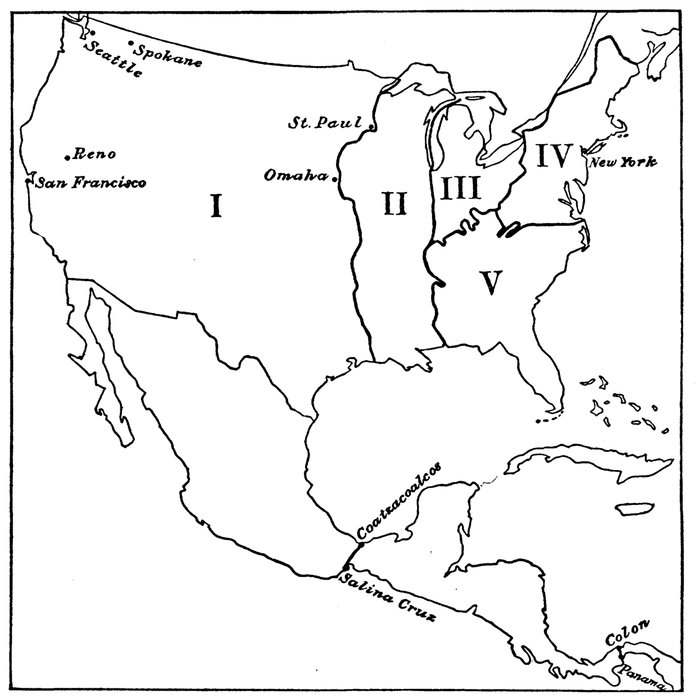
At the present time freight classification for all the railways
of the United States is performed mainly by three committees,
known as the Official, the Southern and the Western, with
headquarters, respectively, in New York, Atlanta and Chicago.
Each of these three committees has jurisdiction over a particular
territory. Thus the Official Classification prevails east of
Chicago and north of the Ohio and the Potomac; the Southern,
over the remaining part of the country east of the Mississippi;
and the Western, throughout the rest of the United States.
In addition to these three primary classifications there is also
another, issued by the Transcontinental Freight Bureau, with
headquarters at Chicago. This committee has supervision
over classification upon the Pacific coast business. A number
of the states also, notably Illinois, Iowa and most of the southwestern
commonwealths, promulgate state classifications having
relation, however, only to local business within their several
jurisdictions. These are prescribed by law and represent modifications
to suit peculiar exigencies or to foster local trade
ambitions. There are also a number of other coöperative local
railway committees, each dealing with the special concerns of
its own territory, and representing the joint interests of the
railways therein included to all the world outside. Thus, for
instance, Southern Classification territory is subdivided into
local units, known, respectively, as the Southeastern Mississippi
Valley Association, the Southeastern Freight Association, and
the Associated Railways of Virginia and the Carolinas.[320] But
for all practical purposes, so far as the larger problems of classification
are concerned, our attention may be concentrated upon
the three principal committees above mentioned.
Some impression of the wide differences between these three
main classifications in different parts of the country may be
derived from the set of excerpts at the head of this chapter.
In three parallel columns the alpha and omega of each are
reproduced, together with bits of one of the most complicated
schedules, viz., that dealing with agricultural implements.
Even where the same commodities occur in each classification,
the diversity in description, mode of packing, carload and other
requirements, renders any direct comparison almost impossible.
The mere fact that the class assignment, as shown at the right
in each column, happens to be the same, as in the case of acetic
acid in barrels or drums which moves both in Official and
Southern Classification territory, third class in less-than-carload
lots (L. C. L.) and fifth class in carloads (C. L.), shows nothing
at all as far as equality of charges is concerned. For, as
has been said, this is only half the statement of the rate. The
spread between charges for different classes yet remains to be
determined. The actual relativity between third-class and
fifth-class rates, moreover, may be very different in the two
places. In the New York Board of Trade case[321] this point was
well exemplified. Comparative conditions as to rates in the
three main sections of the country, as they then existed, were
as follows:
Rates in Cents per Hundredweight
|
Canned goods |
Class |
|
Miles |
I. |
IV. |
L.C.L. |
C.L. |
| New York to Chicago (Official class'n) |
912 |
75 |
35 |
65 |
30 |
| Chicago to Omaha (West'n class'n) |
490 |
75 |
30 |
28.5 |
25 |
| Louisville to Selma (South'n class'n) |
490 |
98 |
63 |
63 |
52 |
On the trunk lines fourth-class rates were thus less than
half those charged for the first class; in the West they were
even lower, relatively; while in the South fourth-class rates
were about two-thirds as high as the first-class rates. These
differences in the spread between classes, as will be seen, interlocking
as they do with a multitude of other considerations,
are a serious bar to any partial modification in the direction
of uniformity for the United States as a whole. Only by consideration
of every factor entering into any given rate may
comparisons safely be entertained.
Historically considered, the development of freight classification
has been much the same in England and the United
States. Early railway practice was an outgrowth of the tariffs
in force upon canals and toll roads.[322] In America, freight
charges were at the outset often arbitrarily fixed by the state
legislatures, as conditions precedent to the grant of charter.
In many instances they were based upon the customary performance
by wagon, distinguishing between light-weight
articles paying by the cubic foot, and heavy ones for which
the tariff was based upon weight. Thus in 1827 the charter
of the South Carolina Railroad established its tolls at one
half the usual wagon charge. The Southern Pacific in local
rates on ore into San Francisco followed along just below the
charges by ox cart. The freight was proportioned also according
to the length of haul by an arbitrary mileage rate. It
soon developed, however, that railway rates were unique in
the fact that not only was there a great increase in the volume
of trade, but also in the diversity of articles offered for transportations
as well. Far more elaborate classifications were
soon seen to be necessary.
The South Carolina Railroad tariff of 1855, described by
McPherson,[323] exemplified the primitive traffic conditions then
prevalent. Goods were divided into four classes. The first
consisted of articles of light weight or high value, including,
for example, such incongruities as bonnets, tea, and pianos.
The remaining three classes paid by weight with a descending
scale of charges. It is difficult to explain why coffee and sugar
should be rated lower than stoves and feathers; or why dry
hides and rice should be charged a higher rate than cotton
yarn and bacon; but it is evident that a rough classification
according to weight, value, use and cost of service was being
attempted. There was in addition a considerable collection
of special rates on chosen commodities according to the method
of packing them, whether by barrel, bale or case. And there
were also what corresponded to modern commodity rates upon
cordwood, lumber, bricks, and similar goods. This tariff,
though primitive, including no less than three hundred items,
was far more elaborate than those commonly used at the time.
The Louisville & Nashville originally distinguished but three
classes: one by bulk, another by weight and a third applicable
to live stock. Poultry was rated by the dozen long after
the Civil War, with a higher charge for Muscovy than for
ordinary ducks. The traffic manager of the Chicago, Milwaukee
& St. Paul testified before the Elkins committee in
1905, that the classification in Illinois in his youth was printed
on the back of a bill of lading no greater than the size of an
ordinary sheet of letter paper, and the page was not full.
From these modest beginnings the development of classification
in the United States was rapid, responding to the
ever-increasing intensity of competition and the spread of
markets, particularly after 1875. By the middle of the eighties
most of the large railways were working under six or eight
different classifications. It began to be apparent that some
check must be placed upon such increasing complexity. For
conditions were wellnigh intolerable, with one set of rules
for Illinois, and yet another west of Buffalo, divided into
eastbound and westbound sections, with still a third on westward
shipments local to territory between Chicago and the
Missouri river. The first attempt at a systematic scheme was
made in 1882, but the agreements then made proved unstable.
By 1887 conditions had become insupportable, so great was the
number and the diversity of the classifications throughout the
country.[324] Some applied to local business only, and were peculiar
to each road. Some applied only to westbound business,
others to eastbound traffic. The traffic manager of the New
York Central & Hudson River testified before the Interstate
Commerce Commission that there were at one time 138 distinct
classifications in trunk line territory alone. The case of the
Wabash in 1883 was typical. A shipper desiring to determine
freight rates over that road might be compelled to consult a
classification for the middle and western states in six classes;
one for the Southern Railway & Steamship Association
territory in eighteen classes; one for Mississippi valley business
in five classes; one known as the Revised Western in nine
classes; the Trunk Line East in thirteen classes; the Trunk
Line West in five classes; a classification for Texas points in
eight classes; and two for the Pacific coast, according to direction,
in eight and nine classes, respectively. This situation,
rendering it almost impossible for any shipper to determine
in advance what his freight rates were going to be, as well as
what his competitor was paying, early impressed itself upon
the Interstate Commerce Commission. And it was doubtless
due in part to its initiative that classifications were shaken
down into substantially their present general form in 1888.
Number of Ratings in 1909[325]
|
Less than Carload |
Carload |
| Southern Classification |
3,503 |
703 |
| Western Classification |
5,729 |
1,690 |
| Official Classification |
5,852 |
4,235 |
The natural growth of classification in a rapidly developing
country like the United States, has manifested itself in
three distinct ways: there has been a steady increase in the
number of items of freight separately enumerated; a growing
distinction in rates between carload and less-than-carload
shipments; and a steadily enlarging volume of the most elaborate
special rules and descriptions. As for the mere increase
in distinct commodities enumerated, in the East in 1886 there
had come to be about 1,000. The first Official Classification
in the following year increased to 2,800 items; and by 1893,
in the eleventh issue, there were twice that number. The
latest Official Classification, No. 34 in 1909, contained approximately
6,000 separate enumerations—not many more, in
fact, than fifteen years earlier. The point of saturation, or
else the limit of human ingenuity, seems to have been about
reached some years ago. The same thing was true of the
Western Classification. In 1893 this contained 3,658 items,
representing an increase of about 2,000 over the number of
commodities classified by name in 1886. By 1909, as the
above figures show, it comprehended 5,729, almost as many
separate items, in fact, for less-than-carload lots as were recognized
in trunk line territory. Only in carload ratings is the
Western Classification less extensive. The Southern Classification
reflected somewhat simpler trade conditions prevalent
south of the Ohio river, by the relatively smaller
number of articles enumerated; but it should be added
that the number of exceptions—filling no less than 160
pages in the latest issue—is indicative throughout of a lesser
degree of standardization than is found elsewhere. Perhaps
the most striking feature of the southern system is the very
small proportion of carload rates. But it should be noted
in this connection that the basing point system afforded preference
to market towns in any event; so that jobbers in such
places did not need wholesale rates to the same degree. This
phase of the matter will be elsewhere discussed.[326]
The second natural tendency in the development of classification
above mentioned, is an increase in the number of
separate ratings for large and small shipments. The normal
growth of trade ought to make possible a steady increase
in shipments by the carload, rather than by the box, barrel,
or case; and the increase in the number of separate carload
ratings—always, of course, at a reduced rate by comparison
with less-than-carload lots—conforms territorially to the
growth in the volume of trade. In 1877, even in trunk line
territory, only twenty-four commodities were accorded a special
carload rate.[327] By 1880 the number had increased to 50, and
seven years later to 160. Just before the passage of the Act
to Regulate Commerce there was no distinction between carload
and small lots in eighty-five per cent. of the articles enumerated.
A sudden change supervened in the first Official
Classification issued after the Federal Act. The number of
carload ratings was suddenly raised to 900, provoking a storm
of protest from eastern shippers who resented this advantage
accorded to jobbers in the West and South, because it enabled
the latter to buy their supplies directly at wholesale.
The dispute between dealers in the older and newer commercial
centres came to a head in the so-called New York Board
of Trade and Transportation case of 1888, elsewhere discussed.
Yet notwithstanding this protest of jobbers and manufacturers
in eastern trade centres, who insisted that they should be
permitted to compete on even terms with provincial jobbers
by making their shipments direct from New York or Boston
in small lots as cheaply as the local jobber could buy them by
the carload, the number of separate carload ratings steadily
augmented year after year. By 1893 more than half of the
articles enumerated in the Official Classification were allowed
a lower rate for large shipments. Present conditions are set
forth by the statistics in the preceding paragraph. From
these it appears that in trunk line territory nearly three-fourths
of the commodities now enjoy carload ratings; while
in the South, on the other hand, only about one-fifth of them
make such distinction between carload and less-than-carload
lots.[328] One reason is evident; namely, that throughout a large
part of the South few jobbers command a business of sufficient
magnitude to make use of carload shipments. It is but recently,
to take a specific illustration, that business has developed
in volume sufficient to permit of the shipment of
fly paper in carload lots. Until such time no distinction
between large and small shipments could well be made.
Conditions in the West, according to these figures, are
intermediate between those in the East and the South. On
the other hand, transcontinental business, as carried on in
competition with ocean steamers, is almost entirely confined to
shipment by the carload. The Transcontinental Classification
is unique, therefore, in offering but very few opportunities
for shipment by package, except under specially onerous conditions.
The spread, in other words, between the two sorts
of carriage operates most unfavorably by contrast upon the
intermountain centres. Denver, for example, under the Western
Classification enjoys no carload rates, while competitors
at San Francisco have a large number.[329]
A much more elaborate code of rules and regulations having
reference to local practices and conditions is the third accompaniment
of the growth of trade.[330] Prior to 1887, and again
before the recent revival of interest in uniform classification,
conditions had become intolerable in this regard. All sorts
of details, covering relatively unimportant differences in conditions
of carriage, bill of lading contracts, marking and packing,
led to constant confusion and annoyance, especially in
cases of shipment from one classification territory to another.
An eastern shipper of iron bolts, having in mind that a gunny
sack is equivalent to a box or barrel in the East, orders a small
shipment in a bag to a far western point. He finds that bolts
in bags under the rules of the Western Classification, are
specially enumerated only for carload lots, and that he must
pay a rate one class higher for such shipment than if contained
in a barrel, box or keg. This difference in classification may
more than absorb his profit. Recent evidence before the
Interstate Commerce Commission,[331] contained a striking illustration
of such local diversity in rules and descriptions as
applied to furniture.
"Western class: 'Bank, store, saloon and office furniture, consisting
of arm rails, back bar mirrors, bottle cases, chairs, counter-fittings,
desk, foot rails, metal brackets for arm and foot rails, refrigerators,
tables and work boards. Note—Door, window and bar screens,
partitions, prescription cases, patent medicine cases, show cases, wall-cases,
wainscoting, office railing and wooden mantels may be shipped
with bank, store, saloon or office furniture in mixed carloads at third-class,
minimum weight 12,000 lbs.
"There is no such provision as this in the Official Classification.
On the contrary, a shipment of that kind can only be made by figuring
out the less-than-carload rate on each article, many of which take first,
double first and even three times first ratings.
"For example, mirrors over five feet in length are classified double
first class in the official classification, while show cases, set up, take
three times first. The natural result of this difference in classification
has been to shut out competition of eastern dealers in these articles
entirely in Western Classification territory."
Only in a customs tariff of the United States would one expect
to find any such complexity as is discoverable in railway
documents of this sort.
The mere interpretation of such classification rules is often
difficult; especially with reference to the mode of packing.
Suppose a tariff provides a certain rate on stamped metal
ware in boxes, barrels or crates and, furthermore, fixes the
charge fifty per cent, higher for shipment in bales, bags or
bundles. If the consignment is encased in corrugated straw-board,
which of the two rates applies? The difference in rates
being so great, it becomes quite an item on a shipment of
fifteen carloads from Buffalo to the Pacific coast.[332] Or it may
be a question as to whether a crate for Colorado cantaloupes
is actually of such dimensions as to come in under a specially
favorable commodity rate.[333]
The growing diversification of manufactures and trade is,
of course, responsible for all three of the developments above
indicated. Not only the increasing refinement of commerce,
but the technical nomenclature or trade jargon, necessary for
the specific and accurate description of so many thousands
of articles, have conspired to render these documents extremely
cumbersome in the absence of a general revision and simplification.
It is but natural that one item after another should
be added, each bearing a particular name or being classified
upon some new basis. A striking example of this increase of
complexity was afforded by the cotton goods schedule in the
Southern Classification. By 1900 there were upwards of
thirty different names under which cotton cloth might be
shipped. Great complaint was occasioned, as well as the
possibility of fraud, by underclassification, etc. Most of these
thirty names did not represent different values of goods, but
in many instances were merely trade-marks of particular
manufacturers. At the urgent request of the shippers this
complicated schedule was superseded in 1900 by one comprehensive
title of "cotton goods in the piece" irrespective of
color, particular method of weaving or other subordinate
details.
From the point of view of economic theory, the warrant
for a differentiation of charges between various classes of
commodities offered for transportation, may be considered
primarily from two distinct points of view. The first is that
of operation, which determines cost. The second is from the
standpoint of traffic whereby the value of service, so-called, is
measured. The reasonableness of making a distinction in
freight rates according to the character of goods is easily
apparent, as judged on the basis of cost of service. A multitude
of factors enter into consideration at this point. The
railway ought in self-protection to charge more for hauling
a thing, if it actually costs it more in the long run to perform
that service. Some of the factors which enter into this cost
were well put by the Interstate Commerce Commission in
1897.[334]
"Whether commodities were crude, rough, or finished; liquid or
dry; knocked down or set up; loose or in bulk; nested or in boxes,
or otherwise packed; if vegetables, whether green or dry, desiccated
or evaporated; the market value and shippers' representations as to
their character; the cost of service, length and direction of haul; the
season and manner of shipment; the space occupied and weight;
whether in carload or less-than-carload lots; the volume of annual
shipments to be calculated on; the sort of car required, whether flat,
gondola, box, tank, or special; whether ice or heat must be furnished;
the speed of trains necessary for perishable or otherwise rush goods; the
risk of handling, either to the goods themselves or other property;
the weights, actual and estimated; the carrier's risk or owner's release
from damage or loss."
Instances of approval of classification on the basis of such
cost of operation are frequently found in the decisions of the
Interstate Commerce Commission. For example, special service
or equipment, as in the rapid transport of fresh vegetables
and fruit from the South, justify the carriers in a specially
high classification.[335] Rates on live hogs by comparison with
rates on hog products, as well as on live cattle and dressed
beef, have likewise been adjusted in terms of cost of carriage.
A classification on hogs yielding a rate equal to two-thirds of
that on hog products has been held equitably to represent
the relative expense.[336] Even the indefinite element of risk
has been accepted as justifying a higher classification for live
stock as compared with other commodities.[337]
Classification is less easy to defend from the standpoint of
the traffic manager alone, than from that of the vice-president
in charge of operation. Value of service is at times difficult
to understand. It is not at first sight reasonable, that of two
commodities which cost the railway exactly the same amount
to transport, one should be charged twice as much as the
other. For example, the rate on anthracite coal is very much
higher than upon soft coal; the rate upon wheat is higher than
the rate upon some other foodstuffs; the rate upon fine woollen
goods is very much higher than upon coarse cotton cloth, etc.[338]
It has been urged frequently that any discrimination in the
freight rate on the basis of difference, either in the value of
the commodity itself or in the value of the service rendered,
is unreasonable and unjust. The case, however, is entirely
analogous to that of discrimination between a long and short
haul of the same goods. The principle is perfectly defensible
in both cases, and has been accepted in legal decisions as well
as by economic writers for many years. It is based upon the
fact, which confronts one at every turn in a discussion of railway
economics, that a large proportion of the expenses of a
railway is independent of the amount of traffic. These fixed
expenses must be met at all cost if the road is to remain solvent.
They constitute a charge upon the entire traffic of the line,
and are not susceptible of apportionment to each unit of transportation.
Any rate which will contribute a surplus, small or
large, above the mere cost of transportation,—that is to say,
above the expenses incident to this particular carriage,—and
which thereby lessens by the amount of that excess the burden
of the fixed charges remaining upon other traffic, is justifiable.
But it is defensible only under two conditions. The first is
that the goods at any higher rate will go by another route or
not at all; and the second is that the effect may not be detrimental
to the general course of business,—that is to say, that
it is not opposed to the public welfare. Thus a long haul at a
lower rate than the rate charged for a shorter haul, if it must
be lower in order to secure the business, constitutes no injustice
to the local shipper; for the surplus remaining above
the cost of haulage of that particular increment of freight
lessens thereby the charge which must be made upon local
freight for meeting interest on bonds, maintenance of way,
and equipment expenses, etc., all of which charges, as we have
seen, go on more or less independently of the traffic. On
precisely the same grounds a discrimination of freight rates
in favor of the cheaper commodity or the less valuable service
may be defended. Coal or sand may reasonably be carried
at two and one-fourth mills per ton mile, while the road is
coincidently charging three or four times as much for hauling
dry goods or fine hardware. For if a quarter of a mill per ton
mile can be earned above the expenses incident to hauling
that sand or coal, it enables the rates on the dry goods or
hardware to be maintained at a lower point than they otherwise
would be. It is unnecessary to elaborate this principle
further. It is everywhere accepted as valid. And it in a
measure substantiates Mavor's statement that "freight rates,
like rent, are rather the effect of price movements than the
cause of them." When tariffs are high because prices are
high, we are afforded a fair illustration of value of service as
an element in rate making.
Value of service, therefore, as affording a warrant for
classification, has also been recognized in a number of Interstate
Commerce decisions since 1887. A relation between
the grade of the charge and fluctuations in the market price
of the commodity—in other words, charging what the traffic
will bear—is at times discernible. It is to the interest of the
public that carriers should be satisfied with relatively smaller
profits from the transportation of commodities of low price
which are in general demand.[339] Under these circumstances
changes in price of such staple commodities as iron and steel
or the lower priced grains, should be reflected in a corresponding
modification of rates.[340] Akin to this is recognition of a
relation in general between the value of a commodity and its
classification. Where, for example, articles representing different
stages of manufacture have to be graded, it is but fair that
the raw material, or the partly-made product should be graded
lower than the finished article.[341] Similarly, articles which may
fairly be substituted for one another ought to be classified with
reference to their common market value.[342] The relative value
of commodities, as controlling classification, clearly governs
the treatment of hard and soft coal.[343] The practical difficulty,
of course, is to know where to stop in admitting such considerations.
Shall "small-vein" soft coal, because it cannot
compete on even terms with the "big-vein" product, be accepted
for carriage on a more favored basis?[344] Some rather
nice questions, both of business and public policy, would be
suggested by such a precedent.
Different classification of the same commodity according
to the use to which it may be put, is evidently an attempt to
grade according to value rather than cost of service. Automobile
parts may come in from the wheel-maker at second-class
rates, but when they go out to jobbing houses they are
rated three times first class.[345] A number of cases of this sort
have come before the Commission. Shall cow peas, for example,
be classed with corn and oats as agricultural products
in one case, while according them a rating with commercial
fertilizers in another, inasmuch as they may become an active
agent in nitrogenizing soil?[346] More recently the Commission
has declined to recognize the validity of classification on this
basis. Thus brick is always to be charged the same without
regard to whether it is for fire, building or paving purposes.[347]
Unusually low rates for steam coal used by carriers and open
only to certain shippers for this or other particular purposes,
likewise have been forbidden.[348] The carriers have attempted
to distinguish in grade between dried fruit and raisins. For
the two industries call for relatively different protection against
old-established competitors.[349]
As actually effected in practice, classification of freight
seems to have been largely empirical—the result of long experience
in sympathetically feeling the pulse of the business
community. In the main, despite their denial of the validity
of cost as an element in rate making, traffic managers and the
Interstate Commerce Commission seem to have been swayed
more commonly by this consideration in the make-up of schedules.
Nevertheless, charging what the traffic will bear, as a
principle, will suffice alone to explain many of the details of
classification now in force. Rates have been adjusted so as
to secure the largest amount of business possible at the highest
rate compatible with that volume. In other words, traffic
managers have been mainly influenced by the consideration
well stated by a witness before the United States Industrial
Commission: that, "a freight tariff is made as it is, not because
it ought to be that, but because it must be that." The procedure
of classification committees seems, in other words, to
have been mainly based upon considerations of revenue, and
that, too, without any very positive evidence as to details.[350]
Rule-of-thumb experience, therefore, is mainly represented
in classifications of the present time; that is to say, an adjustment
of freight rates upon different commodities to suit the
commercial conditions which have happened to prevail at
any given time. All of which emphasizes still further the
need of scientific revision of these most important schedules,
preferably by the carriers themselves, but by public authority
if commercial inertia be too powerful to be overcome.
The spread of a classification,—that is to say, the graduation
of rates as between all kinds of goods, from fine silks
to lime and sand, or from aeroplanes, "set up," to pig iron,
"knocked down,"—is not constant. How shall this be theoretically
justified? At first sight it would appear as if the
relativity of charges between different things, as determined
by cost or value of service, ought to remain fixed; that is to
say, for example, that rates on raw hides fairly standing at
one-half of the charge for shoes, ought to remain always and
everywhere at this ratio. Advocates of a rigid classification
prescribed by public authority seem often to assume that this
could be brought about. But a moment's consideration of
the nature of a tariff as it has already been described will show
that this is impossible. The spread or gradation, far from
being fixed, must in the nature of things ever vary from place
to place with change of trade conditions. The rate on raw
hides relatively to that on shoes in New England—the centre
of manufacture for footwear—should be very different at
Kansas City or Chicago, whence the raw hides are derived:
different alone, if for no other reason than because hides,
moving east, progressively add the cost of carriage the farther
they go; while with shoes the augmentation of value goes on
in the opposite direction, geographically. True as between
commodities, the same inconstancy of ratio also holds good as
between different points along a given line. The rate from New
York to Durham, North Carolina, for example, on first-class
freight may be fifteen per cent. above that for freight of the second
class; the second class maybe twenty per cent. above that of
third class for this distance, etc.; yet the divergence between
these same classes for another distance, as between New York
and Jacksonville, Florida, may be quite different,—twenty
per cent. between first and second class, twenty-seven per cent.
between second and third, and so on. This is indeed rather a
difficult matter to understand.
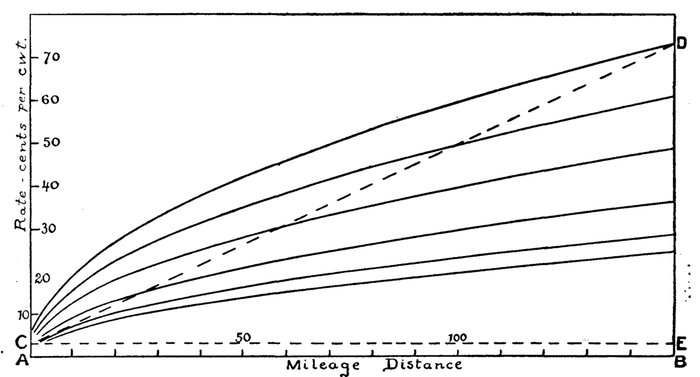
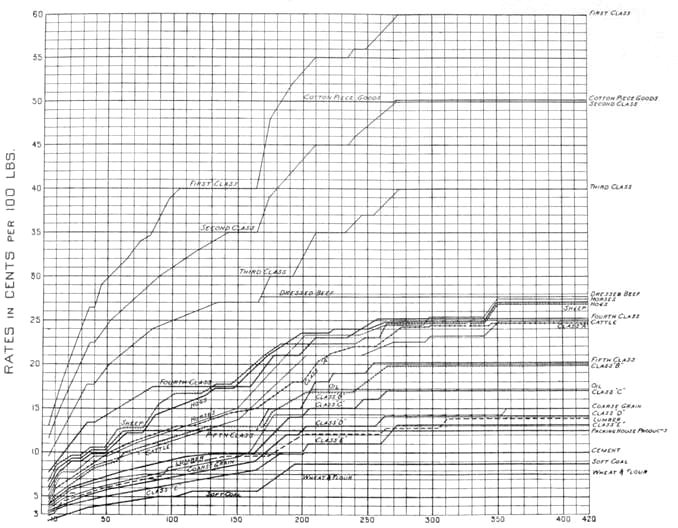
This ever-changing spread of rates from place to place, as
between different commodities and with all possible combinations
of the two, may be clearly explained by reference to the
diagram at page 108, showing the gradation of charges by
distance for different goods. Is it not plain that the spread
between commodities at any given place is indicated by taking
a vertical cross section of the diagram at that point? We
have already seen that the curves, rising with increase of the
distance, do so by different degrees. They cross and recross,
making an intricate lace work of lines, because of the fact that
while cost, in general, may increase more or less proportionately
to distance, competition in its ever-varying forms, plays all
sorts of pranks with the rates from point to point. The rate
at any station is shown by the height of the curve on the
vertical line for that place. Even, however, if the curves never
crossed, but rose by evenly spraying out from the point of
shipment at one end of the line, as in the case of those for the
three upper classes, their relative heights would constantly
change with distance. But owing to the complexities of competition
the onward and upward movement of the curves for
particular commodities is usually much more erratic than this.
Some goods, like children, "get their growth" early. They
soon attain the level of all the charge they can ever bear.
Others distribute their development over a much greater
distance. Sometimes, as we have observed, the coal curve
will be above the wheat curve; sometimes it will be below.
In other words, the vagaries of these sloping lines cause the
vertical cross sections, indicative of spread, to vary from point
to point all along the line. Such a thing as constancy of ratio
between classes or particular goods is, in the nature of transportation
things, impossible. This is a matter of fundamental
importance, especially in its bearing upon the proposition,
soon to be considered, of substituting a single uniform classification
under government authority for the present threefold
system. Moreover, it demonstrates the great commercial
disturbance which might ensue from a general advance of
freight rates by an indiscriminate transfer of commodities from
lower to higher classes, such as was attempted in 1900. Such
procedure is altogether illogical, and economically as upsetting
to trade as a general "horizontal" increase or reduction of a
customs tariff.
Commodity rates as a means for enabling shippers to reach
beyond their immediate territory and gain an entrance to
new markets, form an entirely distinct variety of charges from
those quoted in the classified tariffs. These are special rates
made to suit particular contingencies,[351] although, of course,
under the law they must be filed with the Interstate Commerce
Commission in the same manner. Such commodity
rates, however, do not apply to persons but to localities. Although
granted to shippers in a particular place to build up
an industry, the privilege of shipment under the same conditions
is theoretically open, of course, to all others at that
point. Such commodity rates naturally apply to three sets
of commercial conditions: they either govern large shipments
for long distances, as in the case of live stock; or, if for short
distances, they are confined to commodities of the very lowest
grade, such as lime, sand or paving blocks; or else they are introduced
to meet special conditions, such as an irregular market or
rapidly fluctuating competitive circumstances, as in the case
of goods for import or export. Such special rates are almost
invariably granted for carload lots alone. The reason is,
naturally, that it would not be worth while to make an exception
to the classified schedules for less than that amount.
Moreover, it should be observed, special rates of this sort are
often introduced in order to meet changeable competition,
such as by steamship lines engaged in export or import business.
The classified ratings change but little, and oftentimes remain
the same for many years. But in all cases where fluctuating
conditions have to be met, commodity rates by the carload
are likely to appear. This is one reason why the transcontinental
tariffs, exposed to competition either by the Cape Horn
or Panama water routes, contain so large a proportion of
commodity or carload ratings.[352]
Exceptional or commodity rates are also commonly found
in a territory like the southern states, where manufactures
are struggling to maintain a foothold. If it appear that a
new industry can maintain itself in competition with already
established industries elsewhere only by a concession in charges,
the traffic manager may elect to grant a commodity rate until
such time as the industry has been placed firmly upon its feet.
The tonnage moving under commodity rates in such circumstances
may be much greater than that included under the
classified schedules. Attention has already been drawn to
this fact, but it merits still further comment. Probably three-fourths
of the business of American railways is done under
such special rates. This is apparently a higher proportion
than rules in foreign countries with the possible exception of
England. Yet it is important to notice that the revenue
obtained from such traffic is relatively much less than the tonnage,
inasmuch as most commodity rates are confined to low-grade
goods. Whether such exceptions to the classified tariffs
are on the increase or not is open to question. The evidence
tends to show that special rates granted in connection with
industrial development tend to increase up to a certain point.
Commodity rates, for example, are said to be much more important
in the West than they were fifteen years ago.[353] But,
on the other hand, industrial conditions having once become
standardized and assured, the natural disposition of the railways
is to substitute regular schedules for a multiplicity of special
rates. The dilemma is that such a special rate once allowed,
is exceedingly difficult to withdraw. An earnest attempt was
made by the trunk lines in 1899 to retire a large number of
these commodity rates. It then appeared that the New York
Central & Hudson River Railroad had no less than 1,370 on
file. Opposition naturally arose to the cancellation of these—an
opposition less easily overcome because of the complication
that the withdrawal of commodity rates meant practically
the abolition of carload ratings. Such action, therefore, looking
toward simplification of tariffs, threatened substantially
to disturb all the existing commercial adjustments. Nevertheless
it is encouraging to note that a distinct reduction in the
number of separate and independent rates put into effect is
apparent since the recent extensions of Federal authority. The
following table, covering the tariffs officially filed at Washington
since 1906, is proof positive of great improvement in this regard:
Freight Schedules Filed with the Interstate Commerce
Commission
| 1896 |
131,597 |
| 1906 |
193,995 |
| 1907 |
187,041 |
| 1908 |
161,584 |
| 1909 |
129,294 |
| 1910 |
109,550 |
| 1911 |
93,821 |
A reduction of more than one half within five years is matter
for public congratulation.[354]
Special or commodity rates for the maintenance of equilibrium
between competing markets fall naturally into several
distinct groups.[355] In the first of these, concerning commodity
rates on grain and grain products and cotton, production takes
place over a vast extent of territory and the products are
marketed in places widely remote from one another. The
problem under such circumstances is mainly that of securing
equalization through different gateways.[356] In the case of
wheat it is a question first of concentration at primary markets,
such as St. Paul, Kansas City, or Chicago; and thereafter of
carriage by competitive routes whether by the way of the Gulf, by
any of the various Atlantic seaports or by the St. Lawrence
River. Commodity rates are thus determined in this first
class of cases mainly with references to competition of routes.
On the other hand, when production is spread over a considerable
territory, but when transportation is thereafter effected
along converging lines to a fairly localized centre of manufacture,
the problem of equalizing conditions, competitively,
by the resort to commodity rates, has mainly to do with competitive
conditions at the place of production. Rates on wool
to the highly localized markets of the world afford illustration
of this second type of commodity rate problem.[357] Commodity
rates upon fruits and vegetables to common markets
from such widely separated sources of supply as Florida
and California or the equilibration of conditions of production
for coal or lumber from the most widely scattered
sources of supply, are perhaps the most difficult of all to
settle satisfactorily.
The amount of reduction to be allowed on shipments by
carload as against consignments in small lots is a nice and most
perplexing problem in classification. Attention has already
been directed to the great increase in distinct carload ratings
which has accompanied the development of trade. As affecting
the interests of shippers in different parts of the country, the
question came up almost immediately after the passage of the
Act to Regulate Commerce. In the so-called New York Board
of Trade case,[358] complaint was entered by eastern merchants
against a great increase in the number of wholesale ratings in
1888. More than five times as many commodities as before
were abruptly given lower rates when shipped out of New York
by the carload. Inasmuch as a very large proportion of groceries
and other supplies went by box or package, this reduction
accorded on carload shipments greatly benefited the jobbers
all through the West and South. Under new conditions provincial
middlemen could buy in carloads; and then re-distribute
from local centres much more advantageously than
before. The Commission, called upon to decide as to the
relative rights of these two classes of jobbers, attempted to
bring about an adjustment which should, in the main, conform
to the existing trade conditions; and yet should take into
consideration the relative cost of service in the two cases. The
competitive struggle between eastern and both southern and
western dealers revealed in these early proceedings, has cropped
out continually in official proceedings ever since that time.
In a modified form the same question came to the front in connection
with the general advance of freight rates in 1900.[359]
The changes at this time were twofold—not only modifications
in the number of carload ratings, but also an altered
differential or spread between the charges for the two sorts of
shipments. The question is a vital one to all the shipping
interests of the country. It is one of the most troublesome
elements in the establishment of a uniform classification for the
United States as a whole. For inability to standardize reasonable
differences between carload and small shipments, under
the widely different trade conditions and practices in various
sections of the country, is an almost insuperable difficulty in
the way of that reform.
The economic justice of allowing a carload shipper lower
rates than one who ships in small lots is apparent, on account
of the difference in the cost of such service to the railways.
This has been recognized by the Interstate Commerce Commission
and the courts as beyond question. Not only the amount
of paying freight in relation to dead weight; but the cost of
loading and unloading, of billing or collection and of adjusting
damages—all of these elements of cost are noticeably less in the
case of a full carload. Turning from these considerations of
cost to those prescribed by what may be called traffic principles,
the difficulty in arriving at a just determination may be easily
appreciated. Glass battery jars in less-than-carload lots were
at one time charged from New York to Atlanta, Georgia,
second-class rates, namely ninety-eight cents per one hundred
pounds. The same commodity when in carload shipments
(not less than 20,000 pounds) was rated as fifth class; in which
case the charge from New York to Atlanta became sixty cents.
Here was a plain difference of thirty-eight cents per one hundred
pounds—upward of sixty per cent. greater charge—to the
small shipper whose business or capital was insufficient to
warrant shipments to such an amount. Two results of such
discrimination are possible. In the first place, the large shipper
is enabled to undersell his smaller competitor and perhaps to
drive him out of that class of business. This may take place
as between two dealers, both located in the South and buying
their supplies from New York. The second result is that under
such rates it is impossible for the manufacturer or northern
jobber to sell direct from New York to the retailer in the South
in competition with the provincial jobber there located, who
ships his goods in at the cheap carload rate and distributes
them thereafter. The problem thus concerns at the same time
both the small local shipper or dealer, as against a more formidable
provincial competitor; and also the remote jobbers
as a class against the whole group of local middlemen. In the
latter case, sometimes, as in the South, the question is still
further complicated by a basing point system, under which
the provincial jobber re-distributes to the country stores the
goods which have already been shipped in on a low carload
rate.[360] And, locally, there is also the immanence in the South
of water competition by sea and river to be kept in mind.
Boat charges are based upon space requirements rather than
weight. This introduces further important considerations in
fixing the spread of charges.
The problem as it affects the manufacturer is akin to that
concerning the jobber. Originally, as a matter of fact, the carload
reduction was essentially a manufacturers' rating, especially
for goods in which the cost of raw material formed a
large part of the price of the finished product. The relations
of the carload rate on the former to the less-than-carload rate
on the latter, it is obvious, may readily become an important
element in industrial success. It is plain enough that carload
charges under such circumstances should be substantially less
than those upon small consignments; but that is far from
affording a satisfactory answer to the question as to the
proper spread or difference in charge to be allowed between
the two.
Obviously, in any representation as to the reasonableness of
the discount which shall be allowed on carloads, either on the
basis of cost or of traffic principles, the interests of localities
are commercially pitted one against another. The New York
or Chicago jobbing house desiring to sell its goods directly to
the retailers throughout the West, wishes to have a relatively
low rate on such small shipments as the retailers in lesser
places alone can afford to purchase. Participation in this
distributing business, however, is resented by the middlemen
located in western centres—Omaha, Denver, Kansas City,
etc.—who all insist that there should be so wide a difference
between carload and less-than-carload rates that they may
ship in their wholesale purchases at a low rate, and thus compete
in their own territory with the manufacturer in the East or
the jobber in New York who desires to sell direct.[361] Comparison
of the classifications in different parts of the country reveals
the influence of these local interests. The railways in Official
Classification territory desire, of course, to build up the manufacturing
and jobbing cities tributary to them. This can best
be done by encouraging the growth of eastern jobbing centres,
stimulated by as low rates for retail as for wholesale shipments.
The railways in the western and southern territory, on the
contrary, are obliged to consider the claims of their constituents,
and to correspondingly minimize the advantages which foreign
competitors of their local wholesale dealers enjoy. Another
consideration must also be kept in view, namely, that carload
ratings can only be accorded when business has developed a
magnitude sufficient to permit shipments of that size. The
growth of the volume of business in general, therefore, might
be normally expected to produce an increase in the proportion
of carload ratings. Experience, as we have seen, confirms this
view. The normal development, then, is toward an increase
in the number of lower rates quoted for carload lots. This is
retarded only by the influence of the jobbers and manufacturers
in the eastern trade centres, who insist that they shall be permitted
to compete on even terms with provincial middlemen
by making their shipments direct in small lots at rates approximately
as low as the local jobbers pay on carload lots. This
question is an exceedingly important one, requiring the balance
of opposing interests to a nicety.
Not unfamiliar aspects of the problem of carload rating are
revealed in a recent case before the Interstate Commerce Commission,
concerning milk rates in New England.[362] And yet the
normal order is reversed. Usually, complaint is made of the
denial of carload ratings. In this instance a plea was entered
for a useable small unit rate as against the wholesale charge.
The dispute was precipitated by a deadlock in 1910 between
the three large Boston milk contractors and the farmers'
associations of several states. The producers, failing in their
demand for an increased price, declined to furnish milk at the
old figure. A famine resulted, which drew the attention of
the public sharply to the system under which the Metropolitan
district of Boston was supplied. The belief prevailed that the
peculiar transportation conditions known as the "leased car
system" which had existed for half a century, was mainly
responsible for the tight monopoly of the milk supply. Under
this arrangement specially low charges were allowed to those
who made shipments regularly by the carload. The Massachusetts
legislature, after an investigation, finally passed a law
providing that no carrier should charge more for the transportation
of milk by the can than was charged for larger quantities;
and also that the same facilities, icing, for example, should be
furnished in the one case as in the other. This settled the
intrastate charges; but it left matters as before for all the other
New England states contributing to the market. In this
form the controversy was brought before the Federal authorities,
which exhaustively considered the methods of transportation
as affecting all parties concerned. The contrast with the older
elastic situation as to milk ratings in New York was sharp in
many respects.[363] This earlier controversy had to do mainly
with the relative rights of nearby and distant producers. It
was a question of the element of distance as affecting a local or
territorial monopoly. The Boston case, on the other hand,
was rather a matter of carload ratings than of graduation of
charges according to the length of the haul. The monopoly in
this instance was that of contractors who had succeeded in
getting entire control of the business by reason of the wide
spread between charges for milk by the can and by the "leased
car." Shipments by the can from the independent farmer
were rendered practically impossible since they had to be
carried in the baggage car and were liable to spoil through
lack of refrigeration.
By contrast with the New York "open car system," the
New England plan from the standpoint of cost of service alone
seemed to offer several advantages. A caretaker, hired by
the milk contractor and in constant personal touch with the
farmers, exercised supervision both over milk and cans; this
insured a heavier loading and more prompt service at terminals;
resulted in the operators providing the best facilities for handling
the supply; and allowed surplus milk to be directed to
other uses without waste. A large investment had been made
under this system, dependent upon its continuance for a reasonable
return. On the other hand, denial of equally low rates
with the same facilities for refrigeration to the single-can
shipper, had undoubtedly fostered monopoly. The railways,
conforming to the new Massachusetts law above mentioned,
offered to furnish and operate a car suitable for independent
shippers on condition that six hundred cans should be tendered
for shipment. But they denied obligation to furnish icing
facilities, which latter, of course, were absolutely necessary for
the success of the competitive service. To be sure, the leased
car controlled by the contractors had been theoretically open
to all, on condition of a small charge for icing; but the farmers
contended that independent shippers ought not to be compelled
thus to deliver over their property into the hands of
competitors, with the accompanying exposure of their business
relations. In the light of all these complications the Commission
decided that a per can rate with the necessary refrigeration,
and bearing a proper relation to the carload rate,
ought to be established. And there the matter rests at this
time.
The problem of mixed carloads, also, is a difficult one to
adjust to the needs of primary and secondary distributing
points.[364] It is oftentimes of vital importance to a small jobber
to be able to make up a carload of miscellaneous packages. His
business may not be large enough to permit him to enjoy the
advantage of a carload rate on any single commodity. Or the
independent meat packer may be greatly benefited by a rule
which permits him to bulk his soap and other by-products
with other goods in securing a wholesale rate. Why may a
paper manufacturer not combine paper bags and wrapping
paper in one territory as well as another? In this regard the
rules in the West and South are naturally much less liberal
than in the East. The privilege of mixture has been given
only to a limited extent to jobbing and manufacturing centres
by means of commodity tariffs. Such mixture is usually restricted
to analogous articles, such as agricultural implements,
furniture or commodities intended to serve a joint purpose.
The recent bitter protest against the discontinuance of the
right to ship binder twine with agricultural implements is a
case in point. On the other hand, eastern railways are a unit
in opposing the bulking of separate shipments in carloads when
owned by different shippers. The western and southern roads
do not specially forbid it. All such differences come to the fore
in any attempt to unify the practice of all the carriers of the
country under a single set of regulations.
Assuming the reasonableness of a difference in charges between
carload and small shipments, where shall the dividing
line as to size be drawn? This is the important and perplexing
problem of minimum carload rates. Turning to our excerpt
from the Western Classification on page 298, it appears that
24,000 pounds of advertising matter, N. O. S. (not otherwise
specified), must be shipped at one time in order to warrant a
carload rate. Under such circumstances a consignment of
20,000 pounds would be classified first instead of third class—the
difference in rate varying according to distance, but in all
cases being substantial. Between St. Louis and St. Joseph,
Missouri, for example, the charge would be sixty instead of
thirty-five cents per hundredweight. Were the minimum
weight for carloads but 15,000 pounds, as in the case of harvesters
under the Southern Classification, this particular shipment
of advertising matter would have enjoyed the full benefit of
wholesale charges.[365] From this instance it is apparent that the
point at which the minimum carload weight falls, is of great
importance in the determination of the actual rate—an importance
also dependent, of course, upon the spread between
carload and less-than-carload charges. It is also evident that
minimum carload ratings may readily be used as a means of
advancing charges. If, as appeared in a recent case,[366] the minimum
carload for wool in sacks was advanced between 1896 and
1912 from 15,000 to 20,000 pounds, the effect upon the shipper
of a consignment of 18,000 pounds, for example, would be as
truly an increase of charges as if the freight rates themselves
had been actually advanced. For under the new schedule, he
would be compelled to pay less-than-carload charges instead
of the lower carload rates formerly granted. Moreover, it is
apparent that minimum carload weights may enter seriously
into commercial competition in a number of ways. If 45,000
pounds of raw cotton by a special round-bale process can be
loaded upon a standard car; when but 25,000 pounds of the
ordinary square bales could be carried by the same equipment;
it is evident that tariffs based upon the higher minimum would
especially favor one set of competitors as against another.[367]
They might, in fact, be sufficient to turn the scale entirely in
favor of the round-bale system throughout the South. Granted,
however, that such heavy loading makes for economy in operation,
it is clear, nevertheless, that the carload minima must
be so established as not to discriminate against the great bulk
of shipments of the more common sort. All along the line one
meets with such illustrations of the bearing of the minimum
carload upon rivalry in business. Large shippers are continually
striving for a high minimum. The small shippers
oppose it for the same reasons. In a similar way the interest
of the manufacturer distributing his goods direct, in competition
with middlemen, is vitally affected.[368]
Car capacity, both as regards ability to load and carry
economically, is the principal factor in the determination of
minimum carload rates. It is largely a question of relative
cost of operation.[369] Reference has already been made to the
great economy incident to the use of large cars, whereby the
paying load becomes less in proportion to the deadweight. This,
of course, largely accounts for the steady increase in carload
capacity in recent years. But the question is even more complicated.
An adjustment must be made between two main groups
of freight: first, that which is sufficiently heavy to be readily
loaded to the minimum weight in ordinary cars; and, secondly,
light and bulky goods of which the common car will contain
but a small proportion in bulk of its truck capacity by weight.
Fortunately, we may evade the moot point, theoretically, as to
whether a carrier is entitled to the same revenue from a given
vehicle, whether it be loaded with heavy or light goods; that is
to say, whether the rate ought properly to decrease per pound
with increase in the density of the lading. This is a technical
matter as to cost. But it carries certain implications of considerable
importance commercially, as will shortly appear.
The difficulty of conforming carload minima upon light and
bulky articles to those on heavier goods has appeared with each
attempt to standardize equipment. Widely divergent rules in
the three main classification territories still cause great confusion
in this regard. There is a constant temptation to construct
extra long or wide cars, particularly in the western states,
in order to assist the manufacturers of such light and bulky
products as furniture and agricultural machinery in their competition
with dealers in the East, shipping under Official Classification
requirements. In other words, the penalty carried
under the rules as to minimum carloads, for the use of cars
larger than the standard, has been much less in the West than
in the East and South. The situation has been further complicated
in some instances by the arbitrary action of state railway
commissions. The experience in this regard is illuminating,
as again showing the extreme delicacy of adjustment in such
matters under the stress of commercial competition. The
short-line distance between the Missouri and Mississippi rivers
lies entirely within the state of Missouri. It governs, as we
have already seen,[370] the entire rate structure in this part of the
country. This commonwealth some years ago by law fixed a
carload minimum of 20,000 pounds for furniture, agricultural
implements and wagons.[371] As it is not practicable to attain this
minimum load on an ordinary standard car, the Missouri shipper
was stimulated to demand larger equipment in order that he
might avail himself of the lower rate for carload lots. The
local railways, accordingly, built such cars, which, of course,
travelled far beyond the limits of this single commonwealth.
This forced other western roads, in order to protect their clients
in the same markets, to adopt a similar policy. The result is
that extra large equipment is relatively more common throughout
this territory; thereby conferring a distinct advantage over
their eastern competitors upon western shippers of such light
and bulky freight. In pursuance of this same protective policy,
the western roads have also enforced distinctly favorable rules
as to carload lots applied to several small cars instead of one
large one.[372] These troublesome details are given in the hope that
they may show how far the ramification of trade competition
extends. They re-enforce the conviction that any reform of
classification is a matter of extreme difficulty; and, if undertaken
at all, must be done under governmental compulsion and
by a single universal reform, rather than by any attempt at
piecemeal improvement.
Next to ability to load and carry, as a determinant factor in
fixing minimum carload weights, the consuming capacity of the
market must be considered. A reasonable minimum carload in
the East might well be unfair in the West or South. An old-established
factory in New England might satisfactorily use a
quantity of raw material which in a carload lot would overwhelm
a western or southern plant. Thus it comes about that minimum
weights on the same goods quite properly vary widely in
different territories; being higher in the East than in the West,
and least of all in the South. The problem, therefore, of
standardizing carload rates throughout the country, unfortunately
becomes exceedingly difficult. A compromise will fail
to satisfy anybody; and, moreover, such a change of minimum
carload weights at once necessitates a remodelling of the particular
distance tariff to which it applies. This point was well
illustrated in a recent case.[373] A railway accepted for the same
carriage at different times two carload shipments of lime from
a given concern. On the one, a rate of thirty-four cents per
one hundred pounds was based upon a minimum carload weight
of 24,000 pounds. On the other twenty-nine cents was assessed
upon a minimum of 30,000 pounds. The carrier alleged that
these differences in rates per pound were entirely compatible in
view of the difference in carload minima. It then appeared
that these minima, especially with a perishable commodity
like lime, varied considerably according to destination. Large
distributing centres were given low rates on high minima, while
small towns, consuming relatively less, were best served by a
lower carload minimum to which a higher rate per pound was
applied. In other words, the close interrelation between the
rate and the minimum was a matter of great commercial
importance.
The relation of carloads to consuming capacity of the
market is an element in the trade policy of protection to clients
extended by the railway. The difficulty of properly relating
rates upon raw and finished products has already been discussed.
Carload minima must also be considered in this connection.
Why should 50,000 pounds be prescribed as the carload limit
on corn to Texas points, when the limit on corn-meal is only
30,000 pounds? Evidently differences in loading capacity are
inadequate as an explanation. Nor can this be accounted for
on the ground of any difference in mere cost of carriage. The
explanation is purely commercial—springing from the competition
between northern mills and mills located in Texas,
both making use of raw material from the same fields. A heavy
carload minimum is entirely practicable on corn for the Texas
miller; but an equally heavy carload requirement on corn-meal
would shut out the northern miller entirely from many local
points. For the market at these small places is, of course,
relatively restricted.[374] There can be no doubt that every
feature of classification, even down to the last minute details
of carload minima, stands in such intimate relation to commercial
competition, that to disturb it in one regard may entail
the most far-reaching consequences.
Ever since 1888 the constantly increasing elaboration of the
three main classifications in force, with all the resulting inconsistencies
and overlappings, has led to a persistent demand for
the introduction of a single uniform classification for the entire
country. Soon after the passage of the original Act to Regulate
Commerce in 1887, a resolution passed the House of Representatives
directing the prescription of such a classification.
Apparently the Interstate Commerce Commission was fully
alive to the difficulties of such an undertaking. The railways
were induced to move in the matter, but to no purpose.[375] This
first abortive attempt reflected the mutual jealousies of competing
roads, as well as the difficulties of suiting a single classification
to the variety of local conditions existing throughout
the country. All that was done was the recommendation of
a "Board of Uniform Freight Classification," comprising two
members from each of the important territorial bodies and including
both the Mexican and Canadian carriers. Changes
were to be made by a two-thirds vote. Jurisdiction over the
tripartite division of territory, east, south and west, was to be
assigned to district chairmen. Final authority for the country
at large was to be vested solely in the whole board. The absolute
refusal of the New York Central & Hudson River to accede
to this plan prevented its acceptance. Apparently too many
special or commodity rates were in force upon its line, in order
to hold its powerful clients in markets all over the country, to
make it practicable to adopt the scheme. Efforts toward uniformity
were renewed in 1890, confined this time, however, to an
attempt to merge the Official and Western Classifications. But
the same jealous regard of local interests in each territory,
especially with reference to the treatment of carload ratings,
once more proved an insuperable obstacle. The trunk lines
insisted upon such specially low charges on small shipments as
would enable manufacturers and jobbers in the East to hold
their markets in remote districts in competition with rivals
in the Middle West. The issue raised in the New York Board
of Trade case, previously discussed, led to the defeat of this
plan.
A notable revival of interest in uniform classification
under governmental authority has taken place since the
enactment of the Mann-Elkins amendments to the Interstate
Commerce Law in 1910. An independent bill in Congress
to authorize the enforcement of such a schedule failed.
The railways were stimulated, however, to make a further
attempt to solve the difficulty.[376] Protracted sessions during
1907-1908 by a conference of five representatives from
different parts of the country, known as the Uniform Classification
Committee, led to many concessions and compromises
in favor of harmony. The committee expressed
its belief that a uniform classification could be drawn up in
time; but it emphasized the important point that all
changes in classification must be accompanied by such advances
or reductions in the distance tariffs as to insure the
prevailing commercial adjustments.
The latest advertisement of the difficulties of uniform classification
took place in connection with the attempted introduction
in 1912 of various amendments and reforms proposed
by this Uniform Classification Committee.[377] Acting in conjunction
with the National Association of Railway Commissioners,
an earnest attempt seems to have been made to eliminate
differences between the three great schedules. Few articles
were actually shifted from one class to another, the effort being
concentrated upon the establishment of more uniform rules and
descriptions. It was alleged by shippers that more often than
otherwise, these changes had brought about an advance rather
than a reduction of charges. It is difficult to decide as to this.
But it is clear that progress in the direction of uniformity is
taking place. For example, the minimum carload weight for
paper, once varying greatly in different parts of the country,
was fixed at an intermediate figure which fairly satisfied conflicting
interests. Many opportunities for personal discrimination
were also eradicated. Grading according to value, for
instance, has in the past been a prolific source of abuse. Candy
at less than fifteen cents a pound rated third class, but if of
higher value moving on first-class rates, offered an incentive
to false declaration on the part of unscrupulous shippers which
was very properly eliminated. Abolition of the distinction
between finished stationery and flat paper, put an end to possible
underclassification in the same way. Naturally the carriers
in abolishing such fine distinctions, grade upward rather than
downward. Much objection was also made at this time to
beneficial modification of the rules for mixed carload shipments.
Binder twine had for years been classified with ploughs and
harvesters rather than with ropes and cordage. Half a carload
of agricultural machinery, therefore, with half a carload of
twine, formerly moving under carload rates, was no longer, as
proposed, to be allowed the privilege of mixing. Similarly,
abolition of the right to bunch wood-working and iron-working
machinery naturally aroused protest. Such details are here
offered, not because of their intrinsic importance, but as illustrating
the opposition on behalf of shippers to any movement
toward uniformity, even in these minor details. What the
force of this opposition would become, were propositions advanced
for shifting thousands of articles bodily from one class
to another, may be readily imagined. The experience thus far
obtained, emphasizes the point that any considerable improvement
must be carried through, if at all, by direct pressure from
governmental authority, not upon the carriers alone but upon
the shippers as well.
The degree of complexity at the present day incident to
overlapping and conflicting jurisdiction of the several state and
railway classification committees and associations, may be best
described by means of a few examples.[378] Traffic originating in
Southeastern Freight Association territory, except Florida,
destined to cities in trunk line territory is governed by the
Southern Classification all the way if moving on through rates;
if on local rates, the Official Classification applies north of the
Ohio river. From "Green Line territory"[379] to Pacific coast
terminals, the Southern Classification governs to the Mississippi
or other gateways; the Western Classification beyond. But if
it originate in Louisiana or Mississippi, the Western Classification
governs all the way. From most places in Tennessee,
Western Classification rules govern all the way, "subject to
commodity rates or less-than-carload consignments, classified
not lower than fourth class." To Wisconsin from points
throughout the South, the Southern Classification governs all
the way. But to Minnesota, generally, Southern rules govern
to the Ohio river crossing, while Western rules apply to the
balance of the trip; unless the goods move through trunk line
territory by way of the Virginia gateways, in which case the
Official Classification is effective. These are only a few samples
chosen from a large collection. Is it any wonder that to the
uninitiated, rate making under such conditions appears to be
almost a superhuman task; and is it surprising that to the
unscrupulous, such complicated conditions give rise to more or
less successful attempts at evasion of published rates?
The present threefold territorial division of the country,
for the purposes of classification, naturally affords all sorts of
possibilities in the way of veiled discrimination, not merely as
between persons but as affecting the interests of different competing
markets. Not only is there liability to confusion, but
the way is paved for all sorts of favoritism. Wherever shipment
is made from one classification territory to another, it is
always possible to adjust the rates with a view to local advantage.
For instance, one of the principal causes of complaint in the
South is the advantage which Nashville, Tennessee, enjoys
through having all of its rates from eastern and northern centres
made upon the Official Classification. Inasmuch as the rates
under the Southern Classification are considerably higher, this
operates to place other competing cities in the South under a
distinct disability in competition with Nashville. It is possible,
therefore, for the Louisville & Nashville by this means to build
up one community at the expense of another. The same
device gives Richmond, Norfolk and the other Virginian cities
a great advantage over their competitors.[380] Again, rates from
New York to Memphis and New Orleans are made upon the
Official Classification, by whatever route; while to intermediate
points, such as Vicksburg, Natchez, and Baton Rouge,
they go on the rates prescribed by the Southern Classification,
which are considerably higher. From New York to St. Paul
through Chicago, shipments are made on the low rate basis of
the Official Classification; while from Chicago to St. Paul
they go under the Western Classification. From Birmingham,
Alabama, to St. Paul, the rates as far as Chicago are based upon
the Southern schedule, and from thence on under the Western.
From San Francisco to St. Paul, the Western Classification
prevails, unless the freight is carried under the commodity
rates of the Transcontinental schedule. The peculiar situation
of Nashville on shipments from the Northeast has already been
stated. This immediately complicates the rates from so-called
Cook County Junctions—that is to say, from Chicago territory.
All consignments for the entire distance are governed
by the Southern Classification. This, in face of the low Official
Classification rates from trunk line territory, operates as a
discrimination against Chicago. Even more complicated still
are the combinations by which rates are made from local points
in the North into the Far Southwest. And still farther complexity
results from the existence, as already mentioned, in
several parts of the country, such as Iowa, Illinois, Georgia,
etc., of state classifications, prescribed by the railway commissions.
These, to be sure, are intended for application only
to local rates. But by this means, the jobbing interests of the
localities are protected, without at the same time giving consideration
to an equitable adjustment as between all the
remoter interests concerned.[381] One of the primary advantages,
therefore, from the unification of the three systems now existing,
would be the possibility of readjusting not only definitely,
but also equitably, the conflicting interests of various shippers
and communities now tied up by these local arrangements.
A recent case[382] illustrates the bearing of classification rules
upon competition in trade as between rival cities. Chicago and
most of the Ohio river gateways enjoy a so-called "two-for-one-rule,"
permitting the application of carload rates on part carloads
in excess of full car ladings. The complaint alleged that
the denial of this privilege to Indianapolis, whereby less-than-carload
rates were charged on excess fractional carloads, unjustly
discriminated against this city in the transportation of
various light and bulky articles, such as vehicles and furniture,
in competition for trade throughout the Southwest. The
difficulty arose from a conflict between rules in the Western
Classification and the Southwestern Tariff Committee, the
latter being a subordinate body having jurisdiction over local
practices in Texas and the neighborhood. The rule in one case
provided that where a car of sufficient capacity to accommodate
light and bulky shipments could not be promptly furnished,
two smaller cars would be provided, subject to wholesale rates,
however the consignment was divided between the two cars.
The Commission declined to interfere in this case, anticipating
the necessity for a thoroughgoing revision of all such rules
which, it is obvious, almost invite manipulation of rates and
improper discrimination.
Even a cursory examination of the classification a few years
ago would bring to light all sorts of petty anomalies and inexplicable
conflicts both of description and rates. Most of these
doubtless had some warrant originally, but it seems, indeed, as
if many differences might be eliminated.[383] For instance,
"excelsior spring beds K. D. (knocked down), sawdust, and
leather belting, are all in the second class of the Official Classification,
when shipped in less-than-carload lots. In the
Western, only the belting and beds are in the second class,
excelsior is third and sawdust fourth; while in the Southern,
beds are first class, belting second class, excelsior fifth class,
and sawdust sixth." The recent complaint of the Greater Des
Moines Committee[384] disclosed an odd state of affairs under which
old shoes were given a carload rating to Des Moines—an
advantage not extended to new and unused footwear. Why
should axes be given carload rating in trunk line territory
when the freight rate on hatchets is the same whether the shipments
are in 100 pound or 20,000 pound lots? Is it
logical that cotton piece goods from Atlanta to Boston should
be differently classified from the same commodity exchanged
between the same two cities in the opposite direction; or that
goods should enter Richmond, Virginia, on one classification
and go out on another? Such anomalies are sometimes difficult
to account for. Their existence, however, despite the efforts
of the carriers to eliminate them and to keep them eliminated,
emphasizes strongly the need for such continual revision as
shall more generally standardize practice. Few carriers alone
are able to withstand pressure from powerful shippers. It is
difficult, in fact, even for the classification committees to oppose
them. The strong hand of the government should enforce
harmonious action to the fullest degree compatible with the
growth of trade and conflicting commercial interests. It
would help the railways even more than the shippers.
And yet, bearing in mind all the disadvantages and evils
of the present threefold system, the obstacles incident to the
substitution of a single uniform classification for the United
States grow more impressive as one examines them in detail.
Our vast territory and the extreme diversity of agricultural and
industrial conditions render the problem far more difficult than
in the compact and more homogeneous communities abroad.
The primary advantage of the present system is that each of
the three existing classifications more or less clearly reflects
local trade conditions in its own territory. From the point
of view of transportation, the same commodity may well be
able to yield widely different proportions of the total revenue
levied upon the traffic of that section. For example, cotton
piece goods may be rated first class in Western territory, fourth
class in Southern, second class less fifteen per cent. in Official
territory, and one-third of first class in the transcontinental
tariffs. The reason for this diversity of treatment is that such
cotton piece goods both in the South and the East are a staple
product of the district. The rates, therefore, in each case are
intended to foster the manufacture of cotton by according a
relatively low freight rate upon its output. In the West, on
the other hand, where no cotton is raised and no cotton mills
exist, these goods become much more valuable, as classified,
relative to other commodities. Oranges or lemons in southern
California are favored by almost commodity rates in order to
foster the industry in that locality. But these citrus fruits
reaching New England as a luxury, may consequently there be
made to contribute a much larger proportion of the railways'
revenue. The East, as a rule, classifies manufactured products
relatively low, inasmuch as it is the home territory for industry
of this sort. But these products, when they pass beyond the
Mississippi, rise almost automatically to a higher class as they
increase in value to the community in which they are consumed.
How different are the commercial conditions under which wool
is rated east and west! In one territory it is distributed to
manufacturers in small lots at way stations; in the other it
moves long distances in solid carload lots.
One further illustration may make our point clear. At first
sight it is anomalous that in the East the rates on cattle and
shoes between New York and Boston are not widely different,
namely nineteen cents and twenty-five cents, respectively, per
one hundred pounds; while as between Montana and Chicago,
the rate on shoes west bound is almost four times as great as
the rate on cattle over the same haul eastward. In other words,
rates on shoes in the East are at bed-rock, whereas in the West
it is the cattle rates which are held at the lowest possible point.
Ton-mile rates on shoes, in other words, increase progressively
toward the west, while ton-mile rates on cattle rise, contrariwise,
in the direction of the stronghold of manufactures. The difference
between the two, however, is in the fact that the upper
level of what the traffic will bear is very much greater in the
case of one than of the other. Cattle, possibly, may never
support more than seventy-five cents per hundredweight;
while shoes can be moved under rates four times as high.
Obviously any mere compromise between divergent classifications,
each based upon the protection of a local constituency
against competition from outside its own territory, can hardly
prove satisfactory. Cotton piece goods, already instanced in
this regard, if grouped as first class in the West, second class
less fifteen per cent. in the East, and fourth class in the South,
would hardly be adequately treated in a uniform classification
for the entire country by averaging these different figures.
For neither the West nor the South would be satisfied—the
rating being too high to fully protect the southern mills against
competitors in New England; nor, on the other hand, would the
classification be sufficiently high in the West to yield the roads
proportionately the revenue which goods of that character
ought properly to contribute. The East, alone, lying intermediate
between the other two, would not be greatly disturbed.
The necessary outcome, it is predicted, of the adoption of any
such average or uniform classification would be the quotation
of exceptional commodity rates wherever the uniform classification
was at variance with local interests. The increase in
commodity ratings after 1887—now happily reversed—may
perhaps be in part accounted for in this way. Any such stimulation
of exceptional ratings would be a primary objection to
any uniform classification for the United States as a whole.
As one witness before the Interstate Commerce Commission
testified, "If ever there is a uniform classification, it will take
a warehouse to hold the commodity tariffs." Were such the
case, far greater complexity and possible discrimination might
exist than at the present time.
A second equally important disadvantage of the prescription
of a uniform classification arises from the fact, already
noted, that classifications and distance tariffs are interlocking
and interdependent. Any change of the one involves a change
of the other. Therefore, a unification of the three existing classifications
would render it necessary to overhaul from top to
bottom the distance tariffs under which it was to be applied all
over the country. For example, the rate from New York to
Atlanta, first class, being $1.14, while the rate from New York
to Chicago, about the same distance, first class, was 75 cents; to
choose a first-class rating which should apply on both these lines
would involve, not only a re-classification of the commodities,
but also that the new rates applying upon first-class goods
should be somewhere between $1.14 and 75 cents. Inasmuch
as it had taken many years to reach the present adjustment,
it seems hardly possible that a new arrangement could be made
which would yield the railways a satisfactory return upon their
traffic. The difficulty herein suggested was clearly instanced
in the case of a comparison made between the Southern Classification
and the Uniform Classification proposed in 1890. The
difficulty, and always a prominent one, was that the Uniform
Classification was largely for carload lots, while the practice
was entirely different in the old Southern Classification. Moreover,
most of the Southern rates were given for goods "released";
that is to say, at the owner's risk. Cotton piece goods, non-released,
in less-than-carload lots from New York to Atlanta,
were charged sixty cents a hundredweight under the old
Southern Classification. As reclassified in the suggested
Uniform Classification, the rate was ninety-eight cents; and
was given only for "released," that is to say, at owner's risk.
The difference for the same commodity from Louisville to
Atlanta was as fifty-six cents in the old Southern, to ninety-two
cents under the Uniform. Canned goods, not otherwise
specified, "non-released," in less-than-carload lots from Louisville
to Atlanta, were charged sixty-eight cents under the old
Southern Classification. The new Uniform Classification, in
order to yield the same revenue, made it necessary to charge a
rate of eighty-one cents. Differences of this kind were manifest
in every one of the thousands of commodities. In other words,
the adoption of a uniform classification meant to abolish by a
stroke of the pen all the old rates which formerly existed. An
entirely new schedule of rates would have had to be worked
out; with the most uncertain results upon revenue and upon
the rival commercial interests concerned. The magnitude of
such a task can be scarcely appreciated. Years would be
required to reach a condition of relative stability once more.
The close interdependence of classification and distance
tariffs, as well as, incidentally, the differing spread of rates
between various groups of goods under the three existing classification
systems, are so fundamental in their bearing on reform
that yet another illustration may not be out of place. It is
given in the following table. This shows the rates from St.
Louis—standing at the meeting point of the main classification
territories—for approximately equal distances out in three
different directions.
| Rates |
Cents per 100 lbs. |
| Southern Classification— |
| St. Louis to Nashville |
1 |
2 |
3 |
4 |
5 |
6 |
A |
B |
| (323 miles) |
61 |
52 |
45 |
35 |
28 |
23 |
22 |
26 |
|
| Official Classification— |
| St. Louis to Louisville |
1 |
2 |
3 |
4 |
5 |
6 |
| (317 miles) |
41 |
34½ |
25½ |
17½ |
15 |
12 |
|
| Western Classification— |
| St. Louis to St. Joseph |
1 |
2 |
3 |
4 |
5 |
A |
B |
C |
D |
E |
| (320 miles) |
60 |
45 |
35 |
27 |
22 |
24½ |
19½ |
17 |
13½ |
11 |
|
| Illinois Classification— |
| St. Louis to Chicago |
1 |
2 |
3 |
4 |
5 |
6 |
7 |
8 |
9 |
10 |
| (284 miles) |
43.3 |
35.2 |
27.5 |
22 |
17.6 |
16.6 |
15.1 |
13.5 |
10.7 |
9.6 |
One line penetrates Southern territory 323 miles to Nashville;
another goes eastward 317 miles to Louisville under Official
ratings; and the third extends westward 320 miles to St. Joseph,
according to the schedules of the Western Classification. To
these three there is also added a set of rates north bound under
the Illinois Classification which applies between St. Louis and
Chicago, 284 miles. This last schedule, of course, is prescribed
by the state railway commission. The first point to notice is
the widely different number of groups in the four schedules.
One is divided into eight classes; another into six; while the last
two are each spread over ten subdivisions. Secondly, bearing
in mind that the three upper schedules govern approximately
the same mileage, it will be noted that the Official rate, first
class, is only about two-thirds of that in the other two classes.
If one then compares the sixth group in each case, an even
greater divergence appears—the Official rate being only
about one-half of that in the other two cases. Or, taking the
lowest rates of all in the three upper schemes—always, be it
noted, for equal mileages—it now appears that the Official
and the Western descend to about the same figure, while the
Southern is arrested at a point more than twice as high. The
primary significance of this showing is, of course, that a single
uniform classification in which all of these three systems should
be merged, means not merely a reassignment of all possible
commodities in a given number of classes; but also a complete
recasting of the distance tariffs as well. In other words, as
aforesaid, freight rates being compounded of the two factors,
distance charge and classification, all the delicate adjustments
based upon commercial competition throughout the country,
would be thrown into utter confusion; unless every modification
of the grouping of classes were accompanied by a corresponding
change in the rates per mile. A task sufficient
indeed to appall the best of traffic experts!
To complete the demonstration of the complexity of present
arrangements, and yet of the danger incident to rudely disturbing
them, one should apply the classified rates in the
preceding paragraph for these equal hauls to particular commodities.
Take household goods in carloads, for example:—
|
Cents
per 100 lbs. |
Per Cent. of
first-class rate. |
| St. Louis to Nashville |
23 |
38 |
| St. Louis to Louisville |
34.5 |
83 |
| St. Louis to St. Joseph |
19.5 |
33 |
| St. Louis to Chicago |
15.1 |
35 |
Examination of the classification volumes thus assigns these the
following rates in the three directions for equal distances out of
St. Louis. Going east the charge would be 34.5 cents, going
west 19.5 cents, and going south 23 cents per 100 pounds,
respectively. The hodgepodge is made more manifest by the
right hand column in this table, in which the percentage of
first-class rates levied upon household goods in carloads under
the four classifications is shown. Under the Official system,
with the lowest first-class rates, as above noted, the rate on
household goods is higher than under any of the other three.
The result is that the relation between the rate on household
goods and first-class goods is eighty-three per cent.; whereas
in the other two cases it is substantially less than half this
percentage. This single illustration, it is hoped, may drive
home the conclusion that there is an immense mass of fortuitous
and utterly unreasonable allocation under the classification
systems as they are at present established.[385] But whether that
may be used as an argument in favor of substituting a single
uniform classification is open to serious doubt. Rather does
it serve to emphasize the fact that rigid revision of the present
scheme under Federal control, perhaps, is more necessary than
an experiment in uprooting the entire system.
A few general conclusions may be drawn from this rather
over-elaborate description of present conditions as to classification
in the United States. It has been necessary, however, to
reiterate details in order to make clear the extremely unsatisfactory
situation at the present time. In fact, in this domain of
classification, standardization of practice so characteristic of
American rate making and operation in general, has noticeably
lagged behind. Whether it will be possible, in view of the wide
extent of the country and the diversity of its climatic and commercial
conditions, ever to devise a single uniform classification
is open to serious doubt. Even the Interstate Commerce Commission,
once a leader in the demand for uniformity, now concedes
this fact in particular instances.[386] Thus:—"wool east of
the Mississippi is taken up at numerous points and is carried
under comparatively light loading. What would be a fair
classification there, would not be just in the Far West, where
the movement is almost entirely in carloads and where the actual
loading is from two to three times that in Official Classification
territory. We are of the opinion that wool should be classified
under the Western Classification as second class, l. c. l., and
fourth class, c. l.," etc. The experience of England is, of course,
commonly cited as a precedent.[387] In that little country the
ever-increasing complexity of classification was precisely parallel
to our own. From simple schedules for a few hundred articles,
the number of items steadily increased until there were over
4,000. At this point the government intervened; and after
tedious and protracted sessions under the auspices of the Board
of Trade in 1888 the whole schedule was brought down to 1,400
separate items. All the complicated and confusing rules were
harmonized and many anomalies were cut out. Certain it is
that matters should be firmly taken in hand in this country in
the same manner. The separate state classifications and hundreds
of conflicting rules and jurisdictions should be eradicated.
Even if a single uniform classification be proved impracticable,
as seems to me likely, it might still be possible to greatly simplify
the present intolerable mix-up. There should be a representative
of the Interstate Commerce Commission on each of
the classification committees, ready at all times to exert pressure
for simplification and uniformity.[388] The three main classification
committees, supposing that they shall continue to exist,
should interlock by exchange of representatives. The greater
the reform flowing from the initiative of the carriers themselves,
the better. Thus, in time, matters may become sufficiently
standardized as between the three main committees so that,
under legal compulsion or otherwise, the final problem of uniformity
may be tackled by recasting the whole body of tariffs
and classifications together. But such a task at this writing
appears almost superhuman. Conditions may, of course, so
shape themselves ultimately that it may be brought about.
But, in the meantime, steady and persistent pressure should
be exercised in the direction of this final goal. Reform of
classification practice is certainly the greatest need of the time
in the transportation field.