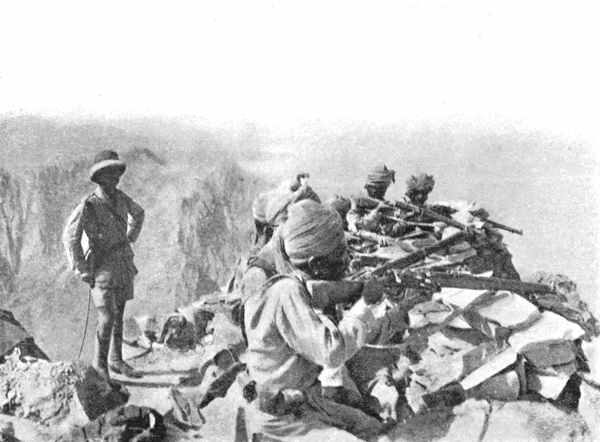
News of the herds—Towards Dast-Kird—Water!—Mutton for
all—Dast-Kird—A stampede—Back to Khwash—On the
track of the Gamshadzais—Twice a prophet—The Sarhad-dar's
roost—Before Jalk—Rejected terms—More strategy
and a bloodless victory—Remain only terms and sick leave.
We had certainly won a decisive victory from a
military point of view, but, according to the unwritten
code regulating victory in the Sarhad, we had yet to
capture the Raiders' ramas or herds of goats and
sheep.
This omission still confronted us when one of
Idu's special Reki scouts declared he knew the
exact whereabouts of Jiand's herds, and that he could
lead us there in two marches. At the end of each
of these he declared we should also find a good camping
ground, and a good water supply. As these men
had never yet promised water and failed us, orders
were given to strike camp and march out in the direction
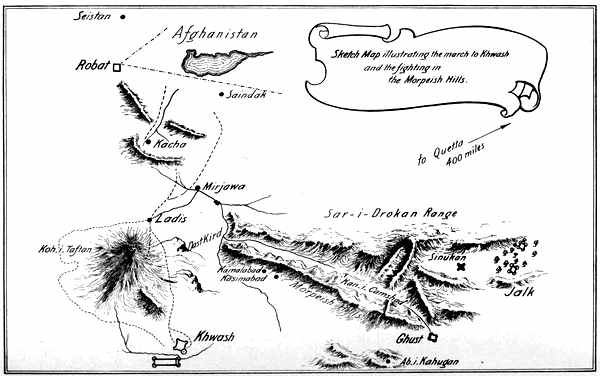
of Dast-Kird, through the valley lying between
the Morpeish and Sar-i-drokan Ranges.
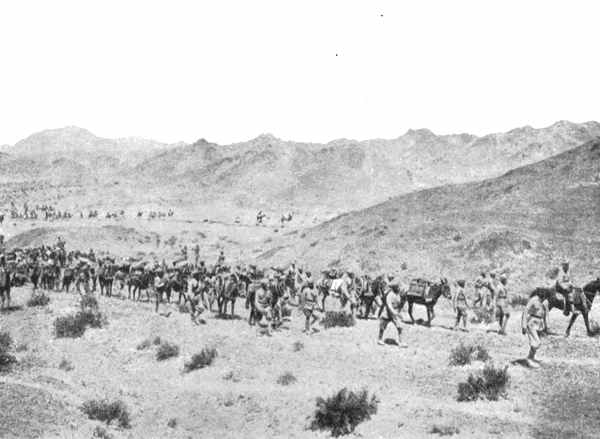
Although we made a very early start the heat soon
became intense. There was not a particle of shade,
and our route lay slightly uphill all the way, over
rugged broken ground. Also, as we were confident
of finding water at the camping ground, the men
had emptied their water bottles before mid-day, and
were enduring agonies of thirst long before we
reached our proposed camping place; whilst the
suffering of the animals was pitiful to see. But the
prospect of a good drink at the end of the march kept
up our spirits.
At last, late in the afternoon, the Reki, who had
constituted himself our guide, gave a cry and ran
forward, telling us that we had reached the spot
where we should find water.
No sign of stream or spring showed itself, but I
remembered that the Sarhadis have a way of finding
water seemingly miraculous to the white man, and
when the Reki proceeded to dig and scratch in the
ground at the foot of a stunted tree we fully expected
to see a little spring gush forth. The men, therefore,
with lips swollen and tongues cleaving to the roofs
of their mouths, crowded round, eager and impatient.
But, for once, Nature and the Reki failed us. For
though the latter dug and dug, with the sweat pouring
down his face, the dry, arid ground showed not
the faintest sign of moisture.
At last he desisted and fell at my feet, saying
despairingly, "Sahib, there is no water! I found
water here once, in the cold season, and I thought it
would always be here. The heat must have dried
it all up."
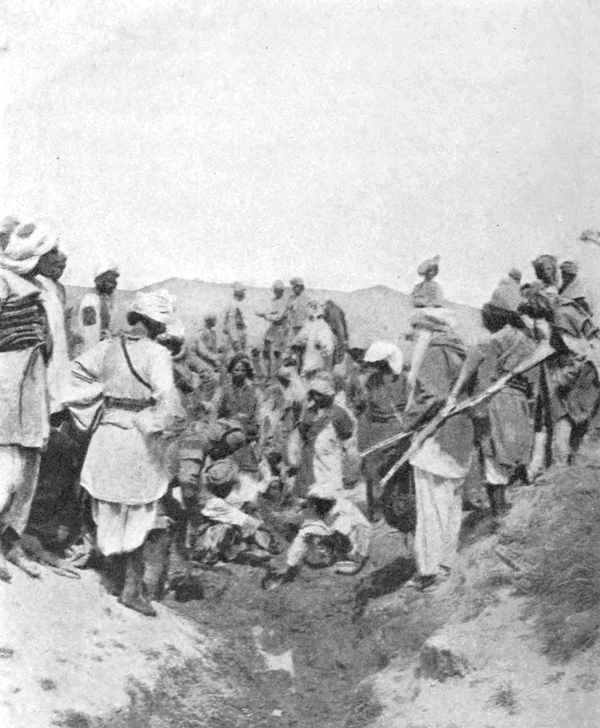
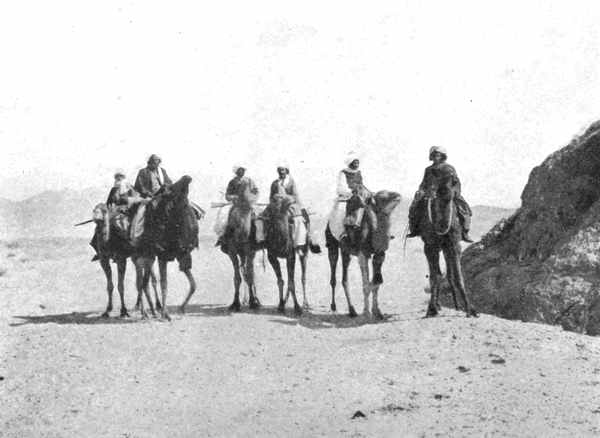
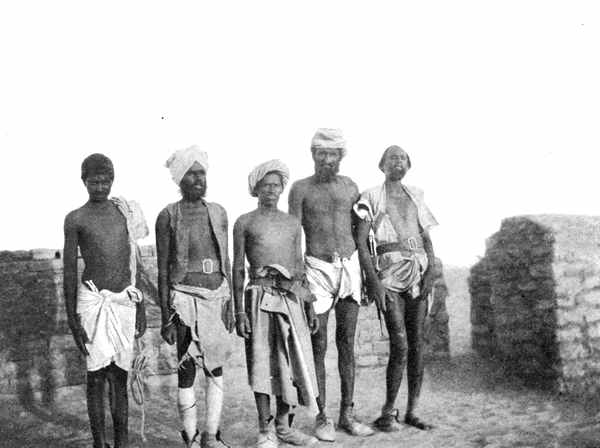
WATER! ON THE MARCH TO THE SAR-I-DROKAN.
Our situation was pretty desperate. We had not
a drop of water for man or beast, and now could not
tell when we should get any. All through the latter
part of that day's march we had succeeded in getting
the men along solely by encouraging them with
promises of water. "Just a mile farther on" and
then, "perhaps another half-mile." Only those who
have marched without water in torrid countries can
have any conception of the depression that grips
men when they do not know when, or where, water
may next be found.
I cursed the man for misleading us, and he shook
with fear. "It is not my fault, Sahib. Water was
here when last I came to this place. But to-morrow,
without fail, I will lead you to a fine stream of
water."
"To-morrow?" I echoed. "How are we to
exist till to-morrow? Why should I believe you?
You have deceived us to-day, why not again to-morrow?"
The man swore on the Koran he could and would
lead us to a place where we should find water. "If I
do not succeed, Sahib, in finding water before eleven
o'clock, then take my life."
I replied grimly that if he failed again, his life
would most certainly be forfeit—that was to say if
any of us then remained in a condition to shoot him.
The whole force suffered horribly that night, and
when we set out again it was still dark. The Reki
went on ahead with the advance guard. I rather
imagine he was anxious to put a safe distance
between himself and my revolver, for I had, indeed,
determined to have him shot if he deceived us a
second time. No man could face a second day of
that blinding heat and glare without water and keep
his sanity.
We had only been marching a few hours when a
Sawar rode back from the advance guard to report
that large herds of sheep and goats had been sighted
a short distance ahead.
Our spirits instantly rose. Where there were
sheep there would, most probably, be water. Shouting
to the men to encourage them we galloped
forward and were soon pushing our way through
masses of sheep to find ourselves on the banks of a
stream of clear, cool water.
The difficulty, of course, was now to restrain man
and beast from over-drinking; for if ever nectar
flowed on this earth it flowed that day in that parched,
sun-baked Saragan Valley.
Unfortunately, like the majority of streams in the
Sarhad, and in Persia generally, it only flowed above
ground for a short distance, to be soon lost again in
the arid, sandy ground. So orders were given to
halt at that spot till we were all rested, and had
absorbed sufficient water to make up for the past
thirty-six hours.
The thirty-four herds of sheep and goats found
here were claimed as spoils of war, and I determined
to give the men a real, good feast for once. Here
was any amount of mutton for the killing, and well-nigh
as much goats' milk as water.
The hungry Hazaras sent in a request that
they might each have a whole sheep a day. I
naturally thought such a request fantastic, and,
not taking it literally, sent back word that they
might, for once, have as much meat as they
wanted.
But they took the permission literally, and actually
did slaughter a sheep for each man. I discovered
afterwards that their great idea had been to be able
to boast, in the future, that, after their great victory
over the Yarmahommedzais, led by the Gamshadzai
Chief, Halil Khan, their rations had been "a sheep
per man per day."
After this feast the carcasses of the uneaten sheep,
and of the half-cooked meat, lay about in an orgy of
waste, and the sight of the camping-ground was, as
may be imagined, a sickening one. Never again
was such a ration-order given!
Late in the afternoon, with the whole force in fine
fettle, we continued our forward march, driving the
herds with us, and, a little later, found a good camping
ground with a plentiful supply of water. For
many hours that night, owing to the bleating of
thousands of sheep, there was little rest for anyone.
But as they were now our sheep and not the enemy's,
the annoyance was cheerfully borne.
Upon the following day water proved scarce, and
a great deal of digging had to be done before even a
trickle could be found. The unfortunate sheep and
animals had, therefore, to go very short. The
country was also from this point getting very difficult,
and marching became a great labour in consequence.
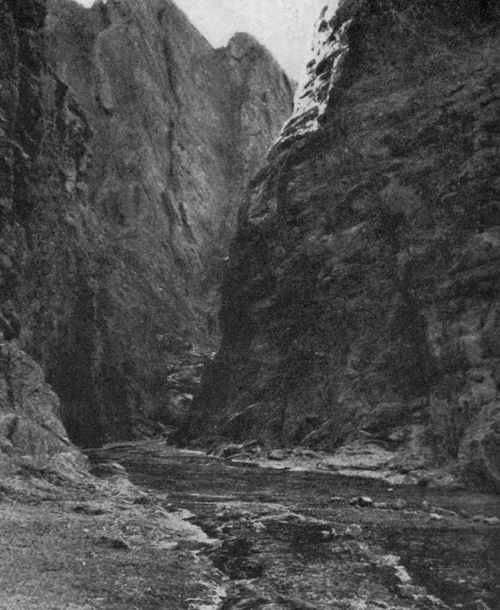
Part of our route lay through a narrow, rocky defile;
one of the worst to negotiate, from a military point of
view, that I have ever encountered. Had a mere
handful of the enemy chosen to obstruct us it would
have been utterly impossible to get through.
Much picketing of the heights had to be done, and
this called for a great effort on the part of the Hazara
Pioneers. These duties were well carried out under
the very able direction of Major Lang.
Fortunately the Yarmahommedzais had had
enough of it, and left us severely alone. In fact, the
only signs we had of them were the blood tracks of
their wounded, walking or carried. But even these
were significant enough evidence of their losses
during the fight.
The next day brought us more open ground,
though marching still remained arduous, as we were
tackling an uphill route. But later it fell away again
towards the Dast-Kird gorge, and, by the afternoon,
we were able to pitch our camp in a wild, but very
picturesque, little valley, close to Jiand's Summer
haunt. This valley, as I have already explained,
lies between the Morpeish and Sar-i-drokan heights,
which at this point rise sheer from it on either side.
There are also a good many trees in the neighbourhood,
and the ground round the bases of these had
been flattened, and then plastered with mud, in order
to form good flooring for jugis.
We spent the night here, and on the following day
arrived at Dast-Kird, where we camped close to a
small stream. Unfortunately this stream was so
small, a mere trickle, that it would not suffice for the
animals, who had had insufficient water for the last
two or three days.
These herds were some little distance behind, for,
poor brutes, they were feeling the heat and lack of
water terribly. We, therefore, proceeded to make
some provision for them, before their arrival, by
damming the stream, and trying to make a small
reservoir.
The first animals to arrive were the battery mules,
who, when they smelt water, made a dash for it.
But they had scarcely begun to drink than a mass of
twelve thousand sheep and goats, also smelling water,
broke from their would-be shepherds, and, in a solid
phalanx, charged the mules, routed them, and took
possession of the water-supply. The men pulled
and tugged, and struck them with their rifles in their
endeavour to stampede them and drink themselves.
But those sheep knew the power of numbers and of
combination. With their heads well down they
slaked their thirst from a stream which, now that the
dam had been trodden down, had again become a
trickle, and they held that position, against all
comers, for twenty minutes. Poor beasts, they
paid for their orgy at the price of some two hundred
lives that night.
Upon the following day we started on our return
march to Khwash, and, upon our entry there, were
accorded a great reception, and the story of the fight
had to be told again and again.
It was during this march that we began to realise
the extent of the Yarmahommedzai casualties in the
recent fighting; for, during the whole of it, from the
scene of the fight right through to Khwash, a
distance of about a hundred miles, not a single one
of the enemy did we see, nor was a solitary shot fired
at us.
But I was still not quite satisfied with results.
We had not yet closely engaged and beaten the
Gamshadzais, nor had we put into operation that
deciding factor, the capture of their herds. On the
contrary, when we had attempted to pierce the
Saragan defile, they had forced us to retire.
I have never yet been able to understand why
Halil Khan never brought his own force against us
near Gusht, but only the Yarmahommedzais, after
he had persuaded Jiand to let him lead the latter into
battle.
It can only be supposed that he thought he had a
task easy enough to tackle with one lashkar, and that
he would not, in consequence, endanger his own
men's lives. The mystery is the deeper because he
had previously been at great pains to collect all his
scattered tribesmen, and had concentrated them in
the Safed-koh. Yet these men, even when news
reached them of our victory over Jiand's tribe and
of the death of their leader, never made the smallest
attempt to attack us or to reverse the decision of
arms.
It will be understood, then, that while the
Gamshadzais remained unbeaten and their herds
intact, our claim to dominance in the Sarhad could
not be claimed as anything but partial. If, therefore,
we were to hope for lasting peace in the future,
they too must have a lesson.
So, after a couple of days' rest at Khwash, we
marched out with our faces once more turned towards
Gusht, and with every hope of another victory.
The composition of the force was much the same as
that upon the previous occasion, but with the addition
of a few Chagai Levies under Major Hutchinson
(political officer).
A couple of days' marching across the burning
plain found us camped at a place called Ab-i-kahugan,
lying in a small valley closely surrounded
by hills. The men were hot and weary, and, as
water had been scarce on the march, they were only
too thankful to fling themselves down and rest.
There were a small water hole and a few stunted
trees and shrubs under which a certain amount of
shade could be obtained.
For myself I dropped down under one of these
bushes and slept well on into the afternoon. When
at last I woke, still feeling very done up with the
heat, I saw one or two flashes of lightning in the
distance, and felt certain that it was going to rain.
I immediately got up and gave orders for the
whole camp to be moved on to higher ground, and
selected a likely spot on one of the slopes of the
low hills surrounding the valley.
The heat was still very great, and the effort
expended in striking and re-pitching camp was not
inconsiderable. The present camping-place was
also infinitely cooler and more comfortable.
As an outcome of this order an officer reported
that the men were grumbling at having to move
when tired out with the heat and the heavy marching
of the last few days.
I explained (for I knew by my own state how tired
and done the men must be) that I had a presentiment
that it was going to rain and that, if it did,
the dry valley-bed would soon be a running stream.
The officer stared at me. "Rain?" he repeated,
as though he had not heard me aright. "But it
hardly ever rains in the Sarhad, and it has never
been known to rain in August."
"Nevertheless," I replied, "this valley-bottom is
going to be turned upside down, and the sooner you
get your men out of it and up on to high ground the
better."
The officer saluted and returned to his men, who
sulkily proceeded to carry up their kit and tents
and to form a new camp on the uncomfortable,
sloping sides of the hill.
As I strolled about, seeing that my orders were
being carried out, I noticed that Major Hutchinson's
tent had been left in the bed of the valley. I
walked up to it, found him dozing inside, and told
him to have his tent moved on to higher ground as
it was going to rain.
He, however, demurred, saying that he was very
tired. He added, "It never rains in the month
of August in Baluchistan."
I, however, remained firm, though the few light
clouds flecking the sky a short while before had
completely disappeared.
Despite my stringent orders some of Major
Hutchinson's Chagai Levies apparently passed
unnoticed amongst the low scrub, and so remained
down in the shady comfort of the valley.
As the evening wore on I began to feel that
perhaps I had been foolish in ignoring the dogmatic
statements of the men well acquainted with weather
conditions in the Sarhad, and was still chewing the
cud of this reflection when, suddenly, I heard a
roar in the distance. This came rapidly nearer, and
very quickly resolved itself into the sound of rushing
water. Almost before we realised it, a mighty spate
swept into the valley, literally filling it. The water
carried everything before it, and very soon small
trees, shrubs and débris were being hurled along
in a mighty rush.
It was pretty evident that the rain foretold had
indeed fallen, though actually, in another part of
the hills, forming this spate, which would have caused
us serious loss but for my lucky premonition.
Torrents of rain accompanied the spate, and
the kit of the few Chagai Levies who had
neglected orders was carried away and never seen
again.
As for the Levies themselves, they came within
an ace of losing their own lives, and only saved
themselves by clambering into the branches of some
stunted trees, and waiting there till rescued. Nor
was the rescue-work done without considerable risk
to the rescuers.
The Sarhad-dar had, for some reason, been down
in the valley-bed when the spate arrived, and had
been nearly drawn under during the first few minutes.
But he too, fortunately, managed to climb into a low
tree, where for some time his position was perilous
enough, for the swirling waters threatened every
minute to snap or uproot the trunk, when he would
have been carried away.
It was pitch dark when the spate arrived. I had
seized a hurricane lamp from my tent and was
watching the amazing scene by its light, when I heard
the Sarhad-dar's voice shouting for help. One of
our resourceful Rekis instantly grasped the situation.
He jumped on to one of the horses tethered close
by, urged him into the flood, and soon had the
Sarhad-dar safely beside me on the high ground.
He was later on recommended for the Royal
Humane Society's Medal.
The next morning, as soon as I was awake, my
tent was besieged by the Hazaras. They crowded
round, asking me to come out. So slipping into my
kit I emerged with the intention of asking them what
they wanted.
But I had scarcely lifted the tent-flap when they
all raised a shout, and then proceeded to tell me that
I was a Buzurg (prophet), that they all owed their
lives to me, and had come to thank me.
I replied with proper solemnity. It was undeniable,
I said, that I was a prophet, for had they not
recently had two concrete instances of my powers?
Later on, Major Hutchinson, in thanking me for
saving his life, asked: "How did you know it was
going to rain?"
I laughingly replied, "Because I'm a prophet,
my son! Didn't you hear the Hazaras proclaim it
just now?"
As a matter of fact we had very great reason to
be thankful for our escape. The loss of the whole
of our camp equipment, and of hundreds of our
animals, would have been inevitable had the camp
remained on its original site.
The day following this incident we marched
through Gusht again, and camped on the site of our
recent engagement.
From here we resumed our march in the direction
of Zaiti, a camping ground lying just beyond the
Saragan defile. But though we started at five a.m.,
met with no opposition and reckoned the distance
only about twelve miles, we were not through the
defile before midnight.
It must have been at about this hour that I called
one of the native Hazara officers to my side, and
remarked, "Your men were very disappointed the
other day when we tried to force the pass, and the
order was given to retire. You remember, they said
they were convinced they could have got through,
even with the heavy opposition we encountered.
Do you think, now they've seen what it's really like,
they are satisfied that the order was a necessary
one?"
"Sahib," he replied, "of course we all see now
that we could have done nothing in such a place
against a determined enemy. I have never been
through such a place in my life, and I am used to
rough and difficult country."
As a matter of fact the defile was so narrow in
places that a loaded camel could not get through it.
Fortunately we had a quantity of gun cotton with us,
so were able to blast the rocks here and there, and
thus make the passage possible for them without
unloading.
In due course we arrived at the village of Sinukan,
a place some eleven miles from Jalk. Jalk at the
time was a Gamshadzai stronghold, where they held
two forts of some strength.
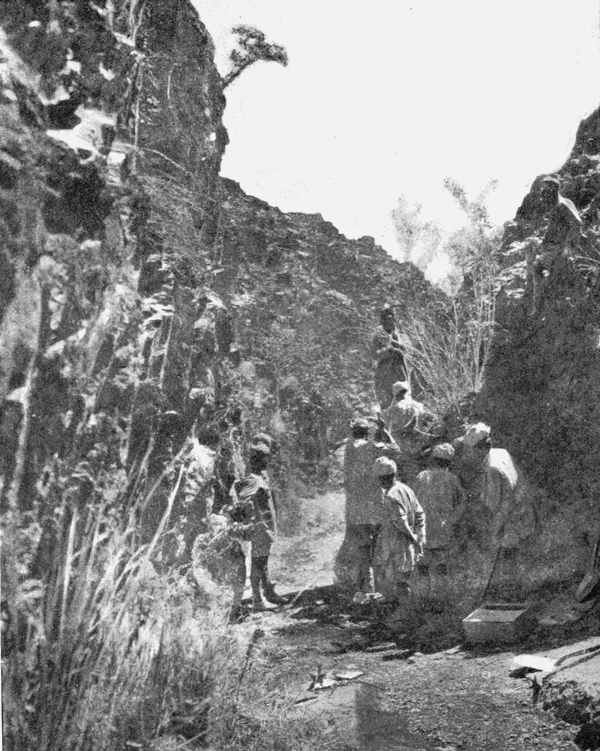
HAZARA PIONEERS WIDENING A PASSAGE FOR LOADED CAMELS.
At Sinukan I received a message from the
Gamshadzais saying that they wished to treat with
me, and asking whether I would go into Jalk and state
my terms. If these were acceptable, they said, they
would instantly submit, but, if not, they undertook to
withdraw their forces to a distance of five miles on
the farther side of Jalk, provided we also withdrew
five miles from the town on our side. This
suggestion was made in order to give us both time
to make our respective dispositions before fighting
commenced.
An answer was sent to say that I agreed to the
conditions, and that my force would come at once
into Jalk to meet the Chiefs and present my terms to
them.
I would say here that these terms were not drastic.
They were only bare necessary safeguards for the
lasting peace of the Sarhad. On their presentation,
therefore, and for a time during the discussion, I
hoped that counsels of wisdom would prevail, and
that they would be accepted in toto. At the
last minute, however, the hotheads over-ruled the
moderates and they were formally rejected.
On this rejection I warned them that, if they
persisted in their refusal, it meant fighting, and
their reply was that they fully recognised the
gravity of their decision, but that they meant to
abide by it.
Accordingly, we retired not only five miles but
the whole eleven miles back to Sinukan. My reason
for this action was that I had already thought out
a plan by which it might be possible to subdue these
warlike tribesmen without the fighting I was naturally
anxious to avoid. I certainly did not want to lose
my own men, nor did I wish to make casualties of
any more of the Sarhadis. My chief object had
been, throughout, and, as has already been mentioned
in this narrative, to make friends with them in
the long run.
But no race, white or coloured, ever held in
respect man or government showing weakness or
indecision, and, as the foregoing pages prove, it was
of little use attempting to make friends with these
tribesmen without first inspiring them with a wholesome
respect for British arms.
As we approached Sinukan I directed my Brigade
Major to form two separate camps as I wished to
seize Jalk by surprise that night with a portion of
my force. My idea was to leave my transport and
other encumbrances under a sufficient guard at
Sinukan and with the remainder to move off secretly
to carry out my intentions. Great care was taken
to keep my idea secret, and only a few officers knew
my intention. So well was the secret kept that my
personal servant, Allah-dad, brought me my tea next
morning only to find my bed empty.
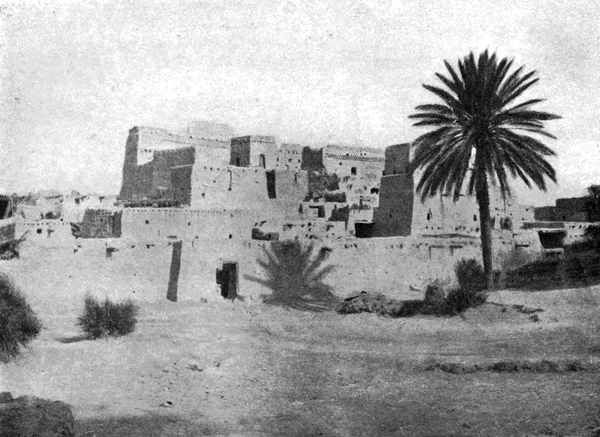
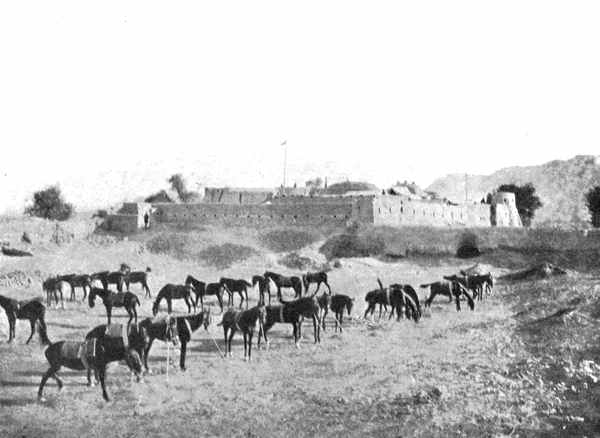
CHAHGIRD FORT IN JALK.
At midnight, very quietly we roused the troops
and marched off. Before dawn we arrived outside
the town. It was only at the very last moment that
the Gamshadzais, who had learned that I had gone
straight back to Sinukan, and, in consequence, had
not anticipated an attack that night, got wind of our
approach. They were, therefore, taken completely
by surprise, and utterly lost their heads. As we
charged into the place with the cavalry they all took
to their heels and rushed out on the other side,
leaving many arms behind them. Within a very
few minutes the two forts were in our hands.
My men soon rounded up the few Gamshadzais
who had remained in the place, which seemed otherwise
to be full of women and children.
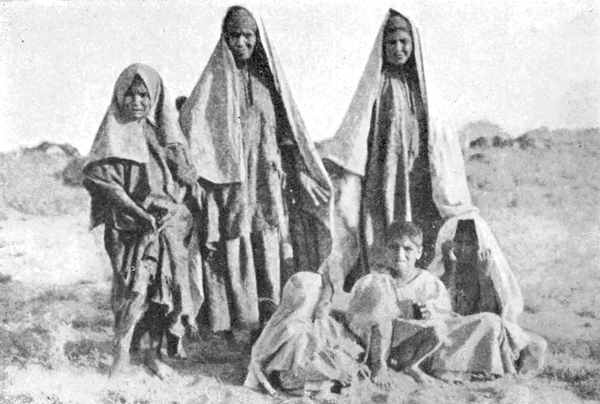
To my embarrassment three large ramas of
weeping women and children were presently led up
to where I was sitting under a tree on the bank of a
stream. I was then informed that they were all
mine.
Some of them, in tears, asked me what I was going
to do with them.
I replied, "I don't know. But at any rate I am
English and not a German. What would you like
me to do with you?"
They seemed bewildered at first, and without
understanding, but when I assured them that I was
speaking seriously, and really wanted to know what
they would like to do, they soon found their tongues
and made known the fact that they would like to go
to their own homes.
"Is that all?" I replied. "Well then, go."
Their faces which, at first, shone with joy soon fell
again. "But, Sahib, we have nothing left. You
have captured all our possessions."
"But I don't want them," I returned. "Take
everything that is yours and go."
Their thanks were then overwhelming, but I cut
them short. "Wait a bit before you thank me so
much. No Englishman ever makes war against
woman and children—but there are your men. If I
catch them, after all the trouble they've given me, I
shall certainly kill them."
"Kill them then, Sahib," they said scornfully.
"They deserted us, and ran away, when you and
your lashkar came in. It is all they deserve."
As a matter of fact I learned, soon afterwards, that
the Gamshadzais had not only run out of Jalk, but
right out of the Sarhad, to take refuge in other
districts. By thus evacuating their own country they
acknowledged their final defeat.
It is reasonable to suppose that this humiliating
end to their opposition would never have occurred
had Halil Khan been alive. He, at least, would
have been game to the last. He would have died
fighting at Jalk—as he had indeed died at Gusht—or
he would have surrendered with dignity. Halil
Khan was a fine man, and without his leadership the
spirit of his men at first faltered and then failed.
It seemed then that, by this last action with the
Gamshadzais, the prestige of the British had been
completely restored throughout the Sarhad. In the
West, Juma Khan, leader of the Ismailzais, had
faithfully kept his word to, and had demonstrated his
friendship and loyalty for, the British cause, ever
since he had pledged both at Kacha. In the centre
of the district the Yarmahommedzais had been
completely defeated in open action. In the East the
Gamshadzais had abandoned their arms and had
bolted from the country.
There was now nothing left to be done.
We, therefore, returned, marching easily to
Khwash, where, very shortly after our arrival, I
received letters from both the Yarmahommedzais
and Gamshadzais asking to be allowed to return to
their respective homes in the Sarhad, and on any
terms that might be imposed.
I had had eight months of continual work in the
hot weather of the Sarhad and was very near the
end of my tether. As a fact I was, by that time,
suffering badly in health in many ways, and our
medical officer insisted upon an immediate return to
India for a long rest.
As the Sarhad was now completely ours, and as
it only remained for the political officers to dictate
terms to the tribes, I listened to the advice of that
medical officer, applied for leave to return to Simla,
and was, in due course, granted it.
But, though the need for rest in a cooler climate
was urgent, it was with real regret that I said goodbye
to Khwash, the centre of so many hopes and
fears, and the scene of such dramatic happenings.
Ab-i-kahugan, 209
Allah-dad (the author's servant), 19, 20, 23,
36, 216
Allan (the author's chauffeur), 19, 20, 23, 24,
25, 26, 27, 28, 32,
33, 36, 104, 105, 106,
107, 108, 109, 110, 113,
117, 118, 119, 120, 121,
122, 127
Baghdad, 48
Baluch Raiders, 21
Bampur, 44, 83, 84
Bampur, Khan of, 83, 84, 196
Birjand, 16, 38, 39, 101
Borgar, 31
Bream, Lieutenant, 6, 185
Brownlow, Captain, 5, 185, 187, 193
Chagai Levies, 6, 33, 34, 39, 41,
52, 60, 61, 73, 209,
211, 212
Chitral, 38
Claridge Colonel, 5, 51, 143, 163,
181, 183, 185
Dale, Colonel, 181
Dast-Kird, 185, 186, 187, 188,
189, 201, 206, 207
Dew, Colonel, 84
Duff, General Sir Beauchamp, 47
Duzd-ab Plain, 92, 95
Eastwick, Mr., 48
English, Captain, R.A., 6, 185, 195
Galahad (the author's horse), 23, 51
Galugan, 40, 82, 84, 85, 89,
92, 109
Gamshadzais, 40, 47, 62, 73, 76,
82, 90, 165, 167, 176,
177, 179, 190, 192, 205,
208, 209, 214, 216, 217,
218, 219
Grover, General, 20
Gul-Bibi, 58, 135, 136, 137, 138,
139, 140, 150, 151
Gusht, 42, 177, 186, 187, 188,
189, 190, 194, 200, 208,
209, 213, 218
"Gushti," 188, 189, 190, 195, 196
Gwarko, 86
Halil, 35
Halil Khan, 40, 47, 49, 73, 76,
77, 78, 79, 80, 81,
82, 89, 90, 94, 96,
99, 100, 137, 140, 141,
147, 148, 161, 172, 176,
177, 178, 186, 187, 188,
190, 196, 197, 198, 199,
200, 205, 208, 218
Hazara Pioneers, 106th, 6, 171, 172, 177,
181, 183, 184, 185, 192,
198, 199, 205, 206, 212,
213, 214
Hazara tribes, 17
Herat, 17
Hirst, Captain, 5, 52, 60
Hutchinson, Major, 209, 210, 211, 213
Ibrahim, 41
Idu, 6, 33, 34, 35, 36,
41, 48, 49, 50, 53,
59, 65, 72, 73, 78,
83, 85, 87, 88, 91,
92, 93, 94, 95, 97,
99, 100, 103, 104, 105,
106, 107, 108, 109, 110,
112, 114, 115, 116, 117,
119, 121, 123, 124, 125,
126, 127, 129, 133, 134,
135, 136, 138, 150, 165,
166, 176, 187, 201
Ismailzais, 40, 47, 62, 64, 79,
82, 89, 218
Izzat, 78, 114, 115, 116, 117,
118, 119, 121, 123, 128,
131, 166, 168, 169, 170
Jalk, 40, 42, 49, 55, 196,
214, 215, 216, 218
Jiand Khan, 40, 47, 49, 56, 57,
58, 59, 60, 61, 62,
63, 64, 65, 66, 67,
69, 70, 71, 72, 73,
75, 76, 78, 79, 80,
81, 82, 89, 90, 91,
94, 95, 98, 99, 100,
102, 103, 111, 112, 113,
116, 118, 122, 124, 128,
129, 130, 131, 132, 133,
134, 135, 136, 137, 140,
142, 146, 147, 148, 152,
153, 154, 155, 157, 158,
159, 162, 172, 173, 174,
175, 176, 177, 178, 179,
180, 181, 182, 184, 185,
186, 187, 188, 189, 190,
191, 196, 197, 201, 206
Jujak, 106
Juma Khan, 40, 47, 62, 64, 79,
82, 84, 89, 90, 91,
99, 100, 101, 140, 161,
218
Kacha, 47, 49, 52, 53, 86,
87, 92, 95, 96, 97,
99, 104, 106, 116, 126,
137, 143, 166, 171, 181,
218
Kamalabad, 63, 65, 66, 67, 71,
89, 146, 147, 162, 163,
176, 177, 178, 179, 184,
189
Karsimabad, 147, 152, 153, 154,
155, 156, 157, 161
Kerman, 17
Khan Bahadur. See the Sarhad-dar.
Khwash, 39, 40, 42, 50, 52,
55, 57, 58, 71, 72,
73, 74, 76, 80, 82,
83, 84, 87, 89, 97,
99, 100, 102, 103, 104,
108, 112, 113, 114, 116,
118, 119, 121, 122, 126,
127, 128, 129, 132, 133,
135, 137, 140, 142, 143,
144, 146, 152, 162, 163,
167, 169, 171, 175, 177,
179, 180, 181, 184, 185,
187, 199, 208, 209, 219
Khwashis, 74, 75, 124, 125, 126,
127, 128, 130, 163, 164,
166, 167
Kirkpatrick, General, 15, 18, 47
Kitson, General Sir Gerald, 19
Koh-i-Bazman, 44, 83, 85
Koh-i-Jiandsiah, 95
Koh-i-Taftan, 44, 55, 57, 63, 64,
74, 76, 89, 105, 154,
172, 179
Korasan, 16
Ladis, 55, 56, 57, 119
Landon, Major, 5, 37, 48, 50, 52,
53, 54, 61, 64, 72,
76, 83, 92, 93, 95,
102, 103, 104, 105, 108,
113, 118, 128, 129, 130,
131, 132, 133, 136, 137,
138, 152
Lang, Major, 5, 183, 185, 206
Light Cavalry, 28th, 5, 50, 51, 52, 143
Lut Desert, 16
MacGowan, Major, 52, 53
Mahommed-Hassan, 72, 73, 74, 80, 81,
135, 140
Makn-tuk, 192
Makran, 84
Meshed, 42
Middlesex, 9th, 19
Mirjawa, 52, 53, 54, 106
Mirza Khan, 82
Moore-Lane, Captain, 5, 185
Morpeish Hills, 63, 65, 66, 67, 141,
178, 184, 185, 187, 188,
201, 206
Murad, 147, 148, 152, 153, 155,
156, 157, 161
Mushki-chah, 30
Narmashir, 17, 91, 170
Nasaratabad, 38, 39, 46, 50, 51,
64, 143
Nasaratabad-sippi, 64, 90
Nur-Mahommed, 157, 158, 161
Nushki, 18, 20, 21, 22, 39,
51, 71, 142, 193
Oxus River, 38
Pamirs, 38
Persian Gulf, 84
Pindi, 18, 20
Pioneers, 12th, 53, 54
Punjab Infantry, 19th, 52
Quetta, 18, 20, 21, 39, 170
Rekis, 41, 47, 56, 82, 109,
112, 114, 119, 163, 165,
193, 199, 201, 202, 203,
212
Robat, 20, 21, 22, 23, 28,
36, 37, 38, 41, 47,
50, 51, 64, 71, 86,
97, 104, 106, 142, 171,
193
Safed-koh, 40, 190, 192, 208
Saindak, 31, 32, 35, 36, 39,
52, 104, 106, 171, 172,
177, 178, 181
Sanders, Major, 5, 152, 154, 156,
158, 159, 175, 176, 185,
196
Saragan defile, 192, 204, 208, 213
Sarhad, 15, 17, 18, 21, 22,
35, 40, 43, 44, 52,
55, 77, 78, 81, 82,
94, 101, 113, 119, 135,
147, 161, 165, 177, 180,
186, 200, 201, 204, 209,
210, 211, 215, 218, 219
Sarhad-dar, 39, 57, 58, 61, 64,
72, 79, 83, 95, 97,
98, 102, 132, 136, 138,
139, 156, 160, 161, 162,
166, 168, 176, 193, 212
Sar-i-drokan, 65, 66, 184, 185,
201, 206
Scinde Horse, 35th, 5, 37
Seistan, 35, 46, 64
Shah Sawar, 58, 59, 60, 80, 81,
82, 123, 124, 125, 126,
127, 128, 129, 131, 132,
135, 137, 138, 139, 140,
148, 149, 150, 151, 182
Shiah Mahommedans, 17, 184, 198
Sikhs, 36th, 5, 152
Simla, 37, 47, 50, 219
Sinukan, 214, 215, 216
Sunni Mahommedans, 17, 41, 184
Takht-i-Jinikan, 92, 93
Teheran, 48
Webb-Ware route, 32
Yadgar, 26
Yarmahommedzais, 40, 47, 62, 66, 72,
74, 78, 82, 90, 113,
130, 148, 156, 160, 164,
165, 169, 172, 179, 191,
196, 199, 205, 206, 208,
218, 219
Yates, Lieutenant, 53
Zaiti, 213
PRINTED IN GREAT BRITAIN BY
THE NORTHUMBERLAND PRESS, LIMITED
WATERLOO HOUSE, THORNTON STREET
NEWCASTLE-UPON-TYNE
TRANSCRIBER'S NOTE
The cover image was created by the transcriber
and is placed in the public domain.
Obvious typographical errors and punctuation errors have been
corrected after careful comparison with other occurrences within
the text and consultation of external sources.
Except for those changes noted below, all misspellings in the text,
and inconsistent or archaic usage, have been retained. For example,
despatch; Sherif; townless; rarified; hill-side, hillside; night-fall,
nightfall; koh-i-Taftan, koh-i-taftan.
Pg 10 Table of Contents: 'Sharhad-dar' replaced by 'Sarhad-dar'.
Pg 124: 'he he said' replaced by 'he said'.
Pg 172 Illustration caption: 'KACHHA' replaced by 'KACHA'.
Pg 184 Illustration caption: 'GHUSHT' replaced by 'GUSHT'.
Pg 201: 'Sharhad-dar' replaced by 'Sarhad-dar'.
Pg 201: 'Reki scout' replaced by 'Reki scouts'.
Pg 216 Illustration caption: 'CHAHQIRD' replaced by 'CHAHGIRD'.
Index: 'Ab-i-Kahugan' replaced by 'Ab-i-kahugan'.
Index: 'Mourlain, Captain, 5' replaced by 'Moore-Lane, Captain, 5, 185'
Index: 'Mushkichah' replaced by 'Mushki-chah'.