MACDONALD PROFESSOR OF PHYSICS, McGILL UNIVERSITY, MONTREAL
SECOND EDITION
CAMBRIDGE
AT THE UNIVERSITY PRESS
1905
ivFirst Edition 1904
Second Edition 1905
vJ. J. THOMSON
A TRIBUTE OF MY RESPECT AND ADMIRATION
PREFACE TO THE FIRST EDITION.
vii
In this work, I have endeavoured to give a complete and
connected account, from a physical standpoint, of the properties
possessed by the naturally radio-active bodies. Although the
subject is comparatively a new one, our knowledge of the properties
of the radio-active substances has advanced with great
rapidity, and there is now a very large amount of information on
the subject scattered throughout the various scientific journals.
The phenomena exhibited by the radio-active bodies are
extremely complicated, and some form of theory is essential in
order to connect in an intelligible manner the mass of experimental
facts that have now been accumulated. I have found the
theory that the atoms of the radio-active bodies are undergoing
spontaneous disintegration extremely serviceable, not only in
correlating the known phenomena, but also in suggesting new
lines of research.
The interpretation of the results has, to a large extent, been
based on the disintegration theory, and the logical deductions to
be drawn from the application of the theory to radio-active
phenomena have also been considered.
The rapid advance of our knowledge of radio-activity has
been dependent on the information already gained by research
into the electric properties of gases. The action possessed by the
radiations from radio-active bodies of producing charged carriers
or ions in the gas, has formed the basis of an accurate quantitative
method of examination of the properties of the radiations and of
viiiradio-active processes, and also allows us to determine with considerable
certainty the order of magnitude of the different
quantities involved.
For these reasons, it has been thought advisable to give a brief
account of the electric properties of gases, to the extent that is
necessary for the interpretation of the results of measurements
in radio-activity by the electric method. The chapter on the
ionization theory of gases was written before the publication
of J. J. Thomson’s recent book on “Conduction of Electricity
through Gases,” in which the whole subject is treated in a
complete and connected manner.
A short chapter has been added, in which an account is given
of the methods of measurement which, in the experience of the
writer and others, are most suitable for accurate work in radio-activity.
It is hoped that such an account may be of some service
to those who may wish to obtain a practical acquaintance with the
methods employed in radio-active measurements.
My thanks are due to Mr W. C. Dampier Whetham, F.R.S.,
one of the editors of the Cambridge Physical Series, for many
valuable suggestions, and for the great care and trouble he has
taken in revising the proof sheets. I am also much indebted to
my wife and Miss H. Brooks for their kind assistance in correcting
the proofs, and to Mr R. K. McClung for revising the index.
E. R.
Macdonald Physics Building,
Montreal,
February, 1904.
PREFACE TO THE SECOND EDITION.
ix
I feel that some apology is due to my readers for bringing
out at such an early date a new edition which includes so
much new material, and in which the rearrangement is so extensive
as to constitute almost a new work. Though only a year has
passed since the book first made its appearance, the researches
that have been carried out in that time have been too numerous
and of too important a character to permit the publishing of a
mere reprint, unless the author were to relinquish his purpose
of presenting the subject as it stands at the present moment.
The three new chapters which have been added possibly constitute
the most important change in the work. These chapters
include a detailed account of the theory of successive changes and
of its application to the analysis of the series of transformations
which occur in radium, thorium, and actinium.
The disintegration theory, which was put forward in the first
edition as an explanation of radio-active phenomena, has in these
later researches proved to be a most powerful and valuable method
of analysing the connection between the series of substances which
arise from the transformation of the radio-elements. It has disclosed
the origin of radium, of polonium and radio-tellurium, and
of radio-lead, and now binds together in one coherent whole the
large mass of apparently heterogeneous experimental facts in
radio-activity which have been accumulating since 1896. The
theory has received a remarkable measure of verification in the
past year, and, in many cases, has offered a quantitative as well
xas a qualitative explanation of the connection between the various
properties exhibited by the radio-active bodies. In the light of
this evidence, radio-activity may claim to have assumed the
position of an independent subject, though one with close affinities
to physics on the one hand and to chemistry on the other.
The present edition includes a large amount of new material
relating to the nature and properties of the radiations and the
emanations. In the limits of this book, it would have been found
impossible, even had it been thought desirable, to include more
than a brief sketch of the physiological effects of the rays. The
literature on this subject is already large, and is increasing rapidly.
For reasons of space, I have not been able to refer more than
briefly to the mass of papers that have appeared dealing with the
examination of various spring and well waters, sediments, and soils,
for the presence of radio-active matter.
In order to make the book more self-contained, a short account
has been given in Chapter II of the magnetic field produced by
an ion in motion, of the action of an external magnetic and
electric field upon it, and of the determination of the velocity and
mass of the particles constituting the cathode stream.
Two appendices have been added, one giving an account of
some work upon the α rays which was completed too late for
inclusion in the subject matter of the book, and the other containing
a brief summary of what is known in regard to the
chemical constitution of the various radio-active minerals, the
localities in which they are found, and their probable geologic
age. For the preparation of the latter, I am indebted to my
friend Dr Boltwood of New Haven, who, in the course of his
researches, has had occasion to analyse most of these minerals
in order to determine their content of uranium and radium. I
hope that this account of radio-active minerals will prove of value
to those who are endeavouring to elucidate the connection between
the various radio-active substances and the inactive products which
arise from their transformation.
xiFor the convenience of those who have read the first edition,
a list of the sections and chapters which contain the most
important additions and alterations is added below the table of
contents.
The writing of a complete account of a subject like radio-activity,
in which so much new work is constantly appearing, has
been a matter of no little difficulty. Among other things it has
involved a continuous revision of the work while the volume was
passing through the press.
I wish to express my thanks to my colleague Professor Harkness
for the care and trouble he has taken in revising the proofs
and for many useful suggestions; also to Mr R. K. McClung for
his assistance in correcting some of the proofs and in preparing
the index.
E. R.
McGill University,
Montreal,
9 May, 1905.
ERRATA.
xii
Transcriber’s Note:
These corrections have been applied to the text in the book.
page 48, line 24 section 218 should read section 284
„ 77, last line „ 263 „ „ „ 270
„ 123, 5th line from bottom „ 254 „ „ „ 261
„ 124, 10th „ „ „ „ 246 „ „ „ 253
„ 151, line 3 „ 228 „ „ „ 229
„ 156, 13th line from bottom „ 261 „ „ „ 268
„ 200, line 9 „ 246 „ „ „ 253
„ 216, line 3 „ 260 „ „ „ 267
„ 184, at the top of 5th column of table the letter γ should be inserted.
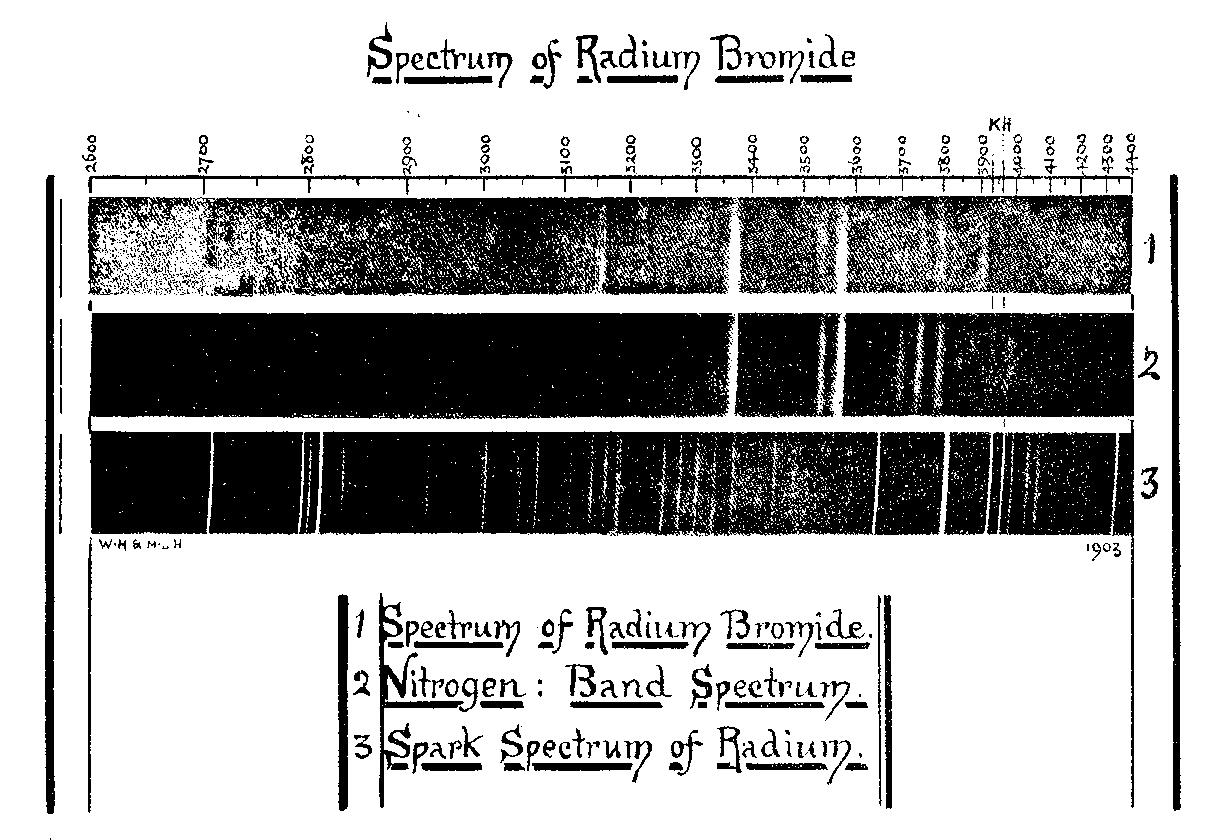
Plate (Fig. 46A: Spectrum of Radium Bromide) to face p.206
For the convenience of the reader, the sections and chapters which
contain mostly new matter, or have been either partly or wholly rewritten,
are appended below.
xivABBREVIATIONS OF REFERENCES TO SOME OF THE JOURNALS.
Ber. d. deutsch. Chem. Ges. Berichte der deutschen chemischen Gesellschaft.
Berlin.
C. R. Comptes Rendus des Séances de l’Académie des Sciences. Paris.
Chem. News. Chemical News. London.
Drude’s Annal. Annalen der Physik. Leipzig.
Phil. Mag. Philosophical Magazine and Journal of Science. London.
Phil. Trans. Philosophical Transactions of the Royal Society of London.
Phys. Rev. Physical Review. New York.
Phys. Zeit. Physikalische Zeitschrift.
Proc. Camb. Phil. Soc. Proceedings of the Cambridge Philosophical Society.
Cambridge.
Proc. Roy. Soc. Proceedings of the Royal Society of London.
Thèses-Paris. Thèses présentées à la Faculté des Sciences de l’Université
de Paris.
Wied. Annal. Annalen der Physik. Leipzig.
CHAPTER I. RADIO-ACTIVE SUBSTANCES.
1
1. Introduction. The close of the old and the beginning
of the new century have been marked by a very rapid increase of
our knowledge of that most important but comparatively little
known subject—the connection between electricity and matter.
No study has been more fruitful in surprises to the investigator,
both from the remarkable nature of the phenomena exhibited and
from the laws controlling them. The more the subject is examined,
the more complex must we suppose the constitution of matter in
order to explain the remarkable effects observed. While the
experimental results have led to the view that the constitution of
the atom itself is very complex, at the same time they have
confirmed the old theory of the discontinuous or atomic structure
of matter. The study of the radio-active substances and of the
discharge of electricity through gases has supplied very strong
experimental evidence in support of the fundamental ideas of the
existing atomic theory. It has also indicated that the atom itself
is not the smallest unit of matter, but is a complicated structure
made up of a number of smaller bodies.
A great impetus to the study of this subject was initially
given by the experiments of Lenard on the cathode rays, and
by Röntgen’s discovery of the X rays. An examination of the
conductivity imparted to a gas by the X rays led to a clear view
of the mechanism of the transport of electricity through gases
by means of charged ions. This ionization theory of gases has
been shown to afford a satisfactory explanation not only of the
passage of electricity through flames and vapours, but also of the
2complicated phenomena observed when a discharge of electricity
passes through a vacuum tube. At the same time, a further
study of the cathode rays showed that they consisted of a stream
of material particles, projected with great velocity, and possessing
an apparent mass small compared with that of the hydrogen atom.
The connection between the cathode and Röntgen rays and the
nature of the latter were also elucidated. Much of this admirable
experimental work on the nature of the electric discharge has
been done by Professor J. J. Thomson and his students in the
Cavendish Laboratory, Cambridge.
An examination of natural substances, in order to see if they
gave out dark radiations similar to X rays, led to the discovery of
the radio-active bodies which possess the property of spontaneously
emitting radiations, invisible to the eye, but readily detected by
their action on photographic plates and their power of discharging
electrified bodies. A detailed study of the radio-active bodies has
revealed many new and surprising phenomena which have thrown
much light, not only on the nature of the radiations themselves,
but also on the processes occurring in those substances. Notwithstanding
the complex nature of the phenomena, the knowledge of
the subject has advanced with great rapidity, and a large amount
of experimental data has now been accumulated.
In order to explain the phenomena of radio-activity, Rutherford
and Soddy have advanced a theory which regards the atoms of the
radio-active elements as suffering spontaneous disintegration, and
giving rise to a series of radio-active substances which differ in
chemical properties from the parent elements. The radiations
accompany the breaking-up of the atoms, and afford a comparative
measure of the rate at which the disintegration takes place. This
theory is found to account in a satisfactory way for all the known
facts of radio-activity, and welds a mass of disconnected facts into
one homogeneous whole. On this view, the continuous emission of
energy from the active bodies is derived from the internal energy
inherent in the atom, and does not in any way contradict the law
of the conservation of energy. At the same time, however, it
indicates that an enormous store of latent energy is resident in the
radio-atoms themselves. This store of energy has not been observed
previously, on account of the impossibility of breaking up
3into simpler forms the atoms of the elements by the action of the
chemical or physical forces at our command.
On this theory we are witnessing in the radio-active bodies a
veritable transformation of matter. This process of disintegration
was investigated, not by direct chemical methods, but by means
of the property possessed by the radio-active bodies of giving out
specific types of radiation. Except in the case of a very active
element like radium, the process of disintegration takes place so
slowly, that hundreds if not thousands of years would be required
before the amount transformed would come within the range of
detection of the balance or the spectroscope. In radium, however,
the process of disintegration takes place at such a rate that it
should be possible within a limited space of time to obtain definite
chemical evidence on this question. The recent discovery that
helium can be obtained from radium adds strong confirmation to
the theory; for helium was indicated as a probable disintegration
product of the radio-active elements before this experimental
evidence was forthcoming. Several products of the transformation
of the radio-active bodies have already been examined, and the
further study of these substances promises to open up new and
important fields of chemical enquiry.
In this book the experimental facts of radio-activity and the
connection between them are interpreted on the disintegration
theory. Many of the phenomena observed can be investigated in
a quantitative manner, and prominence has been given to work of
this character, for the agreement of any theory with the facts,
which it attempts to explain, must ultimately depend upon the
results of accurate measurement.
The value of any working theory depends upon the number of
experimental facts it serves to correlate, and upon its power of
suggesting new lines of work. In these respects the disintegration
theory, whether or not it may ultimately be proved to be correct,
has already been justified by its results.
2. Radio-active Substances. The term “radio-active” is
now generally applied to a class of substances, such as uranium,
thorium, radium, and their compounds, which possess the property
of spontaneously emitting radiations capable of passing through
4plates of metal and other substances opaque to ordinary light.
The characteristic property of these radiations, besides their
penetrating power, is their action on a photographic plate and
their power of discharging electrified bodies. In addition, a
strongly radio-active body like radium is able to cause marked
phosphorescence and fluorescence on some substances placed near
it. In the above respects the radiations possess properties
analogous to Röntgen rays, but it will be shown that, for the
major part of the radiations emitted, the resemblance is only
superficial.
The most remarkable property of the radio-active bodies is
their power of radiating energy spontaneously and continuously at
a constant rate, without, as far as is known, the action upon them
of any external exciting cause. The phenomena at first sight
appear to be in direct contradiction to the law of conservation of
energy, since no obvious change with time occurs in the radiating
material. The phenomena appear still more remarkable when it
is considered that the radio-active bodies must have been steadily
radiating energy since the time of their formation in the earth’s
crust.
Immediately after Röntgen’s discovery of the production of
X rays, several physicists were led to examine if any natural
bodies possessed the property of giving out radiations which could
penetrate metals and other substances opaque to light. As the
production of X rays seemed to be connected in some way with
cathode rays, which cause strong fluorescent and phosphorescent
effects on various bodies, the substances first examined were those
that were phosphorescent when exposed to light. The first observation
in this direction was made by Niewenglowski[1], who found
that sulphide of calcium exposed to the sun’s rays gave out some
rays which were able to pass through black paper. A little later
a similar result was recorded by H. Becquerel[2] for a special
calcium sulphide preparation, and by Troost[3] for a specimen of
hexagonal blend. These results were confirmed and extended in
a later paper by Arnold[4]. No satisfactory explanations of these
5somewhat doubtful results have yet been given, except on the
view that the black paper was transparent to some of the light
waves. At the same time Le Bon[5] showed that, by the action of
sunlight on certain bodies, a radiation was given out, invisible to
the eye, but active with regard to a photographic plate. These
results have been the subject of much discussion; but there seems
to be little doubt that the effects are due to short ultra-violet light
waves, capable of passing through certain substances opaque to
ordinary light. These effects, while interesting in themselves, are
quite distinct in character from those shown by the radio-active
bodies which will now be considered.
3. Uranium. The first important discovery in the subject of
radio-activity was made in February, 1896, by M. Henri Becquerel[6],
who found that a uranium salt, the double sulphate of uranium
and potassium, emitted some rays which gave an impression on a
photographic plate enveloped in black paper. These rays were
also able to pass through thin plates of metals and other substances
opaque to light. The impressions on the plate could not have
been due to vapours given off by the substances, since the same
effect was produced whether the salt was placed directly on the
black paper or on a thin plate of glass lying upon it.
Becquerel found later that all the compounds of uranium as
well as the metal itself possessed the same property, and, although
the amount of action varied slightly for the different compounds,
the effects in all cases were comparable. It was at first natural to
suppose that the emission of these rays was in some way connected
with the power of phosphorescence, but later observations showed
that there was no connection whatever between them. The uranic
salts are phosphorescent, while the uranous salts are not. The uranic
salts, when exposed to ultra-violet light in the phosphoroscope,
give a phosphorescent light lasting about ·01 seconds. When the
salts are dissolved in water, the duration is still less. The amount
of action on the photographic plate does not depend on the particular
compound of uranium employed, but only on the amount of
uranium present in the compound. The non-phosphorescent are
6equally active with the phosphorescent compounds. The amount
of radiation given out is unaltered if the active body be kept
continuously in darkness. The rays are given out by solutions,
and by crystals which have been deposited from solutions in the
dark and never exposed to light. This shows that the radiation
cannot be due in any way to the gradual emission of energy stored
up in the crystal in consequence of exposure to a source of light.
4. The power of giving out penetrating rays thus seems to be
a specific property of the element uranium, since it is exhibited by
the metal as well as by all its compounds. These radiations from
uranium are persistent, and, as far as observations have yet gone,
are unchanged, either in intensity or character, with lapse of time.
Observations to test the constancy of the radiations for long
periods of time have been made by Becquerel. Samples of uranic
and uranous salts have been kept in a double box of thick lead,
and the whole has been preserved from exposure to light. By a
simple arrangement, a photographic plate can be introduced in a
definite position above the uranium salts, which are covered with a
layer of black paper. The plate is exposed at intervals for 48 hours,
and the impression on the plate compared. No perceptible
weakening of the radiation has been observed over a period of
four years. Mme Curie[7] has made determinations of the activity of
uranium over a space of five years by an electric method described
later, but found no appreciable variation during that period.
Since the uranium is thus continuously radiating energy from
itself, without any known source of excitation, the question arises
whether any known agent is able to affect the rate of its emission.
No alteration was observed when the body was exposed to ultra-violet
light or to ultra-red light or to X rays. Becquerel states
that the double sulphate of uranium and potassium showed a
slight increase of action when exposed to the arc light and to
sparks, but he considers that the feeble effect observed was
another action superimposed on the constant radiation from
uranium. The intensity of the uranium radiation is not affected
by a variation of temperature between 200° C. and the temperature
of liquid air. This question is discussed in more detail later.
75. In addition to these actions on a photographic plate,
Becquerel showed that uranium rays, like Röntgen rays, possess the
important property of discharging both positively and negatively
electrified bodies. These results were confirmed and extended by
Lord Kelvin, Smolan and Beattie[8]. The writer made a detailed
comparison[9] of the nature of the discharge produced by uranium
with that produced by Röntgen rays, and showed that the discharging
property of uranium is due to the production of charged
ions by the radiation throughout the volume of the gas. The
property has been made the basis of a qualitative and quantitative
examination of the radiations from all radio-active bodies, and is
discussed in detail in chapter II.
The radiations from uranium are thus analogous, as regards
their photographic and electrical actions, to Röntgen rays, but,
compared with the rays from an ordinary X ray tube, these
actions are extremely feeble. While with Röntgen rays a strong
impression is produced on a photographic plate in a few minutes
or even seconds, several days’ exposure to the uranium rays is
required to produce a well-marked action, even though the uranium
compound, enveloped in black paper, is placed close to the plate.
The discharging action, while very easily measurable by suitable
methods, is also small compared with that produced by X rays
from an ordinary tube.
6. The rays from uranium show no evidence of direct reflection,
refraction, or polarization[10]. While there is no direct reflection
of the rays, there is apparently a diffuse reflection produced
where the rays strike a solid obstacle. This is due in reality
to a secondary radiation set up when the primary rays impinge
upon matter. The presence of this secondary radiation at first
gave rise to the erroneous view that the rays could be reflected
and refracted like ordinary light. The absence of reflection, refraction,
or polarization in the penetrating rays from uranium
necessarily follows in the light of our present knowledge of the
rays. It is now known that the uranium rays, mainly responsible
for the photographic action, are deviable by a magnetic field, and
8are similar in all respects to cathode rays, i.e. the rays are composed
of small particles projected at great velocities. The absence of the
ordinary properties of transverse light waves is thus to be expected.
7. The rays from uranium are complex in character, and, in
addition to the penetrating deviable rays, there is also given off
a radiation very readily absorbed by passing through thin layers
of metal foil, or by traversing a few centimetres of air. The
photographic action due to these rays is very feeble in comparison
with that of the penetrating rays, although the discharge of
electrified bodies is mainly caused by them. Besides these two
types of rays, some rays are emitted which are of an extremely
penetrating character and are non-deviable by a magnetic field.
These rays are difficult to detect photographically, but can readily
be examined by the electric method.
8. The question naturally arose whether the property of
spontaneously giving out penetrating radiations was confined to
uranium and its compounds, or whether it was exhibited to any
appreciable extent by other substances.
By the electrical method, with an electrometer of ordinary
sensitiveness, any body which possesses an activity of the order of
¹⁄₁₀₀ of that of uranium can be detected. With an electroscope of
special construction, such as has been designed by C. T. R. Wilson
for his experiments on the natural ionization of air, a substance
of activity ¹⁄₁₀₀₀₀ and probably ¹⁄₁₀₀₀₀₀ of that of uranium can
be detected.
If an active body like uranium be mixed with an inactive body,
the resulting activity in the mixture is generally considerably less
than that due to the active substance alone. This is due to the
absorption of the radiation by the inactive matter present. The
amount of decrease largely depends on the thickness of the layer
from which the activity is determined.
Mme Curie made a detailed examination by the electrical
method of the great majority of known substances, including the
very rare elements, to see if they possessed any activity. In cases
where it was possible, several compounds of the elements were
examined. With the exception of thorium and phosphorus, none
9of the other substances possessed an activity even of the order of
¹⁄₁₀₀ of uranium.
The ionization of the gas by phosphorus does not, however,
seem to be due to a penetrating radiation like that found in the
case of uranium, but rather to a chemical action taking place at
its surface. The compounds of phosphorus do not show any
activity, and in this respect differ from uranium and the other
active bodies.
Le Bon[11] has also observed that quinine sulphate, if heated and
then allowed to cool, possesses for a short time the property of
discharging both positively and negatively electrified bodies. It
is necessary, however, to draw a sharp line of distinction between
phenomena of this kind and those exhibited by the naturally radio-active
bodies. While both, under special conditions, possess the
property of ionizing the gas, the laws controlling the phenomena
are quite distinct in the two cases. For example, only one compound
of quinine shows the property, and that compound only
when it has been subjected to a preliminary heating. The action
of phosphorus depends on the nature of the gas, and varies with
temperature. On the other hand, the activity of the naturally
radio-active bodies is spontaneous and permanent. It is exhibited
by all compounds, and is not, as far as is yet known, altered by
change in the chemical or physical conditions.
9. The discharging and photographic action alone cannot be
taken as a criterion as to whether a substance is radio-active or
not. It is necessary in addition to examine the radiations, and to
test whether the actions take place through appreciable thicknesses
of all kinds of matter opaque to ordinary light. For example, a
body giving out short waves of ultra-violet light can be made to
behave in many respects like a radio-active body. As Lenard[12] has
shown, short waves of ultra-violet light will ionize the gas in their
path, and will be absorbed rapidly in the gas. They will produce
strong photographic action, and may pass through some substances
opaque to ordinary light. The similarity to a radio-active body is
thus fairly complete as regards these properties. On the other
10hand, the emission of these light waves, unlike that of the radiations
from an active body, will depend largely on the molecular state
of the compound, or on temperature and other physical conditions.
But the great point of distinction lies in the nature of the radiations
from the bodies in question. In one case the radiations behave
as transverse waves, obeying the usual laws of light waves, while in
the case of a naturally active body, they consist for the most part
of a continuous flight of material particles projected from the
substance with great velocity. Before any substance can be called
“radio-active” in the sense in which the term is used to describe
the properties of the natural radio-active elements, it is thus
necessary to make a close examination of its radiation; for it is
unadvisable to extend the use of the term “radio-active” to
substances which do not possess the characteristic radiating
properties of the radio-active elements which we have described,
and the active products which can be obtained from them. Some
of the pseudo-active bodies will however be considered later in
chapter IX.
10. Thorium. In the course of an examination of a large
number of substances, Schmidt[13] found that thorium, its compounds,
and the minerals containing thorium, possessed properties similar
to those of uranium. The same discovery was made independently
by Mme Curie[14]. The rays from thorium compounds, like those
from uranium, possess the properties of discharging electrified
bodies and acting on a photographic plate. Under the same
conditions the discharging action of the rays is about equal in
amount to that of uranium, but the photographic effect is
distinctly weaker.
The radiations from thorium are more complicated than those
from uranium. It was early observed by several experimenters
that the radiation from thorium compounds, especially the oxide,
when tested by the electrified method, was very variable and
uncertain. A detailed investigation of the radiations from thorium
under various conditions was made by Owens[15]. He showed that
thorium oxide, especially in thick layers, was able to produce
11conductivity in the gas when covered with a large thickness of
paper, and that the amount of this conductivity could be greatly
varied by blowing a current of air over the gas. In the course of
an examination[16] of this action of the air current, the writer
showed that thorium compounds gave out a material emanation
made up of very small particles themselves radio-active. The
emanation behaves like a radio-active gas; it diffuses rapidly
through porous substances like paper, and is carried away by
a current of air. The evidence of the existence of the emanation
and its properties, is considered in detail later in chapter VIII. In
addition to giving out an emanation, thorium behaves like uranium
in emitting three types of radiation, each of which is similar in
properties to the corresponding radiation from uranium.
11. Radio-active minerals. Mme Curie has examined
the radio-activity of a large number of minerals containing
uranium and thorium. The electrical method was used, and the
current measured between two parallel plates 8 cms. in diameter
and 3 cms. apart, when one plate was covered with a uniform
layer of the active matter. The following numbers give the order
of the saturation current obtained in amperes.
Pitchblende from Johanngeorgenstadt
8·3 × 10-11
„ Joachimsthal
7·0 „
„ Pzibran
6·5 „
„ Cornwall
1·6 „
Cleveite
1·4 „
Chalcolite
5·2 „
Autunite
2·7 „
Thorite
from 0·3 to 1·4 „
Orangite
2·0 „
Monazite
0·5 „
Xenotine
0·03 „
Aeschynite
0·7 „
Fergusonite
0·4 „
Samarskite
1·1 „
Niobite
0·3 „
Carnotite
6·2 „
Some activity is to be expected in these minerals, since they all
contain either thorium or uranium or a mixture of both. An
12examination of the action of the uranium compounds with the
same apparatus and under the same conditions led to the following
results:
Uranium (containing a little carbon)
2·3 × 10-11 amperes
Black oxide of uranium
2·6 „
Green „ „
1·8 „
Acid uranic hydrate
0·6 „
Uranate of sodium
1·2 „
Uranate of potassium
1·2 „
Uranate of ammonia
1·3 „
Uranous sulphate
0·7 „
Sulphate of uranium and potassium
0·7 „
Acetate
0·7 „
Phosphate of copper and uranium
0·9 „
Oxysulphide of uranium
1·2 „
The interesting point in connection with these results is that
some specimens of pitchblende have four times the activity of the
metal uranium; chalcolite, the crystallized phosphate of copper
and uranium, is twice as active as uranium; and autunite, a
phosphate of calcium and uranium, is as active as uranium. From
the previous considerations, none of the substances should have
shown as much activity as uranium or thorium. In order to be
sure that the large activity was not due to the particular chemical
combination, Mme Curie prepared chalcolite artificially, starting
with pure products. This artificial chalcolite had the activity to
be expected from its composition, viz. about 0·4 of the activity of
the uranium. The natural mineral chalcolite is thus five times as
active as the artificial mineral.
It thus seemed probable that the large activity of some of
these minerals, compared with uranium and thorium, was due to
the presence of small quantities of some very active substance,
which was different from the known bodies thorium and uranium.
This supposition was completely verified by the work of M. and
Mme Curie, who were able to separate from pitchblende by purely
chemical methods two active bodies, one of which in the pure state
is over a million times more active than the metal uranium.
This important discovery was due entirely to the property
of radio-activity possessed by the new bodies. The only guide
13in their separation was the activity of the products obtained. In
this respect the discovery of these bodies is quite analogous to the
discovery of rare elements by the methods of spectrum analysis.
The method employed in the separation consisted in examining
the relative activity of the products after chemical treatment. In
this way it was seen whether the radio-activity was confined to one
or another of the products, or divided between both, and in what
ratio such division occurred.
The activity of the specimens thus served as a basis of rough
qualitative and quantitative analysis, analogous in some respects
to the indication of the spectroscope. To obtain comparative
data it was necessary to test all the products in the dry state.
The chief difficulty lay in the fact that pitchblende is a very
complex mineral, and contains in varying quantities nearly all the
known metals.
12. Radium. The analysis of pitchblende by chemical
methods, using the procedure sketched above, led to the discovery
of two very active bodies, polonium and radium. The name polonium
was given to the first substance discovered by Mme Curie
in honour of the country of her birth. The name radium was
a very happy inspiration of the discoverers, for this substance in
the pure state possesses the property of radio-activity to an
astonishing degree.
Radium is extracted from pitchblende by the process used
to separate barium, to which radium is very closely allied in
chemical properties[17]. After the removal of other substances, the
radium remains behind mixed with barium. It can, however, be
partially separated from the latter by the difference in solubility of
the chlorides in water, alcohol, or hydrochloric acid. The chloride
of radium is less soluble than that of barium, and can be separated
from it by the method of fractional crystallization. After a large
number of precipitations, the radium can be freed almost completely
from the barium.
Both polonium and radium exist in infinitesimal quantities in
pitchblende. In order to obtain a few decigrammes of very active
radium, it is necessary to use several tons of pitchblende, or the
14residues obtained from the treatment of uranium minerals. It is
thus obvious that the expense and labour involved in preparation
of a minute quantity of radium are very great.
M. and Mme Curie were indebted for their first working
material to the Austrian government, who generously presented
them with a ton of the treated residue of uranium materials from
the State manufactory of Joachimsthal in Bohemia. With the
assistance of the Academy of Science and other societies in France,
funds were given to carry out the laborious work of separation.
Later the Curies were presented with a ton of residues from the
treatment of pitchblende by the Société Centrale de Produits
Chimiques of Paris. The generous assistance afforded in this
important work is a welcome sign of the active interest taken in
these countries in the furthering of purely scientific research.
The rough concentration and separation of the residues was
performed in the chemical works, and there followed a large amount
of labour in purification and concentration. In this manner,
the Curies were able to obtain a small quantity of radium which
was enormously active compared with uranium. No definite results
have yet been given on the activity of pure radium, but the Curies
estimate that it is about one million times that of uranium,
and may possibly be still higher. The difficulty of making a
numerical estimate for such an intensely active body is very great.
In the electric method, the activities are compared by noting the
relative strength of the maximum or saturation current between
two parallel plates, on one of which the active substance is spread.
On account of the intense ionization of the gas between the plates,
it is not possible to reach the saturation current unless very high
voltages are applied. Approximate comparisons can be made by
the use of metal screens to cut down the intensity of the radiations,
if the proportion of the radiation transmitted by such a screen has
been determined by direct experiment on impure material of easily
measurable activity. The value of the activity of radium compared
with that of uranium will however vary to some extent according to
which of the three types of rays is taken as a basis of comparison.
It is thus difficult to control the final stages of the purification
of radium by measurements of its activity alone. Moreover the
activity of radium immediately after its preparation is only about
15one-fourth of its final value; it gradually rises to a maximum after
the radium salt has been kept in the dry state for about a month.
For control experiments in purification, it is advisable to measure
the initial rather than the final activity.
Mme Curie has utilized the coloration of the crystals of radiferous
barium as a means of controlling the final process of purification.
The crystals of salts of radium and barium deposited from
acid solutions are indistinguishable by the eye. The crystals of
radiferous barium are at first colourless, but, in the course of a few
hours, become yellow, passing to orange and sometimes to a beautiful
rose colour. The rapidity of this coloration depends on the amount
of barium present. Pure radium crystals do not colour, or at any
rate not as rapidly as those containing barium. The coloration is a
maximum for a definite proportion of radium, and this fact can be
utilized as a means of testing the amount of barium present. When
the crystals are dissolved in water the coloration disappears.
Giesel[18] has observed that pure radium bromide gives a beautiful
carmine colour to the Bunsen flame. If barium be present in any
quantity, only the green colour due to barium is observed, and a
spectroscopic examination shows only the barium lines. This
carmine coloration of the Bunsen flame is a good indication of the
purity of the radium.
Since the preliminary announcement of the discovery of
radium, Giesel[19] has devoted a great deal of attention to the
separation of radium, polonium and other active bodies from pitchblende.
He was indebted for his working material to the firm
of P. de Haen, of Hanover, who presented him with a ton of pitchblende
residues. Using the method of fractional crystallization of
the bromide instead of the chloride, he has been able to prepare
considerable quantities of pure radium. By this means the labour
of final purification of radium has been much reduced. He states
that six or eight crystallizations with the bromide are sufficient to
free the radium almost completely from the barium.
13. Spectrum of radium. It was of great importance to
settle as soon as possible whether radium was in reality modified
16barium or a new element with a definite spectrum. For this
purpose the Curies prepared some specimens of radium chloride,
and submitted them for examination of their spectrum to
Demarçay, an authority on that subject. The first specimen of
radium chloride examined by Demarçay[20] was not very active, but
showed, besides the lines due to barium, a very strong new line in
the ultra-violet. In another sample of greater activity, the line
was still stronger and others also appeared, while the intensity of
the new lines was comparable with those present due to barium.
With a still more active specimen which was probably nearly pure,
only three strong lines of barium appeared, while the new spectrum
was very bright. The following table shows the wave-length of
the new lines observed for radium. The wave lengths are expressed
in Ångström units and the intensity of each ray is denoted by a
number, the ray of maximum intensity being 16.
Wave length
Intensity
Wave length
Intensity
4826·3
10
4600·3
3
4726·9
5
4533·5
9
4699·6
3
4436·1
6
4692·1
7
4340·6
12
4683·0
14
3814·7
16
4641·9
4
3649·6
12
The lines are all sharply defined, and three or four of them
have an intensity comparable with any known lines of other
substances. There are also present in the spectrum two strong
nebulous bands. In the visible part of the spectrum, which has
not been photographed, the only noticeable ray has a wave
length 5665, which is, however, very feeble compared with that of
wave length 4826·3. The general aspect of the spectrum is similar
to that of the alkaline earths; it is known that these metals have
strong lines accompanied by nebulous bands.
The principal line due to radium can be distinguished in
impure radium of activity 50 times that of uranium. By the
electrical method it is easy to distinguish the presence of radium
in a body which has an activity only ¹⁄₁₀₀ of uranium. With a
more sensitive electrometer ¹⁄₁₀₀₀₀ of the activity of uranium
17could be observed. For the detection of radium, the examination
of the radio-activity is thus a process nearly a million times more
sensitive than spectrum analysis.
Later observations on the spectrum of radium have been made by
Runge[21], Exner and Haschek[22], with specimens of radium prepared
by Giesel. Crookes[23] has photographed the spectrum of radium
in the ultra-violet, while Runge and Precht[24], using a highly purified
sample of radium, observed a number of new lines in the spark
spectrum. It has been mentioned already that the bromide of
radium gives a characteristic pure carmine-red coloration to the
Bunsen flame. The flame spectrum shows two broad bright bands
in the orange-red, not observed in Demarçay’s spectrum. In
addition there is a line in the blue-green and two feeble lines in
the violet.
14. Atomic weight of radium. Mme Curie has made
successive determinations of the atomic weight of the new element
with specimens of steadily increasing purity. In the first observation
the radium was largely mixed with barium, and the atomic
weight obtained was the same as that of barium, 137·5. In
successive observations with specimens of increasing purity the
atomic weights of the mixture were 146 and 175. The final value
obtained recently was 225, which may be taken as the atomic
weight of radium on the assumption that it is divalent.
In these experiments about 0·1 gram of pure radium chloride
was obtained by successive fractionations. The difficulty involved
in preparing a quantity of pure radium chloride large enough to
test the atomic weight may be gauged from the fact that only a
few centigrams of fairly pure radium, or a few decigrams of less
concentrated material, are obtained from the treatment of about
2 tons of the mineral from which it is derived.
Runge and Precht[25] have examined the spectrum of radium in
a magnetic field, and have shown the existence of series analogous
to those observed for calcium, barium, and strontium. These series
18are connected with the atomic weights of the elements in question,
and Runge and Precht have calculated by these means that the
atomic weight of radium should be 258—a number considerably
greater than the number 225 obtained by Mme Curie by means of
chemical analysis. Marshall Watts[26], on the other hand, using another
relation between the lines of the spectrum, deduced the value
obtained by Mme Curie. Runge[27] has criticised the method of
deduction employed by Marshall Watts on the ground that the
lines used for comparison in the different spectra were not homologous.
Considering that the number found by Mme Curie agrees
with that required by the periodic system, it is advisable in the
present state of our knowledge to accept the experimental number
rather than the one deduced by Runge and Precht from spectroscopic
evidence.
There is no doubt that radium is a new element possessing
remarkable physical properties. The detection and separation of
this substance, existing in such minute proportions in pitchblende,
has been due entirely to the characteristic property we are considering,
and is the first notable triumph of the study of radio-activity.
As we shall see later, the property of radio-activity can
be used, not only as a means of chemical research, but also as an
extraordinarily delicate method of detecting chemical changes of a
very special kind.
15. Radiations from radium. On account of its enormous
activity, the radiations from radium are very intense: a screen of
zinc sulphide, brought near a few centigrams of radium bromide,
is lighted up quite brightly in a dark room, while brilliant
fluorescence is produced on a screen of platino-barium cyanide.
An electroscope brought near the radium salt is discharged almost
instantly, while a photographic plate is immediately affected.
At a distance of one metre, a day’s exposure to the radium
rays would produce a strong impression. The radiations from
radium are analogous to those of uranium, and consist of three
types of rays: easily absorbed, penetrating, and very penetrating.
Radium also gives rise to an emanation similar to that of thorium,
19but with a very much slower rate of decay. The radium emanation
retains its activity for several weeks, while that of thorium lasts
only a few minutes. The emanation obtained from a few centigrams
of radium illuminates a screen of zinc sulphide with
great brilliancy. The very penetrating rays of radium are able to
light up an X ray screen in a dark room, after passage through
several centimetres of lead and several inches of iron.
As in the case of uranium or thorium, the photographic action
is mainly due to the penetrating or cathodic rays. The radiographs
obtained with radium are very similar to those obtained
with X rays, but lack the sharpness and detail of the latter. The
rays are unequally absorbed by different kinds of matter, the
absorption varying approximately as the density. In photographs
of the hand the bones do not stand out as in X ray photographs.
Curie and Laborde have shown that the compounds of radium
possess the remarkable property of always keeping their temperature
several degrees above the temperature of the surrounding
air. Each gram of radium radiates an amount of energy corresponding
to 100 gram-calories per hour. This and other properties
of radium are discussed in detail in chapters V and XII.
16. Compounds of radium. When first prepared in the
solid state, all the salts of radium—the chloride, bromide, acetate,
sulphate, and carbonate—are very similar in appearance to the
corresponding salts of barium, but in time they gradually become
coloured. In chemical properties the salts of radium are practically
the same as those of barium, with the exception that the
chloride and bromide of radium are less soluble in water than the
corresponding salts of barium. All the salts of radium are naturally
phosphorescent. The phosphorescence of impure radium
preparations is in some cases very marked.
All the radium salts possess the property of causing rapid
colorations of the glass vessel which contains them. For feebly
active material the colour is usually violet, for more active material
a yellowish-brown, and finally black.
17. Actinium. The discovery of radium in pitchblende gave
a great impetus to the chemical examination of uranium residues,
and a systematic search early led to the detection of several
20new radio-active bodies. Although these show distinctive radio-active
properties, so far none of them have been purified sufficiently
to give a definite spectrum as in the case of radium.
One of the most interesting and important of these substances
was discovered by Debierne[28] while working up the uranium
residues, obtained by M. and Mme Curie from the Austrian
government, and was called by him actinium. This active substance
is precipitated with the iron group, and appears to be very
closely allied in chemical properties to thorium, though it is many
thousand times more active. It is very difficult to separate from
thorium and the rare earths. Debierne has made use of the following
methods for partial separation:
(1) Precipitation in hot solutions, slightly acidulated with
hydrochloric acid, by excess of hyposulphite of soda. The active
matter is present almost entirely in the precipitate.
(2) Action of hydrofluoric acid upon the hydrates freshly
precipitated, and held in suspension in water. The portion
dissolved is only slightly active. By this method titanium may
be separated.
(3) Precipitation of neutral nitrate solutions by oxygenated
water. The precipitate carries down the active body.
(4) Precipitation of insoluble sulphates. If barium sulphate,
for example, is precipitated in the solution containing the active
body, the barium carries down the active matter. The thorium
and actinium are freed from the barium by conversion of the
sulphate into the chloride and precipitation by ammonia.
In this way Debierne has obtained a substance comparable
in activity with radium. The separation, which is difficult and
laborious, has not yet been carried far enough to bring out any
new lines in the spectrum.
18. After the initial announcement of the discovery of
actinium, several years elapsed before any definite results upon it
were published by Debierne. In the meantime, Giesel[29] had
independently obtained a radio-active substance from pitchblende
which seemed similar in many respects to the actinium of Debierne.
21The active substance belongs to the group of cerium earths and is
precipitated with them. By a succession of chemical operations,
the active substance is separated mixed with lanthanum. While
intensely active in comparison with thorium, the new active
substance closely resembles it in radio-active properties, although,
from the method of separation thorium cannot be present except
in minute quantity. Giesel early observed that the substance gave
off a radio-active emanation. On account of the intensity of the
emanation it emits, he termed it the “emanating substance.”
Recently this name has been changed to “emanium,” and under
this title preparations of the active substance prepared by Giesel
have been placed on the market.
Giesel found that the activity of this substance was permanent
and seemed to increase during the six months’ interval after separation.
In this respect it is similar to radium compounds, for the
activity of radium, measured by the electric method, increases
in the course of a month’s interval to four times its initial value
at separation.
There can be no doubt that the “actinium” of Debierne
and the “emanium” of Giesel contain the same radio-active constituent,
for recent work[30] has shown that they exhibit identical
radio-active properties. Each gives out easily absorbed and
penetrating rays, and emits a characteristic emanation of which
the rate of decay is the same for both substances. The rate of
decay of the emanation is the simplest method of distinguishing
actinium from thorium, which it resembles so closely in radio-active
as well as in chemical properties. The emanation of
actinium loses its radiating power far more rapidly than that of
thorium, the time taken for the activity to fall to half value being
in the two cases 3·7 seconds and 52 seconds respectively.
The rapid and continuous emission of this short-lived emanation
is the most striking radio-active property possessed by actinium.
In still air, the radio-active effects of this emanation are confined
to a distance of a few centimetres from the active material, as it is
only able to diffuse a short distance through the air before losing
its radiating power. With very active preparations of actinium,
22the material appears to be surrounded by a luminous haze produced
by the emanation. The radiations produce strong luminosity in
some substances, for example, zinc sulphide, willemite and platinocyanide
of barium. The luminosity is especially marked on screens
of zinc sulphide. Much of this effect is due to the emanation,
for, on gently blowing a current of air over the substance, the
luminosity is displaced at once in the direction of the current.
With a zinc sulphide screen, actinium shows the phenomena of
“scintillations” to an even more marked degree than radium itself.
The preparations of emanium are in some cases luminous,
and a spectroscopic examination of this light has shown a number
of bright lines[31].
The distinctive character of the emanation of actinium, as well
as of the other radio-active products to which it gives rise, coupled
with the permanence of its activity, renders it very probable that
actinium will prove to be a new radio-active element of very great
activity. Although very active preparations of actinium have
been obtained, it has not yet been found possible to free it from
impurities. Consequently, no definite observations have been
made on its chemical properties, and no new spectrum lines have
been observed.
A more complete discussion of the radio-active and other
properties of actinium is given in later chapters.
19. Polonium. Polonium was the first of the active substances
obtained from pitchblende. It has been investigated in
detail by its discoverer Mme Curie[32]. The pitchblende was dissolved
in acid and sulphuretted hydrogen added. The precipitated
sulphides contained an active substance, which, after separation
of impurities, was found associated with bismuth. This active
substance, which has been named polonium, is so closely allied in
chemical properties to bismuth that it has so far been found
impossible to effect a complete separation. Partial separation of
polonium can be made by successive fractionations based on one
of the following modes of procedure:
(1) Sublimation in a vacuum. The active sulphide is more
23volatile than that of bismuth. It is deposited as a black substance
at those parts of the tube, where the temperature is between 250
and 300° C. In this way polonium of activity 700 times that of
uranium was obtained.
(2) Precipitation of nitric acid solutions by water. The
precipitated sub-nitrate is much more active than the part that
remains in solution.
(3) Precipitation by sulphuretted hydrogen in a very acid
hydrochloric acid solution. The precipitated sulphides are much
more active than the salt which remains in solution.
For concentration of the active substance Mme Curie[33] has made
use of method (2). The process is, however, very slow and tedious,
and is made still more complicated by the tendency to form
precipitates insoluble either in strong or weak acids. After a
large number of fractionations, a small quantity of matter was
obtained, enormously active compared with uranium. On examination
of the substance spectroscopically, only the bismuth lines
were observed. A spectroscopic examination of the active bismuth
by Demarçay and by Runge and Exner has led to the discovery of
no new lines. On the other hand Sir William Crookes[34] states that
he found one new line in the ultra-violet, while Berndt[35], working
with polonium of activity 300, observed a large number of new
lines in the ultra-violet. These results await further confirmation.
The polonium prepared by Mme Curie differs from the other
radio-active bodies in several particulars. In the first place the
radiations include only very easily absorbable rays. The two
penetrating types of radiation given out by uranium, thorium,
and radium are absent. In the second place the activity does
not remain constant, but diminishes continuously with the time.
Mme Curie states that different preparations of polonium had
somewhat different rates of decay. In some cases, the activity
fell to half value in about six months, and in others, about half
value in eleven months.
20. The gradual diminution of the activity of polonium with
time seemed at first sight to differentiate it from such substances
24as uranium and radium, the activity of which appeared fairly
permanent. This difference in behaviour is, however, one of degree
rather than of kind. We shall show later that there is present in
pitchblende a number of radio-active substances, the activity of
which is not permanent. The time taken for these bodies to lose
half of their activity varies in different cases from a few seconds to
several hundreds of years. In fact, this gradual loss of activity is
an essential feature of our theory of regarding the phenomena
of radio-activity. No radio-active substance, left to itself, can
continue to radiate indefinitely; it must ultimately lose its
activity. In the case of bodies like uranium and radium, the
loss of activity is so slow that no sensible alteration has been
observed over a period of several years, but it can be deduced
theoretically that the activity of radium will eventually decrease
to half value in a period of about 1000 years, while in the case
of a feebly radio-active substance like uranium, more than a
100 million years must elapse before the diminution of the
activity becomes appreciable.
It may be of interest here to consider briefly the suggestions
advanced at various times to account for the temporary character
of the activity of polonium. Its association with bismuth led
to the view that polonium was not a new active substance, but
merely radio-active bismuth, that is, bismuth which in some way
had been made active by admixture with radio-active bodies. It
was known that a body placed in the vicinity of thorium or radium
became temporarily active. The same action was supposed to take
place when inactive matter was in solution with active matter.
The non-active matter was supposed to acquire activity by “induction,”
as it was called, in consequence of its intimate contact with
the active material.
There is no proof, however, that such is the case. The
evidence points rather to the conclusion that the activity is due,
not to an alteration of the inactive body itself, but to an admixture
with it of a very small quantity of intensely active matter. This
active matter is present in pitchblende and is separated with the
bismuth but differs from it in chemical properties.
The subject cannot be considered with advantage at this stage,
but will be discussed later in detail in chapter XI. It will
25there be shown that polonium, that is, the radio-active constituent
mixed with the bismuth, is a distinct chemical substance, which
is allied in chemical properties to bismuth, but possesses some
distinct analytical properties which allow of a partial separation
from it.
The polonium, if obtained in a pure state, should initially be
several hundred times as active as pure radium. This activity,
however, is not permanent; it decays with the time, falling to half
value in about six months.
The absence of any new lines in the spectrum of radio-active
bismuth is to be expected, for, even in the most active bismuth
prepared, the active matter exists in a very small proportion.
21. The discussion of the nature of polonium was renewed by
the discovery of Marckwald[36] that a substance similar to polonium
can be separated from pitchblende; the activity of this substance,
he stated, did not decay appreciably with the time. The method
of separation from the bismuth chloride solution, obtained from
uranium residues, was very simple. A rod of bismuth or antimony,
dipped in the active solution, rapidly became coated with a black
deposit which was intensely active. This process was continued
until the whole of the activity was removed from the solution.
The active deposit gave out only easily absorbed rays, and in that
respect resembled the polonium of Mme Curie.
The active substance was found to consist mainly of tellurium,
and for this reason Marckwald gave it the name of radio-tellurium.
In later work, however, Marckwald[37] has shown that the active
constituent has no connection with tellurium, but can always be
separated completely from it by a simple chemical process.
In order to obtain a large amount of the active substance,
2000 kilos. of pitchblende were worked up. This yielded 6 kilos.
of bismuth oxychloride, and from this was separated 1·5 grams of
radio-tellurium. The tellurium present was precipitated from a
hydrochloric acid solution by hydrazine hydrochloride. The precipitated
tellurium still showed some activity, but this was
removed by repeating the process. The active matter then
26remained in the filtrate, and, after evaporation, the addition of a
few drops of stannous chloride caused a small quantity of a dark
precipitate which was intensely active. This was collected on a
filter and weighed only 4 milligrams.
When plates of copper, tin or bismuth were dipped into an
hydrochloric acid solution of this active substance, the plates were
found to be covered with a very finely divided deposit. These
plates were intensely active, and produced marked photographic
and phosphorescent action. As an illustration of the enormous
activity of this deposit, Marckwald stated that a precipitate of
¹⁄₁₀₀ milligram on a copper plate, 4 square centimetres in area,
illuminated a zinc sulphide screen so brightly that it could be seen
by an audience of several hundred people.
The active substance of Marckwald is very closely allied in
chemical and radio-active properties to the polonium of Mme
Curie. Both active substances are separated with bismuth and
both give out only easily absorbed rays. The penetrating rays,
such as are given out by uranium, radium or thorium, are completely
absent.
There has been a considerable amount of discussion as to
whether the active substance obtained by Marckwald is identical
with that present in the polonium of Mme Curie. Marckwald
stated that his active substance did not sensibly diminish in
activity in the course of six months, but it is doubtful whether
the method of measurement used was sufficiently precise.
The writer has found that radio-tellurium of moderate activity,
prepared after Marckwald’s method and sold by Dr Sthamer of
Hamburg, undoubtedly loses its activity with time. The radio-tellurium
is obtained in the form of a thin radio-active deposit on
a polished bismuth rod or plate. A bismuth rod was found to
have lost half its activity in about 150 days, and a similar result
has been recorded by other observers.
The two substances are thus similar in both radio-active and
chemical properties, and there can be no reasonable doubt that the
active constituent present in each case is the same. The evidence
is discussed in detail in chapter XI and it will there be shown that
the active substance present in the radio-tellurium of Marckwald is
a slow transformation product of radium.
2722. Radio-active lead. Several observers early noticed
that the lead separated from pitchblende showed strong radio-active
properties, but considerable difference of opinion was
expressed in regard to the permanence of its activity. Elster and
Geitel[38] found that lead sulphate obtained from pitchblende was
very active, but they considered that the activity was probably due
to an admixture of radium or polonium with the lead, and, by
suitable chemical treatment, the lead sulphate was obtained in an
inactive state. Giesel[39] also separated some radio-active lead but
found that its activity diminished with the time. On the other
hand, Hofmann and Strauss[40] obtained lead from pitchblende whose
activity seemed fairly permanent. They state that the radio-active
lead resembled ordinary lead in most of its reactions, but
showed differences in the behaviour of the sulphide and sulphate.
The sulphate was found to be strongly phosphorescent. These
results of Hofmann and Strauss were subjected at the time of their
publication to considerable criticism, and there is no doubt that
the lead itself is not radio-active but contains a small quantity of
radio-active matter which is separated with it. In later work[41], it
has been shown that radio-lead contains several radio-active constituents
which can be removed temporarily from it by suitable
chemical methods.
There can be no doubt that the lead separated from pitchblende
by certain methods does show considerable activity and that this
activity is fairly permanent. The radio-active changes occurring in
radio-lead are complicated and cannot be discussed with advantage
at this stage, but will be considered in detail in chapter XI. It
will there be shown that the primary constituent present in lead
is a slow transformation product of radium. This substance then
slowly changes into the active constituent present in polonium,
which gives out only easily absorbed rays.
This polonium can be separated temporarily from the lead by
suitable chemical methods, but the radio-lead still continues to
produce polonium, so that a fresh supply may be obtained
28from it, provided an interval of several months is allowed to
elapse.
It will be calculated later that in all probability the radio-lead
would lose half of its activity in an interval of 40 years.
The constituent present in radio-lead has not yet been separated,
but it will be shown that, in the pure state, it should have an
activity considerably greater than that of radium itself. Sufficient
attention has not yet been paid to this substance, for, separated
in a pure state, it should be as useful scientifically as radium. In
addition, since it is the parent of polonium, it should be possible to
obtain from it at any time a supply of very active polonium, in the
same way that a supply of the radium emanation can be obtained
at intervals from radium.
Hofmann and Strauss have observed a peculiar action of the
cathode rays on the active lead sulphate separated by them. They
state that the activity diminishes with time, but is recovered by
exposure of the lead for a short time to the action of cathode rays.
No such action is shown by the active lead sulphide. This effect
is due most probably to the action of the cathode rays in causing a
strong phosphorescence of the lead sulphate and has nothing to do
with the radio-activity proper of the substance.
23. Is thorium a radio-active element? The similarity
of the chemical properties of actinium and thorium has led to the
suggestion at different times that the activity of thorium is not
due to thorium itself, but to the presence of a slight trace of
actinium. In view of the difference in the rate of decay of the
emanations of thorium and actinium, this position is not tenable.
If the activity of thorium were due to actinium, the two emanations,
as well as the other products obtained from these substances,
should have identical rates of decay. Since there is not the
slightest evidence that the rate of decay of activity of the various
products can be altered by chemical or physical agencies, we may
conclude with confidence that whatever radio-active substance is
responsible for the activity of thorium, it certainly is not actinium.
This difference in the rate of decay of the active products is of far
more weight in deciding the question whether two bodies contain
the same radio-active constituent than differences in chemical
29behaviour, for it is quite probable that the active material in each
case may exist only in minute quantity in the matter under
examination, and, under such conditions, a direct chemical examination
in the first place is of little value.
Recent work of Hofmann and Zerban and of Baskerville,
however, certainly tends to show that the element thorium is itself
non-radio-active, and that the radio-activity observed in ordinary
thorium compounds is due to the admixture with it of an unknown
radio-active element. Hofmann and Zerban[42] made a systematic
examination of the radio-activity of thorium obtained from different
mineral sources. They found generally that thorium, obtained
from minerals containing a large percentage of uranium, were more
active than those obtained from minerals nearly free from uranium.
This indicates that the radio-activity observed in thorium may
possibly be due to a transformation product of uranium which is
closely allied chemically to thorium and is always separated with
it. A small quantity of thorium obtained from the mineral gadolinite
was found by Hofmann to be almost inactive, whether tested
by the electric or by the photographic method. Later Baskerville
and Zerban[43] found that thorium obtained from a Brazilian mineral
was practically devoid of activity.
In this connection the recent work of Baskerville on the complexity
of ordinary thorium is of interest. By special chemical
methods, he succeeded in separating two new and distinct
substances from thorium, which he has named carolinium and
berzelium. Both of these substances are strongly radio-active, and
it thus seems probable that the active constituent observed in
ordinary thorium may be due to one of these elements.
If, as we have suggested, thorium itself is not active, it is
certainly a matter of surprise that ordinary commercial thorium
and the purest chemical preparations show about the same activity.
Such a result indicates that the methods of purification have not
removed any of the radio-active constituent originally present.
Whatever the radio-active constituent in thorium may ultimately
prove to be, it is undoubtedly not radium nor actinium nor
any of the known radio-active substances.
30In later chapters, the radio-activity of thorium will, for simplicity,
be discussed on the assumption that thorium is itself a radio-active
element. The analysis of the changes which occur will thus
not refer to thorium itself but to the primary radio-active
substance usually found associated with it. The conclusions to be
drawn from an examination of the radio-active processes are for
the most part independent of whether thorium is itself radio-active
or whether the radio-activity is due to an unknown element. If
thorium is not radio-active itself, it is not possible to draw any
conclusions upon the question of the duration of the primary radio-activity
associated with it. Such a deduction cannot be made
until the quantity of the radio-active element present in thorium
has been definitely determined.
24. If elements heavier than uranium exist, it is probable that
they will be radio-active. The extreme delicacy of radio-activity
as a means of chemical analysis would enable such elements to
be recognized even if present in infinitesimal quantities. It is
probable that considerably more than the three or four radio-elements
at present recognized exist in minute quantity, and that
the number at present known will be augmented in the future.
In the first stage of the search, a purely chemical examination is
of little value, for it is not probable that the new element should
exist in sufficient quantity to be detected by chemical or spectroscopic
analysis. The main criteria of importance are the existence
or absence of distinctive radiations or emanations, and the permanence
of the radio-activity. The discovery of a radio-active emanation
with a rate of decay different from those already known would
afford strong evidence that a new radio-active body was present.
The presence of either thorium or radium in matter can very
readily be detected by observing the rate of decay of the emanations
given out by them. When once the existence of a new
radio-element has been inferred by an examination of its radio-active
properties, chemical methods of separation can be devised,
the radiating or emanating property being used as a guide in
qualitative and quantitative analysis.
CHAPTER II. IONIZATION THEORY OF GASES.
31
25. Ionization of gases by radiation. The most important
property possessed by the radiations from radio-active bodies is
their power of discharging bodies whether positively or negatively
electrified. As this property has been made the basis of a method
for an accurate quantitative analysis and comparison of the
radiations, the variation of the rate of discharge under different
conditions and the processes underlying it will be considered in
some detail.
In order to explain the similar discharging power of Röntgen
rays, the theory[44] has been put
forward that the rays produce
positively and negatively
charged carriers throughout
the volume of the gas surrounding
the charged body, and
that the rate of production is
proportional to the intensity
of the radiation. These carriers,
or ions[45] as they have been termed, move with a uniform velocity
through the gas under a constant electric field, and their velocity
varies directly as the strength of the field.
Fig. 1.
Suppose we have a gas between two metal plates A and B
(Fig. 1) exposed to the radiation, and that the plates are kept
at a constant difference of potential. A definite number of ions
will be produced per second by the radiation, and the number
32produced will depend in general upon the nature and pressure of
the gas. In the electric field the positive ions travel towards the
negative plate, and the negative ions towards the positive, and
consequently a current will pass through the gas. Some of the
ions will also recombine, the rate of recombination being proportional
to the square of the number present. For a given intensity
of radiation, the current passing through the gas will increase at
first with the potential difference between the plates, but it will
reach a limit when all the ions are removed by the electric field
before any recombination occurs.
This theory accounts also for all the characteristic properties of
gases made conducting by the rays from active substances, though
there are certain differences observed between the conductivity
phenomena produced by active substances and by X rays. These
differences are for the most part the result of unequal absorption
of the two types of rays. Unlike Röntgen rays, a large proportion
of the radiation from active bodies consists of rays which are
absorbed in their passage through a few centimetres of air. The
ionization of the gas is thus not uniform, but falls off rapidly with
increase of distance from the active substance.
26. Variation of the current with voltage. Suppose that
a layer of radio-active matter is spread uniformly on the lower of
two horizontal plates A and B (Fig. 1). The lower plate A is
connected with one pole of a battery of cells the other pole of which
is connected with earth. The plate B is connected with one pair of
quadrants of an electrometer, the other pair being connected with
earth.
The current[46] between the plates, determined by the rate of
movement of the electrometer needle, is observed at first to increase
rapidly with the voltage, then more slowly, finally reaching
a value which increases very slightly with a large increase in the
voltage. This, as we have indicated, is simply explained on the
ionization theory.
The radiation produces ions at a constant rate, and, before the
electric field is applied, the number per unit volume increases
33until the rate of production of fresh ions is exactly balanced by the
recombination of the ions already produced. On application of a
small electric field, the positive ions travel to the negative electrode
and the negative to the positive.
Since the velocity of the ions between the plates is directly
proportional to the strength of the electric field, in a weak field
the ions take so long to travel between the electrodes that most of
them recombine on the way.
The current observed is consequently small. With increase of
the voltage there is an increase of speed of the ions and a smaller
number recombine. The current consequently increases, and will
reach a maximum value when the electric field is sufficiently
strong to remove all the ions before appreciable recombination has
occurred. The value of the current will then remain constant even
though the voltage is largely increased.
This maximum current will be called the “saturation” current,
and the value of the potential difference required to give this
maximum current, the “saturation P.D.”[47]
The general shape of the current-voltage curve is shown in
Fig. 2, where the ordinates represent current and the abscissae
volts.
Fig. 2.
34Although the variation of the current with voltage depends
only on the velocity of the ions and their rate of recombination,
the full mathematical analysis is intricate, and the equations,
expressing the relation between current and voltage, are only
integrable for the case of uniform ionization. The question is complicated
by the inequality in the velocity of the ions and by the
disturbance of the potential gradient between the plates by the
movement of the ions. J. J. Thomson[48] has worked out the case
for uniform production of ions between two parallel plates, and has
found that the relation between the current i and the potential
difference V applied is expressed by
Ai2 + Bi = V
where A and B are constants for a definite intensity of radiation
and a definite distance between the plates.
Fig. 3.
In certain cases of unsymmetrical ionization, which arise in the
study of the radiations from active bodies, the relation between
current and voltage is very different from that expressed by
35the above equation. Some of these cases will be considered in
section 47.
27. The general shape of the current-voltage curves for gases
exposed to the radiations from active bodies is shown in Fig. 3.
This curve was obtained for ·45 grams of impure radium
chloride, of activity 1000 times that of uranium, spread over an
area of 33 sq. cms. on the lower of two large parallel plates,
4·5 cms. apart. The maximum value of the current observed,
which is taken as 100, was
1·2 × 10-8
amperes, the current for low
voltages was nearly proportional to the voltage, and about 600
volts between the plates was required to ensure approximate
saturation.
In dealing with slightly active bodies like uranium or thorium,
approximate saturation is obtained for much lower voltages.
Tables I. and II. show the results for the current between two
parallel plates distant 0·5 cms. and 2·5 cms. apart respectively, when
one plate was covered with a thin uniform layer of uranium oxide.
From the above tables it is seen that the current at first increases
nearly in proportion to the voltage. There is no evidence
of complete saturation, although the current increases very slowly
for large increases of voltage. For example, in Table I. a change of
voltage from ·125 to ·25 volts increases the current from 18 to
36% of the maximum, while a change of voltage from 100 to 335
volts increases the current only 6%. The variation of the current
per volt (assumed uniform between the range of voltages considered)
is thus about 5000 times greater for the former change.
36Taking into consideration the early part of the curves, the
current does not reach a practical maximum as soon as would be
expected on the simple ionization theory. It seems probable that
the slow increase with the large voltages is due either to an action
of the electric field on the rate of production of ions, or to the
difficulty of removing the ions produced near the surface of the
uranium before recombination. It is possible that the presence
of a strong electric field may assist in the separation of ions which
otherwise would not initially escape from the sphere of one
another’s attraction. From the data obtained by Townsend for
the conditions of production of fresh ions at low pressures by the
movement of ions through the gas, it seems that the increase of
current cannot be ascribed to an action of the moving ions in the
further ionization of the gas.
28. The equation expressing the relation between the current
and the voltage is very complicated even in the case of a uniform
rate of production of ions between the plates. An approximate
37theory, which is of utility in interpreting the experimental results,
can however be simply deduced if the disturbance of the potential
gradient is disregarded, and the ionization assumed uniform between
the plates.
Suppose that the ions are produced at a constant rate q per
cubic centimetre per second in the gas between parallel plates
distant l cms. from each other. When no electric field is applied,
the number N present per c.c., when there is equilibrium between
the rates of production and recombination, is given by
q = αN2,
where α is a constant.
If a small potential difference V is applied, which gives only a
small fraction of the maximum current, and consequently has not
much effect on the value of N, the current i per sq. cm. of the
plate, is given by
NeuV
i = -----
l
where u is the sum of the velocity of the ions for unit potential
gradient, and e is the charge carried by an ion.
uV
-----
l
is the velocity
of the ions in the electric field of strength
V
----
l
The number of ions produced per second in a prism of length l
and unit area of cross-section is ql. The maximum or saturation
current I per sq. cm. of the plate is obtained when all of these
ions are removed to the electrodes before any recombination has
occurred.
Thus
I = q . l . e,
and
This equation expresses the fact previously noted that, for small
voltages, the current i is proportional to V.
Let
i/I = ρ,
then
38Now the greater the value of V required to obtain a given
value of ρ (supposed small compared with unity), the greater the
potential required to produce saturation.
It thus follows from the equation that:
(1) For a given intensity of radiation, the saturation P.D.
increases with the distance between the plates. In the equation,
for small values of ρ, V varies as
l2.
This is found to be the case
for uniform ionization, but it only holds approximately for non-uniform
ionization.
(2) For a given distance between the plates, the saturation
P.D. is greater, the greater the intensity of ionization between the
plates. This is found to be the case for the ionization produced
by radio-active substances. With a very active substance like
radium, the ionization produced is so intense that very large
voltages are required to produce approximate saturation. On the
other hand, only a fraction of a volt per cm. is necessary to produce
saturation in a gas where the ionization is very slight, for example,
in the case of the natural ionization observed in a closed vessel,
where no radio-active substances are present.
For a given intensity of radiation, the saturation P.D. decreases
rapidly with the lowering of the pressure of the gas. This is due
to two causes operating in the same direction, viz. a decrease in
the intensity of the ionization and an increase in the velocity of
the ions. The ionization varies directly as the pressure, while the
velocity varies inversely as the pressure. This will obviously have
the effect of causing more rapid saturation, since the rate of
recombination is slower and the time taken for the ions to travel
between the electrodes is less.
The saturation curves observed for the gases hydrogen and
carbon dioxide[49] are very similar in shape to those obtained for air.
For a given intensity of radiation, saturation is more readily
obtained in hydrogen than in air, since the ionization is less than
in air while the velocity of the ions is greater. Carbon dioxide on
the other hand requires a greater P.D. to produce saturation than
does air, since the ionization is more intense and the velocity of
the ions less than in air.
3929. Townsend[50] has shown that, for low pressures, the variation
of the current with the voltage is very different from that observed
at atmospheric pressure. If the increase of current with the voltage
is determined for gases, exposed to Röntgen rays, at a pressure of
about 1 mm. of mercury, it is found that for small voltages the
ordinary saturation curve is obtained; but when the voltage
applied increases beyond a certain value, depending on the pressure
and nature of the gas and the distance between the electrodes, the
current commences to increase slowly at first but very rapidly as
the voltage is raised to the sparking value. The general shape of
the current curve is shown in Fig. 5.
Fig. 5.
The portion OAB of the curve corresponds to the ordinary
saturation curve. At the point B the current commences to
increase. This increase of current has been shown to be due to
the action of the negative ions at low pressures in producing fresh
ions by collision with the molecules in their path. The increase of
current is not observed in air at a pressure above 30 mms. until
the P.D. is increased nearly to the value required to produce a
spark. This production of ions by collision is considered in more
detail in section 41.
4030. Rate of recombination of the ions. A gas ionized
by the radiation preserves its conducting power for some time
after it is removed from the presence of the active body. A
current of air blown over an active body will thus discharge an
electrified body some distance away. The duration of this after
conductivity can be examined very conveniently in an apparatus
similar to that shown in Fig. 6.
Fig. 6.
A dry current of air or any other gas is passed at a constant
rate through a long metal tube TL. After passing through a
quantity of cotton-wool to remove dust particles, the current of air
passes over a vessel T containing a radio-active body such as
uranium, which does not give off a radio-active emanation. By
means of insulated electrodes A and B, charged to a suitable
potential, the current between the tube and one of these electrodes
can be tested at various points along the tube.
A gauze screen, placed over the cross-section of the tube at D,
serves to prevent any direct action of the electric field in abstracting
ions from the neighbourhood of T.
If the electric field is sufficiently strong, all the ions travel
in to the electrodes at A, and no current is observed at the electrode
B. If the current is observed successively at different distances
along the tube, all the electrodes except the one under consideration
being connected to earth, it is found that the current diminishes
with the distance from the active body. If the tube is of fairly
wide bore, the loss of the ions due to diffusion is small, and the
decrease in conductivity of the gas is due to recombination of the
ions alone.
On the ionization theory, the number dn of ions per unit volume
which recombine in the time dt is proportional to the square of
the number present. Thus
dn
--- = αn²,
dt
where α is a constant.
41Integrating this equation,
1 1
--- – --- = αt,
nN
if N is the initial number of ions, and n the number after a time t.
The experimental results obtained[51] have been shown to agree
very well with this equation.
In an experiment similar to that illustrated in Fig. 6, using
uranium oxide as a source of ionization, it was found that half the
number of ions present in the gas recombined in 2·4 seconds, and
that at the end of 8 seconds one-fourth of the ions were still
uncombined.
Since the rate of recombination is proportional to the square of
the number present, the time taken for half of the ions present in
the gas to recombine decreases very rapidly with the intensity of
the ionization. If radium is used, the ionization is so intense that
the rate of recombination is extremely rapid. It is on account of
this rapidity of recombination that large voltages are necessary to
produce saturation in the gases exposed to very active preparations
of radium.
The value of α, which may be termed the coefficient of recombination,
has been determined in absolute measure by Townsend[52],
McClung[53] and Langevin[54] by different experimental methods but
with very concordant results. Suppose, for example, with the
apparatus of Fig. 6, the time T, taken for half the ions to recombine
after passing by the electrode A, has been determined experimentally.
Then
1
---- = αT,
N
where N is the number of ions per c.c.
present at A. If the saturation current i is determined at the
electrode A, i = NVe, where e is the charge on an ion and V is the
volume of uniformly ionized gas carried by the electrode A per
second. Then
Ve
α = ---- .
iT
The following table shows the value of α obtained for different
gases.
42Value of α.
Gas
Townsend
McClung
Langevin
Air
3420 × e
3384 × e
3200 × e
Carbon Dioxide
3500 × e
3492 × e
3400 × e
Hydrogen
3020 × e
The latest determination of the value of e (see section 36) is
3·4 × 10-10E.S. units; thus
α = 1·1 × 10-6.
Using this value, it can readily be shown from the equation of
recombination that, if
106
ions are present per c.c., half of them
recombine in about 0·9 sec. and 99% in 90 secs.
McClung (loc. cit.) showed that the value of α was approximately
independent of the pressure between ·125 and three atmospheres.
In later observations, Langevin has found that the value of α
decreases rapidly when the pressure is lowered below the limits
used by McClung.
31. In experiments on recombination it is essential that the
gas should be free from dust or other suspended particles. In
dusty air, the rate of recombination is much more rapid than in
dust-free air, as the ions diffuse rapidly to the comparatively large
dust particles distributed throughout the gas. The effect of the
suspension of small particles in a conducting gas is very well
illustrated by an experiment of Owens[55]. If tobacco smoke is
blown between two parallel plates as in Fig. 1, the current at once
diminishes to a small fraction of its former value, although a P.D.
is applied sufficient to produce saturation under ordinary conditions.
A much larger voltage is then necessary to produce
saturation. If the smoke particles are removed by a stream of air,
the current returns at once to its original value.
32. Mobility of the ions. Determinations of the mobility
of the ions, i.e. the velocity of the ions under a potential gradient
of 1 volt per cm., have been made by Rutherford[56], Zeleny[57], and
Langevin[58] for gases exposed to Röntgen rays. Although widely
different methods have been employed, the results have been very
concordant, and fully support the view that the ions move with a
43velocity proportional to the strength of the field. On the application
of an electric field, the ions almost instantly attain the
velocity corresponding to the field and then move with a uniform
speed.
Zeleny[59] first drew attention to the fact that the positive and
negative ions had different velocities. The velocity of the negative
ion is always greater than that of the positive, and varies with the
amount of water vapour present in the gas.
The results, previously discussed, of the variation of the current
with voltage and of the rate of recombination of the ions do not of
themselves imply that the ions produced in gases by the radiations
from active bodies are of the same size as those produced by
Röntgen rays under similar conditions. They merely show that
the conductivity under various conditions can be satisfactorily
explained by the view that charged ions are produced throughout
the volume of the gas. The same general relations would be
observed if the ions differed considerably in size and velocity from
those produced by Röntgen rays. The most satisfactory method
of determining whether the ions are identical in the two cases is
to determine the velocity of the ions under similar conditions.
In order to compare the velocity of the ions[60], the writer has
used an apparatus similar to that shown in Fig. 6 on p. 40.
The ions were carried with a rapid constant stream of air
past the charged electrode A, and the conductivity of the gas tested
immediately afterwards at an electrode B, which was placed close
to A. The insulated electrodes A and B were fixed centrally in
the metal tube L, which was connected with earth.
For convenience of calculation, it is assumed that the electric
field between the cylinders is the same as if the cylinders were
infinitely long.
Let a and b be the radii of the electrode A, and of the tube L
respectively, and let V = potential of A.
The electromotive intensity X (without regard to sign) at a
distance r from the centre of the tube is given by
44Let
u1 and u2
be the velocities of the positive and negative
ions for a potential gradient of 1 volt per cm. If the velocity is
proportional to the electric force at any point, the distance dr
traversed by the negative ion in the time dt is given by
dr = Xu2dt,
or
Let
r2
be the greatest distance measured from the axis of the
tube from which the negative ion can just reach the electrode A
in the time t taken for the air to pass along the electrode.
Then
If
ρ2
be the ratio of the number of the negative ions that reach
the electrode A to the total number passing by, then
Therefore
Equation 1.
Similarly the ratio
ρ1
of the number of positive ions that give
up their charge to the external cylinder to the total number of
positive ions is given by
In the above equations it is assumed that the current of air is
uniform over the cross-section of the tube, and that the ions are
uniformly distributed over the cross-section; also, that the movement
of the ions does not appreciably disturb the electric field.
Since the value of t can be calculated from the velocity of the
current of air and the length of the electrode, the values of the
velocities of the ions under unit potential gradient can at once be
determined.
The equation (1) shows that
ρ2
is proportional to V,—i.e. that
45the rate of discharge of the electrode A varies directly as the
potential of A, provided that the value of V is not large enough to
remove all the ions from the gas as it passes by the electrode.
This was found experimentally to be the case.
In the comparison of the velocities, the potential V was adjusted
to such a value that
ρ2
was about one half, when uranium oxide
was placed in the tube at L. The active substance was then
removed, and an aluminium cylinder substituted for the brass
tube. X rays were allowed to fall on the centre of this aluminium
cylinder, and the strength of the rays adjusted to give about the
same conductivity to the gas as the uranium had done. Under
these conditions the value of
ρ2
was found to be the same as for
the first experiment.
This experiment shows conclusively that the ions produced
by Röntgen rays and by uranium move with the same velocity
and are probably identical in all respects. The method described
above is not very suitable for an accurate determination of the
velocities, but gave values for the positive ions of about 1·4 cms.
per second per volt per centimetre, and slightly greater values for
the negative ions.
33. The most accurate determinations of the mobility of the
ions produced by Röntgen rays have been made by Zeleny[61] and
Langevin[62]. Zeleny used a method similar in principle to that
explained above. His results are shown in the following table,
where
K1
is the mobility of the positive ion and
K2
that of the
negative ion.
Gas
K1
K2
K2/K1
Temperature
Air, dry
1·36
1·87
1·375
13°·5 C.
„ moist
1·37
1·51
1·10
14°
Oxygen, dry
1·36
1·80
1·32
17°
„ moist
1·29
1·52
1·18
16°
Carbon dioxide, dry
0·76
0·81
1·07
17°·5
„ „ moist
0·81
0·75
0·915
17°
Hydrogen, dry
6·70
7·95
1·15
20°
„ moist
5·30
5·60
1·05
20°
46Langevin determined the velocity of the ions by a direct method
in which the time taken for the ion to travel over a known distance
was observed.
The following table shows the comparative values obtained for
air and carbon dioxide.
Air K1
Air K2
Air K2/K1
CO2K1
CO2K2
CO2K2/K1
Direct method (Langevin)
1·40
1·70
1·22
0·86
0·90
1·05
Current of gas (Zeleny)
1·36
1·87
1·375
0·76
0·81
1·07
These results show that for all gases except
CO2,
there is a
marked increase in the velocity of the negative ion with the dryness
of the gas, and that, even in moist gases, the velocity of the
negative ions is always greater than that of the positive ions. The
velocity of the positive ion is not much affected by the presence
of moisture in the gas.
The velocity of the ions varies inversely as the pressure of the
gas. This has been shown by Rutherford[63] for the negative ions
produced by ultra-violet light falling on a negatively charged surface,
and later by Langevin[64] for both the positive and negative ions
produced by Röntgen rays. Langevin has shown that the velocity
of the positive ion increases more slowly with the diminution of
pressure than that of the negative ion. It appears as if the negative
ion, especially at pressures of about 10 mm. of mercury,
begins to diminish in size.
34. Condensation experiments. Some experiments will
now be described which have verified in a direct way the theory
that the conductivity produced in gases by the various types
of radiation is due to the production of charged ions throughout
the volume of the gas. Under certain conditions, the ions form
nuclei for the condensation of water, and this property allows us
to show the presence of the individual ions in the gas, and also to
count the number present.
It has long been known that, if air saturated with water-vapour
be suddenly expanded, a cloud of small globules of water is formed.
These drops are formed round the dust particles present in the gas,
47which act as nuclei for the condensation of water around them.
The experiments of R. von Helmholtz and Richarz[65] had shown that
chemical reactions, for example the combustion of flames, taking
place in the neighbourhood, affected the condensation of a steam-jet.
Lenard showed that a similar action was produced when ultra-violet
light fell on a negatively charged zinc surface placed near
the steam-jet. These results suggested that the presence of electric
charges in the gas facilitated condensation.
A very complete study of the conditions of condensation of
water on nuclei has been made by C. T. R. Wilson[66]. An apparatus
was constructed which allowed a very sudden expansion of the air
over a wide range of pressure. The amount of condensation was
observed in a small glass vessel. A beam of light was passed
into the apparatus which allowed the drops formed to be readily
observed by the eye.
Preliminary small expansions caused a condensation of the
water round the dust nuclei present in the air. These dust nuclei
were removed by allowing the drops to settle. After a number of
successive small expansions, the air was completely freed from
dust, so that no condensation was produced.
Let
v1
= initial volume of the gas in the vessel,
v2
= volume after expansion.
If
v2/v1 <
1·25 no condensation is produced in dust-free air. If
however
v2/v1 >
1·25 and < 1·38, a few drops appear. This number is
roughly constant until
v2/v1
= 1·38, when the number suddenly increases
and a very dense cloud of fine drops is produced.
If the radiation from an X ray tube or a radio-active substance
is now passed into the condensation vessel, a new series of phenomena
is observed. As before, if
v2/v1 <
1·25 no drops are formed, but if
v2/v1
= 1·25 there is a sudden production of a cloud. The water drops
of which this cloud is formed are finer and more numerous the
48greater the intensity of the rays. The point at which condensation
begins is very marked, and a slight variation of the amount
of expansion causes either a dense cloud or no cloud at all.
It now remains to be shown that the formation of a cloud by
the action of the rays is due to the productions of ions in the
gas. If the expansion vessel is provided with two parallel plates
between which an electric field can be applied, it is seen that the
number of drops, formed by the expansion with the rays acting,
decreases with increase of the electric field. The stronger the
field the smaller the number of drops formed. This result is to be
expected if the ions are the centres of condensation; for in a strong
electric field the ions are carried at once to the electrodes, and thus
disappear from the gas. If no electric field is acting, a cloud can
be produced some time after the rays have been cut off; but if a
strong electric field is applied, under the same conditions, no cloud
is formed. This is in agreement with experiments showing the
time required for the ions to disappear by recombination. In
addition it can be shown that each one of the fine drops carries
an electric charge and can be made to move in a strong uniform
electric field.
The small number of drops produced without the action of the
rays when
v2/v1
> 1·25 is due to a very slight natural ionization of
the gas. That this ionization exists has been clearly shown by
electrical methods (section 284).
The evidence is thus complete that the ions themselves serve
as centres for the condensation of water around them. These experiments
show conclusively that the passage of electricity through
a gas is due to the presence of charged ions distributed throughout
the volume of the gas, and verify in a remarkable way the
hypothesis of the discontinuous structure of the electric charges
carried by matter.
This property of the ions of acting as nuclei of condensation
gives a very delicate method of detecting the presence of ions in
the gas. If only an ion or two is present per c.c., their presence
after expansion is at once observed by the drops formed. In this
way the ionization due to a small quantity of uranium held a yard
away from the condensation vessel is at once made manifest.
4935. Difference between the positive and negative ions.
In the course of experiments to determine the charge carried by
an ion, J. J. Thomson[67] observed that the cloud formed under the
influence of X rays increased in density when the expansion was
about 1·31, and suggested in explanation that the positive and
negative ions had different condensation points.
Fig. 7.
This difference in behaviour of the positive and negative ions
was investigated in detail by C. T. R. Wilson[68] in the following way.
X rays were made to pass in a narrow beam on either side of a
plate AB (Fig. 7) dividing the condensation vessel into two equal
parts. The opposite poles of a battery of cells were connected
with two parallel plates C and D, placed symmetrically with regard
to A. The middle point of the battery and the plate A were connected
with earth. If the plate C is positively charged, the ions in
the space CA at a short distance from A are all negative in sign.
Those to the right are all positive. It was found that condensation
occurred only for the negative ions in AC when
v2/v1
= 1·25 but did
not occur in AD for the positive ions until
v2/v1
= 1·31.
50Thus the negative acts more readily than the positive ion
as a centre of condensation. The greater effect of the negative
ion in causing condensation has been suggested as an explanation
of the positive charge always observed in the upper atmosphere.
The negative ions under certain conditions become centres for the
formation of small drops of water and are removed to the earth by
the action of gravity, while the positive ions remain suspended.
With the apparatus described above, it has been shown that
the positive and negative ions are equal in number. If the expansion
is large enough to ensure condensation on both ions, the
drops formed on the right and left of the vessel in Fig. 7 are
equal in number and fall at the same rate, i.e. are equal in
size.
Since the ions are produced in equal numbers from a gas
electrically neutral, this experiment shows that the charges on
positive and negative ions are equal in value but opposite in sign.
36. Charge carried by an ion. For a known sudden expansion
of a gas saturated with water vapour, the amount of water
precipitated on the ions can be calculated readily. The size of the
drops can be determined by observing the rate at which the cloud
settles under the action of gravity. From Stokes’ equation, the
terminal velocity u of a small sphere of radius r and density d falling
through a gas of which the coefficient of viscosity is μ is given by
2 dgr2
u = --------
9 μ
where g is the acceleration due to gravity. The radius of the drop
and consequently the weight of water in each drop can thus be
determined. Since the total weight of water precipitated is known,
the number of drops present is obtained at once.
This method has been used by J. J. Thomson[69] to determine the
charge carried by an ion. If the expansion exceeds the value 1·31,
both positive and negative ions become centres of condensation.
From the rate of fall it can be shown that approximately the
drops are all of the same size.
51The condensation vessel was similar to that employed by
C. T. R. Wilson. Two parallel horizontal plates were fitted in the
vessel and the radiation from an X ray tube or radio-active substance
ionized the gas between them. A difference of potential V,
small compared with that required to saturate the gas, was applied
between the parallel plates distant l cms. from each other. The
small current i through the gas is given (section 28) by
NuVe
i = ------
l
where
N = number of ions present in the gas,
e = charge on each ion,
u = sum of the velocities of the positive and negative ions.
Since the value of N is the same as the number of drops, and the
velocity u is known, the value of e can be determined.
In his last determination J. J. Thomson found that
e = 3·4 × 10-10 electrostatic units.
A very concordant value, namely,
3·1 × 10-10,
has been obtained by
H. A. Wilson[70], by using a modified method of counting the drops.
A check on the size of the drops, determined by their rate of fall,
was made by observing the rate at which the drops moved in
a strong electric field, arranged so as to act with or against gravity.
J. J. Thomson found that the charge on the ions produced in
hydrogen and oxygen is the same. This shows that the nature
of the ionization in gases is distinct from that occurring in the
electrolysis of solutions where the oxygen ion always carries twice
the charge of the hydrogen ion.
37. Diffusion of the ions. Early experiments with ionized
gases showed that the conductivity was removed from the gas by
passage through a finely divided substance like cotton-wool, or by
bubbling through water. This loss of conductivity is due to the
fact that the ions in passing through narrow spaces diffuse to the
sides of the boundary, to which they either adhere or give up their
charge.
A direct determination of the coefficient of diffusion of the ions
52produced in gases by Röntgen rays or by the rays from active
substances has been made by Townsend[71]. The general method
employed was to pass a stream of ionized gas through a diffusion
vessel made up of a number of fine metal tubes arranged in parallel.
Some of the ions in their passage through the tubes diffuse to the
sides, the proportion being greater the slower the motion of the
gas and the narrower the tube. Observations were made of the
conductivity of the gas before and after passage through the tubes.
In this way, correcting if necessary for the recombination during
the time taken to pass through the tubes, the proportion R of
either positive or negative ions which are abstracted can be
deduced. The value of R can be expressed mathematically by
the following equation in terms of K, the coefficient of diffusion
of the ions into the gas with which they are mixed[72],
where
a = radius of the tube,
Z = length of the tube,
V = mean velocity of the gas in the tube.
Only the first two terms of the series need be taken into
account when narrow tubes are used.
In this equation R, V, and a are determined experimentally,
and K can thus be deduced.
The following table shows the results obtained by Townsend
when X rays were used. Almost identical results were obtained
later, when the radiations from active substances replaced the
X rays.
Coefficients of diffusion of ions into gases.
Gas
K for + ions
K for – ions
Mean value of K
Ratio of values of K
Air, dry
·028
·043
·0347
1·54
„ moist
·032
·035
·0335
1·09
Oxygen, dry
·025
·0396
·0323
1·58
„ moist
·0288
·0358
·0323
1·24
Carbonic acid, dry
·023
·026
·0245
1·13
„ „ moist
·0245
·0255
·025
1·04
Hydrogen, dry
·123
·190
·156
1·54
„ moist
·128
·142
·135
1·11
53The moist gases were saturated with water vapour at a temperature
of 15° C.
It is seen that the negative ion in all cases diffuses faster than
the positive. Theory shows that the coefficients of diffusion should
be directly proportional to the velocities of the ions, so that this
result is in agreement with the observations on the greater velocity
of the negative ion.
This difference in the rate of diffusion of the ions at once
explains an interesting experimental result. If ionized gases are
blown through a metal tube, the tube gains a negative charge
while the gas itself retains a positive charge. The number of
positive and negative ions present in the gas is originally the same,
but, in consequence of the more rapid diffusion of the negative ions,
more of the negative ions than of the positive give up their charges
to the tube. The tube consequently gains a negative and the gas
a positive charge.
38. A very important result can be deduced at once when the
velocities and coefficients of diffusion of the ions are known.
Townsend (loc. cit.) has shown that the equation of their motion
is expressed by the formula
1 dp
---- pu = – ---- + nXe ,
Kdx
where e is the charge on an ion,
n = number of ions per c.c.,
p = their partial pressure,
and u is the velocity due to the electric force X in the direction
of the axis of x. When a steady state is reached,
dpnXeK
---- = 0 and u = ---- ,
dxp
Let N be the number of molecules in a cubic centimetre of
gas at the pressure P and at the temperature 15° C., for which
the values of u and K have been determined. Then N/P may be
substituted for n/p, and, since P at atmospheric pressure is
106,
54then
3 × 10⁸u1
Ne = ---------- electrostatic units,
K
where
u1
is the velocity for 1 volt (i.e. ¹⁄₃₀₀ E. S. unit) per cm.
It is known that one absolute electromagnetic unit of
electricity in passing through water liberates 1·23 c.c. of hydrogen
at a temperature of 15° C. and standard pressure. The number of
atoms in this volume is 2·46N, and, if e´ is the charge on the
hydrogen atom in the electrolysis of water,
2·46 Ne´ = 3 × 10¹⁰E. S. units,
Ne´ = 1·22 × 1010E. S. units.
eu1
Thus --- = 2·46 × 10-2 ---
e´K
For example, substituting the values of u1 and K determined
in moist air for the positive ion,
e 2·46 1·37
--- = ----- × ----- = 1·04.
e´ 100 ·032
Values of this ratio, not very different from unity, are obtained
for the positive and negative ions of the gases hydrogen, oxygen,
and carbon dioxide. Taking into consideration the uncertainty in
the experimental values of
u1
and K, these results indicate that the
charge carried by an ion in all gases is the same and is equal to
that carried by the hydrogen ion in the electrolysis of liquids.
39. Number of the ions. We have seen that, from experimental
data, Townsend has found that N, the number of molecules
present in 1 c.c. of gas at 15° C. and standard pressure, is given by
Ne = 1·22 × 1010.
Now e, the charge on an ion, is equal to
3·4 × 10-10E. S. units;
thus N = 3·6 × 1019.
If I is the saturation current through a gas, and q the total
rate of production of ions in the gas,
I
q = ---.
e
55The saturation current through air was found to be
1·2 × 10-8
ampères, i.e. 36 E.S. units, for parallel plates 4·5 cms. apart, when ·45
gramme of radium of activity 1000 times that of uranium was spread
over an area of 33 sq. cms. of the lower plate. This corresponds to a
production of about
1011
ions per second. Assuming, for the purpose
of illustration, that the ionization was uniform between the plates,
the volume of air acted on by the rays was about 148 c.c., and the
number of ions produced per c.c. per second about
7 × 10⁸.
Since
N = 3·6 × 1019,
we see that, if one molecule produces two ions,
the proportion of the gas ionized per second is about
10-11
of the
whole. For uranium the fraction is about
10-14,
and for pure radium,
of activity one million times that of uranium, about
10-8.
Thus
even in the case of pure radium, only about one molecule of gas is
acted on per second in every 100 millions.
The electrical methods are so delicate that the production of
one ion per cubic centimetre per second can be detected readily.
This corresponds to the ionization of about one molecule in every
1019
present in the gas.
40. Size and nature of the ions. An approximate estimate
of the mass of an ion, compared with the mass of the molecule of
the gas in which it is produced, can be made from the known data
of the coefficient K of inter-diffusion of the ions into gases. The
value of K for the positive ions in moist carbon dioxide has been
shown to be ·0245, while the value of K for the inter-diffusion of
carbon dioxide with air is ·14. The value of K for different gases
is approximately inversely proportional to the square root of the
products of the masses of the molecules of the two inter-diffusing
gases; thus, the positive ion in carbon dioxide behaves as if its
mass were large compared with that of the molecule. Similar
results hold for the negative as well as for the positive ion, and for
other gases besides carbon dioxide.
This has led to the view that the ion consists of a charged
centre surrounded by a cluster of molecules travelling with it,
which are kept in position round the charged nucleus by electrical
forces. A rough estimate shows that this cluster consists of about
30 molecules of the gas. This idea is supported by the variation
in velocity, i.e. the variation of the size of the negative ion, in the
56presence of water vapour; for the negative ion undoubtedly has a
greater mass in moist than in dry gases. At the same time it is
possible that the apparently large size of the ion, as determined
by diffusion methods, may be in part a result of the charge carried
by the ion. The presence of a charge on a moving body would
increase the frequency of collision with the molecules of the gas,
and consequently diminish the rate of diffusion. The ion on this
view may not actually be of greater size than the molecule from
which it is produced.
The negative and positive ions certainly differ in size, and this
difference becomes very pronounced for low pressures of the gas.
At atmospheric pressure, the negative ion, produced by the action
of ultra-violet light on a negatively charged body, is of the
same size as the ion produced by X rays, but at low pressures
J. J. Thomson has shown that it is identical with the corpuscle or
electron, which has an apparent mass of about ¹⁄₁₀₀₀ of the mass
of the hydrogen atom. A similar result has been shown by
Townsend to hold for the negative ion produced by X rays at a
low pressure. It appears that the negative ion at low pressure
sheds its attendant cluster. The result of Langevin, that the
velocity of the negative ion increases more rapidly with the
diminution of pressure than that of the positive ion, shows that
this process of removal of the cluster is quite appreciable at a
pressure of 10 mms. of mercury.
We must suppose that the process of ionization in gases
consists in a removal of a negative corpuscle or electron from
the molecule of the gas. At atmospheric pressure this corpuscle
immediately becomes the centre of an aggregation of molecules
which moves with it and is the negative ion. After removal of
the negative ion the molecule retains a positive charge, and probably
also becomes the centre of a cluster of new molecules.
The terms electron and ion as used in this work may therefore
be defined as follows:—
The electron or corpuscle is the body of smallest mass yet
known to science. It carries a negative charge of value 3·4 ×
10-10
electrostatic units. Its presence has only been detected when in
rapid motion, when, for speeds up to about
1010
cms. a second, it has
an apparent mass m given by e/m = 1·86 ×
107
electromagnetic
57units. This apparent mass increases with the speed as the velocity
of light is approached (see section 82).
The ions which are produced in gases at ordinary pressure have
an apparent size, as determined from their rates of diffusion, large
compared with the molecule of the gas in which they are produced.
The negative ion consists of an electron with a cluster of molecules
attached to and moving with it; the positive ion consists of a
molecule from which an electron has been expelled, with a cluster
of molecules attached. At low pressures under the action of an
electric field the electron does not form a cluster. The positive ion
is always atomic in size, even at low pressures of the gas. Each of
the ions carries a charge of value 3·4 ×
10-10
electrostatic units.
41. Ions produced by collision. The greater part of the
radiation from the radio-active bodies consists of a stream of charged
particles travelling with great velocity. In this radiation, the α
particles, which cause most of the ionization observed in the gas,
consist of positively charged bodies projected with a velocity about
one-tenth the velocity of light. The β rays consist of negatively
charged particles, which are identical with the cathode rays
generated in a vacuum tube, and travel with a speed about one-half
the velocity of light (chapter IV.). Each of these projected
particles, in virtue of its great kinetic energy, sets free a large
number of ions by collision with the gas molecules in its path.
No definite experimental evidence has yet been obtained of the
number of ions produced by a single particle, or of the way in
which the ionization varies with the speed, but there is no doubt
that each projected body gives rise to many thousand ions in its
path before its energy of motion is destroyed.
It has already been mentioned (section 29) that at low pressures
ions moving under the action of an electric field are able to produce
fresh ions by collision with the molecules of the gas. At low
pressures the negative ion is identical with the electron set free
in a vacuum tube, or emitted by a radio-active substance.
The mean free path of the ion is inversely proportional to the
pressure of the gas. Consequently, if an ion moves in an electric
field, the velocity acquired between collisions increases with diminution
of the pressure. Townsend has shown that fresh ions are
58occasionally produced by collision when the negative ion moves
freely between two points differing in potential by 10 volts. If
the difference be about V = 20 volts, fresh ions arise at each
collision[73].
Now the energy W, acquired by an ion of charge e moving
freely between two points at a difference of potential V, is given by
W = Ve.
Taking V = 20 volts = ²⁰⁄₃₀₀ E. S. units, and e = 3·4 ×
10-10,
the
energy W required in the case of a negative ion to produce an ion
by collision is given by
W = 2·3 × 10-11 ergs.
The velocity u acquired by the ion of mass m just before a
collision is given by
1
--- mu2 = Ve,
2
and
Now e/m = 1·86 ×
107
electromagnetic units for the electron at
slow speeds (section 82).
Taking V = 20 volts, we find that
u = 2·7 × 108 cms. per sec.
This velocity is very great compared with the velocity of
agitation of the molecules of the gas.
In a weak electric field, the negative ions only produce ions
by collision. The positive ion, whose mass is at least 1000 times
greater than the electron, does not acquire a sufficient velocity to
generate ions by collision until an electric field is applied nearly
sufficient to cause a spark through the gas.
An estimate of the energy required for the production of an
ion by X rays has been made by Rutherford and McClung. The
energy of the rays was measured by their heating effect, and the
total number of ions produced determined. On the assumption
that all the energy of the rays is used up in producing ions, it
59was found that V = 175 volts—a value considerably greater than
that observed by Townsend from data of ionization by collision.
The ionization in the two cases, however, is produced under very
different conditions, and it is impossible to estimate how much of
the energy of the rays is dissipated in the form of heat.
42. Variations are found in the saturation current through gases,
exposed to the radiations from active bodies, when the pressure
and nature of the gas and the distance between the electrodes are
varied. Some cases which are of special importance in measurements
will now be considered. With unscreened active material
the ionization of the gas is, to a large extent, due to the α rays, which
are absorbed in their passage through a few centimetres of air.
In consequence of this rapid absorption, the ionization decreases
rapidly from the surface of the active body, and this gives rise to
conductivity phenomena different in character from those observed
with Röntgen rays, where the ionization is in most cases uniform.
43. Variation of the current with distance between the
plates. It has been found experimentally[74] that the intensity of
the ionization, due to a large plane surface of active matter, falls
off approximately in an exponential law with the distance from the
plate. On the assumption that the rate of production of ions at
any point is a measure of the intensity I of the radiation, the
value of I at that point is given by
I/I₀ = e–λx,
where λ is a
constant, x the distance from the plate, and
I₀
the intensity of the
radiation at the surface of the plate.
While the exponential law, in some cases, approximately represents
the variation of the ionization with distance, in others the
divergence from it is wide. The ionization, due to a plane surface
of polonium, for example, falls off more rapidly than the exponential
law indicates. The α rays from an active substance like radium
are highly complex; the law of variation of the ionization due
to them is by no means simple and depends upon a variety of
conditions. The distribution of ionization is quite different according
as a thick layer or a very thick film of radio-active matter
is employed. The question is fully considered at the end of
60chapter IV., but for simplicity, the exponential law is assumed in
the following calculations.
Consider two parallel plates placed as in Fig. 1, one of which is
covered with a uniform layer of radio-active matter. If the distance
d between the plates is small compared with the dimensions of the
plates, the ionization near the centre of the plates will be sensibly
uniform over any plane parallel to the plates and lying between
them. If q be the rate of production of ions at any distance x
and
q₀
that at the surface, then
q = q₀e-λx.
The saturation current
i per unit area is given by
hence, when λd is small, i.e. when the ionization between the
plates is nearly constant,
i = q₀e´d.
The current is thus proportional to the distance between the
plates. When λd is large, the saturation current
i₀
is equal to
q₀e´/λ,
and is independent of further increase in the value of d. In such
a case the radiation is completely absorbed in producing ions
between the plates, and
For example, in the case of a thin layer of uranium oxide spread
over a large plate, the ionization is mostly produced by rays the
intensity of which is reduced to half value in passing through
4·3 mms. of air, i.e. the value of λ is 1·6. The following table is an
example of the variation of i with the distance between the plates.
Distance
Saturation Current
2·5 mms.
32
5 „
55
7·5 „
72
10 „
85
12·5 „
96
15 „
100
Thus the increase of current for equal increments of distance
between the plates decreases rapidly with the distance traversed
by the radiation.
61The distance of 15 mms. was not sufficient to completely absorb
all the radiation, so that the current had not reached its limiting
value.
When more than one type of radiation is present, the saturation
current between parallel plates is given by
where A,
A1
are constants, and λ,
λ1
the absorption constants of
the radiations in the gas.
Since the radiations are unequally absorbed in different gases,
the variation of current with distance depends on the nature of the
gas between the plates.
44. Variation of the current with pressure. The rate
of production of ions by the radiations from active substances is
directly proportional to the pressure of the gas. The absorption of
the radiation in the gas also varies directly as the pressure. The
latter result necessarily follows if the energy required to produce
an ion is independent of the pressure.
In cases where the ionization is uniform between two parallel
plates, the current will vary directly as the pressure; when however
the ionization is not uniform, on account of the absorption of the
radiation in the gas, the current does not decrease directly as the
pressure until the pressure is reduced so far that the ionization
is sensibly uniform. Consider the variation with pressure of the
saturation current i between two large parallel plates, one of which
is covered with a uniform layer of active matter.
Let
λ1
= absorption constant of the radiation in the gas for
unit pressure.
For a pressure p, the intensity I at any point x is given by
The saturation current i is thus proportional to
If r be the ratio of the saturation currents for the pressures
p1
and
p2,
62The ratio is thus dependent on the distance d between the
plates and the absorption of the radiation by the gas.
The difference in the shape of the pressure-current curves[75] is
well illustrated in Fig. 8, where curves are given for hydrogen, air,
and carbonic acid for plates 3·5 cms. apart.
Fig. 8.
For the purpose of comparison, the current at atmospheric
pressure and temperature in each case is taken as unity. The
actual value of the current was greatest in carbonic acid and
least in hydrogen. In hydrogen, where the absorption is small,
the current over the whole range is nearly proportional to the
pressure. In carbonic acid, where the absorption is large, the
current diminishes at first slowly with the pressure, but is nearly
proportional to it below the pressure of 235 mms. of mercury.
The curve for air occupies an intermediate position.
63In cases where the distance between the plates is large, the
saturation current will remain constant with diminution of pressure
until the absorption is so reduced that the radiation reaches
the other plate.
An interesting result follows from the rapid absorption of
radiation by the gas. If the current is observed between two
fixed parallel plates, distant
d1
and
d2
respectively from a large
plane surface of active matter, the current at first increases with
diminution of pressure, passes through a maximum value, and
then diminishes. In such an experimental case the lower plate
through which the radiations pass is made either of open gauze or
of thin metal foil to allow the radiation to pass through readily.
The saturation current i is obviously proportional to
This is a function of the pressure, and is a maximum when
For example, if the active matter is uranium,
pλ1 = 1·6
for the
α rays at atmospheric pressure. If
d2 = 3,
and
d1 = 1,
the saturation
current reaches a maximum when the pressure is reduced to about
⅓ of an atmosphere. This result has been verified experimentally.
45. Conductivity of different gases when acted on by
the rays. For a given intensity of radiation, the rate of production
of ions in a gas varies for different gases and increases
with the density of the gas. Strutt[76] has made a very complete
examination of the relative conductivity of gases exposed to the
different types of rays emitted by active substances. To avoid
correction for any difference of absorption of the radiation in the
various gases, the pressure of the gas was always reduced until
the ionization was directly proportional to the pressure, when, as
we have seen above, the ionization must everywhere be uniform
throughout the gas. For each type of rays, the ionization of
air is taken as unity. The currents through the gases were
determined at different pressures, and were reduced to a common
64pressure by assuming that the ionization was proportional to the
pressure.
With unscreened active material, the ionization is almost
entirely due to α rays. When the active substance is covered with
a layer of aluminium ·01 cm. in thickness, the ionization is mainly
due to the β or cathodic rays, and when covered with 1 cm. of lead,
the ionization is solely due to the γ or very penetrating rays.
Experiments on the γ rays of radium were made by observing the
rate of discharge of a special gold-leaf electroscope filled with the
gas under examination and exposed to the action of the rays.
The following table gives the relative conductivities of gases
exposed to various kinds of ionizing radiations.
Gas
Relative Density
α rays
β rays
γ rays
Röntgen rays
Hydrogen
0·0693
0·226
0·157
0·169
0·114
Air
1·00
1·00
1·00
1·00
1·00
Oxygen
1·11
1·16
1·21
1·17
1·39
Carbon dioxide
1·53
1·54
1·57
1·53
1·60
Cyanogen
1·86
1·94
1·86
1·71
1·05
Sulphur dioxide
2·19
2·04
2·31
2·13
7·97
Chloroform
4·32
4·44
4·89
4·88
31·9
Methyl iodide
5·05
3·51
5·18
4·80
72·0
Carbon tetrachloride
5·31
5·34
5·83
5·67
45·3
With the exception of hydrogen, it will be seen that the ionization
of gases is approximately proportional to their density
for the α, β, γ rays of radium. The results obtained by Strutt
for Röntgen rays are quite different; for example, the relative
conductivity produced by them in methyl iodide was more than
14 times as great as that due to the rays of radium. The relative
conductivities of gases exposed to X rays has been recently
re-examined by McClung[77] and Eve[78], who have found that the
conductivity depends upon the penetrating power of the X rays
employed. The results obtained by them will be discussed later
(section 107).
65This difference of conductivity in gases is due to unequal
absorptions of the radiations. The writer has shown[79] that the
total number of ions produced by the α rays for uranium, when
completely absorbed by different gases, is not very different. The
following results were obtained:
Gas
Total Ionization
Air
100
Hydrogen
95
Oxygen
106
Carbonic acid
96
Hydrochloric acid gas
102
Ammonia
101
The numbers, though only approximate in character, seem to
show that the energy required to produce an ion is probably not
very different for the various gases. Assuming that the energy
required to produce an ion in different gases is about the same,
it follows that the relative conductivities are proportional to the
relative absorption of the radiations.
A similar result has been found by McLennan for cathode rays.
He proved that the ionization was directly proportional to the
absorption of the rays in the gas, thus showing that the same
energy is required to produce an ion in all the gases examined.
46. Potential Gradient. The normal potential gradient
between two charged electrodes is always disturbed when the gas
is ionized in the space between them. If the gas is uniformly
ionized between two parallel plates, Child and Zeleny have shown
that there is a sudden drop of potential near the surface of both
plates, and that the electric field is sensibly uniform for the intermediate
space between them. The disturbance of the potential
gradient depends upon the difference of potential applied, and is
different at the surface of the two plates.
In most measurements of radio-activity the material is spread
over one plate only. In such a case the ionization is to a large
extent confined to the volume of the air close to the active plate.
The potential gradient in such a case is shown in Fig. 9. The
66dotted line shows the variation of potential at any point between
the plates when no ionization is produced between the plates;
curve A for weak ionization, such as is produced by uranium,
curve B for the intense ionization produced by a very active
substance. In both cases the potential gradient is least near the
active plate, and greatest near the opposite plate. For very
intense ionization it is very small near the active surface. The
potential gradient varies slightly according as the active plate is
charged positively or negatively.
Fig. 9.
47. Variation of current with voltage for surface ionization.
Some very interesting results, giving the variation of the
current with voltage, are observed when the ionization is intense,
and confined to the space near the surface of one of two parallel
plates between which the current is measured.
The theory of this subject has been worked out independently
by Child[80] and Rutherford[81]. Let V be the potential difference
67between two parallel plates at a distance d apart. Suppose that
the ionization is confined to a thin layer near the surface of the
plate A (see Fig. 1) which is charged positively. When the electric
field is acting, there is a distribution of positive ions between the
plates A and B.
Let
n1
= number of positive ions per unit volume at a distance x from the plate A,
K1
= mobility of the positive ions,
e = charge on an ion.
The current
i1
per square centimetre through the gas is
constant for all values of x, and is given by
By Poisson’s equation
Then
Integrating
where A is a constant. Now A is equal to the value of
dV
----
dx
when
x = 0. By making the ionization very intense, the value of
dV
----
dx
can be made extremely small.
Putting A = 0, we see that
This gives the potential gradient between the plates for different
values of x.
Integrating between the limits 0 and d,
or
68If
i2
is the value of the current when the electric field is
reversed, and
K2
the velocity of the negative ion,
and
i1K1
--- = ---- .
i2K2
The current in the two directions is thus directly proportional
to the velocities of the positive and negative ions. The current
should vary directly as the square of the potential difference
applied, and inversely as the cube of the distance between the
plates.
The theoretical condition of surface ionization cannot be fulfilled
by the ionization due to active substances, as the ionization extends
some centimetres from the active plate. If, however, the distance
between the plates is large compared with the distance over which
the ionization extends, the results will be in rough agreement with
the theory. Using an active preparation of radium, the writer has
made some experiments on the variation of current with voltage
between parallel plates distant about 10 cms. from each other[82].
The results showed
(1) That the current through the gas for small voltages
increased more rapidly than the potential difference applied, but
not as rapidly as the square of that potential difference.
(2) The current through the gas depended on the direction of
the electric field; the current was always smaller when the active
plate was charged positively on account of the smaller mobility of
the positive ion. The difference between
i1
and
i2
was greatest
when the gas was dry, which is the condition for the greatest
difference between the velocities of the ions.
An interesting result follows from the above theory. For given
values of V and d, the current cannot exceed a certain definite
value, however much the ionization may be increased. In a
similar way, when an active preparation of radium is used as a
source of surface ionization, it is found that, for a given voltage
69and distance between the plates, the current does not increase
beyond a certain value however much the activity of the material
is increased.
48. Magnetic field produced by an ion in motion. It
will be shown later that the two most important kinds of rays
emitted by radio-active substances consist of electrified particles,
spontaneously projected with great velocity. The easily absorbed
rays, known as α rays, are positively electrified atoms of matter;
the penetrating rays, known as β rays, carry a negative charge,
and have been found to be identical with the cathode rays produced
by the electric discharge in a vacuum tube.
The methods adopted to determine the character of these rays
are very similar to those first used by J. J. Thomson to show that
the cathode rays consisted of a stream of negatively electrified
particles projected with great velocity.
The proof that the cathode rays were corpuscular in character,
and consisted of charged particles whose mass was very small compared
with that of the hydrogen atom, marked an important epoch
in physical science: for it not only opened up new and fertile fields
of research, but also profoundly modified our previous conceptions
of the constitution of matter.
A brief account will accordingly be given of the effects produced
by a moving charged body, and also of some of the experimental
methods which have been used to determine the mass and velocity
of the particles of the cathode stream[83].
Consider an ion of radius a, carrying a charge of electricity e,
and moving with a velocity u, small compared with the velocity of
light. In consequence of the motion, a magnetic field is set up
around the charged ion, which is carried with it. The charged ion
in motion constitutes a current element of magnitude eu, and the
magnetic field H at any point distant r from the sphere is given by
eu sin θ
H = -----
r2
70where θ is the angle the radius vector makes with the direction of
motion. The lines of magnetic force are circles around the axis
of motion. When the ion is moving with a velocity small compared
with the velocity of light, the lines of electric force are nearly
radial, but as the speed of light is approached, they tend to leave
the axis of motion and to bend towards the equator. When the
speed of the body is very close to that of light, the magnetic and
electric field is concentrated to a large extent in the equatorial
plane.
The presence of a magnetic field around the moving body
implies that magnetic energy is stored up in the medium surrounding
it. The amount of this energy can be calculated very simply
for slow speeds.
In a magnetic field of strength H, the magnetic energy stored
up in unit volume of the medium of unit permeability is given by
H2
----
8π
Integrating the value of this expression over the region
exterior to a sphere of radius a, the total magnetic energy due to
the motion of the charged body is given by
The magnetic energy, due to the motion, is analogous to kinetic
energy, for it depends upon the square of the velocity of the body.
In consequence of the charge carried by the ion, additional kinetic
energy is associated with it. If the velocity of the ion is changed,
electric and magnetic forces are set up tending to stop the change
of motion, and more work is done during the change than if the
ion were uncharged. The ordinary kinetic energy of the body is
1
-- mu2
2
In consequence of its charge, the kinetic energy associated
with it is increased by
e2u2
----
3a
It thus behaves as if it possessed a
mass
m + m1
where
m1
is the electrical mass, with the value
2e2
---
3a
71We have so far only considered the electrical mass of a charged
ion moving with a velocity small compared with that of light. As
the speed of light is approached, the magnetic energy can no
longer be expressed by the equation already given. The general
values of the electrical mass of a charged body for speed were first
worked out by J. J. Thomson[84] in 1887. A more complete examination
was made in 1889 by Heaviside[85], while Searle[86] worked out
the case for a charged ellipsoid. Recently, the question was again
attacked by Abraham[87]. Slightly different expressions for the
variation of electrical mass with speed have been obtained, depending
upon the conditions assumed for the distribution of the
electricity on the sphere. The expression found by Abraham,
which has been utilized by Kaufmann to show that the mass of the
electron is electromagnetic in origin, is given later in section 82.
All the calculations agree in showing that the electrical mass
is practically constant for slow speeds, but increases as the speed
of light is approached, and is theoretically infinite when the speed
of light is reached. The nearer the velocity of light is approached,
the greater is the resisting force to a change of motion. An infinite
force would be required to make an electron actually attain the
velocity of light, so that, according to the present theory, it would
be impossible for an electron to move faster than light, i.e. faster
than an electromagnetic disturbance travels in the ether.
The importance of these deductions lies in the fact that an
electric charge in motion, quite independently of any material
nucleus, possesses an apparent mass in virtue of its motion, and
that this mass is a function of the speed. Indeed, we shall see
later (see section 82) that the apparent mass of the particles constituting
the cathode stream can be explained in virtue of their
charge, without the necessity of assuming a material body in which
the charge is distributed. This has led to the suggestion that all
mass may be electrical in origin, and due purely to electricity in
motion.
49. Action of a magnetic field on a moving ion. Let us
consider the case of an ion of mass m carrying a charge e and
72moving freely with a velocity u. If u is small compared with the
velocity of light, the ion in motion corresponds to a current
element of magnitude eu. If the ion moves in an external
magnetic field of strength H, it is acted on by a force at right
angles both to the direction of motion, and to that of the magnetic
force and equal in magnitude to Heu sin θ, where θ is the angle
between the direction of the magnetic force and the direction of
motion. Since the force due to the magnetic field is always
perpendicular to the direction of motion, it has no effect upon
the velocity of the particle, but can only alter the direction of its
path.
If ρ is the radius of curvature of the path of the ion, the force
along the normal is equal to
mu2
--- ,
ρ
and this is balanced by the force
Heu sin θ.
If
π
θ = --- ,
2
i.e. if the ion is moving at right angles to the direction
of the magnetic field
mu2
Heu = ----
ρ
or
m
Hρ = ----- u
e
Since u is constant,
ρ is also constant, i.e. the particle describes a circular orbit of
radius ρ. The radius of the circular orbit is thus directly
proportional to u, and inversely proportional to H.
If the ion is moving at an angle θ with the direction of the
magnetic field, it describes a curve which is compounded of a
motion of a particle of velocity u sin θ perpendicular to the field and
u cos θ in the direction of the field. The former describes a circular
orbit of radius ρ, given by
m
Hρ = --- u sin θ ;
e
the latter is unaffected
by the magnetic field and moves uniformly in the direction
of the magnetic field with a velocity u cos θ. The motion of
the particle is in consequence a helix, traced on a cylinder of
radius
mu sin θ
ρ = --------- ,
eH
whose axis is in the direction of the magnetic
field. Thus an ion projected obliquely to the direction of a
uniform magnetic field always moves in a helix whose axis is
parallel to the lines of magnetic force[88].
7350. Determination of e/m for the cathode stream. The
cathode rays, first observed by Varley, were investigated in detail
by Crookes. These rays are projected from the cathode in a
vacuum tube at low pressure. They travel in straight lines, and
are readily deflected by a magnet, and produce strong luminosity
in a variety of substances placed in their path. The rays are
deflected by a magnetic field in the same direction as would be
expected for a negatively charged particle projected from the
cathode. In order to explain the peculiar properties of these rays
Crookes supposed that they consisted of negatively electrified
particles, moving with great velocity and constituting, as he
appropriately termed it, “a new or fourth state of matter.” The
nature of these rays was for twenty years a subject of much
controversy, for while some upheld their material character, others
considered that they were a special form of wave motion in the
ether.
Perrin and J. J. Thomson showed that the rays always carried
with them a negative charge, while Lenard made the important
discovery that the rays passed through thin metal foil and other
substances opaque to ordinary light. Using this property, he sent
the rays through a thin window and examined the properties of
the rays outside the vacuum tube in which they were produced.
The absorption of the rays by matter was shown to be nearly
proportional to the density over a very wide range, and to be
independent of its chemical constitution.
The nature of these rays was successfully demonstrated by
J. J. Thomson[89] in 1897. If the rays consisted of negatively
electrified particles, they should be deflected in their passage
through an electric as well as through a magnetic field. Such an
experiment had been tried by Hertz, but with negative results.
J. J. Thomson, however, found that the rays were deflected by an
electric field in the direction to be expected for a negatively
charged particle, and showed that the failure of Hertz to detect
the same was due to the masking of the electric field by the strong
ionization produced in the gas by the cathode stream. This effect
was got rid of by reducing the pressure of the gas in the tube.
74The experimental arrangement used for the electric deflection
of the rays is shown in Fig. 10.
The cathode rays are generated at the cathode C, and a narrow
pencil of rays is obtained by passing the rays through a perforated
disc AB. The rays then passed midway between two parallel
insulated plates D and E, d centimetres apart, and maintained at
a constant difference of potential V. The point of incidence of the
pencil of rays was marked by a luminous patch produced on a
phosphorescent screen placed at PP´.
The particle carrying a negative charge e in passing between the
charged plates, is acted on by a force Xe directed towards the positive
plate, where X, the strength of the electric field, is given by
V
--- .
d
Fig. 10.
The application of the electric field thus causes the luminous
patch to move in the direction of the positive plate. If now a
uniform magnetic field is applied at the plates D and E, perpendicular
to the pencil of rays, and parallel to the plane of the plates,
and in such a direction that the electric and magnetic forces are
opposed to one another, the patch of light can be brought back to its
undisturbed position by adjusting the strength of the magnetic field.
If H is the strength of the magnetic field, the force on the particle
due to the magnetic field is Heu, and when a balance is obtained
Heu = Xe,
or
X
u = --- (1).
H
Now if the magnetic field H is acting alone, the curvature ρ of the
path of the rays between the plates can be deduced from the
deflection of the luminous patch. But we have seen that
mu
H = ---- (2).
e
75From equations (1) and (2), the value of u and e/m for the particle
can be determined.
The velocity u is not constant, but depends upon the
potential difference between the electrodes, and this in turn
depends upon the pressure and nature of the residual gas in the
tube.
By altering these factors, the cathode particles may be made
to acquire velocities varying between about 109 and 1010 cms. per
second. This velocity is enormous compared with that which can
be impressed ordinarily upon matter by mechanical means. On the
other hand, the value of e/m for the particles is sensibly constant for
different velocities.
As a result of a series of experiments the mean value
e/m =
7·7 × 106
was obtained. The value of e/m is independent of the
nature or pressure of the gas in the vacuum tube and independent
of the metal used as cathode. A similar value of e/m was obtained
by Lenard[90] and others.
Kaufmann[91] and Simon[92] used a different method to determine
the value of e/m. The potential difference V between the terminals
of the tube was measured. The work done on the charged particle
in moving from one end of the tube to the other is Ve, and this
must be equal to the kinetic energy
1
-- mu2
2
acquired by the moving
particle. Thus
eu2
--- = --- (3).
m 2V
By combination of this equation with (2) obtained by measurement
of the magnetic deflexion, both u and e/m can be determined.
Simon found by this method that
e
-- = 1·865 × 107.
m
76It will be seen later (section 82) that a similar value was deduced
by Kaufmann for the electrons projected from radium.
These results, which have been based on the effect of a
magnetic and electric field on a moving ion, were confirmed by
Weichert, who determined by a direct method the time required
for the particle to traverse a known distance.
The particles which make up the cathode stream were termed
“corpuscles” by J. J. Thomson. The name “electron,” first employed
by Johnstone Stoney, has also been applied to them and
has come into general use[93].
The methods above described do not give the mass of the
electron, but only the ratio of the charge to the mass. A direct
comparison can, however, be made between the ratio e/m for the
electron and the corresponding value for the hydrogen atoms set
free in the electrolysis of water. Each of the hydrogen atoms
is supposed to carry a charge e, and it is known that 96,000
coulombs of electricity, or, in round numbers,
104
electromagnetic
units of quantity are required to liberate one gram of hydrogen.
If N is the number of atoms in one gram of hydrogen, then
Ne =
104.
But if m is the mass of a hydrogen atom, then Nm = 1.
Dividing one by the other e/m =
104.
We have seen already that a
gaseous ion carries the same charge as a hydrogen atom, while
indirect evidence shows that the electron carries the same charge
as an ion, and consequently the same charge as the atom of
hydrogen. Hence we may conclude that the apparent mass
of the electron is only about ¹⁄₁₀₀₀ of the mass of the hydrogen
atom. The electron thus behaves as the smallest body known to
science.
In later experiments J. J. Thomson showed that the negative
ions set free at low pressures by an incandescent carbon filament,
and also the negative ions liberated from a zinc plate exposed to
the action of ultra-violet light, had the same value for e/m as the
77electrons produced in a vacuum tube. It thus seemed probable
that the electron was a constituent of all matter. This view
received strong support from measurements of quite a different
character. Zeeman in 1897 found that the lines of the spectrum
from a source of light exposed in a strong magnetic field were
displaced and doubled. Later work has shown that the lines in
some cases are trebled, in others sextupled, while, in a few cases,
the multiplication is still greater. These results received a general
explanation on the radiation theories previously advanced by
Lorenz and Larmor. The radiation, emitted from any source, was
supposed to result from the orbital or oscillatory motion of the
charged parts constituting the atom. Since a moving ion is acted
on by an external magnetic field, the motion of the charged ions
is disturbed when the source of light is exposed between the poles
of a strong magnet. There results a small change in the period
of the emitted light, and a bright line in the spectrum is, in
consequence, displaced by the action of the magnetic field. According
to theory, the small change in the wave-length of the emitted
light depends upon the strength of the magnetic field and on the
ratio e/m of the charge carried by the ion to its mass. By comparison
of the theory with the experimental results, it was deduced
that the moving ion carried a negative charge, and that the value
of e/m was about
107.
The charged ion, responsible for the radiation
from a luminous body, is thus identical with the electron set
free in a vacuum tube.
It thus seems reasonable to suppose that the atoms of all
bodies are complex and are built up, in part at least, of electrons,
whose apparent mass is very small compared with that of the
hydrogen atom. The properties of such disembodied charges has
been examined mathematically among others by Larmor, who sees
in this conception the ultimate basis of a theory of matter.
J. J. Thomson and Lord Kelvin have investigated mathematically
certain arrangements of a number of electrons which are stable for
small disturbances. This question will be discussed more in detail
in section 270.
7851. Canal rays. If a discharge is passed through a vacuum
tube provided with a perforated cathode, within certain limits of
pressure, luminous streams are observed to pass through the holes
and to emerge on the side of the cathode remote from the anode.
These rays were first observed by Goldstein[94] and were called by
him the “Canal-strahlen.” These rays travel in straight lines and
produce phosphorescence in various substances.
Wien[95] showed that the canal rays were deflected by strong
magnetic and electric fields, but the amount of deflection was very
small compared with that of the cathode rays under similar conditions.
The deflection was found to be opposite in direction to
the cathode rays, and this indicates that the canal rays consist
of positive ions. Wien determined their velocity and the ratio
e/m, by measuring the amount of their magnetic and electric
deflection. The value of e/m was found to be variable, depending
upon the gas in the tube, but the maximum value observed was 104.
This shows that the positive ion, in no case, has a mass less than
that of the hydrogen atom. It seems probable that the canal rays
consist of positive ions, derived either from the gas or the electrodes,
which travel towards the cathode, and have sufficient
velocity to pass through the holes of the cathode and to appear in
the gas beyond.
It is remarkable that, so far, no case has been observed where
the carrier of a positive charge has an apparent mass less than
that of the hydrogen atom. Positive electricity always appears to
be associated with bodies atomic in size. We have seen that the
process of ionization in gases is supposed to consist of the expulsion
of an electron from the atom. The corresponding positive
charge remains behind on the atom and travels with it. This
difference between positive and negative electricity appears to
be fundamental, and no explanation of it has, as yet, been forthcoming.
52. Radiation of energy. If an electron moves uniformly
in a straight line with constant velocity, the magnetic field, which
79travels with it, remains constant, and there is no loss of energy
from it by radiation. If, however, its motion is hastened or
retarded, the magnetic field is altered, and there results a loss of
energy from the electron in the form of electromagnetic radiation.
The rate of loss of energy from an accelerated electron was first
calculated by Larmor[96] and shown to be
2e2
---- × (acceleration)2 ,
3V
where
e is the charge on the electron in electromagnetic units, and V the
velocity of light.
Any alteration in the velocity of a moving charge is thus
always accompanied by a radiation of energy from it. Since the
electron, set free in a vacuum tube, increases in velocity in passing
through the electric field, energy must be radiated from it during
its passage from cathode to anode. It can, however, readily be
calculated that, in ordinary cases, this loss of energy is small compared
with the kinetic energy acquired by the electron in passing
through the electric field.
An electron moving in a circular orbit is a powerful radiator of
energy, since it is constantly accelerated towards the centre. An
electron moving in an orbit of radius equal to the radius of an
atom (about
10-8
cms.) would lose most of its kinetic energy of
motion in a small fraction of a second, even though its velocity was
originally nearly equal to the velocity of light. If, however, a
number of electrons are arranged at equal angular intervals on the
circumference of a circle and move with constant velocity round
the ring, the radiation of energy is much less than for a single
electron, and rapidly diminishes with an increase in the number of
electrons round the ring. This result, obtained by J. J. Thomson,
will be discussed in more detail later when the stability of systems
composed of rotating electrons is under consideration.
Since the radiation of energy is proportional to the square of the
acceleration, the proportion of the total energy radiated depends
upon the suddenness with which an electron is started or stopped.
Now some of the cathode ray particles are stopped abruptly when
they impinge on the metal cathode, and, in consequence, give up a
fraction of their kinetic energy in the form of electromagnetic
radiation. Stokes and Weichert suggested that this radiation
80constituted the X rays, which are known to have their origin at
the surface on which the cathode rays impinge. The mathematical
theory has been worked out by J. J. Thomson[97]. If the motion of
an electron is suddenly arrested, a thin spherical pulse in which
the magnetic and electric forces are very intense travels out from
the point of impact with the velocity of light. The more suddenly
the electron is stopped, the thinner and more intense is the pulse.
On this view the X rays are not corpuscular like the cathode rays,
which produce them, but consist of transverse disturbances in the
ether, akin in some respects to light waves of short wave-length.
The rays are thus made up of a number of pulses, which are non-periodic
in character, and which follow one another at irregular
intervals.
On this theory of the nature of the X rays, the absence of
direct deflection, refraction, or polarization is to be expected, if
the thickness of the pulse is small compared with the diameter of
an atom. It also explains the non-deflection of the path of the
rays by a magnetic or electric field. The intensity of the electric
and magnetic force in the pulse is so great that it is able to cause
a removal of an electron from some of the atoms of the gas, over
which the pulse passes, and thus causes the ionization observed.
The cathode rays produce X rays, and these in turn give rise
to a secondary radiation whenever they impinge on a solid body.
This secondary radiation is emitted equally in all directions,
and consists partly of a radiation of the X ray type and also of
electrons projected with considerable velocity. This secondary
radiation gives rise to a tertiary radiation and so on.
Barkla[98] has shown that the secondary radiation emitted from
a gas through which the rays pass consists in part of scattered
X rays of about the same penetrating power as the primary rays
as well as some easily absorbed rays.
Part of the cathode rays is diffusely reflected on striking the
cathode. These scattered rays consist in part of electrons of the
same speed as in the primary beam, but also include some others of
much less velocity. The amount of diffuse reflection depends upon
the nature of the cathode and the angle of incidence of the rays.
81We shall see later (chapter IV.) that similar effects are produced
when the rays from radio-active substances impinge upon
solid bodies.
In this chapter an account of the ionization theory of gases has
been given to the extent that is necessary for the interpretation
of the measurements of radio-activity by the electric method. It
would be out of place here to discuss the development of that
theory in detail, to explain the passage of electricity through
flames and vapours, the discharge of electricity from hot bodies,
and the very complicated phenomena observed in the passage of
electricity through a vacuum tube.
For further information on this important subject, the reader
is referred to J. J. Thomson’s Conduction of Electricity through
Gases, in which the whole subject is treated in a full and complete
manner. A simple account of the effect of moving charges and
the electronic theory of matter was given by the same author in
the Silliman Lectures of Yale University and published under the
title Electricity and Matter (Scribner, New York, 1904).
CHAPTER III. METHODS OF MEASUREMENT.
82
53. Methods of Measurement. Three general methods
have been employed for examination of the radiations from radio-active
bodies, depending on
(1) The action of the rays on a photographic plate.
(2) The ionizing action of the rays on the surrounding gas.
(3) The fluorescence produced by the rays on a screen of
platinocyanide of barium, zinc sulphide, or similar substance.
The third method is very restricted in its application, and can
only be employed for intensely active substances like radium or
polonium.
The photographic method has been used very widely, especially
in the earlier development of the subject, but has gradually been
displaced by the electrical method, as a quantitative determination
of the radiations became more and more necessary. In certain
directions, however, it possesses distinct advantages over the electrical
method. For example, it has proved a very valuable means
of investigating the curvature of the path of the rays, when
deflected by a magnetic or electric field, and has allowed us to
determine the constants of these rays with considerable accuracy.
On the other hand, as a general method of study of the
radiations, it is open to many objections. A day’s exposure is
generally required to produce an appreciable darkening of the
sensitive film when exposed to a weak source of radiation like
uranium and thorium. It cannot, in consequence, be employed
to investigate the radiations of those active products which
83rapidly lose their activity. Moreover, W. J. Russell has shown
that the darkening of a photographic plate can be produced by
many agents which do not give out rays like those of the radio-active
bodies. This darkening of the plate is produced under the
most varied conditions, and very special precautions are necessary
when long exposures to a weak source of radiation are required.
The main objection to the photographic method, however, lies
in the fact that the radiations which produce the strongest electrical
effect are very weak photographically. For example, Soddy[99] has
shown that the photographic action of uranium is due almost
entirely to the more penetrating rays, and that the easily absorbed
rays produce in comparison very little effect. Speaking generally,
the penetrating rays are the most active photographically, and,
under ordinary conditions, the action on the plate is almost
entirely due to them.
Most of the energy radiated from active bodies is in the form
of easily absorbed rays which are comparatively inactive photographically.
These rays are difficult to study by the photographic
method, as the layer of black paper which, in many cases, is required
in order to absorb the phosphorescent light from active substances,
cuts off at the same time most of the rays under examination.
These easily absorbed rays will be shown to play a far more important
part in the processes occurring in radio-active bodies than
the penetrating rays which are more active photographically.
The electrical method, on the other hand, offers a rapid and
accurate method of quantitatively examining the radiations. It can
be used as a means of measurement of all the types of radiation
emitted, excluding light waves, and is capable of accurate measurement
over an extremely wide range. With proper precautions it
can be used to measure effects produced by radiations of extremely
small intensity.
54. Electrical Methods. The electrical methods employed
in studying radio-activity are all based on the property of the
radiation in question of ionizing the gas, i.e. of producing positively
and negatively charged carriers throughout the volume of the gas.
The discussion of the application of the ionization theory of gases to
84measurements of radio-activity has been given in the last chapter.
It has been shown there that the essential condition to be fulfilled
for comparative measurements of the intensity of the radiations
is that the electrical field shall in all cases be strong enough to
obtain the maximum or saturation current through the gas.
The electric field required to produce practical saturation
varies with the intensity of the ionization and consequently with
the activity of the preparations to be examined. For preparations
which have an activity not more than 500 times that of uranium,
under ordinary conditions, a field of 100 volts per cm. is sufficient to
produce a practical saturation current. For very active samples
of radium, it is often impossible to obtain conveniently a high
enough electromotive force to give even approximate saturation.
Under such conditions comparative measurement can be made
by measuring the current under diminished pressure of the gas,
when saturation is more readily obtained.
The method to be employed in the measurement of this ionization
current depends largely on the intensity of the current to be
measured. If some very active radium is spread on the lower of
two insulated plates as in Fig. 1, and a saturating electric field
applied, the current may readily be measured by a sensitive galvanometer
of high resistance. For example, a weight of ·45 gr.
of radium chloride of activity 1000 times that of uranium oxide,
spread over a plate of area 33 sq. cms., gave a maximum current of
1·1 × 10-8
amperes when the plates were 4·5 cms. apart. In this
case the difference of potential to be applied to produce practical
saturation was about 600 volts. Since most of the ionization is
due to rays which are absorbed in passing through a few centimetres
of air, the current is not much increased by widening the
distance between the two plates. In cases where the current is
not quite large enough for direct deflection, the current may be
determined by connecting the upper insulated plate with a well
insulated condenser. After charging for a definite time, say one or
more minutes, the condenser is discharged through the galvanometer,
and the current can readily be deduced.
55. In most cases, however, when dealing with less active
substances like uranium or thorium, or with small amounts of active
85material, it is necessary to employ methods for measuring much
smaller currents than can be detected conveniently by an ordinary
galvanometer. The most convenient apparatus to employ for this
purpose is one of the numerous types of quadrant electrometer or
an electroscope of special design. For many observations, especially
where the activity of the two substances is to be compared under
constant conditions, an electroscope offers a very certain and easy
method of measurement. As an example of a simple apparatus
of this kind, a brief description will be given of the electroscope
used by M. and Mme Curie in many of their earlier observations.
Fig. 11.
The connections are clearly seen from Fig. 11. The active
material is placed on a plate laid on top of the fixed circular plate
P, connected with the case of the instrument and with earth. The
upper insulated plate P´ is connected with the insulated gold-leaf
system LL´. S is an insulating support and L the gold-leaf.
The system is first charged to a suitable potential by means of
the rod C. The rate of movement of the gold-leaf is observed by
means of a microscope. In comparisons of the activity of two
specimens, the time taken by the gold leaf to pass over a certain
number of divisions of the micrometer scale in the eye-piece is
observed. Since the capacity of the charged system is constant, the
average rate of movement of the gold-leaf is directly proportional
to the ionization current between P and P´, i.e. to the intensity of
the radiation emitted by the active substance. Unless very active
86material is being examined, the difference of potential between P
and P´ can easily be made sufficient to produce saturation.
When necessary, a correction can be made for the rate of leak
when no active material is present. In order to avoid external
disturbances, the plates PP´ and the rod C are surrounded by
metal cylinders, E and F, connected with earth.
56. A modified form of the gold-leaf electroscope can be used
to determine extraordinarily minute currents
with accuracy, and can be employed
in cases where a sensitive electrometer is
unable to detect the current. A special
type of electroscope has been used by
Elster and Geitel, in their experiments on
the natural ionization of the atmosphere.
A very convenient type of electroscope to
measure the current due to minute ionization
of the gas is shown in Fig. 12.
Fig. 12.
This type of instrument was first used
by C. T. R. Wilson[100] in his experiments
of the natural ionization of air in closed
vessels. A brass cylindrical vessel is taken
of about 1 litre capacity. The gold-leaf
system, consisting of a narrow strip of gold-leaf L attached to a flat
rod R, is insulated inside the vessel by the small sulphur bead or
piece of amber S, supported from the rod P. In a dry atmosphere
a clean sulphur bead or piece of amber is almost a perfect insulator.
The system is charged by a light bent rod CC´ passing through
an ebonite cork[101]. The rod C is connected to one terminal of
a battery of small accumulators of 200 to 300 volts. If these are
absent, the system can be charged by means of a rod of sealing-wax.
The charging rod CC´ is then removed from contact with
the gold-leaf system. The rods P and C and the cylinder are
then connected with earth.
The rate of movement of the gold-leaf is observed by a reading
87microscope through two holes in the cylinder, covered with thin
mica. In cases where the natural ionization due to the enclosed
air in the cylinder is to be measured accurately, it is advisable to
enclose the supporting and charging rod and sulphur bead inside
a small metal cylinder M connected to earth, so that only the
charged gold-leaf system is exposed in the main volume of the air.
In an apparatus of this kind the small leakage over the sulphur
bead can be eliminated almost completely by keeping the rod P
charged to the average potential of the gold-leaf system during
the observation. This method has been used with great success by
C. T. R. Wilson (loc. cit.). Such refinements, however, are generally
unnecessary, except in investigations of the natural ionization of
gases at low pressures, when the conduction leak over the sulphur
bead is comparable with the discharge due to the ionized gas.
57. The electric capacity C of a gold-leaf system about 4 cms.
long is usually about 1 electrostatic unit. If V is the decrease of
potential of the gold-leaf system in t seconds, the current i through
the gas is given by
CV
i = ----
t.
With a well cleaned brass electroscope of volume 1 litre, the
fall of potential due to the natural ionization of the air was found
to be about 6 volts per hour. Since the capacity of the gold-leaf
system was about 1 electrostatic unit
6
i = 1 × ------------ = 5·6 × 10-6E.S. units = 1·9 × 10-15 amperes.
3600 × 300
With special precautions a rate of discharge of ⅒ or even
¹⁄₁₀₀ of this amount can be measured accurately.
The number of ions produced in the gas can be calculated if
the charge on an ion is known. J. J. Thomson has shown that the
charge e on an ion is equal to
3·4 × 10-10
electrostatic units or
1·13 × 10-19
coulombs.
Let q = number of ions produced per second per cubic centimetre
throughout the volume of the electroscope,
S = volume of electroscope in cubic centimetres.
If the ionization be uniform, the saturation current i is given
by i = qSe.
88Now for an electroscope with a volume of 1000 c.c., i was equal
to about
1·9 × 10-15
amperes. Substituting the values given above
q = 17 ions per cubic centimetre per second.
With suitable precautions an electroscope can thus readily
measure an ionization current corresponding to the production of
1 ion per cubic centimetre per second.
The great advantage of an apparatus of this kind lies in the
fact that the current measured is due to the ionization inside the
vessel and is not influenced by the ionization of the external air
or by electrostatic disturbances[102]. Such an apparatus is very
convenient for investigating the very penetrating radiations from
the radio-elements, since these rays pass readily through the walls
of the electroscope. When the electroscope is placed on a lead
plate 3 or 4 mms. thick, the ionization in the electroscope, due to
a radio-active body placed under the lead, is due entirely to the
very penetrating rays, since the other two types of rays are
completely absorbed in the lead plate. If a circular opening is
cut in the base of the electroscope and covered with thin aluminium
of sufficient thickness to absorb the α rays, measurements of the
intensity of the β rays from an active substance placed under it,
can be made with ease and certainty.
58. A modified form of electroscope, which promises to be of
great utility for measuring currents even more minute than those
to be observed with the type of instrument already described, has
recently been devised by C. T. R. Wilson[103]. The construction of
the apparatus is shown in Fig. 13.
The case consists of a rectangular brass box 4 cms. × 4 cms.
× 3 cms. A narrow gold-leaf L is attached to a rod R passing
through a clean sulphur cork. Opposite the gold-leaf is fixed an
insulated brass plate P, placed about 1 mm. from the wall of the
box. The movement of the gold-leaf is observed through two
small windows by means of a microscope provided with a micrometer
scale. The plate P is maintained at a constant potential (generally
89about 200 volts). The electrometer case is placed in an inclined
position as shown in the figure, the angle of inclination and the
potential of the plate being adjusted to give the desired sensitiveness.
The gold-leaf is initially connected to the case, and the
microscope adjusted so that the gold-leaf is seen in the centre of
the scale. For a given potential of the plate, the sensitiveness
depends on the angle of tilt of the case. There is a certain critical
inclination below which the gold-leaf is unstable. The most
sensitive position lies just above the critical angle. In a particular
experiment Wilson found that with an angle of tilt of 30° and with
the plate at a constant potential of 207 volts, the gold-leaf, when
raised to a potential of one volt above the case, moved over 200
scale divisions of the eye-piece, 54 divisions corresponding to one
millimetre.
Fig. 13.
In use, the rod R is connected with the external insulated
system whose rise or fall of potential is to be measured. On
account of the small capacity of the system and the large movement
of the gold-leaf for a small difference of potential, the electroscope
is able to measure extraordinarily minute currents. The apparatus
is portable. If the plate P be connected to one pole of a dry pile
the gold-leaf is stretched out towards the plate, and in this position
can be carried without risk of injury.
9059. Electrometers. Although the electroscope can be used
with advantage in special cases, it is limited in its application.
The most generally convenient apparatus for measurement of
ionization currents through gases is one of the numerous types of
quadrant electrometer. With the help of auxiliary capacities, the
electrometer can be used to measure currents with accuracy over
a wide range, and can be employed for practically every kind of
measurement required in radio-activity.
The elementary theory of the symmetrical quadrant electrometer
as given in the text-books is very imperfect. It is deduced that
the sensibility of the electrometer—measured by the deflection of
the needle for 1 volt P.D. between the quadrants—varies directly
as the potential of the charged needle, provided that this potential
is high compared with the P.D. between the quadrants. In most
electrometers however, the sensibility rises to a maximum, and then
decreases with increase of potential of the needle. For electrometers
in which the needle lies close to the quadrants, this maximum
sensibility is obtained for a comparatively low potential of the
needle. A theory of the quadrant electrometer, accounting for this
action, has been recently given by G. W. Walker[104]. The effect
appears to be due to the presence of the air space that necessarily
exists between adjoining quadrants.
Fig. 14.
Suppose that it is required to measure with an electrometer
the ionization current between two
horizontal metal plates A and B
(Fig. 14) on the lower of which some
active material has been spread. If
the saturation current is required,
the insulated plate A is connected
with one pole of a battery of sufficient
E.M.F. to produce saturation, the
other pole being connected to earth.
The insulated plate B is connected
with one pair of quadrants of the
electrometer, the other pair being
earthed. By means of a suitable key
K, the plate B and the pair of quadrants connected with it may be
91either insulated or connected with earth. When a measurement
is to be taken, the earth connection is broken. If the positive pole
of the battery is connected with A, the plate B and the electrometer
connections immediately begin to be charged positively, and
the potential, if allowed, will steadily rise until it is very nearly
equal to the potential of A. As soon as the potential of the
electrometer system begins to rise, the electrometer needle commences
to move at a uniform rate. Observations of the angular
movement of the needle are made either by the telescope and scale
or by the movement of the spot of light on a scale in the usual
way. If the needle is damped so as to give a uniform motion
over the scale, the rate of movement of the needle, i.e. the number
of divisions of the scale passed over per second, may be taken as
a measure of the current through the gas. The rate of movement
is most simply obtained by observing with a stop-watch the time
taken for the spot of light, after the motion has become steady, to
pass over 100 divisions of the scale. As soon as the observation is
made, the plate B is again connected with earth, and the electrometer
needle returns to its original position.
In most experiments on radio-activity, only comparative measurements
of saturation currents are required. If these measurements
are to extend over weeks or months, as is sometimes the case, it is
necessary to adopt some method of standardizing the electrometer
from day to day, so as to correct for variation in its sensibility.
This is done most simply by comparing the current to be measured
with that due to a standard sample of uranium oxide, which is
placed in a definite position in a small testing vessel, always kept
in connection with the electrometer. Uranium oxide is a very
constant source of radiation, and the saturation current due to it
is the same from day to day. By this method of comparison
accurate observations may be made on the variation of activity of
a substance over long intervals of time, although the sensibility
of the electrometer may vary widely between successive measurements.
60. Construction of electrometers. As the quadrant
electrometer has gained the reputation of being a difficult and
uncertain instrument for accurate measurements of current, it may
92be of value to give some particular details in regard to the best
method of construction and insulation. In most of the older types
of quadrant electrometers the needle system was made unnecessarily
heavy. In consequence of this, if a sensibility of the order
of 100 mms. deflection for 1 volt was required, it was necessary to
charge the Leyden jar connected to the needle to a fairly high
potential. This at once introduced difficulties, for at a high
potential it is not easy to insulate the Leyden jar satisfactorily, or
to charge it to the same potential from day to day. This drawback
is to a large extent avoided in the White pattern of the Kelvin
electrometer, which is provided with a replenisher and attracted
disc for keeping the potential of the needle at a definite value. If
sufficient trouble is taken in insulating and setting up this type
of electrometer, it proves a very useful instrument of moderate
sensibility, and will continue in good working order for a year or
more without much attention.
Simpler types of electrometer of greater sensibility can however
be readily constructed to give accurate results. The old type of
quadrant electrometer, to be found in every laboratory, can readily
be modified to prove a useful and trustworthy instrument. A light
needle can be made of thin aluminium, of silvered paper or of
a thin plate of mica, covered with gold-leaf to make it conducting.
The aluminium wire and mirror attached should be made as light
as possible. The needle should be supported either by a fine
quartz fibre or a long bifilar suspension of silk. A very fine
phosphor bronze wire of some length is also very satisfactory.
A magnetic control is not very suitable, as it is disturbed by coils
or dynamos working in the neighbourhood. In addition, the zero
point of the needle is not as steady as with the quartz or bifilar
suspension.
When an electrometer is used to measure a current by noting
the rate of movement of the needle, it is essential that the needle
should be damped sufficiently to give a uniform motion of the spot
of light over the scale. The damping requires fairly accurate
adjustment. If it is too little, the needle has an oscillatory movement
superimposed on the steady motion; if it is too great, it
moves too sluggishly from rest and takes some time to attain
a state of uniform motion. With a light needle, very little, if
93any, extra damping is required. A light platinum wire with a
single loop dipping in sulphuric acid is generally sufficient for the
purpose.
With light needle systems and delicate suspensions, it is only
necessary to charge the needle to a potential of a few hundred volts
to give a sensibility of several thousand divisions for a volt. With
such low potentials, the difficulty of insulation of the condenser,
with which the needle is in electrical connection, is much reduced.
It is convenient to use a condenser such that the potential of the
needle does not fall more than a few per cent. per day. The
ordinary short glass jar partly filled with sulphuric acid is, in most
cases, not easy to insulate to this extent. It is better to replace it
by an ebonite (or sulphur) condenser[105] such as is shown in Fig. 15.
Fig. 15.
A circular plate of ebonite about 1 cm. thick is turned down
until it is not more than ½ mm. thick in the centre. Into this
circular recess a brass plate B fits
loosely. The ebonite plate rests
on another brass plate C connected
with earth. The condenser
thus formed has a considerable
capacity and retains a charge for
a long time. In order to make
connection with the needle, a
small glass vessel D, partly filled
with sulphuric acid, is placed on
the plate B and put in connection
with the needle by means
of a fine platinum wire. The
platinum wire from the needle
dips into the acid, and serves to damp the needle. In a dry atmosphere,
a condenser of this kind will not lose more than 20 per cent.
of its charge in a week. If the insulation deteriorates, it can
readily be made good by rubbing the edge of the ebonite A with
sand-paper, or removing its surface in a lathe.
If a sufficient and steady E.M.F. is available, it is much better
to keep the battery constantly connected with the needle, and to
94avoid the use of the condenser altogether. If a battery of small
accumulators is used, their potential can be kept at a constant
value, and the electrometer always has a constant sensibility.
61. A very useful electrometer of great sensibility has been
devised by Dolezalek[106]. It is of the ordinary quadrant type
with a very light needle of silvered paper, spindle shaped, which
lies fairly close to the quadrants. A very fine quartz suspension is
employed. In consequence of the lightness of the needle and its
nearness to the quadrants, it acts as its own damper. This is
a great advantage, for difficulties always arise when the wire dips
into sulphuric acid, on account of the thin film which collects after
some time on the surface of the acid. This film obstructs the
motion of the platinum wire dipping into the acid, and has to be
removed at regular intervals. These instruments can readily be
made to give a sensibility of several thousand divisions for a volt
when the needle is charged to about one hundred volts. The
sensibility of the electrometer passes through a maximum as the
potential of the needle is increased. It is always advisable to
charge the needle to about the value of this critical potential. The
capacity of the electrometer is in general high (about 50 electrostatic
units) but the increased sensibility more than compensates
for this. The needle may either be charged by lightly touching
it with one terminal of a battery, or it may be kept charged to
a constant potential through the quartz suspension.
Dolezalek states that the fibre can be made sufficiently conducting
for the purpose by dipping it into a dilute solution of
calcium chloride or phosphoric acid. I have not found this method
satisfactory in dry climates as in many cases the fibre practically
loses its conductivity after a few days exposure to dry air.
In addition to its great sensibility, the advantage of this
instrument is in the steadiness of the zero and in the self-damping.
A sensibility of 10,000 millimetre divisions per volt can be
readily obtained with this electrometer, if a very fine fibre be used.
The use of such high sensibilities cannot, however, be recommended
except for very special experiments. The period of swing of the
needle under these conditions is several minutes and the natural
95leak of the testing vessels employed, as well as electrostatic and
other disturbances, make themselves only too manifest. If measurements
of minute currents are required, an electroscope of the
type described in Section 56 is much to be preferred to a very
sensitive electrometer. The electroscope readings in such a case are
more accurate than similar measurements made by an electrometer.
For most measurements in radio-activity, an electrometer which
has a sensibility of 100 divisions per volt is very suitable, and no
advantage is gained by using an electrometer of greater sensibility.
If still smaller effects require to be measured, the sensibility may
be increased to several thousand divisions per volt.
62. Adjustment and screening. In adjusting an electrometer,
it is important to arrange that the needle shall lie symmetrically
with regard to the quadrants. This is best tested by
observing whether the needle is deflected on charging, the quadrants
all being earthed. In most electrometers there is an adjustable
quadrant, the position of which may be altered until the needle
is not displaced on charging. When this condition is fulfilled,
the zero reading of the electrometer remains unaltered as
the needle loses its charge, and the deflection on both sides of
the zero should be the same for equal and opposite quantities of
electricity.
The supports of the quadrants require to be well insulated.
Ebonite rods are as a rule more satisfactory for this purpose than
glass. In testing for the insulation of the quadrants and the
connections attached, the system is charged to give a deflection
of about 200 scale divisions. If the needle does not move more
than one or two divisions after standing for one minute, the
insulation may be considered quite satisfactory. When a suitable
desiccator is placed inside the tight-fitting electrometer case, the
insulation of the quadrants should remain good for months. If the
insulation of the ebonite deteriorates, it can easily be made good
by removing the surface of the ebonite in a lathe.
In working with a sensitive instrument like the Dolezalek
electrometer, it is essential that the electrometer and the testing
apparatus should be completely enclosed in a screen of wire-gauze
connected with earth, in order to avoid electrostatic disturbances.
96If an apparatus is to be tested at some distance from the electrometer,
the wires leading to it should be insulated in metal cylinders
connected with earth. The size of the insulators used at various
points should be made as small as possible, in order to avoid
disturbances due to their electrification. In damp climates, paraffin,
amber, or sulphur insulates better than ebonite. The objection
to paraffin as an insulator for sensitive electrometers lies in the
difficulty of getting entirely rid of any electrification on its surface.
When paraffin has been once charged, the residual charge, after
diselectrifying it with a flame, continues to leak out for a long
interval. All insulators should be diselectrified by means of a
spirit-lamp or still better by leaving some uranium near them.
Care should be taken not to touch the insulation when once
diselectrified.
In accurate work it is advisable to avoid the use of gas jets or
Bunsen flames in the neighbourhood of the electrometer, as the
flame gases are strongly ionized and take some time to lose their
conductivity. If radio-active substances are present in the room,
it is necessary to enclose the wires leading to the electrometer in
fairly narrow tubes, connected with earth. If this is not done, it
will be found that the needle does not move at a constant rate,
but rapidly approaches a steady deflection where the rate of loss
of charge of the electrometer and connections, due to the ionization
of the air around them, is balanced by the current to be measured.
This precaution must always be taken when observations are made
on the very penetrating rays from active substances. These rays
readily pass through ordinary screens, and ionize the air around
the electrometer and connecting wires. For this reason it is
impossible to make accurate measurements of small currents in
a room which is used for the preparation of radio-active material.
In course of time the walls of the room become radio-active owing
to the dissemination of dust and the action of the radio-active
emanations[107].
9763. Electrometer key. For work with electrometers of
high sensibility, a special key is
necessary to make and break from
a distance the connection of the
quadrants with earth in order to
avoid electrostatic disturbances at
the moment the current is to be
measured. The simple key shown
in Fig. 16 has been found very
satisfactory for this purpose. A
small brass rod BM, to which a
string is attached, can be moved
vertically up and down in a brass
tube A, which is rigidly attached
to a bent metal support connected
with earth. When the string is released, this rod makes contact with
the mercury M, which is placed in a small metal vessel resting on
a block of ebonite P. The electrometer and testing vessel are
connected with the mercury. When the string is pulled, the rod
BM is removed from the mercury and the earth connection of the
electrometer system is broken. On release of the string, the rod
BM falls and the electrometer is again earthed. By means of this
key, which may be operated at any distance from the electrometer,
the earth connection may be made and broken at definite intervals
without any appreciable disturbance of the needle.
Fig. 16.
64. Testing apparatus. The arrangement shown in Fig. 17
is very convenient for many measurements in radio-activity. Two
parallel insulated metal plates A and B are placed inside a metal
vessel V, provided with a side door. The plate A is connected with
one terminal of a battery of small storage cells, the other pole of
which is earthed; the plate B with the electrometer, and the vessel
V with earth. The shaded areas in the figure indicate the position
of ebonite insulators. The active material to be tested is spread
uniformly in a shallow groove (about 5 cms. square and 2 mms.
deep) in the brass plate A. In order to avoid breaking the
battery connection every time the plate A is removed, the wire
from the battery is permanently connected with the metal block N98resting on the ebonite support. In this arrangement there is no
possibility of a conduction leak from the plate A to B, since the
earth-connected vessel V intervenes.
Fig. 17.
An apparatus of this kind is very convenient for testing the
absorption of the radiations by solid screens, as well as for making
comparative studies of the activity of different bodies. Unless
very active preparations of radium are employed, a battery of
300 volts is sufficient to ensure saturation when the plates are not
more than 5 centimetres apart. If substances which give off a radio-active
emanation are being tested, the effect of the emanation can
be eliminated by passing a steady current of air from a gas bag
between the plates. This removes the emanation as fast as it is
produced.
If a clean plate is put in the place of A, a small movement of
the electrometer needle is always observed. If there is no radio-active
substance in the neighbourhood, this effect is due to the
small natural ionization of the air. We can correct for this natural
leak when necessary.
65. We have often to measure the activity due to the
emanations of thorium or radium, or the excited activity produced
by those emanations on rods or wires. A convenient apparatus for
this purpose is shown in Fig. 18. The cylinder B is connected with
99the battery in the usual way, and the central conductor A with the
electrometer. This central rod is insulated from the external
cylinder by an ebonite cork, which is divided into two parts by a
metal ring CC´ connected to earth. This ring acts the part of a
guard-ring, and prevents any conduction leak between B and A.
The ebonite is thus only required to insulate satisfactorily for the
small rise of potential produced on A during the experiment. In all
accurate measurements of current in radio-activity the guard-ring
principle should always be used to ensure good insulation. This
is easily secured when the ebonite is only required to insulate
for a fraction of a volt, instead of for several hundred volts, as is
the case when the guard-ring is absent.
Fig. 18.
66. For measurements of radio-activity with an electrometer,
a steady source of E.M.F. of at least 300 volts is necessary. This
is best obtained by a battery of small cells simply made by
immersing strips of lead in dilute sulphuric acid, or by a battery
of small accumulators of the usual construction. Small accumulators
of capacity about one-half ampere-hour can now be obtained
at a moderate price, and are more constant and require less
attention than simple lead cells.
In order to measure currents over a wide range, a graduated
series of capacities is required. The capacity of an electrometer and
testing apparatus is usually about 50 electrostatic units or ·000056
microfarads. Subdivided condensers of mica are constructed in
which capacities varying from ·001 to ·2 microfarads are provided.
With such a condenser, another extra capacity is required to
bridge over the gap between the capacity of the electrometer and
100the lowest capacity of the condenser. This capacity of value about
200 electrostatic units can readily be made by using parallel plates
or still better concentric cylinders. With this series of capacities,
currents may be measured between
3 × 10-14
and
3 × 10⁻⁸
amperes—a
range of over one million. Still larger currents can be
measured if the sensibility of the electrometer is reduced, or if
larger capacities are available.
In a room devoted to electrometer measurements of radio-activity,
it is desirable to have no radio-active matter present
except that to be tested. The room should also be as free from
dust as possible. The presence of a large quantity of dust in the
air (see section 31) is a very disturbing factor in all radio-active
measurements. A larger E.M.F. is required to produce saturation
on account of the diffusion of the ions to the dust particles. The
presence of dust in the air also leads to uncertainty in the distribution
of excited activity in an electric field (see section 181).
67. Measurement of Current. In order to determine
the current in the electrometer circuit by measuring the rate of
movement of the needle, it is necessary to know both the capacity
of the circuit and the sensibility of the electrometer.
Let C = capacity of electrometer and its connections in E.S. units,
d = number of divisions of the scale passed over per second,
D = sensibility of the electrometer measured in scale divisions
for 1 volt P.D. between the quadrants.
The current i is given by the product of the capacity of the
system and the rate of rise of potential.
Thus
Cd
i = ----- E.S. units,
300D
Cd
= ----------- amperes.
9 × 10¹¹D
Suppose, for example,
C = 50, d = 5, D = 1000;
then i = 2·8 × 10-13 amperes.
Since the electrometer can readily measure a current corresponding
to a movement of half a scale division per second,
we see that an electrometer can measure a current of
3 × 10-14101amperes, which is considerably below the range of the most
sensitive galvanometer.
The capacity of the electrometer itself must not be considered
as equal to that of the pair of quadrants and the needle when in a
position of rest. The actual capacity is very much larger than this,
on account of the motion of the charged needle. Suppose, for
example, that the needle is charged to a high negative potential, and
kept at the zero position by an external constraint. If a quantity Q
of positive electricity is given to the electrometer and its connections,
the whole system is raised to a potential V, such that Q = CV,
where C is the capacity of the system. When however the needle
is allowed to move, it is attracted into the charged pair of quadrants.
This corresponds to the introduction of a negatively charged
body between the quadrants, and in consequence the potential of
the system is lowered to V´. The actual capacity C´ of the system
when the needle moves is thus greater than C, and is given by
C´V´ = CV.
Thus the capacity of the electrometer is not a constant, but
depends on the potential of the needle, i.e. on the sensibility of the
electrometer.
An interesting result of practical importance follows from the
variation of the capacity of the electrometer with the potential of
the needle. If the external capacity attached to the electrometer
is small compared with that of the electrometer itself, the rate of
movement of the needle for a constant current is, in some cases,
independent of the sensibility. An electrometer may be used for
several days or even weeks to give nearly equal deflections for
a constant current, without recharging the needle, although its
potential has been steadily falling during the interval. In such
a case the decrease in sensibility is nearly proportional to the
decrease in capacity of the electrometer, so that the deflection for
a given current is only slightly altered. The theory of this action
has been given by J. J. Thomson[108].
68. The capacity of the electrometer and its connections
cannot be measured by any of the commutator methods used for
the determination of small capacities, for in such cases the needle
102does not move, and the capacity measured is not that of the
electrometer system when in actual use. The value of the capacity
may, however, be determined by the method of mixtures.
Let C = capacity of electrometer and connections,
C1 = capacity of a standard condenser.
The electrometer and its connections are charged to a potential
V1
by a battery, and the deflection
d1
of the needle is noted. By
means of an insulated key, the capacity of the standard condenser
is added in parallel with the electrometer system. Let
V2
be the
potential of the system, and
d2
the new deflection.
Then
CV1 = (C + C1) V2,
C + C1V1d1
-------- = ----- = -----
CV2d2
d2
and C = C1 --------
d1 – d2
Fig. 19.
A simple standard capacity for this purpose can be constructed
of two concentric brass tubes the diameters of which can be
accurately measured. The external cylinder D (Fig. 19) is mounted
on a wooden base, which is covered with a sheet of metal or tinfoil
connected to earth. The tube C is supported centrally on ebonite
rods at each end. The capacity is given approximately by the
formula
103where b is the internal diameter of D, a the external diameter of C,
and l the length of the tubes.
The following method can be used in some cases with advantage.
While a testing vessel is in connection with the electrometer, a
sample of uranium is placed on the lower plate A. Let
d2 and d1
be the number of divisions passed over per second by the needle
with and without the standard capacity in connection.
C + C1d1
Then ------ = ------ ,
Cd2
d2
and C = C1 --------
d1 – d2
This method has the advantage that the relative capacities are
expressed in terms of the motion of the needle under the actual
conditions of measurement.
69. Steady deflection method. The methods of measurement
previously described depend upon the rate of angular
movement of a suspended gold-leaf or of an electrometer needle.
The galvanometer can only be employed for measurements with
intensely active matter. A need, however, has long been felt for a
method in which ordinary ionization currents can be measured by
means of a steady deflection of an electrometer needle. This is
especially the case, where measurements have to be made with
active substances whose activity alters rapidly in the course of a
few minutes.
This can obviously be secured if the electrometer system (one
pair of quadrants being earthed) is connected to earth through a
suitable high resistance. A steady deflection of the electrometer
needle will be obtained when the rate of supply of electricity to
the electrometer system is balanced by the loss due to conduction
through the resistance. If the high resistance obeys Ohm’s law,
the deflection should be proportional to the ionization current to
be measured.
A simple calculation shows that the resistance required is very
great. Suppose, for example, that a current is to be measured
corresponding to a rate of movement of the needle of 5 divisions
per second, with a sensibility of 1000 divisions per volt, and where
104the capacity of the electrometer system is 50 electrostatic units.
This current is equal to
2·8 × 10-13
amperes. If a steady deflection
of 10 divisions is required, which corresponds to a rise of potential
of the system of ¹⁄₁₀₀ of a volt, the resistance should be 36,000
megohms. For a deflection of 100 divisions, the resistance should
be 10 times as large. Dr Bronson[109], working in the laboratory of
the writer, has recently made some experiments in order to devise a
practical method for measurements of this character. It is difficult
to obtain sufficiently high and constant resistances to answer the
purpose. Tubes of xylol had too great a resistance, while special
carbon resistances were not sufficiently constant. The difficulty
was finally got over by the use of what may be called an “air
resistance.” The arrangement of the experiment is shown in
Fig. 20.
Fig. 20.
The electrometer system was connected with the upper of two
insulated parallel plates AB, on the lower of which was spread a
layer of a very active substance. An active bismuth plate, coated
with radio-tellurium, which had been obtained from Sthamer of
Hamburg, proved very convenient for this purpose.
The lower plate B was connected to earth. The charge
communicated to the upper plate of the testing vessel CD and
the electrometer system leaked away in consequence of the strong
105ionization between the plates AB, and a steady deflection was
obtained when the rate of supply was equal to the rate of discharge.
This air resistance obeyed Ohm’s law over a considerable range,
i.e. the steady deflection was proportional to the current. It is
advisable, in such an arrangement, to test whether the deflection is
proportional to the ionization current over the range required for
measurement. This can readily be done by the use of a number
of metal vessels filled with a constant radio-active substance like
uranium oxide. The effect of these, when placed in the testing
vessel, can be tested separately and in groups, and in this way the
scale can be calibrated accurately.
The plates AB were placed inside a closed vessel to avoid air
currents. The contact difference of potential between the plates
AB, which shows itself by a steady deflection when no radio-active
matter is present in CD, was for the most part eliminated by covering
the surface of the plates A and B with very thin aluminium foil.
This method proved very accurate and convenient for measurement
of rapid changes in activity, and possesses many advantages
over the ordinary rate-method of use of an electrometer. A thin
layer of radium of moderate activity would probably serve in place
of the radio-tellurium, but the emanation and the β and γ rays
emitted from it would be a possible source of disturbance to the
measurements. The deflection of the electrometer needle in this
arrangement is independent of the capacity of the electrometer
system, and thus comparative measurements of current can be made
without the necessity of determining the capacity in each case.
70.Quartz piezo-electrique. In measurements of the
strength of currents by electrometers, it is always necessary to
determine the sensibility of the instrument and the capacity of the
electrometer and the apparatus attached thereto. By means of the
quartz piezo-electrique devised by the brothers MM. J. and P. Curie[110],
measurements of the current can be made with rapidity and
accuracy over a wide range. These measurements are quite independent
of the capacity of the electrometer and external circuit.
106The essential part of this instrument consists of a plate of
quartz which is cut in a special manner. When this plate is
placed under tension, there is a liberation of electricity equal in
amount but opposite in sign on the two sides of the plate. The
plate of quartz AB (Fig. 21) is hung vertically and weights are
added to the lower end. The plate is cut so that the optic axis of
the crystal is horizontal and at right angles to the plane of the
paper.
Fig. 21.
The two faces A and B are normal to one of the binary axes
(or electrical axes) of the crystal. The tension must be applied in
a direction normal to the optic and electric axes. The two faces
A and B are silvered, but the main portion of the plate is electrically
insulated by removing a narrow strip of the silvering near the upper
and lower ends of the plate. One side of the plate is connected with
the electrometer and with the conductor, the rate of leak of which
is to be measured. The quantity of electricity set free on one face
of the plate is accurately given by
L
Q = ·063 ---- F
b
107where L is the length of the insulated portion of the plate, b the
thickness AB, and F the weight attached in kilogrammes. Q is
then given in electrostatic units.
Suppose, for example, that it is required to measure the current
between the plates CD (Fig. 21) due to some radio-active material
on the plate C, for a given difference of potential between C and D.
At a given instant the connection of the quadrants of the electrometer
with the earth is broken. The weight is attached to the
quartz plate, and is held in the hand so as to apply the tension
gradually. This causes a release of electricity opposite in sign to
that given to the plate D. The electrometer needle is kept at the
position of rest as nearly as possible by adjusting the tension by
hand. The tension being fully applied, the moment the needle
commences to move steadily from zero is noted. The current
between the plates CD is then given by Q/t where t is the time of
the observation. The value of Q is known from the weight attached.
In this method the electrometer is only used as a detector to
show that the system is kept at zero potential. No knowledge of
the capacity of the insulated system is required. With practice,
measurements of the current can be made in this way with rapidity
and certainty.
CHAPTER IV. NATURE OF THE RADIATIONS. — PART I. Comparison of the Radiations. — PART II. — The β or Cathodic Rays. — Comparison of the β rays with cathode rays. — Ionization method. — PART III. — The α Rays. — PART IV. — The γ or very penetrating Rays. — PART V. — Secondary Rays. — PART VI.
108
71. The Three Types of Radiation. All the radio-active
substances possess in common the power of acting on a photographic
plate and of ionizing the gas in their immediate neighbourhood.
The intensity of the radiations may be compared by means of their
photographic or electrical action; and, in the case of the strongly
radio-active substances, by the power they possess of lighting up
a phosphorescent screen. Such comparisons, however, do not throw
any light on the question whether the radiations are of the same
or of different kinds, for it is well known that such different types
of radiations as the short waves of ultra-violet light, Röntgen and
cathode rays, all possess the property of producing ions throughout
the volume of a gas, lighting up a fluorescent screen, and acting
on a photographic plate. Neither can the ordinary optical methods
be employed to examine the radiations under consideration, as
they show no trace of regular reflection, refraction, or polarization.
Two general methods can be used to distinguish the types of
the radiations given out by the same body, and also to compare
the radiations from the different active substances. These methods
are as follows:
(1) By observing whether the rays are appreciably deflected
in a magnetic field.
(2) By comparing the relative absorption of the rays by solids
and gases.
Examined in these ways, it has been found that there are three
different types of radiation emitted from radio-active bodies, which
109for brevity and convenience have been termed by the writer the
α, β, and γ rays.
(i) The α rays are very readily absorbed by thin metal foil
and by a few centimetres of air. They have been shown to consist
of positively charged bodies projected with a velocity of about
⅒ the velocity of light. They are deflected by intense magnetic
and electric fields, but the amount of deviation is minute
in comparison with the deviation, under the same conditions, of
the cathode rays produced in a vacuum tube.
(ii) The β rays are far more penetrating in character than the
α rays, and consist of negatively charged bodies projected with
velocities of the same order as the velocity of light. They are far
more readily deflected than the α rays, and are in fact identical
with the cathode rays produced in a vacuum tube.
(iii) The γ rays are extremely penetrating, and non-deviable
by a magnetic field. Their true nature is not definitely settled, but
they are analogous in most respects to very penetrating Röntgen rays.
The three best known radio-active substances, uranium, thorium,
and radium, all give out these three types of rays, each in an amount
approximately proportional to its relative activity measured by the
α rays. Polonium stands alone in giving only the α or easily
absorbed rays[111].
72. Deflection of the rays. The rays emitted from the
active bodies thus present a very close analogy with the rays which
are produced in a highly exhausted vacuum tube when an electric
110discharge passes through it. The α rays correspond to the canal
rays, discovered by Goldstein, which have been shown by Wien to
consist of positively charged bodies projected with great velocity
(see section 51). The β rays are the same as the cathode rays,
while the γ rays resemble the Röntgen rays. In a vacuum
tube, a large amount of electric energy is expended in producing
the rays, but, in the radio-active bodies, the rays are emitted
spontaneously, and at a rate uninfluenced by any chemical or
physical agency. The α and β rays from the active bodies are
projected with much greater velocity than the corresponding rays
in a vacuum tube, while the γ rays are of much greater penetrating
power than Röntgen rays.
The effect of a magnetic field on a pencil of rays from a
radio-active substance giving out the three kinds of rays is very
well illustrated in Fig. 22[112].
Fig. 22.
Some radium is placed in the bottom of a narrow cylindrical
lead vessel R. A narrow pencil
of rays consisting of α, β, and
γ rays escapes from the opening.
If a strong uniform
magnetic field is applied at
right angles to the plane of
the paper, and directed towards
the paper, the three types of
rays are separated from one
another. The γ rays continue
in a straight line without any
deviation. The β rays are
deflected to the right, describing
circular orbits the radii of which vary within wide limits.
If the photographic plate AC is placed under the radium vessel,
the β rays produce a diffuse photographic impression on the right
of the vessel R. The α rays are bent in the direction opposite to
that of the β rays, and describe a portion of the arc of a circle of
large radius, but they are rapidly absorbed after traversing a
distance of a few centimetres from the vessel R. The amount
111of the deviation of the α rays compared with that of the β rays is
much exaggerated in the figure.
73. Ionizing and penetrating power of the rays. Of
the three kinds of rays, the α rays produce most of the ionization
in the gas and the γ rays the least. With a thin layer of unscreened
active material spread on the lower of two parallel plates
5 cms. apart, the amount of ionization due to the α, β, and γ rays
is of the relative order 10,000, 100, and 1. These numbers are only
rough approximations, and the differences become less marked
as the thickness of the radio-active layer increases.
The average penetrating power of the rays is shown below. In
the first column is given the thickness of the aluminium, which
cuts each radiation down to half its value, and in the second the
relative power of penetration of the rays.
Radiation
Thickness of Aluminium in cms. which cuts off half the radiation
Relative power of penetration
α rays
0·0005 cms.
1
β „
0·05 cms.
100
γ „
8 cms.
10000
The relative power of penetration is thus approximately inversely
proportional to the relative ionization. These numbers, however,
only indicate the order of relative penetrating power. This power
varies considerably for the different active bodies.
The α rays from uranium and polonium are the least penetrating,
and those from thorium the most. The β radiations from
thorium and radium are very complex, and consist of rays widely
different in penetrating power. Some of the β rays from these
substances are much less and others much more penetrating than
those from uranium, which gives out fairly homogeneous rays.
74. Difficulties of comparative measurements. It is
difficult to make quantitative or even qualitative measurements of
the relative intensity of the three types of rays from active substances.
The three general methods employed depend upon the
action of the rays in ionizing the gas, in acting on a photographic
112plate, and in causing phosphorescent or fluorescent effects in certain
substances. In each of these methods the fraction of the rays which
is absorbed and transformed into another form of energy is different
for each type of ray. Even when one specific kind of ray is under
observation, comparative measurements are rendered difficult by
the complexity of that type of rays. For example, the β rays from
radium consist of negatively charged particles projected with a
wide range of velocity, and, in consequence, they are absorbed
in different amounts in passing through a definite thickness of
matter. In each case, only a fraction of the energy absorbed
is transformed into the particular type of energy, whether ionic,
chemical, or luminous, which serves as a means of measurement.
The rays which are the most active electrically are the least
active photographically. Under ordinary conditions, most of the
photographic action of uranium, thorium, and radium, is due to the
β or cathodic rays. The α rays from uranium and thorium, on
account of their weak action, have not yet been detected photographically.
With active substances like radium and polonium,
the α rays readily produce a photographic impression. So far the
γ rays have been detected photographically from radium only.
That no photographic action of these rays has yet been established
for uranium and thorium is probably due merely to the fact that
the effect sought for is very small, and during exposures for long
intervals it is very difficult to avoid fogging of the plates owing to
other causes. Considering the similarity of the radiations in other
respects, there can be little doubt that the γ rays do produce some
photographic action, though it is too small to observe with certainty.
These differences in the photographic and ionizing properties
of the radiations must always be taken into account in comparing
results obtained by the two methods. The apparent contradiction
of results obtained by different observers using these two methods
is found to be due to their differences in relative photographic
and ionizing action. For example, with the unscreened active
material, the ionization observed by the electrical method is due
almost entirely to α rays, while the photographic action under the
same condition is due almost entirely to the β rays.
It is often convenient to know what thickness of matter is
sufficient to absorb a specific type of radiation. A thickness of
113aluminium or mica of ·01 cms. or a sheet of ordinary writing-paper
is sufficient to absorb completely all the α rays. With such a
screen over the active material, the effects are due only to the
β and γ rays, which pass through with a very slight absorption.
Most of the β rays are absorbed in 5 mms. of aluminium or 2 mms.
of lead. The radiation passing through such screens consists very
largely of the γ rays. As a rough working rule, it may be taken
that a thickness of matter required to absorb any type of rays is
inversely proportional to the density of the substance, i.e. the
absorption is proportional to the density. This rule holds approximately
for light substances, but, in heavy substances like
mercury and lead, the radiations are about twice as readily absorbed
as the density rule would lead us to expect.
75. Discovery of the β rays. A discovery which gave
a great impetus to the study of the radiations from active bodies
was made in 1899, almost simultaneously in Germany, France, and
Austria. It was observed that preparations of radium gave out
some rays which were deviable by a magnetic field, and very
similar in character to the cathode rays produced in a vacuum tube.
The observation of Elster and Geitel that a magnetic field altered
the conductivity produced in air by radium rays, led Giesel[113] to
examine the effect of a magnetic field on the radiations. In his
experiments, the radio-active preparation was placed in a small
vessel between the poles of an electromagnet. The vessel was
arranged to give a pencil of rays which was approximately perpendicular
to the field. The rays caused a small fluorescent patch
on the screen. On exciting the electromagnet, the fluorescent
zone was observed to broaden out on one side. On reversing the
field, the extension of the zone was in the opposite direction. The
deviation of the rays thus indicated was in the same direction and
of the same order of magnitude as that for cathode rays.
S. Meyer and Schweidler[114] also obtained similar results. They
114showed, in addition, the deviation of the rays by the alteration
of the conductivity of the air when a magnetic field was
applied. Becquerel[115], a little later, showed the magnetic deflection
of the radium rays by using the photographic method.
P. Curie[116], by the electrical method, showed furthermore that the
rays from radium consisted of two kinds, one apparently non-deviable
and easily absorbed (now known as the α rays), and the
other penetrating and deviable by a magnetic field (now known
as the β rays). The ionization effect due to the β rays was
only a small fraction of that due to the α rays. At a later date
Becquerel, by the photographic method, showed that uranium gave
out some deflectable rays. It had been shown previously[117] that the
rays from uranium consisted of α and β rays. The deflected rays
in Becquerel’s experiment consisted entirely of β rays, as the
α rays from uranium produce no appreciable photographic action.
Rutherford and Grier[118], using the electric method, showed that
compounds of thorium, like those of uranium, gave out, besides
α rays, some penetrating β rays, deviable in a magnetic field. As
in the case of radium, the ionization due to the α rays of uranium
and thorium is large compared with that due to the β rays.
76. Examination of the magnetic deviation by the
photographic method. Becquerel has made a very complete
study, by the photographic method, of the β rays from radium,
and has shown that they behave in all respects like cathode rays,
which are known to be negatively charged particles moving with
a high velocity. The motion of a charged ion acted on by a
magnetic field has been discussed in section 49. It has been
shown that if a particle of mass m and charge e is projected
with a velocity u, at an angle α with the direction of a uniform
field of strength H, it will describe a helix round the magnetic
lines of force. This helix is wound on a cylinder of radius R, with
the axis parallel to the field, where R is given by
mu
R = ---- sin α.
He
115When α = π/2, i.e. when the rays are projected normally to the
field, the particles describe circles of radius
mu
R = ----
He
The planes of these circles are normal to the field. Thus, for
a particular velocity u, the value of R varies inversely as the
strength of the field. In a uniform field the rays projected normally
to the field describe circles, and their directions of projection
are the tangents at the origin.
This conclusion has been verified experimentally by Becquerel
for the β rays of radium, by an arrangement similar to that shown
in Fig. 23.
Fig. 23.
A photographic plate P, with the film downwards, is enveloped
in black paper and placed horizontally in the uniform horizontal
magnetic field of an electromagnet. The magnetic field is supposed
to be uniform, and, in the figure, is at right angles to the
plane of the paper. The plate was covered with a sheet of lead,
and on the edge of the plate, in the centre of the magnetic field,
is placed a small lead vessel R containing the radio-active matter.
On exciting the magnet, so that the rays are bent to the left
of the figure, it is observed that a photographic impression is produced
directly below the source of the rays, which have been bent
round by the magnetic field. The active matter sends out rays
equally in all directions. The rays perpendicular to the field
describe circles, which strike the plate immediately under the
source. A few of these rays,
A1, A2, A3,
are shown in the figure.
The rays, normal to the plate, strike the plate almost normally,
116while the rays nearly parallel to the plate strike the plate at
grazing incidence. The rays, inclined to the direction of the
field, describe spirals and produce effects on an axis parallel
to the field passing through the source. In consequence of this,
any opaque screen placed in the path of the rays has its shadow
thrown near the edge of the photographic plate.
77. Complexity of the rays. The deviable rays from
radium are complex, i.e. they are composed of a flight of particles
projected with a wide range of velocity. In a magnetic field every
ray describes a path, of which the radius of curvature is directly
proportional to the velocity of projection. The complexity of
the radiation has been shown very clearly by Becquerel[119] in the
following way.
An uncovered photographic plate, with the film upwards, was
placed horizontally in the horizontal uniform magnetic field of
an electromagnet. A small, open, lead box, containing the
radio-active matter, was placed in the centre of the field, on
the photographic plate. The light, due to the phosphorescence
of the radio-active matter, therefore, could not reach the plate.
The whole apparatus was placed in a dark room. The impression
on the plate took the form of a large, diffuse, but continuous
band, elliptic in shape, produced on one side of the plate.
Such an impression is to be expected if the rays are sent out
in all directions, even if their velocities of projection are the same,
for it can readily be shown theoretically, that the path of the rays
is confined within an ellipse whose minor axis, which is at right
angles to the field, is equal to 2R, and whose major axis is equal
to πR. If, however, the active matter is placed in the bottom of
a deep lead cylinder of small diameter, the rays have practically
all the same direction of projection, and in that case each part of
the plate is acted on by rays of a definite curvature.
In this case also, a diffuse impression is observed on the plate,
giving, so to speak, a continuous spectrum of the rays and showing
that the radiation is composed of rays of widely different curvatures.
Fig. 24 shows a photograph of this kind obtained by Becquerel,
with strips of paper, aluminium, and platinum placed on the plate.
117
Fig. 24.
If screens of various thickness are placed on the plate, it is
observed that the plate is not appreciably affected within a certain
distance from the active matter, and that this distance increases
with the thickness of the screen. This distance is obviously equal
to twice the radius of curvature of the path of the rays, which are
just able to produce an impression through the screen.
These experiments show very clearly that the most deviable
rays are those most readily absorbed by matter. By observations
of this kind Becquerel has determined approximately the inferior
limit of the value of HR for rays which are transmitted through
different thicknesses of matter.
The results are given in the table below:
Substance
Thickness in mms.
Inferior limit of HR for transmitted rays
Black paper
0·065
650
Aluminium
0·010
350
“
0·100
1000
”
0·200
1480
Mica
0·025
520
Glass
0·155
1130
Platinum
0·030
1310
Copper
0·085
1740
Lead
0·130
2610
If e/m is a constant for all the rays, the value of HR is proportional
to the velocity of the rays, and it follows from the table that
the velocity of the rays which just produce an effect on the plate
through ·13 mms. of lead is about 7 times that of the rays which
118just produce an impression through ·01 mm. of aluminium. It
will be shown, however, in section 82, that e/m is not a constant for
all speeds, but decreases with increase of velocity of the rays. The
difference in velocity between the rays is in consequence not as
great as this calculation would indicate. On examination of the
rays from uranium, Becquerel found that the radiation is not as
complex as that from radium, but consists wholly of rays for
which the value of HR is about 2000.
78. Examination of the β rays by the electric method.
The presence of easily deviable rays given off from an active
substance can most readily be shown by the photographic method,
but it is necessary, in addition, to show that the penetrating rays
which produce the ionization in the gas are the same as those
which cause the photographic action. This can be conveniently
tested in an arrangement similar to that shown in Fig. 25.
Fig. 25.
The radio-active matter A is placed on a lead block B´´ between
the two parallel lead plates BB´. The
rays pass between the parallel plates and
ionize the gas between the plates PP´ of
the testing vessel. The magnetic field is
applied at right angles to the plane of
the paper. The dotted rectangle EEEE
represents the position of the pole piece.
If a compound of radium or thorium is
under investigation, a stream of air is
required to prevent the diffusion of the
radio-active emanations into the testing
vessel. When a layer of uranium, thorium
or radium compound is placed at A, the
ionization in the testing vessel is due
mainly to the action of the α and β rays. The α rays are cut
off by adding a layer of aluminium ·01 cm. thick over the active
material. When the layer of active matter is not more than a few
millimetres thick, the ionization due to the γ rays is small compared
with that produced by the β rays, and may be neglected.
On the application of a magnetic field at right angles to the mean
119direction of the rays, the ionization in the testing vessel due to
the rays steadily decreases as the strength of the field increases,
and in a strong field it is reduced to a very small fraction of its
original value. In this case the rays are bent so that none of
them enter the testing vessel.
Examined in this way, it has been found that the β rays of
uranium, thorium, and radium consist entirely of rays readily
deflected by a magnetic field. The rays from polonium consist
entirely of α rays, the deviation of which can be detected only in
very intense magnetic fields.
When the screen covering the active material is removed, in
a strong magnetic field, the ionization in the vessel is mainly due
to the α rays. On account of the slight deviation of the α rays
under ordinary experimental conditions, a still greater increase of
the magnetic field does not appreciably alter the current due to
them in the testing vessel.
The action of a magnetic field on a very active substance like
radium is easily shown by the electrical method, as the ionization
current due to the deviable rays is large. With substances of
small activity like uranium and thorium, the ionization current
due to the deviable rays is very small, and a sensitive electrometer
or an electroscope is required to determine the variation, in a
magnetic field, of the very small current involved. This is
especially the case for thorium oxide, which gives out only about
⅕ of the amount of deviable rays given out by the same weight
of uranium oxide.
79. Experiments with a fluorescent screen. The β
rays from a few milligrams of pure radium bromide produce
intense fluorescence in barium platinocyanide and other substances
which can be made luminous under the influence of the cathode
rays. Using a centigram of radium bromide, the luminosity on
a screen, placed upon it, is bright enough to be observed in
daylight. With the aid of such a screen in a dark room many
of the properties of the β rays may be simply illustrated and their
complex nature clearly shown. A small quantity of radium is
placed in the bottom of a short, narrow, lead tube open at one end.
This is placed between the pole pieces of an electromagnet, and
120the screen placed below it. With no magnetic field, a faint
luminosity of the screen is observed due to the very penetrating
γ rays which readily pass through the lead. When the magnetic
field is put on, the screen is brightly lighted up on one side over
an area elliptical in shape (section 77). The direction of deviation
is reversed by reversal of the field. The broad extent of the
illumination shows the complex nature of the β rays. On placing
a metallic object at various points above the screen, the trajectory
of the rays can readily be traced by noticing the position of the
shadow cast upon the screen. By observing the density of the
shadow, it can be seen that the rays most easily deviated are the
least penetrating.
80. Means of comparison. In order to prove the identity
of the β rays from active bodies with the cathode rays produced
in a vacuum tube, it is necessary to show
(1) That the rays carry with them a negative charge;
(2) That they are deviated by an electric as well as by a
magnetic field;
(3) That the ratio e/m is the same as for the cathode rays.
Electric charge carried by the β rays. The experiments
of Perrin and J. J. Thomson have shown that the cathode rays
carry with them a negative charge. In addition, Lenard has
shown that the rays still carry a charge after traversing thin
layers of matter. When the rays are absorbed, they give up their
charge to the body which absorbs them. The total amount of
charge carried by the β rays from even a very active preparation
of radium is, in general, small compared with that carried by the
whole of the cathode rays in a vacuum tube, and can be detected
only by delicate methods.
Suppose that a layer of very active radium is spread on a metal
plate connected to earth, and that the β rays are absorbed by
a parallel plate connected with an electrometer. If the rays are
negatively charged, the top plate should receive a negative charge
increasing with the time. On account, however, of the great
121ionization produced by the rays between the plates, any charge
given to one of them is almost instantly dissipated. In many
cases, the plate does become charged to a definite positive or
negative potential depending on the metal, but this is due to the
contact difference of potential between the plates, and would be
produced whether the rays were charged or not. The ionization of
the gas is greatly diminished by placing over the active material
a metal screen which absorbs the α rays, but allows the β rays to
pass through with little absorption.
The rapid loss of any charge communicated to the top plate
can be very much reduced, either by diminishing the pressure
of the gas surrounding it or by enclosing the plate with suitable
insulators. In their experiments to determine the amount of
charge carried by the radium rays, M. and Mme Curie[120] used
the second method.
A metal disc MM (Fig. 26) is connected with an electrometer
by the wire T. The disc and wire are completely surrounded by
insulating matter ii. The whole is surrounded by a metal envelope
EEEE connected with earth. On the lower side of the disc, the
insulator and the metallic covering are very thin. This side is
exposed to the rays of the radium R placed in a depression in
a lead plate AA.
Fig. 26.
The rays of the radium pass through the metal cover and
insulator with little absorption, but they are completely absorbed
by the disc MM. It was observed that the disc received a negative
charge which increased uniformly with the time, showing that the
rays carry with them a negative charge. The current observed
was very small. With an active preparation of radium[121], forming
122a layer 2·5 sq. cms. in area and 2 mms. thick, a current of the order
of
10-11
amperes was observed after the rays had traversed a layer
of aluminium ·01 mm. thick and a layer of ebonite ·3 mm. thick.
The current was the same with discs of lead, copper, and zinc, and
also when the ebonite was replaced by paraffin.
Curie also observed in another experiment of a similar character
that the radium itself acquired a positive charge. This necessarily
follows if the rays carry with them a negative charge. If the
β rays alone carried with them a charge, a pellet of radium, if
perfectly insulated, and surrounded by a non-conducting medium,
would in the course of time be raised to a high positive potential.
Since, however, the α rays carry with them a charge opposite in
sign to the β rays, the ratio of the charge carried off by the two
types of rays must be determined, before it can be settled whether
the radium would acquire a positive or a negative charge. If,
however, the radium is placed in an insulated metal vessel of a
thickness sufficient to absorb all the α rays, but not too thick to
allow most of the β rays to escape, the vessel will acquire a
positive charge in a vacuum.
An interesting experimental result bearing upon this point
has been described by Dorn[122]. A small quantity of radium was
placed in a sealed glass tube and left for several months. On
opening the tube with a file, a bright electric spark was observed
at the moment of fracture, showing that there was a large difference
of potential between the inside of the tube and the earth.
In this case the α rays were absorbed in the walls of the tube,
but a large proportion of the β rays escaped. The inside of the
tube thus became charged, in the course of time, to a high positive
potential; a steady state would be reached when the rate of escape
of negative electricity was balanced by the leakage of positive
electricity through the walls of the tube. The external surface of
the glass would be always practically at zero potential, on account
of the ionization of the air around it.
Strutt[123] has recently described a simple and striking experiment
to illustrate still more clearly that a radium preparation acquires
a positive charge, if it is enclosed in an envelope thick enough to
123absorb all the α particles, but thin enough to allow most of the
β particles to escape. The experimental arrangement is clearly
seen in Fig. 27. A sealed tube AA containing
the radium, was attached at one end
to a pair of thin gold leaves in metallic
connection with the radium, and was insulated
inside a larger tube by means of a
quartz rod B. The inner surface of the tube
was coated with tinfoil EE connected to
earth. The glass surface of AA was made
conducting by a thin coating of phosphoric
acid. The air in the outer tube was exhausted
as completely as possible by means
of a mercury pump, in order to reduce the
ionization in the gas, and consequently the
loss of any charge gained by the gold leaves.
After an interval of 20 hours, the gold leaves
were observed to diverge to their full extent,
indicating that they had acquired a large
positive charge. In this experiment Strutt
used ½ gram of radiferous barium of activity
only 100 times that of uranium.
Fig. 27.
If the tube is filled with 30 mgrs. of pure
radium bromide, the leaves diverge to their
full extent in the course of about a minute.
If it is arranged that the gold leaf, at a
certain angle of divergence, comes in contact
with a piece of metal connected with earth, the
apparatus can be made to work automatically. The leaf diverges,
touches the metal, and at once collapses, and this periodic movement
of the leaf will continue, if not indefinitely, at any rate as
long as the radium lasts. This “radium clock” should work at
a sensibly uniform rate for many years, but, from evidence considered
later (Section 261), there is reason to believe that the
number of β particles emitted would decrease exponentially with
the time, falling to half value in about 1200 years. The period of
movement of the leaf should thus gradually increase with the time,
and ultimately the effect would become too small to observe.
124The action of this radium clock is the nearest approach to an
apparent perpetual motion that has so far been observed.
A determination of the amount of the charge carried off
by the β rays of radium has been made by Wien[124]. A small
quantity of radium, placed in a sealed platinum vessel, was hung
by an insulating thread inside a glass cylinder, which was exhausted
to a low pressure. A connection between the platinum vessel and
an electrode sealed on to the external glass cylinder could be made,
when required, by tilting the tube. Wien found that in a good
vacuum the platinum vessel became charged to about 100 volts.
The rate of escape of negative electricity from the platinum vessel
containing 4 milligrams of radium bromide corresponded to
2·91 × 10-12
amperes. If the charge on each particle is taken as
1·1 × 10-20
electromagnetic units, this corresponds to an escape of
2·66 × 107
particles per second. From 1 gram of radium bromide
the corresponding number would be 6·6 × 109 per second. Since
some of the β rays are absorbed in their passage through the walls
of the containing vessel and through the radium itself, the actual
number projected per second from 1 gram of radium bromide must
be greater than the above value. This has been found by the
writer to be the case. The method employed reduced the
absorption of the β rays to a minimum, and the total number
emitted per second by 1 gram of radium bromide in radio-active
equilibrium was found to be
4·1 × 1010,
or about six times the
number found by Wien. A detailed account of the method
employed cannot be given with advantage at this stage, but will
be found later in Section 253.
81. Determination ofe/m. We have seen (Section 50) that,
in their passage between the plates of a condenser, the cathode
rays are deflected towards the positive plate. Shortly after the
discovery of the magnetic deviation of the β rays from radium,
Dorn[125] and Becquerel[126] showed that they also were deflected by an
electric field.
By observing separately the amount of the electric and magnetic
deviation, Becquerel was able to determine the ratio of e/m and
the velocity of the projected particles. Two rectangular copper
125plates, 3·45 cms. high and 1 cm. apart, were placed in a vertical
plane and insulated on paraffin blocks. One plate was charged to
a high potential by means of an influence machine, and the other
was connected with earth. The active matter was placed in a narrow
groove cut in a lead plate parallel to the copper plates and placed
midway between them. The photographic plate, enveloped in
black paper, was placed horizontally above the plate containing
the active substance. The large and diffuse pencil of rays thus
obtained was deflected by the electric field, but the deviation
amounted to only a few millimetres and was difficult to measure.
The method finally adopted was to place vertically above the
active matter a thin screen of mica, which cut the field into two
equal parts. Thus, in the absence of an electric field, a narrow
rectangular shadow was produced on the plate.
When the electric field was applied, the rays were deflected
and a part of the pencil of rays was stopped by the mica screen.
A shadow was thus cast on the plate which showed the direction
of deviation and corresponded to the least deviable rays which
gave an impression through the black paper.
If a particle of mass m, charge e, and velocity u, is projected
normally to an electric field of strength X, the acceleration α is in
the direction of the field, and is given by
Xe
α = ----- .
m
Since the particle moves with a constant acceleration parallel to
the field, the path of the particle is the same as that of a body
projected horizontally from a height with a constant velocity and
acted on by gravity. The path of the particle is thus a parabola,
whose axis is parallel to the field and whose apex is at the point
where the particle enters the electric field. The linear deviation
d1
of the ray parallel to the field after traversing a distance l is
given by
1 Xel2
d1 = -- ----- -- .
2 mu2
On leaving the electric field, the particle travels in the direction of
the tangent to the path at that point. If θ is the angular deviation
of the path at that point
eXl
tan θ = ----- .
mu2
126The photographic plate was at a distance h above the extremity of
the field. Thus the particles struck the plate at a distance
d2
from
the original path given by
In the experimental arrangement the values were
d2 = ·4 cms.;
X = 1·02 × 1012;
l = 3·45 cms.;
h = 1·2 cms.
If the radius R of curvature of the path of the same rays is observed
in a magnetic field of strength H perpendicular to the rays,
eV
--- = ----
mHR
Combining these two equations we get
A difficulty arose in identifying the part of the complex pencil of
rays for which the electric and magnetic deviations were determined.
Becquerel estimated that the value of HR for the rays deflected
by the electric field was about 1600 C.G.S. units. Thus
u = 1·6 × 1010 cms. per second,
and
e
--- = 107.
m
Thus these rays had a velocity more than half the velocity of light,
and an apparent mass about the same as the cathode ray particles,
i.e. about ¹⁄₁₀₀₀ of the mass of the hydrogen atom. The β ray is
therefore analogous in all respects to the cathode ray, except that
it differs in velocity. In a vacuum tube the cathode rays generally
have a velocity of about
2 × 10⁹
cms. per sec. In special tubes
with strong fields the velocity may be increased to about
1010
cms.
per sec. These β particles, then, behave like isolated units of
negative electricity, identical with the electrons set free by an
electric discharge in a vacuum tube. The electrons projected
127from radium have velocities varying from about 0·2V to at least
0·96V, where V is the velocity of light, and thus have an average
speed considerably greater than that of the electrons produced in
a vacuum tube. These moving electrons are able to pass through
much greater thicknesses of matter before they are absorbed than
the slower electrons produced in a vacuum tube, but the difference
is one merely of degree and not of kind. Since electrons are
continuously and spontaneously expelled from radium with
enormous velocities, they must acquire their energy of motion from
the matter itself. It is difficult to avoid the conclusion, that this
velocity has not been suddenly impressed on the electron. Such
a sudden gain of velocity would mean an immense and sudden
concentration of energy on a small particle, and it is more probable
that the electron before its expulsion has been in rapid orbital or
oscillatory motion in the atom, and, by some means, suddenly
escapes from its orbit. According to this view, the energy of the
electron is not suddenly created but is only made obvious by its
escape from the system to which it belongs.
82. Variation ofe/mwith the velocity of the electron.
The fact that radium throws off electrons with rates of speed
varying from ⅕ to ⁹⁄₁₀ the velocity of light has been utilised by
Kaufmann[127] to examine whether the ratio e/m of the electrons
varies with the speed. We have seen (Section 48) that, according
to the electromagnetic theory, a charge of electricity in motion
behaves as if it had apparent mass. For small speeds, this
additional electrical mass is equal to
2 e2
- --- ,
3 a
where a is the radius of
the body, but it increases rapidly as the speed of light is approached.
It is very important to settle whether the mass of the electron is
due partly to mechanical and partly to electrical mass, or whether
it can be explained by virtue of electricity in motion independently
of the usual conception of mass.
Slightly different formulae expressing the variation of mass
with speed have been developed by J. J. Thomson, Heaviside,
and Searle. To interpret his results Kaufmann used a formula
developed by M.
The experimental method employed to determine e/m and u is
similar to the method of crossed spectra. Some strongly active
radium was placed at the bottom of a brass box. The rays from
this passed between two brass plates insulated and about 1·2 mm.
apart. These rays fell on a platinum diaphragm, containing a
small tube about 0·2 mm. in diameter, which allowed a narrow
bundle of rays to pass. The rays then struck a photographic
plate enveloped in a thin layer of aluminium.
In the experiments the diaphragm was about 2 cms. from the
active material and at the same distance from the photographic
plate. When the whole apparatus was placed in a vacuum, a P.D.
of from 2000 to 5000 volts could be applied between the plates
without a spark. The rays were deflected in their passage through
the electric field, and produced what may be termed an electric
spectrum on the plate.
Fig. 28.
If a magnetic field is superimposed parallel to the electric field
by means of an electromagnet, a magnetic spectrum is obtained
perpendicular to the electric spectrum. The combination
of the two spectra gives rise to a curved
line on the plate. The double trace obtained on
the photographic plate with reversal of the magnetic
field is shown in Fig. 28. Disregarding
some small corrections, it can readily be shown
that if y and z are the electric and magnetic deviations respectively,
z
β = κ1 ----- (3),
y
and
ez2
-- = κ --- (4).
my
129From these two equations, combined with (1), we obtain
where κ, κ1, κ2 are constants.
Equation (5) gives the curve that should be obtained on the
plate according to the electromagnetic theory. This is compared
by trial with the actual curve obtained on the plate.
In this way Kaufmann[129] found that the value of e/m decreased
with the speed, showing that, assuming the charge constant, the
mass of the electron increased with the speed.
The following numbers give some of the preliminary results
obtained by this method.
Velocity of electron
e/m
2·36 × 1010 cms. per sec.
1·31 × 107
2·48 „ „
1·17 × 107
2·59 „ „
0·97 × 107
2·72 „ „
0·77 × 107
2·85 „ „
0·63 × 107
For the cathode rays S. Simon[130] obtained a value for e/m of
1·86 × 107
for an average speed of about 7 × 10⁹ cms. per second.
In a later paper[131] with some very active radium, more satisfactory
photographs were obtained, which allowed of accurate
measurement. The given equation of the curve was found to
agree satisfactorily with experiment.
The table given below, deduced from the results given by
Kaufmann, shows the agreement between the theoretical and
experimental values, u being the velocity of the electron and V
that of light.
The average percentage error between the observed and calculated
value is thus not much more than one per cent. It is
130remarkable how nearly the velocity of the electron has to approach
the velocity of light before the value of
m/m₀
becomes large. This
is shown in the following table which gives the calculated values
of
m/m₀
for different velocities of the electron.
Value of u/V
Observed value of m/m₀
Percentage difference from theoretical values
Small
1
·732
1·34
-1·5 %
·752
1·37
-0·9 „
·777
1·42
-0·6 „
·801
1·47
+0·5 „
·830
1·545
+0·5 „
·860
1·65
0 „
·883
1·73
+2·8 „
·933
2·05
-7·8 „ ?
·949
2·145
-1·2 „
·963
2·42
+0·4 „
Value of u/V
small
·1
·5
·9
·99
·999
·9999
·999999
Calculated value m/m₀
1·00
1·015
1·12
1·81
3·28
4·96
6·68
10·1
Thus for velocities varying from 0 to ⅒ the velocity of light,
the mass of the electron is practically constant. The increase of
mass becomes appreciable at about half the velocity of light, and
increases steadily as the velocity of light is approached. Theoretically
the mass becomes infinite at the velocity of light, but
even when the velocity of the electron only differs from that of
light by one part in a million, its mass is only 10 times the value
for slow speeds.
The above results are therefore in agreement with the view
that the mass of the electron is altogether electrical in origin and
can be explained purely by electricity in motion. The value of
e/m₀,
for slow speeds, deduced from the results was
1·84 × 107,
which is in very close agreement with the value obtained by
Simon for the cathode rays, viz.
1·86 × 107.
131If the electricity carried by the electron is supposed to be
distributed uniformly over a sphere of radius a, for speeds slow
compared with the velocity of light, the apparent mass
2 e2
m₀ = --- ----
3 a
Therefore
2 e
a = --- ---- . e
3 m₀
Taking the value of e as
1·13 × 10-20, a is 1·4 × 10-13 cms.
Thus the diameter of an electron is minute compared with the
diameter of an atom.
83. Distribution of velocity amongst the β particles.
Some interesting experiments have been recently made by Paschen[132]
to determine the relative number of β particles which are expelled
from radium at the different speeds. The experimental arrangement
is shown in Fig. 29.
Fig. 29.
A small thin silvered glass tube b, containing 15 mgrs. of
radium bromide, was placed in the axis of a number of lead vanes
arranged round a cylinder of diameter 2 cms. and length 2·2 cms.
132When no magnetic field was acting, the β particles from the radium
passed through the openings and were absorbed in an outer concentric
cylinder aa of lead of inner diameter 3·7 cms. and of
thickness 5·5 mms. This outer cylinder was rigidly connected to
the inner cylinder cc by quartz rods ii, which also served to insulate
it. The cylinder c and the radium were connected with earth.
A gold-leaf electroscope E was attached to a, and the whole
apparatus was enclosed in a glass vessel which was exhausted to
a low vacuum by means of a mercury pump. The glass vessel was
placed in the uniform field of a large electromagnet, so that the
axis of the lead cylinder was parallel to the lines of force.
The outer cylinder gains a negative charge on account of the
particles which are absorbed in it. This negative charge, which
is indicated by the movement of the gold-leaf, tends to be dissipated
by the small ionization produced in the residual gas by the passage
of the β rays. This action of the gas can be eliminated by
observing the rate of movement of the gold leaf when charged
alternately to an initial positive and negative potential. The
mean of the two rates is proportional to the number of β particles
which give up their charge to the lead cylinder. This is evidently
the case, since, when the charge is positive, the ionization of
the gas assists the rate of movement of the gold-leaf, and, when
negative, diminishes it to an equal extent.
When a magnetic field is applied, each of the particles describes
a curved path, whose radius of curvature depends on the velocity
of the particle. For weak fields, only the particles of smallest
velocity will be deflected sufficiently not to strike the outer
cylinder, but, as the field is raised, the number will increase until
finally all the β particles fail to reach the outer cylinder. The
decrease of the charge communicated to the outer cylinder with
the increase of the strength of the magnetic field is shown graphically
in Fig. 30, Curve I.
The ordinates represent in arbitrary units the charge communicated
to the lead cylinder per second, and thus serve as
a measure of the number of β particles which reach the cylinder.
Knowing the dimensions of the apparatus, and assuming the value
e/m found by Kaufmann, the velocity of the particles which just
fail to reach the lead cylinder can be deduced from any strength
133of the magnetic field. Curve II, Fig. 30 is the first differential of
Curve I, and the ordinates represent the relative number of β
particles which are projected at each velocity.
Fig. 30.
From the data given by Kaufmann (see section 82) Paschen
deduced that the group of rays examined by the former, which
had velocities lying between
2·12 × 1010 and 2·90 × 1010 cms.
per second, corresponded to the group of rays between the points
A and B, that is, to the group of rays which were completely
deflected from the lead cylinder between the magnetic fields of
strengths of 1875 and 4931 C.G.S. units. Since radium gives off
β particles which require a field of strength over 7000 units to
deflect them, Paschen concluded that β particles are expelled from
radium with still greater velocities than the highest recorded by
Kaufmann.
Paschen considered that the small charge observed in still
higher fields was mainly due to the γ rays. The effect is small
and is probably not due to an actual charge carried by the γ rays
but to a secondary effect produced by them. This question will
be discussed in more detail in section 112.
There is a group of low velocity β particles emitted by radium
(see Fig. 30) which have about the same speed as the electrons
134set free in a vacuum tube. In consequence of their small velocity,
these probably produce a large proportion of the ionization due to
the β rays at short distances from the radium, for it will be shown
(section 103) that the ionization produced by an electron per unit
length of path steadily decreases with increase of its velocity above
a small limiting value. This observation is confirmed by experiments
on the absorption of the β rays in passing through matter.
In Paschen’s experiments, the glass tube containing the radium
was ·5 mms. thick, so that a considerable proportion of the low
velocity β particles must have been stopped by it. This is borne
out by some later experiments of Seitz which will be described in
section 85.
84. Absorption of the β rays by matter. The β particles
produce ions in their passage through the gas and their energy
of motion is consequently diminished. A similar action takes
place also when the β rays pass through solid and liquid media,
and the mechanism of absorption is probably similar in all cases.
Some of the particles in their passage through matter are completely
stopped, while others have their velocity reduced. In
addition, there is a considerable scattering or diffuse reflection of
the rays in traversing matter. The amount of this scattering
depends upon the density of the substance and also upon the
angle of incidence of the rays. This scattering of the rays will be
discussed later in section 111.
There are two general methods of determining the absorption
of the β rays. In the first method, the variation of the ionization
current is observed in a testing vessel when the active matter is
covered by screens differing in material and thickness. This
ionization in the vessel depends upon two quantities, viz. the
number of β particles which pass through the matter and also
upon the number of ions produced by them per unit path. In the
absence of any definite information in regard to the variation of
ionization by the electron with its velocity, no very definite conclusions
can be drawn from such experiments.
The advent of pure radium-bromide has made it possible to
determine the actual number of electrons which are absorbed in
their passage through a definite thickness of matter, by measuring
135the negative charge carried by the issuing rays. Experiments of
this character have been made by Seitz and will be considered later.
These two methods of determining the absorption of β rays
are quite distinct in principle, and it is not to be expected that the
values of the coefficients of absorption obtained in the two cases
should be the same. The whole question of the absorption of
electrons by matter is very complicated, and the difficulty is still
further increased by the complexity of the β rays emitted by the
radio-active substances. Many of the results obtained by different
methods, while pointing to the same general conclusion, are
quantitatively in wide disagreement. Before any definite advance
can be made to a better understanding of the mechanism of
absorption, it will be necessary to determine the variation of the
ionization with the speed of the electron over a very wide range.
Some work has already been done in this direction but not between
sufficiently wide limits.
We shall first consider the results obtained on the absorption of
β rays by measuring the variation of the ionization current, when
screens of different thickness are placed over the active substance.
When the active matter is covered with aluminium foil of thickness
·1 mm., the current in a testing vessel such as is shown in Fig. 17,
is due almost entirely to the β rays. If a uranium compound is
used, it is found that the saturation current decreases with the
thickness of matter traversed nearly according to an exponential
law. Taking the saturation current as a measure of the intensity
of the rays, the intensity I after passing through a thickness d of
matter is given by
where λ is the constant of absorption of the rays and
I₀
is the
initial intensity. For uranium rays, the current is reduced to half
its value after passing through about ·5 mm. of aluminium.
If a compound of thorium or radium is examined in the same
way, it is found that the current does not decrease regularly
136according to the above equation. Results of this kind for radium
rays have been given by Meyer and Schweidler[133]. The amount of
absorption of the rays by a certain thickness of matter decreases
with the thickness traversed. This is exactly opposite to what is
observed for the α rays. This variation in the absorption is due to
the fact that the β rays are made up of rays which vary greatly in
penetrating power. The rays from uranium are fairly homogeneous
in character, i.e. they consist of rays projected with about the same
velocity. The rays from radium and thorium are complex, i.e. they
consist of rays projected with a wide range of velocity and consequently
with a wide range of penetrating power. The electrical
examination of the deviable rays thus leads to the same results as
their examination by the photographic method.
Results on the absorption of cathode rays have been given by
Lenard[134], who has shown that the absorption of cathode rays is
nearly proportional to the density of the absorbing matter, and is
independent of its chemical state. If the deviable rays from active
bodies are similar to cathode rays, a similar law of absorption is to
be expected. Strutt[135], working with radium rays, has determined
the law of absorption, and has found it roughly proportional to the
density of matter over a range of densities varying from 0·041 for
sulphur dioxide to 21·5 for platinum. In the case of mica and
cardboard, the values of λ divided by the density were 3·94 and
3·84 respectively, while the value for platinum was 7·34. In order
to deduce the absorption coefficient, he assumed that the radiation
fell off according to an exponential law with the distance traversed.
As the rays from radium are complex, we have seen that this is
only approximately the case.
Since the β rays from uranium are fairly homogeneous, and are
at the same time penetrating in character, they are more suitable
for such a determination than the complex rays of radium. I
have in consequence made some experiments with uranium rays
to determine the dependence of absorption on the density. The
results obtained are given in the following table, where λ is the
coefficient of absorption.
137
Substance
λ
Density
λ/Density
Glass
14·0
2·45
5·7
Mica
14·2
2·78
5·1
Ebonite
6·5
1·14
5·7
Wood
2·16
·40
5·4
Cardboard
3·7
·70
5·3
Iron
44
7·8
5·6
Aluminium
14·0
2·60
5·4
Copper
60
8·6
7·0
Silver
75
10·5
7·1
Lead
122
11·5
10·8
Tin
96
7·3
13·2
It will be observed that the value of the absorption constant
divided by the density is very nearly the same for such different
substances as glass, mica, ebonite, wood, iron and aluminium. The
divergences from the law are great, however, for the other metals
examined, viz. copper, silver, lead and tin. In tin the value of λ
divided by the density is 2·5 times its value for iron and aluminium.
These differences show that a law for the absorption of the β rays
depending only on the density does not hold for all substances.
With an exception in the case of tin, the value of λ divided by the
density for the metals increases in the same order as their atomic
weights.
The absorption of the β rays by matter decreases very rapidly
with increase of speed. For example, the absorption of cathode
rays in Lenard’s experiment (loc. cit.) is about 500 times as great
as for the uranium β rays. The velocity of the β rays of uranium
was found by Becquerel to be about
1·6 × 1010
cms. per sec. The
velocity of the cathode rays used in Lenard’s experiment was
certainly not less than ⅒ of this, so that, for a decrease of
speed of less than 10 times, the absorption has increased over
500 times.
85. Number of electrons stopped by matter. An account
will now be given of the experiments made by Seitz[136], to determine
138the relative number of electrons which are stopped in their passage
through different thicknesses of matter. The experimental
arrangement is shown in Fig. 31.
Fig. 31.
The radium was placed outside a glass vessel containing an
insulated brass plate P, the connection
of which with a wire leading to
the electrometer could be made or
broken by a simple electromagnetic
device. The β rays from the radium
R, after passing through openings in
a brass plate A, covered with thin
aluminium foil, were absorbed in the
plate P. The glass vessel was exhausted,
and the charge communicated
to P by the β rays was measured by
an electrometer.
In a good vacuum, the magnitude
of the current observed is a measure
of the number of β particles absorbed
by the upper plate[137]. The following
table shows the results obtained when
different thicknesses of tin foil were
placed over the radium. The second
table gives the ratio
I/I₀
where
I₀
is the
rate of discharge observed before the
absorbing screen is introduced. The
mean value of the absorption constant
λ was deduced from the equation
where d is the thickness
of matter traversed.
The values included in the brackets have not the same accuracy
as the others. There is thus a wide difference in penetrating
power of the β particles emitted from radium, and some of them
are very readily absorbed.
139When a lead screen 3 mms. thick was placed over the radium—a
thickness sufficient to absorb all the readily deflectable β rays—a
small negative charge was still given to the plate, corresponding
to ·29 per cent. of the maximum. This is a very much
smaller value than was observed by Paschen (see Fig. 30).
Thickness of Tin in mms.
I/I₀
λ
0·00834
·869
175
0·0166
·802
132·5
0·0421
·653
101·5
0·0818
·466
93·5
0·124
·359
82·5
0·166
·289
74·9
0·205
·230
71·5
0·270
·170
65·4
0·518
·065 }
53}
0·789
·031 }
44}
1·585
·0059}
32}
2·16
·0043}
25}
This difference may, in part, be due to the fact that, in Paschen’s
experiments, a large proportion of the slow velocity electrons were
absorbed in the glass tube of ·5 mm. thickness containing the
radium.
Seitz also determined the relative thickness, compared with
tin, of different substances which reduced the negative charge
communicated to P by a definite amount. A few of the numbers
are given below, and expressed in terms of tin as unity.
Substance
Thickness Tin = 1
Lead
·745
Gold
·83
Platinum
·84
Silver
1
Steel
1·29
Aluminium
1·56
Water
1·66
Paraffin
1·69
The thickness required to stop a given proportion of the β rays
thus decreases with the density, but not nearly so fast as the
140density increases. These results are difficult to reconcile with
the density-law of absorption found by Lenard from the cathode
rays, or with the results of the ionization method already considered.
A further experimental examination of the whole
question is very much to be desired.
86. Variation of the amount of radiation with the
thickness of the layer of radiating material. The radiations
are sent out equally from all portions of the active mass, but the
ionization of the gas which is measured is due only to the radiations
which escape into the air. The depth from which the radiations
can reach the surface depends on the absorption of the radiation
by the active matter itself.
Let λ be the absorption constant of the homogeneous radiation
by the active material. It can readily be shown that the intensity
I of the rays issuing from a layer of active matter, of thickness d,
is given by
where
I₀
is the intensity at the surface due to a very thick layer.
This equation has been confirmed experimentally by observing
the current due to the β rays for different thicknesses of uranium
oxide. In this case
I = (½)I₀
for a thickness of oxide corresponding
to ·11 gr. per sq. cm. This gives a value of λ divided by density of
6·3. This is a value slightly greater than that observed for the
absorption of the same rays in aluminium. Such a result shows
clearly that the substance which gives rise to the β rays does not
absorb them to a much greater extent than does ordinary matter
of the same density.
The value of λ will vary, not only for the different active
substances, but also for the different compounds of the same
substance.
141
87. The α rays. The magnetic deviation of the β rays was
discovered towards the end of 1899, at a comparatively early stage
in the history of radio-activity, but three years elapsed before
the true character of the α rays was disclosed. It was natural
that great prominence should have been given in the early stages
of the subject to the β rays, on account of their great penetrating
power and marked action in causing phosphorescence in many
substances. The α rays were, in comparison, very little studied,
and their importance was not generally recognized. It will, however,
be shown that the α rays play a far more important part
in radio-active processes than the β rays, and that the greater
portion of the energy emitted in the form of ionizing radiations
is due to them.
88. The nature of the α rays. The nature of the α rays
was difficult to determine, for a magnetic field sufficient to cause
considerable deviation of the β rays produced no appreciable effect
on the α rays. It was suggested by several observers that they
were, in reality, secondary rays set up by the β or cathode rays in
the active matter from which they were produced. Such a view,
however, failed to explain the radio-activity of polonium, which
gave out α rays only. Later work also showed that the matter,
which gave rise to the β rays from uranium, could be chemically
separated from the uranium, while the intensity of the α rays was
unaffected. These and other results show that the α and β rays
are produced quite independently of one another. The view that
they are an easily absorbed type of Röntgen rays fails to explain
a characteristic property of the α rays, viz. that the absorption of
the rays in a given thickness of matter, determined by the electrical
method, increases with the thickness of matter previously
traversed. It does not seem probable that such an effect could
be produced by a radiation like X rays, but the result is to be
expected if the rays consist of projected bodies, which fail to
142ionize the gas when their velocity is reduced below a certain
value. From observations of the relative ionization produced in
gases by the α and β rays, Strutt[138] suggested in 1901 that the α
rays might consist of positively charged bodies projected with
great velocity. Sir William Crookes[139], in 1902, advanced the same
hypothesis. From a study of the α rays of polonium Mme. Curie[140]
in 1900 suggested the probability that these rays consisted of
bodies, projected with great velocity, which lost their energy by
passing through matter.
The writer was led independently to the same view by a mass
of indirect evidence which received an explanation only on the
hypothesis that the rays consisted of matter projected with great
velocity. Preliminary experiments with radium of activity 1000
showed that it was very difficult to determine the magnetic deviation
of the α rays. When the rays were passed through slits
sufficiently narrow to enable a minute deviation of the rays to be
detected, the ionizing effect of the issuing rays was too small to be
measured with certainty. It was not until radium of activity 19,000
was obtained that it was possible to detect the deviation of these
rays in an intense magnetic field. How small the magnetic deviation
is may be judged from the fact that the α rays, projected at
right angles to a magnetic field of 10,000 C.G.S. units, describe the
arc of a circle of about 39 cms. radius, while under the same conditions
the cathode rays produced in a vacuum tube would describe
a circle of about ·01 cm. radius. It is therefore not surprising
that the α rays were for some time thought to be non-deviable in
a magnetic field.
89. Magnetic deviation of the α rays. The general
method employed[141] to detect the magnetic deviation of the α rays
was to allow the rays to pass through narrow slits and to observe
whether the rate of discharge of an electroscope, due to the issuing
rays, was altered by the application of a strong magnetic field.
Fig. 32 shows the general arrangement of the experiment. The
143rays from a thin layer of radium of activity 19,000 passed upwards
through a number of narrow slits G, in parallel, and then through
a thin layer of aluminium foil, ·00034 cm. thick, into the testing
vessel V. The ionization produced by the rays in the testing
vessel was measured by the rate of movement of the leaves of a
gold-leaf electroscope B. The gold-leaf system was insulated inside
the vessel by a sulphur bead C, and could be charged by means of
a movable wire D, which was afterwards earthed. The rate of
movement of the gold-leaf was observed through small mica
windows in the testing vessel by means of a microscope provided
with a micrometer eye-piece.
Fig. 32.
In order to increase the ionization in the testing vessel, the
rays passed through 20 to 25 slits of equal width, placed side by
side. This was arranged by cutting grooves at regular intervals in
side-plates into which brass plates were slipped. The width of the
slit varied in different experiments between ·042 cm. and ·1 cm.
The magnetic field was applied perpendicular to the plane of the
paper, and parallel to the plane of the slits. The rays are thus
deflected in a direction perpendicular to the plane of the slits and
a very small amount of deviation is sufficient to cause the rays to
impinge on the sides of the plate where they are absorbed.
The testing vessel and system of plates were waxed to a lead
plate P so that the rays entered the vessel V only through the
144aluminium foil. It is necessary in these experiments to have a
steady stream of gas passing downwards between the plates in
order to prevent the diffusion of the emanation from the radium
upwards into the testing vessel. The presence in the testing
vessel of a small amount of this emanation, which is always given
out by radium, would produce great ionization and completely mask
the effect to be observed. For this purpose, a steady current
of dry electrolytic hydrogen of about 2 c.c. per second was passed
into the testing vessel; it then streamed through the porous aluminium
foil, and passed between the plates carrying the emanation
with it away from the apparatus. The use of a stream of hydrogen
instead of air greatly simplifies the experiment, for it increases the
ionization current due to the α rays in the testing vessel, and at
the same time greatly diminishes that due to the β and γ rays.
This is caused by the fact that the α rays are much more readily
absorbed in air than in hydrogen, while the rate of production of
ions due to the β and γ rays is much less in hydrogen than in air.
The intensity of the α rays after passing between the plates is
consequently greater when hydrogen is used; and since the rays
pass through a sufficient distance of hydrogen in the testing vessel
to be largely absorbed, the total amount of ionization produced by
them is greater with hydrogen than with air.
The following is an example of an observation on the magnetic
deviation:—
Pole-pieces 1·90 × 2·50 cms.
Strength of field between pole-pieces 8370 units.
Apparatus of 25 parallel plates of length 3·70 cms., width ·70 cm., with an average air-space between plates of ·042 cm.
Distance of radium below plates 1·4 cm.
Rate of discharge of electroscope in volts per minute
(1) Without magnetic field
8·33
(2) With magnetic field
1·72
(3) Radium covered with thin layer of mica to absorb all α rays
0·93
(4) Radium covered with mica and magnetic field applied
0·92
145The mica plate, ·01 cm. thick, was of sufficient thickness to
absorb completely all the α rays, while it allowed the β rays
and γ rays to pass through without appreciable absorption. The
difference between (1) and (3), 7·40 volts per minute, gives the rate
of discharge due to the α rays alone; the difference between (2)
and (3), 0·79 volts per minute, that due to the α rays not deviated
by the magnetic field employed.
The amount of α rays not deviated by the field is thus about
11% of the total. The small difference between (3) and (4)
measures the small ionization due to the β rays, for they would
be completely deviated by the magnetic field; (4) comprises the
effect of the γ rays together with the natural leak of the electroscope
in hydrogen.
In this experiment there was a good deal of stray magnetic
field acting on the rays before they reached the pole-pieces. The
diminution of the rate of discharge due to the α rays was found to
be proportional to the strength of field between the pole-pieces.
With a more powerful magnetic field, the whole of the α rays were
deviated, showing that they consisted entirely of projected charged
particles.
In order to determine the direction of deviation of the rays,
the rays were passed through slits one mm. in width, each of which
was half covered with a brass strip. The diminution of the rate of
discharge in the testing vessel for a given magnetic field in such a
case depends upon the direction of the field. In this way it was
found that the rays were deviated in the opposite sense to the cathode
rays. Since the latter consist of negatively charged particles, the
α rays must consist of positively charged particles.
These results were soon after confirmed by Becquerel[142], by the
photographic method, which is very well adapted to determine the
character of the path of the rays acted on by a magnetic field.
The radium was placed in a linear groove cut in a small block of
lead. Above this source, at a distance of about 1 centimetre, was
placed a metallic screen, formed of two plates, leaving between them
a narrow opening parallel to the groove. Above this was placed
the photographic plate. The whole apparatus was placed in a
strong magnetic field parallel to the groove. The strength of the
146magnetic field was sufficient to deflect the β rays completely away
from the plate. When the plate was parallel to the opening,
there was produced on it an impression, due to the α rays alone,
which became more and more diffuse as the distance from the
opening increased. This distance should not exceed 1 or 2 centimetres
on account of the absorption of the rays in air. If, during
the exposure, the magnetic field is reversed for equal lengths of
time, on developing the plate two images of the α rays are
observed which are deflected in opposite directions. This deviation,
even in a strong field, is small though quite appreciable and
is opposite in sense to the deviation observed for the β or cathodic
rays from the same material.
M. Becquerel[143], by the same method, found that the α rays from
polonium were deviated in the same direction as the α rays from
radium; and thus that they also consist of projected positive bodies.
In both cases, the photographic impressions were sharply marked
and did not show the same diffusion which always appears in
photographs of the β rays.
90. Electrostatic deviation of the α rays. If the rays
are charged bodies, they should be deflected in passing through a
strong electric field. This was found by the writer to be the case,
but the electric deviation is still more difficult to detect than the
magnetic deviation, as the intensity of the electric field must of
necessity be less than that required to produce a spark in the
presence of radium. The apparatus was similar to that employed
for the magnetic deviation (Fig. 32) with this exception, that the
brass sides which held the plates in position, were replaced by
ebonite. Alternate plates were connected together and charged
to a high potential by means of a battery of small accumulators.
The discharge in the electroscope, due to the α rays, was found to
be diminished by application of the electric field. With plates
·055 cm. apart and 4·5 cms. high, the diminution was only 7%
with a P.D. of 600 volts between the slits. With a special arrangement
of plates, with slits only ·01 cm. apart, the discharge was
diminished about 45% with an electric field corresponding to
10,000 volts per cm.
14791. Determination of the constants of the rays. If the
deviation of the rays in both an electric and magnetic field is
known, the values of the velocity of the rays, and the ratio e/m of
the charge of the particle to its mass can be determined by the
method, first used by J. J. Thomson for the cathode rays, which is
described in section 50. From the equations of a moving charged
body, the radius of curvature ρ of the path of the rays in a
magnetic field of strength H perpendicular to the path of the rays
is given by
m
Hρ = ---- V .
e
If the particle, after passing through a uniform magnetic field for
a distance
l1,
is deviated through a small distance
d1
from its
original direction,
2ρd1 = l12
or
l12eH
d1 = ----- --- --- (1).
2 mV
If the rays pass through a uniform electric field of strength X and
length
l2 with a deviation d2,
1 Xel22
d2 = --- ----- (2),
2 mV2
since Xe/m is the acceleration of the particle, at right angles to its
direction, and
l2/V
is the time required to travel through the electric
field.
From equations (1) and (2)
d1l22X
V = ----- ----- --- ,
d2l12H
and
e 2d1V
---- = ------ --- .
ml12H
The values of V and e/m are thus completely determined from the
combined results of the electric and magnetic deviation. It was
found that
V = 2·5 × 109 cms. per sec.
e/m = 6 × 10³.
On account of the difficulty of obtaining a large electrostatic
deviation, these values are only approximate in character.
148The results on the magnetic and electric deviation of the
α rays of radium have been confirmed by Des Coudres[144], by the
photographic method. Some pure radium bromide was used as a
source of radiation. The whole apparatus was enclosed in a vessel
which was exhausted to a low vacuum. In this way, not only
was he able to determine the photographic action of the rays at
a much greater distance from the source, but he was also able
to apply a stronger electric field without the passage of a spark.
He found values of the constants given by
V = 1·65 × 109 cms. per sec.
e/m = 6·4 × 103.
These values are in very good agreement with the numbers found
by the electric method. The α rays from radium are complex, and
probably consist of a stream of positively charged bodies projected
at velocities lying between certain limits. The amount of deviation
of the particles in a magnetic field will thus differ according
to the velocity of the particle. The photographic results of
Becquerel seem to indicate that the velocity of the rays of radium
can vary only within fairly narrow limits, since the trajectory of
the rays in a magnetic field is sharply marked and not nearly as
diffuse as in similar experiments with the β rays. The evidence,
however, discussed in the following section, shows that the velocities
of the α particles from a thick layer of radium vary over a
considerable range.
92. Becquerel[145] has examined the amount of magnetic deviation
of the α rays at different distances from the source of the rays
in a very simple way. A narrow vertical pencil of the rays, after
its passage through a narrow slit, fell on a photographic plate,
which was inclined at a small angle to the vertical and had its
lower edge perpendicular to the slit. The trajectory of the rays
is shown by a fine line traced on the plate. If a strong magnetic
field is applied parallel to the slit, the trajectory of the rays is
displaced to the right or left according to the direction of the
field. If equal times of exposure are given for the magnetic field
149in the two directions, on developing the plate two fine diverging
lines are found traced on the plate. The distance between these
lines at any point is a measure of twice the average deviation
at that point, corresponding to the value of the magnetic field.
By measuring the distance between the trajectories at various
points, Becquerel found that the radius of curvature of the path of
the rays increased with the distance from the slit. The product
Hρ of the strength of the field and the radius of curvature of the
path of the rays is shown in the following table.
Distance in mms. from the slit
Hρ
1
2·91 × 105
3
2·99 „
5
3·06 „
7
3·15 „
8
3·27 „
9
3·41 „
The writer (loc. cit.) showed that the maximum value of Hρ
for complete deviation of the α rays was 390,000. The results are
thus in good agreement. Since
m
Hρ = ----- V
e
these results show
that the values either of V or of e/m for the projected particles vary
at different distances from the source. Becquerel considered that
the rays were homogeneous, and, in order to explain the results,
has suggested that the charge on the projected particles may
gradually decrease with the distance traversed, so that the radius
of curvature of the path steadily increases with the distance from
the source. It, however, seems more probable that the rays consist
of particles projected with different velocities, and that the
slower particles are more quickly absorbed in the gas. In consequence
of this, only the swifter particles are present some distance
from the source.
This conclusion is borne out by some recent experiments of
Bragg and Kleeman[146] on the nature of the absorption of α particles
by matter, which are discussed in more detail in sections 103 and
104. They found that the α particles from a thick layer of radium
are complex, and have a wide range of penetrating power and
presumably of velocity. This is due to the fact that the α particles
150emitted from the radium come from different depths. Since their
velocity is reduced in their transit through matter, a pencil of
α rays will consist of particles which differ considerably in speed.
Those which are just able to emerge from the radium will be
absorbed in a very short depth of air, while those that come from
the surface will be able to pass through several centimetres of air
before they lose their power of ionizing the gas. Since the α
particles have different velocities, they will be unequally deflected
by the magnetic field, the slower moving particles describing a
more curved path than the swifter ones. Consequently, the
outer edge of the trace of the pencil of rays on the photographic
plate, as obtained by Becquerel, will be the locus of the points
where the photographic action of the α particles end. It was
found that the α particles are most efficient as ionizers of the gas
just before their power of ionizing ends. The loss of ionizing
power of the α particles seems to be fairly abrupt, and, for particles
of the same velocity, to occur always after traversing a definite
distance in air. On the assumption that the photographic as well
as the ionizing action is most intense just before the particles are
stopped, and ceases fairly abruptly, Bragg has been able to
account numerically for the measurements (see above table)
recorded by Becquerel. Quite apart from the special assumptions
required for such a quantitative comparison of theory with
experiment, there can be little doubt that the increase of value
of Hρ with distance can be satisfactorily explained as a consequence
of the complex character of the pencil of rays[147].
Becquerel states that the amount of deviation, in a given
magnetic field, was the same for the α rays of polonium and of
radium. This shows that the value of
m
--- V
e
is the same for the
α rays from the two substances. Since the α rays from polonium
are far more readily absorbed than the α rays from radium, this
result would indicate that the value of m/e is greater for the α particles
of polonium than of radium. Further experimental evidence
is required on this important point.
15193. Charge carried by the α rays. We have seen that
the negative charge carried by the β particles has been readily
measured. Since there is reason to believe (section 229) that
four α particles are expelled from radium for each β particle, it is
to be expected that the positive charge carried by the α particles
should be determined still more readily. All the initial experiments,
however, made to detect this charge, gave negative results;
and, before successful results were obtained, it was found necessary
to eliminate some secondary actions, which at first completely
masked the effects to be looked for.
In consequence of the importance of this question, a brief
account will be given of the methods of measurement adopted and
the special experimental difficulties which have arisen.
In the first place, it must be remembered that only a small
fraction of the α rays, emitted from a layer of powdered radium
bromide, escape into the surrounding gas. On account of the
ease with which the α rays are stopped in their passage through
matter, only those escape which are expelled from a superficial
layer, and the rest are absorbed by the radium itself. On the
other hand, a much larger proportion of the β rays escape, on
account of their greater power of penetration. In the second
place, the α particle is a far more efficient ionizer of the gas
than the β particle, and, in consequence, if the charge carried by
the α rays is to be determined by methods similar to those
employed for the β rays (see section 80), the pressure of the gas
surrounding the conductor to be charged must be very small
in order to eliminate, as far as possible, the loss of charge resulting
from the ionization of the residual gas by the α rays[148].
The experimental arrangement used by the writer is shown in
Fig. 33.
A thin film of radium was obtained on a plate A by evaporation
of a radium solution containing a known weight of radium
bromide. Some hours after evaporation, the activity of the
radium, measured by the α rays, is about 25 per cent. of its
maximum value, and the β rays are almost completely absent.
The activity measured by the α and β rays is then slowly regained,
and recovers its original value after about a month’s interval (see
152chapter XI.). The experiments were made on the active plate when
its activity was a minimum, in order to avoid complications due to
the presence of β rays. The film of radium was so thin that only
a very small fraction of the α rays was absorbed.
Fig. 33.
The active plate A was insulated in a metal vessel D, and was
connected to one pole of the battery, the other pole being earthed.
The upper electrode, which was insulated and connected with a
Dolezalek electrometer, consisted of a rectangular copper vessel
BC, the lower part of which was covered with a thin sheet of
aluminium foil. The α rays passed through the foil, but were
stopped by the copper sides of the vessel. This arrangement was
found to reduce the secondary ionization produced at the surface
of the upper plate. The outside vessel D could be connected with
either A or B or with earth. By means of a mercury pump, the
vessel was exhausted to a very low pressure. If the rays carry a
positive charge, the current between the two plates measured by
the electrometer should be greater when A is charged positively.
No certain difference, however, between the currents in the two
directions was observed, even when a very good vacuum was
obtained. In some arrangements, it was found that the current
was even greater when the lower plate was negative than when
it was positive. An unexpected experimental result was also
noticed. The current between the parallel plates at first
diminished with the pressure, but soon reached a limiting
value which was not altered however good a vacuum was produced.
For example, in one experiment, the current between
153the two parallel plates, placed about 3 mms. apart, was initially
6·5 × 10-9
amperes and fell off directly as the pressure. The
current reached a limiting value of about
6 × 10-12
amperes,
or about ¹⁄₁₀₀₀ of the value at atmospheric pressure. The
magnitude of this limiting current was not much altered if the
air was replaced by hydrogen.
Experiments of a similar character have been made by Strutt[149]
and J. J. Thomson[150]; using an active bismuth plate coated with
radio-tellurium (polonium) after Marckwald’s method. This substance
emits only α rays, and is thus especially suitable for
experiments of this kind. Strutt employed the method used by
him to show the charge carried by the β rays (Fig. 27). He
found, however, that, even in the lowest possible vacuum, the
electroscope rapidly lost its charge and at the same rate whether
it was charged positively or negatively. This is in agreement
with the results found by the writer with radium.
In the experiments of J. J. Thomson, the electroscope was
attached to a metal disc placed 3 cms. from the plate of radio-tellurium.
A very low vacuum was produced by Dewar’s method
by absorbing the residual gas in cocoanut charcoal immersed in
liquid air. When the electroscope was charged negatively, an
extremely slow rate of leak was observed, but when charged
positively the leak was about 100 times greater. This showed
that the polonium gave out large quantities of negative electricity,
but not enough positive to be detected. By placing the
apparatus in a strong magnetic field, the negative particles were
prevented from reaching the electroscope and the positive leak
was stopped.
These results indicate that these negative particles are not
projected with sufficient velocity to move against the repulsion
exerted by the electrified body, and are bent by a magnetic field.
There thus seems little doubt that a stream of negative particles
(electrons) is projected from the active surface at a very slow
speed. Such low velocity electrons are also projected from
uranium and radium. It is probable that these electrons are
154a type of secondary radiation, set up at the surfaces on which the
α rays fall. The particles would be extremely readily absorbed
in the gas, and their presence would be difficult to detect except
in low vacua. J. J. Thomson at first obtained no evidence
that the α particles of polonium were charged; but in later
experiments, where the plates were closer together, the electroscope
indicated that the α rays did carry a positive charge.
In order to see whether the positive charge due to the α rays
from radium could be detected when the slow moving ions were
prevented from escaping by a magnetic field, I placed the
apparatus of Fig. 33 between the pole-pieces of a large electromagnet,
so that the magnetic field was parallel to the plane of the
plates[151]. A very marked alteration was observed both on the
magnitude of the positive and negative currents. In a good
vacuum, the upper plate received a positive charge, independently
of whether the lower plate was charged positively or negatively or
was connected with earth. After the magnetic field had reached a
certain value, a great increase in its strength had no appreciable
effect on the magnitude of the current.
The following table illustrates the results obtained when the
two plates were 3 mms. apart, and were both coated with thin
aluminium foil.
Potential of lower plate
Current in
arbitrary units
Without magnetic field
With magnetic field
0
—
+·36
+2 volts
2·0
+·46}
}
·39
-2 „
2·5
+·33}
+4 „
2·8
+·47}
}
·41
-4 „
3·5
+·35}
+8 „
3·1
+·56}
}
·43
-8 „
4·0
+·31}
+84 „
3·5
+·77}
}
·50
-84 „
5·2
+·24}
Let n be the number of α particles, carrying a charge e, which
are absorbed in the upper plate. Let
ι₀
be the current due to the
slight ionization of the residual gas.
If only a small potential is applied to the lower plate, this
current should be equal in magnitude but opposite in sign when
155the potential is reversed. Let
ι1
be the charge per sec. communicated
to the upper electrode when the lower plate is charged
positively and
ι2
the value when charged negatively. Then
ι1 = ι₀ + ne,
ι2 = ι₀ + ne;
adding we get
ι1 + ι2
ne = ------ .
2
Now in the third column of the above table it is seen that
(ι1 + ι2)/2
has the values ·39, ·41, ·43 for 2, 4, and 8 volts respectively. The
numbers are thus in fairly good agreement. Similar results were
obtained when a brass plate was substituted for the upper electrode
shown in the figure. Taking into consideration that the
magnitude of ne is independent of the strength of the magnetic
field above a certain small value, and the good agreement of
the numbers obtained with variation of voltage, I think that there
can be no doubt that the positive charge communicated to the
upper electrode was carried by the α particles. This positive
charge was not small, for using a weight of ·48 mgrs. radium
bromide spread in a thin foil over an area of about 20 sq. cms., the
charge communicated by the particles corresponded to a current
8·8 × 10-13
amperes, and, with the Dolezalek electrometer employed,
it was necessary to add a capacity of ·0024 microfarads to the
electrometer system.
In these experiments, the film of radium bromide was so thin,
that only a very small percentage of the α particles was stopped
by the radium itself. Assuming that each α particle carries the
same charge as an ion, viz.
1·1 × 10-19
coulombs, and remembering
that half of the α particles are absorbed in the lower plate, the
total number N of α particles expelled per second from one gram
of radium bromide (at its minimum activity) can be deduced.
In two separate experiments where the amount of radium used
was ·194 and ·484 mgrs. respectively, the values of N were in close
agreement and equal to
3·6 × 1010.
Now it will be shown later
that in radium there are three other products in radio-active
equilibrium, each of which probably gives out the same number of
α particles as radium itself. If this is the case, the total number
of α particles expelled per second from 1 gram of radium bromide
in radio-active equilibrium is 4N or
1·44 × 1011.
Assuming the
156composition of radium bromide as
RaBr2,
the number per second
per gram of radium is
2·5 × 1010.
This number will be found to
be in very good agreement with that deduced from indirect data
(chapter XIII.). The value of N is of great importance in
determining the magnitude of various quantities in radio-active
calculations.
94. Mass and energy of the α particle. It has been
pointed out that the α rays from radium and polonium are
analogous to the Canal rays of Goldstein, for both carry a positive
charge and are difficult to deflect by a magnetic field. The experiments
of Wien have shown that the velocity of projection of the
canal rays varies with the gas in the tube and the intensity of the
electric field applied, but it is generally about ⅒ of the velocity
of the α particle from radium. The value of e/m is also variable,
depending upon the gas in the tube.
It has been shown that for the α rays of radium
e
V = 2·5 × 109 and ------- = 6 × 10³.
m
Now the value of e/m for the hydrogen atom, liberated in the
electrolysis of water, is
104.
Assuming the charge carried by the
α particle to be the same as that carried by the hydrogen atom, the
mass of the α particle is about twice that of the hydrogen atom.
Taking into consideration the uncertainty attaching to the experimental
value of e/m for the α particle, if the α particle consists of
any known kind of matter, this result indicates that it consists
either of projected helium or hydrogen. Further evidence on this
important question is given in section 260.
The α rays from all the radio-active substances and their
products, such as the radio-active emanations and the matter
causing excited activity, possess the same general properties and
do not vary very much in penetrating power. It is thus probable
that in all cases the α rays from the different radio-active substances
consist of positively charged bodies projected with great
velocity. Since the rays from radium are made up in part of α
rays from the emanation stored in the radium, and from the
excited activity which it produces, the α rays from each of these
products must consist of positively charged bodies; for it has been
shown that all the α rays from radium are deviated in a strong
magnetic field.
157The kinetic energy of each projected particle is enormous, compared
with its mass. The kinetic energy of each α particle is
1 1 m
--- mV2 = --- --- V2e = 5·9 × 10-6 ergs.
2 2 e
Taking the velocity of a rifle bullet as
105
cms. per second, it is
seen that, mass for mass, the energy of motion of the α rays is
6 × 10⁸
times as great as that of the rifle bullet. In this projection
of bodies atomic in size with great velocity probably lies the
principal cause of the heating effects produced by radium
(chapter XII).
95. Atomic disintegration. The radio-activity of the radio-elements
is an atomic and not a molecular property. The rate of
emission of the radiations depends only on the amount of the
element present and is independent of its combination with inactive
substances. In addition, it will be shown later that the rate of
emission is not affected by wide variations of temperature, or by
the application of any known chemical or physical forces. Since
the power of radiating is a property of the radio-atoms, and the
radiations consist for the most part of positively and negatively
charged masses projected with great velocity, it is necessary to
suppose that the atoms of the radio-elements are undergoing disintegration,
in the course of which parts of the atom escape from
the atomic system. It seems very improbable that the α and β
particles can suddenly acquire their enormous velocity of projection
by the action of forces existing inside or outside the atom. For
example, the α particle would have to travel from rest between two
points differing in potential by 5·2 million volts in order to acquire
the kinetic energy with which it escapes. Thus it seems probable
that these particles are not set suddenly in motion, but that they
escape from an atomic system in which they were already in
rapid oscillatory or orbital motion. On this view, the energy is
not communicated to the projected particles, but exists beforehand
in the atoms from which they escape. The idea that the atom is
a complicated structure consisting of charged parts in rapid oscillatory
or orbital motion has been developed by J. J. Thomson,
Larmor and Lorentz. Since the α particle is atomic in size, it is
158natural to suppose that the atoms of the radio-active elements
consist not only of the electrons in motion, but also of positively
charged particles whose mass is about the same as that of the
hydrogen or helium atom.
It will be shown later that only a minute fraction of the atoms
of the radio-element need break up per second in order to account
for the radiations even of an enormously active element like
radium. The question of the possible causes which lead to this
atomic disintegration and the consequences which follow from it
will be discussed later in chapter XIII.
96. Experiments with a zinc sulphide screen. A screen
of Sidot’s hexagonal blend (phosphorescent crystalline zinc
sulphide) lights up brightly under the action of the α rays of
radium and polonium. If the surface of the screen is examined
with a magnifying glass, the light from the screen is found not to
be uniformly distributed but to consist of a number of scintillating
points of light. No two flashes succeed one another at the same
point, but they are scattered over the surface, coming and going
rapidly without any movement of translation. This remarkable
action of the radium and polonium rays on a zinc sulphide screen
was discovered by Sir William Crookes[152], and independently by
Elster and Geitel[153], who observed it with the rays given out from
a wire which has been charged negatively either in the open air
or in a vessel containing the emanation of thorium.
In order to show the scintillations of radium on the screen,
Sir William Crookes has devised a simple apparatus which he has
called the “Spinthariscope.” A small piece of metal, which has
been dipped in a radium solution, is placed several millimetres away
from a small zinc sulphide screen. This screen is fixed at one
end of a short brass tube and is looked at through a lens fixed at
the other end of the tube. Viewed in this way, the surface of the
screen is seen as a dark background, dotted with brilliant points
of light which come and go with great rapidity. The number of
points of light per unit area to be seen at one time falls off rapidly
as the distance from the radium increases, and, at several centimetres
159distance, only an occasional one is seen. The experiment
is extremely beautiful, and brings vividly before the observer the
idea that the radium is shooting out a stream of projectiles, the
impact of each of which on the screen is marked by a flash of light.
The scintillating points of light on the screen are the result
of the impact of the α particles on its surface. If the radium is
covered with a layer of foil of sufficient thickness to absorb all the
α rays the scintillations cease. There is still a phosphorescence to
be observed on the screen due to the β and γ rays, but this
luminosity is not marked by scintillations to any appreciable
extent. Sir William Crookes showed that the number of
scintillations was about the same in vacuo as in air at atmospheric
pressure. If the screen was kept at a constant temperature,
but the radium cooled down to the temperature of liquid air, no
appreciable difference in the number of scintillations was observed.
If, however, the screen was gradually cooled to the temperature of
liquid air, the scintillations diminished in number and finally
ceased altogether. This is due to the fact that the screen loses
to a large extent its power of phosphorescence at such a low
temperature.
Not only are scintillations produced by radium, actinium,
and polonium, but also by the emanations and other radio-active
products which emit α rays. In addition, F. H. Glew[154] has found
that they can be observed from the metal uranium, thorium
compounds and various varieties of pitchblende. In order to
show the scintillations produced by pitchblende, a flat surface
was ground, and a transparent screen, whose lower surface was
coated with zinc sulphide, placed upon it. Glew has designed
a modified and very simple form of spinthariscope. A transparent
screen, coated on one side with a thin layer of zinc sulphide,
is placed in contact with the active material, and the scintillations
observed by a lens in the usual way.
Since there is no absorption in the air, the luminosity is a
maximum. The relative transparency of different substances
placed between the active material and the screen may, in this
way, be directly studied.
The production of scintillations appears to be a general
property of the α rays from all radio-active substances. The
160scintillations are best shown with a zinc sulphide screen; but
are also observed with willemite (zinc silicate), powdered diamond,
and potassium platinocyanide (Glew, loc. cit.). If a screen of
barium platinocyanide is exposed to the α rays from radium, the
scintillations are difficult to observe, and the luminosity is far
more persistent than for a zinc sulphide screen exposed under
the same conditions. The duration of the phosphorescence in
this case probably accounts for the absence of visible scintillations.
There can be no doubt that the scintillations result from the
continuous bombardment of the sensitive screen by the α particles.
Each of these particles moves with enormous velocity, and has a
considerable energy of motion. On account of the ease with
which these particles are stopped, most of this energy is given up
at the surface of the screen, and a portion of the energy is in
some way transformed into light. Zinc sulphide is very sensitive to
mechanical shocks. Luminosity is observed if a penknife is drawn
across the screen, or if a current of air is directed on to the screen.
The disturbance effected by the impact of the α particle extends
over a distance very large compared with the size of the impinging
particle, so that the spots of light produced have an appreciable
area. Recently Becquerel[155] has made an examination of the
scintillations produced by different substances, and has concluded
that the scintillations are due to irregular cleavages in the crystals
composing the screen, produced by the action of the α rays.
Scintillations can be mechanically produced by crushing a crystal.
Tommasina[156] found that a zinc sulphide screen removed from the
action of the radium rays for several days, showed the scintillations
again when an electrified rod was brought near it.
The number of scintillations produced in zinc sulphide depends
upon the presence of a slight amount of impurity and on its crystalline
state. It can be shown that even with the most sensitive
zinc sulphide screens, the number of scintillations is probably only
a small fraction of the total number of α particles which fall upon
it. It would appear that the crystals are in some way altered by
the bombardment of the α particles, and that some of the crystals
occasionally break up with emission of light[157].
161Although the scintillations from a particle of pure radium
bromide are very numerous, they are not too numerous to be
counted. Close to the radium, the luminosity is very bright, but
by using a high power microscope the luminosity can still be
shown to consist of scintillations. Since the number of scintillations
probably bears no close relation to the number of α
particles emitted, a determination of the number of scintillations
would have no special physical significance. The relation between
the number of α particles and the number of scintillations would
probably be variable, depending greatly on the exact chemical
composition of the sensitive substance and also upon its crystalline
state.
97. Absorption of the α rays by matter. The α rays from
the different radio-active substances can be distinguished from
one another by the relative amounts of their absorption by gases
or by thin screens of solid substances. When examined under
the same conditions, the α rays from the active substances can be
arranged in a definite order with reference to the amount of
absorption in a given thickness of matter.
In order to test the amount of absorption of the α rays for
different thicknesses of matter, an apparatus similar to that shown
in Fig. 17, p. 98, was employed[158]. A thin layer of the active
material was spread uniformly over an area of about 30 sq. cms.,
and the saturation current observed between two plates 3·5 cms.
apart. With a thin layer[159] of active material, the ionization between
the plates is due almost entirely to the α rays. The ionization due
to the β and γ rays is generally less than 1% of the total.
The following table shows the variation of the saturation current
between the plates due to the α rays from radium and polonium,
with successive layers of aluminium foil interposed, each ·00034 cm.
in thickness. In order to get rid of the ionization due to the β
rays from radium, the radium chloride employed was dissolved in
water and evaporated. This renders the active compound, for the
time, nearly free from β rays.
162The initial current with 1 layer of aluminium over the active
material is taken as 100. It will be observed that the current due
Polonium.
Radium.
Layers of aluminium
Current
Ratio of decrease for each layer
Layers of aluminium
Current
Ratio of decrease for each layer
0
100
0
100
·41
·48
1
41
1
48
·31
·48
2
12·6
2
23
·17
·60
3
2·1
3
13·6
·067
·47
4
·14
4
6·4
·39
5
0
5
2·5
·36
6
·9
7
0
to the radium rays decreases very nearly by half its value for each
additional thickness until the current is reduced to about 6% of
the maximum. It then decays more rapidly to zero. Thus, for
radium, over a wide range, the current decreases approximately
according to an exponential law with the thickness of the screen,
or
where i is the current for a thickness d, and
i₀
the initial current.
In the case of polonium, the decrease is far more rapid than would
be indicated by the exponential law. By the first layer, the
current is reduced to the ratio ·41. The addition of the third
layer cuts the current down to a ratio of ·17. For most of the
active bodies, the current diminishes slightly faster than the
exponential law would lead one to expect, especially when the
radiation is nearly all absorbed.
98. The increase of absorption of the α rays of polonium with
the thickness of matter traversed has been very clearly shown
in some experiments made by Mme Curie. The apparatus
employed is shown in Fig. 34.
163
Fig. 34.
The saturation current was measured between two parallel
plates PP´ 3 cms. apart. The polonium A was placed in the
metal box CC, and the rays
from it, after passing through
an opening in the lower plate
P´, covered with a layer of
thin foil T, ionized the gas
between the plates. For a
certain distance AT, of 4 cms.
or more, no appreciable current
was observed between P
and P´. As the distance AT
was diminished, the current increased in a very sudden manner, so
that for a small variation of the distance AT there was a large
increase of current. With still further decrease of distance the
current increases in a more regular manner. The results are
shown in the following table, where the screen T consisted of one
and two layers of aluminium foil respectively. The current due
to the rays, without the aluminium screen, is in each case taken
as 100.
Distance AT in cms.
3·5
2·5
1·9
1·45
0·5
For 100 rays transmitted by one layer
0
0
5
10
25
For 100 rays transmitted by two layers
0
0
0
0
0·7
The metallic screen thus cuts off a greater proportion of the
rays the greater the distance of air which the radiations traverse.
The effects are still more marked if the plates PP´ are close
together. Results similar but not so marked are found if radium
is substituted for the polonium.
It follows from these experiments that the ionization per unit
volume, due to a large plate uniformly covered with the radio-active
matter, falls off rapidly with the distance from the plate.
At a distance of 10 cms. the α rays from uranium, thorium, or
radium have been completely absorbed in the gas, and the small
ionization then observed in the gas is due to the more penetrating
β and γ rays. The relative amount of the ionization observed at
164a distance from the source will increase with the thickness of the
layer of active matter, but will reach a maximum for a layer of a
certain thickness. The greater proportion of the ionization, due
to unscreened active matter, is thus entirely confined to a shell of
air surrounding it not more than 10 cms. in depth.
Fig. 35.
99. The α rays from different compounds of the same active
element, although differing in amount, have about the same average
penetrating power. Experiments on this point have been made by
the writer[160] and by Owens[161]. Thus in comparing the relative
power of penetration of the α rays from the different radio-elements,
it is only necessary to determine the penetrating power
for one compound of each of the radio-elements. Rutherford and
Miss Brooks[162] have determined the amount of absorption of the
α rays from the different active substances in their passage
through successive layers of aluminium foil ·00034 cm. thick. The
165curves of absorption are given in Fig. 35. For the purpose of
comparison in each case, the initial current with the bare active
compound was taken as 100. A very thin layer of the active
substance was used, and, in the case of thorium and radium, the
emanations given off were removed by a slow current of air through
the testing vessel. A potential difference of 300 volts was applied
between the plates, which was sufficient to give the maximum
current in each case.
Curves for the minerals organite and thorite were very nearly
the same as for thoria.
For comparison, the absorption curves of the excited radiations
of thorium and radium are given, as well as the curve for the
radio-elements uranium, thorium, radium, and polonium. The α
radiations may be arranged in the following order, as regards their
power of penetration, beginning with the most penetrating.
Thorium}
Radium } excited radiation.
Thorium.
Radium.
Polonium.
Uranium.
The same order is observed for all the absorbing substances
examined, viz., aluminium, Dutch metal, tinfoil, paper, and air and
other gases. The differences in the absorption of the α rays from
the active bodies are thus considerable, and must be ascribed either
to a difference of mass or of velocity of the α particles or to a
variation in both these quantities.
Since the α rays differ either in mass or velocity, it follows
that they cannot be ascribed to any single radio-active impurity
common to all radio-active bodies.
100. Absorption of the α rays by gases. The α rays from
the different radio-active substances are quickly absorbed in their
passage through a few centimetres of air at atmospheric pressure
and temperature. In consequence of this, the ionization of the air,
due to the α rays, is greatest near the surface of the radiating body
and falls off very rapidly with the distance (see section 98).
166
Fig. 36.
A simple method of determining the absorption in gases is
shown in Fig. 36. The maximum
current is measured between two
parallel plates A and B kept at a
fixed distance of 2 cms. apart, and
then moved by means of a screw to
different distances from the radio-active
surface. The radiation from
this active surface passed through a
circular opening in the plate A,
covered with thin aluminium foil,
and was stopped by the upper plate.
For observations on other gases besides
air, and for examining the
effect at different pressures, the apparatus is enclosed in an air-tight
cylinder.
If the radius of the active surface is large compared with the
distance of the plate A from it, the intensity of the radiation is
approximately uniform over the opening in the plate A, and falls
off with the distance x traversed according to an exponential law.
Thus
where λ is the “absorption constant” of the radiation for the gas
under consideration[163]. Let
x = distance of lower plate from active material,
l = distance between the two fixed plates.
The energy of the radiation at the lower plate is then
and at the upper plate
The total number of ions produced
between the parallel plates A and B is therefore proportional
to
Since the factor
is a constant, the saturation current
167between A and B varies as
i.e. it decreases according to an
exponential law with the distance traversed.
Fig. 37.
The variation of the current between A and B with the distance
from a thin layer of uranium oxide is shown in Fig. 37 for different
gases. The initial measurements were taken at a distance of about
3·5 mms. from the active surface. The actual values of this initial
current were different for the different gases, but, for the purposes
of comparison, the value is in each case taken as unity.
It will be seen that the current falls off with the distance
approximately in a geometrical progression, a result which is in
agreement with the simple theory given above. The distance
through which the rays pass before they are absorbed is given
below for different gases.
Gas
Distance in mms. to absorb half of radiation
Carbonic acid
3
Air
4·3
Coal-gas
7·5
Hydrogen
16
The results for hydrogen are only approximate, as the absorption
is small over the distance examined.
168The absorption is least in hydrogen and greatest in carbonic
acid, and follows the same order as the densities of the gases.
In the case of air and carbonic acid, the absorption is proportional
to the density, but this rule is widely departed from in the case
of hydrogen. Results for the relative absorption by air of the α rays
from the different active bodies are shown in Fig. 38.
Fig. 38.
The initial observation was made about 2 mms. from the active
surface, and the initial current is in each case taken as 100. The
current, as in the case of uranium, falls off at first approximately
in geometrical progression with the distance. The thickness of
air, through which the radiation passes before the intensity is
reduced to half value, is given below.
Distance in mms.
Uranium
4·3
Radium
7·5
Thorium
10
Excited radiation from Thorium and Radium
16·5
The order of absorption by air of the radiations from the active
substances is the same as the order of absorption by the metals
and solid substances examined.
169101. Connection between absorption and density. Since
in all cases the radiations first diminish approximately according
to an exponential law with the distance traversed, the intensity I
after passing through a thickness x is given by
where λ
is the absorption constant and
I₀
the initial intensity.
The following table shows the value of λ with different radiations
for air and aluminium.
Radiation
λ for aluminium
λ for air
Excited radiation
830
·42
Thorium
1250
·69
Radium
1600
·90
Uranium
2750
1·6
Taking the density of air at 20° C. and 760 mms. as 0·00120
compared with water as unity, the following table shows the value
of λ divided by density for the different radiations.
Radiation
Aluminium
Air
Excited radiation
320
350
Thorium
480
550
Radium
620
740
Uranium
1060
1300
Comparing aluminium and air, the absorption is thus roughly
proportional to the density for all the radiations. The divergence,
however, between the absorption-density numbers is large when
two metals like tin and aluminium are compared. The value of λ
for tin is not much greater than for aluminium, although the
density is nearly three times as great.
If the absorption is proportional to the density, the absorption
in a gas should vary directly as the pressure, and this is found to
be the case. Some results on this subject have been given by the
writer (loc. cit.) for uranium rays between pressures of ¼ and 1
atmosphere. Owens (loc. cit.) examined the absorption of the α
radiation in air from thoria between the pressures of 0·5 to 3
atmospheres and found that the absorption varied directly as the
pressure.
The variation of absorption with density for the projected
positive particles is thus very similar to the law for the projected
negative particles and for cathode rays. The absorption, in both
cases, depends mainly on the density, but is not in all cases directly
170proportional to it. Since the absorption of the α rays in gases is
probably mainly due to the exhaustion of the energy of the rays
by the production of ions in the gas, it seems probable that the
absorption in metals is due to a similar cause.
102. Relation between ionization and absorption in
gases. It has been shown (section 45) that if the α rays are
completely absorbed in a gas, the total ionization produced is about
the same for all the gases examined. Since the rays are unequally
absorbed in different gases, there should be a direct connection
between the relative ionization and the relative absorption. This
is seen to be the case if the results of Strutt (section 45) are compared
with the relative absorption constants (section 100).
Gas
Relative absorption
Relative ionization
Air
1
1
Hydrogen
·27
·226
Carbon dioxide
1·43
1·53
Considering the difficulty of obtaining accurate determinations
of the absorption, the relative ionization in a gas is seen to be
directly proportional to the relative absorption within the limits of
experimental error. This result shows that the energy absorbed
in producing an ion is about the same in air, hydrogen, and carbon
dioxide.
103. Mechanism of the absorption of α rays by
matter. The experiments, already described, show that the
ionization of the gas, due to the α rays from a large plane surface
of radio-active matter, falls off in most cases approximately
according to an exponential law, until most of the rays are
absorbed, whereupon the ionization decreases at a much faster
rate. In the case of polonium, the ionization falls off more rapidly
than is to be expected on the simple exponential law.
The ionization produced in the gas is due to the collision
of the rapidly moving α particles with the molecules of the gas in
their path. On account of its large mass, the α particle is a far
more efficient ionizer than the β particle moving at the same
speed. It can be deduced from the results of experiment that
171each projected α particle is able to produce about 100,000 ions
in passing through a few centimetres of the gas before its velocity
is reduced to the limiting value, below which it no longer ionizes
the gas in its path.
Energy is required to ionize the gas, and this energy can only
be obtained at the expense of the kinetic energy of the projected
α particle. Thus it is to be expected that the α particle should
gradually lose its velocity and energy of motion in its passage
through the gas.
Since the rate of absorption of the α rays in gases is deduced
from measurements of the ionization of the gas at different distances
from the source of radiation, a knowledge of the law of variation
of the ionizing power of the projected α particle with its speed is
required in order to interpret the results. The experimental data
on this question are, however, too incomplete to be applied
directly to a solution of this question. Townsend[164] has shown that
a moving electron produces ions in the gas after a certain limiting
velocity is reached. The number of ions produced per centimetre
of its path through the gas then rises to a maximum, and for still
higher speeds continuously decreases. For example, Townsend
found that the number of ions produced by an electron moving in
an electric field was small at first for weak fields, but increased
with the strength of the electric field to a maximum corresponding
to the production of 20 ions per cm. of path in air at a pressure of
1 mm. of mercury. Durack[165] found that the electrons, generated
in a vacuum tube, moving with a velocity of about 5 × 10⁹ cms.
per second produced a pair of ions every 5 cms. of path at 1 mm.
pressure. In a later paper, Durack showed that for the electrons
from radium, which are projected with a velocity greater than half
the velocity of light, a pair of ions was produced every 10 cms. of
path. The high speed electron from radium is thus a very
inefficient ionizer and produces only about ¹⁄₁₀₀ of the ionization
per unit path observed by Townsend for the slow moving electron.
104. In the case of the α particle, no direct measurements
have been made upon the variation of the ionization with the
172velocity of the particle, so that the law of absorption of the rays
cannot be deduced directly. An indirect attack upon the question
has, however, been made recently by Bragg and Kleeman[166] who
have formulated a simple theory to account for the experimental
results which they have obtained upon the absorption of the
α rays. The α particles from each simple type of radio-active
matter are supposed to be projected with the same velocity, and
to pass through a definite distance a in air at atmospheric pressure
and temperature before they are all absorbed. As a first approximation
the ionization per unit path is supposed to be the same
over the whole length traversed before absorption, and to cease
fairly suddenly at a definite distance from the source of radiation.
This is in agreement with the observed fact that the ionization
between parallel plates increases very rapidly when it approaches
nearer than a certain distance to the radiant source. The range
a depends upon the initial energy of motion of the α particle and
will thus be different for different kinds of radio-active matter. If
a thick layer of radio-active matter is employed, only the α
particles from the surface have a range a. Those which reach the
surface from a depth d have their range diminished by an amount ρd,
where ρ is the density of the radio-active matter compared with
air. This is merely an expression of the fact that the absorption
of the α rays is proportional to the thickness and density of matter
traversed. The rays from a thick layer of active matter will thus
be complex, and will consist of particles of different velocity whose
ranges have all values between 0 and a.
Suppose that a narrow pencil of
α rays is emitted from a thick layer
of radio-active material, and confined
by metal stops as in Fig. 39.
Fig. 39.
The pencil of rays passes into
an ionization vessel AB through a
fine wire gauze A. The amount of
ionization is to be determined between
A and B for different distances
h from the source of the
rays R to the plate A.
173All the particles coming from a depth x of the material given
by h = a – ρx will enter the ionization vessel. The number of
ions produced in a depth dh of the ionization vessel is equal to
nxdh, i.e. to
a – h
n ------ dh ,
ρ
where n is a constant.
If the depth of the ionization vessel be b, the total number of
ions produced in the vessel is
This supposes that the stream of particles passes completely
across the vessel. If not, the expression becomes
If the ionization in the vessel AB is measured, and a curve
plotted showing its relation to h, the curve in the former case
should be a straight line whose slope is nb/ρ and in the latter a
parabola.
Thus if a thin layer of radio-active material is employed and a
shallow ionization vessel, the ionization
would be represented by a curve
such as APM (Fig. 40), where the
ordinates represent distances from
the source of radiation, and the
abscissae the ionization current between
the plates AB.
Fig. 40.
In this case, PM is the range of
the α particles from the lowest layer
of the radio-active matter. The
current should be constant for all
distances less than PM.
For a thick layer of radio-active
matter, the curve should be a straight line such as APB.
Curves of the above character should only be obtained when
definite cones of rays are employed, and where the ionization
vessel is shallow and includes the whole cone of rays. In such a
case the inverse square law need not be taken into account.
174In the experiments previously recorded (sections 99 and 100),
the ionization was measured between parallel plates several centimetres
apart for a large area of radio-active material. Such an
arrangement was necessary at the time at which the experiments
were made, as only weak radio-active material was available.
Measurable electrical effects could not then be obtained with
narrow cones of rays and shallow ionization vessels, but this
disadvantage is removed by the advent of pure radium bromide
as a source of radiation.
The interesting experiments described by Bragg and Kleeman
show that the theoretical curves are approximately realized in
practice. The chief difficulty experienced in the analysis of the
experimental results was due to the fact that radium is a complex
radio-active substance and contains four radio-active products each
of which gives rise to α rays which have different ranges. The
general character of the results obtained from radium are shown
graphically in Fig. 41, curves A, B, C, D.
Fig. 41.
The ordinates represent the distance between the radium and
the gauze of the testing vessel; the abscissae the current in the
ionization vessel in arbitrary units. Five milligrams of radium
bromide were used, and the depth of the ionization vessel was
175about 5 mms. Curve A is for a cone of rays of angle 20°. The
initial current at a distance of 7 cms. is due to the β and γ rays
and natural leak. This curve is initially parabolic, and then is
made up of two straight lines. Curve B is for a smaller cone, and
shows the straight line character of the curve to within a short
distance of the radium. Curve C was obtained under the same
condition as curve A, but with a layer of gold beater’s skin placed
over the radium. The effect of this is to reduce all the ordinates
of curve A by the same quantity. This is to be expected on the
simple theory already considered. Curve D was obtained when
the radium was heated so as to get rid of the emanation and its
products. The α particles of greatest range are quite absent and
the curve is simpler in character.
Fig. 42.
The complex character of the radium curves are more clearly
brought out by a careful examination of a portion of the curve at
distances between 2 and 5 cms. from the radium, using an
ionization vessel of depth only 2 mms. The results are shown
in Fig. 42, where the curve is seen to consist approximately of
176four straight lines of different slopes represented by PQ, QR,
RS, ST.
Such a result is to be expected, for it will be shown later that
four distinct α ray products exist in radium when in radio-active
equilibrium. Each of these products of radium emits an equal
number of α particles per second, but the range of each is
different. If
a1
is the range of one stream,
a2
of another, the
ionization in the vessel AB, when two streams enter the vessel,
should be
nbnb
---- (a1-h-b/2) + ----- (a2 – h – b/2),
ρ ρ
i.e.
nb
---- (a1 + a2 – 2h – b) .
ρ
Thus the slope of the curve should in this case be 2nb/ρ, while if
only one stream enters, it should be nb/ρ. When three reach it, the
slope should be 3nb/ρ and for four 4nb/ρ. These results are realized
fairly closely in practice. The curve (Fig. 42) consists of four
parts, whose slopes are in the proportion 16, 34, 45, 65, i.e. very
nearly in the ratio 1, 2, 3, 4.
Experiments were also made with very thin layers of radium
bromide, when, as we have seen (Fig. 40) a very different shape of
curve is to be expected. An example of the results is shown in
Fig. 43, curves I., II. and III. Curve I. is obtained from radium
bromide which has been heated to drive off the emanation, and
curves II. and III. from the same substance several days later,
when the emanation was again accumulating. The portion PQ,
which is absent in the first curve, is probably due to the “excited”
activity produced by the emanation. By careful examination of
the successive changes in the curves after the radium has been
heated to drive off the emanation, it is possible to tell the range
of the α rays from each of the different products, and this has been
done to some extent by Bragg and Kleeman.
It will be seen later that the results here obtained support in
a novel way the theory of radio-active changes which has been
advanced from data of quite a different character.
The inward slope of the curve in Fig. 43 due to the radium
indicates that the α particles become more efficient ionizers as
177their velocity decreases. This is in agreement with observations
on the β rays. In some cases Bragg also observed that the α
particles are the most efficient ionizers just before they lose their
power of ionizing the gas.
Fig. 43.
Thus we may conclude from these experiments that the α
particles from a simple radio-active substance traverse a definite
distance in air, at a definite pressure and temperature, and that
the ionization ends fairly abruptly. If the rays traverse a sheet of
metal, the effective range of ionization is diminished by a distance
corresponding to ρd, where ρ is the density of the material
compared with air and d its thickness. The α rays from a thick
layer of a simple radio-active substance consist of α particles of
178different velocities, which have ranges in air lying between 0 and
the maximum range. The ionization of the particles per unit
path is greatest near the end of its range, and decreases somewhat
as we approach the radiant source. A complex source of rays like
radium gives out four types of rays, each of which has a different
but distinct range.
From this theory it is possible to calculate approximately the
decrease of current to be observed when sheets of metal foil are
placed over a large area of radio-active substance. This is the method
that has been employed to obtain the curves of Figs. 35 and 38.
Suppose a very thin layer of simple radio-active matter is
employed (for example a bismuth plate covered with radio-tellurium
or a metal plate made active by exposure to the presence
of the thorium or radium emanations) and that the ionization
vessel is of sufficient depth to absorb the α rays completely.
Let d be the thickness of the metal plate, ρ its density
compared with air. Consider a point P close to the upper side of
the plate. The range of the particles moving from a point, when
the path makes an angle θ with the normal at P, is a – ρd sec θ,
where a is the range in air. The rays coming from points such
that the paths make an angle with the normal greater than
will thus be absorbed in the plate. By integrating over the circular
area under the point P, it is easy to show that the total ionization
in the vessel is proportional to
The curves showing the relation between current and distance
of metal traversed should thus be parabolic with respect to d.
This is approximately the case for a simple substance like radio-tellurium.
The curve for a thick layer of radium would be
difficult to calculate on account of the complexity of the rays, but
we know from experiment that it is approximately exponential.
An account of some recent investigations made to determine the
range of velocity over which the α particle is able to ionize the gas
is given in Appendix A. The results there given strongly support
the theory of absorption of the α rays discussed above.
179
105. In addition to the α and β rays, the three active substances,
uranium, thorium, and radium, all give out a radiation of
an extraordinarily penetrating character. These γ rays are considerably
more penetrating than the X rays produced in a “hard”
vacuum tube. Their presence can readily be observed for an active
substance like radium, but is difficult to detect for uranium and
thorium unless a large quantity of active material is used.
Villard[167], using the photographic method, first drew attention
to the fact that radium gave out these very penetrating rays, and
found that they were non-deviable by a magnetic field. This result
was confirmed by Becquerel[168].
Using a few milligrams of radium bromide, the γ rays can
be detected in a dark room by the luminosity they excite in
the mineral willemite or a screen of platinocyanide of barium.
The α and β rays are completely absorbed by placing a thickness
of 1 centimetre of lead over the radium, and the rays which then
pass through the lead consist entirely of γ rays. The very great
penetrating power of these rays is easily observed by noting the
slight diminution of the luminosity of the screen when plates of
metal several centimetres thick are placed between the radium and
the screen. These rays also produce ionization in gases and are
best investigated by the electrical method. The presence of the
γ rays from 30 mgrs. of radium bromide can be observed in an
electroscope after passing through 30 cms. of iron.
106. Absorption of the γ rays. In an examination of the
active substances by the electrical method, the writer[169] found that
both uranium and thorium gave out γ rays in amount roughly
proportional to their activity. An electroscope of the type shown
in Fig. 12 was employed. This was placed on a large lead plate
·65 cm. thick, the active substance being placed in a closed vessel
beneath.
180The discharge due to the natural ionization of the air in the
electroscope was first observed. The additional ionization due to
the active substance must be that produced by rays which have
passed through the lead plate and the walls of the electroscope.
The following table shows that the discharge due to these rays
decreases approximately according to an exponential law with the
thickness of lead traversed.
Thickness of lead
Rate of discharge
·62 cms.
100
„ + ·64 cms.
67
„ + 2·86 „
23
„ + 5·08 „
8
Using 100 grs. of uranium and thorium, the discharge due to
the rays through 1 cm. of lead was quite appreciable, and readily
measured. The results showed that the amount of γ rays was
about the same for equal weights of thorium and uranium oxides.
The penetrating power was also about the same as for the radium
rays.
Fig. 44.
181The writer showed that the absorption of the γ rays from
radium was approximately proportional to the density of the
substance traversed. A more detailed examination of the absorption
of these rays in various substances has been recently made
by McClelland[170]. The curve (Fig. 44) shows the decrease of the
ionization current in a testing vessel due to the β and γ rays
with successive layers of lead. It is seen that the β rays are
almost completely stopped by 4 mms. of lead; the ionization is
then due entirely to the γ rays.
In order to leave no doubt that all the β rays were absorbed,
the radium was covered with a thickness of 8 mms. of lead, and
measurements of the coefficient of absorption λ were made for
additional thicknesses. The average value of λ was calculated
from the usual equation
where d is the thickness of
matter traversed. The following table shows the value of λ, (I)
for the first 2·5 mms. of matter traversed (after initially passing
through 8 mms. of lead), (II) for the thickness 2·5 to 5 mms.,
(III) for 5 to 10 mms., (IV) 10 to 15 mms.
TABLE A.
Substance
I
II
III
IV
Platinum
1·167
Mercury
·726
·661
·538
·493
Lead
·641
·563
·480
·440
Zinc
·282
·266
·248
·266
Aluminium
·104
·104
·104
·104
Glass
·087
·087
·087
·087
Water
·034
·034
·034
·034
In the above table, the absorption in aluminium, glass and
water was too small to determine with accuracy the variation of λ
with distance traversed. It will be observed that, for the denser
substances, the coefficient of absorption decreases with the
distance through which the rays have passed. This indicates
that the rays are heterogeneous. The variation of λ is more
marked in heavy substances.
182Table B gives the values of λ divided by density for the
above numbers. If the absorption were directly proportional to
the density, the quotient would be the same in all cases.
TABLE B.
λ divided by density.
Substance
I
II
III
IV
Platinum
·054
Mercury
·053
·048
·039
·036
Lead
·056
·049
·042
·037
Zinc
·039
·037
·034
·033
Aluminium
·038
·038
·038
·038
Glass
·034
·034
·034
·034
Water
·034
·034
·034
·034
The numbers in column I vary considerably, but the agreement
becomes closer in the succeeding columns, until in column IV the
absorption is very nearly proportional to the density.
It is seen that the absorption of all three types of rays from
radio-active substances is approximately proportional to the density
of the substance traversed—a relation first observed by Lenard for
the cathode rays. This law of absorption thus holds for both
positively and negatively electrified particles projected from the
radio-active substances, and also for the electromagnetic pulses
which are believed to constitute the γ rays; although the absorption
of the α rays, for example, is 10,000 times greater than for
the γ rays. We have seen in section 84 that the value of the
absorption constant λ for lead is 122 for the β rays from uranium.
The value for the γ rays from radium varies between ·64 and ·44,
showing that the γ rays are more than 200 times as penetrating
as the β rays.
107. Nature of the rays. In addition to their great
penetrating power, the γ rays differ from the α and β rays in not
being deflected to an appreciable degree by a magnetic or
electric field. In a strong magnetic field, it can be shown, using
the photographic method, that there is an abrupt discontinuity
between the β and γ rays, for the former are bent completely away
183from the latter. This indicates that, as regards the action of a
magnetic field, there is no gradual transition of magnetic properties
between the β and γ rays. Paschen[171] has examined the γ rays in
a very intense magnetic field, and, from the absence of deflection
of these rays, has calculated that, if they consist of electrified
particles carrying an ionic charge, and projected with a velocity
approaching that of light, their apparent mass must be at least 45
times greater than that of the hydrogen atom.
It now remains for us to consider whether the γ rays are
corpuscular in character, or whether they are a type of electromagnetic
pulse in the ether similar to Röntgen rays. They resemble
Röntgen rays in their great penetrating power and in their absence
of deflection in a magnetic field. Earlier experiments seemed to
indicate an important difference between the action of γ and X
rays. It is well known that ordinary X rays produce much greater
ionization in gases such as sulphuretted hydrogen and hydrochloric
acid gas, than in air, although the differences in density
are not large. For example, exposed to X rays, sulphuretted
hydrogen has six times the conductivity of air, while with γ rays
the conductivity only slightly exceeds that of air. The results
obtained by Strutt, in this connection, have already been given
in section 45. It is there shown that the relative conductivity of
gases exposed to γ rays (and also to α and β rays) is, in most cases,
nearly proportional to their relative densities; but, under X rays,
the relative conductivity for some gases and vapours is very much
greater than for the γ rays. It must be remembered, however,
that the results obtained by Strutt were for “soft X rays,” whose
penetrating power was very much less than that of the γ rays.
In order to see if the relative conductivity of gases produced by
X rays depended upon their penetrating power, A. S. Eve[172] made
some experiments with a very “hard” X ray bulb, which gave an
unusually penetrating type of rays.
The results of the measurements are shown in the table
below, where the conductivity for each type of rays is expressed
relative to air as unity. The results obtained for “soft” X rays
by Strutt and by Eve for γ rays are added for comparison.
184It is seen that the hard rays show a much closer agreement
than the soft rays with the density law found for the γ rays. The
high values previously obtained for the vapours of chloroform and
carbon tetrachloride are greatly reduced, and are very nearly the same
as for the γ rays. On the other hand, the vapour of methyl iodide
is an exception, and still shows a high conductivity. The γ rays
were, however, forty times as penetrating as the hard X rays, and
it is probable that the value of methyl iodide would be reduced
with still more penetrating X rays.
Relative conductivities of gases.
Gas
Relative Density
“Soft” X rays
“Hard” X rays
γ rays
Hydrogen
·07
·11
·42
·19
Air
1·0
1·0
1·0
1·0
Sulphuretted Hydrogen
1·2
6
·9
1·23
Chloroform
4·3
32
4·6
4·8
Methyl Iodide
5·0
72
13·5
5·6
Carbon Tetrachloride
5·3
45
4·9
5·2
The hard X rays were found to give far more secondary
radiation than the γ rays, but this effect is probably also a
function of the penetrating power of the primary rays. It will be
seen later (section 112) that γ rays give rise to a secondary
radiation of the β ray type. This has also been observed for
the X rays.
Considering the experimental evidence as a whole, there is
undoubtedly a very marked similarity between the properties
of γ and X rays. The view that the γ rays are a type of very
penetrating X rays, also receives support from theoretical considerations.
We have seen (section 52) that the X rays are
believed to be electromagnetic pulses, akin in some respects to
short light waves, which are set up by the sudden stoppage of the
cathode ray particles. Conversely, it is also to be expected that
X rays will be produced at the sudden starting, as well as
at the sudden stopping, of electrons. Since most of the β
particles from radium are ejected from the radium atom with
velocities much greater than the cathode particles in a vacuum
tube, X rays of a very penetrating character will arise. But
185the strongest argument in support of this view is derived from
an examination of the origin and connection of the β and γ rays
from radio-active substances. It will be shown later that the
α ray activity observed in radium arises from several disintegration
products, stored up in the radium, while the β and γ rays arise
only from one of these products named radium C. It is found,
too, that the activity measured by the γ rays is always proportional
to the activity measured by the β rays, although by separation of
the products the activity of the latter may be made to undergo
great variations in value.
Thus the intensity of the γ rays is always proportional to the
rate of expulsion of β particles, and this result indicates that there
is a close connection between the β and γ rays. Such a result is
to be expected if the β particle is the parent of the γ ray, for the
expulsion of each electron from radium will give rise to a narrow
spherical pulse travelling from the point of disturbance with the
velocity of light.
108. There is another possible hypothesis in regard to the
nature of these rays. It has been shown (sections 48 and 82) that
the apparent mass of an electron increases as the speed of light
is approached; theoretically it should be very great when the
velocity of the electron is exceedingly close to the velocity of
light. In such a case, a moving electron would be difficult to
deflect by a magnetic or electric field.
The view that the γ rays are electrons carrying a negative
charge and moving with a velocity nearly equal to that of light
has recently been advocated by Paschen[173]. He concluded from
experiment that the γ rays like the β rays carried a negative
charge. We have seen (section 85) that Seitz also observed that
a small negative charge was communicated to bodies on which the
γ rays impinged, but the magnitude of this charge was much
smaller than that observed by Paschen. I do not think that
much weight can be attached to observations that a small positive
or negative charge is communicated to bodies on which the γ rays
fall, for it will be shown later that a strong secondary radiation,
186consisting in part of electrons, is set up during the passage of the
γ rays through matter. It is not improbable that the small
charge observed is not a direct result of the charge carried by
the γ rays, but is an indirect effect due to the secondary radiations
emitted from the surface of bodies. There is no doubt that a
thick lead vessel, completely enclosing a quantity of radium,
acquires a small positive charge, but this result would follow
whether the γ rays carry a charge or not, since the secondary
radiations from the lead surface consist of projected particles
which carry with them a negative charge.
On this corpuscular theory of the nature of the γ rays, each
electron must have a large apparent mass, or otherwise it would be
appreciably deflected by an intense magnetic field. The energy of
motion of the electron must, in consequence, be very great, and, if
the number of the electrons constituting the γ rays is of the same
order of magnitude as the number of the β particles, a large
heating effect is to be expected when the γ rays are stopped in
matter. Paschen[174] made some experiments on the heat emission
of radium due to the γ rays; he concluded that the γ rays were
responsible for more than half of the total heat emission of radium
and carried away energy at the rate of over 100 gram calories per
hour per gram of radium. This result was not confirmed by later
experiments of Rutherford and Barnes[175], who found that the heating
effect of the γ rays could not be more than a few per cent. of the
total heat emission of radium. These results will be considered
later in chapter XII.
The weight of evidence, both experimental and theoretical, at
present supports the view that the γ rays are of the same nature
as the X rays but of a more penetrating type. The theory that
the X rays consist of non-periodic pulses in the ether, set up when
the motion of electrons is arrested, has found most favour, although
it is difficult to provide experimental tests to decide definitely the
question. The strongest evidence in support of the wave nature
of the X rays is derived from the experiments of Barkla[176], who
found that the amount of secondary radiation set up by the X rays
187on striking a metallic surface depended on the orientation of the
X ray bulb. The rays thus showed evidence of a one-sidedness or
polarization which is only to be expected if the rays consist of
a wave motion in the ether.
109. Production of secondary rays. It has long been
known that Röntgen rays, when they impinge on solid obstacles,
produce secondary rays of much less penetrating power than the
incident rays. This was first shown by Perrin and has been
investigated in detail by Sagnac, Langevin, Townsend and others.
Thus it is not surprising that similar phenomena should be
observed for the radiation from radio-active substances. By
means of the photographic method, Becquerel[177] has made a close
study of the secondary radiations produced by radio-active substances.
In his earliest observations, he noticed that radiographs
of metallic objects were always surrounded by a diffuse border.
This effect is due to the secondary rays set up by the incident
rays at the surface of the screen.
The secondary rays produced by the α rays are very feeble.
They are best shown by polonium, which gives out only α rays,
so that the results are not complicated by the action of the
β rays. Strong secondary rays are set up at the point of
impact of the β or cathodic rays. Becquerel found that the
magnitude of this action depended greatly on the velocity of
the rays. The rays of lowest velocity gave the most intense
secondary action, while the penetrating rays gave, in comparison,
scarcely any secondary effect. In consequence of the presence of
this secondary radiation, the photographic impression of a screen
pierced with holes is not clear and distinct. In each case there is
a double photographic impression, due to the primary rays and the
secondary rays set up by them.
These secondary rays are deviable by a magnetic field, and in
turn produce tertiary rays and so on. The secondary rays are in all
cases more readily deviated and absorbed than the primary rays,
188from which they arise. The very penetrating γ rays give rise to
secondary rays, which cause intense action on the photographic
plate. When some radium was placed in a cavity inside a deep
lead block, rectangular in shape, besides the impression due to the
direct rays through the lead, Becquerel observed that there was
also a strong impression due to the secondary rays emitted from
the surface of the lead. The action of these secondary rays on
the plate is so strong that the effect on the plate is, in many cases,
increased by adding a metal screen between the active material
and the plate.
The comparative photographic action of the primary and
secondary rays cannot be taken as a relative measure of the
intensity of their radiations. For example, only a small portion
of the energy of the β rays is in general absorbed in the sensitive
film. Since the secondary rays are far more easily absorbed than
the primary rays, a far greater proportion of their energy is expended
in producing photographic action than in the case of the
primary rays. It is thus not surprising that the secondary rays
set up by the β and γ rays may in some cases produce a photographic
impression comparable with, if not greater than, the effect
of the incident rays.
On account of these secondary rays, radiographs produced by
the β rays of radium in general show a diffuse border round the
shadow of the object. For this reason radiographs of this kind
lack the sharpness of outline of X ray photographs.
110. Secondary radiation produced by α rays.
Mme Curie[178] has shown by the electric method that the α rays
of polonium produce secondary rays. The method adopted was to
compare the ionization current between two parallel plates, when
two screens of different material, placed over the polonium, were
interchanged.
These results show that the α rays of polonium are modified in
passing through matter, and that the amount of secondary rays set
up varies with screens of different material. Mme Curie, using the
same method, was unable to observe any such effect for the β rays
of radium. The production of secondary rays by the β rays of
189radium is, however, readily shown by the photographic method.
We have already seen (section 93) that very low velocity electrons
accompany the α rays from radium or radio-tellurium spread on a
metal plate. These electrons are probably liberated when the
α rays escape from or impinge upon matter, and the number
emitted depends upon the kind of matter used as a screen. The
differences shown in the above table when the screens were interchanged
are explained simply in this way.
Screens employed
Thickness in mms.
Current observed
Aluminium
0·01
Cardboard
0·005
17·9
Cardboard
0·005
Aluminium
0·01
6·7
Aluminium
0·01
Tin
0·005
150
Tin
0·005
Aluminium
0·01
126
Tin
0·005
Cardboard
0·005
13·9
Cardboard
0·005
Tin
0·005
4·4
Fig. 45.
111. Secondary rays produced by β and γ rays. An
examination of the amount and character of the secondary
radiation emitted by various substances, when exposed to the
190β and γ rays of radium, has recently been made by A. S. Eve[179].
The general experimental method employed is shown in Fig. 45.
The electroscope (Fig. 45) was placed behind a lead screen
4·5 cms. thick, which stopped all the β rays and absorbed the
greater proportion of the γ rays from the radium tube placed at R.
On bringing near a plate of matter M, the primary rays fell upon
it and some of the secondary rays, emitted in all directions, passed
into the side of the electroscope, which was covered with aluminium
foil of thickness ·05 mm. Before the plate M was placed in position
the rate of discharge of the electroscope was due to the natural leak
and the γ rays from R, and the secondary radiation from the air.
On bringing the radiator M into position, the rate of discharge
was much increased, and the difference between the rate of
movement of the gold-leaf in the two cases was taken as a
measure of the amount of secondary rays from M. The absorption
of the secondary rays was tested by placing an aluminium plate
·85 mm. thick before the face of the electroscope.
The secondary rays were found to be fairly homogeneous, for
the intensity fell off according to an exponential law with the
distance traversed. The value of the absorption constant λ was
determined from the usual equation
where d is the
thickness of the screen. The table given below shows the results
obtained when thick plates of different substances of the same
dimensions were placed in a definite position at M. The secondary
radiation from fluids was obtained by a slight alteration of the
experimental arrangements.
Thirty milligrammes of radium bromide were used, and the
results are expressed in terms of the number of scale divisions
passed over per second by the gold-leaf.
It will be noticed that the amount of secondary radiation
follows in most cases the same order as the densities, and is
greatest for mercury. The value of (secondary radiation)/density is not
a constant, but varies considerably, being greatest for light
substances. The absorption constant of the secondary rays
from different radiators is not very different, with the exception
191of substances such as granite, brick, and cement, which give out
secondary rays of nearly twice the penetrating power of other
substances.
β and γ rays.
Radiator
Density
Secondary Radiation
Sec. Rad. / Density
Aluminium ·085 cm. λ
Mercury
13·6
147
10·8
Lead
11·4
141
12·4
18·5
Copper
8·8
79
9·0
20
Brass
8·4
81
9·6
21
Iron (wrought)
7·8
75
9·6
20
Tin
7·4
73
9·9
20·3
Zinc
7·0
79
11·3
Granite
2·7
54
20·0
12·4
Slate
2·6
53
20·4
12·1
Aluminium
2·6
42
16·1
24
Glass
2·5
44
17·6
24
Cement
2·4
47
19·6
13·5
Brick
2·2
49
22·3
13·0
Ebonite
1·1
32
29·1
26
Water
1·0
24
24·0
21
Ice
·92
26
28·2
Paraffin solid
·9
17
18·8
21
„ liquid
·85
16
18·8
Mahogany
·56
21·4
38·2
23
Paper
·4?
21·0
52
22
Millboard
·4?
19·4
48
20·5
Papier-mâché
...
21·9
Basswood
·36
20·7
57
22
Pine
·35
21·8
62
21
X ray screen
75·2
23·6
The secondary radiation not only comes from the surface of
the radiator but from a considerable depth. The amount of
secondary rays increases with the thickness of the radiator,
and, in the case of glass and aluminium, reaches a practical
maximum for a plate about 3 mms. thick.
In the above table, the secondary radiation arises from both
the β rays and γ rays together. When the β rays were cut off by
a layer of lead 6·3 mms. thick, placed between the radium and the
radiator, the effect on the electroscope was reduced to less than
20 per cent. of its former value, showing that the β rays supplied
192more than 80 per cent. of the secondary radiation. The following
table shows the relative amount of secondary rays from different
substances when exposed to β and γ rays together and to γ rays
alone. The amount from lead in each case is taken as a standard
and equal to 100. The amount of secondary radiation found by
Townsend from soft X rays is added for comparison.
Secondary Radiations.
Radiator
β and γ rays
γ rays
Röntgen
Lead
100
100
100
Copper
57
61
291
Brass
58
59
263
Zinc
57
...
282
Aluminium
30
30
25
Glass
31
35
31
Paraffin
12
20
125
It will be observed that the relative amounts are about the
same for the γ rays alone as for the β and γ rays together. On
the other hand, the amount of secondary radiation set up by
X rays is very different, lead for example giving much less than
brass or copper. The secondary rays from the γ rays alone are
slightly less penetrating than for the β and γ rays together, but
are far more penetrating than the secondary radiation from the
X rays examined by Townsend.
The amount of secondary radiation set up by the β and γ rays
is mainly independent of the state of the surface of the radiator.
About the same amount is obtained from iron as from iron filings;
from liquid as from solid paraffin; and from ice as from water[180].
Becquerel has shown that the secondary rays set up by
the β rays are deflected by a magnet and consist of negatively
193charged particles (electrons). It has been pointed out in
section 52 that the cathode rays are diffusely reflected from the metal
on which they fall. These secondary rays consist in part of
electrons moving with about the same velocity as the primary, and
in part of some electrons with a much slower speed. The secondary
rays set up by the β rays of radium have on an average less
penetrating power than the primary rays, and consequently less
velocity than the primary rays. It must be remembered that the
β rays from radium are very complex, and consist of electrons
projected with a considerable range of velocities. The secondary
rays are, on an average, certainly more penetrating than the most
easily absorbed β rays emitted from radium, and probably move
with a velocity of about half that of light.
It is still uncertain whether the secondary rays are produced
by the action of the primary rays on matter, or whether
they consist of a portion of the primary rays whose direction
of motion has been deflected in their passage through matter, so
that they emerge again with diminished velocity from the surface.
112. Magnetic deflection of secondary rays from γ rays.
It has been seen that the secondary rays set up by the γ rays
alone are very similar in character to those caused by the β rays.
This result was still further confirmed by Eve, who showed that
the secondary rays produced by the γ rays are readily deflected
by a magnetic field. The experimental arrangement is shown in
Fig. 46.
Fig. 46.
A small electroscope was mounted on one side of a lead
platform 1·2 cms. thick, which rested on a lead cylinder 10 cms.
high and 10 cms. in diameter. The radium was placed at the
bottom of a hole reaching to the centre of the cylinder.
On applying a strong magnetic field, at right angles to the
plane of the paper, so as to bend the secondary rays from the
platform towards the electroscope, the rate of discharge was much
increased. On reversing the field, the effect was much diminished.
Since the γ rays are not themselves deflected by a magnetic field,
this result shows that the secondary radiation is quite different in
character from the primary rays, and consists of electrons projected
with a velocity (deduced from the penetrating power) of about half
194the velocity of light. We have already pointed out that the
emission of electrons from a substance traversed by the rays will
account sufficiently well for the charge observed by Paschen,
without the necessity of assuming that the γ rays carry a negative
charge of electricity.
The secondary radiation set up by Röntgen rays, like that due
to the β and γ rays, consists in part of electrons projected with
considerable velocity. These three types of rays seem about equally
efficient in causing the expulsion of electrons from the substance
through which they pass. We have seen that the X and γ rays
are, in all probability, electromagnetic pulses set up by the sudden
starting or stopping of electrons, and, since these rays in turn cause
the removal of electrons, the process appears to be reversible. Since
the β rays pass through some thickness of matter before their energy
of motion is arrested, theory would lead us to expect that a type of
soft X rays should be generated in the absorbing matter.
195
113. Comparison of the ionization produced by the α
and β rays. With unscreened active material the ionization
produced between two parallel plates, placed as in Fig. 17, is mainly
due to the α rays. On account of the slight penetrating power of
the α rays, the current due to them practically reaches a maximum
with a small thickness of radio-active material. The following
saturation currents were observed[181] for different thicknesses of
uranium oxide between parallel plates sufficiently far apart for all
the α rays to be absorbed in the gas between them.
Surface of uranium oxide 38 sq. cms.
Weight of uranium oxide in grammes per sq. cm. of surface
Saturation current in amperes per sq. cm. of surface
.
·0036
1·7 × 10-13
·0096
3·2 × 10-13
·0189
4·0 × 10-13
·0350
4·4 × 10-13
·0955
4·7 × 10-13
The current reached about half its maximum value for a
weight of oxide ·0055 gr. per sq. cm. If the α rays are cut off
by a metallic screen, the ionization is then mainly due to the
β rays, since the ionization produced by the γ rays is small in
comparison. For the β rays from uranium oxide it has been
shown (section 86) that the current reaches half its maximum
value for a thickness of 0·11 gr. per sq. cm.
Meyer and Schweidler[182] have found that the radiation from
a water solution of uranium nitrate is very nearly proportional to
the amount of uranium present in the solution.
On account of the difference in the penetrating power of the α
and β rays, the ratio of the ionization currents produced by them
196depends on the thickness of the radio-active layer under examination.
The following comparative values of the current due to the
α and β rays were obtained for very thin layers of active matter[183]. A
weight of ⅒ gramme of fine powder, consisting of uranium oxide,
thorium oxide, or radium chloride of activity 2000, was spread as
uniformly as possible over an area of 80 sq. cms. The saturation
current was observed between parallel plates 5·7 cms. apart. This
distance was sufficient to absorb most of the α rays from the active
substances. A layer of aluminium ·009 cm. thick absorbed all
the α rays.
Current due to α rays
Current due to β rays
Ratio of currents β/α
Uranium
1
1
·0074
Thorium
1
·27
·0020
Radium
2000
1350
·0033
In the above table the saturation current due to the α and
β rays of uranium is, in each case, taken as unity. The third
column gives the ratio of the currents observed for equal weights
of substance. The results are only approximate in character, for
the ionization due to a given weight of substance depends on its
fineness of division. In all cases, the current due to the β rays is
small compared with that due to the α rays, being greatest for
uranium and least for thorium. As the thickness of layer increases,
the ratio of currents β/α steadily increases to a constant value.
114. Comparison of the energy radiated by the α and
β rays. It has not yet been found possible to measure directly
the energy of the α and β rays. A comparison of the energy
radiated in the two forms of rays can, however, be made indirectly
by two distinct methods.
If it be assumed that the same amount of energy is required to
produce an ion by either the α or the β ray, and that the same
proportion of the total energy is used up in producing ions, an
approximate estimate can be made of the ratio of the energy
197radiated by the α and β rays by measuring the ratio of the total
number of ions produced by them. If λ is the coefficient of
absorption of the β rays in air, the rate of production of ions
per unit volume at a distance x from the source is
where
q₀
is the rate of ionization at the source.
The total number of ions produced by complete absorption of
the rays is
Now λ is difficult to measure experimentally for air, but an
approximate estimate can be made of its value from the known
fact that the absorption of β rays is approximately proportional to
the density of any given substance.
For β rays from uranium the value of λ for aluminium is about
14, and λ divided by the density is 5·4. Taking the density of air
as ·0012, we find that for air
λ = ·0065.
The total number of ions produced in air is thus
154q₀
when
the rays are completely absorbed.
Now from the above table the ionization due to the β rays
is ·0074 of that produced by α rays, when the β rays passed
through a distance of 5·7 cms. of air.
Therefore about ⅙ of the total energy radiated into air by a
thin layer of uranium is carried by the β rays or electrons. The
ratio for thorium is about ¹⁄₂₂ and for radium about ¹⁄₁₄, assuming
the rays to have about the same average value of λ.
This calculation takes into account only the energy which is
radiated out into the surrounding gas; but on account of the ease
with which the α rays are absorbed, even with a thin layer, the
greater proportion of the radiation is absorbed by the radio-active
substance itself. This is seen to be the case when it is recalled
that the α radiation of thorium or radium is reduced to half
value after passing through a thickness of about 0·0005 cm. of
198aluminium. Taking into consideration the great density of the
radio-active substances, it is probable that most of the radiation
which escapes into the air is due to a thin skin of the powder not
much more than ·0001 cm. in thickness.
An estimate, however, of the relative rate of emission of
energy by the α and β rays from a thick layer of material can be
made in the following way:—For simplicity suppose a thick layer
of radio-active substance spread uniformly over a large plane area.
There seems to be no doubt that the radiations are emitted
uniformly from each portion of the mass; consequently, the
radiation, which produces the ionizing action in the gas above
the radio-active layer, is the sum total of all the radiation which
reaches the surface of the layer.
Let
λ1
be the average coefficient of absorption of the α rays in
the radio-active substance itself and σ the specific gravity of the
substance. Let
E1
be the total energy radiated per sec. per unit
mass of the substance when the absorption of the rays in the
substance itself is disregarded. The energy per sec. radiated to
the upper surface by a thickness dx of a layer of unit area at a
distance x from the surface is given by
The total energy
W1
per unit area radiated to the surface per
sec. by a thickness d is given by
if
λ1d
is large.
In a similar way it may be shown that the energy
W2
of the
β rays reaching the surface is given by
where
E2 and λ2
are the values for the β rays corresponding to
E1 and λ1
for the
α rays. Thus it follows that
E1 λ1W1
---- = ------
E2 λ2W2
199λ1 and λ2
are difficult to determine directly for the radio-active
substance itself, but it is probable that the ratio
λ1/λ2
is not very
different from the ratio for the absorption coefficients for another
substance like aluminium. This follows from the general result
that the absorption of both α and β rays is proportional to the
density of the substance; for it has already been shown in the
case of the β rays from uranium that the absorption of the rays in
the radio-active material is about the same as for non-radio-active
matter of the same density.
With a thick layer of uranium oxide spread over an area of
22 sq. cms., it was found that the saturation current between
parallel plates 6·1 cms. apart, due to the α rays, was 12·7 times
as great as the current due to the β rays. Since the α rays were
entirely absorbed between the plates and the total ionization
produced by the β rays is 154 times the value at the surface of the
plates,
W1 total number of ions due to α rays
---- = ------------------------------------
W2 total number of ions due to β rays
12·7 × 6·1
= ------------- = 0·5 approximately.
154
Now the value of
λ1
for aluminium is 2740 and of
λ2
for the
same metal 14, thus
E1 λ1W1
---- = ------- = 100 approximately
E2 λ2W2
This shows that the energy radiated from a thick layer of
material by the β rays is only about 1 per cent. of the energy
radiated in the form of α rays.
This estimate is confirmed by calculations based on independent
data. Let
m1, m2
be the masses of the α and β particles
respectively and
v1, v2
their velocities.
Now it has been shown that for the α rays of radium
v1 = 2·5 × 109,
e
--- = 6 × 10³.
m1
200The velocity of the β rays of radium varies between wide
limits. Taking for an average value
v2 = 1·5 × 1010,
e
---- = 1·8 × 107,
m1
it follows that the energy of the α particle from radium is almost
83 times the energy of the β particle. If equal numbers of α and
β particles are projected per second, the total energy radiated in
the form of α rays is about 83 times the amount in the form of
β rays.
Evidence will be given later (section 253) to show that
the number of α particles projected is probably four times the
number of β particles; so that a still greater proportion of the
energy is emitted in the form of α rays. These results thus lead
to the conclusion that, from the point of view of the energy
emitted, the α rays are far more important than the β rays.
This conclusion is supported by other evidence which is discussed in
chapters XII and XIII, where it will be shown that the α rays play by
far the most important part in the changes occurring in radio-active
bodies, and that the β rays only appear in the latter stages of the
radio-active processes. From data based on the relative absorption
and ionization of the β and γ rays in air, it can be shown that the
γ rays carry off about the same amount of energy as the β rays.
These conclusions are confirmed by direct measurement of the
heating effect of radium, which is discussed in detail in chapter XII.
CHAPTER V. PROPERTIES OF THE RADIATIONS. — Phosphorescent action. — Physical actions. — Chemical actions. — Physiological actions.
201
115. Besides their power of acting on a photographic plate,
and of ionizing gases, the radiations from active bodies are able
to produce marked chemical and physical actions in various substances.
Most of these effects are due either to the α or β rays.
The γ rays produce little effect in comparison. Since the β rays
are similar in all respects to high velocity cathode rays, it is to be
expected that they will produce effects similar in character to
those produced by the cathode rays in a vacuum tube.
Becquerel[184] has studied the action of radium rays in producing
phosphorescence in various bodies. The substance to be tested
was placed above the radium in the form of powder on a very thin
mica plate. Examination was made of the sulphides of calcium
and strontium, ruby, diamond, varieties of spar, phosphorus and
hexagonal blende. Substances like the ruby and spar, which phosphoresce
under luminous rays, did not phosphoresce under the
radium rays. On the other hand, those which were made luminous
by ultra-violet light were also luminous under the action of radium
rays. The radium rays show distinct differences from X rays. For
example, a diamond which was very luminous with radium rays
was unaffected by X rays. The double sulphate of uranium and
potassium is more luminous than hexagonal blende under X rays,
but the reverse is true for radium rays; under the influence of
these rays, sulphide of calcium gave a blue luminosity but was
hardly affected by X rays.
202The following table shows the relative phosphorescence excited
in various bodies.
Substance
Without screen. Intensity
Across screen of black paper
Hexagonal blende
13·36
·04
Platino-cyanide of barium
1·99
·05
Diamond
1·14
·01
Double sulphate of Uranium and Potassium
1·00
·31
Calcium Fluoride
·30
·02
In the last column the intensity without the screen is in each
case taken as unity. The great diminution of intensity after the
rays have passed through black paper shows that most of the phosphorescence
developed without the screen is, in the majority of
cases, due to the α rays.
Bary[185] has made a very complete examination of the class of
substances which become luminous under radium rays. He found
that the great majority of substances belong to the alkali metals
and alkaline earths. All these substances were also phosphorescent
under the action of X rays.
Crystalline zinc sulphide (Sidot’s blende) phosphoresces very
brightly under the influence of the rays from radium and other
very active substances. This was observed by Curie and Debierne
in their study of the radium emanation and the excited activity
produced by it. It has also been largely used by Giesel as an
optical means of detecting the presence of emanations from very
active substances. It is an especially sensitive means of detecting
the presence of α rays, when it exhibits the “scintillating” property
already discussed in section 96. In order to show the luminosity
due to the α rays, the screen should be held close to the active
substance, as the rays are absorbed in their passage through a few
centimetres of air. Zinc sulphide is also luminous under the action
of the β rays, but the phosphorescence is far more persistent than
when produced by the α rays.
Very beautiful luminous effects are produced by large crystals
of the platinocyanides exposed to the radium rays. Those
203containing lithium give a brilliant pink colour. The calcium and
barium salts fluoresce with a deep green light, and the sodium compound
with a lemon yellow. The mineral willemite (zinc silicate)
was recently found by Kunz to be an even more sensitive means
of detecting the presence of the radiations than platinocyanide of
barium. It fluoresces showing a beautiful greenish colour, and a
piece of mineral exposed to the action of the rays appears quite
translucent. The crystals of the platinocyanides of barium and
lithium are especially suited for showing the action of the γ rays,
and, in this respect, are superior to willemite.
A very striking effect is shown by the mineral kunzite—a
new variety of spodumene discovered by Kunz[186]. This is a
transparent gem like crystal, often of very large size, which
glows with a beautiful reddish colour under the action of the β or
γ rays, but does not appear to be sensitive to the α rays. The
luminosity extends throughout the crystal, but is not so marked as
in the platinocyanides or willemite. The mineral sparteite[187], a form
of calcite containing a few per cent. of manganese, has been found
by Ambrecht to fluoresce with a very deep orange light under the β
and γ rays. The colour appears to depend on the intensity of the
rays, and is deeper close to the radium than at some distance away.
If kunzite and sparteite are exposed to the action of the
cathode rays in a vacuum tube, the colour is different from that
produced by the radium rays. The former appears a deep yellow,
instead of the deep red observed with the radium rays.
The different actions of the radium rays on these fluorescent
substances can be illustrated very simply and beautifully by the
following experiment. A small U tube is filled with fragments of
the fluorescent substance arranged in layers. The U tube is
immersed in liquid air and the emanation from about 30 mgrs.
of radium bromide is condensed in the tube. On closing the tube
and removing it from the liquid air, the emanation distributes
itself uniformly in the tube. The shades of colour produced in the
different substances are clearly seen.
It is observed that all the crystals increase in luminosity
for several hours, on account of the excited activity produced
204by the emanation. This effect is especially observed in kunzite,
which at first hardly responds to the rays, since the β and γ rays,
which causes it to fluoresce, are not given out by the emanation
itself but by one of its later products. The intensity of the
β and γ rays is, in consequence, small at first but rises to a
maximum after several hours; the luminosity observed varies in
a corresponding manner.
Sir William Crookes[188] has made an examination of the effect
of continued exposure of a diamond to the radium rays. An
“off-colour” diamond, of a pale yellow colour, was placed inside a
tube with radium bromide. After 78 days’ exposure, the diamond
had darkened and become bluish green in tint; when heated at
50° in a mixture of potassium chlorate for ten days, the diamond
lost its dull surface colour and was bright and transparent, and its
tint had changed to a pale bluish green. The rays have thus
a double action on the diamond; the less penetrating β rays
produce a superficial darkening due to the change of the surface
into graphite, while the more penetrating β rays and the γ rays
produce a change of colour throughout its mass. The diamond
phosphoresced brightly during the whole course of its exposure to
the rays. Crookes also observed that the diamond still retained
enough activity to affect a photographic plate 35 days after
removal, although, during the period of 10 days, it was heated
in a mixture sufficiently powerful to remove the outer skin of
graphite. This residual activity may possibly be due to a slow
transformation product of the emanation which is deposited on
the surface of bodies (see chapter XI).
Marckwald observed that the α rays from radio-tellurium
produced marked phosphorescence on some kinds of diamonds.
An account of the various luminous effects produced on different
gems by exposure to the radium and actinium rays has been given
by Kunz and Baskerville[189].
Both zinc sulphide and platinocyanide of barium diminish in
luminosity after exposure for some time to the action of the rays.
To regenerate a screen of the latter, exposure to solar light is
necessary. A similar phenomenon has been observed by Villard
205for a screen exposed to Röntgen rays. Giesel made a screen of
platinocyanide of radio-active barium. The screen, very luminous
at first, gradually turned brown in colour, and at the same time
the crystals became dichroic. In this condition the luminosity
was much less, although the active substance had increased in
activity after preparation. Many of the substances which are
luminous under the rays from active substances lose this property
to a large extent at low temperatures[190].
116. Luminosity of radium compounds. All radium
compounds are spontaneously luminous. This luminosity is especially
brilliant in the dry haloid salts, and persists for long
intervals of time. In damp air the salts lose a large amount of
their luminosity, but they recover it on drying. With very active
radium chloride, the Curies have observed that the light changes
in colour and intensity with time. The original luminosity is
recovered if the salt is dissolved and dried. Many inactive preparations
of radiferous barium are strongly luminous. The writer
has seen a preparation of impure radium bromide which gave out
a light sufficient to read by in a dark room. The luminosity of
radium persists over a wide range of temperature and is as bright
at the temperature of liquid air as at ordinary temperatures. A
slight luminosity is observed in a solution of radium, and if crystals
are being formed in the solution, they can be clearly distinguished
in the liquid by their greater luminosity.
117. Spectrum of the phosphorescent light of radium
and actinium. Compounds of radium, with a large admixture
of barium, are usually strongly self-luminous. This luminosity
decreases with increasing purity, and pure radium bromide is only
very feebly self-luminous. A spectroscopic examination of the
slight phosphorescent light of pure radium bromide has been
made by Sir William and Lady Huggins[191]. On viewing the light
with a direct vision spectroscope, there were faint indications of a
variation of luminosity at different points along the spectrum. In
206order to get a photograph of the spectrum within a reasonable
time, they made use of a quartz spectroscope of special design
which had been previously employed in a spectroscopic examination
of faint celestial objects. After three days’ exposure with a
slit of ¹⁄₄₅₀ of an inch in width, a negative was obtained which
showed a number of bright lines. The magnified spectrum is
shown in Fig. 46 A. The lines of this spectrum were found to agree
not only in position but also in relative intensity with the band
spectrum of nitrogen. The band spectrum of nitrogen and also
the spark spectrum[192] of radium are shown in the same figure.
Some time afterwards Sir William Crookes and Prof. Dewar
showed that this spectrum of nitrogen was not obtained if the
radium was contained in a highly exhausted tube. Thus it
appears that the spectrum is due to the action of the radium rays
either on occluded nitrogen or the nitrogen in the atmosphere
surrounding the radium.
It is very remarkable that a phosphorescent light, like that of
radium bromide, should show a bright line spectrum of nitrogen.
It shows that radium at ordinary temperatures is able to set up
radiations which are produced only by the electric discharge under
special conditions.
Sir William and Lady Huggins were led to examine the
spectrum of the natural phosphorescent light of radium with the
hope that some indications might be obtained thereby of the
processes occurring in the radium atom. Since the main radiation
from radium consists of positively charged atoms projected with
great velocity, radiations must be set up both in the expelled body
and in the system from which it escapes.
Fig. 46a.
Giesel[193] observed that the spectrum of the phosphorescent light
of actinium consists of three bright lines. Measurements of the
wave length were made by Hartmann[194]. The luminosity was very
slight and a long exposure was required. The lines observed were
207in the red, blue and green. The wave length λ and velocity are
shown below.
Line
Intensity
λ
1
10
4885·4 ± 0·1 Ångström units
2
6
5300 ± 6 „
3
1
5909 ± 10 „
The line 4885 was very broad; the other two lines were so
feeble that it was difficult to determine their wave length with
accuracy. Hartmann suggests that these lines may be found in
the spectrum of the new stars. The lines observed have no
connection with radium or its emanation[195].
118. Thermo-luminescence. E. Wiedemann and Schmidt[196]
have shown that certain bodies after exposure to the cathode rays
or the electric spark become luminous when they are heated to
a temperature much below that required to cause incandescence.
This property of thermo-luminescence is most strikingly exhibited
in certain cases where two salts, one of which is much in excess
of the other, are precipitated together. It is to be expected that
such bodies would also acquire the property when exposed to the
β or cathodic rays of radium. This has been found to be the case
by Wiedemann[197]. Becquerel showed that fluor-spar, exposed to the
radium rays, was luminous when heated. The glass tubes in which
radium is kept are rapidly blackened. On heating the tube, a
strong luminosity is observed, and the coloration to a large extent
disappears. The peculiarity of many of these bodies lies in the
fact that the property of becoming luminous when heated is retained
for a long interval of time after the body is removed from the
influence of the exciting cause. It appears probable that the rays
cause chemical changes in these bodies, which are permanent until
heat is applied. A portion of the chemical energy is then released
in the form of visible light.
119. Some electric effects. Radium rays have the same
effect as ultra-violet light and Röntgen rays in increasing the
208facility with which a spark passes between electrodes. Elster and
Geitel[198] showed that if two electrodes were separated by a distance
such that the spark just refused to pass, on bringing near a specimen
of radium the spark at once passes. This effect is best shown with
short sparks from a small induction coil. The Curies have observed
that radium completely enveloped by a lead screen 1 cm.
thick produces a similar action. The effect in that case is due to
the γ rays alone. This action of the rays can be very simply
illustrated by connecting two spark-gaps with the induction coil
in parallel. The spark-gap of one circuit is adjusted so that the
discharge just refuses to pass across it, but passes by the other.
When some radium is brought near the silent spark-gap, the spark
at once passes and ceases in the other[199].
Hemptinne[200] found that the electrodeless discharge in a vacuum
tube began at a higher pressure when a strong preparation of
radium was brought near the tube. In one experiment the discharge
without the rays began at 51 mms. but with the radium
rays at 68 mms. The colour of the discharge was also altered.
Himstedt[201] found that the resistance of selenium was diminished
by the action of radium rays in the same way as by ordinary light.
F. Henning[202] examined the electrical resistance of a barium
chloride solution containing radium of activity 1000, but could
observe no appreciable difference between it and a similar pure
solution of barium chloride. This experiment shows that the
action of the rays from the radium does not produce any appreciable
change in the conductivity of the barium solution.
Kohlrausch and Henning[203] have recently made a detailed
examination of the conductivity of pure radium bromide solutions,
and have obtained results very similar to those for the corresponding
barium solutions. Kohlrausch[204] found that the conductivity
of water exposed to the radiations from radium increased
more rapidly than water which had not been exposed.
209This increase of conductivity may have been due to an increase of
the conductivity of the water itself, or to an increased rate of
solution of the glass of the containing vessel.
Specimens of strongly active material have been employed to
obtain the potential at any point of the atmosphere. The ionization
due to the active substance is so intense that the body to which it
is attached rapidly takes up the potential of the air surrounding
the active substance. In this respect it is more convenient and
rapid in its action than the ordinary taper or water dropper, but
on account of the disturbance of the electric field by the strong
ionization produced, it is probably not so accurate a method as
that of the water dropper.
120. Effect on liquid and solid dielectrics. P. Curie[205]
made the very important observation that liquid dielectrics became
partial conductors under the influence of radium rays. In these
experiments the radium, contained in a glass tube, was placed in
an inner thin cylinder of copper. This was surrounded by a concentric
copper cylinder, and the liquid to be examined filled the
space between. A strong electric field was applied, and the current
through the liquid measured by means of an electrometer.
The following numbers illustrate the results obtained:
Substance
Conductivity in megohms per 1 cm.3
Carbon bisulphide
20 × 10-14
Petroleum ether
15 „
Amyline
14 „
Carbon chloride
8 „
Benzene
4 „
Liquid air
1·3 „
Vaseline oil
1·6 „
Liquid air, vaseline oil, petroleum ether, amyline, are normally
nearly perfect insulators. The conductivity of amyline and petroleum
ether due to the rays at -17° C. was only ⅒ of its
value at 0° C. There is thus a marked action of temperature
on the conductivity. For very active material the current was
210proportional to the voltage. With material of only ¹⁄₅₀₀ of the
activity, it was found that Ohm’s law was not obeyed.
The following numbers were obtained:
Volts
Current
50
109
100
185
200
255
400
335
For an increase of voltage of 8 times, the current only increases
about 3 times. The current in the liquid thus tends to become
“saturated” as does the ordinary ionization current through a gas.
These results have an important bearing on the ionization theory,
and show that the radiation probably produces ions in the liquid as
well as in the gas. It was also found that X rays increased the
conductivity to about the same extent as the radium rays.
Becquerel[206] has recently shown that solid paraffin exposed to
the β and γ rays of radium acquires the property of conducting
electricity to a slight extent. After removal of the radium the
conductivity diminishes with time according to the same law as for
an ionized gas. These results show that a solid as well as a liquid
and gaseous dielectric is ionized under the influence of radium rays.
121. Effect of temperature on the radiations. Becquerel[207],
by the electric method, determined the activity of uranium at the
temperature of liquid air, and found that it did not differ more
than 1 per cent. from the activity at ordinary temperatures. In
his experiments, the α rays from the uranium were absorbed before
reaching the testing vessel, and the electric current measured was
due to the β rays alone. P. Curie[208] found that the luminosity of
radium and its power of exciting fluorescence in bodies were
retained at the temperature of liquid air. Observations by the
electric method showed that the activity of radium was unaltered
at the temperature of liquid air. If a radium compound is heated
in an open vessel, it is found that the activity, measured by the
α rays, falls to about 25 per cent. of its original value. This is
however not due to a change in the radio-activity, but to the
release of the radio-active emanation, which is stored in the
211radium. No alteration is observed if the radium is heated in
a closed vessel from which none of the radio-active products are
able to escape.
122. Motion of radium in an electric field. Joly[209] found
that a disc, one side of which is coated with a few milligrams of
radium bromide, exhibits, when an electrified body is brought
near it, motions very different to those observed in the case of
an inactive substance. The electrified body, whether positive or
negative, repels the suspended body if brought up to it on the
side coated with radium, but attracts it if presented to the naked
side.
This effect is very simply shown by constructing a small
apparatus like a radiometer. Two covered glasses are attached
to the end of a glass fibre about 6 cms. long, the surfaces lying in
the same plane. The apparatus is free to rotate on a pivot. The
two vanes are coated on alternate faces with radium bromide, and
the whole apparatus contained within a glass receiver. If an
electrified rod of ebonite or sealing wax is brought up close to
the receiver, a rotation is communicated to the vane which
increases as the pressure of the air is lowered to 5 or 6 cms.
of mercury. By placing the apparatus between parallel plates
connected with the terminals of a Wimshurst machine, a steady
rotation is communicated to the vanes. The rotation is always in
such a direction that the radium coated surface is repelled from
the electrified body.
This action was examined still further by attaching the vanes
to the glass beam of a Coulomb’s balance. A metal sphere, which
could be charged from without, was fixed facing the side coated
with radium. A repulsion was always observed except when the
charge was very strong and the vane near the sphere. If, however,
the two vanes were connected by a light wire and a similar
sphere placed exactly opposite the other, an attraction was
observed if one sphere was charged, but a repulsion if both
were charged. These effects were observed whether the vanes
were of aluminium or glass.
Joly found that the effect could not be explained by any direct
212action due to the movement of the ions in an electric field. The
recoil, due to the expulsion of α particles from one side of the vane,
is far too small to account for the movement observed.
This effect can, I think, be simply accounted for by taking into
consideration the difference in conductivity of the gas on the two
sides of the radium coated vane. If a small vane, coated uniformly
with radium on both sides, and mounted on an insulating support,
be brought near a charged body kept at a constant potential, it acts
like a water dropper and rapidly acquires very nearly the average
potential which existed at that point before the vane was brought
up. The mechanical force acting on the vane will, in consequence,
be small. If, however, the vane is only coated with radium on the
side near the charged body, the ionization and consequently the
conductivity of the gas is much greater between the vane and the
charged body than on the opposite side. Suppose, for simplicity,
the body is charged to a positive potential. On account of the
greater conductivity of the gas on the side facing the charged
body, it will rapidly acquire a positive charge, and the potential of
the vane will reach a higher value than existed at that place
before the vane was introduced. This will result in a repulsion
of the vane. This also accounts for the attraction observed in the
experiment with the Coulomb’s balance already referred to.
Suppose that one sphere is positively charged and the other
earthed, and the two vanes metallically connected together. The
vane next to the charged body will become charged positively, but
this charge will be dissipated rapidly on account of the ionization
of the gas close to the opposite vane, and, in most conditions, this
loss of charge will be so rapid that the potential of the vane
is unable to reach the value which would exist at that place
in the field, if the vane were removed. There will, in consequence,
be an attracting force acting on the vane towards the sphere.
The repulsion observed by Joly is thus only an indirect result
of the ionization in the gas produced by the radium, and should
be shown under conditions where similar unequal distribution of
ionization is produced by any other sources.
Since radium gives out heat at a fairly rapid rate, a radiometer
in which the vanes were coated on one side with radium instead of
lampblack, should rotate at low pressure of the gas, even if no
213source of light is brought near it. This should evidently be the
case, since the face coated with radium should reach a slightly
higher temperature than the other. This experiment has been
tried, but the effect seems too small to produce rotation of the
vanes.
123. Rays from active radium preparations change oxygen
into ozone[210]. Its presence can be detected by the smell or by
the action on iodide of potassium paper. This effect is due to the
α and β rays from the radium, and not to the luminous rays from
it. Since energy is required to produce ozone from oxygen, this
must be derived from the energy of the radiations.
The Curies found that radium compounds rapidly produced
coloration in glass. For moderately active material the colour
is violet, for more active material it is yellow. Long continued
action blackens the glass, although the glass may have no lead in
its composition. This coloration gradually extends through the
glass, and is dependent to some extent on the kind of glass used.
Giesel[211] found that he could obtain as much coloration in rock-salt
and fluor-spar by radium rays, as by exposure to the action of
cathode rays in a vacuum tube. The coloration, however, extended
much deeper than that produced by the cathode rays. This is to
be expected, since the radium rays have a higher velocity, and
consequently greater penetrating power, than the cathode rays
produced in an ordinary vacuum tube. Goldstein observed that
the coloration is far more intense and rapid when the salts are
melted or heated to a red heat. Melted potassium sulphate,
under the action of a very active preparation of radium, was
rapidly coloured a strong greenish blue which gradually changed
into a dark green. Salomonsen and Dreyer[212] found that plates of
quartz were coloured by exposure to radium rays. When examined
minutely, plates cut perpendicular to the optic axis showed the
presence of lines and striae, parallel to the binary axes. Adjacent
portions of the striated system differed considerably in intensity of
214coloration and clearly revealed the heterogeneity of structures of
the crystal.
The cause of these colorations by cathode and radium rays
has been the subject of much discussion. Elster and Geitel[213]
observed that a specimen of potassium sulphate, coloured green by
radium rays, showed a strong photo-electric action, i.e. it rapidly
lost a negative charge of electricity when exposed to the action of
ultra-violet light. All substances coloured by cathode rays show
a strong photo-electric action, and, since the metals sodium and
potassium themselves show photo-electric action to a very remarkable
degree, Elster and Geitel have suggested that the colorations
are caused by a solid solution of the metal in the salt.
Although the coloration due to radium rays extends deeper
than that due to the cathode rays, when exposed to light the
colour fades away at about the same rate in the two cases.
Becquerel[214] found that white phosphorus is changed into the
red variety by the action of radium rays. This action was shown
to be due mainly to the β rays. The secondary radiation set up
by the primary rays also produced a marked effect. Radium rays,
like ordinary light rays, also caused a precipitate of calomel in the
presence of oxalic acid.
Hardy and Miss Wilcock[215] found that a solution of iodoform in
chloroform turned purple after exposure for 5 minutes to the rays
from 5 milligrams of radium bromide. This action is due to the
liberation of iodine. By testing the effect of screens of different
thicknesses, over the radium, this action was found to be mainly
due to the β rays from the radium. Röntgen rays produce a
similar coloration.
Hardy[216] also observed an action of the radium rays on the
coagulation of globulin. Two solutions of globulin from ox serum
were used, one made electro-positive by adding acetic acid, and the
other electro-negative by adding ammonia. When the globulin
was exposed close to the radium in naked drops, the opalescence of
the electro-positive solution rapidly diminished, showing that the
215solution became more complete. The electro-negative solution was
rapidly turned to a jelly and became opaque. These actions were
found to be due to the α rays of radium alone.
This is further evidence in favour of the view that the α rays
consist of projected positively charged bodies of atomic dimensions,
for a similar coagulation effect is produced by the metallic ions of
liquid electrolytes, and has been shown by W. C. D. Whetham[217] to
be due to the electric charges carried by the ions.
124. Gases evolved from radium. Curie and Debierne[218]
observed that radium preparations placed in a vacuum tube continually
lowered the vacuum. The gas evolved was always accompanied
by the emanation, but no new lines were observed in its
spectrum. Giesel[219] has observed a similar evolution of gas from
solutions of radium bromide. Giesel forwarded some active material
to Runge and Bödlander, in order that they might test the gas
spectroscopically. From 1 gram of a 5 per cent. radium preparation
they obtained 3·5 c.c. of gas in 16 days. This gas was found,
however, to be mainly hydrogen, with 12 per cent. of oxygen. In
later experiments Ramsay and Soddy[220] found that 50 milligrams of
radium bromide evolved gases at the rate of about 0·5 c.c. per day.
This is a rate of evolution about twice that observed by Runge
and Bödlander. On analysing the gases about 28·9 per cent.
consisted of oxygen, and the rest hydrogen. The slight excess
of hydrogen over that attained in the decomposition of water, they
consider to be due to the action of oxygen on the grease of the
stop-cocks. The radio-active emanation from radium has a strong
oxidizing action and rapidly produces carbon dioxide, if carbonaceous
matter is present. The production of gas is probably due to the
action of the radiations in decomposing water. The amount of
energy required to produce the rate of decomposition observed by
Ramsay and Soddy—about 10 c.c. per day for 1 gram of radium
bromide—corresponds to about 30 gram-calories per day. This
amount of energy is about two per cent. of the total energy emitted
in the form of heat.
216Ramsay and Soddy (loc. cit.) have also observed the presence of
helium in the gases evolved by solution of radium bromide. This
important result is considered in detail in section 267.
125. Walkhoff first observed that radium rays produce burns
of much the same character as those caused by Röntgen rays.
Experiments in this direction have been made by Giesel, Curie and
Becquerel, and others, with very similar results. There is at first
a painful irritation, then inflammation sets in, which lasts from 10
to 20 days. This effect is produced by all preparations of radium,
and appears to be due mainly to the α and β rays.
Care has to be taken in handling radium on account of the
painful inflammation set up by the rays. If a finger is held for
some minutes at the base of a capsule containing a radium preparation,
the skin becomes inflamed for about 15 days and then peels
off. The painful feeling does not disappear for two months.
Danysz[221] found that this action is mainly confined to the skin,
and does not extend to the underlying tissue. Caterpillars subjected
to the action of the rays lost their power of motion in
several days and finally died.
Radium rays have been found beneficial in certain cases of
cancer. The effect is apparently similar to that produced by
Röntgen rays, but the use of radium possesses the great advantage
that the radiating source can be enclosed in a fine tube and introduced
at the particular point at which the action of the rays is
required. The rays have also been found to hinder or stop the
development of microbes[222].
It would be out of place here to give an account of the
numerous experiments that have been made by physicists and
physiologists on the action of the rays of radium and of other
radio-active substances on different organisms, such as caterpillars,
mice and guinea-pigs. In some cases, the experiments have been
carried out by placing the organisms in an atmosphere impregnated
217with the radium emanation. The effect of an exposure under such
conditions for several days or weeks has been found generally
harmful and in many cases fatal. The literature in this new
department of study is already large and is increasing rapidly.
Another interesting action of the radium rays has been observed
by Giesel. On bringing up a radium preparation to the
closed eye, in a dark room, a sensation of diffuse light is observed.
This effect has been examined by Himstedt and Nagel[223] who have
shown that it is due to a fluorescence produced by the rays in the
eye itself. The blind are able to perceive this luminosity if the
retina is intact, but not if the retina is diseased. Hardy and
Anderson[224] have examined this effect in some detail. The
sensation of light is produced both by the β and γ rays. The
eyelid practically absorbs all the β rays, so that the luminosity
observed with a closed eye is due to the γ rays alone. The lens
and retina of the eye are strongly phosphorescent under the action
of the β and γ rays. Hardy and Anderson consider that the
luminosity observed in a dark room with the open eye (the phosphorescent
light of the radium itself being stopped by black paper)
is to a large extent due to the phosphorescence set up in the
eyeball. The γ rays, for the most part, produce the sensation of
light when they strike the retina.
Tommasina stated that the air exhaled by man contained a
larger proportion of ions than ordinary air, and, in consequence,
caused an increased rate of discharge of an electroscope. The
experiment was repeated by Elster and Geitel but with negative
results. On the other hand, they found that the breath of
Dr Giesel, of Braunschweig, who had been engaged continuously
in the chemical separation of the radio-active bodies, caused a
rapid loss of charge of an electroscope. This increased rate of
discharge was probably mainly due to the radium emanation, with
which his system had become impregnated by inhaling the
emanation-laden air of the laboratory.
CHAPTER VI. CONTINUOUS PRODUCTION OF RADIO-ACTIVE MATTER.
218
126. An account will now be given of some experiments
which have thrown much light, not only on the nature of the
processes which serve to maintain the radio-activity of the
radio-active bodies, but also on the source of the energy continuously
emitted by those bodies. In this chapter, for simplicity,
the radio-activity of uranium and thorium will alone be considered,
for it will be seen later that the changes taking place
in these two substances are typical of those which occur in all
radio-active substances.
We have seen (section 23) that there is some doubt whether
the radio-activity of thorium is due to that element itself, or to an
unknown radio-active constituent associated with it. This uncertainty,
however, will present no serious difficulty when we are
discussing the radio-activity of thorium, for the general conclusions
are, for the most part, independent of whether thorium is the
primary radio-active constituent or not. For simplicity, however,
it will be assumed for the present that the radio-activity is due to
thorium itself. If future research should definitely show that the
radio-activity, ordinarily observed in thorium, is due to a new
radio-active element mixed with it, the radio-active processes
considered will refer to this new element.
127. Uranium X. The experiments of Mme Curie show
that the radio-activity of uranium and radium is an atomic phenomenon.
The activity of any uranium compound depends only
on the amount of that element present, and is unaffected by its
chemical combination with other substances, and is not appreciably
affected by wide variations of temperature. It would thus seem
219probable, since the activity of uranium is a specific property of
the element, that the activity could not be separated from it by
chemical agencies.
In 1900, however, Sir William Crookes[225] showed that, by a single
chemical operation, uranium could be obtained photographically
inactive while the whole of the activity could be concentrated
in a small residue free from uranium. This residue, to which
he gave the name of Ur X, was many hundred times more active
photographically, weight for weight, than the uranium from which
it had been separated. The method employed for this separation
was to precipitate a solution of the uranium with ammonium carbonate.
On dissolving the precipitate in an excess of the reagent, a
light precipitate remained behind. This was filtered, and constituted
the Ur X. The active substance Ur X was probably present in
very small quantity, mixed with impurities derived from the
uranium. No new lines were observed in its spectrum. A partial
separation of the activity of uranium was also effected by
another method. Crystallized uranium nitrate was dissolved in
ether, when it was found that the uranium divided itself between
the ether and water present in two unequal fractions. The small
part dissolved in the water layer was found to contain practically
all the activity when examined by the photographic method, while
the other fraction was almost inactive. These results, taken by
themselves, pointed very strongly to the conclusion that the
activity of uranium was not due to the element itself, but to
some other substance, associated with it, which had distinct
chemical properties.
Results of a similar character were observed by Becquerel[226].
It was found that barium could be made photographically very
active by adding barium chloride to the uranium solution and
precipitating the barium as sulphate. By a succession of precipitations
the uranium was rendered photographically almost inactive,
while the barium was strongly active.
The inactive uranium and the active barium were laid aside;
but, on examining them a year later, it was found that the uranium
had completely regained its activity, while that of the barium had
220completely disappeared. The loss of activity of uranium was thus
only temporary in character.
In the above experiments, the activity of uranium was examined
by the photographic method. The photographic action produced
by uranium is due almost entirely to the β rays. The α rays, in
comparison, have little if any effect. Now the radiation from Ur X
consists entirely of β rays, and is consequently photographically
very active. If the activity of uranium had been measured
electrically without any screen over it, the current observed would
have been due very largely to the α rays, and little change would
have been observed after the removal of Ur X, since only the constituent
responsible for the β rays was removed. This important
point is discussed in more detail in section 205.
128. Thorium X. Rutherford and Soddy[227], working with
thorium compounds, found that an intensely active constituent
could be separated from thorium by a single chemical operation.
If ammonia is added to a thorium solution, the thorium is precipitated,
but a large amount of the activity is left behind in the
filtrate, which is chemically free from thorium. This filtrate was
evaporated to dryness, and the ammonium salts driven off by
ignition. A small residue was obtained which, weight for weight,
was in some cases several thousand times more active than the
thorium from which it was obtained, while the activity of the
precipitated thorium was reduced to less than one half of its
original value. This active constituent was named Th X from
analogy to Crookes’ Ur X.
The active residue was found to consist mainly of impurities
from the thorium; the Th X could not be examined chemically,
and probably was present only in minute quantity. It was also
found that an active constituent could be partly separated from
thorium oxide by shaking it with water for some time. On
filtering the water, and evaporating down, a very active residue
was obtained which was analogous in all respects to Th X.
On examining the products a month later, it was found that
the Th X was no longer active, while the thorium had completely
221regained its activity. A long series of measurements was then
undertaken to examine the time-rate of these processes of decay
and recovery of activity.
Fig. 47.
The results are shown graphically in Fig. 47, where the final
activity of the thorium and the initial activity of the Th X are in
each case taken as 100. The ordinates represent the activities
determined by means of the ionization current, and the abscissae
represent the time in days. It will be observed that both curves
are irregular for the first two days. The activity of the Th X
increased at first, while the activity of the thorium diminished.
Disregarding these initial irregularities of the curves, which will be
222explained in detail in section 208, it will be seen that, after the
first two days, the time taken for the thorium to recover half its
lost activity is about equal to the time taken by the Th X to lose
half its activity. This time in each case is about four days. The
percentage proportion of the activity regained by the thorium, over
any given interval, is approximately equal to the percentage proportion
of the activity lost by the Th X during the same interval.
Fig. 48.
If the recovery curve is produced backwards to meet the
vertical axis, it does so at a minimum of 25 per cent., and
the above conclusions hold more accurately, if the recovery is
assumed to start from this minimum. This is clearly shown by
Fig. 48, where the percentages of activity recovered, reckoned
from the 25 per cent. minimum, are plotted as ordinates. In
the same figure the decay curve, after the second day, is shown
on the same scale. The activity of the Th X decays with the time
according to an exponential law, falling to half value in about
four days. If
I₀
is the initial activity and It is the activity after
a time t, then
223where λ is a constant and e the natural base of logarithms. The
experimental curve of the rise of activity from a minimum to a
maximum value is therefore expressed by the equation
where
I₀
is the amount of activity recovered when the state of
constant activity is reached, It the activity recovered after a
time t, and λ is the same constant as before.
129. Uranium X. Similar results were obtained when
uranium was examined. The Ur X was separated by Becquerel’s
method of successive precipitations with barium. The decay of
the separated activity and the recovery of the lost activity are
shown graphically in Fig. 49. A more detailed discussion of this
experiment is given in section 205.
Fig. 49.
The curves of decay and recovery exhibit the same peculiarities
and can be expressed by the same equations as in the case of
thorium. The time-rate of decay and recovery is, however, much
slower than for thorium, the activity of the Ur X falling to half its
value in about 22 days.
224A large number of results of a similar character have been
obtained from other radio-active products, separated from the
radio-elements, but the cases of thorium and uranium will suffice
for the present to form a basis for the discussion of the processes
that are taking place in radio-active bodies.
130. Theory of the phenomena. These processes of decay
and recovery go on at exactly the same rate if the substances are
removed from the neighbourhood of one another, or enclosed in
lead, or placed in a vacuum tube. It is at first sight a remarkable
phenomenon that the processes of decay and recovery should
be so intimately connected, although there is no possibility of
mutual interaction between them. These results, however, receive
a complete explanation on the following hypotheses:
(1) That there is a constant rate of production of fresh
radio-active matter by the radio-active body;
(2) That the activity of the matter so formed decreases
according to an exponential law with the time from
the moment of its formation.
Suppose that
q₀
particles of new matter are produced per second
from a given mass of matter. The rate of emission of energy due
to the particles produced in the time dt, is, at the moment of their
formation, equal to
Kq₀dt,
where K is a constant.
It is required to find the activity due to the whole matter
produced after the process has continued for a time T.
The activity dI, due to the matter produced during the time dt
at the time t, decays according to an exponential law during the
time T – t that elapses before its activity is estimated, and in
consequence is given by
where λ is the constant of decay of activity of the active matter.
The activity IT due to the whole matter produced in the time T is
thus given by
225The activity reaches a maximum value
I₀
when T is very great,
and is then given by
Kq₀
I₀ = ----
λ
thus
This equation agrees with the experimental results for the
recovery of lost activity. Another method for obtaining this
equation is given later in section 133.
A state of equilibrium is reached when the rate of loss of
activity of the matter already produced is balanced by the activity
supplied by the production of new active matter. According to
this view, the radio-active bodies are undergoing change, but the
activity remains constant owing to the action of two opposing
processes. Now, if this active matter can at any time be separated
from the substance in which it is produced, the decay of
its activity, as a whole, should follow an exponential law with
the time, since each portion of the matter decreases in activity
according to an exponential law with the time, whatever its age
may be. If
I₀
is the initial activity of the separated product, the
activity It after an interval t is given by
Thus, the two assumptions—of uniform production of active
matter and of the decay of its activity in an exponential law from
the moment of its formation—satisfactorily explain the relation
between the curves of decay and recovery of activity.
131. Experimental evidence. It now remains to consider
further experimental evidence in support of these hypotheses.
The primary conception is that the radio-active bodies are able to
produce from themselves matter of chemical properties different
from those of the parent substance, and that this process goes
on at a constant rate. This new matter initially possesses
the property of activity, and loses it according to a definite law.
The fact that a proportion of the activity of radium and thorium
can be concentrated in small amounts of active matter like Th X
226or Ur X does not, of itself, prove directly that a material constituent
responsible for the activity has been chemically separated.
For example, in the case of the separation of Th X from thorium,
it might be supposed that the non-thorium part of the solution is
rendered temporarily active by its association with thorium, and
that this property is retained through the processes of precipitation,
evaporation, and ignition, and finally manifests itself in the
residue remaining. According to this view it is to be expected
that any precipitate capable of removing the thorium completely
from its solution should yield active residues similar to those obtained
from ammonia. No such case has, however, been observed.
For example, when thorium nitrate is precipitated by sodium or
ammonium carbonate, the residue from the filtrate after evaporation
and ignition is free from activity and the thorium carbonate
obtained has the normal amount of activity. In fact, ammonia is
the only reagent yet found capable of completely separating Th X
from thorium. A partial separation of the Th X can be made by
shaking thorium oxide with water owing to the greater solubility
of Th X in water.
Thorium and uranium behave quite differently with regard to
the action of ammonia and ammonium carbonate. Ur X is completely
precipitated with the uranium in an ammonia solution
and the filtrate is inactive. Ur X is separated by ammonium
carbonate, while Th X under the same conditions is completely
precipitated with the thorium. The Ur X and the Th X thus
behave like distinct types of matter with well-marked chemical
properties quite distinct from those of the substances in which
they are produced. The removal of Ur X by the precipitation
of barium is probably not directly connected with the chemical
properties of Ur X. The separation is probably due to the
dragging down of the Ur X with the dense barium precipitate.
Sir William Crookes found that the Ur X was dragged down by
precipitates when no question of insolubility was involved, and
such a result is to be expected if the Ur X exists in extremely
minute quantity. It must be borne in mind that the actual
amount of the active constituents Th X and Ur X, separated from
thorium and uranium, is probably infinitesimal, and that the
greater proportion of the residues is due to impurities present
227in the salt and the reagents, a very small amount of active matter
being mixed with them.
132. Rate of production of Th X. If the recovery of
the activity of uranium or thorium is due to the continuous
production of new active matter, it should be possible to obtain
experimental evidence of the process. As the case of thorium
has been most fully investigated, a brief account will be given of
some experiments made by Rutherford and Soddy[228] to show that
Th X is produced continuously at a constant rate. Preliminary
experiments showed that three successive precipitations were
sufficient to remove the Th X almost completely from the thorium.
The general method employed was to precipitate a solution of
5 grams of thorium-nitrate with ammonia. The precipitate was
then redissolved in nitric acid and the thorium again precipitated
as before, as rapidly as possible, so that the Th X produced in the
time between successive precipitations should not appreciably
affect the results. The removal of the Th X was followed by
measurements of the activity of the residues obtained from successive
filtrates. In three successive precipitations the activities of
the residues were proportional to 100, 8, 1·6 respectively. Thus
two precipitations are nearly sufficient to free the thorium
from Th X.
The thorium freed from Th X was then allowed to stand for
a definite time, and the amount of Th X formed during that
time found by precipitating it, and measuring its radio-activity.
According to the theory, the activity It of the thorium formed in
the time t is given by
where
I₀
is the total activity of Th X, when there is radio-active
equilibrium.
If λt is small,
It
---- = λt.
I₀
Since the activity of Th X falls to half value in 4 days, the
228value of λ expressed in hours = ·0072. After standing a period
of 1 hour about ¹⁄₁₄₀, after 1 day ⅙, after 4 days ½ of the
maximum should be obtained. The experimental results obtained
showed an agreement, as good as could be expected, with the
equation expressing the result that the Th X was being produced
at a constant rate.
The thorium-nitrate which had been freed from Th X was
allowed to stand for one month, and then it was again subjected
to the same process. The activity of the Th X was found to be
the same as that obtained from an equal amount of the original
thorium-nitrate. In one month, therefore, the Th X had been
regenerated, and had reached a maximum value. By leaving the
thorium time to recover fully its activity, this process can be repeated
indefinitely, and equal amounts of Th X are obtained at
each precipitation. Ordinary commercial thorium-nitrate and the
purest nitrate obtainable showed exactly the same action, and
equal amounts of Th X could be obtained from equal weights.
These processes thus appear to be independent of the chemical
purity of the substance[229].
The process of the production of Th X is continuous, and no
alteration has been observed in the amount produced in the given
time after repeated separations. After 23 precipitations extending
over 9 days, the amount produced in a given interval was about
the same as at the beginning of the process.
These results are all in agreement with the view that the
Th X is being continuously produced from the thorium compound
at a constant rate. The amount of active matter produced from
1 gram of thorium is probably extremely minute, but the electrical
effects due to its activity are so large that the process of
production can be followed after extremely short intervals. With
a sensitive electrometer the amount of Th X produced per minute
in 10 grams of thorium-nitrate gives a rapid movement to the
electrometer needle. For larger intervals it is necessary to add
additional capacity to the system to bring the effects within range
of the instrument.
229133. Rate of decay of activity. It has been shown that
the activity of Ur X and Th X decays according to an exponential
law with the time. This, we shall see later, is the general law of
decay of activity in any type of active matter, obtained by itself,
and freed from any secondary active products which it may, itself,
produce. In any case, when this law is not fulfilled, it can be
shown that the activity is due to the superposition of two or
more effects, each of which decays in an exponential law with
the time. The physical interpretation of this law still remains
to be discussed.
It has been shown that in uranium and thorium compounds
there is a continuous production of active matter which keeps the
compound in radio-active equilibrium. The changes by which
the active matter is produced must be chemical in nature, since
the products of the action are different in chemical properties
from the matter in which the changes take place. The activity
of the products has afforded the means of following the changes
occurring in them. It now remains to consider the connection
between the activity at any time, and the amount of chemical
change taking place at that time.
In the first place, it is found experimentally that the saturation
ionization current it, after the active product has been allowed to
decay for a time t, is given by
where
i₀
is the initial saturation current and λ the constant of
decay.
Now the saturation current is a measure of the total number
of ions produced per second in the testing vessel. It has already
been shown that the α rays, which produce the greater proportion
of ionization in the gas, consist of positively charged particles
projected with great velocity. Suppose for simplicity that each
atom of active matter, in the course of its change, gives rise to
one projected α particle. Each α particle will produce a certain
average number of ions in its path before it strikes the boundaries
or is absorbed in the gas. Since the number of projected particles
per second is equal to the number of atoms changing per second,
230the number of atoms nt which change per second at the time t is
given by
where
n₀
is the initial number which change per second. On this
view, then, the law of decay expresses the result that the number
of atoms changing in unit time, diminishes according to an exponential
law with the time. The number of atoms Nt which
remain unchanged after an interval t is given by
If
N₀
is the number of atoms at the beginning,
Thus
or the law of decay expresses the fact that the activity of a product
at any time is proportional to the number of atoms which
remain unchanged at that time.
This is the same as the law of monomolecular change in
chemistry, and expresses the fact that there is only one changing
system. If the change depended on the mutual action of two
systems, the law of decay would be different, since the rate of
decay in that case would depend on the relative concentration
of the two reacting substances. This is not so, for not a single
case has yet been observed in which the law of decay was affected
by the amount of active matter present.
From the above equation (1)
dNt
---- = -λNt,
dt
or the number of systems changing in unit time is proportional to
the number unchanged at that time.
In the case of recovery of activity, after an active product has
been removed, the number of systems changing in unit time, when
231radio-active equilibrium is produced, is equal to
λN₀.
This must
be equal to the number
q₀
of new systems applied in unit time, or
q₀ = λN₀,
q₀
and λ = ----- ;
N₀
λ has thus a distinct physical meaning, and may be defined as
the proportion of the total number of systems present which
change per second. It has different values for different types of
active matter, but is invariable for any particular type of matter.
For this reason, λ will be termed the “radio-active constant„ of
the product.
We are now in a position to discuss with more physical
definiteness the gradual growth of Th X in thorium, after the
Th X has been completely removed from it. Let
q₀
particles of
Th X be produced per second by the thorium, and let N be the
number of particles of Th X present at any time t after the
original Th X was removed. The number of particles of Th X
which change every second is λN, where λ is the radio-active
constant of Th X. Now, at any time during the process of recovery,
the rate of increase of the number of particles of Th X = the rate
of production – the rate of change; that is
dN
---- = q₀ – λN.
dt
The solution of this equation is of the form
where a and b are constants.
Now when t is very great, the number of particles of Th X
present reach a maximum value
N₀.
Thus, since N = N₀ when t = infinity,
b = N₀;
since N = 0 when t = 0,
a + b = 0;
hence b = -a = N₀,
and the equation becomes
This is equivalent to the equation already obtained in section 130,
232since the intensity of the radiation is always proportional to the
number of particles present.
134. Influence of conditions on the rate of decay.
Since the activity of any product, at any time, may be taken as
a measure of the rate at which chemical change takes place, it
may be used as a means of determining the effect of conditions
on the changes occurring in radio-active matter. If the rate of
change should be accelerated or retarded, it is to be expected
that the value of the radio-active constant λ will be increased or
decreased, i.e. that the decay curve will be different under different
conditions.
No such effect, however, has yet been observed in any case of
radio-active change, where none of the active products produced
are allowed to escape from the system. The rate of decay is
unaltered by any chemical or physical agency, and in this respect
the changes in radio-active matter are sharply distinguished from
ordinary chemical changes. For example, the rate of decay of
activity from any product takes place at the same rate when the
substance is exposed to light as when it is kept in the dark, and
at the same rate in a vacuum as in air or any other gas at atmospheric
pressure. Its rate of decay is unaltered by surrounding
the active matter by a thick layer of lead under conditions where
no ordinary radiation from outside can affect it. The activity of
the matter is unaffected by ignition or chemical treatment. The
material giving rise to the activity can be dissolved in acid and
re-obtained by evaporation of the solution without altering the
activity. The rate of decay is the same whether the active
matter is retained in the solid state or kept in solution. When
a product has lost its activity, resolution or heat does not regenerate
it, and as we shall see later, the rate of decay of the
active products, so far examined, is the same at a red heat as at
the temperature of liquid air. In fact, no variation of physical or
chemical conditions has led to any observable difference in the
decay of activity of any of the numerous types of active matter
which have been examined.
135. Effect of conditions on the rate of recovery of
activity. The recovery of the activity of a radio-element with
233time, when an active product is separated from it, is governed by
the rate of production of fresh active matter and by the decay of
activity of that already produced. Since the rate of decay of the
activity of the separated product is independent of conditions, the
rate of recovery of activity can be modified only by a change of
the rate of production of fresh active matter. As far as experiments
have gone, the rate of production, like the rate of decay, is
independent of chemical or physical conditions. There are indeed
certain cases which are apparent exceptions to this rule. For
example, the escape of the radio-active emanations from thorium
and radium is readily affected by heat, moisture and solution.
A more thorough investigation, however, shows that the exception
is only apparent and not real. These cases will be discussed
more in detail in chapter VII, but it may be stated here that
the differences observed are due to differences in the rate of escape
of the emanations into the surrounding gas, and not to differences
in the rate of production. For this reason it is difficult to test the
question at issue in the case of the thorium compounds, which
in most cases readily allow the emanation produced by them to
escape into the air.
In order to show that the rate of production is independent
of molecular state, temperature, etc., it is necessary in such a
case to undertake a long series of measurements extending
over the whole time of recovery. It is impossible to make accurate
relative comparisons to see if the activity is altered by the
conversion of one compound into another. The relative activity
in such a case, when measured by spreading a definite weight of
material uniformly on a metal plate, varies greatly with the physical
conditions of the precipitate, although the total activity of two
compounds may be the same.
The following method[230] offers an accurate and simple means
of studying whether the rate of production of active matter is
influenced by molecular state. The substance is chemically converted
into any compound required, care being taken that active
products are recovered during the process. The new compound is
then spread on a metal plate and compared with a standard sample
of uranium for several days or weeks as required. If the rate of
234production of active matter is altered by the conversion, there
should be an increase or decrease of activity to a new steady value,
where the production of active matter is again balanced by the
rate of decay. This method has the great advantage of being independent
of the physical condition of the precipitate. It can be
applied satisfactorily to a compound of thorium like the nitrate
and the oxide which has been heated to a white heat, after which
treatment only a slight amount of emanation escapes. The nitrate
was converted into the oxide in a platinum crucible by treatment
with sulphuric acid and ignition to a white heat. The oxide so
obtained was spread on a plate, but no change of its activity was
observed with time, showing that in this case the rate of production
was independent of molecular state. This method, which is limited
in the case of thorium, may be applied generally to the uranium
compounds where the results are not complicated by the presence
of an emanation.
No differences have yet been observed in the recovery curves
of different thorium compounds after the removal of Th X. For
example, the rate of recovery is the same whether the precipitated
hydroxide is converted into the oxide or into the sulphate.
136. Disintegration hypothesis. In the discussion of the
changes in radio-active bodies, only the active products Ur X
and Th X have been considered. It will, however, be shown later
that these two products are only examples of many other types of
active matter which are produced by the radio-elements, and that
each of these types of active matter has definite chemical as well
as radio-active properties, which distinguish it, not only from the
other active products, but also from the substance from which it is
produced.
The full investigation of these changes will be shown to
verify in every particular the hypothesis that radio-activity is the
accompaniment of chemical changes of a special kind occurring in
matter, and that the constant activity of the radio-elements is
due to an equilibrium process, in which the rate of production of
fresh active matter balances the rate of change of that already
formed.
The nature of the process taking place in the radio-elements,
235in order to give rise to the production at a constant rate of new
kinds of active matter, will now be considered. Since in thorium
or uranium compounds there is a continuous production of radio-active
matter, which differs in chemical properties from the parent
substance, some kind of change must be taking place in the radio-element.
This change, by which new matter is produced, is very
different in character from the molecular changes dealt with in
chemistry, for no chemical change is known which proceeds at the
same rate at the temperatures corresponding to a red heat and
to liquid air, and is independent of all physical and chemical
actions. If, however, the production of active matter is supposed
to be the result of changes, not in the molecule, but in the atom
itself, it is not to be expected that the temperature would exert
much influence. The general experience of chemistry in failing
to transform the elements by the action of temperature is itself
strong evidence that wide ranges of temperature have not much
effect in altering the stability of the chemical atom.
The view that the atoms of the radio-elements are undergoing
spontaneous disintegration was put forward by Rutherford and
Soddy as a result of evidence of this character. The discovery of
the material nature of the α rays added strong confirmation to
the hypothesis; for it has been pointed out (section 95) that the
expulsion of α particles must be the result of a disintegration
of the atoms of the radio-element. Taking the case of thorium
as an example, the processes occurring in the atom may be
pictured in the following way. It must be supposed that the
thorium atoms are not permanently stable systems, but, on an
average, a constant small proportion of them—about one atom in
every
1016
will suffice—break up per second. The disintegration
consists in the expulsion from the atom of one or more α particles
with great velocity. For simplicity, it will be supposed that each
atom expels one α particle. It has been shown that the α particle
of radium has a mass about twice that of the hydrogen atom.
From the similarity of the α rays from thorium and radium, it is
probable that the α particle of thorium does not differ much in
mass from that of radium, and may be equal to it. The α particles
expelled from the thorium atoms as they break up constitute what
is known as the “non-separable activity” of thorium. This activity,
236measured by the α rays, is about 25 per cent. of the maximum.
After the escape of an α particle, the part of the atom left behind,
which has a mass slightly less than that of the thorium atom, tends
to rearrange its components to form a temporarily stable system.
It is to be expected that it will differ in chemical properties from
the thorium atom from which it was derived. The atom of the
substance Th X is, on this view, the thorium atom minus one α
particle. The atoms of Th X are far more unstable than the atoms
of thorium, and one after the other they break up, each atom
expelling one α particle as before. These projected α particles give
rise to the radiation from the Th X. Since the activity of Th X
falls to half its original value in about four days, on an average
half of the atoms of Th X break up in four days, the number
breaking up per second being always proportional to the number
present. After an atom of Th X has expelled an α particle, the
mass of the system is again reduced, and its chemical properties
are changed. It will be shown (section 154) that the Th X produces
the thorium emanation, which exists as a radio-active gas, and
that this in turn is transformed into matter which is deposited on
solid bodies and gives rise to the phenomena of excited activity.
The first few successive changes occurring in thorium are shown
diagrammatically below (Fig. 50).
Fig. 50.
Thus as a result of the disintegration of the thorium atom,
a series of chemical substances is produced, each of which has
distinctive chemical properties. Each of these products is radio-active,
and loses its activity according to a definite law. Since
thorium has an atomic weight of 237, and the weight of the
α particle is about 2, it is evident that, if only one α particle
is expelled at each change, the process of disintegration could
pass through a number of successive stages and yet leave behind,
237at the end of the process, a mass comparable with that of the
parent atom.
It will be shown later that a process of disintegration, very
similar to that already described for thorium, must be supposed
to take place also in uranium, actinium and radium. The full
discussion of this subject cannot be given with advantage until two
of the most important products of the three substances thorium,
radium and actinium, viz. the radio-active emanations and the
matter which causes excited activity, have been considered in detail.
137. Magnitude of the changes. It can be calculated by
several independent methods (see section 246) that, in order
to account for the radio-activity observed in thorium, about
3 × 10⁴
atoms in each gram of thorium suffer disintegration
per second. It is well known (section 39) that 1 cubic centimetre
of hydrogen at atmospheric pressure and temperature
contains about
3·6 × 1019
molecules. From this it follows that
one gram of thorium contains
3·6 × 1021
atoms. The fraction
which breaks up per second is thus about
10-17.
This is an
extremely small ratio, and it is evident that the process could
continue for long intervals of time, before the amount of matter
changed would be capable of detection by the spectroscope or
by the balance. With the electroscope it is possible to detect
the radiation from
10-5
gram of thorium, i.e. the electroscope
is capable of detecting the ionization which accompanies the
disintegration of a single thorium atom per second. The electroscope
is thus an extraordinarily delicate means for detection of
minute changes in matter, which are accompanied, as in the case of
the radio-elements, by the expulsion of charged particles with great
velocity. It is possible to detect by its radiation the amount of
Th X produced in a second from 1 gram of thorium, although
the process would probably need to continue thousands of years
before it could be detected by the balance or the spectroscope. It
is thus evident that the changes occurring in thorium are of an
order of magnitude quite different from that of ordinary chemical
changes, and it is not surprising that they have never been
observed by direct chemical methods.
CHAPTER VII. RADIO-ACTIVE EMANATIONS. — Thorium Emanation. — Radium Emanation. — Emanations from Actinium. — Experiments with large amounts of Radium Emanation. — Measurements of Emanating Power. — Source of the Thorium Emanation. — Source of the Radium and Actinium Emanation. — Radiations from the Emanations. — Effect of pressure on the rate of production of the Emanation. — Chemical Nature of the Emanations. — Diffusion of the Emanations. — Diffusion of the Thorium Emanation. — Diffusion of the Emanation into Liquids. — Condensation of the Emanations. — Amount of Emanation from Radium and Thorium. — Summary of Results.
238
138. Introduction. A most important and striking property
possessed by radium, thorium, and actinium, but not by uranium or
polonium, is the power of continuously emitting into the surrounding
space a material emanation, which has all the properties of a
radio-active gas. This emanation is able to diffuse rapidly through
gases and through porous substances, and may be separated from
the gas with which it is mixed by condensation by the action of
extreme cold. This emanation forms a connecting link between
the activity of the radio-elements themselves and their power of
exciting activity on surrounding objects, and has been studied more
closely than the other active products on account of its existence in
the gaseous state. The emanations from the three active bodies all
possess similar radio-active properties, but the effects are more
marked in the case of the emanation from radium, on account of
the very great activity of that element.
139. Discovery of the emanation. In the course of
examination of the radiations of thorium, several observers had
noted that some of the thorium compounds, and especially the
oxide, were very inconstant sources of radiation, when examined in
open vessels by the electrical method. Owens[231] found that this
inconstancy was due to the presence of air currents. When a
closed vessel was used, the current, immediately after the introduction
of the active matter, increased with the time, and finally
239reached a constant value. By drawing a steady stream of air
through the vessel the value of the current was much reduced. It
was also observed that the radiations could apparently pass through
large thicknesses of paper, which completely absorbed the ordinary
α radiation.
In an investigation of these peculiar properties of thorium
compounds, the writer[232] found that the effects were due to an
emission of radio-active particles of some kind from the thorium
compounds. This “emanation,” as it was termed for convenience,
possesses the properties of ionizing the gas and acting on a photographic
plate, and is able to diffuse rapidly through porous
substances like paper and thin metal foil.
The emanation, like a gas, is completely prevented from escaping
by covering the active matter with a thin plate of mica. The
emanation can be carried away by a current of air; it passes
through a plug of cotton-wool and can be bubbled through solutions
without any loss of activity. In these respects, it behaves very
differently from the ions produced in the gas by the rays from
active substances, for these give up their charges completely under
the same conditions.
Since the emanation passes readily through large thicknesses
of cardboard, and through filters of tightly packed cotton-wool, it
does not seem likely that the emanation consists of particles of
dust given off by the active matter. This point was tested still
further by the method used by Aitken and Wilson, for detecting
the presence of dust particles in the air. The oxide, enclosed in
a paper cylinder, was placed in a glass vessel, and the dust was
removed by repeated small expansions of the air over a water
surface. The dust particles act as nuclei for the formation of
small drops and are then removed from the air by the action of
gravity. After repeated expansions, no cloud was formed, and the
dust was considered to be removed. After waiting for some time
to allow the thorium emanation to collect, further expansions were
made but no cloud resulted, showing that for the small expansions
used, the particles were too small to become centres of condensation.
The emanation then could not be regarded as dust emitted
from thorium.
240Since the power of diffusing rapidly through porous substances,
and acting on a photographic plate, is also possessed by a chemical
substance like hydrogen peroxide, some experiments were made
to see if the emanation could be an agent of that character. It
was found, however, that hydrogen peroxide is not radio-active,
and that its action on the plate is a purely chemical one, while
it is the radiation from the emanation and not the emanation itself
that produces ionizing and photographic effects.
140. Experimental arrangements. The emanation from
thorium is given off in minute quantity. No appreciable lowering
of the vacuum is observed when an emanating compound is placed
in a vacuum tube and no new spectrum lines are observed.
For an examination of the emanation, an apparatus similar in
principle to that shown in Fig. 51 is convenient.
Fig. 51.
The thorium compound, either bare or enclosed in a paper
envelope, was placed in a glass tube C. A current of air from a
gasometer, after passing through a tube containing cotton-wool to
remove dust particles, bubbled through sulphuric acid in the vessel
A. It then passed through a bulb containing tightly packed cotton-wool
to prevent any spray being carried over. The emanation,
mixed with air, was carried from the vessel C through a plug of
cotton-wool D, which removed completely all the ions carried with
the emanation. The latter then passed into a long brass cylinder,
75 cm. in length and 6 cm. in diameter. The insulated cylinder
was connected with a battery in the usual way. Three insulated
electrodes, E, F, H, of equal lengths, were placed along the axis of
the cylinder, supported by brass rods passing through ebonite
corks in the side of the cylinder. The current through the gas,
due to the presence of the emanation, was measured by means of
241an electrometer. An insulating key was arranged so that any one
of the electrodes E, F, H could be rapidly connected with one pair
of quadrants of the electrometer, the other two being always connected
with earth. The current observed in the testing cylinder
vessel was due entirely to the ions produced by the emanation
carried into the vessel by the current of air. On substituting a
uranium compound for the thorium, not the slightest current was
observed. After a constant flow has passed for about 10 minutes,
the current due to the emanation reaches a constant value.
The variation of the ionization current with the voltage is
similar to that observed for the gas ionized by the radiations from
the active bodies. The current at first increases with the voltage,
but finally reaches a saturation value.
141. Duration of the activity of the emanation. The
emanation rapidly loses its activity with time. This is very readily
shown with the apparatus of Fig. 51. The current is found to
diminish progressively along the cylinder, and the variation from
electrode to electrode depends on the velocity of the flow of air.
If the velocity of the air current is known, the decay of activity
of the emanation with time can be deduced. If the flow of air is
stopped, and the openings of the cylinder closed, the current
steadily diminishes with time. The following numbers illustrate
the variation with time of the saturation current, due to the
emanation in a closed vessel. The observations were taken successively,
and as rapidly as possible after the current of air was
stopped.
Time in seconds
Current
0
100
28
69
62
51
118
25
155
14
210
6·7
272
4·1
360
1·8
Curve A, Fig. 52, shows the relation existing between the
current through the gas and the time. The current just before
the flow of air was stopped is taken as unity. The current through
242the gas, which is a measure of the activity of the emanation,
diminishes according to an exponential law with the time like the
activity of the products Ur X and Th X. The rate of decay is,
however, much more rapid, the activity of the emanation decreasing
to half value in about one minute. According to the view
developed in section 136, this implies that half of the emanation
particles have undergone change in one minute. After an interval
of 10 minutes the current due to the emanation is very small,
showing that practically all the emanation particles present have
undergone change.
Fig. 52.
The rate of decay has been more accurately determined by
Rossignol and Gimingham[233] who found that the activity fell to half
value in about 51 seconds. Bronson[234], using the steady deflection
method described in section 69, found the corresponding time
54 seconds.
The decrease of the current with the time is an actual measure
of the decrease of the activity of the emanation, and is not in any
243way influenced by the time that the ions produced take to reach
the electrodes. If the ions had been produced from a uranium
compound the duration of the conductivity for a saturation voltage
would only have been a fraction of a second.
The rate of decay of the activity of the emanation is independent
of the electromotive force acting on the gas. This shows that the
radio-active particles are not destroyed by the electric field. The
current through the gas at any particular instant, after stoppage of
the flow of air, was found to be the same whether the electromotive
force had been acting the whole time or had been just applied for
the time of the test.
The emanation itself is unaffected by a strong electric field and
so cannot be charged. By testing its activity after passing it
through long concentric cylinders, charged to a high potential, it
was found that the emanation certainly did not move with a
velocity greater than ·00001 cm. per second, for a gradient of
1 volt per cm., and there was no evidence to show that it moved at
all. This conclusion has been confirmed by the experiments of
McClelland[235].
The rate at which the emanation is produced is independent
of the gas surrounding the active matter. If in the apparatus of
Fig. 51 air is replaced by hydrogen, oxygen, or carbonic acid,
similar results are obtained, though the current observed in the
testing vessel varies for the different gases on account of the
unequal absorption by them of the radiation from the emanation.
If a thorium compound, enclosed in paper to absorb the α
radiation, is placed in a closed vessel, the saturation current due to
the emanation is found to vary directly as the pressure. Since
the rate of ionization is proportional to the pressure for a constant
source of radiation, this experiment shows that the rate of emission
of the emanation is independent of the pressure of the gas. The
effect of pressure on the rate of production of the emanation is
discussed in more detail later in section 157.
142. Effect of thickness of layer. The amount of emanation
emitted by a given area of thorium compound depends on
the thickness of the layer. With a very thin layer, the current
between two parallel plates, placed in a closed vessel as in Fig. 17,
is due very largely to the α rays. Since the α radiation is very
244readily absorbed, the current due to it practically reaches a maximum
when the surface of the plate is completely covered by a thin layer
of the active material. On the other hand the current produced
by the emanation increases until the layer is several millimetres in
thickness, and then is not much altered by adding fresh active
matter. This falling off of the current after a certain thickness
has been reached is to be expected, since the emanation, which
takes several minutes to diffuse through the layer above it, has
already lost a large proportion of its activity.
With a thick layer of thorium oxide in a closed vessel, the
current between the plates is largely due to the radiation from the
emanation lying between the plates. The following tables illustrate
the way in which the current varies with the thickness of
paper for both a thin and a thick layer.
Table I.Thin Layer.
Thickness of sheets of paper ·0027.
No. of layers of paper
Current
0
1
1
·37
2
·16
3
·08
Table II.Thick Layer.
Thickness of paper ·008 cm.
No. of layers of paper
Current
0
1
1
·74
2
·74
5
·72
10
·67
20
·55
The initial current with the unscreened compound is taken as
unity. In Table I, for a thin layer of thorium oxide, the current
diminished rapidly with additional layers of thin paper. In this
case the current is due almost entirely to the α rays. In Table II
the current falls to ·74 for the first layer. In this case about 26%
of the current is due to the α rays, which are practically absorbed
by the layer ·008 cm. in thickness. The slow decrease with
additional layers shows that the emanation diffuses so rapidly
through a few layers of paper that there is little loss of activity
during the passage. The time taken to diffuse through 20 layers
is however appreciable, and the current consequently has decreased.
After passing through a layer of cardboard 1·6 mms. in thickness
the current is reduced to about one-fifth of its original value. In
245closed vessels the proportion of the total current, due to the emanation,
varies with the distance between the plates as well as with the
thickness of the layer of active material. It also varies greatly
with the compound examined. In the nitrate, which gives off only
a small amount of emanation, the proportion is very much smaller
than in the hydroxide, which gives off a large amount of emanation.
143. Increase of current with time. The current due to
the emanation does not reach its final value for some time after
the active matter has been introduced into the closed vessel. The
variation with time is shown in the following table. The saturation
current due to thorium oxide, covered with paper, was observed
between concentric cylinders of 5·5 cms. and ·8 cm. diameter.
Immediately before observations on the current were made,
a rapid stream of air was blown through the apparatus. This
removed most of the emanation. However, the current due to the
ionization of the gas by the emanation, as it was carried along by
the current of air, was still appreciable. The current consequently
does not start from zero.
Time in seconds
Current
0
9
23
25
53
49
96
67
125
76
194
88
244
98
304
99
484
100
The results are shown graphically in Fig. 52, curve B. The
decay of the activity of the emanation with time, and the rate of
increase of the activity due to the emanation in a closed space,
are connected in the same way as the decay and recovery curves of
Th X and Ur X.
With the previous notation, the decay curve is given by
and the recovery curve by
where λ is the radio-active constant of the emanation.
This relation is to be expected, since the decay and recovery
246curves of the emanation are determined by exactly the same conditions
as the decay and recovery curves of Ur X and Th X. In
both cases there is:
(1) A supply of fresh radio-active particles produced at a
constant rate.
(2) A loss of activity of the particles following an exponential
law with the time.
In the case of Ur X and Th X, the active matter produced
manifests its activity in the position in which it is formed; in this
new phenomenon, a proportion of the active matter in the form of
the emanation escapes into the surrounding gas. The activity of
the emanation, due to a thorium compound kept in a closed vessel,
thus reaches a maximum when the rate of supply of fresh emanation
particles from the compound is balanced by the rate of change
of those already present. The time for recovery of half the final
activity is about 1 minute, the same as the time taken for the
emanation, when left to itself, to lose half its activity.
If
q₀
is the number of emanation particles escaping into the
gas per second, and
N₀
the final number when radio-active equilibrium
is reached, then (section 133),
q₀ = λN₀.
Since the activity of the emanation falls to half value in
1 minute
λ = ¹⁄₈₇,
and
N₀ = 87q₀,
or the number of emanation particles present when
a steady state is reached is 87 times the number produced per
second.
144. Discovery of the emanation. Shortly after the
discovery of the thorium emanation, Dorn[236] repeated the results,
and, in addition, showed that radium compounds also gave off
radio-active emanations, and that the amount given off was much
increased by heating the compound. The radium emanation differs
from the thorium emanation in the rate at which it loses its
activity. It decays far more slowly, but in other respects the
emanations of thorium and radium have much the same properties.
Both emanations ionize the gas with which they are mixed, and
247affect a photographic plate. Both diffuse readily through porous
substances but are unable to pass through a thin plate of mica;
both behave like a temporarily radio-active gas, mixed in minute
quantity with the air or other gas in which they are conveyed.
145. Decay of activity of the emanation. Very little
emanation escapes from radium chloride in the solid state, but
the amount is largely increased by heating, or by dissolving the
compound in water. By bubbling air through a radium chloride
solution, or passing air over a heated radium compound, a large
amount of emanation may be obtained which can be collected,
mixed with air, in a suitable vessel.
Experiments to determine accurately the rate of decay of
activity of the emanation have been made by P. Curie[237], and
Rutherford and Soddy[238]. In the experiments of the latter, the
emanation mixed with air was stored over mercury in an ordinary
gas-holder. From time to time, equal quantities of air mixed with
the emanation were measured off by a gas pipette and delivered
into a testing vessel. The latter consisted of an air-tight brass
cylinder carrying a central insulated electrode. A saturation
voltage was applied to the cylinder, and the inner electrode was
connected to the electrometer with a suitable capacity in parallel.
The saturation current was observed immediately after the introduction
of the active gas into the testing vessel, and was taken as
a measure of the activity of the emanation present. The current
increased rapidly with the time owing to the production of excited
activity on the walls of the containing vessel. This effect is
described in detail in chapter VIII.
The measurements were made at suitable intervals over a
period of 33 days. The following table expresses the results, the
initial activity being taken as 100.
Time in hours
Relative Activity
0
100
20·8
85·7
187·6
24·0
354·9
6·9
521·9
1·5
786·9
0·19
248The activity falls off according to an exponential law with the
time, and decays to half value in 3·71 days. With the usual
notation
the mean value of λ deduced from the results is given by
λ = 2·16 × 10-6 = ¹⁄₄₆₃₀₀₀.
P. Curie determined the rate of decay of activity of the emanation
by another method. The active matter was placed at one end
of a sealed tube. After sufficient time had elapsed the portion of
the tube containing the radium compound was removed. The loss
of activity of the emanation, stored in the other part, was tested at
regular intervals by observing the ionization current due to the
rays which passed through the
walls of the glass vessel. The
testing apparatus and the connections
are shown clearly in
Fig. 53. The ionization current
is observed between the vessels
BB and CC. The glass tube
A contains the emanation.
Fig. 53.
Now it will be shown later
that the emanation itself gives
off only α rays, and these rays
are completely absorbed by the
glass envelope, unless it is made
extremely thin. The rays producing
ionization in the testing
vessel were thus not due to the
α rays from the emanation at
all, but to the β and γ rays due to the excited activity produced
on the walls of the glass tube by the emanation inside it. What
was actually measured was thus the decay of the excited activity
derived from the emanation, and not the decay of activity of the
emanation itself. Since, however, when a steady state is reached,
the amount of excited activity is nearly proportional at any time
to the activity of the emanation, the rate of decay of the excited
249activity on the walls of the vessel indirectly furnishes a measure
of the rate of decay of the emanation itself. This is only true if
the emanation is placed for four or five hours in the tube before
observations begin, in order to allow the excited activity time to
reach a maximum value.
Using this method P. Curie obtained results similar to those
obtained by Rutherford and Soddy by the direct method. The
activity decayed according to an exponential law with the time,
falling to half value in 3·99 days.
The experiments were performed under the most varied conditions
but the rate of decay was found to remain unaltered. The
rate of decay did not depend on the material of the vessel containing
the emanation or on the nature or pressure of the gas with
which the emanation was mixed. It was unaffected by the amount
of emanation present, or by the time of exposure to the radium,
provided sufficient time had elapsed to allow the excited activity
to reach a maximum value before the observations were begun.
P. Curie[239] found that the rate of decay of activity was not altered
by exposing the vessel containing the emanation to different
temperatures, ranging from +450° to -180° C.
In this respect the emanations of thorium and radium are
quite analogous. The rate of decay seems to be unaffected by
any physical or chemical agency, and the emanations behave in
exactly the same way as the radio-active products Th X and Ur X,
already referred to. The radio-active constant λ is thus a fixed
and unalterable quantity for both emanations, although in one case
its value is about 5000 times greater than in the other.
146. Debierne[240] found that actinium gives out an emanation
similar to the emanation of thorium and radium. The loss
of activity of the emanation is even more rapid than for the
thorium emanation, for its activity falls to half value in 3·9
seconds. In consequence of the rapid decay of activity, the
emanation is able to diffuse through the air only a short distance
from the active matter before it loses the greater proportion of its
250activity. Giesel early observed that the radio-active substance
separated by him, which we have seen (section 18) is identical
in radio-active properties with actinium, gave off a large amount
of emanation. It was in consequence of this property, that he
gave it the name of the “emanating substance” and later
“emanium.” The impure preparations of this substance emit
the emanation very freely and in this respect differ from most
of the thorium compounds. The emanation from actinium like
those from thorium and radium possesses the property of exciting
activity on inactive bodies, but it has not yet been studied so
completely as the better known emanations of thorium and radium.
147. With very active specimens of radium a large amount
of emanation can be obtained, and the electrical, photographic, and
fluorescent effects are correspondingly intense. On account of
the small activity of thorium and the rapid decay of its emanation
the effects due to it are weak, and can be studied only for a few
minutes after its production. The emanation from radium, on the
other hand, in consequence of the slow decay of its activity, may
be stored mixed with air in an ordinary gas-holder, and its photographic
and electrical actions may be examined several days or
even weeks after, quite apart from those of the radium from which
it was obtained.
It is, in general, difficult to study the radiation due to the
emanation alone, on account of the fact that the emanation is
continually producing a secondary type of activity on the surface
of the vessel in which the emanation is enclosed. This excited
activity reaches a maximum value several hours after the introduction
of the emanation, and, as long as it is kept in the vessel,
this excited activity on the walls decays at the same rate as the
emanation itself, i.e. it falls to half its initial value in about 4 days.
If, however, the emanation is blown out, the excited activity
remains behind on the surface, but rapidly loses its activity in the
course of a few hours. After several hours the intensity of the
residual radiation is very small.
These effects and their connection with the emanation are
discussed more fully in chapter VIII.
251Giesel[241] has recorded some interesting observations of the effect
of the radium emanation on a screen of phosphorescent zinc sulphide.
When a few centigrams of moist radium bromide were placed on a
screen any slight motion of the air caused the luminosity to move
to and fro on the screen. The direction of phosphorescence could
be altered at will by a slow current of air. The effect was still
further increased by placing the active material in a tube and
blowing the air through it towards the screen. A screen of barium
platinocyanide or of Balmain’s paint failed to give any visible
light under the same conditions. The luminosity was not altered
by a magnetic field, but it was affected by an electric field. If the
screen were charged the luminosity was more marked when it was
negative than when it was positive.
Giesel states that the luminosity was not equally distributed,
but was concentrated in a peculiar ring-shaped manner over the
surface of the screen. The concentration of luminosity on the
negative, rather than on the positive, electrode is probably due to
the excited activity, caused by the emanation, and not to the
emanation itself, for this excited activity is concentrated chiefly on
the negative electrode in an electric field (see chapter VIII).
An experiment to illustrate the phosphorescence produced in
some substances by the rays from a large amount of emanation is
described in section 165.
148. Curie and Debierne[242] have investigated the emanation
from radium, and the excited activity produced by it. Some
experiments were made on the amount of emanation given off
from radium under very low pressures. The tube containing the
emanation was exhausted to a good vacuum by a mercury pump.
It was observed that a gas was given off from the radium which
produced excited activity on the glass walls. This gas was
extremely active, and rapidly affected a photographic plate through
the glass. It caused fluorescence on the surface of the glass and
rapidly blackened it, and was still active after standing ten days.
When spectroscopically examined, this gas did not show any new
lines, but generally those of the spectra of carbonic acid, hydrogen,
252and mercury. In the light of the results described in section 124
the gas, given off by the radium, was probably the non-active
gases hydrogen and oxygen, in which the active emanation was
mixed in minute quantity. It will be shown later (section 242)
that the energy radiated from the emanation is enormous compared
with the amount of matter involved, and that the effects observed,
in most cases, are produced by an almost infinitesimal amount of
the emanation.
In further experiments, Curie and Debierne[243] found that many
substances were phosphorescent under the action of the emanation
and the excited activity produced by it. In their experiments, two
glass bulbs A and B (Fig. 54) were connected with a glass tube.
The active material was placed in the bulb A and the substance
to be examined in the other.
Fig. 54.
They found that, in general, substances that were phosphorescent
in ordinary light became luminous. The sulphide of zinc was
especially brilliant and became as luminous as if exposed to a
strong light. After sufficient time had elapsed the luminosity
reached a constant value. The phosphorescence is partly due to
the excited activity produced by the emanation on its surface, and
partly to the direct radiation from the emanation.
Phosphorescence was also produced in glass. Thuringian glass
showed the most marked effects. The luminosity of the glass was
found to be about the same in the two bulbs, but was more marked
in the connecting tube. The effect in the two bulbs was the same
even if connected by a very narrow tube.
Some experiments were also made with a series of phosphorescent
plates placed in the vessel at varying distances apart. With
the plates 1 mm. apart the effect was very feeble, but increased
directly as the distance and was large for a distance of 3 cms.
253These effects receive a general explanation on the views already
put forward. When the radium is placed in the closed vessel, the
emanation is given off at a constant rate and gradually diffuses
throughout the enclosure. Since the time taken for diffusion of
the emanation through tubes of ordinary size is small compared
with the time required for the activity to be appreciably reduced,
the emanation, and also the excited activity due to it, will be
nearly equally distributed throughout the vessel.
The luminosity due to it should thus be equal at each end of
the tube. Even with a capillary tube connecting the two bulbs, the
gas continuously given off by the radium will always carry the
emanation with it and cause a practically uniform distribution.
The gradual increase of the amount of emanation throughout
the tube will be given by the equation
where Nt is the number of emanation particles present at the
time t,
N₀
the number present when radio-active equilibrium is
reached, and λ is the radio-active constant of the emanation. The
phosphorescent action, which is due partly to the radiations from
the emanation and partly to the excited activity on the walls,
should thus reach half the maximum value in four days and should
practically reach its limit after three weeks’ interval.
The variation of luminosity with different distances between
the screens is to be expected. The amount of excited activity
deposited on the boundaries is proportional to the amount of
emanation present. Since the emanation is equally distributed,
the amount of excited activity deposited on the screens, due to the
emanation between them, varies directly as the distance, provided
the distance between the screens is small compared with their
dimensions. Such a result would also follow if the phosphorescence
were due to the radiation from the emanation itself, provided that
the pressure of the gas was low enough to prevent absorption of
the radiation from the emanation in the gas itself between the
screens.
254
149. Emanating power. The compounds of thorium in the
solid state vary very widely in the amount of emanation they emit
under ordinary conditions. It is convenient to use the term
emanating power to express the amount of emanation given off per
second by one gram of the compound. Since, however, we have
no means of determining absolutely the amount of emanation
present, all measurements of emanating power are of necessity
comparative. In most cases, it is convenient to take a given weight
of a thorium compound, kept under conditions as nearly as possible
constant, and to compare the amount of emanation of the compound
to be examined with this standard.
In this way comparisons of the emanating power of thorium
compounds have been made by Rutherford and Soddy[244], using an
apparatus similar to that shown in Fig. 51 on page 240.
A known weight of the substance to be tested was spread on a
shallow dish, placed in the glass tube C. A stream of dry dust-free
air, kept constant during all the experiments, was passed over the
compound and carried the emanation into the testing vessel. After
ten minutes interval, the current due to the emanation in the
testing vessel reached a constant value. The compound was then
removed, and the standard comparison sample of equal weight
substituted; the saturation current was observed when a steady
state was again reached. The ratio of these two currents gives
the ratio of the emanating power of the two samples.
It was found experimentally that, for the velocities of air
current employed, the saturation current in the testing vessel was
directly proportional to the weight of thorium, for weights up to
20 grams. This is explained by the supposition that the emanation
is removed by the current of air from the mass of the compound,
as fast as it is formed.
Let i1 = saturation current due to a weight ω1 of the standard,
i2 = „ „ „ „ ω2 of the sample to be tested.
(emanating power of specimen) i2 ω1
Then ------------------------------- = --- ---
(emanating power of standard) i1 ω2
255By means of this relation the emanating power of compounds
which are not of equal weight can be compared.
It was found that thorium compounds varied enormously in
emanating power, although the percentage proportion of thorium
present in the compound was not very different. For example,
the emanating power of thorium hydroxide was generally 3 to 4
times greater than that of ordinary thoria, obtained from the manufacturer.
Thorium nitrate, in the solid state, had only ¹⁄₂₀₀ of the
emanating power of ordinary thoria, while preparations of the
carbonate were found to vary widely among themselves in emanating
power, which depended upon slight variations in the method
of preparation.
150. Effect of conditions on emanating power. The
emanating power of different compounds of thorium and radium is
much affected by the alteration of chemical and physical conditions.
In this respect the emanating power, which is a measure of the
rate of escape of the emanation into the surrounding gas, must not
be confused with the rate of decay of the activity of the emanations
themselves, which has already been shown to be unaffected by
external conditions.
Dorn (loc. cit.) first observed that the emanating power of
thorium and radium compounds was much affected by moisture.
In a fuller investigation of this point by Rutherford and Soddy, it
was found that the emanating power of thoria is from two to three
times greater in a moist than in a dry gas. Continued desiccation
of the thoria in a glass tube, containing phosphorus pentoxide, did
not reduce the emanating power much below that observed in
ordinary dry air. In the same way radium chloride in the solid
state gives off very little emanation when in a dry gas, but the
amount is much increased in a moist gas.
The rate of escape of emanation is much increased by solution
of the compound. For example, thorium nitrate, which has an
emanating power of only ¹⁄₂₀₀ that of thoria in the solid state,
has in solution an emanating power of 3 to 4 times that of thoria.
P. Curie and Debierne observed that the emanating power of
radium was also much increased by solution.
Temperature has a very marked effect on the emanating power.
256The writer[245] showed that the emanating power of ordinary thoria
was increased three to four times by heating the substance to a dull
red heat in a platinum tube. If the temperature was kept constant
the emanation continued to escape at the increased rate,
but returned to its original value on cooling. If, however, the
compound was heated to a white heat, the emanating power was
greatly reduced, and it returned on cooling to about 10% of the
original value. Such a compound is said to be de-emanated.
The emanating power of radium compounds varies in a still more
striking manner with rise of temperature. The rate of escape
of the emanation is momentarily increased even 10,000 times by
heating to a dull red heat. This effect does not continue, for the
large escape of the emanation by heating is in reality due to the
release of the emanation stored up in the radium compound. Like
thoria, when the compound has once been heated to a very high
temperature, it loses its emanating power and does not regain it.
It regains its power of emanating, however, after solution and
re-separation.
A further examination of the effect of temperature was made
by Rutherford and Soddy[246]. The emanating power of thoria
decreases very rapidly with lowering of temperature, and at the
temperature of solid carbonic acid it is only about 10% of its
ordinary value. It rapidly returns to its original value when the
cooling agent is removed.
Increase of temperature from 80° C. to a dull red heat of platinum
thus increases the emanating power about 40 times, and the
effects can be repeated again and again, with the same compound,
provided the temperature is not raised to the temperature at which
de-emanation begins. De-emanation sets in above a red heat, and
the emanating power is then permanently diminished, but even
long-continued heating at a white heat never entirely destroys the
emanating power.
151. Regeneration of emanating power. An interesting
question arises whether the de-emanation of thorium and radium is
due to a removal or alteration of the substance which produces the
257emanation, or whether intense ignition merely changes the rate
of escape of the emanation from the solid into the surrounding
atmosphere.
It is evident that the physical properties of the thoria are
much altered by intense ignition. The compound changes in
colour from white to pink; it becomes denser and also far less readily
soluble in acids. In order to test if the emanating power could be
regenerated by a cyclic chemical process, the de-emanated thoria
was dissolved, precipitated as hydroxide and again converted into
oxide. At the same time a specimen of the ordinary oxide was
subjected to an exactly parallel process. The emanating power of
both these compounds was the same, and was from two to three
times greater than that of ordinary thoria.
Thus de-emanation does not permanently destroy the power
of thorium of giving out an emanation, but merely produces an
alteration of the amount of the emanation which escapes from the
compound.
152. Rate of production of the emanation. The emanating
power of thorium compounds, then, is a very variable quantity,
much affected by moisture, heat, and solution. Speaking generally,
increased temperatures and solution greatly increase the emanating
power of both thorium and radium.
The wide differences between the emanating powers of these
substances in the solid state and in solution pointed to the conclusion
that the differences were probably due to the rate of escape of
the emanation into the surrounding gas, and not to a variation of
the rate of reaction which gave rise to the emanation. It is
obvious that a very slight retardation in the rate of escape of the
thorium emanation from the compound into the gas, will, on account
of the rapid decay of activity of the emanation, produce great
changes in emanating power. The regeneration of the emanating
power of de-emanated thoria and radium by solution and chemical
treatment made it evident that the original power of thorium and
radium of producing the emanation still persisted in an unaltered
degree.
The question whether the emanation was produced at the same
rate in emanating as in non-emanating compounds can be put to a
258sharp quantitative test. If the rate of production of emanation
goes on at the same rate in the solid compound where very
little escapes, as in the solution where probably all escapes, the
emanation must be occluded in the compound, and consequently
there must be a sudden release of this emanation on solution of
the compound. On account of the very slow decay of the activity
of the emanation of radium, the effects should be far more marked
in that compound than in thorium.
From the point of view developed in section 133, the exponential
law of decay of the emanation expresses the result that
Nt the number of particles remaining unchanged at the time t
is given by
where
N₀
is the initial number of particles present. When a
steady state is reached, the rate of production
q₀
of fresh emanation
particles is exactly balanced by the rate of change of the particles
N₀
already present, i.e.
q₀ = λN₀,
N₀
in this case represents the amount of emanation “occluded” in
the compound. Substituting the value of λ found for the radium
emanation in section 145,
N₀
---- = 1/λ = 463,000.
q₀
The amount of emanation stored in a non-emanating radium
compound should therefore be nearly 500,000 times the amount
produced per second by the compound. This result was tested in
the following way[247].
A weight of ·03 gr. of radium chloride of activity 1000 times that
of uranium was placed in a Drechsel bottle and a sufficient amount of
water drawn in to dissolve it. The released emanation was swept
out by a current of air into a small gas holder and then into a testing
cylinder. The initial saturation current was proportional to
N₀.
A rapid current of air was then passed through the radium solution
for some time in order to remove any slight amount of emanation
which had not been removed initially. The Drechsel bottle was
259closed air-tight, and allowed to stand undisturbed for a definite
time t. The accumulated emanation was then swept out as before
into the testing vessel. The new ionization current represents
the value of Nt the amount of emanation formed in the compound
during the interval t.
In the experiment t = 105 minutes,
and the observed value
Nt
---- = ·0131.
N₀
Assuming that there is no decay during the interval,
Nt = 105 × 60 × q₀.
N₀
Thus -------- = 480,000.
q₀
Making the small correction for the decay of activity during
the interval,
N₀
---- = 477,000.
q₀
We have previously shown that from the theory
N₀ 1
----- = --- = 463,000.
q₀ λ
The agreement between theory and experiment is thus as close
as could be expected from the nature of the experiments. This
experiment proves conclusively that the rate of production of
emanation in the solid compound is the same as in the solution.
In the former case it is occluded, in the latter it escapes as fast as
it is produced.
It is remarkable how little emanation, compared with the
amount stored up in the compound, escapes from solid radium
chloride in a dry atmosphere. One experiment showed that the
emanating power in the dry solid state was less than ½% of the
emanating power of the solution. Since nearly 500,000 times as
much emanation is stored up in the solid compound as is produced
per second, this result showed that the amount of emanation
which escaped per second was less than
10-8
of that occluded in
the compound.
260If a solid radium chloride compound is kept in a moist atmosphere,
the emanating power becomes comparable with the amount
produced per second in the solution. In such a case, since the rate
of escape is continuous, the amount occluded will be much less than
the amount for the non-emanating material.
The phenomenon of occlusion of the radium emanation is
probably not connected in any way with its radio-activity, although
this property has here served to measure it. The occlusion of
helium by minerals presents almost a complete analogy to the
occlusion of the radium emanation. Part of the helium is given
off by fergusonite, for example, when it is heated and all of it
when the mineral is dissolved.
153. Similar results hold for thorium, but, on account of the
rapid loss of activity of the emanation, the amount of emanation
occluded in a non-emanating compound is very small compared
with that observed for radium. If the production of the thorium
emanation proceeds at the same rate under all conditions, the
solution of a solid non-emanating compound should be accompanied
by a rush of emanation greater than that subsequently produced.
With the same notation as before we have for the thorium
emanation,
N₀ 1
----- = --- = 87.
q₀ λ
This result was tested as follows: a quantity of finely powdered
thorium nitrate, of emanating power ¹⁄₂₀₀ of ordinary thoria,
was dropped into a Drechsel bottle containing hot water and the
emanation rapidly swept out into the testing vessel by a current of
air. The ionization current rose quickly to a maximum, but soon
fell again to a steady value; showing that the amount of emanation
released when the nitrate dissolves, is greater than the subsequent
amount produced from the solution.
The rapid loss of the activity of the thorium emanation makes
a quantitative comparison like that for radium very difficult.
By slightly altering the conditions of the experiment, however, a
definite proof was obtained that the rate of production of emanation
is the same in the solid compound as in the solution. After
dropping in the nitrate, a rapid air stream was blown through the
261solution for 25 seconds into the testing vessel. The air stream was
stopped and the ionization current immediately measured. The
solution was then allowed to stand undisturbed for 10 minutes.
In that time the accumulation of the emanation again attained a
practical maximum and again represented a steady state. The
stream of air was blown through, as before, for 25 seconds, stopped
and the current again measured. In both cases, the electrometer
recorded a movement of 14·6 divisions per second. By blowing
the same stream of air continuously through the solution the final
current corresponded to 7·9 divisions per second or about one-half
of that observed after the first rush.
Thus the rate of production of emanation is the same in the
solid nitrate as in the solution, although the emanating power, i.e.
the rate of escape of the emanation, is over 600 times greater in
the solution than in the solid.
It seems probable that the rate of production of emanation
by thorium, like the rate of production of Ur X and Th X, is independent
of conditions. The changes of emanating power of the
various compounds by moisture, heat, and solution must therefore
be ascribed solely to an alteration in the rate of escape of the
emanation into the surrounding gas and not to an alteration in
the rate of its production in the compound.
On this view, it is easy to see that slight changes in the mode
of preparation of a thorium compound may produce large changes
in emanating power. Such effects have been often observed, and
must be ascribed to slight physical changes in the precipitate.
The fact that the rate of production of the emanation is independent
of the physical or chemical conditions of the thorium, in which
it is produced, is thus in harmony with what had previously been
observed for the radio-active products Ur X and Th X.
154. Some experiments of Rutherford and Soddy[248] will now
be considered, which show that the thorium emanation is produced,
not directly by the thorium itself, but by the active
product Th X.
262When the Th X, by precipitation with ammonia, is removed from
a quantity of thorium nitrate, the precipitated thorium hydroxide
does not at first possess appreciable emanating power. This loss
of emanating power is not due, as in the case of the de-emanated
oxide, to a retardation in the rate of escape of the emanation
produced; for the hydroxide, when dissolved in acid, still gives
off no emanation. On the other hand, the solution, containing
the Th X, possesses emanating power to a marked degree.
When the precipitated hydroxide and the Th X is left for some
time, it is found that the Th X decreases in emanating power,
while the hydroxide gradually regains its emanating power. After
about a month’s interval, the emanating power of the hydroxide
has nearly reached a maximum, while the emanating power of
the Th X has almost disappeared.
The curves of decay and recovery of emanating power with
time are found to be exactly the same as the curves of decay
and recovery of activity of Th X and the precipitated hydroxide
respectively, shown in Fig. 47. The emanating power of Th X,
as well as its activity, falls to half value in four days, while the
hydroxide regains half its final emanating power as well as half its
lost activity in the same interval.
It follows from these results that the emanating power of Th X
is directly proportional to its activity, i.e. that the rate of production
of emanating particles is always proportional to the number
of α particles, projected from the Th X per second. The radiation
from Th X thus accompanies the change of the Th X into the
emanation. Since the emanation has chemical properties distinct
from those of the Th X, and also a distinctive rate of decay, it
cannot be regarded as a vapour of Th X, but it is a distinct
chemical substance, produced by the changes occurring in Th X.
On the view advanced in section 136, the atom of the emanation
consists of the part of the atom of Th X left behind after the
expulsion of one or more α particles. The atoms of the emanation
are unstable, and in turn expel α particles. This projection
of α particles constitutes the radiation from the emanation, which
serves as a measure of the amount of emanation present. Since
the activity of the emanation falls to half value in one minute
while that of Th X falls to half value in four days, the emanation
263consists of atoms which disintegrate at intervals nearly 6000 times
shorter than those of the atoms of Th X.
155. No intermediate stage—Radium X—between radium
and its emanation, corresponding to the Th X for thorium, has
so far been observed. The emanation from radium is probably
produced directly from that element. In this respect, the radium
emanation holds the same position in regard to radium as Th X
does to thorium, and its production from radium can be explained
on exactly similar lines. It will be shown later in chapter X, that
the emanation of actinium, like that of thorium, does not arise
directly from the parent element but from an intermediate product
actinium X, which is very analogous in physical and chemical
properties to Th X.
156. Special methods are necessary to examine the nature of
the radiation from the emanations, for the radiations arise from
the volume of the gas in which the emanations are distributed.
Some experiments to examine the radiations from the thorium
emanation were made by the writer in the following way.
Fig. 55.
A highly emanating thorium compound wrapped in paper was
placed inside a lead box B about 1 cm. deep, shown in Fig. 55.
An opening was cut in the
top of the box, over which a
very thin sheet of mica was
waxed. The emanation rapidly
diffused through the paper into
the vessel, and after ten minutes
reached a state of radio-active
equilibrium. The penetrating power of the radiation from the
emanation which passed through the thin mica window was
examined by the electrical method in the usual way by adding
264screens of thin aluminium foil. The results are expressed in the
following table:
Thickness of mica window ·0015 cm.
Thickness of aluminium foil ·00034 cm.
Layers of foil
Current
0
100
1
59
2
30
3
10
4
3·2
The greater proportion of the conductivity is thus due to
α rays, as in the case of the radio-active elements. The amount
of absorption of these α rays by aluminium foil is about the same
as that of the rays from the active bodies. No direct comparison
can be made, for the α rays from the emanation show the characteristic
property of increased rate of absorption with thickness
of matter traversed. Before testing, the rays have been largely
absorbed by the mica window, and the penetrating power has
consequently decreased.
No alteration in the radiation from the emanation was observed
on placing an insulated wire inside the emanation vessel,
and charging it to a high positive or negative potential. When
a stream of air through the vessel carried away the emanation as
fast as it was produced, the intensity of the radiation fell to a small
fraction of its former value.
No evidence of any β rays in the radiations was found in
these experiments, although a very small effect would have been
detected. After standing some hours, however, β rays began to
appear. These were due to the excited activity deposited on the
walls of the vessel from the emanation, and not directly to the
emanation itself.
The radium emanation, like that of thorium, only gives rise to
α rays. This was tested in the following way[249]:
A large amount of emanation was introduced into a cylinder
made of sheet copper ·005 cm. thick, which absorbed all the
α rays but allowed the β and γ rays, if present, to pass through
with but little loss. The external radiation from the cylinder
265was determined at intervals, commencing about two minutes after
the introduction of the emanation. The amount observed at first
was extremely small, but increased rapidly and practically reached
a maximum in three or four hours. Thus the radium emanation
only gives out α rays, the β rays appearing as the excited activity is
produced on the walls of the vessel. On sweeping out the emanation
by a current of air, there was no immediately appreciable
decrease of the radiation. This is another proof that the emanation
does not emit any β rays. In a similar way it can be shown that
the emanation does not give out γ rays; these rays always make
their appearance at the same time as the β rays.
The method of examination of the radiations from the
emanations has been given in some detail, as the results are of
considerable importance in the discussion, which will be given
later in chapters X and XI, of the connection between the changes
occurring in radio-active products and the radiations they emit.
There is no doubt that the emanations, apart from the excited
activity to which they give rise, only give out α rays, consisting
most probably of positively charged bodies projected with great
velocity.
157. It has already been mentioned that the conductivity
due to the thorium emanation is proportional to the pressure of
the gas, pointing to the conclusion that the rate of production
of the emanation is independent of the pressure, as well as of the
nature of the surrounding gas. This result was directly confirmed
with the apparatus of Fig. 55. When the pressure of the gas
under the vessel was slowly reduced, the radiation, tested outside
the window, increased to a limit, and then remained constant
over a wide range of pressure. This increase, which was far more
marked in air than in hydrogen, is due to the fact that the α rays
from the emanation were partially absorbed in the gas inside the
vessel when at atmospheric pressure. At pressures of the order
of 1 millimetre of mercury the external radiation decreased, but
experiment showed that this must be ascribed to a removal of
the emanation by the pump, and not to a change in the rate of
266production. The thorium compounds very readily absorb water-vapour,
which is slowly given off at low pressures, and in consequence
some of the emanation is carried out of the vessel with
the water-vapour.
Curie and Debierne[250] found that both the amount of excited
activity produced in a closed vessel containing active samples of
radium, and also the time taken to reach a maximum value, were
independent of the pressure and nature of the gas. This was true
in the case of a solution down to the pressure of the saturated
vapour, and in the case of solid salts to very low pressures. When
the pump was kept going at pressures of the order of ·001 mm. of
mercury, the amount of excited activity was much diminished.
This was probably not due to any alteration of the rate of escape
of the emanation, but to the removal of the emanation by the
action of the pump as fast as it was formed.
Since the amount of excited activity, when in a state of
radio-active equilibrium, is a measure of the amount of emanation
producing it, these results show that the amount of emanation
present when the rate of production balances the rate of decay is
independent of the pressure and nature of the gas. It was also
found that the time taken to reach the point of radio-active
equilibrium was independent of the size of the vessel or the
amount of active matter present. This proves that the state of
equilibrium cannot in any way be ascribed to the possession by the
emanation of any appreciable vapour pressure; for if such were the
case, the time taken to reach the equilibrium value should depend
on the size of the vessel and the amount of active matter present.
The results are, however, in agreement with the view that the
emanation is present in minute quantity in the tube, and that the
equilibrium is governed purely by the radio-active constant λ, the
constant of decay of activity of the emanation. This has been seen
to be the same under all conditions of concentration, pressure and
temperature, and, provided the rate of supply of the emanation
from the active compound is not changed, the time-rate of increase
of activity to the equilibrium value will always be the same,
whatever the size of the vessel or the nature and pressure of the
surrounding gas.
267
158. We shall now consider some experiments on the physical
and chemical properties of the emanations themselves, without
reference to the material producing them, in order to see if they
possess any properties which connect them with any known kind
of matter.
It was soon observed that the thorium emanation passed
unchanged through acid solutions, and later the same result was
shown to hold true in the case of both emanations for every
reagent that was tried. Preliminary observations[251] showed that the
thorium emanation, obtained in the usual way by passing air over
thoria, passed unchanged in amount through a platinum tube
heated electrically to the highest temperature obtainable. The
tube was then filled with platinum-black, and the emanation passed
through it in the cold, and with gradually increasing temperatures,
until the limit was reached. In another experiment, the emanation
was passed through a layer of red-hot lead-chromate in a
glass tube. The current of air was replaced by a current of
hydrogen, and the emanation was sent through red-hot magnesium-powder
and red-hot palladium-black, and, by using a current of
carbon dioxide, through red-hot zinc-dust. In every case the
emanation passed through without sensible change in the amount.
If anything, a slight increase occurred, owing to the time taken for
the gas-current to pass through the tubes when hot being slightly
less than when cold, the decay en route being consequently less.
The only known gases capable of passing in unchanged amount
through all the reagents employed are the recently discovered
members of the argon family.
But another possible interpretation might be put upon the
results. If the emanation were the manifestation of a type of
excited radio-activity on the surrounding atmosphere, then, since
from the nature of the experiments it was necessary to employ in
each case as the atmosphere, a gas not acted on by the reagent
employed, the result obtained might be expected. Red-hot magnesium
would not retain an emanation consisting of radio-active
hydrogen, nor red-hot zinc-dust an emanation consisting of radio-active
268carbon dioxide. The incorrectness of this explanation was
shown in the following way. Carbon dioxide was passed over
thoria, then through a T-tube, where a current of air met and
mixed with it, both passing on to the testing-cylinder. But
between this and the T-tube a large soda-lime tube was introduced,
and the current of gas was thus freed from its admixed
carbon dioxide, before being tested in the cylinder for the emanation.
The amount of emanation found was quite unchanged,
whether carbon dioxide was sent over thoria in the manner described,
or whether, keeping the other arrangements as before,
an equally rapid current of air was substituted for it. The theory
that the emanation is an effect of the excited activity on the
surrounding medium is thus excluded.
Experiments of a similar kind on the radium emanation were
made later. A steady stream of gas was passed through a radium
chloride solution and then through the reagent to be employed,
into a testing-vessel of small volume, so that any change in the
amount of emanation passing through could readily be detected.
The radium emanation, like that of thorium, passed unchanged in
amount through every reagent used.
In later experiments by Sir William Ramsay and Mr Soddy[252],
the emanation from radium was exposed to still more drastic
treatment. The emanation in a glass tube was sparked for
several hours with oxygen over alkali. The oxygen was then
removed by ignited phosphorus and no visible residue was left.
When, however, another gas was introduced, mixed with the
minute amount of emanation in the tube and withdrawn, the
activity of emanation was found to be unaltered. In another
experiment, the emanation was introduced into a magnesium lime
tube, which was heated for three hours at a red heat. The
emanation was then removed and tested, but no diminution in its
discharging power was observed.
The emanations of thorium and radium thus withstand chemical
treatment in a manner hitherto unobserved except in gases of the
argon family.
159. Ramsay and Soddy (loc. cit.) record an interesting
experiment to illustrate the gaseous nature of the emanation.
269A large amount of the radium emanation was collected in a
small glass tube. This tube phosphoresced brightly under the
influence of the rays from the emanation. The passage of the
emanation from point to point was observed in a darkened
room by the luminosity excited in the glass. On opening the
stop-cock connecting with the Töpler pump, the slow flow through
the capillary tube was noticed, the rapid passage along the wider
tubes, the delay in passing through a plug of phosphorous pentoxide,
and the rapid expansion into the reservoir of the pump.
When compressed, the luminosity of the emanation increased, and
became very bright as the small bubble containing the emanation
was expelled through the fine capillary tube.
160. It has been shown that the emanations of thorium and
radium behave like radio-active gases, distributed in minute amount
in the air or other gas in which they are tested. With the small
quantities of active material so far investigated, the emanations
have not yet been collected in sufficient amount to determine
their density. Although the molecular weight of the emanations
cannot yet be obtained by direct chemical methods, an indirect
estimate of it can be made by determining the rate of their inter-diffusion
into air or other gases. The coefficients of inter-diffusion
of various gases have long been known, and the results show that
the coefficient of diffusion of one gas into another is, for the
simpler gases, approximately inversely proportional to the square
root of the product of their molecular weights. If, therefore, the
coefficient of diffusion of the emanation into air is found to have
a value, lying between that of two known gases A and B, it is
probable that the molecular weight of the emanation lies between
that of A and B.
Although the volume of the emanation given off from radium
is very small, the electrical conductivity produced by the emanation
in the gas, with which it is mixed, is often very large, and offers
a ready means of measuring the emanation present.
Some experiments have been made by Miss Brooks and the
writer[253] to determine the rate of the diffusion of the radium emanation
270into air, by a method similar to that employed by Loschmidt[254]
in 1871, in his investigations of the coefficient of inter-diffusion
of gases.
Fig. 56.
Fig. 56 shows the general arrangement. A long brass cylinder
AB, of length 73 cms., and diameter 6 cms., was divided into two
equal parts by a moveable metal slide S. The ends of the cylinder
were closed with ebonite stoppers. Two insulated brass rods, a
and b, each half the length of the tube, passed through the ebonite
stoppers and were supported centrally in the tube. The cylinder
was insulated and connected with one pole of a battery of 300
volts, the other pole of which was earthed. The central rods could
be connected with a sensitive quadrant electrometer. The cylinder
was covered with a thick layer of felt, and placed inside a metal
box filled with cotton wool in order to keep temperature conditions
as steady as possible.
In order to convey a sufficient quantity of emanation into
the half-cylinder A, it was necessary to heat the radium slightly.
The slide S was closed and the side tubes opened. A slow
current of dry air from a gasometer was passed through a platinum
tube, in which a small quantity of radium compound was placed.
The emanation was carried with the air into the cylinder A. When
a sufficient quantity had been introduced, the stream of air was
stopped. The side tubes were closed by fine capillary tubes.
These prevented any appreciable loss of gas due to the diffusion,
but served to keep the pressure of the gas inside A at the pressure
of the outside air. The three entrance tubes into the cylinder,
shown in the figure, were for the purpose of initially mixing the
emanation and gas as uniformly as possible.
271After standing several hours to make temperature conditions
steady, the slide was opened, and the emanation began to diffuse
into the tube B. The current through the tubes A and B was
measured at regular intervals by an electrometer, with a suitable
capacity in parallel. Initially there is no current in B, but after
the opening of the slide, the amount in A decreased and the
amount in B steadily increased. After several hours the amount
in each half is nearly the same, showing that the emanation is
nearly uniformly diffused throughout the cylinder.
K = coefficient of diffusion of the emanation into air,
t = duration of diffusion experiments in secs.,
a = total length of cylinder,
S1 = partial pressure of emanation in tube A at end of diffusion,
S2 = partial pressure of emanation in tube B at end of diffusion,
then
Now the values of
S1 and S2
are proportional to the saturation
ionization currents due to the emanations in the two halves of the
cylinder. From this equation K can be determined, if the relative
values of
S1 and S2
are observed after diffusion has been in progress
for a definite interval t.
The determination of
S1 and S2
is complicated by the excited
activity produced on the walls of the vessel. The ionization due
to this must be subtracted from the total ionization observed in
each half of the cylinder, for the excited activity is produced from
the material composing the emanation, and is removed to the
electrodes in an electric field. The ratio of the current due to
excited activity to the current due to the emanation depends on
the time of exposure to the emanation, and is only proportional to
it for exposures of several hours.
The method generally adopted in the experiments was to open
the slide for a definite interval, ranging in the experiments from
15 to 120 minutes. The slide was then closed and the currents
in each half determined at once. The central rods, which had
272been kept negatively charged during the experiments, had most
of the excited activity concentrated on their surfaces. These
were removed, new rods substituted and the current immediately
determined. The ratio of the currents in the half cylinders under
these conditions was proportional to
S1 and S2,
the amounts of
emanation present in the two halves of the cylinder.
The values of K, deduced from different values of t, were found
to be in good agreement. In the earlier experiments the values
of K were found to vary between ·08 and ·12. In some later
experiments, where great care was taken to ensure that temperature
conditions were very constant, the values of K were found to
vary between ·07 and ·09. The lower value ·07 is most likely
nearer the true value, as temperature disturbances tend to give
too large a value of K. No certain differences were observed in
the value of K whether the air was dry or damp, or whether an
electric field was acting or not.
161. Some experiments on the rate of diffusion of the radium
emanation into air were made at a later date by P. Curie and Danne[256].
If the emanation is contained in a closed reservoir, it has been shown
that its activity, which is a measure of the amount of emanation
present, decreases according to an exponential law with the time.
If the reservoir is put in communication with the outside air
through a capillary tube, the emanation slowly diffuses out, and
the amount of emanation in the reservoir is found to decrease
according to the same law as before, but at a faster rate. Using
tubes of different lengths and diameters, the rate of diffusion was
found to obey the same laws as a gas. The value of K was found
to be 0·100. This is a slightly greater value of K than the lowest
value 0·07 found by Rutherford and Miss Brooks. No mention
is made by Curie and Danne of having taken any special precautions
against temperature disturbances, and this may account for
the higher value of K obtained by them.
They also found that the emanation, like a gas, always divided
itself between two reservoirs, put in connection with one another,
in the proportion of their volumes. In one experiment one reservoir
was kept at a temperature of 10° C. and the other at 350° C.
273The emanation divided itself between the two reservoirs in the
same proportion as would a gas under the same conditions.
162. For the purpose of comparison, a few of the coefficients
of inter-diffusion of gases, compiled from Landolt and Bernstein’s
tables, are given below.
Gas or vapour
Coefficient of diffusion into air
Molecular weight
Water vapour
0·198
18
Carbonic acid gas
0·142
44
Alcohol vapour
0·101
46
Ether vapour
0·077
74
Radium emanation
0·07
?
The tables, although not very satisfactory for the purpose of
comparison, show that the coefficient of inter-diffusion follows the
inverse order of the molecular weights. The value of K for the
radium emanation is slightly less than for ether vapour, of which
the molecular weight is 74. We may thus conclude that the
emanation is of greater molecular weight than 74. It seems
likely that the emanation has a molecular weight somewhere in
the neighbourhood of 100, and is probably greater than this,
for the vapours of ether and alcohol have higher diffusion
coefficients compared with carbonic acid than the theory would
lead us to anticipate. Comparing the diffusion coefficients of the
emanation and carbonic acid into air, the value of the molecular
weight of the emanation should be about 176 if the result
observed for the simple gases, viz. that the coefficient of diffusion
is inversely proportional to the square root of the molecular
weights, holds true in the present case. Bumstead and Wheeler[257]
compared the rates of diffusion of the radium emanation and of
carbon dioxide through a porous plate, and concluded that the
molecular weight of the emanation was about 180. On the disintegration
theory, the atom of the emanation is derived from the
radium atom by the expulsion of one α particle. Thus, it is to be
expected that its molecular weight would be over 200.
It is of interest to compare the value of K = ·07 with the value
of K determined by Townsend (section 37) for the gaseous ions
274produced in air at ordinary pressure and temperature, by Röntgen
rays or by the radiations from active substances. Townsend found
that the value of K in dry air was ·028 for the positive ions
and ·043 for the negative ions. The radium emanation thus
diffuses more rapidly than the ions produced by its radiation in
the gas, and behaves as if its mass were smaller than that of
the ions produced in air, but considerably greater than that of
the air molecules with which it is mixed.
It is not possible to regard the emanation as a temporarily
modified condition of the gas originally in contact with the active
body. Under such conditions a much larger value of K would be
expected. The evidence derived from the experiments on diffusion
strongly supports the view that the emanation is a gas of heavy
molecular weight.
Makower[258] has recently attacked the question of the molecular
weight of the radium emanation by another method. The rate of
diffusion of the emanation through a porous plug of plaster-of-Paris
was compared with that of the gases oxygen, carbon dioxide,
and sulphur dioxide. It was found that Graham’s law, viz. that
the coefficient of diffusion K is inversely proportional to the
square root of its molecular weight M, was not strictly applicable.
The value of K √M was not found to be constant for these gases,
but decreased with increase of molecular weight of the gas. If,
however, a curve was plotted with K √M as ordinate and K as
abscissa, the points corresponding to the values of O, CO2 and SO2
were found to lie on a straight line. By linear extrapolation, the
molecular weight of the emanation was estimated. The value
obtained from experiments on three different porous plugs was
85·5, 97, and 99 respectively. This method indicates that the
molecular weight of the radium emanation is about 100; but in
all the experiments on diffusion, it must be remembered that the
emanation, whose rate of inter-diffusion is being examined, exists
in minute quantity mixed with the gas, and is compared with the
rate of inter-diffusion of gases which are present in large quantity.
For this reason, deductions of the molecular weight of the
emanation may be subject to comparatively large errors, for which
it is difficult to make correction.
275
163. On account of the rapid decay of the activity of the
thorium emanation, it is not possible to determine the value of K
its coefficient of diffusion into air by the methods employed for the
radium emanation. The value of K has been determined by the
writer in the following way. A plate C,
Fig. 57, covered with thorium hydroxide, was
placed horizontally near the base of a long
vertical brass cylinder P. The emanation
released from the thorium compound diffuses
upwards in the cylinder.
Fig. 57.
Let p be the partial pressure of the emanation
at a distance x from the source C. This
will be approximately uniform over the cross
section of the cylinder. From the general
principles of diffusion we get the equation
d2pdp
K ---- = – ---- .
dx2dt
The emanation is continuously breaking
up and expelling α particles. The emanation-residue gains a positive
charge, and, in an electric field, is removed at once from the
gas to the negative electrode.
Since the activity of the emanation at any time is always
proportional to the number of particles which have not broken up,
and since the activity decays with the time according to an
exponential law,
where
p1
is the value of p when t = 0
and λ is the radio-active constant of the emanation.
Then
dp
---- = -λp,
dt
and
d2p
K ---- = λp.
dx2
Thus
Since p = 0 when x =
∞.
B = 0.
If p = p₀ when x = 0, A = p₀.
Thus
276It was not found convenient in the experiments to determine
the activity of the emanation along the cylinder, but an equivalent
method was used which depends upon measuring the distribution
of “excited activity,” produced along a central rod AB, which is
charged negatively.
It will be shown later (section 177) that the amount of excited
activity at any point is always proportional to the amount of
emanation at that point. The distribution of “excited activity”
along the central rod from the plate C upwards thus gives the
variation of p for the emanation along the tube.
In the experiments, the cylinder was filled with dry air at
atmospheric pressure and was kept at a constant temperature.
The central rod was charged negatively and exposed from one to
two days in the presence of the emanation. The rod was then
removed, and the distribution of the excited activity along it
determined by the electric method. It was found that the amount
of excited activity fell off with the distance x according to an
exponential law, falling to half value in about 1·9 cms. This is in
agreement with the above theory.
Since the activity of the emanation falls to half value in
1 minute, λ = ·0115. The value K = ·09 was deduced from the
average of a number of experiments. This is a slightly greater
value than K = ·07, obtained for the radium emanation, but the
results show that the two emanations do not differ much from
one another in molecular weight.
Makower (loc. cit.) compared the rates of diffusion of the
thorium and radium emanation through a porous plate, and
concluded that the two emanations were of about the same
molecular weight, thus confirming the results obtained by the
above method.
164. Experiments have been made by Wallstabe[259] on the
coefficient of diffusion of the radium emanation into various liquids.
The radium emanation was allowed to diffuse into a closed reservoir,
containing a cylinder of the liquid under observation. The cylinder
277was provided with a tube and a stop-cock extending beyond the
closed vessel, so that different layers of the liquid could be removed.
The liquid was then placed in a closed testing vessel, where the
ionization current due to the escape of the emanation from the
liquid was observed to rise to a maximum after several hours, and
then to decay. This maximum value of the current was taken as
a measure of the amount of emanation absorbed in the liquid.
The coefficient of diffusion K of the emanation into the liquid
can be obtained from the same equation used to determine the
diffusion of the thorium emanation into air,
where λ is the constant of decay of activity of the radium emanation
and x the depth of the layer of water from the surface.
Putting
it was found that
for water α = 1·6,
for toluol α = ·75.
The value of λ expressed in terms of a day as the unit of time
is about ·17.
Thus the value of K for the diffusion of the radium emanation
into water = ·066 cm.2 / day.
The value of K found by Stefan[260] for the diffusion of carbon
dioxide into water was
1·36 cm.2/day.
These results are thus in harmony
with the conclusion drawn from the diffusion of the radium
emanation into air, and show that the radium emanation behaves
as a gas of high molecular weight.
165. Condensation of the emanations. During an investigation
of the effect of physical and chemical agencies on
the thorium emanation, Rutherford and Soddy[261] found that the
278emanation passed unchanged in amount through a white-hot
platinum tube and through a tube cooled to the temperature
of solid carbon dioxide. In later experiments the effects of still
lower temperatures were examined, and it was then found that at
the temperature of liquid air both emanations were condensed[262].
If either emanation is conveyed by a slow stream of hydrogen,
oxygen, or air through a metal spiral immersed in liquid air, and
placed in connection with a testing vessel as in Fig. 51, no trace
of emanation escapes in the issuing gas. When the liquid air is
removed and the spiral plunged into cotton-wool, several minutes
elapse before any deflection of the electrometer needle is observed,
and then the condensed emanation volatilizes rapidly, and the
movement of the electrometer needle is very sudden, especially
in the case of radium. With a fairly large amount of radium
emanation, under the conditions mentioned, a very few seconds
elapse after the first sign of movement before the electrometer
needle indicates a deflection of several hundred divisions per
second. It is not necessary in either case that the emanating
compound should be retained in the gas stream. After the
emanation is condensed in the spiral, the thorium or radium
compound may be removed and the gas stream sent directly
into the spiral. But in the case of thorium, under these conditions,
the effects observed are naturally small owing to the rapid
loss of the activity of the emanation with time, which proceeds at
the same rate at the temperature of liquid air as at ordinary
temperatures.
If a large amount of radium emanation is condensed in a glass
U tube, the progress of the condensation can be followed by the
eye, by means of the phosphorescence which the radiations excite
in the glass. If the ends of the tube are sealed and the temperature
allowed to rise, the glow diffuses uniformly throughout the
tube, and can be concentrated at any point to some extent by
local cooling of the tube with liquid air.
166. Experimental arrangements. A simple experimental
arrangement to illustrate the condensation and volatilization of the
emanation and some of its characteristic properties is shown in
279Fig. 58. The emanation obtained from a few milligrams of radium
bromide by solution or heating is condensed in the glass U
tube T immersed in liquid air.
This U tube is then put into connection
with a larger glass tube V,
in the upper part of which is placed
a piece of zinc sulphide screen Z,
and in the lower part of the tube
a piece of the mineral willemite.
The stop-cock A is closed and the
U tube and the vessel V are partially
exhausted by a pump through
the stop-cock B. This lowering of
the pressure causes a more rapid
diffusion of the emanation when
released. The emanation does not
escape if the tube T is kept immersed
in liquid air. The stop-cock B is then closed, and the
liquid air removed. No luminosity of the screen or the willemite
in the tube V is observed for several minutes, until the temperature
of T rises above the point of volatilization of the emanation.
The emanation is then rapidly carried into the vessel V,
partly by expansion of the gas in the tube T with rising temperature,
and partly by the process of diffusion. The screen Z and
the willemite W are caused to phosphoresce brilliantly under the
influence of the rays from the emanation surrounding them.
Fig. 58.
If the end of the vessel V is then plunged into liquid air, the
emanation is again condensed in the lower end of the tube, and the
willemite phosphoresces much more brightly than before. This is
not due to an increase of the phosphorescence of willemite at the
temperature of the liquid air, but to the effect of the rays from
the emanation condensed around it. At the same time the luminosity
of the zinc sulphide gradually diminishes, and practically
disappears after several hours if the end of the tube is kept in
the liquid air. If the tube is removed from the liquid air,
the emanation again volatilizes and lights up the screen Z. The
luminosity of the willemite returns to its original value after the
lapse of several hours. This slow change of the luminosity of
the zinc sulphide screen and of the willemite is due to the gradual
280decay of the “excited activity” produced by the emanation on
the surface of all bodies exposed to its action (chapter VIII).
The luminosity of the screen is thus due partly to the radiation
from the emanation and partly to the excited radiation caused
by it. As soon as the emanation is removed from the upper
to the lower part of the tube, the “excited” radiation gradually
diminishes in the upper and increases in the lower part of the
tube.
The luminosity of the screen gradually diminishes with the
time as the enclosed emanation loses its activity, but is still
appreciable after an interval of several weeks.
An apparatus of a similar character to illustrate the condensation
of the radium emanation has been described by P. Curie[263].
Fig. 59.
167. Determination of the temperature of condensation.
A detailed investigation was made by Rutherford and
Soddy (loc. cit.) of the temperatures at which condensation and
volatilization commenced for the two emanations. The experimental
arrangement of the first method is shown clearly in Fig. 59.
A slow constant stream of gas, entering at A, was passed through
a copper spiral S, over 3 metres in length, immersed in a bath
of liquid ethylene. The copper spiral was made to act as its
own thermometer by determining its electrical resistance. The
281resistance temperature curve was obtained by observation of the
resistances at 0°, the boiling point of liquid ethylene -103·5°,
the solidification point of ethylene -169° and in liquid air. The
temperature of the liquid air was deduced from the tables given
by Baly for the boiling point of liquid air for different percentages
of oxygen. The resistance-temperature curve, for the particular
spiral employed, was found to be nearly a straight line between
0° and -192°C., cutting the temperature axis if produced nearly
at the absolute zero. The resistance of the spiral, deduced from
readings on an accurately calibrated Weston millivoltmeter, with
a constant current through the spiral, was thus very approximately
proportional to the absolute temperature. The liquid ethylene was
kept vigorously stirred by an electric motor, and was cooled to any
desired temperature by surrounding the vessel with liquid air.
The general method employed for the radium emanation was
to pass a suitable amount of emanation, mixed with the gas to be
used, from the gas holder B into the spiral, cooled below the
temperature of condensation. After the emanation was condensed
in the spiral, a current of electrolytic hydrogen or oxygen was
passed through the spiral. The temperature was allowed to
rise gradually, and was noted at the instant when a deflection of
the electrometer, due to the presence of emanation in the testing
vessel T, was observed. The resistance, subject to a slight correction
due to the time taken for the emanation to be carried into
the testing vessel, gave the temperature at which some of the
emanation commenced to volatilize. The ionization current in
the testing vessel rose rapidly to a maximum value, showing that,
for a small increase of temperature, the whole of the radium
emanation was volatilized. The following table gives an illustration
of the results obtained for a current of hydrogen of 1·38 cubic
centimetres per second.
Temperature
Divisions per second of the electrometer
-160°
0
-156°
0
-154°·3
1
-153°·8
21
-152°·5
24
282The following table shows the results obtained for different
currents of hydrogen and oxygen.
Current of Gas
T1
T2
Hydrogen
·25 c.c. per sec.
-151·3
-150
“
·32 „ „
-153·7
-151
”
·92 „ „
-152
-151
“
1·38 „ „
-154
-153
”
2·3 „ „
-162·5
-162
Oxygen
·34 „ „
-152·5
-151·5
“
·58 „ „
-155
-153
The temperature
T1
in the above table gives the temperature
of initial volatilization,
T2
the temperature for which half of the
condensed emanation had been released. For slow currents of
hydrogen and oxygen, the values of
T1
and
T2
are in good agreement.
For a stream of gas as rapid as 2·3 cubic centimetres per
second the value of
T1
is much lower. Such a result is to be
expected; for, in too rapid a stream, the gas is not cooled to the
temperature of the spiral, and, in consequence, the inside surface
of the spiral is above the mean temperature, and some of the
emanation escapes at a temperature apparently much lower. In
the case of oxygen, this effect appears for a gas stream of 0·58 cubic
centimetres per second.
In the experiments on the thorium emanation, on account of
the rapid loss of activity, a slightly different method was necessary.
The steady stream of gas was passed over the thorium
compound, and the temperature was observed at the instant when
an appreciable movement of the electrometer appeared. This gave
the temperature at which a small fraction of the thorium emanation
escaped condensation, and not the value
T1
observed for the radium
emanation, which gave the temperature for which a small fraction
of the previously condensed emanation was volatilized.
The following table illustrates the results obtained.
Current of Gas
Temperature
Hydrogen
·71 c.c. per sec.
-155° C.
“
1·38 „ „
-159° C.
Oxygen
·58 „ „
-155° C.
283On comparing these results with the values obtained for the
radium emanation, it will be observed that with equal gas streams
the temperatures are nearly the same.
A closer examination of the thorium emanation showed, however,
that this apparent agreement was only accidental, and that
there was, in reality, a very marked difference in the effect of temperature
on the two emanations. It was found experimentally that
the radium emanation was condensed very near the temperature
at which volatilization commenced, and that the points of condensation
and volatilization were defined fairly sharply.
Fig. 60.
On the other hand, the thorium emanation required a range
of over 30° C. after condensation had started in order to ensure
complete condensation. Fig. 60 is an example of the results
obtained with a steady gas stream of 1·38 c.c. per sec. of oxygen.
The ordinates represent the percentage proportion of the emanation
uncondensed at different temperatures. It will be observed
that condensation commences about -120°, and that very little of
the emanation escapes condensation at -155° C.
To investigate this difference of behaviour in the two emanations,
a static method was employed, which allowed an examination
284of the two emanations to be made under comparable conditions.
The emanation, mixed with a small amount of the gas to be used,
was introduced into the cool spiral, which had been exhausted
previously by means of a mercury pump. The amount of emanation
remaining uncondensed after definite intervals was rapidly
removed by means of the pump, and was carried with a constant
auxiliary stream of gas into the testing vessel.
Tested in this way, it was found that the volatilization point
of the radium emanation was very nearly the same as that obtained
by the blowing method, viz. -150° C. With thorium, on
the other hand, the condensation started at about -120° C., and,
as in the blowing method, continued over a range of about 30° C.
The proportion of the emanation condensed at any temperature
was found to depend on a variety of conditions, although the point
at which condensation commenced, viz. -120° C., was about the
same in each case. It depended on the pressure and nature of the
gas, on the concentration of the emanation, and on the time for
which it was left in the spiral. For a given temperature a greater
proportion of the emanation was condensed, the lower the pressure
and the longer the time it was left in the spiral. Under the
same conditions, the emanation was condensed more rapidly in
hydrogen than in oxygen.
168. Thus there is no doubt that the thorium emanation
begins to condense at a temperature higher than that at which
the radium emanation condenses. The explanation of the peculiar
behaviour of the thorium emanation is clear when the small
number of emanation particles present in the gas are taken into
consideration. It has been shown that both emanations give
out only α rays. It is probable that the α particles from the
two emanations are similar in character and produce about the
same number of ions in their passage through the gas. The
number of ions produced by each α particle before its energy
is dissipated is probably about 70,000. (See section 252.)
Now, in the experiment, the electrometer readily measured
a current of
10-3
electrostatic units. Taking the charge on an ion
as
3·4 × 10-10
electrostatic units, this corresponds to a production in
the testing vessel of about
3 × 10⁶
ions per sec., which would be
285produced by about 40 expelled α particles per second. Each
radiating particle cannot expel less than one α particle and may
expel more, but it is likely that the number expelled by an atom
of the thorium emanation is not greatly different from that
expelled by an atom of the radium emanation.
In section 133 it has been shown that, according to the law of
decay, λN particles change per second when N are present. Thus,
to produce 40 α particles, λN cannot be greater than 40. Since for
the thorium emanation λ is ¹⁄₈₇, it follows that N cannot be greater
than 3500. The electrometer thus detected the presence of 3500
particles of the thorium emanation, and since in the static method
the volume of the condensing spiral was about 15 c.c., this corresponded
to a concentration of about 230 particles per c.c. An
ordinary gas at atmospheric pressure and temperature probably
contains about
3·6 × 1019
molecules per c.c. Thus the emanation
would have been detected on the spiral if it had possessed a partial
pressure of less than
10-17
of an atmosphere.
It is not surprising then that the condensation point of the
thorium emanation is not sharply defined. It is rather a matter
of remark that condensation should occur so readily with so sparse
a distribution of emanation particles in the gas; for, in order
that condensation may take place, it is probable that the particles
must approach within one another’s sphere of influence.
Now in the case of the radium emanation, the rate of decay
is about 5000 times slower than that of the thorium emanation,
and consequently the actual number of particles that must be
present to produce the same ionization per second in the two
cases must be about 5000 times greater in the case of radium
than in the case of thorium. This conclusion involves only the
assumption that the same number of rays is produced by a
particle of emanation in each case, and that the expelled particles
produce in their passage through the gas the same number of
ions. The number of particles present, in order to be detected
by the electrometer, in this experiment, must therefore have
been about 5000 × 3500, i.e. about
2 × 10⁷.
The difference of
behaviour in the two cases is well explained by the view
that, for equal electrical effects, the number of radium emanation
particles must be far larger than the number of thorium
286emanation particles. The probability of the particles coming into
each other’s sphere of influence will increase very rapidly as the
concentration of the particles increases, and, in the case of the
radium emanation, once the temperature of condensation is attained,
all but a small proportion of the total number of particles
present will condense in a very short time. In the case of the
thorium emanation, however, the temperature might be far below
that of condensation, and yet a considerable portion remain
uncondensed for comparatively long intervals. On this view the
experimental results obtained might reasonably be expected. A
greater proportion of emanation condenses the longer the time
allowed for condensation under the same conditions. The condensation
occurs more rapidly in hydrogen than in oxygen, as the
diffusion is greater in the former gas. For the same reason the
condensation occurs faster the lower the pressure of the gas
present. Finally, when the emanation is carried by a steady
stream of gas, a smaller proportion condenses than in the other
cases, because the concentration of emanation particles per unit
volume of gas is less under these conditions.
It is possible that the condensation of the emanations may not
occur in the gas itself but at the surface of the containing vessel.
Accurate observations of the temperature of condensation have so
far only been made in a copper spiral, but condensation certainly
occurs in tubes of lead or glass at about the same temperature as
in tubes of copper.
169. In experiments that were made by the static method
with a very large quantity of radium emanation, a slight amount
of escape of the condensed emanation was observed several degrees
below the temperature at which most of the emanation was released.
This is to be expected, since, under such conditions, the electrometer
is able to detect a very minute proportion of the whole quantity of
the emanation condensed.
Special experiments, with a large quantity of emanation, that
were made with the spiral immersed in a bath of rapidly boiling
nitric oxide, showed this effect very clearly. For example, the condensed
emanation began to volatilize at -155° C. In 4 minutes
the temperature had risen to -153·5°, and the amount volatilized
287was four times as great as at -155°. In the next 5-½ minutes the
temperature had increased to -152·3° and practically the whole
quantity, which was at least fifty times the amount at the
temperature of -153·5°, had volatilized.
It thus seems probable that, if the temperature were kept
steady at the point at which volatilization was first observed,
and the released emanation removed at intervals, the whole of
the emanation would in course of time be liberated at that temperature.
Curie and Dewar and Ramsay have observed that the
emanation condensed in a U tube, immersed in liquid air, slowly
escapes if the pump is kept steadily working. These results point
to the probability that the condensed emanation possesses a true
vapour pressure, but great refinements in experimental methods
would be necessary before such a conclusion could be definitely
established.
The true temperature of condensation of the thorium emanation
is probably about -120° C., and that of radium about
-150° C. Thus there is no doubt that the two emanations are
quite distinct from each other in this respect, and also with regard
to their radio-activity, although they both possess the property
of chemical inertness. These results on the temperatures of
condensation do not allow us to make any comparison of the
condensation points of the emanations with those of known gases,
since the lowering of the condensation points of gases with diminution
of pressure has not been studied at such extremely minute
pressures.
170. It has been found[264] that the activity of the thorium
emanation, when condensed in the spiral at the temperature of
liquid air, decayed at the same rate as at ordinary temperatures.
This is in accord with results of a similar kind obtained by
P. Curie for the radium emanation (section 145), and shows that
the value of the radio-active constant is unaffected by wide
variations of temperature.
288
171. It has been shown in section 93 from experimental data
that 1 gram of radium bromide at its minimum activity emits
about
3·6 × 1010
α particles per second. Since the activity due to
the emanation stored up in radium, when in a state of radio-active
equilibrium, is about one quarter of the whole and about equal to
the minimum activity, the number of α particles projected per
second by the emanation from 1 gram of radium bromide is about
3·6 × 1010.
It has been shown in section 152 that 463,000 times
the amount of emanation produced per second is stored up in the
radium. But, in a state of radio-active equilibrium, the number of
emanation particles breaking up per second is equal to the number
produced per second. Assuming that each emanation particle in
breaking up expels one α particle, it follows that the number of
emanation particles present in 1 gram of radium bromide in radio-active
equilibrium is
463,000 × 3·6 × 1010, i.e. 1·7 × 1016.
Taking
the number of hydrogen molecules in 1 c.c. of gas at atmospheric
pressure and temperature as
3·6 × 1019
(section 39), the volume of
the emanation from 1 gram of radium bromide is
4·6 × 10-4 cubic
centimetres at atmospheric pressure and temperature. Assuming
the composition of radium bromide as
RaBr2,
the amount from
1 gram of radium in radio-active equilibrium is 0·82 cubic
millimetres. Quite independently of any method of calculation
it was early evident that the volume of the emanation was very
small, for all the earlier attempts made to detect its presence
by its volume were unsuccessful. It will be seen, however, that,
when larger quantities of radium were available for experiment,
the emanation has been collected in volume sufficiently large
to measure.
In the case of thorium, the maximum quantity of emanation to
be obtained from 1 gram of the solid is very minute, both on account
of the small activity of thorium and of the rapid break up of the
emanation after its production. Since the amount of emanation,
stored in a non-emanating thorium compound, is only 87 times
the rate of production, while in radium it is 463,000 times, and the
rate of production of the emanation by radium is about 1 million
289times faster than by thorium, it follows that the amount of
emanation to be obtained from 1 gram of thorium is not greater
than
10-10
of the amount from an equal weight of radium, i.e.
its volume is not greater than
10-13
c.c. at the ordinary pressure
and temperature. Even with large quantities of thorium,
the amount of emanation is too small ever to be detected by its
volume.
172. Volume of the emanation from radium. The
evidence already considered points very strongly to the conclusion
that the emanation possesses all the properties of a chemically
inert gas of high molecular weight.
Since the emanation continuously breaks up, and is transformed
into a solid type of matter, which is deposited on the surface
of bodies, the volume of the emanation, when separated from
radium, should contract at the same rate as it loses its activity,
i.e. it should decrease to half value in about four days. The
amount of emanation to be obtained from a given quantity of
radium is a maximum when the rate of production of new emanation
balances its rate of change. This condition is practically
attained when the emanation has been allowed to collect for an
interval of one month. The probable volume of the emanation to
be obtained from 1 gram of radium was early calculated on certain
assumptions, and from data then available the writer[265] deduced
that the volume of the emanation from 1 gram of radium lay
between ·06 and ·6 cubic millimetre at atmospheric pressure and
temperature, and was probably nearer the latter value. The
volume to be expected on the latest data has been discussed in
the preceding section and shown to be about ·82 cubic mm. The
volume of the emanation is thus very small, but not too small to
be detected if several centigrams of radium are available. This
has been proved to be the case by Ramsay and Soddy[266] who,
by very careful experiment, finally succeeded in isolating a
small quantity of the emanation and in determining its volume.
The experimental method employed by them will now be briefly
described.
290
Fig. 61.
The emanation from 60 milligrams of radium bromide in
solution was allowed to collect for 8 days
and then drawn off through the inverted
siphon E (Fig. 61) into the explosion
burette F. This gas consisted for the most
part of hydrogen and oxygen, produced by
the action of the radiations on the water of
the solution. After explosion, the excess of
hydrogen mixed with emanation was left
some time in contact with caustic soda,
placed in the upper part of the burette, in
order to remove all trace of carbon dioxide.
In the meantime the upper part of the
apparatus had been completely evacuated.
The connection C to the pump was closed,
and the hydrogen and emanation were
allowed to enter the apparatus, passing
over a phosphorous pentoxide tube D. The emanation was
condensed in the lower part of the capillary tube A, by
surrounding it with the tube B filled with liquid air. The
process of condensation was rendered manifest by the brilliant
luminosity of the lower part of the tube. The mercury from
the burette was then allowed to run to G, and the apparatus
again completely evacuated. The connection of the pump was
again closed, the liquid air was removed and the volatilized
emanation forced into the fine capillary tube A. Observations
were then made, from day to day, of the volume of the emanation.
The results are given in the table below.
Time
Volume
Time
Volume
Start
0·124 cub. mm.
7 days
0·0050 cub. mm.
1 day
0·027 „
9 „
0·0041 „
3 „
0·011 „
11 „
0·0020 „
4 „
0·0095 „
12 „
0·0011 „
6 „
0·0063 „
28 „
0·0004 „
The volume contracted with the time, and was very small
after a month’s interval, but the minute bubble of the emanation
still retained its luminosity to the last. The tube became deep
purple in colour, which rendered readings difficult except with
a strong light. There was a sudden decrease in the first day,
291which may have been due to the mercury sticking in the capillary
tube.
The experiments were repeated with another capillary tube
and the volume of gas observed at normal pressure was
0·0254 c. mm. The gas obtained was found to obey Boyle’s
law within the limit of experimental error over a considerable
range of pressure. But, unlike in the first experiment, the gas
did not contract but expanded rapidly during the first few hours,
and then more slowly, finally reaching a volume after 23 days
of 0·262 c. mm. or about 10 times the initial volume. The
measurements were complicated by the appearance of bubbles
of gas in the top of the mercury column. The differences
observed in these two experiments are difficult to account for.
We shall see, later, that the emanation always produces helium,
and, in the first experiment, the decrease of the volume to zero
indicates that the helium was buried or absorbed in the walls
of the tube. In the second case, probably owing to some difference
in the glass of the capillary tube, the helium may have been
released. This suggestion is confirmed by the observation that
the volume of gas, after the experiment ended, gave a brilliant
spectrum of helium.
We shall see later that there is considerable evidence that the
α particles expelled from radio-active substances consist of helium
atoms. Since the particles are projected with great velocity, they
will first be buried in the walls of the tube, and then may
gradually diffuse out into the gas again under conditions
probably depending on the kind of glass employed. Since α
particles are projected from the emanation and also from two
of the rapidly changing products which arise from it, the volume
of helium should, on this view, be three times the initial volume
of the emanation. If the helium produced escaped from the walls
of the tube into the gas, the apparent volume of the gas in the
capillary should increase to three times the initial volume in
a month’s interval, for during that time the emanation itself
has been transformed into a solid type of matter deposited on
the walls of the tube.
Ramsay and Soddy concluded from their experiments that the
maximum volume of emanation to be obtained from 1 gram
of radium was about 1 cubic millimetre at standard pressure
292and temperature, and that the emanation was produced from
1 gram of radium at the rate of
3 × 10⁻⁶
c. mm. per second. This
amount is in very good agreement with the calculated value,
and is a strong indication of the general correctness of the theory
on which the calculations are based.
173. Spectrum of the emanation. After the separation
of the emanation and the determination of its volume, Ramsay
and Soddy made numerous attempts to obtain its spectrum. In
some of the earlier experiments several bright lines were seen for a
short time, but these lines were soon masked by the appearance
of the hydrogen lines. In later experiments Ramsay and Collie[267]
succeeded in obtaining a spectrum of the emanation, which persisted
for a short time, during which a rapid determination of the
wave-lengths was made. They state that the spectrum was very
brilliant, consisting of very bright lines, the spaces between being
perfectly dark. The spectrum bore a striking resemblance in
general character to the spectrum of the gases of the argon
family.
The spectrum soon faded, and the spectrum of hydrogen began
to appear. The following table shows the wave-length of the
lines observed in the spectrum. The degree of coincidence of the
lines of known wave-lengths shows that the error is probably less
than five Ångström units.
Wave-length
Remarks
6567
Hydrogen C; true wave-length, 6563; observed each time.
6307
Observed only at first; evanescent.
5975
„ „ „
5955
„ „ „
5805
Observed each time; persistent.
5790
Mercury; true wave-length, 5790.
5768
„ „ 5769.
5725
Observed only at first; evanescent.
5595
Observed each time; persistent and strong.
5465
Mercury; true wave-length, 5461.
5105
Not observed at first; appeared after some seconds; persisted and was visible during the second examination.
4985
Observed each time; persistent and strong.
4865
Hydrogen F; true wave-length, 4861.
4690
Observed only at first.
4650
Not observed when the emanation was examined again.
4630
„ „ „
4360
Mercury: true wave-length, 4359.
293The experiments were repeated with a new supply of emanation,
and some of the stronger lines were observed again, while
some new lines made their appearance. Ramsay and Collie
suggest that the strong line 5595 may be identical with a line
which was observed by Pickering[268] in the spectrum of lightning,
and was not identified with the spectrum of any known gas.
Until large quantities of radium are available for the experimenter
it would appear difficult to make sure how many of these
lines must be ascribed to the spectrum of the emanation or to
measure the wave-lengths with accuracy.
The results are of great interest, as showing that the emanation
has a definite and new spectrum of the same general
character as the argon group of gases to which, as we have seen,
it is chemically allied.
174. The investigations into the nature of the radio-active
emanations have thus led to the following conclusions:—The
radio-elements thorium, radium and actinium continuously produce
from themselves radio-active emanations at a rate which is
constant under all conditions. In some cases, the emanations
continuously diffuse from the radio-active compounds into the
surrounding gas; in other cases, the emanations are unable to
escape from the material in which they are produced, but are
occluded, and can only be released by solution or by the action of
heat.
The emanations possess all the properties of radio-active gases.
They diffuse through gases, liquids, and porous substances, and can
be occluded in some solids. Under varying conditions of pressure,
volume, and temperature, the emanations distribute themselves in
the same way and according to the same laws as does a gas.
The emanations possess the important property of condensation
under the influence of extreme cold, and by that means can be
separated from the gases with which they are mixed. The radiation
from the emanation is material in nature, and consists of a
stream of positively charged particles projected with great velocity.
294The emanations possess the property of chemical inertness,
and in this respect resemble the gases of the argon family. The
emanations are produced in minute amount; but a sufficient
quantity of the radium emanation has been obtained to determine
its volume and its spectrum. With regard to their rates of
diffusion, the emanations of both thorium and radium behave
like gases of high molecular weight.
These emanations have been detected and their properties
investigated by the property they possess of emitting radiations of
a special character. These radiations consist entirely of α rays,
i.e. particles, projected with great velocity, which carry a positive
charge and have a mass about twice that of the hydrogen atom.
The emanations do not possess the property of permanently
radiating, but the intensity of the radiations diminishes according
to an exponential law with the time, falling to half value, from
actinium in 4 seconds, from thorium in one minute, and from
radium in about four days. The law of decay of activity does not
seem to be influenced by any physical or chemical agency.
The emanation particles gradually break up, each particle as it
breaks up expelling a charged body. The emanation after it has
radiated ceases to exist as such, but is transformed into a new
kind of matter, which is deposited on the surface of bodies and
gives rise to the phenomena of excited activity. This last property,
and the connection of the emanation with it, are discussed in detail
in the next chapter.
CHAPTER VIII. EXCITED RADIO-ACTIVITY.
295
175. Excited radio-activity. One of the most interesting
and remarkable properties of thorium, radium, and actinium, is
their power of “exciting” or “inducing” temporary activity on all
bodies in their neighbourhood. A substance which has been
exposed for some time in the presence of radium or thorium
behaves as if its surface were covered with an invisible deposit of
intensely radio-active material. The “excited” body emits radiations
capable of affecting a photographic plate and of ionizing a
gas. Unlike the radio-elements themselves, however, the activity
of the body does not remain constant after it has been removed
from the influence of the exciting active material, but decays with
the time. The activity lasts for several hours when due to radium
and several days when due to thorium.
This property was first observed by M. and Mme. Curie[269] for
radium, and independently by the writer[270] for thorium[271].
296If any solid body is placed inside a closed vessel containing an
emanating compound of thorium or radium, its surface becomes
radio-active. For thorium compounds the amount of excited
activity on a body is in general greater the nearer it is to
the active material. In the case of radium, however, provided
the body has been exposed for several hours, the amount of excited
activity is to a large extent independent of the position of the
body in the vessel containing the active material. Bodies are
made active whether exposed directly to the action of the radio-active
substance or screened from the action of the direct rays.
This has been clearly shown in some experiments of P. Curie. A
small open vessel a (Fig. 62) containing a solution of radium
is placed inside a larger closed vessel V.
Fig. 62.
Plates A, B, C, D, E are placed in various positions in the
enclosure. After exposure for a day, the plates after removal are
found to be radio-active even in positions completely shielded from
the action of the direct rays. For example, the plate D shielded
from the direct radiation by the lead plate P is as active as the
plate E, exposed to the direct radiation. The amount of activity
produced in a given time on a plate of given area in a definite
position is independent of the material of the plate. Plates of
mica, copper, cardboard, ebonite, all show equal amounts of activity.
The amount of activity depends on the area of the plate and on
297the amount of free space in its neighbourhood. Excited radio-activity
is also produced in water if exposed to the action of an
emanating compound.
176. Concentration of excited radio-activity on the
negative electrode. When thorium or radium is placed in a
closed vessel, the whole interior surface becomes strongly active.
In a strong electric field, on the other hand, the writer found that
the activity was confined entirely to the negative electrode. By
suitable arrangements, the whole of the excited activity, which
was previously distributed over the surface of the vessel, can be
concentrated on a small negative electrode placed inside the vessel.
An experimental arrangement for this purpose is shown in Fig. 63.
Fig. 63.
The metal vessel V containing a large amount of thoria is connected
with the positive pole of a battery of about 300 volts. The
wire AB to be made active is fastened to a stouter rod BC, passing
through an ebonite cork inside a short cylinder D, fixed in the side
of the vessel. This rod is connected with the negative pole of the
battery. In this way the wire AB is the only conductor exposed
in the field with a negative charge, and it is found that the whole
of the excited activity is concentrated upon it.
In this way it is possible to make a short thin metal wire over
10,000 times as active per unit surface as the thoria from which
the excited activity is derived. In the same way, the excited
activity due to radium can be concentrated mainly on the negative
298electrode. In the case of thorium, if the central wire be charged
positively, it shows no appreciable activity. With radium, however,
a positively charged body becomes slightly active. In most cases,
the amount of activity produced on the positive electrode is not
more than 5% of the corresponding amount when the body is
negatively charged. For both thorium and radium, the amount of
excited activity on electrodes of the same size is independent of
their material.
All metals are made active to equal extents for equal times of
exposure. When no electric field is acting, the same amount
of activity is produced on insulators like mica and glass as on
conductors of equal dimensions.
177. Connection between the emanations and excited
activity. An examination of the conditions under which excited
activity is produced shows that there is a very close connection
between the emanation and the excited activity. If a thorium
compound is covered with several sheets of paper, which cut off the
α rays but allow the emanation to pass through, excited activity is
still produced in the space above it. If a thin sheet of mica is
waxed down over the active material, thus preventing the escape of
the emanation, no excited activity is produced outside it. Uranium
and polonium which do not give off an emanation are not able to
produce excited activity on bodies. Not only is the presence of
the emanation necessary to cause excited activity, but the amount
of excited activity is always proportional to the amount of emanation
present. For example, de-emanated thoria produces very
little excited activity compared with ordinary thoria. In all cases
the amount of excited activity produced is proportional to the
emanating power. When passing through an electric field the
emanation loses its property of exciting activity at the same
rate as the radiating power diminishes. This was shown by the
following experiment.
A slow constant current of air from a gasometer, freed from
dust by its passage through cotton-wool, passed through a rectangular
wooden tube 70 cms. long. Four equal insulated metal plates
A, B, C, D, were placed at regular intervals along the tube. The
positive pole of a battery of 300 volts was connected with a metal
299plate placed in the bottom of the tube, while the negative pole
was connected with the four plates. A mass of thoria was placed
in the bottom of the tube under the plate A, and the current due
to the emanation determined at each of the four plates. After
passing a current of air of 0·2 cm. per second for 7 hours along the
tube, the plates were removed and the amount of excited activity
produced on them was tested by the electric method. The following
results were obtained.
Relative current due to emanation
Relative excited activity
Plate A
1
1
„ B
·55
·43
„ C
·18
·16
„ D
·072
·061
Within the errors of measurement, the amount of excited
activity is thus proportional to the radiation from the emanation,
i.e. to the amount of emanation present. The same considerations
hold for the radium emanation. The emanation in this case, on
account of the slow loss of its activity, can be stored mixed with
air for long periods in a gasometer, and its effects tested quite
independently of the active matter from which it is produced.
The ionization current due to the excited activity produced by the
emanation is always proportional to the current due to the emanation
for the period of one month or more that its activity is large
enough to be measured conveniently by an electrometer.
If, at any time during the interval, some of the emanation is
removed and introduced into a new testing vessel, the ionization
current will immediately commence to increase, rising in the course
of four or five hours to about twice its original value. This increase
of the current is due to the excited activity produced on the walls
of the containing vessel. On blowing out the emanation, the
excited activity is left behind, and at once begins to decay.
Whatever its age, the emanation still possesses the property of
causing excited activity, and in amount always proportional to its
activity, i.e. to the amount of emanation present.
These results show that the power of exciting activity on
300inactive substances is a property of the radio-active emanations,
and is proportional to the amount of emanation present.
The phenomenon of excited activity cannot be ascribed to a
type of phosphorescence produced by the rays from the emanation
on bodies; for it has been shown that the activity can be concentrated
on the negative electrode in a strong electric field, even if
the electrode is shielded from the direct radiation from the active
substance which gives off the emanation. The amount of excited
activity does not seem in any way connected with the ionization
produced by the emanation in the gas with which it is mixed.
For example, if a closed vessel is constructed with two large
parallel insulated metal plates on the lower of which a layer of
thoria is spread, the amount of the excited activity on the upper
plate when charged negatively, is independent of the distance
between the plates when that distance is varied from 1 millimetre
to 2 centimetres. This experiment shows that the amount of
excited activity depends only on the amount of emanation emitted
from the thoria; for the ionization produced with a distance of
2 centimetres between the plates is about ten times as great as
with a distance of 1 millimetre.
178. If a platinum wire be made active by exposure to the
emanation of thoria, its activity can be removed by treating the
wire with certain acids[272]. For example, the activity is not much
altered by immersing the wire in hot or cold water or nitric acid,
but more than 80% of it is removed by dilute or concentrated
solutions of sulphuric or hydrochloric acid. The activity has not
been destroyed by this treatment but is manifested in the solution.
If the solution be evaporated, the activity remains behind on the
dish.
These results show that the excited activity is due to a deposit
on the surface of bodies of radio-active matter which has definite
properties as regards solution in acids. This active matter is
dissolved in some acids, but, when the solvent is evaporated, the
active matter is left behind. This active matter is deposited on
the surface of bodies, for it can be partly removed by rubbing the
body with a cloth, and almost completely by scouring the plate
301with sand or emery paper. If a negatively charged wire is placed
in the presence of a large quantity of radium emanation, it
becomes intensely active. If the wire, after removal, is drawn
across a screen of zinc sulphide, or willemite, a portion of the
active matter is rubbed off, and a luminous trail is left behind on
the screen. The amount of active matter deposited is extremely
small, for no difference of weight has been detected in a platinum
wire when made extremely active. On examining the wire under
a microscope, no trace of foreign matter is observed. It follows
from these results that the matter which causes excited activity is
many thousand times more active, weight for weight, than radium
itself.
It is convenient to have a definite name for this radio-active
matter, for the term “excited activity” only refers to the radiation
from the active matter and not to the matter itself. The term
“active deposit” will be generally applied to this matter. The
active deposit from the three substances thorium, radium, and
actinium is, in each case, derived from its respective emanation,
and possesses the same general property of concentration on the
negative electrode in an electric field and of acting as a non-volatile
type of matter which is deposited from the gas on to the surface
of bodies. These active deposits, while all soluble in strong acids,
are chemically distinct from each other.
The term “active deposit” can, however, only be used when
the matter is spoken of as a whole; for it will be shown later that
the matter, under ordinary conditions, is complex and contains
several constituents which have distinctive physical and chemical
properties and also a distinctive rate of change. According to the
theory advanced in section 136, we may suppose that the emanation
of thorium, radium, and actinium is unstable and breaks up with
the expulsion of an α particle. The residue of the atom of the
emanation diffuses to the sides of the vessel or is removed to the
negative electrode in an electric field. This active deposit is in
turn unstable and breaks up in several successive stages.
The “excited activity” proper is the radiation set up by the
active deposit in consequence of the changes occurring in it. On
this view, the emanation is the parent of the active deposit in
the same way that Th X is the parent of the emanation. The
302proportionality which always exists between the activity of the
emanation and the excited activity to which it gives rise, is at
once explained, if one substance be the parent of the other.
179. Decay of the excited activity produced by thorium.
The excited activity produced in a body after a long exposure to
the emanations of thorium, decays in an exponential law with the
time, falling to half value in about 11 hours. The following table
shows the rate of decay of the excited activity produced on a brass
rod.
Time in hours
Current
0
100
7·9
64
11·8
47·4
23·4
19·6
29·2
13·8
32·6
10·3
49·2
3·7
62·1
1·86
71·4
0·86
The results are shown graphically in Fig. 64, Curve A.
Fig. 64.
303The intensity of the radiation I after any time t is given by
where λ is the radio-active constant.
The rate of decay of excited activity, like that of the activity of
other radio-active products, is not appreciably affected by change of
conditions. The rate of decay is independent of the concentration of
the excited activity, and of the material of the body on which it is
produced. It is independent also of the nature and pressure of the
gas in which it decays. The rate of decay is unchanged whether
the excited activity is produced on the body with or without an
electric field.
The amount of excited activity produced on a body increases
at first with the time, but reaches a maximum after an exposure
of several days. An example of the results is given in the following
table. In this experiment a rod was made the cathode in a closed
vessel containing thoria. It was removed at intervals for the short
time necessary to test its activity and then replaced.
Time in hours
Current
1·58
6·3
3·25
10·5
5·83
29
9·83
40
14·00
59
23·41
77
29·83
83
47·00
90
72·50
95
96·00
100
These results are shown graphically in Curve B, Fig. 64. It is
seen that the decay and recovery curves may be represented
approximately by the following equations.
For the decay curve A,
For the recovery curve B,
The two curves are thus complementary to one another; they
are connected in the same way as the decay and recovery curves of
Ur X, and are susceptible of a similar explanation.
304The amount of excited radio-activity reaches a maximum value
when the rate of supply of fresh radio-active particles balances the
rate of change of those already deposited.
180. Excited radio-activity produced by a short exposure.
The initial portion of the recovery curve B, Fig. 64, is
not accurately represented by the above equation. The activity
for the first few hours increases more slowly than would be
expected from the equation. This result, however, is completely
explained in the light of later results. The writer[273] found that, for
a short exposure of a body to the thorium emanation, the excited
activity upon it after removal, instead of at once decaying at the
normal rate, increased for several hours. In some cases the activity
of the body increased to three or four times its original value in
the course of a few hours and then decayed with the time at
the normal rate.
For an exposure of 41 minutes to the emanation the excited
activity after removal rose to three times its initial value in about
3 hours and then fell again at about the normal rate to half value
in 11 hours.
With a longer time of exposure to the emanation, the ratio of
the increase after removal is much less marked. For a day’s exposure,
the activity after removal begins at once to diminish. In
this case, the increase of activity of the matter deposited in the
last few hours does not compensate for the decrease of activity of
the active matter as a whole, and consequently the activity at once
commences to decay. This increase of activity with time explains
the initial irregularity in the recovery curve, for the active matter
deposited during the first few hours takes some time to reach its
maximum activity, and the initial activity is, in consequence,
smaller than would be expected from the equation.
The increase of activity on a rod exposed for a short interval in
the presence of the thorium emanation has been further investigated
by Miss Brooks. The curve C in Fig. 65 shows the variation with
time of the activity of a brass rod exposed for 10 minutes in the
emanation vessel filled with dust-free air. The excited activity
after removal increased in the course of 3·7 hours to five times its
305initial value, and afterwards decayed at the normal rate. The
dotted line curve D represents the variation of activity to be expected
if the activity decayed exponentially with the time. The
explanation of this remarkable action is considered in detail in
section 207.
Fig. 65.
181. Effect of dust on the distribution of excited activity.
Miss Brooks[274], working in the Cavendish Laboratory, observed that
the excited activity due to the thorium emanation appeared in
some cases on the anode in an electric field, and that the distribution
of excited activity varied in an apparently capricious manner.
This effect was finally traced to the presence of dust in the air of
the emanation vessel. For example, with an exposure of 5 minutes
the amount of excited activity to be observed on a rod depended
on the time that the air had been allowed to remain undisturbed
in the emanation vessel beforehand. The effect increased with the
time of standing, and was a maximum after about 18 hours. The
amount of excited activity obtained on the rod was then about
20 times as great as the amount observed for air freshly introduced.
306The activity of this rod did not increase after removal, but with
fresh air, the excited activity, for an exposure of 5 minutes, increased
to five or six times its initial value.
This anomalous behaviour was found to be due to the presence
of dust particles in the air of the vessel, in which the bodies were
made radio-active. These particles of dust, when shut up in the
presence of the emanation, become radio-active. When a negatively
charged rod is introduced into the vessel, a part of the
radio-active dust is concentrated on the rod and its activity is
added to the normal activity produced on the wire. After the air
in the vessel has been left undisturbed for an interval sufficiently
long to allow each of the particles of dust to reach a state of radio-active
equilibrium, on the application of an electric field, all the
positively charged dust particles will at once be carried to the
negative electrode. The activity of the electrode at once commences
to decay, since the decay of the activity of the dust particles
on the wire quite masks the initial rise of the normal activity
produced on the wire.
Part of the radio-active dust is also carried to the anode, and
the proportion increases with the length of time during which the
air has been undisturbed. The greatest amount obtained on the
anode was about 60% of that on the cathode.
These anomalous effects were found to disappear if the air was
made dust-free by passing through a plug of glass wool, or by
application for some time of a strong electric field.
182. Decay of excited activity from radium. The excited
activity produced on bodies by exposure to the radium emanation
decays much more rapidly than the thorium excited activity. For
short times of exposure[275] to the emanation the decay curve is very
irregular. This is shown in Fig. 66.
It was found that the intensity of the radiation measured by
the α rays decreased rapidly for the first 10 minutes after removal,
but about 15 minutes after removal reached a value which
remained nearly constant for an interval of about 20 minutes.
It then decayed to zero, finally following an exponential law, the
intensity falling to half value in about 28 minutes. With longer
307times of exposure, the irregularities in the curve are not so
marked.
Fig. 66.
Miss Brooks has recently determined the decay curves of the
excited activity of radium for different times of exposure, measured
by the α rays. The results are shown in Fig. 67, where the initial
ordinates represent the activity communicated to the body from
different times of exposure to a constant supply of emanation. It
will be observed that in all cases there is a sudden initial drop
of activity, which becomes less marked with increasing time of
exposure. The activity, several hours after removal, decreases exponentially
in all cases, falling to half value in about 28 minutes.
Not only do the curves of variation of the excited activity after
removal depend upon the time of exposure to the emanation, but
they also depend upon whether the α or β and γ rays are used as
a means of measurement. The curves obtained for the γ rays are
identical with those from the β rays, showing that these two types
308of rays always occur together and in the same proportion. The
curves measured by the β rays are very different, especially for the
case of a short exposure to the emanation. This is clearly shown
in Fig. 68, which gives the β and γ ray curves for exposures of 10
minutes, 40 minutes, and 1 hour, and also the limiting case of an
exposure of 24 hours.
Fig. 67.
Fig. 68.
About 25 minutes after removal, the activity decays approximately
at the same rate in each case. For convenience of representation,
309the ordinates of the curves were adjusted so that they
all passed through a common point. We shall see later (chapter XI)
that the rates of decay are not identically the same until several
hours after removal; but, in the above figure, it is difficult to
represent the slight variations. It will be observed that for the
short exposure of 10 minutes the activity measured by the β rays
is small at first but rises to a maximum in about 22 minutes, and
then dies away with the time. The curve of decay of activity,
measured by the β rays for a long exposure, does not show the
rapid initial drop which occurs in all the α ray curves. Curie and
Danne[276] made an investigation of the curves of decay of excited
activity for different times of exposure to the radium emanation,
310but apparently did not take into account the fact that measurements
made by the α and β rays give quite different curves of
decay. Some of the family of curves, given in their paper, refer to
the α rays and others to the β rays. They showed, however, the
important fact that the curve of decay obtained by them for a
long exposure (which is identical with the β ray curve) could
be empirically expressed by an equation of the form
where
I₀
is the initial intensity and It the intensity after any
time t;
λ1 = ¹⁄₂₄₂₀, λ2 = ¹⁄₁₈₆₀.
The numerical constant a = 4·20.
After an interval of 2·5 hours, the logarithmic decay curve is nearly
a straight line, that is, the activity falls off according to an exponential
law with the time, decreasing to half value in about 28
minutes.
The full explanation of this equation, and of the peculiarities of
the various decay curves of the excited activity of radium, will be
discussed in detail in chapter XI.
As in the case of the excited activity from thorium, the rate of
decay of the excited activity from radium is for the most part
independent of the nature of the body made active. Curie and
Danne (loc. cit.) observed that the active bodies gave off an emanation
itself capable of exciting activity in neighbouring bodies.
This property rapidly disappeared, and was inappreciable 2 hours
after removal. In certain substances like celluloid and caoutchouc,
the decay of activity is very much slower than for the metals.
This effect becomes more marked with increase of time of exposure
to the emanation. A similar effect is exhibited by lead, but to a
less marked degree. During the time the activity lasts, these
substances continue to give off an emanation.
It is probable that these divergencies from the general law are
not due to an actual change in the rate of decay of the true excited
activity but to an occlusion of the emanation by these substances
during the interval of exposure. After exposure the emanation
gradually diffuses out, and thus the activity due to this occluded
emanation and the excited activity produced by it decays very
slowly with the time.
311183. Active deposit of very slow decay. M. and Mme
Curie[277] have observed that bodies which have been exposed for a
long interval in the presence of the radium emanation do not lose
all their activity. The excited activity at first decays rapidly at
the normal rate, falling to half value in about 28 minutes, but a
residual activity, which they state is of the order of ½0,000 of the
initial activity, always remains. A similar effect was observed by
Giesel. The writer has examined the variation of this residual
activity, and has found that it increases for several years. The
results are discussed in detail in chapter XI. It will there be
shown that this active deposit of slow transformation contains the
radio-active constituents present in polonium, radio-tellurium and
radio-lead.
Fig. 69.
184. The excited activity from actinium. The emanation
of actinium, like that of thorium and radium, produces excited
activity on bodies, which is concentrated on the negative electrode
in an electric field. Debierne[278] found that the excited activity
312decays approximately according to an exponential law, falling to
half value in 41 minutes. Giesel[279] examined the rate of decay of
the excited activity of “emanium”—which, we have seen, probably
contains the same radio-active constituents as actinium—and found
that it decayed to half value in 34 minutes. Miss Brooks[280] found
that the curves of decay of the excited activity from Giesel’s
emanium varied with the time of exposure to the emanation. The
results are shown graphically in Fig. 69, for time exposures of
1, 2, 5, 10 and 30 minutes, and also for a long exposure of 21 hours.
After 10 minutes the curves have approximately the same rate of
decay. For convenience, the ordinates of the curves are adjusted
to pass through a common point. For a very short exposure, the
activity is small at first, but reaches a maximum about 9 minutes
later and finally decays exponentially to zero.
The curve of variation of activity for a very short exposure has
been determined accurately by Bronson; it is shown later in
Fig. 83. He found that the decay of activity is finally exponential,
falling to half value in 36 minutes.
The explanation of these curves is discussed in detail in
chapter X, section 212.
185. Physical and chemical properties of the active
deposit. On account of the slow decay of the activity of the
active deposit from the thorium emanation, its physical and
chemical properties have been more closely examined than the
corresponding deposit from radium. It has already been mentioned
that the active deposit of thorium is soluble in some acids.
The writer[281] found that the active matter was dissolved off the
wire by strong or dilute solutions of sulphuric, hydrochloric and
hydrofluoric acids, but was only slightly soluble in water or nitric
acid. The active matter was left behind when the solvent was
evaporated. The rate of decay of activity was unaltered by
dissolving the active matter in sulphuric acid, and allowing it to
decay in the solution. In the experiment, the active matter was
dissolved off an active platinum wire; then equal portions of
the solutions were taken at definite intervals, evaporated down in
313a platinum dish, and the activity of the residue tested by the
electric method. The rate of decay was found to be exactly the
same as if the active matter had been left on the wire. In another
experiment, an active platinum wire was made the cathode in a
copper sulphate solution, and a thin film of copper deposited on it.
The rate of decay of the activity was unchanged by the process.
A detailed examination of the physical and chemical properties
of the active deposit of thorium has been made by F. von
Lerch[282] and some important and interesting results have been
obtained. A solution of the active deposit was prepared by
dissolving the metal which had been exposed for some time in the
presence of the thorium emanation. In most cases the active
matter was precipitated with the metal. For example, an active
copper wire was dissolved in nitric acid and then precipitated by
caustic potash. The precipitate was strongly active. An active
magnesium wire, dissolved in hydrochloric acid and then precipitated
as phosphate, also gave an active precipitate. The activity
of the precipitates decayed at the normal rate, i.e. the activity fell
to half value in about 11 hours.
Experiments were also made on the solubility of the active
deposit in different substances. A platinum plate was made active
and then placed in different solutions, and the decrease of the
activity observed. In addition to the acids already mentioned, a
large number of substances were found to dissolve the active
deposit to some extent. The active matter was however not
dissolved to an appreciable extent in ether or alcohol. Many
substances became active if added to the active solution and then
precipitated. For example, an active solution of hydrochloric acid
was obtained by dissolving the deposit on an active platinum wire.
Barium chloride was then added and precipitated as sulphate.
The precipitate was strongly active, thus suggesting that the
active matter was carried down by the barium.
186. Electrolysis of solutions. Dorn showed that, if solutions
of radiferous barium chloride were electrolysed, both electrodes
became temporarily active, but the anode to a greater degree than
the cathode. F. von Lerch has made a detailed examination of
the action of electrolysis on a solution of the active deposit of
314thorium. The matter was dissolved off an active platinum plate
by hydrochloric acid, and then electrolysed between platinum
electrodes. The cathode was very active, but there was no trace
of activity on the anode. The cathode lost its activity at a
rate much faster than the normal. With an amalgamated zinc
cathode on the other hand, the rate of decay was normal. When
an active solution of hydrochloric acid was electrolysed with an
electromotive force smaller than that required to decompose water,
the platinum became active. The activity decayed to half value
in 4·75 hours while the normal fall is to half value in 11 hours.
These results point to the conclusion that the active matter is
complex and consists of two parts which have different rates of
decay of activity, and can be separated by electrolysis.
Under special conditions it was found possible to make the
anode active. This was the case if the anion attached itself to
the anode. For example, if an active hydrochloric solution was
electrolysed with a silver anode, the chloride of silver formed was
strongly active and its activity decayed at a normal rate. The
amount of activity obtained by placing different metals in active
solutions for equal times varied greatly with the metal. For
example, it was found that if a zinc plate and an amalgamated
zinc plate, which show equal potential differences with regard to
hydrochloric acid, were dipped for equal times in two solutions
of equal activity, the zinc plate was seven times as active as
the other. The activity was almost removed from the solution
in a few minutes by dipping a zinc plate into it. Some metals
became active when dipped into an active solution while others
did not. Platinum, palladium, and silver remained inactive,
while copper, tin, lead, nickel, iron, zinc, cadmium, magnesium,
and aluminium became active. These results strongly confirm the
view that excited activity is due to a deposit of active matter
which has distinctive chemical behaviour.
G. B. Pegram[283] has made a detailed study of the active deposits
obtained by electrolysis of pure and commercial thorium salts.
The commercial thorium nitrate obtained from P. de Haen gave,
when electrolysed, a deposit of lead peroxide on the anode. This
deposit was radio-active, and its activity decayed at the normal
rate of the excited activity due to thorium. From solutions of
315pure thorium nitrate, no visible deposit was obtained on the anode,
but it was, however, found to be radio-active. The activity
decayed rapidly, falling to half value in about one hour. Some
experiments were also made on the effect of adding metallic salts
to thorium solutions and then electrolysing them. Anode and
cathode deposits of the oxides or metals obtained in this way were
found to be radio-active, but the activity fell to half value in a few
minutes. The gases produced by electrolysis were radio-active,
but this was due to the presence of the thorium emanation. The
explanation of the results obtained by Pegram and von Lerch will
be considered later in section 207. It will be shown that the
active deposit of thorium contains two distinct substances which
have different rates of transformation.
187. Effect of temperature. The activity of a platinum
wire which has been exposed in the presence of the thorium
emanation is almost completely lost by heating the wire to a white
heat. Miss F. Gates[284] found that the activity was not destroyed
by the intense heat, but manifested itself on neighbouring bodies.
When the active wire was heated electrically in a closed cylinder,
the activity was transferred from the wire to the interior surface
of the cylinder in unaltered amount. The rate of decay of the
activity was not altered by the process. By blowing a current of
air through the cylinder during the heating, a part of the active
matter was removed from the cylinder. Similar results were found
for the excited activity due to radium.
F. von Lerch (loc. cit.) determined the amount of activity
removed at different temperatures. The results are shown in
the following table for a platinum wire excited by the thorium
emanation[285].
Temperature
Percentage of activity removed
Heated 2 minutes
800° C.
0
then „ ½ minute more
1020° C.
16
„ „ ½ „ „
1260° C.
52
„ „ ½ „ „
1460° C.
99
316The effect of heat on the volatilization of the active deposit of
radium has been examined in detail by Curie and Danne. The
interesting and important results obtained by them will be
discussed in chapter XI, section 226.
188. Effect of variation of E.M.F. on amount of
excited activity from thorium. It has been shown that the
excited activity is confined to the cathode in a strong electric field.
In weaker fields the activity is divided between the cathode and
the walls of the vessel. This was tested in an apparatus[286] shown
in Fig. 70.
Fig. 70.
A is a cylindrical vessel of 5·5 cms. diameter, B the negative
electrode passing through insulating ends C, D. For a potential
difference of 50 volts, most of the excited activity was deposited
on the electrode B. For about 3 volts, half of the total excited
activity was produced on the rod B, and half on the walls of the
vessel. Whatever the voltage applied, the sum of the activities
on the central rod and the walls of the cylinder was found to
be a constant when a steady state was reached.
When no voltage was applied, diffusion alone was operative,
and in that case about 13 per cent. of the total activity was on the
rod B. The application of an electric field has thus no influence
on the sum total of excited activity, but merely controls the proportion
concentrated on the negative electrode.
A more detailed examination of the variation with strength of
field of the amount on the negative electrode was made in a similar
manner by F. Henning[287]. He found that in a strong electric field
the amount of excited activity was practically independent of the
diameter of the rod B, although the diameter varied between
317·59 mm. and 6·0 mms. With a small voltage, the amount on the
negative electrode varied with its diameter. The curves showing
the relation between the amount of excited activity and voltage
are very similar in character to those obtained for the variation of
the current through an ionized gas with the voltage applied.
The amount of excited activity reaches a maximum when all
the active matter is removed from the gas as rapidly as it is
formed. With weaker fields, a portion diffuses to the sides of the
vessel, and produces excited activity on the positive electrode.
189. Effect of pressure on distribution of excited
activity. In a strong electric field, the amount of excited activity
produced on the cathode is independent of the pressure down to a
pressure of about 10 mms. of mercury. In some experiments made
by the writer[288], the emanating thorium compound was placed
inside a closed cylinder about 4 cms. in diameter, through which
passed an insulated central rod. The central rod was connected to
the negative pole of a battery of 50 volts. When the pressure was
reduced below 10 mms. of mercury, the amount of excited activity
produced on the negative electrode diminished, and was a very
small fraction of its original value at a pressure of ⅒ mm. Some
excited activity was in this case found to be distributed over the
interior surface of the cylinder. It may thus be concluded that at
low pressures the excited activity appears on both anode and
cathode, even in a strong electric field. The probable explanation
of this effect is given in the next section.
Curie and Debierne[289] observed that when a vessel containing
an emanating radium compound was kept pumped down to a low
pressure, the amount of excited activity produced on the vessel
was much reduced. In this case the emanation given off by the
radium was removed by the pump with the other gases continuously
evolved from the radium compound. On account of the
very slow decay of activity of the emanation, the amount of excited
activity produced on the walls of the vessel, in the passage of the
emanation through it, was only a minute fraction of the amount
produced when none of the emanation given off was allowed to
escape.
318190. Transmission of excited activity. The characteristic
property of excited radio-activity is that it can be confined to the
cathode in a strong electric field. Since the activity is due to a
deposit of radio-active matter on the electrified surface, the matter
must be transported by positively charged carriers. The experiments
of Fehrle[290] showed that the carriers of excited activity travel
along the lines of force in an electric field. For example, when a
small negatively charged metal plate was placed in the centre of
a metal vessel containing an emanating thorium compound, more
excited activity was produced on the sides and corners of the plate
than at the central part.
A difficulty however arises in connection with the positive
charge of the carrier. According to the view developed in
section 136 and later in chapters X and XI, the active matter which
is deposited on bodies and gives rise to excited activity, is itself
derived from the emanation. The emanations of thorium and
radium emit only α rays, i.e. positively charged particles. After
the expulsion of an α particle, the residue, which is supposed to
constitute the primary matter of the active deposit, should retain
a negative charge, and be carried to the anode in an electric field.
The exact opposite however is observed to be the case. The
experimental evidence does not support the view that the positively
charged α particles, expelled from the emanation, are directly
responsible for the phenomena of excited activity; for no excited
activity is produced in a body exposed to the α rays of the
emanation, provided the emanation itself does not come in contact
with it.
There has been a tendency to attach undue importance to this
apparent discrepancy between theory and experiment. The difficulty
is not so much to offer a probable explanation of the results
as to select from a number of possible causes. While there can be
little doubt that the main factor in the disintegration of the atom
consists in the expulsion of an α particle carrying a positive
charge, a complicated series of processes probably occurs before the
residue of the atom is carried to the negative electrode. The
experimental evidence suggests that one or more negative electrons
of slow velocity escape from the atom at the same time as the
319particle. This is borne out by the recent discovery that the
particle expelled from radium, freed from the ordinary β rays, and
also from polonium, is accompanied by a number of slowly moving
and consequently easily absorbed electrons. If two negative
electrons escaped at the same time as the α particle, the residue
would be left with a positive charge and would be carried to the
negative electrode. There is also another experimental point
which is of importance in this connection. In the absence of
an electric field, the carriers remain in the gas for a considerable
time and undergo their transformation in situ. There is also some
evidence (section 227) that, even in an electric field, the carriers
of the active deposit are not swept to the electrode immediately
after the break up of the emanation, but remain some time in the
gas before they gain a positive charge. It must be remembered
that the atoms of the active deposit do not exist as a gas and by
the process of diffusion would tend to collect together to form
aggregates. These aggregates would act as small metallic particles,
and, if they were electro-positive in regard to the gas,
would gain a positive charge from the gas.
There can be little doubt that the processes occurring between
the break up of the emanation and the deposit of the residue in
the cathode in an electric field are complicated, and further careful
experiment is required to elucidate the sequence of the phenomena.
Whatever view is taken of the process by which these carriers
obtain a positive charge, there can be little doubt that the expulsion
of an α particle with great velocity from the atom of the
emanation must set the residue in motion. On account of the
comparatively large mass of this residue, the velocity acquired
will be small compared with that of the expelled α particle, and
the moving mass will rapidly be brought to rest at atmospheric
pressure by collision with the gas molecules in its path. At low
pressures, however, the collisions will be so few that it will not be
brought to rest until it strikes the boundaries of the vessel.
A strong electric field would have very little effect in controlling
the motion of such a heavy mass, unless it has been initially
brought to rest by collision with the gas molecules. This would
explain why the active matter is not deposited on the cathode at
low pressures in an electric field. Some direct evidence of a
320process of this character, obtained by Debierne on examination
of the excited activity produced by actinium, is discussed in
section 192.
191. The following method has been employed by the writer[291] to
determine the velocity of the positive carriers of excited activity of
radium and thorium in an electric field. Suppose A and B (Fig. 71)
are two parallel plates exposed to the influence of the emanation,
which is uniformly distributed between them. If an alternating
E.M.F.E₀
is applied between the plates, the same amount of
excited activity is produced on each electrode. If, in series with
the source of the alternating E.M.F., a battery of E.M.F.E1 less than E₀
is placed, the positive carrier moves in a stronger electric
field in one half alternation than in the other. A carrier consequently
moves over unequal distances during the two half
alternations, since the velocity of the carrier is proportional to
the strength of the electric field in which it moves. The excited
activity will in consequence be unequally distributed over the two
electrodes. If the frequency of alternation is sufficiently great,
only the positive carriers within a certain small distance of one
plate can be conveyed to it, and the rest, in the course of several
succeeding alternations, are carried to the other plate.
Fig. 71.
When the plate B is negatively charged, the E.M.F. between
the plates is
E₀ – E1, when
B is positive the E.M.F. is E₀ + E1.
321Let
d = distance between the plates,
T = time of a half alternation,
ρ = ratio of the excited radio-activity on the plate B to the
sum of the radio-activities on the plates A and B,
K = velocity of the positive carriers for a potential-gradient
of 1 volt per centimetre.
On the assumption that the electric field between the plates is
uniform, and that the velocity of the carrier is proportional to the
electric field, the velocity of the positive carrier towards B is
E₀ – E1
-------- K
d
and, in the course of the next half alternation,
E₀ + E1
-------- K
d
towards the plate A.
If x1 is less than d, the greatest distances
x1, x2 passed over by
the positive carrier during two succeeding half alternations is thus
given by
E₀ – E1
x1 = --------- KT
d
and
E₀ + E1
x2 = ---------- KT
d
Suppose that the positive carriers are produced at a uniform
rate of q per second for unit distance between the plates. The
number of positive carriers which reach B during a half alternation
consists of two parts:
(1) One half of those carriers which are produced within the
distance
x1
of the plate B. This number is equal to
1
--- x1qT
2
(2) All the carriers which are left within the distance
x1 from
B at the end of the previous half alternation. The number of
these can readily be shown to be
1 x1
--- x1 ---- qT
2 x2
The remainder of the carriers, produced between A and B
during a complete alternation, will reach the other plate A in the
course of succeeding alternations, provided no appreciable recombination
322takes place. This must obviously be the case, since the
positive carriers travel further in a half alternation towards A than
they return towards B during the next half alternation. The
carriers thus move backwards and forwards in the changing electric
field, but on the whole move towards the plate A.
The total number of positive carriers produced between the
plates during a complete alternation is 2dqT. The ratio ρ of the
number which reach B to the total number produced is thus
given by
Substituting the values of x1 and x2, we find that
In the experiments, the values of E₀, E1, d, and T were varied,
and the results obtained were in general agreement with the above
equation.
The following were the results for thorium:
Plates 1·30 cms. apart.
E₀ + E1
E₀ – E1
Alternations per second
ρ
K
152
101
57
·27
1·25
225
150
57
·38
1·17
300
200
57
·44
1·24
Plates 2 cms. apart.
E₀ + E1
E₀ – E1
Alternations per second
ρ
K
273
207
44
·37
1·47
300
200
53
·286
1·45
The average mobility K deduced from a large number of
experiments was 1·3 cms. per sec. per volt per cm. for atmospheric
323pressure and temperature. This velocity is about the same as
the velocity of the positive ion produced by Röntgen rays in air,
viz. 1·37 cms. per sec. The results obtained with the radium
emanation were more uncertain than those for thorium on account
of the distribution of some excited activity on the positive electrode.
The values of the velocities of the carriers were however
found to be roughly the same for radium as for thorium.
These results show that the carriers of the active deposit
travel in the gas with about the same velocity as the positive or
negative ions produced by the radiations in the gas. This
indicates either that the active matter becomes attached to positive
ions, or that the active matter itself, acquiring in some way a
positive charge, collects a cluster of neutral molecules which travel
with it.
192. Carriers of the excited activity from actinium
and “emanium.” Giesel[292] observed that “emanium” gave off
a large quantity of emanation, and that this emanation gave rise to
a type of radiation which he termed the E rays. A narrow metal
cylinder containing the active substance was placed with the open
end downwards, about 5 cms. above the surface of a zinc sulphide
screen. The screen was charged negatively to a high potential by
an electric machine, and the cylinder connected with earth. A
luminous spot of light was observed on the screen, which was
brighter at the edge than at the centre. A conductor, connected
with earth, brought near the luminous spot apparently repelled it.
An insulator did not show such a marked effect. On removal of
the active substance, the luminosity of the screen persisted for
some time. This was probably due to the excited activity produced
on the screen.
The results obtained by Giesel support the view that the
carriers of excited activity of “emanium” have a positive charge.
In a strong electric field the carriers travel along the lines of force
to the cathode, and there cause excited activity on the screen.
The movement of the luminous zone on the approach of a conductor
is due to the disturbance of the electric field.
324Debierne[293] found that actinium also gave off a large amount of
emanation, the activity of which decayed very rapidly with the
time, falling to half value in 3·9 seconds.
This emanation produces excited activity on surrounding objects,
and at diminished pressure the emanation produces a uniform
distribution of excited activity in the enclosure containing the
emanation. The excited activity falls to half value in 41 minutes.
Debierne observed that the distribution of excited activity was
altered by a strong magnetic field. The experimental
arrangement is shown in Fig. 71A. The
active matter was placed at M, and two plates
A and B were placed symmetrically with regard
to the source. On the application of a strong
magnetic field normal to the plane of the paper,
the excited activity was unequally distributed
between the plates A and B. The results showed
that the carriers of excited activity were deviated
by a magnetic field in the opposite sense to the
cathode rays, i.e. the carriers were positively
charged. In some cases, however, the opposite
effect was obtained. Debierne considers that the excited activity
of actinium is due to “ions activants,” the motion of which is
altered by a magnetic field. Other experiments showed that the
magnetic field acted on the “ions activants” and not on the
emanation.
Fig. 71A.
The results of Debierne thus lead to the conclusion that the
carriers of excited activity are derived from the emanation and are
projected with considerable velocity. This result supports the
view, advanced in section 190, that the expulsion of α particles
from the emanation must set the part of the system left behind in
rapid motion. A close examination of the mode of transference of
the excited activity by actinium and the emanation substance is
likely to throw further light on the processes which give rise
to the deposit of active matter on the electrodes.
CHAPTER IX. THEORY OF SUCCESSIVE CHANGES.
325
193. Introduction. We have seen in previous chapters
that the radio-activity of the radio-elements is always accompanied
by the production of a series of new substances with some distinctive
physical and chemical properties. For example, thorium
produces from itself an intensely radio-active substance, Th X,
which can be separated from the thorium in consequence of its
solubility in ammonia. In addition, thorium gives rise to a gaseous
product, the thorium emanation, and also to another substance
which is deposited on the surface of bodies in the neighbourhood
of the thorium, where its presence is indicated by the phenomenon
known as “excited activity.”
A close examination of the origin of these products shows that
they are not produced simultaneously, but arise in consequence
of a succession of changes originating in the radio-element.
Thorium first of all gives rise to the product Th X. The Th X
produces from itself the thorium emanation, and this in turn is
transformed into a non-volatile substance. A similar series of
changes is observed in radium, with the exception that there is
no product in radium corresponding to the Th X in the case of
thorium. Radium first of all produces an emanation, which, like
thorium, is transformed into a non-volatile substance. In uranium
only one product, Ur X, has been observed, for uranium does not
give off an emanation and in consequence does not produce excited
activity on bodies.
As a typical example of the evidence, from which it is deduced
that one substance is the parent of another, we will consider the
connection of the two products Th X and the thorium emanation.
It has been shown (section 154) that after the separation of Th X
326from a thorium solution, by precipitation with ammonia, the
precipitated thorium hydroxide has lost to a large extent its
power of emanating. This cannot be ascribed to a prevention of
escape of the emanation produced in it, for very little emanation
is observed when a current of air is drawn through the hydroxide
in a state of solution, when most of the emanation present would
be carried off. On the other hand, the solution containing the
Th X gives off a large quantity of emanation, showing that the
power of giving off an emanation belongs to the product Th X.
Now it is found that the quantity of emanation given off by the
separated Th X decreases according to an exponential law with
the time, falling to half value in four days. The rate of production
of emanation thus falls off according to the same law and at the
same rate as the activity of the Th X measured in the ordinary
manner by the α rays. Now this is exactly the result to be
expected if the Th X is the parent of the emanation, for the
activity of Th X at any time is proportional to its rate of change,
i.e., to the rate of production of the secondary type of matter by
the emanation in consequence of a change in it. Since the rate
of change of the emanation (half transformed in 1 minute) is very
rapid compared with the rate of change of Th X, the amount of
emanation present will be practically proportional to the activity
of the Th X at any instant, i.e., to the amount of unchanged Th X
present. The observed fact that the hydroxide regains its power
of emanating in the course of time is due to the production of
fresh Th X by the thorium, which in turn produces the emanation.
In a similar way, excited activity is produced on bodies over
which the emanation is passed, and in amount proportional to the
activity of the emanation, i.e., to the amount of the emanation
present. This shows that the active deposit, which gives rise to
the phenomenon of excited activity, is itself a product of the
emanation. The evidence thus seems to be conclusive that Th X
is the parent of the emanation and that the emanation is the
parent of the deposited matter.
194. Chemical and Physical properties of the active
products. Each of these radio-active products is marked by some
distinctive chemical and physical properties which differentiate
327it from the preceding and succeeding products. For example,
Th X behaves as a solid. It is soluble in ammonia, while thorium
is not. The thorium emanation behaves as a chemically inert gas
and condenses at a temperature of -120° C. The active deposit
from the emanation behaves as a solid and is readily soluble in
sulphuric and hydrochloric acids and is only slightly soluble in
ammonia.
The striking dissimilarity which exists in many cases between
the chemical and the physical properties of the parent matter and
the product to which it gives rise is very well illustrated by the
case of radium and the radium emanation. Radium is an element
so closely allied in chemical properties to barium that, apart from
a slight difference in the solubility of the chlorides and bromides,
it is difficult to distinguish chemically between them. It has a
definite spectrum of bright lines similar in many respects to the
spectra of the alkaline earths. Like barium, it is non-volatile at
ordinary temperature. On the other hand, the emanation which
is continually produced from radium is a radio-active and chemically
inert gas, which is condensed at a temperature of -150° C.
Both in its spectrum and in the absence of definite chemical
properties, it resembles the argon-helium group of inert gases,
but differs from these gases in certain marked features.
The emanation must be considered to be an unstable gas
which breaks down into a non-volatile type of matter, the disintegration
being accompanied by the expulsion of heavy atoms
of matter (α particles) projected with great velocity. This rate of
breaking up is not affected by temperature over the considerable
range which has been examined. After a month’s interval, the
volume of the emanation has shrunk to a small portion of its
initial value. But the most striking property of the emanation,
which, as we shall see later (chapter XII), is a direct consequence
of its radio-activity, is the enormous amount of energy emitted
from it. The emanation in breaking up through its successive
stages emits about 3 million times as much energy as is given
out by the explosion of an equal volume of hydrogen and oxygen,
mixed in the proper proportions to form water; and yet, in this
latter chemical reaction more heat is emitted than in any other
known chemical change.
328We have seen that the two emanations and the products Ur X,
Th X lose their activity with the time according to a simple
exponential law, and at a rate that is independent—as far as
observation has gone—of the chemical and physical agents at our
disposal. The time taken for each of these products to fall to
half its value is thus a definite physical constant which serves to
distinguish it from all other products.
On the other hand, the variation of the excited activity
produced by these emanations does not even approximately obey
such a law. The rate of decay depends not only on the time of
exposure to the respective emanations, but also, in the case of
radium, on the type of radiation which is used as a means of
comparative measurement. It will be shown, in succeeding
chapters, that the complexity of the decay is due to the fact that
the matter in the active deposits undergoes several successive
transformations, and that the peculiarities of the curves of decay,
obtained under different conditions, can be explained completely
on the assumption that two changes occur in the active deposit
from both thorium and actinium and six in the active deposit
from radium.
195. Nomenclature. The nomenclature to be applied to
the numerous radio-active products is a question of great importance
and also one of considerable difficulty. Since there are at
least seven distinct substances produced from radium, and probably
five from thorium and actinium, it is neither advisable nor convenient
to give each a special name such as is applied to the
parent elements. At the same time, it is becoming more and
more necessary that each product should be labelled in such a
way as to indicate its place in the succession of changes. This
difficulty is especially felt in discussing the numerous changes in
the active deposits from the different emanations. Many of the
names attached to the products were given at the time of their
discovery, before their position in the scheme of changes was
understood. In this way the names Ur X, Th X were applied to
the active residues obtained by chemical treatment of uranium
and thorium. Since, in all probability, these substances are the
first products of the two elements, it may be advisable to retain
329these names, which certainly have the advantage of brevity. The
name “emanation” was originally given to the radio-active gas
from thorium, and has since been applied to the similar gaseous
products of radium and actinium.
Finding the name “radium emanation” somewhat long and
clumsy, Sir William Ramsay[294] has recently suggested “ex-radio”
as an equivalent. This name is certainly brief and is also suggestive
of its origin; but at least six other ex-radios, whose
parentage is as certain as that of the emanation, remain unnamed.
A difficulty arises in applying the corresponding names ex-thorio,
ex-actinio to the other gaseous products, for, unlike radium, the
emanations of thorium and actinium are probably the second,
not the first, disintegration product of the radio-elements in
question. Another name thus has to be applied to the first
product in these cases. It may be advisable to give a special
name to the emanation, since it has been the product most investigated
and was the first to be isolated chemically; but, on the
other hand, the name “radium emanation” is historically interesting,
and suggests a type of volatile or gaseous matter. Since
the term “excited” or “induced” activity refers only to the
radiations from the active body, a name is required for the
radiating matter itself. The writer in the first edition of this
book suggested the name “emanation X.”[295] This title was given
from analogy to the names Ur X and Th X, to indicate that the
active matter was product of the emanation. The name, however,
is not very suitable, and, in addition, can only be applied to the
initial product deposited, and not to the further products of its
decomposition. It is very convenient in discussing mathematically
the theory of successive changes to suppose that the deposited
matter called A is changed into B, B into C, C into D, and so on.
I have therefore discarded the name emanation X, and have used
the terms radium A, radium B, and so on, to signify the successive
products of the decomposition of the emanation of radium. A
similar nomenclature is applied to thorium and actinium. This
system of notation is elastic and simple, and I have found it of
great convenience in the discussion of successive products. In
330speaking generally of the active matter, which causes excited
activity, without regard to its constituents, I have used the term
“active deposit.” The scheme of nomenclature employed in this
book is clearly shown below:—
Radium
Thorium
Uranium
Actinium
Radium emanation
Th X
Ur X
Actinium X
Radium A (Active)
Thorium emanation
Final product
Actinium emanation
Radium B (Active)
Thorium A (Active)
Actinium A (Active)
Radium C (Active)
Thorium B (Active)
Actinium B (Active)
Radium D (Active)
Thorium C (final)
Actinium C (final)
&c.
Each product on this scheme is the parent of the product
below it. Since only two products have been observed in the
active deposit of thorium and actinium, thorium C and actinium C
respectively refer to their final inactive products. It will be
shown in the next chapter that, as in the case of thorium, an
intermediate product exists between actinium and its emanation.
From analogy to the products Th X and Ur X, this substance is
termed “actinium X.”
196. Theory of Successive Changes. Before considering
the evidence from which these changes are deduced, the general
theory of successive changes of radio-active matter will be considered.
It is supposed that the matter A changes into B,
B into C, C into D, and so on.
Each of these changes is supposed to take place according to
the same law as a monomolecular change in chemistry, i.e., the
number N of particles unchanged after a time t is given by
where N₀ is the initial number and λ the constant of
the change.
Since dN/dt = -λN, the rate of change at any time is always
proportional to the amount of matter unchanged. It has previously
been pointed out that this law of decay of the activity of the
radio-active products is an expression of the fact that the change
is of the same type as a monomolecular chemical change.
331Suppose that P, Q, R represent the number of particles of the
matter A, B, and C respectively at any time t.
Let λ1, λ2, λ3 be
the constants of change of the matter A, B, and C respectively.
Each atom of the matter A is supposed to give rise to one
atom of the matter B, one atom of B to one of C, and so on.
The expelled “rays” or particles are non-radio-active, and so do
not enter into the theory.
It is not difficult to deduce mathematically the number of
atoms of P, Q, R, ... of the matter A, B, C, ... existing at any time t
after this matter is set aside, if the initial values of P, Q, R, ...
are given. In practice, however, it is generally only necessary to
employ three special cases of the theory which correspond, for
example, to the changes in the active deposit, produced on a wire
exposed to a constant amount of radium emanation and then
removed, (1) when the time of exposure is extremely short
compared with the period of the changes, (2) when the time of
exposure is so long that the amount of each of the products has
reached a steady limiting value, and (3) for any time of exposure.
There is also another case of importance which is practically
a converse of Case 3, viz. when the matter A is supplied at a
constant rate from a primary source and the amounts of A, B, C
are required at any subsequent time. The solution of this can,
however, be deduced immediately from Case 3 without analysis.
197.Case 1.Suppose that the matter initially considered
is all of one kind A. It is required to find the number of
particles P, Q, R of the matter A, B, C respectively present after
any time t.
Then
if n is the number of particles of A initially
present. Now dQ, the increase of the number of particles of the
matter B per unit time, is the number supplied by the change in
the matter A, less the number due to the change of B into C,
thus
dQ/dt = λ1P – λ2Q (1).
Similarly dR/dt = λ2Q – λ3R (2).
Substituting in (1) the value of P in terms of n,
332The solution of this equation is of the form
By substitution it is found that a = λ1/(λ2 – λ1).
Since Q = 0 when t = 0, b = -λ1(λ2 – λ1).
Thus
Substituting this value of Q in (2), it can readily be shown that
where
Fig. 72.
The variation of the values of P, Q, R with the time t, after
removal of the source, is shown graphically in Fig. 72, curves A, B,
and C respectively. In order to draw the curves for the practical
case which will be considered later corresponding to the first three
333changes in radium A, the
values of λ1, λ2, λ3 were taken as
3·85 × 10-3, 5·38 × 10-4, 4·13 × 10-4
respectively, i.e., the times
required for each successive type of matter to be half transformed
are about 3, 21, and 28 minutes respectively.
The ordinates of the curves represent the relative number of
atoms of the matter A, B, and C existing at any time, and the
value of n, the original number of atoms of the matter A
deposited, is taken as 100. The amount of matter B is initially
zero, and in this particular case, passes through a maximum about
10 minutes later, and then diminishes with the time. In a
similar way, the amount of C passes through a maximum about
37 minutes after removal. After an interval of several hours the
amount of both B and C diminishes very approximately according
to an exponential law with the time, falling to half value after
intervals of 21 and 28 minutes respectively.
198.Case 2.A primary source supplies the matter A at a
constant rate and the process has continued so long that the amount
of the products A, B, C, ... has reached a steady limiting value.
The primary source is then suddenly removed. It is required to
find the amounts of A, B, C, ... remaining at any subsequent time t.
In this case, the number n₀ of particles of A, deposited
per second from the source, is equal to the number of particles
of A which change into B per second, and of B into C, and so
on. This requires the relation
n₀ = λ1P₀ = λ2Q₀ = λ3R₀ (6),
where P₀, Q₀, R₀
are the maximum numbers of particles of the
matter A, B, and C when a steady state is reached.
The values of P, Q, R at any time t after removal of the
source are given by equations of the same form as (3) and (5)
for a short exposure. Remembering the condition that initially
P = P₀ = n₀/λ1,
Q = Q₀ = n₀/λ2,
R = R₀ = n₀/λ3,
334it can readily be shown that
where
Fig. 73.
The relative numbers of atoms of P, Q, R existing at any
time are shown graphically in Fig. 73, curves A, B, C respectively.
The number of atoms R₀ is taken as 100 for comparison, and the
values of λ1, λ2, λ3 are taken corresponding to the 3, 21, and 28-minute
changes in the active deposit of radium. A comparison
with Fig. 72 for a short exposure brings out very clearly the
variation in the relative amounts of P, Q, R in the two cases.
Initially the amount of R decreases very slowly. This is a result
of the fact that the supply of C due to the breaking up of B at
335first, nearly compensates for the breaking up of C. The values
of Q and R after several hours decrease exponentially, falling to
half value in 28 minutes.
199.Case 3.Suppose that a primary source has supplied
the matter A at a constant rate for any time T and is then
suddenly removed. Required the amounts of A, B, C at any
subsequent time.
Suppose that
n₀
particles of the matter A are deposited each
second. After a time of exposure T, the number of particles PT
of the matter A present is given by
At any time t, after removal of the source, the number of
particles P of the matter A is given by
Consider the number of particles
n₀dt
of the matter A produced
during the interval dt. At any later time t, the number of
particles dQ of the matter B, which result from the change in A,
is given (see equation 4) by
After a time of exposure T, the number of particles QT of the
matter B present is readily seen to be given by
If the body is removed from the emanation after an exposure
T, at any later time t the number of particles of B is in the same
way given by
It will be noted that the method of deduction of QT and Q is
independent of the particular form of the function f(t).
336Substituting the particular value of f(t) given in equation (10)
and integrating, it can readily be deduced that
where
In a similar way, the number of particles R of the matter C
present at any time can be deduced by substitution of the value
of f(t) in equation (5). These equations are, however, too complicated
in form for simple application to experiment, and will not
be considered here.
200.Case 4.The matter A is supplied at a constant rate
from a primary source. Required to find the number of particles
of A, B, C at any subsequent time t, when initially A, B, C are
absent.
The solution can be simply obtained in the following way.
Suppose that the conditions of Case 2 are fulfilled. The products
A, B, C are in radio-active equilibrium and
let P₀, Q₀, R₀ be the
number of particles of each present. Suppose the source is
removed. The values of P, Q, R at any subsequent time are given
by equations (7), (8) and (9) respectively. Now suppose the
source, which has been removed, still continues to supply A at
the same constant rate and let
P1, Q1, R1 be the number of
particles of A, B, C again present with the source at any
subsequent time. Now we have seen, that the rate of change of
any individual product, considered by itself, is independent of
conditions and is the same whether the matter is mixed with the
parent substance or removed from it. Since the values of
P₀, Q₀, R₀
represent a steady state where the rate of supply of each kind
of matter is equal to its rate of change, the sum of the number
of particles A, B, C present at any time with the source, and in
the matter from which it was removed, must at all times be equal
to P₀, Q₀, R₀, ..., that is
P1 + P = P₀,
Q1 + Q = Q₀,
R1 + R = R₀.
337This must obviously be the case, for otherwise there would be a
destruction or creation of matter by the mere process of separation
of the source from its products; but, by hypothesis, neither the
rate of supply from the source, nor the law of change of the
products, has been in any way altered by removal.
Substituting the values of P, Q, R from equations (7), (8), and
(9), we obtain
where a, b, and c have the values given after equation (9). The
curves representing the increase of P, Q, R, are thus, in all cases,
complementary to the curves shown in Fig. 73. The sum of
the ordinates of the two curves of rise and decay at any time is
equal to 100. We have already seen examples of this in the case
of the decay and recovery curves of Ur X and Th X.
201. Activity of a mixture of products. In the previous
calculations we have seen how the number of particles of each
of the successive products varies with the time under different
conditions. It is now necessary to consider how this number is
connected with the activity of the mixture of products.
If N is the number of particles of a product, the number of
particles breaking up per second is λN, where λ is the constant
of change. If each particle of each product, in breaking up, emits
one α particle, we see that the number of α particles expelled per
second from the mixture of products at any time is equal to
λ1P + λ2Q + λ3R
+ ..., where P, Q, R, ... are the numbers of particles
of the successive products A, B, C, .... Substituting the values of
P, Q, R already found from any one of the four cases previously
considered, the variation of the number of α particles expelled per
second with the time can be determined.
The ideal method of measuring the activity of any mixture
of radio-active products would be to determine the number of α
338or β particles expelled from it per second. In practice, however,
this is inconvenient and also very difficult experimentally.
Certain practical difficulties arise in endeavouring to compare
the activity of one product with another. We shall see later that,
in many cases, all of the successive products do not emit α rays.
Some give out β and γ rays alone, while there are several “rayless”
products, that is, products which do not emit either α, β, or γ rays.
In the case of radium, for example, radium A gives out only α rays,
radium B no rays at all, while radium C gives out α, β, and γ rays.
In practice, the relative activity of any individual product at
any time is usually determined by relative measurements of the
saturation ionization current produced between the electrodes of a
suitable testing vessel.
Let us consider, for example, the case of a product which gives
out only α rays. The passage of the α particles through the gas
produces a large number of ions in its path. Since the α particles
from any individual product are projected with the same average
velocity under all conditions, the relative amount of the ionization
produced per second in the testing vessel serves as an accurate
means of determining the variation of its activity. No two
products, however, emit α particles with the same average velocity.
We have seen that the rays from some products are more readily
stopped in the gas than others. Thus the relative saturation
current, due to two different products in a testing vessel, does not
serve as an accurate method of comparing the relative number
of α particles expelled per second. The ratio of the currents will
in general depend upon the distance between the plates of the
testing vessel, and, unless the relative ionization due to the
average α particle from the two products is known from other data,
the comparison of the currents can, at best, be only an approximate
guide to the relative number of α particles escaping into the gas.
202. Some examples will now be considered to show how the
factors, above considered, influence the character of the curves
of activity obtained under different experimental conditions. For
the purpose of illustration, we shall consider the variation after
removal of the excited activity on a body exposed for different
times to a constant supply of the radium emanation. The active
339deposit on removal consists in general of a mixture of the products
radium A, B, and C. The nature of the rays from each product,
the time for each product to be transformed, and the value of λ
are tabulated below for convenience:—
Product
Rays
T.
λ (sec-1)
Radium A
α rays
3 min.
3·85 × 10-3
Radium B
no rays
21 min.
5·38 × 10-4
Radium C
α, β, γ rays
28 min.
4·13 × 10-4
Since only the product C gives rise to β and γ rays, the
activity measured by either of these types of rays will be proportional
to the amount of C present at any time, i.e. to the value
of R at any time. For a long exposure, the variation of activity
with time measured by the β and γ rays will thus be represented
by the upper curve CC of Fig. 73, where the ordinates represent
activity. This curve will be seen to be very similar in shape to
the experimental curve for a long exposure which is given in
Fig. 68.
Since radium B does not give out rays, the number of
α particles expelled from the active deposit per second is proportional
to λ1P + λ3R.
The activity measured by the α rays,
using the electrical method, is thus proportional at any time to
λ1P + Kλ3R,
where K is a constant which represents the ratio of
the number of ions, produced in the testing vessel, by an α particle
from C compared with that from an α particle emitted by A.
It will be seen later that, for this particular case, K is nearly
unity. Taking K = 1, the activity at any time after removal is
proportional to λ1P + λ3R.
Case 1. We shall first consider the activity curve for a short
exposure to the radium emanation. The relative values of P, Q,
and R at any time corresponding to this case are graphically
shown in Fig. 74. The activity measured by the α rays at any
time will be the sum of the activities due to A and C separately.
Let curve AA (Fig. 74) represent the activity due to A. This
decreases exponentially, falling to half value in 3 minutes. In
order to show the small activity due to C clearly in the Figure,
the activity due to A is plotted after an interval of 6 minutes,
when the activity has been reduced to 25 per cent. of its maximum
340value. The activity due to C is proportional to λ3R, and in order
to represent the activity due to C to the same scale as A, it is
necessary to reduce the scale of the ordinates of curve CC in
Fig. 72 in the ratio
λ3/λ1.
Fig. 74.
The activity due to C is thus represented by the curve CCC,
Fig. 74. The total activity is thus represented by a curve A + C
whose ordinates are the sum of the ordinates of A and C.
This theoretical activity curve is seen to be very similar in
its general features to the experimental curve shown in Fig. 66,
where the activity from a very short exposure is measured by the
α rays.
Case 2. The activity curve for a long exposure to the emanation
will now be considered. The activity after removal of A and
C is proportional to
λ1P + λ3R,
where the values of P and R are
graphically shown in Fig. 75 by the curves AA, CC. Initially after
removal,
λ1P₀ = λ3R₀,
since A and C are in radio-active equilibrium,
and the same number of particles of each product break
up per second. The activity due to A alone is shown in curve
AA, Fig. 75. The activity decreases exponentially, falling to half
value in 3 minutes. The activity due to C at any time is proportional
341to R, and is initially equal to that of A. The activity
curve due to C is thus represented by the curve CC, which is the
same curve as the upper curve CC of Fig. 73. The activity of
A and C together is represented by the upper curve A + C (Fig. 75),
where the ordinates are equal to the sum of the ordinates of the
curves A and C. This theoretical curve is seen to be very similar
in shape to the experimental curve (Fig. 67) showing the decay
of activity of the active deposit from a long exposure measured by
the α rays.
Fig. 75.
203. Effect of a rayless change on the activity curves.
Certain important cases occur in the analysis of radio-active
changes, when one of the products does not give rise to rays and
so cannot be detected directly. The presence of this rayless
change can, however, be readily observed by the variations which
occur in the activity of the succeeding product.
Let us consider, for example, the case where the inactive
matter A, initially all of one kind, changes into the matter B
which gives out rays. The inactive matter A is supposed to be
transformed according to the same law as the radio-active products.
Let λ1, λ2
be the constants of the change of A and B respectively.
If n is the number of particles of A, initially present, we see from
342the equation (4), section 197, that the number of particles of the
matter B present at any time is given by
Differentiating and equating to zero, it is seen that the value
of Q passes through a maximum at a time T given by the equation
For the sake of illustration, we shall consider the variation of
the activity of the active deposit of thorium, due to a very short
exposure to the emanation. Thorium A gives out no rays, and
thorium B gives out α, β, and γ rays, while thorium C is inactive.
The matter A is half transformed in 11 hours, and B is half
transformed in 55 minutes. The value of
λ1 = 1·75 x 10-5(sec.)-1
and λ2 = 2·08 x 10-4(sec.)-1.
The activity of the mixture of products A + B is due to B
alone, and will, in consequence, be always proportional to the
amount of B present, that is, to the value of Q.
Fig. 76.
The variation of activity with time is shown graphically in
Fig. 76. The activity rises from zero to a maximum in 220
minutes and then decays, finally decreasing, according to an
exponential law, with the time, falling to half value in 11 hours.
343This theoretical curve is seen to agree closely in shape with
the experimental curve (Fig. 65), which shows the variation of the
activity of the active deposit of thorium, produced by a short
exposure in presence of the emanation.
There are several points of interest in connection with an
activity curve of this character. The activity, some hours after
removal, decays according to an exponential law, not at the rate
of the product B, from which the activity rises, but at the same
rate as the first rayless transformation. This will also be the case
if the rayless product has a slower rate of change than the
succeeding active product. Given an activity curve of the
character of Fig. 76, we can deduce from it that the first change
is not accompanied by rays and also the period of the two changes
in question. We are, however, unable to determine from the curve
which of the periods of change refers to the rayless product. It
is seen that the activity curve is unaltered if the values of λ1, λ2,
that is, if the periods of the products are interchanged, for the
equation is symmetrical in λ1, λ2. For example, in the case of
the active deposit of thorium, without further data it is impossible
to decide whether the period of the first change has a value of
55 minutes or 11 hours. In such cases the question can only be
settled by using some physical or chemical means in order to
separate the product A from B, and then testing the rate of decay
of their activity separately. In practice, this can often be effected
by electrolysis or by utilizing the difference in volatility of the
two products. If now a product is separated from the mixture of
A and B which loses its activity according to an exponential law,
falling to half value in 55 minutes (and such is experimentally
observed), we can at once conclude that the active product B has
the period of 55 minutes.
The characteristic features of the activity curve shown in
Fig. 76 becomes less marked with increase of the time of exposure
of a body to the emanation, that is, when more and more of B is
mixed with A at the time of removal. For a long time of
exposure, when the products A and B are in radio-active equilibrium,
the activity after removal is proportional to Q, where
344(see equation 8, section 198). The value of Q, in this case, does
not increase after removal, but at once commences to diminish.
The activity, in consequence, decreases from the moment of
removal, but more slowly than would be given by an exponential
law. The activity finally decays exponentially, as in the previous
case, falling to half value in 11 hours.
In the previous case we have discussed the activity curve
obtained when both the active and inactive product have comparatively
rapid rates of transformation. In certain cases which arise
in the analysis of the changes in actinium and radium, the rayless
product has a rate of change extremely slow compared with
that of the active product. This corresponds to the case where
the active matter B is supplied from A at a constant rate. The
activity curve will thus be identical in form with the recovery
curves of Th X and Ur X, that is, the activity I at any time t
will be represented by the equation
where I₀ is the maximum value of the activity and λ2 the constant of change
of B.
204. In this chapter we have considered the variation with
time, under different conditions, of the number of atoms of the
successive products, when the period and number of the changes
are given. It has been seen that the activity curves to be expected
under various conditions can be readily deduced from the simple
theory. In practice, however, the investigator has been faced
with the much more difficult inverse problem of deducing the
period, number, and character of the products, by analysis of the
activity curves obtained under various conditions.
In the case of radium, where at least seven distinct changes
occur, the problem has been one of considerable difficulty, and a
solution has only been possible by devising special physical and
chemical methods of isolation of some of the products.
We shall see later that two rayless changes occur in radium
and actinium and one in thorium. It is at first sight a very
striking fact that the presence of a substance which does not emit
rays can be detected, and its properties investigated. This is only
possible when the rayless product is transformed into another
345substance which emits rays; for the variation of the activity of the
latter may be such as to determine not only the period but also
the physical and chemical properties of the parent product. In
the two following chapters the application of the theory of
successive changes will be shown to account satisfactorily for the
complicated processes occurring in the radio-elements.
CHAPTER X. TRANSFORMATION PRODUCTS OF URANIUM, THORIUM, AND ACTINIUM. — Transformation products of Uranium. — Transformation products of Thorium.
346
205. In the last chapter the mathematical theory of successive
changes has been considered. The results there obtained will now
be applied to explain the radio-active phenomena observed with
uranium, thorium, actinium, radium, and their products.
It has been shown in sections 127 and 129 that a radio-active
constituent Ur X can be separated from uranium by several
different processes. The activity of the separated Ur X decays
with the time, falling to half value in about 22 days. At the same
time the uranium, from which the Ur X has been separated,
gradually regains its lost activity. The laws of decay of Ur X and
of the recovery of the lost activity of the uranium are expressed
by the equations
and
where λ is the radio-active constant of Ur X. The substance Ur X
is produced from uranium at a constant rate, and the constant
radio-activity observed in uranium represents a state of equilibrium,
where the rate of production of new active matter is balanced by
the rate of change of the Ur X already produced.
The radio-active processes occurring in uranium present several
points of difference from the processes occurring in thorium and
radium. In the first place, uranium does not give off an emanation,
and in consequence does not produce any excited activity on bodies.
So far only one active product Ur X has been observed in uranium.
This active product Ur X differs from Th X and the emanations,
347inasmuch as the radiation from it consists almost entirely of β rays.
This peculiarity of the radiations from Ur X initially led to some
confusion in the interpretation of observations on Ur X and the
uranium from which it had been separated. When examined by
the photographic method, the uranium freed from Ur X showed
no activity, while the Ur X possessed it to an intense degree.
With the electric method, on the other hand, the results obtained
were exactly the reverse. The uranium freed from Ur X
showed very little loss of activity, while the activity of the Ur X
was very small. The explanation of these results was given by
Soddy[296] and by Rutherford and Grier[297]. The α rays of uranium are
photographically almost inactive, but produce most of the ionization
in the gas. The β rays, on the other hand, produce a strong
photographic action, but very little ionization compared with the α
rays. When the Ur X is separated from the uranium, the uranium
does not at first give out any β rays. In the course of time fresh
Ur X is produced from the uranium, and β rays begin to appear,
gradually increasing in intensity until they reach the original value
shown before the separation of the Ur X.
In order to determine the recovery curves of uranium after the
separation of Ur X, it was thus necessary to measure the rate of
increase of the β rays. This was done by covering the uranium
with a layer of aluminium of sufficient thickness to absorb all the
α rays, and then measuring the ionization due to the rays in an
apparatus similar to Fig. 17.
Uranium has not yet been obtained inactive when tested by
the electric method. Becquerel[298] has stated that he was able to
obtain inactive uranium, but in his experiments the uranium was
covered with a layer of black paper, which would entirely absorb
the α rays. There is no evidence that the α radiation of uranium
has been altered either in character or amount by any chemical
treatment. The α rays appear to be inseparable from the uranium,
and it will be shown later that thorium and radium as well as
uranium also possess a non-separable activity consisting entirely
of α rays. The changes occurring in uranium must then be
348considered to be of two kinds, (1) the change which gives rise to
the α rays and the product Ur X, (2) the change which gives rise
to the β rays from Ur X.
The possibility of separating the Ur X, which gives rise to the
β rays of uranium, shows that the α and β rays are produced quite
independently of one another, and by matter of different chemical
properties.
Following the general considerations discussed in section 136
we may suppose that every second some of the atoms of uranium—a
very minute fraction of the total number present will suffice—become
unstable and break up, expelling an α particle with great
velocity. The uranium atom, minus one α particle, becomes the
atom of the new substance, Ur X. This in turn is unstable and
breaks up with the expulsion of the β particle and the appearance
of a γ ray.
The changes occurring in uranium are graphically shown in
Fig. 77.
Fig. 77.
On this view the α ray activity of uranium should be an
inherent property of the uranium, and should be non-separable
from it by physical or chemical means. The β and γ ray
activity of uranium is a property of Ur X, which differs in chemical
properties from the parent substance and can at any time be completely
removed from it. The final product, after the decay of
Ur X, is so slightly active that its activity has not yet been
observed. We shall see later (chapter XIII.) that there is some
reason to believe that the changes in uranium do not end at this
point but continue through one or more stages, finally giving rise
to radium, or in other words that radium is a product of the disintegration
of the uranium atom.
Meyer and Schweidler[299], in a recent paper, state that the
activity due to uranium preparations increases somewhat in a
349closed vessel. On removing the uranium no residual activity,
however, was observed. They consider that this effect may be due
to a very short-lived emanation emitted by uranium.
206. Effect of crystallization on the activity of uranium.
Meyer and Schweidler[300] recently observed that uranium nitrate,
after certain methods of treatment, showed remarkable variations
of its activity, measured by the β rays. The α ray activity, on the
other hand, was unaltered. Some uranium nitrate was dissolved
in water and then shaken up with ether, and the ether fraction
drawn off. The early experiments of Crookes showed that, by this
method, the uranium in the ether portion was photographically inactive.
This is simply explained by supposing that the uranium X is
insoluble in ether, and consequently remained behind in the water
fraction. The ether fraction gradually regained its β ray activity
at the normal rate to be expected if Ur X was produced by the
uranium at a constant rate, for it recovered half its final activity in
about 22 days. Some of the uranium in the water fraction was
crystallized and placed under an electroscope. The β ray activity
fell rapidly at first to half its value in the course of four days. The
activity then remained constant, and no further change was
observed over an interval of one month. Other experiments were
made with crystals of uranium nitrate, which had not been treated
with ether. The nitrate was dissolved in water and a layer of
crystals separated. The β ray activity of these crystals fell rapidly
at first, the rate varying somewhat in different experiments, but
reached a minimum value after about five days. The β ray
activity then rose again at a slow rate for several months.
The rapid drop of activity of the crystals seemed, at first sight,
to indicate that crystallization was able in some way to alter the
activity of uranium.
Dr Godlewski, working in the laboratory of the writer, repeated
the work of Meyer and Schweidler, and obtained results of a
similar character, but the initial drop of activity was found to vary
both in rate and amount in different experiments. These results
were at first very puzzling and difficult to explain, for the mother
liquor, left behind after removal of the crystals, did not show the
350corresponding initial rise, which would be expected if the variation
of activity were due to the partial separation of some new product
of uranium.
The cause of this effect was, however, rendered very evident
by a few well-considered experiments made by Godlewski. The
uranium nitrate was dissolved in hot water in a flat dish, and
allowed to crystallize under the electroscope. Up to the moment
of crystallization the β ray activity remained constant, but as soon
as the crystals commenced to form at the bottom of the solution the
β ray activity rapidly rose in the course of a few minutes to five
times the initial value. After reaching a maximum, the activity
very gradually decreased again to the normal value. If, however,
the plate of crystals was reversed, the β ray activity was found at
first to be much smaller than the normal, but increased as fast as
that of the other side diminished.
The explanation of this effect is simple. Ur X is very soluble
in water and, at first, does not crystallize with the uranium, but
remains in the solution, and, consequently, when the crystallization
commences at the bottom of the vessel the upper layer of liquid
becomes richer in uranium X. Since the β rays arise only from
the product Ur X and not from the uranium itself, and the Ur X is
mostly confined to the upper layer, a much greater proportion of
the β rays escape than if the Ur X were uniformly distributed
throughout the thick layer of uranium. When the amount of
water added is just sufficient to supply the water of crystallization,
the Ur X in the upper layer of crystals gradually diffuses back
through the mass and, in consequence, the activity of the upper
surface diminishes and of the lower surface rises. A similar explanation
applies to the effects observed by Meyer and Schweidler.
The water fraction, left behind after treatment with ether, contained
all the Ur X. The first layer of crystals formed in it contained
some Ur X, and this was for the most part confined to the top
layer of crystals. The amount of β rays at first diminished owing
to the gradual diffusion of the Ur X from the surface. In the first
experiment, the amount of Ur X present was in radio-active
equilibrium with the uranium, and, after the initial drop, the β ray
activity remained constant. In the second experiment, the gradual
rise is due to the fact that the crystals of uranium first formed
351contained less than the equilibrium amount of Ur X. After falling
to a minimum, the β ray activity, in consequence, slowly rose again
to the equilibrium value.
These effects exhibited by uranium are of great interest, and
illustrate in a striking manner the difference in properties of Ur X
and the uranium. The gradual diffusion of the Ur X throughout
the mass of crystals is noteworthy. By measurements of the
variation with time of the β ray activity, it should be possible to
deduce its rate of diffusion into the crystallized mass.
207. Analysis of the active deposit. The radio-active
processes occurring in thorium are far more complicated than those
in uranium. It has already been shown in chapter vi that a radio-active
product Th X is continuously produced from the thorium.
This Th X breaks up, giving rise to the radio-active emanation.
The emanation produces from itself a type of active matter which
is deposited on the surface of bodies, where it gives rise to the
phenomena of excited or induced activity. This active deposit
possesses some distinctive chemical and physical properties which
distinguish it from the emanation and the Th X. We have seen
(section 180) that the rate at which the active deposit loses its
activity depends upon the time of exposure of the body made active
to the emanation. The explanation of the activity curves for
different time of exposure will now be considered.
The curve of variation of activity for a short exposure of 10
minutes has already been given in Fig. 65. The activity is small
at first but increases rapidly with the time; it passes through a
maximum about 4 hours later, and finally decays exponentially
with the time, falling to half value in 11 hours.
This remarkable effect can be explained completely[301] if it be
supposed that the active deposit consists of two distinct substances.
The matter initially deposited from the emanation, which will be
called thorium A, is supposed to be changed into thorium B.
Thorium A is transformed according to the ordinary exponential
352law, but the change is not accompanied by any ionizing rays. In
other words, the change from A to B is a “rayless” change. On
the other hand, B breaks up into C with the accompaniment of all
three kinds of rays. On this view the activity of the active
deposit at any time represents the amount of the substance B
present, since C is inactive or active to a very minute extent.
If the variation of the activity imparted to a body exposed for
a short interval in the presence of the thorium emanation, is due
to the fact that there are two successive changes in the deposited
matter A, the first of which is a “rayless” change, the activity It
at any time t after removal should be proportional to the number
Qt of particles of the matter B present at that time. Now, from
equation (4) section 197, it has been shown that
The value of Qt passes through a maximum QT at the time T
when
The maximum activity IT is proportional to QT and
It will be shown later that the variation with time of the
activity, imparted to a body by a short exposure, is expressed by
an equation of the above form. It thus remains to fix the values
of λ1, λ2. Since the above equation is symmetrical with regard to λ1, λ2,
it is not possible to settle from the agreement of the
theoretical and experimental curve which value of λ refers to the
first change. The curve of variation of activity with time is
unaltered if the values of λ1 and λ2 are interchanged.
It is found experimentally that the activity 5 or 6 hours after
removal decays very approximately according to an exponential
law with the time, falling to half value in 11 hours. This is the
normal rate of decay of thorium for all times of exposure, provided
measurements are not begun until several hours after the removal
of the active body from the emanation.
353This fixes the value of the constants of one of the changes.
Let us assume for the moment that this gives the value of λ1.
Then λ1 = 1·75 × 10-5 (sec)-1.
Since the maximum activity is reached after an interval T = 220
minutes (see Fig. 65), substituting the values of
λ1 and T in the equation, the value of λ2 comes out to be
λ2 = 2·08 × 10-4 (sec)-1.
This value of λ2 corresponds to a change in which half the
matter is transformed in 55 minutes.
Substituting now the values of λ1, λ2, T, the equation reduces to
The agreement between the results of the theoretical equation
and the observed values is shown in the following table:
Time in minutes
Theoretical value of It/IT
Observed value of It/IT
15
·22
·23
30
·38
·37
60
·64
·63
120
·90
·91
220
1·00
1·00
305
·97
·96
After 5 hours the activity decreased nearly exponentially with
the time, falling to half value in 11 hours.
It is thus seen that the curve of rise of activity for a short
exposure is explained very satisfactorily on the supposition that
two changes occur in the deposited matter, of which the first is a
rayless change.
Further data are required in order to fix which of the time
constants of the changes refers to the first change. In order to
settle this point, it is necessary to isolate one of the products of the
changes and to examine the variation of its activity with time. If,
for example, a product can be separated whose activity decays to
half value in 55 minutes, it would show that the second change is
the more rapid of the two. Now Pegram[302] has examined the
radio-active products obtained by electrolysis of thorium solutions.
354The rates of decay of the active products depended upon conditions,
but he found that, in several cases, rapidly decaying products were
obtained whose activity fell to half value in about 1 hour. Allowing
for the probability that the product examined was not completely
isolated by the electrolysis, but contained also a trace of
the other product, this result would indicate that the last change
which gives rise to rays is the more rapid of the two.
This point is very clearly brought out by some recent experiments
of Miss Slater[303], who has made a detailed examination of the
effect of temperature on the active deposit of thorium.
A platinum wire was made active by exposure for a long
interval to the thorium emanation, and then heated for a few
minutes to any desired temperature by means of the electric
current. The wire, while being heated, was surrounded by a lead
cylinder in order that any matter driven off from it should be
collected on its surface. The decay of activity both of the wire
and of the lead cylinder was then tested separately. After heating
to a dull red heat, no sensible diminution of the activity was
observed at first, but the rate of decay of the activity on the wire
was found to be more rapid than the normal. The activity of the
lead cylinder was small at first but increased to a maximum after
about 4 hours and then decayed at the normal rate with the time.
These results are to be expected if some thorium A is volatilized
from the wire; for the rise of activity on the lead cylinder is
very similar to that observed on a wire exposed for a short time in
the presence of the thorium emanation, i.e., under the condition
that only thorium A is initially present.
On heating the wire above 700° C. the activity was found to be
reduced, showing that some thorium B had also been removed. By
heating for a few minutes at about 1000° C. nearly all the thorium
A was driven off. The activity on the wire then decayed exponentially
with the time, falling to half value in about 1 hour.
After heating for a minute at about 1200° C. all the activity was
removed. These results show that thorium A is more volatile
than B, and that the product which gives out rays, viz. thorium B,
has a period of about 55 minutes.
Another series of experiments was made, in which an active
355aluminium disc was placed in an exhausted tube, and exposed to
the cathode ray discharge. Under these conditions, a part of the
activity of the disc was removed. When the disc was made the
anode, the loss of activity was usually 20 to 60 per cent. for half-an-hour’s
exposure. If the disc was made the cathode, the loss
was much greater, amounting to about 90 per cent. in 10 minutes.
Part of the active matter removed from the disc was collected on
a second disc placed near it. This second disc on removal lost its
activity at a far more rapid rate than the normal. The rate of
decay on the first disc was also altered, the activity sometimes
even increasing after removal. These results indicate that, in this
case, the apparent volatility of the products is reversed. Thorium B
is driven off from the disc more readily than thorium A. The
rates of decay obtained under different conditions were satisfactorily
explained by supposing that the surfaces of the discs after
exposure to the discharge were coated with different proportions of
thorium A and B.
The escape of thorium B from the disc under the influence of
the discharge seems rather to be the result of an action similar
to the well-known “sputtering” of electrodes than to a direct
influence of temperature.
The results obtained by von Lerch[304] on the electrolysis of a
solution of the active deposit also admit of a similar interpretation.
Products were obtained on the electrodes of different rates of
decay, losing half their activity in times varying from about
1 hour to 5 hours. This variation is due to the admixture
of the two products in different proportions. The evidence, as a
whole, thus strongly supports the conclusion that the active deposit
from thorium undergoes two successive transformations as follows:
(1) A “rayless” change for which λ1 = 1·75 × 10-5, i.e., in
which half the matter is transformed in 11 hours;
(2) A second change giving rise to α, β and γ rays, for which
λ2 = 2·08 × 10-4, i.e., in which half the matter is transformed in 55
minutes[305].
356It is, at first sight, a somewhat unexpected result that the final
rate of decay of the active deposit from thorium gives the rate of
change not of the last product itself, but of the preceding product,
which does not give rise to rays at all.
A similar peculiarity is observed in the decay of the excited
activity of actinium, which is discussed in section 212.
For a long exposure in the presence of a constant supply of
thorium emanation, the equation expressing the variation of
activity with time is found from equation (8), section 198,
About 5 hours after removal the second term in the brackets
becomes very small, and the activity after that time will decay
nearly according to an exponential law with the time, falling to
half value in 11 hours. For any time of exposure T, the activity
at time t after the removal (see equation 11, section 199) is
given by
where I₀ is the initial value of the activity, immediately after
removal, and
By variation of T the curves of variation of activity for any time
of exposure can be accurately deduced from the equation, when the
values of the two constants
λ1, λ2
are substituted. Miss Brooks[306]
has examined the decay curves of excited activity for thorium for
different times of exposure and has observed a substantial agreement
between experiment and theory.
Fig. 78.
The results are shown graphically in Fig. 78. The maximum
357value of the activity is, for each time of exposure, taken as 100.
The theoretical and observed values are shown in the Figure.
358208. Analysis of the decay and recovery curves of
Th X. The peculiarities of the initial portions of the decay and
recovery curves of Th X and thorium respectively (Curves A and B,
Fig. 47, p. 221), will now be considered. It was shown that when
the Th X was removed from the thorium by precipitation with
ammonia, the radiation increased about 15 per cent. during the
first day, passed through a maximum, and then fell off according
to an exponential law, decreasing to half value in four days. At
the same time the activity of the separated hydroxide decreased for
the first day, passed through a minimum, and then slowly increased
again, rising to its original value after the lapse of about one month.
When a thorium compound is in a state of radio-active equilibrium,
the series of changes in which Th X, the emanation, and
thorium A and B are produced, go on simultaneously. Since a
state of equilibrium has been reached for each of these products,
the amount of each product changing in unit time is equal to the
amount of that product supplied from the preceding change in
unit time. Now the matter Th X is soluble in ammonia, while
thorium A and B are not. The Th X is thus removed from the
thorium by precipitation with ammonia, but A and B are left
behind with the thorium. Since the active deposit is produced
from the emanation, which in turn arises from Th X, on the
removal of the parent matter Th X, the radiation due to this
active deposit will decay, since the rate of production of fresh
matter no longer balances its own rate of change. Disregarding
the initial irregularity in the decay curve of the active deposit,
its activity will have decayed to half value in about 11 hours, and
to one quarter value at the end of 22 hours. As soon, however,
as the Th X has been separated, new Th X is produced in the
thorium compound. The activity of this new Th X is not, however,
sufficient to compensate at first for the loss of activity due
to the change in the active deposit, so that, as a whole, the
activity will at first decrease, then pass through a minimum, then
increase again.
The correctness of this point of view has been tested by Rutherford
and Soddy[307] as follows: If the precipitated thorium hydroxide
359after the removal of Th X is put through a series of precipitations
with ammonia at short intervals, the Th X is removed almost as
fast as it is formed, and, at the same time, the activity of thorium B
in the thorium decays.
The following table indicates the results obtained. A portion
of the precipitated hydroxide was removed after each series of
precipitations and its activity tested in the usual way.
Activity of hydroxide per cent.
After 1 precipitation
46
After 3 precipitations at intervals of 24 hours
39
After 3 more precipitations at intervals of 24 hours and 3 at intervals of 8 hours
22
After 3 more each of 8 hours
24
After 6 more each of 4 hours
25
Fig. 79.
The differences in the last three numbers are not significant,
for it is difficult to make accurate comparisons of the activity of
thorium compounds which have been precipitated under slightly
different conditions. It is thus seen that as a result of successive
precipitations, the activity is reduced to a minimum of about 25 per
cent. The recovery curve of the activity of this 23 times precipitated
360hydroxide is shown in Fig. 79. The initial drop in the curve is
quite absent, and the curve, starting from the minimum, is practically
identical with the curve shown in Fig. 48, which gives the
recovery curve of thorium hydroxide after the first two days. This
residual activity—about 25 per cent. of the maximum—is non-separable
from the thorium by any chemical process that has been
tried.
The initial rise of activity of Th X, after it has been separated,
will now be considered. In all cases it was found that the activity
of the separated Th X had increased about 15 per cent. at the
end of 24 hours, and then steadily decayed, falling to half value in
about four days.
This peculiarity of the Th X curve follows, of necessity, from the
considerations already advanced to explain the drop in the recovery
curve. As soon as the Th X is separated, it at once produces from
itself the emanation, and this in turn produces thorium A and B.
The activity due to B at first more than compensates for the decay
of activity of the Th X itself. The total activity thus increases to
a maximum, and then slowly decays to zero according to an
exponential law with the time. The curve expressing the variation
of the activity of the separated Th X with time can be deduced
from the theory of successive changes already considered in
chapter IX. In the present case there are four successive changes
occurring at the same time, viz. the change of Th X into the
emanation, of the emanation into thorium A, of A into B, and of
B into an inactive product. Since, however, the change of the
emanation into thorium A (about half changed in one minute) is
far more rapid than the changes occurring in Th X or thorium A
and B, for the purposes of calculation it may be assumed without
serious error that the Th X changes at once into the active deposit.
The 55 minute change will also be disregarded for the same
reason.
Let λ1 and λ2 be the constants of decay of activity of Th X
and of thorium A respectively. Since the activity of Th X and of
thorium A falls to half value in 4 days and 11 hours respectively,
the value of λ1 = ·0072 and of λ2 = ·063, where 1 hour is taken as
the unit of time.
The problem reduces to the following: Given the matter A
361(thorium X) all of one kind, which changes into B (thorium B),
find the activity of A and B together at any subsequent time.
This corresponds to Case I. (section 197). The amount Q of B at
any time T is given by
and the activity I at any time of the two together is proportional
to λ1P + Kλ2Q,
where K is the ratio of the ionization of B compared
with that of A.
Then
where I₀ is the initial activity due to n₀ particles of Th X.
By comparison of this equation with the curve of variation of
the activity of Th X with time, shown in Fig. 47, it is found that
K is almost ·44. It must be remembered that the activity of the
emanation and Th X are included together, so that the activity
of thorium B is about half of the activity of the two preceding
products.
The calculated values of
It/I₀
for different values of t are shown
in the second column of the following table, and the observed values
in the third column.
Time
Theoretical value
Observed value
0
1·00
1·00
·25 days
1·09
—
·5 „
1·16
—
1 „
1·15
1·17
1·5 „
1·11
—
2 „
1·04
—
3 „
·875
·88
4 „
·75
·72
6 „
·53
·53
9 „
·315
·295
13 „
·157
·152
362
Fig. 80.
The theoretical and observed values thus agree within the
limit of error in the measurements. The theoretical curve is
shown in Curve A, Fig. 80 (with the observed points marked, for
comparison). The curve B shows the theoretical curve of the decay
of the activity of Th X and the emanation, supposing there is
no further change into the active deposit. Curve C shows the
difference curve between the curves A and B, i.e. the proportion
of the activity at different times due to the active deposit.
The activity due to the latter thus rises to a maximum about
two days after removal of the Th X, and then decays with the
time at the same rate as the Th X itself, i.e. the activity falls
to half value every four days. When t exceeds four days, the
term
in the theoretical equation is very small.
363The equation of decay after this time is therefore expressed by
i.e. the activity decays according to an exponential law with the
time.
209. Radiations from Thorium products. It has been
shown in the last section that the activity of thorium, by successive
precipitations with ammonia, is reduced to a limiting value of
almost 25 per cent. of the initial activity. This “non-separable
activity” consists of α rays, the β and γ rays being altogether
absent. According to the disintegration theory, this is an expression
of the fact that the initial break-up of the thorium atom is
accompanied only by the expulsion of α particles. We have seen
in section 156 that the thorium emanation also gives out only
α rays. In the active deposit, thorium A gives out no rays, while
thorium B emits all three types of rays.
Some hours after separation, Th X gives out α, β, and γ rays,
but the appearance of β and γ rays is probably due to the thorium
B associated with it. The β and γ ray activity of Th X is much
reduced if a current of air is continuously aspirated through a
solution of Th X to remove the emanation. It seems likely that
if the emanation could be removed as fast as it was formed, so as
to prevent the formation of thorium B in its mass, Th X itself
would give out only α rays: but, on account of the rapid rate of
change of the thorium emanation, it is difficult to realize this
experimentally.
210. Transformation products of Thorium. The transformation
products of thorium and the rays emitted by them are
graphically shown below (Fig. 81).
Fig. 81.
364A table of the transformation products of thorium is shown
below, with some of their physical and chemical properties.
Product
Time to be half transformed
λ (sec)-1
Radiations
Physical and chemical properties
Thorium
α rays
Insoluble in ammonia
Th. X
4 days
2·00 × 10-6
α rays
Soluble in ammonia
Emanation
54 secs.
1·28 × 10-2
α rays
Inert gas, condenses -120° C.
Thorium A
11 hours
1·75 × 10-5
no rays
Soluble in strong acids. Volatile at a white heat. B can be separated from A by electrolysis and by difference of volatility.
Thorium B
55 mins.
2·1 × 10-4
α, β, γ rays
Same
?
—
—
—
-
211. Transformation products of Actinium. It has
previously been pointed out (sections 17 and 18) that the
actinium of Debierne and the emanium of Giesel contain the same
radio-active constituent. Both give out a short-lived emanation
which imparts activity to the surface of bodies. Recently, thanks
to Dr Giesel of Braunschweig, preparations of “emanium” have
been placed on the market, and most of the investigations that are
described later have been made with this substance.
Actinium X. Actinium and thorium are very closely allied in
radio-active properties. Both emit an emanation which is rapidly
transformed, but the rate of change of the actinium emanation is
still more rapid than that of thorium, the activity decreasing to
half value in 3·7 seconds. Miss Brooks[308] has analysed the active
deposit from the emanation of actinium, and has shown that two
successive changes occur in it, very similar in character to those
observed in the active deposit of thorium. It thus seemed
365probable, from analogy, that an intermediate product, corresponding
to Th X in thorium, would be found in actinium[309].
Recent work has verified this supposition. Giesel[310] and Godlewski[311]
independently observed that a very active substance could be
separated from “emanium,” very similar in chemical and physical
properties to Th X in thorium. This product will, from analogy,
be called “actinium X.” The same method, which was used by
Rutherford and Soddy to separate Th X from thorium, is also
effective in separating actinium X from actinium. After precipitation
of the active solution with ammonia, actinium X is left
behind in the filtrate. After evaporation and ignition, a very
active residue remains. At the same time, the precipitated
actinium loses a large proportion of its activity.
Giesel observed the separation of an active product, using a
fluorescent screen to detect the radiations. A very complete
examination of the product actinium X has been made by
Godlewski in the laboratory of the writer.
After separation of actinium X, the activity, whether measured
by the α or β rays, increases about 15 per cent. during the first
day, and afterwards decays exponentially with the time, falling to
half value in 10·2 days. The activity of the separated actinium
was small at first but steadily increased with the time, reaching a
practical maximum after an interval of sixty days. After the first
day, the decay and recovery curves of activity are complementary
to one another. The curves of rise and decay are shown graphically
in Fig. 82, curves I and II respectively.
Godlewski observed that a solution of actinium, freed from
actinium X, gave out very little emanation, while a solution of
actinium X gave off the emanation in large quantity. The
amount of emanation from the solution was measured by observing
the activity produced in a testing vessel, similar to that shown in
Fig. 51, when a constant current of air was passed through the
solution. The emanating power of actinium X decreased exponentially
with the time at the same rate as that at which the actinium X
lost its activity. At the same time the actinium solution increased
366in emanating power, reaching its original value after about 60 days.
The behaviour of actinium and thorium is thus quite analogous,
and the explanation advanced to explain the decay and recovery
curves of thorium applies equally well to the corresponding curves
of actinium.
Fig. 82.
The actinium X is produced at a constant rate from the parent
matter actinium, and is transformed according to an exponential
law with the time. The constant of change λ = ·068 (day)-1, and
this value is characteristic of the product actinium X. As in the
case of thorium, the above experiments show that the emanation
does not arise from actinium itself but from actinium X. The
emanation in turn breaks up and gives rise to an active deposit on
the surface of bodies.
212. Analysis of the active deposit from the emanation.
Debierne[312] observed that the excited activity produced by actinium
decayed to half value in about 41 minutes. Miss Brooks[313] showed
367that the curves of decay of the excited activity after removal
depended upon the duration of exposure to the emanation. The
curves for different times of exposure have already been shown in
Fig. 69.
Bronson, using the direct deflection method described in
section 69, accurately determined the activity curve corresponding
to a short exposure to the actinium emanation. The curve
obtained is shown in Fig. 83.
Fig. 83.
This curve is similar in shape to the corresponding curve
obtained for the active deposit from thorium, and is explained
in a similar way. The activity It at any time t is given by
where λ1 and λ2 are two constants, and IT the maximum activity
reached after an interval T. After 20 minutes the activity
decreased exponentially with the time, falling to half value in
35·7 minutes. This gives the value λ1 = ·0194 (min.)-1. By comparison
with the curve, the value of λ2 was found to be ·317 (min.)-1.
This corresponds to a change in which half the matter is transformed
in 2·15 minutes. Exactly as in the analogous curve for
thorium, it can be shown that the matter initially deposited
undergoes two changes, the first of which is a rayless one. The
same difficulty arises in fixing which of the values of λ refers to
368the first change. An experiment made by Miss Brooks (loc. cit.)
shows that the rayless product has the slower period of transformation.
The active deposit of actinium was dissolved off a
platinum wire and then electrolysed. The anode was found to be
active, and the activity fell off exponentially with the time, decreasing
to half value in about 1·5 minutes. Allowing for the
difficulty of accurately measuring such a rapid rate of decay, this
result indicates that the product which gives out rays has the
rapid period of 2·15 minutes. The analysis of the active deposit of
actinium thus leads to the following conclusions:
(1) The matter initially deposited from the emanation, called
actinium A, does not give out rays, and is half transformed in
35·7 minutes.
(2) A changes into B, which is half transformed in 2·15
minutes, and gives out both α and β (and probably γ) rays.
Godlewski found that the active deposit of actinium was very
easily volatilized. Heating for several minutes at a temperature
of 100° C. was sufficient to drive off most of the active matter.
The active deposit is readily soluble in ammonia and in strong
acids.
213. Radiations from actinium and its products.
Actinium in radio-active equilibrium gives out α, β, and γ rays.
Godlewski found several points of distinction between the β and γ
rays of actinium and of radium. The β rays of actinium appear
to be homogeneous, for the activity measured by an electroscope
was found to fall off accurately according to an exponential law
with the thickness of matter traversed. The β rays were half
absorbed in a thickness of 0·21 mm. of aluminium. This indicates
that the β particles are all projected from actinium with the same
velocity. In this respect actinium behaves very differently from
radium, for the latter gives out β particles whose velocities vary
over a wide range.
After the β rays were absorbed, another type of more penetrating
rays was observed, which probably corresponds to the
γ rays from the other radio-elements. The γ rays of actinium
were, however, far less penetrating than those from radium. The
activity due to these rays was reduced to one-half after passing
369through 1·9 mms. of lead, while the thickness of lead required
in order to absorb half the γ rays of radium is about 9 mms.
The active deposit gave out α and β (and probably γ) rays. It
was difficult to decide definitely whether actinium X gave out β
as well as α rays. When the actinium X was heated to a red heat,
the β activity was temporarily reduced to about half its initial
value. This decrease was probably due to the removal of the
active deposit, which, we have seen, is readily volatilized by heat.
If the β ray activity cannot be further reduced, this would point
to the conclusion that actinium X, as well as actinium B, gives out
β rays, but the evidence so far obtained is not conclusive.
The ease with which the active deposit is volatilized by heat
offers a very simple explanation of the initial peculiarities of the
decay and recovery curves (Fig. 82) of actinium X. The activity
of actinium X rises at first, but there is no corresponding decrease
in the activity of the actinium left behind. It has been shown
that the active deposit is soluble in ammonia, and, in consequence,
is removed with the actinium X. The products actinium A and B
and actinium X, immediately after separation, are in radio-active
equilibrium and we should not therefore expect to find any increase
of activity after removal, such as is observed in the case of thorium,
where thorium A and B are not removed with thorium X. However,
in heating the actinium X to drive off the ammonium salts,
some of the active deposit is volatilized. After cooling, the amount
of the active deposit increases to nearly its old value and there is a
corresponding increase of the activity.
Fig. 84.
214. Products of Actinium. There is one very interesting
point of distinction between the radio-active behaviour of thorium
and actinium. The latter after removal of actinium X, shows only
about 5 per cent. of the original activity, while thorium, after
370removal of Th X, always shows a residual activity of about 25 per
cent. of the maximum value. This very small residual activity
indicates that actinium, if completely freed from all its products,
would not give out rays at all, in other words, the first change in
actinium is a rayless one.
The radio-active products of actinium are shown graphically in
Fig. 84. Some of their chemical and physical properties are
tabulated below.
Products
Time to be half transformed
Rays
Some Physical and Chemical properties
Actinium
?
No rays
Insoluble in ammonia
Actinium X
10·2 days
α, (β and γ)
Soluble in ammonia
Emanation
3·9 secs.
α rays
Behaves as a gas
Actinium A
35·7 mins.
No rays
Soluble in ammonia and strong acids.
Actinium B
2·15 mins.
α, β and γ
Volatilized at 100°C. B can be separated from A by electrolysis
CHAPTER XI. TRANSFORMATION PRODUCTS OF RADIUM.
371
215. Radio-activity of radium. Notwithstanding the
enormous difference in their relative activities, the radio-activity
of radium presents many close analogies to that of thorium and
actinium. Both substances give rise to emanations which in turn
produce “excited activity” on bodies in their neighbourhood.
Radium, however, does not give rise to any intermediate product
between the element itself and the emanation it produces, or in
other words there is no product in radium corresponding to Th X
in thorium.
Giesel first drew attention to the fact that a radium compound
gradually increased in activity after preparation, and only reached
a constant value after a month’s interval. If a radium compound
is dissolved in water and boiled for some time, or a current of air
drawn through the solution, on evaporation it is found that the
activity has been diminished. The same result is observed if
a solid radium compound is heated in the open air. This loss
of activity is due to the removal of the emanation by the process
of solution or heating. Consider the case of a radium compound
which has been kept for some time in solution in a shallow vessel,
exposed to the open air, and then evaporated to dryness. The
emanation which, in the state of solution, was removed as fast as
it was formed, is now occluded, and, together with the active
deposit which it produces, adds its radiations to that of the original
radium. The activity will increase to a maximum value when the
rate of production of fresh emanation balances the rate of change
of that already produced.
372If now the compound is again dissolved or heated, the emanation
escapes. Since the active deposit is not volatile and is
insoluble in water, it is not removed by the process of solution or
heating. Since, however, the parent matter is removed, the activity
due to the active deposit will immediately begin to decay, and
in the course of a few hours will have almost disappeared. The
activity of the radium measured by the α rays is then found to be
about 25 per cent. of its original value. This residual activity of
radium, consisting entirely of α rays, is non-separable, and has not
been further diminished by chemical or physical means. Rutherford
and Soddy[314] examined the effect of aspiration for long intervals
through a radium chloride solution. After the first few hours the
activity was found to be reduced to 25 per cent., and further
aspiration for three weeks did not produce any further diminution.
The radium was then evaporated to dryness, and the rise of its
activity with time determined. The results are shown in the
following table. The final activity in the second column is taken
as one hundred. In column 3 is given the percentage proportion
of the activity recovered.
The decay curve of the radium emanation is shown in the
same figure. The curve of recovery of the lost activity of radium
is thus analogous to the curves of recovery of uranium and thorium
which have been freed from the active products Ur X and Th X
respectively. The intensity It of the recovered activity at any
time is given by
where I₀ is the final value, and λ is
373the radio-active constant of the emanation. The decay and recovery
curves are complementary to one another.
Fig. 85.
Knowing the rate of decay of activity of the radium emanation,
the recovery curve of the activity of radium can thus at once be
deduced, provided all of the emanation formed is occluded in the
radium compound.
When the emanation is removed from a radium compound by
solution or heating, the activity measured by the β rays falls
almost to zero, but increases in the course of a month to its
original value. The curve showing the rise of β and γ rays with
time is practically identical with the curve, Fig. 85, showing the
recovery of the lost activity of radium measured by the α rays.
The explanation of this result lies in the fact that the β and γ rays
from radium only arise from the active deposit, and that the non-separable
activity of radium gives out only α rays. On removal of
the emanation, the activity of the active deposit decays nearly to
zero, and in consequence the β and γ rays almost disappear.
When the radium is allowed to stand, the emanation begins to
accumulate, and produces in turn the active deposit, which gives
374rise to β and γ rays. The amount of β and γ rays (allowing for a
period of retardation of a few hours) will then increase at the same
rate as the activity of the emanation, which is continuously produced
from the radium.
216. Effect of escape of emanation. If the radium
allows some of the emanation produced to escape into the air, the
curve of recovery will be different from that shown in Fig. 85.
For example, suppose that the radium compound allows a constant
fraction α of the amount of emanation, present in the compound at
any time, to escape per second. If n is the number of emanation
particles present in the compound at the time t, the number of
emanation particles changing in the time dt is λndt, where λ is the
constant of decay of activity of the emanation. If q is the rate of
production of emanation particles per second, the increase of the
number dn in the time dt is given by
dn = qdt – λndt – αndt,
or dn
----- = q – (λ + α)n.
dt
The same equation is obtained when no emanation escapes,
with the difference that the constant λ + α is replaced by λ.
When a steady state is reached, dn/dt is zero, and the maximum value
of n is equal to q/(λ + α).
If no escape takes place, the maximum value of n is equal to q/λ.
The escape of emanation will thus lower the amount of activity
recovered in the proportion λ/(λ + α). If
n₀
is the final number of
emanation particles stored up in the compound, the integration of
the above equation gives
The curve of recovery of activity is thus of the same general
form as the curve when no emanation escapes, but the constant
λ is replaced by λ + α.
375For example, if α = λ = ¹⁄₄₆₃₀₀₀, the equation of rise of activity
is given by
and, in consequence, the increase of
activity to the maximum will be far more rapid than in the
case of no escape of emanation.
A very slight escape of emanation will thus produce large alterations
both in the final maximum and in the curve of recovery of
activity.
A number of experiments have been described by Mme Curie
in her Thèse présentée à la Faculté des Sciences de Paris on the
effect of solution and of heat in diminishing the activity of radium.
The results obtained are in general agreement with the above view,
that 75 per cent. of the activity of radium is due to the emanation
and the excited activity it produces. If the emanation is
wholly or partly removed by solution or heating, the activity of
the radium is correspondingly diminished, but the activity of the
radium compound is spontaneously recovered owing to the production
of fresh emanation. A state of radio-active equilibrium is
reached, when the rate of production of fresh emanation balances
the rate of change in the emanation stored up in the compound.
The differences observed in the rate of recovery of radium under
different conditions were probably due to variations in the rate of
escape of the emanation.
217. It has been shown in section 152 that the emanation is
produced at the same rate in the solid as in the solution, and all
the results obtained point to the conclusion that the emanation is
produced from radium at a constant rate, which is independent
of physical conditions. Radium, like thorium, shows a non-separable
activity of 25 per cent. of the maximum activity, and
consisting entirely of α rays. The β and γ rays arise only from
the active deposit. The emanation itself (section 156) gives out
only α rays. These results thus admit of the explanation given in
the case of thorium (section 136). The radium atoms break up at
a constant rate with the emission of α particles. The residue of
the radium atom becomes the atom of the emanation. This
in turn is unstable and breaks up with the expulsion of an α
particle. The emanation is half transformed in four days. We
376have seen that this emanation gives rise to an active deposit.
The results obtained up to this stage are shown diagrammatically
below.
α particle α particle
/ /
/ /
Radium atom ——> atom of Emanation ——> ATOM OF ACTIVE DEPOSIT
218. Analysis of the active deposit from radium. We
have seen in chapter VIII that the excited activity produced
on bodies, by the action of the radium emanation, is due to a thin
film of active matter deposited on the surface of bodies. This
active deposit is a product of the decomposition of the radium
emanation, and is not due to any action of the radiations on the
surface of the matter.
The curves showing the variation of the excited activity with
time are very complicated, depending not only upon the time
of exposure in the presence of the emanation, but also upon
the type of radiation used for measurement. The greater portion
of the activity of this deposit dies away in the course of 24 hours,
but a very small fraction still remains, which then changes
very slowly.
It will be shown in this chapter that at least six successive
transformations occur in the active deposit. The matter initially
produced from the emanation is called radium A, and the succeeding
products B, C, D, E, F. The equations expressing the
quantity of A, B, C,...... present at any time are very complicated,
but the comparison of theory with experiment may be much
simplified by temporarily disregarding some unimportant terms:
for example, the products A, B, C are transformed at a very rapid
rate compared with D. The activity due to D + E + F is, in most
cases, negligible compared with that of A or C, being usually
less than ¹⁄₁₀₀₀₀₀ of the initial activity observed for A or C.
The analysis of the active deposit of radium may thus be conveniently
divided into two stages:
(1) Analysis of the deposit of rapid change, which is
mainly composed of radium A, B, and C;
(2) Analysis of the deposit of slow change, which is
composed of radium D, E, and F.
377219. Analysis of the deposit of rapid change. In the
experiments described below, a radium solution was placed in
a closed glass vessel. The emanation then collected in the air
space above the solution. The rod, to be made active, was introduced
through an opening in the stopper and exposed in the
presence of the emanation for a definite interval. If the decay
was to be measured by the α rays, the rod was made the central
electrode in a cylindrical vessel such as is shown in Fig. 18.
A saturating voltage was applied, and the current between the
cylinders measured by an electrometer. If a very active rod is
to be tested, a sensitive galvanometer can be employed, but, in
such a case, a large voltage is required to produce saturation. A
slow current of dust-free air was continuously circulated through
the cylinder, in order to remove any emanation that may have
adhered to the rod. For experiments on the β and γ rays, it was
found advisable to use an electroscope, such as is shown in Fig. 12,
instead of an electrometer. For measurements with the γ rays,
the active rod was placed under the electroscope, and before
entering the vessel the rays passed through a sheet of metal
of sufficient thickness to absorb all the α rays. For measurements
with the γ rays, the electroscope was placed on a lead plate
0·6 cms. thick, and the active rod placed under the lead plate.
The α and β rays were completely stopped by the lead, and the
discharge in the electroscope was then due to the γ rays alone.
The electroscope is very advantageous for measurements of this
character, and accurate observations can be made simply and
readily.
The curve of decay of activity, measured by the α rays, for an
exposure of 1 minute in the presence of the radium emanation is
shown in Fig. 86, curve BB.
The curve exhibits three stages:—
(1) A rapid decay in the course of 15 minutes to less than
10 per cent. of the value immediately after removal;
(2) A period of 30 minutes in which the activity varies
very little;
(3) A gradual decrease almost to zero.
The initial drop decays very approximately according to an
378exponential law with the time, falling to half value in about
3 minutes. Three or four hours after removal the activity again
decays according to an exponential law with the time, falling to
half value in about 28 minutes. The family of curves obtained
for different times of exposure have already been shown in Fig. 67.
These results thus indicate:—
(1) An initial change in which half the matter is transformed
in 3 minutes;
(2) A final change in which half the matter is transformed
in 28 minutes.
Fig. 86.
Before considering the explanation of the intermediate portion
of the curve further experimental results will be considered.
The curve of decay of the excited activity for a long exposure
(24 hours) is shown graphically in Fig. 86, curve AA. There is at
first a rapid decrease for the first 15 minutes to about 50 per cent.
of the initial value, then a slower decay, and, after an interval
of about 4 hours, a gradual decay nearly to zero, according to
an exponential law with the time, falling to half value in 28
minutes.
379The curves of variation with time of the excited activity when
measured by the β rays are shown graphically in Figs. 87 and 88.
Fig. 87 is for a short exposure of 1 minute. Fig. 88 shows the
decay for a long exposure of about 24 hours.
Fig. 87.
The curves obtained for the β rays are quite different from
those obtained for the α rays. For a short exposure, the activity
measured by the β rays is at first small, then passes through
a maximum about 36 minutes after removal. There is then
a gradual decrease, and after several hours the activity decays
according to an exponential law, falling, as in the other cases,
to half value in 28 minutes.
The curve shown in Fig. 88 for the β rays is very similar
in shape to the corresponding curve, Fig. 86, curve AA, for the α
rays, with the exception that the rapid initial drop observed for
the α-ray curve is quite absent. The later portions of the curve
are similar in shape, and, disregarding the first 15 minutes after
removal, the activity decays at exactly the same rate in both
cases.
The curves obtained by means of the γ rays are identical with
those obtained for the β rays. This shows that the β and γ rays
always occur together and in the same proportion.
380For increase of the time of exposure from 1 minute to 24 hours
the curves obtained are intermediate in shape between the two
representative limiting curves, Figs. 87 and 88. Some of these
curves have already been shown in Fig. 68.
Fig. 88.
220. Explanation of the curves. It has been pointed
out that the rapid initial drop for curves A and B, Fig. 86, is due
to a change giving rise to α rays, in which half of the matter
is transformed in about 3 minutes. The absence of the drop
in the corresponding curves, when measured by the β rays, shows
that the first 3-minute change does not give rise to β rays; for if
it gave rise to β rays, the activity should fall off at the same rate
as the corresponding α-ray curve.
It has been shown that the activity several hours after removal
decays in all cases according to an exponential law with the time,
falling to half value in about 28 minutes. This is the case
whether for a short or long exposure, or whether the activity
is measured by the α, β, or γ rays. This indicates that the final
28-minute change gives rise to all three types of rays.
381It will be shown that these results can be completely explained
on the supposition that three successive changes occur in the
deposited matter of the following character[315]:—
(1) A change of the matter A initially deposited in which
half is transformed in about 3 minutes. This gives
rise only to α rays.
(2) A second “rayless” change in which half the matter B
is transformed in 21 minutes.
(3) A third change in which half the matter C is transformed
in 28 minutes. This gives rise to α, β,
and γ rays.
221. Analysis of the β-ray curves. The analysis of the
changes is much simplified by temporarily disregarding the first
3-minute change. In the course of 6 minutes after removal, three
quarters of the matter A has been transformed into B and 20
minutes after removal all but 1 per cent. has been transformed.
The variation of the amount of matter B or C present at any time
agrees more closely with the theory, if the first change is disregarded
altogether. A discussion of this important point is
given later (section 228).
The explanation of the β-ray curves (see Figs. 87 and 88),
obtained for different times of exposure, will be first considered.
For a very short exposure, the activity measured by the β rays is
small at first, passes through a maximum about 36 minutes later,
and then decays steadily with the time.
The curve shown in Fig. 87 is very similar in general shape
to the corresponding thorium and actinium curves. It is thus
necessary to suppose that the change of the matter B into C does
not give rise to β rays, while the change of C into D does. In
such a case the activity (measured by the β rays) is proportional
to the amount of C present. Disregarding the first rapid change,
the activity It at any time t should be given by an equation of the
same form (section 207) as for thorium and actinium, viz.,
382where IT is the maximum activity observed, which is reached after
an interval T. Since the activity finally decays according to an
exponential law (half value in 28 minutes), one of the values of λ
is equal to
4·13 × 10-4.
As in the case of thorium and actinium,
the experimental curves do not allow us to settle whether this
value of λ is to be given to λ2 or λ3. From other data (see
section 226) it will be shown later that it must refer to
λ3. Thus λ3 = 4·13 × 10-4 (sec)-1.
The experimental curve agrees very closely with theory if
λ2 = 5·38 × 10-4 (sec)-1.
The agreement between theory and experiment is shown by
the table given below. The maximum value IT (which is taken as
100) is reached at a time T = 36 minutes.
In order to obtain the β-ray curve, the following procedure
was adopted. A layer of thin aluminium was placed inside a
glass tube, which was then exhausted. A large quantity of
radium emanation was then suddenly introduced by opening a
stop-cock communicating with the emanation vessel, which was at
atmospheric pressure. The emanation was left in the tube for
1·5 minutes and then was rapidly swept out by a current of
air. The aluminium was then removed and was placed under
an electroscope, such as is shown in Fig. 12. The α rays from the
aluminium were cut off by an interposed screen of aluminium
·1 mm. thick. The time was reckoned from a period of 45
seconds after the introduction of the emanation.
Time in minutes
Theoretical value of activity
Observed value of activity
0
0
0
10
58·1
55
20
88·6
86
30
97·3
97
36
100
100
40
99·8
99·5
50
93·4
92
60
83·4
82
80
63·7
61·5
100
44·8
42·5
120
30·8
29
383There is thus a good agreement between the calculated and
observed values of the activity measured by the β rays.
The results are satisfactorily explained if it is supposed:—
(1) That the change B into C (half transformed in 21
minutes) does not give rise to β rays;
(2) That the change C into D (half transformed in 28
minutes) gives rise to β rays.
222. These conclusions are very strongly supported by observations
of the decay measured by the β rays for a long exposure.
The curve of decay is shown in Fig. 88 and Fig. 89, curve I.
Fig. 89.
P. Curie and Danne made the important observation that the
curve of decay C, corresponding to that shown in Fig. 88, for
a long exposure, could be accurately expressed by an empirical
equation of the form
where λ2 = 5·38 × 10-4 (sec)-1 and λ3 = 4·13 × 10-4 (sec)-1, and
α = 4·20 is a numerical constant.
I have found that within the limit of experimental error this
equation represents the decay of excited activity of radium for a
384long exposure, measured by the β rays. The equation expressing
the decay of activity, measured by the α rays, differs considerably
from this, especially in the early part of the curve. Several hours
after removal the activity decays according to an exponential law
with the time, decreasing to half value in 28 minutes. This fixes
the value of λ3. The constant α and the value of λ2 are deduced
from the experimental curve by trial. Now we have already
shown (section 207) that in the case of the active deposit from
thorium, where there are two changes of constants λ2 and λ3,
in which only the second change gives rise to a radiation, the
intensity of the radiation is given by
for a long time of exposure (see equation 8, section 198). This is
an equation of the same form as that found experimentally by
Curie and Danne. On substituting the values λ2, λ3 found by
them,
Thus the theoretical equation agrees in form with that deduced
from observation, and the values of the numerical constants are
also closely concordant. If the first as well as the second change
gave rise to a radiation, the equation would be of the same general
form, but the value of the numerical constants would be different,
the values depending upon the ratio of the ionization in the first
and second changes. If, for example, it is supposed that both
changes give out β rays in equal amounts, it can readily be
calculated that the equation of decay would be
Taking the values of
λ2 and λ3
found by Curie, the numerical
factor
becomes 2·15 instead of 4·3 and 1·15 instead of 3·3.
The theoretical curve of decay in this case would be readily
distinguishable from the observed curve of decay. The fact that
the equation of decay found by Curie and Danne involves the
necessity of an initial rayless change can be shown as follows:—
385Curve I (Fig. 89) shows the experimental curve. At the
moment of removal of the body from the emanation (disregarding
the initial rapid change), the matter must consist of both B and
C. Consider the matter which existed in the form C at the
moment of removal. It will be transformed according to an
exponential law, the activity falling by one-half in 28 minutes.
This is shown in curve II. Curve III represents the difference
between the ordinates of curves I and II. It will be seen that it
is identical in shape with the curve (Fig. 87) showing the variation
of the activity for a short exposure, measured by the β rays. It
passes through a maximum at the same time (about 36 minutes).
The explanation of such a curve is only possible on the assumption
that the first change is a rayless one. The ordinates of curve III
express the activity added in consequence of the change of the
matter B, present after removal, into the matter C. The matter
B present gradually changes into C, and this, in its change to D,
gives rise to the radiation observed. Since the matter B alone is
considered, the variation of activity with time due to its further
changes, shown by curve III, should agree with the curve obtained
for a short exposure (see Fig. 87), and this, as we have seen, is the
case.
The agreement between theory and experiment is shown in
the following table. The first column gives the theoretical curve
of decay for a long exposure deduced from the equation
taking the value of λ2 = 5·38 × 10-4 and λ3 = 4·13 × 10-4.
Time in minutes
Calculated values
Observed values
0
100
100
10
96·8
97·0
20
89·4
88·5
30
78·6
77·5
40
69·2
67·5
50
59·9
57·0
60
49·2
48·2
80
34·2
33·5
100
22·7
22·5
120
14·9
14·5
386The second column gives the observed activity (measured by
means of an electroscope) for a long exposure of 24 hours in the
presence of the emanation.
In cases where a steady current of air is drawn over the active
body, the observed values are slightly lower than the theoretical.
This is probably due to a slight volatility of the product radium B
at ordinary temperatures.
Fig. 90.
223. Analysis of the α-ray curves. The analysis of the
decay curves of the excited activity of radium, measured by the α
rays, will now be discussed. The following table shows the variation
of the intensity of the radiation after a long exposure in the
presence of the radium emanation. A platinum plate was made
active by exposure for several days in a glass tube containing
a large quantity of emanation. The active platinum after removal
was placed on the lower of two parallel insulated lead plates, and
a saturating electromotive force of 600 volts was applied. The
ionization current was sufficiently large to be measured by means
of a sensitive high-resistance galvanometer, and readings were
taken as quickly as possible after removal of the platinum from
the emanation vessel. The initial value of the current (taken
387as 100) was deduced by continuing the curves backwards to meet
the vertical axis (see Fig. 90), and was found to be
3 × 10⁻⁸ ampere.
Time in minutes
Current
0
100
2
80
4
69·5
6
62·4
8
57·6
10
52·0
15
48·4
20
45·4
30
40·4
40
35·6
50
30·4
60
25·4
80
17·4
100
11·6
120
7·6
These results are shown graphically in the upper curve of
Fig. 90. The initial rapid decrease is due to the decay of the
activity of the matter A. If the slope of the curve is produced
backwards from a time 20 minutes after removal, it cuts the
vertical axis at about 50. The difference between the ordinates of
the curves A + B + C and LL at any time is shown in the curve
AA. The curve AA represents the activity at any time supplied
by the change in radium A. The curve LL starting from the
vertical axis is identical with the curve already considered, representing
the decay of activity measured by the β rays for a long
exposure (see Fig. 88).
Time in minutes
Calculated value of activity
Observed value of activity
0
100
100
10
96·8
97·0
20
89·4
89·2
30
78·6
80·8
40
69·2
71·2
50
59·9
60·8
60
49·2
50·1
80
34·2
34·8
100
22·7
23·2
120
14·9
15·2
This is shown by the agreement of the
numbers in the above table. The first column in the table
388above gives the theoretical values of the activity deduced from the
equation
for the values of λ2, λ3 previously employed. The second column
gives the observed values of the activity deduced from the decay
curve LL.
The close agreement of the curve LL with the theoretical
curve deduced on the assumption that there are two changes, the
first of which does not emit rays, shows that the change of radium
B into C does not emit α rays. In a similar way, as in the curve I,
Fig. 89, the curve LL may be analysed into its two components
represented by the two curves CC and BB. The curve CC represents
the activity supplied by the matter C present at the moment
of removal. The curve BB represents the activity resulting from
the change of B into C and is identical with the corresponding curve
in Fig. 89. Using the same line of reasoning as before, we may
thus conclude that the change of B into C is not accompanied by
α rays. It has already been shown that it does not give rise to
β rays, and the identity of the β and γ-ray curves shows that
it does not give rise to γ rays. The change of B into C is thus
a “rayless” change, while the change of C into D gives rise to
all three kinds of rays.
An analysis of the decay of the excited activity of radium thus
shows that three distinct rapid changes occur in the matter
deposited, viz.:—
(1) The matter A, derived from the change in the emanation,
is half transformed in 3 minutes and is accompanied by
α rays alone;
(2) The matter B is half transformed in 21 minutes and gives
rise to no ionizing rays;
(3) The matter C is half transformed in 28 minutes and is
accompanied by α, β, and γ rays;
(4) A fourth very slow change will be discussed later.
224. Equations representing the activity curves. The
equations representing the variation of activity with time are for
389convenience collected below, where
λ1 = 3·8 × 10-3, λ2 = 5·38 × 10-4, λ3 = 4·13 × 10-4:—
(1) Short exposure: activity measured by β rays,
where IT is the maximum value of the activity;
(2) Long exposure: activity measured by β rays,
where I₀ is the initial value;
(3) Any time of exposure T: activity measured by the β rays,
where
(4) Activity measured by α rays: long time of exposure,
The equations for the α rays for any time of exposure can be
readily deduced, but the expressions are somewhat complicated.
Fig. 91.
225. Equations of rise of excited activity. The curves
expressing the gradual increase to a maximum of the excited
390activity produced on a body exposed in the presence of a constant
amount of emanation are complementary to the curves of decay for
a long exposure. The sum of the ordinates of the rise and decay
curves is at any time a constant. This follows necessarily from the
theory and can also be deduced simply from à priori considerations.
(See section 200.)
The curves of rise and decay of the excited activity for both
the α and β rays are shown graphically in Fig. 91. The thick line
curves are for the α rays. The difference between the shapes
of the decay curves when measured by the α or β rays is clearly
brought out in the figure. The equations representing the rise of
activity to a maximum are given below.
For the β and γ rays,
For the α rays,
226. Effect of temperature. We have so far not considered
the evidence on which the 28-minute rather than the
21-minute change is supposed to take place in the matter C.
This evidence has been supplied by some recent important
experiments of P. Curie and Danne[316] on the volatilization of
the active matter deposited by the emanation. Miss Gates[317]
showed that this active matter was volatilized from a platinum
wire above a red heat and deposited on the surface of a cold
cylinder surrounding the wire. Curie and Danne extended these
results by subjecting an active platinum wire for a short time
to the action of temperatures varying between 15° C. and 1350° C.,
and then examining at room temperatures the decay curves not
only for the active matter remaining on the wire, but also for
the volatilized part. They found that the activity of the distilled
part always increased after removal, passed through a maximum,
and finally decayed according to an exponential law to half value in
28 minutes. At a temperature of about 630° C. the active matter
left behind on the wire decayed at once according to an exponential
391law, falling to half value in 28 minutes. P. Curie and Danne
showed that the matter B is much more volatile than C. The
former is completely volatilized at about 600° C., while the latter
is not completely volatilized even at a temperature of 1300° C.
The fact that the matter C, left behind when B is completely
volatilized, decays at once to half value in 28 minutes shows that
the matter C itself and not B is half transformed in 28 minutes.
Curie and Danne also found that the rate of decay of the active
matter varied with the temperature to which the platinum wire
had been subjected. At 630° C. the rate of decay was normal, at
1100° C. the activity fell to half value in about 20 minutes, while
at 1300° C. it fell to about half value in about 25 minutes.
I have repeated the experiments of Curie and Danne and
obtained very similar results. It was thought possible that the
measured rate of decay observed after heating might be due
to a permanent increase in the rate of volatilization of C at
ordinary temperatures. This explanation, however, is not tenable,
for it was found that the activity decreased at the same rate
whether the activity of the wire was tested in a closed tube or in
the open with a current of air passed over it.
These results are of great importance, for they indicate that
the rate of change of the product C is not a constant, but is
affected by differences of temperature. This is the first case
where temperature has been shown to exert an appreciable
influence on the rate of change of any radio-active product.
227. Volatility of radium B at ordinary temperature.
Miss Brooks[318] has observed that a body, made active by exposure
to the radium emanation, possesses the power of exciting secondary
activity on the walls of a vessel in which it is placed. This
activity was usually about ¹⁄₁₀₀₀ of the whole, but the amount
was increased to about ¹⁄₂₀₀ if the active wire was washed in
water and dried over a gas flame—the method often adopted to
free the wire of any trace of the radium emanation. This effect of
producing activity was most marked immediately after removal of
the wire from the emanation, and was almost inappreciable ten
minutes afterwards.
392The effect was particularly noticeable in some experiments
with a copper plate, which was made active by leaving it a short
time in a solution of the active deposit from radium. This active
solution was obtained by placing an active platinum wire in
dilute hydrochloric acid. On placing the copper plate in a testing
vessel for a few minutes, and then removing it, activity was
observed on the walls of the vessel amounting to about one per
cent. of the activity of the copper plate.
It was found that this effect was not due to the emission of an
emanation from the active body, but must be ascribed to a slight
volatility of radium B at ordinary temperatures. This was proved
by observations on the variation of the activity of the matter
deposited on the walls of the vessel. The activity was small at
first, but rose to a maximum after about 30 minutes, and then
decayed with the time. The curve of rise was very similar to that
shown in Fig. 87, and shows that the inactive matter radium B
was carried to the walls and there changed into C, which gave rise
to the radiation observed.
The product B only escapes from the body for a short time
after removal. This is a strong indication that its apparent
volatility is connected with the presence of the rapidly changing
product radium A. Since A breaks up with an expulsion of an α
particle, some of the residual atoms constituting radium B may
acquire sufficient velocity to escape into the gas, and are then
transferred by diffusion to the walls of the vessel.
Miss Brooks observed that the activity was not concentrated
on the negative electrode in an electric field but was diffused
uniformly over the walls of the vessel. This observation is of
importance in considering the explanation of the anomalous effects
exhibited by the active deposit of radium, which will be discussed
in the following section.
228. Effect of the first rapid change. We have seen that
the law of decay of activity, measured by the β or γ rays, can be
explained very satisfactorily if the first 3-minute change is disregarded.
The full theoretical examination of the question given
in sections 197 and 198 and the curves of Figs. 72 and 73 show,
however, that the presence of the first change should exercise an
393effect of sufficient magnitude to be detected in measurements of
the activity due to the succeeding changes. The question is of
great interest, for it involves the important theoretical point
whether the substances A and B are produced independently of
one another, or whether A is the parent of B. In the latter case,
the matter A which is present changes into B, and, in consequence,
the amount of B present after A is transformed should be somewhat
greater than if B were produced independently. Since the
change of A is fairly rapid, the effect should be most marked in
the early part of the curve.
In order to examine this point experimentally, the curve
of rise of activity, measured by the β rays, was determined
immediately after the introduction of a large quantity of the
radium emanation into a closed vessel. The curve of decay of
activity on a body for a long exposure after removal of the
emanation, and the rise of activity after the introduction of the
emanation, are in all cases complementary to one another. While,
however, it is difficult to measure with certainty whether the
activity has fallen in a given time, for example, from 100 to 99 or
98·5, it is easy to be sure whether the corresponding rise of
activity in the converse experiment is 1 or 1·5 per cent. of the
final amount. Fig. 92, curve I, shows the rise of activity
(measured by the β rays) obtained for an interval of 20 minutes
after the introduction of the emanation. The ordinates represent
the percentage amount of the final activity regained at any time.
Curve III shows the theoretical curve obtained on the
assumption that A is a parent of B. This curve is calculated
from equation (9) discussed in section 198, and
λ1, λ2, λ3 are the
values previously found.
Curve II gives the theoretical activity at any time on the
assumption that the substances A and B arise independently.
This is calculated from an equation of the same form as (8),
section 198.
Fig. 92.
It is seen that the experimental results agree best with the
view that A and B arise independently. Such a conclusion,
however, is of too great importance to be accepted before
examining closely whether the theoretical conditions are fulfilled
in the experiments. In the first place, it is assumed that the
394carriers which give rise to excited activity are deposited on
the surface of the body, to be made active immediately after their
formation. There is some evidence, however, that some of these
carriers exist for a considerable interval in the gas before their
deposit on the body. For example, it is found that if a body is
introduced for a short interval, about 1 minute, into a vessel
containing the radium emanation, which has remained undisturbed
for several hours, the activity after the first rapid decay
(see Fig. 86, curve B) is in much greater proportion than if an
electric field had been acting for some time previously. This
result indicates that the carriers of B and C both collect in the
gas and are swept to the electrode when an electric field is
applied. I have also observed that if radium emanation, which
has stood undisturbed for some time, is swept into a testing
vessel, the rise curve is not complementary to the decay curve,
but indicates that a large amount of radium B and C was present
with the emanation. The experiments of Miss Brooks, previously
395referred to, indicate that radium B does not obtain a charge and
so will remain in the gas. Dr. Bronson, working in the laboratory
of the writer, has obtained evidence that a large amount of
radium D remains in the gas even in a strong electric field.
If the matter B exists to some extent in the gas, the difference
between the theoretical curves for three successive changes would
be explained; for, in transferring the emanation to another vessel,
the matter B mixed with it would commence at once to change
into C and give rise to a part of the radiation observed.
The equal division of the activity between the products A and
C (see Fig. 90) supports the view that C is a product of A, for
when radio-active equilibrium is reached, the number of particles
of A changing per second is equal to the number of B or C
changing per second. If each atom of A and C expels an α
particle of the same mass and with the same average velocity, the
activity due to the matter A should be equal to that due to the
matter C; and this, as we have seen, is the case.
While it is a matter of great difficulty to give a definite
experimental proof that radium A and B are consecutive products,
I think there is little doubt of its correctness. Accurate determinations
of the curves of rise and decay may throw further light
on the complicated processes which undoubtedly occur between
the breaking up of the atoms of the emanation and the appearance
of the active deposit on the electrodes.
229. Relative activity supplied by the α-ray products
of radium. There are four products in radium which give out
α rays, viz. radium itself, the emanation, radium A and C. If
these products are in radio-active equilibrium, the same number
of particles of each product are transformed per second and, if
each atom breaks up with the emission of one α particle, the
number of α particles expelled per second should be the same
for each product.
Since, however, the α particles from the different products
are not projected with the same velocity, the activity, measured
by the ionization current in the usual manner, will not be the
same for all products. The activity, when measured by the
saturation current between parallel plates at sufficient distance
396apart to absorb all the α rays in the gas, is proportional to the
energy of the α particles escaping into the gas.
It has been shown that the minimum activity of radium after
removal of the emanation, measured by the α rays, is 25 per cent.
of the maximum value. The remaining 75 per cent. is due to the
α particles from the other products. Now the activity supplied by
radium A and C is nearly the same (section 228). If the emanation
is introduced into a cylindrical vessel about 5 cms. in
diameter, the activity increases to about twice its initial value
owing to the deposit of radium A and C on the surface of the
vessel. This shows that the activity of the emanation is of about
the same magnitude as that supplied by radium A or C, but an
accurate comparison is beset with difficulty, for the emanation
is distributed throughout the gas, while radium A and C are
deposited on the walls of the vessel. In addition, the relative
absorption of the emanation compared with that of radium A and
C is not known.
The writer has made some experiments on the decrease of
activity of radium immediately after heating to a sufficient
temperature to drive off the emanation. The results obtained by
this method are complicated by the alteration of the radiating
surface in consequence of the heating, but indicate that the
emanation supplies about 70 per cent. of the activity of radium
A or C.
This points to the conclusion that the α particles from the
emanation are projected with less velocity than those from
radium C.
The following table shows approximately the activity supplied
by the different products of radium in radio-active equilibrium.
Product
Percentage proportion of total activity
Radium
25 per cent.
Emanation
17 „
Radium A
29 „
Radium B
0 „
Radium C
29 „
The products of radium and their radiation are graphically
shown later in Fig. 95.
397230. Active deposit of radium of slow transformation.
It has been pointed out (section 183) that a body, exposed in the
presence of the radium emanation, does not lose all its activity for
a long time after removal; a small residual activity is always
observed. The magnitude of this residual activity is dependent
not only upon the amount of emanation employed, but also upon
the time of exposure of the body in the presence of the emanation.
For an exposure of several hours in the presence of the emanation,
the residual activity is less than one-millionth of the activity
immediately after removal.
An account will now be given of some investigations made by
the writer[319] on the nature of this residual activity and the chemical
properties of the active matter itself. It is first of all necessary to
show that the residual activity arises in consequence of a deposit
of radio-active matter, and is not due to some action of the intense
radiations to which the body made active has been subjected.
The inside of a long glass tube was covered with equal areas
of thin metal, including aluminium, iron, copper, silver, lead, and
platinum. A large amount of radium emanation was introduced
into the tube, and the tube closed. After seven days the metal
plates were removed, and, after allowing two days to elapse for the
ordinary excited activity to disappear, the residual activity of the
plates was tested by an electrometer. The activity of the plates
was found to be unequal, being greatest for copper and silver, and
least for aluminium. The activity of copper was twice as great as
that of aluminium. After standing for another week the activity
of the plates was again tested. The activity of each had diminished
in the interval to some extent, but the initial differences observed
had to a large extent disappeared. After reaching a minimum
value the activity of each plate slowly but steadily increased at
the same rate. After a month’s interval the activity of each of
the plates was nearly the same, and more than three times the
minimum value. The initial irregularities in the decay curves of the
different metals are, in all probability, due to slight but different
degrees of absorption of the radium emanation by the metal plates,
the absorption being greatest for copper and silver and least for
398aluminium. As the occluded emanation was slowly released or
lost its activity, the activity of the metal fell to a limiting value.
The absorption of the radium emanation by lead, paraffin, and
caoutchouc has been noticed by Curie and Danne (section 182).
The residual activity on the plates comprised both α and β
rays, the latter being present, in all cases, in a very unusual
proportion. The equality of the activity and the identity of the
radiation emitted from each plate show that the residual activity
is due to changes of some form of matter deposited on the plates,
and that it cannot be ascribed to an action of the intense radiations;
for if such were the case, it would be expected that the
activity produced on the different plates would vary not only in
quantity, but also in quality. This result is confirmed by the
observation that the active matter can be removed from a platinum
plate by solution in sulphuric acid, and has other distinctive
chemical and physical properties.
The variation with time of the residual activity measured by
the α rays will first be considered. A platinum plate was exposed
in the presence of the radium emanation for seven days. The
amount of emanation initially present was equal to that obtained
from about 3 milligrams of pure radium bromide. The plate
immediately after removal gave a saturation-current, measured
between parallel plates by a galvanometer, of 1·5 × 10-7 ampere.
Some hours after removal, the activity decayed according to an
exponential law with the time, falling to half value in 28 minutes.
Three days after removal the active plate gave a saturation-current,
measured by an electrometer, of 5 × 10-13 ampere; i.e. ¹⁄₃₀0,000
of the initial activity. The activity was observed to increase
steadily with the time. The results are shown in Fig. 93, where
the time is reckoned from the middle of the time of exposure to
the emanation.
The curve is initially nearly a straight line passing through
the origin. The activity increases with the time for the interval
of eight months over which the observations have extended. The
latter portions of the curve, however, fall below the tangent to the
curve drawn through the origin, showing that the activity is not
increasing proportionately with the time.
The active deposit, obtained in a different manner, has been
399examined for a still longer period. The emanation from 30 milligrams
of radium bromide was condensed in a glass tube and then
sealed. After a month’s interval, the tube was opened and dilute
sulphuric acid introduced. The acid dissolved off the active deposit
in the tube and on driving off the acid by heat, a radio-active
residue was obtained. The activity of this residue, measured by
the α rays, steadily increased for a period of 18 months, but the
curve of variation of activity with time plotted as in Fig. 93 tends
to become more flattened, and is obviously approaching a maximum
value.
Fig. 93.
The explanation of this curve will be considered later in
section 236.
231. Variation of the β ray activity. The residual
activity consists of both α and β rays, the latter being present
initially in an unusually large proportion. The proportion of α to
β rays from the platinum plate, one month after removal, was at
the most one-fiftieth of that from a thin film of radium bromide
in radio-active equilibrium. Unlike the α ray activity, the activity
measured by the β rays remains constant after the active deposit
is about one month old, and, in consequence, the proportion of
α to β rays steadily increases with the time. The experiments
400showed that the intensity of the β rays did not vary much, if
at all, over a further period of eighteen months. The want of
proportionality between the α and β rays shows that the two
types of rays arise from different products. This conclusion is
confirmed by experiments, to be described later, which show that
the products giving rise to α and β rays can be temporarily
separated from one another by physical and chemical means.
Fig. 94.
If observations of the active deposit are begun shortly after its
formation, it is found that the activity, measured by the β rays, is
small at first, but increases with the time, reaching a practical
maximum about 40 days later. Experiments were made on a
platinum plate, which was exposed for 3·75 days in a vessel
containing the radium emanation. The observations of the β ray
activity began 24 hours after removal. The results are shown in
Fig. 94, where the time was measured from the middle of the time
of exposure to the emanation. Similar results were obtained for
a negatively charged wire exposed to the emanation. The curve,
if produced back to the origin, is seen to be very similar to the
recovery curves of Ur X, and other active products, and can be
expressed by the equation
where I₀ is the maximum
401activity. The activity reaches half its final value in about six
days, and the value of λ is equal to ·115 (day)-1. We have shown
in section 203 that a rising curve of this character indicates that
the β ray activity arises from a product which is supplied at a
constant rate from a primary source. Before discussing in detail
the explanation of these curves, showing the rise with time of
the α and β ray activity, further experimental results will be
considered.
232. Effect of temperature on the activity. A platinum
plate, made active in the manner described, was exposed to varying
temperatures in an electric furnace, and the activity tested at
atmospheric temperature after exposure. Four minutes’ exposure
in the furnace, at first at 430° C., and afterwards at 800° C., had
little, if any, effect on the activity. After four minutes at about
1000° C. the activity decreased about 20 per cent., and a further
exposure of eight minutes at a temperature of about 1050° C.
almost completely removed the α ray activity. On the other hand,
the β ray activity, when measured immediately after removal, was
not altered by the heating, but exposure to a still higher temperature
caused it to decrease. These results show that the active
matter consists of two kinds. The part which emits β rays is not
volatile at 1000° C., but the other part, which emits α rays, is almost
completely volatilized at that temperature.
It was found, however, that the β ray activity after heating
to about 1000° was not permanent, but decayed according to an
exponential law with the time, the activity decreasing to half
value in about 4·5 days. From the recovery curve of the β ray
activity already considered, it was to be expected that the activity
would decay to half value in six days. This difference in the
periods is possibly due to an effect of the high temperature in
altering the rate of decay of radium E. The period of six days is
more probably correct. The results obtained on the rise and decay
of the β rays, taken together, show:—
(1) That the product giving β rays is supplied at a constant
rate from some parent matter of very slow rate of change.
(2) That this parent matter is volatilized at or below 1000° C.,
and the β ray product is left behind. Since the parent
402matter is removed, the product immediately begins to
lose its activity at its characteristic rate, viz. the activity
falls to half value in about six days.
233. Separation of the constituents by means of a
bismuth plate. The active matter of slow decay was obtained
in solution by introducing dilute sulphuric acid into a glass tube
in which the emanation from 30 milligrams of radium bromide
had been stored for a month. The solution showed strong activity
and gave out both α and β rays, the latter, as in other cases, being
present in an unusually large proportion.
When a polished bismuth disk was kept for some hours in the
solution, it became strongly active. The active matter deposited
on the bismuth gave out α rays, but no trace of β rays. After
several bismuth disks had been successively left in the solution,
the active matter, which emits α rays, was almost completely
removed. This was shown by evaporating down the solution after
treatment. The β ray activity remained unchanged, but that of
the α rays had been reduced to about 10 per cent. of its original
value. Three bismuth disks, made active in this way, were set
aside and their activity measured at regular intervals. The
activity fell off according to an exponential law with the time
during the 200 days since their removal, while that of each fell to
half value on an average in about 143 days.
At the same time it was observed that the solution, from
which the α ray activity was removed, gradually regained its
activity, showing that the active substance which gave out α rays
was continuously produced from the matter left behind in the
solution.
234. Explanation of the results. We have seen that a
close examination of the active deposit of slow change has disclosed,
(1) the presence of a β ray product which loses half of its
activity in about six days;
(2) the presence of an α ray product, which is deposited on
bismuth and is volatilized at 1000° C. This product
loses half of its activity in 143 days;
(3) the presence of a parent substance, which produces the
β ray product at a constant rate.
403This parent product must be transformed very slowly since the
β ray product, which arises from it, soon reaches an equilibrium
value, which does not change appreciably over a period of more
than one year. The experimental evidence points to the conclusion
that the parent product does not give rise to β rays, but that the
β rays arise entirely from the next product. This parent product
cannot give rise to α rays, for we have seen that the initial α ray
activity is at first extremely small, but increases steadily with the
time for a period of at least eighteen months. Thus the parent
product does not give rise to either α or β rays, and must be a
“rayless” product.
The first three transition products of the radium emanation,
viz. radium A, B and C, have already been analysed, and shown to
be consecutive. It thus seems probable that the active deposit of
slow change must arise from the successive transformations of the
last product radium C. The results already obtained can be completely
explained if it is supposed that three transition products,
viz. radium D, E and F, are present in the active deposit of slow
rate of change. The properties of these products are summarized
below.
Radium D is a rayless product of very slow rate of change.
It will be shown later that it is half transformed in
about 40 years. It is volatile below 1000° C. and is
soluble in strong acids.
Radium E is produced from radium D. In breaking up, it
emits β (and probably γ) rays but no α rays. It is half
transformed in about 6 days and is not so volatile as
radium D and F.
Radium F is produced from radium E. It emits only α rays
and is half transformed in 143 days. This substance in
solution attaches itself to bismuth. It is volatile at
about 1000° C.
Apart from their value and interest in showing the stages of
transformation of the radium atom, the results of this analysis
have an important bearing upon the origin of some of the well-known
radio-active substances separated from pitchblende; for it
will be shown later that the product radium F is the radio-active
substance present in radio-tellurium and probably also in polonium.
404In addition, there is very strong evidence that the radio-active lead
obtained by Hofmann contains the three products radium D, E
and F together.
The changes of radium as far as they are at present known, are
shown diagrammatically in Fig. 95. It is possible that further
investigation will show that the transformation does not end with
radium F.
Fig. 95.
While we have shown that radium D is the parent of E, we
have not given any conclusive evidence that E is the parent of F.
This evidence is, however, supplied by the following experiment.
A platinum plate, made active in the manner already described,
was placed in an electric furnace and heated for four minutes at
about 1000° C. Most of the products D and F were volatilized,
but E was left behind. Since the parent matter D was removed,
E at once commenced to lose its β ray activity. At the same time
it was observed that the small α ray activity, left behind on the
platinum plate, increased rapidly at first and then more slowly, as
the activity of E became smaller and smaller. This experiment
shows conclusively that E was the parent of F, the α ray product.
235. Rate of transformation of radium D. It has been
observed experimentally that each of the products of radium,
which emit α rays, supplies about an equal proportion of the
activity of radium when in radio-active equilibrium. Since, when
equilibrium is reached, the same number of particles of each of
the successive products must break up per second, this is an
expression of the fact that every atom of each product breaks up
with the expulsion of an equal number (probably one) of α particles.
Now radium D is directly derived from radium C, and, since the
rate of change of D is very slow compared with that of C, the
number of particles of D initially present must be very nearly
equal to the number of particles of radium C which break up
405during the time that radium D is being formed. Now D does
not itself give out rays, but the succeeding product E does. The
products D and E are practically in radio-active equilibrium one
month after D is set aside, and the variation of the β ray activity
of E then serves as a measure of the variation of the parent
product D. Suppose that a vessel is filled with a large quantity
of radium emanation. After several hours, the product radium C,
which emits β rays, reaches a maximum value, and then decreases
at the same rate as the emanation loses its activity, i.e. it falls
to half value in 3·8 days. If N1 is the number of β particles
expelled from radium C at its maximum value, the total number
Q1 of β particles expelled during the life of the emanation is given
approximately by
where λ1 is the constant of change of the emanation.
After the emanation has disappeared, and the final products
D + E are in radio-active equilibrium, suppose that the number of
β particles N2 expelled per second by radium E is determined.
If Q2 is the total number of particles expelled during the life of
D + E, then Q2 as before is approximately given by Q2 = N2/λ2 where
λ2 is the constant of change of radium D. Now we have seen that
if each particle of C and of E gives rise to one β particle, it is to
be expected that
Q1 = Q2,
or
λ2N2
---- = ---- .
λ1N1
The ratio
N2/N1
was determined by measuring the activity due to
the β rays from C and E in the same testing-vessel. Then, since
N2/N1 is known, and also the value of λ1,
the value of the constant of
change, λ2, of radium D is obtained. In this way it was calculated
that D is half transformed in about 40 years.
In the above calculations it is assumed, as a first approximation,
that the β rays from C and E have the same average velocity.
This is probably not accurately the case, but the above number
certainly serves to fix the order of magnitude of the period of the
406product D. This calculation is confirmed by observations to be
given later on the amount of D and E in old radium.
It may be of interest to mention that the writer calculated the
period of radium F by a similar method, before its value was
experimentally determined, and found that F should be half
transformed in about one year. This is not very different from
the experimental value of 143 days found later. In addition, it
was assumed in the calculation that the α particles from C and F
were projected with the same velocity, and in consequence produced
the same amount of ionization. In practice, however, it is
found that the α particle of F is absorbed in about half the
distance of the α particles of C, and in consequence produces
only about half of the ionization of the latter. If this correction
were made, the calculated period for half transformation would be
six months instead of one year.
A table of the transformation products of radium, together
with some of their physical and chemical properties, is given
below.
Transformation Products
Time to be half transformed
Rays
Chemical and Physical Properties
Radium
1200 years
α rays
—
Emanation
3·8 days
α rays
Chemically inert gas; condenses at -150° C.
Radium A (active deposit of rapid change)
3 mins.
α rays
Behaves as solid; deposited on the surface of bodies; concentrated on cathode in electric field. Soluble in strong acids; volatile at a white heat. B is more volatile than A or C.
:: B (same)
21 mins.
no rays
Same
:: C (same)
28 mins.
α, β, γ rays
Same
:: D (active deposit of slow change)
about 40 years
no rays
Soluble in strong acids and volatized below 1000° C.
:: E (same)
6 days
β (and γ)
Non-volatile at 1000°C.
:: F (same)
143 days
α rays
Volatile at 1000° C; deposited from solution on to bismuth plate.
?
—
—
—
407236. Variation of the activity over long periods of
time. We are now in a position to calculate the variation of the
α and β ray activity of the active deposit over long periods of
time. If it is supposed that the matter initially deposited consists
only of D, the amounts P, Q and R of radium D, E
and F existing at any later time are given by the equations
3, 4, 5, section 197.
Since, however, the intermediate product E has a much more
rapid rate of change than D or F, the equations can be simplified,
without much loss of accuracy, by disregarding the change E, and
by supposing that D gives out β rays and changes directly into
the α ray product F.
Let λ1, λ2 be the constants of change D and F respectively. Let n₀
be the number of particles of D present initially. Then
using the notation of section 197, the amount P of radium D at
any time t is given by
The amount Q of radium F is
given by
Fig. 96.
The number of β particles emitted by D + E per second, some
408months afterwards, is
and the number of α particles
emitted by radium F is
The results are shown graphically in Fig. 96, by the curves EE
and FF, in which the ordinates represent the number of β and α
particles expelled per second by the products D and F respectively.
The complete calculation for three changes shows that the number
of β particles soon reaches a practical maximum, and then decays
nearly exponentially with the time, falling to half value in 40 years.
The number of α particles expelled per second increases for several
years, but reaches a maximum after 2·6 years and then diminishes,
finally falling off exponentially with the time to half value in
40 years.
The experimental curve of the rise of α ray activity, shown in
Fig. 93, as far as it has been determined, lies accurately on this
curve, if the maximum is calculated from the above theory. The
observed activity after a period of 250 days is marked by the
point X on the curve.
237. Experiments with old radium. Since the substance
radium D is produced from radium at a constant rate, the amount
present mixed with the radium will increase with its age. The
writer had in his possession a small quantity of impure radium
chloride, kindly presented by Professors Elster and Geitel four
years before. The amount of radium D present in it was tested
in the following way:—The substance was dissolved in water and
kept continuously boiling for a period of about six hours. Under
these conditions the emanation is removed as rapidly as it is
formed, and the β rays from the radium, due to the product
radium C, practically disappear. A newly prepared specimen of
radium bromide under these conditions retains only a fraction of
1 per cent. of its original β radiation. The old radium, however,
showed (immediately after this treatment) an activity measured
by the β rays of about 8 per cent. of its original amount. The
activity could not be reduced any lower by further boiling or
aspiration of air through the solution. This residual β ray activity
was due to the product radium E stored up in the radium. The
409β ray activity due to radium E was thus about 9 per cent. of that
due to radium C. Disregarding the differences in the absorption
of the β rays, when the activity of the product E in radium
reaches a maximum value, the β ray activity due to it should be
the same as that due to C. Since the parent product D is half
transformed in forty years, the amount present in the radium
after four years should be about 7 per cent. of the maximum
amount; i.e. it should show a β ray activity of about 7 per cent.
of that due to radium C. The observed and calculated values
(7 and 9 per cent. respectively) are thus of the same order of
magnitude. The amount of β rays from radium E present in
pure radium bromide about one year old was about 2 per cent. of
the total.
The amount of radium F present in old radium was measured
by observations of the activity imparted to a bismuth disk left for
several days in the solution, and was found to be of the same order
as the theoretical value. Radium F is not deposited to an
appreciable extent on the bismuth from a water solution of radium
bromide. If, however, a trace of sulphuric acid is added to the
solution, the radium F is readily deposited on the bismuth. The
addition of sulphuric acid to the radium solution practically effected
a separation of radium D, E and F from the radium proper; for
the latter was precipitated as sulphate and the products D, E and F
remained in solution. After filtering, the solution contained the
greater proportion of the products D, E, and F and very little radium.
238. Variation of the activity of radium with time.
It has been shown that the activity of freshly prepared radium
increases at first with the time and practically reaches a maximum
value after an interval of about one month. The results already
considered show that there is a still further slow increase of
activity with the time. This is the case whether the activity is
measured by the α or β rays. It will be shown later that radium
is probably half transformed in about 1000 years. From this it
can readily be calculated that after a lapse of about 200 years the
amount of the products radium D, E and F will have reached a
maximum value. The same number of atoms of each of the
products C and E will then break up per second. If each atom
of these products in disintegrating throws off an equal number
410(probably one) of β particles, the number of β particles thrown
off per second will be twice as great as from radium a few months
old. The number will increase at first at the rate of about 2 per
cent. a year.
Similar considerations apply to the α ray activity. Since, however,
there are four other products of radium besides radium itself
which expel α particles, the number of α particles emitted per
second from old radium will not be more than 25 per cent. greater
than the number from radium a few months old. The activity
measured by the α rays will thus not increase more than 25 per
cent., and probably still less, as the α particles from radium F
produce less ionization than the α particles expelled from the other
radium products. The activity of radium will consequently rise to
a maximum after 200 years and then slowly die away with the time.
239. Presence of these products in pitchblende. The
products radium D, E and F must be present in pitchblende in
amounts proportional to the quantity of radium present, and
should be capable of separation from the mineral by suitable
chemical methods. The radio-active properties of these substances,
if obtained in the pure state, are summarized below.
Radium D when first separated, should give out very little
α or β radiation. The β ray activity will rapidly increase, reaching
half its maximum value in 6 days. The α ray activity will at first
increase nearly proportionately with the time, and will reach a
maximum value after an interval of about 3 years. The α and β
ray activity, after reaching a maximum, will finally decay, the
activity falling to half value in about 40 years. Since radium D
is half transformed in 40 years, and radium in 1200 years, the
maximum β ray activity of radium D, weight for weight, will be
about 300 times that of radium.
The α ray activity, at any time, will be removed by placing a
bismuth disk in the solution.
Radium F, after separation, will give out only α rays. Its
activity, after separation, will decrease according to an exponential
law, falling to half value in 143 days. Since radium in radio-active
equilibrium contains four products which emit α rays, the number
of α particles expelled per second from radium F will, weight for
weight, be about 800 times as numerous as from new radium in
411radio-active equilibrium. Since the α particles from radium F
produce only about half as much ionization as the α particles from
the other radium products, the activity of radium F, measured by
the electric method, will be about 400 times that of radium.
240. Origin of radio-tellurium and polonium. It is now
necessary to consider whether these products of radium have been
previously separated from pitchblende, and known by other names.
We shall first consider the α ray product, radium F. The
radio-tellurium of Marckwald and the polonium of Mme Curie both
resemble radium F in giving out only α rays, and in being deposited
on a bismuth disk from a solution. If the active constituent
present in radio-tellurium is the same as radium F, its activity
should decay at the same rate as the latter. The writer[320] has
carefully compared the rates of decay of the activity of radium F
and of the radio-tellurium of Marckwald and found them to be the
same within the limits of experimental error. Both lose half of their
activity in about 143 days[321]. A similar value of the rate of decay
of radio-tellurium has been obtained by Meyer and Schweidler[322].
The experiments on radio-tellurium were made upon the active
bismuth plates supplied by Dr Sthamer of Hamburg, which were
prepared under Marckwald’s directions.
An additional proof[323] of the identity of these two products was
obtained by comparing the absorption of the α rays by aluminium
foil. The α rays from different products are projected with different
velocities, and, in consequence, are unequally absorbed by matter.
The absorption of the rays from the two products by aluminium
foil agreed very closely, indicating the probable identity of the
substances from which they were emitted.
There can thus be no doubt that the active constituent present
in the radio-tellurium of Marckwald is identical with the product
radium F. This is a very interesting result, and shows how the
close examination of the successive transformations of the radio-active
bodies may throw light on the origin of the various
substances found in pitchblende.
412We have already seen (section 21) that Marckwald, by special
chemical methods, was able to obtain a few milligrams of very
active substance by working over 2 tons of pitchblende. We have
already seen (section 239) that this substance, if obtained in the
pure state, should be about 400 times as active as radium. Comparative
measurements of the activity of this substance with
radium will thus indicate the amount of impurity that is present
with the former. This method should be of value in purifying
radium F for the purpose of determining its spectrum, which has
not yet been observed.
241. Polonium. Since the separation of the active substance
by Marckwald, called by him radio-tellurium, there has been some
discussion as to whether the active constituent is the same as that
present in the polonium of Mme Curie. Both of these substances
have similar radio-active and chemical properties, but the main
objection to the view that the active constituents were identical
has rested on an early statement of Marckwald that the
activity of one of his very active preparations did not decay
appreciably in the course of six months. This objection is now
removed, for we have seen that the activity of radio-tellurium does
decay fairly rapidly. It was early recognised that the activity of
the polonium, separated from pitchblende by the methods of
Mme Curie, was not permanent, but decayed with the time.
Observations on the rate of decay have not been very precise, but
Mme Curie states that some of her preparations lost half of their
activity in about six months but in others the rate of decay was somewhat
smaller. It is possible that the initial differences observed in
the rates of decay of different specimens of polonium may be due
to the presence of some radium D with the polonium. The
polonium in my possession lost its activity fairly rapidly, and was
reduced to a small portion of its value in the course of about four
years. Rough observations of its activity, made from time to time,
showed that its activity diminished to half value in about six
months. If it is identical with radio-tellurium, the activity should
decay to half value in 143 days, and I think there is little doubt
that more accurate measurement will prove this to be the case.
While the proof of the identity of the active constituent in
polonium is not so definite as for radio-tellurium, I think there can
413be no reasonable doubt that these substances both contain the
same active substance, which is the seventh transformation product
of radium. Marckwald has noticed some chemical differences in
the behaviour of polonium and radio-tellurium, but little weight
can be attached to such observations, for it must be remembered
that the active constituent in both cases is present in minute
quantity in the material under examination, and that the apparent
chemical properties of the active substance are much influenced by
the presence of impurities. The most important and trustworthy test
rests upon the identity of the radiations and the period of decay.
241 A. Origin of radio-active lead. Some experiments
will now be discussed which show that the radio-lead first separated
from pitchblende by Hofmann (section 22) contains the products
radium D, E and F. Hofmann has observed that the activity of this
substance did not appreciably decay in the course of several years.
In some recent experiments, Hofmann, Gonder and Wölfl[324] have
made a close chemical examination of the radio-active lead, and have
shown the presence of two radio-active constituents, which are
probably identical with the products radium E and F. The radio-active
measurements were unfortunately not very precise, and the
periods of change of the separated products have not been examined
very closely.
Experiments were made on the effect of adding substances to
a solution of radio-lead, and then removing them by precipitation.
Small quantities of iridium, rhodium, palladium, and platinum, in
the form of chlorides, were left in the solution for three weeks, and
then precipitated by formalin or hydroxylamine. All of these
substances were found to give out both α and β rays, the activity
being greatest for rhodium and least for platinum. A large proportion
of the β ray activity disappeared in the course of six weeks,
and of the α ray activity in one year. It is probable that the two
products radium E and F were in part removed with the metals
from the radio-lead. We have seen that radium E gives out β rays
and loses half of its activity in about six days, while radium F
gives out only α rays and its activity falls to half value in 143
days. This conclusion is further confirmed by experiments on the
effect of heat on the activity of these substances. By heating to a
full red heat, the α ray activity was lost in a few seconds. This is
414in agreement with the results (section 232) where we have seen
that radium F is volatilized at about 1000° C. and radium E is left
behind.
Salts of gold, silver and mercury added to the radio-lead were
found to show only α ray activity on removal. This is in accordance
with the view that radium F alone is removed with these substances.
Bismuth salts on the other hand showed initially α and β
ray activity, but the latter rapidly died away. The presence of β
rays in freshly prepared polonium was early observed by Mme Curie.
The α and β ray activity of the radio-lead is much reduced by the
precipitation of bismuth added to the solution. The α and β ray
activity of the radio-lead, however, recovers itself again. This
result is exactly what is to be expected if radio-lead contains
radium D, E and F. Radium E and F are removed with the
bismuth, but the parent substance, radium D, is left behind, and,
in consequence, a fresh supply of radium E and F is produced.
While further experiments are required to settle definitely
whether the products separated from radio-lead are identical with
radium E and F, there can be little doubt that such is the case.
This conclusion is strengthened by some experiments which I have
made on a specimen of radio-lead, which was kindly forwarded to
me by Mr Boltwood of New Haven. This active lead gave out α
and β rays, the latter being in unusually large proportion. The
active lead was four months old when first tested. The β ray
activity in the following six months has remained sensibly constant,
but the α ray activity has steadily increased. These results are to
be expected if the radio-lead contains radium D. Radium E will
reach a practical maximum about 40 days after separation of the
product radium D with the lead. The α ray activity due to
radium F should increase to a maximum in about 2·6 years (see
section 236).
Further experiments are required to settle whether the lead
immediately after separation from pitchblende contains only
radium D, or whether radium E also appears with it. It seems
likely, however, that the bismuth, which is initially present in
solution at the time of separation of the lead, will retain both
radium E and F, and that the presence of these products in radio-lead
is due to their production, after separation, by the parent
substance, radium D.
415It would be of scientific value to separate radium D from
pitchblende and obtain it in the pure state, for, a month after
removal, the β ray activity from it would be about 300 times as
great as from an equal weight of radium. By placing a bismuth
plate in a solution of this substance, radium F (polonium) should
be separated, and, provided a sufficient interval is allowed to
elapse, a fresh supply of radium F can at any time be obtained.
The rate of transformation of radium D (half transformed in
40 years) is sufficiently slow not to interfere seriously with its
utility in most experiments.
The results of the comparison of the products of radium with
those contained in polonium, radio-tellurium and radio-lead are
summarized below.
Radium D = product in new radio-lead, no rays. Half transformed in 40 years.
Radium E gives out β rays, separated with bismuth, iridium and platinum. Half transformed in 6 days.
Radium F = product in polonium and radio-tellurium. Gives out only α rays. Half transformed in 143 days.
242. Temporary activity of inactive matter separated
from radio-active substances. We have seen in the last
section that the platinum metals and bismuth acquire temporary
activity by their admixture with a solution of radio-lead, and that
these effects are very satisfactorily explained on the view that
some of the products of change of radio-lead are removed with the
inactive substances. Very similar effects have been observed by
Pegram and von Lerch (section 186), when inactive substances
were added to solutions of thorium and of the active deposit of
thorium. These results, too, are almost certainly due to the
removal of one or more of the products of thorium with the
inactive matter. Examples of this character may readily be
multiplied, and some of the more interesting and important of
these will be briefly discussed later.
There have been two general points of view regarding the
character of this activity which is temporarily acquired by inactive
matter. Some people have supposed that the inactive molecules of
the substance, mixed with the solution, acquire by “radio-active induction”
temporary activity, the underlying idea being that the close
admixture of an inactive and an active substance has communicated
416the property of radiating to some of the molecules of the former.
According to the disintegration theory of radio-activity, on the
other hand, the temporary activity of originally inactive matter is
not due to any alteration of the inactive substance itself, but to
an admixture with it of one or more of the numerous radio-active
products. The idea of “radio-active induction” has no definite
experimental evidence in support of it, while there is much indirect
evidence against it.
We shall now consider how these facts are interpreted according
to the disintegration theory. In a specimen of old radium, for
example, there are present, besides radium itself, the seven
successive products which arise from it. Each of these differs in
chemical and physical properties from the others. If now, for
example, a bismuth rod is introduced into the solution, one or more
of these products are deposited on the bismuth. This action is
most probably electrolytic in nature, and will depend upon the
electro-chemical behaviour of the bismuth compared with that of
the products in solution. An electro-negative substance will tend
to remove the product or products which are strongly electro-positive.
This point of view serves to explain why different
metals are made active to different degrees, depending upon their
position in the electro-chemical series.
It seems probable that the activity communicated to inactive
matter by precipitation from an active solution occurs only during
the precipitation. The correctness of this view could readily be
tested by observing whether the time that the inactive substance
is present in solution has any effect on the magnitude of the
activity imparted to it.
When it is remembered that in pitchblende there are present
the radio-elements uranium, thorium, radium and actinium and
their numerous family of products, it is not surprising that many
of the inactive substances separated from it may show very considerable
activity due to the mixture of products which may be
removed with them. In carrying out experiments on the separation
of radium from pitchblende, M. and Mme Curie observed that
the separation of the active substance is fairly complete if the
stage of purification is not far advanced. Copper, antimony and
arsenic can be separated only slightly active, but other substances
like lead and iron always show activity. When the stage of
417precipitation is more advanced, every substance separated from the
active solution shows activity.
One of the earliest observations in this direction was made by
Debierne, who found that barium could be made active by solution
with actinium. The active barium removed from the actinium
still preserved its activity after chemical treatment, and, in this
way, barium chloride was obtained whose activity was 6000 times
that of uranium. Although the activity of the barium chloride
could be concentrated in the same way as the activity of radiferous
barium chloride, it did not show any of the spectroscopic lines of
radium, and could not have been due to the admixture of that
element with the barium. The activity of the barium was not
permanent, and Debierne states that the activity fell to about one-third
of its value in three months. It seems probable that the
precipitated barium carried down with it the product actinium X,
and also some of the actinium itself, and that the decay observed
was due to the transformation of actinium X. It is interesting to
note that barium is capable of removing a large number of products
of the different radio-elements. This effect is probably connected
with its position in the electro-chemical series, for barium is highly
electro-positive.
Giesel showed in 1900 that bismuth could be made active by
placing it in a radium solution, and considered that polonium was
in reality bismuth made active by the process of induction. In
later experiments, he found that the bismuth plate gave out only
α rays, and that the activity of the bismuth could not be ascribed
to radium, since no β rays were present. We have seen that this
activity of the bismuth is due to the product radium F deposited
on its surface.
Mme Curie also found that bismuth was made active by
solution with a radium compound, and succeeded in fractionating
the above bismuth in the same way as polonium. In this way
bismuth was obtained 2000 times as active as uranium, but the
activity, like that of polonium separated from pitchblende, decreased
with the time. In the light of the experiments on the
transformation products of radium, it is seen that these early
experiments of Mme Curie add additional confirmation to the view
that the product (radium F) separated from radium itself is
identical with the polonium obtained directly from pitchblende.
CHAPTER XII. RATE OF EMISSION OF ENERGY.
418
243. It was early recognised that a considerable amount
of energy is emitted by the radio-active bodies in the form of
their characteristic radiations. Most of the early estimates of the
amount of this energy were based on the number and energy of
the expelled particles, and were much too small. It has been
pointed out (section 114) that the greater part of the energy
emitted from the radio-active bodies in the form of ionizing
radiations is due to the α rays, and that the β rays in comparison
supply only a very small fraction.
Rutherford and McClung[325] made an estimate of the energy
of the rays, emitted by a thin layer of active matter, by determining
the total number of ions produced by the complete
absorption of the α rays. The energy required to produce an ion
was determined experimentally by observations of the heating
effect of X rays, and of the total number of ions produced when
the rays were completely absorbed in air. The energy required
to produce an ion in air was found to be 1·90 × 10-10 ergs. This,
as will be shown in Appendix A, is probably an over-estimate,
but was of the right order of magnitude. From this it was
calculated that one gram of uranium oxide spread over a plate
in the form of a thin powdered layer emitted energy into the
air at the rate of 0·032 gram calories per year. This is a very
small emission of energy, but in the case of an intensely radio-active
substance like radium, whose activity is about two million
times that of uranium, the corresponding emission of energy is
69000 gram calories per year. This is obviously an under-estimate,
419for it includes only the energy radiated into the air.
The actual amount of energy released in the form of α rays
is evidently much greater than this on account of the absorption
of the α rays by the active matter itself.
It will be shown later that the heating effect of radium and of
its products is a measure of the energy of the expelled α particles.
244. Heat emission of radium. P. Curie and Laborde[326]
first drew attention to the striking result that a radium compound
kept itself continuously at a temperature several degrees higher
than that of the surrounding atmosphere. Thus the energy
emitted from radium can be demonstrated by its direct heating
effect, as well as by photographic and electric means. Curie
and Laborde determined the rate of the emission of heat in
two different ways. In one method the difference of temperature
was observed by means of an iron-constantine thermo-couple
between a tube containing one gram of radiferous chloride
of barium, of activity about ⅙ of pure radium, and an exactly
similar tube containing one gram of pure barium chloride.
The difference of temperature observed was 1·5° C. In order to
measure the rate of emission of heat, a coil of wire of known
resistance was placed in the pure barium chloride, and the
strength of the electric current required to raise the barium to
the same temperature as the radiferous barium was observed. In
the other method, the active barium, enclosed in a glass tube, was
placed inside a Bunsen calorimeter. Before the radium was introduced,
it was observed that the level of the mercury in the stem
remained steady. As soon as the radium, which had previously
been cooled in melting ice, was placed in the calorimeter, the
mercury column began to move at a regular rate. If the radium
tube was removed, the movement of the mercury ceased. It was
found from these experiments that the heat emission from the
1 gram of radiferous barium, containing about ⅙ of its weight of
pure radium chloride, was 14 gram-calories per hour. Measurements
were also made with 0·08 gram of pure radium chloride.
Curie and Laborde deduced from these results that 1 gram of pure
radium emits a quantity of heat equal to about 100 gram-calories
per hour. This result was confirmed by the experiments of Runge
420and Precht[327] and others. As far as observation has gone at present,
this rate of emission of heat is continuous and unchanged with
lapse of time. Therefore, 1 gram of radium emits in the course of
a day 2400, and in the course of a year 876,000 gram-calories.
The amount of heat evolved in the union of hydrogen and oxygen
to form 1 gram of water is 3900 gram-calories. It is thus seen
that 1 gram of radium emits per day nearly as much energy as is
required to dissociate 1 gram of water.
In some later experiments using 0·7 gram of pure radium
bromide, P. Curie[328] found that the temperature of the radium
indicated by a mercury thermometer was 3° C. above that of the
surrounding air. This result was confirmed by Giesel, who obtained
a difference of temperature of 5° C. with 1 gram of radium bromide.
The actual rise of temperature observed will obviously depend upon
the size and nature of the vessel containing
the radium.
During their visit to England in
1903 to lecture at the Royal Institution,
M. and Mme Curie performed
some experiments with Professor
Dewar, to test by another method the
rate of emission of heat from radium
at very low temperatures. This method
depended on the measurement of the
amount of gas volatilized when a
radium preparation was placed inside
a tube immersed in a liquefied gas
at its boiling point. The arrangement
of the calorimeter is shown in
Fig. 97.
Fig. 97.
The small closed Dewar flask A contains the radium in a glass
tube R, immersed in the liquid to be employed. The flask A is
surrounded by another Dewar bulb B, containing the same liquid,
so that no heat is communicated to A from the outside. The gas
liberated in the tube A is collected in the usual way over water or
mercury, and its volume determined. By this method, the rate
of heat emission of the radium was found to be about the same in
421boiling carbon dioxide and oxygen, and also in liquid hydrogen.
Especial interest attaches to the result obtained with liquid
hydrogen, for at such a low temperature ordinary chemical activity
is suspended. The fact that the heat emission of radium
is unaltered over such a wide range of temperature indirectly
shows that the rate of expulsion of α particles from radium is
independent of temperature, for it will be shown later that the
heating effect observed is due to the bombardment of the radium
by the α particles.
The use of liquid hydrogen is very convenient for demonstrating
the rate of heat emission from a small amount of radium.
From 0·7 gram of radium bromide (which had been prepared only
10 days previously) 73 c.c. of gas were given off per minute.
In later experiments P. Curie (loc. cit.) found that the rate of
emission of heat from a given quantity of radium depended upon
the time which had elapsed since its preparation. The emission
of heat was at first small, but after a month’s interval practically
attained a maximum. If a radium compound is dissolved and
placed in a sealed tube, the rate of heat emission rises to the same
maximum as that of an equal quantity of radium in the solid
state.
245. Connection of the heat emission with the radiations.
The observation of Curie that the rate of heat emission
depended upon the age of the radium preparation pointed to the
conclusion that the phenomenon of heat emission of radium was
connected with the radio-activity of that element. It had long
been known that radium compounds increased in activity for about
a month after their preparation, when they reached a steady state.
It has been shown (section 215), that this increase of activity is
due to the continuous production by the radium of the radio-active
emanation, which is occluded in the radium compound and
adds its radiation to that of the radium proper. It thus seemed
probable that the heating effect was in some way connected with
the presence of the emanation. Some experiments upon this point
were made by Rutherford and Barnes[329]. In order to measure the
small amounts of heat emitted, a form of differential air calorimeter
shown in Fig. 98 was employed. Two equal glass flasks
422of about 500 c.c. were filled with dry air at atmospheric pressure.
These flasks were connected through a glass U-tube filled with
xylene, which served as a manometer to determine any variation
of pressure of the air in the flasks. A small glass tube, closed
at the lower end, was introduced into the middle of each of the
flasks. When a continuous source of heat was introduced into the
glass tube, the air surrounding it was heated and the pressure was
increased. The difference of pressure, when a steady state was
reached, was observed on the manometer by means of a microscope
with a micrometer scale in the eye-piece. On placing the source
of heat in the similar tube in the other flask, the difference in
pressure was reversed. In order to keep the apparatus at a
constant temperature, the two flasks were immersed in a water-bath,
which was kept well stirred.
Fig. 98.
Observations were first made on the heat emission from 30
milligrams of radium bromide. The difference in pressure observed
on the manometer was standardized by placing a small coil of wire
of known resistance in the place of the radium. The strength of
the current through the wire was adjusted to give the same difference
of pressure on the manometer. In this way it was found that
the heat emission per gram of radium bromide corresponded to
65 gram-calories per hour. Taking the atomic weight of radium
as 225, this is equivalent to a rate of emission of heat from one
gram of metallic radium of 110 gram-calories per hour.
The emanation from the 30 milligrams of radium bromide was
then removed by heating the radium (section 215). By passing
423the emanation through a small glass tube immersed in liquid air,
the emanation was condensed. The tube was sealed off while the
emanation was still condensed in the tube. In this way the
emanation was concentrated in a small glass tube about 4 cms.
long. The heating effects of the “de-emanated” radium and of the
emanation tube were then determined at intervals. It was found
that, after removal of the emanation, the heating effect of the
radium decayed in the course of a few hours to a minimum,
corresponding to about 25 per cent. of the original heat emission,
and then gradually increased again, reaching its original value after
about a month’s interval. The heating effect of the emanation
tube was found to increase for the first few hours after separation
to a maximum, and then to decay regularly with the time according
to an exponential law, falling to half its maximum value in about
four days. The actual heat emission of the emanation tube was
determined by sending a current through a coil of wire occupying
the same length and position as the emanation tube.
The variation with time of the heating effect from 30 milligrams
of radium and the emanation from it is shown in Fig. 99.
Fig. 99.
Curve A shows the variation with time of the heat emission
of the radium and curve B of the emanation. The sum total of
424the rate of heat emission of the radium and the emanation
together, was at any time found to be equal to that of the
original radium. The maximum heating effect of the tube containing
the emanation from 30 milligrams of radium bromide was
1·26 gram-calories per hour. The emanation together with the
secondary products which arise from it, obtained from one gram
of radium, would thus give out 42 gram-calories per hour. The
emanation stored up in the radium is thus responsible for more
than two-thirds of the total heat emission from radium. It will
be seen later that the decrease to a minimum of the heating effect
of radium, after removal of the emanation, is connected with
the decay of the excited activity. In a similar way, the increase
of the heating effect of the emanation to a maximum some hours
after removal is also a result of the excited activity produced by
the emanation on the walls of the containing vessel. Disregarding
for the moment these rapid initial changes in heat emission, it is
seen that the heating effect of the emanation and its further
products, after reaching a maximum, decreases at the same rate as
that at which the emanation loses its activity, that is, it falls to half
value in four days. If Qmax. is the maximum heating effect and Qt the
heating effect at any time t later, then
where λ is the
constant of change of the emanation.
The curve of recovery of the heating effect of radium from
its minimum value is identical with the curve of recovery of its
activity measured by the α rays. Since the minimum heating
effect is 25 per cent. of the total, the heat emission Qt at any time t
after reaching a minimum is given by
where Qmax. is the maximum rate of heat emission and λ, as before,
is the constant of change of the emanation.
The identity of the curves of recovery and fall of the heating
effect of radium and its emanation respectively with the corresponding
curves for the rise and fall of radio-activity shows that
the heat emission of radium and its products is directly connected
with their radio-activity. The variation in the heat emission of
both radium and its emanation is approximately proportional to
their activity measured by the α rays. It is not proportional to
425the activity measured by the β or γ rays, for the intensity of these
rays falls nearly to zero some hours after removal of the emanation,
while the α ray activity, like the heating effect, is 25 per cent.
of the maximum value. These results are thus in accordance with
the view that the heat emission of radium accompanies the
expulsion of α particles, and is approximately proportional to the
number expelled. Before such a conclusion can be considered
established, it is necessary to show that the heating effect of the
active deposit from the emanation varies in the same way as its
α ray activity. Experiments made to test this point will now be
considered.
246. Heat emission of the active deposit from the
emanation. New radium in radio-active equilibrium contains
four successive products which break up with the emission of
α particles, viz. radium itself, the emanation, radium A and C.
Radium B does not emit rays at all. The effect of the later
products radium D, E and F may be neglected, if the radium has
not been prepared for more than a year.
It is not easy to settle definitely the relative activity supplied
by each of these products when in radio-active equilibrium, but
it has been shown in section 229 that the activity is not very
different for the four α ray products. The α particles from radium
A and C are more penetrating than those from radium itself and
the emanation. The evidence at present obtained points to the
conclusion that the activity supplied by the emanation is less
than that supplied by the other products. This indicates that
the α particles from the emanation are projected with less velocity
than in the other cases.
When the emanation is suddenly released from radium by
heat or solution, the products radium A, B and C are left behind.
Since the parent matter is removed, the amount of the products
A, B, C at once commences to diminish, and at the end of about
three hours reaches a very small value. If the heating effect
depends upon the α ray activity, it is thus to be expected that the
heat emission of the radium should rapidly diminish to a minimum
after the removal of the emanation.
When the emanation is introduced into a vessel, the products
radium A, B and C at once appear and increase in quantity,
426reaching a practical maximum about 3 hours later. The heating
effect of the emanation tube should thus increase for several hours
after the introduction of the emanation.
In order to follow the rapid changes in the heating effect of
radium, after removal of the emanation, Rutherford and Barnes
(loc. cit.) used a pair of differential platinum thermometers. Each
thermometer consisted of 35 cms. of fine platinum wire, wound
carefully on the inside of a thin glass tube 5 mms. in diameter,
forming a coil 3 cms. long. The glass tube containing the radium
and also the tube containing the emanation were selected to slide
easily into the interior of the coils, the wire thus being in direct
contact with the glass envelope containing the source of heat.
The change in resistance of the platinum thermometers, when the
radium or emanation tube was transferred from one coil to the
other, was readily measured.
Fig. 100.
The heating effect of the radium in radio-active equilibrium
was first accurately determined. The radium tube was heated to
drive off the emanation, which was rapidly condensed in a small
glass tube 3 cms. long and 3 mms. internal diameter. After
allowing a short time for temperature conditions to become steady,
the heating effect of the radium tube was measured. The results
are shown in Fig. 100. An observation could not be taken until
427about 12 minutes after the removal of the emanation, and the
heating effect was then found to have fallen to about 55 per cent.
of the maximum value. It steadily diminished with the time,
finally reaching a minimum value of 25 per cent. several hours later.
It is not possible in experiments of this character to separate
the heating effect of the emanation from that supplied by radium A.
Since A is half transformed in three minutes, its heating effect
will have largely disappeared after 10 minutes, and the decrease
is then mainly due to changes in radium B and C.
The variation with time of the heating effect of the active
deposit is still more clearly brought out by an examination of the
rise of the heating effect when the emanation is introduced into a
small tube, and of the decrease of the heating effect after the
emanation is removed. The curve of rise is shown in the upper
curve of Fig. 101. 40 minutes after the introduction of the emanation,
the heating effect had risen to 75 per cent. of the maximum
value which was reached after an interval of about 3 hours.
Fig. 101.
After the heating effect of the emanation tube had attained a
maximum, the emanation was removed, and the decay with time
observed as soon as possible afterwards. The results are shown in
the lower curve of Fig. 101. It is seen that the two curves of
428rise and decay are complementary to one another. The first
observation was made 10 minutes after removal, and the heating
effect had then dropped to 47 per cent. of the original value.
This sudden drop is due partly to the removal of the emanation,
and partly to the rapid transformation of radium A. The lower
curve is almost identical in shape with the corresponding α ray
curve for the decay of the excited activity after a long exposure
(see Fig. 86) and clearly shows that the heating effect is directly
proportional to the activity measured by the α rays over the whole
range examined. The heating effect decreases according to the
same law and at the same rate as the activity measured by the α
rays.
Twenty minutes after the removal of the emanation, radium A
has been almost completely transformed, and the activity is then
proportional to the amount of radium C present, since the intermediate
product B does not give out rays. The close agreement
of the activity and heat emission curves shows that the heating
effect is proportional also to the amount of radium C. We may
thus conclude that the rayless product B supplies little if any
of the heat emission observed. If radium B supplied the same
amount as radium C, the curve of decrease of heating effect with
time would differ considerably from the activity curve.
The conclusion that the transformation of radium B is not
accompanied by the release of as much heat as the other changes
is to be expected if the heating effect is mainly due to the energy
of motion of the expelled α particles.
The relative heating effect due to the radium products is
shown in the following table. The initial heating effect of C is
deduced by comparison with the corresponding activity curve.
Products
Radiation
Initial rate of heat emission
Radium
α rays
25 per cent. of total
Emanation
α „
Radium A
α „
44 „ „
Radium B
no rays
0 „ „
Radium C
α, β, γ rays
31 „ „
Since radium A and C supply almost an equal proportion of
activity, it is probable that they have equal initial heating effects.
If this is the case, the heating effect of the emanation alone is
13 per cent. of the total.
429247. Heating effects of the β and γ rays. It has been
shown in section 114 that the kinetic energy of the β particles
emitted from radium is probably not greater than one per cent.
of that due to the α particles. If the heat emission is a result
of bombardment by the particles expelled from its mass, it is to
be expected that the heating effect of the β rays will be very
small compared with that due to the α rays. This anticipation is
borne out by experiment. Curie measured the heating effect of
radium (1) when enclosed in a thin envelope, and (2) when surrounded
by one millimetre of lead. In the former case a large
proportion of the β rays escaped, and, in the latter, nearly all were
absorbed. The increase of heating effect in case (2) was not more
than five per cent., and this is probably an over-estimate.
In a similar way, since the total ionization due to the β rays
is about equal to that produced by the γ rays, we should expect
that the heating effect of the γ rays will be very small compared
with that arising from the α rays.
Paschen made some experiments on the heating effect of
radium in a Bunsen ice calorimeter where the radium was surrounded
by a thickness of 1·92 cms. of lead—a depth sufficient to
absorb a large proportion of the γ rays. In his first publication[330],
results were given which indicated that the heating effect of the
γ rays was even greater than that of the α rays. This was not
confirmed by later observations by the same method. He concluded
that the ice calorimeter could not be relied on to measure
such very small quantities of heat.
After the publication of Paschen’s first paper Rutherford and
Barnes[331] examined the question by a different method. An air
calorimeter of the form shown in Fig. 98 was employed which
was found to give very satisfactory results. The heat emission
of radium was measured (1) when the radium was surrounded by
a cylinder of aluminium and (2) when surrounded by a cylinder
of lead of the same dimensions. The aluminium absorbed only
a small fraction of the γ rays while the lead stopped more than
half. No certain difference between the heating effect in the two
cases was observed, although from the earlier experiments of
Paschen a difference of at least 50 per cent. was to be expected.
430We must therefore conclude that the β and γ rays together do
not supply more than a small percentage of the total heat emission
of radium—a result which is in accordance with the calculations
based on the total ionization produced by the different types of
rays.
248. Source of the energy. It has been shown that the
heating effect of radium is closely proportional to the activity
measured by the α rays. Since the activity is generally measured
between parallel plates such a distance apart that most of the α
particles are absorbed in the gas, this result shows that the heating
effect is proportional to the energy of the emitted α particles.
The rapid heat emission of radium follows naturally from the disintegration
theory of radio-activity. The heat is supposed to be
derived not from external sources, but from the internal energy of
the radium atom. The atom is supposed to be a complex system
consisting of charged parts in very rapid motion, and in consequence
contains a large store of latent energy, which can only be manifested
when the atom breaks up. For some reason, the atomic
system becomes unstable, and an α particle, of mass about twice
that of the hydrogen atom, escapes, carrying with it its energy of
motion. Since the α particles would be practically absorbed in a
thickness of radium of less than ·001 cm., the greater proportion
of the α particles, expelled from a mass of radium, would be stopped
in the radium itself and their energy of motion would be manifested
in the form of heat. The radium would thus be heated by its own
bombardment above the temperature of the surrounding air. The
energy of the expelled α particles probably does not account for
the whole emission of heat by radium. It is evident that the
violent expulsion of a part of the atom must result in intense
electrical disturbances in the atom. At the same time, the residual
parts of the disintegrated atom rearrange themselves to form a
permanently or temporarily stable system. During this process
also some energy is probably emitted, which is manifested in the
form of heat in the radium itself.
The view that the heat emission of radium is due very largely
to the kinetic energy possessed by the expelled α particles is
strongly confirmed by calculations of the magnitude of the heating
effect to be expected on such an hypothesis. It has been shown
431in section 93 that one gram of radium bromide emits about
1·44 × 1011 α particles per second. The corresponding number for
1 gram of radium (Ra = 225) is 2·5 × 1011. Now it has been
calculated from experimental data in section 94, that the average
kinetic energy of the α particles expelled from radium is 5·9 × 10-6
ergs. Since all of the α particles are absorbed either in the radium
itself or the envelope surrounding it, the total energy of the α
particles emitted per second is 1·5 × 106 ergs. This corresponds
to an emission of energy of about 130 gram calories per hour.
Now the observed heating effect of radium is about 100 gram
calories per hour. Considering the nature of the calculation, the
agreement between the observed and experimental values is as
close as would be expected, and directly supports the view that
the heat emission of radium is due very largely to the bombardment
of the radium and containing vessel by the α particles
expelled from its mass.
249. Heating effect of the radium emanation. The
enormous amount of heat liberated in radio-active transformations
which are accompanied by the expulsion of α particles is very well
illustrated by the case of the radium emanation.
The heat emission of the emanation released from 1 gram of
radium is 75 gram calories per hour at its maximum value. This
heat emission is not due to the emanation alone, but also to its
further products which are included with it. Since the rate of
heat emission decays exponentially with the time to about half
value in four days, the total amount of heat liberated during the
life of the emanation from 1 gram of radium is equal to
since λ = ·0072(hour)-1. Now the volume of the emanation from
1 gram of radium is about 1 cubic millimetre at standard pressure
and temperature (section 172). Thus 1 cubic centimetre of the
emanation would during its transformation emit 107 gram calories.
The heat emitted during the combination of 1 c.c. of hydrogen and
oxygen to form water is about 2 gram calories. The emanation
thus gives out during its changes 5 × 10⁶ times as much energy
as the combination of an equal volume of hydrogen and oxygen
432to form water, although this latter reaction is accompanied by a
larger release of energy than any other known to chemistry.
The production of heat from 1 c.c. of the radium emanation is
about 21 gram calories per second. This generation of heat would
be sufficient to heat to redness, if not to melt down, the walls of
the glass tube containing the emanation.
The probable rate of heat emission from 1 gram weight of the
emanation can readily be deduced, assuming that the emanation
has about 100 times the molecular weight of hydrogen. Since
100 c.c. of the emanation would weigh about 1 gram, the total
heat emission from 1 gram of the emanation is about 109 gram
calories.
It can readily be calculated that one pound weight of the
emanation would, at its maximum, radiate energy at the rate of about
10,000 horse-power. This radiation of energy would fall off with
the time, but the total emission of energy during the life of the
emanation would correspond to 60,000 horse-power days.
250. Heating effects of uranium, thorium, and actinium.
Since the heat emission of radium is a direct consequence of its
bombardment by the α particles expelled from its mass, it is to be
expected that all the radio-elements which emit α rays should
also emit heat at a rate proportional to their α ray activity.
Since the activity of pure radium is probably about two
million times that of uranium or thorium, the heat emission from
1 gram of thorium or uranium should be about 5 × 10⁻⁵ gram
calories per hour, or about 0·44 gram calories per year. This is a
very small rate of generation of heat, but it should be detectable if
a large quantity of uranium or thorium is employed. Experiments
to determine the heating effect of thorium have been made by
Pegram[332]. Three kilograms of thorium oxide, enclosed in a Dewar
bulb, were kept in an ice-bath, and the difference of temperature
between the thorium and ice-bath determined by a set of iron-constantan
thermo-electric couples. The maximum difference of
temperature observed was 0·04° C., and, from the rate of change
of temperature, it was calculated that one gram of thorium oxide
liberated 8 × 10⁻⁵ gram calories per hour. A more accurate
determination of the heat emission is in progress, but the results
obtained are of the order of magnitude to be expected.
433251. Energy emitted by a radio-active product. An
important consequence follows from the fact that the heat
emission is a measure of the energy of the expelled α particles.
If each atom of each product emits α particles, the total emission
of energy from 1 gram of the product can at once be determined.
The α particles from the different products are projected with
about the same velocity, and consequently carry off about the
same amount of energy. Now it has been shown that the energy
of each α particle expelled from radium is about 5·9 × 10-6 ergs.
Most of the products probably have an atomic weight in the
neighbourhood of 200. Since there are 3·6 × 1019 molecules in
one cubic centimetre of hydrogen, it can easily be calculated
that there are about 3·6 × 1021 atoms in one gram of the
product.
If each atom of the product expels one α particle, the total
energy emitted from 1 gram of the matter is about 2 × 10¹⁶ ergs or
8 × 10⁸ gram calories. The total emission of energy from a product
which emits only β rays is probably about one-hundredth of the
above amount.
In this case we have only considered the energy emitted from
a single product independently of the successive products which
may arise from it. Radium, for example, may be considered a
radio-active product which slowly breaks up and gives rise to four
subsequent α ray products. The total heat emission from one
gram of radium and products is thus about five times the above
amount, or 4 × 10⁹ gram calories.
The total emission of energy from radium is discussed later in
section 266 from a slightly different point of view.
252. Number of ions produced by an α particle. In
the first edition of this book it was calculated by several independent
methods that 1 gram of radium emitted about 1011 α
particles per second. Since the actual number has later been
determined by measuring the charge carried by the α rays
(section 93) we can, conversely, use this number to determine with
more certainty some of the constants whose values were assumed
in the original calculation.
For example, the total number of ions produced by an α
434particle in the gas can readily be determined. The method
employed is as follows. 0·484 mgr. of radium bromide was
dissolved in water and then spread uniformly over an aluminium
plate. After evaporation, the saturation ionization current, due
to the radium at its minimum activity, was found to be 8·4 × 10-8
ampere. The plates of the testing vessel were sufficiently far apart
to absorb all the α rays in the gas. The number of α particles
expelled per second into the gas was found experimentally to be
8·7 × 106. Taking the charge on an ion as 1·13 × 10-19 coulombs
(section 36), the total number of ions produced per second in the
gas was 7·5 × 1011. Thus each α particle on an average produced
86,000 ions in the gas before it was absorbed.
Now Bragg (section 104) has shown that the α particles from
radium at its minimum activity are stopped in about 3 cms. of
air. The results obtained by him indicate that the ionization of
the particles per cm. of path is less near the radium than some
distance away. Assuming, however, as a first approximation that
the ionization is uniform along the path, the number of ions
produced per cm. of path by the α particle is 29,000. Since the
ionization varies directly as the pressure, at a pressure of 1 mm.
of mercury the number of ions per unit path would be about 38.
Now Townsend (section 103) found that the maximum number
of ions produced per unit path of air at 1 mm. pressure by an
electron in motion was 20, and in this case a fresh pair of ions
was produced at each encounter of the electron with the molecules
in its path. In the present case the α particle, which has a very
large mass compared with the electron, appears to have a larger
sphere of influence than the electron and to ionize twice as many
molecules.
In addition, the α particle produces many more ions per unit
path than an electron moving with the same velocity, for it has
been shown (section 103) that the electron becomes a less
efficient ionizer after a certain velocity is reached. As Bragg
(loc. cit.) has pointed out, this is to be expected, since the α
particle consists of a large number of electrons and consequently
would be a far more efficient ionizer than an isolated electron. A
calculation of the energy required to produce an ion by an α
particle is given in Appendix A.
435253. Number of β particles expelled from one gram of
radium. It is of importance to compare the total number of
β particles expelled from one gram of radium in radio-active
equilibrium, as, theoretically, this number should bear a definite
relation to the total number of α particles emitted. We have seen
that new radium in radio-active equilibrium contains four products
which emit α rays, viz. radium itself, the emanation, radium A
and radium C. On the other hand, β rays are expelled from only
one product, radium C. The same number of atoms of each of
these successive products in equilibrium break up per second. If
the disintegration of each atom is accompanied by the expulsion
of one α particle and, in the case of radium C, also of one β particle,
the number of α particles emitted from radium in radio-active
equilibrium will be four times the number of β particles.
The method employed by Wien to determine the number of
β particles emitted from a known quantity of radium has already
been discussed in section 80. On account of the absorption of
some of the β particles in the radium envelope and in the radium
itself, the number found by him is far too small. It has been
shown in section 85 that a number of easily absorbed β rays are
projected from radium, many of which would be stopped in the
radium itself or in the envelope containing it.
In order to eliminate as far as possible the error due to this
absorption, in some experiments made by the writer, the active
deposit obtained from the radium emanation rather than radium
itself was used as a source of β rays. A lead rod, 4 cms. long and
4 mms. in diameter, was exposed as the negative electrode in a
large quantity of the radium emanation for three hours. The rod
was then removed and the γ ray effect from it immediately
measured by an electroscope and compared with the corresponding
γ ray effect from a known weight of radium bromide in radio-active
equilibrium. Since the active deposit contains the product
radium C which alone emits β rays, and, since the intensities
of the β and γ rays are always proportional to each other, the
number of β particles expelled from the lead rod per second is
equal to the corresponding number from the weight of radium
bromide which gives the same γ ray effect as the lead rod.
The rod was then enveloped in a thickness of aluminium foil
436of ·0053 cms.—a thickness just sufficient to absorb the α rays—and
made the insulated electrode in a cylindrical metal vessel
which was rapidly exhausted to a low pressure. The current in
the two directions was measured at intervals by an electrometer,
and, as we have seen in section 93, the algebraic sum of these
currents is proportional to ne, where n is the number of β particles
expelled per second from the lead rod, and e the charge on each
particle. The activity of the radium C decayed with the time,
but, from the known curve of decay, the results could be corrected
in terms of the initial value immediately after the rod was removed
from the emanation.
Taking into account that half of the β particles emitted by
the active deposit were absorbed in the radium itself, and reckoning
the charge on the β particle as 1·13 × 10-19 coulombs, two separate
experiments gave 7·6 × 1010 and 7·0 × 1010 as the total number of
β particles expelled per second from one gram of radium. Taking
the mean value, we may conclude that the total number of
β particles expelled per second from one gram of radium in radio-active
equilibrium is about 7·3 × 1010.
The total number of α particles expelled from one gram of
radium at its minimum activity has been shown to be 6·2 × 1010
(section 93). The approximate agreement between these numbers
is a strong indication of the correctness of the theoretical views
previously discussed. It is to be expected that the number of
β particles, deduced in this way, will be somewhat greater than
the true value, since the β particles give rise to a secondary
radiation consisting also of negatively charged particles moving
at a high speed. These secondary β particles, arising from the
impact of the β particles on the lead, will pass through the
aluminium screen and add their effect to the primary β rays.
The results, however, indicate that four α particles are expelled
from radium in radio-active equilibrium for each β particle and
thus confirm the theory of successive changes.
CHAPTER XIII. RADIO-ACTIVE PROCESSES.
437
254. Theories of radio-activity. In previous chapters, a
detailed account has been given of the nature and properties of
the radiations, and of the complex processes taking place in the
radio-active substances. The numerous products arising from the
radio-elements have been closely examined, and have been shown
to result from a transformation of the parent element through a
number of well-marked stages. In this chapter, the application of
the disintegration theory to the explanation of radio-active phenomena
will be considered still further, and the logical deductions
to be drawn from the theory will be discussed briefly.
A review will first be given of the working hypotheses which
have served as a guide to the investigators in the field of radio-activity.
These working theories have in many cases been modified
or extended with the growth of experimental knowledge.
The early experiments of Mme Curie had indicated that radio-activity
was an atomic and not a molecular phenomenon. This
was still further substantiated by later work, and the detection and
isolation of radium from pitchblende was a brilliant verification of
the truth of this hypothesis.
The discovery that the β rays of the radio-elements were
similar to the cathode rays produced in a vacuum tube was an
important advance, and has formed the basis of several subsequent
theories. J. Perrin[333], in 1901, following the views of J. J. Thomson
and others, suggested that the atoms of bodies consisted of parts
and might be likened to a miniature planetary system. In the
438atoms of the radio-elements, the parts composing the atoms more
distant from the centre might be able to escape from the central
attraction and thus give rise to the radiation of energy observed.
In December 1901, Becquerel[334] put forward the following hypothesis,
which, he stated, had served him as a guide in his investigations.
According to the view of J. J. Thomson, radio-active
matter consists of negatively and positively charged particles. The
former have a mass about ¹⁄₁₀₀₀ of the mass of the hydrogen
atom, while the latter have a mass about one thousand times
greater than that of the negative particle. The negatively charged
particles (the β rays) would be projected with great velocity, but
the larger positive particles with a much lower velocity forming a
sort of gas (the emanation) which deposits itself on the surface of
bodies. This in turn would subdivide, giving rise to rays (excited
activity).
In a paper communicated to the Royal Society in June 1900,
Rutherford and McClung[335] estimated that the energy, radiated in
the form of ionizing rays into the gas, was 3000 gram-calories per
year for radium of activity 100,000 times that of uranium. Taking
the latest estimate of the activity of a pure radium compound as
2,000,000, this would correspond to an emission of energy into the
gas in the form of α rays of about 66,000 gram-calories per gram
per year. The suggestion was made that this energy might be
derived from a re-grouping of the constituents of the atom of the
radio-elements, and it was pointed out that the possible energy
to be derived from a greater concentration of the components of
the atom was large compared with that given out in molecular
reactions.
In the original papers[336] giving an account of the discovery of the
emanation of thorium and the excited radio-activity produced by
it, the view was taken that both of these manifestations were
due to radio-active material. The emanation behaved like a gas,
while the matter which caused excited activity attached itself to
solids and could be dissolved in some acids but not in others.
Rutherford and Miss Brooks showed that the radium emanation
439diffused through air like a gas of heavy molecular weight. At
a later date Rutherford and Soddy showed that the radium and
thorium emanations behaved like chemically inert gases, since
they were unaffected by the most drastic physical and chemical
treatment.
On the other hand, P. Curie, who, in conjunction with Debierne,
had made a series of researches on the radium emanation, expressed
dissent from this view. P. Curie[337] did not consider that there was
sufficient evidence that the emanation was material in nature, and
pointed out that no spectroscopic evidence of its presence had yet
been obtained, and also that the emanation disappeared when
contained in a sealed vessel. It was pointed out by the writer[338]
that the failure to detect spectroscopic lines was probably a consequence
of the minute quantity of the emanation present, under
ordinary conditions, although the electrical and phosphorescent
actions produced by this small quantity are very marked. This
contention is borne out by later work. P. Curie at first took the
view that the emanation was not material, but consisted of centres
of condensation of energy attached to the gas molecules and moving
with them.
M. and Mme Curie have throughout taken a very general view
of the phenomena of radio-activity, and have not put forward any
definite theory. In Jan. 1902, they gave an account of the general
working theory[339] which had guided them in their researches.
Radio-activity is an atomic property, and the recognition of this
fact had created their methods of research. Each atom acts as a
constant source of emission of energy. This energy may either
be derived from the potential energy of the atom itself, or each
atom may act as a mechanism which instantly regains the energy
which is lost. They suggested that this energy may be borrowed
from the surrounding air in some way not accounted for by the
principle of Carnot.
In the course of a detailed study of the radio-activity of thorium,
Rutherford and Soddy[340] found that it was necessary to suppose
440that thorium was continuously producing from itself new kinds of
active matter, which possess temporary activity and differ in chemical
properties from the thorium itself. The constant radio-activity
of thorium was shown to be the result of equilibrium between the
processes of production of active matter and the change of that
already produced. At the same time, the theory was advanced
that the production of active matter was a consequence of the disintegration
of the atom. The work of the following year was
devoted to an examination of the radio-activity of uranium and
radium on similar lines, and it was found that the conclusions
already advanced for thorium held equally for uranium and radium[341].
The discovery of a condensation of the radio-active emanations[342]
gave additional support to the view that the emanations were
gaseous in character. In the meantime, the writer[343] had found that
the rays consisted of positively charged bodies atomic in size,
projected with great velocity. The discovery of the material
nature of these rays served to strengthen the theory of atomic
disintegration, and at the same time to offer an explanation of
the connection between the α rays and the changes occurring in
the radio-elements. In a paper entitled “Radio-active Change,”
Rutherford and Soddy[344] put forward in some detail the theory
of atomic disintegration as an explanation of the phenomena of
radio-activity, and at the same time some of the more important
consequences which follow from the theory were discussed.
In a paper announcing the discovery of the heat emission of
radium, P. Curie and Laborde[345] state that the heat energy may be
equally well supposed to be derived from a breaking up of the
radium atom or from energy absorbed by the radium from some
external source.
J. J. Thomson in an article on “Radium,” communicated to
Nature[346], put forward the view that the emission of energy from
radium is probably due to some change within the atom, and
441pointed out that a large store of energy would be released by a
contraction of the atom.
Sir William Crookes[347], in 1899, proposed the theory that the
radio-active elements possess the property of abstracting energy
from the gas. If the moving molecules, impinging more swiftly
on the substance, were released from the active substance at a
much lower velocity, the energy released from the radio-elements
might be derived from the atmosphere. This theory was advanced
again later on to account for the large heat emission of radium,
discovered by P. Curie and Laborde.
F. Re[348] recently advanced a very general theory of matter
with a special application to radio-active bodies. He supposes
that the parts of the atom were originally free, constituting a
nebula of extreme tenuity. These parts have gradually become
united round centres of condensation, and have thus formed the
atoms of the elements. On this view an atom may be likened
to an extinct sun. The radio-active atoms occupy a transitional
stage between the original nebula and the more stable chemical
atoms, and in the course of their contraction give rise to the
heat emission observed.
Lord Kelvin in a paper to the British Association meeting,
1903, has suggested that radium may obtain its energy from
external sources. If a piece of white paper is put into one vessel
and a piece of black paper into an exactly similar vessel, on exposure
of both vessels to the light the vessel containing the black
paper is found to be at a higher temperature. He suggests that
radium in a similar manner may keep its temperature above the
surrounding air by its power of absorption of unknown radiations.
Richarz and Schenck[349] have suggested that radio-activity may
be due to the production and breaking up of ozone which is known
to be produced by radium salts.
255. Discussion of Theories. From the survey of the
general hypotheses advanced as possible explanations of radio-activity,
442it is seen that they may be divided broadly into two
classes, one of which assumes that the energy emitted from the
radio-elements is obtained at the expense of the internal energy of
the atom, and the other that the energy is derived from external
sources, but that the radio-elements act as mechanisms capable of
transforming this borrowed energy into the special forms manifested
in the phenomena of radio-activity. Of these two sets of hypotheses
the first appears to be the more probable, and to be best
supported by the experimental evidence. Up to the present not
the slightest experimental evidence has been adduced to show
that the energy of radium is derived from external sources.
J. J. Thomson (loc. cit.) has discussed the question in the
following way:—
“It has been suggested that the radium derives its energy from
the air surrounding it, that the atoms of radium possess the faculty
of abstracting the kinetic energy from the more rapidly moving air
molecules while they are able to retain their own energy when in
collision with the slowly moving molecules of air. I cannot see,
however, that even the possession of this property would explain
the behaviour of radium; for imagine a portion of radium placed
in a cavity in a block of ice; the ice around the radium gets
melted; where does the energy for this come from? By the hypothesis
there is no change in the air-radium system in the cavity,
for the energy gained by the radium is lost by the air, while heat
cannot flow into the cavity from the outside, for the melted ice
round the cavity is hotter than the ice surrounding it.”
The writer has recently found that the activity of radium is
not altered by surrounding it with a large mass of lead. A cylinder
of lead was cast 10 cms. in diameter and 10 cms. high. A hole
was bored in one end of the cylinder to the centre, and the radium,
enclosed in a small glass tube, was placed in the cavity. The
opening was then hermetically closed. The activity was measured
by the rate of discharge of an electroscope by the γ rays transmitted
through the lead, but no appreciable change was observed
during a period of one month.
M. and Mme Curie early made the suggestion that the radiation
of energy from the radio-active bodies might be accounted for by
supposing that space is traversed by a type of Röntgen rays, and
443that the radio-elements possess the property of absorbing them.
Recent experiments (section 279) have shown that there is present
at the surface of the earth a very penetrating type of rays, similar
to the γ rays of radium. Even if it were supposed that the radio-elements
possessed the power of absorbing this radiation, the
energy of the rays is far too minute to account even for the energy
radiated from an element of small activity like uranium. In
addition, all the evidence so far obtained points to the conclusion
that the radio-active bodies do not absorb the type of rays they
emit to any greater extent than would be expected from their
density. It has been shown (section 86) that this is true in the
case of uranium. Even if it were supposed that the radio-elements
possess the property of absorbing the energy of some unknown
type of radiation, which is able to pass through ordinary matter
with little absorption, there still remains the fundamental difficulty
of accounting for the peculiar radiations from the radio-elements,
and the series of changes that occur in them. It is not sufficient
for us to account for the heat emission only, for it has been shown
(chapter XII) that the emission of heat is directly connected with
the radio-activity.
In addition, the distribution of the heat emission of radium
amongst the radio-active products which arise from it is extremely
difficult to explain on the hypothesis that the energy emitted
is borrowed from external sources. It has been shown that more
than two-thirds of the heat emitted by radium is due to the
emanation together with the active deposit which is produced
by the emanation. When the emanation is separated from the
radium, its power of emitting heat, after reaching a maximum,
decreases with the time according to an exponential law. It
would thus be necessary on the absorption hypothesis to postulate
that most of the heat emission of radium, observed under ordinary
conditions, is not due to the radium itself but to something produced
by the radium, whose power of absorbing energy from
external sources diminishes with time.
A similar argument also applies to the variation with time of
the heating effect of the active deposit produced from the emanation.
It has been shown in the last chapter that most of the
heating effect observed in radium and its products must be ascribed
444to the bombardment of the α particles expelled from these substances.
It has already been pointed out (section 136) that it is
difficult to imagine any mechanism, either internal or external,
whereby such enormous velocity can suddenly be impressed upon
the α particles. We are forced to the conclusion that the α particle
did not suddenly acquire this energy of motion, but was initially
in rapid motion in the atom, and for some reason, was suddenly
released with the velocity which it previously possessed in its
orbit.
The strongest evidence against the hypothesis of absorption of
external energy is that such a theory ignores the fact, that, whenever
radio-activity is observed, it is always accompanied by some
change which can be detected by the appearance of new products
having chemical properties distinct from those of the original
substances. This leads to some form of “chemical” theory, and
other results show that the change is atomic and not molecular.
256. Theory of radio-active change. The processes occurring
in the radio-elements are of a character quite distinct from any
previously observed in chemistry. Although it has been shown
that the radio-activity is due to the spontaneous and continuous
production of new types of active matter, the laws which control
this production are different from the laws of ordinary chemical
reactions. It has not been found possible in any way to alter
either the rate at which the matter is produced or its rate of
change when produced. Temperature, which is such an important
factor in altering the rate of chemical reactions, is, in these cases,
almost entirely without influence. In addition, no ordinary
chemical change is known which is accompanied by the expulsion
of charged atoms with great velocity. It has been suggested
by Armstrong and Lowry[350] that radio-activity may be an
exaggerated form of fluorescence or phosphorescence with a very
slow rate of decay. But no form of phosphorescence has yet been
shown to be accompanied by radiations of the character of those
emitted by the radio-elements. Whatever hypothesis is put
forward to explain radio-activity must account not only for the
production of a series of active products, which differ in chemical
445and physical properties from each other and from the parent
element, but also for the emission of rays of a special character.
Besides this, it is necessary to account for the large amount of
energy continuously radiated from the radio-elements.
The radio-elements, besides their high atomic weights, do not
possess in common any special chemical characteristics which differentiate
them from the other elements, which do not possess the
property of radio-activity to an appreciable degree. Of all the
known elements, uranium, thorium, and radium possess the
greatest atomic weights, viz.: radium 225, thorium 232·5, and
uranium 240.
If a high atomic weight is taken as evidence of a complicated
structure of the atom, it might be expected that disintegration
would occur more readily in heavy than in light atoms. At the
same time, there is no reason to suppose that the elements of the
highest atomic weight must be the most radio-active; in fact,
radium is far more active than uranium, although its atomic
weight is less. This is seen to be the case also in the radio-active
products; for example, the radium emanation is enormously more
active weight for weight than the radium itself, and there is every
reason to believe that the emanation has an atom lighter than
that of radium.
In order to explain the phenomena of radio-activity, Rutherford
and Soddy have advanced the theory that the atoms of the radio-elements
suffer spontaneous disintegration, and that each disintegrated
atom passes through a succession of well-marked changes,
accompanied in most cases by the emission of α rays.
A preliminary account of this hypothesis has already been
given in section 136, while the mathematical theory of successive
changes, which is based upon it, has been discussed in chapter IX.
The general theory has been utilized in chapters X and XI to
account for the numerous active substances found in uranium,
thorium, actinium and radium.
The theory supposes that, on an average, a definite small
proportion of the atoms of each radio-active substance becomes
unstable at a given time. As a result of this instability, the
atoms break up. In most cases, the disintegration is explosive in
violence and is accompanied by the ejection of an α particle with
446great velocity; in a few cases, α and β particles are expelled
together, while in others a β particle alone escapes. In a few
cases, the change in the atom appears to be less violent in
character, and is not accompanied by the expulsion of either an
α or β particle. The explanation of these rayless changes is
considered in section 259. The expulsion of an α particle, of mass
about twice that of the hydrogen atom, leaves behind it a new
system lighter than the original one, and possessing chemical
and physical properties quite different from those of the original
element. This new system again becomes unstable, and expels
another α particle. The process of disintegration, once started,
proceeds from stage to stage at a definite measurable rate in
each case.
At any time after the disintegration has commenced, there
exists a proportion of the original matter, which is unchanged,
mixed with the part which has undergone change. This is in
accordance with the observed fact that the spectrum of radium,
for example, does not change progressively with time. The
radium breaks up so slowly that only a small fraction has been
transformed in the course of a few years. The unchanged part
still shows its characteristic spectrum, and will continue to do so as
long as any radium exists. At the same time it is to be expected
that, in old radium, the spectrum of those products which exist in
any quantity should also appear.
The term metabolon has been suggested as a convenient
expression for each of these changing atoms, derived from the
successive disintegration of the atoms of the radio-elements.
Each metabolon, on an average, exists only for a limited time.
In a collection of metabolons of the same kind the number N,
which are unchanged at a time t after production, is given by
where N₀ is the original number. Now dN/dt = -λN,
or the fraction of the metabolons present, which change in unit
time, is equal to λ. The value 1/λ may be taken as the average
life of each metabolon.
This may be simply shown as follows:—At any time t
after N₀ metabolons have been set aside, the number which
change in the time dt is equal to λNdt or
Each
447metabolon has a life t, so that the average life of the whole
number is given by
The various metabolons from the radio-elements are distinguished
from ordinary matter by their great instability and consequent
rapid rate of change. Since a body which is radio-active
must ipso facto be undergoing change, it follows that none of the
active products, for example, the emanations and Th X, can consist
of any known kind of matter; for there is no evidence to show that
inactive matter can be made radio-active, or that two forms of the
same element can exist, one radio-active and the other not. For
example, half of the matter constituting the radium emanation
has undergone change after an interval of four days. After the
lapse of about one month the emanation as such has nearly
disappeared, having been transformed through several stages into
other and more stable types of matter, which are in consequence
difficult to detect by their radio-activity.
The striking difference in chemical and physical properties
which exists in many cases between the various products themselves,
and also between the primary active substance and its
products, has already been drawn attention to in chapter IX.
Some of the products show distinctive electro-chemical behaviour
and can be removed from a solution by electrolysis. Others show
differences in volatility which have been utilized to effect a partial
separation. There can be no doubt that each of these products is
a definite new chemical substance, and if it could be collected in
sufficient quantity to be examined by ordinary chemical means,
would be found to behave like a distinct chemical element. It
would differ, however, from the ordinary chemical element in the
shortness of its life, and the fact that it is continuously changing
into another substance. We shall see later (section 261) that there
is every reason to believe that radium itself is a metabolon in the
true sense of the term, since it is continuously changing, and is
itself produced from another substance. The main point of
difference between it and the other products lies in the comparative
slowness of its rate of change.
448It is for this reason that radium exists in pitchblende in
greater quantity than the other more rapidly changing products.
By working up a large amount of the mineral, we have seen
that a sufficient quantity of the pure product has been obtained
for chemical examination.
On account of the short life of the emanation, it exists in
pitchblende in much less quantity than radium, but it, too, has
been isolated chemically and its volume measured. The extraordinary
properties of this emanation, or gas, have already been
discussed, and there can be no doubt that, while it exists, it must
be considered a new element allied in chemical properties to the
argon-helium group of gases.
There can be no doubt that in the radio-elements we are
witnessing the spontaneous transformation of matter, and that the
different products which arise mark the stages or halting-places in
the process of transformation, where the atoms are able to exist for
a short time before again breaking up into new systems.
257. Radio-active products. The following table gives
the list of the active products or metabolons known to result from
the disintegration of the three radio-elements. In the second
column is given the value of the radio-active constant λ for each
active product, i.e. the proportion of the active matter undergoing
change per second; in the third column the time T required for
the activity to fall to one-half, i.e. the time taken for half the active
product to undergo change; in the fourth column, the nature of the
rays from each active product, not including the rays from the
products which result from it; in the fifth column, a few of the
more marked physical and chemical properties of each metabolon.
Products
λ(sec)-1
T
Nature of the rays
Chemical and Physical properties of the product
Uranium
—
—
α
Soluble in excess of ammonium carbonate, soluble in ether.
Uranium X
3·6 × 10-7
22 days
β and γ
Insoluble in excess of ammonium carbonate, soluble in ether and water.
Thorium
—
—
α
Insoluble in ammonia.
Thorium X
2·0 × 10-6
4 days
α
Soluble in ammonia and water.
Emanation
1·3 × 10-2
53 secs.
α
Chemically inert gas of heavy molecular weight. Condenses at -120° C.
Thorium A
1·74 × 10-5
11 hours
no rays
Deposited on bodies; concentrated on the cathode in an electric field. Soluble in some acids; Th A more volatile than Th B; shows definite electro-chemical behaviour.
Thorium B
2·2 × 10-4
55 mins.
α, β, γ
Same
?
—
—
—
Actinium
—
—
no rays
Insoluble in ammonia.
Actinium X
7·8 × 10-7
10·2 days
α (and β?)
Soluble in ammonia.
Emanation
·17
3·9 secs.
α
Behaves like a gas.
Actinium A
3·2 × 10-4
36 mins.
no rays
Deposited on bodies; concentrated on the cathode in an electric field, soluble in ammonia and strong acids; volatilized at a temperature of 100° C., A and B can be separated by electrolysis.
Actinium B
5·4 × 10-3
2·15 mins.
α, β, γ
Same
?
—
—
—
Radium
—
1300 years
α
Allied chemically to barium.
Emanation
2·1 × 10-6
3·8 days
α
Chemically inert gas of heavy molecular weight; condenses at -150° C.
Radium A (active deposit of rapid change)
3·85 × 10-3
3 mins.
α
} Deposited on surface of bodies; concentrated on cathode in electric field; soluble in strong acids; B volatized at about 700° C., A and C at about 1000° C.
Radium B (same)
5·38 × 10-4
21 mins.
no rays
Same
Radium C (same)
4·13 × 10-4
28 mins.
α, β, γ
Same
Radium D (active deposit of slow change)
—
about 40
no rays
Soluble in acids; volatile below 1000° C.
Radium E (same)
1·3 × 10-6
6 days
β and γ
Non-volatile at 1000° C.
Radium F (same)
5·6 × 10-8
143 days
α
Deposited on bismuth from solution; volatile at about 1000° C., same properties as radio-tellurium and polonium.
The products and their radiations are indicated graphically in
Fig. 102 on page 448.
Fig. 102.
One product has been observed in uranium, four in thorium,
four in actinium and seven in radium. It is not improbable that
a closer examination of the radio-elements may reveal still further
changes. If any very rapid transformations exist, they would be
very difficult to detect. The change of thorium X into the
emanation, for example, would probably not have been discovered
if the product of the change had not been gaseous in character.
451The electrolysis of solutions is, in many cases, a very powerful
method of separating active products from one another, and its
possibilities have not yet been exhausted. The main family of
changes of the radio-elements, as far as they are known, have been
investigated closely, and it is not likely that any product of
comparatively slow rate of change has been overlooked. There is
a possibility, however, that two radio-active products may in some
cases arise from the disintegration of a single substance. This
point is discussed further in section 260.
The remarkable way in which the disintegration theory can
be applied to unravel the intricacies of the succession of radio-active
changes is very well illustrated in the case of radium.
Without its aid, it would not have been possible to disentangle
the complicated processes which occur. We have already seen
that this analysis has been instrumental in showing that the
substances polonium, radio-tellurium and radio-lead are in reality
products of radium.
After the radio-active substances have undergone the succession
of changes traced above, a final stage is reached where the atoms
are either permanently stable, or change so slowly that it is
difficult to detect their presence by means of their radio-activity.
It is probable, however, that the process of transformation still
continues through further slow stages.
There is now considerable evidence that the elements uranium,
radium and actinium are intimately connected together. The two
latter probably result from the breaking up of uranium. The
evidence in support of this idea is given in section 262, but there
still remains much work to be done to bridge over the gaps which
at present appear to separate these elements from one another.
After the series of transformations have come to an end, there
will probably remain a product or products which will be inactive,
or active only to a minute extent. In addition, since the α
particles, expelled during the transformation, are material in
nature, and are non-radio-active, they must collect in some quantity
in radio-active matter. The probability that the α particles consist
of helium is considered later in section 268.
The value of T, the time for a product to be half-transformed,
may be taken as a comparative measure of the stability of the
452different metabolons. The stability of the products varies over
a very wide range. For example, the value of T for radium D is
40 years, and for the actinium emanation 3·9 secs. This corresponds
to a range of stability measured by 3·8 × 108. The range of
stability is still further extended, when it is remembered that the
atoms of the radio-elements themselves are very slowly changing.
The only two metabolons of about the same stability are
thorium X and the radium emanation. In each case, the transformation
is half completed in about four days. I consider that
the approximate agreement of the numbers is a mere coincidence,
and that the two types of matter are quite distinct from one
another; for, if the metabolons were identical, it would be
expected that the changes which follow would take place in the
same way and at the same rate, but such is not the case. Moreover,
Th X and the radium emanation have chemical and physical
properties quite distinct from one another.
It is very remarkable that the three radio-active substances,
radium, thorium and actinium, should exhibit such a close similarity
in the succession of changes which occur in them. Each
of them at one stage of its disintegration emits a radio-active gas,
and in each case this gas is transformed into a solid which is
deposited upon the surface of bodies. It would appear that, after
disintegration of an atom of any of these has once begun, there is
a similar succession of changes, in which the resulting systems
have allied chemical and physical properties. Such a connection
is of interest as indicating a possible origin of the recurrence of
properties in the atoms of the elements, as exemplified by the
periodic law. The connection between thorium and actinium is
especially close both as regards the number and nature of the
products. The period of transformation of the successive products,
though differing in magnitude, rises and falls in a very analogous
manner. This indicates that the atoms of these two elements are
very similarly constituted.
258. Amount of the products. By application of the
theory of successive changes, the probable amount of each of the
products present in radium and the other radio-elements can
readily be estimated.
453Since each radio-atom expels one α particle of atomic weight
about that of hydrogen or helium, the atoms of the intermediate
products will not differ much in weight from the parent atom.
The approximate weight of each product present in a gram
of radium can be readily deduced. Let NA, NB, NC be the
number of atoms of the products A, B, C present per gram in
radio-active equilibrium. Let λA, λB, λC be the corresponding
constants of change. Then if q is the number of the parent atoms
breaking up per second, per gram,
q = λANA = λBNB = λCNC.
Consider the case of the radium products, where the value of q
is 6·2 × 1010 (section 93). Knowing the value of λ and q, the
value of N can at once be calculated. The corresponding weight
can be deduced, since in one gram of matter of atomic weight
about 200, there are about 4 × 10²¹ atoms (section 39). The
results are shown in the following table:—
Product
Value of λ (sec)-1
Number of atoms, N, present per gram
Weight of product gram of radium
Radium emanation
2·0 × 10-6
3·2 × 1016
8 × 10⁻³
Radium A
3·8 × 10-3
1·7 × 1013
4 × 10⁻⁶
Radium B
5·4 × 10-4
1·3 × 1014
3 × 10⁻⁵
Radium C
4·1 × 10-4
1·6 × 1014
4 × 10⁻⁵
With the small quantities of radium available, the amounts
of the products radium A, B and C are too small to weigh. It
may be possible, however, to detect their presence by means of
the spectroscope.
In the case of thorium, the weight of the product Th X, which
is present in greatest quantity, is far too small to be detected.
Since the value of λ for Th X is about the same as for the radium
emanation, the maximum weight present per gram is about
4 × 10-12 of a gram, remembering that q for radium is about
2 × 10⁶ times the value for thorium. Even with a kilogram of
454thorium, the amount of Th X is far too small to be detected by its
weight.
This method can be used generally to calculate the relative
amounts of any successive products in radio-active equilibrium,
provided the value of λ for each product is known. For example,
it will be shown later that uranium is the parent of radium and
is half transformed in about 6 × 10⁸ years, while radium and
radium D are half transformed in 1300 and 40 years respectively.
The weight of radium present in one gram of uranium, when
equilibrium is established, is thus
2 × 10⁻⁶ grams, and the weight of radium D is 7 × 10⁻⁸ grams.
In a mineral containing a ton of
uranium there should be about 1·8 grams of radium and ·063 grams
of radium D. Some recent experiments described in section 262
show that these theoretical estimates are about twice too great.
259. Rayless Changes. The existence of well-marked
changes in radium, thorium, and actinium, which are not accompanied
by the expulsion of α or β particles, is of great interest
and importance.
Since the rayless changes are not accompanied by any
appreciable ionization of the gas, their presence cannot be detected
by direct means. The rate of change of the substance can,
however, be determined indirectly, as we have seen, by measurement
of the variation with time of the activity of the succeeding
product. The law of change has been found to be the same as
for the changes which give rise to α rays. The rayless changes
are thus analogous, in some respects, to the monomolecular changes
observed in chemistry, with the difference that the changes are
in the atom itself, and are not due to the decomposition of a
molecule into simpler molecules or into its constituent atoms.
It must be supposed that a rayless change is not of so violent
a character as one which gives rise to the expulsion of α or β
particles. The change may be accounted for either by supposing
that there is a rearrangement of the components of the atom,
or that the atom breaks up without the expulsion of its parts
with sufficient velocity to produce ionization by collision with the
gas. The latter point of view, if correct, at once indicates the
possibility that undetected changes of a similar character may be
455taking place slowly in the non-radio-active elements; or, in other
words, that all matter may be undergoing a slow process of change.
The changes taking place in the radio-elements have been observed
only in consequence of the expulsion with great velocity of the
parts of the disintegrated atom. Some recent experiments described
in Appendix A show that the α particle from radium
ceases to ionize the gas when its velocity falls below about 109 cms.
per second. It is thus seen that α particles may be projected
with a great velocity, and yet fail to produce ionization in the gas.
In such a case, it would be difficult to follow the changes by the
electrical method, as the electrical effects would be very small in
comparison with those produced by the known radio-active bodies.
260. Radiations from the products. We have seen that
the great majority of the radio-active products break up with the
expulsion of α particles, and that the β particle with its accompaniment
of the γ ray appears in most cases only in the last rapid
change. In the case of radium, for example, which has been most
closely investigated on account of its great activity, radium itself,
the emanation and radium A emit only α particles; radium B
emits no rays at all; while radium C emits all three kinds of rays.
It is difficult to settle with certainty whether the products thorium
X and actinium X emit β particles or not, but the β and γ rays
certainly appear in each case in the last rapid change in the
active deposit, and, in this respect, behave in a similar manner
to radium.
The very slow moving electrons which accompany the particles
emitted from radium (section 93) are not taken into account, for
they appear to be liberated as a result of the impact of α particles
on matter, and are expelled with a speed insignificant compared
with that of the β particles emitted from radium C.
The appearance of β and γ rays only in the last rapid changes
of the radio-elements is very remarkable, and cannot be regarded
as a mere coincidence. The final expulsion of a β particle results
in the appearance of a product of great stability, or, in the case
of radium, of a product (radium D) which has far more stability
than the preceding one. It would appear that the initial changes
are accompanied by the expulsion of an α particle, and that once
456the β particle is expelled, the components of the residual atom
fall into an arrangement of fairly stable equilibrium, where the
rate of transformation is very slow. It thus appears probable that
the β particle, which is finally expelled, may be regarded as the
active agent in promoting the disintegration of the radio-atom
through the successive stages. A discussion of this question will
be given with more advantage later (section 270), when the
general question of the stability of the atom is under consideration.
It is significant that the change in which the three types of
rays appear is far more violent in character than the preceding
changes. Not only are the α particles expelled with greater
velocity than in any other change, but the β particles are
projected with a velocity very closely approaching that of light.
There is always a possibility that, in such a violent explosion
in the atom, not only may the α and β particles be expelled, but
the atom itself may be disrupted into several fragments. If the
greater proportion of the matter resulting from the disintegration
is of one kind, it would be difficult to detect the presence of a
small quantity of rapidly changing matter from observations of
the rate of decay; but, if the products have distinctive electro-chemical
behaviour, a partial separation should, in some cases,
be effected by electrolysis. It has already been pointed out that
the results of Pegram and von Lerch (section 207) on the electrolysis
of thorium solutions may be explained on the supposition
that thorium A and B have distinctive electro-chemical behaviour.
Pegram, however, in addition observed the presence of a product
which decayed to half value in six minutes. This active product
was obtained by electrolysing a solution of pure thorium salt, to
which a small quantity of copper nitrate had been added. The
copper deposit was slightly active and lost half of its activity in
about six minutes.
The presence of such radio-active products, which do not come
under the main scheme of changes, indicates that, at some stage
of the disintegration, more than one substance results. In the
violent disintegration which occurs in radium C and thorium B,
such a result is to be expected, for it is not improbable that there
are several arrangements whereby the constituents of the atom
457form a system of some slight stability. The two products resulting
from the disintegration would probably be present in unequal
proportion, and, unless they gave out different kinds of rays,
would be difficult to separate from each other.
261. Life of radium. Since the atoms of the radio-elements
are continuously breaking up, they must also be considered to be
metabolons, the only difference between them and metabolons such
as the emanations Th X and others being their comparatively great
stability and consequent very slow rate of change. There is no
evidence that the process of change, traced above, is reversible
under present conditions, and in the course of time a quantity of
radium, uranium, or thorium left to itself must gradually be transformed
into other types of matter.
There seems to be no escape from this conclusion. Let us
consider, for example, the case of radium. The radium is continuously
producing from itself the radium emanation, the rate of
production being always proportional to the amount of radium
present. All the radium must ultimately be changed into emanation,
which in turn is transformed through a succession of stages
into other kinds of matter. There is no doubt that the emanation
is chemically quite different from radium itself. The quantity of
radium must diminish, to compensate for the emanation which is
formed; otherwise it is necessary to assume that matter in the
form of emanation is created from some unknown source.
An approximate estimate of the rate of change of radium can
easily be made by two different methods depending upon (1) the
number of atoms of radium breaking up per second, and (2) the
amount of emanation produced per second.
It has been shown experimentally (section 93) that 1 gram of
radium at its minimum activity expels 6·2 × 1010 α particles per
second. The heating effect of radium and also its volume agree
closely with calculation, if it is supposed that each atom of each
product in breaking up emits one α particle. On this supposition
it is seen that 6·2 × 1010 atoms of radium break up per second.
Now it has been shown experimentally (section 39) that one
cubic centimetre of hydrogen at standard pressure and temperature
contains 3·6 × 1019 molecules. Taking the atomic weight of radium
458as 225, the number of atoms in 1 gram of radium is equal to
3·6 × 1021. The fraction λ of radium which breaks up is thus 1·95 × 10-11
per second, or 5·4 × 10-4 per year. It follows that
in each gram of radium about half a milligram breaks up per year.
The average life of radium is about 1800 years, and half of the
radium is transformed in about 1300 years.
We shall now consider the calculation, based on the observed
result of Ramsay and Soddy, that the volume of emanation to be
obtained from one gram of radium is about 1 cubic millimetre.
The experimental evidence based on diffusion results indicates that
the molecular weight of the emanation is about 100. If the disintegration
theory is correct, the emanation is an atom of radium
minus one particle, and therefore must have a molecular weight of
at least 200. This high value is more likely to be correct than the
experimental number, which is based on evidence that must
necessarily be somewhat uncertain. Now the rate of production
of emanation per second is equal to λN₀, where N₀ is the equilibrium
amount. Taking the molecular weight as 200, the weight
of emanation produced per second from 1 gram of radium
= 8·96 × 10-6λ = 1·9 × 10-11 gram.
Now the weight of emanation produced per second is very
nearly equal to the weight of radium breaking up per second.
Thus the fraction of radium breaking up per second is about
1·9 × 10-11, which is in agreement with the number previously
calculated by the first method.
We may thus conclude that radium is half transformed in
about 1300 years.
Taking the activity of pure radium as about two million times
that of uranium, and remembering that only one change, which
gives rise to α rays, occurs in uranium and four in radium, it can
readily be calculated that the fraction of uranium changing per
year is about 10-9. From this it follows that uranium should be half transformed in about 6 × 10⁸ years.
If thorium is a true radio-active element, the time for half
transformation is about 2·4 × 109 years, since thorium has about
the same activity as uranium but contains four products which
emit α rays. If the activity of thorium is due to some radio-active
impurity, no estimate of the length of its life can be made until
459the primary active substance has been isolated and its activity
measured.
262. Origin of radium. The changes in radium are thus
fairly rapid, and a mass of radium if left to itself should in the
course of a few thousand years have lost a large proportion of its
radio-activity. Taking the above estimate of the life of radium,
the value of λ is 5·4 × 10-4, with a year as the unit of time. A
mass of radium left to itself should be half transformed in 1300
years and only one-millionth part would remain after 26,000 years.
Thus supposing, for illustration, that the earth was originally composed
of pure radium, its activity per gram 26,000 years later
would not be greater than the activity observed to-day in a good
specimen of pitchblende. Even supposing this estimate of the life
of radium is too small, the time required for the radium practically
to disappear is short compared with the probable age of the
earth. We are thus forced to the conclusion that radium is being
continuously produced in the earth, unless the very improbable
assumption is made, that radium was in some way suddenly formed
at a date recent in comparison with the age of the earth. It was
early suggested by Rutherford and Soddy[351] that radium might be
a disintegration product of one of the radio-elements found in
pitchblende. Both uranium and thorium fulfil the conditions
required in a possible source of production of radium. Both are
present in pitchblende, have atomic weights greater than that of
radium, and have rates of change which are slow compared with
that of radium. In some respects, uranium fulfils the conditions
required better than thorium; for it has not been observed that
minerals rich in thorium contain much radium, while on the other
hand, the pitchblendes containing the most radium contain a large
proportion of uranium.
If radium is not produced from uranium, it is certainly a
remarkable coincidence that the greatest activity of pitchblende
yet observed is about five or six times that of uranium. Since
radium has a life short compared with that of uranium, the
amount of radium produced should reach a maximum value after
a few thousand years, when the rate of production of fresh radium—which
460is also a measure of the rate of change of uranium—balances
the rate of change of that product. In this respect the
process would be exactly analogous to the production of the
emanation by radium, with the difference that the radium changes
much more slowly than the emanation. But since radium itself
in its disintegration gives rise to at least five changes with the
corresponding production of α rays, the activity due to the radium
(measured by the α rays), when in a state of radio-active equilibrium
with uranium, should be about five times that of the
uranium that produces it; for it has been shown that only one
change has so far been observed in uranium in which α rays are
expelled. Taking into account the presence of actinium in pitchblende,
the activity observed in the best pitchblende is about the
same as would be expected if the radium were a disintegration
product of uranium. If this hypothesis is correct, the amount of
radium in any pitchblende should be proportional to the amount
of uranium present, provided the radium is not removed from the
mineral by percolating water.
This question has been experimentally attacked by Boltwood[352],
McCoy[353] and Strutt[354]. McCoy measured the relative activities of
different minerals in the form of powder by means of an electroscope,
and determined the amount of uranium present by chemical
analysis. His results indicated that the activity observed in the
minerals was very approximately proportional to their content of
uranium. Since actinium is present as well as uranium and its
products, this would indicate that the amount of radium and
actinium taken together is proportional to the amount of uranium.
This problem has been attacked more directly by Boltwood and
Strutt by measuring the relative amount of the radium emanation
evolved by different minerals. By dissolving the mineral and
then setting it aside in a closed vessel, the amount of emanation
present reaches a maximum value after about a month’s interval.
The emanation is then introduced into a closed vessel containing
a gold-leaf electroscope similar to that shown in Fig. 12. The
rate of movement of the gold-leaf is proportional to the amount
461of emanation from the solution, and this in turn is proportional
to the amount of radium. Boltwood has made in this way a very
complete and accurate comparison of the radium content of different
varieties of pitchblende and other ores containing radium. It
was found that many of the minerals in the solid state allowed
a considerable fraction of the emanation to escape into the air.
The percentage fraction of the total amount of emanation lost in
this way is shown in Column II of the following table. Column I
gives the maximum amount of emanation present in 1 gram of
the mineral in arbitrary units when none of the emanation escapes;
Column III the weight in grams of uranium contained in 1 gram;
and Column IV the ratio obtained by dividing the quantity of
emanation by the quantity of uranium. The numbers in Column IV
should be constant, if the amount of radium is proportional to the
amount of uranium.
Substance
Locality
I
II
III
IV
Uraninite
North Carolina
170·0
11·3
0·7465
228
Uraninite
Colorado
155·1
5·2
0·6961
223
Gummite
North Carolina
147·0
13·7
0·6538
225
Uraninite
Joachimsthal
139·6
5·6
0·6174
226
Uranophane
North Carolina
117·7
8·2
0·5168
228
Uraninite
Saxony
115·6
2·7
0·5064
228
Uranophane
North Carolina
113·5
22·8
0·4984
228
Thorogummite
North Carolina
72·9
16·2
0·3317
220
Carnotite
Colorado
49·7
16·3
0·2261
220
Uranothorite
Norway
25·2
1·3
0·1138
221
Samarskite
North Carolina
23·4
0·7
0·1044
224
Orangite
Norway
23·1
1·1
0·1034
223
Euxinite
Norway
19·9
0·5
0·0871
228
Thorite
Norway
16·6
6·2
0·0754
220
Fergusonite
Norway
12·0
0·5
0·0557
215
Aeschynite
Norway
10·0
0·2
0·0452
221
Xenotine
Norway
1·54
26·0
0·0070
220
Monazite (sand)
North Carolina
0·88
0·0043
205
Monazite (crys.)
Norway
0·84
1·2
0·0041
207
Monazite (sand)
Brazil
0·76
0·0031
245
Monazite (massive)
Conn.
0·63
0·0030
210
With the exception of some of the monazites, the numbers
show a surprisingly good agreement, and, taking into consideration
the great variation of the content of uranium in the different
462minerals, and the wide range of locality from which they were
obtained, the results afford a direct and satisfactory proof that the
amount of radium in the minerals is directly proportional to the
amount of uranium.
In this connection, it is of interest to note that Boltwood
found that a considerable quantity of radium existed in various
varieties of monazite, although most of the previous analyses
agreed in stating that no uranium was present. A careful examination
was in consequence made to test this point, and it was
found by special methods that uranium was present, and in about
the amount to be expected from the theory. The ordinary
methods of analysis failed to give correct results on account of
the presence of phosphates.
Results of a similar character have recently been given by
Strutt[355].
The weight of radium in a mineral per gram of uranium is
thus a definite constant of considerable practical importance. Its
value was recently determined by Boltwood by comparison of the
emanation, liberated from a known weight of uraninite, with that
liberated from a known quantity of pure radium bromide, supplied
for the purpose by the writer. A measured weight of radium
bromide was taken from a stock which gave out heat at a rate of
slightly over 100 gram calories per hour per gram, and was thus
probably pure. This was dissolved in water, and, by successive
dilutions, a standard solution was made up containing 10⁻⁷ gram
of radium bromide per c.c. Taking the constitution of radium
bromide as RaBr2, it was deduced that the weight of radium per
gram of uranium in any mineral was 8·0 × 10⁻⁷ gram. The
amount of radium in a mineral per ton of uranium is thus 0·72
gram.
Strutt (loc. cit.) obtained a value nearly twice as great,
but he had no means of ascertaining the purity of his radium
bromide.
This amount of radium per gram of uranium is of the right
order of magnitude to be expected on the disintegration theory, if
uranium is the parent of radium. The activity of pure radium,
compared with uranium, is not known with sufficient accuracy to
463determine with accuracy the theoretical proportion of radium to
uranium.
The production of radium from uranium, while very strongly
supported by these experiments, cannot be considered definitely
established until direct experimental evidence is obtained of the
growth of radium in uranium. The rate of production of radium
to be expected on the disintegration theory can readily be estimated.
The fraction of uranium breaking up per year has been
calculated (section 261) and shown to be about 10-9 per year.
This number represents the weight of radium produced per year
from 1 gram of uranium. The emanation, released from the
amount of radium produced in one year from 1 gram of uranium,
would cause an ordinary gold-leaf electroscope to be discharged
in about half-an-hour. If a kilogram of uranium is used, the
amount of radium produced in a single day should be easily
detectable.
Experiments to detect the growth of radium in uranium have
been made by several observers. Soddy[356] examined the amount
of emanation given off at different times from one kilogram of
uranium nitrate in solution, which was originally freed from the
small trace of radium present by a suitable chemical process. The
solution was kept stored in a closed vessel, and the amount of
emanation which collected in the solution was measured at regular
intervals.
Preliminary experiments showed that the actual rate of production
of radium was far less than the amount to be expected
theoretically, and at first very little indication was obtained that
radium was produced at all. After allowing the uranium to stand
for eighteen months, Soddy states that the amount of emanation
was distinctly greater than at first. The solution after this interval
contained about 1·5 × 10-9 gram of radium. This gives the value
of about 2 × 10-12 for the fraction of uranium changing per year,
while the theoretical value is about 10-9.
Whetham[357] also found that a quantity of uranium nitrate which
had been set aside for a year showed an appreciable increase in
the content of radium, and considers that the rate of production is
464faster than that found by Soddy. In his case, the uranium was
not originally completely freed from radium.
Observations extending over years will be required before the
question can be considered settled, for the accurate estimation of
small quantities of radium by the amount of emanation is beset
with difficulties. This is especially the case where observations
are made over wide intervals of time.
The writer has made an examination to see if radium is produced
from actinium or thorium. It was thought possible that
actinium might prove to be an intermediate product between
uranium and radium. The solutions, freed from radium, have
been set aside for a year, but no certain increase in the content of
radium has been observed.
There is little doubt that the production of radium by uranium
first proceeds at only a small fraction of the rate to be expected
from theory. This is not surprising when we consider that probably
several changes intervene between the product Ur X and the
radium. In the case of radium, for example, it has been shown
that a number of slow changes follow the rapid changes ordinarily
observed. On account of the feeble activity of uranium, it would
not be easy to detect directly the occurrence of such changes. If,
for example, one or more rayless products occurred between Ur X
and radium, which were removed from the uranium by the same
chemical process used to free it from radium, the rate of production
of radium would be very small at first, but would be expected to
increase with time as more of the intermediary products were
stored up in the uranium. The fact that the contents of uranium
and radium in radio-active minerals are always proportional to
each other, coupled with definite experimental evidence that
radium is produced from uranium, affords an almost conclusive
proof that uranium is in some way the parent of radium.
The general evidence which has been advanced to show that
radium must be continuously produced from some other substance
applies also to actinium, which has an activity of the same order of
magnitude as that of radium. The presence of actinium with
radium in pitchblende would indicate that this substance also is
in some way derived from uranium. It is possible that actinium
may prove to be produced either from radium or to be the intermediary
465substance between uranium and radium. If it could be
shown that the amount of actinium in radio-active minerals is, like
radium, proportional to the amount of uranium, this would afford
indirect proof of such a connection. It is not so simple to settle
this point for actinium as for radium, since actinium gives out a
very short-lived emanation, and the methods adopted to determine
the content of radium in minerals cannot be applied without
considerable modifications to determine the amount of actinium
present.
The experimental data, so far obtained, do not throw much
light upon the origin of the primary active matter in thorium.
Hofmann and others (section 23) have shown that thorium separated
from minerals containing uranium is always more active the
greater the quantity of uranium present. This would indicate
that the active substance in thorium also may be derived from
uranium.
While much work still remains to be done, a promising beginning
has already been made in determining the origin and relation
of the radio-elements. We have seen that the connection between
polonium, radio-tellurium, and radio-lead with radium has already
been established. Radium itself is now added to the list, and it is
probable that actinium will soon follow.
While the experiments undoubtedly show that there is a
definite relation between the amount of uranium and radium
present in the ordinary radio-active minerals, Danne[358] has recently
called attention to a very interesting apparent exception. Considerable
quantities of radium were found in certain deposits
in the neighbourhood of Issy-l’Evêque in the Saône-Loire district,
although no trace of uranium was present. The active matter
is found in pyromorphite (phosphate of lead), in clays containing
lead, and in pegmatite, but the radium is usually present in
greater quantities in the former. The pyromorphite is found in
veins of the quartz and felspar rocks. The veins are always wet
owing to the presence of a number of springs in the neighbourhood.
The content of uranium in the pyromorphite varies considerably,
but Danne considers that about a centigram of radium is present
per ton. It seems probable that the radium found in this locality
466has been deposited from water flowing through it, possibly in past
times. The presence of radium is not surprising, since crystals of
autunite have been found about 40 miles distant, and probably
there are deposits containing uranium in that region. This result
is of interest, as suggesting that radium may be removed with water
and deposited by physical or chemical action some distance away.
It will be shown in the next chapter that radium has been
found very widely distributed over the surface of the earth, but
generally in very small quantities.
263. Does the radio-activity of radium depend upon its
concentration? We have seen that the radio-active constant λ
of any product is independent of the concentration of the product.
This result has been established over a very wide range for some
substances, and especially for the radium emanation. No certain
difference in the rate of decay of the emanation has been observed,
although the amount present in unit volume of the air has been
varied a millionfold.
It has been suggested by J. J. Thomson[359] that the rate of disintegration
of radium may be influenced by its own radiations.
This, at first sight, appears very probable, for a small mass of a pure
radium compound is subjected to an intense bombardment by the
radiations arising from it, and the radiations are of such a character
that they might be expected to produce a breaking up of the
atoms of matter which they traverse. If this be the case, the
radio-activity of a given quantity of radium should be a function
of its concentration, and should be greater in the solid state than
when disseminated through a large mass of matter.
The writer has made an experiment to examine this question.
Two glass tubes were taken, in one of which was placed a few
milligrams of pure radium bromide in a state of radio-active
equilibrium, and in the other a solution of barium chloride. The
two tubes were connected near the top by a short cross tube, and
the open ends sealed off. The activity of the radium in the solid
state was tested immediately after its introduction by placing it
in a definite position near an electroscope made of thin metal of
the type shown in Fig. 12. The increased rate of discharge of the
467electroscope due to the β and γ rays from the radium was
observed. When a lead plate 6 mms. in thickness was placed
between the radium and the electroscope, the rate of discharge
observed was due to the γ rays alone. By slightly tilting the
apparatus, the barium solution flowed into the radium tube and
dissolved the radium. The tube was well shaken, so as to distribute
the radium uniformly throughout the solution. No appreciable
change of the activity measured by the γ rays was observed over
the period of one month. The activity measured by the β and γ
rays was somewhat reduced, but this was not due to a decrease of
the radio-activity, but to an increased absorption of the β rays in
their passage through the solution. The volume of the solution
was at least 1000 times greater than that of the solid radium
bromide, and, in consequence, the radium was subjected to the
action of a much weaker radiation. I think we may conclude
from this experiment that the radiations emitted by radium have
little if any influence in causing the disintegration of the radium
atoms.
Voller[360] recently published some experiments which appeared
to show that the life of radium varied enormously with its concentration.
In his experiments, solutions of radium bromide of
known strengths were evaporated down in a platinum vessel
1·2 sq. cms. in area, and their activity tested from time to time.
The activity of the radium, so deposited, at first showed the
normal rise to be expected on account of the production of the
emanation, but after reaching a maximum, it rapidly decayed.
For a weight of 10-6 mgrs. of radium bromide, the activity for
example, practically disappeared in 26 days after reaching its
maximum. The time taken for the activity to disappear increased
rapidly with the amount of radium present. In another set of
experiments, he states that the activity observed on the vessel
was not proportional to the amount of radium present. For example,
the activity only increased 24 times for a millionfold increase of
the radium present, from 10-9 mgrs. to 10-3 mgrs.
These results, however, have not been confirmed by later
experiments made by Eve. He found that, over the range
examined, the activity was directly proportional to the amount
468of radium present, within the limits of experimental error. The
following table illustrates the results obtained. The radium was
evaporated down in platinum vessels 4·9 sq. cms. in area.
Weight of radium in milligrams
Activity in arbitrary units
10-4
1000
10-5
106
10-6
11·8
10-7
1·25
For an increase of one-thousandfold of the quantity of radium,
the activity increased 800 times, while Voller states that the
activity, in his experiments, only increased 3 to 4 times.
In the experiments of Eve, the activity was measured by
observing the increased rate of discharge of a gold-leaf electroscope
when the platinum vessel containing the active deposit was
placed inside the electroscope. The activity of 10-8 mgrs. was
too small to be measured with accuracy in the electroscope employed,
while 10-3 mgrs. gave too rapid a rate of discharge. On the other
hand, the method of measurement employed by Voller was unsuitable
for the measurement of very weak radio-activity.
Eve also found that a small quantity of radium kept in a closed
vessel did not lose its activity with time. A silvered glass vessel
contained a gold-leaf system, such as is shown in Fig. 12. A
solution containing 10-6 mgrs. of radium bromide was evaporated
over the bottom of the vessel of area 76 sq. cms. The activity,
after reaching a maximum, has remained constant over the
100 days during which observations have so far been made.
These experiments of Eve, as far as they go, show that the
activity of radium is proportional to the amount of radium present,
and that radium, kept in a closed vessel, shows no signs of
decreasing in activity. On the other hand, I think there is no
doubt that a very small quantity of radium deposited on a plate
and left in the open air does lose its activity fairly rapidly. This
loss of activity has nothing whatever to do with the shortness of
life of the radium itself, but is due to the escape of the radium from
the plate into the surrounding gas. Suppose, for example, that a
solution containing 10-9 mgrs. of radium bromide is evaporated
in a vessel of one sq. cm. in area. This amount of radium is far
469too small to form even a layer of molecular thickness. It seems
likely that, during the process of evaporation, the radium would
tend to collect in small masses and be deposited on the surface
of the vessel. These would very readily be removed by slow
currents of air and so escape from the plate. The disappearance
of such minute amounts of radium is to be expected, and would
probably occur with all kinds of matter present in such minute
amount. Such an effect has nothing to do with an alteration of
the life of radium and must not be confused with it.
The result that the total radiation from a given quantity of
radium depends only on the quantity of radium and not on the
degree of its concentration is of great importance, for it allows us
to determine with accuracy the content of radium in minerals and
in soils in which the radium exists in a very diffused state.
264. Constancy of the radiations. The early observations
on uranium and thorium had shown that their radio-activity
remained constant over the period of several years during which
they were examined. The possibility of separating from uranium
and thorium the active products Ur X and Th X respectively,
the activity of which decayed with the time, seemed at first sight
to contradict this. Further observation, however, showed that
the total radio-activity of these bodies was not altered by the
chemical processes, for it was found that the uranium and
thorium from which the active products were removed, spontaneously
regained their radio-activity. At any time after removal
of the active product, the sum total of the radio-activity
of the separated product together with that of the substance
from which it has been separated is always equal to that of
the original compound before separation. In cases where active
products, like Ur X and the radium emanation, decay with time
according to an exponential law, this follows at once from the
experimental results. If I1 is the activity of the product at any
time t after separation, and I₀ the initial value, we know that
At the same time the activity I2 recovered during the
same interval t is given by
where λ is the same
470constant as before. It thus follows that I1 + I2 = I₀, which is an
expression of the above result. The same is also true whatever
the law of decay of activity of the separated product (see
section 200). For example, the activity of Th X after separation from
thorium at first increases with the time. At the same time, the
activity of the residual thorium compound at first decreases, and
at such a rate that the sum of the activities of the thorium and
its separated product is always equal to that of the original
thorium.
This apparent constancy of the total radiation follows from the
general result that the radio-active processes cannot in any way be
changed by the action of known forces. It may be recalled that
the constant of decay of the activity of a radio-active product has a
definite fixed value under all conditions. It is independent of the
concentration of the active matter, of the pressure, and of the
nature of the gas in which the substance is placed, and it is not
affected by wide ranges of temperature. The only observed exception
is the product radium C. Its value of λ increases with
temperature to some extent at about 1000° C., but at 1200° C.
returns nearly to the normal value. In the same way, it has not
been found possible to alter the rate of production of active matter
from the radio-elements. In addition, there is not a single well-authenticated
case where radio-activity has been altered or destroyed
in any active body or created in an inactive element.
Certain cases have been observed, which at first sight seem to
indicate a destruction of radio-activity. For example, the excited
radio-activity is removed from a platinum wire when heated above
a red heat. It has been shown, however, by Miss Gates
(section 187) that the radio-activity is not destroyed, but is deposited
in unaltered amount on the colder bodies surrounding it. Thorium
oxide has been shown to lose to a large extent its power of emanating
by ignition to a white heat. But a close examination shows
that the emanation is still being produced at the same rate, but is
occluded in the compound.
The total radio-activity of a given mass of a radio-element,
measured by the peculiar radiations emitted, is a quantity which
can neither be increased nor diminished, although it may be manifested
in a series of products which are capable of separation from
471the radio-element. The term “conservation of radio-activity” is
thus a convenient expression of the facts known at the present
time. It is quite possible, however, that further experiments at
very high or very low temperatures may show that the radio-activity
does vary.
Although no difference has been observed in the radio-activity
of uranium over an interval of five years, it has been shown
(section 261) that on theoretical grounds the radio-activity of a given
quantity of a radio-element should decrease with the time. The
change will, however, be so slow in uranium, that probably
millions of years must elapse before a measurable change can
take place, while the total radio-activity of a given quantity of
matter left to itself should thus decrease, but it ought to be
constant for a constant mass of the radio-element. It has already
been pointed out (section 238) that the activity of radium,
measured by the α and β rays, will probably increase for several
hundred years after its separation. This is due to the appearance
of fresh products in the radium. Ultimately, however, the activity
must decrease according to an exponential law with the time,
falling to half value in about 1300 years.
The conservation of radio-activity applies not only to the
radiations taken as a whole, but also to each specific type of
radiation. If the emanation is removed from a radium compound,
the amount of β radiation of the radium at once commences to
decrease, but this is compensated by the appearance of β rays
in the radiations from the vessel in which the separated emanation
is stored. At any time the sum total of the β radiations from the
radium and the emanation vessel is always the same as that from
the radium compound before the emanation was removed.
Similar results have also been found to hold for the γ rays.
This was tested by the writer in the following way. The emanation
from some solid radium bromide was released by heat,
and condensed in a small glass tube which was then sealed off.
The radium so treated, and the emanation tube, were placed
together under an electroscope, with a screen of lead 1 cm. thick
interposed in order to let through only the γ rays. The experiments
were continued over three weeks, but the sum total of the
γ rays from the radium and the emanation tube was, over the
472whole interval, equal to that of the original radium. During this
period the amount of γ rays from the radium at first decreased to
only a few per cent. of the original value, and then slowly increased
again, until at the end of the three weeks it had nearly regained
its original value, before the emanation was removed. At the same
time the amount of γ rays from the emanation tube rose from zero
to a maximum and then slowly decreased again at the same rate
as the decay of the activity of the emanation in the tube. This
result shows that the amount of γ rays from radium was a constant
quantity over the interval of observation, although the amount of
γ rays from the radium and emanation tube had passed through a
cycle of changes.
There is one interesting possibility in this connection that
should be borne in mind. The rays from the active substances
carry off energy in a very concentrated form, and this energy
is dissipated by the absorption of the rays in matter. The rays
might be expected to cause a disintegration of the atoms of
inactive matter on which they fall and thus give rise to a kind
of radio-activity. This effect has been looked for by several
observers. Ramsay and W. T. Cooke[361] state that they have
noticed such an action, using about a decigram of radium as
a source of radiation. The radium, sealed in a glass vessel, was
surrounded by an external glass tube and exposed to the action of
the β and γ rays of radium for several weeks. The inside and
outside of the glass tube were found to be active, and the active
matter was removed by solution in water. The radio-activity
observed was very minute, corresponding to only about 1 milligram
of uranium. The writer has, at various times, tried experiments of
this character but with negative results. The greatest care is
necessary in such experiments to ensure that the radio-activity is
not due to other causes besides the rays from the radium. This
care is especially necessary in laboratories where considerable
quantities of the radium emanation have been allowed to escape
into the air. The surface of every substance becomes coated with
the slow transformation products of radium, viz. radium D, E, and
F. The activity communicated in this way to originally inactive
matter is often considerable. This infection by the radium emanation
473extends throughout the whole laboratory, on account of the
distribution of the emanation by convection and diffusion. For
example, Eve[362] found that every substance which he examined
in the laboratory of the writer showed much greater activity than
the normal. In this case the radium had been in use in the
building for about two years.
265. Loss of weight of the radio-elements. Since the
radio-elements are continually throwing off α particles atomic in
size, an active substance, enclosed in a vessel sufficiently thin to
allow the α particles to escape, must gradually lose in weight.
This loss of weight will be small under ordinary conditions, since
the greater proportion of the α rays produced are absorbed in the
mass of the substance. If a very thin layer of a radium compound
were spread on a very thin sheet of substance, which did not
appreciably absorb the α particles, a loss of weight due to the
expulsion of α particles might be detectable. Since e/m =
6 × 10³ for the α particle and e = 1·1 × 10-20 electromagnetic units and
2·5 × 1011 α particles are expelled per second per gram of radium,
the proportion of the mass expelled is 4·8 × 10-13 per second and
10-5 per year. There is one condition, however, under which
the radium should lose in weight fairly rapidly. If a current of
air is slowly passed over a radium solution, the emanation produced
would be removed as fast as it was formed. Since the atom of
the emanation has a mass probably not much smaller than the
radium atom, the fraction of the mass removed per year should
be nearly equal to the fraction of the radium which changes per
year, i.e. one gram of radium should diminish in weight about
half a milligram (section 261) per year.
If it is supposed that the β particles have weight, the loss of
weight due to their expulsion is very small compared with that
due to the emission of α particles. The writer has shown
(section 253)
that about 7 × 10¹⁰ β particles are projected per second from
1 gram of radium. The consequent loss of weight would only be
about 10-9 grams per year.
Except under very special experimental conditions, it would
thus be difficult to detect the loss of weight of radium due to
474the expulsion of β particles from its mass. There is, however, a
possibility that radium might change in weight even though none
of the radio-active products were allowed to escape. For example,
if the view is taken that gravitation is the result of forces having
their origin in the atom, it is possible that, if the atom were
disintegrated, the weight of the parts might not be equal to that
of the original atom.
A large number of experiments have been made to see if
radium preparations, kept in a sealed tube, alter in weight. With
the small quantities of radium available to the experimenter, no
difference of weight of radium preparations with time has yet
been established with certainty. Heydweiller stated that he had
observed a loss of weight of radium and Dorn also obtained a
slight indication of change in weight. These results have not,
however, been confirmed. Forch, later, was unable to observe any
appreciable change.
J. J. Thomson[363] has made experiments to see if the ratio of
weight to mass for radium is the same as for inactive matter. We
have seen in section 48 that a charge in motion possesses an
apparent mass which is constant for slow speeds but increases as
the speed of light is approached. Now radium emits some electrons
at a velocity comparable with the velocity of light, and
presumably these electrons were in rapid motion in the atom
before their expulsion. It might thus be possible that the ratio for
radium would differ from that for ordinary matter. The pendulum
method was used, and the radium was enclosed in a small light
tube suspended by a silk fibre. Within the limit of experimental
error the ratio of weight to mass was found to be the same as for
ordinary matter, so that we may conclude that the number of
electrons moving with a velocity approaching that of light is small
compared with the total number present.
266. Total emission of energy from the radio-element.
It has been shown that 1 gram of radium emits energy at the
rate of 100 gram-calories per hour or 876,000 gram-calories per
year. If 1 gram of radium in radio-active equilibrium be set
apart, its radio-activity and consequent heat emission is given at a
475time t by
where λ is the constant of decay of activity of
radium and of the initial heating effect; the total heat emission
from 1 gram of radium is given by
Now on the estimate of the life of radium given in section 261
the value of λ is ¹⁄₁₈₅₀ when 1 year is taken as the unit of time.
The total heat emission from 1 gram of radium during its life is
thus 1·6 × 109 gram-calories. The heat emitted in the union of
hydrogen and oxygen to form 1 gram of water is about 4 × 10³
gram-calories, and in this reaction more heat is given out for
equal weights than in any other chemical reaction known. It is
thus seen that the total energy emitted from 1 gram of radium
during its changes is about one million times greater than in any
known molecular change. That matter is able, under special conditions,
to emit an enormous amount of energy, is well exemplified
by the case of the radium emanation. Calculations of the amount
of this energy have already been given in section 249.
Since the other radio-elements only differ from radium in the
slowness of their change, the total heat emission from uranium
and thorium must be of a similar high order of magnitude. There
is thus reason to believe that there is an enormous store of latent
energy resident in the atoms of the radio-elements. This store of
energy could not have been recognized if the atoms had not been
undergoing a slow process of disintegration. The energy emitted
in radio-active changes is derived from the internal energy of the
atoms. The emission of this energy does not disobey the law of
the conservation of energy, for it is only necessary to suppose that,
when the radio-active changes have ceased, the energy stored up
in the atoms of the final products is less than that of the original
atoms of the radio-elements. The difference between the energy
originally possessed by the matter which has undergone the
change, and the final inactive products which arise, is a measure
of the total amount of energy released.
There seems to be every reason to suppose that the atomic
energy of all the elements is of a similar high order of magnitude.
With the exception of their high atomic weights, the radio-elements
do not possess any special chemical characteristics which
differentiate them from the inactive elements. The existence of
476a latent store of energy in the atoms is a necessary consequence
of the modern view developed by J. J. Thomson, Larmor, and
Lorentz, of regarding the atom as a complicated structure consisting
of charged parts in rapid oscillatory or orbital motion in regard to
one another. The energy may be partly kinetic and partly potential,
but the mere concentration of the charged particles, which probably
constitute the atom, in itself implies a large store of energy in
the atom, in comparison with which the energy emitted during
the changes of radium is insignificant.
The existence of this store of latent energy does not ordinarily
manifest itself, since the atoms cannot be broken up into
simpler forms by the physical or chemical agencies at our disposal.
Its existence at once explains the failure of chemistry to transform
the atoms, and also accounts for the rate of change of the radio-active
processes being independent of all external agencies. It
has not so far been found possible to alter in any way the rate
of emission of energy from the radio-elements. If it should ever
be found possible to control at will the rate of disintegration of
the radio-elements, an enormous amount of energy could be obtained
from a small quantity of matter.
267. Production of helium from radium and the radium
emanation. Since the final products, resulting from a disintegration
of the radio-elements, are not radio-active, they should in
the course of geologic ages collect in some quantity, and should
always be found associated with the radio-elements. Now the
inactive products resulting from the radio-active changes are the α
particles expelled at each stage, and the final inactive product or
products which remain, when the process of disintegration can no
longer be traced by the property of radio-activity.
Pitchblende, in which the radio-elements are mostly found,
contains in small quantity a large proportion of all the known
elements. In searching for a possible disintegration product
common to all the radio-elements, the presence of helium in the
radio-active minerals is noteworthy; for helium is only found in
the radio-active minerals, and is an invariable companion of the
radio-elements. Moreover, the presence in minerals of a light,
inert gas like helium had always been a matter of surprise. The
477production by radium and thorium of the radio-active emanations,
which behave like chemically inert gases of the helium-argon
family, suggested the possibility that one of the final inactive
products of the disintegration of the radio-elements might prove
to be a chemically inert gas. The later discovery of the material
nature of the α rays added weight to the suggestion; for the
measurement of the ratio e/m of the α particle indicated that if
the α particle consisted of any known kind of matter, it must either
be hydrogen or helium. For these reasons, it was suggested in
1902 by Rutherford and Soddy[364] that helium might be a product
of the disintegration of the radio-elements.
Sir William Ramsay and Mr Soddy in 1903 undertook an investigation
of the radium emanation, with the purpose of seeing if
it were possible to obtain any spectroscopic evidence of the presence
of a new substance. First of all, they exposed the emanation to
very drastic treatment (section 158), and confirmed and extended
the results previously noted by Rutherford and Soddy that the
emanation behaved like a chemically inert gas, and in this respect
possessed properties analogous to the gases of the helium-argon
group.
On obtaining 30 milligrams of pure radium bromide (prepared
about three months previously) Ramsay and Soddy[365] examined
the gases, liberated by solution of the radium bromide in
water, for the presence of helium. A considerable quantity of
hydrogen and oxygen was released by the solution (see
section 124). The hydrogen and oxygen were removed by passing the
liberated gases over a red-hot spiral of partially oxidized copper-wire
and the resulting water vapour was absorbed in a phosphorus
pentoxide tube.
The gas was then passed into a small vacuum tube which was
in connection with a small U tube. By placing the U tube in
liquid air, most of the emanation present was condensed, and also
most of the CO2 present in the gas. On examining the spectrum
of the gas in the vacuum tube, the characteristic line D3 of helium
was observed.
478This experiment was repeated with 30 milligrams of radium
bromide about four months old, lent for the purpose by the writer.
The emanation and CO2 were removed by passing them through a
U tube immersed in liquid air. A practically complete spectrum
of helium was observed, including the lines of wave-lengths 6677,
5876, 5016, 4972, 4713 and 4472. There were also present three
other lines of wave-lengths about 6180, 5695, 5455 which have not
yet been identified.
In later experiments, the emanation from 50 milligrams of the
radium bromide was conveyed with oxygen into a small U tube,
cooled in liquid air, in which the emanation was condensed. Fresh
oxygen was added, and the U tube again pumped out. The small
vacuum tube, connected with the U tube, showed at first no
helium lines when the liquid air was removed. The spectrum
obtained was a new one, and Ramsay and Soddy considered it
to be probably that of the emanation itself. After allowing the
emanation tube to stand for four days, the helium spectrum appeared
with all the characteristic lines, and in addition, three new lines
present in the helium obtained by solution of the radium. These
results have since been confirmed. The experiments, which have
led to such striking and important results, were by no means easy
of performance, for the quantity of helium and of emanation released
from 50 mgrs. of radium bromide is extremely small. It was
necessary, in all cases, to remove almost completely the other gases,
which were present in sufficient quantity to mask the spectrum of
the substance under examination. The success of the experiments
has been largely due to the application, to this investigation,
of the refined methods of gas analysis, previously employed
by Sir William Ramsay with so much skill in the separation of
the rare gases xenon and krypton, which exist in minute proportions
in the atmosphere. The fact that the helium spectrum
was not present at first, but appeared after the emanation had
remained in the tube for some days, shows that the helium must
have been produced from the emanation. The emanation cannot
be helium itself, for, in the first place, helium is not radio-active,
and in the second place, the helium spectrum was not present
at first, when the quantity of emanation in the tube was at
its maximum. Moreover, the diffusion experiments, already discussed,
479point to the conclusion that the emanation is of high
molecular weight. There can thus be no doubt that the helium is
derived from the emanation of radium in consequence of changes
of some kind occurring in it.
These results were confirmed later by other observers. Curie
and Dewar[366] performed the following experiment: A weight of
about ·42 gr. of radium bromide was placed in a quartz tube, and the
tube exhausted until no further gas came off. The radium was then
heated to fusion, about 2·6 c.c. of gas being liberated in the process.
The tube was then sealed, and some weeks afterwards the spectrum
of the gas liberated in the tube by the radium was examined by
Deslandres and found to give the entire spectrum of helium. The
gas, liberated during the initial heating of the radium, was collected
and found to contain a large amount of emanation, although the
gas had been passed through two tubes immersed in liquid air.
The tube containing these gases was very luminous and rapidly
turned violet, while more than half of the gases was absorbed. The
spectrum of the phosphorescent light was found to be discontinuous,
consisting of three nitrogen bands. No sign of the helium spectrum
was observed, although helium must have been present.
Himstedt and Meyer[367] placed 50 mgrs. of radium bromide in
a U tube connected with a small vacuum tube. The tube was
carefully exhausted and then sealed off. The spectrum of hydrogen
and carbon dioxide alone was observed for three months, but after
four months the red, yellow, green and blue lines of the helium
spectrum were visible. The slow appearance of the helium spectrum
was probably due to the presence in the tube of a considerable
quantity of hydrogen. In another experiment, some radium
sulphate which had been heated to a bright red heat in a quartz
tube was connected with a small vacuum tube. After three weeks,
some of the lines of helium were clearly seen, and increased in
brightness with time.
268. Connection between helium and the α particles.
The appearance of helium in a tube containing the radium emanation
may indicate either that the helium is one of the final
480products, which appear at the end of the series of radio-active
changes, or that the helium is in reality the expelled α particle.
The evidence at present points to the latter as being the more
probable explanation. In the first place, the emanation diffuses
like a gas of heavy molecular weight, and it appears probable that
after the expulsion of a few α particles, the atomic weight of the
final product is comparable with that of the emanation. On the
other hand, the value of e/m determined for the projected α particle
points to the conclusion that, if it consists of any known kind of
matter, it is either hydrogen or helium.
There has been a tendency to assume that the helium produced
from the radium emanation is the last transformation product of
that substance. The evidence, however, does not support this
view. We have seen that the emanation, after the initial rapid
changes, is transformed very slowly. If the helium were the final
product, the amount present in the emanation tube after a few
days or weeks would be insignificant, since the product radium
D intervenes, which takes 40 years to be half transformed. Since
the helium cannot be the final product of the series of changes,
and since all the other products are radio-active, and almost
certainly of high atomic weight, it is difficult to see what position
the helium atom occupies in the scheme of transformation, unless
it be the α particle expelled during the successive changes.
It is a matter of great difficulty to settle definitely whether the
α particle is a projected helium atom or not. On account of the
very small deflection of the α rays in an electric field, and the
complex nature of the α radiation from radium, an accurate determination
of the value e/m for the α particle is beset with
difficulties.
It may be possible to settle the question by accurate measurements
of the volume of gas in a tube, filled originally with the
radium emanation. Since the emanation itself, and two of the
rapidly changing products which result from it, emit α particles,
the final volume of the α particles, if they can exist in the
gaseous state, would be three times the volume of the emanation.
Ramsay and Soddy (section 172) have made experiments of this
kind, but the results obtained were very contradictory, depending
upon the kind of glass employed. In one case, the volume of the
481residual gases shrank almost to zero, in another the initial volume
increased to about ten times its initial value. In the latter experiment
a brilliant spectrum of helium was observed in the
residual gas. This difference of behaviour is probably due to
different degrees of absorption of helium by the glass tubes.
If the α particles are helium atoms, we may expect that a
large proportion of the helium, which is produced in a tube containing
the radium emanation, will be buried in the wall of the
glass tube; for the α particles are projected with sufficient velocity
to penetrate some distance into the glass. This helium may either
remain in the glass, or in some cases rapidly diffuse out again.
In any case, a fraction of the helium would be liberated when an
intense electric discharge is passed through the tube. Ramsay
and Soddy have in some instances observed that a slight amount
of helium is liberated on heating the walls of the tube in which
the emanation had been stored for some time.
The volume of helium produced per year by 1 gram of radium
can easily be calculated on the assumption that the α particle is
in reality a helium atom.
It has been shown that 2·5 × 1011 α particles are projected per
second from 1 gram of radium. Since there are 3·6 × 1019 molecules
in one cubic centimetre of any gas at standard pressure and
temperature, the volume of the α particles released per second is
7 × 10⁻⁹ c.c. and per year 0·24 c.c. It has already been pointed out
that, on this hypothesis, the volume of helium released by the
emanation is three times the volume of the latter. The amount
of helium to be obtained from the emanation released from
1 gram of radium in radio-active equilibrium is thus about
3 cubic mms.
Ramsay and Soddy have tried to estimate experimentally the
probable volume of helium produced per second by one gram of
radium. The helium, obtained from 50 mgrs. of radium bromide,
which had been kept in solution in a closed vessel for 60 days,
was introduced into a vacuum tube. Another similar tube was
placed in series with it, and the amount of the helium in the
latter adjusted until on passing a discharge through the two tubes
in series the helium lines in each tube were of about the same
brightness. In this way they calculated that the amount of helium
482present was 0·1 cubic mm. On this estimate, the amount of helium
produced per year per gram of radium is about 20 cubic mms.
We have seen that the calculated amount is about 240 cubic mms.,
on the assumption that the α particle is a helium atom. Ramsay
and Soddy consider that the presence of argon in one of the tubes
may have seriously interfered with the correctness of the estimation.
On account of the great uncertainty attaching to estimates
of the above character, the value deduced by Ramsay and Soddy
does not exclude the probability that the calculated volume may
be of the right order of magnitude.
In order to explain the presence of helium in radium on ordinary
chemical lines, it has been suggested that radium is not
a true element, but a molecular compound of helium with some
substance known or unknown. The helium compound gradually
breaks down, giving rise to the helium observed. It is at once
obvious that this postulated helium compound is of a character
entirely different from that of any other compound previously
observed in chemistry. Weight for weight, it emits during its
change an amount of energy at least one million times greater than
any molecular compound known (see section 249). In addition, it
must be supposed that the rate of breaking up of the helium compound
is independent of great ranges of temperature—a result never
before observed in any molecular change. The helium compound
in its breaking up must give rise to the peculiar radiations and
also pass through the successive radio-active changes observed in
radium.
Thus in order to explain the production of helium and radio-activity
on this view, a unique kind of molecule must be postulated—a
molecule, in fact, which is endowed with every single property
which on the disintegration theory is ascribed to the atom of the
radio-elements. On the other hand, radium as far as it has been
examined, has fulfilled every test required for an element. It has
a well-marked and characteristic spectrum, and there is no reason
to suppose that it is not an element in the ordinarily accepted
sense of the term.
On the theory that the radio-elements are undergoing atomic
disintegration, the helium must be considered to be a constituent
of the radium atom, or, in other words, the radium atom is
483built up of parts, one of which, at least, is the atom of helium.
The theory that the heavy atoms are all built up of some simple
fundamental unit of matter or protyle has been advanced at various
times by many prominent chemists and physicists. Prout’s hypothesis
that all elements are built up out of hydrogen is an example
of this point of view of regarding the subject.
On the disintegration theory, the changes occurring in the
radio-atoms involve an actual transformation of the atoms through
successive changes. This change is so slow in uranium and thorium
that at least a million years would be required before the amount
of change could be measured by the balance. In radium it is a
million times faster, but even in this case it is doubtful whether
any appreciable change would have been observed by ordinary
chemical methods for many years had not the possibility of such a
change been suggested from other lines of evidence.
The similarity of the α particles from the different radio-elements
indicates that they consist of expelled particles of the
same kind. On this view, helium should be produced by each of
the radio-elements. Its presence in minerals containing thorium,
for example in monazite sand and the Ceylon mineral described
by Ramsay, indicates that helium may be a product of thorium
as well as of radium. Strutt[368] has recently suggested that most
of the helium observed in radio-active minerals may be a decomposition
product of thorium rather than of uranium and radium;
for he finds that minerals rich in helium always contain thorium,
while many uranium minerals nearly free from thorium contain
little helium. The evidence in support of this view is, however,
not altogether satisfactory, for some of the uranium minerals in
question are secondary uranium minerals (see Appendix B), deposited
by the action of water or other agencies at a comparatively
late date, and are also, in many cases, highly emanating, and consequently
could not be expected to retain more than a fraction of
the helium produced in them.
Taking the view that the α particles are projected helium atoms,
we must regard the atoms of the radio-elements as compounds of
some known or unknown substance with helium. These compounds
break up spontaneously, and at a very slow rate even in the
484case of radium. The disintegration takes place in successive stages,
and at most of the stages a helium atom is projected with great
velocity. This disintegration is accompanied by an enormous
emission of energy. The liberation of such a large amount of
energy in the radio-active changes at once explains the constancy
of the rate of change under the action of any of the physical and
chemical agencies at our command. On this view, uranium,
thorium and radium are in reality compounds of helium. The
helium, however, is held in such strong combination that the
compound cannot be broken up by chemical or physical forces,
and, in consequence, these bodies behave as chemical elements in
the ordinary accepted chemical sense.
It appears not unlikely that many of the so-called chemical
elements may prove to be compounds of helium, or, in other words,
that the helium atom is one of the secondary units with which the
heavier atoms are built up. In this connection it is of interest to
note that many of the elements differ in their atomic weight by
four—the atomic weight of helium.
If the α particle is a helium atom, at least three α particles
must be expelled from uranium (238·5) to reduce its atomic weight
to that of radium (225). It is known that five α particles are
expelled from radium during its successive transformations. This
would make the atomic weight of the final residue 225 – 20 = 205.
This is very nearly the atomic weight of lead, 206·5. I have, for
some time, considered it probable that lead is the end or final
product of radium. The same suggestion has recently been made
by Boltwood[369]. This point of view is supported by the fact that
lead is always found in small quantity in all uranium minerals,
and that the relative proportions of lead and helium in the radio-active
minerals are about the same as would be expected if lead
and helium were both decomposition products of radium. Dr
Boltwood has drawn my attention to the fact that the proportion
of lead in many radio-active minerals varies with the content of
helium. A mineral rich in helium in nearly all cases contains
more lead than a mineral poor in helium. This cannot be considered,
at present, more than a speculation, but the facts as they
stand are very suggestive.
485269. Age of radio-active minerals. Helium is only found
in the radio-active minerals, and this fact, taken in conjunction
with the liberation of helium by radium, indicates that the helium
must have been produced as a result of the transformation of
radium and the other radio-active substances contained in the
minerals. Now in a mineral about half the helium is, in many
cases, released by heat and the residue by solution. It seems
probable that the helium produced throughout the mass of the
mineral is mechanically imprisoned in it. Moss[370] found that, by
grinding pitchblende in vacuo, helium is evolved, apparently showing
that the helium exists in cavities of the mineral. Travers[371]
has suggested that, since helium is liberated on heating, the
effect may be due to the heat generated by grinding. The
escape of the helium from the heated mineral is probably connected
with the fact observed by Jaquerod[372] that helium passes
through the walls of a quartz tube, heated above 500° C. The
substance of the mineral probably possesses a similar property.
Travers considers that helium is present in the mineral in a state
of supersaturated solid solution, but the facts are equally well
explained by assuming that the helium is mechanically imprisoned
in the mass of the mineral.
The sudden rise of temperature observed in the mineral fergusonite,
at the time the helium is released, has been found to have
nothing to do with the presence of helium, for it also takes place
in minerals not containing helium. The old view that helium was
in a state of chemical combination with the mineral must be
abandoned in the light of these more recent experiments.
Since the helium is only released from some minerals by the
action of high temperatures and solution, it appears probable that
a large proportion of the helium found in the minerals is unable
to escape under normal conditions. Thus if the rate of production
of helium by the radio-active substance were definitely known, it
should be possible to calculate the age of the mineral by observing
the volume of helium liberated from it by solution.
In the absence of such definite information, an approximate
486calculation will be made to indicate the order of magnitude of the
time that has elapsed since the mineral was formed or was at a
temperature low enough to prevent the escape of the helium.
Let us take, for example, the mineral fergusonite, which was
found by Ramsay and Travers[373] to evolve 1·81 c.c. of helium. The
fergusonite contained about 7 per cent. of uranium. Now uranium
in old minerals probably contains about 8 × 10⁻⁷ of its weight of
radium (see section 262). One gram of the mineral thus contained
about 5·6 × 10-8 grams of radium. Now if the α particle is helium,
it has been shown that 1 gram of radium produces 0·24 c.c. of
helium per year. The volume of helium produced per year in
1 gram of fergusonite is thus 1·3 × 10-8 c.c. Assuming that the
rate of production of helium has been uniform, the time required
to produce 1·81 c.c. per gram is about 140 million years. If the
calculated rate of production of helium by radium is an over-estimate,
the time is correspondingly lengthened.
I think that, when the constants required for these calculations
are more definitely fixed, this method will probably give fairly
trustworthy information as to the probable age of some of the
radio-active minerals of the earth’s crust, and indirectly as to the
age of the strata in which they are found.
In this connection it is of interest to note that Ramsay[374] found
that a Ceylon mineral, thorianite, contained as much as 9·5 c.c. of
helium per gram. According to the analysis by Dunstan, this
mineral contains about 76 per cent. of thorium and 12 per cent.
of uranium. The unusually large amount of helium evolved from
this mineral would indicate that it was formed at an earlier date
than the fergusonite previously considered.
270. Possible causes of disintegration. In order to explain
the phenomena of radio-activity, it has been supposed that a
certain small fraction of the radio-atoms undergoes disintegration
per second, but no assumptions have been made as to the cause
which produces the instability and consequent disintegration.
The instability of the atoms may be supposed to be brought about
either by the action of external forces or by that of forces inherent
487in the atoms themselves. It is conceivable, for example, that the
application of some slight external force might cause instability and
consequent disintegration, accompanied by the liberation of a large
amount of energy, on the same principle that a detonator is
necessary to start some explosives. It has been shown that the
number of atoms of any radio-active product which break up per
second is always proportional to the number present. This law
of change does not throw any light on the question, for it would
be expected equally on either hypothesis. It has not been found
possible to alter the rate of change of any product by the
application of any known physical or chemical forces, unless
possibly it is assumed that the force of gravitation which is not
under our control may influence in some way the stability of the
radio-atoms.
It seems likely therefore that the cause of the disruption of
the atoms of the radio-elements and their products resides in the
atoms themselves. According to the modern views of the constitution
of the atom, it is not so much a matter of surprise that
some atoms disintegrate as that the atoms of the elements are so
permanent as they appear to be. In accordance with the hypothesis
of J. J. Thomson, it may be supposed that the atoms consist of a
number of small positively and negatively charged particles in
rapid internal movement, and held in equilibrium by their mutual
forces. In a complex atom, where the possible variations in the
relative motion of the parts are very great, the atom may arrive
at such a phase that one part acquires sufficient kinetic energy
to escape from the system, or that the constraining forces are
momentarily neutralised, so that the part escapes from the system
with the velocity possessed by it at the instant of its release.
Sir Oliver Lodge[375] has advanced the view that the instability of
the atom may be a result of radiation of energy by the atom. Larmor
has shown that an electron, subject to acceleration, radiates energy
at a rate proportional to the square of its acceleration. An electron
moving uniformly in a straight line does not radiate energy, but
an electron, constrained to move in a circular orbit with constant
velocity, is a powerful radiator, for in such a case the electron is
continuously accelerated towards the centre. Lodge considered
488the simple case of a negatively charged electron revolving round
an atom of mass relatively large but having an equal positive
charge and held in equilibrium by electrical forces. This system
will radiate energy, and, since the radiation of energy is equivalent
to motion in a resisting medium, the particle tends to move
towards the centre, and its speed consequently increases. The
rate of radiation of energy will increase rapidly with the speed
of the electron. When the speed of the electron becomes very
nearly equal to the velocity of light, according to Lodge, another
effect supervenes. It has been shown (section 82) that the
apparent mass of an electron increases very rapidly as the speed
of light is approached, and is theoretically infinite at the speed
of light. There will be at this stage a sudden increase of the
mass of the revolving atom, and, on the supposition that this stage
can be reached, a consequent disturbance of the balance of forces
holding the system together. Lodge considers it probable that,
under these conditions, the parts of the system will break asunder
and escape from the sphere of one another’s influence.
It seems probable that the primary cause of the disintegration
of the atom must be looked for in the loss of energy of the atomic
system due to electromagnetic radiation (section 52). Larmor[376]
has shown that the condition to be fulfilled in order that a system
of rapidly moving electrons may persist without loss of energy is
that the vector sum of the accelerations towards the centre should
be permanently zero. While a single electron moving in a circular
orbit is a powerful radiator of energy, it is remarkable how rapidly
the radiation of energy diminishes if several electrons are revolving
in a ring. This has recently been shown by J. J. Thomson[377],
who examined mathematically the case of a system of negatively
electrified corpuscles, situated at equal intervals round the circumference
of a circle, and rotating in one plane with uniform velocity
round its centre. For example, he found that the radiation from
a group of six particles moving with a velocity of ⅒ of the velocity
of light is less than one-millionth part of the radiation from a
single particle describing the same orbit with the same velocity.
When the velocity is ¹⁄₁₀₀ of that of light the amount of radiation
489is only 10-16 that of a single particle moving with the same
velocity in the same orbit.
Results of this kind indicate that an atom consisting of a large
number of revolving electrons may radiate energy extremely slowly,
and yet, finally, this minute but continuous drain of energy from
the atom must result either in a rearrangement of its component
parts into a new system, or of an expulsion of electrons or groups
of electrons from the atom.
Simple models of atoms to imitate the behaviour of polonium
in shooting out α particles, and of radium in shooting out β
particles have been discussed by Lord Kelvin[378]. It is possible to
devise certain stable arrangements of the positively and negatively
electrified particles, supposed to constitute an atom, which, on the
application of some disturbing force, break up with the expulsion
of a part of the system with great velocity.
J. J. Thomson[379] has mathematically investigated the possible
stable arrangements of a number of electrons moving about in a
sphere of uniform positive electrification. The properties of such
a model atom are very striking, and indirectly suggest a possible
explanation of the periodic law in chemistry. He has shown
that the electrons, if in one plane, arrange themselves in a
number of concentric rings; and generally, if they are not constrained
to move in one plane, in a number of concentric shells
like the coats of an onion.
The mathematical problem is much simplified if the electrons
are supposed to rotate in rings in one plane, the electrons in each
ring being arranged at equal angular intervals. The ways in
which the number of electrons group themselves, for numbers
ranging from 60 to 5 at intervals of 5, are shown in the following
table:—
Number of electrons
60
55
50
45
40
35
Number in successive rings
20
19
18
17
16
16
16
16
15
14
13
12
13
12
11
10
8
6
8
7
5
4
3
1
3
1
1
490
Number of electrons
30
25
20
15
10
5
Number in successive rings
15
13
12
10
8
5
10
9
7
5
2
5
3
1
In the next table is given the possible series of arrangements
of electrons which can have an outer ring of 20:—
Number of electrons
59
60
61
62
63
64
65
66
67
Number in successive rings
20
20
20
20
20
20
20
20
20
16
16
16
17
17
17
17
17
17
13
13
13
13
13
13
14
14
15
8
8
9
9
10
10
10
10
10
2
3
3
3
3
4
4
5
5
The smallest number of electrons which can have an outer
ring of 20 is 59, while 67 is the greatest.
The various arrangements of electrons can be classified into
families, in which the groupings of the electrons have certain
features in common. Thus the group of 60 electrons consists of
the same arrangement of electrons as the group of 40 with the
addition of an outer ring of 20 electrons; the group of 40 is the
same as the group of 24 with an additional ring outside; and the
group of 24 in turn is the same as the group of 11 with an extra
ring. A series of model atoms may be formed in this way, in
which each atom is derived from the preceding member by an
additional ring of electrons. Such atoms would be expected to
possess many properties in common, and would correspond to the
elements in the same vertical column of the periodic table of
Mendeléef.
Different arrangements of electrons vary widely in stability.
Some may acquire an extra electron or two and yet remain stable,
others readily lose an electron without disturbing their stability.
The former would correspond to an electro-negative atom, the
latter to an electro-positive.
Certain arrangements of electrons are stable if the electrons
move with an angular velocity greater than a certain value, but
491become unstable when the velocity falls below this value. Four
electrons in motion, for example, are stable in one plane, but
when the velocity falls below a certain critical value, the system
is unstable, and the electrons tend to arrange themselves at the
corners of a regular tetrahedron. J. J. Thomson (loc. cit.) applies
this property to explain why an atom of radio-active matter breaks
up, as follows:—
“Consider now the properties of an atom containing a system
of corpuscles (electrons) of this kind. Suppose the corpuscles
were originally moving with velocities far exceeding the critical
velocity; in consequence of the radiation from the moving corpuscles,
their velocity will slowly—very slowly—diminish; when,
after a long interval, the velocity reaches the critical velocity,
there will be what is equivalent to an explosion of the corpuscles,
the corpuscles will move far away from their original position,
their potential energy will decrease, while their kinetic energy
will increase. The kinetic energy gained in this way might be
sufficient to carry the system out of the atom, and we should
have, as in the case of radium, a part of the atom shot off. In
consequence of the very slow dissipation of energy by radiation
the life of the atom would be very long. We have taken the
case of the four corpuscles as the type of a system which, like
a top, requires for its stability a certain amount of rotation. Any
system possessing this property would, in consequence of the
gradual dissipation of energy by radiation, give to the atom containing
it radio-active properties similar to those conferred by the
four corpuscles.”
271. Heat of the sun and earth. It was pointed out by
Rutherford and Soddy[380] that the maintenance of the sun’s heat
for long intervals of time did not present any fundamental difficulty
if a process of disintegration, such as occurs in the radio-elements,
were supposed to be taking place in the sun. In a letter
to Nature (July 9, 1903) W. E. Wilson showed that the presence
of 3·6 grams of radium in each cubic metre of the sun’s mass
was sufficient to account for the present rate of emission of energy
by the sun. This calculation was based on the estimate of Curie
492and Laborde that 1 gram of radium emits 100 gram-calories per
hour, and on the observation of Langley that each square centimetre
of the sun’s surface emits 8·28 × 106 gram-calories per hour.
Since the average density of the sun is 1·44, the presence of radium
in the sun, to the extent of 2·5 parts by weight in a million,
would account for its present rate of emission of energy.
An examination of the spectrum of the sun has not so far
revealed any of the radium lines. It is known, however, from
spectroscopic evidence that helium is present, and this indirectly
suggests the existence of radio-active matter also. It can readily
be shown[381] that the absence of penetrating rays from the sun at
the surface of the earth does not imply that the radio-elements
are not present in the sun. Even if the sun were composed of
pure radium, it would hardly be expected that the γ rays emitted
would be appreciable at the surface of the earth, since the rays
would be almost completely absorbed in passing through the
atmosphere, which corresponds to a thickness of 76 centimetres of
mercury.
In the Appendix E of Thomson and Tait’s Natural Philosophy,
Lord Kelvin has calculated the energy lost in the concentration of
the sun from a condition of infinite dispersion, and concludes that
it seems “on the whole probable that the sun has not illuminated
the earth for 100,000,000 years and almost certain that he has not
done so for 500,000,000 years. As for the future we may say, with
equal certainty, that inhabitants of the earth cannot continue to
enjoy the light and heat essential to their life for many million
years longer, unless sources now unknown to us are prepared in
the great storehouses of creation.”
The discovery that a small mass of a substance like radium
can emit spontaneously an enormous quantity of heat renders it
possible that this estimate of the age of the sun’s heat may be
much increased. In a letter to Nature (Sept. 24, 1903) G. H. Darwin
drew attention to this probability, and at the same time pointed
out that, on Kelvin’s hypotheses, his estimate of the duration of
the sun’s heat was probably much too high, and stated that, “The
lost energy of the sun, supposed to be a homogeneous sphere
of mass M and radius a,
is (⅗)μM2/a where μ is the constant of
493gravitation. On introducing numerical values for the symbols in
this formula, I find the lost energy to be 2·7 × 107M calories where
M is expressed in grams. If we adopt Langley’s value of the solar
constant, this heat suffices to give a supply for 12 million years.
Lord Kelvin used Pouillet’s value for that constant, but if he had
been able to use Langley’s, his 100 million would have been
reduced to 60 million. The discrepancy between my results of
12 million and his of 60 million is explained by a conjectural
augmentation of the lost energy to allow for the concentration
of the solar mass towards its central parts.” Now it has been
shown (section 266) that one gram of radium emits during its
life an amount of heat corresponding to 1·6 × 109 gram-calories.
It has also been pointed out that there is every reason to suppose
that a similar amount of energy is resident in the chemical atoms
of the inactive elements. It is not improbable that, at the
enormous temperature of the sun, the breaking up of the elements
into simpler forms may be taking place at a more rapid
rate than on the earth. If the energy resident in the atoms
of the elements is thus available, the time during which the sun
may continue to emit heat at the present rate may be at least 50
times longer than the value computed from dynamical data.
Similar considerations apply to the question of the age of
the earth. A full discussion of the probable age of the earth,
computed from its secular cooling from a molten mass, is given
by Lord Kelvin in Appendix D of Thomson and Tait’s Natural
Philosophy. He has there shown that about 100 million years
after the earth was a molten mass, the gradual cooling due to
radiation from its surface would account for the average temperature
gradient of ¹⁄₅₀° F. per foot, observed to-day near the earth’s
surface.
Some considerations will now be discussed which point to the
probability that the present temperature gradient observed in the
earth cannot be used as a guide to estimate the length of time
that has elapsed since the earth has been at a temperature capable
of supporting animal and vegetable life; for it will be shown that
probably there is sufficient radio-active matter on the earth to
supply as much heat to the earth as is lost by radiation from its
surface. Taking the average conductivity K of the materials of
494the earth as ·004 (C.G.S. units) and the temperature gradient T near
the surface as ·00037° C. per cm., the heat Q in gram-calories
conducted to the surface of the earth per second is given by
Q = 4πR2KT,
where R is the radius of the earth.
Let X be the average amount of heat liberated per second per
cubic centimetre of the earth’s volume owing to the presence of
radio-active matter. If the heat Q radiated from the earth is
equal to the heat supplied by the radio-active matter in the
earth,
X . (⁴⁄₃)πR3 = 4πR2KT,
or
3KT
X = ------ .
R
Substituting the values of these constants,
X = 7 × 10-15 gram-calories per second
= 2·2 × 10-7 gram-calories per year.
Since 1 gram of radium emits 876,000 gram-calories per year,
the presence of 2·6 × 10-13 grams of radium per unit volume, or
4·6 × 10-14 grams per unit mass, would compensate for the heat lost
from the earth by conduction.
Now it will be shown in the following chapter that radio-active
matter seems to be distributed fairly uniformly through the earth
and atmosphere. In addition, it has been found that all substances
are radio-active to a feeble degree, although it is not yet settled
whether this radio-activity may not be due mainly to the presence
of a radio-element as an impurity. For example, Strutt[382] observed
that a platinum plate was about ¹⁄₃₀₀₀ as active as a crystal of
uranium nitrate, or about 2 × 10⁻¹⁰ as active as radium. This corresponds
to a far greater activity than is necessary to compensate
for the loss of heat of the earth. A more accurate deduction,
however, can be made from data of the radio-activity exhibited by
matter dug out of the earth. Elster and Geitel[383] filled a dish of
495volume 3·3 × 103 c.c. with clay dug up from the garden, and placed
it in a vessel of 30 litres capacity in which was placed an electroscope
to determine the conductivity of the enclosed gas. After
standing for several days, they found that the conductivity of the
air reached a constant maximum value, corresponding to three times
the normal. It will be shown later (section 284) that the normal
conductivity observed in sealed vessels corresponds to the production
of about 30 ions per c.c. per second. The number of ions
produced per second in the vessel by the radio-active earth was
thus about 2 × 10⁶. This would give a saturation current through
the gas of 2·2 × 10-14 electromagnetic units. Now the emanation
from 1 gram of radium stored in a metal cylinder gives a saturation
current of about 3·2 × 10-5 electromagnetic units. Elster and
Geitel considered that most of the conductivity observed in the
gas was due to a radio-active emanation, which gradually diffused
from the clay into the air in the vessel. The increased conductivity
in the gas observed by Elster and Geitel would thus be
produced by the emanation from 7 × 10⁻¹⁰ gram of radium.
Taking the density of clay as 2, this corresponds to about 10-13
gram of radium per gram of clay. But it has been shown that if
4·6 × 10-14 gram of radium were present in each gram of earth, the
heat emitted would compensate for the loss of heat of the earth by
conduction and radiation. The amount of activity observed in the
earth is thus about the right order of magnitude to account for the
heat emission required. In the above estimate, the presence of
uranium and thorium minerals in the earth has not been considered.
Moreover, it is probable that the total amount of radio-activity
in the clay was considerably greater than that calculated,
for it is likely that other radio-active matter was present which
did not give off an emanation.
If the earth is supposed to be in a state of thermal equilibrium
in which the heat lost by radiation is supplied from radio-active
matter, there must be an amount of radio-active matter in the
earth corresponding to about 270 million tons of radium. If there
were more radium than this in the earth, the temperature gradient
would be greater than that observed to-day. This may appear to
be a very large quantity of radium, but recent determinations
(section 281) of the amount of radium emanation in the atmosphere
496strongly support the view that a large quantity of radium must
exist in the surface soil of the earth. Eve found, on a minimum
estimate, that the amount of emanation always present in the
atmosphere is equivalent to the equilibrium amount derived from
100 tons of radium. There is every reason to believe that the
emanation found in the atmosphere is supplied both by the diffusion
of the emanation from the soil and by the action of springs.
Since the emanation loses half its activity in four days, it cannot
diffuse from any great depth. Assuming that the radium is
uniformly distributed throughout the earth, the quantity of the
radium emanation produced in a thin shell of earth about thirteen
metres in depth, is sufficient to account for the amount ordinarily
observed in the atmosphere.
I think we may conclude that the present rate of loss of heat
of the earth might have continued unchanged for long periods of
time in consequence of the supply of heat from radio-active matter
in the earth. It thus seems probable that the earth may have
remained for very long intervals of time at a temperature not very
different from that observed to-day, and that, in consequence, the
time during which the earth has been at a temperature capable of
supporting the presence of animal and vegetable life may be very
much longer than the estimate made by Lord Kelvin from other
data.
272. Evolution of matter. Although the hypothesis that
all matter is composed of some elementary unit of matter or
protyle has been advanced as a speculation at various times
by many prominent physicists and chemists, the first definite
experimental evidence showing that the chemical atom was
not the smallest unit of matter was obtained in 1897 by
J. J. Thomson in his classic research on the nature of the
cathode rays produced by an electric discharge in a vacuum
tube. We have seen that Sir William Crookes, who was the first
to demonstrate the remarkable properties of these rays, had
suggested that they consisted of streams of projected charged
matter and represented—as he termed it—a new or “fourth state
of matter.”
J. J. Thomson showed by two distinct methods (section 50),
497that the cathode rays consisted of a stream of negatively charged
particles projected with great velocity. The particles behaved as
if their mass was only about ¹⁄₁₀₀₀ of the mass of the atom of
hydrogen, which is the lightest atom known. These corpuscles,
as they were termed by Thomson, were found at a later date to be
produced from a glowing carbon filament and from a zinc plate
exposed to the action of ultra-violet light. They acted as isolated
units of negative electricity, and, as we have seen, may be identified
with the electrons studied mathematically by Larmor and Lorentz.
Not only were these electrons produced by the action of light,
heat, and the electric discharge, but similar bodies were also
found to be emitted spontaneously from the radio-elements with
a velocity far greater than that observed for the electrons in a
vacuum tube.
The electrons produced in these various ways were all found to
carry a negative charge, and to be apparently identical; for the
ratio e/m of the charge of the electron to its mass was in all cases
the same within the limits of experimental error. Since electrons,
produced from different kinds of matter and under different
conditions, were in all cases identical, it seemed probable that they
were a constituent part of all matter. J. J. Thomson suggested
that the atom is built up of a number of these negatively charged
electrons combined in some way with corresponding positively
charged bodies.
On this view the atoms of the chemical elements differ from
one another only in the number and arrangement of the component
electrons.
The removal of an electron from the atom in the case of
ionization does not appear to affect permanently the stability of
the system, for no evidence has so far been obtained to show that
the passage of an intense electric discharge through a gas results
in a permanent alteration of the structure of the atom. On the
other hand, in the case of the radio-active bodies, a positively
charged particle of mass about twice that of the hydrogen atom
escapes from the heavy radio-atom. This loss appears to result at
once in a permanent alteration of the atom, and causes a marked
change in its physical and chemical properties. In addition there
is no evidence that the process is reversible.
498The expulsion of a β particle with great velocity from an atom
of radio-active matter also results in a transformation of the atom.
For example radium E emits a β particle, and, in consequence,
gives rise to a distinct substance radium F (polonium). A case
of this kind, where the expulsion of a β particle with great
velocity causes a complete rearrangement of the parts of an
atom, is probably quite distinct from the process which occurs
during ionization, where a slow speed electron escapes from the
atom without apparently affecting the stability of the atom left
behind.
The only direct experimental evidence of the transformation
of matter has been derived from a study of the radio-active
bodies. If the disintegration theory, advanced to account for the
phenomena of radio-activity, is correct in the main essentials, then
the radio-elements are undergoing a spontaneous and continuous
process of transformation into other and different kinds of matter.
The rate of transformation is slow in uranium and thorium, but
is fairly rapid in radium. It has been shown that the fraction
of a mass of radium which is transformed per year is about
¹⁄₂₀₀₀ of the total amount present. In the case of uranium
and thorium probably a million years would be required to
produce a similar amount of change. Thus the process of
transformation in uranium and thorium is far too slow to be
detected within a reasonable time by the use of the balance or
spectroscope, but the radiations which accompany the transformation
can easily be detected. Although the process of change is
slow it is continuous, and in the course of ages the uranium and
thorium present in the earth must be transformed into other
types of matter.
Those who have considered the possibility of atoms undergoing
a process of transformation have generally thought that the
matter as a whole would undergo a progressive change, with a
gradual alteration of physical and chemical properties of the whole
mass of substance. On the theory of disintegration this is not the
case. Only a minute fraction of the matter present breaks up in
unit time, and in each of the successive stages through which
the disintegrated atoms pass, there is in most cases a marked
alteration in the chemical and physical properties of the matter.
499The transformation of the radio-elements is thus a transformation
of a part per saltum, and not a progressive change of the whole.
At any time after the process of transformation has been in
progress there will thus remain a part of the matter which is
unchanged, and, mixed with it, the products which have resulted
from the transformation of the remainder.
The question naturally arises whether the process of degradation
of matter is confined to the radio-elements or is a universal
property of matter. It will be shown in chapter XIV that all
matter, so far examined, exhibits the property of radio-activity to
a slight degree. It is very difficult, however, to make certain
that the observed radio-activity is not due to the presence in the
matter of a slight trace of a radio-element. If ordinary matter is
radio-active, it is certain that its activity is much less than that of
uranium, and consequently that its rate of transformation must
be excessively slow. There is, however, another possibility to be
considered. The changes occurring in the radio-elements would
probably never have been detected if the change had not been
accompanied by the expulsion of charged particles with great
velocity. It does not seem unlikely that an atom may undergo
disintegration without projecting a part of its system with sufficient
velocity to ionize the gas. In fact, we have seen that, even
in the radio-elements, several of the series of changes in both
thorium, radium, and actinium are unaccompanied by ionizing
rays. The experimental results given in Appendix A strongly
support this point of view. It may thus be possible that all
matter is undergoing a slow process of transformation, which has
so far only been detected in the radio-elements on account of the
expulsion of charged particles with great velocity during the
change. This process of degradation of matter continuing for ages
must reduce the constituents of the earth to the simpler and
more stable forms of matter.
The idea that helium is a transformation product of radium
suggests the probability that helium is one of the more elementary
substances of which the heavier atoms are composed. Sir Norman
Lockyer, in his interesting book on “Inorganic Evolution,” has
pointed out that the spectra of helium and of hydrogen predominate
in the hottest stars. In the cooler stars the more
500complex types of matter appear. Sir Norman Lockyer has based
his theory of evolution of matter on evidence of a spectroscopic
examination of the stars, and considers that temperature is the
main factor in breaking up matter into its simpler forms. The
transformation of matter occurring in the radio-elements is on the
other hand spontaneous, and independent of temperature over the
range examined.
CHAPTER XIV. RADIO-ACTIVITY OF THE ATMOSPHERE AND OF ORDINARY MATERIALS.
501
273. Radio-activity of the atmosphere. The experiments
of Geitel[384] and C. T. R. Wilson[385] in 1900 showed that a positively
or negatively charged conductor placed inside a closed vessel gradually
lost its charge. This loss of charge was shown to be due to a
small ionization of the air inside the vessel. Elster and Geitel
also found that a charged body exposed in the open air lost its
charge rapidly, and that the rate of discharge was dependent
on the locality and on atmospheric conditions. A more detailed
description and discussion of these results will be given later in
section 284.
In the course of these experiments, Geitel observed that
the rate of discharge increased slightly for some time after the
vessel had been closed. He considered that this might possibly
be due to the existence of some radio-active substances in the air,
which produced excited activity on the walls of the vessel and so
increased the rate of dissipation of the charge. In 1901 Elster
and Geitel[386] tried the bold experiment of seeing whether it were
possible to extract a radio-active substance from the air. The
experiments of the writer had shown that the excited radio-activity
from the thorium emanation could be concentrated on the
negative electrode in a strong electric field. This result indicated
that the carriers of the radio-activity had a positive charge of
502electricity. Elster and Geitel therefore tried an experiment to see
whether positively charged carriers, possessing a similar property,
were present in the atmosphere. For this purpose a cylinder of
wire-netting, charged negatively to 600 volts, was exposed for several
hours in the open air. The cylinder was then removed, and quickly
placed in a large bell-jar, inside which was placed an electroscope
to detect the rate of discharge. It was found that the rate of
discharge was increased to a slight extent. In order to multiply
the effect a wire about 20 metres in length was exposed at some
height from the ground, and was kept charged to a high potential
by connecting it to the negative terminal of an influence machine.
After exposure for some hours, this wire was removed and placed
inside the dissipation vessel. The rate of discharge was found to
be increased many times by the presence of the wire. No increase
was observed when the wire was charged positively instead of
negatively. The results also showed that the radio-active matter
could be removed from the wire in the same way as from a wire
made active by exposure in the presence of the thorium emanation.
A piece of leather moistened with ammonia was rubbed over the
active wire. On testing the leather, it was found to be strongly
radio-active. When a long wire was used, the amount of activity
obtained on the leather was comparable with that possessed by a
gram of uranium oxide.
The activity produced on the wire was not permanent, but
disappeared to a large extent in the course of a few hours. The
amount of activity produced on a wire of given size, exposed under
similar conditions, was independent of the material of the wire.
Lead, iron and copper wires gave about equal effects.
The amount of activity obtained was greatly increased by exposing
a negatively charged wire in a mass of air which had been
undisturbed for a long time. Experiments were made in the great
cave of Wolfenbüttel, and a very large amount of activity was
observed. By transferring the activity to a piece of leather it
was found that the rays could appreciably light up a screen of
barium platinocyanide in the dark[387]. The rays also darkened a
photographic plate through a piece of aluminium 0·1 mm. in
thickness.
503These remarkable experiments show that the excited radio-activity
obtained from the atmosphere is very similar in character
to the excited activity produced by the emanations of radium and
thorium. No investigators have contributed more to our knowledge
of the radio-activity and ionization of the atmosphere than
Elster and Geitel. The experiments here described have been the
starting-point of a series of researches by them and others on the
radio-active properties of the atmosphere, which have led to a
great extension of our knowledge of that important subject.
Rutherford and Allan[388] determined the rate of decay of the
excited activity produced on a negatively charged wire exposed in
the open air. A wire about 15 metres long was exposed in the
open air, and kept charged by an influence machine to a potential
of about -10,000 volts. An hour’s exposure was sufficient to obtain
a large amount of excited activity on the wire. The wire was
then rapidly removed and wound on a framework which formed
the central electrode in a large cylindrical metal vessel. The
ionization current for a saturation voltage was measured by
means of a sensitive Dolezalek electrometer. The current, which
is a measure of the activity of the wire, was found to diminish
according to an exponential law with the time, falling to half value
in about 45 minutes. The rate of decay was independent of the
material of the wire, of the time of exposure, and of the potential
of the wire.
An examination was also made of the nature of the rays emitted
by the radio-active wire. For this purpose a lead wire was made
radio-active in the manner described, and then rapidly wound into
the form of a flat spiral. The penetrating power of the rays was
tested in a vessel similar to that shown in Fig. 17. Most of the
ionization was found to be due to some very easily absorbed rays,
which were of a slightly more penetrating character than the α
rays emitted from a wire made active by the radium or thorium
emanations. The intensity of the rays was cut down to half value
by about 0·001 cm. of aluminium. The photographic action observed
by Elster and Geitel through 0·1 mm. of aluminium showed
that some penetrating rays were also present. This was afterwards
confirmed by Allan, who used the electric method. These penetrating
504rays are probably similar in character to the β rays from the
radio-elements.
274. The excited activity produced on the negatively charged
wire cannot be due to an action of the strong electric field on the
surface of the wire; for very little excited activity is produced if
the wire is charged to the same potential inside a closed cylinder.
We have seen that the excited activity produced on the wire
can be partially removed by rubbing and by solution in acids, and,
in this respect, it is similar to the excited activity produced in
bodies by the emanations of radium and thorium. The very close
similarity of the excited activity obtained from the atmosphere
to that obtained from the radium and thorium emanations suggests
the probability that a radio-active emanation exists in the
atmosphere. This view is confirmed by a large amount of indirect
evidence discussed in sections 276, 277 and 280.
Assuming the presence of a radio-active emanation in the
atmosphere, the radio-active effects observed receive a simple
explanation. The emanation in the air gradually breaks up,
giving rise in some way to positively charged radio-active carriers.
These are driven to the negative electrode in the electric field,
and there undergo a further change, giving rise to the radiations
observed at the surface of the wire. The matter which causes
excited activity will thus be analogous to the active deposit of
radium and thorium.
Since the earth is negatively electrified with regard to the
upper atmosphere, these positive radio-active carriers produced in
the air are continuously deposited on the surface of the earth.
Everything on the surface of the earth, including the external
surface of buildings, the grass, and leaves of trees, must be covered
with an invisible deposit of radio-active material. A hill, or
mountain peak, or any high mass of rock or land, concentrates the
earth’s electric field at that point and consequently will receive
more excited radio-activity per unit area than the plain. Elster
and Geitel have pointed out that the greater ionization of the air
observed in the neighbourhood of projecting peaks receives a
satisfactory explanation on this view.
If the radio-active carriers are produced at a uniform rate in
505the atmosphere, the amount of excited activity It, produced on
a wire exposed under given conditions, will, after exposure for a
time t, be given by
where I₀ is the maximum
activity on the wire and λ is the constant of decay of the excited
activity. Since the activity of a wire after removal falls to half
value in about 45 minutes, the value of λ is 0·92 (hour)-1. Some
experiments made by Allan[389] are in rough agreement with the
above equation. Accurate comparative results are difficult to
obtain on account of the inconstancy of the radio-activity of the
open air. After an exposure of a wire for several hours, the
activity reached a practical maximum, and was not much increased
by continued exposure.
We have seen (section 191) that the carriers of the active
deposit of radium and thorium move in an electric field with about
the same velocity as the ions. We should expect therefore that a
long wire charged to a high negative potential would abstract the
active carriers from the atmosphere for a considerable distance.
This does not appear to be the case, for Eve (see section 281) has
found that the carriers are only abstracted from the air for a
radius of less than one metre, for a potential of the wire of -10,000
volts. It seems probable that the carriers of the active matter
are deposited on the numerous fine dust particles present in the
air and thus move very slowly even in a strong electric field.
The amount of excited activity produced on a wire, supported
some distance from the surface of the earth, should increase steadily
with the voltage, for the greater the potential, the greater the
volume of air from which the radio-active carriers are abstracted.
The presence of radio-active matter in the atmosphere will
account for a considerable portion of the ionization of the air
observed near the earth. This important question is discussed in
more detail in section 281.
275. Radio-activity of freshly fallen rain and snow.
C. T. R. Wilson[390] tried experiments to see if any of the radio-active
material from the air was carried down by rain. For this
purpose a quantity of freshly fallen rain was collected, rapidly
506evaporated to dryness in a platinum vessel, and the activity of the
residue tested by placing the vessel in an electroscope. In all
cases, the rate of discharge of the electroscope was considerably
increased. From about 50 c.c. of rain water, an amount of activity
was obtained sufficient to increase the rate of discharge of the
electroscope four or five times, after the rays had traversed a thin
layer of aluminium or gold-leaf. The activity disappeared in the
course of a few hours, falling to half value in about 30 minutes.
Rain water, which had stood for some hours, showed no trace of
activity. Tap water, when evaporated, left no active residue.
The amounts of activity obtained from a given quantity of rain
water were all of the same order of magnitude, whether the rain
was precipitated in fine or in large drops, by night or by day, or
whether the rain was tested at the beginning or at the end of a
heavy rainfall lasting several hours.
The activity obtained from rain is not destroyed by heating
the platinum vessel to a red heat. In this and other respects it
resembles the excited activity obtained on negatively charged
wires exposed in the open air.
C. T. R. Wilson[391] obtained a radio-active precipitate from rain
water by adding a little barium chloride and precipitating the
barium with sulphuric acid. An active precipitate was also
obtained when alum was added to the water, and the aluminium
precipitated by ammonia. The precipitates obtained in this way
showed a large activity. The filtrate when boiled down was quite
inactive, showing that the active matter had been completely
removed by precipitation. This effect is quite analogous to the
production of active precipitates from a solution containing the
active deposit of thorium (see section 185).
The radio-activity of freshly fallen snow was independently observed
by C. T. R. Wilson[392] in England, and Allan[393] and McLennan[394]
in Canada. In order to obtain a large amount of activity, the
surface layer of snow was removed, and evaporated to dryness
in a metal vessel. An active residue was obtained with radio-active
507properties similar to those observed for freshly fallen rain.
Both Wilson and Allan found that the activity of rain and snow
decayed at about the same rate, the activity falling to half value
in about 30 minutes. McLennan states that he found a smaller
amount of radio-activity in the air after a prolonged fall of snow.
Schmauss[395] has observed that drops of water falling through air
ionized by Röntgen rays acquire a negative charge. This effect is
ascribed to the fact that the negative ions in air diffuse faster
than the positive. On this view the drops of rain and flakes of
snow would acquire a negative charge in falling through the air.
They would in consequence act as collectors of the positive radio-active
carriers from the air. On evaporation of the water the
radio-active matter would be left behind.
276. Radio-active emanations from the earth. Elster
and Geitel observed that the air in caves and cellars was, in most
cases, abnormally radio-active, and showed very strong ionization.
This action might possibly be due to an effect of stagnant air, by
which it produced a radio-active emanation from itself, or to a
diffusion of a radio-active emanation from the soil. To test
whether this emanation was produced by the air itself, Elster and
Geitel shut up the air for several weeks in a large boiler, but no
appreciable increase of the activity or ionization was observed. To
see whether the air imprisoned in the capillaries of the soil was
radio-active, Elster and Geitel[396] put a pipe into the earth and sucked
up the air into a testing vessel by means of a water pump.
The apparatus employed to test the ionization of the air is
shown in Fig. 103. C is an electroscope connected with a wire net,
Z. The active air was introduced into a large bell-jar of 27 litres
capacity, the inside of which was covered with wire netting, MM´.
The bell-jar rested on an iron plate AB. The electroscope could
be charged by the rod S. The rate of discharge of the electroscope,
before the active air was introduced, was noted. On allowing
the active air to enter, the rate of discharge increased rapidly,
rising in the course of a few hours in one experiment to 30 times
the original value. They found that the emanation produced
508excited activity on the walls of the containing vessel. The air
sucked up from the earth was even more active than that observed
in caves and cellars. There can thus be little doubt that the
abnormal activity observed in caves and cellars is due to a radio-active
emanation, present in the earth, which gradually diffuses to
the surface and collects in places where the air is not disturbed.
Results similar to those obtained by Elster and Geitel for the air
removed from the earth at Wolfenbüttel were also obtained later
by Ebert and Ewers[397] at Munich. They found a strongly active
emanation in the soil, and, in addition, examined the variation with
time of the activity due to the emanation in a sealed vessel. After
the introduction of the active air into the testing vessel, the activity
was observed to increase for several hours, and then to decay,
according to an exponential law, with the time, falling to half
value in about 3·2 days. This rate of decay is more rapid than
that observed for the radium emanation, which decays to half
value in a little less than four days. The increase of activity with
time is probably due to the production of excited activity on the
walls of the vessel by the emanation. In this respect it is analogous
to the increase of activity observed when the radium emanation
is introduced into a closed vessel. No definite experiments were
made by Ebert and Ewers on the rate of decay of this excited
activity. In one experiment the active emanation, after standing
in the vessel for 140 hours, was removed by sucking ordinary air
of small activity through the apparatus. The activity rapidly fell
to about half value, and this was followed by a very slow decrease
of the activity with time. This result indicates that about half
the rate of discharge observed was due to the radiation from the
emanation and the other half to the excited activity produced
by it.
The apparatus employed by Ebert and Ewers in these experiments
was very similar to that employed by Elster and Geitel,
shown in Fig. 103. Ebert and Ewers observed that, when the wire
net attached to the electroscope was charged negatively, the rate
of discharge observed was always greater than when it was charged
positively. The differences observed between the two rates of
discharge varied between 10 and 20 per cent. A similar effect
509has been observed by Sarasin, Tommasina and Micheli[398] for a wire
made active by exposure to the open air. This difference in
the rates of discharge for positive and negative electricity is
probably connected with the presence of particles of dust or small
water globules suspended in the gas. The experiments of Miss
Brooks (section 181) have shown that the particles of dust present
in the air containing the thorium emanation become radio-active.
A large proportion of these dust particles acquire a positive charge
and are carried to the negative electrode in an electric field. This
effect would increase the rate of discharge of the electroscope when
charged negatively. In later experiments, Ebert and Ewers
noticed that, in some cases, when the air had been kept in the
vessel for several days, the effect was reversed, and the electroscope
showed a great rate of discharge when charged positively.
Fig. 103.
J. J. Thomson[399] has observed that the magnitude of the ionization
current depends on the direction of the electric field, if fine
water globules are suspended in the ionized gas.
510In later experiments, Ebert[400] found that the radio-active emanation
could be removed from the air by condensation in liquid air.
This property of the emanation was independently discovered by
Ebert before he was aware of the results of Rutherford and Soddy
on the condensation of the emanations of radium and thorium.
To increase the amount of radio-active emanation in a given
volume of air, a quantity of the active air, obtained by sucking the
air from the soil, was condensed by a liquid air machine. The air
was then allowed partially to evaporate, but the process was stopped
before the point of volatilization of the emanation was reached.
This process was repeated with another quantity of air and the
residues added together. Proceeding in this way, he was able to
concentrate the emanation in a small volume of air. On allowing
the air to evaporate, the ionization of the air in the testing vessel
increased rapidly for a time and then slowly diminished. Ebert
states that the maximum for the emanation which had been liquefied
for some time was reached earlier than for fresh air. The rate
of decay of activity of the emanation was not altered by keeping
it at the temperature of liquid air for some time. In this respect
it behaves like the emanations of radium and thorium.
J. J. Thomson[401] found that air bubbled through Cambridge tap
water showed much greater conductivity than ordinary air. The
air was drawn through the water by means of a water pump into a
large gasometer, when the ionization current was tested with a
sensitive electrometer. When a rod charged negatively was introduced
into this conducting air it became active. After an exposure
for a period of 15 to 30 minutes in the conducting gas, the rod,
when introduced into a second testing vessel, increased the saturation
current in the vessel to about five times the normal amount.
Very little effect was produced when the rod was uncharged or
charged positively for the same time. The activity of the rod
decayed with the time, falling to half value in about 40 minutes.
The amount of activity produced on a wire under constant conditions
was independent of the material of the wire. The rays from
the rod were readily absorbed in a few centimetres of air.
These effects were, at first, thought to be due to the action of
511the small water drops suspended in the gas, for it was well known
that air rapidly drawn through water causes a temporary increase
in its conductivity. Later results, however, showed that there
was a radio-active emanation present in Cambridge tap water.
This led to an examination of the waters from deep wells in
various parts of England, and J. J. Thomson found that, in some
cases, a large amount of emanation could be obtained from the
well water. The emanation was released either by bubbling air
through the water or by boiling the water. The gases obtained by
boiling the water were found to be strongly active. A sample of
air mixed with the radio-active emanation was condensed. The
liquefied gas was allowed to evaporate, and the earlier and later
portions of the gas were collected in separate vessels. The final
portion was found to be about 30 times as active as the first portion.
An examination of the radio-active properties of the active
gases so obtained has been made by Adams[402]. He found that the
activity of the emanation decayed, according to an exponential law,
with the time, falling to half value in about 3·4 days. This is not
very different from the rate of decay of the activity of the radium
emanation, which falls to half value in a little less than four days.
The excited activity produced by the emanation decayed to half
value in about 35 minutes. The decay of the excited activity from
radium is at first irregular, but after some time falls off, according
to an exponential law, diminishing to half value in 28 minutes.
Taking into account the uncertainty attaching to measurements of
the very small ionization observed in these experiments, the results
indicate that the emanation obtained from well water in England
is similar to, if not identical with, the radium emanation. Adams
observed that the emanation was slightly soluble in water. After
well water had been boiled for a while and then put aside, it
was found to recover its power of giving off an emanation. The
amount obtained after standing for some time was never more
than 10 per cent. of the amount first obtained. Thus it is probable
that the well water, in addition to the emanations mixed with it,
has also a slight amount of a permanent radio-active substance
dissolved in it. Ordinary rain water or distilled water does not
give off an emanation.
512Bumstead and Wheeler[403] have made a very careful examination
of the radio-activity of the emanation obtained from
the surface water and soil at New Haven, Connecticut. The
emanation, obtained from the water by boiling, was passed into
a large testing cylinder, and measurements of the current were
made by means of a sensitive electrometer. The current gradually
rose to a maximum, after the introduction of the emanation, in
exactly the same way as the current increases in a vessel after the
introduction of the radium emanation. The decay of activity of
the emanations obtained from the water and soil was carefully
measured, and, within the limits of experimental error, agreed with
the rate of decay of activity observed for the radium emanation.
The identity of the emanations from the water and soil with the
radium emanation was still further established by experiments
on the rate of diffusion of the emanation through a porous plate.
By comparative tests it was found that the coefficient of diffusion
of the emanations from the water and soil was the same as for
the radium emanation. Also, by comparison of the rate of
diffusion of carbonic acid, it was found that the density of the
emanation was about four times that of carbonic acid, a result
in good agreement with that found for the radium emanation
(sections 161 and 162).
Bumstead[404] has found that a considerable amount of thorium
as well as radium emanation exists in the air of New Haven. For
a three hour exposure in the open air, 3 to 5 per cent. of the
excited activity on the wire is due to thorium. For a twelve hour
exposure, the thorium activity was sometimes 15 per cent. of the
whole. On account of the comparatively slow decay of the excited
activity of thorium, the activity on the wire after removal for
three or four hours was due almost entirely to thorium. The rate
of decay could then be measured accurately, and was found to be
the same as for a wire exposed in the presence of the thorium
emanation.
Dadourian[405] has made an examination of the underground air
in New Haven, and has found that this too contains a large
513quantity of the thorium emanation. A circular hole about 50 cms.
in diameter and 2 metres deep was dug in the ground. A number
of wires were wound on an insulated frame and suspended in
the hole, the top of the hole then being covered over. The wire
was charged negatively by a Wimshurst machine. After a long
exposure the excited activity on the wire diminished at a rate
that showed it to be a mixture of the excited activities of thorium
and radium.
A very large amount of work has been done in examining
various hot and mineral springs for the presence of the radium
emanation, and it is not possible here to refer more than briefly to
a few of the very numerous papers that have been published
on this subject both in Europe and America. H. S. Allen and
Lord Blythswood[406] have observed that the hot springs at Bath and
Buxton gave off a radio-active emanation. This was confirmed by
Strutt[407], who found that the escaping gases contained the radium
emanation, and also that the mud deposited from the springs
contained a trace of radium salts. These results are of considerable
interest, for Lord Rayleigh has observed that helium is
contained among the gases evolved by the springs. It appears
probable that the helium observed is produced from the radium
or radio-active deposits through which the water flows. Many
mineral and hot springs which are famous for their curative
properties have been found to contain traces of radium and also
considerable amounts of radium emanation. It has been suggested
that the curative properties may be due to some extent to
the presence of these minute quantities of radium.
Himstedt[408] found that the thermal springs at Baden Baden
contained the radium emanation, while Elster and Geitel[409]
examined the deposits formed by these springs and found them
to contain small quantities of radium salts. Results of a similar
character were obtained for a number of waters in Germany by
Dorn[410], Schenck[411], and H. Mache[412].
514Curie and Laborde[413] have tested the waters of a large number
of mineral springs and found that the great majority contain the
radium emanation. In this connection, it is of interest to note
that Curie and Laborde found very little emanation in the waters
of Salins-Moutiers, while Blanc[414] observed, on the other hand, that
the sediment from the spring was very active. A closer examination
of this deposit by Blanc revealed the fact that it contained a
considerable quantity of thorium. This was proved by finding that
it gave out an emanation, which lost half of its activity in one
minute, and produced excited activity, which fell to half value in
about 11 hours. Boltwood[415] has tested a number of samples of
spring water from different sources in America and has found
that many of them contain the radium emanation.
Most of the results upon the amount of radium emanation from
different sources have been expressed in arbitrary units without,
in many cases, any comparative standard being given. Boltwood
(loc. cit.) has described a satisfactory method for collecting and
testing the emanation from different waters, and has suggested
that the rate of discharge observed by the electroscope or the
electrometer should be expressed in terms of the effect due to the
emanation liberated on solution of a definite weight of the mineral
uraninite. Since in every mineral so far examined, the amount
of radium present is proportional to the amount of uranium, such
a standard would be sufficiently definite for practical purposes.
The emanation liberated from a few centigrams of the mineral is
sufficient to give a convenient rate of discharge of an electroscope.
Such a method is preferable to using a known quantity of a
radium compound as a standard, since it is difficult to know with
certainty the activity of the preparations of radium which may be
in the possession of the different experimenters.
277. Radio-activity of constituents of the earth. Elster
and Geitel[416] observed that, although in many cases the conductivity
of the air was abnormally high in underground enclosures, the
conductivity varied greatly in different places. In the Baumann
515Cave, for example, the conductivity of the air was nine times the
normal, but in the Iberg Cave only three times the normal. In a
cellar at Clausthal the conductivity was only slightly greater than
the normal, but the excited radio-activity obtained on a negatively
charged wire exposed in it was only ¹⁄₁₁ of the excited radio-activity
obtained when the wire was exposed in the free air. They
concluded from these experiments that the amount of radio-activity
in the different places probably varied with the nature
of the soil. Observations were then made on the conductivity of
the air sucked up from the earth at different parts of the country.
The clayey and limestone soils at Wolfenbüttel were found to be
strongly active, the conductivity varying from four to sixteen times
the normal amount. A sample of air from the shell limestone of
Würzburg and from the basalt of Wilhelmshöhe showed very little
activity.
Experiments were made to see whether any radio-active substance
could be detected in the soil itself. For this purpose some
earth was placed on a dish and introduced under a bell-jar, similar
to that shown in Fig. 103. The conductivity of the air in the bell-jar
increased with the time, rising to three times the normal value
after several days. Little difference was observed whether the
earth was dry or moist. The activity of the soil seemed to be
permanent, for no change in the activity was observed after the
earth had been laid aside for eight months.
Attempts were then made to separate the radio-active constituent
from the soil by chemical treatment. For this purpose
a sample of clay was tested. By extraction with hydrochloric
acid all the calcium carbonate was removed. On drying the
clay the activity was found to be reduced, but it spontaneously
regained its original activity in the course of a few days. It seems
probable, therefore, that an active product had been separated
from the soil by the acid. Elster and Geitel consider that an
active substance was present in the clay, which formed a product
more readily soluble in hydrochloric acid than the active material
itself. There seemed to be a process of separation analogous to
that of Th X from thorium by precipitation with ammonia.
Experiments were also made to see whether substances placed
in the earth acquired any radio-activity. For this purpose samples
516of potter’s clay, whitening, and heavy spar, wrapped in linen, were
placed in the earth 50 cms. below the surface. After an interval
of a month, these were dug up and their activity examined. The
clay was the only substance which showed any activity. The
activity of the clay diminished with the time, showing that activity
had been excited in it by the emanations present in the soil.
Elster and Geitel[417] have found that a large quantity of the
radio-active emanation can be obtained by sucking air through
clay. In some cases, the conductivity of the air in the testing
vessel was increased over 100 times. They have also found that
the so-called “fango”—a fine mud obtained from hot springs in
Battaglia, Northern Italy—gives off three or four times as much
emanation as clay. By treating the fango with acid, the active
substance present was dissolved. On adding some barium chloride
to the solution, and precipitating the barium as sulphate, the active
substance was removed, and in this way a precipitate was obtained
over 100 times as active, weight for weight, as the original fango.
Comparisons were made of the rate of decay of the excited activity,
due to the emanation from fango, with that due to the radium
emanation, and within the limits of error, the decay curves obtained
were found to be identical. There can thus be no doubt that the
activity observed in fango is due to the presence of a small
quantity of radium. Elster and Geitel calculate that the amount
of radium, contained in it, is only about one-thousandth of the
amount to be obtained from an equal weight of pitchblende from
Joachimsthal.
Vincenti and Levi Da Zara[418] have found that the waters and
sediments of a number of hot springs in Northern Italy contain
the radium emanation. Elster and Geitel observed that natural
carbonic acid obtained from great depths of old volcanic soil was
radio-active, while Burton[419] found that the petroleum from a deep
well in Ontario, Canada, contained a large quantity of emanation,
probably of radium, since its activity fell to half value in 3·1 days,
while the excited activity produced by the emanation fell to half
517value in about 35 minutes. A permanently active deposit was
left behind after volatilization of the oil, indicating that probably
one or more of the radio-elements were present in minute
quantity.
Elster and Geitel[420] have found that the active sediments
obtained from springs at Nauheim and Baden Baden showed
abnormal rates of decay of the excited activity. This was finally
traced to the presence in the deposit of both thorium and radium.
By suitable chemical methods, the two active substances were
separated from each other and were then tested separately.
278. Effect of meteorological conditions upon the
radio-activity of the atmosphere. The original experiments
of Elster and Geitel on the excited radio-activity derived from
the atmosphere were repeated by Rutherford and Allan[421] in
Canada. It was found that a large amount of excited radio-activity
could be derived from the air, and that the effects were
similar to those observed by Elster and Geitel in Germany. This
was the case even on the coldest day in winter, when the ground
was covered deeply with snow and wind was blowing from the
north over snow-covered lands. The results showed that the
radio-activity present in the air was not much affected by the
presence of moisture, for the air during a Canadian winter is
extremely dry. The greatest amount of excited activity on a
negatively charged wire was obtained in a strong wind. In some
cases the amount produced for a given time of exposure was ten
to twenty times the normal amount. A cold bright day of winter
usually gave more effect than a warm dull day in summer.
Elster and Geitel[422] have made a detailed examination of the
effect of meteorological conditions on the amount of excited radio-activity
to be derived from the atmosphere. For this purpose a
simple portable apparatus was devised by them and used for the
whole series of experiments. A large number of observations were
taken, extending over a period of twelve months. They found
that the amount of excited activity obtained was subject to great
518variations. The extreme values obtained varied in the ratio of
16 to 1. No direct connection could be traced between the amount
of ionization in the atmosphere and the amount of excited activity
produced. They found that the greatest amount of excited activity
was obtained during a fog, when the amount of ionization in the
air was small. This result, however, is not necessarily contradictory
to the view that the ionization and activity of the air
are to a certain extent connected. From the experiments of
Miss Brooks on the effect of dust in acting as carriers of excited
activity, more excited activity should be obtained during a fog
than in clear air. The particles of water become centres for the
deposit of radio-active matter. The positive carriers are thus
anchored and are not removed from the air by the earth’s field.
In a strong electric field, these small drops will be carried to the
negative electrode and manifest their activity on the surface of
the wire. On the other hand, the distribution of water globules
throughout the air causes the ions in the air to disappear rapidly
in consequence of their diffusion to the surface of the drops (see
section 31). For this reason the denser the fog, the smaller will
be the conductivity observed in the air.
Lowering the temperature of the air had a decided influence.
The average activity observed below 0° C. was 1·44 times the
activity observed above 0° C. The height of the barometer was
found to exert a marked influence on the amount of excited activity
to be derived from the air. The lower the barometer the greater
was the amount of excited activity in the air. The effect of
variation of the height of the barometer is intelligible, when it is
considered that probably a large proportion of the radio-activity
observed in the air is due to the radio-active emanations which
are continuously diffusing from the earth into the atmosphere.
Elster and Geitel have suggested that a lowering of the pressure
of the air would cause the air from the ground to be drawn up
from the capillaries of the earth into the atmosphere. This, however,
need not necessarily be the case if the conditions of the escape
of the emanation into the atmosphere are altered by the variation
of the position of underground water or by a heavy fall of rain.
The amount of excited activity to be derived from the air on
the Baltic Coast was only one-third of that observed inland at
519Wolfenbüttel. Experiments on the radio-activity of the air in
mid-ocean would be of great importance in order to settle whether
the radio-activity observed in the air is due to the emanations
from the soil alone. It is probable that the radio-activity of the
air at different points of the earth may vary widely, and may
largely depend on the nature of the soil.
Saake[423] has found that the amount of emanation present in the
air at high altitudes in the valley of Arosa in Switzerland is much
greater than the normal amount at lower levels. Elster and Geitel
have observed that there is also a larger number of ions in the air
at high altitudes, and suggest that the curative effect of thermal
springs and the physiological actions of the air at high levels may be
connected with the presence of an unusual amount of radio-active
matter in the atmosphere. Simpson[424] made experiments on the
amount of excited activity at Karasjoh, Norway, at a height of about
150 feet above sea level. The sun did not rise above the level of
the horizon during the time the observations were taken. The
average amount of excited activity obtained from the air was
considerably greater than the normal amount observed by Elster
and Geitel in Germany. This was the more surprising as the
ground was frozen hard and covered with deep snow. Allan,
working in Montreal, Canada, early observed that the amount
of activity to be obtained from the air was about the same in
summer as in winter, although, in the latter case, the whole earth
was deeply frozen and covered with snow, and the winds blew
from the north over snow-covered lands. Under such conditions,
a diminution of the amount of activity is to be expected since the
diffusion of the emanation must be retarded, if not altogether
stopped, by the freezing of the soil. On the other hand, it
appears difficult to escape from the conclusion of Elster and
Geitel that the emanation present in the atmosphere is evolved
from the earth itself.
Some interesting experiments have been made by McLennan[425]
on the amount of excited radio-activity to be derived from the air
when filled with fine spray. The experiments were made at the
520foot of the American Fall at Niagara. An insulated wire was
suspended near the foot of the Fall, and the amount of excited
activity on the wire compared with the amount to be obtained on
the same wire for the same exposure in Toronto. The amount of
activity obtained from the air at Toronto was generally five or six
times that obtained from the air at the Falls. In these experiments
it was not necessary to use an electric machine to charge
the wire negatively, for the falling spray kept the insulated wire
permanently charged to a potential of about -7500 volts. These
results indicate that the falling spray had a negative charge and
electrified the wire. The small amount of the excited radio-activity
at the Falls was probably due to the fact that the
negatively charged drops abstracted the positively charged radio-active
carriers from the atmosphere, and in falling carried them
to the river below. On collecting the spray and evaporating it,
no active residue was obtained. Such a result is, however, to be
expected on account of the minute proportion of the spray tested
compared with that present in the air.
279. A very penetrating radiation from the earth’s
surface. McLennan[426], and Rutherford and Cooke[427] independently,
observed the presence of a very penetrating radiation inside buildings.
McLennan measured the natural conductivity of the air in
a large closed metal cylinder by means of a sensitive electrometer.
The cylinder was then placed inside another and the space between
filled with water. For a thickness of water between the cylinders
of 25 cms. the conductivity of the air in the inner cylinder fell to
about 63 per cent. of its initial value. This result shows that part
of the ionization in the inner cylinder was due to a penetrating
radiation from an external source, which radiation was partially or
wholly absorbed in water.
Rutherford and Cooke observed that the rate of discharge of a
sealed brass electroscope was diminished by placing a lead screen
around the electroscope. A detailed investigation of the decrease of
the rate of discharge in the electroscope, when surrounded by metal
screens, was made later by Cooke[428]. A thickness of 5 cms. of lead
521round the electroscope decreased the rate of discharge about 30 per
cent. Further increase of the thickness of the screen had no effect.
When the apparatus was surrounded by 5 tons of pig-lead the rate
of discharge was about the same as when it was surrounded by a
plate about 3 cms. thick. An iron screen also diminished the rate
of discharge to about the same extent as the lead. By suitably
arranging lead screens it was found that the radiation came equally
from all directions. It was of the same intensity by night as by
day. In order to be sure that this penetrating radiation did not
arise from the presence of radio-active substances in the laboratory,
the experiments were repeated in buildings in which radio-active
substances had never been introduced, and also on the open ground
far removed from any building. In all cases a diminution of the rate
of discharge of the electroscope, when surrounded by lead screens,
was observed. These results show that a penetrating radiation is
present at the surface of the earth, arising partly from the earth
itself and partly from the atmosphere.
The result is not surprising when the radio-activity of the
earth and atmosphere is taken into account. The writer has
found that bodies made active by exposure to the emanations from
thorium and radium give out γ rays. We may expect then
that the very similar excited radio-activity which is present in
the earth and atmosphere should also give rise to γ rays of
a similar character. More recent work, however (section 286),
indicates that this explanation is not sufficient to explain all
the facts observed.
280. Comparison of the radio-activity of the atmosphere
with that produced by the radio-elements. The
radio-active phenomena observed in the earth and atmosphere are
very similar in character to those produced by thorium and radium.
Radio-active emanations are present in the air of caves and cellars,
in natural carbonic acid, and in deep well water, and these emanations
produce excited radio-activity on all bodies in contact with
them. The question now arises whether these effects are due
entirely to known radio-elements present in the earth or to
unknown kinds of radio-active matter. The simplest method of
testing this point is to compare the rate of decay of the radio-active
522product in the atmosphere with those of the known radio-active
products of thorium and radium. A cursory examination of
the facts at once shows that the radio-activity of the atmosphere
is much more closely allied to effects produced by radium than to
those due to thorium. The activity of the emanation released
from well water, and also that sucked up from the earth, decays to
half value in about 3·3 days, while the activity of the radium
emanation decays to half value in an interval of 3·7 to 4 days.
Considering the difficulty of making accurate determinations of
these quantities, the rates of decay of the activity of the emanations
from the earth and from radium agree within the limits of
experimental error. A large number of observers have found
that the radium emanation is present in the water of thermal
springs and in the sediment deposited by them. Bumstead and
Wheeler have shown that the emanation from the soil and surface
water of New Haven is identical with that from radium. If the
emanations from the earth and from radium are the same, the
excited activities produced should have the same rate of decay.
The emanation from well water in England approximately fulfils
this condition (section 276), but an observation recorded by Ebert
and Ewers (section 276) seems to show that the excited activity
due to the emanation sucked up from the earth decays at a very
slow rate compared with that due to radium.
Bumstead has given undoubted evidence that the thorium as
well as the radium emanation is also present in the atmosphere at
New Haven, while Dadourian has shown that it is emitted by
New Haven soil. Blanc, and Elster and Geitel, have also found
that thorium is present in the sediment from some thermal
springs.
If the active matter in the atmosphere consists mainly of the
radium emanation, the active deposit on a negatively charged wire,
exposed in the open air, should initially consist of radium A, B
and C. The curve of decay should be identical with the decay
curve of the excited activity of radium, measured by the α rays,
that is, there should be a rapid initial drop corresponding to the
initial 3 minute change, then a slow rate of variation, the activity
after several hours decaying to half value in about 28 minutes
(see section 222). The rapid initial drop has been observed by
523Bumstead for the air at New Haven. Allan[429] did not observe this
initial drop in Montreal, but found the activity fell to half value in
about 45 minutes, reckoning from a time about 10 minutes after
the removal of the active wire. This is about the rate of decay to
be expected for the active deposit of radium over the same interval.
Allan obtained evidence that there were several kinds of active
matter deposited on the wire. For example, the activity transferred
from the active wire to a piece of leather, moistened with
ammonia, fell to half value in 38 minutes; for a piece of absorbent
felt treated similarly, the activity fell to half value in 60 minutes,
the normal time for the untreated wire being 45 minutes.
It is probable that this variation of the rate of decay is due to
the fact that unequal proportions of radium B and C were transferred
from the wire to the rubber. If a greater proportion of B
than of C were removed, the decay would be slower and vice versa.
The fact that the activity of rain and snow falls to half value
in about 30 minutes is a strong indication that the radium emanation
is present in the atmosphere. The active matter with the
rain and snow after standing some time would consist mainly of
radium C and this should decay exponentially with the time,
falling to half value in 28 minutes.
On account of the rapid decay of the thorium emanation—half
value in one minute—it is not likely that much of the activity of
the atmosphere can be ascribed to it. Its effect would be most
marked near the surface of the soil.
There can be little doubt, that a large part of the radio-activity
of the atmosphere is due to the radium emanation, which is continually
diffusing into the atmosphere from the pores of the earth.
Since radio-activity has been observed in the atmosphere at all
points at which observations have, so far, been made, radio-active
matter must be distributed in minute quantities throughout the
soil of the earth. The volatile emanations escape into the atmosphere
by diffusion, or are carried to the surface in spring water or
by the escape of underground gases, and cause the radio-active
phenomena observed in the atmosphere. The observation of Elster
and Geitel that the radio-activity of the air is much less near the
sea than inland is explained at once, if the radio-activity of the
524atmosphere is due mainly to the diffusion of emanations from the
soil into the air above it.
The rare gases helium and xenon which exist in the atmosphere
have been tested and found to be non-radio-active. The radio-activity
of the air cannot be ascribed to a slight radio-activity
possessed by either of these gases.
281. Amount of the radium emanation in the atmosphere.
It is a matter of great interest to form an estimate of
the amount of radium emanation present in the atmosphere, for
since it comes from the earth, it indirectly serves as a means of
estimating the amount of radium which is distributed over a thin
crust of the earth.
Some experiments in this direction have been made by Eve
in the laboratory of the writer. The experiments are not yet
completed but the results so far obtained allow us to calculate the
probable amount of emanation per cubic kilometre of the atmosphere
near the earth.
Experiments were first made with a large iron tank 154 cms.
square and 730 cms. deep, in a building in which no radium
or other radio-active material had ever been introduced. The
saturation ionization current for the air in the tank was first
measured by means of an electroscope, connected with an insulated
electrode passing up the centre of the closed tank. Assuming that
the ionization in the tank was uniform, the number of ions produced
per c.c. of the air in the tank was found to be 10. This is a
considerably lower value than has usually been observed in a small
closed vessel (see section 284). Cooke obtained the value 10 for a
well cleaned brass electroscope, surrounded by lead, while Schuster
obtained a value about 12 for the air in the laboratory of Owens
College, Manchester.
In order to measure the amount of the excited activity from
the tank, a central insulated wire was charged negatively to about
10,000 volts by a Wimshurst machine. After two hours, the wire
was removed and wound on an insulated frame connected with a
gold-leaf electroscope. The rate of decay of the activity on the wire
was found to be about the same as for the excited activity produced
by the radium emanation. In order to estimate the amount of
525radium emanation present in the large tank, special experiments
were made with a smaller tank in which a known quantity of the
radium emanation was introduced by employing a solution of pure
radium bromide of known concentration. A central wire was made
the negative electrode as before, and, after removal, it was wound
on the frame and its activity tested. In this way it was found
that the amount of radium emanation present in the large tank, in
order to produce the excited activity observed, must have been
equal to the equilibrium or maximum amount to be obtained
from 9·5 × 10-9 grams of pure radium bromide. The volume of
the large tank was 17 cubic metres, so that the amount of emanation
present per cubic metre was equivalent to that liberated from
5·6 × 10-10 grams of radium bromide in radio-active equilibrium.
If the amount of the emanation in the tank is taken as the
average amount existing in the outside air, the amount of radium
emanation present per cubic kilometre of the air is equivalent to
that supplied by 0·56 grams of radium bromide.
For the purpose of calculation, suppose the emanation is
uniformly distributed over the land portion of the earth (¼ of the
total surface), and to extend to an average height of 5 kilometres.
The air over the sea is not taken into account as its radio-activity
has not been examined. The total amount of emanation present
in the atmosphere under these conditions corresponds to that
supplied by about 400 tons of radium bromide. In order to maintain
this amount of emanation in the atmosphere, it must be
supplied at a constant rate from the earth’s surface. Since the
greater amount of the emanation probably escapes into the air by
transpiration and diffusion through the soil, the emanation cannot
reach the surface except from a very thin layer of the earth. The
probable thickness of this layer can be estimated if it is assumed
that the present loss of heat from the earth is supplied from the
radio-active matter contained in it. We have seen (section 271)
that, on this hypothesis, there must be an amount of active matter
in the earth corresponding to about 300 million tons of radium.
If this is supposed to be uniformly distributed, a thickness of layer
of about 13 metres will suffice to maintain the calculated amount
of emanation in the atmosphere. This thickness of layer is about
the order of magnitude to be expected from general considerations.
526These results lead indirectly to the conclusion that a large
amount of emanation does undoubtedly exist in the surface crust
of the earth.
Experiments were also made by Eve with a large zinc cylinder
exposed in the open air. Volume for volume, the average amount
of excited activity derived from it was only about one-third of that
obtained from the large iron tank. This would reduce the amount
of emanation, previously deduced, to about one-third.
Before such calculations can be considered at all definite, it will
be necessary to make comparative measurements of the amount of
emanation in the atmosphere at various parts of the earth. The
air at Montreal is not abnormally active, so that the calculations
probably give the right order of magnitude of the quantities.
Eve also observed that the amount of activity to be obtained
per unit length of the wire in the zinc cylinder of about 70 cms. in
diameter was about the same as for a wire ·5 mms. in diameter
charged to 10,000 volts in the open air, supported 20 feet from the
ground. This shows that such a potential does not draw in the
carriers of excited activity which are more than half a metre away,
and probably the range is even less.
It is of great importance to find how large a proportion of the
number of ions produced in the atmosphere is due to the radio-active
matter distributed throughout it. The results of Eve with
the large iron tank, already referred to, indicate that a large proportion
of the ionization in the tank was due to the radio-active
matter contained in it, for the ratio of the excited activity on the
central electrode to the total ionization current in the tank was
about ⁷⁄₁₀ of the corresponding ratio for a smaller tank into which
a supply of the radium emanation had been introduced.
This result requires confirmation by experiments at other parts
of the earth, but the results point to the conclusion that a large
part, if not all, of the ionization at the earth’s surface is due to
radio-active matter distributed in the atmosphere. A constant
rate of production of 30 ions per second per c.c. of air, which has
been observed in the open air at the surface of the earth in various
localities, would be produced by the presence in each c.c. of the air
of the amount of emanation liberated from 2·4 × 10-15 grams of
radium bromide in radio-active equilibrium. It is not likely,
527however, that the ionization of the upper part of the atmosphere is
due to this cause alone. In order to explain the maintenance of
the large positive charge, which generally exists in the upper
atmosphere, there must be a strong ionization of the upper air,
which may possibly be due to ionizing radiations emitted by
the sun.
282. Ionization of atmospheric air. A large number of
measurements have been made during the last few years to
determine the relative amount of ionization in the atmosphere in
different localities and at different altitudes. Measurements of
this character were first undertaken by Elster and Geitel with a
special type of electroscope. A charged body exposed to the air
was attached to a portable electroscope, and the rate of loss of
charge was observed by the movement of the gold or aluminium
leaf. The rates of discharge of the electroscope for positive and
negative electricity were generally different, the ratio depending
on the locality and the altitude, and on the meteorological conditions.
This apparatus is not suitable for quantitative measurements
and the deductions to be drawn from the observations are
of necessity somewhat indefinite.
Ebert[430] has designed a portable apparatus in which the number
of ions per c.c. of the air can be determined easily. A constant
current of air is drawn between two concentric cylinders by means
of a fan actuated by a falling weight. The inner cylinder is insulated
and connected with an electroscope. Knowing the capacity
of the apparatus, and the velocity of the current of air, the rate of
movement of the gold-leaf affords a measure of the number of ions
present in unit volume of the air drawn between the cylinders.
In this way Ebert found that the number of ions in the air
was somewhat variable, but on an average corresponded to about
2600 per c.c. in the particular locality where the measurements
were made.
This is the equilibrium number of ions present per c.c. when
the rate of production balances the rate of recombination. If q is
the number of ions produced per second per unit volume of the air
528and n is the equilibrium number, then q = αn2 where α is the constant
of recombination (section 30).
By a slight addition to the apparatus of Ebert, Schuster[431] has
shown that the constant of recombination for the particular sample
of air under investigation can be determined. The value so
obtained for air in the neighbourhood of Manchester was variable,
and two or three times as great as for dust-free air. The results of
some preliminary measurements showed that the number of ions
present per c.c. of the air in different localities varied from 2370 to
3660, while the value of q, the number of ions produced per c.c. per
second, varied between 12 and 38·5.
Rutherford and Allan and Eberts showed that the ions in the air
had about the same mobility as the ions produced in air by Röntgen
rays and radio-active substances. In some recent determinations
by Mache and Von Schweidler[432], the velocity of the positive ion was
found to be about 1·02 cms. per second, and that of the negative
1·25 cms., for a potential gradient of one volt per cm.
Langevin[433] has recently shown that in addition to these swift
moving ions, there are also present in the atmosphere some ions
which travel extremely slowly in an electric field. The number of
these slowly moving ions in the air in Paris is about 40 times as
great as the number of the swifter ions. This result is of great
importance, for in the apparatus of Ebert these ions escape detection,
since the electric field is not strong enough to carry them
to the electrodes during the time of their passage between the
cylinders.
283. Radio-activity of ordinary materials. It has been
shown that radio-active matter seems to be distributed fairly
uniformly over the surface of the earth and in the atmosphere.
The very important question arises whether the small radio-activity
observed is due to known or unknown radio-elements present in
the earth and atmosphere, or to a feeble radio-activity of matter
in general, which is only readily detectable when large quantities
of matter are present. The experimental evidence is not yet
529sufficient to answer this question, but undoubted proof has been
obtained that many of the metals show a very feeble radio-activity.
Whether this radio-activity is due to the presence of a slight trace
of the radio-elements or is an actual property of the metals themselves
will be discussed in more detail in section 286.
Schuster[434] has pointed out that every physical property hitherto
discovered for one element has been found to be shared by all
the others in varying degrees. For example, the property of
magnetism is most strongly marked in iron, nickel, and cobalt, but
all other substances are found to be either feebly magnetic or
diamagnetic. It might thus be expected on general principles
that all matter should exhibit the property of radio-activity in
varying degrees. On the view developed in chapter X., the
presence of this property is an indication that the matter is
undergoing change accompanied by the expulsion of charged
particles. It does not, however, by any means follow that because
the atom of one element in the course of time becomes unstable
and breaks up, that, therefore, the atoms of all the other elements
pass through similar phases of instability.
It has already been mentioned (section 8), that Mme Curie
made a very extensive examination of most of the elements and
their compounds for radio-activity. The electric method was
used, and any substance possessing an activity of ¹⁄₁₀₀ of that of
uranium would certainly have been detected. With the exception
of the known radio-elements and the minerals containing uranium
and thorium, no other substances were found to be radio-active
even to that degree.
Certain substances like phosphorus[435] possess the property of
ionizing a gas under special conditions. The air which is drawn
over the phosphorus is conducting, but it has not yet been settled
whether this conductivity is due merely to ions formed at the
surface of the phosphorus or to ions produced by the phosphorus
nuclei or emanations, as they have been termed, which are carried
along with the current of air. It does not however appear that
the ionization of the gas is in any way due to the presence of a
penetrating type of radiation such as is emitted by the radio-active
530bodies. Le Bon (section 8) observed that quinine sulphate,
after being heated to a temperature below the melting point and
then allowed to cool, showed for a time strong phosphorescence
and was able rapidly to discharge an electroscope. The discharging
action of quinine sulphate under varying conditions has been very
carefully examined by Miss Gates[436]. The ionization could not be
observed through thin aluminium foil or gold-leaf, but appeared
to be confined to the surface of the sulphate. The current observed
by an electrometer was found to vary with the direction of the
electric field, indicating that the positive and negative ions had
very different mobilities. The discharging action appears to be
due either to an ionization of the gas very close to the surface by
some short ultra-violet light waves, accompanying the phosphorescence,
or to a chemical action taking place at the surface.
Thus, neither phosphorus nor quinine sulphate can be considered
to be radio-active, even under the special conditions when
they are able to discharge an electrified body. No evidence in
either case has been found that the ionization is due to the
emission of a penetrating radiation.
No certain evidence has yet been obtained that any body can
be made radio-active by exposure to Röntgen rays or cathode rays.
A metal exposed to the action of Röntgen rays gives rise to a
secondary radiation which is very readily absorbed in a few
centimetres of air. It is possible that this secondary radiation
may prove to be analogous in some respects to the α rays from
the radio-elements. The secondary radiation, however, ceases
immediately the Röntgen rays are cut off. Villard[437] stated that
a piece of bismuth produced a feeble photographic action after it
had been exposed for some time to the action of the cathode
rays in a vacuum. It has not however been shown that the
bismuth gives out rays of a character similar to those of the
radio-active bodies. The experiments of Ramsay and Cooke on
the production of apparent activity in inactive matter by the radiations
from radium have already been discussed in section 264.
The existence of a very feeble radio-activity of ordinary matter
has been deduced from the study of the conductivity of gases in
531closed vessels. The conductivity is extremely minute, and special
methods are required to determine it with accuracy. A brief
account will now be given of the gradual growth of our knowledge
on this important question.
284. Conductivity of air in closed vessels. Since the
time of Coulomb onwards several investigators have believed that
a charged conductor placed inside a closed vessel lost its charge
more rapidly than could be explained by the conduction leak
across the insulating support. Matteucci, as early as 1850, observed
that the rate of loss of charge was independent of the potential.
Boys, by using quartz insulators of different lengths and diameters,
arrived at the conclusion that the leakage must in part take place
through the air. This loss of charge in a closed vessel was believed
to be due in some way to the presence of dust particles in the air.
On the discovery that gases become temporary conductors of
electricity under the influence of Röntgen rays and the rays from
radio-active substances, attention was again drawn to this question.
Geitel[438] and C. T. R. Wilson[439] independently attacked the problem,
and both came to the conclusion that the loss of charge was due
to a constant ionization of the air in the closed vessel. Geitel
employed in his experiments an apparatus similar to that shown
in Fig. 103. The loss of charge of an Exner electroscope, with the
cylinder of wire netting Z attached, was observed in a closed vessel
containing about 30 litres of air. The electroscope system was
found to diminish in potential at the rate of about 40 volts per
hour, and this leakage was shown not to be due to a want of
insulation of the supports.
Wilson, on the other hand, used a vessel of very small volume,
in order to work with air which could be completely freed from
dust. In the first experiments a silvered glass vessel with a
volume of only 163 c.c. was employed. The experimental arrangement
is shown in Fig. 104.
Fig. 104.
The conductor, of which the loss of charge was to be measured,
was placed near the centre of the vessel A. It consisted of a
532narrow strip of metal with a gold-leaf attached. The strip of
metal was fixed to the upper rod by means of a small sulphur bead.
The upper rod was connected with a sulphur condenser with an
Exner electroscope B attached to indicate its potential. The
gold-leaf system was initially charged to the same potential as
the upper rod and condenser by means of a fine steel wire which
was caused to touch the gold-leaf system by the attraction of a
magnet brought near it. The rate of movement of the gold-leaf
was measured by means of a microscope provided with a micrometer
eye-piece. By keeping the upper rod at a slightly higher
potential than the gold-leaf system, it was ensured that the loss
of charge of the gold-leaf system should not be due in any way
to a conduction leakage across the sulphur bead.
The method employed by Wilson in these experiments is
very certain and convenient when an extremely small rate of
discharge is to be observed. In this respect the electroscope
measures with certainty a rate of loss of charge much smaller
than can be measured by a sensitive electrometer.
533Both Geitel and Wilson found that the leakage of the insulated
system in dust-free air was the same for a positive as for a negative
charge, and was independent of the potential over a considerable
range. The leakage was the same in the dark as in diffuse
daylight. The independence of leakage of the potential is strong
evidence that the loss of charge is due to a constant ionization of
the air. When the electric field acting on the gas exceeds a
certain value, all the ions are carried to the electrodes before recombination
occurs. A saturation current is reached, and it will
be independent of further increase of the electric field, provided,
of course, a potential sufficiently high to cause a spark to pass is
not applied.
C. T. R. Wilson has recently devised a striking experiment to
show the presence of ions in dust-free air which is not exposed to
any external ionizing agency. Two large metal plates are placed
in a glass vessel connected with an expansion apparatus similar to
that described in section 34. On expanding the air, the presence
of the ions is shown by the appearance of a slight cloud between
the plates. These condensation nuclei carry an electric charge,
and are apparently similar in all respects to the ions produced
in gases by X rays, or by the rays from active substances.
Wilson found that the loss of charge of the insulated system
was independent of the locality. The rate of discharge was unaltered
when the apparatus was placed in a deep tunnel, so that
it did not appear that the loss of charge was due to an external
radiation. From experiments already described, however
(section 279), it is probable that about 30 per cent. of the rate of discharge
observed was due to a very penetrating radiation. This experiment
of Wilson’s indicates that the intensity of the penetrating radiation
was the same in the tunnel as at the earth’s surface. Wilson
found that the ionization of the air was about the same in a brass
vessel as in one of glass, and came to the conclusion that the
air was spontaneously ionized.
Using a brass vessel of volume about 471 c.c., Wilson determined
the number of ions that must be produced in air
per unit volume per second, in order to account for the loss of
charge of the insulated system. The leakage system was found
to have a capacity of about 1·1 electrostatic units, and lost its
534charge at the rate of 4·1 volts per hour for a potential of 210 volts,
and 4·0 volts per hour for a potential of 120 volts. Taking the
charge on an ion as 3·4 × 10-10 electrostatic units, this corresponds
to a production of 26 ions per second.
Rutherford and Allan[440] repeated the results of Geitel and
Wilson, using an electrometer method. The saturation current
was observed between two concentric zinc cylinders of diameter
25·5 and 7·5 cms. respectively and length 154 cms. It was found
that the saturation current could practically be obtained with a
potential of a few volts. Saturation was however obtained with
a lower voltage after the air had remained undisturbed in the
cylinders for several days. This was probably due to the gradual
settling of the dust originally present in the air.
Later observations of the number of ions produced in air in
sealed vessels have been made by Patterson[441], Harms[442], and
Cooke[443]. The results obtained by different observers are shown
in the following table. The value of the charge on an ion is taken
as 3·4 × 10-10 electrostatic units:
Material of vessel
Number of ions produced per c.c. per second
Observer
Silvered glass
36
C. T. R. Wilson
Brass
26
„ „
Zinc
27
Rutherford and Allan
Glass
53 to 63
Harms
Iron
61
Patterson
Cleaned brass
10
Cooke
It will be shown later that the differences in these results are
probably due to differences in the radio-activity of the containing
vessel.
285. Effect of pressure and nature of gas. C. T. R. Wilson
(loc. cit.) found that the rate of leakage of a charged conductor
535varied approximately as the pressure of the air between the pressures
examined, viz. 43 mms. and 743 mms. of mercury. These
results point to the conclusion that, in a good vacuum, a charged
body would lose its charge extremely slowly. This is in agreement
with an observation of Crookes, who found that a pair of gold-leaves
retained their charge for several months in a high vacuum.
Wilson[444] at a later date investigated the leakage for different
gases. The results are included in the following table, where the
ionization produced in air is taken as unity:
Gas
Relative ionization
(Relative ionization) / (density)
Air
1·00
1·00
Hydrogen
0·184
2·7
Carbon dioxide
1·69
1·10
Sulphur dioxide
2·64
1·21
Chloroform
4·7
1·09
With the exception of hydrogen, the ionization produced in
different gases is approximately proportional to their density. The
relative ionization is very similar to that observed by Strutt
(section 45) for gases exposed to the influence of the α and β rays
from radio-active substances, and points to the conclusion that the
ionization observed may be due either to a radiation from the
walls of the vessel or from external sources.
Jaffé[445] has made a careful examination of the natural ionization
in the very heavy gas nickel-carbonyl, Ni(CO)4, in a small silvered
glass vessel. The ionization of this gas was 5·1 times that of air
at normal pressure while its density is 5·9 times that of air. The
leak of the electroscope was nearly proportional to the pressures
except at low pressure, when the leak was somewhat greater than
would be expected if the pressure law held. The fact that a gas
of such high density and complicated structure behaves like the
simpler and lighter gases is a strong indication that the ionization
itself is due to a radiation from the walls of the vessel and not to
a spontaneous ionization of the gas.
536Patterson[446] examined the variation of the ionization of air
with pressure in a large iron vessel of diameter 30 cms. and length
20 cms. The current between a central electrode and the cylinder
was measured by means of a sensitive Dolezalek electrometer.
He found that the saturation current was practically independent
of the pressure for pressures greater than 300 mms. of mercury.
Below a pressure of 80 mms. the current varied directly as the
pressure. For air at atmospheric pressure, the current was independent
of the temperature up to 450° C. With further increase
of temperature, the current began to increase, and the increase
was more rapid when the central electrode was charged negatively
than when it was charged positively. This difference was ascribed
to the production of positive ions at the surface of the iron vessel.
The results obtained by Patterson render it very improbable that
the ionization observed in air is due to a spontaneous ionization
of the enclosed air: for we should expect the amount of
this ionization to depend on the temperature of the gas. On
the other hand, these results are to be expected if the ionization
of the enclosed air is mainly due to an easily absorbed radiation
from the walls of the vessel. If this radiation had a penetrating
power about equal to that observed for the α rays of the radio-elements,
the radiation would be absorbed in a few centimetres of
air. With diminution of pressure, the radiations would traverse
a greater distance of air before complete absorption, but the total
ionization produced by the rays would still remain about the same,
until the pressure was reduced sufficiently to allow the radiation
to traverse the air space in the vessel without complete absorption.
With still further diminution of pressure, the total ionization
produced by the radiation, and in consequence the current observed,
would vary directly as the pressure.
286. Examination of ordinary matter for radio-activity.
Strutt[447], McLennan and Burton[448], and Cooke[449], independently observed
537about the same time that ordinary matter is radio-active
to a slight degree. Strutt, by means of an electroscope, observed
that the ionization produced in a closed vessel varied with the
material of the vessel. A glass vessel with a removable base
was employed and the vessel was lined with the material to be
examined. The following table shows the relative results obtained.
The amount of leakage observed is expressed in terms of the
number of scale divisions of the eye-piece passed over per hour
by the gold-leaf:
Material of lining of vessel
Leakage in scale divisions per hour
Tinfoil
3·3
„ another sample
2·3
Glass coated with phosphoric acid
1·3
Silver chemically deposited on glass
1·6
Zinc
1·2
Lead
2·2
Copper (clean)
2·3
„ (oxidized)
1·7
Platinum (various samples)
2·0, 2·9, 3·9
Aluminium
1·4
There are thus marked differences in the leakage observed for
different materials and also considerable differences in different
samples of the same metal. For example, one specimen of platinum
caused nearly twice the leakage of another sample from a different
stock.
McLennan and Burton, on the other hand, measured by means
of a sensitive electrometer the ionization current produced in the
air in a closed iron cylinder 25 cms. in diameter and 130 cms. in
length, in which an insulated central electrode was placed. The
open cylinder was first exposed for some time at the open window
of the laboratory. It was then removed, the top and bottom
closed, and the saturation current through the gas determined as
soon as possible. In all cases it was observed that the current
diminished for two or three hours to a minimum and then very
slowly increased again. In one experiment, for example, the initial
current observed corresponded to 30 on an arbitrary scale. In the
course of four hours the current fell to a minimum of 6·6, and
53844 hours later had risen to a practical maximum of 24. The
initial decrease observed is probably due to a radio-activity of
the enclosed air or walls of the vessel, which decayed rapidly
with the time. The decay of the excited activity produced on
the interior surface of the cylinder when exposed to the air was
probably responsible for a part of the decrease observed. McLennan
ascribes the increase of current with time to a radio-active emanation
which is given off from the cylinder, and ionizes the enclosed
air. On placing linings of lead, tin, and zinc in the iron cylinder,
considerable differences were observed both for the minimum
current and also for the final maximum. Lead gave about twice
the current due to zinc, while tin gave an intermediate value.
These results are similar in character to those obtained by
Strutt.
McLennan and Burton also investigated the effect of diminution
of pressure on the current. The cylinder was filled with
air to a pressure of 7 atmospheres, and allowed to stand until
the current reached a constant value. The air was then allowed
to escape and the pressure reduced to 44 mms. of mercury. The
current was found to vary approximately as the pressure over the
whole range. These results are not in agreement with the results
of Patterson already described, nor with some later experiments
of Strutt. McLennan’s results however point to the conclusion
that the ionization was mainly due to an emanation emitted from
the metal. Since the air was rapidly removed, a proportionate
amount of the emanation would be removed also, and it might
thus be expected that the current would vary directly as the
pressure. If this is the case the current through the gas at low
pressures should increase again to a maximum if time is allowed
for a fresh emanation to form.
H. L. Cooke, using an electroscopic method, obtained results
very similar to those given by Strutt. Cooke observed that a penetrating
radiation was given out from brick. When a brass vessel
containing the gold-leaf system was surrounded by brick, the
discharge of the electroscope was increased by 40 to 50 per cent.
This radiation was of about the same penetrating power as the
rays from radio-active substances. The rays were completely
absorbed by surrounding the electroscope with a sheet of lead
5392 mms. in thickness. This result is in agreement with the observation
of Elster and Geitel, already mentioned, that radio-active
matter was present in clay freshly dug up from the earth.
Cooke also observed that the ionization of the air in a brass
electroscope could be reduced to about one-third of its usual
value if the interior surface of the brass was carefully cleaned.
By removing the surface of the brass he was able to reduce
the ionization of the enclosed air from 30 to 10 ions per c.c. per
second. This is an important observation, and indicates that a
large proportion of the radio-activity observed in ordinary matter
is due to a deposit of radio-active matter on its surface. It has
already been shown that bodies which have been exposed in the
presence of the radium emanation retain a residual activity which
decays extremely slowly. There can be no doubt that the radium
emanation is present in the atmosphere, and the exposed surface
of matter, in consequence, will become coated with an invisible
film of radio-active matter, deposited from the atmosphere. On
account of the slow decay of this activity it is probable that the
activity of matter exposed in the open air would steadily increase
for a long interval. Metals, even if they are originally inactive,
would thus acquire a fairly permanent activity, but it should be
possible to get rid of this by removing the surface of the metal
or by chemical treatment. The rapid increase of activity of all
matter left in a laboratory in which a large quantity of emanation
has been released has been drawn attention to by Eve[450]. This
superficial activity, due to the products radium D, E, and F, was
mainly removed by placing the metal in strong acid.
A number of experiments have been made by J. J. Thomson,
N. R. Campbell, and A. Wood in the Cavendish laboratory to examine
whether the radio-activity observed in ordinary matter is a specific
property of such matter or is due to the presence of some radio-active
impurity. An account of these experiments was given by
Professor J. J. Thomson in a discussion on the Radio-activity of
Ordinary Matter at the British Association meeting at Cambridge,
1904. The results[451], as a whole, support the view that each
substance gives out a characteristic type or types of radiation and
540that the radiation is a specific property of the substance. J. J.
Thomson[452] has made experiments to observe the action of different
substances in cutting off the external very penetrating radiation
(section 279) observed by Cooke and McLennan. He found that
some substances cut off this external radiation, while others had
little if any effect. For example, the ionization in a closed vessel
was reduced 17 per cent. by surrounding it with a thick lead
envelope; but, on surrounding it with an equivalent absorbing thickness
of water, or water mixed with sand, no sensible diminution was
observed. In other experiments Wood[453] found that the diminution
of the ionization by a given screen depended upon the
material of the vessel. For example, the ionization in a lead
vessel, surrounded by a lead screen, was reduced 10 per cent., while
in an iron vessel it was reduced 24 per cent. He concludes from
his experiments that the ionization observed in a closed vessel has
a threefold origin. Part of it is due to an external penetrating
radiation, part to a secondary radiation set up by it, while the
remainder is due to an intrinsic radiation from the walls, altogether
independent of the external radiation.
In some experiments of Campbell[454], the variation of the
ionization current between two parallel plates was observed for a
progressive increase of the distance between them. The effects
observed are shown in Fig. 105. The curves at first rise rapidly,
then bend over and finally become a straight line. The knee of
the curve is at a different distance for the different substances.
The shape of these curves indicates that two types of radiation are
present, one of which is readily absorbed in the gas while the
other, a more penetrating type of radiation, extends over the whole
distance between the plates. In another series of experiments,
one side of the testing vessel was of thin aluminium, and the ionization
current was observed when an exterior screen was brought up
to it. Lead gave a considerable increase, but the radiation from
it was readily absorbed by an interposed screen. The radiation
emitted by carbon and zinc was more than twice as penetrating as
from lead.
541
Fig. 105.
Attempts were made to see whether a radio-active emanation
was given off by dissolving solid substances and then keeping the
solutions in a closed vessel and afterwards testing the activity of
the air drawn from them. In some cases an emanation was
observed, but the amount varied with different specimens of the
same material; in others no effect was detected.
When linings of different substances were placed in a closed
testing vessel, the ionization current in most cases fell at first,
passed through a minimum, and then slowly increased to a
maximum. For lead the maximum was reached in 9 hours, for
tin in 14 and for zinc in 18 hours. These results indicate that an
emanation is given off from the metal, and that the amount reaches
a maximum value at different intervals in the various cases. This
was confirmed by an examination of a piece of lead which was left
542in radium-free nitric acid. Twenty times the normal effect was
observed after this treatment. This is probably due to the
increase of porosity of the lead which allows a greater fraction of
the emanation produced in the metal to diffuse out with the gas.
The activity observed in ordinary matter is extremely small.
The lowest rate of production of ions yet observed is 10 per cubic
centimetre per second in a brass vessel. Suppose a spherical brass
vessel is taken of capacity 1 litre. The area of the interior surface
would be about 480 sq. cms. and the total number of ions produced
per second would be about 104. Now it has been shown, in
section 252, that an α particle projected from radium itself gives rise to
8·6 × 104 ions before it is absorbed in the gas. An expulsion of
one α particle every 8 seconds from the whole vessel, or of one α
particle from each square centimetre of surface per hour would
thus account for the minute conductivity observed. Even if it
were supposed that this activity is the result of a breaking up of
the matter composing the vessel, the disintegration of one atom
per second per gram, provided it was accompanied by the expulsion
of an α particle, would fully account for the conductivity
observed.
While the experiments, already referred to, afford strong
evidence that ordinary matter does possess the property of radio-activity
to a feeble degree, it must not be forgotten that the
activity observed is excessively minute, compared even with a weak
radio-active substance like uranium or thorium. The interpretation
of the results is complicated, too, by the presence of the
radium emanation in the atmosphere, for we have seen that the
surface of every body exposed to the open air must become coated
with the slowly changing transformation products of the radium
emanation. The distribution of radio-active matter throughout
the constituents of the earth renders it difficult to be certain that
any substance, however carefully prepared, is freed from radio-active
impurities. If matter in general is radio-active, it must be
undergoing transformation at an excessively slow rate, unless it be
supposed (see Appendix A) that changes of a similar character
to those observed in the radio-elements may occur without the
appearance of their characteristic radiations.
APPENDIX A. PROPERTIES OF THE α RAYS.
543
A brief account is given here of some investigations made by the
writer on the properties of the α rays from radium—investigations
which were not completed in time for the results to be incorporated
in the text.
The experiments were undertaken primarily with a view of determining
accurately the value of e/m of the α particle from radium, in
order to settle definitely whether or not it is an atom of helium. In
the previous experiments of the writer, Becquerel, and Des Coudres, on
this subject (sections 89, 90, and 91), a thick layer of radium in radio-active
equilibrium has been used as a source of α rays. Bragg
(section 103) has shown that the rays emitted from radium under
such conditions are complex, and consist of particles projected over a
considerable range of velocity. In order to obtain a homogeneous
pencil of rays it is necessary to use a very thin layer of a simple
radio-active substance as a source of rays. In the experiments that
follow, this condition was fulfilled by using a fine wire which was
made active by exposure for several hours in the presence of a large
quantity of radium emanation. By charging the wire negatively the
active deposit was concentrated upon the wire, which was made intensely
active. The active deposit initially contains radium A, B, and C.
The activity of radium A practically disappears in about fifteen
minutes, and the α radiation is then due entirely to the single product
radium C, since radium B is a rayless product. The activity of radium
C decreases to about 15 per cent. of its initial value after two hours.
Magnetic deflection of the α rays. The photographic method
was employed to determine the deviation of the pencil of rays in a
magnetic field. The experimental arrangement is shown in Fig. 106.
The rays from the active wire, which was placed in a slot, passed
through a narrow slit and fell normally on a photographic plate, placed
at a known distance above the slit. The apparatus was enclosed in a
544brass tube which could be exhausted rapidly to a low pressure by
means of a Fleuss pump. The apparatus was placed in a strong
uniform magnetic field parallel to the plane
of the slit. The magnetic field was reversed
every ten minutes, so that on developing
the plate two narrow bands were
observed, the distance between which represented
twice the deviation from the normal
of the pencil of rays by the magnetic field.
The width of the band was found to be
the same whether the magnetic field was
applied or not, showing that the pencil of
rays was homogeneous and consisted of α
particles projected with the same velocity.
Fig. 106.
By placing the photographic plate at
different distances from the slit it was
found that the rays, after entering the magnetic field, described the
arc of a circle of radius ρ equal to 42·0 cms. The strength of field H
was 9470 C.G.S. units, so that the value of Hρ for the α particles
expelled from radium C is 398,000. This is in good agreement with
the maximum values of Hρ, previously found for radium rays (see
section 92).
The electric deviation of the rays from radium C has not yet
been accurately measured, but an approximate determination of e/m
for the α particles can be obtained by assuming that the heating effect
of radium C is a measure of the kinetic energy of the α particles
expelled from it. We have seen in section 246 that the heating
effect of the radium C present in one gram of radium in radio-active
equilibrium is 31 gram calories per hour, which corresponds to an
emission of energy of 3·6 × 105 ergs per second. Now when radio-active
equilibrium is reached, the number of α particles expelled from
radium C per second is equal to the number of α particles expelled
per second from radium at its minimum activity. This number, n, is
6·2 × 1010 (section 93).
Then ½ mnv2 = 3·6 × 105,
or (m/e)v2 = 1·03 × 1016,
substituting the value of n, and the value of the ionic charge e.
The value of e in this case has not been assumed, since n = i/e, where
545i was the measured current due to the charge carried by the α
rays.
From the magnetic deflection, it is known that
(m/e)v = 3·98 × 105.
From these two equations we obtain
v = 2·6 × 109 cms. per second.
e/m = 6·5 × 103 electromagnetic units.
These values are in surprisingly good agreement with the previous
values of the writer and Des Coudres (section 91). On account of
the uncertainty attaching to the value of n, not much weight can be
attached to the determination by this method of the constants of the
α particles.
Decrease of velocity of the α particles in passing through
matter. Some experiments were made to determine the velocity of
the α particles from radium C after passing through known thicknesses
of aluminium. The previous apparatus was employed, and the distance
between the photographic bands was observed for successive layers of
aluminium foil, each ·00031 cms. thick, placed over the active wire.
The photographic plate was placed 2 cms. above the slit, and the
magnetic field extended 1 cm. below the slit. The amount of deviation
of the rays is inversely proportional to their velocity after
traversing the aluminium screens. The impressions on the plate were
clear and distinct, and about the same in all cases, showing that the
rays were still homogeneous after passing through the aluminium.
A clear photographic impression was obtained for 12 layers of foil,
but it was not found possible to obtain any effect through 13 layers.
This result shows that the photographic action of the rays, like the
ionizing action, ceases very abruptly.
The results obtained are shown in the following table. Assuming
that the value of e/m is constant, the third column gives the velocity
of the α particles after traversing the aluminium. This is expressed
in terms of V₀, the velocity of the α particle when the screens are
removed.
Number of layers of aluminum foil
Distance between bands on the plate
Velocity of α particles
0
1·46 mms.
1·00 V₀
5
1·71 „
·85 „
8
1·91 „
·76 „
10
2·01 „
·73 „
12
2·29 „
·64 „
13
No photographic effect
546The velocity of the α particle is thus reduced only about 36 per
cent. of its initial value when it fails to produce any action on the
photographic plate.
Now Bragg has shown (section 104) that the α particle produces
approximately the same number of ions per cm. of path in air over its
whole range. Consequently, the simplest assumption to make is that
the energy of the α particle is diminished by a constant amount in
traversing each layer of foil. After passing through 12 layers the
kinetic energy is reduced to 41 per cent. of the maximum. Each
layer of foil thus absorbs 4·9 per cent. of the maximum energy. The
observed kinetic energy of the α particle after passing through successive
layers of foil, and the value calculated on the above assumptions,
are shown in the following table.
Number of layers of aluminum foil
Observed energy
Calculated energy
0
100
100
5
73
75
8
58
61
10
53
51
12
41
41
The experimental and theoretical values agree within the limits of
experimental error. We may thus conclude, as a first approximation,
that the same proportion of the total energy is abstracted from
the α particles in passing through equal distances of the absorbing
screen.
Range of ionization and photographic action in air.
The abrupt falling off of the photographic impression after the rays
had passed through 12 layers of foil suggested that it might be
directly connected with the corresponding abrupt falling off of the
ionization in air, so clearly brought out by Bragg. This was found to
be the case. It was found experimentally that the absorption in each
layer of aluminium foil was equivalent to that produced by a distance
of ·54 cms. of air. Twelve layers of foil thus corresponded to 6·5 cms. of
air. Now Bragg found that the α rays from radium C ionize the air
for a distance 6·7 cms., and that the ionization then falls off very
rapidly. We may thus conclude that the α rays cease to affect the
photographic plate at the same velocity as that at which they cease to
ionize the gas. This is a very important result, and, as we shall see
later, suggests that the action on the photographic plate is due to an
ionization of the photographic salts.
547The velocity of the α particles from the different radio-active products
can at once be calculated, knowing the maximum range in air
of the α rays from each product. The latter have been experimentally
determined by Bragg. The velocity is expressed in terms of V₀, the
initial velocity of the α particles from radium C. The rays from
radium C are projected with a greater velocity than the rays from the
other products of radium.
Product
Maximum range of α particles in air
Velocity of α particles
Radium
3 cms.
·82 V₀
Emanation
3·8 or 4·4 cms.
·87 or ·90 V₀
Rad. A
4·4 or 3·8 „
·90 or ·87 V₀
Rad. C
6·7 „
1·00 V₀
It is difficult to determine from the experiments whether the range
3·8 cms. belongs to the rays from the emanation or from radium A.
The mean velocity of the α particles is thus ·90 V₀, and the maximum
variation for the individual products does not vary more than 10 per
cent. from the mean value.
The results of Becquerel, discussed in section 92, at once receive
an explanation on the above results. The α particles, expelled from
radium in radio-active equilibrium, have all ranges lying between
0 and 6·7 cms. of air. The velocity of the α particles which are able
to produce a photographic impression varies between ·64 V₀ and V₀.
The particles which have only a short range in air are projected with
a smaller velocity than those which have a greater range. The former
are in consequence more bent by a magnetic field. It is thus to be
expected that the apparent curvature of the path of rays in a uniform
magnetic field will be greater close to the radium than at some
distance away.
Range of phosphorescent action in air. Some experiments
were also made to see whether the action of the α rays in producing
luminosity in substances like zinc sulphide, barium platinocyanide,
and willemite, ceased at the same distance as the ionizing action.
A very active wire was placed on a moveable plate, the distance
of which from a fixed screen of phosphorescent substance could be
varied. The distance at which the phosphorescent action ceased
could be determined fairly accurately. Different thicknesses of
aluminium foil were then placed over the active wire, and the
corresponding distance at which the luminosity disappeared was
548measured. The results are shown graphically in Fig. 107, where the
ordinates represent the distance of the phosphorescent screen from
the active wire, and the abscissae the number of layers of aluminium
foil, each ·00031 cms. thick.
Fig. 107.
It is seen that the curve joining the points is a straight line.
12·5 thicknesses of foil absorbed the rays to the same extent as 6·8 cms.
of air, so that each thickness of aluminium corresponded in absorbing
power to ·54 cms. of air. For a screen of zinc sulphide, the phosphorescent
action ceased at a distance of air of 6·8 cms., showing that the
photographic and phosphorescent ranges of the α rays in air were
practically identical.
The experiments with barium platinocyanide and willemite were
more difficult, as the β and γ rays from the active wire produced
a luminosity comparable with that produced by the α rays. Fairly
concordant results, however, were obtained by introducing a thin
sheet of black paper between the active wire and the screen. If the
luminosity was sensibly changed, it was concluded that the α rays
still produced an effect, and in this way the point of cessation of
phosphorescent action could be approximately determined. For example,
with eight thicknesses of foil over the active wire the additional
thickness of air required to cut off the phosphorescent effect of the
a rays was 2·5 cms. for willemite, and 2·1 cms. for barium platinocyanide.
549The corresponding distance for zinc sulphide was 2·40 cms., a value
intermediate between the other two.
Since eight layers of foil are equivalent to 4·3 cms. of air, the
ranges in air of phosphorescent action for zinc sulphide, barium platinocyanide,
and willemite correspond to 6·7, 6·8, and 6·4 cms. respectively.
The differences observed are quite likely to be due to experimental
error.
Discussion of results. We have seen that the ionizing,
phosphorescent, and photographic actions of the α rays emitted from
radium C cease after traversing very nearly the same distance of air.
This is a surprising result when it is remembered that the α particle,
after passing through this depth of air, still possesses a velocity of at
least 60 per cent. of its initial value. Taking the probable value of
the initial velocity of the α particle from radium C as 2·5 × 109 cms.
per sec., the ionizing, phosphorescent, and photographic actions cease
when the velocity of the α particle falls below 1·5 × 109 cms. per second,
that is, a velocity of about ¹⁄₂₀ of that of light. The particle still
possesses nearly 40 per cent. of its initial energy of projection at this
stage.
These results show that the property of the α rays of producing
ionization in gases, of producing luminosity in some substances, and
of affecting a photographic plate, ceases when the velocity of the α
particle falls below a certain fixed value which is the same in each
case. It seems reasonable, therefore, to suppose that these three
properties of the α rays must be ascribed to a common cause. Now
the absorption of the α rays in gases is mainly a consequence of the
energy absorbed in the production of ions in the gas. When the α
particles are completely absorbed in the gas, the same total amount of
ionization is produced, showing that the energy required to produce an
ion is the same for all gases. On the other hand, for a constant
source of radiation, the ionization per unit volume of the gas is
approximately proportional to its density. Since the absorption of
the α rays in solid matter is approximately proportional to the density
of the absorbing medium compared with air, it is probable that this
absorption is also a result of the energy used up in producing ions in the
solid matter traversed, and that about the same amount of energy is
required to produce an ion in matter whether solid, liquid, or gaseous.
It is probable, therefore, that the production of ions in the phosphorescent
material and in the photographic film would cease at about
550the same velocity for which the α particle is unable to ionize the gas.
On this view, then, the experimental results receive a simple explanation.
The action of the α rays in producing photographic and
phosphorescent actions is primarily a result of ionization. This
ionization may possibly give rise to secondary actions which influence
the effects observed.
This point of view is of interest in connection with the origin of
the “scintillations” observed in zinc sulphide and other substances
when exposed to the action of the α rays. This effect is ascribed by
Becquerel to the cleavage of the crystals under the bombardment of
the α particles. These results, however, show that we must look
deeper for the explanation of this phenomenon. The effect is primarily
due to the production of ions in the phosphorescent material and not
to direct bombardment, for we have seen that the α particle produces
no scintillations when it still possesses a large amount of kinetic
energy. It seems not unlikely that the scintillations produced by the
α rays must be ascribed to the recombination of the ions which are
produced by the α particle in the crystalline mass. It is difficult to
see how this ionization could result in a cleavage of the crystals.
This close connection of the photographic and phosphorescent
actions of the α rays with their property of producing ions, raises
the question whether photographic and phosphorescent actions in
general may not, in the first place, be due to a production of ions in
the substance.
Ionization curve for the α rays from radium C. Mr
McClung, working in the laboratory of the writer, has recently
determined the relative ionization per unit path of the α particles
projected from radium C, using the method first employed by Bragg
and discussed in section 104. An active wire, exposed for several
hours to the emanation from radium, was used as a source of rays.
The α particles were homogeneous, since the film of radio-active
matter was extremely thin.
The relation between the ionization observed over the cross section
of the narrow cone of rays and the distance from the source of rays
is shown in Fig. 108.
Fig. 108.
The curve exhibits the same peculiarities as those given by Bragg
for a thin film of matter of one kind. The ionization of the α particle
per unit path increases slowly for about 4 cms. There is then a
more rapid increase just before the α particle ceases to ionize the
551gas, and then a rapid falling off. The ionization does not appear to
end so abruptly as is really the case, since there is a correction to be
applied for the angle subtended by the cone of rays. The maximum
range of the α rays in air was 6·7 cms., a number in agreement with
that obtained by Bragg by measurements on the range of the rays
from radium.
These results show that the ionization per unit path of the α
particle increases at first slowly and then rapidly with decrease of
velocity until the rays cease to ionize the gas.
Energy required to produce an ion. From the above results
the energy required to produce an ion by collision of the α particle
with the gas molecules can readily be deduced. The α particles,
emitted from radium itself, are initially projected with a velocity ·88V₀
552where V₀ is the initial velocity of projection of the α particles from
radium C. The α particles cease to ionize the gas at a velocity ·64V₀.
From this it can at once be deduced that ·48 of the total energy of
the α particle, shot out by radium itself, is absorbed when it ceases to
ionize the gas. Assuming that the heating effect of radium at its
minimum activity—25 gram calories per hour per gram—is a measure
of the kinetic energy of the expelled α particles, it can be calculated
that the kinetic energy of each α particle is 4·7 × 10-6 ergs. The
amount of energy absorbed when the α particle just ceases to ionize
the gas is 2·3 × 10-6 ergs. Assuming that this energy is used up in
ionization, and remembering that the α particle from radium itself
produces 86000 ions in its path (section 252), the average energy
required to produce an ion is 2·7 × 10-11 ergs. This is equivalent to
the energy acquired by an ion moving freely between two points
differing in potential by 24 volts.
Townsend found that fresh ions were produced by an electron for
a corresponding difference of potential of 10 volts. Stark, from
other data, obtained a value 45 volts, while Langevin considers that
60 volts is an average value. The value obtained by Rutherford and
McClung for ionization by X-rays was 175 volts, and is probably too
high.
Rayless changes. We have seen that the α particles from the
radio-active substances are projected with an average velocity not more
than 30 per cent. greater than the minimum velocity, below which
the α particles are unable to produce any ionizing, photographic, or
phosphorescent action. Such a conclusion suggests that the property
of the radio-active substances of emitting α particles has been detected
because the α particles were projected slightly above this minimum
velocity. A similar disintegration of matter may be taking place in
other substances at a rate much greater than in uranium without
producing much electrical effect, provided the α particles are projected
below the critical velocity.
The α particle, on an average, produces about 100,000 ions in the
gas before it is absorbed, so that the electrical effect observed is
about 100,000 times as great as that due to the charge carried by the
α particles alone.
It is not unlikely that the numerous rayless products which have
been observed may undergo disintegration of a similar character to
the products which obviously emit α rays. In the rayless product the
553α particle may be expelled with a velocity less than 1·5 × 109 cms. per
second and so fail to produce much electrical effect.
These considerations have an important bearing on the question
whether matter in general is radio-active. The property of emitting
α particles above the critical velocity may well be a property only of a
special class of substances, and need not be exhibited by matter in
general. At the same time the results suggest that ordinary matter
may be undergoing transformation accompanied by the expulsion of
α particles at a rate much greater than that shown by uranium,
without producing appreciable electrical or photographic action.
APPENDIX B. RADIO-ACTIVE MINERALS.
554
Those natural mineral substances which possess marked radio-active
properties have been found to contain either uranium or thorium,
one of these elements being always present in sufficient proportion
readily to permit its chemical separation and identification by the
ordinary analytical methods[455].
A large number of uranium and thorium minerals are known at
the present time, but they are for the most part found very sparingly,
and some of them have been observed to occur only in a single locality.
The chief commercial sources of uranium are uraninite, gummite, and
carnotite, while thorium is obtained almost exclusively from monazite.
Rutherford and Soddy (Phil. Mag. 65, 561 (1903)), were the first
to call attention to the important fact that the relations between the
various radio-active substances and the other elements could best be
determined from the study of the natural minerals in which these
bodies occur, since these minerals represent mixtures of extreme
antiquity, which have remained more or less undisturbed for almost
countless ages. In dealing with these matters, however, it is highly
important that we bring to our aid the data furnished by geology and
mineralogy, from which it is often possible to determine the relative
ages of the different substances with at least a rough degree of approximation.
Thus, for example, if a certain mineral occurs as a primary
constituent of a rock of remote geological period, it can safely be
assumed that its age is greater than that of a similar or different
mineral occurring in a later formation. It is, moreover, quite evident
that those minerals which are obviously produced by the decomposition
and alteration of the primary minerals, through the action of
percolating water and other agencies acting from the surface downward,
555are of less antiquity than the primary minerals from which
they originated. Through the application of these considerations
it should, in general, be possible to arrange the various minerals
roughly in the order of their probable ages.
The most familiar and widely known uranium mineral is uraninite,
commonly called pitchblende, which consists essentially of uranium
dioxide (UO2), uranium trioxide (UO3), and lead oxide (PbO), present in
varying proportions. The uraninites can be distinguished as primary,
namely, those which occur as a primary constituent of pegmatitic
dikes and coarse granites, and secondary, when they occur in metalliferous
veins associated with the sulphides of silver, lead, copper,
nickel, iron, and zinc. The former varieties are quite frequently
crystalline in character, contain a larger proportion of the rare earths
and helium, and have a higher specific gravity than the latter, which
are always massive and botryoidal.
The following are the most prominent localities in which primary
uraninites occur:
1. North Carolina, U.S.A. (especially in Mitchell and Yancey
counties). The uraninite is found in a coarse pegmatitic dike which
is mined for the mica constituent. The associated feldspar of the
dike is considerably decomposed through the action of meteoric waters
and gases, and the uraninite itself is largely altered into the secondary
minerals gummite and uranophane through the same agencies. Among
the associated primary minerals are allanite, zircon, columbite, samarskite,
fergusonite and monazite, while the secondary minerals include
gummite, thorogummite, uranophane, autunite, phosphuranylite,
hatchettolite, and cyrtolite. The geological period of this formation
is difficult to establish with certainty, but is stated to be perhaps
Archean, or possibly to correspond with the close of the Ordovician or
with the Permian.
2. Connecticut, U.S.A. The best known localities are Glastonbury,
where the uraninite is found in the feldspar quarries, and
Branchville, where it occurs in an albitic granite. Both of these
localities have furnished fine crystals. The geological period probably
corresponds with the close of the Ordovician or Carboniferous eras, and
is stated to be certainly Post-Cambrian and Pre-Triassic. Among the
associated minerals are (primary) columbite, (secondary) torbernite
and autunite.
3. Southern Norway, particularly in the neighbourhood of Moss.
Here uraninite occurs in the augite-syenite and pegmatite. The
556varieties found are known as cleveite and bröggerite, and among the
primary associated minerals are orthite, fergusonite, monazite, and
thorite. The period is stated to be Post-Devonian.
4. Llano County, Texas. The variety of uraninite known as
nivenite is found here in a quartzose pegmatite, associated with the
primary minerals gadolinite, allanite and fergusonite, and the secondary
minerals cyrtolite, yttrialite, gummite, and thorogummite.
Secondary uraninite is found at Johanngeorgenstadt, Marienberg
and Schneeberg in Saxony, at Joachimsthal and Pribam in Bohemia,
at Cornwall in England, and at Black Hawk, Colorado, and in the
Black Hills, South Dakota, in the United States. The exact geological
period of most of these secondary occurrences is somewhat uncertain,
but they are undoubtedly very much later than the primary occurrences
mentioned above.
As a matter of general interest the analysis of a typical primary
uraninite (No. 1) and of a typical secondary uraninite (No. 2) is
given below[456]:
No. 1 Glastonbury, Conn.
No. 2 Johanngeorgenstadt, Saxony
Sp. Gr.
9·59
6·89
UO3
26·48
60·05
UO2
57·43
22·33
ThO2
9·79
...
CeO2
0·25
...
La2O3
0·13
...
Y2O3
0·20
...
PbO
3·26
6·39
CaO
0·08
1·00
He
und.
und.
H2O
0·61
3·17
Fe2O3
0·40
0·21
SiO2
0·25
0·50
Al2O3
...
0·20
Bi2O3
...
0·75
CuO
...
0·17
MnO
...
0·09
MgO
...
0·17
Na2O
...
0·31
P2O5
...
0·06
SO3
...
0·19
As2O3
...
2·34
Insoluble
0·70
...
The following list comprises the more important radio-active
minerals, with their approximate chemical composition and some notes
on their occurrence and probable origin.
CAMBRIDGE: PRINTED BY JOHN CLAY, M.A. AT THE UNIVERSITY PRESS.
CAMBRIDGE PHYSICAL SERIES.
581
Conduction of Electricity through Gases. By J. J.
Thomson, D.Sc., LL.D., Ph.D., F.R.S., Fellow of Trinity College
and Cavendish Professor of Experimental Physics. Demy 8vo.
viii + 568 pp. 16s.
CONTENTS.
I. Electrical Conductivity of
Gases in a normal state.
II. Properties of a Gas when in
the conducting state.
III. Mathematical Theory of the
Conduction of Electricity
through a Gas containing
Ions.
IV. Effect produced by a Magnetic
Field on the Motion
of the Ions.
V. Determination of the Ratio
of the Charge to the Mass
of an Ion.
VI. Determination of the Charge
carried by the Negative
Ion.
VII. On some Physical Properties
of Gaseous Ions.
VIII. Ionisation by Incandescent
Solids.
IX. Ionisation in Gases from
Flames.
X. Ionisation by Light.
Photo-Electric Effects.
XI. Ionisation by Röntgen
Rays.
XII. Becquerel Rays.
XIII. Spark Discharge.
XIV. The Electric Arc.
XV. Discharge through Gases
at Low Pressures.
XVI. Theory of the Discharge
through Vacuum Tubes.
XVII. Cathode Rays.
XVIII. Röntgen Rays.
XIX. Properties of Moving Electrified
Bodies.
Supplementary Notes.
Index.
Times.—“It is difficult to think of a single branch of the physical
sciences in which these advances are not of fundamental importance. The
physicist sees the relations between electricity and matter laid bare in
a manner hardly hoped for hitherto.... The workers in the field of Science
are to-day reaping an unparalleled harvest, and we may congratulate ourselves
that in this field at least we more than hold our own among the
nations of the world.”
A Treatise on the Theory of Solution, including the
Phenomena of Electrolysis. By William Cecil Dampier Whetham,
M.A., F.R.S., Fellow of Trinity College. Demy 8vo. x + 488 pp.
10s. net.
Athenæum.—“The choice and arrangement of the matter included are
alike excellent.... Mr Whetham’s book is probably the most complete and
satisfactory treatise on the subject in any language and as such is sure to
enjoy a wide popularity.”
Nature.—“The treatment throughout is characterised by great clearness,
especially in the physical and mathematical portions, so that the volume
may be warmly recommended to students of chemistry.”
CAMBRIDGE PHYSICAL SERIES.
582
CONTENTS OF Mr Whetham’s ‘Solution and Electrolysis.’
I. Thermodynamics.
II. The Phase Rule.
III. The Phase Rule. Two
Components. Solutions.
IV. Solubility.
V. Osmotic Pressure.
VI. Vapour Pressures and Freezing
Points.
VII. Theories of Solution.
VIII. Electrolysis.
IX. Conductivity of Electrolytes.
X. Galvanic Cells.
XI. Contact Electricity and Polarization.
XII. The Theory of Electrolytic
Dissociation.
XIII. Diffusion in Solutions.
XIV. Solutions of Colloids.
Additions.
Table of Electro-chemical
Properties of Aqueous
Solutions.
Electricity and Magnetism: an Elementary Text-book,
Theoretical and Practical. By R. T. Glazebrook, M.A., F.R.S.,
Director of the National Physical Laboratory and Fellow of Trinity
College, Cambridge. Crown 8vo. Cloth. 1–440 pp. 7s. 6d.
Athenæum.—“If the nature of the book be taken into consideration, it
will be found unusually free from the influence of the examination spirit.
The writing is bright and interesting, and will stimulate a desire, we think,
for further study.”
Guardian.—“Every schoolmaster and teacher who has under consideration
the selection of a text-book for his better students should most
certainly look into this book. The information is everywhere absolutely
sound and reliable.”
PREFACE. Some words are perhaps necessary to explain the publication
of another book dealing with Elementary Electricity. A considerable
portion of the present work has been in type for a long time; it was used
originally as a part of the practical work in Physics for Medical Students
at the Cavendish Laboratory in connexion with my lectures, and was
expanded by Mr Wilberforce and Mr Fitzpatrick in one of their Laboratory
Note-books of Practical Physics.
When I ceased to deliver the first year course I was asked to print my
lectures for the use, primarily, of the Students attending the practical
classes; the lectures on Mechanics, Heat and Light have been in type for
some years. Other claims on my time have prevented the issue of the
present volume until now, when it appears in response to the promise made
several years ago.
Meanwhile the subject has changed; but while this is the case the
elementary laws and measurements on which the science is based remain
unaltered, and I trust the book may be found of service to others besides
my successors at the Cavendish Laboratory.
The book is to be used in the same way as its predecessors. The apparatus
for most of the Experiments is of a simple character and can be
supplied at no great expense in considerable quantities.
Thus the Experiments should all, as far as possible, be carried out by
the members of the class, the teacher should base his reasoning on the
results actually obtained by his pupils. Ten or twelve years ago this
method was far from common; the importance to a School of a Physical
Laboratory is now more generally recognized; it is with the hope that the
book may be of value to those who are endeavouring to put the method in
practice that it is issued now.
583Heat and Light. An Elementary Text-book, Theoretical
and Practical, for Colleges and Schools. By R. T. Glazebrook,
M.A. Crown 8vo. 5s.
Also in separate volumes:
Heat. 230 pp. 3s.
Light. 213 pp. 3s.
Mechanics and Hydrostatics. An Elementary Text-book,
Theoretical and Practical, for Colleges and Schools. By
R. T. Glazebrook, M.A. Crown 8vo. 8s. 6d.
Also in separate volumes:
Part I. Dynamics. 256 pp. 4s.
Part II. Statics. 182 pp. 3s.
Part III. Hydrostatics. 216 pp. 3s.
EXTRACTS FROM PRESS NOTICES.
“Schools and Colleges will certainly benefit by adopting this book for
their students.” Nature.
“Mr Glazebrook’s volumes on Heat and Light deal with these subjects
from the experimental side and it is difficult to admire sufficiently the
ingenuity and simplicity of many of the experiments without losing sight
of the skill and judgment with which they are arranged.” Saturday
Review.
“The books almost cover the advanced stages of the South Kensington
prospectus and their use can certainly be recommended to all who wish
to study these subjects with intelligence and thoroughness.” Schoolmaster.
“Mr Glazebrook’s great practical experience has enabled him to treat
the experimental aspect of the book with unusual power and it is in this
that the great value of the book as compared with most of the ordinary
manuals consists.” Educational Review.
“The book is very simply and concisely written, is clear and methodic
in arrangement.... We recommend the book to the attention of all
students and teachers of this branch of physical science.” Educational
News.
“We wish Mr Glazebrook every success on the extension of his
practical system to all the Colleges and Schools of the country. It is the
only way in which the interest of the student can be awakened and the
study of the subject made popular and real.” Technical World.
“It will be especially appreciated by teachers who possess the necessary
apparatus for experimental illustrations.” Athenæum.
“Text-books on this subject are generally too simple or too elaborate
for a conception of elementary mechanical principles. This book cannot
fail to recommend itself therefore for a first course preliminary to the study
of physical science. No other book presents in the same space with the
same clearness and exactness so large a range of mechanical principles.”
Physical Review.
“Marked ability has been shewn in the development of the subject of
Statics in the present volume.... The collected examples for students’
exercises are excellent.” Glasgow Herald.
584General Editors: F. H. Neville, M.A., F.R.S. and
W. C. D. Whetham, M.A., F.R.S.
Mechanics. By John Cox, M.A., F.R.S.C., Macdonald
Professor of Experimental Physics in McGill University, Montreal.
Demy 8vo. pp. xiv + 332. 9s. Net.
Athenæum.—“It may reasonably be hoped that this endeavour to
bridge over the gulf which has hitherto separated theory from practice
in respect of the principles of mechanics, by showing their intimate connexion,
and to present the subject in a more living and attractive form, by
drawing attention to the gradual stages and methods by which the early
investigators discovered the laws which govern the science, will meet with
the success which it deserves.”
The Study of Chemical Composition. An Account of
its Method and Historical Development, with illustrative quotations.
By Ida Freund, Staff Lecturer and Associate of Newnham College.
Demy 8vo. xvi + 650 pp. 18s. Net.
Saturday Review.—“Written from a broad, philosophical standpoint,
we know of no book more suited for the student of chemistry who has
attained a sound general knowledge of the science, and is now ready to
appreciate a critical discussion of the methods by which the results he has
learnt have been built up, thereby fitting himself for the real world of
investigation on his own account.”
A Treatise on the Theory of Alternating Currents.
By Alexander Russell, M.A., M.I.E.E.
Vol. I. Demy 8vo. pp. 408. 12s. Net.
Vol. II. In the Press.
Scotsman.—“The volume is not only rich in its own substantive
teaching, but well supplied with references to the more remote authorities
upon its subject. It opens an important and valuable contribution to the
theoretical literature of electrical engineering.”
Radio-activity. By E. Rutherford, D.Sc., F.R.S., F.R.S.C.,
Macdonald Professor of Physics, McGill University, Montreal. Demy
8vo. pp. x + 400. 10s. 6d. Net.
Athenæum.—“English students have had to wait till now for any
connected and detailed account of this new branch of physics from the
pen of one who has a first hand knowledge of it.”
Nature.—“The arrangement of the matter and its treatment are
throughout admirable.”
The Theory of Experimental Electricity. By
W. C. D. Whetham, M.A., F.R.S., Fellow of Trinity College.
Demy 8vo. 8s. Net.
28. Debierne, C. R. 129, p. 593, 1899; 130, p. 206, 1900.
29. Giesel, Ber. d. D. Chem. Ges. p. 3608, 1902; p. 342, 1903.
30. Debierne, C. R. 139, p. 538, 1904. Miss Brooks, Phil. Mag. Sept. 1904.
Giesel, Phys. Zeit. 5, p. 822, 1904. Jahrbuch. d. Radioaktivität, no. 4, p. 345, 1904.
31. Giesel, Ber. d. D. Chem. Ges. 37, p. 1696, 1904; Hartmann, Phys. Zeit. 5,
No. 18, p. 570, 1904.
40. Hofmann and Strauss, Ber. d. D. Chem. Ges. p. 3035, 1901.
41. Hofmann, Gonder and Wölfl, Annal. d. Phys. No. 13, p. 615, 1904.
42. Hofmann and Zerban, Ber. d. D. Chem. Ges. No. 12, p. 3093, 1903.
43. Baskerville and Zerban, Amer. Chem. Soc. 26, p. 1642, 1904.
44. J. J. Thomson and Rutherford, Phil. Mag. Nov. 1896.
45. The word ion has now been generally adopted in the literature of the subject.
In using this word, it is not assumed that the ions in gases are the same as the
corresponding ions in the electrolysis of solutions.
46. A minute current is observed between the plates even if no radio-active matter
be present. This has been found to be due mainly to a slight natural radio-activity
of the matter composing them. (See chapter XIV.)
47. This nomenclature has arisen from the similarity of the shape of the current-voltage
curves to the magnetization curves for iron. Since, on the ionization
theory, the maximum current is a result of the removal of all the ions from the gas,
before recombination occurs, the terms are not very suitable. They have however
now come into general use and will be retained throughout this work.
48. J. J. Thomson, Phil. Mag. 47, p. 253, 1899; Conduction of Electricity through
Gases, p. 73, 1903.
73. Some difference of opinion has been expressed as to the value of V required
to produce ions at each collision. Townsend considers it to be about 20 volts;
Langevin 60 volts and Stark about 50 volts.
83. A simple and excellent account of the effects produced by the motion of a
charged ion and also of the electronic theory of matter was given by Sir Oliver
Lodge in 1903 in a paper entitled “Electrons” (Proceedings of the Institution of
Electrical Engineers, Part 159, Vol. 32, 1903). See also J. J. Thomson’s Electricity
and Matter (Scribner, New York, 1904).
88. A full account of the path described by a moving ion under various conditions
is given by J. J. Thomson, Conduction of Electricity in Gases (Camb. Univ. Press,
1903), pp. 79–90.
93. A complete discussion of the various methods employed to measure the
velocity and mass of electrons and also of the theory on which they are based will
be found in J. J. Thomson’s Conduction of Electricity through Gases.
94. Goldstein, Berlin Sitzber. 39, p. 691, 1896; Annal. d. Phys. 64, p. 45, 1898.
99. Soddy, Trans. Chem. Soc. Vol. 81, p. 860, 1902.
100. Wilson, Proc. Roy. Soc. Vol. 68, p. 152, 1901.
101. If the apparatus is required to be air-tight, the gold-leaf system can be
charged by means of a piece of magnetized steel wire, which is made to touch the
rod R by the approach of a magnet.
102. It is sometimes observed that the motion of the gold-leaf, immediately after
charging, is irregular. In many cases, this can be traced to air currents set up in
the electroscope in consequence of unsymmetrical heating by the source of light used
for illumination.
103. Wilson, Proc. Camb. Phil. Soc. Vol. 12, Part II. 1903.
106. Dolezalek, Instrumentenkunde, p. 345, Dec. 1901.
107. It is very desirable that care should be taken not to release large quantities
of the radium emanation inside a laboratory. This emanation has a slow rate of
decay and is carried by currents of air throughout the whole building and finally
leaves behind an active deposit of very slow rate of change (see chapter XI.). Eve
(Nature, March 16, 1905) has drawn attention to the difficulty of making refined
radio-active measurements under such conditions.
110. J. and P. Curie, C. R. 91, pp. 38 and 294, 1880. See also Friedel and
J. Curie, C. R. 96, pp. 1262 and 1389, 1883, and Lord Kelvin, Phil. Mag. 36,
pp. 331, 342, 384, 414, 453, 1893.
111. In an examination of uranium the writer (Phil. Mag. p. 116, Jan. 1899) found
that the rays from uranium consist of two kinds, differing greatly in penetrating
power, which were called the α and β rays. Later, it was found that similar types of
rays were emitted by thorium and radium. On the discovery that very penetrating
rays were given out by uranium and thorium as well as by radium, the term γ was
applied to them by the writer. The word “ray” has been retained in this work,
although it is now settled that the α and β rays consist of particles projected with
great velocity. The term is thus used in the same sense as by Newton, who applied
it in the Principia to the stream of corpuscles which he believed to be responsible for
the phenomenon of light. In some recent papers, the α and β rays have been called
the α and β “emanations.” This nomenclature cannot fail to lead to confusion,
since the term “radio-active emanation” has already been generally adopted in
radio-activity as applying to the material substance which gradually diffuses from
thorium and radium compounds, and itself emits rays.
112. This method of illustration is due to Mme Curie, Thèse présentée à la Faculté
des Sciences de Paris, 1903.
137. It is presumed that the results were corrected, if necessary, for the discharging
action due to the ionized gas, although no direct mention of this is made in the
paper by Seitz.
157. An interesting side-light is thrown on this question by the experiments
described in Appendix A of this book.
158. Rutherford and Miss Brooks, Phil. Mag. July 1902.
159. In order to obtain a thin layer, the compound to be tested is ground to a fine
powder and then sifted through a fine gauge uniformly over the area, so that the
plate is only partially covered.
162. Rutherford and Miss Brooks, Phil. Mag. July, 1900.
163. Since the ionization at any point above the plate is the resultant effect of the
α particles coming from all points of the large radio-active layer, λ is not the same
as the coefficient of absorption of the rays from a point source. It will however be
proportional to it. For this reason λ is called the “absorption constant.”
180. In a recent paper (Phil. Mag. Feb. 1905), McClelland has, in the main,
confirmed the experimental results obtained by Eve. An electrometer was used
instead of an electroscope. He finds, in addition, that the amount of secondary
radiation depends on the angle of incidence of the primary rays, and is greatest for
an angle of 45°. In a letter to Nature (Feb. 23, p. 390, 1905), he states that more
recent experiments have shown that the amount of secondary radiation from
different substances is a function of their atomic weights rather than of their
densities. In every case examined, the amount of secondary radiation increases
with the atomic weight, but is not proportional to it.
181. Rutherford and McClung, Phil. Trans. A. p. 25, 1901.
182. Meyer and Schweidler, Wien Ber. 113, July, 1904.
189. Kunz and Baskerville, ScienceXVIII, p. 769, Dec. 18, 1903.
190. Beilby in a recent communication to the Royal Society (Feb. 9 and 23, 1905)
has examined in some detail the production of phosphorescence by the β and γ rays
of radium and has put forward a theory to account for the different actions observed.
191. Huggins, Proc. Roy. Soc. 72, pp. 196 and 409, 1903.
192. The spark spectrum of the radium bromide showed the H and K lines of
calcium and also faintly some of the strong lines of barium. The characteristic
lines of radium of wave-lengths 3814·59, 3649·7, 4340·6 and 2708·6, as shown by
Demarçay and others are clearly shown in the figure. The strong line of wave-length
about 2814 is due to radium.
193. Giesel, Ber. d. D. Chem. Ges. 37, p. 1696, 1904.
194. Hartmann, Phys. Zeit. 5, No. 18, p. 570, 1904.
195. In a recent paper, Giesel (Ber. d. D. Chem. Ges. No. 3, p. 775, 1905) has
shown that the bright lines are due to didymium, which is present as an impurity.
Exposure of didymium to the radium rays also causes the appearance of the lines.
196. Wiedemann and Schmidt, Wied. Annal. 59, p. 604, 1895.
198. Elster and Geitel, Annal. d. Phys. 69, p. 673, 1899.
199. Willons and Peck (Phil. Mag. March, 1905) found that under some conditions,
especially for long sparks, the rays of radium hindered the passage of the spark.
229. The general method of regarding the subject would be unchanged, even if it
were proved that the radio-activity of thorium is not due to thorium at all but to a
small constant amount of a radio-active impurity mixed with it.
271. As regards date of publication, the priority of the discovery of “excited
activity” belongs to M. and Mme. Curie. A short paper on this subject, entitled
“Sur la radioactivité provoquée par les rayons de Becquerel,” was communicated
by them to the Comptes Rendus, Nov. 6, 1899. A short note was added to the
paper by Becquerel in which the phenomena of excited activity were ascribed to a
type of phosphorescence. On my part, I had simultaneously discovered the
emission of an emanation from thorium compounds and the excited activity
produced by it, in July, 1899. I, however, delayed publication in order to work
out in some detail the properties of the emanation and of the excited activity and
the connection between them. The results were published in two papers in the
Philosophical Magazine (Jan. and Feb. 1900) entitled “A radio-active substance
emitted from thorium compounds,” and “Radio-activity produced in substances by
the action of thorium compounds.”
305. The ‘rayless change’ certainly does not give out α rays, and special experiments
showed that no appreciable amount of β rays were present. On the other
hand, the second change gives out all three types of rays.
454. Campbell, Nature, p. 511, March 31, 1904. Phil. Mag. April, 1905.
455. An apparent exception has been observed by Danne in the case of certain
lead minerals which occur under peculiar conditions at d’Issy-l’Évêque, France.
See p. 465.
Transcriber’s Notes:
Inconsistent spelling and hyphenation were made consistent only when a predominant
form was found in this book.
Footnotes have been collected at the end of the text, and are linked for ease of
reference.