In order to investigate the radiation emitted by radio-active
bodies, any one of the properties of this radiation
can be utilised. Thus the action of the rays on photographic
plates may serve, or their property of ionisation
of the air, which renders it a conductor, or their capacity
for causing fluorescence of certain bodies. Henceforth, in
speaking of these different methods of working, I shall use
the expressions radiographic method, electrical method,
fluoroscopic method.
The first two have been used from the beginning in the
study of uranium rays; the fluoroscopic method can only
be applied in the case of the new bodies which are strongly
radio-active, for the feebly active bodies such as uranium
and thorium produce no appreciable fluorescence. The
electrical method is the only one which serves for exact
determinations of intensity; the other two are specially
adapted for giving qualitative results, and only furnish
rough approximations. The results obtained with the three
methods just considered are not strictly comparable the one
with the other. The sensitive plate, the gas which is
ionised, the fluorescent screen, are in reality receivers,
which absorb the energy of the radiation, and transform it
into another kind of energy, chemical energy, ionic energy,
or luminous energy. Each receiver absorbs a fraction of
the radiation, which depends essentially upon its nature.
Later on, we shall see that the radiation is complex, that
the fractions of the radiation absorbed by the different
receivers may differ among themselves both quantitatively
and qualitatively. Finally, it is neither evident, nor even
probable, that the energy absorbed is entirely transformed
by the receiver into the form that we wish for observation;
part of this energy may be transformed into heat, into the
evolution of secondary radiations which may or may not
assist in the production of the observed phenomenon,
into chemical action which differs from that under observation,
&c., and here also the effective action of the
receiver, with reference to the end we have in view,
depends essentially upon the nature of that receiver.
Let us compare two radio-active substances, one containing
32radium and the other polonium, and which show an
equal degree of activity in the condenser of Fig. 1. If each
is covered with a thin leaf of aluminium, the second appears
considerably less active than the first, and the same is the
case when they are placed under the same fluorescent
screen, if the latter is of sufficient thickness, or is placed
at a certain distance from the two radio-active bodies.
Whatever be the method of research employed, the
energy of radiation of the new radio-active substances is
always found to be considerably greater than that of
uranium and thorium. Thus it is that, at a short distance,
they act instantaneously upon a photographic plate,
whereas an exposure of twenty-four hours is necessary
when operating with uranium and thorium. A fluorescent
screen is vividly illuminated by contact with the new radio-active
bodies, whilst no trace of luminosity is visible with
uranium and thorium. Finally, the ionising action upon
air is considerably stronger in the ratio of 106 approximately.
But it is, strictly speaking, not possible to estimate the
total intensity of the radiation, as in the case of uranium,
by the electrical method described at the beginning (Fig.
1). With uranium, for example, the radiation is almost
completely absorbed by the layer of air between the plates,
and the limiting current is reached at a tension of 100
volts. But the case is different for strongly radio-active
bodies. One portion of the radiation of radium consists of
very penetrating rays, which penetrate the condenser and
the metallic plates, and are not utilised in ionising the air
between the plates. Further, the limiting current cannot
always be obtained for the tensions supplied; for example,
with very active polonium the current remains proportional
to the tension between 100 and 500 volts. Therefore the
experimental conditions which give a simple interpretation
are not realised, and, consequently, the numbers obtained
cannot be taken as representing the measurement of the
total radiation; they merely point to a rough approximation.
The researches of various physicists (MM. Becquerel,
Meyer and von Schweidler, Giesel, Villard, Rutherford,
M. and Mdme. Curie) have proved the complex nature of
the radiation of radio-active bodies. It will be convenient
to specify three kinds of rays, which I shall denote,
33according to the notation adopted by Mr. Rutherford, by the
letters α, β, γ.
I. The α-rays are very slightly penetrating, and appear
to constitute the principal part of the radiation. These
rays are characterised by the laws by which they are
absorbed by matter. The magnetic field acts very slightly
upon them, and they were formerly thought to be quite
unaffected by the action of this field. However, in a strong
magnetic field, the α-rays are slightly deflected; the deflection
is caused in the same manner as with cathode rays,
but the direction of the deflection is reversed; it is the same
as for the canal rays of the Crookes tubes.
II. The β-rays are less absorbable as a whole than the
preceding ones. They are deflected by a magnetic field in
the same manner and direction as cathode rays.
III. The γ-rays are penetrating rays, unaffected by the
magnetic field, and comparable to Röntgen rays.

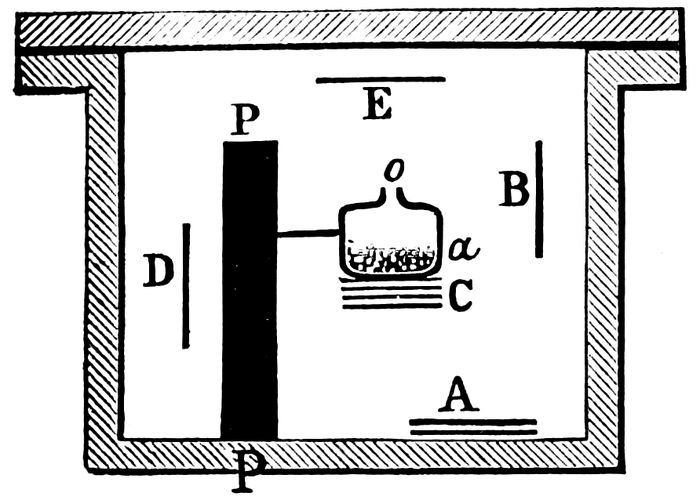
Consider the following imaginary experiment:—Some
radium, R, is placed at the bottom of a small deep cavity,
hollowed in a
block of lead, P
(Fig. 4). A sheaf
of rays, rectilinear
and
slightly expanded,
streams
from the receptacle.
Let us
suppose that a
strong uniform
magnetic field is
established in
the neighbourhood
of the receptacle,
normal
to the plane
of the figure and
directed towards
the back.
The three groups of rays, α, β, γ, will now be separated.
Then rather faint γ-rays continue in their straight
path without a trace of deviation. The β-rays are
deflected in the manner of cathode rays, and describe
circular paths in the plane of the figure. If the receptacle
is placed on a photographic plate, A C, the portion, B C, of
the plate which receives the β-rays is acted upon. Lastly,
34the α-rays form a very intense shaft which is slightly
deflected, and which is soon absorbed by the air. These
rays describe in the plane of the figure a path of great
curvature, the direction of the deflection being the reverse
of that with the β-rays.
If the receptacle is covered with a thin sheet of aluminium
(0·1 m.m. thick), the α-rays are suppressed almost entirely,
the β-rays are lessened, and the γ-rays do not appear to be
absorbed to any great extent.
We have seen that the rays emitted by radio-active
bodies have many properties common to cathode rays
and to Röntgen rays. Cathode rays, as well as Röntgen
rays, ionise the air, act on photographic plates, cause
fluorescence, undergo no regular deflection. But the
cathode rays differ from Röntgen rays in being deflected
from their rectilinear path by the action of the magnetic
field, and in the transportation of charges of negative
electricity.
The fact that the magnetic field acts upon the rays
emitted by radio-active substances was discovered almost
simultaneously by MM. Giesel, Meyer and von Schweidler,
and Becquerel. These physicists observed that the rays
of radio-active substances are deflected by the magnetic
field in the same manner and direction as the cathode
rays; their observations were in relation to the β-rays.
M. Curie demonstrated that the radiation of radium
comprises two groups of quite distinct rays, of which one is
readily deflected by the magnetic field (β-rays), whilst the
other seems to be unaffected by the action of this field (α-
and γ-rays).
M. Becquerel did not find that the specimens of polonium
prepared by us emitted rays of the cathode kind. On the
contrary, he first noticed the effect of the magnetic field on
a specimen of polonium prepared by himself. None of the
polonium prepared by us ever gave rise to rays of the
cathode order.
The polonium of M. Giesel only gives rise to these rays
when recently prepared, and it is probable that the emission
is due to the phenomenon of induced radio-activity of which
we shall speak later.
The following are experiments which prove that one
portion of the radiation of radium, and one portion only,
consists of easily deflected rays (β-rays). These experiments
were done according to the electrical method.
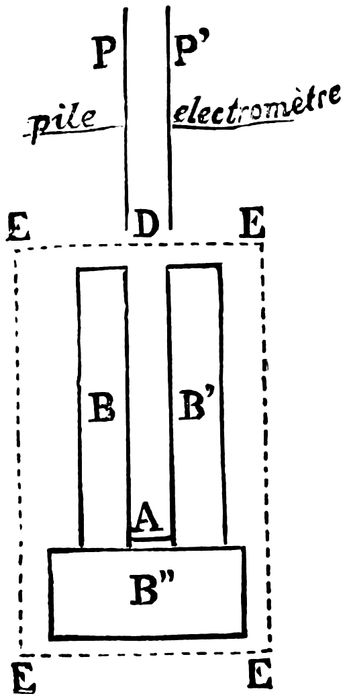
35The radio-active body A (Fig. 5) sends forth radiations
in the direction A D between the plates P and P′. The plate
P is now at a potential of 500 volts, plate P′ is connected to
an electrometer and to a quartz electric piezometer. The
intensity of the current passing through the air under the
influence of the radiations is measured. The magnetic
field can be established at will perpendicular to the plane
of the figure over the whole region E E E E. If the rays are
deflected, even slightly, they no longer pass between the
plates, and the current is suppressed. The region of the
passage of the rays is surrounded with masses of lead,
B, B′, B″, and by the armatures of the
electro-magnet; when the rays are deflected,
they are absorbed by the masses
of lead B and B′.
The results obtained depend essentially
on the distance, A D, of the radiating substance,
A, from the condenser at D. If
the distance A D is great enough (greater
than 7 c.m.), most of the radium rays (90
to 100 per cent) arriving at the condenser
are deflected and suppressed for a field of
2500 units. These are the β-rays. If the
distance A D is less than 65 m.m., a
smaller part of the rays are deflected by
the action of the field; this portion is also
entirely deflected by a field of 2500 units,
and the proportion of the rays suppressed
is not increased by increasing the field from 2500 to
7000 units.
The proportion of the rays not suppressed by the field
increases with decrease of the distance, A D, between the
radiating body and the condenser. For small distances,
the rays which can be easily deflected form a very small
fraction of the total radiation. The penetrating rays are
therefore, for the most part, deviable rays of the cathode
order (β-rays).
Under the experimental conditions just described, the
action of the magnetic field on the α-rays could not be well
observed for the fields employed. The chief radiation,
apparently undergoing no deflection, observed at a short
distance from the radiating source, consisted of α-rays; the
undeflected radiation observed at a greater distance consisted
of γ-rays.
If an absorbing lamina (aluminium or black paper) is
placed in the path of the bundle of rays, those which pass
36through are nearly all deflected by the field in such a way
that, with the aid of the screen and the magnetic field,
almost all the radiation is suppressed in the condenser, the
remainder being due to the γ-rays, the proportion of which
is small. The α-rays are absorbed by the screen.
An aluminium plate of 1/100 m.m. thickness is sufficient
for the suppression of almost all the rays not readily
deflected when the substance is far enough from the condenser;
for smaller distances (34 m.m. and 51 m.m.) two pieces
of this aluminium foil are necessary to give the same result.
Similar determinations were made with four substances
containing radium (chlorides or carbonates) of very different
activity; analogous results were obtained.
It may be remarked that, in all cases, the penetrating
rays deflected by the magnet (β-rays) form only a small
fraction of the total radiation; they influence but slightly
the determinations in which the whole radiation is made
use of to produce conductivity of the air.
The radiation emitted by polonium may be studied by
the electrical method. When the distance, A D, of the
polonium from the condenser is varied, no current is observed
at first while the distance is fairly great; on nearing
the polonium, the radiation suddenly becomes manifest
with great intensity; the current then increases uniformly
whilst approaching the polonium, but the magnetic field
produces no appreciable effect under these conditions. The
radiation of polonium is apparently limited in space, and
does not pass into the air beyond a kind of sheath surrounding
the substance to a thickness of several centimetres.
The interpretation of the experiments I have just
described must be accompanied by some important general
reservations. In speaking of the proportion of the rays
deflected by the magnet, I refer only to that portion of the
radiation capable of causing a current in the condenser. In
employing the fluorescent action of the Becquerel rays, or
their action on photographic plates, the proportion would
probably be different—a measure of intensity having, as a
rule, no meaning except for the method of measurement
adopted.
The rays of polonium are α-rays. In the experiments
just described, I observed no action of the magnetic field
upon them, but the experimental conditions were such that
a slight deflection would pass unnoticed.
The experiments made by the radiographic method confirmed
the preceding results. Taking radium as the source
of radiation, and receiving the impression on a plate
37parallel to the primitive shaft and normal to the field, a
very clear print is obtained of two shafts separated by the
action of the field, the one deflected, the other not deflected.
The β-rays constitute the deflected beam; the
α-rays, being very slightly deflected, are not to be distinguished
from the undeflected bundle of the γ-rays.
The experiments of M. Giesel and MM. Meyer and von
Schweidler showed that the radiation of the radio-active
bodies is, in part at least, deflected by a magnetic field, and
that this deflection resembles that of the cathode rays. M.
Becquerel investigated the action of the field on the rays
by the radiographic method. The experimental arrangement
was that of Fig. 4. The radium was placed in the
lead receptacle, P, and this receptacle was placed on the
sensitive face of a photographic plate, A C, covered with
black paper. The whole was placed between the poles of
an electro-magnet, the magnetic field being normal to the
plane of the figure.
If the field is directed to the back of this plane, the part
B C of the plate is acted upon by rays which, after having
described circular paths, return to the plate and strike it at
a right angle. These rays are β-rays.
M. Becquerel has demonstrated that the impression
consists of a wide diffused band, a continuous spectrum
indeed, showing that the sheaf of deviable rays emitted by
the source is formed of an infinite number of radiations
unequally deflected. If the gelatin of the plate be covered
with different absorbent screens (paper, glass, metals), one
portion of the spectrum is suppressed, and it is found that
the rays most deflected by the magnetic field—otherwise
those which have the smallest radius of curvature—are the
most completely absorbed. With each screen, the impression
on the plate begins at a certain distance from the
source of radiation, this distance being proportional to the
absorptive power of the screen.
The cathode rays are, as shown by M. Perrin, charged
with negative electricity. Further, according to the experiments
of M. Perrin and M. Lenard, they are capable of
carrying their charge through the metallic envelopes connected
to earth and through isolating screens. At every
point where the cathode rays are absorbed, there is a continuous
evolution of negative electricity. We have proved
38that the same is the case for the deflected β-rays of
radium. The deviable β-rays of radium are charged with
negative electricity.
(Note.—Let the radio-active substance be placed on one
of the plates of a condenser, this plate being connected to
earth; the second plate is connected to an electrometer, it
receives and absorbs the rays emitted by the substance. If
the rays are charged, a continuous flow of electricity into
the electrometer should be observed. In this experiment,
carried out in air, we were not able to detect a charge
accompanying the rays, but such an experiment is not
delicate. The air between the plates being caused by the
rays to conduct, the electrometer is no longer isolated, and
can only respond to charges if these be sufficiently strong.
In order that the α-rays may not interfere with the
experiment, they may be suppressed by covering the source
of radiation with a thin metallic screen. We repeated this
experiment, without more success, by causing the rays
to pass through the interior of a Faraday cylinder in
connection with the electrometer).
According to the preceding experiments, it was evident
that the charge of the rays of the radiating body employed
was a weak one.
In order to fix a feeble evolution of electricity upon the
conductor which absorbs the rays, this conductor should be
completely insulated; this is effected by screening it from
the air, either by placing it in a tube with a very perfect
vacuum, or by surrounding it with a good solid dielectric.
We employed the latter arrangement.

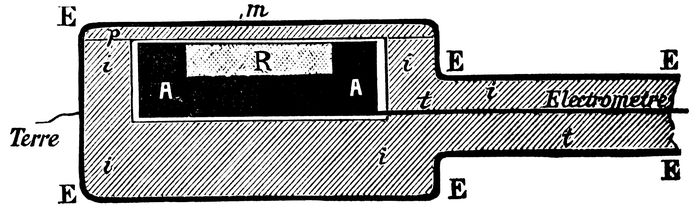
A conducting disc, M M (Fig. 6), is connected by the wire,
t, to the electrometer;
the disc
and wire are completely
enveloped
by the insulating
substance i i i i;
the whole is again
surrounded with
the metallic
covering, E E E E, which is in electric connection with the
earth. The insulator, p p, and the metallic envelope are very
thin upon one of the faces of the disc. This face is exposed to
the radiation of the barium and radium salt, R, placed outside
in a lead receptacle. The rays emitted by the radium
penetrate the metallic envelope and the insulating lamina,
p p, and are absorbed by the metallic disc, M M. The latter
39then becomes the source of a continuous evolution of
negative electricity, as determined by the electrometer, and
is measured by means of a quartz piezometer.
The current thus created is very weak. With very
active barium-radium chloride, forming a layer of 2·5 sq.
c.m. in area, and of 0·2 c.m. in thickness, a current of
magnitude 10–11 ampères is obtained, the rays utilised
having traversed, before being absorbed by the disc M M, a
thickness of aluminium of 0·01 m.m., and a thickness of
ebonite of 0·3 m.m.
We used successively lead, copper, and zinc for the disc
M M, ebonite and paraffin for the insulator; the results
obtained were the same.
The current diminishes with increasing distance from the
source of radiation, R, also when a less active product is used.
We obtained the same results again when the disc M M is
replaced by a Faraday cylinder filled with air, and covered
outside with insulating material. The opening of the
cylinder, closed by the thin insulating plate, p p, was
opposite the radiating source.
Finally, we made the inverse experiment, which was to
place the lead receptacle with the radium in the centre of
the insulating material and in connection with the electrometer
(Fig. 7), the whole being surrounded with the
metallic covering connected to earth.
Under these conditions, it is evident from the electrometer
that the radium has a positive charge equal in magnitude to
the negative charge of the former experiment. The radium
rays penetrate the thin dielectric plate, p p, and leave the
conductor inside carrying with them negative electricity.
The α-rays of radium do not interfere in these experiments,
being almost completely absorbed by a very thin layer of
matter. The method just described is not suitable for the study
of the charge of the rays of polonium, these rays very slightly
penetrating. We observed no indication of any charge in the
case of polonium, which gives rise to α-rays only; but, for
the reason just given, no conclusion can be drawn from this.
40Thus, in the case of the deflected β-rays of radium, as
in the case of cathode rays, the rays carry a charge of
electricity. But, hitherto, the existence of electric charges
uncombined with matter has been unknown. In the study
of the emission of the β-rays of radium, we are therefore
led to make use of the theory which is in vogue for the
study of cathode rays. In this ballistic theory, formulated
by Sir William Crookes, since developed and completed by
Prof. J. J. Thomson, the cathode rays consist of extremely
minute particles, which are hurled from the cathode with
great velocity, and which are charged with negative
electricity. We might similarly conceive that radium
sends into space negatively electrified particles.
A specimen of radium, enclosed in a solid thin perfectly
insulated envelope, should become spontaneously charged
to a very high potential. By the ballistic hypothesis the
potential would increase until the potential difference of
the surrounding conductors became sufficient to hinder the
ejection of the electrified particles and to cause their return
to the source of radiation.
We have performed an experiment on these lines. A
specimen of very active radium was enclosed for some time
in a glass vessel. In order to open the vessel, we made a
trace on the glass with a glass cutter. Whilst so doing,
we clearly heard the report of a spark, and upon examining
the vessel with a magnifying glass, we observed that the
glass had been pierced by a spark at the spot where it had
been weakened by the scratch. The phenomenon produced
is comparable to the rupture of the glass of an overcharged
Leyden jar.
The same phenomenon occurred with another glass.
Further, at the moment of the passing of the spark, M.
Curie, who was holding the glass, felt the electric shock of
discharge in his fingers.
Certain kinds of glass have good insulating properties.
If the radium is enclosed in a sealed glass vessel, well
insulated, it is to be expected that, at a given moment, the
vessel will be spontaneously perforated.
Radium is the first example of a body which is spontaneously
charged with electricity.
The β-rays of radium, being analogous to the cathode
rays, should be deflected by an electric field in a manner
similar to the latter; i.e., as would a particle of matter
41negatively charged and hurled into space with a great
velocity. The existence of such a deflection has been
demonstrated both by M. Dorn and M. Becquerel.
Let us consider the case of a ray which traverses the
space situated between the two plates of a condenser.
Suppose the direction of the ray parallel to the plates: when
an electric field is established between the latter, the ray is
subjected to the action of this uniform field along its whole
path in the condenser l. By reason of this action the ray
is deflected towards the positive plate and describes the arc
of a parabola; on leaving the field, it continues its path in
a straight line, following the tangent to the arc of the
parabola at the point of exit. The ray can be received on
a photographic plate perpendicular to its original direction.
Observations are taken of the impression produced on the
plate when the field is zero, and when it has a known
value, and from that is deduced the value of the deflection,
δ, which is the distance of the points in which the new
direction of the ray and its original direction meet a
common plane perpendicular to the original direction. If
h is the distance of this plane from the condenser, i.e., at
the edge of the field, we have, by a simple calculation,—
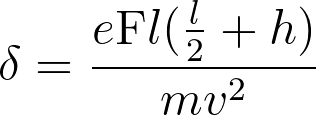
m being the mass of the moving particles, e its charge, v its
velocity, and F the strength of the field.
The experiments of M. Becquerel enable him to assign a
value approaching to δ.
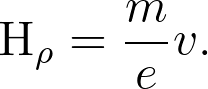
When a material particle having a mass m and a negative
charge e, is projected with a velocity v into a uniform magnetic
field perpendicular to its initial velocity, this particle
describes, in a plane normal to the field and passing through
its initial velocity, an arc of a circle of radius ρ, so that—H
being the strength of the field—we have the relation—
If, for the same ray, the deflection, δ, and the radius of
curvature, ρ, be measured in a magnetic field, values could
be found from these two experiments for the ratio e
m and for
the velocity, v.
42The experiments of M. Becquerel threw the first light
upon this subject. They gave for the ratio e
m a value approximately
equal to 107 absolute electro-magnetic units,
and for v a magnitude of 1·6 × 1010. These values are of the
same order of magnitude as those of the cathode rays.
Accurate experiments have been made on the same subject
by M. Kaufmann. This physicist subjected a narrow beam
of radium rays to the simultaneous action of an electric field
and a magnetic field, the two fields being uniform and having
a similar direction, normal to the original direction of the
beam. The impression produced on a plate normal to the
primitive beam and placed beyond the limits of the field with
reference to the source, has the form of a curve, each point
of which corresponds to one of the original beam. The
most penetrating and least deflected rays are at the same
time those with the greatest velocity.
It follows from the experiments of M. Kaufmann, that for
the radium rays, of which the velocity is considerably greater
than that of the cathode rays, the ratio e
m decreases, while
the velocity increases.
According to the researches of J. J. Thomson and Townsend,
we may assume that the moving particle, which constitutes
the ray, possesses a charge, e, equal to that carried by
an atom of hydrogen during electrolysis, this charge being
the same for all the rays. We are therefore led to the conclusion
that the mass of the particle, m, increases with
increase of velocity.
These theoretical considerations lead to the idea that the
inertia of the particle is due to its state of charge during
motion, the velocity of an electric charge in motion being
incapable of modification without expenditure of energy. To
state it otherwise, the inertia of the particle is of electro-magnetic
origin, and the mass of the particle is—in part at
least—a virtual mass or an electro-magnetic mass. M.
Abraham goes further, and assumes that the mass of the
particle is entirely an electro-magnetic mass. If, according
to this hypothesis, the value of this mass, m, be calculated
for a known velocity, v, we find that m approaches infinity
when v approaches the velocity of light, and that m approaches
a constant value when the velocity, v, is much less than that
of light. The experiments of M. Kaufmann are in agreement
with the results of this theory, the importance of which is
great because it foreshadows the possibility of establishing
43mechanical bases upon the dynamical of little particles of
matter charged in a state of motion.
These are the figures obtained by M. Kaufmann for e
m
and v.
e
m
Electro-magnetic units. |
vc.m.
sec. |
|
| 1·865 |
× 107 |
0·7 |
× 1010 |
For cathode rays (Simon). |
| 1·31 |
× 107 |
2·36 |
× 1010 |
For radium rays (Kaufmann). |
| 1·17 |
× 107 |
2·48 |
× 1010 |
| 0·97 |
× 107 |
2·59 |
× 1010 |
| 0·77 |
× 107 |
2·72 |
× 1010 |
| 0·63 |
× 107 |
2·83 |
× 1010 |
M. Kaufmann concludes, from comparison of his experiments
with the theory, that the limiting value of the ratio e
m
for radium rays of relatively small velocity would be the
same as the value e
m for cathode rays.
The most complete experiments of M. Kaufmann were
made with a minute quantity of pure radium chloride, with
which we provided him.
According to M. Kaufmann’s experiments, certain β-rays
of radium possess a velocity very near to that of light.
These rapid rays seem to possess great penetrating capacity
towards matter.
In a recent work, Mr. Rutherford announced that, in a
powerful electric or magnetic field, the α-rays of radium are
slightly deflected, in the manner of particles positively electrified
and possessing great velocity. Mr. Rutherford concludes
from his experiments that the velocity of the α-rays is of the
order of magnitude 2·5 × 109c.m.
sec. and that the ratio e
m for
these rays is of the order of magnitude 6 × 10³, which is 104
times as great as for the deflected β-rays. We shall see
later that these conclusions of Mr. Rutherford are in agreement
with the properties already known of the α-radiation,
and that they account, in part at least, for the law of absorption
of this radiation.
The experiments of Mr. Rutherford have been confirmed
by M. Becquerel. M. Becquerel has further demonstrated
that polonium rays behave in a magnetic field like the α-rays
44of radium, and that, for the same field, they seem to have
the same curvature as the latter.
It also appears from M. Becquerel’s experiments that the
α-rays do not form a magnetic spectrum, but act rather like a
homogeneous radiation, all the rays being equally deflected.
We have just seen that radium gives off α-rays comparable
to the tube rays, β-rays comparable to cathode rays,
and γ-rays which are penetrating and not deflected. Polonium
gives off α-rays only. Amongst the other radio-active
substances, actinium seems to behave like radium, but the
study of its radiation has not yet advanced so far as in the
case of radium. As regards the faintly radio-active bodies,
we know to-day that uranium and thorium give rise to α-rays
as well as β-rays (Becquerel, Rutherford).
As I have already mentioned, the proportion of β-rays increases
with increase of distance from the source of radiation.
These rays never occur alone, and for great distances the
presence of γ-rays is always discernible. The presence of
very penetrating, undeflected rays in the radiation of radium
was first observed by M. Villard. These rays constitute only
a small portion of the radiation measured by the electrical
method, and their presence escaped our notice in our first
experiments, so that we believed falsely that the radiation at
great distances contained only rays capable of deflection.
The following are the numerical results obtained with experiments
made by the electrical method with an apparatus
similar to that of Fig. 5. The radium was only separated
from the condenser by the surrounding air. I shall indicate
by the letter d the distance from the source of radiation to
the condenser. The numbers of the second line represent
the current subsisting when the magnetic field is acting,
supposing the current obtained with no field equal to 100 for
each distance. These numbers may be considered as giving
the percentage of the total α- and γ-rays, the deflection of
the α-rays having been scarcely observable with the conditions
employed.
At great distances there are no α-rays, and the undeflected
radiation is therefore of the γ kind only.
Experiments made at short distances:—
| d, in centimetres |
3·4 |
5·1 |
6·0 |
6·5 |
| Percentage of undeflected rays |
74 |
56 |
33 |
11 |
45Experiments made at long distances with a product considerably
more active than that which was used for the preceding
series:—
| d, in centimetres |
14 |
30 |
53 |
80 |
98 |
| Percentage of undeflected rays |
12 |
14 |
17 |
14 |
16 |
| d |
124 |
157 |
|
|
|
| Percentage of undeflected rays |
14 |
11 |
|
|
|
It is thus evident that after a certain distance the proportion
of undeflected rays in the radiation is approximately
constant. These rays probably all belong to the γ species.
The following is another series of experiments in which
the radium was enclosed in a very narrow glass tube, placed
below the condenser and parallel to the plates. The rays
emitted traversed a certain thickness of glass and air before
entering the condenser:—
| d, in centimetres |
2·5 |
3·3 |
4·1 |
5·9 |
7·5 |
9·6 |
11·3 |
| Percentage rays not deflected |
33 |
33 |
21 |
16 |
14 |
10 |
9 |
| d |
13·9 |
17·2 |
|
|
|
|
|
| Percentage rays not deflected |
9 |
10 |
|
|
|
|
|
As in the preceding experiments, the number of the
second line approximate to a constant value, when the
distance d increases, but the limit is reached for smaller
distances than in the preceding series, because the α-rays
have been more completely absorbed by the glass than the
β- and γ-rays.
The following experiment shows that a thin sheet of
aluminium (0·01 m.m. thick) absorbs principally α-rays.
The product being placed 5 c.m. from the condenser, the
proportion of rays other than β, when the magnetic field is
acting, is about 71 per cent. When the same substance is
covered with the sheet of aluminium, the distance remaining
the same, the radiation transmitted is found to be
almost totally deflected by the magnetic field, the α-rays
having been absorbed by the aluminium. The same result
is obtained when paper is used as the absorbing screen.
The greatest part of the radiation of radium consists of
α-rays, which are probably emitted principally by the
superficial layer of the radiating matter. When the thickness
of the layer of radiating matter is varied, the intensity
of the current increases with this thickness; the increase is
not proportional to the thickness for the whole of the
radiation; it is, moreover, more considerable for the β-rays
than for the α-rays, so that the proportion of β-rays increases
with the thickness of the active layer. The source of
46radiation being placed at a distance of 5 c.m. from the
condenser, it is found that for a thickness equal to 0·4
m.m. of the active layer, the total radiation is given by the
number 28, and the proportion of the β-rays is 29 per cent.
By making the layer 2 m.m. thick, i.e., five times as thick,
a total radiation equal to 102, and a proportion of β-rays
equal to 45 per cent are obtained. The total radiation
which exists at this distance has therefore been increased
in the ratio of 3·6, and the β-radiation has become five
times as strong.
The preceding experiments were made by the electrical
method. When the radiographic method is used, certain
results seem to be in contradiction with what precedes. In
the experiments of M. Villard, a beam of radium rays, subjected
to the action of the magnetic field, was received on
to a pile of photographic plates. The undeflected and
penetrating γ-beam passed through all the plates, leaving
its trace on each. The deflected β-beam produced an impression
on the first plate only. This beam appeared
therefore to contain no rays of great penetration.
On the contrary, in our experiments a beam which is
propagated in the air contains at the greatest distances
accessible to observation about 9/10 of β-rays, and the same
is the case when the source of radiation is enclosed in a little
sealed glass vessel. In M. Villard’s experiments, these
deflected and penetrating β-rays did not affect the photographic
plates beyond the first, because they are to a great
extent diffused in all directions by the first solid obstacle
encountered, and no longer form a beam. In our experiments
the rays given off by radium and transmitted through
the glass of the vessel were also probably scattered by the
glass, but the vessel being very small would itself act as a
source of β-rays at its surface, and we were able to follow
the course of the latter to a great distance from the vessel.
The cathode rays of Crookes tubes can only traverse
very thin screens (aluminium screens of 0·01 m.m. thickness).
A beam of rays striking the screen normally is
scattered in all directions; but the diffusion becomes less
with diminishing thickness of the screen, and for very thin
screens the emerging beam is practically the prolongation
of the incident beam.
The deflected β-rays of radium behave in a similar
manner, but the transmitted beam experiences, for the
same thickness of screen, a much slighter modification.
According to the experiments of M. Becquerel, the very
readily deflected β-rays of radium (those with a relatively
47small velocity) are powerfully scattered by an aluminium
screen of thickness 0·1 m.m.; but the penetrating and less
deflected rays (rays of the cathode kind of great velocity)
pass through this screen without being sensibly diffused,
whatever be the inclination of the screen to the direction of
the beam. The β-rays of great velocity penetrate without
diffusion a much greater thickness of paraffin (several centimetres),
and in this the curvature of the beam produced
by the magnetic field can be traced. The thicker the
screen, and the more absorbent the material of which it
is composed, the greater is the modification of the deflected
primitive beam, because, with increasing thickness of
screen, diffusion occurs progressively among fresh groups of
rays of increasing penetration.
The β-rays of radium experience a diffusion in passing
through the air, which is very marked for readily deflected
rays, but which is much slighter than that produced by
equal thicknesses of solid substances. For this reason, the
β-rays traverse long distances in the air.
Since the beginning of the researches on radio-active
bodies, investigations of the absorption produced by different
screens upon the rays given off by these bodies have been
carried on. In a previous paper on this subject I gave
figures (quoted at the beginning of this work) representing
the penetrating power of uranium and thorium rays. Mr.
Rutherford has made a special study of the radiation of
uranium, and proved it to be heterogeneous. Mr. Owens
has arrived at the same results for thorium rays. When
the discovery of strongly radio-active bodies immediately
followed upon this, the penetrating power of their rays was
also studied by various physicists (Becquerel, Meyer and
von Schweidler, Curie, Rutherford). The first observations
brought to light the complexity of the radiation, which
seems to be a general phenomenon, and common to the
radio-active bodies. In them we have sources which give
rise to a variety of radiations, each of which has a power
of penetration proper to itself.
Radio-active bodies emit rays which are propagated both
in the air and in vacuo. The propagation is rectilinear;
this fact is proved by the distinctness and shape of the
shadows formed by interposing bodies opaque to the radiation
between the source and the sensitive plate or fluorescent
screen which serves as receiver, the source being of small
magnitude in comparison with its distance from the receiver.
48Various experiments demonstrating the rectilinear propagation
of uranium, radium, and polonium rays have been
made by M. Becquerel.
It is interesting to know the distance that rays can travel
in air. We have found that radium emits rays which can
be detected in the air at a distance of several metres from
the source. In certain of our electrical determinations, the
action of the source upon the air of the condenser made
itself felt at a distance of between 2 and 3 metres. We
have also obtained fluorescent effects and radiographic impressions
at similar distances. The experiments are not
easily carried out, except with very intense radio-active
sources, because, independently of the absorption by the
air, the action upon a given receiver varies inversely as the
square of the distance from a source of small dimensions.
This radiation, which travels a long distance in the case of
radium, comprises rays of the cathode kind and rays which
are undeflected; however, the deflected rays predominate,
according to the results of the experiments already mentioned.
The greater part of the radiation (α-rays) is, on
the contrary, limited in air to a distance of about 7 c.m.
from the source.
I made several experiments with radium enclosed in a
little glass vessel. The rays emerging from the vessel,
after traversing a certain space of air, were received in a
condenser, which served to measure their ionising capacity
by the usual electrical method. The distance, d, from the
source to the condenser was varied, and the current of
saturation, i, obtained in the condenser was measured.
The following are the results of one of the series of determinations:—
| d, c.m. |
i. |
i × d2 × 10–3. |
| 10 |
127 |
13 |
| 20 |
38 |
15 |
| 30 |
17·4 |
16 |
| 40 |
10·5 |
17 |
| 50 |
6·9 |
17 |
| 60 |
4·7 |
17 |
| 70 |
3·8 |
19 |
| 100 |
1·65 |
17 |
After a certain distance, the intensity of radiation varies
inversely as the square of the distance from the condenser.
The radiation of polonium is only propagated in air to a
distance of a few centimetres (4 to 6 c.m.) from the source
of radiation.
49In the case of the absorption of radiations by solid
screens, we find another fundamental difference between
radium and polonium. Radium emits rays capable of
penetrating great thicknesses of solid matter, e.g., several
centimetres of lead or of glass. The rays which have
passed through a great thickness of a solid body are extremely
penetrating, and it is practically impossible to
absorb them entirely by any material whatever. But these
rays form only a small fraction of the total radiation, the
greater part of which is absorbed by a slight thickness of
solid matter.
Polonium emits rays which are readily absorbed, and
which can only pass through extremely thin screens.
The following are figures showing the absorption produced
by an aluminium lamina of thickness 0·01 m.m.
This lamina was placed above and almost in contact with
the substance. The direct radiation and that transmitted
by the aluminium were measured by the electrical method
(apparatus of Fig. 1); the current of saturation was
practically obtained in every case. I have represented the
activity of the radiating body by a, that of uranium being
unity.
|
a. |
Fraction of radiation transmitted. |
| Chloride of barium and radium |
57 |
0·32 |
| Bromide of barium and radium |
43 |
0·30 |
| Chloride of barium and radium |
1200 |
0·30 |
| Sulphate of barium and radium |
5000 |
0·29 |
| Sulphate of barium and radium |
10,000 |
0·32 |
| Metallic bismuth and polonium |
|
0·22 |
| Compounds of uranium |
|
0·20 |
| Compounds of thorium in a thin layer |
|
0·38 |
We see that radium compounds of different nature and
activity give very similar results, as I have already pointed
out in the case of uranium and thorium compounds at the
beginning of this work. We see also that, taking into
account the whole of the radiation, and with a given
absorbent screen, the different radio-active bodies can be
arranged in the following decreasing order of penetrating
power:—Thorium, radium, polonium, uranium.
These results are similar to those which have been published
by Mr. Rutherford.
Mr. Rutherford also finds that the order is the same when
air is the absorbent substance. But it is probable that this
order has no absolute value, and would not be maintained
50independently of the nature and thickness of the screen.
Experiment shows, indeed, that the law of absorption is
very different for polonium and radium, and that, for the
latter, the absorption of the rays of each of the three groups
must be considered separately.
Polonium is particularly well adapted to the study of α-rays,
because the specimens which we possess emit no
other kind of rays. I made a preliminary series of experiments
with extremely active recently prepared specimens of
polonium. I found the absorbability of the rays to increase
with increase of thickness of the matter traversed. This
singular law of absorption is contrary to that known for
other kinds of radiation.
I employed for this research our apparatus for the determination
of electrical conductivity arranged in the following
manner:—
The two plates of a condenser, P P and P′ P′ (Fig 8), are
horizontally disposed in a metallic box, B B B B, connected
to earth. The active body, A, placed in a thick metallic
box, C C C C, connected
with the
plate P′ P′, acts
upon the air of
the condenser
across a metallic
sheet, T; the
rays which pass
through the
sheet are alone
utilised for producing
the current,
the electric
field being
limited by the
sheet. The distance,
A T, of the
active body from
the sheet may be varied. The field between the plates is
established by means of a battery. By placing in A upon the
active body different screens, and by adjusting the distance
A T, the absorption of rays which travel long or short distances
in the air may be determined.
The following are the results obtained with polonium:—
For a certain value of the distance A T (4 c.m. and more),
no current passes; the rays do not penetrate the condenser.
When the distance A T is diminished, the appearance of the
51rays in the condenser is manifested somewhat suddenly, a
weak current changing to one of considerable strength for
a slight diminution of distance; the current then increases
regularly as the active body continues to approach the
sheet T.
When the active body is covered with a sheet of
aluminium 1/100 m.m. thick, the absorption produced by
the lamina becomes greater, the greater the distance A T.
If a second similar lamina of aluminium be placed upon
the first, each absorbs a fraction of the radiation it receives,
and this fraction is greater for the second lamina than for
the first.
In the following table I have represented in the first line
the distances in centimetres between the polonium and the
sheet T; in the second line the percentage of the rays
transmitted by a sheet of aluminium; in the third line the
percentage of the rays transmitted by two sheets of the
same aluminium:—
| Distance A T |
3·5 |
2·5 |
1·9 |
1·45 |
0·5 |
| Percentage of rays transmitted by one lamina |
0 |
0 |
5 |
10 |
25 |
| Percentage of rays transmitted by two laminæ |
0 |
0 |
0 |
0 |
0·7 |
In these experiments the distance of the plates, P and P′,
was 3 c.m. We see that the interposition of the
aluminium screen diminishes the intensity of the radiation
to a greater degree at further distances than at nearer
distances.
This effect is still more marked than the preceding
figures seem to indicate. For a distance of 0·5 c.m. 25
per cent represents the mean penetration for all the rays
which pass beyond this distance. If, for example, only
those rays between 0·5 c.m. and 1 c.m. be comprehended,
the penetration would be greater. And if the plate P be
placed at a distance of 0·5 c.m. from P′ the fraction of the
radiation transmitted by the aluminium lamina (for A T = 0·5
c.m.) is 47 per cent, and through two laminæ it is 5 per
cent of the original radiation.
I have recently performed a second series of experiments
with these same specimens of polonium, the activity of
which was considerably diminished, the interval of time
between the two series of experiments being three years.
In the former experiments, polonium nitrite was used; in
the latter, the polonium was in the state of metallic particles
obtained by fusing the nitrite with potassium cyanide.
52I found that the radiation of polonium had preserved its
essential characteristics, and I discovered new results. The
following, for different values of the distance A T, are the
fractions of the radiation transmitted by a screen composed
of four superposed very thin leaves of beaten aluminium.
| Distance A T, in centimetres |
0 |
1·5 |
2·6 |
| Percentage of rays transmitted by the screen |
76 |
66 |
39 |
I also found that the fraction of the radiation absorbed
by a given screen increases with the thickness of the
material already traversed by the radiation, but this only
occurs after the distance A T has reached a certain value.
When this distance is zero (the polonium being in contact
with the sheet, either outside or inside the condenser), it is
observed that with several similar superposed screens, each
absorbs the same fraction of the radiation it receives;
otherwise expressed, the intensity of the radiation diminishes
therefore according to an exponential law as a function of
the thickness of the material traversed, as in the case
of homogeneous radiation transmitted by the lamina without
changing its nature.
The following numerical results are given with reference
to these experiments:—
For a distance A T equal to 1·5 c.m. a thin aluminium
screen transmits the fraction 0·51 of the radiation it receives
when acting alone, and the fraction 0·34 of the radiation it
receives when it is preceded by another similar screen.
On the contrary, for a distance A T equal to zero, the
same screen transmits in both the cases considered the same
fraction of the radiation it receives, and this fraction is equal
to 0·71; it is therefore greater than in the preceding case.
The following numbers indicate for a distance A T equal
to 0 and for a succession of thin superposed screens, the
ratio of the radiation transmitted to the radiation received
for each screen:—
| Series of nine very thin copper leaves. |
Series of seven very thin aluminium leaves. |
| 0·72 |
0.69 |
| 0·78 |
0.94 |
| 0·75 |
0.95 |
| 0·77 |
0.91 |
| 0·70 |
0.92 |
| 0·77 |
0.93 |
| 0·69 |
0.94 |
| 0·79 |
|
| 0·68 |
|
53Taking into account the difficulties of the manipulation
of very thin screens and of the superposition of screens in
contact, the numbers of each column may be looked upon
as constant; the first number only of the aluminium
column indicates a greater absorption than that indicated
by the following numbers.
The α-rays of radium behave similarly to the rays of
polonium. These rays may be investigated almost isolated
by deflecting to one side the β-rays with the magnetic
field; the γ-rays seem of slight importance in comparison
with the α-rays. The operation can only be carried on at
some distance from the source of radiation. The following
are the results of an experiment of this kind. The fraction
of the radiation transmitted by a lamina of aluminium 0·01
m.m. thick is measured; this screen was placed always
in the same position, above and at a little distance from
the source of radiation. With the apparatus of Fig. 5, the
current produced in the condenser for different values of
the distance A D is observed, both with and without the
screen:—
| Distance A D |
6·0 |
5·1 |
3·4 |
| Percentage of rays transmitted by the aluminium |
3 |
7 |
24 |
The rays which travel furthest in the air are those most
absorbed by the aluminium. There is therefore a great
similarity between the absorbable α-rays of radium and the
rays of polonium.
The deflected β-rays and the undeflected penetrating γ-rays
are, on the contrary, of a different nature. The experiments,
notably of MM. Meyer and von Schweidler,
clearly show that, considering the radiation of radium as a
whole, the penetrating power of this radiation increases
with the thickness of the material traversed, as is the case
of Röntgen rays. In these experiments the α-rays produce
scarcely any effect, being for the most part suppressed by
very thin absorbent screens. Those which penetrate are,
on the one hand, β-rays more or less scattered; on the
other hand, γ-rays, which appear similar to Röntgen rays.
The following are the results of some of my experiments
on the subject:—
The radium is enclosed in a glass vessel. The rays,
which emerge from the vessel, traverse 30 c.m. of air, and
are received upon a series of glass plates, each of thickness
1·3 m.m.; the first plate transmits 49 per cent of the radiation
it receives, the second transmits 84 per cent of the
54radiation it receives, the third transmits 85 per cent of the
radiation it receives.
In another series of experiments the radium was enclosed
in a glass vessel placed 10 c.m. from the condenser which
received the rays. A series of similar screens of lead each
0·115 m.m. thick were placed on the vessel.
The ratio of the radiation transmitted to the radiation
received is given for each of the successive screens by the
following numbers:—
0·40 0·60 0·72 0·79 0·89 0·92 0·94 0·94 0·97
For a series of four screens of lead, each of which was
1·5 m.m. thick, the ratio of the radiation transmitted to the
radiation received was given for the successive screens by
the following numbers:—
The results of these experiments show that when the
thickness of the lead traversed increases from 0·1 m.m. to
6 m.m., the penetrating power of the radiation increases.
I found that, under the experimental conditions mentioned,
a screen of lead 1·8 c.m. thick transmits 2 per cent
of the radiation it receives; a screen of lead 5·3 c.m. thick
transmits 0·4 per cent of the radiation it receives. I also
found that the radiation transmitted by a thickness of lead
of 1·5 m.m. consists largely of rays capable of deflection
(cathode order). The latter are therefore capable of
traversing not only great distances in the air, but also considerable
thicknesses of very absorbent solids, such as lead.
In investigating with the apparatus of Fig. 2 the absorption
exercised by an aluminium screen 0·01 m.m. thick
upon the total radiation of radium, the screen being always
placed at the same distance from the radiating body, and
the condenser being placed at a variable distance, A D, the
results obtained are the sum of those due to the three
groups of the radiation. At a long distance the penetrating
rays predominate, and the absorption is slight; at a short
distance the α-rays predominate, and the absorption becomes
less with nearer approach to the substance; for an
intermediate distance the absorption passes through a
maximum and the penetration through a minimum.
| Distance A D |
7·1 |
6·5 |
6·0 |
5·1 |
3·4 |
| Percentage of rays transmitted by aluminium |
91 |
82 |
58 |
41 |
48 |
Certain experiments made in connection with absorption
always demonstrate a certain similarity between the α-rays
55and the β-rays. Thus it was that M. Becquerel discovered
that the absorbent action of a solid screen upon the β-rays
increases with the distance of the screen from the source,
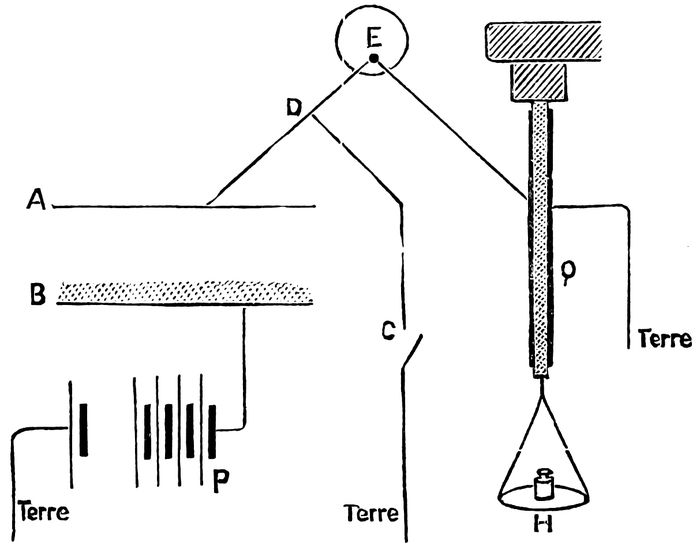
such that if the rays are subjected to a magnetic field, as
in Fig. 4, a screen placed in contact with the source of
radiation allows a larger portion of the magnetic spectrum
to be in evidence than does the same screen placed upon
the photographic plate. This variation of the absorbent
effect of the screen with the distance of the screen from the
source is similar to that which occurs with the α-rays; this
has been verified by MM. Meyer and von Schweidler, who
operated by means of the fluoroscopic method; M. Curie
and I observed the same fact when working by the
electrical method. However, when the radium is enclosed
in a glass tube and placed at a distance from the condenser,
which is itself enclosed in a thin aluminium box, it becomes
a matter of indifference whether the screen be placed
against the source or against the condenser; the current
obtained is the same in both cases.
The investigation of the α-rays led me to the reflection
that these rays behave like projectiles having a certain
initial velocity, and which lose their force on encountering
obstacles. These rays, moreover, travel by rectilinear
propagation, as has been shown by M. Becquerel in the
following experiment:—Polonium emitting rays was
placed in a very narrow straight cavity hollowed in a sheet
of cardboard. Thus a linear source of radiation was produced.
A copper wire, 1·5 m.m. in diameter, was placed
parallel and opposite to the source at a distance of 4·9 m.m.
Beyond was placed a parallel photographic plate at a distance
of 8·65 m.m. After an exposure of ten minutes, the
geometric shadow of the wire was perfectly reproduced,
with a narrow penumbra corresponding to the size of the
source. The same experiment succeeded equally well
when a double leaf of beaten aluminium was placed against
the wire, through which the rays must pass.
There are therefore rays capable of giving perfect
geometric shadows. The experiment with the aluminium
shows that these rays are not scattered in traversing the
screen, and that this screen does not give rise to any
noticeable extent to secondary rays similar to the secondary
rays of the Röntgen rays.
The experiments of Mr. Rutherford show that the projectiles
which constitute the α-rays are deflected by a
magnetic field, as if they were positively charged. The
deflection in a magnetic field becomes less as the product
56mv
e becomes greater; m being the mass of the particle, v
its velocity, and e its charge. The cathode rays of radium
are but slightly deflected, because their velocity is
enormous; they are, on the other hand, very penetrating,
because each particle has a very small mass together with
a great velocity. But particles which, with an equal
charge and a less velocity, have a greater mass, would be
also only slightly influenced by the action of the field, and
would give rise to very absorbable rays. From the results
of Mr. Rutherford’s experiments, this seems to take place in
the case of the α-rays.
The penetrating γ-rays appear to be of quite another
nature and similar to Röntgen rays.
We have now seen how complex a phenomenon is the
radiation of radio-active bodies. The difficulties of investigation
are increased by the question as to whether the
radiation undergoes a merely selective absorption on the
part of the material, or whether a more or less radical
transformation.
Little is so far known with regard to this question. If
the radiation of radium be regarded as containing rays both
of the cathode and Röntgen species, it might be expected
to undergo transformations in traversing screens. It is
known:—Firstly, that cathode rays emerging from a
Crookes tube through an aluminium window are greatly
scattered by the aluminium; and, further, that the passage
through the screen entails a diminution of the velocity of
the rays. In this way, cathode rays with a velocity equal
to 1·4 × 1010 c.m. lose 10 per cent of their velocity in
passing through 0·01 m.m. of aluminium. Secondly,
cathode rays on striking an obstacle give rise to the production
of Röntgen rays. Thirdly, Röntgen rays, on
striking a solid obstacle, give rise to the production of
secondary rays, which partly consist of cathode rays.
The existence, by analogy, of all these preceding phenomena
may therefore be predicted for the rays of radio-active
substances.
In investigating the transmission of polonium rays
through a screen of aluminium, M. Becquerel observed
neither the production of secondary rays nor any transformation
into cathode rays.
I endeavoured to demonstrate a transformation of the
rays of polonium by using the method of interchangeable
screens. Two superposed screens, E1 and E2, being
traversed by the rays, the order in which they are traversed
57should be immaterial if the passage through the screens
does not transform the rays; if, on the contrary, each
screen transforms the rays during transmission, the order
of the screens is of moment. If, for example, the rays are
transformed into more absorbable rays in passing through
lead, and no such effect is produced by aluminium, then
the system lead-aluminium will be more opaque than the
system aluminium-lead; this takes place with Röntgen
rays.
My experiments show that this phenomenon is produced
with the rays of polonium. The apparatus employed was
that of Fig. 8. The polonium was placed in the box,
C C C C, and the absorbing screens, of necessity very thin,
were placed upon the metallic sheet T.
| Screens employed. |
Thickness.
M.m. |
Current observed. |
| Aluminium |
0·01 |
17·9 |
| Brass |
0·005 |
| Brass |
0·005 |
6·7 |
| Aluminium |
0·01 |
| Aluminium |
0·01 |
150 |
| Tin |
0·005 |
| Tin |
0·005 |
125 |
| Aluminium |
0·01 |
| Tin |
0·005 |
13·9 |
| Brass |
0·005 |
| Brass |
0·005 |
4·4 |
| Tin |
0·005 |
The results obtained prove that the radiation is modified
in passing through a solid screen. This conclusion accords
with the experiments in which, of two similar superposed
metallic screens, the first is less absorbent than the second.
From this it is probable that the transforming action of a
screen increases with the distance of the screen from the
source. This fact has not been verified, and the nature of
the transformation has not been studied in detail.
I repeated the same experiments with a very active salt
of radium; the result was negative. I only observed
insignificant variations in the intensity of the radiation
transmitted with interchange of the order of the screens.
The following systems of screens were experimented
with:—
| 58 |
| Aluminium, thickness |
0·55 m.m. |
| Aluminium, thickness |
0·55 m.m. |
| Aluminium, thickness |
0·55 m.m. |
| Aluminium, thickness |
1·07 m.m. |
| Aluminium, thickness |
0·55 m.m. |
| Aluminium, thickness |
1·07 m.m. |
| Aluminium, thickness |
0·15 m.m. |
| Aluminium, thickness |
0·15 m.m. |
| Aluminium, thickness |
0·15 m.m. |
| Platinum, thickness |
0·01 m.m. |
| Lead, thickness |
0·1 m.m. |
| Tin, thickness |
0·005 m.m. |
| Copper, thickness |
0·05 m.m. |
| Brass, thickness |
0·005 m.m. |
| Brass, thickness |
0·005 m.m. |
| Platinum, thickness |
0·01 m.m. |
| Zinc, thickness |
0·05 m.m. |
| Lead, thickness |
0·1 m.m. |
The system lead-aluminium was slightly more opaque
than the system aluminium-lead, but the difference was not
great.
Thus, I was unable to discover an appreciable transformation
of the rays of radium. However, in various radiographic
experiments, M. Becquerel observed very intense
effects due to scattered or secondary rays, emitted by solid
screens which received radium rays. Lead seemed to be
the most active substance in this respect.
M. Curie has pointed out that radium rays and Röntgen
rays act upon liquid dielectrics as upon air, imparting to
them a certain electrical conductivity. The experiment
was carried out in the following manner (Fig. 9):—
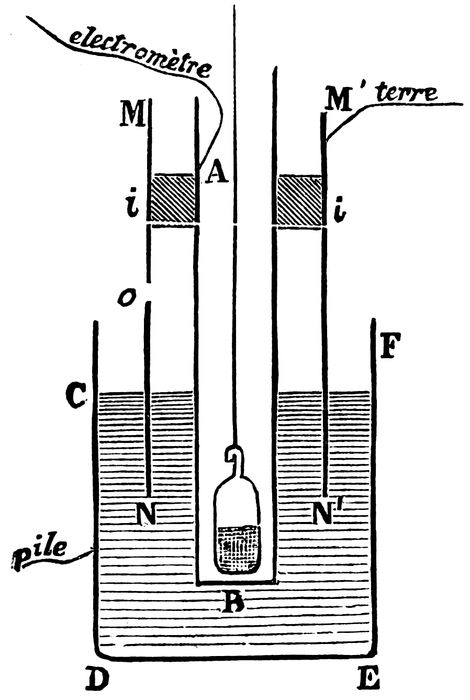
The experimental liquid is placed in a metal vessel,
C D E F, into which a thin copper tube, A B, is plunged;
these two pieces of metal serve as electrodes. The outer
vessel is maintained at a known potential, by means of a
battery of small accumulators, one pole of which is connected
to earth. The tube, A B, is connected to the electrometer.
When a current traverses the liquid the electrometer
is kept at zero by means of a quartz electrical
piezometer, which gives the strength of the current. The
copper tube, M N M′ N′, connected to earth, serves as a
guard tube, preventing the passage of the current through
the air. A bulb containing the radium-barium salt may be
placed at the bottom of the tube, A B; the rays act on the
59liquid after having penetrated the glass of the bulb and the
sides of the metal tube. The radium may also be allowed
to act by placing the bulb beneath the side, D E.
In working with Röntgen rays the course of the rays is
through side D E.
The increase of conductivity by the action of the radium
rays or the Röntgen rays seems to be produced in the case
of all liquid dielectrics; but in order to determine this increase,
the conductivity of the liquid itself must be so slight
as not to mask the effect of the rays.
M. Curie obtained results of the same order of magnitude
with both radium rays and Röntgen rays.
When investigating with the same apparatus the conductivity
of air or of another gas under the action of the
Becquerel rays, the intensity of
the current obtained is found to
be proportional to the difference of
potential between the electrodes,
as long as the latter does not
exceed a few volts; but at higher
tensions, the intensity of the
current increases less and less
rapidly, and the saturation current
is practically attained for a
tension of 100 volts.
Liquids examined with the
same apparatus and the same
radio-active body behave differently;
the intensity of the current
is proportional to the tension
when the latter varies between 0
and 450 volts, and when the distance
between the electrodes does
not exceed 6 m.m.
The figures of the following table multiplied by 10–11
give the conductivity in megohms per c.c.:—
| Carbon bisulphide |
20 |
| Petroleum ether |
15 |
| Amylene |
14 |
| Benzine |
4 |
| Liquid air |
1·3 |
| Vaseline oil |
1·6 |
We may, however, assume that liquids and gases behave
similarly, but that, in the case of liquids, the current remains
proportional to the tension up to a much higher limit
60than in the case of gases. It therefore seemed probable
that the limit of proportionality could be lowered by using
a much more feeble radiation, and this idea was verified by
experiment. The radio-active body employed was 150
times less active than that which had served for the previous
experiments. For tensions of 50, 100, 200, 400 volts, the
intensities of the current were represented respectively by
the numbers 109, 185, 255, 335. The proportionality was
no longer maintained, but the current showed great
variation when the difference of potential was doubled.
Some of the liquids examined are nearly perfect insulators
when maintained at a constant temperature and
when screened from the action of the rays. Such are
liquid air, petroleum ether, vaseline oil, and amylene. It
is therefore very easy to study the effect of the rays.
Vaseline oil is much less sensitive to the action of the rays
than is petroleum ether. This fact may have some relation
to the difference in volatility which exists between these
two hydrocarbons. Liquid air, which has boiled for some
time in the experimental vessel, is more sensitive to the
action of the rays than that newly poured in; the conductivity
produced by the rays is one-fourth as great again
in the former case. M. Curie has investigated the action
of the rays upon amylene and upon petroleum ether at
temperatures of +10° and –17°. The conductivity due to
the radiation diminishes by one-tenth of its value only, in
passing from 10° to –17°.
In the experiments in which the temperature of the
liquid is varied, the temperature of the radium may be
either that of the surrounding atmosphere or that of the
liquid; the same result is obtained in both cases. This
leads to the conclusion that the radiation of radium does
not vary with the temperature, and remains unaltered even
at the temperature of liquid air. This fact has been verified
directly by measurements.
The rays of the new radio-active substances have a
strongly ionising action upon air. By the action of radium
the condensation of supersaturated water vapour can be easily
induced, just as happens by the action of cathode rays
and Röntgen rays.
Under the influence of the rays emitted by the new radio-active
substances, the distance of discharge between two
metallic conductors for a given difference of potential is
61increased; to put it otherwise, the passage of the spark
is facilitated by these rays.
In causing conductivity, by the action of radio-active
bodies, in the air in the neighbourhood of two metallic conductors,
one of which is connected to earth and the other to
a well-insulated electrometer, the electrometer is seen to be
permanently deflected, which gives a measure of the
electromotive force of the battery formed by the air and the
two metals (electromotive force of contact of the two
metals, when they are separated by air). This method of
measurement was employed by Lord Kelvin and his
students, the radiating body being uranium; a similar
method had been previously employed by M. Perrin, who
was using the ionising action of Röntgen rays.
Radio-active bodies may be employed in the study of
atmospheric electricity. The active substance is enclosed
in a little box of thin aluminium fixed at the extremity of a
metal wire connected with the electrometer. The air is
made to conduct in the neighbourhood of the end of the
wire, and the latter adopts the potential of the surrounding
air. Radium thus replaces, with advantage, the flames or
the apparatus of running water of Lord Kelvin, till now in
general use for the investigation of atmospheric electricity.
The rays emitted by the new radio-active bodies cause
fluorescence of certain substances. M. Curie and myself
first discovered this phenomenon when causing polonium
to act upon a layer of barium platinocyanide through
aluminium foil. The same experiment succeeds yet more
easily with barium containing radium. When the substance
is strongly radio-active the fluorescence produced is
very beautiful.
A large number of bodies are capable of becoming
phosphorescent or fluorescent by the action of the Becquerel
rays. M. Becquerel studied the effect upon the uranium
salts, the diamond, &c. M. Bary has demonstrated that
the salts of the metals of the alkalis and alkaline earths,
which are all fluorescent under the action of luminous rays
and Röntgen rays, are also fluorescent under the action of
the rays of radium. Paper, cotton, glass, &c., are all
caused to fluoresce in the neighbourhood of radium.
Among the different kinds of glass, Thuringian glass is
specially luminous. Metals do not seem to become
luminous.
Barium platinocyanide is most conveniently used when
62the radiation of the radio-active bodies is to be investigated
by the fluoroscopic method. The effect of the radium rays
may be followed at distances greater than 2 m. Phosphorescent
zinc sulphide is made extremely luminous, but
this body has the inconvenient property of preserving its
luminosity for some time after the action of the rays has
ceased.
The fluorescence produced by radium may be observed
when the fluorescent screen is separated from the radium
by absorbent screens. We were able to observe the
illumination of a screen of barium platinocyanide across
the human body. However, the action is incomparably
greater when the screen is placed immediately in contact
with the radium, being separated from it by no solid screen
at all. All the groups of rays appear capable of producing
fluorescence.
In order to observe the action of polonium, the substance
must be placed close to the fluorescent screen, without the
intervention of a solid screen, unless the latter be extremely
thin.
The luminosity of fluorescent substances exposed to the
action of radio-active bodies diminishes with time. At the
same time the fluorescent substance undergoes a transformation.
The following are examples:—
Radium rays transform barium platinocyanide into a
brown, less luminous variety (an action similar to that
produced by Röntgen rays, and described by M. Villard).
Uranium sulphate and potassium sulphate are similarly
altered. The changed barium platinocyanide is partially
regenerated by the action of light. If the radium be placed
beneath a layer of barium platinocyanide spread on paper,
the platinocyanide becomes luminous; if the system be kept
in the dark, the platinocyanide becomes changed, and its
luminosity diminishes considerably. But if the whole be
exposed to light, the platinocyanide is partially regenerated,
and if the whole is replaced in darkness the luminosity reappears
with vigour. By means of a fluorescent body and
a radio-active body, we have therefore obtained a system
which acts as a phosphorescent body capable of long duration
of phosphorescence.
Glass made fluorescent by the action of radium becomes
coloured brown or violet. At the same time its fluorescence
diminishes. If the glass thus changed be warmed, it is
decolorised, and when this occurs the glass becomes
luminous. The glass has now regained its fluorescent
property in the same degree as before the transformation.
63Zinc sulphide, which has been exposed for a sufficient
length of time to the action of radium, gradually becomes
used up, and loses its phosphorescent property, whether
under the action of radium or that of light.
The diamond becomes phosphorescent under the action
of radium, and may thus be distinguished from paste
imitations, which have only a very faint luminosity.
All the barium-radium compounds are spontaneously
luminous. The dry anhydrous halogen salts emit a particularly
intense light. This illumination cannot be seen
in broad daylight, but it is easily visible in the twilight or
by gas-light. The light emitted may be strong enough to
read by in the dark. The light emitted emanates from the
entire body of the product, whilst in the case of a common
phosphorescent body, the light emanates specially from
the portion of the surface illuminated. Radium products
lose much of their luminosity in damp air, but they regain
it on drying (Giesel). There is apparently conservation of
luminosity. After many years no sensible modification is
produced in the luminosity of feebly active products, kept
in the dark in sealed tubes. In the case of very active and
very luminous radium-barium chloride, the light changes
colour after several months; it becomes more violet and
loses in intensity; at the same time the product undergoes
transformations; on re-dissolving the salt in water
and drying it afresh, the original luminosity is restored.
Solutions of barium-radium salts, which contain a large
proportion of radium, are equally luminous; this fact may
be observed by placing the solution in a platinum capsule,
which not being itself luminous permits of the faint
luminosity of the solution being seen.
When a solution of a barium-radium salt contains crystals
deposited in it, these crystals are luminous at the bottom of
the solution, and much more so than the solution itself, so
that they alone appear luminous.
M. Giesel has made a preparation of barium-radium
platinocyanide. When this salt is newly crystallised, it
has the appearance of ordinary barium platinocyanide
and is very luminous. But gradually the salt becomes
spontaneously coloured, taking a brown tint, the crystals at
the same time becoming dichroic. In this state the salt is
much less luminous, although its radio-activity is increased.
The radium platinocyanide, prepared by M. Giesel, changes
still more rapidly.
Radium compounds are the first example of self-luminous
bodies.
64
MM. Curie and Laborde have recently discovered that
the salts of radium are the source of a spontaneous and continuous
evolution of heat. This evolution has the effect of
keeping the salts of radium at a temperature higher than
that of their surroundings; an excess of temperature of
1·5° has been observed. This excess of temperature is
dependent upon the thermal insulation of the body. MM.
Curie and Laborde have determined the amount of heat
produced in the case of radium. They found that the output
is of the order of magnitude of 100 calories per grm. of
radium per hour. One grm.-atom (225 grm.) of radium
give rise in one hour to 22,500 cal., a quantity of heat
comparable to that produced by the combustion of 1 grm.-atom
(1 grm.) of hydrogen. So great an evolution of heat
can be explained by no ordinary chemical reaction, more
particularly as the condition of the radium remains unaffected
for years. The evolution of heat might be attributed
to a slow transformation of the radium atom. If this were
the case, we should be led to conclude that the quantities
of energy generated during the formation and transformation
of the atoms are considerable, and that they
exceed all that is so far known.
Colourations.—The radiations of strongly radio-active
bodies are capable of causing certain chemical reactions.
The rays emitted by radium products exercise colouring
actions upon glass and porcelain.
The colouration of glass, generally brown or violet, is
very deep; it is produced in the body of the glass, and
remains after removal of the radium. All glasses become
coloured after a longer or a shorter interval of time, and the
presence of lead is not essential. This fact may be compared
to that recently observed of the colouration of the
glass of vacuum tubes, after having been long in use for the
production of Röntgen rays.
M. Giesel has demonstrated that the crystallised halogen
salts of the alkali metals become coloured under the influence
of radium, as under the action of cathode rays. M.
Giesel points out that similar colourations are obtained
when the salts of the alkalis are exposed to sodium vapour.
I investigated the colouration of a collection of glasses
of known composition, kindly lent me for the occasion
by M. Le Chatelier. I observed no great variety in the
colouration. It is generally brown, violet, yellow, or grey.
65It appears to be associated with the presence of the alkali
metals.
With the pure crystallised alkali salts more varied and
more vivid colours are obtained; the salt, originally white,
becomes blue, green, yellow, brown, &c.
M. Becquerel has discovered that yellow phosphorus is
transformed into the red variety by the action of radium.
Paper is changed and coloured by the action of radium.
It becomes brittle, scorched, and, finally, resembles a
colander perforated with holes.
Under some circumstances there is a production of ozone
in the neighbourhood of very active compounds. Rays
emerging from a sealed jar containing radium do not produce
ozone in the air they pass through. On the contrary,
a strong odour of ozone is detected when the jar is opened.
In a general way, ozone is produced in the air when the
latter is in direct contact with the radium. Communication
by a channel, even if extremely narrow, suffices; it
appears as if the production of ozone is associated with the
propagation of induced radio-activity, of which we shall
speak later.
Radium compounds appear to change with lapse of time,
doubtless under the action of their own radiation. It was
seen above that crystals of barium-radium chloride, which
are colourless when formed, become gradually coloured
first yellow or orange, then pink; this colouration disappears
in solution. Barium-radium chloride generates
oxygen compounds of chlorine; the bromide those of
bromine. These slow changes generally manifest themselves
some time after the preparation of the solid product,
which at the same time changes in form and colour,
becoming yellow or violet. The light emitted also becomes
more violet.
A solution of a radium salt evolves hydrogen (Giesel).
Pure radium salts seem to undergo the same changes
as those containing barium. However, crystals of the
chloride, deposited in acid solution, do not become sensibly
coloured after some time has elapsed, whereas crystals of
barium-radium chloride, rich in radium, become deeply
coloured.
Production of Thermo-luminosity.—Certain bodies, such
as fluorite, become luminous when heated; they are
thermo-luminescent. Their luminosity disappears after
some time, but the capacity of becoming luminous afresh
through heat is restored to them by the action of a spark,
and also by the action of radium. Radium can thus restore
66to these bodies their thermo-luminescent property. Fluorite
when heated undergoes a change, which is accompanied by
the emission of light. If the fluorite is afterwards subjected
to the action of radium, an inverse change occurs, which is
also accompanied by an emission of light.
An absolutely similar phenomenon occurs when glass is
exposed to radium rays. Here also a change is produced
in the glass while luminous from the effect of the radium
rays; this change shows itself in the colouration which
appears and gradually increases. If the glass is afterwards
heated, the inverse change takes place, the colour disappears,
and this phenomenon is accompanied by production
of light. It appears very probable that we have
here a change of a chemical nature, and the production of
light is associated with this change. This phenomenon may
be general. It might be that the production of fluorescence
by the action of radium and the luminosity of radium compounds
is of necessity associated with some chemical or
physical change in the substance emitting the light.
Radiographs.—The radiographic action of the new radio-active
bodies is very marked. However, the method of
operating should be very different with polonium and
radium. Polonium acts only at very short distances, and
its action is considerably weakened by solid screens; it is
practically annihilated by means of a screen of slight thickness
(1 m.m. of glass). Radium acts at considerably
greater distances. The radiographic action of radium rays
may be observed at more than 2 m. distance in air, even
when the active product is enclosed in a glass vessel. The
rays acting under these conditions belong to the β- and
γ-groups. Owing to the differences in transparency of
different materials to the rays, radiographs of different
objects may be obtained, as in the case of Röntgen rays.
Metals are, as a rule, opaque, with the exception of
aluminium, which is very transparent. There is no noteworthy
difference of transparency between flesh and bone.
The operation may be carried on at a great distance and
with a source of very small dimensions; and very delicate
radiographs are thus produced. The beauty of the radiograph
is enhanced by deflecting to one side the β-rays,
by means of a magnetic field, and utilising only the γ-rays.
The β-rays, in traversing the object to be radiographed,
undergo a certain amount of diffusion, and thus cause a
slight fog. In suppressing them, a longer time of exposure
is necessary, but better results are obtained. The radiograph
of an object, such as a purse, requires one day with a
67radiating source composed of several centigrams of a radium
salt, enclosed in a glass vessel, and placed at a distance of
1 m. from the sensitive plate, in front of which the object is
placed. If the source is at a distance of 20 c.m. from the
plate, the same result is obtained in one hour. In the
immediate vicinity of the source of radiation, a sensitive
plate is instantaneously acted upon.
Radium rays exert an action upon the epidermis. This
has been observed by M. Walkhoff and confirmed by
M. Giesel, since also by MM. Becquerel and Curie.
If a celluloid or thin indiarubber capsule containing a very
active salt of radium be placed upon the skin, and be left
thus for some time, a redness is produced upon the skin,
either immediately or at the end of some time, which is
longer in proportion as the action is weaker; this red spot
appears in the place which has been exposed to the action;
the local change in the skin appears and acts like a burn.
In certain cases a blister is formed. If the exposure was of
long duration, an ulceration is produced which is long in
healing. In one experiment, M. Curie caused a relatively
weak radio-active product to act upon his arm for ten hours.
The redness appeared immediately, and later a wound was
caused which took four months to heal. The epidermis
was locally destroyed, and formed again slowly and with
difficulty, leaving a very marked scar. A radium burn with
half-an-hour’s exposure appeared after fifteen days, formed
a blister and healed in fifteen days. Another burn, caused
by an exposure of only eight minutes, occasioned a red spot
which appeared two months after, its effect being quite
insignificant.
The action of radium upon the skin can take place across
metal screens, but with weakened effect.
The action of radium upon the skin has been investigated
by Dr. Daulos, at the Hospital of St. Louis, as a process of
treating certain affections of the skin, similar to the treatment
with the Röntgen rays or the ultra-violet rays. In
this respect radium gives encouraging results; the epidermis
partially destroyed by the action of the radium is renewed
in a healthy condition. The action of radium is more
penetrating than that of light, and its use is easier than that
of light or of Röntgen rays. The study of the conditions
of application is of necessity rather lengthy, because the
effect of the application does not at once appear.
M. Giesel has observed the action of radium upon plant
68leaves. The leaves thus treated turn yellow and wither
away.
M. Giesel has also discovered the action of radium rays
upon the eye. If a radio-active substance be placed in the
dark in the vicinity of the closed eye or of the temple,
a sensation of light fills the eye. This phenomenon has been
studied by MM. Himstedt and Nagel. These physicists
have demonstrated that the centre of the eye is rendered
fluorescent by the action of radium, and this explains the
sensation of light experienced. Blind people whose retina
is intact are sensitive to the action of radium, whilst those
whose retina is diseased do not experience any sensation of
luminosity.
Radium rays either arrest or hinder the development of
colonies of microbes, but this action is not very intense.
M. Danysz has recently demonstrated the ready action
of radium upon the marrow and brain. After one hour’s
exposure paralysis of the animals experimented upon
occurred, and the latter usually died in a few days.
There is so far but little information regarding the
manner of variation of the radiation of radio-active bodies
with temperature. We know, however, that radiation
subsists at low temperatures. M. Curie placed a glass tube
containing barium-radium chloride in liquid air. The
luminosity of the radio-active body persisted under these
conditions. At the moment, indeed, of removing the tube
from the cold bath, it appears more luminous than at the
ordinary temperature. At the temperature of liquid air
radium continues to cause fluorescence in the sulphates of
uranium and potassium. M. Curie has verified, by electrical
determinations, that the radiation, measured at a certain
distance from the source, possesses the same intensity
whether the radium be at the temperature of the atmosphere
or of liquid air. In these experiments the radium was
placed at the bottom of a tube closed at one end. The
rays emerged from the tube at the open end, traversed a
certain space in the air, and were received into a condenser.
The action of the rays upon the air of the condenser was
determined both on leaving the tube in the air and on surrounding
it to a certain height with liquid air. The same
result was obtained in both cases.
The radio-activity of radium persists at high temperatures.
Barium-radium chloride after being fused (towards 800°) is
radio-active and luminous. However, prolonged heating at
69a high temperature has the effect of temporarily lowering
the radio-activity of the body. This decrease is very considerable;
it may constitute 75 per cent of the total radiation.
The decrease is less in proportion for the absorbable
rays than for the penetrating rays, which are to some
extent suppressed by heating. In time the radiation of the
product regains the intensity and composition that it
possessed before heating; this occurs after the lapse of
about two months from the occasion of heating.