RADA
Transcriber's Note:
Every effort has been made to replicate this text as faithfully as possible.

Whole book · 8 sections
Transcriber's Note:
Every effort has been made to replicate this text as faithfully as possible.
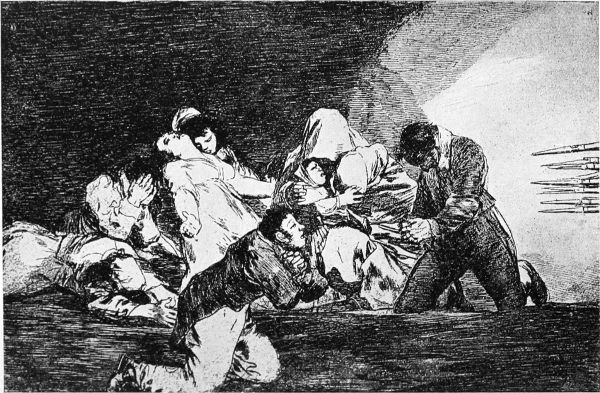
| THE BAYONETS | Frontispiece |
| FACING PAGE | |
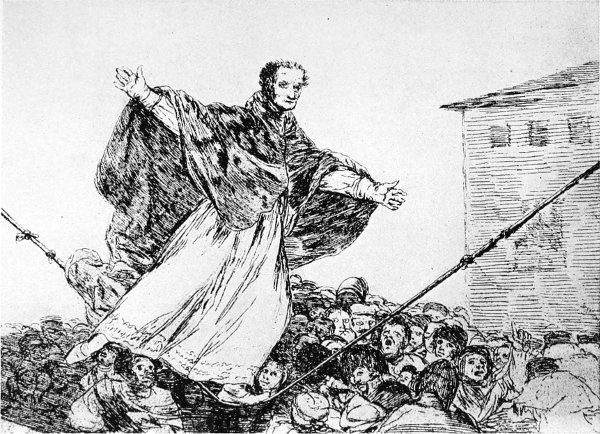
| OVER THE JAWS OF THE CROWD | 16 |
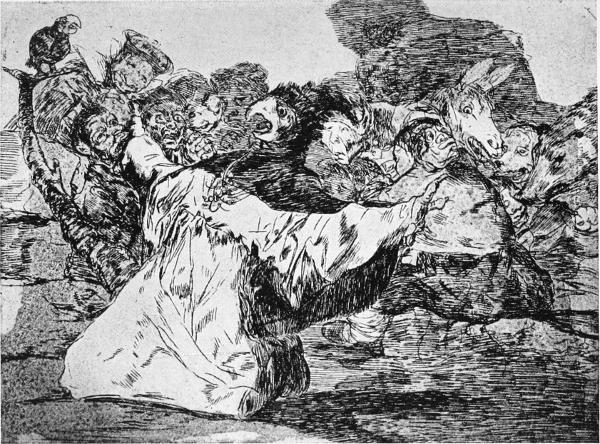
| THE OLD DANCE OF CHARLATANS AND BEASTS | 22 |
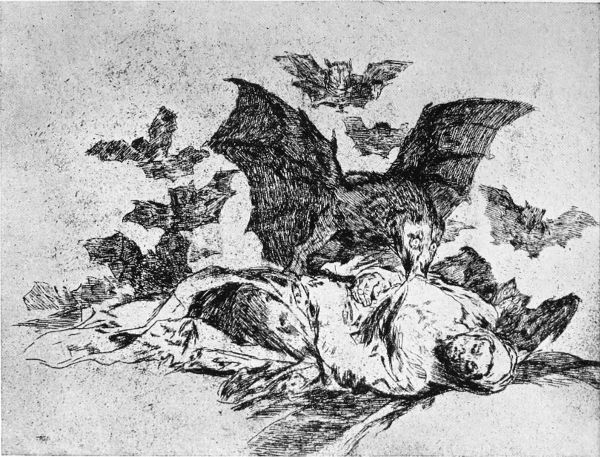
| THE VAMPIRE | 56 |
Reproduced from etchings by Goya
Rada, wife of the village doctor.
Bettine, her daughter, aged twelve.
German soldiers quartered in her
house during the occupation
of the village.
Nanko, an old, half-witted schoolmaster, living in the care of the doctor. He has a delusion that it is always Christmas Eve.
German soldiers.
The action takes place in a Belgian village, during the War of 1914. The scene is a room in the doctor’s house. On the right there is a door opening to the street, a window with red curtains, and a desk under the window. On the left there is a large cupboard with a door on either side of it, one leading to a bedroom and the other to the kitchen. At the back an open fire is burning brightly. Over the fireplace there is a reproduction in colours of the Dresden Madonna. The room is lit only by the firelight and two candles in brass candlesticks, on a black oak table, at which the two soldiers are seated, playing cards and drinking beer.
Rada, a dark handsome woman, sits on a couch to the left of the fire, with her head bowed in her hands, weeping.
Nanko sits cross-legged on a rug before the fire, rubbing his hands, snapping his fingers, and chuckling to himself.
Tarrasch (throwing down the cards).
Pish! You have all the luck. (He turns to Rada) Look here, my girl, where is the use of snivelling? We’ve been killing pigs all day and now we want to unbuckle a bit. You ought to think yourself infernally lucky to be alive at all, and I’m not sure that you will be so fortunate when the other boys come back. Wheedled them out of the house finely, didn’t you? On a fine wildgoose chase, too. Hidden money! Refugees don’t bury their money and leave the secret behind them. You’ve been whimpering ever since we two refused to believe you. What’s your game, eh? I warn you there’ll be hell to pay when they come back.
Rada (sobbing and burying her face).
God, be pitiful!
Tarrasch.
This is war, this is! And you can’t expect war to be all swans and shining armour. No—nor smart uniforms either. Look at the mud my friend and I have already annexed from Belgium. Brander, you know it’s a most astonishing fact; but I have remarked it several times. Those women whose eyes glitter at the sight of a spiked helmet are the first to be astonished by the realities of war. They expect the dead to jump up and kiss them and tell them it is all a game, as soon as the battle is ended. No, no, my dear; it’s only in war that one sees how small is one’s personal happiness in comparison with greater things. Isn’t it?
(He fills a glass and drinks. Brander lights a cigar.)
Nanko.
Exactly. In times of peace we forget those eternal silences. We value life too highly. We become domesticated. Why, I suppose in this magnificent war there have been so many women and children killed that they would fill the great Cloth Hall at Ypres; and, as for the young men, there have been so many slaughtered that their dead bodies would fill St. Peter’s at Rome. Why, I suppose they would fill the three hundred abbeys of Flanders and all the cathedrals in the world chock-full from floor to belfry, wouldn’t they? How Goya would have loved to paint them! Can’t you see it?
(He grows ecstatic over the idea.)
But perhaps if Goya were living to-day he would prefer to pack them into Chicago meat factories, with the intellectuals dancing outside like marionettes, and the unconscious Hand of God pulling the strings. You know one of their very latest theories is that He is a somnambulist.
Tarrasch (to Rada).
You should read Schopenhauer, my dear, and learn to estimate these emotions at their true value. You would then be able to laugh at these feelings which seem to you now so important. It is the mark of Kultur to be able to laugh at all sentiments. Isn’t it?
Nanko.
The priests, I suppose, are still balancing themselves on the tight-rope, over the jaws of the crowd. The poor old Pope did his best for his Master, when the Emperor asked him for a blessing on the war. “I bless Peace,” said the Pope; but nobody listened. I composed a little poem about that. I called it St. Peter’s Christmas. It went like this:—
(Tarrasch and Brander applaud ironically.)
Tarrasch.
Excellent! Excellent! (To Rada) You should have seen our brave soldiers laughing—do you remember, Brander—at a little village near Termonde. They made the old vicar and his cook dance naked round the dead body of his wife, who had connived at the escape of her daughter from a Prussian officer.
Nanko.
Ah, that was reality, wasn’t it? None of your provincial respectability about that, none of your shallow conventionality! That’s what the age wants—realism!
Tarrasch.
It was brutal, I confess; but better than British hypocrisy, eh? There was something great about it, like the neighing of the satyrs in the Venusberg music.
Rada (sinking on her knees by the couch and sobbing).
God! God!
Tarrasch.
They were beginning to find out the provincialism of their creeds in England. The pessimism of Schopenhauer had taught them much; and if it had not been for this last treachery, this last ridiculous outburst of the middle-class mind on behalf of what they call honour, we should have continued to tolerate (if not to enjoy), in Berlin, those plays by Irishmen which expose so wittily the inferior Kultur, the shrinking from reality, of their (for the most part) not intellectual people. I have the honour, madam, to request that you should no longer make this unpleasant sound of weeping. You irritate my nerves. Have you not two men quartered upon you instead of one? And are they not university students? If your husband and the rest of the villagers had not resisted our advance, they might have been alive, too. In any case, your change is for the better. Isn’t it?
(He lights a cigar.)
Nanko.
Exactly! Exactly! You remember, Rada, I used to be a schoolmaster myself in the old days; and if you knew what I know, you wouldn’t cry, my dear. You’d understand that it’s entirely a question of the survival of the fittest. A biological necessity, that’s what it is. And Haeckel himself has told us that, though we may resign our hopes of immortality, and the grave is the only future for our beloved ones, yet there is infinite consolation to be found in examining a piece of moss or looking at a beetle. That’s what the Germans call the male intellect.
Tarrasch.
Is this man attempting to be insolent?
(He rises as if to strike Nanko.)
Brander (tapping his forehead).
Take no notice of him. He’s only a resident patient. He was not calling you a beetle. He has delusions. He thinks it is always Christmas Eve. That’s his little tree in the corner. As Goethe should have said—
Tarrasch (laughing).
Very good! You should send that to the Tageblatt, Brander.
Well, Rada, or whatever your name is, you’d better find something for us to eat. I’m sick of this whimpering.
Wouldn’t your Belgian swine have massacred us all, if we’d given them the chance? We’ve thousands of women and children at home snivelling and saying, “Oh! my God! Oh! my God!” just like you.
Rada (rising to her feet in a fury of contempt).
(They stare at her in silence, over-mastered for a moment by her passion. Then, her grief welling up again, she casts herself down on the couch, and buries her face in her hands, sobbing.)
Brander.
Don’t you trouble about God. What can He do when both sides go down on their marrow-bones? He can’t make both sides win, can He?
Nanko.
That’s how the intellectuals prove He doesn’t exist. Either He is not almighty, they say, or else He is unjust enough not to make both sides win. But all those anthropomorphic conceptions are out of date now, even in England, as this gentleman very truly said. You see, it was so degrading, Rada, to think that God had anything in common with mankind (though love was once quite fashionable), and as we didn’t know of anything higher than ourselves we were simply compelled to say that He resembled something lower, such as earthquakes, and tigers, and puppet-shows, and ideas of that sort. Reality above all things! You may see God in sunsets; but there was nothing real about the best qualities of mankind. It’s curious. The more intellectual and original you are, the lower you have to go, and the more likely you are to end in the old dance of charlatans and beasts. I suppose that’s an argument for tradition and growth. If we call it Evolution, nobody will mind very much.
Rada (wringing her hands in an agony of grief).
Oh, God, be pitiful, be pitiful!
Brander (standing in front of her).
Look here, we’ve had enough of this music. I’ve been watching you, and there’s more upon your mind than sorrow for the dead. Why were you so anxious to wheedle us all out of the house? Tarrasch has warned you there’ll be hell to pay when the others come back. What was the game, eh? You’d better tell me. You couldn’t have thought you were going to escape through our lines to-night.
(There is a sudden uproar outside, and a woman’s scream, followed by the terrified cry of a child.)
Ah! Ah! Father!
Brander.
Hear that. The men are mad with brandy and blood and—other things. There’s no holding them in, even from the children. You needn’t wince. Even from the children, I say. What chance would there be for a fine-looking wench like yourself?
No, you were not going to try that. You’ve something to hide, here, in the house, eh? Well, now you’ve got rid of the others, and we’ve had a drink, we’re going to look for it. What is there?
(He points to the bedroom door.)
Rada (rising to her feet slowly, steadying herself with one hand on the couch and fixing her eyes on his face).
My bedroom. No. I’ve nothing here to hide. This is war, isn’t it? If I choose to revenge myself on those that have used me badly, people that I hate, by telling you where you can find what everybody wants, money, money—I suppose you want that—isn’t that good enough?
Brander.
Better come with us, then, and show us this treasure-trove.
Rada (shrinking back).
No, no, I dare not. All those dead out there would terrify me, terrify me!
Tarrasch.
A pack of lies! What were you up to, eh? Telephoning to the English?
Brander.
It has been too much for her nerves. Don’t worry her, or she’ll go mad. Then there’ll be nobody left to get us our supper.
(Tarrasch wanders round the room, opening drawers and examining letters and other contents at the desk.)
Nanko.
That would be selfish, Rada. You know it’s Christmas Eve. Nobody ought to think of unpleasant things on Christmas Eve. What have you done with the Christmas-tree, Rada?
Brander.
And who’s to blame? That’s what I want to know. You don’t blame us, do you? We didn’t know where we were marching a month ago; and possibly we shall be fighting on your side against somebody else, a year hence.
Nanko.
Of course they didn’t know! Poor soldiers don’t.
Tarrasch (who has been trying the bedroom door).
In the meantime, what have you got behind that door? Give me the key.
Rada (hurriedly, and as if misunderstanding him, opens the cupboard. She speaks excitedly).
Food! Food! Food for hungry men. Food enough for a wolf pack. Come on. Help yourselves!
Tarrasch.
Look, Brander! What a larder! Here’s a dinner for forty men. Isn’t it?
Rada.
Better take your pick before the others come.
(She thrusts dishes into Brander’s hands and loads Tarrasch with bottles. They lay the table with them, Rada seeming to share their eagerness.)
Brander (looking at his hands).
Here! Bring me a basin of warm water. There are times when you can’t touch food without washing your hands.
(Rada hesitates, then goes into the kitchen. Brander holds out a ring to Tarrasch.)
Nanko (rising and peering at them).
(He fingers it curiously.)
Brander (pushing him away).
(Rada enters with a bowl of water, sets it on a chair, and returns to the couch. Brander washes his hands.)
Tarrasch.
(Rada approaches, stares at the bowl, and moves back, swaying a little.)
Brander (roughly).
(He goes out.)
Nanko.
Tarrasch (again fumbling at the bedroom door).
Rada (thrusting herself between him and the door).
Tarrasch.
(Brander enters. He goes to the table and begins eating.)
Nanko.
(He shakes an empty stocking that hangs in the fire-place.)
Tarrasch.
Rada (looks at him for a moment before speaking).
(She stretches out her hands pitifully and begins to weep. The men stand staring at her. The door opens behind her, and Bettine, in her night-dress, steals into the room.)
Bettine.
Mother——Oh!
(She stops at the sight of the strangers.)
Brander.
Bettine.
(She goes nearer.)
Brander.
Bettine.
Brander.
Bettine (who has been watching him curiously).
Brander.
Bettine.
Brander.
Bettine.
(She runs to the stocking and examines it. Tarrasch and Brander return to the table and eat and drink.)
(With a sudden note of fear in her voice.)
Rada (putting an arm round her).
Bettine.
Nanko.
(Bettine pulls the little Christmas-tree out from the corner. Rada glances from the child to the men, as if hoping that her play will win them to help her.)
Bettine.
Brander.
Nanko (clapping his hands).
Tarrasch.
Bettine (laughing merrily).
Nanko (eagerly).
Brander.
Bettine (staring at it).
Tarrasch.
Nanko (clapping his hands and capering).
Bettine.
Rada.
Brander.
Bettine.
Nanko.
Bettine.
(Brander opens the package. Nanko rubs his hands in delight. They get the gramophone ready.)
Nanko.
(She laughs.)
(She laughs.)
Tarrasch (adjusting a record).
(There is an uproar of drunken shouts in the distance. Brander locks the outer door.)
Bettine.
Brander (to Tarrasch).
Tarrasch.
Brander.
Nanko.
(He lifts one of the candles to illuminate the picture of the Madonna and child. For a moment he speaks with a curious dignity.)
Bettine (with her hands behind her, as if in school, she obeys him).
She laid Him in a manger, because there was no room for them in the inn.
And there were in the same country shepherds abiding in the field, keeping watch over their flock by night,
And lo, the angel of the Lord came upon them, and the glory of the Lord shone round about them, and they were sore afraid.
And the angel said unto them, “Fear not: for behold I bring you good tidings of great joy, which shall be to all people.
“For unto you is born this day in the City of David a Saviour, which is Christ the Lord.
“And this shall be a sign unto you; ye shall find the babe wrapped in swaddling clothes, lying in a manger.”
And suddenly there was with the angel a multitude of the heavenly host, praising God, and saying:—
“Glory to God in the Highest, and on earth peace....”
(There is silence for a moment, then a pistol-shot, a scream, and a roar of drunken laughter without, followed by a furious pounding on the door. Bettine runs to her mother.)
Brander.
(He calls through the door.)
(The uproar grows outside, and the pounding is resumed. There is a crash of broken glass at the window.)
Bettine.
Brander.
(Rada snatches the revolver from the Christmas-tree and hurries Bettine into the bedroom just as the other door is burst open and a troop of soldiers appear on the threshold, shouting and furious with drink. They sing, with drunken gestures, in the doorway:)
First Soldier.
Brander.
Second Soldier.
Tarrasch.
First Soldier.
Nanko.
Second Soldier.
(They make a rush towards the room.)
Nanko.
(A soldier tries the bedroom door. It is opened from within, and Rada appears on the threshold with the revolver in her hand.)
First Soldier.
Rada.
Second Soldier.
Nanko (who is hugging his Christmas-tree near the fire again).
Rada.
First Soldier.
(They make a movement towards her, which she arrests by raising the revolver.)
Rada.
Nanko.
Rada.
Second Soldier.
First Soldier.
(They laugh uproariously, and sing again mockingly:)
(They move forward again.)
Rada (raising the revolver).
Soldiers.
Rada.
(They advance towards her.)
First Soldier.
Soldiers.
(They make a rush. Rada steps back into the bedroom and shuts the door in their faces.)
Second Soldier.
Bettine (crying within).
Brander (trying to interpose).
Tarrasch.
First Soldier.
(They put their shoulders to it. Brander makes a sign to Tarrasch. They try to pull the men back. There is a scuffle and Brander is knocked over. He rises with the blood running down his face, while Tarrasch still struggles. The door begins to give. A shot is heard within. The men pause and there is another shot.)
Brander.
(There is a booming of distant artillery.)
(A bugle-call sounds in the village street.)
Tarrasch.
(They all rush out except Nanko, who peers after them from the door. Leaving it open to the night, he takes a marron glacé from the table, crosses the room, and begins to examine the gramophone.
Confused sounds of men rushing to arms, thin bugle-calls in the distance, and the occasional clatter of a galloping horse blow in from the blackness framed in the open door. The deep pulsation of the British artillery is heard throughout, in a steady undertone.)
Nanko (calling aloud as he munches).
(He tiptoes to the door and peers into the night.)
(He returns to the gramophone.)
(He reads the title.)
(He accidentally sets the gramophone working and jumps back, a little alarmed. He runs to the bedroom door.)
(The artillery booms like a thunder-peal in the distance. Then the gramophone drowns it with the massed voices of the Imperial Choir singing:)
(Nanko touches the floor under the door of the bedroom and stares at his hand.)
Nanko.
(A look of horror comes into his face as he stands listening to the music. Then, as if slowly waking from a dream and almost as if sanity had returned for a moment, he cries:)
(He falls on his knees by the bedroom door and calls, as if to the dead within:)
The Imperial Choir.
Nanko.
(He bows his head against the closed door, while the gramophone lifts the chorus of the Imperial Choir over the deepening thunder of the guns:)
The Gresham Press
UNWIN BROTHERS, LIMITED
WOKING AND LONDON