Rachel was a very unhappy little girl as she sat in an omnibus
with Miss Moore, on her way to the British Museum. She didn’t
want to go to the British Museum. She didn’t want to be in
London at all. She longed desperately to be back in her country
home with her father and mother—now, alas! far away in
Egypt.
Everything as Rachel said had happened so suddenly.
Certainly her mother had been ill some time, but it was all
at once decided that the only possible place to send her little
daughter in a hurry, was to Aunt Hester, in London.
Aunt Hester, who was her father’s eldest sister, and in the
eyes of Rachel, at least, awfully old, was quite kind, but also,
as she admitted, quite unused to children. The first thing she
did therefore, was to engage a governess to look after her niece
for the seven weeks she would have to remain with her.
Miss Moore, a rather uninteresting, middle-aged lady, had
duly arrived the previous evening, and at breakfast time Aunt
Hester had suggested the British Museum as a suitable place to
which Rachel might be conducted.
“She’s never been to London before, and, though I don’t want
her to sit too long over lessons, I think she should improve her
mind while she is here. The British Museum is an education in
itself,” declared Aunt Hester, and Miss Moore had primly agreed.
So it happened that at eleven o’clock on a bright spring morning,
a secretly unwilling little girl climbed the steps leading to the
great entrance of the great museum. The pigeons on the
steps reminded her of the dovecote at home, and the tears came
suddenly to her eyes, as almost without thinking she counted
the number of birds on the top step.
“Seven,” she murmured half aloud.
“Seven what?” asked Miss Moore.
“Seven pigeons on this step. Aren’t they pretty?” Rachel
lingered to look at the burnished shining necks. She would much
rather have stayed outside with the pigeons, but Miss Moore
hurried on to the swing doors, and Rachel was obliged to follow
her into the huge building.
“What do they keep here?” she asked listlessly, when Miss
Moore had given up her umbrella to a man behind a counter, just
inside.
“All sorts of things,” returned her governess vaguely. “It’s
a museum, you know.”
Rachel was not very much the wiser but, as she walked with
Miss Moore from one great hall to another, she was confused and
wearied by the number of things of which she had glimpses.
There were rows of statues, cases full of strange objects, monuments
in stone all covered with carvings; curious pictures on the
walls. Indeed, there were “all sorts of things” in the British
Museum! But, as she knew nothing about any of them, and Miss
Moore volunteered very little information, she was yawning with
boredom by the time her governess remarked:
“Now, these things come from Egypt.”
For the first time Rachel pricked up her ears. Mother and
Dad were now in Egypt, and as she glanced at the long stone
things like tombs, at drawings and models and a thousand other
incomprehensible objects all round her, she wished she knew
something about them. Instead of saying so, however, and
almost without thinking, she murmured, “This is the seventh
room we’ve come to. I’ve counted them.”
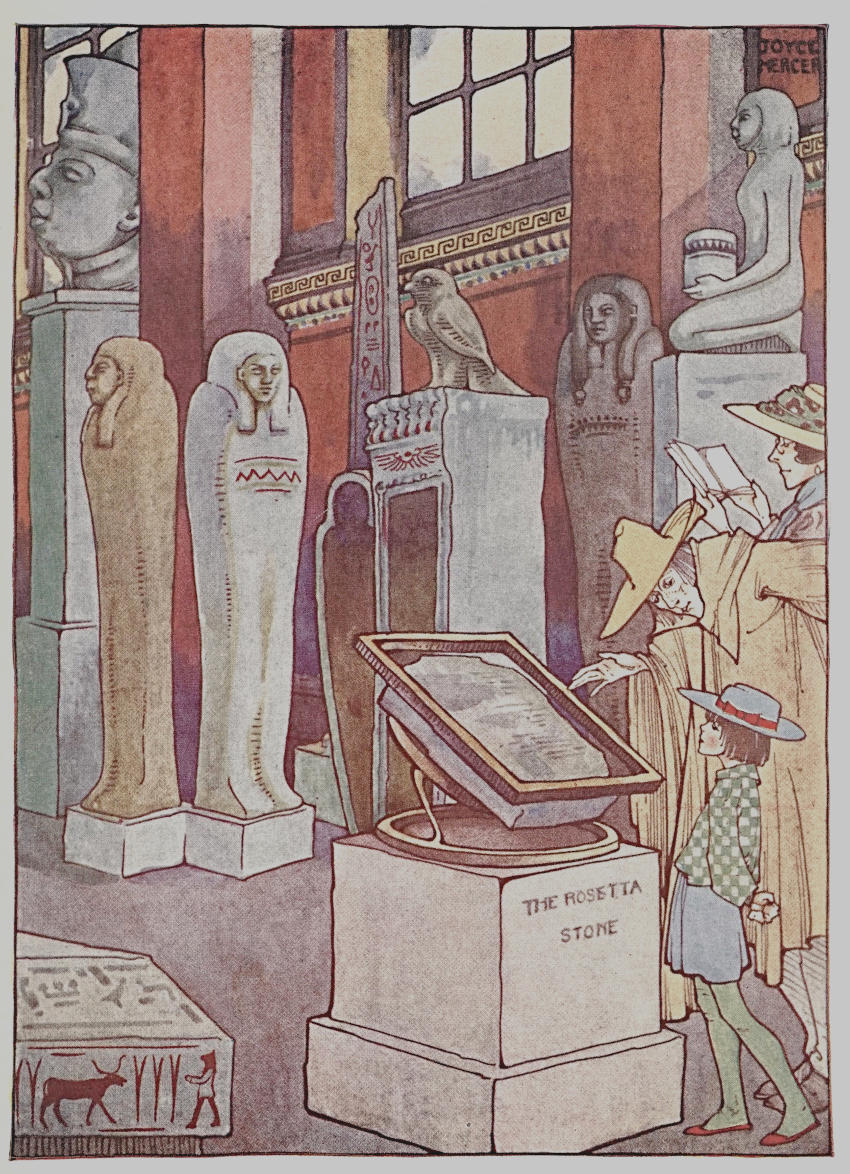
“This is the famous Rosetta Stone,” observed Miss Moore,
reading an inscription at the foot of a dull-looking broken block
of marble in front of them.
Rachel yawned for the seventh time with such vigour that her
eyes closed, and when she opened them a queer-looking little old
man was bending over the big block.
“What is the date of the month?” he asked so suddenly
that she started violently.
“Let me see. The seventh, I think. Yes—the seventh,”
she stammered, raising her eyes to his face.
He was so muffled up, that nearly all Rachel could see of him
was a pair of very large dark eyes, under a curious-looking hat.
He wore a long cloak reaching to his heels, and one end of the
cloak was flung over his left shoulder almost concealing his face.
Rachel scarcely knew why she thought him so old, except
perhaps, that his figure seemed to be much bent.
“Quite right. It’s the seventh,” he returned. “And what’s
the name of your house?”
Rachel looked round for Miss Moore, who strangely enough
was still reading the inscription on the stone, and seemed to be
paying no attention to the old man’s questions.
“It’s called ‘The Seven Gables,’” she answered.
“And where are you living now?”
“At number seven Cranborough Terrace.”
“And your name is Rachel. Do you read your Bible? How
many years did Jacob work for his wife?”
“He waited for her seven years. And her name was Rachel,”
she exclaimed, forgetting to wonder why Miss Moore didn’t
interfere, or join in a conversation which was becoming so
interesting.
“The seventh of the month, and the Seven Gables, and seven
years for Rachel—and, why, there were seven pigeons just outside
as I came in, and this is the seventh room we’ve come to. Because
I counted them. I don’t know why—but I did. What a
lot of sevens.”
“Can you think of any other sevens in your life?” asked the
little old man, quietly.
“Why, yes!” she answered, excitedly. “There are seven
of us. All grown up except me. And I’m the seventh child,
and the youngest!”
“Seven is a magic number, you know,” said her companion,
gravely.
“Is it? Really and truly?” asked Rachel. “Oh, I do love
hearing about magic things! But I thought there weren’t any
now?”
“On the contrary, the world is full of them. Take this, for
instance.” He pointed to the broken marble block. “That’s
a magic stone.”
Rachel gazed at it reverently. “What does it do?” she
asked almost in a whisper.
“It’s a gate into the Past,” returned the old man in a dreamy
voice. “But come now,” he went on more briskly, “can we
remember any more sevens? You begin.”
“There are seven days in the week,” said Rachel, trying to
think, though she was longing to ask more about the magic stone.
“There’s the seven-branched candlestick in the Bible,” the
old man went on, promptly.
“And the seven ears of corn and the seven thin cows that
Pharaoh dreamt about,” returned Rachel, entering into the spirit
of the game.
“The story of the Seven Sleepers.”
“The Seven Champions of Christendom,” added Rachel, who had
just read the book. “Oh, there are thousands of sevens. I can
think of lots more in a minute.”
“It’s my turn now,” was the old man’s answer. “The Seven
Wonders of the World.”
“I never heard of them. What are they?” Rachel demanded.
Again the old man pointed to the stone. “That gateway
would lead you to one of them,” he said, quietly, “if, as I’m beginning
to think, you’re one of the lucky children.”
THE ROSETTA STONE
“Do lucky children have a lot to do with seven? Because
if so, I ought to be one, oughtn’t I? It’s funny I never thought
about it before, but there’s a seven in everything that has to do
with me! And—”
“We’ll try,” interrupted the little old man. “Shut your
eyes and bow seven times in the direction of this stone. Never
mind this lady”—for Rachel had quite suddenly remembered
the curious silence of her governess. “She won’t miss you. You
may do as I tell you without fear.”
Casting one hasty glance at Miss Moore, who had moved to a
little distance and was just consulting her watch, Rachel, full of
excited wonder, obeyed. Seven times she bent her head with
fast-closed eyes, and opened them only when her companion called
softly “Now.”
Even before she opened them, Rachel was conscious of a
delicious warmth like that of a hot midsummer day. A moment
ago she had felt very chilly standing before the marble block Miss
Moore called the Rosetta Stone, in a big, gloomy hall of the British
Museum. How could it so suddenly have become warm?
In a second the question was answered, for she stood under
a sky blue as the deepest blue flower, and the glorious sun lighted
a scene so wonderful that Rachel gave a scream of astonishment.
“Where are we?” she gasped.
“In the mighty and mysterious land of Egypt,” answered
her companion, “as it appeared thousands of years before the
birth of Christ.”
His tone was so solemn that Rachel turned quickly to look
at him, and, wonder of wonders, no old man was by her side!
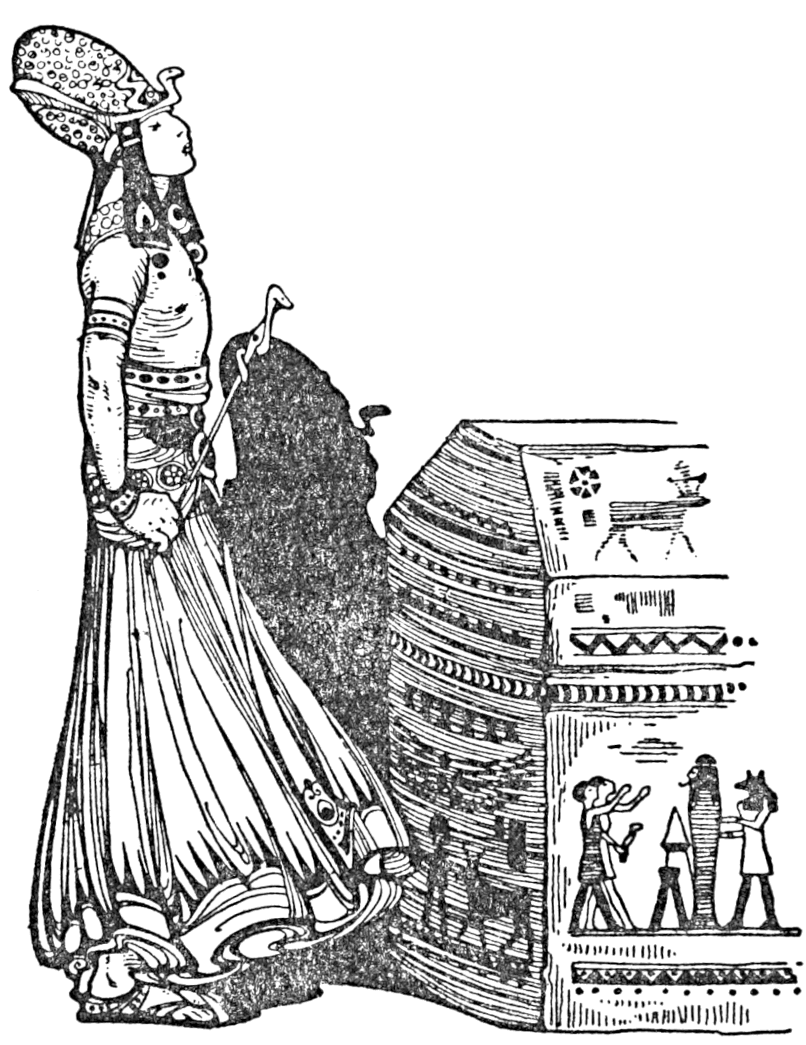
A dark-skinned youth stood there, dressed in a curious but beautiful
robe with strange designs embroidered on its hem, and a no less
strange head-dress, from which gold coins fell in a fringe upon
his forehead.
“Oh!” cried Rachel, when she could speak for amazement.
“You were old just now. I don’t understand. Who are you?”
she added, in confusion.
The young man smiled, showing a row of beautiful white teeth.
“My name is Sheshà. I am old,” he said. “Very, very old.”
He pointed to a great object at which, so far, in her astonishment,
Rachel had scarcely had time to glance. “I was born before
that was quite finished—six thousand years ago.”
Rachel gasped again.
“But you look younger than my brother, and he’s only twenty,”
she exclaimed.
“In returning to the land of my birth I return also to the age
I was when I lived in it.... But now, little maid of To-day,
look around you, for there stands, as it stood six thousand years
ago, one of the Seven Wonders of the World.”
Rachel obeyed and gazed upon a huge building with a broad
base, tapering almost to a point, whose walls were of smooth
polished stones of enormous size. Only a moment previously she
had glanced carelessly at pictures of buildings like this one, but
now, as she saw it rising before her in all its grandeur out of the
yellow sand, and under a canopy of blue sky, she almost held her
breath.
“It is a pyramid, isn’t it?” she whispered. “I’ve seen pictures
of pyramids, but I don’t know anything about them.”
“It is the first great pyramid of Egypt,” answered the young
man. “And, little maid, you are highly favoured, for you see
it as it looked nearly six thousand years ago. It was already old
when Joseph was in Egypt, and Moses saw it when he lived in the
palace of Pharaoh’s daughter.”
Rachel gasped. “But what is it? What is it built for?”
she asked.
“For the tomb of a king. That pyramid—” he pointed towards
it—“was built by the great King Cheops, and because you
are one of the fortunate children of the magic number seven, you
see one of the Seven Wonders of the World as it stood fresh from
the workers’ hands.”
“Dad is in Egypt now. He doesn’t see it like this then?”
Sheshà smiled. “Nay. He has already approached the
Wonder in an electric car—like all the other travellers of to-day,
and instead of these walls of granite which you behold, graven
over with letters and strange figures, he has seen great rough steps.”
“Steps?” echoed Rachel. “Why are there steps up the
side now?”
“Because beneath these smooth walls the pyramid is built
of gigantic blocks of stone, and now that their covering has been
removed, the blocks look like steps which can be, and are climbed
by people who live in the world to-day.”
“But why was its beautiful shining case taken off?” Rachel
asked, looking with curiosity at the carving upon it.
“Because in the course of long years the people of other nations
who conquered Egypt and had no respect for my wondrous land,
broke up the ‘beautiful shining case,’ to quote your own words,
little maid, and used it for building temples in which they worshipped
gods strange and new.”
Rachel glanced again at her companion. She was still so bewildered
that she scarcely knew which she should ask first of the
hundred questions crowding to her mind. And then everything
around her was so strange and beautiful! The yellow sand
of the desert, the blue sky, the burning sun, the long strip of fertile
land bordering a great river.
“That must be the Nile,” she thought, remembering her geography.
“The Nile is in Egypt.”
Just as though he read her thoughts, Sheshà again broke silence.
“Do you wonder that we worshipped the river in those far-off
days?” he asked, dreamily.
“Did you? Why?” Rachel gazed at him curiously.
“It was, and is, the life-giver,” returned Sheshà. “But for
that river, there would never have been any food in this land. And
therefore no cities, no temples, no pyramids, no great schools of
learning as there were here in ancient days when Moses was ‘learnèd
in all the wisdom of the Egyptians.’”
“Yes, but how could the river make the corn grow, and give
you food?” asked Rachel. “I thought it was the rain that
made things grow.”
“In Egypt rain does not fall. But the river, this wondrous
river of ours, does the work of rain. Once every year it overflows
its banks, and the thirsty land is watered, and what would
otherwise be all desert, like the yellow sand you see that is not
reached by the flood, becomes green with waving corn, and shady
palm trees, and beautiful with fruit and flowers. Yes, no wonder
we worshipped our river.”
Rachel would like to have asked him how the river was worshipped,
but Sheshà seemed rather to be talking to himself than
to her, and there was such a curious far-away look on his face
that she felt shy of questioning him. He stood gazing at the
Pyramid as though he saw things even more amazing than its
mighty form.
“It must have taken a long time to build,” she ventured at
last, rather timidly.
Sheshà started.
“I was dreaming,” he said. “A long time to build? Verily.
Would you care to see by whom, and at what cost it was raised?
I can show you. We have but to travel a little further back into the
Past for that. Shut fast your eyes and bow seven times as before.”
Rachel needed no second bidding, and in a few seconds, having
obeyed the instructions of her companion, she looked again
upon a scene strange and marvellous. The great Pyramid
was there as before, but as yet not quite finished.
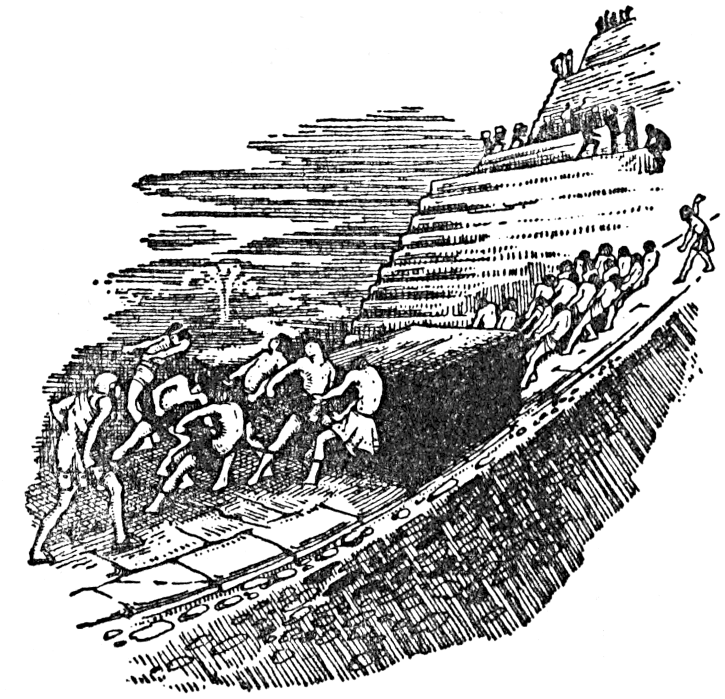
Its mighty walls were built,
and were being covered by the
smooth case of granite, and
round the great pile, like ants
swarming over an ant hill, were
the builders—thousands upon
thousands of dark-skinned,
almost naked, men, toiling like
the slaves they were. Here
great blocks of marble and
granite were being dragged from
barges on the river. There, hundreds
of slaves were hoisting the huge
slabs into place on the as yet, unfinished
walls, while multitudes of others swarmed over and round the
monument, cutting, hammering, polishing, chiselling. A hum as of
innumerable bees filled the air, and indeed, Rachel was reminded
of a hive, the inside of which her father had once shown her, all
quivering with the movement of the worker bees as they toiled
to make their cells.
She gave a little scream of astonishment at the sight of the
thronging multitudes, and presently heard the grave voice of
Sheshà speaking.
“Behold, little maiden, in what manner this Wonder of the
World was fashioned. Out of the toil and labour of flesh and
blood, in the days when the Pharaohs ruled in this land, and cared
naught for the lives of their humbler subjects. Of these, as you
see, they made slaves who did the work that in the world of to-day
is performed by machines, by steam power, by electricity, by all
the new inventions of modern times.”
“Do the people who come to Egypt now know all this? I
mean people who don’t come in a magic way like me. Are there
history books all about Egypt as it was long ago?”
Sheshà pointed to the Pyramids. “That and many other
monuments are the history books—the great tombs, and all the
palaces and temples and columns still standing after thousands
of years. On them are written the story of the land. Behold,
it is being written before your eyes, since by what you call magic
you are watching the work of men who laboured four thousand
years before Christ.”
“But how can those funny pictures and signs they are cutting
be writing?” asked Rachel, watching a man who was graving
strange marks on the granite blocks.
“Such was the writing of the ancient Egyptians,” replied
Sheshà, “called in later days hieroglyphics, or secret writing, because,
as ages passed, the meaning of the writing was forgotten, and men
gazed at these strange signs and wondered what they meant, and
what secrets were hidden from them by a language which no one
could read.”
“And did they ever find out the secret?” asked Rachel, eagerly.
“Can anyone nowadays read what is written on stones like these?”
“Yes. The secret has at last been discovered. For thousands
of years it was hidden, but at last, in modern days, almost within
the life-time of some old men and women still on this earth, the
mystery was revealed by means of a magic stone.”
“I know!” cried Rachel excitedly. “That was the piece of
marble I was looking at when I met you in the British Museum—was
it a minute ago, or ages?” she went on, looking puzzled.
“It all seems like a dream, somehow. But I remember Miss
Moore, saying ‘This is the Rosetta Stone’—and I didn’t know
what she meant. And then you said, ‘That stone is a gate into the
Past,’ and I didn’t know what you meant, either!”
Again Sheshà smiled gravely as he looked down at her.
“I will tell you. Ninety years ago, a Frenchman was living
in this mysterious land of Egypt; knowing no more of the secret
writing on palaces and tombs and temples than do you, little
maiden. But while he was at Rosetta, which is a town on the sea
coast not far from where we stand, he found a broken block of
marble—a fragment from what was once, perhaps, a mighty
temple. Upon it he saw the secret marks he could not understand,
but beneath it were some lines in Greek, which he and other
people could read. Now, thought the Frenchman, ‘What if these
Greek words should be the translation of those hieroglyphics
above, which no one for thousands of years has been able to decipher?’
So he brought the broken stone away with him. And
the scholars examined it, and at last, after patient study, comparing
the Greek words, which they could understand, with the mysterious
signs and pictures above, they learnt to read them also. And so,
from that piece of black marble which now rests in the great
museum of your great city of London, learned men have made
Egypt give up one of its many secrets. All that is written on
columns, walls and tombs, can now be read by the scholars who
have studied the hieroglyphic writing of this ancient land, and
translated it into English and French, and all the languages of
men who live to-day. Was I not right to call ‘the Rosetta Stone’
a stone of magic, a gateway into the Past?”
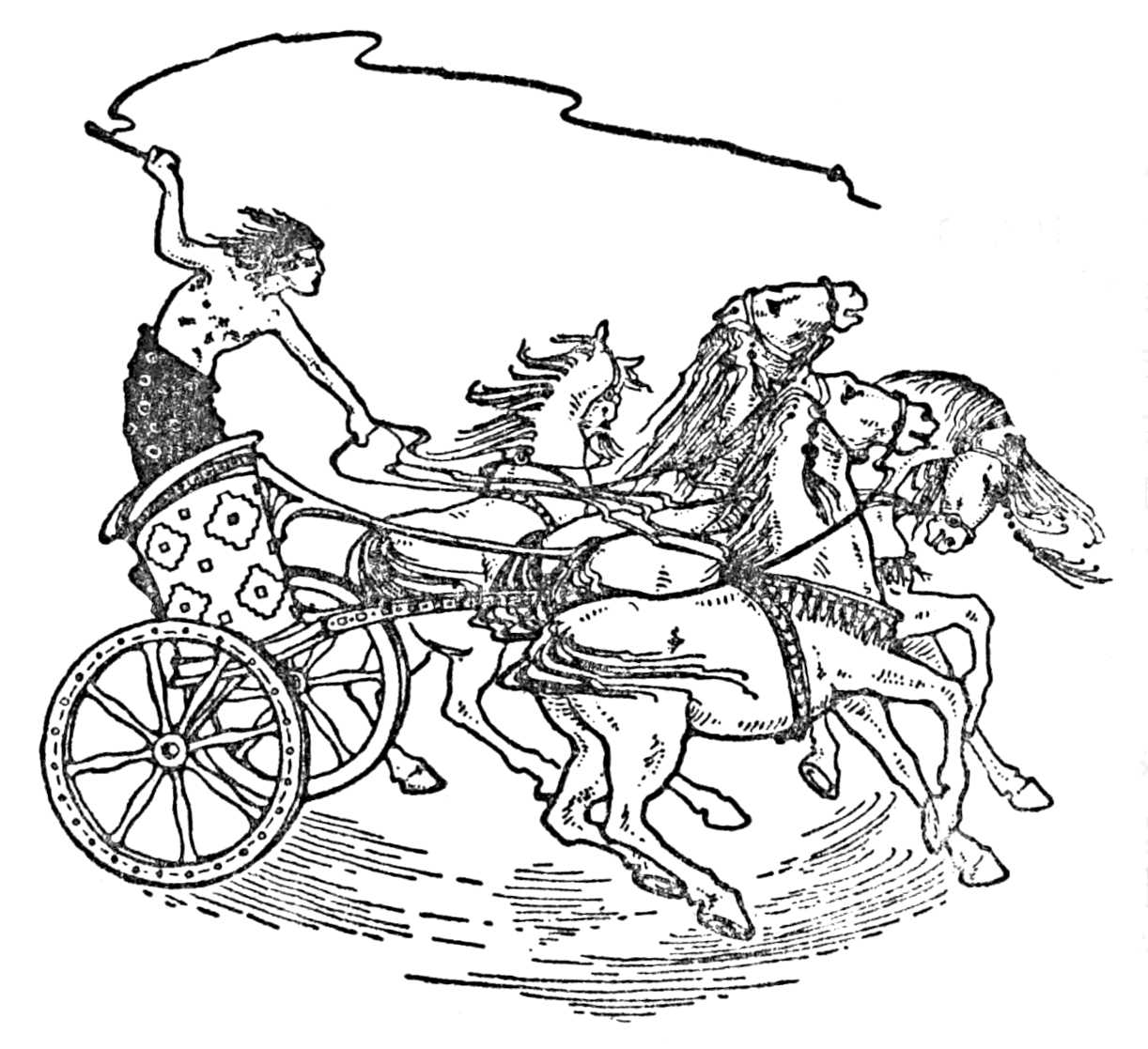
PHARAOH IN HIS CHARIOT
“Oh, yes!” exclaimed Rachel, drawing a long breath. “If
that Rosetta Stone had never been found, people would still be
looking at the—what did you call the writing? Oh yes, the
hieroglyphics, and wondering what they mean, wouldn’t they?
But you know, of course? You have always known.”
“I wrote signs and figures like these, six thousand years ago,”
replied Sheshà, gazing upon the mighty unfinished Pyramid upon
which, like clustering bees, the brown-skinned, half-naked men
were slaving.
“Will you read me something that’s written there? Please
read what that man has just finished carving,” begged Rachel,
pointing to a youth who was working at the base of the Pyramid.
“What do those signs mean?”
“They record,” said Sheshà, glancing at them, “that a hundred
thousand men were always kept working upon this tomb.
These slaves that you behold are the last hundred thousand, for
as you see the Pyramid is nearly built. But for twenty years
previous to this moment of Past time, every day, a hundred thousand
men have been working in the same way as these poor slaves
before your eyes.”
Rachel was just trying to put into words something of all the
wonder and bewilderment she felt, when a strain of music that
sounded rather faint and far away made her turn quickly. The sight
she saw was so wonderful that I scarcely know how to describe it.
“Who is this?” she whispered. “Why are the people bowing
down before him?”
“It is Pharaoh the king, come to look at his Pyramid—the
tomb for himself which is rising under the hands of his slaves.
Well may you gaze in wonder, O child, for never before this, has a
little English maid been given sight of the far, far Past. You
behold Pharaoh in all his pomp and glory as he lived six thousand
years ago.”
And indeed Rachel gazed in wonder.
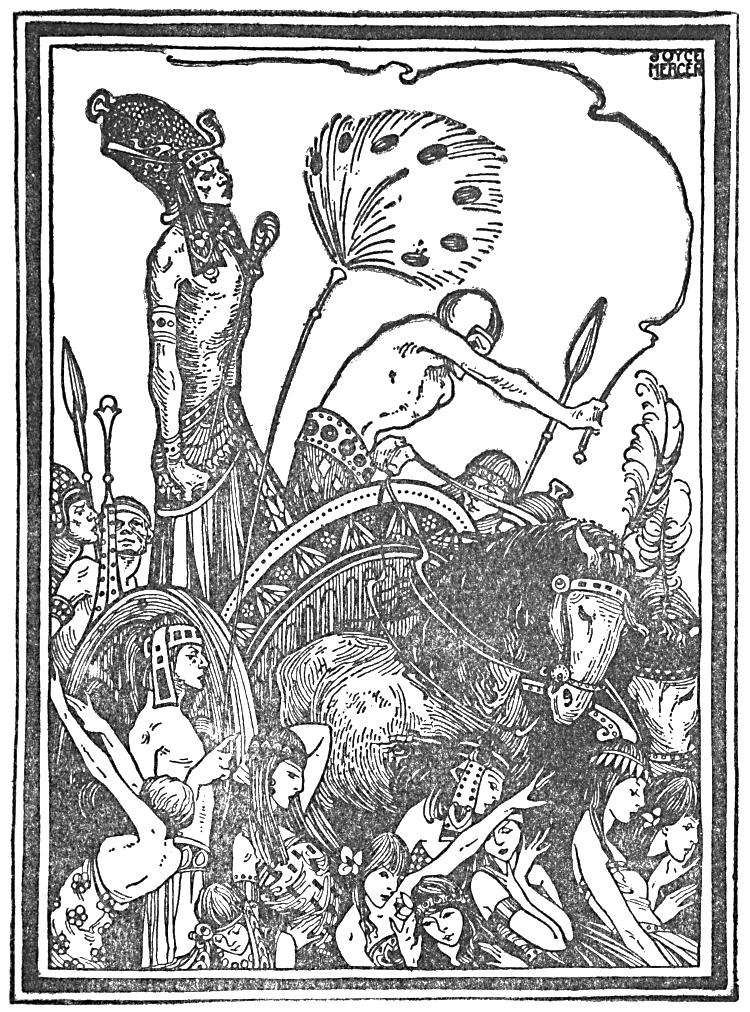
Looking down from the raised platform of soil on which stood
the nearly finished Pyramid, she saw a broad road, thronged with
a glittering company. In their midst, standing upright in a chariot
painted with brilliant colours and enriched with gold, was the
imposing figure of a man with an olive-tinted skin, dressed in a
white robe, bordered with gold. A head-dress strangely shaped
almost shrouded his face, and on his bare brown arms were
bracelets, and hanging from his neck long chains of metal work.
Running beside and behind the chariot, were slaves
carrying great fans, made, some of palm leaves,
some of feathers. They were followed by a
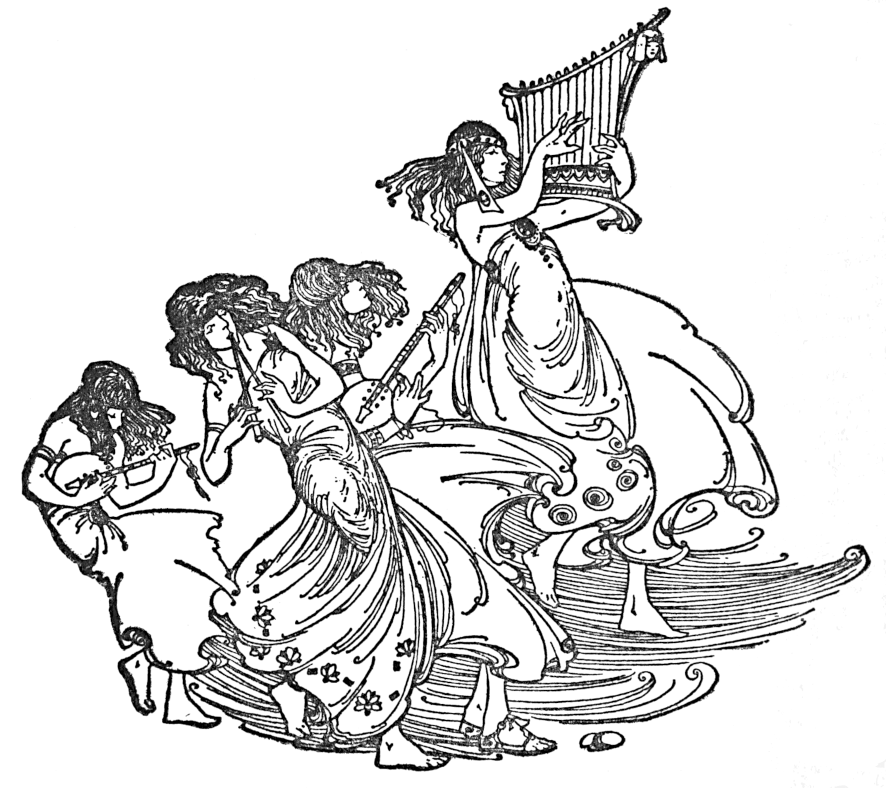
crowd of girls in gauzy robes, whose
black hair fell in tight ringlets on
their bare shoulders, holding in their
hands musical instruments of curious
form. Behind them followed other chariots filled with men clad in
the same sort of dress as that worn by Sheshà.
Rachel saw the wonderful procession clearly enough, yet it
seemed as though she was looking at it through a slight mist which
quivered like hot air, and made the figures behind it a little unreal,
as if something in a dream. This gauze-like mist she had
noticed before, in gazing at the workers on the Pyramid. It
stretched between her and the slaves like a barrier behind which,
though she could watch them, they toiled out of touch, and
somehow a long way from her.
“You are beholding scenes that took place thousands of years
ago, remember,” said the voice of Sheshà, and though Rachel
had not spoken, she knew he read her thoughts, and was
explaining. “Ages ago all these people were turned to dust.
They have arisen before your eyes—but only like painted figures
real though they seem. If you tried to touch them your hand
would but meet the air.”
“What is he going to do? Where is he going?” whispered
Rachel, who was feeling awe-struck, and perhaps a little frightened.
“Pharaoh is going to look at the tomb which has been prepared
for him,” said Sheshà, gravely. “In a moment we will follow him
into the heart of the Pyramid.”
“Pharaoh comes into the Bible,” began Rachel, looking puzzled.
“But I thought you said it was another man, King Cheops,
who had this Pyramid built.”
“Pharaoh was the name given to all the kings of Egypt, but
this is not the Pharaoh who dreamt of the fat and lean kine, nor
the Pharaoh Moses knew, who was stricken with plagues. This
Pharaoh, whose other name was King Cheops, lived long before
the days of Joseph and Moses.”
Rachel gave a funny little murmur of excitement.
“We have gone back far into the Past, haven’t we? It’s—it’s
rather frightening. I feel as though I should never get home
again!” She looked really anxious, and Sheshà laid his brown
hand gently upon her head.
“Have no fear. In less time than I take to say it, you will
be seated in an omnibus, travelling back to your aunt’s home,”
he declared with a curious smile.
“Oh, but I don’t want to go yet!” Rachel hastily assured
him. “I want to see everything. It’s so frightfully interesting,”
she went on, incoherently.
“Again have no fear. You shall see and hear, for Time itself
is a ‘magic’ thing, little maiden, and wonders can be worked
during the opening and shutting of the eyes. Let us now follow
that procession to the royal tomb.”
The painted chariot drawn by white horses with marvellous
trappings, had now been reined up before the entrance to a passage
on one side of the Pyramid. On either hand the workmen and the
other people who had been passing to and fro now lay prostrate in
the dust, while the great king was led from the chariot by the men
Rachel had already seen dressed in robes like that worn by Sheshà.
“Those are the priests of
the order to which I belong,”
he said. “They are the people
nearest to Pharaoh, the
learned men whom he
honours—poets, historians,
physicians, as well as priests.
With them he talks and takes
counsel. These others,” he
pointed to the poor men on
the ground, “are his slaves
who bow down before him,
and are used as beasts of
burden.”
Rachel looked at them
pityingly as with Sheshà she
followed the wise men and
the reigning Pharaoh, King
Cheops, into the passage
hewn within the Pyramid. No one noticed her presence, and
somehow, though she was almost close enough to touch the
robes in front of her, Rachel was not surprised. Plainly, as
through the quivering haze surrounding them she could see the
wonderful group of people, she knew they were not exactly real.
She could not have touched them. She saw their lips move, but
she heard no sound.
In a few minutes the passage, which sloped upwards, broadened
out into a little hall lined with polished granite. Here the
priests who were following the mighty Pharaoh, very slowly and
solemnly ranged themselves against the walls, leaving the middle
of the floor clear. Rachel then saw the king standing alone, and
looking down upon something that looked like a coffin made of
red granite placed in the centre of the hall. The priests bowed
their heads, and she saw their lips moving, while the king stood
motionless as a statue, his white robes and his strange head-dress
appearing as though they were carved upon a painted figure.
For a second Rachel saw this, and then almost before she
could breathe, she was standing under the blue sky, looking at
the scarcely finished outside of the Pyramid, from which all the
builders had disappeared, as had also the crowds upon the road
bordering the river Nile.
She rubbed her eyes. “It’s so strange,” she began, dreamily.
“Was all that great Pyramid built only to hold a little grave?
Because I suppose that was what the stone thing that the king
looked down on, really was?”
“It was the outside case of a coffin—yes,” said Sheshà. “Such
a case is called a sarcophagus. The real coffin was made of wood,
placed within the sarcophagus, upon which a granite lid was fixed
and sealed down when a man was dead.”
“Why did this Pharaoh want such a great place only for a
tomb?” asked Rachel, still puzzled. “Fancy making thousands
and thousands of people work, just to build a great heap over a
grave! Why did he do it?”
“Partly because he wanted to be remembered for ever (and
though he was forgotten for ages, we are now talking about him
after six thousand years!) But also because of what was taught
by the ancient religion of the Egyptians.”
“What was that?” asked Rachel.
Sheshà smiled, his grave, strange smile. “It taught many
things difficult to explain to a little maid of to-day. But one
thing was this. When a man died, his soul left his body, and
wandered about, entering into other bodies—possibly for hundreds
of years. But it might happen that, after many ages, the soul
should want to return to its old home—its old body. Therefore,
that body was carefully preserved, in case the soul should wish
to re-enter it.”
“But if it was very long before it wanted to come back
it would find its home turned to dust, wouldn’t it?”
“For that we provided,” answered Sheshà, “by
preserving the poor body in a way that is called
embalming. We filled it with sweet spices, and
wrapped it closely in linen bandages, and——”
“I know! The dead people like that are called
mummies, aren’t they? I was just going to ask
Miss Moore to take me to see them when I met
you!” Rachel interrupted.
“There are many such
embalmed bodies in your
great museum. When you see
them, little maid, remember
that you are looking upon
the very features of men and
women who lived under this
blue sky, and enjoyed this
sunshine, thousands of years
before their bodies were
taken to your grey city beside
the Thames. They were
people who worshipped indeed, but gods very different from the
God worshipped in your churches and cathedrals of to-day.”
“You worshipped the river, didn’t you?” asked Rachel,
presently, as Sheshà was silent.
“Osiris, God of the River and the Sun,” murmured Sheshà,
as though to himself. “Him we worshipped, and Isis, the fruitful
Earth, and—” He paused suddenly, and looked down at Rachel.
“Our worship is difficult for you to understand. Would it please
you instead, to behold this place as it looks now—to the travellers
of To-day. As your father, for instance, beheld it only this
morning?”
“Oh yes,” cried Rachel eagerly. “That’s just what I should like.”
“Prepare then to see nine, instead of one of these mighty
works—eight of them built after this first Pyramid of King Cheops,
but, even so, thousands of years old, and battered not so much by
the hand of Time as by the hands of destructive men. Turn
towards the river, child of To-day, and, with closed eyes, bow
seven times.”
Rachel again obeyed, and, when she turned and looked, instead
of one, a group of Pyramids stood up grandly against such a
sunset sky as she had never before imagined. The sand of the
desert, the flowing river, the worn sides of the huge buildings,
were washed by a rosy glow. And battered and worn, as they
now looked, they were still the Pyramids as they had stood for
thousands and thousands of years before she was born.
Changed though it was, Rachel recognised at once the
great tomb of King Cheops, and as she looked she listened
to Sheshà speaking, though somehow the voice sounded faint and
far away.
“All things dread Time, but Time itself dreads the Pyramids,”
she heard him say. And then, after a moment, “Gaze well, O
child, upon one of the Seven Wonders of the World.”
The last words came so faintly that Rachel turned to look at
her friend—and instead found Miss Moore at her elbow.
She was still consulting her watch, and Rachel was still standing
in front of the black Rosetta Stone.
“I think we ought to go,” said Miss Moore. “It will take us
some time to get back, and we mustn’t be late for lunch.”
Rachel drew a long breath, and followed her governess in silence.
When you have just stepped out of Egypt into the British
Museum, you feel you don’t want to talk—and Rachel scarcely
spoke all the way home.
On the hall table, waiting for her, lay a letter from her father,
and his little daughter eagerly pounced upon it, and ran with it
to her bedroom. Mother was much better already, the letter
said, and, after a great deal of other news, Rachel came upon a
sentence which interested her more than her father could have
imagined, when he wrote it.
“I have just seen the Pyramids! One of these days you
and I will go to Egypt and look at them again together. But
you must learn something about them first, or you won’t be half
so excited about them as I am.”
Rachel laughed gleefully. “Dad hasn’t seen King Cheops,
anyhow,” she thought. “And he’d be certain to think I dreamt
it if I told him all about Sheshà and the slaves. No one would
believe me—so I shan’t say anything about this lovely adventure.”
She ran down to lunch, happy and excited by her secret.
“Well, how did you enjoy the British Museum?” enquired
Aunt Hester, when she had heard all the news contained in the
letter from Egypt.
“Oh, I loved it!” exclaimed Rachel, and two little dimples
appeared at the corners of her mouth as she tried to repress a
smile. “When can I go again?”
Miss Moore looked a little surprised, for she remembered no
particular enthusiasm on Rachel’s part during the morning.
“A most instructive place,” she observed, turning to Aunt
Hester. “I’m sure Rachel will learn a great deal there.”
And again Rachel tried to keep back a smile.
SECOND WONDER THE HANGING GARDENS OF BABYLON
All the rest of that day Rachel went about feeling excited and
happy. It was not till next morning when she woke that doubt
crept into her mind. Could she really have been to Egypt and
seen the great Pyramid of Cheops before it was quite finished?
Surely, she couldn’t really have talked to Sheshà, the priest of that
ancient king! It must, of course, have been a dream. Yet how
had she managed to go to sleep in the British Museum? And
how was it, if she had dreamt the whole adventure, that she remembered
everything distinctly, and not in the confused fashion
of an ordinary dream? Rachel was puzzled, but she was obliged
to come to the sad conclusion that somehow or other the glowing
pictures in her mind, of slaves, of Pharaoh in his chariot, of the
room within the Pyramid holding the sarcophagus, were, as her
old nurse used to say, “all imagination.”
It was a terribly disappointing thought, and for the whole of
the following day she felt quite dull and miserable, especially as
Aunt Hester wouldn’t hear of another immediate visit to the
British Museum.
“It’s too far,” she declared. “You may go next week. But
I can’t think why you’re so anxious about it. Miss Moore says
you didn’t seem particularly interested while you were there.”
Rachel couldn’t of course tell Aunt Hester that in her longing
for the British Museum, there was a faint hope that if by any
chance the adventure had been “real”—there, if anywhere, “something
might happen.”
A few mornings afterwards, however, something did happen.
At breakfast time Aunt Hester put down a letter she had been
reading, and looked across at her niece.
“Old Mr. Sheston is coming to lunch,” she remarked. “He
says he thinks he must have seen you the other day. He knew
you from your likeness to your father.”
“Who is old Mr. Sheston?” asked Rachel, looking up from
putting more sugar on her porridge.
Aunt Hester smiled. “He’s a funny old man who has been
a friend of our family for years, and knew your father as a boy.
He is doing some important work at the British Museum, so you’ll
be able to talk to him about it.”
Rachel pricked up her ears.
“Why is he funny?” she enquired.
Again Aunt Hester smiled. “He dresses in a strange way
for one thing, and he has all sorts of curious ideas that you wouldn’t
understand. He’s a dear old man—but eccentric. Certainly
eccentric,” she added as though to herself.
“Eccentric means not like other people, doesn’t it?” murmured
Rachel. “I’ve never heard Dad talk about him.”
“I don’t think he’s seen him since he was a boy.... Certainly
you are very like your father as he was at your age, child! I’m
not surprised that the old man recognized you.”
Rachel was running across the hall just before lunch, when
in answer to a knock at the front door, the parlourmaid admitted
a strange figure, wrapped in a long cloak, one end of which was
thrown over the left shoulder. A battered hat almost hid the
face of the little old gentleman who entered—but in a flash Rachel
remembered him. He was looking at the Rosetta Stone the day
she and Miss Moore went to the British Museum! And he had
spoken to her—or had she dreamt this? It was curious, but
she really couldn’t remember. All she knew at the moment was,
that he and the Rosetta Stone were, as she put it, “mixed up
together in her mind.”
By this time the visitor had taken off his hat, and Rachel, so
puzzled and curious that she had stopped short in the middle of
the hall, saw a pair of dark eyes in a crinkled, wrinkled face under
a fringe of white hair.
The old man smiled and held out both hands.
“You are Rachel,” he said. “I knew when I saw you last
week in the Egyptian gallery, that you must be your father’s
daughter.”
Rachel felt suddenly shy, and was glad when Aunt Hester
came down the stairs and, after a word or two of greeting, led the
way straight into the dining-room.
At table, during the meal, Rachel sat opposite to the guest,
who now and then looked across at her, and every time she met
his dark eyes she was puzzled afresh.
“You’ll be glad to hear that Rachel is most interested in the
British Museum,” said Aunt Hester, presently.
“I am glad to hear it,” was all the old man said, but he smiled
in such a way as to make Rachel more excited and puzzled than ever.
She listened eagerly to what he was saying to Aunt Hester.
He was talking about what he called the “explorations” in Egypt,
and she gathered from his conversation that men were often sent
out by the people who took charge of the British Museum, to dig
and explore among the ruins in Egypt and other ancient countries,
and to bring back some of the things they found to London.
He made the story of these explorers and what they discovered,
so exciting, that Aunt Hester, who did not at first seem very
curious, began to ask questions. Rachel wanted to ask a great
many more, for her head was still full of her strange dream—as she
now called it—about Egypt, and it was interesting to know how
all the tombs and monuments and statues she had seen last week
had found their way to England.
“You can run away now, Rachel,” said Aunt Hester, when
lunch was over, and Grayson was bringing in coffee.
“Don’t let her run very far,” observed Mr. Sheston. “Because
I’m going to take her back with me to the Museum in ten minutes.”
He said this without looking at her, and Rachel gasped for
joy, and glanced imploringly at Aunt Hester, who laughed.
“You always announce what you are going to do, I remember,”
she declared, speaking to her guest. “You never ask.”
“A habit of mine,” returned the old gentleman quietly.
“Acquired long ago.”
“Go and get ready,” said Aunt Hester, with a nod to her
niece, and Rachel flew like the wind.
Ten minutes later she was seated in a taxi-cab with Mr.
Sheston, who talked about her father, about her country home,
her brothers and sisters, and everything in the world except just
the things Rachel wanted him to talk about—Egypt and the
Pyramids.
At last, however, he said quite suddenly, just as they were
going up the steps of the Museum, “How long is it since you were
here?”
“Five or six days, I think, or perhaps—”
“Seven days,” corrected the old gentleman, quietly, and all
at once Rachel began to get excited.
They entered the building, and she noticed that all the officials
in uniform touched their hats to the little old man who was
evidently very well known there. He turned at once to the
Egyptian Gallery, and as they passed the Rosetta Stone, Rachel
looked back.
“I know all about that,” she said, glancing up at Mr. Sheston,
who only smiled.
“We will go to the Babylonian Room in a minute,” he said.
“Do you know where to find Babylonia on the map?”
Only that morning, in looking as she always did now, for
Egypt, Rachel had seen it marked in her atlas.
“It’s up above Arabia, isn’t it?” she began, uncertainly
“Up above the Persian Gulf.”
“And do you remember any of its cities that were famous once?”
“Babylon?” suggested Rachel.
Mr. Sheston nodded.
“Babylon,” he repeated, and after a moment added, as though
to himself, “How far is it to Babylon?”
“Why, that’s in a book of poetry I’ve got,” exclaimed Rachel.
“It’s called ‘A Child’s Garden of Verses.’”
“Yes, there are a great many things in Stevenson’s Child’s
Garden,” said the old man. “We’ll find out how far it is to
Babylon presently. But, before we do that, just come into this
room for a moment.”
He took her hand and led her into a narrow passage to the
right of the big Egyptian hall through which they had come.
“Is there anything here that reminds you of—something
else?” he asked.
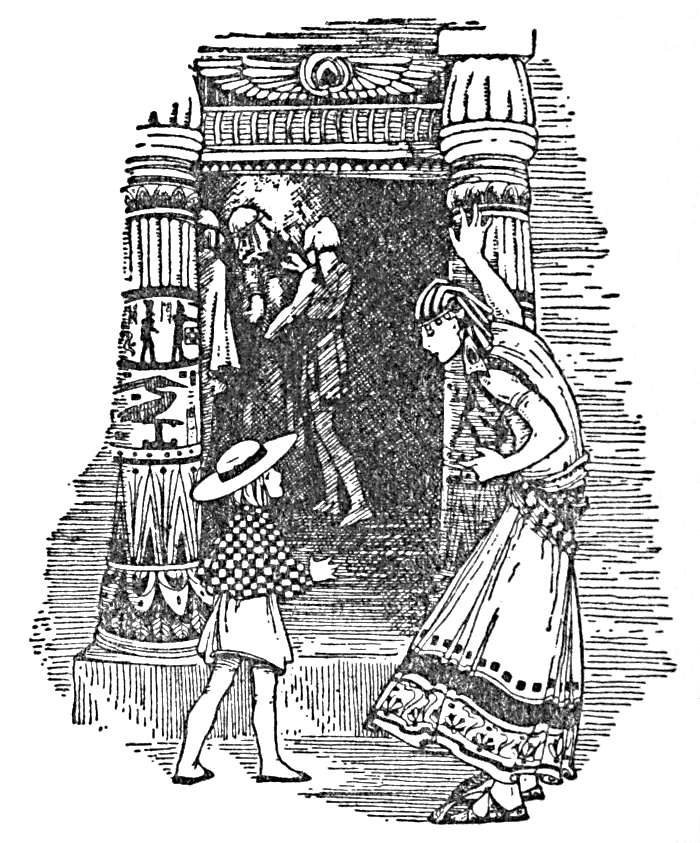
Rachel glanced about, and suddenly her eyes rested on a monument
against a wall, carved curiously in stone. Beneath it there
was an inscription, and she went nearer and began to read the
words aloud.
“The tomb of Sheshà, High Priest of Cheops,” she began, and
suddenly stopped short.
“Why...!” she exclaimed, turning to Mr. Sheston, and then
again stopped short, for in his place stood her friend Sheshà in his
beautiful robe, his young face framed by the strange head-dress
she so well remembered! And yet—somehow—it was Mr. Sheston
too! Sheshà and the old man were in a curious way one and the
same person!
“Why, you are Sheshà!” cried Rachel, incoherently. “But
then—why?”—she glanced at the tomb—“That means you were
dead—ages and ages ago?” she whispered. “How can you be
here—?”
The young priest smiled. “Tombs are but folly,” he answered.
“Do you remember, little maid, what I said to you of the soul,
and how it lives and returns after many thousand years to inhabit
the same, or perhaps another body?”
Rachel nodded, too overwhelmed to speak.
“Well, then, are not tombs folly?” he repeated, still smiling.
“But come, of Egypt you have had a glimpse already. Now
shall you behold Babylon.”
He turned and led the way towards another gallery running
parallel with the Egyptian one, and, as Rachel followed him, she
wondered for a moment why the people strolling about in the
Museum did not stare in amazement at the wonderful figure of
Sheshà in his priestly robe. No one took the slightest notice,
however, and she remembered that Miss Moore had on a previous
occasion seen and heard nothing.
“They’re not mixed up with seven, I suppose,” she reflected,
before Sheshà began to speak again. He talked, she thought,
rather as though he were translating from another language, trying
to make what he said quite modern. “But sometimes,”
thought Rachel, “he forgets—and then he says ‘behold,’ and
‘verily,’ and old-fashioned words like that!”
“Let us first look at some of the wonders which, long buried,
have come at last to this Museum,” he suggested, pausing in front
of a huge statue. It represented a creature with the body of a
bull, and the face of a man with a long curled beard cut
square—while from the shoulders of the beast sprang two great
wings.
“Here is one out of many such marvels,” he added.
Rachel looked at the monster, full of curiosity.
“Was this dug up by the people you were talking about to
Aunt Hester to-day? I mean—at lunch time—when you were—Mr.
Sheston?”
Sheshà smiled. “I was the same person then as now. It
was only my body that was different.... Yes, little maid, this
was found by the explorers not far from Babylon. Now glance
with me at these pictures in stone.” He turned into a narrow
gallery close at hand, and pointed to the walls against which were
fastened large slabs of stone sculptured most beautifully with
scenes of hunting, with processions in which kings rode in chariots
under graceful canopies like parasols hung with fringe, or stood
looking down upon long lines of prisoners chained together.
“These came from the palace of one Tiglath Pileser, a king
who lived more than seven hundred years before Christ was born.
He was one of the conquerors of Babylon.”
“But I do want to see Babylon itself!” exclaimed Rachel.
“You did mean I should really see it, didn’t you?”
“Patience!” murmured Sheshà. “Patience! You are just
about to see Babylon first as it is now—and then as it was in the
days of its splendour. Shut your eyes. Beat seven times with
your foot on this stone floor—and have no fear of what befalls.
You are safe with me.”
Trembling with excitement, Rachel did as she was told, and at
the last tap of her foot, was conscious of a most strange and wonderful
sensation. She seemed to be out of doors, and not only
out of doors, but rushing through the air, while a noise like that
of a great engine almost deafened her.
“We are near Babylon!” said a voice close to her ear, and, as
she opened her eyes, Rachel gasped, for she was seated in an aeroplane,
and the pilot of the machine, in the dress of an airman, was—Sheshà!
Rachel had so often longed to fly, that at first she could
think of nothing but the wonder and excitement of her first rush
through the air, and it was only by degrees that she began to notice
the earth below. The machine was dropping nearer to it now,
and she saw they were flying over a vast plain through which flowed
a river. Three large mounds near this river broke the monotony
of the desert place, overarched by the beautiful blue sky, and when
the aeroplane skimmed yet lower, Rachel saw little figures moving
near the mounds, like ants running over an ant heap.
At the same moment the noise of the aeroplane’s engine ceased,
and she was able to talk to the pilot.
“Why those are men, aren’t they?” she said, pointing
to the tiny figures. “And what are those heaps of rubbish
there?”
“All that is left of Babylon—the beautiful and proud City of
Babylon,” answered the voice of the pilot, Sheshà.
Rachel looked at the desert plain with its three “rubbish heaps,”
as she called them, in silent astonishment.
“Is that where the bulls with wings and the other things in the
British Museum come from?” she added at length.
“Some of them—yes.”
“And are those little men down there digging up other things
now?”
“Yes. They are working for the Museum. By-and-by,
in a few weeks, perhaps, you may read a column in your newspaper
at breakfast time giving an account of the latest things found in
that heap,” he pointed to the largest of them. “That mound
below you is called Babil, and it covers the palace in which dwelt
King Nebuchadnezzar, nearly three thousand years ago.”
“The Nebuchadnezzar in the Bible that I was reading about
with Miss Moore only this morning?”
“Yes—the Nebuchadnezzar who conquered the city of Jerusalem
and brought the Children of Israel captives to Babylon—the
Nebuchadnezzar who set up the golden image to which Daniel
would not bow down.”
“And the fiery furnace!” interrupted Rachel, eagerly, “that
didn’t burn the three Children of Israel when Nebuchadnezzar
threw them into it.... I remember!... And there’s a psalm
about them when they were prisoners in Babylon.”
“By the rivers of Babylon, there we sat down, yea, we wept when
we remembered Zion,” quoted Sheshà, in a dreamy voice. “There
is one of the rivers of Babylon.” He pointed to the great stream—the
Euphrates—on both sides of which the city was built.
“It doesn’t look as though there could ever have been a city
here,” Rachel declared, gazing down upon the desert and the mounds
of earth. “How could it have disappeared altogether like that?”
“Thousands of years have passed since it was standing. It
has been burnt to the ground many times, and laid in ruins. The
sand of the desert has swept over it, and new races of men have
arisen, knowing nothing of its ancient grandeur. It is only sixty
years ago that scholars from France and Germany and England
began to explore those heaps of rubbish which cover its palaces and
temple.”
“Oh, I do want to see them!” exclaimed Rachel. “I mean
as they used to look when Nebuchadnezzar was king. Not just
the bits of them that people dig up now!”
“We will make a landing,” said Sheshà in a matter-of-fact
voice, and in a few moments the aeroplane had touched the ground,
and he was helping her to jump out of the marvellous machine,
which, surrounded as she was by so many other marvels, Rachel
took almost as though she had been used to an aeroplane all her
life.
“You behold Babylon as it looks to-day,” went on Sheshà,
stretching out his hand towards the ruins. “In a second you shall
behold it as it looked three thousand years ago when Nebuchadnezzar
was king. And your guide shall be a little maid of
your own years.” Almost before he had finished speaking he
laid his hand gently over Rachel’s eyes....
“Count the magic number aloud.”
The voice that spoke certainly did not belong to Sheshà, and
when full of eagerness her eyes flew open they rested first of all
upon the loveliest and strangest little girl you can possibly
imagine.
Her hair, black as ebony, was cut straight across her forehead,
and fell in tight ringlets to her shoulders. She wore a thin gauze
robe spangled with gold, and on her bare brown arms there were
bracelets, and round her slim little ankles golden anklets, which
tinkled as she moved.
As her great dark eyes met Rachel’s blue ones she said gravely:
“I am Salome, handmaid to the Queen of this city of Babylon.
Come with me and you shall see all its riches and its glory. Sheshà
has commanded it.”
Rachel was too bewildered to wonder how it happened that
she understood the child, who was certainly not talking English.
But, strange language though it was, she seemed to know it as
well as her native tongue. There were besides, other and even
stranger things to amaze her, for before her, under the burning
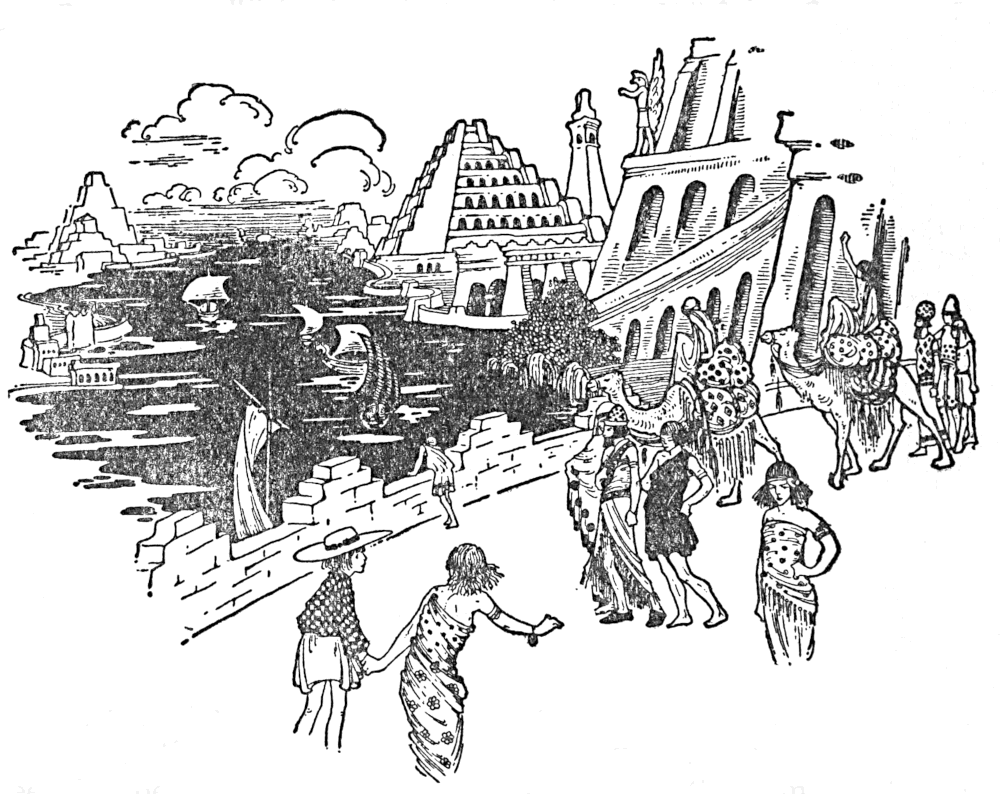
blue sky, was spread a gorgeous city, or rather what looked like
miles and miles of gardens and palaces and temples, enclosed
within huge walls.
From the slightly raised ground on which Rachel with her
new companion were standing, she could see these city walls—a
double row of them—stretching away to form a gigantic square
enclosing the river, the woods and gardens, and all the strange
buildings which made up the city.
“Oh look! look!” she cried suddenly, as all at once, actually
on the top of one of the inner walls, she saw a brilliantly painted
chariot drawn by four horses, coming at a furious pace towards
her. It was driven by a long-haired man who stood upright
within the car, urging on his steeds—till he came so near the end
of the wall that Rachel held her breath, expecting to see chariot,
horses and driver dashed to the ground. But, before she could
cry out, the man, with marvellous
skill, turned horses and chariot, and
drove at full speed back again
along the wide top of the wall.
“Just think of a wall broad
enough for four horses to
gallop along—and turn!”
Rachel almost screamed the
words in her excitement.
“That is Akurgal, the
driver of the king’s chariot,”
said the little Babylonian
girl, unconcernedly. “He
drives like the wind for
fury when it pleases him.”
Rachel scarcely knew in
which direction to look first, so glorious was the view. She saw
that each of the four sides of the wall was pierced by
gigantic gates made of bronze—all the gates opening upon
broad streets which crossed one another, so that the whole
city was divided into squares, filled with gardens and houses.
The broad river flowed through it from north to south, and
over the river hung a mighty bridge, at each end of which
was a palace.
It was difficult for Rachel to make up her mind in which
direction to turn her eyes, but the sight of something that
appeared like a forest-covered mountain rising near one of the
palaces, was so lovely that she pointed to it and turned to
Salome.
“What a beautiful mountain!” she exclaimed. “How funny
there should be only one—because the rest of the country is so
flat. There isn’t another hill as far as ever I can see,” she added,
glancing over the wide plain in which the city lay.
Salome smiled.
“That is no mountain,” she said. “It was made by human
hands. It is the great glory of our city, and, so my mistress says,
in time to come, the Hanging Gardens of Babylon will be called
one of the Wonders of the World.”
Rachel started. “There are seven Wonders of the World,”
she began, eagerly. “I’ve seen one of them already—the Great
Pyramid, you know. And now——”
“I have heard of the Pyramid in the land of Egypt,” Salome
interrupted. “But come now and see more closely our wonder—the
Garden that is like no other in the world.”
She took Rachel’s hand, and in a few moments they had entered
the city through a gate which Rachel noticed was covered with
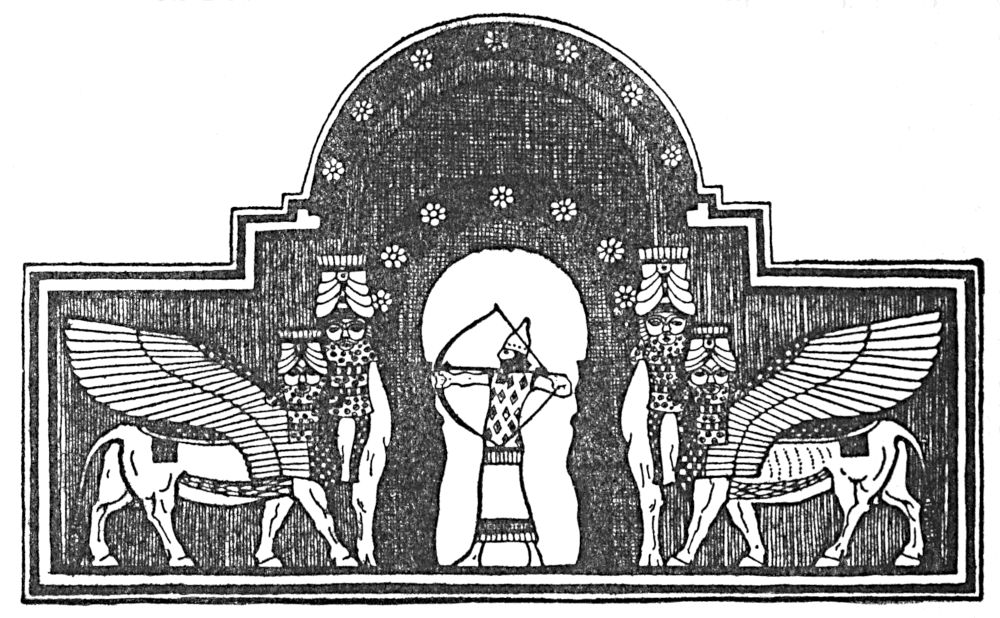
tiles of blue enamel as brilliant as the sky above them. And on
either side of the gate, like sentinels, stood huge winged bulls carved
in stone. But how different they looked here, she thought, in the
golden sunshine, with the wonderful blue tiles behind them, and
their great shadows, black as ink, stretching on either hand!
“This is one of the new gates built by our king,” Salome told
her. “He has caused inscriptions to be written about them so
that all the world may know what adornments he has added to
our fair city of Babylon. Our city that shall last for ever,” she
added proudly.
Rachel glanced at her, and thought of a great rubbish heap
she had recently seen—“the mound called Babil which covers the
palace in which dwelt King Nebuchadnezzar nearly three thousand
years ago”—she remembered the very words of Sheshà.... How
amazing it was to be walking with this little girl in the very city
that now lay under a mound of earth! To be talking to a little
girl who lived nearly three thousand years ago, and had no idea
that her home was even now being dug up in fragments by men
living in the world to-day!... For a moment it all seemed too
puzzling to be true. Rachel rubbed her eyes with her disengaged
hand, and half expected the whole vision to disappear. Yet when
she looked again, the lovely scene still lay before her, and she
could feel the warmth of Salome’s little brown hand within her
own.
“I must be getting used to the Past,” she
reflected. “Because now I can feel as well as
see the people. They didn’t seem quite real
when I was with Sheshà in Egypt. But now it’s different. Is
it because these people didn’t live quite so far back into the
Past as King Cheops and his slaves, I wonder?”
She glanced again at the grave, strangely clad little girl at her
side, who talked as though she were quite grown up.
“I mustn’t say anything about the rubbish mound, or tell
her anything about the sort of world I belong to,” she reflected
hurriedly. “She wouldn’t understand. I suppose she thinks
I’m living in her times, but have just never happened to see
Babylon before. And that’s quite true!” she added to herself,
with a little inward chuckle.
While such thoughts as these were hurrying through her
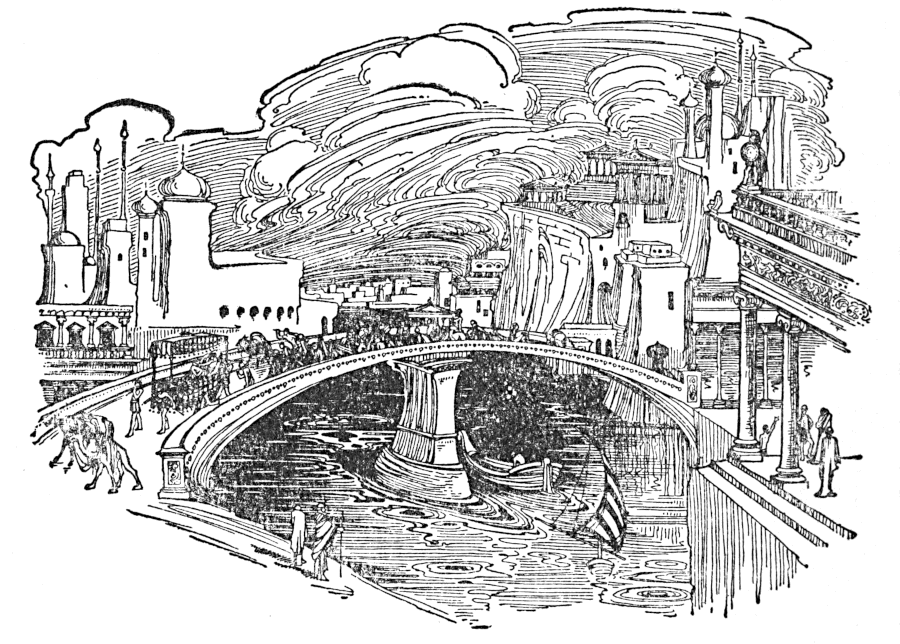
mind, she was looking right and left, full of eager curiosity,
for the bridge she was crossing was thronged with amazing
figures.
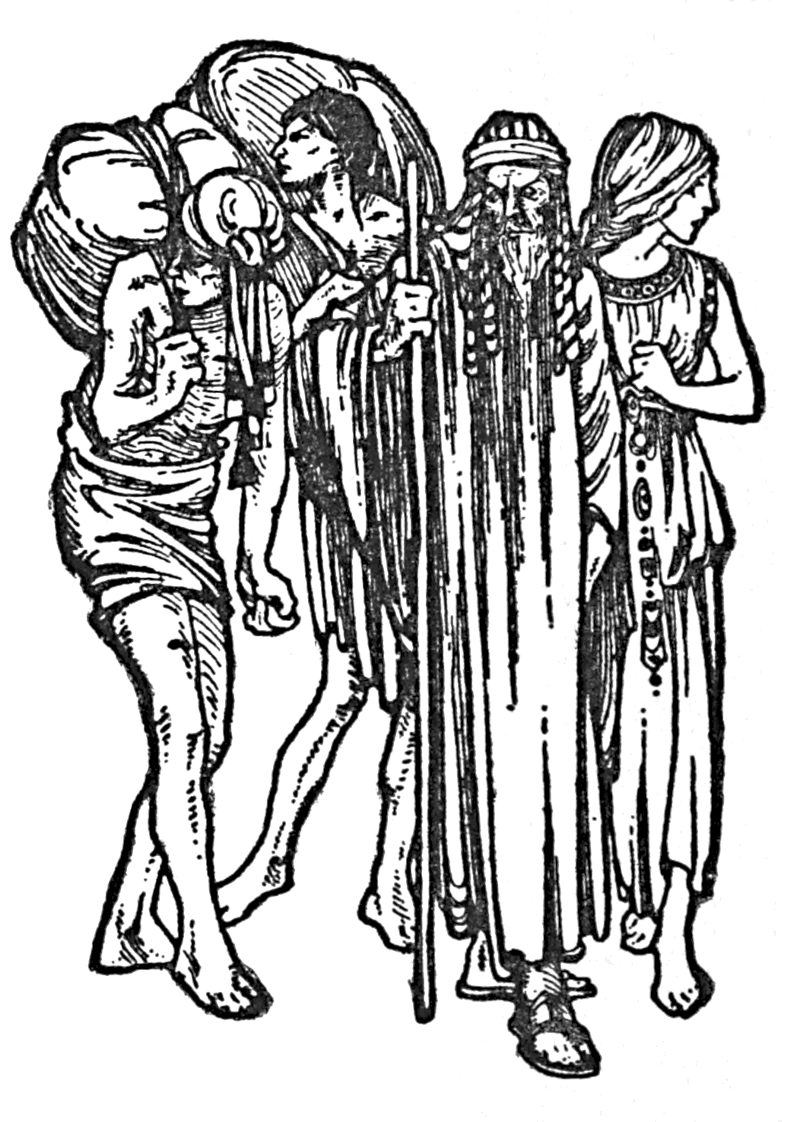
Men with black, curling beards, bare-legged, and bare-armed,
wearing tunics of brilliant colours, passed her. Some of these
were seated upon the backs of camels following one another in
long lines. The soft-footed, grey beasts were loaded with merchandise,
and the bales on either side of their humped backs swayed
as they moved. They were decked fantastically with trappings
of plaited scarlet wool, hung with tassels of brilliant colour. After
such a procession of camels and their drivers, would come perhaps
a chariot with four horses abreast, driven by a fierce-looking man
in a gorgeous fringed robe, whose dark eyes flashed like jewels
in his bronzed face. Following one such chariot, she saw a group
of girls in gauzy tunics, bracelets on their arms, tinkling anklets
above their feet, dancing as they came, and singing a wild song
as they tossed their arms above their heads.
“They are going to the Temple of Belus,” explained Salome,
as Rachel stood still to look at them.
She turned round and pointed with her little brown forefinger
to a great building at the other end of the bridge.
“Later, if there is still time, you shall see the temple of the
great God. But let us hasten now towards the gardens, for there,
in the cool of the day, the queen walks with her maidens, and I
must be in attendance.”
Rachel was torn between her longing to be actually within
the wonderful Hanging Garden and her desire to linger on the
bridge which afforded such a magnificent view. She gazed with
delight upon the broad shining river which divided the city, and
upon the ships with gracefully curved sails which, rowed by almost
naked slaves, moved to and fro over its surface.
Some of these ships were drawn up against the quays which
lined the river, as far as eye could reach, and Rachel saw a
swarming multitude of men staggering under corded chests of
wood which the ships had brought to be unloaded.
Salome stopped to watch the slaves at their work.
“That is merchandise for the palace, I trust,” she observed.
“We have awaited it too long, and the queen grows angry.”
“What sort of things are in those boxes?” Rachel asked.
“Ivory and ebony for the thrones, and for the couches and the
chariots, emeralds and fine linen, and coral and agate. Spices
from Arabia and precious stones
and gold,” answered Salome, in a
sort of chanting voice.
Rachel gasped. It sounded like
a fairy tale. Yet she remembered
something like it—Where was it?
In the Bible, surely!
Just as the thought of the Bible
crossed her mind, a group of men
passed close to her. They were
dressed rather differently from the
other people around her, their faces,
too, looked different, and their eyes
were very sad.
“Who are those men?” she
enquired, looking back over her
shoulder. “They look so unhappy—and
homesick, somehow.” Rachel
knew what it was to be homesick!
Salome glanced at them carelessly. “They are Hebrews who
call themselves the Children of Israel. Our king, the great Nebuchadnezzar—may
he live for ever—conquered their country
and took their treasures from Jerusalem, their chief city, and
brought many of them here to Babylon to live. They hate us,
and we despise them.”
Rachel started as the words of the psalm darted into her mind.
“By the rivers of Babylon, there we sat down.... We hanged our
harps upon the willows....” She had heard this sung in church,
and it had meant nothing to her but just “a psalm.” Yet, here
before her very eyes now, was one of “the rivers.” There were
“the willows” fringing streams which flowed through the innumerable
gardens, and she had just met some of the captive Jews!
Rachel gasped again as all these things became “real” to her—something
that had actually happened—was, in fact, happening
before her eyes.
“It’s awful to be homesick,” she murmured, rather to herself
than to Salome, who, without replying, ran on in front of her to a
flight of steps at the end of the bridge.
“This is one of the entrances to the Hanging Garden,” she
explained, looking back. “We must hasten, lest my mistress
calls for me.”
Rachel followed her from terrace to terrace, too overwhelmed
with delight at the glimpses of beauty she caught right and left to
say a word. She saw that the whole garden was supported, tier
above tier, by gigantic arches, and Salome told her each terrace
was made of plates of lead, holding earth so deep that great forest
trees could grow in it. If she had not known this, the whole place
would have seemed to Rachel as though blossoming by magic in
the heart of a forest growing in mid-air. She could scarcely believe
it was not the work of some magician.
By the time they reached the uppermost terrace, on a level
with the city wall, she was not only breathless, but struck dumb
by the beauty and wonder of everything round her.
Mighty cedar trees spread their layers of branches between
her and the burning blue sky. The air was perfumed with the scent
from groves of lemon trees. Fountains tossed their sparkling
drops high into the sunshine. Red roses swept in cascades from
her feet down the slope to the terraces below. Along paths paved
with tiles of sapphire-blue enamel, peacocks walked delicately
with outspread tails, and far below, within its four-square walls,
the city of Babylon lay glittering in such brilliant sunshine as
in her own country she had never dreamt of, nor faintly imagined.
And now, before she had time to recover from her amazement,
a new sight was presented, for, coming slowly in her direction,
but as yet in the distance, a group of people approached. In the
midst of them, as the little procession drew nearer, Rachel saw a
lovely woman leaning back in a litter slung between ivory poles
and borne by four slaves. The litter was covered with silk hangings
of a rich purple, and a fringed canopy of the same material supported
on poles also of ivory, was held above the swinging couch
by four dark-skinned girls.
“The Queen Amytis,” whispered Salome, and Rachel drew
back in sudden fright. “She will wonder who I am—and I shan’t
know what to say,” she began, hurriedly. “I don’t know how to
talk to queens.”
“Have no fear, she will not see you. No one here sees you
but me. That is the work of Sheshà, who is greatest of all magicians
and has entrusted you to me, why I know not—nor do I know
with any certainty who you are. But he has commanded me to
be your guide here in Babylon. No one sees, no one hears you but
I alone.”
Wondering greatly, but feeling much relieved, Rachel watched
the slaves as very carefully they set down the litter close to a throne-like
seat, covered with silken pillows. The arms of the chair she
noticed, were two-winged bulls in stone, and the back of it shone
with enamelled tiles and plates of gold. The maidens now surrounded
their mistress, helping her to rise from the litter, and, as
she sank into the great chair, Rachel gazed at her wonderful robe,
made of stuff like gossamer, clasped with a great jewel at the waist.
Her slim, olive-coloured feet were bare, and, to Rachel’s amazement,
she saw the gleam of emeralds in rings upon her toes!
On her bare arms and neck there were jewels, also, and there
were emeralds in the fillet that bound her beautiful black hair.
Never had Rachel ever dreamt of such a vision! Never indeed
could she have imagined such luxury and magnificence as she
had seen since she entered Babylon.
“It’s like—like the stories in the Arabian Nights,” she
thought, confusedly. Presently the queen spoke in that language
which sounded strange to her ears, but which with her mind she
somehow understood quite well.
“Listen! One can hear the singing from the Temple of
Belus.”
“To-day is a high festival. They offer sacrifices to the God,”
answered one of her maidens. “There has been great stir in the
city since sunrise.”
“But when the darkness falls there will be silence, and the
wise men on the topmost tower will watch the stars.”
Queen Amytis said this as though to herself. Her great dark
eyes were fixed upon the shining city below, and Rachel thought
she looked sad and anxious.
“The most high God will protect our lord the king on his
perilous journey,” one of her maidens declared consolingly. “And
the wise men will surely learn good tidings from the stars,” added
another.
The queen did not reply, and Rachel looked enquiringly at
Salome, who was lying full length on a great tiger-skin stretched
in front of her mistress’s chair.
“Sit near me,” said the little maid, making room for her.
“No one else sees or hears you. What is it you would ask?”
“Tell me about the temple,” whispered Rachel. “That
temple of Belus.”
She could see it very distinctly from where she sat, a wonderful
building with a number of storeys piled up one above the other,
each storey covered with glazed tiles of a colour different from
that above and below.
“It is the Tower of the Seven Planets—the Temple of Belus,
who is the God of our city,” Salome told her. “Our great king
has lately built it where once stood, so they say, the Tower of
Babel.”
“The Tower of Babel? That’s in the Bible!” But a glance at
Salome’s face showed her that she didn’t know anything about the
Bible—and she remembered that the gods Salome and all the
people here worshipped were those the Bible called “false gods.”
“Of the Tower of Babel I know nothing but its name,” said
Salome, shrugging her shoulders. “It stood doubtless long ago.
But this is a new temple built, as they say, on its ruins. It is of
seven colours, because each of the seven planets has a different
colour, so the wise men who study the stars declare. And within
the temple there stands a golden image of the god Belus, and a
golden altar upon which the priests burn frankincense and all
sweet scents in honour of the god.”
“But the queen said the wise men watch the stars there?”
“Even so. At night on the topmost storey of the tower, the
priests study the sky. They are great astronomers, and have
learnt wonderful things about the heavenly bodies, all of which
are written down so that their knowledge may not be lost to people
who live after them.”
“Then I suppose that’s how we began to know about the stars,”
thought Rachel. “Through these people who lived here in Babylon
thousands of years ago.” It was very strange to think of this,
and strange also, and sad, to remember that what Salome called
“the new temple” was now nothing but a heap of half-buried
ruins! And, yet, there in some magic way lay Salome before her
eyes, her anklets tinkling when she moved, and her little face full
of life. And there sat the lovely queen, surrounded by her
maidens in their transparent robes! And the cedar trees murmured
overhead, and from the groves of lemon trees sweet scents
were blown, and below lay the marvellous city.
Rachel grew so confused that it was with difficulty she could
prevent herself from saying aloud all she was feeling. And this,
as somehow she knew, would be the greatest possible mistake.
“The queen is sad because the king is away, isn’t she?”
The question was put hurriedly, in case she should betray
herself.
“Yes. Our great King Nebuchadnezzar is in Egypt, fighting
against his enemies. May he be preserved! The queen longs
for tidings of him.”
Just at that moment the sound of quick footsteps on the blue
tiled path, behind the queen’s chair, made Rachel turn her head.
A slave was running in haste along an upper terrace.
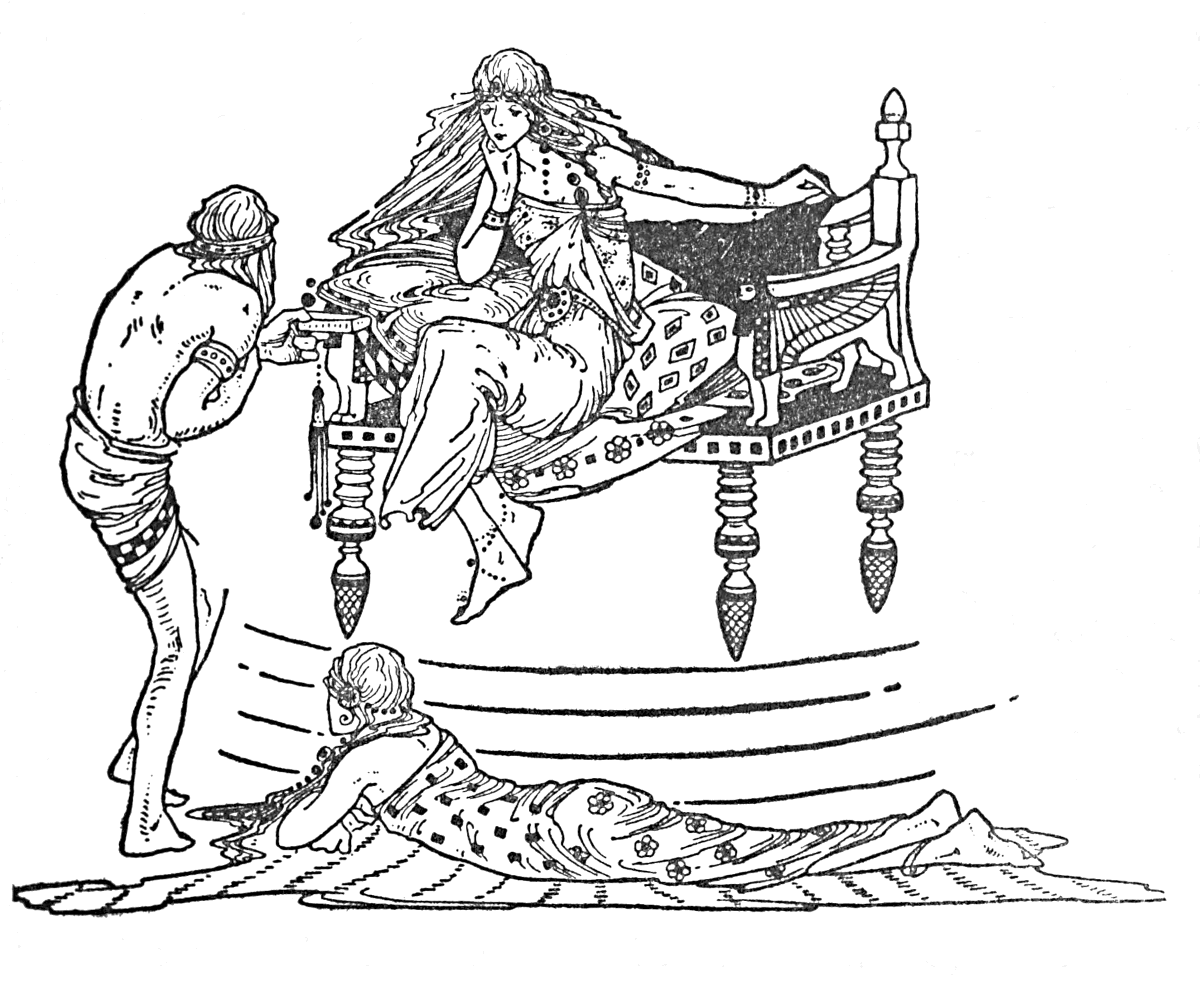
The queen also turned and half rose from her throne-like seat
as the messenger, drawing near, threw himself face downward on
the ground before her, and then, rising and bowing low, put
something into her hand.
“A letter, perchance, from the king,” whispered Salome
eagerly.
“A letter?” repeated Rachel, looking with curiosity at the
strange object.
It certainly bore no resemblance to the letters she knew, for
it looked something like a thin
square brick, and though it had
an envelope, that envelope was
made of clay instead
of paper, and had a
seal upon it.
Feeling quite
sure by now that
she was invisible to
all but the eyes of
Salome, she ran to
the back of the
queen’s chair and
watched her break
the seal, and
take out what
it contained.
This proved to be a small brick tablet. Upon it was carved
some writing that was like, yet unlike, the hieroglyphics she had
seen in Egypt, for the letters of which the writing was composed
were wedge-shaped, with curious dots and arrow-heads every here
and there between them.
And then, smiling happily, the queen began to read the brick aloud.
“Unto Amytis, my queen whom I love, who loveth me, say,
It is well with me. With thee also may it be well.... Let
the wife of the king, my lady, be of good cheer, for a messenger
of good luck from Belus walketh beside the king of the world....”
Still smiling, she looked round her at her maidens, who all
bowed low and murmured together.
“Our lord the king, may he live for ever.”
“The great god Belus, as you hear, protects him!” exclaimed
Salome, turning to Rachel.
Suddenly the queen clapped her hands, and at the signal, her
maidens snatched up the musical instruments they had laid aside, and
their brown fingers began to sweep the strings of curiously shaped
harps and lyres as they sang a chant of rejoicing....
The sun was setting, and as she lay stretched out upon the tiger
skin, Rachel saw the city below her glowing like a heap of jewels
within the casket of its walls. The broad river was washed with
gold, and reflected in its depths she saw the purple and embroidered
sails of the ships passing and repassing, as they brought gold and
ivory, fine linen and precious stones, to enrich still further the
magnificence of Babylon. The long line of quays formed a white,
glittering fringe on either side of the river. In the gardens and open
courtyards between the houses the palms and cedar trees and
masses of flowers shone like coloured fire, and the great temple
of Belus towering towards the sky, with its seven storeys of seven
colours, might have been the enchanted palace of a magician.
Rachel gazed and gazed as though she wanted to fix the vision of so
much loveliness upon her mind for ever.
But her last look after all was for the beauty of the garden
in which she sat—the Hanging Garden that might well, she thought,
be called one of the World’s Wonders! For the sun’s last rays
lent an even greater magic to the lemon groves, to the leaping
cascades which flowed from the upper terrace and were lost among
the forest trees beneath; to the pyramids of gorgeous flowers
and to the group of singing girls surrounding their lovely queen.
Their gauzy robes were dyed with crimson light, the jewels on the
queen’s head-dress and on the brown hands touching the harp-strings
gleamed dazzlingly, and the voices of the singers mingled
with the deep hum of voices floating upwards from the swarming
multitudes below.
“Is not our Babylon well called ‘the lady of kingdoms’?” whispered
Salome. “It shall endure for ever, and in ages to come
men will travel hither to see its glories, and to gaze upon this our
Hanging Garden—one of the Wonders of the World.”
Rachel turned to look at the grave little girl who spoke like a
woman, yet was perhaps no older than herself.
For a moment she saw her great dark mournful eyes, and then,
the whole scene, the garden, the great city below with its towers and
palaces, disappeared. For yet another moment she saw the dreary
desert, the three great mounds of earth under the blue sky, and almost
at the same instant, she was walking in a gallery lined with
cases, containing stones, bricks, and various other dull-coloured
objects.... “These don’t look much like the letters the
postman brings every morning, do they?” Mr. Sheston was saying.
“Yet they are the sort of letters the Babylonians wrote to
one another. These marks on the bricks were made with a metal
stick, when the clay was still moist and soft, and then the tablet
was baked, so that the writing should last practically for ever.”
“I know!” cried Rachel. “The queen had a letter from the
king Nebuchadnezzar, and it was in a sort of clay envelope. And
she read it out, and—”
But Mr. Sheston only smiled, and went on telling her about the
“brick letters” hundreds of which had already been discovered
in the ruins that cover Babylon!
It was a curious smile, and in some way it told Rachel that she
must not talk much to Mr. Sheston about Sheshà—even though
they were one and the same person.... “Why, even the beginnings
of their names are alike!” she thought, suddenly.
“Yes, the Babylonians were wonderful people,” the old man
exclaimed. “They were astronomers as well as sculptors and
metal workers, you know. They built high towers from which they
studied the stars. You may imagine what a splendid view of the sky
they would have from these towers rising out of a flat country into
air so absolutely clear that the stars look enormously big and bright.”
“And they told fortunes by the stars, didn’t they?” Rachel
asked, remembering the king’s letter.
“Yes, they were astrologers, too—that is they believed that
certain planets had an effect on people’s lives. But, putting that
on one side, we have to thank them for the beginning of all the
marvellous discoveries that later astronomers have made....
Well, now, my dear,” he went on, presently, just like any other
kind old gentleman, “I’m sure you’re ready for tea and buns.”
Rachel was quite ready, and she also quite understood that
“Mr. Sheston” and “Sheshà” wished to have very little to do
with one another.
So she only said, when, half an hour later, the old man left
her at Aunt Hester’s door:
“Thank you ever so much. I shall never forget Babylon, and—and—the
Hanging Garden, you know. But there are five more
Wonders of the World, aren’t there?” She could not help adding
this, nor could she help a beseeching
glance at Mr. Sheston.
He laughed. “We’ll see about
them, perhaps,” he said. But Rachel
ran into the house quite satisfied.
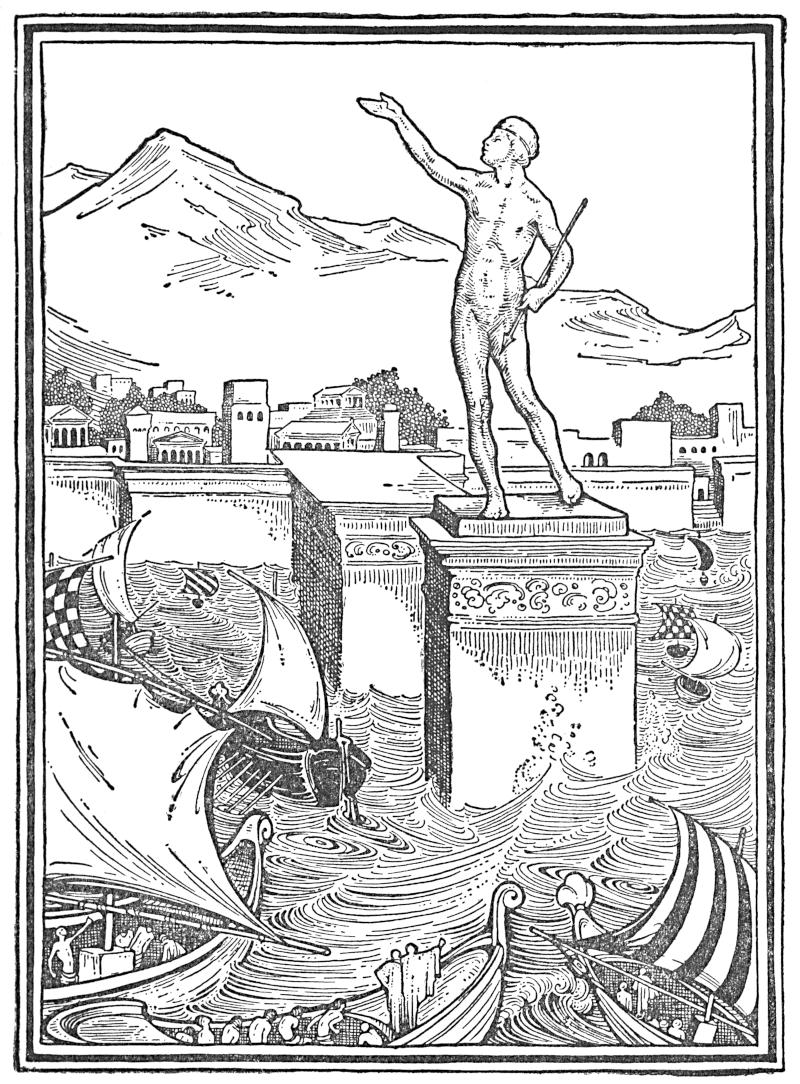
THIRD WONDER THE COLOSSUS OF RHODES
One morning, several days later, Rachel received a long letter
from her father, in answer to one she had written to him before
making the acquaintance of Mr. Sheston. (Though, indeed, as
she remembered, she had even then met him without knowing it!)
“You talk about the British Museum,” he wrote, “and that
reminds me of a dear old friend of mine who works there. I don’t
think I’ve ever told you about Mr. Sheston, have I? And now
I come to think of it I don’t believe I’ve told anyone all he meant
to me when I was a little boy, no older than you are now. I’ve
never seen him since, but he was better to me then than a thousand
beautiful mysterious books. He used to tell me the most
wonderful stories, and I’ve never forgotten them. He must be a
very old man now. (I thought him very old then, but, of course,
he wasn’t really.) I believe he sometimes goes to see your Aunt
Hester, and I want you to meet him. Perhaps he will tell you some
of the strange things he told me. Perhaps even you will have
‘adventures’ when you’re with him! And perhaps not. Anyhow,
if you do have ‘adventures,’ take my advice and don’t talk
about them. People as a rule don’t understand Mr. Sheston, and
some of them say all sorts of silly things about him, and even think
he’s mad. He isn’t. He’s the oldest and the wisest man in the
world.”
Rachel folded up the letter feeling very happy. She and
“Daddy” were great friends, and she was as she said to herself
“frightfully glad” that Dad had known Mr. Sheston when he was
a little boy. That hint he gave about “adventures” pleased her
very much, as also his remark about Mr. Sheston being the oldest
man in the world! Oh, yes, certainly Dad had passed through
the same sort of experiences as those she had enjoyed since her
meeting with his old friend. That was a splendid thought. And
all at once she remembered that Dad also was the seventh child
in his family. “So he’s mixed up with sevens too,” was her next
reflection. “He’s one of the lucky people—like me. He’ll be
awfully interested when he gets my last letter to say I’ve met Mr.
Sheston already!”
That very same morning, Aunt Hester had a note from the
old man to ask if Miss Moore would be kind enough to bring Rachel
to tea at his house the following day, at three o’clock. “I will
bring her back again myself. Don’t trouble to answer this,
because I shall rely upon seeing Rachel at the appointed time.”
Aunt Hester brought the note into the schoolroom, and, after
reading it aloud, laughed a little and shrugged her shoulders.
“This is a command,” she said, addressing Miss Moore. “He
always gets his own way. Will you see that the child arrives
punctually?”
Rachel wanted to jump for joy.
“It’s exactly seven days since the last time I saw him,” she
exclaimed. “How exciting!”
Mr. Sheston’s house was tucked away in a little quiet square,
near the Museum. It had a narrow front-door with a brass
knocker that shone with much polishing, and above it, in the
shape of a crescent, panes of glass divided by a tracery in white
plaster.
Within, the walls of hall and staircase were panelled with dark
wood, and the room into which Rachel followed her host after
Miss Moore had left her was, she thought, the nicest she had ever
seen.
It had three windows, and was long and low, and like the hall,
panelled right up to the ceiling. There were cushioned window-seats,
and books everywhere, and great bowls of spring flowers
on the tables. And in an old-fashioned grate with hobs, a fire
sparkled cheerfully, for it was a cold gloomy afternoon.
Tea was laid on a table in front of the fire, and in a few moments
the dearest old woman in a frilled close-fitting cap and a spotless
apron, entered, bringing
a teapot and a kettle,
which she placed on
the hob.
She smiled at Rachel.
“The very image of
her father, isn’t she,
sir?” she remarked.
“Oh! Did you know
Dad?” enquired Rachel,
joyfully.
“Martha has known
all my young friends,”
said Mr. Sheston.
“Many’s the time
your father has sat
where you’re sitting
now, my dear,” the old woman continued.
“He was no older than you then, and had
just your look.”
She went out of the room quietly, leaving Rachel much interested,
and glad to be in a place that Dad had once known well.
She would like to have asked all sorts of questions about her
father when he was a little boy, but, remembering his letter, she
felt in some curious way that it would be better not to do so.
Tea was a most cosy and delicious meal, but it was only after
old Martha had cleared the table and swept up the hearth that
Rachel said rather disappointedly—“Then we’re not going to
the British Museum?” Mr. Sheston smiled. “Not to-day. I’m
going to tell you a story instead. But first you’ll have to listen
to a little lecture.” He took an atlas from one of the book-shelves,
and opened it on the table before her. “The story I am going
to tell you has something to do with Greece, and in order that you
may understand it better, I want you first to look at this. It
is a map of Europe as it was three thousand years ago, showing
the countries round the Mediterranean Sea. All the parts of the
countries that belonged to Greece in those days are coloured pink.”
Rachel looked, and saw many pink islands in the Mediterranean
Sea, as well as pink strips along the coast of Asia Minor, and even
a pink tip to the heel of Italy.
“The Greek people had a lot of land—only all scattered about,”
she remarked.
Mr. Sheston nodded.
“Like England, it was a little country owning a lot of land—‘scattered
about,’ as you say. Well now, these islands were the
Greek colonies, just as India and South Africa and Australia are
our colonies. Again, like the English, the Greeks were great
colonists. They sent out their people to live and build and work
in places sometimes far distant from the mother country. But
now I want you to find on the map one particular island-colony
called Rhodes.”
“Here it is!” cried Rachel, in a minute, putting her finger
on a pink-coloured spot. “It’s a good long way from Greece,”
she observed, “and quite close to Asia Minor.”
“It belonged to Greece, however,” said Mr. Sheston, folding
up the map. “I only want you to remember its name, and where
it is. Now come and look at this statue.”
He got up, and Rachel followed him to a recess on which stood
a beautiful little figure of a god.
“That is a god called Phœbus Apollo,” said Mr. Sheston. “To
the Greeks he meant all the best things in the world—the sun,
poetry, music, wisdom and truth, and everything that is free and
beautiful.”
“The gods they worshipped in Egypt and Babylon weren’t
beautiful,” said Rachel. “But this god is. He’s much better
than the others.”
“Because the Greeks themselves were in some ways higher
and better than the Egyptians or the Babylonians. They were
thinkers and artists, and their minds were free. Therefore they
were able to imagine beautiful gods, and they became the greatest
race of people that ever lived.... Do you remember the name
of their chief city?”
“Athens,” answered Rachel, who was rather good at geography.
“Yes, Athens,” repeated Mr. Sheston, softly. “Wonderful
Athens! Well, now, my dear, I can begin my story, asking
you to remember that Greece had many colonies, peopled by Greeks
whose general life was very much like the life led by the citizens
of Athens in the mother country. They worshipped the same
gods—Phœbus Apollo amongst them—and they were, in fact,
part of the Grecian Empire....”
He was silent for a minute or two, and the room was so quiet
and restful that Rachel had almost begun to feel pleasantly
drowsy when she heard his voice again. “What I am going
to tell you, I once told your father years ago in this very room,
and he sat just where you are sitting now,” he said. Before she
had time to make a reply, he began the story, and though his first
words ought, as Rachel afterwards reflected, to have been rather
startling, they seemed perfectly natural, for she was getting used
to the idea that, as Dad said, Mr. Sheston was “the oldest man in
the world.”
“When I was a little boy, nearer three than two thousand years
ago, I lived in the island of Rhodes. You know where it is, because
a minute or two ago, you found it on the map, and saw it
marked in the Mediterranean Sea as an island some long way from
Greece.
“In the map, it was nothing but a little blotch coloured pink,
so it’s not surprising if you have no idea what I see, when I remember
Rhodes as I knew it nearly three thousand years ago.
I’ll describe the vision that rises before me now.
“First of all, my own home. It is a big white house with pillars
at the entrance, and a flat roof, standing in a garden full of
roses that slopes down almost to the harbour of the town of Rhodes.
The harbour is full of ships—our own, and those from Tyre and
Athens and Smyrna, and all the great seaports on the Mediterranean—ships
with curious curved sails, some of them purple
and embroidered with strange devices.”
(“Like the ships from Tyre I saw at Babylon,” thought
Rachel, though she did not care to interrupt.)
“Beyond the great harbour with its crowded shipping and
merchandise of green and purple figs, heaps of dates, bales of fine
muslin and linen, chests—some full of spices, others of gold and
ivory—lies the sea, blue as the bluest sapphire, over which, going
and coming from every harbour of every country whose shores
touched the Mediterranean, ships go sailing. That is the picture
I have in my mind when I think of Rhodes as I knew it ages ago.
“My name in those days was Cleon, and I had a beautiful
mother, and a little sister called Penelope.
“But before I go on, I must tell you that by the time I came
into the world, Athens, our mother city, where my father had
been born, was no longer so great and powerful as it had been in
the days a hundred years before my time. All sorts of trouble
had come to Greece. It had been conquered by a certain king
called Alexander the Great, who died just before I was born, and
all the time I was a child, the generals of his army were quarrelling
among themselves—each one trying to get the largest share of
all the great kingdoms their master King Alexander had won.
You will ask what that had to do with Rhodes, and with my beautiful
home, and with the happiness of everyone I loved. It had
all too much to do with us, as I will explain.
“Our island had indeed been conquered by Alexander the Great,
but fifty years before I was born we had regained our liberty,
had become a republic and also the greatest sea nation in the
world. But now, though the great conqueror himself was dead,
one of his generals, jealous of our power, determined to subdue
us and make us slaves again. This man’s name was Demetrius,
and, because he had become so famous in war, he was generally
called Demetrius, the Besieger of Cities.
“I was twelve years old when the news came that this dreaded
Demetrius had declared war on Rhodes, and was coming to besiege
us, and never shall I forget the speech my father (who was
Governor of Rhodes) made to the citizens that day!
“‘We are Greeks,’ he said, ‘and worthy children of Athens,
our mother city. Never will we yield to Demetrius! Let us
prepare for the greatest siege that has ever been known.’
“A great shout answered him, and my father at once began to
make preparations.
“‘First of all,’ he said, ‘every useless person must be sent
out of Rhodes.’ That meant all the women and children, and
all men who were not strong enough to fight. For, in the long
siege that was expected, there would not be sufficient food for
anyone but workmen and soldiers. Workmen must instantly
begin to make every sort of warlike weapon, including machines
as far as possible like those which Demetrius would certainly
employ against the city. Other workmen must strengthen its
walls, toiling day and night. Everyone in fact must labour as
they had never done before. I followed him from the marketplace
that day full of dread. If all the children were to go, should
I have to leave Rhodes just at this stirring time, when I so longed
to be in the midst of things? Yet I dared not ask my father to
let me stay, for I knew I must not trouble him with my affairs
when he had the whole town’s business on his mind. I was very
miserable, for I knew he intended to send me, with my mother
and little sister, to Athens. But you shall hear how it was that
I after all remained in Rhodes through the whole dreadful siege.
“One of our greatest friends was a certain young sculptor
called Chares. He was very fond of me, and deeply interested in
a curious gift which, even as a child, I possessed. My greatest
amusement and interest had always been to draw plans of houses
and towns, and I drew them so correctly and well that everyone
was amazed, for I had never been taught. To me there was
nothing wonderful about this, for it seemed quite easy, and I could
never understand why Chares looked upon my work with so much
astonishment.
“As soon as I dared I began to beg and entreat not to be sent
away, till my father, growing angry, silenced me, and I was just
creeping off miserably when Chares, who was with us, spoke.
“He had picked up a plan of the town on which I had been
working, and I saw him studying it attentively, all the time I was
begging to stay.
“‘Yield to the boy, Hippias,’ he exclaimed, suddenly. ‘Who
knows that this gift of his,’ he tapped the paper he held, ‘may
not be of value? I think he should remain with us.’
“My father looked from me to Chares, and, after a moment’s
silence, said quietly, and to my great joy, ‘So be it. That is’—turning
to me—he went on: ‘if you can bear hunger and even
wounds perhaps, like a man. We must have no whimpering
children in Rhodes.’
“I felt I could bear anything if only I might remain, and I was
unspeakably grateful to my dear Chares for his interference. I
knew my father not only trusted him greatly, but also had an
idea that he was favoured by the gods, and could look into the
future. It was because he pleaded for me that my wish was granted.
“In a few days I was the youngest person left in Rhodes,
which was now filled only with soldiers and workmen. Those
were wonderful days when we waited for the coming of the fleet
that was to destroy us! Almost every hour fresh troops were
landed, for the countries that were friendly to us sent us soldiers
in plenty. Many of them were our own countrymen—Greeks
from other colonies, who rejoiced to fight with us, and arrived
shouting, singing, and full of delight. All day long I ran here,
there and everywhere in the town. Now I was down by the harbour
to see a fresh ship full of warriors come sailing in; now I
walked round the city walls to watch the workmen strengthening
and repairing them. But most time of all I spent in the sheds
where the great war engines were being built, for these fascinated
me beyond measure, and I wondered whether even the celebrated
Demetrius had better or larger ones than those we were making.
I was soon to know.
“My father had brought me up to reverence the gods, and
the chief god of our worship was Phœbus Apollo—lord of the sun
which poured its light so gloriously upon our island, and ripened
our grapes and figs, and made the whole land lovely and pleasant
to the sight.
“In our garden there was a little white marble temple, and in
it, with an altar in front, stood a beautiful statue of the god, made
by our friend, Chares, the sculptor. Here I often went to pray
for victory. One morning I woke before sunrise, and the loveliness
of the sky made me wish to worship the god of the approaching
day.
“Like a vast mirror the scarcely heaving sea reflected the
pink glow of the sky, where little golden clouds like feathers
floated just above the horizon, and a broad band of amber was
growing momentarily brighter.
“I rose quickly from my place on the roof, and, running past
rooms filled with sleeping soldiers (for our house had been turned
into a barracks), made my way into the garden all mysterious,
dim and dewy in the dawn.
“I crossed wet lawns, stopped to pick a handful of the roses
that poured in a crimson torrent from a stone urn, and then ran
on to the grove of lemon trees in which stood the temple.
“To my surprise I found someone there before me. A dark
figure stood within. Just at that moment, the first ray of the
risen sun darted like a golden arrow between the pillars of the
temple, and the marble statue of the god appeared bathed in
dazzling light.
“The figure I had seen was now kneeling at the foot of the
altar, and I recognised Chares.
“Very softly I crept into the temple, and, dropping my roses
on the altar, knelt beside him.
“Then Chares rose to his feet, and stretching out his arms,
prayed aloud. His words, spoken in the Greek tongue, sounded
like beautiful poetry, but I can only give you in another and
different language, a poor idea of the prayer he offered to Phœbus
Apollo.
“‘O mighty lord of the sun and of all the beauty in striving
for which men are raised above the beasts that perish, grant us
victory in the coming strife. I, Chares, thy worshipper, who
have many times fashioned in thine honour statues which but
faintly show forth my dreams of thy perfection, do make a vow
before thee here, at the rising of the sun, that, if to thy people of
Rhodes comes the victory we crave, I will raise to thy glory such
a statue as never man yet beheld—the Wonder of the World, an
everlasting sign of thy mercy, the best and last work of my hands.’
“The little temple was flooded with sunlight, and the heap
of roses on the altar was glowing like a crimson fire, when Chares
turned, and, seeing me beside him, laid his hand on my shoulder.
We moved out of the temple, and he was just going to speak when
I pointed with a cry to the horizon. Crowding sails were in sight,
and Chares started. ‘They come!’ he exclaimed. ‘At what
better moment than after my prayer and vow?’
“But, even before the last words were uttered, such a shout
went up from the harbour and the town as to make my heart beat
and set me trembling with excitement. From the house, across
the lawns to the gates which led to the seashore, the soldiers came
rushing, and, in a few moments, Rhodes was humming and
buzzing like a hornet’s nest.
“So the famous siege of Rhodes began. You will read all
about it when you are older, for it was one of the most celebrated
sieges in history. To me, as to hundreds of others, it was a time
which, though full of excitement, was still more full of misery and
sorrow. My dear father was killed fighting bravely, and many,
many of our friends.
“Months passed, and sometimes we won a victory, breaking
through the enemy forces, and sometimes Demetrius, with his
terrible war machines, triumphed. He had succeeded in landing
on our island and was encamped on a hill near our city, while we
within our walls, resisted all his efforts to break them down.
“After nine or ten months of fighting, our sailors won a splendid
victory against the fleet of Demetrius, and the temples of the gods
were crowded with worshippers giving thanks for our success.
“Since my father’s death, Chares had lived with me in our once
beautiful house (now a barracks for the soldiers), and he and I
preferred to worship in our own little private temple of Phœbus
Apollo. When we left it that day, the sun was setting, and the
roses, which during the war had grown in wild profusion, almost
smothered the shrine, and made it look as though set in the midst
of scarlet flames.
“Chares glanced back at it, and put his hand on my shoulder.
“‘Cleon,’ he said, ‘if the statue I have in mind ever rises to
the honour of the god, it will be through you.’
“I was startled and impressed by his words which I did not
understand. How could I, still a child, and not even allowed to
fight, have anything to do with victory—if victory ever came?
For we knew that Demetrius had but retired to bring fresh forces
against us. I began to say something like this, but Chares paid
no heed to my words.
“‘Are you keeping your drawings and plans in safety?’ he
asked, as though to change the subject. For he knew that my
days now were chiefly occupied in making plans of different parts
of the city, and also careful drawings of our own, as well as of the
enemy’s war machines. This I did to amuse myself, and often,
though Chares did not know this, ran into great danger in my
eagerness to see something I thought useful or important, more
closely.
“‘How do you think this gift has come to you?’ asked Chares
presently, when I had assured him that I kept all my drawings.
“And when I said I had never thought about it, and did not
consider it a ‘gift,’ because to me it was like a kind of game, he
replied gravely,
“‘Some day you will know.’
“We were not left long to enjoy our victory, for soon rumours
began to fly about which filled us with anxiety.
“Demetrius, beaten for the time, had indeed retired, but it
was known that he had invented, and was building, a new and a
more terrible war engine than had ever before been designed. By
this time, in Rhodes, we were nearly starving, for our food was
almost all gone, and Phrynis, our general, was full of anxiety,
for though he did not doubt the courage of our troops, he knew
they could not fight if they were weak for lack of nourishment.
You may imagine his relief when, just at the blackest moment of
despair, some ships sent by our friend, the King of Egypt,
managed to get past the watching fleet of the enemy, laden with
corn, and, a few days afterwards, other ships arrived with fresh
troops to help our tired men.
“After they had rested and been well fed, Phrynis gave orders
for soldiers and sailors to prepare for the great machine which
would soon be at our gates, by building an inner wall behind that
which encircled the city. To do this it was necessary to pull down
a great many houses, and, among them, my own beautiful home,
and even the little temple of Phœbus Apollo. Before this was
done, we held a solemn service within the temple, and again
Chares renewed his vow to make the statue, and begged forgiveness
of the god for having to destroy one of his dwelling-places.
I thought my heart would break when instead of the white house
I knew and loved, with its marble columns, its flights of marble
steps leading to a garden beautiful as a dream, I saw waste land,
scattered over with stones and rubbish, all the roses trampled
under foot, and desolation far and wide about the new wall that
was rising. But we were fighting for our lives, and there was
no time either for sorrow or regret.
“Meanwhile, the war machine which Demetrius was preparing
for our destruction was nearly completed. It was being built
upon that part of the island already in possession of the enemy,
and marvellous tales about its size and deadliness were daily
brought into the city by those of our soldiers who had seen it.
The name they said that was given to the new engine was
helepolis, which means destroyer of cities. As time went on, I
could think of nothing but this awful monster, which I was
quite sure might be overcome if only one could think of the
means.
“By now, so many were the plans I had made of our city
that there was scarcely a yard of it I did not know, and one day
I said to Chares,
“‘If only we could discover to which point of the walls this
helepolis will be brought when it begins its attack upon us.’
“Chares glanced at me quickly.
“‘Why?’ he asked.
“‘Because, if only I knew that, I should also know at once
what to do.’
“I spoke with great confidence, for I was really quite sure of
the plan I had in mind—though why I was so sure, I could not tell.
“Chares looked at me again, and then as though he had dismissed
the subject, said, ‘To-day I will take you where you may
work at your maps and plans in greater quiet.’
“Since the destruction of our house, another in the heart of
the town had become our General Headquarters, and here everything
was crowded and rough and noisy with the incessant
tramping of soldiers about its door, and there was no spot in it
that I could call my own. So I was glad that Chares had found
a place for me, and, when after several hours’ absence, he returned,
I willingly followed him to a house on the hill-side beyond the walls.
We passed through a quiet garden and presently entered a room,
where, to my surprise, I saw our general Phrynis, several other
officers, and one or two men I knew to be engineers. These men
smiled in an amused way when I came in, and I heard one whisper
to another,
“‘Have we been brought here to consult with a child?’
“But Chares drew a stool up to the table in the window space,
and told me to open the ground plans of the city and the maps
I had brought, and when the men crowded round to see, I noticed
that their faces altered as they passed my drawings from one to
the other in silence.
“At last Phrynis, who was very grave, spoke touching a point
on one of my plans of the town.
“‘Cleon,’ he said, ‘if the new war engine should be posted at
this part of the wall, what would you do supposing you had everything
you wanted at your command?’
“Then I began to explain very fast and confidently—(for it
all seemed quite simple to me)—just the way in which I would
lay a mine under that part of the wall, and just the spot where
the engine would sink, if certain directions were carried out.
“The men glanced at one another again in silence, and all at
once Phrynis rose. ‘The work begins to-night,’ I heard him say.
‘There is no time to lose. Back to the city.’
“The soldiers clattered out, leaving me alone with Chares,
who took my hand and whispered hurriedly, ‘It is right you should
know—though you understand that no word must cross your
lips. It is there, opposite the place on the plan pointed out to
you by Phrynis, that the machine will be planted. This we have
learnt through our spies. So important is the secret that Phrynis
would hold no meeting in the city itself, and therefore have we
come to this quiet place. You are to follow and direct the work
as soon as it grows dark.’
“Can you at all imagine
what a thrilling night that
was for me when by
the light of torches
I saw hundreds of
men working under
my direction? At
the time I was too
preoccupied to wonder
how it happened
that I knew exactly
what to say and do.
It seemed to me
every now and then
that I had done and
said the same things
many times before
and therefore need
not hesitate, nor
even think. It was
as though something
was happening in
my sleep, quite easily and naturally.
“When the first streak of dawn was in the sky, the work was
finished, and, all at once worn out, I was almost carried by Chares
to our barracks, where I slept for hours. All the rest of that day
we waited in suspense, for, though we knew the war machine was
ready, we were not sure when the attack would be made.
“It came the next morning. Shouts and battle cries from
the besiegers, and terrific blasts from their trumpets were followed
by flights of arrows, as the huge monster moving towards us over
the waste ground beyond the walls drew near.
“I watched it, with my heart thumping. The ground
already in the possession of Demetrius had been levelled so that
the ‘destroyer of cities’ might move more easily, and I knew just
where the mine would strike it—if only we had not been deceived
about the track over which it was to pass!
“But suppose Demetrius had changed his plans? Or that
the spies were wrong? Suppose the machine should pass a
shade too far on the right or the left of the mine. It would then
arrive safely beneath the wall, and we should all, I thought, be
destroyed. For never had I, or any of the Rhodians, imagined
such a monster as this!
“It was like a square castle upon wheels. Thousands of soldiers
pushed it forward, but their toil was made easier by the wheels
or castors which turned every way under the great frame supporting
it. Nine storeys I counted, with staircases leading up and
down from one to the other. The whole monster, half animal,
half tower (as it looked), was covered with iron plates like the
scales on a serpent. In the front of each storey there were little
windows with leather curtains which moved up and down, covering
them—meant, no doubt, to break the force of the stones and
darts we should hurl in our defence. On it came, towering above
our walls, its windows like the awful eyes of some dragon, glaring
at its victims. As yet it had not begun to spit forth stones and
darts and flaming torches, but evidently it was only waiting for
this till it should be closer at hand, and more deadly in effect.
“While I held my breath in terror lest anything in my plan
should go wrong, I yet noticed with pride the spirit of our men
who shouted their battle-cries, and shot streams of arrows in return
for those sent over by the enemy foot-soldiers. Nearer and nearer
came the monster—my heart stood still—and then, just as I was
feeling I must faint or scream, with such a crash as to make the
whole city totter, it suddenly disappeared into the ground. Almost
disappeared, for only the topmost and smallest storey was
visible!
“At first it seemed as though the whole world had been suddenly
struck dumb. Not a sound was heard from either side,
besiegers or besieged. Then, after that moment of deathly silence
a cry went up from the city that was like nothing I ever heard.
The next moment I felt the arms of Chares catching me before I
fell to the ground.
“The excitement and suspense had been too much for me,
and when I opened my eyes I was lying in our barracks, and Phrynis,
Chares, and crowds of other people, were waiting to embrace
me, and call me the saviour of our city.
“For the war had ended while I was unconscious. Phrynis
afterwards told me that messengers from many parts of Greece
had for some days past arrived at the camp of Demetrius, urging
him to make peace with us on our own terms. But he added:
‘It was the failure of his last and greatest engine rather than the
entreaties of his friends that decided him to struggle no more for
victory. The victory is ours, and we owe it to you, Cleon, a child
in years, but a man in genius.’
“Such praise as this might well have filled me with foolish
pride and vanity if I had not been quite sure that somehow or
other I had been helped. I had not thought out the plan at all.
It had come ready-made into my mind. But when I tried to explain
this to Phrynis, he merely laughed at what he called my
modesty, and I could see he did not understand. It was only
Chares who understood, and made me understand also. But that
came much later on, as I presently will tell you.
“Meanwhile everyone was mad with joy that the siege which
had lasted a whole year, and was the most wonderful and celebrated
that had ever happened, was over. Trumpets blew, bells
rang, the city adorned with flowers and crowded with rejoicing
people gave itself up to festivity.
“But in all this triumph I had no share, for I was too ill and
unhappy to take any part in the victory rejoicings. Not only
had excitement, lack of food, and the long strain of the war injured
my health but sad news soon came to me from Athens, where
my mother and sister were living.
“Chares had taken me to live with him at his house in Lindus,
a town in the island not far from Rhodes, and there I heard
that my mother was dead. She was ill when tidings of my father’s
death reached her, and from the shock and grief of this news she
never recovered. So the war had robbed me of both my parents
and separated me from my sister, to whom some friend in Athens
had offered a home.
“You may imagine that I was a very unhappy little boy in
those first days of victory, and it was not for a long time that I
could bring myself to take joy in the great work that lay before
my friend, Chares.
“Almost as soon as the fighting ceased, he began the statue
promised to the god, Phœbus Apollo—that statue which became
one of the Seven Wonders of the World.
“To explain how such a statue as this, requiring enormous
sums of money and an enormous quantity of metal became possible
to make, I must tell you what happened after we made peace.
“Demetrius was a generous enemy, and just before withdrawing
all his troops from the island, he actually sent us all the very
war machines he had built for our destruction, saying that he could
not sufficiently admire our gallant defence! Now the materials
of which these engines were made were immensely valuable, and
the citizens agreed to sell them and to put the great sum of money
they received for them at the disposal of Chares.
“So Chares began his work, and for twelve long years I saw
the famous statue of the Sun-God growing under his hands in the
open-air workshop he used for his task.
“By the end of those twelve years I was, of course, a grown man.
Many things had happened. I had worked hard and was now
a very famous engineer, well known in all the islands of the Mediterranean.
I had caused my old home to be rebuilt, as well as
the little temple to Phœbus Apollo. I was married, and had little
children of my own, who played in the garden I had known as
a boy. It was lovely as ever now, for in that warm climate plants
grow quickly, and once more it was full of roses and fragrant with
the scent of lemon groves.
“All this you must understand before I tell you what
happened on the evening of the day the great statue was finished.
“That evening Chares was my guest, and the next day was
to be one of special rejoicing. For not only was there high festival
in the city—because, at last, the statue was to be set up at
the entrance to the harbour—but it was also the marriage day of
Chares and my sister, Penelope, who had now come to live with
us. By this time she was a beautiful maiden of eighteen, and
I was only too happy to think she was to be the wife of my friend.
“Long after all the house was quiet that night, and everyone
else slept, Chares and I sat on the terrace that overlooked the sea,
and talked of the future and the past.
“‘Cleon,’ said Chares, after a silence, ‘have you no wonder
about the part you played in the siege, you being then but a
child?’
“‘I have wondered, indeed, and I still wonder,’ I answered.
‘Often I have seemed to be just about to understand the miracle
of my knowledge when I planned the overthrow of the war engine
And a moment later I am again confused.’
“‘Come!’ exclaimed Chares, after a silence. ‘Let us go to
the temple in the grove. It was there I made my vow to Phœbus
Apollo, and it is just that there I should return thanks on this,
the happiest evening of my life, when my work is at last finished.’
“We rose and walked across the moon-silvered lawn towards
the little temple gleaming white amidst the lemon trees.
“I can never forget the beauty of the night. We could hear
the gently murmuring sea where it lay under the moon, calm as
a shining lake.
“The shadows of the trees lay motionless on the grass, and
made a lovely tracery upon the temple roof, and the air was full
of sweet scents. Once again, as when I was a boy, I picked a
handful of roses, and laid them on the altar at the feet of the statue,
which, carefully preserved during the war, stood once more on its
marble pedestal. We knelt before it, and Chares offered a strange
prayer. From his words I knew that he was praying to a Spirit,
and that the statue before which he prayed only represented one
little idea (which was all we poor human beings might understand)
of some God greater than we could know, or than any
statue could suggest. His prayer ended, he turned to me, and I
saw him take something from the folds of his tunic. The moonlight
glittered on what I now saw to be a crystal ball which he
put into my hands.
“‘Look steadfastly within it,’ he said gravely. ‘Here, in this
temple, it may be, you will understand.’
“Full of wonder, I began to gaze into the depths of the
crystal, for the moonlight was so bright that everything reflected
in the ball was plainly visible. At first I saw nothing but a little
upside-down picture of the temple itself, and the overhanging
trees, but after a moment
this reflection melted away,
and other scenes appeared,
dissolving and reappearing
so rapidly that I could catch
but a glimpse of each. Then,
all at once, a clear steady
vision, upon which I looked
intently, took the place
of these shifting ones.
There were pyramids in this
scene, visible from the open
door of a vast hall with
sculptured figures at the entrance.
And in that hall I
saw myself! But I was not
clothed in my ordinary linen
tunic. I wore a strange robe, and a still stranger head-dress, and
I was bending over something that looked like a plan of a building.
For a moment I was puzzled, and altogether confused—till
in a flash I remembered, and as the truth came to me, I gave a
startled cry.
“Chares was looking at me with a smile as I raised my head.
“‘I was Sheshà—chief engineer and architect among the
priests of Egypt, long ages ago,’ I exclaimed.
“‘Do you understand now why you were able to plan that
mine, and save our city?’ asked Chares quietly. ‘It was knowledge
you had already gained in another far-away life, though you
were ignorant whence it came, and why the work was easy to you.’
“I was struck dumb with wonder, for not only did I remember
my life as Sheshà, but fragments of many other lives since then
began to come back to me, some vividly, some only as a sort of
confused dream.
“But Chares put his hand on my arm and led me out of the
temple.
“‘Leave your memories now, and let us go in and sleep,’ he
said. ‘See, a new day has begun—the greatest day for me in
this my present life.’ He pointed to the east, where the first grey
streaks of dawn were visible, and I followed him into the house.
So for the first time I remembered. There have been many, many
lives since, and in some of them I again forgot all that had gone
before. But, once more now, the old man you know as ‘Mr.
Sheston,’ remembers again, otherwise he would not be telling you
this story—which is nearly at an end.
“When the sun rose we were awakened by the sound of
trumpets, the clashing of bells and the shouting of the workmen
who were dragging the huge brazen figure on its wheeled platform
from the workshop. Later on in the morning, came the procession
through the city, where Chares led my beautiful sister up to the
great temple. Children strewed flowers before them as they passed
through shouting multitudes, praising Chares and showering
blessings upon him and his newly made bride.
‘IT WILL LAST FOR EVER’
“By sundown, hundreds of workmen working with a will had
set up the statue, on a pedestal at the entrance to the harbour,
and now crowds of the citizens took ship, to view it from the sea.
“In a gorgeously painted barge, all my household, with Chares
and my sister in the places of honour, floated out of the harbour,
and we turned to gaze at the wonderful figure. It flashed and
glittered in the light of the setting sun, as though the god thus
by a gracious sign accepted the gift. A mighty and beautiful
figure it was, towering against the sky; a giant in bronze, proud,
stately and awe-inspiring—a fit memorial of the famous siege of
Rhodes. Well might it become, as it did, one of the Seven
Wonders of the World.
“‘It will last for ever—like the Pyramids!’ I whispered to
Chares as I took his hand.
“Little did any of us know that it would last little longer than
one lifetime. In eighty years that marvellous statue was a heap
of ruins. A great earthquake, which shook Rhodes to its foundations,
shattered it also to fragments, and only a memory of one
of the most famous statues in the world remained. And even
that memory faded and grew false, for legends gathered about
the celebrated ‘Colossus of Rhodes,’ and men actually believed
that it had stood astride the harbour and that ships in full sail
passed under its huge body as under an arch.
“This could only have been thought possible by men who had
forgotten, or never knew, the beautiful Greek sculpture. Never
could a Greek artist have made a figure ugly and grotesque as
this would have been, if later descriptions had been true. And
I who saw the statue daily, smile when, sometimes even in these
days, I read such a description of it in books of history. Chares
was a true artist, and his simple, noble statue was worthy of him,
and worthy of its fame as one of the World’s Seven Wonders.”
Mr. Sheston’s voice died away, and at this moment Martha
came in with a lamp; the room was all at once lighted up, and the
old man glanced at the clock.
“I must take you back at once,” he said. “Aunt Hester
will be getting anxious.”
He rose quickly, and Rachel knew without being told that she
mustn’t ask him any questions. He had become the kind,
ordinary old gentleman he seemed to most people—not at all the
same person who in the firelight had looked so mysterious and
had told her the whole long story to which she had just listened,
as though he were reading it from a book!
As she lay in bed that night, Rachel’s mind was
full of the great statue and the great siege, and in
imagination she saw the sun-god proudly guarding
the harbour of “Cleon’s” brave island.
“I do wish there hadn’t been an earthquake,”
was her waking reflection.
FOURTH WONDER THE TEMPLE OF DIANA
Lessons always began for Rachel with a chapter in the Bible
which she read to Miss Moore. She was allowed to choose her own
chapter, and one morning, as she opened her Bible at random,
the word Ephesus struck her. She wondered why this name
immediately reminded her of Mr. Sheston and the story of Rhodes,
for at first they seemed to have nothing to do with one another.
Then she remembered that on the map—(why it was actually
seven days ago since he had shown her that map)—she had seen
the town Ephesus marked on the coast of Asia Minor.
“Shall I read this? It’s the nineteenth chapter of the Acts
of the Apostles,” she asked suddenly, addressing her governess.
“Very well,” agreed Miss Moore.
So Rachel began to read how St. Paul, having come to Ephesus
to preach Christianity, had roused the anger of a certain silversmith,
Demetrius by name, who “made silver shrines for Diana.”
This man, as it appeared from the story, was greatly afraid of
losing his trade, because so many people were becoming Christians
that no one, he thought, would care any more for the silver shrines.
He therefore tried to stir up the citizens against St. Paul and his
teaching, by calling together a great crowd of people, to whom
he declared that all the silversmiths and workmen would suffer
through this new religion of Christianity. “So that not only this
our craft is in danger to be set at naught,” he said, “but also that the
temple of the great goddess Diana should be despised, and her magnificence
should be destroyed, whom all Asia and the world worshippeth.”
Rachel read this with interest, for she had actually seen some
of the temples built thousands of years ago, in honour of certain
gods, and she guessed that the temple for a goddess, “whom all
Asia and the world worshippeth” must have been particularly
magnificent. She went on to the next verse, which showed that
Demetrius had succeeded in rousing the people to defend their
old worship: “And when they heard these sayings, they were full
of wrath, and cried out, saying, ‘Great is Diana of the Ephesians.’
And the whole city was filled with confusion ... some therefore
cried one thing and some another: for the assembly was confused,
and the more part knew not wherefore they were come together.”
Then the story went on to relate how a man called Alexander
tried to speak to the clamouring people, and could not make
himself heard for the noise, for “all with one voice about the space
of two hours cried out ‘Great is Diana of the Ephesians.’”
Thanks to Mr. Sheston’s story of Rhodes, and thanks also to
her own strange magical journeys, Rachel had some sort of
picture in her mind of the scene described in the Bible.
Ephesus was not so very far from Rhodes, and it was on the
coast. There must then, have been a deep blue sky above that
temple round which the people shouted “Great is Diana of the
Ephesians,” and dazzling sunshine, and a glimpse of wonderful
blue sea!
Before Rachel had finished the chapter she had made up her
mind to ask Mr. Sheston about Diana of the Ephesians. She
liked the name very much, and it certainly sounded as though
something interesting—perhaps exciting might be connected with
it. Suppose it should even lead to an “adventure”? She
scarcely dared to hope for this, but all the same there was a little
hope at the back of her mind.
Anyhow, there was something, though of a different nature,
to look forward to this very afternoon, for a little girl was coming
to tea.
“She’s the daughter of an artist I happened to meet the other
day,” Aunt Hester had explained at breakfast time. “He turned
out to be a friend of your father’s, and, when he heard you were
here, he said he would like his little girl to meet you, so I invited
her to come to-day.”
“What is her name?” had been Rachel’s first question.
“I don’t know. I forgot to ask. But she’s about your age.
She’s coming early, so you needn’t do any lessons this afternoon.”
This in itself was good news, and by three o’clock Rachel was
looking out of the window for the expected visitor. But after
all, when the bell rang she was too late to see who was admitted,
because for the third or fourth time, she had moved across the
room to the mantelpiece, to look at the watch which lay there.
Aunt Hester opened the door.
“Here is Diana,” she said. “I shall leave you together to
amuse yourselves till tea time.”
“Oh, is your name really Diana?” exclaimed Rachel, forgetting
to shake hands. “How funny!”
“Why is it funny?” enquired the little girl, not unnaturally,
while Rachel swiftly looked her up and down.
She scarcely knew whether to think her very pretty, or only
curious-looking. She had a mop of red hair, big eyes, more green
than blue, and a little pointed face which reminded Rachel of the
faces of certain elves in an illustrated fairy-tale book she possessed.
Certainly she was rather like an elf altogether, light and slender,
with quick darting movements.
“Why is it funny?” she repeated. And, when she laughed,
Rachel was quite sure she was pretty, as well as curious.
“Only because I was reading about Diana in the Bible this
morning—and I liked the name.”
“It’s the name of a goddess,” her visitor announced rather
importantly.
“I know. ‘Diana of the Ephesians.’”
The little girl looked puzzled. “I don’t know anything about
the—what did you say? Ephe—something? I was called
Diana because my father was painting a picture of her when I was
born.”
“What was it like?”
“Oh, it’s a lovely picture. She’s a girl running through a
wood, and she has a bow and arrows in her hand. And she’s
dressed in a short white thing—a tunic, you know, that comes
to her knees. And her hair in father’s picture is red, like mine,
and there’s a little moon, a tiny crescent moon, just over her forehead.
And running behind her there are some other girls who
are hunting with her. Father told me all about her the other
day, because, you see, as I’ve got her name, I wanted to know.”
“Tell me,” Rachel urged.
“Well, the Greek people worshipped her, father said. She
was the twin sister of Apollo——”
“I know about him,” interrupted Rachel eagerly. “Phœbus
Apollo. He was the Sun-God.”
“Well, Diana was the moon-goddess. I suppose that’s because
she was his twin sister? Sun and moon, you know. But, anyhow,
she was the goddess of hunting as well. And she loved to
be free and live out of doors in the woods. So do I—that’s why
I’m glad my name’s Diana, like hers. And her father, Jupiter,
let her be free, and gave her some girls called nymphs, to be her
companions, and hunt with her in the woods and on the mountains....
I think the Greek people had awfully nice gods and
goddesses, don’t you?”
“Awfully nice,” agreed Rachel. She was thinking of the
little white temple to Phœbus Apollo in “Cleon’s” beautiful
garden, and of the great statue at Rhodes. She glanced at Diana,
who was perched like an elf on the corner of the table, swinging
her feet. How splendid it would be if she could tell her—well,
all sorts of things. But would she understand? Wouldn’t she
laugh and say, “You’ve just made them up!” Again Rachel
glanced at her visitor. She looked as though she might understand.
There was something about her—But she determined
to be very cautious.
“When’s your birthday?” she began suddenly.
“The seventh of May. When’s yours?”
“The seventh of June.” Rachel found herself growing excited.
This was a promising beginning.
“How many brothers and sisters have you got?”
“Six.”
“Then you’re the seventh child?” Rachel held her breath
now.
“Yes. And I’m the youngest.”
“So am I. And is your father the seventh child in his family?”
She scarcely dared to put the question.
Diana laughed, and began counting on her fingers. “Let me
see—Uncle John, Aunt Margaret.... And there was Aunt May,
but she died, and then Uncle Dick.... And then.... Yes,
he is. I never thought about it before. What made you think
of it?” Diana seemed much amused, but Rachel was desperately
serious.
“Wait a minute,” she urged, “and perhaps I’ll tell you.”
The next “minute” was occupied in putting breathless questions
to Diana.
“Yes!” she exclaimed at last. “You’re just as much mixed
up with sevens as I am. Oh, isn’t it perfectly wonderful that I’ve
actually found someone as lucky as I am? I shall have to tell
Mr. Sheston.... But perhaps he knows. I shouldn’t be a bit
surprised if he had something to do with getting us to meet each
other. You see he——”
But Diana’s mystified face checked Rachel in the midst of her
excited chattering.
“Of course you don’t understand anything about it yet,”
she exclaimed. “How stupid I am. I shall have to tell you
everything from the beginning.”
So she began the story of her first visit to the Museum, of the
little old man who had spoken to her there, of the mysterious seven
times bowing before the Rosetta Stone, and of all the marvels
that had since happened.
And as she talked, explaining and describing, she saw Diana
beginning to “understand.” Her eyes grew bright with eagerness,
and, when at last Rachel paused for breath, she slipped from
the table and began to dance about the room in her delight and
excitement.
“I knew something like that might happen if only I could
find out the way to make it,” she cried. “Because, do you know,
Rachel, I often have dreams that are quite real—just as real as
this room, and you, and the tables and chairs are now. In those
sorts of dreams I go to places I’ve never seen in my life. Funny
places where everything’s quite different. People wear different
clothes, and don’t talk English—and yet I understand what they
say. But I’m only there for a minute before I come back again
to my own bed and my own bedroom. And then I’m most
awfully disappointed because I’m always quite sure that there’s a
way of making the dream last, so that I can go on, and have adventures—instead
of only seeing things in a sort of flash, you
know.”
“Mr. Sheston can make them last—if they are dreams!”
Rachel declared. “I have to call him ‘Mr. Sheston’ here,” she
added. “But he’s really Sheshà and Cleon, and I expect ever
so many other people as well. And yet all the same person, you
understand. In this life he just happens to be Mr. Sheston, that’s
all.”
“Oh, I do wish I could see him,” sighed Diana.
She had scarcely spoken before her wish was granted, for at
the last word the door opened, and Mr. Sheston came in.
Rachel gave a shriek of delight, and seizing Diana’s hand,
dragged her to meet him.
“This is Diana. She’s the seventh child of the seventh child,
and she was born on the seventh of May, and everything that
happens to her has sevens in it, and she has dreams, and—” Rachel
tripped over her words in her excitement, and Mr. Sheston laughed.
“Your Aunt Hester told me to walk up,” he said in an ordinary
everyday voice. “So this is Diana? How do you do, Diana?”
He shook hands with her, and turned to Rachel. “I came to
see whether you felt inclined for the Museum this afternoon. But
as you have a friend with you—perhaps another time?”
Diana gave a little gasp, and grew very pink, but seemed too
shy to speak.
But Rachel, who had seen a twinkle in Mr. Sheston’s eyes,
laughed happily.
“It’s just what Diana wants more than anything. Oh, do
let’s put on our things at once.”
She was running to the door when the old gentleman stopped
her.
“Plenty of time. Plenty of time,” he said quietly. “Haven’t
you yet learnt that ‘time’ is as ‘magic’ as most other things?
What have you two been talking about?”
The children glanced at one another.
“I was telling her all about it,” said Rachel. “About the
Pyramid, you know, and Babylon, and the statue at Rhodes. I
wouldn’t have told anyone else, but when I found that she was a
‘seven’ girl too——”
“But before that?” interrupted Mr. Sheston, settling himself
comfortably into an arm-chair.
“We were talking about Diana,” said the other Diana. “It’s
my name, and Rachel had been reading about her in the Bible.
And my father painted a picture of her, so she was asking me about
it.”
“Well,” returned Mr. Sheston, “let’s go on talking about
Diana, because there’s a great deal to say. There was a famous
temple built for her once upon a time, wasn’t there? Where
was it?”
“At Ephesus,” said Rachel promptly.
“And where is Ephesus?”
“In Asia Minor,” answered Rachel again. “By the sea.
Not so very far from Rhodes,” she added, with a meaning glance.
Mr. Sheston got up, and to the children’s surprise, altered the
position of his arm-chair till it faced the window. Then he
fetched two other chairs, and placed one on either side of his own
seat. This done, he took from his coat pocket a leather case,
and out of the case drew a photograph. Then he pointed to the
two small chairs on either side of the big one.
“Sit down, one on each side of me,” he said.
When the children, too interested and puzzled to ask questions,
had done as he directed, he held the picture in such a position
that both of them could see what it represented.
“Is it the temple of Diana?” ventured Rachel as she glanced
at the photograph of a huge building.
“Well, not the picture of the temple itself, because that has
ceased to exist, and lies buried under ruins. But it’s a picture
of what scholars think the temple must have been like when it
was standing.... And they’re not very far out,” he added.
But this he murmured as though to himself, as he again rose
and walked towards the window. Rachel and Diana watched
him breathlessly while he propped the photograph against the
rim of one of the glass panes. After this had been successfully
accomplished, he returned to his seat, and looking from one little
girl to the other, said, “Stand up. Close your eyes. Bow seven
times in the direction of the picture.”
The children exchanged
glances before they obeyed.
“Open your eyes.”
These were the next words—and
they were necessary,
for till they were spoken,
both of them felt all at
once so drowsy that they
had no wish to raise their
eyelids.
At the command, however,
four eyes flew open
in eager expectation—of
what, their owners scarcely
knew. The scene they
actually beheld was surprising
enough to force a
little scream of astonishment
from both of them—even
though Rachel, who had been through “adventures”
before, guessed at fresh wonders to follow.
The square-paned window, with its prospect of a road along
which omnibuses, carts and cabs travelled, and people went to
and fro, had vanished. They were looking into the open air.
A mist like a shimmering white veil obscured everything but
the sky, which was intensely blue, and though the children
strained their eyes, they could discern nothing beyond, except,
perhaps, something that might, or might not, be trees. They were
just vague shapes behind the soft wall of mist.
“You shall see more than this in a moment.”
Mr. Sheston’s voice was close to them, but as Rachel and
Diana turned their heads to look at him they found that neither
he nor anything within the room was visible. It was as though
they sat in a darkened theatre looking out upon a stage. “And
the curtain hasn’t gone up properly yet,” thought Rachel, full
of tremulous anticipation.
“I’ll tell you why the curtain hasn’t gone up yet,” Mr.
Sheston’s voice continued, and Rachel gave a little jump of surprise—for
she had not spoken her thought aloud. Oh, certainly,
as Salome in Babylon had said, Sheshà was “the greatest of all
magicians!”
“You will understand presently how Diana’s temple at
Ephesus began,” Mr. Sheston went on. “What I am going to
tell you now is legend—that is to say, something that has been
repeated from father to son for a great many years, always
altered a little in the telling, so that though there may be, and
probably is, some truth in the story, we can’t say how much is
true and how much false. Well, the legend part of the story, you
see, is rather like the mist full of vague shapes which you’re looking
at now. I’m going to tell you the legend part—but, directly we
come to what we really know, the curtain will go up.
“Once upon a time, then, in the country we now call Asia
Minor, the women were taught (or perhaps taught themselves)
to do all the hard and all the fierce work generally done by men.
The little girls learnt to hurl spears called javelins, and to shoot
with bow and arrows, and when they grew up were brave fighters.
They also tilled the ground, and gathered the harvest, and built
houses, and in fact did everything of that sort as well as men.
They were called Amazons, and even great men-warriors found
them powerful enemies. According to the old story it was they—these
Amazons—who founded the city of Ephesus. That is,
they were the first people to cultivate the land and to build
houses where the magnificent city of Ephesus afterwards stood.
It was these strange and wonderful women who first worshipped
Diana in the woods and groves near the dwelling-places they had
built. And it was quite natural they should worship the sort of
goddess they imagined, for all wild life was her kingdom. So
the Amazons, being themselves huntresses and fighters, loved and
reverenced her. Forest creatures like the deer and wild boars
belonged to her as the goddess of hunting, and she was also the
protectress of all young human creatures—girls as well as boys.
Thus, even in times so far away that there is no real history about
them, there were altars where Diana was worshipped, and, legend
tells us, the first altars set up in her honour were in, or near, the
city of Ephesus, founded by the Amazons. At first these were
very simple altars, for neither men—nor even women—had yet
learnt to build temples.
“In a moment the mist-curtain will go up, and you shall see the
sort of altar that once stood, where, afterwards, temples were
built, and at last that most splendid one of all, which was called
a Wonder of the World.” ... Mr. Sheston paused.
“We have done with legend now,” he went on after a moment,
“and all you will see is what has actually happened in the past.”
Neither of the children spoke, but they watched in breathless
suspense to see the curtain of mist shake and begin slowly to
dissolve. First, tall pointed trees began to prick through the
fog, then a glimpse of blue sky became visible. Next there was a
gleam of sunshine on low white roofs, and at last, clear and distinct,
a lovely country lay spread out before their eyes. They
seemed to be looking at it as one might sit on a terrace overhanging
a wide view, yet close enough to the nearer trees as almost
to be able to touch them. Warm air in gentle puffs flowed towards
them, and the sun was hot upon their faces and hands.
A LITTLE BOY WALKED IN FRONT OF THE PROCESSION
They saw in the distance a cluster of simple houses between
trees, which Rachel guessed rightly to be the earliest city of
Ephesus. Beyond these houses, lay the deeply blue sea, stretching
away, away towards the distant shores of Greece opposite,
with here and there a rocky island set in the blue. The land
between the sea and the point nearest to them, was all hill and
dale—the hills covered with stiff cypress trees like dark torches
against the sky, mingled with graceful smaller and lighter trees.
But just in front, and quite close, there was an open glade, and
in the midst of it an altar made of piled-up stones. The altar
was overshadowed by a big tree, and hanging from the lowest
branch the children could see a little figure carved very roughly
in wood.
Just as they noticed this, the sound of faint music—so faint,
so remote that they could only hear it because of the absolute
stillness, made them look quickly to the left of the altar. There,
at a little distance, between the trees they saw approaching a
company of women and children. The smaller children were
almost naked, and their tiny bodies showed white against the
dark background of the wood. The women wore short tunics
with strips of leather bound in a criss-cross fashion round their
bare legs. A little boy, with nothing but the skin of some wild
animal hanging from his shoulders, walked in front of the procession,
proudly blowing into a small pipe made of a hollow reed.
The other children also had reed-pipes in their hands, and most
of them carried armfuls of poppies. They crossed the glade and
gathered in front of the altar upon which the women as well as the
children began to scatter the poppies.
For a long minute Rachel and Diana watched the little scene,
scarcely daring to breathe, in case it should vanish before their eyes.
Then it did vanish! Blue sea, blue sky, hills and valleys, the small
town in the distance, the glade with its altar, the group of people
about it with their flowers, were all swallowed up in the white mist.
The children, spellbound and silent, while the beautiful scene
lasted, now found their tongues loosened.
“Oh, what a darling little boy—the one with the fur over his
shoulders,” exclaimed Diana. “Oh, how lovely the sea looked,
and the blue sky, and the woods!” cried Rachel, excitedly.
“And didn’t the children look pretty bringing their flowers?
But they were all poppies. Why did they all bring poppies?”
“Because the poppy was the flower sacred to Diana. Nearly
all the gods and goddesses of Greece and the Greek colonies had
flowers, as well as animals that were specially theirs. And poppies
belonged to the goddess Diana. But now, if you want to see anything
more, you mustn’t speak again.”
The children subsided at once into silence, and Mr. Sheston
went on talking.
“You noticed the little naked boy who led the procession to
the altar in the glade? Keep him in mind, for it was he who
built the first real temple to Diana. Listen, and I will tell you
all I know about him.
“He was called Dinocrates, and his home was in Ephesus
(you saw the town in the distance, a mile or two from the glade).
At the time when Dinocrates was young, the city was small, the
wild country stretched up close to its walls, and the boy lived
nearly all day long in the open air.
“His father taught him to hunt, and he learnt so quickly to
hurl the javelin and to shoot with bow and arrows, that everyone
said he was specially favoured by Diana. The belief that the
goddess was watching over him made Dinocrates, even as a tiny
boy, very happy, and filled him with courage so that he was
always successful in the chase, and even grown-up men marvelled
at his wonderful skill. It was so well-known that he was a child
greatly loved by Diana that whenever there was a festival in her
honour, Dinocrates was always chosen to lead the procession, and
to be the first to place his offerings of poppies on her altar. And
later, when he was a little older, he was allowed to sacrifice in her
honour an animal he had killed in the chase. So the boy grew
up with a great love and reverence for Diana, and a longing to
serve her in some special way that would shew his gratitude for
her protection. He soon grew dissatisfied with the altar of stones,
and the rough image on the trunk of her sacred tree, and in secret
dreamt of some dwelling worthy of the goddess, which should
last, and not be liable to destruction like the loosely built altar
and the image exposed to the air.
“As time went on, he found that skill in hunting was
not his only gift. He liked to plan houses, and he soon began
to plan better ones than had ever been built before. By the
time he was a man, he was the most famous architect in
Ephesus, and many new buildings in the city began to rise,
designed by him. But the dream of his life was to build a
dwelling-place for his special goddess on the very spot where
as a child, with other children, he had worshipped her out of
doors under the sacred tree.
“It must be a real temple, and a temple different from, and
better in every way than any of the attempts yet made by other
men to fashion dwelling-places for the gods. So he worked and
thought and imagined, and at last a little marble building,
supported by pillars different from any other pillars yet designed,
actually covered the spot of the original altar.
“The day his temple was finished was the happiest day of his
life. There was a great festival, and from the city, crowds of
people had come to worship Diana for the first time under a roof,
and to gaze at the building itself. Small and simple, it was yet
the most wonderful they had ever seen, with its columns of an
entirely new shape, and its marble porch. And everyone was
loud in the praise of its architect.
“That night, Dinocrates was too happy to sleep. He lay
thinking of the temple which had been his life work, till suddenly
a great desire to see it again swept over him. So he got up,
dressed, and began to walk quickly in its direction. In half an
hour he reached the glade in the heart of which stood the temple,
and before long he saw it gleaming through the encircling trees.
Dinocrates stopped short in delight at the beauty of the scene.
There was a full moon, and its silver light poured down upon the
little white building and made it dazzling to behold. Graceful
shadows from the trees trembled upon its roof, and lay in long
bars across the grass, and in the deep silence he could hear his
heart beating. All at once, another sound made him start—the
sound of a horn coming from far away, very faint and sweet! And
then, scarcely trusting his eyes, he saw in the distance through
the misty avenues of trees, white forms moving. They came
nearer, rushing over the grass as though blown softly by an invisible
wind, and through the silvery haze he caught a glimpse
of white arms, and beautiful faces, and of one face more lovely
than the rest, with cloudy hair in which something in shape like
a crescent moon, sparkled and shone.
“For a second he saw the forms of beautiful women sweeping
up the steps towards the door of the temple, and then the vision
disappeared. There was only the moonlight on the grass, and
the shadows, and silence.
“‘The goddess herself takes possession of her temple,’ thought
Dinocrates. ‘And mortals cannot see the gods and live.’
“He felt so happy, and yet so tired, that he sank down before
the temple to rest, and the glade was all full of sunshine before
the people who had come to look for him found him lying there,
and saw that he was dead....”
“Oh,” whispered Diana after a moment, “that’s an awfully
sad story.”
“No,” said Rachel’s voice on the other side of Mr. Sheston’s
arm-chair. “Not really. Because he came back again. In
another life, you know. You’ll see in a minute. She will see him
again, won’t she?” In the darkness Rachel turned towards
Mr. Sheston.
“The story isn’t finished yet,” he replied. “Let me go on
with it.
“Dinocrates died in that life, as Rachel says, and hundreds of
years passed. That first temple with the columns of a new shape
was at last destroyed by fire, and a new temple took its place,
much larger, much more splendid, as you will see in a moment.
But the architect who planned the second building copied those
pillars invented by Dinocrates, so though his temple had been
destroyed, his work you understand, in a way, went on. Now you
are going to see that second temple, still on the same place or site,
as it is called, of the first altar in the glade. And you shall see
Dinocrates also—again as a little boy. Before you see him, however,
I may tell you that he doesn’t remember anything about
himself or his life many years before. Remember that hundreds
of years have passed between the life-time of those simple people
you have just seen and the people you are going to see now. Even
they lived six hundred years before the birth of Christ. But, as
you will discover, they had already learnt to make wonderful
buildings.
“Shut your eyes again. Bow seven times—and many years
will have gone by.”
The white mist was again dissolving when the children opened
their eyes and looked eagerly to see what changes had taken place
during the time that had magically flown.
Unaltered were the blue sky and the blue sea; unaltered
the hills, unaltered many of the woods, though some of them had
been cut down and houses and gardens had taken their place.
The little white town in the distance, however, had grown into a
large city, whose houses were now big and imposing. But the
greatest change of all had taken place in what was once the glade and
then (though they had not actually seen it) the first small temple.
A white marble building, covering a great stretch of ground,
now rose in front of the children—a beautiful temple with arcades
of lofty pillars wonderfully carved, and thronging upon the steps
leading to the wide open doors was a multitude of people. They
were gracefully clothed—the men in tunics, with long cloaks
drooping from their shoulders, the women in robes falling in folds
to their sandalled feet.
But the attention of Rachel and Diana was at once directed
towards a group for whom everyone on the steps of the temple
made way.
A little boy dressed in a short white tunic, his silky hair
falling on either side of his face, walked at the head of a procession
towards the temple gates. Behind him, richly dressed, followed
his parents, and a train of attendants and slaves.
He was evidently the son of some great nobleman, and, as he
passed, the crowd pressed forward, and men and women looked
over one another’s shoulders for a glimpse of the pretty child who
walked so composedly alone. And then the temple, brilliant in
the sunshine, the crowd on its steps, the blue sky and the blue sea
in the distance, disappeared in a flash. But even before the
watching children could utter a cry of disappointment, they found
themselves, to their amazement and delight, actually inside the
building, and quite close to an altar before which stood the little
boy and his parents. The sound of chanting voices echoed through
the temple, on the marble floor of which the sunshine fell. Sweet
scents floated in the
air from burning incense,
and presently
a priest, dressed in a
rich robe, came from
the altar, followed
by attendant priests.
One of these approached
the boy,
and with a pair of
curiously shaped
shears, cut off his
beautiful silky hair,
letting it fall on to
a silver platter, held
by a priestess. Lifting
the platter aloft
in both hands the
priestess moved
slowly to the altar,
upon which she
placed it, and then
all the great company in the temple bowed themselves to the
ground and worshipped. The little boy—now with close-cropped
hair, and evidently proud and satisfied—was being led back towards
the entrance door, when all at once he stopped and gazed about
him as though he recognized something, and could scarcely believe
his eyes.
Diana and Rachel, who followed him, saw him point eagerly
to a row of pillars, and then turn to his parents saying something
at which they smiled.
One second they saw his dark puzzled eyes—the next they
themselves were out of the temple and seated as before, one on
either side of Mr. Sheston.
The white mist blotted out everything in front of the window.
“That was Dinocrates. He had come back after hundreds of
years, hadn’t he?” cried Rachel.
“Oh, do explain about him,” begged Diana. “Why did he
point to the columns like that? Why did he have his hair cut
off? What is he going to do now?”
Mr. Sheston laughed softly. “I’ll take one question at a time,”
he began.
But it was Rachel who answered the first question after all.
“I know, I know,” she exclaimed. “When he looked at the
pillars he was sort of remembering, wasn’t he? Remembering
that a long time ago he made something like them.”
“Yes, that’s a good guess. He was. He felt that somehow
or other he was as you say, ‘mixed up’ with that temple.”
“And about his hair?” enquired Diana.
“Well, that was just a ceremony, meaning that he was dedicated
to, or put under the special protection of the goddess.
Boys at a certain age had their hair cut off and offered to Diana
in the temple to show that they were her worshippers. And in
the case of Dinocrates this was especially true, for he became,
perhaps, the most celebrated of the worshippers of Diana.
“Now let me go on with the story.
“Again, as in the life he had lived about three hundred years
before, he became, when he grew up, a most famous architect,
and again, strangely enough, he built another temple to Diana.
The temple you have just seen, famous throughout the world for
its beauty, after standing about three hundred years, was set on
fire one night by a madman, and burnt to the ground; just as
the still earlier temple had been burnt.
“Two memorable things indeed happened on that night, for
while the fire was raging in the temple just outside Ephesus, a
baby was born, who lived to be the greatest conqueror in the world.
His name was Alexander the Great—and Rachel has already heard
something about him.
“But to return to the story. So great was the grief and horror
of the people of Ephesus at the loss of their temple that they at
once determined to set about another and still more magnificent
one, greater and more splendid than any other in existence. And
of this last temple—which became one of the Seven Wonders of
the World—Dinocrates was appointed to be the architect.
“Now you might easily think that Dinocrates ought to have
been the happiest man in the world to be allowed to build just
the way he pleased, and with enormous riches at his disposal, a
temple that should be worthy of the goddess he worshipped—the
lovely Diana, the moonlight queen of the chase, the friend of children.
And certainly, if this had been the Diana for whom he worked, he
would have been happy indeed. But what kind of image do you
think was to stand in the midst of the magnificent temple when at
last it should be built? No statue of the graceful Diana he knew,
with her short tunic blowing back in the breeze, and the crescent
moon on her white forehead. The Diana now worshipped by the
Ephesians was nothing but a monstrous black idol, scarcely like a
woman at all! She was an enormous figure carved in ebony, with
great towers upon her head, and a body hideously and grotesquely
shaped!
“Hundreds and hundreds of years, you see, had passed since the
true, lovely Diana had been worshipped under the trees or in early
temples, and people had forgotten her—or rather they had
perhaps confused the idea of her in their minds with other quite
different goddesses belonging to Egypt. In any case, though they
still kept her name, this was the Diana now adored by the Ephesians;
this gigantic hideous idol which the people believed had
fallen from heaven, sent down to them by Jupiter, the chief of
all the gods! This ugly idol was the precious figure saved from
the fire, for which Dinocrates was asked to build the most
splendid temple in the world!
“Well, he built it. But all the time he was planning its long
aisles of columns, its splendid entrance gates, its pavements, and
lovely walls, it was of the long-ago, lovely Diana he was thinking,
not of the hideous idol which had taken her place. And in his
heart he built that temple to the Diana he had once known and loved,
and could not imagine how he came to remember. Never, of
course, did he speak of this strange memory, nor of his hatred
for the hideous idol. He would never have dared to do so, for fear
of what might happen to him if anyone knew how he hated and
despised the image held sacred by the Ephesians.
“So he worked and planned, not for the honour of ‘Diana of
the Ephesians’ but for the sake of a lovely memory, or dream
perhaps, of something worth all his toil. And at last this Wonder
of the World was finished. Kings with gifts of gold had helped
to build it. The greatest king of all, Alexander the Great, had
offered to spend his wealth upon it if only his name might be
written on the building to last for ever. The greatest sculptors
in Greece, and the greatest painters, had made statues and painted
pictures to adorn the temple which covered the very same spot
where once had stood the rough altar under the tree. But now
the great building and numberless smaller ones connected with it,
stretched over acres and acres of land beyond the little glade, and
thousands of people belonging to the temple lived close to its walls.
Priests, priestesses, men who composed hymns and chants to be
sung in honour of the great idol, people who made copies of her
shrine in silver (like the Demetrius in the Bible) all dwelt in the
shadow of the huge temple of which in a moment you shall have
a glimpse.
“But I will first finish the story of Dinocrates.
“After the temple was finished, he went on to fresh work,
and became more and more famous as an architect.
“But better than all the other buildings he planned, he loved
the temple which in his heart he had dedicated to a lovely rather
than to an ugly, cruel goddess. More and more he grudged her
image its proud place in the midst of so much beauty, and longed
for the rightful goddess who should have been there.
“At last, when he was quite an old man, he returned to
Ephesus, which for many years he had not seen, and took a house
in the city. There for some months he lived, often visiting the
temple and thinking of days long past.
“One night Dinocrates could not sleep. His house was in the
city itself, close to the sea, and from his bed he could look out upon
the long pathway of moonlight that stretched across the quiet
water far away to the horizon. As he lay thinking and dreaming,
it seemed to him that a shining figure was floating close above the
moon-path on the sea, and coming swiftly towards him. He just
caught a glimpse of the waving robe, of white feet, of cloudy hair,
when such a sudden drowsiness came over his senses, that he was
compelled to close his eyes. When he opened them again—how
long afterwards he could not tell—the moonlight was still flooding
his room. He glanced eagerly at the path on the sea, but
to his disappointment it was empty of everything but silvery
sheen.
“What was it he had seen? Or was it nothing but an idle
fancy before sleep? Dinocrates was coming to believe this true,
when all at once his eyes lighted upon something on the coping of
the terrace which lay before his window. In a moment he was
out upon the terrace, bending over such a lovely little statue as he—who
had seen the most famous sculpture in the world—had
never before beheld.
“And there—there at last was the goddess of his dreams—the
true Diana with her wind-blown kirtle, her bow, and the crescent
moon above her forehead!
“Dinocrates did not ask himself how the statue came there.
His first and only thought was to take it straight to the temple
where by every feeling in his heart it belonged.
“Wrapping his cloak round him, and hiding tenderly within
its folds the statue, which was small enough to lift in his arms,
he stole out of the house, and began to walk from the city towards
the temple. Just so—(though he had no memory of it)—three
hundred years and more ago, he had walked in the night to another
temple, also his work, dedicated then to the true Diana. As though
moving in a dream, he reached the outermost courtyard of the
new temple, and saw in the moonlight the gigantic building and
the acres of colonnades and avenues of statues around it.
“Entering by a little door known only to himself, he stood
at last in the still more wonderful interior of the temple, shining and
glowing with marbles white and pink and green-veined, gorgeous
with jewel-covered altars, above which sculptured columns soared
towards ceilings painted in scarlet, gold and blue. A glorious
place! A fit shrine indeed for the goddess whose image he hid so
carefully—yet there in the midst, black and loathsome behind the
pyramid of lamps, burning before her, towered the monstrous
statue called Diana!
“All at once Dinocrates was filled with rage. Was it for this
terrible creature he had built a temple that was one of the Wonders
of the World? No, a thousand times no! The likeness of
the goddess he worshipped was the lovely little statue hidden in
the folds of his cloak.
“He longed to overthrow the hideous black figure which stood
in her rightful place. Yet he knew that to be impossible. It
would take the strength of many men to throw down an idol so
huge and massive. Suddenly an idea came. He could not shatter,
but he might burn the image! With this thought, he ran towards
the mass of lights in front of it, scattering and upsetting
them right and left at the feet of the wooden figure. Behind
it, supported on golden pillars, there was a gallery, and, without
a second’s pause, Dinocrates rushed like a boy up the marble stairs
that led to it, and, standing now high above the head of the figure,
he snatched the little white statue from his cloak, and held it aloft.
“‘This is Diana of the Ephesians!’ he cried aloud, and his
voice echoed and re-echoed through the aisles and colonnades
of the temple. Before the last sound of it died away, a terrific
clap of thunder shook the temple. Frightened voices were heard
on every side, and suddenly, from every direction, priests in gorgeous
robes came rushing towards the idol. Dinocrates caught
one glimpse of them as they snatched the burning lamps from the
feet of the figure, and then everything went dark.
‘THIS IS DIANA OF THE EPHESIANS’
“In another moment, how he could not tell, he found himself
in the open air, listening to a murmur which sounded like the soft
rustling of leaves overhead. Slowly he opened his eyes, and looked
round him in amazement. The great temple had vanished. He
was lying under trees in a little glade, and there before him stood
a simple altar of stones piled together, and behind it, in the hollow
of a tree, he saw a little figure roughly carved. And then, with
a cry of wonder, he remembered.
“This was the first altar to Diana, and here, as a tiny boy,
he had laid poppies upon it! Scarcely had he seized that memory,
when the altar melted away before his eyes, and out of the
mist round the place where it had stood emerged a small temple.
He remembered that, too. In another life he had planned it, and
seen it built. He remembered the columns he had invented—those
pillars of a new shape called later the Ionic columns. For a moment
the temple stood there in the glade, gleaming in moonlight,
and then it too disappeared.... In its place, rising out of the
earthlike smoke which gradually took shape, was formed at last
another, this time a mighty temple, covering the whole of what
had once been the glade. He had built this one, also—in yet another
life—hundreds of years later! And, as he gazed at its rows of
shining columns, he saw that they were like the columns of the
first small temple. To the building now before him—again hundreds
of years later—he had come back as a little boy on the day
when his hair was cut off by the priest. How well he recalled
it! How well he remembered looking at the pillars with some
faint memory stirring in his mind, yet with no idea that long, long
before he had built them....
“He had come now to his present lifetime. This was the temple
that was burnt down while he was quite a young man. In
another moment what he expected happened. The building before
him vanished, and magically, in its place, stood the new one,
the last work of his hands.... Now at last he understood how,
for hundreds of years, in many different lives and with long intervals
between them, he had been making temples for Diana—for
the true, beautiful Diana. And her worship and honour had
been stolen from her by the hideous black monster now enthroned
in this last and most magnificent temple!... Dinocrates was
full of misery at the thought, and full also of confusion about what
had recently happened. Had he really tried to set fire to the false
goddess? Had he really held up the statue of the true one?
What was real in all that was happening to him, and what was
not? He felt wretched and afraid. Was he mad, or dreaming?
“Such a heavy drowsiness came over him that he was obliged
to close his eyes, and sink down upon one of the marble benches
in the outer courtyard of the temple where now he found himself
standing.
“And then, though he could not lift his tired eyelids, he knew
that some wonderful presence was near him. Sweet scents were
in the air; faintly from far away he heard the music of a horn,
and then a beautiful voice spoke close to his ear:
“‘Fear not, Dinocrates,’ he heard, ‘for thou hast ever been
a worshipper of all the truth and beauty thou hast known. Thou
hast striven to place me in a seat of honour, and thy work has
not been in vain. The day will come when another god shall reign
in that last temple, the work of thy hands—a merciful god who
shall triumph over the false Diana worshipped by the Ephesians.
And I, too, the Diana thou hast adored, shall be no more a goddess
worshipped by men. But the thoughts I have given to men
shall remain, and the beauty thou hast seen in me shall remain
also. And because thou hast been my faithful worshipper I will
give thee, as I have given thee once before, a happy passing from
this to another life.’
“The voice ceased, and, smiling with perfect happiness, Dinocrates
gave a long sigh, and then lay still.
“His friends, finding him next morning in his bed by the open
window, thought he was asleep, and it was a long time before
they knew he would not wake again.
“‘His last dreams were happy ones,’ they said as they
gathered round him, ‘for, see, he smiles as though in great
content.’”
Rachel and Diana both together gave a little sigh.
“Then he didn’t really try to burn the black image?” asked
Rachel. “He was really in his own room all the time?”
“I don’t know,” said
Mr. Sheston, slowly. “It
was such a magic night
that I scarcely know what
was ‘real,’ as you say, and
what was dream.”
“Oh, can’t we see the
temple just once more,”
begged Diana. “It will be
even more lovely to see it,
now we know all about
Dinocrates!”
“You shall see it again.
And, when you see it, remember
what the voice
said to Dinocrates about
the new merciful God. Your
Bible tells you the story of
St. Paul, who, three hundred
years after the death of
Dinocrates, went to Ephesus,
and, by preaching the
new religion of Christianity,
caused that great tumult when all the people shouted: ‘Great is
Diana of the Ephesians.’ Well, not long afterwards, in the temple
which St. Paul had first seen as a heathen place of worship—but
you shall see.”
The children eagerly turned to the place where the window had
once been. There, in the glaring eastern sunshine, stood the temple
once more, and through its wide open doors they caught a glimpse
of the high altar. But now a great crucifix stood above it, and low at
its feet, overturned, lay the ebony image of Diana of the Ephesians!
In a flash the vision was gone, blotted out by the white mist,
and Mr. Sheston spoke again:
“Three hundred years after Dinocrates passed away, Ephesus
had become a Christian city, you see.... Again many years
pass. Ephesus now belongs to Rome, the mistress of the world.
And the temple still stands. Then Rome grows weak, and a barbarous
nation, the Goths, attack her possessions. You shall see how
they treated one of the Seven Wonders of the World nearly three
hundred years after St. Paul was in Ephesus. Look once more.”
Under the blue sky, in ruins, scattered far and wide, with here
and there a column or a fragment of wall standing, lay the mighty
temple. All about and around it swarmed wild-looking men,
clothed in uncouth garments, with long hair and many of them
with red beards. They were seeking for gold and silver among
the ruins, fighting among themselves like wild beasts for the treasures
of the once beautiful temple they had destroyed. Just for
a second the children saw them. Then they, too, were gone.
“One more glimpse, and the story is told,” said Mr. Sheston’s
quiet voice.
The mist that had gathered dissolved once again. There was
the blue sky, there the sea—though it looked further away than
in the days when Ephesus was great. But where was Ephesus
now? Not a trace of the city remained. Where once it had
stood, the children saw in the distance the few low scattered houses
of a small village. Not a trace, not even the ruins of the great
temple of Diana could they see. Instead, mounds of earth, great
pits and long cuttings in the soil, where workmen were digging,
was all that stretched in front of them.
“This is Ephesus as it looks to-day,” Mr. Sheston was saying.
He pointed to the group of small flat-roofed houses in the
distance.
“That Turkish village covers the proud city where St. Paul
walked, and where, in the open-air theatre, the people shouted
Great is Diana of the Ephesians! The mouth of the river now
choked with mud has pushed back the sea. Here in front of you,
where the temple stood, men of to-day are digging to find fragments
of its pillars and pavements to send to the British Museum.”
As he spoke the last word, the scene wavered before the eyes
of the children, and through it came the glimmering shape of the
schoolroom window. In another second they sat closed in by four
walls, and the clock on the mantelpiece pointed to half-past three.
“Why—why—it was half-past three when you came in,”
stammered Rachel. “The clock must have stopped.”
“I think not,” said Mr. Sheston, smiling quietly. “We shall
have plenty of time for the Museum—if you still want to go.”
Rachel and Diana exchanged glances which contained all the
wonder they felt it was better not to express.
In five minutes, having spoken to Aunt Hester on the way,
they were driving through the streets in Mr. Sheston’s car, and a
very little while afterwards, they entered a hall in the Museum,
over the door of which was written Ephesus Room.
“Here,” said Mr. Sheston in a voice which gave no hint of all
the marvellous scenes they had just beheld, “are fragments from
two temples built in honour of Diana of the Ephesians. These
broken pillars and pieces of carving on the right are from the
temple that was burnt down on the night Alexander the Great
was born. On the left, are fragments of the latest temple which
was still standing when St. Paul was at Ephesus.”
Having said this—and, if they hadn’t known what they did
know, it would not have interested the children in the least—he
walked on to look at something on one of the walls, leaving Rachel
and Diana standing in front of a piece of broken pillar.
“St. Paul may have touched this, and seen that boy with wings,”
whispered Diana, gazing up at the beautiful carving upon it.
“Oh, Rachel, hasn’t it been perfectly splendid?”
“Do you know,” returned Rachel, in an answering whisper,
“I’m sure he was once Dinocrates—Mr. Sheston, I mean. He
couldn’t know so much about him if he hadn’t been—could he?
And he’s lived ever and ever so many times. He said so. And
he’s been heaps of different people. Only, when he’s Mr. Sheston,
you know, we mustn’t talk much about him.”
Diana nodded gravely. “I thought not. That’s why I didn’t
say anything.... We must only talk about just what’s here,”
she added quickly, as she saw their guide coming back to them.
The rest of the time at the Museum passed delightfully. And
then, to Rachel’s joy, Mr. Sheston took them back to tea at his
quaint old house, and afterwards sent them home together in his car.
“It’s jolly to be alone. Now we can talk about it,” exclaimed
Diana, jumping up and down upon the comfortable springy
cushions. “Wasn’t it exciting and lovely? And, somehow,
it was all the more exciting in the Museum when he told us all
sorts of things that we shouldn’t have understood if we hadn’t
seen it all, out of your schoolroom window. It made me quite
sure I had seen everything from the beginning. Not just dreamt
it, you know. But, anyhow, we couldn’t have had the same
dream, could we?”
“It’s heavenly that you’re a seven child too,” declared Rachel.
“I was getting so tired of having to keep all my adventures a
secret because no one would believe me if I told them. And now
there’s you—and you understand. Oh, Diana, just think how we
should have hated going to the British Museum on a holiday if
we didn’t have these adventures! Aren’t you glad we belong to
the ‘seven’ children?”
FIFTH WONDER THE MAUSOLEUM OF ARTEMISIA
It was fortunate that Diana lived so near. Her father’s house
was in fact scarcely five minutes’ walk from Aunt Hester, and the
two little girls whose acquaintance had begun so wonderfully
began to see a great deal of one another.
They had, as you may imagine, much to talk about, and, when
they met, the conversation always turned upon the amazing
adventure they had lately shared.
“Oh, Rachel, did you notice the tiny little girl with the red
hair who walked next to Dinocrates in the glade—when they put
the poppies on the altar?” or, “Do you remember the lovely
dress the priestess had? The one who carried the silver dish in
the temple?”
Questions and exclamations such as these flew between Rachel
and Diana, each one reminding the other of something she had
noticed particularly, in the magic scenes beheld from the schoolroom
window.
They were, of course, very careful to keep their talks strictly
private ones, and Aunt Hester sometimes wondered why such
quiet reigned when they were alone together. She was however,
very glad that Rachel had found a companion, for she had been
rather anxious about having her little niece to stay with her for
so long a time as seven weeks. “You see, I haven’t had anything
to do with children for years, and I was afraid she would be
very dull here,” she told her friends, “but old Mr. Sheston, who
seems to have taken a great fancy to the child, has been a godsend,
and now that there’s this little Diana as well, I feel I need
not trouble about Rachel any longer. I can’t imagine how the
old man manages to interest children so much in the British
Museum,” she often added. “When I was her age, though, of
course, I don’t tell Rachel so, there was nothing I hated more than
to be taken to a dull place like a museum. But these two,
Rachel and Diana, are always clamouring to go. It’s very
strange.”
It was. And even stranger than Aunt Hester thought, as
Rachel and Diana could have told her. But of all that made
the Museum literally a place of enchantment to the children, she
naturally had no idea, nor did she know that without “Sheshà”
and his magic, they would probably have been as little pleased
with museums as she herself at their age.
It was a wet afternoon, and Diana, who had come round to
tea with Rachel, sat perched on the corner of the table, her usual
seat, while every now and then she cast a quick glance at the door.
“Do you think he’ll come?” she asked for the twentieth
time. “It’s raining so horribly that perhaps he won’t.” (He
always meant Mr. Sheston nowadays).
“Oh, I expect he’ll drive up in his car soon,” said Rachel.
“It’s seven days since last time, and I’ve never yet missed seeing
him on the seventh day. Somehow or other I’m sure we shall
have an adventure. Only you never know beforehand how it’s
going to happen. And it generally happens quite suddenly, and
just when you don’t expect it.”
The afternoon wore on, tea-time came. Still no Mr. Sheston,
and at last, when it was almost dark, Diana was obliged to go.
She was almost tearful as she said good-bye.
“It’s so awfully disappointing,” she wailed. “Perhaps it’s
all over—all the magic, you know, and we shall never see any
lovely things again.”
Rachel was just as puzzled, but not quite so hopeless as Diana.
“Anyhow, even if the magic part is over, he can go on telling
us stories,” she observed. “And his stories are splendid. That
one about the Siege of Rhodes, you know. I tried to tell you,
but I can’t do it properly. Perhaps he’ll tell you himself some
time or other. I did think we should have had at least a story
to-day,” she added, mournfully.
Rachel repeated this remark to herself as she lay in bed
several hours later. The rain had ceased, and a full moon shone
in a clear sky. She had pulled up her window blind, and the
beautiful silvery light came pouring into the room and made her
long more than ever for the magic which Diana feared was “all
over.”
For a long time she lay with wide-open eyes staring out of the
window at the radiant sky. And then, all at once—how was it?
How could it be?—she found herself looking at something quite
different.
What was that strange shape high up above her head?...
Where was she? What had become of the bed in which a second
ago she had been lying? How did it happen that she was
standing upright, gazing about her, in what seemed a vast hall
filled with moonlight and shadows and dim forms?
She heard a voice—Diana’s voice, surely!
“Where are we? I can’t understand anything. Can you?”
Rubbing her eyes, Rachel looked again. Yes! Diana was
beside her. She too was in her nightgown, and they were both
standing on the pavement of some huge room which stretched
away right and left into darkness. It certainly ought to have
been frightening to find oneself all at once in an unknown place
surrounded by mysterious shapes, in the middle of the night.
But curiously enough, Rachel was not in the least frightened,
nor, judging from her voice, was Diana. Both children were
deliciously excited, indeed. But of fear there was not in either
of them a trace.
“Do you know I believe it’s the Museum,” Rachel whispered.
“Only it’s a part of it I’ve never been to before.”
“What’s that big thing up there?” returned Diana in an
answering whisper. “Let’s come back a little—we shall see
better.”
They were standing just under something that looked in the
half light like a great block of stone on the top of which there was
an object which neither of them could see distinctly.
Taking hands they moved backwards a few steps, and again
looked up.
The silver-green moonlight, streaming in from some window
high above their heads, fell full upon the face, and part of the
body of a marble horse.
The statue aloft upon its pedestal looked very grand and majestic.
But, as even in the dim light, the children could see, it was
only after all a fragment of a statue.
“What a lovely horse. But he’s broken,” exclaimed Diana,
still in a low voice. “Isn’t it a pity? There’s only his face and
a piece of his body left. I wonder how he got broken?”
Before she had finished speaking, Rachel suddenly squeezed
her friend’s hand with a tight clasp.
“Look! Look!” she whispered, scarcely able to speak for
excitement. For the strangest thing was happening. A kind
of pearly mist was gathering to form the missing body of the horse,
and presently out of the mist, his face, no longer a marble one,
but quivering with life, looked out. He shook his head and the
metal curb in his mouth rattled as he fixed his great dark liquid
eyes upon the children.
Quickly she leapt back to make room for him, dragging Rachel
with her.
In less than a second, with a bound so rapid that they could
scarcely see how he left the pedestal, a graceful, beautiful white
horse stood on the pavement before them, gently pawing the
ground, and moving his head slowly from side to side.
And then, marvel of marvels, he spoke.
“Have no fear, O little ones,” they heard, in a tone soft, yet
distinct. “I am here at the bidding of your friend, Sheshà—greatest
of magicians.”
Rachel glanced triumphantly at Diana, as if to say, “I told
you so.” And the beautiful steed went on:
“For this one night I am your slave. Command me. What
is it you wish to know, or to see?”
Diana pinched Rachel’s wrist as a sign for her to speak, and
after a moment she said timidly:
“We would like to know about you first. Why were
you on that pedestal? And all broken? Where do you come
from?”
“Something of my history, little maidens, you shall hear later.
For the present, be content to know that you behold in me a horse
as famous as he is beautiful.”
This was said very simply, and the children could well believe
its truth, for never had they seen such a lovely creature as that
now standing before them.
His coat, smooth and soft as ivory satin, gleamed in the
moonlight. His limbs were strong, yet formed with perfect
grace, and his dark, lovely eyes shone in a face that was at the
same time gentle and full of intelligence.
“I don’t wonder that someone made a statue of you,” exclaimed
Diana. “But what a pity it’s so broken. How did it
get broken?”
“Many things get broken in the course of two thousand years
and more, little one. Since I was first carved in marble, much
that was beautiful has been destroyed, either by man, by earthquake,
by fire, or other calamities.”
He sighed and turned his head restlessly as he glanced right
and left about the great hall. Rachel and Diana, who till now had
been too engrossed by his marvellous and sudden appearance to
pay attention to anything else, now followed his gaze, and saw
that the hall in which they stood was filled with fragments of
buildings, with broken statues, broken columns, stone or marble
lions and other wild animals, all more or less damaged.
“Behold!” exclaimed their strange companion, after a moment.
With a movement of his head, he indicated something
which stood on a massive block near him, and the moonlight was
so bright that the children saw the object plainly.
“It’s a big wheel!” cried Diana. “What is it?”
“One wheel of the chariot to which my statue was harnessed
ages and ages ago!”
“But where? Why? Do explain all about it,” cried Rachel,
eagerly.
“Would you see the monument itself of which these columns,
these statues, these poor broken things are but the fragments?”
“Oh, yes!” returned the children, both together. They
glanced at one another rapturously, for evidently this adventure
was to be continued.
“Your wish shall be granted,” said the lovely creature.
“But first, that you may gaze upon one of the Wonders of the
World with greater interest, look round you and behold, here,
where you stand, the poor scattered remains of its beauty....
Take note of those statues facing you, for defaced, disfigured as
they are, they represent a famous king and queen.”
The children looked up obediently at two gigantic statues of
a man and a woman, both clad in robes beautifully draped, who
stood side by side on a great block of stone. Scarcely anything
was left of the woman’s face, though the head of the man was
almost perfect.
“You behold Queen Artemisia and King Mausolus,” said
their new friend. “Now turn and regard that pillar behind
you.”
The children looked in the required direction and saw, flooded
in moonlight, a tall, beautifully fluted column, to which was attached
a piece of broken ceiling.
“That was once part of the monument you shall presently
see as it looked in its first beauty,” he continued. “Come, mount
upon my back. We tarry too long in this narrow place where
there is scarce room to move, encumbered as it is by these fragments
of the past. Let us away to sunshine and blue
sky!”
THEY HAD A GLIMPSE OF THE CITY
Very gently and carefully, so that he did not touch any of the
objects close to him, the snow-white horse knelt down, and, with
a shake of his bridle, invited the little girls to climb on his back.
They glanced at one another, rather afraid, but Rachel, after a
moment’s hesitation, went boldly up to him and, holding tight to
his mane, scrambled on to his back.
“Come along!” she called to Diana. “It’s always all right
when Sheshà manages anything, and he’s managing this.”
Taking courage, Diana followed, and, in a moment, both children
were seated.
“Well done!” exclaimed their steed. “Have no fear, little
maidens. You are safe. No harm shall befall you.”
With the last words he began to rise from the pavement, floating
slowly upwards.
“Oh! we shall bump against the ceiling!” began Diana, in
alarm.
“No. Look! look!! There isn’t any ceiling!” cried Rachel.
“It’s all melted away, and there are the stars....”
In another second they were out in the open air, seated as comfortably
on the back of the white horse as though they were on
the schoolroom sofa, and feeling quite as safe. Below them lay
the roof of the British Museum, and beyond it, stretching for miles
and miles, all the crowded roofs, the spires, the domes and the
lights of London. For a moment they had a glimpse of the wonderful
city lying silent under the moonlit sky, and then they
soared upwards so high that all sight of it was lost.
“We’re going awfully fast,” whispered Rachel. “Isn’t it
perfectly lovely?”
And Diana sighed in perfect content. For, indeed, it was
beyond all words wonderful to be rushing through soft, warm air
under the moon, and to feel the gentle rocking motion of the horse’s
body under them. Faster and faster they flew through the ocean
of air, and the children screamed with delight when now and again
their giant shadows were thrown for a second upon a white cloud
as they shot past in their flight.
On and on fled their magic steed, moving his limbs in the sea
of air as a swimmer moves in water, his beautiful mane streaming
like a white mist behind him.... Gradually the moonlight faded,
and, for a time, only the stars shone in the dark blue sky.
“We’re flying over the sea now. I can hear it!” whispered
Rachel presently, for they had dropped lower by this time, and a
deep murmur and even every now and then the gentle splash of
waves could be distinctly heard.
“It’s getting light,” answered Diana, in a sleepy voice.
There was silence for some time, and perhaps both children
fell asleep, for, almost at once as it seemed, instead of a grey
gleam of dawn, they saw that the sky was all flushed with rosy
light, and everything was now clearly visible.
“Look! Look!! We’re quite close to the land!” cried
Rachel, pointing to where rocky mountains stood up against the
sky. “Oh, Diana, isn’t it beautiful?”
By this time they were hovering above a white-roofed city,
curving round a beautiful blue bay.
“Where are we?” begged Rachel, leaning forward to speak
to their flying steed, who was now moving slowly.
“This land, O child, is Asia Minor, and the part of it you now
see was called long ago, when I was young, Caria. The city just
below us is Halicarnassus.”
“Then the sea is the Mediterranean, I suppose?” said Rachel.
“And we are not so far from Rhodes?”
“Yonder is the island of Rhodes,” he answered, turning
his head in its direction. “You can see it, a dim shape on the
horizon—not so very far, as you say, from the city of
Halicarnassus.”
“Oh! what is that?” exclaimed Diana, suddenly
catching sight of something
gleaming white through a
grove of trees at a little
distance.
“The very monument I have brought you to behold. A Wonder
of the World. The place where, carved in marble, my image
once stood beside the statues of a king and queen. Come, let
us approach it.”
Turning a little aside from the city itself, the horse dropped
gradually lower, and, after just skimming the ground for a moment,
allowed his hoofs to touch it, and finally stood motionless in front
of a lovely building.
A stately flight of steps, whose balustrade was guarded by
marble lions, led up to a square tower, and higher still to a cluster
of beautiful columns. Above this was a sort of pyramid, with
steps mounting yet again to a chariot of marble in which stood
two figures, a man and a woman. The chariot was drawn by
magnificent horses, and as the children looked at these, they cried
out together, pointing to them, eagerly:
“Why, they’re all of them—you!” exclaimed Diana. In
her excitement she let herself slip easily to the ground. Rachel
followed her example, and both stared up at the group of horses
on the summit of the building.
“What we saw in the Museum before you turned into a
real horse is just one head of you!” cried Rachel. “Then
those people in the chariot must be the broken statues that
are also in the Museum—I mean before they were broken?”
she went on.
The steed bowed his head. “You are now beholding the
statues of Queen Artemisia and King Mausolus as they appeared
soon after the sculptors had finished their work. There
also you see my image as it, too, appeared nearly three thousand
years ago. Or, rather, my image four times repeated in each of
the four horses.”
The children were at first silent, for amazement and
admiration held them spellbound. The sun was rising, and
bathed in its light, the building was more lovely than tongue
can tell.
“It’s like a tower in a fairy tale. The kind of tower a magician
builds, you know!” declared Rachel, at last.
“But what is it for?” added Diana, after a moment.
“It is a tomb, little maid.”
“A tomb?” echoed Diana. “All that great big beautiful
place only for a tomb?”
“The great Pyramid was a tomb,” Rachel told her in an aside,
“and that’s bigger, you know. Whose tomb is it?” she went on.
“Would you hear the whole story? I am here to tell it, if
that should be your wish. Let us then rest in the shade of these
cypress trees while you listen.”
Their guide lay down and stretched
his beautiful body at full length on
the soft turf, while the children, with
their hands clasped round their knees,
sat facing him, eagerly
waiting for him
to speak.
“I cannot, O little maidens,” he began, “relate to you the
history of this magnificent tomb without telling you something
of my own story, which is in a way bound up with it. Already
it must be clear to you that I am no ordinary horse. The
time has now arrived when I may reveal my name. Know, then,
that I am no other than Bucephalus, the famous steed of the greatest
conqueror in the world, Alexander the Great.
“I was born in Greece, but when I was still very young, I was
sent as a gift to the King of Macedonia, a country bordering upon
my native land. As yet, no man had ridden me, and being young
and untried, I was so impatient of control that when the king
would have mounted upon my back, I reared and plunged, lashing
out with my hind legs in a fashion so dangerous and unseemly
that no one might approach me.
“Full of anger at my fierce behaviour, the king was ordering
me to be sent back whence I came, when his son, the young
Prince Alexander, cried out, ‘This is a noble horse! Will you
lose him for lack of a little skill and courage? Give me leave,
my father, to make trial of him.’
“At first the king, afraid for his son’s life, refused, but, the
entreaties of Alexander at last prevailing, he gave consent for
the prince to approach me.
“At once the noble boy drew near, and boldly seizing me by
the bridle, turned me about so that my face was to the sun. For
he had the wisdom to perceive that what had terrified my foolish
young heart was nothing but my own shadow. This, now
that the sun was not at my back, I could no longer see, and gradually,
as I felt the prince’s kind hand patting my neck and stroking
my glossy hide, I ceased to tremble. But, even so, such was my
folly and youthful pride I would not have allowed him to mount
if he had not with great skill taken me by surprise. As it was,
before I had time to consider, I felt him already on my back, and,
bounding forward in anger, I began to run like the wind. Far
from making any endeavour to check my speed, the prince,
without touching me with whip or spur, urged me on with
ringing shouts of encouragement, and not till I was worn
out did he draw rein. By that time I was his slave. His
voice, his gentle touch had tamed me, and with delight I accepted
him as my master. Never shall I forget how the king and his
courtiers who had been struck dumb with fear while I raced
like a mad thing, Alexander upon my back, now gathered round,
praising us both.
“The king, embracing the prince, exclaimed, as I remember:
‘My son, seek a kingdom more worthy of thee, for Macedonia
is not sufficient for thy merits!’
“This advice as perhaps I need not remind you, Alexander
was not slow to take, for a few years later, when his father died
and he became King of Macedonia, he began those conquests which
have made him for ever famous. Soon nearly all the world that
was then known owned his sway. In all his victories I, Bucephalus,
had my share, for I carried him into every battle. No one
but my dear master would I allow to mount me, and, in order that
he might do this the more easily, it was my custom to kneel down
upon my forefeet as soon as he was ready to bestride me—just
as some little while ago I knelt down for you, little maidens.
“Ah! those were happy days when we went out to conquer, and
great was my joy in battle. I felt no fatigue when I carried Alexander
into the fight, and no horse
ever loved a master so well as I
loved mine. No master on the other
hand was more devoted to a steed
than Alexander to his.
What other horse, I
pray you, has given
his name to a city?
Yet of me this may
be said, for where at
last, worn out in his
service, I died, Alexander
built a city
where he buried me,
and called it Bucephalia.”
The beautiful
creature sighed, but
a moment later recovered
himself.
“You will wonder,”
he went on,
“when I am coming to the story of the noble tomb before you,
and what it has to do either with me or with Alexander. This I
will now relate. About the time when Alexander became King of
Macedonia, there was a Persian king reigning here in this city of
Halicarnassus. His name was Mausolus, and he had a beautiful
wife called Artemisia, who loved him devotedly.
“You, O little ones, who live in modern days in a grey city,
where people go clothed in sad colours and walk in dingy streets,
have no idea (except from your fairy tales) of the manner in which
a Persian king and queen kept their court nearly three thousand
years ago.
“Ah, the beauty and luxury I have seen in those Persian palaces!”
exclaimed Bucephalus, as though to himself. “The marble
courtyards with their springing fountains, the jewelled thrones, the
silken robes, men and women alike blazing with precious stones—and
over all the glorious blue sky and the splendid sun!”
He sighed again, and for a while seemed lost in thought.
“Those days are gone for ever,” he went on at last. “But
it was amidst such scenes, in such pomp and luxury as this,
that Mausolus and his queen Artemisia dwelt in the city of Halicarnassus.
Some years they lived together in great happiness, and
then, to the terrible grief of his queen, King Mausolus died. In
her despair and misery, Artemisia could think of no other means
of distraction than that of building to the memory of her husband
so beautiful a tomb that it should be famous throughout the world,
and for ever preserve the name of Mausolus.
“She had vast riches, and because she was a learned and enlightened
queen, she knew that it was to Greece she must turn
to spend her wealth. For in Greece dwelt all the great
artists, whether sculptors, architects or poets.
“This tomb raised to the memory of her husband, Mausolus,
was to be the Wonder of the World. Not content with one Greek
architect, therefore, she employed no less than four to design and
beautify the building you see before you, which faces north, south,
east and west. Scopas it was who built the eastern side, Leochares
the west, Bruxis the north, and Timotheus the south. These
were famous men in my day, and even when they had finished
their labour, and even when the tomb of Mausolus was surrounded
by colonnades, supported by beautiful pillars, and lined with
magnificent statues, the queen was not satisfied. The tomb must
be still more wonderful, still more stately. So she sent for
Pythios, a great sculptor, and ordered him to erect above the
temple-like tomb, a pyramid. On the top of the pyramid he was
to place a group in marble which should represent herself and
Mausolus, standing side by side, in a chariot drawn by four horses.
“Now Pythios was anxious to find as a model for these horses
the most beautiful steed in the world. And where, said everyone,
could he find a creature more beautiful than the famous Bucephalus
of Alexander?
“So Pythios came to our court and sought of my master permission
to make drawings of me in varying attitudes as I reared
or ran. This being granted, I became the model for all four of
the marble steeds who drew the chariot of King Mausolus and
his queen Artemisia. Behold them! For in magic fashion you
see them as they appeared long, long ago, when this tomb was
first completed. Greatly favoured are you, little children, for other
mortals now living must be content to gaze only upon those broken
fragments of the tomb, which, in recent days, have been drawn
from the earth. Long, long ago, was this magnificent monument
destroyed, and were it not for my company and the magic of
Sheshà, who has called me to this earth once more, you would be
looking upon nothing but ruin and destruction here in this place.
See how splendidly white and dazzling appears that noble group
against the deep blue of the sky! And then contrast it with the
battered figures, the one chariot wheel, the broken horse’s head,
which is all that now remains. Still more wonderful that such
fragments should at last have found their way to your grey city
of London—thousands of miles away.”
Bucephalus paused once more, wrapped in earnest thought,
which the children scarcely dared to disturb, though they were
longing to ask questions.
“You will ask,” he continued presently, “how I, who at the
time when this tomb was built dwelt far from Halicarnassus,
know all that I have related. Let me explain.
“Though Pythios had taken me as a model for those famous
horses of his, I never thought to behold them, and when I have
completed the story of Queen Artemisia, I will relate how it
chanced that I did at last look upon them with my own eyes.
“The great tomb, so marvellous, so beautiful that it became
one of the Seven Wonders of the World, was at length finished—as
you see it. A miracle in marble, with the queen herself and
her dearly loved husband standing together to endure as she thought
for ever. Her task completed, and with nothing else to live for,
the queen pined away, and a year later died. The monument
she raised, as you know, is shattered to fragments, but, after all,
Artemisia’s wish was fulfilled, for the name of her husband, at
least in a fashion, yet lives. Ever since her day, every splendid
tomb, such as that in which kings or great heroes are buried, has
been called a Mausoleum. And when people of the present age
speak that word, though they may not be aware of it, they are
uttering the name of Mausolus, so dear to Artemisia.
“And now to return to my own history.
“Fourteen years after the death of this unhappy queen, I
bore my master, Alexander, into yonder city of Halicarnassus, as
a conqueror. He had fought and defeated the sovereign then
reigning in Caria, and all the inhabitants of this country did him
homage. How well I remember the morning he rode out to see
with his own eyes this very tomb of which he had heard so much.
“It was a morning such as this. The sun, just as you see it
now, had newly risen, and then, as now, the marble pillars, the
chariot group, the statues stood out white as sea-foam against a
sky, every whit as deep and blue as you behold.
“Alexander stood transfixed with admiration, and I could
not refrain from a glance of pride at my own image, four times
repeated on the summit of the building.
“‘Ah!’ thought I, ‘when she ordered those marble horses to
be carved by the greatest sculptor of her time, little did Queen
Artemisia guess that the model from which they were designed
would one day gallop proudly into her city, bearing upon his back
the conqueror of her kingdom.’ It was a sad and overwhelming
reflection, and, as I gazed upwards at the statue of Artemisia herself,
I half expected her to descend in wrath from her chariot to punish
my insolence. But, after all, it was Alexander, not I, who had
taken Halicarnassus, as I made haste to assure myself, and I
turned my head to look in the face of my beloved master. He was
gazing sadly at the tomb, and I fancied that, conqueror though he
was, he thought with sorrow and pity of the unhappy queen.
For as generous as brave was my dear master, Alexander the
Great.”
Quite a long silence followed the last words, and it was a silence
which somehow the children had no wish to break, for they
both felt a little dreamy and disinclined to speak.
“Presently,” thought Rachel, “we’ll ask him to let us go up
that splendid staircase and get inside the temple where Mausolus
is buried. There must be all sorts of lovely things there.” But
at the moment she felt it was enough just to sit still and gaze at
the outside of the tomb, at the burning blue of the sky behind it,
at the sparkling bay beyond, about which the flat-roofed white
houses of the city clustered.
“It will be awfully interesting to walk about in Halicarnassus,”
she reflected. “I wonder whether we shall see Queen Artemisia?
We might. Anything of course could happen. And it’s all just
as real as—as though it was real,” she added, at a loss how to put
it to herself. It was just when she had made this half-dreamy
reflection that she saw the tomb of Mausolus beginning to totter.
It swayed for a moment right and left before her eyes—and
then was gone. So also was the city. She had a flashing
glimpse of mounds of earth, and of a plain scattered over with
stones, before Grayson stood putting a can of hot water upon the
wash-stand.
“Time to get up, Miss Rachel,” she observed, cheerfully.
Never had Rachel so longed to see Diana as now. If Diana
knew nothing about this adventure—then it was only a dream,
and that would be too dreadful.
She could scarcely wait till the afternoon, when her friend
was to come round to go for a walk with her. One glance, however,
at Diana’s face when at last she came, reassured her. Their eyes
met, and Diana’s were sparkling and full of mystery. You may
imagine what they talked about in Kensington Gardens that
afternoon when they ran on together in front of Miss Moore.
SIXTH WONDER THE LIGHTHOUSE OF ALEXANDRIA
The day after their walk in Kensington Gardens, Diana, full
of distress, ran in to see Rachel early in the afternoon.
“What do you think? I have to go to the seaside to-morrow!”
she exclaimed, breathlessly. “Mother and Father
are going, and they say I’m to go with them, and—”
“But how lovely!” interrupted Rachel. “For you, I mean.
It will be horrid for me,” she added, dejectedly. “Why don’t
you want to go?”
Diana stared at her. “Don’t you understand? I shall be
away more than a week, and”—she lowered her voice mysteriously—“the
seventh day, you know, will come round, and I shan’t
be here, and I shall miss the chance of an adventure. Oh, I do
envy you, Rachel! I’d rather never go to the seaside again than
miss all the exciting things that might happen. And you see I
can’t explain why I don’t want to go—so it’s all perfectly horrible.”
“But you know I don’t believe it makes a scrap of difference
where we are,” declared Rachel. “If ‘he’ wanted us to go to the
Museum, or to Egypt, or to Rhodes, or anywhere, we could go just
the same, whether we were in London or by the sea, or at the North
Pole. You remember what everybody says about him.” She
glanced over her shoulder to make quite certain that they were
alone, and went on to quote in a whisper, “‘Sheshà, greatest of Magicians.’
Salome said that, when I was in Babylon, and the other
night, you remember, Bucephalus said it when he changed into a
real horse. And, of course, he is the greatest of magicians. He
can do anything he likes. I shouldn’t worry a bit about going
away if I were you. I only wish I had the chance.”
Diana’s face became radiant.
“I never thought of that!” she exclaimed. “How clever
you are, Rachel. Oh, if only you were coming, too, it would be
perfectly splendid.”
Rachel sighed. “It will be awfully dull without you. But
all the same I expect I shall meet you somewhere or other in a few
days. Seven days, or perhaps nights, from the evening before
last, you know!” she went on with a little chuckle of anticipation.
She felt nevertheless so depressed at the thought of losing
Diana, even for a short time, that what happened next seemed
altogether too good to be true.
“Would you like to go to the seaside with Diana?” enquired
Aunt Hester at tea-time.
Rachel’s face of joy was such an answer that Aunt Hester
laughed.
“Well, I think you may. I’ve just had a note from the child’s
mother to say you could share a room with
Diana at the hotel. They’ll be there for a
week.... It will do her good to
get out of London for a few
days,” she went on, turning to
Miss Moore. “She’s a country
child, you see, and she’s beginning
to look a little pale. A
breath of sea air won’t hurt her.”
Rachel could have screamed
for delight, and as though things
could not happen too fortunately, just at that moment, Mr. Sheston
was announced.
She hadn’t seen him for nearly a fortnight, so she would
anyhow have been very glad of his arrival, but to-day, his coming
seemed specially fortunate as a kind of sign that she had been
right in offering consolation to Diana. A few minutes later,
indeed, she was even more certain of it.
“It’s no use suggesting a visit to your favourite place of amusement,”
said Aunt Hester, in a quizzical tone when she had welcomed
the old gentleman and given him some tea. “Rachel is
going to St. Mary’s Bay for a week with her little friend, so she’ll
be far away from such entertainments as museums.”
“So shall I,” returned Mr. Sheston, helping himself to cake.
“Curiously enough I’m going to St. Mary’s Bay in a day or two
for a little change of air.”
Rachel really did scream for joy at this news, and when, after
some eager questioning she discovered that Mr. Sheston was actually
going to the very hotel in which Diana’s father and mother
had taken rooms, she was almost sure that whatever else happened,
she and Diana would not miss an “adventure.”
It was altogether delightful at St. Mary’s Bay. The weather was
perfect. Diana’s father and mother were, next to her own, Rachel
thought, the nicest father and mother in the world, and it was
gratifying to find that they very much liked their little daughter’s
new friend, Mr. Sheston. All day long, she and Rachel were out of
doors, scrambling about bare-footed on the rocks, and enjoying
themselves tremendously.
At intervals, of course, they discussed their chances of an adventure,
and, as the magic seventh day approached, their excitement
increased.
“It makes it such fun that he never says anything about the
magic between whiles, doesn’t it?” Rachel observed on the morning
of the day when something might be expected to happen.
“He’s just like a nice old gentleman, except at ‘seven’ times.
Can’t you imagine how people would stare at him if they knew he
was Sheshà, and Dinocrates, and Cleon, and ever so many more?”
“And that he can make Alexander’s beautiful horse come
back again to the world, and fly with us to Halicarnassus!” put in
Diana with a laugh of triumph. “They only think he’s a dear,
clever old gentleman who knows all about things in the British
Museum. It’s jolly to be us and to know ever so much more about
him than just that!”
“Don’t forget he’s promised to take us up the lighthouse this
afternoon,” remarked Rachel, as they went into the hotel for lunch.
They reminded him of this promise almost before he had taken his
place opposite to them at the table, and an arrangement was made
to meet on the terrace outside, at three o’clock. “After I’ve had my
nap,” said Mr. Sheston, in his character as an old gentleman who
took care of himself and could not do without his midday sleep.
Punctually at three o’clock, however, he made his appearance
on the terrace,
and they all set
out to walk to the
lighthouse.
It was built at
the end of a long
spur of rock which
jutted out from the
bay for quite half
a mile, and when
at last they reached
the strong stone
tower, both children
thought how
lonely was the spot
on which it stood.
It was great fun
to climb the twisting
stone staircase
within the lighthouse
and to come
at last into the
“lantern”—a round room at the top, from which there was a wonderful
view of the great expanse of sea now calm and blue as any
mountain lake.
“Oh, I should like to live up here!” exclaimed Diana, enthusiastically,
when the lighthouse-keeper had explained all about
the working of the great shining lamp.
“Ah, it’s all very well now, missie,” returned the old sailor-man,
shaking his head. “But you wouldn’t like it so much on
some of the nights we gets up here in the winter. To look at that
there sea now, you’d never think, p’raps, what it’s like in the winter
when there’s a great storm, and the waves come on mountains
high, a-dashing all around, with the wind howlin’ and shrieking
like a lot ’er wild animals, and the spray tossin’ right up to them
there winders, and beatin’ against ’em like mad. And the birds—them
sea-gulls flying round the light as they do—gettin’ all ’mazed-like
and confused, dashin’ theirselves against the glass, poor
things, an’ cryin’ most uncanny.... It’s wild enough up ’ere
then, I can tell you. Not altogether comfortable-like either,”
he added, with a broad smile.
“And it’s even worse for the poor sailors in the ships, isn’t
it?” said Rachel, nodding seawards. “How glad they must
be to see your light that keeps them from getting on to the rocks.
I should think they feel awfully glad then that lighthouses are
invented. How were they invented?” she asked, suddenly turning
to Mr. Sheston. “I mean who first thought of making a
lighthouse?”
Scarcely had she asked the question, when the glass-encircled
room, with its huge lantern, was blotted out in darkness. Another
second and Rachel felt a fresh wind blowing in her face, and, before
she had time to cry out to Diana, Diana herself gave a scream of
amazement and delight.
“Rachel! Look—look! What is it? Where are we?” she cried.
For a moment Rachel paid no heed to the second question.
She had no idea where she stood. She only knew that she was
gazing upon something very strange and wonderful. It was
night and quite dark, and she heard the sound of water lapping
close to her feet. But her eyes were fixed upon something that
looked like a gigantic lily rising out of the sea, and made visible
by flames, which at its summit leapt and danced and streamed
upwards towards the night sky.
“We’re on a ship,” whispered Diana, excitedly.
And then, for the first time, Rachel realised that she was standing
on the deck of a vessel, and that all around her, sailors were
moving, busy with ropes and sails as they shouted to one another
in a language she did not understand.
The flames darting from the top of the wonderful column
lighted up a great track of water between the ship and the coast,
which was plainly visible in the red glare of the fire. So also was
the ship that sailed over the illuminated sea, and the figures of the
sailors on board. They were like no sailors she had ever seen,
for they were clothed in a strange fashion, and wore curiously
shaped caps.
“There is the first lighthouse,” said a well-known voice, and
turning together, the children saw standing behind them—Mr.
Sheston. Rachel, at any rate, knew it was Mr. Sheston, even
though he looked quite different, and wore a tunic with a cloak
thrown over his shoulders, for she was accustomed by this time
to seeing him in various guises.
“Oh, do tell us where we are,” she begged. “We’re on the
sea, of course—but what sea is it? And how far are we back
into the Past? And what is your name this time?”
The tall dark man laughed.
“Let me take the questions singly. This is the Mediterranean
Sea. We are about two thousand five hundred years back into
the Past. The land there is the coast of Egypt. And my name
you already know, for I am Dinocrates.”
“Oh, then it was you who built the Temple of Diana?” asked
Rachel.
“And you were the little boy with the leopard skin? And
afterwards—hundreds of years afterwards—you built the first
temple—and the second and third ones too,” cried Diana.
“Mr. Sheston told us all about you, and——”
But here Diana paused, for she suddenly realised that Dinocrates
and Mr. Sheston were one and the same.
Rachel had evidently come to a like conclusion, for all at once
she said in a whisper, “I thought so.”
There was silence for a moment while both children, rather
confused, were considering the strangeness of this. Then Rachel,
who was never very long quiet, began again:
“There’s a great town behind the tower, isn’t there? When
the flames blow backwards I can see the houses.”
“You behold the city of Alexandria.”
“Alexandria?” repeated Diana quickly. “That reminds me
of—last time. Bucephalus, you know, and Alexander the Great....
Has the town anything to do with him?”
“Everything,” answered Dinocrates. “He founded it, and
gave to it his own name, the name by which men who live in your
world of to-day, still call it. But it was I who built it,” he added.
“That is, you understand, it was I who made the plans for the
building of the city.”
“And did you build the lighthouse too?” asked Diana.
Dinocrates shook his head.
“Nay, not to me, but to another, do the sailors owe that tower
of warning—the tower that has saved many lives.”
“Do tell us about it,” urged Rachel. “Who first thought
of it? I suppose the sort of lights we have now with reflectors
and all that, weren’t invented when this lighthouse was made?
But what a good idea to make flames come out at the top instead.”
“You shall hear the story of the lighthouse,” said Dinocrates,
“but let us sit at our ease while I relate it.”
He pointed to a coil of ropes, and the children, settling themselves
close together upon it, found that it made a most comfortable seat.
Dinocrates meanwhile wrapping his cloak about him lay full
length upon the deck near them, and turned his face in the direction
of the lily-white tower with its crown of leaping flames. For
a moment he did not speak, and the children were so impressed by
the wild beauty of the scene that they too were silent.
The vessel, as strange to their eyes as were the sailors who
formed its crew, glided slowly and softly over the dark water on
which lay a pathway of crimson light. To and fro moved the
sailors, sometimes singing, sometimes laughing, sometimes shouting
to one another as they went about their work, but paying no
heed to their visitors.
The flames from the lighthouse rising and falling revealed a
coastline with a fringe of white houses, and on the sea other ships
moving in various directions, their sails sometimes lighted up
brightly in the red glow of the fire.
Rachel, who had sunk into a sort of happy dream, started
when at last their companion spoke.
“Do you remember,” he began, “what Bucephalus, that
famous horse, has already told you concerning his master, Alexander
the Great? How that he set out to conquer the world?
Bucephalus has, I know, related to you how his master took the
city of Halicarnassus in Asia Minor and visited the tomb of
Mausolus, built by the sorrowing Queen Artemisia. That, however,
was only the beginning of his victories.
“A little later, when all Asia Minor owned his sway, he turned
his thoughts to Egypt and conquered that country also. Sailing
in his barge up the great river Nile which waters the land, he
came at last to where it flows out into the sea—this very sea upon
which you are now sailing. But he found no city there, such as
by the light of that beacon fire you now behold. Only a few poor
huts stood then at the mouth of the great river. ‘Here,’ thought
Alexander, ‘is the place for a mighty port, and here a mighty
town shall arise. But whom shall I employ to build such a city
for me? Who is the greatest architect now living?’ Instantly
my name was upon his lips. For, only a year before, he had seen
the great new temple I had completed at Ephesus, in honour of
Diana.
“At once he sent for me, and straight from the building of
that temple in Ephesus I came hither. Let me now show you,
little maids, what I found where now that lighthouse and that
city stand. Rise, and bow with closed eyes seven times in the
direction of the shore.”
Rachel and Diana needed no second invitation. They leapt
to their feet and obeyed.
THE PHAROS LIGHTHOUSE
“Open now your eyes and behold,” said Dinocrates.
Again the children did as they were told, and found, scarcely
to their surprise now, so accustomed to marvels had they grown,
that the night had vanished. It was broad daylight, and the sun
streamed down upon a bare rocky island separated by a narrow
belt of sea from the mainland. There was no city, no lighthouse,
only a few rough huts upon the rocky island round which the sea-gulls
circled, uttering sad cries. A mighty river, flowing through
miles of flat land, poured its waters into the sea close to the island.
“This,” said Dinocrates, when the children had gazed a moment
at the scene, “was what I found, when, at the command
of Alexander, I came hither to build the city. That bare island
in front of the mainland was then, and is still called, the Isle of
Pharos.”
He waited a moment.
“Close once again your eyes, and wait till I pronounce the
magic number,” he presently directed.
At the word seven, the children looked again, and together
uttered a long Oh! of astonishment at the change which had taken
place. There was the island indeed, but no longer bare and uninhabited.
A gleaming bridge joined it on the land side to a city
whose temples, open-air theatres, statues and monuments shone
white and splendid in the sunshine. The whole, including three
sides of the island, was enclosed by a mighty wall with turrets
at intervals upon it, and the water space between the island and
the city was now a harbour in which ships rode at anchor.
“There stands Alexandria as I built it over two thousand years
ago,” said Dinocrates, quietly. “And there, bearing the same
name, the name of Alexander the Great, it stands to-day. English
sailors anchor their ships in its port, many English people live there,
and it has heard the guns of the Great War that is just over.”
“Not like Babylon, or Ephesus—all in ruins,” murmured
Rachel. “Alexandria has lasted.”
“It has lasted—but it no longer looks as you see it here. Time
and change! Time and change!” murmured Dinocrates, softly.
“It is a modern city now, and most of what I built is ruins beneath
its present squares and houses.”
“But there’s no lighthouse—even as we see the place now,”
exclaimed Diana.
“There was no lighthouse even in my time, little child. It
was not till I had been dead twenty years and more that the beacon
tower was built.”
Rachel glanced at him. “After you had—gone on? Gone
into another life, you mean?” she said.
Dinocrates smiled kindly at her.
“That is a better way of saying the same thing, little maid,”
he agreed.
“But you promised you would tell us about the lighthouse,”
began Diana, after a moment. “Do tell us, please,” she urged.
Again Dinocrates smiled.
“I am coming to it, impatient one,” he began, when Rachel
interrupted.
“I want to know all sorts of other things first,” she declared.
“Did Alexander live here after the town was built?”
“Nay, and he never saw more of the city than its beginning.
He was marching always from country to country, conquering
the world, and had no time to return to the place which bears his
name. Though, after all, I am wrong. He did come back. But
when he came, Death, not he, was the conqueror. He died in
Babylon, but they brought him hither, to the city built at his command,
and here he was buried.”
“Was his lovely horse dead by that time?” asked Diana.
“I hope so. Because he would have missed his master.”
“Why, yes,” put in Rachel. “Don’t you remember that
Alexander buried him and named a town after him?”
“Of course! How silly of me....” Diana turned expectantly
to Dinocrates.
“And about the lighthouse?” she persisted.
“Our ship is about to enter the harbour,” said their companion.
“We will land, and go to the spot where the lighthouse
finally arose. There I may best tell you its story.”
In a few moments the little vessel on the deck of which they
stood, had been safely steered into the harbour between the island
of Pharos and the city. At a quay running alongside of the
island, they stepped off the ship, and “Dinocrates” led the way
to a rock jutting out into the sea. It was a position from which
there was a view of the busy harbour, and of the long bridge joining
the island to the city, over which passed continually a gaily
coloured crowd. Mules with gaudy trappings were driven by
shouting boys. Ladies in silken litters were borne along by dark-skinned
slaves. Men dressed in tunics like the one worn by “Dinocrates”
sauntered by, and from the city itself came a confused
hum of voices.
By turning their backs to the bridge the children found the
blue sea almost at their feet, stretching away to the distant horizon.
Dinocrates began to speak again, and the water lapping against
the rocks close at hand murmured between the pauses of his story.
“There lies the city I began to build while Alexander was yet
alive,” he said, pointing backwards over his shoulder. “I was
a famous architect in those days, and rich men sent me their sons
to learn from me. But among all my pupils the best, the most
brilliant, was Sostratus. He came to me when he was but a lad,
and I early foretold for him a great career. I loved him dearly,
and he was to me like a son. His native land was Greece, and,
though he spent some years with me during the building of Alexandria,
he returned more than once to his home, and on one of
these visits fell deeply in love with a beautiful Grecian maiden.
“Never shall I forget the happiness of Sostratus, when he told
me that the maiden, with her parents, was coming to Alexandria,
where the marriage was to be celebrated. All was prepared for
the bride, and on the appointed day, she set sail to cross the stretch
of sea between Greece and Alexandria. But, alas, the weather,
till then calm and peaceful, suddenly changed. A great storm
arose, and the ship, when it came into sight, though it held bravely
on, was tossed like a cockle-shell upon the waters.
“Now this bay of Alexandria is difficult of navigation, and in
the darkness, full of danger. Night came on; there was no
friendly beacon fire to show the way, and presently we, who were
gathered here on this very spot, heard the shouts and cries of
drowning men. Powerless to help, we waited in despair for daybreak,
only to see the waters strewn with wreckage. Close to
land, the good ship, with all on board, had gone down for lack of
a light to show the captain where lay the treacherous rocks.
“Sostratus was wild with grief, from which, as time went on, I
strove in vain to rouse him. Nothing I could say or do would comfort
him, till at last, when I was ill and near to death, I called him to
my bedside and urged him not to waste his life in useless idle despair.
“‘Build something,’ said I, ‘which shall be at once a monument
to the memory of your bride, and of use to the living. So shall you
not have passed through this your present life in vain.’
“‘What if I should build a light-tower?’ he asked presently.
‘Something that shall serve as a beacon and a warning to sailors?
Already has the thought of such a tower begun to take shape in
my mind, and now, O master, I swear to thee that I will not rest
till such a building arises, for by such means, grief such as I have
endured may be spared to others.’
“With that he began to discuss with me how such a tower,
the first of its kind, could be constructed so that a light should
stream constantly from its summit during the darkness of the
night. And I, seeing him roused from his grief and ready for a
new interest, passed some days later, happily from that life. All
that follows, I learnt long afterwards when once more I returned
to this earth.
“Even before my own death, Alexander the Great had passed
away, and the world he had conquered was being divided amongst
the generals who had fought under his command. This land of
Egypt, with Alexandria as its port, fell to one of them—a man
whose name was Ptolemy. (He it was who helped the Rhodians
against Demetrius in the famous siege),” he added, turning with
a smile to Rachel.
“And you were Cleon then—not Dinocrates,” she exclaimed
quickly. “You remember I told you about that siege, Diana?”
Diana nodded. “But do go on about Sostratus,” she begged,
turning to Dinocrates. “Ptolemy let him build the lighthouse,
I suppose?”
“After my death,” continued their friend, “my pupil went to
King Ptolemy with his plans, and he was ordered not only to set
about the building of the tower, but to spare no expense and to
make it the most beautiful monument he could possibly accomplish.
So Sostratus worked and thought and invented, and in
time, on the very spot where now we are seated, there rose the
tower you beheld a short while ago. Four hundred feet high it
towered above this rock, built of white marble, slender as a lily,
yet strong as steel. And in the cup-like hollow at the top, was
sunk a brazier, that is, a huge basket of iron in which a fire was
kept always burning. The men who from the gallery around this
hollow tended the fire and fed the flames, were the first lighthouse-keepers,
and the tower itself, being the first lighthouse, was the
model for others all over the world. The lighthouse on the spur
of land at St. Mary’s Bay, little maids, owes its existence to the
marble tower of Sostratus, as in like fashion do all the other famous
lighthouses of modern days, such as Eddystone, the North Foreland,
and the rest. No longer, it is true, do naked flames stream upwards
into the darkness from these modern towers—for, in two thousand
years other light has been invented, as well as shielding panes of
glass. Nowadays, strong electric globes shoot forth their gleams over
the sea at night. But the tower of Sostratus was not only the first of
these friendly beacons but also the most beautiful as a monument.
So beautiful, indeed, and in those early days so strange to the sight,
that it was named amongst the Seven Wonders of the World.”
“Was it called the Tower of Sostratus?” asked Rachel.
Dinocrates smiled and shook his head.
“Nay,” he returned, “though that was the wish of Sostratus
himself. It was called the Pharos Tower—after the name of this
island upon which it stood.”
“Why,” exclaimed Diana suddenly, “phare is the
French word for lighthouse. Is that because of the Pharos
tower?”
Diana had a French governess, and to Rachel’s wonder and
admiration, spoke French, if not as well, at least as quickly as she
talked in English.
“Yes,” answered Dinocrates. “Every time French sailors
use that word, even though they have no knowledge of its meaning,
the work of Sostratus is mentioned by men who live to-day. His
work is remembered, his name forgotten, even though he strove
hard that this should not be the case.
“Listen, and I will tell you what chanced. When the tower
was at length finished and stood gleaming white on this headland,
the time had come for an inscription to be placed upon it,
and Ptolemy, King of Egypt, ordered Sostratus to engrave these
words upon the marble: King Ptolemy to the gods, the saviours, for
the benefit of sailors.
“Now Sostratus, to whom the lighthouse represented all that
he now cared for in life, was determined that his own name should
be read, if not at the moment, at least in time to come. Yet he
dared not disobey the King’s command. This, then, was the device
by which he tried to ensure remembrance.
“Deep in the marble he first engraved:
“‘Sostratus, son of Dexiphanes, to the gods, the saviours, for the
benefit of sailors.’
“Having thus placed his own, instead of the King’s name
upon the tower, he then covered up the whole inscription with
mortar, and on the top of it engraved the inscription commanded
by Ptolemy. Well he knew, that in the course of years, the mortar
would decay and his own name become visible.... Rise, make
seven obeisances towards the sea, and you shall behold, if it please
you, the lighthouse as it appeared a hundred years after Sostratus
and King Ptolemy alike had left this world.”
The children lost no time in obeying, and when they opened
their eyes they found themselves, to their delight, standing at
the foot of the beautiful white tower. Dinocrates, smiling, stood
beside them, and pointed to some lettering upon the tower at a
little height above his own head. The inscription was cracked
and defaced, and as the words were in Greek, they could not read
them, but in a hollow, where the mortar had broken away at the
beginning of the sentence, they saw a name which Dinocrates
pronounced aloud—the name of Sostratus, now at last plainly
to be seen.
The children gazed with interest upon the splendid graceful
tower springing high above their heads, and then looked from it
across the bridge to the city.
“Why, the town is ever so much bigger. Twice, three times as
big,” cried Rachel, as she saw the clustering houses and let her
eyes wander over the new domes and colonnades, courtyards and
gardens visible on the other side of the harbour.
“A hundred years have passed between the opening and
shutting of your eyes,” said the voice of Dinocrates. “The city
founded by Alexander and built by me has had time to grow and
to become one of the most famous homes of learning in the world.
There great men have lived and died, and been forgotten, even as
Sostratus, despite this inscription made in vanity, is forgotten.
But Alexandria still lives, though the Pharos Tower, the Wonder
of the World, is no more. And there, to-day, men who have
fought in this last great war are planning to dig for buried treasures
under modern houses and squares. Time goes on and men are
forgotten, but the work of their brains lasts longer, and sometimes
bears fruit centuries after they themselves have departed....
Here, for instance, we stand in this modern lighthouse....”
It was Mr. Sheston (no longer in the guise of Dinocrates) who
uttered the last words. Dinocrates, the Pharos Tower, the City
of Alexandria had vanished, and a moment later Rachel and Diana
were listening to the sailor-man.
“I don’t know who invented them,” he was saying, as though
in answer to a question, “but, whoever it was, he did a good piece
of work. There’s too many wrecks as it is, but there’d be a considerable
number more if it wasn’t for these ’ere light-’ouses.”
“We know who invented them,” whispered Diana to Rachel,
as they clattered down the winding stairs of the tower.
“Didn’t I tell you that being away from London wouldn’t
make any difference?” demanded Rachel, triumphantly.
“Sheshà can do anything!”
“Hush! Here comes Mr. Sheston,” Diana warned her in a
low voice. “And I suppose we mustn’t say anything. But he
knows that we know he’s Sheshà and Dinocrates—”
“And Cleon—and all the rest,” put in Rachel. “Isn’t it
wonderful and—and fun, you know?”
Mr. Sheston, who had lingered in talk with the old sailor
upstairs, now joined them, and all the way
home the children chattered demurely
about the St. Mary’s Bay lighthouse. There
was no mention of the Pharos at Alexandria.
SEVENTH WONDER THE STATUE OF JUPITER OLYMPUS
Both the children were back again in London a few days later,
sadly missing the sea and the freedom of St. Mary’s Bay, of course,
but consoled by the knowledge that Mr. Sheston had also come back
to town.
One afternoon, soon after their return, Rachel met Diana with
a radiant face.
“Dad and Mother are coming back,” she exclaimed joyfully.
“They’re on their way now. And Mother is ever so much better,
Dad says. And this day week I shall see them, and go home with
them. Isn’t it perfectly lovely?” But there were sudden tears
in Diana’s eyes, and, in the midst of her excited talk, Rachel paused.
“You’re to come and stay with me, of course,” she declared hastily.
“Do you think I should be so glad if I had to say good-bye to
you? Mother says she’s writing to your mother to ask her to let
you stay for a month. And she will, won’t she?”
This announcement had the effect of making Diana’s face
almost as joyful as Rachel’s, and during their walk that afternoon
their chattering tongues never ceased. There was so much
to talk about.
When Rachel had described all the delights of her country
home, the farm, the garden, the river with its punt, the woods
in which they could build huts of branches—the conversation
turned, as usual, upon the “adventures” in which Mr. Sheston
was concerned.
“There’s still another one to come, you know,” Rachel presently
declared. “At least I expect so. I’ve been here six weeks now,
and every seventh day it’s—happened. And there’ll be another
seventh day on Wednesday.”
“I do wonder what it will be this time, don’t you?” said
Diana. “It’s so exciting not knowing where it will begin. Perhaps
in the British Museum again. I rather hope it will be there.
It’s so jolly to go with ‘him’ just as other children go with grown-up
people to the Museum, and yet to know all the time that something
frightfully interesting is coming.”
“Yes, that’s just what I feel is so jolly about it,” Rachel
agreed. “You go through all those rooms and you see statues
and tombs and stones and things, and they all look dead, and you
can’t believe the people who saw them thousands of years ago
were just as much alive as we are now. Every time I go to the
Museum I feel like that at first. Don’t you? And then it
happens, you know. Quite suddenly. And everything that looked
all dull and dead comes to be real. I hope it will begin in the
Museum this time.”
It did. But before it happened, and as a last treat for
her niece, Aunt Hester took both children to the circus at
Olympia.
“What is Olympia?” asked Diana, suddenly, when she and
Rachel, full of anticipation, were walking with Aunt Hester to the
omnibus.
“It’s where the circus is held,” said Aunt Hester. “It’s a
good long ride, so we must make haste.”
“But I mean what is it?” persisted Diana.
“Oh, it’s a great building. Big enough for all sorts of entertainments,
as well as the circus, to go on inside it.”
“Why is it called Olympia?” asked Rachel. “It’s such a
funny name for a place where there’s a circus.”
“You must ask Mr. Sheston,” returned Aunt Hester, vaguely.
“He’ll tell you why, better than I can. By the way, he’s going
to take you both to the Museum to-morrow. I had a note from
him this morning. Come along,” she exclaimed, hurriedly, as
they turned a corner, “there’s the omnibus just starting. We
must run for it.”
Seated opposite to one another in the omnibus when rather
breathlessly they had settled down, Rachel and Diana exchanged
meaning glances.
“It is going to begin there, you see,” whispered Rachel at
the earliest opportunity, and Diana agreed with a nod and smile
of secret delight.
They enjoyed the circus immensely, but beautiful as the horses were,
and much as they admired them, both children thought of another
and still more wonderful horse than any that appeared in the ring.
“But, then, Bucephalus was the loveliest and cleverest thing
in the world,” observed Diana, in a low voice, after Rachel had
murmured his name. “And I’m sure he would hate to do tricks
in a circus. He was a war horse.”
“And used to real battles,” agreed Rachel, in an answering
whisper.
“Well,” said Mr. Sheston next day, when Miss Moore had
left both the children with him at the entrance to the Museum.
“Well, how did you like the circus at Olympia yesterday?”
“Oh, it was lovely!” they exclaimed together.
“Aunt Hester said we were to ask you why it’s called Olympia,”
put in Rachel, as they began to walk slowly through a statue-lined
room that had become familiar.
“We may find the answer this afternoon,” answered the old
gentleman, turning into a room that Rachel knew already. It
was the room containing the statues of the headless women clothed
in beautiful drapery.
“These are Greek statues, aren’t they?” she began, pointing
to the group in the middle of the room. “They were on the outside
of a temple once, weren’t they? I forget what it was called.”
“The Parthenon in Athens,” Mr. Sheston told her. “There’s
a model showing the temple as it stood in ancient days, over there
in that glass case. We’ll go and examine it in a minute. But
first look up and see those young men riding on horseback.”
He pointed to a frieze in marble which ran the length of the
walls and represented a procession of youths mounted upon
beautiful horses.
“Now let us have a look at this model which shows part of
Athens as it appeared two thousand years or so ago,” he went on,
after a moment. The children followed him to a stand upon
which, modelled in plaster, was a rocky hill with various buildings
like fair-sized toys scattered over its slope. The names of these
buildings were written below them, on the white plaster hill, and
Diana had just exclaimed, “Here’s the Parthenon!” when
a young voice, which neither of the children recognised, but
which sounded close at hand, said:
“Seven times with closed eyes shall you bow.”
“Diana!” cried Rachel, a few seconds later, “It’s Athens.
Real Athens, you know!”
There was no doubt about its reality, for they felt the warmth
of the sun, saw the overarching blue sky, and gazed with wonder
and delight upon a beautiful scene.
A hill-side stretched before them, no longer of plaster, but a
real hill-side, scattered over with marvellous buildings in white
marble, with groves of trees, and stretches of gardens between them.
“Look! Look!” exclaimed Diana, recognising at least one
of the buildings. “That’s the Parthenon. There are the great
beautiful women up in that pointed place above the columns.”
“And they’re not broken!” cried Rachel, excitedly. “They’re
quite perfect. Look at their faces, and their arms. They had no
faces and no arms the last time we saw them.”
“And there’s the procession of boys on horseback!” cried
Diana, pointing to the frieze....
“Will it please you to come with me, O maidens?” enquired
a voice, so near that both the children started before they turned
round.
Behind them stood a boy of perhaps eleven or twelve years old.
He was dressed in a shirt or tunic of white wool, without sleeves,
and over it a white purple-bordered cloak wrapped about him in
such a way as to leave his right arm and shoulder free. His legs
were bare, but on his feet were sandals fastened with slender
cords of leather strapped about his ankles.
His head was covered only by its thick crop of red-gold hair
which curled closely about his head, and was one of his many
beauties. For he was an exceedingly handsome boy—slim, yet
strongly built. He held his head and body well, and all his movements
were quick and graceful.
“Who are you?” stammered Rachel, the first to recover from
surprise.
“My name is Agis,” said the boy. “I am commanded by
Sheshà, greatest of magicians, to be your guide through our city
of Athens. Later, I understand, he himself will conduct you to
the Olympian games.”
Again, as it had so often happened before, though the language
spoken by the boy was not her own, Rachel understood him perfectly.
“I suppose it’s Greek he’s talking,” she thought hurriedly
before she began to ask questions.
“That’s the Parthenon, isn’t it?” she asked, pointing to the
gleaming temple. “We’ve seen those statues up there before.
At least, we’ve seen——” She was going to say “bits of them,”
but Diana pulled her sleeve, and she stopped just in time to remember
that it was no use trying to explain to a boy who lived
thousands of years ago, all about the British Museum!
“Will you tell us what god is worshipped here?” put in Diana,
politely.
“No god, but a goddess, the great Pallas Athene,” returned
the boy, glancing at her with his bright eyes.
“She’s the same as Minerva, you know,” whispered Diana
quickly, having learnt this from her father.
“Within,” the boy went on, “stands the statue of the goddess
made by Phidias, the wondrous sculptor.”
“Is he alive now?” enquired Rachel.
Agis laughed. “Nay. He has been dead two hundred years
and more. You must have come from a very far country, O
maidens, to be so ignorant!”
“We have,” said Rachel, smiling in her turn. If only the boy
could have known. It was only two hundred years for him since
the sculptor Phidias died, while for her and for Diana it was considerably
more than two thousand years. “We don’t know anything
about your country,” she continued, “so will you please
explain everything.”
“That would take me far too long, because I must soon return
to the gymnasium, whither you may accompany me. I have
only brought you here for a moment that you may glance at the
most famous of our temples and public buildings. The city itself
lies down yonder.” He pointed to a sea of white flat-roofed houses
below.
“What is that place, high up on the hill?” asked Diana.
“The citadel—our fort of defence which we call the Acropolis.
Beneath it, as you see, and under its protection, as it were, are the
other buildings, of which the most precious is the Parthenon.”
“Can’t we go in, and look at the statue of the goddess?”
begged Rachel.
Agis shook his curly head.
“Time is lacking. But it may be that, some days hence, you
will see another, and perhaps even more famous statue, carved
also by Phidias. It stands in the temple of Zeus at Olympia.”
The children exchanged quick glances at the mention of the
word.
“What is Olympia?” asked Diana, and as she put the question
she suddenly remembered asking it before. Yesterday, was it?...
It seemed ages and ages ago, or like something in a dream.
She and Rachel had been then on their way to the circus at Olympia,
and she had asked Aunt Hester——
Her bewildering thoughts were interrupted by a long shrill
whistle from Agis. It was so like the sort of whistle her brother
Jack gave when he was teasing her, that Rachel laughed. After
all, Agis was very much like an ordinary schoolboy, even though
he did talk in what she called “an old-fashioned long-ago” style.
“You know not Olympia, maidens? What then have you to
live for, if you know not the Olympic games?”
“We really don’t know anything about them,” said Rachel,
apologetically. “You see we live in a different country, and—well,
in a different time.”
She couldn’t help adding this, in her desire to defend herself
from the charge of ignorance, but the boy took no notice of the
last remark.
“Come with me, and by degrees it may be I shall enlighten
you,” he said, still in a mocking voice.
He turned quickly, and Rachel and Diana, after one backward
glance at the snow-white temple adorned with its perfect sculpture,
followed him meekly down the hill. In a few moments they found
themselves threading their way through the narrow streets of the
city of Athens. These streets were bounded on either side by
blank walls, broken here and there by a door.
“But where are the houses?” enquired Diana presently.
“These doors lead to our houses,” returned the boy, tapping
one of them as he passed.
“There aren’t any windows!” objected Rachel.
“Would you have windows upon the street?” said Agis.
“An idea comic indeed, O maidens!”
The children were too occupied with the strangeness of everything
around them to reply to this. Every now and then they
emerged from narrow roads between walls into a great square,
and here the surrounding buildings were magnificent. There were
long colonnades where people, dressed more or less in the same
fashion as Agis, lounged or walked, and often in the midst of the
square they saw beautiful statues.
“Look!” said Diana presently, pointing to a garland of leaves
hung upon the knocker of a door. “Why is that wreath put
there?” They had turned into another narrow street by this
time.
“A new-born child is in the house without doubt,” returned
Agis carelessly. “A boy.”
“How do you know?” asked Rachel.
“If it had been a girl, there would be a wreath of wool, instead
of olive leaves. You may see such a one over there,” replied Agis,
nodding in the direction of another door further on, where a twisted
loop of violet wool hung from a knocker.
The children were much interested.
“It’s awfully nice to know like that about the babies,” declared
Diana.... “Where are we going, Agis? What is this
place?” she added curiously, as the boy ran on in front of them
up a broad flight of steps leading to an imposing building.
“This is the gymnasium, and unless we hasten, I shall be late,
and my instructor will be angered.” Agis looked over his shoulder
to say this. “Follow me, and pay no heed to anyone, for no one
will pay heed to you. Sheshà has put you under my guidance—I
know not why. But I know that, except to me, you are invisible.
Go boldly into yonder courtyard and watch. I must
first leave my garments in the corridor.” He ran quickly down a
passage to the right, and the children, full of wonder, walked on
into a sunny square, enclosed by high walls, where little boys were
going through all sorts of exercises.
“Oh, don’t they look pretty without their clothes!” was
Diana’s first exclamation. For all the boys were naked, and as
they ran and leapt, and the sunshine fell upon their little white
bodies, they did indeed look beautiful.
“He said it was a gymnasium,” said Rachel. “But there
aren’t any rings and poles and things, like there are in our
gymnasiums. I suppose this was the first sort of gymnasium, and ours
are named after it?” she went on suddenly, as the idea struck her.
“There’s Agis!” cried Diana, as the now naked boy appeared.
“Doesn’t he look like a statue come to life? Oh, look, Rachel!
What is he going to do? That man—I suppose he’s the master?—is
rubbing him all over with something. It’s oil, isn’t it? and
those other boys are being rubbed with it too.”
“It’s to make them move their bodies easily, I expect,” said
Rachel. “You know how oil makes stiff things like rusty locks quite
smooth and easy. I suppose it’s the same with people’s joints.”
“Now they’re throwing sand over one another!” Diana exclaimed.
“What’s that for, I wonder? Oh! they’re going to
wrestle. Agis and that dark boy together. Do you see?”
“That’s why they put sand on themselves then,” suggested
Rachel. “They’d be too slippery to hold one another without.
Oh, do look! Isn’t it jolly to see them? Agis is winning!
I’m sure he’s winning.”
With breathless interest the children watched the
boys as they turned and
twisted—all their movements
swift and graceful as the
movements of beautiful wild
forest animals. After the wrestling
they saw several races
between companies of boys, and
then looked on at exercises in
throwing a round object something
like a quoit made in lead.
It was all wonderful to see.
To sit in the sunshine, to hear
the voices and laughter of the
boys, to watch their graceful
movements, and yet to know
that the scene before them was
really far away—back two
thousand years and more into the Past, indeed, was a strange-enough
experience. Every now and then, when they realised
this, it made both of the children very quiet, and even a
little sad.
They forgot this impression however when, at last, the training
over, Agis beckoned to them to follow him out of the gymnasium.
In a few moments he was dressed again, and as the children
walked on either side of him, through squares and streets, they
kept up a fire of eager questions.
“This is the last day of our training,” explained Agis. “To-morrow
we start on our journey, and in three days begin the great
games in Olympia. May the gods grant me patience to live till
then!” he went on excitedly.
“But you haven’t yet told us what Olympia is,” urged Diana.
“Strange that you are ignorant of the Olympic Games which
are renowned throughout the world,” sighed Agis. “Yet do I
remember that Sheshà bade me have patience to tell you everything.
“Know then, as all the world but you, O maidens, are aware,
that every five years, at Olympia, which is in a part of Greece
called Elis, games are held at which it is the highest honour in the
world to compete. For the four years between the great year
of the games, all youths who are Grecian by birth are trained
at schools called gymnasia—one of which you have lately beheld.
“Towards the end of the fourth year, in every part of our
country, those who have best acquitted themselves in the training
are chosen to go to Olympia and contend for the prizes.”
“Then you are chosen,” said Rachel joyfully.
“I to my great content am to run in the first race, and my
elder brother, Phidolas, is also among the athletes. He is to compete
in the horse race, for he is a skilled rider, and has the most
perfect mare that was ever bred,” he added enthusiastically.
“Her name is Aura, and presently, if it please you, we will see
her.”
“Oh, we love horses!” exclaimed Diana. “Do tell us some
more about the games. Who began them? How long have
they been going on?”
“For a thousand years and more. Zeus, father of all the gods,
first commanded them to take place, to celebrate his victory over
the giants who, before him, ruled the world. Since then, they
have been held, as I have already said, every four years, for the
honour and glory of heroes.”
“Zeus is the same as Jupiter, I think,” whispered Diana to
Rachel. “Yes. I remember. Father told me so.”
By this time Agis had stopped at one of the doors set in the
blank wall of a narrow street, and he lifted and let fall the knocker
with a resounding clang.
“This is my home. I must set some repast before you, for
indeed you must need it, O strange and ignorant maidens,” he
added, with his teasing schoolboy smile.
The door was opened at the moment by an old man whom the
children at once guessed to be a servant.
“Or a slave, I expect,” said Rachel, as Agis hurried on in front.
“They had slaves in Greece, didn’t they?”
“Now we shall see the inside of a Greek house as it was
thousands of years ago,” returned Diana eagerly.... “Isn’t
this a splendid adventure?”
They found themselves in a passage which led into a square
courtyard roofed by the blue sky. A colonnade ran the length
of the four sides of this courtyard, and from it on the side away
from the open space, they saw various rooms. Agis pushed back
a door, and called to the children to follow him.
“It is past noon,” he said, “and our meal is already served.
Enter and eat with us.”
Full of curiosity, Rachel and Diana followed the boy into a
room whose walls were covered with large black panels upon which
were painted figures in brilliant colours. Surrounding each panel
there was a rich border of painted flowers. In the midst of the room,
placed on trestles, was a table, at which the men of the family
were already seated. The father, a middle-aged man, dressed
very much in the same fashion as Agis, except that he wore a
saffron-coloured instead of a white cloak, looked up and smiled
as the boy entered. But he took no notice of the two little girls,
and they felt quite sure he neither saw nor heard them.
Seated near to him was a very handsome young man who
looked about nineteen or twenty. Except that his curly hair was
dark and his eyes brown, instead of grey, he was so like Agis that
the children knew he must be the brother Phidolas, of whom he
had spoken.
Agis swung himself into his place at the table, which was spread
with dishes containing olives, figs, a sort of cream cheese, and
flasks of wine, and passed some of these things to his invisible
guests.
“Phidolas and I are, as a matter of course, in training for the
games,” he said. “Therefore we must eat only of such diet as
this. But it may be that simple food pleases you? Eat and
drink, and fear no questions from my father and brother. The
magic of Sheshà protects you, and they are ignorant of your
presence.”
Rachel and Diana were too interested to care much for food,
though the ripe figs they tasted were delicious. They cast quick
glances about a room so strange to them, and noticed that it contained
scarcely any furniture. Except for the simple trestle
table, and the chairs round it which were of a beautiful shape and
had curved arms, there were only two tripods, each holding an
elegant vase, placed in corners against the walls. The door opened
upon the colonnade, and beyond it they saw the courtyard with
its roof of wonderful blue sky.
“To-morrow at this hour we shall be upon the journey!”
exclaimed Agis, addressing his brother. “And at this hour three
days hence thou wilt without doubt be in the midst of the race,
Phidolas!”
“The gods grant thee victory, my sons,” said the father
gravely. “I pray to them for their favour and protection.”
Before long the three were in animated talk about the games,
and the children listened eagerly to discussions as to which of the
candidates from Athens had the best chances of victory.
“All goes well with thy mare, I trust?” asked Agis, presently,
turning to his brother.
“With Aura all is well,” returned Phidolas cheerfully. “Let
us now go to her stable and see that she is fed.”
The boys rose, and at the moment two slaves entered, who,
taking the dishes from the table, removed the board and the trestles,
thus in less than two minutes leaving the room practically empty.
“Our dinners take much longer to clear,” murmured Rachel.
She looked at Agis. “Haven’t you any mother? Or any
sisters?” she asked.
“Oh, yes,” said the boy. “My mother lives, and I have two
sisters. But they are not with us, of course.”
“Why not?” demanded Diana.
Agis stared. “Always I forget you are strangers!” he declared,
laughing. “They are in the women’s part of the house,
where they live. They do not pass their time with us. In our
country such is not the custom. Look yonder!” He took them
out into the courtyard and pointed to where, through a passage,
they saw another open space surrounded by a colonnade.
“That is the women’s quarter,” he explained, carelessly.
“There my mother and sisters live and do their work.”
“What sort of work?” asked Rachel.
Agis shrugged his shoulders. “The usual work of women.
They and the female slaves spin wool for our garments and cook
our meals and prepare medicines and cordials in case of illness....
But come, follow me, and you shall behold Aura, who is well
worthy of your regard.”
“I shouldn’t like to have been a Greek girl in Athens long ago,
would you?” whispered Rachel to Diana. “It must have been
horribly dull!”
“I wonder what Agis thinks of us,” chuckled Diana. “He’s
never met girls like us before. You can see that. Sheshà seems
to be able to do anything he likes in any country. No wonder
everyone calls him ‘greatest of magicians.’”
They were following Agis and Phidolas all this time, and
presently through a door that led from the covered colonnade
came to a yard, in which stood a stable built of rough stones.
Aura, the mare of which they had heard so much, was looking over
its low door, and, at the sight of her, both children cried out in
delight.
“She’s almost prettier than Bucephalus,” Rachel declared.
“Look at her lovely brown satin coat, and her sweet beautiful
eyes!”
“And doesn’t she simply love Phidolas?” exclaimed Diana.
“Look at her now.” The beautiful creature was rubbing her
head against the young man’s shoulder while he talked to her, as
though she were a human being.
“Thou wilt win me the race, is it not so, my lovely one?” he
murmured in her ear, while Agis, after patting her shining neck,
went to fetch a handful of corn.
“Oh, Rachel, if only we could go to Olympia and see the
games!” sighed Diana. “But you heard what Agis said. The
journey will take about three days, so of course we couldn’t——”
She broke off in the midst of the sentence to rub her eyes.
Rachel was rubbing hers also.
“Where are we?” she began incoherently, gazing about her.
“We were looking at Aura—and now—oh, Rachel, I do believe
it’s Olympia!” the last words were uttered with a gasp of excitement.
“It is. I’m sure it is,” Rachel agreed.
“Then we must have passed over three days in just that second
while we stood by the stable. How could we possibly have done
that?”
“Sheshà says Time is a magic thing,” returned Rachel, dreamily.
“And it isn’t, anyhow, more wonderful than all the other things
that have happened.... Just see how lovely everything looks,
Diana. Don’t let’s bother about how we got here.”
“The sun is just going to rise, isn’t it?” whispered Diana,
still bewildered and rather awed by the suddenness of this change
of scene.
They were standing on a rocky spur of mountain looking down
upon a huge circular space, enclosed by tier above tier of empty
seats.
On the left, through a gap in the hills, they saw the calm blue
sea, stretching away to where above the horizon the sun, like a
shield of fire, was just rising. In front of them, and overshadowing
part of the enclosed space (which at once reminded the children
of a huge circus ring) there lay a thick wood.
Everything was very still. Not a sound broke the silence, and
there was something in the appearance of the vast empty ring
with the empty seats about it, and the mountains and the sea
as background, which for a moment was rather terrifying.
Diana drew closer to Rachel.
“I wish someone would come,” she murmured.
It was just then that a well-known voice made the children
turn with joyful relief to see Sheshà. They knew him at once,
though he was dressed in the Grecian costume to which they were
now growing accustomed.
“Oh, we’re so glad you’ve come!” sighed Rachel. “It was
getting lonely here. This is Olympia, isn’t it? But where is Agis?”
“And Phidolas?” put in Diana.
“This is Olympia, on the western shores of Greece. Here,
when the sun has fully risen on this the first day of the games,
will be held those contests renowned
throughout the world. From every part of Greece
the competitors have already arrived, Agis and Phidolas among
them. The youths are lodged in yonder town; and in all the
villages near, other athletes, as they are called, have found
lodging. Ere long they will begin to assemble.”
“And you will tell us all about it!” exclaimed Diana. “Better
than Agis, because you know who we are, and he can’t understand—lots
of things. But he’s awfully nice,” she added hastily.
THE OLYMPIC GAMES
Sheshà smiled.
“Come with me, and, before the games begin, I will show you
what I can. First shall you see the temple which encloses one
of the Wonders of the World.”
“One of the Seven Wonders?” asked Rachel.
“One of the Seven Wonders,” repeated Sheshà.
In another second, and without knowing how they reached it,
the children found themselves standing near a temple in front
of which stretched the wood they had seen from the mountain
side.
“This is the famous temple of Zeus or—to give him the name
more familiar to your ears—of Jupiter Olympius. He it was who,
according to the Greeks, first commanded these games—the
Olympic Games—to be held. Later you shall behold the great
statue it contains. For the moment let us wander a little through
this wood, sacred to Jupiter.”
“These are oak trees. It’s an oak wood,” said Rachel, who
was wise in knowledge of the country and its trees and flowers.
“Yes, because the oak is the special tree of Jupiter—his sacred
tree. Therefore, very rightly, an oak wood stretches before his
temple.”
“Oh, there’s a statue!” exclaimed Diana suddenly, pointing
to where, between the trees, she had caught sight of a gleam of
white.
“There’s a whole line of them,” she went on. “Do let us go
and look.”
“Patience,” counselled Sheshà. “We shall pass them on our
way. These,” he said, when in a moment or two they had
reached the marble figures, “these are the statues representing
those youths who, as victors in the Olympic Games, claimed the
right to have their statues set up in the sacred wood. Some of
them, as you behold, are already ancient, for it is long, long ago
since these contests first began.”
“Where are we exactly—in the ‘Past,’ I mean?” asked
Rachel. “Has Alexander the Great conquered Greece
yet?”
Sheshà shook his head. “Alexander is as yet unborn. The
games you will behold to-day are full a hundred years before
his time. Greece, though declining from the height of her glory,
is still free.”
“Oh, look! There’s quite a little boy here,” cried Diana,
who was carefully examining the statues. “Anyhow, he doesn’t
look any older than Agis. But he must have won a prize, I suppose,
or his statue wouldn’t be here?”
“It has sometimes happened that young children have been
victors,” said Sheshà. “That child was one of them.”
Rachel and Diana gazed admiringly at the slim graceful figure
of the boy.
“How pleased he must have been!” exclaimed Diana. “Oh,
wouldn’t it be joyful if Agis should win to-day?”
“The funny part of it is,” began Rachel, slowly, “that it’s
settled—one way or the other. We shall be seeing all over again
something that’s already happened, you know. It’s awfully uncanny
when you come to think of it, isn’t it?”
Sheshà smiled, and gently smoothed her hair.
“All new ideas appear ‘uncanny’ at first, little maid. Yet
the familiar is really quite as marvellous as the little known....
Come now, it is time we returned, for the sun is mounting higher,
and the competitors will be arriving. We will return to this
sacred wood, and to the temple, at the end of the day. Then
shall you behold the great statue of Zeus, the Seventh Wonder
of the World.”
Almost before he had finished speaking, the children found
themselves back again in the huge “circus-ring” with its background
of mountains! But now it was no longer empty. An
enormous multitude of people filled the seats surrounding the
hollow space, and from the crowd there rose a murmur like the
hum of thousands of bees.
Rachel and Diana, seated on either side of Sheshà, in “the
best places of all,” as Diana excitedly whispered, looked round
them with amazed curiosity. First they let their eyes wander
over the rows of spectators, clad in the Greek dress that was still
strange to the sight of little English girls. The general colour
of the crowd was white, varied by patches of the crimson and
green and blue of many of the cloaks.
Overhead was the glorious blue sky, and the sun’s rays, warm
but not as yet too hot, streamed over and lighted up the wonderful
scene, which every moment grew more interesting and
animated.
“That,” said Sheshà, pointing to the clear space below, “is
the place of combat, called the stadium. And, now, behold the
judges are just about to take their places.”
There was a raised platform or daïs in the middle of the
stadium, and towards this the children saw several stately figures
advancing. In a few moments these men, seated in chairs of a
shape like those they had already seen in the home of Agis, had
taken up their position on the daïs, each one holding on his knee a
crown of olive leaves, and in his hand a palm branch.
“What are those for?” Rachel asked.
“To crown the victors. They are the only prizes, and are
more eagerly coveted than gold or precious stones. To win those
simple crowns the youths of Greece train strenuously for years.
You have already in Athens seen a gymnasium. That to which
Agis belongs, is only one of hundreds, as such training schools exist
all over Greece, for the teaching of these physical exercises which
have made the Greek nation the most beautiful in the world....
Here come some of the competitors—the athletes, to give them the
right name. Behold them!”
“Oh, look! look, Diana!” shouted Rachel, pointing to where
a procession of boys on horseback came riding into the stadium.
“What does it remind you of?” asked Diana quickly.
“Why, it’s exactly like that marble picture of boys riding
we saw—where was it? Why, on the Parthenon temple, of
course!”
“But we saw it first in the British Museum,” Diana reminded
her.
“Where it rests now, having been torn from one of the noblest
temples in the world,” said Sheshà, sadly. “The sculptor who
made that frieze, the great Phidias, must have many times seen
processions like to this,” he added, pointing to the beautiful boys
who, mounted on no less beautiful horses, were now cantering
round the stadium while the crowd applauded loudly.
“Yes! Yes! It’s just as though those marble boys had come
to life,” declared Diana, excitedly.
“Oh, look!” interrupted Rachel, still more thrilled. “There’s
Phidolas riding upon his lovely horse! Oh, don’t they look
splendid together?”
“And there’s Agis!” cried Diana, jumping up and clapping
her hands. “Do you see? With a crowd of other boys, just
coming in. Oh, this is simply frightfully exciting!”
Sheshà laughed. “Listen to the heralds,” he counselled.
“The games are just about to begin.”
A silence all at once fell upon the vast swaying crowd, while
several men with trumpets, advancing from the centre of the
stadium and addressing the people, cried out the names of the
competitors, and the cities from which they came.
Rachel and Diana exchanged delighted glances when the name
of Agis of Athens was announced among the rest, and, after the
last notes of the trumpets had died away, they saw the athletes
being arranged for the first race.
“That’s the umpire, I suppose?” whispered Rachel, pointing
to a man who was marshalling the boys.
Sheshà nodded, and, a second later, Diana asked eagerly:
“What are they doing now?” For one of the umpires was reciting
something in a loud voice, to which all the competitors
replied with a shout of assent.
“The athletes are taking the oath to observe all the rules of
the games, and to gain no advantage by means unfair and dishonourable,”
explained Sheshà.
“Look! Look! They’re off,” cried Rachel, as she pranced
up and down, quite unable to keep still.
Like a streak of white lightning round the ring, the boys and
young men rushed with a swiftness which made the children hold
their breath. Shouts of encouragement and of delight from the
audience accompanied their course, and, after a few moments of
tense excitement, the trumpets blew, and, yes—! It was the
name of Agis that resounded through the stadium! There came
a hurricane of applause in which the children madly joined. Then
other contests took place.
Each one of these, the wrestling, boxing, quoit throwing, and
especially the chariot racing, had its separate thrill, and was
followed with breathless interest by the crowd. But it was the
great horse-race to which both the children looked forward with
the most intense longing—the race in which Phidolas and his
beautiful mare, Aura, were to compete. At last it came. There
were many competitors, all of them splendid youths, mounted
upon splendid horses. But, while preparations for the start were
being made, Rachel and Diana’s eyes strayed oftenest to Phidolas
and Aura.
A deep sigh from both of them told of their suspense, when like
an arrow from a bow, Aura sprang forward with her rider, and the
whole crowd of horsemen were off like the wind.
Once round the stadium had the racers been, when suddenly
a great cry arose from the spectators. Phidolas had been thrown!
For a second he lay on the ground, till the umpires, rushing forward,
dragged him out of the way of thundering hoofs. Then a
mighty clamour arose....
“What are they saying? Oh, what is it they’re shouting?”
begged the children, wild with anxiety.
“They are pitying Phidolas, since it was to keep faithfully
the rules of the race that he was unseated,” explained Sheshà.
“Did you not see how he swerved to avoid hindering the rider
that followed him in his course?”
But the children scarcely listened, for another shout, this
time of amazement, made them look to where everyone was
pointing.
Wonder of wonders, Aura, unchecked in her speed by the fall
of her master, was racing as though he had still been on her back
to guide her!
On she flew, keeping the pace well, though two or three other
horses had already outstripped her. The crowd had become silent,
too full of wonder and interest to shout, and all eyes followed Aura,
who was still a little behind the foremost riders.
And now, at the last round, according, as Sheshà explained, to
the usual custom, the heralds raised their trumpets, and blew
strong blasts to encourage the racers.
At the sound, pricking up her ears, Aura gathered herself
together, and, with a flying leap, outdistanced the foremost horsemen,
and amidst the deafening cries and applause of the
spectators, was first to reach the goal!
Nor was this all. No sooner was the race at an end, than,
throwing up her graceful head, she trotted to the daïs where the
judges sat, and stood meekly before them.
“Oh, the darling lovely thing!” cried the children, incoherently,
amidst the tumult. “She’s won! She’s won! The
judges must say she’s won!”
And they did. In another moment the children saw two
umpires leading Phidolas, unhurt, between them. Lightly he
sprang upon the back of his mare, and as wild shouts rent the air,
the judges placed the wreath of olives upon his close-cropped curly
head, and proclaimed him and his horse joint victors.
After this wonderful thing had happened, it seemed almost
impossible that there should be any greater excitement in store.
Yet when, preceded by heralds blowing trumpets, the successful
athletes marched round the stadium and the air rang with the
shouting and applause of the multitude, it seemed that this, after
all, was the greatest moment of the day. It was difficult to decide
which of the two brothers, Phidolas or Agis, was received with the
wildest enthusiasm. When Agis was crowned, the people roared
their applause because of his youth (and, indeed, as he followed
the heralds he looked a charming, but very little boy). And when
Phidolas, in his turn, rode round the stadium, the people were
again worked up to a frenzy of delight, and Aura, as though she
knew that part of the applause was meant for her, stepped
proudly, and arched her glossy neck, while her beautiful dark
eyes thanked the people for praising her.
“Oh, won’t their father be proud!” exclaimed Rachel.
“Fancy having two sons winning the olive wreath!”
“Will they have their statues put up in the sacred wood?”
Diana asked.
“Yes—and there also will be the statue of the mare, Aura,”
said Sheshà.
Diana jumped for joy. “So she ought! So she ought! She
deserves it,” she cried.
“Nor does the triumph of those athletes who have conquered
end here,” Sheshà went on to say. “When they return, each to
his native city, the whole population will come forth to greet them.
The victor belonging to each city, wearing his olive crown, will be
placed in a chariot. Torch bearers will receive and run before him,
and, when he approaches the wall of his native town, he will find
that a breach has been made in it through which he will drive in
triumph instead of entering at any one of its gates. In such honour
do the citizens of Greece hold a victor in the Olympian
Games.”
“I expect Phidolas and Agis will drive in the same chariot
when they get back to Athens?” suggested Diana. “Oh, won’t
their father be pleased. I’m glad. He looked such a nice
man.”
“He has been pleased, you mean,” said Rachel, rather quietly.
“It all happened long ago.”
“It’s so difficult to remember that,” murmured Diana.
There was a little silence, and then Rachel exclaimed:
“See, the people are going. Is this the end of the games?”
“It is the end of the first day’s contests,” Sheshà replied.
“There will be yet four days, but these will not be wholly occupied
by the racing and wrestling and quoit-throwing. Poets will
read their odes in praise of the victors. Plays by the greatest
dramatists in Greece will be judged and acted, and musicians
will play the music they have composed. Olympia does not
exist solely for the body. It is for the spirit also. And
some of the most famous plays in the world have been acted
here.”
“Oh, can’t we see them too?” begged the children. “Why
need we go on into the Present at all?” added Diana. “The
Past is so wonderful.”
Sheshà smiled at her kindly. “The Present is wonderful
too. It’s all wonderful. Come now, and you shall behold yet
another wonder, for the people are going to the temple of Zeus,
where the victors will worship and give thanks. We will follow
them, and you shall have a glimpse of the statue which Phidias
made in honour of Zeus, or to give him his other name—of Jupiter
Olympius.”
“He’s called that because his temple is here at Olympia, I
suppose?” Rachel said. “Agis told us something about Phidias.
He made the statue of Minerva in the Parthenon, didn’t
he?”
“And the frieze of riding boys too,” put in Diana.
“Yes—he was the sculptor who adorned the Parthenon at
Athens,” said Sheshà, as they followed the huge crowd that was
moving towards the temple of Zeus. “But the citizens were
ungrateful to him. Therefore he left Athens, and came to live here,
near Olympia. And for the people of this part of Greece, he
carved a statue even larger and more famous than that of
Minerva in the Parthenon—the statue you are about to behold.”
“Look! The doors are open now. They were shut when we
saw the temple before,” cried Rachel.
“Let us walk where we may gain a view through the gates,”
Sheshà suggested. In another moment the children saw the
interior of the temple.
There, towering upwards to the height of sixty feet, they caught
a glimpse of a majestic figure. It gleamed with the white ivory
and flashed with the gold which crowned it, and for a second they
saw a grand calm face looking down upon the olive-wreathed victors
who bowed low before the shrine.
“You behold the masterpiece of Phidias—the Seventh Wonder
of the World,” murmured Sheshà. “Jupiter Olympius from his
temple blesses the victors in the games he was the first to institute.”
The voice of their guide sounded so faint and far away that the
children scarcely caught the last words.
But blending with them, uttered in fact almost at the same
time, came a remark from Mr.
Sheston.... “You see where
the frieze, now on the walls of this
Museum, really belongs? Phidias,
the sculptor, in all probability, saw just such a procession at the
Olympic Games, celebrated throughout the world, and even now
not forgotten. Didn’t you ask me what the word Olympia meant?
Now you know....”
“Yes, now we know,” said Rachel, slowly. She and Diana
were still standing by the glass case containing the model of the
Acropolis of Athens.
They both glanced quickly at Mr. Sheston, but his face was
quite grave as he looked at his watch.
“I think it’s time to go to my house for tea,” he said. “I
expect you’re tired?”
The children glanced at one another now, and smiled.
“We ought to be—because we’ve been away about four days,
really,” whispered Diana, lingering a moment after Mr. Sheston
turned to go.
“And yet I expect it wasn’t even four minutes!” was Rachel’s
hurried answer.
A week from the day on which the children had seen Athens,
sat through the Olympic Games, returned to the British Museum
and had tea with Mr. Sheston—they were both in Aunt Hester’s
drawing-room.
Rachel’s father and mother were also there, and the following
morning she and Diana were to return with them to the Seven
Gables.
“Rachel looks in the seventh heaven of delight!” remarked
Aunt Hester, glancing with a smile at her niece, who sat on the
arm of her father’s chair.
“There’s another ‘seven,’” Rachel whispered meaningly to
Diana, when the grown-up people began to talk amongst themselves....
“The Pyramids are amazing,” Rachel’s mother was saying,
after she had been describing what they had seen in Egypt.
“Weren’t they counted among the Wonders of the World? I’m
not surprised.”
“It was the first Great Pyramid that was one of the Seven
Wonders, I think, wasn’t it?” Rachel’s father returned. “What
were the others? I don’t believe anyone knows!”
“We do!” exclaimed Rachel, suddenly. She really couldn’t
help it.
Her mother and father laughed, but looked surprised.
“Well, what are they?” asked both of them, speaking together.
“There’s the Great Pyramid, and the Hanging Gardens at
Babylon, and the Colossus at Rhodes—” began Rachel, very
quickly.
“And the Temple of Diana at Ephesus, and the Mausoleum
at Halicarnassus, and the Pharos at Alexandria,” added Diana
with equal speed.
“And the statue of Jupiter Olympius.”
The last one they said together, almost in the same breath.
“That’s seven,” was Rachel’s last word.
“Well, I never!” exclaimed her father. He looked across at
Aunt Hester and laughed again. “How on earth have they
learnt all that?”
“Mr. Sheston, I expect,” returned his sister. “He was always
taking them to the British Museum.”
At the mention of the old man’s name, Rachel’s father glanced
quickly at his little daughter, who returned the look with a smile.
“Mr. Sheston is a wonderful old boy, isn’t he, Rachel?” he
remarked quietly.
“Oh, yes!... And, Dad,” she began, moving even closer
to him. “It’s lovely to be going home, but I’ve
enjoyed it awfully here with Aunt Hester, and
Diana, and—Mr. Sheston. And it would be
dreadful never to come back again. I may—some
time or other—mayn’t I?” she begged
earnestly.
“Oh, yes!”
cried Diana,
with equal fervour.
Rachel’s
father put his
arm round her.
“Of course
you may,” he
said, “if your
aunt will have
you.”
“Of course I will,” returned Aunt Hester, looking gratified.
“I’m glad you like Mr. Sheston,” observed Rachel’s father,
smiling first at his little daughter, and then at Diana.
“Let’s give seven cheers!” exclaimed Diana. And both
children laughed.