Clarice Packard was indeed
in rather a sad plight before they
reached the Glen. Part of the
road was sandy, and her high heels sank into
the sand and made it hard walking for her,
while her companions, in their broad-soled
"sneakers," trod lightly and sturdily. Then,
too, she had from time to time a stitch in her
side, which forced her to sit down and rest for
some minutes. Mary, looking at her tiny,
wasp-like waist, thought it was no wonder.
"Her belt is too tight," she whispered to Sue.
"Of course she can't walk. Tell her to let it
out two or three holes, and she will be all
right."
"Oh, hush, Mary," whispered Sue. "It
isn't that at all; it's only that she is so delicate.
I ought never to have brought her all
this way. She has been telling me about the
fainting-fits she has sometimes. Oh, what
should we do if she had one now!"
"Pour some water over her," said downright
Mary. "But don't worry, Sue; we are
nearly there, and it really cannot hurt her to
walk one short mile, you know."
"Do you think not, Mary? But I am
afraid you don't understand her. You see,
she is so delicate, and you are as strong as a
cart-horse. Clarice said so. And I suppose I
am pretty strong, too."
"I'm much obliged to her," said Mary.
"Come, Sue, let's push along; she will be all
right when we once get there and she has
rested a little."
The Glen was indeed a pleasant place. A
clear stream ran along between high, rocky
banks, with a green space on one side, partly
shaded by two or three broad oak-trees.
Under one of these trees was a bank of moss,
as soft and green as if it had been piled by
the fairies for their queen. Indeed, this was
one of Sue's and Mary's theories, the other
being that this special oak was none other
than Robin Hood's own greenwood tree,
transplanted by magic from the depths of
Sherwood Forest. The former theory appealed
more to Sue now, as she led the weary
Clarice to the bank, and made her sit down
in the most comfortable place.
"There, dear," she cried; "isn't this
lovely? You shall rest here, Clarice, and we
will play fairies, and you shall be Titania.
You don't mind, do you, Mary, if Clarice is
Titania this time? She is so slender, you
see, and light; and besides, she is too tired to
be anything else."
Mary nodded, with a smile; she could not
trust herself to speak. She had been Titania
ever since they first read "Lamb's Tales"; but
it was no matter, and she had promised her
mother to do her very best to bring Clarice
out, and learn the better side of her.
"Isn't it lovely, Clarice?" she asked, repeating
Sue's question as she took her place
on the mossy bank.
"Alegant!" was the languid reply; "perfectly
alegant. Isn't it damp, though?
Doesn't it come off green on your clothes?"
Mary reassured her on this point. She examined
her challis anxiously, and sank back
again, apparently relieved. She looked round
her. Sue and Lily had vanished for the moment.
The trees met over their heads. There
was no sound save the tinkling of the brook
and the faint rustle of the leaves overhead.
"It's real lonesome, isn't it?" said Clarice.
"Yes," said Mary; "that's part of the beauty
of it. There is never any one here, and we
can do just as we like, with no fear of any one
coming. I think in the woods it's pleasant
to be alone, don't you?"
"Alegant!" said Clarice; "perfectly alegant!
Are there any more people coming,
did you say?"
"Only my brothers; they are coming
later."
Clarice brightened, and sat up, arranging
her trinkets. "Are they in college?" she
asked, with more interest than she had shown
in anything that day.
"Oh, no!" said Mary, laughing. "They
are—"
But at this moment Sue came running up
with an armful of ferns and oak-leaves, Lily
following with another load. "I had to go
a long way before I found any that were
low enough to reach!" cried Sue, panting
after her run. "I mustn't shin to-day, 'cause
these are new stockings, and last time I tore
them all to pieces."
"Tore these all to pieces?" asked Mary,
laughing.
"Be still, Mary; I won't be quirked at.
Now let's all make garlands. No, not you,
Clarice; you must just rest. Do you feel
better? Do you think you'll be all right in
a little while? Now you shall be Titania and
give us orders and things; and then, when we
have finished the wreaths, we'll sing you to
sleep. I am Oberon, you know, generally;
but I'll be one of the common fairies now;
and Lily—yes, Lily, you can be Puck. Now,
can you say some of it, Clarice?"
"Some of what?" asked Clarice, with an
uncomprehending look.
"Why, 'Midsummer-Night's Dream.' We
always play that here, except when we play
Robin Hood. Perhaps you would rather play
Robin, Clarice; perhaps you don't care for
'Midsummer-Night's Dream.' Oh, I hope you
do, though. We are so fond of it, Mary and I!"
"I don't know what you mean," said Clarice,
rather peevishly. "Oh, Shakspere's play?
I never read it. I didn't take literature at
school. Puppa thought I was too delicate to
study much."
Sue looked blank for a moment. Not to
know "Midsummer-Night's Dream"—that
did seem very strange!
But Clarice opened her eyes at her and
smiled and sighed. "My eyes have never
been strong!" she murmured plaintively.
Sue's arms were round her in an instant.
"You poor darling!" she cried. "Isn't that
hard, Mary? isn't it cruel? To think of not
having strong eyes! Clarice, I will come and
read to you every day; I should just love to
do it. We'll begin to-morrow morning. Oh,
how splendid that will be! What shall we
read first? You have read 'Westward Ho!'
of course, and all Mrs. Ewing, and 'Prince
Prigio,' and 'The Gentle Heritage,' and the
Alices, and all the Waverleys?"
No; Clarice had read none of these. She
had read "Wilful Pansy, the Bride of an
Hour," she said, last; and she had just begun
"My Petite Pet" before she came here. It
was perfectly sweet, and so was another by
the same author, only she couldn't remember
the name.
"Aren't we going to play something?"
asked Lily, plaintively. Lily could never understand
why big girls spent so much good
time in talking.
"Oh, yes!" cried Sue. "We must play,
to get up an appetite for dinner; I've got
one already, but I'll get another. What
would you like to play, Clarice?"
"I don't care," said Clarice. "Anything
you like."
"Oh, but do care, please!" cried Sue, imploringly;
"because this is your picnic, really.
We got it up for you; and we want you to
have everything just as you like it; don't
we, Mary?"
Mary assented civilly, and pressed Clarice
to choose a game.
"Oh, but I really don't care in the least!"
said Clarice. "I don't know much about
games; my set of girls don't play them; but
I'll play anything you like, dear!" She
opened her eyes and smiled again, and again
Sue embraced her ardently.
"You dear, sweet, unselfish thing!" she
cried. "I think you are an angel; isn't she,
Mary? Perhaps we needn't play anything,
after all. What would you like to do, Clarice?"
But Clarice would not hear of this—would
not choose anything, but would graciously
play any game they decided on. A game of
"Plunder" was started, but somehow it did
not go well. Plunder is a lively game, and
must be played with ardor. After two or
three runs, Clarice put her hand to her side
and gasped for breath.
"Only a stitch!" she murmured; and she
sank down on the mossy bank, while the
others gathered round her with anxious
faces.
"It will go off in a minute. I'm afraid I
am not strong enough to play this any more,
girls. Rough games never suit me."
Mary flushed and looked at Sue; but Sue's
gaze was fixed on Clarice, all contrition. "My
dear! I am so sorry! You see, we've never
been delicate, and we don't know how; we
don't even know what it's like. Lie down,
dear, and rest again! Oh, Mary, I feel as if
we were murderers. See how white she is!
Do you think she is going to die?"
This was more than Mary could stand. "I
think you would be better, Clarice," she said
bluntly, "if you loosened your dress a little.
Sha'n't I let out your belt for you?"
But Clarice cried out, and declared her
dress was too loose already. "I never wear
anything tight," she said—"never! See, I
can put my whole hand up under my belt."
And so she could, when she drew her breath
in. "No," she said; "it is my heart, I fear.
I suppose I shall never be strong like some
people. But don't mind me! Go on playing,
and I will watch you."
But three were not enough for Plunder;
and besides, the heart for playing seemed to
be gone out of them all, except Lily, who
pouted and hung her head, and thought this
a very poor kind of picnic indeed. Clarice
lay on the bank and fanned herself, looking
utterly bored, as indeed she was. Sue regarded
her with wide, remorseful eyes, and
wondered what she ought to do. In desperation,
Mary proposed lunch.
"I am getting hungry!" she said. "Aren't
you, girls? It will take a little time to get
the things out and trim the table; let's begin
now."
All agreed with alacrity, and there was
some animation as the baskets were unpacked
and their contents spread on the
"table," which was green and smooth, and
had no legs. The platters were made of oak-leaves
neatly plaited together. The chicken-pie
was set out, the cakes and turnovers beside
it, with doughnuts and sandwiches at
convenient intervals. Sue tumbled the bananas
and the cocoanut out of her blouse,
and piled them in an artistic pyramid, tucking
in fern-fronds and oak-leaves.
"There!" she said, surveying the effect
with her head on one side. "That is pretty,
isn't it, Mary—I mean Clarice?"
Mary pressed her lips together and
squeezed Lily's hand hard. Clarice said it
was "perfectly alegant," and then asked again
if the gentlemen were coming.
"Gentlemen!" said Sue. "Oh, how funny
you are, Clarice! Mary, isn't she funny?
The idea of calling the boys gentlemen!"
"I hope they are!" was on the tip of Mary's
tongue; but she refrained, and only said it
was time they were here. As if in answer to
her words, a joyous whoop was heard, and a
scuttling among the branches. Next moment
Tom and Teddy burst into the open, out of
breath, as usual, tumbling over each other
and over their words in their eagerness.
"Hallo! Hallo, Quicksilver! Are we late?"
"I say! we stopped to get some apples.
Did you remember apples? I knew you
wouldn't, so we—"
"And we found a woodchuck—"
"Oh, I say, Mary, you should have seen
him! He sat up in the door of his hole,
and—"
"Salt! you forgot the salt, Ballast, and
Mammy sent it. Saccarappa! it's all spilled
into my pocket. Do you mind a few crumbs?"
"Boys! boys!" said Mary, who had been
trying in vain to make herself heard, "do be
quiet! I want to introduce you to Miss Packard.
Clarice, these are my brothers, Tom
and Teddy."
The boys had no hats to take off,—they
wore hats on Sunday, though!—but they
bowed with the short, decisive duck of fourteen
(indeed, Tom was fifteen, but he did not
look it), and tried to compose their features.
"Do!" they murmured; then, at a severe look
from Mary, they came forward, and each
extended a grimy paw and shook Clarice's
gloved hand solemnly, leaving marks on it.
The ceremony over, they breathed again, and
dropped on the grass.
"Isn't this jolly?" they cried. "Ready
for grub? We are half starved."
Clarice's look was almost tragic as she
turned upon Sue. "Are these the boys you
meant?" she asked in a whisper that was
fully audible. "These—little—ragamuffins?"
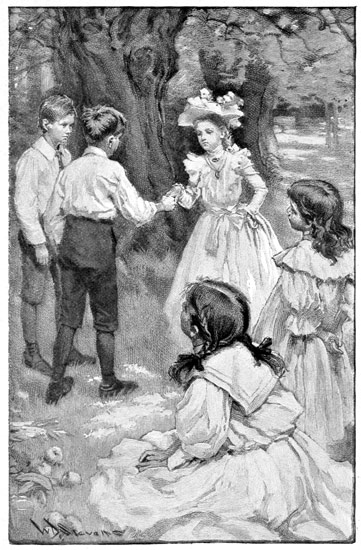
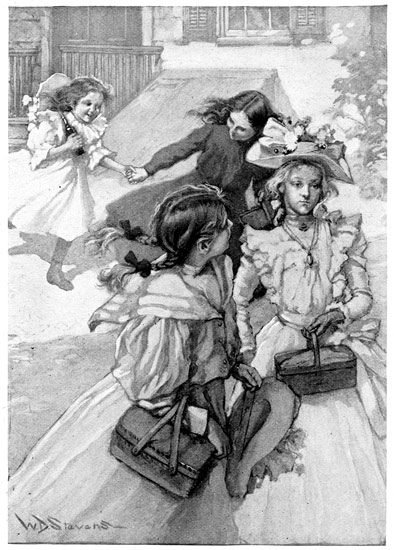
"EACH CAME FORWARD AND SHOOK CLARICE'S GLOVED HAND
SOLEMNLY."
Fortunately, Mary was talking to Teddy,
and did not hear. Sue did, and for the first
time her admiration for Clarice received a
shock. She raised her head and looked full
at Clarice, her hazel eyes full of fire. "I don't
understand you," she said. "These are my
friends; I invited them because you asked
me to."
Clarice's eyes fell; she colored, and muttered
something, Sue did not hear what; then she
put her hand to her side and drew a short,
gasping breath.
In an instant Sue's anger was gone.
"Boys!" she cried hastily. "Tom, bring some
water, quick! She's going to faint."
Clarice was now leaning back with closed
eyes. "Never mind me," she murmured
softly; "go on and enjoy yourselves. I shall
be—better—soon, I dare say."
Splash! came a shower of water in her face.
Tom, in eager haste, had stumbled over Sue's
foot, and his whole dipperful of water was
spilled over the fainting maiden. She sprang
to her feet with amazing agility.
"You stupid, stupid boy!" she cried, stamping
her foot, her eyes blazing with fury.
"You did it on purpose; you know you did!
Get away this minute!"
Then, while all looked on in silent amaze,
she burst into tears, and declared she would
go home that instant. She would not stay
there to be made a fool of by odious, rude,
vulgar boys.
There was dead silence for a moment. Then
Tom said, slowly and solemnly (no one could
be so solemn as Tom when he tried): "I beg
your pardon, Miss Packard; I am very sorry.
I will go away if you wish it, but I hope you
will stay."
Sue wanted to hug Tom, but refrained.
(She had decided a little while ago that she
was getting too big to hug the boys any more.)
"Tom, you are a darling," she whispered in
his ear—"a perfect dear duck! And you
can use the telephone all you like to-morrow.
Clarice," she added aloud, "he has apologized;
Tom has apologized, and that is all
he can do, isn't it? You are all right now,
aren't you?"
Clarice hesitated. Her dignity was on the
one hand, her dinner on the other; she was
hungry, and she yielded.
"If he didn't really mean to," she began
ungraciously; but Mary cut her short with
what the boys called her full-stop manner.
"I think there has been quite enough of
this foolishness," she said curtly. "Sue, will
you pass the sandwiches? Have some chicken-pie,
Clarice!"
A sage has said that food stops sorrow,
and so it proved in this case. The chicken-pie
was good, and all the children felt wonderfully
better after the second help all round.
Tongues were loosed, and chattered merrily.
The boys related with many chuckles their
chase of the woodchuck, and how he finally
escaped them, and they heard him laughing
as he scuttled off.
"Well, he was laughing—woodchuck
laughter; you ought just to have heard him,
Mary."
Sue made them all laugh by telling of her
encounter with Katy and the milk-pan. Even
Clarice warmed up after her second glass of
shrub, and told them of the picnics they had
at Saratoga, where she had been last year.
"That was why I was so surprised at this
kind of picnic, dear," she said to Sue, with a
patronizing air. "It's so different, you see.
The last one I went to, there were—oh, there
must have been sixty people at the very least.
It was perfectly alegant! There were two
four-in-hands, and lots of drags and tandems.
I went in a dog-cart with Fred. You know—the
one I told you about." She nodded mysteriously
and simpered, and Sue flushed with
delighted consequence.
"What did you take?" asked Lily, her
mouth full of chicken.
"Oh, a caterer furnished the refreshments,"
said Clarice, airily. "There was everything
you can think of: salads, and ice-cream, and
boned turkey, and all those things. Perfectly
fine, it was! Everybody ate till they couldn't
hardly move; it was alegant!"
"Didn't you do anything but just gob—I
mean eat?" asked Mary.
"Oh, there was a band of music, of course;
and we walked about some, and looked at
the dresses. They were perfectly alegant! I
wore a changeable taffeta, blue and red, and a
red hat with blue birds in it. Everybody said
it was just as cute! The reporter for the 'Morning
Howl' was there, and he said it was the
handsomest costume at the picnic. He was
a perfect gentleman, and everything I had on
was in the paper next day."
"This is soul-stirring," said Tom (who did
sometimes show that he was fifteen, though
not often), "but didn't I hear something about
toasts?"
Clarice looked vexed, but Mary took up
the word eagerly. "Yes, to be sure, Tom;
it is quite time for toasts. Fill the glasses
again, Teddy! Clarice, you are the guest of
honor; will you give the first toast?"
Clarice shook her head, and muttered something
about not caring for games.
"Then I will!" cried Sue; and she stood
up, her eyes sparkling.
"I drink to Clarice!" she said. "I hope
she will grow strong, and never have any
heart again,—I mean any pain in it,—and
that she will stay here a long, long time, till
she grows up!"
Teddy choked over his glass, but the others
said "Clarice!" rather soberly, and clinked
their glasses together. Clarice, called upon
for a speech in response to the toast, simpered,
and said that Sue was too perfectly sweet for
anything, but could think of nothing more.
Then Tom was called upon. He rose slowly,
and lifted his glass.
"I drink to the health of Quicksilver Sue!
May she shun the false, and seek the true!"
Mary gave him a warning glance, but Sue
was enchanted. "Oh, Tom, how dear of
you to make it in poetry!" she cried, flushing
with pleasure. "Wait; wait just a minute,
and I'll make my speech."
She stood silent, holding up her glass, in
which the sunbeams sparkled, turning the
liquid to molten rubies; then she said rather
shyly:
"I drink to Tom, the manly Hart,
And wish him all the poet's art!"
This was received with great applause.
Mary's turn came next; but before she could
speak, Clarice had sprung to her feet with a
wild shriek. "A snake!" she cried; "a
snake! I saw it! It ran close by my foot.
Oh, I shall faint!"
Teddy clapped his hand to his pocket, and
looked shamefaced.
"I thought I had buttoned him in safe," he
said. "I'm awfully sorry. The other one is
in there all right; it was only the little one
that got out."
But this was too much for Clarice. She
declared that she must go home that instant;
and after an outcry from Sue no one opposed
her. The baskets were collected, the crumbs
scattered for the birds, and the party started
for home. Mary and her brothers led the
way with Lily, Sue and Clarice following
slowly behind with arms intertwined. Sue's
face was a study of puzzled regret, self-reproach,
and affection.
"Mary," said Tom.
"Hush, Tom!" said Mary, with a glance
over her shoulder. "Don't say anything till
we get home."
"I'm not going to say anything. But
what famous book—the name of it, I mean—expresses
what has been the matter with
this picnic?"
"Oh, I don't know, Tom. 'Much Ado
about Nothing'?"
"No," said Tom. "It's 'Ben Hur'!"