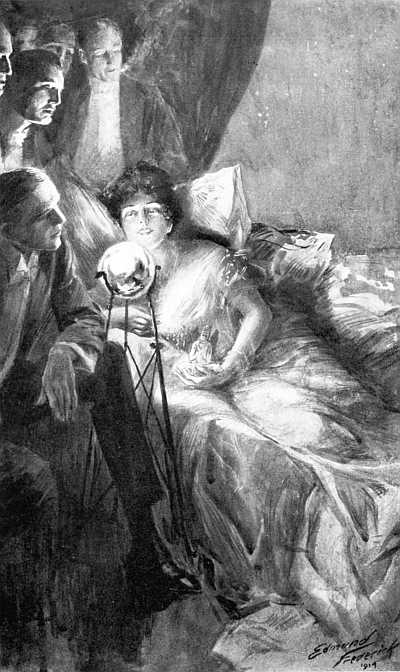
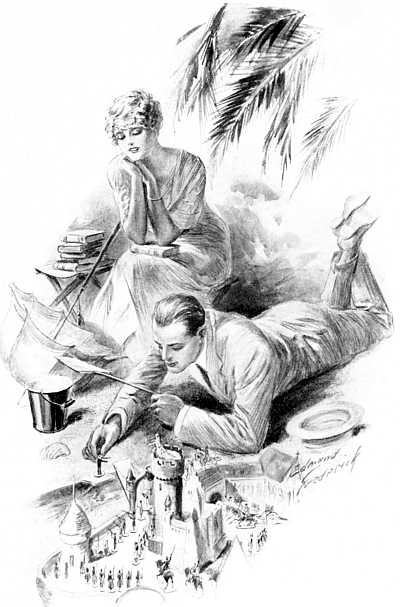
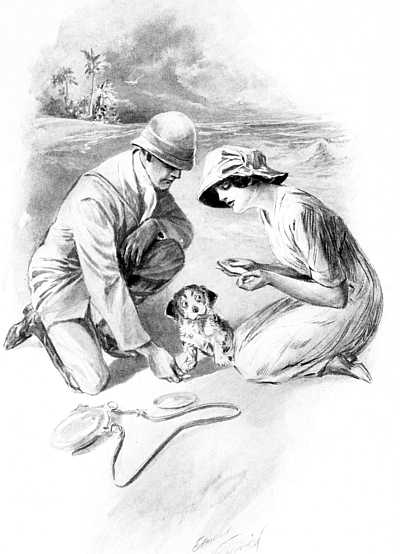
"'Are you preaching?' asked Athalie, raising her eyes
from the Green God." [Page 252]
By
ROBERT W. CHAMBERS
ILLUSTRATED BY
EDMUND FREDERICK
D. APPLETON AND COMPANY
NEW YORK AND LONDON: MCMXIV
Copyright, 1914, by
ROBERT W. CHAMBERS
Copyright, 1913, by Harper's Bazaar, Inc.
Copyright, 1914, by The Star Co.
Printed in the United States of America
TO
PENELOPE SEARS
DEBUTANTE
To rhyme your nameWith something lovely, fresh and young,And sing the sameIn measures heretofore unsung,Is far beyond me, I'm afraid;I'll not attempt it, dearest maid.
No, not in verse,Synthetic, stately, classic, chaste,Shall I rehearse—Although in perfectly good taste—A catalogue of every graceThat you inherit from your race.
Gracious and kind,The gods your beauty gave to you,And with a mindThese same kind gods endowed you, too;That charming union is, I fear,Somewhat uncommon on this sphere.
I have no doubtThat scores of poets chant your fame;No doubt, aboutA million suitors press their claim;And fashion, elegance and witAre at your feet inclined to sit.
Penelope,The fire-light flickers to and fro:In you I seeThe winsome child I used to know—My little Maiden of RomanceStill whirling in your Shadow Dance.
Though woman-grown,To my unreconciled surpriseI gladly ownThe same light lies within your eyes—The same sweet candour which beguiledYour rhymster when you were a child.
And so I come,With limping verse to you again,Amid the humOf that young world wherein you reign—Only a moment to appearAnd say: "Your rhymster loves you, dear."
R. W. C.
PREFACE
Always animated by a desire to contribute in a
small way toward scientific investigation, the
author offers this humble volume to a more serious
audience than he has so far ventured to address.
For all those who have outgrown the superficial
amusement of mere fiction this volume, replete
with purpose, is written in hopes that it may
stimulate students to original research in certain
obscure realms of science, the borderlands of
which, hitherto, have been scarcely crossed.
There is perhaps no division of science as important,
none so little understood, as the science
of Crystal Gazing.
A vast field of individual research opens before
the earnest, patient, and sober minded investigator
who shall study the subject and discover those
occult laws which govern the intimate relations
between crystals, playing cards, cigarettes, soiled
pink wrappers, and the Police.
Amor nihil est celerius!
LIST OF ILLUSTRATIONS
FACING PAGE
"'Are you preaching?' asked Athalie, raising her eyes from the green god"
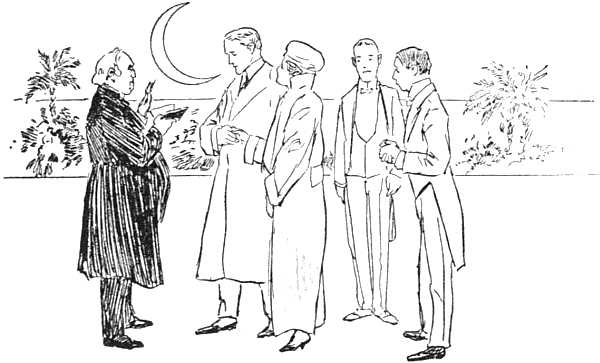
There was a new crescent moon in the west
which, with the star above it, made an
agreeable oriental combination.
In the haze over bay and river enough rose and
purple remained to veil the awakening glitter of
the monstrous city sprawling supine between river,
sound, and sea. And its incessant monotone pulsated,
groaning, dying, ceaseless, interminable
in the light-shot depths of its darkening streets.
The sky-drawing-room windows of the Countess
Athalie were all wide open, but the only light in[2]
the room came from a crystal sphere poised on
a tripod. It had the quality and lustre of moon-light,
and we had never been able to find out its
source, for no electric wires were visible, and one
could move the tripod about the room.
The crystal sphere itself appeared to be luminous,
yet it remained perfectly transparent, whatever
the source of its silvery phosphorescence.
At any rate, it was the only light in the room
except the dulled glimmer of our cigarettes, and
its mild, mysterious light enabled us to see one
another as through a glass darkly.
There were a number of men there that evening.
I don't remember, now, who they all were.
Some had dined early; others, during the evening,
strolled away into the city to dine somewhere or
other, drifting back afterward for coffee and
sweetmeats and cigarettes in the sky-drawing-room
of the Countess Athalie.
As usual the girl was curled up by the open
window among her silken cushions, one smooth
little gem-laden hand playing with the green jade
god, her still dark eyes, which slanted a little,
fixed dreamily upon infinite distance—or so it always
seemed to us.
Through the rusty and corrugated arabesques
of the iron balcony she could see, if she chose,[3]
the yellow flare where Sixth Avenue crossed the
shabby street to the eastward. Beyond that,
and parallel, a brighter glow marked Broadway.
Further east street lamps stretched away into
converging perspective, which vanished to a point
in the faint nebular radiance above the East
River.
All this the Countess Athalie could see if she
chose. Perhaps she did see it. We never seemed
to know just what she was looking at even when
she turned her dark eyes on us or on her crystal
sphere cradled upon its slender tripod.
But the sphere seemed to understand, for sometimes,
under her still gaze, it clouded magnificently
like a black opal—another thing we never understood,
and therefore made light of.
"They have placed policemen before several
houses on this street," remarked the Countess
Athalie.
Stafford, tall and slim in his evening dress, relieved
her of her coffee cup.
"Has anybody bothered you?" he asked.
"Not yet."
Young Duane picked up a pack of cards at his
elbow and shuffled them, languidly.
"Where is the Ace of Diamonds, Athalie?" he
asked.[4]
"Any card you try to draw will be the Ace of
Diamonds," replied the girl indifferently.
"Can't I escape drawing it?"
"No."
We all turned and looked at Duane. He quickly
spread the pack, fan-shaped, backs up. After
a moment's choosing he drew a card, looked at it,
held it up for us to see. It was the Ace of
Diamonds.
"Would you mind trying that again, Athalie?"
I asked. And Duane replaced the card and shuffled
the pack.
"But it's gone, now," said the girl.
"I replaced it in the pack," explained Duane.
"No, you gave it to me," she said.
We all smiled. Duane searched through the
pack in his hands, once, twice; then he laughed.
The girl held up one empty hand. Then, somehow
or other, there was the Ace of Diamonds between
her delicate little thumb and forefinger.
She held it a moment or two for our inspection;
then, curving her wrist, sent it scaling out into
the darkness. It soared away above the street,
tipped up, and describing an aerial ellipse, returned
straight to the balcony where she caught
it in her fingers.
Twice she did this; but the third time, high in[5]
the air, the card burst into violet flame and
vanished.
"That," remarked Stafford, "is one thing which
I wish to learn how to do."
"Two hundred dollars," said the Countess
Athalie, "—in two lessons; also, your word of
honour."
"Monday," nodded Stafford, taking out a note-book
and making a memorandum, "—at five in
the afternoon."
"Monday and Wednesday at five," said the girl,
lighting a cigarette and gazing dreamily at
nothing.
From somewhere in the room came a voice.
"Did they ever catch that crook, Athalie?"
"Which?"
"The Fifty-ninth Street safe-blower?"
"Yes."
"Did you find him?"
She nodded.
"How? In your crystal?" I asked.
"Yes, he was there."
"It's odd," mused Duane, "that you can never
do anything of advantage to yourself by gazing
into your crystal."
"It's the invariable limit to clairvoyance," she
remarked.[6]
"A sort of penalty for being super-gifted,"
added Stafford.
"Perhaps.... We can't help ourselves."
"It's too bad," I volunteered.
"Oh, I don't care," she said, with a slight shrug
of her pretty shoulders.
"Come," said somebody, teasingly, "wouldn't
you like to know how soon you are going to fall
in love, and with whom?"
She laughed, dropped her cigarette into a silver
bowl, stretched her arms above her head, straightened
her slender figure, turned her head and looked
at us.
"No," she said, "I do not wish to know. Light
is swift; Thought is swifter; but Love is the
swiftest thing in Life, and if it is now travelling
toward me, it will strike me soon enough to suit
me."
Stafford leaned forward and arranged the cushions
for her; she sank back among them, her dark
eyes still on us.
"Hours are slow," she said; "years are slower,
but the slowest thing in Life is Love. If it is now
travelling toward me, it will reach me soon enough
to suit me."
"I," said Duane, "prefer quick action, O
Athalie, the Beautiful!"[7]
"Athalie, lovely and incomparable," said Stafford,
"I, also, prefer quick action."
"Play Scheherazade for us, Athalie," I said,
"else we slay you with our compliments."
A voice or two from distant corners repeated
the menace. A match flared and a fresh cigarette
glowed faintly.
Somebody brought the tripod with its crystal
sphere and set it down in the middle of the room.
Its mild rays fell on the marble basin of the tiny
fountain,—Duane's offering. The goldfish which
I had given her were floating there fast asleep.
When we had placed sweetmeats and cigarettes
convenient for her, we all, in turn, with
circumstance and ceremony, bent over her left
hand where it rested listlessly among the cushions,
saluting the emerald on her third finger with
our lips.
Then the dim circle closed around her, nearer.
"Of all the visions which have passed before
your eyes within the depths of that crystal
globe," said Duane, "—of all the histories of men
and women which, unsuspected by them, you have
witnessed, seated here in this silent, silk-hung
place, we desire to hear only those in which Fate
has been swiftest, Opportunity a loosened arrow,
Destiny a flash of lightning."[8]
"But the victims of quick action must be nameless,
except as I choose to mask them," she said,
looking dreamily into her crystal.
After a moment's silence Duane said in a low
voice:
"Does anybody notice the odour of orange
blossoms?"
We all noticed the fragrance.
"I seem to catch a whiff of the sea, also," ventured
Stafford. "Am I right?"
"Yes," she nodded, "you will notice the odour
of the semi-tropics, even if you miss the point of
everything I tell you."
"In other words," said I, "we are but a material
bunch, Athalie, and may be addressed and
amused only through our physical senses. Very
well: transpose from the spiritual for us if you
please a little story of quick action which has
happened here in the crystal under your matchless
eyes!"[9]
II
With her silver tongs she selected a
sweetmeat. When it had melted in
her sweeter mouth, she lighted a cigarette,
saluted us with a gay little gesture and
smilingly began:
"Don't ask me how I know what these people
said; that is my concern, not yours. Don't ask
me how I know what unspoken thoughts animated
these people; that is my affair. Nor how I seem
to be perfectly acquainted with their past histories;
for that is part of my profession."
"And still the wonder grew," commented the
novelist tritely, "that one small head could
carry all she knew!"
"Why," asked Stafford, "do you refuse to
reveal your secret? Do you no longer trust us,
Athalie?"[10]
She answered: "Comment prétendons-nous qu'un
autre garde notre secret, si nous n'avons pas
pu le garder nous-même?"
Nobody replied.
"Now," she said, laughingly, "I will tell you
all that I know about the Orange Puppy."
Plans for her first debut began before her birth.
When it became reasonably certain that she was
destined to decorate the earth, she was entered
on the waiting lists of two schools—The Dinglenook
School for Boys, and The Idlebrook Institute
for Young Ladies—her parents taking no
chances, but playing both ends coming and going.
When ultimately she made her first earthly appearance,
and it was apparent that she was destined
to embellish the planet in the guise of a
girl, the process of grooming her for her second
debut, some eighteen years in the future, began.
She lived in sanitary and sterilized seclusion, eating
by the ounce, sleeping through accurately
measured minutes, every atom of her anatomy
inspected daily, every pore of her skin explored,
every garment she wore weighed, every respiration,
pulse beat, and fluctuation of bodily temperature
carefully noted and discussed.[11]
When she appeared her hair was black. After
she shed this, it came in red; when she was eight
her hair was coppery, lashes black, eyes blue, and
her skin snow and wild-strawberry tints in agreeably
delicate nuances. Several millions were set
aside to grow up with her and for her. Also,
the list of foreign and aristocratic babyhood was
scanned and several dozen possibilities checked
off—the list running from the progeny of down-and-out
monarchs with a sporting chance for a
crown, to the more solid infant aristocracy of
Britain.
At the age of nine, the only symptom of intellect
that had yet appeared in her was a superbly
developed temper. That year she eluded a governess
and two trained nurses in the park, and
was discovered playing with some unsterilized children
near the duck-pond, both hands full of slime
and pollywogs.
It was the only crack in the routine through
which she ever crawled. Lessons daily in riding,
driving, dancing, fencing, gymnastics, squash,
tennis, skating, plugged every avenue of escape
between morning school and evening sleep, after
a mental bath in sterilized literature. Once, out
of the window she saw a fire. This event, with
several runaways on the bridle-path, included the[12]
sensations of her life up to her release from special
instructors, and her entry into Idlebrook Institute.
Here she did all she could to misbehave in a
blind and instinctive fashion, but opportunities
were pitiably few; and by the time she had graduated,
honest deviltry seemed to have been
starved out of her; and a half year's finishing
abroad apparently eliminated it, leaving only a
half-confused desire to be let alone. But solitude
was the luxury always denied her.
Unlike the usual debutante, who is a social
veteran two years before her presentation, and
who at eighteen lacks no experience except intellectual,
Miss Cassillis had become neither a judge
of champagne nor an expert in the various cabaret
steps popular at country houses and the more
exclusive dives.
"Mother," she said calmly, on her eighteenth
birthday, "do you know that I am known among
my associates as a dead one?" At which that fat
and hard-eyed matron laughed, surveying her
symmetrical daughter with grim content.
"Let me tell you something," she said. "America,
socially, is only one vast cabaret, mostly consisting
of performers. The spectators are few.
You're one. Conditions are reversed across the[13]
water; the audience is in the majority.... How
do you like young Willowmere?"
The girl replied that she liked Lord Willowmere.
She might have added that she was prepared
to like anything in trousers that would
give her a few hours off.
"Do you think," said her mother, "you can
be trusted to play in the social cabaret all next
winter, and then marry Willowmere?"
Said Cecil: "I am perfectly ready to marry
anybody before luncheon, if you will let me."
"I do not wish you to feel that way."
"Mother, I do! All I want is to be let alone
long enough to learn something for myself."
"What do you not know? What have you not
learned? What accomplishment do you lack,
little daughter? What is it you wish?"
The girl glanced out of the window. A young
and extremely well-built man went striding down
the avenue about his business. He looked a little
like a man she had seen playing ball on the Harvard
team a year ago. She sighed unconsciously.
"I've learned about everything there is to
learn, I suppose.... Except—where do men
go when they walk so busily about their business?"
"Down town," said her mother, laughing.[14]
"What do they do there?"
"A million things concerning millions."
"But I don't see how there's anything left for
them to do after their education is completed.
What is there left for me to do, except to marry
and have a few children?"
"What do you want to do?"
"Nothing.... I'd like to have something to
do which would make me look busy and make me
walk rather fast—like that young man who was
hurrying down town all by himself. Then I'd like
to be let alone while I'm busy with my own
affairs."
"When you marry Willowmere you'll be busy
enough." She might have added: "And lonely
enough."
"I'll be occupied in telling others how to busy
themselves with my affairs. But there won't be
anything for me to do, will there?"
"Yes, dear child; it will be one steady fight to
better a good position. It will afford you constant
exercise."
The tall young girl bit her lip and shook her
pretty head in silence. She felt instinctively that
she knew how to do that. But that was not the
exercise she wanted. She looked out into the
February sunshine and saw the blue shadows on[15]
the snow and the sidewalks dark and wet, and the
little gutter arabs throwing snow-balls, and a
yellow pup barking blissfully. And, apropos of
nothing at all, she suddenly remembered how she
had run away when she was nine; and a rush of
blind desire surged within her. What it meant
she did not know, did not trouble to consider, but
it stirred her until the soft fire burned in her
cheeks, and left her twisting her white fingers,
lips parted, staring across the wintry park into
the blue tracery of trees. To Miss Cassillis
adolescence came late.
They sang Le Donne Curiose at the opera that
evening; she sat in her father's box; numbers of
youthful, sleek-headed, white-shirted young men
came between the acts. She talked to all with
the ardor of the young and unsatisfied; and, mentally
and spiritually still unsatisfied, buried in
fur, she was whirled back through snowy streets
to the great grey mansion of her nativity, and
the silence of her white-hung chamber.
All through February the preparatory régime
continued, with preliminary canters at theatre
and opera, informal party practice, and trial
dinners. Always she gave herself completely to
every moment with a wistful and unquenched
faith, eager novice in her quest of what was lacking[16]
in her life; ardent enthusiast in her restless
searching for the remedy. And, unsatisfied, lingering
mentally by the door of Chance, lest she
miss somewhere the magic that satisfies and quiets—lest
the gates of Opportunity swing open after
she had turned away—reluctantly she returned
to the companionship of her own solitary mind
and undeveloped soul, and sat down to starve
with them in spirit, wondering wherein might lie
the reason for this new hunger that assailed her,
mind and body.
She ran up her private flag the next winter,
amid a thousand other gay and flaunting colours
breaking out all over town. The newspapers
roared a salute to the wealthiest debutante; and
an enthusiastic press, not yet housebroken but
agile with much exercise in leaping and fawning,
leaped now about the debutante's slippers, grinning,
slavering and panting. Later, led by instinct
and its Celebrated Nose, it bounded toward
young Lord Willowmere, jumped and fawned
about him, slightly soiling him, until in midwinter
the engagement it had announced was corroborated,
and a million shop-girls and old women were
in a furor.
He was a ruddy-faced young man who wore his
bowler hat toward the back of his head, a small,[17]
pointed moustache, and who walked always as
though he were shod in riding boots.
He would have made a healthy studgroom for
any gentleman's stable. Person and intellect
were always thoroughly scrubbed as with saddle-soap.
Had he been able to afford it, his stables
would have been second to none in England.
Soon he would be able to afford it.
To his intimates, including his fiancée, he was
known as "Stirrups." All day long he was in the
saddle or on the box, every evening at the Cataract
Club or at a cabaret. Between times he
called upon Miss Cassillis—usually finding her
out. When he found her not at home, he called
elsewhere, very casually.
Two continents were deeply stirred over the
impending alliance.[18]
III
Young Jones, in wildest Florida, had never
heard of it or of her, or of her income.
His own fortune amounted to six hundred
dollars, and he had been born in Brooklyn,
and what his salary might be only he and the
Smithsonian Institution knew.
He was an industrious young man, no better
than you or I, accepting thankfully every opportunity
for mischief which the Dead Lake region
afforded. No opportunities of that kind ever
presenting themselves in that region, he went once
a month to Miami in the Orange Puppy, and
drank too many swizzles and so forth, et cetera.[19]
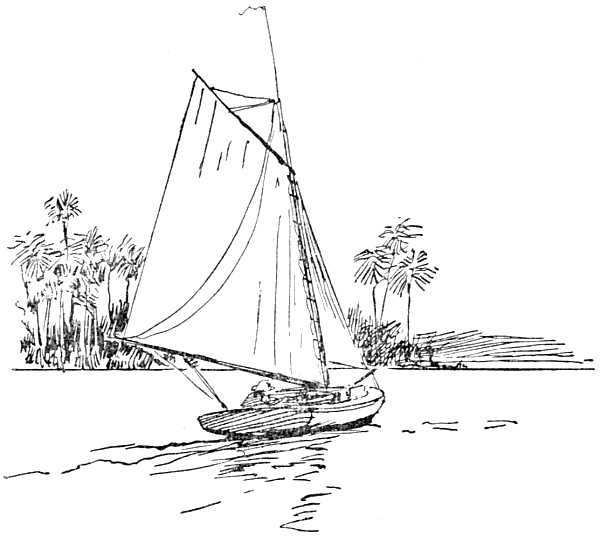
Having accomplished this, he returned to the
wharf, put the Orange Puppy into commission,
hoisted sail, and squared away for Matanzas Inlet,
finding himself too weak-minded to go home
by a more direct route.
He had been on his monthly pilgrimage to Miami,
and was homeward bound noisily, using his
auxiliary power so that silence should not descend
upon him too abruptly. He had been, for half
an hour now, immersed in a species of solitaire
known as The Idiot's Delight, when he caught
himself cheating himself, and indignantly scattered
the pack to the four winds—three of which,
however, were not blowing. One card, the deuce
of hearts, fluttered seaward like a white butterfly.
Beyond it he caught sight of another white
speck, shining like a gull's breast.
It was a big yacht steaming in from the open
sea; and her bill of lading included Miss Cassillis
and Willowmere. But Jones could not know that.
So he merely blinked at the distant Chihuahua,
yawned, flipped the last card overboard, and
swung the Orange Puppy into the inlet, which
brimmed rather peacefully, the tide being nearly
at flood.
Far away on the deck of the Chihuahua the
quick-fire racket of Jones's auxiliary was amazingly[20]
audible. Miss Cassillis, from her deck-chair,
could see the Orange Puppy, a fleck of glimmering
white across a sapphire sea. How was she
to divine that one Delancy Jones was aboard of
her? All she saw when the two boats came near
each other was a noisy little craft progressing
toward the lagoon, emitting an earsplitting
racket; and a tall, lank young man clad in flannels
lounging at the tiller and smoking a cigarette.
Around her on the snowy deck were disposed
the guests of her parents, mostly corpulent, swizzles
at every elbow, gracefully relaxing after a
morning devoted to arduous idleness. The Victor
on deck, which had furnished the incentive to
her turkey-trotting with Lord Willowmere, was
still exuding a syncopated melody. Across the
water, Jones heard it and stood looking at the
great yacht as the Orange Puppy kicked her way
through the intensely blue water under an azure
sky.
Willowmere lounged over to the rail and gazed
wearily at the sand dunes and palmettos. Presently
Miss Cassillis slipped from her deck-chair
to her white-shod feet, and walked over to where
he stood. He said something about the possibilities
of "havin' a bit of shootin'," with a vague[21]
wave of his highly-coloured hand toward the palmetto
forests beyond the lagoon.
If the girl heard him she made no comment.
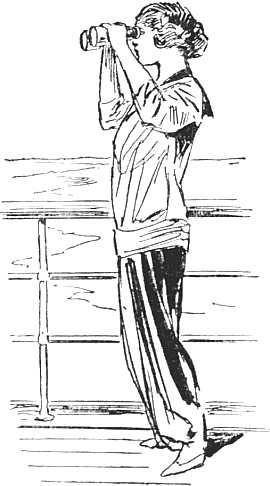
After a while, as the distance between the Chihuahua
and the Orange Puppy lengthened, she levelled
her sea glasses at the latter craft, and found
that the young man at the helm was also examining
her through his binoculars.
While she inspected him, several unrelated ideas
passed through her head; she thought he was
very much sunburned and that his hatless head
was attractive, with its short yellow hair crisped
by the sun. Without any particular reason, apparently,
she recollected a young man she had
seen the winter before, striding down the wintry
avenue about his business. He might have been
this young man for all she knew. Like the other,
this one wore yellow hair. Then, with no logic in
the sequence of her thoughts, suddenly the memory
of how she had run away when she was nine
years old set her pulses beating, filling her heart
with the strange, wistful, thrilling, overwhelming
longing which she had supposed would never again
assail her, now that she was engaged to be married.
And once more the soft fire burned in her
cheeks.
"Stirrups," she said, scarcely knowing what she[22]
was saying, "I don't think I'll marry you after
all. It's just occurred to me."
"Oh, I say!" protested Willowmere languidly,
never for a moment mistrusting that the point
of her remark was buried in some species of
American humour. He always submitted to
American humour. There was nothing else to do,
except to understand it.
"Stirrups, dear?"
"What?"
"You're very pink and healthy, aren't you?"
He shrugged his accustomed shrug of resignation.
"Oh, I say—come, now——" he murmured,
lighting a cigarette.
"What a horrid smash there would be if I
didn't make good, wouldn't there, Stirrups?"
She mused, her blue eyes resting on him, too
coldly.
"Rather," he replied, comfortably settling his
arms on the rail.
"It might happen, you know. Suppose I fell
overboard?"
"Fish you out, ducky."
"Suppose I—ran away?"
"Ow."
"What would you do, Stirrups? Why, you'd[23]
go back to town and try to pick another winner.
Wouldn't you?"
He laughed.
"Naturally that is what you would do, isn't
it?" She considered him curiously for a moment,
then smiled. "How funny!" she said, almost
breathlessly.
"Rather," he murmured, and flicked his cigarette
overboard.
The Orange Puppy had disappeared beyond the
thicket of palmettos across the point. The air
was very warm and still.
Her father waddled forward presently, wearing
the impressive summer regalia of a commodore in
the Siwanois Yacht Club. His daughter's blue
eyes rested on the portly waistline of her parent—then
on his fluffy chop-whiskers. A vacant,
hunted look came into her eyes.
"Father," she said almost listlessly, "I'm going
to run away again."
"When do you start?" inquired that facetious
man.
"Now, I think. What is there over there?"—turning
her face again toward the distant lagoon,
with its endless forests of water-oak, cedar, and
palmetto.
"Over there," said her father, "reside several[24]
species of snakes and alligators. Also other reptiles,
a number of birds, and animals, and much
microbic mud."
She bit her lip. "I see," she said, nodding.
Willowmere said: "We should find some shootin'
along the lagoon. Look at the ducks."
Mr. Cassillis yawned; he had eaten too heavily
of duck to be interested. Very thoughtfully
he presented himself with a cigar, turned it over
and over between his soft fingers, and yawned
again. Then, nodding solemnly as though in emphasis
of a profound idea of which he had just
been happily delivered, he waddled slowly back
along the deck.
His daughter looked after him until he disappeared;
gazed around her at the dawdling assortment
of guests aboard, then lifted her quiet eyes
to Willowmere.
"Ducky," she said, "I can't stand it. I'm going
to run away."
"Come on, then," he said, linking his arm in
hers.
The Victor still exuded the Tango.
She hesitated. Then freeing herself:
"Oh, not with you, Stirrups! I wish to go
away somewhere entirely alone. Could you understand?"
she added wistfully.[25]
He stifled a yawn. American humour bored him
excessively.
"You'll be back in a day or two?" he inquired.
And laughed violently when the subtlety of his
own wit struck him.
"In a day or two or not at all. Good-bye, Stirrups."
"Bye."
The sun blazed on her coppery hair and on
the white skin that never burned, as she walked
slowly across the yacht's deck and disappeared
below.
While she was writing in her cabin, the Chihuahua
dropped her anchors. Miss Cassillis listened
to the piping, the thud of feet on deck, the rattle
and distant sound of voices. Then she continued
her note:
I merely desire to run away. I don't know why,
Mother, dear. But the longing to bolt has been incubating
for many years. And now it's too strong to
resist. I don't quite understand how it came to a
crisis on deck just now, but I looked at Stirrups,
whose skin is too pink, and at Father, who had
lunched too sumptuously, and at the people on deck,
all digesting in a row—and then at the green woods
on shore, and the strip of white where a fairy surf
was piling up foam into magic castles and snowy bat[26]tlements,
ephemeral, exquisite. And all at once it
came over me that I must go.
Don't be alarmed. I shall provision a deck canoe,
take a tent, some rugs and books, and paddle into
that lagoon. If you will just let me alone for two
or three days, I promise I'll return safe and sound,
and satisfied. For something has got to be done in
regard to that longing of mine. But really, I think
that if you and Father won't understand, and if you
send snooping people after me, I won't come back at
all, and I'll never marry Stirrups. Please understand
me, Mother, dear.
Cecil.
This effusion she pinned to her pillow, then
rang for the steward and ordered the canoe to
be brought alongside, provisioned for a three
days' shooting trip.
So open, frank, and guileless were her orders
that nobody who took them suspected anything
unusual; and in the full heat and glare of the
afternoon siesta, when parents, fiancé, and assorted
guests were all asleep and in full process of
digestion and the crew of the Chihuahua was
drowsing from stem to stern, a brace of sailors
innocently connived at her escape, aided her into
the canoe, and, doubting nothing, watched her
paddle away through the inlet, and into the[27]
distant lagoon, which lay sparkling in golden
and turquoise tints, set with palms like a stupid
picture in a child's geography.
Later, the Chihuahua fired a frantic gun.
Later still, two boats left the yacht, commanded
respectively by one angry parent and one fiancé,
profoundly bored.[28]
IV
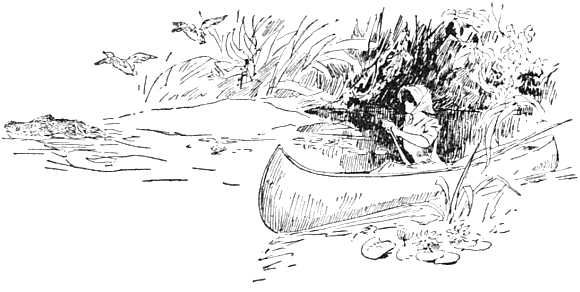
When Miss Cassillis heard the gun, it
sounded very far away. But it irritated
as well as scared her. She
pushed the canoe energetically through a screen
of foliage overhanging the bank of the lagoon,
it being merely her immediate instinct to hide herself.
To her surprise and pleasure, she discovered
herself in a narrow, deep lead, which had been entirely
concealed by the leaves, and which wound
away through an illimitable vista of reeds, widening
as she paddled forward, until it seemed like
a glassy river bordered by live-oak, water-oak,
pine, and palmetto, curving out into a flat and
endless land of forests.
Here was liberty at last! No pursuit need
now be feared, for the entrance to this paradise[29]
which she had forced by a chance impulse could
never be suspected by parent or fiancé.
A little breeze blew her hair and loosened it;
silently her paddle dipped, swept astern in a
swirl of bubbles, flashed dripping, and dipped
again.
Ahead of her a snake-bird slipped from a dead
branch into the water; a cormorant perched on
the whitened skeleton of a mango, made hideous
efforts to swallow a mullet before her approach
disorganized his manœuvres.
So silently the canoe stole along that the fat
alligators, dozing in the saw-grass, dozed on until
she stirred them purposely with a low tap of her
paddle against the thwarts; then they rose, great
lumbering bodies propped high on squatty legs,
waddled swiftly to the bank's edge, and slid headlong
into the water.
Everywhere dragon-flies glittered over the saw-grass;
wild ducks with golden eyes and heads like
balls of brown plush swam leisurely out of the
way; a few mallard, pretending to be frightened,
splashed and clattered into flight, the sunlight
jewelling the emerald heads of the drakes.
"Wonderful, wonderful," her heart was singing
to itself, while her enchanted eyes missed nothing—neither
the feebly flying and strangely[30]
shaped, velvety black butterflies, the narrow wings
of which were striped with violent yellow; nor the
metallic blue and crestless jays that sat on saplings,
watching her; nor the pelicans fishing with
nature's orange and iridescent net in the shallows;
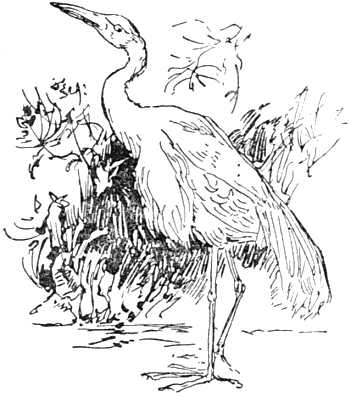
nor the tall, slate-blue birds that marched in dignified
retreat through the sedge, picking up their
stilt-like legs with the precision of German foot-soldiers
on parade.
These and other phenomena made her drop
her paddle at intervals and clap her hands softly
in an ecstasy beyond mere exclamation. How
restfully green was the world; how limpid the
water; how royally blue the heavens! Listening,
she could hear the soft stirring of palmetto fronds
in the forests; the celestial song of a little bird
that sat on a sparkle-berry bush, its delicate long-curved
bill tilted skyward. Then the deep note
of splendour flashed across the scheme of sound
and colour as a crimson cardinal alighted near
her, crest erect.
But more wonderful than all was that at last,
after eighteen years, she was utterly alone; and
liberty was showering its inestimable gifts upon
her in breathless prodigality—liberty to see with
her own eyes and judge with her own senses; liberty
to linger capriciously amid mental fancies, to
[31]move on impulsively to others; liberty to reflect
unurged and unrestricted; liberty to choose, to
reject, to ignore.
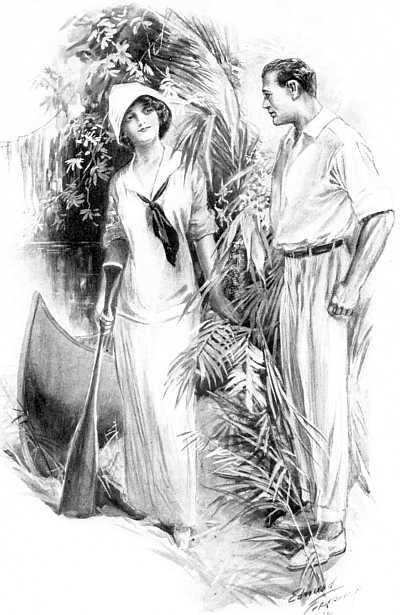
"They inspected each other, apparently bereft of
the power of speech."
Now and then a brilliant swimming snake filled
her with interest and curiosity. Once, on a flat,
low bush, she saw a dull, heavy, blunt-bodied serpent
lying asleep in the sun like an old and swollen
section of rubber hose. But when she ventured
to touch the bush with her paddle, the snake
reared high and yawned at her with jaws which
seemed to be lined in white satin. Which fortunately
made her uneasy, and she meddled no more
with the Little Death of the southern swamps.
She was now passing very close to the edge of
the "hammock," where palmettos overhung the
water; and as the cool, dim woodlands seemed to
invite her, she looked about her leisurely for an
agreeable landing place. There were plenty to
choose from; and she selected a little sandy point
under a red cedar tree, drove her canoe upon it,
and calmly stepped ashore. And found herself
looking into the countenance of Jones.
For a full minute they inspected each other, apparently
bereft of the power of speech.
She said, finally: "About a year ago last February,
did you happen to walk down Fifth Avenue—very
busily? Did you?"[32]
It took him an appreciable time to concentrate
for mental retrospection.
"Yes," he said, "I did."
"You were going down town, weren't you?"
"Yes."
"On business?"
"Yes," he said, bewildered.
"I wonder," she said timidly, "if you would tell
me what that business was? Do you mind? Because,
really, I don't mean to be impertinent."
He made an effort to reflect. It was difficult
to reflect and to keep his eyes on her but also it
is impolite to converse with anybody and look
elsewhere. This he had been taught at his mother's
knee—and sometimes over it.
"My business down town," he said very slowly,
"was with an officer of the Smithsonian Institution
who had come on from Washington to see
something which I had brought with me from
Florida."
"Would you mind telling me what it was you
brought with you from Florida?" she asked wistfully.
"No. It was malaria."
"What!"
"It was malaria," he repeated politely.[33]
"I—I don't see how you could—could show it
to him," she murmured, perplexed.
"Well, I'll tell you how I showed it to him. I
made a little incision in my skin with a lancet;
he made a smear or two——"
"A—what?"
"A smear—he put a few drops of my blood
on some glass plates."
"Why?"
"To examine them under the microscope."
"Why?"
"So that he might determine what particular
kind of malaria I had brought back with me."
"Did he find out?" she asked, deeply interested.
"Yes," said Jones, displaying mild symptoms
of enthusiasm, "he discovered that I was fairly
swarming with a perfectly new and undescribed
species of bacillus. That bacillus," he added,
with modest diffidence, "is now named after me."
She looked at him very earnestly, dropped her
blue eyes, raised them again after a moment:
"It must be—pleasant—to give one's name to
a bacillus."
"It is an agreeable and exciting privilege.
When I look into the culture tubes I feel an intimate
relationship with those bacilli which I have
never felt for any human being."[34]
"You—you are a——" she hesitated, with a
slight but charming colour in her cheeks, "a naturalist,
I presume?" And she added hastily, "No
doubt you are a famous one, and my question
must sound ignorant and absurd to you. But as
I do not know your name——"
"It is Jones," he said gloomily, "—and I am
not famous."
"Mine is Cecil Cassillis; and neither am I," she
said. "But I thought when naturalists gave their
names to butterflies and microbes that everything
concerned immediately became celebrated."
Jones smiled; and she thought his expression
very attractive.
"No," he said, "fame crowns the man who, celebrated
only for his wealth, names hotels, tug-boats,
and art galleries after himself. Thus are
Immortals made."
She laughed, standing there gracefully as a
boy, her hands resting on her narrow hips. She
laughed again. A tug-boat, a hotel, and a cigar
were named after her father.
"Fame is an extraordinary thing," she said.
"But liberty is still more wonderful, isn't it?"
"Liberty is only comparative," he said, smiling.
"There is really no such thing as absolute
freedom."[35]
"You have all the freedom you desire, haven't
you?"
"Well—I enjoy the only approach to absolute
liberty I ever heard of."
"What kind of liberty is that?"
"Freedom to think as I please, no matter what
I'm obliged to do."
"But you do what you please, too, don't you?"
"Oh, no!" he said smiling. "The man was never
born who did what he pleased."
"Why not? You choose your own work, don't
you?"
"Yes. But once the liberty of choice is exercised,
freedom ends. I choose my profession.
There my liberty ends, because instantly I am
enslaved by the conditions which make my choice
a profession."
She was deeply interested. A mossy log lay
near them; she seated herself to listen, her elbow
on her knee, and her chin cupped in her hand.
But Jones became silent.
"Were you not in that funny little boat that
passed the inlet about three hours ago?" she
asked.
"The Orange Puppy? Yes."
"What an odd name for a boat—the Orange
Puppy!"[36]
"An orange puppy," he explained, "is the name
given in the Florida orange groves to the caterpillar
of a large swallow-tail butterfly, which
feeds on orange leaves. The butterfly it turns
into is known to entomologists as Papilio cresphontes
and Papilio thoas. The latter is a misnomer."
She gazed upon this young man in undisguised
admiration.
"Once," she said, "when I was nine years old, I
ran away from a governess and two trained
nurses. They found me with both hands full of
muddy pollywogs. It has nothing to do with
what you are saying, but I thought I'd tell
you."
He insisted that the episode she recalled was
most interesting and unusual, considered purely
as a human document.
"Would you tell me what you are doing down
here in these forests?" she asked, "—as we are
discussing human documents."
"Yes," he said. "I am investigating several
thousand small caterpillars which are feeding on
the scrub-palmetto."
"Is that your business?"
"Exactly. If you will remain very still for a
moment and listen very intently you can hear the[37]
noise which these caterpillars make while they are
eating."
She thought of the Chihuahua, and it occurred
to her that she had rather tired of seeing things
eat. However, except in Europe, she had never
heard things eat. So she listened.
He said: "These caterpillars are in their third
moult—that is, they have changed their skin
three times since emerging from the egg—and are
now busily chewing the immature fruit of the
scrub-palmetto. You can hear them very
plainly."
She sat silent, spellbound; and presently in the
woodland stillness, all around her she heard the
delicate and continuous sound—the steady, sustained
noise of thousands of tiny jaws, all crunching,
all busily working together. And when she
realized what the elfin rustle really meant, she
turned her delighted and grateful eyes on Jones.
And the beauty of them made him exceedingly
thoughtful.
"Will you explain to me," she whispered, "why
you are studying these caterpillars, Mr. Jones?"
"Because they are spreading out over the forests.
Until recently this particular species of
caterpillar, and the pretty little moth into which
it ultimately turns, were entirely confined to a[38]
narrow strip of jungle, only a few miles long,
lying on the Halifax River. Nowhere else in all
the world could these little creatures be found.
But recently they have been reported from the
Dead Lake country. So the Smithsonian Institution
sent me down here to study them, and find
out whither they were spreading, and whether any
natural parasitic enemies had yet appeared to
check them."
She gazed at him, fascinated.
"Have any appeared?" she asked, under her
breath.
"I have not yet found a single creature that
preys upon them."
"Isn't it a very arduous and difficult task to
watch these thousands of little caterpillars all day
long?"
"It is quite impossible for me to do it thoroughly
all alone."
"Would you like to have me help you?" she
asked innocently.
Which rather bowled him over, but he said:
"I'd b-b-be d-d-delighted—only you haven't
time, have you?"
"I have three days. I've brought a tent, you
see, and everything necessary—rugs, magazines,
blankets, toilet articles, bon-bons, books—everything,[39]
in fact, to last three days.... I wonder
how that tent is put up. Do you know?"
He went over to the canoe and gazed at the
tent.
"I think I could pitch it for you," he said.
"Oh, thanks so much! May I help you? I think
I'll put it here on this pretty stretch of white
sand by the water's edge."
"I'm afraid that wouldn't do," he said, gravely.
"Why?"
"Because the lagoon is tidal. You'd be awash
sooner or later."
"I see. Well, then, anywhere in the woods will
do——"
"Not anywhere," he said, smiling. "High water
leaves few dry places in this forest; in fact—I'm
afraid that my shack is perched on the only spot
which is absolutely dry at all times. It is a shell
mound—the only one in the Dead Lake region."
"Isn't there room for my tent beside yours?"
she asked, a trifle anxiously.
"Y-es," he said, in a voice as matter of fact
as her own. "How many will there be in your
party?"
"In my party! Why, only myself," she said,
with smiling animation.
"Oh, I see!" But he didn't.[40]
They lugged the tent back among the trees to
the low shell mound, where in the centre of a
ring of pines and evergreen oaks his open-faced
shack stood, thatched with palmetto fans. She
gazed upon the wash drying on the line, upon a
brace of dead ducks hanging from the eaves, upon
the smoky kettle and the ashes of the fire. Purest
delight sparkled in her blue eyes.
Erecting her silk tent with practiced hands,
he said carelessly:
"In case you cared to send any word to the
yacht——"
"Did I say that I came from the yacht?" she
asked; and her straight eyebrows bent a trifle
inward.
"Didn't you?"
"Will you promise me something, Mr. Jones?"
The things he was prepared to promise her
choked him for a second, but when he regained
control of his vocal powers he said, very pleasantly,
that he would gladly promise her anything.
"Then don't ask me where I came from. Let
me stay three days. Then I'll go very quietly
away, and never trouble you again. Is it a promise?"
"Yes," he said, not looking at her. His face[41]
had become very serious; she noticed it—and how
well his head was set on his shoulders, and how
his clipped hair was burned to the color of crisp
hay.
"You were Harvard, of course," she said, unthinkingly.
"Yes." He mentioned the year.
"Not crew?"
"No."
"Baseball?"
"'Varsity pitcher," he nodded, surprised.
"Then this is the third time I've seen you....
I wonder what it is about you——" She remained
silent, watching him burying her water bottles
in the cool marl.
When all was in order, he smiled, made her a
little formal bow, and evinced a disposition to
retire and leave her in possession.
"I thought we were going to work at once!"
she said uneasily. "I am quite ready." And,
as he did not seem to comprehend, "I was going
to help you to examine the little caterpillars, one
by one; and the minute I saw anything trying to
bite them I was going to call you. Didn't you
understand?" she added wistfully.
"That will be fine!" he said, with an enthusiasm
very poorly controlled.[42]
"You will show me where the little creatures
are hiding, won't you?"
"Indeed I will! Here they are, all about us!"
He made a sweeping gesture over the low undergrowth
of scrub-palmetto; and the next moment:
"I see them!" she exclaimed, delighted. "Oh,
what funny, scrubby, busy little creatures! They
are everywhere—everywhere! Why, there seem
to be thousands and thousands of them! And
all are eating the tiny green bunches of fruit!"
They bent together over a group of feeding
larvæ; he handed her a pocket microscope like
his own; and, enchanted, she studied the tiny
things while he briefly described their various
stages of development from the little eggs to the
pretty, pearl-tinted moth so charmingly striped
with delicate, brown lines—a rare prize in the
cabinet of any collector.[43]
V
Through the golden forest light of afternoon,
they moved from shrub to shrub;
and he taught her to be on the watch for
any possible foes of the neat and busy little caterpillars,
warning her to watch for birds, spiders,
beetles, ichneumon flies, possibly squirrels or even
hornets. She nodded her comprehension; he went
one way, she the other. For nearly ten minutes
they remained separated, and it seemed ages to
one of them anyway.
But the caterpillars appeared to be immune.
Nothing whatever interfered with them; wandering
beetles left them unmolested; no birds even
noticed them; no gauzy-winged and parasitic flies
investigated them.
"Mr. Jones!" she called.[44]
He was at her side in an instant.
"I only wanted to know where you were," she
said happily.
The sun hung red over the lagoon when they
sauntered back to camp. She went into her tent
with a cheerful nod to him, which said:
"I've had a splendid time, and I'll rejoin you in
a few moments."
When she emerged in fresh white flannels, she
found him writing in a blank-book.
"I wonder if I might see?" she said. "If it's
scientific, I mean."
"It is, entirely."
So she seated herself on the ground beside him,
and read over his shoulder the entries he was
making in his field book concerning the day's
doings. When he had finished his entry, she said:
"You have not mentioned my coming to you,
and how we looked for ichneumon flies together."
"I——" He was silent.
She added timidly: "I know I count for absolutely
nothing in the important experiences of a
naturalist, but—I did look very hard for ichneumon
flies. Couldn't you write in your field book
that I tried very hard to help you?"
He wrote gravely:
"Miss Cassillis most generously volunteered her[45]
invaluable aid, and spared no effort to discover
any possible foe that might prove to be parasitic
upon these larvæ. But so far without success."
"Thank you," she said, in a very low voice.
And after a short silence: "It was not mere vanity,
Mr. Jones. Do you understand?"
"I know it was not vanity, even if I do not
entirely understand."
"Shall I tell you?"
"Please."
"It was the first thing that I have ever been
permitted to do all by myself. It meant so much
to me.... And I wished to have a little record of
it—even if you think it is of no scientific importance."
"It is of more importance than——" But he
managed to stop himself, slightly startled. She
had lifted her head from the pages of the field
book to look at him. When his voice failed, and
while the red burned brilliantly in his ears, she
resumed her perusal of his journal, gravely.
After a while, though she turned the pages as if
she were really reading, he concluded that her
mind was elsewhere. It was.
Presently he rose, mended the fire, filled the kettle,
and unhooked the brace of wild ducks from[46]
the eaves where they swung, and marched off with
them toward the water.
When he returned, the ducks were plucked and
split for broiling. He found her seated as he
had left her, dreaming awake, idle hands folded
on the pages of his open field book.
For dinner they had broiled mallard, coffee,
ash-cakes, and bon-bons. After it she smoked a
cigarette with him.
Later she informed him that it was her first,
and that she liked it, and requested another.
"Don't," he said, smiling.
"Why?"
"It spoils a girl's voice, ultimately."
"But it's very agreeable."
"Will you promise not to?" he asked, lightly.
Suddenly her blue eyes became serious.
"Yes," she said, "if you wish."
The woods grew darker. Far across the lagoon
a tiger-owl woke up and began to yelp like a
half-strangled hobgoblin.
She sat silent for a little while, then very
quietly and frankly put her hand on Jones's. It
was shaking.
"I am afraid of that sound," she said calmly.
"It is only a big owl," he reassured her, retaining
her hand.[47]
"Is that what it is? How very dark the woods
are! I had no idea that there could be such utter
darkness. I am not sure that I care for it."
"There is nothing to harm you in these woods."
"No bears and wolves and panthers?"
"There are a few—and all very anxious to keep
away from anything human."
"Are you sure?"
"Absolutely."
"Do you mind if I leave my hand where it is?"
It appeared that he had no insurmountable objections.
After the seventh tiger-owl had awakened and
the inky blackness quivered with the witch-like
shouting and hellish tumult, he felt her shoulder
pressing against his. And bending to look into
her face saw that all the colour in it had fled.
"You mustn't be frightened," he said earnestly.
"But I am. I'm sorry.... I'll try to accustom
myself to it.... The darkness is a—a trifle terrifying—isn't
it?"
"It's beautiful, too," he said, looking up at the
firelit foliage overhead. She looked up also, her
slender throat glimmering rosy in the embers'
glare. After a moment she nodded:
"It is wonderful.... If I only had a little time
to accustom myself to it I am sure I should love[48]
it.... Oh! What was that very loud splash out
there in the dark?"
"A big fish playing in the lagoon; or perhaps
wild ducks feeding."
After a few minutes he felt her soft hand
tighten within his.
"It sounds as though some great creature were
prowling around our fire," she whispered. "Do
you hear its stealthy tread?"
"Noises in the forest are exaggerated," he said
carelessly. "It may be a squirrel or some little
furry creature out hunting for his supper. Please
don't be afraid."
"Then it isn't a bear?"
"No, dear," he said, so naturally and unthinkingly
that for a full second neither realised the
awful break of Delancy Jones.
When they did they said nothing about it. But
it was some time before speech was resumed. She
was the first to recover. Perhaps the demoralisation
was largely his. It usually is that way.
She said: "This has been the most perfect day
of my entire life. I'm even glad I am a little
scared. It is delicious to be a trifle afraid. But
I'm not, now—very much.... Is there any established hour for bedtime in the woods?"
"Inclination sounds the hour."[49]
"Isn't that wonderful!" she sighed, her eyes
on the fire. "Inclination rules in the forest....
And here I am."
The firelight on her copper-tinted hair masked
her lovely eyes in a soft shadow. Her shoulder
stirred rhythmically as she breathed.
"And here you live all alone," she mused, half
to herself.... "I once saw you pitch a game
against Yale.... And the next time I saw you
walking very busily down Fifth Avenue.... And
now—you are—here.... That is wonderful....
Everything seems to be wonderful in this place....
Wh-what is that flapping noise, please?"
"Two herons fighting in the sedge."
"You know everything.... That is the most
wonderful of all. And yet you say you are not
famous?"
"Nobody ever heard of me outside the Smithsonian."
"But—you must become famous. To-morrow I
shall look very hard for an ichneumon fly for
you——"
"But your discovery will make you famous,
Miss Cassillis——"
"Why—why, it's for you that I am going to
search so hard! Did you suppose I would dream
of claiming any of the glory!"[50]
He said, striving to speak coolly:
"It is very generous and sweet of you.... And,
after all, I hardly suppose that you need any
added lustre or any additional happiness in a life
which must be so full, so complete, and so care-free."
She was silent for a while, then:
"Is your life then so full of care, Mr. Jones?"
"Oh, no," he said; "I get on somehow."
"Tell me," she insisted.
"What am I to tell you?"
"Why it is that your life is care-ridden."
"But it isn't——"
"Tell me!"
He said, gaily enough: "To labour for others
is sometimes a little irksome.... I am not discontented....
Only, if I had means—if I had
barely sufficient—there are so many fascinating
and exciting lines of independent research to follow—to
make a name in——" He broke off with
a light laugh, leaned forward and laid another
log on the fire.
"You can not afford it?" she asked, in a low
voice; and for the moment astonishment ruled her
to discover that this very perfect specimen of
intelligent and gifted manhood was struggling
under such an amazingly trifling disadvantage.[51]
Only from reading and from hearsay had she
been even vaguely acquainted with the existence of
poverty.
"No," he said pleasantly, "I can not yet afford
myself the happiness of independent research."
"When will you be able to afford it?"
Neither were embarrassed; he looked thoughtfully
into the fire; and for a while she watched
him in his brown study.
"Will it be soon?" she asked, under her breath.
"No, dear."
That time a full minute intervened before either
realised how he had answered. And both remained
exceedingly still until she said calmly:
"I thought you were the very ideal embodiment
of personal liberty. And now I find that wretched
and petty and ignoble circumstances fetter even
such a man as you are. It—it is—is heartbreaking."
"It won't last forever," he said, controlling his
voice.
"But the years are going—the best years, Mr.
Jones. And your life's work beckons you. And
you are equipped for it, and you can not take
it!"
"Some day——" But he could say no more
then, with her hand tightening in his.[52]
"To—to rise superior to circumstances—that
is god-like, isn't it?" she said.
"Yes." He laughed. "But on six hundred dollars
a year a man can't rise very high above circumstances."
The shock left her silent. Any gown of hers
cost more than that. Then the awfulness of it
all rose before her in its true and hideous proportions.
And there was nothing for her to do
about it, nothing, absolutely nothing, except to
endure the degradation of her wealth and remember
that the merest tithe of it could have made
this man beside her immortally famous—if, perhaps,
no more wonderful than he already was in
her eyes.
Was there no way to aid him? She could look
for ichneumon flies in the morning. And on the
morning after that. And the next morning she
would say good-bye and go away forever—out of
this enchanted forest, out of his life, back to the
Chihuahua, and to her guests who ate often and
digested all day long—back to her father, her
mother—back to Stirrups——
He felt her hand close on his convulsively, and
turned to encounter her flushed and determined
face.
"You like me, don't you?" she said.[53]
"Yes." After a moment he said: "Yes—absolutely."
"Do you like me enough to—to let me help you
in your research work—to be patient enough to
teach me a little until I catch up with you?...
So we can go on together?... I know I am presumptuous—perhaps
importunate—but I thought—somehow—if
you did like me well enough—it
would be—very agreeable——"
"It would be!... And I—like you enough for—anything.
But you could not remain here——"
"I don't mean here."
"Where, then?"
"Where?" She looked vaguely about her in
the firelight. "Why, everywhere. Wherever you
go to make your researches."
"Dear, I would go to Ceylon if I could."
"I also," she said.
He turned a little pale, looking at her in silence.
She said calmly: "What would you do in Ceylon?"
"Study the unknown life-histories of the rarer
Ornithoptera."
She knew no more than a kitten what he meant.
But she wanted to know, and, moreover, was perfectly
capable of comprehending.
"Whatever you desire to study," she said,[54]
"would prove delightful to me.... If you want
me. Do you?"
"Want you!" Then he bit his lip.
"Don't you? Tell me frankly if you don't.
But I think, somehow, you would not make a mistake
if you did want me. I really am intelligent.
I didn't know it until I talked with you. Now,
I know it. But I have never been able to give
expression to it or cultivate it.... And, somehow,
I know I would not be a drag on you—if you
would teach me a little in the beginning."
He said: "What can I teach you, Cecil? Not
the heavenly frankness that you already use so
sweetly. Not the smiling and serene nobility
which carries your head so daintily and so fearlessly.
Not the calm purity of thought, nor the
serene goodness of mind that has graciously included
a poor devil like me in your broad and generous sympathies——"
"Please!" she faltered, flushing. "I am not
what you say—though to hear you say such
things is a great happiness—a pleasure—very intense—and
wonderful—and new. But I am nothing,
nothing—unless I should become useful to
you. I could amount to something—with—you——"
She checked herself; looked at him as
though a trifle frightened. "Unless," she added[55]
with an effort, "you are in love with somebody
else. I didn't think of that. Are you?"
"No," he said. "Are you?"
"No.... I have never been in love.... This is
the nearest I have come to it."
"And I."
She smiled faintly.
"If we——"
"Oh, yes," he said, calmly, "if we are to pass
the balance of our existence in combined research,
it would be rather necessary for us to marry."
"Do you mind?"
"On the contrary. Do you?"
"Not in the least. Do you really mean it? It
wouldn't be disagreeable, would it? You are
above marrying for mere sentiment, aren't you?
Because, somehow, I seem to know you like me....
And it would be death for me—a mental death—to
go back now to—to Stirrups——"
"Where?"
"To—why do you ask? Couldn't you take me
on faith?"
He said, unsteadily: "If you rose up out of the
silvery lagoon, just born from the starlight and
the mist, I would take you."
"You—you are a poet, too," she faltered.
"You seem to be about everything desirable."[56]
"I'm only a man very, very deep in—love."
"In love!... I thought——"
"Ah, but you need think no more. You know
now, Cecil."
She remained silent, thinking for a long while.
Then, very quietly:
"Yes, I know.... It is that way with me also.
For I no sooner find my liberty than I lose it—in
the same moment—to you. We must never
again be separated.... Do you feel as I do?"
"Absolutely.... But it must be so."
"Why?" she asked, troubled.
"For one thing, I shall have to work harder
now."
"Why?"
"Don't you know we can not marry on what
I have?"
"Oh! Is that the reason?" She laughed,
sprang lightly to her feet, stood looking down
at him. He got up, slowly.
"I bring you," she said, "six hundred dollars
a year. And a little more. Which sweeps away
that obstacle. Doesn't it?"
"I could not ask you to live on that——"
"I can live on what you live on! I should wish
to. It would make me utterly and supremely
happy."[57]
Her flushed, young face confronted his as she
took a short, eager step toward him.
"I am not making love to you," she said, "—at
least, I don't think I am. All I desire is to help—to
give you myself—my youth, energy, ambition,
intelligence—and what I have—which is of
no use to me unless it is useful to you. Won't
you take these things from me?"
"Do you give me your heart, too, Cecil?"
She smiled faintly, knowing now that she had
already given it. She did not answer, but her
under lip trembled, and she caught it between her
teeth as he took her hands and kissed them in
silence.[58]
VI
"Miami is not very far, is it?" she asked, as
she sprang aboard the Orange Puppy.
"Not very, dear."
"We could get a license immediately, couldn't
we?"
"I think so."
"And then it will not take us very long to get
married, will it?"
"Not very."
"What a wonderful night!" she murmured,
looking up at the stars. She turned toward the[59]
shore. "What a wonderful place for a honeymoon!...
And we can continue business, too,
and watch our caterpillars all day long! Oh, it
is all too wonderful, wonderful!" She kissed her
hand to the unseen camp. "We will be back to-morrow!"
she called softly. Then a sudden
thought struck her. "You never can get the
Orange Puppy through that narrow lead, can
you?"
"Oh, there is an easier way out," he said, taking
the tiller as the sail filled.
Her head dropped back against his knees. Now
and then her lips moved, murmuring in sheerest
happiness the thoughts that drifted through her
enchanted mind.
"I wonder when it began," she whispered, "—at
the ball-game—or on Fifth Avenue—or when I
saw you here? It seems to me as if I always had
been in love with you."
Outside in the ocean, the breeze stiffened and
the perfume was tinged with salt.
Lying back against his knees, her eyes fixed
dreamily on the stars, she murmured:
"Stirrups will be surprised."
"What are you talking about down there all by
yourself?" he whispered, bending over her.
She looked up into his eyes. Suddenly her own[60]
filled; and she put up both arms, linking them
around his neck.
And so the Orange Puppy sailed away into
the viewless, formless, starry mystery of all romance.
After a silence the young novelist, who had
been poking the goldfish, said slowly: "That's
pretty poor fiction, Athalie, but, as a matter of
simple fact and inartistic truth, recording sentimental
celerity, it stands unequalled."
"Straight facts make poor fiction," remarked
Duane.
"It all depends on who makes the fiction out of
them," I ventured.
"Not always," said Athalie. "There are facts
which when straightly told are far stranger than
fiction. I noticed a case of that sort in my crystal
last winter." And to the youthful novelist
she said: "Don't try to guess who the people
were if I tell it, will you?"
"No," he promised.
"Please fix my cushions," she said to nobody
in particular. And after the stampede was over
she selected another cigarette, thoughtfully, but
did not light it.[61]
VII
"You are queer folk, you writers of fiction,"
she mused aloud. "No monarch ordained
of God takes himself more seriously; no
actor lives more absolutely in a world made out
of his imagination."
She lighted her cigarette: "You often speak
of your most 'important' book,—as though any
fiction ever written were important. Painters
speak of their most important pictures; sculptors,
composers, creative creatures of every species
employ the adjective. And it is all very
silly. Facts only can be characterised as important;
figments of the creative imagination are
as unimportant——" she blew a dainty ring of
smoke toward the crystal globe—"as that! 'Tout
ce qu'ont fait les hommes, les hommes peuvent le[62]détruire. Il n'y a de caractères inéffaçables que
ceux qu' imprime la nature.' There has never
been but one important author."
I said smilingly: "To quote the gentleman you
think important enough to quote, Athalie, 'Tout
est bien sortant des mains de l'Auteur des choses:
tout dégénere entre les mains de l'homme.'"
Said the novelist simply: "Imagination alone
makes facts important. 'Cette superbe puissance,
ennemie de la raison!'"
"O Athalie," whispered Duane, "night-blooming,
exquisite blossom of the arid municipal desert,
recount for us these facts which you possess
and which, in your delightful opinion, are
stranger than fiction, and more important."
And Athalie, choosing another sweetmeat,
looked at us until it had dissolved in her fragrant
mouth. Then she spoke very gravely, while her
dark eyes laughed at us:
When young Lord Willowmere's fiancée ran
away from him and married Delancy Jones, that
bereaved nobleman experienced a certain portion
of the universal shock which this social seismic
disturbance spread far and wide over two hemispheres.[63]
That such a girl should marry beneath her
naturally disgusted everybody. So both Jones
and his wife were properly damned.
England read its morning paper, shrugged its
derision, and remarked that nobody ought to be
surprised at anything that happened in the
States. "The States" swallowed the rebuke and
squirmed.
Now, among the sturdy yeomanry, gentry, and
nobility of those same British and impressive Isles
there was an earnest gentleman whose ample waist
and means and scholarly tastes inclined him to a
sedentary life of research. The study of human
nature in its various native and exotic phases had
for forty years obsessed his insular intellect.
Philologist, anthropologist, calm philosopher, and
benignant observer, this gentleman, who had never
visited the United States, determined to do so
now. For, he reasoned—and very properly—a
country where such a thing could happen to a
British nobleman and a Peer of the Realm must
be worth exploring, and its curious inhabitants
merited, perhaps, the impersonally judicial inspection
of an F. R. B. A. whose gigantic work
on the folk manners of the world had now reached
its twentieth volume, without as yet including the
United States. So he determined to devote several[64]
chapters in the forthcoming and twenty-first
volume to the recent colonies of Great Britain.
Now, when the Duke of Pillchester concluded
to do anything, that thing was invariably and
thoroughly done. And so, before it entirely realised
the honour in store for it, the United States
was buttoning its collar, tying its white tie, and
rushing down stairs to open its front door to the
Duke of Pillchester, the Duchess of Pillchester,
and the Lady Alene Innesly, their youthful and
ornamental daughter.
For a number of months after its arrival, the
Ducal party inspected the Yankee continent
through a lens made for purposes of scientific
investigation only. The massed wealth of the
nation met their Graces in solid divisions of social
worth. The shock was mutual.
Then the massed poverty of the continent was
exhibited, leaving the poverty indifferent and
slightly bored, and the Ducal party taking
notes.
It was his Grace's determination to study the
folk-ways of Americans; and what the Duke
wished the Duchess dutifully desired. The Lady
Alene Innesly, however, was dragged most reluctantly
from function to function, from palace
to purlieu, from theatre to cathedral, from Coney[65]
Island to Newport. She was "havin' a rotten
time."
All day long she had nothing to look at but
an overdressed and alien race whose voices distressed
her; day after day she had nothing to say
except, "How d'y do," and "Mother, shall we have
tea?" Week after week she had nothing to think
of except the bare, unkempt ugliness of the cities
she saw; the raw waste and sordid uglification
of what once had been matchless natural resources;
dirty rivers, ruined woodlands, flimsy
buildings, ignorant architecture. The ostentatious
and wretched hotels depressed her; the poor
railroads and bad manners disgusted her.
Listless, uninterested, Britishly enduring what
she could not escape, the little Lady Alene had
made not the slightest effort to mitigate the circumstances
of her temporary fate. She was civilly
incurious concerning the people she met; their
social customs, amusements, pastimes, duties, various
species of business or of leisure interested her
not a whit. All the men looked alike to her; all
the women were over-gowned, tiresomely pretty,
and might learn one day how to behave themselves
after they had found out how to make their
voices behave.
Meanwhile, requiring summer clothing—tweeds[66]
and shooting boots being not what the climate
seemed to require in July—she discovered with
languid surprise that for the first time in her
limited life she was well gowned. A few moments
afterward another surprise faintly thrilled her,
for, chancing to glance at herself after a Yankee
hairdresser had finished her hair, she discovered
to her astonishment that she was pretty.
For several days this fact preyed upon her
mind, alternately troubling and fascinating her.
There were several men at home who would certainly
sit up; Willowmere among others.
As for considering her newly discovered beauty
any advantage in America, the idea had not entered
her mind. Why should it? All the men
looked alike; all wore sleek hair, hats on the backs
of their heads, clothing that fitted like a coster's
trousers. She had absolutely no use for them,
and properly.
However, she continued to cultivate her beauty
and to adorn it with Yankee clothing and headgear
befitting; which filled up considerable time
during the day, leaving her fewer empty hours
to fill with tea and three-volumed novels from
the British Isles.
Now, it had never occurred to the Lady Alene
Innesly to read anything except British fact and[67]
fiction. She had never been sufficiently interested
even to open an American book. Why should
she, as long as the three props of her national
literature endured intact—curates, tea, and
thoroughbred horses?
But there came a time during the ensuing
winter when the last of the three-volumed novels
had been assimilated, the last serious tome digested;
and there stretched out before her a bookless
prospect which presently began to dismay
her with the aridness of its perspective.
The catastrophe occurred while the Ducal
party was investigating the strange folk-customs
of those Americans who gathered during the
winter in gigantic Florida hotels and lived there,
uncomfortably lodged, vilely fed, and shamelessly
robbed, while third-rate orchestras play cabaret
music and enervating breezes stir the cabbage-palmettos
till they rustle like bath-room rubber
plants.
It was a bad place and a bad time of year for
a young and British girl to be deprived of her
native and soporific fiction; for the livelier and
Frenchier of British novelists were self-denied
her, because somebody had said they were not
unlike Americans.
Now she was, in the uncouth vernacular of the[68]
country, up against it for fair! She didn't know
what it was called, but she realised how it felt
to be against something.
Three days she endured it, dozing in her room,
half awake when the sea-breeze rattled the Venetian
blinds, or the niggers were noisy at baseball.
On the fourth day she arose, went to the window,
gazed disgustedly out over the tawdry villas
of Verbena Inlet, then rang for her maid.
"Bunn," she said, "here are three sovereigns.
You will please buy for me one specimen of every
book on sale in the corridor of this hotel. And,
Bunn!——"
"Yes, my lady."
"What was it you were eating the other day?"
"Chewing-gum, my lady."
"Is it—agreeable?"
"Yes, my lady."
"Is it nourishing?"
"No, my lady. It is not intended to be eaten;
it is to be chewed."
"Then one does not swallow it when one supposes
it to be sufficiently masticated?"
"No, my lady."
"What does one do with it?"
"Beg pardon, my lady—one spits it out."
"Ow," said the girl.[69]
VIII
She was lying on the bed when a relay of
servants staggered in bearing gaudy piles
of the most recent and popular novels, and
placed them in tottering profusion upon the adjacent
furniture.
The Lady Alene turned her head where it lay
lazily pillowed on her left arm, and glanced indifferently
at the multi-coloured battlement of
books. The majority of the covers were embellished
with the heads of young women, all endowed
with vaudeville-like beauty—it having been
discovered by intelligent publishers that a girl's
head on any book sells it.
On some covers were displayed coloured pictures
of handsome and athletic American young
men, usually kissing beautiful young ladies who
wore crowns, ermines, and foreign orders over dinner
dresses. Sometimes, however, they were kicking
Kings. That seemed rather odd to the Lady[70]
Alene, and she sat up on the bed and reached out
her hand. It encountered a book on which rested
a small, oblong package. She took book and
package. On the pink wrapper of the latter she
read this verse:
Why are my teeth so white and bright? Because I chew with all my might The gum that fills me with delight And keeps me healthy day and night. Five cents.
The Lady Alene's unaccustomed fingers became
occupied with the pink wrapper. Presently
she withdrew from it a thin and brittle object,
examined it, and gravely placed it in her mouth.
For a while the perplexed and apprehensive expression
remained upon her face, but it faded
gradually, and after a few minutes her lovely features
settled into an expression resembling contentment.
And, delicately, discreetly, at leisurely
intervals, her fresh, sweet lips moved as though
she were murmuring a prayer.
All that afternoon she perused the first American
novel she had ever read. And the cumulative
effect of the fiction upon her literal mind was
amazing as she turned page after page, and, gradually
gathering mental and nervous speed,[71]
dashed from one chapter, bang! into another,
only to be occultly adjured to "take the car
ahead"—which she now did quite naturally, and
on the run.
Never, never had she imagined such things
could be! Always heretofore, to her, fiction had
been a strict reflection of actuality in which a
dull imagination was licensed to walk about if it
kept off the grass. And it always did in the only
novels to which she had been accustomed.
But good heavens! Here was a realism at work
in these pages so astonishing yet so convincing,
so subtle yet so natural, so matter of fact yet
so astoundingly new to her that the book she was
reading was already changing the entire complexion
of the Yankee continent for her.
It had to do with a young, penniless, and athletic
American who went to Europe, tipped a king
off his throne, pushed a few dukes, counts, and
barons out of the way, reorganized the army, and
went home taking with him a beautiful and exclusive
princess with honest intentions.
The inhabitants of several villages wept at his
departure; the abashed nobility made unsuccessful
attempts to shoot him; otherwise the trip to
the Cunard Line pier was uneventful, and diplomatic
circles paid no attention to the incident.[72]
When the Lady Alene finished the story her
oval face ached; but this was no time to consider
aches. So with a charming abandon she relieved
her pretty teeth of the morceau, replaced it with
another, helped herself to a second novel, settled
back on her pillow, and opened the enchanted
pages.
And zip! Instantly she became acquainted with
another athletic and penniless American who was
raising the devil in the Balkans.
Never in her life had she dreamed that any nation
contained such fearless, fascinating, resourceful,
epigrammatic, and desirable young
men! And here she was in the very midst of
them, and never had realised it until now.
Where were they? All around her, no doubt.
When, a few days later, she had read some baker's
dozen novels, and in each one of them had discovered
similar athletic, penniless, and omniscient
American young men, her opinion was confirmed,
and she could no longer doubt that, like the fiction
of her own country, the romances of American
novelists must have a substantial foundation
in solid fact.
There could be no use in quibbling. The situation
had become exciting. Her youthful imagination
was now fired; her Saxon blood thoroughly[73]
stirred. She knew perfectly well that there were
in her own country no young men like these she
had read about—not a man-jack among them who
would ever dream of dashing about the world cuffing
the ears of reprehensible monarchs, meting
out condign punishment to refractory nobility,
reconstructing governments and states and armies,
and escaping with a princess every time.
Not that she actually believed that such episodes
were of common occurrence. Young as she
was she knew better. But somehow it seemed very
clear to her that a race of writers who were so
unanimous on the subject and a nation which so
complacently read of these events without denying
their plausibility, must within itself harbour
germs and seeds of romance and reckless deeds
which no doubt had produced a number of young
men thoroughly capable of doing a few of the exciting
things she had read about.
Now she regretted she had not noticed the men
she had met; now she was indeed sorry she had
not at least taken pains to learn to distinguish
them one from the other. She wished that she had
investigated this reckless, chivalrous, energetic,
and distinguishing trait of the American young
man.
It seemed odd, too, that Pa-pa had never investigated[74]
it; that Ma-ma had never appeared to
notice it.
She mentioned it at dinner carelessly, in the
midst of a natural and British silence. Neither
parent enlightened her. One said, "Fancy!"
And the other said, "Ow."
And so, as both parents departed the following
morning to investigate the tarpon fishing at Miami,
the little Lady Alene made private preparations
to investigate and closely observe the astonishing,
reckless, and romantic tendencies of the
American young man. Her tour of discovery she
scheduled for five o'clock that afternoon.
Just how these investigations were to be accomplished
she did not see very clearly. She had
carefully refrained from knowing anybody in the
hotel. So how to go about it she did not know;
but she knew enough after luncheon to have her
hair done by somebody besides her maid, selected
the most American gown in her repertoire, took a
sunshade hitherto disdained, and glanced in the
mirror at a picture in white, with gold hair, violet
eyes, and a skin of snow and roses.
Further she did not know how to equip herself,
except by going out doors at five o'clock. And
at five o'clock she went.
From the tennis courts young men and girls[75]
looked at her. On the golf links youth turned to
observe her slim and dainty progress. She was
stared at from porch and veranda, from dock and
deck, from garden and walk and orange grove
and hedge of scarlet hibiscus.
From every shop window in the village, folk
looked out at her; from automobile, wheeled chair,
bicycle, and horse-drawn vehicle she was inspected.
But she knew nobody; not one bright
nod greeted her; not one straw hat was lifted;
not one nigger grinned. She knew nobody. And,
alas! everybody knew her. A cold wave seemed
to have settled over Verbena Inlet.
Yet her father was not unpopular, nor was
her mother either; and although they asked too
many questions, their perfectly impersonal and
scientific mission in Verbena Inlet was understood.
But the Lady Alene Innesly was not understood,
although her indifference was noted and
her exclusiveness amusedly resented. However,
nobody interfered with her or her seclusion. The
fact that she desired to know nobody had been
very quickly accepted. Youth and the world at
Verbena Inlet went on without her; the sun continued
to rise and set as usual; and the nigger
waiters played baseball.
She stood watching them now for a few minutes,[76]
her parasol tilted over her lovely shoulders. Tiring
of this, she sauntered on, having not the
slightest idea where she was going, but very
calmly she made up her mind to speak to the first
agreeable looking young man she encountered, as
none of them seemed at all inclined to speak to
her.
Under her arm she had tucked a novel written
by one Smith. She had read it half through.
The story concerned a young and athletic and
penniless man from Michigan and a Balkan
Princess. She had read as far as the first love
scene. The young man from Michigan was still
kissing the Princess when she left off reading.
And her imagination was still on fire.
She had wandered down to the lagoon without
finding anybody sufficiently attractive to speak
to. The water was blue and pretty and very inviting.
So she hired a motor-boat, seated herself
in the stern, and dabbled her fingers in the water
as the engineer took her whizzing across the lagoon
and out into the azure waste, headed
straight for the distant silvery inlet.[77]
IX
She read, gazed at the gulls and wild ducks,
placed a bit of gum between her rose-leaf
lips, read a little, glanced up to mark the
majestic flight of eight pelicans, sighed discreetly,
savoured the gum, deposited it in a cunning corner
adjacent to her left and snowy cheek, and
spoke to the boatman.
"Did you ever read this book?" she asked.
"Me! No, ma'am."
"It is very interesting. Do you read much?"
"No, ma'am."
"This is a very extraordinary book," she said.
"I strongly advise you to read it."[78]
The boatman glanced ironically at the scarlet
bound volume which bore the portrait of a pretty
girl on its covers.
"Is it that book by John Smith they're sellin'
so many of down to the hotel?" he inquired
slowly.
"I believe it was written by one Smith," she
said, turning over the volume to look. "Yes, John
Smith is the author's name. No doubt he is very
famous in America."
"He lives down here in winter."
"Really!" she exclaimed with considerable animation.
"Oh, yes. I take him shooting and fishing. He
has a shack on the Inlet Point."
"Where?"
"Over there, where them gulls is flying."
The girl looked earnestly at the point. All she
saw were snowy dunes and wild grasses and seabirds
whirling.
"He writes them books over there," remarked
the boatman.
"How extremely interesting!"
"They say he makes a world o' money by it.
He's rich as mud."
"Really!"
"Yaas'm. I often seen him a settin' onto a[79]
camp chair out beyond them dunes a-writing
pieces like billy-bedam. Yes'm."
"Do you think he is there now?" she asked with
a slight catch in her breath.
"Well, we kin soon find out——" He swung
the tiller; the little boat rushed in a seething
circle toward the point, veered westward, then
south.
"Yaas'm," said the boatman presently. "Mr.
Smith he's reclinin' out there onto his stummick.
I guess he's just a thinkin'. He thinks more'n
five million niggers, he does. Gor-a-mighty! I
never see such a man for thinkin'! He jest lies
onto his stummick an' studies an' ruminates like
billy-bedam. Yaas'm. Would you want I should
land you so's you can take a peek at him?"
"Might I?"
"Sure, Miss. Go up over them dunes and take
a peek at him. He won't mind. Ten to nothin'
he won't even see ye."
There was a little dock built of coquina. A
power boat, a sloop, several row-boats, and a canoe
lay there, riding the little, limpid, azure-tinted
wavelets. Under their keels swam gar-pike,
their fins and backs also shimmering with blue
and turquoise green.
Lady Alene rose; her boatman aided her, and[80]
she sprang lightly to the coquina dock and walked
straight over the low dune in front of her.
There was nothing whatever in sight except
beach-grapes and scrubby tufts of palmetto, and
flocks of grey, long-legged, long-billed birds running
to avoid her. But they did not run very
fast or very far, and she saw them at a little distance
loitering, with many a bright and apparently
friendly glance at her.
There was another dune in front. She mounted
it. Straight ahead of her, perhaps half a mile
distant, stood a whitewashed bungalow under a
cluster of palms and palmettos.
From where she stood she could see a cove—merely
a tiny crescent of sand edged by a thin
blade of cobalt water, and curtained by the palmetto
forest. And on this little crescent beach,
in the shade of the palms, a young man lay at full
length, very intent upon his occupation, which
was, apparently, to dig holes in the sand with a
child's toy shovel.
He was clad in white flannels; beside him she
noticed a red tin pail, such as children use for
gathering shells. Near this stood two camp-chairs,
one of which was piled with pads of yellow
paper and a few books. She thought his
legs very eloquent. Sometimes they lay in picturesque[81]
repose, crossed behind him; at other moments
they waved in the air or sprawled widely,
appearing to express the varying emotions which
possessed his deep absorption in the occult task
under his nose.
"Now, what in the world can he be doing?"
thought Lady Alene Innesly, watching him. And
she remained motionless on top of the dune for
ten minutes to find out. He continued to sprawl
and dig holes in the sand.
Learning nothing, and her interest increasing
inversely, she began to walk toward him. It was
her disposition to investigate whatever interested
her. Already she was conscious of a deep interest
in his legs.
From time to time low dunes intervened to hide
the little cove, but always when she crossed them,
pushing her way through fragrant thickets of
sweet bay and sparkle-berry shrub, cove and occupant
came into view again. And his legs continued
to wave. The nearer she drew the less she
comprehended the nature of his occupation, and
the more she decided to find out what he could be
about, lying there flat on his stomach and digging
and patting the sand.
Also her naturally calm and British heart was
beating irregularly and fast, because she realised[82]
the fact that she was approaching the vicinity of
one of those American young men who did things
in books that she never dreamed could be done
anywhere. Nay—under her arm was a novel
written by this very man, in which the hero was
still kissing a Balkan Princess, page 169. And
it occurred to her vaguely that her own good
taste and modesty ought to make an end of such
a situation; and that she ought to finish the page
quickly and turn to the next chapter to relieve
the pressure on the Princess.
Confused a trifle by a haunting sense of her own
responsibility, by the actual imminence of such
an author, and by her intense curiosity concerning
what he was now doing, she walked across the
dunes down through little valleys all golden with
the flowers of a flat, spreading vine. The blossoms
were larger and lovelier than the largest golden
portulacca, but she scarcely noticed their
beauty as she resolutely approached the cove,
moving forward under the cool shadow of the border
forest.
He did not seem to be aware of her approach,
even when she came up and stood by the camp-chairs,
parasol tilted, looking down at him with
grave, lilac-blue eyes.
But she did not look at him as much as she[83]
gazed at what he was doing. And what he was
doing appeared perfectly clear to her now.
With the aid of his toy shovel, his little red
pail, and several assorted shells, he had constructed
out of sand a walled city. Houses,
streets, squares, market place, covered ways, curtain,
keep, tower, turret, crenelated battlement,
all were there. A driftwood drawbridge bridged
the moat, guarded by lead soldiers in Boznovian
uniform.
And lead soldiers were everywhere in the miniature
city; the keep bristled with their bayonets;
squads of them marched through street and
square; they sat at dinner in the market place;
their cannon winked and blinked in the westering
sun on every battlement.
And after a little while she discovered two lead
figures which were not military; a civilian wearing
a bowler hat; a feminine figure wearing a crown
and ermines. The one stood on the edge of the
moat outside the drawbridge: the other, in crown
and ermines, was apparently observing him of the
bowler hat from the top of a soldier-infested
tower.
It was plain enough to her now. This amazing
young man was working out in concrete detail
some incident of an unwritten novel. And the[84]
magnificent realism of it fascinated the Lady
Alene. Genius only possesses such a capacity for
detail.
"The magnificent realism of it fascinated the Lady Alene."
Without even arousing young Smith from his
absorbed preoccupation, she seated herself on the
unincumbered camp-chair, laid her book on her
knees, rested both elbows on it, propped her chin
on both clasped hands, and watched the proceedings.
The lead figure in the bowler hat seemed to be
in a bad way. Several dozen Boznovian soldiers
were aiming an assortment of firearms at him;
cavalry were coming at a gallop, too, not to mention
a three-gun battery on a dead run.
The problem seemed to be how, in the face of
such a situation, was the lead gentleman in the
bowler hat to get away, much less penetrate the
city?
Flight seemed hopeless, but presently Smith
picked him up, marched him along the edge of
the moat, and gave him a shove into it.
"He's swimming," said Smith, aloud to himself.
"Bang! Bang! But they don't hit him....
Yes, they do; they graze his shoulder. It is the
only wound possible to polite fiction. There is
consequently a streak of red in the water. Bang—bang—bang!
Crack—crack! The cavalry
[85]empty their pistols. Boom! A field piece
opens—— Where the devil is that battery——"
Smith reached over, drew horses, cannoniers,
gun and caisson over the drawbridge, galloped
them along the moat, halted, unlimbered, trained
the guns on the bowler hatted swimmer, and remarked,
"Boom!"
"The shell," he murmured with satisfaction,
"missed him and blew up in the casemates. Did
it kill anybody? No; that interferes with the
action.... He dives, swims under water to an
ancient drain." Smith stuck a peg where the supposed
drain emptied into the moat.
"That drain," continued Smith thoughtfully,
"connects with the royal residence.... Where's
that Princess? Can she see him dive into it? Or
does she merely suspect he is making for it? Or—or—doesn't
she know anything about it?"
"She doesn't know anything about it!" exclaimed
Lady Alene Innesly. The tint of excitement
glowed in her cheeks. Her lilac-tinted eyes
burned with a soft, blue fire.[86]
X
Slowly as a partly paralysed crab, Smith
raised himself to a sitting posture and
looked over his shoulder into the loveliest
face that he had ever beheld, except on the paper
wrappers of his own books.
"I'm sorry," said the Lady Alene. "Shouldn't
I have spoken?"
The smoke and turmoil of battle still confused
Smith's brain; visualisation of wall and tower and
crowns and ermines made the Lady Alene's fresh,
wholesome beauty very unreal to him for a moment
or two.
When his eyes found their focus and his mind
returned to actuality, he climbed to his feet, hat
in hand, and made his manners to her. Then,
tumbling books and pads from the other camp-chair,
he reseated himself with a half smiling, half
shamed glance at her, and a "May I?" to which
she responded, "Please! And might I talk to you
for a few moments?"[87]
Smith shot a keen glance at the book on her
knees. Resignation and pride altered his features,
but when again he looked at the Lady
Alene he experienced a pleasure in his resignation
which hitherto no curious tourist, no enterprising
reporter had ever aroused. Smilingly he
composed himself for the impending interview.
"Until now," said the girl earnestly, "I think I
have not been entirely convinced by your novels.
Somehow or other I could not bring myself to
comprehend the amazing realism of your plots.
But now I understand the basis of great and fundamental
truth on which you build so plausibly
your splendid novels of love and life."
"What?" said Smith.
"To see you," she continued, "constructing the
scenes of which later you are to write, has been
a wonderful revelation to me. It has been a privilege
the importance of which I can scarcely estimate.
Your devotion to the details of your art,
your endless patience, your almost austere absorption
in truth and realism, have not only astounded
me but have entirely convinced me. The
greatest thing in the world is Truth. Now I realise
it!"
She made a pretty gesture of enthusiasm:
"What a wonderful nation of young men is[88]
yours, Mr. Smith! What qualities! What fearlessness—initiative—idealism—daring—!
What
invention, what recklessness, what romance——"
Her voice failed her; she sat with lips parted, a
soft glow in her cheeks, gazing upon Smith with
fascinated eyes. And Smith gazed back at her
without a word.
"I don't believe," she said, "that in all England
there exists a single man capable even of
conceiving the career for which so many young
Americans seem to be equipped."
After a moment Smith said very quietly:
"I am sorry, but do you know I don't quite understand
you?"
"I mean," she said, "that you Americans have
a capacity for conceiving, understanding, and
performing everything you write about."
"Why do you think so?" asked Smith, a trifle
red.
"Because if Englishmen could understand and
do such things, our novelists would write about
them. They never write about them. But you
Americans do. You write thousands of most delightful
novels about young men who do things
unheard of, undreamed of, in England. Therefore,
it is very clear to me that you Americans
are quite capable of doing what you write[89]
about, and what your readers so ardently admire."
"I see," said Smith calmly. His ear-tips still
burned.
"No doubt," said the girl, "many of the astonishing
things you Americans write about are
really done. Many astounding episodes in fiction
are of not uncommon occurrence in real life."
"What kind of episodes?" asked Smith gravely.
"Why, any of them you write about. They
all are astonishing enough. For example, your
young men do not seem to know what fear
is."
"No," said Smith, "they don't."
"And when they love," said the girl, "nothing
can stop them."
"Nothing."
"Nothing!" she repeated, the soft glow coming
into her cheeks again. "—Nothing! Neither
rank nor wealth nor political considerations nor
family prejudices, nor even the military!"
Smith bit his lip in silence. He had heard of
irony; never had he dreamed it could be so crushing:
he had heard of sarcasm; but the quiet sarcasm
of this unknown young girl was annihilating
him. Critics had carved him in his time; but the
fine mincemeat which this pretty stranger was[90]
making of him promised to leave nothing more
either to carve or to roast.
"Do you mind my talking to you?" she asked,
noting the strained expression of his features.
"No," he said, "go ahead."
"Because if I am tiring you——"
He said he was not tired.
"—or if it bores you to discuss your art with a
foreigner who so truly admires it——"
He shot a glance at her, then forced a laugh.
"I am not offended," he said. "What paper
do you represent?"
"I?" she said, bewildered.
"Yes. You are a newspaper woman, are you
not?"
"Do you mean a reporter?"
"Naturally."
"No," she said very seriously, "I am not a reporter.
What an odd idea!"
"Do you think it odd?"
"Why, yes. Do not many admirers of your
works express their pleasure in them to you?"
He studied her lovely face coolly and in detail—the
dainty arch of the questioning eyebrows,
the sensitive curve of the mouth, the clear, sweet
eyes. Could it be possible that such candour
masked irony? Could all this be the very essence[91]
of the art of acting, concealing the most murderous
sarcasm ever dreamed of by a terrified
author?
And suddenly his face went red all over, and
he understood that the essence of this young girl
was a candour so utterly free of self-consciousness—a
frankness so absolutely truthful, that the
simplicity of her had been a miracle too exquisite
for him to comprehend.
"You do like what I write!" he exclaimed.
Her blue eyes widened: "Of course I do,"
she said, amazed. "Didn't you understand
me?"
"No," he said, cooling his burning face in the
rising sea-wind. "I thought you were laughing at
me."
"I'm sorry if I was stupid," she said.
"I was stupid."
"You!" She laughed a little.
The sinking sun peered through the palm forest
behind them and flung a beam of blinding
light at her.
"Am I interrupting your work, Mr. Smith? I
mean, I know I am, but——"
"Please don't go away."
"Thank you.... I have noticed what agreeable
manners you Americans have in novels.[92]
Naturally you are even more kindly and polite in
real life."
"Have you met many Americans?"
"No, only you. In the beginning I did not feel
interested in Americans."
"Why?"
"The young men all seemed to resemble one
another," she said frankly, "like Chinese. But
now that I really know an American I am intensely
interested."
"You notice no Mongolian monotony in me?"
he inquired gravely.
"Oh, no——" She coloured; then discovering
that he was laughing, she laughed, too, rather
faintly.
"That was a joke, wasn't it?" she said.
"Yes, that was a joke."
"Because," she said, "there is no Mongolian
uniformity about you. On the contrary, you
remind me in every way of one of your own
heroes."
"Oh, really now!" he protested; but she insisted
with serious enthusiasm.
"You are the counterpart of the hero in this
book," she repeated, resting one hand lightly on
the volume under her elbow. "You wear white
flannels, you are tall, well built, straight, with[93]
very regular features and a fasci—— a smile,"
she corrected herself calmly, "which one naturally
associates with your features."
"Also," she continued, "your voice is cultivated
and modulated with just enough of the American
accent to make it piquantly agreeable. And
what you say is fasci—— is well expressed and interesting.
Therefore, as I have said, to me you
resemble one of your own heroes."
There was enough hot colour in his face to make
it boyishly bashful.
"And you appear to be as modest as one of
your own heroes," she added, studying him.
"That is truly delightful."
"But really, I am nothing like any of my
heroes," he explained, terribly embarrassed.
"Why do you say that, Mr. Smith?"
"Because it's true. I don't even resemble 'em
superficially."
She made a quick, graceful gesture: "Why do
you say that, when here you are before me, the
exact and exciting counterpart of the reckless
and fasci—— the reckless and interesting men you
write about?"
He said nothing. She closed the parasol and
considered him in silence for a moment or two.
Then:[94]
"And I have no doubt that you are capable of
doing the very things that your heroes do so
adroitly and so charmingly."
"What, for example?" he asked, reddening to
his temples.
"Reconstructing armies, for instance."
"Filibustering?"
"Is that what it is called?"
"It's called that in the countries south of the
United States."
"Well, would you not be capable of overturning
a government and of reconstructing the army,
Mr. Smith?"
"Capable?"
"Yes."
"Well," he said cautiously, "if it was the thing
I wanted to do, perhaps I might have a try at
it."
"I knew it," she exclaimed triumphantly.
"But," he explained, "I never desired to overturn
any government."
"You probably have never seen any that you
thought worth while overturning."
Her confident rejoinder perplexed him and he
remained silent.
"Also," she continued, still more confidently, "I
am certain that if you were in love, no obstacles[95]
would prove too great for you to surmount.
Would they?"
"Really," he said, "I don't know. I'm not
very enterprising."
"That is the answer of a delightfully modest
man. Your own hero would return me such an
answer, Mr. Smith. But I—and your heroine
also—understand you—I mean your hero."
"Do you?" he asked gravely.
"Certainly. I, as well as your heroine, understand
that no obstacles could check you if you
loved her—neither political considerations, diplomatic
exigencies, family prejudices, nor her own
rank, no matter what it might be. Is not that
true?"
Eager, enthusiastic, impersonally but warmly
interested, she leaned a little toward him, intent
on his reply.
He looked into the lovely, flushed face in silence
for a while. Then:
"Yes," he said, "it is true. If I loved, nothing
could check me except——" he shrugged.
"Death?" She nodded, fascinated.
He nodded. He had meant to say the police.
She said exultantly: "I knew it, Mr. Smith!
I was certain that you are the living embodiment
of your own heroes! The moment I set eyes on[96]
you playing in the sand with your lead soldiers, I
was sure of it!"
Thrilled, she considered him, her soft eyes brilliant
with undisguised admiration.
"I wish I could actually see it!" she said under
her breath.
"See what?"
"See you, in real life, as one of your own heroes—doing
some of the things they do so cleverly, so
winningly—careless of convention, reckless of
consequences, oblivious to all considerations except
only the affair in hand. That," she said
excitedly, "would be glorious, and well worth a
trip to the States!"
"How far," he asked, "have you read in that
book of mine?"
"In this book?" She opened it, impulsively,
ran over the pages, hesitated, stopped.
"He was—was kissing the Balkan Princess,"
she said. "I left them—in statu quo."
"I see.... Did he do that well?"
"I—suppose so."
"Have you no opinion?"
"I think he did it—very—thoroughly, Mr.
Smith."
"It ought to be done thoroughly if done at
all," he said reflectively.[97]
"Otherwise," she nodded, "it would be offensive."
"To the reader?"
"To her, too. Wouldn't it?"
"You know better than I."
"No, I don't know. A nice girl can not imagine
herself being kissed—except under very extraordinary
circumstances, and by a very extraordinary man....
Such a man as you have
drawn in this book."
"Had you been that Balkan Princess, what
would you have done?" he asked, rather pale.
"I?" she said, startled.
"Yes, you."
She sat considering, blue eyes lost in candid
reverie. Then the faintest smile curved her
lips; she looked up at Smith with winning simplicity.
"In your story, Mr. Smith, does the Balkan
Princess return his kiss?"
"Not in that chapter."
"I think I would have returned it—in that—chapter."
Then, for the first time, she blushed.
The naïve avowal set the heart and intellect of
Mr. Smith afire. But he only dropped his well-shaped
head and didn't look at her. Which was
rather nice of him.[98]
"Romance," he said after a moment or two, "is
all well enough. But real life is stranger than
fiction."
"Not in the British Isles," she said with decision.
"It is tea and curates and kennels and
stables—as our writers depict it."
"No, you are mistaken! Everywhere it is
stranger than fiction," he insisted—"more surprising,
more charming, more wonderful. Even
here in America—here in Florida—here on this
tiny point of sand jutting into the Atlantic, life
is more beautiful, more miraculous than any fiction
ever written."
"Why do you say that?" she asked.
"I am afraid I can't tell you why I say
it."
"Why can't you tell me?"
"Only in books could what I might have to tell
you be logically told—and listened to——"
"Only in books? But books in America reflect
actual life," she said. "Therefore, you can tell
me what you have to tell. Can't you?"
"Can I?" he asked.
"Yes...." Far in the inmost recesses of
her calm and maiden heart something stirred, and
her breath ceased for a second.... Innocent,
not comprehending why her breath missed, she[99]
looked at him with the question still in her blue
eyes.
"Shall I tell you why real life is stranger than
fiction?" he asked unsteadily.
"Tell me—yes—if——"
"It is stranger," he said, "because it is often
more headlong and romantic. Shall we take ourselves,
for example?"
"You and me?"
"Yes. To illustrate what I mean."
She inclined her head, her eyes fixed on
his.
"Very well," he said. "Even in the most skillfully
constructed story—supposing that you and
I were hero and heroine—no author would have
the impudence to make us avow our love within a
few minutes of our first meeting."
"No," she said.
"In the first chapter," he continued, "certain
known methods of construction are usually followed.
Time is essential—the lapse of time. How
to handle it cleverly is a novelist's business. But
even the most skillful novelist would scarcely dare
make me, for example, tell you that I am in love
with you. Would he?"
"No," she said.
"And in real life, even if a man does fall in[100]
love so suddenly, he does not usually say so, does
he?" he asked.
"No," she said.
"But he does fall in love sometimes more suddenly
than in fiction. And occasionally he declares
himself. In real life this actually happens.
And that is stranger than any fiction.
Isn't it?"
"Yes," she said.
"One kind of fiction," he continued very unsteadily,
"is that in which, when he falls in love—he
doesn't say so—I mean in such a case as ours—supposing
I had already fallen in love with
you. I could not say so to you. No man could
say it to any girl. He remains mute. He observes
very formally every convention. He smiles,
hat in hand, as the girl passes out of his life forever....
Doesn't he? And that is one kind of
fiction—the tragic kind."
She had been looking down at the book in her
lap. After a moment she lifted her troubled eyes
to his.
"I do—not know what men do—in real life,"
she said. "What would they do in the—other
kind of fiction?"
"In the other kind of fiction there would be
another chapter."[101]
"Yes.... You mean that for us there is
only this one chapter."
"Only one chapter."
"Or—might it not be called a short story, Mr.
Smith?"
"Yes—one kind of short story."
"Which kind?"
"The kind that ends unhappily."
"But this one is not going to end unhappily,
is it?"
"You are about to walk out of the story when
it ends."
"Yes—but——" She bit her lip, flushed and
perplexed, already dreadfully confused between
the personal and the impersonal—between fact
and fancy.
"You see," he said, "the short story which
deals with—love—can end only as ours is going
to end—or the contrary."
"How is ours going to end?" she asked with
candid curiosity.
"It must be constructed very carefully," he
said, "because this is realism."
"You must be very skillful, too," she said.
"I do not see how you are to avoid——"
"What?"
"A—an—unhappy—ending."[102]
He looked gravely at his sand castle. "No,"
he said, "I don't see how it can be avoided."
After a long silence she murmured, half to herself:
"Still, this is America—after all."
He shrugged, still studying his sand castle.
"I wish I had somebody to help me work it
out," he said, half to himself.
"A collaborator?"
"Yes."
"I'm so sorry that I could not be useful."
"Would you try?"
"What is the use? I am utterly unskilled and
inexperienced."
"I'd be very glad to have you try," he repeated.[103]
XI
After a moment she rose, went over and
knelt down in the sand before the miniature
city, studying the situation. All
she could see of the lead hero in the bowler hat
were his legs protruding from the drain.
"Is this battery of artillery still shelling him?"
she inquired, looking over her shoulder at Smith.
He went over and dropped on his knees beside
her.
"You see," he explained, "our hero is still under
water."
"All this time!" she exclaimed in consternation.
"He'll drown, won't he?"[104]
"He'll drown unless he can crawl into that
drain."
"Then he must crawl into it immediately," she
said with decision.
So he of the bowler was marched along a series
of pegs indicating the subterranean drain, and
set down in the court of the castle.
"Good heavens!" exclaimed the Lady Alene.
"We can't leave him here! They will know him
by his bowler hat!"
"No," said Smith gloomily, "we can't leave him
here. But what can we do? If he runs out
they'll fire at him by platoons."
"Couldn't they miss him?" pleaded the girl.
"I'm afraid not. He has already lived through
several showers of bullets."
"But he can't die here!—here under the very
eyes of the Princess!" she insisted.
"Then," said Smith, "the Princess will have to
pull him through. It's up to her now."
The girl knelt there in excited silence, studying
the problem intently.
It was bad business. The battlements bristled
with bayonets; outside, cavalry, infantry, artillery
were massed to destroy the gentleman in the
bowler hat.
Presently the flush deepened on the girl's[105]
cheeks; she took the bowler hat between her gloved
fingers and set its owner in the middle of the
moat again.
"Doesn't he crawl into the drain?" asked Smith
anxiously.
"No. But the soldiers in the castle think he
does. So," she continued with animation, "the
brutal commander rushes downstairs, seizes a
candle, and enters the drain from the castle court
with about a thousand soldiers!"
"But——"
"With about ten thousand soldiers!" she repeated
firmly. "And no sooner—no sooner—does
their brutal and cowardly commander enter that
drain with his lighted candle than the Princess
runs downstairs, seizes a hatchet, severs the gas
main with a single blow, and pokes the end of the
pipe into the drain!"
"B-but——" stammered Smith, "I think——"
"Oh, please wait! You don't understand what
is coming."
"What is coming?" ventured Smith timidly, instinctively
closing both ears with his fingers.
"Bang!" said Lady Alene triumphantly. And
struck the city of sand with her small, gloved
hand.
After a silence, still kneeling there, they turned[106]
and looked at each other through the red sunset
light.
"The explosion of gas killed them both," said
Smith, in an awed voice.
"No."
"What?"
"No. The explosion killed everybody in the
city except those two young lovers," she said.
"But why?"
"Because!"
"By what logic——"
"I desire it to be so, Mr. Smith." And she
picked up the bowler hat and the Princess and
calmly set them side by side amid the ruins.
After a moment Smith reached over and turned
the two lead figures so that they faced each other.
There was a long silence. The red sunset light
faded from the sand.
Then, very slowly, the girl reached out, took
the bowler hat between her small thumb and forefinger,
and gently inclined the gentleman forward
at the slightest of perceptible angles.
After a moment Smith inclined him still farther
forward. Then, with infinite precaution, he
tipped forward the Princess, so that between her
lips and the lips of the bowler hat only the width
of a grass blade remained.[107]
The Lady Alene looked up at him over her left
shoulder, hesitated, looked at bowler hat and at
the Princess. Then, supporting her weight on one
hand, with the other she merely touched the Princess—delicately—so
that not even a blade of
grass could have been slipped between their
painted lips.
She was a trifle pale as she sank back on her
knees in the sand. Smith was paler.
After both her gloved hands had rested across
his palm for five full minutes, his fingers closed
over them, tightly, and he leaned forward a little.
She, too, swayed forward a trifle. Her eyes were
closed when he kissed her.
Now, whatever misgivings and afterthoughts
the Lady Alene Innesly may have had, she was
nevertheless certain that to resist Smith was to
fight against the stars in their courses. For not
only was she in the toils of an American, but more
hopeless still, an American who chronicled the
most daring and headlong idiosyncrasies of the
sort of young men of whom he was very certainly
an irresistible example.
To her there was something Shakespearean
about the relentless sequence of events since the
moment when she had first succumbed to the small,
oblong pink package, and her first American novel.[108]
And, thinking Shakespeareanly as she stood in
the purple evening light, with his arm clasping
her waist, she looked up at him from her charming
abstraction:
"'If 'twere done,'" she murmured, "'when 'tis
done, then 'twere well it were done quickly.'"
And then, gazing deep into his eyes, a noble idiom
of her adopted country fell from her lips:
"Dearest," she said, "my father won't do a
thing to you."
And so she ran away with him to Miami where
the authorities, civil and religious, are accustomed
to quick action.
It was only fifty miles by train, and preliminary
telephoning did the rest.
The big chartered launch that left for Verbena
Inlet next morning poked its nose out of the rainbow
mist into the full glory of the rising sun.
Her golden head lay on his shoulder.
Sideways, with delicious indolence, she glanced
at a small boat which they were passing close
aboard. A fat gentleman, a fat lady, and a boatman
occupied the boat. The fat gentleman was
fast to a tarpon.
Up out of the dazzling Atlantic shot three hundred
pounds of quivering silver. Splash!
"Why, Dad!" exclaimed the girl.[109]
Her father and mother looked over their shoulders
at her in wooden amazement.
"We are married——" called out their pretty
daughter across the sunlit water. "I will tell you
all about it when you land your fish. Look sharp,
Dad! Mind your reel!"
"Who is that damned rascal?" demanded the
Duke.
"My husband, Dad! Don't let him get away!—the
fish, I mean. Put the drag on! Check!"
Said his Grace of Pillchester in a voice of mellow
thunder:
"If I were not fast to my first tarpon——"
"Reel in!" cried Smith sharply, "reel or you
lose him!"
The Duke reeled with all the abandon of a
squirrel in a wheel.
"Dearest," said Mrs. John Smith to her petrified
mother, "we will see you soon at Verbena.
And don't let Dad over-play that fish. He always
over-plays a salmon, you know."
The Duchess folded her fat hands and watched
her departing offspring until the chartered
launch was a speck on the horizon. Then she
looked at her husband.
"Fancy!" she said.[110]
"Nevertheless," remarked the youthful novelist,
coldly, "there is nothing on earth as ignoble as a
best-seller."
"I wonder," ventured Duane, "whether you
know which books actually do sell the best."
"Or which books of bygone days were the best-sellers?"
"Some among them are still best-sellers," added
Athalie.
"A truly important book——" began the novelist,
but Athalie interrupted him:
"O solemn child," she said, "write on!—and
thank the gods for their important gifts to you
of hand and mind! So that you keep tired eyes
awake that otherwise would droop to brood on
pain or sorrow you have done well; and what you
have written to this end will come nearer being
important than anything you ever write."
"True, by the nine muses!" exclaimed Stafford
with emphasis. Athalie glanced at him out
of sweetly humourous eyes.
"There is a tenth muse," she said. "Did you
never hear of her?"
"Never! Where did you discover her, Athalie?"
"Where I discover many, many things, my
friend."
"In your crystal?" I said. She nodded slowly[111]
while the sweetmeat was dissolving in her mouth.
Through the summer silence a bell here and
there in the dusky city sounded the hour.
"The tenth muse," she repeated, "and I believe
there are other sisters, also. Many a star is suspected
before its unseen existence is proven....
Please—a glass of water?"[112]
XII
She sipped the water pensively as we all returned
to our places. Then, placing the
partly empty glass beside her jar of sweetmeats,
she opened her incomparable lips.
It is a fine thing when a young man, born to
travel the speedway of luxury, voluntarily leaves
it to hew out a pathway for himself through life.
Brown thought so, too. And at twenty-four he
resolutely graduated from Harvard, stepped out
into the world, and looked about him very sternly.
All was not well with the world. Brown knew
it. He was there to correct whatever was wrong.
And he had chosen Good Literature as the vehicle
for self expression.
Now, the nine sister goddesses are born flirts;[113]
and every one of them immediately glanced sideways
at Brown, who was a nice young man with
modesty, principles, and a deep and reverent belief
in Good Literature.
The nine daughters of Zeus and Mnemosyne
seemed very attractive to him until the tenth and
most recent addition to the Olympian family
sauntered by with a flirt of her narrow skirt—the
jade!
One glance into the starry blue wells of her
baby eyes bowled him over. Henceforth she was
to be his steady—Thalomene, a casual daughter of
Zeus, and muse of all that is sacredly obvious in
the literature of modern realism.
From early infancy Brown's had been a career
of richest promise. His mother's desk was full
of his earlier impressions of life. He had, in
course of time, edited his school paper, his college
paper; and, as an undergraduate, he had appeared
in the contributor's columns of various
periodicals.
His was not only a wealthy but a cultivated
lineage as well. The love of literature was born
in him.
To love literature is all right in its way; to
love it too well is to mistake the appreciative for
the creative genius. Reverence and devotion are[114]
no equipment for creative authorship. It is not
enough to have something to say about what other
people have said. And the inspiration which
comes from what others have done is never the
true one. But Brown didn't know these things.
They were not revealed unto him at Harvard; no
inward instinct made them plain to him.
He began by foregathering with authors.
Many, many authors foregather, from various
causes—tradition, inclination, general shiftlessness.
When they do that they produce a sort of
serum called literary atmosphere, which is said to
be delightful. And so Brown found it. However,
there are authors who seem to be too busy with
their profession to foregather and exhale atmosphere.
But these are doubtless either literary
hacks or the degraded producers of best-sellers.
They are not authors, either; they are merely
writers.
Now, in all the world there is only one thing
funnier than an author; and that is a number of
them. But Brown didn't know that, either.
All authors are reformers. Said one of them
to Brown in the Empyrean Club:
"When an author in his own heart ceases to be
a reformer he begins to be a menace!"
It was a fine sentiment, and Brown wrote it in[115]
his note-book. Afterward, the more he analyzed
it the less it seemed to mean.
Another author informed him that the proper
study for man is man. He'd heard that before,
but the repetition steeled his resolve. And his
resolve was to reproduce in literature exactly
what he observed about him; nothing more, nothing
less.
There was to be no concession to imagination,
none to convention, none to that insidious form
of human weakness known as good taste. As for
art, Brown already knew what Art really was.
There was art enough for anybody in sheer
truth, enough in the realism made up of photographic
detail, recorded uncompromisingly in ordered
processional sequence. After all, there was
really no beauty in the world except the beauty
of absolute truth. All other alleged beauty was
only some form of weakness. Thus Brown, after
inhaling literary atmosphere.
Like the majority of young men, Brown realised
that only a man, and a perfectly fearless,
honest, and unprejudiced one, was properly equipped
to study woman and tell the entire
truth about her in literature.
So he began his first great novel—"The Unquiet
Sex"—and he made heavy weather of it that autumn—what[116]
with contributing to the literary atmosphere
every afternoon and evening at various
clubs and cafés—not to mention the social purlieus
into which he ventured with the immortal
lustre already phosphorescent on his brow.
Which left him little time for mere writing. It
is hard to be an author and a writer, too.
The proper study for man being woman, Brown
studied her solemnly and earnestly. He studied
his mother and his sisters, boring them to the
verge of distraction; he attempted to dissect the
motives which governed the behaviour of assorted
feminine relatives, scaring several of the more
aged and timorous, agitating others, and infuriating
one or two—until his father ordered him to
desist.
House-maids, parlour-maids, ladies'-maids, waitresses,
all fought very shy of him; for true to his
art, he had cast convention aside and had striven
to fathom the souls and discover the hidden motives
imbedded in Milesian, Scandinavian and
Briton.
"The thing for me to do," said Brown rather
bitterly to his father, "is to go out into the world
and investigate far and wide."
"Investigate what?" asked his father.
"Woman!" said Brown sturdily.[117]
"There's only one trouble about that."
"What's that?"
"Woman," said his father, "is likely to do the
investigating. This household knows more about
you than you do about it."
Brown smiled. So did his father.
"Son," said the latter, "what have you learned
about women without knowing anything about
them?"
"Nothing, naturally," said Brown.
"Then you will never have anything more than
that to say about them," remarked Brown senior.
"Why not?"
"Because the only thing possible for a man to
say about them is what his imagination dictates.
He'll never learn any more concerning women
than that."
"Imagination is not literature," said Brown
junior, with polite toleration.
"Imagination is often the truer truth," said the
old gentleman.
"Father, that is rot."
"Yes, my son—and it is almost Good Literature,
too. Go ahead, shake us if you like. But,
if you do, you'll come back married."[118]
XIII
So Brown, who was nourishing a theory, shook
his family and, requiring mental solitude to
develop his idea, he went to Verbena Inlet.
Not to the enormous and expensive caravansary
swarming with wealth, ennui, envy, and fashion;
not even to its sister hotel similarly infested. But
to West Verbena, where for a mile along the white
shell road modest hotels, boarding houses, and cottages
nestled behind mosquito screens under the
dingy cabbage-palmettos.
Here was stranded the winter driftwood from
the North—that peculiar flotsam and jetsam
which summered in similar resorts in the North,
rocked in rocking chairs on dreary rural verandas,
congregated at the village post-office,
awaited its men folk every week-end from the
filthy and sweltering metropolis.
It was at a shabby but pretentious hostelry[119]
called the Villa Hibiscus that Brown took up his
quarters. Several rusty cabbage-palmettos waved
above the whitish, sandy soil surrounding it; one
or two discouraged orange trees fruited despondently
near the veranda. And the place swarmed
with human beings from all over the United
States, lured from inclement climes, into the land
of the orange and the palm—wistfully seeking in
the land of advertised perpetual sunshine what
the restless world has never yet discovered anywhere—surcease
from care, from longing, from
the unkindliness of its fellow seekers.
Dowdiness filled the veranda rocking chairs;
unlovely hands were folded; faded eyes gazed vacantly
at the white road, at the oranges; enviously
at the flashing wheels and fluttering lingerie from
the great Hotel Verbena.
Womanhood was there in all its ages and average
phases; infancy, youth, middle age, age—all
were there in the rusty villas and hotels ranged
for a mile along the smooth shell road.
The region, thought Brown to himself, was
rich in material. And the reflection helped him
somewhat with his dinner, which needed a fillip
or two.
In his faultless dinner jacket he sauntered out
after the evening meal; and the idea which possessed[120]
and even thrilled him aided him to forget
what he had eaten.
The lagoon glimmered mysteriously in the starlight;
the royal palms bordering it rustled high
in the night breeze from the sea. Perfume from
oleander hedges smote softly the olfactories of
Brown; the southern whip-poor-wills' hurried
whisper thrilled the darkness with a deeper mystery.
Here was the place to study woman. There
could be no doubt about that. Here, untrammelled,
uninterrupted, unvexed by the jarring of
the world, he could place his model, turn her
loose, and observe her.
To concentrate all his powers of analytical observation
upon a single specimen of woman was
his plan. Painters and sculptors used models.
He meant to use one, too.
It would be simple. First, he must discover
what he wanted. This accomplished, he had decided
to make a plain business proposition to her.
She was to go about her own affairs and her pleasure
without embarrassment or self-consciousness—behave
naturally; do whatever it pleased her to
do. But he was to be permitted to observe her,
follow her, make what notes he chose; and, as a
resumé of each day, they were to meet in some[121]
quiet spot in order that he might question her as
he chose, concerning whatever interested him, or
whatever in her movements or behaviour had
seemed to him involved or inexplicable.
Thus and thus only, he had decided, could
light be shed upon the mysterious twilight veiling
the inner woman! Thus only might carefully concealed
motives be detected, cause and effect co-ordinated,
the very source of all feminine logic,
reason, and emotion be laid bare and dissected at
leisure.
Never had anybody written such a novel as he
would be equipped to write. The ultimate word
concerning woman was about to be written.
Inwardly excited, outwardly calm, he had
seated himself on the coquina wall which ran along
the lagoon under the Royal Palms. He was about
to study his subject as the great masters studied,
coolly, impersonally, with clear and merciless intelligence,
setting down with calm simplicity nothing
except facts.
All that was worthy and unworthy should be
recorded—the good with the evil—nothing should
be too ephemeral, too minute, to escape his searching
analysis.
And all the while, though Brown was not aware
of it, the memory of a face he had seen in the[122]
dining-room grew vaguely and faded, waxing and
waning alternately, like a phantom illustration accompanying
his thoughts.
As for the model he should choose to study, she
ought to be thoroughly feminine, he thought;
young, probably blonde, well formed, not very
deeply experienced, and with every human capacity
for good and bad alike.
He would approach her frankly, tell her what
he required, offer her the pay of an artist's model,
three dollars a day; and, if she accepted, she
could have her head and do what she liked. All
that concerned him was to make his observations
and record them.
In the blue starlight people passed and re-passed
like ghosts along the shell-road—the white
summer gowns of young girls were constantly appearing
in the dusk, taking vague shape, vanishing.
On the lagoon, a guitar sounded very far
away. The suave scent of oleander grew sweeter.
Spectral groups passed in clinging lingerie;
here and there a ghost lingered to lean over the
coquina wall, her lost gaze faintly accented by
some level star. One of these, a slender young
thing, paused near to Brown, resting gracefully
against the wall.
All around her the whip-poor-wills were calling[123]
breathlessly; the perfume of oleander grew
sweeter.
As for the girl herself, she resembled the tenth
muse. Brown had never attempted to visualise
his mistress; it had been enough for him that she
was Thalomene, daughter of Zeus, and divinely
fair.
But now, as he recognised the face he had noticed
that evening in the dining-room, somehow
he thought of his muse for the first time, concretely.
Perhaps because the girl by the coquina
wall was young, slim, golden haired, and Greek.
His impulse, without bothering to reason, was
to hop from the wall and go over to where she
was standing.
She looked around calmly as he approached,
gave him a little nod in recognition of his lifted
hat.
"I'm John Brown, 4th," he said. "I'm stopping
at the Villa Hibiscus. Do you mind my saying
so?"
"No, I don't mind," she said.
"There is a vast amount of nonsense in formality
and convention," said Brown. "If you
don't mind ignoring such details, I have something
important to say to you."
She looked at him unsmilingly. Probably it[124]
was the starlight in her eyes that made them
glimmer as though with hidden laughter.
"I am," said Brown, pleasantly, "an author."
"Really," she said.
"When I say that I am an author," continued
Brown seriously, "I mean in the higher sense."
"Oh. What is the higher sense, Mr. Brown?"
she asked.
"The higher sense does not necessarily imply
authorship. I do not mean that I am a mere
writer. I have written very little."
"Oh," she said.
"Very little," repeated Brown combatively.
"You will look in vain among the crowded counters
piled high with contemporary fiction for anything
from my pen."
"Then perhaps I had better not look," she said
so simply that Brown was a trifle disappointed
in her.
"Some day, however," he said, "you may search,
and, perhaps, not wholly in vain."
"Oh, you are writing a book!"
"Yes," he said, "I am, so to speak, at work on
a novel."
"Might one, with discretion, make further inquiry
concerning your novel, Mr. Brown?"
"You may."[125]
"Thank you," she said, apparently a trifle disconcerted
by the privilege so promptly granted.
"You may," repeated Brown. "Shall I explain
why?"
"Please."
"You will not mistake me, I am sure. Will
you?"
She turned her pretty face toward him.
"I don't think so," she said after a moment.
The starlight was meddling with her eyes again.[126]
XIV
So Brown told her about his theory; how he
desired to employ a model, how he desired
to study her; what were his ideas of the
terms suitable.
He talked fluently, earnestly, and agreeably; and
his pretty audience listened with so much apparent
intelligence and good taste that her very attitude
subtly exhilarated Brown, until he became
slightly aware that he was expressing himself eloquently.
He had, it seemed, much to say concerning the
profession and practice of good literature. It
seemed, too, that he knew a great deal about it,
both theoretically and practically. His esteem
and reverence for it were unmistakable; his enthusiasm
worthy of his courage.
He talked for a long while, partly about literature,[127]
partly about himself. And he was at intervals
a trifle surprised that he had so much to
say, and wondered at the valuable accumulations
of which he was unburdening himself with such
vast content.
The girl had turned her back to the lagoon and
stood leaning against the coquina wall, facing
him, her slender hands resting on the coping.
Never had he had such a listener. At the
clubs and cafés other literary men always wanted
to talk. But here under the great southern stars
nobody interrupted the limpid flow of his long
dammed eloquence. And he ended leisurely, as
he had begun, yet auto-intoxicated, thrillingly
conscious of the spell which he had laid upon
himself, upon his young listener—conscious, too,
of the spell that the soft air and the perfume and
the stars had spun over a world grown suddenly
and incredibly lovely and young.
She said in a low voice: "I need the money
very much.... And I don't mind your studying
me."
"Do you really mean it?" he exclaimed, enchanted.
"Yes. But there is one trouble."
"What is it?" he asked apprehensively.
"I must have my mornings to myself."[128]
He said: "Under the terms I must be permitted
to ask you any questions I choose. You understand
that, don't you?"
"Yes," she said.
"Then—why must you have your mornings to
yourself?"
"I have work to do."
"What work? What are you?"
She flushed a trifle, then, accepting the rules of
the game, smiled at Brown.
"I am a school-teacher," she said. "Ill health
from overwork drove me South to convalesce. I
am trying to support myself here by working in
the mornings."
"I am sorry," he said gently. Then, aware of
his concession to a very human weakness, he
added with businesslike decision: "What is the
nature of your morning's work?"
"I—write," she admitted.
"Stories?"
"Yes."
"Fiction?"
"Anything, Mr. Brown. I send notes to fashion
papers, concerning the costumes at the Hotel Verbena;
I write for various household papers special
articles which would not interest you at all.
I write little stories for the women's and children's[129]
columns in various newspapers. You see
what I do is not literature, and could not interest
you."
"If you are to act for me in the capacity of a
model," he said firmly, "I am absolutely bound to
study every phase of you, every minutest detail."
"Oh."
"Not one minute of the day must pass without
my observing you," he said. "Unless you are
broad-minded enough to comprehend me you may
think my close and unremitting observation impertinent."
"You don't mean to be impertinent, I am sure,"
she faltered, already surprised, apprehensive, and
abashed by the prospect.
"Of course I don't mean to be impertinent," he
said smilingly, "but all great observers pursue
their studies unremittingly day and night——"
"You couldn't do that!" she exclaimed.
"No," he admitted, troubled, "that would not
be feasible. You require, of course, a certain
amount of slumber."
"Naturally," she said.
"I ought," he said thoughtfully, "to study that
phase of you, also."
"What phase, Mr. Brown?"
"When you are sleeping."[130]
"But that is impossible!"
"Convention," he said disdainfully, "makes it
so. A literary student is fettered.
"But it is perfectly possible for you to imagine
what I look like when I'm asleep, Mr.
Brown."
"Imagination is to play no part in my literary
work," he said coldly. "What I set down are
facts."
"But is that art?"
"There is more art in facts than there are facts
in art," he said.
"I don't quite know what you mean."
He didn't, either, when he came to analyse
what he had said; and he turned very red and
admitted it.
"I mean to be honest and truthful," he said.
"What I just said sounded clever, but meant nothing.
I admit it. I mean to be perfectly pitiless
with myself. Anything tainted with imagination;
anything hinting of romance; any weak concession
to prejudice, convention, good taste, I refuse
to be guilty of. Realism is what I aim at;
raw facts, however unpleasant!"
"I don't believe you will find anything very
unpleasant about me," she said.
"No, I don't think I shall. But I mean to[131]
detect every imperfection, every weakness, every
secret vanity, every unworthy impulse. That is
why I desire to study you so implacably. Are
you willing to submit?"
She bit her lip and looked thoughtfully at the
stars.
"You know," she said, "that while it may be
all very well for you to say 'anything for art's
sake,' I can't say it. I can't do it, either."
"Why not?"
"Because I can't. You know perfectly well
that you can't follow me about taking notes every
minute of the twenty-four hours."
He said very earnestly: "Sir John Lubbock sat
up day and night, never taking his eyes off the
little colony of ants which he had under observation
in a glass box!"
"Do you propose to sit up day and night to
keep me under observation?" she asked, flushed
and astounded.
"Not at first. But as my studies advance, and
you become accustomed to the perfectly respectful
but coldly impersonal nature of my observations,
your mind, I trust, will become so broadened
that you will find nothing objectionable in
what at first might scare you. An artist's model,
for example——"[132]
"But I am not an artist's model!" she exclaimed,
with a slight shiver.
"To be a proper model at all," he said, "you
must concede all for art, and remain sublimely
unconscious of self. You do not matter. I do
not matter. Only my work counts. And that
must be honest, truthful, accurate, minute, exact—a
perfect record of a woman's mind and personality."
For a few moments they both remained silent.
And after a little the starlight began to play
tricks with her eyes again, so that they seemed
sparkling with hidden laughter. But her face
was grave.
She said: "I really do need the money. I will
do what I can.... And if in spite of my courage
I ever shrink—our contract shall terminate
at once."
"And what shall I do then?" inquired Brown.
The starlight glimmered in her eyes. She said
very gravely:
"In case the demands of your realism and your
art are too much for my courage, Mr. Brown—you
will have to find another model to study."
"But another model might prove as conventional
as you!"
"In that case," she said, while her sensitive[133]
lower lip trembled, and the starlight in her eyes
grew softly brilliant, "in that case, Mr. Brown, I
am afraid that there would be only one course to
pursue with that other model."
"What course is that?" he asked, deeply interested.
"I'm afraid you'd have to marry her."
"Good Lord!" he said. "I can't marry every
girl I mean to study!"
"Oh! Do you mean to study very many?"
"I have my entire life and career before me."
"Yes. That is true. But—women are much
alike. One model, thoroughly studied, might serve
for them all—with a little imagination."
"I have no use for imagination in fiction," said
Brown firmly. After a moment's silence, he added:
"Is it settled, then?"
"About our—contract?"
"Yes."
She considered for a long while, then, looking
up, she nodded.
"That's fine!" exclaimed Brown, with enthusiasm.
They walked back to the Villa Hibiscus together,
slowly, through the blue starlight. Brown
asked her name, and she told him.
"No," he said gaily, "your name is Thalomene,[134]
and you are the tenth muse. For truly I think I
have never before been so thoroughly inspired by
a talk with anyone."
She laughed. He had done almost all the talking.
And he continued it, very happily, as by
common consent they seated themselves on the
veranda.[135]
XV
The inhabitants of the Villa Hibiscus retired.
But Brown talked on, quite unconscious
that the low-voiced questions
and softly modulated replies were magic which
incited him to a perfect ecstasy of self-revelation.
Perhaps he thought he was studying her—for
the compact by mutual consent was already in
force—and certainly his eyes were constantly
upon her, taking, as no doubt he supposed, a cold
and impersonal measure of her symmetry.
Calmly, and with utter detachment, he measured
her slender waist, her soft little hands; noting the
fresh, sweet lips, the clear, prettily shaped eyes,
the delicate throat, the perfect little Greek head
with its thick, golden hair.
And all the while he held forth about literature
and its true purpose; about what art really is;[136]
about his own art, his own literature, and his own
self.
And the girl was really fascinated.
She had seen, at a distance, such men. When
Brown had named himself to her, she had recognised
the name with awe, as a fashionable and
wealthy name known to Gotham.
Yet, had Brown known it, neither his eloquence
nor his theories, nor his aims, were what fascinated
her. But it was his boyish enthusiasm, his
boyish intolerance, his immaturity, his happy certainty
of the importance of what concerned himself.
He was so much a boy, so much a man, such a
candid, unreasonable, eager, selfish, impulsive, portentous,
and delightfully illogical mixture of boy
and man that the combination fascinated every
atom of womanhood in her—and at moments as
the night wore on, she found herself listening
perilously close to the very point of sympathy.
He appeared to pay no heed to the flight of
time. The big stars frosted Heaven; the lagoon
was silvered by them; night winds stirred the
orange bloom; oleanders exhaled a bewitching perfume.
As he lay there in his rocking chair beside her,
it seemed to him that he had known her intimately[137]
for years—so wonderfully does the charm of self-revelation
act upon human reason. For she had
said almost nothing about herself. Yet, it was
becoming plainer to him every moment that never
in all his life had he known any woman as he
already knew this young girl.
"It is wonderful," he said, lying back in his
chair and looking up at the stars, "how subtle is
sympathy, and how I recognise yours. I think I
understand you perfectly already."
"Do you?" she said.
"Yes, I feel sure I do. Somehow, I know that
secretly and in your own heart you are in full
tide of sympathy with me and with my life's
work."
"I thought you had no imagination," she said.
"I haven't. Do you mean that I only imagine
that you are in sympathy with me?"
"No," she said. "I am."
After a few moments she laughed deliciously.
He never knew why. Nor was she ever perfectly
sure why she had laughed, though they discussed
the matter very gravely.
A new youth seemed to have invaded her, an exquisite
sense of lightness, of power. Vaguely she
was conscious of ability, of a wonderful and undreamed
of capacity. Within her heart she seemed[138]
to feel the subtle stir of a new courage, a certainty
of the future, of indefinable but splendid things.
The manuscript of the novel which she had
sent North two weeks ago seemed to her a winged
thing soaring to certain victory in the empyrean.
Suddenly, by some magic, doubt, fear, distress,
were allayed—and it was like surcease from a
steady pain, with all the blessed and heavenly
languor relaxing her mind and body.
And all the while Brown talked on.
Lying there in her chair she listened to him
while the thoughts in her eased mind moved in
delicate accompaniment.
Somehow she understood that never in her life
had she been so happy—with this boy babbling
beside her, and her own thoughts responding almost
tenderly to his youth, his inconsistencies, to
the arrogance typical of his sex. He was so
wrong!—so far from the track, so utterly astray,
so pitiably confident! Who but she should know,
who had worked and studied and failed and
searched, always writing, however—which is the
only way in the world to learn how to write—or
to learn that there is no use in writing.
Her hand lay along the flat arm of her rocking-chair;
and once, when he had earnestly sustained
a perfectly untenable theory concerning[139]
success in literature, unconsciously she laid her
fresh, smooth hand on his arm in impulsive protest.
"No," she said, "don't think that way. You are
quite wrong. That is the road to failure!"
It was her first expression of disagreement, and
he looked at her amazed.
"I am afraid you think I don't know anything
about real literature and realism," she said, "but
I do know a little."
"Every man must work out his salvation in
his own way," he insisted, still surprised at her
dissent.
"Yes, but one should be equipped by long practice
in the art before definitely choosing one's
final course."
"I am practiced."
"I don't mean theoretically," she murmured.
He laughed: "Oh, you mean mere writing," he
said, gaily confident. "That, according to my
theory, is not necessary to real experience. Literature
is something loftier."
In her feminine heart every instinct of womanhood
was aroused—pity for the youth of him,
sympathy for his obtuseness, solicitude for his
obstinacy, tenderness for the fascinating combination
of boy and man, which might call itself[140]
by any name it chose—even "author"—and go
blundering along without a helping hand amid
shrugs and smiles to a goal marked "Failure."
"I wonder," she said almost timidly, "whether
you could ever listen to me."
"Always," he said, bending nearer to see her
expression. Which having seen, he perhaps forgot
to note in his little booklet, for he continued
to look at her.
"I haven't very much to say," she said. "Only—to
learn any art or trade or profession it is
necessary to work at it unremittingly. But to
discuss it never helped anybody."
"My dear child," he said, "I know that what
you say was the old idea. But," he shrugged,
"I do not agree with it."
"I am so sorry," she said.
"Sorry? Why are you sorry?"
"I don't know.... Perhaps because I like
you."
It was not very much to say—not a very significant
declaration; but the simplicity and sweetness
of it—her voice—the head bent a little in
the starlight—all fixed Brown's attention. He
sat very still there in the luminous dusk of the
white veranda; the dew dripped steadily like rain;
the lagoon glittered.[141]
Then, subtly, taking Brown unawares, his most
treacherous enemy crept upon him with a stealth
incredible, and, before Brown knew it, was in full
possession of his brain. The enemy was Imagination.
Minute after minute slipped away in the scented
dusk, and found Brown's position unchanged,
where he lay in his chair looking at her.
The girl also was very silent.
With what wonderful attributes his enemy, Imagination,
was busily endowing the girl beside
him in the starlight, there is no knowing. His
muse was Thalomene, slim daughter of Zeus; and
whether she was really still on Olympus or here
beside him he scarcely knew, so perfectly did this
young girl inspire him, so exquisitely did she fill
the bill.
"It is odd," he said, after a long while, "that
merely a few hours with you should inspire me
more than I have ever been inspired in all my
life."
"That," she said unsteadily, "is your imagination."
At the hateful word, imagination, Brown
seemed to awake from the spell. Then he sat up
straight, rather abruptly.
"The thing to do," he said, still confused by[142]
his awakening, "is to consider you impersonally
and make notes of everything." And he fumbled
for pencil and note-book, and, rising, stepped
across to the front door, where a light was
burning.
Standing under it he resolutely composed his
thoughts; but to save his life he could remember
nothing of which to make a memorandum.
This worried him, and finally alarmed him.
And so long did he stand there, note-book open,
pencil poised, and a sickly expression of dismay
imprinted upon his otherwise agreeable features,
that the girl rose at last from her chair, glanced
in through the door at him, and then came forward.
"What is the matter?" she asked.
"The matter is," said Brown, "that I don't
seem to have anything to write about."
"You are tired," she said. "I think we both
are a little tired."
"I am not. Anyway, I have something to
write about now. Wait a moment till I make a
note of how you walk—the easy, graceful, flowing
motion, so exquisitely light and——"
"But I don't walk like that!" she said, laughing.
"—Graciously as a youthful goddess," muttered
Brown, scribbling away busily in his note-book.[143]
"Tell me; what motive had you just now
in rising and coming to ask me what was the matter—with
such a sweetly apprehensive expression
in your eyes?"
"My—my motive?" she repeated, astonished.
"Yes. You had one, hadn't you?"
"Why—I don't know. You looked worried; so
I came."
"The motive," said Brown, "was feminine solicitude—an
emotion natural to nice women. Thank
you." And he made a note of it.
"But motives and emotions are different things,"
she said timidly. "I had no motive for coming
to ask you why you seemed troubled."
"Wasn't your motive to learn why?"
"Y-yes, I suppose so."
He laid his head on one side and inspected her
critically.
"And if anything had been amiss with me you
would have been sorry, wouldn't you?"
"Yes."
"Why?"
"Why? Because—one is sorry when a friend—when
anyone——"
"I am your friend," he said. "So why not say
it?"
"And I am yours—if you wish," she said.[144]
"Yes, I do." He began to write: "It's
rather odd how friendship begins. We both seem
to want to be friends." And to her he said: "How
does it make you feel—the idea of our being
friends? What emotions does it arouse in you?"
She looked at him in sorrowful surprise. "I
thought it was real friendship you meant," she
murmured, "not the sort to make a note about."
"But I've got to make notes of everything.
Don't you see? Certainly our friendship is real
enough—but I've got to study it minutely and
make notes concerning it. It's necessary to make
records of everything—how you walk, stand,
speak, look, how you go upstairs——"
"I am going now," she said.
He followed, scribbling furiously; and it is
difficult to go upstairs, watch a lady go upstairs,
and write about the way she does it all at the
same time.
"Good-night," she said, opening her door.
"Good-night," he said, absently, and so intent
on his scribbling that he followed her through
the door into her room.[145]
XVI
"She goes upstairs as though she were floating
up," he wrote, with enthusiasm; "her
lovely figure, poised on tip-toe, seems to
soar upward, ascending as naturally and gracefully
as the immortals ascended the golden stairs
of Jacob——"
In full flood of his treacherous imagination he
seated himself on a chair beside her bed, rested
the note-book on his knees, and scribbled madly,
utterly oblivious to her. And it was only when
he had finished, for sheer lack of material, that he
recollected himself, looked up, saw how she had
shrunk away from him against the wall—how the
scarlet had dyed her face to her temples.
"Why—why do you come—into my bedroom?"
she faltered. "Does our friendship count for no
more than that with you?"
"What?" he said, bewildered.[146]
"That you do what you have no right to do.
Art—art is not enough to—to—excuse—disrespect——"
Suddenly the tears sprang to her eyes, and she
covered her flushed face with both hands.
For a moment Brown stood petrified. Then a
deeper flush than hers settled heavily over his
features.
"I'm sorry," he said.
She made no response.
"I didn't mean to hurt you. I do respect you,"
he said.
No response.
Brown gazed at her, gazed at his note-book.
Then he hurled the note-book across the room
and walked over to her as she lifted her lovely
head, startled and tearful.
"You are right," he said, swallowing nothing
very desperately. "You can not be studied this
way. Will you—marry me?"
"What!"
"Will you marry me?"
"Why?" she gasped.
"Because I—want to study you."
"No!" she said, looking him straight in the
eyes.
Brown thought hard for a full minute.[147]
"Would you marry me because I love you?" he
asked timidly.
The question seemed to be more than she could
answer. Besides, the tears sprang to her blue
eyes again, and her under lip began to tremble,
and she covered her face with both hands. Which
made it impossible for him to kiss her.
"Isn't it wonderful?" he said earnestly, trembling
from head to foot. "Isn't it wonderful,
dear?"
"Yes," she whispered. The word, uttered
against his shoulder, was stifled. He bent his
head nearer, murmuring:
"Thalomene—Thalomene—embodiment of
Truth! How wonderful it is to me that at last I
find in you that absolute Truth I worship."
"I am—the embodiment—of your—imagination,"
she said. "But you will never, never believe
it—most adorable of boys—dearest—dearest
of men."
And, lifting her stately and divine young head,
she looked innocently at Brown while he imprinted
his first and most chaste kiss upon the fresh, sweet
lips of the tenth muse, Thalomene, daughter of Zeus.
"Athalie," said the youthful novelist more in[148]
sorrow than in anger, "you are making game of
everything I hold most important."
"Provide yourself with newer and truer gods,
dear child," said the girl, laughing. "After
you've worshipped them long enough somebody will
also poke fun at them. Whereupon, if you are
fortunate enough to be one of those who continues
to mature until he matures himself into the
Ewigkeit, you will instantly quit those same over-mauled
and worn out gods for newer and truer
ones."
"And so on indefinitely," I added.
"In literature," began the novelist, "the great
masters must stand as parents for us in our first
infantile steps——"
"No," said the girl, "all worthy aspirants enter
the field of literature as orphans. Opportunity
and Fates alone stand for them in loco parentis.
And the child of these is known as Destiny."
"No cubist could beat that, Athalie," remarked
Duane. "I'm ashamed of you—or proud—I don't
know which."
"Dear child," she said, "you will never know
the true inwardness of any sentiment you entertain
concerning me until I explain it to you."
"Smitten again hip and thigh," said Stafford.[149]
"Fair lady, I am far too wary to tell you what I
think of the art of incoherence as practised
occasionally by the prettiest Priestess in the
Temple."
Athalie looked at me as the sweetmeat melted
on her tongue.
"You promised me a dog," she remarked.
"I've picked him out. He'll be weaned in another
week."
"What species of pup is he?" inquired Duane.
"An Iceland terrier," I answered. "They use
them for digging out walrus and seals."
"Thank you," said Duane pleasantly.
"After all," observed the girl, lifting her glass
of water, "it does not concern Mr. Duane what
sort of a dog you have chosen for me."
She sipped it leisurely, looking over the delicate
crystal rim at Duane.
"You are young," she said. "'L'enfance est
le sommeil de la raison.'"
"How would you like to have an Angora kitten?"
he asked, reddening slightly.
"But infancy," she added, "is always adorable....
I think I might like a white one with
blue eyes."
"Puppies, kittens, children," remarked Stafford—"they're
all tolerable while they're young."[150]
"All of these," said the girl softly, "I should
like to have."
And she gazed inquiringly at the crystal. But
it could tell her nothing of herself or of her hopes.
She turned and looked out into the dark city, a
trifle wearily, it seemed to me.[151]
XVII
After a silence, she lay back among her
cushions and glanced at us with a faint
smile.
"One day last winter," she said, "after the last
client had gone and office hours were over, I sat
here thinking, wondering what in the world
could be worse for a girl than to have no parents....
And I happened to glance into my
crystal, and saw there an incident beginning to
evolve that cheered me up, because it was a parody
on my more morbid train of thought. After
all, the same Chance that gives a child to its
parents gives the parents to that child. You
may think this is Tupper," she added, "but it is
Athalie. And that being the case, nobody will
laugh."[152]
Nobody did laugh.
"Thank you," she said sweetly. "Now I will
tell you what I saw in my crystal when I happened
to be feeling unusually alone in the world."
And with a pretty nod to us, collectively, she began.
The bulk of the cargo and a few bodies were
coming ashore at the eastern end of the island,
and that is where the throngs were—people from
the Light House, fishermen from the inlet, and
hundreds of winter tourists from St. Augustine,
in white flannels and summer gowns, all attracted
to Ibis Island by the grewsome spectacle of the
wreck.
The West Indian hurricane had done its terrific
business and had gone, leaving a turquoise sky
untroubled by a cloud, and a sea of snow and
cobalt.
Nothing living had been washed ashore from
the wreck. As for the brig, she had vanished—if
there had been anything left of her to disappear
except the wreckage, human and otherwise,
that had come tumbling ashore through the surf
all night long.
So young Gray, seeing that there was nothing[153]
for him to do, and not caring for the spectacle at
the eastern end of the island, turned on his heel
and walked west through thickets of sweet bay,
palmetto, and beach-grape.
He wore the lightest weight solaro, with a helmet
and close-fitting puttees of the same. Two
straps crossed his breast, the one supporting a
well filled haversack, the other a water bottle.
Except for fire arms he was equipped for darkest
Africa, or for anything else on earth—at least
he supposed so. He was wrong; he was not
equipped for what he was about to encounter on
Ibis Island.
It happened in this manner: traversing the seaward
dunes, because the beach no longer afforded
him even a narrow margin for a footing, shoulder
deep in a tangle of beach-grapes, he chanced to
glance at the little sandy cove which he was skirting,
and saw there an empty fruit crate tumbling
in the smother of foam, and a very small setter
puppy clinging to it frantically, with every claw
clutching, and his drenched tail between his legs.
Even while Gray was forcing his eager way
through the tangle, he was aware of somebody else
moving forward through the high scrub just west
of him; and as he sprang out onto the beach and
laid his hand on the stranded fruit crate, another[154]
hand, slimmer and whiter than his, fell on the
crate as he dragged it out of the foamy shallows
and up across the dry sand, just as a tremendous
roller smashed into clouds of foam behind it.
"I beg your pardon," said a breathless voice
at his elbow, "but I think I saw this little dog
first."
Gray already was reaching for the shivering
little thing, but two other hands deprived him of
the puppy; and he looked up, impatient and annoyed,
into the excited brown eyes of a young
girl.
She had taken the dripping, clawing little creature
to her breast, where it shivered and moaned
and whined, shoving its cold nose up under her
chin.
"I beg your pardon," said Gray, firmly, "but I
am really very certain that I first discovered that
dog."
"I am sorry you think so," she said, clasping
the creature all the tighter.
"I do think so," insisted Gray. "I know it!"
"I am very sorry," she repeated. Over the
puppy's shivering back her brown eyes gazed upon
Gray. They were very pretty, but hostile.
"There can be no question about the ownership
of this pup," persisted Gray. "Of course, I am[155]
sorry if you really think you discovered the dog.
Because you didn't."
"I did discover him," she said, calmly.
"I beg your pardon. I was walking through
the beach-grapes——"
"I beg yours! I also was crossing the sweet-bay
scrub when I happened to glance down at
the cove and saw this poor little dog in the water."
"That is exactly what I did! I happened to
glance down, and there I saw this little dog. Instantly
I sprang——"
"So did I!—I beg your pardon for interrupting
you!"
"I was merely explaining that I first saw the
dog, and next I noticed you. But first of all I
saw the dog."
"That is the exact sequence in my own observations,"
she rejoined calmly. "First of all I saw
the dog in the water, then I heard a crash in the
bush, and saw something floundering about in the
tangle."
"And," continued Gray, much annoyed by her
persistency, "no sooner had I caught hold of the
crate than you came up and laid your hand on it,
also. You surely must remember that I had my
hand on the crate before you did!"
"I am very sorry you think so. The contrary[156]
was the case. I took firm hold of the crate, and
then you aided me to draw it up out of the
water."
"It is extraordinary," he said, "how mistaken
you are concerning the actual sequence of events.
Not that I doubt for a moment that you really
suppose you discovered the dog. Probably you
were a little excited——"
"I was perfectly cool. Possibly you were a
trifle excited."
"Not in the least," he retorted with calm exasperation.
"I never become agitated."
The puppy continued to shiver and drive its
nose up under the girl's chin.
"Poor little thing! Poor little shipwrecked
baby!" she crooned. And, to Gray: "I don't
know why this puppy should be so cold. The
water is warm enough."
"Put it in the hot sand," he said. "We can
rub it dry."
She hesitated, flushing perhaps at her own suspicions;
but nevertheless she said:
"You would not attempt to take it if I put it
down, would you?"
"I don't intend to snatch it," he said with dignity.
"Men don't snatch."
So they went inland a few paces where the sand
[157]was hot and loose and deep; and there they knelt
down and put the puppy on the sand.
"'I am in possession of the dog and you merely
claim possession.'"
"Scrub him thoroughly," she suggested, pouring
heaping handfuls of hot, silvery sand over the
little creature.
Gray did likewise, and together they rubbed and
scrubbed and rolled the puppy about until the
dog began to roll on his back all by himself, twisting
and wriggling and waving his big, padded
paws.
"What he wants is water," asserted Gray, unstrapping
his haversack and bottle. From the
one he produced an aluminum pannikin; from the
other he filled it with water. The puppy drank
it all while Gray and the brown-eyed girl looked
on intently.
Then Gray produced some beef sandwiches, and
the famished little creature leaped and whirled
and danced as Gray fed him cautiously, bit by bit.
"Do you think that is perfectly fair?" asked
the girl gravely.
"Fair?" repeated Gray guiltily.
"Yes. Who first feeds a strange dog is recognised
as the reigning authority."
"Very well, you may feed him, too. But that
does not alter the facts in the case."
"The facts," said the girl, taking a sandwich[158]
from Gray, "are that I am in possession of the
dog and you merely claim possession."
They fed him alternately and in silence—until
their opinion became unanimous that it was dangerous,
for the present, to feed him any more.
The puppy begged and pleaded and cajoled and
danced—a most appealing and bewitching little
creature, silvery white and blue-ticked, with a tiny
tan point over each eye and a black and tan
saddle.
"Lavarack," observed Gray.
"English," she nodded.
It wagged not only its little, whippy tail, but
in doing so wriggled its entire hind quarters, showing
no preference for either of its rescuers, but
bestowing winning and engaging favours impartially.
The girl could endure it no longer, but snatched
the puppy to her with a soft little cry, and
cuddled it tight. Gray looked on gloomily. Then,
when she released it, he took it and caressed it in
masculine fashion. There was no discernible difference
in its affectionate responses.
After the dog had lavished enthusiasm and affection
on its saviours to the point of physical
exhaustion, it curled up on the hot sand between
them. At first, when they moved or spoke, the[159]
little, silky head was quickly lifted, and the brown
eyes turned alertly from one to the other of the
two beings most beloved on earth. But presently
only the whippy tail stirred in recognition of their
voices. And finally the little dog slept in the hot
sunshine.[160]
XVIII
For a long while, seated on either side of
the slumbering puppy, they remained
silent, in fascinated contemplation of
what they had rescued.
Finally Gray said slowly: "It may seem odd
to you that I should be so firm and uncompromising
concerning my right to a very small dog
which may be duplicated in the North for a few
dollars."
She lifted her brown eyes to his, then let them
fall again on the dog.
"The reason is this," said Gray. "The native
dogs I dislike intensely. Dogs imported from the
North soon die in this region. But this little pup
was evidently born on shipboard and on tropical
seas. I think he's very likely to survive the climate.
And as I am obliged to reside here for a[161]
while, and as I am to live all alone, this pup is a
godsend to me."
The girl, still resting her eyes on the sleeping
puppy, said very quietly:
"I do not desire to appear selfish, but a girl is
twice as lonely as a man. And as I fortunately
first discovered the dog it seems to me absolutely
right and just that I should keep him."
Gray sat pouring sand through his fingers and
casting an occasional oblique glance at the girl.
She was not sunburned, so she must be a recent
arrival. She spoke with a northern accent, which
determined her origin.
What was she doing down here on this absurd
island? Why didn't she go back to St. Augustine
where she belonged?
"You know," he said craftily, "I can buy a
very nice little dog indeed for you in St. Augustine."
"I am not stopping in St. Augustine. Besides,
there are only horrid little lap-dogs there."
"Don't you like lap-dogs—Pomms, Pekinese,
Maltese?" he inquired persuasively.
"No."
"You are unlike the majority of girls then.
What sort of dog do you like?"
"Setters," she explained with decision.[162]
And as he bit his lip in annoyed silence she
added:
"Setter puppies are what I adore."
"I'm sorry," he said bluntly.
She added, not heeding his observation: "I am
mad about setter puppies, particularly English
setter puppies. And when I try to realise that I
discovered a shipwrecked one all by myself, and
rescued it, I can scarcely believe in such an adorable
miracle."
It was on the tip of his tongue to offer to purchase
the pup, but a quick glance at the girl
checked him. She was evidently perfectly sincere,
and the quality of her was unmistakable.
Already, within these few minutes, her skin had
begun to burn a delicate rose tint from the sun's
fierce reflection on the white sands. Her hair was
a splendid golden brown, her eyes darker, or perhaps
the long, dark lashes made them seem so.
She was daintily and prettily made, head, throat,
shoulders, and limbs; she wore a summer gown so
waistless and limp that it conformed to the corsetless
fashions in vogue, making evident here and
there the contours of her slim and supple figure.
From the tip of her white shoe to the tip of her
hat she was the futile and exquisite essence of
Gotham.[163]
Gray realised it because he lived there himself.
But he could not understand where all her
determination and obstinacy came from, for she
seemed so young and inexperienced, and there was
about her a childish dewiness of eye and lip that
suggested a blossom's fragrance.
She was very lovely; and that was all very
well in its way, but Gray had come down there on
stern business, and how long his business might
last, and how long he was to inhabit a palmetto
bungalow above the coquina quarry he did not
know. The coquina quarry was as hot as the infernal
pit. Also, snakes frequented it.
No black servant—promised him faithfully in
St. Augustine the day before—had yet arrived.
A few supplies had been sent over from St. Augustine,
and he was camping in his little house
of logs, along with wood-ticks, blue lizards, white
ants, gophers, hornets, and several chestnut-colored
scorpions.
"I wouldn't mind yielding the dog to you," he
admitted, "if I were not so horribly lonely on this
miserable island. When evening comes, you will
go back to luxury and comfort somewhere or
other, with dinner awaiting you and servants to do
everything, and a nice bed to retire to. That's
a pleasant picture, isn't it?"[164]
"Very," she replied, with a slight shrug.
"Now," he said, "please gaze mentally upon
this other picture. I am obliged to go back to a
shack haunted by every species of creature that
this wretched island harbours.
"There will be no dinner for me except what
I can scoop out of a tin; no servants to do one
bally thing for me; no bed.
"Listen attentively," he continued, becoming
slightly dramatic as he remembered more clearly
the horrors of the preceding night—his first on
Ibis Island. "I shall go into that devilish bungalow
and look around like a scared dog, standing
very carefully in the exact centre of the room.
And what will be the first object that my unwilling
eyes encounter? A scorpion! Perhaps
two, crawling out from the Spanish moss with
which the chinks of that miserable abode are
stuffed. I shall slay it—or them—as the case
may be. Then a blue-tailed lizard will frisk over
the ceiling—or perhaps one of those big, heavy
ones with blunt, red heads. Doubtless at that
same instant I shall discover a wood-tick advancing
up one of my trousers' legs. Spiders will begin
to move across the walls. Perhaps a snake
or two will then develop from some shadowy
corner."[165]
He waved his arm impressively and pointed at
the sleeping puppy.
"Under such circumstances," he said pathetically,
"would you care to deprive me of this little
companion sent by Providence for me to rescue
out of the sea?"
She, too, had been steadily pouring sand between
her white fingers during the moving recital
of his woes. Now she looked up, controlling a
shudder.
"Your circumstances, with all their attendant
horrors, are my own," she began. "I, also, since
last night, inhabit a picturesque but most horrid
bungalow not very far from here; and every one
of the creatures you describe, and several others
also, inhabit it with me. Do you wonder I want
some companionship? Do you wonder that I am
inclined to cling to this little dog—whether or
not it may seem ill bred and selfish to you?"
He said: "I suppose all the houses in this
latitude harbour tarantulas, centipedes, and similar
things, but you must remember that you do
not live alone as I do——"
"Yes, I do!"
"What?"
"Certainly. I engaged two black servants in St.
Augustine, but they have not arrived, and I was[166]
obliged to remain all alone in that frightful place
last night."
"That's very odd," he said uneasily. "Where is
this bungalow of yours?"
She started to speak, checked herself as at a
sudden and unpleasant thought, looked up at him
searchingly; and found his steel-grey eyes as
searchingly fixed on her.
"Where is your bungalow?" she asked, watching
him intently.
"Mine is situated at the west end of a coquina
quarry. Where is yours?"
"Mine," she answered unsteadily but defiantly,
"is situated on the eastern edge of a coquina
quarry."
"Why did you choose a quarry bungalow?"
"Why did you choose one?"
"Because the coquina quarry happens to belong
to me."
"The quarry," she retorted, "belongs to me."
He was almost too disgusted to speak, but he
contrived to say, quietly and civilly:
"You are Constance Leslie, are you not?"
"Yes.... You are Johnson Gray?"
"Yes, I am," he answered, checking his exasperation
and forcing a smile. "It's rather odd,
isn't it—rather unfortunate, I'm afraid."[167]
"It is unfortunate for you, Mr. Gray," she returned
firmly. "I'm sorry—really sorry that this
long journey is in vain."
"So am I," he said, with lips compressed.
For a few moments they sat very still, not looking
at each other.
Presently he said: "It was a fool of a will.
He was a most disagreeable old man."
"I never saw him."
"Nor I. They say he was a terror. But he
had a sense of humour—a grim and acrid one—the
cynic's idea of wit. No doubt he enjoyed
it. No doubt he is enjoying this very scene between
you and me—if he's anywhere within sight
or hearing——"
"Don't say that!" she exclaimed, almost violently.
"It is horrible enough on this island without
hinting of ghosts."
"Ghosts? Of course there are ghosts. But
I'd rather have my bungalow full of 'em than full
of scorpions."
"We differ," she said coldly.
Silence fell again, and again was broken by
Gray.
"Certainly the old fellow had a sense of humour,"
he insisted; "the will he left was one huge
joke on every relative who had expectations.[168]
Imagine all that buzzard family of his who got
nothing to amount to anything; and all those distant
relatives who expected nothing and got almost
everything!"
"Do you think that was humourous?"
"Yes; don't you? And I think what he did
about you and me was really very funny. Don't
you?"
"Why is it funny for a very horrid old man to
make a will full of grim jokes and jests, and take
that occasion to tell everybody exactly what he
thinks of everybody?"
"He said nothing disagreeable about us that
I recollect," remarked Gray, laughing.
Pouring sand between her fingers, she said:
"I remember very well how he mentioned us.
He said that he had never seen either one of us,
and was glad of it. He said that as I was an orphan
with no money, and that as you were similarly
situated, and that as neither you nor I had
brains enough to ever make any, he would leave
his coquina quarry to that one of us who had
brains enough to get here first and stake the claim.
Do you call that an agreeable manner of making
a bequest?"
Gray laughed easily: "I don't care what he
thought about my intellectual capacity."[169]
"I suppose that I don't either. And anyway
the bequest may be valuable."
"There is no doubt about that," said Gray.
She let her brown eyes rest thoughtfully on
the ocean.
"I think," she said, "that I shall dispose of
it at once."
"The dog?" he asked politely.
Her pretty, hostile eyes met his:
"The quarry," she replied calmly.
"Good Lord!" he exclaimed. "Do you think
also that you arrived at the quarry before I arrived?"
"You will find my stake with its written notice
sticking in the sand on the eastern edge of
the quarry, about a hundred yards south of my
bungalow!"
"My notice is very carefully staked on the
western edge of the quarry about the same distance
from my bungalow," he said. "I placed it
there yesterday evening."
"I also placed my notice there yesterday evening!"
"By what train did you come?"
"By the Verbena Special. It arrived at St.
Augustine yesterday at four o'clock in the afternoon."[170]
"I also came on that train."
"I," she said, "waited in St. Augustine only
long enough to telephone for servants, and then
I jumped into a victoria and drove over the causeway
to the eastern end of the quarry."
"I did exactly the same," he insisted, "only I
drove to the western end of the quarry. What
time did you set your notice?"
"I don't know exactly. It was just about
dusk."
"It was just about dusk when I drove in my
stake!"
After a moment's idling in the sand with her
slim fingers, she looked up at him a trifle pale.
"I suppose this means a lawsuit."
"I'm afraid it does."
"I'm sorry. If I wasn't in such desperate need
of money——" But she said no more, and he
also remained silent for a while. Then:
"I shall write to my attorney to come down,"
he said soberly. "You had better do the same
this evening."
She nodded.
"It's got to be settled, of course," he continued;
"because I'm too poor to concede the quarry to
you."
"It is that way with me also. I do not like[171]
to appear so selfish to you, but what am I to do,
Mr. Gray?"
"What am I to do? I honestly believe that I
staked the quarry before you did.... And my
financial situation does not permit me to relinquish
my claim on the quarry."
"What a horrid will that was!" she exclaimed,
the quick tears of vexation springing into her
brown eyes. "If you knew how hard I've worked,
Mr. Gray—all these years having nothing that
other girls have—being obliged to work my way
through college, and then take a position as governess—and
just as it seemed that relief was in
sight—you come into sight!—you!—and you even
try to take away my little dog—the only thing I—I
ever really cared for since I have—have been
alone in the world——"
Gray sprang up nervously: "I'm sorry—terribly
sorry for you! You may keep the dog anyway."
She had turned away her face sharply as the
quick tears started. Now she looked around at
him in unfeigned surprise.
"But—what will you do?"
"Oh, I can stand being alone. I don't mind.
There's no doubt about it; you must have the
dog——" He glanced down at the little creature[172]
and caught his breath sharply as the puppy
opened one eye and wagged its absurd tail feebly.
The girl rose lightly and gracefully from the
sand, refusing his assistance, and stood looking
down at the puppy. The little thing was on its
clumsy feet, wagging and wriggling with happiness,
and gazing up adoringly from Gray to Constance
Leslie.
The girl looked at the dog, then at Gray.
"It—it seems too cruel," she said. "I can't
bear to take him away from you."
"Oh, that's all right. I'll get on very well
alone."
"You are generous. You are very generous.
But after the way you expressed yourself concerning
the dog, I don't feel that I can possibly
take him."
"You really must. I don't blame you at all for
falling in love with him. Besides, one adores
what one rescues, above everything in the world."
"But—but I thought that you thought you
had rescued him?" she faltered.
"It was a close call. I think perhaps that you
arrived just a fraction of a second sooner than
I did."
"Do you really? Or do you say that to be kind?
Besides, I am not at all sure. It is perfectly possible—even,[173]
perhaps, probable that you saw him
before I did."
"No, I don't think so. I think he's your dog,
Miss Leslie. I surrender all claim to him——"
"No! I can not permit you to do such a thing!
Forgive me. I was excited and a little vexed....
I know you would be very unhappy if I took the
little thing——"
"Please take him. I do love him already, but
that is why it gives me a p-p-peculiar pleasure to
relinquish all claims in y-your favour."
"Thank you. It is—is charming of you—exceedingly
nice of you—but how can I accept such
a real sacrifice?... You would be perfectly
wretched to-night without him."
"So would you, Miss Leslie."
"I shall be wretched anyway. So it doesn't
really matter."
"It does matter! If this little dog can alleviate
your unhappiness in the slightest degree, I
insist most firmly that you take him!"
The girl stood irresolute, lifted her brown eyes
to his, lowered them, and gazed longingly at the
puppy.
"Do you suppose he will follow me?"
"Try!"
So she walked one way and Gray started in[174]
the opposite direction, and the bewildered puppy,
who at first supposed it was all in play, dashed
from one back to the other, until the widening
distance between them perplexed and finally began
to trouble him.
Nevertheless, he continued to run back and
forth from Gray to Constance Leslie as long as
his rather wavering legs held out. Then, unable
to decide, he stood panting midway between
them, whining at moments, until, unable to understand
or endure the spectacle of his two best
beloveds vanishing in opposite directions, he put
up his nose and howled.
Then both best beloveds came back running,
and Constance snatched him to her breast and
covered him with caresses.
"What on earth are we to do?" she said in consternation.
"We nearly broke his heart that
time."
"I don't know what to do," he admitted, much
perplexed. "This pup seems to be impartial in
his new-born affections."
"I thought," she said, with an admirable effort
at self-denial, "that he rather showed a preference
for you!"
"Why?"
"Because when he was sitting there howling his[175]
little heart out, he seemed to look toward you a
little oftener than he gazed in my direction."
Gray rose nobly to the self-effacing level of
his generous adversary:
"No, the balance was, if anything, in your
favour. I'm very certain that he will be happier
with you. T-take him!"
The girl buried her pretty face in the puppy's
coat as though it had been a fluffy muff.
"What a pity," she said, in a muffled voice,
"that he is compelled to make a choice. It will
break his heart; I know it will. He is too young."
"He'll very soon forget me, once he is alone
with you in your bungalow."
The girl shook her head and stood caressing
the puppy. The soft, white hand, resting on the
dog's head, fascinated Gray.
"Perhaps," he ventured, "I had better walk as
far as your bungalow with you.... It may
spare the dog a certain amount of superficial
anguish."
She nodded, dreamy-eyed there in the sunshine.
And of what she might be thinking he could form
no idea.[176]
XIX
He fell into step beside her, and they
walked up from the little cover through
the beach-grapes and out among the
scrubby dunes, where in the heated silence the
perfume of sweet-bay and pines mingled with the
odour of the sea.
Everywhere the great sulphur-coloured butterflies
were flying, making gorgeous combinations
with the smaller, orange butterflies and the great,
velvet-winged Palamedes swallow-tail.
Lizards frisked and raced away before them,
emerald tinted, green with sky-blue tails, grey
and red; the little gophers scurried into their
burrows along the tangled hammock's edges. Over
the palm-trees' feathery crests sailed a black vulture,
its palmated wing-tips spread like inky
fingers against the blue. Somewhere in the saw-grass
a bittern boomed and boomed; and the seagulls'
clamour rang incessantly above the thunder
of the surf.[177]
"I wonder," she murmured, "whether my sunburn
makes me drowsy."
"It's the climate. You'll feel sleepy for a week
before you are acclimated," he said.... "Why
don't you put down the puppy and let him follow?"
She did so; and the little creature frisked and
leaped and padded joyously about among the bayberry
bushes, already possessed with the canine
determination to investigate all the alluring smells
in the world, and miss none of them.
After a little while they arrived at the bungalow
which Constance had chosen. The girl
pushed open the unlocked door; the puppy
pranced in like a diminutive hobby-horse, flushed
a big lizard, and went into fits of excitement till
the solitary cabin rang with his treble barking.
They watched him through the doorway, laughingly;
then Gray looked at the claim notice stuck
upright in the sand. Presently he walked to the
edge of the coquina quarry and looked down into
it.
Thousands of dollars' worth of the shell deposit
lay already exposed. There were great strata of
it; ledges, shelves, vast masses in every direction.
The quarry had been worked very little, and that
little had been accomplished stupidly. Either in[178]
the rough, or merely as lumps of conglomerate for
crushing, the coquina in sight alone was very,
very valuable. There could be no doubt of that.
Also, he understood that the strata deposited
there continued at least for half a mile to the
westward, where his own bungalow marked its
probable termination.
He turned after a few minutes' inspection, and
walked slowly back to where Constance was standing
by the open door. A slight constraint,
amounting almost to embarrassment, ensued for a
few minutes, but the puppy dissipated it when he
leaped at a butterfly, fell on his nose with a
thump, and howled dismally until reassured by
his anxious foster-parents, who caught him up and
generously passed him to each other, petting him
vigourously.
Twice Gray said good-bye to Constance Leslie
and started to go on toward his own bungalow,
but the puppy invariably began a frantic series of
circles embracing them both, and he had to come
back to keep the dog from the demoralisation of
utter exhaustion.
"You know," he said, "this is going to be awkward.
I believe that dog thinks we are mar—thinks
we are sister and brother. Don't you?"
She replied with a slight flush on her fair face,[179]
that the dog undoubtedly cherished some such
idea.
"Take him inside," said Gray firmly. "Then I'll
beat it."
So she took the puppy inside and closed the
door, with a smiling nod of adieu to Gray. But
he had not gone very far when he heard her clear,
far call; and, turning, saw her beckon frantically.
Back he came at top speed.
"Oh, dear," she exclaimed. "Oh, dear! He's
tearing 'round and 'round the room moaning and
whining and barking. I'm very certain he will
have fits if you don't speak to him."
Gray opened the door cautiously, and the little
dog came out, projected like a bolt from a catapult,
fairly flinging his quivering little body into
Gray's arms.
The reunion was elaborate and mutually satisfying.
Constance furtively touched her brown
eyes with a corner of her handkerchief.
"What on earth are we to do?" she asked, unfeignedly
affected. "I would give him to you in
a minute if you think he would be contented without
me."
"We can try it."
So Constance started westward, across the
dunes, and Gray went into the bungalow with the[180]
dog. But it required only a second or two to
convince him that it wouldn't do, and he opened
the door and called frantically to Constance.
"There is no use in trying that sort of thing,"
he admitted, when Constance hastened back to a
touching reunion with the imprisoned dog.
"Strategy is our only hope. I'll sit here on the
threshold with you, and as soon as he goes to sleep
I'll slink away."
So side by side they seated themselves on the
sandy threshold of the bungalow, and the little
dog, happy and contented, curled up on the floor
of the room, tucked his blunt muzzle into his flank,
and took a series of naps with one eye always
open. He was young, but suspicion had already
done its demoralising work with him, and he intended
to keep at least one eye on his best beloveds.
She in her fresh and clinging gown, with the
first delicate sunmask tinting her unaccustomed
skin, sat silent and distrait, her idle fingers linked
in her lap. And, glancing askance at her now
and then, the droop of her under lip seemed to
him pathetic, like that of a tired child in trouble.
When he was not looking at her he was immersed
in perplexed cogitation. The ownership
of the dog he had already settled in his mind; the[181]
ownership of the quarry he had supposed he had
settled.
Therefore, why was he so troubled about it?
Why was he so worried about her, wondering what
she would do in the matter?
The only solution left seemed to lie in a recourse
to the law—unless—unless——
But he couldn't—he simply couldn't, merely
for a sentimental impulse, give up to a stranger
what he honestly considered an inheritance. That
would be carrying sentimentalism too far.
And yet—and yet! He needed the inheritance
desperately. Matters financial had gone all wrong
with him. How could he turn his back on offered
salvation just because a youthful and pretty girl
also required a financial lift in a cold-blooded
and calculating world?
And yet—and yet! He would sleep over it,
of course. But he honestly saw no prospect of
changing his opinion concerning the ownership of
the quarry.
As he sat there biting a stem of sweet-bay and
listening to the cardinals piping from the forest,
he looked down into the heated coquina pit.
A snake was coiled up on one of the ledges,
basking.
"Miss Leslie!"[182]
She lifted her head and straightened her drooping
shoulders, looking at him from eyes made
drowsy and beautiful by the tropic heat.
"I only wanted to say," he began gravely,
"that it is not safe for you to go into the quarry
alone—in case you had any such intention."
"Why?"
"There are snakes there. Do you see that one?
Well, he's harmless, I think—a king-snake, if I
am not mistaken. But it's a good place for rattlers."
"Then you should be careful, too."
"Oh, I'm careful enough, but you might not
know when to be on your guard. This island is
a snaky one. It's famous for its diamond-back
rattlers and the size of them. Their fangs are
an inch long, and it usually means death to be
struck by one of them."
The girl nodded thoughtfully.
He said with a new anxiety: "As a matter of
fact, you really ought not to be down here all
alone."
"I know it. But it meant a race for ownership,
and I had to come at a minute's notice."
"You should have brought a maid."
"My dear Mr. Gray, I have no maid."
"Oh, I forgot," he muttered—"but, somehow,[183]
you look as though you had been born to several."
"I am the daughter of a very poor professor."
He fidgetted with his sweet-bay twig, considering
the aromatic leaves with a troubled and concentrated
scowl.
"You know," he said, "this wretched island is
celebrated for its unpleasant fauna. Scorpions
and wood-ticks are numerous. The sting of the
one is horribly painful, and might be dangerous;
the villainous habits of the other might throw
you into a fever."
"But what can I do?" she inquired calmly.
"There are other kinds of snakes, too," he
went on with increasing solicitude for this girl
for whom, suddenly, he began to consider himself
responsible. "There's a vicious snake called a
moccasin; and he won't get out of your way or
warn you. And there's a wicked little serpent
with rings of black, scarlet, and yellow around his
body. He pretends to be harmless, but if he gets
your finger into his mouth he'll chew it full of a
venom which is precisely the same sort of venom
as that of the deadly East Indian cobra."
"But—what can I do?" she repeated pitifully.
"If I go to St. Augustine and leave you here in
possession, it might invalidate my claim."[184]
He was silent, knowing no more about the law
than did she, and afraid to deny her tentative assertion.
"If it lay with me," he said, "I'd call a truce
until you could go to St. Augustine and return
again with the proper people to look out for
you."
"Even if you were kind enough to do that, I
could not afford even a servant under present—and
unexpected—conditions."
"Why?"
"Because it has suddenly developed that I shall
be obliged to engage a lawyer. And I had not
expected that."
He reddened to his hair but said nothing. After
a while the girl looked over her shoulder. The
puppy slept, this time with both eyes closed.
When she turned again to Gray, he nodded his
comprehension and rose to his feet cautiously.
"I'm going to take a walk on the beach and
think this thing all out," he whispered, taking the
slim, half-offered hand in adieu. "Don't go out
in the scrub after sun-down. Rattlers move then.
Don't go near any swamp; moccasins are the
colour of sun-baked mud, and you can't see them.
Don't touch any pretty little snake marked scarlet,
black, and yellow——"[185]
"How absurd!" she whispered. "As though I
were likely to fondle snakes!"
"I'm terribly worried about you," he insisted,
retaining her hand.
"Please don't be."
"How can I help it—what with these bungalows
full of scorpions and——"
"Yours is, too," she said anxiously. "You will
be very careful, won't you?"
"Yes, of course.... I'm—I'm uncertain
about you. That's what is troubling me——"
"Please don't bother about me. I've had to
look out for myself for years."
"Have you?" he said, almost tenderly. Then
he drew a quick, determined breath.
"You'll be careful, won't you?"
"Yes."
"Are you armed?"
"I have a shot-gun inside."
"That's all right. Don't open your door to
any stranger.... You know I simply hate to
leave you alone this way——"
"But I have the dog," she reminded him, with
a pretty flush of gratitude.
He had retained her hand longer than the
easiest convention required or permitted. So he
released it, hesitated, then with a visible effort[186]
he turned on his heel and strode away westward
across the scrub.
The sun hung low behind the tall, parti-coloured
shaft of the Light House, towering smooth
and round high above the forest.
He looked up at Ibis Light, at the circling
buzzards above it, then walked on, scarcely knowing
where he was going, until he walked into the
door of his own bungalow, and several large spiders
scattered into flight across the floor.
"There's no use," he said aloud to an audience
of lizards clinging to the silvery bark of the log-room.
"I can't take that quarry. I can't do it—whether
it belongs to me or not. How can a
big, strong, lumbering young man do a thing like
that? No. No. No!"
He picked up a pencil and a sheet of paper:
"Oh, Lord! I really do need the money, but I
can't do it."
And he wrote:
Dear Miss Leslie:
You arrived on the scene before I did. I am now
convinced of this. I shall not dispute the ownership
of the quarry. It is yours. This statement over my
signature is your guarantee that I shall never interfere
with your title to the coquina quarry on Ibis
Island.
[187]
So now I've got to return to New York and go to
work. I'm going across to Augustine in a few
moments; and while I'm there I'll engage a white
woman as companion for you, and a white servant,
and have them drive over at once so they will reach
your bungalow before evening. With undisputed
title to the quarry, you can easily afford their wages.
Good-bye. I wish you every happiness and success.
Please give my love to the dog.
Yours very truly, Johnson Gray.
"It's the only way out of it," he muttered. "I'll
leave it with her and bolt before she reads it.
There is nothing else to do, absolutely nothing."
As he came out of his cabin, the sun hung low
and red above the palm forest, and a few bats
were already flying like tiny black devils above
the scrub.
There was a strip of beach near his cabin, and
he went down to it and began to tramp up and
down with a vague idea of composing himself so
that he might accomplish what he had to do gracefully,
gaily, and with no suspicion of striking an
attitude for gods and men to admire his moral
resignation and his heroic renunciation.
No; he'd do the thing lightly, smilingly, determined
that she should not think that it was a[188]
sacrifice. No; she must believe that a sense of
fairness alone moved him to an honest recognition
of her claims. He must make it plain to her
that he really believed she had arrived at the
quarry before he had.
And so he meant to leave her the letter, say
good-bye, and go.
When this was all settled in his mind he looked
at the ocean very soberly, then turned his back
on the Atlantic and walked back to his cabin to
gather up his effects.
As he approached the closed door a desolate
howl from the interior greeted him: he sprang to
the door and flung it open; and the puppy rushed
into his arms.
Then, pinned to the scorpion-infested wall, he
saw a sheet of writing, and he read:
Dear Mr. Gray:
He woke up and howled for you. It was too
tragic for me. I love him but I give him to you. I
give the quarry to you, also. Under the circumstances
it would be impossible for me to enjoy it,
even if the law awarded it to me. Nobody could ever
really know which one of us first arrived and staked
the claim. No doubt you did.
I am sorry I came into your life and made trouble
for you and for the puppy.
[189]
So I leave you in peaceful possession. It really
is a happiness for me to do it.
I am going North at once. Good-bye; and please
give my love to the dog. Poor little darling, he
thought we both stood in loco parentis. But he'll get
over his grief for me.
Yours truly, Constance Leslie.
The puppy at his feet was howling uncomforted
for the best beloved who was so strangely
missing from the delightful combination which he
had so joyously accepted in loco parentis.[190]
XX
Gray gathered the dog into his arms and
strode swiftly out into the sunshot, purple
light of early evening.
"What a girl!" he muttered to himself. "What
a girl! What a corking specimen of her sex!"
Presently he came in sight of her, and the
puppy scrambled violently until set down. Then
he bolted for Constance Leslie, and it was only
when the little thing leaped frantically upon her
that she turned with a soft, breathless little cry.
And saw Gray coming toward her out of the rose
and golden sunset.
Neither spoke as he came up and looked into
her brown eyes and saw the traces of tears there
still. The puppy leaped deliriously about them.
And for a long while her slim hands lay limply in[191]
his. He looked at the ocean; she at the darkening
forest.
And after a little while he drew the note from
his pocket.
"I had written this when I found yours," he
said. And he held it for her while she read it,
bending nearer in the dim, rosy light.
After she read it she took it from him gently,
folded it, and slipped it into the bosom of her
gown.
Neither said anything. One of her hands still
remained in his, listlessly at first—then the fingers
crisped as his other arm encircled her.
They were both gazing vaguely at the ocean
now. Presently they moved slowly toward it
through the fragrant dusk. Her hair, loosened a
little, brushed his sunburned cheek.
And around them gambolled the wise little dog,
no longer apprehensive, but unutterably content
with what the God of all good little doggies had
so mercifully sent to him in loco parentis.
"That," said the novelist, "is another slice of
fact which would never do for fiction. Besides
I once read a story somewhere or other about a
dog bringing two people together."[192]
"The theme," I observed, "is thousands of years
old."
"That's the trouble with all truth," nodded
Duane. "It's old as Time itself, and needs a new
suit of clothes every time it is exhibited to instruct
people."
"What with new manners, new fashions, new
dances, and the moral levelling itself gradually to
the level of the unmoral," said Stafford, "nobody
on the street would turn around to look at the
naked truth in these days."
"Truth must be fashionably gowned to attract,"
I admitted.
"We of the eccentric nobility understand that,"
said the little Countess Athalie, glancing out of
the window; and to me she added: "Lean over
and see whether they have stationed a policeman
in front of the Princess Zimbamzim's residence."
I went out on the balcony and glanced down
the block. "Yes," I said.
"Poor old Princess," murmured the girl. "She
detests moving."
"All frauds do," remarked Duane.
"She isn't a fraud," said Athalie quietly.
Our silence indicated our surprise. After a
few moments the girl added:
"Whatever else she may be she is not a fraud[193]
in her profession. I think I had better give you
an example of her professional probity. It interested
me considerably as I followed it in my
crystal. She knew all the while that I was watching
her as well as the very people she herself
was watching; and once or twice she looked up
at me out of my crystal and grinned."
"Can she see us now?" I inquired uneasily.
"No."
"Why not?" asked Duane.
"I shall not tell you why."
"Not that I care whether she sees me or not,"
he added.
"Do you care, Harry, whether I see you occasionally
in my crystal?" smiled Athalie.
Duane flushed brightly and reminded her that
she was too honourable to follow the movements
of her personal friends unless requested to do so
by them.
"That is quite true," rejoined the girl, simply.
"But once I saw you when I did not mean to."
"Well?" he demanded, redder still.
"You were merely asleep in your own bed," she
said, laughing and accepting a lighted match
from me. Then as the fragrant thread of smoke
twisted in ghostly ringlets across her smooth
young cheeks she settled back among her cushions.[194]
XXI
"This," she said, "will acquaint you in a
measure with the trustworthiness of the
Princess Zimbamzim. And, if the policeman
in front of her house could hear what I am
going to tell you, he'd never remain there while his
legs had power to run away with him."
They met by accident on Madison Square, and
shook hands for the first time in many years.
High in the Metropolitan Tower the chimes celebrated
the occasion by sounding the half hour.
"It seems incredible," exclaimed George Z.[195]
Green, "that you could have become so famous!
You never displayed any remarkable ability in
school."
"I never displayed any ability at all. But you
did," said Williams admiringly. "How beautifully
you used to write your name on the blackboard!
How neat and scholarly you were in everything."
"I know it," said Green gloomily. "And you
flunked in almost everything."
"In everything," admitted Williams, deeply
mortified.
"And yet," said Green, "here we are at thirty
odd; and I'm merely a broker, and—look what
you are! Why, I can't go anywhere but I find
one of your novels staring me in the face. I've
been in Borneo: they're there! They're in Australia
and China and Patagonia. Why the devil
do you suppose people buy the stories you write?"
"I'm sure I don't know," said Williams modestly.
"I don't know either, though I read them myself
sometimes—I don't know why. They're all
very well in their way—if you care for that sort
of book—but the things you tell about, Williams,
never could have happened. I'm not knocking
you; I'm a realist, that's all. And when I read a
short story by you in which a young man sees a[196]
pretty girl, and begins to talk to her without
being introduced to her, and then marries her before
luncheon—and finds he's married a Balkan
Princess—good-night! I just wonder why people
stand for your books; that's all."
"So do I," said Williams, much embarrassed.
"I wouldn't stand for them myself."
"Why," continued Green warmly, "I read a
story of yours in some magazine the other day, in
which a young man sees a pretty girl for the first
time in his life and is married to her inside of
three quarters of an hour! And I ask you, Williams,
how you would feel after spending fifteen
cents on such a story?"
"I'm terribly sorry, old man," murmured Williams.
"Here's your fifteen—if you like——"
"Dammit," said Green indignantly, "it isn't
that they're not readable stories! I had fifteen
cents' worth all right. But it makes a man sore
to see what happens to the young men in your
stories—and all the queens they collect—and then
to go about town and never see anything of that
sort!"
"There are millions of pretty girls in town,"
ventured Williams. "I don't think I exaggerate in
that respect."
"But they'd call an officer if young men in real[197]
life behaved as they do in your stories. As a
matter of fact and record, there's no more romance
in New York than there is in the annual
meeting of the British Academy of Ancient Assyrian
Inscriptions. And you know it, Williams!"
"I think it depends on the individual man," said
Williams timidly.
"How?"
"If there's any romance in a man himself, he's
apt to find the world rather full of it."
"Do you mean to say there isn't any romance
in me?" demanded George Z. Green hotly.
"I don't know, George. Is there?"
"Plenty. Pl-en-ty! I'm always looking for
romance. I look for it when I go down town to
business; I look for it when I go home. Do I
find it? No! Nothing ever happens to me. Nothing
beautiful and wealthy beyond the dreams of
avarice ever tries to pick me up. Explain that!"
Williams, much abashed, ventured no explanation.
"And to think," continued Green, "that you,
my old school friend, should become a celebrity
merely by writing such stories! Why, you're as
celebrated as any brand of breakfast food!"
"You don't have to read my books, you know,"
protested Williams mildly.[198]
"I don't have to—I know it. But I do.
Everybody does. And nobody knows why. So,
meeting you again after all these unromantic
years, I thought I'd just ask you whether by any
chance you happen to know of any particular
section of the city where a plain, everyday broker
might make a hit with the sort of girl you write
about. Do you?"
"Any section of this city is romantic enough—if
you only approach it in the proper spirit,"
asserted Williams.
"You mean if my attitude toward romance is
correct I'm likely to encounter it almost anywhere?"
"That is my theory," admitted Williams bashfully.
"Oh! Well, what is the proper attitude? Take
me, for example. I've just been to the bank. I
carry, at this moment, rather a large sum of
money in my inside overcoat pocket. My purpose
in drawing it was to blow it. Now, tell me how
to blow it romantically."
"How can I tell you such a thing, George——"
"It's your business. You tell people such
things in books. Now, tell me, face to face, man
to man, how to get thoroughly mixed up in the
sort of romance you write—the kind of romance[199]
that has made William McWilliam Williams famous!"
"I'm sorry——"
"What! You won't! You admit that what
you write is bunk? You confess that you don't
know where there are any stray queens with whom
I might become happily entangled within the next
fifteen minutes?"
"I admit no such thing," said Williams with
dignity. "If your attitude is correct, in ten minutes
you can be up against anything on earth!"
"Where?"
"Anywhere!"
"Very well! Here we are on Madison Square.
There's Admiral Farragut; there's the Marble
Tower. Do you mean that if I walk from this
spot for ten minutes—no matter in what direction—I'll
walk straight into Romance up to my
neck?"
"If your attitude is correct, yes. But you've
got to know the elements of Romance when you
see them."
"What are the elements of Romance? What
do they resemble?" demanded George Z. Green.
Williams said, in a low, impressive voice:
"Anything that seems to you unusual is very
likely to be an element in a possible romance. If[200]
you see anything extraordinary during the next
ten minutes, follow it up. And ninety-nine chances
in a hundred it will lead you into complications.
Interfering with other people's business usually
does," he added pleasantly.
"But," said Green, "suppose during the next
ten minutes, or twenty minutes, or the next twenty-four
hours I don't see anything unusual."
"It will be your own fault if you don't. The
Unusual is occurring all about us, every second.
A trained eye can always see it."
"But suppose the Unusual doesn't occur for
the next ten minutes," insisted Green, exasperated.
"Suppose the Unusual is taking a vacation? It
would be just my luck."
"Then," said Williams, "you will have to
imagine that everything you see is unusual. Or
else," he added blandly, "you yourself will have
to start something. That is where the creative
mind comes in. When there's nothing doing it
starts something."
"Does it ever get arrested?" inquired Green
ironically. "The creative mind! Sure! That's
where all this bally romance is!—in the creative
mind. I knew it. Good-bye."
They shook hands; Williams went down town.[201]
XXII
This picture is not concerned with his destination.
Or even whether he ever got
there.
But it is very directly concerned with George
Z. Green, and the direction he took when he parted
from his old school friend.
As he walked up town he said to himself,
"Bunk!" several times. After a few moments he
fished out his watch.
"I know I'm an ass," he said to himself, "but
I'll take a chance. I'll give myself exactly ten
minutes to continue making an ass of myself. And
if I see the faintest symptom of Romance—if I[202]
notice anything at all peculiar and unusual in
any person or any thing during the next ten minutes,
I won't let it get away—believe me!"
He walked up Broadway instead of Fifth Avenue.
After a block or two he turned west at
hazard, crossed Sixth Avenue and continued.
He was walking in one of the upper Twenties—he
had not particularly noticed which. Commercial
houses nearly filled the street, although a
few old-time residences of brownstone still remained.
Once well-to-do and comfortable homes,
they had degenerated into chop sueys, boarding
houses, the abodes of music publishers, artificial
flower makers, and mediums.
It was now a shabby, unkempt street, and Green
already was considering it a hopeless hunting
ground, and had even turned to retrace his steps
toward Sixth Avenue, when the door of a neighbouring
house opened and down the shabby,
brownstone stoop came hurrying an exceedingly
pretty girl.
Now, the unusual part of the incident lay in
the incongruity of the street and the girl. For
the street and the house out of which she emerged
so hastily were mean and ignoble; but the girl
herself fairly radiated upper Fifth Avenue from
the perfectly appointed and expensive simplicity[203]
of hat and gown to the obviously aristocratic and
dainty face and figure.
"Is she a symptom?" thought Green to himself.
"Is she an element? That is sure a rotten looking
joint she came out of."
Moved by a sudden and unusual impulse of intelligence,
he ran up the brownstone stoop and
read the dirty white card pasted on the façade
above the door bell.
THE PRINCESS ZIMBAMZIM
TRANCE MEDIUM. FORTUNES.
Taken aback, he looked after the pretty girl
who was now hurrying up the street as though the
devil were at her dainty heels.
Could she be the Princess Zimbamzim? Common
sense rejected the idea, as did the sudden jerk
of soiled lace curtains at the parlour window, and
the apparition of a fat lady in a dingy, pink tea-gown.
That must be the Princess Zimbamzim and
the pretty girl had ventured into these purlieus
to consult her. Why?
"This is certainly a symptom of romance!"
thought the young man excitedly. And he started
after the pretty girl at a Fifth Avenue amble.
He overtook and passed her at Sixth Avenue,
and managed to glance at her without being offensive.[204]
To his consternation, she was touching
her tear-stained eyes with her handkerchief. She
did not notice him.
What could be the matter? With what mystery
was he already in touch?
Tremendously interested he fell back a few
paces and lighted a cigarette, allowing her to
pass him; then he followed her. Never before in
his life had he done such a scandalous thing.
On Broadway she hailed a taxi, got into it, and
sped uptown. There was another taxi available;
Green took it and gave the driver a five dollar tip
to keep the first taxi in view.
Which was very easy, for it soon stopped at a
handsome apartment house on Park Avenue; the
girl sprang out, and entered the building almost
running.
For a moment George Z. Green thought that all
was lost. But the taxi she had taken remained,
evidently waiting for her; and sure enough, in a
few minutes out she came, hurrying, enveloped in
a rough tweed travelling coat and carrying a little
satchel. Slam! went the door of her taxi; and
away she sped, and Green after her in his taxi.
Again the chase proved to be very short. Her
taxi stopped at the Pennsylvania Station; out
she sprang, paid the driver, and hurried straight[205]
for the station restaurant, Green following at a
fashionable lope.
She took a small table by a window; Green
took the next one. It was not because she noticed
him and found his gaze offensive, but because
she felt a draught that she rose and took the table
behind Green, exactly where he could not see her
unless he twisted his neck into attitudes unseemly.
He wouldn't do such things, being really a
rather nice young man; and it was too late for
him to change his table without attracting her attention,
because the waiter already had brought
him whatever he had ordered for tea—muffins,
buns, crumpets—he neither knew nor cared.
So he ate them with jam, which he detested;
and drank his tea and listened with all his ears
for the slightest movement behind him which might
indicate that she was leaving.
Only once did he permit himself to turn around,
under pretense of looking for a waiter; and he
saw two blue eyes still brilliant with unshed tears
and a very lovely but unhappy mouth all ready
to quiver over its toast and marmalade.
What on earth could be the matter with that
girl? What terrible tragedy could it be that was
still continuing to mar her eyes and twitch her
sensitive, red lips?[206]
Green, sipping his tea, trembled pleasantly all
over as he realised that at last he was setting his
foot upon the very threshold of Romance. And
he determined to cross that threshold if neither
good manners, good taste, nor the police interfered.
And what a wonderful girl for his leading lady!
What eyes! What hair! What lovely little
hands, with the gloves hastily rolled up from the
wrist! Why should she be unhappy? He'd like
to knock the block off any man who——
Green came to himself with a thrill of happiness:
her pretty voice was sounding in exquisite
modulations behind him as she asked the waiter
for m-more m-marmalade.
In a sort of trance, Green demolished bun after
bun. Normally, he loathed the indigestible.
After what had seemed to him an interminable
length of time, he ventured to turn around again
in pretense of calling a waiter.
Her chair was empty!
At first he thought she had disappeared past all
hope of recovery; but the next instant he caught
sight of her hastening out toward the ticket boxes.
Flinging a five-dollar bill on the table, he hastily
invited the waiter to keep the change; sprang
to his feet, and turned to seize his overcoat. It[207]
was gone from the hook where he had hung it just
behind him.
Astonished, he glanced at the disappearing girl,
and saw his overcoat over her arm. For a moment
he supposed that she had mistaken it for her
own ulster, but no! She was wearing her own
coat, too.
A cold and sickening sensation assailed the pit
of Green's stomach. Was it not a mistake, after
all? Was this lovely young girl a professional
criminal? Had she or some of her band observed
Green coming out of the bank and thrusting a fat
wallet into the inside pocket of his overcoat?
He was walking now, as fast as he was thinking,
keeping the girl in view amid the throngs passing
through the vast rotunda.
When she stopped at a ticket booth he entered
the brass railed space behind her.
She did not appear to know exactly where she
was going, for she seemed by turns distrait and
agitated; and he heard her ask the ticket agent
when the next train left for the extreme South.
Learning that it left in a few minutes, and finding
that she could secure a stateroom, she took
it, paid for it, and hastily left without a glance
behind her at Green.
Meanwhile Green had very calmly slipped one[208]
hand into the breast pocket of his own overcoat,
where it trailed loosely over her left arm, meaning
to extract his wallet without anybody observing him.
The wallet was not there. He was
greatly inclined to run after her, but he didn't.
He watched her depart, then:
"Is there another stateroom left on the Verbena
Special?" he inquired of the ticket agent,
coolly enough.
"One. Do you wish it?"
"Yes."
The ticket agent made out the coupons and
shoved the loose change under the grille, saying:
"Better hurry, sir. You've less than a minute."
He ran for his train and managed to swing
aboard just as the coloured porters were closing
the vestibules and the train was in motion.
A trifle bewildered at what he had done, and
by the rapidity with which he had done it, he sank
down in the vacant observation car to collect his
thoughts.
He was on board the Verbena Special—the
southern train-de-luxe—bound for Jacksonville,
St. Augustine, Palm Beach, Verbena Inlet, or Miami—or
for Nassau, Cuba, and the remainder of
the West Indies—just as he chose.
He had no other luggage than a walking-stick.[209]
Even his overcoat was in possession of somebody
else. That was the situation that now faced
George Z. Green.
But as the train emerged from the river tube,
and he realised all this, he grew calmer; and the
calmer he grew the happier he grew.
He was no longer on the threshold of Romance;
he had crossed it, and already he was being
whirled away blindly into the Unusual and the
Unknown!
Exultingly he gazed out of the windows upon
the uninspiring scenery of New Jersey. A wonderful
sense of physical lightness and mental freedom
took delightful possession of him. Opportunity
had not beckoned him in vain. Chance
had glanced sideways at him, and he had recognised
the pretty flirt. His was certainly some
brain!
And now, still clinging to the skirts of Chance,
he was being whisked away, pell mell, headlong
toward Destiny, in the trail of a slender, strange
young girl who had swiped his overcoat and who
seemed continually inclined to tears.
The incident of the overcoat no longer troubled
him. That garment of his was not unlike the
rough travelling coat she herself wore. And it
might have been natural to her, in her distress of[210]
mind and very evident emotion, to have seized it
by mistake and made off with it, forgetting that
she still wore her own.
Of course it was a mistake pure and simple.
He had only to look at the girl and understand
that. One glance at her sweet, highbred features
was sufficient to exonerate her as a purloiner
of gentlemen's garments.
Green crossed his legs, folded his arms, and
reflected. The overcoat was another and most
important element in this nascent Romance.
The difficulty lay in knowing how to use the
overcoat to advantage in furthering and further
complicating a situation already delightful.
Of course he could do the obvious: he could
approach her and take off his hat and do the well-bred
and civil and explain to her the mistake.
But suppose she merely said: "I'm sorry,"
handed over his coat, and continued to read her
magazine. That would end it. And it mustn't
end until he found out why she had emerged with
tears in her beautiful eyes from the abode of the
Princess Zimbamzim.
Besides, he was sure of getting his coat, his
wallet, and its contents. His name and address
were in the wallet; also both were sewed inside the
inner pocket of the overcoat.[211]
What would ultimately happen would be this:
sooner or later she'd come to, wake up, dry her
pretty eyes, look about, and find that she had two
overcoats in her possession.
It would probably distress her dreadfully, particularly
when she discovered the wallet and the
money. But, wherever she was going, as soon as
she reached there she'd send overcoat and money
back to his address—doubtless with a pretty and
contrite note of regret.
Yes, but that wouldn't do! What good would
the overcoat and the money be to him, if he were
South and she shipped them North? And yet he
was afraid to risk an abrupt ending to his Romance
by explaining to her the mistake.
No; he'd merely follow her for the present. He
couldn't help it very well, being aboard the same
train. So it would not be difficult to keep his eye
on her as well as his overcoat, and think out at his
leisure how best to tend, guard, cherish, and nourish
the delicate and unopened bud of Romance.
Meanwhile, there were other matters he must
consider; so he wrote out a telegram to Washington
ordering certain necessary articles to be
brought aboard the Verbena Special on its arrival
there. The porter took charge of it.[212]
That night at dinner he looked for the girl in
vain. She did not enter the dining-car while he
was there. Haunting the corridors afterward he
saw no sign of her anywhere until, having received
his necessaries in a brand new travelling satchel,
and on his way to his stateroom, he caught a
glimpse of her, pale and agitated, in conversation
with the porter at her partly opened door.
She did not even glance at him as he entered
his stateroom, but he could not avoid hearing
what she was saying because her enunciation was
so exquisitely distinct.
"Porter," she said in her low, sweet voice, "I
have, somehow, made a very dreadful mistake
somewhere. I have a man's overcoat here which
does not belong to me. The cloth is exactly like
the cloth of my own travelling ulster, and I must
have forgotten that I had mine on when I took
this."
"Ain't de gemman abohd de Speshul, Miss?"
inquired the porter.
"I'm afraid not. I'm certain that I must have
taken it in the station restaurant and brought it
aboard the train."
"Ain't nuff'n in de pockets, is dey?" asked the
porter.
"Yes; there's a wallet strapped with a rubber[213]
band. I didn't feel at liberty to open it. But
I suppose I ought to in order to find out the
owner's name if possible."
"De gemman's name ain't sewed inside de
pocket, is it, Miss?"
"I didn't look," she said.
So the porter took the coat, turned it inside
out, explored the inside pocket, found the label,
and read:
"Snipps Brothers: December, 1913. George Z.
Green."
A stifled exclamation from the girl checked him.
Green also protruded his head cautiously from his
own doorway.
The girl, standing partly in the aisle, was now
leaning limply against the door-sill, her hand
pressed convulsively to her breast, her face white
and frightened.
"Is you ill, Miss?" asked the porter anxiously.
"I—no. Z—what name was that you read?"
"George Z. Green, Miss——"
"It—it can't be! Look again! It can't be!"
Her face was ashen to the lips; she closed her
eyes for a second, swayed; then her hand clutched
the door-sill; she straightened up with an effort
and opened her eyes, which now seemed dilated by
some powerful emotion.[214]
"Let me see that name!" she said, controlling
her voice with an obvious effort.
The porter turned the pocket inside out for
her inspection. There it was:
"George Z. Green: 1008-1/2 Fifth Avenue, New
York."
"If you knows de gemman, Miss," suggested
the porter, "you all kin take dishere garmint back
yo'se'f when you comes No'th."
"Thank you.... Then—I won't trouble you....
I'll—I'll ta-t-take it back myself—when I
go North."
"I kin ship it if you wishes, Miss."
She said excitedly: "If you ship it from somewhere
South, he—Mr. Green—would see where
it came from by the parcels postmark on the express
tag—wouldn't he?"
"Yaas, Miss."
"Then I don't want you to ship it! I'll do it
myself.... How can I ship it without giving
Mr. Green a clue—" she shuddered, "—a clue
to my whereabouts?"
"Does you know de gemman, Miss?"
"No!" she said, with another shudder,—"and
I do not wish to. I—I particularly do not wish
ever to know him—or even to see him. And above
all I do not wish Mr. Green to come South and[215]
investigate the circumstances concerning this
overcoat. He might take it into his head to do
such a thing. It—it's horrible enough that I
have—that I actually have in my possession the
overcoat of the very man on whose account I left
New York at ten minutes' notice——"
Her pretty voice broke and her eyes filled.
"You—you don't understand, porter," she
added, almost hysterically, "but my possession of
this overcoat—of all the billions and billions of
overcoats in all the world—is a t-terrible and
astounding b-blow to me!"
"Is—is you afeard o' dishere overcoat, Miss?"
inquired the astonished darkey.
"Yes!" she said. "Yes, I am! I'm horribly
afraid of that overcoat! I—I'd like to throw it
from the train window, but I—I can't do that,
of course! It would be stealing——"
Her voice broke again with nervous tears:
"I d-don't want the coat! And I can't throw
it away! And if it's shipped to him from the
South he may come down here and investigate.
He's in New York now. That's why I am on my
way South! I—I want him to remain in New
York until—until all—d-danger is over. And by
the first of April it will be over. And then I'll
come North—and bring him his coat——"[216]
The bewildered darkey stared at her and at the
coat which she had unconsciously clutched to
her breast.
"Do you think," she said, "that M-Mr. Green
will need the coat this winter? Do you suppose
anything would happen to him if he doesn't have
it for a while—pneumonia or anything? Oh!" she
exclaimed in a quivering voice, "I wish he and
his overcoat were at the South Pole!"
Green withdrew his head and pressed both
palms to his temples. Could he trust his ears?
Was he going mad? Holding his dizzy head in
both hands he heard the girl say that she herself
would attend to shipping the coat; heard the perplexed
darkey take his leave and go; heard her
stateroom door close.
Seated in his stateroom he gazed vacantly at
the couch opposite, so completely bewildered with
his first over-dose of Romance that his brain
seemed to spin like a frantic squirrel in a wheel,
and his thoughts knocked and jumbled against
each other until it truly seemed to him that all
his senses were fizzling out like wet firecrackers.
What on earth had he ever done to inspire such
horror in the mind of this young girl?
What terrible injury had he committed against
her or hers that the very sound of his name terrified[217]
her—the mere sight of his overcoat left her
almost hysterical?
Helplessly, half stupefied, he cast about in his
wrecked mind to discover any memory or record
of any injury done to anybody during his particularly
blameless career on earth.
In school he had punched the noses of several
schoolmates, and had been similarly smitten in return.
That was the extent of physical injury
ever done to anybody.
Of grave moral wrong he knew he was guiltless.
True, he had frequently skinned the assembly
at convivial poker parties. But also he had
often opened jacks only to be mercilessly deprived
of them amid the unfeeling and brutal laughter
of his companions. No, he was not guilty of
criminal gambling.
Had he ever done a wrong to anybody in business?
Never. His firm's name was the symbol
for probity.
He dashed his hands to his brow distractedly.
What in Heaven's name had he done to fill the
very soul of this young girl with fear and loathing?
What in the name of a merciful Providence
had he, George Z. Green, banker and broker,
ever done to drive this young and innocent girl
out of the City of New York![218]
To collect and marshal his disordered thoughts
was difficult but he accomplished it with the aid
of cigarettes. To a commonplace intellect there
is no aid like a cigarette.
At first he was inclined to believe that the girl
had merely mistaken him for another man with a
similar name. George Z. Green was not an unusual
name.
But his address in town was also written inside
his coat pocket; and she had read it. Therefore,
it was painfully evident to him that her detestation
and fear was for him.
What on earth had inspired such an attitude
of mind toward himself in a girl he had seen for
the first time that afternoon? He could not imagine.
And another strange feature of the affair
was that she had not particularly noticed him.
Therefore, if she entertained such a horror of
him, why had she not exhibited some trace of it
when he was in her vicinity?
Certainly she had not exhibited it by crying.
He exonerated himself on that score, for she had
been on the verge of tears when he first beheld her
hurrying out of the parlours of the Princess Zimbamzim.
It gradually became plain to him that, although
there could be no doubt that this girl was afraid[219]
of him, and cordially disliked him, yet strangely
enough, she did not know him by sight.
Consequently, her attitude must be inspired by
something she had heard concerning him. What?
He puffed his cigarette and groaned. As far
as he could remember, he had never harmed a
fly.[220]
XXIII
That night he turned in, greatly depressed.
Bad dreams assailed his slumbers—menacing
ones like the visions that annoyed
Eugene Aram.
And every time he awoke and sat up in his
bunk, shaken by the swaying car, he realised that
Romance had also its tragic phases—a sample
of which he was now enduring. And yet, miserable
as he was, a horrid sort of joy neutralised
the misery when he recollected that it was Romance,
after all, and that he, George Z. Green,
was in it up to his neck.
A grey morning—a wet and pallid sky lowering
over the brown North Carolina fields—this was
his waking view from his tumbled bunk.[221]
Neither his toilet nor his breakfast dispelled
the gloom; certainly the speeding landscape did
not.
He sat grimly in the observation car, reviewing
a dispiriting landscape set with swamps, razorbacks,
buzzards, and niggers.
Luncheon aided him very little. She had not
appeared at all. Either her own misery and
fright were starving her to death or she preferred
to take her meals in her stateroom. He hoped
fervently the latter might be the case; that
murder might not be added to whatever else he
evidently was suspected of committing.
Like the ticket he had seen her purchase, his
own ticket took him as far as Ormond. Of course
he could go on if she did. She could go to the
West Indies and ultimately to Brazil. So could
he. They were on the main travelled road to almost
anywhere.
Nevertheless, he was on the watch at St. Augustine;
and when he saw her come forth hastily and
get into a bus emblazoned with the name and
escutcheon of the Hotel Royal Orchid, he got in
also.
The bus was full. Glancing at the other occupants
of the bus, she included him in her brief
review, and to his great relief he saw her incurious[222]
blue eyes pass calmly to the next countenance.
A dreadful, almost hysterical impulse assailed
him to suddenly rise and say: "I am George Z.
Green!"—merely to observe the cataclysmic effect
on her.
But it did not seem so funny to him on after
thoughts, for the chances appeared to be that she
could not survive the shock. Which scared him;
and he looked about nervously for fear somebody
who knew him might be among the passengers,
and might address him by name.
In due time the contents of the bus trooped
into the vast corridors of the Hotel Royal Orchid.
One by one they registered; and on the
ledger Green read her name with palpitating heart—Miss
Marie Wiltz and Maid. And heard her
say to the clerk that her maid had been delayed
and would arrive on the next train.
It never occurred to this unimaginative man
to sign any name but his own to the register that
was shoved toward him. Which perfectly proves
his guilelessness and goodness.
He went to his room, cleansed from his person
the stains of travel, and, having no outer
clothes to change to, smoked a cigarette and gazed
moodily from the window.[223]
Now, his window gave on the drive-encircled
fountain before the front entrance to the hotel;
and, as he was standing there immersed in tobacco
smoke and gloom, he was astonished to see the
girl herself come out hastily, travelling satchel
in hand, and spring lightly into a cab. It was
one of those victorias which are stationed for hire
in front of such southern hotels; he could see her
perfectly plainly; saw the darkey coachman flourish
his whip; saw the vehicle roll away.
The next instant he seized his new satchel,
swept his brand new toilet articles into it, snapped
it, picked up hat and cane, and dashed down stairs
to the desk.
Here he paid his bill, ran out, and leaped into
a waiting victoria.
"Where did that other cab drive?" he demanded
breathlessly to his negro coachman.
"Didn't you hear what the young lady said to
her driver?"
"Yaas, suh. De young lady done say she's in
a pow'ful hurry, suh. She 'low she gotta git to
Ormond."
"Ormond! There's no train!"
"Milk-train, suh."
"What! Is she going to Ormond on a milk-train?"[224]
"Yaas, suh."
"All right, then. Drive me to the station."
It was not very far. She was standing alone
on the deserted platform, her bag at her feet, his
overcoat lying across it. Her head was bent, and
she did not notice him at first. Never had he seen
a youthful figure so exquisitely eloquent of despair.
The milk-train was about an hour overdue,
which would make it about due in the South.
Green seated himself on a wooden bench and folded
his hands over the silver crook of his walking-stick.
The situation was now perfectly clear to
him. She had come down from her room, and
had seen his name on the register, had been seized
by a terrible panic, and had fled.
Had he been alone and unobserved, he might
have attempted to knock his brains out with his
walking-stick. He desired to, earnestly, when he
realised what an ass he had been to sign the register.
She had begun to pace the platform, nervously,
halting and leaning forward from time to time
to scan impatiently the long, glittering perspective
of the metals.
It had begun to grow dusk. Lanterns on
switches and semaphores flashed out red, green,[225]
blue, white, stringing their jewelled sparks far
away into the distance.
To and fro she paced the empty platform, passing
and repassing him. And he began to notice
presently that she looked at him rather intently
each time.
He wondered whether she suspected his identity.
Guiltless of anything that he could remember having
done, nevertheless he shivered guiltily every
time she glanced at him.
Then the unexpected happened; and he fairly
shook in his shoes as she marched deliberately up
to him.
"I beg your pardon," she said in a very sweet
and anxious voice, "but might I ask if you happen
to be going to Ormond?"
He was on his feet, hat in hand, by this time;
his heart and pulses badly stampeded; but he
managed to answer calmly that he was going to
Ormond.
"There is only a milk-train, I understand," she
said.
"So I understand."
"Do you think there will be any difficulty in
my obtaining permission to travel on it? The
station-master says that permission is not given
to ladies unaccompanied."[226]
She looked at him almost imploringly.
"I really must go on that train," she said in a
low voice. "It is desperately necessary. Could
you—could you manage to arrange it for me? I
would be so grateful!—so deeply grateful!"
"I'll do what I can," said that unimaginative
man. "Probably bribery can fix it——"
"There might be—if—if—you would be willing—if
you didn't object—I know it sounds very
strange—but my case is so desperate——" She
checked herself, flushing a delicate pink. And
he waited.
Then, very resolutely she looked up at him:
"Would you—could you p-pretend that I am—am—your
sister?"
"Certainly," he said. An immense happiness
seized him. He was not only up to his neck in
Romance. It was already over his head, and he
was out of his depth, and swimming.
"Certainly," he repeated quietly, controlling
his joy by a supreme effort. "That would be the
simplest way out of it, after all."
She said earnestly, almost solemnly: "If you
will do this generous thing for—for a stranger—in
very deep perplexity and trouble—that
stranger will remain in your debt while life lasts!"
She had not intended to be dramatic; she may[227]
not have thought she was; but the tears again
glimmered in her lovely eyes, and the situation
seemed tense enough to George Z. Green.
Moreover, he felt that complications already
were arising—complications which he had often
read of and sometimes dreamed of. Because,
as he stood there in the southern dusk, looking
at this slim, young girl, he began to realise that
never before in all his life had he gazed upon anything
half as beautiful.
Very far away a locomotive whistled: they both
turned, and saw the distant headlight glittering
on the horizon like a tiny star.
"W-would it be best for us to t-take your name
or mine—in case they ask us?" she stammered,
flushing deeply.
"Perhaps," he said pleasantly, "you might be
more likely to remember yours in an emergency."
"I think so," she said naïvely; "it is rather difficult
for me to deceive anybody. My name is
Marie Wiltz."
"Then I am Mr. Wiltz, your brother, for an
hour or two."
"If you please," she murmured.
It had been on the tip of his tongue to add,
"Mr. George Z. Wiltz," but he managed to check
himself.[228]
The great, lumbering train came rolling in;
the station agent looked very sharply through
his spectacles at Miss Wiltz when he saw her with
Green, but being a Southerner, he gallantly assumed
that it was all right.
One of the train crew placed two wooden chairs
for them in the partly empty baggage car; and
there they sat, side by side, while the big, heavy
milk cans were loaded aboard, and a few parcels
shoved into their car. Then the locomotive tooted
leisurely; there came a jolt, a resonant clash;
and the train was under way.[229]
XXIV
For a while the baggage master fussed about
the car, sorting out packages for Ormond;
then, courteously inquiring
whether he could do anything for them, and learning
that he could not, he went forward into his
own den, leaving Marie Wiltz and George Z. Green
alone in a baggage car dimly illumined by a small
and smoky lamp.
Being well-bred young people, they broke the
tension of the situation gracefully and naturally,
pretending to find it amusing to travel in a milk
train to a fashionable southern resort.
And now that the train was actually under way
and speeding southward through the night, her
relief from anxiety was very plain to him. He
could see her relax; see the frightened and hunted
look in her eyes die out, the natural and delicious
colour return to her cheeks.
As they conversed with amiable circumspection
and pleasant formality, he looked at her whenever[230]
he dared without seeming to be impertinent; and
he discovered that the face she had worn since
he had first seen her was not her natural expression;
that her features in repose or in fearless
animation were winning and almost gay.
She had a delightful mouth, sweet and humourous;
a delicate nose and chin, and two very blue
and beautiful eyes that looked at him at moments
so confidently, so engagingly, that the knowledge
of what her expression would be if she knew who
he was smote him at moments, chilling his very
marrow.
What an astonishing situation! How he would
have scorned a short story with such a situation
in it! And he thought of Williams—poor old
Williams!—and mentally begged his pardon.
For he understood now that real life was far
stranger than fiction. He realised at last that
Romance loitered ever around the corner; that
Opportunity was always gently nudging one's elbow.
There lay his overcoat on the floor, trailing
over her satchel. He looked at it so fixedly that
she noticed the direction of his gaze, glanced
down, blushed furiously.
"It may seem odd to you that I am travelling
with a man's overcoat," she said, "but it will seem[231]
odder yet when I tell you that I don't know how
I came by it."
"That is odd," he admitted smilingly. "To
whom does it belong?"
Her features betrayed the complicated emotions
that successively possessed her—perplexity,
anxiety, bashfulness.
After a moment she said in a low voice: "You
have done so much for me already—you have been
so exceedingly nice to me—that I hesitate to ask
of you anything more——"
"Please ask!" he urged. "It will be really a
happiness for me to serve you."
Surprised at his earnestness and the unembarrassed
warmth of his reply, she looked up at him
gratefully after a moment.
"Would you," she said, "take charge of that
overcoat for me and send it back to its owner?"
He laughed nervously: "Is that all? Why,
of course I shall! I'll guarantee that it is restored
to its rightful owner if you wish."
"Will you? If you do that——" she drew a
long, sighing breath, "it will be a relief to me—such
a wonderful relief!" She clasped her gloved
hands tightly on her knee, smiled at him breathlessly.
"I don't suppose you will ever know what you[232]
have done for me. I could never adequately express
my deep, deep gratitude to you——"
"But—I am doing nothing except shipping
back an overcoat——"
"Ah—if you only knew what you really are
doing for me! You are helping me in the direst
hour of need I ever knew. You are aiding me
to regain control over my own destiny! You are
standing by me in the nick of time, sheltering
me, encouraging me, giving me a moment's respite
until I can become mistress of my own fate once
more."
The girl had ended with a warmth, earnestness
and emotion which she seemed to be unable to
control. Evidently she had been very much
shaken, and in the blessed relief from the strain
the reaction was gathering intensity.
They sat in silence for a few moments; then
she looked up, nervously twisting her gloved
fingers.
"I am sorry," she said in a low voice, "not to
exhibit reticence and proper self-control before a—a
stranger.... But I—I have been—rather
badly—frightened."
"Nothing need frighten you now," he said.
"I thought so, too. I thought that as soon as
I left New York it would be all right. But—but[233]
the first thing I saw in my stateroom was that
overcoat! And the next thing that occurred was—was
almost—stupefying. Until I boarded this
milk-train, I think I must have been almost irresponsible
from sheer fright."
"What frightened you?" he asked, trembling internally.
"I—I can't tell you. It would do no good.
You could not help me."
"Yet you say I have already aided you."
"Yes.... That is true.... And you will
send that overcoat back, won't you?"
"Yes," he said. "To remember it, I'd better
put it on, I think."
The southern night had turned chilly, and he
was glad to bundle into his own overcoat again.
"From where will you ship it?" she asked anxiously.
"From Ormond——"
"Please don't!"
"Why?"
"Because," she said desperately, "the owner of
that coat might trace it to Ormond and—and
come down there."
"Where is he?"
She paled and clasped her hands tighter:
"I—I thought—I had every reason to believe[234]
that he was in New York. B-but he isn't. He is
in St. Augustine!"
"You evidently don't wish to meet him."
"No—oh, no, I don't wish to meet him—ever!"
"Oh. Am I to understand that this—this fellow,"
he said fiercely, "is following you?"
"I don't know—oh, I really don't know," she
said, her blue eyes wide with apprehension. "All
I know is that I do not desire to see him—or to
have him see me.... He must not see me; it
must not be—it shall not be! I—it's a very terrible
thing;—I don't know exactly what I'm—I'm
fighting against—because it's—it's simply too
dreadful——"
Emotion checked her, and for a moment she
covered her eyes with her gloved hands, sitting in
silence.
"Can't I help you?" he asked gently.
She dropped her hands and stared at him.
"I don't know. Do you think you could? It
all seems so—like a bad dream. I'll have to tell
you about it if you are to help me—won't
I?"
"If you think it best," he said with an inward
quiver.
"That's it. I don't know whether it is best to
ask your advice. Yet, I don't know exactly what[235]
else to do," she added in a bewildered way, passing
one hand slowly over her eyes. "Shall I tell
you?"
"Perhaps you'd better."
"I think I will!... I—I left New York in a
panic at a few moments' notice. I thought I'd
go to Ormond and hide there for a while, and then,
if—if matters looked threatening, I could go to
Miami and take a steamer for the West Indies,
and from there—if necessary—I could go to Brazil——"
"But why?" he demanded, secretly terrified at
his own question.
She looked at him blankly a moment: "Oh;
I forgot. It—it all began without any warning;
and instantly I began to run away."
"From what?"
"From—from the owner of that overcoat!"
"Who is he?"
"His name," she said resolutely, "is George Z.
Green. And I am running away from him....
And I am afraid you'll think it very odd when
I tell you that although I am running away from
him I do not know him, and I have never seen
him."
"Wh-what is the matter with him?" inquired
Green, with a sickly attempt at smiling.[236]
"He wants to marry me!" she exclaimed indignantly.
"That is what is the matter with him."
"Are you sure?" he asked, astounded.
"Perfectly. And the oddest thing of all is that
I do not think he has ever seen me—or ever even
heard of me."
"But how can——"
"I'll tell you. I must tell you now, anyway.
It began the evening before I left New York. I—I
live alone—with a companion—having no parents.
I gave a dinner dance the evening before I—I
ran away;—there was music, too; professional
dancers;—a crystal-gazing fortune teller—and
a lot of people—loads of them."
She drew a short, quick breath, and shook her
pretty head.
"Everybody's been talking about the Princess
Zimbamzim this winter. So I had her there....
She—she is uncanny—positively terrifying. A
dozen women were scared almost ill when they
came out of her curtained corner.
"And—and then she demanded me.... I had
no belief in such things.... I went into that
curtained corner, never for one moment dreaming
that what she might say would matter anything
to me.... In ten minutes she had me scared and
trembling like a leaf.... I didn't want to stay;[237]
I wanted to go. I—couldn't, somehow. My limbs
were stiff—I couldn't control them—I couldn't
get up! All my will power—was—was paralysed!"
The girl's colour had fled; she looked at Green
with wide eyes dark with the memory of fear.
"She told me to come to her for an hour's crystal
gazing the following afternoon. I—I didn't
want to go. But I couldn't seem to keep away.
"Then a terrible thing happened. I—I looked
into that crystal and I saw there—saw with my
own eyes—myself being married to a—a perfectly
strange man! I saw myself as clearly as in a
looking glass;—but I could see only his back. He—he
wore an overcoat—like that one I gave to
you to send back. Think of it! Married to a man
who was wearing an overcoat!
"And there was a clergyman who looked sleepy,
and—and two strangers as witnesses—and there
was I—I!—getting married to this man....
And the terrible thing about it was that I looked
at him as though I—I l-loved him——"
Her emotions overcame her for a moment, but
she swallowed desperately, lifted her head, and
forced herself to continue:
"Then the Princess Zimbamzim began to laugh,
very horridly: and I asked her, furiously, who that[238]
man was. And she said: 'His name seems to be
George Z. Green; he is a banker and broker; and
he lives at 1008-1/2 Fifth Avenue.'
"'Am I marrying him?' I cried. 'Am I marrying
a strange broker who wears an overcoat at
the ceremony?'
"And she laughed her horrid laugh again and
said: 'You certainly are, Miss Wiltz. You can
not escape it. It is your destiny.'
"'When am I to do it?' I demanded, trembling
with fright and indignation. And she told me
that it was certain to occur within either three
months or three days.... And—can you imagine
my n-natural feelings of horror—and repugnance?
Can you not now understand the panic
that seized me—when there, all the time in the
crystal, I could actually see myself doing what
that dreadful woman prophesied?"
"I don't blame you for running," he said,
stunned.
"I do not blame myself. I ran. I fled, distracted,
from that terrible house! I left word
for my maid to pack and follow me to Ormond.
I caught the first train I could catch. For the
next three months I propose to continue my flight
if—if necessary. And I fear it will be necessary."[239]
"Finding his overcoat in your stateroom must
have been a dreadful shock to you," he said, pityingly.
"Imagine! But when, not an hour ago, I saw
his name on the register at the Hotel Royal Orchid—directly
under my name!—can you—oh,
can you imagine my utter terror?"
Her voice broke and she leaned up against the
side of the car, so white, so quivering, so utterly
demoralised by fear, that, alarmed, he took her
trembling hands firmly in his.
"You mustn't give way," he said. "This won't
do. You must show courage."
"How can I show courage when I'm f-frightened?"
"You must not be frightened, because—because
I am going to stand by you. I am going to stand
by you very firmly. I am going to see this matter
through."
"Are you? It is so—so kind of you—so good—so
generous.... Because it's uncanny enough
to frighten even a man. You see we don't know
what we're fighting. We're threatened by—by the
occult! By unseen f-forces.... How could
that man be in St. Augustine?"
He drew a long breath. "I am going to tell you
something.... May I?"[240]
She turned in silence to look at him. Something
in his eyes disturbed her, and he felt her
little, gloved hands tighten spasmodically within
his own.
"It isn't anything to frighten you," he said.
"It may even relieve you. Shall I tell you?"
Her lips formed a voiceless word of consent.
"Then I'll tell you.... I know George Z.
Green."
"W-what?"
"I know him very well. He is—is an exceedingly—er—nice
fellow."
"But I don't care! I'm not going to marry
him!... Am I? Do you think I am?"
And she fell a-trembling so violently that,
alarmed, he drew her to his shoulder, soothing her
like a child, explaining that in the twentieth century
no girl was going to marry anybody against
her will.
Like a child she cowered against him, her hands
tightening within his. The car swayed and
rattled on its clanging trucks; the feeble lamp
glimmered.
"If I thought," she said, "that George Z. Green
was destined to marry me under such outrageous
and humiliating circumstances, I—I believe I
would marry the first decent man I encountered[241]—merely
to confound the Princess Zimbamzim—and
every wicked crystal-gazer in the world! I—I
simply hate them!"
He said: "Then you believe in them."
"How can I help it? Look at me! Look at me
here, in full light—asking protection of you!...
And I don't care! I—think I am becoming more
angry than—than frightened. I think it is your
kindness that has given me courage. Somehow, I
feel safe with you. I am sure that I can rely on
you; can't I?"
"Yes," he said miserably.
"I was very sure I could when I saw you sitting
there on the platform before the milk-train
came in.... I don't know how it was—I was
not afraid to speak to you.... Something
about you made me confident.... I said to myself,
'He is good! I know it!' And so I spoke
to you."
Conscience was tearing him inwardly to shreds,
as the fox tore the Spartan. How could he pose
as the sort of man she believed him to be, and
endure the self-contempt now almost overwhelming
him?
"I—I'm not good," he blurted out, miserably.
She turned and looked at him seriously for a
moment. Then, for the first time aware of his[242]
arm encircling her, and her hands in his, she
flushed brightly and freed herself, straightening
up in her little wooden chair.
"You need not tell me that," she said. "I know
you are good."
"As a m-matter of f-fact," he stammered. "I'm
a scoundrel!"
"What?"
"I can't bear to have you know it—b-but I
am!"
"How can you say that?—when you've been so
perfectly sweet to me?" she exclaimed.
And after a moment's silence she laughed deliciously.
"Only to look at you is enough," she said, "for
a girl to feel absolute confidence in you."
"Do you feel that?"
"I?... Yes.... Yes, I do. I would trust
you without hesitation. I have trusted you, have
I not? And after all, it is not so strange. You
are the sort of man to whom I am accustomed.
We are both of the same sort."
"No," he said gloomily, "I'm really a pariah."
"You! Why do you say such things, after
you have been so—perfectly charming to a frightened
girl?"[243]
"I'm a pariah," he repeated. "I'm a social outcast!
I—I know it, now." And he leaned his
head wearily on both palms.
The girl looked at him in consternation.
"Are you unhappy?" she asked.
"Wretched."
"Oh," she said softly, "I didn't know that....
I am so sorry.... And to think that you took
all my troubles on your shoulders, too,—burdened
with your own! I—I knew you were that kind
of man," she added warmly.
He only shook his head, face buried in his
hands.
"I am so sorry," she repeated gently. "Would
it help you if you told me?"
He did not answer.
"Because," she said sweetly, "it would make me
very happy if I could be of even the very slightest
use to you!"
No response.
"Because you have been so kind."
No response.
"—And so p-pleasant and c-cordial and——"
No response.
She looked at the young fellow who sat there
with head bowed in his hands; and her blue eyes
grew wistful.[244]
"Are you in physical pain?"
"Mental," he said in a muffled voice.
"I am sorry. Don't you believe that I am?"
she asked pitifully.
"You would not be sorry if you knew why I am
suffering," he muttered.
"How can you say that?" she exclaimed warmly.
"Do you think I am ungrateful? Do you
think I am insensible to delicate and generous
emotions? Do you suppose I could ever forget
what you have done for me?"
"Suppose," he said in a muffled voice, "I turned
out to be a—a villain?"
"You couldn't!"
"Suppose it were true that I am one?"
She said, with the warmth of total inexperience
with villains, "What you have been to me is only
what concerns me. You have been good, generous,
noble! And I—like you."
"You must not like me."
"I do! I do like you! I shall continue to do
so—always——"
"You can not!"
"What? Indeed I can! I like you very much.
I defy you to prevent me!"
"I don't want to prevent you—but you mustn't
do it."[245]
She sat silent for a moment. Then her lip
trembled.
"Why may I not like you?" she asked unsteadily.
"I am not worth it."
He didn't know it, but he had given her the
most fascinating answer that a man can give a
young girl.
"If you are not worth it," she said tremulously,
"you can become so."
"No, I never can."
"Why do you say that? No matter what a
man has done—a young man—such as you—he
can become worthy again of a girl's friendship—if
he wishes to."
"I never could become worthy of yours."
"Why? What have you done? I don't care
anyway. If you—if you want my—my friendship
you can have it."
"No," he groaned, "I am sunk too low to even
dream of it! You don't know—you don't know
what you're saying. I am beyond the pale!"
He clutched his temples and shuddered. For a
moment she gazed at him piteously, then her timid
hand touched his arm.
"I can't bear to see you in despair," she faltered,
"—you who have been so good to me.[246]
Please don't be unhappy—because—I want you
to be happy——"
"I can never be that."
"Why?"
"Because—I am in love!"
"What?"
"With a girl who—hates me."
"Oh," she said faintly. Then the surprise in
her eyes faded vaguely into wistfulness, and into
something almost tender as she gazed at his bowed
head.
"Any girl," she said, scarcely knowing what
she was saying, "who could not love such a man
as you is an absolutely negligible quantity."
His hands fell from his face and he sat up.
"Could you?"
"What?" she said, not understanding.
"Could you do what—what I—mentioned just
now?"
She looked curiously at him for a moment, not
comprehending. Suddenly a rose flush stained
her face.
"I don't think you mean to say that to me,"
she said quietly.
"Yes," he said, "I do mean to say it.... Because,
since I first saw you, I have—have dared
to—to be in love with you."[247]
"With me! We—you have not known me an
hour!"
"I have known you three days."
"What?"
"I am George Z. Green!"[248]
XXV
Minute after minute throbbed in silence,
timed by the loud rhythm of the roaring
wheels. He did not dare lift his head to
look at her, though her stillness scared him.
Awful and grotesque thoughts assailed him. He
wondered whether she had survived the blow—and
like an assassin he dared not look to see what
he had done, but crouched there, overwhelmed
with misery such as he never dreamed that a
human heart could endure.
A century seemed to have passed before, far
ahead, the locomotive whistled warningly for the
Ormond station.
He understood what it meant, and clutched his
temples, striving to gather courage sufficient to[249]
lift his head and face her blazing contempt—or
her insensible and inanimate but beautiful young
form lying in a merciful faint on the floor of the
baggage car.
And at last he lifted his head.
She had risen and was standing by the locked
side doors, touching her eye-lashes with her handkerchief.
When he rose, the train was slowing down.
Presently the baggage master came in, yawning;
the side doors were unbolted and flung back as
the car glided along a high, wooden platform.
They were standing side by side now; she did
not look at him, but when the car stopped she laid
her hand lightly on his arm.
Trembling in every fibre, he drew the little,
gloved hand through his arm and aided her to descend.
"Are you unhappy?" he whispered tremulously.
"No.... What are we to do?"
"Am I to say?"
"Yes," she said faintly.
"Shall I register as your brother?"
She blushed and looked at him in a lovely and
distressed way.
"What are we to do?" she faltered.
They entered the main hall of the great hotel[250]
at that moment, and she turned to look around her.
"Oh!" she exclaimed, clutching his arm. "Do
you see that man? Do you see him?"
"Which man—dearest?——"
"That one over there! That is the clergyman
I saw in the crystal. Oh, dear! Oh, dear! Is it
going to come true right away?"
"I think it is," he said. "Are you afraid?"
She drew a deep, shuddering breath, lifted her
eyes to his:
"N-no," she said.
Ten minutes later it was being done around
the corner of the great veranda, where nobody
was. The moon glimmered on the Halifax; the
palmettos sighed in the chilly sea-wind; the still,
night air was scented with orange bloom and the
odour of the sea.
He wore his overcoat, and he used the plain,
gold band which had decorated his little finger.
The clergyman was brief and businesslike; the
two clerks made dignified witnesses.
When it was done, and they were left alone,
standing on the moonlit veranda, he said:
"Shall we send a present to the Princess Zimbamzim?"
"Yes.... A beautiful one."
He drew her to him; she laid both hands on[251]
his shoulders. When he kissed her, her face was
cold and white as marble.
"Are you afraid?" he whispered.
The marble flushed pink.
"No," she said.
"That," said Stafford, "was certainly quick
action. Ten minutes is a pretty short time for
Fate to begin business."
"Fate," remarked Duane, "once got busy with
me inside of ten seconds." He looked at Athalie.
"Ut solent poetae," she rejoined, calmly.
I said: "Verba placent et vox, et quod corrumpere
non est; Quoque minor spes est, hoc
magis ille cupit."
In a low voice Duane replied to me, looking at
her: "Vera incessu patuit Dea."
Slowly the girl blushed, lowering her dark eyes
to the green jade god resting in the rosy palm
of her left hand.
"Physician, cure thyself," muttered Stafford,
slowly twisting a cigarette to shreds in his nervous
hands.
I rose, walked over to the small marble fountain
and looked down at the sleeping goldfish.
Here and there from the dusky magnificence of[252]
their colour a single scale glittered like a living
spark under water.
"Are you preaching to them?" asked Athalie,
raising her eyes from the green god in her palm.
"No matter where a man turns his eyes," said
I, "they may not long remain undisturbed by the
vision of gold. I was not preaching, Athalie; I
was reflecting upon my poverty."
"It is an incurable ailment," said somebody;
"the millionaire knows it; the gods themselves suffered
from it. From the bleaching carcass of the
peon to the mausoleum of the emperor, the world's
highway winds through its victims' graves."
"Athalie," said I, "is it possible for you to look
into your crystal and discover hidden treasure?"
"Not for my own benefit."
"For others?"
"I have done it."
"Could you locate a few millions for us?" inquired
the novelist.
"Yes, widely distributed among you. Your
right hand is heavy as gold; your brain jingles
with it."
"I do not write for money," he said bluntly.
"That is why," she said, smiling and placing a
sweetmeat between her lips.
I had the privilege of lighting a match for her.[253]
XXVI
When the tip of her cigarette glowed
rosy in the pearl-tinted gloom, the
shadowy circle at her feet drew a
little nearer.
"This is the story of Valdez," she said. "Listen
attentively, you who hunger!"
On the first day it rained torrents; the light was
very dull in the galleries; fashion kept away.
Only a few monomaniacs braved the weather, left
dripping mackintoshes and umbrellas in the coat
room, and spent the dull March morning in mousing
about among the priceless treasures on view
to those who had cards of admission. The sale[254]
was to take place three days later. Heikem was
the auctioneer.
The collection to be disposed of was the celebrated
library of Professor Octavo de Folio—a
small one; but it was composed almost exclusively
of rarities. A million and a half had been refused
by the heirs, who preferred to take chances
at auction.
And there were Caxtons, first edition Shakespeares,
illuminated manuscripts, volumes printed
privately for various kings and queens, bound
sketch books containing exquisite aquarelles and
chalk drawings by Bargue, Fortuny, Drouais,
Boucher, John Downman; there were autographed
monographs in manuscript; priceless order books
of revolutionary generals, private diaries kept by
men and women celebrated and notorious the world
over.
But the heirs apparently preferred yachts and
automobiles.
The library was displayed in locked glass cases,
an attendant seated by each case, armed with a
key and discretionary powers.
From where James White sat beside his particular
case, he had a view of the next case and
of the young girl seated beside it.
She was very pretty. No doubt, being out of[255]
a job, like himself, she was glad to take this
temporary position. She was so pretty she made
his head ache. Or it might have been the ventilation.
It rained furiously; a steady roar on the glass
roof overhead filled the long and almost empty
gallery of Mr. Heikem, the celebrated auctioneer,
with a monotone as dull and incessant as the business
voice of that great man.
Here and there a spectacled old gentleman
nosed his way from case to case, making at intervals
cabalistic pencil marks on the margin of his
catalogue—which specimen of compiled literature
alone cost five dollars.
It was a very dull day for James White, and
also, apparently, for the pretty girl in charge of
the adjoining case. Nobody even asked either of
them to unlock the cases; and it began to appear
to young White that the books and manuscripts
confided to his charge were not by any means the
chefs-d'oeuvre of the collection.
They were a dingy looking lot of books, anyway.
He glanced over the private list furnished
him, read the titles, histories and pedigrees of
the volumes, stifled a yawn, fidgetted in his chair,
stared at the rain-battered glass roof overhead,
mused lightly upon his misfortunes, shrugged his[256]
broad shoulders, and glanced at the girl across
the aisle.
She also was reading her private list. It
seemed to bore her.
He looked at her as long as decency permitted,
then gazed elsewhere. She was exceedingly pretty
in her way, red haired, white skinned; and her
eyes seemed to be a very lovely Sevres blue. Except
in porcelain he thought he had never seen
anything as dainty. He knew perfectly well that
he could very easily fall in love with her. Also
he knew he'd never have the opportunity.
Duller and duller grew the light; louder roared
the March rain. Even monomaniacs no longer
came into the galleries, and the half dozen who
had arrived left by luncheon time.
When it was White's turn to go out to lunch,
he went to Childs' and returned in half an hour.
Then the girl across the aisle went out—probably
to a similar and sumptuous banquet. She came
back very shortly, reseated herself, and glanced
around the empty galleries.
There seemed to be absolutely nothing for anybody
to do, except to sit there and listen to the
rain.
White pondered on his late failure in affairs.
Recently out of Yale, and more recently still[257]
established in business, he had gone down in the
general slump, lacking sufficient capital to tide
him over. His settlement with his creditors left
him with fifteen hundred dollars. He was now
waiting for an opportunity to invest it in an enterprise.
He believed in enterprises. Also, he
was firmly convinced that Opportunity knocked
no more than once in a lifetime, and he was always
cocking his ear to catch the first timid rap. It
was knocking then but he did not hear it, for it
was no louder than the gentle beating of his red-haired
neighbour's heart.
But Opportunity is a jolly jade. She knocks
every little while—but one must possess good
hearing.
Having nothing better to do as he sat there,
White drifted into mental speculation—that being
the only sort available.
He dreamed of buying a lot in New York for
fifteen hundred dollars and selling it a few years
later for fifty thousand. He had a well developed
imagination; wonderful were the lucky strikes he
made in these day dreams; marvellous the financial
returns. He was a very Napoleon of finance when
he was dozing. Many are.
The girl across the aisle also seemed to be immersed
in day dreams. Her Sevres blue eyes had[258]
become vague; her listless little hands lay in her
lap unstirring. She was pleasant to look at.
After an hour or so it was plain to White that
she had had enough of her dreams. She sighed
very gently, straightened up in her chair, looked
at the rain-swept roof, patted a yawn into modest
suppression, and gazed about her with speculative
and engaging eyes.
Then, as though driven to desperation, she
turned, looked into the glass case beside her for a
few minutes, and then, fitting her key to the door,
opened it, selected a volume at hazard, and composed
herself to read.
For a while White watched her lazily, but presently
with more interest, as her features gradually
grew more animated and her attention seemed to
be concentrated on the book.
As the minutes passed it became plain to White
that the girl found the dingy little volume exceedingly
interesting. And after a while she appeared
to be completely absorbed in it; her blue
eyes were rivetted on the pages; her face was
flushed, her sensitive lips expressive of the emotion
that seemed to be possessing her more and
more.
White wondered what this book might be which
she found so breathlessly interesting. It was[259]
small, dingy, bound in warped covers of old
leather, and anything but beautiful. And by and
by he caught a glimpse of the title—"The Journal
of Pedro Valdez."
The title, somehow, seemed to be familiar to
him; he glanced into his own case, and after a
few minutes' searching he caught sight of another
copy of the same book, dingy, soiled, leather-bound,
unlovely.
He looked over his private list until he found
it. And this is what he read concerning it:
Valdez, Pedro—Journal of. Translated by Thomas
Bangs, of Philadelphia, in 1760. With map. Two
copies, much worn and damaged by water. Several
pages missing from each book.
Pedro Valdez was a soldier of fortune serving with
Cortez in Mexico and with De Soto in Florida. Nothing
more is known of him, except that he perished
somewhere in the semi-tropical forests of America.
Thomas Bangs, an Englishman, pretended to have
discovered and translated the journal kept by Valdez.
After the journal had been translated—if, indeed,
such a document ever really existed—Bangs pretended
that it was accidentally destroyed.
Bangs' translation and map are considered to be
works of pure imagination. They were published
from manuscript after the death of the author.
[260]
Bangs died in St. Augustine of yellow fever, about
1760-61, while preparing for an exploring expedition
into the Florida wilderness.
Mildly edified, White glanced again at the girl
across the aisle, and was surprised to see how
her interest in the volume had altered her features.
Tense, breathless, utterly absorbed in the book,
she bent over the faded print, leaning close, for
the sickly light that filtered through the glass
roof scarcely illumined the yellow pages at all.
The curiosity of White was now aroused; he
opened the glass case beside him, fished out his
copy of the book, opened it, and began to read.
For the first few minutes his interest was anything
but deep: he read the well-known pages
where Bangs recounts how he discovered the journal
of Valdez—and it sounded exceedingly fishy—a
rather poorly written fairy-tale done by a man
with little invention and less imagination, so worn
out, hackneyed and trite were the incidents, so
obvious the coincidences.
White shrugged his shoulders and turned from
the preface to what purported to be the translation.
Almost immediately it struck him that this part
of the book was not written by the same man.[261]
Here was fluency, elegance of expression, ease, the
simplicity of a soldier who had something to say
and but a short time in which to say it. Even
the apparent clumsiness of the translation had not
deformed the work.
Little by little the young man became intensely
interested, then absorbed. And after a while the
colour came into his face; he glanced nervously
around him; suppressed excitement made his hands
unsteady as he unfolded the enclosed map.
From time to time he referred to the map as
he read; the rain roared on the glass roof; the
light grew dimmer and dimmer.
At five o'clock the galleries closed for the day.
And that evening, sitting in his hall-bedroom,
White made up his mind that he must buy "The
Journal of Valdez" if it took every penny that
remained to him.
The next day was fair and cold; fashion graced
the Octavo de Folio exhibition; White had no
time to re-read any passages or to re-examine the
map, because people were continually asking to
see and handle the books in his case.
Across the aisle he noticed that his pretty
neighbour was similarly occupied. And he was
rather glad, because he felt, vaguely, that it was
just as well she did not occupy her time in reading[262]
"The Journal of Valdez." Girls usually have
imagination. The book might stir her up as it
had stirred him. And to no purpose.
Also, he was glad that nobody asked to look at
the Valdez copy in his own case. He didn't want
people to look at it. There were reasons—among
others, he wanted to buy it himself. He meant to
if fifteen hundred dollars would buy it.
White had not the remotest idea what the book
might bring at auction. He dared not inquire
whether the volume was a rare one, dreading even
to call the attention of his fellow employees to it.
A word might arouse their curiosity.
All day long he attended to his duties there,
and at five he went home, highly excited, determined
to arrive at the galleries next morning in
time enough to read the book a little before the
first of the public came.
And he did get there very early. The only
other employee who had arrived before him was
the red-haired girl. She sat by her case reading
"The Journal of Valdez." Once she looked up at
him with calm, clear, intelligent eyes. He did not
see her; he hastily unlocked his case and drew
out the coveted book. Then he sat down and began
to devour it. And so utterly and instantly
was he lost amid those yellow, time-faded pages[263]
that he did not even glance across the aisle at his
ornamental neighbour. If he had looked he would
have noticed that she also was buried in "The
Journal of Valdez." And it might have made him
a trifle uneasy to see her look from her book to
him and from him to the volume he was perusing
so excitedly.
It being the last day that the library was to be
on view before the sale, fashion and monomania
rubbed elbows in the Heikem Galleries, crowding
the well known salons morning and afternoon.
And all day long White and his neighbour across
the aisle were busy taking out books and manuscripts
for inspection, so that they had no time
for luncheon, and less for Valdez.
And that night they were paid off and dismissed;
and the auctioneer and his corps of assistants
took charge.
The sale took place the following morning and
afternoon. White drew from the bank his fifteen
hundred dollars, breakfasted on bread and milk,
and went to the galleries more excited than he had
ever been before in his long life of twenty-three
years. And that is some time.
It was a long shot at Fortune he meant to take—a
really desperate chance. One throw would
settle it—win or lose. And the idea scared him[264]
badly, and he was trembling a little when he took
his seat amid the perfumed gowns of fashion and
the white whiskers of high finance, and the shabby
vestments of monomania.
Once or twice he wondered whether he was
crazy. Yet, every throb of his fast-beating heart
seemed to summon him to do and dare; and he
felt, without even attempting to explain the feeling
to himself, that now at last Opportunity was
loudly rapping at his door, and that if he did not
let her in he would regret it as long as he lived.
As he glanced fearfully about him he caught
sight of his pretty neighbour who had held sway
across the aisle. So she, too, had come to watch
the sale! Probably for the excitement of hearing
an auctioneer talk in thousands.
He was a little surprised, nevertheless, for she
did not look bookish—nor even intellectual
enough to mar her prettiness. Yet, wherever she
went she would look adorable. He understood
that, now.
It was a day of alarms for him, of fears, shocks,
and frights innumerable. With terror he heard
the auctioneer talking in terms of thousands;
with horror he witnessed the bids on certain books
advance by thousands at a clip. Five thousand,
ten thousand, twenty thousand were bid, seen,[265]
raised, called, hiked, until his head spun and despair
seized him.
What did he know about Valdez? Either volume
might bring fifty thousand dollars for all he
knew. Had he fifty thousand he felt, somehow,
that he would have bid it to the last penny for
the book. And he came to the conclusion that he
was really crazy. Yet there he sat, glued to his
chair, listening, shuddering, teeth alternately
chattering or grimly locked, while the very air
seemed to reek of millions, and the incessant gabble
of the auctioneer drove him almost out of his
wits.
Nearer and nearer approached the catalogued
numbers of the two copies of Valdez; pale and
desperate he sat there, his heart almost suffocating
him as the moment drew near. And now the
time had come; now the celebrated Mr. Heikem
began his suave preliminary chatter; now he was
asking confidently for a bid.
A silence ensued—and whether it was the silence
of awe at the priceless treasure or the silence of
indifference White did not know. But after the
auctioneer had again asked for a bid he found his
voice and offered ten dollars. His ears were scarlet
when he did it.
"Fifteen," said a sweet but tremulous voice not[266]
far from White, and he looked around in astonishment.
It was his red-haired vis-a-vis.
"Twenty!" he retorted, still labouring under
his astonishment.
"Twenty-five!" came the same sweet voice.
There was a silence. No other voices said anything.
Evidently nobody wanted Valdez except
himself and his red-haired neighbour.
"Thirty!" he called out at the psychological
moment.
The girl turned in her chair and looked at him.
She seemed to be unusually pale.
"Thirty-five!" she said, still gazing at White
in a frightened sort of way.
"Forty," he said; rose at the same moment and
walked over to where the girl was sitting.
She looked up at him as he bent over her chair;
both were very serious.
"You and I are the only two people bidding,"
he said. "There are two copies of the book.
Don't bid against me and you can buy in the other
one for next to nothing—judging from the course
this one is taking."
"Very well," she said quietly.
A moment later the first copy of Valdez was
knocked down to James White. An indifferent
audience paid little attention to the transaction.[267]
Two minutes later the second copy fell to Miss
Jean Sandys for five dollars—there being no other
bidder.
White had already left the galleries. Lingering
at the entrance he saw Miss Sandys pass him,
and he lifted his hat. The slightest inclination
of her pretty head acknowledged it. The next
moment they were lost to each other's view in the
crowded street.
Clutching his battered book to his chest, not
even daring to drop it into his overcoat for fear
of pickpockets, the young fellow started up
Broadway at a swinging pace which presently
brought him to the offices of the Florida Spanish
Grants Company; and here, at his request, he was
ushered into a private room; a map of Seminole
County spread on the highly polished table before
him, and a suave gentleman placed at his
disposal.
"Florida," volunteered the suave gentleman, "is
the land of perpetual sunshine—the land of milk
and honey, as it were, the land of the orange——"
"One moment, please," said White.
"Sir?"
They looked at each other for a second or two,
then White smiled:
"I don't want dope," he said pleasantly, "I[268]
merely want a few facts—if your company deals
in them."
"Florida," began the suave gentleman, watching
the effect of his words, "is the garden of the
world." Then he stopped, discouraged, for White
was grinning at him.
"It won't do," said White amiably.
"No?" queried the suave gentleman, the ghost
of a grin on his own smooth countenance.
"No, it won't do. Now, if you will restrain
your very natural enthusiasm and let me ask a
few questions——"
"Go ahead," said the suave gentleman, whose
name was Munsell. "But I don't believe we have
anything to suit you in Seminole County."
"Oh, I don't know," returned White coolly, "is
it all under water?"
"There are a few shell mounds. The highest is
nearly ten inches above water. We call them hills."
"I might wish to acquire one of those mountain
ranges," remarked White seriously.
After a moment they both laughed.
"Are you in the game yourself?" inquired Mr.
Munsell.
"Well, my game is a trifle different."
"Oh. Do you care to be more explicit?"
White shook his head:[269]
"No; what's the use? But I'll say this: it isn't
the 'Perpetual Sunshine and Orange Grove' game,
or how to become a millionaire in three years."
"No?" grinned Munsell, lifting his expressive
eyebrows.
White bent over the map for a few moments.
"Here," he said carelessly, "is the Spanish
Causeway and the Coakachee River. It's all
swamp and jungle, I suppose—although I see you
have it plotted into orange groves, truck gardens,
pineapple plantations, and villas."
Munsell made a last but hopeless effort.
"Some day," he began, with dignity—but White's
calm wink discouraged further attempts. Then
the young man tapped with his pencil lots numbered
from 200 to 210, slowly, going over them
again for emphasis.
"Are those what you want?" asked Munsell.
"Those are what I want."
"All right. Only I can't give you 210."
"Why not?"
"Yesterday a party took a strip along the
Causeway including half of 210 up to 220."
"Can't I get all of 210?"
"I'll ask the party. Where can I address you?"
White stood up. "Have everything ready Tuesday.
I'll be in with the cash."[270]
XXVII
And on Tuesday he kept his word and the
land was his for a few hundred dollars—all
except the half of Lot No. 210, which
it appeared the "party" declined to sell, refusing
to consider any profit whatever.
"It's like a woman," remarked Munsell.
"Is your 'party' a woman?"
"Yes. I guess she's into some game or other,
too. Say, what is this Seminole County game,
Mr. White?—if you don't mind my asking, now
that you have taken title to your—h'm!—orange
grove."
"Why do you think there is any particular
game afoot?" inquired the young man curiously.
"Oh, come! You know what you're buying.
And that young lady knew, too. You've both
bought a few acres of cypress swamp and you
know it. What do you think is in it?"
"Snakes," said White coolly.[271]
"Oh, I know," said Munsell. "You think there's
marl and phosphoric rock."
"And isn't there?" asked White innocently.
"How should I know?" replied Munsell as innocently;
the inference being that he knew perfectly
well that there was nothing worth purchasing
in the Causeway swamp.
But when White went away he was a trifle worried,
and he wondered uneasily why anybody else
at that particular time should happen to invest
in swampy real estate along the Spanish Causeway.
He knew the Spanish Causeway. In youthful
and prosperous days, when his parents were alive,
they had once wintered at Verbena Inlet.
And on several occasions he had been taken on
excursions to the so-called Spanish Causeway—a
dike-shaped path, partly ruined, made of marl
and shell, which traversed the endless swamps of
Seminole County, and was supposed to have been
built by De Soto and his Spaniards.
But whoever built it, Spaniard, Seminole, or
the prehistoric people antedating both, there it
still was, a ruined remnant of highway penetrating
the otherwise impassable swamps.
For miles across the wilderness of cypress,
palmetto, oak, and depthless mud it stretched—a[272]
crumbling but dry runway for deer, panther, bear,
black wolf, and Seminole. And excursion parties
from the great hotels at Verbena often picnicked
at its intersection with the forest road, but ventured
no farther along the dismal, forbidding, and
snake-infested ridge which ran anywhere between
six inches and six feet above the level of the evil-looking
marsh flanking it on either side.
In the care-free days of school, of affluence, and
of youth, White had been taken to gaze upon this
alleged relic of Spanish glory. He now remembered
it very clearly.
And that night, aboard the luxurious Verbena
Special, he lay in his bunk and dreamed dreams
awake, which almost overwhelmed him with their
magnificence. But when he slept his dreams were
uneasy, interspersed with vague visions of women
who came in regiments through flowering jungles
to drive him out of his own property. It was a
horrid sort of nightmare, for they pelted him with
iron-bound copies of Valdez, knocking him almost
senseless into the mud. And it seemed to him
that he might have perished there had not his little
red-haired neighbour extended a slender, helping
hand in the nick of time.
Dreaming of her he awoke, still shaking with
the experience. And all that day he read in his[273]
book and pored over the map attached to it, until
the locomotive whistled for St. Augustine, and
he was obliged to disembark for the night.
However, next morning he was on his way to
Verbena, the train flying through a steady whirlwind
of driving sand. And everywhere in the sunshine
stretched the flat-woods, magnificently green—endless
miles of pine and oak and palmetto, set
with brilliant glades of vast, flat fields of wild
phlox over which butterflies hovered.
At Verbena Station he disembarked with his
luggage, which consisted of a complete tropical
camping outfit, tinned food, shot-gun, rifle, rods,
spade, shovel, pick, crow. In his hand he carried
an innocent looking satchel, gingerly. It
contained dynamite in sticks, and the means to
explode it safely.
To a hackman he said: "I'm not going to any
hotel. What I want is a wagon, a team of mules,
and a driver to take me and my outfit to Coakachee
Creek on the Spanish Causeway. Can you
fix it for me?"
The hackman said he could. And in half an
hour he drove up in his mule wagon to the deserted
station, where White sat all alone amid
his mountainous paraphernalia.
When the wagon had been loaded, and they had[274]
been driving through the woods for nearly half
an hour in silence, the driver's curiosity got the
better of him, and he ventured to enquire of White
why everybody was going to the Spanish Causeway.
Which question startled the young man very
disagreeably until he learned that "everybody"
merely meant himself and one other person taken
thither by the same driver the day before.
Further, he learned that this person was a
woman from the North, completely equipped for
camping as was he. Which made him more uneasy
than ever, for he of course identified her with
Mr. Munsell's client, whose land, including half
of Lot 210, adjoined his own. Who she might
be and why she had come down here to Seminole
County he could not imagine, because Munsell had
intimated that she knew what she was buying.
No doubt she meant to play a similar game to
Munsell's, and had come down to take a look at
her villainous property before advertising possibilities
of perpetual sunshine.
Yet, why had she brought a camping outfit?
Ordinary land swindlers remained comfortably
aloof from the worthless property they advertised.
What was she intending to do there?
Instead of a swindler was she, perhaps, the[275]
swindlee? Had she bought the property in good
faith? Didn't she know it was under water? Had
she come down here with her pitiful camping
equipment prepared to rough it and set out orange
trees? Poor thing!
"Was she all alone?" he inquired of his cracker
driver.
"Yaas, suh."
"Poor thing. Did she seem young and inexperienced?"
"Yaas, suh—'scusin she all has right smart o'
red ha'r."
"What?" exclaimed White excitedly. "You say
she is young, and that she seemed inexperienced,
except for her red hair!"
"Yaas, suh. She all has a right smart hank of
red ha'r on her haid. I ain't never knowed nobody
with red ha'r what ain't had a heap mo'
'sperience than the mostest."
"D-d-did you say that you drove her over to
the Spanish Causeway yesterday?" stammered
the dismayed young man.
"Yaas, suh."
Horrified thoughts filled his mind. For there
could be scarcely any doubt that this intruder was
his red-haired neighbour across the aisle at the
library sale.[276]
No doubt at all that he already crossed her trail
at Munsell's agency. Also, she had bid in one
of the only two copies of Valdez.
First he had seen her reading it with every
symptom of profound interest. Then she had
gone to the sale and bid in one of the copies.
Then he had heard from Munsell about a woman
who had bought land along the Causeway the day
before he had made his own purchase.
And now once more he had struck her swift,
direct trail, only to learn that she was still one
day in advance of him!
In his mental panic he remembered that his
title was secure. That thought comforted him
for a few moments, until he began to wonder
whether the land he had acquired was really sufficient
to cover a certain section of perhaps half
an acre along the Causeway.
According to his calculations he had given himself
ample margin in every direction, for the spot
he desired to control ought to lie somewhere about
midway between Lot 200 and Lot 210.
Had he miscalculated? Had she miscalculated?
Why had she purchased that strip from half of
Lot 210 to Lot 220?
There could be only one answer: this clever[277]
and astoundingly enterprising young girl had
read Valdez, had decided to take a chance, had
proved her sporting spirit by backing her judgment,
and had started straight as an arrow for
the terrifying territory in question.
Hers had been first choice of Mr. Munsell's lots;
she had deliberately chosen the numbers from
half of 210 to 220. She was perfectly ignorant
that he, White, had any serious intentions in
Seminole County. Therefore, it had been her
judgment, based on calculations from the Valdez
map, that half of Lot 210 and the intervening
territory including Lot 220, would be ample for
her to control a certain spot—the very spot
which he himself expected to control.
Either he or she had miscalculated. Which?
Dreadfully worried, he sat in silence beside his
taciturn driver, gazing at the flanking forest
through which the white road wound.
The only habitation they passed was fruit-drying
ranch No. 7, in the wilderness—just this one
sunny oasis in the solemn half-light of the woods.
White did not remember the road, although
when a child he must have traversed it to the
Causeway. Nor when he came in sight of the
Causeway did he recognise it, where it ran[278]
through a glade of high, silvery grass set sparsely
with tall palmettos.
But here it was, and the cracker turned his
mules into it, swinging sharply to the left along
Coakachee Creek and proceeding for about two
miles, where a shell mound enabled him to turn
his team.
A wagon could proceed no farther because the
crumbling Causeway narrowed to a foot-path beyond.
So here they unloaded; the cracker rested
his mules for a while, then said a brief good-bye
to White and shook the reins.
When he had driven out of sight, White started
to drag his tent and tent-poles along the dike top
toward his own property, which ought to lie just
ahead—somewhere near the curve that the Causeway
made a hundred yards beyond. For he had
discovered a weather-beaten shingle nailed to a
water-oak, where he had disembarked his luggage;
and on it were the remains of the painted number
198.
Lugging tent and poles, he started along the
Causeway, keeping a respectful eye out for snakes.
So intent was he on avoiding the playful attentions
of rattler or moccasin that it was only when
he almost ran into it that he discovered another
tent pitched directly in his path.[279]
Of course he had expected to find her encamped
there on the Causeway, but he was surprised,
nevertheless, and his tent-poles fell, clattering.
A second later the flap of her tent was pushed
aside, and his red-haired neighbour of the galleries
stepped out, plainly startled.[280]
XXVIII
She seemed to be still more startled when she
saw him: her blue eyes dilated; the colour
which had ebbed came back, suffusing her
pretty features. But when she recognised him,
fear, dismay, astonishment, and anxiety blended
in swift confusion, leaving her silent, crimson,
rooted to the spot.
White took off his hat and walked up to where
she stood.
"I'm sorry, Miss Sandys," he said. "Only a
few hours ago did I learn who it was camping
here on the Causeway. And—I'm afraid I know
why you are here.... Because the same reason
that brought you started me the next day."
She had recovered her composure. She said
very gravely:[281]
"I wondered when I saw you reading Valdez
whether, by any possibility, you might think of
coming here. And when you bought the other
copy I was still more afraid.... But I had already
secured an option on my lots."
"I know it," he said, chagrined.
"Were you," she inquired, "the client of Mr.
Munsell who tried to buy from me the other half
of Lot 210?"
"Yes."
"I wondered. But of course I would not sell it.
What lots have you bought?"
"I took No. 200 to the northern half of No.
210."
"Why?" she asked, surprised.
"Because," he said, reddening, "my calculations
tell me that this gives me ample margin."
She looked at him in calm disapproval, shaking
her head; but her blue eyes softened.
"I'm sorry," she said. "You have miscalculated,
Mr. White. The spot lies somewhere within
the plot numbered from half of 210 to 220."
"I am very much afraid that you have miscalculated,
Miss Sandys. I did not even attempt to
purchase your plot—except half of 210."
"Nor did I even consider your plot, Mr. White,"
she said sorrowfully, "and I had my choice.[282]
Really I am very sorry for you, but you have
made a complete miscalculation."
"I don't see how I could. I worked it out from
the Valdez map."
"So did I."
She had the volume under her arm; he had his
in his pocket.
"Let me show you," he began, drawing it out
and opening it. "Would you mind looking at the
map for a moment?"
Her dainty head a trifle on one side, she looked
over his shoulder as he unfolded the map for
her.
"Here," he said, plucking a dead grass stem
and tracing the Causeway on the map, "here lie
my lots—including, as you see, the spot marked
by Valdez with a Maltese cross.... I'm sorry;
but how in the world could you have made your
mistake?"
He turned to glance at the girl and saw her
amazement and misunderstood it.
"It's too bad," he added, feeling profoundly
sorry for her.
"Do you know," she said in a voice quivering
with emotion, "that a very terrible thing has happened
to us?"
"To us?"[283]
"To both of us. I—we—oh, please look at my
map! It is—it is different from yours!"
With nervous fingers she opened the book,
spread out the map, and held it under his horrified
eyes.
"Do you see!" she exclaimed. "According to
this map, my lots include the Maltese cross of
Valdez! I—I—p-please excuse me——" She
turned abruptly and entered her tent; but he had
caught the glimmer of sudden tears in her eyes
and had seen the pitiful lips trembling.
On his own account he was sufficiently scared;
now it flashed upon him that this plucky young
thing had probably spent her last penny on the
chance that Bangs had told the truth about "The
Journal of Pedro Valdez."
That the two maps differed was a staggering
blow to him; and his knees seemed rather weak
at the moment, so he sat down on his unpacked
tent and dropped his face in his palms.
Lord, what a mess! His last cent was invested;
hers, too, no doubt. He hadn't even railroad
fare North. Probably she hadn't either.
He had gambled and lost. There was scarcely
a chance that he had not lost. And the same
fearful odds were against her.
"The poor little thing!" he muttered, staring at[284]
her tent. And after a moment he sprang to his
feet and walked over to it. The flap was open;
she sat inside on a camp-chair, her red head in
her arms, doubled over in an attitude of tragic
despair.
"Miss Sandys?"
She looked up hastily, the quick colour dyeing
her pale cheeks, her long, black lashes glimmering
with tears.
"Do you mind talking it over with me?" he
asked.
"N-no."
"May I come in?"
"P-please."
He seated himself cross-legged on the threshold.
"There's only one thing to do," he said, "and
that is to go ahead. We must go ahead. Of
course the hazard is against us. Let us face the
chance that Bangs was only a clever romancer.
Well, we've already discounted that. Then let us
face the discrepancy in our two maps. It's bad,
I'll admit. It almost knocks the last atom of
confidence out of me. It has floored you. But
you must not take the count. You must get up."
He paused, looking around him with troubled
eyes; then somehow the sight of her pathetic figure—the[285]
soft, helpless youth of her—suddenly
seemed to prop up his back-bone.
"Miss Sandys, I am going to stand by you anyway!
I suppose, like myself, you have invested
your last dollar in this business?"
"Y-yes."
He glanced at the pick, shovel and spade in the
corner of her tent, then at her hands.
"Who," he asked politely, "was going to wield
these?"
She let her eyes rest on the massive implements
of honest toil, then looked confusedly at him.
"I was."
"Did you ever try to dig with any of these
things?"
"N-no. But if I had to do it I knew I could."
He said, pleasantly: "You have all kinds of
courage. Did you bring a shot-gun?"
"Yes."
"Do you know how to load and fire it?"
"The clerk in the shop instructed me."
"You are the pluckiest girl I ever laid eyes
on.... You camped here all alone last night, I
suppose?"
"Yes."
"How about it?" he asked, smilingly. "Were
you afraid?"[286]
She coloured, cast a swift glance at him, saw
that his attitude was perfectly respectful and sympathetic,
and said:
"Yes, I was horribly afraid."
"Did anything annoy you?"
"S-something bellowed out there in the swamp——"
She shuddered unaffectedly at the recollection.
"A bull-alligator," he remarked.
"What?"
"Yes," he nodded, "it is terrifying, but they
let you alone. I once heard one bellow on the
Tomoka when I was a boy."
After a while she said with tremulous lips:
"There seem to be snakes here, too."
"Didn't you expect any?"
"Mr. Munsell said there were not any."
"Did he?"
"Not," she explained resolutely, "that the presence
of snakes would have deterred me. They
frighten me terribly, but—I would have come just
the same."
"You are sheer pluck," he said.
"I don't know.... I am very poor....
There seemed to be a chance.... I took it——"
Tears sprang to her eyes again, and she brushed
them away impatiently.[287]
"Yes," she said, "the only way is to go on, as
you say, Mr. White. Everything in the world
that I have is invested here."
"It is the same with me," he admitted dejectedly.
They looked at each other curiously for a moment.
"Isn't it strange?" she murmured.
"Strange as 'The Journal of Valdez.'... I
have an idea. I wonder what you might think of
it."
She waited; he reflected for another moment,
then, smiling:
"This is a perfectly rotten place for you," he
said. "You could not do manual labour here in
this swamp under a nearly vertical sun and keep
your health for twenty-four hours. I've been in
Trinidad. I know a little about the tropics and
semi-tropics. Suppose you and I form a company?"
"What?"
"Call it the Valdez Company, or the Association
of the Maltese Cross," he continued cheerfully.
"You will do the cooking, washing, housekeeping
for two tents, and the mending. I will do the
digging and the dynamiting. And we'll go ahead
doggedly, and face this thing and see it through[288]
to the last ditch. What do you think of it?
Your claim as plotted out is no more, no less,
valuable than mine. Both claims may be worthless.
The chances are that they are absolutely
valueless. But there is a chance, too, that we
might win out. Shall we try it together?"
She did not answer.
"And," he continued, "if the Maltese cross happens
to be included within my claim, I share
equally with you. If it chances to lie within
your claim, perhaps I might ask a third——"
"Mr. White!"
"Yes?"
"You will take two thirds!"
"What?"
"Two thirds," she repeated firmly, "because
your heavier labour entitles you to that proportion!"
"My dear Miss Sandys, you are unworldly and
inexperienced in your generosity——"
"So are you! The idea of your modestly venturing
to ask a third! And offering me a half if
the Maltese cross lie inside your own territory!
That is not the way to do business, Mr. White!"
She had become so earnest in her admonition,
so charmingly emphatic, that he smiled in spite
of himself.[289]
She flushed, noticing this, and said: "Altruism
is a luxury in business matters; selfishness of the
justifiable sort a necessity. Who will look out
for your interests if you do not?"
"You seem to be doing it."
Her colour deepened: "I am only suggesting
that you do not make a foolish bargain with
me."
"Which proves," he said, "that you are not
much better at business than am I. Otherwise
you'd have taken me up."
"I'm a very good business woman," she insisted,
warmly, "but I'm too much of the other kind of
woman to be unfair!"
"Commercially," he said, "we both are sadly
behind the times. To-day the world is eliminating
its appendix; to-morrow it will be operated on
for another obsolete and annoying appendage. I
mean its conscience," he added, so seriously that
for a moment her own gravity remained unaltered.
Then, like a faint ray of sunlight, across her face
the smile glimmered. It was a winning smile,
fresh and unspoiled as the lips it touched.
"You will take half—won't you?" she asked.
"Yes, I will. Is it a bargain?"
"If you care to make it so, Mr. White."
He said he did, and they shook hands very[290]
formally. Then he went out and pitched his tent
beside hers, set it in order, lugged up the remainder
of his equipment, buried the jars of
spring water, and, entering his tent, changed to
flannel shirt, sun-helmet, and khaki.[291]
XXIX
A little later he called to her: she
emerged from her tent, and together they
sat down on the edge of the Causeway,
with the two maps spread over their knees.
That both maps very accurately represented the
topography of the immediate vicinity there could
be no doubt; the only discrepancy seemed to lie
in the situation of the Maltese cross. On White's
map the cross fell well within his half of Lot 210;
in Jean Sandys' map it was situated between her
half of 210 and 220.
Plot it out as they might, using Mr. Munsell's
diagram, the result was always the same; and
after a while they gave up the useless attempt to
reconcile the differences in the two maps.[292]
From where they were sitting together on the
Causeway's edge, they were facing due west. At
their feet rippled the clear, deep waters of the
swamp, lapping against the base of the Causeway
like transparent little waves in a northern lake.
A slight current disclosed the channel where it
flowed out of the north western edges of the
swamp, which was set with tall cypress trees,
their flaring bases like silvery pyramids deep set
in the shining ooze.
East of them the Coakachee flowed through
thickets of saw-grass and green brier, between a
forest of oak, pine, and cedar, bordered on the
western side by palm and palmetto—all exactly
as drawn in the map of Pedro Valdez.
The afternoon was cloudless and warm; an exquisite
scent of blossoms came from the forest
when a light breeze rippled the water. Somewhere
in those green and tangled depths jasmine
hung its fairy gold from arching branches, and
wild oranges were in bloom. At intervals, when
the breeze set from the east, the heavenly fragrance
of magnolia grew more pronounced.
After a little searching he discovered the huge
tree, far towering above oak and pine and palm,
set with lustrous clusters, ivory and palest gold,
exhaling incense.[293]
"Wonderful," she said under her breath, when
he pointed it out to her. "This enchanted land
is one endless miracle to me."
"You have never before been in the South?"
"I have been nowhere."
"Oh. I thought perhaps when you were a
child——"
"We were too poor. My mother taught piano."
"I see," he said gravely.
"I had no childhood," she said. "After the
public school, it was the book section in department
stores.... They let me go last week.
That is how I came to be in the Heikem galleries."
He clasped his hands around one knee and
looked out across the semi-tropical landscape.
Orange-coloured butterflies with wings like
lighted lanterns fluttered along the edges of the
flowering shrubs; a lovely purplish-black one with
four large, white polka dots on his wings flitted
persistently about them.
Over the sun-baked Causeway blue-tailed lizards
raced and chased each other, frisking up tree
trunks, flashing across branches: a snowy heron
rose like some winged thing from Heaven, and
floated away into the silvery light. And like living
jewels the gorgeous wood-ducks glided in and[294]
out where the water sparkled among the cypress
trees.
"Think," he said, "of those men in armour toiling
through these swamps under a vertical sun!
Think of them, starved, haggard, fever racked,
staggering toward their El Dorado!—their steel
mail scorching their bodies, the briers and poison-grass
festering their flesh; moccasin, rattler, and
copperhead menacing them with death at every
step; the poisoned arrows of the Indians whizzing
from every glade!"
"Blood and gold," she nodded, "and the deathless
bravery of avarice! That was Spain. And
it inflamed the sunset of Spanish glory."
He mused for a while: "To think of De Soto
being here—here on this very spot!—here on this
ancient Causeway, amid these forests!—towering
in his armour! His plated mail must have made
a burning hell for his body!"
She looked down at the cool, blue water at her
feet. He, too, gazed at it, curiously. For a
few feet the depths were visible, then a translucent
gloom, glimmering with emerald lights, obscured
further penetration of his vision. Deep
down in that water was what they sought—if it
truly existed at all.
After a few moments' silence he rose, drew the[295]
hunting-knife at his belt, severed a tall, swamp-maple
sapling, trimmed it, and, returning to the
water's edge, deliberately sounded the channel.
He could not touch bottom there, or even at the
base of the Causeway.
"Miss Sandys," he said, "there is plenty of
room for such a structure as the Maltese cross
is supposed to mark."
"I wonder," she murmured.
"Oh, there's room enough," he repeated, with
an uneasy laugh. "Suppose we begin operations!"
"When?"
"Now!"
She looked up at him, flushed and smiling:
"It is going to take weeks and weeks, isn't
it?"
"I thought so before I came down here. But—I
don't see why we shouldn't blow a hole
through this Causeway in a few minutes."
"What!"
She rose to her feet, slightly excited, not understanding.
"I could set off enough dynamite right here,"
he said, stamping his heel into the white dust,
"—enough dynamite to open up that channel into
the Coakachee. Why don't I do it?"[296]
Pink with excitement she said breathlessly:
"Did you bring dynamite?"
"Didn't you?"
"I—I never even thought of it. F-fire crackers
frighten me. I thought it would be all I could
do to fire off my shot-gun." And she bit her
lip with vexation.
"Why," he said, "it would take a gang of men
a week to cut through this Causeway, besides
building a coffer-dam." He looked at her curiously.
"How did you expect to begin operations
all alone?"
"I—I expected to dig."
He looked at her delicate little hands:
"You meant to dig your way through with
pick and shovel?"
"Yes—if it took a year."
"And how did you expect to construct your
coffer-dam?"
"I didn't know about a coffer-dam," she admitted,
blushing. After a moment she lifted her
pretty, distressed eyes to his: "I—I had no knowledge—only
courage," she said.... "And I
needed money."
A responsive flush of sympathy and pity passed
over him; she was so plucky, so adorably helpless.
Even now he knew she was unconscious of[297]
the peril into which her confidence and folly had
led her—a peril averted only by the mere accident
of his own arrival.
He said lightly: "Shall we try to solve this
thing now? Shall we take a chance, set our
charges, and blow a hole in this Causeway big
enough to drain that water off in an hour?"
"Could you do that?" she exclaimed, delighted.
"I think so."
"Then tell me what to do to help you."
He turned toward her, hesitated, controlling the
impulsive reply.
"To help me," he said, smilingly, "please keep
away from the dynamite."
"Oh, I will," she nodded seriously. "What else
am I to do?"
"Would you mind preparing dinner?"
She looked up at him a little shyly: "No....
And I am very glad that I am not to dine alone."
"So am I," he said. "And I am very glad that
it is with you I am to dine."
"You never even looked at me in the galleries,"
she said.
"Then—how could I know you were reading
Valdez if I never looked at you?"
"Oh, you may have looked at the book I was
reading."[298]
"I did," he said, "—and at the hands that held
it."
"Never dreaming that they meant to wield a
pick-axe," she laughed, "and encompass your discomfiture.
But after all they did neither the one
nor the other; did they?"
He looked at the smooth little hands cupped
in the shallow pockets of her white flannel Norfolk.
They fascinated him.
"To think," he said, half to himself, "—to
think of those hands wielding a pick-axe!"
She smiled, head slightly on one side, and bent,
contemplating her right hand.
"You know," she said, "I certainly would have
done it."
"You would have been crippled in an hour."
Her head went up, but she was still smiling as
she said: "I'd have gone through with it—somehow."
"Yes," he said slowly. "I believe you would."
"Not," she added, blushing, "that I mean to
vaunt myself or my courage——"
"No: I understand. You are not that kind....
It's rather extraordinary how well I—I think I
know you already."
"Perhaps you do know me—already."
"I really believe I do."[299]
"It's very likely. I am just what I seem to
be. There is no mystery about me. I am what
I appear to be."
"You are also very direct."
"Yes. It's my nature to be direct. I am not
a bit politic or diplomatic or circuitous."
"So I noticed," he said smilingly, "when you
discussed finance with me. You were not a bit
politic."
She smiled, too, a little embarrassed: "How
could I be anything but frank in return for your
very unworldly generosity?" she said. "Because
what you offered was unworldly. Anyway, I
should have been direct with you; I knew what I
wanted; I knew what you wanted. All I had to
do was to make up my mind. And I did so."
"Did you make up your mind about me, also?"
"Yes, about you, also."
They both smiled.
She was so straight and slender and pretty in
her white flannels and white outing hat—her attitude
so confident, so charmingly determined, that
she seemed to him even younger than she really
was—a delightful, illogical, fresh and fearless
school-girl, translated by some flash of magic
from her school hither, and set down unruffled and
unstartled upon her light, white-shod feet.[300]
Even now it amazed him to realise that she
really understood nothing of the lonely perils
lately confronting her in this desolate place.
For if there were nothing actually to fear from
the wild beasts of the region, that which the beasts
themselves feared might have confronted her at
any moment. He shuddered as he thought of
it.
And what would she have done if suddenly
clutched by fever? What would she have done if
a white-mouthed moccasin had struck her ankle—or
if it had been the diamond-set Death himself?
"You don't mind my speaking plainly, do you?"
he said bluntly.
"Why, no, of course not." She looked at him
inquiringly.
"Don't stray far away from me, will you?"
"What?"
"Don't wander away by yourself, out of sight,
while we are engaged in this business."
She looked serious and perplexed for a moment,
then turned a delicate pink and began to
laugh in a pretty, embarrassed way.
"Are you afraid I'll get into mischief? Do you
know it is very kind of you to feel that way?...
And rather unexpected—in a man who—sat for[301]
three days across the aisle from me—and never
even looked in my direction. Tell me, what am
I to be afraid of in this place?"
"There are snakes about," he said with emphasis.
"Oh, yes; I've seen some swimming."
"There are four poisonous species among
them," he continued. "That's one of the reasons
for your keeping near me."
She nodded, a trifle awed.
"So you will, won't you?"
"Yes," she said, taking his words so literally
that, when they turned to walk toward the tents,
she came up close beside him, naïvely as a child,
and laid one hand on his sleeve as they started
back across the Causeway.
"Suppose either one of us is bitten?" she asked
after a silence.
"I have lancets, tourniquets, and anti-venom in
my tent."
Her smooth hand tightened a little on his arm.
She had not realised that the danger was more
than a vague possibility.
"You have spring water, of course," he said.
"No.... I boiled a little from the swamp before
I drank it."
He turned to her sternly and drew her arm[302]
through his with an unconscious movement of
protection.
"Are you sure that water was properly boiled—thoroughly
boiled?" he demanded.
"It bubbled."
"Listen to me! Hereafter when you are thirsty
you will use my spring water. Is that understood?"
"Yes.... And thank you."
"You don't want to get break-bone fever, do
you?"
"No-o!" she said hastily. "I will do everything
you wish."
"I'll hang your hammock for you," he said.
"Always look in your shoes for scorpions and
spiders before you put them on. Never step over
a fallen log before you first look on the other side.
Rattlers lie there. Never go near a swamp without
looking for moccasins.
"Don't let the direct sunlight fall on your bare
head; don't eat fruit for a week; don't ever go
to sleep unless you have a blanket on. You won't
do any of these things, will you?" he inquired anxiously,
almost tenderly.
"I promise. And I never dreamed that there
was anything to apprehend except alligators!"
she said, tightening her arm around his own.[303]
"Alligators won't bother you—unless you run
across a big one in the woods. Then keep clear
of him."
"I will!" she said earnestly.
"And don't sit about on old logs or lean against
trees."
"Why? Lizards?"
"Oh, they're not harmful. But wood-ticks
might give you a miserable week or two."
"Oh, dear, oh, dear," she murmured, "I am so
glad you came here!" And quite innocently she
pressed his arm. She did it because she was grateful.
She had a very direct way with her.[304]
XXX
When they came to their tents he went
into hers, slung her hammock properly,
shook a scorpion out of her slippers,
and set his heel on it; drove a non-poisonous
but noisy puff-adder from under her foot-rug,
the creature hissing like a boiling kettle and distending
its grey and black neck.
Terrified but outwardly calm, she stood beside
him, now clutching his arm very closely; and at
last her tent was in order, the last spider and
lizard hustled out, the oil cook-stove burning, the
tinned goods ready, the aluminum batterie-de-cuisine
ranged at her elbow.
"I wonder," he said, hesitating, "whether I[305]
dare leave you long enough to go and dig some
holes with a crow-bar."
"Why, of course!" she said. "You can't have
me tagging at your heels every minute, you
know."
He laughed: "It's I who do the tagging."
"It isn't disagreeable," she said shyly.
"I don't mean to dog every step you take,"
he continued, "but now, when you are out of my
sight, I—I can't help feeling a trifle anxious."
"But you mustn't feel responsible for me. I
came down here on my own initiative. I certainly
deserve whatever happens to me. Don't I?"
"What comfort would that be to me if anything
unpleasant did happen to you?"
"Why," she asked frankly, "should you feel as
responsible for my welfare as that? After all,
I am only a stranger, you know."
He said: "Do you really feel like a stranger?
Do you really feel that I am one?"
She considered the proposition for a few moments.
"No," she said, "I don't. And perhaps it is
natural for us to take a friendly interest in each
other."
"It comes perfectly natural to me to take a
v-very v-vivid interest in you," he said. "What[306]
with snakes and scorpions and wood-ticks and unboiled
water and the actinic rays of the sun, I
can't very well help worrying about you. After
all," he added lucidly, "you're a girl, you know."
She admitted the accusation with a smile so
sweet that there could be no doubt of her sex.
"However," she said, "you should entertain no
apprehensions concerning me. I have none concerning
you. I think you know your business."
"Of course," he said, going into his tent and
returning loaded with crow-bar, pick-axe, dynamite,
battery, and wires.
She laid aside the aluminum cooking-utensils
with which she had been fussing and rose from
her knees as he passed her with a pleasant nod of
au revoir.
"You'll be careful with that dynamite, won't
you?" she said anxiously. "You know it goes
off at all sorts of unexpected moments."
"I think I understand how to handle it," he reassured
her.
"Are you quite certain?"
"Oh, yes. But perhaps you'd better not come
any nearer——"
"Mr. White!"
"What!"
"It is dangerous! I don't like to have you go[307]
away alone with that dynamite. You make me
very anxious."
"You needn't be. If—in the very remote event
of anything going wrong—now don't forget what
I say!—but in case of an accident to me, you'll
be all right if you start back to Verbena at once—instantly—and
take the right-hand road——"
"Mr. White!"
"Yes?"
"I was not thinking of myself! I was concerned
about you!"
"Me?—personally?"
"Of course! You say you have me on your
mind. Do you think I am devoid of human feeling?"
"Were you—really—thinking about me?" he
repeated slowly. "That was very nice of you....
I didn't quite understand.... I'll be careful
with the dynamite."
"Perhaps I'd better go with you," she suggested
irresolutely.
"Why?"
"I could hold a green umbrella over you while
you are digging holes. You yourself say that
the sun is dangerous."
"My sun-helmet makes it all right," he said,
deeply touched.[308]
"You won't take it off, will you?"
"No."
"And you'll look all around you for snakes
before you take the next step, won't you?" she
insisted.
He promised, thrilled by her frank solicitude.
A little way up the path he paused, looked
around, and saw her standing there looking after
him.
"You're sure you'll be all right?" he called back
to her.
"Yes. Are you sure you will be?"
"Oh, yes!"
They made two quick gestures of adieu, and
he resumed the path. Presently he turned again.
She was still standing there looking after him.
They made two gestures of farewell and he resumed
the path. After a while he looked back.
She—but what's the use!
When he came to the spot marked for destruction,
he laid down his paraphernalia, seized the
crow-bar, and began to dig, scarcely conscious
of what he was about because he had become so
deeply absorbed in other things—in an-other
thing—a human one with red hair and otherwise
divinely endowed.
The swift onset of this heavenly emotion was[309]
making him giddy—or perhaps it was unaccustomed
manual labor under a semi-tropical
sun.
Anyway he went about his work blindly but
vigorously, seeing nothing of the surrounding
landscape or of the immediate ground into which
he rammed his crow-bar, so constantly did the
charming vision of her piquant features shut out
all else.
And all the time he was worrying, too. He
thought of snakes biting her distractingly pretty
ankles; he thought of wood-ticks and of her
snowy neck; of scorpions and of the delicate little
hands.
How on earth was he ever going to endure the
strain if already, in these few hours, his anxiety
about her welfare was assuming such deep and
portentous proportions! How was he going to
stand the worry until she was safe in the snakeless,
tickless North again!
She couldn't remain here! She must go North.
His mind seemed already tottering under its new
and constantly increasing load of responsibility;
and he dug away fiercely with his bar, making
twice as many holes as he had meant to.
For he had suddenly determined to be done with
the job and get her into some safe place, and he[310]
meant to set off a charge of dynamite that would
do the business without fail.
Charging and tamping the holes, he used caution,
even in spite of his increasing impatience to
return and see how she was; arguing very justly
with himself that if he blew himself up he couldn't
very well learn how she was.
So he attached the wires very carefully, made
his connections, picked up the big reel and the
remainder of his tools, and walked toward the distant
tents, unreeling his wire as he moved along.
She was making soup, but she heard the jangle
of his equipment, sprang to her feet, and ran out
to meet him.
He let fall everything and held out both hands.
In them she laid her own.
"I'm so glad to see you!" he said warmly. "I'm
so thankful that you're all right!"
"I'm so glad you came back," she said frankly.
"I have been most uneasy about you."
"I've been very anxious, too," he said. Then,
drawing an unfeigned sigh of relief: "It does
seem good to get back again!" He had been away
nearly half an hour.
She examined the wire and the battery gingerly,
asking him innumerable questions about it.
"Do you suppose," she ended, "that it will be[311]
safe for you to set off the charge from this
camp?"
"Oh, perfectly," he nodded.
"Of course," she said, half to herself, "we'll
both be blown up if it isn't safe. And that is
something!"
And she came up very close when he said he
was ready to fire, and laid her hand on his arm.
The hand was steady enough. But when he
glanced at her he saw how white she had become.
"Why, Jean!" he said gently. "Are you frightened?"
"No.... I won't mind it if I may stand
rather near you." And she closed her eyes and
placed both hands over her ears.
"Do you think I'd fire this charge," he demanded
warmly, "if there was the slightest possible
danger to you? Take down your hands and
listen."
Her closed eyelids quivered: "We'll both—there
won't be anything left of either of us if anything
does happen," she said tremulously. "I
am not afraid.... Only tell me when to close
my ears."
"Do you really think there is danger?"
"I don't know."
He looked at her standing there, pale, plucky,[312]
eyes tightly shut, her pretty fingers resting lightly
on her ears.
He said: "Would you think me crazy if I tell
you something?"
"W-What?"
"Would you think me insane, Jean?"
"I don't think I would."
"You wouldn't consider me utterly mad?"
"N-no."
"No—what?"
"No, I wouldn't consider you mad——"
"No—what?" he persisted.
And after a moment her pallor was tinted with
a delicate rose.
"No—what?" he insisted again.
"No—Jim," she answered under breath.
"Then—close your ears, Jean, dear."
She closed them; his arm encircled her waist.
She bore it nobly.
"You may fire when you are ready—James!"
she said faintly.
A thunder-clap answered her; the Causeway
seemed to spring up under their feet; the world
reeled.
Presently she heard his voice sounding calmly:
"Are you all right, Jean?"
"Yes.... I was thinking of you—as long as[313]
I could think at all. I was ready to go—anywhere—with
you."
"I have been ready for that," he said unsteadily,
"from the moment I heard your voice. But
it is—is wonderful of you!"
She opened her blue eyes, dreamily looking up
into his. Then the colour surged into her face.
"If—if you had spoken to me across the aisle,"
she said, "it would have begun even sooner, I
think.... Because I can't imagine myself not—caring
for you."
He took her into his arms:
"Don't worry," he said, "I'll make a place for
you in the world, even if that Maltese cross means
nothing."
She looked into his eyes fearlessly: "I know
you will," she said.
Then he kissed her and she put both arms
around his neck and offered her fresh, young lips
again.[314]
XXXI
Toward sunset he came to, partially,
passed his hand across his enchanted
eyes, and rose from the hammock beside
her.
"Dearest," he said, "that swamp ought to be
partly drained by this time. Suppose we walk
over before dinner and take a look?"
Still confused by the sweetness of her dream,
she sat up, and he drew her to her feet, where she
stood twisting up her beautiful hair, half smiling,
shy, adorable.
Then together they walked slowly out along
the Causeway, so absorbed in each other that already
they had forgotten the explosion, and even
the Maltese cross itself.
It was only when they were halted by the great[315]
gap in the Causeway that Jean Sandys glanced
to the left, over a vast bed of shining mud, where
before blue wavelets had lapped the base of the
Causeway.
Then her vaguely smiling eyes flew wide open;
she caught her lover's arm in an excited clasp.
"O Jim!" she exclaimed. "Look! Look! It
is true! It is true! Look at the bed of the lake!"
They stood trembling and staring at the low,
squat, windowless coquina house, reeking with the
silt of centuries, crawling with stranded water
creatures.
The stones that had blocked the door had fallen
before the shock of the dynamite.
"Good God!" he whispered. "Do you see what
is inside?"
But Jean Sandys, calmly looking untold wealth
in its glittering face, sighed, smiled, and turned
her blue gaze on her lover, finding in his eyes the
only miracle that now had power to hold her undivided
attention.
For it is that way with some girls.
But the novelist, unable to endure a dose of his
own technique, could no longer control his impatience:[316]
"What in God's name was there in that stone
house!" he burst out.
"Oh, Lord!" muttered Stafford, "it is two
hours after midnight."
He rose, bent over the girl's hand, and kissed
the emerald on the third finger.
Figure after figure, tall, shadowy, leisurely followed
his example, while her little hand lay listlessly
on the silken cushions and her dreaming
eyes seemed to see nobody.
Duane and I remained for a while seated, then
in silence,—which Athalie finally broke for us:
"Patience," she said, "is the art of hoping....
Good-night."
I rose; she looked up at me, lifted her slim arm
and placed the palm of her hand against my
lips.