Printed in Great Britain by T. and A. Constable Ltd.
at the Edinburgh University Press
TO
MY COLLEAGUES
WHOSE TACT AND UNSELFISH DEVOTION
AVERTED MANY DANGERS
PREFACE
My readers will be divided between those who think
that I have not told enough, that I have told too much,
and that I had better have told nothing at all. I bow
my head to them all.
The list of those to whom my thanks are due is too
long to set out in a preface. It would include the
names of my admirable staff, of sailors, soldiers, and
civilians of many countries besides our own in almost
every walk of life and even of a few of our late enemies.
No drama, no film story yet written has been so enthralling
as our daily repertory on the dimly-lighted
stage set in a corner of the granite building in Westminster.
In a century after we, with our war-weariness,
are dead and gone the Great War will be a quarry for
tales of adventure, of high endeavour, and of splendid
achievement: when that time comes even some of the
humbler actors who play their part in these pages may
be seen through a haze of romance.
My thanks are due to Mr. Milward R. K. Burge for
permission to use his verses on the Hôtel Majestic
during the Peace Conference.
If I were asked what were the best qualifications for a
detective I should say to be a jack-of-all-trades and a
master of none. That, perhaps, is because I happen
to be an indifferent jack-of-all-trades myself, and I
cannot remember any smattering that I acquired in
distant corners of the earth that did not come in useful
at Scotland Yard.
Other countries try to make specialists of their detectives.
They would have them know chemistry,
surgery, and mineralogy; they would have them competent
to appraise the value of jewels, to judge the
time a corpse has been dead, or how long a footprint
has been impressed upon damp earth. They forget
that there is a specialist round every corner, and that
a detective who knows his work knows also where to
find a jeweller or a doctor or skilled mechanic who
will give him a far better opinion than his own. All
that they succeed in doing is to furnish a very alluring
laboratory for the edification of visitors and saddle
themselves with a host of theorists who make a very
poor show by the test of the statistics of discovered
crime.
Real life is quite unlike detective fiction; in fact, in
detective work fiction is stranger than truth. Mr.
Sherlock Holmes, to whom I take off my hat with a
silent prayer that he may never appear in the flesh,
worked by induction, but not, so far as I am able to
judge, by the only method which gets home, namely,
organisation and hard work. He consumed vast
quantities of drugs and tobacco. I do not know how
much his admirable achievements owed to these, but
I do know that if we at Scotland Yard had faithfully
copied his processes we should have ended by
fastening upon a distinguished statesman or high
dignitary of the Church the guilt of some revolting
crime.
The detection of crime consists in good organisation,
hard work, and luck, in about equal proportions:
when the third ingredient predominates the detective
is very successful indeed. Among many hundred
examples the Voisin murder at the end of 1917 may be
cited. The murderer had cut off the head and hands
of his victim in the hope that identification would be
impossible, and he chose the night of an air-raid for
his crime because the victim might be expected to
have left London in a panic; but he had forgotten
a little unobtrusive laundry mark on her clothing,
and by this he was found, convicted, and executed.
That was both luck and organisation. Scotland Yard
has the enormous advantage over Mr. Sherlock Holmes
in that it has an organisation which can scour every
pawnshop, every laundry, every public-house, and
even every lodging-house in the huge area of London
within a couple of hours.
I took charge of the Criminal Investigation Department
in June 1913. The late Sir Melville Macnaghten,
my predecessor, who wrote his reminiscences, held the
view that the proper function of the head of the C.I.D.
was to help and encourage his men but not to hamper
them with interference. He had an astonishing
memory both for faces and for names: he could tell
you every detail about a ten-year-old crime, the names
of the victim, the perpetrator, and every important
witness, and, what was more useful, the official career
of every one of his seven hundred men and his qualifications
and ability. Unlike my predecessors, I had
already a wide acquaintance among criminals, chiefly
those of the professional class. To read their records
was to me like looking at crime through the big end of
the telescope. At Dartmoor I had 1200 of them,
nearly all professionals with anything from one to
thirty previous convictions. There were Scotsmen,
Irishmen, Welshmen, and Englishmen, with a good
sprinkling of foreigners, some of whom had come to
England when their own countries had become too
hot to hold them. When you read of crime in the
magazines or the detective novels it is nearly always
murder. You have to be in charge of a prison in order
to realise that the murderer is rarely a criminal by
nature at all. But for the grace of God he is just you
and I, only more unlucky. For the real criminal you
have to go to the crimes against property. Most
murders are committed without any deep-laid plot,
whereas the professional thief or forger or fraud has
carefully planned his depredations before he sets out
to commit them: the murderer is repentant, and is
planning only how he can earn an honest living after
he is discharged; the others are thinking out schemes
for fresh adventures.
Criminal investigation was not quite what I expected
to find it. The Department was well organised,
though perhaps a little rusty in the hinges. The
danger of centralisation had been realised long before.
London had been divided into twenty-one divisions,
each with a Criminal Investigation staff whose business
it was to know everything about its portion of the huge
city. These divisional staffs dealt with all the ordinary
crime that occurred in the division: it was only the
graver crimes or those that were spread over several
divisions that were taken up by the staff of the Central
Office. In such cases it was usual to detach a Chief
Inspector to take charge of the inquiry. Every day
we received a thick bundle of forms in which every
crime, however small, committed in London during
the previous twenty-four hours was reported. The
graver of these formed the subject of a separate
report, and there was the excellent practice of making
a detailed report upon every suspected crime as soon
as it occurred, because one could never tell into what
it might develop.
The Criminal Investigation Department at Scotland
Yard is not responsible for the crimes committed out
of London, but by an arrangement with the Home
Office a Chief Constable may ask the Department for
help to unravel any serious crime committed in his
area without any cost to the local authority. That
this permission is not always acted on is due less to
the very natural amour propre of the local force than to
the difficulty in determining what difficulties lie ahead.
The larger cities have, moreover, efficient detective
organisations of their own: most of them have sent
men to be trained in the Detective Classes at New
Scotland Yard; these have greatly distinguished themselves
in the examinations.
The training of detectives was almost entirely legal
and, as far as it went, it was admirably done. It was
essential that they should know the rudiments of the
Criminal Law as well as the procedure of the Criminal
Courts, otherwise they were bound, sooner or later,
to commit some solecism that would incur the comments
of the Judge. But on its practical side their
education was neglected. Very few were craftsmen,
and if it came to making an exhaustive search of a
house they might be expected to look conscientiously
in all the obvious places and make no search for such
hiding-places as a short board in the floor or the space
behind the wainscot; probably none of them had ever
watched a house in the course of erection. It is only
by experience and by failure that real proficiency in
the matter of searching is acquired. Nor were they
taught any uniform method of description. The average
police description was a very colourless document,
for in any crowd one might find a dozen men with
a ‘fresh complexion, blue eyes, brown hair, oval face,
and medium height.’ Such matters as peculiarities of
gait and speech were very often omitted. They did
not always know the trade names of articles of clothing
or plate or jewellery, nor could they distinguish between
real stones and pearls and their counterfeits. The
more intelligent picked up these things by experience,
but the others did not. Many of them seemed to me
to be unimaginative in the matter of observation; at
any rate, they seemed seldom to follow a man without
his becoming aware of it. On the other hand, they
were admirable when it came to dealing with the public.
Their courtesy never failed, and naturally it brought
them much help from the people living in their locality.
I soon found that the London detectives were naturally
divided into two classes, the detective and the
‘thief-catcher.’ The latter belonged to the class of
honest, painstaking policeman without sufficient education
to pass examinations for promotion, but who
made up for this deficiency by his intimate knowledge
of the rougher class of criminals, his habits and his
haunts, and by personal acquaintance with the pickpockets
themselves, who had the same regard for him as
a naughty little boy has for a strict and just schoolmaster.
The ‘thief-catcher’ has no animus against the people
he has to watch. He keeps his eye upon them warily,
as the keeper at the Zoo keeps his eye upon the Polar
bears, and when it comes to business he arrests them
impartially without rancour and without indulgence.
This explained what I had never been able to understand
in prison—how the convicted criminal seldom
bears malice against the detective who brought him
to justice provided he thinks that he was treated fairly.
‘The man was only doing his dooty,’ he says. The
danger of over-educating your detective is that little
by little you will eliminate the ‘thief-catcher,’ for
whom there is a very definite place in the scheme. I
remember one whose zeal had communicated itself
to his wife. At that time we were overwhelmed with
complaints about pickpockets at the stopping-places
of the ’buses in the crowded hours. They would take
part in the rush to get in, crowding on with the other
passengers and relieving them of the contents of their
pockets; if they were disappointed of a place, they
fell back and waited for the next ’bus to continue their
business. If they saw any one eyeing them they
would mount the ’bus until they came to a stopping-place
where they thought they would be more free from
observation. My ‘thief-catcher’ was a rather conspicuous
person, and when he appeared on the scene
the pickpockets would melt away. He could not be
everywhere at once, but he used to make a sort of
‘’busman’s holiday’ of his days off duty and go out with
his wife. She mounted the ’bus with a gaping handbag,
which was as effective a bait for a pickpocket as roast
pork is for a shark; the pickpocket followed, and just
behind him went the husband to take him into custody
in the very act. It must have been a quite exciting
sport for both.
Every now and then the ‘thief-catcher’ would show
a rare gleam of imagination. I remember the case of a
man who was expected to pledge a stolen watch. It
was impossible to search him until he did, because if
he had not got the watch in his possession he would
‘have the law on you.’ The suspect vapoured about
the railings of St. Mary Abbot’s church, watched from
the kerbstone by John Barker’s, where people are
always waiting for the motor-’bus. There was a pawnshop
at the corner. Suddenly he formed a resolution
and walked quickly across the street to the pawnshop,
but the ‘thief-catcher’ was too quick for him. Flinging
off his coat as he went, he plunged into the shop,
dashed behind the counter, and received the suspect
in his shirt-sleeves, resting on his knuckles in the conventional
style, and asked him what he could do for
him. ‘What will you give me on this?’ said the man,
producing the watch. ‘Come along to the police
station and I’ll tell you, and I caution you that anything
you say may be used in evidence against you at
your trial.’ I have no doubt that the suspect said
something which was not fit to use in evidence when
he realised what a trap he had fallen into.
In one respect the Central Office was very much
alive. Besides its admirable system of identification
by finger prints, elaborated by Sir Edward Henry,
the Commissioner, a system since adopted by the whole
civilised world, it had a very complete and practical
method of record-keeping.
The late Dr. Mercier was responsible for the fallacy
that there was an almost invariable tendency on the
part of criminals to repeat the method in which they
had been successful on a former enterprise. But a
glance at criminal histories shows that Dr. Mercier’s
theory was only partly true. Most of the practitioners
vary their methods according to local conditions. You
will find the blackmailer taking an occasional hand in
a burglary; a pickpocket indulging in shop-lifting;
an area thief boldly breaking in through the front door.
All that can be said is that a man who has successfully
poisoned a dog in one case is more likely than another
man to do the same again. The only successful organisation
in detecting crime must have method,
industry, and local knowledge, and I found all these
strongly cultivated at New Scotland Yard.
The London thief is preternaturally quick in detecting
that he is being followed. Even if he is not quite
sure, he will adopt the expedient of turning sharp on
his heel and walking for fifty yards in the opposite
direction before resuming his journey, and during that
fifty yards his sharp eyes have taken a mental photograph
of every person he has passed. In really big
affairs he will pay a confederate to follow him at a
distance, taking note of any other follower remotely
resembling a policeman. The tubes are very useful
to him. He books for a long journey, sits near the door,
and slips out at the next station just before the gates of
the car are slammed and there is no time for the policeman
to alight, and having thus shaken him off, he sets
off for his real destination. Four well-known thieves
tried this device once with a pair of detectives in
attendance. All went well up to the point of slamming
the gate, and then things began to go wrong. The
detectives had the gate reopened. The lift was one
of those that are operated by a liftman standing at the
bottom, and as it went aloft the detective explained
the position to the liftman. Something went wrong
with that lift: it stuck half-way for quite five minutes—time
enough for the detectives to climb the stairs
and summon uniformed policemen to man the gates on
the level of the street. The feelings of the trapped rat
who sees a group of terriers waiting for the wirework
door of his cage to be opened must have descended
upon the spirits of those four thieves when their cage
rose at length to the surface.
Every now and then a detective would display real
initiative in keeping observation. In quiet suburban
roads a loitering man would at once bring a face to
every window in the street. To keep watch upon a
house there must be some excuse. In one case the
detective became a jobbing gardener and undertook
to clip the hedges and weed the paths of the house
opposite, and if he took a long time over the job, that
is quite in accordance with the habits of jobbing
gardeners; in another, attired in suitable clothing
and armed with pick-axes, two detectives proceeded
to dig up the roadway. Their leisurely method of
work must have convinced the bystanders that they
were genuine employés of the Borough Surveyor.
CHAPTER II THE IMAGINATIVE LIAR
During the War there was an outbreak of what the
Americans call ‘congenital lying,’ but which might
better be termed ‘adolescent lying’ on the part of
young persons. We all know the young girl who tells
fibs, and in normal times she would probably be
spanked and sent to bed without her supper, but in
war-time any story, however wild, was accepted.
One afternoon during the first year of the War I
received an urgent request from a Chief Constable in
the Midlands for help in a case of great difficulty. The
family of a doctor in good practice had been upset by
receiving a series of outrageous letters and postcards
signed by a lady’s maid who had lately gone to another
situation. While she had been with them she was a
quiet and respectable person, and yet her letters could
have been written only by a woman of vicious and depraved
character. They came in all sorts of ways.
Sometimes they were pushed under the front door;
sometimes they were thrown in through an open
window and, though the front door was put under
police observation and no one was seen to come to it,
they were dropped into the letter-box at intervals of
three hours.
And then the house itself became bewitched. The
mistress would put down her bunch of keys on the
kitchen dresser for a moment, and a wicked fairy
whisked them away. The cook would put a pound
of butter into the larder: it vanished. The house-maid
lost her pen and ink, the doctor his comb, and
the whole house was ransacked from top to bottom
without recovering any of these things. It is a most
harassing thing for a doctor in a busy practice to come
home to a house which has been bewitched by wicked
fairies.
There was nothing to go upon except the bundle of
letters, which certainly bore out the description which
the Chief Constable had given of them. I suppose that
Mr. Sherlock Holmes would have taken another injection
of cocaine and smoked three or four pipes over
them before he sat himself down to analyse the ink
and examine the paper under a powerful lens. The
Detective Inspector to whom I entrusted the case did
none of these things. He asked for the bundle of
letters and took the next train. I thought that the case
might take him a week, but it took him exactly two
hours. When he returned next day he gave the
following account of his proceedings.
On the way down in the train he read through the
letters and made a note of every word that had been
misspelt. There were seventeen. He then composed
a piece of dictation which took in the seventeen words.
It must have been like composing an acrostic. On his
arrival at the house he summoned the entire household—the
doctor, his wife, the children, and the five servants—into
the dining-room and, adopting the business-like
procedure of the village schoolmaster, he served
out paper and pens. When all were seated comfortably
at the table he cleared his throat and gave them a
piece of dictation. All entered into the spirit of the
thing—all except one, and she made no sign. At the
end of twenty minutes the pens ceased to scratch, and
the copies were handed in. They did not take him
long to run through. After a brief inspection he
detained the mistress and the ‘tweeny’ and dismissed
the others. He then said that he would like the
mistress to take him up to the ‘tweeny’s’ sleeping
quarters with the girl herself. In her room was a
locked box. The ‘tweeny’ had lost the key, but
when he talked of breaking it open the key was suddenly
discovered. In the box were writing materials
identical with those of the incriminatory letters, and
then after a little pressing the girl burst into tears and
made a clean breast of it. She did not like the ex-lady’s
maid; she did like to see the whole household
in a flutter. She began with the letters, and when
she saw these beginning to lose their effect she became
the wicked fairy with the keys and the butter-pats.
Some people are surprised that children of sixteen can
write horrible letters, but experience has shown that
this is quite a common aspect of adolescent lying.
The spy mania was a godsend to the adolescent liar.
A lady in a large house in Kensington came one day
in great distress to say that her little maid had been
kidnapped by masked men in a black motor-car and
carried off to some unknown destination in the suburbs,
apparently with the intention of extorting information
from her; but fortunately, with a resource of which
her mistress had found no evidence in her domestic
duties, she had escaped from them and returned the
next morning. The mistress thought that we ought
to lose no time in catching these masked miscreants
and their black motor-car. The girl’s story was certainly
arresting. It had been her evening out, and
while coming away from listening to the band in Hyde
Park a tall, dark man (these men are always tall and
dark) had stopped her and had said, ‘You have got to
come with me. You are wanted for the Cause.’ She
refused. He had then given a peculiar whistle (these
men always give a peculiar whistle) and two other tall,
dark men had emerged from the darkness and laid
hold upon her.
‘What were the policemen doing all this time?
Didn’t you cry out?’
‘All the men wore masks and that frightened me
so that I did not dare to cry out. Two of them took
me, one on each side, and led me out to the cab-stand.
There I saw a dark motor-car with the blinds down.
They pushed me into it and shut the door, and then
the car started and drove at terrible speed with no
lights.’
‘No lights? But the police would have stopped
it.’
‘Well, I didn’t see any lights. It all looked black.’
‘Which way did you go?’
‘Oh, we passed down Kensington High Street and
away into the country, but I was too frightened to
notice the direction.’
‘And then?’
‘Then we got to a large house standing in a garden.
It was all black. We stopped at the front door, and I
heard one of them say, “Where shall we put her?”
and the other said, “Into the black room.” They
took me out of the car and down a passage, and pushed
me into a black room with no light and locked the door.
I heard them whispering and consulting, and I thought
they were going to kill me.’
‘Well, and then what happened?’
‘Nothing, sir. I stayed on in the room for quite a
long time, and then I went to the window and found
I could get out.’
‘And then?’
‘Well, then I got out and came home.’
‘How did you find your way?’
‘Oh, I met a lady not far from the house, and she
told me how to get home.’
‘But it must have taken you hours.’
‘It did, sir. I didn’t get home till the morning.’
The Inspector asked her whether the men had talked
about spying. They had not. Why did she think
they were spies? Because they wore masks and had a
black motor-car. Also, I suppose, because they were
tall and dark. He then took the mistress aside and
said that he would like an opportunity of searching her
box, because something she had said led him to think
that there was only one man and he was not tall or
dark. The key was produced, the box opened, and
there on the top lay—a pair of soldier’s gloves. And
then the whole story was dragged out of her. He was
in khaki, he had no confederates and no motor-car,
but he was soft-spoken and the poor fellow was just
going off to the Front. That cleared up the mystery.
In 1915, when the spy mania was at its height, a
little general servant, aged sixteen and fresh from the
country, threw her master and mistress into an almost
hysterical state by her revelations. One day the
mistress found her in the kitchen writing cabalistic
signs on a sheet of paper. The girl explained that this
was part of a dreadful secret, and when pressed a little,
confided to her that she had become a sort of bond-slave
of a German master-spy named ‘E. M.’, who
had employed her to make a plan of the Bristol Channel,
and had taught her to operate an extraordinary signalling
engine called the ‘Maxione.’ She said that she
was in terror of her life, that the spy would come and
tap at the kitchen window, that he had a powerful
green motor-car waiting round the corner in which
he would whisk her off to operate the ‘Maxione’ and
the red lights, without which the submarines lying in
wait in the Bristol Channel would not be able to do
their fell work. When she saw that her master and
mistress swallowed her story she began to enlarge upon
it. She introduced into it a mythical girl friend, a
sort of Mrs. Harris, in whose name she wrote to herself
in a disguised handwriting, and this girl friend gave
her a great deal of good advice, such as:
‘Trust in E. M. no longer. Really I believe he is a spy.’
This girl went on to say that in the course of a motor-ride
she had taken documents out of his pocket which
she recognised as containing a plan for blowing up
Tilbury Docks. She also produced letters from the
spy himself—impassioned love-letters which contained
gems like the following:
‘Herr von Scheuaquasha will pay you £50 for one tapping
of the red light, the X signal of the seventh line, the
universal plug and the signalling. The staff of the Kaiser
Wilhelm will pay you greatly, and you will be rewarded
for the rest of your life. You will be mentioned in all the
German head papers as the heroine of a brave act and heroic
deed. I have a home in Germany and two servants awaiting
your arrival. A valet shall wait on you, darling. You
shall be driven in a smart car, you shall enjoy all the luxury
possible for soul of man on the face of the Globe to bestow
on a maid in the hand of marriage. I have an income of
£500 a month. We shall live by Berlin honoured and
welcomed through Germany and Germany’s people. For
the sake of those who love, which I am sure, you would
sacrifice your country for my sake. Your excommunication
of the language known in England will be brought
before the Kaiser, and for saving his people you shall be
forgiven for your English blood. If I was certain that I
had English blood in my veins I would go to the West
Indies to be gnawed by a lion.’
From this it may be inferred that the German master-spy
was not a Fellow of the Zoological Society. In
another letter E. M. reproached her for not keeping
an appointment:
‘You have ruined me and yourself by not coming out.
There is yet plenty of time. Our men cannot get the
messages through, and even if it was switched half-way
it would be well. Germany must have their report, and
I shall again try for you sooner or later.’
The letters from the spy were in code, but those
from the girl friend were en clair. Gradually the
volume of correspondence grew until it became a
formidable bundle. The master and mistress confided
in a sensible friend, who passed the whole matter
over to the authorities. Some of the master-spy’s
letters were amatory, but the love-making was indissolubly
intertwined with strict business, only every
now and then his admiration for her transcendent
beauty would break loose. ‘But your beauty may
enchant us.’
The extraordinary part of this fraud was that the girl
was quite uneducated, and had never been out of her
native village, and yet she could fabricate different
handwritings and make signs that distantly resembled
Pitman’s shorthand. She had dotted all over her map
sham chemical and mathematical symbols, and whenever
she was cornered for an explanation she invented
a new romance.
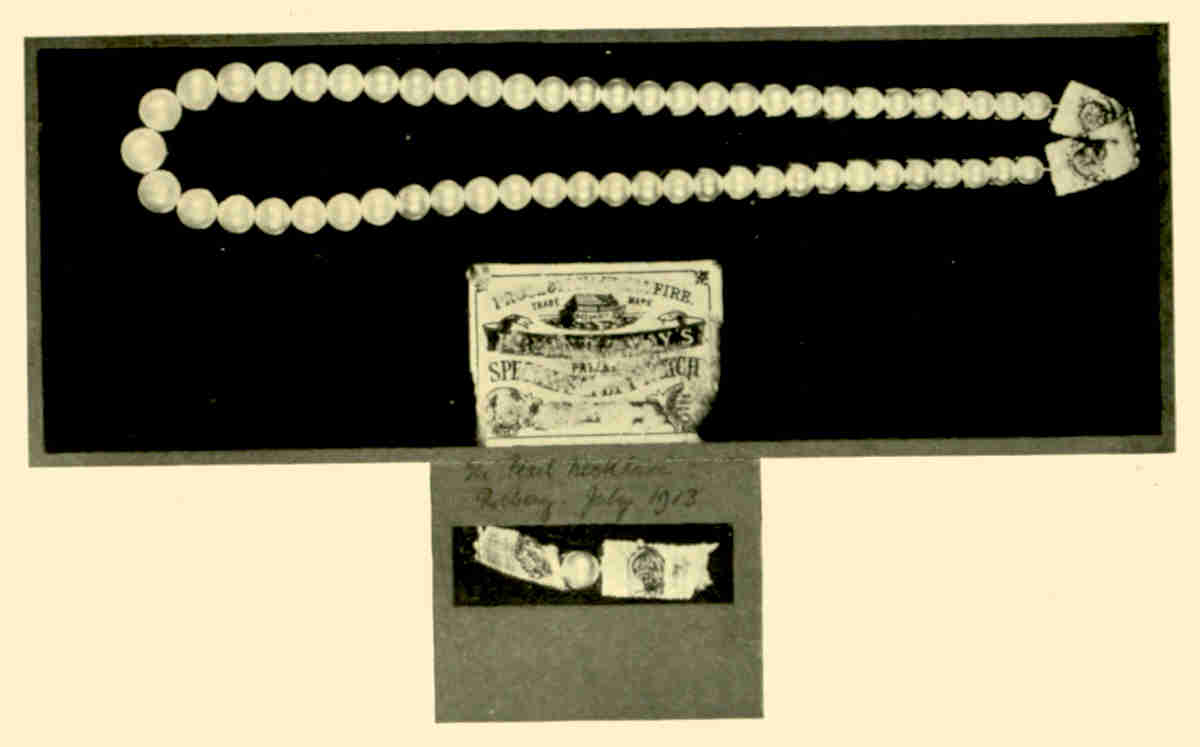
The Pearl Necklace Stolen in the Post between Paris and London,
June, 1913. Valued at about £110.000.
She had reduced her mistress to such distress that
she did not dare to leave the house, and therefore the
police superintendent who was detailed to see her had
to make a visit to the suburbs. There he found a
simple, pleasant-faced country girl, the daughter of a
labourer, who would have been supposed to have no
knowledge of the world outside her native village.
Her employers were in such a state of mind that it was
decided to send her home to her mother. One of the
curious points about her imagination was her power of
inventing names upon the spot, which is a very rare
quality even among practised liars. When pressed as
to the name of the master-spy, without a moment’s
thought she gave it as Eric Herfranz Mullard. When
she was pressed to explain why the Germans were not
able to operate their own machine, the ‘Maxione,’
which she described as being a sort of collapsible
framework of iron rods, quite portable, but 5 or 6 feet
in height when extended, she said that the keys of the
base, which flashed rays from the little lamps attached
to the arms at the top, had to be worked with great
speed with the fingers and the elbows as well, and she
gave a demonstration on the dining-room table, which
was so energetic that it must have left bruises on her
elbows. The flashes were green and red, and could
be seen for a distance of 150 miles. That was why
one had to strike the keys so hard and, naturally,
a German’s fingers were not likely to be so nimble as
those of an English girl.
The ages of from fourteen to eighteen have been so
productive of trouble to the police that I have sometimes
regretted that all girls between those ages are
not safely put to sleep by the State and allowed to grow
quietly and harmlessly into womanhood unseen by
the world. Perhaps the legend of the ‘Sleeping
Beauty’ may have been suggested by the pranks of
adolescent liars in the dawn of the Christian era.
How many hay-stacks have been set on fire by little
farm servants? How many ghosts have been conjured
up? How much paraffin has been thrown on ceilings
to attract photographers for the daily Press, merely
from an infantile desire to see the grown-ups buzzing
about like a nest of disturbed wasps?
But to return to pre-war memories. At the moment
when I took charge of the Criminal Investigation Department
the Central Office was busy over the robbery
of the pearl necklace. A necklace valued at about
£110,000 had been dispatched from Paris to a London
jeweller by registered post. The box was safely delivered
with all the seals apparently intact, but the
pearls were missing, and lumps of coal had been substituted
for them. At first suspicion fell upon the
French postal servants. Elaborate inquiries were
made on both sides of the Channel, and it was established
beyond a doubt that the wrapper and the seals
were exactly in the condition in which the parcel was
delivered for registration. There was no doubt whatever
that they had been properly packed, and therefore
somewhere there existed a counterfeit seal of the firm,
which consisted of the initials ‘M. M.’ within an oval
border. My first contribution to the case was to
establish by experiment that a counterfeit seal could
be made and used on melted sealing-wax within four
minutes, and that therefore at some point in the parcel’s
journey it would have been possible to break the seals,
undo the wrappings, remove the pearls, and seal the
parcel up again without the loss of a post. Gradually
the police began to see daylight. Rumours fly in
Hatton Garden, and it was not long before the names of
X and Y and one or two others were whispered in
connection with the robbery.
Then began one of the most difficult cases of observation
that I remember. No fox was ever more
cunning in covering his tracks. The men had no
reason to suspect that they were being followed, and
yet they never relaxed their precautions for a moment.
If they took a taxi to any rendezvous they gave a false
destination, paid off the taxi and took another, sometimes
repeating this process of mystification two or
three times. If they met in Oxford Street to lunch
together at an A.B.C. shop they would suddenly change
their minds on the doorstep and go off to another, and
all the while they had an aged discharged convict in
their pay to shadow them and call their attention to
any suspicious follower. I shall not tell here what
devices the police adopted, but I will say that at the
last, when every other kind of observation failed, we
did adopt a new device which was successful.
The object throughout had been to find a moment
when one or other of the parties had the stolen pearls
about his person, and when the day came for making
the arrest, just as the four thieves were entering a
tube station the police failed, because on that particular
day they had left the necklace at home. They
were detained, nevertheless, in order that a thorough
search might be made of all their hiding-places. As
it then turned out, the necklace was in the possession
of the wife of one of them, and when the search became
too hot and she feared a visit from the police she put
the necklace into a Bryant & May matchbox and
dropped it in the street. There it was found, without,
however, its diamond clasp, which had been disposed
of separately.
It did not take the police long to unravel the details
of the crime. They found the engraver who had
innocently cut the false seal, and the office where the
parcel had been opened. The thieves had arranged
with the postman to bring the parcel to the office for
three or four minutes before taking it on to deliver it.
Whether the postman knew beforehand what they
intended to do is uncertain. They expected to find
diamonds, which were far more easily disposed of:
when they found pearls, so large that in the trade each
pearl had almost a history, they knew that they could
not dispose of them and were at first for throwing
them into the Thames. It may be judged that I was
not an expert in precious stones when I say that I had
the matchbox and its contents laid out on my table for
quite half an hour before I was sure that the pearls
were genuine. They looked, to my untutored eye, so
yellow. We telephoned to the owner and the insurance
agent. The owner fell upon the pearls as a man
might fall upon some beloved and long-lost child
whom he had never expected to see again in this
world. I then told him jocularly of my doubts.
‘Yellow?’ he said, with genuine amazement, ‘Yellow?
they are rose-colour.’
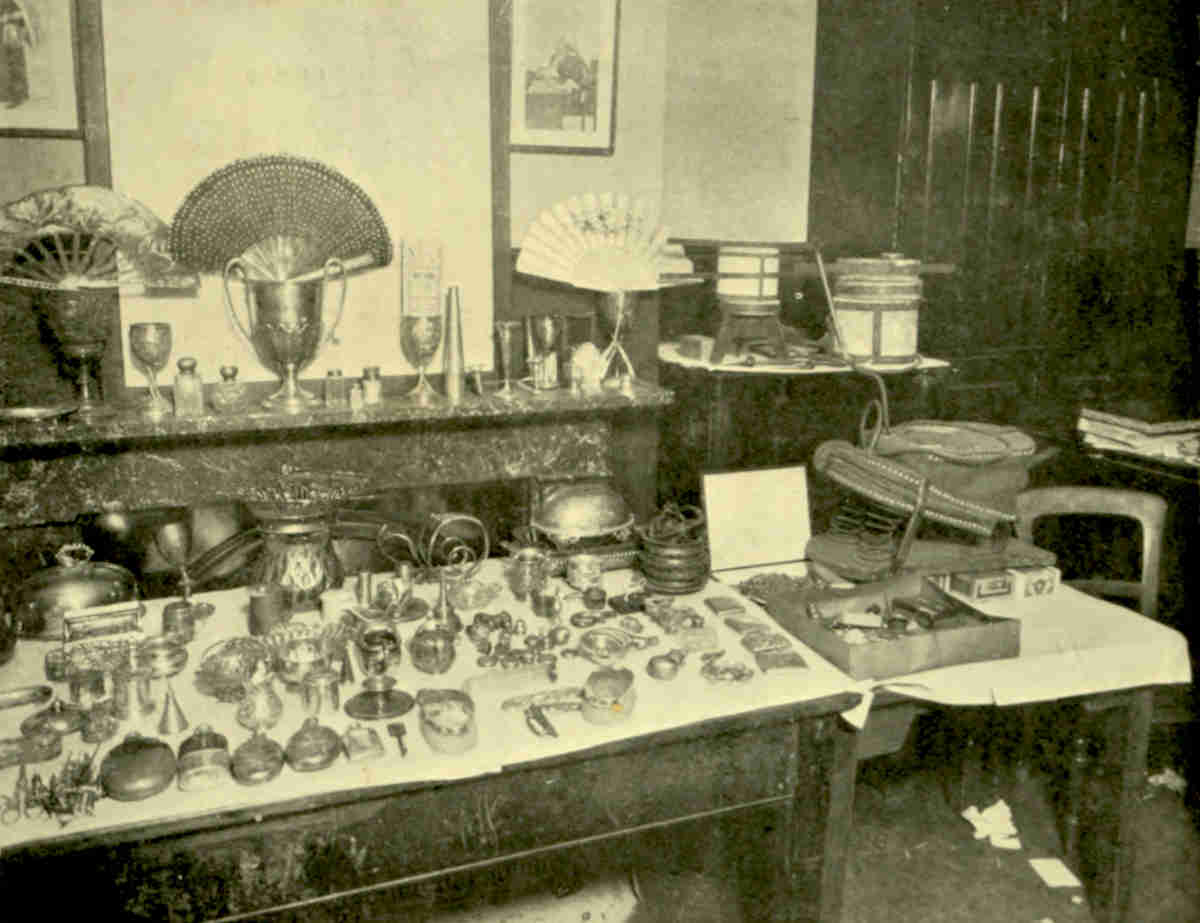
Every now and then there was a sensational seizure
at the house of a receiver of stolen property. In
October 1913 a certain jeweller’s shop in Shaftesbury
Avenue was raided and the contents were carried off
to Bow Street, which resembled for some days an
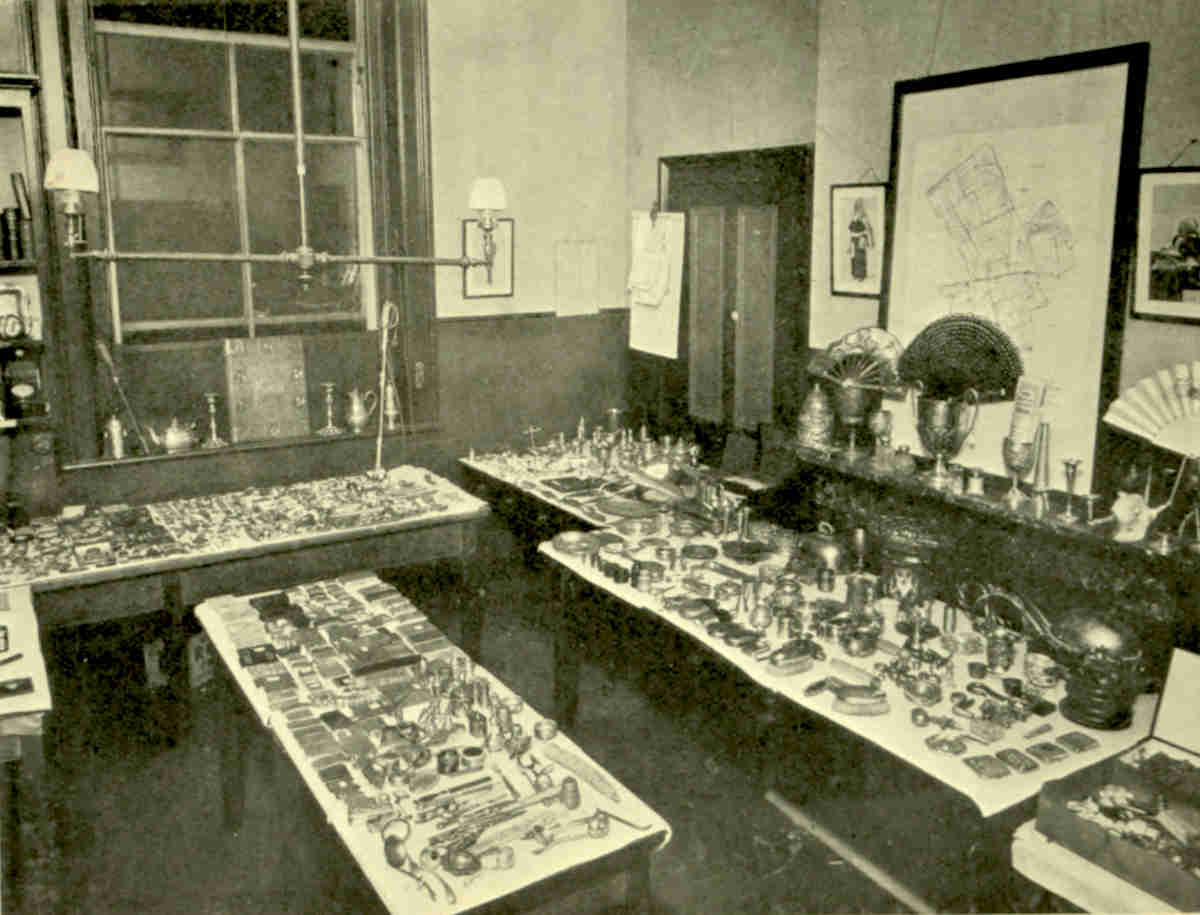
exhibition of wedding presents. It contained the
proceeds of quite twenty known burglaries, and even
then only one-third of the plate had been identified
because it has been found by experience that in these
days, when people insure their jewellery against burglary
and draw the insurance money, they take little
interest in bringing the thieves to justice. There is
also the fact that things are stolen from a house sometimes
for many months before they are missed. Some
of the objects in this exhibition belonged to a Lady
H——, and while she was going round she caught
sight of a clock given to her by Lord Charles Beresford
which she thought was still at home. Unclaimed
stolen property is held by the police for a certain
period and then disposed of by public auction.
The Contents of a Receiver’s Shop which contained the Proceeds of
more than Sixty Burglaries.
In 1913 there was an epidemic of safe-breaking.
The capacity of the oxy-acetylene flame for cutting
through steel plates appealed to the safe-breaker, who
had long deplored the weight and inefficiency of the
tools on which he had to rely for his livelihood. For
years there has been a competition between the burglar
and the safe-maker, and so far I believe the safe-maker
has won.
Two enterprising persons spent a Sunday afternoon
in the summer of 1913 in a certain office in Regent
Street cutting a great hole in the safe with an oxy-acetylene
apparatus, which they had transported to
the house in a taxi-cab on the previous afternoon.
Having secured their booty they left this very incriminating
apparatus behind them.
Not many weeks later the police were forewarned
that an attempt would be made on a safe in a certain
much frequented cinema hall, but here the burglars
received a nervous shock. All went according to plan
that Sunday afternoon. The street and the hall had
the deserted Sunday look when, on a sudden, just as
operations were beginning, from every corner sprang
truncheoned men, and the burglars were caught in a
trap.
CHAPTER III THE LURE OF SOMETHING FOR NOTHING
The great business of transferring the contents of your
neighbour’s pocket to your own is what more than nine-tenths
of the world live upon. Society draws the line
between what is legitimate and what is dishonest rather
low down in the scale. A grocer may rob you by high
prices but not by giving you short weight; a money-lender
may fleece you by usury but not by picking your
pocket; but I confess to a sneaking preference for the
rogue who, without any pretence of respectability,
preys upon your vanity or your cupidity and cheats you
quite openly.
The Spanish prisoner fraud has flourished for nearly
half a century. It has the advantage over all other
frauds in costing practically nothing for stock-in-trade,
and incurring no risk whatever to the practitioner.
All he needs is a little stationery, a few postage stamps,
and the names and addresses of farmers in Scotland
and England. The farmer receives a letter with the
Valencia postmark from a Spanish colonel now languishing
in prison on account of the part he played in a
revolutionary conspiracy.
‘My dear Sir and relative’ (it begins),—‘Having not
the honour to know you personally but only for the good
references my deceased mother Mary Harris, your relative,
did me about your family, I apply myself to you for the
first and perhaps last time to implore your protection for
my only daughter Amelia, child 12 years age.’
Here the writer is banking on the fact that very few of
us are in a position positively to say that no one of the
sisters or cousins of our parents was called Mary, and
that no one of that name married a Spaniard. The
letter, which is beautifully written in halting English,
goes on to say that the writer, a colonel named Alvaro
de Espinosa, at the direction of the revolutionary committee,
went to Berlin to buy arms, was betrayed and
went to England, but that while in London he heard of
the death of his wife. In the first shock of grief he
converted all his property into English and French
bank-notes, and with the proceeds cunningly concealed
in the lining of his trunk he set out for
Valencia.
‘Well disguised, I went out to Spain, arrived in this
city. Arranged secretly some private business, took my
leave from the martyr as was my noble wife, and when I
was very near coming in England again with my daughter
but with my heart contrite by grief I was arrested. A
wretch enemy had recognised and accused me. They proceeded
me and after in a War-Court I was condemned
by desertion and rebellion delinquency at one indemnification
at 12 gaol years and at the payment of the process
outlays, a sentence I am undergoing now in these military
gaols, deprived of any intercourse.
‘When I was arrested my equipage which is a trunk
and two portmanteaux, was seized and sealed and folded
before me and delivering me its keys without might be
discovered the so well artful secret in which I hidden the
said sum, and it remained laid down in the same Court
as a warranty for the outlays of process payment in the
event of being condemned, and as I am already unhappily
sentenced it is indispensable to pay the Court the amount
of the expenses to be able to recover the luggage. Thereby
necessary sum to pay the tribunal by the process outlays
since I would not see me in the debasing and shameful case
to have to resort to my fellow-countrymen; then I would
be wretchedly betrayed again.’
That is why he writes to Harris. But what is Harris
to get out of all this? You shall hear. When the
trunk reaches him—
‘you will see in its interior part and in its left side of Spain
shield in its centre you will set upon your forefinger so
that when an electric bell is pushed and quickly the secret
will appear in full view in which you will find my fortune....
I will name you as tutor of my daughter and her
fortune trustee until her full age and as a right reward for
your noble aid I leave you the fourth part of all my fortune.’
So there you have it—something for nothing—the
bait which so few can resist; least of all when the
something is £6250 and a beautiful young Spanish
ward.
The poor old revolutionary colonel is in a dying
state, as you learn from a letter from the chaplain, the
Reverend Adrian Rosado, which is enclosed. This
devoted priest has letter paper headed with a cross,
and has a markedly feminine handwriting. He is not
in the secret, as the cautious old colonel has been careful
to warn you. He ‘befriends me by his vocation and
good feelings: he is a venerable priest and honest
man, and I do not think it necessary he knows the
secret very extensively.’ The honest man regrets
very much—
‘that on the first time I write to you I may be herald of bad
news, but the case so requires it and the truth must be said
though it may be painful. Your relative’s health state is
very bad.’
indeed, so bad that—
‘we must have patience to suffer with resignation what
God dispose and beg his help to accomplish the last will
of the unfortunate Sr. Alvaro de Espinosa.’
The honest priest goes on to say that in a little while he
will deposit Miss Amelia and the trunk at your door,
always provided that the necessary expenses are
defrayed.
‘By your relative charge I think convenient to beg your
aid for getting out the seized equipage to which end I am
making steps in order that the Tribunal tell me the exactly
amount to pay the cost and process expenses.
‘Awaiting anxiously your reply to accomplish the sacred
mission your relative has commissioned me.—I am, dear
sir, your most affected servant and Chaplain,
Adrian Rogado.’
Strange that this holy and disinterested man should
have a delicacy about receiving letters at his presbytery.
He, no less than the poor prisoner, adds in a postscript:
‘By greater security please answer to my brother-in-law
name and here as following:
Mr. Arturo Rivier, Maldonado 19, Entremets, Valencia, Spain.’
Is it because a letter addressed to the presbytery would
be returned through the Dead Letter Office marked
that no such person as Rogado exists?
The Proceeds of a Raid on a Receiver, the Results of
over Sixty Burglaries.
The world may be divided into two classes—those
who would reply to such letters and those who would
consign them to the fire. In spite of the picture drawn
of Englishmen by envious foreigners, the Britisher is by
nature an imaginative and romantic person. That is
why you find him in every part of the globe: he goes
abroad for adventure, to escape from the humdrum
routine of his home surroundings. And the farther
you go north the more romantic he becomes. That is
why there are so few Scots left in Scotland. To judge
from the correspondence filed by the police, nine out
of every ten reply, and because the Britisher is practical
as well as romantic, the reply invariably asks how much
money is required to pay the ‘process outlays.’ On
this the dying Espinosa, whose handwriting is unusually
firm for a stricken man so near his end, rises to fresh
flights of eloquence:
‘I will die peaceful,’ he says, ‘thinking of the good
future welfare of my dear daughter near you.’
His ‘health state is becoming grievous,’ and so he
makes his will:
‘Here is my last will.
‘I name heiress of the 3⁄4 parts of my fortune my alone
daughter Amelia de Espinosa.
‘I name you heir of the fourth part of my fortune and
Tutor of my daughter and Manager of it until this one
may reach her full age.
‘As soon as the equipage may be in the Chaplain’s hands
he shall go out to your home with my daughter and equipage
in order that you may take away the money of my trunk
secret to come immediately in possession of the sum.
‘From the part belonging to my daughter you will deliver
to the Chaplain £200, for I will make a present to him.
I beseech you to grant all your assistance to the Chaplain
since he is poor and he does not reckon upon any resource
to pay these outlays.
‘The equipage must be recovered immediately, for in the
trunk is all my fortune.
‘You will place my daughter in a college until her full
age.... I shall die peaceful thinking of her being happy
near you, and she will find on you some warm-hearted
parents and brothers.—Your unfortunate relative,
Alvaro de Espinosa.’
And still no mention of money: that was because the
recipient was more than usually cautious and was, in
fact, a wary fish that must be played. So wary was he
that he took the letter to the police for advice. But
I remember a case where a farmer in Norfolk was so
much touched by the misfortunes of his Spanish cousin,
and so conscious of the sensation that would be caused
among his neighbours when it became known that he
was guardian to a beautiful young Spanish heiress, to
say nothing of the things that might be bought with
£6250, that he sent £200 to the address indicated by
Espinosa and sat down to wait. He waited so long
that he became anxious about the safety of the chaplain
and his ward, and it was on their account, and not
from any doubt about the story, that he came to the
police. He indignantly refused to believe that he had
been a victim to the familiar Spanish prisoner fraud.
The War was unkind to Espinosa, who had been
lingering upon his death-bed for over forty years, and
I hoped that it had killed him, but the ink was scarcely
dry upon the Treaty of Versailles before he broke out
again. From time to time the Spanish Government
has been furnished with the address to which victims
are invited to reply, but hitherto to no purpose: the
game is too profitable to be easily killed.
I can understand succumbing to the wiles of Espinosa
better than I can understand the perennial success of
the Confidence Trick, which is practised generally by
Australians on American visitors to London. There
are several variants because the tricksters are artists,
and are not above improving with practice. Here
again the bait is ‘Something for Nothing.’ Though
the commonest form has been described in the Police
Court it may be well to repeat it here. An American
walking in Hyde Park sees an elderly man drop a
pocket-book. He overtakes him and restores it. The
old man, whom we will call Ryan, is effusively grateful.
He would not have lost that pocket-book for the world:
it contained the evidence of his fortune: his benefactor
must come and have a drink. He holds him
with his glittering eye, and while they imbibe whisky
he tells his story—how an uncle of fabulous wealth but
eccentric habits has left him a couple of million dollars
on condition that he can find a really trustworthy
person to distribute one-eighth of the sum among the
poor of London. The dupe mentions the fact that he
has a return ticket to New York, and hails from Denver.
So, as it now appears, does Ryan, who takes from his
pocket-book a newspaper cutting setting forth the
virtues and the enormous fortune of the uncle, and at
that very moment a third man, Ryan’s confederate,
drops in. Hearing the word ‘Denver,’ he joins in the
conversation, for he, too, is from Denver—George T.
Davis, at their service. So there they are—three exiles
from Denver—a little oasis in the vast waste of London.
To George T. Davis Ryan relates his good fortune and
the strange condition in the will.
‘I know no one in this city. How am I to find a
man in whom I have confidence to distribute all this
money? Now I like your face, Mr. Davis, but I don’t
know you—never saw you till this afternoon—how
can I say I’ve confidence in you?’
‘Confidence for confidence,’ replies Davis. ‘I’ve
confidence in you anyway. I’d trust you with all I’ve
got, and I’ve got more than what I stand up in. Why,
see here! Here’s what I drew from the bank this
morning’—he thrusts a roll of bank (of engraving)
notes into Ryan’s unwilling hand—‘and here’s my
watch and chain! Take them all and just walk
through that door. I know you’ll bring them back
because I’ve confidence in you.’ But Ryan still looks
doubtful. ‘No good,’ whispers Davis, ‘he don’t
take to me. Why don’t you have a shot at the money?
He takes to you.’
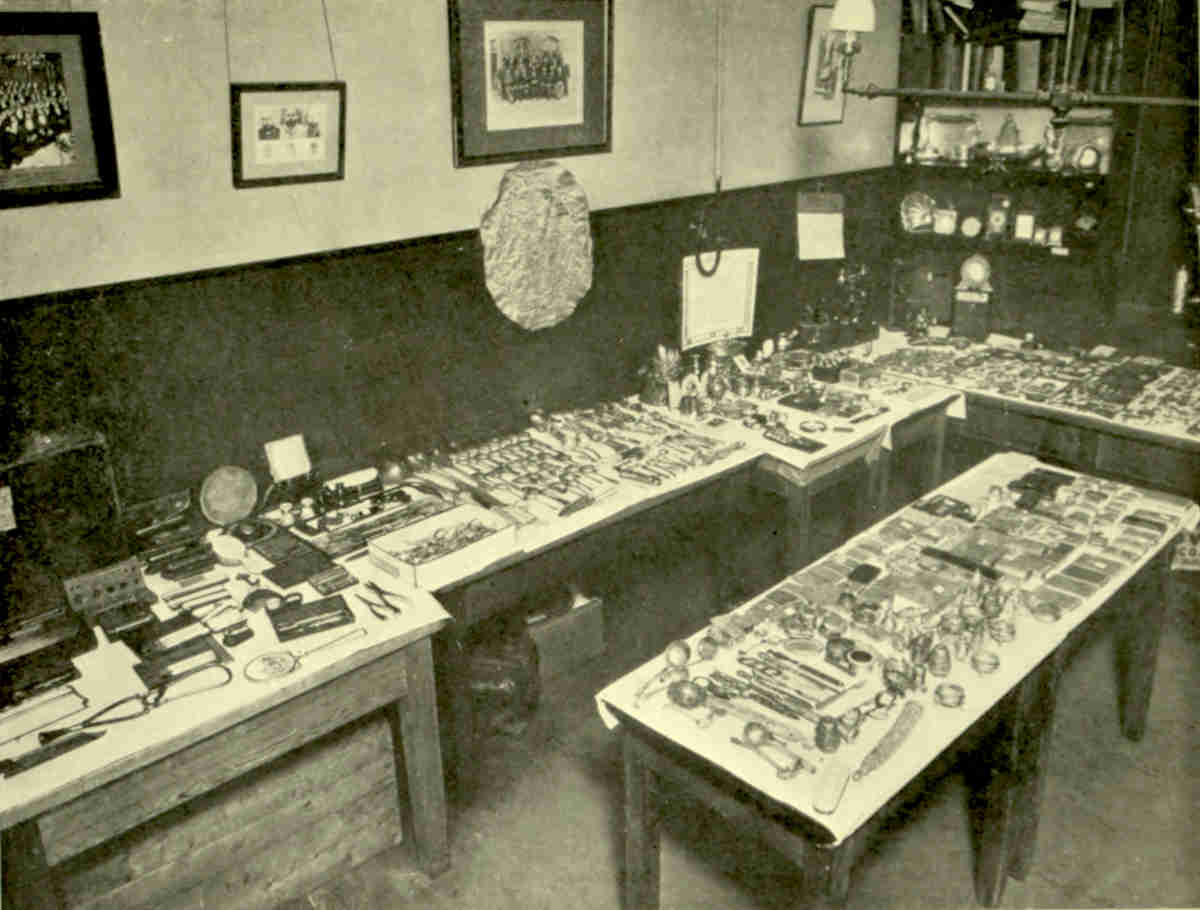
The Contents of a Receiver’s Shop, showing the Tools for
Melting Down the Proceeds of Robberies.
And so by appeals to the vanity of the man from
Denver, by playing on his cupidity, under the softening
influences of liquid refreshment, by the force of
example, Davis succeeds at last. Into the still apparently
unwilling hand of Ryan the victim presses all the
money and valuables he possesses, and out goes Ryan
into the street. The two men continue drinking:
George T. Davis is the first to betray anxiety.
‘The old man ought to be back by now. Can’t
understand it—man I’d have trusted anywhere.
Couldn’t have been run over by a taxi? You stop
here: I’ll just step out and see where he’s got to.’
And that is the last that the victim sees of either of the
rogues.
Before the War most of the confidence men lived
in Ealing. Each pair have their own pitch, and there
was a tacit understanding that neither should poach on
the ground of the other. Northumberland Avenue
belonged to one; the Mall to another; a third worked
Hyde Park. The essence of the trick is that the victim
should be a bird of passage, for as soon as the trick is
played the actors leave for Rome. Why Rome was
chosen I never understood. There they stayed until
a confederate reported that the victim had sailed for
home and the coast was clear. During the War the
poor confidence man fell on evil days: there were no
American tourists to prey upon, and if there had been
any, one could not fly to Rome. The passport people
saw to that. The absence of a prosecutor is a bar to
police action, but occasionally one or other of the
fraternity is run to ground.
I have sometimes doubted whether the police should
be called upon to protect people so simple that they
ought not to be allowed abroad without a nurse. I
remember a prisoner making the same complaint to me.
‘It’s cruel hard on us chaps,’ he said, ‘when mugs
like them are at large. It’s a temptation: that’s
what it is.’ But he was not doing his profession justice.
Like all artistic callings—like the stage for instance—the
reward lies not in the emoluments, but in the satisfaction
of playing on the feelings of your audience until
you hold them.
Given impudence and the artistic sense and a man
may remove mountains—at any rate he may remove
houses. At Dartmoor there was a man who boasted
that he was ‘the lad that stole a row of houses,’ and it
was no idle boast. In the City there was a row of
derelict eighteenth-century cottages which in these
days would have been condemned as unfit for human
habitation. Tenants must have come to a similar
conclusion about them, for an agent’s board, already
weather-worn, announced that they were to let. One
morning a young man called at the house-agent’s and
got into conversation with the clerk. ‘So those houses
in Paradise Row are to let. I’d like to have a look at
them, and see whether it would suit my governor to
make an offer.’ ‘Right,’ said the clerk, ‘come to-morrow
and I’ll take you round. I can’t come
now, I’m alone in the office.’
‘Don’t you worry, old man. Lend me the key and
I’ll be back with it in half an hour.’ The clerk was
glad to be rid of him on such easy terms.
A week later an old client happened to look in. ‘I
see you’re pulling down those old death traps in
Paradise Row. It was about time you did.’
‘Pulling them down? What do you mean?’
‘I mean what I say. I passed there just now, and
there’s not much left.’
The clerk glanced hastily at the nail where the key
was wont to hang. The key was gone, and then he
remembered how he came to part with it. He tore out
of the office without his hat, risked a hundred deaths
from motor-’buses, and reached his goal breathless.
He would have been breathless in any case at what
he saw. The housebreakers had done their work
thoroughly, and at the moment were dealing with the
ground floor. The lead, the guttering, tiles, cisterns,
woodwork, and bricks had all been carted away and
sold to the order of the man ‘who stole a row of houses.’
He considered the months he had to spend in prison
a cheap price to pay for the prestige he won in the only
circles whose opinion he respected.
But his impudence paled beside that of the bogus
doctor whose only claim to medical knowledge was
the possession of a stethoscope. His method was to
select a little artisan’s house in a quiet street in South
London on a Sunday morning, ring the bell, and when
the tenant opened the door ask for Mr. Smith.
‘I’m not Mr. Smith. My name’s Brown.’
‘Then I must have got the number wrong. So
sorry. You don’t happen to know which is Mr. Smith’s
house? Never heard of him? Well, well!’ and
then, with great concern in his manner, ‘Stop, don’t
shut the door. Do you know you are very ill.’
‘Never felt better in my life,’ growled Mr. Brown.
‘Excuse me, I’m a doctor, and I know better.
Phantasmagoria is a dreadful illness, and you’ve got
it badly. I can tell it from your eyes. Now, look here
(pulling out a stethoscope and looking at his watch),
I can just spare ten minutes. I’ll examine you and it
won’t cost you a penny, and if I’m wrong no one will
be more pleased than I shall.’
Still talking, he would edge the now frightened
Brown into the parlour, saying, ‘Don’t make any
sudden movement, my dear fellow. Just slip off your
coat and trousers as gently as you can. Let me help
you. That’s right! Now lie down on that sofa.
Gently now. That’s right. Th—a—t’s right. Now
say “A—a.” Now say “O—o—o.” It’s just what I
thought. It’s the worst case of phantasmagoria that
I ever came across. Not a word now. Move once,
and you may never move again. Now lie quite still
while I run round to the chemist. I’ll bring you
round something that will put you right in two ticks.
Not a word now: there’s nothing to thank me for.’
In this he was quite right. He clapped on his hat
and ran out into the street, and it was not by inadvertence
that he carried over his arm all Mr. Brown’s
Sunday clothes and whatever the pockets contained.
And when it dawned upon Brown that he had been
victimised, how was he to take up the pursuit on a
Sunday morning in nothing but his shirt?
CHAPTER IV THE FIRST DAYS
Like most Englishmen, I read of the murder at Sarajevo
without a thought that it was to react upon the
destiny of this country. It seemed to be an ordinary
case of Balkan manners, out of which would proceed
diplomatic correspondence, an arrest or two, and a trial
imperfectly reported in our newspapers. It did have
the immediate effect of postponing a ball at Buckingham
Palace on account of the Court mourning, but that
was all. During the postponed ball on July 16, so
petty were our preoccupations at this moment that
when a message came in that Mrs. Pankhurst had just
been recaptured under the ‘Cat and Mouse Act,’ I
thought it worth while to find the Home Secretary and
repeat it to him. A few days after the murder I met
von Kühlmann at luncheon. He can scarcely at that
time have expected a rupture of relations, for in talking
over Dr. Solf, with whom I had been associated in the
Pacific, he said, ‘He has climbed high since you knew
him, and some think that he will go higher still (meaning
that he would become Chancellor). He is coming
to London in August, and I shall write to him to arrange
a meeting with you.’
A few days later England began to feel uneasy.
I overheard a certain Under-Secretary remark at
luncheon of his constituency, ‘Well, all I can say is that
if this country enters the War there will be a rebellion
in the North of England.’ He left the Ministry when
the moment came, and has now disappeared even from
the House of Commons. I think that we all had at
the back of our minds a feeling that a European War
on the great scale was so unthinkable that a way would
be found at the eleventh hour for avoiding it. A
staff officer in whose judgment I believed remarked
that if this were so he would emigrate, because he knew
that the day was only postponed until Germany felt
herself better prepared for the inevitable war. There
were, in fact, no illusions at the War Office. Some
day the story that will do justice to the services of Lord
Haldane in those very critical weeks will be written.
The plans that had been made during peace time
were all ready; the names and addresses of the known
German spies were recorded. We could only wait for
midnight on 4th August. I was actually in the Tube
lift at Gloucester Road on the stroke of midnight, and
I remarked to the liftman that we were now at war.
‘Is that so?’ he replied, with a yawn.
The credit of the discovery of the German spy organisation
before the War was entirely due to a sub-department
of the War Office, directed by officers of
great skill. They had known for some time that one
Karl Gustav Ernst, a barber in the Caledonian Road,
who was technically a British subject because he was
born in England, was the collecting centre for German
espionage. All he had to do for his pittance of £1 a
month was to drop the letters he received from Germany
ready stamped with English postage stamps
into the nearest pillar-box, and to transmit to Germany
any replies which he received. Altogether, his correspondents
numbered twenty-two. They were scattered
all over the country at naval and military centres, and
all of them were German. The law in peace time was
inadequate for dealing with them, and there was the
danger that if our action was precipitate the Germans
would hear of it and send fresh agents about whom
we might know nothing: it was decided to wait until
a state of war existed before arresting them. On
5th August the orders went out. Twenty-one out of
the twenty-two were arrested and interned simultaneously;
one eluded arrest by embarking for Germany.
Their acts of espionage had been committed
in peace time, and therefore they could not be dealt
with on the capital charge. The result of this sudden
action was to drop a curtain over England at the vital
moment of mobilisation. The German Intelligence
Service was paralysed. It could only guess at what
was happening behind the curtain, and it guessed
wrong. Ernst was sentenced to seven years’ penal
servitude for his share in the business, and, seeing that
he was a British subject, the sentence cannot be called
excessive.
The curtain had dropped not only for the enemy
but even for ourselves. How many of us knew during
those first few days that trains were discharging men,
horses, and material at the quays of certain southern
ports without any confusion at intervals of ten minutes
by day and night; that an Expeditionary Force of
150,000 men was actually in the field against the
Germans before they knew anything about its existence?
Von Kluck has recorded somewhere his surprise
when he first found British troops in front of
him. After the Armistice he is reported to have told
a British officer that in his opinion the finest military
force in history was the first British Army, and that
the greatest military feat in history was the raising of
the second British Army.
Our great dread during that week was that a bridge
or a railway arch might be blown up by the enemy and
the smooth running of mobilisation be dislocated.
Most of the railway arches were let to private persons,
of whom some were aliens. On 5th August I went
myself to the War Office to find a General who could
be vested with power to turn these people out. There
was a good deal of confusion. Every Head of a branch
had left for the field that morning, and their successors
were quite new to their jobs. At last I found my
General, and while I was talking to him it grew dark
and there was a sudden peal of thunder like an explosion.
He said, quite gravely, ‘A Zepp!’ That
was the state of mind we were all in. That same night
my telephone became agitated; it reported the blowing
up of a culvert near Aldershot and of a railway
bridge in Kent. I had scarcely repeated the information
to the proper authority when the bell rang
again to tell me that both reports were the figments of
some jumpy Reservist patrol.
Who now remembers those first feverish days of the
War: the crowds about the recruiting stations, the
recruits marching through the streets in mufti, the
drafts going to the station without bands—the flower
of our manhood, of whom so many were never to
return—soldiers almost camping in Victoria Street,
the flaring posters, the foolish cry ‘Business as Usual’;
the unseemly rush to the Stores for food until, under
the lash of the newspapers, people grew ashamed of
their selfishness; the silence in the ’buses, until any
loud noise, like a motor back-fire, started a Zeppelin
scare? Who now remembers the foolish prognostications
of experts—how the War would result in unemployment
and a revolution would follow; the
assurance of certain bankers that the War would be
over in six months because none of the belligerents
could stand the financial strain for longer? We have
even forgotten the food-hoarding scare that followed
the spy scare during the height of the submarine
activity, when elderly gentlemen, who had taken
thought for the morrow, might have been seen burying
biscuit tins in their gardens at midnight for fear that
their neighbours should get wind of their hoard and
hale them before the magistrate.
I began to think in those days that war hysteria was
a pathological condition to which persons of mature
age and generally normal intelligence were peculiarly
susceptible. War work was evidently not a predisposing
cause, for the readiest victims were those
who were doing nothing in particular. In ante-bellum
days there were a few mild cases. The sufferers would
tell you gravely that at a public dinner they had turned
suddenly to their German waiter and asked him what
post he had orders to join when the German invaders
arrived, and that he, taken off his guard, had clicked
his heels and replied, ‘Portsmouth’; or they would
whisper of secret visits of German aircraft to South
Wales by night and mysterious rides undertaken by
stiff guttural persons with square heads who would
hire horses in the Eastern Counties and display an
unhealthy curiosity about the stable accommodation
in every farm that they passed. But in August 1914
the malady assumed a virulent epidemic form accompanied
by delusions which defied treatment. It attacked
all classes indiscriminately, and seemed even
to find its most fruitful soil in sober, stolid, and otherwise
truthful people. I remember Mr. Asquith saying
that, from a legal and evidential point of view, nothing
was ever so completely proved as the arrival of the
Russians. Their landing was described by eyewitnesses
at Leith, Aberdeen, and Glasgow; they
stamped the snow out of their boots and called hoarsely
for vodka at Carlisle and Berwick-on-Tweed; they
jammed the penny-in-the-slot machines with a rouble
at Durham; four of them were billeted on a lady at
Crewe who herself described the difficulty of cooking
for Slavonic appetites. There was nothing to be done
but to let the delusion burn itself out. I have often
wondered since whether some self-effacing patriot did
not circulate this story in order to put heart into his
fellow-countrymen at a time when depression would
have been most disastrous, or whether, as has since
been said, it was merely the rather outlandish-looking
equipment and Gaelic speech of the Lovat Scouts that
set the story afloat.
The second phase of the malady attached itself to
pigeons. London is full of pigeons—wood pigeons
in the parks, blue rocks about the churches and public
buildings—and a number of amiable people take
pleasure in feeding them. In September 1914, when
this phase was at its height, it was positively dangerous
to be seen in conversation with a pigeon; it was not
always safe to be seen in its vicinity. A foreigner walking
in one of the parks was actually arrested and sentenced
to imprisonment because a pigeon was seen to
fly from the place where he was standing and it was
supposed that he had liberated it.
During this phase a pigeon was caught in Essex
which was actually carrying a message in the usual
little aluminium box clipped to its leg. Moreover, the
message was from Rotterdam, but it was merely to
report the arrival of an innocuous cargo vessel, whose
voyage we afterwards traced.
The delusion about illicit wireless ran the pigeons
very hard. The pronouncement of a thoughtless expert
that an aerial might be hidden in a chimney, and that
messages could be received through an open window
even on an iron bedstead, gave a great impetus to this
form of delusion. The high scientific authority of
the popular play, The Man who Stayed at Home, where a
complete installation was concealed behind a fireplace,
spread the delusion far and wide. It was idle to assure
the sufferers that a Marconi transmitter needed a 4-horse-power
engine to generate the wave, that skilled
operators were listening day and night for the pulsations
of unauthorised messages, that the intermittent
tickings they heard from the flat above them were
probably the efforts of an amateur typist: the sufferers
knew better. At this period the disease attacked even
naval and military officers and special constables. If
a telegraphist was sent on a motor-cycle to examine
and test the telegraph poles, another cyclist was certain
to be sent by some authority in pursuit. On one
occasion the authorities dispatched to the Eastern
Counties a car equipped with a Marconi apparatus
and two skilled operators to intercept any illicit messages
that might be passing over the North Sea. They
left London at noon; at 3 they were under lock and
key in Essex. After an exchange of telegrams they
were set free, but at 7 P.M. they telegraphed from the
police cells in another part of the county, imploring
help. When again liberated they refused to move
without the escort of a Territorial officer in uniform,
but on the following morning the police of another
county had got hold of them and telegraphed, ‘Three
German spies arrested with car and complete wireless
installation, one in uniform of British officer.’
Next in order was the German governess, also
perhaps the product of The Man who Stayed at Home.
There were several variants of this story, but a classic
version was that the governess was missing from the
midday meal, and that when the family came to open
her trunks they discovered under a false bottom a store
of high explosive bombs. Every one who told this
story knew the woman’s employer; some had even
seen the governess herself in happier days—‘Such a
nice quiet person, so fond of the children; but now
one comes to think of it, there was a something in her
face, impossible to describe, but a something.’
During the German advance through Belgium an
ingenious war correspondent gave a new turn to the
hysteria. He alleged that the enamelled iron advertisements
for ‘Maggi Soup,’ which were to be seen
attached to every hoarding and telegraph post, were
unscrewed by the German officers in order to read the
information about the local resources, which was
painted in German on the back. Screw-driver parties
were formed in the London suburbs, and in destroying
this delusion they removed also many unsightly
advertisements. The hallucination about gun platforms
was not dispatched so easily. As soon as a
correspondent had described the gun emplacements
laid down by Germans in the guise of tennis courts at
Mauberge there was scarcely a paved back-garden
nor a flat concrete roof in London that did not come
under the suspicion of some spy-maniac. The denunciations
were not confined to Germans. Given a
British householder with a concrete tennis-court and
pigeons about the house, and it was certain to be discovered
that he had quite suddenly increased the scale
of his expenditure, that heavy cases had been delivered
at the house by night, that tapping had been overheard,
mysterious lights seen in the windows, and that on the
night of the sinking of the Lusitania he had given a
dinner-party to naturalised Germans. When artillery
experts assured the patients that gun emplacements in
the heart of London were in the wrong place, and that
even on the high lands of Sydenham or of Hampstead
any tram road would better serve the purpose they
wagged their heads. They were hot upon the scent,
and for many weeks denunciations poured in at the
rate of many hundreds a day.
The next delusion was that of the grateful German
and the Tubes. The commonest form of the story
was that an English nurse had brought a German
officer back from the door of death, and that in a burst
of gratitude he said at parting, ‘I must not tell you
more, but beware of the Tubes in April (1915).’ As
time wore on the date was shifted forward month by
month, to September, when it died of expectation
deferred. We took the trouble to trace this story from
mouth to mouth until we reached the second mistress
in a London Board School. She declared that she had
had it from the charwoman who cleaned the school,
but that lady stoutly denied that she had ever told so
ridiculous a story.
A near kin to this was the tale that a German officer
of rank had been seen in the Haymarket by an English
friend; that he returned the salute involuntarily but
then changed colour and jumped into a passing taxi,
leaving his friend gaping on the pavement. A good
many notable Prussians, from von Bissing, the Governor
of Belgium downwards, figured in this story; a good
many places, from Piccadilly to the Army and Navy
Stores, have been the scene. The best attested version
is that of the English girl who came suddenly upon her
fiancé, an officer in the Prussian Guards, who shook
hands with her, but as soon as he recovered from his
surprise the callous ruffian froze her with a look and
jumped into a passing omnibus. Another version was
that on recognising her German fiancé the girl looked
appealingly into his countenance and said, ‘Oh, Fritz!’
whereupon he gave one startled look and jumped into
the nearest vehicle. This, it may be remarked, might
have happened to any Englishman, for who would not,
when accosted by a charming stranger under the name
of ‘Fritz,’ have jumped into anything that happened
to be passing? In some of these cases inquiry showed
that at the moment when they were said to have been
seen in London these Germans were serving on the
Continent, and it is certain that all were hallucinations.
With the War, the Tower of London came into its
own again. During the early months it began to be
whispered at London tea-tables that the Crown Prince
himself was languishing there (if languishing is the
appropriate term for a person of his temperament).
Later, when it became evident that he could not be in
two places at once, the prisoners of distinction included
several British peers and privy councillors. All these
prisoners, who were at the moment adorning their
several offices in free life, had been shot at dawn.
These delusions may be traced to the fact that a few
foreign spies were imprisoned in the Tower before
execution.
A new phase of the malady was provoked by the suggestion
that advertisements in the Agony Column of
newspapers were being used by spies to communicate
information to Germany. It is uncertain who first
called public attention to this danger, but since refugees
did make use of the Agony Columns for communicating
with their friends abroad, there was nothing
inherently improbable in the idea. In order to allay
public alarm it was necessary to check the insertion of
apparently cryptic advertisements. Later in the War
a gentleman who had acquired a considerable reputation
as a code expert, and was himself the author of commercial
codes, began to read into these advertisements
messages from German submarines to their base, and
vice versa. This he did with the aid of a Dutch-English
dictionary on a principle of his own. As we
had satisfied ourselves about the authors of the advertisements
we treated his communications rather lightly.
In most cases the movements he foretold failed to take
place, but unfortunately once, by an accident, there
did happen to be an air-raid on the night foretold by
him. We then inserted an advertisement of our own.
It was something like this:
‘Will the lady with the fur boa who entered No. 14 ’bus at
Hyde Park Corner yesterday communicate with box 29,’
and upon this down came our expert hot-foot with the
information that six submarines were under orders to
attack the defences at Dover that very night. When
we explained that we were the authors of the advertisement,
all he said was that, by some extraordinary
coincidence, we had hit upon the German code, and
that by inserting the advertisement we had betrayed
a military secret. It required a committee to dispose
of this delusion.
The longest-lived of the delusions was that of the
night-signalling, for whenever the scare showed signs
of dying down a Zeppelin raid was sure to give it a
fresh start. As far as fixed lights were concerned, it
was the best-founded of all the delusions, because
the Germans might well have inaugurated a system
of fixed lights to guide Zeppelins to their objective,
but the sufferers went a great deal farther than a belief
in fixed lights. Morse-signalling from a window in
Bayswater, which could be seen only from a window
on the opposite side of the street, was believed in some
way to be conveyed to the commanders of German
submarines in the North Sea, to whom one had to
suppose news from Bayswater was of paramount
importance. Sometimes the watcher—generally a lady—would
call in a friend, a noted Morse expert, who
in one case made out the letters ‘P. K.’ among a
number of others that he could not distinguish. This
phase of the malady was the most obstinate of all. It
was useless to point out that a more sure and private
method of conveying information across a street would
be to go personally or send a note. It was not safe to
ignore any of these complaints, and all were investigated.
In a few cases there were certainly intermittent flashes,
but they proved to be caused by the flapping of a blind,
the waving of branches across a window, persons
passing across a room, and, in two instances, the quick
movements of a girl’s hair-brush in front of the light.
The beacons were passage lights left unshrouded. The
Lighting Order did much to allay this phase of the
disease. Out of many thousand denunciations I have
been unable to hear of a single case in which signals to
the enemy were made by lights during the War.
The self-appointed watcher was very apt to develop
the delusion of persecution. She would notice a man
in the opposite house whose habits seemed to be
secretive, and decide in her own mind that he was an
enemy spy. A few days later he would chance to leave
his house immediately after she had left hers. Looking
round, she would recognise him and jump to the conclusion
that he was following her. Then she would
come down to New Scotland Yard, generally with
some officer friend who would assure me that she was
a most unemotional person. One had to listen quite
patiently to all she said, and she could only be cured by
a promise that the police would follow her themselves
and detain any other follower if they encountered one.
Even serving officers were not immune. Near Woolwich
a large house belonging to a naturalised foreigner
attracted the attention of a non-commissioned officer,
who began to fill the ears of his superiors with wonderful
stories of lights, of signalling apparatus discovered
in the grounds, and of chasing spies along railway
tracks in the best American film manner, until even
his General believed in him. Acting on my advice the
owner wisely offered his house as a hospital, and the
ghost was laid.
Sometimes the disease would attack public officials,
who had to be handled sympathetically. One very
worthy gentleman used to embarrass his colleagues by
bringing in stories almost daily of suspicious persons
who had been seen in every part of the country. All
of them were German spies, and the local authorities
would do nothing. In order to calm him they invented
a mythical personage named ‘von Burstorph,’ and
whenever he brought them a fresh case they would
say, ‘So von Burstorph has got to Arran,’ or to Carlisle,
or wherever the locality might be. He was assured
that the whole forces of the Realm were on the heels of
‘von Burstorph,’ and that when he was caught he
would suffer the extreme penalty in the Tower. That
sent him away quite happy since he knew that the
authorities were doing something. The incarnation
of ‘von Burstorph’ reminded me of a similar incarnation
in the Criminal Investigation Department many
years ago. When one of my predecessors appeared to
be blaming his subordinates for a lack of enterprise in
the case of some undiscovered crime they would shake
their heads and say, ‘Yes, I recognise the hand. That
is some of Bill the Boatman’s work,’ but ‘Bill the
Boatman’ was a most elusive person, and he has not
been arrested to this day.
On one occasion a very staid couple came down to
denounce a waiter in one of the large hotels, and
brought documentary evidence with them. It was a
menu with a rough sketch plan in pencil made upon
the back. They believed it to be a plan of Kensington
Gardens with the Palace buildings roughly delineated
by an oblong figure. They had seen the waiter in the
act of drawing the plan at an unoccupied table. I sent
for him and found before me a spruce little Swiss with
his hair cut en brosse, and a general air of extreme surprise.
He gave me a frank account of all his movements,
and then I produced the plan. He gazed at it a moment,
and then burst out laughing. ‘So that is where my
plan went!’ ‘Yes, monsieur, I made it, and then I
lost it. You see, I am new to the hotel and, in order
to satisfy the head waiter, I made for myself privately
a plan of the tables, and marked a cross against those
I had to look after.’
The Germans, as we now know, had the spy mania
even more acutely. It became dangerous for Americans
in Berlin to speak their own language: gamekeepers
roamed the country armed to deal with spy motor-cars,
and Princess Ratibor and several other innocent persons
were shot at and wounded. Our own anti-German
riots in which the shops of bakers with German names
were damaged had their counterpart in the mob attacks
upon the British Embassy in Berlin.
CHAPTER V THE SPECIAL BRANCH
Throughout the War the Special Branch was combined
with the Criminal Investigation Department. There
is a dividing line between ordinary and political crime.
In normal times the function of the Criminal Investigation
Department is to unravel crimes that have been
committed, and of the Special Branch to foresee and
to prevent political agitators from committing crime in
order to terrorise the community into granting them
what they want. At that time there were about seven
hundred Criminal Investigation officers, of whom rather
over a hundred belonged to the Special Branch.
The Special Branch was instituted in the early
’eighties to cope with the Irish dynamite outrages in
London and elsewhere. Scarcely had these been put
down when foreign anarchists began to follow the Irish
example. The lives of Ministers were threatened,
public buildings were attacked, and legislation in the
shape of the Explosives Act was passed through both
Houses at panic speed. The arrest and sentence of
the Italian anarchists, Farnara and Polti, both caught
red-handed with bombs in their possession, the fate of
the anarchist who blew himself to pieces when attacking
Greenwich Observatory, and, even more, the hostility
of the crowd when the anarchists under the protection
of a strong escort of police attempted to give the man
a public funeral, were so depressing to criminal aliens
that this form of outrage ceased. Shortly afterwards
one of the popular weekly newspapers offered a reward
to the man who would suggest the most effective form
of advertisement, and some bright spirit conceived the
plan of sending the Home Secretary a bomb containing
a copy of the newspaper in question. From the point
of view of advertisement it achieved more than he had
counted upon. The parcel containing the bomb was
opened by the Private Secretary, who immediately
summoned the Inspector of Explosives. When he
entered the room he found the bomb lying on the
hearth-rug before a bright fire with an office chair
standing over it, and a group of Home Office officials in
a respectful semicircle round it. He asked what the
chair was for. They explained that if the bomb went
off they thought it would be some protection. It reminded
the Inspector of an episode at Shoeburyness,
when a live shell fell in the mud in the middle of a class
of young gunners. ‘Lie down, gentlemen,’ shouted the
instructor, and no one moved. When the shell had
been rendered harmless he asked why they had not
obeyed orders: they might all have been blown to
pieces. One of them faltered, ‘Well, sir, it was so
muddy.’
To return to the advertisement competition. When
the bomb was opened and the newspaper was disclosed
it was found that it was not an offence to scare the wits
out of a Cabinet Minister. But the young gentleman
had neglected one precaution: he had not removed
from the bomb a percussion cap, and this was his undoing,
for under the Postal Act it was unlawful to send
explosives by post. When he appeared at the Police
Court upon this heinous charge he had all the advertisement
that he wanted.
If there was any disposition to reduce or disband the
Special Branch at that time, the criminal activities of
Indian students, which culminated later in the assassination
of Sir Curzon Wyllie, showed that the Branch
could not be dispensed with, and while the Indian
students were still active the suffragettes took to crime.
I am not sure that these ladies were not a more troublesome
problem than all the rest put together. They
steered clear of assassination, but they burned down
churches, blew up the Coronation Chair in Westminster
Abbey, damaged priceless pictures, set valuable
property on fire, smashed half the plate-glass windows
in Regent Street, and attempted to throw the King’s
horse at the Derby. Most of them had quite forgotten
the vote and were intent only upon the excitement.
Many of them lived in studios where they could plot
and contrive street pageants uninterrupted by their
elders to their hearts’ content. When they were
caught they used to scream down the witnesses or the
magistrate, and when they were committed to prison
they went on hunger-strike. The so-called ‘Cat and
Mouse’ Act was devised to meet this contingency, but
many of them eluded re-arrest by a large expenditure
of money on motor-cars, and by an ingenuity that
might have been employed upon a better cause. In
official circles I was stigmatised as an incurable optimist
when I said that the violent tactics of the suffragettes
would end as suddenly as they had begun, and
perhaps they were right, because neither I nor any one
else had foreseen the War. On 5th August 1914 there
were actually three women in custody for an assault
upon Downing Street. On that morning a deputation
of suffragettes called at the Home Office to demand
their release. It was felt that these women quite probably
would throw all their misdirected energies into
the national cause. The three culprits were released,
and from that moment the Militants undertook war
work, and in not a few cases gave conspicuous service
to the country. Sometimes their enthusiasm was
embarrassing, as when they began to denounce the
wrong people as being traitors to their country, but
on the whole they did more good than harm.
With the outbreak of the War the work of the Special
Branch became more exacting than that of the Criminal
Investigation Department. It was maid-of-all-work to
every public office, for, being the only department with a
trained outdoor staff, it was called upon for every kind
of duty, from the regulation of carrier pigeons to investigating
the strange behaviour of a Swiss waiter.
Ordinary crime decreased progressively with every
month of the War. The very qualities of enterprise and
adventure that swept so many youngsters into crime
during peace time took the same men to the recruiting
office, and when conscription came in our prisons were
more than half empty.
Looking back over the eight years in which the
Branch was responsible under my control for the safety of
Ministers and distinguished foreign visitors, it is natural
to take satisfaction in the fact that there has never been a
mishap. Apart from the obvious danger run by the
Viceroy and the Chief Secretary of Ireland, there have
been anxious moments, especially during the Prime
Minister’s travels abroad; and if it had not been for
the network of information of the plans of international
assassins, against which precautions could be taken
beforehand, there might have been incidents that
would have left their mark upon history.
In 1915 eleven hundred habitual criminals were
known to be fighting; more than seventy had been
killed. One of these had stood his trial for murder,
and had been condemned to death, but his sentence
was commuted to penal servitude for life, and in due
course he had been set at liberty on licence. He was
one of the first to answer the call. In one case an ex-warder
serving as a private recognised in his sergeant
a former prisoner who had been in his ward, but, like a
wise man, he held his tongue. One ‘old lag’ did give
a comrade away. The colonel of a certain battalion
had chosen as his sergeant-major an old soldier who
had rejoined, who feared nobody and was a strict
disciplinarian. All went well until one day a corporal
asked for a private interview with the colonel, and imparted
to him the news that the sergeant-major was an
ex-convict. It turned out that he had attempted to
trade upon this knowledge with the sergeant-major
himself but had failed, and now he was having his
revenge. Having made his revelation the corporal
deserted, knowing that his sergeant-major was no less
redoubtable with his fists than he was with his tongue.
The police who had the duty of supervision over ex-convicts
drew the line only at the Royal Army Medical
Corps. It was their duty to prevent crime wherever
possible, and it was not considered fair to men of these
antecedents to place them in the way of temptation in
the shape of the kit and valuables of the dead and
wounded. There were, of course, a few backsliders.
Many of the men gravitated to the lines of communication
rather than to the trenches, and there were cases
of the purloining of stores and rations and comrades’
property. Generally, however, the punishment awarded
by Court-Martial was suspended, and the men were
given another chance in the trenches.
In one case a man who had been convicted for
burglary won the Victoria Cross. He volunteered on
a night of heavy rain to crawl to the enemy’s trenches
alone and silence a machine-gun post. He told the
officer before he left that if he did not return in half an
hour the company was free to open fire, ‘and never
mind me.’ Just before the interval expired he dropped
back into his own trench, plastered with mud from
head to foot. Returning again to the Front after the
award of the V.C., he was killed in action. I knew the
man—a rough, silent, Lancashire lad, who had come
to grief, I believe, through a love of adventure, and who
was as free from egotism, pose, and self-consciousness
as any of the men I knew. When the Great Book is
opened his crimes, such as they were, will, I think, be
found erased on the debit side of his account, and the
Recording Angel will have set down virtues which
had but a tardy recognition while he walked this earth.
The Criminal Investigation Department was called
upon to provide trained men for the personnel of the
Intelligence Corps in France. They were the nucleus
of what afterwards became an important body—the
Intelligence Police, who took control of the passenger
traffic at the ports and of contre espionage on the lines
of communication. Several of them who obtained
commissions reverted quite cheerfully to the rank of
sergeant of police after the Armistice. One of them
whose work in London had been the detection of White
Slave traffickers was detailed to protect the Commander-in-Chief,
Lord French. In the street of G.H.Q. he
recognised a man whose deportation from England had
been due to his investigations. He followed the man,
who went straight to Lord French’s quarters. He
stopped him on the doorstep and taxed him with his
identity. There, at least, one would have said that
the capture was important, but no! It turned out that
the man had been engaged by some one who knew
nothing of his unsavoury character, to assist in the
kitchen.
It may be imagined that the enormous rush of correspondence
in those first days of the War dislocated the
smooth-running machinery of the Special Branch.
There was likely to be a shortage of trained police
officers, and we took on a number of pensioners to cope
with the correspondence. I remember the hopeless
expression on their faces when I visited them about a
week after they had started. Piles of unopened letters
lay on the floor, great stacks of docketed letters stood
on every table. They were working I do not know
how many hours overtime, and still the flood of correspondence
was threatening to submerge them. In
those first few months I do not think that any of us
left the office before midnight. If all the angry people
who poured in their complaints had realised that every
one had to suffer some inconvenience in the War we
might have done better work.
I really think that at this time the American tourist
was the most difficult. Not content with besieging his
own Embassy, he would sometimes come to demand
satisfaction from me for the outrage of having had questions
put to him at the port of arrival. These ladies
and gentlemen had never seen a war before, and they
could not understand why it should be allowed to interfere
with the elementary comfort of a neutral who was
ready to pay liberally for everything. Sometimes I am
afraid that my subordinates paltered with the sacred
truth, for they had discovered that the quickest way to
smooth the ruffled feelings of these tourists was to say,
‘Do you know that you are the first American who has
ever complained of such inconveniences? We have
always found Americans so quick to realise our difficulties
and to make allowances for them.’ That never
seems to have failed to put the angriest of them on their
good behaviour. It made them, in a sense, custodians
of their country’s reputation. But when the first
tourist rush had been seen safely off to the other side
of the Atlantic I began to find the Americans, both
official and unofficial, a very great help, and I made
many permanent friends among them. The temptation
to win affection in this country by displaying unneutral
feelings must in some cases have been very
great, and yet, though I knew many official Americans
intimately, I never heard one of them go outside the
reserve which every official neutral was expected to entail.
The announcement that America had entered the
War must have been to some of them like removing the
top from a boiling saucepan.
I knew that not a few Englishmen thought that when
America began to send over staff officers to Europe
they would not want to learn from our experience but
would be more inclined to put us under instruction.
They were quite wrong. The whole attitude of the
American officer was exactly what good sense would
prescribe. We had been buying our experience at great
cost for nearly four years, and we were prepared to give
it all freely to our new allies. They, on their part,
came over to learn, and when they had learned all that
we were able to teach them they began to make discoveries
for themselves. Never during the whole
course of the War or afterwards was there any difference
between my American friends and myself. We
worked as one organisation, and when they had had
time to extend theirs until it reached all over Europe
I thought sometimes that it was the better of the two.
Nor must I forget the American journalist. It had
been a tradition in some British official circles to be
afraid of the journalist, probably lest his trained persuasiveness
might have induced them to open their
mouths when they meant to keep them shut. I have
always found it best to be perfectly open with them;
to tell them as much as they ought to know for the
proper understanding of the question, and then to
settle with them what they shall publish. I have never
known an American journalist exceed the limits within
which he has promised to keep. Sometimes when it
was essential that a matter should be made public they
have gone out of their way to publish it. No doubt
the European representatives of the great American
newspapers are very carefully chosen: I have been
surprised at their wide knowledge of international
affairs and the excellent forecasts they have made.
In those early days weird people would swim into
my horizon. One morning information came to me
that a gigantic American had arrived at the Carlton
Hotel and had declared his intention of buying a yacht
in order to pay a visit to the Kaiser. He thought that
a few minutes’ straight talk between them would finish
the War. I invited him to call, and there walked into
my room a very menacing figure. He was well over
six feet, and must have weighed quite eighteen stone.
He stood there glaring at me with his hat on, chewing
the stump of a cigar.
‘Won’t you take off your hat and sit down?’ I began.
‘I’d rather stand.’
‘We don’t usually smoke in this office.’
‘I am not smoking.’ (The cigar was unlighted.)
‘I hear that you are going to buy a yacht.’
‘That’s my business.’
At this, my assistant, who was almost equally powerful,
rose to his full height. I think he expected that
my visitor intended mischief. After this unpromising
beginning it was useless to question him further, and
we parted. Throughout the interview he had not
relaxed his scowl. Later in the afternoon the American
Embassy received a cable to the effect that a gentleman
of large means, who was mentally unstable and was
being looked after by his friends privately, had eluded
them and embarked for Liverpool. The name corresponded
with that of my friend of the hat and the cigar.
I was asked whether I saw any way of restoring the
gentleman to his relations. They were ready to wait on
the other side with their arms open to receive him if
only he could be persuaded to go. It was a desperate
venture, but I tried it. I sent a courtly Inspector to the
hotel with instructions to be mysterious but urgent in
an invitation to come down at once to another interview.
He came, and this time I did not trouble him
with preliminaries. I looked round to see that all the
doors were closed, and then addressed him. ‘I want
to give you a word of advice,’ I said. ‘Ask me no
questions, but if you are wise you will do exactly as I
say. There is a boat leaving for New York to-morrow
morning. Don’t stop to think; just go by it. If the
matter had not been so urgent in your own interests I
would not have sent for you. Now waste no time.’
He looked at me blankly for a moment and left the room
without a word. Two hours later inquiries were made
at the hotel. He had looked in for a moment to pay
his bill, and had left without his luggage. A telegram
to Liverpool produced the reply that he had gone on
board the steamer, booked his passage, and had locked
himself in his cabin. We heard later that he was met
by his friends, and that the luggage had been sent on
after him.
On one other occasion my companion felt called upon
to intervene. A middle-aged man had been asked to
call on some quite unimportant matter. He was of
fierce and truculent mien. When I asked him a question
he glared at me and was silent. I put the question
again, whereupon he clapped his hand to some mysterious
pocket about his person, and began to draw out
what my companion thought must be a revolver. He
was about to fall upon the visitor when the object was
disclosed. He was pulling out a curious little telephonic
apparatus which he planted on my table in
front of me and connected with his ear. The man
was stone deaf. The faintest ghost of a smile flickered
across his rugged countenance when he realised our
mistake.
Very soon after the declaration of war every public
man whose speech was reported in the newspapers received
a letter in a foreign handwriting, filled with abuse
of the English and extravagant praise of the Germans,
who, according to the writer, were chosen by God to
sweep us into the sea. The brutality and vainglory of
these compositions were tempered with scholarship:
the man was an omnivorous reader, and had a quotation
in support of every boast. The letters were posted
from every district in London, and bore an address in
Loughton which did not exist. Apart from the work
entailed in the laboriously ornamental handwriting, the
man must have expended time and money in travelling
from one part of London to another. Abusive letters
injure nobody, but that a truculent Hun should be at
large in London in war-time, in the opinion of those
who received his letters, reflected little credit on the
efficiency of the police. In order to cut this troublesome
inquiry short I induced the Globe to publish a
facsimile of one of the letters, and immediately several
people wrote to say that they identified the handwriting
as that of their former German tutor living in Dalston.
I was curious to see this fire-eating Hun: I pictured
him as a heavy, florid, square-headed Prussian. Square-headed
he was, but he proved to be a rather diminutive
abject person with the wide-staring eyes of a wild
animal brought to bay. He was mentally deranged,
but in the choice of his pseudonym, in the precautions
he had taken in posting his letters, he had shown the
cunning of a monomaniac. He had a son serving in
the British Army, and a very loyal wife who undertook
to keep him out of mischief for the future.
As the German tide poured over Belgium we received
our daily flood of refugees. The arrangements improvised
by the Belgian Relief Committee were a high
tribute to the power of organisation which is latent in
our people. Naturally there was a little confusion at
first because the rush of refugees far exceeded the room
for accommodation during the first few days. Considering
that the refugees included all the unemployable
and most of the disreputable part of the Belgian population,
as well as the industrious and the intellectual,
it is remarkable, on the whole, how well they behaved.
There were one or two amusing incidents. I remember
hearing that at one of the Receiving Stations in London
a couple who spoke Flemish but no other language were
received late in the evening. The woman was shown
into her room, and shortly afterwards the supposed
husband was conducted to the same apartment. Immediately
a fearful uproar arose, and the interpreter
had to be telephoned for. It then appeared that
neither of the couple had ever seen the other before.
Antwerp was being threatened, the Naval Division
was pouring in for its defence, and I was asked to send
a police officer to the city because my officer at Ostend
could not possibly leave his post. No officer was available
at the time except a middle-aged man with a large
family who had done excellent service in advising upon
doubtful literature. In fact, he was the greatest living
authority upon the kind of literature on which a successful
prosecution could be founded. At the call of duty
he said ‘Good-bye’ to his family and departed. A
few days later, when the German siege guns were in
position, there came a telegram from him, suggesting
that he should be recalled. Events were moving fast,
and before I could reply to the telegram his arrival at
Scotland Yard was announced. I sent for him and
said gravely, ‘I had your telegram, Inspector, but you
left your post without waiting for a reply.’ He bowed
in his usual courtly manner and replied, ‘Yes, sir, but
a fifteen-inch shell took the corner off my bedroom, sir,
and I don’t know how it is, but I think I am getting too
old for sieges.’ ‘Too old for sieges’ became a byword
in my office throughout the War when any one was
asked to undertake a job that he did not relish.
There were two sides to the question of interning
enemy aliens who were kept in the country. When
war broke out there were no internment camps, but
there were many Germans who were known to be
dangerous. Some place of internment had to be improvised
forthwith, and for London the obvious place
was Olympia. Bedding and blankets were hastily
gathered in, and a guard was provided from Wellington
Barracks. I used to go there daily for a time because
some useful information might be gleaned from the
civilian prisoners. They were a most unprepossessing
lot. During the first fortnight two Austrian ships put
into the Thames before they knew that war had been
declared. The crews were all marched to Olympia
and interned with the Germans. When I arrived the
next morning the Austrians had been relegated to the
annexe, and were roped off from the others. It appeared
that they had not been more than an hour with
the Germans before a violent quarrel broke out and the
Austrian officers formed a deputation to the commandant
to request that they might be separated from ‘those
German riff-raff.’ Among them were four young
Austrian students who had apparently taken a voyage
for the enlargement of their minds. These young men
had very definite and uncomplimentary views regarding
their brothers-in-arms, the Prussians. On the whole,
the prisoners in Olympia gave very little trouble. On
one occasion a German waiter became insolent to a
guardsman, but the Irish corporal, who had a sense of
humour, approached the two while they were in mid-dispute
and said to the private in pretended seriousness,
‘Why stop to argue with him? Shoot him,’
whereupon the German waiter dived under a table and
was quite polite for the remainder of his stay.
The cry, ‘Intern them all,’ which was taken up by
certain newspapers, was very embarrassing. Though,
no doubt, it did interpret the public feeling and allayed
public alarm, it was the cause of thousands of complaints
and investigations. My own view at the time
was that we had so full a knowledge of the dangerous
Germans that we should confine internment to that
class and leave the innocent ones at liberty. Many of
them were doing good work for us in munitions and
manufactures, some were definitely ranged in their
sympathies with the Allies, such as the Poles and
Czechs. To ‘intern them all’ would be to invite the
enemy countries to intern all our nationals, which, of
course, they did, but the real argument against indiscriminate
internment was that we had no place ready
to receive such vast numbers. This meant that until
camps were ready it would be impossible to give the
prisoners the accommodation prescribed by the Hague
Convention. Complaints would reach the enemy,
who would then feel themselves justified in maltreating
our prisoners. Nevertheless, it had to be done, and
every day one might see furniture vans packed with
Germans proceeding through the streets to Olympia
before being drafted off to such camps as could be
improvised.
Some of the Germans brought this fate upon themselves.
There was a well-known café in Oxford Street
in which the staff—even the manager and the book-keeper—were
all registered enemy aliens. On the
afternoon when the news of de Wet’s rebellion in South
Africa reached London the waiters and some of the
guests began to cheer. I had news of this by telephone,
and in half an hour the entire staff was rounded up,
put into a furniture van, and driven off to Olympia.
There was an indignant protest from the British
directors of the company that evening, but my case
was quite unanswerable.
CHAPTER VI WAR CRIMES
During the early months of 1915 the war spirit seized
upon all classes. New Scotland Yard was often mistaken
for the recruiting office in Scotland Yard, and the
policeman at the door was kept busy directing callers
to their proper destination. All day long the flower of
the nation might be seen marching down Whitehall
in mufti on their way to the station. The saddest part
of the business was that in those early days we were
sacrificing in the trenches what would have been magnificent
material for officers of the conscripted army later
on, but the sacrifice was not in vain if example counts
for anything.
My old friend, Sir Schomberg M’Donnell, was
working at this time as Intelligence Officer to the Home
Forces. He was past fifty. I found out quite by
chance that he was spending his spare time at Wellington
Barracks learning his drill, and one morning he
came to say ‘Good-bye.’ He had taken a commission
and was going to the Front. Not many weeks afterwards
came the news that he had been killed in action.
They tell a story of a certain artistic dilettante well
known in London who, when he was offered a commission,
said, ‘Look at me. Could I lead men? I
have never done anything yet but sit and sew.’ (He
excelled at embroidery.) He insisted upon going out
as a private, and when the commissariat broke down in
bad weather and the nerves of his comrades were all on
edge, he kept them cheerful and contented by a never-failing
flow of good spirits. He said he had enlisted
because, being ‘the greatest rotter in London,’ he
thought that if he went others less rotten would have
to go too. They relate that when an ill-conditioned
N.C.O., addressing him with ill-disguised contempt,
said, ‘And what was your line?’ he replied, ‘Well,
they say that I was best at embroidery.’ He returned
badly wounded in the hand, and when a sympathetic
old lady saw him at his own door fumbling with his
latchkey and fluttered up to help, saying, ‘Oh, you
are wounded!’ he replied, ‘Oh no, madam, I fell off
a ’bus when I was drunk.’
It is strange now to think that in March 1915 Russia
was thought in England to be breathing a new inspiration
to the West. It was said that the Crusader
spirit was alive again; that the whole Russian nation
was inspired with a determination to rescue Constantinople
for Christianity, and to win again the Holy
Sepulchre; that when she came into the War Russia
was busy with her own evolution, not revolution, and
that vodka was prohibited with the unanimous approval
of the nation, who had tried prohibition for a
month, and then approved it as a permanency; that
crime had almost disappeared among the peasants,
who were now investing in the savings bank the money
which they used to spend upon liquor. If they were
successful in the War they were told that there would
come a struggle between their religious idealism and
their high ethical instincts and the monster of Western
materialism from which, so far, they had kept themselves
clean. All this was honestly believed by persons
who thought they knew Russia: now, after a short six
years, their voices are heard no more.
In the early days of May 1915 the Germans torpedoed
an American oil-tanker called the Gulflight
and killed the captain. The body was landed in the
Scilly Islands. It occurred to a person gifted with
imagination that if the body were embalmed and sent
over to the United States for burial the effect might be
far-reaching, because as long as the submarine attacks
upon harmless merchant vessels resulted in the death
of Englishmen the real horrors of submarine warfare
would never come home to the great mass of Americans.
I was asked to find out a man who would consent to
go down to the Scilly Islands to embalm the body, but
on the very day when the arrangements were completed—7th
May 1915—at about 3 o’clock I received a telephone
message announcing that the Lusitania had been
sunk. After that, of course, the sinking of the Gulflight
became insignificant. Of all the many mistakes made
by the Germans, the sinking of the Lusitania was the
greatest. It split the German-American sympathies
from top to bottom, and ranged the native American
very strongly upon the side of the Allies. I could
scarcely believe that the Germans had struck a medal
in commemoration of this outrage until I received an
actual specimen of it. From that moment every
person in England with a German name who entertained
his friends was accused of drinking to the sinking
of the Lusitania. I can never ascertain that any such
accusation was well founded; on the contrary, I
believe that many persons of German origin definitely
cast off all sympathy with their country from that date.
After that they were ready to believe any infamy of
which the Germans were accused.
Hambone with Parachute dropped from Aircraft in
Wrotham Park, Barnet, 8th September, 1915.
I remember very well the Zeppelin raid on London
on 31st May 1915. I was dining with a certain Cabinet
Minister to meet the new Home Secretary and the new
Lord Chancellor, together with Sir Edward Henry, the
Commissioner of Police, and several Heads of Departments.
I was discussing with Sir John Simon a
question that was exercising us very much at the
time, namely, the denaturalisation of former aliens
who were believed to be hostile to this country, but
against whom there was no definite evidence of acts of
espionage.
Our conversation was interrupted dramatically. Our
host came in from the telephone room, crying,
‘Zeppelins!’ He had been rung up from the Admiralty
and told that Zeppelins were coming up the
Thames. Our hostess’s first thought was for her
small children. Were they to be taken to the cellar?
The whole party trooped into the telephone room and
grouped itself round the instrument in a wide circle.
As one of the guests remarked, it was exactly like the
second act of a melodrama. A secretary sat impassive
at the instrument and, having got through to Scotland
Yard, handed the receiver to Sir Edward Henry, who
said very quietly, ‘Dropped bombs at Whitechapel,
four or five killed, many injured; then turned north,
now dropping bombs on Stoke Newington. Any
fires? Oh, a good many fires. Thank you,’ and he
rang off. We stood no longer on ceremony. Our
hostess and one of the guests ran upstairs to bring the
children down, and the rest of us trooped off to Scotland
Yard, where the telephone room would give us
information at first hand. I walked home across the
Park. It was a lovely, clear night, but there was not
a sign or sound of Zeppelins, and the police in Kensington
had not even heard of the raid at 11.30. So
huge a city is London! I learned afterwards that no
one in London saw the airships. Altogether, ninety-two
bombs were found, of which thirty were high
explosive, generally of small size, with a little propeller
attached which turned during the descent and unscrewed
the fuse. Attached to each of these was a
piece of stuff like a stocking-leg. A good many had
failed to explode, but two of them had killed children.
Three very large high-explosive bombs had been
dropped. One had made a huge crater in Kingsland
Road, one was found in a garden unexploded at a depth
of 8 feet, and another had gone through the roof and
floor of a stable, and was found embedded at a depth
of 7 feet. This one weighed 150 pounds, it was
36 inches in circumference, and would have done great
damage had it exploded. It appeared that the Zeppelin
had followed the Great Eastern line as far as Bishopsgate
Station, where it dropped a bomb, and had then
followed the branch line towards Waltham Abbey.
From Waltham Abbey it turned east towards the coast,
and was not heard of again, until we learned long afterwards
that she was the LZ 38, and that a few days after
her return to her hangar near Brussels she was destroyed
in her shed by an English airman. She could climb
10,000 feet with a cargo of one and a half tons of bombs.
The business of the police was now to organise bomb
shelters, a very difficult business in a city such as London.
It was unfortunate that the East End, where the houses
are small and unprovided with cellars, should always
be the first to suffer from Zeppelin attacks, and the
danger of improvising shelters was that unless the roof
was absolutely proof against penetration the shelter
might well become a death-trap. This actually happened
in Dunkirk, where a house was demolished by
a high-explosive shell fired from a distance of twenty-five
miles, when the cellar was packed with people.
The cellars in Dunkirk were covered with a skin-thick
brick arch, which would scarcely resist the impact even
of a small bomb. Though people worked heroically
far into the night to dig out those entombed in the
cellar, when they reached them, all, to the number of
more than forty, were found dead of suffocation.
The object of the Germans in making Zeppelin raids
on London was to produce panic and a cry for peace.
It did neither. Even in the East End, though there
was great alarm, there was no panic. A few months
ago, when discussing the War with a highly-placed
German, he said, ‘No one but a person who knew
nothing about national psychology would have thought
that one could terrorise a Northern nation like the
British by Zeppelin raids. If you had retaliated by air-raids
on Berlin you would only have succeeded in
stiffening our war spirit. It may be different with the
Latin races. There we might have produced panic,
but with a Northern race the idea was so futile that no
one but a Prussian General would have conceived it.’
But while there was no panic there were great hardships,
as a visit to any of the Tube stations in the East
of London on the night of an air-raid would have shown—the
stairs crowded with half-awakened and hungry
children, the platforms so packed with humanity that
there was not a vacant square foot. I used to wonder
how many of these children would feel the permanent
effects. On the whole, however, young children
between five and thirteen really seemed to enjoy air-raid
nights. They were full of excitement, and you
would take them out of bed wrapped in blankets and
give them unexpected meals. It was a little grim when
one knew the reality to hear from infant lips, ‘Oh,
Daddy, I do hope there’ll be an air-raid to-night.’
One incident in connection with the Zeppelin that
was brought down at Cuffley was never quite cleared
up. As the airship approached the ground the crew
began to tear up their papers and throw them out of
the car, and two fields were so littered with the fragments
that they looked as if there had been a local
snow-storm. As soon as the news spread spectators
in every kind of vehicle overran the place, and among
the fragments of paper collected by the Air Service
with a view to piecing them together was found the
name of a Belgian woman with an address in London.
The woman was sent for, and it was found that she
had moved to that address only ten days before. It
transpired, however, that she was in the habit of giving
her name and address to strangers in the street. On
the face of it, an address obtained during the last ten
days and found among the papers of a German Zeppelin
was disturbing, for it implied that a German officer had
been in London a few days before the attack. I think
the explanation was that one of the spectators had
brought the address with him and had dropped it in
the field with the other fragments.
It was a humorist who commanded the aircraft
that came over on 8th September 1915. When over
Wrotham Park, Barnet, he dropped a hambone attached
to a small parachute inscribed with a fancy
portrait of Sir Edward Grey, on whose devoted head
a bomb is in the act of falling. It was inscribed in
German, ‘Edwert Grey, poor devil, what am I to do?’
and on the reverse, ‘In remembrance of starved-out
Germany.’
There were many jokes about the anti-aircraft defences
in the early days. It was alleged, for example,
that one of the guns posted near the Admiralty was in
charge of a librarian, and that one of the first executive
orders of the new First Lord had been, ‘Stop the
librarian from firing off that gun.’
Early in 1916 there were curious stories about the
German foreknowledge of the weather conditions in
this country which they could have acquired only from
spies. It was said that after the raid in October a
conversation was overheard in a café in Rotterdam, in
which a full description of the damage done by bombs
in London the night before was given, and that of three
places named as having been hit by bombs two were
correct. This conversation took place about noon,
and the news could have reached Rotterdam only by
cable or wireless. It was suggested that the wireless
operators on some of the neutral boats began sending
messages as soon as they cleared from England, but
though most careful investigations were made we were
never able to discover that there was any leakage of this
kind.
General von Hoeppner has told us the German side
of the air-raids. At first the enemy hoped to cause
panic; then to keep our airmen away from the Western
Front, which they think was accomplished. But by
the end of 1916 they recognised that the Zeppelin
attacks were a failure. The Allied airmen were so
successful in bombing the hangars in Belgium that the
Zeppelins were withdrawn to the Rhine stations, and
the distance they had to cover was then too great even
for the newest airships. They were then turned over
to the navy for scouting purposes. The daylight air-raid
on London on 13th June 1917, under Captain
Brandenburg, filled them with joy because all the
machines returned safely owing to our shells bursting
too high and our machines never really having got into
touch. The attacks on favourable nights in the winter
of 1917-1918 were maintained, he says, with the object
of keeping our airmen away from the Western Front.
In January 1915 the Germans produced a propaganda
film for the edification of neutral countries. An
American who was carrying it to the United States
consented to show it to diplomatists and officials at the
Ambassadors’ Theatre. The film displayed the usual
German ignorance of the psychology of other peoples.
Part of it was not ‘faked.’ We had the Kaiser standing
beside a road with his staff, while picked troops marched
past. His hair was quite grey, and there was a hollow
shadow in his cheek. His movements were nervous
and jerky. At one point he had been told to look at
the camera, which he did stiffly and gravely before
getting into a car and driving off. There were pictures
of engineers carrying out sapper operations at high
speed; reviews before the Kings of Saxony and
Bavaria; the huge monument erected to Hindenburg
in Berlin; a mass meeting; diplomatic presentations
to the Sultan, with Enver Pasha in the foreground; the
Sultan sitting under an awning receiving Balkan diplomatists;
several spools of the Danish army and navy
manœuvres intended to give the impression that Denmark
was on the German side and was mobilising.
Then came the ‘fake’ spools. You saw German
soldiers feeding hordes of Belgian and French children
under the title, ‘Barbarians feeding the Hungry,’ and
there were rows of colossal grinning German soldiers,
with the title, ‘Sehen Barbaren so aus?’ (Do Barbarians
look like this?), which provoked the comment
that no barbarian had ever looked quite so unattractive.
Then there were English prisoners grinning all over with
delight while they worked for the Germans under the
stern eye of Prussian soldiers. It was propaganda
laid on with a trowel.
One of the great dangers at the beginning of the War
was the form of the first Treasury Notes. It was
recognised that if these were forged in any quantities
public confidence in the currency would be shaken, and
people might refuse to accept our paper money as legal
tender. In 1915 the expected forgeries began to
appear. It was reported that a considerable quantity
of the ‘G’ series of £1 and 10s. Treasury Notes was
being circulated in London. The method was that a
man would go down a street calling at small shops,
buying some inexpensive trifle, and tendering a note,
for which he took the change in silver. Specimens of
the notes showed the forgery to be remarkably good.
No one but an expert could have detected the imposition,
especially at dusk, which was the time of day
usually chosen for passing the notes. We felt that we
were on our mettle. After a week or two information
reached us, no matter how, that an ex-convict E—— was
the distributor, though not the printer, of the notes, for
which his price was half the face value. At this price he
was prepared to sell any number to persons whom he
could trust. It was his practice to make the sales on
Saturdays, for on Fridays he disappeared to some
mysterious rendezvous whence he obtained the notes.
Now E—— could have been arrested at any moment, but
it was no good arresting him while the printer remained
undiscovered, for a man who could reproduce a watermark
that would almost pass muster by daylight would
most certainly not discontinue his operations because
a minor confederate had been arrested. All our efforts,
therefore, were turned towards the discovery of the
printer. One of our own men bought some of the
counterfeits and, in order to convince the forgers of his
good faith, it was necessary that he should pass them.
It was impossible, of course, that he should pass
counterfeits, and therefore the counterfeits had to be
exchanged for genuine notes, a very expensive proceeding
when it extended over several weeks. But
the matter was growing serious. It was computed
that at least £60,000 worth of false treasury notes
had been put into circulation, and it was necessary
to spend a considerable sum in unearthing the conspiracy.
A free hand was given to me, and then events
began to go a little quicker. It was found that E——
used to meet a few other choice spirits for card-playing
at a little office in Jermyn Street. He had been
traced one Friday to a paper merchant, where he bought
the very best kind of typewriting paper, and the samples
we obtained showed that such paper had been used
in the forgeries after the false watermark had been
impressed upon it. We knew also when he had left
his flat in a taxi with the paper, but further inquiries
showed that this taxi did not carry him to any particular
destination: it was stopped in mid-street and paid off,
and from that moment all trace of E—— was lost. But
that evening there he was at the card-party, and there,
too, was our man. As the evening wore on, a few
friends dropped in, and among them a young man who
lost his stakes and always paid in little sums that suggested
change for a 10s. note; it was also noticed when
he was staking his money that his fingers were stained
with printer’s ink. When he had left the place in
disgust our man drew a bow at a venture. ‘I used to
know that young fellow,’ he said; ‘he used to be a
clerk in your old registry office in Leicester Square.’
‘No, he was not,’ replied E—— shortly, ‘you are
mistaken.’ But our man persisted. ‘I remember
him quite well now; his name was Brown.’ ‘You
are mistaken. He was never a clerk. He is a printer,
and his name is W——.’
With this slender clue the police proceeded to scour
London for a printer named W——, and at last, on a
wooden gate in an unpretentious street in North
London, they discovered the almost obliterated inscription,
‘W——, Printer.’ The gateway led into a yard,
and from it ran a little carriage road through a tunnel
under the house to a stable and coach-house in the rear.
But this gate seemed permanently to be locked. The
police now rented a window on the other side of the
street and sat down to wait. Three days passed;
Friday approached, and as the dusk fell the watchers
saw E—— come down the street and kick on the door.
A few seconds later it was opened from inside and he
disappeared. Then Chief Inspector Fowler, who was
in charge of the case, marshalled his men about the
door and waited until it should open again. The
delay seemed interminable, but at last, long after dark,
the door did open and E—— was in their midst.
Another Machine.
Never in its history had that quiet street been
startled by such an uproar. E—— was wheeling round,
spouting streams of £1 notes from his pockets like
some sort of centrifugal machine, and emitting wild
beast howls, which were intended to alarm his partner
in the stable. The whole neighbourhood was raised.
The street was carpeted with notes like autumn leaves,
and E——’s resistance had resulted only in a modification
of his features that would have puzzled his nearest
friends. The police, too, had not gone unscathed.
When E—— had been secured they vaulted the gate,
went through the tunnel, and knocked on the stable door.
It was opened by a young man in his shirt-sleeves who,
on seeing the police, fell flat on the floor in a faint.
The place was crammed with machinery; notes still
damp were lying on the press, and it was observed
that the forger had gone one better than the legitimate
printer by introducing into his die a numbering device.
You had only to turn the handle of the press to forge
£1 notes until your arms tired. There was, besides,
a very ingenious device for watermarking which must
not be divulged. Nor was this all. When this forger’s
den came to be searched there were found the lithographic
stones on which had been printed certain
forged postage stamps that had formed the subject of
a criminal action some years before. In fact, this expert
printer had been making a fine art of forgery for
some years. The next morning I visited the place
with the Chancellor of the Exchequer and Sir John
Bradbury, whose signature was on every treasury note,
and then and there, while Sir John fed in the paper, the
Chancellor of the Exchequer turned the handle. It
was the first instance in history in which the Chancellor
has been guilty of forging the currency. The notes
were so good that when they took specimens from the
press they thought it well to write ‘Forged’ in large
letters across each note for fear they should get mixed up
with genuine notes. Steps were at once taken to issue
a new note which would be proof against fabrication.
CHAPTER VII THE GERMANS AND THE IRISH
As soon as war broke out, the veteran John Devoy, together
with Judge Cohalan and other sympathisers,
put themselves into communication with Bernstorff,
the German Ambassador, von Papen, the Military
Attaché, and Boy-ed, the naval attaché in Washington.
The war with Germany was to be made the supreme
opportunity for establishing a Republic in Ireland.
Naturally, the Germans were ready to make use of any
means that might embarrass their enemy, and they
were as ready to help the Irish revolutionaries as they
were the Indian. Devoy was in no lack of funds, for
besides the money which he could always collect from
Irish-Americans, he could draw upon the German
Secret Service funds. The Germans described him
as one of their ‘agents.’
During the early months of the War James Larkin,
of the Irish Transport Workers, appeared in America
on platforms decorated with the German and Irish
flags intertwined, and no pains were spared to make it
clear to Americans that German and Irish interests were
identical.
During the autumn of 1914 Sir Roger Casement was
in New York. At that time all that was known in
England was that he was in clandestine communication
with Bernstorff. It was not until many months afterwards
that his real scheme was disclosed. His proposals
to the Germans were that he should go over to
Berlin and form an Irish Brigade out of the Irish
prisoners of war, and that his brigade, with the
assistance of a German military force, should effect a
landing in Ireland when the time was ripe, but that in
the meantime the German Government should furnish
the Irish volunteers with great supplies of arms and
munitions in order that, when the time came, they
should be able to take the field and welcome the invaders.
A document (Casement called it a ‘Treaty’)
was negotiated and signed between 23rd and 28th
December 1914.
I do not believe that any disloyal thought had entered
into Casement’s head before the War. He had been for
many years in the service of the Foreign Office as a
consular officer in West and East Africa and Brazil;
he had published accounts of atrocities by the Belgians
on the Congo and by certain Peruvians in Putumayo;
he had been knighted for his services in 1911. In view
of his subsequent conduct, it may be well to bear in
mind that he wrote to the Foreign Secretary on
19th June 1911, in terms somewhat extravagant for the
moderate honour of a Knight Bachelor which had been
conferred upon him. This letter was read at his trial.
The Stable in which Treasury Notes were Forged.
Casement sailed for Norway in October with a Norwegian
servant who afterwards gave some information
about the voyage. The vessel was stopped by one of
our auxiliary cruisers, but Casement was not recognised.
While he was in Norway he circulated a fabricated
story which, however, he himself may have believed,
that the British Minister was concerned in a plot
against his life; but when Bernstorff was urged to
make public capital of this he replied that it would be
better to wait for confirmation. In fact, in adopting
this cautious attitude he was doing no more than Casement’s
former official colleagues had always done.
Casement arrived in Berlin on 2nd November. Soon
after his arrival he had an interview with Zimmermann,
of the Foreign Office.
He asked Devoy to send over an Irish-speaking
priest, and in due course the Rev. John T. Nicholson
was dispatched from America via Italy and Switzerland
to become Roman Catholic chaplain at the internment
camp in which the Irish prisoners were being
collected. The expenses of Casement’s journey are
believed to have been furnished by John Devoy.
Throughout 1915 the real direction of Irish affairs
was in the hands of John Devoy and Bernstorff, who was
acting through him. The process of arming the Irish
rebels was not proceeding quite smoothly. Von Papen
had purchased for use in India or in Ireland 11,000 rifles,
4,000,000 cartridges, and a number of revolvers, but
the Germans were quite firm in their view that these
could not safely be landed in Ireland. Instructions
and information were carried to and fro by Devoy’s
messengers who, as American citizens, could travel
about Ireland very much as they liked. But early in
February 1916 Devoy began to change his waiting
policy. The Irish volunteers had become increasingly
active. There was the threat of conscription, for
though Ireland had been exempt from compulsory service
Devoy expected that the leaders in Ireland would
be arrested and that then, when everything was in confusion,
conscription would be enforced. He decided,
therefore, that there must be a rising on Easter Saturday,
1916, on the occasion of a review of the Irish Volunteers,
and that the Germans must land munitions in
or near Limerick at some time between Good Friday
and Saturday. He was also counting upon German
military help as soon as a rising had begun.
It may be wondered why the arrest of the leaders, so
much dreaded by Devoy, was not carried out. According
to rumour, Mr. Birrell, the Chief Secretary, was
much swayed by the opinions of the Nationalist leaders,
who counselled tolerance under every provocation for
fear of precipitating a disastrous conflict.
On 4th March the Germans promised to send
two or three trawlers containing 20,000 rifles and 10
machine guns to Tralee Bay between 20th and 23rd
April, and a messenger was dispatched to Ireland from
America with full instructions. The Irish leaders
were very anxious that a submarine should enter the
Liffey and go right up to the Pigeon House at the
same time.
These preparations on the part of the Germans were
not a military or naval enterprise, they were directed
by the German Foreign Office. On 26th March
Devoy was informed that three trawlers and a cargo
steamer would arrive with 1400 tons of cargo, and that
lighters must be ready to unload them. These instructions
were transmitted to Ireland. On the 19th
the Germans had agreed to arrange a demonstration
by airship and naval attack to divert attention from the
landing of the munitions, and these took place; but
the Germans would not consent to the landing of troops,
which had been urged so strongly by both Casement
and Devoy, nor would they send a submarine up the
Liffey, because the naval authorities foresaw technical
difficulties.
We must now return to Casement in Germany.
Evidence was given at his trial about the manner in
which he carried out the first part of his scheme—the
formation of an Irish Brigade. His reception by the
Irish prisoners of war was not all that he had expected.
Many of the men were inclined to give him a hostile
reception, but he did succeed in seducing fifty-six men
from their oath of allegiance. How far they were impressed
by his appeal to patriotism for Ireland or how
far by their desire to obtain more liberty and better
treatment from the Germans there are no means of
knowing. These men were put under the command
of Monteith, who obtained a commission as lieutenant,
and were removed to a camp at Lossen. Rumour says
that their behaviour, especially when not entirely under
the influence of sobriety, was embarrassing to the
Germans, who were compelled to limit their bounds,
and to impose certain other restrictions. They provided
them with a handsome green uniform but not
with arms.
A highly-placed personage in Germany has since
told me that towards the end of 1915 the attitude of the
German authorities towards Casement had cooled; so
much so that a very strong hint was conveyed to him
to leave the capital. However this may be, in January
1916 he went to Munich, and from there to Kuranstalt
for a health cure. While he was undergoing this
cure and was still in bed he received on 3rd March a
letter from Monteith, asking him to come to Berlin
at once. He replied that he could not move, and
that Monteith should come to him. On 7th March
Monteith arrived and told him that on 1st March
Lieutenant Frey, of the General Staff, Political Section,
had sent for him and told him that they had received a
message from Devoy to the effect that something was
about to happen, and asking for the dispatch of munitions,
which the Germans were now ready to supply.
Upon this, Casement drew up a memorandum setting
out the best means of landing arms in Ireland, and
Monteith returned with it to Berlin. In the memorandum
Casement suggested that he and two picked
men should be conveyed to Ireland in a submarine to
concert measures with the Irish leaders for landing
the arms. On 16th March he went himself to Berlin
and had an interview with Captain Nadolny and two
other officers of the Political Section of the General
Staff, who told him that the Admiralty had declined to
furnish a submarine; that Devoy had asked for trained
gunners; that instead of 100,000 rifles only 20,000
could be sent, together with 10 machine guns and
5,000,000 cartridges. Captain Nadolny asked whether
Casement would be prepared to take over with him the
fifty-six members of the Irish Brigade from Lossen.
To this Casement objected that it was highly improbable
that the whole body could equally be trusted.
This news was most disturbing to Casement, who
had never dreamed of an armed rebellion taking place
so soon. All he wanted was that the Germans should
pour arms into Ireland and follow later with a military
expedition. After thinking things over, he called at
the German Admiralty on 17th March to ask why
it was impossible to send a submarine, and on learning
that the objections were technical he suggested sending
a messenger over to Ireland to bring back accurate
particulars of the local plans and the scheme for landing
the arms. It happened that in the previous November
one John M’Govey had come over from the United
States as a volunteer. The German Admiralty approved
of the suggestion, and on Sunday, 19th March,
M’Govey was sent into Denmark with instructions to
reach Dublin without delay. Monteith, meanwhile,
was to obtain from the German military authorities an
experimental gun with which to train the Irish Brigade
at Lossen.
One of the Machines used in Forging Treasury Notes.
Having made these arrangements Casement returned
to Bavaria. As he said afterwards, he felt himself under
no obligation to the German Government. He thought
that the munitions should have been offered much
earlier, ‘since the political services of Irishmen in
America to the German cause far transcended the
value of any possible gift of arms Germany might make
to Ireland.’ He had always been opposed to any
armed revolt in Ireland unless it was backed up by
strong German military help. He said that in the
‘Treaty’ of 23rd to 28th December 1914 it was
stipulated that ‘should the Irish Brigade be sent to
Ireland, the German Government would support its
dispatch with adequate military support of men, arms,
and supplies.’ On 29th March he returned to Berlin
very much concerned about his responsibility towards
the Irish soldiers whom he had seduced from their
loyalty. As he expressed it, ‘They had committed
treason under a distinct and formal promise, sealed
and delivered, by the German Imperial Government,
that, in the event of their being dispatched to Ireland,
they should be supported by an ample German force,
a part of an Army of Deliverance.’ He had also an
uneasy feeling that if any of them should chance to be
captured on the high seas they might, with perfect
justice, turn King’s Evidence and establish a very
damaging case against himself, who would be regarded
as a paid tool of the German Government.
With his mind filled with these disturbing thoughts,
he called again upon Captain Nadolny, who, to his surprise,
addressed him in terms of great discourtesy and
accused him of a breach of faith in having sent M’Govey
to Ireland without consulting him. Probably the
traditional jealousy between the naval and military
departments was at the bottom of this outburst.
Nadolny further threatened that unless Casement submitted
to the conditions a telegram would be sent to
Devoy that though Germany was quite ready to send
the help she had promised, the whole plan had been
frustrated by Casement himself, and he would then
appear as a traitor to the Irish cause. The next day he
was asked to call again, and on this occasion he was
treated with conventional politeness. Captain Nadolny
pointed out that it was the Irish who had decided upon
a revolt; the Germans were in no way responsible:
they were merely fulfilling their promise to furnish
arms to the fullest possible extent at the request of the
Irish. He made the aims of the German Government
quite clear: they were not idealistic but severely
practical. They would supply the arms, but they expected
them to be used without delay, and if Casement
opposed the plan he would stop the arms and throw the
entire responsibility upon him.
Casement replied that the German Government was
entirely ignoring the agreement it had made with him
in December 1914; that he felt sure that at the most
the Irish would be able to put 12,000 men into the
field, and that the rebellion must fail. He said that
a firing-party of twelve machine gunners ought to be
furnished by the Germans to cover the disembarkation
of the arms. In view of all that Captain Nadolny had
said, he thought that the arms must be sent on the date
fixed, but he still pressed for a submarine in which he
would go by himself without the Irish soldiers, and, to
impress Nadolny still further, he declared that he
would take poison with him for use if the steamer
conveying him were stopped by a British warship, in
order to escape the indignities reserved for him ‘should
I fall into the hands of the Government I have dared
so unwisely to defy.’
Casement had written a letter to von Wedell. A
man of this name was captured by a patrol boat off the
north of Scotland in 1915. On the way to the coast
the patrol boat struck a mine and foundered, and
von Wedell, with most of the crew, was drowned. A
few weeks later the German Government began to
inquire about him through the American Embassy.
Where was he? Was he interned? Did the British
Government know where he was, and was he in a
position where he could communicate with his friends?
We could say with perfect truth that the British Government
did know where he was, and believed he could
communicate with his friends. Great importance
must have been attached to this man, for as late as
1917 among the instructions given to a spy was a
direction that he should ascertain the fate of von Wedell.
On 1st April Casement was ill in bed, and on that
date he read in the Irish World Devoy’s speech at the
Irish Convention on 4th and 5th March. On this
he modified his views about the rebellion, and thought
that Devoy’s contention that the British Government
was determined to destroy the Irish Volunteers and
arrest the leaders, and that conscription would be
applied to Ireland, altered the whole situation. A rising
did seem to be necessary, and he decided to go. The
Germans met him half-way and furnished the submarine,
in which he, Monteith, and Corporal Bailey
arrived in Tralee Bay on Good Friday, 21st April.
Has there ever been a time in history when Irish
rebels appealing for foreign aid have not wrecked all
by their hopeless incapacity for organisation and administration?
For mark what happened. The
Germans were true to their promise. They had loaded
a small steamer, the Aud, with 1400 tons of munitions
concealed under a deck-load of timber. She had
Norwegian papers, and professed to be bound for the
west coast of Africa, and her naval crew were cleverly
disguised in the ordinary kit of a Norwegian tramp.
There was ample time for the rebels to prepare for
unloading the cargo. They had done nothing. The
ship proceeded round the north of Scotland unobserved,
and anchored in Tralee Bay on Good Friday. Almost
immediately a small patrol boat ranged up alongside,
went through her papers, and made a cursory inspection
of the deck, though the Germans alleged that one of
the hatches was actually open at the time of the visit
and the arms were thus exposed to view. The
Germans thought that their presence in Tralee Bay
had excited no suspicion, but the captain thought it
prudent, as there was no sign from the shore, to put to
sea and come in again with his cargo when the coast
was clear. But fortune was against him. His ship
was sighted by the Blue Bell, who signalled her to stop
and then ordered her to follow to Queenstown. For
a short time she obeyed the order, and then the signalman
on the Blue Bell reported that her engines had
stopped, and that they had run up a flag to the fore.
At the same moment there was a dull explosion. The
German war-flag broke at the top-mast and the ship’s
crew were seen leaving in the boats. The Aud was
sinking by the head. When the crew were received on
board the Blue Bell they were in German naval uniform,
but they refused to give any account of themselves, and
they were sent over to Scotland Yard for examination.
This incident was tinged with romance. There was
nothing actually to show what the Aud had on board
and why she had put into Tralee. The first step was
for the Admiralty to dispatch a diver to the scene of
the sinking. Fortunately the sea was calm. I saw
the diver on his return. He was a very spruce, intelligent,
and observant young man. He described to me
the sandy bottom of the bay on which the Aud was
lying with a great rent in her side, and the floor of the
Atlantic littered with broken rifles, six of which he had
brought back with him. There were Russian marks
on the rifles. We sent for the Russian military attaché,
and then it was found that even this grudging service
to the cause of Ireland had been done on the cheap, for
the rifles were all Russian, captured at Tannenberg,
and very much the worse for wear.
CHAPTER VIII THE CASEMENT CASE
There was a sensation at New Scotland Yard when the
entire crew of the Aud, including the officers, were
marched over one evening for interrogation. They
blocked the passages, and a crowd assembled outside.
I always found that when German naval prisoners are
examined it is better to take the juniors first, for they
frequently make admissions which are useful when the
time comes for examining the officers, but in this case
we reversed the order.
All had agreed to tell the same story—that they were
carrying pit-props with a few arms for the Cameroons
and that, having delivered their cargo, they were to
become an auxiliary cruiser. The limited coal capacity
and the slow speed of the boat (11 knots) showed this
version to be absurd. They said that they had anchored
off the Irish coast to re-stow their cargo, but on this their
stories differed. No doubt they were actually engaged
in preparing the cargo for landing when the patrol
boat came up and signalled by wireless for a cruiser.
On this the captain of the Aud had taken alarm and
steamed away.
The captain was one of the most unpleasant Germans
I have ever met, besides being entirely lacking in a sense
of humour. He has since written a book about his
experiences which, for that reason, is dull reading.
During the course of his examination I observed to
him that a naval crew who sunk their ship after capture
was guilty of piracy. He looked uncomfortable, and
said that the orders of his Emperor had to be obeyed.
‘We were not a naval crew, we were a civilian
crew.’
I said, ‘You cannot be both.’
‘But we were both,’ he persisted. ‘When we wore
uniform we were a warship; when we wore civilian
clothes we were a merchant ship. I kept the uniforms
hanging on a line, and when we broke the war-flag the
men jumped into them and we became a warship.’ He
was seriously annoyed when we laughed.
And now to return to Casement. The submarine on
which he was originally to cross had broken down and
had had to signal for another, commanded, as it turned
out, by a less agreeable captain, to take over the passengers.
This captain declined to approach the shore,
but put his passengers into a flat-bottomed canvas boat
without a rudder and, as Casement described it, ‘left
them to their fate.’ At the last moment the captain
asked Casement what clothes he wanted, and Casement,
describing the conversation, waved his hand with
a theatrical gesture and said, ‘Only my shroud.’ The
boat upset in landing, and they were all wet through.
They buried their belongings in the sand, and Casement
sent his two companions into the country to
obtain help. Monteith did find friends, was driven
off in a motor-car, and eventually made his way to the
United States. Bailey, less fortunate, was arrested.
Meanwhile, Casement was sheltering in an old ruin
called M’Kenna’s Fort, where, on being arrested, he
gave the name of a friend with whom he used to stay
in England.
On Saturday, the 22nd, I was taking my turn of
night ‘Zeppelin duty’ at New Scotland Yard. At
10.30 P.M. my telephone rang and a voice said, ‘You
know that stranger who arrived in the collapsible boat
at Currahane—do you know who he is?’ I said,
‘You’re joking?’ ‘I am not,’ said the voice, ‘and
he will be over early to-morrow morning for you to
take him in hand.’ It was not necessary for either of us
to give a name. We had been expecting Casement’s
arrival for many weeks.
At 10 o’clock on Easter Sunday I had my first interview
with Sir Roger Casement. He walked into the
room rather theatrically—a tall, thin, cadaverous man
with thick black hair turning grey, a pointed beard,
and thin, nervous hands, mahogany-coloured from
long tropical service. His forehead was a network of
wrinkles, his complexion deeply sunburnt. I told him
to sit down and asked him his name.
‘Surely you know it.’
‘I have to guard against the possibility of personation.’
‘Well, I am Sir Roger Casement.’
I administered the usual caution that anything he
said might be used against him. At first he was reticent,
his great fear being that he might say something
that would betray other people, or make him appear a
traitor to the Germans, whose guest he had been. As
long as the shorthand-writer remained he said little
beyond admitting acts of high treason, but when we
were alone he became far more communicative. He
rose from the armchair, and sat easily on the corner of
my table. The rising in Ireland, he said, was to have
been on Easter Sunday; he was to have landed a week
earlier. He professed to know nothing of the intrigues
in America which had fixed the date for the
rising. He said that he was lying ill in Munich when
‘a trusted friend’ asked him to go to Berlin, for the
time had now come to act. When he found that the
Germans intended to send only one ship with munitions
and not a single German officer, he said that he charged
them with criminal folly, and that the officer blushed and
said, ‘Well, this is all that the Government intends to
do. You must go with them, because if you refuse
your countrymen shall know that you betrayed them.’
They wanted him to go in the Aud herself, but he
stipulated for a submarine, in order, so he said, to warn
the rebels that they had no chance of success. The
breaking down of the submarine prevented this. He
was very insistent that the news of his capture should
be published, as it would prevent bloodshed. We felt
pretty sure that the Irish rebels knew all about his
capture from his companion who escaped, quite apart
from the fact that the arrest had appeared in the newspapers
on the Saturday. When commenting some
weeks afterwards upon the Rebellion, the Germans
remarked that Casement had credited himself with
possessing superhuman powers; that he imagined that
his personality among the Irish would carry all before
it, but that, in fact, they could not discover that his
personal influence was great. They seem to have read
him pretty well. The negotiations had really been
carried on over his head, and there is nothing to show
that any of the leaders thought it necessary to consult
him before they came to a decision.
I told him that we were aware of his efforts to recruit
Irish soldiers from internment camps to fight for the
Germans, and he said that he had not recruited them
for the German but for the Irish army; that the
Kaiser’s proclamation to the Irish was conditional on an
Irish army being enrolled and, as to the oath of allegiance,
many great Englishmen had had to break their
oath for the sake of their country. He himself had
never taken an oath of allegiance, but if he had it would
not have weighed with him.
He returned again to his object in coming to Ireland.
It was to stop, not to lead, a rising which could only fail
with the paltry aid that the Germans had sent. He
wanted to prevent ‘the boys’ from throwing away
their lives. He went on to say that in the early part of
the War the Germans really believed that a rising in
Ireland might be successful, but as they grew weaker
this belief had begun to fade, and now they had only
the desire for bloodshed in Ireland as an embarrassment
to the British Government. He said that
Germans would do things to serve the State which they
would never do as private individuals, and that in all
the General Staff he had only met one gentleman. He
seemed to regard the German cause as already lost. At
the end of the interview he was sent to Brixton Prison
to be placed under special observation for fear of an
attempt at suicide. There was no staff at the Tower
to guard suicidal cases.
Some months earlier, when we first had evidence of
Casement’s treachery, his London lodgings had been
visited and his locked trunks removed to New Scotland
Yard. Towards the end of the interview a policeman
entered the room and whispered to me that Casement
might have the key of the trunks. I asked him, and
with a magnificent gesture he said, ‘Break them open;
there is nothing in them but clothing, and I shall not
want them again.’ But something besides clothing
was found in one of the trunks—a diary and a cashbook
from the year 1903 with considerable gaps. A
few days later Casement must have remembered
these volumes, for his solicitor demanded the surrender
of his personal effects. Everything except
these books was sent to him, and there came a second
letter, pointing out that the police must still be retaining
some property. It is enough to say of the diaries
that they could not be printed in any age or in any
language.
During a subsequent conversation Casement said,
‘You failed to win the hearts of the people when you
had your chance.’ I replied, ‘You are speaking for a
minority of the Irish people. You must have had a
rude awakening when you went to the internment
camp to recruit men for the Irish Brigade.’ He said,
‘I never expected to get many. I could have had them
all if I had given them money, but though the Germans
offered me as much money as I wanted I refused it.
Besides, you were competing.’ ‘How?’ I asked.
‘By sending the Irish prisoners more money and larger
parcels than the English prisoners had.’ Nothing
would persuade him that this was not intentionally
arranged by the British Government: as a matter of
fact, the parcels were supplied by a Committee of Irish
ladies.
Casement struck me as one of those men who are
born with a strong strain of the feminine in their
character. He was greedy for approbation, and he had
the quick intuition of a woman as to the effect he was
making on the people around him. He had a strong
histrionic instinct. I have read many of his early
letters. They are full of high ideals that ring quite
true, and his sympathy with the down-trodden and
his indignation against injustice were instinctive; but,
like a woman, he was guided by instinct and not by
reason, and where his sympathies were strongly moved
it is very doubtful whether any reliance could be placed
upon his accuracy. I have often wondered since how
much exaggeration there was in his revelations about
the Congo and Putumayo. Colleagues who served
with him in his official days have told me that they
never took his statements quite literally. They always
allowed for an imaginative colouring.
A few days before his execution he received a telegram
from the person who had been most injured by
his statement about Putumayo, imploring him at that
solemn moment to retract his unjust charges. As far
as I know, he did not reply to this telegram. I have
made special inquiry with a view to ascertaining how
long Casement had been under the obsessions disclosed
in the pages of his diary, and I feel certain that they
were of comparatively recent growth, probably not
much before the year 1910. This would seem to show
that some mental disintegration had begun to set in,
though it was not sufficient to impair his judgment or
his knowledge of right and wrong.
His success with the Germans was due to his curious
power of investing others with his overweening belief
in his own powers. During the Boer War, according
to one of his colleagues, he persuaded the Foreign Office
that he could counteract the Boer influence in Delagoa
Bay and obtain full information about their activities.
Accordingly, he was sent to Delagoa Bay from West
Africa, but though he worked there for many months
he accomplished nothing. His colleagues could never
decide whether the curious swagger in his walk was due
to self-satisfaction or to a physical peculiarity. When
he visited their offices he preferred to walk about the
room, but when he could be induced to sit down he
had a way of laying his palms together with the fingers
pointing upward that reminded them of the attitude
of the praying mantis. In Delagoa Bay he showed no
sympathy with the Boers or with the Germans, nor did
he discourse upon the wrongs of Ireland, though the
Foreign Office had to intervene once when he began
to use stationery headed, ‘Consulate of Great Britain
and Ireland.’ He was excellent company, and his
colleagues were always glad to see him, though inwardly
they were amused by the airs he assumed and the importance
he attached to his sayings and doings. He
was a good pioneer, a great walker, indifferent of his
appearance and his dress, and to the hardships he
underwent when travelling on duty. He had a way of
wearing his coat without putting his arms into the
sleeves, and he had his overcoat made without sleeves,
possibly with an eye to the picturesque. He was a
clear and forcible writer and was quite indifferent to
money, though he kept his private accounts meticulously.
Casement’s trial for High Treason at the High Court
will take its place among the most notable of State
trials. Certain legal questions arising out of the fact
that the acts of high treason had been committed
abroad were argued at length. The Lord Chief Justice
(Lord Reading), Sir F. E. Smith, the Attorney-General
(now Lord Birkenhead), and Mr. Serjeant Sullivan
played their parts with great distinction. I was sitting
just below the witness-box throughout the proceedings.
At the luncheon adjournment, when the Judge had left
the Bench, one of the Irish soldier witnesses who had
been in the German camp on the occasion of Casement’s
visit was left in the witness-box. Casement
had just left the dock above his head. He was thirsting
for a confidant, and I was the only person within earshot.
He jerked his thumb at the retreating figure, and
in a thick brogue made a very opprobrious remark
about him.
It is a curious fact that one of the revolvers brought
over by Casement practically saved Dublin Castle. An
officer of the Royal Irish Constabulary happened to be
showing it to the Under-Secretary in the Castle on
Easter Monday when he heard a shot fired and, looking
out, he saw the sentry writhing on the ground and a
ragged crowd rushing in at the gate. He had some
cartridges in his pocket, with which he opened fire,
keeping the rebels at bay for an hour and twenty
minutes. Casement also brought with him a banner,
which he intended to hoist over Dublin Castle. It was
of green bunting made in Germany. It was last, I
believe, in the possession of the headquarters of the
Royal Irish Constabulary.
It has never been quite clear to me why the Irish
Rebellion was postponed from Easter Saturday to
Easter Monday. There was a conflict of authority, as
there usually is, in the Irish ranks. The failure to land
the arms can scarcely have been responsible for the
postponement because, as it proved, there was no lack
of arms in Dublin. Since there was no rising on Easter
Saturday, we thought it possible that the sinking of the
Aud and the arrest of Casement might have had the
effect of postponing it altogether. After midday on
Monday the question of the arrest of the leaders was
still under discussion, though at noon all telegraphic
communication with Ireland had been interrupted. It
was not until 3 o’clock that we learned that the Dublin
Post Office had been in possession of the rebels since
noon, that another party had entrenched themselves in
St. Stephen’s Green, and that there was heavy firing
in the city. The rebels had hoped for simultaneous
risings all over Ireland, but these failed to take place.
It is significant that a police officer who went over to
Tralee Bay to bring over witnesses for Casement’s trial
had an ovation from the local farmers, who were
delighted that the Rebellion had been put down.
It is curious that among the things picked up in
Tralee Bay was a document in German giving an
account of the enemy losses at Verdun, a strange
thing to find on a lonely Irish beach so long after the
event.
To Devoy in America came the Irish version of the
Rebellion. The rebels put a bold face upon their
failure. They said that Casement had sent a message
to Dublin, begging them to defer the rising until he
arrived. They admitted their bad staff work. They
had counted upon 5000 men in Dublin and secured
only 1500, and they were mostly men belonging to the
Transport Workers rather than Sinn Feiners. In
fact, there was a strong revolutionary element in the
business. The reason why M’Neill had put off the
rising from Saturday to Monday was the non-arrival
of the munitions. Their main complaint was against
the rebels in the south and west, who, though sufficiently
armed to have done a good deal, did nothing.
They did not even obey orders as regards the landing
of munitions. They professed, however, to be pleased
with the result of the Rebellion, because they said that
for every man in favour of a rebellion before the rising
there were now ten.
Two months had scarcely elapsed when they were
again planning rebellion. They felt sure of success
if only they had sufficient arms, and they demanded
from the Germans an adequate supply under a strong
military escort. On their side they undertook to supply
250,000 men after an initial success. They held out
as an inducement to the Germans a Zeppelin base
for operations upon England. On 17th June the
Germans said they were ready ‘in principle’ to give
further aid, but they wanted full particulars. Like
other foreign invaders of Ireland, they had learned
to distrust the organising ability of the Irish. On
31st December 1916 they promised a new supply of
30,000 rifles and 10 machine guns, but this offer was
declined by the Irish rebels unless the Germans would
undertake to land a military force. The entry of
America into the War prevented any further negotiations.
CHAPTER IX STRANGE SIDE SHOWS
All this time we were living in the atmosphere of a
‘Shilling Shocker’ or, as the Americans call it, the
‘Dime Novel.’ When one started work in the morning
one could never tell what the day was to bring forth,
what curious personage would be ushered into the
room, what high adventure or what squalid little tragedy
would be unfolded by some occupant of the low armchair.
Vivid impressions trod close upon the heels
of one another. It was like fragments of melodramatic
films pieced together at random: all had to be carried
in the mind until the case might be considered closed.
Most of the actors in these dramas disappeared into
the outer space, and then months later they would drift
in again in some new drama, only to disappear finally
after the Armistice.
What has become of them all? What are all those
spies and pseudo-spies now doing for a living? Where
are all the temporary officers who were living riotously
at the Savoy like butterflies that emerge untimely into
the winter sunshine? Where are the girls that shared
their revels during those purple weeks? Are they
serving behind some counter? Have they pawned
their jewellery and their furs? Or are they safely
married in some suburban lodging and finding life a
little flat? What has become of the young men who
tore about the country in high-powered cars, who loved
to use their cut-out while racing up the Mall? Do
they now drive motor-’buses, or are they chicken-farming
in Canada? The whole drama and all the
actors have vanished, as they do in the real theatre ten
minutes after the curtain has fallen. And where are
the young women who used to take us elderly gentlemen
by the elbow and help us into ’buses? Do they
miss the toes of the passengers on which they used to
tread; the uniform, the excitement of doing men’s
work; or are they glad to be quit of it all and settle down
to some less exciting occupation? These young people
thought that there was to be a new heaven and a new
earth in which the young would toil not nor spin but
would have purses like the widow’s cruse. And the
rest of us thought that there would certainly be a new
earth—mostly made up of revolutions. As the War
went on we began to realise that the real England—all
the England that really mattered—was in Northern
France, in Gallipoli, in Salonika, Egypt, and Mesopotamia.
All the exciting events, from the point of view of
police action, seem to have been crowded into 1915
and the early part of 1916. September was a notable
month because we had at the same time the great forgeries
of the ‘G’ series of Treasury Notes, the seizure
of the Austrian dispatches from the United States
which were being carried by an American journalist,
and the Indian murder conspiracy.
It had been reported to the police that the little active
band of Indian revolutionaries who were working with
the Germans in Berlin were running to and from
Switzerland in connection with an extensive assassination
plot. A seizure of documents late in August
corroborated this. Whether the plot was devised by
certain Indian revolutionaries or by the Germans themselves
is not clear. The plan was to bring about the
simultaneous assassination of the leading men in
Entente countries. The names of the King of Italy,
Lord Grey, Lord Kitchener, Mons. Poincaré, Mons.
Viviani, and Sr. Salandro were specially mentioned.
The bombs had been manufactured in Italy and were
tested by the German military authorities at the military
testing ground near Berlin. At the English end
of the conspiracy were certain British Indians, one of
whom was living with a German woman whom he declared
to be his wife. An Englishwoman was known
to be privy to their plans, and a Swiss girl was the
messenger between Switzerland and the English group.
The case was one of extraordinary difficulty, because
the real culprit, Chattopadhya, an Indian well known
in Berlin, made only flying visits to Switzerland, and
was careful never to set foot on the soil of an Entente
country. As soon as the available evidence was complete
steps were taken simultaneously to detain all the
persons who were in British jurisdiction. They were
interned as persons dangerous to the safety of the
Realm, and kept in internment until the Armistice,
despite repeated appeals to the Committee set up
to revise Internment Orders made by the Home
Secretary.
About the examinations in my room there was never
anything in the nature of what the Americans call the
‘Third Degree,’ which, I understand, consists in startling
or wearying the suspect into a confession. If they
preferred not to answer questions they were detained
until further inquiry could be made about them. In
many cases it was the detention that influenced them.
They were not sent to prison unless it was clear that
their detention would have to be prolonged. There
was a range of cells in the adjacent building of Cannon
Row Police Station: one of these was furnished as a
bed-sitting-room, and was known as the ‘extradition
cell’: the others were the ordinary cells in which
remand prisoners are placed after arrest. One has to
put oneself into the suspect’s position in order to realise
what this change of circumstances meant to him. He
had been full of the excitement and interest of foreign
travel, fresh from a voyage in a liner, where he was
unsuspected and liked. Suddenly he found himself
within four narrow walls, in silence and without the
amenities of comfortable armchairs and tables. If he
wished to write he might do so, but everything he wrote
would be subject to scrutiny. He had, however, ample
time for reflection, and now that the first move must
come from his side it was not long before he would
send a request for another interview. If he did not
he would, in course of time, be sent for, but the period
of waiting without any fixed date usually had its
effect.
In the middle of October 1915 very definite evidence
reached us of the extent of the German-Indian conspiracy
and the length the conspirators were prepared
to go. The Indian Committee in Berlin was established
quite early in the War. After his expulsion from the
United States Har Dayal, who had been conducting
the ‘Ghadr’ (Mutiny) newspaper in California,
went to Switzerland, and on the outbreak of war he,
Chattopadhya, and some other Indian revolutionaries
who were living in Switzerland went to Berlin. At
first the Germans, feeling that they had them quite
in their power, treated them with some contempt,
but this attitude changed when one or two Germans
who posed as Indian experts persuaded the Government
to found an Indian Committee to concert
measures for starting a revolution in India under a
German President. They had a Press Bureau and a
regular working scheme for corrupting the loyalty of
Indian prisoners of war. Still, though tons of paper
and lakes of ink were consumed, no headway was being
made until March 1915, when an Indian land-owner
named Pertabr conceived the plan of going over to the
Germans in the character of an Indian prince. He
had some slight claim to this self-assumed title since he
was the son of a deposed ruler of a small native State.
Having obtained a passport from the Indian Government
on the backing of a man whose loyalty was unquestioned,
he arrived in Switzerland from Marseilles
and lost no time in communicating with Har Dayal,
who took him to see the German Consul. Now it does
not take much to deceive a German official about
Oriental matters. Pertabr wore native dress, and was
aloof and condescending. In fact, his haughtiness
was exactly what the German Consul would have expected
from a Rajah. When pressed to enter the
Fatherland Pertabr declared firmly that he would not
cross the German frontier until he had a promise that
the Kaiser would receive him in person. This arrangement
suited Har Dayal admirably, for he would become
the intermediary between the two potentates and the
springs of money would begin again to flow. After
several journeys to and from Berlin an audience was
arranged. It was characteristic of the German Consul
that he besought Pertabr in all humility to say a good
word for him to the All Highest when he should enter
the Presence.
No doubt Pertabr had day-dreams of himself mounted
on a fiery white steed at the head of conquering bands
as the new liberator of India. At Delhi he would
receive the homage of the native princes. He may
have imbued the Kaiser with some of these ideas,
though one cannot imagine that the Imperial mind had
any day-dreams of Oriental conquests in which some
other man was to prance on a white horse; but however
this may be, a mission did start for Kabul, headed
by ‘Prince’ Pertabr with three German officers and
several released Indian prisoners of war, to raise the
Amir against India. They passed through Constantinople
during the first week of September, and then
they disappeared into space. It was learned afterwards
that they got no farther than Afghanistan, and
that the fragments of the mission were reported many
months later to be wandering as homeless outcasts
about Central Asia.
That was not the end of the German attempts upon
India. Some few months later there came into our
hands an autograph letter addressed by the Kaiser to
the ruling princes in India, which had been photographed
down to a size little exceeding that of a postage
stamp, and enclosed in a tiny tube to be concealed about
the body. The belief in German circles was that
Persia was about to rise on the side of Germany, and
that that would be the signal for the invasion of India
by the Afghans.
The headquarters of the Indian conspirators who
were being manipulated by the Germans in America
were at Berkeley, California. It was there that the
‘Ghadr’ (Mutiny) newspaper was printed in the vernacular,
and arrangements were made for shipping
arms to India at the German expense. It took many
months to convince the Californian police authorities
that there were ample grounds for taking action under
the neutrality laws, but when they did move they moved
to some purpose. The two Indian leaders were arrested.
When they were brought to trial one of them,
convinced from the intimate knowledge of his secret
activities disclosed by the prosecution that the other
had turned informer, slipped a pistol from his pocket
and shot his companion in open court. But in the
Western States such incidents do not disturb the
presence of mind of Assize Court officials: the deputy-sheriff
whipped an automatic from his pocket, and
from his elevated place at the back of the court, aiming
above and between the intervening heads, shot the
murderer dead. And so, in less than ten seconds the
sentence which the Judge was about to pronounce was
more than executed.
The Germans are not naturally fitted to acquire an
influence over Orientals, though they have tried hard
to do it. The Kaiser, who was a master of pantomimic
display, rode into Jerusalem properly clad as a new
Crusader. He conformed to such Oriental customs
as were considered compatible with his dignity, and
he was getting on quite well until some vulgar-minded
non-German Europeans set the natives laughing at
him. Ridicule kills more surely than the assassin’s
knife.
I remember a rather pompous proconsul who was
determined to impress the natives of the Pacific Islands
by stage-management. He happened to be a Doctor
of Law at Cambridge, and, in addition to his gilded
Civil Service uniform, he arrayed himself in the scarlet
robe of a Doctor of Law, and stalked solemnly under
the palm-trees with two little native boys carrying his
train. The natives had never seen anything quite so
gorgeous, and all went well until the procession had to
pass a store kept by a certain ribald Englishman with
an extensive knowledge of the vernacular. It was
enough for him to utter one phrase in the native language
to scatter all the official pomp to the four winds.
The comment ran down the whispering gallery to the
farthest recesses of the island, and, instead of the awed
hush on which the proconsul had counted, he was
received with broad and rather pitying smiles. That
finished any prestige that he might have had in this
particular group.
It was so once with a French naval post-captain who
determined to overawe the natives with a display of
naval force. To this end he landed a considerable
force of bluejackets and began to drill them on shore.
He had a peculiar strut in his walk which fired the
imagination of a small native boy who had been born
lacking in a sense of reverence. As the captain marched
proudly at the head of his men he became conscious
that there was something about him which was provoking
roars of merriment among the spectators. He
began furtively to pat various parts of his anatomy to
see whether there had been a mishap to his clothing,
and it was not for some time that he realised that just
behind him was a small boy caricaturing his every
movement. That little episode settled the French
question.
But I am wandering far from my subject, which was
German intrigues in the Orient. Some little time before
the War German agents had made great play with the
tribes in the hinterland of Tripoli, and when war was
declared they did succeed in producing in the Senussi
a hostile spirit against the Allies. In 1916 an English
ship of war, the Tara, was sunk by a submarine off the
North African coast. As usual, the German commander
made no attempt to save the crew, but officers
and men to the number of about a hundred did succeed
in getting ashore. They found themselves in an inhospitable
sandy desert, with nothing but what they
stood up in and with no means of communicating with
the outside world. For all that was known, the ship
had been sunk with all hands.
The first step, of course, was to get something to eat
and drink. A little way inland they found a well, but
there was a dead camel in it. At first they thought that
the death of the camel might have been recent, and
they hauled him up with the idea of eating him, but the
first cut with a knife was enough, and they left him
where he was, and yet forty-eight hours later some of
them were glad to eat of this loathsome food, or go
under.
Very soon after their landing they fell into the hands
of Senussi Arabs, who gave them almost nothing to eat
and insisted upon their marching inland under the pitiless
sun half dead with hunger and thirst. At last they
reached a little village presided over by what they took
to be a Mohammedan priest, but the bluejackets nicknamed
him ‘Holy Joe.’ ‘Holy Joe’ was a holy terror.
He drove these wretched men out in the morning under
the lash to till his fields, and he gave them next to
nothing to eat. Fortunately, the desert in these parts
grew snails—great grey-shelled monsters—in prodigious
numbers, and it was part of the routine to bring
in from the fields a quota of these snails for the evening
meal. The cook became quite expert in the management
of snails. There was no lid to the pot, and there
was not enough fuel to bring the water to the boil
before putting in his snails, so he put them in cold and
poured water upon them, or what passed for water in
these parts, and lighted the fire. As the pot warmed
up, the snails, not unnaturally, tried to get out, and the
cook had to spend his time in heading them back again.
When the evening meal was ready the snails had left
their shells and lay in a muddy and unappetising mass
at the bottom of the soup. That is what our wretched
men had to live upon for months, and as time wore on
the hunting-grounds were farther afield. They had
eaten all the snails for furlongs round the plantations.
Once the commander made an attempt to escape in
order to report the existence of the prisoners to some
one who would communicate with Egypt, but he failed.
He had, however, written appeals to the Turkish
authorities for more food, and it was through one of
these appeals that deliverance came.
Every one remembers the fine exploit of the Duke of
Westminster with his fleet of armoured cars—how he
scattered a Turkish army, and how he carried terror
into the hearts of the tribesmen. Now it chanced that
on the evening of the action some of his men discovered
a derelict motor-car and searched it, and that, in the
course of the search, they lighted upon a dirty piece of
paper and brought it in to the Duke. It was actually
one of the commander’s appeals, and it gave the name
of the village. Thus, for the first time certain rumours
that British prisoners were detained by the Senussi were
confirmed. But now came a fresh difficulty. No one
knew where the village was. It was not marked in
any of the maps, and one could not scour the desert
in every direction to find what might be a mythical
village. Inquiries were made of the Turkish prisoners,
and at last one was found who had heard of the
village. In fact, his father had once taken him there
when he was a little boy, but all he remembered of
it was that on the hill above it there was a single
date-tree and under the date-tree an ancient stone
well. He thought that it lay in the direction to which
he pointed.
This prisoner was taken up on one of the light cars
as a guide. For many hours they ploughed the sand,
and then there was a council of war. They had petrol
not much more than sufficient for the return journey.
If they went any farther they might have to leave the car
behind them, but the Duke would not turn back.
Whatever happened, he meant to find this village and
to rescue the prisoners, and so they went on, and a very
few minutes later the guide uttered a loud cry, sprang
from the car, and lay grovelling in the sand. ‘An
ambush!’ every one said, and they covered him with
their rifles in order that, if any had to die, he should be
the first, but it was no ambush. With keener sight
than theirs he had spied the single date-palm. They
took him up again and drove to the palm. He jumped
down and dug at the sand like a dog, until he disclosed
the coping of an ancient well, and a few yards
farther on they came in sight of the village.
The company of prisoners were just sitting down to
discuss their evening snails when a bluejacket came in
breathless to say that he had seen a ‘blinking motor-car.’
Either he was pulling their legs or he had a
touch of the sun, and in either case the best treatment
was to throw stones at him, which they did, but he persisted,
and at last a few of them broke away from the
circle to reconnoitre. There, sure enough, in the
slanting rays of the sun was a motor-car. They ran
towards it hailing it as loudly as they could, and they
in the car itself, seeing a party of gaunt and vociferous
natives almost naked in their rags, were for keeping
them at a safe distance. It was not until they recognised
the English language that they knew they were fellow-countrymen.
Normally, the story stops there, but a bluejacket who
was one of the party added a little postscript of his own.
Before they left the village there was a little account to
settle—a little matter of account with ‘Holy Joe,’ who
had wielded the whip over them all these months. He
winked and he nodded, and he would say no more, but
it was gathered that ‘Holy Joe’ did not go out of this
world with a smile upon his face.
The Germans were as busy with the Moors as they
were with the Arabs, and their efforts were quite as ineffective.
It must have been uphill work in Morocco
for the German agent. There was one who had
brought the Sus tribes almost up to the point of rising,
but they stipulated for arms. Otherwise they would
throw in their lot against Germany. There was nothing
for it but to tell them that arms had been written for,
and that they might be expected by ship at any moment.
With such promises the Germans managed to keep
up the spirit of expectation until one day the lights
of a steamer were seen approaching. Evidently this
was the long-promised vessel. The whole tribe turned
out upon the beach to assist in landing the cargo, but
suddenly a dazzling beam shot out from the vessel,
illuminating the whole of the foreshore. It was a
French warship, and in another moment a shell from
one of the guns landed right in the middle of the village.
So that was the kind of lie on which the German agent
was feeding them! There were whispered consultations.
No one knows except the German agent, who is
not now in a position to tell us, exactly what happened.
One must always make subtractions from native stories,
but the tale that reached Tangier was that the German
was bidden to a meal at which he ate certain viands
which disagreed with him, so that in the end, being a
very fat man, he burst asunder and gave up his life.
The war work of women made many friendships and
a few implacable enmities. The husband of a lady of
high degree came to consult me about an anonymous
letter that had reached her. No threats, either actual
or implied, brought it within the criminal law, and, as
he pointed out, the handwriting and the notepaper, as
well as an obviously intimate knowledge of the lady,
marked it as being the production of a person of the
same class, not improbably a ‘friend.’ To say that
it contained home-truths would be a reckless under-statement.
It was the outpouring of a spirit that can
endure no more. ‘You are well known,’ it said, ‘as
the most disagreeable and vulgar woman in London,’
and it went on to tell her why. I could almost
hear the sigh of relief as she signed herself ‘A Well-wisher.’
No question here of a German spy nor of criminal
proceedings, but mysterious documents are always
fascinating, and by the time the husband called again
I had identified the writer beyond possibility of error
as a lady of the same War Committee revolving in
the same social circle as the recipient of the letter. I
told the husband that the mystery was cleared up.
‘But what we want to know,’ he said, ‘is who wrote it.’
On that point I said I could not enlighten him: it was
against the rules. The next day he returned with a list
of his wife’s friends whose attachment to her was doubtful,
and asked me to say whether the list did or did not
include the anonymous writer. I fear he has never
forgiven me for remaining firm.
They have curious ideas abroad about the way in
which the British conduct a war. A Bulgarian who
was taking leave of an English official when returning
to Bulgaria said, ‘Remember, I have nothing to say
about this plan of assassinating Ferdinand.’ ‘What
plan?’ asked the astonished Englishman. ‘Your plan.
You are clearly within your rights, but I think as time
goes on you will find out that Ferdinand will be more
useful to you alive than dead.’ Before Roumania came
into the War a Roumanian met a general of the Prussian
Staff at dinner in Berlin. After dinner the general
said, ‘I knew your late King. He was a fine man.
What a pity the English murdered him.’ The Roumanian
replied that there must be some mistake: the
King died in his bed. But the general brushed this
aside, and gave him a list of the notables in various
countries who had been murdered by the English.
One of them was Jaurès, the French Socialist!
In July 1915 officers returning from the Front
noticed a wave of pessimism as unreasonable as the
former optimism. People were just recovering from
the shock of learning that Lord Kitchener had foretold
that the War would last three years instead of the six
months that so many had been counting upon. The
cry of ‘Look at the map’ was in the mouth of constitutional
pessimists in high places, and if one had looked
at the map instead of at the men there would have been
no spirit left in any one. Fortunately, geography is
not efficiently taught us at school. All we knew was
that, man for man, our soldiers were better than the
Germans and that if, as we were sometimes told, the
winning of the War depended upon killing Germans we
should win through in the end; or if, as the Germans
were never tired of telling each other, it was to be a
war of endurance, we felt sure that we could hold out
longer than they. When a party was criticising the
conduct of the War in November 1915, I remember a
naval officer retorting, ‘If our Admiralty and our
War Office and all our Government Departments had
been perfect we should have lost the War long ago.’
A little later in the War the same naval officer was
examining a captured German submarine officer. The
German said bitterly, ‘I cannot understand you
English. If you had joined hands with us we should
have dominated the world between us.’
‘But,’ replied the British sailor, ‘we did not want to
dominate the world.’ The German appeared to feel
that he understood the English less than ever.
In the autumn of 1915 the horde of young Irishmen
who were emigrating to escape military service became
a scandal. The number of Irish emigrants of military
age during October 1915 was four thousand. Even so,
it is to be doubted whether a new regulation prescribing
that no passport was to be granted to men of military
age would have been passed but for the fact that the
Irish stokers on a White Star liner refused to carry such
emigrants, and one Company after another, including
even two American lines, refused to allow them to come
on board their ships.
The suppression of a daily newspaper was resorted
to only once during the War. On 5th November 1915
the Globe, which had helped the police more than once,
published a statement that Lord Kitchener had tendered
his resignation to the King, whereas, in fact, he was
leaving the country on an important mission which
could not at the moment be made public. On the
following day a warrant was drawn up, empowering
officers of the Special Branch to suppress the paper.
As no newspaper had been suppressed in England for
about a century there were no precedents on which we
could work, nor was I sufficiently acquainted with the
mechanical details of newspaper production to be able
to instruct the officers off-hand what part of the
machinery should be seized and removed. We entered
the premises between five and six that evening. The
machines were in full blast in the basement. Newspaper
boys were hurrying in and out. The Inspector
showed the warrant to the manager, and the machines
were stopped. Going downstairs, I found a very obliging
man who must have thought that I was a more or
less distinguished visitor who was to be shown over the
plant. I said to him, ‘Supposing that you wanted to
take away some part of this machinery which would
make it impossible to run the machines again until it
was restored and yet do no damage to the plant, what
would you take?’ ‘Oh, that’s easy,’ he said, and he
led me to a certain engine, from which he took a portion
which I could carry away in my hand. I thanked him,
and carried it away. That was how the Globe was
suppressed until such time as the directors of the
newspaper had come to an arrangement with the
Government.
The restrictions on the liberty of the Press were
really imposed by the Press itself. Proprietors and
editors measured all their criticisms by one test—whether
what they wished to publish would be turned
to account by the enemy. Their patriotism throughout
the War was whole-hearted and unquestioned.
In 1916 an Austrian submarine stopped a steamer in
the Mediterranean on which Colonel Napier and
Captain Wilson were passengers. They were carrying
the diplomatic bags from the Legation in Athens. All
but one of the bags were immediately thrown overboard,
but as they contained buoyant packages insufficiently
compensated by weights, one at least failed
to sink and was picked up by the submarine. From
the fact that the Austrians hailed the steamer and demanded
the surrender of Colonel Napier by name it was
clear that a spy, probably at Corfu, had given them
information. Naturally there was some confusion: a
lady concealed the bag that had not been thrown overboard;
Colonel Napier went on board the submarine
and was interned in Austria; the steamer continued
her voyage to Italy.
Now it chanced that on the steamer was a very tall,
lank currant merchant who spoke no tongue but his
native Greek, but was brimming over with geniality,
particularly towards English people, on whom he was
dying to practise the few words of English that he knew.
Another British officer who was on board undertook
to carry the bag to England, and for this purpose the
steamer called at an Italian port specially to land him.
The irrepressible Greek, seeing an opportunity of
making the journey to England with a companion who
would interpret for him, hastily collected his modest
luggage and, wreathed in ingratiating smiles, attempted
to board the boat. He was sternly repelled from the
gangway; the steamer continued on her voyage and
landed her passengers.
The officer had gained no time by his detour: the
other passengers arrived in Rome in time to take the
same train for Paris; he was just taking his seat with
the precious bag when the currant merchant recognised
him and rushed upon him with outstretched hand, as
who should say, ‘My deliverer! We will travel in the
same compartment.’ Probably he ascribed the rebuff
he received to the well-known eccentricity of the
British character, for at the Gare du Nord the same
comedy was enacted, as well as on the Havre-Southampton
boat. Long before this he had been classed
as a German spy, and at Southampton he was handed
over to the police and brought to me in custody.
In a seedy frock-coat, unshaved, speechless, except
in voluble Greek, and bewildered by British eccentricity,
he certainly seemed to justify all the suspicions
that had been attached to him. I was about to send
for a Greek interpreter when I was informed that his
brother, a currant merchant of Mincing Lane, was
asking leave to come in, and there walked into the
room his double—a man so like him in stature, attenuation
and feature that when dressed alike they
could never have been distinguished. But the brother
spoke fluent English, and the motive for all this misplaced
geniality was explained. I hope that this
currant merchant has not lost his love for the English
nation, but I have my doubts.
At a time when the spy mania was at its highest we
found ourselves involved in a ghost story. A certain
titled foreigner, a devout Catholic, had taken and enlarged
an early Tudor farm in one of the southern
counties in which, according to local tradition, a
Spanish friar named Don Diego had been found concealed
during one of the Recusant persecutions and
murdered. To the simple villagers any foreigner, disembodied
or otherwise, was almost certain to be engaged
in intrigues against the Allied cause, and if he had been
a priest in these troublous times he could have had no
love for this Protestant country. Moreover, the farm
had been filled with strange furniture and was full of
dark corners, mysterious doorways and galleries.
Strangers came down from London for week-ends, and
it was whispered in the village that there were strange
doings behind the oaken shutters after nightfall. In
this rumour was for once correct. Don Diego made
no corporeal appearance: he was a voice and nothing
more, but a voice of such a musical and thrilling
quality that, in the opinion of those who listened, it
could have proceeded from no earthly throat. Don
Diego was more concerned with mundane than with
spiritual matters, and his chief concern was match-making,
which was unusual in disembodied spirits and
not altogether becoming in a murdered priest. He
wanted his host to make an advantageous marriage.
The manifestations began generally at dinner. A
singularly sweet voice of the quality which in ghost
stories is called sepulchral would be heard calling the
name of a guest: the family professed not to hear the
voice. The guest would leave the table and follow the
voice to the hall, where she would commune with it in
private and return to her dinner filled with its mysterious
injunctions. She had heard it, now from the
gallery, now from the staircase, for the shade of Don
Diego was amazingly agile in its movements, and to
prove that it was no human voice there was the fact
that whichever lady happened to be called the ghost
could always tell her something of her past life, or some
family secret that was known only to herself. These,
however, were mere conversational by-paths; the
burden of the sing-song voice was that people must be
up and doing if the Count (for that was the host’s title)
was to make an advantageous marriage.
The rumours of espionage became so persistent that
I invited the gentleman to an interview. He was nervous
and evasive; he admitted the supernatural manifestations,
but remarked that he could not be held
responsible for having taken a haunted house. I felt
certain, nevertheless, that he knew all about it, and I
told him plainly that Don Diego must thenceforth lie
quiet in his grave. It was a peculiarity of the murdered
priest that he became vocal when the Count was present
in the room. Sometimes the butler and one at least of
the two footmen were there too; at others the Count
would be absent and the servants be clearing the dinner-table.
The fame of Don Diego spread very rapidly, and
a small party of gentlemen interested in psychic
phenomena took the matter up. What they represented
themselves to be in order to gain admission
to the haunted house I do not know, but I can conjecture.
They found the poor Count in a state of
nervous prostration from a disturbing anonymous
letter that had reached him, and he was prepared for a
visit of some kind; in fact, he was in a condition very
favourable to their designs. What passed at an interview
in which there was consummate acting on both
sides has not transpired, but it resulted in a full written
confession, and Don Diego has since appeared no more.
The Count himself, aided by his Irish butler and two
other men-servants, had been the voice in turns, the
duty falling upon him who happened to be disengaged
at the moment, and the confession was countersigned
by them all. The supposed apparitions of Don Diego,
it said, were produced by purely natural means for the
purpose of practical joking, and an undertaking was
given that no more phenomena would occur.
CHAPTER X THE GERMAN SPY
My readers may now be asking themselves how soon
I am going to write about German spies. There are
obvious reasons why it is impossible to divulge secrets.
I shall tell, therefore, as much as the military authorities
have already allowed to be divulged and nothing more,
but I shall tell most of it at first hand.
There is much confused thinking about the ethics
of spying on movements of an enemy. The very word
‘spy’ has acquired so ugly a significance that we prefer
to disguise our own spies as ‘Intelligence’ or ‘Secret
Service Officers,’ and to regard them as necessary evils;
but any Government that accepted the standards set up
by certain censorious newspapers and declined to ask
Parliament for a vote for Secret Service on the ground
that it was dishonourable would be guilty of treason
against its own countrymen. To be forewarned about
the intentions of an enemy, whether internal or external,
may be to save the lives and property of many
hundreds, and to allow the enemy to make all his preparations
unheeded would be criminal negligence of
the worst kind. The cost of a good system of
Intelligence is like the premium paid for insurance
against fire.
Whether an individual degrades himself by engaging
in espionage depends on how and why he does it. If
his motives are purely patriotic and he performs this
dangerous duty at the risk of his life, without thought
of personal gain; if in carrying out the duty he does
not stoop to form friendships in order to betray them,
but comes out with clean hands, what is there degrading
in his service? But if he spies upon a nation with
which his country is not at war merely for the money
he can make and lives riotously, as nearly all such hirelings
do, he should be treated like the vermin that he is
and nailed to the barn-door as a warning to others.
Nevertheless, there is something pitiful even about
such men when they have played their stake and lost
and they feel the cold hand laid upon them and all
their profitless debaucheries sour upon the palate. It
is as if they ran unheeding round a corner and came
suddenly upon Death standing in the path. Then all
honour to them if they can meet him with a smile, for
not all of us, feeling that cold breath on our cheek
and the grip of the bony fingers closing on us, can
be sure that we should pass through the ordeal with
credit.
During the first few days of the War I remember a
staff officer remarking that we should repeat the experience
of the Napoleonic Wars: we should begin
the War with the worst Intelligence Service in Europe
and end with the best. I was inclined to think that he
was right about the first part of his prediction, and I
now think that he was right about the second. But
then if he had gone on to say that the Germans started
the War with the most elaborate Secret Service organisation
in Europe and ended it with the worst he
would have been equally right. I have already related
how at the vital moment of mobilisation the whole of
the German organisation in the United Kingdom was
broken up; how it was possible for us to dispatch our
Expeditionary Force to France without the loss of a
single man or a single horse, and without the knowledge
of the Germans. It was, of course, not long before
they attempted to make good. They had established
espionage centres at Antwerp and Brussels, they had
branch offices in connection with the German Consulate
at Rotterdam. Unfortunately for them, there
was great jealousy between the navy and the army, and
each had been entrusted with a certain amount of
Secret Service money, on which they entered into a
sort of civil war of competition. Anything reported
by a spy employed by the German naval authorities
was at once ridiculed by the military Intelligence, and
vice versa. This keen competition made them a very
easy prey. On one occasion an adventurous Englishman
actually passed into Belgium to take service in one
of these Intelligence offices, and came back with useful
information. They were prone also to engage quite
unsuitable people—the sort of people who in war-time
at once become what the French call Agents doubles;
that is to say, they attempt to serve both sides, either
with the object of obtaining double pay or of making
their lives safe in the event of detection. What these
men do for a living in peace time is hard to guess. I
can imagine them running cheap gambling-hells, frequenting
the docks to pick up some dishonest profit,
resorting to a little blackmail, and performing the
humbler offices for the White Slave trafficker. In war-time
you will find them swarming in every capital, for
war is their brief summer. The money they get by their
complicated villainies is spent with both hands. They
live like princes and dress like bookmakers’ touts. The
Germans were so easy to manipulate that quite early in
the War some of these men came over and offered their
services to us. They felt sure that any story, however
improbable, would be swallowed. Certainly the
Germans got more interesting information from the
agents doubles than they ever got from their own spies
in England. Sometimes they acted upon it, and they
paid quite liberally. When you come to think of it,
not many private Englishmen were in a position to give
naval or military information of importance, and still
less a foreigner who dared not ask questions.
There was in my office an armchair in which every
spy, real or fancied, sat while he was accounting for his
movements. It was realised during the first weeks of
the War by the judges and the law officers, as well as
by the laity, that the ordinary criminal procedure was
of no avail against spies. If no questions could be
asked of a person under arrest, how were you to piece
together the documents in his possession—marked
dictionaries, memoranda of addresses, code telegrams,
and the like. The only way and, to the innocent, the
fairest way was to adopt something like the French
criminal procedure. As I have said, there was never
anything approaching what is called in America ‘the
Third Degree.’ The suspects were cautioned that
they need not answer any questions, but that what they
said might be used in evidence against them, a caution
which almost invariably induced loquacity, and questions
and answers were recorded in shorthand. I
suppose that on the average four persons a day sat in
that chair throughout the War. At the least, nine out
of every ten who might otherwise have been detained
under suspicion for an indefinite period were entirely
cleared by the examination. It used to be a joke among
my staff that no single person, however angry he was
when he came in, left the room without thanking me
profusely, though one, and he was a Mexican, did afterwards
make a claim of £10,000 for moral and intellectual
damages. One man was so grateful that he asked leave
to make a contribution to the fund of the Police Orphanage.
This I had not the face to allow, perhaps because
his arrest had been the result of a mistake, and I felt
that, if money had to pass, it should be going the other
way.
Anton Kuppferle.Robert Rosenthal. Carl Hans Lody.Courtenay de Rysbach.
I made a discovery about that low armchair. For
some time I had noticed that whenever a particularly
disconcerting question was put the suspect instinctively
raised himself by the arms to reply to it. My assistant,
in peace time an eminent K.C., suggested one day that
I should sit in it and be interrogated by him. I felt at
once an irresistible impulse to raise my face to the level
of his. The fact is that if you want to get the truth
out of a witness the worst way is to put him in a
box above the level of the cross-examining counsel;
if our law courts were intelligently constructed the
cross-examiner should take his stand in a kind of lift
and be suddenly elevated to the proper position just
before his cross-examination begins. Primitive races
have found this out, for their chiefs stand erect while
their inferiors squat on the ground when they are being
questioned.
During the first few days of the War I detained a
curious person who arrived in the country on an
American passport, and who claimed to be a major in
the Mexican army. He was a typical international spy—mysterious,
wheedling, and apprehensive. He pretended
to be eager to enter our service. I told him
that we would make use of his services—as a prisoner
of war in Brixton Prison. It was not until early in
1916 that the capture of von Papen’s cheque-books
disclosed his real activities. He had been engaged in
the United States in sabotage, and probably he had
come to this country for the same purpose, but he took
alarm, imagining that his every movement was being
watched, and he came to us with offers of service to
save his own skin. When we found his name among
the cheques I sent for him from prison to ask him to
explain. He then made a statement about his activities
in America, which was considered so important that
on 18th March 1916 he was sent over to the United
States to give evidence against two of the German
Consuls, one of whom was Krupps’ agent, for attempted
outrage and breach of neutrality. The American
Government was quite ready to send us back our
prisoner at the end of the case, but I assured them that
we were altruistic and had no desire to deprive them of
so interesting a personality. Afterwards he published
in America his own version of his adventures.
The first serious spy to be arrested was Lody. Carl
Lody was a good example of the patriotic spy. He had
been one of those Germans who had lived long enough
in the United States to acquire what he believed to be
fluent English with an American accent. He had held
a commission in the German navy, and was a Reserve
officer. He then entered the employment of the Hamburg-America
Steamship Line as a guide for tourists.
In that capacity he had travelled all over England, and
had even attempted, though unsuccessfully, to obtain
employment under Messrs. Thomas Cook & Son. A
few days before 4th August 1914 Lody returned to
Berlin from Norway, and got into touch with the
German Intelligence. It happened that there was
staying in Berlin at that time an American named
Charles A. Inglis, who had applied to the American
Embassy for a visa to his passport, enabling him to continue
his travels in Europe. His passport was passed
by the Embassy to the German Foreign Office for the
visa, but there it was ‘mislaid’ and the Foreign Office
promised an exhaustive search. This passport was
used by Lody. Mr. Inglis’s photograph was removed
from it and Lody’s substituted. Mr. Inglis obtained
a new American passport from his Embassy.
As Mr. Charles Inglis, Lody presented himself at the
North British Station Hotel in Edinburgh, and from
Edinburgh he sent a telegram to one Adolf Burchard,
in Stockholm. Telegrams had to pass the Censor, and
there were matters in Inglis’s telegram that called for
close scrutiny. Meanwhile, Lody took private lodgings,
realising, no doubt, that hotels are not very safe
places for spies. He hired a bicycle, and spent a fortnight
in exploring the neighbourhood of Edinburgh,
looking into Rosyth Harbour, and asking too many
questions for the ordinary sightseer. From Edinburgh
he came to London, and put up at a hotel in
Bloomsbury. Here he interested himself in our anti-aircraft
defences. He was back in Edinburgh two
days later, and on 26th September he went to Liverpool,
where ocean liners were being fitted out as auxiliary
cruisers. From Liverpool he went to Holyhead and
thence to Ireland, and here his nerve was a little shaken
by the close questioning that he underwent. From the
Gresham Hotel in Dublin, where other Americans
were staying, he wrote to his Swedish correspondent
that he was becoming nervous. He wrote all his
letters both in English and German in ordinary ink,
without any disguise. His information would have
been of comparatively little value even if it had reached
the Germans, which it did not. The only report that
was allowed to go through was the famous story of the
Russian troops passing through England.
From Dublin Lody travelled to Killarney, no doubt
on his way to Queenstown, but on 2nd October he was
detained by the Royal Irish Constabulary to await the
arrival of the detectives from Scotland Yard. They
found among his luggage the forged passport, about
£175 in English notes and gold, a note-book with
particulars of the naval fight in the North Sea of a few
weeks earlier, addresses in Berlin, Stockholm, Bergen,
and Hamburg, and copies of the four letters that he had
written to Stockholm. He was tried by court-martial
at the Guildhall, Westminster, on 30th and 31st October.
His counsel made no defence except that Lody was a
man who, having done his duty, left the consequences in
the hands of the court. His grandfather had a military
reputation; he had held a fortress against Napoleon,
and the grandson wished to stand before his judges in
that spirit. He was not ashamed of anything that he
had done, he would not cringe for mercy, he would
accept the decision of righteous men. He was found
guilty and sentenced to death, and was executed in the
Tower five days later. A letter that he wrote to his
relations in Stuttgart before his execution was as
follows:
‘My dear ones,—I have trusted in God and He has
decided. My hour has come, and I must start on the
journey through the Dark Valley like so many of my
comrades in this terrible War of Nations. May my life
be offered as a humble offering on the altar of the Fatherland.
‘A hero’s death on the battlefield is certainly finer, but
such is not to be my lot, and I die here in the Enemy’s
country silent and unknown, but the consciousness that I
die in the service of the Fatherland makes death easy.
‘The Supreme Court-Martial of London has sentenced
me to death for Military Conspiracy. To-morrow I shall
be shot here in the Tower. I have had just Judges, and
I shall die as an Officer, not as a spy.—Farewell. God
bless you,
Hans.’
He wrote a letter also to the officer commanding at
Wellington Barracks:
‘London, November 5th, 1914.
‘Sir,—I feel it my duty as a German Officer to express
my sincere thanks and appreciation towards the staff of
Officers and men who were in charge of my person during
my confinement.
‘Their kind and considered treatment has called my
highest esteem and admiration as regards good-fellowship
even towards the Enemy, and if I may be permitted I would
thank you for make this known to them.—I am, sir, with
profound respect,
Carl Hans Lody, Senior Lieutenant Imperial, German Naval Res. 11. D.’
He left a ring to be forwarded to a lady in America,
and this was done. It was believed that the German
Government had insured his life for £3000 in favour of
his relations, and that when, after some months, his
death became known in Germany, the people of his
native village planted an oak to be known evermore by
his name. He met his death unflinchingly, and on the
morning of his execution it is related that he said to
the Assistant Provost Marshal, ‘I suppose you will not
shake hands with a spy?’ and that the officer replied,
‘No, but I will shake hands with a brave man.’ Lody
made a favourable impression on all who came into
contact with him. In the quiet heroism with which
he faced his trial and his death there was no suspicion
of histrionic effect. He never flinched, he never
cringed, but he died as one would wish all Englishmen
to die—quietly and undramatically, supported in his
courage by the proud consciousness of having done
his duty.
In those early days there was some difference of
opinion as to whether it was sound policy to execute
spies and to begin with a patriotic spy like Lody. We
came to wish later on that a distinction could have
been made between the patriotic spy and the hireling who
pestered us through the ensuing years, but on the whole
I think that the military authorities were right. It is an
international tradition that spies in time of war must
die, and if we had departed from the tradition the
Germans would not. While the risk of death may
appeal to the courageous national, it was certainly a
deterrent to the scum of neutral spies who were ready
to offer their services to either belligerent.
On 14th February 1915 there arrived in Liverpool
another spy not less courageous and patriotic than
Lody, but grotesque in his inefficiency, and forbidding
in his personal appearance. This was Anton Kuppferle,
who was believed to have been a non-commissioned
officer in the German army. How von Papen,
who had financed him, could have sent a man so
obviously German, so ignorant of the English language
and the American accent, into an enemy country is
incomprehensible. He pretended to be a commercial
traveller in woollen goods, of Dutch extraction, and
there was some slight colour for this in the fact that he
had once traded as a woollen merchant in Brooklyn
under the name of Kuppferle & Co. On the voyage
over he was profuse in his conversations with strangers,
to whom he represented himself as an American
citizen with business in England. From Liverpool
he wrote a letter to a certain address in Holland, which
was probably the first letter that contained writing in
invisible ink. In this he conveyed information about
the war vessels he had seen when crossing the Atlantic.
From Liverpool he went to Dublin, and from Dublin
to London, where he was arrested with all his belongings
and brought to New Scotland Yard. In his
luggage was found letter paper corresponding with
that which contained the invisible writing, together
with the materials for communications in secret ink.
He proved to be a typical German non-commissioned
officer, stiff, abrupt, and uncouth. He made little
attempt to explain his movements and fell back upon
monosyllables. By this time the machinery for substituting
civil trials for the military courts-martial was
complete, and when the case was ready he was arraigned
at the Old Bailey before the Lord Chief Justice
of England and two other Judges, with all the trappings
that belong to that historic court, even to the herbs that
are scattered about the court in the ancient belief that
they averted the infection of gaol fever, though modern
science knows that there is now no gaol fever to avert,
and that herbs would not avert it if there were. Sir
John Simon, the Attorney-General, prosecuted, and
Sir Ernest Wild defended. The evidence produced on
the first day left little doubt of the result of the trial, and
the Court rose with the practical certainty that it would
meet again the following morning. But it never met.
During the night in Brixton Prison the chief warder
heard a muffled rapping from Kuppferle’s cell. He
dressed himself hastily and came out into the passage,
where he was met by the night warder, who announced
that he could not see Kuppferle in his cell. With the
aid of the master key the door was thrown open, and
there they found the man hanging dead from the cell
ventilator. He had tied his silk handkerchief tightly
round his neck and, taking his stand on a heavy book,
had kicked it away from under him. Every effort was
made to restore life by artificial respiration, but in vain.
On his cell slate was found the following message:
‘To Whom it may Concern! My name is Kuppferle.
Née to (born in) Sollingen, Rastatt I.B. (Baden). I am a
soldier with rank I do not desire to mention. In regard
to my behalf lately I can say that I have had a fair trial of
the U. Kingdom, but I am unable to stand the strain any
longer and take the law in my own hands. I fought many
a battles, and death is only a saviour for me.
‘I would have preferred the death to be shot, but do not
wish to ascend the scaffold as (a Masonic sign). I hope
the Allmighty architect of this Universe will lead me into
the unknown land in the East. I am not dying as a spy
but as a soldier; my fate I stood as a man, but cannot be
a liar and perjur myself. Kindly I wish permit to ask to
notify my uncle, Ambros Broll, Sollingen, Rastatt, Germany,
and all my estates shall go to him.
‘What I done I have done for my country. I shall express
my thanks, and may the Lord bless you all.—Yours,
Anton Kuppferle.’
On the back of the slate was written:
‘My age is thirty-one, and I am born June 11th, 1883.’
While in Brixton Prison he wrote a letter to another
spy awaiting trial which was confiscated by the
authorities:
‘Dear Friend,—After my study to-day I cannot refrain
from writing a few words again. Here is the true appearance
of that deceitful friendship. (He referred to our declaration
that Belgian paper money was worthless.) The
English refuse credit to her so-called best friend; so I
suppose the fact that Belgium is now in our hands has
nothing to do with the state of things.
‘I believe Ypres and neighbourhood have now fallen.
If I could only see the day when the whole British trickery
is exposed; England’s shame must be made known,
otherwise there can be no justice. Oh, if I could only be
at the Front again for half an hour!
‘That is my sole remaining wish. I shall not admit or
say I am a soldier, or that I know anything about Military
matters.
‘Our Cavalry has been heard of in Russia for the first
time. Of course, the Cavalry has been used by Infantry
Service. Reports have been made by cycle and telephone,
and the latter is of greater importance. The gas must have
a great effect and be distasteful to the English. In any
case, it is a stupefying death and makes them first vomit,
like sea-sickness. It is an easy death, and if the war lasts
for some time many more will be killed by it.’
The Prison Slate on which Anton Kuppferle wrote his Last Message.
This letter shows Kuppferle in a less amiable light.
He had the true Prussian mentality. It was believed
that in the early days of the War he had fought on the
Western Front: he bore on his face the marks of a
blow which may have been caused by the butt end of
a rifle. He was buried in Streatham Park Cemetery.
CHAPTER XI MÜLLER AND OTHERS
Early in 1915 the Germans began to organise spy-receiving
offices in Holland. Usually they pretended
to be legitimate commercial agencies. Sometimes one
member of a not too prosperous firm of commission
agents would lend his offices for the purpose; sometimes
a ‘business’ was opened in some upper room,
where a few samples of cheap cigars and other goods
were on view. Quite early in the year it was discovered
that some foreigner who could write fluent English was
sending regular communications to one of these addresses
in a simple secret ink, and it was evident that
he was the sort of person who would find out something
which might at any time be of great use to the
enemy. The letters were posted at various places in
London, and there was no clue at all to the sender’s
address. Like all spies, he was continually demanding
money, and it was hoped for some time that a remittance
from Holland would disclose his identity, but in
the end the dénouement came about in quite another
way. A letter was intercepted in the Censorship which
disclosed secret writing. It was not in the usual hand,
and the incriminatory words said that ‘C’ had gone to
Newcastle, and that the writer was sending the communication
‘from 201’ instead. I remember very
well the morning when this sentence was shown to me.
The postmark was Deptford. ‘201’ might or might
not be the number of a house. We rang up Deptford
Police Station and asked for a list of the streets in their
area which ran to 201 houses. There was only one—Deptford
High Street—and the occupant of that house
had a German name, ‘Peter Hahn, Baker and Confectioner.’
No one was more surprised than the stout little baker
when a taxi deposited a number of police officers at his
door. He proved to be a British subject, and to have
been resident in Deptford for some years. While he
was being put into the cab a search was made of his
premises, and in a back room the police found a complete
outfit for secret writing neatly stowed away in a
cardboard box.
When seated in my armchair Hahn was not at all
communicative. He professed to know nothing of
‘C,’ and when further pressed he refused to answer
any questions, but patient inquiry among his neighbours
produced a witness who remembered that a tall
Russian gentleman had been visiting Hahn at frequent
intervals. His name was believed to be Müller, and
his address a boarding-house in Bloomsbury. This
limited the field of search. The register of every
boarding-house was scrutinised, and within a few hours
the police found the name of Müller; the landlady of
the boarding-house confirmed the suggestion that he
was a Russian, and said that he had lately gone to Newcastle
to see some friends. The search was then transferred
to Newcastle, and within a few hours Müller
was found, arrested, and brought to London. He was
a tall, spare, worried-looking person, anxious only to
have an opportunity of clearing himself. He had
never seen Hahn; had never been in Germany, and
could not even speak the language. For some time he
adhered to the story that he was a Russian. An inquiry
into his past showed that he was one of those
cosmopolitan, roving Germans who are hotel-keepers
in one place, commercial travellers in another. At
some time they have all been motor-car agents and
touts. He spoke English with scarcely any trace of
a foreign accent. With his glib tongue he had gone
through the usual spy routine of making love to impressionable
young women, and winning acquaintance
by the promise of partnership in profitable speculations.
He had some claim for registering himself as a Russian,
for he had been born in Libau and spoke Russian as
well as Flemish, Dutch, French, German, and English.
Hahn, on the other hand, was merely a tool. He had
been born in Battersea, and was therefore a British
subject. In 1913 he was a bankrupt with assets of £3
to meet liabilities of £1800. His object, no doubt, was
purely mercenary. As a British subject he had the
right to be tried by civil court, and therefore, as it was
not desirable to have two trials, both he and Müller
were indicted at the Old Bailey in May 1915. Both
were found guilty of espionage. Müller was sentenced
to death, and Hahn to seven years’ penal servitude on
the ground that he had been acting under Müller’s
influence. Müller appealed unsuccessfully against his
sentence.
On 22nd June 1915 Müller was removed from
Brixton Prison to the Tower in a taxi-cab, and by a
curious fatality the cab broke down in Upper Thames
Street. It was the luncheon hour, and a crowd formed
immediately. A foreigner seated between two military
policemen and going up the street towards the Tower
was not lost on the crowd, which raised a cry of
‘German spy!’ Another taxi was quickly found, and
the journey was resumed without further accident.
The condemned man was highly strung, and he broke
down on the night before his execution. On the
following morning he pulled himself together, and insisted
on passing gravely down the firing-party and
shaking hands with each man. The Germans did not
hear of his death for some time, for letters containing
remittances continued to be received.
About the middle of 1915 we learned that on a steamer
bound from Rotterdam to Buenos Aires was an Argentine
citizen named Conrad Leyter, who was believed
to be carrying dispatches from Berlin to the German
Embassy in Madrid. Leyter was removed from the
steamer and brought to London. He said he was a
shipping clerk, that he had come to Europe for a holiday,
and was now on his way back to Buenos Aires. He
gave a long and rather wearisome account of his holiday
adventures in Germany and Holland, and nothing
could be done until the clockwork had run down.
Then we said, ‘But why were you going to Spain?’
There was another burst of eloquence, but no reply to
that particular question. Whenever he paused for
breath he was asked, ‘Why were you going to Spain?’
At last he could bear it no more. He jumped from his
chair and said, ‘Well, if you will know, I am going to
Spain, and if you want to know why, I am carrying a
dispatch to Prince Ratibor, the German Ambassador
in Madrid.’
‘Thank you. And where is the dispatch?’
‘I have not got it. It is sewn up in the life-belt in
my cabin.’
That was all we wanted to know. Leyter went to an
internment camp, the wireless was got to work, and in
due course the dispatch was found in the life-belt, as he
said. It was quite useful.
Every now and then doubtful persons captured at sea
came to us from far afield. In October 1915 a boarding
officer in the Mediterranean, who was examining
passengers on board the blue-funnel liner Anchises,
found a man who was carrying a false passport believed
to be forged. He was detained and sent to Egypt. In
Cairo the luck was against him. While he was being
interrogated and his imagination was soaring in full
flight, a British officer who had known him in former
years chanced to pass through the room and recognised
him. ‘Hullo, von Gumpenberg!’ he cried, slapping
him on the back. After that it was useless to dissemble,
and he gave his name as Baron Otto von Gumpenberg,
and said that he had been squadron commander in the
Death’s Head Hussars, and had been involved in a
scandal for which he was arrested and imprisoned for
seven months. On his release he became a vagabond
adventurer. In Constantinople he was aide-de-camp
to Enver Pasha; later he attached himself to Prince
Wilhelm of Wied in his futile attempt to govern Albania.
When war broke out he was called back to Germany to
serve as a trooper, and, according to his own account,
he served for eighteen months on the Russian Front
with such distinction that when he returned wounded
to Germany his commission was restored to him and
he was posted to the command of a troop at the Front;
but at this moment there happened to be a scheme for
stirring up the tribes in North Africa, and he was
dispatched to see what he could do with the Senussi.
About that time the Senussi had captured a number
of Italian prisoners, and von Gumpenberg accounted
for being on the Anchises by saying that he was being
sent to the Senussi to obtain the release of these
prisoners. We were impolite enough to express entire
disbelief in this story. Unfortunately, in return for his
confession made in Egypt he had been promised that
he would be treated as an officer prisoner of war, and
he had to be interned at Donnington Hall. His real
object, no doubt, was to direct the hostile movements
of the Senussi and other tribes against the
Allies.
The Germans now adopted commerce as the best
cover for their agents. England was to be flooded
with commercial travellers, especially travellers in cigars.
The Censor began to pick up messages containing
orders for enormous quantities of cigars for naval ports
such as Portsmouth, Chatham, Devonport, and Dover.
The senders turned out to be furnished with Dutch
passports, though their nationality was doubtful. Now
something happened to be known about their supposed
employers in Holland, who kept one little back office in
which a few mouldy samples were exposed, and yet
here they were with a traveller in the Southern Counties
and another sending orders from Newcastle. Naval
ratings are not abstainers from tobacco, but they are
not known to be in the habit of consuming large quantities
of Havana cigars. One of the travellers named
Haicke Petrus Marinus Janssen and the other named
Wilhelm Johannes Roos were found doing the sights of
London. Janssen was questioned first. He was a
self-possessed person of about thirty years of age, and
he claimed to be a sailor. He knew no German, in
fact he had never been in Germany, and, being a Dutchman,
he had a dislike for Germans. Why, he was
asked, did his employers, Dierks & Co., engage a sailor
to travel in cigars? To that he had no answer except
that he had been unsuccessful in obtaining a berth as
officer on a steamer. A friend had introduced him to
Mr. Dierks because he could speak English and was
looking for work. He said that he was the only
traveller that Dierks had in England. We asked him
whether he knew a man named Roos. ‘No,’ he said,
he had never heard of him. He was then sent to
another room while Roos was brought in. He, too,
was a seaman, a big, powerful man with the cut of a
German seaman. He, too, said that he was a traveller
for Dierks & Co.; that Dierks had two travellers, himself
and Janssen. Would he know Janssen if he saw
him? Certainly he would. Janssen was brought
again into the room. He made a faint sign with his
eyes and lips to Roos, but of course it was too late.
‘Is this the man you say you know?’ he was asked.
He nodded, and Janssen was silent. On the way over
to Cannon Row Roos suddenly dashed at a glass door
which opened into the yard, smashed the panes, and
jabbed his naked wrists on the jagged fragments of
glass in the hope of cutting an artery. He was taken to
Westminster Hospital to be bandaged, and later was
removed to Brixton Prison, where he was put under
observation as a potential suicide.
The code used by these men was simple enough.
They would send telegrams for 10,000 Cabañas,
4000 Rothschilds, 3000 Coronas, and so on. A message
telegraphed from Portsmouth of this kind would
mean that there were three battleships, four cruisers,
and ten destroyers in the harbour, and these messages,
so interpreted, corresponded with the actual facts on
the dates of the telegrams. Neither man could produce
any evidence that he had transacted bona fide business
with his cigars. They could not produce one genuine
order. They were brought to trial for espionage
and were convicted. A few days later both made
confessions. Janssen actually gave some useful information
about the German spy organisation in Holland.
He said that his sympathies were really with us, and
he could not understand how he had been tempted to
serve the other side. It appeared that in 1913 he had
actually been granted a silver medal by the Board of
Trade for life-saving on the immigrant steamer, Volturno,
which was burnt at sea with the loss of 400 lives. Her
wireless call for help was responded to by the vessel in
which Janssen was serving, and he, among others, was
instrumental in saving 500 lives. Roos feigned insanity
in prison, and it was one of the pleas put forward by his
counsel. There was, however, no medical support for
this plea, and it was arranged that on 30th July both
men should be executed in the Tower. They met their
end stoically. Janssen was shot first. Roos asked as
a last favour to be allowed to finish his cigarette. That
done, he threw it away with a gesture as though that
represented all the vanities of this world, and then he
sat down in the chair with quiet unconcern. The news
of the execution soon reached Holland, and the Germans
began to find it very difficult to obtain recruits from
neutral countries.
Wilhelm Johannes Roos.Agusto Alfredo Roggin. Fernando Buschman.Georg Breeckow.
During May and June 1915, in about a fortnight,
no less than seven enemy spies were arrested. The
most spectacular were Reginald Roland, whose real
name was Georg T. Breeckow, and Mrs. Lizzie
Wertheim.
Breeckow was the son of a pianoforte manufacturer
in Stettin, and he was himself a pianist. It is curious
to reflect that professional musicians should have formed
a respectable proportion of the detected spies. One
would have thought that it was the last class that would
be able to report intelligently on naval and military
matters. Breeckow spoke English fluently, and knew
enough Americanisms to pose plausibly as a rich
American travelling in England for his health. Before
he left Holland he was furnished with the address of
Lizzie Wertheim, a German woman who had married
a naturalised German and had thus acquired British
nationality. She was a stout and rather flashy-looking
person of the boarding-house type, and she had been in
England for some years. She was separated from her
husband, but on terms that made her independent.
She was equally at home in Berlin, the Hague, and
London.
Breeckow, who appeared to be possessed of a considerable
sum of money, was at once accorded a warm
welcome. The pair hired horses from a riding-school,
and rode in the Park during the mornings. They took
their luncheon at expensive restaurants, and Lizzie
Wertheim became intoxicated with this kind of life and
waxed so extravagant that Breeckow had to expostulate
and report the matter to his employers. She would no
longer travel without a maid.
It was decided between the two that the best working
arrangement would be for the woman to do the field
work, and for Breeckow to work up her reports in
London and dispatch them to Holland. Mrs. Wertheim
went to Scotland, hired a motor-car, and drove
about the country picking up gossip about the Grand
Fleet. Her questions to naval officers were, however,
so imprudent that special measures were taken;
Breeckow’s address was discovered, and in due course
the two were brought to New Scotland Yard for interrogation.
The artistic temperament of Breeckow was
not equal to the ordeal. His pretence of being a rich
American broke down immediately, and he was aghast
to find out how much the police knew about his secret
movements. Though he made no confession, he returned
to Cannon Row in a state of great nervous tension.
Lizzie Wertheim, on the other hand, was tough,
brazen, and impudent, claiming that as a British subject
she had a right to travel where she would. She declined
to sit still in her chair, but walked up and down
the room, flirting a large silk handkerchief as if she
was practising a new dancing step. Further inquiries
showed that, unlike the previous American passports
carried by spies, which were genuine documents stolen
by the German Foreign Office, this passport was a
forgery right through. The American Eagle on the
official seal had his claws turned round the wrong way,
and his tail lacked a feather or two. The very red
paper on which the seal was impressed did not behave
like the paper on genuine documents when touched
with acid, nor was the texture of the passport paper itself
quite the same. It also transpired that Breeckow had
been in America continuously from 1908, that he had
got into touch with von Papen’s organisation, which
had sent him back to Germany for service in this
country. For this purpose he became an inmate of the
Espionage School in Antwerp, where he was taught the
tricks of the trade, which were quite familiar to us.
He had also a commercial code for use when telegrams
had to be sent.
Breeckow had maintained throughout that he knew
no German, but his assurance began to break down in
the loneliness of a prison cell. He had a strong
imagination, and no doubt the thought that his female
accomplice might be betraying him worked strongly
on his feelings. One morning I went over with a
naval officer to see how he was. There was a question
about signing for his property, and he was sent into the
room for the purpose. When he found himself alone
with us he said suddenly, ‘Am I to be tried for my
life?’
‘I understand that you are to be tried.’
‘What is the penalty for what I have done?’ (Up
to this point he had made no confession.) ‘Is it
death?’
‘I do not know,’ I said. ‘You have not yet been
tried.’
‘I can tell from your face that it is death. I must
know. I have to think of my old mother in Stettin. I
want to write a full confession.’ I told him that of course
he was free to write what he pleased, but that anything
he did write would almost certainly be used against
him at his trial. ‘Never mind,’ he said, ‘I have carried
the secret long enough. Now I want to tell the whole
truth.’
So paper and ink were supplied to him, and he wrote
his confession.
As Mrs. Wertheim was a British subject and could
claim trial by civil court the two were tried together
at the Old Bailey on 20th September before three Judges
of the High Court, and were found guilty. Breeckow
was sentenced to death and Mrs. Wertheim to ten years’
penal servitude, as it was considered that she had acted
under the man’s influence. Breeckow appealed unsuccessfully,
and his execution was fixed for 26th
October at the Tower. The five weeks that elapsed
between the sentence and the execution were extremely
trying to the persons responsible for his safety. He
had broken down completely, and was demented by
fear. On the morning of his execution he was almost
in a state of collapse. At the last moment he produced
a lady’s handkerchief, probably the relic of some past
love-affair, and asked that it might be tied over his eyes
instead of the usual bandage, but it was too small. It
had to be knotted to the bandage and then tied. He
was shivering with agitation, and just before the shots
were fired there was a sudden spasm. It was believed
afterwards that he had actually died of heart failure
before the bullets reached him.
Lizzie Wertheim was removed to Aylesbury Convict
Prison to undergo her sentence, and there she died some
two years after the Armistice.
Of all the spies that were convicted and executed the
man for whom I felt most sorry was Fernando Buschman.
He was a gentleman by birth, he had no need of
money, for he was married to the daughter of a rich
soap manufacturer in Dresden, who had kept him
liberally supplied with funds for his studies in aviation.
He was quite a good violinist, and he had all the instincts
of a cultivated musician. He was of German
origin, but his father had become a naturalised Brazilian,
and he himself had Latin blood in his veins. He was
born in Paris, but his boyhood was spent in Brazil,
where he attended a German school. He had invented
an aeroplane, and in 1911 the French Government
allowed him to use the aerodrome at Issy for experimental
purposes. For the three years before the War
he had been travelling all over Europe, and when hostilities
broke out the German Secret Service got hold
of him. He had been to Spain, to Genoa, and to Hamburg,
and in 1915 he was in Barcelona and Madrid, and
then in Flushing, Antwerp, and Rotterdam. It speaks
volumes for the stupidity of the directors of the German
Espionage School in Antwerp that they should have
selected as a disguise for such a man as Buschman the
role of commercial traveller. The imposture was
bound to be discovered at once. He was far too well
dressed and well spoken, and he knew nothing whatever
about trade. He arrived in London with a forged
passport, and put up at a good hotel with his violin, not
usually part of the luggage of a commercial traveller.
After a few days he moved to lodgings in Loughborough
Road, Brixton, and thence to lodgings in South Kensington.
This he thought was enough to fit him for
moving about in England. He visited Portsmouth and
Southampton, and from certain minute notes found
among his papers it became evident that his one qualification—his
knowledge of aeronautics—was not to be
turned to account: he was to be employed as a naval
spy. Unfortunately for him he ran short of money,
and was compelled to write to Holland for fresh supplies.
He was arrested at his lodgings in South Kensington,
and was found to be quite penniless. When the detective
arrived he said, ‘What have you against me?
I will show you everything.’ Then he reeled off his
lesson. He was in England for the purpose of selling
cheese, bananas, potatoes, safety razors, and odds and
ends, and in France he had sold picric acid, cloth, and
rifles. He implied that his employers did a miscellaneous
business almost unrivalled in commercial annals,
but when he said that they were Dierks & Co., of the
Hague, we pointed out that they occupied one room
and were cigar merchants. Moreover, it was found
that his passport was written in the well-known handwriting
of Flores, who used to instruct German spies
in Rotterdam. This man had been a schoolmaster, and
his characteristic handwriting was well known. There
was also a letter from Gneist, the German Consul General
in Rotterdam, from Colonel Ostertag, the
German Military Attaché in Holland, and from two
persons who were known to be active in recruiting for
the German Secret Service. He was tried at the Westminster
Guildhall on 20th September 1915, the day
of the trial of Breeckow and Mrs. Wertheim at the Old
Bailey, and was sentenced to death. I know that
persons who were present at the trial were impressed
by his manly bearing and his frankness. After his sentence
he was not separated from his violin. It was his
great solace through the long hours of waiting. He
asked for it again on his removal to the Tower on the
night before his execution, and played till a late hour.
When they came for him in the morning he picked it
up and kissed it, saying, ‘Good-bye, I shall not want
you any more.’ He refused to have his eyes bandaged,
and faced the rifles with a courageous smile. How
differently the artistic temperament works in men and
women!
CHAPTER XII THE HIRELING SPY
Having failed with Germans, the enemy now turned
to South America for their spies. The large German
colony in Central and South America was an excellent
recruiting-ground. In June 1915, a few days after the
capture of Fernando Buschman, two postcards addressed
to Rotterdam attracted the attention of the
Postal Censor. They announced merely that the
writer had arrived in England and was ready to begin
work. The postmark was Edinburgh. The police
in Scotland were set to work, and a few days later they
detained at Loch Lomond a native of Uruguay, who
gave his name as Agusto Alfredo Roggin. He was a
neat, dark little man, not at all like a German, though
he admitted that his father was a German naturalised
in Uruguay in 1885, and that he himself was married
to a German woman. Unlike many of the spies, he
did not pretend that his sympathies were with the
Allies. His account of himself was that he had come
to England to buy agricultural implements and stock;
that his health was not very good, and that Loch
Lomond had been recommended to him as a health
resort. He spoke English fluently. According to his
admissions, he had been in Hamburg as lately as March
1914, and was in Switzerland just before war broke out.
In May he was sent to Amsterdam and Rotterdam, probably
to receive instructions in the School of Espionage.
He arrived at Tilbury from Holland on 30th May, and
after staying for five days in London, where he asked
quotations for horses and cattle, he went north. So
far he had transacted no business.
As a spy he was one of the most inept that could have
been chosen. Even on the journey north from King’s
Cross he asked so many questions of casual acquaintances
that they became suspicious, and took upon themselves
to warn him not to go anywhere near the coast.
In fact, they were so hostile that he left the compartment
at Lincoln and spent the night there. Nor was
his reception in Edinburgh any more auspicious.
When he came to register with the police he was put
through a searching inquiry. He was very careful to
tell every one at Loch Lomond that he had come for the
fishing, but it chanced at that moment that certain
torpedo experiments were being carried out in the loch,
and the presence of foreigners at once gave rise to suspicion.
The sending of the two postcards was quite in
accordance with ordinary German espionage practice.
In order to divert suspicion the spies were instructed
to send harmless postcards in English addressed to
different places. Moreover, a bottle of a certain
chemical secret ink was found in his luggage. He was
tried on 20th August, found guilty, and executed at the
Tower on 17th September. He went to his death with
admirable courage, and declined to have his eyes bandaged
when he faced the firing-party. Some time after
his execution a Dr. Emilio Roggin was removed from
a steamer bound from Holland to South America. He
turned out to be the brother of the dead spy, and was
greatly distressed at the news of what had befallen him.
It transpired that he was in Germany on the outbreak
of war, and had been compelled by the German Government
to serve as a medical officer with the troops in the
field. It had taken nearly two years for him to obtain
his release, and he was now on his way back to
Uruguay.
Roggin was at large in England only for eleven days,
and therefore he was unable to send any information of
value to his employers. Nevertheless, he was a hired
spy, and it was at that time most necessary to make the
business of espionage so dangerous that recruits would
be difficult to get.
About the same time a well-educated and well-connected
Swede of between fifty and sixty years of age
named Ernst Waldemar Melin arrived in this country.
He had been a rolling-stone all his life. At one time
he had managed a Steamship Company at Gothenburg,
in Sweden, and then on the breakdown of his health he
began to travel all over the world. He had found
casual employment in London, Paris, and Copenhagen,
and at the beginning of the War he found himself in
Hamburg without any means of subsistence. He
applied, without success, to his relations, and then,
hearing that there was plenty of remunerative work to
be had in Antwerp, he went to Belgium with the
genuine desire to obtain honest employment. There
at a café he came into touch with one of the espionage
recruiting agents, who were always on the look-out for
English-speaking neutrals. At first, according to his
own account, he resisted the temptation, but at last,
being utterly penniless, he succumbed and was sent to
the Espionage Schools in Wesel and Antwerp. At
Rotterdam he received his passport and the addresses
to which he was to send his communications. He put
up in a boarding-house in Hampstead as a Dutchman
whose business had been ruined by the German submarine
campaign, and who was anxious to obtain
employment in a shipping-office. He made himself
agreeable to his fellow-lodgers, who fully accepted his
story. He was under police suspicion from the first,
but there could be no confirmation until he began to
write. His first communications were written on the
margin of newspapers, a method which the Germans
had then begun to adopt. He took his arrest quite
philosophically. Fortune had dealt him so many
adverse strokes that she could not take him unaware.
A search of his room brought to light the usual stock-in-trade
at that time—the materials for secret writing and
a number of foreign dictionaries used as codes, as well
as a Baedeker. He made a clean breast of his business,
protesting that he had no real intention of supplying
the Germans with useful information. All he meant
to do was to send some quite valueless messages that
would procure for him a regular supply of funds. He
was tried by court-martial on 20th and 21st August.
His counsel urged that he had sent nothing to the
enemy which could not have been obtained from newspapers,
but he could not, of course, put forward the
plea that he was not a spy. Melin took this last stroke
of fortune like a gentleman. He gave no trouble, and
when the time came he shook hands with the guard,
thanking them for their many kindnesses, and died
without any attempt at heroics.
One German agent was discovered through the
purest accident. It was apparently the practice at that
time for the Germans to make use of ex-criminals on
condition that they undertook espionage in an enemy
country. It chanced that some postal official in Denmark
had mis-sorted a letter addressed from Copenhagen
to Berlin, and slipped it by mistake into the bag
intended for London, and this letter was written in
German by a man who said he was about to start for
England under the disguise of a traveller in patent
gas-lighters, in order to collect military and naval information.
The letter was already some weeks old, and
there was no clue beyond the fact that some person
might be in the country attempting to sell gas-lighters.
A search of the landing records was at once instituted,
and it was found that at Newcastle at that very moment
a young man named Rosenthal was on board a steamer
about to sail for Copenhagen, after making a tour with
his gas-lighters in Scotland. In another hour he would
have been outside the three-mile limit and out of reach
of the law. He proved to be a young man of excitable
temperament and a Jew. He was very glib in his
denials: he had never lived in Copenhagen, he was not
a German, he knew nothing about the hotel from which
the letter had been written. It was growing dusk, and
so far the letter had not been read to him, but he had
given me a specimen of his handwriting, which corresponded
exactly with that of the letter. Then I produced
it and read it to him. While I was reading there
was a sharp movement from the chair and a click of the
heels. I looked up, and there was Rosenthal standing
to attention like a soldier. ‘I confess everything. I
am a German soldier.’ But the remarkable part of this
story was that he was never a soldier at all. On a sudden
impulse he had tried to wrap his mean existence in a
cloak of patriotic respectability. Subsequent inquiry
showed that his full name was Robert Rosenthal, a
German born in Magdeburg in 1892. As a boy he had
been apprenticed to a baker in Cassel. He disliked the
work, returned to Magdeburg, and at a quite early age
was sentenced to three months’ imprisonment for forgery.
After his discharge he became a rolling-stone,
and went to sea, but he was in Hamburg on the outbreak
of war, and was engaged for a time by the
American Relief Commission. It is not clear whether
he was actually liberated from prison for the purpose of
espionage, but espionage was the kind of work for
which undoubtedly he was most suited. It was not
surprising that such a man should try to save his life by
offering to disclose the methods of his employers.
When he found that acquittal was hopeless he tried
to carry off the pretence of patriotism at his trial, but
after his conviction he made two unsuccessful attempts
to commit suicide. Unlike the other spies, he was
sentenced to be hanged, and was executed on 5th
July 1915. He had some ability, for he wrote English
very well and was profuse in written accounts of his
adventures.
The next spy to be arrested in England was a Peruvian
whose father was a Scandinavian. Ludovico
Hurwitz-y-Zender was a genuine commercial traveller,
though far better educated than most men of his calling.
In August 1914 he went to the United States with the
intention of coming to Europe on business, for he was
already the representative of several European firms
in Peru. Probably it was not until his arrival in
Norway that he got into touch with the German Secret
Service agents, who were then offering high pay for
persons with the proper qualifications who would work
for them in England. It happened that the Cable
Censor began to notice messages addressed to Christiania
ordering large quantities of sardines. Now, it
was the wrong season for sardine-canning, and inquiries
were at once made in Norway about the bona fides of
the merchant to whom the messages were addressed.
He turned out to be a person with no regular business,
who had frequently been seen in conversation with the
German Consul. The messages were then closely
examined for some indication of a code. They had
been dispatched by Zender. On 2nd July Zender was
arrested at Newcastle, where he had made no secret of
his presence. He professed great surprise that there
was any suspicion against him, and freely admitted
that he had been at Newcastle, Glasgow, and Edinburgh.
In none of these places did he appear to have transacted
any real business, and on account of the season the
experts in sardines laughed to scorn his suggestion that
his order for canned fish was genuine. When all
arrangements had been made for his trial by court-martial
Zender demanded that certain witnesses should
be brought from South America for his defence. The
proceedings were therefore postponed for eight months,
and it was not until 20th March 1916 that it was
possible to bring him to trial. The witnesses that had
been brought at great trouble and expense could really
say nothing in his favour, and in due course he was
found guilty and executed in the Tower on 11th April,
nine months after the date of his arrest. Zender was
the last German spy to be executed in this country
during the War. Others were tried and convicted, but
for various reasons the death sentences were commuted
to penal servitude for life.
It became evident throughout the War that the only
form of espionage that is really worth undertaking is
the gathering of intelligence just behind the enemy
lines and on the lines of communication. To be of
any real value in an enemy country a spy must be highly-placed.
The enemy must, in fact, buy some one who
is in naval and military secrets, for even the ordinary
citizen of the country is very rarely in a position to give
useful information. As the War dragged on the
Germans became increasingly concerned with the
question of morale. They had based their air-raids
and their submarine campaign upon false reading of
the British character. They thought that they were
breaking down the war spirit, and that it was becoming
evident that the British would be tired of the War
before they were.
Perhaps the most astonishing figure that bubbled
up to the surface during the War was that of Ignatius
Timothy Trebitsch Lincoln. That a Hungarian Jew
should succeed in being by turns a journalist, a Church
of England clergyman, and a Member of Parliament
in England shows an astonishing combination of
qualities. His original name appears to have been
Trebitsch. He was born at Paks, on the Danube, about
1875. His father, a prosperous Jewish merchant, had
started a shipbuilding business, and Ignatius was intended
to enter the Jewish Church. He made a study
of languages, and when he was little more than twenty
he visited London. On his return to Hungary there
were quarrels between father and son, and in 1899
Ignatius went to Hamburg and was received into the
Lutheran Church. Later he crossed to Canada to assist
in a Presbyterian mission to the Jews, and when that
mission was transferred to the Church of England
Trebitsch changed his denomination. He had a gift
of oratory, and made some impression in Canada.
When he came back to Europe he applied for an English
curacy, was ordained and appointed to the parish of
Appledore in Kent. It cannot be said that he was a
successful curate. Probably fiery oratory in a strong
foreign accent would not have appealed to a Kentish
congregation under any circumstances. He left his
curacy and went to London, where for some two years
he supported himself as a journalist.
About 1906 he came into touch with Mr. Seebohm
Rowntree, who was so much impressed with his
abilities that he engaged him as his private secretary.
Mr. Rowntree was at that time in close touch with the
leading Liberals, and this brought Lincoln, as he then
was, into constant communication with the organisers
of the party, who at last put him up to contest the
Unionist constituency of Darlington in the Liberal
interest. Who can fail to admire the audacity with
which this election was successfully fought?
The House of Commons is no more impressed with
fiery oratory in a foreign accent than a Kentish congregation,
and Mr. Lincoln was glad to absent himself
from the House in order to undertake an inquiry into
economic conditions on the Continent, which would
bring him into close communication with notable personages,
for high politics had fired his imagination,
and he began to regard himself as destined to become
one of the future great figures in European history.
I do not think that when the War broke out Lincoln
had any idea of giving information to the enemy. He
had lost his seat in the House of Commons, and he was
in financial straits, but his first inclination was undoubtedly
to offer his services to England. The first
step was to apply for a position in the Censorship for
Hungarian and Roumanian correspondence, and for
the short time of his employment he is believed to have
done his work conscientiously, but he was not popular
with his colleagues, and their treatment of his friendly
overtures must have galled him. The iron entered into
his soul, and from that time he was definitely anti-British
in his sympathies.
His first act of disloyalty was to attempt to obtain
admission into our own Intelligence organisation. He
professed to be able to tempt the German Fleet out into
the North Sea, where it could be destroyed, and for that
purpose he proposed to cross to Holland and offer his
services to the German Consul. Though his application
was rejected, he did succeed in obtaining a passport,
and on 18th December 1914 he arrived in Rotterdam.
The German Consul, Gneist, was a very active
espionage agent, and Lincoln appears to have made
some impression upon him at first, for he did entrust
to him some valueless information to carry back with
him to England. With this he again pestered the
authorities to take him into the Intelligence Service,
but he was so coldly received that he took alarm and
left for New York on 9th February. Here he made
a living of some kind by journalism, in ignorance of
the fact that the authorities in England were investigating
a certain signature to a draft for £700. It transpired
that Lincoln had forged Mr. Seebohm Rowntree’s
name for that amount. Chief Inspector Ward, who
was afterwards killed by a Zeppelin bomb, was sent
over to the United States in connection with the extradition
proceedings, and on 4th August 1916, Lincoln
was arrested. After the usual delays in such cases he
was brought to England, was tried at the Old Bailey,
and received a sentence of three years’ penal servitude.
When his sentence expired in the summer of 1919 it
was intended to send him back to his own country,
but at that time Bela Kun was in power and the plan
had to be deferred. When the Communist Government
fell the deportation was carried out, and in
September 1919 Lincoln found himself again in Buda-Pesth.
The atmosphere of that city, just recovering
from the Communist orgy of misrule, did not suit him.
He went to Berlin, and renewed his acquaintance
there with Count Bernstorff, the former German
Ambassador at the United States. It is said in Germany
that the extreme Right will swallow anything.
Their political sagacity has never been conspicuous.
Kapp was at the moment secretly preparing for his
Putsch, and it surprised no one when it was reported
that Ignatius Timothy Trebitsch Lincoln had solemnly
been appointed Propaganda Agent to the short-lived
Kapp Government. How many days the appointment
lasted is not quite certain, but apparently even Colonel
Bauer found him more than he could manage. The
troubled waters of Central Europe are the only fishing
ground in which a man such as Lincoln could hope to
make a living. We may even hear of him again.
CHAPTER XIII THE LAST EXECUTIONS
Irving Guy Ries was a German-American who had
been recruited by the Germans in New York. He
landed at Liverpool in the guise of a corn merchant,
though in private life he was actually a film operator.
After a few days spent at a hotel in the Strand he, too,
visited Newcastle, Glasgow, and Edinburgh, and went
through the routine of calling upon a number of produce
merchants as an excuse for his journey, but, like
the other spies, he did no genuine business with them.
He returned to his hotel in London on 28th July after
a fortnight spent in the north. He was more careful
than most of the other spies, for he preserved copies of
every business letter that he wrote. Unfortunately
for him, his employers had not kept him properly
supplied with money, and by ill chance the Censor
intercepted a letter addressed to him from Holland
which contained the exact amount of the remittance
usually made to spies. Ries carried an American passport,
and the first step taken was to ask the American
authorities to withdraw from him his passport in order
that it might be examined by experts. It proved to be
forged, and on 19th August late at night the police
went to Ries’s hotel and arrested him just as he was
going to bed.
He was a grave and measured person who answered
all my questions very deliberately and thoughtfully.
On one point he refused altogether to be drawn. He
would not tell his true name, but he explained that this
was only because if the name ever came to be published
it would give pain to his relations. About his movements
he was frank enough. He explained that he
would have already left for Copenhagen if the Americans
had not required him to surrender his passport. Among
his effects was found a letter from Rotterdam, directing
him to meet a certain person in Copenhagen and report
to him the result of his investigations in England. He
was asked to account for this, and he immediately
dropped all the pretence that he was in this country on
genuine business. ‘I am in your power,’ he said;
‘do what you like with me.’ There was no doubt
whatever that he was a spy, but his case differed from
the others in the fact that it could not be shown that
he had ever sent information to the enemy. In fact,
it seemed clear that the Germans were adopting new
tactics, and that they intended in future to send spies
on flying visits to England, and get them to come and
report the result of their observations verbally. He was
tried on 4th October, was found guilty, and sentenced
to death. He took his condemnation with perfect
philosophy. He spent all his time in reading, and he
gave his guards the impression that he was a man who
had divested himself of all earthly cares and felt himself
to lie under the hand of Fate. If he expected that
the American Government would press for a reprieve
and would be successful he never showed it.
On 26th October he was removed to the Tower, and
as soon as he knew that a date was fixed for his execution
he called for writing materials and made a full confession,
giving at the same time his true name. This,
of course, cannot be published in view of the considerations
that had made him conceal it when he was
arrested. He was permitted to shake hands with the
firing-party, and he said, ‘You are only doing your
duty, as I have done mine.’
I have said that throughout the War there was no
case of espionage by any Englishman, but there was
one curious exception. In November 1917, it came to
our knowledge that a young bluejacket who had deserted
his ship in Spain had gone straight to the German
authorities in Madrid, and given them such naval information
as a bluejacket might be in possession of. He
had then given himself up as a deserter, and had been
discharged from the service. He had since obtained
work in a munition factory in the north of England
near his home. He was arrested at Barrow and sent to
London, and so uneasy was the Labour situation at the
time that a strike was immediately threatened until the
nature of the charge was explained to the responsible
leaders.
The young man did not attempt to deny the charge.
He was the youngest of a family who were all serving
in the War in some form. His explanation was that he
went to the Germans in Spain in order to find out their
military secrets but, though there could be no doubt
about the facts, there was doubt about his mental condition,
and as his family made themselves responsible
for his future good behaviour he was discharged to
their care.
Courtenay Henslop de Rysbach was a British subject,
but his father was an Austrian naturalised in this
country. De Rysbach was a music-hall artist, who, on
the outbreak of war, had an engagement in Germany.
He was a comedian, one of those who can sing and
juggle and play tricks on bicycles. Like the other
foreigners, he was swept into Ruhleben, and when the
Germans separated those who favoured Germany from
the others and accorded them better treatment he began
to listen to suggestions that he should undertake work
for the enemy. He was removed to Berlin to undergo
a course of training. From Berlin he went to Zurich
and to Paris in the guise of a British subject who had
been released from internment on account of his health.
He landed at Folkestone on 27th June, and at once
found himself free to move about the country without
restriction.
One day the Postal Censor detained two songs addressed
to a man in Zurich. One was called ‘The
Ladder of Love’ and the other, ‘On the way to Dublin
Town.’ The songs were signed ‘Jack Cummings,
Palace Theatre, London.’ No such person existed,
and for some time there was nothing to indicate the
sender. An examination of the songs with a suitable
developer brought up between the bars of music an
account of what the writer had seen in this country.
De Rysbach was then appearing at a local music-hall
in Glasgow with a female trick cyclist. As soon as his
identity with Jack Cummings was established he was
brought to London and put through a detailed examination.
It transpired that after his arrival in this country
he had attempted to obtain a post in the Censorship,
though employment in that department can scarcely
have been more remunerative than his earnings in the
music-halls. He told us that with a view of gaining his
liberty he had promised to serve the Germans, though
he never intended to fulfil his promise. He admitted
that he had been supplied with a secret ink made up
in the form of an ointment, but declared that he had
thrown it away while crossing Lake Constance, and
had kept only one tube as a souvenir. Being a British
subject he was tried at the Old Bailey before a judge
and jury. The jurymen were so far impressed with
his story that they disagreed. Probably he expected
then that he would be released, but he soon found that
he was to undergo a new trial. In October 1915 he
was found guilty and sentenced to penal servitude for
life, though his guilt was really greater than that of
several of the spies who had been executed. His name
was not made public at the time; only the fact that a
British subject had been found guilty of espionage was
disclosed, and the newspapers began to wonder why
a British spy had been so leniently treated. Soon after
his sentence de Rysbach offered to give much fuller
information about the German espionage methods on
condition that he was released. His offer was not
accepted.
De Rysbach was not the only Ruhleben prisoner of
whom the Germans made use. Among the British subjects
interned were, of course, certain Germans who
had been naturalised in this country. Among these was
a German-Jew—we will call him Preiznitser—whose
history is instructive. He came over to England as a
boy, and in furtherance of his ambition he obtained
naturalisation. He married an Englishwoman, and
rose to be manager of his company. In the course of
business he was in Germany on the outbreak of war.
It is doubtful whether he had any real national allegiance
at all, but certain unguarded utterances had aroused
the suspicions of his fellow-prisoners, who made a clandestine
examination of his personal effects. Among
these were discovered copies of articles apparently furnished
to German newspapers, abusing the allies, and
particularly the British. There was one paper, evidently
the copy of a letter, in which he suggested that
he should act as a guide to Zeppelins attacking England,
on account of his intimate knowledge of the English
roads through motoring in the course of business.
A few days before this Preiznitser had disappeared
from the prison, and it soon became known among the
prisoners that the Germans had released him. Some
of the British then made it their business to have the
copies of Preiznitser’s incriminating letters conveyed
to me. After some weeks, for some unexplained reason,
the Germans put Preiznitser back in Ruhleben, and it
may well be understood that his reception was neither
flattering nor cordial. In fact, his life became such a
hell that he determined to escape. That was his story.
How far it was true, how far the Germans connived at
his escaping it was impossible to determine, but he did
arrive in England and he did present himself at my
office, without knowing that I had in my possession
copies of his letters written from Ruhleben. It was
there that he told the marvellous story of his escape.
All went well until I produced his letters and read
them to him. He was abashed for a moment, but only
for a moment. His explanation was that his object in
offering to guide Zeppelins to England was to be sent
over here in order to offer his services to the Air
Ministry as a guide for aeroplanes bombing Germany.
I think that during the War I never met a more loathsome
type of international. He was ready to serve any
and every master if only it should be to the advantage
of Lionel Max Preiznitser. And we could do nothing
more drastic than intern him until the end of the War.
The spy who made the worst impression was Albert
Meyer, a Jew, with a very mean history. He was one
of those young scoundrels who live upon women, defraud
their landladies, and cheat their employers. A
letter was stopped in the Censorship which proved on
examination to be full of secret writing. The name
and address of the sender were false. There was
nothing to do but to sit down and wait. During the
next few weeks many more of these letters were stopped
in the same handwriting, but with different names and
addresses. All that could be gathered from them was
that the writer was of foreign nationality, and that he
was living somewhere in London. After a long and
patient search a little Jew of uncertain nationality named
Albert Meyer was arrested in a lodging-house. He had
been moving from one lodging-house to another, promising
the landladies that he would pay them as soon as his
remittances arrived from ‘his parents abroad.’ He was
living the kind of life which spies affect—dining one day
in an expensive restaurant and the next, when the money
was exhausted, begging a meal from an acquaintance.
He could not even keep faith with his employers, for
his communications contained a mass of fictitious information.
When he was required to furnish a specimen
of his handwriting, and the similarity with the writing
in the letters was pointed out to him, he explained it by
saying that it had been the malicious work of a so-called
friend, and the invisible ink found in his possession had
been also planted on him by this ‘friend.’ He was
tried by court-martial on 5th November and sentenced
to death. His end was characteristic. He had behaved
quietly during the weeks that followed his sentence,
but as soon as he knew his fate and was taken from his
cell to the place of execution he struck up the tune of
‘Tipperary.’ On reaching the miniature rifle-range he
burst into a torrent of blasphemy, and he had to be
placed forcibly in the chair and strapped in. He tore
the bandage from his eyes, and was still struggling
when he died.
The most curious and ineffective of the German spies
during the War was Alfred Hagn, a young Norwegian
whom we arrested on 24th May 1917. He was one of
those young people who write novels, paint Futurist
pictures, compose startling poetry and prose for the
magazines, and fail to arrive anywhere. He had gone
to America in the hope of selling his pictures, and had
returned penniless in 1916. We were afterwards told
that his parents, who were in quite humble circumstances,
were really to blame for his misfortunes. They
had educated him above his station, and filled him
with the belief that he was destined to become a great
artist.
In the autumn of 1916, while he was trying to dispose
of some of his pictures in Norway, he met a German
painter named Lavendel and a member of the German
Intelligence who called himself Harthern. To those
men he related to what straits he was reduced, and they
suggested to him in a joking manner that he should go
to England as an agent. He rejected this suggestion at
the time, but later, on the assurance of Harthern that,
as a correspondent of a Norwegian newspaper, he was
not at all likely to be suspected, he consented. He
approached the editor of a daily paper, offering to act
as special correspondent, and the low price which he
was prepared to accept for his articles, which were to be
contributed free of any claim for expenses, clinched the
matter. He arrived in England on 10th October, and
for some weeks gave no ground for suspicion. He
wrote a few articles for his Norwegian newspaper, and
then returned to Norway. Here the German agents
again got hold of him. His money had run short, and
there was nothing for it but to undertake another trip.
His second arrival was on 13th April 1917. He went
to a boarding-house in Tavistock Square. Here he
appears to have excited suspicion by his taciturnity.
An Italian professor who was staying in the same house
came to the conclusion that a man who had evidently
so much on his mind must be a German spy. While
at this boarding-house he received a notice calling him
to join the Colours, which had been sent under the
impression that he was a British subject. He called at
the recruiting office to explain that he was not liable.
It was to the Italian professor that the credit for unmasking
Hagn’s real employment was due. He was
so convinced by his conduct in the hotel that he called
at the nearest police station to denounce him as a
German spy. There were many hundreds of such denunciations,
but they were all passed to the proper department.
A careful examination was made of the
documents produced by Hagn when he received permission
to land in this country. Though there was
nothing incriminating in these there was some reason
for suspecting that he might be using a new secret ink.
His room was visited, and on the table was noticed a
bottle labelled ‘Throat Gargle.’ A little of the liquid
was abstracted for analysis, and it proved to be an ink
with which invisible writing might be produced. On
24th May, therefore, Hagn was taken into custody. He
took his arrest quite calmly. In fact, he behaved as if
he had been expecting it. When a search was made of
his effects the police discovered pieces of cotton-wool
bearing traces of ammonia, a drug which had to be used
with this ink. In examination it transpired that he
had written only two or three articles, for which he
received £2 a piece, and that his expenses in England
had come to much more than this. He could not
account for the source of his livelihood, but in the end
he broke down and admitted everything. He told us
that his mission was to obtain particulars of the alleged
misuse of hospital ships: probably he had not sent the
Germans anything of importance. It transpired that
among other things he had made application for permission
to visit the Western Front on behalf of his
newspaper.
He was brought to trial on 27th August 1917, when
his counsel told the whole of his unhappy story. He
had been a spoilt child, whose every whim had been
indulged by his parents. All went well while his
father lived, but at his death the mother was left nearly
destitute. She brought her son back to Norway in the
hope that he would be able to support her, but what
can a Futurist artist, whose pictures no one will buy,
do to support himself, much less a dependent? And,
to crown his troubles, Hagn was suffering from unrequited
love. His death sentence was afterwards
commuted to imprisonment for life. He gave no
trouble in Maidstone Prison for two years, and then he
went on hunger-strike—not for the usual reason of
forcing the hands of the authorities, but because he had
become convinced that such a wretch as he had no
longer the right to cumber the earth. It was a form of
delusional insanity. Counsel was taken with the Norwegian
Government, and on 13th September 1919 he
was sent back to Norway on an undertaking that he
would never come to England again.
After Hagn’s conviction there was a lull. A good
many suspects were interned or deported during 1917,
but it was not until September that another real spy
landed in England. José de Patrocinio, a Brazilian
half-caste, the son of a well-known negro journalist in
Brazil who had been largely concerned in the liberation
of the slaves, arrived at Gravesend from Flushing. He
cut so unsatisfactory a figure while he was being questioned
that the port authorities felt sure that he was a
spy. He was taxed with it, and almost immediately he
made a confession.
According to his story, he had gone to Paris in
1913 as a correspondent for a newspaper, and while
there he had been offered an appointment as attaché
to the Brazilian Consulate. In 1916, however, his
appointment came to an end, and he found himself in
Amsterdam short of funds and with a wife to support.
He was actually considering how he could get money
enough for returning to Brazil when a German agent
came into touch with him. To this man he related all
the squalid little details of his struggle to accumulate
sufficient money for his passage. The next day a man
named Loebel, afterwards known as a recruiter of spies,
began to talk about his approaching visit to Brazil.
‘How are you going?’ he asked. ‘There are no
Dutch boats.’ Patrocinio told him that he would go
first to the United States and thence to South America.
Loebel said that in his opinion it was a stupid plan. He
might make a great deal of money if he stayed in Europe.
In the end Patrocinio promised to be in the same café
at a fixed hour the next day in order to be introduced
to a person who would put him in the way of making
this money.
The new-comer turned out to be a sallow, swarthy
person with ingratiating manners, who wore spectacles
and perpetually rubbed his hands. He gave his name
as Levy, and declared himself to be a Brazilian. Patrocinio
thereupon addressed him in Portuguese, and was
immediately aware that whatever Levy’s nationality
might be he was not a Brazilian. Levy went on to say
that he had been born at Rio Grande do Sul, but on
hearing that his Portuguese accent was not all that it
should be, he said, quite unabashed, ‘Oh, but I am a
naturalised Brazilian.’ Then Patrocinio pressed his
questions, and said at last, ‘You see, you have never
been to Brazil at all.’ Mr. Levy was not in the least
abashed. He laughed and said, ‘You are very clever.
You are just the kind of man I want.’ He then told
him he was a Swiss, but wanted a Brazilian passport
with which to go to England, and would pay a great
deal of money for such a passport. In the subsequent
conversation about the use of fraudulent passports,
Levy whispered to him, ‘I can put you in the way of
getting a thousand pounds,’ and then, a little later,
‘How would you like to look after my affairs in England
and France?’
‘You see, I know nothing about your business.’
‘You are an intelligent man. If you want to earn a
thousand pounds try to find out where the next offensive
in France will take place.’
According to Patrocinio, he decided at that moment
to track down this ingratiating and shameless person
as a service for the Allies and for Brazil. That was an
oft-told tale. According to his story, he then asked
Levy how he could communicate such information
even if he found it out.
‘I will tell you everything. I am specially employed
by the police in Berlin. If you are faithful to us we can
protect you both in France and in England, and if you
are willing to obtain this information we will give you
a secret ink in which you can write your messages in
perfect safety, and we can give you addresses which
no one will suspect.’
Patrocinio asked for the ink.
‘Oh, I don’t carry that about with me. Come and
see me again at Loebel’s house and we will have another
talk.’
Late in the evening he met the two men again, as
arranged, and Levy said, ‘You must not go unwillingly.
There is plenty of time to draw back if you are afraid.’
Patrocinio resented the suggestion of fear, but said that
he did not altogether like being branded as a spy. ‘But
a thousand pounds!’ whispered the tempter, and
Patrocinio fell. As a parting injunction, Levy said,
‘Remember if you betray us I can have you assassinated
either in London or in Paris.’ There were claws
beneath his velvet gloves!
The instructions Patrocinio received were that he
was to obtain news of the movements of troops and
forward it written in secret ink between the lines of an
ordinary letter to six addresses, of which some were in
Switzerland and some in Denmark. At the end of six
weeks he was to go to Switzerland and write a letter
to Frankfurt-on-Maine announcing his arrival. He
would be paid according to the value of his information,
and if he served faithfully he would receive further
employment. Levy then took Patrocinio into another
room and gave him instructions in the use of this new
secret ink, which was contained in a soft linen collar
and two or three handkerchiefs. These had to be
soaked in water, and the water then became the ink.
He gave a demonstration by writing a message, but
when Patrocinio asked how it was to be developed the
claws again peeped from the velvet gloves. Patrocinio
went back to his wife thoroughly frightened, and it was
probably due to her intervention that the confession
was made. It appears that as the boat conveying
Patrocinio and his wife to England left the quay at
Flushing one of the passengers saw the little Brazilian
lean over the side and throw some collars into the sea.
This seemed to him so remarkable a proceeding that he
kept the little man under observation. And, to make
Patrocinio’s fears even more acute, a lady, addressing
his wife in his hearing, asked whether she knew a
Mr. René Levy, who was staying in the hotel, and said
he was a Brazilian. A few minutes later the fellow-passenger
who had noticed the incident of the collars
came up to him and asked him whether he had had
any dealings with Germans while he was in Holland.
By this time Patrocinio’s nerves were so shaky that he
blurted out to this stranger a great deal of what he afterwards
confessed to us. On the whole, it seems doubtful
whether Patrocinio ever intended to act as a spy,
though he had certainly promised the Germans that
he would become one. If he had really intended to
unearth the conspiracy and bring the information to
England he would have lost no time in making a full
report, but being a timid person he very foolishly told
falsehood after falsehood until his story had become so
involved that the whole of it was suspected.
He was detained while a communication was made
to the Brazilian Government. It then appeared that
his father was regarded as a sort of national hero, and
was known as the liberator of the slaves, and that if
anything happened to his son there would be an outburst
of popular feeling in Brazil. For this reason
Patrocinio was sent back to Brazil with the usual
warning.
In February 1916 we had information that a young
man of good family named Adolfo Guerrero was on his
way to England in the employment of the Germans.
The port authorities allowed him to land in order to
keep him under close observation. He told them that
he was a Spanish journalist representing a Madrid
newspaper, Libral, and they made the astonishing discovery
that he could not speak a word of English.
How the Germans could have brought themselves to
engage such a person passed their comprehension.
Guerrero had brought with him as far as Paris a young
woman, a professional dancer, who called herself Raymonde
Amondarain, with the ‘sub-titles’ of ‘Aurora
de Bilbao’ and ‘La Sultana.’ Guerrero first set to
work to pull the strings to obtain permission for this
young woman to come to London, and he found a
Spanish merchant in Fenchurch Street who was ready
to write a letter telling her that he had a clerical position
in his office open to her if she would come. It did not
seem to strike either of them that a young dancer with
an extensive wardrobe was scarcely the kind of person
who would settle down to clerical work in a city office,
but it was good enough for the French Passport Office;
and when Amondarain announced at the port that she
had come to join her future husband, Senor Guerrero,
she was detained, for it was found that she had given
false answers to the questions put to her for passport
purposes. On 18th February 1916 Guerrero was arrested
and brought down for examination. From his
point of view, it was tragic that the lady was lodged, all
unknown to him, a few streets off. For a time he adhered
to his ridiculous story that he was to be a correspondent
for the Libral on payment of £2 an article.
In sixteen days he had written two such articles, and
he was proposing to keep himself and Amondarain on
the earnings of his pen.
It was now necessary to ascertain who Guerrero
really was. Officers were sent out to Spain, and they
found that part of the story was true. He did belong
to a noble family, but he had fallen into wild habits,
and had become an easy victim to the German agents
then living in Spain. The editor of the Libral had
never heard of him. It was not until 13th July that he
appeared at the Old Bailey, but before this it had been
decided not to include Amondarain in the charge,
because her strenuous advocacy of her intended husband
and the inquiries we had made about her antecedents
seemed to make it clear that she was not implicated in
espionage. She was, however, kept in custody until the
issue of Guerrero’s trial, and then sent back to Spain.
He was found guilty and sentenced to death.
A few days after his trial he wrote to say that if his
life was spared he would give information that would
break up the whole of the German espionage system, but
his confession proved to be a tissue of fiction. He said
that his name in the German Secret Service was Victor
Gunantas, that he was known as No. 154, which meant
that he was the 154th spy who had come from Spain to
England. He was to visit mercantile ports and report
merchantmen who were about to sail to ensure their
becoming a prey to the submarines; he was to receive
£50 a week and a commission on all ships sunk as the
result of his information. No man ever deserved the
extreme penalty more richly, but influences had been at
work in Spain and, in deference to the representations
of the Spanish Government, his life was spared. I am
not sure that there have not been moments during
Guerrero’s imprisonment when he wished that his
friends had not been so insistent in his behalf.
It was a curious fact that among the papers found
upon him was a letter telling him to call on a certain
number in Stockwell Road, Brixton, the address of the
spy, de Rysbach, who had been arrested in 1915.
Early in 1916 we learned that, besides the perennial
question of movement of troops, the Germans were
anxious to locate our munition factories. But they
were even more anxious to know about our national
morale, probably because their own was beginning to
give them cause for anxiety. We learned that a certain
Dutch Jew who passed under the name of Leopold
Vieyra was being sent to England specially to report
upon these points, and that the Germans had given him
a sum of money calculated at the rate of 50s. a day for
the expenses of his trip. He was allowed to land, and
very careful observation was kept upon him. It was
found that he was communicating with a person in
Holland whom he addressed as Blom, that he had once
dealt in films under the name of Leo Pickard, and that
he had been getting his living in buying and selling
films, both in England and in Holland. In July 1916
he mentioned in a letter to Blom that he was about to
return to Holland, and in one of Blom’s letters occurred
the passage, ‘If you cannot do anything in London try
the provinces.’ It was arranged that a call should be
made at Blom’s address, and it was found that no one
lived there except a Mrs. Dikker, who admitted that
her maiden name was Sophia Blom. Further inquiries
showed that this address was an ordinary post-box for
letters addressed to the German Secret Service. In
August Vieyra was arrested, his house was searched,
and in it was found the usual outfit for secret writing.
His explanation of his connection with Blom broke
down under interrogation. He was tried by court-martial
on 11th November, found guilty, and sentenced
to death, but the sentence was afterwards commuted
to one of penal servitude for life.
The most absurd person employed by the Germans
was Joseph Marks. I was watching the work of the
port officers at Tilbury one summer afternoon when
one of my inspectors whispered to me that in the next
room was a person over whom they would be glad to
have my help. He said that his very first question had
reduced the man to a pitiable condition of fright, and
that when he was told that within a few minutes he
would have an opportunity of making his explanations
to me in person he collapsed, murmuring, ‘Then Basil
Thomson knew I was coming or he wouldn’t be here.’
Adopting a manner suitable to the occasion, I sat
down at a table and sent for Marks, and there stumbled
into the room a positive mountain of flesh, over six
feet in height, and proportionately broad and deep:
he must have weighed at least sixteen stone. At the
moment the whole mass was trembling like a jelly.
The passport he produced was Dutch, but almost at
my first question he broke down and said: ‘If you
will have patience with me I will tell you the whole
story. When I saw one of your men on board the
steamer watching me I knew I was in a trap, and if you
hadn’t been here to meet me I should have gone
straight to your office to-morrow morning.’ (His
guilty conscience had converted an ordinary fellow-passenger
into a police agent.)
According to his story, he belonged to an important
commercial family in Aix-la-Chapelle, where he had
three times been accused by the Germans of being an
agent for the French. They told him that he could
clear himself from suspicion only by proceeding to
England to obtain naval information for them. He
preferred to take his chance of escaping discovery in
England to being shot as a French spy by his own
people. He attended a spy school, where they furnished
him with an album of postage stamps—a method
of conveying information that was new to us. He was
to send to Switzerland stamps indicating particular
classes of warships. Thus, ten Uruguay stamps taken
in conjunction with an Edinburgh postmark would
mean that ten battleships were lying in the Firth of
Forth, and so on. Whether he ever intended to carry
out his instructions is uncertain: usually so well-fed
a person has no stomach for adventure, but he was put
on his trial for having come to this country after being
in communication with an enemy agent, and was sentenced
to five years’ penal servitude. In a convict
prison he was safe for the duration of the War, and when
he was repatriated in October 1919 he was profuse in his
gratitude. Probably no one has ever gone to prison
with a lighter heart. I imagine that any philatelist
who may in future produce his album for the inspection
of Mr. Joseph Marks will be startled by the effect he
will produce.
The bottom rung of the ladder of infamy was touched
by a young Fleming whom I examined in 1917. He
had been employed by the Belgians to pilot young
Belgians over the Dutch frontier. He proposed to a
Frenchman that they should sell the secret to the
Germans and divide the money. He said that eight
men were to cross that night: for a few gulden he
would have sacrificed the lives of eight of his fellow-countrymen
who had trusted him. With great presence
of mind, the Frenchman gave him to understand that
he himself was a German agent, and that he would
arrange the whole business, and further, that if he would
make a trip with him to England at once he would earn
a much larger sum. So great was the Fleming’s
cupidity that he embarked and was received on landing
by Special Branch policemen.
CHAPTER XIV SOME AMERICANS
It was not to be expected that the Germans would do
no recruiting among Americans as long as the United
States remained neutral. American journalists were
travelling to all the belligerent countries, and were
allowed to see much that could not properly be shown
to private citizens. I believe that all the reputable
American newspapers were very careful in the selection
of their foreign correspondents during the War, and it is,
perhaps, for that reason that there was no cause for suspicion
until late in 1916. About that time two so-called
American journalists, B—— and R—— arrived in
Europe. The former had spent several weeks in England
before he applied, on 20th September 1916, for
permission to travel to Rotterdam as European representative
of the Central Press of New York. Before
leaving he told the people in his hotel that he was going
to a certain hotel in Rotterdam which was known to us
as being the resort of German spies, and he wrote a
letter to a person in Amsterdam named D——, against
whom there was already suspicion, about the production
of a cinema play. It was noticed that the letter contained
a number of underlined words. In the meantime
he had left for Holland. All that could be done
was to keep observation upon him in that country, and
it soon became known that his only associates were two
Americans, one of whom, R——, was marked down for
arrest if ever he came to this country. B—— did
appear to have made a few inquiries from film dealers,
but that was all. On 3rd November he landed at
Gravesend and, probably to disarm the suspicions of
the port authorities, he volunteered a statement that
while in Amsterdam a Dutchman had tried to pump
him for information, but he had indignantly refused to
have anything to do with him. His luggage was
searched, but not in a way that would allow him to
think that he was under suspicion. He stayed in
London for a few hours and then left for Worcestershire.
He travelled about the country for a month,
sending occasional articles to New York; then he left
for Ireland and visited Dublin, Cork, Killarney, and
Belfast. At that time the Germans were specially
anxious to receive news from Ireland subsequent to
the Rebellion, because they were being pressed to furnish
a fresh supply of munitions together with German
troops.
Meanwhile, careful inquiries had been made in Holland
regarding the man D——, to whom B—— had
written when he was last in England, and it was found
that he was a German, and that he consorted with
persons who were known to be in the Secret Service
of the enemy. On this a letter was written to B——
asking him to call at Scotland Yard, and he crossed
from Dublin on the night of 8th December. He could
give no satisfactory explanation as to why he had underlined
certain words in his letter to D——, and he professed
the greatest astonishment when he heard that
D—— himself was suspected of being a German spy.
A search of B——’s effects produced the usual ball-pointed
pen, unglazed notepaper, and a bottle of mixture
which could be used as invisible ink. Moreover,
he was in possession of a draft for £200 issued to him
on 19th October. It was found that he had attempted
to obliterate the address of D—— in his note-book, and
he had the name and address of a certain person in
Rotterdam, who had been known to us for months as an
enemy agent.
Now it chanced that our authorities in New York
were in full possession of the details of the new German
conspiracy to flood this country with journalists. The
spies were recruited by a man who passed under the
name of Sanders, who was believed to be closely in
touch with the disaffected Irishmen in America. For
this reason the spies were to take an opportunity of
visiting Ireland, and after gathering all the information
that they could they were to go to Holland, impart it
to the German agents there and receive the wages of
their hire. They had instructions also to get into
touch with wounded officers lately returned from the
Front and obtain their views on the morale of the troops.
Now B—— had done all these things: he had visited
Ireland, he had made friends with a wounded officer,
and had even suggested to him that they should make
a trip to Scotland together; he had gone to Holland
and had upon him a draft for £200, the equivalent of
the 1000 dollars which was always given for preliminary
expenses. This man had heard that B—— had been
provided with a wonderful new invisible ink disguised
as a medical mixture, which could be used only on unglazed
paper with a ball-pointed pen. There was also
a statement that an American journalist whose name
began with ‘R’ was already doing good work for the
Germans in London.
While B—— was under detention he received a letter
from R—— in Holland: ‘Wish old “C” had been here
to help me read the letter.’ Why should R—— require
any help in reading a letter unless it was written cryptographically?
So far, the case was one of suspicion, but
on 3rd February 1917 B—— wrote from Brixton Prison,
asking that he might be visited by some one in authority
to whom he was prepared to make an important statement.
A senior officer was sent to Brixton, and to him
B—— made a full confession. He had formerly been
the New York publicity agent for a well-known firm of
film producers. One day he received a telephone
message from a man with a foreign accent, asking
whether he would care to go to Europe. He said that
it was for very special work, for which he would be well
paid. The voice directed him to call at an office in New
York, where he would meet a man named Davis.
Davis was a pseudonym for Charles Winnenberg, who
told him frankly that the special work was to obtain
information which would be useful to the German
Government. The Germans wanted particulars about
our anti-aircraft defences, the movements and the
morale of our troops, and the actual position of British
squadrons in Scottish waters, together with anything he
might be able to glean about our new battleships. Not
unnaturally, B—— referred to the danger of such a
service, but Winnenberg treated this with great scorn,
saying, ‘They have only caught two or three, and they
were all fools. There will be no suspicion against you.
We will pay you £25 a week and give you liberal
expenses.’
Then, according to B——, Winnenberg became confidential
and said that he intended to go himself to
London, whence one of his agents, known as Robert
W—— had already sent him useful reports. He gave
him particulars of the people in Holland with whom he
was to communicate, and added that there were three
or four Americans in that country who would relay his
messages if necessary. When B—— pointed out that
the Censor would probably intercept his messages,
Winnenberg said, ‘As soon as you have got your passport
I will give you the secret of fooling the Censor.’
On this B—— called on the Central Press and told them
that as he was going to Europe on business he would be
prepared to collect war pictures for them on commission,
and in this they acquiesced. Thus he had a
business cover for his journey, and no difficulty was
made about his passport. He then called on Winnenberg
again, who was much pleased with the energy he
had displayed. ‘Have you got a pair of black woollen
socks?’ he asked. B—— had not. ‘Well, go and buy
a pair at once.’ When this was done Winnenberg produced
a collapsible tube, from which he squeezed a
thick brown liquid. This he smeared all round the top
of the socks. ‘There,’ he said, ‘that is a secret ink
which the English will never discover. All you have
to do is to soak these socks in water and use the fluid as
an ink. You must use a ball-pointed pen and a rough
paper, on which the ink will not run. You must mark
all your reports “M,” which will stand for “Marina,
Antwerp.” That is the only place which knows the
secret of developing the ink.’ B—— was given a
thousand-dollar bill for preliminary expenses, and was
told that if he got good information he would be treated
very liberally. He explained his visit to Worcestershire
by saying that the wounded officer whose acquaintance
he had made had asked him down there, and he tried to
excuse himself with the usual plea that he had not intended
to give the Germans anything of value, but
merely to draw money from them. As a matter of fact,
when he went to Holland he was nearly at the end of his
resources, and probably it was in the hope of obtaining
a draft for £200 that he went.
It became clear from subsequent investigations that
B—— was trying to spread his net wide. His wounded
officer friend was nominally to be made a representative
of a big shipping firm in America, but actually of another
German agent who was to use him without his knowledge.
B—— was also suggesting to a girl acquaintance
that she should obtain a post in the Censorship.
B—— was tried by court-martial on 17th March 1917.
His counsel stated that he could trace his descent back
to 1644, that his ancestor had fled to America after the
battle of Marston Moor, and that his mother’s ancestors
had fled from France at the time of the Edict of Nantes.
He was said to be a Bachelor of Arts in the United
States, but the only defence put forward was that he had
yielded to a sudden temptation to make money. He
was sentenced to death by hanging.
Fortunately for B—— the United States was about
to enter the War, and his value as a witness against the
numerous persons who were being arrested was realised.
It was decided to send him over to New York under
arrest. On his arrival he was charged with a breach
of neutrality laws, and sentenced to imprisonment for
a year and a day, for the sentence pronounced by the
British court-martial could not, of course, run in
America. While imprisoned in the United States he
gave evidence against the German master spies, and he
seems to have greatly recovered his spirits, if we may
judge from a letter that he wrote to a friend in England,
asking him to try and forward the balance of the money
which he had received from his German paymasters.
Winnenberg, alias Davis, and Sanders were arrested
and convicted. The former made a full confession,
which contained, no doubt, a good deal of romance, for
he tried to inculpate many other foreign representatives
besides Germans. According to his story R——
entered England as an American journalist sent to write
articles on the food situation in Europe for publication
in American newspapers. He lost little time in communicating
with a certain Cookery School organisation
which was employed by the Government for instructional
purposes. R—— made frequent trips to and from
Holland, and then, having run what he thought was
more than his share of risk, he persuaded the Germans
to allow him to remain in Holland as one of their chief
agents to deal with any American journalists who might
come after him. Arrangements were made to arrest
him as soon as he set foot again in this country, but that
moment never came. Even when he communicated
articles to the British Press on the International Food
question he was careful to arrange that payment should
be sent to him in Holland. After the articles had been
published it was brought to the notice of the editor that
the writer was under strong suspicion. Payment was
withheld. R—— then wrote asking for a cheque, and
received the reply that if he would come to England
the money should be paid, but he never came, and it is
not known what became of him.
Two other American journalists who were believed
to be agents of Winnenberg were stopped, but since the
evidence was insufficient for bringing them to trial they
were sent back to America with a strong caution against
returning to England. It must be understood that the
vast body of American correspondents was quite above
suspicion. These spies were needy free lances who
were on the outskirts of the profession.
CHAPTER XV WOMEN SPIES
It is no disparagement of the sex to say that women do
not make good spies. Generally they are lacking in
technical knowledge, and therefore are apt to send misleading
reports through misunderstanding what they
hear. Their apologists have urged that one of their
most amiable qualities, compunction, often steps in at
the moment when they are in a position to be most useful:
just when they have won the intimacy of a man
who can really tell them something important they
cannot bring themselves to betray his confidence.
Throughout the War, though women spies were convicted,
no woman was executed in England. In France
there were one or two executions apart from any that
may have taken place near the Front, where espionage
was highly dangerous. The case of Margaret Gertrud
Zeller, better known as Matahari (‘Eye of the Morning’),
has overshadowed all the other cases. Her father was
a Dutchman who, while in the Dutch East Indies,
married a Javanese woman. He brought her home to
Holland, and there the daughter became known as an
exponent of a form of voluptuous oriental dancing that
was new to Europe at that time. She was tall and
sinuous, with glowing black eyes and a dusky complexion,
vivacious in manner, intelligent and quick in
repartee. She was, besides, a linguist. When she was
about twenty she married a Dutch naval officer of
Scottish extraction named Macleod, who divorced her.
She was well known in Paris, and until the outbreak of
war she was believed to be earning considerable sums
of money by her professional engagements. She had
a reputation in Holland, where people were proud of
her success and, so cynics said, of her graceful carriage,
which was rare in that country.
In July 1915 she was fulfilling a dancing engagement
in Madrid, when information reached England that she
was consorting with members of the German Secret
Service, and might be expected before long to be on
her way back to Germany via Holland. This actually
happened early in 1916. The ship put into Falmouth,
and she was brought ashore, together with her very
large professional wardrobe, and escorted to London.
I expected to see a lady who would bring the whole
battery of her charms to bear upon the officers who
were to question her. There walked into the room a
severely practical person who was prepared to answer
any question with a kind of reserved courtesy, who
felt so sure of herself and of her innocence that all
that remained in her was a desire to help her interrogators.
The only thing graceful about her was her
walk and the carriage of her head. She made no gestures
and, to say truth, time had a little dimmed the
charms of which we had heard so much, for at this time
the lady must have been at least forty.
I have said she was openness itself. She was ready
with an answer to every question, and of all the people
that I examined during the course of the War she was
the ‘quickest in the uptake.’ If I quoted to her the
name of some person in Spain with whom it was compromising
to be seen in conversation she was astounded.
He a suspect? Surely we must be mistaken.
‘I see how it is,’ she said at last, ‘you suspect me.
Can I speak to you alone?’ The room was cleared of
all but one officer and myself. She looked at him
interrogatively.
‘I said “Alone.”’
‘Yes,’ I replied, ‘this gentleman and I may be regarded
as one person.’
‘Very well,’ she said, ‘then I am going to make a
confession to you. I am a spy, but not, as you think,
for the Germans, but for one of your allies—the French.’
I do not know to this moment whether she thought
we would believe her, but she plunged then into a sea
of reminiscence, telling us of the adventures she had
undergone in pursuit of the objects of her employers.
I wondered how many of them were true.
We had altogether two long interviews with Matahari,
and I am sure that she thought she had had the best of it.
We were convinced now that she was acting for the
Germans, and that she was then on her way to Germany
with information which she had committed to memory.
On the other hand, she had no intention of landing on
British soil or of committing any act of espionage in
British jurisdiction, and with nothing to support our
view we could not very well detain her in England; so
at the end of the second interview I said to her,
‘Madame’ (she spoke no English) ‘we are going to
send you back to Spain, and if you will take the advice
of some one nearly twice your age, give up what you
have been doing.’ She said, ‘Sir, I thank you from
my heart. I shall not forget your advice. What I have
been doing I will do no more. You may trust me implicitly,’
and within a month of her return to Spain
she was at it again.
This time she was captured on the French side of the
frontier and, as I heard at the time, with compromising
documents upon her. I should have thought that so
astute a lady would have avoided documents at all
hazards. They carried her to Paris, put her on her
trial, and on 25th July 1916 condemned her to death,
but there was, as there is usually in such cases, an interminable
delay, and it was not until 15th October that
she was taken from Saint Lazare Prison to Vincennes
for execution. A French officer who was present
described to me what happened. She was awakened
at 5 o’clock in the morning, and she dressed herself in
a dark dress trimmed with fur, with a large felt hat and
lavender kid gloves. With an escort of two soldiers, her
counsel and a padre, she was driven to Vincennes.
When she came into sight of the troops she gently put
aside the ministrations of the padre and waved a salute
to the soldiers. She refused to be blindfolded, and she
was in the act of smiling and greeting the firing-party
when the volley sent her pagan spirit on its journey.
Another lady who was taken off a ship in transit from
Rotterdam to Barcelona was the cause of diplomatic
remonstrances. She was a German named Lisa Blume,
and she was accompanied by an aged German duenna
who had been a governess in her earlier years. Attention
was first called to Fraulein Blume by the enormous
quantity of baggage she was carrying. She had no
fewer than seventeen trunks filled, for the most part,
with expensive clothes, which hardly seemed to fit in
with her story that she was housekeeper to a member
of the German Embassy in Madrid. She was most
indignant at her treatment, and she refused to answer
any questions at all. Her duenna, however, was more
communicative. Fraulein Blume, she said, was the
daughter of a railway official in Germany, and though
undoubtedly housekeeper, she was also in confidential
relations with the Counsellor of the Embassy. When
we came to search her baggage we discovered a ration
of nine iron crosses, which she appeared to be conveying
to the personnel of the German Embassy. There was
reason to believe, moreover, that she was the bearer of
messages probably committed to memory, from the
German Government to their representatives. Under
these circumstances we interned her and retained the
decorations, but the duenna was allowed to proceed
upon her journey. We thought it likely that the incident
would not be allowed to pass without comment,
and in due course representations were received from
two neutral Powers who, when the true relations of
Fraulein Blume with her employer were explained,
appear to have dropped the question rather hurriedly.
Matahari, Executed at Vincennes. Albert Meyer.Ernst Waldemar Melin.
Towards the end of 1915 some very remarkable telegrams
were handed in at Malta. They were a meaningless
jumble of words, and evidently a code, and it was
decided that the sender was a woman who called herself
Madame Marie Edvige de Popowitch, a Serb, who
had come to Malta for the state of her health. She
looked astonishingly well for an invalid. Her flow of
eloquence was reported to be extraordinary. Among
her effects was found a Dutch dictionary in which
certain words were underscored, and some of these
words occurred in the telegrams. On probing the
possibility of this dictionary providing a code, it was
found that the messages that were to have been dispatched
to a certain port in the Mediterranean detailed
the sailing of steamers from Malta. It was decided to
send her to England to be dealt with, and she was put
on board H.M.S. Terrible, together with two canaries,
from which she refused to be separated. The voyage
was stormy in more than one sense, and the captain did
his best to placate his prisoner, but it was whispered
that on one occasion when he went to listen to her complaints
about her rations she flung a beef-steak full in
his face.
It was with this reputation that she came before us.
On that occasion three officers were present besides
myself. The lady entered my room calm but determined.
She was one of the shortest women I have
ever seen, and certainly the broadest. Sitting in the
low armchair, her head scarcely reached to the top of
the table, but it would have been a mistake, I saw at
once, to treat her as negligible in any other respect.
She spoke French. In the earlier stages of our interview
I was ‘ce Monsieur,’ at a later stage I was ‘ce
maudit policeman.’ It was my rather searching inquiry
into her reasons for possessing an ancient Dutch
dictionary that provoked the change. The difficulty
was that when any question was put to her she never
stopped talking even to take breath. Her voice rose and
rose until the very walls reverberated with it. I do not
know what a welkin is, but I am quite sure that if we
had had one over our heads that morning it would have
been rung. Her excitement rose with her voice and,
finding herself at the usual disadvantage in sitting in a
low chair, she got up from it and came nearer and
nearer until her gesticulations began narrowly to miss
our faces. There was a point at which one of the
officers with me began unostentatiously to remove the
paper-knives, pens, rulers, and other lethal weapons
that lay at my right hand, and to push them out of her
reach, but she became at last so violent, and her hands
were so nearly at the level of our faces that we rose too,
and as she advanced upon us, still talking, we gave way,
until she was at the table and we were half-way to the
door. As nothing would stem the torrent of her eloquence
it was suggested in a whisper that we should all
bow gravely to her and leave the room, sending in the
proper people to get her into a taxi. I do not suppose
that those silent and dignified vaulted corridors have
ever re-echoed such language as the lady used on her
way to the taxi. I was told afterwards that the storm
would have been far more severe if it had not occurred
to the wily inspector who had to deal with her to talk
to her soothingly about her canaries.
Madame Popowitch was medically examined as to
the state of her mind, and we were advised that it would
not be wise to try her on the capital charge. It was
therefore decided to keep her in internment until the
end of the War. She was removed to Aylesbury, where
she bombarded the authorities with a myriad complaints.
Nobody seemed to have pleased her except the captain
of H.M.S. Terrible, who, she said, never failed to inquire
after the health of her canaries. All this time these
canaries were being looked after by the police, but at
the suggestion of the prison authorities they were sent
to Aylesbury, where it was reported they had a calming
effect upon their mistress. In the end Madame Popowitch
was certified insane and removed to an asylum.
Eva de Bournonville was probably the most incompetent
woman spy ever recruited by the Germans. She
was a Swede, of French extraction, well-educated and
a linguist. Life had not prospered with her. She had
been a governess in the Baltic Provinces, an actress (I
should think a very bad one), and a secretary and typist
employed occasionally at foreign Legations. In the
autumn of 1915 she was out of work, when she was approached
by one of the spy-recruiting agents in Scandinavia.
It chanced that she had an acquaintance in
Scotland whom she had met in Sweden. To this lady
she wrote that she was coming to England for the sake of
her health and proposed to pay her a visit. Provided
with a Swedish passport, she had no difficulty in entering
the country: she was, moreover, a lady by birth,
and her manners were perfect.
On her arrival in London she put up at a cheap hotel
in Bloomsbury, and wrote to her friend in Dumbartonshire,
saying that after a good rest she proposed to apply
for a post in the Censorship, for which her friend might
give her a recommendation. The Scottish lady sent
her the address of some acquaintances in Hackney, and
advised her to call upon them. She did so and, finding
that they were not at home, she left a card on which she
had given the Danish Legation at Pont Street, W., as
her address, for it appears that she had made arrangements
to have remittances sent to her through the
Danish Legation. On this she received an invitation
to Hackney where, however, she soon began to excite
uneasiness in the minds of her new acquaintances.
With all her education she was remarkably stupid at the
business of espionage. She called again and again, and
went out walking with the family. There were a good
many Zeppelin raids in those days, and she was continually
plying her host with questions about the anti-aircraft
defences. Could she be taken to see the nearest
gun? How many guns were there in London? How
far could they shoot up in the air? And once, when
she accompanied the family to Finsbury Park, she said,
‘Oh, this is Finsbury Park. Where are the Zeppelin
guns placed here?’ At last she asked her host to
recommend her to the Postal Censorship, and here he
put down his foot and said, ‘You see, if anything went
wrong we should get into serious trouble.’ On this
she dropped the family in Hackney, who remembered
afterwards that she had said on one occasion, ‘The
Germans know everything that passes here. You
cannot hide anything from them.’
She failed in her application to join the Censorship,
chiefly on account of the lack of satisfactory English
references. She told the lady who interviewed her
how her father had been a general in the Danish Army,
and her grandfather a music-teacher to Queen Alexandra,
while an aunt was still acting in that capacity to
the Danish Royal Family.
She left Bloomsbury for lodgings in South Kensington,
and later for a certain Ladies’ Club. Then
she returned to Bloomsbury, and put up at a private
hotel in Upper Bedford Place, where army officers
were wont to spend their leave. She was unremitting
in her questions to subalterns.
For some time letters, afterwards proved to be in her
handwriting, containing information that would not
have been of much use to the enemy had he received it,
had been intercepted, but beyond the handwriting
there was nothing that would give the identity of the
writer. At last certain observations in one of the letters
pointed to a particular hotel in Upper Bedford Place,
but in that hotel there were more than thirty guests, and
it was impossible to determine which of them was the
spy. A certain officer who was employed on the case
determined to test the matter in the simplest possible
way. He selected one or two of the most likely of the
guests and whispered to them incredible stories about
secret engines of war that were in preparation. The
most incredible of all was told to Eva de Bournonville,
and on the following day a letter was intercepted containing
this very information which, if it had reached
the German spy agent, ought to have caused his remaining
hairs to rise in their places. De Bournonville
was arrested on 15th November 1915. She expressed
great surprise, and made no admissions. In my room
on the following day she made a brave show of innocence
until I produced her letter and showed it to her,
with the messages in secret ink between the lines developed.
She opened her eyes very wide and said,
‘Yes, it is my handwriting, but how did you get it?’
I told her that I had got a good deal more. She then
asked to be allowed to see me alone, and the room was
cleared of all but a military officer.
‘You may think it curious,’ she said, ‘but I always
wanted to work for you and not for the Germans. I
am very fond of the English and the Belgians, and I do
not like the Germans at all. Never have I forgotten
their behaviour to Denmark in 1864. My idea was to
make the Germans believe I was working for them until
I was fully in their confidence and then offer my services
to you. I only did this for adventure.’
It then appeared that the German military attaché in
Sweden, acting with an agent of the Secret Service, had
induced this wretched woman to imperil her life for
£30 a month. A cheque for that amount was actually
found in her possession on her arrest, and she claimed
to be allowed to keep it. She was tried before
Mr. Justice Darling at the Old Bailey on 12th January
1916, and was sentenced to death by hanging. Following
our universal practice of not executing women,
the King commuted the sentence to one of penal servitude
for life. She was sent to Aylesbury to serve her
sentence, and was repatriated in February 1922. It
transpired in the course of this case that the Germans
were instructing their spies to address their letters to
non-existent Belgian prisoners of war.
Towards the end of 1917 the Germans had ceased
to employ agents in England for obtaining naval and
military information. What they were then concerned
about was the public morale, I suppose because
their own was giving premonitory symptoms of crumbling.
We first became aware of this through the letters
written by a Mrs. Smith to her relations in Germany.
Mrs. Smith proved to be a working housekeeper.
Originally she had been a German nurse in Switzerland,
where she had married one of her patients, an
English doctor, not long before his death. Having
thus acquired British nationality, she came to England,
where she found herself obliged to eke out the slender
provision her husband had made for her by taking
work as a housekeeper. Her letters, written in German,
contained gems like the following:
‘Tell Uncle Franz that Fritz is perturbed at seeing so
many of the trout in his fish-pond eaten by the pike. If
more pike get into the pond there will soon be none of his
trout left. It makes him very angry and frightened.’
And in another letter she writes:
‘On Sunday I went out to see the place where the big
birds roost. It was full of birds, and some of them are
very big indeed. It is said that they will soon take longer
flights. I do not think that the great eagles that fly over
us are frightening these birds; they only make them
angry.’
Mrs. Smith made a brave attempt to explain these
letters away. She had, she said, an uncle named Franz
who bred trout in a fish-pond, and who had written to
her about the depredations of pike. And about the
great birds she ventured the suggestion that they were
herons; but when we put before her our own interpretation
of this simple code she became silent and
resigned, and she retired into internment at Aylesbury
with a philosophic heart.
CHAPTER XVI CURIOUS VISITORS
On 6th January 1916 a Dutch liner called in territorial
waters at Falmouth, and was boarded by naval officers.
On the steamer were Colonel von Papen and Captain
Boy-ed, the German military and naval attachés from
Washington. The boarding officer was quite polite,
but he declared his intention of looking through their
papers. On this von Papen protested vigorously that
his papers were covered by the ‘safe-conduct’ that had
been given by the British Government. It was pointed
out to him that the ‘safe-conduct’ applied to his personal
liberty but not to his baggage or papers, and
without further ado the officer took possession of these
and, among them, of all his used cheques, cheque-books,
and paying-in slips, which proved to be a mine
of information. There were payments to a man who was
known in the United States as a wrecker of bridges, and to
others who were known to have been guilty of sabotage.
There were payments to Kuppferle, who committed
suicide in Brixton Prison, and to von der Goltz, as well
as to other suspects. It is said to be the fashion in
Germany to lay much of the blame for defeat upon the
ineptitude of the German diplomatic agents abroad,
and certainly Colonel von Papen, either by bad luck
or bad management, had helped us not a little, for not
long before this date Bernstorff had made a solemn
declaration that no member of the Embassy had had
anything to do with sabotage or with espionage.
Bernstorff was not the first to use the diplomatic
machinery for espionage. The foreign ambassadors
at the Tudor and Stuart Courts made considerable use
of secret agents. In 1745 Monsieur Tiquet, the French
diplomatic agent at Brussels, obtained from Grieling, a
Brussels shopkeeper, plans of the fortresses of Nieuport
and Dunkirk, in which, following German methods in
our own day, he had worked as a labourer.[1]
In the War of the Austrian Succession Count de Tilly,
the French Minister at Mannheim, got from an Italian
named Pasetti, who was actually serving as an officer
in the Austrian army, information that determined the
choice between the Rhenish and Flemish theatres of
war. Belgium and Holland were then, as they have
been in our own time, hotbeds of espionage against
England, but one may read between the lines that even
during the Seven Years’ War the British Intelligence
Service was more than a match for the French, and that
Louis XV. spent very large sums to little purpose. In
those days the agent double seems to have been as
common as he is now.
Louis XV. had scruples that would have seemed
curious to the German General Staff in the late War.
He would not listen to a scheme for causing a run upon
the Bank of England by means of forged notes, or to
employing Ivan Golofskin, the friend of the secretary
to the Duke of Cumberland, who was exceptionally
placed for obtaining information, but he was not above
using duplicates of the Russian Ambassador’s dispatches
addressed to his own Government, or to arranging
with the Czarina Elizabeth to pay her new ambassador
£100,000 a year to send to the French Government
information about military plans of the British, and
especially the plans of the projected invasion of the
Low Countries.
Spies in those days were treated with remarkable
leniency. Robinson, a French spy arrested in London,
was imprisoned for six months in the Tower in 1757,
and was then released. Dr. Hensey was arrested in
London in June 1758, and sentenced to be hanged, but
it is not certain that the sentence was carried out. This
unusual severity was sufficient to frighten the other
agents of the business.[2]
[2]Campagnes de Maréchal Saxe (Colin), pp. 257-259.
It must not be supposed that no German spies in
England went undetected. We learned of the operations
of two or three after they had left the country, and
they were wise enough to attempt no second visit, but
if one may judge from the character of the information
supplied by those who were arrested the intelligence
they gave to the Germans cannot have been of
great value. Probably the spy who brought them
the most useful information was a certain American
journalist.
As the activities of German agents in America were
gradually unfolded the American Government began to
take more drastic action. They opened the safe of
von Igel, and found there documents of extraordinary
interest. To me the most interesting was a letter from
the German Consul General at Shanghai to the Foreign
Office in Berlin, in which he deplored his ill-fortune,
and gave an accurate account of the German Secret
Service activities in the Far East, for there was nothing
in the document that we did not know before; it might
have served for a précis of German activities written in
any British Intelligence Office.
The Germans made great use of sabotage in America.
Unquestionably, they would have done the same in
England if they could, but it would not be safe to say
that none of the accidents that took place during the
War was caused by sabotage. The difficulty was to
know how much was due to criminal carelessness, how
much to fanatical pacifism among our own people, and
how much to German agents or to Sinn Fein. I remember
one case where matches were picked up in the
mixing machine of a high-explosive factory. If even
one of them had gone down into the mixer many hundreds
of people would have lost their lives. The man
who found the matches brought them to the foreman
and received the thanks of the manager, but the police
inspector who was sent down to investigate was a
sceptical kind of person, and insisted upon the finder
of the matches re-constituting the crime by placing
matches in the exact position in which he found them.
The extreme uneasiness of the workman confirmed the
inspector’s suspicions, and after a prolonged interview
the man confessed that he had put the matches there
himself and had taken them to the foreman in order to
win credit and promotion from his employers.
From time to time bolts and hammer-heads were
found in the crank cases of aeroplane engines, where
they had evidently been placed by design. It is hard
to believe that the man who put them there intended
deliberately to send an airman to his death; perhaps
all he aimed at was to wreck the machine during its
bench test. The criminal in this case may have been
a discontented workman or a fanatical pacifist of the
‘Stop the War’ Committee type.
It must certainly have been a man of this type who
dropped a hammer-head into the gearing of a new
tunnelling machine which was designed to bore tunnels
5 feet in diameter far underground. Fortunately, the
obstruction was found before it had time to do any
damage.
The propaganda carried on by the opponents to
conscription during 1916 and 1917, particularly among
the engineers and electricians, was certainly disturbing.
Some of the electricians in one of our filling factories
had been heard to enunciate violent revolutionary sentiments,
and their technical knowledge was such that they
could at any time have contrived an accident which,
while destroying the factory, might have caused no loss
of life if it were so timed as to take place when the hands
were at home.
In October 1917 there was a fire and explosion at a
large factory in Lancashire which caused the death of
ten people and enormous devastation. Sabotage was
suspected, particularly as the factory was situated in a
part of the country where Sinn Fein influences were
strong, but nothing was ever proved.
At five minutes to seven on the evening of 19th
January 1917, I was at a house in Kensington when the
Silvertown explosion shook the house to the foundations.
Our first thought was that a bomb had fallen
quite near; our second that a gasometer had exploded.
People in the street suggested an explosion at Woolwich
Arsenal. The telephone cables had been cut by the
explosion, and it was some time before we knew what
had happened. I visited Silvertown, the scene of the
explosion, on the following afternoon. The devastation
was extraordinary. For quite a mile before we
reached the spot we drove through streets of broken
windows, and here the explosive had shown its usual
caprice, for many panes of glass much nearer to the
scene were intact. The firemen located the buried
mains and coupled up their hose with wonderful
rapidity, and they soon had the fire under control.
Meanwhile, the Guards had carried out the very dangerous
duty of searching for bodies. Forty-five persons
were known to have been in the works at the time of
the explosion, but practically no traces of them were
to be found.
The fire had broken out in an upper storey, where a
man and a woman were employed in feeding tri-nitrotoluol
(T.N.T.) into a hopper. Two women on the
ground floor called up to ask whether they had sufficient
explosive for the next twenty minutes, and on hearing
that they had they left the building for about a minute.
As they came out the whole floor burst into roaring
flame.
Now, it is known that a piece of a certain chemical
substance no larger than a Brazil nut introduced into
T.N.T. will lie in it innocuous for months, but that on
the application of heat it ignites the whole mass. The
T.N.T. was falling from the hopper into a temperature
of 130 Centigrade: a small piece of the chemical would
not have been noticed by the people feeding the hopper.
This particular batch of explosive had been brought by
train from the north of England, and at any stage of its
journey it would have been possible to introduce the
chemical into one of the bags. But while the facts were
consistent with sabotage there was no proof, and the case
of Silvertown must remain among the mysteries of the
War. If it was sabotage surely eternal justice demands
that some special place of chastisement be reserved
hereafter for the fiend who caused it.
If the explosion at Arklow during the previous September,
in which a number of people lost their lives, was
not due to sabotage, the coincidence was remarkable,
for threatening letters had been received by the management,
but in that case it is probable that the Germans
were not concerned.
There were many dramatic and a few amusing incidents
during the examinations of suspected persons.
The Germans had been using as spies people belonging
to travelling circuses and shows, as being less likely to
invite suspicion than the pseudo-commercial travellers,
of whom we had taken a heavy toll. Consequently, a
sharp look-out had been kept for messages from such
people. One day a telegram to a world-famous American
showman announced that the sender was ready
to book his passage to New York. He was invited to
call, the stage was set, the chair was ready—and there
walked into the room a blue man! His face was a sort
of light indigo set off with a bristling red moustache.
He was a really terrifying spectacle. If we were surprised
we did not show it. All we dreaded was what
would happen to the stenographer when she would
steal a glance at the object sitting beside her. Then
the moment came. She leaped a foot from her chair
with a little sob. He turned out to be an ex-cavalry
sergeant who had turned blue after his discharge, and
now got his living honourably as a blue man. The
stenographer was accustomed to men of colour, but
never to that particular shade.
Among the curious persons who drifted into my
room was a Dutch Socialist Member of Parliament
who had been admitted to the country on 19th May
1916, on condition that he gave an account of his intentions
at Scotland Yard. As it turned out, he had
been sent over to study food legislation in England, for
the Dutch were in the uncomfortable position of having
to contend with high food prices without a corresponding
rise in wages, and the Government was attempting
to regulate the maximum retail prices for all commodities,
without much chance of success. He was
astonished to hear that the only controlled commodities
in England were sugar and coal. He was very indignant
with the Amsterdam Telegraaf, in which
Mr. Raemakers’ cartoons were being published. He
said that the paper was trying to force Holland into war.
‘We are a tiny country crushed between two giants.’
He was very contemptuous of the official Socialists in
Germany, who he said did not represent their Party.
They were elected over and over again as a matter of
routine, and when the government squared them, as it
always did, the Party itself remained unaffected. In
his opinion Liebknecht had a very large following even
in the army itself. He said that the food riots reported
from Germany were more serious than was generally
supposed.
A few days later a Dutch Socialist journalist came in.
He was cheerful but very dirty, and when I hinted that
people were suspicious of him he said that it proceeded
from envy and lack of principle. As for him, he lived
by principle: he was an anti-smoker, an anti-drinker,
a vegetarian, and he wore no socks—all from principle.
At this point he pulled up the leg of his trousers to
prove his case, much to the scandal of the lady stenographer
who was present. If I felt inclined to ask
whether he went unwashed from principle I restrained
myself.
It was about the same time that a mysterious person
calling himself Colonel Dr. Krumm-Heller was taken
off a Danish steamer at Kirkwall. He must have expected
that this would happen because he had been
sending anticipatory protests by wireless all the way
over. He claimed to be the Mexican military attaché
in Berlin, and to be well known in Mexico for his
scientific, literary, and philosophical works. His
mission, he said, was to study schools in Scandinavia
and not to become military attaché until he entered
Germany: his real mission, we felt sure, was propaganda.
When I told him that he might have to go
back to Mexico he began to cry and said that Carranza
would most certainly dismiss him. It became known
to me a little later that he was carrying a letter from
Bernstorff to the German Government, but that when
he found that he was to leave the steamer he had passed
it to a Russian for delivery. The next day Colonel
Dr. Krumm-Heller offered to make a bargain with me.
If I would not send him back he would reveal a new
German plan and would thus save the Allies thousands
of lives. But when it came to the point he had
nothing at all to tell, and back he went. In due
course a demand was made upon the Government
for £10,000, at which he assessed his ‘moral and
intellectual’ damages.
All this time England was seething with excitement
about the battle of Jutland. The editor of a certain
daily newspaper called on an officer of the Admiralty
and said, ‘We are not satisfied with Admirals Jellicoe
and Beatty.’
‘Who is “we”?’ asked the officer.
‘The public.’
‘Oh,’ said the naval officer, ‘then you are one of
those people who, if you had lived a hundred years ago,
would have said, “Who’s that one-eyed, one-armed
beggar in charge of our Fleet? Have him out!”
Now, look here, supposing you and I had a row in this
room, and you knocked my teeth out, and I kicked you
out of that door and you stood cursing in the passage,
not daring to come in, would you say you had won a
victory?’
The same officer, when questioned by a pressman as
to why the German Fleet had come out, replied, ‘They
came out to get a mutton-chop for the Kaiser. I believe
there were some other reasons, but these I am not at
liberty to tell you.’
We were busy talking about the end of the War as
early as October 1916, so busy that some satirist
circulated the following rhyme:
‘Accurate evidence have I none,
But my aunt’s charwoman’s sister’s son
Heard a Policeman on his beat
Say to a nursemaid down our street
That he knew a man who had a friend
Who said he knew when the war would end.’
One of the most romantic incidents in the War experience
of Scotland Yard was the arrival in England
of an educated Jew who had, against his own will, been
closely associated with Djemal Pasha, the Commander
of the 9th Army in Palestine. According to his account,
there had been attempts on the lives of both Djemal
Pasha and Enver. In one attempt Djemal had received
a bullet in the cheek. He gave a very curious account
of the relations between Enver and Djemal. According
to rumour, though they kiss one another on both
cheeks and travel in the same car, each man has his
hand upon his revolver as they sit side by side. The
popular rumour at the time was that Enver had six
hundred men specially told off to protect his life, and
in 1916, when a plot against him was reported, he
executed forty-two people merely on suspicion without
any trial.
This man was a native of Haifa, in Palestine, and was
therefore a Turkish subject, though his parents had
come from Roumania. As a young man he had taken
to scientific research work in agriculture, and had gone
through a course in Berlin. He was director of the
Jewish Agricultural College. Djemal used to apply
to him for advice on agricultural and economic matters.
He said that all the Jews and Christians had been put
into a labour battalion, where they were employed in
road-making, on very slender rations. In some places
they were under German direction, but in others under
Turkish officers. In 1915 there had been a locust
plague, and in 1916 they had the worst harvest that
had been known for thirty-five years, and the population
of Palestine was in dire straits. He believed it
to be the policy of the Turkish Government to allow
them to starve, for Djemal Pasha did not approve of
open massacres, but preferred starvation as a means of
purging the population of what he regarded as its undesirable
elements. He said there was great friction
between the German officers and the Turkish, and it
was common talk in the German mess that they were
more likely to fall from a bullet in the back than in the
front. Very few of the Turkish officers seemed to
believe in success. They talked of this campaign as
their last fight and that they wanted to fall in it like men.
He had for some time been trying to get out of the
country. He must have played his cards well, for in
the end he obtained leave from Djemal Pasha to go to
Berlin en route for Denmark for scientific agricultural
study, and from Copenhagen he succeeded in obtaining
leave to come to England.
I heard afterwards that this man had been out to
Egypt and Palestine, where he had put his local geological
knowledge to good use. A year later he came
to see me, and he was convinced that from El Arish
northward there is a water zone where water can be
tapped at semi-artesian depths. This he had discovered
when he was Agricultural Adviser to the
Zionists. Borings in this area produced water, which
rose to within thirty feet of the surface. He was a great
reader, and he told me that his attention had been first
called to the water question through reading Josephus,
who describes Caesarea as being surrounded by
gardens for an eight hours’ walk in every direction,
whereas now it is a sandy desert right up to the walls
through the encroachment of the sand. He said that
he had tried very hard to persuade our engineers to try
the experiment, but when at last they did there was an
abundant supply of water, and it was no longer necessary
to bring tanks by rail from Egypt. He was convinced
that experimental borings in the Sinai desert
would produce water in the same way, and thus the
Mosaic miracle of striking the rock with a staff may be
performed again in the twentieth century.
After the Armistice I saw this man again in a new
capacity. He was a member of a deputation of Zionists
to the Peace Conference. He had a tragic end.
He took aeroplane to fly to London on some urgent
business; the machine came to grief, and he and his
companions plunged into the Channel and were lost.
CHAPTER XVII THE END OF RASPUTIN
Several accounts have been published of the assassination
of Rasputin, differing in detail. This event had
so much to do with the collapse of Russia that I
took pains to collect evidence as to what actually
happened.
As every one knows, during the autumn of 1916
Rasputin had succeeded in gaining complete ascendency
over the Czar and Czarina. He was a person who
could have existed only among the Russians. He
gloried in being a peasant of the grossest and most
common clay, but, just as a filthy fakir in India can
acquire a reputation for holiness by his self-imposed
penances, so a Russian moujik can do the same if he has
personality, cunning, and a smattering of ecclesiastical
lore. Rasputin had all these and he was, besides, a
creature of immense physical strength and physical
temperament. His doctrine was that the cure for all
human ills was humility, and he set out to humble the
great ladies of the Court. He had some curious magnetic
power which he exercised more successfully over
women than over men, but even men felt it. His influence
over the Royal Family was such that he was
able to persuade the Czar that the only medical attendant
to whom he should listen was the Tibetan herbalist,
Batmaef, whom Rasputin described as a doctor appointed
by God. The story in Court circles was that
Batmaef administered herbal decoctions to the Czar
himself and, by this means, weakened his will-power.
In the late autumn there were rumours that Rasputin’s
influence had been bought by the Germans to
persuade the Czar to make a separate peace, and Youssoupov,
one of the young nobles, determined to worm
himself into Rasputin’s confidence in order to ascertain
the truth of these rumours. After some weeks he succeeded
in winning his confidence, and at last, in an interview
lasting for two hours, Rasputin revealed the whole
plan to him. A separate peace was to be proclaimed
by the Czar on 1st January 1917, and it was then the
second week in December. There was, therefore, no
time to lose.
Rasputin was the most ‘protected’ person in Russia.
He was said to be watched over by two German detectives,
a detective appointed by a group of bankers,
and an Imperial detective who was responsible for his
personal safety. The little group which was resolved
upon his death believed that they were under the direction
of a Higher Power because everything fitted in so
perfectly and easily with their design. Rasputin seemed
positively to cultivate the society of Youssoupov, who
called upon him a day or two before Christmas and said
that he was about to leave for the Crimea to spend
Christmas there, and that as Rasputin had never set
foot in his house, he had come to invite him to drink
tea with him that evening: he would consider it the
greatest honour. Rasputin did not demur at all. He
said, laughingly, that he would tell the detectives he
was going to bed and that they were free for the
evening, and he invited Youssoupov to call for him in
his car at the back door in order to give the slip to
any detective who might remain on duty.
In Prince Youssoupov’s house there was a dining-room
in the basement. From this a winding staircase
led to the first floor, with a landing half-way giving into
the hall. On this landing was a small room. On
arriving at the house Rasputin was conducted into this
dining-room, where bottles of madeira and port were
set out. The conspirators had previously obtained
from a chemist a drug known in Russian as ‘cianistii
kalii,’ which was said to have a very quick action on the
heart, and to be tasteless when taken in wine. It was
in the form of a white powder contained in glass tubes,
and the quantity introduced into the wine was believed
to be sufficient to kill twenty men. During the afternoon
the potion had been tried upon one of the dogs
in the courtyard, and the effect was immediately
fatal.
They sat down at the table, and Youssoupov plied
Rasputin with the wine. There was nothing in this,
for Rasputin, like most Russian peasants, had a strong
head and was always ready for carousal. He was quite
unconscious that there was anything unusual in the
taste of what he was drinking, but as time went on and
conversation flagged Youssoupov began to realise that
the poison would not act upon such a man. He made
an excuse for going upstairs to the little room on the
landing, where his friends were waiting. The Grand
Duke Dmitri lent him his revolver and he went down
again, feeling, as he said, that he was not acting of his
own volition, but was under the direction of a Higher
Power. He found Rasputin leaning on his hands and
breathing loudly as if he was not feeling well. At the
end of the dining-room was a large ikon. Youssoupov
went and knelt before it to pray for strength to do what
he had to do for the salvation of the country. Then
Rasputin got heavily to his feet, came over to the ikon,
and stood beside him. Youssoupov rose, put the pistol
to Rasputin’s side, and fired. Rasputin uttered a
terrible cry and fell backwards on the floor, where he
lay motionless. There was a doctor in the little room
upstairs, and Youssoupov went to call him. All came
down with the doctor; some were in favour of firing
another shot to make sure, but the doctor, on examining
the wound, declared that the bullet had entered the
heart and had pierced the liver, and that clearly the
man was dead. Then they went upstairs to consult
about a motor-car in which the body was to be removed.
This took some time, and then Youssoupov, in whose
mind the idea had been working that Satanic power
might have kept the man alive in spite of his wound,
went down alone into the dining-room to make sure.
The body was still lying in the same place. He felt
the pulse: it was not beating. He opened the monk’s
robe to feel the heart. At that moment Rasputin, with
a terrible cry, sprang up and seized him by the throat.
He was throttling him. Then superhuman power came
upon Youssoupov, who flung him down on the floor:
he lay without motion.
With the horror of this incident upon him Youssoupov
ran upstairs. The Grand Duke, the doctor, and
another officer had gone away for the car and only
Poroskewitz, a member of the Duma, was left, and he
had a pistol with three cartridges left in it. To him
Youssoupov poured out his story. They came out on
the landing with the intention of descending the staircase
and, looking down, they saw the bullet-head of the
monk coming up the staircase. He was on all fours
like a bear. They shrank back into the room, and saw
him stagger to his feet on the landing and go through
into the hall. They followed. Rasputin fumbled
with the door leading to the courtyard, dragged it open,
and went through into the darkness. The two men
ran to the door and saw him against the snow as he was
crossing the courtyard. Poroskewitz fired three shots,
but he still ran for several paces, and then fell close to
the gateway which led from the courtyard into the
street. Youssoupov had with him a rubber truncheon
such as the police use and, finding him still alive, put an
end to him with that weapon. It was then seen that
one of the revolver bullets had hit him in the back of
the skull and still he had lived.
Poroskewitz returned to the house, and while Prince
Youssoupov was standing irresolute by the body there
came a knocking on the gate. The police had been
alarmed by the revolver shots and had sent an agent
to make inquiries. It was a critical moment because
the body was lying only a few feet from the gate.
Youssoupov opened the gate and admitted the man,
placing himself in front of the body. The policeman
wanted to know if anything was wrong. Youssoupov
took a high tone with him; said that the Grand Duke
had been dining there and had just left in a car; that
he was slightly merry, and had fired his revolver at a
dog in the courtyard and had killed it: that was all.
While he was speaking he was edging the police agent
towards the gate, and at the mention of the Grand Duke
the man seemed to be satisfied. It must be remembered,
too, that the high rank of the person he was
questioning may have had its effect. The report he
brought to the police station, however, did not satisfy
his superiors. He was sent back to make further inquiries,
and this time he went to the front door, and
was admitted without Youssoupov’s knowledge while
he was engaged in dragging the body across the courtyard.
When the Prince re-entered the house he heard
voices in the sitting-room upstairs. There he found
that Poroskewitz, who was a very excitable and nervous
man, had blurted out the whole truth, and said that
they had killed Rasputin. It was a desperate moment.
Youssoupov quickly intervened, saying, ‘Look, he has
gone clean off his head. When the dog was shot he
said, “What a pity it was not Rasputin,” and now it
has become an obsession with him, and he thinks that
what he wanted has really come to pass.’ After a good
deal of talking he succeeded in getting the policeman
to go.
There was now no time to lose. Several things had
to be done. A dog had to be found and shot and laid
exactly in the position of Rasputin’s body in order that
the blood marks on the snow might be taken for the
blood of the dog. Scarcely had this been done when
the Grand Duke’s car arrived. In Russia grand-ducal
cars used to carry a flag on the bonnet which exempted
them from being stopped by the police. Together
they carried the body into the car, took it to the bridge,
and dropped it into the frozen Neva, where it was found
some three days afterwards.
The next morning there was an interrogation at the
police station, but the same story was adhered to, and
the police could make little headway. It is said that
the Czarina was pressing for extreme measures against
the assassins, but that the Czar, who was about to
return to the Front, refused his consent. People who
were about him at the time said that he had never seemed
more cheerful than when he heard of Rasputin’s death.
The assassins were banished to the Caucasus and to
Persia.
When will the romance of escapes during the Great
War be adequately written? There were stories of
Russian peasant prisoners escaping from internment
and wandering over the frontier into Switzerland not
knowing that they were in a neutral country, living in
the woods like wild animals, with hair and nails grown
long, unwashed, unkempt, half-naked, subsisting upon
food taken from the farms at night and eaten raw.
There was one, better authenticated, of a Russian
officer who, after five days’ wandering, succeeded in
crossing the frontier into Holland with his pursuers
behind. The Dutch had recently changed their uniform
into field-grey, the colour worn by the Germans,
and, seeing a platoon of grey-coated soldiers in front of
him, the wretched fugitive turned back and re-crossed
the frontier in full view of the German sentry, who shot
him dead.
Who knew at that time that a necessary part of the
equipment of an escaping prisoner of war was pepper,
because the German dogs would scent him at night in
his lair and raise the neighbourhood by their barking?
But if he scattered pepper about his resting-place the
dogs would sneeze and slink off home in silence.
Though there were escapes of British officers and
men and civilians from internment in Germany, I
believe that only one German officer succeeded in
escaping from Donnington Hall and reaching Germany.
This was Gunther Plüschow, an aviation officer from
Tsingtau, who escaped in his machine when the fortress
was captured by the Japanese, made his way to Shanghai
and thence to San Francisco and New York. Here he
obtained a false Swiss passport as a fitter under the
name of Ernst Suse, with which he embarked for
Italy. But to his great indignation our interpreter
at Gibraltar spoke such fluent German that he was
betrayed into unguarded observations. He was arrested
and sent to England, where, after many vicissitudes,
he proved his identity as an officer and was interned at
Donnington.
His escape from Donnington Hall was managed with
great skill. On 4th July 1915, he and an officer named
Treffitz reported sick and remained in bed. At roll-call
the N.C.O. ticked them off. It was raining hard, and
they had no difficulty in slipping away to the outer enclosure
and hiding in the bushes. At 6 P.M. the doors
between the inner and outer enclosures were locked
and they remained outside. Other officers were
occupying their beds when the roll was taken, and at
10.30 ‘Die Wacht am Rhein’ was sung from the
windows to inform them that they had not been missed.
They climbed the wire entanglements and made for
Derby, where they separated, each man finding his way
independently to London.
In his book published in Dutch, Adventures of the
Tsingtau Flying Man, Plüschow gave an account of his
proceedings while trying to board the Dutch packet,
which did more than justice to his courage and endurance
and less than justice to the truth. According to
this narrative he spent his nights in Hyde Park, suburban
gardens, and in a lair under a timber stack at
Greenwich. Twice he was plunged into the stinking
mud at low water and nearly drowned while setting out
in the dark to swim to the mooring buoy. But, in fact,
as we discovered too late, he eluded the registration
regulations by passing his nights with different women,
at whose rooms he was not called upon to register at all,
for he was amply provided with money, and he knew
London well from a former sojourn in 1913. He
boarded the buoy to which the Princess Juliana was
moored, climbed the cable, and hid himself in one of
the life-boats. Probably he stole a landing-card from
a sea-sick passenger, or he may, as he says, have walked
ashore without one, unchallenged. At any rate, he
landed at Rotterdam, and was accorded an ovation by
the German colony at a public luncheon arranged by
the German Consul.
In May 1916, when the last batch of German officers
was received at Donnington Hall, it was reported that
the prisoners were plunged into deep depression by the
news from the German Front.
CHAPTER XVIII RECRUITS FOR THE ENEMY
I suppose that some day or other one of the assistant
provost-marshals who served in France will be moved
to publish some of his experiences. Most of his work
was dull and uneventful, but every now and then there
flared up one of those sordid little tragedies which
human nature, under the stress of war, is apt to give out.
One summer day in 1916 the A.P.M. at Boulogne received
from an Australian escort a grimy envelope on
which nothing was written but, ‘The A.P.M., Boulogne.
Herewith Jim Perry.’ (Perry was not the name.) He
asked why he should receive Jim Perry, and what Jim
Perry had done. About this the escort knew nothing
at all. All he had to do was to deliver Jim Perry and
bring back a receipt for his body. For the rest, the
A.P.M. had better ask Jim Perry himself. Perry, when
produced, turned out to be a well-educated young man
born in South Africa, with the marks about him of
having undergone a rather strenuous experience, but
in this there was nothing unusual as far as the clients of
an A.P.M. were concerned.
Jim Perry’s story deserves to live. As soon as he
heard that war had been declared he left South Africa
in order to join up in England. He was drafted to the
Officers’ Training Corps, but finding the corps uncongenial,
he deserted and walked off to a certain Australian
battalion which was then training in England for the
Front. There was a free and easy way about the
Australians that pleased a fellow-colonial. They welcomed
their new recruit, and did not think it necessary
to report his arrival to the officers. The privates collected
some kind of a kit for him from among themselves,
and as a roll-call never seems to have been taken in this
particular battalion, Perry was able to serve with them
over two months in England, and afterwards to accompany
them to France. He was five weeks with them
in Abbeville, and then they were moved up to the front
line. Here he was with them for five weeks more, and
he might have continued to be an Australian soldier
until the Armistice but for a mishap. One day the
battalion came out of action with a good many casualties
and the younger officers organised a spy hunt. The
first step was to do what they had never done before—to
call the roll, and during this unwonted ceremony it
was discovered that they had with them one man more
than they ought to have had. Here, obviously, was
the spy. Jim Perry was put under arrest, and the
subalterns held a consultation. The remedy was
obvious. Jim Perry should be shot at sight. They
were about to carry out the decision of the meeting
when one of them said that he remembered reading
somewhere that you never shot a man without reporting
first to the colonel, so this formality was complied with,
and the colonel, who saw nothing in the verdict of
which he disapproved, remembered to have read somewhere
that you never shot a man without first reporting
to the Brigadier. This was a great disappointment to
the subalterns, who were all for action stern and swift.
Now the Brigadier happened to know something
about military law, and he pointed out that as no court-martial
had been convened and no evidence had been
called, whatever else was done no shooting could take
place. This annoyed the battalion excessively. The
decision came just at a time when they were leaving
their rest camp, and they had no intention of taking
with them into action an unmasked spy. Perry could
not be shot, but he could be left behind, so they took
him into a barn, handcuffed his hands and feet round
the post which supported the roof, locked the door, and
went away. There Perry remained in this extremely
uncomfortable position for two whole days, and then
the South African angel which watched over him ordained
that another Australian battalion should march
into the village and require the barn, should break down
the door and find Jim Perry. He seemed to want food
and water very much, so they fed and watered him,
and made a pet of him, and when their turn came to
return to the trenches they wanted to take him with
them, but here the colonel intervened. To him there
seemed to be something irregular about taking a man
whom you have found chained to a post into action
with your battalion even as a mascot. He reported the
occurrence and asked for instructions, and these were
that Perry should be sent to the base. It was under
these circumstances that an escort of the Good
Samaritans had brought him to Boulogne with the
grimy envelope.
Even an A.P.M. has a heart, and this one decided to
send Perry to England to begin again at the beginning—in
other words, to enlist in any regiment that came
handy and draw a veil over his past, and as Perry had
no money he pulled out of his pocket a £1 note. Perry
looked at it dubiously, and said, ‘Money? That’s no
use to me, sir. I have plenty of money of my own.
What I want is my cheque-book.’ And this turned out
to be perfectly true. Perry’s father was a wealthy man,
and the son had a banking account.
Later in the War a large number of German army
reservists in Spain and South America, and a certain
number of German prisoners of war taken on the
Russian Front who had escaped from Siberia began to
cross from America in the hope of reaching Holland
without being recognised at the English port as
enemies. It was a regular business with the German
Consulate to furnish them with forged passports. They
were Swedes, South Americans, and Dutchmen, according
to their papers, and they assumed the nationality of
the language which they happened to be able to speak.
Sometimes we knew when particular persons were
coming; at others the naval officers at the ports had to
use their own intelligence, and very well they did it.
There was one rather pathetic case in which I almost
wished that they had been less successful. It was reported
from Kirkwall that two of the stokers on a
Swedish ship were men of above the ordinary education
of stokers, and that they were on their way down to
London. I examined them separately. The first
gave in rather quickly. He was the last kind of person
who could have hoped to pass muster as a stoker. He
had not even succeeded in making his hands rough.
He was a Viennese reserve captain of artillery, who had
relations in Paris, and had been called up straight from
the bank in which he was employed. He took his
internment as a prisoner of war with perfect philosophy.
It was one of the ordinary accidents of war, and he
would rather be interned in a British camp than under
the appalling conditions that prevailed in Siberia, but
it did seem hard to have been taken prisoner twice in
the same war after walking some thousands of miles
across Asia. I sometimes hear from him still. When
I first saw the other man I thought that our boarding
officer had made a mistake. He was a sooty, smiling,
alert little person, and he slouched into the room with
the regular stoker’s lurch. He answered all my questions,
and picked out on the map the little village in
Sweden where he was born. He talked Swedish with
apparent fluency, and his hands were as dirty as any
one could expect from a stoker. Nevertheless, we sent
him to Cannon Row for further inquiry. Cannon Row
was his undoing. He had guessed that his companion
in adversity must be in a cell not far from his, and as the
place seemed very quiet he thought it safe to call him
up in German through the ventilator. He did not
know that a German-speaking police officer was in
hearing. His companion replied, and the flood-gates
of our friend’s eloquence were opened. ‘They got
nothing out of me,’ he shouted. ‘They really believe
that I am a Swedish stoker. How did you get on?’
(No reply.) ‘The proper way is to bluff them, and if
you do it well they will swallow anything.’
When he came before me next morning I told him
that he had played his part very well indeed; in fact,
that if he ever cared to try his luck upon the stage I was
sure that he would make a fortune. He grinned a little
uneasily, I thought. ‘And now,’ I said, ‘since the
game is up you might wash your face and hands, put on
a collar, and write a letter to your friends in Vienna,
asking them to send your military uniform in order that
we may treat you in internment as an officer.’ His
whole manner changed. Instinctively he pulled himself
to attention, gave me the name of his regiment and
the address of his friends, and before he left the room
he clicked his heels, and walked out of it like a trained
soldier. To this day he does not know where my
information came from.
From Falmouth they sent me one day a curly-headed
and rotund young gentleman from Chile. He spoke
Spanish like a native, and he was bound for Rotterdam
to buy cheap cigars for his firm in Valparaiso. Also he
spoke English, which he professed to have learned in
New York during the course of his business travels.
Unfortunately for him, there had been on the steamer
an Austrian woman with whom he had spent much of
his time, and just before he was called to go ashore he
had been seen to slip into her hand a folded piece of
paper. She retired to the cabin to open and read this
note, but one of the boarding officers followed her and
recovered it. It was a German letter written in pencil,
and it said, ‘Whatever you do, you must not reveal the
fact that I speak German.’ This note was on my table
when he came in for examination, and with me was
sitting as Admiralty representative the late Lord Abinger
who spoke German fluently. He kept his knowledge
in reserve.
The young man was quite charming. He answered
all my questions without hesitation; he thought that
some generations ago one of his ancestors might have
been a German, but he was not well enough versed in
the family history to give me full details about this.
Many Chileans, he said, had fair curly hair like his and
a fresh complexion, because the Chilean sun does not
burn the skin as it does in Peru. Yes, he spoke English
fluently but not German. It was one of the regrets of
his life that he had never learned that language. We
gave him writing materials, and set the lamp as he liked
it, and then I said, ‘Draw up your chair, and this
gentleman will set you a piece of dictation.’ Then
Lord Abinger cleared his throat, and dictated the
Spanish text of his passport. The handwriting, as I
could see, was the same as that of the note. While he
was still writing I handed his German note to Lord
Abinger who, without break or pause, followed on with
the German text. The curly head was not raised. All
I could see was a deep flush creeping over the cheek.
The hand stopped writing. ‘Well,’ I said, ‘you do
not seem to be getting on.’
‘The gentleman is dictating in a language I do not
know.’
‘He is reading from a letter written by yourself.’
There was a long silence, during which the pencil
dropped on the floor, and at last the young man rose
wearily from the armchair and said, ‘Well, what are
you going to do with me? You have me in your power.’
He was quite ready then to answer questions, and I
believed him when he said that his only object in coming
over was to do his duty, because he could not bear to
have it thrown in his teeth afterwards that he had taken
no part in the Great War. He added, philosophically,
that he supposed that they could not reproach him if
he was interned in an enemy country, and I, looking at
his fat hands and his ample proportions, added the
comfortable reflection that he would find internment
far safer than service in the trenches.
In January 1917, an American boasting the name of
Jelks Leroy Thrasher was found on board the Dutch
passenger steamer Zeelandia when she put into Falmouth
on her way to Holland. Mr. Thrasher was a
young, clean-shaven man who had something about
him of military courtesy, which scarcely accorded with
the account that he was prepared to give of himself.
For this reason he was asked to land, and sent to me for
an interview. He had quite a marked American accent,
and yet there was something about it that did not quite
carry conviction. After the usual caution he became
even more communicative than before, and was ready
to tell me every detail of his past life from his very
earliest years. There was something quite uncanny
about his memory. He could describe the colour of
people’s hair whom he could have known only when
he was just out of the perambulator. He was never at
a loss for a name, and his elaborate description of
Quitman, Georgia, where he said he had passed his
early life, would have astonished the residents of that
little-known centre. There were, of course, a few discrepancies,
and as the examination proceeded he began
to show uneasiness. I said at last, ‘Do you know, you
are not telling your story very well.’ He looked concerned
and bowed—from the waist. I said, ‘Your
accent is not quite American, though it is a very good
imitation.’ He again bowed, as before, from the waist.
What I wanted was a name to put to him, and so we adjourned
for luncheon to consider what Germans were
at the moment loose upon the world on unlawful pursuits.
It happened that about this time the German
Government had had occasion to send a direct messenger
to New York in connection with the negotiations
for landing arms in Ireland, and it was intended, no
doubt, that the messenger should afterwards proceed
to Holland in the guise of an American. The officer’s
name was known to be Captain Hans Boehm. There
were several other Germans wandering about, but as
this man seemed the most likely I thought I would try
him first.
After luncheon Mr. Thrasher resumed his seat, and
I again referred unkindly to his American accent, which
I pointed out to him was too laboured for an American.
At last I said, ‘You are not doing this well, Captain
Boehm.’ He looked surprised, but said nothing. ‘No,
Captain Boehm, you are not doing it well.’ He smiled
and again bowed from the waist. I said, ‘Take, for
example, your bow. No American bows like that.’
He laughed and bowed again, and, as he made no objection
to being called Captain Boehm, I said, ‘Perhaps
I am not quite fair. You had a very difficult part to
play, and you played it better than any German officer
who has yet sat in that chair.’ That pleased him, and
after a little pressing he told me most of his story. He
was the son of an official in Alsace, was well-educated,
and had spent a good deal of his life in America. During
1916 he was commanding a battery of artillery near
Wytschaete, in Flanders, and, on account of his reputation
as an American, he had been taken out of the
line to be employed upon a special mission. He was
now on his way back. He would tell me nothing
about the nature of his employment—that we knew
from another source—but he did admit that he had
met Roger Casement while in Germany. It afterwards
appeared that there had been a man of the name of
Jelks Leroy Thrasher in Quitman, Georgia, but he
was dead. Probably the passport was one of those
that had been retained by the German Government on
the pretence that it had been lost at the Foreign Office
when sent thither for a visa. Captain Boehm was
treated as a military prisoner, and told that as soon as his
uniform arrived he would be treated as an interned
officer. He wrote to his friends from Brixton on
17th January 1917 saying:
‘I wish to emphasise that the treatment meted out to
me right throughout has been very good. From Admiral
to seamen, all were very kind to me, and the comprehension
of the situation was superior. The Admiral said to me,
“We have no interest to make difficulties for an enemy who
can do us no more harm.” Please bring these lines to the
knowledge of my superiors in the General Staff. If you
can do a friendly action to an English prisoner do it.’
A great many neutrals used to come in about this
time after their journeys in the enemy countries. One
of them had had a talk with von Tirpitz. He had called
to give the family news of their son, who was a prisoner
of war, and while they were at tea von Tirpitz himself
came in. He described him as looking like a very untidy
old farmer, with socks hanging down over his boots,
and chalk marks all over his trousers, but his expression
exhaled benevolence quite out of keeping with the fire-eating
advice he was giving to the German Government
on the subject of submarines. He complained
bitterly of the conduct of the Americans in making
munitions for the Allies. My friend pointed out that
if the Germans would send ships to fetch munitions,
as the Allies did, they could be supplied too, and remarked,
‘If you had command of the sea, would you
not obtain them from us?’ ‘Of course we would,’
said von Tirpitz.
I have said little about that admirably managed
department, the Postal Censorship, because much of
its work was necessarily confidential, but there was
nothing new about its functions. At the time of the
Great Fire the General Post Office was situated in
Cloak Lane off Dowgate Hill. There was no Postmaster-General;
the service was farmed out, and the
lessee at that time was Katharine, Countess of Chesterfield,
acting through her agent, Sir Philip Frowde.
Under him was the actual postmaster, one James
Hickes, whose claim to fame was that he kept the office
open throughout the Great Plague, and saved most of
the letters on the night of the Great Fire. There was
at that time an inventor, Sir Samuel Morland, who,
among other inventions, had devised the capstan and
the speaking trumpet, and we are told that an apparatus
for the opening and rapid copying of letters was among
the property that perished in the Great Fire of London.
What the machine was that kept Charles II. three hours
‘seeing with admiration and very great satisfaction’ the
various operations, that copied a letter in little more
than one minute before photography was invented, will
never be known because Morland omitted to invite
Samuel Pepys to a demonstration and allowed his
secret to die with him.[3]
[3]Unknown London by Walter Bell, F.R.A.S. (London: John Lane, 1920.)
All sorts of queer people came to light through the
censorship of letters. One would have thought that
during the agonies of war there would have been no
time for the innocent forms of internationalism, but
it is a fact that in nearly every country in the world
one could find international chess-players so detached
from public affairs that they were actually conducting
games by post in 1917. The Censor stopped a postcard
in a foreign handwriting addressed to Spain with
the usual chess formulae on its back. The card was
tested in every possible way for secret writing, and it
seemed so incredible that any one should be playing
chess with a foreign antagonist at such a moment that
we concluded that a new form of spy communication
by means of chess formulae had been adopted by the
enemy. After some search we found the writer. He
proved to be a young Spaniard, little more than a boy,
who lived in a squalid room near Tottenham Court
Road with practically no personal effects except a chess-board.
He was genuinely astonished at being haled
before the authorities. During the day-time he was a
waiter at a restaurant, but in his spare moments—and
there could not have been many of them—he was conducting
twenty-four games of chess by post with
antagonists in foreign countries whom he had never
seen. He had heard that ‘there was a war on,’ but
apparently as long as it did not interfere with his games
it was no concern of his.
It was clear that the British Navy was doing its work
well. A letter found concealed in a parcel addressed
to a German prisoner which was intercepted in January
1917 gave us some very useful information. The writer
had been recently repatriated from Wakefield via
Stratford, and he gives the following account of what
he imagines he saw:
‘We left Stratford in the omnibus on Sunday evening,
driving to Charing Cross through London’s dark streets,
which are fearfully depressing. We saw a few houses
destroyed by the Zeppelins, but it was only here (in Germany)
that I got some photographs which show that the
whole corner from the Haymarket, Piccadilly, the complete
block of residences over the Piccadilly Tube Station had
been clean swept away.’
He went on to give minute instructions, based upon
his own experience, how gold and other prohibited
articles could be smuggled out of the country without
interference from the military and the police—a part
of his letter which caused us to stop a number of leaks.
In the early days of the War a good deal of gold was
successfully smuggled out. One German woman had
gone to the expense of having a false bottom made
to her handbag, which proved on examination to be
floored with sovereigns. Its weight was its undoing.
This verbose correspondent was guarded when he
wrote about the state in which he found Germany. ‘I
will only tell you one thing,’ he wrote: ‘that times are
serious; much, much more serious than any one has
ever thought. So, for instance, it is in my opinion a
direct active meanness if anybody in the camp has had
sent to him eatables of any sort, even in the smallest
quantities.’
CHAPTER XIX THE DECLINE OF MORALE
In June 1916 the Germans adopted a new policy. They
began to send distinguished neutrals, generally Swedes,
who entered the country as ardently pro-British, and
told us that a recent visit to Berlin had convinced them
that the economic situation in Germany was far stronger
than in England, and that England was faced with the
certainty of defeat unless she agreed with her enemy
quickly. In one case the Swede proposed that our
Government should select six business men and send
them to Holland to meet six Germans and thus convince
themselves of the truth of what he said! He was surprised
and pained when he heard that his invitation
had been refused. I wish I had seen him after the
Armistice to remind him of his passionate assurances
that the Germans whom he professed to dislike so much
were about to triumph.
There were many other indications that the Germans
were becoming anxious about their morale. It was
common talk among the interned officers in Donnington
Hall in September 1917 that they could not expect to
win the War, but they still hoped to be able to hold
out long enough to secure a ‘draw.’
The peace feelers of the Austrians led to a very
curious incident. In March 1916 two distinguished
Spanish gentlemen were ushered into my room. One,
who bore an ancient title, was the proprietor of a
Madrid newspaper; the other, who spoke English
fluently and was married to an American, was vouched
for as a person of wealth and position. He explained
that he had a scheme for obtaining for the Allies the
use of all the Austrian ships interned in Spain, and the
titled gentleman bowed and smiled as an endorsement,
though it was doubtful whether he understood enough
English to know what was said. Señor P—— had
with him all the impedimenta of a wealthy traveller—wife,
children, governess, secretary, servants, and
baggage, and he had engaged a suite of rooms. He
had interviews with various distinguished people, but
there was something rather nebulous about his proposals,
and he did not produce any written guarantee
of his good faith. It happened that on the staff of a
certain daily newspaper there was a gentleman who
knew Spanish. Upon him Señor P—— seized, for he
could bring him into touch with the newspaper world,
and so mobilise public opinion in favour of taking over
the Austrian ships. Just before Easter Señor P——
informed me that he intended to go to Holland and there
meet certain Austrian shipping magnates with whom
he hoped to negotiate the transfer. On Good Friday
I was rung up by the newspaper man, who asked my
advice. Señor P—— had begged him to accompany
him to Holland. Was there any objection? Knowing
that he was to be trusted and that he might keep an eye
upon the Spaniard’s movements and let me know what
it was all about, I helped him with his passport, and
the two went off together. Two days later I received
a telegram from Rotterdam, begging me to meet the
pressman in my office on Easter Sunday as he had something
important to communicate. The poor man had
been travelling all night, and was in a state of nervous
tension. He told me the following story:
On the way down the river Señor P—— had remarked,
‘I ought to tell you without delay that all this
about the Austrian ships is a blind. What we are
really going to do is to negotiate a peace between
Austria and the Allies.’ With that, he pulled out of his
pocket a telegram which read as follows:
‘I appoint Señor P—— and Mr. H—— to be my Plenipotentiaries
for making peace.
Lord Robert Cecil.’
Mr. H—— pointed out that this was a forgery; that
Lord Robert Cecil would not have sent or signed a
telegram in this way, nor would he have thought of
appointing either Señor P—— or himself as plenipotentiaries.
Señor P—— burst out laughing. ‘Never
mind,’ he said, ‘these little artifices are necessary when
great events hang in the balance. I shall show this
telegram to the Austrians and they will believe it.’
On arriving at Rotterdam Mr. H—— found that three
Austrian gentlemen had actually arrived, and he was
taken into a conference in a hotel. Señor P—— did
most of the talking, and was particularly eloquent on
the financial question. You could not, he said, have
peace without paying for it, and peace in this case was
worth a million sterling to Austria if it was worth a
crown. They haggled for some time over the deal,
and Señor P—— left the room for a moment to find
a document, whereupon the Austrians asked Mr. H——
what he knew of his Spanish friend. They had made
inquiries about him in Berlin, and what they had learnt
was not very much in his favour. ‘But,’ they said,
‘whether we care to negotiate with him or not, we do
welcome the opportunity of meeting face to face the
proprietor of a great London daily newspaper.’
‘I am not the proprietor,’ said Mr. H—— in amazement,
‘I am merely a humble employé.’
They waved this politely aside. Great men often
travel incognito. He was, of course, Lord —— in
disguise. He continued to disclaim the compliment,
and they said, ‘Well, whoever you are, you are in a
position to convey to the proper quarter our views
regarding a peace between Austria and the Allies,’
With that, they handed him the following paper:
‘M. Emil Karpeles and Mr. H——, respectively an Austrian
and a British subject, having been brought together at
Amsterdam by Mr. de P——, starting from the idea of their
two countries being in a position to initiate preliminaries
for peace, and to become for a long period trustees for peace
in Europe, undertake to submit to their respective governments
the ten clauses named below in order to obtain
from them a declaration of their agreeing to them in principle.
By giving such declarations the two governments
accept these ten clauses as the basis of a preliminary conference
to be held as soon as possible within four weeks
from to-day in Holland or Switzerland. The conference
is to be composed of the same number of delegates from
the two parties, and two delegates appointed by His
Majesty the King of Spain. This preliminary conference
will also arrange conditions and regulations for the exchange
of goods between the two countries for the time of
an armistice if such be proclaimed.
‘Clause 1. The re-establishment of the Kingdom of
Serbia, with limits as before the Treaty of London, the
King to be chosen by Great Britain and Austria-Hungary,
the province of Negotin to come to Austria-Hungary.
‘2. The re-establishment of the Kingdom of Montenegro.
Lovcen and the coast to go to Austria-Hungary
against territorial compensation on the east frontier.
‘3. Albania. Sovereign to be chosen by Great Britain
and Austria-Hungary.
‘4. Limits as after the first Balkan war, inclusive Macedonia
(exchange Kavalla against Valona with Greece?).
‘5. Greece. See clause 4.
‘6. Italy to abandon influence on east coast of the
Adriatic. A rectification of the Austro-Italian frontier if
desired by Austria-Hungary to be agreed to by Italy. No
war contribution.
‘7. Turkey. Status quo ante. Signatory powers
guarantee integrity of the Turkish Empire.
‘8. Belgium. Re-establishment against return German
colonies to Germany.
‘9. France. Status quo ante.
‘10. Russia. Kingdom of Poland to be created as in
existence between 1772-1793. The King to be chosen by
Great Britain out of three presented by Austria-Hungary.
The Crown lands within the limits of the future kingdom
of Poland to serve as security for the interest and principal
of a loan of 25 thousand million marks in favour of Austria-Hungary.
Great Britain will raise the full amount of the
loan, i.e. 25 thousand million marks on behalf of Austria-Hungary,
to whom the money is to be paid, and who will
settle all the expenses incurred in the arrangement for the
preliminary conference mentioned in the first paragraph.
‘Amsterdam, 27th April 1916.
‘In the event of His Majesty the King of Spain declining
two delegates as mentioned in the first paragraph the two
governments will consider any further suggestion for the
holding of the preliminary conference.
‘Amsterdam, 27th April.’
In the course of conversation he gathered that the
Austrians were not officials but directors of important
shipping concerns who may have had some quiet
official sanction for their errand. No money passed
between them and Señor P——, but when Mr. H——
pointed out that he had come over on the understanding
that he was not to be put to personal expense, they did
give him a hundred pounds to cover his journey, which
seemed to show that they thought his intervention was
worth at least that amount.
It is to be feared that poor Señor P—— did not enjoy
his reception on his return to this country. His stay
was extremely short, and part of it was passed in a room
without any of the amenities that he had been accustomed
to in his suite at a first-class hotel. Since the
Armistice he has again appeared as a man who can
make fortunes. His fluent tongue, his moist eye, and
his extremely well-fed appearance were not given him
for nothing.
Among the many queer people who graced my room
was a certain Jugo-Slav lawyer-journalist who came I
do not quite know why, and left I do not quite know
whither. He talked unceasingly about nothing in
particular. He assured me that he was a frequent
visitor to the Foreign Office, and that he was a person
to be reckoned with. I consulted a friend who knew
him well, and when I remarked that he did not quite
seem to know what he wanted and that his discourse
was sometimes incoherent, my friend assured me that
all Jugo-Slav journalists are like that and that everything
reasonable should be done to encourage him.
And so when he called again and again I did not attempt
to interrupt him: my time was a sacrifice laid on the
altar of our international relations.
One day the awful news was received that the Jugo-Slav
journalist was under arrest in Northumberland.
In defiance of every prescription, human and divine,
he had taken the train for Newcastle without complying
with any of the police requirements, and had gone
straight off to the residence of Lord Grey of Fallodon.
Lord Grey was away, and his housekeeper, naturally
disturbed, communicated with the police, when it
was found that my Jugo-Slav friend had neglected to
register his arrival. He was then contemplating a
journey to Glasgow, Inverness, and Edinburgh, but
he was remitted under escort to London, where again
he appeared before me. On this occasion incoherence
would be a grave under-statement of the nature of his
discourse. I gathered that he had been grossly insulted,
and that all Jugo-Slavia would rise as one man when
they came to know of it. It was useless to point out
that the law was no respecter of persons, and that even
the most distinguished foreigner was liable to indignities
if he broke it, because my friend had no time for listening.
He wanted to talk, and talk he did. Still, he was
no exception to the unbroken rule that no one who
came into my room should leave it without thanking
me, and we patched up some kind of arrangement. I
was shocked some few weeks later at learning that
the poor man had died of general paralysis of the
insane.
Among the detentions made at this period was that
of an ex-naval officer, Commander von Rintelen.
After leaving the German Navy he had embarked on
international trade, chiefly in Mexico, and had become
a power in Central America. He had done many
things that would have brought him within reach of
the law in the United States. For some time he
denied his identity, but the interrogation by the naval
officers was conducted with remarkable skill, and in the
end he confessed. At subsequent interviews he became
quite communicative, while of course he gave nothing
away that would have injured his Government. He
was interned as an officer at Donnington Hall.
The Americans would have been very glad to have
him within their jurisdiction, but it was, of course,
impossible to transfer a prisoner of war to the custody
of a neutral. On the day when America entered the
War on the side of the Allies the position changed.
There seemed to be nothing to prevent a prisoner of
war interned in one of the allied countries from being
interned in another, and it was decided to send von
Rintelen over to America in British custody. A curious
light is thrown upon the German mentality by an incident
that took place just before he embarked. He
stopped to make a solemn protest as a prisoner of war
against his life being placed in jeopardy from German
submarines if he were embarked upon a merchant
vessel. His escort listened quite gravely to his protest,
and asked him to move on.
A good deal of latitude is allowed to prisoners on
board steamers, and one day von Rintelen found himself
in company with a young South American who
spoke German fluently. When he heard that he was
going to South America he asked him to call upon the
German Minister in Venezuela and say to him the two
words ‘Rintelen Meldet’ (Rintelen has arrived). That,
he explained, would set certain machinery to work.
He hinted darkly that there would be reprisals upon
Colonel Napier, who was interned as a prisoner of war
in Austria, and he declared his intention of getting
President Carranza to seize three prominent Americans
in Mexico and make reprisals on them. His passion
for reprisals knew no bounds. Some months later,
while he was awaiting his trial in New York, he told
this young man when he came to see him that he need
not trouble further about delivering the message
because Admiral von Hintze had passed through New
York on his way from China, and would see that the
necessary steps were taken. I was glad to learn a little
later that the British officer in question had been released
and sent to England.
One early morning some fishermen who were walking
under the cliff between Robin Hood’s Bay and Filey
saw two men wandering along the beach. They
stopped them and, believing them to be Germans,
took them to the nearest constable. Nothing very
much could be got out of them except that they were
German sailors, and that they had buried some of their
belongings in the sand. These were recovered, and
among them was a cheap watch which was still going.
On the way to London they declared that they had
swum ashore from a submarine in Robin Hood’s Bay.
It seemed impossible that a watch which had been immersed
in sea water for perhaps twenty minutes should
still be going, and it was thought that they might have
been landed intentionally. They proved to be a very
interesting couple. The younger man was barely
twenty-one. He had passed his examination for an
officer’s commission. The older man was a quarter-master
of past forty. He could look for no further
promotion. Both had been on night-watch on a
German submarine lying in Robin Hood’s Bay. The
older man had suddenly shouted, ‘Motor-boat!’
(Submarines were particularly nervous about our fast
motor-boats at that time.) At the same moment he
clapped down the hatch, which was secured from inside,
and the submarine began to submerge. There
was no escape for either man except by swimming. It
was pretty obvious that the older man had had enough
of cruising and intended to desert, for there had been
ample time for both men to have passed through the
hatch before it was secured.
And now they were marooned in the enemy country
with nothing before them but internment as prisoners
of war. I did not cover myself with glory during their
examination. I asked the older man whether he would
mind if I immersed his watch in a tumblerful of water
during the interview. He made no objection, and
there that watch stayed under three inches of water for
a full half-hour. When I took it out it was still going.
If it had stopped, as any respectable watch would under
such treatment, their story about swimming ashore
would have been upset. It remained only to ask him
where such a watch was made. He had bought it in
Stettin for 5 marks!
During the last month in 1916 the Commissioner of
Police was asked to furnish 800 trained police to serve
in France, partly to regulate the traffic on the French
roads behind the line. They were converted into
military police for the purpose. I saw a few of them
afterwards on this duty, and very well they did it.
There is a story, perhaps mythical, that during the
retreat of the Fifth Army in March 1918 a London
policeman was seen standing at a corner where two
roads converged. Down one was marching a body
of British troops, down the other a body of Germans,
and he put out one arm mechanically to stop the
Germans, and with the other waved to the British to
proceed as if, for all the world, he was controlling the
traffic at Hyde Park Corner. With their innate obedience
to authority, it is said that the Germans marked
time. The story did not go on to say what became of
the policeman, but there are not a few of my acquaintance
whose calmness in moments of excitement would
be quite equal to such an occasion.
One drawback to the submarine campaign against
shipping was that we could no longer compel neutral
ships to come in to Falmouth and Kirkwall for examination,
since both these ports were in the danger zone:
consequently the examinations were made in Halifax,
Jamaica, and Sierra Leone, and no more suspicious
travellers came to Scotland Yard.
In February 1917 drafts of civilian prisoners of war
from the Isle of Man in exchange for an equal number
of British from Ruhleben were shipped to Holland in
the Rjndam. The representative of the Holland-America
Line called at the American Embassy to demand
their passage money in advance. On being asked
to collect it from the German Government he replied
that this was out of the question: they knew the German
Government too well.
It has always been a matter for wonder what led the
Germans to adopt the suicidal policy of torpedoing
hospital ships. The case is not made better by the
reason given by themselves, namely, that an Austrian
named Adalbert Messany had made a declaration that
when he was repatriated in the ‘hospital ship’ Britannic
there were 2500 armed troops on board. A concert
singer of that name, aged twenty-four, and suffering
from tuberculosis, had been deported from Egypt to
Mudros in November 1916, and at Mudros he was embarked
on the transport Britannic for repatriation. On
such evidence as this the Germans sought to justify
crimes as stupid as they were dastardly.
The long sojourn of the British Army in Northern
France was said to be causing uneasiness to some of
the French, who viewed the erection of semi-permanent
buildings as an indication that the British might delay
demobilisation for years and be in virtual possession of
all the Channel ports. One of them is said to have approached
a certain eminent English official and to have
asked how long he thought it would take the British to
evacuate Calais at the end of the War. This Englishman,
who is a cynic with a love for equivocal speech,
replied, ‘Well, I don’t know. Last time it took them
two hundred years.’
CHAPTER XX THE BOGUS PRINCESS
During the War bogus royalties and princesses sprang
up like toadstools. Any young woman with a turn
for private theatricals and a vivid imagination could
burst forth as a high-born refugee and get some one
to believe in her and, incidentally, to finance her until
she found a husband from among the officers in one
or other of the camps. The first I remember was a
Russian princess who, while staying with a very influential
lady in the Midlands, had become engaged to
a certain temporary officer of large expectations. She
was described to me as beautiful, with a peculiarly
Russian type of loveliness, emotional, as all Russians
are, with blue eyes that became easily suffused with
tears, and with a charming flow of broken English. I
think it was the broken English that was her undoing,
for she had the ill-fortune to come into contact with an
Englishwoman who prided herself on her Russian, and
would insist upon showing it off to every Russian she
met. Curious to relate, the princess had entirely forgotten
her Russian, and for some reason her parents had
neglected to have her taught French, which is in the
ordinary curriculum of well-born Russians. She accounted
for this by vague allusions to the misfortunes
of her family, who had had so troublous an existence
that they appeared to have forgotten to teach her anything
but English, and this only broken English.
It was in the height of the spy mania, and, not unnaturally,
the Russian-speaking Englishwoman jumped
to the conclusion that she had to deal with a German
spy and, worse, a German spy who had got herself
engaged to a British officer, and so she came to me. I
found that the princess’s hostess was still ready to go
bail for her and could not bear that her protegée should
undergo the humiliation of being called to Scotland
Yard, but I was adamant. Come the lady must. All
I could promise was that she should not be dealt with
harshly even if she proved to be a spy.
There walked into my room a beautifully dressed
young woman with a full outfit of furs, because, I suppose,
a Russian princess would not be Russian without
them. Her broken English was certainly not the
broken English of a Russian nor of a Frenchwoman nor
of a German nor, indeed, of any nation that I had yet
encountered. It was the broken English of the English
stage; and when I came to look at the lady I was quite
sure that whatever knowledge she had acquired of life
had been acquired in the lower ranks of the profession.
I said:
‘English does not come very easily to you. Shall
we talk French?’
‘I not speak French, sir.’
‘But you are a Russian?’
‘Yes, sir.’
‘And your parents are now in Russia?’
‘Yes, sir.’
‘And yet you do not speak Russian?’
‘No, sir. Russia I leave many years ago.’
‘Can you describe to me your Russian home?’
‘I leave, sir, when quite a leetle child.’
‘Now,’ I said, ‘I want you to give me the address of
your English mother. You see, in this room one has
to drop all play-acting and tell the truth.’
Her blue eyes filled with tears, but at last, quite
faintly, she gave me an address in London and retired
to await the arrival of her mother.
There was no play-acting about this good lady when
she arrived. She was a buxom woman of fifty, who
earned her living as a housekeeper and had two
daughters, one in a good situation and the other a
young woman who had become stage-struck at eighteen,
and would from time to time fill the breasts of her
mother and sister with silent indignation by flouncing
in upon them in expensive clothes and attempting to
patronise them. ‘I always told her that she’d get herself
into trouble if she went on as she did, and now she
has. You just let me see her for five minutes and talk
to her.’ I asked whether she had ever heard that her
daughter was posing as a Russian. ‘No,’ she said,
‘but I remember that one Christmas she got a part as
a Russian princess in a pantomime and had to talk
broken English.’
In fact, the war had broken out just in time to give
this young lady an opportunity of continuing her part
off the stage. She had had a glorious time. I was
not present at the interview between mother and
daughter, but at the end of it the mother informed me
that she had promised to be a good girl and make a clean
breast of it all to her patroness, and also to the man
whom she was about to marry, and I heard that he,
good fellow that he was, married her all the same.
Another young woman who appeared in 1915 aimed
higher, and, being better educated, played her part with
more distinction. She was no less, according to the
accounts that first came to me, than a daughter of Marie
Vetsera, the heroine of the mysterious tragedy in
which Prince Rudolf of Austria met his death, and of
course I need hardly say that Prince Rudolf was her
father. She arrived from America, and almost immediately
became engaged to a British officer. She was
invited to Scotland Yard for an interview. She did
not talk broken English, but her accent was neither
American nor English, and, unlike the Russian princess,
she was possessed of some means. Her story was full
of mysteries and reticences. She could only tell me, she
said, what she had herself been told. Her earliest recollections
were of the convent in America in which she
had been brought up. The Sisters would only tell
her that a foreign-looking stranger had brought her
there as a baby, and that her parentage was very distinguished
indeed. She must not ask too many questions.
He had invested for her a large sum of money
which she was to enjoy when she came of age. It had
been placed in trust with a firm of lawyers who were
under an obligation not to tell her whence it came. As
the years went on there were hints about the Austrian
Royal Family. Prince Rudolf had been mentioned, and
then one day the Mother Superior put her arm round
her, and whispered that her mother had been very
unhappy, that the whole thing was very tragic and,
again, that she must not ask too many questions. From
this she inferred the rest—that she was the daughter of
Marie Vetsera, born some time before the tragedy.
‘I am sorry to interrupt you,’ I said, ‘but Marie
Vetsera never had a daughter. The whole of her
history is well known.’
Her eyes filled with tears, and she, replied that she
could only tell me what she had been told. When she
left the convent the lawyer had hinted at the same thing,
and had paid over to her the money that had been
placed in trust.
‘The lawyer’s name?’
‘Alas, sir, he is dead, and the firm no longer exists.’
She then asked for advice as to how she should
manage about her boy, then a child of about six. As
far as I could gather, she had for some time been living
on her capital, which must in due course come to an
end. Asked what she would do when the inevitable
happened, she shook her head and hinted that she would
put an end to herself.
It transpired in the course of the interview that she
could speak French and Polish fairly fluently, and this
may have accounted for the peculiarity of her accent.
She had been taught these languages, she said, in the
convent. She would not give the name of the convent,
and therefore all this part of the story may have been
invented like the rest, but it was clear from inquiries
that were subsequently made that by nationality she
was American, and that she was certainly not engaged
in espionage.
But the most amazing of all the claimants was a certain
soi-disant princess of a royal house who had succeeded
in convincing a very large number of people that she
was genuine. She was not in need of funds, nor had
she any object in view except to gain the prestige
which a royal parentage would confer upon her. It
was therefore a quite harmless amusement, and she
must have got a great deal of fun out of it. Unfortunately
for her, when she had first laid claim to her
rank there was nothing to show that we were soon to be
at war with the sovereign whom she claimed for father,
and when the spy mania was at its height he came, not
unnaturally, under suspicion. It was still more unfortunate
that her own brother was living in this country.
She had worked out the details of her claim with
remarkable skill. Her mother was still living, as well
as her two brothers and a sister. It was impossible to
ignore them altogether, and so she told a story of how
she had been confided to the care of her own mother
by an Imperial lady who, for some unexplained reason,
wished to keep her birth a secret. I commend this
kind of story to any future claimant of royal parentage,
because when sceptics begin to throw details of your
early life in your face you can say, ‘Quite so, all that
happened, only you were never told the secret of my
birth, which is known only to me and to one or two
other people, who are dead.’ All she had to do, in fact,
was to read up all the movements of the Court during
the years of her infancy and childhood, and retail them
as a privileged eye-witness.
There sailed into my room one morning the most
Imperial-looking person I have ever seen. Even when
sitting in my low armchair there was a calm and condescending
dignity about her that would have impressed
anybody. She had a husband who was on the way to
make a fortune, and who was in attendance to confirm
everything she said, and no one was ever more ready
than she to help me over any difficult points, only I
must tell her what they were. My first point was that
her reputed mother did not and could not have had a
child at the particular date when she said she was born.
She smiled rather pityingly, and said that no doubt I was
not aware that her mother had spent some months alone
at a watering-place in France at that time, and that it
was evident that I did not know how eccentric she was.
As a matter of fact I did, but I also knew a good deal
about the movements of the Imperial lady immediately
after the supposed birth, and they did not at all tally
with my visitor’s story. I took her through her various
statements, and as I had no documentary evidence on
the other side to confront her with she left with the
honours of war, but she left me also quite unconvinced.
A few days later I discovered her brother, a composer
of considerable ability and a very striking-looking
man with a strong family likeness to his sister. He was
in a state of great indignation against her, chiefly, I
think, on account of the disparagement of his mother
which was entailed by her story. He came fully armed
with most convincing documents—family photographs
from the time when they were all children together,
letters written by the lady herself to her family, and
letters from his mother in Switzerland. Among the
letters was one written when the claimant was a girl of
seventeen. She and her sister were at a watering-place,
and she retails, with satisfaction, a remark she overheard
about them, that they were Kaiserlich mädchen.
This chance remark overheard in a hotel probably put
the entire idea into her head. In appearance she was
Kaiserlich to the finger-tips, and it must have been balm
to her soul to extend them to be kissed and to see the
world curtsy to her. She was the daughter of a Jewish
bank manager in a good position. She had been well-educated,
and she knew a number of people who could
tell her the gossip of the Court. She could not have
imposed on any one in her own country, but once abroad
she began to expand, and the story had given four or
five years of intense pleasure.
Having satisfied myself that, whatever else the lady
might be, she was not dangerous to the cause of the
Allies, I dropped the case, thinking that if any exposure
became necessary the brother would bring it
about; but one day, to my great surprise, a friend who
has a profound knowledge of Austria, told me that he
was satisfied that she was genuine, and thought it a
great pity that she had been subjected to the indignity
of interrogation. I made him a sporting offer. I said
that the lady was probably expecting another interview,
that I had documentary proofs in my possession, and
that if he liked I would invite her to see me again in
his presence. He agreed, and asked only that he might
bring with him a personage who has since become very
prominent in Europe.
The interview took place. The lady sailed in as imperially
as before. My companions were presented to
her, and she acknowledged their bows with the slightest
nod.
‘Sit down, madam. Since I saw you last some very
interesting documents have reached me, and I want
to put them to you. The first are some family photographs.’
I thought she flushed slightly.
‘Oh, I can see what has happened. You have been
in communication with Mr. K——, who claims to be
my brother. Poor man, it has become an obsession
with him.’
I do not think that she was prepared for the family
photographs, for at first she would not admit that the
girl of fourteen in one of the groups was herself. A
little later she seemed to think that this was a false
move, for she said, ‘I suppose that is my photograph,
but you see at that time we should have been photographed
together because I had been consigned to the
care of Madame K——.’ When she came to her own
letters she was for the first time embarrassed and inclined
to be angry, for she had at short notice to make
up her mind whether she would deny the authorship
altogether, or admit it and readjust her story. I was
on pretty sure ground, because it happened that a relation
of mine had been staying in the same house as
her Imperial ‘mother’ on an occasion when she claimed
to have been present, and that when her photograph
was shown to this lady, she declared that the girl she
saw there was quite a different-looking person. For
the first time her imperial calm broke down. She
became very pale and very angry. It was difficult to
say whether fear or anger was the stronger of her
emotions. She admitted the authorship of the letters,
and to all our further questions she would only reply
that she was suffering for the malice of her brother.
For a time I think she dropped her royal pretensions.
At any rate, she dropped the idea of writing a book,
which was said to be nearly ready for publication.
Another case of impersonation was that of the man
who called himself Count de Borch. He was a Polish
Jew, well-educated and well dressed, and he seems to
have had a curious fascination for persons with whom
he came in contact. Any mysterious Pole was at that
time an object of suspicion. This man had obtained
employment carrying a small weekly wage with a firm
of furniture dealers in London, and yet he was able to
cut a dash at London tea-tables and expensive restaurants.
He had a large circle of hostesses from
whom he would have been in a position to acquire a
good deal of information useful to the enemy if he had
tried to do so. He was brought down to Scotland
Yard some weeks before the tragedy which brought
his name before the public. The title of ‘de Borch’
was old and highly esteemed in Poland, and I had been
assured that whatever this man might be he was certainly
not in any way connected with the family. He
made a very bad impression upon me. He fell back
upon the usual ruse of bogus claimants. He said that
he knew nothing about his ancestry except what he
had been told, that there had always been a mystery
about his parentage because, owing to family differences,
his father was anxious that his existence should be kept
secret until the day when he could come into his own,
and so he had been supporting himself honourably with
a firm in London until Poland was free. It was like a
great many other cases at that time. Until some
evidence was forthcoming that a man was engaged in
espionage, he had to be left at liberty under surveillance.
He was believed to be drawing sums of money from
some of his hostesses to eke out his slender wages, and
it was his social side that was his undoing.
The tragedy in which he met his death was very fully
reported at the time. Captain Malcolm had returned
from the Front to find that this over-dressed and scented
person had been trying to break up his home. He
came to Scotland Yard to ascertain his address, but as it
is not the custom to give addresses to callers no information
was given. He found it out in another way,
bought a horsewhip, with which to thrash the man,
and gained admittance to his room. In the scuffle that
followed the use of the horsewhip, de Borch was shot
dead, but as a loaded pistol was found in an opened
drawer close to the bed it was held that de Borch intended
to use it upon his unwelcome visitor, and
Captain Malcolm was acquitted.
CHAPTER XXI FOOTNOTES TO THE PEACE CONFERENCE
Three days before the Armistice was signed I went to
Paris with representatives of the Office of Works and
the Foreign Office to secure premises for the British
Delegation in the Peace Negotiations. I believe that
Brussels and Geneva were both considered as meeting-places,
but for reasons, chiefly of lack of accommodation,
were dismissed as unsuitable. The Majestic
and the Astoria Hotels, the one for housing the people
and the other for office accommodation, both near the
Arc de Triomphe, seemed to be the only possible
buildings available, and in due course the British
Ambassador called on Monsieur Clemenceau to ask that
they should be commandeered. He asked how many
people had to be housed, and was told that the number
would be approximately four hundred, on which
followed the quick comment, ‘Ah, then the demobilisation
of the British Army has already begun!’
We spent Sunday afternoon, 10th November, driving
about Paris with M. Clemenceau’s A.D.C. to
inspect premises for the accommodation of the Foreign
Office printing staff. I noticed late in the afternoon
that the Champs Elysée was full of a holiday crowd
carrying flags rolled tightly round the stick. All Paris
was waiting for the news that the Germans had signed
the Armistice. I had not seen the terms, but knowing
that they were hard, I asked the French officer whether
he thought that the Germans would accept them. He replied,
‘Oui, les conditions sont dures, mais ils signeront.’
I was in Boulogne by 11 A.M. on Armistice morning,
and I had the news of the Armistice when I reached
my daughter’s hospital at Wimereux. The news had
not then reached the French. At the entrance to the
hospital I had to stand aside to let a party of German
prisoner orderlies pass. They were laughing and singing,
though the news had not actually reached the
hospital by telephone at that time. No doubt they
were banking upon the rumours of revolution in Germany.
When our steamer sailed two hours later every
whistle and siren was in full blast; the quays were
lined with waving and cheering crowds; the sleepy
old town was awake for once.
When the delegation was installed at the Hôtel
Majestic and the two subsidiary hotels, if one could
believe the newspapers, the members spent their time
in eating and drinking, in music, theatricals, and
dancing. But one could not believe the newspapers.
No doubt in the early days of those protracted negotiations
the staff was too big for the work, and in the later
stages the work was too big for the staff, but considering
the enormous number of experts who had to be
consulted on the whole range of human endeavour,
political, naval, military, geographical, racial, and industrial,
it cannot be said that the staff was too numerous
or that it did less than a day’s work. Its recreations
were certainly not excessive, seeing that for many
dancing was the only possible exercise. It may well
be asked what a police officer had to do with peace
negotiations. He had nothing whatever to do with
them. As Chief Security Officer, my function was to
prevent if possible the leakages of information that
took place during the Peace Conference in Vienna, and
for this purpose I took over with me a body of Special
Branch officers to control the doors, and see that no
unauthorised person obtained access to the buildings.
If occasionally they wounded susceptible feelings, they
were of great use to visitors in the matter of passports
and travelling facilities. There were arduous moments
in their service. On one occasion I was asked to furnish
the escort for a furniture van which was to be packed
with papers of so secret a nature that the escort must
remain with it night and day until it arrived in Paris.
The van was packed and sealed in London, and a very
zealous young police officer left with it for Havre via
Southampton. At Havre the French railway officials
positively refused to attach the truck on which it was
loaded to the express: it must proceed by the slow
train. The escort telephoned this news quite cheerfully,
though the rain was coming down in torrents.
We made frequent inquiries at the Gare St. Lazare,
receiving conflicting accounts of the progress of the
truck, until at last late on a Saturday afternoon we
heard that it had arrived some hours before, and had
been shunted into a goods shed, where it would remain
until the following Monday. Feeling sure that our
zealous policeman had not deserted it, we sent the
senior inspector to the station-master. He was
adamant; the rules must be observed; even if an
English policeman starved, the van must stay where it
was till Monday. But the inspector was a man of resource:
he was a Freemason and so, as it now appeared,
was the station-master. So potent was this
appeal that the shed was opened, and there was our
man wet through, stiff and faint for want of food. We
took him and his van to the hotel, and under restoratives
and a hot bath he soon recovered. So far I can
vouch for the story. The sequel may be less authenticated.
The seals were broken; the van was
opened, and lo! so the story ran, it contained nothing
but the ninth edition of the Encyclopædia Britannica.
In London some one had blundered.
My principal duties being in London, I made flying
visits of inspection to Paris at intervals of about a fortnight—flying
in the literal sense occasionally—and it
was curious to see how the amenities of the Hôtel
Majestic were modified as time went on. In the early
days there was a full staff of House of Commons waiters
and waitresses, who found so much to grumble at that
they were soon sent home. Apart from the inevitable
epidemic of influenza, the sick ward was always filled:
at least two broken legs were being mended, besides
minor accidents. Gradually the scale of entertainment
became more Spartan, the edges began to wear
off tempers, the spirit of criticism to rear its head, and
in my last visit the glory of the great Peace Conference
had departed. Curious folk of every colour came as
deputations from nearly every race under the sun to
have their grievances redressed. They vanished as
unobtrusively as they came, elated or disappointed
according to their reception.
The Americans had established an excellent system
of intelligence throughout Europe, and, as we had been
closely associated before, we agreed to pool our information.
At that time there was not much happening
in the underworld of Europe and America that we did
not know. How admirably the Americans had profited
by their experience probably few know so well as I.
It was very interesting to note the decline and fall
of President Wilson’s prestige among the French. At
first he was expected to remedy all the evils from which
Paris was suffering: he was to lower prices and raise
the exchange; the maidservant thought that he would
raise her wages. Week followed week, and he did
nothing sensational to justify these great expectations.
When he announced the establishment of the League
of Nations it was too late; his star was in eclipse, and
nothing he could say or do would ever bring him back
to public favour. It is the fate of all mortals from
whom too much is expected. I confess that his speech
at the League of Nations plenary session disappointed
me both in substance and delivery. When I said so
to two of my American colleagues that evening one of
them said: ‘There are only two men at the Peace
Conference who could have carried it off—Mr. Balfour
and Lord Reading.’
One of my friends, in whose cranium the bump of
Veneration has been atrophied, wrote the following
witty lines:—
Hôtel Majestic! Gaze in reverent awe
Upon the Fane of Peace—above whose door
It’s clear to me the legend should appear
‘Abandon Peace, all ye who enter here.’
Pass the gyrating door and, once within,
Detectives, hall-marked by their diamond pin,
Will put you through a strict interrogation—
Your birthmarks, age, religion, and vocation:
Remembering that there’s nothing like the truth
To rouse suspicion in your super-sleuth,
Answer at random—and they’ll pass you through.
Proceed, and Paradise is yours to view.
A stately hall, replete with every sign
Of true refinement (viz. Bosche-Argentine):
Luxurious straight-backed chairs: two spreading shrubs,
Two metres tall, in tasty Teuton tubs:
While the mere waving of some magic wand,
Either of Selfridge or, it may be, Mond,
Has given the final touch we else should lack,
That classic harmony, the Union Jack.
Here’s where the Foreign Office wage their war,
And though the hours are, strictly, ten to four,
Even at five amid the tea-cups’ clatter
Sit men who count discussing things that matter.
Birth, brains, and beauty throng the crowded tables:
The typists, clad in silver fox and sables;
Second Division clerks, too proud by far
To go to work except by motor-car
(And Balham’s happiness is incomplete
Without a bathroom and a first-floor suite):
Colonial Premiers, Rajahs, Plenipotentiaries,
True Britons, who have not been Jews for centuries,
Generals (but since they helped to win the War
No one can guess what they’ve been brought here for,
Unless some kindly soul leapt at the chance
Of letting soldiers sample life in France,
And for the Navy thought it only fair
To give them ninety minutes’ mal de mer):
Immaculate æsthetes, clad in perfect taste—
Unruffled voice and hair, and such a waist
(The spelling’s optional: I don’t suggest
Any alternative—but you’ll judge best);
Taking from tortoise spectacles and speed
(Who’s seen them run—except, of course, to seed?);
Epitomising Foreign Office lore
In three short words—Ignore—Deplore—Encore.
At last the Peace Treaty was signed at Versailles.
We know what contemporaries think of it; we can only
guess at the verdict of posterity. We see through a
glass darkly that a rearrangement of frontiers which
includes a corridor, a reduction of Austria to such
proportions that she cannot feed herself, will not stand.
The epigram ascribed to Herr Rathenau that the Treaty
of Versailles set out to Europeanise the Balkans and
has succeeded only in Balkanising Europe will gather
truth with every month we live.
CHAPTER XXII THE ROYAL UNEMPLOYED
A German subject once irreverently described the
Kaiser Wilhelm II. as being half journalist, half actor-manager.
Another German, even more irreverently,
said he was a fool. Immediately after the Armistice
we described him as a criminal who ought to be tried
for his life. And thirty years ago the Spectator, when
classifying the great men of the day, put him in a class
by himself as the only genius of the first rank. Which
out of all these is the real man?
A good deal of daylight has been let in during the last
few months. It is now known that while the Kaiser
most certainly did encourage the Austrians to send the
ultimatum to Serbia, and did approve of sending an
ultimatum to Russia, he had not thought it possible for
England to intervene in the War, and he was not in
favour of infringing the neutrality of Belgium. In
fact, the Kaiser had not nearly so much actual power
as he was supposed to have.
It is now known that it was the General Staff who
decided upon invading Belgium; that for two whole
days the Kaiser refused his approval, and that at last,
when the advance had already begun, von Moltke insisted
upon an interview at two in the morning, and in
the Kaiser’s bedroom told him plainly that the destiny
of the German Empire was at stake, and that if he, the
Kaiser, stood in the way, the General Staff must take
the responsibility. In other words, that he might
either sign or abdicate. From that moment, as I
believe, the Kaiser was allowed to play only a very
secondary rôle. He was not consulted by the General
Staff except when, for political reasons, they thought
it prudent to be able to quote him. They kept him
near them, and pretended to obtain his sanction to important
steps upon which they were already resolved,
and they found him useful as a sort of gramophone
record that could make speeches in the hearing of
reporters to stiffen the waning German morale. His
life at Charleroi under these humiliating circumstances
must have been hard to bear.
They tell a story of a painter who was commissioned
to paint a portrait of the Kaiser in all his best clothes,
mounted on his favourite horse, surrounded by hounds,
and crowned with a sort of Viking silver-plated casque
mounted with gold. The Kaiser asked him to paint
in the corner of the picture two little angels carrying
the Imperial Crown, after the manner of a famous
classic Spanish painter.
‘But, Your Majesty, I have never seen the Imperial
Crown. I do not know what it looks like. May I
see it?’
On this the Kaiser became nettled, and said, ‘You
ought to know. The Imperial Crown is in Vienna.
It ought to have come to Berlin in 1866.’
To a man with this kind of mind the dream of world
empire must have come very easily. He had a sort of
superficial interest in everything on which the German
sun shone. He would talk not unintelligently to
bankers about international finance, to motor-car manufacturers
about the relative merits of new fuels, to
painters about art, to writers about literature. All his
opinions were strong, and many of them were shallow
or wrong-headed.
Undoubtedly he had a cult for England; a longing
to be treated as an equal in the craft by English yachtsmen.
English country life, with its accompaniments
of hunting and shooting, was his ideal; the English
tailor was superior to every tailor in the Fatherland.
To him, therefore, it was a tragedy when he broke with
England. And then how he hated us! He decorated
Lissauer for writing the ‘Hymn of Hate,’ and on this
subject I remember a German telling me that the
‘Hymn of Hate’ was all a matter of policy. It was
because the Germans were found not to be hating the
British sufficiently that the Government decided to
mobilise its hate in order to strengthen the ‘will to
war.’ But the Kaiser’s hate was perfectly genuine
because it was strongly mixed with fear. Some prescience
must have told him that the fortunes of the
Hohenzollerns hung in the balance, and that their scale
might kick the beam.
Probably no man, however well balanced, could pass
through the fire of adulation, such as was the Kaiser’s
daily fare, and come out unscathed. When one year
he was at Cowes he paid a visit with his staff to a country
house in the neighbourhood without notice. His
hostess invited him to sit down. He sat astride of a
chair, and proceeded to address her as if she was a
public meeting, with his staff grouped in a semicircle
behind him. He said, apropos of the public health,
that whenever he drove through Germany he would
stop at the school, have all the scholars paraded before
him, and make them blow their noses, because he was
convinced that the public health largely depended
upon the blowing of noses—and much more in the
same strain, and at every remark uttered with intense
seriousness, however foolish, the staff would gravely
nod approval. If we all had to go through life with a
claque to applaud every silly thing we said, the best of
us would go under.
To such a mind as the Kaiser’s the idea that Germany
was being hemmed in came quite naturally. It was
nothing to him that Germans were to be found working
side by side with Englishmen in every part of the world,
that her shipping and her international banking was
gradually turning the world into a German possession
in a way that actual possession by the hoisting of the
German flag could never have achieved. What he
wanted was the outward semblance of Empire, and for
this there were no waste places left. Gradually all
the most unlovely features of the Teuton character
began to blossom. Poisonous toadstools sprang up
everywhere. Germany, that had been a sane, sober,
thrifty, and domestic country, became loud, vulgar, self-assertive,
intolerant, and altogether hateful to the world,
and even to its own citizens, and the Kaiser made himself
the embodiment of this spirit.
As Traill said of James II., ‘Kings who fail in business
undoubtedly owe it to their historical reputation to
perish on the scaffold or the battlefield.’ History demanded
that the Kaiser should have gone forth at the
head of his troops and been killed in battle. Then
some heroic niche would have been found for him.
He would have been a tragic embodiment of Frederick
the Great, and his past would have been forgotten.
But he committed the one crime that can never be
forgiven by Germans: he abandoned his people in their
extremity and fled the country. But in sober fact this
is what actually happened. During the last few days
before the Armistice von Ludendorff had practically
broken down, and the direction of affairs had passed
into the hands of von Grünow. There came a day
when it was necessary to tell plain truths to the Kaiser.
Von Grünow entered the room alone, and told him
that the War was irrevocably lost. The news did not
appear to touch him very deeply. Probably he had
realised it already. Then von Grünow said, ‘I have
other bad news. A rebellion has broken out in Berlin.’
The Kaiser started to his feet and said, ‘Then I will
lead the troops to Berlin in person. Please to give
the necessary orders,’ and on this von Grünow said,
‘Sir, it is my duty to tell you that your life would not
be safe with your own soldiers.’ The Kaiser turned
to the colour of ashes and fell back into his chair.
Suddenly he had become a very old man without any
power of decision or movement. The shock had been
too much for him. After a hasty consultation it was
decided that, with the growing spirit of rebellion that
prevailed even among the troops connected with the
General Staff, the Kaiser must be got into a place of
safety at all hazards. A motor-car was brought to the
door, and von Grünow himself helped him out of his
chair and conducted him to the vehicle. The Kaiser
was like a little child in his hands. The car then drove
off, and took him safely to Count Bentinck’s house in
Holland. It is a curious fact that the car was held
up over three hours by a Dutch sentry. Just before
this date the Dutch had decided to clothe their soldiers
in the German field-grey, and the sentry on the frontier
was taken at first by the occupants of the car to be a
German soldier in revolt. Probably no more unwelcome
visitor ever applied for admission to Holland,
but the asylum was granted, and it was maintained. To
do the Kaiser justice, he has never given the Dutch
authorities any cause for complaint.
A still more unwelcome visitor was the Crown Prince,
who followed his father. This young man was a joke
even among his fellow German royalties as well as
German commoners. One prince used to say to the
Crown Princess, ‘Why don’t you get your husband to
dress properly?’
‘Why, what is wrong with his clothes?’ she asked
rather tartly.
‘Well, his hat’s wrong, his tunic’s wrong, and his
boots are wrong.’
The Crown Prince was very vain about his clothes.
He tried to lead the fashion by adopting a military cap
made with a ridiculously wide crown, which he wore
at the back of his head like a halo; a tunic absurdly
tight at the waist and full in the skirts, and boots tapered
and pointed beyond all reason. He had one quality
in common with Frederick the Great—an envy of
French lightness and wit, and a desire to be accepted
by the French as a kindred spirit. In pretending
to conduct the siege of Verdun he was certainly
dissembling his love, but he tried to make up for
it at Charleroi by clumsy civilities to the French residents,
and a real love-affair with a French girl, to the
scandal of Germans and Frenchmen alike. If the
Kaiser’s life was not safe with his own soldiers still less
was the Crown Prince’s, and if the young gentleman
has not been credited with respect for the serious things
in life, no one has yet affirmed that he lacks respect for
his own skin. So he, too, fled for Holland, and thereby
he forfeited any slender chance he may have had to
ascend the throne of the Hohenzollerns. He has one
redeeming virtue—his love of approbation and his
craving for affection, and so within the narrow limits of
his island home in Holland he goes about with pockets
full of chocolates, and a troop of village children at his
heels. He knows the family history of every villager,
and loves nothing better than to take part in every
village fête, showering favours on all alike. His popularity
in this narrow circle has given him more pleasure
than he ever had as Heir-Apparent to the German
Empire. Perhaps the bumptious qualities that were
remarked when he visited England are now a little
toned down.
Another exiled sovereign seems to have disappeared
altogether from the newspapers. Ferdinand of Bulgaria
has an intellect. He is a fine musician, a noted
ornithologist, a considerable engineer. Politically, he
is cunning, unscrupulous, and incurably frivolous, but
no doubt he took care to make ample financial provision
for himself outside Bulgaria before the crash came.
He crept out of obscurity to ascend the throne, and
now the darkness has swallowed him up again. He
had no lust for power, no illusions about the risks run
by Balkan sovereigns, but he had made a special study
of the art of making oneself comfortable, and at the
moment a throne—even a Balkan one—seemed to be
the best thing that offered.
But Providence had denied him one gift—personal
courage—and his life was poisoned by the fear of
assassination. How he contrived to escape it for so
many years speaks volumes for the qualities that earned
him his nickname of ‘The Fox.’ For, as he used
himself to say, assassination is so easy, especially in the
Balkans. The assassin who means business has only
to aim from a window or take a sporting shot at you
from the thickest of the crowd and the trick is done.
And it comes naturally from a Bulgarian. Just before
Bulgaria entered the War a Bulgarian diplomat came
to take leave of a certain British Under-Secretary.
‘Mind,’ he said, ‘I have nothing to say against this
plan of yours to assassinate King Ferdinand, but
unless I’m much mistaken you will find Ferdinand
far more useful to you alive than he can ever be when
dead!’
When Ferdinand came to take leave of Sir Arthur
Nicholson, our ambassador in Russia, in reply to an
earnest expression of hope that he would use all his
influence to prevent disturbances in the Balkans, he
waved a fat forefinger in the ambassador’s face and
said, ‘Have no fear at all. I will be like a leetle lamb.’
Within two months he had the whole place by the ears.
He had learned the wrong part in the tragi-comedy:
instead of the ‘leetle lamb’ he had cast himself for the
part of the ravening wolf.
There is no form of unemployment so deadly as
that of the continental monarch who has ‘lost his job.’
It is the last post on earth that any man of sense would
care to take in these days, because there is no privacy
and no retiring age; moreover, it is hard and distasteful
work nearly all the time. But the daily life of a king
in exile is so ghastly that I blame none of them for
trying to get back again. As a rule they are poor, and
they have to support a number of Court functionaries
as poor as themselves. And with the daily struggle to
make both ends meet goes the uneasy feeling that they
are neither fish, flesh, nor fowl. Some of their acquaintances
treat them as royal, others do not. There
are continual difficulties with the authorities of the
country of their exile. If only they could begin life
afresh on a lower plane they could, like the rest of us,
scratch up a living in honest trade. As it is, they see
stretching out interminably before them a life devoted
to attending concerts and opening charity bazaars, to
which only death will bring surcease, unless, indeed,
some endless chain of dreary functions is reserved for
them in the place of torment.
The ex-Emperor Karl was a gallant gentleman who
refused to sit down tamely under these conditions, but
was ready to dare everything to regain a throne. He
was not endowed with brains, but the most successful
kings have often been those who have their thinking
done for them by other people. He had what is far
more useful—a good presence, amiability, and a very
clever wife. She was a Bourbon, and it has always
been believed that her brother, Prince Sixte, who lives
in Paris, was cognisant of the two attempts at restoration
to the throne of Hungary which miscarried.
Prince Sixte was said at the time to have sent a message
to his brother-in-law from Paris to the effect that unless
he did something to recover his throne his opportunity
might never come again; but that once let his reinstatement
become an accomplished fact, and he would
have, perforce, to be recognised by the Allies. How
near the second attempt came to being successful few
people know. The majority of the Hungarians were
ready to welcome him, and, but for the fatal delay of
twenty-four hours while conferences were being held,
and dinners were being cooked and eaten, he might have
been proclaimed in Buda-Pesth instead of being an
exile in that land of bad hotels, Madeira. It is said
that when one of his followers produced a priceless
tapestry which he had cut down from the walls of one
of the Imperial palaces and suggested that it should
be sold in order that the ex-Emperor should live upon
the proceeds, Karl sent it back to the Republican
Government.
There can be little doubt that some of these dethroned
monarchs will return. The greater part of
Bavaria is royalist at heart, and any day within the next
two years we may open our morning paper to find that
Prince Rupprecht is king. Baden may not impossibly
follow suit. Europe may even come round to the
belief that a hereditary president, which is the real
position in a limited monarchy, is cheaper than the
American form of elected autocrat. Russia herself is
awake to the fact that the Red Czar, whom she did not
even elect, is a worse form of autocracy than any they
knew under the White.
CHAPTER XXIII UNREST AT HOME
In order to understand the revolutionary movement
in England it is necessary shortly to review the movements
of the past ten years.
Apart from the Independent Labour Party, which
was formed in 1893 by the late Mr. Keir Hardie to
introduce Socialists into the Trade Unions and to
procure their nomination for the House of Commons, it
may be said that there were no formidable extremist
bodies in Great Britain before 1911; for the British
section of the Industrial Workers of the World, the
Socialist Party of Great Britain, and the Socialist
Labour Party were insignificant in numbers and in
influence. In the summer of 1911 there was a great
wave of industrial unrest, involving strikes of dockers
and transport workers in Manchester, Liverpool, and
London, followed by a railway strike in August. In
three days, with one or two exceptions, most of the
lines ceased working, and troops were called upon to
guard the railways and vital points. The men’s
grievances were submitted to a Royal Commission, and
in the debate in the House of Commons initiated by
the Labour Members, for the first time political action
began to attract Trade Union leaders. The Trade
Union Act passed in 1913 gave the Unions power to
add political action to the objects covered by their rules.
In 1912 the coal-miners came into the field with a
strike for a minimum wage, and the Government conceded
some of their demands in the Coal Mines Minimum
Wage Act. In South Wales the coal strike was
attended with disorders that called for measures of
protection by the military.
In 1913 the Dublin Transport Workers went on
strike, and the solidarity achieved by this body during
the strike made the rebellion of 1916 possible.
In April 1914 the Miners, Transport Workers and
Railwaymen appointed a committee to work out a
scheme for a Triple Alliance which was to brood over
the community as a threat of paralysis whenever one
section of the Alliance formulated demands which the
employers were not disposed to concede. It was
never more than a threat foredoomed to be ineffective,
because the component parts were so unwieldy, and
their interests were so diverse, that they could never
be got to work as parts of a single machine. But as a
threat it was held in terrorem over the nation for seven
years. It was believed that the new Alliance would try
its strength in support of the railwaymen, who were
said to be meditating another strike, but however that
may have been, the War, that great composer of petty
disputes, intervened to prevent it.
There were two cross-currents in this rapid development
of the Labour movement: on the one side a
tendency towards the amalgamation of unions, as in
the case of the National Transport Workers’ Federation
and the Triple Alliance, and on the other, the tendency
of the rank and file in the unions to break away from
their leaders.
The declaration of war shattered all the hopes of the
International at a blow. Its promoters had forgotten
human nature. In 1907 the Second International had
passed a resolution binding the workers of all countries
to compel their Governments to make peace even if war
were declared, and as late as 1st August 1914 Messrs.
Arthur Henderson and Keir Hardie issued a ‘Manifesto
to the British people’ in the sense of the resolution
of 1907. On 2nd August there was a demonstration
in Trafalgar Square to support it. So little
knew the leaders the temper of the people they had
been chosen to represent! On 6th August the War
Emergency Workers’ National Committee was formed,
and within three weeks the great mass of Labour was
taking part in the recruiting campaign. In September
the Trade Union Congress endorsed their patriotic
attitude.
There followed an industrial truce; strikes were
abandoned, and the railwaymen dropped their national
programme; the Triple Alliance was suspended. This
situation might have lasted throughout the War but
for the rise in the cost of living and certain flagrant
examples of profiteering. Conscription gave a great
impetus to the revolutionary Pacifists, and the Workers’
Committees, under the name of the Shop Stewards’
Movement, seized upon their opportunity.
The International was, in fact, trampled to death by
the rapid march of events. On 31st July 1914 Jean
Jaurès had been assassinated in Paris, and the French
Socialists had lost their most trusted leader. This
was rapidly followed by the invasion of Belgium and
by the voting of the war credits by German Socialists.
What was now to become of the doctrine, ‘Should
War break out it is the duty of Socialists to intervene to
bring it promptly to an end ... to rouse the populace,
and hasten the fall of the Capitalist domination’?
The conversion of British Labour leaders was very
rapid. On 7th August Messrs. W. C. Anderson and
Arthur Henderson, for the Executive Committee of
the Labour Party, stated that while the party condemned
the diplomacy which had made war possible, it advised
all its members to relieve the destitution and suffering
which must inevitably ensue, but on that very day
the Labour Party allowed the vote of credit to pass,
and Mr. Ramsay Macdonald resigned in consequence.
The Left Wing, which followed Mr. Macdonald,
issued a manifesto on 13th August, in which it sent
‘Sympathy and Greeting to German Socialists across
the roar of the guns.... They are no enemies of ours,
but faithful friends,’ but on 20th August the Labour
Party definitely joined in the campaign to strengthen
the British Army, and even Mr. Keir Hardie wrote,
‘Any War of oppression against the rights and liberties
of my country I will persist against to the last drop of
my blood.’
We are inclined now to imagine that open violence
began only at the beginning of the War. We have
forgotten the part played by foreign anarchists three
or four years before—the Houndsditch murders, the
siege of Sydney Street, the outrages of Tottenham.
There has been nothing like these since the Armistice.
We date most of our social troubles from August 1914,
as if politically England was Utopia before the War.
I was reminded by a friend the other day that during
the summer of 1913, in a conversation about Labour
unrest, I had said that unless there were a European
War to divert the current, we were heading for something
very like revolution. That was before the railway
strike of 1913. I suppose that the dock strike, the
growth of bodies like the Anarchists and the Industrial
Workers of the World, and the unrest that had set
in even among disciplined bodies like the police and
prison warders, in all civilised countries, had induced
this unwonted pessimism. Yet there was a section
among our own people who talked glibly about European
war producing revolution, and therefore one cannot
blame the Germans for counting us out of the War.
Even during the War itself I can remember several
periods when the outlook among our own people was
darker than it is now.
With the Independent Labour Party stood the Union
of Democratic Control, and Pacifist Societies, such as
the No-Conscription Fellowship, the Fellowship of
Reconciliation, and the National Council for Civil
Liberties, began to spring up like toadstools. Internal
dissensions increased to such an extent that at last the
loyal Labour and Socialist group formed themselves,
in April 1915, into a body known as the Socialist
Nationalist Defence Committee, to defend themselves
from internal persecution. This committee contributed
largely to the patriotic reception of the Conscription
Act. As the time went on the committee
became the British Workers’ League, and by July 1918,
the League had over two hundred and twenty branches.
Patriotic Labour leaders suffered acutely at this time.
Through pressure exerted by his Trade Union one
after another was forced to resign from the League.
There is a rapid evolution in political unrest. Subversive
societies are like the geysers in a volcanic field.
After preliminary gurgling they spout forth masses of
boiling mud and then subside, while another chasm
forms at a distance and becomes suddenly active. I
have described how the Militant Suffragettes subsided
on the day war was declared. The country was so
much preoccupied with the War during 1915 that no
new geyser had a chance of boiling up. It was not until
1916 that the Pacifist became active.
The Union of Democratic Control was founded in
the early days of the War by a small group, of which
Mr. E. D. Morel, Mr. Charles Trevelyan, Mr. J.
Ramsay Macdonald, Mr. Arthur Ponsonby, and Mr.
Ralph Norman Angell Lane, generally known as
Norman Angell, were the most prominent. Its four
cardinal points of policy were that no province should
be transferred without the consent of the population,
that Parliament should control all Treaties, that our
foreign policy should be directed towards the setting
up of a League of Nations, then called an International
Council, and that England should propose a reduction
of armaments. The public mind was to be permeated
with the idea that war was a criminal absurdity, and of
course the Union had strong things to say about the
Foreign Office. The Diplomatic Service was to be
completely reformed, Treaties were to be periodically
submitted to a Foreign Affairs Committee in the House
of Commons, and a ‘real European partnership’ was
to be substituted for ‘groupings and alliances and a
precarious equipoise.’ In 1916 the Union of Democratic
Control added to the articles of its programme,
‘to prevent the humiliation of the defeated Nation,’
from which it may be inferred that the members of the
Executive already felt confident that the Allies would
win the War. It will be seen that the main points for
which the Union stood are in process of realisation.
The Union of Democratic Control grew rapidly, and
within less than a year it had founded sixty-one
branches. A branch was also in process of being
formed in Paris. Naturally, the Union became the
rallying point for most of the Pacifists in the country,
and though the Union itself disclaimed any desire to
hinder the prosecution of the War, it could not be said
to have done anything to support it. One rather
prominent member set himself to palliate the German
disregard for treaties and international usages. But
while the Union included people whose attitude is
always pro-anybody except pro-British, there were
others who would have deeply resented any imputation
of a lack of patriotism. Its speakers encountered
a good deal of opposition by bodies such as
the No-Conscription Fellowship and the Fellowship of
Reconciliation. The Union of Democratic Control
was an academic body: the No-Conscription Fellowship
speedily came within the reach of the law. Compulsory
service was bound to provoke resistance and,
as all those who have sat on tribunals are aware, the
Conscientious Objectors included men of very different
character. Perhaps the smallest class had real conscientious
scruples. Many of the others mistook for
conscience a natural bent for resisting any kind of
compulsion, and there was, besides, the class of young
man whose personal vanity was hypertrophied, and
who courted martyrdom for the sake of its advertisement.
One would have said he was peculiar to England
if the same type had not appeared in Holland and
America. Looking back on this period, I am very
doubtful whether conscription could have been safely
introduced at an earlier date. The country had been
drained of its best men, and the pity of it was that the
finest material for the officers who were so badly needed
later in the war was sacrificed in the trenches. But it
was this very sacrifice that prepared men’s minds for
conscription and neutralised the strong opposition to
compulsion. As seemed to be inevitable, the Germans
were our best friends in this matter. By the outrages
in Belgium, by the callousness of submarine commanders,
by the sinking of the Lusitania and hospital
ships, the Germans kept up our own war spirit and
themselves neutralised the danger of Pacifism.
The Pacifist societies had marshalled quite a respectable
little army of conscientious objectors. These,
while they gave great trouble to government officials,
from the tribunals down to the prison warders, were
really of very little importance while such tremendous
events were proceeding. Public opinion ran strongly
against them, and even in Princetown, Dartmoor,
where the population had been accustomed to see
nothing but the worst class of felon, murmurs were
heard that it was time to send back the old convicts
who knew how to behave themselves instead of the
dreadful people with long hair and curious clothing
who infested the single street.
All through 1916 the Ministry of Munitions had a
separate little branch for keeping themselves informed
about labour unrest that was likely to interfere with the
output of munitions. In December 1916 they came
to the conclusion that the work would be more efficiently
and more cheaply done by professionals, and I
was called upon to take over the service with my own
trained men. Pacifism, anti-Conscription, and Revolution
were now inseparably mixed. The same individuals
took part in all three movements. The real
object of most of these people, though it may have
been sub-conscious, appeared to be the ruin of their
own country. This is no new thing in English history.
There were pro-Bonapartists in the Waterloo time,
and pro-Boers eighty-five years later, and though this
modern brand were not perhaps strictly pro-enemy in
sentiment, they acted as if they were. Does not
Maitland record how, when Napoleon Bonaparte was
leaving Plymouth on his last voyage to St. Helena, an
attempt was made by his friends in London to serve
a subpœna on him in the hope of delaying his departure?
The Unofficial Reform movement was first heard of
in South Wales in 1911, where it opposed the policy of
conciliation of the South Wales Miners’ Federation.
Probably it resulted from Mr. Tom Mann’s Syndicalist
campaign in 1910. The Miners’ Next Step, published
in 1912, set forth its programme, which was the first
attempt on the part of declared revolutionaries to
attack Trade Unionism. This book demanded one
union to cover all mines and quarries in order to be in
a position to call a simultaneous strike throughout the
country.
Out of this grew the Rank and File Movement, which
covered that extreme body, the Clyde Workers’ Committee,
and, in common with the British Socialist Party
and the Socialist Labour Party, it had sympathetic
relations with the Industrial Workers of the World. It
had a definite policy of the Russian Bolshevik type,
arrived at quite independently, which was, through the
Workers’ Committee, to overthrow Trade Unions and
reorganise all workers in a single union with a committee
vested with full power to seize all workshops
and factories, and thus bring about the Social Revolution.
There were special reasons in 1916 why the
Rank and File Movement should become popular.
The industrial truce of the Trade Unions, arrived at
for the successful prosecution of the War, had weakened
the influence of the Executives. Most of the agitators
were strong Pacifists, and it was easy for them to
represent the Trade Union leaders as having betrayed
the cause of the workers by abandoning their hard-won
rights in order to support a Capitalist war. Any improvement
in working conditions which tended to allay
discontent was opposed by the Workers’ Committees
because it set back the day when any ill-feeling between
Capital and Labour would make it impossible for employers
to carry on their business. A better understanding
between employers and employed was to
them a propping up of the Capitalist system of society.
While the Rank and File Movement was not identical
with the Shop Stewards’ Movement, the revolutionary
element secured so many posts as Shop Stewards that
the two became confused. Gradually the Shop
Stewards developed into a useful institution. As the
elected representatives of labour in our factories they
could make the views of the workmen clear to the
foreman and the employer, and so save a great deal of
friction. Unfortunately, at first, the movement had
fallen into the hands of persons with revolutionary
views, who decided to use the Shop Stewards as a
means of ousting the regular Trade Union leaders. It
was to be a ‘Rank and File’ Movement, and the power
to call a strike, vested nominally in the rank and
file, was really to be exercised by an Association of
Shop Stewards, all of revolutionary views. What they
wanted was an excuse for sudden action, and the excuse
came with dilution and with conscription.
On 5th May 1917 began the most serious strike of
the War. It broke out at Rochdale on a pottery dispute
in which the employer was in the wrong. He
had applied the dilution scheme to civilian work that
had nothing to do with the War. The Shop Stewards
among the engineers at once held a secret meeting at
Manchester, and determined to call a national strike.
Two days later the Rochdale men went back to work,
but by that time the engineers were out at Manchester,
Coventry, and Sheffield, and within a week a ’bus
strike was preventing munition workers from getting
to Woolwich. The excuse given was the proposal to
‘comb out’ the young unskilled men, and it was
curious to find South Wales, the Clyde, and Leeds
standing firm at a moment when a national strike was
in the air. On 16th May the strike spread to Southampton,
Ipswich, and Chelmsford. Important work
on large howitzer shells and range-finders, all urgently
needed, was held up, and the country was faced with
the gravest danger that it had had to meet since the
beginning of the War. We knew all the men who had
brought about the strike, and the only question was
whether they should be prosecuted. There was, of
course, the risk that their arrest might precipitate a
general strike, but as that seemed likely to come in any
case, the risk seemed worth while taking. I felt pretty
sure that as soon as a few arrests were made the strike
would collapse.
The Government had always said that it was ready
to meet the strikers with their official executive, but
the official leaders hitherto had declined to deal with
men who had flouted their authority. They consented
only after several arrests had been made, and on
19th May the strike was called off on condition that
there should be no more arrests but that the prosecution
of the men already arrested should be proceeded with.
The ’bus strike had collapsed on the previous day.
Nine men appeared at Bow Street and gave an undertaking
that they would not again do anything to obstruct
the output of munitions, and as the strike was at an
end they were released.
It must not be judged from the extent of the Labour
disturbances of 1916 that the Workers’ Committees of
Shop Stewards had really captured the body of Labour.
It must be remembered that the people at home, as well
as the soldiers in the trenches, were suffering from war-strain.
Probably at no time have men ever so much
needed a holiday. This was shown by the behaviour
of those who went on strike. So far from collecting
at street corners and listening to Pacifist harangues,
the Lancashire men took advantage of the fine weather
at Blackpool, or were found quietly working in their
allotments.
All the cherished Trade Union principles had been
surrendered one by one. The men had submitted to
dilution, and even to dilution with women, to an
increase in hours of labour and in output, and to the
exposure of their pet fallacy that engineering is so
highly skilled a trade that an apprenticeship of several
years is necessary before even a moderate efficiency is
acquired.
The damage caused by industrial disturbances to our
national prosperity was enormous. In 1918 there
were 1252 strikes, involving a loss of 6,237,000 working
days. In 1919 there were 1413 strikes, involving
a loss of 34,483,000 working days, and the persons involved
in these disputes numbered 2,581,000.
I suppose that England has always been divided
between the unreasoning optimists and the unreasoning
pessimists, and that public opinion oscillates
between the two. In 1919 the word ‘revolution’ was
on every lip, as it was in 1793, 1830, and 1848: in
1922 you will hear that the British working man is too
staid and sensible a person ever to think of revolution
except through the ballot-box. And in a few months
the pendulum will have swung the other way and people
will again be in a flutter. The optimists of 1922 are
right, but they forget what determined minorities can
do with an irresolute mass. A single fox will clear out
a hen-roost while it is cackling its indignation to the
skies. If Louis XVI. had mounted his horse and
charged the mob there might have been no Thermidor:
if Louis Philippe had spoken two words to his soldiers
there would have been no 1830. In Paris a street riot
became a revolution, and street riots unchecked were
formidable affairs in those days. Who now remembers
what happened in London in 1780? Yet William
Beckford writes from Antwerp on Midsummer Day,
1780:
‘This characteristic stillness was the more pleasing
when I looked back upon those scenes of outcry and horror
which filled London but a week or two ago when danger
haunted our streets at midday. Here I could wander—without
beholding a sky red and portentous with the light
of houses on fire, or hearing the confusion of shouts and
groans mingled with the reports of artillery.’
Until six months after the Armistice there were
several independent organisations for furnishing information.
Every new Ministry created during the War
almost inevitably formed an ‘Intelligence Section.’
It is true that nearly all these co-operated closely with
one another, but there was overlapping and waste of
energy, to say nothing of the inevitable waste of money.
Moreover, it was nobody’s business to act upon the
information with reasonable despatch. By the time it
reached a particular Minister it was generally too late
for action. This applied particularly to Civil Intelligence
at a time when the Russian Government was
financing subversive organisations in this country. It
was decided, therefore, to co-ordinate all this kind of
information under a single head who would be responsible
to a Minister for any action that ought to be
taken.
On 1st May 1919 this new arrangement came into
force. A most admirable and efficient little staff was
organised at a very low cost to the country. The revolutionary
press tried to spread the belief among its
readers that enormous sums were being lavished, that
I went about with bulging pockets corrupting honest
working men; whereas, in fact, all the most useful and
trustworthy information was furnished gratuitously
and the corruption was all on the other side. Many
of the Communist leaders and organisers were receiving
salaries from Russia, and, as a Communist said
feelingly a few months ago, ‘These men are all out for
money, and they would sell their own grandmothers.’
I have a shocking confession to make: I numbered
among my friends Communists who, while quite
honestly entertaining Communist views, disapproved
very strongly of the manner in which the movement
was being exploited.
There are a number of virtuous people who think it
highly improper for a Government to keep itself quietly
informed of what is going on in its own and other
countries. They forget that they themselves, in the
lobby of the House of Commons, in their clubs, and
at their dinner-tables are collecting and dispensing
intelligence all the time. That is how public opinion
is formed. The duties of an Intelligence officer are
very like those of a journalist, the difference being that
in the case of the Intelligence officer he tries to sift out
the truth, and to give it all to his superiors, whereas
the journalist has first to consider what it is good for
the public to know, and what will contribute to the
popularity of his newspaper. I have tried hard to put
myself into the mental attitude of the good people who
think intelligence ‘immoral,’ and I cannot help feeling
that their real objection is that it is inconvenient.
However this may be, it was certainly the case in
1920 and 1921 that while our expenditure had decreased
there was not much of subversive activity in
any part of the world that was unknown to us, and
whether we liked it or not, we were forced into the
position of becoming a sort of clearing-house for foreign
countries. The great art of acquiring information is
to have friends in every grade of society in as many
countries as possible.
During the first three months of 1919 unrest touched
its high-water mark. I do not think that at any time
in history since the Bristol Riots we have been so near
revolution. The Workers’ Committees had acquired
the chief power in London, Sheffield, Coventry, Wales,
and on the Clyde, and the cry for shorter hours was
seized upon eagerly by the revolutionaries. On 27th
January there were extensive strikes on the Clyde of
a revolutionary rather than an economic character.
There was great restlessness also among the electrical
engineers, and a general strike at the power stations
had been fixed for 5th February. This was stopped
by a new regulation which made strikes at power
stations and similar vital undertakings illegal. The
authorities had made arrangements for taking over the
service if the strike occurred, and no doubt some
rumours about the arrangements had leaked out among
the electricians. I remember waiting at the telephone
at 11 P.M. one night. If the strike had taken place the
leaders would probably have been brought to trial. I
counted on a certain number of men coming out without
the strike becoming general, and in this event we
should not have taken any action. The messages began
to come in. No one had answered the call to strike
except in one power station, where twelve men walked
out into the street. Consequently, no action was taken.
Late in January the ‘Hands off Russia’ Movement
had been started, and at a meeting at the Albert Hall
on 8th February every section of the revolutionary movement
was represented on the platform. The speeches
were probably the most startling that had ever been
made in that somnolent and respectable edifice. The
workers were urged to arm themselves, and people
who had not been following the movement were in a
flutter. To one whose business it is to know individuals
and to watch the formation of subversive bodies
this inflammatory oratory does not quicken the pulse
by a single beat. It is all as hollow as the declamation
of a tragedian in a stage rehearsal. One knows so
well that if the drum did beat these fiery orators would
take good care not to be among the first casualties. A
retrospect is very instructive, for one sees how a movement
which creates public consternation for a few
weeks boils up, cools, and evaporates. It was so with
the People’s Russian Information Bureau, to which
no fewer than a hundred societies affiliated themselves;
it was so with the Sailors’, Soldiers’, and Airmen’s
Union and, later, with the Councils of Action, and it
will be so with the ‘Hands Off Russia’ Movement, with
the Union of Democratic Control, and with many other
more sinister movements that will shake the nerve of
future generations. All, all will pass into the lumber-room,
where the dust is already accumulating over the
Union of Democratic Control, and its sisters, the Pacifist
Societies.
In April 1919 we learned that a conspiracy was on
foot to induce serving soldiers who enlisted under the
Derby Scheme and under Conscription to ‘demobilise
themselves’ on 11th May on the ground that
they enlisted for the period of the War and six months
after. They were to strip off their badges and march
out of barracks, not only in Kempton Park, Winchester,
Salisbury, and Oswestry, but in Rouen, Havre,
Boulogne, and Calais. In a speech delivered on May
Day a member of this league who, during 1917, was
employed in the Adjutant-General’s Department, War
Office, urged a general strike to enforce demobilisation
on 11th May, and about the same time a leaflet headed
‘To British Sailors’ incited naval ratings to seize the
ports and invite soldiers and policemen to join them.
The Daily Herald of 7th and 8th May published paragraphs
supporting the view that the men were entitled to
leave the colours on 11th May. The unrest among
serving soldiers, especially the technical services, such
as mechanics, motor-drivers, and other trades, many of
whom were members of Trade Unions, and had or
thought they had jobs waiting for them which might be
snapped up by others, was such that very serious disturbances
might have resulted from this insidious form
of incitement. But the Army Council issued a statement
explaining the conditions of enlistment, which
appealed to the good sense of the men, and 11th May
passed off without disturbance.
CHAPTER XXIV OUR COMMUNISTS
Kerensky’s Revolution did not take the official world
by surprise: it was, in fact, inevitable. The Revolution
was hailed by uninstructed public opinion in England
as a fulfilment of long-deferred hope, and some statesmen
who ought to have had more prescience joined in
the acclamation. The worst of revolutions is that they
never know where to stop, and when in the middle of
a war they befall one of the Allies upon whom the rest
are counting, they are a disaster of the first magnitude.
Kerensky was not fashioned by nature to ride the
whirlwind: a mountain-top, whence he could indulge
his gift of impassioned oratory, would have been a safer
steed for him. His nerveless fingers never gripped
the reins: he could not even bring himself to execute
mutineers and deserters in the field. It was inevitable
that a stronger hand should thrust him aside. Strange
that we should ever have talked of Russia as the ‘Steam
Roller!’ All that is left of it now is the red flag.
Of all the stupidities committed by the Germans
during the War I think that the locked train was the
most inexcusable because, as Ludendorff has since admitted,
it was fraught with grave danger primarily for
Germany herself. There had congregated in Switzerland
a little band of revolutionaries who had fled after
the disturbances of 1905. There, year in and year out,
they frequented cafés, and smoked and talked as only
Russians can talk until the whole world became unreal
and danced before them through a haze of cigarette
smoke. For them revolution meant no half measures.
They had drunk in the fatuities of Karl Marx until there
was no room left in their minds for sober reasoning,
and here in their own country was their opportunity.
In Russia a torch was to be put to dry thatch, and
presently the Red conflagration should spread until it
consumed the world. The workers with sickle and
hammer should unite over the whole world to wipe out
the bourgeoisie. That was the measure of their intelligence.
All this the Germans knew. They would not have
such inflammatory material loose in their own country,
but as a means of paralysing the army of their ancient
Muscovite enemy it should be used at once, for
Kerensky was reported to be preparing a new offensive.
It is not quite clear from whom the proposal first came;
whether the Bolsheviks asked for a ‘safe-conduct’
across Germany, or whether some German diplomatic
agent invited the request; but it is known that the
exiles packed themselves into a train which was sealed
at the German frontier, and kept so until it crossed into
Russia. Had Kerensky and his advisers been wise
and strong they would have hitched a locomotive to
the other end of the train and sent it back, but they
were neither wise nor strong. It is said that when
Ulianov, otherwise Lenin, was making inflammatory
speeches Kerensky was implored to take action against
him, and that he said, ‘Let him talk: he will talk
himself out.’
I remember speaking about this time to a diplomatist
with a knowledge of Russia, and asking him whether
he thought that the Czar, who was then a prisoner in
his own palace under Kerensky, was in any personal
danger. He shook his head, and said that he doubted
whether the Czar would come out of the welter
alive.
With the second Revolution in November 1917, the
Bolsheviks came into power. They included Nihilists,
Anarchists, and extreme Social Revolutionaries, who
were all soon to be enrolled in a single body as Communists
and followers of Karl Marx. Lenin has never
swerved from his plan of making Russia merely the
seed-bed for a general revolution in Europe on a class
basis. He hoped for it in Germany, Austria, and
Italy; he was certain of it in the Ukraine and Poland,
but he admitted that his chances of success in England
and America were small because in England he held
the working-class to be too ignorant, and in America
there had been no preparation. For the moment the
Bolsheviks showed a frenzied energy in striking terror
into their political opponents. There were mass
executions, and the horrors attending some of them,
especially at Kronstadt, were not exaggerated. Even
Tchitcherin, usually the mildest of men, wrote on
11th September 1918 to the head of the American
Red Cross:
‘Our adversaries are not executed, as you affirm, for
holding other political views than ours, but for taking part
in the most terrible battles, in which no weapon is left untouched,
against us, no crime is left aside and no atrocities
are considered too great when the power belongs to them....
300 have been selected already (for execution) as
belonging to the vanguard of the counter-revolutionary
movement. In the passionate struggle tearing our whole
people do you not see the sufferings, untold during generations,
of all the unknown millions who were dumb during
centuries, whose concentrated despair and rage have at
last burst into the passionate longing for a new life, for the
sake of which they have the whole existing fabric to remove?
‘In the great battles of mankind, hatred and fury are
unavoidable as in every battle and in every struggle.’
If he had said simply that they were executing their
opponents in order to save their own skins he would
have been nearer the truth, for fear is always more
fertile in violent outrage than the spirit of revenge.
There was something providential in the sequence of
events. The Bolshevik Revolution came at a time
when the entire people in England except a few Defeatists
and Pacifists had gritted its teeth, and was
determined to see the War through. If it had come
eighteen months later, when demobilisation was in the
air and people were looking for a new world, it might
have gone hardly with us. As it was, the ordinary
Englishman felt that he had been ‘let down’ by the
Russian Bolsheviks, and he resented the treachery.
The second Russian Revolution turned the heads
of the Pacifists and Defeatists in England. They had
failed in every enterprise: the country had declined
to endorse their scheme for obtaining peace by negotiation
with the Germans, and here at last was a
great people ready to put the doctrines of Karl Marx
into practice. They had a great deal to explain away:
it was impossible altogether to deny the atrocities of
the Bolsheviks, but they could attack their own Government
on the score of the Allied intervention, which
they represented as an attempt on the part of the Capitalists
to strangle an infant Socialist State at birth and
to excuse the excesses of the torch-bearers of revolutionary
Socialism. This, they thought, would be a
more popular cry than ‘Peace by Negotiation.’
On 3rd June 1917 they called a National Conference
at Leeds, which was attended by over 1900 people. It
was said at the time to have cost £5000, and to have
been held at the expense of the Union of Democratic
Control. Mr. Ramsay Macdonald described this conference
as the most active gathering he had ever attended;
Mr. Sexton as ‘the most bogus, the most
dishonest, and the most corrupt conference ever created
by the mind of man.’ It was resolved to divide Great
Britain into Soviets to the ominous number of thirteen,
with headquarters in Duke Street, Adelphi. These
Soviets existed for a few weeks, and then expired. At
Tunbridge Wells some attempt was made among
soldiers awaiting demobilisation to organise support
for a local Soviet among the troops, but there was little
response. The Provisional Council, nominated presumably
with their own consent, were also to be thirteen—a
number which seemed to exercise a fascination
on the Conference. They included Messrs. Robert
Smillie, Philip Snowden, Ramsay Macdonald, Robert
Williams, George Lansbury, and Joseph Fineberg, the
Russian-Jewish secretary to Litvinoff. It is believed
that this council never met, though manifestoes were
issued by Mr. Albert Inkpin in its name.
The Russian Revolution dug Karl Marx out of the
grave in which he had been lying uneasily since 1883.
Karl Marx was a Prussian Jew born in 1818. He was
driven successively from Prussia and from France, and
he found an asylum in London. He was not a working
man, nor had he any business experience, and his
theories about Capital and Labour were purely academic.
His philosophy was really an attempt to reconcile
the doctrine of the Brotherhood of Man, expounded
by Rousseau, to modern economic conditions. In
his time Rousseau’s theories were a little fly-blown.
Marx attempted to rehabilitate them by pointing out
that the industrial revolution had lowered the status
of the workmen while immensely increasing their
economic value; that it had deprived them of all real
interest in their expanding industry, and had converted
them into ‘wage-slaves.’ He called upon them to
take arms in the Class war throughout the industrial
world. His manifesto, used by the Russian Bolsheviks
and the British extreme Socialists, was, ‘Workers of
all lands, Unite! You have a world to win; you
have nothing to lose but your chains,’ and in another
passage, ‘We make war against all the prevailing ideals
of the State, of country, of patriotism.’ As Burke once
said of the Jacobins:
‘This sort of people are so taken up by their theories
of the rights of man that they have totally forgotten his
nature.’
Between 1848 and 1860 the idea of international
solidarity of classes was popular, but after 1860 the
lines of cleavage tended to become vertical rather than
horizontal, for from that date Europe became increasingly
Nationalist. Moreover, Marx himself, owing
to his long residence in England, had begun to
waver in his opinion. The mid-Victorian Trade
Unionist believed in constitutional action. Marx, who
had formed a Communist League in London in 1847,
had seen it collapse in 1852. It had been reformed in
1862 as a result of the cosmopolitan feeling created by
the Great Exhibition, but after a few meetings, generally
held in Switzerland, it languished and died. The
only power that seemed to be growing was that of the
constitutional Trade Unionist, and before his death
Marx was himself inclining in that direction.
Some months before the Bolsheviks came into
power a curious document which has since received
much attention in England was brought to the notice
of the State Department in Washington. The Protocols
of the Wise Men of Zion, first published in Russian
in 1897 by a Russian named Nilus, purported to set
forth the details of a secret Jewish conspiracy for the
domination of the world. A committee of Americans
were preparing a report upon the document, and I was
asked unofficially to give my opinion upon its authenticity.
Besides the internal evidence there was very
little to go upon, but I reported that the ‘protocols’
were almost certainly fabricated by some anti-Semitic
organisation, and I heard afterwards that the American
Committee had reported in the same sense.
It was quite natural that when the Bolsheviks came
into power and it was seen that nearly all the people’s
commissaries were Jews, so obvious a fulfilment of the
Protocols should not pass unnoticed. It was useless
to point out that, ‘protocols or no protocols,’ it was
inevitable in a country like Russia, when the dregs of
the population had boiled up to the top, a preponderance
of Jews would be found among the scum: people
would have it that the first part of this sinister programme
had been realised, and that worse was still to
come. No doubt, the famous Protocols did faithfully
reflect the kind of talk that has been current among
fanatically Nationalist Jews among themselves for more
than a century.
How the Russians themselves regard their Jewish
masters is shown by a popular story now current in
Russia. At a Soviet meeting the list of elected delegates
was read over. The secretary came to the name
‘Ivan Ivanowitch Petroff.’
‘But what’s his real name?’ asked a delegate.
‘Ivan Ivanowitch Petroff. He has no other name.’
‘Bah!’ said the Jewish delegate; ‘these Russians
will push in everywhere.’
In Bela Kun’s régime in Hungary, as well as in
Russia, nearly all the commissaries, and especially
those who were guilty of atrocious acts of cruelty, were
Jews.
There is one and one only virtue in the Russian
Bolshevik—that he knows what he wants and allows
no weak scruples or respect for public opinion to prevent
him from getting it. Fancy a Government of this
country that knew its own mind and had no scruples
and cared nothing for public opinion! It is conceivable
that it might really bring about ‘a country fit for
heroes to live in’ instead of a country in which only
heroes can live.
At this time even the professional moulders of our
opinions failed us. I remember saying to a great
newspaper owner in 1917 that he might devote his
papers to a denunciation of Bolshevism, and he replied,
‘Who’s afraid of Bolshevism? I tell you there will
be so much employment in England after the War, and
the people will be earning such high wages, that they
will have no time to think of Bolshevism.’
Well, the truth, as usual, lies midway. We had the
fever mildly, and now our temperature is a little below
normal, and so the world will go on in impulse and
reaction to the end, always making a little progress in
the long run unless the great catastrophe that has
overtaken civilisation in Russia should overtake the
civilisation of the globe. There have been Nineveh,
Babylon, Egypt, Carthage, and Rome, and the fate
that overtook those great empires may overtake
empires again, on so slender a thread hangs all human
stability.
The Soviet ideal never got beyond its paper stage in
England. Perhaps the nearest approach to it was the
Rank and File Movement, which Lenin afterwards
declared to be the nucleus of an organisation which
embodies his ideas; but by the time the Russians were
ready to subsidise the Rank and File Movement, workmen
had realised the advantage of electing moderate
men and women to represent them, and the Rank and
File Movement was dead.
One revolutionary paper, The Call, printed an article,
‘Learn to speak Russian!’ and said that the working-class
must ‘assert its will in Russian accents.... It
would be anti-Parliament, as the great Chartist Conventions
were. Then we shall soon see how easily
Russian can be spoken even in these islands without
the knowledge of grammar or vocabulary’; but The Call
had few readers at that time, and there was a general
distrust of any one who held up Russian institutions
for imitation.
For some months we were concerned with the antics
of Maxim Litvinoff, whom the Bolsheviks had appointed
their representative in England. On 18th
February 1918 he addressed a meeting in Westminster
at which the late Mr. Anderson, M.P., presided;
two thousand tickets were issued. Litvinoff’s
reception on this occasion seems to have turned his head.
He had taken an office in Victoria Street, at which he
received visits from Russians serving in the British
army, from the crews of Russian ships-of-war lying in
British harbours, and from a vast number of persons
of Bolshevik sympathy. Indeed, the number and the
quality of the visitors became so embarrassing to the
other tenants that the landlord evicted him. He had
already appointed Mr. John M’Lean, of the British
Socialist Party, to be Bolshevik Consul in Glasgow,
and he himself called at the Russian Embassy and
demanded that it should be handed over to him.
Litvinoff is said to be a native of Baisk, a town in the
Baltic Provinces. Both his parents were Jewish, and
his father’s name was Mordecai Finkelstein, a shopkeeper
who used to give private lessons in Russian and
Hebrew. Having associated himself with the revolutionary
movement he left Russia, and after some
vicissitudes he came to London and obtained work at
a stationer’s shop under the name of David Finkelstein.
Later he changed his name to Harrison, and became
secretary to a Russian group of political refugees. He
married a lady of Jewish descent, a British subject,
though of foreign extraction. When the Russian
Government Committee was formed for the purchase
of war supplies he obtained work in the Agricultural
Department, and he kept his post for some months
after the second Revolution, and left it only in July
1917. He took this post under the name of Maxim
Maximovitch Litvinoff. While Kerensky was in
power he showed no Bolshevik leanings, but these
appeared very soon after the subsidy from the Russian
Provisional Government was stopped. He then left
the committee and joined the Russian Delegates Committee
with Tchitcherin at Finsbury House.
Soon after his appointment as Bolshevik representative
he began to associate with English Pacifists. He
wrote and circulated a manifesto which appeared in
the Woolwich Pioneer, and he was accused of urging the
soldiers who visited his offices to engage in propaganda
in their regiments. As soon as the deputation from
the Russian patrol vessel Poryv returned from seeing
him a mutiny broke out on that vessel and on her sister
ship, the Razsvet, both lying in Liverpool, and voices
were heard crying, ‘Shoot the Officers!’ A British
naval officer came on board and saved their lives. The
crews were taken on shore to the police cells, and
some of them made statements affecting Litvinoff.
Deportation orders were made against them, and they
were sent back to Russia.
Litvinoff’s cup was full. It was decided, none too
soon, that he should leave the country and not return
to it. For a man of so humble a position and so lofty
an ambition it was a severe blow. No doubt he had
lain awake at nights dreaming of himself in uniform
and decorations among the Corps Diplomatique at
St. James’s, and it was not surprising that his disappointment
should vent itself in bitter antagonism
to this country. We had not quite done with him.
The Russians had taken many British prisoners of war,
and they nominated Litvinoff to represent them in the
negotiations for their release.
The high cost of living had provoked an outcry
against profiteering, and was causing very serious unrest.
The London docks were choked with frozen
meat that nobody wanted, but flour and other food-stuffs
were deficient. A number of ill-informed people believed
that there were large stores of corn in the granaries of
South Russia, and that if the cost of living was to be
reduced in England this corn ought to be got out even
at the cost of entering into quasi-diplomatic relations
with the oligarchy in power in Moscow. An officer of
the Ministry of Food made himself a laughing-stock
by writing a grave essay to that effect, but it was no
laughing matter, for there ensued from it the phrase,
‘The bulging corn-bins,’ though it was well known at
the time that if the corn-bins bulged it was because
there was nothing in them to support the walls.
At the beginning of 1920 the Soviet Government
was holding a number of British officers and soldiers as
prisoners of war, although we were not at war with
Russia, nor at the time were there any military preparations
against her.
The pressing need was to rescue these prisoners, and
Mr. O’Grady, M.P., was sent to Reval to confer with
Litvinoff, as representative of the Soviet Government.
Now Litvinoff had never concealed his strong desire
to return to England in any capacity which might result
eventually in his recognition as Russian Ambassador.
These negotiations were dilatory and ambiguous, being
designed to bring the maximum of pressure to bear
on the British Government through the unfortunate
prisoners.
Out of this conference, which did at last result in the
release of the prisoners, grew the Russian Trade Agreement
with England. The trade that has resulted is
negligible. We have sold the Russians very little, we
have got from them practically nothing that we wanted,
but a great deal that we did not want at all. In May
1920 MM. Kameneff and Krassin arrived in London to
arrange the Agreement. A Jewish journalist of ability
and experience named Theodore Rothstein at once
attached himself to their delegation. During the War
he had been employed in the Press section of one of
the Government Departments, where his known Communist
sympathies were thought unlikely to be dangerous
to the country. He had never lost his Russian
nationality, though his son, who shared his father’s
views, having been born in England, was a British
subject. Mr. Rothstein immediately threw all his
energies into a campaign in favour of Communism in
this country. He was the intermediary for subsidies to
revolutionary organisations, and his secret activities
were far-reaching. Fortunately, in August 1920, he
was selected to accompany Monsieur Miliutin to Russia,
and from that country he was not allowed to return.
A year later he became the Bolshevik representative
in Teheran.
This was not Kameneff’s first visit to England. Not
very long after the Armistice he arrived in this country
with another Communist on his way to Paris and Berne,
where they were respectively to become the permanent
Bolshevik representatives. They brought with them
a cheque for a large sum of money and a mass of propaganda
literature in leather trunks, rove with steel chains,
which they said had been used by the Imperial Russian
couriers for conveying documents of a specially secret
nature: they chuckled over the manifest impossibility
of the British police examining the contents without
leaving their mark behind them. It was tempting
Providence! As it was clear that the French Government
would not admit them and that they could not
stay in this country they were both sent back to Russia
with all their luggage, and the cheque was handed to
them on embarkation. There was a good deal of difficulty
in inducing them to go, for one of them declined
to get out of bed, and a gigantic Cossack in physical
charge of the party could speak no language but his
own. But a display of tactful firmness by the Special
Branch inspectors got them to King’s Cross just in time
to catch the boat-train.
Under these circumstances it was scarcely to be expected
that Kameneff would be friendly to this country,
and he soon began to show his hand. There were
several counts against him. He had deliberately
falsified a despatch on the question of the Polish War
at a time when the Councils of Action were ready to
swallow any false information if it came from a Russian
source, and he had been foremost in arranging a Russian
subsidy for the Revolutionary Press in England. He
was plainly informed that the British Government was
aware what he had done, and that they did not regard
him as a proper representative of the Russian Government.
He departed to Moscow on the understanding
that he would not return.
He was succeeded by Krassin as the head of the
present Russian Trade Delegation. Every member of
it gave an undertaking in writing not to interfere in the
internal affairs of this country, or to be interviewed by
representatives of the press: Monsieur Krassin gave
a verbal undertaking to the same effect. While he
tried loyally to carry out this undertaking and to confine
himself to the non-political business for which he was
admitted to this country, it was not so with many
members of his staff, and, as propaganda is considered
to be the first duty of every Communist, it was scarcely
to be expected that they would keep any such promise.
They had private conferences with members of the
Council of Action, and they supplied the Daily Herald
regularly with ‘news’ from Russia.
Bolshevism has been described as an infectious
disease rather than a political creed—a disease which
spreads like a cancer, eating away the tissue of society
until the whole mass disintegrates and falls into corruption.
It has other attributes of disease. Captain
McCullough has given an excellent description of its
first febrile stage, when a young Russian bluejacket
named Mekarov, who was certified to be Bolshevik-proof,
returned from a Bolshevik meeting mad drunk
on Bolshevik oratory and bad alcohol, and went roaring
up and down the corridor with a revolver threatening
to murder the British officers.[4] It is not recorded
whether the same symptoms were observed in Paris
during the Terror, but a German who had been through
the recent revolution in Germany told me that he had
noticed the eyes lighted by dull fire from within. I
noticed the same symptoms in a young policeman who
was shouting, ‘Let’s have a revolution!’ during the
police strike. The Russians, the most amiable and the
most docile of people, took the malady in its severest
form; but while there were outbursts unknown to
Western Europe all over the country, the propagandist
was displaying almost superhuman industry in Petrograd
and Moscow. Leaflets were poured out from the
press by the ton, and the Russian revolutionaries living
in foreign countries were at once mobilised to preach
the Red doctrine.
[4]A Prisoner of the Reds, by Francis McCullough, p. 25.
In July 1918 Miss Sylvia Pankhurst, who had long
been working on revolutionary lines in opposition to
the rest of her family, joined with Mr. W. F. Watson,
of the Rank and File Movement, to found the People’s
Russian Information Bureau on funds provided by
the Russians for the dissemination of Bolshevik literature
and the preaching of revolution.
On 30th August the Police Strike filled the extremists
with renewed hope. For the Londoner the bottom
seemed to have fallen out of the world. That a body
so trusted and so patriotic should refuse duty in the
last stages of a war in which so many of their comrades
were fighting, implied that there was none of our settled
institutions in which one could trust any more. There
was no real cause for anxiety: the strike was economic,
not revolutionary. For many months an agitation
fostered by an ex-inspector who had left the Metropolitan
Police with a grievance had been carried on,
and a Police and Prison Officers’ Union had secretly
been formed. It had gained few adherents until the
rise in the cost of living without a corresponding rise
in pay swelled the membership to several hundreds.
The Commissioner, Sir Edward Henry, was fully alive
to this just grievance, and had put forward proposals
which had been approved. If the approval had been
made public perhaps there would have been no strike,
but unfortunately part of the scheme was an endowment
for the widows of policemen, and the actuarial
calculations that were involved were holding up the
whole scheme. For some days before the strike there
had been a vigorous campaign of recruiting for the
Union, and word had secretly been passed round that
all members were to be ready. The great mass of the
older men knew nothing of these plans. When they
came on duty on the morning of 30th August a strong
picket ordered them back, and as they encountered the
picket singly most of them obeyed. A number, however,
refused to be intimidated, and some of these were
made afterwards to pay for their loyalty. Sir Edward
Henry was on leave; Scotland Yard was filled with
excited demonstrators in plain clothes. There were
marches to Tower Hill, where the extremist members
of the London Trades Council addressed the men.
Special Constables were hustled and abused, but as
might have been expected of the London driver, the
traffic managed itself with surprisingly few accidents.
As soon as their grievances were remedied the great
body of the men returned to duty. Sir Edward Henry
retired, receiving a baronetcy for his services, and
Sir Nevil Macready, the Adjutant-General, was appointed
in his place. The Police Union, with the
support of many Labour leaders, was now pressing for
recognition, and as a Union in a disciplined force
would have been unworkable, representative boards
forming a direct channel from the men to the Commissioner
were instituted and accepted by the
Force. All this was skilfully managed by Sir Nevil
Macready.
The officials of the Police Union, encouraged by
revolutionary Labour, now began to organise a second
Police Strike for the ‘full and frank recognition’ of
the Police Union. The authorities were aware of their
plans, and were also aware that the higher pay granted
on the recommendation of Lord Desborough’s Committee
had satisfied the great majority of the men. In
August 1919 when the strike was called, barely one
thousand men responded in London. At Liverpool
the number was much larger, and many of the warders
at Wormwood Scrubs Prison also came out. All were
dismissed. Among them, no doubt, were many
thoughtless men who had done good service in the War,
but had lacked the backbone to stand out against the
revolutionary agitator. Their places were filled by
demobilised soldiers, among whom were a few demobilised
officers. Many of the police-strikers joined
the extremists in a campaign for reinstatement, but on
this point the Government has remained firm.
At this time the great body of Englishmen had only
one preoccupation—the last phases of the War. There
were distractions abroad as well as at home. In
Finland the Red Terror had broken out, and the Finnish
Right, for self-defence as they said, called in German
troops for their protection. Many of the outrages
during the Red Terror were committed not by Finns
but by the Russian Bolsheviks who had poured into
the country. There followed a reaction, which Finnish
Socialists describe as a White Terror, though in fact it
seems to have been greatly exaggerated.
While the whole world was watching Marshal Foch’s
counter-strokes with bated breath it had no time to
think of revolution, and even now it is not generally
known that revolutions on the Russian plan actually
broke out on Armistice Day, 1918, in Switzerland and
Holland. They failed because the Swiss and the Dutch
are not Russians. Immediately, the stable populations
of these countries determined to take no further risk.
In Switzerland military motor-lorries drove up to the
door of the Soviet representatives, and the whole gang,
men and women, with their belongings were packed
into the vehicles and conducted to the frontier under a
military escort. In Holland the orderly people formed
a Burgerwacht, a sort of volunteer special constabulary
recruited from all classes down to the humblest workman,
and for the moment the revolutionary movement
was stifled. In Hungary Bela Kun, acting under the
orders of Lenin, produced a revolution on the Russian
model, and that unspeakable ruffian, Szamueli, who
‘committed suicide’ and so escaped the penalty for his
crimes, ravaged the country for five months and brought
it to ruin.
Our first troubles in England arose out of demobilisation.
As long as hostilities continued no soldier
minded going back to France, but men did not at all
see the necessity of going back when there was no more
fighting to do. On 10th January 1919 there were
military riots at Folkestone, and shortly afterwards at
Calais, and there was a feeling throughout the army
that the system of demobilisation in liberating first the
key industry men, irrespective of their length of service,
was an injustice.
During the first month of 1919 there were minor
disturbances at several of the camps, chiefly among
the technical services, in which a large proportion of
the men belonged to Trade Unions.
In the months following the Armistice some of the
societies of ex-servicemen began to give anxiety. The
most dangerous at the moment seemed to be the
Sailors’, Soldiers’, and Airmen’s Union, which had
whole-heartedly accepted the Soviet idea and was in
touch with the police-strikers who had been dismissed,
with the more revolutionary members of the London
Trades Councils, and with the Herald League. The
‘Comrades of the Great War’ never gave any cause
for anxiety, nor, on the whole, did the National Federation
of Ex-Servicemen, though some of its branches
were swayed by a few of the more extreme members.
During February 1919 a young Russian Bolshevik
violinist was touring the country and drawing large
audiences of working men and women not so much to
listen to his playing as to the revolutionary speeches
with which he interspersed his performances. His
was a typical case of the epidemic in its febrile stage,
a stage from which the British appear to be immune.
In the disturbed state of the public mind it was decided
that Soermus would be better in his own country, and
his triumphant tour was interrupted in order that he
might be put on board a boat which was about to sail for
Norway. This happened to be fixed for the day before
the ‘Hands off Russia’ meeting at the Albert Hall, at
which every section of the revolutionary movement
was represented on the platform. Soermus was to
have been on the platform at this meeting. There was
a large strike on the Clyde at the moment, and many
of the speakers really believed that it was the beginning
of the General Strike which was to merge into Revolution.
At that moment we were probably nearer to
very serious disturbances than we have been at any
time since the Bristol Riots of 1831. A few days later
the reaction began. On 12th February the Clyde
strikers resumed work, and on the 27th the National
Industrial Conference met.
In March the storm centre moved from the engineering
industries to the Triple Alliance, and there were
signs of co-operation between ex-servicemen and the
extreme Labour organisations. The Sailors’, Soldiers’,
and Airmen’s Union exacted a pledge from its members
that they would take no part against strikers, and certain
branches of the National Federation of Ex-Servicemen
were for supporting the miners on strike in South
Wales. This attitude was perfectly natural. The
men had been led by public speeches to imagine that
they were coming home to find things much easier for
them than they had been before the War: they found
a shortage not only of houses but of many other comforts,
such as beer. But there were hopeful signs: the
Workers’ Committees were losing power; the propaganda
in favour of shorter hours had failed; the ballot
of the Electrical Trade Union on the question of striking
to secure a forty-four-hour week had left the extremists
in the minority, and the report of the Joint Committee
on the Industrial Conference was a step towards a
better understanding between Capital and Labour. All
this illustrated a fact too little realised in England—namely,
that the great body of Labour opinion is not
and never has been in favour of violence. Unfortunately,
the older men prefer the quiet of their homes
in the evening to attending stormy branch meetings at
which a number of hot-headed youths make speeches
about the class-war without knowing about the interests
of their trade, and howl down any moderate speaker
who talks common sense. Consequently, the extremists
have things entirely their own way. They pass resolutions
which are sent to headquarters as representing
the real views of the branch, and it is not until the
time comes for a ballot that the real weakness of their
position is made evident.
During April there was a wide extension of craft
Unionism. Agricultural labourers, shop assistants,
policemen, and actors became Trade Unionists. Ex-servicemen
had become persuaded that employers were
attempting to re-engage men on pre-war rates, and
there were frequent demonstrations. As long as the
international movement was concerned only with the
general interests of Labour it was a more or less academic
matter, but now for the first time we had in Europe a
revolutionary Government amply supplied with funds,
which was prepared to finance and instruct the revolutionary
agitators in every civilised country in the hope
of producing a World Revolution, without which its
own tenure of office was recognised to be precarious.
For the first time in history, the revolutionary agitator
need not be a fanatic, for his profession had now
become lucrative, and a loud voice and a glib tongue
became worth anything from £6 to £10 a week. The
Soviet Government, or rather, the Council of the Third
International, under which it chose to screen its activities,
had been told by its representative in England
that a revolution was certain within six months. In
France and Italy it was to come even sooner, and in
Germany the pressure of the extreme Left would soon
force the majority Socialists out of power. Then the
effigy of Karl Marx would be worshipped in every
capital, and the world would have entered into the
Millennium.
One result of all this was to augment the little band
of intellectual revolutionaries who have always bloomed
among us modest and unseen. Most of these are men
who see in a future Labour Government a short cut to
power. They think that it is easy to be a Triton among
minnows. Not a few of them are ex-officers in the
navy and army; and even among the undergraduates at
Oxford and Cambridge, and in one or two of the public
schools, there are little cliques of ‘Parlour Bolsheviks.’
At the Municipal Elections in November 1919 the
Labour candidates had a sweeping victory. Many
had declared themselves revolutionary, and were determined
to convert the municipal organisations into
municipal Soviets, but responsibility soon began to
dim these fiery spirits, and it was maliciously reported
that many of them were more concerned with the
social status of their wives and with the question of payment
for their municipal work than they were with
revolution.
Then began the great propaganda campaign for
nationalisation of the mines. More than a million
leaflets were printed, countless speeches were delivered,
and for a moment it seemed as if a passion for nationalisation
was to sweep the country. Soon, however, it
became evident that nobody quite knew what nationalisation
meant. Many miners thought they were to own
the mines themselves and work the number of hours
that happened to suit them at a scale of pay laid down
by themselves. When these were told that the Government
was to own the mines and that they were to have
civil servants as their bosses they became grave. The
moulders’ strike was gradually paralysing many industries
and swelling the ranks of the unemployed.
In December there were rumours of lightning strikes
among the dockers, as well as the railwaymen, and the
abolition of the unemployment donation was causing
widespread discontent. Ex-soldiers began to claim
that the National Relief and the Canteen Funds should
be used for their benefit. The year 1919 closed with
the uneasy feeling that, though we might be readjusting
ourselves more smoothly than any other nation, we must
be prepared for serious disturbances.
Forecasts in political matters are proverbially wrong.
By the end of the year the great question of nationalisation
was in a state of suspended animation, scarcely
to be distinguished from dissolution. The Councils
of Action which in August had almost threatened to
become Soviets were now derisively termed in Labour
circles ‘Councils of Inaction,’ and little more was to
be heard of them. Of the really great menace to
civilisation that was so soon to fall upon the world
nobody seemed to be thinking at all.
About this time I remember having a long conversation
with the late Dr. Rathenau before he accepted
office in Germany. He said: ‘Hitherto we have always
considered the consumer as a constant factor, and
concerned ourselves with over and under-production.
Before the War we never thought that the consumer
could cease to consume. That is the real cause of the
trade depression and unemployment.’
The trade depression, dark as it is, has had a sobering
effect on the wilder spirits in revolutionary labour.
Trade Unions had blundered into the political field,
and had tried to coerce the Government on matters of
foreign policy which they did not understand. Many
working men were under the delusion that the Councils
of Action had prevented the Government from going
to war with Russia, and they were considering what
they should do about the Irish, the Japanese, and the
Indian questions. The effect of all this had been
temporarily to impair the influence of Parliament, but
the British working man never really takes much interest
in foreign affairs, and this insular tendency has been
the great stumbling-block of revolutionary agitation.
It was possible about this time to make an estimate
of the number of class-conscious Communists who
would be prepared to lay down their lives for their
ideals. The membership of the Communist parties
was then put at 20,000, but after a close study of individuals,
extended over many months, I was inclined
to put the number of would be martyrs at well under
twenty. The Communists were quite aware that,
though minorities could make revolutions, when one
embarks upon revolution by bloodshed it is well to
have the support of numbers. Otherwise, martyrdom
may loom a little too near. It was all very well for
Mr. Tom Mann to boast that in Russia 60,000 Communists
were in control of more than 80,000,000
Russians, but where would 20,000 British Communists,
largely diluted with aliens and Jews, be when they
tried to hold down 45,000,000 in this country? The
Russians had devised a recruiting system of their own.
In every Union a ‘cell’ was to be established which
would grow unseen, as in the incipient stage of cancer,
until the heart of the Union was eaten out. They
counted upon the behaviour of some of the leaders of
British Trade Unionism, who seemed to favour the
dictatorship of the Proletariat, not knowing that the
more sober had been driven into the Councils of Action
by the fear of being left out in the cold.
CHAPTER XXV THE RETURN TO SANITY
As I have said, publicity has been the best weapon of
defence against the forces of disorder. The fact is
that there is little love lost between revolutionary
leaders, and an atmosphere of cold suspicion broods
over their conspiracies. At one period German Communism
was rent in twain by excessive subsidies from
Moscow, because those who did not get what they held
to be their fair share turned upon their leaders.
I suppose that few men in England have had to
read so many revolutionary speeches and revolutionary
pamphlets and leaflets as I have. All display the same
ignorance of elementary economics—an ignorance so
childish that it cannot be assumed. They seemed to
think that capital was gold kept in a box, perhaps under
the capitalist’s bed, perhaps in the vaults of a bank,
and that when the ‘proletariat’ became dictators they
had only to dip into the box to get all the capital they
needed for running a Communist State. If the capital
ran short they could always raise money by taxation.
It had never dawned upon them that there is comparatively
very little gold; that under the Communist
State there will be nobody to tax, and that as soon as
private credit is destroyed capital goes up in smoke,
as the Marxists in Russia have found out for themselves.
Another of their fallacies is the belief, quite honestly
entertained, that the proletariat is 90 per cent. of the
population, whereas, in fact, the people who work with
their hands, and their families, form, in a country with
a large middle class such as England, actually little
more than half the population, and that the other half
would not sit down tamely under the forcible rule of
the least educated moiety of the community. Under
the stress of unemployment they are beginning to
understand that these islands cannot support a population
of 45,000,000 except by foreign trade, but they
do not even now know how much capital the people of
this country have invested in undertakings abroad.[5]
[5] The Statist gives the value of our foreign investments as follows:—
£
India and Colonies
481,529,927
Argentine
118,339,585
Brazil
88,227,036
Chile
27,563,340
Cuba
14,563,385
Mexico
33,822,322
Peru
6,988,691
United States
164,201,850
Rest of America
11,128,188
Austria
6,247,896
Bulgaria
3,819,499
Denmark
6,844,600
Egypt
6,427,577
Finland
3,441,450
Greece
3,301,644
Hungary
2,077,240
Norway
4,833,250
Roumania
4,429,875
Russia
46,214,906
Siberia
994,993
Sweden
4,556,000
Turkey
4,745,869
Other European countries
9,280,176
China
27,805,737
Dutch Colonies
12,236,971
Japan
22,447,240
Persia
2,706,250
Philippines
2,238,283
Siam
1,102,500
Rest of Asia
175,000
Africa
2,702,603
Others
2,436,146
———————
Total
£1,127,431,129
———————
It has never been explained why the political phenomena
in one country appear simultaneously in practically
all civilised countries. The general wave of unrest
among Labour in 1912 was not a local phenomenon;
it was like the wave that ran through Europe in 1848,
though of course it was less marked. From Norway
to Italy, from Siberia to Portugal, the same phenomenon
was to be noticed.
As I said in an earlier chapter, on Armistice Day there
were simultaneous attempts at revolution in Switzerland
and Holland, countries which had suffered severely
from the War though they took no part in it. Italy
and Spain were unstable, and in the United States and
Canada the spread of Bolshevik ideas had begun to
cause serious alarm. The Americans and the Canadians
had passed legislation making it a penal offence
to advocate a change in the form of government by
force or violence, or even to carry the Red Flag in
processions. In America they proceeded to apply the
new law so drastically that there was some reaction.
As long as the much abused ‘Dora,’ by which the
Defence of the Realm Act had come popularly to be
known, was in force, there was no need for fresh
legislation in England, but when the Act lapsed on
1st September 1921, the defects in the English laws
against sedition began acutely to be felt. There was,
it is true, an Act which gave power to the Government
to declare a state of emergency, when certain powers
made under the Emergency Powers Act would come
into force, but until a state of emergency is declared
the authorities have to rely upon the old Sedition
Laws, which entail indictment for seditious libel or
seditious conspiracy, or for incitement to injure persons
or property.
Now procedure by indictment is a slow process,
and generally out of proportion to the offence: the
offender is given what he most desires—an exaggerated
importance and advertisement. If there happens to
be on the jury one person who sympathises with his
views or is terrorised by an Anarchist society, he will
escape altogether, and even if he is convicted and sentenced
he must be treated as a first-class misdemeanant
with privileges which, to persons of his stamp, reduces
imprisonment to the level of a rather amusing experience.
Moreover, the delay between the offence
and the conviction deprives the sentence of its value
as a deterrent. In the provinces a seditious speaker
may have to wait four or five months for his trial. By
that time the emergency which made it necessary for
the Government to proceed against him has gone,
and the prosecution is then accused of vindictiveness
in continuing the proceedings when the need for a
warning has lapsed.
What is wanted is summary procedure, where the
offender can receive a short deterrent sentence. It is
true that he may now be summoned to be bound over
to be of good behaviour, but this penalty is ludicrously
inadequate. As it stands, the law punishes a subordinate
who does some violent act at the instigation of
another, and leaves practically untouched the organiser
of a campaign of violence and outrage. After the lapse
of D.O.R.A. there was a very marked recrudescence
of incitement to violence. It is quite true that most of
the inflammatory speeches and writings of irresponsible
agitators may be treated with contempt, but from
time to time cases do occur in which such incitement
cannot safely be left unchecked. It has always been
noticed that a timely prosecution and conviction of
one or two persons has a very sobering effect on
the rest, and that when an agitator is sent to prison
for two or three months he never regains his old
ascendency.
At present it is not an offence to introduce money or
valuables from abroad for the purpose of inciting people
to violent revolution in this country. Any Bill prepared
for the House of Commons should make it an
offence to import any document of which the publication
would be an offence in the United Kingdom,
except for purposes of study, and any money or valuables
brought in with the above-mentioned object.
It is curious now to look back upon our purblind
extravagance during the two years following the war.
We were far more alive in the early part of 1918 to
the need for rigid economy after the War than we were
in those boisterous days of rejoicing. The banks were
full of money. There were strikes, but every one felt
that as soon as the moulders’ strike was liquidated there
would be a boom in all industries. We continued
feasting and dancing for many months. As far as
unemployment is concerned, if people had been as
careful about expenditure as they are now, they would
have money free for purchasing what they need.
Disastrous as it was economically, the coal strike
which began on 18th August 1920 let light into many
dark corners. It was the last chance of the Triple
Alliance. It must be confessed that the coal-owners
might have smoothed away many difficulties if they
had issued at an earlier stage a statement of their case
in simple terms and plain figures. As it was, not only
the miners but the public failed to understand what
their offer really was. Many of the steadier miners
abstained from voting in the ballot, and the extremists
had things all their own way. There was an overwhelming
majority for rejecting the owners’ terms.
This brought matters to a head, and there were few
people who did not think that we were in for what
amounted to a general strike. Knowing that if the
other Unions called out their men a minority only
would respond, I felt certain that some pretext would
be found at the eleventh hour for withdrawing from
the false position. At the historic meeting in one of
the committee rooms at the House of Commons, when
certain members sought enlightenment, it cannot be
said that the spokesman for the owners made matters
much clearer, whereas Mr. Frank Hodges conducted
his case with the greatest ability. It was by
accident that he happened to be in the lobby at all,
but many crises are resolved by accident. He spoke
the absolute truth when he said that the miners were
less concerned about the National Pool than they were
about their wages. Comparatively few miners understood
what a National Pool really was; they did understand
what a cut in wages meant, and there were many
wild stories about cuts of 9s. a week. The surrender
of the National Pool was the turning-point. The
strike had been called for midnight on 15th April, and
still I felt sure that the hard facts, which must be
known to the railway and transport leaders, would
prevail.
The Government was right in taking no chances.
The organisation for feeding the large cities was even
better than it was in the railway strike of 1919, and as a
means of coercing the public the strike must have failed
in any case. Everything turned upon the meeting of the
other two Unions. It was a stormy meeting, and the
leaders were glad to have the excuse of the surrender
of the National Pool for calling the strike off.
When the dust and the shouting had died down, and
the great captains were denouncing one another in
private, it was possible to see what 15th April, ‘Black
Friday,’ which the Daily Herald hoped to be able to
refer to as ‘Red Friday,’ really meant. ‘Yesterday,’
said its Editorial, ‘was the heaviest defeat that has
befallen the Labour movement within the memory of
man.’ If for ‘Labour movement’ the writer had said
‘Communist movement,’ the statement would have
been accurate.
Men were becoming weary of the incessant patter
about class consciousness, and were beginning to understand
that in the economic crisis which has involved
the entire world only the nations who can pull together
can hope to weather the storm.
The coal strike was economic and not revolutionary
until the Communists tried to exploit it as a ‘Jumping-Off
Place’ for ‘The Day.’
But the Herald should have worn a black border for
the Triple Alliance. Like other Alliances known to
history, it was all right as long as it was never asked
to function. In fact, it lay in the sky like a cloud no
bigger than a man’s hand. Every now and then it blew
itself out portentously and obscured the sun. The
clouds were big with thunder, and men trembled, and
then, as sometimes happens in the firmament, they
dispersed without a storm. It had been so in the railway
strike. We went about with bowed heads for
quite a week. The day was fixed when we were to wear
out our shoe-leather by tramping about our business,
because the streets were to be silent and grass-grown,
and the rails of the Underground were to rust in their
chairs, but at the ninth or tenth hour there appeared
a Conciliation Committee, consisting of the two component
bodies of the Triple Alliance who had not
come out and wanted to hold back by the coat-tails
those who had. It was not, let it be understood, out of
pure philanthropy, but for that very cogent reason that
if they did call a strike among their own men the strike
would be abortive because a very large percentage of
them would stay at work.
This time it was not the tenth but the eleventh hour.
It was not the Government preparations, the trains of
lorries, the gathering Reserves, the stirring recruiting
of the Defence Force, but the fact, which was borne
in upon the delegates at their secret meeting late on
Friday afternoon, that they might call a strike at 10 P.M.
but that nobody would be a penny the worse, that all
the essential services would be maintained, not by
volunteers but by the professionals themselves, and—and
this was the most important point—that the
leaders would be left out in the cold and might very well
lose their jobs.
It would not be right to say that the Triple Alliance
is dead and lies upon its bier unwept, but rather that
it never existed, except as a figment of the brain, and
that it never can exist where so many diverse interests
are concerned and as long as human nature, the one
immutable thing in this world of ours, remains unchanged.
Towards the middle of 1921 it became known that
the supply of gold in Moscow was running short. This
was borne out by a growing disinclination on the part
of the Third International to subsidise revolutionary
movements abroad; but at the same time the Third
International awoke to the possibilities of turning the
great masses of unemployed in all countries to account.
A document that had been circulated in Norway showed
how this was to be done. The unemployed were to
organise themselves into bodies with a Central Executive
Committee. They were to go down to the
relieving officer and demand a rate of relief equal to the
Trade Union rate of wages. The local authority
would then be compelled to draw upon the National
Exchequer, and in a short time the country would be
involved in bankruptcy. As the Third International
put it, ‘By uniting the unemployed with the proletarian
vanguards in the struggle for the social revolution, the
Communist Party will restrain the most rebellious and
impatient elements among the unemployed from individual
desperate acts, and enable the entire mass
actively to support under favourable circumstances the
struggle of the proletariat.... In a word, this entire
mass, from a reserve army of industry will be transferred
into an active army of the Revolution’; and
in another place, ‘As Municipalities are more likely to
yield to demands, the first attacks of this kind should
be made upon Municipalities, and made in such a way
as to exclude any possibility of tracing them back to
a general scheme. The demands should appear to
be local, having no apparent connection with similar
attempts in the same country.’
These instructions were acted upon in London and
other places. Most of the agitators among the unemployed
were Communists with headquarters at the
International Socialist Club, which had received a subsidy
of £1000. It is unnecessary to add that they were
drawing salaries.
The Unemployed leaders did not find the Guardians
as pliable as they had hoped. Even when they engaged
in a system of bullying individuals, as in the case of a
certain chairman of a London Board who was a beneficed
clergyman, and whose church was visited with
the express intention of disturbing the service, they
could not extort grants approaching what they demanded,
and the Boards which were controlled by
Labour members had no balance in their banks, and
could not obtain an over-draft without the consent of
the Ministry of Health, which, of course, laid down a
reasonable scale beyond which they could not go. I
do not know that the fear of being surcharged personally
would have deterred them, for most of these
gentlemen, having few possessions, would welcome the
advertisement of an attempt at distraint upon their
goods, but the impossibility of getting money from the
bank was a difficulty not to be got over. The real unemployed
took no part in these demonstrations. They
were orderly and reasonable folk who had begun to
realise that unemployment was a condition far beyond
the control of the Government of a single country, but
a world-phenomenon which had to be lived through
as patiently as possible, and consequently the revolutionary
agitators failed again.
The famine in Russia brought a new factor into the
situation. Russia is so huge a country that there have
been always periodical famines in one part of it or
another. As long as there was an efficient Central
Government it was possible to relieve the want in one
province by the superfluities in another, but under the
Communists the entire railway system had broken down,
and it was no longer possible to carry supplies to the
Volga. So the Communists began to appeal to foreign
countries. They represented the famine as having been
caused by the intervention of Capitalist States, and when
this argument was found unconvincing they accused
first Denikin and Kolchak, and then the weather. The
Central Government did not seem to care how many
of the wretched peasants perished, but they did want
to convince the distant provinces that it was only to
the Communists that they could look for relief. Their
great dread was that some one else would take the
credit from them.
Strange stories reached us from time to time. In
some provinces the Bolsheviks had made a clean sweep
of the priests and churches, and in many of the villages
there had been no religious teaching for four years. In
a few of these it was alleged that people had reverted
to paganism, and had hoisted the head of a bull into a
tree and made offerings to it. These stories were never
confirmed, but they are consistent with the religious
aspect of the Russian peasant character.
About the middle of 1921 the Communists realised
that it was impossible longer to maintain the pretence
that Communism was an economic success. They had
spent their gold reserve lavishly, and they had got very
little in return for it, and now they saw the day approaching
when there would be nothing left. Faced with
these prospects, there was nothing for it but to agree
with their enemies, the Capitalists, quickly. True,
they could continue to hold the reins of power because
they had been careful to disarm all the Red Army
except a few trusted battalions, but inevitably a Government
which cannot pay its way, is bankrupt as a concern,
and has made it impossible for its subjects to pay any
taxes, must fall, and so the Lenin Party announced
publicly that it intended to veer to the Right. This
announcement was hailed by all the people who wanted
to begin trading with Russia as a genuine conversion.
It was bitterly opposed in Russia by the ‘die-hard’
Communists, who argued quite reasonably that the
admission of the foreign capitalist or, indeed, of any
foreigner at all, would sound the death-knell of the
Soviet. And then M. Krassin took upon himself to
explain what the Moderates really meant by reversion
to capitalistic principles. They would die sooner than
surrender the railways or big industries, or land or
mines, to private ownership: all they intended was to
grant leases to concessionaires, who would be permitted
to work their concessions under Soviet control,
giving a share of their profits to the Soviet Government,
who would provide them with the necessary labour.
The Communists would not listen to a suggestion that
they should recognise their debts to foreigners until
the foreign Governments had agreed fully to recognise
them as a Sovereign State. He seemed to have a child-like
belief that political recognition would immediately
result in financial advances to the Russian Government.
He, too, appeared to believe that the British Government
keeps vast hoards of gold in its vaults, and that
all it has to do when it makes an advance is to scoop
up so many millions and hand them over to M. Krassin
himself. After all, his own Government, as long as
it had gold to play with, financed people in just this
way. But credits are provided ultimately by the man
in the street, who has outlets for his savings in nearly
every part of the world among honest men who pay
their debts, and why should he, therefore, adventure
his money among people who make a boast of their contempt
for monetary obligations, and who have proved
that even when they had money they lacked the ordinary
business ability for turning it to account?
All those who have had to do with Russia realise that
it is useless to talk of reconstructing the country until
the Communist power has become as it did in Hungary—a
nightmare of the past. All this talk of conferences
extending from Prinkipo to Genoa is merely putting off
that inevitable day.
The fixed idea that without exports from Russia
prices cannot fall in England is a very curious obsession
not only of Labour but of some of those who
have access to the Trade Returns. In 1900 Russia
exported very little to foreign countries at all, and the
world got on. In the next decade the exports gradually
increased until in the record year, 1913, they amounted
to £28,000,000, but this was a small proportion of the
£600,000,000 of our foreign imports. In that year we
exported £17,000,000 to Russia. The bulk of the
Russian exports was cereals, of which nearly all was
produced by the large landowners, who have ceased to
exist. The peasants, who then had manure from their
beasts, exported very little: their surplus went to the
large towns. But now the beasts, like the landowners,
are gone. On the Soviet figures, the horses have been
reduced from 28,000,000 to 3,000,000, of which only
half are fit for agricultural work. Think what this
means in a country like Russia, where every pood of
produce has to be taken an average of thirty miles to
the nearest railway, and where ploughing is the first
essential! What the Soviet Government thinks of it is
shown by a curious little incident. Early in the year
M. Krassin sent to a firm of agricultural machine-makers
the working drawings of a human tractor
which had been prepared in Moscow by a Russian
engineer. It was to be made on the principle of the
trolleys used by platelayers on the railway. It was to
have two levers, each operated by three men—forced
labour, of course—and the seventh man was to steer.
A plough was to be attached to it. The firm refused
the order for the twofold reason that the machine
would scarcely be powerful enough to carry the seven
men without the plough, and that it was inhuman to
employ men to do the work of animals under such
conditions.
If trade with Russia is essential to a low cost of living
in this country, why have prices continued to fall? The
reason is given in the Board of Trade returns. The
world, having done without Russian exports for eight
years, has readjusted itself. The cereals, butter, eggs,
timber, and flax, which we formerly had from Russia,
are now being produced in Canada, the Argentine, and
other countries. Half the flax-producing provinces of
Russia now lie outside her frontiers. The world can
do without Russia until such time as she recovers her
sanity. As long as she continues to tolerate the form
of government that has brought her to economic ruin
she is beyond help.
Trade with Russia has been opened for the past
eighteen months, and there has been no trade. This
has not been for lack of enterprise on the part of traders.
It is due to the fact that Russia now has practically
nothing to give in exchange, but there is the further
factor that one cannot trade with people of bad faith.
Two or three vessels carried goods to Odessa last winter.
They were not allowed to sell them except at prices
fixed by the Moscow Soviet, and these prices were
below cost.
A Belgian firm undertook to repair and run the Odessa
tramways. They had to pay a large deposit for the
concession. As soon as the tramways were running
the local Soviet stepped in and sequestrated the tramway
as Soviet property, and when the Syndicate protested
it was threatened with arrest by the Tche-ka.
It then demanded the return of the deposit, which at
first was refused: in the end half only of the deposit
was repaid.
It is difficult for those who do not know the Communists
to understand this policy of suicide. The fact
is that only 10 per cent. of the Communists in Russia
are men of education; the remaining 90 per cent. are
illiterate workmen, peasants and gaol-birds, who have
achieved by the Revolution a position of power and
comparative affluence which they never dreamed of
under the old régime. They have just sense enough
to know that, if foreign capital is admitted into the
country and the Russians are freed from the Terror,
their day will be done. Lenin and his colleagues may
propose; they, the majority, dispose; and while Lenin
may quite honestly mean what he says about a change
of heart he is powerless to carry out his promises.
One of the most curious of the obsessions is the fear
of anarchy if the Reds fall. There is anarchy already.
Russia is the last country in the world to fall into the
sort of anarchy feared by our statesmen. For centuries
she has been accustomed to village councils, with
which the Czarist Government interfered very little.
She has them now, and all that will happen when the
Communists fall, as fall they must, is that the country
will break up into these little entities, each stretching
out hands to its neighbours. In such conditions the
last state of Russia will be better than the first.
Meanwhile, the real Government, so far as there is a
Central Government at all, is the Tche-ka, the Extraordinary
Commission, which has changed its name but
not its nature. It is now called a political committee
under the Commissary of the Interior, and in due
course, when its new name becomes as much hated as
its old name, it will change it again. Even Lenin himself
would not be exempt from its attentions, and he
knows it. This terror that walks by day and night is
the real Government of Russia.
The conviction, honestly held by all classes of
Germans, that the War was forced upon them by an
inexorable ring of steel that hemmed them in, is not
to be dismissed lightly as the figment of their military
party. It was a sub-conscious impulse like that of a
hive of bees before they swarm, and, like the bees, they
were armed with stings. It is even now idle to point
out to them that their surplus population was as free
as air; the sparsely-populated regions of the earth lay
open to it; it could do as so many thousands of Germans
had done, and form German-speaking communities,
not in German tropical colonies, which have never been
successful, but in temperate zones where men can reap
the fruits of their own labour; that was not their vision
of a place in the sun. Nor is their conviction shaken
by the argument that by their industry and their commercial
enterprise abroad they were already beginning
to inherit the earth. Perhaps the Great War was the
first premonition of what is to be the destiny of poor
humanity. Far back in the ages the millions of Asia,
driven out of their own lands by drought and famine,
swarmed westward and swept away the Roman Empire,
but then there was land enough for all, and as a torrent
pouring down a mountain cañon comes to rest in the
broad waters of the lake, so the irruptions from the
East spent themselves and subsided. But when there
is no longer any lake, what then? In the time of
Elizabeth the population of England and Wales was
5,000,000, as late as 1750 it was only 6,500,000, and in
1801, the year of the first census, under 9,000,000.
Up to that date these islands were self-supporting.
During the last century it has increased at a rate of
more than 2,000,000 every ten years, in spite of
emigration, and if we were cut off from supplies from
abroad we should be starving in a few weeks. The
population of the earth is now estimated at something
over 1,500,000,000: at the present rate of increase it
may be 3,000,000,000 in less than a century. The
empty spaces of the world are rapidly filling, and when
all those in which men can support themselves are filled
up, posterity will have to look to itself. Nature’s old
remedy, plague, and the early death of the weakly and
the ailing, have been subdued, and unless the birth-rate
is artificially regulated the sub-conscious swarming
instinct, having no outlet, must behave as it does in the
hive, and whole nations and classes will fall upon one
another for the right to live. Beside such a vital
struggle the Great War will seem as insignificant as the
Crimea. The generation upon which this catastrophe
falls will find plenty of reasons to justify the breach of
Peace, and it will remain ignorant of the root cause to
the end.
Therefore it is idle to think that the world has seen
the last of War: conferences on disarmament and the
revival of world trade are mere temporary palliatives
which can do nothing for any generation but our own,
for the one unchanging thing in the world is human
nature, and the strongest instinct in human nature is
self-preservation. This terror will not come in our
time nor in that of our children, but come it will.
Sub-conscious impulse is manifested in little things
as well as in great. The dress of women is passing
through a period of decolletage as it did immediately
after the Napoleonic campaigns, and after all the great
wars of modern times. There was always a marked
deterioration of public morals in every country after
visitations of plague, as if the race were unconsciously
obeying an instinct to quicken up the process of replacement.
Fashion is supposed to be controlled by
the dressmakers: is it not more likely that the dressmakers
are merely quick to interpret the inclinations of
those whom their clothes are to adorn? A whole
generation of young women have lost the mates of their
own ages; another generation who were in the schoolroom
during those tremendous years are treading hard
upon their heels. Are they to lose their birthright of
wifehood and motherhood, and tamely be laid upon
the shelf? Their sub-conscious instinct impels them
to attract; their dressmaker divines the impulse, and
obeys it. The dress shrinks to its narrowest dimensions.
We have lived through War: we have yet to live
through Peace with the economic fabric of civilisation
shaken if not shattered. Let those who feel it difficult
to face the lean years read the intimate records of the
ten years after Waterloo, and take heart again.
Transcriber note
Table of contents has been completed with the addition of Page xi.
Spelling and punctuation errors have been corrected.