THERE are no two people who see with the
same kind of vision. It is for this reason
that, though twenty lives of the six women
chosen for this book had been written previously,
there would still, it seems to me, be room for a
twenty-first. For though the facts might remain
identical, there is no possible reiteration of
another mind’s exact outlook. Hence I have
not scrupled to add these six character studies to
the many volumes similar in scope and subject.
The book is called “Queens of the Renaissance,”
but Catherine of Siena lived before the
Renaissance surged into being, and Anne of
Brittany, though her two husbands brought its
spirit into France, had not herself a hint of its
lovely, penetrating eagerness. They are included
because they help, nevertheless, to create continuity
and coherence of impression, and the six
leading, as they do naturally, one to the other,
convey, in the mass, some co-ordinated notion of
the Renaissance spirit.
x]
The main object, perhaps, in writing at all lies
in the intrinsic interest of any real life lived before
us. For every existence is a parti pris towards
existence; every character is a personal opinion
upon the value of character, feeling, virtue, many
things. No personality repeats another, no human
drama renews just the same intricate complications
of other dramas. In every life and in every
person there is some element of uniqueness, some
touch of speciality. Because of this even the
dullest individuality becomes quickening in biography.
It has, if no more, the pathos of its
dulness, the didactic warnings of its refusals, the
surprise of its individualizing blunders.
All the following lives convey inevitably and
unconsciously some statement concerning the
opportunity offered by existence. To one, it
seemed a place for an ecstasy of joy, success,
gratification; to another, a great educational
establishment for the soul; to a third, an admirable
groundwork for practical domestic arrangements
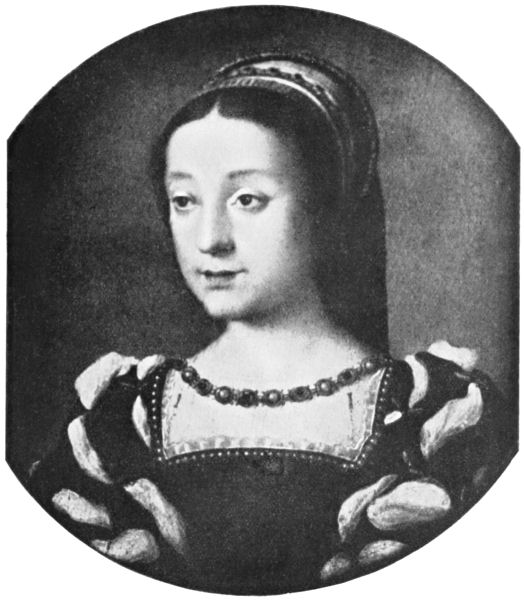
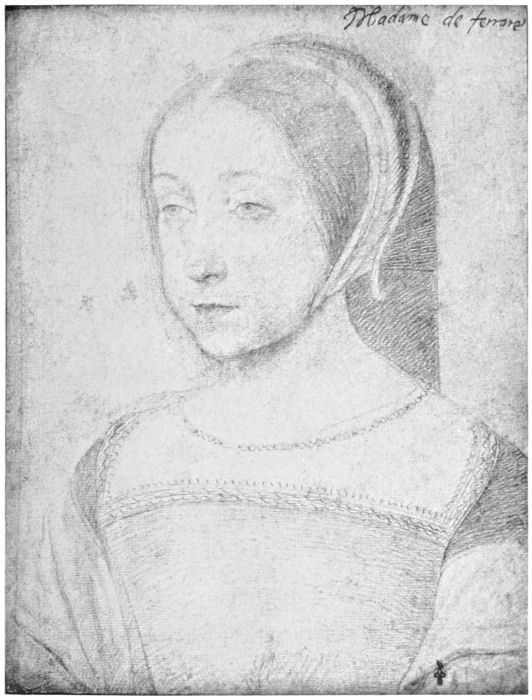
and routine; to Renée of Ferrara, a bewildering,
weary accumulation of difficulties and distress; to
her more charming relative, an enigma shadowed
always by the still greater and grimmer enigma
of mortality. And lastly, for the strange, elusive
Lucrezia, it is difficult to conceive what it must
xi]
have meant at all, unless a sequence of circumstances
never, under any conditions, to be dwelt
upon in their annihilating entirety, but just to be
taken piecemeal day by day, reduced and simplified
by the littleness of separate hours and moments.
In a book of this kind, where the intention is
mainly concerned with character, and for which the
reading was inevitably full of bypaths and
excursions, a complete bibliography would merely
fill many pages, while seeming to a great extent
to touch but remotely upon the ladies referred to,
but among recent authors a deep debt of gratitude
for information received is due to the
following: Jacob Burckhardt, Julia Cartwright,
Augusta Drane, Ferdinand Gregorovius, R. Luzio,
E. Renier, E. Rodoconarchi, and J. Addington
Symonds.
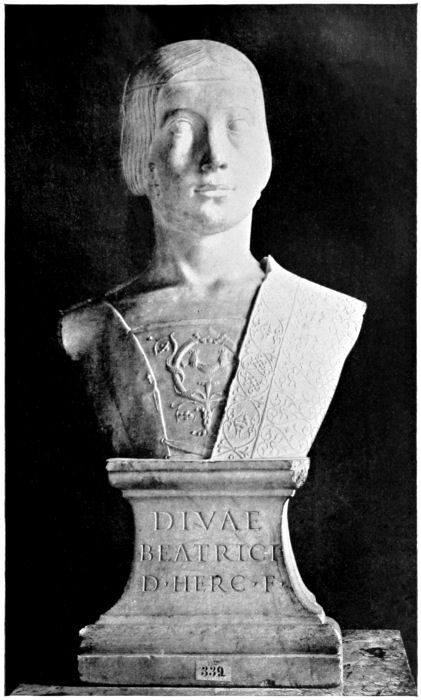
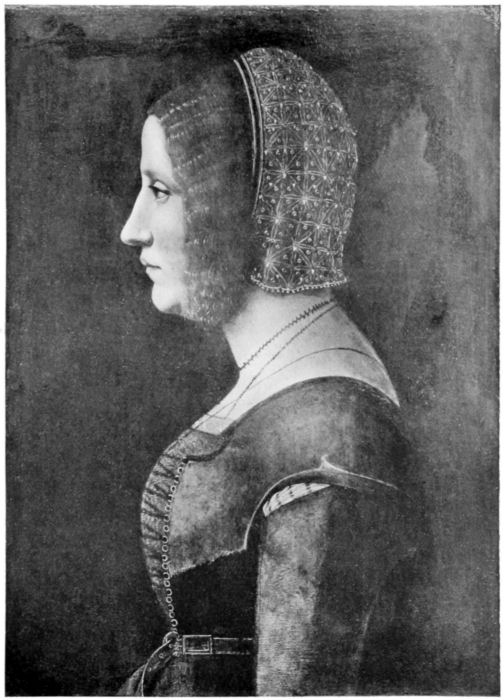
Finally, in reference to the portraits included
in the life of Beatrice D’Este, a brief statement
is necessary. For not only that of Bianca, wife
of Giangaleazzo, but also those of Il Moro’s two
mistresses, Cecilia Gallerani and Lucrezia Crivelli,
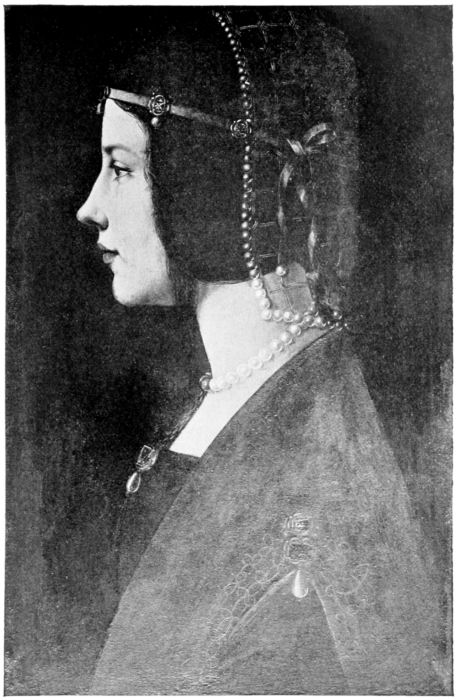
are regrettably dubious. The picture of Bianca,
however, by Ambrogio da Predis, is more than
likely genuinely that of Bianca, though some
writers still regard it as a likeness of Beatrice
herself. It is to be wished that it were; her
xii]
prettiness then would have been incontestable and
delicious. But in reality there is no hope. One
has but to look at the other known portraits of
Beatrice to see that her face was podgy, or nearly
so, and that her charm came entirely and illusively
from personal intelligence. It evaporated the
moment one came to fix her appearance in
sculpture or on canvas. Nature had not really
done much for her. There was no outline, no
striking feature, no ravishing freshness of colouring.
On a stupid woman Beatrice’s face would
have been absolutely ugly. But she, through
sheer “aliveness,” sheer buoyant trickery of
expression, conveyed in actuality the equivalent
of prettiness. But it was all unconscious conjuring,—in
reality Beatrice was a plain woman, with
sufficient delightfulness to seem a pretty one,
while the portrait of Bianca is unmistakably and
lovingly good-looking.
As regards the portraits, again, of Il Moro’s
two mistresses, Cecilia Gallerani and Lucrezia
Crivelli, there is no absolute certainty. The
portrait facing page 6 in the life of Beatrice has
been recently discovered in the collection of the
Right Hon. the Earl of Roden, and in an article
published by the Burlington Magazine it has
been tentatively looked upon as that of Lucrezia
xiii]
Crivelli. This does not, however, appear probable,
because Lucrezia, at the time of Il Moro’s
infatuation, was a young girl, and the picture by
Ambrogio da Predis is certainly that of a woman,
and a woman, moreover, whose experiences have
brought her perilously near the verge of cynicism.
At the same time, the portrait is not only
beyond doubt that of a woman loved by Il Moro,
but was presumably painted while his affection
for her still continued, as not only are the little
heart-shaped ornaments holding together the
webs of her net thought to represent Il Moro’s
badge of a mulberry-leaf, but painted exquisitely
in a space of ⅜ by ⅝ inch upon the plaque at
the waistbelt is a Moor’s head, another of
Ludovico’s badges, while the letters L. O. are
placed on either side of it, and the two Sforza
S. S. at the back. A discarded mistress, if
Ambrogio—one of Il Moro’s court painters—had
painted her at all, would have had the discretion
not to wear symbols obviously intended only for
one beloved at that moment.
There seems—speculatively—every reason to
suppose that the picture represents Cecilia
Gallerani, who was already beyond the charm of
youth before Ludovico reluctantly discarded her,
and whom he not only cared for very greatly, but
xiv]
for quite a number of years. Cecilia Gallerani,
besides, to strengthen the supposition, was an
exceptionally intellectual woman, and the portrait
in the possession of the Earl of Roden expresses
above everything to an almost disheartened intelligence.
To think deeply while in the position
of any man’s mistress must leave embittering
traces, and Cecilia became famous less even for
physical attractions than because her mind was so
intensely rich and receptive.
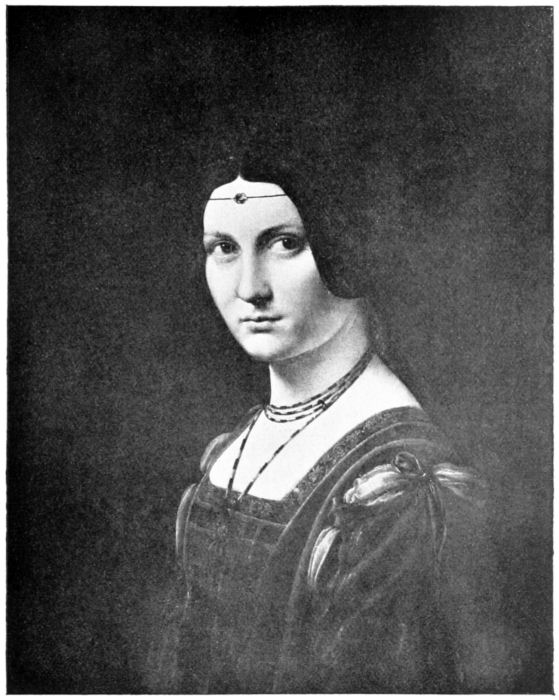
The other two—the pictures of “La Belle
Ferronière” and the “Woman with the Weasel,”—by
Leonardo da Vinci, have both a contested
identity. But since the first is now almost universally
looked upon as being the portrait of
Lucrezia Crivelli, the second must surely represent
her also. For in both there is the same
beautiful oval, the same youth, the same unfathomable
eyes and gentle deceit of expression. Both,
besides, represent to perfection the kind of
beautiful girl likely to have drawn Ludovico into
passionate admiration. He was no longer young
when he cared for Lucrezia, and if Leonardo’s
paintings are really portraits of her, she was like
some emblematical figure of perfect youthfulness,—unique
and unrepeatable.
M. B. R.
LIST OF ILLUSTRATIONS
xv]
TO FACE PAGE
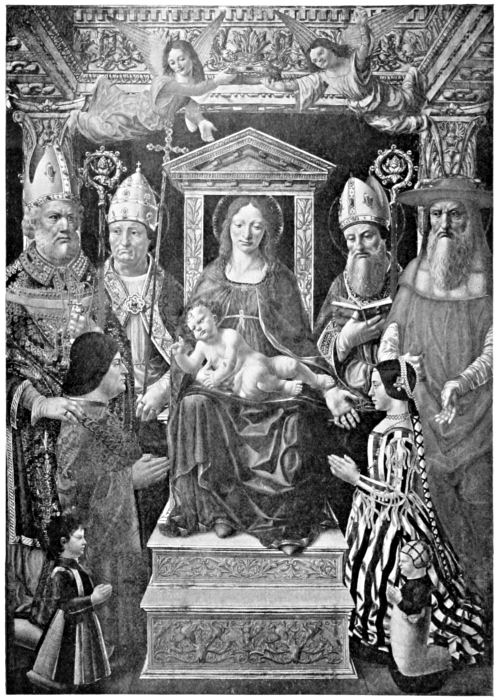
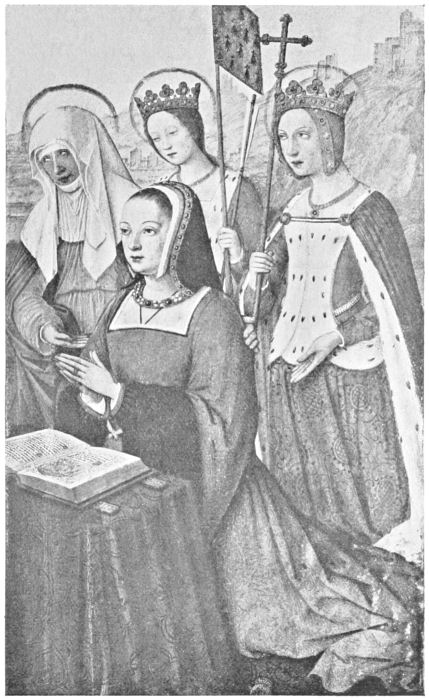
BEATRICE AND LUDOVICO KNEELING. ALTAR PIECE BY ZENALE AT BRERA
CATHERINE of Siena does not actually
belong to the Renaissance. At the same
time she played an indirect part in furthering
it, and she represented a strain of feeling
which continued to the extreme limits of its duration.
During the best period of the desire for
culture, a successor—and imitator—of Catherine’s,
Sister Lucia, became a craze in certain parts
of Italy. Duke Ercole of Ferrara, then old
and troubled about his soul, took as deep and
personal an interest in enticing her to Ferrara
as he did in the details of his son’s marriage to
Lucrezia Borgia, just then being negotiated.
The atmosphere Catherine created is never
absent from the Renaissance. She fills out what
is one-sided in the impression conveyed by the
2]
women who follow. She was also the contemporary
of Petrarch and Boccaccio, the acknowledged
forerunners of the intellectual awakening
that came after them, and being so, is well within
the dawn, faint though it still was, of the coming
Renaissance day. Finally, in her own person she
contained so much power and fascination that to
omit her, when there exists the least excuse for
inclusion, would be wilfully to neglect one of the
most enchanting characters among the women of
Italian history.
The daughter of a well-to-do tradesman,
Giacomo Benincasa, Catherine was born in Siena
in 1347. Her father possessed several pleasant
qualities, and a great reserve of speech, hating
inherently all licence of expression. Catherine’s
mother, Lapa, on the other hand, belonged to
an ordinary type of working woman—laborious,
but irritable and narrow. She brought twenty-five
children into the world, and her irascibility
may have been not unconnected with this heroic
achievement. The sons also, after their marriages,
continued to live, with their wives—it being the
custom at that time—under the parental roof.
Even a sociable temperament would easily have
found such a community difficult always to
handle cordially.
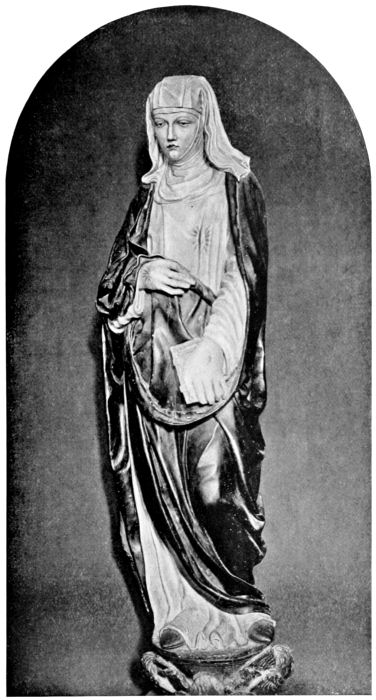
STATUE IN WOOD OF ST. CATHERINE BY NEROCCIO LANDI
3]
Catherine was Benincasa’s youngest child.
As a baby she proved extraordinarily attractive.
She was, in fact, so sweet and radiant that the
neighbours nicknamed her Euphrosyne, and her
little person was much enticed and humoured.
Unfortunately, like all children of that period, she
became bewilderingly precocious, and with the
first development of intelligence, the religious
passion revealed itself. With Catherine the
desire for spirituality was inborn. At five years
old she formed the habit of going upstairs on
her knees, reciting the “Hail, Mary,” at every
step. She delighted in being taken to churches
and places of devotion, and at the age of six
years her deliberate and piteous self-martyrdom
commenced.
The child, during an errand on which she was
sent, believed herself to have seen a holy vision.
The incident had nothing extraordinary, for her
imagination was keen, and her temperament
nervous. In a later century, fed upon fairy
stories, she would have seen gnomes, sprites, or
golden-haired princesses. Instead, saturated in
religious legends, she perceived Jesus Christ in
magnificent robes, and with a tiara on His head,
while on each side of Him stood a saint, and several
nuns in white garments. This unchallenged
4]
vision produced colossal consequences. The
child went home convinced that God Himself
had come to call her to a better life; proud,
frightened, and exultant, she set her mind to find
out, therefore, how she might best become as
good as God wanted her to be.
This beginning of Catherine’s religious life
is painful to remember. She decided primarily
that she must give up childish amusements; in
addition, she determined to eat the least possible
amount of food, and to fill up her life with penances
in the manner of the grown-up holy men and
women about her. She also procured some cord,
and, having knotted it into a miniature scourge,
formed the habit of secretly scourging herself
until her back was lined with weals. Describing
these first spiritual struggles of a child of six years
old, Cafferini, her contemporary and biographer,
says, “Moreover, by a secret instinct of grace,
she understood that she had now entered on a
warfare with nature, which demanded the mortification
of every sense. She resolved, therefore,
to add fasting and watching to her other
penances, and in particular to abstain entirely
from meat, so that when any was placed before
her, she either gave it to her brother Stephen,
who sat beside her, or threw it under the table
5]
to the cats, in such a manner as to avoid
notice.”
This pitiable “warfare with nature” continued
until she reached the age of twelve. Her parents,
so far, had been pleased at her religious fervency.
But at twelve years old the girl became marriageable.
The comparative freedom of childhood
ceased; Catherine was kept secluded in the house,
besides being harried with injunctions concerning
the arrangement of her hair and her dress.
She had, as a matter of fact, charming, warm
brown hair. Unfortunately, a shade of gold was
then fashionable, and Lapa, ambitious for a good
marriage, insisted that the girl should do like
others, and have it dyed that colour. Catherine
resisted with all the strength of her frightened
soul. But in the end, apparently through the
persuasions of a favourite married sister, she
allowed her hair to become golden. It was no
sooner done than conscience suffered passionate
remorse. In fact, to the end of life this one
backsliding remained almost the sharpest regret
Catherine possessed. She could never refer to
it without sobbing, from which it is at least presumable
that a canary-coloured head had its
attractions for a saint of twelve years old.
Meanwhile, the choice of a husband became
6]
imminent. At this Catherine’s semi-passivity
turned into actual panic. It was not possible
both to marry and to give up one’s life to God.
Only, who would listen to the refusals of so
young a girl? Following the practice of the
Roman Catholic religion, she took her difficulties
to her confessor, and was saved through the
proposal of a rather questionable trick. She
had only to cut her hair off to make marriage
impossible: no Italian would marry a woman with
a shaven head. Catherine rushed home, and at
once did as she was told, covering her work, when
she had finished, with a white linen coif. Virgins
in Italy wore their hair flowing; the stratagem,
therefore, did not exist an hour before discovery
took place. Then followed a passionate domestic
scene. The whole family appears for once to
have unanimously agreed that Catherine’s piety
had overstepped the bounds of common sense.
The loss of her child’s hair left Lapa infuriated.
Exasperation grew so intense that for a time,
with the view to breaking her stubborn spirit,
Catherine was deliberately ill-treated. A servant
had been kept for rough work in the kitchen;
she was dismissed, and Catherine made to take
her place. But the girl had not a temperament
that could be cowed. She was a true Sienese,
7]
and Boccaccio, as well as others, speaks of the
virile character of the people of Siena. The
name Euphrosyne also still expressed her disposition.
With a pretty childishness of imagination,
she made religious play out of their harshness.
Her father, she pretended, was Jesus Christ,
Lapa she made the Virgin Mary, and her brothers
and sisters the apostles and disciples. The kitchen
became the innermost tabernacle of the temple
where sacrifices were offered to God. In consequence,
she went about diffusing radiance and
a sober joy, and bewildering those who wanted
to see her crushed and penitent.
In the end Giacomo interfered. He had
the instinct of kindness, and was himself sincerely
religious. Both the question of marriage
and the system of ill-treatment were abandoned.
A little later he gave consent to the
pursuance of a religious vocation, and Catherine,
still a child, became a member of the order of St.
Dominic. It was not a strict community. The
sisters did not live in retirement, but in their own
homes, merely wearing a white veil and a black
habit called Mantellate.
Just before this Catherine experienced a very
human temptation. She became possessed by
the longing to dress herself in the pretty clothes
8]
of a rich married woman, and to go out flaunting
in silks and extravagance. The wish is more
likeable than her physical self-torturings. The
latter gain their power to distress, in fact, to
some extent because her few temptations show
that Catherine had all the average longings of
humanity, and was not devoid of the companionable
frailties of ordinary men and women.
The temptation was, of course, conquered,
and from the glad moment of taking her vows
Catherine intensified every austerity of conduct.
As a child she had been robust and hardy. But
the frightful treatment to which she subjected
her system would have ruined any constitution,
and from the time she grew up she became more
and more delicate, suffering, and neurotic. The
desire to suppress her excesses is very great.
One could write abundantly and give only a life
overflowing in fragrant incidents. But in the
case of Catherine, to pass over foolishness would
entail not only a falsification of character, but a
falsification also of the curious atmosphere from
which she drew the principal inspirations of her
conduct.
From the age of twelve she forced herself
gradually to eat so little, that her stomach became
finally incapable of retaining solid food at all.
9]
How she kept life in her body for the last half
of her existence is difficult to understand. Her
bed, from the time she became a nun, consisted
of a few planks with a log of wood for pillow.
An iron band made part of her wearing apparel,
and her discipline—if the one now shown as hers
in the sacristy of St. Dominico is genuine—consisted
of an iron chain with sharp projections for
piercing and tearing the flesh. The idea was
monstrous and horrible; nevertheless, its fortitude
uplifts it into heroism. To pursue unflinchingly
martyrdom such as this may be grotesque
and ridiculous, but no invertebrate creature could
contemplate it. Of all the violences, however,
which Catherine did to her body, the one under
which she suffered most acutely was her refusal
of proper sleep. It is said, though it is extremely
hard to believe, that for a certain length of time
she took only half an hour’s sleep in the twenty-four
hours, and that—only every other day.
Notwithstanding this, a picture given of her at
the time by Father Thomas Antonio Cafferini, also
a member of St. Dominic, and an intimate friend
of the family, is altogether charming. He asserts
that her face was always gay and smiling, more
especially if she were called upon to help those
troubled or out of health. Other contemporaries
10]
bear out this possession of an effulgent gladness.
When she spoke her face became
illuminated, and her smile was like some living
radiance passing into the hearts of those she
looked at. The same writer mentions her delight
in singing and her love of flowers. A certain
Fra Bartolomeo of Siena bears similar witness.
He wrote, “She was always cheerful, and even
merry.” He mentioned, besides, that she “was
passionately fond of flowers, and used to arrange
them into exquisite bouquets.” Catherine’s
personal writings are strewn with references
to plants and blossoms. It was also part of the
fulness of a character unusually rich in finer
fascinations that she was constantly singing.
Melancholy she scarcely knew. The spirituality
which did not produce happiness, she could only
feel as a spurious effort. Either it lacked love
or understanding.
For years she lived as a recluse in her father’s
house, but while still in her teens it appeared to
her—presumably through a natural wisdom of
character—that God needed less personal worship
than continuous benefits to others, out of her
religious exaltation, and from that time Catherine’s
public career commenced. Almost the first result
of her belief in being called to an active existence
11]
was her constant attendance at the hospitals
and among the lepers. One of the prettiest
of all the stories told about her deals with her
nursing labours. Pity had very small vitality
either during the Middle Ages or the Renaissance;
it was almost a dead quality of character,
and the Sienese were particularly hardened by
harsh experiences.
A woman who had lived a notoriously bad
life lay dying in one of the hospitals, absolutely
and deliberately neglected. A sinner laid low
was scum to spit at for most people. Catherine
saw no scum on earth. She smiled with all her
native inborn softness at the dying woman,
listened to her desolate complainings, her maundering
reminiscences, gave her the nourishment
she liked best, coddled her with sweet attentions,
and finally, without any violent denunciations,
brought her to repentance and tranquillity. A
child might as tenderly have been coaxed out of
a phase of naughtiness.
The incident brings one naturally to Catherine’s
reputation as a peacemaker. She was still a
young girl when tales of her persuasiveness were
told to amazed, arrested audiences throughout
the country. The Sienese temper was fundamentally
savage; nothing, therefore, could touch fancy
12]
more than stories of a nature capable of acting
as a gentle and cooling balm upon outrageousness.
Catherine, as a matter of fact, possessed
both the magnetism of intense belief and the
power of innate urbanity. The first awed superstition
by incomprehensible achievements. Forestalling
the Christian Scientists, she had healed
the sick by prayer, while her mere enticements
brought about the end of many virulent dissensions.
To dabble with mystical methods is an old
and universal weakness. The wife of a certain
Francesco Tolomei, head of one of the noblest
families in Siena, heard of Catherine’s miracles,
and being hard pressed by domestic difficulties,
turned to the dyer’s daughter for assistance.
Madonna Tolomei was herself a profoundly
religious woman, but she anguished with the
consciousness that the rest of her family were
damned. The eldest son, Giacomo, had murdered
two men before he was grown up, and his cruelty
had now become diabolical, ingenious, and systematic.
There were also two daughters, bitten
with worldliness to the marrow of their bones.
Both were fast, dyed, and painted. Catherine
offered to see the girls, but expressed no confidence
as to the consequences. She found them
13]
with the garish hair that always touched her to
the quick, and possibly felt more yearningly
because of it. No account has been given of
the interview. The two sisters, with the Tolomei
blood in their veins, could hardly have been easy
natures to lure out of worldliness; but at the end
of Catherine’s visit, they were like lambs in the
hands of a skilful shepherd. According to
Cafferini, they threw their cosmetics into the
gutter, cut off their gleaming hair, and in a
few days joined the Sisters of St. Dominic.
This is the kind of triumph of which Catherine’s
life is full. Her personal magnetism was extraordinary,
her insight actually a touch of genius.
At this time also she was young, and herself
a living exponent of how seductively gay goodness
could make one. To the end, in truth,
she remained less a nun than a woman, and as
a woman she was the embodiment of enchanting
sympathies and comfort. Merely to see her,—soft,
sweet, mysteriously comprehending,—was like a
cordial to an aching heart. But the most astounding
part of the Tolomei story is still to
be told. Giacomo, with his mad and bloody
passions, was away when his sisters’ conversion
took place. He came home to cow the house
with terror. A lunatic let loose would have
14]
been less persistently dangerous. Donna Tolomei,
shaken now with physical and not spiritual
forebodings, immediately sent a messenger to
warn Catherine that no danger was too horrible
to anticipate; in his present condition he was
capable of doing anything. Catherine did not
feel a quicker heart-beat. She was steeped in intuitions
and spontaneous knowledge. Ostensibly
as an act of exquisite courtesy, she sent Fra
Bartolomeo—who must have been a brave
man—to explain matters, while she prayed with
all her heart and soul for the unmanageable
sinner. Some hours later Bartolomeo came
back. Catherine met him smiling; she knew
already the news he brought. Her prayers—so
passionately eager—had already been answered.
Giacomo—the diabolical, murderous, implacable
Giacomo—was already meek as a lamb under
the shock of a new and overwhelming emotion.
It is not the least curious part of the story that
he remained a changed character, and continued
to abominate wickedness with the same intensity
that in his earlier days he had practised it.
Towards the end of his life he even took the
habit of a Dominican of the Tertiary Order,
the obligations of this third order not being
excessive.
15]
There is another story of this earlier period
more enchanting still, in its original and tragic
graciousness. Only before telling it the question
of Catherine’s miracles should, perhaps, be dealt
with, for they also commenced when she was
scarcely out of childhood, and helped enormously
to render her a recognized celebrity. They and
her austerities are the unlikeable side of Catherine’s
holiness. At the same time no saint of the
period could have obtained a hearing without
them, and no human system could have endured
the strain put upon it by a mediæval religious
enthusiast, without producing self-hypnotism and
catalepsy. Catherine, at an early age, fell into
trances, described by her biographers as “ecstasies
at the thought of God.” Describing one of these
ecstasies, her friend Raymond wrote “that on
these occasions her body became stiff, and raised
in the air, gave out a wonderful fragrance.”
All the old Catholic writers, to whom miracles
were an integral part of saintship, were generous
in multiplying supernatural details. A good deal
has to be deducted from these statements; but even
then there remain a good many so-called miracles
attested by other and more critical witnesses.
That she was seen raised from the ground while
she prayed, is a fact sworn to by a number of
16]
people. A man called Francesco Malevolti
affirms that he saw her “innumerable times”
raised from the ground as she prayed, and
remaining suspended in the air more than a
cubit above the earth. He mentions, to give
weight to his evidence, that in order to test the
reality of the occurrence, he and some others
passed their hands between her and the floor—a
thing perfectly easy to do. As this occurred
in broad daylight, modern spiritualistic séances
become clumsy in comparison. Catherine could
do better in the fourteenth century.
The most important miracle of all was, of
course, the stigmatization. That alone definitely
assured her position as one with authority from
God; it constituted the final and irrefutable sign
of Divine and miraculous intervention. At the
time of its occurrence Catherine was twenty-eight,
and suffered extreme agony from it. The most
curious circumstance about the stigmata in Catherine’s
case was that they were not properly visible
during her lifetime, but became perfectly clear
after her death. In this one matter her successor,
St. Lucia, the religious celebrity of Lucrezia
Borgia’s day, outdid the woman she tried to
follow. Her stigmata were always visible—bleeding
wounds anybody could look at.
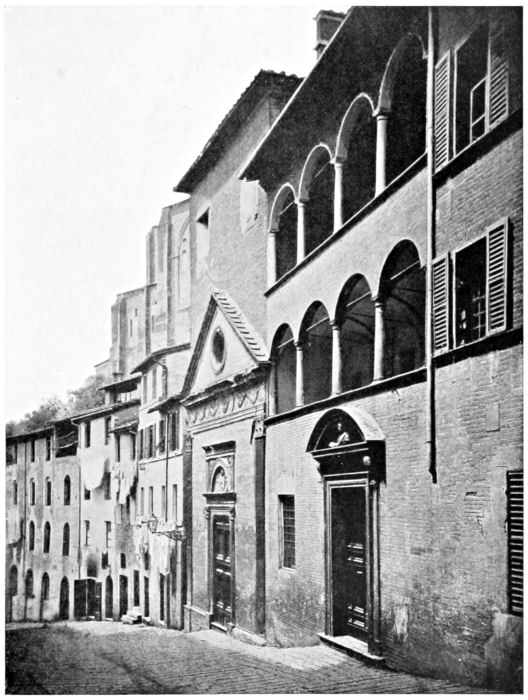
ST. CATHERINE’S HOUSE AT SIENA
17]
Returning to the loveliest of all the stories
concerning Catherine’s girlhood, it must be
remembered that the prisons of Siena were almost
more filled with political prisoners than criminals.
During the whole of the Renaissance political
prisoners were in themselves almost sufficient in
number decently to fill Italian dungeons. Catherine,
who had the understanding to love sinners,
habitually visited condemned offenders. Those
forlorn of any hope in this world she insidiously
replenished with winning dreams of hope hereafter.
She did more. When the day of execution
came, she joined the procession to the scaffold.
What it meant, in the unconveyable desolation of
that last public outgoing, to have the company
of this woman, with her sweet, contagious promises
in the name of Christ, would be hard to overestimate.
She was at all times embodied comfort
to be with, and even a sharp and reluctant death
must have been easier when she was there to
pour out pity and encouragement.
Among the prisoners at one time was a certain
Nicholas di Toledo, who had spoken irreflectively
against the Riformatori—the strong Government
party. This Riformatori consisted of a council
chosen originally at a tense political crisis for
purposes of urgent amendments. The nobility
18]
had no part in it. Siena, since 1280, when a
reconciliation occurred between the Sienese
Guelfs and Ghibellines, had been a merchant
oligarchy, first governed by the Nove, then by
Dodici, and after both these had been swept away,
by the Riformatori, into which some members of
both the previous Governments had been included.
The Riformatori began well and ended badly.
The Noveschi and Dodicini members almost
immediately worked against it; civil trouble
became interminable. The new power, exasperated,
fell back upon repressive horrors. People
were arrested upon simple suspicion of disapproval,
and then publicly tortured in order to
appal others. A common habit was to tear a
criminal slowly to pieces with red-hot pincers
while he was bound upon a cart driven slowly
through the principal streets.
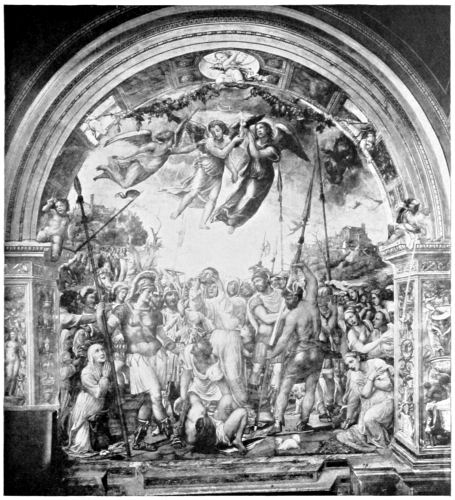
ST. CATHERINE PRAYING AT AN EXECUTION FRESCO BY SODOMA
In the case of Nicholas di Toledo, he had
barely gone from the place of his impulsive utterance
before he was arrested, and he was barely
arrested before he was condemned to death.
Such a sentence had never risen in his thoughts
for one sickening moment even; it came with so
awful an unexpectedness that his mind for an
interval whirled to the verge of insanity. Nicholas
di Toledo was scarcely more than a boy, and the
19]
first warmth of life ran in every pulse. This
bitter, inconceivable end unnerved him—he could
not make up his mind to die. Suddenly he thought
of Catherine, of whom other prisoners may have
babbled, and sent a messenger imploring her
to come to him. She wrote afterwards to her
confessor a full description of the brief drama.
Her presence almost immediately calmed and heartened
him. Both were young, and Catherine, if
not actually pretty, was delicious with overflowing
tenderness. For Nicholas, besides the optimism
communicated to him by her spiritual promises,
there must have been the unconsidered but
poignant fact that she was a woman and he a man.
It is undeniable that no monk, however good,
could have helped his dying to the same extent.
Catherine not only rendered it possible to go
through with courage, but in the end tinged it
with something almost blessed. She was with
him, it would seem, most of the time, and not only
promised to accompany him to the scaffold when
the day of execution came, but previously took
him to Mass, and persuaded him to communicate
for the first occasion in his life.
Nicholas had been nothing deeper than a
young society man, and the wrench of this merciless
conclusion was all the greater because of it.
20]
Catherine, in her account of the circumstance,
went on to say that he grew quite resigned, his
only dread being lest his courage should fail him
at the supreme moment. He repeated constantly,
“Lord, be with me; abandon me not.” To help
him she reiterated her assurance that she would
be with him at the last. In a moment his face
brightened, and he asked her with a boyish impulsiveness
how it was so great a sweetness was
being vouchsafed to him. With this to look forward
to he could face the end, not only with courage,
but with something strangely akin to pleasure.
They met, as she had promised, at the scaffold
next day. Catherine wrote concerning it that
when he saw her his face broke into a smile, and
that he begged her to make the sign of the cross
upon his forehead. She did so, whispering that
soon, very soon, he would have passed to a life
that never ends. Then occurred the unforgettable
incident of the story. At the best Nicholas
was a creature not disciplined to suffering, and
the worst moment had yet to come. Leaping
to obey an intuition in itself exquisite, Catherine
did what the prudery alone of most religious
women would have made unthinkable. She took
the boy’s head in her thin, soft hands, and herself
laid it in position upon the block. The action
21]
was like a caress in which his last impressions
melted. He murmured the words “Jesus and
Catherine.” The knife ripped through the air to
his neck, and his head fell into the same trembling
hands that had guided it during its last activity.
On its human side Catherine’s spirituality was
seldom less than perfect. Character and beauty
emanated from her every spontaneous action.
Nicholas di Toledo was only one of the many
men she fascinated, and the fact renders the
question of her personal appearance peculiarly
interesting. The triumphs of a plain woman are
always more stirring than those achieved by a
simple success of feature. The “divine plainness,”
immortalized by Lamb, can convey subtleties
not possible to the simple regularities of
well-cut features. Catherine proved adorable to
most people, but from her portraits it is practically
impossible to receive any impression save that of
dulness. This, at any time, was the last thing
she could have been, but the conventions of the
Roman Catholic Church in dealing with the
portraits of saints opposed any lifelike treatment.
The picture of her in the church of St.
Domenico at Siena, said to be by Francesco
Vanni, might do equally well for any other
emaciated sister. There is no temperament in
22]
it, no illumination, no visible sweetness. The
eyes are half closed, the expression is inert and
apathetic. The mouth is small but meaningless,
the nose is long and well formed, the oval of
the face delightful. Vanni did slightly better on
another occasion. There is an engraving by
him which is very nearly attractive. The eyes,
owing to the religious demand for humility, are
again half closed, but the mouth is both delightful
and winning, and a half-smile plays about her
expression. Given the glamour of vivacity, the
kindling changes of life, and Catherine when
young must have been delightful to look at.
Certainly many men loved her. She had the
power of being poignant in recollection, and disturbingly
sweet in her bodily presence.
Even the painter Vanni, wicked enough to
have been conversion-proof, yielded to the disquieting
need she roused in him. He had been
a great hater, and the men he hated were assassinated
without after-remorse. For some amazing
reason—probably that of curiosity—he consented
to interview Catherine. She was out when he
called, and her Confessor Raymond received
him. According to Raymond, who describes the
incident, Vanni soon grew bored, and presently
remarked bluntly that he had promised to call
23]
upon Catherine, but since she was out, and he was
a busy man, he could not wait for her any longer.
At that moment Catherine appeared—according
to Raymond, much to Vanni’s disgust. But
Catherine was all smiles, comfortableness, and
simple ease of manner. Vanni’s chances, in fact,
of not being converted ended with her entrance.
The manner of his surrender was humorously
characteristic of the man himself. Catherine—she
was always so clever when she was good—presently
left the room. No woman ever knew
better when another word would have been too
much. She had hardly gone when Vanni broke
out that, for the sake of courtesy, he could not
wholly refuse her some gratification. At the
moment he had four virulent hatreds, but to
please Catherine he would give up, in the case
of one of them, all thoughts of vengeance. He
then started to leave the house, but before he
reached the door stopped suddenly and declared
he could hardly draw his breath, so intense was
the sense of peace and ecstasy this one small
action of the right kind had given him. Evidently
it was useless to hold out against her influence,
and he then and there declared himself conquered,
and ready to abandon all the vices he could under
Catherine’s gentle guidance.
24]
Thus came an end to Vanni’s murders.
Catherine held him for the rest of his days. It
is only to be regretted that he did not paint her
portrait before instead of after his conversion.
He would have attended less to her reputation
as a saint, and more to what was lovely and
pictorial in her person.
Catherine no longer lived at home. She had
instituted an informal sisterhood at Siena, where
“Mantellate” sisters from every part of Lombardy
lived in community. Her work still
continued among the sick, the lepers, and
prisoners. But rumours of her miracles, and of
an almost miraculous gift of persuasion, were
spreading to many parts of Italy. Talk of the
dyer’s daughter had already reached the ears of
the Pope at Avignon, and was paving the way
to further political successes. Before Catherine
had passed out of her teens she employed four
secretaries to cope with the colossal inflow of
correspondence that reached her. It was through
the urgency of help in answering letters in fact
that Catherine made the great friendship of her
life, and drew under her influence the man
who largely contributed towards keeping natural
feelings alive in her.
Stephen Marconi never cast off a cheerful
25]
and innate earthliness. He came across Catherine
originally, as so many people did, over the matter
of a Sienese family feud. Stephen, headstrong
and exuberant, had roused ill-feeling in both the
Tolomei and Rinaldini families. Torrents of
blood loomed as the sole termination. Mutual
acquaintances had made useless attempts to produce
peace; at the last crisis before violence
Stephen’s mother implored him to go to the
“Mantellate” sister. The suggestion drew some
contemptuous comments. But the woman persisted,
and essentially good-natured, Stephen
went in order to pacify her. He had every
reason subsequently to thank the solicitations
that overbore derision. Catherine settled everything
with absolute successfulness, Stephen
himself speaking of the reconciliation that followed
as truly miraculous.
More extraordinary than the reconciliation
even was the effect of Catherine’s individuality
upon Stephen Marconi. He possessed no natural
aptitude for spirituality. Handsome, irresponsible,
sought after, he epitomized effervescent worldliness.
But, having once seen Catherine, he could
not keep away. Excuses were raked together
for further interviews, and one day, finding her
overburdened with correspondence, he wrote a
26]
letter at her dictation. It was the beginning of
the end. At first informally, and later explicitly,
he became one of her secretaries; presently also a
member of what was called her “spiritual family.”
Siena relished as a joke the dandy converted
by the ascetic, but Stephen was unconcerned.
An irrepressible humourist, he appreciated to the
full the oddity of the situation; though if jocose,
he was also deeply contented. Catherine had
become almost instantly the instigating motive
of his life, the one precious thing his heart needed.
Catherine, on her side, was known to care for
him more than for almost any other person. Her
relations with him became those of a deep and
exciting friendship. Towards the end of her
life she heard a report that Stephen had definitely
cast off his semi-worldliness and taken ascetic
vows. Catherine should have known an exquisite
and glowing comfort. Instead of it, her letter
to him on the subject is very nearly petulant.
That any action should have been taken without
first becoming a matter of confidences between
them clearly unspeakably hurt her. She wrote
that of course it was a great joy to hear that he
desired to lead a better life, but that she was
“very surprised” that he should have made any
decision without previously having said a word
27]
to her about it. She added further that there
was something in the matter that she could not
understand, though she prayed that whatever he
did would prove to be for the benefit of his soul.
There is more sign in this of a woman stung
by an unexpected neglect, than any religious exaltation
at a soul saved. Stephen had not become
a monk, and the misunderstanding swiftly passed
over. But the letter is pleasant reading, because
it was written at a time when Catherine’s mysticism
threatened to overshadow the purely
human kindnesses of her earlier years. The
idea of Christ as the heavenly Husband had
developed from vague symbolism into a definite
expression of spiritual familiarity. It was an
unrealized element of good fortune that Stephen’s
whimsical frivolity kept alive in her a strain of
normal sensations. She suffered whenever they
were separated, and among the last letters she
ever wrote, moreover, was one to Stephen with
the pathetic, dependent cry, “When will you
come, Stephen? Oh, come soon!”
Another secretary closely associated with
Catherine’s life for many years was Neri di
Landoccio, a poet belonging to the group of
dawning Renaissance writers. He suffered from
melancholy, and having once met Catherine,
28]
naturally clung to the heartening radiance of her
presence. From his letters, his youth appears
to have been vicious. He was, at any rate,
haunted by the notion that his misdemeanours
were greater than God would be likely to forgive.
He worried himself into a dangerous dismalness—a
gloom perceiving no remedy. Then
Catherine wrote him a long letter. She reiterated
that God was far more ready to forgive than
humanity to offend; that He was the Physician,
and mankind His sick and ailing children. She
told him that sadness constituted the worst fault
of all in a disciple of Christ. To believe in the
unplumbable love of God, and still persist in disheartenment,
was a form of unrighteousness.
Neri did his best, but a gentle wistfulness
penetrated his disposition, and not even Catherine
could give him gaiety of thoughts. He and
Stephen Marconi—the extreme opposites in
temperament—became deeply attached to one
another. They corresponded when apart, and
Stephen, after Catherine’s death, called Neri
“among those whom the Lord has engrafted in
the very innermost depths of my heart.” A third
man constantly in Catherine’s society was her
Confessor Raymond. Two small incidents told
by himself, and against himself, suggest a perfectly
29]
honest and rather pleasant temperament, but a
somewhat limited spiritual capacity. In the first,
he confesses that when on their journeys great
multitudes thronged to Catherine for confession
and comfort, and that the fact of having to go
for hours without food or rest greatly annoyed
as well as wearied him.
From the other, both issue rather sweetly,
but Catherine with almost a touch of greatness.
Raymond, who again tells the story, says that
she loved to talk to him upon spiritual matters,
but that, not having the same mystical sensibility,
these conversations frequently sent him to sleep.
Catherine, absorbed in her subject, would continue
for some time talking without perceiving that she
lacked a listener, but when she did, she would
merely wake the other, and good-humouredly
tease him for allowing her to talk to the walls.
Catherine had by nature the sanest and
tenderest common sense. It was she who wrote
of prayer that everything done for the love of
God or of our neighbours was a form of prayer,
and those who were always doing good were
always, as it were, at prayer. Love of one’s
fellow-creatures was practically one long-continued
lifting of the heart to God.
When Catherine came to the political portion
30]
of her life, the point at which she may be said to
have indirectly affected the Renaissance in Italy
was reached. The popes were still at Avignon,
while Rome clamoured for a return of the papacy
to its original capital. Petrarch, in a letter,
pictured Rome as a venerable matron standing
desolate and in rags at the gate of the Vatican.
“I asked at last,” he wrote, “her name, and she
murmured it forth. It reached me through the
void, in the midst of sobs—it was Roma.”
Certainly, since the removal of the popes to
France, Rome, as a city, had gone to pieces.
The churches were in ruins, grass grew through
the pavements up to the very steps of St. Peter’s,
peaceful sheep used its environments for pasturage.
As the two great families of the town, the
Colonna and Orsini fought unceasingly for
supremacy, while the people were equally pestered,
tortured, and destroyed by both. Save for those
who fancied murder as a profession, life had
grown a nightmare; decency and quiet were
as things of which even the ashes had been
scattered.
Catherine, like Petrarch, flung the weight of
her eloquence on the side of the Romans, and
Gregory’s return to Italy is always attributed by
Roman Catholics to her influence. But before
31]
this question had become poignant between them,
Gregory had already tested Catherine’s good
sense in two political missions—one to Lucca, and
one to Pisa. Both were successfully concluded,
and in consequence, when Florence rose openly
against the authority of the Pope, Catherine was
chosen for a third time to conduct mediation.
The employment of any woman as a diplomatic
agent as early as 1370, was an extraordinary
circumstance. During the Renaissance, frequent
use was made of the intellectual adroitness of
women. But, in Catherine’s day, females, as
Boccaccio states definitely, had few occupations
besides house-bound duties and the excitements
of intrigue.
Catherine created an admirable impression in
Florence. On her arrival she was formally met
by the principal men of the city. The Florentine
Republic had itself invited her to come to their
assistance. At the same time pure enthusiasm
would have effected nothing. Consummate intelligence
only could move the Florentines. Each
Bull that came from the French Court, and from
a pope with every personal interest in a foreign
country, newly exasperated them. Catherine
watched warily, judging character and manipulating
it, until Guelfs and Ghibellines, acute in
32]
unfailing antagonisms, equally authorized her to
commence peace negotiations at Avignon. Catherine
immediately started for France. Stephen
Marconi went with her, and the actual journey
must have filled her with many unavoidable
pleasures. To begin with, she loved the country.
In addition, the gypsy travelling of the day
entailed perpetual chance incidents and unexpected
humanizing makeshifts. A week of gentle progress
among Italian scenery would keep the joy
of life stirring in most people, if only unawares.
At Avignon her story becomes, even more
than before, the dramatic triumph of personality.
When she came nobody wanted her. The cardinals
had strong reasons for not wishing an
ascetic’s influence in the palace; Gregory, inert
and ailing, flinched at the thought of a person
noted for arousing qualities. She was received,
notwithstanding, with ceremony. At her first
audience, Gregory sat dressed in full canonicals,
and surrounded by the entire conclave of cardinals,
like a brilliant jewel in a purple case. Catherine
behaved meekly, though in all likelihood her
thoughts were less quiet than usual. For the
papal residence was a gorgeous place; there
were galleries, marble staircases, colonnades,
magnificent gardens, elegant fountains. The
33]
ultimate possibility of luxury lay before Catherine’s
sober eyes, the very air itself being perfumed.
This was sufficient to have perturbed her,
for a markedly unclerical influence emanated
from so much comfort. But the women who
filled the palace jarred still more emphatically.
Their sumptuous persons were obviously at home—the
very atmosphere indicated femininity. A
large number were, in fact, mistresses of the cardinals;
the rest, relatives and friends of the
Pope, who had been granted apartments in the
palace. Gregory’s own morals have never been
questioned. He sanctioned, by ignoring them,
the scandals of his household, but his own
life was that of an innocent and cultivated
gentleman, with a liking for expensive living.
Raynaldus, in his “Ecclesiasticus Annals,” says
that he was of an affectionate and domestic
nature, loving his own people, and, in fact, too
much led by them, especially in the matter of
benefices. His private life was above reproach,—chaste,
kindly, and generous. A scholarly man,
he delighted in the society of other scholars. At
Rome he instantly remitted all the duties on corn,
hay, wine, etc., which the clergy had previously
levied, and which fell most heavily on the poor
people. But the troubles and anxieties that
34]
followed his return to Italy, added to an internal
disease, from which he had for some time
suffered, brought about his death at the age of
sixty-seven.
This internal disease had something to do
with the gentle inertia of Gregory’s conduct.
Once roused by Catherine to a certitude as to
where his duty lay, he did it regardless of every
personal inclination and affection.
But at the commencement of Catherine’s
visit, the question was solely how best to deal
with the disaffected Florentines. The issue did
not prove gratifying. The Government had
promised Catherine to send ambassadors to
Avignon, suing for peace. New dissensions
leaping up between Guelfs and Ghibellines, none
were sent, and negotiations collapsed. In the
mean time the ladies at Avignon had grown
interested in the attenuated sister, who passed
them constantly on her way to and from an
audience. They started primarily with the frank
indifference of society women to another of a
lower class. But indifference became painful
interest when in a few days it was breathed
tempestuously that this pale woman had come
almost solely in order to persuade the Pope to
return to the Vatican at Rome. Scared and
35]
disordered, the papal ladies ceased to look insolent;
they set themselves instead to conciliate
the “Mantellate” woman. Led by the Pope’s
sister, the Countess Valentinois, they made religion
fashionable. Discarding all dancing, they
instituted afternoon parties for pious conversation.
The Countess Valentinois also visited Catherine
in her own room, and after a few days, whenever
Catherine went to the chapel to pray, she found
all the court ladies following her example. Raymond,
never very perspicacious, owns to being
moved by “such unexpected signs of grace.”
He even admired the lovely gowns and misleading
courteseys of the seemingly repentant ladies.
Clearly a little susceptible, Catherine’s churlish
indifference greatly annoyed him. As her confessor,
he had the opportunity of chiding her for
this incivility—it was painful to see such pretty,
graceful creatures repulsed so sternly. But
Catherine upon this subject was adamant, and
merely replying that had he the smallest inkling
of the true dispositions of these mistresses of the
cardinals, he would be nothing less than horrified.
Raymond, one imagines, still privately clung
to a more pacific opinion; but if the story generally
attributed to the Pope’s niece is true, his
eyes were soon opened to the real sanctity of
36]
these ladies. Catherine had fallen into one of
the trances frequent with her when at prayer.
Elys de Beaufort Turenne happened to be kneeling
conveniently near, and the opportunity to
expose a spurious absorption thrilled her with
pernicious pleasure. The temptation was too
exceptionable to resist, and bending over, she
presently ran a big pin into the Mantellate’s toe.
The joke, as far as she was concerned, spurted into
no more life than saturated fireworks. Catherine
never stirred—unaware of the incident until
afterwards. But Raymond realized for the
future that some courtesies are means of concealment
only.
The women of the Pope’s household were
not alone in disliking Catherine. The cardinals
objected to her as strongly. She had come to
labour against everything pleasing in their lives.
Those won over, besides, praised immoderately,
and the instinct to strike a balance is natural and
intuitive.
Her spiritual pretensions had not even, as far
as they were concerned, been proved to be
genuine. They solicited from the Pope, therefore,
an interview with the Mantellate nun, in
which the soundness of her theology might be
tested. This encounter lasted from noon until
37]
late in the evening, during the whole of which
time they endeavoured to confuse her into foolishness.
But Catherine had a very clear brain and
a very quick one. She knew her subject, and,
being a clever woman, in a few minutes also,
roughly, the temperaments of the men she was
dealing with. The thought is a purely personal
one, but it is difficult not to believe that she enjoyed
the excitement. Catherine was humble through
instinct, but she must have realized that she was
considerably more capable than most people.
Stephen Marconi, present during the interview,
says that two of them were enticed over almost
immediately, and took sides with Catherine
against their own party. The questions put, however,
were anything but easy to deal with. Among
other points they queried how she knew that she
was not really in the subtle clutches of Satan;
it was no uncommon trick for the Evil One to
change himself into an angel of light, or sham to
be a vision of Christ himself. All this time her
extraordinary manner of life might be simply a
cunning prelude to damnation.
Catherine neither wavered nor deliberated;
her calm was gracious and simple; she was
exquisitely willing to be interrogated. The cardinals
gave in; the struggle over, they had even
38]
the grace to admit that “they had never met a
soul at once so humble and so illuminated.”
Gregory, inherently a gentleman, afterwards
apologized to Catherine for having permitted her
to be molested by them, and from that time her
troubles with the cardinals at any rate terminated.
Gregory himself had from the beginning been
openly impressed by her. She left Avignon
before the actual journey to Rome was made,
but her passionately eager persuasions were the
fire at which Gregory’s conscience chiefly ignited.
For his household became desperate and loquacious
at the mere suggestion. Gregory also had
been born in France; all his roots were in the
genial soil of Avignon. But Catherine would
not let the matter rest. In a yearning and
courageous letter, beginning, “Holy Father, I,
your miserable little daughter Catherine,” she
urged him to be overborne by nobody against
doing his duty, for if God was with him, nobody
could be against him.
Gregory went, and in a man old, fearsome,
and extremely out of health, the action has an
element of greatness. For the reputation of
Rome, constantly reiterated by those about him,
was very much like that of a den of wild beasts.
Ser Amily, a provincial poet, who gives a rhymed
39]
description of the journey from Avignon, says,
further, that all the physicians and astrologers
prophesied a fatal termination to the expedition,
but adds that they had apparently misread the
constellations, as after some terrifying storms
they sailed for the rest of the way upon a tranquil
sea.
The fatal termination merely tarried somewhat,
though the entrance into Rome proved a
triumphant pageant. The streets had been laid
with carpets, white flowers rained from every
window—no welcome could have looked more
cordial or inspiriting. The entry once over,
however, Gregory found himself alone in an
inimical country. Catherine wrote encouraging
letters to him to discard all fears and strenuously
to do all he could. But Gregory had done all he
could. Rome, depraved and indocile, required a
sterner nature at its head. He was ill and overtired,
and fourteen months after having reached
Italy, died, lonely and disheartened, at the age
of sixty-seven.
Urban VI., by birth a peasant, short, squat,
unpolished, succeeded him. The election was
instantly unpopular. Half the people desired
a French pope, residenced at Avignon and
keeping French interests uppermost. The rest
40]
writhed under the truculent uncouthness of the
new Pope, hating him personally. Matters
became so envenomed that the most acutely
aggrieved presently declared his election to
have been illegal, and proceeded to place another
pope at Avignon, known as Clement VII.
There were, in consequence, two popes—one
at Rome, and the other in France. Both claimed
supreme authority, and the confusion produced
by them brought the papacy very near to the
ridiculous. Then commenced, according to
Muratori, a long series of terrible scandals in
the Church. The result was unceasing private
and public dissensions, incessantly culminating
in murder. Urban excommunicated Clement
and his cardinals. Clement, on his part, excommunicated
Urban and his followers. The same
benefices were conferred on different persons by
the rival popes, each appointing his own bishop
to every vacant see. Urban had been one of
the cardinals during Catherine’s momentous
stay at Avignon, and knowing his character, she
wrote him after his election some very wistful
counsel. The necessity of behaving benevolently
was like a cry wrung out of her involuntarily;
again and again, in different phraseology,
she begged him to “restrain a little those too
41]
quick movements with which nature inspires
you.”
This puts matters prettily—with an innate tact
of feeling. Urban, in reality, was a man destitute
of pleasant impulses. Fundamentally irritable,
he possessed no control of utterance. Towards
the cardinals his manners were inexcusable. He
shouted the word “Fool!” at them upon the
least hint of contradiction: over a difference of
opinion he blurted furiously, “Hold your tongue;
you don’t know what you are talking about.”
Having determined to put down the rampant
cupidity and immorality of these same cardinals,
he raided their palaces as the quickest method
of exposing them. On the other hand, he was
a man of absolute probity, austerity, and courage.
Petrarch had several times attacked the gluttony
of high ecclesiastics. Urban ordered that one
course only was ever to be seen upon the table
of any prelate whatsoever, and adhered to the
rule himself even upon occasions of hospitality.
The following incident is a good example of his
courage. As a result of the schism and his own
extreme unpopularity, the people of Rome broke
into open rebellion. The mob rushed to storm
the Vatican. At the first rumour the household
had fled to take refuge in other places.
42]
Only Urban refused to move, and remained alone
in the great empty palace. When the mob
stormed the doors and made for the Pope, they
found him sitting motionless upon the throne,
dressed in full pontifical splendour and holding
the cross in solemn defiance in one upraised
hand. The sight of his immovable figure,
dramatic, repellent, denunciatory, broke the
nerve of the impressionable Romans. They
saw before them the representative of God,
and with incoherent noises, fearful of eternal
wrath, they fled, leaving the rigid figure impassive
as an image, alone once more.
It was with Urban that Catherine went
through the last exciting interview of her life.
The impression left by her personality at Avignon
must have been considerable, for when the election
of Clement VII. took place and divided the
Church into two disordered and querulous factions,
the man who could not support a single
adverse suggestion actually sent for Catherine to
come and help him render the people of Rome
at least loyal to the true Head of the Church.
Catherine, though by now very frail in body, set
out immediately, taking twenty helpful people
with her, but, for some reason not given, leaving
Stephen Marconi behind. Then, when she had
43]
got to Rome, and had recovered from the exhaustion
of the journey, Urban insisted that she
should give an address upon the schism before
the entire assembly of cardinals.
She could only have looked a rather wan and
paltry object set against the lace and silk and
breadth of the well-fed cardinals. She was by
this time nothing but a narrow line of black
draperies and a thin white face. But the moment
she began to speak the old warmth leapt into her
voice, and the nun became more deeply rich in
colour than all the scarlet and purple she fronted.
Catherine never lost her head or her courage.
She was there to rouse the sluggish morals of
the cardinals, but she was quite aware that Urban
stood almost as much in need of improvement as
they did. With admirable clarity she laid stress
upon the fact that the only weapons suitable for
a pope were patience and charity. Urban owned
neither, but the pluck and eloquence of the woman
reached some responsive feeling, and he praised
her then and there in a generous abundance of
phrases. Unfortunately he did nothing else, and
the following Christmas Catherine sent him
another cajoling reminder—the kind of reminder
only a subtle woman, and one with charming
ways in private life, would have thought of. She
44]
preserved some oranges, coated them with sugar,
and having gilded them, sent them to the Pope.
With the present came a note, explaining that
in the preserving all the acidity of the orange
had been drawn out, and that, like the orange,
the fruit of the soul, when prepared and sweetened
and gilded on the outside with the gold of tenderness,
would overcome all the evil results of
the late schism, or, as with a careful selection of
an unhurtful word, she put it—“the late mischance.”
Urban had previously empowered her to
invite to Rome in his name whoever she considered
would be useful to the divided Church
in its hour of need. Among those Catherine
wrote to William of England and Anthony of
Nice, two friends, who lived in a pleasant convent
at Lecceto, a few miles from Siena. A
quaint correspondence resulted, for the two old
men were sadly shaken in their comfortable
habits by Catherine’s letter. Yet the letter itself
was a singularly good one. She states in it
plainly that the Church was in such dire necessity
that the time had come to give up all
questions of peace and solitude in order to
succour her.
There were few characters that Catherine
45]
could not understand; certainly she understood
her two friars perfectly. For the peace and quiet
of their country retreat, where they sat and talked
in the shady woods, had made them absolutely
flabby of spirit. The thought of change and
bustle flustered them from head to foot. Catherine
had to write again, and this time she wrote
with some directness that this was a crisis when
character became visibly tested, and when there
was no mistaking who really were the true servants
of God, and who were merely seekers of a way of
life personally congenial to them. These latter,
she said, seemed to think that God dwelt in one
particular place, and could not be found in any
other. This letter must have harried the two
old gentlemen sadly. Friar Anthony came to
Rome at last, and though it is not clear whether
Friar William accompanied him or not, it is
probable that, when one gave in, both did.
Catherine endured great fatigue in Rome; it
drained the remnant of strength left in her.
Nevertheless she sent a letter from there to
Stephen that was still almost playful. It is in
this letter that occurred the winning petulance
concerning the rumours of Stephen’s conversion.
How little she could do without him issued again
in a still later epistle, when she wrote to him,
46]
“Have patience with me.” At this time she
was ill, in pain, tired to breaking-point with the
Roman risings against the Pope. The schism
had spread rapidly. Queen Joanna of Naples,
to whom Catherine wrote regrettably stern letters,
had flung her influence upon the side of Clement.
Urban grew so uncertain that there was talk of
sending Catherine—nearly dead through the strain
already—to Paris, as the only ambassador likely
to draw the French king over to the true Pontiff.
She wrote instead, and while her letter was on
its way, Charles V. joined the Anti-pope party.
When Rome, at least, had grown comparatively
reconciled to Urban, Catherine returned to
Siena. She was thirty-three, and the radiance
that had magnetized men into contemplating even
death with tranquillity, if she was only with them,
had to a great extent gone out of her. Nevertheless,
her correspondence shows that she never
lost her fine discernment of character. Some of
her letters are still masterpieces of practical understanding.
For a short time still she lived quietly with
the men and women who loved and made much
of her, though had she for a second realized how
subtly indulged she was, a panic of dismay would
have shaken her strenuous spirit. Physical
47]
strength, however, was almost exhausted. She
suffered greatly, and with a touching foolishness—touching
because of its presence in so much
wisdom—she repeated again and again that God
permitted demons to distress her, and, in consequence,
bent her failing strength to wrestle with
their torments. That a natural disease was
killing her did not seem credible to imagination.
Nevertheless, except during intolerable pain, her
expression continued pathetically joyous. When
she was well enough they carried her out into a
neighbouring garden, lent for her use. Catherine
never, after the first excesses of her childhood,
repudiated out-of-door pleasures. She died in
1380, surrounded by a very passion of regret and
tenderness. On her death-bed she confessed
quaintly that in the early days of her spiritual
career she had yearned for solitude, but that God
would have none of it. Each creature possessed
a cell in their own souls, where the spirit could
live as solitarily and as enclosed in the world as
out of it.
Stephen Marconi was with her when she died,
and just before the end she entreated him to enter
the Order of the Carthusians. Neri she begged
to become a hermit. The injunction for a
moment appears to lack her usual intuition.
48]
Yet it was probably the result of a very deep
understanding. Neri’s nerves may have been
more tranquil when not played upon by other
people.
To the last she prayed, dying peacefully
towards the “hour of Sext,” one Sunday evening,
according to Stephen, the body until her burial
retained a wonderful beauty and fragrance.
Her last request to the latter was reverently
complied with, and for the future he carried on,
with the grace of nature that made him so lovable,
the most endearing of his dead friend’s labours—he
became famous as a healer of feuds. The cult
of Catherine’s memory gave a sentimental happiness
to his days. He remembered her with the
painful delight of a faithful lover. Nothing in
their companionship had been too trivial for a
living recollection. Being elected Father Superior
to his monastery, he “invariably added the delicacy
of beans to the fare of his religious on Easter
Day.” He did this because one Easter Day he
had dined with Catherine on beans, there having
been nothing else in the house, and as Friar
Bartholomew puts it, “the remembrance of that
dinner stuck fast to the marrow of his spine.” As
an old man, Stephen still cherished the smallest
details of her life, and on one occasion, at the
49]
sudden recall of some little incident illustrative of
her loving-kindness, he burst abruptly into tears,
seeming as if his heart would break. The
brothers were obliged to lead him gently to a
seat out-of-doors, where a freshening wind restored
him.
Neri also did as she wished. But his life as
a hermit did not interfere with his literary labours,
nor did it by any means leave him without society.
Once he seems to have gone out of his mind for
a time. Stephen mentions in one letter that he
was told that he had been alienato, but that it
is evident, since he had now heard from him,
that he had recovered.
An account of his death, written by a monk
to a certain friend of the dead man, Ser Jacomo,
and given in the English version in Miss Drane’s
life of Catherine, is sufficiently unusual to quote.
It falls to the lot of few people to have their
deaths recorded in quite such a superfluity of
phrases.
“Dearest Father of Christ,
“My negligence—I need say no more—but
yet with grief and sorrow I write to you,
how our Father and our comfort, and our help,
and our counsel, and our support, and our
50]
refreshment, and our guide, and our master, and
our receiver, and our preparer, and our writer,
and our visitor, and he who thought for us, and
our delight, and our only good, and our entertainer;
and his meekness, and his holy life, and
his holy conversation, and his holy teachings,
and his holy works, and his holy words, and his
holy investigations. Alas, miserable ones, alas
poor wretches, alas orphans, where shall we go,
to whom shall we have recourse? Alas, well may
we lament, since all our good is departed from us!
I will say no more, for I am not worthy to remember
him, yet I beg of you that, as it is the
will of God, you will not let yourself be misled by
the news; know then alas, I don’t know how I
can tell you—alas, my dear Ser Jacomo, alas, my
Father and my brother, I know not what to do,
for I have lost all I cared for. I do not see you,
and I know not how you are. Know then that
our love and our father—alas, alas, Neri di Landoccio,
alas, took sick on the 8th of March,
Monday night, about daybreak, on account of
the great cold, and the cough increasing, he could
not get over it, alas. He passed out of his life,
confessed, and with all the sacraments of the
Holy Church, and on the 12th of March was
buried by the brethren of Mount Olivet, outside
51]
the Porta Tufi, and died in the morning at the
Aurora at break of day.”
According to the writer, Neri did not die
until some hours after he had been buried at the
Porta Tufi!
Catherine’s influence lingered in almost all
those who had once responded to it. But the
quality that remains rousing to the present day
was her unremitting remembrance that one cannot
be good without being happy. Though due to
a different source, the spirit of the Renaissance
seemed to emanate from her—the spirit that
laboured so hard, in a world rich in all manner
of things, to be joyful every minute. In Catherine’s
case, it was the result, not only of a realization
of life’s inherent wondrousness, but of an
unconscious knowledge that heroism is never
anything but smiling; that the acceptance which
is not absolute, composed, and tendered in fulness
of heart, is but a semi-acceptance after all.
In addition, Catherine had the one supreme
characteristic that no age can render less superb
or less inspiring. She was a nature drenched in
loving-kindness. Consciously and unconsciously
love streamed out of her, penetrating and unifying
every soul she came in contact with. At all
52]
times there is nothing the world stands more in
need of than loving saints,—at all times there
is nothing that brings more creatures out of mistakenness,
intractability, and mean-souled egoism
than a glowing greatness of heart. And finally,
there is nothing so vividly illuminating upon the
intense and vital beauty of life and human efforts
than the persons who, like Catherine, have but
to enter a room, and,—satisfied, aflame, compassionate,—instantly
transpose its atmosphere into
delicious, renewing goodness.
BEATRICE D’ESTE
53]
1475-1497
BEATRICE D’ESTE could never have
been a beautiful woman, though most contemporary
writers affirmed that she was.
Neither was she particularly good; nevertheless,
very few women of the Renaissance make anything
like the same intimacy of appeal. Nothing
in her life has become old-fashioned. She
suggests no reflections peculiar merely to the
time in which she lived. The drama of her
domestic existence is so familiar and modern,
that it might be the secret history of half the
charming women of one’s acquaintance.
At the same time she was vividly typical
of the Renaissance. Nobody expressed more
completely what the determined quest for beauty
and joy could do. And as far as she was
concerned it could do everything—except make
a woman happy. Her life, in fact, is one of the
most absorbing instances of the tragedy that lies
54]
in wait for the majority of women after the
pleasantness of youth is over.
Born at Ferrara on June 24, 1475, Beatrice
was the younger sister of the great Isabella
D’Este, who became one of the chief connoisseurs
of the Renaissance. There is always some pain
entailed in being the plainer sister of a beauty.
Triumph also, in those days, was entirely for the
precocious. Isabella embodied precocity itself.
Though only a year older than Beatrice, she
showed herself incomparably the more graceful,
the more receptive, the more premature of the
two. At six she had become the talk of the
Ferrarese court circle. As a future woman was
desired to do, she already showed signs of
culture, of tact, of fascination. A pretty little
prodigy, with hair like fine spun silk, her hand
was constantly being asked for in marriage;
and no visitor ever came to the court but Isabella
was sent for to show off her premature
accomplishments.
There is little said about Beatrice. A second
girl had been so frankly unneeded that at her
birth all public rejoicings were omitted. She
passed her babyhood with her grandfather, the
King of Naples, and when she came back, a
round contented child, with a chubby face and
55]
black hair, she served chiefly as a foil to Isabella,
who was like some fine and dainty flower, with
her pale soft hair and finished elegancies of behaviour.
At Ferrara education had become a
hobby. A son of the great Guarino, who with
Vittorino da Feltre practically laid the foundations
of modern schooling, had the chief control of their
education. It was not a bad one, perhaps, save
for its excess. These two mites were at lessons
of some kind from the time they got up to the
time they went to bed. Happily, the Renaissance
was all for the open air, and a good deal of their
education took place in the garden of a country
villa belonging to the D’Estes. Petrarch’s sonnets
were among the lighter literature allowed them,
and a good many of the sonnets were set to
music especially for their thin incongruous voices.
Guarino was their master for Cicero, Virgil,
Roman and Greek history; other teachers took
them in dancing, deportment, music, composition,
and the rudiments of French. Isabella, indeed,
is said to have spoken Latin as easily as her
native tongue.
Though a little severe, Leonora was a capable
and conscientious woman. Most of the qualities
that Beatrice could have inherited from her mother
would have been very good for temperament—presence
56]
of mind, courage, intelligence, decision.
The girl’s light-heartedness she probably got from
her Uncle Borso, Ercole’s brother and predecessor,
whose fat and smiling face Corsa’s painting has
made the very type of cruel joviality. Ercole
was not jovial, and the chief characteristics he
transmitted to his daughters were strong artistic
and literary passions, a gift for diplomacy, and,
perhaps, a little elasticity in the matter of
conscience.
Culture pervaded the atmosphere at the court
of Ferrara. And though Leonora saw to it that
the children were strictly trained in religious
observances, it was essentially life, and a full and
engrossing life, that they were being prepared
for. At six Isabella was already engaged to the
future Duke of Mantua. Some time afterwards,
Ludovico Sforza of Milan, uncle and regent for
the young Duke Giangaleazzo, wrote and asked
for her in marriage. He was not a person to
refuse lightly. The real duke everybody knew
to be foolish almost to the point of mental
deficiency. Il Moro, as Ludovico was called,
held the power of Milan, and politically an
alliance with Milan would be good for Ferrara.
Ercole answered the request by saying that his
eldest daughter was already promised to Mantua,
57]
but that he had another daughter a year younger,
and if the King of Naples, who had adopted her,
gave his consent, Ludovico could have her instead.
The political value of the marriage remained the
same, and Ludovico accepted without demur the
little makeshift lady. Hence, at nine years old,
Beatrice, as a substitute for her more elegant
sister, became engaged to a man of twenty-nine.
She was then still living with her grandfather at
Naples. But when, in the following year, she
returned to Ferrara, to be educated with Isabella,
she was publicly recognized as Ludovico’s future
wife, and known as the Duchess of Bari, the title
to be hers after marriage.
It was over this engagement that Beatrice
was made acutely to realize the difference of
life’s ways with the plain and the bewitching.
The young Marquis of Mantua soon became an
ardent lover of his golden-haired lady. He
wrote to her, he sent her presents; a slight but
pretty love affair went on between the two during
all the years of their engagement. And when in
due course they were married, it was with every
show of eagerness upon the side of the handsome
bridegroom. Ludovico, on the other hand, took
no notice whatever of the childish Beatrice; there
was no interchange of winning courtesies, no
58]
presents, no letters. Twice, when the marriage
was definitely settled, Ludovico put it off; and
on the second occasion, at any rate, no girl could
avoid the sting of wounded vanity. Everybody
had been eager to marry Isabella. Beatrice also,
according to the notions of her time, was grown
up, and far too clear-witted not to understand
the gossip following upon Ludovico’s second withdrawal.
Unmistakably she was not wanted.
Her future husband had his heart already filled.
There was another woman in the case, and a
woman loved with such intensity that Il Moro
literally had not the courage to face marriage
with a different lady. On the arrival of the
ambassadors asking for a second delay, an agent
of the court wrote that everybody was annoyed
and the Duke of Ferrara extremely angry.
This was in April, 1495, and for several
months Beatrice lived on quietly in the Castello
at Ferrara. To deepen the dulness, not only
Isabella, but her half-sister Lucrezia, was now
married. Among the people of the court it was
openly said that the marriage with Ludovico
would probably not take place at all. Beatrice
went back to lessons, music—she was all her
life a great lover of music—and to needlework
in the garden. But she probably felt fiercely
59]
dispirited and without hope. Thankfulness for
life itself cannot exist in youth. At fifteen it
is not possible to thank God for just the
length of time ahead. Most likely, also, she
hated Ludovico. No girl of any spirit could
have done otherwise, and Beatrice had more
spirit than most.
Then, suddenly, in August, another ambassador
arrived from Milan, and even then hopes began
to float again. The ambassador had come this
time with a present from the bridegroom to his
betrothed. It was exquisite—a necklace of pearls
made into flowers, with a pear-shaped pendant
of rubies, pearls, and diamonds. The ambassador
came also to fix a day for the wedding. Ludovico
had at last made up his mind to the rupture
with his mistress, Cecilia Gallerani, the rare and
beautifully mannered woman, who has been compared,
with Isabella D’Este and Vittoria Colonna,
as among the most cultured women of the
Renaissance.
Now, at last, Beatrice became brusquely a
person of importance. The subject of Cecilia
Gallerani was dropped like a burning cinder,
and outwardly everything smoothed to a satin
surface. There was more money than in
the Mantuan marriage, and no expense was
60]
consequently spared in Beatrice’s trousseaux.
Only Leonora still worried a little. Ludovico
came of a bad stock—the only one among the
family to show fine qualities had been the famous
Francesco Sforza, founder of the dynasty.
As for the present duke’s father, and Ludovico’s
brother, Galeazzo Maria, he had been a fiend, whose
very soundness of mind was questionable. True,
Ludovico’s own ability was indubitable. The
skill with which he had steered himself from
exile into the regency could not be questioned.
Moreover, though nominally only Regent, he
had already commenced to drive in the thin end
of the wedge of usurpation. The real duke was
old enough to control his own state, and had
recently been married to Isabella, daughter of
the King of Naples. Notwithstanding this, the
regency continued with a grasp tightened, rather
than loosened, upon the affairs of Northern Italy.
Meanwhile preparations for the marriage were
rapid and luxurious, and as soon as possible,
though it was then in the depth of winter, Beatrice
and her suite started for the wedding. At Pavia
Ludovico was waiting to receive them, and as
soon as Beatrice had been helped on to a horse,
wonderfully caparisoned for the occasion, the
two rode slowly side by side from the water’s
61]
edge—she had come by boat up the Po—across
the bridge that spans the river Ticino, and
through the gates of the Castello of Pavia.
Alinari
THE BRIDGE AT PAVIA
It would be interesting to know what lay in
the minds of both. In the case of Ludovico one
surmise has as much likelihood as another. He
was a man much experienced in women, and to
a person whose mistresses were always beautiful
and interesting, Beatrice, at first sight, could
have offered very small attractions. She had
not the features to possess beauty of the finest
quality. At the same time she was compensated
by almost all the minor enticements. The smooth
and delicate freshness of youth was fragrant in
her, and, like Isabella, she was extremely graceful
in body. But the chief attraction of her face
sprang from its oddity, and the inner rogue it
suggested. According to rigid canons she was
plain, but her plainness was so near to prettiness
that it was as often as not over the border.
The first impression given by her portrait in
the Altar-piece, said to be Lemale’s, is disappointing.
From her personality the expectation is
of something different—a little more distinguished,
a little more wanton, and a little more incontestably
seductive. But a mild fascination comes with
familiarity. Waywardness and intelligence are
62]
both in the face; the gift of humour is clear as
day. Her expression radiates a mixture of sauciness
and wisdom. In certain clothes and in
certain moods she must have looked adorable,
more especially before she was actually dressed,
when her curls hung upon her shoulders.
What Beatrice thought of Ludovico is more
easily hazarded. The man was handsome, and
bore every sign of a personal force of character.
His profile formed too straight a line, but in the
general effect his features were impressive and
masterful. Beatrice was fifteen, and as Isabella’s
plain sister had never yet been incensed with too
much flattery. Ludovico had in fact reached at
her childlike heart with unequal advantages;
confronted by this suave and dignified person a
girl’s imagination had everything to feed upon.
They were married next morning, and a few
days later Beatrice made her state entry into
Milan—Ludovico, Giangaleazzo, the real duke,
his wife Isabella, and every Milanese person of
importance, meeting her at the gates. She and
Ludovico then rode side by side in a procession
through the town, the horses being decorated
and the streets lined with people to cheer them
as they passed.
But the really interesting incident of the day was
63]
the meeting of the two girls, the reigning duchess
and the duchess of the Regent. The situation
pushed them into antagonism, and into mean and
agitated rivalries. Isabella’s was the position of
easier righteousness, Beatrice’s the one of more
colossal temptations. Everything moreover in
the future was to help them into unfairness. The
wife of the futile duke was cringed to by nobody.
All Milan cossetted and flattered the wife of the
Regent who held the power, and suggested still
greater power in the future. To have been meek
and secondary would have required a temperament
of great spiritual vitality. Beatrice came
of a worldly family, and the reasons for not
tethering ambition grew to be very specious.
Giangaleazzo, as head of the State, was too
clearly incapable. Il Moro did all the work,
bore all the responsibility, and when necessary,
all the execration. Why should an idle, dull-witted
boy, who did nothing, enjoy the benefit
of public precedence? Why should Beatrice and
her husband walk humbly behind these two,
whose importance was as a balloon inflated for
the occasion?
Corio says that from the first days of her
arrival in Milan, Beatrice chafed at yielding
place to Isabella. But Corio, who wrote many
64]
years after the death of Beatrice and Ludovico,
was bent upon making the worst of them. And
to contradict him there is a good deal of correspondence
which goes to show that at the beginning
the girls were glad enough to have each
other for companionship. Some writers of the
struggle between Beatrice and Isabella also urge
that it was Beatrice who drove Ludovico to
schemes of usurpation. This is one of the statements
that are introduced in the heat of advocacy.
Ludovico had made his mark as a dangerous
personality years before he married Ercole’s
second daughter. The Ferrarese ambassador
had written of him long before his marriage that
he was a great man, who intended later on to
make himself universally recognized as such.
The day before her state entry into Milan,
Beatrice’s brother Alphonso was married to the
gentle Anna, who, after her death, was to be
succeeded by the enigmatic Lucrezia Borgia.
A week of public rejoicing followed, after which
Leonora returned to Ferrara, and Beatrice
commenced the routine of her new existence.
But the reports of Ludovico, sent shortly afterwards,
were pleasant reading for the girl’s father.
BEATRICE D’ESTE BUST IN THE LOUVRE
The Ferrarese representative at the court
of Milan wrote that Ludovico was incessantly
65]
singing his wife’s praises, and a few days later
added that he was brimming over with admiration
both for his wife and his sister-in-law, and that
he reiterated incessantly the extreme delight their
society gave him. Then, some time after the last
of Beatrice’s people had left, Trotti once more repeated
that Ludovico appeared to have no thought
but how to captivate and amuse his wife, and that
every day he repeated how much he loved her.
Not only Trotti, but Palissena D’Este, a
cousin, and one of Beatrice’s elder ladies-in-waiting,
wrote enthusiastic accounts of the
Milanese ménage at the commencement. Palissena’s
letter was to Isabella, and not to Beatrice’s
parents. She wrote that Beatrice was unceasingly
made much of by her husband, and that every
possible tender attention was paid to her by him.
According to her accounts the two were delightful
to see together, the man being evidently as
delighted to spoil the pretty child, as the child
was to be spoilt by him. And since Beatrice had
been the plain member of the family, with uncertain
prospects of future beauty, the writer
mentions, with an evident sense of conveying
good news, that in the new climate the girl had
grown not only very much stronger, but very
much better looking.
66]
Beatrice was certainly very happy at this
time—nothing in life compares with the first
days of the first love affair—and Ludovico as a
lover has already been insisted upon. Muratori,
writing of her after the shyness of her arrival
had worn off—she is mentioned as being timid
at first—describes her as young and always
occupied in dancing, singing, or in some kind of
amusement. Muratori also touches upon one of
Beatrice’s weaknesses. Truly never was a woman
more intelligently fond of dress. She came to
Milan a child, but within a year she knew her
woman’s business like her alphabet, and of that,
one of the serious items is to understand that a
woman is most frequently rendered attractive by
her clothes. In dress, Beatrice had one peculiar
predilection—she loved ribbons. She liked to
have her sleeves tied with them; she liked them,
in fact, almost everywhere. In the Altar-piece
portrait her gown is extremely ugly, but little
superfluous-looking ribbons are tied all over it.
She also grew certainly to be extravagant. On one
occasion, when her mother went over her country
house, she was shown the Duchess of Bari’s wardrobe.
There were eighty-four gowns, pelisses,
and mantles, besides many more that had been
left in Milan. There is no doubt that eighty-four
67]
gowns and mantles were too many at one
period. Beatrice grew over-rich for the finer
qualities of character to keep exercised. To
desire a thing, if only in passing, was to have it.
During the first months after her arrival in
Milan, however, she was a child, and too much
cossetted to realize more than a very limited
responsibility. Her life for some time was little
more than a perfect example of the winning freshness
belonging to the Renaissance conception of
happiness. Open-air pleasures were a large part
of its delight. Every man who was rich enough
had a country residence with shady places and
pools of water. Beatrice constantly went picnics
into the country. A certain Messer Galeazzo
Sanseverino, who later married Ludovico’s illegitimate
daughter Beatrice, wrote a description
of one of them. He said—it was in a letter to
Isabella—that they started early in the morning,
and as they drove—he, Beatrice, and another
lady—they sang part-songs arranged for three
voices. Having arrived at their destination—Ludovico’s
country house at Cussago—they immediately
commenced fishing in the river, and
caught so many fish that they were obliged to
fling some back into the water. A portion of
the rest was cooked for their midday meal, and
68]
afterwards, the writer says, for the sake of their
digestions, they played a vigorous game of ball.
This finished, they made a tour over the beautiful
palace, and after that once more started fishing.
This might well have been occupation enough
for one day, but when fishing had grown wearisome
horses were saddled, and they first flew
falcons by the river-side, and then started hunting
the stags on the duke’s estate. It was not until
an hour after dark that the indefatigable and
cheerful party got back to Milan.
When Rabelais wrote his description of a day
in Pantagruel’s life, he might well have had this
pleasure outing in remembrance.
Ludovico took no part in these outings;
affairs of state, he said, absorbed his time. To
have instantly suspected these affairs of state
would have needed the sharpened wits of worldly
knowledge. But presently, since everybody but
the bride knew or guessed from the beginning
how the duke really occupied himself, comments
began to circulate. In the end Beatrice realized
the truth. There are no letters showing how
she first grasped the fact that Ludovico still gave
tenderness to another woman; but she knew at
last that Cecilia Gallerani was not only shortly
expecting to be confined, but was also still lodged
69]
in apartments at one end of the Castello. The
last fact in itself must have sufficed to be
insufferable. Whether Beatrice made a scene or
not, she could only have felt burnt up with anger
as well as with sickness of heart. A crisis became
inevitable. The particular motives were trivial,
but the triviality occurred when anything would
have been too much for her. Ludovico gave his
wife a gown of woven gold. The moment she wore
it curious expressions flickered over the faces of
her household—Cecilia Gallerani was going about
in its counterpart. Only one inference presented
itself. Beatrice soon knew, and by this time had
borne as much as the unseasoned endurance of
her years was able. What followed is summarized
in a letter by Trotti to the Duke of Ferrara—a
letter which he begs the duke to burn immediately.
Trotti speaks of the garment as a vest,
showing that it was only part of a dress, and he
says that Madonna Beatrice had refused to wear
hers again if Madonna Cecilia was allowed to
appear in another similar. The attitude was a
bold one for a child of fifteen, and Beatrice must
have made it with the most unhindered courage.
For immediately afterwards Ludovico himself
went to interview Trotti, and so make sure
that something more soothing than a mere
70]
statement of Beatrice’s grievance went to Ferrara.
He gave an actual promise that the liaison should
come to a conclusion. He would either find a
husband for the lady or send her into a nunnery.
Beatrice won, and, indeed, won handsomely.
Political expediency was on her side, but the girl’s
own likeableness must be counted for something in
the matter. Ludovico was among the most cunning
men of Italy, yet upon this occasion he did
exactly what he promised. As soon as Cecilia
had recovered from the birth of a son the two
alternatives were considered. Her tastes were
not for convents, and she married a Count Ludovico
Bergamini. With this, as far as Il Moro
was concerned, the episode closed. Beatrice
would probably have preferred the convent, for,
as things remained, Cecilia was not in any sense
removed out of society. She continued to receive
all the notable men of that part of the world at
the beautiful palace a little way out of Milan
which Ludovico had given her as an inheritance
for his son, and at all court functions she appeared
as usual.
Beatrice’s triumph may have come to her a
little through her courage. It was a quality
Ludovico admired above all things, though his
own was not to be relied upon. Commines says
71]
of him, “Ludovico was very wise, but extremely
timid, and very slippery when he was afraid. I
speak as one well acquainted with him, and who
has arranged much diplomatic business with him.”
Few characters of the Italian Renaissance
are more difficult to get at than Ludovico’s.
Like Cæsar Borgia, he had much of the magnificent
adventurer in his blood, and though he
never cut the figure in Italy that Cæsar Borgia
did, he was in many ways the more interesting of
the two. Cæsar Borgia outshines him easily as
a schemer, as a fighter, as a man nothing stopped
and nothing staggered; but Cæsar Borgia was
known as a being more eager to conquer towns
than to govern them, and Il Moro was above all
admirable at the head of a state. His politics
were over-cunning, but as a ruler of Milan he
went consistently for improvement and for more
humanity than was customary. In personal
charm he must have run the Borgia close. All
those who knew him intimately liked him. There
was dignity of presence and an eloquent habit of
speech. Leonardo da Vinci could not be reckoned
an easy man to satisfy, but he lived for sixteen years
contentedly under the patronage of Ludovico.
Ludovico’s ambitions did not drive him at the
same furious pace as the other’s, and he worked
72]
for a city and the future along with and in
the interval of his own deep plots. A contemporary
writer, Cagnola, says of him that he
improved to an extraordinary degree the town of
Milan, by enlarging and embellishing the streets
and squares, and by the erection of many fine
buildings, the fronts of which were decorated with
frescoes. He did the same at Pavia, until both
towns, previously hideous and filthy, were scarcely
recognizable. Corio adduces further evidence in
his favour by saying that every man of culture
and learning, wherever he could be found, was
enticed by Ludovico to Milan, and in some
flowery phrases writes that all that was sweetest
in music and finest in art and literature was to be
found in the court of Il Moro.
This, put in plainer language, was very
nearly true. Ludovico had a passion for having
great men as company. His library, too, was
famous. He collected books in France, Italy,
and Germany. He had manuscripts printed,
copied, illuminated wherever he could find them.
In connection with this library, besides, a pleasant
trait in his character comes out. He allowed
scholars to borrow his books for purposes of
study, and even gave facilities to them for using
his library. The universities of both Milan and
73]
Pavia were saved by his energy, and his attitude
towards education was always generous and
impersonal.
To a man so full of temperament Beatrice’s
own nature was very much in tune, and after the
disposal of Cecilia Gallerani there came to her the
really good time of her life. It seems more than
probable, in fact, that Ludovico had already grown
fond of the round-faced girl with the audacious
expression and the inexhaustible vitality of ways.
Some of her earlier escapades were like a schoolboy’s
home for the holidays, but Ludovico referred
to them invariably with a touch of pride.
He wrote on one occasion to Isabella that his wife,
the Duchess of Milan, and their suites, had, at
Beatrice’s instigation, been dressing up in Turkish
costumes. These dresses, also under Beatrice’s
impetuous influence, were finished in one night’s
labour. She herself sewed vigorously with the rest,
and Ludovico wrote that upon the duchess expressing
surprise at her energy, replied that she could
do nothing without flinging her whole soul into it.
That was like Beatrice; she had no impulses that
were not glowing, tremendous, whole-hearted.
Some of her nonsense at this time, nevertheless,
was not so pleasing, though Ludovico does not
appear to have realized its naughtiness. He
74]
wrote on another occasion, and still with an air of
pride, that one of her amusements in the country
was to ride races with the ladies of her suite,
when she would gallop full speed behind some
of them in the hope of making them tumble off
their excited horses.
Of Beatrice’s pluck many instances are given,
but at this time, undoubtedly, she was a little
drunk with youth and happiness. Trotti wrote
to Ferrara of a wrestling match between her and
Isabella of Milan, in which Beatrice succeeded in
throwing Isabella down. And the tirelessness of
the creature came out also in a letter of her own
to Isabella of Mantua, in which she told her sister
how every day after their dinner she played ball
with some of her courtiers. In the same letter
there is another assurance that she was really
happy, not only because she was young and
vigorous, but because her heart was satisfied, for
she mentions, as if it brimmed over spontaneously
from a joy still fresh enough to be marvelled at,
how tender her husband was to her. She added
a pretty and affectionate touch by mentioning a
bed of garlic which she had planted on purpose
for her sister when she should come to stay with
them, garlic being evidently a flavouring of which
Isabella was extremely fond.
75]
Beatrice’s statement of Ludovico’s affectionate
habits is largely corroborated. Once, when she
was ill, Trotti reported to Ferrara that Ludovico
left her bedside neither night nor day, but spent
his entire time trying to soothe and distract her.
As far as Beatrice was concerned, this illness
could not consequently have been entirely lamentable.
It is in the nature of women not to
begrudge the price paid for visible assurances of
being beloved, and to Beatrice Ludovico had soon
become the integral requirement of life.
Some time after this the real duchess, Isabella,
gave birth to a son. At last Giangaleazzo was
not only duke, but possessed an heir to come
after him. This child destroyed the Regent’s
prospects. Giangaleazzo, weak as well as foolish,
had not the making of old bones in him. Until
now the able and popular Regent stood with an
easy grace, one day to be persuaded to step into
his nephew’s shoes. Isabella’s son put girders to
her house, and thrust Ludovico’s future back to
that of simple service, gilded and honourable, but
yet, after all, merely service to the house of which
he was not head. For Beatrice and Ludovico,
moreover, this new-born infant tinged the situation
either with flat mediocrity or with a new and
secret ugliness. No change showed, however,
76]
upon the surface. Public rejoicings took place
to celebrate the birth of an heir, and life then
fell back into its customary habits. There is
a picture of these days given many years after
by Beatrice’s secretary, the elegantissimo Calmeta,
as he was called at the time. He wrote that her
court was filled with men of distinction, all of
whom were expected to use their talents for her
intellectual pleasure. When she had nothing else
to do, a secretary read Dante or some minor poet
out loud to her, on which occasions Ludovico would
more often than not come and listen with her.
Calmeta mentions some of the men who made
Beatrice’s court remarkable, but the greatest of
all, Leonardo da Vinci, is not included. From
what it is possible to ascertain, Leonardo came
very little into Beatrice’s private existence. His
life was enclosed by what Walter Pater calls
“curiosity and the desire of beauty,” and the
passion for humanity was very slightly developed
in him. He believed in solitude, and, in a limited
and cordial fashion, indulged in it.
In reference to his coming to Milan, Pater,
referring to the facts given by Vasari, says, “He
came not as an artist at all, or careful of the fame
of one; but as a player on the harp, a strange
harp of silver of his own construction, shaped in
77]
some curious likeness to a horse’s skull. The
capricious spirit of Ludovico was susceptible also
to the power of music, and Leonardo’s nature had
a kind of spell in it. Fascination is always the
word descriptive of him.”
Leonardo’s letter to Ludovico about his
coming to Milan is written in a very different
mood, and, read in the light of his fame, is wholly
humorous. He says, “Having, most illustrious
lord, seen and pondered over the experiments of
all those who pass as masters in the art of constructing
engines of war, and finding that their
inventions are not one whit different from those
already in use, I venture to ask for an opportunity
of acquainting your excellency with some of my
secrets.
“Firstly, I can build bridges, which are light
and strong and easy to carry, so as to enable one
to pursue and rout the enemy; also others of a
stouter make, which, while resisting fire and
assault, are easily taken to pieces and placed in
position. I can also burn and destroy those of
the enemy.
“Secondly, in times of siege I can cut off the
water supply from the trenches, and make pontoons
and scaling ladders and other contrivances of a
like nature.”
78]
Seven other paragraphs follow, explaining
contrivances for ensuring success in warfare by
land or sea. It was only at the end of the tenth
that he touched upon less military matters. Then
he wrote: “In times of peace, I believe that I
could please you as completely as any one, both
in the designing of public and private buildings,
and in making aqueducts. In addition, I can
undertake sculpture in marble, bronze, or clay.
In painting I am as competent as any one else,
whoever he may be. Moreover, I would execute
the commission of the bronze horse, and so give
immortal fame and honour to the glorious memory
of your father and the illustrious house of Sforza.”
Leonardo had painted Cecilia Gallerani for
Ludovico before the time of Beatrice’s arrival,
but, as far as one knows, never painted Beatrice.
Mrs. Cartwright suggests, and the opinion has
been repeated elsewhere, that the reason for this
sprang from Beatrice’s jealousy of the beautiful
woman who had preceded her. But this is not
in keeping with her nature. Beatrice loved all
beautiful pictures, and was far too intuitive not
to know that if any one could give her portrait
beauty, Leonardo was that man. Whatever
strangeness exhaled from within he would have
drawn upon the surface. That he should never
79]
have painted her is extraordinary, but, at the
same time, it is absolutely certain that he would
never have felt any inclination to. Leonardo did
not care for any woman’s face that could look
happy and be satisfied with that mere possession.
And the Regent’s wife had no withholdings in
her expression, and no subtleties, save perhaps
the subtlety of audacity and laughter.
Presently Beatrice gave birth to a son, and
whatever sinister thoughts had ebbed and flowed
in Ludovico’s brain before, now became permanent
and concrete. Beatrice’s confinement was in itself
the first open threat at Isabella. The arrangements
for the child’s arrival were a menace in their
unfitness. A queen’s son could not have been
received into the world with more elaborate
ceremony. The layette and cradle were exhibited
to ambassadors as if a future monarch were being
waited for. The cradle was of gold, its coverlet of
cloth of gold. With no restraint as to cost, three
rooms had been decorated—one for the mother,
one for the child, and one for the presents, which
poured in every hour. The boy was no sooner
born than public rejoicings were ordered. Bells
were rung for six days, processions were held,
prisoners for debt were released, and ambassadors,
80]
councillors, and all important officials entered to
congratulate the slender girl in her magnificent
bed, with its mulberry and gold coloured hangings.
At the court of Giangaleazzo meanwhile
Isabella must have felt as if bitterness stifled her—bitterness
and the sick despair of any creature
conscious suddenly that it is trapped. Everybody
remembered that when the real heir to the duchy
had been born two years before, there had been
less extravagance and formality than for the entry
of the Regent’s infant. And when a week later
Isabella also went to bed and brought a second child
into the world, the torture of the body must have
been little in comparison to the torture of the
mind that knew its children already marked out
for disinheritance. Even her confinement became
a convenience to Ludovico, who was able to inform
the ambassadors that the rejoicings were for a
double joy, though the statement was not made
with any intention to deceive. The thin end of
the wedge had been driven in, and Ludovico
desired men to grow prepared and seasoned for
what would one day be thrust upon them as an
accomplished policy.
When both duchesses had recovered, ceremonies
of thanksgiving were organized. They
drove together in wonderful clothes and as part
81]
of a gorgeous procession to the church of St.
Maria della Grazie. Beatrice may have uttered
some light gratitude as she knelt, but to Isabella
the day must have been a burning anguish, wearying
to the very fibre of her nature. She and
Beatrice sat side by side, and their dresses were
almost equally extravagant. The public only
saw two bejewelled and magnificent figures, but
one of the two women already hated the other,
with a heart swollen by the wrongs she did not
dare to utter.
From this day forward Isabella’s life is ill to
think of; for Ludovico’s plans were soon no
longer secret. The King of the Romans was to
marry his niece—Giangaleazzo’s sister—and to
receive with her an immense dowry. In return
he was to give Ludovico the investiture of Milan.
On paper this change of dukes did not read as
a flagrant usurpation. Giangaleazzo had been
cleverly thrust into the position of sinner. It
was seemingly abruptly discovered that he had
no right to the dukedom at all without the consent
of Maximilian. The Viscontis held it in
fief from the empire. When they died it should
have passed back into the keeping of Germany.
The duchy belonged to the emperor, and the
Sforzas holding it on their own authority made
82]
them nothing less than adventurers. Il Moro,
confirmed as duke by the King of the Romans,
would possess the duchy upon legal and unimpeachable
grounds, and have only dispossessed
therefore a creature without any rights to hold it
at any time, and incapable into the bargain.
Isabella fought with an impassioned fury for
her child and her position. It was brave, heart-rending,
and useless. Giangaleazzo could not be
made even to understand Ludovico’s treachery.
In a fit of temper he could beat his wife, as a child
strikes what offends it. But he could not grasp
any more than a child that a person, who had
never given it an unkind word, should nevertheless
intend to do it evil. Sometimes driven
beyond control, Isabella would fix the story of
Ludovico’s coming usurpation into his wandering
attention. For a moment her burning phrases
stimulated some dim perception. But presently
Ludovico and the boy would meet, and
Giangaleazzo, in reality bewildered and helpless
without the support of this capable, pleasant
relative he had leant on since infancy, would
blurt out all his wife’s accusations and come back
to her soothed into the implicit faith of before.
Not a soul that would, had the capacity to help
her, whilst the crowd had gone over to the
83]
light-hearted, triumphant duchess who was
stepping remorselessly into her place.
Of all the women of the Renaissance there are
none more piteous and more innocently forlorn
than this girl Isabella, married to the futile son of
a madman and pitted against the unrighteous
cravings of a Ludovico. He and Beatrice
between them made her life a nightmare, but
they never abased her courage. The letter to
her father, given by Corio as hers, but generally
looked upon as worded by the historian, shows
the noble fierceness that ran through her body.
In burning phrases she laid bare the unjust
misery of her position. Giangaleazzo was of
age, and should have succeeded some time back
to the duchy of his father. But so far was this
from being the case that even the bare necessities
of existence were doled out to them by Ludovico,
who not only enjoyed all political power, but who
kept them practically both helpless and unbefriended.
The bitter hurt she endured through
Beatrice came out in the mention of the latter’s
son and the royal honours paid to him at birth,
while she and her children were treated as of no
importance. In truth she added—and there is
something so hot, so passionately and recklessly
sincere in the whole letter that it is difficult to
84]
believe that anybody but Isabella herself wrote it—they
remained at the palace in actual risk of
their lives, the deadly envy of Ludovico aching to
make her a widow. But her letter, for all its
despair and anger, was imbued with an unbreakable
spirit. When she had laid bare the danger,
the loneliness, and humiliation of her position,
explaining that she lacked even one soul she
dared speak openly to, since all her attendants
were provided by Ludovico, she closed with a
brave and defiant statement that in spite of everything
her courage still endured unshaken.
Beatrice, it is true, does not show bravely in
this one matter. True, from the worldly standpoint
of the time, it was not as ugly as it seems
to-day. Position during the Renaissance was
legitimately to those indomitable enough to seize
it. But the private intuitions of the heart do not
alter greatly at any period, and in these Beatrice
was not by nature deficient. She had strong
affections and abundant fundamental graces of
temperament—laughter, courage, insight, whole-heartedness,
multiplicity of talents. But during
the first years of her married life she had too many
happinesses at once. There was nothing in her life
to quicken the spiritual qualities, nor to foster the
more delicate undergrowths of character—pity,
85]
compassion, the living sense of other sorrows.
She lived too quickly, and there was no time for
conscience to hurt her. That she could be tender
there are little incidents to bear witness. Her
motherhood, for instance, was both charming and
childlike. She wrote to her mother, in sending
the baby’s portrait, that though it was only a week
since the picture had been painted, the baby was
already bigger, but that she dared not send his
exact height because everybody told her that if
she measured him he would never grow properly.
The innocent foolishness of this disarms harsh
judgment. And in judging Beatrice’s relations
to Isabella of Milan there is no need to deduce
a bad disposition from one bad action. No
individuality stands clear from some occasional
unworthinesses. In this one matter Beatrice was
inexcusable, heartless, driven by nothing but an
unjust ambition. But in others she was charming,
affectionate, thoughtful, and moreover, under
circumstances of colossal temptations and a great
deal too much wealth, she remained a devoted wife,
a faithful friend, and a woman capable in the end
of a sorrow deep enough, practically, to kill her.
In addition, it was harder for Beatrice than for
most people to be really very saintly. She had too
much of everything—vitality, intelligence, charm
86]
of person—and the call of life in consequence
became too loud and too insistent. It is partly
because of this that one loves her. For she had
enough grace to be lovable, but not enough to
be above the need of a regretful compassion and
understanding. It is, of course, possible to be
extraordinarily robust—to feel life sing in one’s
body through sheer physical well-being—and yet
be all aflame in spirit also. But it is certain that
when for a woman considerable personal fascination
is added, this extreme vitality makes it much
harder to retain only a sweet and limpid thinking.
Each actual moment becomes too engrossing and
sufficient.
There is, of course, no use in denying that
from the time Ludovico was immersed in disreputable
politics, Beatrice knew a great deal
about them. To help, in fact, in their fulfilment
she was herself presently sent as envoy to Venice.
The Venetians were reluctant to fit in with Il
Moro’s intentions, and it was realized at Milan
that what may be lost by argument may be won
by unuttered persuasion. In any case, a pretty
woman, all gaiety, tact, and responsiveness, could
only be a pleasant incident for a party of elderly
gentlemen. So Beatrice, with all the clothes that
most became her, went to Venice, where she set
87]
the teeth of the women on edge with the wicked
excess of her personal splendour. But though
the feminine society of Venice did not love her,
Beatrice knew that her business was with men,
and that to fascinate, therefore, she must give out
the charm the eye perceives immediately.
During her visit she wrote long letters to her
husband, telling him everything save the information
not wise to trust on paper. She even gave
a description of the clothes she wore on each
occasion. The fact is interesting, because nothing
could constitute a clearer revelation of the closeness
of their married relationship. Only when
a husband and wife are on the tenderest terms
of comradeship does a man care to hear what his
wife wears, and even then he must possess what
might be called the talent for domesticity.
The wedding of Bianca, sister of Giangaleazzo,
became the next step in Ludovico’s policy. It
was during the pageants organized to show the
greatness of the match that the Duchess Isabella
made her last brave show in public. She knew
exactly what lay at the back of the marriage, but
maintained to the end the fine endurance of good
breeding. Through all the ceremonies that preceded
Bianca’s departure into Germany, Isabella
outwardly bore herself as any tranquil-hearted
88]
woman, who was the first lady of Milan, should
do. Later on, some at least of the anguish
surging within was to overflow in a sudden
torrent. But in public nothing broke her
wonderful composure. Not until Charles VIII.
came to see her privately did her accumulated
sorrows openly express themselves.
Previously to this Louis XII., then Duke of
Orleans, had been sent into Italy, to discuss
plans with Ludovico. Nobody thought much
then of the man who was later to destroy Il
Moro. A contemporary wrote sneeringly that
his head was too small to hold much in the way
of brains, and that Ludovico would find it easy
enough to outwit him. Charles followed, when
Beatrice and her court journeyed from Milan to
Asti in order to fascinate and amuse him.
Beatrice even danced for his pleasure, and she
was an exquisite dancer. As a result Charles
metaphorically fell at her pretty feet, which was
only natural, considering that her appearance
must have been gay and young enough—in a
dress of vivid green and with a bewildering blaze
of jewels—to have fascinated anybody.
Coming after a duchess all radiance and light-heartedness,
Isabella, on the other hand, empty
of everything but desolation, could only appear
89]
a disagreeable interlude. Giangaleazzo was
already ill at Pavia when Charles VIII. crossed
into Italy, but after Ludovico and Beatrice
had done everything possible to amuse the
French king, he passed on to the town of
Pavia. Here the real duke lay in bed, and
it was Isabella who received the king and
Ludovico at the entrance to the Castello, dramatically
beautiful in her forlorn observance of
social obligations. Commines gives a detailed
account of Isabella’s sudden outcry against the
downfall being prepared for her house. In this
account he says that the king told him that he
would like to have warned Giangaleazzo had
he not feared the consequences with Ludovico.
Commines adds that, disregarding the Duke of
Bari’s presence, Isabella threw herself on her
knees before the French king, and piteously
besought him to have pity on her father and
brother, in answer to which, the situation being
a very awkward one for him, he could only beg
her to think of her husband and herself, she
being still so young and lovely a woman.
That Charles pitied these two, as lambs lying
in the paws of a wolf, is very clear from Commines’
statement.
And a few days later Giangaleazzo died. His
90]
life had been useless, but he took leave of it with
an arresting gentleness. After a serious illness
he had rallied, taken a fair amount of nourishment,
and slept a little. That same evening he
asked to see two horses Ludovico had sent him,
and they were brought into the great stone hall,
out of which his room opened. He talked of
Ludovico, his confidence remaining childlike and
unshaken to the end. His uncle, he said, would
have been sure, would he not, to come and see
him, if the French business had not swallowed
up attention? As he grew weaker, he asked his
favourite attendant—much as a woman might ask
about her lover, for the pleasure of the answer—if
he thought his uncle loved him, and grieved at
his serious illness. Satisfied, he begged to see his
greyhounds, and then, all his little interests tranquillized,
quietly fell asleep. He was dead next
morning, and Ludovico’s path was made easier
than before. He was, in fact, instantly proclaimed
head of Milan. Guicciardini says of it,
“It was proposed by the heads of the council
that, considering the importance of the duchy,
and the dangerous times dawning for Italy, it
would be extremely undesirable that a child not
yet five years old should succeed his father....
Ambition getting the better of honesty, the next
91]
morning, after some pretence of reluctance, he
accepted the name and arms of the Duke of Milan.”
PORTRAIT,—PROBABLY OF CECILIA GALLERANI SAID TO BE BY AMBROGIO DA PREDIS
At the time Ludovico was almost universally
credited with having murdered Giangaleazzo, but
the accusation has since fallen to the ground.
Practically it was based upon the fact that the
moment of the duke’s passing was too opportune
to wear an air of naturalness. In spite, moreover,
of what men thought, nothing dared be uttered
openly, and Ludovico, blazing in cloth of gold,
rode to the church of St. Ambrozio to give public
thanks for his accession. The wind was with
him for the moment. Beatrice, too, had become
the first lady of Milan, and her soul stood in
a more perilous state than ever. She had
reached the place of her desire by ways too
shady for loveliness of thought to have had much
hold in her.
Isabella meanwhile, from this time onwards,
passes into a desolate private existence. But
there is an incident which occurred first that
remains very difficult to penetrate. Literally
at Ludovico’s mercy after her husband’s death,
she still bore herself bravely. For a time she
refused to leave Pavia. When she did, we are
told that Beatrice drove out to meet her, and
that when they came together, some two miles
92]
from town, she got out of her own carriage and
entered Isabella’s, both women sobbing bitterly
as she did so. That Isabella should cry was
natural; she was weak with the weariness of
sorrow. But Beatrice’s was not the nature to weep
either easily or falsely. Clearly face to face
with the price paid for her own position, it
beat back upon her for a moment as an utter
heaviness, and she cried because Isabella was
the living expression of despair, and they had
once been intimate and companionable. God
knows what they said to each other in this
drive together, or whether through the passing
grace of a sudden penitence Beatrice found anything
the widow could hear without a sense of
nausea. For how dire Isabella felt her life to
have become is revealed in a singularly tender
reference made to her by the court jester Barone,
who wrote that she was so changed, and so thin
and grief-stricken, that the hardest heart could
not have seen her without compassion.
But the Duchy of Milan was to yield little
happiness to the two who had acquired it so
shabbily. Charles’ Italian campaign soon thrust
Ludovico into both difficulty and danger. At
the commencement of it he had been a great
man. But when one Italian town after another
93]
became as a doormat for Charles to walk over,
he perceived suddenly the flaw in his French
invasion policy. Ferrante of Naples wrecked
was one thing; Italy given over to Charles
VIII. another.
He was not even personally safe with Louis
of Orleans at Asti. A league was formed, in
which the Pope, the King of the Romans, the
King and Queen of Spain, Henry VII. of
England, the Signory of Venice, and the Duke
of Milan all combined. Isabella D’Este’s
husband was made captain, with the express
duty of cutting off Charles’ triumphant return
into France. This fight against the king, so
cajoled at the beginning, and the subsequent
peace patched up between him and Ludovico, is
purely a matter of history. In the attack against
Asti, made by Louis of Orleans, however,
Beatrice showed a magnificent and practical
courage. Ludovico’s own astuteness had died in
a sickly terror, and he had rushed back to his
fortified castle at Milan. At the time there is
little doubt that he was suffering from nervous
exhaustion; but it was Beatrice whose courageous
eloquence roused Milan, and it was Beatrice who
ordered the steps necessary to defend the town
and Castello.
94]
It was about this time, also, that she showed
a disarming and warm-hearted rightness of feeling.
Among the booty her sister Isabella’s husband,
Francesco, had acquired from the French were
some hangings that had belonged to Charles
VIII.’s own tent. They were originally forwarded
to Isabella, but presently Francesco asked her to
send them back, as he wished to give them to
Beatrice. That made Isabella angry. She had
some degree of reason, but her expression of it
was repellantly ungracious. The hangings, notwithstanding,
were sent to Beatrice. Happily,
she would not have them. As keenly as Isabella,
she loved beautiful and notable things, but with
the simple statement that, under the circumstances
she felt she ought not to have them, she
returned the draperies to her sister. In doing
so she was beginning to practise the little niceties
that help to keep existence lovable. Had she
lived, she would almost surely have weathered
the over-eager selfishnesses of her married life.
They were after all largely due to the absorption
that all youth suffers during the first unsettled,
uncertain period, when life is still all newness and
personal excitements. But her time was short,
and after the settling of peace with France, the
end drew horribly near to her.
95]
For five years she had been happy. Ludovico
constituted the integral part of heaven for
her, and after the first fierce struggle she had
lived in the soft security of an equal affection.
Nature had given her brains and seductiveness.
To have both in one person, and then, as crowning
grace, to possess a genius for light-heartedness,
was more than most women can rely upon
in the unceasing labour of retaining a husband’s
affectionateness. But Beatrice was bolstered by
even more than this. The tastes of husband and
wife were similar—Ludovico had no hobbies
outside the radius of her understanding. Nevertheless,
at twenty she stumbled upon the disheartenment
that for most wives lurks about the
forties. She could not keep her husband from
the charm of other women. She had been everything,
but the time had come when a pretty face
was to sweep her peace down like a house of
flimsy cardboard.
She had grown stale—observation, dulled by
familiarity, could receive no fresh impression.
The very years they had handled life together
worked not for, but against, her. All her ways
had grown a parrot-cry; those of other women
were new and half mysterious. Further, she was
at that time physically in a peculiarly defenceless
96]
condition. When Ludovico’s last passion swept
him away from her, Beatrice was once more
expecting to be a mother.
Among the members of her household at this
time there had been included the daughter of a
Milanese nobleman, a girl called Lucrezia Crivelli.
This Lucrezia Crivelli was far too beautiful
to be a safe person in the house of any
man susceptible to all precious or lovely objects.
Could anything, indeed, be more exquisite than
her face as painted by Leonardo da Vinci? At
the same time, to look for long at the beautiful
oval is to see that its meekness is purely a sham
expression. The eyes too, so gentle, undisturbed,
observant, are just a little, though illusively, unscrupulous.
It is essentially the face of a young
girl with all the delicate finenesses and sweet,
reliant placidities of inexperience; but it is also
a face already rich in power, reservations, and a
silent deliberateness of conduct. In addition to
all this, her hair was golden, her head almost
perfectly outlined. In any court she must have
created a sensation—she was so dazzling, and yet
so quiet, so self-contained, and so demurely and
subtly dignified. The temperament was probably
cold. There is more thought than feeling in its
gracious quietude—thought and a dim suggestion
97]
of pain, not in the present, but for the future.
Small wonder she drew Ludovico. To be young,
beautiful—a sweet wonder to look at—and, in
addition, to strain at men’s heartstrings by just a
hint of wistfulness, is to be dangerous beyond
bearing.
LUCREZIA CRIVELLI BY LEONARDO DA VINCI
Ludovico’s admiration became rapidly unmistakable.
From being constantly pin-pricked,
Beatrice saw the friendship between the two
spring suddenly into something mortal to her
heart. The two were thrown hourly into each
other’s society—the man with the inflammable
response to beauty, and the girl with the discreet
and tantalizing loveliness. It was a tense drama
of three. For Beatrice was always there as the
tortured third. From the commencement nothing
was spared her. Each day some new incident
shook her with unutterable anticipations. Slowly
existence, as she watched these two, became a
solidifying terror. There must have been some
scenes at the commencement. No woman could
accept a crisis such as this and not cry out for
mercy. But Beatrice, with the innate wisdom
that so soon grew strong in her, quickly realized
that to plead was like a voice trying to be heard
above a tempest. Ludovico was infatuated.
Everybody knew, and talked of the affair, both
98]
at the Court of Milan and beyond it. In 1496,
a Ferrarese ambassador wrote that the latest
news from Milan was the duke’s infatuation for
one of his wife’s ladies-in-waiting, with whom he
passed the greater part of his time—a fact which
was widely condemned there.
That same autumn Ludovico’s natural
daughter, whom Beatrice had adopted when
she came to Milan, and whom she loved dearly,
died. Only a few months back she had been
married to the Galeazzo di Sanseverino, who had
helped so largely to keep Beatrice merry in the
first months of her marriage. Her name was
Bianca, and in her portrait by Ambrogio da
Predis—a portrait sometimes said to be of
Beatrice D’Este—she looks adorable. Her
death struck Beatrice when she was already
heartsick. A dozen times between daylight and
bedtime Lucrezia and Ludovico had acquired
the power to drive the blood to her temples.
Muralto, who mentions Il Moro making the girl
his mistress, says, with the simplicity characteristic
of the period when touching anything emotional,
that though it caused Beatrice bitter anguish of
mind, it could not alter her love for him. It is
very evident that Beatrice dared nothing against
this later mistress. With an admirable wisdom—the
99]
wisdom of an intelligence which had
deepened upon the facts of experience—she did
not struggle, after five years of married life,
against the fever of this tempestuous passion.
But a passionate restlessness wore her out. She
looked upon days unending and unbearable. In
a few weeks her manner changed entirely. She,
who had been like an embodied joy for years,
grew to have tears always near the surface. In
the end she became too weary to control them;
for there is no weakness like that brought about
by a forlornness constantly goaded into fresh
sensations. Both her ladies and her courtiers,
in the inevitable publicity of court habits, saw
her eyes frequently blinded by silent tears. But
she said nothing, and they could not be certain
whether they fell because of her husband’s conduct
or because of the death of Bianca.
PROBABLE PORTRAIT OF BIANCA SFORZA WIFE OF GALEAZZO SANSEVERINO
To some extent she had become abruptly
absorbed by a new outlook. All her life previously
she had been a frank materialist; the
question of death had loomed too distant to need
attention. But suddenly life had betrayed her,
and in the bitter knowledge of its cruelties the
soul stirred to tragic wakefulness.
The Renaissance, as far as she was concerned,
had shown itself inadequate. It had promised,
100]
with artistic and philosophic culture, to bring
happiness. But in practice it provided nothing
for the heart of women. It could not make men
faithful, nor help the warm and simple ways of
domesticity from the denudations of instability.
There remained only the question of the afterlife
to fall back upon, and Beatrice, enfevered and
tortured, tried to fix her mind upon this prospect.
Bianca had been buried in the church of St.
Maria delle Grazie, and during the last months
of her existence Beatrice formed the habit of
going constantly to her tomb, and of staying there
for hours at a time. In fact, shipwrecked as far
as life was concerned, and brought by her approaching
motherhood to the nearness and possibility of
death, her soul sprung at last into a quivering
alertness, drawing her to silent introspections in
the dark and restful church, where the girl who
had been alive a short time back, now lay quietly
buried. Only the most unshaken agnostics can
come close to death and not suddenly feel an overwhelming
necessity for some preparatory equipment—some
consciousness of a clean and justified
existence. And Beatrice, whose manner hinted
to those about her the possession of a secret foreboding
of what was coming, had reached very
close to the moment when this peace, both of
101]
remembrance and of hope, would be tragically
necessary.
THE CHURCH OF ST. MARIA DELLE GRAZIE AT MILAN
On January 2, 1497, she drove as usual to the
church of St. Maria delle Grazie. She remained
there for hours, as if only in this one sombre
place could she obtain a little respite and tranquillity.
Her ladies—who probably disliked these
outings beyond expression—had difficulty in coaxing
her at last from the building. They got her
home, and she seemed much as usual until about
eight o’clock in the evening, when the agony of
child-birth suddenly commenced in her.
Her pains only lasted three hours. Then she
gave birth to a still-born child, and shortly after
midnight she died. For a short hour she lay in
her canopied bed, worn in body and uncomforted
in soul. Then she died, and whom Ludovico
loved or did not love mattered not one whit
to her.
But her death had been brutal, unexpected,
sudden, and acted upon Ludovico like a douche
of icy water. Passion for Lucrezia died brusquely
through the shock. Beatrice, had she known it,
had never been profoundly discarded, and the
thought of life without her had not formed part
of the Lucrezia madness.
And suddenly she was dead. There had been
102]
no reconciliation. In the abruptness of her
collapse, there had not been an interval in which
to endear her back to joy. She had suffered great
pain, and then, in a forlorn and piteous weakness,
passed from existence.
Ludovico’s grief became intense. His passionate
prostration was so unusual in the callousness
of the period, that every one talked about
it. He refused to have her name mentioned in
his presence, and when most widowers of that
time would have been thinking of a second wife,
he was still spoken of as caring nothing any
longer for his children, or his state, or for anything
on earth.
Seven months after her death he continued
still apparently a changed man. He had become
religious, recited daily offices, observed fasts, and
lived “chastily and devoutly.” His rooms were
still draped in black, he took all his meals standing,
and every day went for a time to his wife’s
tomb in the church of St. Maria delle Grazie.
THE EFFIGY OF BEATRICE D’ESTE AT SOUTH KENSINGTON MUSEUM
His last action in connection with Beatrice
has a certain moving sentimentality. It was
when the miserable end of his adventure had
commenced, and he was obliged to escape from
Milan with all the haste he could. His safety
depended upon his swiftness. Knowing this, he
103]
nevertheless stopped at the church of St. Maria
delle Grazie, and stayed so long by the tomb of
his wife that the small group with him became
anxious for their own skins as well as his. He
came out at last with the tears streaming down
his face, and three times, as he rode away, he
looked back towards the church, as if all his heart
held dear lay there behind him.
Not long afterwards he was captured, and his
captivity at Loches is one of the few inexcusable
stains upon Louis XII.’s character.
ANNE OF BRITTANY
104]
1476-1514
WITH Anne of Brittany the Renaissance
entered France. She herself, though she
had her little fastidiousnesses, hardly
belongs to it. No artistic strain ran through her
temperament. She was an intelligent, but excessively
practical woman, who twice married
men of opposite dispositions from her own. Anne,
it is certain, never glowed at the thought of a
beautiful thing in her life, but both her husbands
did, and both, as a result of their Italian campaigns,
brought into France a variety of new and educative
lovelinesses. Charles VIII., Anne’s first
husband, and Louis XII., her second, gave the
primary impulse to the Renaissance movement
in France.
As for Anne herself, though in the end she
appeals through a colossal weight of sorrow, one
feels her chiefly as a warning. Almost every
quality a woman ought to spend her strength in
avoiding, she hugged unconsciously to her soul,
105]
and every quality a woman needs as the basis of
her personality, she had not got. A woman should
be indulgence itself, and Anne indulged nobody;
a woman should be as a brimming receptacle of
sympathy, toleration, and forgiveness, and Anne
forgave no one, and tolerated nothing that went
against her. A woman should be—it is without
exaggeration her great essential—good to live
with, cosy, accommodating, an insidious wheedler,
almost without premeditation, not only into happiness,
but into righteousness of living. Now, Anne
could never have been cosy, and it is doubtful
whether, once safely married for the second time,
she would have condescended to wheedle any
one. She had not sufficient love to have a surplus
for distribution. Duties of some kinds she could
observe excellently, but there was no sub-conscious
sense that in marrying she was accepting
one of the subtlest posts of influence in the world.
She had not the capacity for understanding that
it is a woman’s adorable privilege to be in herself
so much, that the atmosphere of the house she
controls must in the end express principally her
personality. And nothing was more remote from
Anne’s intelligence than the secret triumph of
realizing how greatly the building up of character
is the charge intrusted to her sex by destiny.
106]
It was not her gift to make any house feel
warmer when she entered it. Her second
husband loved her—contrast is a frequent motive
for falling in love—but she could do nothing for
temperament. Character is not upheaved by
violences, and Anne was all imperatives and
despotism. Practical organizations are often
admirably conducted with these methods, and
as a housewife Anne attained considerable
proficiency; but the more immaterial achievements
are beyond the reaching power of a chill
autocracy.
Born in 1476, she was the daughter of
Francis II. of Brittany, enemy of Louis XI. of
France. Her mother, Marguerite de Foix, died
when she was little more than a baby, and the
first thing one hears about the child Anne was,
as usual, concerned with the question of marriage.
At eight years old more than one suitor already
desired her hand. The English Prince of Wales
had been accepted, when his murder put an end
to the engagement. Then the widowed Archduke
of Austria, Maximilian, was seriously considered,
and for a short time Louis, Duke of
Orleans, subsequently her second husband,
numbered among those said to be possibly
acceptable. He was married already to Jeanne,
107]
daughter of Louis XI., but his dislike to the
woman forced upon him by her sinister parent had
never been disguised. A dispensation from the
Pope could at any time make another marriage
possible.
The notion did not hold attention long, but
the man and the child, after all one day to come
together, were excellent friends during the period
when Anne was in the schoolroom. Louis of
Orleans, restless and discontented, could bear
anything better than the presence of his own
wife. Jeanne, who was not only deformed but
hideous, had wrung from her own father on one
occasion the remark, “I did not know she was
so ugly.” Curtained behind physical ungainliness,
her nature was white as snow and soft as
the breast of a bird; but though every thought
that came to her fused into tenderness, she lacked
the common gaieties needful for ordinary existence.
She had wanted to be a nun, and instead
they made her the wife of a boy who felt for her
nothing but an uncontrollable physical repulsion.
Louis, when he fled to Brittany, did not take
her with him, and every writer is agreed that the
pretty, precocious child whom he found there,
and the dissatisfied husband, became the best of
comrades. One chronicler mentions that Anne
108]
was flattered by the hommage paid to her by
Louis, but it is very much in keeping with his
character to have been amused by a little creature
with all the airs and graces, and all the feminine
obstreperousnesses, that Jeanne did not possess.
Louis admired character, and even at nine years
old Anne must have required no trifling efforts
to manage.
In 1488, her father, worsted at last by the
French, was obliged to come to terms with them.
Almost immediately afterwards he died, and
Anne, at twelve years old, became Duchess of
Brittany.
It was, under the circumstances, a tragic
position for any child to be placed in, and Anne’s
little baby face and thin childish voice, at the
head of so forlornly placed a duchy, becomes
suddenly pathetic. She was no sooner proclaimed
her father’s successor, moreover, than France sent
to state that, since there were differences of opinion
concerning their respective rights to Brittany, she
should, pending the decision of arbitrators, not
take the title of duchess. The reply—firm but
cautious—amounted to the statement that Anne
had already convoked the states of Brittany, in
order to have the recent treaty made by her
father with France ratified.
109]
This answer the child probably had nothing
to do with, but, in the vital question of her
marriage, she suddenly revealed herself very
definitely the authoritative head of her own
dominions. All her ministers desired a marriage
with the Comte D’Albret, thought to be in a
position to help Brittany against the claws of
its enemy. D’Albret was a widower, old, ugly,
bad tempered, and the father of twelve children.
Anne hated him—he is said to have had a spotty
face—and the shrinking antipathy of children is
not controllable by reasons. Primarily she must
have felt a little frightened when both her governess,
and the great bearded men who controlled
affairs, informed her that, whatever her feelings,
the marriage must take place. Happily, she was
not timid, and she understood perfectly that she
had succeeded to the power of her father. She
refused point-blank to marry D’Albret. They
argued, coaxed, laboured with interminable explanations,
but the girl merely became mulish.
When their importunities allowed no other outlet,
she declared that sooner than marry him she
would enter a nunnery and become a nun.
Obstinacy such as this, when the child owed
subjection to nobody, was a thing to gasp at.
The tempers of her ministers must have been
110]
sorely tested, but the D’Albret marriage had in
the end to be abandoned.
Maximilian was then brought forward once
more—a suitor towards whom Anne appears to
have been more tractable. It was necessary to
marry somebody. Maximilian she had never
seen, and therefore could regard to some extent
optimistically. At the worst he would be better
than D’Albret, and there was the chance that he
might be actually charming. Once she had consented
they gave her no time to change her mind.
Maximilian sent his favourite, Baron de Polhain,
to Brittany, and a marriage by proxy, according
to the German fashion, took place there. The
bride, having been dressed in her best frock, was
placed in her canopied bed, with the best pillows
at her head, and the best counterpane over her
small person, and in the presence of the necessary
witnesses, Polhain bared one leg to the knee and
introduced it into the bed. This brief and simple
ceremony rendered Anne a married woman, wife
of the King of Germany. For a year afterwards
in all proclamations she was called Queen, and
Maximilian Duke, of Brittany.
Had he been rich, Maximilian might have
kept his wife and changed history. He was,
however, too poor to send assistance, and France
111]
inordinately wanted Brittany. Anne’s position,
therefore, grew month by month more desperate,
until, after the town of Nantes had fallen, ultimate
defeat became inevitable. Brittany, unaided, was
a pigmy standing up to a colossus. What facts
the little duchess’s childish mind grew to understand
during the two years she ruled in Brittany
are hard to imagine. Every night her people
put her to bed knowing that the enemy crept,
hour by hour, nearer to her person. Every
morning fresh perplexities of state were tumbled
into her strained, embittered understanding. She
learnt by heart the cheerless vicissitudes of life
before she knew its kindling compensations. And
by nature Anne was proud, obstinate, prematurely
intelligent. This little thing was no dazed
creature propped up as a mere figure-head of
state by powerful officials. No one knew better
than Anne the value of her own position. If she
cried when the lugubriousness of her household
grew more patent, she cried, not from terror,
but from the bitter knowledge of utter powerlessness.
The mere thought of being conquered
roused a tempest in the fiery spirit of the child-duchess.
She was fourteen when a compromise saved
her. Charles VIII., to settle matters more
112]
securely than could be done by any temporary
conquest, proposed to marry his past antagonist.
When the proposal was first laid before her,
Anne naturally refused with a sickened fury and
vehemence. No extremity should drive her to
think submissively of the man whose ambition
had been the bane of her short existence. She
argued, moreover, that she was already the wife
of King Maximilian of Germany. But Brittany
was in sore distress, and once more all those with
power to persuade urged her to consider this
proposal as a godsend to her country. She would
not listen; every nerve in her body revolted
against this man, whose very proposal carried a
threat behind it. Finally a priest was called
upon to help the troubled counsellor, and the
poor girl, whose happiness throughout had been
the one thing nobody considered, was informed
that the Holy Church demanded this sacrifice for
the welfare of her people. She gave in then;
there remained no alternative open to her. An
interview took place, when the enemies of yesterday
fumbled with reluctant courtesies. Three
days later they were betrothed, the Duke of
Orleans being among the witnesses of the
ceremony.
Anne at this time was, it is said, a pretty,
113]
fresh-looking girl, with an admirable carriage, for
all that one leg was slightly shorter than the other.
Charles VIII., on the other hand, could hardly
have been uglier. His head was too big for his
body, his eyes were prominent and expressionless,
his lips flabby. There was nothing in his
lethargic appearance to disarm Anne’s sullen
misery, and during their first poignant meeting
one can feel with certainty that she did nothing
to render easier the polite apologies stammered
out by the uneasy lover. But Charles’s manner
was gentleness and simplicity itself. Even Commines,
who considered him futile and childish,
says of it, “No man was ever more gentle and
kindly in speech. Truly I think he never in his
life said a thing to hurt any one; small of body
and ill-made, but so good, a better creature it
would be impossible to find.”
The marriage once accomplished, Anne and
her husband started upon a triumphal journey
through Brittany. The marriage had been a
brutal necessity, and, for all her determination,
the girl of fourteen was in it only the tool of
the men and women who called themselves her
subjects. But once married, Charles showed the
utmost tactfulness. In the “History of the Dukes
of Brittany” we read, “The king, having against
114]
his will, as it were, become her husband, omitted
nothing that could assuage the unhappiness their
marriage had caused her, behaving so well that
in the end she was quite satisfied with her new
life, and felt for this prince the greatest love and
tenderness.” But to have hated Charles would
seem to have been impossible. All writers are
unanimous as to the sweetness of his character
in personal intercourse.
A good deal is known about Anne’s equipment
for her first journey as a married woman.
Her travelling dress was of black velvet trimmed
with zebeline, and her gown for best occasions
of gold material lined with ermine. Among the
furniture also were two beds—a serviceable one,
draped with black, white, and velvet cloth; and
another hung with gold brocade and bordered
with a heavy fringing of black.
During the journey Anne received innumerable
wedding presents, and at the gates and
squares of every town plays were acted for the
two young people. Most of these were mystery
plays, but a certain number of farces were
introduced for variety. What these comic plays
were like can be gathered from the Farce du
Cuvier, famous a little later. It deals with a
hen-pecked husband, whose wife had provided a
115]
written list of his household duties in order to
jog his harried memory.
One day, while washing the linen, his wife
fell into the copper. The conversation between
them is the dramatic moment of the play. I
quote it as given in Mr. Van Laun’s interesting
“History of French Literature.”
Wife (in the copper). Good husband, save my life. I
am already quite fainting; give me your hand a while.
Jacquemet. It is not in my list....
Wife. Alas! oh, who will hear me? Death will
come and take me away.
Jac. (reading his list). “To bake, to attend to the
oven, to wash, to sift, to cook.”
Wife. My blood is already quite changed. I am on
the point of death.
Jac. (continuing to read). “To rub, to mend, to keep
bright the kitchen utensils ...”
Wife. Come quickly to my assistance.
Jac. “To come, to go, to bustle, to run ...”
Wife. Never shall I pass this day.
Jac. “To bake the bread, to heat the oven ...”
Wife. Ah, your hand; I am approaching my last
moment.
Jac. “To bring the corn to the mill ...”
Wife. You are worse than a mastiff.
Jac. “To make the bed early in the morning ...”
Wife. Oh, you think this is a joke.
Jac. “And then to put the pot on the fire ...”
Wife. Oh, where is my mother, Jacquette?
Jac. “And to keep the kitchen clean....”
116]
Wife. Go and fetch the priest.
Jac. My paper is ended, but I tell you, without more
ado, that it is not on my list.
In the end, having wrung from her a promise
of docility, he helped her out. The farce concluded
with the joyful murmur, “For the future,
then, I shall be master, for my wife allows it.”
But the great day of Anne’s youth was the
day of her coronation in France. No toy lay so
dear to her heart as a crown, and no one could
have felt more unspeakably proud and great
when, before an immense crowd of nobles and
people, her crowning took place at the church
of St. Denis. She wore a gown of pure white
satin, and hung her hair—which was long and
beautiful—in two great plaits over her shoulders.
St. Gelais de Montluc said of her at this time,
“It did one good to look at her, for she was
young, pretty, and so full of charm that it was a
pleasure to watch her.”
Afterwards followed the unavoidable reaction,
when the ordinary routine of existence had to be
confronted. Anne’s position, once the glamorous
days of public functions were over, revealed
innumerable drawbacks. She was a little girl
in a strange country, surrounded by persons
unwilling to surrender either power or precedence.
117]
Anne of Beaujeu, the former Regent—harsh,
efficient, domineering—was the first power with
whom Anne suffered combat. Small questions
of precedence kindled the tempers of both. The
elder Anne loved power as much as the younger,
and was a woman few people cared to defy.
But the juvenile bride had been modelled a little
bit after the same pattern; she also possessed
indomitable qualities, and had no intention of
being a queen for nothing. The Regent—her
surprise must have been overwhelming—found
herself worsted. Sensible as well as proud, she
retired before any pronounced unseemliness had
occurred, and left the two young people to manage
the kingdom for themselves.
But the period of domesticity between Charles
and Anne did not continue long. There was a
little love-making, a little house decorating, and
then came the momentous first invasion of Italy.
Commines, a shrewd and plain-spoken observer,
says a good deal about this Italian campaign,
which he accompanied. Both he and the Italian
historian Guicciardini refer with pronounced contempt
to Charles’s mismanagement of it, while
Commines goes so far as to state practically that
nothing but the grace of God kept the army from
annihilation.
118]
While Charles was away time passed wearily
for Anne. Previously to her husband’s departure,
when barely fifteen years old, she had given birth
to her first baby, the needful son and heir. But to
make the days more empty and interminable, the
child was taken from her at the beginning of
hostilities. For safety’s sake he remained at the
castle of Amboise, strongly guarded by a hundred
of the Scottish guard. So carefully was he
protected, in fact, that when one of his godfathers,
François de Paule, came to see him, he was only
allowed to bring one other priest with him—a man
born in France, and one who had never been to
Naples. Unfortunately, no guards could save a
life so feeble as this child’s of a child-mother.
Almost immediately after Charles had come back
from Italy the little creature fell ill and died with
tragic suddenness.
Before this, and after her husband’s safe
arrival, Anne is said to have been unprecedently
light-hearted. To exist for months, as she had
been doing, waiting hour after hour for the daily
courier’s arrival, was to become drained at last
of every feeling except a tortured expectancy.
Charles’s death would not only have made her a
widow, it would have taken her cherished crown
away from her also. To hold both safe again
119]
relaxed even Anne’s cherished decorum of manner.
But the death of the Dauphin struck the newly
arisen gaiety abruptly out of her. She grieved
passionately, bewildered that God should do this
inexplicable and bitter thing to her. How fiercely
she rebelled is shown by the following incident.
Her friend of childish days, Louis, Duke of
Orleans, was now once more heir to the throne.
In a court of mourning he struck Anne as unduly
blithe and cheerful, and instantly her sore heart
revolted and hated him. Commines, who mentions
the circumstance, says that “for a long
time afterwards they did not speak.” As a matter
of fact, Anne insisted upon his removal from the
court circle. Louis retired to his own home at
Blois, where he fell back upon the hobbies of his
father, the childlike poet Louis of Bourbon, whose
poems he collected while he waited for his old
friend’s nerves to tranquillize.
Charles meanwhile gladdened his spirit with
architectural interests. He had come back deeply
influenced by the beauty of Italian methods, and
having brought with him a crowd of Italian artists
and craftsmen.
How the tumultuous Anne struck him after
the subtlety of Italian womenfolk is not mentioned.
The women of the Italian Renaissance
120]
were an education in themselves. Charles had
been cajoled by Beatrice, had been knelt to by
Isabella of Aragon, had been flattered delicately
and unceasingly. His path to Rome had been
strewn with gracious ladies, all more consummate,
more complex, more highly wrought, as it were,
than his own house-bound countrywomen. Anne,
besides, could never have been a person of irresistible
daily whimsicalities. Fortunately, Charles
possessed strong domestic instincts, and in justice
to Anne it should be mentioned that she did not
show the same indifference to personal graces
usually associated with women of her practical
temperament. She had a few dainty vanities—was
particular about baths and washing in basins
all of gold; and had shoals of little scented sachets
placed between her linen and in the clothes she
wore, violets being her favourite perfume.
FROM THE CALENDRIER IN ANNE’S “BOOK OF HOURS”
In the April after the Italian campaign the two
were at Amboise Castle, Charles, it is said, having
grown from an irresponsible youth into a ruler
actuated by definite tenderness for his people.
And then a tragic thing happened. On the
Saturday before Easter some of the household
were playing tennis in the courtyard. Anne and
Charles went to watch them play, but in passing
through a corridor known as the
121]
Galerie Hacquelebac—about to be pulled down—Charles
hit his head against the low frame of a doorway.
The accident seemed trivial, and for some time
he watched the players as if unaffected by it; but
suddenly, in the middle of a phrase, he dropped
mysteriously to the ground. Placed upon a
mattress, he lingered until the evening, and died
at eleven o’clock at night. He was then twenty-eight,
and Anne, struck brusquely from placid
trivialities to the supreme incident of existence,
was twenty-four.
Louis of Orleans had become King of France.
Anne, huddled in a darkened room at Amboise,
cried for hours without ceasing. She sat forlornly
on the floor, and knew the uselessness of wordy
consolations. Charles had been good to her; the
future would have been full of pleasant habits.
Now he was dead, and there remained nobody
whose interests and hers were identical. Many
would be brazenly glad that she was cast down.
She who yesterday had been Queen of France,
was now nobody—a widow—whose crown, that
salient, exalting possession, belonged to the wife
of Louis. True, she was still Duchess of Brittany,
but she had suffered sufficient baneful experience
to know that they would soon try and wrench
that honour from her also.
122]
No efforts could appease her grief. A contemporary
nobleman, writing to his wife four days
after Charles’s death, remarked, “The queen still
continues the same mourning, and they cannot
pacify her.” How could they, when all that she
craved had been subtracted from her life? For
days she crouched upon the floor of a black-draped
room, desolately rebellious against the stupid
harshness of life. Hour after hour she moaned,
and cried, and wrung her hands. Nevertheless,
for all her stricken gestures, her brain worked well
enough. She began to write letters the day after
Charles’s death, and as soon as she had at last
been induced to eat, she signed an order to re-establish
the Chancellorship of Brittany. Courage
and intelligence continued intact for all the abasement
of her attitude. She wept, but as she wept
she thought out practical behaviour for the future.
At the same time, there is no doubt that she
was genuinely disturbed and disconsolate. When,
after some days, they brought her the usual
charming white of royal widows, her pitiable and
comfortless thoughts mutinied instinctively against
its serenity and calm. She would not wear it:
black was the only hue that could meet the blackness
of her life—white revolted her as an equal
offence and mockery. With a dogged insistence
123]
upon the hurt that tortured her, she set an
undesirable fashion, and through a tumultuous
intolerance of pain did away with an old prettiness
of custom.
Three days after her widowhood her old
friend the new king called to express condolence.
Anne still repined in her darkened chamber. The
only light that fell upon her came from two great
candles. She had not risen when a bishop came
to offer consolation, but she probably did so now,
and made a grudging obeisance to the man who
had suddenly climbed above her.
Louis XII.’s manners, to every woman save
his wife, were notoriously deferential. Anne,
moreover, was still very youthful, and in the
semi-darkness her great mass of shining hair
could not but have looked soft, and young, and
movingly incongruous with her sorrow. They
spoke of the dead man’s funeral. Anne expressed
the wish that nothing that could do honour to his
memory should be omitted. Louis answered
instantly that all her wishes were sacred, and did,
in fact, pay all the funeral expenses out of his
private purse. Then she stated her desire to
wear black as mourning, and once more Louis
acquiesced with a visible desire to spare her
feelings to the utmost of his capacity. In the
124]
soft, uncertain candlelight a new emotional quality
may well have appertained to the girl so harshly
and abruptly widowed. Surrounded by darkness,
her desolate youthfulness, and her pitiful desire to
obscure her youth in still more blackness, might
easily have stirred an old admirer to a renewal of
tenderness.
Anne continued to moan a good deal for
several days, but it is questionable whether the
hidden excursions of her mind were so storm-beaten
after this visit as before it. The majority
of women have an intuitive knowledge of the
emotions felt by men when in their company, and
Anne possessed great powers of discernment.
She could perfectly understand that Louis XII.
wished desperately to retain Brittany. By the
terms of her marriage settlement it now indisputably
belonged to her once more. She also knew,
with an acute sense of the potentialities flung open
by the fact, that the idea of having his own marriage
annulled had become an invincible necessity
of his nature. The wayward brutality of her
conduct to him after the death of the Dauphin
might have chilled original kindliness of feeling;
but he had thought her charming previously, and
the desire for Brittany would naturally facilitate
the effort to find her charming henceforward.
125]
There is no doubt that Louis’s visit, at least
in some degree, alleviated depression; for a little
later, with the impetuosity that kept Anne from
being a totally dull woman, she said, in answer to
some remark of one of her ladies, that sooner
than stoop to a lower than her husband she would
be a widow all her days, adding, in the same
breath, that she believed she could still one day
be the reigning Queen of France if she should
wish it. A quaint writer of that time described
Anne accurately, but kindly, when he said, “The
greatness of heart of the queen-duchess was
beyond all belief, and could yield in nothing that
belonged to her, neither suffer that she should not
have entire control of it.”
But her statement was literally correct. While
she lived in the strict retirement of mourning,
writing lucid, emphatic letters to Brittany, the
new king flung himself into the business of repudiating
Louis XI.’s daughter. It is an episode
that considerably smirches the propriety of Anne—afterwards
a great upholder of propriety—for
several further visits took place between the
black-robed widow and the new king, and that
they did not meet merely to extol the merits of
the dead husband soon became apparent. Charles
died in April, and in August two acts, dated on
126]
the same day, were passed. In the one Anne
consented to marry Louis so soon as his present
marriage should be annulled in Rome, and in the
second Louis agreed to give back to the duchess
the two towns of Nantes and Fougeres, if by
death or other impediment he should prove
unable to marry her within a year.
The divorce was not a difficult one to obtain.
Alexander needed French assistance for the
aggrandisement of Cæsar Borgia, and sent him
personally with the Bull to Louis. Then a
tribunal, formed of a cardinal, two bishops, and
other minor dignitaries, sat upon the case and
called upon the queen to appear in person. Both
she and the council knew that the inquiry was
a degrading and unmerciful farce. Nevertheless,
for form’s sake, endless questions were put to the
woman who was at one and the same time both
so ugly and so beautiful. They questioned her
concerning her father, Louis XI., pressing to
obtain involuntary exposures. Jeanne’s sensitive
and finely poised reserve could not be splintered
by insistence. “I am not aware of it,” or “I do
not think so,” were all that her lips yielded. She
rendered even distress a little lovely by the
silence in which she sheltered it. In reality,
Louis’s memory must have been essentially
127]
painful. For, like her husband, he had unremittingly
hated her. As a child her tutor was
even in the habit of hiding her in his robe for
safety if by chance Louis met them in a corridor.
From family discords the court passed to the
question of her marriage. Bluntly, they informed
the martyred woman that she was a deformity.
“I know I am not as pretty or as well made as
most women,” was the answer, that seemed to
carry a lifetime’s tears below its plaintiveness.
They insisted further that she was not fit for
marriage. Then a little anguished humanness
seems to have fluttered for a moment through
her patient spirit. “I do not think that is so.
I think I am as fit to be married as the wife of
my groom George, who is quite deformed, and
yet has given him beautiful children.” But all
the while both she and those who questioned
her knew with perfect clarity that neither questions
nor answers could affect the ultimate issue. They
were but a mean and vulgar form gone through
to blind the judgment of the people. Louis XII.
denied that their union had ever passed beyond
the marriage service. Once more Jeanne fell
back upon grave words conveying nothing. “I
want,” she answered, “no other judges than the
king himself. If he swears on oath that the facts
128]
brought against me are true, I consent to condemnation.”
That gave all they needed, and the marriage
was declared null and void. For the last time
Jeanne and Louis went through the discomfort
of an interview, and for once, and once only,
Jeanne’s consummate self-immolation drew tears
from her husband. Then she passed out of his
existence, and became, what she had always
desired to be, a nun. In one of the sermons
preached on the anniversary of her death, it was
said of her, “She was so plain that she was
repudiated by her husband; she was so beautiful
that she became the bride of Jesus Christ.”
Anne and Louis were then delivered from all
impediments, and in the year after Charles’s
death were married at the Nantes Cathedral.
The marriage settlement drawn up was entirely
advantageous to Anne. Undoubtedly Louis
loved her. In his time many kinds of women
had engrossed him, for he was a man who, as one
writer puts it kindly, “did not disdain the pastime
of ladies.” But after many love affairs, and
much knowledge of women’s subtleties, he finally
surrendered to the charms of a woman possessed
of no subtleties of any sort.
ANNE KNEELING FROM THE “BOOK OF HOURS”
The attraction is difficult to account for.
129]
Possibly Anne held him through his domestic
leanings, and through her own indomitable force
of character. The monotonies of guilty love
episodes may have given a restful grace to
placid respectability; Louis knew by heart every
cankering perversity inherent to the women
who are not virtuous, and probably, therefore,
set additional store by one possessing at least
a steadfast and limpid purity. How much
virtue in a woman, when she was not Jeanne,
appealed to him is clear from a remark made
some years later. It had reference to Anne’s
aggressiveness. Some one complained of it to
Louis. His answer offered no consolation, but
expressed a definite attitude of mind. He remarked
merely, “One must forgive much to a
virtuous woman.”
Anne’s affection for Louis is more immediately
comprehensible. He was peculiarly lovable,
though almost as ugly as Charles himself. He
had a low forehead, prominent ruminating eyes,
a sensual, affectionate mouth, high cheek-bones,
and a flabby skin. It was the face of a man who
liked life as it was, and people as they were;
there appeared in it no desire for illusions of any
kind. He had in his own nature all the sympathetic
weaknesses, and his expression conveyed
130]
the easy tolerance of a nature which had at least
used experience as a school of understanding. A
Venetian ambassador once called him “a child
of nature,” and he was essentially natural, with
an almost childlike trustfulness, not so much of
manner as of opinion. He ruled—save for his
unfortunate passion to possess a piece of Italy—like
a man preoccupied with the happiness of his
children. The people adored him. If money
had to be raised, he made personal sacrifices
rather than burden the poor with additional
taxation, while his home policy was persistently
humane and sensible. Historians rarely do him
justice. Because he failed to prove a great
diplomatist, they ignore his possession of a
delightful personality. In regard to Italy, he
was plainly foolish; but then Italy stood for the
romance of life—the adventure that drew the
commonplace out of existence. Even specialized
astuteness could have blundered easily in the
cunning complications of international politics at
that crisis, and Louis went to Italy, not out of
policy, but literally because he could not keep
himself away from it.
Though in private life his interests were
largely intellectual, he had always a certain strain
of cordial earthliness. The “pastime of ladies”
131]
he is said to have given up entirely after his
second marriage, but good dinners and good wine
he liked to the end of life. When Ferdinand of
Aragon was told that Louis complained of being
twice cheated by him, he exclaimed exultantly,
“He lies, the drunkard; I have cheated him more
than ten times.”
Anne stood for his antithesis. She was regrettably
without small weaknesses, and she forgave
nobody. When Louis came to the throne
he remarked, “It would ill become the King of
France to avenge the wrongs of the Duke of
Orleans.” But if any one hurt Anne, she could
not rest until a greater hurt had been flung back
upon the offender. Once a grown woman, and
married to Louis, she was, except from the point
of view of housewifery, almost completely a
failure. She might have had more flagrant vices
and aroused compassionate affection. But she
was pre-eminently respectable, pious, hedged in
by sedate rules of conduct. And all the time
one of the most corroding sins possible flourished
in her to offend posterity. Anne’s revengefulness
is like a blight, destroying the grace of her
femininity.
Happily she was generous, and generosity is
a sweet redemption of much crookedness. She
132]
loved to give presents. After her second marriage
she kept a gallery full of jewellery and
precious stones, which she gave from time to
time to the “wives of the captains or others who
had distinguished themselves in the wars, or faithfully
served her husband Louis.” Also, she
never denied the tragic clamour of the poor.
Mezerai wrote: “You saw thousands of poor
waiting for her alms, whenever she left the
palace.”
Of the private life led by Anne and Louis an
unusual amount is known. They got up at six
in summer and seven in winter. They had their
dinner at eight or nine in the morning. At two
o’clock they took some light refreshments. By
five or six supper was served, and either at eight
or nine o’clock they went to bed, after having a
glass of wine and some spiced cakes. An old
rhyme of the period might have been written for
them—
“To rise at five, and dine at nine,
Sup at five, and sleep at nine,
Keeps one alive until ninety-nine.”
Louis passed the larger part of the day occupied
with state matters. To quicken recognition
of the gravity of a ruler’s efforts, he read fragmentarily
but constantly Cicero’s “Treatise on
133]
Duties;” it was to him like a spring of stimulating
waters. When he had nothing else to do,
he made love to his “Bretonne”—the name, for
intimate use, given by him to Anne. She could
have stirred no poetic imaginings, but she was
comfortable to his nature. Domesticity and the
hearthside securities were expressed by her.
Meanwhile, Anne ruled her household after the
manner of an austere schoolmistress. Like all
unimaginative people, she shrank from any form
of waywardness, and none was permitted near her
person. Her court grew to be spoken of as a
school of good conduct for girls of the upper
classes. Whether because she took so many or not,
the beds for the rooms of the maids of honour
were six feet long by six feet wide, so that several
girls slept in the same bed—a little row of heads
on one long pillow. No maids of honour were
allowed to address a man save with an audience
in the room. When the king went hunting, Anne
sat surrounded by intimidated ladies, all sedately
at work upon huge pieces of tapestry.
Even their recreations had to be of a sober
and cautious nature. Françoise D’Alençon, the
sister-in-law of Margaret D’Angoulême, is reported
to have kept intact the traditions of Anne’s court,
and the following quotation is a description of
134]
how her household was managed. “She made
all her ladies also come into the room, and after
having looked at them one by one, she called
back any whose bearing struck her as plebeian or
wanting in propriety. She scolded any whose
dress was not as it should be. Then she
examined each one’s work, and if there was a
fault, righted it, and if the little progress made
showed negligence and laziness, scolded the
worker pretty sharply. As to their morals, she
allowed none of them to have any conversation
alone with any man, nor suffered any conversation
before them not strictly proper and honourable....
As to their pastimes and festivals, this prudent
princess did not keep them so strictly but that
they were allowed to walk about, and play in the
gardens or in some honourable house; or that they
‘balassent,’ or played the guitar, d’espinettes, or
other musical instruments, recommended by the
nobility and other honourable minds; or that they
should sing modestly and religiously in their
room, which she often made them do in her
presence, and while she herself joined them. But
she never allowed them to sing other songs
than the Psalms of David, or the songs of the
dead Queen of Navarre. She did as much for
their literature, for as she herself only read the
135]
Scriptures, or some historical biography which
contained no false doctrine, so she would not
allow her ladies to read anything else either.”
With insignificant alterations the picture conveys
as accurately Anne’s method of management
as that of the inflexible Françoise D’Alençon.
Perhaps of the two Anne’s control permitted
more brightness to stray through its severity.
There were occasional dances at the court, as
well as journeys from one town to another.
But it was not Anne’s destiny to retain either
of her husbands comfortably at her elbow.
Though Louis loved both his wife and his people,
the desire for adventure fretted the surface of his
domestic life. Before Anne gave birth to their
first baby, he had already gone to struggle for a
piece of the country which perpetually ensnared
him with abnormal and inexplicable longings.
During the first expedition Ludovico Sforza
was taken prisoner. In this one matter Louis’s
conduct freezes one’s blood. He brought Il
Moro to France, and imprisoned him underground
at the castle of Loches, while to increase
safety he was placed every night in an iron cage.
For ten years Ludovico endured this extreme
limit of mental and physical privation, his magnificent
physique refusing to admit Death sooner.
136]
But even at this distance of time it is not possible
to think without unhappiness of the destroying
agony of such imprisonment.
While Louis was in Italy, Anne wrote to him
daily. A little letter from her proving that
Louis was both affectionate and in love is still in
existence. It commenced, “A loving and beloved
wife writes to her husband, still more beloved,
the object both of her regrets and her pride, led
by the desire of glory far from his own country.
For her, poor amante, every moment is full of
terrors. To be robbed of a prince more lover
than husband, what a terrible anguish it is!”
The words “more lover than husband” reveal
the practice of constant minor and endearing
attentions.
A miniature painting of the period discloses
Anne writing one of these daily letters. She sits
in her bedroom, clearly used as a sitting-room as
well. Her black gown trails consequentially upon
the floor, but her table and seat are both perfectly
unpretentious. Round her, on the ground, sit her
ladies-in-waiting, intensely docile and industrious.
Besides being disciplined in an outward meekness,
they were, it would seem, obliged to adopt a
court uniform, since in all the pictures they are
dressed absolutely alike. Anne’s inkstand and
137]
pen are both gold, and a little handkerchief is set
conveniently near to wipe the seemly tears that
should blur her eyes as she writes. At the back
is a charming four-poster, rich and radiant with
opulent gold hangings.
When Louis returned to France, society flung
its eager frivolity into a series of organized rejoicings.
But already to Anne life was beginning
to imply unrestfulness. Louise de Savoie had a
son Francis; and unless Anne gave birth to one
later, this child became heir to the throne of
France. The two women hated each other with
an almost equally tortured intensity; certainly
from this time forward Louise spoiled the peace
of Anne’s existence. Even without the poignant
person of Francis, Duc D’Angoulême, some friction
would still have been unavoidable. Anne
clung to sober and steadfast if uninspired propriety;
Louise de Savoie in conduct had no
morals, no restraint, and no delicate prejudices
whatsoever. Her brain teemed with complexities,
exaggerations, and superlatives. She saw everything
through a falsifying excitement, while to
weave a lie was one degree more comfortable to
her than to speak veraciously. In appearance also
the advantages were on her side, and possessing
an intuitive gift for understanding the worst of
138]
men, her society was dangerously flattering and
easy to them.
Anne flinched, both at the other’s conduct
and at her possession of an heir to the French
throne. Fleurange, who knew Anne well, said
that there was never an hour but these two houses
were not quarrelling. Both women, as the years
passed, grew to have a constant piercing apprehension
that killed all abiding buoyancy of
feeling. In Anne’s case the anguish was far the
sharper and the more pitiful. Again and again
she throbbed at the expectation of motherhood,
and after nine overwrought months, when to both
women the suspense had grown almost more than
they could suffer, a girl, or a boy born dead, came
to crush the vitality out of Anne’s brave spirit.
After the birth of Claude a still keener edge
was given to disquietude. Almost immediately
arose the question of a marriage between the girl
and Francis. For years, with all the passionate
fierceness of her nature, Anne fought to ward off
this triumph for her adversary and to marry the
child to a different husband. In 1501 a temporary
victory expanded her heart. The baby
became promised to the Duke of Luxembourg,
afterwards Charles V., son of the Archduke
Philip of Austria. This engagement continued
139]
for several years. Then Louis realized that the
probability of his having a son had grown very
small, and that under these conditions the Austrian
marriage would be in the last degree impolitic.
For some reason not stated, he and Anne stumbled
at this period into a serious breach of tenderness.
His attitude to the question of Claude’s marriage
may have roused her to a despairing fury. To
surrender the little plain girl she delighted in, to
the son of the woman she abominated, was a hard
thing to do—too hard for a heart already contracted
with useless yearnings. Louis met her
strenuous obstinacy with an implacable conclusiveness.
The pulse of the nation beat, he
knew, for the young D’Angoulême, who was “all
French;” and his own opinion could be summed
up in one sentence—that “he preferred to marry
his mice to rats of his own barn.”
A chill, destroying discord rose between the
married lovers, who had once known such warmth
in each other’s presence. Louis, stung out of
placidity, even commenced to snub the proud and
suffering woman struggling against his wishes.
During one of the recurring discussions upon
the same subject, he informed her that “at the
creation of the world horns were given to the
doe as well as to the stag, but the doe venturing
140]
to use these defences against her mate, they were
taken from her.” If he had whipped Anne, the
sense of stinging humiliation could hardly, one
imagines, have been sharper. For no woman
bore herself with a more unyielding dignity before
witnesses, and the remark was not made beyond
the reach of auditors.
In 1505, Anne, fretted, sore of heart, beaten
and discouraged, went to Brittany. The actual
reason of her going is not given, but having gone
she stayed there, and more, wrote no longer daily
letters to “her loving and beloved.” Outwardly she
was happy—held magnificent receptions, and went
interesting journeys from one town to another.
Clearly it was rest of heart to be away. Home
had become a place of piercing bitterness, of
rending and exhausting antagonisms. On a vital
question she and Louis pulled different ways.
Here in Brittany friction and sorrow lulled a little.
Her nerves took rest, and her heart forgot at
intervals.
ST. HELENA FROM ANNE’S “BOOK OF HOURS”
That she flinched from return as from a
renewal of intolerable provocation is unmistakable.
In the September of 1505 she was at
Rennes; and while she was there, Louis’s friend,
the Cardinal D’Amboise—upon whose death
Pope Julius II. “thanked God he was now Pope
141]
alone”—wrote with a hint of distraction concerning
the gravity of her prolonged absence from
France. He said, “The king sent for me this
afternoon, madame. I have never seen him so
put out, as also I understand from Gaspar, to
whom he spoke in my presence.” The letter
concluded with an urgent appeal that she should
return and “so satisfy the king and also stop
strangers from gossiping.”
Four days afterwards he wrote again:
“Although wonderfully pleased at the assurance
you send me of making all possible haste to
return to court, I am deeply distressed that you
do not mention any date. I do not know what
to answer the king, who is in the greatest perplexity....
I wish to God I was with you.... I
can only say that I grieve with all my heart
that you and the king no longer speak frankly to
one another.” Still she lingered, like a person
bathing weary limbs in warm and soothing waters.
Amboise, seeing the oncoming of permanent
alienation, wrote again, “For God’s sake don’t
fall, you and the king, into these moods of mutual
distrust, for if it lasts neither confidence nor love
can hold out, not to speak of the harm that can
come of it, and the contempt of the whole
Christian world.”
142]
In the end Anne drew upon her tired courage
and came back. Once together again, moreover,
she and Louis must have yielded to gentler
feelings, for two children were born afterwards.
But from this time to the end Anne never again
felt the glow of life really stream upon her—a
chill loneliness sapped capacity for pleasure.
Once Louis exchanged the lover for the husband,
they possessed no mental companionableness to
fall back upon. They saw few things with the
same emotion, and for successful marriage this
is the primal necessity. Anne was intuitively
religious, and Louis had been excommunicated—without
visible disturbance—for his exploits in
the second Italian campaign. To increase a
marked sense of the difference between their
views, Brittany had been excluded from the
excommunication.
Everything for Anne had grown a little out
of gear—a little hurtful and antagonistic. Claude
was lame and not pretty—Louise’s handsome
son and daughter were adored by everybody.
Moreover, she had been coerced and disregarded;
for all her excessive stateliness men knew
her as a humiliated and beaten woman. Before
Louis left for the third Italian campaign, the betrothal
of Claude to Francis had been ratified.
143]
Deputies from the different departments had
visited Louis at Plessis-les-Tours. They called
him “Father of his people;” then upon bent
knees begged that he would “give madame your
only daughter to Monsieur François here present,
who is a thorough Frenchman.” Both Louis and
the kneeling deputies shed tears, but though a
sentimental emotion fluttered them in passing, the
scene was essentially an organized drama, gone
through in order to cut the last possible ground
of resistance from under Anne’s feet. Two days
later Francis, aged eleven, and Claude, aged six,
were formally promised to one another.
There is one more outstanding incident in
Anne’s life—her bitter warfare with the great
Marechale de Gie. It has been called the inexcusable
stain upon her reputation. The story
certainly leaves her nakedly crude, fiercely elemental,
but at least upon this occasion a glaring
provocation roused her to fury. Louis fell ill.
He had enjoyed his youth too coarsely, and paid
heavily in after years for the absence of more
delicate cravings. Anne nursed him with an
affection made quick through terror. “She never
left his room all day, and did everything she was
able herself.” But Louis failed to get better.
Each day he drew nearer the purlieus of finality;
144]
his doctors perceived no possibility even of
return. Then Anne, sitting wearily by the bedside
of the sick man, did undoubtedly think of
practical matters. She remembered Louise and
their mutual hatred. Historians express disgust
at what followed, but in reality there is nothing
to be deeply disgusted about. The brain in
times of tense, overwrought excitement is assailed
by many discordant and trumpery remembrances.
Anne, alert and nervous both, gazed at the sinking
patient, and recalled the valuable furniture,
jewellery, and plate, whose possession might be
contested later. Had she been a woman of
momentous feeling, the knowledge could equally
have flashed through her kindled intelligence,
but would have left it bitterly indifferent. Anne
was not strung with overwhelming affections, and
her predominating common sense saw that after
this man’s death she had still a future to
organize. Without relaxing one personal nursing
labour, she gave rapid orders to the household,
until all the articles stated as hers in the
marriage contract were despatched by ship to
Brittany.
Gie had long ago placed his interests upon
the side of the power to follow. Being informed
of the queen’s arrangements, he stopped her
145]
vessels, definitely refusing to allow them to leave
the country.
There was a certain reckless temerity in the
action; but Louis, it was understood, could not
live more than a few hours, and the new king
would know how to reward such strenuous adroitness
in his interests. But in this matter Gie
was unlucky.
Louis suddenly—and apparently unreasonably—abandoned
the notion of dying. From extreme
collapse he rapidly recovered, and immediately
afterwards banished Gie from court. There are
slight variations in the story—in one account
Anne was labouring to remove Claude to
Brittany as well—but the above is the account
given by the greatest number.
For a short time Gie remained thankfully at
his magnificent place in the country, clutching at
the fact that his punishment went very comfortably
with his instincts. But Anne’s heart was
too primitive for trivial retaliations. Mezerai
did not say for nothing, “She was terrible to
those who offended her.” Presently Gie received
a summons to answer to the charges of lèse-majesté
and peculation, was arrested, and after
being treated with a shameless brutality, received
a verdict of guilty, with a loss of all honours and
146]
five years’ banishment from court. The ugliest
part of a story—in which from the beginning
everybody behaved with a rather ignoble sagacity—is
the report that Anne openly stated that she
did not desire the Marechale’s death, since death
gave relief from suffering, and she chafed for him
to live and feel all the misery of being low when
he had been high; in other words, that she
craved a long and cankering duration to his
discomfiture.
After the birth of another daughter—the child
Renée, subsequently to be Duchess of Ferrara—Anne’s
last fragment of happiness died in her.
Jean Marot, father of the famous Clement Marot,
referred to her in some verses with a singular
realism and comprehension. He wrote—
“At this time was in Lyons
The uneasy queen. Always in grief
For the regrets her tired heart
Bore incessantly.”
She was, in truth, tired to death of the involved
labour of life. Thoughts of the complacent, unprincipled,
mendacious Louise de Savoie, whose
son was heir to the throne of France, fermented
in her blood, and kept her heart from beating
contentedly. From the time of Renée’s birth
she surrendered to an uncontested weakliness.
Though she became enceinte again shortly
147]
afterwards, hope scarcely fluttered, and her physical
condition bore witness to a mind past any salutary
optimism. She had already given birth to three
sons, not one of whom had lived, and throughout
the household it was recognized that she lacked
good fortune in motherhood.
In 1512, some one wrote: “The queen is in
great pain, and her baby is expected at the end
of this month or the beginning of next. But
there is not the fuss and excitement here that
was made over the others.”
The child came, but the triumphant Louise
records the event in her diary with cynical cheerfulness:
“... His birth will not hinder the
exaltation of my Cæsar, for the infant was born
dead.”
Anne, worn and heartbroken in her second
best bed—always used for accouchements—becomes
at last entirely touching. She was by this time
ultimately and irremediably beaten. The child
had been a son, but was dead. “She took
pleasure in nothing afterwards,” said D’Argentre,
while she continued so ill that most of the time
she had to stay in bed. Louis, back from
renewed disasters in Italy, found her there on
his return. Shortly afterwards—on the 9th of
February, 1514—she died.
148]
Louis grieved considerably. The flaring heat
of latter quarrels had burnt up much original
tenderness, but De Seyssel’s statement that Louis
“loved her so that in her he had placed all
his pleasure and delight,” was an approximate
interpretation of their position until vital antagonisms
sharpened the tongues of both.
Anne was given a sumptuous funeral. The
arrangements for it, could she have known them,
would have caused her exquisite pleasure. For
six days she lay in her own room, prayed for
unceasingly. Then she was placed upon a Lit de
Parade, and covered with a pall of gold cloth
bordered with ermine, the fur represented by the
coat-of-arms of Brittany. She lay underneath
this, with white gloves upon her hands, and a
crown upon her head; her dress was of purple
velvet, and on each side were cushions holding
the Sceptre and the Hand of Justice.
After the funeral Louis sent her heart in a
golden case to be entombed in Brittany. On the
casket was written—
“In this small vessel
Of pure, fine gold
Rests the greatest heart
Of any woman in the world.”
But as a matter of fact, the one great
149]
drawback to Anne was that she had not heart
enough. Her presence inspired neither tenderness
nor laughter, her society neither encouraged
nor comforted. And the consequence was that
nobody could have been missed less. On the
whole she had been a good woman; except in
times of tumultuous temper, she had endeavoured
to live conscientiously and reasonably. Only she
possessed no deep-dwelling sympathies; consequently
when she died she was dead immediately.
It is the people who kindle perpetually at the needs
of others who live for years in the hearts of those
they have penetrated.
LUCREZIA BORGIA
150]
1480-1519
OF all the famous women of the Renaissance,
Lucrezia Borgia is, in one sense, though
in one sense only, the most disappointing.
There are a great number of books dealing with
her personality, but little real information. Few
personal friends reveal more of themselves than
Margaret D’Angoulême, Anne of Brittany, or
Beatrice D’Este. What is evasive about them
is pleasantly evasive, since every woman should
retain a little that is inexplicable. But Lucrezia
Borgia evades altogether. There is nothing,
from beginning to end, comprehensible to seize
upon. All the facts of her life are ascertainable,
but never a word concerning the temperament
that to a certain extent gave life to them. The
events of the first half of her existence are
begrimed with evil, but the evil is so involved
and extraordinary, so little in keeping with the
second half of her existence, and in many
151]
instances so dubious, that it scarcely adheres to
her. In the end she emerges with such inherent
calm, such effulgent gentleness, that the whole
story of her Roman days has an air, not only
of inapplicability, but of extraneousness. The
actions of that early period seem to cling to her
little more than the unconscious proceedings of a
sleep-walker.
To disarm once and for all any preconceived
prejudice, it is only necessary to look at the
supposed portrait of her as St. Catherine, painted
by Pintorricchio. In that she is adorable. To
believe in the absolute baseness of a creature
with such an expression is not possible. Looking
at it, do we see anything save a child, nearly
grown up in years, but with a little brain absolutely
muddled and unreasonable? Exquisitely
plaintive and helpless, the figure seems surely
as if its youth appealed against it knew not
what. The creature is all prettiness, weakness,
and grace. Standing with slender hands in a
useless attitude, her expression appears destitute
of any vital understandings, but conveys instead
the very essence of the sweetness and dependence
possible to femininity. The little mouth
is weak but endearing, the little chin weak but
tender-hearted. The whole face, framed in its
152]
loose and volatile hair, exhales a gentle, childish
passivity. Only in the eyes lurks an unconscious
wistfulness, as if they knew or foreboded being
involved in many tragic contemplations. There
is no evil anywhere—there is no parti pris, in
fact, of any sort. A soft perplexity is perhaps the
strongest impression given.
The other likeness of her, stamped upon a
medal, and known incontestably to be a portrait,
is not so lovable. But no woman’s charm could
be conveyed in the few hard lines of a profile
struck upon a medal. There is no possible
opportunity to convey more than an accentuated
impression of nose, chin, and forehead. In the
medal Lucrezia’s gift of gaiety, here almost
saucy, is the chief characteristic visible.
PROBABLE PORTRAIT OF LUCREZIA IN ST. CATHERINE AND THE ELDERS BY PINTORRICCHIO
This power to be continuously gay, which
was so markedly to distinguish her all her
life, was perhaps the only good quality Alexander
was able to transmit to his daughter; but by
this one quality alone, almost, Lucrezia finally
lifted herself away—as if it had been solely a
cloak thrust about her by the brutality of others—from
the darkness of her original reputation.
Now one is chiefly conscious of a creature
courageously cheerful; a creature continuously
desirous to please, to convey gentle impressions,
153]
to smooth out everything into pleasantness.
Having carefully and repeatedly read the various
books upon her, the feeling left is actually of a
woman who understood, up to a point, her
woman’s business uncommonly well, but who
suffered sore mishandling during the early crucial
years of her existence. The moment they took
her out of the undesirable surroundings in which
she had been reared, nothing but brave, becoming
laughter and comfortable domesticity—Ruskin’s
demand that a woman should bring
“comfort with pleasantness”—issued from her.
Obviously there were no roots of evil to renew
themselves; at the worst there had been only
a nature over-adaptable to outside forces, and a
temperament not forceful in powers of resistance.
Born in 1480, she was the daughter of
Alexander, then known as Cardinal Rodriguez,
and Vanozza Cataneri, a woman whose origin
is obscure, but who was certainly educated, and
who had two husbands, Giorgio di Croce, and
later, when Alexander had turned to younger
idols, a certain Carlo Canali, an author of some
reputation in his day. During her babyhood
Lucrezia remained with her mother in a house
close to the cardinal’s. But later, though why
or when is not known, she was taken from
154]
Vanozza and given into the care of Madonna
Adrienne, a widow, and a connection of the
cardinal’s, said by Gregorovius to be also
“very deep” in the Spaniard’s confidence. The
atmosphere of Madonna Adrienne’s house could
not have created for Lucrezia early impressions
of delicate or winning conduct—she had no
groundwork afterwards of moving ideals to fall
back upon. There is one incident which lets in
all the daylight necessary upon the character of
Lucrezia’s guardian. Julia Farnese was her son’s
wife, and it was with her mother-in-law’s complete
acquiescence that the girl became Alexander’s
acknowledged mistress. There is something,
therefore, under the flagrant circumstances of the
case almost offensive in the fact that Adrienne
had the child carefully instructed in religious
observances, though, for that matter, they were
all religious, these women of undesirable conduct.
Vanozza, for instance, built a chapel, and was
looked upon as deeply devout long before
Alexander’s death.
Lucrezia’s intellectual education took the
same surface quality as her spiritual one. The
Renaissance ideas of culture for women had not
penetrated to Rome, and the child underwent a
very different schooling from the D’Estes, the
155]
Gonzagas, and so many others. Her chief
facility appears to have been in the matter of
languages. Bayard, in 1512, said of her, “She
speaks Spanish, Greek, Italian, and French, and
a little and very correctly Latin; she also writes
and composes poems in all these languages.”
Moral sense must have remained absolutely
sheathed. None of the set who brought her
up would have dared to instil so dangerous
and disturbing a quality. In Pintorricchio’s
portrait there is no sign of a living conscience,
though she might well from her expression be
wistfully looking for it, aware of something
wanting.
When Lucrezia was eleven years old, besides,
a new impropriety was added to the number
already submersing ordinary moral comprehension.
It was then that Julia Farnese, aged
sixteen, became Alexander’s mistress. There
was no concealment, and Lucrezia became unhesitatingly
involved in the new arrangements.
To her the circumstance wore no more unnatural
air than marriage. The child had never been
in an atmosphere of customary domesticity since
she was born; her playfellows were almost all the
children of other cardinals, and in thinking of
her life it should be remembered that few minds
156]
question easily the standards of conduct grown
familiar since early childhood.
She was herself already engaged to two
people. Alexander, looking at this time to his
own country for a good match for his daughter,
had formally promised her hand to a Spaniard.
In the same year, considering it a better bargain,
he also affianced her to a certain Don Gasparo;
so that the child had actually two prospective
husbands at one time. Nothing came of either.
In 1492, Innocent VII. died, and Rodriguez
Borgia was elected Pope in his place, assuming
the name of Alexander. He had always notably
pleasant manners, but Giovanni de Medici,
looking at the new Pope, remarked, nevertheless,
under his breath, “Now we are in the
jaws of a ravening wolf, and if we do not flee
he will devour us.” He devoured a good many,
though his primary policy was widespread propitiation.
For Lucrezia, her father’s elevation from
cardinal to Pope proved immediately significant.
The two previously chosen husbands were
dropped; neither was good enough for a Pope’s
daughter. And in 1493 they married her to
Giovanni Sforza, who was an independent
sovereign, and a relation also of the powerful
157]
Ludovico Sforza of Milan. She was then thirteen
years of age, and was to remain, after the
marriage, one more year in Rome before her
husband took her away to his own possessions.
Ostensibly, however, they made a woman of her
immediately. She received a house of her own
close to the Vatican, Madonna Adrienne passed
from governess into lady-in-waiting, and the
whole weariness of formal social life became a
part of the child’s ordinary duties. She had to
receive all important visitors to Rome, and
behave with the effortless dignity of a great lady.
Alphonso of Ferrara, come to render homage to
the new Pope, had also to pay his court to this
thirteen-year-old bastard, whom he was himself
later to marry. He brought her, in fact, as a
wedding present from the duke his father, two
large and beautifully worked silver washing jugs
and basins.
Curiously enough, in the comments made
about the marriage, there are none at all concerning
the girl herself. At that age she had clearly
no distinguishing precocities. The Ferrarese
ambassador dismissed her with a phrase, and
that referring more to Alexander than the newly
made bride. He wrote that the Pope loved his
daughter in a superlative degree. It may have
158]
been so: it is a fact most biographers lay stress
upon. Nevertheless, almost every single known
incident tells against much affection, and it is
very certain that he sacrificed her whenever it
was necessary, either for Cæsar’s ambition or
his own purposes.
Another brief reference made to her at this
time is in the well-known letter by Pucci. From
his statement it would almost seem as if Julia
Farnese and Lucrezia were housed together.
For he mentioned going to call upon Julia at the
Palace of Santa Maria in Porlica, and wrote,
“When we got there she had just been washing
her hair. We found her sitting by the fire with
Madonna Lucrezia, the daughter of his Holiness,
and she welcomed both my companions and myself
with every appearance of delight.... She
desired me to see the child, who is already quite
big and as like the Pope adeo ut vere ex ejus semine
orta dici possit.
“Madonna Julia has grown fatter, having developed
into a very beautiful woman. While I was
there she unbound her hair and had it dressed.
Once loose it fell to her feet; I have never seen
anything to compare with it. Truly she has the
most beautiful hair imaginable. She wore a thin
lawn head-dress, and over it the lightest of nets
159]
interwoven with gold threads, shining like the
sun.... Her dress was made after the style of
the Neapolitans, and trimmed with fur. So was
Madonna Lucrezia’s, who after a while went and
changed hers, coming back in a gown made of
purple velvet.”
VIRGIN AND CHILD BY PINTORRICCHIO, IN THE HALL OF ARTS AT THE VATICAN
The reference to Lucrezia is singularly meaningless,
but the letter itself is interesting. The
child of fourteen and the deliberate wanton were
evidently, at least, in constant companionship.
“Wanton” is a strong expression, but Julia
Farnese belonged to the type for whom no other
word is equally applicable. She was young, fresh,
beautiful, and Pope Alexander was an old corrupt
man of sixty. But she became his mistress with
the same tranquil publicity with which a woman
might become the consort of a reigning sovereign.
The fact of her soiled youth and abandoned
domestic decencies weighed no more upon
imagination, than the casual discarding of an
uncared-for garment.
Pintorricchio, in his series of frescoes at the
Vatican, is said to have painted her as well as
Alexander and Lucrezia. There is, above the
door of the Hall of Arts, a madonna and child,
the madonna of which is supposed to have been
Julia. If so—and it looks essentially like a
160]
portrait—she was very interesting as well as
exquisite. There is character and a sort of
intelligent carelessness about the face—the kind
of carelessness that suggests an intuitive consciousness
of the insignificance of most minor occurrences.
The error made by Julia was in including
ethics among the non-important contingencies.
As regards the question whether she and
Lucrezia were really painted by Pintorricchio,
there seems little doubt that, since the portrait of
Alexander is incontestable, those of the two girls
would have been included somewhere in the series
of frescoes. Alexander must so certainly have
desired them painted, and both would have been
about the ages they look in the frescoes at the
time Pintorricchio was at work upon the private
apartments of the Pope. As a matter of fact,
Pintorricchio laboured quietly for years in the
rooms through which Lucrezia was constantly
passing, and he must have become so much part
of unchanging daily impressions, that one imagines
all her after memories of life in Rome held as
a sort of background the consciousness of the
wonderful pictures in which the painter expressed,
with perhaps more completeness than anywhere
else, his special sense of loveliness.
Lucrezia must have known Pintorricchio from
161]
the time when she was little more than a child
until her third marriage, though it is probable
that she was at this period too engrossed and
light-headed to take much notice of the wistful-looking
man making beauty upon every side of
her. Certainly the complicated nature of her
own domestic drama was in itself sufficient to
absorb anybody. Not long after her marriage
Il Moro had drawn France into the Neapolitan
adventure. Alexander VI. was vehemently
opposed to this invasion, and was, besides, close
friends with the King of Naples. Instantly the
situation became difficult for Lucrezia’s husband;
the policy of his house and that of his father-in-law
had grown brusquely antagonistic.
Giovanni himself was acutely alive to the
awkwardness of his own position. In 1494 he
wrote to Ludovico that he had been asked by the
Pope what he had to say to the situation, and had
answered, “Holy Father, everybody in Rome
believes that you are in agreement with the King
of Naples, who is the enemy of Milan. If it is
so, I am in a very difficult position, for I am in
the pay of your Holiness and of the last-named
state. If things are to follow this course, I
do not see how I can serve the one without
abandoning the other, though I desire to
162]
detach myself from neither.” He concluded the
letter by a statement very unflattering to Lucrezia.
“If I had known, monseignor,” wrote the
distracted Sforza, “that I should find myself in
my present position, I would sooner have eaten
the straw of my bed than have made this
marriage.”
As a young girl, Lucrezia obviously arrested
nobody’s notice. This alone suggests that she was
not wicked: wickedness always at least produces
attention. To her first husband, when he wrote
the above letter, she could have held no kind of
significance. Shortly after sending it, however,
Giovanni left Rome for his own town, Pesaro,
taking the girl he so much regretted marrying
with him. He was not yet openly on bad terms
with the Vatican: in addition to his own wife,
he had been given charge of quite a collection
of the Pope’s ladies. Julia Farnese, Madonna
Adrienne, and Madonna Vanozza were all included,
an outbreak of the plague in Rome having
terrified Alexander as to the safety of the two
younger women. Giovanni, probably, would
have preferred Lucrezia to have been less accompanied.
Involved always in this crowd of
feminine connections, she must, as a young girl,
have worn almost a mechanical air of manipulation—have
163]
seemed little better than a mouthpiece
for the Vatican opinions. While they were
at Pesaro, however, husband and wife went
through the momentarily uniting experience of
falling equally under the Pope’s displeasure.
They had, it seems, permitted Madonna Julia
and Madonna Adrienne to leave them. Julia’s
brother was seriously ill, and the two women had
gone to nurse him. Upon this matter, Alexander,
who could be very petulant when thwarted, wrote
himself, and not at dictation, to Lucrezia. He
wrote that he was much surprised at not having
heard more often from them, and in a tense and
irritated sentence ordered the girl to be more
punctilious for the future. But this was not the
real grievance, and he passed instantly to the
departure of Julia and her mother. Lucrezia
and Giovanni were both held to have behaved
equally inexcusably in letting them go without
permission from Alexander. He wrote as if
they had been two disobedient children, whose
deliberate frowardness had resulted, as they must
have known perfectly from the beginning, in
great annoyance to him personally. At the end
of exasperated remonstrance, they were warned
that for the future they would never again be
trusted. A letter like this, including both in
164]
mutual disgrace, might easily have fugitively
roused a slight bond of friendliness between so
young a couple. The general opinion is, notwithstanding,
that they were never sympathetic. At
Pesaro, besides, though Lucrezia remained there
a year, they were very seldom together. Giovanni
held the position of officer in the Pope’s army,
and it was a year of sharp anxiety for Alexander.
It required Charles VIII.’s feeble return journey
to France before the papal ground felt once more
solid under the pontiff’s feet.
Then Lucrezia was recalled to Rome, and
the old wayward existence at her palace near the
Vatican was taken up once more. From this
time onwards the Borgia scandals thickened with
extraordinary rapidity, becoming the interested
gossip of every other court in Italy. Alexander’s
youngest son, Jofre, had married a Spanish girl
several years older than himself, and upon the
return of political quietude brought her back with
him to Rome. This Madonna Sancia alone piled
up a staggering accumulation of scandals for Italy
to gasp at. She had a passion, in her most
innocent moments, for the less tranquil pleasures
of life. Her arrival whipped up the gaiety of
social Rome into an extremity of worldliness.
She was openly flagrant: the word “wickedness”
165]
seemed to have no more unpleasant meaning to
her than another. Both her husband’s brothers,
Giovanni and Cæsar Borgia, were said to be
among her lovers. Giovanni Borgia’s subsequent
murder, in fact, was looked upon by many people
as the outcome of her lack of moral reasonableness,
Cæsar’s jealousy, it was thought, driving
him to thrust the other prematurely upon eternity.
Between the gorgeous wickedness of Sancia and
Julia Farnese, Lucrezia was trailed like some
insignificant and unconsidered appendage. She
is mentioned constantly as in the society of
Sancia, but no impropriety is even suggested
concerning her, until the divorce with Giovanni
involved her in the hate universally nourished
against the rest of the family.
This divorce had been shaping ever since the
French invasion had rendered the Sforzas
politically useless to Alexander. One day
Giovanni Sforza was bluntly requested to abandon
Lucrezia. Should he refuse, extreme measures
were threatened, and no man so intimate with the
family could possibly have been unacquainted
with the kind of coercion likely to be employed
should he maintain obduracy. For a few days
he went about hoarding rather more bitterness
than he knew how to deal with. Then a dramatic
166]
urgency brought indecision to an abrupt conclusion.
According to most accounts of the
story, Jacomino, camerière to Giovanni Sforza,
was in Lucrezia’s room one day when they heard
Cæsar Borgia’s footsteps outside. Lucrezia had
already been made cognizant of the pending
divorce. Alexander and Cæsar never regarded
the soft and pliant creature as likely to need
concealments. She was to them obviously the
perfect tool, childlike, flighty, inherently docile,
and moved by the least enticement to new
anticipations. But Lucrezia even then had some
instincts her people did not know of, and to
deprive a man of the delight of living was not
endurable to her. She must have suspected some
sinister communication, for on hearing Cæsar’s
footsteps she thrust Jacomino behind some
tapestry. In the course of conversation, Cæsar
stated that the order to assassinate her husband
had already been given. It sounds incredible,
but then the whole Borgia history has the same
quality of impossible melodrama. The moment
he had gone Lucrezia rushed to the curtains:
the man must go at once and save his master.
Twenty-four hours later Giovanni Sforza reached
Pesaro. His horse fell dead as he arrived.
Gregorovius states that Lucrezia was not
167]
agreeable to the divorce. It fits in pleasantly
with one’s conception of her to believe that this
was true. The Lucrezia of recent discovery
would have been bound by a light and gentle
affection to any one not unkind to her, and all
her instincts would have been against giving
pain to anybody. Certainly, after Giovanni’s
escape, she felt the weight of some unpleasantness
at the Vatican. And shortly afterwards
she either went, or was sent in disgrace, to the
convent of San Sisto on the Appian Way. In
a letter written that June by Donati Aretino to
Cardinal Hippolyte D’Este, he says: “Madonna
Lucrezia has left the palace insalutato hospite,
and has gone to stay at a convent called San
Sisto, where she still is. It is rumoured by some
that she desires to become a nun herself, but
there are a number of other rumours as well,
of a nature not possible to trust to a letter.”
These “other rumours” are presumably the
scandals which leapt into belief after the divorce,
and which Giovanni, embittered to the marrow
of his bones, is credited with having started.
But the divorce obtained, a new marriage
was instantly negotiated for the girl, whose
ideas of customary conduct must have been
so piteously topsy-turvy. The new match
168]
contemplated was solely intended to benefit Cæsar—in
it Lucrezia became purely a means of assistance.
Cæsar, having renounced the priesthood
after the mysterious murder of his elder brother,
which had taken place while Lucrezia was in the
convent, had conceived the scheme of marrying
Charlotte of Aragon, and through this marriage
of becoming King of Naples. Since the French
invasion the present reigning dynasty crumbled
visibly. Cæsar had already asked for Princess
Charlotte’s hand, and had been emphatically
refused. It was hoped at the Vatican that
Lucrezia’s marriage to Charlotte’s brother, Don
Alphonso, would pave the way for the other and
more important wedding. Lucrezia was eighteen
at the time of her second marriage, and, according
to the ambassador of Mantua, really in love
with the handsome boy who made her Duchess
of Biselli.
Unfortunately they remained in Rome, in the
undesirable set Lucrezia had belonged to from
babyhood, and from this time horrible scandals
grew as thickly round Lucrezia as the rest of her
family. According to one of them, she had given
birth to an illegitimate son, by a certain favourite
of Alexander’s, Perotto. This unfortunate is
another person whom Cæsar is credited with having
169]
murdered. He did it apparently in the Pope’s
very presence, and splashed the blood all over
the old man’s garments. The existence of a
child by Perotto is not corroborated, and the
truth of later scandals, since discussed with bated
breath, is less ascertainable still. At the same
time, that Lucrezia should have given birth to
an illegitimate baby is very feasible. In a
society where lovers were more normal than
husbands, it is difficult to conceive that she
should have escaped with flawless, untarnished
innocence—probably took a lover because she
was young, affectionate, and nobody she knew
thought it grievous behaviour. Nevertheless,
though there is every reason for this individual
scandal to have had roots in truth, the
evidence for its genuineness is equally flimsy and
unsupported.
For a year the Biselli marriage wore an air of
ordinary successfulness. Then the politics of the
Vatican veered once more, and tragically and
brutally, Lucrezia’s fate changed with them.
Louis XII. had started the second Italian campaign,
and Alexander was now upon the side of
the French. Once more, therefore, the awkward
factor in the situation became Lucrezia’s husband.
It seemed, indeed, as if she was to have a knack
170]
of possessing awkward spouses. In this second
crisis Lucrezia, however, did not wait to be warned
of danger, and one day Alphonso disappeared.
A Venetian writer in Rome remarks: “The
Duke of Biseglia, husband of Madonna Lucrezia,
has secretly fled, and is gone to Genazzano, to
the Colonnas. He has left his wife six months
enceinte, and she does nothing but cry.” The
statement is at last a lifting of the veil for a
second from the girl’s character. She loved this
second husband; at the hint of danger she sent
him away, but once gone she cried for him all
day. This is the whole conduct-sheet of any
normal, tender woman.
Alphonso wrote and urged her to follow him,
but Alexander, it is said, forced her to beg
Alphonso to return instead. There is some
confusion at this point. Certainly, in the end,
Lucrezia was sent away into the country—to
Spoleto—and here, after a little while, Alphonso
joined her. It was dangerous, but they were
at the age when evil anticipations are sustained
with an effort. It is not natural in one’s teens
to hold for ever a problematical foreboding.
Death in fulness of physical well-being is a dark
midnight possibility, not a permanent obsession
for broad and cheerful daylight. Foolishly, and
171]
yet so naturally, their fears gradually fell away,
and Cæsar Borgia being at Forli, fighting,
by the following October they were back
in Rome, where Lucrezia gave birth to a son,
and where, for another year, they lived undisturbed,
while Michelangelo was at work upon
his Pieta Copernicus, and Pintorricchio continued
to make pictures round the walls of the
Vatican.
THE ANNUNCIATION FROM THE SERIES OF FRESCOES PAINTED BY PINTORRICCHIO AT THE VATICAN
In 1500, the year of Alexander’s jubilee,
Cæsar returned, and the calamity, which had practically
been a foregone conclusion for a year, came
upon the Biselli household. Before it occurred,
however, an incident occurred which is another
strong testimony to gentleness of heart in
Lucrezia. A chimney fell upon Alexander, and
during his brief illness it was not his mistress,
nor any of the many persons whose business it
was more or less to attend to him, who undertook
the nursing, but the girl Lucrezia herself.
It is said the old man refused to have anybody
else about him. Clearly, then, she had more
tender ways, more naturally capable and patient
methods, than the rest, and to a patient made
herself the comfortable embodiment of motherliness,
sympathy, control, and unselfishness. No
woman would be clamoured for in a sick-room
172]
who did not possess all the finer and warmer
qualities of character.
Soon after this the inevitable happened.
Alphonso, walking up the steps of the Vatican,
was set upon by a group of masked men with
daggers. Grievously wounded, he managed to
tear past them into the Pope’s own apartments,
where Lucrezia was sitting with her father. As
the bleeding man staggered into the room she
fainted dead away. So would any normally
tender woman, dragged suddenly from the trivial
conversation into this new horror of desolation.
The dying man was put to bed, and joyfully
given the last absolution. But Lucrezia, ill
herself with a fever brought on by shock, made
a desperate struggle to save the life belonging
to her. Here again she shows as a perfectly
natural woman. Driven at last into revolt by
those she dared not openly defy, and heartsick,
shaken, burning with terror, impotence, and
distress, she yet fought them with all the pitiful
means at her disposition. Nobody but herself or
his sister Sancia were allowed to attend the
wounded man; all his food these two cooked
between them, probably with their hearts racing
in perpetual fearfulness. It is said—and there
seems always a vague suggestion behind these
173]
circumstances that Alexander was a weak man
in the power of Cæsar—that the Pope himself
sided with the two aching, troubled women, and
helped to keep dangerous persons out of the sick-room.
But Alphonso once convalescent, Cæsar
could not be refused admittance. He had no
recognized hand in the crime; none could openly
accuse him. Nevertheless, his visit accentuated
sinister anticipations. After making it he remarked
grimly, “What was unsuccessful at noon
may be successful at night.”
He took every care that it should. One
evening the two women—why is difficult to
understand, for both were soaked in heartbreaking
suspicions—left the room for a moment.
Cæsar himself must surely have seen to their
absence, for instantly afterwards he slipped in
with his throttler Michelletto, and in a minute
or two Lucrezia was a widow. The agony,
sharp enough, had at least been brief.
This time, though there is not a single intimate
statement written about her, Lucrezia must have
made some primary outcry, some first plaint
against the cruelty of such a widowhood. The
Venetian ambassador refers to trouble between
Lucrezia and her father. He writes: “Madonna
Lucrezia, who is generous and discreet, was
174]
formerly in high favour with the Pope, but he
seems no longer to care for her.” The girl was
then at Nepi. What had previously occurred
no one knows, but she and her father would
certainly not have fallen out if her meekness
had remained predominant. Something must
have overstrained docility and sent her once
more out of Rome, either in a spirit of bitterness
or because she exasperated those who controlled
her existence.
But negotiations for a third marriage were
not allowed to linger. When Cæsar had subdued
the plucky and intensely wicked Catherine
Sforza, and taken the town of Pesaro, Collenuccio
mentions at the end of a letter, “The Pope
intends to give this town as a dowry to Madonna
Lucrezia, and to secure her an Italian husband
who will always keep on good terms with the
Valentinois. I do not know if this is the truth,
but it is at least generally believed to be.” In
the same letter there is a sketch of Cæsar himself.
Collenuccio says, “He is looked upon as
brave, powerful, and generous, and they say he
takes care to make much of wealthy people. He
is pitiless in his vengeances; many people have
told me this. He is a man with a great spirit,
and set on greatness and glory, but it seems he
175]
prefers to conquer provinces than to pacify and
organize them.”
Nevertheless, because the Borgia was a man
with an unrelaxed purpose, he stood, even for a
good many of his enemies, as a type of greatness.
Machiavelli actually made him the ideal of
governing princedom—the subtle combination
of the lion and the fox.
Machiavelli—himself so extraordinarily interesting—belongs
to the history of Florence and
not to that of Rome and Alexander. He never
came actually into contact with Lucrezia, but the
following description of his days, when he was
living on his own small estate, given in a letter
to a friend, is so luminously expressive of the
spirit of the age in which he and Lucrezia lived
that there seems more than sufficient reason for
including it. He wrote that he got up at sunrise,
and after a couple of hours in the woods, where
he examined the work of the previous day and
chatted with the wood-cutters, he walked to a
certain grove with a volume of Dante, Petrarch,
or one of the Latin poets, to read. Subsequently
he strolled to the inn, gossiped with the people
there, and by direct intercourse with many kinds
of temperaments studied human nature. For
dinner, which he spoke of as being very simple
176]
fare, he returned home; but the meal over, he
made his way back to the inn, where he passed
the afternoon playing at cricca and tric-trac with
the host or any one else who happened to be
there. It was not apparently desired to be a
peaceful recreation. Machiavelli states, with a
sort of cheerful glow, that they quarrelled incessantly,
and shouted at each other like infuriated
lunatics. But this boisterousness was for the day.
When the evening came he once more went homewards,
and this time, having discarded his muddy
country clothes, and having dressed himself with
as much care as if he were at court, he retired
to his library till bedtime, and became absorbed
in the works of past writers. This was in reality
the intense portion of his days; all his nature,
he wrote, became immersed in the joy of this
intellectual companionship, everything else, every
care, every thought for the present or the future,
slipping away from him while he read.
Machiavelli’s day contains the whole substance
of Renaissance behaviour—absolute immersion of
personality in fine art or good literature, and along
with it the extreme of physical tempestuousness.
These people almost panted with vitality; they
were not yet subdued and wearied through the
evil and sorrows of too many past generations.
177]
Lucrezia, like the rest, responded to life far
too instinctively to hold grief for any period.
She took the interest of a giddy child in the
suggestions for her third marriage, and this time
Alexander had chosen Alphonso of Ferrara as
the person essentially desirable. It was aiming
ambitiously. The besmirched, divorced, and
widowed daughter of a Pope did not constitute
a suitable bride for the future Duke of Ferrara.
In fact, the proposal created nothing less than a
panic when laid before the chosen bridegroom
and his father. Lucrezia’s reputation was unspeakable.
The charge of incest was among others laid
against her. It has been repeated by Machiavelli,
Guicciardini, and the poets Sanozzo and Pontanus.
Nevertheless, nobody now believes it. Neither
Alexander nor Cæsar’s conduct makes it supposable.
Secondly, all those who spread it had
either personal animosity against the Borgias
or repeated it solely from hearsay. The two
poets, besides, were friends and subjects of the
house of Aragon, and in Naples, after the
murder of Alphonso, the word “Borgia” stood
for abomination.
But in Ferrara the accusation was unquestioned,
and Alphonso immediately and violently refused
178]
to entertain the idea of the suggested marriage
for a second. The old Duke Ercole, though no
less nauseated than his son, was even more
harassed and more fearsome. To offend Alexander
involved the security of his duchy. To
make matters worse, when the Pope’s proposal
reached Ferrara, other wifely negotiations had
already been started with France. And suddenly
all pleasant plans were made parlous and uncertain.
Distressed out of circumlocution, Ercole
wrote plainly and rather piteously to the French
ambassador, begging that the French king would
not take the side of the Pope, but would write
and support him by stating, which would have
been almost the truth, that another marriage had
already been arranged for. The whole letter was
full of stress and pleading, and though ending
with the statement that consent to the union
would in any case never be wrung out of him,
and that in addition nothing would induce his
son to take the lady, it showed in every line the
anguish of a revolt that knows its own futility.
Ercole found no friend to help him. His
letters, after Louis had slithered out of the responsibility
of abetting him, revealed the agitation
this acceptance of a virtueless future duchess
caused at Ferrara. Exasperated and miserable,
179]
he showed openly that he regarded the king’s
conduct as a mean refusal of good-fellowship.
He gave in finally, as he was bound to do, but
spoke of it with a tragic veracity as an act “postponing”
the honesty of his most ancient house.
The news caused an almost outrageous joy at
the Vatican, though Lucrezia’s delight is perhaps
the most inexplicable of the abundantly inexplicable
facts of her existence. She could not
have believed herself welcome, and she could not
have conceived Alphonso as a genial, heart-stirring
companion. He was emphatically a man
satisfied with men’s society. His appearance,
besides, was in itself sufficient to terrorize a
woman of light reputation. Lucrezia had seen
him and the remorseless type of the straight,
down-reaching nose, the tip almost touching the
upper lip. Physically he was a fine creature,
but cold suspicion glared out of him, and only
excessive courage or excessive obtuseness would
have dared to be wholly at ease in his presence.
True, the marriage offered Lucrezia the great
opportunity of her life—the opportunity to retrieve,
which should follow everybody’s primary misdemeanours.
She rose, moreover, magnificently
to the occasion, and through that fact alone made
her life of deep and touching value. For no past
180]
human backsliding should be allowed to blur
the smoothness of a changed and nobler future.
There is no object in life if improvement is to
be hindered by cast-off failings. But though
Lucrezia wiped out a bad beginning by the finest
possible maintenance of contrary behaviour, she
was not the woman to think of this beforehand,
or to plan deeply and carefully the development
of a new character. She possessed too strongly
the wisdom of living in the moment, and her
retrievement came, not from any long-considered
purpose, but naturally when once removed from
the constant, forceful on-thrust of evil people.
The instant the engagement had been brought
about, a correspondence began between her and
Ercole. Certainly men were practised liars in
those days. When Ercole wrote to Cæsar Borgia
accepting the proposed marriage, he stated that
he did so “on account of the reverence we feel
for the holiness of our Lord, and the admirable
character of the most illustrious Madonna
Lucrezia, but even more for the great affection
we have for your Excellence.”
When the marriage by proxy had taken place,
he further wrote to Lucrezia herself that not only
was the marriage a great happiness and comfort
in his old age, but that he had loved his new
181]
daughter-in-law from the first, both because of the
exceptional goodness of her character, and because
of her relationship to the Pope and to Cæsar
Borgia. Just at the end a grain of truth slipped
in, when he stated that he hoped that posterity
through her would be assured to his house in
Ferrara.
In spite of these protestations of affection, the
D’Estes were anything but comfortable. What
they feared is clear from a letter of the Ferrarese
ambassador, written after a long interview with
Lucrezia. He wrote that she showed nothing
but excellent qualities, and appeared extremely
modest, gracious, and decorous, as well as fervently
religious. He adds, “She is very pretty,
but doubly so through the charm of her manners.
To be brief, her character seems to me to warrant
no evil anticipations, but to raise rather the most
pleasant expectations.” Another writer says of her
at this same period that though she was not regularly
beautiful, her golden hair, white skin, and
gentle manners made her a most attractive person.
Also he mentions, “She is very joyous and light-hearted,
and is always laughing.” The radiance
of a sunny temperament was in reality one of the
best things she brought to her reluctant husband.
At Ferrara, Isabella of Mantua came to help
182]
her brother to receive the Roman widow. Her
letters to her husband give a graphic description
of the first days of Lucrezia’s third marriage.
Isabella—a keen lover of admiration—was a little
put out by rivalry with the new-comer. Every
reference to Lucrezia holds the suspicion of a
sting. Even the simple phrase, “I need not
describe Lucrezia’s appearance, as you have
already seen her,” placed in Isabella’s context,
conveys an unfavourable impression.
The irritation of a certain insecurity acidified
opinion. Isabella was an acknowledged beauty;
from babyhood she had been accustomed to be
looked upon as a pearl among women. This
disreputable Borgia, with hair equally as golden
and with her incomparably magnificent clothes
and jewellery, might produce a division of
opinions. Even Isabella’s own lady-in-waiting
mentioned to the Marquis of Mantua that the
bride was sweet and attractive in appearance.
At any rate, the marchesana wrote: “Your Excellency
enjoys more pleasure in being able to see
our baby son every day than I am able to get
out of these festivities.... Bride and bridegroom
slept together last night, but we omitted
the usual morning visit, since, to be frank, this is
a very chill marriage. I think that both my
183]
suite and I compare favourably with the rest here,
and we shall, at any rate, win the prize for card-playing,
Spagnali having already won 500 gold
pieces off the Jew. To-day there is dancing till
four o’clock, after which another play is to be
given....” She wrote again next day, and
jealousy had evidently not been alleged in the
interval. “We passed yesterday shut up in our
rooms until four o’clock, as, being Friday, there
was no dancing, and Madonna Lucrezia, in order
to outdo the Duchess of Urbino and myself, insisted
upon spending all these hours over her
toilet.... Your Excellency has no cause to envy
my presence at this wedding, for never was a
more spiritless and unemotional an affair.”
Isabella was a great, lusty creature, and
Lucrezia a frail, slight woman, just arrived from
an exhausting journey, after having been overtired
before she started. If she could not charm,
besides, in these first crucial days, her case was
lost. Who cares at any time to champion an
ugly woman with every fragment of evidence
against her? But a fresh, smiling, childlike
creature disarms antagonism through sheer contagion
of joy. And Lucrezia, as one knows,
could be like sunshine itself in her soft urbanity
and good humour. She did her best to create a
184]
pacifying impression, and succeeded. Nevertheless,
the marriage remained, as Isabella had said,
a cold one. The bride was so lightly thought of
that not even a pretence of affection could be
asked from Alphonso. Alexander himself only
required that he should actually be her husband,
and, satisfied upon that point, remarked to the
Ferrarese ambassador, “It is true that being
young he wanders here and there after pleasure
during the day, but he does well.”
From the first, however, Lucrezia proved
herself wonderful. She had no sooner reached
Ferrara than she shed the soiled Roman personality,
as she might have done a dirty garment.
Without slow gradations, she showed herself a
pleasant, sober housewife, lacking even the self-assurance
to make demands upon fidelity. Intellectually,
she could not compete with Isabella of
Mantua or Elizabeth of Urbino; but she had, at
least, sufficient vitality of character to turn her
back in one bound, as it were, on her entire past
life, as if she were trying to prove herself an alien
personality.
Ercole she conquered immediately. He was
old, and this girl, whose coming had so agitated
him, possessed a very graceful attitude towards
her elders. Also he was tired, and those nearing
185]
the tragic termination of existence are always
fugitively warmed by the presence of attentive
youthfulness. These two, at least, got on excellently.
Once she fell ill, and had to go away for
the sake of her health. During her absence the
old man insisted upon receiving daily notes of her
condition. They are the simplest, most disarming
little letters imaginable. Of all things about
Lucrezia, artfulness appears the most conspicuously
absent. Her sins could never have been of the
deliberate, prearranged order. She must have
stumbled into them, more than anything, as a
strayed, unshepherded lamb falls over a precipice.
Presently came the customary baby. It was
a girl, thus thwarting the wishes of everybody.
But Lucrezia knew some comfort, notwithstanding.
For a time she was dangerously ill, and
during this period Alphonso could hardly be
drawn from her bedside. Evidently he had
grown aware that she suited him, and the weak
girl in her stuffy bed must have experienced an
inflow of pleasure. She had not been good for
nothing.
Her recovery brought her to one of the most
fateful events of her fateful and dramatic existence.
Alexander suddenly died. He and Cæsar had
fallen ill simultaneously. Every one spoke of
186]
poison, but Alexander’s symptoms were perfectly
consistent with apoplexy. His death, however,
placed the new Ferrarese lady in the utmost social
peril. She had become Don Alphonso’s wife solely
because he and Ercole deeply feared her father.
Now that he was dead, nothing could be easier
than to draw upon the hoard of former scandals
and to repudiate her upon the strength of them.
Alexander was no sooner buried, in fact, than
Louis XII. remarked diplomatically to the
Ferrarese ambassador, “I know you never approved
of this marriage. Madame Lucrezia has
never been, in fact, the wife of Don Alphonso.”
Lucrezia must have grown cold with terror;
but nothing calamitous occurred. Fortunately
she had been given sufficient time to show how
good she could be. By now neither Ercole nor
Alphonso desired to change the gentle-mannered
woman, who was needed to give an heir to the
family. Her placid, light urbanity suited both,
and the danger that threatened for a moment to
overwhelm her drew off quietly like calm, receding
waters. But in connection with it one of the
principal friendships of Lucrezia’s life at Ferrara
comes into prominence. Bembo, at the time of
her mourning—a year after her marriage—had
become intimate enough to give the advice no
187]
man troubles to offer to a woman entirely indifferent
to him. He wrote, referring to
Alexander’s death, that having been informed
that her sorrow was terrible and extreme, he had
called the day before in the hope of being able,
in some small degree, to comfort her. But he
owned regretfully that his visit had proved
useless, for he had no sooner seen her than her
forlorn unhappiness, and her piteous, black
draperies, had stricken him with such an overwhelming
heartache, that he had been literally
unable to utter a single coherent sentence. He
then went on to beg her—and he wrote with a
kind of tender directness—to try and control
her misery, for fear, the circumstances being
evidently not absolutely straightforward, it should
be thought she wept less for her father than for
the possible insecurity of her present position.
He reminded her gently that this was not the
first dire calamity that a harsh fate had thrust
upon her, and in some admirably sincere phrases
he practically beseeched her, for her own sake, to
show a brave and composed demeanour. He
closed the letter by an almost ingratiating apology
for having said so much, and with the request—so
customary with a man in love—that she should
take every care of her health.
188]
Apart from the distress at seeing Lucrezia
unhappy, the second part of the letter shows a
man who had received confidences. Lucrezia’s
version—perhaps the true one—of the turbid
past, was to some extent in his keeping, and he
gave her what warning he could to save her from
adding to her present precarious position in
Ferrara.
The friendship of these two is another of the
uncertainties in which everything intimately concerning
Lucrezia lies. It has been dragged
unnecessarily into a false appearance of shadiness.
A lock of her hair was found among a packet of
her letters to him, and though it is extremely
doubtful that the hair could have been hers even,
the intimacy because of it was immediately
regarded as having passed the bounds of virtue.
Yet why should a lock of hair incriminate
anybody? The desire to soften the pains they
see is strong in all mothering women. Lucrezia
wore her hair about her shoulders; scissors must
have been conveniently near owing to the amount
of needlework done at that period. Bembo,
then a young man, was also for a time very much
in love, therefore capable of little sentimental
comforts. A woman’s hair is a fragment of her
very personality. To grant a boon like that,
189]
under circumstances of such facility, would need
merely a softened or impulsive moment. Lucrezia,
besides, with a husband absorbed in the manufacture
of explosives, may reasonably have been
a little grateful that somebody at least loved her.
SUSANNAH AND THE ELDERS FROM THE SERIES OF FRESCOES PAINTED BY PINTORRICCHIO AT THE VATICAN
There is no habit so pernicious as that of
deducing evil from trivial whimsicalities. No
judgment that is unaware of the inner subtleties—the
whole complex growth of any given
circumstance—does aright to suppose harmfulness.
A lock of hair may be the result of sheer
frowardness, or it may be the outcome of the
most unaccompanied compassion: it may be
the meaningless consequence of sudden unconsidered
laughter, or the proffered comfort of a
heart with nothing else to offer. But in all cases
it is entirely destitute, by itself, of anything
justifying a condemnatory construction.
Bembo is too well known among Renaissance
celebrities to need personal explanations. Vasari
says of him: “The Italians cannot be sufficiently
thankful to Bembo for having not only purified
their language from the rust of ages, but given
it such regularity and clearness that it has
become what we see.” Few men have known
a life of more sustained triumph. At the time
of his friendship with Lucrezia he was young—a
190]
good-looking man of about twenty-eight—but
already he had attained a widespread
appreciation.
He was not the only clever man in the
duchess’s society at Ferrara; the traditions of
the house were intellectual. Lucrezia, at last,
had fallen into excellent hands, and was being
formed in the best school possible. Men, notable
not only for genius, but for serious qualities of
temperament, educated her by companionship.
Bembo, Castiglione, Aldo Manuce, were all men
who thought with some profundity and breadth.
Ariosto, from 1503 in the service of Hippolyte
D’Este, was another man of genius she must have
known intimately, and among minor intellects the
two Strozzi poets, as well as Tebaldeo and
Callagnini, sang her praises from personal
acquaintance.
It was not altogether, however, an easy-minded
society. Alphonso, though he mixed
little with his wife’s entourage, formed a constantly
dangerous background to it. His suspicions
were always alert. The murder of the poet
Strozzi is put down to him, and in 1505 Tebaldeo
wrote to Isabella: “This duke hates me, though
I do not know why, and it is not safe for me to
stay in the town.” Even Bembo, in his relations
191]
to his friend, had to be girded with the uttermost
caution, and finally for him also it became unadvisable
to remain longer in Ferrara. With
his going one of the most delicate affections of
Lucrezia’s life fell to pieces. And yet not
altogether; Bembo, though he took mistresses
he loved to distraction, continued for fifteen years
to correspond with his Ferrarese duchess. Unless
their friendship had been very real and very rich
in sincerities, it would have crumbled into nothingness
within a year.
Lucrezia’s intimacy with Castiglione was a
slighter affair. He had no importance in her
life, save as being among those who helped to
give her culture. That she should have known
him is interesting, however, because in his great
book Castiglione expressed with a limpid particularity
the Renaissance ideal of womanhood.
On the whole it was an unimaginative conception—at
least expressed as Castiglione expressed it.
For no book ever avoided more completely than
“The Courtier” any obliqueness or any individual
frankness of idiosyncrasy. Tact, according to
Castiglione, was the essential mainspring of
feminine fascination—tact and the art of conversation.
One wise point he insisted upon—suavity.
That, he said, should be inseparable
192]
from every woman’s society. The remark lingers
in the memory,—suavity, a soft and soothing
composure, having so nearly passed out of even
the conception of good manners. Scandals,
especially of her own sex, it was unpardonable
for a woman either to utter or to attend to.
Dancing and other accomplishments he urged
as a necessary part of education; but, on the
other hand, he did not encourage naturalness.
He wrote: “When she cometh to dance or to
show any kind of music, she ought to be brought
to it with suffering herself somewhat to be prayed,
and with a certain bashfulness that may declare
the noble shamefastness that is contrary to
headiness.” The early Victorian code of good
manners was therefore only a return to a former
fashion, and a fashion instigated by men and not
by women at all.
Castiglione wrote at length upon the question
of dress. Here his common sense is unimpeachable:
“Women ought to have a judgment to
know what manner of garments set her out best,
and be most fit for the exercise she intendeth to
undertake at that instant, and with them array
herself.” He urged keenly that lean and fat
should pay attention to their peculiarities.
Every woman, he insisted, ought to do all
193]
in her power to keep herself “cleanly and
handsome.”
Upon the subject of morality, Castiglione
possessed no grave feelings. He advocated
virtue, but not because conduct is vital, far-reaching,
touching momentarily the character and
fate of so many besides the doer, but almost
entirely on account of the greater safety attaching
to circumspection. Intrigue involved so
many dangers. Consequently, he urged women
“to be heedful, and remember that men with less
jeopardy show to be in love than women.” He
begged a woman to “give her lover nothing but
her mind when either hatred of her husband or
the love he beareth to others inclineth her to
love.” Words were so much vapour, but a
definite action was perilously apt to produce
definite consequences. Husbands had a knack
of revenging in their own wives what they asked
from the wives of others.
A quaint and almost subtle stipulation ends
the list. The perfect lady, according to Castiglione,
“must not only be learned, but able to devise
sports and pastimes.” All active brains need
rest. The desirable woman should know, in
consequence, how to relax the tension of
absorbing thoughts, as well as how to tender the
194]
encouragement of sympathy. Health demands
some intervals for relaxation and foolishness.
Castiglione himself married a child called
Ippolyta Torelli, whose life was tragically brief.
As a husband, nothing is known of him except
that he was a good deal away from home. His
wife wrote one exquisite letter—one loves her
because of it—and that is practically all that
remains of their domestic existence. The note
was written just before her death, which took
place through the birth of her third child. She
lay in bed, and put on paper—
“My dear Husband,
“I have given birth to a little girl, which
I do not think you will be displeased to hear. I
have suffered this time much more than before, and
I have had three bad bouts of fever. But now I
am better, and hope to suffer no more pain. I
will not write more to you lest I overtax my
strength. But with all my heart I commend
myself to your lordship.
“In Mantua, the 20th of August, 1520.
“Your wife, who is a little weary with pain.”
The caressing prettiness of the last phrase is
like the feel of a tired child’s hand slipped into
195]
one’s own. Castiglione felt her death acutely,
and wrote that he never dreamt his wife, whom
he referred to with great tenderness, would have
died before him, and all he now prayed for was
that the Almighty might not leave him long
before he followed her.
Lucrezia needed friends at Ferrara. Her life
was one almost without respite from harassments,
internal troubles and political insecurity being
always present. Plague and famine devastated
the well-being of the duchy. Twice Lucrezia was
left in charge of a famine-stricken district, and
twice proved herself capable, resourceful, self-forgetting.
On the first occasion she was ill,
but, notwithstanding, absolutely refused to leave
the town as ordered by the doctors. She worked
for the unhappy people starving about her, in a
flaming rush of pity. Jews and Christians were
alike to Lucrezia; her protection of Jews was
strenuous in a period when the mere name roused
men’s ferocity. That her heart throbbed in response
to the right instincts is proved by the
whole compassionate fabric of her later life. Any
human being, intuitively conscious that pain
equalizes all things, cannot be encased in the
callousness of the really bad or cold nature.
During all the years Lucrezia lived in Ferrara
196]
her care for charitable institutions was personal
and active.
And it should be remembered that philanthropy
had not yet become a fashionable occupation;
sympathy of attitude by those in high places was
still unusual and undemanded. The management
of the few existing charitable houses during the
Renaissance was deplorable. But Alphonso and
Lucrezia not only built a new and improved
hospital for infectious diseases, but took, besides,
sufficient personal interest in its patients to
dismiss a man for neglecting the invalids entrusted
to his care.
This phase of Lucrezia’s life ought to be dwelt
upon at length. It lifts her from a flighty
extravagance and immorality into positive goodness
of behaviour. Depth she probably had not—deep,
brooding persons are not necessary in
great abundance—and the woman who left her
only child, the son of the murdered Don Alphonso,
could not have been fiercely tenacious of heart.
In all Lucrezia’s life, in fact, this is the worst
incident—this abandonment of her baby. So
much was thrust upon her; this surrender itself
was so to a certain extent. But not the manner
of it, the effortless blitheness, the impulsive
acquiescence. It is this one revealing episode
197]
that chiefly keeps her from the region of supremely
wronged and tragic persons.
In 1507 her brother Cæsar died. Alphonso
was away at the time, fighting with Louis XII.
A letter, despatched at once, told him how she
took the news. According to the writer, “she
showed great grief, but with constancy and without
tears.” This phrase “without tears” carries
a certain poignant implication. Surely the hearer
was at last sinking through shallowness to find
some deep places in her nature. Shallowness
can always shed tears. Had Lucrezia even been
indifferent to Cæsar’s death—and indifference is
the least likely sensation—shallowness would
have dropped a few tears of excitement, silliness,
shock. There is a moving weariness of grief
in any tearless conduct.
Isabella D’Este, who was with her at the time,
wrote as well. She said that Lucrezia “immediately
went to the monastery of the Corpo di
Cristo, to offer up prayers for his soul. At the
monastery she remained for two nights, and
having left it, she found herself so much indisposed
that her physician, for security, insisted
on her keeping her bed, to which she is still
confined.”
Lucrezia had several children after her third
198]
marriage, and in the year following Cæsar’s
death she gave birth to the desired heir, Ercole,
afterwards to marry the poor, cheerless Renée
of France. But she had been a delicate, frail
creature all her life, and when, in 1519, she gave
birth to a dead child, the case immediately
became hopeless. As a Roman Catholic, she was
told at once how near Death loomed, though the
information seems a cruel thing to give to any
person not yet old enough to have wearied of
existence. But Lucrezia, who had never yet
made a fuss about anything, did not make a fuss
over the last great unpleasantness of all. This
composure at dying touches all her past serenity
with something almost effulgent. It makes her
suddenly full of strange wisdom and singular
comprehensions; as if unconsciously she understood
the real value of individual mortality, and
knew it just sweet enough for smiles and
laughter, but at the same time too slight, unstable,
and finite for great commotions or
disturbances.
Having been told that she could not live any
longer, and seeing Alphonso suddenly attentive,
the exhausted woman wasted no strength contesting
the unalterable, but simply lay quietly in
her bed and tried to think of God, the Virgin,
199]
and the world beyond. A few days before her
death she wrote to Pope Leo X. Her letter is
sedateness itself and courage. Nothing was
further from its utterance than discomposure or
demur. If forlornness reached her at leaving the
lovely homeliness of mortal life, she was too
magnanimously courteous to burden another
person with a private sorrow. She wrote—
“Most Holy Father and Worshipful Lord,
“With all reverence I kiss your Holiness’s
feet, and humbly commend myself to your
good will. Having been in great pain for more
than two months, early on the morning of the 14th
day of the present month, according to the will
of God, I gave birth to a little daughter. I
hoped then to get alleviation from my sufferings,
but the contrary took place, and I have to pay
my debt to nature. And through the grace of
God I am conscious that the end of my life is
near, and that in a few hours, having received the
holy sacraments of the Church, I shall have
passed away. And having came to this state, as
a Christian, although a sinner, I beseech your
Holiness in your goodness to give me from the
heavenly treasures spiritual consolation and your
holy benediction for my soul. This I most
200]
devoutly pray for, and to your great mercy I
commit my husband and my children, who are
all faithful servants of your Holiness.
“In Ferrara, the 22nd of June, 1519, at the
fourteenth hour.
“Your Holiness’s humble servant,
“Lucrezia da Este.”
No braver letter, nor one more touching in its
noble staidness of expression, was ever written
by a woman, knowing that in a few hours life
would have ceased for her. Two days after
writing it she died, and Alphonso wrote after
her death that it was hard to face the loss of so
sweet a companion, the gentleness of her conduct
having made the bond between them a very
close and tender one. No single individual can
possess the whole round of virtues—a fact too
often ignored in current judgment of character—but
every writer lingered upon Lucrezia’s gentleness.
There is no more winning thing than a
gentle woman. Persistent gentleness not only
excludes harsh thoughts, but is a force constantly
wooing men out of turbulent bitterness and
acrimony of spirit.
Alphonso fainted at his wife’s funeral, and
nothing could protest more eloquently against
201]
assertions of her wickedness. Grim men of
Alphonso’s fibre do not, after nine years of
marriage, faint for a woman who has not known
how to bring to life the softer undergrowths of
character. Lucrezia must have possessed a
more than normal degree of conciliatory seduction.
And she charms still, in spite of much
calumniating gossip, not only because she expressed
undeviatingly the heartening value of
good cheer, and set so fine an example of how
to discard bad yesterdays, but to a certain extent
because, as far as one knows, she babbled
nothing for biographers to seize upon, and so
left herself perpetually among the engrossing
enigmas of European history.
MARGARET D’ANGOULÊME
202]
1492-1549
THE Renaissance in France has not the
same degree of charm as the Renaissance
in Italy. It misses the radiance and the
sense of open-air sweetness that clings to the
original movement. The women of the Italian
Renaissance were constantly adventuring into the
country; the enchantment of the climate lingers
in all recollections of them. The Renaissance
in France conveys a different impression—one
colder, more troubled, more half-hearted. The
large frescoed palaces, with their adorable colonnades,
are gone, and the sensation given is of
a bleaker, darker, and more housed existence.
The entranced light-heartedness of the Italian
period did not travel into France. When the
Renaissance came into that country the Reformation
came too, and the labours of the Sorbonne
robbed it of the youth and irresponsibility that
made the other so vital and complete. The
203]
Italian Renaissance breathed out the exultation
of adolescence; the French, the reflectiveness
of maturity.
Of the French Renaissance, Margaret D’Angoulême
is the central female figure. She was
born on April 11, 1492, when her mother, Louise
de Savoie, was only fifteen. Louise had been
a poor relation at court before she married, and
her aunt, Anne of Beaujeu, had arranged her
marriage. Louise de Savoie was among the
women who had not been given a fair start in
life. The bridegroom, Charles D’Angoulême,
had already an attachment; he loved greatly a
certain Jeanne de Polignac. He did his best
not to marry Louise, and so remain unharassed
in the service of his lady friend. But Anne de
Beaujeu was very masterful, and Charles surrendered
through necessity. He married Louise,
then a child of twelve, and made Jeanne de
Polignac one of her ladies-in-waiting.
When Louise was fifteen, Margaret was born,
and two years afterwards, Francis—“My Cæsar,
my lord”—came into the world. A year later
Louise’s husband died. She mentions the fact in
her journal without expressions of regret. Not
but that she had been happy enough in his lifetime.
Charles, absorbed by his own love affairs,
204]
allowed his wife moderate freedom to indulge
in hers. But his death made such amusements
less anxious and more easy. The complaisance
of husbands has always an element of uncertainty.
There was another trait in Louise’s character
to which her husband’s death gave fuller scope—her
ardent maternal instincts. The quality of
her love for her children was vehement, jealous,
and primitive. Margaret, as a result of this,
became educated in an atmosphere unusual at
that period. An indulged tenderness steeped her
juvenile days in pleasantness. There were no
severities at Cognac. Of Francis, Louise made
an idol, but Margaret, though trained from the
days she could lisp to worship this idol along
with her mother, was also herself a treasured
person. The glow of these early days left their
influence upon her for a lifetime. She never
shook off the warmliness of heart all her upbringing
had encouraged.
Upon Louise’s widowhood, Louis XII. was
for a short time very kind to her and to her
children. This mood suddenly changed—in a
few days, it is said—and a certain Jean de St.
Gelais, a friend of Louise’s, is credited with
having caused the alteration. Louise was ordered
205]
to retire to the castle of Blois, and there was
talk of taking the children away from her. In
the end, the Marechale de Gie, whose tragic
downfall has been told in the life of Anne, was
given practical control of her household. His
first act—presumably under Louis’s orders—consisted
in the dismissal of St. Gelais. It was this
action which Louise is supposed never to have
forgiven. De Gie became her most devoted
supporter; all his interests were on the same
side as hers, all his aims were to place Francis
subsequently upon the throne of France. But
when the catastrophe of Anne’s luggage occurred,
Louise flung the weight of her evidence remorselessly
against him, and lied with a sinister
heartiness.
At Blois, Margaret was brought up with
boys. A number of pages d’honneur were being
educated with the heir-presumptive. Margaret
grew to know at an early age a good deal about
the temperaments of the other sex, and a good
deal about flirtation. At nine years old she
went through her first love affairs. No wonder
that later she knew, as Brantome put it, more
about the art of pleasing (galanterie) than her
daily bread.
The playfellow to whom Margaret lost her
206]
childish heart was the fascinating Gaston de Foix,
but there were several others among her brother’s
pages who were momentous in her after existence.
There was, for instance, Charles de Montpensier,
afterwards Connétable de Bourbon, whom
Louise de Savoie, by unduly persecuting—it is
said because he refused to marry her—drove to
the side of Charles V. Of this Connétable, Henry
VIII. of England made a shrewd observation
when he saw him at the Field of the Cloth of
Gold. “If he was a subject of mine,” he said,
“he would not keep his head.” There was also,
among the pages at Blois, Anne de Montmorency,
for whom Margaret’s friendship continued long
after both were grown up. He owed his subsequent
position in a large measure to her assistance,
but desirous of possessing the supreme
influence over Francis himself, he grew to hate
the woman who also possessed so much. The
unworthy termination of the friendship began in
the light-hearted childhood at Blois—it was
Montmorency who made the famous remark to
Francis: “If your majesty wants to rid the
country of heretics, you must begin with your
own sister”—which was among the sharpest
disillusions of Margaret’s existence.
Alinari
HEAD OF GASTON DE FOIX
But as a child her affection for Montmorency
207]
was as nothing to the adoration she felt for the
gentle, endearing Gaston, who could do everything
well, and whose manners won people’s
hearts perpetually. Unfortunately, at ten Margaret
was marriageable, and she had no sooner
reached that age than Louis XII. tried to arrange
a marriage for her with the English Prince of
Wales—afterwards Henry VIII. Happily, Henry
wanted some one nearer the throne than a cousin,
and the little group at Blois remained unbroken.
But the question of marriage was always in the
air—the sense that the enfolded home life might
cease at any moment could never be entirely
shaken off. Later, Margaret narrowly escaped
another English husband. Henry VII., then an
old widower, wanted a second wife. He made
a formal proposal for Louise. She refused point-blank,
and the ambassador then asked for the
daughter. This was accepted, and arrangements
were in progress, when Margaret herself suddenly
set everybody agape by declining an old and
decrepid husband. The marriage came to nothing,
though probably not because of the small girl’s
protest; there were political reasons against it
as well.
Meanwhile, Margaret’s childish lover, Gaston,
had left the château at Blois. The
208]
modest-mannered boy, known familiarly as “the Dove,”
had gone to take up a man’s business, leaving his
little weeping friend behind him. But Margaret
had grown by now into an interesting-looking
girl. Her face, at the age of sixteen, must have
been singularly arresting. She had the charm
that is rarest of all—the charm of strangeness.
Her appearance was not like other people’s. The
portrait of her, painted when she was about
twenty, leading Francis to the crucified Christ,
is full of subtleties. The face is round, with the
sweet fulness of young things, but the chin is
tiny, lovable, incongruous—the chin of soft assents
and surrenders. The nose is long, the over-long
nose of Francis I.; the mouth deliciously curved
and tender. All the lower half of the face expresses
a desire for gentle pleasures and soft and
caressing habits. But the eyes belong to a different
temperament. They gaze out of the happy
face with unexpected wistfulness and mysticism.
Their expression is almost tired, as if so many
difficult matters had vexed their understanding
that they were weary before their time. The
preoccupied eyes, the love-needing chin, the
long, cold nose, and the charming outline of the
head, make an extraordinary combination.
Every contemporary writer agreed that
209]
Margaret had the gift of fascination, and she had
also in youth the kind of looks that linger in the
imagination. It is, consequently, not surprising
that while she sighed for the absent Gaston,
some one else should have sighed for her. This
second love affair is one of the interesting experiences
of Margaret’s life; it is rich in information
about Margaret, about Louise, about the habits
and customs of Margaret’s times. Using fictitious
names, she tells it herself, as well as her
early affection for Gaston, in the “Heptameron.”
Bonnivet was a lieutenant when he first
saw Margaret, and he fell in love with her
immediately. Immediately also he set himself to
try and arouse a corresponding emotion. She was
a princess, and he was a simple gentleman of good
family; marriage was out of the question. But
one could live without marriage, and Bonnivet
set to work instantly to realize a plan by which
he could remain permanently near his enticing
lady. There was a rich and ugly heiress who
lived close to the castle of Amboise, and whose
parents belonged to the royal circle. Bonnivet
made love to her and married her. To further
facilitate his own reception at the castle, his
brother about this time received a post in
Louise’s household. Bonnivet then saw Margaret
210]
constantly. The girl considered herself forlorn.
Her round blue eyes were plaintive under their
first experience of a heartache. Bonnivet, fascinating
and determined, became her friend. She
confided to him all her innocent little love-story.
He took the part of sympathizer. Margaret
could never hate any one who liked her, and she
was at the age when to be loved easily stirs a
vague and evanescent fluttering.
Presently Bonnivet had to go away also—Louis
was at war with Italy—and for two years
Margaret saw nothing of either Gaston or her
newer comrade. When Bonnivet returned he
was warmly welcomed at the castle of Amboise.
But apparently—it may have been a ruse—he
had come back visibly dejected through the
weight of some great sorrow. Margaret commenced
to ask questions. This was clearly only
out of a desire for flirtation, for Bonnivet’s feelings
had never known secrecy, and Margaret was
more than ordinarily intelligent. One day they
leant together at one of the windows of the
castle. Bonnivet ceased to talk of Gaston, and
confessed the reason of his own melancholy.
Having done so, he stated that he must go away.
Margaret—to suspect that she enjoyed all this is
unavoidable—replied that there was no need,
211]
“she trusted utterly in his honour, she was not
angry at all;” which last statement, at any rate,
strikes one as being unmistakably accurate.
The confession, nevertheless, was an error.
Margaret wanted to be loved, and she adored
the glow of a sentimental friendship. But Bonnivet
desired more than this, and showed that he
did. The situation lost its grace and easiness.
The girl found herself pressed by an emotion
tired of simple playfulness; she grew uncomfortable,
and Bonnivet, seeing that the situation had
become untenable, went away. A wise, grave
woman would have let him stay away. It is part
of Margaret’s appeal to us that she was never
entirely sensible. She liked Bonnivet, and she
felt that a young creature left destitute of love
has lost a large part of the exquisiteness of youth.
Gaston had faded by now into a sentimental and
rather plaintive memory; she wrote, therefore, to
Bonnivet to come back. Away among other
women he could not be trusted to remain the
same—he was one of those who love vehemently
and often. He came in answer to her call, but
shortly afterwards another Italian expedition
removed him once more from her influence. In
this war he was taken prisoner, and Margaret is
said to have both fasted and gone pilgrimages in
212]
order to win God into releasing the prisoner. She
had also promised him before he left that
wherever she went after her marriage she would
take his wife as one of her ladies, thereby assuring
a re-meeting.
And marriage had become at last unavoidable.
The Duc D’Alençon had asked the king and
queen for her hand, and she had refused so many
husbands that it was impossible to continue
obdurate. Margaret hung back, but could not
ultimately resist the wishes of the king, and
though it is said she declared that she would
rather have had death instead, the marriage took
place at the court of Anne and Louis on October
9, 1509.
The match was in all ways unsuitable. The
Duc D’Alençon was good-looking, but invertebrate,
jealous, and very stupid. This was exactly
the type of character to depress Margaret, who
at seventeen—or, for that matter, all her life—showed
herself an ardent seeker after a cheerful
way of living. The mystic strain in her temperament
was involuntary. She troubled about the
soul, death, and the after life because she could
not help herself; questions of conduct and the
future came unasked, and shook her with uncontrollable
distresses. But of her own desires she
213]
was all in tune with the Renaissance. She says
of herself that “she was de moult joyeuse vie,” and
her contemporaries bear her out in the statement.
Life at Alençon proved more than uncongenial
to her. Separated from her mother and
Francis, the two people Margaret loved best in
the world, and from all congenial society, the
girl fretted visibly. It was at this time that, in
her correspondence with the Bishop of Meaux,
she called herself “worse than dead.”
But her love-story with Bonnivet was far
from being terminated. Some time after her
marriage, when Margaret, her husband, and her
mother-in-law were together, Bonnivet once more
returned from foreign service. He at once went to
Alençon, presumably to see his wife. Margaret
watched him arrive from an upper window, for
fear that in the brusqueness of a sudden meeting
she might betray the tumult of her heart. It had
been left to grow so cold, this little hot heart,
since her marriage. They met, and when they
were alone she slipped back joyfully into the old
habit of confidence. She told him about her
marriage, she talked of Gaston, and cried. Bonnivet
grew hopeful that she loved him, when a
sudden untoward event once more flung them
apart. Bonnivet’s wife died; he had no longer
214]
any excuse for hanging about Margaret’s person.
The king also sent orders for his departure. But
this renewed separation—his lady had grown
more than ever seductive and engrossing—affected
his health. He fell ill and took to his bed.
Margaret—for the age permitted these acts of
intimate graciousness—went to pay him a visit.
He looked so ill that she cried once more. They
both cried, and the girl, whose instincts were
always mothering, put her arms round her ailing
friend. Intelligence should have warned her
against the action. But Margaret, whose intelligence
was so markedly above the average, seldom
used it when love scenes were in question—they
fascinated her too much. Bonnivet lost his head,
and his visitor, frightened, began to scream.
Plain speaking had grown unavoidable. The
invalid urged her loveless marriage, his own
despair and constancy. Margaret became sad and
reproachful. “In her sorrow,” she said wistfully,
“she had thought to have found a friend.”
They separated for the third time; after which,
Margaret did nothing but cry for several days.
After further fighting, Bonnivet received a post
at home. The Duchesse D’Alençon had gone
to pay a visit to her mother, and Bonnivet knew
that Louise was his friend—she hated anybody,
215]
it would seem, to be more fastidious than herself
upon questions of morality. One evening, when
passing upon state business, he asked permission
to call, and Louise at once told her daughter to
be ready when sent for. Margaret knew the
disposition of her mother; instead of obeying,
she ran to the castle chapel, and prayed, with all
her heart flowing into the words upon her lips,
for the help of Heaven. She did more; she
took a stone and tore her face with it until the
cheeks were swollen and scratched and bleeding.
The action is wholly beautiful. No girl disfigures
and hurts herself unless driven by a fundamental
instinct of the soul into an extremity for salvation.
Margaret was afraid—terribly afraid. She liked
Bonnivet, she hated her husband, and she was
not made of stone; after all, she was the daughter
of Louise and Charles of Savoie, and the sister
of Francis. But she wanted more ardently to be
good than anything, and she knew no surer way
than this to defend herself while the youth ran
so hot in her pulsing body.
Louise found her torn and bleeding, but remained
inexorably upon the side of unrighteousness.
The girl’s face having been hastily attended
to, she was sent straight into the presence of
Bonnivet. The naïve grace of the action
216]
demanded, in truth, a more pitiful generation than
Margaret’s for appreciation. Her little hands
were roughly seized, and the scene developed
into an inexcusable and ungentle struggle.
Margaret screamed for her mother. Louise,
who was undisturbedly holding her usual evening
court, had in the end to go to them. Embarrassing
explanations brought the incident to a close,
but there is no doubt that Margaret once more
wept a good deal. Louise was very angry, and
in refusing to have Bonnivet as a lover, the
Duchesse D’Alençon lost her friend. She had to
go back to the chill life of her husband’s court
with the one soft thread drawn out of existence.
But when it came to more than words—Margaret
had no prejudices of speech—she never made
vital mistakes. Conduct was the one ultimate
test by which the mystery of life became beautiful
and tranquillizing.
For six years Margaret lived at Alençon, and
it is said that her mystical and Protestant sympathies
were principally developed in these years.
But there is very little known of this period, and
nothing that is at all intimate. She emerged into
prominence only from the year 1515, when Louise
wrote in her journal, “The first day of November,
1515, my son was King of France.”
217]
This event brought some improvement into
Margaret’s life. Francis cared for both his mother
and sister; nobody flattered him with the same
undoubted sincerity as these two. After his accession
the Duchesse D’Alençon was often with
her brother’s court at Paris. But the intervals
between these visits were still dull and melancholy.
Her famous correspondence with the
Bishop of Meaux, Guillaume Briconnet, could
not have commenced until some five years after
her brother’s accession, when Martin Luther had
uprisen to preach against the Pope. These letters
are steeped in complainfulness. Written from
Alençon, they read as the letters of a young
person—unhappy, but not too unhappy to make
a sort of pretty plaintiveness out of melancholy.
Questions of the soul had begun to vex her.
According, also, to the new and curiously convincing
doctrines, it was not so easy to elude
punishment for this life’s licences as the priests
protested. The new theories found obscure,
hesitant acquiescences in her own intelligence.
Their spiritual clearness possessed a renewing
freshness after the iniquities into which the old
religion had fallen. Margaret was insatiably
curious; she craved to know everything, and
when she started her correspondence with
218]
Briconnet—at that time sympathetic to the new
religion—she both desired more knowledge of
the Lutheran doctrine, and some one who could
attune conflicting uncertainties.
The correspondence is extraordinary. Briconnet—impassioned
of complexity in style—was
half the time not comprehensible. In answer to
some letter of Margaret’s dealing with spiritual
bewilderments, he wrote to her: “The extent of
your kingdom’s goods and honours should be a
voice to stimulate, and a great breath to light a
torrent of fire of love for God. Alas, madam, I
fear that it is in some uneasiness; for, as Jeremiah
said, the bellows that should light the fire has
failed—defect sufflatorium in igne!... Madam,
who is deserted in a desert, in a desert is lost,
seeking solitude and cannot find it; and when
he finds it is then prevented, is a bad guide to
guide others out of the desert and lead them to
the desired desert. The desert starves them
with mortal hunger, even though they should be
full up to the eyes, sharpening desire only to
satiate it, and impoverish him to hunger.”
Margaret could make no sense of this. She
wrote back humorously—nobody was more quickly
moved to laughter—“The poor wanderer cannot
understand the good which is to be found in the
219]
desert for lack of knowing she is benighted there.
I pray you that in this desert, out of affection and
pity, you will not hasten forwards so swiftly that
you cannot be followed, in order that the abyss,
through the abyss which you invoke, may not
engulf the poor wanderer.”
But the request for clarity passed unheeded.
Briconnet seized the word “abyss,” and the following
paragraph was his answer. I give it in
the original French, as translation is almost impossible.
“L’Abysme, qui tout abysme présent,
pour en le désabysment l’abysmes en l’abysme (sans
l’abysmes). Auquel abysme est fond sans fond voie
des errants,” etc.
Margaret must have abandoned hope of enlightenment;
but Briconnet, happily, had intelligible
intervals. When he chose he could write
with the same lucidity as other people. Once,
for instance, after Margaret had written more
sadly than usual, he replied sensibly enough:
“Madame, you write to me to have pity on you
because you are lonely. I do not accept this
proposition. Who lives in the world and has her
heart in it remains alone through being badly
accompanied. But she whose heart sleeps to
the world and lives for the gentle and debonnair
Jesus, lives in all that is necessary, and certainly
220]
is not alone.” Margaret refused to respond to
this; she had such need of men and women, of
friendship, of intellectual friction, of a perpetual
output of loving-kindnesses. She wrote again to
Briconnet, saying, “It is so cold—one’s heart is
frozen;” and signed herself, “Worse than dead.”
Briconnet may have been moved; young
women should not be neglected and unhappy.
But he remained sensible, and reproved the
method of signature. Then Margaret, with a
defiant meekness, signed her next letter, “Worse
than ill.”
This humorous docility shows that the depression
she complained of was not yet grief—merely
the illusive melancholy of juvenility. After
the days of Alençon there was no repetition of it.
Youth once traversed, the realities of death, of
irretrievable sorrow—nothing is irretrievable until
thirty—put an end to imaginative melancholy.
Conscious of the familiar agonies always so close,
the intelligent grow to hug what gaiety they can.
Certainly there is no longer the playfulness in
regard to sorrow, to sign “Worse than death”
in a mood of amused defiance.
Some time before Francis started upon the
disastrous Italian campaign, Margaret went
through the last episode in her love-story with
221]
Bonnivet. Except for the light it throws upon
the morals of the period, it would be as well
omitted; and but for Monsieur de Claviere’s
assertion of its veracity, one would gladly leave
the story at its last dramatic moment. Bonnivet
had married again, and during one of Margaret’s
visits to Paris he invited royalty to pay a visit
at his estate in the country, in order to take part
in a great hunt he had organized. Margaret
gives in the “Heptameron” a very full account of
what occurred; but, condensed, it comes to this—that
Bonnivet, having previously made a trap-door
for the purpose, penetrated one night into
the princess’s bedroom. This time Margaret did
not scratch her own face, but her adversary’s.
Before her lady-in-waiting rushed into the room,
and her conscienceless admirer fled back through
the carefully arranged trap-door, Bonnivet’s appearance
had been rudely disfigured. He could
not appear next day; it was necessary to plead
illness to avoid unanswerable questions, and Margaret
never saw him again. He was killed at
the battle of Pavia. They had fought, but she
grieved at his death, and to the end of her life
loved to talk of him as one dear and tender in
her memory.
Among other friends of this period, the poet
222]
Marot ought to be included. Marot’s father, also
a poet, had been attached first to the court of
Anne, and then to that of Francis. Marot himself
had been brought up in an atmosphere of
royalty. He was an interesting personality—incurably
light and incurably honest. His poetry,
of which Sainte Beuve remarked that good
manners in poetry were born with him, was never
deep, but always fascinating, natural, light-hearted.
He wrote many verses to Margaret, in the gay
and witty manner which was peculiarly his own.
An excellently condensed impression of Margaret’s
temperament is given in the following lines:—
“Tous deux aimons la musique chantes,
Tous deux aimons les livres fréquenter,
Tous deux aimons d’aucun ne médire,
Tous deux aimons un meilleur propos dire,
Tous deux aimons gens pleins d’honnêtete.
* * * * *
Tous deux aimons a visites les heux
On ne sont point gens mélancoleux
Que diraj plus? Ce mot, la dire j’ore
Je le disaj! Que presque en toute chose,
Nous ressemblons, fois que j’ai plus d’envoi,
Et que tu as le cœur plus dur que moi.”
As a personality, Marot only came into prominence
later, when the religious persecutions had
begun. He leant towards Lutheranism, and
Margaret had twice to save him from the sinister
machinery of the Sorbonne. Later still, after her
223]
second marriage, she sheltered him at Navarre,
and when even that became a place of doubtful
security, she sent him to Renée in Ferrara. To
translate Clement Marot’s poetry is to destroy all
impression of its delicate and witty pleasantness.
The following example is typical of his manner
at its lightest. They are verses to
“UNE DEMOISELLE MALADE.
“Ma Mignonne,
Je vous donne
Le bon jour.
Le séjour
C’est prison.
Guerison
Recouvrez,
Puis ouvrez
Vostre porte,
Et qu’on sorte
Vistement.
Car Clement
Je vous mande
Va, friande
De ta bouche
Qui se couche
En danger
Pour manger
Confitures.
Si tu dures
Trop malade
Couleur fade
Tu prendras.
Et perdras
L’Embonpoint.
Dieu te doint
Santé bonne
Ma Mignonne.”
224]
It was characteristic of a strain of cheerful
callousness in the poet to tell his friend that to
continue ill would be to lose the pretty plumpness
which made her so attractive.
In 1524, Francis started to reconquer Milan,
and from that time a great change came into
Margaret’s way of life. When he went, her
husband went with him; also Bonnivet, Anne de
Montmorency, and many others who were her
friends. Margaret then moved to Paris to keep
her mother company; also the poor queen Claude,
who was in the last stages of consumption, and
who died before Francis had gone far upon his
journey. The disaster of Pavia came as an
almost inconceivable blow to those in Paris.
Francis was the prisoner of Charles V., and it
was said the calamity had taken place, to a great
extent, owing to the stupidity of Margaret’s
husband, who, as leader of the vanguard, had
failed to come to the king’s rescue. La Palice,
Bayaret, and Bonnivet, among her friends also,
were dead, and Marot and Montmorency were
prisoners. In reference to Palice’s death some
ridiculous verses were sung in the streets by the
people—
“Hélas, La Palice est mort,
Il est mort devant Pavie.
Hélas, s’il n’etait pas mort
Il serait encore en vie.”
225]
From the moment of Francis’s capture Margaret
commenced a correspondence of almost
impassioned tenderness with him and about him.
The poet Dr. Bellay refers to Margaret, Louise,
and Francis as one heart in three bodies, and
they were known as The Trinity, Margaret, upon
one occasion, referring to herself as the last
corner in it. She wrote to Francis, after he had
been taken to Madrid: “If I can be of service
to you, even to the scattering of the ashes of
my bones to the winds, nothing will be amiss,
difficult, or painful, but consolation, repose, and
honour.”
The next incident was to fling Margaret upon
the colossal failure of her life. Charles V. would
agree to no terms of peace in which Francis did
not surrender Burgundy as well as all claims to
Milan and Naples. Francis was willing to give
up claim to the last two places, but to relinquish
Burgundy, which meant giving up a slice of
France, was out of the question.
Margaret had meanwhile become a widow.
The Duc D’Alençon died shortly after the disaster
of Pavia—it is said, in a great measure,
from want of will to live. Everybody—including
his wife—looked upon him with abhorrence, since
he had been, in some measure, responsible for
226]
the capture of the king. The knowledge helped
to destroy vitality, though, in the end, Margaret
nursed and coddled and forgave him, as she
ought to have done—the ultimate necessity for
every woman being to possess the power to forgive
interminably.
But D’Alençon was scarcely cold before
Louise de Savoie offered Charles V. Margaret’s
hand, and proposed Charles’s sister, the widowed
Queen of Portugal, as wife for Francis. Margaret,
however, was not to feel flattered at any period
of her acquaintance with the self-contained
Spaniard. He took no notice of Louise’s proposal
as regards her daughter. Nevertheless,
when Margaret started upon her famous embassy
to Spain, there was in the minds of all those concerned
the almost secure anticipation that her
personal enticement would have a good deal of
influence in bringing about a swift and satisfactory
release of the French prisoners.
CHARLES V.
Neither Margaret nor her counsellors knew
anything of the nature of the man she had gone
to deal with. A woman was the last person to
negotiate successfully with the suspicious and
comprehending emperor. From the first he was
opposed to her coming. His opinion, and that of
his entourage, is frankly expressed by the English
227]
ambassador at the Spanish court: “Being young,
and a widow, she comes, as Ovid says of women
going to the play, to see and to be seen, that
perhaps the emperor may like her, and also to
woo the Queen-Dowager of Portugal for her
brother.... Then, as they are both young
widows, she shall find good commodity in cackling
with her to advance her brother’s matter, and
if she finds her inclined thereto, they will help
each other.”
Happily, Margaret was unaware of the Spanish
views upon her embassy, for, even without the
knowledge, her nerves could only have been
tense with the crucial uncertainties of her
expedition, and the gravity of the issues hanging
practically upon her personal fascination and
diplomacy. If this man could be made to feel
attraction, her mission was half secured already.
All France looked upon success as a certain
prospect. She was held to be so clever, so
fascinating, so superior and intelligent, that beyond
doubt, it was thought, she would achieve in a few
interviews what a man would require a month to
bring to a conclusion. She had hardly reached
Spain before she received premature congratulations—“A
vous, madame, l’honneur et la
merite.”
228]
But Margaret was to fail—bitterly, completely,
and inevitably. Charles had pointedly
ignored the question of marriage in his answer to
Louise de Savoie’s letter. After seeing Margaret,
it had still no attraction for him. That in
itself was, in some measure, failure, and a thrust
at pride as well. As a matter of fact, Charles
found her, not only no longer very young or very
pretty, but far too clever. “She is more of a
prodigy than a woman,” remarked the man, who
had every kind of astuteness himself, and needed
contrast for fascination.
The negotiations took place in Toledo, but
from the beginning Margaret had no chance of
producing the smallest change of outlook. Charles
refused to have any witness to their interviews;
whatever he said could therefore be denied, if
necessary. Margaret wrote to Francis from
Toledo: “I went yesterday to visit the emperor.
I found him very guarded and cold in his
demeanour. He took me apart into his room
with one lady to await me”—(this was outside)—“but
when there, his discourse was not worth
so great a ceremony, for he put me off to confer
with his council, and will give me an answer
to-day.”
The poor ambassadress soon grew baffled and
229]
exasperated. She had hoped great things from
gaining over the Queen of Portugal. But Eleanor
was cleverly sent upon an unwilling pilgrimage,
concerning which Margaret wrote to Francis: “It
is true that she sets out on her journey to-morrow.
Before her departure I shall take leave of her. I
believe she acts thus out of obedience more than
in compliance with her own will, for they hold her
in great subjection.”
A later letter showed that Margaret had now
grown utterly disheartened. And before the end
of her embassy, to express how deeply inimical
and unworthy she considered the emperor’s conduct
to be, she left the palace placed by him at
her disposal, and moved into a convent, so as to
destroy all obligations of hospitality.
The negotiations, as one knows, came to
nothing. Charles was resolute not to abate one
demand for the woman who had all the facile
sweetnesses of her brother, all the glib and
cunning adroitnesses he knew so well in his
intercourse with the other. The family resemblance
between them was over-strong; Charles
could not avoid suspecting the sister of the same
deep, inherent duplicity as the brother.
Margaret had failed, and all her life this sharp
and public failure must have remained a hidden
230]
sore in memory. She had also, after her defeat,
ungracefully to rush back into safety. The period
of her safe conduct had almost expired, and information
had been received that Charles intended
to detain her as prisoner if she exceeded it.
The consequent release of Francis and the
terms of the agreement are matters of history.
Margaret had no hand in them, and the next
momentous incident in which she figured was her
own re-marriage with the King of Navarre.
This marriage is among Margaret’s foolishnesses.
Henri D’Albret, who had been another
of the prisoners taken at Pavia, was eleven
years her junior and exceptionally good-looking.
Charles V. remarked of him later that, save for
Francis, he was the one man he had seen in
France. Margaret should have known that to
keep the affections of a handsome husband, over
whom she possessed the disadvantage of eleven
years’ seniority, was anticipating the impossible.
But at the time of their first meeting they had
intellectually many interests in common, and
Margaret, it seems, fell in love with his fascinations.
The marriage was not to prove happier
than the previous one; but in the beginning
everything promised the creature of joyeuse vie a
more congenial existence than she had known for
231]
many years. Henri de Navarre was an able and
conscientious administrator; Bordeaux says of
him, “Had he not been so given to women as
he was, he would have been irreproachable. He
loved his people like his children.”
At Navarre, Margaret made her court the
home of three kinds of people—the intellectual,
the gay, and the persecuted; for while Francis
had been a prisoner in Spain, Louise had established
the Inquisition in France. The scholar
Berguin was the first notable personality to be
martyred by it; but the precedent once established,
there followed a never-ending list, drawn from
every class of society. Margaret had tried to
save Berguin, and, indeed, was all her life, from
that date onwards, trying to save some one from
the furnaces of the Inquisition. Florimond de
Rémond, in his “Historie du Progres de
l’heresie,” says—and he was not upon her side,
and refers to her elsewhere as a good but too
easy-going princess—“She had a marvellous
dexterity in saving and sheltering those in peril
for religion’s sake.” As a further corroboration,
there is Sainte Marthe’s pretty reference, “She
made herself a harbour and refuge for the despairing....
Seeing them surrounding this good
lady, you would have said it was a hen who
232]
carefully calls and assembles its little chickens to
cover them with her wings.”
Etienne Dolet, another remarkable scholar,
who was at one time the friend of Rabelais, she
strove to the last to rescue. She was twice
successful, but Dolet was more difficult to save
than most people, being by nature inherently
quarrelsome. Among the charges made by the
Sorbonne against him was the remark he had
made, that he preferred the sermon to the mass,
while in his writings he had seemed to doubt the
immortality of the soul. The first charge alone
was considered sufficient reason for burning him.
Orriz, the Inquisitor, whom later Renée was to have
bitter dealings with in Ferrara, headed the Paris
Inquisition; and Orriz, of the feline persuasive
manners, is said to have found no occupation so
congenial as that of hunting, trying, and making
ashes of heretical people. Dolet himself had
already said of him, “I never knew any one
more ignorant, more cunning, or more lustful
after the death of a Christian.” Lanothe Laizon
adds an interesting touch to this impression. He
writes: “Orriz was grim only to those who did not
finance his purse. He became soft and lenient to
those who paid him, ... and for a round sum
one could get from him excellent certificates of
233]
Catholicity.” This leniency, however, could not
be relied upon; Orriz had a trick of letting
prisoners go and then rearresting them upon
another accusation.
Dolet was very brilliant and very eloquent.
His epigrams were held to be so good that one of
his friends begged him to make one on him, so
that his name might go down to posterity. Margaret
had invited Dolet to shelter in the safety of
Bourges, but he was too reckless to be permanently
rescued. He escaped once from prison, and was
re-caught, it is said, because he could not keep
himself from coming back to see his little son.
He had written in his Commentaries, “I now
come to the subject of Death, the extreme
boundary of life, terrible to those about to die.”
It is a wonderful phrase, solemn with a simply
worded, haunting veracity.
Margaret herself had, it is said, become touched
with more than pure compassion for the new
doctrines. And martyrs were being made not
only for Lutheranism; a rival reformer—no less
abusive—had arisen in Calvin, whom Margaret
was supposed among others to have sheltered at
Navarre. She certainly corresponded with him, and
Calvin upon one occasion censured her for harbouring
godless people among her flock. It is, however,
234]
wonderful and disturbing to realize how these
Protestants, through a sustaining passion for right
conduct, bore the unbearable. There are stories
of death after death which cannot be read without
anguish. These martyrs of the Sorbonne rendered
even hideous facts heartbreaking and sweet.
In 1557, for instance, Calvin wrote to comfort
some doomed disciples in the Inquisition prisons
at Paris. Among them was a certain Lady
Phillipine de Luny. When the day for her
burning came, “the executioners beheld her
approach with a smile of happiness on her face,
and dressed in white as for a festival.” How did
they do it? Phillipine de Luny was not yet
twenty-four years of age.
At another bonfire Louis de Marsac was
offended because they did not, in leading him to
the stake, put a halter round his neck as they had
done to the rest of the party; the indignity had
been spared him on account of his noble birth.
He asked why he was refused the collar of that
“excellent order” of martyrs. Another victim,
Peter Berger, shortly before, had exclaimed, like
Stephen when the flames reached him, “I see the
heavens opened.”
These burnings destroyed a good deal of
Margaret’s original joyousness of temperament.
235]
But nothing lasts; an event that whitens a person’s
very lips with horror is over by the morrow;
the week after, thousands of trivial incidents
have swept between. Domestic existence is full
of sanity and healing. Margaret had an engrossing
daily life apart from her pitiful struggle to save
people who exulted in new conceptions of the
soul and immortality. She was often at Paris,
and she was also busy at this time with her babies.
Before the birth of her first, the little Jeanne
D’Albret of the brave heart and strenuous life,
Margaret wrote the following letter to Francis:
“I hope, nevertheless, that God will permit me to
see you before my hour arrives; but if this
happiness is not to be mine, I will cause your
letter to be read to me, instead of the life of
Sainte Marguerite” (the patron saint of pregnant
women), “as having been written by your own
hand it will not fail to inspire me with courage.
I cannot, however, believe that my child will
presume to be born without your command; to
the last, therefore, I shall eagerly expect your
much-desired arrival.” The little lady, who was
always to prove of an independent spirit, did
apparently presume to be born without Francis’s
command.
The relation between Margaret and her
236]
daughter is the least satisfactory part of Margaret’s
life. She was upon one occasion actually
cruel to the child—a thing incomprehensible from
a heart so motherly and kind. Francis was the
reason but not the excuse for Margaret’s behaviour.
There were rumours that she and her husband
were negotiating to marry the child to a prince
of Spain. Navarre—held in fief from Spain—would
then be free once more, which Francis, for
personal political reasons, did not desire. When
Jeanne was two years old, therefore, he took her
from her mother and placed her in the gloomy
castle of Plessis Les Tours, where Louis XI. had
shut himself up behind bolts and bars during the
last years of his life. It was like educating a
child in prison. In all her writings Margaret
has not left one word of protest, and yet at two
years old a child to its mother is a miracle and
an intoxication.
Later, when Francis promised the child in
marriage to the Duke of Cleves, Margaret was
really cruel. The marriage could only have been
bitter both to her and to Henri of Navarre. But
Francis desired it, and that was sufficient for
Margaret. The duke was a heavy, unattractive
person; and Othagaray says that Francis originally
“named the lady to the Duke of Cleves
237]
without the consent of father and mother.” When
he named him to the lady herself—not quite twelve
years old—a supreme surprise occurred for her
elders. The child became passionate with disgust.
She would not marry him—a hideous
foreign creature, whose language she did not even
understand. There were many scenes with the
disobedient child at Plessis. Her father, who
would have helped her if he could, had not the
power to do so, and Margaret remained like ice
to the appeals of her sickened daughter.
Now, Margaret had once written to Montmorency
in reference to some woman Francis
wished her to persuade into a marriage for her
daughter which the lady disliked: “You know
that my disposition and hers are so different that
we are not fairly matched; for to vanquish the
will of a woman whom no one has yet been able
to persuade through the medium of one who is
persuaded by everybody, seems to me to promise
little except that she will conduct herself in her
usual manner towards me.” This “who is persuaded
by everybody” had its heart-sprung
quality, but in the matter of Jeanne’s marriage it
showed a colder and more weak-willed element.
She wrote to Francis an almost frantic letter,
expressing her “tribulation” at her daughter’s
238]
“senseless” appeal that she might not be married
to the Duke of Cleves. Then, as Jeanne continued
rebellious, Margaret wrote to her governess
that she must be beaten into obedience. True,
a child of twelve years old could not very well be
in a position to select a suitable husband, and
whipping was a recognized and much-used discipline
at that period. But Margaret of Navarre
should have known better: she had been brought
up in a different school of feeling.
Presently Francis—afraid that Henri might
save his daughter—gave orders that the betrothal
and marriage should take place immediately. It
was under these circumstances that the child
wrote her well-known protest, signing it with her
own brave, childish hand, and having it witnessed
by three members of her household. This is
what she said: “I, Jeanne de Navarre, persisting
in the protestations I have already made, do
hereby again affirm and protest, by those present,
that the marriage which it is desired to contract
between the Duke of Cleves and myself is against
my will; that I have never consented to it nor
will consent, and that all I may say and do hereafter
by which it may be attempted to prove that
I have given my consent, will be forcibly extorted
against my wish and desire from my dread of the
239]
king, of the king my father, and the queen my
mother, who has threatened me, and has had me
whipt by my governess, the Baillive of Caen.
By command of the queen, my mother, my said
governess has also several times declared that if
I did not give my consent, I should be so severely
punished as to occasion my death, and that by
refusing I might be the cause of the total ruin
and destruction of my father, my mother, and of
their house.”
Jeanne was married, notwithstanding, but
happily the sequel showed an unusual quality
of mercy. She never really became the wife of
the Duke of Cleves after all. After the marriage
ceremony had taken place, she was left for two
years with her mother, pending the time when
she should be old enough to join her husband.
At the end of the two years the Duke of Cleves
surrendered to the emperor, and abandoned all
claims to his bride, the marriage, therefore, being
at once declared non-existent.
Jeanne did not, in fact, marry until the next
reign; but there is one story of her after life so
charming that it is a pity not to tell it here. Her
father promised her a golden box he wore on a
long chain round his neck, if she would sing
an old Bearn-folk song while in the pains of
240]
child-birth. She agreed, and kept her promise,
singing with brave persistence at a time when
most women wish that they were dead.
Margaret’s own marriage had proved unhappy
some time before her daughter’s futile first
wedding. She had written long ago, in one of
her letters to Montmorency, concerning her
husband: “As you are with him, I fear not that
everything will go well, excepting that I am
afraid you cannot prevent him from paying
assiduous court to the Spanish ladies.” It comes
as a digression; but there is, about the same
period, an interesting appeal from Margaret to
Montmorency, concerning her brother: “It strikes
me it would be advisable for you to praise the
king in your letters for the great attention he
pays to affairs.” The suggestion holds the essence
of the relationship of a woman to the man she
loves. No woman but manages and cajoles the
creature cared for, like a mother trying to coax
a child into good behaviour.
Margaret and her husband disagreed upon
religious questions as well as about the subject
of other ladies. Jeanne, who lived with them for
the two years she was waiting to join the Duke
of Cleves, wrote, many years after her mother’s
death, that her father grew very angry and beat
241]
her if she showed any interest in the new doctrines,
and that she remembered on one occasion, when
a Protestant teacher had been with her mother,
his coming furiously to drive him out. Margaret
having been warned, had already got rid of the
man; but Henri, too angry instantly to abstain
from violence, went up and boxed Margaret’s
ears, saying passionately, “You want to know
too much, madam.” His conduct became so
undesirable that Brantome says, “Henri D’Albret
treated the queen, his wife, very badly, and
would have treated her worse, had it not been
for her brother Francis, who rated him soundly,
and ended by threatening him because he had
been disrespectful to his sister, in spite of her
high rank.”
Margaret, happily, was many-sided; one unhappiness
did not render her obdurate against
the entry of the rest. Probably she went through
an interval of supreme heart-sickness. But a
middle-aged woman has under every circumstance
a painful phase to go through. There is one
period in every woman’s life hard to face and
hard to bear—the period of relinquishments.
The sweets of youth are over; for the future
there is only the swift, chill journey into old age
to front with calm and dignity. Margaret’s
242]
face in middle age suggests that she made
her relinquishments with completeness and
courage.
But—though the statement is a repetition—no
person’s life can be laid unremittingly upon
the rack. Margaret, surrounded by people—her
ladies, poets, scholars, painters, and others—was
kept pleasantly preoccupied. The second Clouet
painted her; Leonard Limousin, the great enamellist,
wrought her exquisite enamels. Like most
royalties of her day, she took great interest in
her garden, and in the love affairs of her ladies
she was unfailingly sympathetic and kind. A
contemporary wrote of her as “the precious
carnation in the flower garden of the palace.
Her fragrance had drawn to Bearn, as thyme
draws the honey-bee, the noblest minds in
Europe.”
It is true that many of the “noblest minds
of Europe” were drawn to Margaret. Even
Rabelais, the last man to take pleasure in praising
women without good reason, dedicated the
third book of his “Pantagruel” to her. Rabelais,
though he was the epitome of the Renaissance
spirit in France, is too capacious to mention
fragmentarily in the life of another person. And
yet few men of the period convey a sweeter
243]
impression. He was colossal in everything; in
compassion as well as laughter.
After the publication of his “Gargantua” and
“Pantagruel,” Rabelais narrowly escaped the
Sorbonne. But he was wise, and had no taste
for being roasted. In the life of Pantagruel,
referring to Toulouse, then the great centre of
persecution, he said, ostensibly of Pantagruel, in
reality of himself, “But he remained little time
there, when he perceived that they made no
bones about burning their regents alive like red
herrings, saying, ‘The Lord forbid that I should
die in this manner, for I am dry enough by nature,
without being heated any further.’”
It is purposeless here to refer to Rabelais’s
coarseness. At the present time no woman could
read him. But, then, no woman for pleasure
would read Margaret’s “Heptameron,” and
Margaret, for all the grossness of a large number
of her stories, had the capacity for a very delicate
and artificial refinement.
She and Rabelais never came to a sufficient
knowledge of each other for friendship; but
there is a legend of Rabelais’s death which touches
her outlook upon spiritual things very closely.
A messenger had been despatched by Rabelais’s
friend, Cardinal du Bellay, to inquire how he felt.
244]
Rabelais lay dying when the messenger arrived,
but he sent back the following answer: “I go to
find the great Perhaps.” A little later, still conscious
of the pettiness of all human circumstances,
he rallied sufficiently to make a last good phrase.
“Pull the blind,” he is said to have whispered;
“the farce is played out.”
This, “I go to find the great Perhaps,” was
a sentence Margaret might have echoed had she
known of it. There is an incident in her own
life curiously in tune with the statement.
It must have occurred when she was, at any
rate, middle aged, and the thought of death had
become hauntingly vivid. One of her ladies-in-waiting
lay dying. As the girl gradually sank
into unconsciousness, the duchess insisted upon
sitting by her bed. The attendants begged her
to go away, but she refused to move, and sat
staring silently at the dying figure. There seemed
something unnatural in the absorption of her
eyes, and her women were puzzled. When the
girl was at last dead, Margaret turned away;
visibly she betrayed disappointment. One of her
ladies then asked her why she had leant forward
and watched with such unmoving intensity the
lips of the dying girl. Her answer is pathetic
behind its callousness. She had been told, she
245]
said, that the soul leaves the body at the actual
moment of death. She had looked and listened
to catch the faintest sound of its emergence
through the lips of the dying body, but she had
seen and heard nothing. The watching had
been, to a great extent, cold-blooded, but the
result was a tragic discouragement of thought.
There seemed nothing to strengthen belief with
at all.
Nevertheless, if Margaret felt occasionally
like a rat caught in a trap, since being alive one
must inevitably and shortly die, she continued to
the end to enjoy the present as far as possible.
She shivered with spiritual dubieties; but at the
same time she wrote the “Heptameron,” a book
above everything earthy, caustic, and shrewd.
It is said to have been written for Francis I.
during his last illness. He had been inordinately
amused by Boccaccio, and Margaret tried to give
him stories in the same vein.
They are and they are not. The outline and
the idea are similar; but Margaret was not a
second Boccaccio. She wrote easily and naturally—she
would have written a novel every year
had she lived at the present time; but where
Boccaccio was witty and light, Margaret was
relentless and crude. Her brutality gives as
246]
great a shock as her indelicacy. It seems incredible,
for instance, that she should have
written the following termination to one of her
stories. In the tale a priest was discovered to
have made his sister his mistress. The woman
was about to have a baby. The judges waited
until the child was born; then brother and sister
were burnt together. The very simplicity with
which the statement is made adds to its horror.
Margaret wrote: “They waited till his sister was
brought to bed. Then when she had made a
beautiful son, the sister and brother were burnt
together.” The sentence, “when she had made
a beautiful son,” renders the incident alive and
unbearable.
It is difficult to say much of Margaret’s
“Heptameron.” The stories are a curious mixture
of appalling grossness, and the most soft and
grieving mysticism. What one chiefly gathers
from them in connection with her temperament
is that, side by side with a noteworthy charm and
sympathy, she possessed a slender strain of ruthlessness.
Margaret’s nose was too long. To
have a nose so much in excess, so thin and
pointed, is always dangerous. Some want of
balance must accompany its disproportion, some
streak of cruelty its ungenerous narrowness. As
247]
a matter of fact, notwithstanding her nose, Margaret
was a miracle of lovely kindlinesses, but it
conquered in the matter of her daughter—she
was a cold, unprofitable mother. Again, in the
“Heptameron,” it is the temperament belonging
to the long unbalanced feature whose detestation
of the priests found outlet in such relentless
vengeances. To some extent Margaret’s little
chin saved her. Counterpoised, as it were, between
two excesses—the cold, deceitful nose, and
the yielding, enthusiastic chin—she contrived to
retain balance between either, and to be, on the
whole, an intricacy of characteristics, none of
which surged into overwhelming predominance.
The ascendant characteristics were all good—her
sheltering instincts and her half-fearsome mystical
aspirations. She had, long before the Maeterlinck
utterance of it, the sense of a world in which
everything was in reality spiritual and portentous.
In one of the stories of the “Heptameron” she
makes a lady—in reality herself, for the tale is
said to be true—bring a fickle lover to the grave
of his forgotten love, to see if no subtle communication
issues from the dead body beneath
them. When he feels nothing, her disappointment
is almost painful, for no trait in Margaret
renders her so endearing as this disquieted
248]
craving to be assured that existence was something
more profound and worthy than a brief
term of suffering consciousness.
During the latter years of her existence Margaret
suffered from ill health. In 1542 Mario
Cavelli wrote of her: “The Queen of Navarre
looks very delicate, so delicate, I fear she has not
long to live. Yet she is so sober and moderate
that, after all, she may last. She is, I think, the
wisest, not only of the women, but of the men of
France.”
She must have been pleasant company. So
many men of sound insight could not have valued
her society unless she had possessed unusual
sense and heartiness. Her conversation is repeatedly
mentioned as brilliant, eloquent, full of
thought and sympathy.
Francis I. died in March, 1547. Margaret
had said that when he died she did not want to
go on living, but she had more brains and more
vitality than she knew of. Everything interested
her, even when she was not happy. To the last
she did what she could to help the Reformers—her
husband made it impossible for her to do
much. Under the stimulus of Henri and Diane
the Sorbonne had increased in laboriousness.
Upon the subject of its added licence there is
249]
one humorous story, told by Duchatel, the
witty secretary of Francis I., who used to say
of him that he was the only man whose knowledge
he had not exhausted after two years’
intimacy.
MARGARET D’ANGOULÊME ABOUT 1548 (AFTER CORNEILLE DE LYON)
Duchatel preached the funeral sermon upon
Francis, and said, with complimentary intention,
that the soul of the king had gone straight to
heaven. The doctors of the Sorbonne—swollen
with courage under the known bigotry of the
new king and the king’s mistress—complained at
once of the horrible utterance. Pious as the late
king had been, his soul could not have escaped
purgatory. They sent deputies to Henri II.
charging Duchatel with heresy; there existed an
old grudge against him. The deputies were
received, and given a conciliatory dinner by the
king’s maître d’hôtel, Mendoza, and advised not
to proceed further with the charge. “I knew
the character of the late king intimately,” said
Mendoza, wittily. “He never could endure to
be in one place long. If he did go to purgatory,
he would only stay there sufficient time to drink
a stirrup cup and move on.”
It was Margaret’s time to “move on.” She
went, in the autumn of 1549, to drink some
mineral waters, but they did her no good. She
250]
was consumptive, and in a condition past being
cured. During her last illness she is reported to
have said, concerning her protection of heretics,
“All I have done, I have done from compassion.”
She could have given no better reason.
Her death was preceded by less suffering
than most people’s; she simply sank into unconsciousness.
At the last she struggled back for
a second from stupor, and, grasping a cross that
lay upon the bed, muttered, “Jesus, Jesus, Jesus,”
and fell back dead.
RENÉE, DUCHESS OF FERRARA
251]
1510-1575
RENÉE, daughter of Anne of Brittany, was,
like her mother, destitute of any sympathy
with the intellectuality of the period in
which she lived. But the Renaissance brought
about the reaction of the Reformation, and
Renée’s life is interesting as the story of the
domestic difficulties confronted by an individual
sympathetic to the new doctrines during their
first calamitous strivings in Italy. The danger
to a person of the same views in France has
been seen in the life of Margaret D’Angoulême.
Renée’s Italian career is interesting, besides,
as the intimate history of a stubborn, unimaginative,
and unadaptable temperament in a married
life betraying from the commencement extreme
incompatibility of disposition. The circumstance
may occur to any one, and each woman deals
with it according to her nature. Exactly how
she does so, is one of the clearest tests of her
252]
valour and her intelligence. A true woman of
the Renaissance—Vittoria Colonna and Isabella
of Mantua, for instance, carried a dignified marital
complaisance to heroic extremities—would have
preserved surface amenities, however distasteful
the husband. But Renée, brought up by people
to whom she was simply a dull and undesirable
orphan, never learnt that small accommodations
of behaviour are among the primary and desirable
virtues. Her father had been rich in them, but
the self-willed spirit of her mother, Anne, was
more noticeable in the character of her second
daughter than the paternal trait. To have lived
with Renée would undoubtedly have rendered
affection difficult. But to know her without the
irritation of daily intercourse, as a perplexed,
mistaken, blundering, wistful, and unloved woman,
is to be drawn into a reluctant sympathy. She
was, to begin with, ugly, and there is nothing in
its consequences more pathetic than a woman’s
ugliness. She was also, almost from her babyhood,
without one single person who truly loved
her. From the outset her character had been
chilled and bleakened.
Born on October 25, 1510, though she came
disappointingly enough to the woman craving for
a son, Renée was made welcome with a careful
253]
pomp that bordered almost upon tenderness. Her
baptism became the pretext for a magnificent
pageant, and in an account of the expenses incurred
for her childish household, she is called
the king’s “very dear and much loved daughter,
Renée.”
Two years after Renée’s birth Anne died.
At five years old Renée was an orphan, and with
her sister Claude, the patient, piteous, and most
mishandled wife of Francis I., passed into the
care of Louise de Savoie. They were the
children of Louise’s most persistent enemy; she
could not, therefore, have done otherwise than
dislike them. Brantome says that she was
extremely harsh to both, and it is certain that
Renée, plain, delicate, and deformed, never
became to anybody a person of sufficient importance
to be coaxed into prettiness of ways and
feelings. The gentle Claude must have loved
her smaller sister while she lived, but Claude
died of consumption almost immediately after
Francis I. started for Italy, when Renée was
only fourteen years of age, and from that time
until her marriage the girl knew no one prepared
to do more than a cold and pleasureless duty
towards her.
In justice to Louise it must be admitted that
254]
every effort was made to procure Renée a suitable
husband. They promised her at one time
to the Archduke Charles, but already her want
of average good looks rendered some apologies
necessary. The life of any girl towards whom
such an attitude has to be assumed must possess
an undue measure of painfulness. Before presenting
the bride to the Archduke it was considered
imperative to tell him that “the charm of
her conversation greatly atoned for her want of
beauty.” The proposal came to nothing, and
after several other unavailing negotiations Francis
settled upon a marriage with Ercole of Ferrara,
the son of Duke Alphonso and Lucrezia.
It was not a good match for a girl in whose
veins ran the blood of a king of France. Mezeray
said of it, “The king arranged a very poor match
for this princess, and sent her into a far country,
lest she should ask him one day for a share in
Brittany and in the patrimony of Louis.”
RENÉE OF FERRARA, AGED FIFTEEN CORNEILLE DE LYON
Mezeray spoke from a knowledge of Francis’s
character, but the motives in this one instance
were probably less cunning than he thought
them. Renée was not an easy young girl to
marry; her own father had said years ago that
it would be difficult to find a husband for her.
Nevertheless, at this time she was probably as
255]
nearly nice-looking as at any time of her existence.
She had just turned eighteen, and, in spite of a
slight deformity, possessed a certain dignity of
carriage, inherited from her mother. She had
also the whitest of skins, and beautiful fair hair
that reached to the ground. It was said that she
had at this time more to thank nature for than to
complain of, and the early portraits of her are at
least not actually ugly. The principal thing that
strikes one in them is a certain dulness of expression,
as if heaviness of spirit had crushed out
vivacity. Her face suggests strongly the uncared-for
upbringing of her childhood—the blue eyes
are apathetic and unamused, the mouth wistfully
inanimate. It is just possible that Ercole might
have kissed her into a childlike lightness of
thought; but Ercole did not find her kissable,
and she was in any case born with the confined
and congealing seriousness of character that came
to her as an intensified quality from her unimaginative
and easily scandalized mother.
Ercole represented the antithesis of his future
wife. His appearance was fascinating, his manners
were good; all the culture of the Renaissance
permeated his blood. Small wonder, therefore,
that Renée’s looks came as a bitter shock to him.
He wrote to his father after the first interview,
256]
and stated plainly, “Madama Renea non e bella.”
The Ferrarese ambassador also wrote that his
master would have preferred the lady to possess
a better figure. But Ercole had come to France
chiefly to make a good political marriage, and his
objections to poor Renée personally were greatly
outweighed by her parentage and her dowry.
Oddly enough, the girl herself does not appear
to have liked the handsome Italian any better
than he liked her. At the formal engagement
she behaved with extreme shyness and a visible
distress of manner. Nobody cared, however,
what she thought in the matter, and a month
later the wedding was celebrated. For that one
day Louise does certainly appear to have tried
to make the most of her. The girl’s magnificent
hair hung, soft and moving in itself, unbound
about her shoulders, and her gown of scarlet and
ermine literally gleamed with the jewels heaped
upon it. Renée’s skin was undeniably good—Bonnet
refers to the whiteness of her breast and
throat—and above the heavy splendour of her
wedding garments her little subdued and plaintive
face could only have worn a look of quaint,
appealing incongruity.
The subsequent festivities continued until both
bride and bridegroom became rather comically
257]
ill—through excess of food and want of sleep.
Renée, who all her life suffered from the tragedy
of headaches, had the migraine, and they began
to think the time had come to start for Italy.
Francis I. himself accompanied them to the gates
of Paris. Here he solemnly confided his sister-in-law
into the care of her husband, who was
ordered always to treat her as a daughter of the
royal house of France. Ercole, feeling that he
had no reason to be diffident as regards his relations
to the other sex, answered that he would
have no difficulty in both pleasing and managing
the lady. Subsequent events rendered the reply
a little humorous. The small, meek wife, who
heard the remark probably without even the
desire to smile, proved in after years to the last
degree intractable. Certainly Ercole never succeeded
in managing her.
Ferrara, at the time of Renée’s marriage, had
been devastated by the plague. Before she made
her state entry, an order was issued commanding
the people to reopen their shops, put on their
best clothes, and, whatever their private emotions,
show a cheerful countenance upon the arrival of
their future duchess. Triumphal arches were
erected, windows hung with silk, and through an
almost painful effort Renée was received with the
258]
usual good-natured welcome from the people.
Isabella of Mantua, the new bride’s aunt-in-law,
always in great request for social occasions, had
come to assist in receiving her, and several days
were filled with public pageants, banquets, and
plays.
But below the surface neither the new arrival
nor those that received her were in a rejoicing
mood. The last duchess to be welcomed to
Ferrara had been the attractive, sweet-faced
Lucrezia Borgia, dubious, it is true, in morals,
but pleasant as a flower to look upon. This
“ugly and hunch-backed” French girl could not
avoid coming as a disagreeable shock, both to
the crowd and to her new connections. It is the
bitter fate of an ugly woman that she must always
destroy antipathetic first impressions before she
can hope to sow favourable ones. And Renée,
on her side, was as little pleased as those who
received her. It is generally supposed, in fact,
that her instant and intense dislike to Ferrara
had a good deal to do with her initial mistakes
in Italy.
Certainly Ferrara was not an attractive city.
Set in the middle of an enormous plain, a dreary
monotony encompassed it, while the town itself,
having pre-eminently to consider the necessities
259]
of defence, was grim, sinister, and aggressive
looking. Even the Castello appeared nothing
more than a powerful and gloomy fortress.
Subject to unhealthy mists from the Po, the
climate, moreover, underwent continual extremes
of temperature, and one of Renée’s ladies-in-waiting
describes it bitterly as a perfect hotbed
of fleas. Frogs croaked all night and crows
cawed all day. The inside of the castle, besides,
was pitiably dilapidated. The house of Ferrara,
constantly in want of money, had a habit of
leaving matters needing repairs until repairs were
no longer needed.
To Renée the place exhaled the chill of exile.
In addition, as all the amusements arranged for
her reception were in Italian, they only bored her
beyond expression. In fact, one of the gravest
faults of the girl’s Italian career lay in her
reluctance to acquire Italian phrases. She
arrived in Ferrara ignorant of even a rudimentary
knowledge of her husband’s language,
and taking an immediate dislike to the place and
to the people, refused to make any real effort
to learn the speech of those about her. This
slow, and at all times inefficient, acquirement of
Italian remained steadily against her, keeping
her, apart from any other consideration, a very
260]
isolated person in her own establishment—an
outsider where she should have been the central
figure.
The only attempt she made in the right
direction was to order, soon after her arrival, a
number of dresses cut after the Italian fashions.
But even this, due probably to an evanescent
dazzlement at the charming appearance of the
Italian women, she rendered an actual affront in
the sequence. For shortly afterwards, either in
bitterness of soul at her own poor appearance
in them, or because she deliberately wished to
behave with provocation, they were discarded
for her former French style of dressing, which
she then bluntly stated to be “more holy and
more decent.” From the beginning Renée
persistently refused to identify herself with her
husband’s interests. She clung with stupid pathos
to the associations of her by no means happy
childhood, and was homesick all the years of her
Italian sojourn for the ways of her own people.
Alinari
THE CASTELLO AT FERRARA
All through, her conduct was hopelessly mistaken.
In the give and take of marriage it is
part of a woman’s lovely chances always to give
a little more than is yielded back to her. At the
same time, it is questionable whether, owing to
her ugliness and want of charm, Renée, whatever
261]
she had done, could have become popular.
There ought, in truth, almost to exist a different
code for the really ugly woman. The fact is so
profoundly and entirely tragic. Tenderness is the
heart of life to women, and any woman so misused
by nature as to be unable to rouse this
becomes, through subtle piteousness, beyond
ordinary judgment. She lives in a world both
unjust and inimical, practically with her back
to the wall. Sweet follies have never harmonized
her to the unreason of humanity; failure lies
always upon her soul. For inherited, deep-rooted,
ineradicable, is in most women the unformulated
knowledge that to attract men is the
normal fate of their sex; the creature who
cannot do this once at least in life, carries
a hidden sense not only of loneliness, and of
something vital ungranted by destiny, but of
secret shame and humiliation.
Renée had never glowed bewildered under
absurdities of praise. If only as an isolated
experience, this mad blitheness is curiously good
for character. Afterwards a woman knows—is
sympathetically inside the circle of things—seeing
the dramas of others, not like a child staring
starved at a food shop, but as one who has
already had her fill of cakes with the best of them.
262]
All her life Renée remained the hungry child
who sees others overfed on the sweets denied
to her. Small wonder, in consequence, that she
hated the ways of frivolity, and was slow in
advances of friendship. No soft remembrances
freighted her thoughts with gentleness, and when
she came to Italy she was already destitute of the
exaltation that, out of the abundance of its own
contentment, craves to create nothing but contentment
about it. For this immediate hostility
Ercole must have been in a measure responsible.
A woman happy in her married life is incapable
of passionately revolting against the accessories
that encompass it. Renée never liked her
husband, and the fact that she did not may have
been due to his half-hearted efforts as lover.
A girl of eighteen, ugly, neglected, and unattractive,
cannot be a difficult person for a
handsome man to ensnare. Renée, besides,
was a very ordinary woman—she had inherent
need to cling to some one. It would certainly
have bored Ercole had he been the creature she
clung to, but the boredom would at least have
saved him years of dangerous domestic friction,
and a life of disagreements in which he did not
always get the best of it.
As it was, mutual dissatisfaction came almost
263]
immediately. Very soon after their arrival in
Ferrara they had begun to quarrel. Among the
French women Renée had brought with her
from France was her old governess, Madame
de Soubise, whose leanings were strongly Protestant.
She had instilled the same sympathies
into her pupil, and a very short time after her
arrival in Ferrara the new duchess was surrounded
by a large number of persons professing
the new religion. A good deal of her
personal income also went in assisting French
fugitives who happened to pass through the city.
Both proceedings were objected to by Ercole.
The presence of Protestants in his household
constituted an actual danger to his own and his
father’s position. The tenure of the Dukedom
of Ferrara depended upon the maintenance of
friendly relations with Rome and Germany.
Renée’s monetary kindness to French fugitives
he complained about as “inordinate and ill-considered
expenses,” and since her allowance from
France was very irregularly paid, this grievance
had a certain rational basis. Nobody attached to
the duchess’s personal service was Italian, a
final discourtesy in her arrangements that added
to the growing exasperation of her new relations.
264]
As regards the Protestantism of Renée’s
household, no direct mention was made of it in
Ercole’s objections. With the indirect methods
of his family, he merely stated that the duchess
had surrounded herself with a number of people
unfit for the functions attributed to them.
That certainly was true. A certain number of
Renée’s so-called servants did absolutely nothing
for their pay, save keep some lingering memories
of her French home vivid in her thoughts.
Consequently, in the first definite publication of
friction between the newly married couple, most
of the reasonable complaints were Ercole’s. They
show, however, the rapidity with which these two
had got upon each other’s nerves. Neither, at
any stage of their intercourse, made the least
attempt to adopt a conciliatory attitude.
Renée’s generosity, nevertheless, was the
redemption of her character. For there is more
than one kind of generosity. There is the
careless output of a person chiefly feckless, and
not desirous of uttering disagreeable refusals,
and the deliberate, anxious, continuous assistance
of a nature really capable of fretting for the
distresses of other people. Renée’s generosity
was essentially of this sort. The most prominent
facts in the book of her daily expenses are sums
265]
given in some form of charity. She appears,
indeed, to have been unable to refuse any cry for
assistance, and all her life gave with equal
pleasure either to Roman Catholics or to Protestants.
Anne had been generous, but in the
showy and semi-profitable manner so easy for
great people. Renée’s generosity was entirely
lovely and intuitive.
Concerning her attitude in the matter of her
household arrangements, it is more difficult to
guess what lay in her peevish spirit. Madame de
Soubise had obviously brought her up—sub rosa—to
a tentative liking for the new religion. But
by character she belonged to the conservatives;
she was supremely among those who consider
that what has been good enough for their parents
is good enough for them also. And Louise and
Francis—of whom she stood in awe—were not
likely to receive pleasantly the news that her
religious soundness had become doubtful. At
the beginning there are no statements suggesting
that she was not fairly comfortable in
the tenets she conformed to. It is possible, in
fact, that the people of her entourage were
originally chosen without intention of offence,
from sheer obtuseness to perceive unsuitability.
Then when it became evident that they caused
266]
annoyance to Ercole, it may have become a sulky
pleasure to retain them.
Ercole and Renée were two personalities that
ought never to have come together. Both were
capable of pleasant relations with other people,
but there existed between them the instinctive
and intractable antipathy which almost every
nature experiences against some one person in
the world. It is an emotion outside the reach
of argument and very nearly beyond control.
And no person can flower into the best possibilities
of character when confronted with another
fundamentally antagonistic. In the presence of
a mind closed to perceive any kind of graciousness
and merit, only the worst of nature will rise
uppermost, flung out in a despairing perversity,
distress, and irritation. For the actual sweetness
of their souls no two people capable only of
mutual repugnance should even make an effort to
live together. Good—bewildered and assaulted—shrivels
like a frozen plant under the chilling
air of interminable disparagement.
Renée, less than a year after her marriage,
already wrote unhappy letters to France. She
spoke in one of them of being badly treated, but
of not expecting that the real truth about the
matter would ever reach the king and queen.
267]
She mentioned that both her husband and her
father-in-law nourished some grievance against
her. Soon afterwards she fell ill, and for a short
time Ercole’s repugnance lulled into vague compassion.
He sent two bulletins every day to
Paris, and mentioned, almost with a hint of
pleasure, when she was well enough to leave her
bed for a little while daily. Even after her
recovery no quarrels are mentioned for some
time. The duchess had become enceinte, and the
fact in itself, where an heir was so urgently
needed, yielded sufficient pleasure to bring about
temporary toleration.
Nevertheless, irritation between husband and
wife must have smouldered unceasingly, and after
the birth of a daughter in November, 1531, contention
flared once more into an open blaze
between them. Madame de Soubise represented
the duke’s new object of denunciation. A good
deal of the turmoil of Renée’s existence, in fact,
arose from the influence of her former governess.
She was old enough to be the girl’s mother, and
had lived sufficiently long in the world to know
all the needful facts about life and character.
Renée clung to her as the one friend familiar
from childhood, and the older woman was in a
position to have incalculably helped a rather
268]
dense nature in the first crucial months of
marriage.
For reasons difficult to understand, she did
exactly the opposite. Ercole loathed her, and at
any cost desired to have her back in Paris.
Under ordinary circumstances this would have
been a simple matter, but the position of Madame
de Soubise was not so straightforward as it
seemed. The Ferrarese authorities knew perfectly
that she acted as secret agent to the
French king. Owing to this fact, dismissal was
unpolitic: Ferrara could not afford to offend
France. It is to Ercole’s credit that Madame
de Soubise did not die a sudden death. The
temptation to bring about an untimely ending
must have been extraordinarily insistent.
To add to Ercole’s domestic discomfort,
Madame de Soubise’s daughter was also among
Renée’s ladies-in-waiting. About this time, in
fact, she married Monsieur Pons, another member
of the household, and the man whose later
friendship with Renée was to fleck the solemnity
of her character with an incongruous suggestion
of scandal.
During the time that husband and wife were
bitterly fighting out the question of Madame de
Soubise, Renée gave birth to another child—the
269]
son so necessary to the welfare of the house.
A second lull in hostilities followed. For the
first time since she had come to Italy, Ercole’s
wife had done a truly desirable and conciliatory
thing—she had given an heir to the dukedom.
A feeling of pleasure lightened the constant
tension of Ercole’s establishment. Even the
mother, conscious of being at last approved of,
yielded to the warmth of a fugitive commendation
and became almost frivolous. Her clothes,
during the rejoicings that followed, were for once
so sumptuous that all Ferrara talked of them.
Not long afterwards the old Duke Alphonso
died, and Ercole became reigning Duke of
Ferrara. Concerning his accession a curious
incident is reported. After the religious ceremony
of his inauguration, Renée met him at the
entrance to the palace, where, it is said, in an
outburst of mutual excitement and satisfaction,
they fell into each other’s arms. For a moment
the interests of husband and wife were identical.
The motive for this passing concord was in itself
unworthy enough, but it is curiously interesting as
an example of how intensely married people are
fortified, by the very nature of marriage itself,
into some sort of fellowship and good feeling.
The immense number of mutual interests should
270]
be in themselves sufficient to save any but the
really vicious or abnormally unsuited from total
disunion and antipathy.
But the impulse of an exultant moment rapidly
chilled in the case of Ercole and his duchess.
Madame de Soubise’s secret labours prevented
any but the briefest pacification. And Ercole
had not long been duke when he came to the
conclusion that, even at the price of a break with
France, the daily infliction of her person was no
longer supportable. With as much tact as the
circumstances permitted, he wrote to Francis I.
upon the subject, and in the end received
authority for her departure. But even so,
difficulties arose about the actual journey, and
she still continued long enough in Ferrara to
negotiate one last unpleasantness for Ercole.
He went away for a short time, and during
his absence Madame de Soubise subtly arranged
with the French royalties that Renée should at
last go on a visit to her own country. Ercole
returned to find the invitation waiting for him.
He was placed by it in a very awkward position.
An unhappy wife, quivering to tell a tale of
misery and ill-treatment, was not a politic person
to send to her own people when, should it suit
them, they possessed the power to make affairs
271]
very difficult for the husband. On the other
hand, to refuse might be to rouse suspicion and
displeasure.
Not entirely unperturbed, Ercole chose the
second risk as the less dangerous of the two.
In reply to the French invitation, he wrote that
Renée had several small children to take care of,
and that she was also still too feeble in health
to undertake so long and dangerous a journey.
The refusal came almost like a loss of all hope
to Renée. Thought of it had been a sudden
irradiating anticipation in the drear distastefulness
of life. Nothing in a monotonous existence is
more uplifting than an incident to make plans
for, and now from the sudden quickening influence
of a contemplated holiday she was flung back
again upon the old confusing friction of her days
in the grim Castello.
Every year Ercole’s interests diverged more
widely from her own. Renée loved France
instinctively, as people love the home of their
forefathers. When she first married Ferrara’s
interests lay in friendship with France. But
Ercole’s policy brought him later to the side
of Pope and Emperor, when support from France
ceased to be important. After Madame de
Soubise, therefore, had at last been sent from
272]
Italy, and all hope of Renée’s going home had
been withdrawn, the latter must have experienced
almost a sense of desolation. The easement of
heart entailed by merely telling the hoarded
mischances of her married life would have
warmed her spirit like a cordial.
She did not naturally love Ercole better for
getting rid of the woman who had been motherly
to her all her days, and for having thwarted
the one intense longing which it was in his power
to gratify. Their antagonism quieted not a whit
through the departure of Renée’s governess;
Ercole had rid himself of one grievance only to
find another grow more hardy.
Its first public demonstration took place
during a Good Friday service in the church of
Ferrara. As the cross was being raised for
adoration, a little singer, Zanetto, belonging to
the duchess’s service, suddenly walked out of the
building, making blasphemous comments in a
voice of penetrating clarity. He was arrested
that evening, and trouble and danger swept into
Renée’s household. She herself had for some
time past secretly belonged to the Protestant
party. Ercole’s hope that his wife would fall
into a weary acquiescence of conduct, when the
influence of Madame de Soubise had been
273]
withdrawn, ended in inevitable failure. Renée was
disastrously obstinate, and in addition, the doctrines
of Calvin had already become too deeply engrafted
in her ever to be really uprooted. Religion was
an urgent necessity to her.
She was an unloved woman, and consequently
the other world had never slunk into vagueness
through the engrossing sufficiencies of this one.
The appeal made to her by the new religion
is easy to understand. Her little soul was narrow,
but it was at the same time eager, and temperamentally
attuned to austere and dreary dogmas.
Renée belonged to the class who prefer to take life
sadly—a gloomy religion, hedged in by appalling
terrors, met the needs of her character far more
closely than the shifty and cheerful methods of
Roman Catholicism could ever have done.
Before the Good Friday incident Calvin had
secretly been to see her, had preached to her,
and exhorted her. No man was better fitted to
keep a hold over Renée; for Calvin was not
merely the great preacher of a new religion,
he was an impassioned and autocratic schoolmaster.
When later he controlled the town of
Geneva, it became impossible to indulge in even
the mildest private weaknesses. Domestic conduct
fell under the jurisdiction of a council, which
274]
inflicted penalties for the least undesirable idiosyncrasy.
It was at Geneva, for instance, that Calvin
had a gambler set in the stocks for an hour,
with his playing-cards hung round his neck; the
inventor of a masquerade was forced to ask
pardon for it on his knees in the cathedral; a
man guilty of perjury they hoisted on a ladder
and kept there for several hours, his right hand
fastened to the top; while a man and woman,
whose love lay under the stigma of impropriety,
were paraded through the streets of the city for
the abuse of virtuous horror. Calvin flung
immense energy into the conversion of Renée.
As an individual he thought little of her, but
converts among the socially great were momentous
for the growth of the cause. Renée,
moreover, gave awed and pliant assent to the
uncompromising preacher’s teaching, until the
arrest of her singer for blasphemy brought
the sudden sharpness of danger into her household.
This created panic. Not actually for
herself—while Francis I. remained King of
France she relied implicitly upon French protection—but
for the people of her entourage.
Zanetto, placed upon the rack, broke down at
the third twist of the screw, and a list of names
poured out of his lips. They were all persons
275]
employed in the duchess’s service. Several had
already been arrested as accomplices, though
concerning one of them, usually thought to be
Calvin, there is considerable mystery. The
arrests had been made by Ercole’s orders, chiefly,
it would appear, to exasperate his wife.
He owed her a fresh sword-thrust. This
public religious scandal constituted a really serious
danger for him. The Vatican had some time
previously realized that the new heresy must be
exterminated if it were not to become a growing
danger to the power at Rome. Apart from this,
Renée had been behaving with an inimical
cunning difficult for any man to pass over good-humouredly.
She had been writing secret letters
to the Pope, supplicating him to have the prisoners
delivered out of the power of Ercole into the
authority of France.
In retaliation, Ercole had Cardillan, treasurer
and controller of finances to Renée ever since
her arrival in Ferrara, imprisoned with the others.
Few things could have hurt her more, and the
scenes that took place between the two over the
Zanetto business must again have driven them
into unforgettable personalities. In the matter
of personal interviews Ercole no doubt had the
best of it. Renée did not possess the gift of
276]
facile utterance; her face alone shows a mind
easily disconcerted. But her stolid silence would
have held as much inner rancour as the other’s
violence. Beyond question, when roused, Ercole
frightened her, but not sufficiently to abate forlorn
contrariness. All he could achieve was to
make her hate him a little more desperately than
before, and to fling her with renewed tenacity
upon the policy of aggravation. According to
current rumour, Ercole beat her. The allegation
has not been proved, but she was the type of
woman liable to ill-treatment, and it is more than
likely that he did. Certainly no respect was
enforced towards her, for Renée, writing to Margaret
of Navarre, complained that the Inquisitor
whom she interviewed concerning the arrested
heretics spoke to her with so much contempt and
insolence, that the other would have been dumbfounded
had she been present.
The situation of husband and wife at that
period could not possibly have been worse.
Ercole’s enflamed resentment also found utterance
in a letter. It was written to the Ferrarese
envoy at the French court. Extreme caution
in statements conveyed to paper formed part of
Italian education, and the plain truthfulness of
the duke’s expressions could only have issued
277]
from a spirit choking with a sense of injury.
He wrote: “If it were not for the respect I owe
to the king, I should certainly not have suffered
such an insult, and should have shown madame
the deep resentment I feel.”
The bustling distress and excitement roused
by the heretics nevertheless fizzled out. That a
scandal of this sort should take serious proportions
would have brought very evil notoriety
upon the Ferrarese court. Cardillan was released
and banished; the other prisoners conveniently
permitted to escape. Ercole still gained his main
object—the satisfaction of depriving Renée of
another of her French attendants. Probably
husband and wife hated each other a little more
keenly than before, but to all appearances another
storm had passed over. For the two still continued
to share one bedroom. They must in
consequence have enjoyed intervals of ordinary
conversation and apparent friendliness. Moreover,
they had children. In all the divergences
of their interests, there remained some that could
not be separated. After the sharp encounter
brought about by the unwisdom of Zanetto,
Renée gave birth to another infant. Household
trivialities provided permanent groundwork for
amiable bedroom discussions, and, however
278]
apathetically, they must at least have gone through
intervals of superficial good-humour.
Outwardly, at any rate, there occurred another
lull in the fighting. The court removed into the
country, and eased everything by an out-of-door
existence. Marot, who had been sent by Margaret
of Navarre to Renée for safety, made light,
enticing verses upon the ladies he transiently
delighted in. He also wrote a sonnet to Renée
herself, that, besides containing one line of exquisite
musicalness—“O la douceur des douceurs
feminines”—shows how unconcealed the failure
of her marriage had become. It suggests, in fact,
that Ercole’s behaviour was publicly abusive and
unpardonable. He wrote—
“Souvenant de tes graces divines
Suis en douleur, princesse, en ton absence,
Et si languis quand suis en ta presence
Voyant ce Lys au milieu des épines.
O la douceur des douceurs feminines?
O cœur sans fiel? O race d’excellence?
O dur mari rempli de violence.”
The rest is uninteresting. But the reference
to Ercole, allowing for prejudice, could not
have been uttered, one imagines, wholly without
justification. No fundamentally pleasant person
could be referred to so uncompromisingly as
steeped in hateful violences.
279]
Marot sided deeply with Renée, and wrote
some additional verses to Margaret, which he told
her openly were intended to convey a picture of
the wrongs and sufferings to which the duchess
was subjected. All the lines dealing directly with
the subject read as if sincere and vivid, while the
note of gravity was struck in the poignant bluntness
of the opening verse. Marot meant the
queen to realize that he handled something unmistakably
and acutely tragic—
“Playne les morts qui plaindre les voudra
Tant que vivrai mon cœur se résoudra
A plaindre ceux que douleur assauldra
En cette vie.
* * * * *
“Ha Marguerite, écoute la souffrance
Du noble cœur de Renée de France
Puis comme sœur plus fort que d’espérance
Console-la.
“Tu sais comment hors son pays alla
Et que parens et amis laissa là,
Mais tu ne sais quel traitement elle a
En terre étrange.
“De cent couleurs en une heure elle change,
En ses repas percée d’angoisse mange
Et en son vin larmes fait melange
Tout par ennui.
“Ennui reçu du côté de celui
Qui dut être sa joie et son appui
Ennui plus grief que s’il venait d’autrui
Et plus à craindre.”
* * * * *
280]
Few phrases could expose more explicitly
a brutal husband. Allowing for exaggeration,
Ercole obviously behaved like a boor, making
his wife’s meals, when he was present, little else
than a weeping martyrdom. Renée certainly had
the temperament to cry often and easily, though
not tempestuously; but at Ferrara the vague-looking
eyes seem to have possessed ample reason
for being constantly and bitterly watered. Marot,
of course, had neither the opportunity nor the
desire to dwell upon intervals of passivity. But, as
one knows, there must inevitably have been some
in the hectored years of Renée’s Italian existence.
And among them was certainly the visit of Vittoria
Colonna. She stayed for ten months, and
all the information given implies that during that
period there was almost peace at the Castello.
This is to Ercole’s credit, for Vittoria Colonna
would have bored any but a practised intelligence.
Her forte lay in an unerring sense of what was
fine in everything—art, conduct, and deliberation.
Clever men adored her, and her brain was
certainly imposing, deliberate, attentive, and
comprehending. The woman who understood
Michelangelo could scarcely fail to grasp the
meanings of lesser intelligences. But the minor
gaieties she had not; the quaint, swift humour
281]
with which subtle women sweep away tension
would never have lightened Vittoria’s solid arguments.
She wrote poetry—very insincere and
laboured—but she possessed no imagination.
The gravity of existence, and the fact that each
soul in it is born to exist eternally, clothed her
thoughts with an almost restricting austerity.
Few jokes would have sounded suitable in her
presence. She appeared too exquisitely reasonable,
cool, and punctiliously magnificent for any
descent into the ridiculous.
Undoubtedly Vittoria’s presence eased domestic
friction, though it is doubtful, notwithstanding,
whether Renée liked her. There are
letters between Vittoria and Ercole, but none
to be found between the two women. Vittoria
Colonna was inherently good, but she was also
triumphant, pampered, flattered, and successful.
When she came to Ferrara she was received with
a voluntary public ovation. Flanked by the
mental sumptuousness of this efficient creature,
Renée’s insignificance was accentuated; the contrast
dragged the whole extent of her ineffectuality
into light. And Renée, almost meek in appearance,
with her “weakened body,” as Brantome
put it, and her vague-looking face, was not meek
in disposition. She forgot at no time of her life
282]
that but for the Salic law she would have sat
upon the throne of France.
There is no statement against the existence
of affection between the two women, but the
probabilities are not for it. There is far more
likelihood that Vittoria got upon her hostess’s
nerves, and chilled her by flaming, for all her
disadvantages of years, with a sort of opulent
beauty that intensified the pallid ugliness of the
foreign duchess. Small wonder that Renée
turned to the sympathy offered by Monsieur
Pons; small wonder that she permitted the
elegant and amiable Frenchman to make inroads
upon her affections.
Monsieur Pons represents the solitary scandal
of Renée’s existence. Some writers do not like
Monsieur Pons. They desire the page unblemished
by this warm and doubtful incident.
To them Renée must stand as a blameless martyr
to the cause of Protestantism, and this friendship
confuses the picture. In such hands Monsieur
Pons fades into an insignificance not sufficiently
substantial for impropriety.
The effacement is entirely to be regretted.
Monsieur Pons was the one wholly tender circumstance
in Renée’s life. It is ridiculous to
pretend that she did not love him. Her harassed
283]
heart, unaccustomed to being besieged, surrendered
naturally to sympathetic advances from
a fascinating man of her own nationality. He
made love to her discreetly, mildly, and, no
doubt, indirectly, while the woman warmed under
it before she realized the fearsome pleasantness
of the sensation. They may actually have had
sympathy of temperament. Monsieur Pons also
may really have experienced a slight compassionate
tenderness for the frail, misshapen little
duchess, who was openly ill-treated by a lusty
and unfaithful husband. It is difficult to probe
Monsieur Pons’s motives. Policy is rarely absent
from the mind of those who deal with powerful
persons. He was upon admirable terms with his
own wife. So was Renée, notwithstanding a
friendship for the husband exhilarated by a hint
of something just a little more alive and poignant.
Genuine impropriety, one feels assured, there was
not. Yet to those anxious for scandal the
duchess’s letters would in themselves be considered
sufficient to take away any woman’s character.
They are personal, intimate, and interwoven with
unspoken statements. Actually they have charm—the
charm that issues when a woman with some
grace of mind desires her letter to be chiefly a
persuasive form of flirtation. The word “love”
284]
is not mentioned in them, but for all that they are
undeniably love-letters. They are, in addition,
the love-letters of a woman not yet muddled by
any uncertainty as to the recipient’s reciprocity.
It must be admitted that Renée, had she
behaved with strict decorum, would not have
written these documents. Married persons forfeit
the licence to indulge in a certain kind of
correspondence. But there is no reason to
suppose that because a woman writes a delicately
flirtatious letter she has any evil thoughts at the
back of it, or that the relations of the two will at
any time transgress the limits of an audacious
friendliness. The mistake is usually made, though
few things show less acquaintance with human
nature.
Renée of Ferrara was temperamentally incapable
of the scandal some of her biographers
have foisted upon her. Putting it upon the
lowest basis, she had neither sufficient courage
nor sufficient pliancy for unfaithfulness. The
distinguishing trait of Renée’s character was her
incapacity ever to go the extreme length in
anything. There are no tenable grounds, besides,
for supposing that she desired to forget right
living for Monsieur Pons and passion. She was
not an ardent woman; the dull face expresses
285]
nothing so unmistakable as a wistful apathy and
a bad circulation.
From the internal evidence of the letters
themselves, one finds a romantic and sentimental
friendship, or, phrased more colloquially, a flirtation.
But the essence of a flirtation is to play
at being more than it is in reality—to hover skilfully
about borders neither player would really
care to trespass. Not a phrase in Renée’s letters
reveals any desire to thrust aside cautious boundaries.
She had also perfect knowledge of Monsieur
Pons’s comfortable domestic circumstances.
Madame de Pons was her friend, the closest
woman companion remaining to her. What is
more than likely is that she and Madame Pons—madame
with a finger secretly to her nose—enjoyed
a perfect understanding as to Renée’s
relations with the husband. They agreed together
in worship of Monsieur Pons, while he on his side
was supposed to love them both—though Renée,
of course, with discretion, with reverence, with
the distance that her rank necessitated.
Madame Pons was safe; she could afford this
dismal and lonely woman some farcical illusions.
Renée, in consequence, was allowed her pathetic
share in Monsieur Pons. The real, warm, comfortable
possession could only be the wife’s, but
286]
Renée felt that she also had her small, vague
place; she was included; she was dear to Monsieur
Pons; she had her right of confidences, and
perhaps—who knows?—in certain ways, might
convey an appeal his wife lacked possession of.
The wanderings of a heart ill-fed are always wild
and a little tragic.
The letters were written during a diplomatic
mission to France, upon which Monsieur Pons
had been sent by the duke. They contain intimate
accounts of little everyday doings, put down
with a woeful disregard of grammar, and yet with
something approaching literary instinct. Reading
them, one discovers that the duchess was not
an entirely stupid woman. Without possessing
the least intellectual capacity, she shows a gift
of irony, of graceful utterance, and of oblique
suggestion that is totally unexpected.
She says in one, “If this letter is badly
written, it is because of the place and the hour,
for I write in bed, and I began so early that I
can scarcely see clearly; but I hope to write
more every day until the Basque starts again.
I began yesterday, the very day he arrived....
The wee doggie came, and fondled me a thousand
times, in betweenwhiles seizing the pen with his
little teeth, after which he came and settled himself
287]
on my arm, with the pen under his head, and so
went to sleep, and I too, to keep him company,
for I don’t know which of us needed it most.”
This little pet dog, and another, evidently given
to her by Monsieur Pons, figure several times in
the correspondence. She writes again, “The
Basque will give you an account of your wife’s
state of health, of our little company, and, above
all, of the wee doggies who still, as always, sleep
with me, and refuse to leave my side.”
How much Monsieur Pons was missed, is
said many times and in diverse ways. She conveys
it very prettily upon one occasion, in the
statement, “Lesleu was saying that since you
had gone the house seems deserted. He is not
the only one who thinks this. Several others
say the same, and there are some who are only
too well aware of it.” In French the meaning
is both more finely and more definitely transmitted.
In another place she says, “We need
you to bring back the joy you took away with
your departure.”
Madame Pons gave birth to a boy during
her husband’s absence, and Renée writes that it
resembles its father in chin and mouth, adding
immediately that she had kissed the little lips
“two or three” times. She also says, “He has
288]
such a sweet expression; everybody likes to look
at him. He does not sulk like the others.” His
mouth, she states, is infinitesimal. Later, when
his wife continued very unwell, Renée wrote,
“I beg you to try and return before the winter,
as much for her as for me, of whom I will say
nothing, for I think less of my own troubles
than that you should be successful in your undertaking.”
There were no concealments between Monsieur
Pons and herself concerning Ercole. She
tells the diplomatist that her visit to France had
once more been broached by the ambassador,
who had received the usual answer, “when the
weather permitted.” With delicious irony the
duchess adds, “I think he means when the wind
carries me.” At all times she was indifferent to
her husband’s mistresses. And she tells Monsieur
Pons, “Monday, which was the eve of St.
John, I took him (the ambassador) to the mountain
where monsieur was having supper with the
Calcaquine.... The day after the birth of your
son I had supper with the cardinal and monsieur,
and the day of St. John I had supper in the
‘bosquet’ with monsieur and the ambassador.”
The Contessa Calcaquine was at that time Ercole’s
mistress.
289]
In the continuation of daily details Renée
makes it quite clear how little she enjoyed
“monsieur’s” society. She had been asked by
him to join, if she cared to, a little party spending
the evening on the hill—presumably at the contessa’s.
But, she says, with an undercurrent of
wider meaning than the actual words express,
“I made the excuse that it would be too late.”
Renée implied no objection upon the grounds
of the hostess. She mentions quite gaily a visit
to one of Ercole’s ladies, concluding, “That is
all the fresh air I have had since you left, but I
am waiting till your wife is up again, and then
we shall go out together, and with all the more
pleasure because you will be with us.”
It is deeply to be regretted that all these
letters, unknown to Renée, were intercepted by
the duke, though he must have been interested
at the almost contemptuous calm of his wife’s
attitude towards him personally. Renée wondered
why the answers from France were so
few. She had no suspicion that her lengthy
correspondence lay locked up in the care of her
husband, and never journeyed across the Alps at
any time. Ercole, secretive by nature and by
training, made no remarks about these intercepted
letters. With a house full of spies, he stood in
290]
a position to know how flimsy the flirtation
really was. When Monsieur Pons returned, he
allowed the same intimacy as previously. Only
very soon afterwards Renée was sent into the
country and kept there, away from her friend.
Then Ercole, considering the moment opportune,
got rid of both wife and husband. A story
of an extremely mischievous nature was foisted
upon them. The charges were, in fact, dangerous
for two foreigners in the power of a man hating
them both. Renée’s household became shaken
to the depths with fear and excitement, and
Monsieur and Madame Pons fled almost immediately
to Venice. The action was no more than
wise. Ercole had called Madame Pons “an
infernal fury.” Any possible extremity would
have been proceeded to, if even a fraction of the
charges stated could have been proved against
them.
The months that followed were among the
most dismal of Renée’s life. The flight of her
friend chilled her to the marrow of her being.
Realization could not be avoided. She was over
thirty, and the bitter sense of being suddenly old
and weary is unavoidable in any woman brusquely
abandoned by the man who has kept her young
with kindnesses. All the vaporous flimsiness of
291]
her hold upon Monsieur Pons lay brutally exposed
and patent. His wife had got into difficulties;
his business lay immediately with the welfare
of his wife. No outside woman existed in the
intimate agitation of private affairs. Renée was
simply dropped like some acquaintance grown
needless, and husband, wife, and the baby, whose
mouth Renée had described as so incredibly small,
practically withdrew from her existence.
The next crucial circumstance—perhaps the
most crucial of Renée’s long and uncomfortable
life—was her encounter with the Inquisition.
This supreme test of Renée’s character came
when Paul III. died and Julius III. succeeded
to the throne of Rome. Paul had been mild,
gentle, and favourable to some reformation in the
ways of the Church. Contarini, in a letter, spoke
of him as “this our good old man.” His successor
had no leanings towards change; mercy
sent no gentle warmth through his system. The
heresy practised by the Duchess of Ferrara had
been notorious for a considerable period; her
household constituted a sanctuary for heretics;
she permitted herself Protestant preachers and
Protestant services. Her attendance at mass had
ceased, and she was accused, though it seems
unjustly, of eating meat on Fridays.
292]
Ercole’s position, consequently, at this time
was far from easy, the basis of his political
security requiring that he should maintain peace
with the authorities of Rome. Renée’s new
religion endangered his duchy. She either did
not understand the political risks of what she
persisted in doing, or did not care. But Ercole,
alarmed as well as furious, wrote bluntly to the
King of France, saying what he thought of her.
The unburdenment was no longer incautious.
Francis I. had been dead some time. Henry II.
felt no obligation to be bothered by an elderly
woman whom he did not know, and whose claims
upon him were negligible. Himself an intolerant
Roman Catholic, he wrote to her upon receiving
Ercole’s letter, and explained unambiguously that
should she be relying upon the support of France,
her confidence was founded upon false anticipations.
He did more—he sent the famous
Inquisitor Orriz, with orders to use “rigour and
severity,” sooner than return to France without
having reduced the elderly lady to a proper
religious disposition.
The letter in which Orriz received directions
shows a curious method of thinking. Renée
was exhorted to return more easily to the Mother
Church, “by consideration of the great favours
293]
which God has granted to her, and among others
that of being the issue of the purest blood of
the most Christian house of France, where no
monster has ever existed.” The sentence ended
with the statement that should she “choose to
remain in stubbornness and pertinacity, it would
displease the king as much as anything in the
world, and would cause him entirely to forget
the friendship, with all the observances and
demonstrations of a good nephew, he hating
nothing with a greater hatred than all those of
the reprobate sects, whose mortal enemy he
was.”
The following paragraph was still more plain
spoken, and might well have sent a shiver through
the hard-pressed duchess. Henry wrote, “And
if, after such remonstrances and persuasions,
together with those which the said Doctor Orriz
shall employ of his own way and profession, to
make her know the truth, and the difference
there is between light and darkness, it shall
appear that he is unable by gentle means to gain
her and to reclaim her, he shall take counsel with
the said lord duke as to what can possibly be
done in the way of rigour and severity to bring
her to reason.”
Renée’s position had at last become dire and
294]
dangerous. She stood with none to help her,
pressed about by a crowd of enemies. From
the moment Orriz arrived in Ferrara her life
became a nightmare. When he chose to preach,
she had to listen; when he questioned, she had
to answer; when he threatened, she had to preserve
quiescence. Morning, noon, and evening,
the menacing presence of the French Inquisitor
kept her shaken, sickened, lacerated. His arguments
could only have been torture to her, for
pitted against the subtlety of the trained heretic-catcher,
Renée’s mentality would have been the
incarnation of incoherent feebleness. Her person,
moreover, made no appeal to mercy; ugly, drear,
and wrinkled, she did not even possess dramatic
dignity—only tears and an obstreperous dismalness
of manner. Gradually, however, Orriz was
to discover that dismalness did not necessarily
accompany weakness. He could make her cry,
but that was about all he could do with her. His
own temper must have quickly sharpened. The
position left him ridiculous. Presently the
Inquisitor and the husband took counsel together.
Renée’s unexpected fortitude proved equally
serious for both. Ercole had given his word to
the Pope that the lady should return duly submissive
to the fold she outraged. Renée had
295]
got to be mastered somehow. Words left her
tearfully obstinate—there remained nothing but
harsher measures. Ercole himself wrote in a
letter, “We kept her shut up for fifteen days,
with only people who had no sort of Lutheran
tendencies to wait upon her. We also threatened
to confiscate all her property.”
RENÉE, DUCHESS OF FERRARA FROM A DRAWING IN THE BIBLIOTHÈQUE NATIONALE
She held out, notwithstanding. Some decree
of courage must have stiffened resistance, but
it also is probable that the little creature relied
upon a definite limit to persecution. A daughter
of the royal house of France stood too high for
genuine martyrdom. She had, in addition, a
secret Bull previously given her by Paul III.,
which exempted her from the jurisdiction of all
local inquisitions.
Up to a certain point there is, beyond question,
an underflow of sweetness in being persecuted,
especially when, besides the persecutors, there are
people who realize the persecution. To show
endurance is softly comforting to the soul.
Character, exultant at finding itself not wholly
worthless, is joyous below its pain. There are
few people, indeed, who do not want to prove
themselves morally better than their ordinary
conduct, and who are not exalted by a sudden
blaze of inner illumination when they have let the
296]
good rise triumphant over an ardent and forceful
temptation. At any rate, whether Renée was,
or was not, sustained by a sense of proving something
finer than she had hoped for, she certainly
showed such curious tranquillity that those who
attended her remarked upon it. The fact puzzled
everybody—she was by nature distinctly flaccid.
It has since been put down to the possession of
the Bull from Paul III., but the explanation is
unlikely. Nothing could be more simple than
a fresh Papal Bull annulling the first. Besides,
what followed shows that she either made no
use of it, or was quickly undeceived as to its
utility.
But the crisis of her life was stalking grimly
nearer every hour. Confinement leaving steadfastness
intact, a rasped husband and exasperated
inquisitor flung themselves upon a last extremity,
and Renée, Duchess of Ferrara, was actually
brought before the Ferrarese Inquisition, and
tried for heresy by that body. Her answers at
the trial are not given, but that she went through
the ordeal at all compels admiration. She was
utterly alone—hemmed in by Roman Catholics
and Italians—and grievously subject to prostration
and headaches. Few people thought of her save
as an unmitigated nuisance. Still she continued
297]
firm. Her answers were probably stupid and
reiterated, but if flustered on the surface she
was stolid at the foundations. After an angry,
blustering trial, during which nobody could browbeat
her into helplessness, defeat had to be
admitted, and a formal sentence passed against
the duchess. She may have winced for a moment
when it came; the indignity alone would have
stung her like a blow upon the face. There was
nothing in this world she felt more pride in than
the fact that she was a king’s daughter; this
sentence put her on the level of any refractory
woman that the Church and her husband considered
in need of punishment. She was to
suffer perpetual solitary imprisonment, and her
children and the greater part of her revenue were
to be taken from her.
Still she maintained the same unaccountable
self-possession. It seemed almost as if some
store of inner strength placed her beyond the
reach of personal sufferings. All who knew her
were bewildered. For, the very morning after
condemnation, she was driven from the Castello
to an old building next door, to be imprisoned
under guards chosen carefully by Ercole. Two
servants, also picked out by him, were the only
people allowed in her presence.
298]
She held out for a week. It was too little;
mere sulkiness could have endured that period.
Six months would have made her sympathetic
and dignified, a week rendered her previous
fortitude useless. Still, it should be borne in
mind that imprisonment for life with two foreigners
of a different class is very cold to the heart after
the first glow of resistance has faded. Renée had
known her triumph. The famous Inquisitor, so
proud of his infallible method, had exhausted
cunning for nothing. They were obliged to shut
her up for the humiliating reason that not one of
them had been able to move her by a hair’s
breadth. She had that victory to kindle satisfaction
with for the rest of existence.
During a day or two she probably lived
supported by the joy of steadfast conduct. Then
gradually the meaning of a lifetime’s solitude
pressed upon imagination. At any rate, by the
end of seven days, everybody knew in Ferrara
that the duchess had surrendered. The news
reduced her to an absurdity; she had possessed
sufficient courage to be maddening, and no more.
Capitulation, however, was complete. She not
only expressed her desire openly to attend mass,
but her willingness to return to confession. By
her own choice, a Jesuit confessor was sent for,
299]
and in a “flood of tears” the necessary recantation
was given.
Instantly the guards were withdrawn, and
her ordinary household allowed to recommence
attendance. The struggle was over. Ercole could
feel at last that he had tamed her, and in a few
days the surface showed no signs of the immense
upheaval it had suffered. Only the Protestants
stood aghast. Calvin wrote bitterly when he heard
of it: “What shall I say, except that constancy
is a very rare virtue among the great of this
world?” Olympia Morata, who had a sore place
in her thoughts made by Renée, declared that
she was not surprised, and that she had always
said it was une tête légère.
Upon one point, notwithstanding, the duchess
remained unexpectedly firm. She had surrendered
a good deal. But she drew the line for the
future at playing love-scenes with the man who
had caused her to be tried and imprisoned like a
common criminal.
From the time of her trial, Renée occupied a
separate establishment, though Ercole, to whom she
could do no right, made even this a grievance, and
complained that “the duchess refused to return to
the chamber they had shared for fifteen years, and
in which they had made such beautiful children.”
300]
With this brief, tense, and futile drama, the
interest of Renée’s life evaporates. The remainder,—long
and untranquil though it was,—reads like
an anti-climax. She never knew a year’s serenity
to the end of her lengthy and eventful existence.
And yet all that followed has a certain sameness
and monotony. The unhappinesses were constantly
repeated; also the piteous efforts to
remain firm in Protestantism only to be driven
back again to the old faith of her people.
In 1559 Ercole died, and from that day
Renée passed entirely out of the sphere of the
Renaissance into that of the Reformation. She
returned to France, and went to live at the town
of Montargis, which belonged to her. Comfort
she never knew again. Her castle was so constantly
overcrowded that it became impossible to
move in it for people. Brantome, who visited her
there, says he saw “three hundred Protestant
refugees,” on the occasion of his visit. Horrors,
bloodshed, and persecutions became her daily
preoccupations. Blood, at that period in France,
made the world look red. During the massacre
of St. Bartholomew, she was in Paris, and remained
for nine days shut up in her rooms, before the
gates of Paris were opened once more, and she
was able to fly back to Montargis.
301]
But the latter part of her existence nobly atoned
for the dispirited uselessness of the beginning.
She took mass, and professed to be a humble and
obedient daughter of the Pope when there was
no alternative between that and being driven out
of Montargis. But continuously, hourly, and unhesitatingly,
she helped all those who came to her.
At the time of her death she was sixty-four,
though long before that time she had looked a
hundred. All her friends died before she did.
Even Calvin, who from the day she left Ferrara,
had been the real prop of her existence, passed
out of life twelve years earlier.
Though almost all that was best of the
Renaissance seemed gathered into the stretch
of Renée’s existence, it is difficult to remember
her association with it. Tintoretto, Titian, Correggio,
and Raphael were the joy of Italy during
her lifetime. Ariosto, Tasso, Montaigne, all
belong to this period—Ariosto dying when she
was twenty-three, while Tasso outlived her by
many years. She passed the whole of her
married life in a court of impassioned connoisseurs,
and never rose above a taste for cheap
majolica. Her niche was in a convent, a hospital,
or a training school for orphans, not in a
centre of artistic and literary efflorescence.
302]
She was unfortunate all her life, and even
after death it remained her tragic fate to be a
nuisance. Her son, Alphonso III., found difficulty
in coming to a decision as to what behaviour
to observe about the circumstance. She had
been his mother, but she had also been a heretic.
In the end he compromised, ordering mourning
for a brief period, but omitting any mourning
services. They buried her at Montargis, and on
her tomb made no mention of Italy, or of her discomforted
connection with the House of Ferrara.
The inscription merely bore the words—
“Renée de France, Duchesse de Chartres, Comtesse
de Gisors et Madame de Montargis.
May many daughters of France yet rise to emulate
the example of her faith, patience, and charity.”
At a brief glance only the last virtue appears
appropriate. But the grace of Renée’s life lies
in the fact that she used it for development. The
self-engrossed, unfriendly girl who fought with
Ercole, slowly but momentously learned from
experience. Handicapped both by nature and
circumstances, she yet issued from the tempestuous
stumblings of youth into an old age,
still clumsy enough to an eye seeing only in a
dull moment, but exquisite to a consciousness
aware how the soul had continuously developed
303]
through every untoward incident of existence.
As a girl Renée had been too querulous to
circumvent her own ugliness. But as an old
woman she rendered it of no account. Surely—though
probably unconsciously—she learnt at
last that it is what a nature gives from within
that is the ultimate test of value, and that to a
great heart there are no denials, and cannot
be—in the world’s colossal and unceasing
need of sympathy—anything but welcome and
appreciation.
PRINTED BY
WILLIAM CLOWES AND SONS, LIMITED,
LONDON AND BECCLES.
A CATALOGUE OF BOOKS PUBLISHED BY METHUEN AND COMPANY: LONDON 36 ESSEX STREET W.C. — CONTENTS — Part I.—General Literature — Ancient Cities — The Antiquary’s Books — The Arden Shakespeare — The Beginner’s Books — Books on Business — Byzantine Texts — The Churchman’s Bible — The Churchman’s Library — Classical Translations — Classics of Art — Commercial Series — The Connoisseur’s Library — The Library of Devotion — The Illustrated Pocket Library of Plain and Coloured Books — COLOURED BOOKS — PLAIN BOOKS — Junior Examination Series — Junior School-Books — Leaders of Religion — Little Books on Art — The Little Galleries — The Little Guides — The Little Library — The Little Quarto Shakespeare — Miniature Library — Oxford Biographies — School Examination Series — School Histories — Textbooks of Science — Methuen’s Simplified French Texts — Methuen’s Standard Library — Textbooks of Technology — Handbooks of Theology — The Westminster Commentaries — Part II.—Fiction — Methuen’s Shilling Novels — Books for Boys and Girls — The Novels of Alexandre Dumas — Methuen’s Sixpenny Books
Colonial Editions are published of all Messrs. Methuen’s Novels issued
at a price above 2s. 6d., and similar editions are published of some works of
General Literature. These are marked in the Catalogue. Colonial editions
are only for circulation in the British Colonies and India.
I.P.L. represents Illustrated Pocket Library.
Abbott (J. H. M.). Author of ‘Tommy
Cornstalk.’ AN OUTLANDER IN
ENGLAND: Being some Impressions of
an Australian Abroad.Second Edition.
Cr. 8vo. 6s.
Alderson (J. P.). MR. ASQUITH. With
Portraits and Illustrations. Demy 8vo.
7s. 6d. net.
Aldis (Janet). MADAME GEOFFRIN,
HER SALON, AND HER TIMES.
With many Portraits and Illustrations.
Second Edition. Demy 8vo. 10s. 6d. net.
A Colonial Edition is also published.
Alexander (William), D.D., Archbishop
of Armagh. THOUGHTS AND
COUNSELS OF MANY YEARS.
Demy 16mo. 2s. 6d.
Alken (Henry). THE NATIONAL
SPORTS OF GREAT BRITAIN. With
descriptions in English and French. With
51 Coloured Plates. Royal Folio. Five
Guineas net. The Plates can be had
separately in a Portfolio. £3, 3s. net.
Anon. FELISSA; OR, THE LIFE
AND OPINIONS OF A KITTEN OF
SENTIMENT. With 12 Coloured Plates.
Post 16mo. 2s. 6d. net.
Aristotle. THE NICOMACHEAN
ETHICS. Edited, with an Introduction
and Notes, by John Burnet, M.A., Professor
of Greek at St. Andrews. Cheaper
issue. Demy 8vo. 10s. 6d. net.
Baring (The Hon. Maurice). WITH
THE RUSSIANS IN MANCHURIA.
Third Edition. Demy 8vo. 7s. 6d. net.
A Colonial Edition is also published.
Baring-Gould (S.). THE LIFE OF
NAPOLEON BONAPARTE. With over
450 Illustrations in the Text, and 12 Photogravure
Plates. Gilt top. Large quarto. 36s.
THE TRAGEDY OF THE CÆSARS.
With numerous Illustrations from Busts,
Gems, Cameos, etc. Sixth Edition. Royal
8vo. 10s. 6d. net.
A BOOK OF FAIRY TALES. With
numerous Illustrations by A. J. Gaskin.
Third Edition. Cr. 8vo. Buckram. 6s.
OLD ENGLISH FAIRY TALES. With
numerous Illustrations by F. D. Bedford.
Third Edition. Cr. 8vo. Buckram. 6s.
THE VICAR OF MORWENSTOW. Revised
Edition. With a Portrait. Third
Edition. Cr. 8vo. 3s. 6d.
A BOOK OF DARTMOOR: A Descriptive
and Historical Sketch. With Plans and
numerous Illustrations. Second Edition.
Cr. 8vo. 6s.
A BOOK OF DEVON. Illustrated.
Second Edition. Cr. 8vo. 6s.
A BOOK OF CORNWALL. Illustrated.
Second Edition. Cr. 8vo. 6s.
A BOOK OF NORTH WALES. Illustrated.
Cr. 8vo. 6s.
A BOOK OF SOUTH WALES. Illustrated.
Cr. 8vo. 6s.
A BOOK OF BRITTANY. Illustrated. Cr.
8vo. 6s.
A BOOK OF THE RIVIERA. Illustrated.
Cr. 8vo. 6s.
A Colonial Edition is also published.
A BOOK OF THE RHINE: From Cleve
to Mainz. Illustrated. Second Edition.
Crown 8vo. 6s.
A Colonial Edition is also published.
A BOOK OF THE PYRENEES. With
24 Illustrations. Crown 8vo. 6s.
A Colonial Edition is also published.
A BOOK OF GHOSTS. With 8 Illustrations
by D. Murray Smith. Second Edition.
Cr. 8vo. 6s.
OLD COUNTRY LIFE. With 67 Illustrations.
Fifth Edition. Large Cr. 8vo. 6s.
A GARLAND OF COUNTRY SONG:
English Folk Songs with their Traditional
Melodies. Collected and arranged by S.
Baring-Gould and H. F. Sheppard.
Demy 4to. 6s.
SONGS OF THE WEST: Folk Songs of
Devon and Cornwall. Collected from the
Mouths of the People. By S. Baring-Gould,
M.A., and H. Fleetwood Sheppard, M.A.
New and Revised Edition, under the musical
editorship of Cecil J. Sharp, Principal of
the Hampstead Conservatoire. Large Imperial
8vo. 5s. net.
A BOOK OF NURSERY SONGS AND
RHYMES. Edited by S. Baring-Gould,
and Illustrated by the Birmingham Art
School. A New Edition. Long Cr. 8vo.
2s. 6d. net.
STRANGE SURVIVALS AND SUPERSTITIONS.
Third Edition. Cr. 8vo.
2s. 6d. net.
YORKSHIRE ODDITIES AND
STRANGE EVENTS. New and Revised
Edition. Cr. 8vo. 2s. 6d. net.
Blake (William).THE LETTERS OF
WILLIAM BLAKE, together with a
Life by Frederick Tatham. Edited
from the Original Manuscripts, with an
Introduction and Notes, by Archibald G. B.
Russell. With 12 Illustrations.
Demy 8vo. 7s. 6d. net.
ILLUSTRATIONS OF THE BOOK OF
JOB. With a General Introduction by
Lawrence Binyon. Quarto. 21s. net.
Braid (James) and Others. GREAT
GOLFERS IN THE MAKING. By
Thirty-Four Famous Players. Edited, with
an Introduction, by Henry Leach. With
34 Portraits. Demy 8vo. 7s. 6d. net.
A Colonial Edition is also published.
5]
Brailsford (H. N.). MACEDONIA:
ITS RACES AND ITS FUTURE.
Illustrated. Demy 8vo. 12s. 6d. net.
Brodrick (Mary) and Morton (Anderson).
A CONCISE HANDBOOK OF EGYPTIAN
ARCHÆOLOGY. Illustrated. Cr.
8vo. 3s. 6d.
Brown (P. H.), LL.D., Fraser Professor of
Ancient (Scottish) History at the University
of Edinburgh. SCOTLAND IN THE
TIME OF QUEEN MARY. Demy 8vo.
7s. 6d. net.
Brown (S. E.), M.A., Camb., B.A., B.Sc.,
London; Senior Science Master at Uppingham
School. A PRACTICAL CHEMISTRY
NOTE-BOOK FOR MATRICULATION
AND ARMY CANDIDATES:
Easier Experiments on the Commoner
Substances.Cr. 4to. 1s. 6d. net.
Bussell (F. W.), D.D., Fellow and Vice
Principal of Brasenose College, Oxford.
CHRISTIAN THEOLOGY AND SOCIAL
PROGRESS: The Bampton
Lectures for 1905. Demy 8vo. 10s. 6d. net.
Calderwood (D. S.), Headmaster of the Normal
School, Edinburgh. TEST CARDS
IN EUCLID AND ALGEBRA. In three
packets of 40, with Answers. 1s. each. Or
in three Books, price 2d., 2d., and 3d.
Cambridge (Ada) [Mrs. Cross]. THIRTY
YEARS IN AUSTRALIA. Demy 8vo.
7s. 6d.
Carlyle (Thomas). THE FRENCH
REVOLUTION. Edited by C. R. L.
Fletcher, Fellow of Magdalen College,
Oxford. Three Volumes. Cr. 8vo. 18s.
THE LIFE AND LETTERS OF OLIVER
CROMWELL. With an Introduction
by C. H. Firth, M.A., and Notes and
Appendices by Mrs. S. C. Lomas. Three
Volumes. Demy 8vo. 18s. net.
Clausen (George), A.R.A., R.W.S. AIMS
AND IDEALS IN ART: Eight Lectures
delivered to the Students of the Royal
Academy of Arts. With 32 Illustrations.
Second Edition. Large Post 8vo. 5s. net.
SIX LECTURES ON PAINTING. First
Series. With 19 Illustrations. Third
Edition. Large Post 8vo. 3s. 6d. net.
Clouston (T. S.), M.D., C.C.D., F.R.S.E.,
Lecturer on Mental Diseases in the University
of Edinburgh. THE HYGIENE
OF MIND. With 10 Illustrations. Fourth
Edition. Demy 8vo. 7s. 6d. net.
Colonna. HYPNEROTOMACHIA POLIPHILI
UBI HUMANA OMNIA NON
NISI SOMNIUM ESSE DOCET
ATQUE OBITER PLURIMA SCITU
SANE QUAM DIGNA COMMEMORAT.
An edition limited to 350 copies on
handmade paper. Folio. £3, 3s. net.
Conrad (Joseph). THE MIRROR OF
THE SEA: Memories and Impressions.
Third Edition. Cr. 8vo. 6s.
Cook (A. M.), M.A., and Marchant (C. E.),
M.A. PASSAGES FOR UNSEEN
TRANSLATION. Selected from Greek
and Latin Literature. Third Edition.
Cr. 8vo. 3s. 6d.
LATIN PASSAGES FOR UNSEEN
TRANSLATION. Third Edition. Cr. 8vo.
1s. 6d.
Cooke-Taylor (R. W.). THE FACTORY
SYSTEM. Cr. 8vo. 2s. 6d.
Corelli (Marie). THE PASSING OF THE
GREAT QUEEN. Second Ed. Fcap. 4to. 1s.
Cowper (William), THE POEMS OF.
Edited with an Introduction and Notes by
J. C. Bailey, M.A. Illustrated, including
two unpublished designs by William
Blake. Demy 8vo. 10s. 6d. net.
Cunliffe (Sir F. H. E.), Fellow of All Souls’
College, Oxford. THE HISTORY OF
THE BOER WAR. With many Illustrations,
Plans, and Portraits. In 2 vols.
Quarto. 15s. each.
Davey (Richard). THE PAGEANT OF
LONDON. With 40 Illustrations in
Colour by John Fulleylove, R.I. In Two
Volumes. Demy 8vo. 15s. net.
Davis (H. W. C.), M.A., Fellow and Tutor
of Balliol College, Author of ‘Charlemagne.’
ENGLAND UNDER THE NORMANS
AND ANGEVINS: 1066-1272. With Maps
and Illustrations. Demy 8vo. 10s. 6d. net.
Driver (S. R.), D.D., D.C.L., Canon of Christ
Church, Regius Professor of Hebrew in the
University of Oxford. SERMONS ON
SUBJECTS CONNECTED WITH THE
OLD TESTAMENT. Cr. 8vo. 6s.
Firth (C. H.), M.A. CROMWELL’S
ARMY: A History of the English Soldier
during the Civil Wars, the Commonwealth,
and the Protectorate. Cr. 8vo. 6s.
8]
Fisher (G. W.), M.A. ANNALS OF
SHREWSBURY SCHOOL. Illustrated.
Demy 8vo. 10s. 6d.
FitzGerald (Edward). THE RUBÁIYÁT
OF OMAR KHAYYÁM. Printed from
the Fifth and last Edition. With a Commentary
by Mrs. Stephen Batson, and a
Biography of Omar by E. D. Ross. Cr.
8vo. 6s.
Flecker (W. H.), M.A., D.C.L., Headmaster
of the Dean Close School, Cheltenham.
THE STUDENT’S PRAYER BOOK.
The Text of Morning and Evening
Prayer and Litany. With an Introduction
and Notes. Cr. 8vo. 2s. 6d.
Flux (A. W.), M.A., William Dow Professor
of Political Economy in M‘Gill University,
Montreal. ECONOMIC PRINCIPLES.
Demy 8vo. 7s. 6d. net.
Freudenreich (Ed. von). DAIRY BACTERIOLOGY.
A Short Manual for the
Use of Students. Translated by J. R.
Ainsworth Davis, M.A. Second Edition.
Revised. Cr. 8vo. 2s. 6d.
Gallaher (D.) and Stead (W. J.). THE
COMPLETE RUGBY FOOTBALLER,
ON THE NEW ZEALAND SYSTEM.
With an Account of the Tour of the New
Zealanders in England. With 35 Illustrations.
Demy 8vo. 10s. 6d. net.
George (H. B.), M.A., Fellow of New College,
Oxford. BATTLES OF ENGLISH HISTORY.
With numerous Plans. Fourth
Edition. Revised, with a new Chapter
including the South African War. Cr. 8vo.
3s. 6d.
A HISTORICAL GEOGRAPHY OF THE
BRITISH EMPIRE. Second Edition.
Cr. 8vo. 3s. 6d.
Gibbins (H. de B.), Litt.D., M.A. INDUSTRY
IN ENGLAND: HISTORICAL
OUTLINES. With 5 Maps. Fourth
Edition. Demy 8vo. 10s. 6d.
THE INDUSTRIAL HISTORY OF
ENGLAND. Thirteenth Edition. Revised.
With Maps and Plans. Cr. 8vo. 3s.
ENGLISH SOCIAL REFORMERS.
Second Edition. Cr. 8vo. 2s. 6d.
Gibbon (Edward). THE DECLINE AND
FALL OF THE ROMAN EMPIRE.
Edited with Notes, Appendices, and Maps,
by J. B. Bury, M.A., Litt.D., Regius Professor
of Greek at Cambridge. In Seven
Volumes. Demy 8vo. Gilt top, 8s. 6d. each.
Also, Cr. 8vo. 6s. each.
MEMOIRS OF MY LIFE AND WRITINGS.
Edited by G. Birkbeck Hill,
LL.D. Cr. 8vo. 6s.
Hello (Ernest). STUDIES IN SAINTSHIP.
Translated from the French by
V. M. Crawford. Fcap. 8vo. 3s. 6d.
Henderson (B. W.), Fellow of Exeter
College, Oxford. THE LIFE AND
PRINCIPATE OF THE EMPEROR
NERO. Illustrated. New and cheaper
issue. Demy 8vo. 7s. 6d. net.
Hosie (Alexander). MANCHURIA. With
Illustrations and a Map. Second Edition.
Demy 8vo. 7s. 6d. net.
A Colonial Edition is also published.
How (F. D.). SIX GREAT SCHOOLMASTERS.
With Portraits and Illustrations.
Second Edition. Demy 8vo. 7s. 6d.
Howell (A. G. Ferrers). FRANCISCAN
DAYS. Translated and arranged by. Cr.
8vo. 3s. 6d. net.
Howell (G.).TRADE UNIONISM—New
and Old.Fourth Edition. Cr. 8vo.
2s. 6d.
Hudson (Robert). MEMORIALS OF A
WARWICKSHIRE PARISH. Illustrated.
Demy 8vo. 15s. net.
Huggins (Sir William), K.C.B., O.M.,
D.C.L., F.R.S. THE ROYAL SOCIETY;
or, Science in the State and in the
Schools. With 25 Illustrations. Wide
Royal 8vo. 4s. 6d. net.
Hughes (C. E.). THE PRAISE OF
SHAKESPEARE. An English Anthology.
With a Preface by Sidney Lee.
Demy 8vo. 3s. 6d. net.
Hughes (Thomas). TOM BROWN’S
SCHOOLDAYS. With an Introduction
and Notes by Vernon Rendall. Leather.
Royal 32mo. 2s. 6d. net.
Hutchinson (Horace G.). THE NEW
FOREST. Illustrated in colour with
50 Pictures by Walter Tyndale and 4
by Lucy Kemp-Welch. Third Edition.
Cr. 8vo. 6s.
Jennings (Oscar), M.D., Member of the
Bibliographical Society. EARLY WOODCUT
INITIALS, containing over thirteen
hundred Reproductions of Pictorial Letters
of the Fifteenth and Sixteenth Centuries.
Demy 4to. 21s. net.
Keble (John). THE CHRISTIAN YEAR.
With an Introduction and Notes by W. Lock,
D.D., Warden of Keble College. Illustrated
by R. Anning Bell. Third Edition. Fcap.
8vo. 3s. 6d.; padded morocco, 5s.
Kelynack (T. N.), M.D., M.R.C.P., Hon.
Secretary of the Society for the Study of
Inebriety. THE DRINK PROBLEM
IN ITS MEDICO-SOCIOLOGICAL
ASPECT. Edited by. With 2 Diagrams.
Demy 8vo. 7s. 6d. net.
Kempis (Thomas à). THE IMITATION
OF CHRIST. With an Introduction by
Dean Farrar. Illustrated by C. M. Gere.
Third Edition. Fcap. 8vo. 3s. 6d.; padded
morocco. 5s.
Kennedy (Bart.). THE GREEN
SPHINX. Cr. 8vo. 3s. 6d. net.
A Colonial Edition is also published.
Kennedy (James Houghton), D.D., Assistant
Lecturer in Divinity in the University of
Dublin. ST. PAUL’S SECOND AND
THIRD EPISTLES TO THE CORINTHIANS.
With Introduction, Dissertations
and Notes. Cr. 8vo. 6s.
Kimmins (C. W.), M.A. THE CHEMISTRY
OF LIFE AND HEALTH. Illustrated.
Cr. 8vo. 2s. 6d.
E. V. L. and C. L. G. ENGLAND DAY BY
DAY: Or, The Englishman’s Handbook to
Efficiency. Illustrated by George Morrow.
Fourth Edition. Fcap. 4to. 1s. net.
Lucas (E. V.). THE LIFE OF CHARLES
LAMB. With 25 Illustrations. Third
Edition. Demy 8vo. 7s. 6d. net.
A Colonial Edition is also published.
A WANDERER IN HOLLAND. With
many Illustrations, of which 20 are in Colour
by Herbert Marshall. Seventh Edition.
Cr. 8vo. 6s.
A Colonial Edition is also published.
A WANDERER IN LONDON. With 16
Illustrations in Colour by Nelson Dawson,
and 36 other Illustrations. Fifth Edition.
Cr. 8vo. 6s.
A Colonial Edition is also published.
FIRESIDE AND SUNSHINE. Third
Edition. Fcap. 8vo. 5s.
THE OPEN ROAD: a Little Book for Wayfarers.
Eleventh Edition. Fcap. 8vo. 5s.;
India Paper, 7s. 6d.
THE FRIENDLY TOWN: a Little Book
for the Urbane. Third Edition. Fcap.
8vo. 5s.; India Paper, 7s. 6d.
Massee (George). THE EVOLUTION OF
PLANT LIFE: Lower Forms. Illustrated.
Cr. 8vo. 2s. 6d.
Masterman (C. F. G.), M.A., M.P.
TENNYSON AS A RELIGIOUS
TEACHER. Cr. 8vo. 6s.
Matheson (Mrs. E. F.). COUNSELS OF
LIFE. Fcap. 8vo. 2s. 6d. net.
May (Phil). THE PHIL MAY ALBUM.
Second Edition. 4to. 1s. net.
Mellows (Emma S.). A SHORT STORY
OF ENGLISH LITERATURE. Cr.
8vo. 3s. 6d.
Methuen (A. M. S.). THE TRAGEDY
OF SOUTH AFRICA. Cr. 8vo. 2s. net.
Also Cr. 8vo. 3d. net.
A revised and enlarged edition of the
author’s ‘Peace or War in South
Africa.’
13]
ENGLAND’S RUIN: Discussed in Sixteen
Letters to the Right Hon.
Joseph Chamberlain, M.P.Seventh Edition.
Cr. 8vo. 3d. net.
Miles (Eustace), M.A. LIFE AFTER
LIFE, OR, THE THEORY OF REINCARNATION.
Cr. 8vo. 2s. 6d. net.
Millais (J. G.). THE LIFE AND LETTERS
OF SIR JOHN EVERETT
MILLAIS, President of the Royal Academy.
With many Illustrations, of which 2 are in
Photogravure. New Edition. Demy 8vo.
7s. 6d. net.
Newman (George), M.D., D.P.H., F.R.S.E.,
Lecturer on Public Health at St. Bartholomew’s
Hospital, and Medical Officer of
Health of the Metropolitan Borough of
Finsbury. INFANT MORTALITY, A
Social Problem. With 16 Diagrams.
Demy 8vo. 7s. 6d. net.
Oman (C. W. C.), M.A., Fellow of All Souls’,
Oxford. A HISTORY OF THE ART
OF WAR. The Middle Ages, from the
Fourth to the Fourteenth Century. Illustrated.
Demy 8vo. 10s. 6d. net.
Patterson (A. H.). NOTES OF AN EAST
COAST NATURALIST. Illustrated in
Colour by F. Southgate. Second Edition.
Cr. 8vo. 6s.
NATURE IN EASTERN NORFOLK.
A series of observations on the Birds,
Fishes, Mammals, Reptiles, and Stalk-eyed
Crustaceans found in that neighbourhood,
with a list of the species. With
12 Illustrations in colour, by Frank
Southgate. Second Edition. Cr. 8vo.
6s.
Peake (C. M. A.), F.R.H.S. A HANDBOOK
OF ANNUALS AND BIENNIALS.
With 24 Illustrations. Fcap. 8vo.
3s. 6d. net.
Peel (Robert), and Minchin (H. C.), M.A.
OXFORD. With 100 Illustrations in
Colour. Cr. 8vo. 6s.
Peel (Sidney), late Fellow of Trinity College,
Oxford, and Secretary to the Royal Commission
on the Licensing Laws. PRACTICAL
LICENSING REFORM. Second
Edition. Cr. 8vo. 1s. 6d.
Petrie (W. M. Flinders), D.C.L., LL.D., Professor
of Egyptology at University College.
A HISTORY OF EGYPT, from the
Earliest Times to the Present Day.
Fully Illustrated. In six volumes. Cr.
8vo. 6s. each.
Vol. I. Prehistoric Times to XVIth
Dynasty.Fifth Edition.
Vol. II. The XVIIth and XVIIIth
Dynasties.Fourth Edition.
Vol. III. XIXth to XXXth Dynasties.
Vol. IV. The Egypt of the Ptolemies.J. P. Mahaffy, Litt.D.
Vol. V. Roman Egypt.J. G. Milne, M.A.
Vol. VI. Egypt in the Middle Ages.Stanley Lane-Poole, M.A.
RELIGION AND CONSCIENCE IN
ANCIENT EGYPT. Illustrated. Cr.
8vo. 2s. 6d.
SYRIA AND EGYPT, FROM THE TELL
EL AMARNA TABLETS. Cr. 8vo. 2s. 6d.
EGYPTIAN TALES. Illustrated by Tristram
Ellis. In Two Volumes. Cr. 8vo.
3s. 6d. each.
EGYPTIAN DECORATIVE ART. With
120 Illustrations. Cr. 8vo. 3s. 6d.
Plautus. THE CAPTIVI. Edited, with
an Introduction, Textual Notes, and a Commentary,
by W. M. Lindsay, Fellow of
Jesus College, Oxford. Demy 8vo. 10s. 6d. net.
Robertson (A.), D.D., Lord Bishop of
Exeter. REGNUM DEI. The Bampton
Lectures of 1901. Demy 8vo. 7s. 6d. net.
Robertson (C. Grant), M.A., Fellow of All
Souls’ College, Oxford, Examiner in the
Honours School of Modern History, Oxford,
1901-1904. SELECT STATUTES, CASES,
AND CONSTITUTIONAL DOCUMENTS,
1660-1832. Demy 8vo. 10s. 6d.
net.
Robertson (C. Grant) and Bartholomew
(J. G.), F.R.S.E., F.R.G.S. A HISTORICAL
AND MODERN ATLAS OF
THE BRITISH EMPIRE. Demy Quarto.
4s. 6d. net.
Robertson (Sir G. S.), K.C.S.I. CHITRAL:
The Story of a Minor Siege.Third
Edition. Illustrated. Cr. 8vo. 2s. 6d. net.
St. Francis of Assisi. THE LITTLE
FLOWERS OF THE GLORIOUS
MESSER ST. FRANCIS AND HIS
FRIARS. Newly translated by William
Heywood. With an Introduction by A. G. F.
Howell, and 40 Illustrations from
Italian Painters. Demy 8vo. 5s. net.
Sherwell (Arthur), M.A. LIFE IN WEST
LONDON. Third Edition. Cr. 8vo.
2s. 6d.
Shipley (Mary E.). AN ENGLISH
CHURCH HISTORY FOR CHILDREN.
A.D. 597-1066. With a Preface by
the Bishop of Gibraltar. With Maps and
Illustrations. Cr. 8vo. 2s. 6d. net.
Sichel (Walter). DISRAELI: A Study
in Personality and Ideas. With 3 Portraits.
Demy 8vo. 12s. 6d. net.
Smith (John Thomas). A BOOK FOR
A RAINY DAY: Or, Recollections of the
Events of the Years 1766-1833. Edited by
Wilfred Whitten. Illustrated. Wide
Demy 8vo. 12s. 6d. net.
Snell (F. J.). A BOOK OF EXMOOR.
Illustrated. Cr. 8vo. 6s.
Snowden (C. E.). A HANDY DIGEST OF
BRITISH HISTORY. Demy 8vo. 4s. 6d.
Stedman (A. M. M.), M.A. INITIA LATINA: Easy Lessons on Elementary
Accidence. Ninth Edition. Fcap.
8vo. 1s.
FIRST LATIN LESSONS. Tenth Edition.
Cr. 8vo. 2s.
FIRST LATIN READER. With Notes
adapted to the Shorter Latin Primer and
Vocabulary. Sixth Edition revised. 18mo.
1s. 6d.
EASY SELECTIONS FROM CÆSAR.
The Helvetian War. Third Edition.
18mo. 1s.
EASY SELECTIONS FROM LIVY. The
Kings of Rome. 18mo. Second Edition.
1s. 6d.
EASY LATIN PASSAGES FOR UNSEEN
TRANSLATION. Eleventh Ed. Fcap.
8vo. 1s. 6d.
EXEMPLA LATINA. First Exercises
in Latin Accidence. With Vocabulary.
Third Edition. Cr. 8vo. 1s.
17]
EASY LATIN EXERCISES ON THE
SYNTAX OF THE SHORTER AND
REVISED LATIN PRIMER. With
Vocabulary. Eleventh and Cheaper Edition,
re-written. Cr. 8vo. 1s. 6d. Original
Edition. 2s. 6d. Key, 3s. net.
THE LATIN COMPOUND SENTENCE:
Rules and Exercises. Second Edition.
Cr. 8vo. 1s. 6d. With Vocabulary, 2s.
NOTANDA QUAEDAM: Miscellaneous
Latin Exercises on Common Rules and
Idioms. Fourth Edition. Fcap. 8vo.
1s. 6d. With Vocabulary, 2s. Key, 2s.
net.
LATIN VOCABULARIES FOR REPETITION:
Arranged according to Subjects.
Fourteenth Edition. Fcap. 8vo. 1s. 6d.
A VOCABULARY OF LATIN IDIOMS.
18mo. Second Edition. 1s.
STEPS TO GREEK. Third Edition, revised.
18mo. 1s.
A SHORTER GREEK PRIMER. Second
Edition. Cr. 8vo. 1s. 6d.
Stephenson (C.), of the Technical College,
Bradford, and Suddards (F.), of the
Yorkshire College, Leeds. ORNAMENTAL
DESIGN FOR WOVEN FABRICS.
Illustrated. Demy 8vo. Third Edition.
7s. 6d.
Stephenson (J.), M.A. THE CHIEF
TRUTHS OF THE CHRISTIAN
FAITH. Cr. 8vo. 3s. 6d.
Stokes (F. G.), B.A. HOURS WITH
RABELAIS. From the translation of Sir
T. Urquhart and P. A. Motteux. With
a Portrait in Photogravure. Cr. 8vo. 3s. 6d.
net.
Stone (S. J.). POEMS AND HYMNS.
With a Memoir by F. G. Ellerton,
M.A. With Portrait. Cr. 8vo. 6s.
Storr (Vernon F.), M.A., Lecturer in
the Philosophy of Religion in Cambridge
University; Examining Chaplain to the
Archbishop of Canterbury; formerly Fellow
of University College, Oxford. DEVELOPMENT
AND DIVINE PURPOSE. Cr.
8vo. 5s. net.
Strutt (Joseph). THE SPORTS AND
PASTIMES OF THE PEOPLE OF
ENGLAND. Illustrated by many engravings.
Revised by J. Charles Cox, LL.D.,
F.S.A. Quarto. 21s. net.
Stuart (Capt. Donald). THE STRUGGLE
FOR PERSIA. With a Map. Cr. 8vo. 6s.
Sturch (F.), Staff Instructor to the Surrey
County Council. MANUAL TRAINING
DRAWING (WOODWORK). Its Principles
and Application, with Solutions to
Examination Questions, 1892-1905, Orthographic,
Isometric and Oblique Projection.
With 50 Plates and 140 Figures. Foolscap.
5s. net.
Taylor (John W.). THE COMING OF
THE SAINTS: Imagination and Studies
in Early Church History and Tradition.
With 26 Illustrations. Demy 8vo. 7s. 6d. net.
Taylor (T. M.), M.A., Fellow of Gonville
and Caius College, Cambridge. A CONSTITUTIONAL
AND POLITICAL
HISTORY OF ROME. Cr. 8vo. 7s. 6d.
Tennyson (Alfred, Lord). THE EARLY
POEMS OF. Edited, with Notes and
an Introduction, by J. Churton Collins,
M.A. Cr. 8vo. 6s.
IN MEMORIAM, MAUD, AND THE
PRINCESS. Edited by J. Churton
Collins, M.A. Cr. 8vo. 6s.
Trench (Herbert). DEIRDRE WEDDED
AND OTHER POEMS. Cr. 8vo. 5s.
An episode of Thirty hours delivered by
the three voices. It deals with the love of
Deirdre for Naris and is founded on a Gaelic
Version of the Tragical Tale of the Sons of
Usnach.
Trevelyan (G. M.), Fellow of Trinity College,
Cambridge. ENGLAND UNDER THE
STUARTS. With Maps and Plans. Second
Edition. Demy 8vo. 10s. 6d. net.
Vaughan (Herbert M.), B.A. (Oxon.). THE
LAST OF THE ROYAL STUARTS,
HENRY STUART, CARDINAL,
DUKE OF YORK. With 20 Illustrations.
Second Edition. Demy 8vo. 10s. 6d. net.
THE NAPLES RIVIERA. With 25 Illustrations
in Colour by Maurice Greiffenhagen.
Cr. 8vo. 6s.
Waddell (Col. L. A.), LL.D., C.B. LHASA
AND ITS MYSTERIES. With a Record
of the Expedition of 1903-1904. With 155
Illustrations and Maps. Third and
Cheaper Edition. Demy 8vo. 7s. 6d. net.
Wade (G. W.), D.D. OLD TESTAMENT
HISTORY. With Maps. Fourth Edition.
Cr. 8vo. 6s.
Wagner (Richard). MUSIC DRAMAS:
Interpretations, embodying Wagner’s own
explanations. By A. L. Cleather and
B. Crump. In Four Volumes. Fcap. 8vo.
2s. 6d. each.
Vol. I.—The Ring of the Nibelung.Third Edition.
Vol. II.—Parsifal, Lohengrin, and
The Holy Grail.
Vol. III.—Tristan and Isolde.
Wall (J. C.). DEVILS. Illustrated by the
Author and from photographs. Demy 8vo.
4s. 6d. net.
Warren-Vernon (Hon. William), M.A.
READINGS ON THE INFERNO OF
DANTE, based on the Commentary of
Benvenuto da Imola and other authorities.
With an Introduction by the Rev. Dr.
Moore. In Two Volumes. Second Edition,
entirely re-written. Cr. 8vo. 15s. net.
Waterhouse (Mrs. Alfred). WITH THE
SIMPLE-HEARTED: Little Homilies to
Women in Country Places. Second Edition.
Small Pott 8vo. 2s. net.
Whiteley (R. Lloyd), F.I.C., Principal of
the Municipal Science School, West Bromwich.
AN ELEMENTARY TEXT-BOOK
OF INORGANIC CHEMISTRY.
Cr. 8vo. 2s. 6d.
Wood (Sir Evelyn), F.M., V.C., G.C.B.,
G.C.M.G. FROM MIDSHIPMAN TO
FIELD-MARSHAL. With 24 Illustrations
and Maps. Two Volumes. Fourth
Edition. Demy 8vo. 25s. net.
Wood (J. Hickory). DAN LENO. Illustrated.
Third Edition. Cr. 8vo. 6s.
A Colonial Edition is also published.
Wood (W. Birkbeck), M.A., late Scholar of
Worcester College, Oxford, and Edmonds
(Major J. E.), R.E., D.A.Q.-M.G. A
HISTORY OF THE CIVIL WAR IN
THE UNITED STATES. With an
Introduction by H. Spenser Wilkinson.
With 24 Maps and Plans. Demy 8vo.
12s. 6d. net.
Wordsworth (W.). POEMS BY. Selected
by Stopford A. Brooke. With 40 Illustrations
by Edmund H. New. With a
Frontispiece in Photogravure. Demy 8vo.
7s. 6d. net.
A Colonial Edition is also published.
Wordsworth (W.) and Coleridge (S. T.).
See Little Library.
Wright (Arthur), D.D., Fellow of Queen’s
College, Cambridge. See Churchman’s
Library.
Wylde (A. B.). MODERN ABYSSINIA.
With a Map and a Portrait. Demy 8vo.
15s. net.
A Colonial Edition is also published.
Wyndham (Rt. Hon. George), M.P. THE
POEMS OF WILLIAM SHAKESPEARE.
With an Introduction and
Notes. Demy 8vo. Buckram, gilt top.
10s. 6d.
Wyon (R.) and Prance (G.). THE LAND
OF THE BLACK MOUNTAIN. Being
a Description of Montenegro. With 40
Illustrations. Cr. 8vo. 2s. 6d. net.
Yeats (W. B.). A BOOK OF IRISH
VERSE. Selected from Modern Writers.
Revised and Enlarged Edition. Cr. 8vo.
3s. 6d.
Young (Filson). THE COMPLETE
MOTORIST. With 138 Illustrations.
Sixth Edition. Demy 8vo. 12s. 6d. net.
A Colonial Edition is also published.
THE JOY OF THE ROAD: An Appreciation
of the Motor Car. Small Demy 8vo.
5s. net.
Young (T. M.). THE AMERICAN
COTTON INDUSTRY: A Study of
Work and Workers. Cr. 8vo. Cloth, 2s. 6d.;
paper boards, 1s. 6d.
Zimmern (Antonia). WHAT DO WE
KNOW CONCERNING ELECTRICITY?
Fcap. 8vo. 1s. 6d. net.
General Editor, B. C. A. WINDLE, D.Sc., F.R.S.
Cr. 8vo. 4s. 6d. net.
Chester. By B. C. A. Windle, D.Sc. F.R.S.
Illustrated by E. H. New.
Shrewsbury. By T. Auden, M.A., F.S.A.
Illustrated.
Canterbury. By J. C. Cox, LL.D., F.S.A.
Illustrated.
Edinburgh. By M. G. Williamson, M.A.
Illustrated by Herbert Railton.
Lincoln. By E. Mansel Sympson, M.A.,
M.D. Illustrated by E. H. New.
Bristol. By Alfred Harvey. Illustrated
by E. H. New.
Dublin. By S. A. O. Fitzpatrick. Illustrated
by W. C. Green.
General Editor, J. CHARLES COX, LL.D., F.S.A.
Demy 8vo. 7s. 6d. net.
English Monastic Life. By the Right
Rev. Abbot Gasquet, O.S.B. Illustrated.
Third Edition.
Remains of the Prehistoric Age in
England. By B. C. A. Windle, D.Sc.,
F.R.S. With numerous Illustrations and
Plans.
Old Service Books of the English
Church. By Christopher Wordsworth,
M.A., and Henry Littlehales. With
Coloured and other Illustrations.
Celtic Art. By J. Romilly Allen, F.S.A.
With numerous Illustrations and Plans.
Archæology and False Antiquities.
By R. Munro, LL.D. Illustrated.
Shrines of British Saints. By J. C. Wall.
With numerous Illustrations and Plans.
The Royal Forests of England. By J. C.
Cox, LL.D., F.S.A. Illustrated.
The Manor and Manorial Records.
By Nathaniel J. Hone. Illustrated.
English Seals. By J. Harvey Bloom.
Illustrated.
The Domesday Inquest. By Adolphus
Ballard, B.A., LL.B. With 27 Illustrations.
The Brasses of England. By Herbert
W. Macklin, M.A. With many Illustrations.
Second Edition.
Parish Life in Mediæval England. By
the Right Rev. Abbot Gasquet, O.S.B.
With many Illustrations. Second Edition.
The Bells of England. By Canon J. J.
Raven, D.D., F.S.A. With Illustrations.
Second Edition.
Demy 8vo. 2s. 6d. net each volume.
General Editor, W. J. CRAIG.
An edition of Shakespeare in single Plays. Edited with a full Introduction, Textual
Notes, and a Commentary at the foot of the page.
Hamlet. Edited by Edward Dowden.
Romeo and Juliet. Edited by Edward
Dowden.
King Lear. Edited by W. J. Craig.
Julius Caesar. Edited by M. Macmillan.
The Tempest. Edited by Moreton Luce.
21]
Othello. Edited by H. C. Hart.
Titus Andronicus. Edited by H. B. Baildon.
Cymbeline. Edited by Edward Dowden.
The Merry Wives of Windsor. Edited by H. C. Hart.
A Midsummer Night’s Dream. Edited by H. Cuningham.
King Henry V. Edited by H. A. Evans.
All’s Well That Ends Well. Edited by W. O. Brigstocke.
The Taming of the Shrew. Edited by R. Warwick Bond.
Timon of Athens. Edited by K. Deighton.
Measure for Measure. Edited by H. C. Hart.
Twelfth Night. Edited by Moreton Luce.
The Merchant of Venice. Edited by C. Knox Pooler.
Troilus and Cressida. Edited by K. Deighton.
Antony and Cleopatra. Edited by R. H. Case.
Love’s Labour’s Lost. Edited by H. C. Hart.
The Two Gentleman of Verona. R. Warwick Bond.
Pericles. Edited by K. Deighton.
The Comedy of Errors. Edited by H. Cuningham.
King Richard III. Edited by A. H. Thompson.
King John. Edited by Ivor B. John.
Edited by W. WILLIAMSON, B.A.
Easy French Rhymes. By Henri Blouet.
Second Edition. Illustrated. Fcap. 8vo. 1s.
Easy Stories from English History. By
E. M. Wilmot-Buxton, Author of ‘Makers
of Europe.’ Second Edition. Cr. 8vo. 1s.
Easy Exercises in Arithmetic. Arranged
by W. S. Beard. Second Edition. Fcap.
8vo. Without Answers, 1s. With Answers,
1s. 3d.
Easy Dictation and Spelling. By W.
Williamson, B.A. Fifth Edition. Fcap.
8vo. 1s.
An Easy Poetry Book. Selected and
arranged by W. Williamson, B.A., Author
of ‘Dictation Passages.’ Cr. 8vo. 1s.
Cr. 8vo. 2s. 6d. net.
Ports and Docks. By Douglas Owen.
Railways. By E. R. McDermott.
The Stock Exchange. By Chas. Duguid.
Second Edition.
The Business of Insurance. By A. J.
Wilson.
The Electrical Industry: Lighting,
Traction, and Power. By A. G. Whyte,
B.Sc.
The Shipbuilding Industry: Its History,
Science, Practice, and Finance. By David
Pollock, M.I.N.A.
The Money Market. By F. Straker.
The Business Side of Agriculture. By
A. G. L. Rogers, M.A.
Law in Business. By H. A. Wilson.
The Brewing Industry. By Julian L.
Baker, F.I.C., F.C.S.
The Automobile Industry. By G. de H.
Stone.
Mining and Mining Investments. By
‘A. Moil.’
The Business of Advertising. By Clarence
G. Moran, Barrister-at-Law. Illustrated.
Trade Unions. By G. Drage.
Civil Engineering. By T. Claxton Fidler,
M.Inst. C.E. Illustrated.
The Iron Trade of Great Britain. By
J. Stephen Jeans. Illustrated.
Monopolies, Trusts, and Kartells. By
F. W. Hirst.
The Cotton Industry and Trade. By
Prof. S. J. Chapman, Dean of the Faculty
of Commerce in the University of Manchester.
Illustrated.
Edited by J. B. BURY, M.A., Litt.D.
A series of texts of Byzantine Historians, edited by English and foreign scholars.
Zachariah of Mitylene. Translated by F. J.
Hamilton, D.D., and E. W. Brooks.
Demy 8vo. 12s. 6d. net.
Evagrius. Edited by Léon Parmentier and
M. Bidez. Demy 8vo. 10s. 6d. net.
The History of Psellus. Edited by C.
Sathas. Demy 8vo. 15s. net.
Ecthesis Chronica. Edited by Professor
Lambros. Demy 8vo. 7s. 6d. net.
The Chronicle of Morea. Edited by John
Schmitt. Demy 8vo. 15s. net.
22]
General Editor, J. H. BURN, B.D., F.R.S.E.
Fcap. 8vo. 1s. 6d. net each.
A series of Expositions on the Books of the Bible, which will be of service to the
general reader in the practical and devotional study of the Sacred Text.
Each Book is provided with a full and clear Introductory Section, in which is
stated what is known or conjectured respecting the date and occasion of the composition
of the Book, and any other particulars that may help to elucidate its meaning
as a whole. The Exposition is divided into sections of a convenient length, corresponding
as far as possible with the divisions of the Church Lectionary. The
Translation of the Authorised Version is printed in full, such corrections as are
deemed necessary being placed in footnotes.
The Epistle of St. Paul the Apostle to
the Galatians. Edited by A. W. Robinson,
M.A. Second Edition.
Ecclesiastes. Edited by A. W. Streane,
D.D.
The Epistle of St. Paul the Apostle to
the Philippians. Edited by C. R. D.
Biggs, D.D. Second Edition.
The Epistle of St. James. Edited by
H. W. Fulford, M.A.
Isaiah. Edited by W. E. Barnes, D.D. Two
Volumes. With Map. 2s. net each.
The Epistle of St. Paul the Apostle to
the Ephesians. Edited by G. H. Whitaker,
M.A.
The Gospel According to St. Mark.
Edited by J. C. Du Buisson, M.A. 2s. 6d.
net.
St. Paul’s Epistles to the Colossians
and Philemon. Edited by H. J. C. Knight,
M.A. 2s. net.
General Editor, J. H. BURN, B.D., F.R.S.E.
Crown 8vo. 3s. 6d. each.
The Beginnings of English Christianity.
By W. E. Collins, M.A. With Map.
The Kingdom of Heaven Here and Hereafter.
By Canon Winterbotham, M.A.,
B.Sc., LL.B.
The Workmanship of the Prayer Book:
Its Literary and Liturgical Aspects. By J.
Dowden, D.D. Second Edition.
Evolution. By F. B. Jevons, M.A., Litt.D.
Some New Testament Problems. By
Arthur Wright, D.D. 6s.
The Churchman’s Introduction to the
Old Testament. By A. M. Mackay, B.A.
The Church of Christ. By E. T. Green,
M.A. 6s.
Comparative Theology. By J. A. MacCulloch.
6s.
Edited by H. F. FOX, M.A., Fellow and Tutor of Brasenose College, Oxford.
Crown 8vo.
A series of Translations from the Greek and Latin Classics, distinguished by literary
excellence as well as by scholarly accuracy.
Æschylus—Agamemnon, Choephoroe, Eumenides.
Translated by Lewis Campbell,
LL.D. 5s.
Cicero—De Oratore I. Translated by E. N. P.
Moor, M.A. 3s. 6d.
Cicero—Select Orations (Pro Milone, Pro
Murena, Philippic II., in Catilinam). Translated
by H. E. D. Blakiston, M.A. 5s.
Cicero—De Natura Deorum. Translated by
F. Brooks, M.A. 3s. 6d.
Cicero—De Officiis. Translated by G. B.
Gardiner, M.A. 2s. 6d.
Horace—The Odes and Epodes. Translated
by A. D. Godley, M.A. 2s.
Lucian—Six Dialogues (Nigrinus, Icaro-Menippus,
The Cock, The Ship, The Parasite,
The Lover of Falsehood). Translated by S. T.
Irwin, M.A. 3s. 6d.
Sophocles—Electra and Ajax. Translated by
E. D. A. Morshead, M.A. 2s. 6d.
Tacitus—Agricola and Germania. Translated
by R. B. Townshend. 2s. 6d.
The Satires of Juvenal. Translated by
S. G. Owen. 2s. 6d.
23]
Edited by Dr. J. H. W. LAING.
The Art of the Greeks. By H. B. Walters.
With 112 Plates and 18 Illustrations in the
Text. Wide Royal 8vo. 12s. 6d. net.
Velazquez. By A. de Beruete. With 94
Plates. Wide Royal 8vo. 10s. 6d. net.
Edited by H. DE B. GIBBINS, Litt.D., M.A.
Crown 8vo.
Commercial Education in Theory and
Practice. By E. E. Whitfield, M.A. 5s.
An introduction to Methuen’s Commercial
Series treating the question of Commercial
Education fully from both the point of view
of the teacher and of the parent.
British Commerce and Colonies from
Elizabeth to Victoria. By H. de B.
Gibbins, Litt.D., M.A. Third Edition. 2s.
Commercial Examination Papers. By H.
de B. Gibbins, Litt.D., M.A. 1s. 6d.
The Economics of Commerce. By H. de
B. Gibbins, Litt.D., M.A. Second Edition.
1s. 6d.
A German Commercial Reader. By S. E.
Bally. With Vocabulary. 2s.
A Commercial Geography of the British
Empire. By L. W. Lyde, M.A. Sixth
Edition. 2s.
A Commercial Geography of Foreign
Nations. By F. C. Boon, B.A. 2s.
A Primer of Business. By S. Jackson,
M.A. Third Edition. 1s. 6d.
Commercial Arithmetic. By F. G. Taylor,
M.A. Fourth Edition. 1s. 6d.
French Commercial Correspondence. By
S. E. Bally. With Vocabulary. Third
Edition. 2s.
German Commercial Correspondence. By
S. E. Bally. With Vocabulary. Second
Edition. 2s. 6d.
A French Commercial Reader. By S. E.
Bally. With Vocabulary. Second Edition. 2s.
Precis Writing and Office Correspondence.
By E. E. Whitfield, M.A. Second
Edition. 2s.
A Guide to Professions and Business.
By H. Jones. 1s. 6d.
The Principles of Book-keeping by Double
Entry. By J. E. B. M‘Allen, M.A. 2s.
Commercial Law. By W. Douglas Edwards.
Second Edition. 2s.
Wide Royal 8vo. 25s. net.
A sumptuous series of 20 books on art, written by experts for collectors, superbly
illustrated in photogravure, collotype, and colour. The technical side of the art is
duly treated. The first volumes are—
Mezzotints. By Cyril Davenport. With 40
Plates in Photogravure.
Porcelain. By Edward Dillon. With 19
Plates in Colour, 20 in Collotype, and 5 in
Photogravure.
Miniatures. By Dudley Heath. With 9
Plates in Colour, 15 in Collotype, and 15 in
Photogravure.
Ivories. By A. Maskell. With 80 Plates in
Collotype and Photogravure.
English Furniture. By F. S. Robinson.
With 160 Plates in Collotype and one in
Photogravure. Second Edition.
European Enamels. By Henry H. Cunynghame,
C.B. With 54 Plates in Collotype
and Half-tone and 4 Plates in Colour.
Goldsmiths’ and Silversmiths’ Work. By
Nelson Dawson. With many Plates in
Collotype and a Frontispiece in Photogravure.
English Coloured Books. By Martin
Hardie. With 28 Illustrations in Colour
and Collotype.
Glass. By Edward Dillon. With 37 Illustrations
in Collotype and 12 in Colour.
With Introductions and (where necessary) Notes.
Small Pott 8vo, cloth, 2s.; leather, 2s. 6d. net.
The Confessions of St. Augustine. Edited
by C. Bigg, D.D. Fifth Edition.
The Christian Year. Edited by Walter
Lock, D.D. Third Edition.
The Imitation of Christ. Edited by C.
Bigg, D.D. Fourth Edition.
A Book of Devotions. Edited by J. W.
Stanbridge, B.D. Second Edition.
24]
Lyra Innocentium. Edited by Walter
Lock, D.D.
A Serious Call to a Devout and Holy
Life. Edited by C. Bigg, D.D. Fourth
Edition.
The Temple. Edited by E. C. S. Gibson,
D.D. Second Edition.
A Guide to Eternity. Edited by J. W.
Stanbridge, B.D.
The Psalms of David. Edited by B. W.
Randolph, D.D.
Lyra Apostolica. By Cardinal Newman
and others. Edited by Canon Scott Holland
and Canon H. C. Beeching, M.A.
The Inner Way. By J. Tauler. Edited by
A. W. Hutton, M.A.
The Thoughts of Pascal. Edited by C. S.
Jerram, M.A.
On the Love of God. By St. Francis de
Sales. Edited by W. J. Knox-Little, M.A.
A Manual of Consolation from the
Saints and Fathers. Edited by J. H.
Burn, B.D.
The Song of Songs. Edited by B. Blaxland,
M.A.
The Devotions of St. Anselm. Edited by
C. C. J. Webb, M.A.
Grace Abounding. By John Bunyan. Edited
by S. C. Freer, M.A.
Bishop Wilson’s Sacra Privata. Edited
by A. E. Burn, B.D.
Lyra Sacra: A Book of Sacred Verse.
Edited by H. C. Beeching, M.A., Canon of
Westminster.
A Day Book from the Saints and Fathers.
Edited by J. H. Burn, B.D.
Heavenly Wisdom. A Selection from the
English Mystics. Edited by E. C. Gregory.
Light, Life, and Love. A Selection from the
German Mystics. Edited by W. R. Inge, M.A.
An Introduction to The Devout Life.
By St. Francis de Sales. Translated and
Edited by T. Barns, M.A.
Manchester al Mondo: a Contemplation
of Death and Immortality. By Henry
Montagu, Earl of Manchester. With an
Introduction by Elizabeth Waterhouse,
Editor of ‘A Little Book of Life and Death.’
The Little Flowers of the Glorious
Messer St. Francis and of his
Friars. Done into English by W. Heywood.
With an Introduction by A. G.
Ferrers Howell.
The Spiritual Guide, which Disentangles
the Soul and brings it by the Inward Way
to the Fruition of Perfect Contemplation,
and the Rich Treasure of Internal Peace.
Written by Dr. Michael de Molinos, Priest.
Translated from the Italian copy, printed at
Venice, 1685. Edited with an Introduction
by Kathleen Lyttelton. With a Preface by
Canon Scott Holland.
Fcap. 8vo. 3s. 6d. net each volume.
A series, in small form, of some of the famous illustrated books of fiction and
general literature. These are faithfully reprinted from the first or best editions
without introduction or notes. The Illustrations are chiefly in colour.
Old Coloured Books. By George Paston.
With 16 Coloured Plates. Fcap. 8vo. 2s. net.
The Life and Death of John Mytton, Esq.
By Nimrod. With 18 Coloured Plates by
Henry Alken and T. J. Rawlins. Fourth
Edition.
The Life of a Sportsman. By Nimrod.
With 35 Coloured Plates by Henry Alken.
Handley Cross. By R. S. Surtees. With
17 Coloured Plates and 100 Woodcuts in the
Text by John Leech. Second Edition.
Mr. Sponge’s Sporting Tour. By R. S.
Surtees. With 13 Coloured Plates and 90
Woodcuts in the Text by John Leech.
Jorrocks’ Jaunts and Jollities. By R. S.
Surtees. With 15 Coloured Plates by H.
Alken. Second Edition.
This volume is reprinted from the extremely
rare and costly edition of 1843, which
contains Alken’s very fine illustrations
instead of the usual ones by Phiz.
Ask Mamma. By R. S. Surtees. With 13
Coloured Plates and 70 Woodcuts in the
Text by John Leech.
The Analysis of the Hunting Field. By
R. S. Surtees. With 7 Coloured Plates by
Henry Alken, and 43 Illustrations on Wood.
The Tour of Dr. Syntax in Search of
the Picturesque. By William Combe.
With 30 Coloured Plates by T. Rowlandson.
The Tour of Doctor Syntax in Search
of Consolation. By William Combe.
With 24 Coloured Plates by T. Rowlandson.
The Third Tour of Doctor Syntax in
Search of a Wife. By William Combe.
With 24 Coloured Plates by T. Rowlandson.
The History of Johnny Quae Genus: the
Little Foundling of the late Dr. Syntax.
By the Author of ‘The Three Tours.’ With
24 Coloured Plates by Rowlandson.
The English Dance of Death, from the
Designs of T. Rowlandson, with Metrical
Illustrations by the Author of ‘Doctor
Syntax.’ Two Volumes.
This book contains 76 Coloured Plates.
The Dance of Life: A Poem. By the Author
of ‘Doctor Syntax.’ Illustrated with 26
Coloured Engravings by T. Rowlandson.
25]
Life in London: or, the Day and Night
Scenes of Jerry Hawthorn, Esq., and his
Elegant Friend, Corinthian Tom. By
Pierce Egan. With 36 Coloured Plates by
I. R. and G. Cruikshank. With numerous
Designs on Wood.
Real Life in London: or, the Rambles
and Adventures of Bob Tallyho, Esq., and
his Cousin, The Hon. Tom Dashall. By an
Amateur (Pierce Egan). With 31 Coloured
Plates by Alken and Rowlandson, etc.
Two Volumes.
The Life of an Actor. By Pierce Egan.
With 27 Coloured Plates by Theodore Lane,
and several Designs on Wood.
The Vicar of Wakefield. By Oliver Goldsmith.
With 24 Coloured Plates by T. Rowlandson.
The Military Adventures of Johnny
Newcome. By an Officer. With 15 Coloured
Plates by T. Rowlandson.
The National Sports of Great Britain.
With Descriptions and 51 Coloured Plates
by Henry Alken.
This book is completely different from the
large folio edition of ‘National Sports’ by
the same artist, and none of the plates are
similar.
The Adventures of a Post Captain. By
A Naval Officer. With 24 Coloured Plates
by Mr. Williams.
Gamonia: or, the Art of Preserving Game;
and an Improved Method of making Plantations
and Covers, explained and illustrated
by Lawrence Rawstorne, Esq. With 15
Coloured Plates by T. Rawlins.
An Academy for Grown Horsemen: Containing
the completest Instructions for
Walking, Trotting, Cantering, Galloping,
Stumbling, and Tumbling. Illustrated with
27 Coloured Plates, and adorned with a
Portrait of the Author. By Geoffrey
Gambado, Esq.
Real Life in Ireland, or, the Day and
Night Scenes of Brian Boru, Esq., and his
Elegant Friend, Sir Shawn O’Dogherty.
By a Real Paddy. With 19 Coloured Plates
by Heath, Marks, etc.
The Adventures of Johnny Newcome in
the Navy. By Alfred Burton. With 16
Coloured Plates by T. Rowlandson.
The Old English Squire: A Poem. By
John Careless, Esq. With 20 Coloured
Plates after the style of T. Rowlandson.
The Grave: A Poem. By Robert Blair.
Illustrated by 12 Etchings executed by Louis
Schiavonetti from the original Inventions of
William Blake. With an Engraved Title Page
and a Portrait of Blake by T. Phillips, R.A.
The illustrations are reproduced in photogravure.
Illustrations of the Book of Job. Invented
and engraved by William Blake.
These famous Illustrations—21 in number—are
reproduced in photogravure.
Æsop’s Fables. With 380 Woodcuts by
Thomas Bewick.
Windsor Castle. By W. Harrison Ainsworth.
With 22 Plates and 87 Woodcuts in the Text
by George Cruikshank.
The Tower of London. By W. Harrison
Ainsworth. With 40 Plates and 58 Woodcuts
in the Text by George Cruikshank.
Frank Fairlegh. By F. E. Smedley. With
30 Plates by George Cruikshank.
Handy Andy. By Samuel Lover. With 24
Illustrations by the Author.
The Compleat Angler. By Izaak Walton
and Charles Cotton. With 14 Plates and 77
Woodcuts in the Text.
This volume is reproduced from the beautiful
edition of John Major of 1824.
The Pickwick Papers. By Charles Dickens.
With the 43 Illustrations by Seymour and
Phiz, the two Buss Plates, and the 32 Contemporary
Onwhyn Plates.
Edited by A. M. M. STEDMAN, M.A. Fcap. 8vo. 1s.
Junior French Examination Papers. By
F. Jacob, M.A. Second Edition.
Junior Latin Examination Papers. By C. G.
Botting, B.A. Fourth Edition.
Junior English Examination Papers. By
W. Williamson, B.A.
Junior Arithmetic Examination Papers.
By W. S. Beard. Third Edition.
Junior Algebra Examination Papers. By
S. W. Finn, M.A.
Junior Greek Examination Papers. By T. C.
Weatherhead, M.A.
Junior General Information Examination
Papers. By W. S. Beard.
A Key to the above.3s. 6d. net.
Junior Geography Examination Papers.
By W. G. Baker, M.A.
Junior German Examination Papers. By
A. Voegelin, M.A.
26]
Edited by O. D. INSKIP, LL.D., and W. WILLIAMSON, B.A.
A Class-Book of Dictation Passages. By
W. Williamson, B.A. Twelfth Edition.
Cr. 8vo. 1s. 6d.
The Gospel According to St. Matthew.
Edited by E. Wilton South, M.A. With
Three Maps. Cr. 8vo. 1s. 6d.
The Gospel According to St. Mark. Edited
by A. E. Rubie, D.D. With Three Maps.
Cr. 8vo. 1s. 6d.
A Junior English Grammar. By W. Williamson,
B.A. With numerous passages for parsing
and analysis, and a chapter on Essay Writing.
Third Edition. Cr. 8vo. 2s.
A Junior Chemistry. By E. A. Tyler, B.A.,
F.C.S. With 78 Illustrations. Third Edition.
Cr. 8vo. 2s. 6d.
The Acts of the Apostles. Edited by
A. E. Rubie, D.D. Cr. 8vo. 2s.
A Junior French Grammar. By L. A.
Sornet and M. J. Acatos. Cr. 8vo. 2s.
Elementary Experimental Science.Physics
by W. T. Clough, A.R.C.S. Chemistry
by A. E. Dunstan, B.Sc. With 2 Plates and
154 Diagrams. Fourth Edition. Cr. 8vo.
2s. 6d.
A Junior Geometry. By Noel S. Lydon.
With 276 Diagrams. Fourth Edition. Cr.
8vo. 2s.
Elementary Experimental Chemistry.
By A. E. Dunstan, B.Sc. With 4 Plates and
109 Diagrams. Second Edition. Cr. 8vo. 2s.
A Junior French Prose. By R. R. N.
Baron, M.A. Second Edition. Cr. 8vo. 2s.
The Gospel According to St. Luke. With
an Introduction and Notes by William
Williamson, B.A. With Three Maps. Cr.
8vo. 2s.
The First Book of Kings. Edited by
A. E. Rubie, D.D. With Maps. Cr. 8vo.
2s.
Edited by H. C. BEECHING, M.A., Canon of Westminster. With Portraits.
Cr. 8vo. 2s. net.
Cardinal Newman. By R. H. Hutton.
John Wesley. By J. H. Overton, M.A.
Bishop Wilberforce. By G. W. Daniell,
M.A.
Cardinal Manning. By A. W. Hutton, M.A.
Charles Simeon. By H. C. G. Moule, D.D.
John Keble. By Walter Lock, D.D.
Thomas Chalmers. By Mrs. Oliphant.
Lancelot Andrewes. By R. L. Ottley,
D.D. Second Edition.
Augustine of Canterbury. By E. L.
Cutts, D.D.
William Laud. By W. H. Hutton, M.A.
Third Edition.
John Knox. By F. MacCunn. Second Edition.
John Howe. By R. F. Horton, D.D.
Bishop Ken. By F. A. Clarke, M.A.
George Fox, the Quaker. By T. Hodgkin,
D.C.L. Third Edition.
John Donne. By Augustus Jessopp, D.D.
Thomas Cranmer. By A. J. Mason, D.D.
Bishop Latimer. By R. M. Carlyle and A. J.
Carlyle, M.A.
Bishop Butler. By W. A. Spooner, M.A.
With many Illustrations. Demy 16mo. 2s. 6d. net.
A series of monographs in miniature, containing the complete outline of the
subject under treatment and rejecting minute details. These books are produced
with the greatest care. Each volume consists of about 200 pages, and contains from
30 to 40 illustrations, including a frontispiece in photogravure.
Greek Art. H. B. Walters. Third Edition.
Bookplates. E. Almack.
Reynolds. J. Sime. Second Edition.
Romney. George Paston.
Greuze and Boucher. Eliza F. Pollard.
Vandyck. M. G. Smallwood.
Turner. Frances Tyrrell-Gill.
Dürer. Jessie Allen.
Hoppner. H. P. K. Skipton.
Holbein. Mrs. G. Fortescue.
Watts. R. E. D. Sketchley.
Leighton. Alice Corkran.
Velasquez. Wilfrid Wilberforce and A. R.
Gilbert.
Corot. Alice Pollard and Ethel Birnstingl.
Raphael. A. R. Dryhurst.
Millet. Netta Peacock.
Illuminated MSS. J. W. Bradley.
Christ in Art. Mrs. Henry Jenner.
Jewellery. Cyril Davenport.
27]
Burne-Jones. Fortunée de Lisle. Second
Edition.
Rembrandt. Mrs. E. A. Sharp.
Claude. Edward Dillon.
The Arts of Japan. Edward Dillon.
Enamels. Mrs. Nelson Dawson.
Demy 16mo. 2s. 6d. net.
A series of little books containing examples of the best work of the great painters.
Each volume contains 20 plates in photogravure, together with a short outline of the
life and work of the master to whom the book is devoted.
A Little Gallery of Reynolds.
A Little Gallery of Romney.
A Little Gallery of Hoppner.
A Little Gallery of Millais.
A Little Gallery of English Poets.
With many Illustrations by E. H. New and other artists, and from photographs.
Messrs. Methuen are publishing a small series of books under the general title
of The Little Guides. The main features of these books are (1) a handy and
charming form, (2) artistic Illustrations by E. H. New and others, (3) good plans
and maps, (4) an adequate but compact presentation of everything that is interesting
in the natural features, history, archæology, and architecture of the town or
district treated.
Cambridge and its Colleges. By A.
Hamilton Thompson. Second Edition.
Oxford and its Colleges. By J. Wells,
M.A. Seventh Edition.
St. Paul’s Cathedral. By George Clinch.
Westminster Abbey. By G. E. Troutbeck.
————
The English Lakes. By F. G. Brabant, M.A.
The Malvern Country. By B. C. A.
Windle, D.Sc., F.R.S.
Shakespeare’s Country. By B. C. A.
Windle, D.Sc., F.R.S. Second Edition.
————
Buckinghamshire. By E. S. Roscoe.
Cheshire. By W. M. Gallichan.
Cornwall. By A. L. Salmon.
Derbyshire. By J. Charles Cox, LL.D.,
F.S.A.
Devon. By S. Baring-Gould.
Dorset. By Frank R. Heath.
Hampshire. By J. Charles Cox, LL.D.,
F.S.A.
Hertfordshire. By H. W. Tompkins,
F.R.H.S.
The Isle of Wight. By G. Clinch.
Kent. By G. Clinch.
Kerry. By C. P. Crane.
Middlesex. By John B. Firth.
Northamptonshire. By Wakeling Dry.
Norfolk. By W. A. Dutt.
Oxfordshire. By F. G. Brabant, M.A.
Suffolk. By W. A. Dutt.
Surrey. By F. A. H. Lambert.
Sussex. By F. G. Brabant, M.A. Second
Edition.
The East Riding of Yorkshire. By J. E.
Morris.
The North Riding of Yorkshire. By J. E.
Morris.
————
Brittany. By S. Baring-Gould.
Normandy. By C. Scudamore.
Rome. By C. G. Ellaby.
Sicily. By F. Hamilton Jackson.
With Introductions, Notes, and Photogravure Frontispieces.
Small Pott 8vo. Each Volume, cloth, 1s. 6d. net; leather, 2s. 6d. net.
Anon. ENGLISH LYRICS, A LITTLE
BOOK OF.
Austen (Jane). PRIDE AND PREJUDICE.
Edited by E. V. Lucas. Two Vols.
NORTHANGER ABBEY. Edited by E. V.
Lucas.
Bacon (Francis). THE ESSAYS OF LORD
BACON. Edited by Edward Wright.
28]
Barham (R. H.). THE INGOLDSBY
LEGENDS. Edited by J. B. Atlay.
Two Volumes.
Barnett (Mrs. P. A.). A LITTLE BOOK
OF ENGLISH PROSE.
Beckford (William). THE HISTORY
OF THE CALIPH VATHEK. Edited
by E. Denison Ross.
Blake (William). SELECTIONS FROM
WILLIAM BLAKE. Edited by M.
Perugini.
Borrow (George). LAVENGRO. Edited
by F. Hindes Groome. Two Volumes.
THE ROMANY RYE. Edited by John
Sampson.
Browning (Robert). SELECTIONS
FROM THE EARLY POEMS OF
ROBERT BROWNING. Edited by W.
Hall Griffin, M.A.
Canning (George). SELECTIONS FROM
THE ANTI-JACOBIN: with George
Canning’s additional Poems. Edited by
Lloyd Sanders.
Cowley (Abraham). THE ESSAYS OF
ABRAHAM COWLEY. Edited by H. C.
Minchin.
Crabbe (George). SELECTIONS FROM
GEORGE CRABBE. Edited by A. C.
Deane.
Craik (Mrs.). JOHN HALIFAX,
GENTLEMAN. Edited by Anne
Matheson. Two Volumes.
Crashaw (Richard). THE ENGLISH
POEMS OF RICHARD CRASHAW.
Edited by Edward Hutton.
Dante (Alighieri). THE INFERNO OF
DANTE. Translated by H. F. Cary.
Edited by Paget Toynbee, M.A., D.Litt.
THE PURGATORIO OF DANTE. Translated
by H. F. Cary. Edited by Paget
Toynbee, M.A., D.Litt.
THE PARADISO OF DANTE. Translated
by H. F. Cary. Edited by Paget
Toynbee, M.A., D.Litt.
Darley (George). SELECTIONS FROM
THE POEMS OF GEORGE DARLEY.
Edited by R. A. Streatfeild.
Deane (A. C.). A LITTLE BOOK OF
LIGHT VERSE.
Dickens (Charles). CHRISTMAS BOOKS.
Two Volumes.
Ferrier (Susan). MARRIAGE. Edited
by A. Goodrich-Freer and Lord
Iddesleigh. Two Volumes.
THE INHERITANCE. Two Volumes.
Gaskell (Mrs.). CRANFORD. Edited by
E. V. Lucas. Second Edition.
Hawthorne (Nathaniel). THE SCARLET
LETTER. Edited by Percy Dearmer.
Henderson (T. F.). A LITTLE BOOK
OF SCOTTISH VERSE.
Keats (John). POEMS. With an Introduction
by L. Binyon, and Notes by J.
Masefield.
Kinglake (A. W.). EOTHEN. With an
Introduction and Notes. Second Edition.
Lamb (Charles). ELIA, AND THE
LAST ESSAYS OF ELIA. Edited by
E. V. Lucas.
Locker (F.). LONDON LYRICS. Edited
by A. D. Godley, M.A. A reprint of the
First Edition.
Longfellow (H. W.). SELECTIONS
FROM LONGFELLOW. Edited by
L. M. Faithfull.
Marvell (Andrew). THE POEMS OF
ANDREW MARVELL. Edited by E.
Wright.
Milton (John). THE MINOR POEMS
OF JOHN MILTON. Edited by H. C.
Beeching, M.A., Canon of Westminster.
Moir (D. M.). MANSIE WAUCH. Edited
by T. F. Henderson.
Nichols (J. B. B.). A LITTLE BOOK OF
ENGLISH SONNETS.
Rochefoucauld (La). THE MAXIMS OF
LA ROCHEFOUCAULD. Translated
by Dean Stanhope. Edited by G. H.
Powell.
Smith (Horace and James). REJECTED
ADDRESSES. Edited by A. D. Godley,
M.A.
Sterne (Laurence). A SENTIMENTAL
JOURNEY. Edited by H. W. Paul.
Tennyson (Alfred, Lord). THE EARLY
POEMS OF ALFRED, LORD TENNYSON.
Edited by J. Churton Collins,
M.A.
IN MEMORIAM. Edited by H. C.
Beeching, M.A.
THE PRINCESS. Edited by Elizabeth
Wordsworth.
MAUD. Edited by Elizabeth Wordsworth.
Thackeray (W. M.). VANITY FAIR.
Edited by S. Gwynn. Three Volumes.
PENDENNIS. Edited by S. Gwynn.
Three Volumes.
ESMOND. Edited by S. Gwynn.
CHRISTMAS BOOKS. Edited by S. Gwynn.
Vaughan (Henry). THE POEMS OF
HENRY VAUGHAN. Edited by Edward
Hutton.
Walton (Izaak). THE COMPLEAT
ANGLER. Edited by J. Buchan.
Waterhouse (Mrs. Alfred). A LITTLE
BOOK OF LIFE AND DEATH. Edited
by. Tenth Edition.
Also on Japanese Paper. Leather. 5s.
net.
Wordsworth (W.). SELECTIONS FROM
WORDSWORTH. Edited by Nowell
C. Smith.
Wordsworth (W.) and Coleridge (S. T.).
LYRICAL BALLADS. Edited by George
Sampson.
29]
Edited by W. J. CRAIG. With Introductions and Notes.
Pott 16mo. In 40 Volumes. Leather, price 1s. net each volume.
Mahogany Revolving Book Case. 10s. net.
Reprints in miniature of a few interesting books which have qualities of
humanity, devotion, or literary genius.
Euphranor: A Dialogue on Youth. By
Edward FitzGerald. From the edition published
by W. Pickering in 1851. Demy
32mo. Leather, 2s. net.
Polonius: or Wise Saws and Modern Instances.
By Edward FitzGerald. From
the edition published by W. Pickering in
1852. Demy 32mo. Leather, 2s. net.
The Rubáiyát of Omar Khayyám. By
Edward FitzGerald. From the 1st edition
of 1859. Third Edition. Leather, 1s. net.
The Life of Edward, Lord Herbert of
Cherbury. Written by himself. From the
edition printed at Strawberry Hill in the
year 1764. Demy 32mo. Leather, 2s. net.
The Visions of Dom Francisco Quevedo
Villegas, Knight of the Order of St.
James. Made English by R. L. From the
edition printed for H. Herringman, 1668.
Leather, 2s. net.
Poems. By Dora Greenwell. From the edition
of 1848. Leather, 2s. net.
Dante Alighieri. By Paget Toynbee, M.A.,
D.Litt. With 12 Illustrations. Second
Edition.
Savonarola. By E. L. S. Horsburgh, M.A.
With 12 Illustrations. Second Edition.
John Howard. By E. C. S. Gibson, D.D.,
Bishop of Gloucester. With 12 Illustrations.
Tennyson. By A. C. Benson, M.A. With
9 Illustrations.
Walter Raleigh. By I. A. Taylor. With
12 Illustrations.
Erasmus. By E. F. H. Capey. With 12
Illustrations.
The Young Pretender. By C. S. Terry.
With 12 Illustrations.
Robert Burns. By T. F. Henderson.
With 12 Illustrations.
Chatham. By A. S. M‘Dowall. With 12
Illustrations.
St. Francis of Assisi. By Anna M. Stoddart.
With 16 Illustrations.
Canning. By W. Alison Phillips. With 12
Illustrations.
Beaconsfield. By Walter Sichel. With 12
Illustrations.
Goethe. By H. G. Atkins. With 12 Illustrations.
Fenelon. By Viscount St. Cyres. With
12 Illustrations.
Edited by A. M. M. STEDMAN, M.A. Cr. 8vo. 2s. 6d.
French Examination Papers. By A. M. M.
Stedman, M.A. Fourteenth Edition.
A Key, issued to Tutors and Private
Students only to be had on application
to the Publishers. Fifth Edition.
Crown 8vo. 6s. net.
Latin Examination Papers. By A. M. M.
Stedman, M.A. Thirteenth Edition.
Key (Sixth Edition) issued as above.
6s. net.
Greek Examination Papers. By A. M. M.
Stedman, M.A. Ninth Edition.
Key (Third Edition) issued as above.
6s. net.
German Examination Papers. By R. J.
Morich. Sixth Edition.
Key (Third Edition) issued as above.
6s. net.
History and Geography Examination
Papers. By C. H. Spence, M.A. Second
Edition.
Physics Examination Papers. By R. E.
Steel, M.A., F.C.S.
General Knowledge Examination
Papers. By A. M. M. Stedman, M.A.
Sixth Edition.
Key (Fourth Edition) issued as above.
7s. net.
Examination Papers in English History.
By J. Tait Plowden-Wardlaw, B.A.
30]
Illustrated. Crown 8vo. 1s. 6d.
A School History of Warwickshire. By
B. C. A. Windle, D.Sc., F.R.S.
A School History of Somerset. By
Walter Raymond.
A School History of Lancashire. By
W. E. Rhodes.
A School History of Surrey. By H. E.
Malden, M.A.
A School History of Middlesex. By V. G.
Plarr and F. W. Walton.
Edited by G. F. GOODCHILD, M.A., B.Sc., and G. R. MILLS, M.A.
Practical Mechanics. By Sidney H. Wells.
Third Edition. Cr. 8vo. 3s. 6d.
Practical Physics. By H. Stroud, D.Sc.,
M.A. Cr. 8vo. 4s. 6d.
Practical Chemistry. Part I. By W.
French, M.A. Cr. 8vo. Fourth Edition.
1s. 6d. Part II. By W. French, M.A., and
T. H. Boardman, M.A. Cr. 8vo. 1s. 6d.
Technical Arithmetic and Geometry.
By C. T. Millis, M.I.M.E. Cr. 8vo.
3s. 6d.
Examples in Physics. By C. E. Jackson,
B.A. Cr. 8vo. 2s. 6d.
Plant Life, Studies in Garden and School.
By Horace F. Jones, F.C.S. With 320
Diagrams. Cr. 8vo. 3s. 6d.
The Complete School Chemistry. By F.
Oldham, B.A. Illustrated. Cr. 8vo.
An Organic Chemistry for Schools and
Technical Institutes. By A. E. Dunstan,
B.Sc. (Lond.), F.C.S. Illustrated. Cr. 8vo.
Elementary Science for Pupil Teachers.
Physics Section. By W. T. Clough,
A.R.C.S. (Lond.), F.C.S. Chemistry
Section. By A. E. Dunstan, B.Sc. (Lond.),
F.C.S. With 2 Plates and 10 Diagrams.
Cr. 8vo. 2s.
Edited by T. R. N. CROFTS, M.A.
One Shilling each.
L’Histoire d’une Tulipe. Adapted by T. R. N. Crofts, M.A.
Abdallah. Adapted by J. A. Wilson.
La Chanson de Roland. Adapted by H. Rieu, M.A.
Mémoires de Cadichon. Adapted by J. F. Rhoades.
In Sixpenny Volumes.
The Standard Library is a new series of volumes containing the great classics of the
world, and particularly the finest works of English literature. All the great masters will be
represented, either in complete works or in selections. It is the ambition of the publishers to
place the best books of the Anglo-Saxon race within the reach of every reader, so that the
series may represent something of the diversity and splendour of our English tongue. The
characteristics of The Standard Library are four:—1. Soundness of Text. 2. Cheapness.
3. Clearness of Type. 4. Simplicity. The books are well printed on good paper at a
price which on the whole is without parallel in the history of publishing. Each volume contains
from 100 to 250 pages, and is issued in paper covers, Crown 8vo, at Sixpence net, or in
cloth gilt at One Shilling net. In a few cases long books are issued as Double Volumes
or as Treble Volumes.
The Meditations of Marcus Aurelius.
The translation is by R. Graves.
Sense and Sensibility. By Jane Austen.
Essays and Counsels and The New
Atlantis. By Francis Bacon, Lord
Verulam.
Religio Medici and Urn Burial. By
Sir Thomas Browne. The text has been
collated by A. R. Waller.
The Pilgrim’s Progress. By John Bunyan.
Reflections on the French Revolution.
By Edmund Burke.
The Poems and Songs of Robert Burns.
Double Volume.
The Analogy of Religion, Natural and
Revealed. By Joseph Butler, D.D.
The Poems of Thomas Chatterton. In 2
volumes.
Vol. I.—Miscellaneous Poems.
31]
Vol. II.—The Rowley Poems.
The New Life and Sonnets. By Dante.
Translated into English by D. G. Rossetti.
Tom Jones. By Henry Fielding. Treble Vol.
Cranford. By Mrs. Gaskell.
The History of the Decline and Fall of
the Roman Empire. By Edward Gibbon.
In 7 double volumes.
The Text and Notes have been revised by
J. B. Bury, Litt.D., but the Appendices of
the more expensive edition are not given.
The Vicar of Wakefield. By Oliver
Goldsmith.
The Poems and Plays of Oliver Goldsmith.
The Works of Ben Jonson.
Vol. I.—The Case is Altered. Every Man
in His Humour. Every Man out of His
Humour.
Vol. II.—Cynthia’s Revels; The Poetaster.
The text has been collated by H. C. Hart.
The Poems of John Keats. Double volume.
The Text has been collated by E. de
Selincourt.
On the Imitation of Christ. By Thomas
à Kempis.
The translation is by C. Bigg, D.D.,
Canon of Christ Church.
A Serious Call to a Devout and Holy
Life. By William Law.
Paradise Lost. By John Milton.
Eikonoklastes and the Tenure of Kings
and Magistrates. By John Milton.
Utopia and Poems. By Sir Thomas More.
The Republic of Plato. Translated by
Sydenham and Taylor. Double Volume.
The translation has been revised by
W. H. D. Rouse.
The Little Flowers of St. Francis.
Translated by W. Heywood.
The Works of William Shakespeare. In
10 volumes.
Vol. I.—The Tempest; The Two Gentlemen
of Verona; The Merry Wives of Windsor;
Measure for Measure; The Comedy of
Errors.
Vol. II.—Much Ado About Nothing; Love’s
Labour’s Lost; A Midsummer Night’s
Dream; The Merchant of Venice; As You
Like It.
Vol. III.—The Taming of the Shrew; All’s
Well that Ends Well; Twelfth Night; The
Winter’s Tale.
Vol. IV.—The Life and Death of King John;
The Tragedy of King Richard the Second;
The First Part of King Henry IV.; The
Second Part of King Henry IV.
Vol. V.—The Life of King Henry V.; The
First Part of King Henry VI.; The Second
Part of King Henry VI.
Vol. VI.—The Third Part of King Henry
VI.; The Tragedy of King Richard III.;
The Famous History of the Life of King
Henry VIII.
The Poems of Percy Bysshe Shelley. In 4
volumes.
Vol. I.—Alastor; The Dæmon of the World;
The Revolt of Islam, etc.
The Text has been revised by C. D. Locock.
The Life of Nelson. By Robert Southey.
The Natural History and Antiquities of
Selborne. By Gilbert White.
Edited by G. F. GOODCHILD, M.A., B.Sc., and G. R. MILLS, M.A.
Fully Illustrated.
How to Make a Dress. By J. A. E. Wood.
Fourth Edition. Cr. 8vo. 1s. 6d.
Carpentry and Joinery. By F. C. Webber.
Fifth Edition. Cr. 8vo. 3s. 6d.
Millinery, Theoretical and Practical.
By Clare Hill. Third Edition. Cr. 8vo.
2s.
An Introduction to the Study of Textile
Design. By Aldred F. Barker. Demy
8vo. 7s. 6d.
Builders’ Quantities. By H. C. Grubb.
Cr. 8vo. 4s. 6d.
Répoussé Metal Work. By A. C. Horth.
Cr. 8vo. 2s. 6d.
Electric Light and Power: An Introduction
to the Study of Electrical Engineering.
By E. E. Brooks, B.Sc. (Lond.),
Second Master and Instructor of Physics
and Electrical Engineering, Leicester
Technical School, and W. H. N. James,
A.R.C.S., A.I.E.E., Assistant Instructor
of Electrical Engineering, Manchester
Municipal Technical School. Cr. 8vo. 4s. 6d.
Engineering Workshop Practice. By
C. C. Allen, Lecturer on Engineering,
Municipal Technical Institute, Coventry.
With many Diagrams. Cr. 8vo. 2s.
Edited by R. L. OTTLEY, D.D., Professor of Pastoral Theology at Oxford,
and Canon of Christ Church, Oxford.
The series is intended, in part, to furnish the clergy and teachers or students of
Theology with trustworthy Textbooks, adequately representing the present position
32]
of the questions dealt with; in part, to make accessible to the reading public an
accurate and concise statement of facts and principles in all questions bearing on
Theology and Religion.
The XXXIX. Articles of the Church of
England. Edited by E. C. S. Gibson,
D.D. Fifth and Cheaper Edition in one
Volume. Demy 8vo. 12s. 6d.
An Introduction to the History of
Religion. By F. B. Jevons, M.A.,
Litt.D. Third Edition. Demy 8vo. 10s. 6d.
The Doctrine of the Incarnation. By R. L.
Ottley, D.D. Second and Cheaper
Edition. Demy 8vo. 12s. 6d.
An Introduction to the History of the
Creeds. By A. E. Burn, D.D. Demy
8vo. 10s. 6d.
The Philosophy of Religion in England
and America. By Alfred Caldecott, D.D.
Demy 8vo. 10s. 6d.
A History of Early Christian Doctrine.
By J. F. Bethune-Baker, M.A. Demy 8vo.
10s. 6d.
General Editor, WALTER LOCK, D.D., Warden of Keble College,
Dean Ireland’s Professor of Exegesis in the University of Oxford.
The object of each commentary is primarily exegetical, to interpret the author’s
meaning to the present generation. The editors will not deal, except very subordinately,
with questions of textual criticism or philology; but, taking the English
text in the Revised Version as their basis, they will try to combine a hearty acceptance
of critical principles with loyalty to the Catholic Faith.
The Book of Genesis. Edited with Introduction
and Notes by S. R. Driver, D.D.
Sixth Edition. Demy 8vo. 10s. 6d.
The Book of Job. Edited by E. C. S. Gibson,
D.D. Second Edition. Demy 8vo. 6s.
The Acts of the Apostles. Edited by R. B.
Rackham, M.A. Demy 8vo. Third
Edition. 10s. 6d.
The First Epistle of Paul the Apostle
to the Corinthians. Edited by H. L.
Goudge, M.A. Demy 8vo. 6s.
The Epistle of St. James. Edited with Introduction
and Notes by R. J. Knowling,
D.D. Demy 8vo. 6s.
The Book of Ezekiel. Edited by H. A. Redpath,
M.A., D.Litt. Demy 8vo. 10s. 6d.
Adderley (Hon. and Rev. James), Author
of ‘Stephen Remarx.’ BEHOLD THE
DAYS COME. Second Edition. Cr. 8vo.
3s. 6d.
Albanesi (E. Maria). SUSANNAH AND
ONE OTHER. Fourth Edition. Cr.
8vo. 6s.
THE BLUNDER OF AN INNOCENT.
Second Edition. Cr. 8vo. 6s.
CAPRICIOUS CAROLINE. Second Edition.
Cr. 8vo. 6s.
LOVE AND LOUISA. Second Edition.
Cr. 8vo. 6s.
PETER, A PARASITE. Cr. 8vo. 6s.
THE BROWN EYES OF MARY. Third
Edition. Cr. 8vo. 6s.
I KNOW A MAIDEN. Third Edition.
Cr. 8vo. 6s.
Anstey (F.). Author of ‘Vice Versâ.’ A
BAYARD FROM BENGAL. Illustrated
by Bernard Partridge. Third Edition.
Cr. 8vo. 3s. 6d.
Bagot (Richard). A ROMAN MYSTERY.
Third Edition. Cr. 8vo. 6s.
Weyman (Stanley), Author of ‘A Gentleman
of France.’ UNDER THE RED ROBE.
With Illustrations by R. C. Woodville.
Twentieth Edition. Cr. 8vo. 6s.
White (Stewart E.), Author of ‘The Blazed
Trail.’ CONJUROR’S HOUSE. A
Romance of the Free Trail. Second Edition.
Cr. 8vo. 6s.
White (Percy). THE SYSTEM. Third
Edition. Cr. 8vo. 6s.
THE PATIENT MAN. Second Edition.
Cr. 8vo. 6s.
Williams (Margery). THE BAR. Cr.
8vo. 6s.
Williamson (Mrs. C. N.), Author of ‘The
Barnstormers.’ THE ADVENTURE
OF PRINCESS SYLVIA. Second Edition.
Cr. 8vo. 6s.
THE WOMAN WHO DARED. Cr. 8vo. 6s.
THE SEA COULD TELL. Second Edition.
Cr. 8vo. 6s.
THE CASTLE OF THE SHADOWS.
Third Edition. Cr. 8vo. 6s.
PAPA. Cr. 8vo. 6s.
Williamson (C. N. and A. M.). THE
LIGHTNING CONDUCTOR: Being the
Romance of a Motor Car. Illustrated.
Sixteenth Edition. Cr. 8vo. 6s.
THE PRINCESS PASSES. Illustrated.
Eighth Edition. Cr. 8vo. 6s.
MY FRIEND THE CHAUFFEUR. With
16 Illustrations. Eighth Edition. Cr.
8vo. 6s.
THE CAR OF DESTINY AND ITS
ERRAND IN SPAIN. Third Edition.
Illustrated.
LADY BETTY ACROSS THE WATER.
Sixth Edition. Cr. 8vo. 6s.
Wyllarde (Dolf), Author of ‘Uriah the
Hittite.’ THE PATHWAY OF THE
PIONEER (Nous Autres). Fourth
Edition. Cr. 8vo. 6s.
Cr. 8vo. Cloth, 1s. net.
Author of ‘Miss Molly.’ THE GREAT
RECONCILER.
Balfour (Andrew). VENGEANCE IS
MINE.
TO ARMS.
Baring-Gould (S.). MRS. CURGENVEN
OF CURGENVEN.
DOMITIA.
THE FROBISHERS.
CHRIS OF ALL SORTS.
DARTMOOR IDYLLS.
Barlow (Jane), Author of ‘Irish Idylls.’
FROM THE EAST UNTO THE
WEST.
A CREEL OF IRISH STORIES.
THE FOUNDING OF FORTUNES.
THE LAND OF THE SHAMROCK.
Barr (Robert). THE VICTORS.
Bartram (George). THIRTEEN EVENINGS.
Benson (E. F.), Author of ‘Dodo.’ THE
CAPSINA.
Bowles (G. Stewart). A STRETCH OFF
THE LAND.
Brooke (Emma). THE POET’S CHILD.
Bullock (Shan F.). THE BARRYS.
THE CHARMER.
THE SQUIREEN.
THE RED LEAGUERS.
Burton (J. Bloundelle). THE CLASH
OF ARMS.
DENOUNCED.
FORTUNE’S MY FOE.
A BRANDED NAME.
Capes (Bernard). AT A WINTER’S
FIRE.
Chesney (Weatherby). THE BAPTIST
RING.
THE BRANDED PRINCE.
THE FOUNDERED GALLEON.
JOHN TOPP.
THE MYSTERY OF A BUNGALOW.
Clifford (Mrs. W. K.). A FLASH OF
SUMMER.
Cobb (Thomas). A CHANGE OF FACE.
Collingwood (Harry). THE DOCTOR
OF THE ‘JULIET.’
Cornford (L. Cope). SONS OF ADVERSITY.
Cotterell (Constance). THE VIRGIN
AND THE SCALES.
Crane (Stephen). WOUNDS IN THE
RAIN.
Denny (C. E.). THE ROMANCE OF
UPFOLD MANOR.
Dickinson (Evelyn). THE SIN OF
ANGELS.
Dickson (Harris). THE BLACK WOLF’S
BREED.
Duncan (Sara J.). THE POOL IN THE
DESERT.
A VOYAGE OF CONSOLATION. Illustrated.
Embree (C. F.). A HEART OF FLAME.
Illustrated.
Fenn (G. Manville). AN ELECTRIC
SPARK.
A DOUBLE KNOT.
38]
Findlater (Jane H.). A DAUGHTER OF
STRIFE.
Fitzstephen (G.). MORE KIN THAN
KIND.
Fletcher (J. S.). DAVID MARCH.
LUCIAN THE DREAMER.
Forrest (R. E.). THE SWORD OF
AZRAEL.
Francis (M. E.). MISS ERIN.
Gallon (Tom). RICKERBY’S FOLLY.
Gerard (Dorothea). THINGS THAT
HAVE HAPPENED.
THE CONQUEST OF LONDON.
THE SUPREME CRIME.
Gilchrist (R. Murray). WILLOWBRAKE.
Glanville (Ernest). THE DESPATCH
RIDER.
THE KLOOF BRIDE.
THE INCA’S TREASURE.
Gordon (Julien). MRS. CLYDE.
WORLD’S PEOPLE.
Goss (C. F.). THE REDEMPTION OF
DAVID CORSON.
Gray (E. M‘Queen). MY STEWARDSHIP.
Hales (A. G.). JAIR THE APOSTATE.
Hamilton (Lord Ernest). MARY HAMILTON.
Harrison (Mrs. Burton). A PRINCESS
OF THE HILLS. Illustrated.
Hooper (I.). THE SINGER OF MARLY.
Hough (Emerson). THE MISSISSIPPI
BUBBLE.
‘Iota’ (Mrs. Caffyn). ANNE MAULEVERER.
Jepson (Edgar). THE KEEPERS OF
THE PEOPLE.
Keary (C. F.). THE JOURNALIST.
Kelly (Florence Finch). WITH HOOPS
OF STEEL.
Langbridge (V.) and Bourne (C. H.).
THE VALLEY OF INHERITANCE.
Linden (Annie). A WOMAN OF SENTIMENT.
Lorimer (Norma). JOSIAH’S WIFE.
Lush (Charles K.). THE AUTOCRATS.
Macdonell (Anne). THE STORY OF
TERESA.
Macgrath (Harold). THE PUPPET
CROWN.
Mackie (Pauline Bradford). THE VOICE
IN THE DESERT.
Marsh (Richard). THE SEEN AND
THE UNSEEN.
GARNERED.
A METAMORPHOSIS.
MARVELS AND MYSTERIES.
BOTH SIDES OF THE VEIL.
Mayall (J. W.). THE CYNIC AND THE
SYREN.
Meade (L. T.). RESURGAM.
Monkhouse (Allan). LOVE IN A LIFE.
Moore (Arthur). THE KNIGHT PUNCTILIOUS.
Nesbit, E. (Mrs. Bland). THE LITERARY
SENSE.
Norris (W. E.). AN OCTAVE.
MATTHEW AUSTIN.
THE DESPOTIC LADY.
Oliphant (Mrs.). THE LADY’S WALK.
SIR ROBERT’S FORTUNE.
THE TWO MARY’S.
Pendered (M. L.). AN ENGLISHMAN.
Penny (Mrs. Frank). A MIXED MARRIAGE.
Phillpotts (Eden). THE STRIKING
HOURS.
FANCY FREE.
Pryce (Richard). TIME AND THE
WOMAN.
Randall (John). AUNT BETHIA’S
BUTTON.
Raymond (Walter). FORTUNE’S DARLING.
Rayner (Olive Pratt). ROSALBA.
Rhys (Grace). THE DIVERTED VILLAGE.
Rickert (Edith). OUT OF THE CYPRESS
SWAMP.
Roberton (M. H.). A GALLANT QUAKER.
Russell (W. Clark). ABANDONED.
Saunders (Marshall). ROSE À CHARLITTE.
Sergeant (Adeline). ACCUSED AND
ACCUSER.
BARBARA’S MONEY.
THE ENTHUSIAST.
A GREAT LADY.
THE LOVE THAT OVERCAME.
THE MASTER OF BEECHWOOD.
UNDER SUSPICION.
THE YELLOW DIAMOND.
THE MYSTERY OF THE MOAT.
THE PROGRESS OF RACHAEL.
Shannon (W. F.). JIM TWELVES.
Stephens (R. N.). AN ENEMY OF THE
KING.
Strain (E. H.). ELMSLIE’S DRAG NET.
Stringer (Arthur). THE SILVER POPPY.
Stuart (Esmè). CHRISTALLA.
A WOMAN OF FORTY.
Sutherland (Duchess of). ONE HOUR
AND THE NEXT.
Swan (Annie). LOVE GROWN COLD.
Swift (Benjamin). SORDON.
SIREN CITY.
Tanqueray (Mrs. B. M.). THE ROYAL
QUAKER.
Thompson (Vance). SPINNERS OF
LIFE.
Trafford-Taunton (Mrs. E. W.). SILENT
DOMINION.
Upward (Allen). ATHELSTANE FORD.
Waineman (Paul). A HEROINE FROM
FINLAND.
BY A FINNISH LAKE.
Watson (H. B. Marriott). THE SKIRTS
OF HAPPY CHANCE.
‘Zack.’ TALES OF DUNSTABLE WEIR.
39]
Illustrated. Crown 8vo. 3s. 6d.
The Getting Well of Dorothy. By Mrs.
W. K. Clifford. Second Edition.
Only a Guard-Room Dog. By Edith E.
Cuthell.
The Doctor of the Juliet. By Harry
Collingwood.
Little Peter. By Lucas Malet. Second
Edition.
Master Rockafellar’s Voyage. By W.
Clark Russell. Third Edition.
The Secret of Madame de Monluc. By
the Author of “Mdlle. Mori.”
Syd Belton: Or, the Boy who would not go
to Sea. By G. Manville Fenn.
The Red Grange. By Mrs. Molesworth.
A Girl of the People. By L. T. Meade.
Second Edition.
Hepsy Gipsy. By L. T. Meade. 2s. 6d.
The Honourable Miss. By L. T. Meade.
Second Edition.
There was once a Prince. By Mrs. M. E.
Mann.
When Arnold comes Home. By Mrs. M. E.
Mann.
Price 6d. Double Volumes, 1s.
Acté.
The Adventures of Captain Pamphile.
Amaury.
The Bird of Fate.
The Black Tulip.
The Castle of Eppstein.
Catherine Blum.
Cécile.
The Chevalier D’Harmental. Double
volume.
Chicot the Jester. Being the first part of
The Lady of Monsoreau.
Conscience.
The Convict’s Son.
The Corsican Brothers; and Otho the
Archer.
Crop-Eared Jacquot.
The Fencing Master.
Fernande.
Gabriel Lambert.
Georges.
The Great Massacre. Being the first part of
Queen Margot.
Henri de Navarre. Being the second part
of Queen Margot.
Hélène de Chaverny. Being the first part
of the Regent’s Daughter.
Louise de la Vallière. Being the first
part of The Vicomte de Bragelonne.
Double Volume.
Maître Adam.
The Man in the Iron Mask. Being
the second part of The Vicomte de
Bragelonne. Double volume.
The Mouth of Hell.
Nanon. Double volume.
Pauline; Pascal Bruno; and Bontekoe.
Père La Ruine.
The Prince of Thieves.
The Reminiscences of Antony.
Robin Hood.
The Snowball and Sultanetta.
Sylvandire.
Tales of the Supernatural.
The Three Musketeers. With a long
Introduction by Andrew Lang. Double
volume.
Twenty Years After. Double volume.
The Wild Duck Shooter.
The Wolf-Leader.
Albanesi (E. M.). LOVE AND LOUISA.
Austen (Jane). PRIDE AND PREJUDICE.
Bagot (Richard). A ROMAN MYSTERY.
Balfour (Andrew). BY STROKE OF
SWORD.
Baring-Gould (S.). FURZE BLOOM.
CHEAP JACK ZITA.
KITTY ALONE.
URITH.
THE BROOM SQUIRE.
IN THE ROAR OF THE SEA.
NOÉMI.
A BOOK OF FAIRY TALES. Illustrated.
LITTLE TU’PENNY.
THE FROBISHERS.
WINEFRED.
Barr (Robert). JENNIE BAXTER,
JOURNALIST.
IN THE MIDST OF ALARMS.
THE COUNTESS TEKLA.
THE MUTABLE MANY.
Benson (E. F.). DODO.
Brontë (Charlotte). SHIRLEY.
Brownell (C. L.). THE HEART OF
JAPAN.
Burton (J. Bloundelle). ACROSS THE
SALT SEAS.
Caffyn (Mrs.), (‘Iota’). ANNE MAULEVERER.
Capes (Bernard). THE LAKE OF
WINE.
Clifford (Mrs. W. K.). A FLASH OF
SUMMER.
MRS. KEITH’S CRIME.
Connell (F. Norreys). THE NIGGER
KNIGHTS.
Corbett (Julian). A BUSINESS IN
GREAT WATERS.
Croker (Mrs. B. M.). PEGGY OF THE
BARTONS.
A STATE SECRET.
40]
ANGEL.
JOHANNA.
Dante (Alighieri). THE VISION OF
DANTE (Cary).
Doyle (A. Conan). ROUND THE RED
LAMP.
Duncan (Sara Jeannette). A VOYAGE
OF CONSOLATION.
THOSE DELIGHTFUL AMERICANS.
Eliot (George). THE MILL ON THE
FLOSS.
Findlater (Jane H.). THE GREEN
GRAVES OF BALGOWRIE.
Gallon (Tom). RICKERBY’S FOLLY.
Gaskell (Mrs.). CRANFORD.
MARY BARTON.
NORTH AND SOUTH.
Gerard (Dorothea). HOLY MATRIMONY.
THE CONQUEST OF LONDON.
MADE OF MONEY.
Gissing (George). THE TOWN TRAVELLER.
THE CROWN OF LIFE.
Glanville (Ernest). THE INCA’S
TREASURE.
THE KLOOF BRIDE.
Gleig (Charles). BUNTER’S CRUISE.
Grimm (The Brothers). GRIMM’S
FAIRY TALES. Illustrated.
Hope (Anthony). A MAN OF MARK.
A CHANGE OF AIR.
THE CHRONICLES OF COUNT
ANTONIO.
PHROSO.
THE DOLLY DIALOGUES.
Hornung (E. W.). DEAD MEN TELL
NO TALES.
Ingraham (J. H.). THE THRONE OF
DAVID.
Le Queux (W.). THE HUNCHBACK OF
WESTMINSTER.
Levett-Yeats (S. K.). THE TRAITOR’S
WAY.
Linton (E. Lynn). THE TRUE HISTORY
OF JOSHUA DAVIDSON.
Lyall (Edna). DERRICK VAUGHAN.
Malet (Lucas). THE CARISSIMA.
A COUNSEL OF PERFECTION.
Mann (Mrs. M. E.). MRS. PETER
HOWARD.
A LOST ESTATE.
THE CEDAR STAR.
ONE ANOTHER’S BURDENS.
Marchmont (A. W.). MISER HOADLEY’S
SECRET.
A MOMENT’S ERROR.
Marryat (Captain). PETER SIMPLE.
JACOB FAITHFUL.
Marsh (Richard). THE TWICKENHAM
PEERAGE.
THE GODDESS.
THE JOSS.
A METAMORPHOSIS.
Mason (A. E. W.). CLEMENTINA.
Mathers (Helen). HONEY.
GRIFF OF GRIFFITHSCOURT.
SAM’S SWEETHEART.
Meade (Mrs. L. T.). DRIFT.
Mitford (Bertram). THE SIGN OF THE
SPIDER.
Montresor (F. F.). THE ALIEN.
Moore (Arthur). THE GAY DECEIVERS.
Morrison (Arthur). THE HOLE IN
THE WALL.
Nesbit (E.). THE RED HOUSE.
Norris (W. E.). HIS GRACE.
GILES INGILBY.
THE CREDIT OF THE COUNTY.
LORD LEONARD.
MATTHEW AUSTIN.
CLARISSA FURIOSA.
Oliphant (Mrs.). THE LADY’S WALK.
SIR ROBERT’S FORTUNE.
THE PRODIGALS.
Oppenheim (E. Phillips). MASTER OF
MEN.
Parker (Gilbert). THE POMP OF THE
LAVILETTES.
WHEN VALMOND CAME TO PONTIAC.
THE TRAIL OF THE SWORD.
Pemberton (Max). THE FOOTSTEPS
OF A THRONE.
I CROWN THEE KING.
Phillpotts (Eden). THE HUMAN BOY.
CHILDREN OF THE MIST.
‘Q.’ THE WHITE WOLF.
Ridge (W. Pett). A SON OF THE STATE.
LOST PROPERTY.
GEORGE AND THE GENERAL.
Russell (W. Clark). A MARRIAGE AT
SEA.
ABANDONED.
MY DANISH SWEETHEART.
HIS ISLAND PRINCESS.
Sergeant (Adeline). THE MASTER OF
BEECHWOOD.
BARBARA’S MONEY.
THE YELLOW DIAMOND.
THE LOVE THAT OVERCAME.
Surtees (R. S.). HANDLEY CROSS.
Illustrated.
MR. SPONGE’S SPORTING TOUR.
Illustrated.
ASK MAMMA. Illustrated.
Valentine (Major E. S.). VELDT AND
LAAGER.
Walford (Mrs. L. B.). MR. SMITH.
COUSINS.
THE BABY’S GRANDMOTHER.
Wallace (General Lew). BEN-HUR.
THE FAIR GOD.
Watson (H. B. Marriott). THE ADVENTURERS.
Weekes (A. B.). PRISONERS OF WAR.
Wells (H. G.). THE STOLEN BACILLUS.
White (Percy). A PASSIONATE
PILGRIM.
Transcriber’s Note
Archaic and variant spelling is preserved as printed. This includes
French variants, for instance, hommage. The author uses both
Mezeray and Mezerai to refer to the French historian.
The following have been noted as possible errors:
Page xv—references the illustration facing page 140
as an image depicting St. Ursula; however, the plate caption states that it depicts St. Helena.
By reference to the original Grandes Heures (available on Gallica at
http://gallica.bnf.fr) it appears that the plate caption is correct. However,
the differing references are preserved as printed.
Page 102—includes the quote “chastily and devoutly.” This has been
preserved as printed on the assumption that this was the spelling in
an original source.
Page 114—includes the term ‘zebeline’. This is more usually spelled
as ‘zibeline’ or ‘zibelline’, but is preserved as printed.
Page 115—the extract from the ‘Farce du Cuvier’ references one of the
characters as Jacquemet; however, the original source (History of
French Literature Vol. 1, by Henri Van Laun, 1878) has this character
as Jaquinot. It is preserved here as printed.
Page 218—includes the quoted matter ‘defect sufflatorium in igne’.
This should be ‘defecit sufflatorium’, but as the material is quoted,
it is preserved as printed.
Page 222—includes quoted verse by Marot. Reference to other editions
of Marot’s work suggest that this verse should read as follows:
‘Tous deux aimons gens pleins d’honnesteté,
Tous deux aimons honneur & netteté,
Tous deux aimons à d’aucun ne mesdire,
Tous deux aimons un meilleur propos dire,
Tous deux aimons à nous trouver en lieux,
Où ne sont point gens melancolieux,
Tous deux aimons la musique chanter,
Tous deux aimons les livres frequenter:
Que diray plus? Ce mot là dire j’ose,
Et le diray, que presque en toute chose
Nous ressemblons: fors que j’ai plus d’esmoy,
Et que tu as le cœur plus dur que moy:’
The quoted version in the text has been preserved as printed.
Page 224—Bayaret should probably read as Bayard, but it is preserved
as printed.
Page 231—includes reference to the title ‘Historié du Progrès de l’heresie’, but
omits the accents. This is preserved as printed.
Minor punctuation errors have been repaired.
Hyphenation has been made consistent.
The following amendments have been made:
Page xiv—Crevelli amended to Crivelli—... as being the portrait of
Lucrezia Crivelli, ...
Page 18—Ghilbellines amended to Ghibellines—... between the Sienses
Guelfs and Ghibellines, ...
Page 18—Novescli amended to Noveschi—The Noveschi and Dodicini
members ...
Page 32—unxpected amended to unexpected—... chance incidents and
unexpected humanizing makeshifts.
Page 35—courtseys amended to courteseys—He even admired the lovely
gowns and misleading courteseys ...
Page 46—regretably amended to regrettably—... to whom Catherine
wrote regrettably stern letter, ...
Page 49—Jacome amended to Jacomo—... of the dead man, Ser Jacomo,
...
Page 64—his amended to her—... who, after her death, was to be
succeeded ...
Page 65—Pallissena amended to Palissena—Not only Trotti, but
Palissena D’Este, ...
Page 66—Muratari amended to Muratori—Muratori, writing of her ...
Page 66—Muratari amended to Muratori—Muratori also touches upon ...
Page 66—predeliction amended to predilection—In dress, Beatrice had
one peculiar predilection ...
Page 81—viscontis amended to Viscontis—The Viscontis held it in fief
...
Page 117—Beaujeau amended to Beaujeu—Anne of Beaujeu, the former
Regent—harsh, ...
Illustration facing page 120—CALENDRIES amended to CALENDRIER—FROM
THE CALENDRIER
Page 135—docctrine amended to doctrine—... which contained no false
doctrine, ...
Page 147—dairy amended to diary—... Louise records the event in her
diary ...
Page 153—Rodriquez amended to Rodriguez—... then known as Cardinal
Rodriguez, ...
Page 156—Medeci amended to Medici—... but Giovanni de Medici, ...
Page 166—flightly amended to flighty—... the perfect tool,
childlike, flighty, inherently docile, ...
Page 177—Macchiavelli amended to Machiavelli—It has been repeated by
Machiavelli, ...
Illustration facing page 188—SUSSANAH amended to SUSANNAH—SUSANNAH
AND THE ELDERS
Page 224—Parie amended to Pavie—Il est mort devant Pavie.
Page 279—coté amended to côté—Ennui reçu du côté de celui ...
Page 283—Pon’s amended to Pons’s—It is difficult to probe Monsieur
Pons’s motives.
Page 296—Farrara amended to Ferrara—... and Renée, Duchess of
Ferrara, ...
Page 299—legère amended to légère—... said it was une tête légère.
Page 301—Tintoretti amended to Tintoretto—Tintoretto, Titian,
Correggio, and Raphael ...
Entries in the index have been made consistent with the main body of the text,
as follows:
Page 309—Raynaldas amended to Raynaldus—Raynaldus, 33
Page 309—Remond amended to Rémond—Rémond, Florimond de, 231
Page 309—Callaquini amended to Callagnini—Strozzi, Callagnini, 190
Page 309—Nicolas amended to Nicholas—Toledo, Nicholas di, 17-21
The frontispiece illustration has been moved to follow the title page.
Other illustrations have been moved where necessary so that they are not in
the middle of a paragraph.
Alphabetic links have been added to the beginning of the Index, for the
convenience of the reader.