The word Maya, though not familiar to modern ears, is a
most interesting one to the antiquary. It appears to have
originated with the great nation whose people, as well as their
language and country, bore that name, even thousands of years
back; their empire extended over the land comprised between
the isthmus of Tehuantepec and that of Darien; known collectively
to-day as Central America.
Dr. Le Plongeon has shown that in Yucatan and in Egypt the
radical MA, of the word Maya, meant earth and place. This
word was used by Hindoo sages to indicate matter, the earth, as
it is found in their cosmogonic diagram. All matter being regarded
as illusion, the word maya, in India, has that meaning.
The mother of Buddha was Maya Devi (Beautiful Illusion).
Maya is matter, the feminine energy of Brahma. But in the
Indian epic, “Ramayana”, Maya is spoken of as a great magician,
an architect, a terrible warrior and famous navigator,
who took forcible possession of, and settled in, the countries at
the south of the Hindostan peninsula. Plainly, the poet personified
as one hero the Maya colonists who long ago made their
way westward, across the Pacific, and settled there.
On the shores of the Mediterranean we find nations whose
ancestors seem to have been intimate with the Mayas, for the
names of their country, of their cities, and of their divinities can
be traced to the Maya tongue. Furthermore, their traditions,
customs, architecture, mode of dress, weapons, and even their
alphabetical letters are like those of the Mayas. From records
in stone and MSS. we learn something of the philosophy of the
Maya sages; and the same ideas are found among nations living
in Asia and Africa.
Nothing could be more significant than the universality of the
word Maya. In one country it is the name of a god or goddess;
in another that of a hero or heroine; elsewhere that of a cast,
tribe or country. This word is never used to indicate anything
unimportant. In Greece the goddess Maia was daughter of
Atlas, mother of Hermes, the good mother Kubéle, the Earth,
Mother of the gods. We see a vestige of her worship in the still
popular festival of the Maya or May Queen, fair goddess of spring,
May, that very month when the Earth, matter, Maya, lives
again, refreshed by the nourishing rain which, then particularly,
after a season of drought, pours down upon those latitudes where
the Maya nation had its birth.
The Maypole dance is yet performed among the natives of
Yucatan, the land where it probably originated. The dancers
are invariably thirteen in number, which may be another reminiscence
of the land submerged beneath the waves of the
Atlantic on the thirteenth day of the Maya month of Zac.
This Maypole dance, called in Yucatan “Ribbon Dance” is
unquestionably a vestige of sun worship; the ancients, versed in
astronomy, thus celebrated the sun’s entrance into Taurus, and
the vernal equinox. The Maypole, as known in Europe, has
been satisfactorily shown to be the remains of an ancient institution
of Persia, India, and Egypt, where Maya civilization was
carried in past ages. The May Queen is a personification of the
goddess Maya, the feminine forces of nature; possibly too of that
Maya country whence it came. In Yucatan there is no queen
connected with the dance; there it is and was sun worship pure
and simple.
In Yucatan, as in the British Isles and elsewhere, the pole is
planted before the residences of leading citizens, and the dance
is performed for a recompense. In Ireland the dancers wore
over their other dress white shirts, a detail which becomes interesting
in view of the fact that the Maya people always dress exclusively
in white.
In Dr. Le Plongeon’s prolonged studies among the remarkable
Ruins on the Yucatan peninsula, after finding, by much patient
endeavor, a clue to the hieroglyphic signs covering the walls of
ancient palaces and temples, he clearly saw that the word CAN
was inscribed in a variety of ways on all the buildings, and as
he advanced in his studies, he learned that this had been the
title of several monarchs who constituted a powerful dynasty.
It is a remarkably interesting fact that the same title, spelled
Khan, is to-day given to rulers in many of the Asiatic nations;
furthermore, the principal emblem on the banners of those Khans
is the serpent or dragon.
Continued research, including excavations and a close study
of every object found, together with several tableaux of mural
paintings, convinced Dr. Le Plongeon that he had succeeded in
tracing certain incidents which occurred in the last family of the
CAN dynasty, and which led to its downfall. Upon studying
the famous Troano MS., he found the same story recorded there;
and the tragic events resulting from the acts of one member of
that family, Prince Aac, are the theme of the present poem.
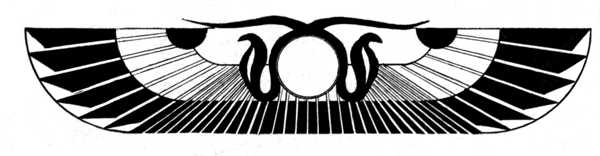
The scene is laid at Chicħen, which appears to have been the
favorite city of the CANS, judging from certain indications,
among these the prevalence of the serpent as an ornament in all
the buildings. These serpents are represented covered with
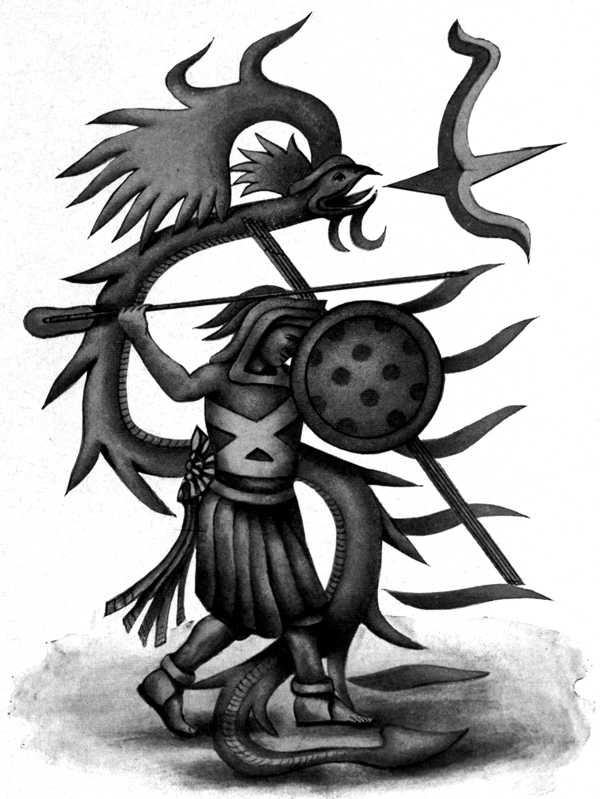
feathers indicating that they were emblems of Maya potentates.
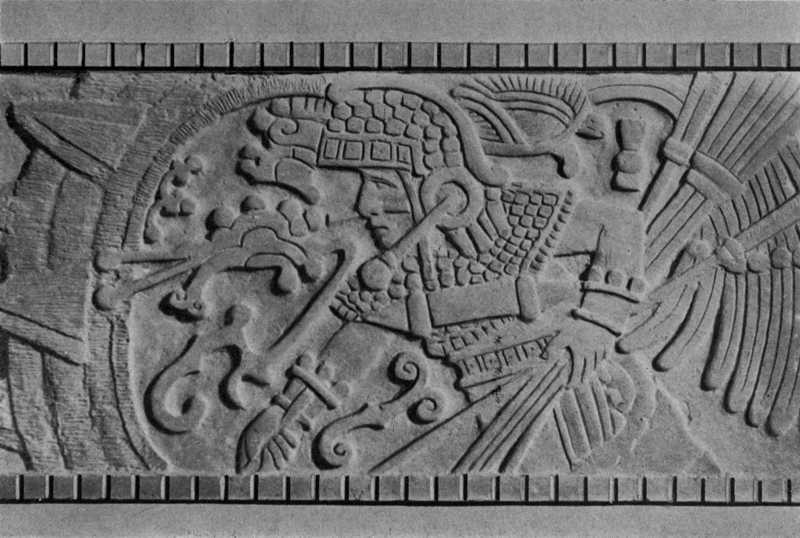
On ceremonial occasions royal personages and high officials wore
mantles of feathers, whose colors varied according to the rank of
the individual; yellow being that of the royal family, red that
of the nobility, and green that of the learned men. The word
CAN has in the Maya language a great variety of meanings,
as Dr. Le Plongeon explains in his works; it is the generic
name for serpent.
The personages whom Dr. Le Plongeon succeeded in tracing
were—the CAN, his Queen, Zoɔ; their three sons—Cay, Aac,
and Coh; and two daughters—Móo and Nicté. There was also
an aged man named Cay, the High Priest, elder brother of the
King. This venerable person is introduced in the early part of
the poem. When he died, his nephew and namesake, Cay, succeeded
to his position and title. Let it be noted that the High
Priest was, as among the Egyptians and the Hindoos of old,
superior in authority to the King himself.
At the death of King Can, his daughter Móo became Queen
of Chicħen. As among the Egyptians, and the Incas in Peru,
so among the Mayas, royal brothers and sisters were obliged to
marry each other; in Siam and some other places the same
custom exists to-day. One of Móo’s brothers had therefore to
be Prince consort. Aac aspired to her hand, but Coh, a valiant
leader in battle, and favorite with the people, was her own
choice. This gave rise to lamentable events which caused the
ruin of the dynasty, Aac refusing to be reconciled.
In a carving on stone, as well as in the Troano MS. and the
Codex Cortesianus, Dr. Le Plongeon has found records of the
destruction by earthquake, followed by submergence, of a great
island in the Atlantic ocean. The author of the Troano MS.
affirms that this land disappeared under the waves 8,060 years
before the inditing of that volume. It is not known when the
book in question was written, but judging from Egyptian
records, the cataclysm must have occurred between ten and
eleven thousand years ago. In the Maya books the lost land is
called MU.
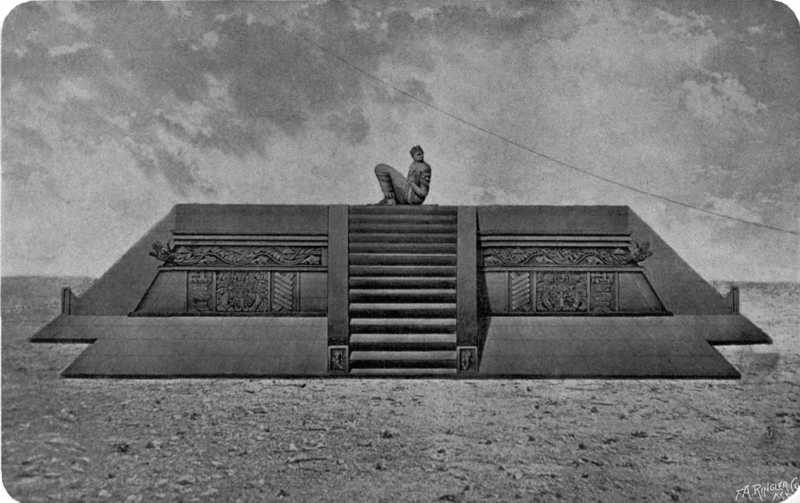
Lately Dr. Le Plongeon has discovered, in translating the inscriptions,
written in Maya language with Egyptian and Maya
characters, which adorn the faces of the Pyramid of Xochicalco,
situated sixty miles to the southwest of the city of Mexico, in
the State of Morelos, eighteen miles from the city of Cuernavaca,
that said pyramid was a commemorative monument raised to
perpetuate the memory of the destruction of the land of Mu
among coming generations, and that it was made an exact model
of the sacred hill in Atlantis which Plato in his Timœus describes
as having been crowned by a temple dedicated to Cleito
and Poseidon.
Looking at scenes depicted in mural paintings, one is driven
to the conclusion that the Mayas were much addicted to the
study of occult forces; they certainly used magic mirrors and
appealed to haruspicy in their desire to foretell events. As may
be seen in Dr. Le Plongeon’s “Queen Móo”, one tableau
represents a wiseman examining the cracks induced by heat on
the shell of an armadillo and the marks made by the vapor;
from these signs he endeavors to read the fate of the young
Princess Móo. The soothsayer, of the imperial family of China
uses a turtle in the same way in a ceremony called Puu, for the
royal family only, and in state affairs of exceptional importance.
Another tableau, also reproduced in “Queen Móo”, represents
one man in his feather mantle, mesmerizing another, showing
that hypnotism was anciently made use of in Yucatan by priests
and wisemen.
There can be no doubt that certain stones were considered
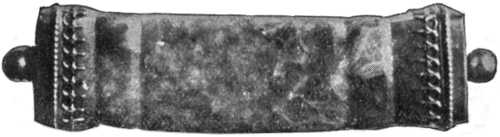
efficacious, as talismans. Jadeite, particularly that of a beautiful
apple-green, mottled with grey, was held in high esteem by the
Mayas, if they did not regard it as sacred. They called it
“Bones of the Earth” because it was the hardest stone known
to them. Of the many varieties of jadeite, for which no less
than a hundred and fifty names have been found, according to
Fischer, the apple-green is the most rare.
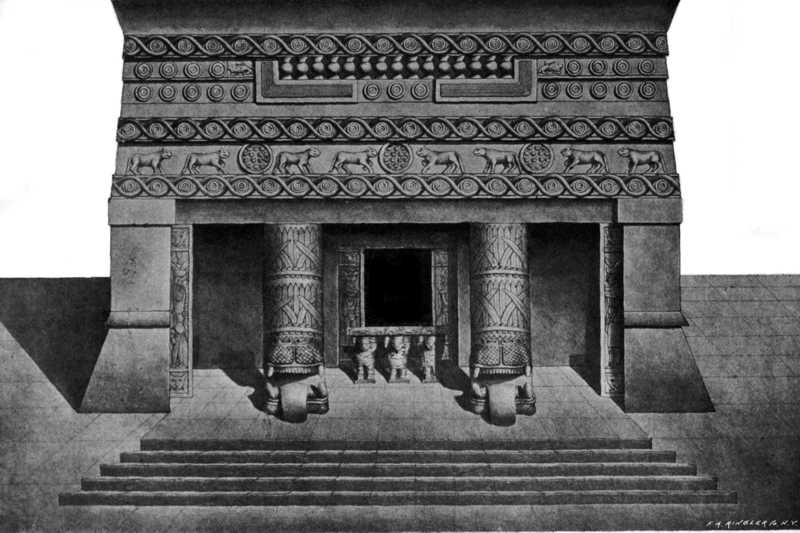
In the great square of the old city of Chicħen, Dr. Le Plongeon
discovered, in the thick forest, two very ancient tombs with some
of their decorative sculptures yet in place; those on one, enabled
him to see that the tomb had been erected to the memory of Coh
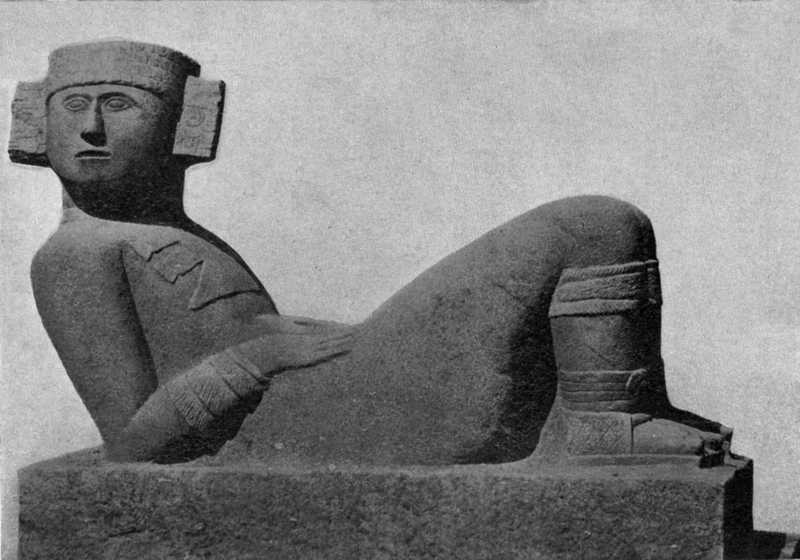
by his widow, Queen Móo. In it he found a statue of the Prince
consort; also a large white stone urn, containing what proved,
by chemical analysis, to have been human flesh, charred and
preserved in red oxide of mercury. In the same urn, among
other relics, was a beautiful ornament of green jadeite, like
those decorating the necks of various personages portrayed in
the sculptures of certain edifices.
In connection with the statue it must be observed that the
ancient Mayas held a belief similar to that entertained by the
Egyptians, regarding the condition of the soul after death, and
in the same way made a statue of the deceased, with the idea
that this would give the individual a hold upon life. The
natives who aided in bringing Coh’s statue to light, out of the
mausoleum where it had remained concealed for thousands of
years, invariably spoke of it as the “Enchanted Prince”, and
frequently assured its discoverer that he had succeeded in finding
it because he himself had dwelt there in past ages, and was one
of the great men whose effigies were seen on all sides.
When the larger portion of the charred viscera found in the
urn was burned, to reduce it to ashes, the natives standing by
exclaimed—“A majestic shade ascends amid the smoke! It is
the form of the enchanted Prince, that seems to fade into nothingness.”
So impressed were the men by what their imagination
had evoked, that all ran from the spot in a state of agitation.
On the day when the statue, weighing three thousand pounds,
was taken out of the monument, a party of hostile Indians
suddenly emerged from the forest. One of their number was
aged, and he remarked to his companions, “This represents one
of our great men of antiquity.” Then the young men paid
homage to the statue by bending one knee, in a manner peculiar
to those people.
Traditions of their ancestors are not altogether lost among
the natives, as some travelers assert. Many still perform rites
and ceremonies in the depths of forests or in unexplored caverns,
in the darkness of the night, but keep their secrets to themselves,
remembering the tortures inflicted on their fathers by the
Spanish priests to oblige them to forego the religious observances
that had been dear to those of their race for countless
generations.
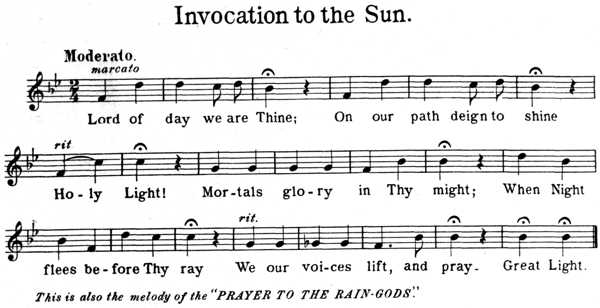
In connection with the song to the rain-gods it may be said
that although the natives of Yucatan are to-day Catholic in
name, they really prefer to render homage to some statue of
their forefathers, and cling tenaciously to a few of their old
divinities. Among these may be mentioned Balam (tiger),
guardian of the crops, likewise appealed to as a rain-god. In a
subterranean cavern a few miles from Chicħen, there is an old
image of a man with long beard; this serves as a representation
of Balam, and to it offerings are made. The antiquity of the
carving cannot be doubted, similar ones existing on pillars at
the entrance of a very ancient castle at Chicħen. The figure in
the cavern is on its knees, its hands are raised to a level with
its head, palms upturned. On its back is a bag containing what
the natives say is a cake made of corn and beans. The statue
is now black, owing to the incense and candles with which its
devotees frequently smoke it. Previous to the planting of grain,
they place before it a basin of cool beverage made of corn, also
lighted wax candles and sweet-smelling copal, imploring the
god to grant an abundant harvest. When the crops ripen, the
finest ears are carried to the grimy divinity by men, women, and
children, who within the cavern dance and pray all day long,
some of their quaint instruments serving as accompaniment to
the Latin litanies which they chant, without having even the
vaguest idea of their meaning.
The sun-dance mentioned in the Preface, is occasionally performed
by Indians in Yucatan at the time of the vernal equinox.
Twenty men take part—corresponding to the number of days in
the ancient Maya month—but ten dress as women, whence it
may be inferred that in olden times the dancers were of both
sexes. All their faces are covered with masks of deer-skin, and
each has on his head the inverted half-shell of a calabash, with
turkey feathers standing up through a hole in the centre. They
wear their usual spotless white garments, and sandals. Those
clad as women are ornamented with large bead necklaces, principally
red, in imitation of old Maya coin, and all the dancers have
ear-rings. The hostile Indians[1] still pierce their ears as their
ancestors did; the rank of a chief being indicated by his having
a ring in the left ear only, or in the right, or in both.
The Master of the dance wears a stiff circular cap, surrounded
by upright peacock feathers that sway with every movement, towering
above all the dancers, and about his shoulders is a string of
big sea-shells. From his neck hangs a metallic representation of
the sun, in whose centre is an all-seeing eye within a triangle,
from which depends a large tongue, symbol of power and wisdom.
One man carries a white flag on which is painted an image of
the sun, and a man and woman on their knees worshiping it.
Three men, apart from the dancers, play a clarionet, a sacatan,
and a big turtle-shell beaten with deer-horns. The Master marks
time with a rattle, and in his other hand has a three-thonged
whip like the flagellum of Osiris in Egypt; throughout the performance
he remains standing close to the flag-staff.
Each dancer holds in his left hand a fan of turkey feathers
whose handle is a claw of that bird; and in his right a small
rattle made of a calabash shell, fancifully painted, containing
pebbles and dried seeds. These rattles remind us of the sistrums
used anciently in the temples of Egypt.
Around the pole on which the flag is furled, the dancers walk
three times, with solemn tread, groping their way as if in darkness.
Suddenly the flag is unfurled, the sun appears, all draw
themselves up to their full height, raise their eyes and hands,
and utter a unanimous shout of joy.
Now the dance commences, round and round the pole they go with
various steps and motions, not graceful, but energetic and
full of meaning. The dance is intended to represent, among
other things, the course and movement of our planet around the
sun. The chief and the dancers sing alternately:
“Take care how you step!”
“We step well, O Master!”
The melody and strange accompaniment are impressive and
stirring, the rattles being particularly effective, now imitating
the scattering of grain, then by a brisk motion of every arm
sending forth a sound like a sudden rainfall on parched leaves,
or a thunder clap in the distance, uniting with a shout raised by
the dancers at the conclusion of each chorus. The fans, kept in
motion, are emblematic of refreshing breezes.
The flag on the pole is undoubtedly a modern addition, simply
to indicate what the dance originally was; of old, the pole itself
represented the central orb; as the round towers did in Ireland,
Persia, and India; the conical stones in Phoenicia; the pyramids
and obelisks in Egypt, etc.—for in America, as in those countries,
sun worship was the religion of the people.
Finally, the expression “Will Supreme” in the opening line
of the poem is used in the sense of the Maya word UOL (or will)
as applied by the Mayas of ancient times to the First Great
Cause. This subject has been fully treated elsewhere by Dr. Le
Plongeon.