WHEN Elizabeth mounted the throne, it was taken for granted that she was
to marry, and marry with the least possible delay. This was expected of
her, not merely because in the event of her dying without issue there
would be a dispute whether the claim of Mary Stuart or that of Catherine
Grey was to prevail, but for a more general reason. The rule of an
unmarried woman, except provisionally during such short interval as
might be necessary to provide her with a husband, was regarded as quite
out of the question. It was the custom for the husbands of heiresses to
step into the property of their wives and stand in the shoes, so to
speak, of the last male proprietor, in order to perform those duties
which could not be efficiently performed by a woman. Elizabeth’s sister,
while a subject, had no thought of marrying. But her accession was
considered by herself and every one else to involve marriage. If the
nobles of England could have foreseen that Elizabeth would elude this
obligation, she would probably never have been allowed to mount the
throne. Her marriage was thought to be as much a matter of course, and
as necessary, as her coronation.
Accordingly the House of Commons, which met a month after her accession,
immediately requested her to select a husband without delay. Her
declaration that she had no desire to change her state was supposed to
indicate only the real or affected coyness to be expected from a young
lady. There was no lack of suitors, foreign or English. The Archduke
Charles, son of the Emperor and cousin of Philip, would have been
welcomed by all Catholics and acquiesced in by political Protestants
like Cecil. The ardent Protestants were eager for Arran, and Cecil, till
he saw it was useless, worked his best for him, regardless of the
personal sacrifice his mistress must make in wedding a man who was not
always quite sane and eventually became a confirmed lunatic.
Not many months of the new reign had passed before it began to be
suspected that Elizabeth’s partiality for Lord Robert Dudley had
something to do with her evident distaste for all her suitors. To her
Ministers and the public this partiality for a married man became a
cause of great disquietude. They not unnaturally feared that with a
young woman who had no relations to advise and keep watch over her, it
might lead to some disastrous scandal incompatible with her continuance
on the throne. Marriage with Dudley at this time was out of the
question. But within four months of her accession, the Spanish
ambassador mentions a report that Dudley’s wife had a cancer, and that
the Queen was only waiting for her death to marry him.
About the humble extraction of Elizabeth’s favourite much nonsense was
talked in his lifetime by his ill-wishers, and has been duly repeated
since. He was as well born as most of the peerage of that time; very few
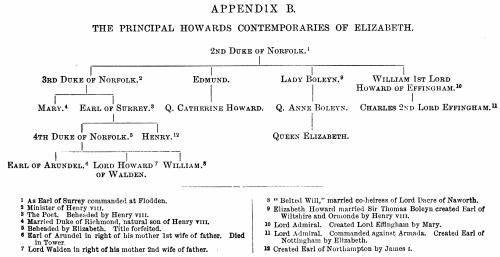
of whom could show nobility of any antiquity in the male line. The Duke
of Norfolk being the only Duke at Elizabeth’s accession, and in
possession of an ancient title, was looked on as the head of his order.
Yet it was only seventy-five years since a Howard had first reached the
peerage in consequence of having had the good fortune to marry the
heiress of the Mowbrays. Edmund Dudley, Minister of Henry VII. and
father of Northumberland, was grandson of John, fourth Lord Dudley; and
Northumberland, by his mother’s side, was sole heir and representative
of the ancient barony of De L’Isle, which title he bore before he
received his earldom and dukedom. In point of wealth and influence,
indeed, the favourite might be called an upstart. The younger son of an
attainted father, he had not an acre of land or a farthing of money
which he did not owe either to his wife or to the generosity of
Elizabeth. This it was that moved the sneers and ill-will of a people
with whom nobility has always been a composite idea implying, not only
birth and title, but territorial wealth. Moreover his grandfather,
though of good extraction, was a simple esquire, and had risen by
helping Henry VII. to trample on the old nobility. After his fall his
son had climbed to power under Henry VIII. and Edward VI. in the same
way. Lord Robert Dudley, again, had to begin at the bottom of the
ladder.
No one will claim for Elizabeth’s favourite that he was a man of
distinguished ability or high character. He had a fine figure and a
handsome face. He bore himself well in manly exercises. His manners
were attractive when he wished to please. To these qualities he first
owed his favour with Elizabeth, who was never at any pains to conceal
her liking for good-looking men and her dislike of ugly ones. Finding
himself in favour, and inheriting to the full the pushing audacity of
his father and grandfather, he professed for the Queen a love which he
certainly did not feel, in order to serve his soaring ambition.
Elizabeth, it is my firm conviction, never loved Dudley or any other
man, in any sense of the word, high or low. She had neither a tender
heart nor a sensual temperament. But she had a more than feminine
appetite for admiration; and the more she was, unhappily for herself, a
stranger to the emotion of love, the more restlessly did she desire to
be thought capable of inspiring it. She was therefore easily taken in by
Dudley’s professions, and, though she did not care for him enough to
marry him, she liked to have him as well as several other handsome men,
dangling about her, “like her lap-dog,” to use her own expression.
Further she believed—and here came in the mischief—that his devotion
to her person would make him a specially faithful servant.
We know, though Elizabeth did not, that in 1561, Dudley was promising
the Spanish ambassador to be Philip’s humble vassal, and to do his best
for Catholicism, if Philip would promote his marriage with the Queen;
that, in the same year, he was offering his services to the French
Huguenots for the same consideration; that at one time he posed as the
protector of the Puritans, while at another he was intriguing with the
captive Queen of Scots; whom, again, later on, he had a chief share in
bringing to the block. But we must remember that very few statesmen,
English or foreign, in the sixteenth century could have shown a record
free from similar blots. Those who, like Elizabeth and Cecil, were
undeniably actuated on the whole by public spirit, or by any principle
more respectable than pure selfishness, never hesitated to lie or play a
double game when it seemed to serve their turn. William of Orange is the
only eminent statesman, as far as I know, against whom this charge
cannot be made. When this was the standard of honour for consistent
politicians and real patriots, what was to be expected of lower natures?
Dudley’s conduct on several occasions was bad and contemptible; and he
must be judged with the more severity, because he sinned not only
against the code of duty binding on the ordinary man and citizen, but
against his professions of a tender sentiment by means of which he had
acquired his special influence. I have said that he was not a man of
great ability. But neither was he the empty-headed incapable trifler
that some writers have depicted him. He was not so judged by his
contemporaries. That Elizabeth, because she liked him, would have
selected a man of notorious incapacity to command her armies, both in
the Netherlands and when the Armada was expected, is one of those
hypotheses that do not become more credible by being often repeated.
Cecil himself, when it was not a question of the marriage—of which he
was a determined opponent—regarded him as a useful servant of the
Queen. I do not doubt that Elizabeth estimated his capacity at about its
right value. What she over-estimated was his affection for herself, and
consequently his trustworthiness. Sovereigns—and others—often place a
near relative in an important post, not as being the most capable person
they know, but as most likely to be true to them. Elizabeth had no near
relatives. If we grant—as we must grant—that she believed in Dudley’s
love, we cannot wonder that she employed him in positions of trust. A
female ruler will always be liable to make these mistakes, unless her
Ministers and captains are to be of her own sex.
On the 3rd of September 1560, two months after the Treaty of Leith,
Elizabeth told De Quadra that she had made up her mind to marry the
Archduke Charles. On the 8th, Lady Robert Dudley died at Cumnor Hall. On
the 11th, Elizabeth told De Quadra that she had changed her mind. Dudley
neglected his wife, and never brought her to court. We cannot doubt that
he fretted under a tie which stood in the way of his ambition. Her death
had been predicted. It is not strange, therefore, that he should have
been suspected of having caused it. Nevertheless, not a particle of
evidence pointing in that direction has ever been produced, and it seems
most probable that the poor deserted creature committed suicide. A
coroner’s jury investigated the case diligently, and, it would seem,
with some animus against Foster, the owner of Cumnor Hall, but returned
a verdict of accidental death.
Anyhow, Dudley was now free. The Scotch Estates were eagerly pressing
Arran’s suit, and the English Protestants were as eagerly backing them.
The opportunity was certainly unique. Though nothing was said about
deposing Mary, yet nothing could be more certain than that, if this
marriage took place, the Queen of France would never reign in Scotland.
At her wits’ end how to escape a match so desirable for the Queen, so
repulsive to the woman, Elizabeth had announced her willingness to
espouse the Archduke in order to gain a short breathing-time. Vienna was
at least further than Edinburgh, and difficulties were sure to arise
when details began to be discussed. At this moment, by the sudden death
of his wife, Dudley became marriageable. If Elizabeth had been free to
marry or not, as she pleased, it seems to me in the highest degree
improbable that she would ever have thought of taking Dudley. But
believing that a husband was inevitable, and expecting that she would be
forced to take some one who was either unknown to her or positively
distasteful, it was most natural that she should ask herself whether it
was not the least of evils to put this cruel persecution to an end by
choosing a man whom at least she admired and liked, who loved her, as
she thought, for her own sake, and would be as obedient “as her
lap-dog.” When nations are ruled by women, and marriageable women,
feelings and motives which belong to the sphere of private life, and
should be confined to it, are apt to invade the domain of politics. If
Elizabeth’s subjects expected their sovereign to suppress all personal
feelings in choosing a consort, they ought to have established the Salic
law. No woman, queen or not queen, can be expected voluntarily to make
such a sacrifice. Her happiness is too deeply involved.
In the autumn, then, of 1560, when Elizabeth had been not quite two
years on the throne, she seriously thought of marrying Dudley. It is
difficult to say how long she continued to think of it seriously. With
him, as with other suitors, she went on coquetting when she had
perfectly made up her mind that nothing was to come of it. Perhaps we
shall be right in saying that, as long as there was any question of the
Archduke Charles, she looked to Dudley as a possible refuge. This would
be till about the beginning of 1568. It seems to be always assumed, as a
matter of course, that Cecil played the part of Elizabeth’s good genius
in persistently dissuading her from marrying Dudley. I am not so sure of
this. If she had been a wife and a mother many of her difficulties would
have at once disappeared, and the weakest points in her character would
have no longer been brought out. It ended in her not marrying at all. I
am inclined to think that another enemy of Dudley, the Earl of Sussex,
showed more good sense and truer patriotism when he wrote in October
1560:—
“I wish not her Majesty to linger this matter of so great
importance, but to choose speedily; and therein to follow so much
her own affection as [that], by the looking upon him whom she
should choose, omnes ejus sensus titillarentur; which shall be
the readiest way, with the help of God, to bring us a blessed
prince which shall redeem us out of thraldom. If I knew that
England had other rightful inheritors I would then advise
otherwise, and seek to serve the time by a husband’s choice [seek
for an advantageous political alliance]. But seeing that she is
ultimum refugium, and that no riches, friendship, foreign
alliance, or any other present commodity that might come by a
husband, can serve our turn, without issue of her body, if the
Queen will love anybody, let her love where and whom she lists, so
much thirst I to see her love. And whomsoever she shall love and
choose, him will I love, honour, and serve to the uttermost.”
Perhaps I may be excused for expressing the opinion that the ideal
husband for Elizabeth, if it had been possible, would have been Lord
James Stuart, afterwards Earl of Moray. Of sufficient capacity, kindly
heart, undaunted resolution, and unswerving rectitude of purpose, he
would have supplied just those elements that were wanting to correct her
defects. King of Scotland he perhaps could not be. Regent of Scotland he
did become. If he could, at the same time, have been Elizabeth’s
husband, the two crowns might have, in the next generation, been worn by
a Stuart of a nobler stock than the son of Mary and Darnley.
When Mary Stuart, on the death of her husband Francis II., returned to
her own kingdom (August 1561), she found the Scotch nobles sore at the
rejection of Arran’s suit. Bent on giving a sovereign to England, in one
way or another, they were now ready, Protestants as well as Catholics,
to back Mary’s demand that she should be recognised as Elizabeth’s
heir-presumptive. To this the English Queen could not consent, for the
very sufficient reason, that not only would the Catholic party be
encouraged to hold together and give trouble, but the more bigoted and
desperate members of it would certainly attempt her life, lest she
should disappoint Mary’s hopes by marrying. “She was not so foolish,”
she said, “as to hang a winding-sheet before her eyes or make a funeral
feast whilst she was alive,” but she promised that she would neither do
anything nor allow anything to be done by Parliament to prejudice Mary’s
title. To this undertaking she adhered long after Mary’s hostile
conduct had given ample justification for treating her as an enemy.
Openly Mary was claiming nothing but the succession. In reality she
cared little for a prospect so remote and uncertain. What she was
scheming for was to hurl Elizabeth from her throne. This was an object
for which she never ceased to work till her head was off her shoulders.
Her aims were more sharply defined than those of Elizabeth, and she was
remarkably free from that indecision which too often marred the action
of the English Queen. In ability and information she was not at all
inferior to Elizabeth; in promptitude and energy she was her superior.
These masculine qualities might have given her the victory in the bitter
duel, but that, in the all-important domain of feeling, her sex
indomitably asserted itself, and weighted her too heavily to match the
superb self-control of Elizabeth. She could love and she could hate;
Elizabeth had only likes and dislikes, and therefore played the cooler
game. When Mary really loved, which was only once, all selfish
calculations were flung to the winds; she was ready to sacrifice
everything, and not count the cost—body and soul, crown and life,
interest and honour. When she hated, which was often, rancour was apt to
get the better of prudence. And so at the fatal turning-point of her
career, when mad hate and madder love possessed her soul, she went down
before her great rival never to rise again. Here was a woman indeed. And
if, for that reason, she lost the battle in life, for that reason too
she still disputes it from the tomb. She has always had, and always will
have, the ardent sympathy of a host of champions, to whom the “fair
vestal throned by the west” is a mere politician, sexless, cold-blooded,
and repulsive.
In 1564 Mary, as yet fancy-free, was seeking to match herself on purely
political grounds. She was not so fastidious as Elizabeth, for she does
not seem to have troubled herself at all about personal qualities, if a
match seemed otherwise eligible. The Hamiltons pressed Arran upon her.
But he was a Protestant. He was not heir to any throne but that of
Scotland; and, though a powerful family in Scotland, the Hamiltons could
give her no help elsewhere. Philip, who, now that the Guises had become
his protégés, was less jealous of her designs, wished her to marry his
cousin, the Archduke Charles of Austria. But this prince, whom Elizabeth
professed to find too much of a Catholic, was, in the eyes of Mary and
her more bigoted co-religionists, too nearly a Lutheran; and she doubted
whether Philip cared enough for him to risk a war for establishing him
and herself upon the English throne. For this reason the husband on whom
she had set her heart was Don Carlos, Philip’s own son, a sort of wild
beast. But Philip received her overtures doubtfully; the fact being that
he could not trust Don Carlos, whom he eventually put to death.
Catherine de’ Medici loved Mary as little as she did the other Guises,
but the prospect of the Spanish match filled her with such terror that
she proposed to make the Scottish Queen her daughter-in-law a second
time by a marriage with Charles IX., a lad under thirteen, if she would
wait two years for him.
On the other hand, Elizabeth impressed upon Mary that, unless she
married a member of some Reformed Church, the English Parliament would
certainly demand that her title to the succession, whatever it was,
should be declared invalid. The House of Commons was strongly
Protestant, and had with difficulty been prevented from addressing the
Queen in favour of the succession of Lady Catherine Grey. Apart from
religion there was deep irritation against the whole Scotch nation. Sir
Ralph Sadler, who had been much employed in Scotland, denounced them as
“false, beggarly, and perjured, whom the very stones in the English
streets would rise against.” When Elizabeth was dangerously ill in
October 1562, the Council discussed whom they should proclaim in the
event of her death. Some were for the will of Henry VIII. and Catherine
Grey. Others, sick of female rulers, were for taking the Earl of
Huntingdon, a descendant of the Duke of Clarence. None were for Mary or
Darnley. Mary’s chief friends—Montagu, Northumberland, Westmoreland,
and Derby—were not on the Council.
Parliament and the Council being against her, Mary could not afford to
quarrel with the Queen. Elizabeth told her that she would regard a
marriage with any Spanish, Austrian, or French prince as a declaration
of war. Help from those quarters was far away, and at the mercy of winds
and waves: the Border fortresses were near, and their garrisons always
ready to march. Besides, whichever of the two she might obtain—Charles
IX. or the Archduke—she drove the other into the arms of Elizabeth.
But there was another possible husband who had crossed her mind from
time to time; not a prince indeed, yet of royal extraction in the
female line, and, what was more, not without pretensions to that very
succession which she coveted. Henry Lord Darnley, son of Matthew Stuart,
Earl of Lennox, was, by his father’s side, of the royal family of
Scotland, while his mother was the daughter of Margaret Tudor, sister of
Henry VIII., by her second husband, the Earl of Angus. Born and brought
up in England, where his father had been long an exile, he was reckoned
as an Englishman, which, in the opinion of many lawyers, was essential
as a qualification for the crown. He was also a Catholic, and if
Elizabeth had died at this time, it was perhaps Darnley, rather than
Mary, whom the Catholics would have tried to place on the throne.
Elizabeth had promised that, if Mary would marry an English nobleman,
she would do her best to get Mary’s title recognised by Parliament. To
Elizabeth, therefore, Mary now turned, with the request that she would
point out such a nobleman, not without a hope that she would name
Darnley (March 1564). But, to Mary’s mortification, she formally
recommended Lord Robert Dudley.
This recommendation has often been treated as if it was a sorry joke
perpetrated by Elizabeth, who had never any intention of furthering, or
even permitting, such a match. But nothing is more certain than that
Elizabeth was most anxious to bring it about; and it affords a decisive
proof that her feeling for Dudley, whatever name she herself may have
put to it, was not what is usually called love. Cecil and all her most
intimate advisers entertained no doubt that she was sincere. She
undertook, if Mary would accept Dudley, to make him a duke; and, in the
meantime, she created him Earl of Leicester. She regarded him, so she
told Mary’s envoy Melville, as her brother and her friend; if he was
Mary’s husband she would have no suspicion or fear of any usurpation
before her death, being assured that he was so loving and trusty that he
would never permit anything to be attempted during her time. “But,” she
said, pointing to Darnley, who was present, “you like better yonder long
lad.” Her suspicion was correct. Melville had secret instructions to
procure permission for Darnley to go to Scotland. However, he answered
discreetly that “no woman of spirit could choose such an one who more
resembled a woman than a man.”
How was Elizabeth to be persuaded to let Darnley leave England? There
was only one way to disarm suspicion: Mary declared herself ready to
marry Leicester (January 1565). Darnley immediately obtained leave of
absence for three months ostensibly to recover the forfeited Lennox
property. In Scotland the purpose of his coming was not mistaken, and it
roused the Protestants to fury. The Queen’s chapel, the only place in
the Lowlands where mass was said, was beset. Her priests were mobbed and
maltreated. Moray, who till lately had supported his sister with such
loyalty and energy that Knox had quarrelled with him, prepared, with the
other Lords of the Congregation, for resistance. Elizabeth, and Cecil
also, had been completely overreached. A prudent player sometimes gets
into difficulties by attributing equal prudence to a daring and reckless
antagonist. Elizabeth, as a patriotic ruler, desired nothing but peace
and security for her own kingdom. If she could have that, she had no
wish to meddle with Scotland. Mary, caring nothing for the interests of
her subjects, was facing civil war with a light heart; and, for the
chance of obtaining the more brilliant throne, was ready to risk her
own.
Undeterred by Elizabeth’s threats, Mary married Darnley (July 29, 1565).
Moray and Argyll, having obtained a promise of assistance from England,
took arms; but most of the Lords of the Congregation showed themselves
even more powerless or perfidious than they had been five years before.
Morton, Ruthven, and Lindsay, stoutest of Protestants, were related to
Darnley, and were gratified by the elevation of their kinsman. Moray
failed to elicit a spark of spirit out of the priest-baiting citizens of
Edinburgh, and the Queen, riding steel cap on head and pistols at
saddle-bow, chased him into England. Lord Bedford, who was in command at
Berwick, could have stepped across the Border and scattered her
undisciplined array without difficulty. He implored Elizabeth to let him
do it; offered to do it on his own responsibility, and be disavowed. But
he found, to his mortification, that she had been playing a game of
brag. She had hoped that a threatening attitude would stop the marriage.
But as it was an accomplished fact she was not going to draw the sword.
This was shabby treatment of Moray and his friends, and to some of her
councillors it seemed not only shameful but dangerous to show the white
feather. But judging from the course of events, Elizabeth’s policy was
the safe one. The English Catholics—some of them at all events, as
will be explained presently—were becoming more discontented and
dangerous. The northern earls were known to be disaffected. Mary
believed that in every county in England the Catholics had their
organisation and their leaders, and that, if she chose, she could march
to London. No doubt she was much deceived. In reluctance to resort to
violence and respect for constituted authority, England, even north of
the Humber, was at least two centuries ahead of Scotland, and, if she
had come attended by a horde of savage Highlanders and Border ruffians,
“the very stones in the streets would have risen against them.” It was
Elizabeth’s rule—and a very good rule too—never to engage in a war if
she could avoid it. From this rule she could not be drawn to swerve
either by passion or ambition, or that most fertile source of fighting,
a regard for honour. All the old objections to an invasion of Scotland
still subsisted in full strength, and were reinforced by others. It was
better to wait for an attack which might never come than go half-way to
meet it. An invasion of Scotland might drive the northern earls to
declare for Mary, which, unless compelled to choose sides, they might
never do. Some people are more perturbed by the expectation and
uncertainty of danger than by its declared presence. Not so Elizabeth.
Smouldering treason she could take coolly as long as it only smouldered.
As for the betrayal of the Scotch refugees, Elizabeth never allowed the
private interests of her own subjects, much less those of foreigners, to
weigh against the interests of England. Moray one of the most
magnanimous and self-sacrificing of statesmen, evidently felt that
Elizabeth’s course was wise, if not exactly chivalrous. He submitted to
her public rebuke without publicly contradicting her, and waited
patiently in exile till it should be convenient for her to help him and
his cause. Mary, too, though elated by her success, and never abandoning
her intention to push it further, found it best to halt for a while.
Philip wrote to her that he would help her secretly with money if
Elizabeth attacked her, but not otherwise, and warned her against any
premature clutch at the English crown. Elizabeth’s seeming tameness
could hardly have received a more complete justification.
Mary had determined to espouse Darnley, before she had set eyes on him,
for purely political reasons. There is no reason to suppose she ever
cared for him. It is more likely, as Mr. Froude suggests, that for a
great political purpose she was doing an act which in itself she
loathed. A woman of twenty-two, already a widow, mature beyond her
years, exceptionally able, absorbed in the great game of politics, and
accustomed to admiration, was not likely to care for a raw lad of
nineteen, foolish, ignorant, ill-conditioned, vicious, and without a
single manly quality. One man we know she did love later on—loved
passionately and devotedly, no slim girl-faced youngster, but the
fierce, stout-limbed, dare-devil Bothwell; and Bothwell gradually made
his way to her heart by his readiness to undertake every desperate
service she required of him. What Mary admired, nay envied, in the other
sex was the stout heart and the strong arm. She loved herself to rough
it on the war-path. She surprised Randolph by her spirit:—“Never
thought I that stomach to be in her that I find. She repented nothing
but, when the Lords and others came in the morning from the watches,
that she was not a man, to know what life it was to lie all night in the
fields or to walk upon the causeway with a jack and a knapscap, a
Glasgow buckler and a broadsword.” “She desires much,” says Knollys, “to
hear of hardiness and valiancy, commending by name all approved hardy
men of her country, although they be her enemies; and she concealeth no
cowardice even in her friends.” Valuable to Mary as a man of action,
Bothwell was not worth much as an adviser. For advice she looked to the
Italian Rizzio, in whom she confided because, with the detachment of a
foreigner, he regarded Scotch ambitions, animosities, and intrigues only
as so much material to be utilised for the purpose of the combined
onslaught on Protestantism which the Pope was trying to organise.
Bothwell was at this time thirty, and Rizzio, according to Lesley,
fifty.
In spite of all the prurient suggestions of writers who have fastened on
the story of Mary’s life as on a savoury morsel, there is no reason
whatever for thinking that she was a woman of a licentious disposition,
and there is strong evidence to the contrary. There was never anything
to her discredit in France. Her behaviour in the affair of Chastelard
was irreproachable. The charge of adultery with Rizzio is dismissed as
unworthy of belief even by Mr. Froude, the severest of her judges.
Bothwell indeed she loved, and, like many another woman who does not
deserve to be called licentious, she sacrificed her reputation to the
man she loved. But the most conclusive proof that she was no slave to
appetite is afforded by her nineteen years’ residence in England, which
began when she was only twenty-five. During almost the whole of that
time she was mixing freely in the society of the other sex, with the
fullest opportunity for misconduct had she been so inclined. It is not
to be supposed that she was fettered by any scruples of religion or
morality. Yet no charge of unchastity is made against her.
When Darnley found that his wife, though she conferred on him the title
of King, did not procure for him the crown matrimonial or allow him the
smallest authority, he gave free vent to his anger. No less angry were
his kinsmen, Morton, Ruthven, and Lindsay. They had deserted the
Congregation in the expectation that when Darnley was King they would be
all-powerful. Instead of this they found themselves neglected; while the
Queen’s confidence was given to Catholics and to Bothwell, who, though
nominally a Protestant, always acted with the Catholics. The Protestant
seceders had in fact fallen between two stools. It was against Rizzio
that their rage burnt fiercest. Bothwell was only a bull-headed,
blundering swordsman. Rizzio was doubly detestable to them as the brain
of the Queen’s clique and as a low-born foreigner. Rizzio, therefore,
they determined to remove in the time-honoured Scottish fashion. Notice
of the day fixed for the murder was sent to the banished noblemen in
England, so that they might appear in Edinburgh immediately it was
accomplished Randolph, the English ambassador, and Bedford, who
commanded on the Border, were also taken into the secret, and they
communicated it to Cecil and Leicester.
It is unnecessary here to repeat the well-known story of the murder of
Rizzio. It was part of a large scheme for bringing back the exiled
Protestant lords, closing the split in the Protestant party, and
securing the ascendancy of the Protestant religion. At first it appeared
to have succeeded. Bedford wrote to Cecil that “everything would now go
well.” But Mary, by simulating a return of wifely fondness, managed to
detach her weak husband from his confederates. By his aid she escaped
from their hands. Bothwell and her Catholic friends gathered round her
in arms. In a few days she re-entered Edinburgh in triumph, and Rizzio’s
murderers had to take refuge in England.
But if the Protestant stroke had failed, Mary was obliged to recognise
that her plan for re-establishing the Catholic ascendancy in Scotland
could not be rushed in the high-handed way she had proposed as a mere
preliminary to the more important subjugation of England. At the very
moment when she seemed to stand victorious over all opposition, the
ground had yawned under her feet, and, while she was dreaming of
dethroning Elizabeth, she had found herself a helpless captive in the
hands of her own subjects. The lesson was a valuable one, and if she
could profit by it her prospects had never been so good. The barbarous
outrage of which, in the sixth month of pregnancy, she had been the
object could not but arouse wide-spread sympathy for her. She had
extricated herself from her difficulties with splendid courage and
cleverness. The loss of such an adviser as Rizzio was really a stroke
of luck for her. All she had to do was to abandon, or at all events
postpone, her design of re-establishing the Catholic religion in
Scotland, and to discontinue her intrigues against Elizabeth.
Her prospects in England were still further improved when she gave birth
to a son (June 19, 1566). Once more there was an heir-male to the old
royal line, and, as Elizabeth continued to evade marriage, most people
who were not fierce Protestants began to think it would be more
reasonable and safe to abide by the rule of primogeniture than by the
will of Henry VIII., sanctioned though it was by Act of Parliament.
There can be no doubt that this was the opinion and intention of
Elizabeth, though she strongly objected to having anything settled
during her own lifetime. But she had herself gone a long way towards
settling it by her treatment of Mary’s only serious competitor.
Catherine Grey had contracted a secret marriage with the Earl of
Hertford, son of the Protector Somerset. Her pregnancy necessitated an
avowal. The clergyman who had married them was not forthcoming, and
Hertford’s sister, the only witness, was dead. Elizabeth chose to
disbelieve their story, though she would not have been able to prove
when, where, or by whom her own father and mother had been married. She
had a right to be angry; but when she sent the unhappy couple to the
Tower, and caused her tool, Archbishop Parker, to pronounce the union
invalid and its offspring illegitimate, she was playing Mary’s game. The
House of Commons elected in 1563 was still undissolved. It was strongly
Protestant, and it favoured Catherine’s title even after her disgrace.
In its second session, in the autumn of 1566, it made a determined
effort to compel Elizabeth to marry, and in the meanwhile to recognise
Catherine as the heir-presumptive. The zealous Protestants knew well
that the Peers were in favour of the Stuart title, and they feared that
a new House of Commons might agree with the Peers. To get rid of their
pertinacity Elizabeth dissolved Parliament, not without strong
expressions of displeasure (Jan. 2, 1567). Cecil himself earned the
thanks of Mary for his attitude on this occasion. It cannot be doubted
that he dreaded her succession; but he saw which way the tide was
running, and he thought it prudent to swim with it.
It was at this moment that Mary flung away all her advantage, and
entered on the fatal course which led to her ruin. Her loathing for
Darnley, her fierce desire to avenge on him the insults and outrage she
had suffered, left no room in heart or mind for considerations of
policy. She would have been glad to obtain a divorce. But the Catholic
Church does not grant divorce for misconduct after marriage. Some
pretext must be found for alleging that the marriage was null from the
beginning. This did not suit Mary. It would have made her son
illegitimate, and would have placed her in exactly the position of
Catherine Grey. A mere separation a toro would not have suited her any
better, for it would not have enabled her to contract another marriage.
When Mary’s reliance on Bothwell grew into attachment, when her
attachment warmed into love, it is impossible to fix with any exactness.
Her infatuation presented itself to him as a grand opening for his
daring ambition. A notorious profligate, he loved her—if the word is to
be so degraded—as much or as little as he had loved twenty other women.
What, however, he desired in her case, was marriage. A more sensible man
would have foreseen that marriage would mean certain ruin for himself
and the Queen. But he was accustomed to despise all difficulties in his
path, being intellectually incapable of measuring them, and believing in
nothing but audacity and brute force. Husband of the Queen, why should
he not be master of the kingdom? Why not King? When such an idea had
once occurred to Bothwell, Darnley’s expectancy of life would be much
the same as that of a calf in the presence of the butcher.
The wretched victim had alienated all his friends among the nobility.
Some owed him a deadly grudge for his treachery. Others had been
offended by his insolence. To all he was an encumbrance and a nuisance.
Several, therefore, of the leading personages were more or less engaged
in the compact for putting him out of the way. Moray, Argyll, and
Maitland offered to assist in ridding Mary of her husband by way of a
Protestant sentence of divorce, on condition that Morton and his friends
in exile should be pardoned and recalled. The bargain was struck, and
Mary assented to it. Nothing was said about murder. No one had any
interest in murder except Mary and Bothwell, whose project of marriage
was as yet unsuspected. At the same time, if Bothwell liked to kill
Darnley on his own responsibility, as no doubt he made it pretty plain
that he would—why, so much the better. It relieved the other lords of
all trouble. It was a simple, thorough, old-fashioned expedient, which
had never been attended with any discredit in Scotland, and had only one
inconvenience—that it usually saddled the murderer with a blood feud.
In the present case Lennox was the only peer who would feel the least
aggrieved; and he was in no condition to wage blood-feuds. Anyhow, that
was Bothwell’s look-out.
So obvious was all this that it was hardly worth while to observe
secrecy except as to the exact occasion and mode of execution. Many
persons were more or less aware of what was going to be done; but none
cared to interfere. Moray was an honourable and conscientious man, if
judged by the standard of his environment—the only fair way of
estimating character. But Moray chose to leave Edinburgh the morning
before the deed; and thought it sufficient to be able to say afterwards
that “if any man said he was present when purposes [talk] were held in
his audience tending to any unlawful or dishonourable end, he spoke
wickedly and untruly.” The inner circle of the plot consisted of
Bothwell, Argyll, Huntly, Maitland, and Sir James Balfour.
That Darnley was murdered by Bothwell is not disputed. That Mary was
cognisant of the plot, and lured him to the shambles, has been doubted
by few investigators at once competent and unbiassed. She lent herself
to this part not without compunction. Bothwell had the advantage over
her that the loved has over the lover; and he used it mercilessly for
his headlong ambition, hardly taking the trouble to pretend that he
cared for the unhappy woman who was sacrificing everything for him. He
in fact cared more for his lawful wife, whom he was preparing to
divorce, and to whom he had been married only six months. Mary was
tormented by jealousy of her after the divorce as well as before.
The murder of Darnley (Feb. 10, 1567) was universally ascribed to Mary
at the time by Catholics as well as Protestants at home and abroad, and
it fatally damaged her cause in England and the rest of Europe. In
Scotland itself—such was the backward and barbarous state of the
country—it would probably not have shaken her throne if she had
followed it up with firm and prudent government. She might even have
indulged her illicit passion for Bothwell, with little pretence of
concealment, if she had not advanced him in place and power above his
equals. There was probably not a noble in Scotland, from Moray
downwards, who would have scrupled to be her Minister. The Protestant
commonalty indeed, who with all the national laxity as to the observance
of the sixth commandment, were shocked by any trifling with the seventh,
would no doubt have made their bark heard. But their bite had not yet
become formidable; and in any case they were not to be propitiated.
What brought sudden and irretrievable ruin on Mary was not the murder of
Darnley, but the infatuation which made her the passive instrument of
Bothwell’s presumptuous ambition. The lords, Catholic and Protestant
alike, allowed the murder to pass uncondemned and unpunished; but they
were furious when they found that Darnley had only been removed to make
room for Bothwell, and that they were to have for their master a noble
of by no means the highest lineage, bankrupt in fortune, and generally
disliked for his arrogant and bullying demeanour. The project of
marriage was not disclosed till ten weeks after the murder (April 19,
1567). Five days later, Bothwell, fearing lest he should be frustrated
by public indignation or interference from England, carried off the
Queen, as had been previously arranged between them. His idea was that,
when Mary had been thus publicly outraged, it would be recognised as
impossible that she should marry any one but the ravisher. In this
coarse expedient, as in the clumsy means employed for disposing of
Darnley, we see the blundering fool-hardiness of the man. The marriage
ceremony was performed as soon as Bothwell’s divorce could be managed
(May 15). Just a month later Mary surrendered to the insurgent lords at
Carberry Hill, and Bothwell, flying for his life, disappears from
history.
The feelings with which Elizabeth had contemplated the course of events
in Scotland during the last six months were no doubt of a mixed nature.
At the beginning of 1567, her seven-years’ duel with Mary appeared to be
ending in defeat. The last bold thrust, aimed in her interest if not by
her hand—the murder of Rizzio—had not improved her position. It seemed
that she would soon be obliged to make her choice between two equally
dreaded alternatives: she must either recognise Mary as her heir or take
a husband. From this unpleasant dilemma she was released by the headlong
descent of her rival in the first six months of 1567. But all other
feelings were soon swallowed up in alarm and indignation at the
spectacle of subjects in revolt against their sovereign. As tidings came
in rapid succession of Mary’s surrender at Carberry Hill, of her return
to Edinburgh amidst the insults and threats of the Calvinist mob, of her
imprisonment at Loch Leven, of the proposal to try and execute her,
Elizabeth’s anger waxed hotter, and she told the Scotch lords in her
most imperious tones that she could not, and would not, permit them to
use force with their sovereign. If they deposed or punished her, she
would revenge it upon them. If they could not prevail on her to do what
was right, they must “remit themselves to Almighty God, in whose hands
only princes’ hearts remain.”
This language, addressed as it was to the only men in Scotland who were
disposed to support the English interest, was imprudent. In her
fellow-feeling for a sister sovereign, and her keen perception of the
revolutionary tendencies of the time, Elizabeth spoilt an unique
opportunity of placing her relations with Scotland on a footing of
permanent security, of providing for the English succession in a way at
once advantageous to the nation and free from risk to her own life, and
lastly, of escaping from the constant worry about her own marriage. She
had seen clearly enough what might be made of the situation. Throgmorton
had been despatched to Scotland with instructions to do his best to get
the infant Prince confided to her care. Once in England, she would
virtually have adopted him. She would have possessed a son and heir
without the inconvenience of marriage. To a Parliamentary recognition,
indeed, of his title she would assuredly not have consented. It would
have made him independent and dangerous. But if he behaved well to her,
his succession would be more certain than any Act of Parliament could
make it. Mary, if released and restored to power, would no longer be
formidable. If she were deposed or put to death, Elizabeth would
indirectly govern Scotland, at all events, till James should be of age.
This splendid opportunity Elizabeth lost by her peremptory and
domineering language. The old Scotch pride took fire. The Anglophile
lords, who would have been glad enough to send the young Prince to
England, could not afford to appear less patriotic than the
Francophiles. Throgmorton’s attempt to get hold of James was as
unsuccessful as that of the Protector Somerset to get hold of James’s
mother had been twenty years before. He was told that, before the Prince
could be sent to England, his title to the English succession must be
recognised; a condition which Elizabeth could not grant. Her claim that
Mary should be restored without conditions was equally unacceptable to
the Anglophile lords. They might have been induced to release her if she
would have consented to give up Bothwell, or if they could have caught
and hanged him. But such was her devotion to him, that no threats or
promises availed to shake it. It was in vain that they offered to
produce letters of his to the divorced Lady Bothwell, in which he
assured her that he regarded her still as his lawful wife, and Mary
only as his concubine. The unhappy Queen had been aware even before her
marriage—as a pathetic letter to Bothwell shows—that her passionate
love was not returned. Two days after the marriage, his unkindness had
driven her to think of suicide. But nothing they could say could shake
her constancy. “She would not consent by any persuasion to abandon the
Lord Bothwell for her husband. She would live and die with him. If it
were put to her choice to relinquish her crown and kingdom or the Lord
Bothwell, she would leave her kingdom and dignity to go as a simple
damsel with him; and she will never consent that he shall fare worse or
have more harm than herself. Let them put Bothwell and herself on board
ship to go wherever fortune might carry them.” This temper made it
difficult for the Anglophile lords to know what to do with the prisoner
of Loch Leven. They were disappointed and angry that Elizabeth, instead
of approving their enterprise, and sending the money for which, as
usual, they were begging, should treat them as rebels, and even secretly
urge the Hamiltons to rescue Mary by force. The Hamiltons were in arms
at Dumbarton. They wanted either that the Prince should be proclaimed
King, with the Duke of Chatelherault for Regent, or that Mary should be
divorced from Bothwell and married to Lord John Hamilton, the Duke’s
second son, and, in default of the crazy Arran, his destined successor.
With Argyll, too, disgust at Mary’s crime was tempered by a desire to
marry her to his brother. Lady Douglas of Loch Leven herself, for whom
Sir Walter Scott has invented such magnificent tirades, desired nothing
better than to be her mother-in-law.
The prompt action of the confederate lords foiled these schemes. By the
threat of a public trial on the charge of complicity in her husband’s
murder, or, as her advocates believe, by the fear of instant death, Mary
was compelled to abdicate in favour of her son, and to nominate Moray
Regent (July 29, 1567). Elizabeth would not recognise him; partly from a
natural fear lest she should be suspected of having been in collusion
with him all along, partly from genuine abhorrence of such revolutionary
proceedings. The French Government, on the other hand, casting principle
and sentiment alike to the winds, courted his alliance. He might keep
his sister in prison, or put her to death, or send her to be immured in
a French convent: only let him embrace the French interests, and an army
should be sent to support him—a Huguenot army if he did not like
Catholics. But Moray turned a deaf ear to these solicitations, and
waited patiently till Elizabeth’s ill-humour should give way to more
statesmanlike considerations.
The escape of Mary from Loch Leven (May 2, 1568), and the rising of the
Hamiltons in her favour, were largely due to the unfriendly attitude
assumed by Elizabeth to the Regent’s government. After the defeat of
Langside (May 13) it would perhaps have been difficult for the fugitive
Queen to make her way to France or Spain. But it was not the difficulty
which deterred her from making the attempt. Both Catherine and Philip,
later on, were disposed to befriend her, or, rather, to make use of her;
but at the time of her escape from Scotland, she had nothing to expect
from them but severity. Elizabeth was the only sovereign who had tried
to help her. Moreover, Mary had always laboured under the delusion that
because most Englishmen regarded her as the next heir to the crown, and
a great many preferred the old religion to the new, she had as good a
party in England as Elizabeth herself, if not a better. During her
prosperity, she had made repeated applications to be allowed to visit
the southern kingdom. She was convinced that, if she once appeared on
English ground, Elizabeth’s throne would be shaken; and Elizabeth’s
unwillingness to receive the visit had confirmed her in her belief. If
she now crossed the Solway without waiting for the permission which she
had requested by letter, it was not because she was hard pressed. The
Regent had gone to Edinburgh after the battle. At Dundrennan, among the
Catholic Maxwells, Lord Herries guaranteed her safety for forty days;
and, at an hour’s notice, a boat would place her beyond pursuit. Her
haste was rather prompted by the expectation that Elizabeth, alarmed by
her application, would refuse to receive her.
To Elizabeth the arrival of the Scottish Queen was, indeed, as unwelcome
as it was unexpected. For ten years she had governed successfully,
because she had managed to hold an even course between conflicting
principles and parties, and to avoid taking up a decisive attitude on
the most burning questions. The very indecision, which was the weak spot
in her character, and which so fretted her Ministers, had, it must be
confessed, contributed something to the result. Cecil might groan over
a policy of letting things drift. But it may be doubted whether they had
not often drifted better than Cecil would have steered them if he might
have had his way. To do nothing is not, indeed, the golden rule of
statesmanship. But at that time, England’s peculiar position between
France and Spain, and between Calvinism and Catholicism, enabled her
ruler to play a waiting game. This was the general rule applicable to
the situation. Elizabeth apprehended it more clearly than her Ministers
did, and she fell back on it again and again, when they flattered
themselves that they had committed her to a forward policy. It was safe.
It was cheap. It required coolness and intrepidity—qualities with which
Elizabeth was well furnished by nature. But it was not spirited: it was
not showy. Hence it has not found favour with historians, who insist
that it ought to have ended in disaster. As a matter of fact, England
was carried safely through unparalleled difficulties; and, when all is
said, Elizabeth is entitled to be judged by the general result of her
long reign.
Mary’s arrival was unwelcome to Elizabeth, because it seemed likely to
force her hand. To do nothing would be no longer possible. The Catholic
nobles and gentry of the north flocked to Carlisle to pay court to the
heiress of the English crown. It was not that they believed her innocent
of her husband’s murder. The suspicion of her complicity was at that
time universal. But they supposed that it would never amount to more
than a suspicion. They did not expect that the charge would ever be
formally made. They were not aware that it could be supported by
overwhelming evidence. Later on, when the proofs were produced, they had
already committed themselves to her cause, and were bound not to be
convinced.
If the attitude of these Catholics be thought to indicate some moral
callousness, it may be fairly argued that it was less cynical than that
of Elizabeth herself, who, while not unwilling that Mary should be
suspected, would not allow her to be convicted. Steady to her main
purpose, though hesitating, and even vacillating, in the means she
adopted, she still adhered, notwithstanding all that had lately taken
place, to her intention that Mary, if her survivor, should be her
successor. Like all the greatest statesmen of her time, she placed
secular interests before religious opinions. She was persuaded that the
maintenance of the principle of authority was all-important. Nothing
else could hold society together or prevent the rival fanaticisms from
tearing each other to pieces. For authority there was no other basis
left than the principle of hereditary succession by primogeniture. This
principle must, therefore, be treated as something sacred—not to be set
aside or tampered with in a short-sighted grasping at any seeming
immediate utility. To allow it to be called in question was to shake her
own title. Already, in France, the Jesuits were preaching that orthodoxy
and the will of the people were the only legitimate foundation of
sovereignty. Few English Catholics had learned that doctrine; but they
would not be slow to learn it if the hereditary claim of Mary was to be
set aside.
If Mary had been content to claim what primogeniture gave her—the
right to the succession—there would have been no quarrel between her
and Elizabeth. But it was notorious that she had all along been plotting
to substitute herself for Elizabeth. Never had she cherished that dream
with more confidence than when the Percys and Nevilles crowded round her
at Carlisle. In her sanguine imagination, she already saw herself
mistress of a finer kingdom than that which had just expelled her, and
marching, at the head of her new subjects, to wreak vengeance on her old
ones. She seemed likely to be no less dangerous as an exile in England
than as a Queen in Scotland.
Elizabeth had now reason to regret the unnecessary warmth with which she
had espoused Mary’s cause. To suppose that she had any sentimental
feelings for one whom she knew to be her deadly enemy is, in my
judgment, ridiculous. Elizabeth was not a generous woman—especially
towards other women; and in this case generosity would have been folly,
and culpable folly. She did not hate Mary—she was too cool and
self-reliant to hate an enemy—but she disliked her. She was jealous,
with a small feminine jealousy, of her beauty and fascinations. The
consciousness of this unworthy feeling made her all the more anxious not
to betray it. And so, at a time when she did not expect to have Mary on
her hands, she had been tempted to use language implying a pity,
sympathy, and affection which assuredly she did not feel, and which it
would not have been creditable to her to feel. Petty insincerities of
this kind have usually to be paid for sooner or later. She had now to
exchange the language of sympathy for the language of business with
what grace she could; and she has not escaped the charge, certainly
undeserved, of deliberate treachery. It was awkward, after such
exaggerated professions of sympathy, to be obliged to hold the fugitive
at arm’s-length, and even to put restraint on her movements. But no
other course was possible. No sovereign, at any time in history, has
allowed a pretender to the crown to move about freely in his dominions
and make a party among his subjects.
Wince as she might, and did, under the reproach of treachery, Elizabeth
was not going to allow her unwise words to tie her to unwise action.
Only one arrangement appeared to her to be at once admissible in
principle and prudent in practice. Mary must be restored to the Scottish
throne; but in such a way that she should thenceforth be powerless for
mischief. She must be content with the title of Queen. The real
government must be in the hands of Moray. Thus the principle of
legitimacy and the sacredness of royalty would be saved, and the English
Catholics would be content to bide their time.
Cecil, for his part, was also anxious to see Mary back in Scotland; but
not as Queen. Though regarded in Catholic circles as a desperate
heretic, he was really a politique, a worldly-minded man—I mean the
epithet to be laudatory—and he would probably have admitted in the
abstract the wisdom of Elizabeth’s opinion—that it was of more
importance to England to have a legitimate sovereign than a gospel
religion. But he was not prepared to submit frankly to the application
of this principle. His personal prospects were too deeply concerned. It
was all very well for Elizabeth to lay down a principle in which she
might be said to have a life-interest. She was thirteen years his
junior; but she might easily predecease him; and, with Mary on the
throne, his power would certainly go, and, not improbably, his head with
it. It was not in human nature, therefore, that he should cherish the
principle of primogeniture as his mistress did; and, as far as his dread
of her displeasure would allow him, he was always casting about for some
means of defeating Mary’s reversion. Her sudden plunge into crime was to
him a turn of good fortune beyond his dreams. If he could have had his
will she would have been promptly handed over to the Regent on the
understanding that she was to be consigned to perpetual imprisonment,
or, still better, to the scaffold.
In order to carry out her plan, Elizabeth called on Mary and the Regent
to submit their respective cases to a Commission, consisting of the Duke
of Norfolk, the Earl of Sussex, and Sir Ralph Sadler. Mary was extremely
reluctant, as she well might be, to face any investigation; but she was
told that, until her character was formally cleared, she could not be
admitted to Elizabeth’s presence; and she was at the same time privately
assured that her restoration should, in any case, be managed without any
damage to her honour. Moray received an equally positive assurance that
if his sister was proved guilty, she should not be restored. The two
statements were not absolutely irreconcilable, because Elizabeth
intended to prevent the worst charges from being openly proved. Her
sole object—and we can hardly blame her—was to obtain security for
herself and her own kingdom. She did not wish the Queen of Scots to be
proved a murderess in open court; but she did desire that the charge
should be made, and also that the Commissioners should see the originals
of the casket letters. Any public disclosure of the evidence might be
prevented, and some sort of ambiguous acquittal pronounced, on grounds
which all the world would see to be nugatory: such, for instance, as the
culprit’s own solemn denial of the charge; which was, in fact, the only
answer Mary intended to make. What was known to the Commissioners would
come to be more or less known to all persons of influence in England,
and would surely discredit Mary to such a degree that even her warmest
partisans would cease to conspire in her favour. Mary herself (so
Elizabeth hoped), when made aware that this terrible weapon was in
reserve, and could at any moment be used against her, would be
permanently humbled and crippled, and would be glad to accept such terms
as Elizabeth would impose.
The Commissioners opened their court at York (October 1568). But they
had not been sitting long before Elizabeth discovered that Norfolk was
scheming to marry Mary, and that the project was approved by many of the
English nobility. Their purpose was not, as yet, disloyal. They thought
that, married to the head of the English peerage, and residing in
England, Mary would have to give up her plots with France, while her
presence would strengthen the Conservative party, which desired to keep
up the old alliance with Spain, and looked for the re-establishment
sooner or later of the old religion. This scheme, though not disloyal,
was extremely alarming to Elizabeth. Norfolk was nominally a Protestant.
But she had placed him on the Commission as a representative of the
Conservative party, believing that, while he would lend himself to
hushing up Mary’s guilt, his eyes would be opened to her real character.
Yet here he was, like the Hamiltons, Campbells, and Douglases, ready to
take her with her smirched reputation, simply for the chance of her two
crowns. It was not a case of love, for he had never seen her. He seems
to have been staggered for a moment by the sight of the casket letters,
and to have doubted whether it was for his honour or even his safety to
marry such a woman. But in the end, as we shall see, he swallowed his
scruples.
On discovering Norfolk’s intrigue, Elizabeth hastily revoked the
Commission, and ordered another investigation to be held by the most
important peers and statesmen of England. The casket letters and the
depositions were submitted to them. Mary’s able and zealous advocate,
the Bishop of Ross, could say nothing except that his mistress had sent
him on the supposition that Moray was to be the defendant: let her
appear in person before the Queen, and she would give reasons why Moray
ought not to be allowed to advance any charges against her. To make no
better answer than this was virtually to admit that the charges against
her were unanswerable.
It was thought that she was now sufficiently frightened to be ready to
accept Elizabeth’s terms, and they were unofficially communicated to
her. Her return to Scotland was no longer contemplated, for Moray had
absolutely declined to charge her openly with the murder or produce the
letters unless she were detained in England. But in order to get rid of
the revolutionary proceedings at Loch Leven she herself, as it were of
her own free will, and on the ground that she was weary of government,
was to confer the crown on her son and the regency on Moray. James was
to be educated in England. She herself was to reside in England as long
as Elizabeth should find it convenient. It was not mentioned in the
communication, but it was probably intended, that she should marry some
Englishman of no political importance, in order to produce more children
who would succeed James if, as was likely enough, he should die in his
infancy. If she would accept these conditions the charges against her
should be “committed to perpetual silence;” if not, the trial must go
on, and the verdict could not be doubtful (December 1568).
A woman less daring and less keen-sighted than Mary would assuredly, at
this point, have given up the game, and thankfully accepted the
conditions offered. They would not have prevented her from ascending the
English throne if she had outlived Elizabeth. But that was a delay which
she had always scouted as intolerable, and she was one to whom life was
worth nothing if it meant defeat, retirement, even for a time, from the
public scene, and the abandonment of long-cherished ambitions. Moreover
her quick wit had divined that Elizabeth was using a threat which she
did not mean to put into execution. There would be no verdict—not even
any publication to the world of the evidence. Guilty therefore as she
was, and aware that her guilt could be proved, she coolly faced “the
great extremities” at which Elizabeth had hinted, and rejected the
conditions.
Perhaps even Mary’s daring would have flinched from this bold game but
for a quarrel between Elizabeth and Philip, to be mentioned presently.
Hitherto Philip, much to his credit, had declined to interfere in Mary’s
behalf. To him, as to every one else, Catholic as well as Protestant,
her guilt seemed evident. She had been only a scandal and embarrassment
to the Catholic cause. But if there was to be war with England, every
enemy of Elizabeth was a weapon to be used. Accordingly he now began,
though reluctantly, to think of helping the Queen of Scots, and even of
marrying her to his brother Don John of Austria. With the prospect of
such backing it was not wonderful that she declined to own herself
beaten.
Elizabeth’s calculations, though reasonable, were thus disappointed. The
inquiry was dropped without any decision. The Regent was sent home with
a small sum of money, and Mary remained in England (January 1569).