BULLETIN OF THE NUTTALL ORNITHOLOGICAL CLUB. VOL. VII. January, 1882. No. I. — ON AN APPARENTLY NEW HERON FROM FLORIDA. — 486* Ardea wardi Ridgw. Ward’s Heron. — LIST OF BIRDS OBSERVED AT HOUSTON, HARRIS CO., TEXAS AND VICINITY AND IN THE COUNTIES MONTGOMERY, GALVESTON AND FORD BEND. — ON THE SESAMOID AT THE FRONT OF THE CARPUS IN BIRDS. — NOTES ON SOME OF THE BIRDS OBSERVED NEAR WHEATLAND, KNOX CO., INDIANA, IN THE SPRING OF 1881. — NOTES ON THE HABITS AND CHANGES OF PLUMAGE OF THE ACADIAN OWL ( NYCTALE ACADICA ), WITH SOME ADDITIONAL RECORDS OF ITS BREEDING IN MASSACHUSETTS. — DESCRIPTION OF A NEW RACE OF PEUCÆA RUFICEPS FROM TEXAS. — ON KENNICOTT’S OWL AND SOME OF ITS ALLIES, WITH A DESCRIPTION OF A PROPOSED NEW RACE. — Scops asio bendirei , [13] var. nov. California Screech Owl. — Dichromatic: erythrismal phase bright rufous. — Dichromatic: erythrismal phase tawny or reddish-brown. — Non-dichromatic: always gray in color. [15] — A RECONNOISSANCE IN SOUTHWESTERN TEXAS. — Recent Literature. — General Notes.
1
The following facts in relation to an apparently hitherto unnoticed
large Heron found in Southwestern Florida, I am kindly
permitted to lay before the readers of the Nuttall Bulletin, by
Mr. Charles W. Ward, of Pontiac, Michigan, who spent several
weeks at the breeding grounds of the bird in question, and was
thus enabled to make many very interesting observations on its
habits, etc. Mr. Ward’s memoranda are especially interesting
in connection with the question of Ardea occidentalis Aud. and
A. würdemanni Baird, but unfortunately the matter, in the light
of the evidence which he adduces, becomes involved in greater
obscurity than before.
Under date of September 3 (1881), Mr. Ward writes as
follows:—
“My observations of the Herons during the past season do not
correspond with those of Mr. N. B. Moore, as recorded on page
232 of your article[1], in regard to their feeding habits. I found
them generally living in communities, roosting, nesting, and
feeding together, like Pigeons, and often observed flocks of
the Little White, Reddish, and other Egrets, feeding together
2like Teal Ducks. Two specimens of A. occidentalis were seen
feeding quietly within twenty feet of one of the Herons procured
by me [A. wardi, nobis]. They were feeding on a mud bar
at low tide. I was once concealed in the low brush near a small
pool watching three Louisiana Egrets chasing minnows, when
two of them making for the same minnow squared off for a
knock-down, while the third coolly appropriated the prize, leaving
the combatants situated like complainant and defendant at the
close of a law suit. In all my observations of the Herons I have
seen nothing to lead to a conclusion that one of these birds held
any particular antipathy against its own species while feeding.
In the many squabbles between Herons on their feeding grounds
the encounters occurred quite as often between different species
as members of the same species. It may be that during the breeding
season they are more friendly than at other times. In order
that you may understand my opportunities for observing these
birds, I enclose a rough map of Mound Key and surroundings,
my camping place from January 20 till April 10. As you will
see by the figures marked ... it was in the midst of their
feeding grounds, these places being mud- and sand-bars, bare at
low tide. Regarding the Reddish Egret, among many thousands
of them I saw only one in the pure white plumage, and no white
young; but one of my dark specimens has white feathers on the
head and in the tail, while one of the secondary quills has the
outer web chiefly white. My companion of last winter’s Florida
trip reports that he saw no Reddish Egrets with white except
on the secondaries.
“Regarding the large Herons [i.e., A. wardi], I am much
inclined to think them a geographical variety ... the specimens
being very uniform in color.... I examined some thirty
nests at least, fifteen of which contained young, all being dark
colored, with one exception. These birds are common in Southwestern
Florida, and their nests are frequently found along the
coast. From all the information at my command, connected
with my own observations, I am almost convinced that the bird
in question is separate and distinct from A. occidentalis and A.
würdemanni, and the fact that Audubon found the former in immense
numbers among the mangrove islands of Eastern Florida
is strong evidence that he happened in the vicinity of one of
their rookeries. As you will observe by examining the diagram
3of my camping place and noting the rookeries of large Herons ... these birds were quite common in that vicinity,
while I saw only a few specimens of A. occidentalis. The
white bird found in the nest with the blue might have come there
from an adjoining empty nest, some 30 or 40 feet distant, as it
could easily have done, being nearly full-grown. This surmise
is strengthened by the circumstance that I saw a large white
Heron on the island marked ‘*,’ and my companion killed a
similar, if not the same, specimen on the large island marked
‘2,’ which he threw away, supposing it to be a common White
Egret [Herodias egretta]. These I now believe to have been
A. occidentalis; the other [H. egretta] was then laying its
eggs, while the description of A. occidentalis corresponds to
my recollection of the bird he killed. At the time, I was not
familiar with the description of A. occidentalis.
“In the Little Blue Heron [Florida cærulea] and Reddish
Egret (Dichromanassa rufa), where dichromatism appears to
be an established fact, each species presents different phases and
mixtures of both colors, especially the Little Blue, which shows
almost every variety of curious markings of blue and white;
while in the Reddish Egret, one specimen shows white on the
head, tail, and wings, and others reported by Mr. Adams show
white on the wings.
“As before said, I believe the bird to be a geographical variation
of A. herodias, residing permanently and breeding in South
Florida. I think that further search and observation will develop
more evidence concerning A. occidentalis and A. würdemanni,
which may result in confirming your theory of their being one
and the same species. You will pardon my opposing your opinion,
but my convictions are so strong that only the finding of
white birds with blue young and more cases of blue parents
with white young, or adults showing mixtures of both phases,
would overcome them.”
Assuming that the large white birds observed by Mr. Ward
were really a white phase of the dark-colored birds obtained by
him, and which were so numerous in the locality, it certainly appears
strange that so few of the former were seen. The case of
the Reddish Egret, which he cites, affords, however, an exact
parallel, and it is now considered established beyond question
that “Peale’s Egret” (Ardea pealei Bonap.—a pure white bird)
4is merely a white phase of this species. As to the comparative
rarity of these large white birds, in the locality where observed
by Mr. Ward, militating against any theory of their specific
identity with the dark-colored birds, it should be remembered that
in the case of nearly every dichromatic species of bird this condition
is more or less variable with locality. A pertinent example
may be cited in the case of Demiegretta sacra, a Heron
of wide distribution in the Far East. This species inhabits a considerable
number of islands in the Polynesian group, and it has
been noticed and recorded by naturalists who have visited that
region, that on some islands all or nearly all the birds of this
species are dark colored, on others all or nearly all are white,
while on others still there may be a more equal proportion of
the two phases. It may be remarked that the two phases in this
species are even more distinct in coloration than in the case of
Dichromanassa rufa, the colored phase being darker than
in the latter species. Upon the whole, even admitting the possibility
of the white young bird seen by Mr. Ward having of its
own volition taken up its abode in a nest containing dark-colored
young, I am strongly inclined to believe that it belonged to the
same species with the latter, the question of its parentage (i.e.,
whether its parents were white or dark-colored birds) being a
comparatively unimportant consideration, as affecting the main
question. But in adopting the view of their specific identity a
problem arises which in the light of our present knowledge appears
unsolvable, and which may be briefly stated thus:—
The large “blue” Herons obtained by Mr. Ward are, in every
respect as regards size and proportions, identical with Ardea
occidentalis Aud. and A. würdemanni Baird; in coloration
they agree exactly with the latter, except only in the pattern of the
head and tint of the neck, which are precisely as in A. herodias.
The bird in question is apparently “dichromatic,” having a white
phase; hence, assuming that A. occidentalis and A. würdemanni
are dichromatic phases of one species, it necessarily follows that
white individuals of the bird in question would be absolutely indistinguishable
from white examples of A. occidentalis! Still,
in view of the fact that the colored phase differs from A. würdemanni
in its most essential feature of coloration, i.e., the pattern
of the head markings, it seems impossible to unite them, unless it
can be shown that the type of A. würdemanni does not represent
5the perfect colored phase of that species.[2] There are hence several
hypotheses which might be plausibly argued upon theoretical
grounds, and which may be stated as follows: (1) That A.
occidentalis, A. würdemanni, A. wardi, and A. herodias all
belong to a single species, which reaches its extremes of variation
in the first- and last-named; (2) That these names include three
distinct races or species: A. herodias, which is never white; A.
occidentalis, which is dichromatic (having separate white and
colored phases), and A. wardi, also dichromatic, its white phase
indistinguishable from that of A. occidentalis, and its colored
phase distinguishable from that of the same species (A. würdemanni)
by the different pattern and color of the head and neck
alone; and (3) that there are two species, A. occidentalis and
A. herodias, which in Florida hybridize on an extensive scale,
producing the intermediate specimens which have been distinguished
as A. würdemanni and A. wardi.
Of these hypotheses I have, after careful consideration of them
all, concluded to adopt the second as being most consistent with
known facts, and accordingly propose for the bird in question the
name
With the following characters:—
Ch.—Colored phase exactly like A. würdemanni (= dark phase of A.
occidentalis?), but with the head colored as in A. herodias. Differing
from herodias in much larger size (culmen 6.50–7.00 inches, tarsus, 8.50–9.00
inches), lighter general coloration, and (in dried skin) light brown instead
of black legs. Dichromatic; the white phase being indistinguishable
from that of A. occidentalis (?).
Adult ♂ (No. 82,329, U. S. Nat. Mus., Oyster Bay, Florida, March,
1881; Chas. W. Ward): Head white, with the sides of the crown and entire
occiput (including the lengthened plumes) deep black;[3] neck lavender-gray
(much lighter than in the type of würdemanni), the fore-neck
6white thickly streaked with black for the lower two-thirds; jugular plumes
chiefly white, their lengthened tapering portion entirely so. Upper surface
uniform bluish plumbeous, the lengthened scapular plumes hoary
whitish or pale silvery gray. Upper breast uniform black; abdomen and
lower breast white, rather indistinctly streaked with dark gray; anal
region mixed black and white, in longitudinal dashes (the black rather
predominating); crissum immaculate pure white. Tibiæ uniform light
cinnamon; edge of the wing (especially near the bend) deeper cinnamon,
but this much mixed with white toward the bases of the quills; lining of
the wing, axillars, sides, and flanks, uniform plumbeous. Bill, apparently,
entirely olivaceous-yellow; naked portion of tibiæ very pale brown
(evidently yellowish or flesh-colored in life); tarsi light brown (olivaceous
in life?), darker in front; toes light brown. Wing, 20.50: culmen, 6.75;
depth of bill through nostril, 1.10; tarsus, 8.75; middle toe, 5.10; naked
portion of tibiæ, 5.50.
Mr. W. H. Collins, of Detroit, who kindly presented the
specimen described above to the National Museum, has sent me
measurements of two other specimens, one in his own possession,
the other mounted for Mr. Ward. As may be seen below they
agree closely in dimensions with the type, their measurements
being, respectively, wing 20.00–20.50; culmen 6.50–7.00; depth
of bill through nostril, 1.25; tarsus, 8.75–9.00; middle toe,
5.25–5.45; naked portion of tibia, 5.75–6.00.
1. Turdus migratorius, L. Robin.—Very common in the woods
from November to April. Very shy and retiring during their stay; only
a few have been observed in the larger gardens of Houston. Feeds
abundantly on the berries of the holly (Ilex opaca) and the myrtle-holly
(Oreophila myrtifolia). About the 15th of April all have departed for
the North.
2. Turdus mustelinus, Gmel. Wood Thrush.—Arrives from the
North early in October when the aromatic berries of the Magnolia grandiflora
are ripe, on which they eagerly feed. On account of this food the
flesh is very delicate and large numbers are killed by pot hunters, who
call them “Grassets.” In the winter months they appear not to be common
and inhabit swampy thickets and bottom woods.
73. Turdus fuscescens, Steph. Wilson’s Thrush.—Only a few observed
during the fall migration.
4. Turdus swainsoni, Cab. Olive-backed Thrush.—Not rare
during the migrations.
5. Mimus polyglottus, Boie. Mockingbird.—A very abundant
resident. Only a few remain to winter, in protected localities; the majority
migrate further south. They arrive from their winter quarters
early in March and are by the end of that month again common. Nest-building
commences usually in the middle of April. Many are killed by
farmers and gardeners on account of their fondness for ripe figs and grapes.
Besides insects, they feed eagerly on the berries of the poke (Phytolacca
decandra), the elder (Sambucus canadensis), and the Mexican mulberry
(Callicarpa americana). In winter the berries of the myrtle-holly (Oreophila
myrtifolia) and those of the mistletoe (Phoradendron flavescens)
are their principal food.
6. Mimus carolinensis, Gray. Catbird.—I first observed a single
specimen of this bird April 25, 1879. It was then my opinion that this
bird must be a very rare migrant, as I did not meet with another that
year. It was this year (1881), May 5, when I wandered through the thick
underbrush in the woods on Spring Creek that I heard the peculiar cry
of the Catbird, and a few minutes after I discovered the nest, which was
built in a young oak sapling, about ten feet above the ground. They are
not the familiar and confident birds of the Northern States, but extremely
shy and retiring in their habits. They kept a good distance from me when
I took the nest.
7. Harporhynchus rufus, Cab. Brown Thrush.—Common during
the winter months in the thick underbrush of the woods near Spring
Creek, in the northern part of Harris County. Very silent and extremely
shy.
8. Sialia sialis, Hald. Bluebird.—A very abundant winter sojourner
and a common summer resident; but not so abundant as in the
Northern States, and not so familiar. Commences to breed as early as
February 15. I found a nest March 6, which contained newly hatched
young. A nest discovered April 29 contained four pure white eggs.
9. Regulus calendula, Licht. Ruby-crowned Kinglet, and
10. Regulus satrapa, Licht. American Golden-crested Kinglet.—Both
are common during the winter months, when, in company with
Titmice, they inhabit the pine woods near Houston. Are to be observed
during the whole winter in the mountain cedars (Juniperus occidentalis
texanus), which are common in the gardens of the city.
11. Polioptila cærulea, Sclat. Blue-gray Gnatcatcher.—Common
in the heavy wooded bottom lands on the Brazos, Spring Creek, and
San Jacinto, and especially abundant on Buffalo Bayou when the magnificent
Magnolia grandiflora is in bloom. Almost with the agility and
grace of a Hummingbird, it flies around the showy flowers in pursuit of
insects. Nest-building commences early in May. This beautiful little
domicile is built very high, in small branches of elms, swamp oaks
(Quercus palustris) and other densely leaved forest trees.
812. Lophophanes bicolor, Bon. Tufted Titmouse.—A very common
bird and resident throughout the year, even in the city gardens,
where it is exceedingly tame and confiding. Breeds as early as the beginning
of March. Nests in deserted Woodpeckers’ holes, in old stumps,
in cedar-posts, in hollow branches, etc.
13. Parus carolinensis, Aud. Southern Chickadee.—Very common
and familiar. Resident throughout the year. April 15 I discovered
a nest of this diminutive bird in an old fence-post; it contained six nearly
fledged young. The cavity was filled up about nine inches with soft
mosses, cow’s hair, and the fur of smaller animals. Usually the nest is
built in the hollow of a branch.
14. Thryothorus ludovicianus, Bon. Carolina Wren.—Very
common in all low wooded localities with dense underbrush. Thickets
of smilax, blackberry bushes, snowball (Viburnum molle and V. dentatum),
Rhamnus carolinianus, Bumelia lanuginosa, intermixed with a few larger
trees (oaks or elms), which are commonly overgrown by the mustang-grape
and the grotesque forms of the supple jack (Berchemia volubilis),
are its favorite resorts. In a few instances I have known a pair to
build their nest in a bird-box near a dwelling.
15. Thryothorus bewicki, Bonap. Long-tailed House Wren.—Abundant
in all suitable localities and very familiar, breeding in bird-boxes,
stables, corn-cribs, and even in houses over doors, etc. One pair
built their nest in the pocket of an old coat, hanging out doors.
16. Troglodytes aëdon, Vieill. House Wren.—Only a winter
visitant, occurring in considerable numbers in secluded localities.
17. Cistothorus palustris, Baird. Long-billed Marsh Wren.—Rare
during the migrations.
18. Cistothorus stellaris, Cab. Short-billed Marsh Wren.—Observed
so late as May 2 in the marshy prairie districts in the northern
part of Harris County, and in September in the sugar-cane fields on the
Brazos in Ford Bend County. Probably breeds.
19. Anthus ludovicianus, Licht. American Pipit; Titlark.—Very
common during winter, from the middle of November to the second
week in April. Comes fearlessly in the streets of the city and in the
door-yards.
20. Neocorys spraguei, Sclat. Missouri Skylark.—Observed
small flocks early in November on the prairies near Houston. They
were often associated with Passerculus savanna, and in habits resembled
very closely the Titlark. All disappeared soon.
21. Mniotilta varia, Vieill. Black-and-white Creeper.—Not
uncommon during the migrations. Noted first March 22. At the 15th of
April the majority depart for the north, only few remaining to breed.
22. Parula americana, Bon. Blue Yellow-backed Warbler.—This
beautiful little Warbler is rather common during the migrations in
all wooded portions, especially in the river bottoms, where almost every
tree is covered with the long gray Spanish moss (Tillandsia usneoides).
Some remain to breed, as I have seen the parents feeding the young in
July and August.
923. Protonotaria citrea, Bd. Prothonotary Warbler.—A not
uncommon summer resident in marshy localities on Spring Creek and
in Ford Bend County in the Brazos bottom, where so-called lakes are
abundant. It breeds in hollows of trees, deserted Woodpeckers’ holes,
and in stumps standing in the water. I usually met with this bird in
localities where the Little Blue Heron (Florida cærulea) and the Snowy
Heron (Garzetta candidissima) were common. I can add nothing to
the unsurpassable life history of this bird given by Mr. William Brewster
in this Bulletin, Vol. III, pp. 153–162.
24. Helmintherus vermivorus, Bon. Worm-eating Swamp Warbler.—A
few seen April 6, 1881, in a flowering plum tree in a city-garden.
25. Helminthophaga chrysoptera, Cab. Golden-winged
Warbler.—Common during the migrations, in October and April.
26. Helminthophaga peregrina, Cab. Tennessee Warbler.—Not
uncommon during migrations.
27. Helminthophaga celata, Bd. Orange-crowned Warbler.—Seen
only during migrations and very rare.
28. Dendrœca æstiva, Bd. Summer Yellow Bird.—Very abundant
during migrations. Not a very common summer sojourner, but
quite regularly distributed.
29. Dendrœca coronata, Gray. Yellow-rumped Warbler.—The
most common of all the Warblers from November to April. Winters
abundantly in this region and numbers visit the gardens, even those in
the interior of the city.
30. Dendrœca maculosa, Bd. Black-and-yellow Warbler, and
31. Dendrœca blackburniæ, Bd. Blackburnian Warbler, are
both, so far as I observed, exceedingly rare during migrations.
32. Dendrœca pennsylvanica, Bd. Chestnut-sided Warbler.—Somewhat
common in the latter part of April and early in May.
33. Dendrœca castanea, Bd. Bay-breasted Warbler.—This
elegant Warbler is one of the most common of its family during the
spring migration. I observed small flocks of from eight to ten so late as
May 5.
34. Dendrœca striata, Bd. Black-poll Warbler.—Transient;
arrives from winter quarters late in April, when the host of Warblers
pass northward. Tolerably common.
35. Dendrœca virens, Bd. Black-throated Green Warbler.—Abundant
during migrations. Moves in flocks of from four to ten.
36. Dendrœca dominica albilora, Ridg. Yellow-throated Warbler.—A
very rare summer resident and very difficult to observe in the
high moss-grown forest trees of the river bottoms. The song resembles
that of Dendrœca æstiva, but is louder and more varied. I think it is
almost impossible to discover a nest of this bird in the high trees,
so densely covered with Tillandsia.
37. Dendrœca pinus, Bd. Pine Warbler.—Winters in small companies
in the woods in the northern part of Harris County, near Spring
Creek.
10I did not find so many Warblers as I expected, although I kept
a diligent lookout. I did not observe D. palmarum, D. canadensis,
D. discolor, or D. cærulea.
38. Siurus auricapillus, Sw. Golden-crowned Thrush.—Transient
and not common.
39. Siurus nævius, Coues. Water Thrush.—Not uncommon
in suitable localities during migrations.
40. Oporornis formosa, Bd. Kentucky Warbler.—A common
summer resident; exceeding in numbers even the Maryland Yellow-throat,
with which it occupies the same localities. Common in wet fields with
patches of low bushes, and in the dense undergrowth near water. Visits
frequently the country gardens. Very abundant on Spring Creek, in the
northern part of Harris County, and in Montgomery County. Arrives
about April 21. Commences nest-building early in May. Nest very
difficult to find.
41. Geothlypis trichas, Cab. Maryland Yellow-throat.—Arrives
about April 15, from its winter quarters. A common summer sojourner.
Like the preceding species, most common in grassy localities with
thickets interspersed. On a farm near Houston is a wet piece of land
containing about two acres, where I found three pairs breeding. Through
this runs a ditch and the whole ground is covered with high broom-grass
(Andropogon macrurus) with briar patches, thickets of water oak. Viburnum
dentatum, black haw (V. pruneifolium), etc. The field is surrounded
by an almost impenetrable hedge of Cherokee roses (Rosa lævigata).
Here the Yellow-throats occur with Kentucky Warblers, White-eyed
Vireos, Yellow-throated Vireos, Painted Finches, and Blue Grosbeaks,
all living in harmony. Two broods are raised yearly in this latitude.
In almost every nest of this bird, and also of the Kentucky Warbler, eggs
of the Cow Bird are to be found.
42. Geothlypis philadelphia, Bd. Mourning Warbler.—Transient
and rather rare.
43. Icteria virens, Bd. Yellow-breasted Chat.—A common
summer resident, arriving from its winter quarters about April 15. Many
winter in sheltered places. Its most favorable resorts are brier-patches
in fields, thickets on the edge of woods, myrtle-holly thickets overgrown
with tangled Smilax laurifolia, and similar localities. Nest in the interior
of thickets near the ground; it has some resemblance to the Catbird’s,
and is built of nearly the same material.
44. Myiodioctes mitratus, Aud. Hooded Warbler.—This beautiful
species is common during migrations. Arrives from the South in
the last part of April, when the host of Warblers migrate northward. I
never observed the bird during the summer months and do not think that
any remain to breed.
45. Myiodioctes canadensis, Aud. Canadian Flycatching Warbler.—Not
very common during the spring migration.
46. Myiodioctes pusillus, Bon. Black-capped Warbler.—I consider
this the most common species of the genus during migrations.
1147. Setophaga ruticilla, Sw. American Redstart.—Moves northward
late in April and early in May, when the throng of Warblers migrate
to their summer quarters in high northern latitudes.
48. Vireosylvia olivacea, Bon. Red-eyed Vireo.—A common
summer resident in all the deciduous woods.
49. Vireosylvia gilva, Cass. Warbling Vireo.—Evidently a rare
species, even during the migrations.
50. Lanivireo flavifrons, Bd. Yellow-throated Vireo.—Abundant
and breeding. The first nest, beautifully constructed, I discovered April
28 in a high blackberry-bush about four feet above the ground, near
Houston. It contained four fresh eggs and one of the Dwarf Cowbird
(Molothrus ater obscurus). Nest and eggs in my collection. Many more
nests were discovered during the months of May and June, and many
contained one and two eggs of the Cowbird.
51. Lanivireo solitarius, Bd. Solitary Vireo.—Rare during
migrations.
52. Vireo noveboracensis, Bon. White-eyed Vireo. A common
summer resident in localities where Viburnum dentatum, V. molle,
V. pruneifolium, Rhamnus carolinensis, Cornus florida, laurel-oaks
(Quercus imbricaria), and elms are growing, especially on the borders of
woods, in open thickets, peach gardens, etc.
53. Vireo belli, Aud. Bell’s Vireo.—A common summer sojourner.
A not quite finished nest was discovered April 15 on a horizontal
branch of a Viburnum dentatum on the edge of a thicket, about five
feet above the ground. It contained three fresh eggs. The nests of this
Vireo are more purse-shaped and deeper than any other Vireo nests I am
acquainted with.
54. Lanius ludovicianus excubitorides, Coues. White-rumped
Shrike.—A generally dispersed summer resident, but not abundant.
Prefers to build in the hedges of the osage orange.
55. Ampelis cedrorum, Vieill. Cedar Bird.—Abundant migrant.
Observed flocks of from thirty to fifty as late as May 6. None remain
to breed.
56. Progne subis, Bd. Purple Martin.—Abundant summer resident.
Arrives March 1 from the South. Breeds in large numbers under
the wooden awnings of sidewalks, even in the business part of Houston
and Galveston. Abundant also in the country where bird-boxes are put
out for its convenience. Two broods are commonly raised in this
latitude.
57. Petrochelidon lunifrons, Lawr. Cliff Swallow.—Seen in
great numbers during September, but does not breed in this region.
58. Hirundo erythrogastra, Bodd. Barn Swallow.—Large numbers
seen in the latter part of August, but not found breeding.
59. Tachycineta bicolor, Cab. White-bellied Swallow.—Common
during migrations. A few observed in summer on the borders of
woods.
1260. Cotyle riparia, Boie. Bank Swallow.—A few pairs remain to breed
in such localities as the banks of Buffalo Bayou and Galveston Bay.
61. Stelgidopteryx serripennis, Bd. Rough-winged Swallow.—A
very abundant summer resident. Often nests under the roofs of sidewalks
and on old buildings in Houston, but is more a companion to the
preceding on the high banks on Buffalo Bayou and Galveston Bay.
62. Pyranga rubra, Vieill. Scarlet Tanager.—A moderately common
bird during the migrations. Arrives from the South about April 15
and passes without lingering to its more northern breeding range.
63. Pyranga æstiva, Vieill. Summer Redbird.—A common summer
resident, particularly in oak woods. It is an elegant species, as are
all the members of this family, but is more retired in its habits and
quicker and more restless in its motions than the preceding. The song
is more varied, louder, and wilder. The nest is usually built on the
horizontal branch of an oak, from seven to twenty feet above the ground.
It is a very open-worked inartificial structure, and the eggs cannot with
certainty be distinguished from those of the Scarlet Tanager.
64. Astragalinus tristis, Cab. Goldfinch.—A very abundant winter
sojourner. Feeds almost entirely on the seeds of the sycamore or
button-wood (Platanus occidentalis).
65. Chrysomitris pinus, Bon. Pine Finch.—A somewhat rare
winter sojourner.
66. Passerculus savanna, Bon. Savanna Sparrow.—Common
resident throughout the year. Breeds on the low grassy prairies, but the
nest is difficult to find.
67. Poœcetes gramineus, Bd. Grass Finch.—Only to be found
during migrations. None remain, so far as I know, to winter or to breed.
68. Coturniculus passerinus, Bon. Yellow-winged Bunting.—Seen
occasionally during the winter months.
69. Ammodromus caudacutus, Sw. Sharp-tailed Finch.—Observed
near the coast of the Gulf of Mexico and Galveston Bay. Doubtless
breeds.
70. Chondestes grammicus, Bon. Lark Finch.—This interesting,
lively bird is the most common of its family in all suitable localities, that
is, on the prairies, near woods. Departs for the South late in September
and early in October; arrives from his winter quarters again in April.
Breeds in May, June, and July, and two or even three broods are raised
yearly. Nests in gardens on mulberry-trees, in the corners of rail-fences,
in cotton fields on the ground, but most commonly on a low horizontal
branch of an oak densely covered with Tillandsia, on the borders of woods,
where they are exceedingly difficult to discover. After breeding-time the
birds assemble in large flocks.
71. Zonotrichia albicollis, Bon. White-throated Sparrow.—Rare
and occurs only in winter.
72. Zonotrichia leucophrys, Sw. White-crowned Sparrow.—Abundant
in winter.
73. Zonotrichia gambelli intermedia, Ridg. Gambel’s Finch.—Not
uncommon in winter.
1374. Spizella socialis, Bon. Chipping Bird.—Abundant in October
and November, and again in March.
75. Spizella pallida, Bon. Clay-colored Bunting.—Abundant in
winter near thickets and in fields with brier-patches.
76. Spizella pusilla, Bon. Field Sparrow.—Not uncommon during
winter.
77. Junco hiemalis, Sclat. Common Snowbird.—Abundant winter
visitor.
78. Melospiza fasciata, Scott. Song Sparrow.—Common during
the winter months.
79. Melospiza lincolni, Bd. Lincoln’s Sparrow.—Common in
winter in the thick undergrowth on the borders of woods.
80. Peucæa cassini, Bd. Cassin’s Finch.—A common summer
resident on the open grassy prairies. It runs like a mouse through the
grass, and is very shy and difficult to observe. A nest I never discovered.
81. Pipilo erythrophthalmus, Vieill. Ground Robin.—A rare summer
resident. A few pairs breed in the woods on Spring Creek.
82. Calamospiza bicolor, Bon. Lark Bunting.—Abundant in
winter on the prairies.
83. Euspiza americana, Bon. Black-throated Bunting.—A common
summer resident. Breeds abundantly in all the prairie districts.
84. Cardinalis virginianus, Bon. Cardinal Grosbeak.—This well-known
bird is the most abundant of the family and resident throughout
the year.
85. Guiraca cærulea, Sw. Blue Grosbeak.—Regularly distributed
summer resident, but nowhere abundant. Nests discovered
always in brier-patches in fields, on roadsides, and on the border of
woods.
86. Cyanospiza ciris, Bd. Painted Finch.—Inhabits with the preceding
similar localities. Very common from April to October. Nest
usually in blackberry-bushes, but always well hidden and not easy to find.
These birds are very shy and exceedingly quick in all their motions.
87. Cyanospiza cyanea, Bd. Indigo Bird.—Observed only during
the migrations. None I think remain to breed.
In the Bulletin for October, 1881, is a paper by Dr. Shufeldt
entitled “On the Ossicle of the Antibrachium as found in some
of the North American Falconidæ,” in which the author describes
14the sesamoid ossicle at the distal end of the radius in the Marsh
Hawk (Circus hudsonius) as a new bone. Dr. Shufeldt says:
“It does not seem possible that a bone the size of one which I am
now about to describe could have been entirely overlooked by
ornithologists, yet after a careful perusal of such parts of the
works of the most prominent writers, as refer to the skeletology
of the upper extremity I fail to discover the barest mention as
to the existence of any such an one.” Now this bone was figured,
as it occurs in Aquila fucsa, by Milne-Edwards in his famous
work on the Fossil Birds of France, the publication of which
began in 1866, so that the bone as it occurs in the Falconidæ can
scarcely be considered unknown to anatomists. The “os prominens”
as it occurs in the Falconidæ is a modification of the sesamoid
ossicle which very often occurs in the tendon of the tensor
petagii longus where it passes over the carpus;[4] its function here
being that of a simple sesamoid over the carpus. In many of
the Falconidæ[5] this sesamoid becomes bound to the distal end
of the radius, and lengthened out at right angles to the long axis
of that bone, as figured by Dr. Shufeldt. By this means the function
of the ossicle becomes very much altered. It no longer
slides over the carpus, but serves, since the tendon of the extensor
petagii longus includes only its free end, to keep that tendon off the
carpus, thus avoiding friction at the joint. Again, since the ossicle
attains considerable length,—6 centimeters (millimeters?) according
to Dr. Shufeldt in Circus,—it materially alters the
action of the extensor petagii longus so that it tends much more
to extend the hand and draw the thumb away from the index. In
this way the extensor petagii longus seems to antagonize the slip
of the flexor longus digitorum sublimis, and since its tendon is
elastic, owing to the amount of yellow fibrous tissue in it, the
action must be to a considerable degree automatic.
My views of the functions of this ossicle are, it will be seen,
very different from those of Dr. Shufeldt, who considers it to
protect the carpus and greatly increase the area of the wing.
This bone, standing up as it does on the anterior edge of the
15wing, would seem to be particularly liable to injury, sufficient,
we should think, to offset the amount it may protect the compact
carpals below. The extra area covered by the wing on account
of the ossicle is easily measured. It is simply the area of a triangle,
which has for its base the difference in altitude between the
process of the metacarpus and the sesamoid ossicle, 3 millimeters
say, and for its altitude the distance between the carpus and
the origin of the extensor petagii longus, say 2.5 decimetres.
Absolute measurements cannot be given since no Hawks are to be
got in Boston at present. So the entire increase of area would be
3.75 square centimetres, and this increase is at the base of the wing,
where it would least increase the resistance of the wing. This difference
becomes quite small in the ratio √2 a
∛weight where a,
the area of one wing, represents hundreds of square centimeters.
Yet the ratio is that of the supporting power of the wing to the
weight of the body, other things being equal. In the above calculation
it is assumed that Dr. Shufeldt meant millimeters not
centimeters,[6] when giving the dimensions of the “os prominens.”
To sum up, the bone serves: (1) To keep the friction of the extensor
petagii longus muscle off the carpus. (2) To increase the
power of that muscle to abduct the thumb. (3) To slightly increase
the supporting power of the wing. (4) To protect the carpus (?).
Here it may not be improper to state that during the winter
of 1880–81, the writer showed a specimen of the carpus of Accipiter
fuscus, and explained his views as here stated of the function
of the “os prominens,” at a meeting of the Nuttall Ornithological
Club.
Monteur’s Pond, situated about ten miles east of Vincennes
and two miles west of the village of Wheatland, on the O. & M.
R. R., is of considerable extent, being about nine miles long by
16a mile in average width. It is rather a swamp, however, than
a pond, probably less than half its area being open water, the
remainder filled with trees, chiefly willows (Salix nigra) averaging
50–60 feet high, mixed in places with a larger growth,
chiefly ashes (Fraxinus americana, F. sambucifolia and F.
pubescens), red maple, and swamp cottonwood (Populus heterophylla),
the latter chiefly around the margin of the pond,
where grow also swamp, white, and water oaks, sweet-gums, and
an occasional catalpa (C. speciosa). The surrounding country,
where not cleared, consists chiefly of original forest of various
oaks and hickories, “poplar” (Liriodendron), beech, elm, and
other trees in great variety, coniferous species being wholly
absent.
The pond is never very deep, probably nowhere or at anytime
exceeding four feet, and in seasons of drouth becomes
absolutely dry, then forming an excellent pasturage for the stock
of the neighboring farmers. Even when filled with water, the
latter is, in the season of vegetable growth, entirely hidden by
a luxuriant growth of aquatic plants, rendering the passage of
a boat, of any description, impossible, while numerous muskrat
holes and the intricate submerged stems render wading difficult
and fatiguing in the extreme. For these reasons the pond was
but slightly explored, while it was wholly neglected after the
use of a boat became out of the question. I am therefore quite
ignorant as to what species may have been breeding in the
recesses of the pond, my investigations having been wholly confined
to the surrounding fields and woodland, the northern portion
of the pond and its immediate vicinity having been the scene
of my ornithological investigations from April 15 to May 27.
Notwithstanding the very unusual lateness of the season I
found on my arrival (April 15) that many of the migratory
birds had preceded me, but subsequent arrivals were carefully
noted up to May 6, and are presented herewith.
April 15. Prairie Warbler (Dendrœca discolor).
April 17. Yellow-throated Warbler (Dendrœca dominica albilora),
Yellow-throated Vireo (Lanivireo flavifrons), Least Flycatcher (Empidonax
minimus).
April 18. Prothonotary Warbler (Protonotaria citrea), Canada Flycatching
Warbler (Myiodioctes canadensis), Blue Yellow-backed Warbler
(Parula americana), Scarlet Tanager (Pyranga rubra), Summer Redbird
(P. æstiva), Lark Finch (Chondestes grammica), Summer Yellowbird
17(Dendrœca æstiva), Maryland Yellow-throat (Geothlypis trichas),
White-eyed Vireo (V. noveboracensis), Wood Thrush (Hylocichla mustelina),
Black-throated Green Warbler (Dendrœca virens), Indigo Bird
(Passerina cyanea).
April 19. Great-crested Flycatcher (Myiarchus crinitus), Kingbird
(Tyrannus carolinensis), Catbird (Galeoscoptes carolinensis), Pine-creeping
Warbler (Dendrœca pinus).
April 20. Golden-crowned Thrush (Siurus auricapillus), Kentucky
Warbler (Oporornis formosa).
April 21. Red-eye Vireo (Vireosylvia olivacea), Tawny Thrush (Hylocichla
fuscescens).
April 22. Yellow-breasted Chat (Icteria virens).
April 23. Blue-winged Yellow Warbler (Helminthophaga pinus).
April 24. Warbling Vireo (Vireosylvia gilva), Ruby-throated Humming
Bird (Trochilus colubris), Baltimore Oriole (Icterus galbula),
Chestnut-sided Warbler (Dendrœca pennsylvanica), Worm-eating Warbler
(Helminthotherus vermivorus), Nighthawk (Chordeiles popetue).
April 25. Rose-breasted Grosbeak (Zamelodia ludoviciana[7]), Blue
Warbler (Dendrœca cærulea[7]), Hooded Warbler (Myiodioctes mitratus),
Yellow-billed Cuckoo (Coccyzus americanus).
April 26. Black-throated Bunting (Spiza americana), Yellow-winged
Sparrow (Coturniculus passerinus), Wood Pewee (Contopus virens), Oak-woods
Sparrow (Peucæa æstivalis illinoensis).
April 30. Bay-breasted Warbler (Dendrœca costanea), Long-billed
Marsh Wren (Telmatodytes palustris).
May 2. Black-throated Blue Warbler (Dendrœca cærulescens), Black-and-yellow
Warbler (D. maculosa), Chestnut-sided Warbler (D. pennsylvanica),
Red-poll Warbler (D. palmarum).
May 3. Blackburnian Warbler (D. blackburniæ).
May 6. Nashville Warbler (Helminthophaga ruficapilla), Cape May
Warbler (Perissoglossa tigrina), Mourning Warbler (Geothlypis philadelphia).
May 7. Tennessee Warbler (Helminthophaga peregrina).
Among the migratory species which had already arrived by
the 15th were the Large-billed Water Thrush (Siurus motacilla),
numbers of which were heard singing in the swamp, the Black-and-white
Creeper (Mniotilta varia borealis), Blue-gray Gnatcatcher
(Polioptila cærulea), and a few others.
The nesting season began much later than usual, as the following
list, of the earliest date on which the eggs of any species
were obtained, will show.[8]
18April 27. Yellow-crowned Night Heron (Nyctherodius violaceus).
April 30. Hairy Woodpecker (Picus villosus), two sets; Grass Finch
(Poœcetes gramineus).
May 2. Field Sparrow (Spizella pusilla), Chewink (Pipilo erythrophthalmus).
May 9. Redbird (Cardinalis virginianus).
May 18. Red-eyed Vireo (Vireosylvia olivacea).
May 19. Prothonotary Warbler (Protonotaria citrea), Wood Thrush
(Hylocichla mustelina).
May 20. Acadian Flycatcher (Empidonax acadicus).
May 22. Yellow-breasted Chat (Icteria virens), Maryland Yellow-throat
(Geothlypis trichas), Indigo Bird (Passerina cyanea), Black-billed
Cuckoo (Coccyzus erythrophthalmus).
May 24. Green Heron (Butorides virescens).
Although situated about 20 miles north and the same distance
east of Mt. Carmel, the bird-fauna was entirely the same, allowing
for differences in the character of the country, the environs
of Wheatland being much less varied, and therefore not such as
to attract so great a variety of species. Nearly all the characteristic
summer birds found further south were abundant near
Wheatland, however, even Peucæa illinoensis occurring there.
Among the more numerous species were the Cerulean, Blue-winged
Yellow, Kentucky and Prothonotary Warblers, all of
which were quite as numerous as near Mt. Carmel. At the time
of my arrival, the most abundant bird was probably the Cardinal
Grosbeak, it being no unusual sight to see several males at one
time along the railroad track, picking up grain dropped from
passing cars, while the swamp and surrounding woods were
filled with their sweet but monotonous whistlings. Later in the
season, however, other species became rather more numerous, it
being difficult to decide between the Redstart and Red-eyed
Vireo, as to first rank in point of numbers. Other species
almost as well represented as those mentioned, were the Red-headed
Woodpecker, Tufted Titmouse, Blue Jay, and Red-winged
Blackbird, and, for a brief season, the Rose-breasted Grosbeak
and Cedarbird. Hawks were very plentiful, especially the Red-shouldered
and Red-tailed, and on one occasion eight of the
former (all adults) were observed soaring about, near together,
uttering their clamorous cries. Barred Owls were exceedingly
numerous among the trees growing in the swamp, and at night
afforded much amusement by their “family squabbles.” Ducks
19and Geese which had been very plenty on the pond during the
winter, had gone northward prior to the middle of April, except
a few Mallards, Shovellers, and Blue-winged Teal, which remained
until about the end of the month, as did also multitudes
of Coots (Fulica americana).
The following list of course includes only a small proportion
of the total number of species observed.
Gray-cheeked Thrush (Hylocichla aliciæ).—The exact date of
arrival of this species was not noted, but was somewhere near the 20th
of April. During the last week of April and the first three weeks of
May it was very common, perhaps more so than any other of the small
Thrushes. Specimens were shot May 23, and others were observed as
late as the 28th of that month, the date of my departure.
Tawny Thrush (Hylocichla fuscescens).—Arrived April 21 and remained
until toward the last of May. Less common than H. aliciæ
but frequenting the same localities and having nearly identical manners.
Bewick’s Wren (Thryomanes bewicki).—Rather common, found
only about the out-buildings of farms and in the village.
House Wren (Troglodytes aëdon).—Less common than Bewick’s
Wren, and noticed only about brush-heaps and along old fences.
Prothonotary Warbler (Protonotaria citrea).—Very abundant
among the “elbow-brushes” (Cephalanthus occidentalis) and willows in
the pond, nesting in hollows of the latter.
Blue-winged Yellow Warbler (Helminthophaga pinus).—Very
abundant among the undergrowth in thick woods, chiefly in the bottoms.
Golden-winged Warbler (Helminthophaga chrysoptera).—Not uncommon
for a few days during the early part of May.
Tennessee Warbler (Helminthophaga peregrina). As usual, very
numerous for several days, arriving May 7.
Nashville Warbler (Helminthophaga ruficapilla).—Rather rare
during the middle portion of May, arriving about the 6th.
Cape May Warbler (Perissoglossa tigrina). Probably not uncommon,
four specimens being obtained, all shot from the top branches of
tall trees, and not recognized until after being shot.
Black-and-yellow Warbler (Dendrœca maculosa).—Much the
most abundant of the migratory species.
Bay-breasted Warbler (Dendrœca castanea).—Rather common for
a few days.
Blue Warbler (Dendrœca cærulea).—Very abundant summer resident,
first noticed about the 25th of April. Diligent search failed to discover a
single nest, though pairs evidently having nests were met with on every
hand through the woods.
Yellow-throated Warbler (Dendrœca dominica albilora).—Unaccountably
rare, only two having been obtained, and one or two others
20heard. I am at a loss to account for the scarcity of this species, unless it
be the rarity of sycamore (Platanus) trees in the locality under consideration.
Since there is evidently a general misapprehension of the characters
distinguishing this race from true D. dominica, it may be as well to state
here that the latter is larger, with a constantly and very decidedly longer
bill, while the yellow over the lores is never absent. Var. albilora frequently
has the yellow over the lores almost as distinct as in typical
dominica, but the bill is always much smaller, and somewhat differently
shaped.
Pine-creeping Warbler (Dendrœca pinus).—Rather rare.
Prairie Warbler (Dendrœca discolor).—Heard singing among the
bushes in an old field on the day of my arrival, and frequently afterward.
Connecticut Warbler (Oporornis agilis).—Not uncommon about
the middle of May, but very shy. Frequented the borders of the swamp,
and escaped into the thick button-bushes when surprised.
Kentucky Warbler (Oporornis formosa).—One of the most abundant
of the summer residents.
Mourning Warbler (Geothlypis philadelphia).—Became suddenly
very common May 6. Frequented chiefly brush-piles and old fences.
Most of the specimens observed were males in fine plumage.
Black-capped Yellow Warbler (Myiodioctes pusillus).—Rare
during migration.
Canada Flycatching Warbler (Myiodioctes canadensis).—One of
the most numerous of the migratory species; first noted April 18, but not
common until a week later.
Hooded Warbler (Myiodioctes mitratus).—Rather common in deep
woods, but much less so than in the vicinity of the Cypress swamp,
further south.
Solitary Vireo (Lanivireo solitarius).—Rare.
Cedarbird (Ampelis cedrorum).—Exceedingly numerous among the
willows in the swamp, where feeding upon the larvæ of Diabrotica 12–maculata
infesting these trees.
Summer Redbird (Pyranga æstiva).—Rather common, but owing to
the comparative absence of high, dry woods, much less so than near Mt.
Carmel. A female, killed at the same shot with her mate, resembled
the male except in the tint of the red, which was of a brick-red rather
than vermilion, the male also being in the parti-colored plumage of the
immature bird, the red occupying, in both male and female, one-half or
more of the plumage. The ovaries of the female were well developed.
Grass Finch (Poœcetes gramineus).—Common in the meadows, a
nest with four eggs being taken April 30.
Lark Finch (Chondestes grammica).—Rather common, chiefly in
fields near roadsides.
White-crowned Sparrow (Zonotrichia leucophrys).—Became common
about the middle of May.
White-throated Sparrow (Zonotrichia albicollis).—Very abundant
up to the middle of May, and a female was started among some bushes
21near the edge of the swamp about the 27th or 28th of the month, her
actions and notes strongly suggesting a nest in the vicinity, but I
was unable to discover one.
Field Sparrow (Spizella pusilla).—A very common bird. Remarkable
variations were noticed in the song of this species, several individuals
repeating the usual song three times without stopping. Another had
such peculiar notes that it was followed and shot for a strange bird.
Oak-woods Sparrow (Peucæa æstivalis illinoensis).—Rare, and
observed only on one occasion, on the 26th of April. The locality was
a “woods pasture,” about one-half cleared of trees, with occasional old
logs and brush-piles on the open portion, and plenty of dead standing
trees, the ground high and rolling. Immediately upon sighting the
locality I thought of this bird, and at almost the same instant heard one
sing. This one was shot, as he sat upon a brush-pile. Two or three
others were heard at a distance, but I failed to discover them.
Lincoln’s Sparrow (Melospiza lincolni).—Very abundant about
brush-piles in swampy clearings.
Cardinal Grosbeak (Cardinalis virginianus). By far the most
numerous of the resident Fringillidæ, and one of the most abundant of
all birds. It was a very common thing to hear several males singing at
the same time, and I once saw three males and two females near together
on the railroad track, picking up grain scattered from the cars.
Rose-breasted Grosbeak (Zamelodia ludoviciana).—Exceedingly
common during the greater part of the month of May. The first were
seen April 25. They were most numerous among the willows in the
swamp, engaged in feeding upon a small green beetle (Diabrotica 12–maculata)
which infested the trees. They were also common in the
sugar-maple groves, and were in full song during their stay.
Blue Grosbeak (Guiraca cærulea).—A single specimen seen but not
obtained (date forgotten).
Bronzed Grackle (Quiscalus purpureus æneus).—Very numerous,
breeding among the willows in the swamp. The “love note” of this bird
is decidedly more metallic and more musical than that of Q. purpureus.
Red-headed Woodpecker (Melanerpes erythrocephalus).—Much the
most numerous of the Woodpeckers.
Barred Owl (Strix nebulosa).—Exceedingly numerous, the swamp
resounding at night with their hootings.
Cooper’s Hawk (Accipiter cooperi).—Common, breeding.
Red-shouldered Hawk (Buteo lineatus).—Much the most numerous
of the Hawks. On one occasion eight adults were observed circling
together overhead, all uttering their clamorous cries.
Mourning Dove (Zenaidura carolinensis).—Abundant. All the
specimens shot had the ends of the toes frozen off, showing that they had
remained during the past severe winter.
Wild Turkey (Meleagris gallopavo americana).—Common. Scarcely
a day but what one or more were seen, and on one occasion a flock of
22fourteen was met with. When surprised they fly into the swamp, where,
alighting on the trees, they are secure from pursuit. The inhabitants
pay no attention whatever to the game laws, and it is owing entirely to
the safe retreat afforded by the swamp that the Turkeys have not been
more nearly exterminated.
Virginia Quail (Ortyx virginiana).—Almost exterminated by the
severe winter of 1880–81.
Green Heron (Butorides virescens).—Abundant. A small colony
had their nests in a second-growth thicket, some distance from the swamp.
The nests (seven in number) were placed in saplings at 12–15 feet from
the ground, and, with two exceptions, contained five eggs each.
Yellow-crowned Night Heron (Nyctherodius violaceus).—Abundant,
a colony of perhaps a hundred pairs having their nests among the tall ash
and sweet-gum trees in a creek bottom, near the edge of the pond. The
nests were mostly at a considerable height, and few of them readily
accessible. They had just begun to lay, and were frightened away from
the locality during a “wet spell” by squirrel hunters. A female was shot
from her nest April 27, and a perfect egg cut from her oviduct. Several
fine specimens of the bird were secured, and it was noticed that the
delicate, almost luminous, yellowish buff of the forehead very soon faded.
American Woodcock (Philohela minor).—Common, breeding.
Solitary Sandpiper (Rhyacophilus solitarius).—Common, and undoubtedly
breeding, about small ponds in the woods.
Sora Rail (Porzana carolina).—Common among the sedges in the
swamp.
Florida Gallinule (Gallinula galeata).—Probably common in the
swamp. A fine specimen with its neck broken was picked up on the
railroad track near the depot in Vincennes, having been killed by flying
against the telegraph wires.
American Coot (Fulica americana).—Exceedingly numerous in the
swamp during latter half of April and early part of May, but toward the
last of the latter month the greater part had disappeared.
Mallard (Anas boscas).—Very numerous at the time of our arrival
and for a week or two afterward. A few pairs are said to breed in the
swamp.
Shoveller Duck (Spatula clypeata).—Much the most numerous of
the Ducks at the time of my arrival (April 15).
Blue-winged Teal (Querquedula discors).—Abundant, even up to
the latter part of May, and undoubtedly breeding.
Summer Duck (Aix sponsa).—Common and breeding in the swamp.
Hooded Merganser (Lophodytes cucullatus).—More common than
A. sponsa, breeding, like that species, in hollow trees in the swamp.
Thick-billed Grebe (Podilymbus podiceps).—Very common in the
swamp, where it was breeding.
At the time of my arrival the Ducks had mostly departed for the North,
while the Geese had entirely disappeared. Both had passed the winter in
23the swamp, in immense numbers. A thorough exploration of the swamp
would no doubt have added largely to the list of Water Birds, but I could not
afford the time and labor necessary to accomplish even a partial exploration
after the birds had begun breeding.
In the Bulletin for July, 1881, I gave an account of the breeding
of the Acadian Owl at Tyngsboro’, Massachusetts, with a description
of a set of eggs taken there by Mr. Perham on April 5.
Early in June of the same season Mr. Perham sent me a brood of
four young Saw-whets which he had taken from the nest about
the 15th of the preceding month. They were all in the plumage
of N. “albifrons,” and showed little individual variation, save
in respect to size, the two females being slightly larger than their
brothers. In their fresh, silky feathering they were beautiful
little creatures, the warm sepia-brown of the upper parts harmonizing
well with the rich fulvous beneath, and their white foreheads
showing in strong contrast with both. Nor were their manners
less engaging than their plumage, for, unlike most Owls, they
were perfectly gentle from the first, never attempting to bite or
scratch those who handled them. With each other they were really
affectionate, often going through a caressing performance with
their bills, and showing a mutual forbearance at meal-times which
was very pleasing. They eat all kinds of meat with avidity, but
seemed especially fond of mice. The latter were invariably
skinned and the flesh torn in shreds and devoured, the skins being
swallowed afterwards as dessert. I often saw them eject those
peculiar pellets of bones, fur, and other indigestable fragments
which all Owls and many Hawks are in the habit of depositing
24about their haunts. The operation was a peculiar one. The
Owl would gape several times, then the head would be violently
shaken sideways, and finally the pellet, coated with mucous,
would shoot forth, frequently falling several inches in front of the
spot where the bird was sitting. After it was all over the little
fellow assumed an expression of relief and contentment which
was very comical.
Although not less grave and solemn than other Owls, their
movements were much more animated and restless. They were
continually flying or hopping from place to place, even in the day-time,
and they had a frequent habit of oscillating the head, at
the same time lengthening and shortening the neck. This was
apparently done for the purpose of fixing the exact position of
some distant object, as afterwards the bird usually flew to the
top of some door or book-case towards which its eyes had evidently
been directed. Their only cry at this time was a shrill
bat-like squeaking, which was frequently given by all four at
once. Altogether they were unusually interesting pets and when
the time came for preparing three of them as specimens, I found
it very hard to break up the affectionate and attractive little
family.
I believe it is now generally admitted by ornithologists, that
the so called “N. albifrons” is simply the young of N. acadica.
Indeed, Mr. Ridgway satisfactorily settled this point when he
cited[9] the testimony of Dr. J. W. Velie of Chicago who kept a
live “albifrons” “until it moulted and became a fine specimen
of Nyctale acadica.” But as no one seems to have published a
detailed account of the transition it may be worth while to briefly
record some observations made on the survivor of the brood just
mentioned.
This bird was placed in a large cage where it had abundant
room to fly about, and was kept well supplied with food.
Through June and July there was absolutely no change in its
plumage, but on August 1 I noticed a few medially spotted
feathers pushing their way through the uniformly brown ones of
the fore part of the crown. Through the next two weeks they
gradually increased and developed until the full-face aspect of the
head was that of an adult Saw-whet. At this stage there was no
25indication of any second plumage on the other parts, but about
August 15 a few streaked feathers appeared along the central line
of the breast and abdomen, while a little later the moult began
over the back and wings and quickly became general. Through
the last two weeks of the month the new plumage gained daily,
and by Sept. 1 the final stage was perfected and the bird had become
a remarkably beautiful Saw-whet Owl. From this it
appears that the “albifrons” condition is simply the first plumage,
which in the Saw-whet is apparently better defined (as contrasted
with the earlier downy stage and later autumnal plumage),
as well as longer worn, than in most other Owls.
The specimen just mentioned is still (at the date of this writing,
Dec. 1) alive and well. It has become rather wilder and
less gentle than formerly, and lately has acquired a habit of swelling
its plumage and snapping the bill when closely approached.
Shortly after the moult it began a new cry, which is now frequently
heard at night and occasionally also in the day-time.
This utterance consists of a series of five or six low, chuckling
but nevertheless whistled calls, which remind one of that peculiar,
drawling soliloquy sometimes indulged in by a dejected hen
on a rainy day. I cannot reconcile these notes with descriptions
of the saw-filing ones which are supposed to have given the species
its name, but they perhaps represent the unfinished performance
of a young bird. The bat-like squeaking was discontinued
before the bird began to whistle, and has never since been heard.
At the time of writing the article already referred to I received
the impression that the nest then mentioned was the only one
that Mr. Perham had found. But I have since learned that, including
the two taken the present season, he has actually examined
no less than seven during the past ten years, all of which occurred
in or near the township of Tyngsboro’. Most of these nests
were, however, broken up by red squirrels before the full complement
of eggs was laid. The nesting places were usually
of the artificial sort which I have already described, but occasionally
use was made of a deserted Flicker’s hole. Mr. Perham
frequently hears the notes of Saw-whets during the month of
March, and believes that many pairs breed about Tyngsboro’
every season. The region is a heavily wooded one and apparently
offers exceptional attractions to all kinds of Raptorial birds.
26
BY NATHAN CLIFFORD BROWN.
Peucæa ruficeps eremœca.[10] General aspect dull gray. Dorsal
region grayish-ash, the feathers brownish centrally and with their shafts
almost black. Top of head rufous, much admixed with grayish. A black
frontlet, divided at the culmen by a white line, as in ruficeps and var.
boucardi. Breast and sides clear gray. Abdomen whitish. Crissum and
flanks tinged with fulvous. A black maxillary stripe. Length
of fresh specimen, 6.25; extent, 8.62; wing and tail about 2.75. Sexes
alike.
The above description characterizes a bird very unlike Peucæa
ruficeps both in size and in coloration. It is much larger and entirely
lacks the peculiar rufous tint of the upper parts seen in P.
ruficeps. Var. boucardi, which is simply a larger race of ruficeps,
the present form therefore resembles only in size and in the
distribution of its markings. Indeed it is so unlike both described
races that, but for thorough investigations by Mr. Robert Ridgway
which fail to justify such a procedure, I should urge the claims of
the new form to specific rank. Mr. Ridgway has with great
kindness made a careful comparison of several of my specimens
with all accessible material bearing upon the matter, and writes
me that he finds the former insufficiently differentiated from ruficeps,
through boucardi, to stand as a species. An interesting
fact, incidentally brought to light by Mr. Ridgway, is that of the
few Mexican examples upon which Dr. Sclater based his Zonotrichia
boucardi, those from Orizaba are apparently referable
to the race I have named eremœca. The National Museum possesses
one of the three original Orizaba skins.
The specimens above described were taken, during the months
of Dec., 1879 and Jan., Feb., and March, 1880, at Boerne, Kendall
Co., Texas. Some account of their habits may be found on
another page of the present number of the Bulletin.
27
Since the date of its first description in 1867, Kennicott’s Owl
(Scops asio kennicotti) has remained a very rare bird, and ornithologists
have gained but little additional knowledge regarding
either its distribution or variations of color. The prominent
characters of Elliot’s type were its large size and tawny or umber-brown
plumage, and as the few specimens subsequently recognized
have closely resembled it, this peculiar coloring has come
to be regarded as constant and diagnostic. But not long since
Capt. Bendire sent me a Screech Owl from Fort Walla Walla,
Washington Territory, which, although equaling kennicotti in
size and resembling it in some other respects, was colored more
nearly like S. asio in its gray dress. Being unable to reconcile the
peculiarities of this bird with any of the standard descriptions, I
set to work, at Capt. Bendire’s request, to bring together a sufficiently
large number of specimens to determine its identity or relationship.
In this I have at length succeeded, thanks to the kind
assistance of Professor Baird and Mr. Ridgway of the National
Museum, Mr. Allen of the Cambridge Museum of Comparative
Zoölogy, Capt. Charles Bendire, U. S. A., Mr. H. W. Henshaw,
Mr. Purdie and several other friends, all of whom have been most
generous in placing their material at my disposal.
The series now before me comprises about fifty specimens,
and includes representatives of all the known North American
forms of Scops except S. flammeolus. Among the number are
two typical kennicotti, a fine suite of asio, illustrating its numerous
variations of plumage, and no less than nine examples referable to
the large gray form already mentioned as coming from Fort
Walla Walla. A comparison of the latter with asio and kennicotti
shows that while a few of the grayer specimens bear a strong
superficial resemblance to asio in its corresponding condition, the
evidence of the series as a whole points to a stronger affinity
28with kennicotti. In regard to size, they are fully up to the
standard of the latter, the difference from asio in this respect
being so decided that the smallest male of the series is considerably
larger than any female which I have from the East. Moreover,
the purely gray style is represented by only a small proportion
of the number, the majority being more or less tinged with
tawny-rufous, in this as well as some other respects indicating
evident approaches to the supposed typical characteristics of kennicotti.
In short, the intermediate character of several of these
specimens is so unmistakable that, although the transition is not
completely shown, they furnish ample evidence that the gray form
actually does intergrade with brown kennicotti.
The bearing of this testimony is not doubtful. Geographical
considerations preclude our regarding the two birds as allied races,
for one of the most typical examples of kennicotti comes from
Idaho (No. 59,068 Coll. Nat. Mus., Dr. Whitehead), while I have
a specimen referable to the gray condition from the coast of Oregon
(Portland, Capt. Bendire), thus showing that they cannot be assigned
different habitats. Clearly, then, the only alternative remaining
is the assumption that kennicotti, like asio, is dichromatic, the
purely gray birds from Fort Walla Walla representing the extreme
of one phase, as the tawny brown type probably does that of the
other. And considered in connection with its bearing on similarly
variable allied forms, the hypothesis of dichromatism certainly
offers a very easy and natural way out of the difficulty. Nor is
there anything inconsistent in the fact that one or the other style
apparently predominates in many sections of their mutual range,
and in some is perhaps the exclusive representative, for a similar
state of affairs is well known to obtain with other dichromatic
members of this genus.[11]
Assuming the preceding conclusions to be granted, the gray
condition of kennicotti may be characterized as follows:—
Scops asio kennicotti. Gray phase; adult (♀, no. 6456 author’s collection,
Fort Walla Walla, W. T., October 22, 1881, Capt. Bendire).
Ground-color above brownish-ash, darkest on the head, palest on the wings,
with confused, often nearly obsolete transverse mottling and shaft-stripes
of dull black, broadest and most numerous on the crown. Outer webs of
scapulars and alula-coverts cream-color, the former tipped and narrowly
29margined with black. Secondaries and inner webs of primaries crossed by
from six to seven bars of pale reddish-brown. Outer webs of primaries
with broad, quadrate spots of brownish-white. Tail regularly but faintly
barred with light reddish-brown. Feathers of the sides of head and neck
thickly but minutely mottled with dusky upon a lighter ground. Lores
nearly pure white. A somewhat broken facial-circle of black or chestnut
spots and blotches. Beneath ashy-white, lightest on the abdomen, with
numerous fine, regular, transverse bars of black and coarse shaft-stripes
of the same color; the only immaculate space being that along the middle
of the abdomen. Lining of wings and concealed silky plumage of sides
under the wings, pale ochraceous. Tarsi, dull chestnut. Wing, 7.10; culmen,
.61; tarsus, 1.77; tail, 4.10; middle toe, .75; ear-tufts, 1.45.
The above description is of a specimen representing the extreme
grayish phase so far as shown by the series before me. Six others
from the same locality vary a good deal in color and markings,
some of them being very dark with coarse shaft-stripes,
both above and below, while one or two have the dorsal surface
nearly like that of asio in its corresponding condition. In all,
however, the plumage of the under parts is somewhat different
from that of asio, the transverse bars being usually much finer
and more regular and the ground-color ashy instead of clear white.
These differences seem to be most strongly marked in the purely
gray specimens which otherwise afford the nearest approaches to
asio.
Among the darker birds are three which may be considered as
about intermediate between the extreme brown and gray phases.
The first, from Mr. Henshaw’s collection (Fort Walla Walla,
Nov. 7, 1880, Capt. Bendire) has the dorsal plumage dark brown
with an umber cast, while the tibiæ, lining of wings, outer webs
of scapulars, and numerous pairs of rounded spots forming a
band or collar across the nape, are tawny-ochraceous of nearly
as deep a shade as in typical brown birds. The dark shaft-stripes
in this specimen are broader and blacker than in any of the
others and the usual ashy cast beneath is replaced by an ochraceous
one. The remaining two birds are similarly characterized
but to a less marked degree. All three combine the gray and
brown coloring of the respective extreme phases, precisely as do
many of the eastern specimens before me, the gray and red conditions
of S. asio.
The Portland specimen already mentioned, although in some
respects an intermediate, is on the whole nearer the gray than
30the brown condition. Its general coloring is essentially similar
to that of Mr. Henshaw’s bird, but the ground shade above is
darker and the scapular spots are confined to the edges of two or
three of the outer feathers, while the ochraceous wash beneath
occurs only on the sides, lining of the wings, and tibiæ, the ground-color
of the under parts being otherwise clear ashy-white.
An unusually large female from Hellgate, Montana (No.
18,299, Nat. Mus.), which Mr. Ridgway very naturally treated
as asio in the “Birds of North America” (Vol. III, p. 50), agrees
closely with Capt. Bendire’s specimens and with them must now
be referred to kennicotti.
In the light of the present evidence it becomes necessary to rearrange
the typical characters of this Owl. I accordingly offer
the following diagnosis:—
Scops asio kennicotti. Wing, 6.40 to 7.60. Dichromatic, assuming
either a gray or a tawny brown condition. Gray phase similar to that of
asio, but with the plumage beneath thickly barred and streaked along the
median line. Brown phase characterized by a general dusky-umber or
tawny-ochraceous coloring unlike that of any other North American
form.[12]
The following table includes the most essential measurements of all the
specimens of kennicotti which I have examined, together with some taken
at second hand, of Elliot’s type of the race.
| Gray and Intermediate. |
|---|
|
|
|
|
|
|
Wing. |
Tail. |
| 6457, |
W. B. |
♂ |
ad. |
Ft. Walla Walla, W.T. |
Nov. 20, 1881. |
7.50 |
4.07 |
| 6458, |
W. B. |
♂ |
ad. |
„ „ |
Apr. 25, 1881. |
7.07 |
4.05 |
| 82,330, |
Nat. Mus. |
♂ |
ad. |
„ „ |
Dec. 22, 1880. |
7.06 |
4.25 |
| 6459, |
W. B. |
♂ |
juv. |
John Day River. Ore. |
Aug. 6, 1881. |
6.92 |
3.65 |
| 30,624, |
C. Mus. |
♂ |
ad. |
Ft. Walla Walla. W.T. |
Feb. 12, 1881. |
7.00 |
4.22 |
| |
H. W. H. |
♀ |
ad. |
„ „ |
Nov. 7, 1880. |
7.05 |
wanting |
| 6456, |
W. B. |
♀ |
ad. |
„ „ |
Oct. 22, 1881. |
7.10 |
4.10 |
| 18,299, |
Nat. Mus. |
♂ |
ad. |
Hellgate, Mon. |
|
7.60 |
4.10 |
| 6466, |
W. B. |
|
ad. |
Portland, Oregon. |
|
6.40 |
3.82 |
| |
|
|
|
|
|
|
|
| |
|
|
|
|
|
|
|
| Brown. |
|---|
| |
|
|
|
|
|
|
|
| 4.530, |
Nat. Mus. |
|
|
Washington Ter. |
|
6.80 |
4.07 |
| 59,068, |
Nat. Mus. |
|
|
Idaho. |
|
6.67 |
3.65 |
| 59,847, |
Nat. Mus. |
♂ |
ad. |
Sitka, Alaska. |
March, 1866. |
7.40 |
4.00 |
31During the course of the preceding investigation I had occasion
to compare a large number of Eastern specimens of Scops asio
with some California examples from Nicasio and Alameda
County. Somewhat to my surprise, I detected several apparently
constant differences which, taken in connection with the pretty
definitely settled fact that the California bird is not, like asio,
subject to dichromatism, seem to me to warrant the varietal separation
of the two. I accordingly propose a new race as follows:—
Ch. Sp. Similis S. asioni, sed auribus brevioribus; colore subtus
magis cinerario, transversis lineis tenuioribus, pallidioribus, ac in medio
haud interruptis. Nulla rubra conditione cognita.
Adult ♀ (No. 1,546, author’s collection, Nicasio, California, April 24,
1877, C. A. Allen). Above essentially similar to asio in its gray dress.
Beneath ashy-white, every where thickly barred and streaked with black;
the transverse bars being fine, numerous and regular, the shaft-stripes
coarse and generally distributed from the throat to the crissum, both
markings occurring as thickly on the median line of the breast and abdomen
as along their sides. Wing, 6.20; tail, 3.30; tarsus, 1.50; culmen,
.60; ear-tufts, 1.15.
Another adult from the same locality (♀, May 18, 1878, Coll. H. A.
Purdie), measures: wing, 6.22; tail, 3.18; ear-tufts, 1.05: while seven
unsexed specimens from Alameda county furnish the following extremes:
wing, 6.01–6.52; tail, 3.22–3.72, ear-tufts, 1.05–1.25.
The above detailed characters, so far as my series goes, are
sufficient to distinguish the California specimens from any gray
examples of asio taken in the Eastern States. The chief difference
is in the ground-color and markings of the plumage beneath.
In asio the central line of the breast and abdomen is nearly
always immaculate, while there is frequently a broad, entirely
unspotted gular space: in bendirei these parts are as thickly
barred and streaked as are the sides, while the ashy tinge of the
entire lower surface and the much finer character of the transverse
pencilling gives the plumage a clouded appearance which,
although difficult of description, is very characteristic. The ear-tufts,
also, are usually shorter than those of S. asio.
32Among the nine examples before me there is remarkably little
individual variation, much less in fact than with any equal number
of asio which I have ever examined. The Alameda County
specimens as a rule are rather more finely and faintly barred than
the Nicasio ones and the ground-color beneath is of a slightly
different shade, inclining more to clayey than ashy-white. In one
bird the under surface is decidedly dull clay-color, which is so
generally and evenly distributed that there is positively no
approach to clear white even on the throat, lores, forehead or abdomen.
But the essential characters already given are so well
maintained on the whole that the description of the one chosen as
the type will apply nearly as well to them all. This uniformity
is doubtless largely owing to the absence in this race of any tendency
to dichromatism, for much of the variation among the
dichromatic ones can be traced to the combination in varying
degrees of the colors of both phases, purely colored birds of either
style being, at least in some sections, of comparatively rare occurrence.
It is of course to be expected that larger suites of specimens
will furnish occasional aberrant ones some of which may
approach asio; but, so far as the present material is concerned,
the tendency of variation is rather towards kennicotti and “tricopsis.”
Indeed, as will be seen by comparing my diagnoses, the
general coloring and markings of bendirei are so nearly like those
of kennicotti in its extreme gray phase, that were it not for their
wide difference in size it might be difficult to separate some of the
specimens. That bendirei grades into the larger bird at the
point where their respective habitats meet is shown by a specimen
(No. 16,027, Nat. Mus.) from Fort Crook, Northern California,
which is almost exactly intermediate in size, although
more nearly like kennicotti in color and markings. As to our
bird of the Southwest border, I believe that Mr. Ridgway is still
undecided whether it really represents the tricopsis of Wagler or
not, but he writes me that however this may turn out, he is now
convinced that it intergrades with the form found over California
at large and must hence be reduced to a variety of Scops asio.
After a careful comparison of specimens I can unhesitatingly
endorse this opinion, my Arizona examples of “tricopsis” differing
from some of the more faintly barred bendirei only in the
purer ash and sharper streaking of their dorsal plumage.
Save in cases where this fresh material has thrown new light
33on old data, I have deemed it unnecessary to go over any of the
ground trodden by Mr. Ridgway in his elaborate and invaluable
monograph of the genus Scops,[14] but the bearing of some of the
present testimony has proved so far reaching that I venture, in
concluding, to suggest the following rearrangement of the North
American Screech Owls belonging to the S. asio group.
Scops asio. Habitat, United States north of the Gulf States and east
of the Rocky Mountains.
Scops asio floridanus. Habitat, Florida and Southern Georgia.
Scops asio maccalli. Habitat, Highlands of Guatemala, Eastern Mexico,
and Valley of the Lower Rio Grande in Texas.
Scops asio kennicotti. Habitat, Northwest Coast from Sitka to Oregon
and eastward across Washington Territory into Idaho and Montana.
Scops asio bendirei. Habitat, Coast region of California.
Scops asio tricopsis? Habitat, Western Mexico and the extreme southwestern
border of the United States.
Scops asio maxwellæ. Habitat, Mountains of Colorado.
BY NATHAN CLIFFORD BROWN.
The village of Boerne in Southwestern Texas, with its environing
country, was the field of my ornithological labors between
December 21, 1879 and April 4, 1880. Boerne is situated about
thirty miles northwest of San Antonio, and less than that distance
34westerly from New Braunfels, where Messrs. Werner and Ricksecker
made their collection, a few years ago.[16] It lies in a country
of hills and “flats,” scantily watered and largely unproductive,
beyond which timber and general vegetation rapidly disappear,
as the westward-bound traveller nears the desolation of
the Great Plains. Live-oak grows in scattering groves, the postoak
in more compact clusters, and cedar occurs in small “brakes”
of some density. There are also, along the creek to which the
village owes its existence, two or three small oases of deciduous
trees admixed with vines, no one of them, perhaps, an acre in
extent. The mesquite, which is so common on the prairies to
the south and east, is not seen, but is replaced by a small variety
of live-oak growing in the form of chaparral. Throughout my
stay in it, the country had a very inhospitable and dreary aspect,
on account of the almost total lack of grass of any kind; and by
its absence the number of the local birds is of course materially
diminished.
In presenting a list of the birds observed in this locality, I
wish to call especial attention to the curious admixture of geographical
races found here. Among the species which are subject
to climatic variation, several are represented by two distinct
varieties and with them confused and indeterminable intermediate
forms. In others but one constant form is found. And in a third
class the bird occurs in a varying, transitional phase of plumage
which, however, occasionally becomes typical of some described
race.
1. Hylocichla unalascæ (Gm.) Ridg. Dwarf Thrush.—Uncommon
resident. Not heard to sing. Several of my specimens very closely
approach the variety auduboni. I saw nothing of the eastern pallasi,
which I have received from Mr. Geo. H. Ragsdale, of Gainesville.
2. Merula migratoria propinqua, Ridg. Western Robin.—Irregularly
abundant.
3. Mimus polyglottus (Linn.) Boie. Mockingbird.—Rare resident.
4. Sialia sialis (Linn.) Haldem. Bluebird.—Comparatively common
during the winter. All of my specimens were in most beautiful
plumage. Not one male in a dozen showed the slightest brownish edging
to the feathers of the back. I was particularly struck with this in view of
the fact that almost every individual in a large series collected in Alabama,
in the winter of 1878, exhibited more or less of this brownish edging.
355. Sialia arctica, Swains. Rocky Mountain Bluebird.—Abundant
winter visitor. Generally in dull plumage.
6. Polioptila cærulea (Linn.) Scl. Blue-gray Gnatcatcher.—Apparently
a common summer resident. Arrived March 8.
7. Regulus calendula (Linn.) Licht. Ruby-crowned Kinglet.—Abundant
up to the last week in March.
8. Regulus satrapa, Licht. Golden-crested Kinglet.—Not common.
Last seen about March 22.
9. Lophophanes atrocristatus, Cassin. Black-crested Tit.—Very
abundant resident.
10. Parus carolinensis, Aud. Carolina Chickadee.—Uncommon
during my stay. Usually seen in pairs.
11. Certhia familiaris rufa (Bartr.) Ridg. Brown Creeper.—Rare.
Only two individuals observed: one Jan. 16, the other Jan. 29.
12. Salpinctes obsoletus (Say) Cab. Rock Wren.—I obtained a
single female on March 4, in a cañon of the Cibalo Creek. It was very
shy and was secured with difficulty.
13. Catherpes mexicanus conspersus, Ridg. White-throated
Wren.—About three pairs were resident in the cañon above referred to.
They lurked almost constantly in the interstices of the rocks, and had it
not been for their delightful song would many times have entirely escaped
observation.
14. Thryothorus ludovicianus (Gm.) Bp. Carolina Wren.—Uncommon
resident.
15. Thryomanes bewicki leucogaster, Baird. Texan Bewick’s
Wren.—Very common resident. Sang throughout the winter.
16. Anthus ludovicianus (Gm.) Licht. Titlark.—Abundant winter
visitor. Became uncommon towards the last of March.
17. Neocorys spraguei (Aud.) Scl. Missouri Skylark.—Mr.
Sennett having detected this species at Galveston,[17] it was, of course, to
have been expected in the present locality. Since, however, I observed
no examples until the 16th of March, it is to be inferred that the bird’s
winter habitat lies much farther to the south than has been supposed. I
met with specimens up to within a few days of my departure, but never in
abundance and, I believe, all upon one “flat” containing about twenty
acres.
While according to Dr. Coues[18] the manners and habits of this bird and
the Titlark agree so closely during the breeding season, they were quite
unlike at the time of my own observations. At Boerne the flight of the
Skylark was peculiarly characteristic, being made slowly, at a height of
but a few inches from the ground and with the regular, undulating movement
of the Goldfinch. When several birds were associated together—as
was usually the case—they were invariably much scattered about upon
the ground, and in flight never closed ranks sufficiently to form anything
36like a flock. The Titlarks, on the contrary, as I have also found them at
the North, were birds of erratic and more rapid flight, frequently ascending
to a considerable height and always preserving the semblance of a flock,
however straggling their order.
18. Mniotilta varia (Linn.) Vieill. Black-and-white Creeper.—Rather
common after March 13.
19. Helminthophaga ruficapilla (Wils.) Bd. Nashville Warbler.—Two
specimens,—March 30 and April 1.
20. Helminthophaga celata (Say) Bd. Orange-crowned Warbler.—Arrived
the first week in March and thereafter was the most
abundant of the Warblers. One of my specimens is a partial albino,
the first, I believe, that has been detected in this peculiar phase of plumage.
21. Parula americana (Linn.) Bp. Blue Yellow-back.—Rare
migrant. Arrived March 20 in full song.
22. Dendrœca coronata (Linn.) Gray. Yellow-rump.—An
abundant winter visitor, seen throughout my stay.
23. Dendrœca blackburnæ (Gm.) Bd. Blackburnian Warbler.—A
single male taken March 31.
24. Dendrœca dominica albilora, Bd. White-browed Yellow-throat.—Uncommon
migrant, first seen on March 19. The song of
this variety is very different from that of its eastern analogue, and is a
close reproduction of the Field Sparrow’s familiar chant, without his decrescendo
termination.
25. Dendrœca chrysoparia, Scl. and Salv. Golden-cheeked
Warbler.—Previous to the capture of my Boerne specimens, there were
only about seven[19] skins of this elegant Warbler in existence. It was a rare
bird at Boerne, and my own series was not brought up to a total of seven
without special exertion. The first individual made his appearance on
March 12. Within forty-eight hours from that time, under the influence
of a biting norther, the mercury sank to 29° and hovered about that
figure for several days. So that in his semi-tropical habitat this little bird
is sometimes called upon to endure pretty severe weather. The remaining
examples were taken at intervals up to March 24, after which I saw
none. I found them usually in cedar brakes; never more than a few rods
distant from them. They were sometimes very shy, at other times easily
approached, but almost always pursued their various avocations rather silently.
I did not hear the song at all, until by this I was attracted to the
last specimen that I procured. The notes were an exact counterpart of the
song of Dendrœca discolor, as I heard it in Alabama, and, indeed, for
the utterances of that bird I mistook them.
By the few examples of this species hitherto existing in cabinets, the
plumage of the adult male has been represented with much green on the
37back. Four of my five males conform to this pattern of coloration, but
the fifth is in a much more beautiful dress, undoubtedly showing the male
bird in full perfection. In this specimen the back is deep black, glossy
and continuous. Upon close examination, faint and irregular traces of
greenish are perceptible, but in much too slight a degree to materially
affect the groundwork. This high state of plumage greatly enhances the
bird’s beauty and renders its wearer one of the handsomest of the Sylvicolidæ.
26. Dendrœca virens (Gm.) Bd. Black-throated Green Warbler.—An
uncommon migrant, first seen on March 13. Found in hardwood
growth and never in company with the preceding species. On
March 25 I heard a male singing the plaintive song so familiar in northern
woods.
27. Siurus motacilla (Vieill.) Coues. Large-billed Water
Thrush.—A single male taken, March 25, in one of the “oases” of the
creek.
28. Lanivireo flavifrons (Vieill.) Bd. Yellow-throated Vireo.—A
pair taken on March 25.
29. Vireo atricapillus, Woodh. Black-capped Vireo.—One specimen,
March 27. Could I have remained a few days later, other specimens
would have undoubtedly been detected.
30. Vireo noveboracensis (Gm.) Bp. White-eyed Vireo.—Common
summer resident, first seen on March 13.
31. Lanius ludovicianus excubitorides (Sw.) Coues. White-rumped
Shrike.—Of irregular and uncommon occurrence. I obtained
one specimen of ludovicianus proper.
32. Ampelis cedrorum (Vieill.) Bd. Cedar Bird.—Very irregular
in its occurrence, and never common.
33. Progne subis (Linn.) Bd. Purple Martin.—Common summer
resident. Arrived from the south, Feb. 17.
34. Petrochelidon lunifrons (Say) Lawr. Eave Swallow.—Common
summer resident. Arrived about March 20. The cañon, to
which I have several times alluded, contained many nests of this bird.
35. Hirundo erythrogastra, Bodd. Barn Swallow.—Common
summer resident. A single individual seen on March 4, but no others
noticed until the 10th of the month when there was a general arrival.
36. Stelgidopteryx serripennis (Aud.) Bd. Rough-winged Swallow.—But
two observed,—March 3 and 4.
37. Pyranga æstiva (Linn.) Vieill. Summer Redbird.—One
specimen taken in April.
38. Astragalinus tristis (Linn.) Cab. Goldfinch.—Rather common
winter visitant.
39. Centrophanes ornatus (Towns.) Cab. Chestnut-collared
Longspur.—This and the following species apparently do not winter
here. I first met with them in the second week of February. They were
often associated together, sometimes with the addition of a few Horned
Larks. The present species, though not common, was the more numerous
and lingered later, being taken up to March 2.
3840. Rhynchophanes maccowni (Lawr.) Bd. McCown’s Longspur.—Uncommon
migrant, taken between Feb. 11 and 21.
41. Passerculus sandwichensis alaudinus (Bp.) Ridg. Western
Savanna Sparrow.—Common, throughout my stay, in cultivated fields.
42. Poœcetes gramineus confinis, Bd. Western Grass Finch.—Abundant
in cultivated fields and less common elsewhere, throughout my
stay. Several specimens were taken in plumage intermediate between
this and the eastern form; and one which can hardly be referred to anything
but gramineus proper.
43. Coturniculus passerinus (Wils.) Bp. Yellow-winged Sparrow.—A
single specimen, Feb. 14.
44. Chondestes grammica (Say) Bp. Lark Finch.—Rare during
the winter. A general arrival on March 11, after which it was common.
45. Zonotrichia querula (Nutt.) Gamb. Harris’s Sparrow.—Excepting
two specimens taken by Mr. Dresser near San Antonio, this
species has no Texas record. I found it very abundant during the winter,
and in smaller numbers up to within a few days of my departure.
46. Zonotrichia leucophrys (Forst.) Sw. White-crowned Sparrow.—Uncommon
winter visitor.
47. Zonotrichia gambeli intermedia, Ridg. Ridgway’s Sparrow.—More
common than the preceding, tarrying into March, if not
later.
48. Spizella domestica arizonæ (Coues) Ridg. Western Chipping
Sparrow.—Rare during the winter. More numerous after Feb. 13.
This form is new to the State.
49. Spizella breweri, Cass. Brewer’s Sparrow.—One specimen,
March 5, amongst sterile hills. Doubtless is not rare in suitable localities,
of which there are none in the immediate vicinity of the village.
50. Spizella pusilla (Wils.) Bp. Field Sparrow.—Common during
my stay.
51. Junco hyemalis (Linn.) Scl. Black Snowbird.—Common
during my stay.
52. Junco oregonus (Towns.) Scl. Oregon Snowbird.—Uncommon.
In addition to the specimens typical of the two Juncos here given,
I acquired a series of very puzzling examples intermediate between the
two. Such connecting links between the accepted species are perhaps best
accounted for under Mr. Ridgway’s theory[20] of hybridization, until it can be
decisively shown that they are an effect of climatic causes.
53. Peucæa ruficeps eremœca,[21] Brown. Rock Sparrow.—This
beautiful Sparrow was uncommon though apparently resident at Boerne.
I found it altogether in rocky localities, usually in close proximity to the
creek, but occasionally upon barren hills, a mile or more from water. It
has the same shy, skulking habits which are familiar in other species of
the genus, rarely taking wing, on the approach of an intruder, so long as
39rock, bush or weed affords a hiding place. The male’s song, which I first
heard on Feb. 25, is a pretty warble, not strongly accentuated, and quite
unsparrowlike,—equalling neither in sweetness nor in quality of music,
the beautiful chant of P. æstivalis. Before becoming thoroughly familiar
with it, I more than once attributed it to some unknown Warbler. The call-note
is extremely fine and sharp, suggesting the eep of Ampelis cedrorum.
54. Melospiza fasciata (Gm.) Scott. Song Sparrow.—Rare throughout
my stay. Specimens are not typical of this form, but are not referable
to any of the western varieties.[22]
55. Melospiza lincolni (Aud.) Bd. Lincoln’s Finch.—Arrived
March 4; common thereafter.
56. Passerella iliaca (Merrem) Sw. Fox Sparrow.—Two or three
individuals met with. This species was detected in the valley of the
Brazos by Mr. L. Kumlien,[23] but is not included in the papers of other
Texas collectors.
57. Pipilo maculatus megalonyx (Bd.) Coues. Spurred Towhee.—To
this form I refer a large series of Pipilos, which is by far the most
remarkable of the many curious series from this locality. The relation
of some specimens to restricted maculatus and the variety arcticus is indicated
in the extract from Mr. Ridgway’s letter, under M. fasciata. Other
examples are links in the chain of evidence that is gradually accumulating
against the specific distinctness of Pipilo erythrophthalmus. Indeed, I
am not sure that they may not be considered as establishing the intergradation
between that form and the maculatus group. The extreme approach
to the eastern bird is seen in a single specimen, in which the white
spotting, partially concealed, appears upon the outer scapulars alone, and
there only in very slight measure.
58. Cardinalis virginianus (Briss.) Bp. Cardinal.—Abundant
resident. In a series of fifty specimens, two or three are typical, the
remainder exhibiting to a greater or less degree the characters of both
virginianus as restricted and var. igneus. In one specimen the black band
across the culmen is hardly perceptible, but in none does the red of the
forehead reach completely to the bill.
59. Calamospiza bicolor (Towns.) Bp. Lark Bunting.—One specimen,
in a scattering grove of post oaks, March 24.
4060. Molothrus ater (Bodd.) Gray. Cowbird.—A few females shot
out of flocks of the following variety, in March.
60 b. Molothrus ater obscurus (Gm.) Coues. Dwarf Cowbird.—On
Jan. 20 I shot the first females that I had observed, after which they
soon became common. No males were detected until Feb. 25, but from
that time both sexes were found in abundance.
61. Agelæus phœniceus (Linn.) Vieill. Red-winged Blackbird.—Abundantly
represented, during the winter, but by females only, so far
as my observations went. The males are said by the villagers to occur
rarely.
62. Sturnella neglecta, Aud. Western Field Lark.—Abundant
during my stay.
63. Icterus spurius (Linn.) Bp. Orchard Oriole.—One individual
seen in April.
64. Scolecophagus cyanocephalus (Wagl.) Cab. Brewer’s Blackbird.—Found
throughout my stay; in great abundance up to the middle of
March.
65. Corvus corax carnivorus (Bartr.) Ridg. Raven.—Uncommon.
Usually solitary, but on Jan. 28, I noticed a flock of a dozen.
66. Corvus frugivorus, Bartr. Crow.—Rare.
67. Eremophila alpestris chrysolæma (Wagl.) Coues. Mexican
Horned Lark.—Abundant up to the first week of March, after which
none were seen until March 27. From this time occasional individuals
only were observed.
68. Milvulus forficatus (Gm.) Sw. Scissor-tail.—Arrived March
24, and became at once common.
69. Myiarchus crinitus (Linn.) Cab. Great-crested Flycatcher.—One
specimen taken March 30.
70. Sayornis fuscus (Gm.) Bd. Pewee.—Found rather uncommonly
throughout my stay.
71. Caprimulgus vociferus, Wils. Whip-poor-will.—One specimen
taken April 2.
72. Picus scalaris, Wagl. Texas Woodpecker.—An abundant
resident.
73. Sphyrapicus varius (Linn.) Bd. Yellow-bellied Woodpecker.—Rare
and irregular.
74. Centurus carolinus (Linn.) Bp. Red-bellied Woodpecker.—The
rarest species of this family: but three seen.
75. Centurus aurifrons, Wagl. Golden-fronted Woodpecker.—Uncommon
resident. Unlike Mr. Sennett,[24] I found it always very shy.
76. Colaptes auratus hybridus (Bd.) Ridg. Hybrid Flicker.—Uncommon
and of irregular occurrence. This form does not appear to
have been met with in Texas limits before. The present locality is at all
events exceptionally southern.
4176 b. Colaptes auratus mexicanus (Sw.) Ridg. Red-shafted
Flicker.—One specimen, taken Jan. 2. Others doubtless occurred
amongst the shy Flickers which escaped my gun.
77. Ceryle alcyon (Linn.) Boie. Belted Kingfisher.—A pair
seen on Feb. 18, one of which was shot by a friend on Feb. 21.
78. Geococcyx calfornianus (Less.) Bd. Chaparral Cock.—Though
said by the inhabitants to be usually numerous, I found it rare
during my stay.
79. Tinnunculus sparverius (Linn.) Vieill. Sparrow Hawk.—Common
winter visitant.
80. Accipiter fuscus (Gm.) Bp. Sharp-shinned Hawk.—Common
winter visitant.
81. Cathartes aura (Linn.) Illig. Turkey Buzzard.—Common
resident.
82. Catharista atrata (Wils.) Less. Black Vulture.—Common
resident.
83. Zenaidura carolinensis (Linn.) Bp. Carolina Dove.—In great
numbers throughout my stay.
84. Meleagris gallopavo, Linn. Mexican Turkey.—The Boerne
Hotel occasionally favored its guests with Wild Turkey obtained of ranchmen
from the surrounding country, but I did not meet with the bird
myself.
85. Ortyx virginiana texana (Lawr.) Coues. Texas Quail.—Uncommon
resident. Nearly all of my specimens lack the outer one or
two joints of all the toes,—a result, perhaps, of excessive cold.
86. Ardea herodias, Linn. Great Blue Heron.—Occasionally
observed.
87. Charadrius dominicus, Müll. Golden Plover.—Uncommon
after March 9, which was the date of its arrival.
88. Oxyechus vociferus (Linn.) Reich. Killdeer.—Abundant resident.
89. Podasocys montanus (Towns.) Coues. Mountain Plover.—Occurs
uncommonly in the migrations. A flock of about twenty individuals
encountered on Jan. 2; two specimens taken on March 15; and a
flock of a dozen or more seen on March 17. They were very tame, but,
from some peculiar constitutional trait, difficult to kill. This Plover was
not procured in southern Texas by Mr. Sennett nor by Dr. Merrill. It
was, however, met with by Mr. Dresser,[25] and two specimens obtained in
the State by other collectors are catalogued in the ninth volume of Pacific
Railroad Reports.
90. Gallinago media wilsoni (Temm.) Ridg. Wilson’s Snipe.—In
the course of the winter I met with perhaps a dozen individuals, at one
particular spot in the bed of the creek, where a little grass afforded
partial cover. Specimens which I shot are exactly similar to eastern
examples in plumage, but when freshly killed all agreed in having pale,
42flesh-colored legs and feet—those of the female being tinged with greenish-yellow.
So far as my own experience goes, this is a peculiarity never
seen in eastern Snipe, in which the legs and feet are olivaceous.
91. Actodromas maculata (Vieill.) Coues. Grass-bird.—One
specimen, March 21.
92. Actodromas bairdi, Coues. Baird’s Sandpiper.—One specimen,
March 16. A Sandpiper seen on Feb. 18, and two small flocks seen in
March were also probably of this species.
93. Totanus melanoleucus (Gm.) Vieill. Great Yellow-legs.—One
seen, Jan. 1; three others observed in the last week of March.
94. Rhyacophilus solitarius (Wils.) Cass. Solitary Sandpiper.—One
specimen, March 25.
95. Bartramia longicauda (Bechst.) Bp. Upland Plover.—First
seen on March 22, and but few noted subsequently.
96. Numenius longirostris, Wils. Sickle-billed Curlew.—Two
observed, Dec. 21.
97. Numenius borealis (Forst.) Lath. Esquimaux Curlew.—Rather
common migrant, first seen on March 9.
98. Grus canadensis (Linn.) Temm. Sandhill Crane.—Solitary
individuals occasionally noted.
99. Anas obscura, Gm. Black Duck.—Small flocks rather unfrequently
found in the creek.
100. Chaulelasmus streperus (Linn.) Gray Gadwall.—I did not
detect this species until March 25, after which I found it uncommonly.
101. Nettion carolinensis (Gm.) Bd. Green-winged Teal.—Rare.
First seen Feb. 6.
102. Fulix collaris (Donov.) Bd. Ring-billed Black-head.—One
of three shot, Feb. 27.
103. Mergus merganser americanus (Cass.) Ridg. Goosander.—Small
flocks observed in January.
104. Plotus anhinga, Linn. Snake-bird.—A female shot by a friend,
on March 24.
To the foregoing list of species actually taken or identified beyond
question, are to be added six others which I was unable to fix decisively.
These are a Hawk, believed to have been Ictinia subcærulea, seen in
pursuit of a Buzzard, on March 4; a red-tailed Buteo of which I saw a
pair, Feb. 26; a shy, black Buteo, almost undoubtedly Buteo abbreviatus,
frequently observed about the village; an Owl, apparently Strix nebulosa,
several times scared up in an unusually dense grove of deciduous trees;
a Hummer, noted a few times towards the close of my stay; and a beautiful
Larus which hovered over the stage as it forded the creek, on my
return journey to San Antonio.
43
Memorial Volume of Garrod’s Scientific Papers.[26] Garrod’s work
is apparently not so well known in this country as it must eventually become,
forming as it does a permanent way-mark in the progress of the
science, and contributing indispensable material for the solving of the
most vexed problem in ornithology—we mean a sound, rational classification
of birds, based on morphological data according to the theory of
genetic relationship, and as such one which any considerable number of
ornithologists can agree to adopt and stand by. As is well understood,
those of us who have no classification of our own to advance, fall back
upon some convention as make-shift, practically waiving the points at issue.
As far as taxonomy is concerned, the present attitude of ornithology is
thoroughly iconoclastic; but, while we agree that much of what has been
set up must be upset, few claim to know what ought to replace the broken
images, and fewer still agree on that point. There is nevertheless a large
amount of material at hand, the soundness and utility of which no one
questions; and of late years Garrod has been both indefatigable and successful
in setting bricks and mortar. Of the anatomical papers in the
present volume, some 73 in number, more than half relate to birds, describing
conditions of the osseous, muscular, respiratory, vascular, digestive
and nervous systems which appear to promise most of value in
taxonomy, and discussing in candid and scientific spirit, from a vantage-ground
of long experience, the bearing of the anatomical points upon
classification. Of the accuracy and high rate of reliability of these papers
there can be no question; they are sufficiently lucid to shine with their
own light, and there is a certain “finish” about them which is truly admirable.
This is seen when the author is drawing the comparisons which
his extensive knowledge enables him to adduce, and summing his conclusions.
These are always clean-cut and luminous, so that we know exactly
where to find Garrod, whether we like him and agree with him or not.
It is scarcely possible that he has been exempt from the all but inevitable
tendency of the mind’s eye to magnify the particular subjects there
focussed for the time, and so get them more or less out of perspective of
the whole range of vision; but he seems to have known and guarded
against this most scrupulously, unless, perhaps the “ambiens” muscle
proved too much for him. On the whole, we do not think that even the
warm praise of the editor, his personal friend and admirer, is too much to
say, and we quote with pleasure:
44“Of his zoölogical papers indeed, the ornithological ones must probably,
on account of their more novel character, and as affording entirely new
data for the solution of the various problems connected with the classification
of Birds, which he revolutionized, be considered of the greater importance.
No future worker in that group can neglect the facts or ideas
concerning it that we owe to Garrod, and they alone suffice to put his
name in the very first rank of those who have ever studied these creatures,
and to stamp his work on Birds as truly ‘Epochmachende.’ „
Garrod’s numerous papers, covering the period of 1871–79, are scattered
through various periodicals; and it is a subject for congratulation that they
have been collected in one convenient volume, under careful editorship.
At a meeting of the Zoölogical Club to consider the wish of friends to
possess some permanent memorial of Garrod, it was decided, with wisdom
and good taste which none can impugn, “that the most appropriate and
desirable one would be the publication, in a collected form, of all the
papers published by Garrod in various scientific journals and periodicals,
with a portrait and memoir of the author.” This decision has been
ably carried into effect by Mr. Forbes, whose own contributions to the same
subject already prove him to be one on whom the mantle may fittingly
descend. We wish there were more work of this kind, even if not of the
same highest quality, done by our own countrymen; but at present no one
of them seems especially interested excepting Dr. Shufeldt, whose studies
thus far possess much value and give still more promise. Noticing only
two or three American names on the list of subscribers, we venture
to hint that the work may be procured by others in the usual way.
We cannot of course go into any examination of these papers in an editorial
notice like the present, or even adduce the leading results of the
author. It must suffice to say that among them is an entirely new classification
of birds, primarily based upon the ambiens. Among the more
important papers we may mention those on the carotid arteries; on certain
muscles of the leg (Garrod’s pièce de resistance); on the anatomy
of Pigeons, of Parrots, and of Passerine Birds; and on the trachea in Gallinæ.
All these are of general import, bearing on broad questions of
taxonomy, as distinguished from minor papers, however valuable, in which
special points are examined. The editor has done well to preserve the
original pagination of the text and numeration of the illustrations for
facility of citation, and the plates are said to be faithfully reproduced.—E.C.
Shufeldt’s Osteology of the North American Tetraonidæ.[27]—This
osteological memoir is, so far as we know, the most complete of any
on American birds of one group. In general the descriptions, with the
aid of the numerous plates, can be easily understood. In treating of the
skull Dr. Shufeldt adopts the old theory that it is nothing but the modified
end of the back bone, and gives a diagramatic figure of the skull of Centrocercus
much like that given by Owen of the Ostrich. This view will
45of course be rejected by all who do not consider the membrane and cartilage
bones of the skull to be from the same source. The use of “hyoid
arch” when speaking of all the tongue bones is, we think, liable to lead
many young students astray; we would suggest “hyobranchial arches,” or
“hyoid arches.”
A point of considerable interest is a small ossicle which occurs at the
inner side of the II metacarpal—III metacarpal of Dr. Shufeldt’s homologies
of the hand—near its base. This bone is compared to the pisiform
bone of the Mammalia by the author. Besides this, two proximal and
two distal carpal bones are found, just as in the chick. Thus the chick
and the young Centrocercus have the same structure of the hand except
the presence of a IV metacarpus in the first and a “pisiform” in the
second. We notice that the “index” is described as being composed of
only one phalanx; this we believe to be an oversight of the author; at all
events most of the European Gallinæ have two phalanges, the last one
bearing a claw. On reference to fig. 57 it will be seen that the distal end
of the first phalanx in Centrocercus is very large and looks as if there
should be another joint. As regards the tarsus, Dr. Shufeldt has been
able to demonstrate the existence of a fibulare, tibiale, and intermedium,
which ultimately become anchylosed with the tibia. Dr. Shufeldt also
states that as a whole the different parts of this skeleton in Centrocercus
are slow to anchylose, thus rendering the bird an extremely favorable one
for the study of the separate elements of the skeleton.
The description of the osteology of Lanius ludovicianus excubitorides,[28]
by the same author, is short, concise, and may be summed up in the statement
that the skeleton of this bird is strictly Passerine.—J. Amory
Jeffries.
Illustrations of Ohio Nests and Eggs.[29]—We are glad to record
the progress of this great work, of which we have had former occasions
to speak so highly. The ninth fascicle is the last which has reached us,
carrying the number of plates to twenty-seven, each with its sheet or so
of letter-press. The high standard of the work is on the whole maintained,
although, to our eye at least, the plates lack somewhat of the peculiar
attractiveness that the earlier ones had for us. It may, however, be only
the charm of novelty that we miss; and there is certainly no falling off in
the conscientious endeavor to unite fidelity to nature with artistic excellence
in depicting these beautiful objects. Should the project be carried to completion,
the work will certainly become a standard of reference. It deserves
to be better known and more widely circulated than it appears thus
far to have become, and we trust that time will serve to make its merit
fully appreciated.
46The following are the plates of the two parts before us. (In No. 8) Pl.
22, Cardinalis virginianus (the eggs shown in their remarkable extremes
of size and coloring); Pl. 23, fig. 1, Vireo gilvus and fig. 2, V.
olivaceus; Pl. 24, Zenaidura carolinensis; (in No. 9) Pl. 25, fig. 1, Trochilus
colubris, fig. 2, Polioptila cærulea (and one is interested to see that
these nests are of identical orders of architecture and ornamentation, however
different in materials); Pl. 26, Spizella socialis; Pl. 27, Butorides
virescens.
The text continues as heretofore to consider the subjects under the formal
heads of—Locality—Position—Materials—Eggs—Differential
Points—Remarks; the latter head usually covering the most matter. We
are glad to see that the authors now fill, as a rule, their sheets of letter-press—there
is certainly enough to be said on the subject for that! The
pagination of the letter-press reaches p. 104 with the end of No. 9.
It is never untimely to suggest that when works published in this manner
come to be bound, especially if the parts are made up in any other
order than sequence of publication, the original cover-titles should be preserved;
there being no intrinsic evidence, either in the text or on the plates,
of dates of publication or of contents of Parts; and it may not be too
early to suggest to the authors that explicit indication of these points
should be given with the permanent title, contents, etc., of the finished
work.—E. C.
Shufeldt’s “The Claw on the Index Digit of the Cathartidæ.”[30]—We
regret being obliged to make unfavorable criticisms, but this
paper contains such important errors, both in regard to the structure of
birds and the literature of the subject, that some rectification seems necessary.
Dr. Shufeldt describes the claw at the end of the first finger of
Catharista atrata as a new discovery, considering that claws outside the
Ostrich groups have not hitherto been described, and also states that it is
a point of distinction between the Old and New World Vultures.
Unfortunately Nitzsch[31] long ago described the claw on the first finger of
birds in the following words: “Die Analogie, welche die Flügel der Vögel
mit den Vorderfüssen der Säugthiere und Reptilien haben, zeigt sich auch
in den Spuren von Nägel- oder Klauenbildung, welche an den Finger jener
Glieder oftmals gefunden werden. Dieser Bildung macht es zugleich
wahrscheinlich, dass die Urform der Flügel in der Fussform, oder doch in
einer, dieser sehr ähnlichen, bestand; denn die Nägel gehören den Füssen
an, sie haben im Kreise der Flügelfunkzion keine Bedeutung, und sind da
wohl nur durch zweckloses Nachahmen und Ueberbleiben der Fussform.”
Farther on he describes the skeleton of the hand as follows: “Die Hand
der Vögel hat drei Finger, 1) den Daumen, welcher (ohne das Nagelglied)
aus einem Stücke, 2) den grossen Finger, der (ohne das Nagelglied) aus
47zwei Stücken oder Gliedern, und 3) den kleinen Finger, der stets nur aus
einen Stücke besteht.” Since Nitzsch’s memoir was written his observations
have been extended, and mentioned by many anatomists, as Meckel,
in his Anatomy, by Blainville, by Selenka in Bronn’s “Thiereichs,” by
myself in this Bulletin for 1881, by Professor Morse in the “Anniversary
Memoirs” of the Boston Society of Natural History. Accordingly the claw
on the first finger is anything but an unknown object. It is constantly
demonstrating its existence to practical ornithologists by pricking their
fingers while measuring bird’s wings. That the claw is absent in the Old
World Vultures is also an error if we may trust the high authority of
Nitzsch, who wrote as follows: “Unter den Raubvögeln einiges Geier,
Adler, Falken; aber nicht die Eulen—Am Vultur percnopterus ist sie
ziemlich stark, ungefähr einen halb Zoll long zugespitzt und bräunlich
vom Horne.” In fact, a claw on the first finger is of very common occurrence,
and is found, according to the authorities given above, in the
Accipitres, Herodiones, Palamedeæ, Anseres, Gallinæ, Fulicariæ, Alectorides,
Limicolæ, Gaviæ, Pygopodes, Crypturi, and Struthiones.
Here it may not be out of place to add that a claw has also been found
on the end of the second finger, by myself and Professor Morse, in certain
of the Winter Birds, and perhaps in some embryo Hawks: and that as
a rule the claws are much more conspicuous in young than in adult birds.—J.
Amory Jeffries.
Papers on Minnesota Birds.[32]—Although the report containing these
papers was not generally circulated in 1881, a copy reached us in December
of that year. Dr. Hatch contributes a list of 281 species briefly annotated—usually
with only a line or two to each species respecting the manner
and character of its appearance in the State. In explanation of its
cursory style the author states that, as we regret to learn, the original copy
was destroyed by fire, “and it has been impossible to give its re-writing
the measure of carefulness which the first manuscript received.” The
most interesting entry is that of Querquedula cyanoptera, which thus
appears far from its recognized range.
Mr. Roberts’ article treats much more fully of 52 species known to occur
in the State in winter, divided into the categories of “permanent residents”
(23), “winter visitants” (14), “half hardy” species (9), and “accidental”
ones (6), the information given conveying a good idea of the
bird-fauna at that season of the year. Doubtless owing to circumstances
for which neither author is responsible, each paper bristles with typographical
errors, few of which are corrected in the accompanying erratum slip.
We understand that a full list will accompany the volumes as finally
published.—E.C.
48Freke on the Birds of Amelia County, Virginia.[33]—Our knowledge
of the birds of Eastern Virginia is so largely inferential that Mr.
Freke has done good service in publishing the results of six years’ observations
in Amelia County, at a point “about thirty miles south of Richmond.”
His list, which is freely annotated, includes 112 species. The
Barn Swallow is catalogued as a spring and fall migrant; the Tree Sparrow
(Spizella montana), as a rather uncommon winter visitor; the Field
Sparrow, as resident but most common in winter; the Chipping Sparrow
as arriving from the south late in March and as leaving during November;
the Song Sparrow as wintering but not breeding; the Blue Grosbeak as
not uncommon during the latter part of April and early in May, but,
rather unaccountably, as not being found in summer; the Ruffed Grouse
as plentiful in the mountains but not common in the low country, although
a few regularly nest there in thick pine woods.
The author has evidently fallen into some confusion regarding the
spotted-breasted Thrushes of the genus Turdus. Thus T. “pallasi” is
characterized as a “resident species, apparently not migrating even in
the most partial manner.” In view of our very definite knowledge of the
Hermit’s distribution, such a statement by itself would be open to the
gravest suspicion, but when we add that Mr. Freke does not mention the
Wilson’s, Olive-backed, or Wood Thrushes as occurring at any season, it
is quite plain that the Hermit (verus) did duty as the winter bird, the
Olive-backed or Wilson’s Thrush filled the gap during the migrations,
and the Wood Thrush was the species that “builds its clay-lined nest in
the fork of some cedar or dogwood bush, at the height of eight or ten
feet from the ground, and there lays its blue eggs.” The statement that
Dendræca coronata “is one of the commonest warblers in the district,
and spends [a] great part of the year there,” is not so easily explained:
but despite the still more explicit assurance that “they come about the
end of April, or the beginning of May, and remain until very late in the
autumn,” we cannot help thinking that some mistake was made in the
identification of the individuals seen in summer.
Save in the last-named instances, however, there is no reason to doubt
that the author’s commendable practise of “verifying my observations,
as far as possible, by securing specimens and preserving skins” was conscientiously
carried out, and his paper will be read with interest, not only
as an exponent of the ornithology of a previously unworked section, but
also as embodying a foreigner’s pleasantly told impressions of many of
our familiar birds.—W. B.
Langdon’s Field Notes on Louisiana Birds.[34]—These notes comprise
“a record of ornithological observations and collections made by
49the writer during the month ending April 17th, 1881, at ‘Cinclaire’ plantation,
situated in the parish of West Baton Rouge, Louisiana, on the
right bank of the Mississippi, one hundred and twenty-seven miles by
river above New Orleans.”
The locality is described as “flat and uninteresting.... The cultivated
grounds are mainly comprised in a strip ranging from one to three miles in
width, along the rivers and principal bayous, the remainder of the state
being chiefly occupied by extensive forests and swamp lands.”
The author considers the list “of quite as much interest for what it
does not include, as for what it does,” and comments on the apparent
absence of the Catbird, Long-billed Marsh Wren, Black-and-white Creeper,
Yellow-rumped, White-browed, Black-throated Green, Yellow Red-poll,
and Kentucky Warblers, Large-billed Water Thrush, Redstart, Song
Sparrow, and Common Pewee; to which he might with equal propriety
have added the Prothonotary and Blue-winged Yellow Warblers and the
Acadian Flycatcher. But we cannot believe with him that the non-occurrence,
on the present occasion, of most of these species has any special
significance, either as affecting their general distribution in, or usual
migration through, the region of which the paper treats. The country
about “Cinclaire” may have been unsuited to the habits of some of them,
while the early date of Dr. Langdon’s departure, taken in connection with
the exceptional lateness of the season, will sufficiently explain his failure
to detect a number of the migratory ones which have been found near
the mouth of the Mississippi by Mr. Henshaw, and which are well known
to extend over the Mississippi valley at large only a few hundred miles
further to the northward.
Dr. Langdon’s thoroughness and energy as a field collector are, however,
so well known through the medium of his valuable papers on Ohio
birds, that we may rest assured that his work at “Cinclaire” was well
done, and the paper will be welcomed as an acceptable contribution to
our knowledge of a region which has been nearly a terra incognita to
ornithologists since the days of Audubon.—W. B.
Krider’s Field Notes.[35]—In an unpretending little pamphlet of some
eighty odd pages Mr. Krider has “endeavored to describe and give the
history of only those species of birds of the United States” which he has
“collected and mounted,” and whose nests have come under his personal
observation. Had this plan been carried out with only ordinary forethought
and intelligence it could scarcely have failed to result in a valuable
contribution to our knowledge of North American birds, for Mr. Krider’s
long experience as a field collector must have afforded unusual opportunities
for original investigation and observation. But a casual glance through
50the pages of his work is enough to show that these opportunities have been
sadly neglected. Important records are given without dates and often with
only a vague or inferential assignment of locality, while improbable statements
and palpable errors are of frequent occurrence. In short, it is only
too evident that Mr. Krider’s “Notes” are the offspring of a fading memory
rather than the carefully kept data of a systematic worker. Moreover, the
author writes from a standpoint at least twenty-five years behind the times,
and consequently ignores all the various developments affecting classification
and the relationship of allied species and races. From all this chaff
it is of course possible to separate some sound grain, but most of the
really important records were published long ago by Turnbull, Cassin, and
other writers. Of the literary execution of the present work we can say
nothing favorable. It is to be regretted that the author could not have
recognized his unfitness in this respect, and, as on a former occasion,
have secured the services of a competent editor.—W. B.
Langdon’s Zoölogical Miscellany.[36]—In the last issue of its well-known
“Journal,” the Cincinnati Society of Natural History publishes the
first of a series of articles entitled “Zoölogical Miscellany,” the aim and
scope of which are thus tersely defined by the editor, Dr. F. W. Langdon:—
“Under the above caption it is proposed to bring together from time to
time such facts as may be deemed worthy of record, respecting the structure,
the life history, or the geographical distribution of the various species
of animals constituting the Ohio Valley Fauna.”
The part before us includes sections on mammalogy, ornithology, herpetology,
ichthyology, conchology, and entomology. In general terms, it may
be said that all of these are well sustained, but in the present connection we
have to do only with the one relating to birds. This contains a number of interesting
notes, a large proportion of which are from the editor’s pen, although
a few are signed by Mr. E. R. Quick, Mr. A. W. Butler, Dr. Howard
E. Jones, and other more or less well-known names. Most of these notes
relate chiefly to the local presence or distribution of certain birds within
the Ohio Valley, but one or two possess a wider interest. Among the latter
we notice an announcement by Dr. Langdon of the detection of the
Oak-woods Sparrow (Peucæa æstivalis illinoensis, Ridgway) near Bardstown,
Nelson County, Kentucky, “about one hundred miles southwest
of Cincinnati.” The specimen was taken April 28, 1877, by Mr. C. W.
Beckham, who referred it to Dr. Langdon for identification.
In addition to his numerous notes, the editor contributes a short but
useful paper on the “Introduction of European Birds.” From this it
appears that “during the years 1872, ’73 and ’74, about nine thousand
dollars were expended in the purchase and importation of European birds,
their average cost to import being about four dollars and fifty cents a pair.
51According to this estimate some four thousand individuals were introduced.”
This great outlay was borne by the “Acclimation Society of Cincinnati”
and we believe that most of the birds were turned out in the neighborhood
of that city; but, according to Dr. Langdon, the experiment has
practically proved a failure.
If the present instalment of “Zoölogical Miscellany” may be taken as
a fair criterion of future issues, its favorable reception by naturalists is a
matter of no uncertainty, and under Dr. Langdon’s able editing we look
to see its popularity widely extended, even though its field be restricted to
the Ohio Valley.—W. B.
Hoffman on the Birds of Nevada.[37]—In the present paper Dr.
Hoffman has done good service to ornithology by tabulating the two hundred
and fifty species and varieties of birds which he considers are entitled
to a place in the avi-fauna of Nevada. The list is based partly upon
the writer’s personal experience in the field during the season of 1871, but
mainly upon the previously published reports of Mr. Ridgway, Mr. Henshaw
and Dr. Yarrow, and Dr. J. G. Cooper. It hence partakes largely
of the nature of a compilation, although the author’s original notes are
by no means few or uninteresting.
The paper begins with a pertinent chapter entitled “Remarks on the
distribution of vegetation in Nevada as affecting that of the avi-fauna”
and closes with a bibliographical list of the chief publications relating to
the region considered, and an excellent map of the state.
The list proper is freely annotated and the numerous and often extended
quotations are always apt and interesting. The work, generally, has been
so well done that we find few points open to adverse criticism. There is
however an evident tendency on the author’s part to swell the number of
species and varieties by the enrollment of many which have been taken
or observed near the borders of the state but not as yet actually within
its limits. We are aware that Dr. Hoffman has some high authority for
adopting this course but we are none the less inclined to deprecate it,
believing that it is time enough to catalogue a species when it has actually
been found within the limits treated. In the present case, however, it must
be admitted that there are good grounds for supposing that most of these
extra-limitals will eventually turn up in Nevada.
Dr. Hoffman’s paper ranks easily among the higher class of publications
to which it belongs and should find a place in the hands of every working
ornithologist.—W. B.
52
The Tufted Titmouse on Staten Island, N. Y.—I shot a specimen
of this species (Lophophanes bicolor) on the 24th of August, 1881, in a
thick wood, a few miles south of Port Richmond, a small town on the
north shore of Staten Island, N. Y.—Daniel E. Moran, Brooklyn, N.Y.
Nesting of the White-bellied Wren (Thryothorus bewicki leucogaster).—This
Wren is abundant in Northern Arizona, where I saw it and
heard it singing most constantly, during the month of June, while traveling
from Fort Whipple to view the Grand Cañon of the Colorado.
The birds were particularly numerous in the vicinity of cañons and
arroyos, and in the patches of red cedar and piñon pine that stretch away
from mountain sides to the valley ground of the Colorado Plateau. At
a water-hole about midway on my journey, it so happened that my tent
was pitched beneath a cedar where, as I was soon satisfied by their vehement
scolding, a pair of the Wrens were protesting against such intrusion
upon their privacy. In a little while, however, finding themselves unmolested
they quieted down, resumed their song at intervals, and were
soon after busily engaged in bringing insects to their family. Having
explored a deserted Woodpecker’s hole, only to find it empty, I at length
saw one of the birds disappear in the hollow end of a blasted horizontal
bough about eight feet from the ground. The entrance was too narrow
to admit my arm, but by breaking away some of the rotten wood I at
length got a glimpse of the nest, and could just put a finger over the edge
of it far enough to feel the little birds. I should have despoiled the
household had there been eggs; but as it was I refrained, and for a day
or two was much interested in watching the happy, devoted pair, bubbling
over with joyous music as they assiduously cared for their little family,
now coming and going undisturbed by the group of men who shared the
luxury of this fragrant cedar shade. This was June 7; returning a week
afterward, the pretty spot was a “banquet hall deserted”; so that I did
not hesitate to break into the bough and remove the nest. It contained two
dead young ones, upon which a troop of ugly carrion-beetles were rioting
and feasting. The nest was quite unlike what a House Wren’s would have
been under the same circumstances, having none of the trash with which
these queer birds would have surrounded it; it rested upon the horizontal
floor of the cavity, upon a bed of wood-mould and cedar-berries, about a
foot from the ragged entrance of the hollow. It was a neat structure,
about 4 inches across outside, by half as much in internal diameter,
cupped to a depth of an inch and a half. Outside was a wall of small
cedar twigs interlaced, and next came a layer of finely frayed inner bark
strips from the same tree; but the bulk of the nest consisted of matted
53rabbit-fur stuck full of feathers, among which those of the Carolina Dove
were conspicuous. These latter birds are extremely abundant all over
Arizona and in the dry season they are often at such straits for water as
to congregate in immense flocks at the water-holes, few and far between,
which alone render it possible to traverse some parts of the unblest
Territory. On the morning of which I write, reveille was sounded by
the clapping and whistling of a thousand eager wings, now venturing
near, then frightened from the coveted water where men and animals were
crowding. In other times, the Dove brought tidings of dry land; in
Arizona now, where everything goes by contraries, river-sites are many,
but the sight of a Dove is a surer sign of water.—Elliott Coues, Washington,
D. C.
An Erroneous Record of the Orange-crowned Warbler (Helminthophaga
celata) in New Hampshire.—In Vol. III, pp. 96, 97 of this
Bulletin, Mr. John Murdoch recorded the capture of an Orange-crowned
Warbler at the Isles of Shoals, New Hampshire, by the Messrs. Bangs of
Boston. I have lately had an opportunity of examining this specimen
and find it to be a Tennessee Warbler (Helminthophaga peregrina), in the
ordinary autumnal plumage. It is but just to the Messrs. Bangs to state
that they are not to be held responsible for this blunder, the bird having
been submitted by them to an ornithologist of some standing, one in
whose determination they placed perfect confidence. Nor can Mr. Murdoch
(who I believe took all his facts at second hand) be blamed for
accepting the same supposed good authority.—William Brewster,
Cambridge, Mass.
On the Generic Name Helminthophaga.—The change of a generic
name, especially one long established, is in any case unfortunate, and in
the present instance seems particularly so; yet the plain rules of zoölogical
nomenclature leave no alternative. The generic name Helminthophaga,
proposed in 1850 by Cabanis for a well-known group of American Warblers,
was used in a sub-generic sense about forty-seven years previously,
by Bechstein, who, in 1803 (Taschenbuch, p. 548), included under this
name the Nightingale and Redbreast of Europe (Luscinia philomela and
Erithacus rubecula); in consequence of which (no other name having,
apparently, been proposed for the group in question) it becomes necessary
to rename the genus so long called Helminthophaga. In proposing
a new name, which I am very reluctant to do, I have selected the term
Helminthophila, on account of its similarity to the one so long in use.
It is proper to state here that my attention was called to this point by Dr.
L. Stejneger, the eminent Norwegian ornithologist.
Leaving out H. lawrencei and H. leucobronchialis, which Mr. Brewster
has pretty clearly proven to be hybrids of H. pinus and H. chrysoptera,
the known species of this genus are as follows:—
1. Helminthophila bachmani (Aud.).
2. Helminthophila chrysoptera (Linn.).
3. Helminthophila pinus (Linn.).
544. Helminthophila ruficapilla (Wils.).
5. Helminthophila virginiæ (Baird).
6. Helminthophila celata (Say).
7. Helminthophila peregrina (Wils.).
8. Helminthophila luciæ (Cooper).—Robert Ridgway, Washington,
D. C.
Dendrœca palmarum again in Massachusetts.—The first capture
of Dendrœca palmarum in Massachusetts was that of a single bird
taken by Mr. Arthur Smith at Brookline, about the middle of October,
1878. (See note by Mr. Ruthven Deane, Bull. Nutt. Club, Vol. IV, page
60.) I have the pleasure of announcing the capture of two additional
specimens. The first was taken at Cambridge, September 13, 1880, and
was shot on an apple tree while in company with several other Warblers.
The second was shot at Belmont, September 7, 1881, from the top
of a yellow pine. The marked difference in the intensity of the yellow
of the breast and under tail-coverts first attracted my attention to this
bird. Never having met with D. palmarum hypochrysea in the autumn,
I thought both birds to be of this variety until quite recently, when my
friend Mr. William Brewster identified them for me and found them to be
genuine D. palmarum.—Henry M. Spelman, Cambridge, Mass.
Ampelis cedrorum as a Sap-sucker.—The Cedar, or Cherry-Bird
seems never to be very abundant in this section of the State; but early in
the spring, when the birds first arrived from the south, I saw quite a large
number of them, and observed what was to me a new habit. They resorted
to the maple trees for the purpose of gathering the sap flowing from
wounds made by the ice in the bark of the smaller branches. The birds
would grasp a branch or twig with their claws, and partially swing themselves
under it and drink the sap where it hung in drops. For a week or more
these birds were so plentiful and so intent upon their sap-gathering that
one was almost certain to find a flock wherever there was a group of
maples. I took considerable pains to ascertain if this habit was shared by
any other bird, but did not observe a single instance. In the Eastern
States I have often seen squirrels drinking sap from the branches in this
way, but never before saw it done by a bird.—F. E. L. Beal, Ames,
Iowa.
Capture of Plectrophanes lapponicus in Chester, South Carolina.—Mr.
Leverett M. Loomis writes me that on January 1, 1881, he shot a single
individual of this species from a small flock of Shore Larks, which were
feeding upon offal in a barnyard. There appears to be no previous
record of the occurrence of this species in South Carolina.—J. A. Allen,
Cambridge, Mass.
Occurrence of Coturniculus lecontei in Chester County, South
Carolina.—Near the town of Chester, S. C., on the dividing ridge
between the Broad and Catawba Rivers, there is an “old field” of some
55two hundred acres that has been lying out, until recently, for a number of
years. Here and there are patches of newly-sown grain, but the greater
portion is now in broom-sedge and weedy stubble and corn land. Near
the middle there is a small “wet-weather branch,” which empties into a
large creek a mile distant. November 11, 1881, in this locality, in the
weedy stubble, my first specimen of Le Conte’s Bunting was secured.
Nov. 16, a second was taken in the broom-sedge near the same spot. Nov.
17, a third was shot, and several others were seen. Dec. 3, three more
were captured; two in the broom-sedge, and the remaining one in the
swamp grass bordering the “branch.” Dec. 10, my last visit to the field,
six additional specimens were taken, and as many more were seen. I am
not aware that the species has hitherto been reported as occurring so far
east as South Carolina—Leverett M. Loomis, Chester, S. C.
The Sharp-tailed Finch in Kansas.—Col. N. S. Goss, of Neosho
Falls, Kansas, wrote me under date of Oct. 17, 1881, that he had killed
what he thought was a male Nelson’s Sharp-tailed Finch. Two days
later he shot another, which he kindly sent me. The bird proved to be,
as Mr. Goss supposed, Ammodramus caudacutus nelsoni. The birds were
killed “at the edge of a slough, on the low bottom lands of the Neosho
River, about two miles from Neosho Falls.” This discovery is of special
interest as indicating that the Sharp-tailed Finch, formerly supposed to
be strictly maritime in its distribution, may be found locally over a wide
range in the interior.—J. A. Allen, Cambridge, Mass.
Note on Mitrephanes, a new Generic Name.—The name Mitrephorus
of Sclater, P. Z. S., 1859, p. 44, is preoccupied in Coleoptera by
Mitrephorus, Schönh., 1837, emended Mitrophorus, Burm., 1844. It may
therefore be changed to Mitrephanes; type Mitrephanes phæocercus (Scl.);
including Mitrephanes aurantiiventris (Lawr.), if not also Mitrephanes
fulvifrons (Grd.), and its var. pallescens (Coues).—Elliott Coues,
Washington, D. C.
Nesting of Empidonax minimus AND Helmintherus vermivorus in
Pennsylvania and New Jersey.—Although instances of the breeding
of the Least Flycatcher within the limits of Pennsylvania and New Jersey
have been affirmed by Turnbull and one or two other authorities, a precise
record cannot perhaps be found that will prove it to breed as far south as
Philadelphia. Having found a nest and clutch of eggs belonging to this
species, June 1, 1881, and satisfactorily identified the parent birds by
shooting them, it is thought that this notice may prove of interest as
perhaps removing doubts as to the accuracy of Turnbull’s statement.
E. minimus escaped the notice of the writer till the spring of 1880, when
two pairs were noticed in June in the suburbs of Philadelphia, but any
nests which may have existed escaped my observation. The present year
(1881) I first noticed them in Delaware County, Pa., two pairs taking up
their abode in an orchard surrounding the house. Here the above mentioned
56nest was found, placed on a drooping branch of an apple tree fifteen
feet above the ground. The species was seen and heard singing
about six miles west of Camden, New Jersey, in June, and again in
July at the same place; is it not just therefore to suppose this pair had
a nest near the spot?
Worm-eating Warblers were noticed in full song in the vicinity of Marple,
Delaware County. Pa., as early as the last week in April, and whilst
on a collecting trip in May I procured three males and a female in southern
Chester County, and on dissecting the latter I was surprised to find in
her oviduct a partly shelled egg. On the 16th of June, 1881, a ramble in
the woods resulted in finding a brood of young of this species scarcely
able to fly; one of them is now in my collection and another just missed
the same claim to immortality. The old birds were exceedingly solicitous
but so wary that three shots failed to procure either of them.
Near Camden, New Jersey, I procured a female Worm-eating Warbler in
the latter part of July, 1880; its actions and the time of year caused
me to infer it had young near by.—Samuel N. Rhoads, Haddonfield,
N. J.
Cuckoos Laying in the Nests of other Birds.—As far as my
knowledge extends, there are only four instances known, in which the
eggs of Coccygus americanus have been found in other bird’s nests,
namely, the two given by Nuttall, in nests of Catbird and one by Langdon
in Robin’s, and that mentioned by Ridgway in Coccygus erythrophthalmus.
I was not a little astonished to find last Saturday, June 4. 1881, an egg of
the Yellow-billed Cuckoo in a Catbird’s nest, and near by another one in
the nest of a Black-billed Cuckoo. The Catbird’s nest contained only
one egg of its rightful owner; another Catbird’s egg was found broken on
the ground. The Cuckoo’s egg was fresh, but the Catbird’s egg was incubated.
The nest of the Black-billed Cuckoo contained besides the parasitic
egg, which was fresh, two eggs, both incubated, but one much more
than the other, the embryo being fully developed. The parent bird (Coccygus
erythrophthalmus) was sitting, but left when the tree was ascended
and stationed itself on a near tree to watch our movements.
The circumstances attending the discovery of these two eggs make me
think that such cases of parasitic Cuckoo’s eggs might not be so very exceptional
and still evade the watchful eye of the collecting oölogist or
of the observing ornithologist. I went out to look for nests of Empidonax
acadicus. I took my nephew, a lad of fifteen, with me to assist in
taking down nests from trees. In passing a thicket by the wayside, he
looked in and immediately called out, “a big nest, blue eggs.” Judging
from the surroundings, I replied without taking the trouble to look at the
thing, “a Catbird’s nest; let it alone.” We passed on and after a little
while a Catbird crossed our way. He saw the bird and I told him that this
was the Catbird whose nest he had just found. He wondered that a bird
of this size lays such large eggs. Inquiring how large the egg was, he
showed the size with thumb and index. I smiled and said it was not exactly
57that big, but he insisted, and I concluded to walk back and look at
the eggs, when the discovery was made. Who cares to look into each of
the dozen of Catbird’s nests we find in the course of a season? We are
satisfied to know that this is the nest of the Robin, the Wood thrush, the
Catbird; but we do not think of taking the trouble to look every time at
their eggs or young.
Still more likely to elude discovery would the strange egg be in the other
Cookoo’s nest. In this neighborhood at least are the Cuckoo’s nests generally
amidst such a terribly entangled mass of wild vine that we do not
care to go up for mere pleasure. I do not know how regular egg-collectors
go to work; other ornithologists may operate differently. My case
may be no measure. I give it only to draw attention to the matter, and I
have made up my mind to despise no more Catbirds’s nests in future.—O.
Widman, St. Louis, Mo.
[Mr. Widman has overlooked a note which appeared in an early number
of this Bulletin (Vol. II, p. 110), where three instances of the laying
of our Cuckoos in other bird’s nests are given. Years ago when I
used to take many Cuckoo’s nests each season in the apple orchards about
Cambridge it was no uncommon thing to find an egg of the Black-billed
species in a clutch of the Yellow-bills, and on more than one occasion,
but less often, the situation would be reversed. An instance of the latter
kind came under my notice in 1878, when at Belmont, Mass., I found
a nest of the Black-billed Cuckoo which contained, besides two eggs
of the rightful proprietor, a single one of the Yellow-bill. Speaking
from memory, and without consulting my notes on the subject, I should
say that at least ten per cent of the Cuckoo’s nests that I have found
contained eggs of both species. But in no case have I ever seen the eggs
of either kind in the nests of other birds.—William Brewster.]
Melanerpes erythrocephalus about Boston.—Massachusetts, at least
the extreme eastern part, has shared in the flight of Red-headed Woodpeckers
that has been reported as visiting Southern Connecticut last fall.[38]
During the latter part of September, through October and into November,
the oak groves in the suburbs of Boston were tenanted by numbers of
these truly handsome birds. I should judge that about one third were
in full plumage, and their conspicuous dress attracting attention many
were shot. Twelve years ago the individual occurrence of this species
among us was thought worthy of record. Of late years, during the
months above named, it has become a more frequent though irregular
visitor, but never in such numbers as have recently shown themselves.
In spring or summer it is rarely seen, yet an instance of its nesting in
Brookline is given me by Mr. H. K. Job, who early in June, 1878, found
five eggs in the hole of an apple tree. According to Dr. C. Hart Merriam,
this Woodpecker is a common resident of Lewis County, N. Y.[39] May
not our visitors have come from that direction?—H. A. Purdie, Newton,
Mass.
58The Barn Owl in Maine: A Retraction.—In the Bulletin for January,
1877, p. 28, I added the Barn Owl (Aluco flammeus americanus)
to the catalogue of Maine birds, basing the record upon a specimen, which
I had examined, in the possession of a taxidermist then of Portland. I
very much regret to say that I now believe the account given me of this
bird’s capture within our state limits to have been false. Several other
statements in relation to ornithology have since been made me by the
same man, of a character so improbable and with such contradictory
details that they can only be regarded as wilfully and utterly untrue.
Their author has recently left the city under circumstances which dispel
any doubts which may previously have existed as to the reliability of his
word. I cannot longer be responsible for a statement emanating from
such a source, and wish to formally withdraw the name of the Barn Owl
from the list of birds known to occur in Maine.—Nathan Clifford
Brown, Portland, Maine.
The Snowy Owl at Fort Walla Walla, W. T.—On November
10, 1881, one of my men shot here a female of this species (Nyctea scandiaca),
which I have made into a fine skin. I reported the capture of one
on December 1, 1880 (see this Bulletin, Vol. VI, p. 128), and these two
are the only records known to me for the Pacific coast. The occurrence
of this species here seems to be much rarer than in the Eastern States.—Charles
Bendire, Fort Walla Walla, W. T.
Capture of the Golden Eagle in Crawford County, Pennsylvania.—A
Golden Eagle (Aquila chrysaëtus canadensis) was shot
in Rookdale Township this (Crawford) County on December 10, under
the following circumstances. A farmer, by the name of Hull, early one
morning saw the bird fly from a carcass in his field to the woods some
distance off. He conceived the idea that it would return to the carrion
and at once made a blind of the rails of a fence near by. The following
morning he repaired to the blind long before daylight with gun in hand,
and, although he was well concealed and waited patiently until nearly
noon, no bird put in an appearance. Nothing daunted, however, he
repeated the watching on the second morning, and about eight o’clock
was rewarded by the return of the bird, which he shot. The eagle was
purchased by Mr. Roe Reisinger of our city and is now mounted. It is
the first recorded specimen, I believe, of this species taken in this county.
The sex I could not ascertain, as the entire contents of the bird’s body
were drawn by Mr. Hull before bringing it to town, but from the following
dimensions I should judge it to be a young female: Extent, 83 inches;
wing, 24.50 inches; tail, 15 inches. Tail about two-thirds white. The
black terminal zone was about four inches deep on outer quills and about
one and one-half inches deep on the centre ones. The general color of
the bird is brown, with wings almost deep black. The hood extends well
down on the nape and is of a light tawny brown, approaching the golden
hue probably as much as any of them do. The tarsus is well covered
with feathers to the toes. On the whole it is a very clean and perfect
specimen.—George B. Sennett, Meadville, Pa.
59The Swallow-tailed Kite in Dakota.—On November 14, 1881,
when a short distance west of Jamestown, Dakota Territory, I saw several
Swallow-tailed Kites (Elanoïdes forficatus) flying around apparently in
search of food. The day was clear and the Kites were much separated;
one even was seen alone skimming along an alkali lake, showing every
indication of searching for food. On November 17, farther to the west,
about midway between Jamestown and Bismark, near the line of the
Northern Pacific Railroad, I saw some fifty more of these beautiful birds,
but this time in a flock, and each movement being common with them all
it was a glorious sight. The weather had changed from that of the 14th,
and was now cloudy with a brisk wind from the northwest, accompanied
at times by a slight shower of rain, but this change they seemed to enjoy.
So easily did they ride the storm, so beautiful were their evolutions, so
much at home did they appear in mid-air, that when they had passed out
of sight I was pained, for in this northern latitude such a sight is of very
rare occurrence.—D. H. Talbot, Sioux City, Ia.
A Remarkable Specimen of the Pinnated Grouse (Cupidonia
cupido).—While overhauling some Grouse in the Boston markets a few
years since I came across a specimen which exhibits the following peculiarities
of plumage:
Adult ♂ (No. 2691, author’s collection, Boston Markets, February 27,
1873—said to have come from Iowa). Ground-color above warm, brownish-cinnamon.
Shorter neck-tufts or pinnate coverts, bright reddish-brown.
Breast, reddish-chestnut, becoming almost clear chestnut anteriorly. A
band or collar of broad, stiff feathers extends continuously around the
neck in front and across the lower portion of the jugulum about in a line
with the neck-tufts. These feathers although less stiff than the longest
ones in the neck-tufts, are nevertheless quite as much so as the shorter ones.
They make a conspicuous ruff which is mainly black mixed with a good
deal of reddish-chestnut. The latter color on the shorter and overlapping
feathers occurs in the form of narrow central stripes, which in some cases
are nearly orange in tint; on the longer ones as a more or less broad,
lateral margining.
I offer the above description solely for the purpose of calling attention
to this remarkable specimen for I am entirely at a loss to account for its
peculiarities. Several who have seen it have suggested that it may be a
hybrid between the Prairie Hen and the Ruffed Grouse, but this hypothesis
seems hardly a probable one, inasmuch as none of the combined characters
which would be expected in such an offspring are here presented.
The ruff does indeed remotely suggest that of Bonasa, but otherwise
the bird shows all the well-marked structural characters of Cupidonia.
To simply say that it is abnormal will hardly satisfy the numerous investigators
of this pushing age of inquiry.—William Brewster, Cambridge,
Mass.
Wilson’s Plover (Ægialites wilsonius) in New England.—Mr. W.
A. Stearns sends me a letter from Mr. Arthur S. Fiske, dated Gurnet,
Conn., Aug. 22, 1877. “This morning I shot a bird of this species on
60the beach at the south of the hotel. It was alone, though there were
several flocks of other Plovers near at hand. In note and actions it
closely resembled the Piping Plover, but was larger and lighter colored.
Capt. Hall called it the ‘Pale Ring-neck,’ and said he had seen it at the
Gurnet before.” The description given by Mr. Fiske (length 7.75 inches;
bill fully 1 inch, black, etc.) leaves no doubt that the bird was Wilson’s
Plover.—Elliott Coues, Washington, D. C.
Capture of Baird’s Sandpiper on Long Island.—On September
22, 1880, I shot a specimen of Tringa bairdi on Montauk, Long Island.
The bird was in a flock of “Peeps” (Ereunetes pusillus), feeding on the
beach of Great Pond, a brackish lake often in communication with the
Sound. It so closely resembled the “Peeps” that I only noticed it on
account of its larger size. The skin I preserved, though badly cut by the
shot.—Daniel E. Moran, Brooklyn, N. Y.
[This is apparently the first known occurrence of this species on the
Atlantic Coast south of New England.—Edd.]
An Addition to the Maine Fauna.—On October 8, 1881, I received
from Mr. Alpheus G. Rogers, of Portland, an immature specimen of
Rallus elegans, the King Rail, which he shot on Scarborough Marsh, on
the morning of that day. This species is new to the State of Maine, and
has occurred in New England only about half a dozen times.
Its previous New England record is as follows: (1) Stratford, Conn.,
breeding, Linsley, Am. Jour. Sci. and Arts, Vol. XLIV, No. 2, p. 267.
(2) Portland. Conn., one specimen: (3) Saybrook, Conn., one specimen,
Merriam, Rev. Birds Conn., p. 115. (4) Nahant, Mass., one specimen,
Purdie, this Bulletin, Vol. II. p. 22. (5) Sudbury Meadows, Mass.,
one specimen, Purdie, this Bulletin, Vol. III, p. 146.—Nathan Clifford
Brown, Portland, Maine.
Capture of Larus leucopterus near Boston.—In November last
Mr. Charles I. Goodale showed me an immature specimen of Larus
leucopterus in the flesh, which he stated was shot near Boston. The bird
is now in my collection.—Charles B. Cory, Boston, Mass.
The Great Black-backed Gull (Larus marinus) from a new
Locality.—Mr. Howard Saunders, in his excellent synopsis of the
Larinæ (P. Z. S., 1878, pp. 155–212), p. 180, in defining the known range
of this species, says that there is “no record from the American side of
the Pacific,” but that he had “examined undoubted specimens from Japan,”
this being considered “a very great extension of its previously known
range.” During the present year the National Museum has received
specimens of this species, in alcohol, from Herald Island, in the Arctic
Ocean, northwest of Behring’s Straits, and from Port Clarence on the
American side of the Straits, the former collected by Captain C. M.
Hooper, of the U. S. Revenue Cutter “Corwin,” the latter by Dr. T. H.
Bean, of the National Museum.—Robert Ridgway, Washington, D. C.
61The Snake-bird in Kansas.—Prof. F. H. Snow, of the University of
Kansas, writes as follows: “I have the pleasure of informing you of the
capture of a specimen of the Snake-bird, Plotus anhinga, in the Solomon
Valley in Western Kansas. It was taken in August of this year by C.
W. Smith, Esq., of Stockton, and the skin is now in my possession.”—Elliott
Coues, Washington, D. C.
Capture of the Sea Dove 150 Miles from the Sea:—On November
8th, 1881, a Sea Dove (Alle nigricans), was shot in the Hudson
River, at Lansingburg, by Alfred Benjamin of that village. The bird
was mounted by William Gibson of the same place, and is in his collection.—Austin
F. Park, Troy, N. Y.
Additions To the Catalogue of North American Birds.—The
following list includes all the species that have been added to the North
American fauna since the publication of the “Nomenclature of North
American Birds.” The numbers given these additional species indicate
their position in the list; and I would suggest that any author publishing
a species new to our fauna do the same, so that collectors and others may
know its number.
440.* Buteo fuliginosus Scl. Little Black Hawk.
440.** Buteo brachyurus Vieill. Short-tailed Hawk; White-fronted
Hawk.
708.* Puffinus borealis Cory. Northern Shearwater.
717.* Œstrelata gularis (Peale) Brewster. Peale’s Petrel.—Robert
Ridgway, Washington, D. C.
Notes on Some Birds of the Belt Mountains, Montana
Territory.—The following observations were made in the southern
range of the Belt Mountains, latitude about 46° 30′, some miles to the
west and south of the head-waters of the Musselshell, from which the
land, intersected by frequent smaller streams, gradually rises to the foot
of the low mountains, which are mostly forest-clad and of some 6,000
feet elevation. The streams have little or no timber save in the mountains
or among the foot-hills where scattering firs appear; but willows
grow in dense thickets along the bank, striving apparently by numbers to
make up for any lack in size.
The notes extend from June 22 to July 3, 1880, three days excepted, when
the writer was absent. All the birds were found within an area of a square
mile, perhaps less, but the locality was unusually favorable, including
several patches of burnt timber, a large open tract stretching up the mountain
side to almost the summit, and two streams flowing in rather open
cañons with clumps of willows on either bank.
Several interesting birds which were sought for unsuccessfully at this
time I have since found in the Belt Range, viz. Cinclus mexicanus, Cyanocitta
stelleri (macrolopha?) and Tetrao canadensis franklini. Skins of
most of the species mentioned were preserved.
621. Turdus migratorius propinquus.—Common. A bird nesting
June 25.
2. Turdus fuscescens.—Found only in the cañons. Common.
3. Sialia arctica.—Nesting in deserted Woodpecker’s holes.
4. Regulus calendula.—Everywhere among the firs.
5. Parus montanus.—Common. It never whistles more than two
successive notes, at least I have never heard it.
6. Sitta carolinensis aculeata.—One pair found breeding in the
knot-hole of a large fir. Young hatched on or shortly before the 25 June.
7. Neocorys spraguei.—A pair breeding on a high, grass-covered
knoll just outside the timber. The male was often observed flying high
overhead, constantly shifting his position, but keeping at about the same
elevation while uttering his song—a rather monotonous carol, unless one
is sufficiently near to hear the wonderful resonance of the blended notes.
8. Dendrœca auduboni.—Common.
9. Pyranga ludoviciana.—Rather common. A female observed
nest-building June 26, the male meantime singing in a neighboring treetop.
July 3 the nest was apparently completed but without eggs. It was
built in a fir some thirty feet from the ground and about midway on a
small horizontal limb where several twigs projected out on either side.
10. Cotyle riparia.—Swallows apparently of this species were seen
flying high overhead. Their homes were found lower down on the
streams.
11. Vireo gilvus swainsoni.—A common bird in the cañons.
12. Carpodacus purpureus.—Two individuals observed.
13. Chrysomitris pinus.—A flock of these restless little creatures
appeared almost daily, uttering their querulous notes.
14. Poœcetes gramineus confinis.—Common on the grassy slopes.
15. Melospiza fasciata fallax.—Occasional among the willows of
the streams.
16. Junco oregonus.—Apparently this form was not uncommon.
17. Spizella socialis.—Abundant in the patches of dead timber.
18. Cyanospiza amœna.—Not uncommon but confined to the willows
etc. along the streams.
19. Sturnella magna neglecta.—Breeding on the grassy hillsides.
20. Picicorvus columbianus.—Occasional. Much commoner lower
down among the scattered firs of the coulées.
21. Perisoreus canadensis capitalis.—A single bird shot July 2. It
was almost full-grown, but in the “fluffy” plumage peculiar to young
birds.
22. Contopus borealis.—One bird seen.
23. Contopus virens richardsoni.—Common.
24. Chordiles virginianus henryi.—In dead timber, common.
25. Picus villosus.—Young of perhaps a week old were found on the
25th of June.
26. Picoides arcticus.—Rather common.
27. Picoides americanus dorsalis.—Two or three specimens noted.
6328. Melanerpes erythrocephalus.—One bird observed.
29. Colaptes mexicanus.—Common. The young of this species
doubtless hatching on June 28, as an old bird was seen carrying out and
dropping, a hundred or two yards from the nest, the fragment of an egg
shell at that time.
30. Buteo borealis.—Hawks apparently of this species occasionally
observed.
31. Bonasa umbellus umbelloides.—Not common. Is mostly found
in the cottonwood timber of the valleys.
32. Tetrao obscurus richardsoni.—Not as common here as in some
other localities of the Belt Mountains. They prefer rough and rocky
ledges with only a moderate growth of fir to denser forests. Occasionally
one finds them outside of the mountains, but only among the scattered
clumps of fir growing on the high bluffs of some of the streams. Their
“tooting” is a low, muffled sort of cooing, uttered without vigor, or any
visible effort on the bird’s part, which may be squatting on some rock at
the time.
33. Tringoides macularius.—Found on the streams.—R. S. Williams,
Benton, W. T.
Remarks on Some Western Vermont Birds.—The Red-headed
Woodpecker (Melanerpes erythrocephalus, Sw.), is a strangely erratic
species. Mr. C. S. Paine has taken but a single specimen in the eastern
part of the State, and five years ago it was a very rare species about here
(Brandon). Now they are nearly as abundant as the common Golden-wings.
At Orwell, only ten miles to the west, they outnumber the
Golden-wings, and appear to be on the increase. Dr. C. H. Merriam
mentions (Bull. Nutt. Ornith. Club, Vol. III, No. 3, p. 124) their remaining
in Northern New York during some of the severest winters known.
I have never observed them in this vicinity later than the 2d of October,
except in one instance (January 7, 1879), when I took a single specimen.
At Rutland, sixteen miles south of Brandon, Mr. Jenness Richardson informs
me that they are a resident species, being as abundant in winter
as in summer. They were particularly abundant about here during
August and September, 1879, being attracted, no doubt, by the great
abundance of black cherries (Prunus serotina), which they appear to
relish greatly. I have frequently observed this species to employ the same
nest for several successive seasons.
The Pileated Woodpecker (Hylotomus pileatus, Bd.), is by no means as rare
as might be expected in so thickly populated a section. Not a year passes
but that from one to five specimens are taken. I have notes of at least
fifteen specimens, taken during the last four or five years, all of which occurred
from the month of September to May, inclusive; the last record
being the capture of two young females, September 28, 1881. Of the
remaining Picidæ, Sphyrapicus varius is a rather rare summer visitant;
Picoides arcticus, a very rare winter visitant: while Picus pubescens and
P. villosus are resident species, the former being by far the most abundant.
64During the winter of 1880–81, no less than seven specimens of the little
Acadian Owl (Nyctale acadica) were taken, all within a few days’ time.
Two specimens of the Snowy Owl (Nyctea scandiaca) were also taken at
the same time. During the fall of 1879, a fine specimen of the American
Raven (Corvus corax carnivorus) remained in this immediate vicinity for
nearly a month, but successfully eluded capture. A single specimen of
the Canada Jay (Perisoreus canadensis) was taken in December, 1874.
Although the recorded instances of the breeding of the Loggerhead Shrike
(Lanius ludovicianus) in New England are rather numerous, the following
notes may not be entirely devoid of interest. One rainy day last season
(June 5, 1880) as I was seated on the porch of a neighbor’s house, my attention
was attracted by a Shrike flying past several times. I watched the bird
and saw it fly to the top of an old apple tree. The tree was not more than
two rods from the house, and was densely overrun with a large grape vine.
I climbed the tree, and, about twenty feet from the ground, found the
nest, and, much to my disappointment, found no eggs, but four nearly
fledged young. The old birds were very tame, and flew about within a
few feet of my head.
This season I visited the locality May 16, and was fortunate enough to
find a nest and four fresh eggs. The nest was in an apple tree, perhaps
three rods from the nest of last year; was composed of coarse sticks and
weeds, very deeply hollowed, and lined with wool and twine. I took both
parent birds with the nest, thus rendering the identification positive.
A few days after this (May 23, 1881) some boys told me they had found
a “Cat Bird’s” nest in an apple tree about a mile from the vicinity of the
other nests. They had climbed the tree, and said “the old bird flew at
them, and snapped her bill hard!” I knew this to be a Shrike, and, when
I visited the place, had the pleasure of securing another nest, containing
six eggs, with the female parent. The nest was much like the other, but
was perhaps deeper, and lined entirely with feathers.
The Great Northern Shrike (Lanius borealis) is a rather rare species,
being most frequently observed in spring.
The Scarlet Tanagers (Pyranga rubra) first made their appearance
about here in the summer of 1875, when a single pair nested. Since then
they have gradually increased until probably twenty pairs nested the
past season. Strange as it may seem, I have never taken the common
Titlark (Anthus ludovicianus) during the spring migrations, although
they are usually abundant in the fall.—F. H. Knowlton, Brandon, Vt.
Erratum.—In Vol. VI, p. 199, lines 9 and 10. for “centimeters” read
millimeters.
BULLETIN OF THE NUTTALL ORNITHOLOGICAL CLUB. VOL. VII. April, 1882. No. 2. — ON A COLLECTION OF BIRDS LATELY MADE BY MR. F. STEPHENS IN ARIZONA. — NOTES ON THE OS PROMINENS. [47] — A LIST OF BIRDS FROM THE LOWER MISSISSIPPI VALLEY, OBSERVED DURING THE SUMMER OF 1881, WITH BRIEF NOTES. — IMPRESSIONS OF SOME SOUTHERN BIRDS. — NOTES ON SOME OF THE RARER BIRDS OF SOUTHERN NEW BRUNSWICK. — NOTES ON THE SUMMER BIRDS OF THE UPPER ST. JOHN. — Recent Literature. — General Notes. — Errata.
65
Early in 1881 I wrote to Mr. Stephens asking him to get me
some Arizona birds during the following spring and summer.
He replied that he was on the point of starting by wagon for
California, but that being provided with a camping outfit, and
feeling under no necessity of hurrying by the way, he was willing
to give his whole attention, for several months at least, to collecting
in my interest. It was accordingly arranged that the journey
should take in as great a variety of country as possible, and, that
the most productive points should be thoroughly worked. The
energy, intelligence, and conscientiousness with which this plan
was carried out are sufficiently attested by the material results
upon which the present paper is based.
The route traversed was substantially as follows: Leaving
Galeyville on March 3, Mr. Stephens drove southward to Cave
Creek, where a few days’ collecting yielded a limited number of
birds. At the end of this time he retraced his steps to Galeyville,
and continuing northward, passed Camp Bowie, and crossed to
the western side of the Chiricahua Mountains. Here a halt was
made at Morse’s Mill, after a journey of seventy miles by wagon-road
from Cave Creek, although the distance is less than twelve
66miles in an air line. This place is described in the notes as being
at the head of a cañon, in a sort of basin, elevated about seven
thousand feet above the sea, and encircled by mountains which
rise from two to three thousand feet higher.
From some further remarks on the general character of the
range, I quote the following: “The Chiricahua Mountains are
situated in the southeast corner of Arizona, some of the foot-hills
even reaching the line of New Mexico and the Mexican state of
Sonora. Several small streams run east and west from their
summits, those of the former division emptying into the San
Simon Valley; of the latter into the Sulphur Spring and San Bernardino
Valleys. The first two water-sheds are comprised in
the Rio Gila system, while the San Bernardino Valley stretches
southward, and water from it flows into the Pacific near Guaymas.”
“These valleys are usually grassy plains, but there are scattering
bushes, mostly mesquite, in some of them. The scrub oaks
begin with the foot-hills; they are evergreen, the leaves being
insensibly replaced with new ones in May. A little higher the
juniper (called ‘cedar’ by the people here) comes in. Still
higher, on the north side of the hills, there is a little piñon and
scrub pine, while the summits are heavily timbered with red and
black pines. In the gulches some fir grows, and on the hillsides,
mostly near the summits and facing the north, occasional patches
of aspen.”
At Morse’s Mill three weeks were very profitably spent, and
on April 1 a start was made for Tucson, the next objective point.
The route led through Sulphur Spring Valley, Tombstone, and
Cienega Station, and at all these places, as well as at some intermediate
points, a longer or shorter stay was made for the purpose
of collecting. These delays consumed so much time that Tucson
was not reached until April 18.
The country lying about this town and the neighboring station,
Camp Lowell, proved so rich in desirable birds that it engaged
Mr. Stephens’ attention for nearly the whole of the two succeeding
months, during which, however, a brief visit was paid to the
Santa Rita Mountains, where some important observations were
made.
The season practically ended with June, for the wagon-journey,
begun on the 29th of that month, across the arid plains and
scorching deserts of middle and western Arizona, was attended
67with such privations, and often positive suffering, that little attention
could be paid to birds. Mr. Stephens arrived at Yuma on
July 15, and by August 1 reached his final destination, Riverside,
California.
The entire trip yielded about six hundred and fifty skins besides
a fairly large number of nests and eggs. Under the terms of our
agreement I had all the birds, a representative series of the nests
and eggs, and the field notes relating to both. This collection,
embracing the results of four months’ uninterrupted work in a region
as yet only imperfectly known, seems to me too complete in
itself to be merely skimmed of its cream. Accordingly in preparing
the following paper I have included every species which is
represented among the specimens or mentioned in the collector’s
notes. It should be understood, however, that the latter were
not kept with reference to this plan, and it is not unlikely that
certain common birds, which are known to occur in Arizona,
were inadvertently omitted. For similar reasons, the number of
specimens obtained can seldom be taken as an exponent of the
relative abundance of the species to which they belong, as a decided
preference was given to the rarer kinds. Three species new
to the “North American” fauna have already been announced
(this Bulletin, Vol. VI, p. 252.).
A few technical points require explanation. The catalogue
numbers are usually those of the collector’s field-book, but in
certain cases—as of specimens taken as types, or with birds obtained
by Mr. Stephens before starting on the present trip—I have
used my own numbers, either alone or in connection with the
original ones. This double system need cause no confusion, however,
for the field-numbers never reach 700, while those of my
general catalogue are always above 5,000. Of the measurements,
the length and stretch were taken in the field, the others from the
dry skins. The biographical matter is of course based on
Mr. Stephens’ notes, which are sometimes paraphrased, sometimes
literally quoted, as convenience dictates. The frequent
quotations of Mr. Henshaw’s experience or opinions are always,
unless otherwise stated, from his Report in Volume V of “Explorations
and Surveys West of the One Hundredth Meridian.”
1. Turdus unalascæ Gmel. Dwarf Thrush.—The only
Hermit Thrush in the present collection is unmistakably referable
68to var. unalascæ. In fact it gives nearly the same measurements
as the smallest extreme in the large series examined by
Mr. Henshaw.[40] Mr. Stephens marks it as the first which he
has seen in Arizona where, however, it was found sparingly by
Mr. Henshaw in October, 1873.
283, ♀ ad., Tucson, April 25. Length, 6.40; extent, 10.10; wing. 3.26;
tail, 2.61; culmen, .52. “Bill dark brown, yellowish at base of lower
mandible; legs pale brownish; iris brown.”
2. Turdus ustulatus Nutt. Russet-backed Thrush.—Under
this heading I include with some hesitation, a Thrush killed
May 17, in the Santa Rita Mountains. The specimen unfortunately
was one of three or four which were accidentally
destroyed while in the collector’s possession, but Mr. Stephens
is positive that it was referable to the above variety. As he is
perfectly familiar with ustulatus, having previously met with
it in California, there can, I think, be little doubt of the correctness
of his determination. This record, if accepted, will
make the first for Arizona.
397, ♀ ad., Santa Rita Mountains, May 17. Length, 6.90; extent, 10.70;
“Iris dark brown; bill black, brownish at base of lower mandible; legs
very pale brown.”
3. Turdus migratorius propinquus Ridgw. Western
Robin.—Robins were met with only in or near the Chiricahua
Mountains, where perhaps a dozen individuals were seen. The
one mentioned below is typical of the slightly differentiated, but
still apparently constant western race.
75, ♂ ad., Morse’s Mill, March 20. Length, 10; extent, 16.40; wing,
5.38; tail, 4.36. “Iris dark brown.”
4. Oreoscoptes montanus (Towns.) Baird. Mountain
Mockingbird. There is no mention of this species among the
notes made during the late trip.
6313 (author’s coll.), ♀ ad., San Pedro River, Dec. 25, 1880.
Length, 8.90; extent, 12.40.
5. Mimus polyglottus (Linn.) Boie. Mockingbird.—“Generally
distributed and common, but not as abundant as in
Southern California” (Camp Lowell). “Common in the valleys;
they are found but a short distance up the foot-hills of the
mountain ranges” (near Tombstone).
181, ♀ ad., near Tombstone, April 8. Length, 9.80; extent, 13.10;
wing, 4.30; tail, 5.03.
69550, ♂ ad., Camp Lowell, June 20. Length, 10.20; extent, 14.10; wing,
4.40; tail, 5.20. “Iris golden brown; bill and legs black.”
6. Harporhynchus bendirei Coues. Bendire’s Thrasher.—Mr.
Stephens’ notes contain few references to this species, and
judging from the limited number of specimens which he obtained,
it must be less abundant in Arizona than either H.
crissalis or H. curvirostris palmeri, a status which is in
strict accordance with Mr. Henshaw’s experience. About half
of the skins collected during the past season are labeled either
Camp Lowell or Tucson, while the remainder were taken at
various points directly north or south of the latter place, and
not over twenty-five miles distant in either direction. Outside
the limits of this desert region the bird was not anywhere
met with, although it was common at Phœnix in February, 1880.
A nest taken June 16 near Tucson, and identified by the capture
of one of the parent birds, was placed in a “cat-claw
mesquite” at a height of about five feet from the ground. It is
a deeply-hollowed, smoothly-lined structure, composed of fine
grasses and soft, hemp-like vegetable fibres, which are protected
externally, in a manner common to the nests of nearly all Thrashers,
by a bristling array of interlaced twigs and thorny sticks. The
interior cup measures two inches in depth by three in width.
The two eggs which it contained, like those described by Dr.
Coues, are readily separable from eggs of H. palmeri by their
grayish-white instead of dull green ground-color. They are
faintly marked with reddish-brown and lavender, the spots being
confined chiefly to the larger ends, where many of them assume
the character of blotches or dashes of color. These eggs
measure respectively 1.02 × .79 and .96 × .79. The greatest
number of eggs found in any of the several nests examined by
Mr. Stephens was three, but two seemed to be the usual complement.
Of the birds before me four are in first plumage, a stage which, if I am
not mistaken, has never been previously examined. The first of these
(No. 426, twenty-five miles south of Tucson, May 22) was unable to fly,
and was taken from the nest. It differs from the adult in the following
particulars: The upper parts, with nearly the same ground-color, have a
tinge of reddish-brown which, on the rump, wing-coverts, and tips and
outer webs of the primaries and secondaries, shades into brownish-chestnut.
The sprouting rectrices are also tipped with the same color.
The under parts generally are warm fulvous, which becomes nearly pure
cinnamon on the sides and crissum, and along the median line pales to
70fulvous-white. The breast and abdomen are everywhere thickly but
finely spotted with dull black, these markings becoming finer and fainter
where they border on the anal region. The remaining three (Nos. 538, ♀;
539, —; and 540, ♂: twenty-five miles north of Tucson, June 16) have the
wings fully developed, and were all out of the nests when shot. They
are apparently of about the same respective ages, but nevertheless exhibit
a good deal of individual variation. No. 538 has the breast and sides
finely spotted with dark brown, but a central space extending forward
along the abdomen nearly to the breast is entirely unmarked. No. 535
has large, rounded, but indistinct blotches of light brown, thickly and
evenly distributed over the entire under parts, excepting the throat,
anal region and crissum. No. 539 has a cluster of faint, sagittate spots
on the centre of the breast, but otherwise is entirely immaculate beneath.
All three are essentially similar above, and differ from No. 426 in having
the crown, nape, back, wing-coverts and outer webs of the secondaries
pale reddish-brown, which, on the rump, is only tinged with chestnut.
The primaries are dark brown edged with hoary; the rectrices, dull black
with a terminal band of pale reddish-chestnut crossing both webs of all
the feathers, but most broadly those of the outer pairs.
The adults making up the rest of this series vary a good deal with the
season at which they were taken. A specimen killed in February is clear
grayish-brown above, with the breast and abdomen thickly spotted; and
one or two others shot early in May are nearly as deeply colored and distinctly
marked. But most of the breeding birds are either entirely immaculate
beneath, or with only a few faint specks scattered here and there
upon the abdomen. Several of the latter are nearly as pale as my specimens
of H. lecontei, and equally devoid of any special markings. This
condition apparently is due mainly to the wearing off of the tips of the
feathers, although the continued action of the sun’s rays doubtless lends
its aid, and still further bleaches the plumage.
453, ♂ ad., Camp Lowell, May 30. Length, 10.30; extent, 13.30.
4987, (author’s coll.) ♂ ad., Tucson, Feb. 28, 1880. Wing, 4.25; tail,
4.84; culmen (chord), .99.
423, ♂ ad., twenty-five miles south of Tucson, May 21. Length, 10.40;
extent, 14.20; wing, 4.30; tail, 4.92; culmen, 1.06.
425, ♂ ad., same locality, May 22. Length, 10.30; extent, 13.10; wing,
4.01; tail, 4.96; culmen, 1.05.
455, ♂ ad., Camp Lowell, May 30. Length, 10.18; extent, 13.30;
wing, 4.20; tail, 4.96; culmen, 1.05.
537, ♂ ad., twenty-five miles north of Tucson, June 16. Length, 10.10;
extent, 12.70; wing, 4.14; tail, 4.78; culmen, 1.01.
583, ♂ ad., Camp Lowell, June 24. Length, 10.50; extent, 13; wing,
3.99; tail, 4.95; culmen, 1.05.
454, ♀ ad., Camp Lowell, May 30. Length, 10.10; extent, 12.70; wing,
3.95; tail, 4.43; culmen, 1.
529, ♀ ad., twenty-five miles north of Tucson, June 16. Length, 10.20;
extent, 12.10; wing, 3.63; tail, 4.50; culmen, 1.01. “Iris yellow; legs
dull bluish.”
71557, ♀ ad., Camp Lowell, June 21. Length, 10; extent, 13.20; wing,
4.10; tail, 4.60; culmen, .95.
426, ♀ juv. first plumage, twenty-five miles south of Tucson, May 22.
Length, 6.10; extent, 9.40; “Iris light gray; bill dark brown, lighter
below; legs pale bluish.” Taken from the nest; wings and tail only
partly developed.
538, ♀ juv. first plumage, twenty-five miles north of Tucson, June 16.
Length, 10.10; extent, 12.50; wing, 3.77; tail, 4.59; culmen, .96.
539, — juv. first plumage, same locality and date. Length, 9.80; extent,
12.70; wing, 3.92; tail, 4.67; culmen, .92.
540, ♂ juv. first plumage, same locality and date. Length, 10; extent,
12.80; wing, 3.90; tail, 4.55; culmen, .95.
7. Harporhynchus curvirostris palmeri Ridgw. Palmer’s
Thrasher.—During the present trip this Thrasher was
met with at various points in the desert region about Tucson and
Camp Lowell, where it was one of the most abundant and characteristic
summer birds. Its favorite haunts were barren wastes
covered with cactuses and stunted mesquites; but, like many other
desert species, it occasionally visited the more fertile valleys to
drink at the springs and water-holes. At these latter places specimens
were obtained without much difficulty, but on all other
occasions they were exceedingly shy and wary. In February,
1880, Mr. Stephens found Palmer’s Thrasher at Phœnix, and he
also took winter specimens along the San Pedro River.[41]
Numerous nests were taken. The one before me was placed
in a cholla at a height of about seven feet. It is composed outwardly
of large twigs, and is lined with bleached grasses.
Although by no means a rude structure, it suffers by comparison
with the nest of H. bendirei, its construction being simpler, and
all the materials much coarser. The three eggs which it contained
were only slightly incubated on June 14. They measure
respectively 1.05×.82, 1.09×.82, and 1.08×.83. They are pale
greenish-blue, finely and very evenly spotted with brown and
lavender. The number of eggs making up this set was not
exceeded in any of the others examined by Mr. Stephens.
The series of skins embraces no less than twenty-two examples, and
very fully illustrates all the variations of age and season. Among the
number are several in the hitherto undescribed first plumage. The
72youngest of these (No. 480, ♂?, Camp Lowell, June 2), although well
feathered, has the wings and tail undeveloped, and was taken from the
nest. Its entire upper plumage is rusty brown with a chestnut tinge which
deepens on the rump and outer webs of the secondaries to decided chestnut
brown. The general coloring of the under parts is pale fulvous with
a strong tinge of rusty chestnut across the breast, along the sides, and
over the anal region and crissum. The breast is obsoletely spotted, but
the plumage elsewhere, both above and below, is entirely immaculate. An
older bird (No. 577, Camp Lowell, June 23) with the wings and tail
fully grown out, differs in having the back (excepting a narrow anterior
space bordering on the nape), with the exposed webs and coverts of the
wings, and a broad tipping on the tail feathers, bright rusty;—while in a
third of about the same age (No. 614, ♂, Camp Lowell, June 28), the
rusty color, although paler, is uniformly distributed over the entire upper
surface save upon the wings and tail feathers, which are only edged and
tipped with that color. This last example is so faintly marked beneath
that the plumage at first sight appears immaculate; but a closer inspection
reveals a few spots here and there among the central feathers of the
breast. A fourth (No. 487, Camp Lowell, June 3), although apparently
no older, has the breast and sides spotted more sharply than in any of
the adults, while the rusty tinge above is chiefly confined to the rump,
posterior half of the back, and the outer webs of the wing feathers.
Several of these young birds are so nearly similar to specimens of H.
bendirei in corresponding stages that they can be separated only with
great difficulty. The stouter bill and entirely black lower mandible of
palmeri may, however, always be depended upon as distinguishing
characters; and, moreover, the pectoral spotting of bendirei is usually (but
not invariably) finer and sharper, and the rusty tinge above paler and
less extended.
The adults present a good deal of variation, most of which is apparently
seasonal. Winter specimens have the lower abdomen, with the anal
region and crissum, rich rusty-fulvous, while the markings beneath are
similar in character to those of true curvirostris, and the spots equally
distinct, numerous and widely distributed. With the advance of the
season, and the consequent wear and tear of the plumage, the spots
gradually fade or disappear. Indeed some of the June specimens are
absolutely immaculate beneath, although most of them, like Mr. Ridgway’s
types, have a few faint markings on the abdomen. In this condition
the general coloring is also paler and grayer, and the fulvous of the
crissum and neighboring parts often entirely wanting.
But although the evidence of this series tends to demolish several of
the characters upon which palmeri has been based, enough remain to
separate it from its ally the true curvirostris of Mexico and the Rio
Grande Valley in Texas. The best of these, perhaps, is to be found in the
different marking of the tail feathers. In curvirostris the three outer
pairs are broadly tipped with pure white which, on the inner web, extends
twice as deep, basally, as on the outer one, and has its boundaries everywhere
73sharply defined; in palmeri the outer rectrices are, at the most,
barely tipped with pale brown, which either extends squarely across
both webs, or fades insensibly into the darker color of the feather. The
bill of palmeri, also, is usually longer and more curved than that of
curvirostris.
8. Harporhynchus lecontei Bonap. Leconte’s Thrasher.—The
great rarity of Leconte’s Thrasher, even in the heart
of the desolate regions where alone it has so far been found, is
still further attested by Mr. Stephens’ experience during the past
season, for although he searched for it carefully in all suitable
places between Camp Lowell and Riverside (California), he
met with only two individuals. These occurred about fifteen
miles west of Maricopa, Arizona, in a locality which the accompanying
notes describe as follows: “Near the middle of ‘Forty-five-mile
Desert,’ between Maricopa Wells and Gila Bend. No
chollas or other cactuses in the immediate neighborhood, but some
giant cactuses about a mile away in the hills; a few mesquites and
much scattering low brush in the vicinity; nearest water
twenty miles away.”
Dr. Cooper is said to have found the species “rather common”
in the desert between Fort Mohave and the San Bernardino
Mountains, California, but Mr. Stephens has thrice traversed this
route without seeing a single specimen. In a recent number[42] of
the American Naturalist, however, Mr. E. Holterhoff, Jr., speaks
of seeing the bird “on the Colorado desert, at a station called
Flowing Wells,” and gives an interesting description of a
nest and set of eggs taken there. “The nest was placed in a
palo verde tree, and was a very bulky affair, measuring externally
nine inches in depth and six in width; the hollow of the nest was
fully three inches in depth. It was so awkwardly situated that
much of the base of the nest had evidently been filled in to
firmly support the structure. The two eggs were somewhat
smaller than those of H. redivivus, lighter in color, and marked
all over with finer reddish spots, thicker at the larger end.”
I am inclined to consider the Maricopa specimens above referred to as
adults, although this is not so clear in the case of the male, portions of
whose plumage suggest that of a young bird. Both are in worn, ragged
condition, but there is no indication of any moult, save upon the wings
and tail, where many of the feathers have been replaced by new ones
which are conspicuous among the others by their fresher coloring.
74On a former occasion[43] I urged the specific distinctness of this Thrasher
from H. redivivus, and to this conviction I still hold, although a comparison
of additional specimens of both species inclines me to believe with
Dr. Coues that Leconte’s Thrasher is, on the whole, more nearly related
to redivivus than to any other United States form.
616, ♂ ad., near Maricopa Wells, July 5. Length, 10.80; extent, 12.30;
wing, 3.85; tarsus, 1.27; tail, 5.35; culmen (chord), 1.30; bill from
nostrils, .91; width below posterior angle of nostrils, .23.
617, ♀ ad., same locality and date. Length, 10.60; extent, 12; wing,
3.78; tarsus, 1.32; tail, 4.91; bill (chord of culmen), 1.32; bill from nostril,
.94; width below posterior angle of nostril, .24. “Iris reddish-brown;
bill black; legs nearly black. Stomach contained a small species of katydid
and some ants.”
9. Harporhynchus crissalis Henry. Crissal Thrasher.—Not
uncommon near Tombstone, Tucson and Camp Lowell.
Dr. Coues, comparing this species with Le Conte’s, Palmer’s,
and Bendire’s Thrashers, concludes:[44] “and we are led to infer
that when the ‘topography’ of the other three species is fully
determined, it will be found no less extensive. For there is nothing
peculiar in the economy or requirements of any one of the
four in comparison with the rest.” This view, however, is hardly
supported by the testimony of observers who have had the best
opportunities of studying these birds. The Crissal Thrasher,
according to Captain Bendire,[45] “appears to prefer damp localities
near water-courses, and confines itself principally to spots
where the wild currant is abundant.” Mr. Henshaw says: “According
to my experience, it is not a bird of the plains, but inhabits
by preference the rough sides of rocky cañons or the hillsides
covered with broken débris, interspersed with straggling bushes.”
Mr. Stephens’ evidence is not less explicit. He found the Crissal
Thrasher in copses in valleys, and along streams. It was especially
fond of well-shaded undergrowth, and spent much of its time
on the ground, searching for food under the bushes. It never
occurred among cactuses, and the only place where he
saw it actually associating with Bendire’s and Palmer’s
Thrashers, was at Camp Lowell, where the latter species, with
other desert birds, came to drink at a water-hole and thus occasionally
mingled with the Crissal Thrashers which inhabited the
neighboring thickets. The contrast which these traits afford
75when compared with the ones characterizing the other three species
named by Dr. Coues, is sufficiently apparent.[46]
A nest received from Mr. Stephens is precisely similar to those
found by Captain Bendire. The three eggs which it contained
measure respectively, 1.14×.76, 1.14×.75, and 1.08×.77. Like
all the specimens which have been previously reported they are
entirely unspotted, and both in size and color closely resemble
eggs of the common Robin.
Juv., first plumage (♀, No. 546, Camp Lowell, June 20). Above dull
reddish-brown. Rump and a broad tipping on the tail, brownish-chestnut.
Under parts nearly uniform, brownish-fulvous. Crissum chestnut, of
nearly the same shade as in the adult. Maxillary stripes dusky brown.
No trace of spots or other dark markings either above or beneath.
Five other young birds in the series are essentially similar and call for
no special comment. I cannot find any description of the first plumage
of either H. redivivus or H. lecontei, but with the exception of these,
H. crissalis is the only North American species in the sub-family Miminæ
whose young are entirely unmarked beneath. It is interesting to note
that with respect to the color of the upper parts, especially that of the
rump, they resemble the young of both H. bendirei and H. palmeri.
The individual variation presented by the adults before me is chiefly
confined to the relative length and curvature of the bill, the general coloring
of all being nearly uniform, although the breeding birds are slightly
paler than those taken early in the season.
166, ♂ ad., near Tombstone, April 5. Length, 12.10; extent, 12.30;
“Iris light brown. Stomach contained insects and a small lizard.”
251, ♂ ad., Tucson, April 21. Length, 12.60; extent, 12.60; wing,
4.11; tail, 6.25; chord of culmen, 1.56. “Iris light gray,—almost
white.”
278, ♂ ad., Tucson, April 25. Length, 12.10; extent, 12.50; wing, 3.84;
tail, 6.20; culmen, 1.47.
309, ♂ ad., Tucson, April 30. Length, 11.70; extent, 12.70; wing,
4.05; tail, 5.85; culmen, 1.53.
434, ♂ ad., Tucson, May 25. Length, 11.20; extent, 12.30; wing, 4.02;
tail, 5.52; culmen, 1.43.
503, ♂ ad., Tucson, June 8. Length, 11.40; extent, 12.10; wing, 3.85;
tail, 5.85; culmen, 1.46.
578, ♂ ad., Camp Lowell, June 23. Length, 11.60; extent, 12.60; wing,
4.05; tail, 5.75; culmen, 1.45.
437, ♂ juv., first plumage, Tucson, May 26. Length, 11.30; extent,
12.40; wing, 3.92; tail, 5.50; culmen, 1.18.
76595, ♂ juv., first plumage, Camp Lowell, June 25. Length, 11.60;
extent, 12.50; wing, 3.84; tail, 6.18; culmen, 1.35.
596, ♂ juv., first plumage, Camp Lowell, June 25. Length, 11.80;
extent, 12.60; wing, 3.86; tail, 6.12; culmen, 1.40.
436, ♀ ad., Tucson, May 25. Length, 11.80; extent, 12.40; wing, 3.90;
tail, 5.90; culmen, 1.55. Parent of No. 435.
435, ♀ juv., first plumage, same locality and date. Length, 11.30;
extent, 12.20; wing, 4.02; tail, 5.55; culmen, 1.20.
546, ♀ juv., first plumage, Camp Lowell, June 20. Length, 11.60;
extent, 12.40; wing, 4.95; tail, 6.02; culmen, 1.38.
555, ♀ juv., first plumage, Camp Lowell, June 21. Length, 11.30;
extent, 12.20; wing, 3.73; tail, 5.65; culmen, 1.42.
10. Cinclus mexicanus Swains. American Water
Ouzel.—The following notes relate to the only specimen met
with:
“My attention was called to the song of some bird which came
from the mountain brook running past camp. There was a
steep, rocky wall on the further side, and the notes echoing from
it, and mingling with the purling of the water, sounded exquisitely
sweet. On looking for the author, I noticed some ripples
rolling out from behind the willows that fringed the nearer
shore, and soon discovered an Ouzel dabbling in the shallow
water. My shot wounded the bird, but did not disable its wings,
for it repeatedly dived, using them as propelling agents when
beneath the surface. The sun shining on the air-bubbles that
clung to its plumage made it look like a ball of silver flying through
the water. On the surface it paddled along very much in the
manner of a Phalarope.”
79, ♂ ad., Morse’s Mill, Chiricahua Mountains, March 20. Length,
7.90; extent, 12.10; wing, 3.85; tail, 2.50. “Iris hazel. The flesh was
dark and tough with a fishy smell. The inside of the skin looked like
that of a small Wader. Stomach contained insects.”
11. Sialia mexicana Swains. Western Bluebird.—A
single pair, taken in the Chiricahua Mountains in March, are
accompanied by the note, “abundant in all kinds of timber.”
12. Sialia arctica Swains. Arctic Bluebird.—This
species is noted as “rare in the low valleys” among the Chiricahua
Mountains. A small flock was also seen near Galeyville on
“grassy plains,” where “they flew from one weed-stalk to
another.” They were “restless and rather shy.” The single
specimen obtained was shot on this latter occasion.
13. Myiadestes townsendi (Aud.) Caban. Townsend’s
Solitaire.—Three specimens were obtained in the Chiricahua
77Mountains, where they occurred sparingly among piñons. “They
are rather tame, and have a habit of sitting perfectly still for several
minutes at a time. Flight slow. Food insects.” A fourth,
taken May 13, in the Santa Rita Mountains, completes the series.
14. Phaïnopepla nitens (Swain.) Scl. Black-crested
Flycatcher.—The life history of this singular bird has been
so fully given by Dr. Coues in “Birds of the Colorado
Valley,” that there is little chance of adding anything new.
Most of the specimens obtained by Mr. Stephens are from Camp
Lowell and Tucson, but he did not find it abundant at either of
these points. He speaks of it as having “a sweet but not loud
song,” and remarks on its known fondness for mistletoe berries.
“Iris red.”
15. Polioptila cærulea (Linn.) Scl. Blue-gray Gnatcatcher.—Eight
specimens, representing the following localities:
Chiricahua Mountains (two ♂, two ♀, April 1–6); Tombstone
(♂, April 5); Cienega Station (♂, April 16); Tucson (♂,
April 20); Santa Rita Mountains (♂, May 20).
16. Polioptila plumbea Baird. Black-capped Gnatcatcher.—This
Gnatcatcher was observed at Tucson, Camp
Lowell, and near Yuma, specimens being taken in all these localities.
A female shot at the first-named point on April 23 had
evidently finished laying, but a nest found June 27 near Camp
Lowell contained a perfectly fresh egg, while another taken at
Yuma, July 15, had a single egg of its owner and one of the
Dwarf Cowbird. These dates indicate that the species breeds at
least twice during the season.
The Yuma nest, although a delicate structure, will not compare
with that of P. cærulea. It entirely lacks the exterior coating of
lichens so effectively employed by the commoner bird, and in its
general appearance closely resembles the Redstart’s well-known
domicile, being similarly felted of soft bark strips and hemp-like
vegetable fibres. It is lined with down from plants, a few
feathers, and the hair of some small quadruped. Externally it
measures 2.25 in width by 1.55 in depth; internally 1.45 by 1.
The egg is pale greenish-blue, coarsely and very evenly spotted
with reddish-brown. Its measurements are .53×.42. This nest
was placed in a bunch of mistletoe, at a height of about eight
feet from the ground. It is accompanied by the male parent,
who revealed its position by repeatedly entering the mistletoe.
78and showing other signs of anxiety respecting its contents. The
position of the Camp Lowell nest is not mentioned.
Juv., first plumage, ♀ (No. 619, Yuma, July 15). Crown pale cinereous;
rest of upper parts faded brown. The wings are uniform with the
back, but all the primaries and secondaries have a broad white edging on
their outer webs. The tail is dull black, with white areas on the outer
rectrices corresponding in extent and purity with those of the adult. Beneath,
pale ashy-white.
A study of the large series of Gnatcatchers collected during the past
season confirms the views which I lately advanced (this Bulletin, Vol.
VI, p. 101) regarding the affinity of P. plumbea and P. “melanura,” and
also affords additional evidence of the assumed specific distinctness of P.
californica. The Yuma examples of P. plumbea are quite as typical as
those taken at Tucson and Camp Lowell, while seven specimens of californica,
collected at Riverside after Mr. Stephens’ return to that place,
still further attest the constancy of most of the characters which I assigned
to the latter bird. That relating to the brown edging of the secondaries
will, however, have to be abandoned, for plumbea proves to be similarly
characterized when in worn breeding dress; the supposed shorter tail of
californica also is now shown to be an inconstant feature. All of the three
young males taken at Riverside have black lateral crown-stripes like those
of immature plumbea.
267, ♂ ad., Tucson, April 23. Length, 4.60; extent, 5.80; wing, 1.85;
tail, 2.15; bill (from nostril) .25; tarsus, .67. “Iris dark brown;” lores
ashy mixed with black; eyelids white.
500, ♂ ad., Tucson, June 7. Length, 4.60; extent, 5.80; wing, 1.81;
tail, 2.12; bill (from nostril), .25; tarsus, .65. Lores ashy mixed with
black; upper eyelid white.
564, ♂ ad., Camp Lowell, June 22. Length, 4.55; extent, 5.80; wing,
1.84; tail, 2.19; bill (from nostril), .25; tarsus, .70. Lores black; both
eyelids white.
567, ♂ ad., Camp Lowell, June 22. Length, 4.40; extent, 5.60; wing,
1.84; tail, 2.16; bill (from nostril), .26; tarsus, .70. Lores and superciliary
line white mixed with black.
581, ♂ ad., Camp Lowell, June 24. Length, 4.40; extent, 5.80; wing,
1.98; tail, 2.20; bill (from nostril), .28; tarsus, .70. Lores ashy.
618, ♂ ad., Yuma, July 15. Length, 4.40; extent, 5.80; wing, 1.90;
tail, 2.15; bill (from nostril), .26; tarsus, .68. Lores, with broad superciliary
lines meeting across the forehead, white.
621, ♂ juv., first plumage, Yuma, July 16. Length, 4.40; extent, 5.60;
wing, 1.76; tail, 2.13; bill (from nostril), .26; tarsus, .72. Sides of head
ashy-white; ill-defined, black, lateral crown-stripes partially concealed.
272, ♀ ad., Tucson, April 23. Length, 4.50; extent, 5.50; wing, 1.78;
tail, 2.21; bill (from nostril), .27; tarsus, .68. “Had just finished laying.”
458, ♀ ad., Camp Lowell, May 31. Length, 4.50; extent, 5.50; wing,
1.86; tail, 2.13; bill (from nostril), .26; tarsus, .68.
79601, ♀ ad., Camp Lowell, June 27. Length, 4.60; extent, 5.50; wing,
1.74; tail, 2.18; bill (from nostril), .27; tarsus, .70. “Taken with the
nest and one fresh egg.”
619, ♀ juv., first plumage, Yuma, July 15. Length, 4.40; extent, 5.60;
wing, 1.86; tail, 2.12; bill (from nostril), .26; tarsus, .70.
566,—juv., first plumage, Camp Lowell, June 22. Length, 4.40; extent,
5.60; wing, 1.85; tail, 2.22; bill (from nostril), .27; tarsus, .68.
For comparison I add measurements of the seven specimens of P.
californica above mentioned.
656, ♂ juv., fall plumage, Riverside, Sept. 16. Length, 4.55; extent,
5.70; wing, 1.67; tail, 2.20; bill (from nostril), .29; tarsus, .75.
658, ♂ juv., fall plumage, same locality and date. Length, 4.70; extent,
5.80; wing, 1.89; tail, 2.21; bill (from nostril) .26; tarsus, .75.
688, ♂ juv., fall plumage, Riverside, Sept. 23. Length, 4.50; extent,
5.90; wing, 1.73; tail, 2.11; bill (from nostril), .30; tarsus, .75.
657, ♀ juv., fall plumage, Riverside, Sept. 16. Length, 4.60; extent,
5.80; wing, 1.85; tail, 2.14; bill (from nostril), .30; tarsus, .72.
686, ♀ juv., fall plumage, Riverside, Sept. 23. Length, 4.45; extent,
5.90; wing, 1.92; tail, 2.17; bill (from nostril), .30; tarsus, .75.
687, ♀ juv., fall plumage, same locality and date. Length, 4.50; extent,
5.80; wing, 1.85; tail, 2.20; bill (from nostril), .28; tarsus, .70.
655, ♀ juv., fall plumage, Riverside, Sept. 16. Length, 4.45; extent,
5.75; wing, 1.86; tail, 2.15; bill (from nostril), .28; tarsus, .75.
17. Regulus calendula (Linn.) Licht. Ruby-crowned
Kinglet.—“Common among the Chiricahua Mountains, especially
in deciduous timber. I think a few summer and breed.”
The following specimens are identical with eastern ones:
28, ♂ ad., Cave Creek, Chiricahua Mountains, March 8. Length, 4.60;
extent, 6.50; wing, 2.32.
122, ♂ ad., Morse’s Mill, March 28. Length, 4.20; extent, 6.90; wing, 2.38.
18. Lophophanes inornatus (Gamb.) Cass. Plain Titmouse.—Mentioned
in Mr. Stephens’ notes as rare on the foot-hills
of the Chiricahua Mountains, but no specimens are included
in his collection.
19. Lophophanes wollweberi Bonap. Wollweber’s
Titmouse.—This species was abundant in the Chiricahua Mountains,
where a fine series was collected. They were usually
seen in flocks of six or eight, and often associated with other
small birds. They were rarely met with excepting in the
groves of “scrub oaks,” but their food appeared to be wholly
insects. A single pair taken in the Santa Rita Mountains in May
are unaccompanied by any special remarks.
20. Parus meridionalis Scl. Mexican Chickadee.—In
a late number of the Bulletin (Vol. VI, p. 252) I briefly
80announced this important addition to the North American fauna.
The series obtained by Mr. Stephens comprises nine specimens,
all of which were taken near Morse’s Mill. They occurred upon
the sides or summits of the surrounding mountains, at elevations
varying from seven to ten thousand feet, and were usually found
in pairs, although they not unfrequently associated with other
birds, among which are mentioned Psaltriparus plumbeus, Lophophanes
wollweberi, Sitta pygmæa, and Peucedramus olivaceus.
They were for the most part silent, but occasionally
uttered a “chee-wee-wee,” as well as notes resembling those of
P. montanus.
Previous writers have compared this species with P. atricapillus, but to
me it seems nearer related to P. montanus. With the latter it agrees in
certain peculiarities of size and proportions, while the general coloring
and markings of the two are so similar that almost the only appreciable
points of difference are presented by the white forehead and head-stripes
of montanus. These characters are, of course, enough to instantly separate
the birds, but their importance is somewhat weakened by the fact that
one of my specimens of meridionalis (No. 124) possesses a head-stripe
which, though ill-defined and considerably shorter, is nevertheless similar
in appearance and position to that of montanus. While it would be rash to
argue any varietal affinity on the strength of this single specimen, the
outcropping of such a well-marked characteristic certainly shows a close
relationship between the two species, unless indeed No. 124 be regarded
as a hybrid.
65, ♂ ad., Morse’s Mill, March 18. Length, 5.20; extent, 8.50; wing,
2.74; tail, 2.60. “Iris dark brown. Stomach contained insects.”
82, ♀ ad., Morse’s Mill, March 21. Length, 5.10; extent, 8.10; wing,
2.73; tail, 2.62.
83, ♂ ad., same locality and date. Length, 5.10; extent, 8.50; wing,
2.90; tail, 2.69.
99, ♀ ad., Morse’s Mill, March 24. Length, 4.70; extent, 7.90; wing,
2.63; tail, 2.42.
100, ♂ ad., same locality and date. Length, 5.10; extent, 8.60; wing,
2.76; tail, 2.65.
104, ♂ ad., Morse’s Mill, March 25. Length, 5.10; extent, 8.30; wing,
2.75; tail, 2.40.
105, ♂ ad., same locality and date. Length, 5.10; extent, 8.20; wing,
2.66; tail, 2.56.
124, ♂ ad., Morse’s Mill, March 29. Length, 5.10; extent, 8.70; wing,
2.85; tail, 2.68.
125, ♂ ad., same locality and date. Length, 5; extent, 8.20.
21. Psaltriparus plumbeus Baird. Lead-colored Tit.—Of
the eight specimens of this species which are included in
the collection, seven were taken in the Chiricahua Mountains, the
81remaining one being from the Santa Rita Mountains. Mr. Stephens
does not appear to have found it elsewhere, and in his notes
characterizes it as rather uncommon. It was oftenest seen
among the oaks of the foot-hills, where it associated with Wollweber’s
Titmouse, the Ruby-crowned Kinglet, and several other
small birds.
22. Auriparus flaviceps (Sundev.) Baird. Yellow-headed Tit.—Mr.
Henshaw while in Arizona met with but few
specimens of this curious little species. He attributed their apparent
rarity to the lateness of the season at which his observations
were made, and doubtless this explanation is the true one;
for during the past spring Mr. Stephens found them in abundance
both at Cienega Station and Tucson. Nevertheless it is probable
that some individuals pass the winter in Arizona, for one of my
specimens is dated November 29, and another was killed early
in March. A nest taken at Tucson contained three fresh eggs on
April 20.
23. Sitta carolinensis aculeata (Cass.) Allen. Slender-billed
Nuthatch.—This Nuthatch was common in the pine
forests of the Chiricahua Mountains, but the notes do not mention
its occurrence elsewhere.
24. Sitta pygmæa Vig. Pygmy Nuthatch.—Equally
common with the preceding species in the same locality.
25. Certhia familiaris mexicana (Gloger) Ridgw.
Mexican Creeper.—Various writers have attributed the Mexican
Creeper to our fauna, either on purely inferential grounds,
or from a misconception, which at one time prevailed, regarding
the relationship of the form found in California; for up to the
present time no undoubted specimens of mexicana have been
taken within our boundaries. It accordingly gives me much
pleasure to announce the actual occurrence in Arizona of this well-characterized
race, of which the specimen mentioned below is
perfectly typical. It is the only Creeper which Mr. Stephens
met with during the past season, but in the previous
year two others, which I have not examined, but which he considers
identical with this, were taken in the same locality. All
the Arizona specimens obtained by Mr. Henshaw were referred
to our eastern form.
66, ♀ ad., Morse’s Mill, Chiricahua Mountains, March 18. Length,
4.80; extent, 7.10; wing, 2.45; tail, 2.25; culmen, .50. “Iris dark brown.”
8226. Campylorhynchus brunneicapillus (Lafr.) Gray.
Cactus Wren.—I notice little of special interest among the
notes accompanying the eight skins which Mr. Stephens collected.
He found the bird abundant in all suitable localities, and
took several nests and sets of eggs. The unsophisticated young
were easily shot, but the adults, even when breeding, were shy
and hard to secure.
27. Salpinctes obsoletus (Say) Caban. Rock Wren.—Mr.
Stephens makes no mention of finding this species in Arizona
during the past season, but he sends me a single specimen
taken December 25, 1880, on the San Pedro River.
28. Thryomanes bewicki leucogaster Baird. White-bellied
Wren.—The collection includes five specimens of this
form, which was apparently met with only in the Chiricahua
Mountains and about Tucson. In the former locality it was
common along the banks of streams where, however, it kept so
closely hidden among the weeds and brush that it was oftener
heard than seen. The examples before me are typical.
29. Troglodytes aëdon Vieill. House Wren.—The only
House Wren taken is absolutely indistinguishable from many of
my Massachusetts specimens, and I accordingly refer it here.
Furthermore, I fail to find the characters supposed to distinguish
var. parkmani, in any of the several California specimens included
in my series. If the latter form really possesses any constant
differential characters, I believe they have yet to be defined.
169, ♀, near Tombstone, April 6. Length, 4.80; extent, 6.40; wing,
2.10. “Iris dark brown. Shot among low brush. Not common.”
30. Anthus ludovicianus (Gm.) Licht. American Titlark.
271, ♀ ad., Tucson, April 23. Length, 6.50; extent, 10.60. “Bill
brown, paler at base below; legs brown.” Several seen in marshes along
the stream.
31. Helminthophila luciæ (Coop.) Ridgw. Lucy’s Warbler.—Although
this diminutive Helminthophila has been
known to ornithologists for nearly twenty years, few specimens
have found their way into the cabinets of private collectors, and
up to the present time the species has remained a very rare one.
On this account the acquisition of a good series of skins was
among the main objects of Mr. Stephens’ trip, and the success
which rewarded his labors is very gratifying.
83The first specimen was shot April 15 at Cienega Station, where,
during the succeeding three days, six more were obtained. They
frequented large willows along the banks of a stream and, like
Kinglets, spent much of their time searching for food at the extremity
of the branches. Although active and restless, they were
not at all shy. The only note heard here was a sharp “tseep.”
On April 18 Mr. Stephens reached Tucson, where almost the
first birds met with were Lucy’s Warblers. During the early part
of his stay they were more abundant among the mesquites than
any other species, and their “tseeping” could be heard on every
side. They were continually in motion, flying from tree to tree,
and occasionally visiting some low brush in the vicinity. By the
28th their numbers became perceptibly diminished, but many remained
to breed in the surrounding country. The presence of
the species at Camp Lowell is attested by a single young specimen,
barely large enough to fly, which was taken there on June 1st,
but which is unaccompanied by any special remarks. An adult
male from the Santa Rita Mountains, however, comes to me
with the following comments, under date of May 19:—“This
is the only one of the species which I have seen here. It was
near the banks of a stream below the mouth of a cañon, where
there were a few mesquites interspersed among the oaks. I
watched it for some time. It lingered among the mesquites,
seeming to prefer them to the oaks, in which, however, it occasionally
alighted for a moment.”
In addition to the above, Mr. Stephens’ notes supply some
very important information regarding the previously doubtful
nesting habits of this species. A female taken April 25,
proved on dissection to be about to lay, but no eggs were
actually taken until May 8, when a full set of five was found
near Tucson. After that date many nests containing either eggs
or young were examined. Their sites were variable; the characteristic
place, like that of the specimen discovered by Captain
Bendire, was behind the loosened bark of a large tree, but use
was frequently made of old Woodpeckers’ nests, knot-holes, and
in short all sorts of crevices. A brood of nearly fledged young
(one of which is before me) was actually taken from the deserted
domicile of a Yellow-headed Titmouse, which had been
appropriated by the new tenant without any apparent repairs or
alterations. Among Helminthophilæ this Wren-like mode of
nidification is, I believe, peculiar to this species.
84I have the Tucson nest just alluded to. It is composed
outwardly of twigs and weed-stalks; inwardly of hemp-fibres;
while there is a scanty lining of horse-hairs and feathers. Like
most hole nests it is rather flat, and the rim is thin in places
where the walls of the cavity encroached on the space within.
The eggs are white, handsomely wreathed about the larger ends
with reddish-brown and umber spots, a few of which are also
scattered over their general surfaces. They measure respectively
.58×.46; .58×.46; .62×.46; .60×.47. The notes accompanying
this set are as follows:—“Nest about six feet above the ground
in a crevice nearly covered by bark. The bottom of the hole
contained an old nest; over this were droppings of wood-rats, and
the whole filled the cavity nearly to its top. The tree (a mesquite)
stood within twenty feet of a frequented road. Female
sitting. Eggs fresh; one had been broken and crowded in behind
the nest by the parent bird.” None of the other sets found by
Mr. Stephens contained more than three eggs and the present
clutch is probably an exceptionally large one.
Juv., first plumage (♀ No. 471, Camp Lowell, June 1).—Wing-coverts
and inner secondaries broadly tipped and edged with pale brownish-fulvous.
Primaries and rectrices edged and tipped with hoary white. Rump and
upper tail-coverts yellowish-chestnut. No chestnut on the crown. Otherwise
colored like the adult.
Among a number of adults before me the range of individual variation
is very limited, and is chiefly confined to the females. While it is true
that some of the latter are indistinguishable from the brightest males, the
majority have the rump and crown-patches considerably duller, the chestnut
being either diluted in shade, or mixed with the color of the back.
In No. 206 the crown-patch is concealed, the chestnut being restricted to
the basal portion of the feathers.
225, ♂ ad., Tucson, April 18. Length, 4.40; extent, 6.70.
229, ♂ ad., Tucson, April 19. Length, 4.40; extent, 6.80.
231, ♂ ad., Tucson, April 19. Length, 4.40; extent, 7; wing, 2.35;
tail, 1.93.
232. ♂ ad., Tucson, April 19. Length, 4.30; extent, 6.80; wing, 2.35;
tail, 1.95.
253, ♂ ad., Tucson, April 21. Length, 4.40; extent, 6.70; wing, 2.21;
tail, 1.87.
254, ♂ ad., Tucson, April 21. Length, 4.30; extent, 6.70; wing, 2.21;
tail, 1.95.
255, ♂ ad., Tucson, April 21. Length, 4.50; extent, 7.10; wing, 2.23;
tail, 1.93.
280, ♂ ad., Tucson, April 25. Length, 4.40; extent, 7; wing, 2.25;
tail, 1.95.
85299, ♂ ad., Tucson, April 28. Length, 4.40; extent, 6.70.
326, ♂ ad., Tucson, May 4. Length, 4.30; extent, 7; wing, 2.20; tail, 1.93.
340, ♂ ad., Tucson, May 7. Length, 4.40; extent, 7; wing, 2.21; tail, 1.93.
410, ♂ ad., Santa Rita Mountains, May 19. Length, 4.10; extent, 6.90;
wing, 2.22; tail, 1.82.
516, ♂ ad., Tucson, June 10. Length, 4.30; extent, 7; wing, 2.12;
tail, 1.85.
524, ♂ juv., first plumage, Tucson, June 11. “Taken from nest, which
also contained a young Molothrus ater obscurus.”
197, ♀ ad., Cienega Station, April 15. Length, 4.10; extent, 6.40;
wing, 2.12; tail, 1.78. “Iris dark brown; bill black above, bluish beneath;
legs black.”
206, ♀ ad., Cienega Station, April 16. Length, 4.40; extent, 6.50;
wing, 2.17; tail, 1.80.
208, ♀ ad., Cienega Station, April 16. Length, 4.20; extent, 6.60;
wing, 2.09; tail, 1.82.
217, ♀ ad., Cienega Station, April 17. Length, 4.30; extent, 6.70;
wing, 2.21; tail, 1.84.
218, ♀ ad., Cienega Station, April 17. Length, 4.10; extent, 6.60;
wing, 2.10; tail, 1.85.
228, ♀ ad., Tucson, April 19. Length, 4.30; extent, 6.70; wing, 2.10;
tail, 1.85.
230, ♀ ad., Tucson, April 19. Length, 4.30; extent, 6.70; wing, 2.07;
tail, 1.84.
256, ♀ ad., Tucson, April 21. Length, 4.20; extent, 6.60.
260, ♀ ad., Tucson. April 22. Length, 4.30; extent, 6.60; wing, 2.08;
tail, 1.85.
261, ♀ ad., Tucson, April 22. Length, 4.30; extent, 6.70; wing, 2.25;
tail, 1.92.
279, ♀ ad., Tucson, April 25. Length, 4.30; extent, 6.70; wing, 2.10;
tail, 1.82. “About to lay.”
433, ♀ ad., Tucson, May 25. Length, 4.50; extent, 6.50. “With nest
and three eggs; set completed.”
449, ♀ ad., Tucson, May 29. Length, 4.40; extent, 6.90; wing, 2.11;
tail, 1.77. “With nest and three eggs; set completed.”
439, ♀ juv., first plumage, Tucson, May 26. Nearly feathered, but
unable to fly. “Taken from a deserted nest of Auriparus flaviceps.”
471, ♀ juv., first plumage, Camp Lowell, June 1. Length, 4.20; extent,
6.60; wing, 2.10; tail, 1.71. Fully feathered.
32. Helminthophila celata lutescens Ridgw. Western
Orange-crowned Warbler.—A few were seen late in April
near Tucson.
Although not perfectly typical of lutescens, both of the Orange-crowned
Warblers obtained by Mr. Stephens are clearly referable to that race.
They are not quite as yellow beneath as Nicasio (California) specimens, but
they come within a shade of it, and are brighter by many shades than any
of the same sex among my eastern examples; while in the vividness of the
86olive-green on the upper parts, they fully equal any of the California females.
The supposed difference in the tail markings of these races does
not hold in the series before me, for a male from Nicasio has the edging
on the inner webs of the rectrices quite as broad and pure as that of any of
the Florida ones. The loss of this character, however, would be of little
consequence, as the two forms could be readily separated by the wide difference
in their general coloring. Mr. Henshaw considers his Arizona
specimens true celata, and lutescens is now for the first time announced
from that Territory.
290, ♀ ad., Tucson, April 26. Length, 5; extent, 7.30; wing, 2.45;
tail, 2.10. “Iris dark brown; bill black, lighter at base below; legs dark
brown. Not common.”
291, ♀ ad., same locality and date. Length, 4.70; extent, 7.10; wing,
2.37; tail, 2.09. Same remarks.
My attention was first directed to this bone by Dr. Shufeldt’s
article in this Bulletin for October, 1881, and subsequently by Mr.
Jeffries’ paper in the number for January, 1882. With the view
of ascertaining in what birds the os prominens is present, and
what is its use, I have since examined quite an extensive series
of birds. Lack of time has prevented as extended an examination
as could be wished for; and as regards discovering any special
use for this sesamoid, it must be confessed that the results of
the investigation are not wholly satisfactory, being rather negative
than positive in their character. But such as they are, they are
submitted, in the hope that they may prove of service to some
better skilled physiologist.
Through a lack of good material Dr. Shufeldt failed to discover
the existence of the os prominens in any of the Owls, but
it would seem to be specially characteristic of the Bubonidæ,
since it is present in one particular shape, and with a constant
mode of articulation, in the following species of that family:
Ketupa ceylonensis, K. javanensis, Bubo ignavus, B. bengalensis,
87B. virginianus, Scops brasilianus, S. asio, Nyctea scandiaca,
Ninox albigulare, Asio otus, Syrnium nebulosum, and
S. uralense. It is not present in Strix flammea or S. perlata,
and should it prove to be present in other genera of the Bubonidæ
than those noted above, it may serve as an additional, though
trivial, point of distinction between the families Bubonidæ and
Strigidæ.
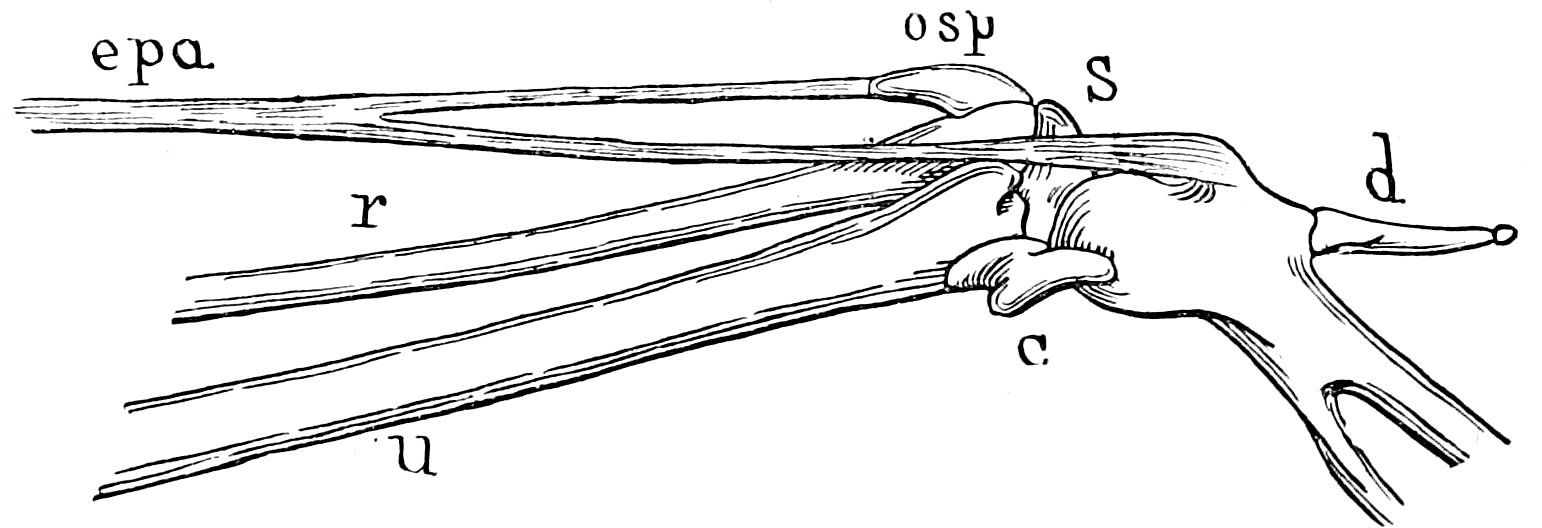
Left wing of Bubo virginianus, from below (reduced one third).
r, radius; u, ulna; c, cuneiform; s, scapho-lunar; os p, os prominens; epa, tendon of extensor patagii longus.
The accompanying cut, drawn from a fresh specimen of B.
virginianus, explains the form and position of the os prominens.
It will be noticed that it is situated on the anterior surface of
the distal end of the radius, and runs almost parallel with that
bone, instead of standing erect as in the Falconidæ. The radial
portion of the tensor patagii longus terminates in the os prominens,
and is not continued to the first metacarpal.
Apart from the Owls above noted, this bone has been found in
Otogyps calvus, Heterospizias meridionalis, Buteo melanoleucus,
B. pennsylvanicus, B. lineatus, Circus gouldi, Asturina
pucherani, and Haliæetus albicilla.
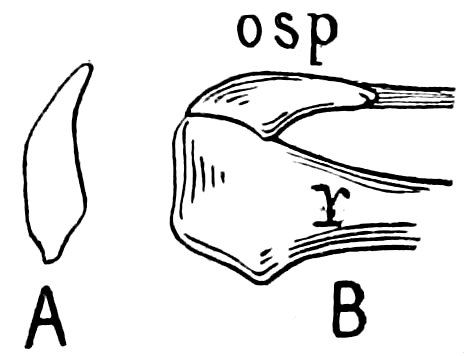
A. Os prominens of Otogyps calvus, full size.
B. Os prominens of Bubo virginianus, seen from above to show articulation with radius, full size.
88It is absent in Polyborus tharus, Milvago chimango, and the
following peculiar forms which were examined to see if they
would throw any light upon the subject: Nyctibius, Strigops,
Nestor, Megapodius, Ocydromus, and Atagen. Neither was
any trace of it to be found in two specimens of Pandion haliæetus
from N. Africa and the Duke of York group. Dr. Shufeldt’s
theory that the os prominens is for the purpose of extending
the wing area struck me, as it did Mr. Jeffries, as being untenable,
from the fact that the increase of surface thus obtained was
too slight to be of any value.[48]
The first proposition of Mr. Jeffries’ summary is that the bone
serves to keep the friction of the extensor patagii longus from the
carpus. Were this the case it ought surely to be present in the
Albatross and Gull, birds which in a fresh breeze are continually
flexing and extending their wings according to the direction of their
flight and the varying force of the wind. But in both these birds the
os prominens is absent,[49] and moreover, as we see in the Owls, it
may be so situated as not to prevent the friction of the ulnar portion
of the tendon. Second, that it serves only to a limited extent
to increase the power of the extensor patagii longus to abduct the
thumb, is shown by the fact that in the majority of cases that tendon
is inserted in the first metacarpal. The exceptions to this,
so far observed by me, are in Otogyps calvus and Haliæetus albicilla,
where there is a strong tendon running from the os prominens
to the first phalanx of the thumb. The third proposition
has already been considered, and the fourth (that it protects the
carpus) must be rejected, both for the reason given by Mr. Jeffries,
and because as we see it in Owls it frequently does not lie over the
carpus at all. Only in Otogyps calvus does the os prominens seem
to exist as a simple sesamoid, and in that bird it is imbedded in
the tendon of the extensor patagii longus, and glides over the
scapho-lunar. Were I to venture a suggestion it would be that
89by its serving as a point of attachment for the tensor patagii longus,
that tendon is freed from all duties save that of “puckering
up” the anterior margin of the wing; but, as stated before, that
theory is by no means entirely satisfactory to me.
During the summer of 1881 the writer and two companions
spent a little more than a month in the South, especially in the
State of Mississippi, travelling and studying its zoölogy. Our
primary object was to collect fresh water fishes; and to this we
devoted the greater part of our time and efforts. Incidentally,
however, we collected and made observations on other animals.
Hence this list of birds and the few notes concerning them. I
did not intend to publish this list until I had opportunity to
make additions to it; but the recent publication by Dr. F. W.
Langdon of his field notes on birds observed by him, early in the
spring, at a point a little farther south, has made it seem proper
that I should contribute my little toward making known the ornithology
of this region.
Our observations and collections were made of course under
difficulties, and no attempt was made to secure nests and eggs,
or, in any special manner, notes on the breeding habits of birds.
Still, on account of the season when our trip was made, this list
may be of some value as indicating that the birds observed are
summer residents. The number of species recorded is not large,
but I include only birds that I am reasonably sure were seen. In
nearly all cases the birds were shot, and identified by means of
descriptions. Others were seen, but as they were not identified
with certainty, they are not included in the list.
The birds noted as found at Memphis, Tenn., were really seen
in Arkansas just across the river from Memphis. Most of our
other notes were obtained at Vicksburg and Jackson, Miss.
90The nomenclature adopted is that of Mr. Robert Ridgway,
issued by the U. S. National Museum, 1881.
1. Hylocichla mustelina (Gmel.) Baird. Wood Thrush.—This
species was seen and specimens were shot at Memphis and at Vicksburg.
Its song was frequently heard; and it would appear to be quite common.
2. Mimus polyglottus (Linn.) Boie. Mockingbird.—Very abundant
at all points visited. At the time we were at Vicksburg, July 1, the
young had not yet left the nest, as negro boys were offering them captured
in their nests for sale. In the “History of N. A. Birds” Dr. Brewer has
stated that the Mockingbird in the South nests early in April, and that the
young birds appear a month later. If this is the case these birds must
remain in the nest six weeks or two months. I was informed that a law
in Mississippi prohibits the keeping of these birds in confinement.
3. Galeoscoptes carolinensis (Linn.) Caban. Catbird.—This bird
was quite common at Memphis. I did not note it at any point farther
south.
4. Harporhynchus rufus (Linn.) Caban. Brown Thrush.—A single
specimen seen at Jackson.
5. Sialia sialis (Linn.) Haldem. Bluebird.—Seen in considerable
numbers at Memphis, Vicksburg, and Jackson.
6. Lophophanes bicolor (Linn.) Bonap. Tufted Titmouse.—Specimens
of this species were obtained at Memphis and at Jackson. It may
be worth noting here that it occurs as far north as Indianapolis, and I have
seen it here during the present winter.
7. Parus carolinensis Aud. Carolina Chickadee.—Seen only at
Memphis.
8. Thryothorus ludovicianus (Gm.) Bonap. Carolina Wren.—We
observed this active bird at Memphis and at Jackson, at both of which
places it appeared to be very abundant.
9. Mniotilta varia (Linn.) Vieill. Black-and-white Creeper.—Observed
at Memphis and Jackson. It will probably be found to breed at
both these points.
10. Protonotaria citrea (Bodd.) Baird. Prothonotary Warbler.—Specimens
of this species were shot at Memphis, and others were seen at
Jackson.
11. Parula americana (Linn.) Bp. Blue Yellow-backed Warbler.—This
was found to be one of the most common of the smaller birds
at Memphis, Vicksburg, and Jackson. We were constantly shooting them
while hunting for other species. In the “History of N. A. Birds” it is
said to be nowhere abundant; but a day’s hunt in the Mississippi lowlands
would, I think, convince any ornithologist that this is an error. I have
no doubt whatever that it breeds all through the South, although we found
no nests. Audubon was probably correct in saying that it breeds in Louisiana,
however much he may have erred in regard to the structure of the
nest.
9112. Oporornis formosa (Wils.) Baird. Kentucky Warbler.—This
sprightly little bird was observed, and specimens were handled, at
both Vicksburg and Jackson.
13. Geothlypis trichas (Linn.) Caban. Maryland Yellow-throat.—A
specimen was shot at Memphis; others were seen.
14. Myiodioctes mitratus (Gmel.) Aud. Hooded Warbler.—Specimens,
male and female, of this bird were obtained at Jackson. It appeared
to be moderately common.
15. Setophaga ruticilla (Linn.) Swains. American Redstart.—During
our stay at Hopefind, Ark., opposite Memphis, a number of specimens
of the Redstart were seen. Afterwards, while at Jackson, about
July 10, a male and a female were killed. Their presence so far south at
this season, and in such numbers, would indicate that they breed here.
Up to this time I am not aware that it is known to breed south of the Potomac
River and Illinois. The finding of the nest and eggs in Mississippi
may be expected.
16. Vireosylvia olivacea (Linn.) Bonap. Red-eyed Vireo.—Very
abundant at all the stations visited. Its clear, musical notes could be
heard everywhere in the deep forests. A specimen was shot at Vicksburg,
which had apparently just become fledged. Memphis, Vicksburg,
Jackson.
17. Vireo noveboracensis (Gmel.) Bonap. White-eyed Vireo.—Specimens
of this Vireo were obtained at Memphis and at Jackson.
18. Lanius ludovicianus Linn. Loggerhead Shrike.—A specimen
of Shrike was seen at Jackson; but, as it was not shot, I am unable to say
whether it belongs to this variety or to excubitorides.
19. Progne subis (Linn.) Baird. Purple Martin.—Common about
Vicksburg.
20. Hirundo erythrogastra Bodd. Barn Swallow.—This species
was observed to be quite common about Jackson together with the next.
21. Tachycineta bicolor (Vieill.) Caban. White-bellied Swallow.—Seen
flying about the outskirts of Jackson.
22. Cotile riparia (Linn.) Boie. Bank Swallow.—Seen at various
points along the Mississippi River near Memphis.
23. Pyranga æstiva (Linn.) Vieill. Summer Redbird.—A male of
this species was shot at Memphis, another at Vicksburg, and a male and
a female at Jackson. It is apparently a very common bird.
24. Spizella pusilla (Wils.) Bonap. Field Sparrow.—A single
specimen of this species was shot at Jackson. Its occurrence there at that
season was hardly to be expected. This individual may have been left
behind in its winter quarters by its migrating comrades; or it may be that
the species will be found to breed even as far south as Jackson.
25. Cardinalis virginianus (Briss.) Bonap. Cardinal Grosbeak.—One
of the most conspicuous birds at every point visited.
26. Passerina cyanea (Linn.) Gray. Indigo Bunting.—The Indigo
Bird was observed at Memphis, and again at Jackson.
9227. Passerina ciris (Linn.) Gray. Painted Bunting.—This beautiful
bird was seen at the crossing of the Vicksburg and Meridian R. R.
over the big Black River, and again at Jackson. Females were shot at
both places, but the males eluded capture. They seem to be quite common.
28. Spiza americana (Gm.) Bonap. Black-throated Bunting.—Seen
in the lowlands along the river in Louisiana opposite Vicksburg.
29. Agelæus phœniceus (Linn.) Vieill. Red-wing Blackbird.—Very
abundant in the swamps in the vicinity of Vicksburg.
30. Sturnella magna (Linn.) Swains. Meadow Lark.—Not many
were seen. One specimen at Vicksburg, and another along the railway
while en route to Jackson.
31. Icterus spurius (Linn.) Bonap. Orchard Oriole.—Many of
these were observed, and some shot, in Louisiana opposite Vicksburg.
32. Icterus galbula (Linn.) Coues. Baltimore Oriole.—Quite
common at Memphis and at Vicksburg.
33. Quiscalus purpureus (Bartr.) Licht. Purple Grackle.—Common
at Memphis and at Vicksburg.
34. Corvus frugivorus Bartr. Common Crow.—Seen at Memphis,
Vicksburg, and at several intermediate points along the river.
35. Cyanocitta cristata (Linn.) Strickl. Blue Jay.—A common
bird at Memphis and Vicksburg.
36. Tyrannus carolinensis (Linn.) Temm. Kingbird.—A very
common bird at Memphis and Vicksburg.
37. Myiarchus crinitus (Linn.) Caban. Great Crested Flycatcher.—Seen
at all points visited. Apparently more common than at
the North.
38. Contopus virens (Linn.) Caban. Wood Pewee.—This bird
was found to be quite common at Memphis and at Jackson.
39. Empidonax acadicus (Gmel.) Baird. Acadian Flycatcher.—A
specimen was shot at Jackson.
40. Trochilus colubris Linn. Ruby-throated Hummingbird.—A
single specimen was shot at Vicksburg.
41. Chætura pelasgica (Linn.) Baird. Chimney Swift.—Seen
flying about at Jackson.
42. Chordeiles popetue (Vieill.) Baird. Night Hawk.—Observed
at Jackson.
43. Campephilus principalis (Linn.) Gray. Ivory-billed Woodpecker.—No
specimens of this species were seen, but their existence in
the denser and less frequented forests in the neighborhood of Vicksburg
and at other points, was confirmed by hunters and trappers. It is possible
that the bird referred to here is the Logcock (Hylotomus pileatus), but
as special mention was made by my informant, a professional hunter,
of the white bill, I think the Ivory-billed Woodpecker must have been
seen. Doubtless the other bird also occurs.
44. Picus pubescens Linn. Downy Woodpecker.—A single individual
of this species was obtained at Vicksburg.
9345. Melanerpes erythrocephalus (Linn.) Sw. Red-headed Woodpecker.—This
Woodpecker is apparently not so common as at the North,
but it was observed at Memphis, Vicksburg, and Jackson.
46. Colaptes auratus (Linn.) Sw. Yellow-shafted Flicker.—A
not uncommon bird about Vicksburg.
47. Ceryle alcyon (Linn.) Boie. Belted Kingfisher.—Quite common.
Seen at Memphis and Vicksburg and intermediate points along
the river.
48. Coccyzus americanus (Linn.) Bonap. Yellow-billed Cuckoo.—Apparently
common. A specimen was secured at Vicksburg.
49. Conurus carolinensis (Linn.) Kuhl. Carolina Parakeet.—None
were seen by ourselves. Inquiry concerning this rapidly disappearing
species was made of various persons, and especially of hunters.
It is still occasionally seen; but, for the most part, it maintains itself in
the dense cane-brakes and forests, away from contact with man. I heard
of its having been seen recently along the Mississippi River, about half-way
down the state of Mississippi; also that it had been seen in southeastern
Arkansas. A gentleman in Jackson stated that he had, within a
year or two, seen a flock of Parakeets pass over that city. These items,
together with the information obtained by Dr. F. W. Langdon, communicated
in his recent paper, would indicate that this bird has not yet disappeared
from the Mississippi Valley.
50. Scops asio (Linn.) Bonap. Little Screech Owl.—A single
individual of this species, in the shabbiest of plumage, was shot along the
Big Black River between Vicksburg and Jackson.
51. Buteo lineatus (Gm.) Jard. Red-shouldered Hawk.—A specimen
of this hawk was shot and brought to me by a hunter at Jackson.
52. Cathartes aura (Linn.) Illig. Turkey Buzzard.—A common
bird everywhere. Seen in great numbers at Jackson in company with
the next.
53. Catharista atrata (Wils.) Less. Carrion Crow.—Not observed
at any place but Jackson, although doubtless common everywhere.
Readily distinguished from the Turkey Buzzard by its smaller size and its
manner of flight.
54. Zenaidura carolinensis (Linn.) Bonap. Mourning Dove.—Common
everywhere. Memphis, Vicksburg, Jackson.
55. Meleagris gallopavo americana (Bartr.) Coues. Wild Turkey.—None
were seen, but hunters stated that they were quite abundant,
even in the immediate vicinity of the city of Jackson. In the spring of
1880 I saw a fine gobbler that had been shot by a party of hunters in the
pine woods of Kemper County, near the eastern border of the State.
56. Ortyx virginiana (Linn.) Bonap. Bob White.—The call notes
of these birds were frequently heard as we passed down the river. At
Vicksburg they appeared to be abundant in the bottom lands. We were
extremely sorry that we could procure none of their skins.
57. Ardea herodias Linn. Great Blue Heron.—Several of these
birds were seen flying about in the swamps near Vicksburg.
9458. Herodias alba egretta (Gmel.) Ridgw. American Egret.—A
number of this snow-white species were observed in the swamps across
the “lake” from Vicksburg. One was shot, and was found to have the
long dorsal train of plumes.
59. Oxyechus vociferus (Linn.) Reich. Killdeer.—Observed only
at Vicksburg. Will probably be found to breed here.
60. Philohela minor (Gmel.) Gray. American Woodcock.—One
specimen was shot at Vicksburg.
61. Sterna antillarum (Less.) Coues. Least Tern.—This beautiful
little Tern was very abundant on a sandy point across the “lake,” or
old bend of the river, opposite Vicksburg. We were told that these birds
lay their eggs on the bare sand, and that these eggs hatch in an extraordinarily
short time.
Looking back on my first winter in the South I can recall no
pleasanter experience than that of a stay of some four weeks at
St. Mary’s, a town situated on the very border line of Southern
Georgia. This place was then scarcely known to Northerners,
although the crowded Florida steamers, on their way across
Cumberland Sound, passed within sight of it and occasionally
even touched at its wharf for some chance freight or a supply of
fuel. But the village still retained a primitive quiet and simplicity
that was all the more restful from its contrast with the
bustling world outside. Now there are rumors of a railroad
and daily trains from Savannah, with all the accompanying desecrations.
It is a pity that the march of modern improvements
cannot spare a few such peaceful spots, but the “levelling
process” seems universal and inevitable.
A Northerner passing his first spring in the South will miss
the marked distinction between the seasons upon which he has
been accustomed to rely. The vegetation does indeed take a
partial rest during the winter months, but it is checked rather
than suppressed, and the reign of summer begins without that
interval of preparation which we call spring. Most of the trees
95are evergreen, but some of them, curiously enough, assume
bright autumn tints and cast their leaves in April. This at least
is true of the live-oaks and magnolias: during my stay at St.
Mary’s one of the latter, a remarkably fine tree which I often
passed in my daily walks, was at one time nearly denuded,
while the ground beneath was strewn with scarlet and orange-tinted
leaves.
By the middle of April the fields and forests wore that mature
appearance which we associate with August and early September.
At noonday cicadas shrilled in the sultry woods, and
crickets chirped all night long in the shrubbery about the house.
Yet few birds had begun to nest, and many of the northern ones
still lingered. I saw Yellow-rumped Warblers, Blue Yellow-backed
Warblers and Cedar Birds nearly to the end of April,
and a White-throated Sparrow as late as May 2. Many of the
Blue Yellow-backed Warblers remained to breed, or rather were
breeding, for long before this (on April 9) I had found a nearly
finished nest. The local birds, however, did not mingle with
the strangers, the former being found in pairs, and only where
the trees were hung with Spanish moss; while the latter occurred
in all kinds of timber, and in flocks made up largely of
Redstarts, Kinglets, Black-poll Warblers and other northern
species. The same was true of the Catbirds, Brown Thrushes,
Pine Warblers, Towhees and several others. It was especially
marked in the case of the Towhees, for the resident individuals
belonged to a different and readily recognizable race.
One needed but to pass the boundaries of St. Mary’s to be
fairly in the country, for the village had not then overflowed
its limits, and the few outlying plantations were scarcely less
wild and unkempt than the woods which surrounded them.
One of my favorite haunts was the “Bay-gall” (I could never
learn the origin of this name), a tract of swampy forest less than
a quarter of a mile distant from the house at which we were
staying. This place was sure to be alive with birds, and I rarely
entered it without making some pleasing discovery. My first
visit was on April 6, the day after our arrival. As I approached
the woods a Red-bellied Woodpecker started from a solitary tree
within a few feet of my head, and alighting at the base of one
near by scrambled hurriedly up, dislodging the scales of loose
bark in his ascent. He was immediately joined by his mate and
96the two began a game of hide-and-seek around the trunk and
among the branches, uttering a rolling wor’r’r’roo very like that
of a Flicker.
Forcing my way through the brambly outskirts, I entered the
swamp and paused a moment to look around. Grand old wateroaks
and sweet-gums thickly hung with Spanish moss cast a
dense shade over the ground beneath, and the few sunbeams
that struggled through flickered in the gloom like dying torches.
There was little undergrowth, and the eye could penetrate far
in every direction. In the branches above Blue Yellow-backed
Warblers were singing incessantly, and occasionally the note of
a Great-crested Flycatcher echoed sharply among the trees.
There were other sounds; the rolling tapping of Woodpeckers,
the shrill cry of the Blue Jay; and, from the clearing outside,
pleasantly softened by distance, the songs of Mockingbirds and
Cardinal Grosbeaks.
Passing deeper into the forest I came to an opening where the
morning sun lay warm on a thicket of bushes that surrounded a
shallow pool. Here I found an interesting little company of
tired migrants resting after the fatigues of their last night’s journey
and preparing for that still before them. There were six or
eight Hooded Warblers, all males in full spring livery, a number
of Worm-eating Warblers, a female Prothonotary Warbler,
and several Ruby-crowned Kinglets and Redstarts. All were
busily engaged in catching insects, but occasionally one of them
would pause to sing a few notes in a listless undertone. The
Prothonotary was the first that I had ever met with, and it was
the only one that I saw at St. Mary’s. The Hooded and Worm-eating
Warblers were common for a week or more afterwards,
when all departed for some more northern breeding-ground.
During subsequent visits to the “Bay-gall” I met many interesting
birds, several of which were new to me. Occasionally I
would startle a Chuck-will’s-widow from its noonday slumbers
on some mossy knoll, and if a chance shot through the leaves
succeeded in stopping its erratic, bat-like flight, there was the
pleasure of smoothing its soft plumage and admiring the rich
brown coloring before consigning the bird to the paper wrapper
that formed its temporary tomb. I believe I never shot one without
indulging myself in this way. There is much to be learned,
too, from the examination of a freshly-killed bird. For instance,
97I had never known the wonderful beauty of this Goat-sucker’s
eye until I held the bird in my hand, and the size of its mouth
would hardly be suspected from the examination of a dried skin.
On April 17 the Acadian Flycatchers arrived. I was first
made aware of their presence by their emphatic queep’ éep which
so closely resembled that of Traill’s Flycatcher that I immediately
suspected the identity of the singers, although it was some
time before I could get a sight at one. They had another note
also which was much like the whistling of wings. I afterwards
satisfied myself that this sound was a vocal one.
I never left the “Bay-gall” without reluctance in the days when I
was perhaps the only invader of its secret recesses; and now, in
recalling it, the feeling is scarcely less strong. But the country
about St. Mary’s held other attractions which must not be neglected.
The open space surrounding the town was bordered on
the north by a pine forest that stretched an indefinite number of
miles into the interior, and my walks often tended in this direction.
Following some grass-grown road that wandered aimlessly
among the trees, I often paused to watch the gambols of the
Brown-headed Nuthatches which fairly swarmed in these woods.
They are exceedingly social little birds, and it was no uncommon
thing, even in the middle of their breeding season, to see five or
six rollicking together. In their motions they closely resemble
Sitta canadensis, and they have the same habit of exploring the
ends of the pine branches and hanging head downward, like
Titmice, among the tufts of pine needles. But they are decidedly
more active, and their notes are shriller, more varied and altogether
unlike those of either the Red or White-bellied species.
Whick-whick-whee’e’e’ whick-whicker-whicker is the usual utterance,
but when several come together their shrill excited piping
altogether baffles description. These little companies were by
no means wholly composed of Nuthatches, but usually included
a more or less numerous escort of Pine Warblers, Bluebirds,
Titmice and Woodpeckers. As the motley troop rambled
through the woods, its members were continually chasing one
another from tree to tree, chirping, calling and singing as their
various moods dictated. I noticed that the Bluebirds usually led
the van, while the Woodpeckers invariably brought up the rear.
Unlike the Red-bellied, Downy, Hairy and Golden-winged
species, which inhabited all sorts of timber, the Red-cockaded
98Woodpecker was exclusively a bird of the pines. It was not
common about St. Mary’s and I had difficulty in getting as many
specimens as I wanted. Its notes to my ear almost exactly resembled
those of Sitta pusilla. On the 1st of May I started a female
from her nesting-hole, which was about thirty feet above the
ground in a large and apparently perfectly sound pine. I was
unable to climb the tree but the bird acted as if her eggs had
already been laid.
The pine lands of the South have an open park-like character
that is a continual surprise to one accustomed only to New England
forests. The trees rarely stand in close proximity to one
another, and they are often so widely scattered that the general
effect is that of an opening rather than a forest. Unless a hummock
interrupts the view, the eye may sometimes roam for half a mile
in every direction over a perfectly level plain, interspersed
with occasional trees whose tufted heads throw waving shadows
upon the bright green beds of saw-palmetto that cover most of
the ground beneath. Were it not for the half-wild cattle that
range at will through the country, the palmetto would probably
usurp every inch of ground; but these creatures keep it within
reasonable limits, and many spaces of closely cropped grass and
stunted blueberries intervene. About such places I used to find the
Bachman’s Finch, a retiring little bird which might easily be overlooked
by one unacquainted with its habit of skulking among the
herbage and lying concealed until nearly trodden on. But no one
with the slightest ear for bird music can long remain in ignorance
of its presence after the breeding season has set in, for the
male possesses vocal powers of a very rare order. His song is a
prolonged, leisurely chant composed of several distinct bars or
sets of notes, with brief pauses between, as if the bird stopped to
take breath. The final notes of each bar have sometimes a rising,
sometimes a falling, inflection, and the tone is varied in the most
subtle manner. Now it has a full bell-like ring that seems to fill
the air around; next it is soft and low and inexpressibly tender;
now it is clear again, but so modulated that the sound seems to
come from a great distance. The whole performance is very
simple and I hardly know the secret of its charm. To be fully
appreciated it should be heard in the soft twilight of an April
evening, when the still woods are filled with dusky shadows. At
such times it has moved me more deeply than I care to confess.
99The male always sings from an elevated perch, usually a
dead twig close to the trunk of a southern pine. He sits perfectly
motionless and is unaccountably hard to see. I have often
stood directly beneath one for several minutes, vainly straining
my eyes in the direction from whence the sound came, and perhaps
finally discovered him within ten feet of my head in plain view.
The ventriloquous character of many of his notes increases this
difficulty. If disturbed in the midst of his song, he pitches to
the ground beneath and at once seeks shelter in the grass.
Another characteristic inhabitant of these grassy openings was
the Meadow Lark. It was much tamer than our northern bird,
and its notes had a wild, ringing inflection that harmonized well
with the surroundings.
In the thicker groves I often heard the voice of the Summer
Tanager (Pyranga æstiva). His song is rich, flowing, and not
unlike that of the Rose-breasted Grosbeak, although some of its
notes recall those of the Robin. The call-note used by both
sexes is a peculiar chuck’l-chuckl’ut. The bright colors of the
male make him a conspicuous object among the branches of the
southern pine which, at least in Georgia, is his favorite tree.
The Yellow-throated Warbler also was sure to be met with in
these walks. His song to my ear has a far-a-way sound, even
when the bird is near at hand. It is simple and monotonous,
but nevertheless sweet and plaintive. This bird has all the habits
of the Pine Warbler, with which it often associates.
A totally different phase of bird life was presented when, as was
often the case, I visited the plantations. The fields themselves
rarely offered anything more attractive than Yellow-winged
Sparrows, Grass Finches and, late in April, migratory troops of
Bobolinks that settled among the last year’s weeds for a moment
before resuming their northward journey with rollicking snatches
of song. But the fence corners and similar neglected places
around the outskirts of the cultivated lands were filled with
bushes over which trailed Cherokee roses, trumpet-vines and
other luxuriant creepers. In these places I was sure to find
Mockingbirds, Cardinals, Catbirds, Brown Thrushes, White-eyed
Vireos and the brilliant little Painted Buntings.
Next to the always self-assertive Mockingbird the White-eyed
Vireo was perhaps the most conspicuous inhabitant of such
thickets. Not that he was often seen, but at almost any time of
100the day one might hear his emphatic, jerky little strain, coming
from half a dozen points at once. I noticed that the note varied
considerably from that which we hear in New England, and,
moreover, scarcely two of the southern birds sang exactly alike.
Some individuals even seemed to have a talent for mimicry. One
that I remember imitated the note of the Loggerhead Shrike so
closely that I was completely deceived. The nest of this bird
is a wonderfully delicate and beautiful structure. One that I got
at St. Mary’s contained its complement of four eggs on April
26. I discovered it twelve days previously when the birds were
busily employed on the framework. The male took an equal
part in this task and it was amusing to see him try to sing with
his bill full of moss or bark.
The Painted Buntings or Nonpareils, as they are universally
called by the townspeople, arrived April 23 and through the remainder
of the month were abundant. I used to find them in
flocks about the openings where they spent much of their time on
the ground. They were timid rather than shy, flying to the thickets
upon the slightest alarm, but when once conscious of being
pursued, it was difficult to get a shot at one. The brilliant plumage
of the adult male makes him a conspicuous object either on the
ground or in green foliage, but it is no easy matter to see one
among the flowers of the trumpet-vine where they often seek refuge,
apparently fully conscious of the protection afforded by the
clusters of scarlet blossoms. The young males during the first
year are colored precisely like the females. They sing, and for
aught I know, breed, while in this condition. The song is a low,
pleasing warble very un-Finch-like in character. I should compare
it to that of the Canada Flycatcher, but the notes are less
emphatic, though equally disconnected. The bird almost invariably
sings in the depths of some thicket, and its voice ceases
at the slightest noise. Both sexes have a sharp chirp of alarm
which closely resembles that of the Indigo Finch. Most of the
Nonpareils left St. Mary’s by May 1, but a few pairs remained up
to the time of my departure, when they were apparently preparing
to breed. Another familiar inhabitant of these thickets was the
Towhee Bunting. Two distinct races of this bird were to be met
with during the same walk, but never, so far as my observation
went, actually in company. The Red-eyed or northern form, erythrophthalmus
proper, apparently occurred only as a winter
101visitor, while var. alleni represented the resident or local race.
The latter was chiefly a bird of the oak scrub, although it was
also to be found in open pine woods where it haunted the beds of
saw-palmetto. Its note differed widely from that of erythrophthalmus;
the “chewink” was shorter and harsher, and in
addition to this cry, both sexes occasionally uttered a sharp, clear
whistle that sounded like a sportsman’s call to his dog. I am not
sure that I heard the song, or at least identified it. These Towhees
were hard to obtain, for they were shy and retiring, rarely
venturing far from their secure retreats. The irides of all the
specimens that I examined were brownish-yellow or dull, opaque
amber; never white, as is said to be the case with examples from
Southern Florida.
It would be difficult to find a plantation in the South that did
not have one or more pairs of Mockingbirds. About St. Mary’s
they were especially abundant, and nowhere more so than in the
gardens of the village. Here they were half-domesticated,
building their nests in the shrubbery that surrounded the houses,
and hopping about, like Robins, upon the grass-plats and gravelled
walks. An orange tree directly in front of the windows of
my room was appropriated by a remarkably fine singer. There
is a noticeable difference in the performances of most males, but
the voice of this bird possessed a compass and perfection of tone
that I have never heard equalled. His repertoire included the
notes of nearly all the birds of the surrounding region besides
many of the characteristic village sounds, and most of the imitations
were simply perfect. Moreover he was continually adding
to his accomplishments. An interesting instance of this occurred
one afternoon, when several of us were sitting on the
veranda. A Greater Yellow-leg passing over the town was
attracted by my answering whistle, and circled several times
above the house reiterating his mellow call. The Mockingbird
up to this time had been singing almost uninterruptedly, but at
the sound of these strange notes he relapsed into silence and retreated
into the thickest foliage of his favorite tree; after a while
we heard him trying them in an undertone. The first note
came pretty readily, but the falling inflection of the succeeding
three troubled him. Whenever I ventured to prompt he
would listen attentively, and at the next attempt show an evident
improvement. Finally he abandoned the task, as we thought in
102despair, and at sunset that evening for the first and only time
during my stay his voice was missing in the general chorus.
But at daylight the next morning the garden rang with a perfect
imitation of the Yellow-leg’s whistle. He had mastered it during
the night, and ever afterwards it was his favorite part. The discomfiture
of the rival males in the neighborhood was as amusing
as it was unmistakable. Each in turn tried it, but not one of them
succeeded.
Another frequenter of the village shrubbery was the Orchard
Oriole. His flute-like voice, which bears some resemblance
to that of the Fox Sparrow, could be heard almost any time after
April 10. Our garden offered especial attractions to these
Orioles, for the hedge of wild olive trees that bordered it on two
sides was overrun with Cherokee roses and trumpet-vines among
which they found a congenial shelter. They were fond, too, of
sipping the honey from the trumpet-flowers, and it was no uncommon
thing to see half a dozen collected about a single cluster.
In this occupation they were almost invariably joined by
numerous Hummingbirds;—and such a group, with its setting of
green leaves and scarlet and white blossoms, formed the prettiest
picture imaginable.
To our garden also came the Blue Jays; bold, familiar birds
very different in bearing from the outcast that boys and would-be
sportsmen pursue so relentlessly in the northern woods. Everywhere
at the South this Jay is as much an inhabitant of the
cultivated grounds as of the forests, and if not actually encouraged,
it is universally tolerated. In Jacksonville I have heard them
screaming among the live-oaks that shade the busiest streets,
and at St. Mary’s they were scarcely less tame and confiding
than the Mockingbirds.
The average Georgian is indifferent to the shooting of most
of the birds that inhabit his plantation; but it is little short
of a crime in his eyes to take the life of either a Turkey
Buzzard or a Mockingbird. The killing of one of the former
is considered an offence against the State, which protects
them on account of their services as scavengers. But the Mockingbirds
are treasured as personal property, and any interference
with them is sure to be promptly resented. The natural result
of this sentiment is that both species are universally abundant
and familiar. The Buzzards, especially, are ubiquitous. At
103all hours of the day, in every kind of weather, they float over the
cities, villages, plantations, pine woods, hummocks, cypress
swamps, salt marshes and even the beaches of the Sea-islands.
Go where you will, it is almost impossible to look upward
without seeing the picturesque forms drifting about in the sky.
Some are soaring almost beyond the reach of human vision.
Others at a lower elevation cross and recross each other in
interminable mazy lines; while still others glide across the
landscape passing just above the tops of the trees. Both species
occurred at St. Mary’s, but the Black Vulture was much the less
common. It associated freely with the Turkey Buzzards, among
which it could be recognized at almost any distance by its different
color, shape and manner of flying. The tail is so short as to
be altogether out of proportion with the body and wings, while
its square tip gives it the appearance of having been cut off.
This bird’s flight is heavy, awkward and generally straight forward,
although it occasionally soars. The wings are flapped
every few seconds in a hurried, nervous manner that seems
to betoken a lack of power or confidence. The flight of the
Turkey Buzzard, on the contrary, is a picture of repose in motion.
The bird rarely moves its wings, save to alter their
inclination, and its dark form drifts through miles of space
without the slightest perceptible effort. The impression of
entire freedom from exertion which its movements convey, is
curiously in accord with the general enervating influence of
southern life and its surroundings. Its impassive flight may perhaps
be regarded as the most characteristic feature of a southern
landscape, as it certainly is one of the most attractive. But the
observer who would keep this impression untarnished will be
wise to refrain from looking too closely into the useful side of
the bird’s character.
The Buzzard’s flight will not bear comparison however with
that of the Swallow-tailed Kite. The latter is equally easy and
graceful of wing, and, in addition, its movements are characterized
by a certain dash and energy of purpose that one looks for in vain
in the calm, emotionless flight of the Vulture. I hardly know a
more attractive sight than that presented by one of these Kites
playing about an opening in the woods. For a moment it floats
motionless, as if suspended by an invisible wire; the next, it
glides close over the ground crossing and recrossing every yard
104of space. The long, thin wings, firmly set, cleave the air like
knife-blades and the forked tail, spread to its fullest, is inclined
to one side or the other as the bird changes its swift course.
When it turns, the snowy head and breast are contrasted against
the green background and its steel blue back glances in the sunlight.
Finally rising to a level with the tree-tops it is gone as it
came, like a beautiful vision.
But my space is exhausted, although many interesting birds
remain to be mentioned. Perhaps at some future time I may
take up the threads where this sketch leaves them.
1. Sialia sialis. Bluebird.—About the middle of March, 1877, Mr.
Harold Gilbert saw one at Mount Pleasant, a suburb of St. John. Some
time early in June, 1879, Mr. J. W. Banks saw one at Milledgeville, with
food in its mouth, apparently for its young. On April 26, 1881, Mr. Henry
Gilbert shot one at Rothesay, nine miles north of St. John.
2. Dendrœca pennsylvanica. Chestnut-sided Warbler.
3. Dendrœca castanea. Bay-breasted Warbler.
4. Dendrœca blackburnæ. Blackburn’s Warbler.—These three
species are but rarely found here. In my note-book is a record of one of
each taken during the summer of 1881, and I can learn of none others
having been seen or heard.
5. Vireo noveboracensis. White-eyed Vireo.—Mr. Harold Gilbert
shot one specimen of this bird at South Bay, a few miles northwest from
St. John, on May 24, 1877, and this is the only known instance of its
occurrence in this vicinity.
6. Pyranga rubra. Scarlet Tanager.—I saw an adult male of this
species sitting on a fence in the suburbs of St. John on June 20, 1879, and
have examined two specimens taken near Hampton during the summer of
1880.
7. Ammodromus caudacutus. Sharp-tailed Finch.—On June 21,
1881, five individuals of this species were taken by Mr. H. A. Purdie,
Mr. Fred. W. Daniel and myself, on a marsh near Hampton. This marsh
is watered by the Kenebecasis, a tributary of the St. John, and lies some
twenty-five miles up the former river. The junction of the two rivers
105takes place about five miles from the mouth of the St. John. The marsh
is some twenty miles, air line, from the nearest point on the Bay of Fundy
shore, and at the time we visited it, the water running past it did not taste
in the least brackish.[50]
8. Pipilo erythrophthalmus. Towhee.—A specimen, now in the
collection of the Natural History Society of St. John, was shot at Irishtown
on May 8, 1881, by Mr. J. Belyea.
9. Zamelodia ludoviciana. Rose-breasted Grosbeak.—I have examined
the skin of one of this species taken near Hampton in June, 1879.
10. Passerina cyanea. Indigo Bunting.—There is a skin in the
collection of James McGivern, Esq., said to have been taken about six miles
north of St. John in June, 1880. I can learn of no other occurrence of this
bird near here, though I have frequently seen specimens taken on the
western, or Bay of Fundy shore of Nova Scotia.
11. Zenaidura carolinensis. Mourning Dove.—This bird has been
but rarely met with here; one taken at Hampton in June, 1880, one at
Rothesay on September 30, 1881, and one at Milkish on October 17,
1881, are the only specimens I have heard of.
12. Ardetta exilis. Least Bittern.—Between the spring of 1877
and the fall of 1880 there were five individuals of this species taken on
the Bay of Fundy shore, about ten miles to the eastward of St. John.
13. Micropalama himantopus. Stilt Sandpiper.—The only known
occurrence of this bird in this vicinity is of three seen by Mr. F. W. Daniel
on the sand flats back of St. John on September 8, 1881. He secured one
of them, which is now in the museum of the Natural History Society.
14. Recurvirostra americana. Avocet.—Mr. William Ellis of St.
Martins, a village on the shore of the Bay of Fundy, says he has shot
one or more of these birds each year for the last five years, usually meeting
two together. A specimen taken by him in 1880 is in the museum of
the Natural History Society.
15. Himantopus mexicanus. Black-necked Stilt.—I procured one
of this species in September, 1880, from Mr. John Ellis of Mace’s Bay, an
arm of the Bay of Fundy, lying some thirty miles to the westward of St.
John, and was told by Mr. Ellis that several had been taken there during
former years.
16. Ionornis martinica. Purple Gallinule.—Since obtaining the
male, announced by Mr. Wm. Brewster in this Bulletin for July, 1881, I
have had the good fortune to get possession of a female which was shot
near Gagetown, a village on the St. John River, about forty miles from its
mouth. The bird was taken in the early part of September, 1880.
17. Chen hyperboreus. Snow Goose.—One of these birds was taken
at Gagetown in December, 1880, and sent by me to Mr. E. O. Damon of
Northampton, Mass.
18. Anas boscas. Mallard.—A pair in the museum of the Natural
History Society were shot near Hampton by the late Col. Otty some fifteen
years ago. The only late occurrences of this species are of one mounted
106by J. H. Carnell, taxidermist, and a flock of some six or eight seen by Mr.
Henry Gilbert on the Kenebecasis River in August, 1880, from which he
obtained a male and female.
19. Æthyia vallisneria. Canvas-back.—Carnell has mounted one
of this species taken within the Province, and E. C. Sutton, Esq., of Sutton,
who is familiar with their appearance, saw a flock on the St. John
River, about four miles from the city, several times during the fall of 1879.
20. Pelecanus erythrorhynchus. American White Pelican.—One
of these birds in the collection of the Natural History Society was shot on
the shore of the Gulf of St. Lawrence near Pt. du Chene by Mr. Robert
Bustin, and I have very good authority for announcing the occurrence of
another at Cape Spencer, some five miles east of St. John, during the
first week in April, 1881.
BY CHARLES F. BATCHELDER.
During the spring of 1879 Messrs. W. A. Jeffries and J.
Amory Jeffries spent some time at Grand Falls, New Brunswick,
collecting and studying the birds of that neighborhood; and at
about the same time Mr. J. Dwight, Jr., and myself were similarly
engaged at Fort Fairfield, Aroostook Co., Maine.
Owing to the limited time of our stay the number of species
observed was not large, but as it included almost all the commoner
summer residents,—the species really characteristic of the
fauna of the region—it has been thought worth while to lay
the results of our observations before the public, especially as the
fauna is in some respects peculiar. One might be led to expect,
from the latitude of the region, that the fauna would be thoroughly
Canadian in its character. Our experience shows, however,
that it has a strong tinge of the Alleghanian.
Grand Falls is situated on the right bank of the St. John River
at about N. Lat. 47° 03′, and W. Long. 67° 50′. The river below
the falls runs through a narrow valley, almost all of which is
under cultivation. On the higher land above the falls and about
the town are farms devoted chiefly to hay, potatoes and buckwheat.
The country is hilly, and is scantily watered, the few
107rapid streams and brooks draining directly into the river. There
are no lakes or ponds, except a few insignificant puddles, although
there are occasional cedar swamps and “barrens.” The tributary
streams below the falls have cut narrow*, steeply walled
ravines in their passage to the river. These were cold and damp,
and apparently without birds.
In some places forests of hard woods exist, tall maples, elms
and birches that have no doubt stood there for ages. There
is but little underbrush in these woods, and they have a rather
park-like aspect. The second growth and the woods on the low
lands along the river consist of firs, spruces and hemlocks of
all sizes, and often have an almost impenetrable underbrush.
Where fires have spread large tracts are stripped of their woods,
and are covered with fallen trunks overgrown with vines, with
here and there tall dead “stubs” still standing.
Mr. W. A. Jeffries’ observations extended from May 21 to June
19. He was joined by his brother on the 9th of June. During
the ten days following this latter date the weather was cold—there
was a frost June 15, and rain fell every day except the 9th
and the 15th.
Fort Fairfield is twenty miles south of Grand Falls. It is
situated on the Aroostook River, about five miles in an air line
west of its junction with the St. John. It is in a rolling
country containing but few ponds and swamps, and watered
merely by small brooks which empty into the Aroostook River.
The river itself is broad, with a rapid current, and flows between
banks which though not very high, are yet never swampy. Much
of the original forest has been removed, especially in the neighborhood
of the town and along the river, where the stretches of
wooded land are interspersed with clearings, pastures and cultivated
fields, large crops of buckwheat and potatoes being raised
on the fertile soil. The woods are mostly evergreen—the several
species of Abies and the arbor vitae—intermingled, of course,
with a few yellow birches and an occasional maple, but few tracts
being wholly covered by deciduous trees.
Our collecting was done mostly within two or three miles of
the town. Our notes were made between June 14 and July 1.
On our arrival we found the trees by no means in full leaf, and
were told that the season was very backward, and had been very
wet. Heavy frosts occurred on the 15th and 19th of the month.
108The nights were generally cold, the days warm—even hot
during the latter part of our stay.
Fort Fairfield is 415 feet above the sea, and has a mean annual
temperature of 38.11° F.
Through the kindness of Mr. H. A. Purdie I have been enabled
to supplement our observations by extracts from some manuscript
notes on the birds occurring at Houlton, Maine, made by Mr.
Robert R. McLeod. These notes were written in 1877, and are
based on his experience during a residence of four years at
Houlton.
This town is in the southeastern part of Aroostook County, on
the Meduxnekeag River about twelve miles from its junction with
the St. John. It is forty-five miles south of Fort Fairfield, its
Latitude being 46° 8′. I quote the following from Mr. McLeod’s
notes: “The country round about is well watered with lakes
and streams. Much of the land is under cultivation, but where
it is not, the old forests are standing in great tracts of many miles
in extent. The first snow falls about the 10th of November, and
it generally remains on the fields till the middle of April, and in
the woods until the last of May.”
At each locality several species, that would doubtless have been
much more abundant had local conditions been favorable, were
absent or represented by but few individuals.
All statements are given on the authority of both the observers
at the locality to which they refer, except in some few cases, in
which the initials of the observer are appended. All references
to Houlton are, unless otherwise stated, on the authority of Mr.
McLeod.
1. Turdus migratorius Linn. Robin.—Rather common at Fort Fairfield.
At Grand Falls it was abundant everywhere.
2. Turdus fuscescens Steph. Wilson’s Thrush.—Rare at Grand
Falls. On June 16 a nest with four fresh eggs was found on top of a
stump. Not met with at Fort Fairfield. Mr. McLeod says that it appears
at Houlton by May 15, and by the 10th of June becomes common. Breeds.
3. Turdus pallasi Caban. Hermit Thrush.—Common. One nest
taken May 30 at Grand Falls was about three feet from the ground in a
small fir tree.
4. Turdus ustulatus swainsoni (Caban.) Coues. Olive-backed
Thrush.—Common at Grand Falls, especially in the hard woods and
more open fir woods. At Fort Fairfield it appeared to be rather common,
though seldom seen. Common and breeding at Houlton.
1095. Mimus carolinensis (Linn.) Gr.. Catbird.—At Houlton “very
rare. A pair has bred in this vicinity each year since I have been here”
(R. R. McL.). Not met with at Fort Fairfield or Grand Falls.
6. Sialia sialis (Linn.) Hald. Bluebird.—At Grand Falls they were
frequently seen, as many as seven or eight in the course of a day. Apparently
not common at Fort Fairfield. At Houlton “very rare,” one
pair breeding.
7. Parus atricapillus Linn. Black-capped Chickadee.—At Grand
Falls it was not uncommon. Some days four or five pairs would be seen,
on others none at all. At Fort Fairfield it was not very common, though
seen occasionally. At Houlton “very common.”
8. Parus hudsonicus Forst. Hudsonian Chickadee.—About half
a dozen were seen at Grand Falls, mostly in hardwood brush or small
woods. It was not seen at Fort Fairfield.
9. Sitta carolinensis Gmel. White-bellied Nuthatch.—Common
in the hard woods at Grand Falls. Breeding.
10. Sitta canadensis Linn. Red-bellied Nuthatch.—One shot at
Fort Fairfield. Both species are said to be common at Houlton.
11. Certhia familiaris Linn. Brown Creeper.—Seen occasionally
at Fort Fairfield. Breeds. Rare at Grand Falls. “Common” at Houlton.
12. Troglodytes aëdon Vieill. House Wren.—At Grand Falls one
pair was noticed which had a nest in the frame work of a barn.
13. Anorthura troglodytes hyemalis (Vieill.) Coues. Winter
Wren.—This species is common at Houlton,[51] and no doubt occurs
throughout this region; it was seen and heard at Grand Falls, but not observed
at Fort Fairfield.
14. Mniotilta varia (Linn.) Vieill. Black-and-white Creeper.—We
saw several at Fort Fairfield. Not seen at Grand Falls.
15. Helminthophaga ruficapilla (Wils.) Bd. Nashville Warbler.—Apparently
not very common at Fort Fairfield. It was not observed
at Grand Falls.
16. Dendrœca æstiva (Gmel.) Bd. Yellow Warbler.—Rather
common at Fort Fairfield. Not met with at Grand Falls.
17. Dendrœca cærulescens (Linn.) Bd. Black-throated Blue
Warbler.—Rather common at Fort Fairfield. At Grand Falls it was
common in hard woods where the underbrush was thick.
18. Dendrœca coronata (Linn.) Gray. Yellow-rumped Warbler.—It
was common at Fort Fairfield. At Grand Falls it was rare during
May. All had left before the 9th of June.
19. Dendrœca maculosa (Gm.) Bd. Black-and-yellow Warbler.—Common.
20. Dendrœca pennsylvanica (Linn.) Bd. Chestnut-sided Warbler.—Common.
21. Dendrœca blackburnæ (Gm.) Bd. Blackburnian Warbler.—This
bird was seldom seen while we were at Fort Fairfield, and was not
met with at Grand Falls.
22. Dendrœca virens (Gm.) Bd. Black-throated Green Warbler.—Rather
common at Fort Fairfield. Not met with at Grand Falls.
11023. Dendrœca tigrina (Gm.) Bd. Cape May Warbler.—I shot a
male at Fort Fairfield, June 23, in a thick second growth of spruces on
the edge of a path.
24. Siurus auricapillus (Linn.) Swains. Golden-crowned Thrush.—Rather
common at Fort Fairfield. At Grand Falls it was seen only in
the hard woods, where it was not common.
25. Siurus nævius (Bodd.) Coues. Water Thrush.—Breeding at
Fort Fairfield, but not very common. It was not met with at Grand
Falls.
26. Geothlypis philadelphia (Wils.) Bd. Mourning Warbler.—Common
in suitable places. It was almost sure to be found in “burnt
lots,” where the fallen trunks lay, half hidden by a luxuriant growth of
tall weeds, or thickly overrun with vines. Under the shelter thus afforded
they undoubtedly nested, safely screened from the most searching eyes.
27. Geothlypis trichas (Linn.) Caban. Maryland Yellow-throat.—Common.
28. Myiodioctes pusillus (Wils.) Bp. Wilson’s Black-cap.—At
Fort Fairfield this bird was common. We usually found them in thickets
of willow bushes, often in rather wet places. The birds were apt to go in
companies of three or four or more. June 23 Mr. Dwight caught a young
bird, just able to fly two or three yards at a time. The nest was no doubt
close at hand, but the ground among the willow bushes was covered so
deeply with brush that a diligent search for the nest showed nothing—except
that it was not built in the bushes. The youngster showed in the
most marked way the energy of disposition and restless activity that
characterize the adults. The species was not common at Grand Falls.
29. Myiodioctes canadensis (Linn.) Aud. Canada Flycatching
Warbler.—Rare at Grand Falls, but common at Fort Fairfield.
30. Setophaga ruticilla (Linn.) Swains. Redstart.—This species
was exceedingly abundant at Grand Falls wherever there were hard woods.
It was a common bird at Fort Fairfield.
31. Hirundo erythrogastra Bodd. Barn Swallow.—Common.
32. Tachycineta bicolor (Vieill.) Caban. White-bellied Swallow.—At
Grand Falls it was common in suitable localities. None
were seen about the town. It was abundant at Fort Fairfield.
33. Petrochelidon lunifrons (Say) Lawr. Eave Swallow.—Common
at Grand Falls. Abundant at Fort Fairfield.
34. Cotile riparia (Linn.) Boie. Bank Swallow.—Common.
35. Progne subis (Linn.) Bd. Purple Martin.—Common, breeding
in martin-houses at Fort Fairfield. This bird seems to be generally
distributed throughout eastern Maine and the adjoining parts of New
Brunswick, where there are settlements. While on our way to Fort Fairfield
we noticed it at a number of places between Bangor and Woodstock,
N. B., as well as at various points along the St. John River between
Fredericton, N. B., and Fort Fairfield. It is also common at Houlton.
36. Ampelis cedrorum (Vieill.) Bd. Cedarbird.—It was not uncommon
at Grand Falls. At Fort Fairfield we found it common.
11137. Vireo olivaceus (Linn.) Vieill. Red-eyed Vireo.—Common.
38. Vireo philadelphicus Cass. Philadelphia Vireo.—Taken only
at Grand Falls in May, singing in the hard woods.
39. Vireo solitarius Vieill. Solitary Vireo.—This species was
apparently not very common at Fort Fairfield. It was not seen at Grand
Falls. Mr. McLeod gives it in his notes as “quite common” at Houlton.
40. Pyranga rubra (Linn.) Vieill. Scarlet Tanager.—Not rare in
the hard woods at Grand Falls. The people there call them “war-birds.”
We did not see them at Fort Fairfield, though we have reason to think
that they occur. At Houlton Mr. McLeod says they are “rare. They
arrive May 29. I have not found the nest, but have a young one taken
here. They remain all summer.”
Dr. Coues’ New Check List and Dictionary.[52]—Judging from advance
sheets lately received, this new treatise by Dr. Coues will occupy a
previously unclaimed place among ornithological works; for, as its title
indicates, it is much more than a catalogue of North American birds. Its
novel feature is a dictionary of etymology, orthography and orthoëpy of
scientific names, to which is devoted the lower portion of each page of
the running list. In this department the generic, specific and varietal
names—duplicated from the text above with the addition of the diacritical
marks for quantities, accents and division of syllables—are exhaustively
treated; their derivation and meaning being explained, their
construction scrutinized, their spelling revised, and their applicability in
each particular case carefully considered. The erudition and scholarly
research involved in this undertaking must be apparent to the most casual
reader. The practical value of the work is equally plain, and perhaps it is
not too much to say that it calls for a fuller measure of gratitude on the
part of ornithologists than anything which its versatile author has
hitherto produced.
A detailed consideration of the Check List proper must necessarily be
deferred until the appearance of the complete work; pending this, we may
simply say that the plan followed by Dr. Coues is essentially to make a
second edition of his original list, with all the required additions and
corrections to date, and such revision of nomenclature as seemed desirable
112and practicable. Ten species are subtracted, and one hundred and twenty
added, while names are changed for various reasons in probably more
than a hundred cases. A simple system of reference numbers forms a
concordance of the present and original edition, as well as with Baird’s
list of 1858 and Ridgway’s of 1880. The total number of species and
varieties enumerated is eight hundred and eighty-eight.
It should be mentioned that the introductory portion of the work includes
an analysis of the present list as compared with that of 1874, and
an important chapter entitled “Remarks on the use of names.” The
latter is devoted to a general consideration of the technique of Greek and
Latin scientific names and the principles governing their derivation, spelling
and pronunciation.
The book ends with a catalogue complete to date of the author’s ornithological
publications. We understand that the edition will be offered
to the public before the close of the present month. May it meet with the
cordial reception which it so richly merits.—W. B.
Nests and Eggs of Ohio Birds.—It is always a pleasure to record
the progress of this notably meritorious work—a pleasure which we trust
will be ours until the completion of the design which the authors have
thus far carried out so successfully. As we have before remarked, there
has been nothing since Audubon in the way of pictorial illustration of
American Ornithology to compare with the present work—nothing to
claim the union of an equal degree of artistic skill and scientific accuracy.
We have no knowledge of the financial aspects of the case; but, as such a
work is necessarily expensive, we can only trust that it continues to
receive the support it so richly deserves. It is, we believe, sold only by
subscription. The last number which has reached us is a double one,
being parts 10 and 11, dating Oct. 1881 and Jan. 1882, containing Plates
XXVIII-XXXIII, and pages 107–118. Plate 18 is perhaps the first in
which the authors have introduced a bird—being the head of the Purple
Martin protruding from the orifice of the C gourds so frequently put up
in the South for its accommodation. This figure shows that Mrs. Jones
can draw and paint a bird as well as its nest and eggs—and we should
not be surprised if other birds appeared with their nests in future numbers.
The temptation thus to enlarge upon the original plan of the work must
be at times almost irresistible. Plate 29 is Euspiza americana, the simple
nest of which gives less scope for the artist’s skill than the elaborately
finished surroundings of the Song Sparrow’s nest of Plate 30. The extremes
of size and coloring of the eggs of Melospiza are well portrayed,
as are those of the Thrasher, the rough exterior of whose nest fairly
bristles on Plate 31. One of the most artistic pictures of the whole series
is the lowly nest of Helminthophaga pinus (Plate 32), with its characteristic
surroundings at the foot of a slight bush clump. It is interesting to
note in this case the curious “protective mimicry” by which the nest
resembles a bunch of dead leaves and dried bark strips blown and caught
among the roots of a bramble. One would have sharp eyes who would
113at first glance see it was something else. The last plate (33) represents
the nest of the Summer Tanager, furnishing a good illustration of a “saddled”
nest—by which we mean one placed directly upon a large horizontal
bough, only confined by a few slight upright twigs. The text consists, as
usually heretofore, of a folio to each plate, and continues to be prepared
by Dr. Howard E. Jones. We find it to be a perfectly reliable account of
the objects represented. The authors evidently have spared no pains or
expense in maintaining the high standard of excellence they set for themselves
at the beginning.—E. C.
Prof. Macoun’s Report of Exploration.[53]—We hear so seldom
from our friends of the Dominion, as far as ornithology is concerned, that
the present contribution would be welcome as an index of their activity,
even were it of less importance than we find it to be. It is difficult to cite
the brochure correctly, as it has no title-page and bears no date or place
of publication, and may be an “extra” of a portion of some more extensive
government publication. However this may be, the pamphlet which
reaches us through Professor Macoun’s kind attentions is the report of the
Surveyor General to the Minister of the Interior, consisting chiefly (pp.
8–40) of Professor Macoun’s own report of his explorations during the
summer of 1880 of that portion of the Souris River Valley lying within
British Territory and of the adjoining region to the west and north—that
is to say, north of our territories of Dakota and Montana. The region is
one seldom examined even incidentally in the interests of ornithology,
and the present paper possesses decided value, as the observer appeared
to have paid special attention to the distribution of birds in the wide area
traversed. After a résumé of the leading ornithological features of the
region is presented an annotated list of the species secured, 109 in number.
This list may be profitably examined in connection with the article on the
birds observed along the parallel of 49° by the Northern Boundary Commission
in 1873 and 1874. We feel at liberty to call attention to some
manuscript alterations made by the author in our copy. For Coturniculus
passerinus read Zonotrichia albicollis; for Myiarchus crinitus, read Tyrannus
verticalis; for Archibuteo lagopus, read A. ferrugineus, the range of
which is thus carried beyond any point hitherto given; for Tringa canutus
read T. bairdi; for Podilymbus podiceps, read Podiceps californicus.
We could wish the report were better printed; but poor presswork is the
usual fate of public documents, English or American.—E. C.
Knowlton’s Revised List of the Birds of Brandon, Vermont.[54]—This
is a briefly annotated list of 149 species occurring in the immediate
114vicinity of Brandon. The author says: “A few more species doubtless
occur, especially among the Waders and Swimmers, but as they have
never been actually noted, they have been rigidly excluded.” An examination
of the List shows that, with perhaps one or two exceptions, he has
succeeded in adhering to this principle, the result being a very reliable
list as far as it goes. The further application of this rule doubtless
accounts for the fact that many of the species are not stated to breed that
yet no doubt do so.
The chief interest of the List lies in its bearing upon the extent of the
Alleghanian fauna in the Champlain valley. The breeding of such species as
Dendrœca striata and Zonotrichia leucophrys, the occurrence of Perisoreus
canadensis and Picoides arcticus, and the absence of Ortyx virginiana
and one or two other species, are almost the only exceptions to an otherwise
strictly Alleghanian fauna.
A number of species, especially among the migrants, would seem, from
what the writer says, to be by no means numerous at this locality, and no
doubt his statements are strictly in accordance with his experience. We
have reason to believe, however, that a more thorough search might reveal
greater numbers of some of these species.
It is to be regretted that Mr. Knowlton’s List could not have appeared
elsewhere than in the columns of a newspaper, both for the sake of
giving it a more permanent form, and of avoiding the typographical
errors inevitable under such circumstances. It may be worth while here
to mention that by a slip of the pen Mr. Knowlton has recorded Wilson’s
Plover (Ochthodromus wilsonius) instead of Wilson’s Snipe.—C. F. B.
Krukenberg on the Coloring Matter of Feathers.[55]—This paper,
the first of a series, seems to be the product of more careful work than
previous publications on the subject. The author first states positively
that the color may change after growth, the feather becoming lighter or
darker as the case may be, but postpones deciding whether the change is
the result of external or internal causes. Judging from the effects of
stimulants upon Canaries with fully grown feathers, I have no doubt that
internal changes play an important part. At least, almost white Canaries
will become very yellow, gray sometimes appearing, if properly fed.
Turacin, a red or purple-violet pigment, found in the feathers of the
Musophagidæ is first considered. Attention was first called to this pigment
by Verreaux, who found that the purple-violet in the wing feathers
of Corythaix albicristatus was destroyed by wetting, but returned on
drying. Later it was observed that the water in which these birds bathed
became colored dark red. Facts worthy of consideration by all systematic
ornithologists. Turacin is soluble in weak alkalies, insoluble in
acids, and slightly soluble in water, especially if warm. It may be precipitated
as an amorphous red powder by the action of acids. In solution the
115spectrum of Turacin is marked by two absorption bands, between D and E,
much resembling those of oxyhemoglobin. Carbon dioxide and oxygen,
however, have no effect on the color or the spectrum. As to its chemical
composition the author differs from his predecessors in that he denies the
presence of nitrogen, though copper and iron are both present in considerable
quantities. By the action of concentrated sulphuric acid two
products are formed, named α Turaceïn and β Turaceïn by the author.
Zoönerythrin, another red pigment of much wider distribution, is
found in red feathers, as those of the Flamingo and the Cardinal Grosbeak.
It is soluble in alcohol, ether, bisulphide of carbon, and the like,
from which it can be precipitated by evaporation. The solution of this
pigment is often favored by first digesting the feather in a trypsin or pepsin
solution. Unlike Turacin, Zoönerythrin has no absorption bands, but all
is absorbed beyond E.
Zoöfulvin, a yellow pigment of much the same solubility as the preceding,
occurs in the yellow feathers of the European Oriole, the Canary,
and the like. The spectrum has two bands between F and G which vary
in position according to the solvent used.
As yet Dr. Krukenberg has been unable to extract any green, blue, or
purple pigment from feathers, so that he agrees with Bogdanon that blue
feathers have no pigment as proved by transmitted light. Of this any one
can at once convince himself by holding the feather of a Bluebird immersed
in water between himself and a window.—J. Amory Jeffries.
Minor Ornithological Papers.—161. The Ruddy Duck (Erismatura
rubida). By Spencer Trotter, Chicago Field, Vol. XIII, p. 23.—Brief
general account, including reference to their occasional great abundance in
Chesapeake Bay.
162. Bibliographical Manuals of American Naturalists. Chapter II.
Dr. Elliott Coues, U. S. A. By William Hosea Ballou. Ibid., XIII, pp.
92, 103, 123, 189, 205, 221.—Rather more than 400 titles of papers and
works, relating mainly to ornithology.
163. Nomenclature of the North American Grouse. By Spencer Trotter.
Ibid., XIII. pp. 314, 315.—Common and scientific names of North American
Grouse, with their principal synonymy and habitats.
163. The California Quails in Missouri. By H. Clay Ewing. Ibid.
XIII, p. 413.—Six or seven pairs, turned out near the junction of the
Missouri and Osage Rivers in March 1879, raised broods the following
season near where they were liberated.
164. Bibliographical Manual of American Naturalists Chapter III.
The Literature of Prof. Edward D. Cope. By Wm. Hosea Ballou. Ibid.
XIV, pp. 19, 20.—Contains a few ornithological titles.
165. Can the Pinnated Grouse be successfully propagated? By H. W.
Merrill. Forest and Stream, XVI, Feb. 10, 1881, p. 28.—Believes they
can be “successfully propagated” with proper “regard to cover, food
and range.”
166. Pine Grosbeak (Pinicola enucleator, L., V.) and Robin (Turdus
migratorius, L.) in Winter [in Nova Scotia]. By. J. Matthews Jones.
116Ibid., XVI. March 13, 1881, p. 86.—The former “quite common”; small
flocks of the latter frequent the spruce woods every winter, in Point
Pleasant Park, Halifax peninsula.
167. The “Crane’s Back.” By J. C. Merrill. Ibid., XVI, March 10,
1881, p. 105.—A Cree Indian account of the napite-shu-utle, a bird said to
migrate by taking passage on the backs of Cranes. The bird is believed
to be a Grebe.
168. A Hawk new to the United States. By Robert Ridgway. Ibid.,
XVI, Apr. 14, 1881, 206.—From Oyster Bay, Fla., provisionally referred
to Buteo fuliginosus. (See this Bull., VI, Oct. 1881, p. 207.)
169. The Pine Grosbeak. By Chas. E. Ingalls. Ibid., XVI. Apr. 14,
1881, pp. 206, 207.—Observations on its habits in winter in Massachusetts.
170. Our unique Spoon-billed Sandpiper, Eurinorhynchus pygmæus
(Linn.). By Tarleton H. Bean. Ibid., XVI, Apr. 21. 1881, p. 225.—Brief
general history of the species, with record of its capture at Plover
Bay, Eastern Siberia, and Point Barrow, Alaska.
171. Domesticated Quail. By Henry Benbrook. Ibid., XVI, May 5,
1881, p. 266.—Ortyx virginianus successfully reared in captivity to the
third generation. Believes that under favorable circumstances they could
be bred “as easily as Turkeys.”
172. Great Carolina Wren. By William Dutcher. Ibid., XVI, July
14, 1881, p. 473.—Record of its capture at Greenville, N. J., within four
miles of New York City.
173. The Rail we shoot. [By George B. Grinnell.] Ibid.. XVII, Sept.
22, 1881, pp. 146, 147.—Classification, diagnoses and habitats of the Rallidæ
of the United States.
174. Range and Rotary Movements of Limicolæ. By W. Hapgood. Ibid.,
XVII, Oct. 20, 1881, pp. 225–228.—An important and suggestive paper on
the migrations and range of American Limicolæ. The greater part of the
species of this group are noticed at length. The paper relates especially
to the winter haunts of these birds, and the conclusion is pretty fairly
sustained that many of them pass beyond the tropics to winter in the
Southern Hemisphere.
175. Migration of Shore Birds. By M. H. Simons. Ibid., XVII,
Nov. 10, 1881, p. 288.—Apropos of Mr. Hapgood’s paper (see No. 174).
the writer calls attention to the fact that many kinds of Shore Birds winter
in Florida and the other Gulf States. “Didymus.” under the same
caption, has some pertinent suggestions in reference to Mr. Hapgood’s
paper.
176. The Herring Gull and the Ring-bill on Georgian Bay. By Rev.
J. A. Langille. Ibid., XVII, Nov. 17, 1881, p. 307.—On the habits, etc.,
of these species at their breeding haunts in Georgian Bay.
177. Beechnuts and Woodpeckers. By C. Hart Merriam, M.D. Ibid.,
XVII, Dec. 1, 1881, p. 347.—A reply to several pseudonymous articles in
previous numbers of this journal (Forest and Stream) in reference to the
Red-headed Woodpecker’s habit of eating beechnuts. Other notes on
the same subject, by various contributors, follow in this and succeeding
numbers.
117178. The Enemies of Game Birds. By Adolphe B. Covert [and others].
Ibid., XVII, Dec. 8, 1881, p. 366, Dec. 22, p. 407, and Dec. 29, p. 428.—Various
enemies are mentioned, among whom the Red Squirrel is
prominent.
179. Habits of Woodpeckers. By W. Beeke [and others]. Ibid.,
XVII, Dec. 15, 1881, p. 387.—In reference to their laying up stores of
beechnuts for winter use, particularly refers to the Red-headed Woodpecker.
180. Inquiries about the Snow Grouse [lege Goose]. By William
Dutcher. Ibid., XVII, Dec. 22, 1881, p. 407.—In reference to the distribution
of Anser hyperboreus on the Atlantic coast, and to the change of
plumage in the Blue Goose (A. cærulescens) in captivity.
181. The Sparrow Curse in Australia. Ibid., XVII, Dec. 22, 1881, pp.
407, 408.—Abstract of a “progress report” of a government commission
appointed to investigate “alleged injuries caused to fruit growers, gardeners,
farmers and others by [the imported] Sparrows.” The analysis
of the testimony taken is suggestive reading in its bearing upon the
“Sparrow Pest” of our own country.
182. The Snow Goose and Blue Goose. By C. S. Wescott. Ibid.,
XVII, Jan. 5, 1882, p. 447.—Respecting their specific diversity, and on the
occurrence of the Snow Goose in Delaware Bay. This is followed by a
communication (under the same caption) from Arthur Edward Brown,
who states that seven Blue Geese have lived seven years in the Philadelphia
Zoölogical Garden without showing any material change of color.
183. Der Schwalbenweih (Nauclerus forficatus). Von H. Nehrling.
Ornithologisches Centralblatt, VI. No. 2, 15 Jan. 1881, pp. 9, 10.—Account
of its habits, etc., as observed in Texas.
184. Der Gelbkopfstärling oder Gelbkopftrupial (Xanthocephalus
icterocephalus Baird). Von H. Nehrling. Ibid., VI, No. 11. 1 Juni, 1881,
pp. 81–84, No. 13, 1 Juli, 1881, pp. 97, 98.—General history.
185. Die Wandertaube [Ectopistes migratorius]. Von Chas L. Mann.
Ibid., VI, No. 21, 1 Nov. 1881, pp. 164–166. (Aus: Jahresber. des Naturhist.
Vereins in Wisconsin 1880–81.)—On the great numbers destroyed
by pigeon hunters for the market. Contains interesting statistics of the
slaughter and the manner in which it is prosecuted.
186. Zwei amerikanische Prairiefinken. Von H. Nehrling. Monatsschrift
des Deutschen Vereins zum Schuke der Vogelwelt, VI Jahrg., No.
3, März, 1881, pp. 58–64.—General account of the “Lerchenfink (Chondestes
grammica Bp.)” and the “Savannenfink (Passerculus savanna Bp.).”
187. Ornithologische Beobachtungen aus Texas. II. Von H. Nehrling.
Ibid., VI, No. 5, Mai, 1881, pp. 111–121. (See this Bulletin, VI, p. 109.)
188. Nordamerikanische Vögel im Freileben geschildert. Von H.
Nehrling. Die gefiederte Welt. Zeitschrift für Vogelliebhaber, -Zuchter
und -Händler, X Jahrg., 1881.—Under this title Dr. Nehrling contributes
a series of well-written popular articles on various North American birds.
In the present volume are the following: (1) Das Rubingoldhähnchen
(Regulus calendula Lichtst.), l. c. pp. 14–16, 24–26. (2) Der blauköpfige
118oder Brewer’s Stärling, Scolecophagus Breweri, Nehrl. (S. cyanocephalus
Cab....) pp. 44–46, 57, 58. (3) Der Kentuckysänger oder Buschsänger
(Sylvia-Opornis [sic.]—formosa Wils. ...), pp. 100–102.
(4) Die Einfiedlerdrossel (Turdus Pallasi Cab. ...), pp. 173, 174. (5)
Der Gold- oder Kukukspecht (Colaptes auratus Swns. ...), pp. 228–230,
240, 241, 251–253, 265, 266. (6) Der Scherentyrann, Scheren- oder Gabelschwanz
(Milvulus forficatus, Swains. ...), pp. 325, 326, 333–335. (7)
Der blaugraue Fliegenfänger oder Mückenfänger (Polioptila cærulea
Scl.), pp. 368–370, 380, 381, 393. (8) Der Satrap oder das Gelbkrongoldhähnchen
(Regulus satrapa, Lichsts. ...), pp. 435, 436. (9) Die
Bergdrossel (Oreoscoptes montanus Brd. ...), pp. 528–530.
189. Rocky Mountains-Hüttensänger oder Steinschmätzer (... Sialia
arctica Swns.) Eine Vogelstudie aus den Felsingebergen. Von Fr. Trefz.
Ibid., p. 81.
Description of a Nest of the Water Ouzel.—The nest of the
Water Ouzel (Cinclus mexicanus) is perhaps not so well known as to make
the following description of one wholly uninteresting. The nest when
found was in good condition, and had evidently been used the past season.
It was built under a slightly overhanging wall of limestone, on a ledge
projecting seven or eight inches from the wall, and about four feet above
low-water mark, the deepest part of a swift mountain stream flowing directly
beneath. The material of construction was a bright green moss,
forming a rather conspicuous object for some distance along the opposite
bank. The nest has a nearly spherical interior seven inches in diameter.
The entrance is triangular, one side of the triangle forming the top and
being three and one-half inches across and three inches above the lower
angle. The most exposed side of the nest varies from three to four inches
in thickness, the top and remainder being only an inch and a half through.
At time of finding, the interior of the nest was perfectly clean, but outside,
just below the opening, the rock was discolored for some distance by
excrement of the birds. Side by side with this nest was an older one partially
destroyed, and I fancied I could see traces of still another on the
same ledge not far off. The birds had evidently lived in the locality for
some time.—R. S. Williams, Gold Run, Montana.
The Short-billed Marsh Wren in New Hampshire.—On the 24th
of August, 1881, while investigating the recesses of a fresh water marsh
at Rye Beach, N. H., I found a colony of Short-billed Marsh Wrens (Cistothorus
stellaris) in a small meadow about a mile from the sea. One
bird was shot, and five or six others seen and heard.
119Mr. Wm. Brewster in 1872 found this bird in the same vicinity, but in
a locality about five miles farther inland.
These two records extend the northern range of the Short-billed Marsh
Wren, and give it a place among the birds of New Hampshire.—Henry
M. Spelman, Cambridge, Mass.
Early Arrival of the Yellow-rump in Southern Maine.—This
morning—March 21, 1882—I found a solitary Yellow-rumped Warbler
(Dendræca coronata) flitting about in a straggling growth of spruces, on
Cape Elizabeth. His arrival is unprecedentedly early for this vicinity.
The Yellow-rumps usually reach Portland in the last week of April,
sometimes not until after May 1, and up to to-day I have never seen one
before April 21, which was the date of their appearance in 1879. My
little friend of this morning was probably only an accidental and temporary
visitor. Snow still lies from two to three feet deep in the woods,
and much blustering, wintry weather must be expected, before the earliest
Warblers come to us in earnest.—Nathan Clifford Brown, Portland,
Maine.
Late Stay (probable Wintering) of Dendrœca pinus in Massachusetts.—A
few individuals of the Pine-creeping Warbler remained so
late with us the last season, that their courage deserves a record. I found
four of them on December 5, 1881, in company with Chickadees, in a rocky
run thickly set with maples and alders. There were no pines, but a small
bunch of them not far away. I shot one, according to rule, to make sure
of the species. Being desirous of ascertaining if they proposed to spend the
winter in that cheerful company, on January 1, 1882, I sent a young friend,
who is well posted and a good observer, to the locality, and he reported
seeing two of the Warblers so near at hand, perhaps twenty feet, as to
make the identification positive. I intended to look for them again
in February, but was unable to do so.—F. C. Browne, Framingham,
Mass.
The Hooded Warbler in Western New York.—From various
points in the dense forest, on the balmy days of May, comes the common
and familiar song of the Hooded Warbler,—che-reek, che-reek, che-reek,
chi-dì-eê, the first three notes with a loud bell-like ring, and the rest in
very much accelerated time, and with the falling inflection. Arriving
early in May, this is one of our common summer residents throughout
the dense upland forests, occupying the lower story of the woodland home,
while the Cœrulean Warbler occupies the upper. Here let me say that
in addition to its alarm note, a sharp whistling or metallic chip which is
very clearly characterized, the Hooded Warbler has two distinct songs,
as different as if coming from different species. Never shall I forget how
I was once puzzled by this trick. I was strolling in a thick forest, near
the corner of a slashing, in an evening twilight in June, when I was surprised
by a strange whistling melody.—whee-reeh, whee-ree-eeh—with
120a marked emphasis on the second syllable, and a still more marked one
on the last. Part of the time this utterance was somewhat varied, a few
notes being sometimes added, and again a few being dropped. My curiosity
was greatly excited, for I had supposed myself familiar with the
voices of all the birds in the neighborhood; but it became too dark to
identify the bird. For nearly a week I went to that spot every day, always
hearing the song, but never being able to get a clear sight of the bird.
It seemed exceedingly shy. In vain did I crawl on hands and knees among
the undergrowth to get near to it; for just as I would seem about to gain
a good view of it the song would cease at the point under observation
and come from one more distant. Just as I was about to give the matter
up one evening, down came the singer, stage by stage through the thick
foliage, and alighting within a few feet of me and in clear sight, gave the
full effect of his whistling song. I have since heard the same song a
number of times and in different places from the Hooded Warbler. So
I conclude that in the case of this species there are, occasionally at least,
two distinct and altogether different songs.
The Hooded Warbler is one of those which make their home on or
near the ground. Here it keeps itself for the most part well concealed
among the foliage of the thick undergrowth, having a rather slow and
dignified movement for a bird of its kind.
It builds its nest from a foot to eighteen inches from the ground,
generally in the upright or somewhat leaning fork of a little bush. I once
found it on a beech limb, lying on the ground, but still retaining the dry
leaves. It is somewhat bulky, but quite neat, the lower part being of dry
or skeleton leaves, the upper part, especially the high and well-defined
rim, of long fibrous bark, as that of the grape vine, ash, basswood, or
elm, laid almost as nicely as coiled cords, the whole structure being bound
together by a webby material, and lined with fine grasses, bark-fibres,
and horse-hair. In location, material, and structure, it is quite unique,
and, like most other birds’ nests, is a much more certain means of identification
than the eggs themselves. These, two to four in number, varying
from .63×.52 to .75×.50, are clear white, delicately specked and spotted,
sometimes even blotched, with reddish, brown, and lilac. In form and
coloration the eggs are very variable. They may be found fresh from the
last week in May till the middle of June. A second set may be found in
July. The male aids in incubation.
Confined to the eastern part of the United States, and barely entering
the southern part of New England, Western New York, and Central New
York where it is quite common, must be about the northern limit of this
species.—J. H. Langille, Knowlesville, Orleans Co., N. Y.
Breeding of the Pine Grosbeak (Pinicola enucleator) in Lower
Canada.—Last summer I had the rare good fortune to accompany, as
his guest, the Hon. Judge H. E. Taschereau (Chief Justice Supreme
Court of Canada) on his annual salmon fishing excursion to the Godbout
River, which empties into the St. Lawrence from the north, about six
miles from the Pointe des Monts where the river widens into the Gulf.
121One rainy afternoon about the middle of July, while the Judge was
catching salmon at the famous “Upper Pool” on the Godbout, Mr. Nap.
A. Comeau and I climbed a high and densely wooded hill that rises from
the western border of the pool, and when near the summit saw a Pine
Grosbeak, in the slate and golden plumage, hopping about amongst the
branches of a large Balsam (Abies balsamea). I was within twenty feet
from the bird, but having only a rifle was unable to secure it. Mr.
Comeau, who lives at the mouth of the Godbout, told me that this species
was by no means rare here, and that he regarded it as a resident. He has
since written me that he shot several after I left, and that “the bird is
quite common here both summer and winter.” Although he has never
taken its nest, he says “I have no doubt they breed here, and I have often
seen them in the early part of the fall while out trapping. They seem to
be fond of keeping near streams and lakes.”
Dr. Coues found the Pine Bullfinch breeding on the Labrador Coast,
and I have no doubt that it breeds all along the north shore of the Gulf
of St. Lawrence, and perhaps extends even as far west as the Saguenay,
along the north shore of the St. Lawrence River. It is asserted, on high
authority, that it breeds in some parts of Northern New England.—C.
Hart Merriam, M.D., Locust Grove, N. Y.
Coturniculus lecontei, C. henslowi, and Cistothorus stellaris
in Florida.—Mr. C. J. Maynard has kindly placed at my disposal
the following notes made during his recent trip to Florida. In November,
1881, he spent three weeks collecting at Rosewood, a small settlement on
the northern edge of the Gulf Hummock, about eighteen miles northeast
of Cedar Keys. Around the outskirts of this town were a number of old
fields, grown up to rank grass and tall weeds, but nevertheless perfectly
dry. Here he found Leconte’s Buntings, Henslow’s Buntings, Yellow-winged
Sparrows, and Short-billed Marsh Wrens, associating together in
comparative numbers ranking in the order in which their names are mentioned.
The first C. lecontei was shot November 4. Shortly afterwards
they became so abundant that as many as twenty were sometimes
seen in a day, but notwithstanding their numbers, it was by no means
easy to obtain specimens. The chief difficulty arose from their excessive
tameness, for they could rarely be forced to take wing, while in the
long grass it was impossible to see them at a greater distance than a few
yards. Indeed so very fearless were they that on several occasions Mr.
Maynard nearly caught them in his insect net. All four species were
apparently established for the winter.
The detection of Leconte’s Bunting at Coosada, Alabama, by Mr.
Brown,[56] and more recently in Chester County, South Carolina, by Mr.
Loomis,[57] has prepared us to expect it almost anywhere in the Southern
States, but I believe that this is its first Florida record. The occurrence
122of Henslow’s Bunting is also of importance, as confirming Audubon’s
more or less discredited statement that it wintered numerously in Florida;
while that of the Short-billed Marsh Wren is interesting from the exceptional
character of the locality and the distinguished society in which the
little bird was found.—William Brewster, Cambridge, Mass.
Ammodramus caudacutus.—A somewhat inland Record on the
Atlantic Coast.—On June 21, 1881, in company with my friends
Messrs. Chamberlain and Daniel, of St. John. N. B., I found a few pairs
of Sharp-tailed Finches in the tall grassy marshes bordering the Kenebecasis
River at Hampton, which is about twenty miles to the north of the
above named city and the Bay of Fundy, and about at the head of tide water.
The birds were singing, and undoubtedly breeding, but a severe hunt for
their nests was unsuccessful. Although a closely allied variety (nelsoni) is
known to occur in certain western States, I think our maritime form has
not before been observed away from the immediate coast on the Atlantic
seaboard. It might however be looked for up our rivers and creeks as far
as or a little above the flow of tide water. See this Bulletin. II pp. 27, 28;
III, pp. 48, 98; V, p. 52.—H. A. Purdie, Newton, Mass.
The White-throated Sparrow in Winter near Worcester,
Mass.—I saw White-throated Sparrows (Zonotrichia albicollis) at different
dates during December, 1879. I also saw some on January 1, 1880. I,
myself, had not observed it before, though possibly it may not be uncommon.—J.
A. Farley, Worcester, Mass.
Peucæa ruficeps eremœca.—In Gillespie County, Texas, which adjoins
Kendall Co. on the north, where Mr. Nathan C. Brown’s specimens
were taken, I collected on April 24, 1878, a pair of Sparrows which Mr.
J. A. Allen identified as Peucæa ruficeps. From the fact that Mr. Brown
collected no typical ruficeps it is more than likely that my specimens
were var. eremæca.
My specimens were sent to the late Greene Smith, Esq., Peterboro, New
York, and are Nos. 961 and 962 in his Museum.—G. H. Ragsdale,
Gainesville, Texas.
The Canada Jay at Portland, Maine.—A specimen of the Canada
Jay (Perisoreus canadensis) was killed in Scarborough on October 15,
1880, by Mr. Luther Redlon, of Portland, and delivered into my hands a
few hours after its capture. The specimen is worth noting from its being
the first that I have ever known to occur in the vicinity of Portland,
although its kind is said by Professor Verrill (Proc. Ess. Inst., Vol. III,
p. 151) to winter commonly at Norway, Maine, only forty miles farther
north.—Nathan Clifford Brown, Portland, Maine.
The White-throated Swift Breeding on Belt River, Montana.—About
the middle of last July, while hunting on Belt River, I happened
to approach the edge of the high limestone cliffs which rise above the
123stream for several miles after leaving the mountains. Watching the Violet-green
and Crescent Swallows, which were abundant, for some time, I was
about to leave, when I noticed a Swift evidently flying directly towards
me. It passed only a few yards overhead, displaying at the same time
the extensive white throat-patch of Cypselus saxatilis. Further search
revealed some half a dozen altogether. A small opening in the rock which
a bird of this species was seen to enter and reappear from several times,
I approached, near enough to hear a vigorous twittering at each visit of
the parent bird, from which I presume the young were well advanced.
This is the only species of Swift I have yet seen in the Territory.—R. S.
Williams, Gold Run, M. T.
Capture of the Golden Eagle (Aquila chrysaëtus canadensis) near
Columbus, O.—December 13, 1881, I received a male specimen of the
Golden Eagle, killed five miles west of the city.
This bird, according to information which I have gathered from various
sources, had caused the farmers in the neighborhood in which it was killed
a great amount of annoyance. A reward was offered, and published in
our city papers, for the capture of a “Bald Eagle” (as they called it),
which had killed several young calves. By further inquiry I ascertained
that the bird was seen eating at two of the calves, but was not seen in
the act of killing them.—Oliver Davie, Columbus, O.
The Little Blue Heron in Maine.—During the summer of 1881 a
small white Heron took up his abode in a dense swamp bordering the
eastern side of Scarborough Marsh. He foraged regularly about the neighboring
ponds and rivers, and before autumn had been seen and unsuccessfully
shot at by many covetous gunners. In September, however, he fell
captive to the wiles of Mr. Winslow Pilsbury, and now reposes in the
cabinet of Mr. Chas. H. Chandler, of Cambridge, Mass. Upon writing
Mr. Chandler, to ascertain the species represented by his specimen, I
learned that Mr. Henry A. Purdie[58] had seen the bird and pronounced it
the Little Blue Heron (Florida cærulea). No previous instance of its
occurrence in Maine is on record.—Nathan Clifford Brown, Portland,
Maine.
Baird’s Sandpiper on Long Island, N. Y.—A Correction.—In the
Bulletin for January, 1882, p. 60, it is stated that the record of a specimen
of this species from Long Island is apparently its first from any point
south of New England. A note to the editors from Dr. E. A. Mearns
calls attention to a previous record of the species for Long Island in an
article by Newbold T. Lawrence, entitled “Notes on Several Rare Birds
Taken on Long Island, N. Y.,” published in “Forest and Stream,” Vol.
X, No. 13, p. 235, May 2, 1878, as follows:—
124“Tringa bairdii, Baird’s Sandpiper.—Four specimens taken at Rockaway.
The first two in September, 1872, shot on a small piece of meadow,
out of a flock of Tringa minutilla. The third was taken August 26, 1873,
while snipe shooting on a low strip of sand that separates the ocean and
bay. My attention was first called to it by hearing a peculiar long-drawn
whistle, and soon after I perceived a small snipe flying very high. The
next moment it darted down and settled among my decoys, where I secured
it. The fourth was taken in the same locality as the first two, September
20, 1874. Three of the above specimens were males.”—Edd.
Pelidna subarquata on the Maine Coast.—I have to thank Mr.
C. H. Chandler of Cambridge, for allowing me to view a mounted specimen
of the Curlew Sandpiper, which he shot on the beach at Pine Point,
Scarborough, Cumberland Co., on September 15, 1881. The plumage is
immature—probably a bird of the year. It was in company with Peeps,
but its larger size and lighter coloration were noticed, hence this visit to
American shores is registered. The species is new to the Maine fauna,
at least this is the first instance of actual capture within the limits of that
State.[59]—H. A. Purdie, Newton, Mass.
The King Rail in New England.—It seems that in making up the
New England record of the King Rail (Rallus elegans)[60] I overlooked a
note on this species, published in “Forest and Stream” of March 11, 1880.
In this note Mr. Jno. H. Sage announces the capture of a female specimen
at Portland, Conn., September 19, 1879.—Nathan Clifford Brown,
Portland, Maine.
Purple Gallinule (Ionornis martinica) in Rhode Island.—Mr.
Newton Dexter states that some years ago Mr. P. W. Aldrich showed
him a fine Purple Gallinule just received in the flesh from Westerly, R. I.
Mr. Dexter bought, and now has the bird. He is not able to give the
exact year, but thinks it was in 1857.—Fred. T. Jencks, Providence, R. I.
Note on the Habits of the Young of Gallinula galeata and
Podilymbus podiceps.—Mr. N. R. Wood, who collected quite a number
of young Grebes and Gallinules this summer at Montezuma Marsh, near
Clyde, N. Y., tells me that the little Gallinules use the thumb to aid them
in moving about. The thumb in the young of this bird is quite long
and sharp, and the nestlings, when unable to walk, hook it into any
yielding substance, and drag themselves along. The young Grebes are
more vigorous than the Gallinules, and progress by little hops.—Frederic
A. Lucas, Rochester, N. Y.
125Rhynchops nigra.—An early Record for the Massachusetts
Coast.—Champlain,[61] while cruising along the sandy shores of Cape
Cod on a voyage of exploration in July, 1605, makes mention of the
Black Skimmer, as his narration, p. 87, shows.
“We saw also a sea-bird with a black beak, the upper part slightly
aquiline, four inches long and in the form of a lancet; namely, the
lower part representing the handle and the upper the blade, which is
thin, sharp on both sides, and shorter by a third than the other; which
circumstance is a matter of astonishment to many persons, who cannot
comprehend how it is possible for this bird to eat with such a beak.
It is of the size of a pigeon, the wings being very long in proportion to
the body, the tail short, as also the legs, which are red; the feet being
small and flat. The plumage on the upper part is gray-brown, and on
the under part pure white. They go always in flocks along the seashore,
like the pigeons with us.”
That this species was found on our shores early in this century is
proved by the older natives of the Cape telling me, since the bird’s recent
occurrence, that “them cutwater or shearwater birds used to be with us
summer times.” Also Mr. Brewster informs me that Nantucket fishermen
assert that Skimmers bred on Muskegat Island fifty years ago.—H. A.
Purdie, Newton, Mass.
Notes on the Habits of the Kittiwake Gull.—Some fishermen
whom I lately employed to get a few Kittiwake Gulls on the winter fishing
grounds off Swampscott, Massachusetts, gave me the following interesting
account of the habits of this species, and the way in which my specimens
were procured.
A number of small schooners sail from Swampscott every winter morning,
and reach the fishing banks, which are some twelve miles off shore,
about daybreak. The men then take to their dories, and buckets of bait—generally
cod-livers or other refuse—are thrown out to attract the fish
to the spot. Of this custom the Kittiwakes—or “Pinny Owls,” as these men
invariably call them—are well aware, and swarms of them quickly collect
around the boats to pick up the morsels before they sink. They are very
tame, and if one of the flock is shot the others hover over it as Terns
will do on similar occasions. The usual way of taking them, however,
is with hook and line, the bait being allowed to float off on the surface,
when it is quickly seized by one of the greedy horde. In this manner
great numbers are annually taken by the fishermen, who either skin and
stew them or use the flesh for bait. I was assured that a “Pinny Owl”
stew is by no means an unpalatable dish.
After the morning fishing is at an end the vessels start for their anchorage
in Swampscott harbor, and the fish are dressed on the way. This
gives the Gulls another chance which is not neglected, for the entire flock
126follows closely in their wake. When the catch has been a large one, and
the work of cleaning the fish is continued at the anchorage, they remain
about the spot for hours picking up this offal directly under the sides of
the vessels. Here again the poor birds are often mercilessly slaughtered
by city gunners who shoot them for sport or practice, leaving the dead
and wounded to float out to sea with the ebbing tide. The fishermen
admit that their numbers have greatly diminished of late years, but they
are said to be still very abundant through the winter months.—William
Brewster, Cambridge, Mass.
Sterna forsteri breeding off the Eastern Shore of Virginia.—An
impression seems to prevail among ornithologists that Forster’s
Tern breeds only in the interior of North America. At least I cannot
learn that Dr. Coues’ comparatively recent ruling[62] to that effect has
been publicly corrected, or that it is generally known that the bird nests
on the Atlantic Coast.[63] On this account it may be worth while to
state that during a visit to Cobb’s Island, Va., in July, 1880, I found Forster’s
Terns breeding in moderate numbers on all the neighboring islands.
They nested apart from the other Terns, but often in company with
Laughing Gulls, on the salt marshes or on marshy islets, where their
eggs were almost invariably laid on tide-rows of drift-weed that fringed
the muddy shores. The largest colony seen in any one place comprised
perhaps twenty-five pairs, but it was more usual to find from six to a
dozen mingled with a countless number of Gulls. I was late for the eggs,
but secured a few far advanced in incubation, besides several downy young
and many adult birds in full nuptial dress.—William Brewster, Cambridge,
Mass.
Note on the Foot of Accipiter fuscus.—On the plantar surfaces
of each foot of the Sharp-shinned Hawk two papillae may be noticed,
which differ from the others, more properly described as pads, in their
greater length and more symmetrical form. These pads are placed at
the second phalangeal joint of the third toe, and at the third phalangeal
joint of the fourth toe, that is, at the bases of the penultimate phalanges
of the third and fourth toes. These papillae are shown to be modified
pads, the same as those at the other two joints, by the less developed
papillae of Circus, Astur, and others. This transition can readily be
traced in the sketches of the feet given in the systematic works on Hawks,
though the special prominence of the papillae in the Sharp-shinned Hawk
does not seem to be particularly noted. On removing the skin, however,
a marked difference at once comes in view. While all the pads are nearly
obliterated, the papillae still remain as solid cones of connective tissue (?),
having much the same shape and sizes as the entire papillae. These cones
127or cores are internally connected with the superficial fascia of the toes and
seem to straddle the flexor tendons running below.
On noting the structural difference, the cause or function of these
papillae at once becomes a point of interest. Why have these two pads
been modified into long papillae (.12 inch in a dried specimen), and provided
with a solid core? Now the foot of Accipiter is so constructed that
the first toe opposes the second toe, and their claws move in nearly parallel
arcs. This is not the case with the third and fourth toes, which are
longer and not opposable to one another. Thus the claws can be opposed
to nothing except the middle portions of the toes to which they
belong. But when the claw is thus flexed a small space well adapted for
grasping twigs and feathers is formed by the papillae, the penultimate
phalanx and the claw, the point projecting beyond resembling the feet of
certain crustacea and lice. Hence the function of the papillae would
seem to be to aid the third and fourth claws in grasping small objects, and
it is an interesting point to notice that the foot of Accipiter fuscus is
thus drawn in North American Birds, by Baird, Brewer and Ridgway.
How far the same considerations hold in other species I cannot say, but
as mentioned above, allied forms seem to possess the character to a less
degree.—J. Amory Jeffries, Boston, Mass.
Supplementary Notes on two Texas Birds.—In a recent paper[64]
on a collection of birds made in southwestern Texas, I referred a series of
Hylocichla unalascæ to the restricted form, with the remark that several
specimens closely approached var. auduboni. Upon reading the article,
an esteemed correspondent wrote me that one of these aberrant examples,
which had passed into his hands, appeared to him to be true auduboni.
In this opinion, after a reëxamination of the specimen, I concur. The
bird in question has a wing of 3.82 inches, which, though decidedly under
the average of auduboni, is more than should be allowed unalascæ proper.[65]
Here, then, is another species, besides those previously cited, which is
represented by two distinct varieties in the tract of country explored.
The single specimen of Coturniculus passerinus taken in the same locality
represents the western variety perpallidus, under which, by an oversight,
it was not included.—Nathan Clifford Brown, Portland, Me.
128Addenda to the Preliminary List of Birds ascertained to
occur in the Adirondack Region, Northeastern New York.[66]—
178. Dendrœca striata (Forst.) Baird. Black-poll Warbler.—In
the collection of the late A. Jenings Dayan (of Lyons Falls, N. Y.) is
a female of this species that he killed in the town of Lyonsdale in Lewis
Co., May 23, 1877.
179. Dendrœca pinus (Wilson) Baird. Pine-creeping Warbler.—Mr.
Dayan took a full-plumaged male D. pinus at Lyonsdale, Lewis Co.,
May 8, 1877. I have never observed the species within the limits of the
Adirondack Region, and it must be regarded as a rare bird here.
180. Asio accipitrinus (Pallas) Newton. Short-eared Owl.—I
have seen two specimens of the Short-eared Owl that were taken within
the limits of the Adirondack Region, in Lewis County. They were both
killed east of the Black River Valley—one in the town of Greig, and the
other in Lyonsdale.
181. Nyctiardea grisea nævia (Bodd.) Allen. Night Heron.—I
have seen a Night Heron that was shot at Crown Point (in Essex Co.) on
Lake Champlain. There were two of them together, and both were killed.
182. Calidris arenaria (Linn.) Illig. Sanderling.—On the 5th of
October, 1881 Mr. O. B. Lockhart killed, from a flock, four Sanderlings at
Lake George, in Warren Co. (Dr. A. K. Fisher.)
183. Chen hyperboreus (Pallas) Boie. Snow Goose.—Dr. A. K.
Fisher writes me that he saw a flock of one hundred and fifty or two hundred
Snow Geese on Lake George (in Warren County) Nov. 19, 1881.
In company with Mr. O. B. Lockhart he rowed out to within a hundred
yards of them, when they were frightened by another boat and took
flight, showing plainly the black tips of their primaries as they left.
184. Phalacrocorax dilophus (Sw. and Rich.) Nuttall. Double-crested
Cormorant.—Mr. F. H. Knowlton, from Brandon, Vermont,
writes me: “I shot, on September 24, 1879, at St. Regis’ Lake [Franklin
County], two miles from Paul Smith’s, a young female example of
Graculus dilophus. The bird was not wild and was easily shot from
the shore.”
185. Dytes auritus (Linn.) Ridgway. Horned Grebe.—On Little
Tuppers Lake (Hamilton Co.), Oct. 22, 1881. Dr. A. K. Fisher and I saw
about eight Horned Grebes and I killed one of them. While crossing
Raquette Lake, the same day, Dr. Fisher shot another. At Big Moose
Lake (in Hamilton and Herkimer Counties) we saw this species every
day from Oct. 26 to Nov. 8, 1881. Nov. 5 I shot one out of a flock of
nine. They were all in the plain fall dress, so that the size alone
enabled us to distinguish young from old. In all the iris was of a bright
orange red. They are excellent divers and can remain under water an
astonishingly long period.—C. Hart Merriam, M.D., Locust Grove, N. Y.
In Vol. VII, page 26, line 6, for “An indistinct, dusky” read “A black.”
Same page, foot note, for “οὐκέω” read “οἰκέω.”
Bull. Nutt. Ornith. Club., Vol. VII., No. 3. Plate 7.
Jeffries & Blake, del. The Heliotype Printing Co. 211 Tremont St. Boston
BULLETIN OF THE NUTTALL ORNITHOLOGICAL CLUB. VOL. VII. July, 1882. No. 3. — THE COLORS OF FEATHERS. — EXPLANATION OF PLATE I. — ON A COLLECTION OF BIRDS LATELY MADE BY MR. F. STEPHENS IN ARIZONA. — NOTES ON THE SUMMER BIRDS OF THE UPPER ST. JOHN. — A SKETCH OF THE HOME OF HYLOCICHLA ALICIÆ BICKNELLI , RIDGWAY, WITH SOME CRITICAL REMARKS ON THE ALLIES OF THIS NEW RACE. — SHORT NOTES ON THE BIRDS OF BAYOU SARA, LOUISIANA. — LIST OF BIRDS OBSERVED AT HOUSTON, HARRIS CO., TEXAS, AND IN THE COUNTIES MONTGOMERY, GALVESTON AND FORD BEND. — Recent Literature. — General Notes. — Errata.
129
Feathers have been studied from the earliest days of the microscope,
indeed long before the modern microscope came into
existence. Malpighei, Hooke and Leeuwenhoek all wrote on the
subject, and not a little of our knowledge dates from their time.
Since then authors have constantly written on feathers and their
colors, until the papers on the subject may be counted by hundreds.
Accordingly little that is new can be expected from this
short article, nor even a history of the literature of the subject.
My only object is to give an idea, so far as is known, how the
colors of feathers are produced, the literature of the subject being
out of the track of most American ornithologists.
Color may be the result of any one or more of the following
causes: a pigment, interference and diffraction of light in their
various phases, fluorescence, and phosphorescence. Of these
causes only three have been called upon to explain the colors of
feathers, the last two apparently playing no part. The fluorescence
noted by Dr. Krukenberg in solutions of certain feather-pigments
probably plays no part, or at most an insignificant one,
in the colors of feathers. Pigments act by absorbing all rays of
light but those which enter into their color, that is turn them into
heat.
130Interference acts in several different ways, all of which are
based on the same principle, and so films may be taken as an
example. If a beam of light, xy (figure 1), is allowed to fall
on any thin plate, or film, part of the rays will be reflected in
the direction yz, the angles byx and ayz being equal. The rest
of the rays will pass through the film to the other surface, being
slightly refracted in their course. Here part will be reflected,
and being again refracted at the first surface, will emerge in a
line wz′ nearly coincident with yz, the balance passing out into
the air. Now the waves composing the white light of two beams
yz and wz′ will run together and partially obliterate each other,
after the manner of ripples on water. Accordingly certain waves
will be obliterated, and since white light is due to the blending of
waves of the different colors, the light reflected from the film will
be that of the colors not interfered with, the waves thus obliterated
depending upon their length and the thickness of the
film traversed. So as we look at the film from different points
the conditions vary, and with them the resultant color.
Interference may also produce colored light by means of fine
particles diffused through another substance, as milk in water,
the particles in the air, and the like. Colored light produced in
this way is known as opalescent, the transmitted light tending to
the red end of the spectrum, and the reflected to the other portions.
This result can be obtained by mixing black and white
grains, an experiment which all have tried as school boys, by
soaking chalk in ink, the result being a bluish color.
Diffraction acts apparently by bending the light rays different
amounts, and thus spreading out the spectrum. Explanations of
the various phenomena of this sort are difficult, and need not
be entered into here.
Feathers are classed, according to their appearance, into ordinary,
metallic and iridescent, the peculiarities of which are well
known and so need not delay us.
The ordinary feathers are colored by simple pigments, by contrast
of light and darkness and mechanically, as in the case of the
Bluebird (Sialia sialis). Pigments of various colors are known
to occur in feathers, and have received special names, as turacin,
zoönerythrin, zoöfulvin, zoöxanthin, zoöchlorin, zoömelanin.
These evenly distributed, as turacin, zoönerythrin, and zoöfulvin,
or in patches, as zoömelanin, impart their respective colors to the
131feather parts in which they exist.[67] The color of the mass of the
feather may, however, owing to various colors in the small feather
parts, be different from that of any part.
Of these pigments none seem to be peculiar except turacin. This
pigment is altered by wetting the feathers, and comes from the
feathers into the water in which the birds bathe, a fact of considerable
interest, since the birds maintain their normal color, thus
necessitating a new supply of pigment.
White feathers are the result of the light being reflected as a
whole from the finely divided feather parts. Some grays are the
result of small black nodes in the barbules, which nodes are of considerable
size, and do not disperse the light, being distributed
along the barbules. Other grays are the result of a small quantity
of black pigment.
Yellow feathers colored with zoöfulvin receive their hue from
this pigment, which is pretty evenly distributed through the
texture like a dye.
Red feathers, as those of the Flamingo, Cardinal Bird, and the
like, are so colored by a red pigment similar to the yellow one.
Brown feathers are colored by a brown pigment in the feathers,
which is for the most part collected in patches within the cells of
the feather.
Violet pigments are said by some to exist, while others have
never been able to extract them, so the causes of this color still
remain in doubt.
Green feathers owe their color to various causes. In some it
is due to a green pigment, as Turacoverdin or zoöchlorin, in others
it is said to be due to a mixture of yellow and blue dots. The
olive-greens are sometimes produced by a yellow pigment overlying
a dark brown or black.
132All the above pigments seem to be blended and used in gaudily
colored birds much after the manner of paints by artists. So that
a great variety of colors may be produced from a few pigments
by the skilful hand of nature.
Metallic feathers, properly speaking, are those which partake
of the characters shown by the red crests of the Woodpeckers.
The metallic appearance is limited to the barbs, the barbules not
showing this peculiarity, and being quickly shed. If a feather
from the crest of a Woodpecker, say Picus pubescens, be examined,
it will at once be noticed that the red barbs have few
if any barbules, and that the barbs themselves are enlarged.
Such barbules as are present, are not red but black, and only
serve to diminish the effects of the red parts. They would seem
accordingly to be properly classed among useless hereditary
organs. That the red color is due to a pigment is proved by
dissolving it out and by its persistence when examined by transmitted
light. But what causes the brilliancy which has led to
their being called metallic? This is due to the extreme smoothness
of the barbs, the horn-cells of which they are composed
being fused together and solid. Thus the unabsorbed rays of the
beam of light which strikes them are reflected as a whole, instead
of being sent in every direction by the walls of the cells as in
most cases. The metallic feathers differ from ordinary feathers
in the same way that window or glass paintings differ from ordinary
pictures. They simply give off much more light, and thus
produce more marked effects on our eyes.
The colors of metallic feathers seem to be limited to the red
end of the spectrum, the colors varying from yellow or orange to
red; blue, green or purple feathers constructed on this principle
do not seem to abound.
So far we have only had to deal with pigments, and all has
been plain sailing, but the various accidental colors shown by
feathers are far more difficult of explanation. Not only are the
parts extremely small, but the entire subject of accidental colors
as regards organic structures has been in large part dealt with
from a theoretical point of view. The question has not been
how is the feather part made, but what kinds of structures will
produce such color effects. Accordingly divers opinions have
been expressed on the subject, the most probable of these we
shall now endeavor to sketch out.
133Blue colors seem to be accidental, that is, the result of other
causes than pigments. Not only have all efforts to extract the
pigments failed, but blue feathers appear gray when examined by
transmitted light. Again, no blue can be found in transverse sections
of blue feather parts. This method of studying the colors
of feathers is worthy of more extended use than it has yet had.
By this means all physical effects of the outer coat are avoided,
and the exact position of the pigments can be seen. Sections
are quickly prepared by fastening the feather on to a piece of
pith with collodion, and mounting sections pith and all. The
pith keeps the sections on end, a result otherwise difficult to
obtain.
Gray-blues, such as those seen in Dendrœca cœrulescens, are
due to opalescence. The feather is full of fine granules of black
or darkish pigment, which in a manner already described produces
a blue color.
Brilliant blues, as those shown by Sialia sialis, Cyanospiza
cyanea, Cœreba lucida, and the like, do not seem to be susceptible
of a like explanation. The color is too intense and pure to
be produced in such a small space by opalescence. So most
authors have simply ascribed it to some other form of interference,
as a thin outer plate, which would seem on examination to
be the true cause. Figure 2, drawn from a section of a Bluebird’s
barb enlarged about one thousand diameters, will give an idea of
the structure found in such cases. The central cells are full of
some dark pigment, probably zoömelanin, while the surface is
bounded by a transparent layer of horn varying from ¹⁄₃₀₀₀₀ to
¹⁄₁₀₀₀₀ of an inch in thickness. Thus we have a contrivance not
ill adapted to the production of interference colors, the black
pigment absorbing all rays which are not reflected by the horn
coat on the outside. Yet there are decided difficulties in this
view. Thin as it is, the outer horn coat is thick compared to the
length of light waves, and again the blue color is constant. However,
in spite of these objections, the color must be ascribed to
the action of the outer coat of cells. The structure of other
bright blue feathers is much the same, though differences in
minutiae exist. Thus the outer layer of cells, the external walls
of which form the outer coat of the barb, are devoid of pigment
in the Blue Jay. (Fig. 3.)
134Here it is of interest to note that the barbs of the brown female
Indigo bird differ but slightly from the bright blue barbs of the
male. In the female the pigment is more diffuse, and the outer
horny coat is thicker and less dense and lustrous.
The above feathers with their smooth outer coat are connected
with true iridescent feathers by an intermediate group. I refer to
the highly-colored blue and green feathers of such birds as Chlorophanes
atrocristatus (Fig. 2) and Cœreba lucida. In these the
ends of the barbs are enlarged and the barbules reduced to a minimum,
after the manner of the Woodpeckers; unlike them, however,
the surface is rough, each cell being rounded out. When
examined under a microscope such barbs appear as if covered
with a mosaic of gems. Sections show, whatever may be the
shape of the barb, that the walls of the iridescent parts are extremely
thin, so thin that exact measurements cannot be made with
the instruments at my disposal. The thickness got when reduced
to fractions of an inch, is approximately ¹⁄₁₀₀₀₀₀₀ of an inch, a
film sufficiently thin for all purposes of interference. Many of
these feathers when magnified show that the color is not uniform,
but that all the colors contribute their quota to the final color.
The figure of a section of a barb of Chlorophanes atrocristatus
will give some idea of such a feather. In this case the final color
seems to be the result of mixing the light reflected from the dark
end with that from the yellow triangular part.
We now naturally come to the true iridescent feathers, of
which the Peacock may be taken as an example. The iridescent
barbules are made up of flat, wonderfully thin cells, arranged
end to end, as shown in figure 5. When examined with transmitted
light, they are seen to be films full of a brownish pigment
more or less evenly dispersed through the mass. When cut in
sections and looked at on edge they resemble, even under quite
high powers, the edge of a piece of paper. Here we have the
most admirable contrivance for the production of iridescent
light, the plates being fully thin enough, and all white light
which may get through the walls being taken up by the brown
pigment within. All the parts of the eye are constructed on the
same plan, and only provided with brownish pigments, hence the
color must be due to variations in the thickness. Here it is well
to notice that the colors are quite constant.
135The brilliant colors of these feathers have often been ascribed
to irregularities of surface, the traces of the cell cavities being
mistaken for pits on the surface. That this is an error is at once
shown by examining a section.
Before leaving the subject I cannot refrain from calling attention
to the wonderful diversity of means employed, as well as
their complexity in the production of feather colors. Among
the Parrots we have the most skilful painting combined with accidental
colors. Yet all ornithologists base specific differences
on slight variations of color, and this in spite of the fact that
birds may change their color according as they are wet or dry,
owing to the nature of their food, or to slight differences in the
quantity of pigment.
In this they are no doubt often right, but when we come to
varieties based on the very faintest distinctions of color and form,
we may well pause till more is known of avian physiology.
Fig. 1. Diagramatic representation of the effect of a film on light.
Fig. 2. Transverse section of a barb of Chlorophanes atrocristatus;
Hartnack 3–9 im. the light part yellow, the dark part dark brown.
Fig. 3. Transverse section of a barb of Cyanocitta cristata. Hart.
3–9 im.
Fig. 4. Same of Cyanospiza cyanea ♂.
Fig. 5. Two sections of a barbule of a Peacock.
Fig. 6. Section of barb of Sialia sialis much magnified.
33. Peucedramus olivaceus (Giraud) Coues. Olive-headed
Warbler.—The Olive-headed Warbler, one of
Giraud’s famous “sixteen” Texas species, has found an unquestioned
place in our fauna only on the strength of three Arizona
specimens, taken by Mr. Henshaw at Mount Graham, in September,
1361874. Accordingly, the acquisition of the fine series catalogued
below can scarcely fail to be a matter of much interest.
As will appear from the accompanying data, Mr. Stephens met
with the bird in only a single locality in the Chiricahua Mountains
where it was apparently not uncommon in March: but he writes
of a previous specimen (an adult male) taken among the Santa
Catarina Mountains, in February, 1880, a date which seems to
imply that the species winters in the latter range. His observations
throw no light on its still unknown breeding haunts.
The specimens obtained during the past season were found in
pine woods on the mountain sides at an elevation of from ten
to twelve thousand feet. Although individuals often occurred
not far from one another, two were rarely seen in actual companionship.
The only exception to this is noted under date of
March 24, when a small flock was met with on a steep slope
near the summit of one of the mountains. In their actions these
Warblers reminded Mr. Stephens of Dendrœca occidentalis.
They spent much of their time at the extremities of the pine
branches where they searched among the bunches of needles for
insects, with which their stomachs were usually well filled. Occasionally
one was seen to pursue a falling insect to the ground,
where it would alight for a moment before returning to the tree
above. The only song heard consisted of “a few low notes”
which were rarely uttered, but a peculiar “cheerp” was repeated
at frequent intervals.
The examples before me illustrate a fact which I do not find mentioned
by previous writers, viz., that during the first year the males wear a plumage
similar to that of the females. I have three in this condition; two
of them, although in unworn dress, are absolutely undistinguishable from
adults of the opposite sex; the third (No. 77), however, has the throat
appreciably tinged with the brownish-saffron of the adult male. The
females show some variation in respect to the dusky patch on the side of
the head. In most of them it is confined to the auriculars, and even
there is much mixed with yellow; but No. 46 has a continuous, dull-black
stripe extending from the bill through the eye, and spreading over the
auriculars in a broad, well-marked patch. Nos. 94 and 101 differ from the
others in having the crown so slightly washed with olive-green that the
whole upper surface is nearly uniform, a condition which I take to be
the immature one of this sex. The adult males show but little individual
variation. Both sexes and all ages have the basal half of the lower mandible
light brown.
44. ♂ ad., Morse’s Mill, Chiricahua Mountains, March 14, Length, 5.10;
extent, 9; wing, 3.12; tail, 2.35; culmen, .56; tarsus, .72.
13745, ♂ ad., same locality and date. Length, 5.40; extent, 9.20; wing,
3.16; tail, 2.55; culmen, .55; tarsus, .69. Iris dark brown.
72, ♂ ad., Morse’s Mill, March 19. Length, 5.40; extent, 8.90.
91, ♂ ad., Morse’s Mill, March 24. Length, 5.40; extent, 9; wing, 3.08;
tail, 2.50; culmen, .55; tarsus, .75.
92, ♂ ad., same locality and date. Length, 5.20; extent, 8.90.
102, ♂ ad., Morse’s Mill, March 25. Length, 5.30; extent, 8.80; wing,
3.10; tail, 2.44; culmen, .56; tarsus, .75.
77, ♂ im., Morse’s Mill, March 20. Length, 5.20; extent, 8.90; wing,
3.03; tail, 2.37; culmen, .55; tarsus, .77. In plumage of the ♀.
90, ♂ im., Morse’s Mill, March 24. Length, 5.10; extent, 8.50; wing,
2.85; tail, 2.30; culmen, .56; tarsus, .71. Same remarks.
103, ♂ im., Morse’s Mill, March 25. Length, 5.10; extent, 8.50; wing,
2.90; tail, 2.33; culmen, .57; tarsus, .67. Same remarks.
46, ♀ ad., Morse’s Mill, March 14. Length, 5.20: extent, 8.50; wing,
2.93; tail, 2.35; culmen, .56; tarsus, .73.
47, ♀ ad., same locality and date. Length, 5; extent, 8.30; wing, 2.87;
tail, 2.18; culmen, .58; tarsus, .73.
81, ♂ ad., Morse’s Mill, March 21. Length, 5; extent, 8.50; wing,
2.76; tail, 2.35; culmen, defective; tarsus, .72.
93, ♀ ad., Morse’s Mill, March 24. Length, 5.20; extent, 8.80.
94, ♀ ad., same locality and date. Length, 5; extent, 8.20: wing, 2.84;
tail, 2.18; culmen, defective; tarsus, .71.
101, ♀ ad., Morse’s Mill, March 25. Length, 5.10; extent, 8.50: wing,
2.87; tail, 2.22; culmen, .58; tarsus, .75.
34. Dendrœca æstiva (Gmel.) Baird. Yellow Warbler.
210, ♂ ad., Cienega Station, April 16. Length, 5; extent, 7.50; wing,
2.75; tail, 2.20; tarsus, .74. “Iris dark brown; bill dark horn color above,
lighter below; legs pale brown. Common in the migrations.”
35. Dendrœca coronata (Linn.) Gray. Yellow-rumped
Warbler.—Chiricahua Mountains; a single specimen, taken
March 26.
From its general dispersion over North America, the Yellow-rumped
Warbler was of course to be expected in Arizona, at least as a visitor, but
I cannot learn that it has been previously detected within the limits of
that Territory. Mr. Stephens, however, sends me an adult female which
must be referred to coronata, although it is in some respects peculiar, if
not intermediate between that species and auduboni. The wing-bands
are as distinctly separated as in coronata (with females and immature
males of both species this character is not always well-defined), and the
throat, generally, is equally white, but on its left side, adjoining the maxillary
line, there is a small patch of the faintest possible yellow. The
light superciliary stripes, which should be at least indicated in female
coronata, are also entirely wanting.
114, ♀ ad., Chiricahua Mountains, March 26. Length, 5.50; extent,
8.70; wing, 2.98; tail, 2.52. “Iris brown.”
13836. Dendrœca auduboni (Towns.) Baird. Audubon’s
Warbler.
343, ♂ ad., Tucson, May 7. Length, 5.80; extent, 9.52; wing, 3.05;
tail, 2.75. “Iris dark brown; bill and legs black.”
37. Dendrœca nigrescens (Towns.) Baird. Black-throated
Gray Warbler.—On April 1, Mr. Stephens secured
five males of this species among the Chiricahua Mountains.
The only additional specimens in the collection are two females
taken late in the season (No. 203, ♀ ad., Cienega Station, April
15. No. 357, Santa Rita Mountains, May 12.).
38. Dendrœca townsendi (Nutt.) Baird. Townsend’s
Warbler.
2.98, ♀ ad., Tucson, April 28. Length, 5.10; extent, 7.70; wing, 2.45.
“Iris dark brown; bill and legs black; soles of the feet yellow. Among
mesquites.”
373, ♂ ad., Santa Rita Mountains, May 13. Length, 5.30; extent, 8.10;
wing, 2.64.
374, ♀ ad., same locality and date. Length, 4.90; extent, 7.40; wing,
2.44. “Iris dark brown; soles of feet yellowish. Water oaks of foot-hills;
very fat.”
Even the most adult males of this species seem to have the throat-patch
slightly sprinkled with yellow. At least I have yet to see one with the
black absolutely pure and unmixed.
39. Siurus nævius (Bodd.) Coues Northern Water
Thrush.—A single specimen taken May 4, at Tucson. It was
among willows on the borders of a stream.
This example differs from New England ones in being darker above and
less yellowish beneath. In these respects, as well as some minor ones,
it resembles a rather peculiar style from West Virginia to which I once
called attention.[68] Mr. Ridgway kindly furnishes the following opinion
regarding its relationship with S. notabilis. “The Siurus from Tucson
is very different in proportions from the type of notabilis, with which I
have compared it, but it may be a small individual of that form. The
wing is about the same length, but the bill and tail are very much shorter,
and the tarsi more slender. The color above is grayer, the streaks beneath
much narrower, and the spots on the throat much smaller.” Notabilis,
based as it is on a single specimen, and instituted in a species which varies
to an unusual degree in size, color and markings, seems to me, however,
to be, at best, a very doubtful race.
329, ♂ ad., Tucson, May 4. Length, 6.20; extent, 9.50; wing, 3.10;
tail, 2.32; tarsus, .85; culmen, .64. “Iris brown; bill black above, brown
below; legs light brown. Very fat. Stomach contained insects.”
13940. Geothlypis macgillivrayi (Aud.) Baird. Macgillivray’s
Warbler.—Two specimens collected at Tucson (♀
April 20, ♂ June 8). “I have not found it common in either
Arizona or New Mexico.”
41. Geothlypis trichas (Linn.) Caban. Maryland
Yellow-throat.—Mr. Stephens found this species “abundant
along streams,” an experience at variance with that recorded
by Mr. Henshaw, who met with it but twice while in
Arizona.
The only specimen taken agrees closely with some examples from the
Truckee River, Nevada, and differs from my eastern representatives, in
having the upper parts yellowish-olive instead of olive-green; the crown-band
much broader and creamy white in color; the wings and tail longer;
the yellow beneath richer, and extending more over the abdomen. Mr.
Ridgway has already called attention[69] to some of these differences which,
as he now writes me, would be enough to warrant the varietal separation
of the western bird, were it not that specimens from both sections of the
country occasionally vary in such a manner as to invalidate any characters
that could at present be proposed. With the acquisition of better
series, however, it is probable that the representatives of two regions, as
yet undefined, will be found to present sufficiently constant characteristics
to deserve distinctive names.
219, ♂ ad., Cienega Station, April 17. Length, 5.40; extent, 6.90;
wing, 2.16; tail, 2.40; culmen, .55. “Iris brown; bill black, bluish beneath;
legs pale brown.”
42. Icteria virens longicauda (Lawr.) Coues. Long-tailed
Chat.—This bird was observed only in the vicinity of
Tucson. The first specimen was taken April 30, and it soon
afterwards became abundant.
310, ♂ ad., Tucson, April 30. Length, 7.50; extent, 9.40; wing, 3.12;
tail, 3.52. “Bill and legs black.”
318, ♂ ad., Tucson, May 3. Length, 7.70; extent, 9.60; wing, 3.05;
tail, 3.61.
335, ♂ ad., Tucson, May 5. Length, 7.30; extent, 9.70; wing, 3.12;
tail, 3.45.
521, ♂ ad., Tucson, June 11. Length, 7.10; extent, 9.40; wing, 3.15;
tail, 3.36.
43. Myiodioctes pusillus pileolatus (Pall.) Ridgw.
Pileolated Warbler.
Although Mr. Henshaw referred all his Arizona Black-capped Flycatchers
to pusillus, mine are absolutely typical of pileolatus; in fact they are
brighter than some specimens from Nicasio (California), the yellow below
being richer, and the upper surface more yellowish, while the bill is equally
140narrow and several shades lighter in color. Compared with eastern examples
they of course present an even greater contrast. Dr. Coues was
undoubtedly right in saying (Birds of the Colorado Valley, p. 327) that
pileolatus “is not confined to the Pacific coast region”; but I cannot agree
with him in thinking it an inconstant form. On the contrary, I find its
characters, as proposed by Mr. Ridgway, so well maintained that any one
of my western birds can be separated at a glance when placed in a series
of twenty-one specimens from the Atlantic States.
221, ♂ ad., Cienega Station, April 17. Length, 4.70; extent, 6.80;
wing, 2.17; tail, 2.23; width of bill below nostrils, .12. “Iris brown; bill
dark above, pale brown below. Common here in willows and underbrush
along streams.”
257, ♂ ad., Tucson, April 21. Length, 4.90; extent, 7; wing 2.27; tail,
2.30; width of bill below nostrils, .12.
44. Setophaga picta Swains. Painted Redstart.—During
the past season this beautiful species was met with only
among the Chiricahua and Santa Rita Mountains, but in 1876
Mr. Stephens found it in New Mexico, a Territory from which I
believe it has not previously been reported. In the Chiricahua
Mountains it was not uncommon after March 21, and many specimens
were taken near Morse’s Mill, at an elevation of fully
seven thousand feet. They occurred most numerously among
pines, in a cañon where they had been previously observed in
April, 1880. This experience, it will be observed, differs somewhat
from that recorded by Mr. Henshaw, who says: “It appears
not to inhabit the high mountains nor the extreme lowlands,
but to occupy an intermediate position, and to find the rocky
hills covered with a sparse growth of oak most congenial to its
habits.”
In the Santa Rita Mountains, where it was rather common in
May, Mr. Stephens had the good fortune to find its previously
unknown nest and eggs. The nest, which is now before me, is
large, flat and shallow. It is composed of bark, coarse fibres
from weed-stalks, and fine, bleached grasses, the latter, with a
few hairs, forming a simple lining. The cup measures 2.10 inches
in width by 1 inch in depth; while the external diameter of
the whole structure is rather more than 5 inches, and its depth
about 1.50. The eggs, which were three in number, measure
respectively .64×.51; .64×.50; and .66×.49. They are clear,
dead white, delicately spotted with light reddish-brown, the markings
being sparsely distributed over the general surface of the
egg, and handsomely wreathed about its larger end. Neither nest
141nor egg resembles that of S. ruticilla. But a greater surprise is
the character of the nesting-site, which was “under a projecting
stone, in a bank near a small stream.” This position is so unexpected
that, from an unproved collector, I should hesitate to
accept the accompanying evidence of identification, which is a
simple statement that the parent was sitting, and was distinctly
seen. But knowing as well as I do Mr. Stephens’ unusual accuracy
and conscientiousness in such matters I cannot doubt the
correctness of his determination, especially as the Painted Redstart
is a bird of such striking colors and markings that it could
not possibly be mistaken by one who is so familiar with its appearance
in life.[70] After all the case is not more peculiar than
that presented among Helminthophilæ by Lucy’s warbler which,
as has just been shown, departs from the normal nesting habits
of the genus and builds in holes, behind loose bark and in all sorts
of unexpected places. The nest above described was taken May
18, when the eggs were sufficiently advanced in incubation to
show that the clutch was complete.
Mr. Henshaw comparing the sexes, says: “The adult plumage of the
sexes differs little, though the coloration in the female is quite perceptibly
duller throughout. The black is less lustrous; the wings are blackish
brown instead of pure black; the white on the wing confined to the coverts,
and only just visible on the edges of the secondaries.” These differences,
however, are not always maintained for one of the two adult
females before me is quite as bright as the average male, while the
black is not less lustrous, and the white edging on the secondaries is
even broader. The other is more like those examined by Mr. Henshaw,
but seems to be peculiar in having the sides, with a broad collar across
the nape, fine stone-gray.
14245. Vireo gilvus (Vieill.) Bonap. Warbling Vireo.—Found
among all the well-timbered mountains visited, but nowhere
as a common bird.
Of the several characters which are said to distinguish var. swainsoni
from gilvus proper, I can appreciate only the slightly different shape of
the bill. The relative length of the wing-quills is an absolutely inconstant
characteristic with birds from any of the localities represented in my series,
while I do not find that western specimens—at least California and Arizona
ones—are either paler or grayer than many we get in the Atlantic
States. Indeed, nearly the darkest one in my whole suite comes from
Arizona. In view of these facts I cannot regard swainsoni as worthy of
varietal recognition.
46. Vireo solitarius cassini (Xantus) Ridgw. Cassin’s
Vireo.—Common among the foot-hills of the mountains.
Mr. Henshaw has so satisfactorily defined[71] the characters which respectively
distinguish the Cassin’s and Plumbeous Vireos from solitarius
proper, as well as from each other, that there is no room for any further
remarks on what, previous to his examination, was a very tangled problem.
The specimens mentioned below are all unmistakably referable to cassini,
although one or two of them present slight approaches to plumbeus. It
is a singular fact that Mr. Stephens did not meet with any typical examples
of the latter race.
209, ♂ ad., Cienega Station, April 16. Length, 5.40; extent, 8.70.
“Iris brown; bill dark horn-color above, lighter below; legs dark bluish.”
214, ♀ ad., same locality and date. Length, 5.60; extent, 9.10; wing,
3; tail, 2.44.
236, ♀ ad., Tucson, April 19. Length, 5.60; extent, 8.70; wing, 2.89;
tail, 2.41.
316, ♀ ad., Tucson, May 2. Length, 5.30; extent, 8.50; wing. 2.71;
tail, 2.26.
346, ♀ ad., Tucson, May 7. Length, 5.30; extent, 9; wing, 2.76; tail,
2.23. “Very fat. Would not have laid for a long time.”
354, ♂ ad., Santa Rita Mountains, May 11. Length, 5.10; extent, 8.80;
wing, 2.82; tail, 2.27. “Iris brown; bill nearly black, bluish at base
below; legs lead-color.”
47. Vireo huttoni stephensi var. nov. Stephens’ Vireo.
Ch. Sp.—♂ ♀ Similis V. huttoni sed rostro robustiori, alis longioribus.
Supra griseo-cinereus, infra fusco-albidus. Uropygio et marginibus caudæ
sordide virenti-olivaceis. Alis albo bifasciatis; remigibus albo-marginatis.
Loris et orbe circum-oculari (macula fusco-brunnea in palpebra
superiori excepta), cinereo-albis.
Adult ♂ (No. 5,728, author’s collection—collector’s No. 41—Chiricahua
Mountains, Arizona, March 14, 1881. F. Stephens). Bill stout; wings
from .30 to .40 inches longer than tail. Above grayish-ash; the crown,
143vertex and sides of head and neck nearly pure; the back faintly tinged
with olive; the rump and an edging on the tail feathers, dull olive-green.
Wings with two nearly confluent bands on the coverts, and the outer
edges of the inner secondaries, broadly white; outer quills edged more
narrowly with the same color. Beneath brownish or smoky-white, with
a mere wash of yellowish on the sides and crissum. Upper eyelid dusky
brown; remainder of orbital region, with the lores, ashy-white in decided
contrast with the nearly clear cinereous of the head generally. Lining
of wings white.
Dimensions. Length, 5.20; extent, 8.50; wing, 2.90; tail, 2.25; culmen,
.50.
Habitat. Arizona and New Mexico.
Four additional specimens offer no variations affecting any of the characters
above detailed.
In its generally dull, grayish coloration, with little trace of olive or yellow
shades, this Vireo is curiously like V. pusillus, but the under parts are
obscured with brownish, while the differences in size and proportions are
too evident to require detailed comparison. From the smaller, much
brighter-colored V. huttoni, which is unmistakably its nearest United States
relative, it may be distinguished by the following diagnoses.
V. huttoni.—Wing, 2.28 to 2.37. Olive-green above and olivaceous-yellowish
beneath. No clear white anywhere.
V. huttoni stephensi.—Wing, 2.55 to 2.90. Grayish-ash above with no
decided olive-green excepting on the rump and tail. Beneath brownish-white,
untinged with yellowish excepting on the sides and crissum.
Wing-bands pure white and nearly confluent.
It will be observed that the above differences are closely parallel to those
which separate Vireo belli and V. pusillus, while they are in no respect
less important. Indeed were I disposed to emphasize certain peculiarities
presented in the wing-formula of my type, it would not be difficult to
make out an equally good case of specific distinctness, but unfortunately,
the relative length of the wing-quills (including the spurious primaries)
proves to be quite as variable in V. huttoni and its Arizona race, stephensi,
as I find it to be in V. pusillus and V. belli, and, I might add, in all closely
allied species which I have so far studied. In short, I am convinced that
this feature, if ever of any diagnostic value, is so with only a small proportion
of the birds to which it has been so freely and confidently applied.
In naming this Vireo after its discoverer, Mr. F. Stephens, I have paid
but a deserved compliment to that gentleman’s zeal and energy as a field
ornithologist. He notes the bird as “not uncommon in scrub oaks” among
both the Chiricahua and Santa Rita Maintains. He also writes me that
he has taken specimens in New Mexico, where, near Fort Bayard, a nest
with four eggs was obtained in 1876. In both Territories it seems to be
confined to the mountain ranges, where it undoubtedly breeds in all suitable
localities.
14441, ♂ ad., Morse’s Mill, Chiricahua Mountains, March 14. Length,
5.20; extent, 8.50; wing, 2.90; tail, 2.25; tarsus, .73; culmen, .50; depth
of bill at nostrils, .15. “Iris brown.”
50, ♂ ad., Morse’s Mill, March 16. Length, 4.90; extent, 8; wing, 2.55;
tail, 2.20; tarsus, .73; depth of bill at nostrils, .15.
118, ♂ ad., Morse’s Mill, March 28. Length, 5; extent, 7.90; wing,
2.68; tail, 2.30; tarsus, .70; culmen, .50; depth of bill at nostrils, .15.
140, ♂ ad., Chiricahua Mountains, March 31. Length, 5.10; extent,
8.40; wing, 2.65; tail, 2.25; tarsus, .73; culmen, .49; depth of bill at nostrils,
.15.
353, ♂ ad., Santa Rita Mountains, May 11. Length, 5; extent, 8.10;
wing, 2.74; tail, 2.25; tarsus, .70; culmen, .48; depth of bill at nostrils, .15.
Seven California specimens of V. huttoni measure as follows:—
1443, ♂, Nicasio. Wing, 2.35; tail, 2.20; tarsus, .75; culmen, .50;
depth of bill, .11.
1445, ♂, Nicasio. Wing, 2.31; tail, 2.15; tarsus, .76; culmen, .51;
depth of bill, .11.
1444, ♀, Nicasio. Wing, 2.35; tail, 2.25; tarsus, .76: culmen, .49;
depth of bill, .10.
1446, ♀, Nicasio. Wing, 2.32; tail, 2.28; tarsus, .74; culmen, .50;
depth of bill, .14.
6800, ♂, Berkeley Co. Wing, 2.37; tail, 2.30; tarsus, .75; culmen, .46;
depth of bill, .11.
6801, ♀, Berkeley Co. Wing, 2.28; tail, 2.15; tarsus, .75; culmen, .51;
depth of bill, .11.
6339, ♀, Riverside. Wing, 2.34; tail, 2.14; tarsus, .75; culmen, .52;
depth of bill, .14.
48. Vireo pusillus Coues. Least Vireo.—An abundant
summer species frequenting willows along streams and, near
Tucson, thickets of mesquites. “It is active, restless and very
noisy.”
Numerous nests were taken. The only one sent me is a shallower,
but nevertheless rather more elaborate structure, than that
of V. belli to which, however, it bears a strong resemblance.
It is mainly composed of fibrous shreds, apparently obtained from
the stalks of some herbaceous plant. The lining is of delicate,
bleached grasses, which are very neatly arranged. The eggs are
white with a cluster of small black spots about the larger ends.
The clutch comprised three, a number which was not exceeded
in any of the other nests. The notes relating to this set are as
follows: “Tucson, June 11. Nest pensile between the forks of
a small mesquite branch, about five feet from the ground, in a
145thicket of weeds and brush. Incubation commenced. Female
shot. This species seems to abandon a nest if it is found before
any eggs are laid.”
205, ♂ ad., Cienega Station, April 15. Length, 5; extent, 7.10; wing,
2.21; tail, 2.25. “Iris dark brown; bill dark above, light below; legs
dark.”
235, ♀ ad., Tucson, April 19. Length, 5.10; extent, 7.30; wing, 2.23;
tail, 2.25.
262, ♂ ad., Tucson, April 22. Length, 6; extent, 7.10; wing, 2.28;
tail, 2.34.
275, ♂ ad., Tucson, April 25. Length, 5; extent, 7; wing, 2.21;
tail, 2.25.
276, ♀ ad., same locality and date. Length, 4.90; extent, 6.90; wing,
2.18; tail, 2.25.
282, ♂ ad., same locality and date. Length, 5; extent. 7.10; wing,
2.30; tail, 2.30.
461, ♀ ad., Camp Lowell, May 31. Length, 5; extent, 6.90; wing,
2.21; tail, 2.25. “Laying.”
499, ♀ ad., Tucson, June 7. Length, 5; extent, 6.90. Skin lost.
589, ♀ ad., Camp Lowell, June 24. Length, 4.80; extent, 6.80; wing,
2.21; tail, 2.25.
49. Vireo vicinior Coues. Gray Vireo.—The only individuals
met with were a male and female—apparently a mated
pair—which were taken at Tucson, on April 26. “They were
in low brush and were very shy.”
286, ♀ ad., Tucson, April 26. Length, 5.60; extent, 8.20; wing, 2.63;
tail, 2.67; tarsus, .80.
287, ♂ ad., same locality and date. Length, 5.60; extent, 8.30; wing,
2.58; tail, 2.70; tarsus, .80. “Iris dark brown; bill plumbeous, darkest
above; legs light plumbeous.”
50. Lanius ludovicianus excubitorides (Sw.) Coues.
White-rumped Shrike.—“Common and generally distributed.”
It is unfortunate that so much prominence has been given to the white
rump of excubitorides as a distinguishing character, for I have yet to see a
good series of Shrikes from any Western locality, excepting, possibly, Arizona,
which did not afford a considerable percentage of dark-rumped
birds; and conversely, it is by no means difficult to find light-rumped
specimens in the East. The same instability also affects most of the other
characters which have been assigned to excubitorides, as is sufficiently
shown by the various conflicting rulings of the authorities regarding the
precise definition and limits of distribution of this troublesome race. The
only differential points which seem to me to hold good with any number
of specimens, are the lighter, purer ash of the upper parts as compared
with those of ludovicianus, and the smaller and very much weaker bill.
146But if these alone are to be depended upon, it becomes necessary to limit
the distribution of ludovicianus proper to the Gulf States, Georgia and the
Carolinas, if not strictly to Florida, and to refer all representatives from
the United States at large, east of California, to excubitorides: and this
course, I believe, will ultimately have to be adopted. The proper position
of the dark California form which is so curiously like ludovicianus remains
to be satisfactorily determined.
51. Ampelis cedrorum (Vieill.) Baird. Cedar Waxwing.—Met
with but once, at Galeyville, where on January
12, 1881, several were shot from a small flock. Mr. Henshaw
took a single specimen near Camp Apache, in September, 1873.
52. Progne subis (Linn.) Baird. Purple Martin.—“Common.”
438, ♂ ad., Tucson, May 26. Length, 7.6; extent, 15.7; wing, 5.45.
“Iris dark brown; bill black; legs blackish.”
53. Petrochelidon lunifrons (Say) Lawr. Cliff Swallow.—At
Yuma. “They were breeding abundantly along a
bluff above the town.”
54. Tachycineta bicolor (Vieill.) Caban. White-bellied
Swallow.—“Common in the migrations.”
195, ♂ ad., Cienega Station, April 15. “Iris dark brown; bill black;
legs brown.”
55. Tachycineta thalassina (Swains.) Caban. Violet-green
Swallow. “Common.”
212, ♀ ad., Cienega Station, April 16. “Iris dark brown; bill and legs
black.”
56. Stelgidopteryx serripennis (Aud.) Baird. Rough-winged
Swallow.—Common. Breeds.
211, ♀ ad., Cienega Station, April 16. “Iris and legs dark brown.”
57. Pyranga ludoviciana (Wils.) Bp. Louisiana Tanager.—Santa
Rita Mountains. “They frequent oaks, and are
not very common.”
408, ♂ ad., Santa Rita Mountains, May 18. Length, 7.30; extent, 7.60;
wing, 3.80; tail, 3.17. “Iris dark brown; bill blackish horn-color above,
greenish-yellow below.”
58. Pyranga hepatica Swains. Liver-colored Tanager.—This
Tanager was not uncommon in the Santa Rita Mountains,
where the first specimen was taken on May 12. “They
range from the foot-hills, through the oaks to the lower pines on
the mountains.”
359, ♀ ad., Santa Rita Mountains, May 12. Length, 7.80; extent,
12.10; wing, 3.75. “Bill black above, bluish horn-color below; legs lead-color;
iris brown.”
147377, ♂ ad., Santa Rita Mountains, May 14. Length, 8.20; extent,
12.70; wing, 4.20.
380, ♀ ad., Santa Rita Mountains, May 14. Length, 8.10; extent,
12.40; wing, 4.07. “This bird would have laid in about ten days.”
386, ♂ ad., Santa Rita Mountains, May 15. Length, 8.20; extent,
12.80; wing, 4.10.
59. Pyranga æstiva cooperi Ridgw. Cooper’s Tanager.—Mr.
Stephens found this bird rather common at a point about five
miles south of Tucson, where it frequented the cottonwoods along
a small river. He also informs me that in May, 1875, he took several
specimens on the Rio Grande River, between Albuquerque
and Mesilla, and some others on the Gila, in New Mexico, during
May and June.
227, ♂ ad., Tucson, April 19. Length, 8.10; extent, 12.40; wing, 3.83;
tail, 3.50. “Iris brown; bill pale horn-color; legs pale brown. Skin
very tender. The first seen this season.”
268, ♂ ad., Tucson, April 23. Length, 8.20; extent, 12.40.
297, ♂ ad., Tucson, April 27. Length, 7.90; extent, 12.20; wing, 4;
tail, 3.60.
515, ♂ ad., Tucson, June 10. Length, 8.10; extent, 12.20; wing, 3.85;
tail, 3.60.
522, ♂ im. Tucson, June 11. Length, 8; extent, 12.20; wing, 3.78;
tail, 3.46. In mixed yellow and red plumage.
526, ♂ ad., same locality and date. Length, 8.10; extent, 12.50; wing,
3.89; tail, 3.45.
579, ♂ ad., Camp Lowell, June 23. Length, 8; extent, 11.60; wing,
3.99; tail, 3.58.
339, ♀ ad., Tucson, May 7. Length, 7.90; extent, 12.20; wing, 3.75;
tail, 3.39.
BY CHARLES F. BATCHELDER.
(
Concluded from page 111.)
41. Carpodacus purpureus (Gm.) Bd. Purple Finch.—Common.
42. Astraga1inus tristis (Linn.) Cab. Goldfinch.—Common.
Though somewhat beyond the limits of my subject, I quote the following
from Mr. McLeod’s notes: “This winter [1876–77] they have been abundant,
although the season is very severe. I have seen them at this time
of year but once before.” The Goldfinch has been supposed not to winter
north of Massachusetts.
14843. Chrysomitris pinus (Wils.) Bp. Pine Finch.—Seen in May
at Grand Falls. Mr. H. A. Purdie tells me that he observed it at Houlton
in June, 1878.
44. Passerculus sandwichensis savanna (Wils.) Ridgw. Savanna
Sparrow.—Common in the pastures at Grand Falls. At Fort Fairfield
it was common. It was found in grassy fields, especially along the
roadsides.
45. Poœcetes gramineus (Gm.) Bd. Grass Finch.—Common at
Fort Fairfield. Some seen in the open fields at Grand Falls.
46. Melospiza fasciata (Gm.) Scott. Song Sparrow.—Abundant
at Grand Falls. It was common at Fort Fairfield.
47. Melospiza palustris (Wils.) Bd. Swamp Sparrow.—“Not
common” at Houlton. Not found at Fort Fairfield or Grand Falls.
48. Junco hyemalis (Linn.) Scl. Black Snowbird; “Bluebird.”—Very
common at Fort Fairfield. At Grand Falls it was very abundant
everywhere.
49. Spizella socialis (Wils.) Bp. Chipping Sparrow.—This bird
was quite abundant at Grand Falls. The nests found were not the loose
structures they are in Massachusetts, but were well lined with hair. It
was rather common at Fort Fairfield.
50. Zonotrichia albicollis (Gm.) Bp. White-throated Sparrow.—Very
abundant at Grand Falls wherever there was dead wood on the
ground. At Fort Fairfield also it was very abundant; this bird and Junco
hyemalis were the commonest species. The nests were apt to be in a
clearing near the edge of woods, and frequently were in damp places.
They were often under a fallen branch, or at the foot of a sapling, and
were but slightly concealed.
The White-crowned Sparrow is probably only a migrant through this
section. With regard to its abundance, however, I quote the following
from Mr. McLeod’s notes: “These Sparrows make their first appearance
from May 10th to 18th. Some seasons they are very abundant, scores of
them at a time feeding in my garden. By June 1 they have disappeared.
In the autumn I have seen but one flock of them.”
51. Zamelodia ludoviciana (Linn.) Coues. Rose-breasted Grosbeak.—Common
in low hard woods at Grand Falls. Rather common at
Fort Fairfield, apparently more so than in eastern Massachusetts. Rather
common at Houlton.
52. Dolichonyx oryzivorus (Linn.) Swains. Bobolink.—Apparently
not rare at Fort Fairfield. Found in grassy fields and meadows
near the river. Not observed at Grand Falls. At Houlton “arrives by
the 25th of May, common by June 15.” July 2, on our return from Fort
Fairfield, Mr. Dwight and I saw them at several places along the St. John
River above Fredericton.
53. Agelæus phœniceus (Linn.) Vieill. Red-winged Blackbird.—“Quite
common at Eel River, ten miles from Houlton” (R. R. McL.).
It does not occur at Fort Fairfield or Grand Falls.
14954. Quiscalus purpureus æneus Ridgw. Crow Blackbird.—Common
at Fort Fairfield, in the town, along the river, and about a small
pond back in the woods. At Grand Falls it was not uncommon about the
town. “Very common” at Houlton.
55. Corvus corax Linn. Raven.—Rare at Grand Falls. Not met
with at Fort Fairfield. “Very rare” at Houlton.
56. Corvus americanus Aud. Crow.—Common.
57. Cyanocitta cristata (Linn.) Strickl. Blue Jay.—Common at
Grand Falls. At Fort Fairfield it was rather common, but shy and seldom
seen.
58. Perisoreus canadensis (Linn.) Bp. Canada Jay.—At Houlton:
“very common. These birds do not often appear in the thickly settled
part of the town, but are very abundant around the lumber camps in this
vicinity.” This no doubt explains the fact that the species was not seen by
any of us at Grand Falls and Fort Fairfield.[72]
59. Tyrannus carolinensis (Linn.) Bd. Kingbird.—Rather common
at Fort Fairfield. At Grand Falls several were seen, but it was not
common.
60. Myiarchus crinitus (Linn.) Caban. Great Crested Flycatcher.—In
June, 1878, Messrs. H. A. Purdie and Ruthven Deane observed
a pair nest-building at a point in New Brunswick about six miles
east of Houlton.
61. Sayornis fuscus (Gm.) Bd. Pewee.—One was observed at Fort
Fairfield, June 28. “Very rare” at Houlton.
62. Contopus borealis (Swains.) Bd. Olive-sided Flycatcher.—Common
in the woods at Grand Falls. This species was rather common
at Fort Fairfield. We usually saw them perched on the tops of tall dead
trees in clearings. They were rather shy.
63. Contopus virens (Linn.) Caban. Wood Pewee.—At Fort Fairfield
it appeared to be not uncommon. It was not met with, however, at
Grand Falls.
64. Empidonax flaviventris Bd. Yellow-bellied Flycatcher.—At
Fort Fairfield this species was rather common in wet evergreen woods,
especially in those that had small streams flowing through them. It was
not observed at Grand Falls. Messrs. Purdie and Deane found it rather
common at Houlton in June, 1878.[73]
65. Empidonax trailli (Aud.) Bd. Traill’s Flycatcher.—Not
common at Grand Falls. They were to be found mostly where there
were scattered dead trees. We did not find it at Fort Fairfield. Mr. H.
A. Purdie informs me that it was not uncommon at Houlton in June, 1878.
66. Empidonax minimus Bd. Least Flycatcher.—Very abundant
in hard woods at Grand Falls. At Fort Fairfield it was rather common.
67. Caprimulgus vociferus Wils. Whip-poor-will.—Mr. McLeod
150notes that there are a few at Houlton during the summer. The species
was neither seen nor heard at Fort Fairfield and Grand Falls.
68. Chordeiles popetue (Vieill.) Bd. Nighthawk.—Very abundant
at Grand Falls. At Fort Fairfield it was common; they frequented
burnt lands.
69. Chætura pelasgica (Linn.) Bd. Chimney Swift.—At Fort
Fairfield they were common, breeding both in chimneys and in hollow
trees. Common in the burnt country at Grand Falls. Not many were
breeding in chimneys, the people disliking to have them there.
70. Trochilus colubris Linn. Ruby-throated Hummingbird.—Common
at Grand Falls. At Fort Fairfield it was apparently rather common—we
saw several.
71. Ceryle alcyon (Linn.) Boie. Belted Kingfisher.—Rather
common at Fort Fairfield. At Grand Falls it was to be seen wherever
there was good fishing ground.
72. Picus villosus Linn. Hairy Woodpecker.—Common.
73. Picus pubescens Linn. Downy Woodpecker.—At Fort Fairfield
this species was much less common than P. villosus. It was not
uncommon at Grand Falls.
74. Picoides arcticus (Swains.) Gray. Black-backed Three-toed
Woodpecker.—Common at Grand Falls in burnt cedar swamps. At
Fort Fairfield we shot two, all we saw.
75. Sphyropicus varius (Linn.) Bd. Yellow-bellied Woodpecker.—Common—the
commonest Woodpecker—at Fort Fairfield.
They were generally found about recent clearings, or in the more open
mixed woods. At Grand Falls they were common in hard woods.
76. Hylotomus pileatus (Linn.) Bd. Pileated Woodpecker.—At
Grand Falls half a dozen pairs were seen. Probably there is too little
of the heavy forest left in the immediate neighborhood of Fort Fairfield
to suit their tastes, as we did not meet with them. “Common” at Houlton.
77. Colaptes auratus (Linn.) Sw. Golden-winged Woodpecker.—Rather
common at Fort Fairfield. Not common at Grand Falls.
78. Coccyzus erythrophthalmus (Wils.) Bd. Black-billed Cuckoo.—Mr.
McLeod records this bird in his notes, but without comments.
It was not seen at Fort Fairfield or Grand Falls.
79. Strix nebulosa Forst. Barred Owl.—“Very common” at
Houlton. We were shown a mounted specimen by Mr. Frank P. Orcutt
at Fort Fairfield. He considered it the commonest Owl.
80. Nyctale acadica (Gm.) Bd. Saw-whet Owl.—This bird is not
uncommon at Houlton. Mr. Frank P. Orcutt told us that it was tolerably
common at Fort Fairfield.
81. Bubo virginianus (Gm.) Bd. Great Horned Owl.—“Very
common” at Houlton. Mr. Orcutt said it was rather common at Fort
Fairfield.
82. Circus hudsonius (Linn.) Vieill. Marsh Hawk.—Rare at
Houlton. One seen at Fort Fairfield.
83. Accipiter cooperi Bp. Cooper’s Hawk.—Not common at Grand
Falls. Not observed at Fort Fairfield or Houlton.
15184. Accipiter fuscus (Gm.) Bp. Sharp-shinned Hawk.—“Not
common” at Houlton.
85. Falco sparverius Linn. Sparrow Hawk.—Commonest Hawk
at Grand Falls. Not met with at Houlton or Fort Fairfield, though Mr.
Orcutt considers it common at the latter place.
86. Buteo borealis (Gm.) Vieill. Red-tailed Hawk.—Not common
at Grand Falls. Not observed at Fort Fairfield. “Common” at
Houlton.
87. Buteo pennsylvanicus (Wils.) Bp. Broad-winged Hawk.—Not
common at Grand Falls. It was found breeding at Houlton, but not
met with at Fort Fairfield.
88. Haliæetus leucocephalus (Linn.) Savig. Bald Eagle.—“Not
common” at Houlton.
89. Ectopistes migratorius (Linn.) Sw. Wild Pigeon.—Breeding
at Grand Falls, but not common.
90. Canace canadensis (Linn.) Bp. Spruce Partridge.—At Houlton
“mostly found in the deep fir thickets, or in the swamps of firs and
cedars.” Not met with at Fort Fairfield and Grand Falls, though of course
it occurs there.
91. Bonasa umbellus (Linn.) Steph. Ruffed Grouse.—Rather
common at Fort Fairfield. At Grand Falls only a few were seen—in the
hard woods.
92. Ardea herodias Linn. Great Blue Heron.—“Common” at
Houlton.
93. Nyctiardea grisea nævia (Bodd.) Allen. Night Heron.—“Not
common” at Houlton.
94. Botaurus lentiginosus (Montag.) Steph.—Bittern.—“Common”
at Houlton. One seen at Grand Falls.
95. Philohela minor (Gm.) Gray. Woodcock.—One seen on Little
River Flats near Grand Falls. At Fort Fairfield we saw a specimen in
the collection of Mr. Frank P. Orcutt, who considered it rare in that
neighborhood. “A few breed in the vicinity” of Houlton.
96. Rhyacophilus solitarius (Wils.) Cass. Solitary Sandpiper.—At
Grand Falls some were seen along the river June 9 (J. A. J.).
97. Tringoides macularius (Linn.) Gray. Spotted Sandpiper.—At
Fort Fairfield it was very numerous along the Aroostook River, and
was also noticed in one or two other places. It was abundant along the
rivers at Grand Falls. At Houlton too it was very common.
98. Porzana carolina (Linn.) Bd. Carolina Rail.—One seen at
Fort Fairfield, June 20, in a wet meadow partly grown up with alder
bushes (J. D.).
99. Anas obscura Gm. Black Duck.—“Very common, breeding”
at Houlton.
100. Aix sponsa (Linn.) Boie. Wood Duck.—“Quite common” at
Houlton.
101. Clangula glaucium americana (Bp.) Ridgw. Golden-eye.—A
few seen at Grand Falls.
152102. Mergus merganser americanus (Cass.) Ridgw. Sheldrake.—Not
uncommon at Grand Falls.
103. Mergus serrator Linn. Red-breasted Merganser.—“Very
common, breeding,” at Houlton.
104. Larus argentatus smithsonianus Coues. Herring Gull.—At
Houlton it is common on the neighboring lakes, where it breeds.
105. Podilymbus podiceps (Linn.) Lawr. Pied-billed Grebe.—Rare,
breeds, Houlton.
That there remained unrecognized at this late day a bird regularly
inhabiting one of the must populous portions of our country;
or, indeed, that a species of eminently boreal habitat during
its breeding season, and not known to occur at all at such time
within the limits of the United States, should have a representative
race regularly breeding in our midst, are facts for which we
were little prepared. Mr. Ridgway’s recent paper[74] announcing
these facts being necessarily of a technical nature, and confined to
a formal description of the new Thrush, it has been thought well
on the present occasion to allude more particularly to the character
of the locality inhabited by the bird, and to some of its associates
there, in connection with other sequential considerations.
As the general physical character of the Catskill Mountains and
the faunal features of the region will be treated by the writer elsewhere,
it will be unnecessary to extend the range of the present
relation from the summit of Slide Mountain in Ulster Co.,[75]
where the new race was discovered.
On June 15, 1881, nearing the summit of this mountain, the
forests of a more northern latitude were forcibly suggested. A
shower had fallen during the ascent, and the sun was still obscured,
153while a sharp wind from the northwest piercing the wet woods
and sighing among the balsams, blasted and weather beaten,
heightened an impression of remoteness and desolation. The
evergreens, constituting the principal arboreal growth, extended
off on all sides, clothing the rocky and moss-grown slopes, and
presenting the striking contrast of a young and fragrant second
growth clustering about the branchless and spiny trunks of their
sires tottering in decay; or, with tangled and matted branches
outlined here and there, as we approached the summit, against a
gray and cheerless sky. Owing to the comparatively short life
of these trees, that high portion of the mountain where their tribe
had pitched was brought into grim contrast with its surroundings.
Old age and death, continually present invading their ranks,
had everywhere left their traces; flourishing clusters had been
stricken in their fellowship, groups and gatherings had been
divided and scattered, and like a contagion the destroyer had
spread among their hosts. But the younger generations are continually
forming their associations, and with green and fragrant
grouping filling in deserted chambers and screening the devastation
that has gone before, although only to furnish material for
its continuance in the future. All this, with an occasional undergrowth
of greater or less luxuriance, gave a diversified and somewhat
open character to the surroundings, entirely dissimilar to
that of the environing forest; conditions, which, in conjunction
with humidity and elevation, have brought this mountain top
into some relation with the swampland of a more northern region.
Reaching a more elevated portion of the ridge where the ground
was more level and the surface less rocky, that north-woods tree,
the Paper Birch (Betula papyracea) occasionally appeared, and
more abundantly the Mountain Ash. Almost the only remnant
of the dense mountain forests below was the Yellow Birch (Betula
lutea) which, joining the undergrowth, persisted with small
and stunted stature to the summit. On all sides were to be seen
the white blossoms of Viburnum lantanoides which, though also
found in the valley woodlands, had there long since flowered and
was now bearing green fruit. Another characteristic shrub was
Amelanchier canadensis oligocarpa; lower down had been
found the var. botryapium, but here, the northern form was well
marked, seeming almost specifically distinct. In the deep, damp
moss, covering and filling in the rocks beneath the balsam growth,
154and relieving the ruggedness of the slopes, northern plants were
growing in greater or less profusion. The Dwarf Cornel (Cornus
canadensis) grew in such close luxuriance in congenial spots,
that its snowy bracts imparted an almost uniform whiteness to
whole beds. With, or near it, blossomed the Wood Sorrel (Oxalis
acetosella) with delicately violet-veined petals, and the appropriately-named
Gold-thread (Coptis trifolia) of evanescent
bloom but shining evergreen leaves, and the little Star Flower
(Trientalis americana) were often also associates. Excepting
the pale yellow bells of Clintonia borealis, and the purplish
tinge, or veining, of the blossoms of several other species, all the
plants noticed in bloom at this time upon the mountain bore
flowers of some shade of white. The more open ground about
our course along the ridge supported a luxuriant and graceful
growth of that lovely fern Aspidium spinulosum, and with it, in
openings about the summit, grew abundantly the Mountain Golden-rod
(Solidago thyrsoidea) which, although yet many weeks
from bloom, heralded a royal emblem to light the mountain’s
brow ere the white locks of winter should again possess it.
At the elevation where these plants first appeared the trees
nowhere attained more than a medium stature, those which
seemed best to have surmounted the difficulties of their situation,
the Balsam and the Paper Birch, never rising to a height of more
than, perhaps, twenty-five feet. This growth completely encompassed
the range of vision, but an occasional scantiness in the
foliage permitted glimpses of surrounding mountains rolling off
like huge green billows into the blue distance.
From these evergreens came the leisurely call of the Canada
Nuthatch (Sitta canadensis), and on closer approach the low,
plaintive notes of the little Yellow-bellied Flycatcher (Empidonax
flaviventris). The brief warble of the Black-and-Yellow
Warbler (Dendrœca maculosa) told of the presence of its unseen
author in the surrounding trees, while among the undergrowth
the less frequent, but louder and more sustained song of the
Mourning Ground-warbler (Geothlypis philadelphia) showed
that this species, which had been left at the foot of the mountain,
had here reappeared. At intervals, faintly mingling with these
songs, from some hidden fastness below, came the fantasia of
the Winter Wren, a melody that seemed to pass from the spirit
of unclaimed nature, voicing some mystery of the mountains.
155The clamor of a party of Blue Jays occasionally arose and died
away in the forest, but here, in this mountain solitude, their
screams seemed more subdued than in less primitive regions, and
lacked that suggestion of consciousness which individuals constantly
within human hearing, seem to acquire. Busily roaming
Chickadees (Parus atricapillus) at times came about our path,
and the Snowbird (Junco hyemalis) was present with its simple
song. Olive-backed Thrushes (Hylocichla ustulata swainsoni)
too, were constantly to be heard, and finally, guided by its
near song, one was followed up and secured. A moment later
another Thrush darted across the path, and disappearing through
a young balsam growth, immediately began to sing a few rods
off. The song was different from that of the bird which had just
been shot, so much so, in fact, as to be remarked even by my
guide. It seemed to be more uniform in character, with less
variation and definition of the notes; as I wrote in my note-book
at the time—more suggestive of the song of H. fuscescens. A
conspicuous point of difference was that it was more subdued in
tone, in fact of a somewhat ventriloquous nature. On examining
the bird, in hand, although I had thought myself familiar with
all our eastern Hylocichlæ, I must confess to having been puzzled.
It was obviously neither the Olive-backed nor the Hermit
Thrush, the only species of our own smaller Thrushes which from
the distribution of their group (as then understood) could possibly
be expected to occur. I at once noted its general resemblance to
the Gray-cheeked Thrush, but it seemed impossible that this Hudsonian
bird could be found so far south at this season; and though
a second specimen pointed more strongly toward it, it was not
until I had reached home and made actual comparisons, that I
could feel satisfied that its true relationship was with that species.
I had long noticed certain somewhat constant differences between
examples of aliciæ occurring at New York on their migrations,
and incited by these specimens went carefully over my series of
seventeen examples and found them separable into two forms,
characterized by slight differences in coloration and a notable difference
in size. The examples from the Catskills were more
closely allied to the smaller of the two forms, and these, with,
subsequently, my entire series, were submitted to Mr. Ridgway,
the result being the recognition of a new bird, belonging to our
eastern fauna.
156But to return to the mountain. It would hardly be justifiable
to make a positive statement about a difficult song that had been
but once identified, but I feel positive that the Thrushes which
were last heard that evening about our camp on the extreme
summit of the mountain were of the new form. Night was
rapidly falling, and the valleys were in darkness, when one sang
several times near the camp, and for some time afterwards a single
call-note was occasionally heard, and the varying distance of
the sound showed that the birds were still active. Excepting
these sounds, the last bird notes heard were those of the Yellow-bellied
Flycatcher.
The sharp northwest wind continued late, and the night became
clear and cold. Shortly after midnight the bright moon
showed the temperature, by a thermometer which I had hung
beside the camp, to be 35°, and at sunrise it stood at 32°. Before
daylight I was standing on a boulder of conglomerate on the dim
mountain’s brow listening for the awakening of the birds. The
first songs heard were those of the Hermit Thrush, Snowbird,
and Yellow-bellied Flycatcher, which began almost simultaneously,
followed a little later by those of the Olive-backed Thrush
and the Mourning Warbler, but H. bicknelli was not heard,
or at least not near enough to be distinguished among the other
species.
The increasing light upon the mountain seemed to attract the
birds from below, whither, perhaps, they had retired for the
night, and soon many different notes were to be heard about
the camp; not, however, in that boisterous chorus with which
the day is often announced about our homes, in which the notes of
many individuals of many species are blended in such confused
medley that separate voices are almost indistinguishable, but
simply the association of a few vocalists, the very isolation of
whose position endowed their voices with an additional interest
and charm.
After those already mentioned the Black-poll Warbler (Dendrœca
striata) began its unpretending notes, which always to
me suggest a short dotted line, and this song, with that of the
Black-and-Yellow Warbler, occasionally alternated about us in
agreeable contrast. Now and then a Canada Nuthatch, on its
morning tour, tarried to inspect some dead trunk or thinly clothed
tree, upon the projecting apex of which, or that of some companion,
157a solitary Purple Finch occasionally alighted, and with a
few wild fugitive notes was gone, to other mountain tops or the
forests of the descending slopes.
But to revert to the Thrushes. The two specimens of the new
form which were obtained were both males, and were unquestionably
breeding,[76] though no nest known to belong to their
species was found.
It remains to briefly consider some facts furnished by the birds’
occurrence as narrated. These facts bear directly on the long
contested question of the relationship which H. aliciæ and H.
swainsoni bear to one another, and it can scarcely be denied
that the present evidence on this point is conclusive. Not only
have we representatives of both birds preserving their respective
identities at the same locality, under identical conditions of environment,
but examples of each taken under these circumstances,
display, except in size, even a greater dissimilitude than
those which occur together on their migrations. There is but
one tenable interpretation of these facts: the birds—Hylocichla
aliciæ and H. ustulata swainsoni—are wholly and entirely distinct.
Any theory of dichromatism which might be advanced,
aside from its extreme unlikelihood, would be shown inadequate
by the relative differences in proportions of parts which the two
birds exhibit. These differences, as well as those of color are
illustrated by the Catskill birds. A specimen of H. swainsoni
taken at the top of Slide Mountain was in every way typical of
its species, and conspicuously unlike the examples of bicknelli
taken at the same time. Aside from differences in the proportions
of parts, the two birds were strikingly different in color, the
decided grayish olive tinge of the superior surface of swainsoni
contrasting strongly with the much darker brownish cast of its
congener. One example of the latter instead of showing indications
of a buffy tinge about the sides of the head and on the breast,
which under the circumstances we should expect to be the case,
were it in any way specifically related to swainsoni, has absolutely
no indications whatever of this shade about the sides
of the head, and actually less on the breast than any specimens
158of true aliciæ that I have seen, and this little most evident
low down where the corresponding shade in swainsoni begins to
pale. It seems probable that this newly recognized race of aliciæ
is responsible for much of the ambiguity which the discussion of
both species by different writers has occasioned. Indeed, it seems
to occupy the same position relative to aliciæ proper which, by
some, swainsoni was supposed to hold, viz., the more southern-born
individuals of the species, but that it represents a link specifically
connecting the two, the facts already presented refute.
As it occurs with true aliciæ on the autumn migration most
specimens of the new form are paler and more brownish in color
above, and their general size is nearly that of swainsoni,[77] and
these differences may be regarded by some as approaches towards
the latter species. In both species there is a wide individual variation,
but the closest approach of each towards the other never
exceeds that limit within which each may vary without its specific
distinctness being compromised. I have yet to see a specimen
of either which would admit of the slightest question as to its
identity. I speak thus of adult birds. In such closely related species
the young must almost necessarily approximate, and to these
we must appeal for light on the things that have been—on the
question of origin—whether one has been derived from the
other, or both species from a common ancestor. Such obscure
insight into this point as I have been permitted seems to indicate
that the latter alternative will be found to be the more correct,
but, for the present, from lack of the necessary data this important
subject is proscribed.
It is unnecessary here to repeat the diagnosis of the new form
of Hylocichla aliciæ given by Mr. Ridgway in the paper before
cited. As this writer states, the race breeds “probably in other
mountainous districts of the northeastern United States” than the
single locality where it was discovered, and it seems very singular
that up to the present time we have no knowledge of its occurrence
in the summer season elsewhere, even in regions where the
two congeneric species with which it was here associating—H.
159nanus[78] and H. swainsoni—are well known to be common summer
residents. The occurrence of a representative of H. aliciæ
in the United States at all during its breeding season is a matter
of surprise, especially when we recollect the boreal distribution
of the typical form during that period, and read[79] that so far
towards the north as the Yukon and the Great Slave Lake it
occurs “only as a bird of passage to and from more northern
breeding grounds.” Additional information respecting the distribution
of the new race will be awaited with great interest.
BY CHARLES WICKLIFFE BECKHAM.
As the avian fauna of the lower Mississippi Valley is now
receiving some attention,[80] it seems well that I should contribute
my mite of information to the general fund.
Bayou Sara and the adjoining town of St. Francisville, in the
parish of West Feliciana, are situated on the east bank of the
Mississippi River, 170 miles above New Orleans by that stream
and about 80 miles in an air line northwest of it. It is 30 or 40
miles north of Baton Rouge, near which place Dr. Langdon made
his observations in April, 1881. The following notes were made
principally on and near “Wyoming,” two miles from the river,
the plantation of Ex-Gov. R. C. Wickliffe, a place possessing
peculiarly agreeable ornithological associations on account of its
former owner, Gen. Dawson, having entertained Audubon as his
guest for several months. It will be remembered that the type
specimen of Buteo harlani was captured here.
160The topography is much more interesting, and is quite different
from that farther south and that immediately opposite on the west
side of the river. A level plateau, 100 feet above the levee, begins
about a quarter of a mile from the river and extends back into
the State of Mississippi. This plateau is deeply cut by numerous
creeks and ravines, the banks of which are generally densely
wooded, with water oak, sweet-gum, cedar, prickly ash, magnolias,
etc. All of the level ground on top is in a state of cultivation;
cotton being the principal crop. A few miles farther up the
high ground does not extend so near the river, the intervening
space being occupied by several small lakes and swamps—a great
resort for water birds of all kinds. On account of the high water
I did not have an opportunity of visiting this interesting field.
My observations extended only over a period of five days from
April 15th to 19th, 1882, inclusive, but a great deal of ground
was canvassed in that time; nearly the whole of each day being
spent in the field. A good many birds were shot, but few were
preserved, as taxidermy was necessarily subordinated to field-work.
Dr. Langdon in his interesting paper particularly remarks the
absence of the Catbird, Black-and-White Creeper, White-browed
Yellow-throat, Kentucky Warbler, Large-billed Water Thrush,
and the Redstart, but I found all of these at “Wyoming,” together
with many others not noted by either him or Mr. Hay, the
Catbird and Kentucky Warbler being particularly abundant.
The writer was greatly assisted in his work by Mr. Robert
Wederstraudt of “Wyoming,” a young man whose unusually
close and accurate observations of birds and bird life rendered
his help peculiarly valuable. Many of the following notes are
credited to him entirely. I have followed the nomenclature of
the Smithsonian list of 1881.
1. Hylocichla mustelina (Gm.) Bd. Wood Thrush.—Common in
woodland, and several seen in the yard near the house.
2. Merula migratoria (L.) Sw. and Rich. American Robin.—Not
observed. They appear here in large numbers early in February to feed
on the fruit of the “wild peach,” and hundreds are shot for the table.
They leave early in March.
3. Mimus polyglottus (L.) Boie. Mockingbird.—Very abundant,
both in the town about gardens and yards, and in the country. Frequenting
open ground exclusively. Four sets of eggs were taken; two perfectly
fresh, and two about half incubated. Mr. Wederstraudt called my attention
to a curious foraging habit of this bird. We noticed one hopping
161along the ground in an open grassy place, pausing at every three or four
hops to extend and close its wings. It repeated this several times until a
grasshopper was flushed, when the bird immediately “reached” for it, and
having captured it, made off to a neighboring bush to eat it. Mr. Wederstraudt
says that he has observed this interesting performance many times.
4. Galeoscoptes carolinensis (L.) Cab. Catbird.—Abundant in
the shrubbery in the creek bottoms. None were seen near the dwellings.
5. Harporhynchus rufus (L.) Cab. Brown Thrasher.—Abundant
in same places as the last. Three clutches of three eggs each were taken,
in one of which incubation was very far advanced, and on the 19th a nest
was found containing two young nearly able to fly.
6. Sialia sialis (L.) Haldem. Bluebird.—Observed several pairs in
town and in the country. Not as common as in Kentucky.
7. Polioptila cærulea (L.) Scl. Blue-gray Gnatcatcher.—A
common, and, on account of its active and noisy habits, conspicuous bird.
8. Lophophanes bicolor (L.) Bp. Tufted Titmouse.—Not very
common. Frequenting principally the tops of trees.
9. Parus carolinensis Aud. Carolina Chickadee.—But few observed.
A pair bred in a hole in a cedar post within twenty yards of the
house last year.
10. Thryothorus ludovicianus (Gm.) Bp. Carolina Wren.—Very
abundant everywhere. A clutch of three eggs was taken on the 19th from
a nest in a small recess formed by the junction of several timbers, under
the piazza, which was frequented at all times of the day. The nest was
empty on the 16th, one egg was deposited on the 17th, one on the 18th,
and one on the 19th. I saw neither of the old birds about the place at all,
and it was only by capturing the female on the nest at night, that the eggs
were positively identified. A pair have bred about this piazza for many
years, I am informed.
11. Mniotilta varia (L.) V. Black-and-white Creeper.—A male,
the only one seen at all, was captured in a dense wood on the 17th.
12. Parula americana (L.) Bp. Blue-yellow-backed Warbler.—Very
abundant. A persistent but weak vocalist.
13. Dendrœca æstiva (Gm.) Bd. Summer Yellowbird.—Common
in open places.
14. Dendrœca blackburniæ (Gm.) Bd. Blackburnian Warbler.—Common
in large trees about open ground.
15. Dendrœca dominica albilora Bd. White-browed-yellow-throated
Warbler.—A male, the only one seen, was shot out of a magnolia
tree on the 10th. In all of my Kentucky specimens of this bird the
anterior portion of the superciliary line has a trace of yellow. In this one
no yellow is perceptible.
16. Dendrœca pinus (Wils.) Bd. Pine-creeping Warbler.—Apparently
not uncommon. Preferring open ground. In song.
17. Siurus auricapillus (L.) Sw. Golden-crowned Thrush.—One
specimen captured in a thicket on the 15th.
18. Siurus motacilla (V.) Coues. Large-billed Water Thrush.—Heard
162one singing in a densely wooded ravine on the 17th. Mr. Wederstraudt
has often seen them in pairs along the smaller water-courses.
19. Oporornis formosa (Wils.) Bd. Kentucky Warbler.—One
of the most abundant inhabitants of the dense growth along the ravines.
Two or three were often heard singing at the same time.
20. Geothlypis trichas (L.) Cab. Maryland Yellow-throat.—Abundant
in the usual places.
21. Icteria virens (L.) Bd. Yellow-breasted Chat.—Very abundant.
In full song.
22. Myiodioctes mitratus (Gm.) Aud. Hooded Warbler.—Found
in same places, and almost as abundant as the Kentucky Warbler. An
inhabitant of the undergrowth principally. In song; its note being uttered
at intervals of 15 or 20 seconds as it hops from branch to branch in pursuit
of insects.
23. Setophaga ruticilla (L.) Sw. Redstart.—A single specimen,
a male, captured in a swamp. It was in company with a female.
24. Vireosylvia olivacea (L.) Bp. Red-eyed Vireo.—Very abundant
everywhere.
25. Vireosylvia gilva (V.) Cass. Warbling Vireo.—Heard one
singing in a shade tree in Bayou Sara on the 15th.
26. Vireo noveboracensis (Gm.) Bp. White-Eyed Vireo.—Very
abundant and voluble everywhere.
27. Lanius ludovicianus L. Loggerhead Shrike.—Not observed.
Mr. Wederstraudt says that they are not uncommon here in the fall. He
once saw one kill and devour a small bird in a thorn tree.
28. Ampelis cedrorum (V.) Bd. Cedar Waxwing.—Observed
several small flocks. Said to be very abundant here in winter when numbers
are shot for the table. Known here as the “ortolan”—the fourth
bird, I believe, embraced under that comprehensive name.
29. Progne subis (L.) Bd. Purple Martin.—Common about Bayou
Sara and St. Francisville.
30. Stelgidopteryx serripennis (Aud.) Bd. Rough-winged Swallow.—Very
abundant. Beginning to breed. Several holes examined
but no eggs found. One was shot out of a dead tree.
31. Pyranga æstiva (L.) V. Summer Redbird.—Abundant about
dwellings and open ground. In song.
32. Passerculus sandwichensis savanna (Wils.) Ridgw. Savanna
Sparrow.—Common in old wet fields. One individual captured, a
female, had a very large tumor on the bill and several smaller ones on the
toes.
33. Zonotrichia albicollis (Gm.) Bp. White-throated Sparrow.—Abundant
in parties of six or eight in the undergrowth about open
places in the low lands.
34. Peucæa æstivalis illinoensis Ridgw. Oak-woods Sparrow.—Two
specimens of this interesting form were taken; both males. One
was shot from the top of a small bush near the edge of an old corn field;
the other from the top of an isolated pine on the edge of a cotton field.
163Both were singing when shot. No others were observed. This, I believe,
is the most southeasterly “record” of the form.
35. Melospiza palustris (Wils.) Bd. Swamp Sparrow.—Not uncommon
in the usual places.
36. Pipilo erythrophthalmus (L.) V. Chewink; Towhee.— Abundant.
Locally known as the “Joree.”
37. Cardinalis virginianus (Briss.) Bp. Cardinal Grosbeak.—Very
abundant. Took a set of three fresh eggs on the 17th. Nest as usual.
38. Passerina cyanea (L.) Gray. Indigo Bunting.—Rather common
about open places, but very shy. Not in song.
39. Passerina ciris (L.) Gray. Painted Bunting; Nonpareil.—First
seen on the 16th. A male in full song captured on the 19th—the
only two seen. Mr. Wederstraudt, who has trapped them, using a captive
male as a decoy, says that the same individual is always to be found within
a few hundred feet of the place where first observed. I saw several males
in confinement in New Orleans, and observed that the red of the underparts
was heavily blotched and obscured by yellow, and attributed it to
immaturity, but was informed that it was due to the confinement. They
are called “Pops” here, the derivation of which name I could not make out.
40. Agelæus phœniceus (L.) V. Red-and-buff-shouldered
Blackbird.—Abundant in swampy places.
41. Sturnella magna (L.) Sw. Meadow Lark.—Common in old
fields. Their note seemed to me to be different from that of the Kentucky
bird.
42. Icterus spurius (L.) Bp. Orchard Oriole.—Common about
open ground.
43. Icterus galbula (L.) Coues. Baltimore Oriole.—Observed
several singing in shade trees in Bayou Sara and St. Francisville.
44. Quiscalus purpureus (Bartr.) Licht. Purple Grackle.—A
common Grackle about the river and bayou at Bayou Sara is referred to
this form, as the one found forty or fifty miles down the river is according
to Dr. Langdon the Purple, and not the Bronzed Grackle.
45. Corvus frugivorus Bartr. Common Crow.—Common.
46. Cyanocitta cristata (L.) Strickl. Blue Jay.—Common.
47. Tyrannus carolinensis (L.) Temm. Kingbird; Bee Martin.—Common.
48. Myiarchus crinitus (L.) Cab. Great-crested Flycatcher.—A
common and conspicuous inhabitant of yards and orchards.
49. Contopus virens (L.) Cab. Wood Pewee.—Common in dense
timber.
50. Empidonax acadicus (Gm.) Bd. Acadian Flycatcher.—Common
in same places as last.
51. Trochilus colubris L. Ruby-throated Hummingbird.—Very
abundant about cultivated ground.
52. Chætura pelasgica (L.) Boie. Chimney Swift.—Common.
53. Antrostomus carolinensis (Gm.) Gould. Chuck-will’s-widow.—Heard
but one, on the night of the 19th, near the house, but I am told
that they are quite common.
16454. Chordeiles popetue (V.) Bd. Night Hawk.—Saw one about
dusk on the evening of the 19th, high in air, giving the peculiar call common
to the males during the breeding season.
55. Picus pubescens (L.) Downy Woodpecker.—Only two individuals
were observed during my visit.
56. Hylotomus pileatus (L.) Bd. Pileated Woodpecker.—Not
observed, but it is said to be common in heavy timber along the borders
of the swamp.
57. Centurus carolinensis (L.) Bp. Red-bellied Woodpecker.—Rather
common. At the time of my departure a pair had begun digging
a hole for their nest in a large china tree within thirty yards of the house.
58. Melanerpes erythrocephalus (L.) Sw. Red-headed Woodpecker—A
familiar and common bird here; preferring open to densely
wooded country.
59. Colaptes auratus (L.) Sw. Yellow-shafted Flicker.—Not
observed. Mr. Wederstraudt and others pronounce it an abundant bird
here.
60. Ceryle alcyon (L.) Boie. Belted Kingfisher.—Common in
open places along Alexander’s Creek and its branches. A clutch of six
fresh eggs was taken from a hole in a perpendicular bank on the 16th.
The orifice was about thirty-five feet from the bottom, and three and a half
from the top of the bank. The hole extended horizontally into the bank
for a distance of six feet. The old birds circled around a few times after
we began digging for the eggs, and then flew off, apparently unconcerned
at our operations.
61. Coccyzus americanus (L.) Bp. Yellow-billed Cuckoo.—One
individual observed on the 19th in a large live-oak near the house.
In song.
62. Conurus carolinensis (L.) Kuhl. Carolina Parakeet.—Not
seen by me. Gov. Wickliffe says that twenty years ago it was quite common
here at times in large flocks, and Mr. Wederstraudt has several times
observed it within the last few years, but never more than two or three
together at a time. About eighteen months ago he saw one in an orchard
near “Wyoming.”
63. Scops asio (L.) Bp. Little Screech Owl.—Found here,
according to Mr. Wederstraudt.
64. Bubo virginianus (Gm.) Bp. Great horned Owl.—Given as
a common inhabitant by Mr. Wederstraudt.
65. Pandion haliaëtus carolinensis (Gm.) Ridgw. American Osprey;
Fish Hawk.—Often seen here, according to the natives.
66. Haliaëtus leucocephalus (L.) Savig. Bald Eagle.—Said to
occasionally occur here.
67. Cathartes aura (L.) Illig. Turkey Buzzard.—Common.
68. Catharista atrata (Wils.) Less. Black Vulture; Carrion
Crow.—Very abundant. I flushed thirty or forty, one day, from the carcass
of a dead horse.
16569. Zenaidura carolinensis (L.) Bp. Mourning Dove.—Abundant
about open places. I took a clutch of two fresh eggs on the 19th from a
nest on a horizontal limb of a water oak, eight feet from the ground.
70. Ortyx virginianus (L.) Bp. Bob white; American Quail.—Abundant
in pairs about cultivated ground. They are not much hunted
here as the shooting is very difficult, for when flushed they immediately
make for the thickets.
71. Ardea herodias (L.) Great Blue Heron.—One was seen on the
19th flying towards the swamp
72. Herodias alba egretta (Gm.) Ridgw. American Egret.—A
flock of eight was observed on the 19th flying towards the swamp.
73. Butorides virescens (L.) Bp. Green Heron.—A common
bird about the creeks and ponds.
74. Oxyechus vociferus (L.) Reich. Killdeer.—Saw a party of
eight on the creek. They were very tame.
75. Philohela minor (Gm.) Gray. American Woodcock.—Not
observed. Said to be common here in the fall, when they are hunted in
the cotton fields at night with torches.
76. Gallinago media wilsoni (Temm.) Ridgw. Wilson’s Snipe.—Not
observed, but said to be common here in early spring.
77. Rhyacophilus solitarius (Wils.) Cass. Solitary Sandpiper.—Two
individuals were several times noted about a pond of stagnant water.
78. Tringoides macularius (L.) Gray. Spotted Sandpiper.—Several
times observed along the creeks.
79. Rallus elegans Aud. Red-breasted Rail.—One several times
seen in a small pond thickly overgrown with small trees, water-lillies etc.
80. Rallus virginianus L. Virginia Rail.—One seen in same place
as the last. Both eluded capture.
81. Fulica americana Gm. American Coot.—Not observed, but
said to be common here in fall and early spring. Known here by the
Creole name of “Poulette d’Eau.”
82. Anas boschas L. Mallard.—Not observed, but it is said to be
common here during the migrations.
83. Querquedula discors (L.) Steph. Blue-winged Teal.—Two
were shot out of a flock of eight on the 16th on Alexander’s Creek.
84. Aix sponsa (L.) Boie. Wood duck; Summer Duck.—Not observed,
but common in the swamp, I am informed.
85. Pelecanus fuscus (L.) Brown Pelican.—Said to breed in the
lakes above Bayou Sara.
86. Podilymbus podiceps (L.) Lawr. Thick-billed Grebe.—Not
observed, but well known here.
166
87. Molothrus ater Gray. Cowbird.—Very abundant throughout
the year. They come in large flocks into the streets of the city in the
winter months to search for food; they also associate at that season with
Scolecophagus cyanocephalus Cab. I have never seen anywhere else such
numbers of these birds as here, and in the breeding season most of the
nests of our small birds contain eggs of this parasite.
87a. Molothrus ater obscurus Coues. Dwarf Cowbird.—A common
bird during the breeding season. It is smaller than its near relative,
and quicker in its motions. Moves usually in flocks of from two to ten.
I first observed the bird when it was just leaving the nest of Lanivireo
flavifrons Bd., and found its egg in it, besides four of the Vireo’s. The
egg is smaller and not so thickly sprinkled as that of the common
Cowbird.
88. Xanthocephalus icterocephalus Bd. Yellow-headed Blackbird.—Very
common in marshy localities from the latter part of October
to March and April. I think some remain to breed, as I observed small
flocks during May in the low prairie districts overgrown with reeds and
other water plants. The best opportunity I ever had to study the breeding
habits of this beautiful but very locally distributed Blackbird was in the
Calumet Marshes near Kensington, about eighteen miles south of Chicago,
where I discovered in a single day about fifty nests among the reeds. During
the winter months they associate with Molothrus ater, Agelæus phœniceus,
and Scolecophagus cyanocephalus; many migrate further south, and
in cold winters only a few remain near Houston.
89. Agelæus phœniceus Vieill. Red-winged Blackbird.—Common
in swamps, but not so abundant as I have found these birds to be in
Wisconsin and Illinois. May 6, 1881, I discovered a nest in a somewhat
strange position, in a blackberry-bush (Rubus villosus) on the edge of
a thicket; there was no swamp within a mile. This was in the northern
part of Harris County. Only a few remain to winter, the greater part
migrating farther south.
90. Sturnella magna Swains. Meadow Lark.—Common summer
sojourner, and very abundant during winter; many thousands are killed in
the latter season by pot hunters. During summer the Meadow Lark is
strictly a prairie bird, always to be looked for on the open grassy savannas;
167I never found the bird breeding in a cotton field or corn field. In winter,
however, they change their habits, and in large flocks visit the sugar-cane,
cotton, and corn fields.
91. Icterus spurius Bp. Orchard Oriole.—Common during migrations.
91a. Icterus spurius affinis Coues. Southern Orchard Oriole.—Very
common summer sojourner; breeds in all suitable localities, especially
in peach gardens. The bird is decidedly smaller than the northern variety;
it is also more active and quicker in its motions. The song is much more
varied, and louder, quicker and more beautiful, reminding one of the song
of the Baltimore Oriole. The nest is smaller, but it is built of the same
materials—green grasses, lined with cotton. May 8, 1881, I discovered a
very curious but not quite finished nest near Spring Creek, only a few
yards from a dwelling. For several days I had observed a pair of these
birds carrying fresh green grasses to a laurel oak (Quercus imbricaria),
that was densely covered with large hanging bunches of Spanish moss
(Tillandsia usneoides); they disappeared every time into a bunch of
moss, yet I could see no nest. At last, on taking down the bunch of
moss, I was surprised to find a beautiful structure in my hands. The
grasses and moss were all woven firmly together; the entrance was on
the side.
92. Scolecophagus ferrugineus Swains. Rusty Blackbird.—Very
rare. A few seen in March, 1881, among flocks of the following species.
93. Scolecophagus cyanocephalus Cab. Brewer’s Blackbird.—During
winter the most common of the family Icteridæ. They are very
abundant in Houston from the early part of November to April, when they
disappear for the north; by the end of that month only a few remain to
breed in suitable localities. I found several nests May 5, 1881, in thick,
small oaks near the Rose Hill Post Office in the northern part of Harris
County. They were built in the tops of young post oaks (Quercus obtusiloba),
about twelve to fifteen feet from the ground, and contained from two
to five eggs each. The nests were composed exteriorly of strong slender
plant stems and coarse grasses, and were lined with fine grasses. These
birds are very unsuspicious and bold during winter, running about in even
the most crowded city streets, and also frequenting door-yards. On cold
days they are easily caught. I had a pair over a year in a cage; they soon
became reconciled to confinement, and were lively, interesting pets.
94. Quiscalus purpureus æneus Ridgw. Bronzed Grackle.—The
most abundant of all the Blackbirds during the breeding season, arriving
from their more southern winter quarters early in March. None remain,
so far as my observations go, during winter. They breed abundantly in
the larger gardens of Houston, especially in the mountain cedars (Juniperus
occidentalis texana), and the live and water oaks (Quercus virens
et Q. aquatica). In the thick young oak grove near Rose Hill Post Office
I found a large colony of about two hundred pairs breeding and in their
company also the Boat-tailed Grackles (Quiscalus major) and Brewer’s
Blackbirds (Scolecophagus cyanocephalus), but each species had its own
168limited nesting range. Every nest was built in the top of a slender oak
and all the nests examined were neat, strong, and large structures; they
were constructed of plant stems, slender grasses, fragments of corn-husks,
intermingled with sheep’s wool, and lined with finer grasses. In some
nests a layer of mud was also to be found.
95. Quiscalus major Vieill. Boat-tailed Grackle.—Quite regularly
distributed over the coast region of Texas. I found the birds breeding
in the colonies of the Little Blue Heron (Florida cærulea) and the
Snowy Heron (Garzetta candidissima), on the button bushes (Cephalanthus
occidentalis) standing in the water. May 6, 1881, I observed a colony
of about twenty pairs near Rose Hill Post Office. They were all busily
engaged in building their nests in the tops of young oaks. Only a few
nests were finished, and only one contained eggs, four in number. Nest
composed of weed-stalks, grasses and sheep’s wool, lined with finer grasses;
cavity very shallow if compared with nests of Quiscalus purpureus æneus
and Scolecophagus cyanocephalus. The male has a few very fine songlike
notes, different from those of every other Blackbird.
96. Corvus frugivorus Bartr. Common Crow.—In winter numbers
are to be observed on Galveston Bay, near bayous, and on the sugar cane
fields near the Brazos. In spring they scatter over the country, breeding
in all suitable localities, but they are then nowhere common in the coast
region.
97. Cyanocitta cristata Strickl. Blue Jay.—A very common resident;
breeds abundantly in all woody localities; also often in gardens on
mountain cedars and sometimes on the beautiful Japan medlars (Eriobotrya
japonica). Very bold and tame when well treated, coming then into
door-yards and even into houses.
98. Milvulus forficatus Sw. Scissor-tailed Flycatcher; “Texan
Bird of Paradise”; “Fork-tail.”—Very common summer sojourner;
breeds frequently in the “bosquets” on the prairies, on the borders of
woods, on isolated trees in the fields, and even in gardens. As the nest
in this part of Texas is in most cases placed in trees, densely covered with
Tillandsia, it is almost impossible to discover it. These beautiful birds
are not at all retiring in their habits; in many instances they are so tame
as to breed in close proximity to dwellings. They arrive from their winter
quarters late in March, sometimes in the first days of April. Very often
two broods are raised yearly. I found fresh eggs as late as July 4. The
nests in the coast region are built partly of grasses but especially of gray
Spanish moss. In September, after the breeding season, they gather
in large flocks, visiting the cotton fields, where multitudes of cotton
worms (Aletia argillacea) and their moths abound, on which they, with
many other small birds, eagerly feed; early in October they depart for
the South.
99. Tyrannus carolinensis Temm. Kingbird.—Common summer
resident. Arrives from the South late in March or early in April, when
the beautiful native yellow jessamine (Gelsemium sempervirens) fills the
air with its pleasant odor. Nests commonly in the honey locust (Gleditschia
169triacanthos) and also in the common locust (Robinia pseudacacia).
In many cases two broods are raised yearly.
100. Myiarchus crinitus Cab. Great-crested Flycatcher.—Common
summer sojourner, even in Houston, where it sometimes breeds in
bird-boxes, but more commonly in knot-holes of the cedar and sycamore
(Platanus occidentalis) and in old Woodpeckers’ holes. Their loud whistling
cries are almost always to be heard from early April till the latter part
of August; departs for winter quarters early in October. It is not a shy
bird, but knows well how to escape danger. They are, with Kingbirds
and other species, very busy during the time the Magnolia grandiflora is
in bloom, about which millions of various insects abound.
101. Sayornis fuscus Bd. Phoebe Bird; Pewee.—Common in
winter, from December to March, especially in the gardens of Houston.
The common notes I heard were quite different from their familiar pewee,
sounding like tsip, tsip, tsip, zewee. None remain to breed.
102. Sayornis sayus Brd. Say’s Pewee.—This Pewee I have observed
only in April, on the borders of thickets and in the shrubbery near
woods, and always singly.
103. Contopus virens Cab. Wood Pewee.—Common summer
sojourner in open woods, particularly in the “post oak,” where its loud
characteristic notes can be heard throughout the summer. Although this
bird is common, I did not succeed in finding a nest. Arrives early in
April; departs early in October.
104. Empidonax acadicus Bd. Acadian Flycatcher.—Common
summer resident, and the only one of this attractive genus that breeds in
this part of Texas. They are common in all the woods, particularly where
a beautiful light green lichen (Usnea barbata) hangs from the trees.
In all the deciduous woods of Harris County, and also in the mixed bottom
woods near Spring Creek, they are common, but I was not so fortunate
as to discover the nest, although I always kept a diligent lookout for it.
105. Empidonax trailli Bd. Traill’s Flycatcher.—Common
during migrations, but none, I think, remain to breed.
106. Empidonax minimus Bd. Least Flycatcher.—Common
during migrations in April and October.
107. Trochilus colubris Linn. Ruby-throated Hummingbird.—Very
common summer sojourner. I observed them from early April to
the middle of October. Very abundant when the Wistaria chinensis,
Lonicera japonica, Gardenia florida, Pittosporum tobira, Cydonia japonica,
etc., are in flower.
I have several times seen another species of Hummingbird, but I did
not succeed in securing it.
108. Chætura pelasgica Bd. Chimney Swift.—On August 20,
1880, I saw numbers on the borders of woods near Spring Creek. During
May, June and July I have seen only a few pairs.
109. Antrostomus carolinensis Gld. Chuck-will’s-widow.—Common
during the breeding season in dry woods, with much undergrowth.
Arrives late in April from its winter quarters; the time of departure I do
170not know. They remain silent during day-time, and commence their
peculiar cries soon after dusk of evening. The eggs are laid on the bare
ground in dry places, and are commonly well hidden by thick shrubbery.
In the dry woods near Spring Creek they are common, but not in the wet
wooded tracts near Houston.
110. Chordiles popetue Bd. Nighthawk.—Seen in very large
numbers. I saw thousands during a cloudy, rainy day in the early part
of May, near the borders of woods. They all soon disappeared.
111. Chordiles acutipennis texensis Ridgw. Texan Nighthawk.—A
regular but somewhat rare summer sojourner. Differs from the preceding
in many respects. They are more retiring in their habits; they
also sail very low over ponds and pools of water, where myriads of insects,
especially mosquitoes, abound. Four to six are often seen together, flying
quite near each other. I never heard them utter a sound, and do not know
where they breed, but I think they have their nests on the shrubby borders
of woods, where they are most commonly to be observed when flying.
They are readily distinguishable from their near relatives, our familiar
northern Nighthawk, by their peculiar, low, and quiet sailing, and also by
their smaller size.
112. Campephilus principalis Gray. Ivory-billed Woodpecker.—Very
rare; I have found it only in the large and dense pine forests in
the northern part of Harris County and in Montgomery County far from
human habitations. Very shy and not easy to approach.
113. Picus villosus Linn. Hairy Woodpecker.—Frequently seen
during winter, but only a few times during the breeding season.
114. Picus scalaris Wagl. Texas Woodpecker.—This beautiful
little Woodpecker is quite numerous in all wooded districts; it comes often
during winter into the gardens of Houston, and is then very unsuspicious.
I can give no particulars about its nesting habits, as I have never found
a nest.
115. Picus pubescens Linn. Downy Woodpecker.—Common;
breeds in all wooded districts, but is by no means so abundant as I have
found it to be in Wisconsin.
116. Picus borealis Vieill. Red-cockaded Woodpecker.—The
Picus querulus of Wilson is resident in all the large pine woods; it is very
shy, restless, and noisy. The male is very wary during the breeding
season, and every pair has its own limited breeding range. I discovered a
nest in an old high pine stump, but it was out of reach. These birds are
not rare in heavily wooded districts. I never have seen one in the deciduous
woods.
117. Sphyropicus varius Bd. Yellow-bellied Woodpecker.—Winter
resident from November to March, and then not uncommon.
Always seen singly.
118. Hylotomus pileatus Bd. Pileated Woodpecker.—Common
resident in all the wooded tracts, in the “post oak” as well as in the bottom
and pine forests. A very noisy species; its drumming is almost as
loud as that of the Ivory-billed Woodpecker. It is not a shy and retiring
171species, but, on the contrary, is very often seen near farm houses. Especially
abundant where during the previous winter or spring many trees
have been cut down; these they search for worms, and very soon have all
the bark hammered away from them. They often excavate a hole for
their nest in a post oak, in a sycamore, and also in elms, often at a considerable
height. The cavity is from 10 to 20 inches deep and so large that a
man can easily put his hand into it. The eggs, from four to six, are of a
brilliant white color. Only one brood is raised, and the young follow
their parents till late in the fall.
119. Centurus carolinus Bonap. Red-bellied Woodpecker.—Another
very common Woodpecker. Its loud, harsh croaks, sounding
like crirrk, are almost continually to be heard in the woods. Prefers
deciduous woods. It is resident throughout the year, and is not shy or of
retiring habits, but often visits the larger gardens. In the winter months
I have often observed them on the ground searching for insects, but it can
not walk as easily as Colaptes auratus. Breeds usually on the borders of
woods, and raises only one brood yearly.
120. Melanerpes erythrocephalus Sw. Red-headed Woodpecker.—The
most abundant of its family in and near Houston; breeds commonly
in the city in sycamores, water and swamp oaks, and in magnolias along
Buffalo Bayou. Very confiding and tame; hammers often on houses and
stables, on church towers, telegraph posts, etc. Two broods are raised
each season. I have seen, late in August, young just from the nest. Once
I discovered the nest in a sycamore in a street, about fifteen feet from the
ground, the tree standing only a few yards from a house. Resident
throughout the year. Many are killed by negro boys with so-called
“nigger-shooters,” and not only this species, but also numberless other
birds are thus destroyed by them.
121. Colaptes auratus Sw. Golden-winged Woodpecker; “Flicker.”—Rare
during the breeding season, abundant in the winter months.
Frequently seen in pairs and small companies of from four to ten, and
even more. Spends its time during this season mostly on the ground,
where it searches for food. The first companies arrive late in October,
and they steadily increase in numbers till December, when they are exceedingly
abundant. They begin to migrate northward late in February.
122. Ceryle alcyon Boie. Belted Kingfisher.—Seen only occasionally.
In the western part of Texas, where the rivers and creeks have
clear water, the bird is evidently more common.
123. Coccyzus americanus Bonap. Yellow-billed Cuckoo.—Common
summer sojourner; breeds abundantly in the thickets on the
edges of woods, and is in this part of our country a very unsuspicious
bird, as it is not only often seen in gardens, but sometimes breeds in them,
in pomegranate bushes, in Banksia and Cherokee-rose thickets, etc. The
first nests I found late in April, the last, July 5. This, a typical nest for
this region, was placed in a young sweet-gum tree (Liquidambar styraciflua),
about ten feet above the ground, and was almost hidden among
Smilax laurifolia, with which the tree was overgrown. It was built of
172sticks, fragments of leaves, Spanish moss and a few grass-stems lined with
the leaves of the loblolly pine (Pinus tæda). It contained two eggs,
one somewhat advanced in incubation, the other quite fresh. I think two
broods are, in many cases, reared each season.
124. Coccyzus erythrophthalmus Bd. Black-billed Cuckoo.—Common
during the middle of April, but I do not think that any remain
to breed.
125. Strix flammea americana Coues. American Barn Owl.—More
or less common in all suitable localities. Breeds usually in hollow
stumps, but last year (May 6, 1881) I discovered a nest in the side of a
high bank of a “gully” near Spring Creek. The nest was about two feet
from the entrance and nearly horizontal; a few feathers were the only lining.
Eggs, three in number, dirty white.
126. Brachyotus palustris Gld. Short-eared Owl.—Not uncommon
late in autumn and during winter near thickets and marshes, where
many little birds associate, on which it feeds almost entirely. Very shy,
and not easily secured.
127. Syrnium nebulosum Gray. Barred Owl; “Hoot Owl”;
“Bottom Owl.”—Very common, especially in all the bottom woods and
in the thick woods bordering Buffalo Bayou. Their curious notes are
heard every night from the dusk of evening till dawn, and also in dark
cloudy and rainy days. These notes are easily imitated, and often three or
four of the birds may be thus attracted. During night time they come
fearlessly near farm houses, and, with their loud, laughing, unearthly
sounds, make a terrible noise. I have often heard four or five at one time
near a house. Their flight is easy and quick. In Texas where the hens,
turkeys, etc., roost on trees, this Owl is very destructive. They do not
kill old poultry, but like half-grown chickens, and soon depopulate a whole
poultry-yard. The nest is usually built high up in trees, mostly in pin
oaks (Quercus palustris) and elms, sometimes also in pines, of strong
twigs and sticks, without a lining. They also use old Crow’s and Hawk’s
nests, which they repair a little.
128. Scops asio maccalli Ridgw. Texan Screech Owl.—This
little Owl seems to be quite common. If they are disturbed, they hide in
the hollow of a tree or stump. All their movements are exceedingly
quick and elegant, and the flight gliding and noiseless. I have never had
an opportunity to examine a nest.
129. Bubo virginianus Bonap. Great Horned Owl.—Common;
resident; breeds. Nests abundantly in all the large woods; especially
common in dense bottom woods. Their loud cries are to be heard not
only during the nights, but also in the day-time, when the weather is
cloudy and rainy. They are very destructive to the poultry; they, like
the Barred Owls, come near the farm houses and commence their ludicrous
cries about nine o’clock in the evening; they utter their cries
only during the breeding season; later they are almost silent. The flight
is very quick and easy. The nest is placed from thirty to seventy feet from
the ground in the top of a large forest tree; it is composed of sticks and
173twigs, and is sometimes lined with a bunch of Spanish moss, but this may
be accidental.
130. Speotyto cunicularia hypogæa Ridgw. Burrowing Owl.—This
little Owl is every year increasing in numbers. Breeds in the higher
prairies, and also in waste fields, in holes. They also breed in the burrows
of the salamander, a species of Geomys, probably Geomys pinetis. I have
not seen their eggs.
131. Falco mexicanus polyagrus Coues. Prairie Falcon.—This
noble bird is resident on the borders of woods near prairies, but it is by
no means a common bird. Its flight is graceful, but always low; its food
is said to consist especially of Prairie Chickens and domestic fowl.
132. Æsalon columbarius Kaup. Pigeon Hawk.—Common in fall
and winter, as soon as the large flocks of Blackbirds and different Finches
appear from the north, among which it makes great havoc. None remain
to breed. They disappear quite early, usually in the first days of March.
133. Tinnunculus sparverius Vieill. Sparrow Hawk.—Common
in fall and winter, but never observed during the breeding season. This
bird also does great harm among our small birds.
134. Polyborus cheriway Cab. Caracara Eagle; Mexican Eagle;
“Mexican Buzzard.”—Regularly distributed, but in this part of Texas
is not so common as farther in the interior. It is a very showy bird, and
the flight is extremely elegant and quick. Although it is very shy and not
easily to be approached, it often builds its nest in trees not far from farm
houses. The farmers say they are as harmless as Turkey Buzzards. The
nest is usually from twenty-five to thirty feet above the ground and is
built of sticks, sometimes lined with bits of cotton and Spanish moss; the
cavity is shallow. Often the birds, commonly single individuals, are to be
observed with Vultures feeding together on carrion.
135. Elanoïdes forficatus Ridgw. Swallow-tailed Kite; Fork-tailed
Kite.—Abundant summer sojourner from the first part of March
to October. A beautiful bird, and one of the most characteristic species
of this locality. Especially abundant in the bottom woods near prairies
or fields. Nest very high in slender trees in the river and creek bottoms;
it is built of sticks and Spanish moss. I never had an opportunity to
collect eggs of this bird as the nests, in almost every case, were out of
reach. In August and September the birds are often seen in cotton fields,
where they feed on cotton worms and other insects. They are particularly
fond of small snakes, such as Leptophis, Rhinostoma coccinea, lizards
(Anolius carolinensis and Ameiva sex-lineata). I never have seen them
take a bird or a small quadruped.
136. Elanus glaucus Coues. White-tailed Kite.—This rare and
beautiful bird I have seen several times sailing over cotton fields. Its flight
is easy and graceful, but not rapid; sometimes it stops a few moments and
then descends with great velocity to the ground to capture a lizard or a
snake. It is not shy, and is easily recognized by its white tail.
137. Ictinia subcærulea Coues. Mississippi Kite.—Not a common
summer resident, and very shy and retiring in its habits. It is generally
174found in the same localities with Elanoïdes forficatus. Its sailings are extremely
beautiful and sometimes the bird is so high in the air as to be
almost invisible. Like the Swallow-tailed Kite, it is often seen about
cotton fields, where it feeds on the cotton worms and on small snakes
and lizards. I have a few times seen the nest high up in the top of
gigantic pines, pin oaks and sycamores, entirely out of my reach.
138. Circus hudsonius Vieill. Marsh Hawk.—Common resident
in the marshy prairies in the northern part of Harris County; also common
near the sugar-cane fields on the Brazos. It is very destructive to all the
smaller prairie birds, but it also feeds on snakes, frogs and lizards. I
never found a nest.
139. Accipiter cooperi Bonap. Cooper’s Hawk.—This very common
and impudent robber is the most destructive of the Raptores to
the barnyard fowls; in a short time all the young chickens, turkeys, and
ducks are killed by it. It is so bold as to seize the poultry before the farmer’s
eyes, and in only few cases can the bird be punished, as it is very
difficult to shoot. The flight is easy, very quick, and usually low. Nests
found in April had already half-grown young. They were similar to
Crows’ nests, built of twigs in the tops of middle sized trees, and lined
with bunches of Tillandsia.
140. Accipiter fuscus Bonap. Sharp-shinned Hawk.—Common
in winter.
141. Buteo pennsylvanicus Bonap. Broad-winged Hawk.—Not
uncommon during the winter months, and a few remain to breed, nesting
in the high trees near the rivers and creeks.
142. Buteo swainsoni Bonap. Swainson’s Hawk.—Not uncommon
during the breeding season; often seen on the prairies near woods.
Many are killed, as they commit great havoc among the poultry. The
nest is built in the tallest trees, in an almost inaccessible position.
143. Haliaëtus leucocephalus Savig. Bald Eagle; White-headed
Eagle.—This is not a common bird, but is known to breed in certain
parts of this region. They build their nests in the tallest trees of the river
bottoms. Two young, taken out of a nest in the spring of 1880, became
very tame pets.
144. Cathartes aura Illig. Turkey Buzzard.—Very abundant, and
resident throughout the year. Nests on the ground.
145. Catharista atrata Less. Black Vulture; Carrion Crow.—Common
but not abundant; about one-twentieth as common as the Turkey
Buzzard. Breeds on the ground in the grassy prairies.
146. Ectopistes migratoria Sw. Passenger Pigeon.—Occasionally
common during the migrations. In September and October, 1881, I saw
immense numbers in the post oak woods, where they were feeding on
acorns.
147. Zenaidura carolinensis Bonap. Mourning Dove.—Very
abundant, and resident throughout the year. In very cold winters many
migrate farther south. They raise, at least in this part of the country,
three broods yearly. On the prairies the nest is not unfrequently placed
upon the ground.
175148. Chamæpelia passerina Sw. Ground Dove.—A rare summer
sojourner. Have never seen more than two together.
149. Meleagris gallopavo (americana Coues?). Wild Turkey.—I
can not state with certainty whether the Wild Turkey under consideration
is the Meleagris gallopavo americana or M. gallopavo, but I think
it is the first-named variety. I have found the bird abundant in all the
heavily wooded districts, especially common in the thick woods with much
underbrush near Spring Creek. Eggs are often put under a tame hen, but
the young are not easily domesticated; as soon as they are grown they
become very wild, and many go off again to their favorite woods. Early
in May I have seen the mother bird with about a dozen young ones, but
they were so extremely wild that they suddenly disappeared among the
almost impenetrable thickets of blackberries (Rubus villosus) and Smilax
(Smilax laurifolia and S. lanceolata). When the pecans are ripe, they
assemble in flocks of from ten to twenty and even thirty, and feed particularly
on these nuts. Later in the season they feed on several kinds of
acorns, and in winter when food becomes scarce, they eat the berries of the
myrtle-holly (Oreophila myrtifolia) and other berries.
150. Cupidonia cupido Bd. Prairie Hen.—Common resident on
all the flat grassy prairies. Is becoming scarcer every year.
151. Ortyx virginiana Bonap. American Quail; “Bob white.”—Very
abundant resident. Two broods are raised yearly. They are exceedingly
tame and confiding, breeding sometimes in close proximity to the
habitations of men. In winter from fifty to one hundred are usually seen
in cotton and sugar-cane fields.
Bailey’s Index to Forest and Stream.[81]—The newspaper thus indexed
as to the bird-matter contained in its first twelve volumes has always
given much space to ornithological articles, which have become of late
years more valuable from a scientific standpoint than newspaper pieces
generally are, being authenticated by the signatures of the writers instead
of some silly pen-name, and being on the whole scarcely below or not
below the grade of the bird notes that one finds in periodicals of professed
technical character. No one who has had any experience in hunting for
what he wants through the scantily indexed pages of a weekly issue can
176fail to appreciate the good office Mr. Bailey has rendered us all; and every
one upon whom the bibliographical blight has descended knows what an
immense amount of industry that curse entails. The author has our hearty
sympathy in the latter, and our best thanks for the former. His work is
more than a mere alphabetical list of names, followed by reference figures;
for it includes, as the title says, a summary of each article indexed—often
giving just the points wanted, thus rendering it unnecessary to look up
the reference. The Index also includes authors’ names, and among these
the authorship of many pseudonyms and initial-signatures are for the first
time properly exposed. The summation of the bird-matters seems to be
quite complete, and is certainly extensive, in the cases of some common
game birds occupying several pages. We presume the work is not free
from faults and errors of all sorts, because nothing of the kind can be;
but we have found it more reliable than its mechanical execution would
lead one to expect. Considering how great a favor Mr. Bailey has conferred
upon the publishers, and how much good his Index will do the paper, by
“setting it up” in the estimation of working ornithologists higher even
than it was before, his work might have been better dressed.—E. C.
Chamberlain’s Catalogue of the Birds of New Brunswick.[82]—As
many of our readers are doubtless aware, Mr. Montague Chamberlain
has been engaged, for some time past, in investigating the bird fauna of
New Brunswick, and an interesting result of his labors is now before us in
the form of a catalogue of the birds of that Province. This paper, which
forms by far the most important one in the publication of which it is
a part, comprises some forty-three pages which are divided into two sections;
“Section A” being restricted to “species which occur in St. John
and King’s Counties”; while “Section B” embraces “species which have
not been observed in Saint John or King’s Counties but which occur in
other parts of the Province.”
The former division treats of a region to which the author has evidently
paid special attention, and the text, being mainly based on his personal
observations or investigations, includes many interesting and several important
notes and records. From these we gather that the rather marked
Alleghanian tinge which is known to pervade the bird-fauna of the entire
coast region of Maine, as far as Eastport and Calais, extends still further
eastward. Thus the Catbird, White-eyed Vireo, Towhee Bunting, Cowbird,
Meadow Lark, Baltimore Oriole, Carolina Dove, Least Bittern,
Florida Gallinule, and a few others scarcely less characteristic of the more
southern fauna, have been found within the area treated by the present
paper, but all are marked as rare, and the greater number as merely
accidental visitors. Many of the more important records have already
been published elsewhere.
177The annotations in this section are often full and always interesting.
The author writes clearly and simply and his style is characterized by a
modest frankness that is very attractive. We fear, however, that some
of his views respecting the distribution of races are hardly orthodox.
Thus he thinks that “two races of Loon spend the summer in New Brunswick,
and breed here. They have plumage of similar colors and markings,
but one is smaller than the other, being some six inches less in length.
The larger bird is common on the lakes and rivers in all sections of the
Province, seldom seeking the salt water until the rivers freeze over, while
the smaller is rarely found away from the sea shore”; and again that a
light form of the Ruffed Grouse “resembling the descriptions given of
umbelloides” occurs with typical umbellus and that it is “not improbable
that both the Brown and Gray varieties are represented here, with
numerous hybrids”; a condition of affairs which, if true, is certainly
deplorable.
“Section B” is almost wholly compiled, the authorities mainly drawn
on being Boardman, Herrick, and Dr. A. Leith Adams. Several of the
records left by the latter writer are, in the light of our present knowledge,
of very doubtful value.
Mr. Chamberlain’s work, so far as it has gone, has evidently been done
carefully and well, a fact which makes it the more to be regretted that the
publication of his report could not have been longer delayed, for in many
respects it lacks the completeness that is desirable in a paper of its kind.
Any adequate exploration of a region so extensive as that embraced within
the limits of New Brunswick cannot be accomplished in one or two
seasons only. It is rather the task of a lifetime. But we must bear in
mind that the present “Catalogue” is offered simply as a “starting point,”
to be “supplemented by additions and revisions as opportunity for further
investigation occurs”; and considered from this standpoint it is in every
way a highly creditable production. That its author is qualified to
carry out an undertaking which he has so satisfactorily begun can be a
matter admitting of no doubt, and we shall look for many interesting developments
in the field which he has chosen.—W. B.
Krukenberg on the Coloring Matter of Feathers. Second
Part.[83]—Turacoverdin, a green pigment which occurs in the green
feathers of the Musophagidæ is first considered. This pigment is soluble
in alkalies, such as soda and the like, but is insoluble in acids, chloroform,
ether and the alcohols. Concentrated sulphuric acid added to the pigment
in solution turns it violet red. Turacoverdin in solution emits a weak
red fluorescent light, and when examined by the spectroscope shows an
absorption band near D. It contains a considerable quantity of iron,
but little copper or manganese, and probably, like Turacin, lacks sulphur
and nitrogen. A point of considerable interest is its identity with a green
178pigment procured by Church by boiling a solution of Turacin for a long
time.
Zoörubin, a red-brown pigment occurring in Cicinnurus regius is next
described. In solubility it much resembles the preceding, but has no
absorption band, though all of the spectrum beyond D is absorbed. When
treated with a very small quantity of copper-sulphate, Zoörubin instantly
becomes cherry-red, a characteristic reaction. This pigment occurs in
the brown female paradise bird though not in other brown birds, as Strix
flammea and Alcedo ispida. As regards the colors of Eclectus polychlorus,
where green, blue, red, yellow and brown may all be found, the author
has brought out some very interesting points. The blue and green are
mechanical, or rather the blue is mechanical and the green is the result
of a yellow pigment overlying a brown one. The true pigments of the
feathers are brown, yellow, and red. If the feathers be blackened on
their under surfaces with lampblack or sepia, they become blue. If the
yellow feathers are treated in a similar way, they become green. The
yellow pigment is Zoöfulvin, the red probably Zoönerythrin.
Lastly the author describes the yellow pigment, Coriosulfurin, found
in the tarsus of the birds of prey. This substance is unlike any known to
occur in feathers. It has three absorption bands between F and G.—J. A. J.
Stejneger’s Nomenclatural Innovations.[84]—Proposing to use “the
oldest available name in every case,” the author shows that many of our
current names must give way if the “inflexible law of priority” is to be
observed. For ourselves, we believe that the surest way out of the nomenclatural
difficulties that beset us is to be found in some such simple rule
as this, and that to upset every name that can be upset according to any
recognized principle is really the shortest road to that fixity of nomenclature
for which we now all sigh like furnaces. Still such a paper as this
makes us wish, as so many others have done, that some counteractive
“statute of limitation” could come into operation, by which a bird resting
in undisturbed enjoyment of its name for, say, a century or half a century,
should not be liable to eviction under the common law of priority. Human
welfare and happiness on the whole is the final cause of all law, and in
the case of titles to real estate it is we believe statutory that undisturbed
possession for a certain period shall exempt property-holders from litigation
on account of any adverse claim, however otherwise sound, which is
not presented within a certain number of years. This seems to be necessary
for the security of any title and to proceed upon the theory that if
owners don’t take the trouble to make good their title in due time they
ought to forfeit it. The logic of a bird’s right to its name and a possessor’s
right to any other property is the same in theory, and might properly
be carried into effect. Fifty years of unchallenged usage might do, and a
179hundred certainly would suffice, to eliminate the factor of “contemporaneous
courtesy,” and the shades of a few departed greatnesses might
not be offended by being invited to yield a point now and then for the
benefit of the many whom natural selection has not yet eliminated from
the struggle for existence.
Stejneger’s points seem to be well taken in the main; and though we
have not yet had opportunity of verifying them, we presume the restitutions
and substitutions he proposes are available if not indeed necessary under
the priority statute. But has he in all cases taken up names which rest
upon diagnosis? Does indication of a type-species make a generic name
valid? Some other objections might also be raised. We pass no judgment,
pendente lite, but simply note the following propositions advanced:—Phænicurus
Forst., 1817, for Ruticilla Naum., 1822.—Cinclus merula
Schäff., 1789, for C. aquaticus Bechst.—Regulus cristatus V., 1807, for
R. satrapa Licht., 1823.—Chelidon Forst., 1817, for Hirundo L. et auct.
(rustica, etc.).—Hirundo L., 1758, for Chelidon Boie, 1822.—Clivicola
sive Riparia Forst., 1817, for Cotile Boie, 1822.—Calcarius Bechst., 1803,
for the birds now commonly called Centrophanes, and Plectrophenax, g.
n., for “Plectrophanes” nivalis.—Otocoris Bp., 1839, for Eremophila,
preocc. in botany, and by Eremophilus in ichthyology.—Archibuteo norvegicus
Gunnerus, 1767, for A. lagopus Gm. (but there is A. lagopus
Brünn, 1764).—Morinella M. & W., 1810, for Strepsilas Ill., 1811.—Vanellus
capella Schäff., 1789, for V. cristatus M. & W., 1803.—Ægialitis
alexandrinus, L., 1758, for Æ. cantianus Lath., 1790.—Gallinago
cælestis Freuzel, 1801, for G. media Leach, 1816.—Totanus nebularius
Gunnerus, 1767, for the Greenshank.—Pavoncella Leach, 1816, for
Machetes Cuv., 1817.—Tadorna dameatica Hasselq., 1762, for T. cornuta
Gm., 1788.—Harelda hyemalis L., 1758, for H. glacialis L., 1766.—Eniconetta
Gray, 1840, for Polysticta Eyt., 1836, preocc. by Polysticte
Smith, 1835, and for “Stellaria”! Bp., 1838, preocc. in botany.—Gavia Boie,
1822, for Pagophila Kaup, 1829, and the species G. alba (Gunn., 1767, for P.
eburnea) Phipps, 1774.—(Larus hyperboreus Gunnerus, 1767, for L. glaucus
Brünn, 1764.)—Hydrochelidon nigra (L., 1758, p. 137) for H. lariformis
(Ibid., p. 153).—The short and long-tailed Jägers to be respectively Stercorarius
parasiticus (L., 1758, p. 136), and S. longicaudatus (V., 1819).—Urinator
Cuv., 1799, for Colymbus auct., nec Briss., 1760; U. immer
(Brünn, 1764, p. 38) instead of U. torquatus (id., ibid., p. 41) and U. lumme
Brünn, 1764, for C. septentrionalis L., 1766.—E. C.
Ingersoll’s Birds’-Nesting.[85]—This little book is intended for a guide
to the beginner, and as such it will no doubt be of service. The book may
be summarized as a readable account of the various modes of collecting
birds’ eggs and nests. There are, however, a few points which we regard
with suspicion, as the contrivances for descending cliffs; such things in
180careless hands would become instruments of self-destruction. A long
account of the various paraphernalia for blowing and marking eggs is
given. To the novice such things may be amusing, but are sure sources
of disaster. A keen eye, accuracy of hand and a mind to govern, not
patent scissors and forceps, are the requisites for blowing eggs.
The list of unknown nests, which does not claim to be free from faults
of omission, contains faults of admission, though these are not numerous.
Finally, we would heartily indorse all advice for absolute identification of
eggs and the avoidance of gummed labels.—J. A. J.
Note on Mimus polyglottus.—In the summer of 1879 I found on
the Platte River, about a mile west of Fort Fetterman, Wyoming, in Lat.
42° 23′ 35″ N. and Long. 105° 21′ 4″ W., a pair of Mockingbirds (Mimus
polyglottus) breeding; the nest was placed in a low cottonwood, very near
the river bank. In the following year these birds, undoubtedly the same
pair, returned and reared a brood in identically the same place. This time
I secured the male bird; and the specimen is now in my private collection.
In the “Birds of the Colorado Valley” Dr. Coues tells us, when referring
to the limits of Mimus, that “the northermost records generally quoted fix
the limit in Massachusetts; but Dr. Brewer speaks of a single individual
seen near Calais, Me., by Mr. George A. Boardman. Another record from
an extreme point, given by Dr. P. R. Hoy, is above quoted; the extension
of the bird to Wisconsin, as there indicated, has been commonly overlooked.
Other States in which the bird is known to have occurred are
New York, Ohio, Indiana, Illinois, Missouri, Iowa, and Kansas. The
parallel of 40° N. has been named as its usual or normal limit.”
In view of these facts, and what I have learned from other ornithologists,
it seems to me that this case is entitled to record, as another interesting
instance, extending the limits of this bird.—R. W. Shufeldt. Washington,
D. C.
The Nest of the House Wren.—Some writer speaks of the well
known habit of the House Wren of filling up any cavity within which it
builds its nest with sticks and rubbish, as a “survival” of an old habit
for which there would seem to be no present use. I think I have seen this
statement in some of the writings of Dr. Elliott Coues, though I cannot
refer to the book or page. Possibly it may have been stated by some one
else. But it is a generally recognized fact that if a box holds half a peck
the little birds will fill it up full! It seems to me, however, that while this
181may be really a “survival,” it is still a most useful habit. When a hole
or space is so filled the nest proper is generally built on the side of the
mass of rubbish opposite to the entrance and as far as possible from it.
Manifestly there is a clear purpose in this—viz: that of protection from
any enemy seeking an entrance. I have observed many nests, in large
cigar boxes, and in the majority find this state of things to exist. The
interior space will be filled with sticks, leaving a little passage way over
the top, through which the bird can reach the nest on the back side of the
rubbish. It seems to me that this is clearly a defensive habit, necessary
at this time. When they build a nest in the skull of a horse or ox, it will
be found that they follow the same rule, and that it will be very difficult to
get at the nests.
But their practices are sometimes varied. If a box is not too large, and
the hole is only large enough to admit of the passage of the birds, they
will often carry in only just enough material to build the nest, leaving
the space all open above. I have often known them to pursue this
course in building in a cigar box where a small hole had been made at the
middle of one of the sides. But if the box is a large one with a large
hole cut through the end near the top, as it is suspended on a tree or the
side of a building, then they will carry in “fully a peck of rubbish,”
and build the soft nest down on the side opposite the entrance.—Charles
Aldrich, Webster City, Iowa.
Remarkable Plumage of the Orchard Oriole.—There is in
the collection here a very curiously marked specimen of the Orchard
Oriole (Icterus spurius) from Columbia, Pa. It is evidently a male bird
in the transition stage of plumage from young to that of the adult.
Young males of this species usually exhibit “confused characters of both
sexes,” but in this case the male plumage is confined to the right side of
the bird, and the female plumage to the left side, the two colorations
uniting on median lines above and below. So distinctly is this peculiarity
marked, that a bilateral section of the bird would divide the phases
about equally. The left side, however, shows very slight traces of black
and chestnut, yet not so distinct as to lessen the general yellowish-olive
appearance of the female. There is more of the white on the coverts of
the left wing than usual.—Charles H. Townsend, Acad. Nat. Science,
Philadelphia, Pa.
The Nest and Eggs of Perisoreus Canadensis.—The nest upon
which the following description is based was found by Mr. P. S. Glasier
on April 7th, 1881, twenty-three miles from Grand Falls, New Brunswick.
It was built in a small fir tree with few branches, about ten feet from the
ground. The tree was in “mixed land” beside a brook, on the south side
of a hill and near a lumber camp. From the men in the camp it was
learned that the bird built the nest about the middle of March, and had
been sitting for ten days. The parent bird was found on the nest, shot,
and forwarded to me, so that there can be no doubt of identity.
182The nest is rather a large structure, between nine and ten inches in
diameter and five inches deep. The cavity is slightly oval, measuring
three and six-tenths by three and two-tenths, and is two inches deep.
The bottom is formed of large pieces of rotten wood, which must have
been torn from some neighboring stump, while the sides are supported by a
scraggy structure of long twigs. The walls are formed of strips of bark and
the subjacent rotten wood, apparently of cedars, cocoons, the remains of
wasp nests, lichens and the like. All this material is closely packed together,
but not woven, so that were it not for the outer coat of twigs the
whole would quickly fall apart. On one side, snarled up among the twigs,
is a long piece of white twine, which shows that the neighboring camp
was called upon to pay its tribute. The lining is quite thick, and offers a
decided contrast to the walls. Rootlets of various kinds form the greater
part, though grass and the remains of wasp nests form the floor. A few
feathers are scattered throughout the structure and about as many more
are to be found inside. By far the greater part of these are from the Jays
themselves, and they might be regarded as of accidental occurrence were it
not for a few from some species of Grouse. As a whole the nest is a substantial
structure, admirably adapted to keep the eggs and nestlings warm.
The eggs were three in number, and are of about the same size and form
as those of the Blue Jay. Their ground-color is a light green of much the
same color as the Field Sparrow’s egg. Two of the eggs are thickly covered
with fine spots of lavender and light brown, the spots being most
abundant at the large end. The third has less lavender and more brown,
while the spots are of considerable size and evenly distributed.—J. Amory
Jeffries, Boston, Mass.
Notes on the Plumage of Nephœcetes niger borealis.—An
examination of ten birds of this species, taken at Howardsville, Colorado,
in 1880 and 1881, leads me to believe that four years are necessary for them
to acquire their complete plumage. A young male of the year, taken
Sept. 17, was marked as follows. General color dull black, every feather
tipped with white, scarcely appreciable on upper back and throat, broader
on upper tail-coverts and rump. Crissum almost pure white. In birds of
the second year the general plumage has a brownish cast; feathers of back
tipped with brown, the head whitish, belly feathers yet broadly tipped
with white. The third year the color is black, with a very faint edging of
white on under tail-coverts. In the fourth year pure black, forehead hoary,
neck with a brownish wash. Feathers bordering the black loral crescent
whitish.
Tail in young of first year, rounded; in second year, slightly rounded;
in third year slightly emarginate, feathers becoming more acute. In adult,
forked, outer feathers three-eighths of an inch longer than inner.
I do not know when they come—some time late in June—but they remain
until long after the Violet-green Swallows leave. They always
hunt in flocks, range far above 13,000 feet and breed up to at least 11,000 feet.
Those I have shot have had their crops filled with Ephemeridæ, and it
183is only when a cloud of insects is discovered low down that the birds come
within gunshot range. Often one will sweep down almost to the earth
and, swinging on in the same ellipse, soar far up entirely out of sight.
Measurements from dried skins of eight specimens give an average length
of six and seven-sixteenths inches, with extremes of seven and one-half
inches—an adult male, and five and seven-eighths inches—a young female;
and an average wing of six and five-sevenths inches, with extremes of
six and seven-eighths and six and three-eighths inches.—Frank M.
Drew, Bunker Hill, Ill.
Plumage of the Young of Eclectus Polychlorus.—Dr. A. B.
Meyer in the P. Z. S. for 1877, p. 801, says in an article on Eclectus polychlorus:
“Formerly I discussed the question whether the young bird in
both sexes is plain green or not; but I now believe that it is red in both
sexes, i.e. bears the dress which the female keeps during its whole life.”
This conclusion would seem to be incorrect, since among a series of these
birds in the possession of Prof. H. A. Ward, there is one bird so young as
not to be fully fledged, but which is nevertheless of the same bright green
color as the adult males. This substantiates the statement of the Rev.
George Brown that the young birds have the same colored plumage as
the adults.—F. A. Lucas, Rochester, N. Y.
[This is a large Parrot found in the Malacca and Papuan Islands. The
occurrence of “young red-and-blue birds” has already been recorded (see
Ibis for 1878).—J. Amory Jeffries.]
An Owl’s Egg Laid in Confinement.—The history of my Acadian
Owl, given in a late number of this Bulletin,[86] has an interesting sequel.
On February 4, 1882, the bird (then but nine months old) astonished its
friends—and perhaps itself as well—by laying an egg in the bottom of its
cage. This, when first brought to me, was of normal size and shape, but
soft and leathery to the touch, like the egg of a turtle. One side was
fractured; and soon afterward the shell around the edges of the hole began
to curl inward until, in a short time, the whole egg became shrivelled and
distorted. Finally, in the course of a day or two, the shell crumbled and
scaled off in small fragments leaving only the half-dried yelk and albumen.
Of course more eggs were looked for, and in anticipation, the floor of
the cage was lined with saw-dust and a hollow stump even supplied to
serve as a nesting-place. But despite these attentions the bird obstinately
refused to gratify our hopes. For several days after the removal of her
egg she was restless and irritable, continually flying from perch to perch,
and fiercely attacking any one who ventured to approach her. Indeed, it
was two or three weeks before she recovered her wonted gentleness.
184I cannot now recall an instance of the breeding of Owls in confinement,
but the present occurrence would apparently indicate that it might be
accomplished with Saw-whets, which, as captives, seem to be more animated
and cheerful than most of the members of their sedate family.—William
Brewster, Cambridge, Mass.
Buteo brachyurus—A Correction.—An inaccuracy, comparatively
so unimportant that I have hitherto neglected to call attention to it, will
be found in the paper “On a Tropical American Hawk to be added to the
North American Fauna” (this Bulletin, Vol. VI, p. 207). The Hawk in
question was shot Feb. 22., 1881—not Feb. 1, as stated in the article referred
to. I was at Palatka at the time, and saw the bird in the flesh the
day it was shot. It was secured on the outskirts of the town, early in the
morning, by a young taxidermist, Mr. Wm. Dickinson, since deceased.
We could not determine the species, and he would not part with the specimen,
a very fine one, but “set it up” for himself. A short time afterwards
he presented it to Mr. G. A. Boardman.—J. Dwight, Jr., New
York City.
The Turkey Buzzard in New Hampshire.—A specimen of Cathartes
aura was shot this spring near Hampton Falls, N. H., by Mr. Frank
Percell. The bird was killed April 6th or 7th. and received by Mr. C. I.
Goodale on the 8th. When I examined it on the 10th it was still quite
fresh.—Charles B. Cory, Boston. Mass.
Rapacious Birds in Confinement.—In the winter of 1874 I spent
several months with a friend who had a number of rapacious birds in
confinement. There were a couple of Barred Owls, a Great Horned Owl,
and a Rough-legged Hawk, living together upon excellent terms in one
apartment; in another, half a dozen Mottled Owls; and in another a
superb Bald Eagle. Most of these birds became quite tame after a short
period of captivity, tolerating our presence in their quarters, taking food
from our hands, and even submitting to caresses. One little Scops developed
especial docility. My friend, who was a taxidermist, used to place it
upon a perch at his side and copy strigine attitudes from nature. The
accommodating bird would sit content for half an hour at a time, and never
objected to any sort of gentle handling. One of its brethren. however,
was vicious and untameable. He nipped our fingers whenever occasion
offered, snapped and spat if even approached, and finally sealed his own
doom by decapitating his gentle associate.
We did not succeed in cultivating a spirit of great tractability in the
Eagle. Aside from the amusement he occasionally afforded in tackling
living quarry, generally some superfluous cat, he was a rather uninteresting
captive. One morning we omitted his breakfast, but in the course of the
forenoon introduced a kitten into his apartment. He eyed her sharply for
a few moments, then persistently ignored her and in the evening she was
removed unscathed. Upon this we instituted upon the royal bird a brief
185course of starvation, and then submitted the unfortunate kitten again.
This time her reception was very different. At sight of her he manifested
great excitement, and in a very few minutes left his perch with a jump and
a flop, and seized the poor beast in his talons. He struck her very nicely,
pinning fore paws and head together with one foot, the hind paws together
with the other, thus preventing the slightest resistance. My remorse at
this stage of the proceedings was somewhat alleviated by the fact that the
kitten did not even quiver, having apparently been instantly killed by the
force of the blow. However, the Eagle at once put an end to what little
life may have been left by breaking her spine with his beak. He thereupon
tore a hole in her abdomen, and cast the intestines daintily aside. The
contents of the stomach were examined and, with the exception of a single
tid-bit which appeared to be a piece of bread, rejected. The rest of the
body was then rapidly devoured. On the following morning a full-grown
tom-cat was turned loose in the cage. The Eagle attacked him several
times but was valiantly repelled, and up to the end of the third day, when
he made his escape, Thomas remained master of the situation. Dissatisfied
with this experiment, my friend subsequently introduced the cat in a
half-stunned condition, and after getting well scratched the Eagle succeeded
in overcoming him.—Nathan Clifford Brown, Portland, Maine.
Note on Mareca Americana.—I shot at Wayland, Mass., October 1,
1881, a young male Widgeon (Mareca americana). It was flying in company
with a flock of twelve others, apparently of the same species.—A.
Thorndike, Brookline, Mass.
Destruction of Birds by the Cold Wave of May 21st and 22nd.—It
seems worthy of note that, judging from indications in this vicinity,
the destruction of bird life by the recent cold wave must have been very
considerable.
On the morning of May 21st, a specimen of Helminthophila peregrina
was picked up so nearly chilled to death that it died shortly afterwards.
The same was also true of a specimen of Dendræca pennsylvanica On
the morning of May 22nd, three other specimens of the following species
were picked up here which had apparently died of cold: Dendrœca maculosa,
Myiodioctes pusillus, and Empidonax minimus.
These facts suggest that the abundance of bird life may, to a considerable
extent, be influenced by sudden extreme changes of temperature, as well
as by heavy gales.—F. H. King, River Falls, Wis., May 24, 1882.
A “Tidal Wave” of Birds in Washington.—In the twenty-five
years during which I have paid more or less attention to birds hereabouts
I have never seen anything like the “wave” that rolled up in the second
and third weeks of May of this year. The highest spring “season” is
usually the month from April 20 to May 20, at which latter date the tide
has usually ebbed equably from its greatest height at the middle of May.
This year the birds seemed to be held back by the cold and wet, and such
186an accumulation has seldom if ever been seen before. The streets and
parks were full of the birds, and the daily papers all had their say upon the
unwonted apparition. In the Smithsonian Grounds, for example, I saw
one day a flock of a hundred or more Orchard Orioles, mixed with Baltimores.
There were flocks of Scarlet Tanagers, Rose-breasted Grosbeaks,
etc., and any quantity of Thrushes, Vireos, Flycatchers and Warblers—among
the latter the rare beauty Dendrœca tigrina. Of the latter Dr.
Prentiss took several—the only ones we have known to be captured here
for many years. The cause of this gathering of the clans was doubtless
the cold wave Mr. King speaks of in the preceding paragraph.—Elliott
Coues, Washington, D. C.
More Definite Statistics Needed in Regard To the Abundance
of Birds.—It is deeply to be regretted, it seems to me, that we have so
little specific information in regard to the abundance of birds in the
various portions of the United States from which lists of species have
been published.
Such terms as “common”, “not common,” “abundant,” “rare,” “rather
rare,” etc., may have such different values in the minds of different observers,
as to render them of but little value for any but the most general
considerations. They are absolutely valueless in the discussion of such
economic questions as, Can birds ever become abundant in thickly settled
districts? and, What birds, if left to themselves, are likely to become most
abundant in thickly settled sections?
The table given below indicates the character and kind of information
which is much needed in the discussion of many important ornithological
questions.
The first four columns are compiled from notes made in Jefferson
County, Wisconsin, between July 31 and August 7, 1877; those in the
last four columns are from notes taken in the vicinity of Ithaca, N. Y., in
1878.
In each column, opposite the name of the species, is given the number
of individuals which were observed in travelling the distance indicated
near the foot of each column. The item, “birds seen or heard but not
named.” includes those individuals which were known to exist in the
territory passed over, but which for various reasons could not be identified
with certainty.
The salient features of the two localities, briefly stated, are these:—
In the vicinity of Ithaca, there is a long, deep, and narrow valley, having
somewhat rolling, glen-cut sides: in it lies Cayuga Lake, deep and weedless,
stretching, like a broad river, to the northward. Its east and west
banks are abrupt and rocky and cut, at intervals, by deep wooded glens.
A small grass swamp, bearing a few trees, at the south end of the lake
and running up into the city, is about the only low land in the vicinity.
Formerly a mixed deciduous and evergreen forest covered the hills. Now,
mere remnants stand near together upon small closely packed farms on
both sides of the valley. The houses are numerous, the orchards large,
and there are few fields not having some trees standing in them.
187In the portion of Jefferson County where the notes were taken, the
country is nearly level, with gentle undulations, and is traversed by Bark
and Rock Rivers. The streams make a sharp line between prairies and
openings on one side and heavy hard and soft-wood timber on the other.
Marshes trend along the streams, and shallow reedy ponds are common.
Compared with the vicinity of Ithaca, the farms are larger, the houses less
numerous, the orchards smaller, the woods and groves larger, and but
few trees stand in the fields.
Route 1 led from a point about half a mile north of Bark River out
across cultivated fields. Routes 2 and 3 each led east from Rock River,
north of Jefferson, alternately through pieces of heavy timber and
across dry cultivated fields. Route 4 led from the Crayfish west upon the
prairie southwest of Aztelan, traversing dry treeless fields and leading
through two small groves. Route 5 led from the University buildings
west across the valley, leading through a pasture, through the north end
of the city, through the swamp, and up the railroad, bordered on one side
by cultivated fields, and by tangled thickets on the other. Route 6 led directly
east from the campus to Varna, and then southwest along the railroad.
On this trip only cultivated fields were crossed and one small piece
of woods traversed. Route 7 led up the valley from Ithaca along the east
side, and then across to Enfield Falls. On this tramp we passed in turn
along the railroad, bordered with small scattering thickets on both sides,
across the inlet through low fields, and then past cultivated fields and
small pieces of woods. Route 8 lay ten miles east of Ithaca, and led from
McLean off to the southeast of Dryden, and then through Dryden to Freeville.
A branch of Fall Creek was crossed twice, and, with the exception
of a small marsh near Freeville, only cultivated fields and small pieces of
wood were passed.
| NAME. |
ROUTES. |
|
1 |
2 |
3 |
4 |
5 |
6 |
7 |
8 |
| Turdus migratorius |
11 |
|
|
3 |
20 |
13 |
31 |
44 |
| Turdus fuscescens |
|
|
|
|
2 |
|
2 |
4 |
| Mimus carolinensis |
2 |
8 |
3 |
2 |
12 |
|
25 |
7 |
| Sialia sialis |
1 |
2 |
|
|
2 |
8 |
5 |
17 |
| Parus atricapillus |
|
|
|
|
|
|
9 |
|
| Sitta carolinensis |
3 |
7 |
2 |
|
|
1 |
2 |
3 |
| Troglodytes aëdon |
|
|
|
|
|
1 |
|
5 |
| Eremophila alpestris |
|
|
|
|
|
|
|
3 |
| Cistothorus stellaris |
1 |
|
|
|
|
|
|
|
| Dendrœca æstiva |
|
|
|
|
1 |
2 |
5 |
5 |
| Geothlypis trichas |
|
|
1 |
3 |
|
|
|
|
| Setophaga ruticilla |
2 |
15 |
5 |
|
2 |
|
|
|
| Pyranga rubra |
1 |
3 |
|
|
|
|
|
|
| Hirundo horreorum |
5 |
5 |
|
|
|
12 |
7 |
20 |
| Tachycineta bicolor |
|
2 |
|
|
|
|
|
|
| Petrochelidon lunifrons |
|
|
|
|
2 |
12 |
10 |
55 |
| Cotyle riparia |
|
|
|
|
|
|
|
13 |
| Progne purpurea |
2 |
|
|
1 |
|
|
|
|
| Ampelis cedrorum |
|
|
8 |
|
4 |
7 |
12 |
4 |
| Vireo olivaceus |
1 |
13 |
13 |
|
|
|
1 |
|
| Vireo gilvus |
1 |
|
|
3 |
|
|
|
|
| 188Vireo flavifrons |
|
|
10 |
4 |
|
|
|
|
| Lanius excubitorides |
1 |
|
|
|
|
|
|
|
| Chrysomitris tristis |
9 |
27 |
5 |
4 |
6 |
28 |
32 |
44 |
| Poœcetes gramineus |
5 |
|
|
10 |
|
16 |
19 |
28 |
| Melospiza melodia |
6 |
5 |
8 |
17 |
7 |
33 |
23 |
73 |
| Melospiza palustris |
|
|
1 |
|
|
|
|
|
| Spizella socialis |
3 |
1 |
1 |
|
7 |
33 |
17 |
36 |
| Spizella pusilla (shot) |
|
|
|
2 |
|
|
|
|
| Cyanospiza cyanea |
|
5 |
|
|
|
2 |
3 |
3 |
| Pipilo erythrophthalmus |
|
3 |
3 |
|
|
|
|
|
| Dolichonyx oryzivorus |
|
18 |
3 |
|
|
5 |
22 |
52 |
| Molothrus pecoris |
|
|
|
|
2 |
|
|
10 |
| Agelæus phœniceus |
|
1 |
|
|
12 |
|
10 |
12 |
| Sturnella magna |
1 |
2 |
|
|
2 |
8 |
5 |
11 |
| Icterus baltimore |
|
|
|
|
7 |
11 |
5 |
3 |
| Quiscalus purpureus |
|
|
|
|
|
|
|
2 |
| Corvus americanus |
1 |
2 |
|
|
3 |
10 |
8 |
28 |
| Cyanurus cristatus |
|
|
|
1 |
|
|
|
|
| Tyrannus carolinensis |
8 |
|
|
10 |
4 |
4 |
|
8 |
| Sayornis fuscus |
2 |
|
|
4 |
2 |
|
22 |
11 |
| Contopus virens |
3 |
20 |
15 |
4 |
|
|
2 |
4 |
| Empidonax minimus |
|
|
|
|
1 |
|
|
|
| Chætura pelasgica |
|
|
|
|
4 |
3 |
13 |
12 |
| Trochilus colubris |
1 |
5 |
1 |
1 |
|
1 |
1 |
|
| Ceryle alcyon |
2 |
7 |
|
|
|
|
|
|
| Coccyzus erythrophthalmus |
|
|
|
|
2 |
|
1 |
|
| Picus villosus |
2 |
|
1 |
|
|
|
|
|
| Picus pubescens |
|
1 |
|
|
|
|
|
|
| Sphyrapicus varius |
1 |
2 |
4 |
|
|
|
|
|
| Melanerpes erythrocephalus |
4 |
2 |
|
|
|
2 |
|
3 |
| Colaptes auratus |
7 |
|
|
6 |
2 |
|
2 |
1 |
| Circus hudsonicus |
|
|
|
5 |
|
|
|
|
| Falco sparverius |
|
|
|
|
1 |
|
|
|
| Hawk |
|
2 |
|
|
|
|
2 |
|
| Zenaidura carolinensis |
5 |
|
|
|
|
|
4 |
1 |
| Bonasa umbellus |
|
|
10 |
|
|
|
|
|
| Ægialites vociferus |
17 |
2 |
|
|
|
|
|
|
| Tringoides macularius |
1 |
11 |
|
|
|
|
4 |
3 |
| Actiturus bartramius |
2 |
|
|
|
|
|
|
|
| Ardea herodias |
2 |
|
|
|
|
|
|
|
| Ardea virescens |
2 |
3 |
|
|
|
|
|
|
| Rallus virginianus |
1 |
|
|
|
|
1 |
1 |
|
| Podilymbus podiceps |
1 |
|
|
|
|
|
|
|
| Birds seen or heard, but not named |
20 |
36 |
18 |
15 |
20 |
69 |
100 |
101 |
| Total number of birds observed |
137 |
141 |
112 |
95 |
127 |
282 |
405 |
626 |
| Number of miles traveled |
4 |
5 |
3 |
3 |
2¼ |
5 |
7 |
11 |
| Average number of birds per mile |
34 |
28 |
37 |
32 |
56 |
56 |
58 |
57 |
| Total number of species |
35 |
27 |
18 |
17 |
23 |
22 |
31 |
32 |
Total average number of birds per mile in Jefferson County is about
thirty-three.
Total average number per mile in the vicinity of Ithaca is about fifty-seven.
189The notes from which these tables are prepared were obtained by walking
continuously over the routes named, without retracing steps in any
case. When a bird was observed a record was made in the form of a
dot placed against the name of the bird. The dots were placed for convenience
in groups of five each separated by straight lines.
It seems a little remarkable that the four averages of the two localities
should so nearly coincide. The fact that they do coincide so closely suggests
that, unless we have here an unusual recurrence of figures, the
averages represent a tolerably definite factor of the bird population of the
two localities at the time the observations were made. The statistics do
not indicate the actual bird-population in the two localities; but they do
show, it seems to me, the relative abundance in the two sections, and, to
a large extent, the relative abundance of the various species in each
locality.
It is to be observed that the notes from the vicinity of Ithaca were taken
in June before many of the young birds were upon the wing, while those
from the other locality were made after the breeding season. The two
localities should not be compared, therefore, without taking this fact into
account. For instance, all the Bobolinks observed on trip 8 were, with
two exceptions, males. Hence the figures probably show only about one-half
the number of birds of this species that existed in the territory at
the time of the visit.
In July, 1878, about the middle of the month, I went over route 5 and
6 a second time to see what effect upon the average the addition of the
young birds would have. The whole number of birds observed was a
little more than double that observed in June.
Perhaps some one will suggest a better method of obtaining the facts
recorded in this connection.—F. H. King, River Falls, Wis., May 24,
1882.
Remarks on Five Maine Birds.—It appears that no formal announcement
of the occurrence of the Gray-cheeked Thrush (Hylocichla aliciæ)
in the State of Maine has ever been made, though the course the bird is
known to pursue in its migrations renders such an announcement of slight
importance. It may be stated, however, for the benefit of compilers, that
this Thrush is a regular, not very common, spring and fall migrant in
southern Maine, reaching Portland in spring about the middle of May,
and in autumn about September 20.
Apropos of Dr. Coues’ recent prediction[87] that the Titlark (Anthus
ludovicianus) will yet be ascertained to breed occasionally along the Maine
coast, is there anything but inferential evidence to indicate that it occurs
there at all in spring or summer? Being known to pass through Massachusetts
in spring and to occur on the island of Grand Manan[88] at that
190season, it is fair to suppose that the Titlark also touches at favorable
points in Maine while en route to its breeding grounds. Nevertheless
neither my own observations nor the records of other observers substantiate
this hypothesis.
The once prized Ipswich Sparrow (Passerculus princeps) must now take
its place among the common autumnal migrants of southern Maine, though
restricted, so far as I am aware, to the sea-coast. In spring, however, it is
uncommon if not rare. Since the capture of the first Maine specimen,[89]
March 20, 1875, I have seen but two other spring specimens. These I
found upon Old Orchard Beach, March 28, 1882, and one of them is now
in my collection. In their autumnal migration the birds reach Cumberland
County about Oct. 13, remaining at least until Nov. 6, later than which I
have never looked for them. Upon almost any day between these dates
the collector may find a dozen or more individuals along the sandy shore
between Scarborough Beach and the Saco River.
In the Proceedings of the Portland Society of Natural History for April,
1882, I spoke of the Ring-necked Duck (Fulix collaris) as having but once
been taken in the vicinity of the city within my experience. On the very
morning upon which my paper left the press, I found in one of the city
markets two adult males which were killed in the Presumpscot River,
March 31, 1882. On April 12 I found another male in the market; the
next day I purchased a pair from a sportsman in Deering; and on April
17 detected another male in the market. That the bird’s occurrence in
such numbers is very unusual there can be no doubt. In fact, so far as I
have been able to learn, our most experienced hunters of wild fowl either
knew the species only by tradition, before this year, or else were wholly
unacquainted with it.
Mr. Brewster has more than once advanced good evidence to the effect
that the Short-tailed Tern (Hydrochelidon lariformis) should be considered
a regular and not uncommon visitor to suitable localities on the New
England coast.[90] Specific records for Maine are, notwithstanding, few as
yet.[91] Two recent specimens should go on the list. One of these was
killed in Scarborough, the other at Wells Beach, York County, in
the autumn of 1881.—Nathan Clifford Brown, Portland, Maine.
Maine Notes.—Oporornis agilis (Wils.) Baird. Connecticut
Warbler.—Mr. Nathan Clifford Brown, in a paper read before the
Portland Society of Natural History April 3, 1882, gives this bird for the
first time a place in the Maine fauna. He met with it Aug. 30, 1878, on
Cape Elizabeth. I would record a specimen which I took in August,
1879, at Ebeme Lake. This makes the second record for this State.
Hylocichla unalascæ pallasi (Caban.) Ridgw. Hermit Thrush.—These
birds breed commonly with us every year (Bangor). Their eggs
191are usually taken early in June, but I find among my notes the record of
a set taken August 5, 1873, at Dedham, Maine, the eggs being but slightly
incubated. This would seem to be presumptive evidence for the belief
that these birds raise two broods in a season.
Lomvia arra brünnichi (Scl.) Ridgw. Brünnich’s Guillemot; and
Lomvia troile (Linn.) Brandt. Common Guillemot.—These birds
are found on our coast in the winter season, Brünnich’s Guillemot being
quite numerous, while the Common Guillemot is more rare. Some idea
of their comparative numbers may perhaps be obtained from the fact that
during the past two years I have procured some thirty specimens from
different points on our coast (from Grand Manan to South Bristol) and
out of this number only one was a representative of the Common Guillemot
(L. troile.) The experience of Mr. N. A. Eddy of this city is exactly
similar, and out of about an equal number of specimens he has obtained
but a single example of troile. Other collectors in this vicinity who have
received numbers of Guillemots have not obtained a specimen of Lomvia
troile.
Actodromas fuscicollis (Vieill.) Ridgw. Bonaparte’s Sandpiper.—This
bird is not given as a resident of our State in Hamlin’s, Verrill’s or
Maynard’s lists, but is still a not uncommon autumnal migrant along our
coast. They are seldom met with in the interior, and the only records
of their capture away from the coast, so far as I can learn, are here given.
Nathan C. Brown furnishes me the first record from his notes as follows:
“Oct. 16, 1876. During the past two weeks our party has taken only
three specimens of this bird at Lake Umbagog. One was shot about Oct.
2, the two others upon Oct. 14.” On October 23, 1881, I came upon a
flock of four at a small pool near this city (Bangor), and obtained three
of them. Mr. N. A. Eddy afterwards took one at the same place.—Harry
Merrill. Bangor, Maine.
Stray Notes From Lookout Mountain, Tenn.—The following
notes were taken on Lookout Mountain, Tenn., from March 17 to April 4,
1882. The “Mountain,” so-called, is a ridge, some twenty miles or more
in length, extending nearly due north and south. Its altitude ranges from
2200 to 2450 feet above the sea, and from 1500 to 1750 feet above the Tennessee
River, which touches the base at its most northern point: its width,
at the top, is from half a mile to two miles. About two miles of its northern
end is in Tennessee, the rest being in Georgia. My collecting was
done mostly on the Tennessee portion, but occasionally I went into Georgia,
my longest trip into that State being five miles. The country is, for
the most part, heavily wooded, although towards the northern end a great
deal of the timber was destroyed during the late war and the new growth
is still quite small. There are numerous streams in the ravines, along
the banks of which laurels, blackberries, etc., grow luxuriantly. On the
east side of the ridge there are, for half a mile, huge boulders, and the
trees, principally pines, on and around them, were, I found, a favorite resort
192for the smaller birds. The whole number of species noted during my
stay was fifty, but I give only such notes as may, perhaps, be of general
interest.
1. Sitta canadensis Linn. Red-bellied Nuthatch.—Met with but
once, on March 29, in a partial clearing.
2. Dendrœoa virens (Gmel.) Baird. Black-throated Green Warbler.—First
seen March 19. Taken March 20. After this date it was not
at all uncommon, and could be heard singing at almost any hour of the
day.
3. Peucæa æstivalis illinoensis Ridgw. Oak-wood Sparrow.—First
noted April 3. Two males procured April 4, both in song. These
were both well-marked examples of illinoensis, one, indeed, carrying the
differentiation to an extreme degree. In this specimen the back was of a
reddish-brown color, entirely without streaks, and exactly resembled extreme
specimens from Illinois. The other had the back distinctly streaked
with black, and closely resembled a specimen from Alabama, taken by Mr.
N. C. Brown. I found these birds both in groves of small pines and in
open fields where there were plenty of brush-piles. They seemed to be
quite common, as I heard several singing, at the same time, in different
parts of the field. I was enabled to compare my specimens with those of
the Smithsonian Institution through the kindness of Mr. R. Ridgway, and
for this and many other favors I wish to tender him my grateful thanks.
4. Corvus corax carnivorus (Bartr.) Ridgw. American Raven.—Quite
common. Said to breed on the cliffs. I have seen as many as
eight or ten chasing each other through the air at one time.
5. Catharista atrata (Wils.) Less. Carrion Crow.—Quite common.
Breeds. They seem to keep in flocks more than Cathartis aura.
6. Bonasa umbella (Linn.) Steph. Ruffed Grouse.—Once seen
and once heard “drumming.” The local sportsmen report them as being
quite scarce.—W. H. Fox, Washington, D. C.
Vol. VII, page 119, line 8, for “struggling” read “straggling”; page
122, line 9 from bottom, for “Rellon” read “Redlon”; page 123, line 28,
for “Before” read “Upon.”
BULLETIN OF THE NUTTALL ORNITHOLOGICAL CLUB. VOL. VII. October, 1882. No. 4. — ON A COLLECTION OF BIRDS LATELY MADE BY MR. F. STEPHENS IN ARIZONA. — NOTES UPON THE OSTEOLOGY OF CINCLUS MEXICANUS . — LIST OF BIRDS OBSERVED AT HOUSTON, HARRIS CO., TEXAS, AND IN THE COUNTIES MONTGOMERY, GALVESTON AND FORD BEND. — NOTES ON SOME BIRDS COLLECTED BY CAPT. CHARLES BENDIRE, AT FORT WALLA WALLA, WASHINGTON TERRITORY. — List of Species and Varieties represented in the Collection. — Species and Varieties calling for Special Consideration. — LIST OF BIRDS ASCERTAINED TO OCCUR WITHIN TEN MILES FROM POINT DE MONTS, PROVINCE OF QUEBEC, CANADA; BASED CHIEFLY UPON THE NOTES OF NAPOLEON A. COMEAU. — Recent Literature. — General Notes.
193
60. Carpodacus frontalis (Say) Gray. House Finch.
571, ♀ ad., Camp Lowell, June 22.
61. Loxia curvirostra mexicana (Strickl.) Baird. Mexican
Crossbill.—Chiricahua Mountains; most numerous on
the eastern side. Young just able to fly were taken March 7.
All of the following specimens are referable to true mexicana.
16, ♂ ad., Chiricahua Mountains, March 6. Length, 7.10; extent,
11.90; wing, 4; tail, 2.73; culmen, .87.
17, ♀ ad., same locality and date. Length, 7.10; extent, 11.80; wing,
3.88; tail, 2.75; culmen, .85. “Iris dark brown. The jaw muscles were
extraordinarily developed on the side toward which the lower mandible
crossed.”
24, ♀ ad., Chiricahua Mountains, March 7. Length, 6.80; extent,
11.40; wing, 3.70; tail, 2.52; culmen, .81.
25, ♀ juv., first plumage, same locality and date. This bird had been
out of the nest but a few days and the tips of the mandibles had not begun
to cross.
116, ♂ juv., first plumage, Chiricahua Mountains, March 26. Length,
6.90; extent, 12; wing, 4; tail, 2.75: culmen. .65. Wings and tail fully
grown; mandibles decidedly crossed.
19462. Chrysomitris psaltria (Say) Bp. Arkansas Goldfinch.—“Common
in only a few localities. I have not found
much difference among the examples that occur here and have
taken few that answered the description of var. arizonæ. California
specimens are almost identical with those from New
Mexico.”
130, ♂ ad., Chiricahua Mountains, March 30. Length, 4.50; extent,
7.80; wing, 2.65; tail, 1.90. “Iris brown.”
63. Chrysomitris pinus (Wils.) Bp. Pine Finch.—Common
among the Chiricahua Mountains.
20, ♂ ad., Chiricahua Mountains, March 7. Length, 5; extent, 8.90;
wing, 2.91; tail, 2.20.
128, ♂ ad., Chiricahua Mountains, March 29. Length, 4.90; extent,
8.60; wing, 2.96; tail, 2.14; “Iris dark brown.”
64. Poœcetes gramineus confinis Baird. Western
Grass Finch.—“Common on prairies.”
The utility of recognizing this race of the Grass Finch seems to me
questionable, although the western bird certainly possesses slight differential
characters; these, however, are so largely comparative that they
are difficult of adequate description, and any one attempting to determine
examples by the books without the aid of large series of specimens, will
be likely to abandon the task in despair.
158, ♀ ad., Sulphur Spring Valley, April 4. Length, 6.20; extent,
10.20; wing, 3.20; tail, 2.90.
164, ♂ ad., near Tombstone, April 5. Length, 6.40; extent, 10.80;
wing, 3.35; tail, 3.04.
65. Spizella socialis arizonæ Coues. Western Chipping
Sparrow.—Noted only at Cave Creek. “A large flock;
they keep much among trees.”
11, ♂ ad., Cave Creek, March 5. Length, 5.50; extent, 8.90. “Iris
dark brown; bill dark flesh-color; legs pale brownish.”
66. Spizella breweri Cass. Brewer’s Sparrow.—Four
specimens, all taken April 5, near Tombstone. Eight were killed
by one shot into a flock which had gathered about a water-hole,
but they were in such ragged plumage, owing to the progress of
the spring moult, that half of them had to be thrown away.
67. Junco oregonus (Towns.) Scl. Oregon Snowbird.—A
single specimen obtained March 5, on Cave Creek.
68. Junco cinereus caniceps[92] (Woodh.) Coues. Gray-headed
Snowbird.
19510, ♂ ad., Cave Creek, March 5. Length, 6.20; extent, 9.20. Iris dark
brown; bill and legs flesh-color.
15, ♀ ad., same locality and date. Length, 6.30; extent, 9.
141, ♀ ad., Chiricahua Mountains, March 31. Length, 6.10; extent,
9.30. Iris dark brown.
69. Junco cinereus dorsalis (Henry) Henshaw. Red-backed
Snowbird.
108, ♀ ad., Chiricahua Mountains, March 26. Length, 6.50; extent,
9.50; wing, 3.05; tail, 3.18. “Not as plenty here as J. cinereus.”
70. Junco cinereus (Swains.) Caban. Mexican Snowbird.—Nine
specimens, all taken during March, in the Chiricahua
Mountains.
71. Amphispiza bilineata (Cass.) Coues. Black-throated
Sparrow.—Mr. Stephens found this Sparrow on
barren plains sparsely covered with low bushes; he considers
it a permanent resident in Arizona.
Juv., first plumage ♂ (No. 613, Camp Lowell, June 28). Crown, lores,
orbital region and sides of head generally, dull brownish-ash; a white superciliary
line as in the adult; back faded brown with shaft-stripes of a
darker shade on most of the feathers; wing-coverts and outer webs of inner
secondaries, reddish-buff; beneath dull white with the breast and sides
of the abdomen thickly but finely streaked with dull black.
In addition to the bird just mentioned the collection includes five adults
from the following localities: San Pedro River (♂, Dec. 25); Sulphur
Spring Valley (♂, April 4); Tucson (♀, May 3); Santa Rita Mountains
(♀, May 20); Camp Lowell (♂, May 30).
72. Peucæa cassini (Woodh.) Baird. Cassin’s Sparrow.—Although
special efforts were made to obtain specimens of this
species, only one was secured during the trip. “The song of
the male is peculiar; about midway it drops several notes and
is finished on one key. Several others seen. They were all
very wild.”
159, ♀ ad., Sulphur Spring Valley, April 4. Length, 6.30; extent,
7.80; wing, 2.50; tail, 2.82. “Iris brown.”
73. Peucæa carpalis Coues. Rufous-winged Sparrow.—Found
sparingly about Tucson and Camp Lowell. It inhabited
the mesquite thickets, keeping closely hidden in the bunches
of “sacaton” grass, from which, when flushed, it flew into the
branches above.
233, ♀ ad., Tucson, April 19. Length, 5.70; extent, 7.90; wing, 2.42;
tail, 2.82.
234, ♂ ad., same locality and date. Length, 5.90; extent, 8; wing, 2.57;
tail, 3. “Iris brown; bill dark brown above, paler below; legs pale brown.”
196432, ♀ ad., Tucson, May 25. Length, 5.80; extent, 7.80; wing, 2.46;
tail, 2.75. With nest and three eggs.
442, ♂ ad., Tucson, May 27. Length, 5.80; extent, 8; wing, 2.58;
tail, 3.
582, ♂ ad., Camp Lowell, June 24. Length, 5.90; extent, 8.20; wing,
2.55; tail, 2.91.
74. Peucæa ruficeps boucardi (Scl.) Ridg. Boucard’s
Sparrow.—These Sparrows were met with at Cave Creek,
near Morse’s Mill, and in the Santa Rita Mountains. Among
some notes taken at the first-named place I find the following:
“I saw five of these Sparrows to-day [March 4] but two of
them escaped me. They were in scrub oaks on rocky hillsides,
and were apparently mated. They acted somewhat like Wrens,
hiding among the rocks and flushing from the grass at a point
some distance beyond where I would mark them down. Two
went into the low branches of the oaks, from which I easily shot
them. I have not found the species before in Arizona, but I took
several near Fort Bayard, New Mexico, in 1876.” A specimen
taken near the end of March was shot “on a ridge among thick
brush,” while two others, obtained in the Santa Rita Mountains in
May, occurred at a high elevation on similar ground.
1, ♂ ad., Cave Creek, March 4. Length, 6.60; extent, 8.30; wing,
2.80; tail, 3.29.
2, ♀ ad., same locality and date. Length, 6.40; extent, 7.90; wing,
2.60; tail, 3.02.
3, ♂ ad., same locality and date. Length, 6.50; extent, 8.20. “Iris
brown; legs pale flesh-color; bill dark bluish slate-color.”
138, ♂ ad., Chiricahua Mountains, March 31. Length, 6.50; extent,
8.30; wing, 2.56; tail, 3.15.
387, ♀ ad., Santa Rita Mountains, May 16. Length, 6.10; extent, 8.10;
wing, 2.58; tail, 2.95. “Iris brown; bill blackish above, light bluish below;
legs pale flesh-color.”
413, ♀ ad., Santa Rita Mountains, May 20. Length, 6.30; extent, 7.80;
wing, 2.50; tail, 3.
The specimens enumerated above represent true boucardi and are readily
separable from Texas examples by the characters which my friend Mr.
Brown has lately pointed out[93] in his diagnosis of the new race, eremœca.
75. Melospiza fasciata fallax Baird. Western Song
Sparrow.—Rather common about Tucson where they haunted
willow thickets and tall marsh grass near water.
258, ♀ ad., Tucson, April 21. Length, 6.30; extent, 8.20; wing, 2.60;
tail, 2.98; culmen, .58. “Iris dark brown; bill dark above, light below;
legs light brown. With nest and three eggs.”
197270, ♀ ad., Tucson, April 23. Length, 6.10; extent, 7.90; wing, 2.42;
tail, 2.86; culmen, .54.
319, ♂ ad., Tucson, May 3. Length, 6.30; extent, 8.40; wing, 2.60;
tail, 2.99; culmen, .55.
338, ♀ ad., Tucson, May 6. Length, 6.10; extent, 7.80; wing, 2.52;
tail, 2.97; culmen, .53. “With nest and three eggs: set completed.”
510, ♂ ad., Tucson, June 8. Length, 6.50; extent, 8.40; wing, 2.74;
tail, 3.16; culmen, .52.
76. Melospiza lincolni (Aud.) Baird. Lincoln’s Finch.—“Common
along streams” in March. Two specimens (Cave
Creek, March 5).
77. Passerella townsendi schistacea (Baird) Coues.
Slate-colored Sparrow.—None were met with during 1881,
but I have a specimen taken by Mr. Stephens near Tucson, in
February, 1880.
78. Pipilo maculatus megalonyx (Baird) Coues. Spurred
Towhee.—Two males, Chiricahua Mountains, March 26 and
28. “Common in brush, usually along streams. They have a
variety of calls, some of which resemble those of the Catbird.
The song, uttered while the bird is sitting on a tree, sounds like
jack-jacksonii.”
The North American Towhees of the maculatus group are at present
involved in much confusion. The trouble seems to be that each locality
furnishes a race of its own which either possesses certain slight individual
characteristics, or combines, in varying degrees, the characters of two or
more recognized forms. The case, however, is not peculiar; for to a
greater or less extent the same state of things obtains among the Song
Sparrows, Shore Larks, and several other species, in which the forces of
evolution are still actively working.
79. Pipilo chlorurus (Towns.) Baird. Green-tailed
Towhee.—Several specimens taken late in April. “Not common;
usually found in low brush.”
80. Pipilo fuscus mesoleucus (Baird) Ridgw. Cañon
Towhee.—“Common in rocky localities on plains, and in valleys.”
A nest containing three eggs was taken June 15 at a point
about twenty-five miles north of Tucson. The eggs are grayish-white
with numerous, short, zigzag lines of black about the larger
end and occasional spots or dashes of brown and dull lavender
scattered over the general surface of the shell. They measure
respectively .91 × .69, .94 × .69, and .92 × .69. The nest, which
was placed about four feet above the ground in a “cat-claw”
mesquite, is firmly and rather compactly built of fibrous shreds
198from the stalks of herbaceous plants, with a few twigs and whole
stems supporting the outside, and a scanty lining of horse-hair.
Its external diameter is about five inches; its depth two. The
cavity is two inches wide and one and a half deep. Both nest
and eggs differ somewhat from California examples of crissalis
in my collection, the eggs being smaller and whiter, the nest softer
and more compact.
177, ♂ ad., Tombstone, April 7. Length, 8.80; extent, 11.60. “Iris
light brown.”
186, ♀ ad., Tombstone, April 9. Length, 8.10; extent, 10.90; wing
3.50; tail, 4.15.
416, ♂ ad., Santa Rita Mountains, May 20. Length, 8.50; extent, 11.50;
wing, 3.73; tail, 4.45.
81. Pipilo aberti Baird. Abert’s Towhee.—“I have
found this species common along the Colorado and Gila Rivers,
and I took several on the San Pedro in December, 1880.
They appear to be restricted to the vicinity of streams and
usually to thick brush, although they frequent trees more than
most of the members of this genus. I have seen them hunting
insects in the bark of large trees in a manner similar to that of
Wrens. They are rather shy. The usual note is a sharp chirp.
The song is difficult to describe; it is rapid and near the middle
rises to a higher key, quickly falling again and ending on the
initial note. The nest is rather bulky; it is sometimes built in
bushes near the ground, and again in trees. I found one in a
bunch of mistletoe at a height of at least thirty feet.”
A nest found May 28, at Tucson, was built on the top of a
mesquite stump, where it was kept in place by the surrounding
sprouts. It contained three fresh eggs which measure respectively
.91 × .72, .92 × .72, and .90 × .71. They are elliptical in
shape, and in the character and distribution of their markings they
resemble the above described eggs of P. mesoleucus from which,
however, they differ in having a faint but decided bluish cast.
The nest is large and loosely built. It is composed mainly of
broad strips or ribbons of bark with which are mingled small,
pliant twigs and the green stems and leaves of the mesquite(?).
The whole structure is homogeneous and, strictly speaking, it has
no lining, but the materials surrounding the cavity are rather
softer than the rest, while they are arranged with some regard to
smoothness. The external diameter of this nest is about seven
inches; its depth three. The cavity is three inches wide and two
deep.
199Juv., first plumage (No. 520, Tucson, June 10). Above uniform light
brown; wing-coverts, outer edges of the inner secondaries and a narrow
tipping on the tail, brownish-ochraceous; beneath brownish-fulvous with
an ochraceous tinge on the throat, abdomen, and crissum, and a broad
band of coarse but obscure black spots extending across the breast; head markings
as in the adult, but duller.
Eight specimens were collected. “Iris light brown; bill brownish horn-color
above, bluish beneath; legs brown.”
82. Cardinalis virginianus igneus (Baird) Coues. Saint
Lucas Cardinal.—Found only at Tucson, where it occurred
sparingly in low brush, usually near streams.
269, ♂ ad., Tucson, April 23. Length, 9.40; extent, 12.40; wing, 4.12;
tail, 4.92; longest feathers of crest, 1.35. “Iris dark brown; legs brown.”
83. Pyrrhuloxia sinuata Bonap. Texan Cardinal.—In
the latter part of April three of these Cardinals were taken
near Tucson, and several others were seen in the same place
during March, 1880. They were found among mesquites, along
brush fences and in the shrubbery of an arroya. “Iris dark
brown; bill yellowish horn-color; legs pale brown. Food
seeds, green buds and insects.”
84. Zamelodia melanocephala (Swains.) Coues. Black-headed
Grosbeak.—Common at high elevations among the
mountains.
367, ♂ ad., Santa Rita Mountains, May 13. Length, 8.10; extent, 12.90;
wing, 4.17; tail, 3.75. “Iris dark brown; legs light plumbeous.”
391, ♀ ad., Santa Rita Mountains, May 16. Length, 8.40; extent,
12.80; wing, 4.28; tail, 3.70.
In addition to being considerably larger than any of my more northern
specimens, these examples are peculiar in having the interscapular feathers
so broadly edged with brownish-orange (brownish-yellow in the ♀)
that the back appears to be about equally streaked with light and dark
color.
85. Guiraca cœrulea (Linn.) Swains. Blue Grosbeak.—Only
a few were seen during the present trip, but Mr. Stephens
found them common on the Gila River in 1876. “They are
late migrants.”
445, ♂ ad., Tucson, May 28. Length, 7.20; extent, 11.10; wing, 3.60;
tail, 3.27. “Iris dark brown; bill black above, bluish below; legs black.”
86. Passerina amœna (Say) Gray. Lazuli Bunting.—Two
specimens, obtained April 25, at Tucson, are noted as “the
first ones seen.” One of them, a male, has the blue almost completely
obscured by rufous, which forms a broad tipping on all the
feathers of the upper parts. The throat, however, remains nearly
pure blue.
20087. Calamospiza bicolor (Towns.) Bonap. Lark Bunting.—Several
large flocks were seen April 13, in the neighborhood
of Tombstone. Most of the males were in parti-colored
dress, not above one per cent having put on the black breeding-plumage.
The stomachs of all which were killed contained
“buds and seeds.”
88. Molothrus ater obscurus (Gmel.) Coues. Dwarf
Cowbird.
277, ♂ ad., Tucson, April 25. Length, 7.30; extent, 12.40; wing, 4.02;
tail, 3.20. “Iris dark brown.”
417, ♂ ad., Santa Rita Mountains, May 20. Length, 7.10; extent, 12.10;
wing, 4.01; tail, 3.17.
89. Agelæus phœniceus (Linn.) Vieill. Red-winged
Blackbird.
511, ♀ ad., Tucson, June 8. Length, 8.10; extent, 13.20; wing, 4.22;
tail, 3.40.
90. Icterus parisiorum Bonap. Scott’s Oriole.—Although
this Oriole was oftenest seen among the foot-hills it occasionally
occurred on the most barren plains, where it seemed content
with the scanty shelter afforded by the cactus thickets. In the
hill country it frequented the oak belt, and was seldom observed
at a high elevation. During the breeding season it was seen near
Tucson, as well as among the Santa Rita Mountains, but no nests
were found in either locality.
Juv., first plumage (♀. No. 528, Tucson, June 14). Generally like the
adult, but with all the wing feathers edged and tipped with white, the wing-bands
yellowish, the tail tipped with yellow, the breast obscured with
brownish, and the yellow of the under parts paler and greener.
Only a small proportion of the males collected by Mr. Stephens have
the adult plumage perfected. A female (No. 189, Tombstone, April 10)
has a black throat-patch extending from the chin to the breast, and small,
sagittate black spots on the crown.
“Iris dark brown; bill black, bluish at base below; legs dark bluish.
Food, insects.”
91. Icterus cucullatus Swains. Hooded Oriole.—An
uncommon species, found only in the valleys, where it seemed
to prefer cottonwoods to other trees.
The specimens taken are all adults, with the exception of a male
which, although evidently a bird of the previous year, differs from the
females only in having a black throat-patch and several concealed black
spots on the interscapulars. One of the females is also peculiar in having
many half-concealed black spots on the throat and jugulum. Some of
the richest-colored males have the interscapular feathers tipped with yellow.
20192. Icterus bullocki (Swains.) Bonap. Bullock’s Oriole.—Only
two of these Orioles were taken during 1881:
but in the previous summer Mr. Stephens found them not
uncommon in the foot-hills of the Chiricahua Mountains.
93. Corvus corax carnivorus (Bartr.) Ridgw. American
Raven.—Incidentally mentioned as common about Tucson.
94. Corvus cryptoleucus Couch. White-necked Raven.—A
small proportion of the Ravens seen about Tucson were recognized
as belonging to this species. Their notes differed widely
from those of the common Raven, and “at times sounded somewhat
like the quacking of a Duck.”
324, ♀ ad., Tucson, May 4. Length, 19.90; extent, 40.70; wing, 14.06;
tail, 8.94. “Iris dark brown.”
95. Cyanocitta stelleri macrolopha (Baird) Ridgw.
Long-crested Jay.—Five specimens, Chiricahua Mountains,
March 24 to 26. “These Jays are common in the pines well up
the mountain sides, but they are wary and difficult of approach.
When pursued they fly from one tree to the lower branches of the
next and jumping from limb to limb, take flight again as soon as
they reach the top. If one can follow fast enough to get within
range before the bird reaches the top of the tree he may obtain a
shot, but it is necessary to keep behind some object while accomplishing
this. They are noisy and have a variety of calls, some
of which are disagreeably harsh. I think they are shyer here
than in other localities where I have met with them.” One of
Mr. Stephens’ specimens (No. 106) has the crest strongly tinged
with blue, thus approaching var. diademata of Mexico.
96. Aphelocoma woodhousii (Baird) Ridgw. Woodhouse’s
Jay.—One specimen, Galeyville. January 29, 1881.
97. Aphelocoma sordida arizonæ Ridgw. Arizona
Jay.—Mr. Stephens met with this Jay in the Chiricahua and
Santa Rita Mountains, and judging from the number of specimens
obtained it must be rather abundant in both ranges. “They go
in flocks of from five to twenty, and are generally seen in the foot-hills.
They are restless, and in most localities shy, but around
mills, where they congregate to feed on the grain in horse droppings,
they become used to the presence of human beings and are
more easily approached. Their food is chiefly broken acorns.”
A nest found May 16, in the Santa Rita Mountains, is a bulky
structure composed chiefly of yellowish rootlets with some coarse
202dead twigs protecting its exterior and a scanty lining of fine
grasses. The female was sitting on four eggs. which were on
the point of hatching. The only specimen saved measures 1.13
× .82. It is pale greenish-blue, absolutely without markings,
and closely resembles a Robin’s egg. “The others were similar,
as were three eggs of a set taken in 1876, and two of one found
in 1880.”
Of the fifteen specimens collected only four have the bill wholly black.
With all the others there is more or less flesh-color, which, although usually
confined to the base and tip of the lower mandible, sometimes spreads
over nearly the whole of the bill below as well as encroaching on the
maxilla at the tomia, and occasionally even occupies a narrow central
space along the ridge of the culmen above the nostrils. Mr. Henshaw has
remarked on this feature, which he considers peculiar to young birds. If
this view be correct it must require several years for the bill to become
unicolor.
98. Eremophila alpestris chrysolæma (Wagl.) Coues.
Mexican Shore Lark.—The only Shore Lark in the collection,
a young bird in first plumage, taken on the plains at the
base of the Santa Rita Mountains, has been referred by Mr.
Ridgway to the above race.
99. Tyrannus verticalis Say. Arkansas Flycatcher.—Although
this species was much less numerous than the following,
especially after the spring migrants had gone, a few pairs
were found breeding about Camp Lowell, where a nest containing
three slightly incubated eggs was taken on June 20. The collection
includes skins from Tucson and Camp Lowell.
100. Tyrannus vociferans Swains. Cassin’s Flycatcher.—“Abundant
in summer. Neither verticalis nor vociferans
winters in Arizona.” Specimens were collected at Tombstone,
Tucson, and among the Santa Rita Mountains.
The peculiar attenuation of the primaries in this species has been freely
commented on by authors, but no one seems to have noticed that this
character, at least as applied in diagnoses, is to be found in only the male
of T. vociferans. Nevertheless this is true of the somewhat large series
of specimens before me, among which there is a decided and very constant
sexual difference in the shape of the outer four primary feathers. All the
adult males have them abruptly and deeply notched on the inner webs about
half an inch from the tip, the emargination extending more than half-way to
the shaft and reducing the width of the feather, terminally, to about .12 of
an inch. In the females these feathers show no well-defined notching, the
tips being simply tapered, usually with a slightly concave outline, although
the outline is sometimes actually rounded. A young male from Riverside,
203California (No. 6380, Sept. 19, 1881), taken during its first autumnal moult,
has the old primaries (1–2) almost without attenuation, their tips being only
slightly tapered, while the new ones (3–5) are as deeply notched as in any
of the adults. Hence it is probable that males in first plumage will be
found to have the primaries shaped like those of the female.
The sexes of T. verticalis differ in a similar manner but less markedly,
for the first primary of the female, although broader than that of the male,
usually has the same falcate shape. I have one or two females, however,
which, by the wing characters alone, can with difficulty be distinguished
from females of vociferans.
101. Myiarchus mexicanus cooperi[94] (Kaup) Baird.
Cooper’s Flycatcher.—This large Myiarchus which, as I
lately announced,[95] Mr. Stephens has the credit of first finding
within our boundaries, was ascertained to be a common summer
resident about Camp Lowell. Of its occurrence in New
Mexico, also, I now have positive evidence, a previously undetermined
specimen, taken by Mr. Stephens near the Gila River,
June 12, 1876, proving on comparison to be identical with the
Arizona ones.
The collector’s notes relating to the habits of this Flycatcher
are disappointingly brief. It frequented low mesquites and was
tame and rather noisy, having a variety of loud calls, some of
which resembled those of M. cinerescens, while others were
“almost Thrasher-like.” Its food seemed to consist largely of
beetles. On June 27 a nest was found at Camp Lowell. “Both
parents were distinctly seen and positively identified. The nest
was in an old Woodpecker’s hole in a giant cactus about eighteen
feet from the ground. It was lined with soft, downy weed-seeds,
and contained two young just hatched and an addled egg.” The
egg, unfortunately, is so badly broken that accurate measurements
are impossible, but an approximation would be 1.04 × .74. In
ground-color and markings it closely resembles eggs of M. crinitus,
the shell being a dull clayey-buff over which are numerous
longitudinal lines and dashes of purplish-brown or lavender.
204These markings are pretty evenly distributed, but are coarsest at
the larger end of the egg.
462, ♂ ad., Camp Lowell, May 31. Length, 9.90; extent, 14.10; wing,
4.40; tail, 4.40; culmen, 1.15. “Iris brown; bill and legs black.”
468, ♂ ad., Camp Lowell, June 1. Length, 10; extent, 14.30; wing,
4.35; tail, 4.44; culmen, 1.10.
472, ♂ ad., Camp Lowell, June 2. Length, 9.90; extent, 14.10; wing,
4.40; tail, 4.37; culmen, 1.27.
473, ♂ ad., same locality and date. Length, 10; extent, 14.20; wing,
4.40; tail 4.60; culmen, 1.25.
491, ♂ ad., Camp Lowell, June 4. Length, 9.60; extent, 14.20; wing,
4.40; tail, 4.40; culmen, 1.13.
492, ♂ ad., same locality and date. Length, 9.80; extent, 14.30; wing,
4.38; tail, 4.49; culmen, 1.15.
558, ♂ ad., Camp Lowell, June 21. Length, 9.80; extent, 14.30; wing,
4.37; tail, 4.47; culmen, 1.16.
592, ♂ ad., Camp Lowell, June 25. Length, 9.80; extent, 13.80; wing,
4.23; tail, 4.35; culmen, 1.16.
463, ♀ ad., Camp Lowell, May 31. Length, 9.60; extent, 13.70; wing,
4.12; tail, 4.34; culmen, 1.10.
464, ♀ ad., same locality and date. Length, 9.50; extent, 13.60; wing,
4.16; tail, 4.32; culmen, 1.11.
493, ♀ ad., Camp Lowell, June 4. Length, 9.60; extent, 13.70; wing,
4.16; tail, 4.16; culmen, 1.10.
559, ♀ ad., Camp Lowell, June 21. Length, 9.40; extent, 13.40; wing,
4.04; tail, 4.10; culmen, 1.10.
591, ♀ ad., Camp Lowell, June 25. Length, 9.40; extent, 13.60; wing,
4.15; tail, 4.10; culmen, 1.12.
102. Myiarchus cinerescens Lawr. Ash-throated Flycatcher.—Specimens
were obtained at Tombstone, Tucson,
and Camp Lowell. In the latter locality the bird was common
through June and was presumably breeding, although no
nests were actually found. At all the points in Arizona where
they were observed these Flycatchers frequented the timber in
valleys and along streams, none being seen among the denser
forests of the mountains.
103. Myiarchus lawrencii (Giraud) Baird. Lawrence’s
Flycatcher.—This pretty Myiarchus, scarcely larger
than our common Phoebe, was met with only among the Santa
Rita Mountains, where it was apparently not uncommon, although
its distribution seemed to be very local, most of Mr. Stephens’
specimens being taken in a single cañon. They haunted the
banks of streams, perching on dead limbs and taking frequent
flights after insects. The only note heard was a short, mournful
205“peeúr.” No nests were found, but a female shot May 17 was
laying.
In my preliminary announcement[96] of the occurrence of this species in
Arizona I inadvertently gave the number of specimens as eight, whereas
nine were really obtained. These show little variation in color or markings,
but the females are slightly smaller than the males. The characters
which separate M. lawrencii from its respective allies, M. tristis of Jamaica
and M. nigricapillus of Central America, are well maintained in
this series.
360, ♂ ad., Santa Rita Mountains, May 12. Length, 7.20; extent, 10.50;
wing, 3.25; culmen, .76; tail, 3.38. “Iris dark brown; bill and legs black.”
361, ♂ ad., same locality and date. Length, 7.20; extent, 10.30; wing,
3.25; culmen, .80; tail, 3.43.
364, ♂ ad., same locality and date. Length, 7.30; extent, 10.30; wing,
3.20; culmen, .80; tail, 3.35.
400, ♂ ad., same locality, May 17. Length, 7.10; extent, 10.20; wing,
3.20; culmen, .77; tail, 3.36.
412, ♂ ad., same locality, May 19. Length, 7.30; extent, 10.50; wing,
3.26; culmen, .82; tail, 3.32.
388, ♀ ad., same locality, May 16. Length, 7.10; extent, 10; wing,
3.20; culmen, .81; tail, 3.20.
401, ♀ ad., same locality, May 17. Length, 7; extent, 10; wing, 3.05;
culmen, .74; tail, 3.05.
402, ♀ ad., same locality and date. Length, 7.10; extent, 10.
403, ♀ ad., same locality and date. Length, 7; extent, 9.80; wing,
3.10; culmen, .85; tail, 3.16. “Laying.”
104. Sayiornis sayi (Bonap.) Baird. Say’s Pewee.—“Common
on prairies; usually found singly, perching on weed-stalks.
They do not frequent timber. Iris dark brown; bill and
legs black.” Several specimens collected.
105. Sayiornis nigricans (Swains.) Bonap. Black Pewee.—Found
more or less abundantly along streams, but rarely at a
great elevation in the mountains. “The nest is similar to that of
S. fusca, and is built under bridges or sometimes in deserted
dwellings. Iris dark brown; bill and legs black.” Several
specimens taken.
106. Contopus borealis (Swains.) Baird. Olive-sided
Flycatcher.—Two specimens were obtained in May in the
Santa Rita Mountains, where it was “not very common.”
107. Contopus pertinax Caban. Coues’s Flycatcher.
392, ♀ ad., Santa Rita Mountains, May 16. Length, 7.70; extent, 12.50;
wing, 4.12; tail, 3.30; culmen, .78. “Iris dark brown; bill black above,
yellow below with dusky tip; legs black.”
206108. Contopus virens richardsoni (Swains.) Coues.
Western Wood Pewee.
371, ♂ ad., Santa Rita Mountains, May 13. Length, 6.40; extent, 10.70.
“Iris dark brown; bill black above, dusky below.”
109. Empidonax flaviventris difficilis Baird. Western
Yellow-bellied Flycatcher.
Both of the following specimens are more decidedly ochraceous than are
my California examples, the latter, like many Pacific Coast birds, showing
a closer approach to the eastern form. Difficilis, however, seems to be
a pretty strongly characterized race, if not, as Mr. Ridgway has lately
ranked it, a distinct species.
484, ♂ ad., Camp Lowell, June 3. Length, 5.50; extent, 8.10; wing,
2.60; tail, 2.46.
517, ♀ ad., Tucson, June 10. Length, 5.50; extent, 8.10; wing, 2.46;
tail, 2.52.
110. Empidonax pusillus (Swains.) Baird. Little
Flycatcher.—A common bird about Tucson, where it inhabited
willow thickets near water. Numerous nests were taken:
the one sent me is a loosely woven structure composed chiefly of
dry grasses, with a neat lining of horse-hair. It agrees closely
with northern New England nests of E. trailli, and like them
differs widely from the compact, Yellow-Warbler-like nests
which trailli builds in the region about Columbus, Ohio, and
at St. Louis, Missouri.[97]
The series of skins is a full one, and the specimens uniformly sustain
the characters ascribed to pusillus, a race which seems to me quite as constant
as many which have been regarded with less suspicion and disfavor.
111. Empidonax hammondi (Xantus) Baird. Hammond’s
Flycatcher.
172, ♀ ad., near Tombstone, April 12. Length, 5.40; extent, 8.90.
237, ♂ ad., Tucson, April 19. Length, 5.40; extent, 8.70.
363, ♀ ad., Santa Rita Mountains, May 12. Length. 5.30; extent, 8.30.
No. 237 has the outer web of the external rectrices as white as in average
specimens of E. obscurus. I have Colorado examples also which cannot
be separated from obscurus by this character alone.
112. Empidonax obscurus (Swains.) Baird. Wright’s
Flycatcher.—This species was noted only in the vicinity of
Tombstone, where a few were found early in April among scattered
clumps of trees.
The four specimens collected have the lower mandible pale orange.
207passing into dusky at the tip, and in this respect differ from some more
northern ones in which the part is flesh-color.
113. Empidonax fulvifrons pallescens Coues. Buff-breasted
Flycatcher.—A single specimen from the Santa
Rita Mountains is accompanied by the following remarks: “Rare
here; more numerous in the Chiricahua Mountains last season
[1880]; and rather common near Fort Bayard, New Mexico, in
1876. One of its notes is a chirp similar to a Warbler’s.”
395, ♂ ad., Santa Rita Mountains, May 17. Length, 5.10; extent, 7.90.
“Iris dark brown; bill black, yellow below; legs black.”
114. Pyrocephalus rubineus mexicanus (Scl.) Coues.
Vermilion Flycatcher.—This beautiful species was found at
Cienega Station in April; near Tucson and among the Santa
Rita Mountains during May; and about Camp Lowell in early
June. In all these localities it was abundant among undergrowth,
usually near water. “Their motions resemble those of other
Flycatchers, excepting that they have a habit of poising over
one spot for several seconds at a time, maintaining their position
by a rapid fluttering of the wings very nearly in the manner of a
Sparrow Hawk.”
A nest taken April 25, at Tucson, was placed in the horizontal
fork of a stout mesquite branch to which it was attached in
such a manner that its upper surface was flush with that of
the embracing supports. This nest is composed outwardly of
small twigs, and is lined with horse and cow hair and a few
feathers. It entirely lacks the exterior coating of lichens
spoken of by Dr. Merrill,[98] but in other respects it agrees well
with his description of the Fort Brown (Texas) specimen.
The three eggs which it contained are creamy white with
rounded blotches of brown and pale lilac wreathed about their
larger ends. They measure respectively .72 × .53, .71 × .53,
.70 × .52. Mr. Stephens found other nests similar in construction
and position to the present one. He considers three
eggs the full complement.
Juv., first plumage, ♂ (No. 6153 (Coll.’s No. 466) Camp Lowell, June 1).
Above similar to the adult female, but with the rump golden brown; the
wing-coverts and outer webs of the secondaries, brownish-fulvous; and
the feathers of the occiput, nape and interscapular region tipped with
brownish-white; beneath white with a tinge of lemon-yellow on the
208sides and crissum; the breast and sides of the abdomen thickly marked
with rounded spots of clear brown.
The series of adults is a very full one and includes several interesting
styles of plumage. Some of the males have the brown of the
back mixed with ashy, which has a tendency to form a collar on the
nape, and gives the interscapular region a patched appearance. In others
the red of the under parts as well as that of the crown is replaced
by orange; while one specimen has a large patch of lemon-yellow on the
right side of the breast, which shows in striking contrast with the otherwise
clear carmine of the lower surface. These variations present a
curious analogy to certain similar ones which occur in the Scarlet
Tanager and Summer Redbird.
115. Ornithium imberbe ridgwayi, var. nov. Ridgway’s
Beardless Flycatcher.
Ch. Sp. ♂ Similis O. imberbi, sed rostro robustiore; colore obscuriore
ac magis cinerario.
Adult ♂ (No. 6000, author’s collection—collector’s No. 313. Tucson,
May 1, 1881. F. Stephens). Above ashy brown; crown nearly pure brown
in decided contrast with the back; rump pale brown with a faint olive
tinge; wings and tail brown, edged with ashy-white; greater and middle
wing-coverts tipped with fulvous, forming two wing-bars; edge of wing
and under wing-coverts pale lemon-yellow; lores and sides of head posteriorly,
ashy; a narrow frontal line continued backward above and nearly
around the eye, ashy-white; under parts ash, shading posteriorly to ashy-white
on the belly, and with the faintest possible lemon tinge on the
jugulum and crissum; bill stout; upper mandible much curved, brown;
under mandible slightly curved, brown at tip, brownish-orange at base;
commissure reddish-orange.
Dimensions. Length, 4.60; extent, 7.20; wing, 2.23; tail, 1.96; culmen,
.42; tarsus, .56; depth of bill at nostrils, .15.
Adult ♀ (No. 6133, author’s collection—collector’s No. 446. Tucson,
May 28, 1881. F. Stephens). Smaller than the male, slightly more
yellowish below and with a faint tinge of olive on the back.
Dimensions. Length, 4.50; extent, 6.70; wing, 2.04; tail, 1.78; culmen,
.40; tarsus, .52; depth of bill at nostrils, .14.
Juv., first plumage, ♂ (No. 6138, author’s collection—collector’s No.
451. Tucson, May 29, 1881. F. Stephens). Crown plumbeous; back
olive-brown; wing and tail-coverts, outer edges of secondaries, and a
broad tipping on all the rectrices, dull brownish-chestnut; beneath delicate
ashy-buff, shading to yellowish-white on the belly and crissum; bill
orange, dusky at tip of upper mandible.
Habitat, Arizona.
The chief points of difference between the above race and imberbe
proper may be briefly expressed as follows:
O. imberbe.—Depth of bill at nostrils, .11 to .13. Above olivaceous-ash;
entire under parts strongly tinged with lemon-yellow.
209O. imberbe ridgwayi.—Depth of bill at nostrils, .14 to .15. Above ashy brown;
beneath ash or ashy-white with scarcely any yellowish.
In the present connection I have examined seven specimens of O.
imberbe. Five of these, from the collection of the National Museum,
represent the following localities: Texas (Rio Grande Valley), Mexico
(Mazatlan and Tehuantepec) and Yucatan (Merida). The remaining
two, in my own cabinet, were taken at Lomita Ranch, Texas, in March,
1880. The result of a careful comparison of this material is that the
Texas examples prove to be identical with those from Mexico and Central
America, while the Arizona birds differ very constantly from all the
others in respect to the points mentioned above. The entire series is, of
course, a small one, but its evidence seems sufficient to warrant the varietal
separation of the Arizona form.
The detection of this Flycatcher in Arizona is perhaps the
most interesting discovery resulting from Mr. Stephens’ late trip.
O. imberbe has only recently been added to our fauna by Mr.
Sennett, and the locality of his single specimen—Lomita, Texas—was
so far beyond the previously known range of the species that
its occurrence seemed hardly likely to prove more than a mere
accident. In 1880, however, Mr. M. A. Frazar secured additional
specimens at Lomita, and now an allied, but apparently
distinct race, turns up in Arizona.
Mr. Stephens found the curious little bird only at Tucson,
where his first specimen was taken April 28. Afterwards others
were shot in the same locality, but they were by no means
common. The males had a habit of perching on the tops of the
tallest trees in the vicinity of their haunts, and at sunrise occasionally
uttered a singular song which Mr. Stephens transcribes as
“yoop-yoop-yoopeédeedledeè, the first half given very deliberately,
the remainder rapidly.” A commoner cry, used by both sexes
in calling to one another, was a shrill “piér pièr pièr pièr,
beginning in a high key and falling a note each time.” They
were very shy, and specimens were obtained only at the expense
of much trouble and perseverance. Their loud calls were frequently
heard, but when the spot was approached the bird either
relapsed into silence or took a long flight to resume its calling
in another direction. In their motions they resembled other
small Flycatchers, but their tail was less frequently jerked.
On May 28 Mr. Stephens met with a young bird which had but
just left the nest. It was accompanied by the female parent, who
showed much solicitude and frequently uttered her shrill cries, to
which the offspring responded in nearly similar tones. Both
210individuals were secured, but neither the nest nor the remainder
of the brood—if indeed there were any more—could be found.
On the following day this episode was repeated, a second female
being found in attendance on another young bird of nearly the
same age as that obtained on the previous occasion.
308, ♂ ad., Tucson, April 29. Length, 4.80; extent, 7.20; wing, 2.28;
tail, 2.04; culmen, .40; tarsus, .55. “Iris dark brown; bill black, basal
half of lower mandible reddish-brown; legs black. Contents of stomach
worms and insects.”
313, ♂ ad., Tucson, May 1. Length, 4.60; extent, 7.20; wing, 2.23;
tail, 1.96; culmen, .42; tarsus, .56.
446, ♀ ad., Tucson, May 28. Length, 4.50; extent, 6.70; wing, 2.04;
tail, 1.78; culmen, .40; tarsus, .52. Parent of the next.
447, ♂ juv., first plumage, same locality and date.
450, ♀ ad., Tucson, May 29. Length, 4.30; extent, 6.80. Parent of
the following.
451, ♂ juv., first plumage, same locality and date.
116. Trochilus alexandri Bourc. & Muls. Black-chinned
Hummingbird.—The first specimen met with was a
female which, with a nest and two eggs, was taken at Tucson on
April 23. The species was also found breeding among the
Santa Rita Mountains, as well as near Camp Lowell. At all
these points it was decidedly the most abundant of the Hummingbirds.
Six of the seven examples collected are females, and Mr.
Stephens remarks on the apparent absence of the males during
the breeding season.
The nest just mentioned, and another obtained April 28 in the
same locality, are now in my possession. Both were built in
willows, one being saddled on a small branch, while the other
rested lightly in the fork of a slender twig. Their construction
is homogeneous, the only material used being a creamy-white
down, probably from willow catkins. One nest, however, has a
few delicate, faded leaves attached to its exterior. The eggs are
indistinguishable from those of T. colubris. The first set was
fresh, the second slightly incubated.
117. Calypte costæ (Bourc.) Gould. Costa’s Hummingbird.
289, ♀ ad., Tucson, April 26. Length, 3.70; extent, 4.60. “Iris dark
brown; bill and legs black.”
294, ♂ im., Tucson, April 27. Length, 3.55; extent, 4.52. This specimen
lacks the ruffs of the adult male, but has a patch of violet feathers on
the centre of the throat.
211118. Selasphorus platycercus (Swains.) Bonap. Broad-tailed
Hummingbird.
366, ♂ ad., Santa Rita Mountains, May 13. Length, 4; extent, 5.50.
“Iris dark brown; bill black; feet black, their soles lighter.”
385, ♂ ad., Santa Rita Mountains, May 15. Length, 4.70; extent, 5.90.
119. Iache latirostris (Swains.) Elliot. Broad-billed
Hummingbird.—From the known fact of its occurrence among
the Chiricahua Mountains, as ascertained by Mr. Henshaw in
1874, it was of course to be expected that this Hummer would
eventually be found, under similar conditions, in other parts of
Arizona, a probability which Mr. Stephens has confirmed by
the capture of five specimens in the Santa Rita Mountains. In
addition to these, several others were seen at various times during
his short stay in that range, and I infer from his notes that the
birds were not uncommon there. They were always found near
water, and usually along the streams which flowed through
cañons, high among the mountains. They seemed to prefer sycamores
to other trees, and invariably perched on dead twigs
where they could command an open view. “Their notes were
flat and differed from those of other Hummers.”
356, ♂ ad., Santa Rita Mountains, May 12. Length, 4.10; extent, 5.05;
wing, 2.11; bill, .91. “Iris dark brown; point of bill below, with terminal
third above, black; rest of upper mandible reddish-brown; of lower, purplish-red;
feet black.”
365, ♀ ad., Santa Rita Mountains, May 13. Length, 3.95; extent, 5.05;
wing, 1.98; bill, .92. “Bill above, and its tip below, black; remainder of
lower mandible reddish. Not near laying.”
382, ♂ ad., Santa Rita Mountains, May 14. Length, 4; extent, 5.02.
405, ♂ ad., Santa Rita Mountains, May 18. Length, 3.88; extent, 4.98;
wing, 1.99; bill, .88.
411, ♀ ad., Santa Rita Mountains, May 19. Wing, 2.03; bill, .90.
120. Cypselus saxatilis Woodh. White-throated Swift.—In
some notes made at Cave Creek, under date of March 4,
Mr. Stephens incidentally refers to this Swift as follows: “We
camped here last night chiefly for the purpose of investigating
some caves said to contain large quantities of bird-droppings. I
went to one of the largest of these to-day and found the floor
covered with tons of bat droppings as well as a little from birds.
There were also a few feathers (primaries and rectrices) of
Cypselus saxatilis and some of Falco sparverius.”
121. Antrostomus vociferus arizonæ Brewster. Stephens’
Whip-poor-will.—During 1881 this Whip-poor-will was
212again met with in Arizona among the Santa Rita Mountains,
where, however, it was less numerous than it had been in the
Chiricahua range in 1880. The only specimen obtained was an
adult male which was shot, by moonlight, in oaks near a stream.
Through Mr. Stephens’ kindness I am now enabled to present descriptions
of the female and egg alluded to in a letter quoted in connection with the
original description[99] of the race.
Adult ♀ (6309, author’s collection, Chiricahua Mountains, Arizona,
July 4, 1880. F. Stephens). General coloring similar to that of the male,
but lighter, the ground tints more ochraceous; the white of the tail replaced
by reddish-fulvous which forms a narrow tipping on the outer three
pairs of rectrices; the tawny gular crescent continued around the sides of
the neck, the ends meeting behind and forming an uninterrupted collar.
Dimensions. Length, 9.60; extent, 18.80; wing, 6.27; tail, 5.03; culmen,
.80; tarsus, .70; longest rictal bristle, 1.40.
This specimen differs even more widely from the female, than does my
type from the male of A. vociferus. The ochraceous of the lores, superciliary-stripe,
and neck-collar, spreads over the entire plumage both
above and beneath, giving it a tawny tinge which overlies and obscures the
usual dark markings. On the shoulders, breast, lores and throat this color
deepens to a fine reddish-chestnut, and elsewhere it replaces the ashy, dirty
white and other light tints of the eastern birds. In its general coloring
the plumage strikingly resembles that of the brown phase of Scops asio
kennicotti. The ochraceous neck-collar is also present in the male from
the Santa Rita Mountains, but it is less distinctly defined, being somewhat
obscured, especially on the nape, by dusky mottling. In all other respects
this example agrees closely with my type.
The egg is white with a dull gloss. At first sight it appears to be immaculate,
but a closer inspection reveals a few faint blotches of the palest
possible purple, so faint indeed that they might pass for superficial stains
were it not for the fact that they underlie the external polish. The absence
of well-defined markings may probably be explained by the assumption
that the bird had laid one or more clutches earlier in the season, thus
exhausting her supply of coloring pigment. The specimen measures
1.17 × .87.
355, ♂ ad., Santa Rita Mountains, May 11. Length, 9.90; extent, 18.70;
wing, 6.50; tail, 5.15; culmen, .76; tarsus, .70; longest rictal bristle, 1.73.
213
It has never been my good fortune to enjoy the opportunity of
studying the habits and manners of our American Dipper in its
native haunts, but this seems to have been due more to my ill-luck,
than to any neglect on my part to seize upon every chance
to visit the localities where this bird, one that I have so often
longed to see alive, certainly should have occurred; I refer to the
rocky, mountain streams that course down the gorges of the Big
Horn Mountains and the Laramie Hills. Many a time I have
scrambled alone up through the rocky cañon that marked the bed
of one of these noisy, bounding torrents with the vain hope of
finding Cinclus, but, like many a naturalist before me, I was
obliged to leave the country where these birds undoubtedly occur
without ever having seen one of them. So that of my own personal
experience I have nothing to add, so far as its life history is
concerned, to the many beautiful descriptions of this bird given
in our standard ornithologies, familiar to all lovers of the science,
and to those read in its literature.
Of skins of Cinclus I have examined many a score, as has
every one who from time to time has gone through large collections,
but the very nearest, the most intimate acquaintance that I
can boast of ever having made with this little bird, was with a
pair and three young that had been stowed away by themselves
in alcohol for several years in the large collection at the Smithsonian
Institution. Of this material I was kindly allowed to avail
myself, or of so much of it at least as was necessary to develop
the facts that I now have the pleasure of presenting to my reader
in this paper.
I did very little with the viscera, and this part of its anatomy
has been laid aside for some future study, my attention having
been directed more particularly to the skeleton, and to the extremely
interesting points that it presented for consideration.
These I shall endeavor to describe, as minutely and elaborately
as the limits of this article will permit, at the same time suppressing
214as many of the technicalities in terms, as is compatible
with exactness, and in accord with the tastes of those who have
not devoted themselves especially to anatomical reading and
work.
In studying the skeletons of birds, or of anything else for that
matter, the student must keep the fact ever present in his mind,
that the great value of such studies and the descriptions that may
follow them, rests almost entirely upon the comparisons that he
makes; the more carefully and minutely he compares the form he
may have under consideration with nearly related forms, the
greater will be the value of his results; to this end tend all the
studies of biologists of the present day.
With respect to the skull of Cinclus, our space will not permit
us to enter upon the engaging part of the subject as to the
mode of formation of this part of the skeleton in the adult
from the many segments found in the cranium of the chick, it
being enough for us to say that the usual bones ossify, unite, and
leave the ordinary ones free, as the pterygoids, the ossa quadrata,
and the lower jaw. The superior mandible is drawn out into a
sharp point, and the bony nostril on either side occupies considerable
space, being long and elliptical in outline; as in all
nearly related genera these apertures are not separated by a bony
partition or septum, but below we detect a delicate vomer in the
median plane.
The eye-cavities or orbits are well shut off from the nasal
chambers beyond them by broad bony walls composed of the
usual elements, and here each is of a quadrate figure, as seen in
so many genera of birds. The upper and outer angles of these
osseous partitions are rounded. The almost complete separation
existing between the two cavities just referred to by no means
exists between the orbits themselves, for here we find an extremely
deficient septum, and a large aperture leading into the brain-case
at the usual site of the exit of the nasal nerves, the openings
for the optic nerves being circular and entire.
On the inferior aspect of the skull we find maxillo-palatines,
of a more or less spongy composition, existing between maxillaries
and the delicate palatines, which latter are slightly bent downwards
from the horizontal plane. The pterygoids are very
slender, and articulate in the usual manner with the quadrates
and the palatines.
215The external form of the brain-case is more or less globular,
the supra-occipital prominence being well developed behind.
Above in the median line a shallow furrow is carried forward as
far as the fronto-maxillary suture.
There is but little of interest to note in the lower mandible, to
illustrate the points we have in view.
From this slight sketch of this part of the skeleton we are prepared
to look a little into how Cinclus compares with other
forms of near kin. The writer, to illustrate his remarks, offers
the student the four accompanying cuts of the superior aspects of
the skulls of birds chosen with the view of showing the comparable
points.
A is of Oreoscoptes montanus, B of Sialia mexicana, C of
Cinclus itself, and D of Siurus nævius.
In the figures, the angle formed at l, l′, b, and b′ is due to the
lachrymal bone on that side; viewed from above in such forms as
Sialia, Turdus grayi, Oreoscoptes, Hylocichla unalascæ, and
no doubt Merula and Mimus, less so in Harporhynchus, this
projection is markedly angular; while in Siurus, the Wrens, and
rather less so in Anthus, it is rounded, as shown in Siurus and
also in Cinclus itself.
Of the forms we have examined, Siurus appears to be closer
to the Dipper in this respect than any other genus, the Wrens
(Salpinctes) next, and Anthus next. This also applies to the
manner in which the median furrow at the summit of the cranium
approaches the fronto-maxillary suture, also shown in C
216and D in the cuts, this feature in the opposed forms mentioned
above occupying a position between the superior orbital margins.
There is still another very marked distinction among the birds
we have thus far compared, and that is in the general external
form of the brain-case proper. A and B show the form assumed
by the genera we mentioned above in connection with them;
smooth, large, and globular, all indicating the possession of a
brain of no mean size as compared with the owner. In Cinclus,
Siurus, and the Troglodytinæ the prominence of the supra-occipital
eminence causes depressions to exist at d and d′ that
are not present in A and B at c and c′.
With regard to this last characteristic the outline assumed by
Siurus seems to claim the nearer place, over the other forms
mentioned.
So much for the skull, and the writer must reluctantly and
with as good grace as possible allow the student to observe other
interesting points of difference for himself, though he would be
only too glad to assist him in this part of the skeleton.
There are fourteen cervical vertebræ in Cinclus, the last two bearing
each a pair of free ribs, the ultimate pair possessing uncinate
processes; this arrangement holds good in Siurus and Salpinctes,
but we remember that in Eremophila[100] we found only thirteen
cervical vertebræ; the number of ribs varied however. Cinclus also
possesses, in common with the form mentioned, four dorsal ribs;
these are connected with the sternum by sternal ribs, the first sacral
vertebra possessing an additional pair, but its sternal ribs only
articulate along the hind border, on either side of the true sternal
and last pair. This condition obtains, we know, in very many
birds.
If we do not include the pygostyle or last coccygeal vertebræ,
we observe that Cinclus has seven caudal vertebræ, Siurus and
Salpinctes each only five, Oreoscoptes having six, so that the
number of these segments may vary more or less among the
genera we have quoted above.
The general pattern of the pelvis of the Dipper, the Wrens,
the Thrushes, and Sialia is pretty much the same for all, that is
it would be very hard to point out decided differences among
them upon casual examinations; of course they are proportionate
217in size to that of their respective owners, and we might, in extensive
series of each, by exceedingly careful measurements, detect
relative differences. These remarks cannot be applied to the
genus Harporhynchus, as the pelvis there has a very striking
form, best expressed by saying that it is more angular than the
others cited, the processes are more pronounced and sharper. In
Cinclus, as in other forms noted, the bone is broad across, with
the distal extremities of the pubic bones and ischia flaring well
outwards; the ilio-neural canals open; the sacral vertebræ very
broad, with numerous foramina or openings existing among them.
What we have just said in regard to the pelvis applies with
equal force to the shoulder girdle and sternum; indeed, this latter
bone is singularly alike among the various genera that I have referred
to; the shape it assumes is that described by Professor Owen
in his Anatomy of Vertebrates, as the “Cantorial sternum,” it
being the pattern allotted to the vast majority of the class Aves.
In front we find the manubrium bifurcated, and supported
upon a stout and produced base, directed upwards and outwards.
The body behind is 1–notched, the lateral xiphoidal processes
thus formed having dilated ends. The keel is deep, convex below,
sharp and concave in front, forming an acute cardinal angle
at the point of meeting. The costal processes are very lofty,
broad and directed forwards, having the facets for the sternal ribs
placed along their posterior borders, which meet on either side the
xiphoidal borders at a very obtuse angle. The “merry-thought”
of Cinclus is delicately formed, having expanded upper extremities
and a median plate below.
Our subject has, in addition to the usual number of bones in
the pectoral limb, quite a sizable sesamoid, to be found at the
back of the elbow; this bonelet is likewise found in Oreoscoptes
and may be a common character of other birds we have mentioned.
The arm seems to be completely non-pneumatic, indeed
I have failed to find the apertures for the entrance of air in any
of the bones composing it. Several months ago my attention
was directed to a note, I think in the Proceedings of the Zoölogical
Society of London, in which some English observer says the
same of the European Dipper. This non-pneumatic condition
of the long bones, not only of the upper but also of the lower extremities,
seems to hold good among all the other forms and
genera we have thus far referred to in this article.
218The proximal extremity of the humerus is very much expanded,
and rather abruptly bent in the direction of the bird’s body,
the member being considered in a position of rest. The “crest”
we know curls over the usual site of the pneumatic fossa, which
depression is divided by a bony partition from a lesser cavity
above. This characteristic is also more or less strongly marked
in the Rock Wren, Siurus, and others, and is feebly shown in
Harporhynchus.
The articular cavity of the shoulder joint is increased in the
Dipper by a good sized os humero-scapalare, a sesamoid that we
are aware is to be found among other orders.
We will present the reader here with a table showing the relative
lengths, etc., of some of the bones we have thus far examined,
in order that a study of their comparative development may be
made. (The measurements are given in centimeters.)
|
Sternum |
|
|
|
|
| Species. |
Length from bifurcation of manubrium to end of body. |
Depth of keel. |
Humerus. |
Radius and ulna. |
Hand. |
Long axis of skull. |
| Cinclus mexicanus. |
2.7 |
0.8 |
2.2 |
2.6 |
2.6 |
4.4 |
| Siurus nævius. |
1.9 |
0.6 |
1.7 |
2.1 |
1.7 |
3.1 |
| Salpinctes obsoletus. |
1.6 |
0.5 |
1.7 |
2.0 |
1.7 |
3.6 |
| Oreoscoptes montanus. |
2.3 |
0.7 |
2.2 |
2.7 |
2.4 |
4.2 |
| Sialia mexicana. |
2.3 |
0.8 |
2.0 |
2.8 |
2.3 |
3.5 |
| Anthus ludovicianus. |
2.1 |
0.7 |
1.8 |
2.5 |
2.1 |
2.9 |
| Merula migratoria. |
3.4 |
1.1 |
2.9 |
3.4 |
|
|
| Hesperocichla nævia. |
3.0 |
1.6 |
2.5 |
3.1 |
3.1 |
4.6 |
A great many points of extreme interest and of the highest importance
reward the ornithotomist’s study of the pelvic limb of
Cinclus; some of these the writer has already remarked upon
in papers now in press, but he offers them here again, confident
of the fact that they will be of interest to ornithologists generally,
219particularly to those whose aim it is to pursue the study more than
“skin deep.”
In the adult Dipper the pelvic limb, as far as its skeleton is
concerned, is made up of the most usual number of bones; the
thigh having the femur, the leg the tibia and fibula, a patella,
the tarsus the bone tarso-metatarsus, and finally a foot arranged
upon the plan of four toes, with first, second, third, and fourth
digit composed of 2, 3, 4, and 5 joints respectively.
I have already said that these bones are non-pneumatic, they
are also of lengths proportionate to the size of the bird, the
claws being curved about as much as they are in a typical Thrush.
Anatomists have described certain general points for examination
on these long bones composing the leg; many of these are
present, but we shall only call the student’s attention to a few of
them, so as to make clear what we have to point out hereafter.
Nothing of striking variance marks the femur, as distinguishing
it from the common form of the bone among birds of this class.
The same might be said of the tibia, but we must note the two
large flaring processes at the anterior and upper end of this, the
larger bone of the leg; in this bone, too, the condyles are well
developed below. The tarso-metatarsus, or the bone of the tarsus,
we observe in the old bird, has rather a slender shaft, presenting
for examination at its upper end the usual dilatation,
crowned by a smooth, undulating surface to articulate with the
tibia; behind this, at the same end, we find a tuberous process
that has given comparative anatomists no little trouble to name;
but we will speak of this further on. The lower end of the tarso-metatarsus
has the little lateral facet for the diminutive first
tarsal bone, and the three trochleæ for the other toes.
Let us now, after this brief survey of the bones in the adult
take up the young of this species. We find first that the femur
has grown in the usual manner, its lower end bearing the two
large condyles has been formed by one epiphysis which included
both of these articulate surfaces. Nothing of particular interest
is to be observed in the development of the fibula or the small
“splint bone” of the leg. The superior end of the tibia has
been formed by the epiphysis including the two large processes
that I spoke of above. These plates are called the procnemial
and the ectocnemial processes, the inner and outer one respectively.
They are turned slightly outwards, springing abruptly
220from the shaft in the adult, very much as I figured them in
Lanius.
Such of my readers as have read my account of the development
of Centrocercus in the Osteology of the Tetraonidæ, will
remember what we had to say in regard to the lower end of the
tibia and its growth, and also all that Professor Morse has done
for us in that direction. The specimen we have of the young of
Cinclus does not admit of the demonstration of the intermedium;
the fibulare and the tibiale seem to ossify separately, however.
We must admit, then, that in this instance we are no nearer
solving the problem of the homologies of the avian tarsal segments
than we were before, but a little light at least is thrown on
the subject when we come to examine the next bone, the tarso-metatarsus.
In nearly all birds this bone has at the back part of its upper
end a tuberous process, amalgamated with the shaft in the adult,
that assumes various forms in different members of the class.
This bony process has long been regarded with suspicion, as to
whether it was one of the ankle or rather tarsal bones or not.
Let us hear what a few of the authorities have to say in this
matter. Professor Owen tells us in Vol. II of his Anatomy of
the Vertebrates, when speaking in general terms of this process,
that: “One or more longitudinal ridges at the back of the upper
end of the metatarsal are called ‘calcaneal’; they intercept or
bound tendinal grooves which, in some instances, are bridged
over by bone and converted into canals; the ridges may be expanded
and flattened.” This would lead one to think that the
Professor might regard this process as the homologue of the os
calcis, a tarsal bone.
Professor Huxley, in his Anatomy of Vertebrated Animals,
page 254, tells us, in speaking of this process, that: “Again in
most birds, the posterior face of the proximal end of the middle
metatarsal, and the adjacent surface of the tarsal bone, grow
out a process, which is commonly, but improperly, termed “calcaneal.”
The inferior surface of this hypo-tarsus is sometimes
simply flattened, sometimes traversed by grooves or canals, for
the flexor tendons of the digits.”
Mivart says, when referring to birds: “Thus no projection
corresponding with the tuberosity of the os calcis exists in this
compound bone.” (Elementary Anatomy, p. 206.)
221Coues, in his Osteology of Colymbus torquatus, leaves no doubt
in our mind how he regards this projection of the tarso-metatarsus;
this author says:—“The process of bone representing the
os calcis, rises at the superior end of the bone, on its posterior
aspect, as a very conspicuous crest.”
Professor Morse, in his Tarsus and Carpus of Birds (Ann. Lyc.
Nat. Hist., N. Y., Vol. X, 1872), speaks of the centrale, but not
in connection with this process.
In the chick of Centrocercus I found that the centrale did not
include this process, consequently in my Osteology of the Tetraonidæ
(Bull. U. S. Geol. Surv., Vol. VI) I declared that
this process had nothing whatever to do with the os calcis, and
in the osteology of Lanius, termed it the tendinous process, from
the fact that the flexor tendons in so many birds either pass
over or through it. Now our young of Cinclus mexicanus,
just before it leaves the nest, has its metatarsal bones still ununited,
and crowned by a separate segment that has apparently ossified
from one single centre, a segment that not only includes the
centrale, but the entire process of which we have been speaking.
So between Cinclus and Centrocercus we must still look
for other forms to throw light upon this problem. The subject
is an extremely engaging one for the ornithologist to look into
and investigate.
The shaft of the tarso-metatarsus of this bird develops after the
usual rule set forth in works upon the subject, and the same may
be said of the phalanges.
The writer only hopes that his sketch, necessarily brief, and
far from being exhaustive, will have at least the tendency to induce
other ornithologists to record their observations upon this
subject whenever the opportunity offers.
Our studies, as far as we have carried them, seem to point
pretty conclusively to the fact that our American Dipper is quite
closely related to the genus Siurus, and not far removed from
some of the Wrens.
222
152. Ægialites vociferus Bonap. Killdeer Plover.[101]—Common
resident throughout the year, but most abundant during the spring and
fall migrations.
153. Ægialites semipalmatus Bonap. Semipalmated or Ring
Plover.—Rare and only observed during migrations.
154. Ægialites wilsonius Ord. Wilson’s Plover.—Common during
the breeding season, but I did not succeed in finding a nest.
155. Strepsilas interpres Illig. Turnstone.—Seen on Galveston
Bay and on the Gulf Coast.
156. Recurvirostra americana Gmel. Avocet.—Winters, but not
noticed in summer.
157. Gallinago wilsoni Bonap. Wilson’s Snipe.—Common during
migrations; arriving from the north usually in the middle of October,
sometimes earlier, sometimes later. I think none remain here to breed,
and all go farther south to winter. The time of arrival from their winter
quarters is unknown to me.
158. Tringa maculata Vieill. Jack Snipe; Grass Snipe.—Common
in September and again in April. None remain to winter or to breed.
159. Tringa minutilla Vieill. Least Sandpiper.—Not uncommon
in winter.
160. Actiturus bartramius Bonap. Bartramian Sandpiper; Upland
Plover.—Abundant on the prairies during March and April and
again in October. None remain to breed or to winter.
161. Limosa fœda Ord. Marbled Godwit.—Rare; seen only in
March and October.
162. Totanus semipalmatus Temm. Willet; Tattler.—This
well-known bird is also common in this region in all suitable localities.
Resident throughout the year; breeds.
163. Numenius longirostris Wils. Long-billed Curlew.—Common
during migrations; occasionally seen during the breeding season.
164. Tantalus loculator Linn. Wood Ibis.—This bird is common
in all marshy localities near the Gulf Coast. I have seen it frequently
in the marshes and ponds near Spring Creek and the Brazos, in company
with Herons and other water fowl.
165. Platalea ajaja Linn. Roseate Spoon-bill.—Common in the
breeding season. Never seen in companies, but always singly, associated
223with Herons, Ducks, etc. Particularly common on the prairie ponds in
the northern part of Harris County, Texas.
166. Ardea herodias Linn. Great Blue Heron.—Quite regularly
distributed, but nowhere common; breeds on trees near ponds in the woods.
167. Herodias egretta Gray. White Heron; Great White
Egret.—Abundant summer resident; breeds. This beautiful bird is to
be observed in numbers in all the prairie ponds. They breed in communities
on bushes in swamps. The nests are bulky, built of sticks; the nesting
cavity is very flat; eggs three or four in number. The birds begin to
breed in the latter part of April.
168. Garzetta candidissima Bonap. Snowy Heron; Little White
Heron.—Exceedingly abundant during a large part of the year. I have
seen these birds by thousands in the marshes near the Brazos River
and on the Gulf Coast. Large colonies breed in the marshes near Spring
Creek, where they build their nests on bushes, or, more frequently, in the
lower horizontal branches of forest trees, bordering ponds and marshes.
None remain to winter.
169. Florida cœrulea Bd. Little Blue Heron.—This beautiful
bird is exceedingly abundant in all suitable localities. Many are resident
throughout the year, but most migrate further south in winter. They
nest in large colonies in swamps and marshes overgrown thickly with
bushes. I have always found the nest in the top of button-bushes (Cephalanthus
occidentalis). Eggs three or four, in one case five, in number. I
have seen hundreds of nests in one pond. They are built entirely of
sticks without any lining. In the second week of May many eggs were
already hatched.
170. Butorides virescens Bonap. Green Heron.—Common summer
resident; breeds; never observed in flocks, but always in pairs or singly.
171. Hydranassa tricolor ludoviciana Ridgw. Louisiana Heron.—One
specimen, shot May, 1880, on Spring Creek. Seems to be not very
common. Breeds in the swampy woods.
172. Nyctiardea grisea nævia Allen. Black-crowned Night
Heron.—Not common and very shy. Breeds in the swamps where other
Herons have their nests.
173. Botaurus lentiginosus Steph. American Bittern.—Occurs
during migrations; none observed in the breeding season or in winter.
174. Ardetta exilis Gray. Least Bittern.—Common during migrations;
rare in summer; breeds in the marshes of tule reeds and water
shrubs, such as Cephalanthus occidentalis and Pinckneya pubescens, in
company with Herons and other water fowl.
175. Grus americana Temm. Whooping Crane.—From November
to the end of March these beautiful birds are exceedingly abundant on
all the low prairies in the vicinity of Houston. Very shy.
176. Grus canadensis Temm. Sandhill Crane.—Even more
abundant than the preceding. Observed flocks of many hundreds on the
low prairies in the western and northern parts of Harris County. Very shy.
177. Porzana carolina Bd. Carolina Rail; Sora.—Seen in
summer, breeds. but I have not discovered the nest.
224178. Porzana noveboracensis Cass. Little Yellow Rail.—Very
rare during migrations.
179. Porzana jamaicensis Cass. Little Black Rail.—One taken
April 29, 1879.
180. Gallinula galeata Bonap. Florida Gallinule.—Common
during the breeding season in all marshes where reeds and bushes grow,
but especially so where the magnificent Nymphæa odorata (Water-Lily)
opens its fragrant flowers, and where Nuphar advena (Yellow Pond Lily)
and another beautiful aquatic, Nelumbium luteum (Water Chinquepin), are
found; over the broad leaves of which plants the little Florida Gallinule
runs with exceeding quickness, searching for water insects and other food.
181. Fulica americana Gmel. American Coot; Mud Hen.—Decidedly
more numerous than the preceding. Especially common in the
large prairie swamps.
182. Cygnus buccinator Rich. Trumpeter Swan.—Every winter
there are large numbers on Galveston Bay and on the Gulf of Mexico
near the coast.
183. Cygnus americanus Sharp. American or Whistling Swan.—Sometimes
these birds winter abundantly on Galveston Bay.
184. Anser hyperboreus Pall. Snow Goose; White Brant.—Exceedingly
abundant on Galveston Bay, also on the rivers and bayous
near the Gulf Coast in winter.
185. Anser albifrons gambeli Coues. American White-fronted
Goose.—This is the first Goose to arrive from the north in autumn, but
they all migrate farther south.
186. Bernicla canadensis Boie. Canada Goose.—Exceedingly
abundant during winter. Large flocks are to be observed on the wet
prairies in company with Cranes.
187. Anas boscas Linn. Mallard.—Very common during migrations
and in winter.
188. Anas obscura Gmel. Black Duck; Dusky Duck.—Common
during the breeding season. A pair of these Ducks are seen in almost
every pond among Herons, Roseate Spoonbills, Anhingas, Gallinules, and
Blackbirds (Agelæus phœniceus).
189. Dafila acuta Bonap. Pintail Duck.—Common during migrations.
190. Chaulelasmus streperus Gray. Gadwall.—Exceedingly
abundant during winter.
191. Mareca americana Steph. American Widgeon.—Common
during migrations.
192. Querquedula carolinensis Steph. Green-winged Teal.—Very
common in autumn and spring, rather rare in winter.
193. Querquedula discors Steph. Blue-winged Teal.—Very common
during migrations but all pass further south.
194. Querquedula cyanoptera Cass. Cinnamon Teal.—Not common
during migrations; none remain to winter.
195. Spatula clypeata Boie. Shoveller; Spoon-bill Duck.—Abundant
in winter.
225196. Aix sponsa Boie. Wood Duck; Summer Duck.—Common
during migrations; some remain to breed.
197. Fulix marila Bd. Scaup Duck.—Common in winter on Galveston
Bay.
198. Fulix affinis Bd. Little Black-head.—Very common in
winter.
199. Aythya vallisneria Boie. Canvas-back.—Abundant in winter
on Galveston Bay and on all marshy districts near the Gulf Coast.
200. Bucephala albeola Bd. Butter-ball; Buffle-head.—Abundant
in winter near the coast.
201. Erismatura rubida Bonap. Ruddy Duck.—Very common during
migrations; none remain to winter, but many breed.
202. Pelecanus erythrorhynchus Gmel. American White Pelican.—Common
during winter, especially near the coast.
203. Pelecanus fuscus Linn. Brown Pelican.—Common during
the breeding season on all the rivers, creeks, and bayous near the coast.
204. Plotus anhinga Linn. American Anhinga; Snake-Bird;
“Water Turkey.”—Breeds in all marshy localities and is very common.
205. Larus atricilla Linn. Laughing Gull.—Abundant near the
Gulf Coast; breeds on the small sand islands in Galveston Bay.
206. Sterna anglica Montag. Gull-billed Tern.—Breeds abundantly
on the islands of Galveston Bay.
207. Sterna regia Gambel. Royal Tern.—Breeds in considerable
numbers on the islands of Galveston Bay.
208. Sterna cantiaca acuflavida Ridgw. Cabot’s Tern, and—
209. Sterna forsteri Nutt. Forster’s Tern.—These and a few
other Terns breed in abundance on the islands near the coast, especially
on the sand-bars of Galveston Bay, where they lay their eggs on the bare
sand. It was impossible for me to distinguish the eggs, as the birds all
leave the nests as soon as they are approached.
The following paper is based on a collection of about two
hundred and fifty birds obtained in the immediate vicinity of
Fort Walla Walla during the autumn and winter of 1881–82, and
submitted to me for determination by Capt. Bendire, who has
kindly consented to my publishing any notes respecting them,
that seem of sufficient interest.
226As an exponent of the workings of geographical variation in
species easily modified by their surroundings, this material is
especially instructive. The region represented apparently constitutes
a sort of neutral ground between the Pacific and Middle
Provinces and naturally its fauna is a mixed one. Setting aside
species not subject to geographical modification, and migrants
from the north which have only an indirect bearing on the
general question, we find the collection divisible into three
classes: (1) Forms identical with or most nearly like Pacific
coast types; (2) Forms about intermediate between representatives
inhabiting the Pacific and Middle Provinces; (3) Forms to a
certain extent intermediate between Pacific and Middle Province
representatives, but differing from both in certain original characteristics.
The locality seems to be nearly lacking in typical
representatives of the Middle Province; and its fauna, on the
whole, must be regarded as closely related to that of the coast
region.
The third class, although least numerous, includes many of the
most interesting birds. The majority of these are resident forms,
a fact which sufficiently explains many of their peculiarities, for
it is well known that sedentary species are, of all others, the most
subject to local variation.
But while the philosophic bearing of this material is not
doubtful, there are certain systematic difficulties in the way of
its satisfactory presentation. I refer to the naming of these intermediate
forms. The practice has been to use the name of the
race to which the bird seems most nearly related, and this I have
been forced to adopt in default of a better way. But the method
obviously fails to meet the requirements of such cases, while to
a certain extent it is unscientific and inaccurate. The evil, however,
is not likely to be remedied, for it is difficult to conceive
of a system of nomenclature that would adequately designate the
numberless intermediate and local types.
In the present connection I would gratefully mention the
assistance received from my friend, Mr. Ridgway, who, during
my study of the collection, has given me every facility for examining
the matchless series in the National Museum, and to whom
I am further indebted for many valuable suggestions. My obligations
to Capt. Bendire are greater than I can adequately express,
for, in addition to other kind attentions, he has generously
227presented me with many valuable specimens included among
those about to be discussed.
- 1.
- Turdus migratorius.[102]
- 2.
- Turdus migratorius propinquus.
- 3.
- Sialia arctica.
- 4.
- Myiadestes townsendi.
- 5.
- Regulus satrapa olivaceus.
- 6.
- Parus atricapillus occidentalis.
- 7.
- Telmatodytes palustris paludicola.
- 8.
- Anthus ludovicianus.
- 9.
- Lanius borealis.
- 10.
- Ampelis garrulus.
- 11.
- Ampelis cedrorum.
- 12.
- Hesperophona vespertina.
- 13.
- Chrysomitris tristis.
- 14.
- Passerculus sandvicensis alaudinus.
- 15.
- Zonotrichia gambeli intermedia.
- 16.
- Spizella monticola ochracea.[103]
- 17.
- Junco oregonus.
- 18.
- Melospiza fasciata guttata.
- 19.
- Pipilo maculatus megalonyx.[104]
- 20.
- Agelæus phœniceus.
- 21.
- Sturnella neglecta.
- 22.
- Scolecophagus cyanocephalus.
- 23.
- Corvus americanus.[105]
- 24.
- Pica rustica hudsonica.
- 25.
- Cyanocitta stelleri annectens.
- 26.
- Eremophila alpestris.[106]
- 27.
- Picus pubescens gairdneri.
- 28.
- Melanerpes torquatus.
- 29.
- Colaptes auratus hybridus.[107]
- 30.
- Colaptes auratus mexicanus.
- 31.
- Ceryle alcyon.
- 32.
- Asio americanus.
- 33.
- Asio accipitrinus.
- 34.
- Scops asio kennicotti.[108]
- 35.
- Bubo virginianus subarcticus.[109]
- 36.
- Bubo virginianus saturatus.
- 37.
- Nyctea scandiaca.
- 38.
- Falco columbarius suckleyi.
- 39.
- Falco richardsoni.
- 40.
- Falco sparverius.
- 41.
- Accipiter fuscus.
- 42.
- Astur atricapillus.
- 43.
- Astur atricapillus var. ——?[110]
- 44.
- Buteo borealis calurus.
- 45.
- Buteo swainsoni.
- 46.
- Archibuteo lagopus sancti-johannis.
- 47.
- Archibuteo ferrugineus.
- 48.
- Zenaidura carolinensis.
- 49.
- Bonasa umbella sabinii.
- 50.
- Pediœcetes phasianellus columbianus.
- 51.
- Charadrius dominicus.
228
6. Parus atricapillus occidentalis (Baird) Coues. Oregon Chickadee.—A
series of six specimens furnishes satisfactory proof—which I
believe has been heretofore wanting—that P. occidentalis is simply a
dark, geographical race of P. atricapillus. One example is absolutely
typical of occidentalis, while the others grade evenly into a form that is
essentially undistinguishable from atricapillus. Indeed the lightest
colored specimen is so nearly like some Massachusetts birds taken at the
same season that I have been unable, after a most careful comparison, to
detect the slightest difference in either color or markings: the wing of
the Walla Walla skin, however, is slightly shorter. There are no apparent
approaches in this series to P. septentrionalis.
16. Spizella monticola ochracea var. nov. Western Tree Sparrow.—Ch.
Subsp. ♂ ♀ Similis S. monticolæ, sed colore suprà dilutiore;
strigis dorsalibus rarioribus, angustioribus et magis acutè in tergo pallidiore
depictis; lateribus gulâque magis ochraceis; vertice, in auctumnalibus
quidem avibus, sæpissimè magis cinereo.
♂ (Fort Walla Walla, Washington Territory, Nov. 8, 1881. Capt.
Bendire.) Back and rump pale sandy-brown or brownish-ochraceous,
the back with sharply defined black streaks which, excepting on the scapulars,
have no chestnut bordering; crown invaded centrally, from the
nape, by a broad space of pale ash which tinges most of the feathers
to their bases and confines the usual chestnut to a small area on the
forehead and two narrow, lateral stripes; lores and sides of head pale
fulvous; entire under parts washed with warm ochraceous, deepest on the
sides and abdomen, palest on the throat where it only partially conceals
the ashy beneath. Otherwise similar to S. monticola.
Dimensions. Wing, 2.94; tail, 2.73; culmen, .43.
Habitat. Western North America, east to Dakota, north to Arctic
Ocean: Alaska?
The specimen above described differs widely from its nearest approaches
among my eastern examples. The ground-color of the back is decidedly
paler, bringing out the dark streaks in sharper contrast, which is heightened
by the absence of their usual chestnut edging; the ash of the throat
and sides of the head is much fainter, and in many places replaced by
brownish-fulvous; the under parts, especially the sides and abdomen, are
more strongly ochraceous; and the broad, ashy crown-patch gives the
head a very different appearance.
Upon testing these characters by comparison with the extensive material
in the National Museum, I find the different ground-color and markings
of the back to be constant in western birds, while the ochraceous
tint of the throat and sides of the head, although most conspicuous in
fall and winter specimens, is also a good distinction; the ashy hood is
apparently confined to autumnal birds, and with these is variable in
extent, as well as sometimes wanting; but as it never occurs in eastern
examples it is not wholly lacking in diagnostic value.
229A comparison of measurements taken from a large number of specimens
of both races shows little average difference in size, although the
western birds usually have smaller and narrower bills.
18. Melospiza fasciata guttata (Nutt.) Ridgw. Rusty Song
Sparrow.—The thirteen Song Sparrows sent me from Fort Walla Walla
represent a form very nearly intermediate between fallax and guttata.
Most of these specimens are decidedly browner above and more heavily
streaked beneath than true fallax; but on the other hand none of them
are as dark as typical guttata, although several closely approach that
form. One of the lighter examples is even grayer than a Utah skin, and,
taken by itself would necessarily be referable to fallax. But the series as
a whole may perhaps best be referred to guttata.
25. Cyanocitta stelleri annectens (Baird) Ridgw. Black-headed
Jay.—An interesting series of Jays collected by Capt. Bendire includes
five typical representatives of annectens, two nearly typical stelleri and
four birds about intermediate between these forms. The differential characteristics
of the three styles may be briefly given as follows: The first-named
has a well-defined and conspicuous patch of white over the eye;
the second entirely lacks this marking; the third has it merely indicated
by a narrow gray line. In all, the crest is glossy black; the rest of the
head, with the breast anteriorly, plumbeous-black; the back plumbeous-brown;
and the throat streaked with bluish-white. All have the head
above more or less streaked with blue, but the shade and extent of this
marking bear no apparent relation to the presence or absence of the white
patch over the eyes. Thus examples of each style have the forehead and
crown, to a point half an inch behind the eye, thickly marked with blue
or bluish-white, while with all there is a more or less complete gradation
from this pattern to one in which a few pale streaks are confined to the
forehead. Similarly, the greater wing-coverts are distinctly barred with
black, faintly crossed with fine dark lines, or entirely immaculate, without
regard to the character of the features already mentioned.
The above evidence clearly goes to show that annectens grades directly
into stelleri; but it does not necessarily preclude the recognition of the
former as a well-defined geographical race, for the locality under consideration
abounds in similarly intermediate forms.
33. Asio accipitrinus (Pall.) Newton. Short-eared Owl.—A
female, taken Oct 7, has the ground-color of the plumage, both above and
beneath, rich, almost rusty, ochraceous; the markings, also, are unusually
dark and broad. Three males represent the other extreme, their coloring,
especially beneath, being remarkably pale and almost free from any
ochraceous tinge.
36. Bubo virginianus saturatus[111] Ridgw. Dusky Horned Owl.—During
the autumn of 1881 Great Horned Owls were unusually abundant
230about Fort Walla Walla, and Capt. Bendire secured no less than fourteen
specimens, of which twelve are now before me. In a general way these
are referable as follows: eight to saturatus, two to subarcticus, and two
to a form apparently about intermediate between these races. Five of the
representatives of saturatus are typical, while the remaining three grade
into the intermediate form which, in turn, approaches one of the light
specimens referred to subarcticus. The latter example is not typical,
but its companion differs from an Arizona skin only in having slightly
darker dorsal markings and a little stronger rufous cast about the face
and across the breast, the color and markings elsewhere being essentially
the same.
The occurrence of these three forms together is not remarkable, for two
of them may reasonably be regarded as migrants from distant and probably
widely separated regions. The third possibly represents a resident
type, but on this point I have no direct evidence.
38. Falco columbarius suckleyi? Ridgw. Black Merlin.—A
beautiful adult male Pigeon Hawk, taken at Fort Walla Walla Oct. 18,
1881, presents such a puzzling combination of characters that, after carefully
comparing it with all the material available, I am still at a loss for a
definite opinion regarding its precise identity or relationship. It most closely
resembles highly colored, autumnal adults of F. columbarius, but the
under parts, excepting the throat and a small central space on the abdomen,
are rich rusty-ochraceous—almost orange-chestnut on the breast and
tibiæ, while the usual cinereous above is intensified on the back to a
nearly pure plumbeous; the markings of the under parts, also, are unusually
coarse and numerous. In these respects it agrees with a bird in the
National Museum from Santa Clara, California, but it differs from this
specimen, as well as from every other adult that I have seen, in having
the outer webs of all the primaries, excepting the first two, conspicuously
marked with rounded spots of pale ochraceous.
With F. richardsoni it cannot be consistently associated, for the adult,
as well as the young of that species, always has six distinct light bars on
the tail, while the example under consideration possesses but five. Moreover,
the adult male of richardsoni is very much lighter colored than the
adult of columbarius, whereas the present bird is decidedly darker. The
adult of suckleyi is unknown, but we should expect to find it, like the
young, with sparse, inconspicuous spotting on the lining of the wings.
In the Walla Walla bird these markings are as numerous and well-defined
as in columbarius.
Taking all these considerations into account, and bearing in mind the
unstable character of so many of the types furnished by this locality, it
seems most reasonable to assume that Capt. Bendire’s specimen represents
the adult plumage of a form which, although referable to suckleyi,
is more or less intermediate between that race and true columbarius. But
additional material must be forthcoming before the question can be definitely
settled.
39. Falco richardsoni Ridgw. Richardson’s Merlin.—Of this
well-marked species the collection contains two immature females, dated
231respectively Oct. 13 and Oct. 21, 1881. Neither of these calls for any
special comment, but I take the present opportunity to characterize the
adult plumage of the male, which apparently has not been previously
described.[112]
Falco richardsoni, adult ♂ (author’s collection, Colorado Springs,
Colorado, C. E. Aiken). Above pale ashy-blue, most of the feathers
of the back, as well as the inner secondaries and many of the scapulars,
with fine, black shaft-lines; crown tinged with ochraceous (probably
wanting in the highest conditions of plumage), the black shaft-lines
here very numerous, each feather being conspicuously marked;
forehead and sides of head light ochraceous, the former with narrow black
streaks, the latter with broader brownish ones; a well-defined nuchal
collar of rusty-ochraceous with darker mottling; secondaries and primary
coverts concolor with the back, but with light bars on their inner webs;
primaries plumbeous-brown, margined with bluish-white and marked
conspicuously on both webs with the same color, the markings on the
inner webs being pure white and extending in transverse bars from the
shaft to the edge of the feather, those of the outer webs ashy-white and in
the form of conspicuous, rounded or quadrate spots; tail crossed by five
dark and six light bars, the last of the latter terminal and pure white,
the others more or less bordered by pale ashy-blue; all of the dark bars
clear black excepting the basal two, which, on the central rectrices, are
nearly uniform with the back, but decidedly darker than the light ones
with which they alternate; throat pure white and immaculate; remainder
of under parts pale ochraceous, deepest on the tibiæ and crissum, where
it is decidedly tinged with rusty; feathers of the breast, abdomen, flanks
and sides with median stripes of clear reddish-brown, these stripes broadest
on the flanks (where they are sometimes actually transverse), narrowest
across the anterior part of the breast, and everywhere with fine but
inconspicuous dark shaft-lines; crissum entirely unmarked; under tail-coverts
and tibiæ with conspicuous shaft-lines of dark brown; edges of
wings pale ochraceous; under wing-coverts white, barred with reddish-brown;
all the markings of the primaries showing distinctly on their
under surfaces. Dimensions. Wing, 8.21; tail, 5.18; culmen (from
cere), .50.
Were further proof wanting to establish this Falcon’s specific distinctness
from F. columbarius, the difference in the adult plumage of the two
would settle the question. The adult male of F. richardsoni has the
mantle almost as light as that of a Herring Gull, while the conspicuous
ashy-white spots on the outer webs of the primaries and the six light tail
bands constitute equally well-marked characters. The specimen above
described is essentially similar to five examples in the National Museum.
42. Astur atricapillus (Wils.) Bonap. American Goshawk.—The
present collection includes four Goshawks, one an adult male, the remaining
232three young, or at least immature, birds in brown plumage. The
adult is absolutely identical with Massachusetts specimens, and must be
considered typical atricapillus. Two of the young agree well with Mr.
Ridgway’s description of young striatulus,[113] but the third does not have
the markings either darker or more extensive than do several of my New
England examples, and the dorsal feathers have an even broader light
(ochraceous) edging; the under parts, also, are strongly ochraceous, while
the stripes on the flanks are neither cordate nor transverse. The latter
characters, however, are probably worthless for they occur in a Tyngsboro
(Mass.) bird.
Without going further into details I may sum up my conclusions as
follows: (1) That two of Capt. Bendire’s specimens (the adult and the
young bird just mentioned) are undistinguishable from typical atricapillus;
(2) That the other two examples (both young or immature) differ
from eastern birds in having broader, more linear black markings beneath
and a narrower light edging on the feathers above, and are probably
referable to a form more or less distinct from atricapillus; (3) That true
atricapillus ranges westward at least to Fort Walla Walla, Washington
Territory; (4) That striatulus, as at present defined, is a doubtfully
tenable variety.
I am not at liberty to pursue the subject further, for I understand that
Mr. Nelson is about to propose a new Pacific coast race which occurs,
at least as a migrant, in the Western United States, and upon the young
of which Mr. Ridgway apparently based his description of young striatulus.[114]
49. Bonasa umbella sabinii (Dougl.) Coues. Oregon Ruffed
Grouse.—The series of Ruffed Grouse embraces twelve specimens, all
from the immediate vicinity of Fort Walla Walla. These birds apparently
represent a dark, or more properly speaking, non-rufescent phase of
sabinii, corresponding to the gray phase of umbella, and bearing the same
relation to typical sabinii that the Walla Walla Scops does to what has
been considered typical S. kennicotti. This peculiar plumage may be
characterized as follows:
Gray phase; adult ♂. Above with the ground-color clear, dark ash,
nearly uniform and unmixed with reddish even on the wings and tail;
throat and breast tinged with reddish-yellow; remainder of under parts
white, occasionally with a trace of ochraceous; markings as in typical
sabinii.
The above description is taken from a bird which probably represents
the extreme gray condition, all the others having more or less reddish-brown
on the upper parts, especially on the back and wings, although the
tail is usually clear ashy. Two specimens, however, show a decided approach
233to what may now be called the red phase of sabinii, in having the
breast, with the entire dorsal surface, including that of the tail, strongly
tinged with orange-chestnut which is scarcely duller than in examples
from the coast region. Some of the grayer birds present a general resemblance
to umbelloides, but the ground tint of their plumage is always
deeper, the dorsal markings richer and blacker, and the under parts very
much more thickly barred. It is probable that this style of coloration
will prove to be more or less characteristic of all the Ruffed Grouse inhabiting
the region between the Coast Range and the Rocky Mountains.
50. Pediœcetes phasianellus columbianus (Ord) Coues. Common
Sharp-tailed Grouse.—Three specimens, taken at Fort Walla Walla,
differ considerably from eastern birds. The entire upper parts are darker
and duller, the usual rusty-ochraceous ground-color being replaced by
plain wood brown; the dorsal markings, also, are finer, while those of the
under parts are blacker and more generally distributed, the only immaculate
area being the centre of the abdomen. These differences do not seem
to indicate any approach to true P. phasianellus, which is an altogether
differently colored bird. They probably have only a local significance,
but the region in question is so poorly represented by the material to
which I have had access, that I have not been able to form a definite opinion
on this point.
BY C. HART MERRIAM, M. D.
Point de Monts is the southward termination of a high rocky
promontory that separates the river from the Gulf of St. Lawrence,
on the north shore. It is in latitude 49° 19′ north. The
country is well wooded, the forests consisting chiefly of spruce
(both white and black) and balsam. Scattered about are a few
birches, poplars, cedars, and tamaracks; and on a sandy terrace
near the Godbout River is a quantity of the northern scrub pine
(Pinus banksiana) that here attains a height of thirty and sometimes
forty feet. The region is so far north that not only are the
oaks and hickories absent, but even the hardy beech and maple
do not grow here.
I visited this section of the coast in July, 1881, and again in
July, 1882; and with the observations made at these times I have
234incorporated the notes kindly placed at my disposal by Mr. Napoleon
A. Comeau, guardian of Godbout.
The nomenclature followed is that of the second edition of Dr.
Coues’s Check List of North American Birds.
1. Turdus migratorius. Robin.—A common summer resident.
Arrives about the first of May, and remains till late in November. Seen
Dec. 22, 1879.
2. Turdus unalascæ nanus. Hermit Thrush.—Tolerably common;
breeds.
3. Turdus ustulatus swainsoni. Olive-backed Thrush.—Not
uncommon; breeds.
4. Sialia sialis. Bluebird.—Extremely rare. During a residence
of many years at Godbout Mr. Comeau has seen but one pair of these
birds; they nested in a stump near his house in July, 1880.
5. Regulus calendula. Ruby-crowned Kinglet.—A male was
shot June 4, 1882.
6. Parus atricapillus. Black-capped Chickadee.—A common
resident.
7. Parus hudsonicus. Hudsonian Chickadee.—A common resident,
like the last.
8. Sitta canadensis. Red-bellied Nuthatch.—Tolerably common
in winter, but not observed in summer.
9. Eremophila alpestris. Horned Lark.—First seen April 21, 1882,
after which they were common for about three weeks and then disappeared.
I found a young one, dead, at Godbout in July, 1881.
10. Anthus ludovicianus. Titlark.—Tolerably common summer
resident, and doubtless breeds. I have seen flocks of them in July feeding
on the beach at low water. First seen May 7, 1882.
11. Helminthophila peregrina. Tennessee Warbler.—A tolerably
common summer resident. First shot June 6, 1882.
12. Dendrœca æstiva. Summer Warbler.—Not very common.
First seen June 6, 1882.
13. Dendrœca virens. Black-throated Green Warbler.—A
tolerably common summer resident.
14. Dendrœca coronata. Yellow-rumped Warbler.—A rather
common summer resident. First seen May 29, 1882.
15. Dendrœca blackburnæ. Blackburn’s Warbler.—Rather rare.
Shot June 9, 1882.
16. Dendrœca striata. Black-poll Warbler.—Rare. Mr. Comeau
shot a male, June 7, 1882.
17. Dendrœca maculosa. Black-and-Yellow Warbler.—The
commonest Warbler, breeding abundantly. Earliest seen May 29, 1882.
18. Siurus nævius. Water Thrush.—Rather rare. Shot June 6,
1882. Others seen.
19. Geothlypis trichas. Maryland Yellow-throat.—Not common.
Saw two in the clearing about Mr. Allan Gilmour’s camp on the Godbout.
23520. Myiodioctes pusillus. Black-capped Yellow Warbler.—Rather
rare. Shot June 9, 1882. Others seen.
21. Myiodioctes canadensis. Canadian Flycatching Warbler.—A
tolerably common summer resident.
22. Setophaga ruticilla. Redstart.—Tolerably common. First
seen June 9, 1882.
23. Hirundo erythrogastra horreorum. Barn Swallow.—Rare,
and not known to breed. Mr. Comeau shot one May 29, 1882.
24. Iridoprocne bicolor. White-bellied Swallow.—Common;
breeds plentifully. First seen May 12, 1882.
25. Petrochelidon lunifrons. Cliff Swallow.—A small colony
nested in the deserted Hudson’s Bay Trading Post at Godbout this year.
26. Ampelis cedrorum. Cedarbird.—A tolerably common summer
resident.
27. Lanius borealis. Great Northern Shrike.—Occurs, but is
not known to breed.
28. Pinicola enucleator. Pine Grosbeak.—A tolerably common
resident. In autumn it feeds extensively upon the berries of the mountain
ash. I have already published a note on the breeding of this species at
Godbout.[115]
29. Carpodacus purpureus. Purple Finch.—Not very common.
First seen April 26, 1882.
30. Loxia leucoptera. White-winged Crossbill.—Tolerably common,
but somewhat irregular in appearance. I found this species to be
very abundant here in July, 1881, while in July, 1882, I did not see any.
31. Ælgiothus linaria. Red-poll.—Very abundant in winter, large
flocks being seen nearly every day. They all seem to move in one direction,
following the shore westward.
32. Chrysomitris pinus. Pine Linnet.—Generally common, but
somewhat irregular.
33. Astragalinus tristis. American Goldfinch.—Rather rare.
I saw a small flock in July, 1882.
34. Plectrophanes nivalis. Snow Bunting.—Very common in flocks
in winter. Seen as late as the middle of May.
35. Centrophanes lapponicus. Lapland Longspur.—Large flocks
of this species appear on this part of the coast during the latter part of
April, remaining till about the middle of May. They are then very abundant,
occurring both alone and in flocks with the preceding.
36. Passerculus sandvicensis savana. Savanna Sparrow.—Tolerably
common, breeding on the thinly grassed sand-fields about the
mouth of the Godbout. Mr. Comeau shot one as early as April 21, 1882.
37. Melospiza fasciata. Song Sparrow.—A rather common summer
resident in suitable places, arriving early in May. Particularly
numerous in the clearing about Allan Gilmour’s camp on the Godbout.
38. Junco hiemalis. Black Snowbird.—Very common. First
seen May 16, 1882.
23639. Zonotrichia albicollis. White-throated Sparrow.—The commonest
Sparrow, breeding everywhere. First seen May 14, 1882. This
bird is the “Nightingale” of the Canadians.
40. Zonotrichia leucophrys. White-crowned Sparrow.—Breeds,
but is not common.
41. Agelæus phœniceus. Red-shouldered Blackbird.—Very
rare. The only one ever seen here was a female, and was shot by Mr.
Comeau May 22, 1882.
42. Xanthocephalus icterocephalus. Yellow-headed Blackbird.—An
accidental straggler from the west. Mr. Comeau shot a male of this
species in his door yard, at Godbout, early in September, 1878.[116]
43. Quiscalus purpureus. Crow Blackbird.—Rare. Sometimes
seen in flocks in spring.
44. Corvus corax. Raven.—A common resident. May 12, 1882,
Mr. Comeau found one of their nests on the face of a cliff about half-way
between Godbout and Point de Monts. It contained four full-fledged young
that must have been at least three or four weeks old.
45. Corvus frugivorus. Crow.—A common summer resident, sometimes
wintering. I have observed that the Crows here find much of their
food along the beach at low water.
46. Cyanocitta cristata. Blue Jay.—Resident but not very common.
47. Perisoreus canadensis. Canada Jay.—A tolerably common
resident.
48. Tyrannus carolinensis. Kingbird.—Not rare. Earliest seen
June 9, 1882.
49. Empidonax flaviventris. Yellow-bellied Flycatcher.—I
have seen a specimen that Mr. Comeau shot June 15, 1882.
50. Chordeiles popetue. Nighthawk.—A common summer resident.
First seen June 5, 1883. I saw Night-hawks flying about overhead
nearly every day while at Godbout, both in July, 1881, and July, 1882.
51. Chætura pelasgica. Chimney Swift.—Generally tolerably
common, but not seen this year.
52. Ceryle alcyon. Belted Kingfisher.—A rather common summer
resident, arriving about the first of May. About June 13, 1882, Mr.
Comeau found three Kingfisher’s nests in a bank, and each contained seven
fresh eggs.
53. Hylotomus pileatus. Pileated Woodpecker.—Very rare.
Mr. Comeau has shot but one here.
54. Picus villosus. Hairy Woodpecker.—A tolerably common
resident, being particularly fond of the burnt-over scrub-pine barren near
Godbout.
55. Picus pubescens. Downy Woodpecker.—A tolerably common
resident, like the last.
56. Picoides arcticus. Black Three-toed Woodpecker.—Resident;
not rare.
23757. Colaptes auratus. Golden-winged Woodpecker.—A tolerably
common summer resident. First seen May 14, 1882.
58. Bubo virginianus. Great Horned Owl.—A rather common
resident.
59. Asio wilsonianus. Long-eared Owl.—Rare. Mr. Comeau
shot three in May, 1877 or 1878.
60. Asio accipitrinus. Short-eared Owl.—A rather rare summer
resident. Earliest seen May 9, 1882.
61. Strix nebulosa. Barred Owl.—A tolerably common resident.
62. Nyctea scandiaca. Snowy Owl.—Very irregular in appearance;
sometimes very abundant in winter, and sometimes not seen for
several years. Mr. Comeau shot one May 17, 1882, and Mr. Gregoire
Labrie killed one May 31, 1880. These are the latest dates at which
they have been seen in this section.
63. Surnia funerea. Hawk Owl.—Common in winter, generally
appearing in November and not remaining later than February.
64. Nyctala tengmalmi richardsoni. Richardson’s Owl.—A common
winter resident, and very tame. This Owl has a low liquid note that
resembles the sound produced by water slowly dropping from a height;
hence the Montagne Indians call it pillip-pile-tshish, which means “water-dripping
bird.” These Indians have a legend that this was at one time the
largest Owl in the world, and that it had a very loud voice. It one day
perched itself near a large waterfall and tried not only to imitate the sound
of the fall but also to drown the roaring of the torrent in its own voice.
At this the Great Spirit was offended and transformed it into a pygmy,
causing its voice to resemble slowly dripping water instead of the mighty
roar of a cataract.
65. Nyctala acadica. Saw-whet Owl.—Not very common. In
winter Mr. Comeau once saw one of these little Owls fly out from within
the carcass of a great northern hare that had been caught in a snare. The
Owl had eaten away the abdomen and was at work within the thoracic
cavity when frightened away.
66. Circus cyaneus hudsonius. Marsh Harrier.—A tolerably
common summer resident. Three individuals were seen as early as May
5, 1882.
67. Astur atricapillus. Goshawk.—Not rare.
68. Falco sacer obsoletus. Labrador Gyrfalcon.—Mr. Comeau
has killed several of these rare Falcons in the vicinity of Godbout.
69. Falco columbarius. Pigeon Hawk.—Not rare, and doubtless
breeds.
70. Falco sparverius. Sparrow Hawk.—Rare. One shot May 5,
1882.
71. Archibuteo lagopus sancti-johannis. Rough-legged Buzzard.—Breeds,
and is rather common. The southward migration commences
about the last of September and continues into November. During this
period large numbers of these Hawks are constantly passing over this part
of the coast on the way to their winter quarters.
23872. Pandion haliaëtus. Fish Hawk.—A few pairs of Fish Hawks
breed in this vicinity every year. They were first seen May 2, 1882.
They depart in November.
73. Aquila chrysaëtus. Golden Eagle.—Breeds, and is not particularly
rare. Mr. Comeau has shot three, and knows of half a dozen that
were caught in steel-traps.
74. Haliaëtus leucocephalus. White-headed Eagle.—Tolerably
common; breeds. They arrive in March, and remain till December or
January. Mr. Comeau found a nest, early in June, that contained three
young about the size of Crows.
75. Ectopistes migratorius. Wild Pigeon.—A rather rare and
very irregular visitor.
76. Zenaidura carolinensis. Carolina Dove.—Of this southern
species Mr. Comeau has killed two at Godbout: the first, a male, he shot
October 10, 1881, and the second, a female, June 6, 1882.
77. Canace canadensis. Spruce Grouse.—A resident species, but
rather rare.
78. Bonasa umbella. Ruffed Grouse.—A resident, like the last,
but not common. This appears to be the northern limit of the Grouse on
the east coast, and I was unable to find any evidence of its presence lower
down along the north shore of the Gulf.
79. Lagopus albus. Willow Ptarmigan.—Very abundant during
the early part of some winters, but during other years it does not occur at
all. They generally arrive about the first of December, and a few remain
till the first of May. They are always most abundant in December, and
Mr. Comeau once killed six hundred before Christmas! He has shot as
many as eighty-two in a single morning.
80. Squatarola helvetica. Black-bellied Plover.—Rather rare
and irregular in occurrence. Mr. Comeau has shot it in May and
September.
81. Charadrius dominicus. Golden Plover.—Tolerably common
in September, and sometimes seen in spring.
82. Ægialites vociferus. Killdeer Plover.—Mr. Comeau says
that this species breeds and is not rare.
83. Ægialites semipalmatus. Ring-neck.—Occurs in spring.
84. Strepsilas interpres. Turnstone.—Tolerably common in September.
85. Steganopus wilsoni. Wilson’s Phalarope.—Mr. Comeau
tells me that this Phalarope occurs during the fall migration, but is not
common.
86. Phalaropus fulicarius. Red Phalarope.—Not rare in September.
87. Gallinago wilsoni. Snipe.—A rather rare migrant.—Earliest
killed May 9, 1882.
88. Macrorhamphus griseus. Red-breasted Snipe.—Occurs during
the fall migration.
89. Ereunetes pusillus. Semipalmated Sandpiper.—Tolerably
common. First seen during the latter part of May, and common in August
and September.
23990. Actodromas minutilla. Least Sandpiper.—Rather common
in spring and fall.
91. Actodromas maculata. Pectoral Sandpiper.—Occurs in fall,
but is not common.
92. Actodromas bonapartii. White-rumped Sandpiper.—Mr.
Comeau shot one May 31, 1882.
93. Calidris arenaria. Sanderling.—Occurs in the fall migration.
94. Totanus melanoleucus. Greater Tattler.—Common spring
and fall. Earliest shot May 9, 1882. Passes south in September.
95. Totanus flavipes. Yellow-shanks.—Common during the migrations.
Occurs with the preceding.
96. Rhyacophilus solitarius. Solitary Tattler.—Tolerably common,
breeding about the fresh water lakes and streams.
97. Tringoides macularius. Spotted Sandpiper.—A tolerably
common summer resident.
98. Numenius borealis. Eskimo Curlew.—Common in August
and September.
99. Numenius hudsonius. Hudsonian Curlew.—Rather rare. Mr.
Comeau has shot it in August.
100. Ardea herodias. Great Blue Heron.—Rather rare, and generally
seen in September.
101. Ardea egretta. Great White Egret.—Accidental straggler
from the south. One seen June 9, 1882, on an island in Godbout River.
102. Botaurus mugitans. American Bittern.—Rare. Mr. Comeau
has shot several here, and tells me that they are common at Manacougan,
thirty miles west of Godbout.
103. Cygnus SP.—? A swan was shot at Point de Monts by an Indian
in 1870.
104. Chen hyperboreus. Snow Goose.—Rare. Mr. Comeau has
shot it in October.
105. Bernicla brenta. Brant Goose.—Breeds, and is by no means
rare. Arrives in April, remaining into November and sometimes December.
106. Bernicla canadensis. Canada Goose.—A common migrant,
arriving during the latter part of March and departing in November.
They breed at Natashquan, Western Labrador.
107. Anas obscura. Black Duck.—A tolerably common summer
resident, breeding about the fresh water lakes.
108. Dafila acuta. Pintail.—The only one Mr. Comeau ever saw
here he shot June 7, 1882.
109. Querquedula carolinensis. Green-winged Teal.—Rare here,
but they breed at Manacougan.
110. Querquedula discors. Blue-winged Teal.—Rare, but oftener
seen than the preceding. Has been shot early in May.
111. Fuligula affinis. Scaup Duck.—Tolerably common in October.
112. Fuligula collaris. Ring-neck Duck.—Mr. Comeau has killed
two in spring.
240113. Clangula glaucium. Golden-eye.—A resident species, and
tolerably common. Breeds on fresh water only. Remains throughout
the winter.
114. Clangula islandica. Barrow’s Golden-eye.—A common resident,
breeding, like the foregoing, on fresh water, and remaining on the
Gulf all winter.
115. Clangula albeola. Butter-ball.—Rare. Has been shot in
October.
116. Harelda glacialis. Old Wife.—Resident. Very abundant in
winter, the largest flocks being seen in December, January, and February.
Mr. Comeau took one in full summer plumage as early as April 23, 1882.
Tolerably common in summer, and supposed to breed.
117. Histrionicus minutus. Harlequin Duck.—Rare, and only
seen during the latter part of April and early in May. This year Mr.
Comeau saw two April 16, and shot one May 8, out of a flock of four.
118. Somateria mollissima. Eider Duck.—A permanent resident,
but rather rare.
119. Somateria spectabilis. King Eider.—Rare. Has been known
to breed.
120. Œdemia americana. Black Scoter.—Common from early in
April till some time in November. They do not remain through the winter.
121. Œdemia fusca. Velvet Scoter.—A common resident. The
largest flocks are seen in April and November, and the species is common
all the year round.
122. Œdemia perspicillata. Surf Duck.—Very common from April
to November, but does not winter. The males greatly preponderate over
the females in this species, and Mr. Comeau tells me that the proportion
is always about seven males to one female.
123. Mergus merganser. Sheldrake.—Tolerably common, breeding
about the fresh water.
124. Mergus serrator. Red-breasted Merganser.—Very common,
frequenting both fresh and salt water.
125. Sula bassana. Gannet.—Occasional. I have found it breeding
in numbers at the west end of Anticosti, but do not think it nests
farther up in the Gulf.
126. Phalacrocorax carbo. Common Cormorant.—Rare. but Mr.
Comeau has shot several here.
127. Phalacrocorax dilophus. Double-crested Cormorant.—Mr.
Comeau shot a female May 19, 1882.
128. Stercorarius pomatorhinus. Pomatorhine Jaeger.—Rare.
129. Stercorarius parasiticus. Parasitic Jaeger.—Rather rare.
Mr. Comeau shot six in one day about the middle of May, 1874.
130. Larus glaucus. Glaucous Gull; Ice Gull.—Rather rare.
Usually seen in February, March, and April. I have a handsome male
which was shot by Mr. Comeau April 29, 1882.
131. Larus leucopterus. White-winged Gull.—Not common.
Commonly appears and disappears with the last. Mr. Comeau has shot
it as late as May 1.
241132. Larus marinus. Great Black-backed Gull.—Breeds, and is
tolerably common. It is absent only in January and February. July 17,
1882, I found one of their nests on Great Baule, one of the Seven Islands.
It consisted of a little coarse grass placed in a slight depression in the
rock, and was lined with a sort of pad, about four inches in diameter, of
beautiful soft down, on which reposed a single egg. The egg had been
incubated, but failed to hatch.
133. Larus argentatus smithsonianus. Herring Gull.—Very
abundant, breeding plentifully on suitable rocks. Arrives about the middle
or latter part of April, remaining into November.
134. Rissa tridactyla. Kittiwake.—Breeds abundantly. Arrives
late in April or early in May, remaining into December. This and the
preceding are the commonest Gulls along this part of the coast, and are
constantly seen, both singly and in immense flocks. They follow the
receding tide and cover the sand flats that are exposed at low water, feeding
upon the molluscs and other marine animals that abound in such situations.
I have seen more than a thousand at one time.
135. Pagophila eburnea. Ivory Gull.—Very rare. Mr. Comeau
shot a male in April, 1877, at Point de Monts. The specimen was presented
to the Museum at Bersimis Mission, where it is now preserved.
136. Chroïcocephalus philadelphia. Bonaparte’s Gull.—A tolerably
common summer resident, arriving late in May.
137. Sterna macrura. Arctic Tern.—Very abundant at certain
places, where it breeds. Mr. Comeau once killed sixteen at one shot,
flying. It arrives early in June.
138. Cymochorea leucorrhoa. Leach’s Petrel.—Common in
summer.
139. Colymbus torquatus. Loon.—Common. Breeds about the
fresh water lakes of the interior. I saw many, and heard others, in the
Gulf, near Point de Monts, in July. Earliest seen April 12, 1882.
140, Colymbus septentrionalis. Red-throated Diver.—Common,
breeding with the last, but not arriving so early, usually coming in May.
141. Podicipes griseigena holbœlli. Red-necked Grebe.—Rare;
one shot in September.
142. Podilymbus podicipes. Dab-chick; Hell Diver.—Not
rare; killed both spring and fall.
143. Fratercula arctica. Puffin; Sea Parrot.—Not common as
far up as Point de Monts, but very abundant on the Mingan Islands, where
they breed by thousands.
144. Alle nigricans. Dovekie.—Very abundant in flocks during
some winters, arriving early in December and remaining till some time in
February. During other winters it is rare or does not occur at all.
145. Uria grylle. Black Guillemot; Sea Pigeon.—A common
resident, breeding not only here, but even on the islands off the mouth of
the Saguenay, an hundred and fifty miles farther up the St. Lawrence.
146. Lomvia troile. Foolish Guillemot; Murre.—Like the Dovekie,
the Murre is sometimes very abundant here in winter, while during
242other winters it does not occur at all. It is not wary, and does not even
know enough to keep out of the way of dogs along the shore. It is well
named the “Foolish” Guillemot, for both its habits and appearance deserve
this appellation. In fact it looks like a perfect idiot, swimming over
on one side as if one leg were broken, and staring vacantly at its enemies
without attempting to escape. Its tout ensemble is stupid and gawky.
During the winter of 1875 they were so exceedingly abundant that Mr.
Comeau shot about a thousand for their feathers, and his dog caught over
fifty. They were all in very poor flesh, some being little more than
animated skeletons, and a great many died and were washed ashore.
147. Utamania torda. Razor-billed Auk.—Not common here, but
breeds on the Mingan Islands.
The Coues Check List and Ornithological Dictionary.[117]—The
April number of the Bulletin contained (p. 111) a brief preliminary notice
of this work, prepared from advance proof sheets. It was not published
until June, and therefore too late for the appearance in our July number
of a satisfactory review. As stated in the title the work is a second edition
of the “Check List” which originally appeared in 1873 and was reissued
in 1874 in connection with “Field Ornithology,” as a reflex of the classification
and nomenclature of the “Key to North American Birds” (1872),
though containing a few additional species. The original List gave 778
names; the present one gives 888, subtracting 10[118] and adding 120.
“In revising the List,” says the author, “for the main purpose of determining
the ornithological status of every North American bird, the
most scrupulous attention has been paid to the matter of nomenclature,—not
only as a part of scientific classification, determining the technical
relations of genera, species, and varieties to each other, but also as involved
in writing and speaking the names of birds correctly. The more
closely the matter was scrutinized, the more evidences of inconsistency,
243negligence, or ignorance were discovered in our habitual use of names.
It was therefore determined to submit the current catalogue of North
American birds to a rigid examination, with reference to the spelling,
pronunciation, and derivation of every name—in short, to revise the list
from a philological as well as an ornithological standpoint.”
“The purpose of the present ‘Check List’ is thus distinctly seen to be
two-fold: First, to present a complete list of the birds now known to
inhabit North America, north of Mexico, and including Greenland, to
classify them systematically, and to name them conformably with current
rules of nomenclature; these being ornithological matters of science.
Secondly, to take each word occurring in such technical usage, explain its
derivation, significance, and application, spell it correctly, and indicate
its pronunciation with the usual diacritical marks; these being purely
philological matters, affecting not the scientific status of any bird, but
the classical questions involved in its name” (pp. 3, 4).
The analysis of the two editions shows that of the 120 additions to the
old list the large majority are bona fide species, and actual acquisitions
to the North American list, being birds discovered since 1873 in Texas,
Arizona, and Alaska, together with several long known to inhabit Greenland,
which had never been formally included in the “North American”
list at the time Dr. Coues’s first Check List was issued, though the Greenland
Fauna, even then, was generally claimed and conceded to be North
American. Beside these, the increment is represented by species or
varieties named as new to science since 1873, by a few restored to the list,
and by two (Passer montanus and Coturnix dactylisonans) imported and
now naturalized species.
The author states that the list includes the names of some twenty or
thirty sub-species which “my conservatism would not have allowed me to
describe as valid, and the validity of which I can scarcely endorse,” but
which are retained because “I preferred, in preparing a ‘Check List’ for
general purposes, rather to present the full number of names in current
usage, and let them stand for what they may be worth, than to exercise
any right of private judgment, or make any critical investigation of the
merits of disputed cases.” In view of this declaration, however, we fail
to understand why such names as Carpodacus purpureus californicus,
Chondestes grammicus strigatus, Picus villosus leucomelas, Bubo virginianus
subarcticus, Bubo virginianus saturatus, and Oreortyx picta plumifera
should have been denied a place. Nor can we approve the exclusion
of certain Audubonian species “not since identified,” as well as some of
Giraud’s, which there is no good reason to doubt were actually taken in
Texas. “A few Cape St. Lucas birds have been so long in the ‘North
American’ list that it is not thought worth while to displace them”; but
does not this consideration apply with equal force to many of the Mexican
species which are excluded? Our present southern boundary is a political,
not a natural one, but this is all the more reason why it should be rigidly
adhered to if followed at all. As Dr. Coues remarks, however, it would be
far more satisfactory, from a scientific standpoint, to ignore the present
244arbitrary line and include the whole “Nearctic Region,” thus taking in the
table lands of Mexico nearly to the Isthmus of Tehuantepec.
To the analyses and comparisons succeed “Remarks on the use of
Names,” ten pages being devoted to the principles which have guided the
author in his philological researches so far as the etymology, orthography,
and orthoepy are concerned. This portion of the work has something
more than an indirect value, for it forms a condensed, readily available
grammar of the subject to which it pertains. The assistance here rendered
by his literary associate, Mrs. S. Olivia Weston-Aiken, is fittingly acknowledged
in the Introduction.
In the body of the Check List the names are printed in bold type, both
English and Latin, and are numbered 1 to 888. Sub-generic names are
entirely discarded, as is the sign of “var.” between specific and subspecific
terms. The nomenclature of sub-species is therefore trinomial,
without the slightest disguise. The technical name is followed by the
name of the original describer of the bird, and by that of the authority for
the particular combination adopted. The “concordance of previous lists,”
mentioned in the title, is effected by referring by number to Baird’s List
of 1858, Coues’s Check List of 1874, and Ridgway’s Catalogue of 1880, in
the case of every species.
On each page the names are duplicated in smaller type, divided into syllables
marked for quantity and accent, and their pronunciation therefore
shown, according to the system of orthoepy advocated. The most important
point secured, however, is the etymology or derivation of the scientific
words. “On the whole,” say the authors of this part of the work, “it has
not been our intention to go beyond a good fair definition of these Greek
and Latin words, considering that all practical purposes are thus subserved.”
The etymologies are really, however, traced far back in many
cases. “Nothing of the sort has been done before, to the same extent at
any rate, and it is confidently expected that the information here given
will prove useful to many who, however familiar they may be with the
appearance of the names on paper, have comparatively little notion of
the derivation, signification, and application of the words, and who unwittingly
speak them as they usually hear them pronounced, that is to
say, with glaring impropriety. No one who adds a degree of classical
proficiency to his scientific acquirements, be the latter never so extensive,
can fail to handle the tools of thought with an ease and precision so
greatly enhanced, that the merit of ornithological exactitude may be
adorned with the charm of scholarly elegance” (p. 4).
The Check List proper is concluded with “a list of words defined,”
alphabetically arranged, and therefore serving as an index to the work.
The volume finishes with a chronological list of Dr. Coues’s writings
on ornithology.
Aside from modifications which affect the ornithological or scientific
status of the “Check List,” the changes in nomenclature are numerous
and radical. Under our accepted, but in certain ways pernicious, system
of ornithological nomenclature most of these were probably necessary;
245but we have little sympathy with the recent upheaval in this respect,
nor do we believe that the names at present advocated will prove more
stable than those which have preceded them. Stejneger has lately
shown[119] that neither Coues nor Ridgway reached the foundations; and
doubtless some one of an equally enquiring mind and with an imagination
still better adapted to interpreting ancient descriptions of uncertain
application, will yet come forward and work fresh havoc. The trouble
with this kind of investigation is that sufficient regard is rarely paid to the
rule that a description must be clearly defined, and that “definition properly
implies a distinct exposition of essential characters.” We have not
forgotten Mr. Allen’s eloquent protest against the adoption of certain
Bartramian names, and there can be no doubt that his objections will apply
equally well to the descriptions of many other early authors. Moreover,
while we distinctly disclaim any personal application of such a thought,
we cannot help believing that if the practice of giving the authority for
the arrangement of names were discontinued, there would be less of this
meddling with nomenclature. At all events the evil is a terrible one, and
it must be stopped, even if the whole code has to be thrown overboard and
a new one instituted. So extreme a course, however, is probably unnecessary,
for some simple statute of limitation can doubtless be devised which
will answer all the required ends. Dr. Coues’s recent suggestion,[120] that
fifty years of unchallenged usage shall fix a name forever, is an excellent
one, but the time of probation might, with advantage, be reduced to
twenty-five years. Such a provision, with one requiring all proposed
changes to be referred to a tribunal composed of not less than three
prominent ornithologists, who might meet for the purpose at intervals
of say once in four years, would effectually prevent any further tampering
with a system which should be sacred, but which has become a mere
football.
With respect to genera we are sorry to notice that Dr. Coues has abandoned
certain old-time principles and adopted many of the sub-divisions
which he rejected in the edition of 1873. Chief among these are Actodromas,
Arquatella, Pelidna, and Ancylochilus, in Tringa; Symphemia and
Rhyacophilus in Totanus; Herodias, Garzetta, Hydranassa, Dichromanassa,
Florida, and Butorides in Ardea, and Chroïcocephalus in
Larus. Turdus, however, is retained for all the Thrushes of the
sub-family Turdinæ, and Vireo, in its euphonious simplicity, stands
for all the Vireos. While we would not be understood as condemning
all the above changes, we consider the majority of them arbitrary,
and hence uncalled for. The ever increasing tendency to institute new
genera on differences of structure which in other classes of Vertebrates
would be considered no more than well-marked specific characters, is one
of the banes of modern ornithology. Our systematists seem to have lost
sight of the uses for which genera were primarily intended. Of this
246school, however, Dr. Coues is perhaps among the more conservative
members.
Having fulfilled our duty of critic by finding all possible fault with the
“Coues Check List” we turn to the much pleasanter task of mentioning
some of its many good qualities. Of its several departments the introductory
chapters may be characterised as terse, practical, and to the point;
the Check List proper as carefully and in the main wisely framed; the
“dictionary” as an exhaustive treatise of high scholarly excellence and
of unquestionable utility. Concerning the whole work we can say nothing
stronger than that it is in every way worthy of its brilliant and distinguished
author, who has evidently made it one of his most mature and
carefully studied efforts. Its favorable reception can be a matter of no
uncertainty, for it fills a field of usefulness peculiarly its own, and one
which need in no way conflict with that so ably covered by Mr. Ridgway’s
recent “Nomenclature.”[121]—W. B.
Gentry’s Nests and Eggs of Birds of the United States.[122]—It is
now several months since the appearance of the twenty-fifth part, the final
number of this work, which was published by subscription. The text
is written by Mr. Gentry himself, while the plates were executed by Mr.
Edwin Sheppard, “subject to the suggestions and dictations of the author.”
The title is misleading, for instead of treating of all the species found in
the United States, it deals with but fifty—less than one-fifth the number
known to occur within this area.
The typography and press work are good, but the plates fall far short of
deserving the same praise. In the early numbers the nests and eggs
were generally figured alone, but the author soon acceded to the popular
demand and furnished colored representations of the birds on all plates
commencing with the seventh part; with the final number appeared
four extra plates, on which were shown the birds that were omitted in the
first six parts.
247In a general way it may be said of most of the plates that the perspective
is very bad—if not absent altogether; that a large number of the
nests look as if temporarily balanced, like so many saucers, upon the
branches on which they rest, and from which they seem ready to tumble
on the slightest jar; and that nearly all have the appearance of cheap
chromo-lithographs, while none attain to the degree of excellence essential
to first-class workmanship. In order to give the subscribers as much
paint as possible for the money, the artist has endeavored to supply backgrounds
to many of the plates. Some of these seem intended to represent
distant mountains, but the greater number consist of dense, and sometimes
shapeless masses of solid green. At other times we are treated to
glimpses of the sky and ocean that rival, in depth and intensity of color,
the rich ultramarine-blue of the head of the Nonpareil.
Turning now to the letter-press let us examine its claim to rank among
the contributions to ornithological literature. A few brief quotations will
suffice to show both the scope of the work and the author’s estimate of
its value. In the preface he says: “Especial pains have been taken with
the text. The aim of the author has been to present a short, plain, and
detailed account of the habits of each species described....
“Throughout the work, considerable prominence has been given to
those interesting and curious phases of bird life which are present during
the breeding period, and which have been the principal study of the author
for many years. Extraneous matter has been sedulously omitted, and
nothing permitted to appear about which there could be serious doubts of
accuracy.
“With these few preliminary remarks, we send this beautiful book out
into the world, trusting that it may meet with a cordial reception everywhere.”
That the work does not contain anything approaching a complete
“detailed account of the habits” of a single species is evident from the
most cursory examination of the biographies. On the other hand, we
are given an amount of detail and exact data, concerning some of the
most inaccessible points connected with the breeding habits of birds, that
excite, first, admiration (for the author’s extraordinary acuteness of observation);
next, astonishment (at the possibility of attaining a knowledge
of certain peculiarities mentioned); and finally, incredulity (regarding the
reliability of the author’s statements).
To be more explicit: Not only does Mr. Gentry tell us the exact number
of days consumed in building the nest, in depositing the eggs, in incubation,
the period the young remain in the nest, and the length of time they
are afterwards fed by the parents; but he goes further and states how much
time is devoted to courting, gives the period of mating and the duration
of the honeymoon, and tells us how many days are spent in the selection
of a suitable and satisfactory site for the nest, not omitting, in some
cases, to mention which sex governs in making the choice. A few citations,
in the author’s own words, will suffice, to demonstrate his unparalleled
perspicacity in these matters.
248Speaking of the Wood Pewee he says: “The assumption of matrimonial
relations, however, is not a matter that is entered into without more or
less consideration.... The ceremony of mating being over—which business
is ordinarily of short continuance, seldom lasting for a greater period
than two days—the newly-wedded pair now set out to discover a suitable
place for the building of a home. This is a matter of considerable moment,
often requiring the performance of long and extended tours of
observation and exploration. These reconnoissances generally last for a
week,.... The site being mutually agreed upon, the happy pair proceed
with all possible dispatch and diligence to construct a domicile: the male
to collect and bring in the necessary materials; the female to fix them in
their proper places.... Having finished their home, only a day or so intervenes
when oviposition becomes the controlling instinct. The female
now proceeds to deposit her complement of four eggs, which she does on
consecutive days, at the rate of a single egg daily. This is followed, on
the day succeeding the last deposit, by the trying duty of incubation.
Upon the female devolves this arduous and irksome labor.”
Of the nesting of the Catbird he tells us that “ordinarily a week or ten
days are spent in making a choice of locality.”
With the Orchard Oriole “Mating does not occur,” he says, till “more
than two weeks after the advent of the sexes.... The sexes having come
together in a wise and business-like way, with little or none of the bluster
that is customary on such occasions, a conference ensues, which results in
a temporary separation for mutual good; one bird going in one direction
and the other in an entirely opposite course. The selection of a suitable
spot for a home is the vera causa of this divergence.... In five or six
days from the time of the assumption of matrimonial relations the nest
is started, and through the united efforts of both birds for the period of a
week is brought to completion.”
Of the Hummingbird he writes, “The sexes, tired as it were, of the
riotous and luxurious lives they have been leading, come together by
mutual agreement, and enter into matrimonial relations. This being accomplished,
they separate for a brief period, and each proceeds to scour
the country for miles around in quest of a suitable tree in which to locate.
When one is selected by either bird the other is summoned to the spot to
talk over, in true bird language, the merits thereof. Should the parties
differ as to the advantageousness of the site, no quarrelling or bickering
is indulged in, but, in the most friendly manner, they separate and renew
the search until one is found which gives satisfaction.”
In his biography of the Chewink occurs the following: “The females
wholly entranced, yield to the persuasions of their would-be lords, and
conjugal relations are entered into.... But the happy couple are not yet
ready to begin nest-building. They must needs celebrate the occasion of
their marriage. Accordingly they set out on a wedding trip, so to speak,
visiting adjoining lots and thickets, and enjoying the delights and scenes
around them. This continues for four or five days, when the lovers,
thoroughly surfeited, return and quietly settle down to prosy life.”
249Such statements as the foregoing cast a shadow of suspicion upon remarks
that otherwise might be regarded as authentic, and attach to the
work the stigma of untrustworthiness.
The account of the nocturnal habits of the Virginia Rail, although the
wording is changed, savors strongly of the latter part of the 537th page
of Coues’s “Birds of the Northwest.”
Enough has been said to show that instead of becoming an authority,
worthy of place amongst the standard works on North American ornithology,
Mr. Gentry’s book on nests and eggs must inevitably find its level
alongside such unreliable and worthless productions as Jasper’s “Birds of
North America” and similar trash. In other words, instead of a work of
scientific value, we have a popular picture-book, well-adapted for the
amusement of children.—C. H. M.
Dendrœca palmarum at Sing Sing, New York.—On April 29, 1882,
while collecting at this place, I killed a specimen of the true D. palmarum.
The bird is unusually yellow beneath, but Mr. Robert Ridgway, who kindly
compared it, says: “We have several specimens from Wisconsin and
Illinois which will match it.” It was busily engaged, when captured, in
catching winged insects in a low swampy thicket.—A. K. Fisher, M. D.,
Sing Sing, N. Y.
Nest and Eggs of Setophaga picta—a Correction.—Mr. W. E.
Bryant has kindly called my attention to the fact that he described two
nests and sets of eggs of the Painted Redstart in Vol. VI of this Bulletin
(pp. 176, 177). The clutch found by Mr. Stephens and mentioned by me
in the last number of the Bulletin (Vol. VII, July 1882, pp. 140, 141) is,
therefore, the third, instead of the first authentic one known. I take
this opportunity for correcting the mistake, and at the same time tender
my apology to Mr. Bryant for the inadvertent oversight of his note.—William
Brewster, Cambridge, Mass.
The Summer Tanager (Pyranga æstiva) in New Brunswick.—While
staying at Grand Manan, N. B., in June, last year, I saw in the possession
of Mr. J. F. C. Moses a Summer Tanager which had been taken
there a few weeks before. It was shot at North Head, Grand Manan,
about the 12th on 14th of May, 1881, by a boy who brought it in the flesh
to Mr. Moses, by whom it was mounted. The bird—which was undoubtedly
a male, though dissection had been neglected—was in full plumage,
250and showed no signs of previous captivity. Indeed in that thinly settled
region the capture of an escaped cage bird would be an unlikely event.
The specimen is now in the collection of Mr. George A. Boardman.
This adds another case to the list of southern birds that have occasionally
found their way to the neighborhood of the Bay of Fundy. The
causes of their coming still remain hidden, and more light is needed
before the facts can be satisfactorily explained.—Charles F. Batchelder,
Cambridge, Mass.
The Evening Grosbeak in New York.—Mr. Charles F. Earle writes
me from Syracuse, N. Y., July 11th, as follows: “On the 8th of the
present month I saw a male Evening Grosbeak (Hesperophona vespertina)
near Marcellus Station, Onondaga County, N. Y. Being engaged
in fly-fishing at the time, I was unable to secure the bird; but there is no
question of the identification, as I had a good view of it at reasonably
close quarters.”—Elliott Coues, Washington, D.C.
The Black-throated Bunting in Florida.—Neither Professor Allen
in his “Winter Birds of East Florida,” nor Mr. Maynard in his work on
the birds of Eastern North America, includes the Black-throated Bunting
(Spiza americana) as an inhabitant of Florida; hence the following note of
its capture there may be worth recording. While walking along the fence
row of an old field near Fernandina on April 22d, 1881, looking for Shrikes
and Ground Doves, I heard the familiar note of this well-dressed Bunting
in a small tree near the fence. He was immediately secured, but although
I afterwards searched diligently for others, none were found.—C. W.
Beckham, Bardstown, Ky.
Distribution of the Fish Crow (Corvus ossifragus.)—During a
recent trip to Charlottesville, Albemarle Co., Virginia, I was much surprised
to find the Fish Crow exceedingly common—quite as numerous,
in fact, as the Common Crow (C. frugivorus). The locality in question
is entirely surrounded by mountains—Monticello and Ragged Mountains
to the east and south, the Blue Ridge only about twelve miles to the westward—and
is distant at least sixty miles from the nearest tide water.—Robert
Ridgway, Washington, D. C.
The Swallow-tailed Kite (Elanoïdes forficatus) taken in Southern
Michigan.—Two fine specimens, male and female, of the Swallow-tailed
Kite, were taken near this place, June 19, 1882, by Mr. Charles Chittenden.
When first discovered by him they were foraging about his
dove house, and causing a great commotion among the inmates.
The female was shot and instantly killed, while her mate, who was only
slightly wounded, was secured alive. The latter is now in the possession
of Dr. N. Paquette of Petersburg. They were properly identified by comparison
with a nicely mounted specimen in my collection, which came
251from Georgia. As far as I am aware this is the first recorded capture of
this species within the State. Dr. Morris Gibbs in his List of the Birds
of Michigan, 1879, admits it on the authority of Hon. D. D. Hughes of
Grand Rapids, but cites no recorded example having been taken.—Jerome
Trombley, Petersburg, Munroe County, Michigan.
Garzetta candidissima at Nantucket, Massachusetts.—Visiting
the above-named island, Aug. 12, 1882, I saw in the shop of Mr. H. S.
Sweet, a mounted specimen of the Little White or Snowy Egret, which
he said was shot near the southwest shore, at Hummock pond, last
March, by one of the men of the Life-saving Station. A straggler to
New England, the species has occurred far less frequently than its larger
relative the White Heron (Herodias egretta), and this capture in early
spring is remarkable.—H. A. Purdie, Newton, Mass.
The Snow Goose (Chen Hyperboreus) at Sing Sing, New York.—On
the morning of April 9th, 1882, a large flock of two or three hundred
Snow Geese visited this place. They alighted several times at the mouth
of the Croton, where it empties into the Hudson, but being disturbed by
the gunners, who were anxious for a shot at them, they at last flew farther
up the river. I examined them by the aid of a powerful field-glass, at a
distance of a few hundred yards, and being on elevated ground I could look
down upon the flock and easily distinguish the black wing-tips of the
adults as they flew. A few days previous I saw a single individual flying,
who seemed to be taking the lay of the country. I was informed that the
flock again passed down the river on the night of the 10th.—A. K.
Fisher, M. D., Sing Sing, N. Y.
Note on the Long-tailed Duck.—On February 5, 1881, one of my
friends procured a male specimen of the Long-tailed Duck (Harelda glacialis),
at Latrobe, Westmoreland Co., Pennsylvania. The bird was shot
on the only unfrozen spot noticed on the creek at the time—it was during
the coldest “snap” of the season—and was in a very emaciated condition.
The occurrence of this species so far inland (west of and near the mountains)
is noteworthy. It was altogether unknown to the gunners thereabouts,
and was brought to me for identification.—Chas. H. Townsend,
Acad. Nat. Sciences, Philadelphia.
Lomvia Arra Brünnichi and L. Troile in New England.—Mr.
Merrill’s note on these birds in the July number of this Bulletin (p.
191) was a timely correction of a long established error, for the common
Murre found in winter off the New England coast is, as he has stated,
Lomvia arra brünnichi, and not L. troile. At different times during the
past ten years I have examined specimens from various points along the
shores of Maine, New Hampshire, and Massachusetts, and all of the numerous
birds that have come under my notice have proved to be Brünnich’s
252Guillemots. Indeed the example of L. troile mentioned by Mr. Merrill
is the only New England one of which I have any knowledge. Dr. Coues
says that the young of L. troile in their first winter plumage “are colored
precisely like the adults, but may be always distinguished by their
much shorter and slenderer bills which are in great part light colored
(yellowish).”[123] If the latter peculiarity be constant it will afford a ready
mark of distinction between young of the two species, for the bill in
young brünnichi, so far as I have seen, is invariably black.—William
Brewster, Cambridge, Mass.
Rare Warblers in Massachusetts.—In the wonderful flight or
bird wave, especially of the Mniotiltidae, that took place with us May 21
and 22 last, and for some species continued during a few succeeding days,
three Mourning Warblers, all males, were shot near Fresh pond, Cambridge.
These, in the flesh, were kindly shown me by Mr. C. J. Maynard.
At Framingham,[124] on the above-named dates, Mr. Browne and myself
identified twenty species of Warblers—among them specimens of the Cape
May, Tennessee, and Bay-breasted; of the last two several were obtained
in Eastern Massachusetts. Among New England Warblers, collectors
here consider Geothlypis philadelphia to be the rarest, and Dendrœca tigrina
next in scarcity. Helminthophila peregrina and Dendrœca castanea
follow, though in the fall migrations this latter species occurs in moderate
numbers with more or less regularity.—H. A. Purdie, Newton,
Mass.
The Unusual “Wave” of Birds during the Spring Migration
Of 1882.—A note by Dr. Coues in the July Bulletin[125] describes the remarkable
“tidal wave” of our smaller birds that occurred at Washington, D.C.,
during the spring migration this year, and it may be worth while to
throw a little light upon its further course.
As Dr. Coues says, the vast number of birds was doubtless due to the
cold and rainy weather that prevailed, checking the progress of the
migration beyond the latitude of Washington. When the weather
changed, the gradually accumulated throng was let loose, and rushed in a
great wave towards the northern breeding grounds. In the vicinity of
New York, as I learn from my friend Mr. J. Dwight, Jr., after prolonged
cold and wet weather a change came on the morning of May 20, and with
the pleasant weather the rush of birds began. Almost all the Warblers
and Thrushes were in great numbers, and continued very abundant at
least throughout the following day. In the latitude of Boston birds had
been unusually scarce for some days. The change to clear and warmer
weather took place about noon of the 2lst, and before the rain ceased the
rush of birds had begun. All day long the smaller birds came in
253unheard of numbers, stopping awhile to feed, and then hurrying on. The
next morning the host was even greater, and the trees fairly swarmed
with Warblers. Before noon of that day most of the birds had passed on,
but for a day or two afterward the number of loiterers was sufficient to
be noticeable, compared with ordinary migrations, though they seemed
but a few stragglers after the army that had swept over the country
during the previous days. Almost all the species of Warblers that occur
in the spring migration through New England were observed. Among
the rarer ones were Helminthophila peregrina, Dendrœca tigrina, D.
castanea, and Geothlypis philadelphia. A White-crowned Sparrow was
also shot in Cambridge.
Dr. Coues suggests that the cold wave spoken of by Mr. King[126] was the
cause of this accumulation of birds. Such could hardly have been the
case, as that occurred on the 21st and 22d, whereas by that time the accumulated
hosts had reached Massachusetts.
It would be interesting to hear further of the course and magnitude of
this “bird wave” as observed at other points.—Charles F. Batchelder,
Cambridge, Mass.
Birds new to or rare in the District of Columbia.
1. Bewick’s Wren (Thryomanes bewicki). An adult ♂, taken at
Arlington, Virginia (immediately opposite Washington), April 10, 1882,
by W. Palmer, is in the collection of the U. S. National Museum (No.
86,218).
2. Yellow-throated Warbler (Dendrœca dominica). The National
Museum also possesses a fine young ♂ of this species, taken at
Arlington by Mr. Palmer, September 7th, 1881 (No. 84,858).
3. Loggerhead Shrike (Lanius ludovicianus). Several specimens
of this irregularly distributed, and everywhere more or less local, species,
have within the last few years been taken in the vicinity of Washington,
and are now in the collection of the National Museum. Most if not all
of them were obtained in winter.
4. Sharp-tailed Finch (Ammodromus caudacutus). In the mounted
collection of the National Museum there is a fine adult of this species
labeled, “Washington City, September, 1862; C. Drexler.” (Nat. Mus.
Catal. No. 25,905.)—Robert Ridgway, Washington, D. C.
Notes on Some Birds and Eggs From the Magdalen Islands,
Gulf of St. Lawrence.—The following notes, made by Mr. M. A.
Frazar during a collecting trip to the Magdalen Islands in June and July,
1882, seem of sufficient importance to merit publication, although many of
them are not absolutely new. Some of the points which they cover, however,
have been previously involved in more or less obscurity, while the
others will be none the worse for fresh data. The specimens described,
and most of those mentioned, are now in the writer’s collection, and the
descriptions are on his authority.
1. Dendrœca striata. Black-poll Warbler.—A set of three fresh
eggs, identified by the capture of the female parent, was taken June 23.
254The nest was built in a low, thick spruce which stood on the edge of a
swamp, near a brook. It was placed on a horizontal branch at a height
of about three feet, and was well concealed by the clusters of densely-imbricated
needles above. Externally it measures 5 inches wide by 2.50
inches deep; internally 1.80 by 1.50 inches. The walls in places are 1.50
inches in thickness. The main body of the structure is composed of
Usnea moss, weed-stalks, and dry grasses, closely matted and protected
outwardly by coarser stalks and a few dead spruce twigs. The lining is
of slender, black moss-stems (which curiously resemble horse-hair),
cows’-hair, and a few feathers. The whole affair is remarkably solid and
bulky for a Warbler’s nest.
The eggs are white, with brown specks scattered over the general surface
of the shell and numerous spots and blotches of reddish-brown and lavender
about the larger end. They measure respectively .75 × .56, .76 × .56,
and .75 × .57.
2. Pinicola enucleator. Pine Grosbeak.—The Pine Grosbeak was
apparently rare among the Magdalens for Mr. Frazar met with only five
individuals, four of which were secured. The first pair, taken June 18,
on Amherst Island, evidently had a nest among some low spruces, for
both birds showed unmistakable signs of anxiety when the spot was approached,
and the female proved, on examination, to be incubating. The
female of the second pair, shot June 29, on Grindstone Island, had laid
all her eggs but one, which, although in the oviduct and of full size, was
unfortunately without a shell. Mr. Frazar searched long and carefully
for both nests but without success.
Our knowledge respecting the breeding of this Grosbeak, as found in
America, is so very imperfect that the above data are both interesting and
valuable. The inference is that the eggs are laid late in the season, a fact
which the analogy furnished by kindred species would scarcely have
suggested.
3. Loxia leucoptera. White-winged Crossbill.—Mr. Frazar met
with these Crossbills on all the islands of the Magdalen group, where they
were among the most abundant of the land birds. At the time of his
arrival (June 6) they had already collected in large flocks which were
composed chiefly of young birds and females, a company of fifty or
more often containing only one or two males in red plumage. The
latter were also found singly, and from the fact that such individuals were
often in full song Mr. Frazar inferred that they might still be in attendance
on sitting mates, or unfledged young. The average development of the
numerous young birds collected would indicate, however, that the regular
breeding season was somewhat earlier, although none of them could have
been hatched much before the middle of May. Assuming, then, that the
past season was not an exceptionally late one, the proper time to look for
fresh eggs in this locality would be not far from May 1.
As I can find no detailed description of the first plumage of this species
I append the following:—
Juv., first plumage (♀, Magdalen Islands, June 14, 1882. M. A. Frazar).
Entire plumage of head and body thickly streaked with dull black
255on an ochraceous ground; greater and middle wing-coverts, with the
tertials, broadly tipped with fulvous-white; primaries and rectrices black,
edged with pale fulvous.
A male (June 26) somewhat older, but still in first plumage, differs from
the specimen just described in having the dark streaks broader and blacker,
the wing-bands nearly pure white, and the under parts less strongly
ochraceous.
4. Ægiothus linaria. Common Red-poll.—In his list of the birds
of the Magdalen Islands,[127] Mr. Cory included this species “with great hesitation,”
a single specimen, so badly mangled that it could not be positively
identified, being the only one which came under his notice. Mr. Frazar,
however, found it abundant on both Amherst and Grindstone Islands
where many large flocks were seen feeding among the spruces. Owing to
lack of time and the pressure of other duties he secured only two specimens,
but as these are both in first plumage the breeding of the species
there may be considered assured. The following description is taken
from the younger of the two examples just mentioned.
Juv., first plumage (♂, Magdalen Islands, June 29, 1882. M. A. Frazar).
Entire plumage of the head and body, excepting the throat, cheeks,
and abdomen, thickly and coarsely streaked with dull black on a pale
ochraceous or brownish-white ground; tips of the greater and middle
wing-coverts with the outer edges of the tertials, ochraceous-white; throat
black; cheeks brownish-ochraceous; center of the abdomen brownish-white
and immaculate; no red on the vertex.
5. Falco columbarius. Pigeon Hawk.—A set of four eggs from
Amherst Island was taken under the following circumstances: Mr. Frazar
was passing a spruce-clad knoll surrounded by a boggy swamp, when he
noticed a pair of Pigeon Hawks circling above the trees. Approaching,
he quickly discovered their nest, built in a dense spruce at the intersection
of a horizontal branch with the main stem and at a height of about
ten feet. As he climbed the tree the Hawks, now thoroughly alarmed for
the safety of their charge, dashed wildly about his head, frequently passing
within a few feet and uttering shrill screams of anger or dismay. After
taking the eggs he made a close examination of the nest, which was found
to be very bulky—in fact “as large as a Crow’s,” and composed chiefly of
bark with some coarse sticks surrounding the exterior, and a neat, soft
lining of finer bark and horse-hair. From its general appearance he felt
convinced that it was constructed by the Hawks themselves. This was
June 9; returning five days later he found both birds flying about the
knoll and their actions indicated that they had built another nest somewhere
near, but it could not be found. As he was then on the point of
leaving the island he shot the male, a fine adult specimen which accompanies
the eggs.
The latter, now before me, are almost perfectly elliptical in shape, and
measure respectively 1.57 × 1.27, 1.55 × 1.23, 1.59 × 1.24, and 1.56 × 1.25.
The ground-color, in three of them, is apparently pinkish-buff, but this is
256almost wholly overlaid by numerous, nearly confluent blotches of dilute
chocolate and purplish-brown which, with a few black spots and dashes,
are uniformly spread over the entire surface of the shell. The fourth
specimen has some immaculate spaces of creamy-buff about the smaller
end, although the markings elsewhere are even denser than in the other
three. The general coloring of these eggs is extremely rich and handsome
and, excepting in size, they bear a close resemblance to the notoriously
beautiful egg of the Duck Hawk.—William Brewster, Cambridge,
Mass.
Second Addendum to the Preliminary List of Birds ascertained
to occur in the Adirondack region, Northeastern New
York.[128]
186. Telmatodytes palustris. Long-billed Marsh Wren.—Dr.
A. K. Fisher writes me that he took a nest and three eggs of this species
at Lake George, in Warren Co., August 2, 1882.
187. Passer domesticus. House Sparrow.—Common in the villages
along the outskirts of the wilderness, on both sides of the Adirondacks.
188. Squatarola helvetica. Black-bellied Plover.—Occurs along
Lake Champlain during the migration.
189. Charadrius dominicus. Golden Plover.—Very common
about Lake Champlain during October in some seasons.
190. Ægialites semipalmatus. Semipalmated Plover; Ring-Neck.—Abundant
along Lake Champlain during the fall migration, arriving
about the middle of September.
191. Tringa canutus. Knot; Robin Snipe.—Occurs during the
migrations.
192. Actodromas minutilla. Least Sandpiper.—Very abundant
about Lakes George and Champlain during the fall migration.
193. Pelidna alpina americana. Red-backed Sandpiper; American
Dunlin.—Occurs during the migrations.
194. Limosa fœda. Marbled Godwit.—Sometimes tolerably common
about Lake Champlain in October.
195. Bartramia longicauda. Field Plover.—Breeds in dry fields
bordering the Adirondacks, on both sides of the mountains.
196. Numenius longirostris. Long-billed Curlew.—A specimen
was shot near Plattsburg, on Lake Champlain, several years ago.
197. Rallus virginianus. Virginian Rail.—Tolerably common
about the borders of the wilderness.
198. Chaulelasmus streperus. Gadwall.—Rare. Mr. Henry Prentiss
shot one on Lake Champlain in April, 1882.
199. Dafila acuta. Pintail.—Rather rare. Occurs both in spring
and fall.
200. Mareca americana. Baldpate.—Rare along Lake Champlain.
201. Fuligula marila. Scaup Duck.—Occurs during the migrations,
but is not common.
257202. Fuligula affinis. Little Black-head.—Tolerably regular fall
migrant. Taken on Lake Champlain.
203. Fuligula vallisneria. Canvas-back.—Rare fall migrant.
204. Fuligula americana. Redhead.—Rare. Has been killed on
Lake Champlain in November.
205. Larus glaucus. Glaucous Gull; Ice Gull.—I have seen a
specimen of this boreal species that was killed while feeding on carrion,
in the town of Bangor in Franklin Co., about two years ago.—C. Hart
Merriam, M.D., Locust Grove, N. Y.
List of Additions to the Catalogue of North American Birds.—In
this Bulletin for January, 1882 (page 61), there was published a list
of species of birds which had been added to the fauna of North America since
the publication of the last “Smithsonian” catalogue, or Nomenclature of
North American Birds. I now give a list of subsequent additions for the
benefit of those who, for various reasons, are not able to “keep the run”
of all the new discoveries; and a supplement with each number of the
Bulletin is contemplated, in order that all interested may keep posted in
the matter.
The number prefixed indicates the position of each species in the catalogue
in question.
2a. Hylocichla fuscescens salicicola Ridgw. Willow Thrush.—Proc.
U. S. Nat. Mus., Vol. IV, 1882, p. 374. (Rocky Mountain district
of U. S.)
3a. Hylocichla aliciæ bicknelli Ridgw. Bicknell’s Thrush.—Proc.
U. S. Nat. Mus., Vol. IV, 1882, p. 377. (Breeding on the Catskill
Mts., New York.)
35a. Chamæa fasciata henshawi Ridgw. Pallid Ground Tit.—Proc.
U. S. Nat. Mus., Vol. V, 1882, p. 13. (Interior of California.)
38a. Lophophanes inornatus griseus Ridgw. Gray Titmouse.—Proc.
U. S. Nat. Mus., Vol. V, 1882, p. 344. (Middle Province of U. S.)
55b. Certhia familiaris montana Ridgw. Rocky Mountain
Creeper.—Proc. U. S. Nat. Mus., Vol. V, 1882, p. 114. (Middle Province
of North America.)
55c. Certhia familiaris occidentalis Ridgw. California Creeper.—Proc.
U. S. Nat. Mus. Vol. V, 1882, p. 115. (Pacific coast of U. S.)
59b. Catherpes mexicanus punctulatus Ridgw. Punctulated
Wren.—Proc. U. S. Nat. Mus., Vol. V. 1882, p. 343. (California.)
69.* Motacilla ocularis Swinh. Swinhoe’s Wagtail.—Cf. Proc.
U. S. Nat. Mus., Vol. IV, 1882, p. 414. (La Paz, Lower California; straggler
from eastern Asia.)
93.* Dendrœca vieilloti bryanti Ridgw. Chestnut-headed
Yellow Warbler.—Dendrœca vieilloti var. bryanti Ridgw., in Hist. N.
Am. B., I, 1874, p. 218. Cf. Proc. U. S. Nat. Mus., Vol. IV, 1882, p. 414.
(Common at La Paz, Lower California.)
122.* Geothlypis beldingi Ridgw. Belding’s Yellow-throat.—Proc.
U. S. Nat. Mus., Vol. V, 1882, p. 344. (San José del Cabo, Lower
California.)
258144a. Vireo huttoni stephensi Brewst. Stephens’s Vireo.—Bull.
Nutt. Orn. Club, Vol. VII, July, 1882, p. 142. (Arizona and New Mexico.)
230b. Peucæa ruficeps eremœca Brown. Rock Sparrow.—Brown,
Bull. Nutt. Orn. Club, Vol. VII, Jan. 1882, pp. 26, 38. (Kendall Co.,
Texas.)
297c. Perisoreus canadensis nigricapillus Ridgw. Labrador Jay.—Proc.
U. S. Nat. Mus., Vol. V, 1882, p. 15. (Labrador.)
311a. Myiarchus mexicanus cooperi (Baird). Cooper’s Flycatcher.—Myiarchus
cooperi Brewst. Bull. Nutt. Orn. Club, Vol. VI,
Oct. 1881, p. 252. (Camp Lowell, Arizona.)
354a. Caprimulgus vociferus arizonæ (Brewst.). Stephens’s Whip-poor-will.—Antrostomus
vociferus arizonæ Brewst. Bull. Nutt. Orn.
Club, Vol. VI, April, 1881, p. 69. (Arizona.)
402e. Scops asio bendirei Brewst. California Mottled Owl.—Bull.
Nutt. Orn. Club, Vol. VII, Jan. 1882, p. 31. (California.)
452.* Gyparchus papa (Linn.). King Vulture.—Sarcorhamphus
papa Coues, Bull. Nutt. Orn. Club, Vol. VI, Oct. 1881, p. 248. (Rio Verde,
Arizona.)
475a. Lagopus mutus reinhardti (Brehm.). Greenland Ptarmigan.—Cf.
Turner, Proc. U. S. Nat. Mus., Vol. V, 1882, p. 229. (Greenland
and west side of Cumberland Gulf.)
475b. Lagopus mutus atkhensis Turner. Atkhan Ptarmigan.—Proc.
U. S. Nat. Mus., Vol. V, 1882. p. 230. (Atkha Island, Aleutian
chain.)
486.* Ardea wardi Ridgw. Ward’s Heron.—Bull. Nutt. Orn.
Club, Vol. VII, Jan. 1882, p. 5. (Oyster Bay, West Florida.)
569.* Rallus beldingi Ridgw. Belding’s Rail.—Proc. U. S. Nat.
Mus., Vol. V, 1882, p. 345. (Espiritu Santo Island, Gulf of California.)
701.* Diomedea melanophrys Temm. Spectacled Albatross.—Cf.
Bean, Proc. U. S. Nat. Mus., Vol. V, 1882, p. 170. (Off coast of California,
in lat. 40° 30′ N., long. 142° 23′ W.)—Robert Ridgway, Washington,
D. C.