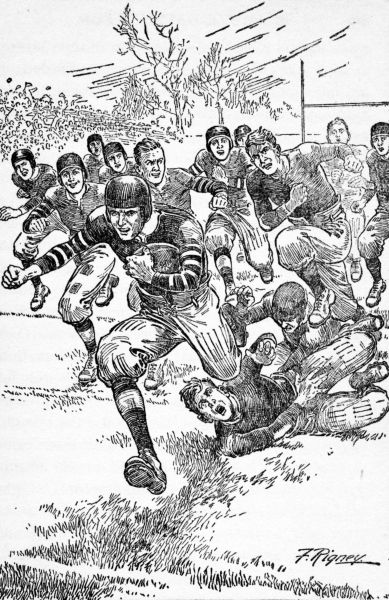
Two busy days followed for Dick. Stanley was
a great help, however, and getting settled into his
stride was accomplished fairly easily. There was
his adviser to see and his courses to arrange: he
was required to take seven courses, one of them
elective. For the latter he chose General History,
not so much because he felt a hankering for such
knowledge as the course afforded as because it
entailed but two recitations a week. You see, he
had to arrange so as not to have studies interfere
too much with football! However, there
seemed no danger of his not having enough school
work, for, with History, his grand total was
twenty-nine hours.
He passed his physical examination with flying
colours and on Wednesday set to work with the
football candidates. Of these there was a startling
number, he thought. The field that afternoon
was so thickly sprinkled with fellows of all sizes,
shapes and degrees of experience that there was
scarcely room to move about. Dick found himself
simply one of many, doomed to go through with the
usual routine of the beginner. At first he felt
somewhat impatient and even peeved, but presently
he decided to view the thing as a joke. They
would very soon see that he belonged in an advanced
squad, he thought, and meanwhile it
wouldn’t do him any harm to practice the kindergarten
stuff with the rookies.
The coach didn’t appear until Thursday, and
when he came, Dick didn’t altogether approve of
him. In the first place, Dick considered him too
old: he looked to be every day of thirty-four or
five. In the second place, Coach Driscoll lacked
the good-natured, free-and-easy manner that
Dick’s experience had associated with football instructors.
He wasn’t bad looking, and he had
very evidently kept himself in good physical trim,
but, being so old, he would, Dick decided, be
horribly behind the times and out-of-date. “Tod”
Driscoll was a Parkinson graduate and a Yale
man. At Yale, he had established an enviable
reputation as a football player. He had been
coaching at Parkinson for five years, Dick learned,
and with success, for in that time the Brown-and-White
had thrice triumphed over the Blue of Kenwood.
And he was popular in spite of the fact
that he was a very strict disciplinarian.
Dick found Captain Bob Peters more to his
liking. Peters was a homely, tow-haired, snub-nosed
chap built like a Greek athlete, with a smiling
countenance and a clear, creamy-brown skin
against which his grey-blue eyes looked startlingly
bright. He was cheerful and light-hearted and
yet could be very intense and very earnest on
occasions. He played at right end on the team.
Dick didn’t have any dealings with Captain Peters
at this period, however, for a youth named Warden
appeared to have control of his fortunes. Warden
was a dark-complexioned, earnest fellow who
never said an unnecessary word to the squad of
beginners over whom he had been placed, and who
worked very hard and conscientiously every
minute. Dick thought he took himself and his
duty a bit too seriously, but couldn’t help liking
and respecting him.
Dick was rather surprised at the extremely
earnest and business-like way in which football
practice was conducted. There was so much system
and everyone was so serious! Even the
manager and his hard-working assistant appeared
to have no thought in life beyond that of turning
out a successful football team. Billy Goode, the
trainer, alone seemed to be unaffected by the contagion
of effort. Billy even found time for a
laugh and a joke.
Naturally, Dick was especially interested in the
quarter-back candidates. He got one of the fellows
to point out Gus Stone to him, and was relieved
to find that Stone didn’t look very wonderful. He
was rather short and perhaps a bit heavier than
the position demanded, although doubtless a week
of work would remove some of the weight. There
was also Cardin, a slighter and younger boy who
had played the position on the Second Team last
year. And there were a dozen others, Dick
amongst them, who had declared their preference
for the quarter-back job.
He saw Wallace Blashington now and then on
the field or in the gymnasium, and Blash always
spoke, but there was no further meeting until
the following Saturday. By that time Dick had
settled down into the routine of school life, and had
decided that he was going to like Parkinson immensely
and Stanley Gard even more. Dick had
grown rather used to having other fellows wait
on him, run his errands and make life easy for him
in general. He had never consciously asked such
service, but had received it as a tribute to popularity.
But he was not getting it now. If he had
expected Stanley to wait on him—and he didn’t
know whether he had or not, but probably had!—he
was doomed to disappointment. Stanley was
the best-hearted chap in the world, but if one of
Dick’s shoes had got away from him and taken up
a temporary abode under Stanley’s bed, it was
Dick who fished it out. Only once had Dick asked
a service. Then, seated at his study desk, he had
lightly suggested that Stanley should hand him a
book that was lying on the radiator top near the
window. Stanley was seated in a chair somewhat
nearer the radiator than Dick, but there was no
sound of movement and after a second Dick looked
around inquiringly. Stanley was still seated and
there was a quizzical grin on his countenance.
After a somewhat blank stare, Dick arose and got
the book. As he sat down again he said sarcastically:
“Much obliged, Stan.”
Stanley chuckled. “Dick, you’ve been sort of
spoiled, haven’t you?” he said.
“Spoiled? What do you mean? Just because I
asked you——”
“You’re one of those fellows who expect others
to do things for ’em, and get away with it.
Wish I knew the secret. But it isn’t good for you,
Dick. You must learn to run your own errands,
and whitewash your own fences. Any time you
break a leg, I’ll fetch and carry for you, but while
you’re able to get about—nothing doing! In fact,
seeing that I’m an older resident of this place, I’m
not certain you shouldn’t be fagging for me!”
“Oh, go to the dickens,” muttered Dick. “You
make me tired.” Then, after a moment, he added:
“Maybe that was cheeky, Stan. I’m sorry. Guess
I’ve had it too easy.”
“That’s all right, son. It’s just as well to
know where we stand, though. Any other little
thing I can do for you?”
“Yes, you can close your silly mouth,” was the
answer.
By Saturday Dick felt almost like an old boy.
His courses promised to be only mildly difficult,
and the instructors seemed a very decent lot,
notably “Old Addicks” who knew so much of
ancient languages that he looked like an elderly,
benignant Greek philosopher, and Mr. McCreedy,
who taught mathematics. Through Stanley he met
a great many of the fellows, and he picked up a few
acquaintances himself. Of these latter, one was
“Rusty” Crozier. He was a Fourth Class fellow
who preferred to live in the town, and occupied
two comfortable rooms in a house on Maple Street,
just below the school. He was a jolly, light-hearted
chap with a perpetual smile and hair of that peculiar
shade of red that we associate with rusted
iron: hence his nick-name. Dick met him in classroom.
“Rusty” borrowed Dick’s fountain pen
for a minute. After class they came together
in the corridor and walked a little way along The
Front. That began it. When Dick asked Stanley
if he knew Crozier, Stanley nodded.
“Everyone knows Rusty,” he said. “But if
you want to tread the straight and narrow, Dick,
keep away from him.”
“What do you mean? Isn’t he—all right?”
“Oh, yes, Rusty’s all right. That is, there’s
nothing vicious about him. In fact, he’s a very
decent, very clean fellow. But he’s gifted with a
talent for discovering trouble. And a talent for
squirming out of it! If he wasn’t he’d have left
Parkinson long ago. I’d say that Rusty’s trouble
was an over-developed sense of humor.”
“I rather liked him,” mused Dick.
“You would. So do I. Everyone likes Rusty.
But wise guys say him nay when he suggests one
of his innocent amusements. It was Rusty who
closed traffic on Main Street in the middle of a
busy Saturday one day last year, only faculty
doesn’t know it.”
“Did what?” asked Dick.
“He borrowed two carpenter’s horses and a
sign and placed ’em across the middle of Main
Street, near School, about one o’clock one day
last spring. He found the sign somewhere, I don’t
know where. It said ‘Street Closed by Order of
Selectmen.’ Then he went over and stood in
Wiley’s drug store and watched the fun. It was
almost an hour before they discovered that it was
a hoax. The paper was full of it, and the selectmen
made an awful rumpus, but everyone else
thought it was a pretty good joke.”
“And he wasn’t found out!”
“No. At least a score of people must have
seen him set the barrier up, but no two of them
agreed as to what he looked like. Some said he
was a labourer in blue overalls, and others said
he was a tall man with whiskers, and so on. That’s
just one of Rusty’s innocent ways of amusing himself.”
“But doesn’t he ever get caught?” asked Dick
incredulously.
“Oh, yes, heaps of times, but he always manages
somehow to show that he was actuated by good intentions
or that circumstances worked against him.
Like the time he dropped the parlour match heads
all over the floor in Room G and every time anyone
put his foot down, one of the things went pop!
He showed Jud the hole in his pocket where the
things had fallen out. If it hadn’t been for the
hole, he claimed, it wouldn’t have happened. He
got off with a month’s probation, I think.”
Dick laughed. “He must be a cut-up! Well,
I’ll keep away from him when he feels frolicsome.”
“Trouble is,” said Stanley, “you never can
tell when Rusty is going to spring something.”
He smiled and then chuckled. “Three or four of
us walked over to Princeville two years ago to the
circus. It was one of those little one-ring affairs,
you know, with a mangey camel, and a moth-eaten
lion and a troop of trained dogs. It was rather
fun. Rusty was one of us, and he was as quiet as
a mouse until near the end. Then he began flicking
peanuts at the ring master. We tried to stop
him, but he wouldn’t quit. Every time the ring
master turned his back, Rusty would land a peanut
on him, and the crowd got to laughing and gave it
away. So they hustled us all out, and we didn’t
see the performing dogs. Has he asked you over
to his room at Spooner’s?”
“Yes,” said Dick, suspiciously. “Is there any
trick in that?”
“Oh, no,” answered Stanley, smilingly. “He
has very jolly quarters. If you like we’ll go over
together some evening.”
“All right. Only I don’t like that catfish grin
of yours. I suppose he has a trick staircase that
folds up and lets you down in a heap or something?”
“No. Rusty’s fun is pretty harmless. We’ll
wander over there tonight if you like.”
“Well, but I’m going to keep my eyes open just
the same,” Dick laughed “You’re too anxious
to go along, Stan!”
That afternoon Dick found a letter in the rack
downstairs. It bore the Warne postmark, and was
addressed to him in a very dashing hand: “Richard
C. Bates, Esq., Sohmer Hall, Parkinson
School, Town.” Wondering, Dick opened the
envelope. Within was an oblong of pasteboard
punched with three holes of varying sizes. In one
of the holes was an ancient looking cent so badly
corroded that it was hard to read the lettering.
Dick’s thoughts naturally fell on Rusty Crozier,
although what the joke meant, he couldn’t make
out. But he smiled and dropped the coin in a
waistcoat pocket, and presently forgot about it.
Returning from football practice at five, however,
he found another missive awaiting him. The
envelope was different and the writing different,
but there was just such another coin-card within
and in the card was a second penny. This one
was bright enough, but it had been badly bent.
Dick, puzzled, added the second coin to the first,
resolved to find out the meaning of the prank that
evening.
He and Stanley went across the campus and
down Maple Street about eight. Spooner’s was a
large, square house standing almost flush with the
sidewalk. Like many of the residences thereabouts,
its upper floors were tenanted by students
unable or disinclined to secure rooms on the campus.
Stanley pulled open a squeaky screen door
and entered. At the foot of the staircase, he
paused and lifted his voice.
“Oh, Rusty!” he shouted. “Rusty-y-y!”
Somewhere above a door opened and a voice
answered.
“A-a-ay! Come up!”
Stanley led the way again up two flights, and
then to a door at the front of the house. Oddly
enough, it was closed tightly, which fact, since it
had been opened a moment before, struck Dick
as peculiar. Stanley knocked and a voice called
“Come in!” Somehow Stanley managed to get
behind Dick, and it was Dick who turned the knob
and pressed the door inward. The next instant he
was precipitated into a glare of light. The knob
had jerked itself out of his hand, and something—he
supposed at the moment the something to have
been Stanley—had banged against his heels and
pushed him violently into the room. He stopped
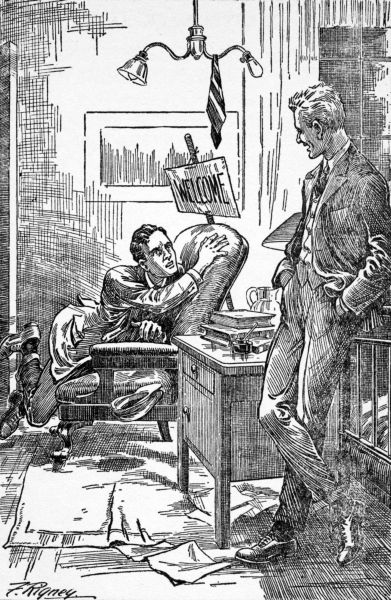
to find himself asprawl over an armchair with a
placard bearing the word WELCOME a few
inches from his nose.
“Good evening,” said Rusty amiably from
across the room.
“Hello,” gasped Dick. Then he looked back
at the door for Stanley. Stanley was not there.
But at the instant the door opened again and
Stanley appeared. He was grinning broadly, but
Dick was too much interested in the door to see
it. The door was not opening like any door Dick
had ever seen. In the first place it was turning
on pivots at top and bottom, half of it coming in,
and half of it going out, so that the aperture for
entrance was scarcely wider than Stanley. In the
second place, Stanley was holding hard to that
knob and being fairly dragged through, for above
the sill and below the lintel was a coiled spring
that, so soon as the knob was turned, swung the
door swiftly on its axis from left to right. Dick
stared in surprise.
“Just a little idea of my own, Bates,” said
Rusty, coming forward and removing the placard
from the back of the chair to a place on the wall.
“Have a chair.”
Dick looked from the proffered chair to Rusty
and then to Stanley and shook his head. “No,
thanks,” he muttered. “I’ll stand!”
However, Stanley assured him on oath that the
chair was quite safe and wouldn’t double up under
him and he consented to try it, although not without
anxiety. But he was up again a moment
later, demanding to be shown the working of the
amazing door.
“Quite simple,” laughed Rusty. “First I
unlock it, thus. Then I stand clear of it. Then the
unsuspecting visitor outside turns the knob.” He
turned it from the inside, stepping quickly out
of the way, and the door leaped open, swung once
around and stopped as the latch snapped again
into its socket. “That’s all there is to it. I place
the cushioned chair here to receive the caller and
place the ‘Welcome’ sign where he will be sure to
see it. Most all the fellows know about it now,
though, and I have to rely on newcomers like you,
Bates, for a bit of fun.” He locked the portal
again.
“Well, but—but suppose you want to go out?”
asked Dick.
“I go out the other door.” Rusty indicated
the adjoining bedroom. “In fact,” he added with
a twinkle, “I seldom use this entrance myself. I
keep it locked until I am expecting a distinguished
visitor.”
“Still, I don’t see how you knew I was with
Stan,” Dick objected.
“You’ll have to ask Stan about that,” laughed
Rusty.
“I told him,” explained Stanley, grinning.
“Oh! Then that’s why you were so anxious to
come with me.” Dick fixed his room-mate with an
accusing eye. “All right. I’ll get even with you,
old son, if it takes my last—if it takes my last two
pennies!” He looked quickly at Rusty, but there
was nothing to show that the latter had grasped the
allusion. “Maybe,” continued Dick, “you’d like
to see them.” He fished the two cents from his
pocket and held them forth. Stanley viewed them
interestedly and so did Rusty.
“What’s the idea?” asked the former. “Do
you mean that you’re down to those? Stony broke,
Dick?”
Rusty’s innocent, uncomprehending expression
remained and Dick began to think his suspicions
wrong. “No, those are just—just pocket-pieces,”
he answered flatly.
“Wouldn’t be very useful to you in a pinch,”
observed his host. “Well, find seats, fellows.
Hope you didn’t mind the reception, Bates. But
I guess you didn’t. You look like a fellow who
can take a joke.”
“No, I didn’t mind,” said Dick. “Guess I was
too surprised to mind!” He looked about the
room. “This is pretty comfortable, Crozier.”
“Not bad. I’ve had these rooms ever since my
first year. Got two nice windows in front and one
on the side there, and two more in the bedroom.
Mrs. Spooner is a corking old soul, and doesn’t
mind a bit of noise now and then.”
Stanley chuckled, and when Dick looked across
inquiringly he explained. “Mrs. Spooner’s as
deaf as a haddock, Dick. If she wasn’t she
couldn’t live in the same house with Rusty!”
“Run away! I’m not noisy. Sometimes my
guests are, but I do all I can to restrain them.
Haynes gives me more trouble than Mrs. S. He
has the room under this on the floor below, Bates,
and insists on studying at the times I feel playful.
There are four other fellows in the house and
you couldn’t pry any of us loose. You chaps can
have your dormitory rooms. I don’t want them,
thanks.”
“Do you take your meals here?” Dick inquired.
“No, Mrs. S. doesn’t give meals. She used to,
but that was before my time. I eat around.
Usually at ‘The Eggery.’ Sometimes at Thacher’s.
Stan says you’re out for the football team.
Going to make it all right?”
“I don’t know, I’m sure. I’m going to try to.
Do you—are you——”
“No, I’m not athletic, Bates. My favourite
sport is mumblepeg. Besides, my studies prevent.
Oh, shut up, Stan! Let me make a good impression
on Bates, can’t you? What time is it,
anyway? Look here, let’s go to the movies. What
do you say?”
“Not for me,” answered Stanley. “I’ve got
to beat it back and do some work tonight. Besides,
the last time——”
“Oh, that!” laughed Rusty. “Wasn’t it silly?
Such a fuss about so little, eh?”
“Oh, yes, very little!” Stanley turned to Dick.
“He and Blash stretched a rope across the aisle
and tied it to the arms of the seats ahead of them.
Being fairly dark, some confusion ensued!”
“During which, if I remember correctly, you
and Joe and Blash sneaked out. Just shows what
a guilty conscience will do, Bates. I remained,
secure in my innocence, and saw the show
through.”
“Yes, you rotter!” said Stan indignantly.
“You put the blame on us, and every time I
go there now the doorman looks at me unkindly.”
“Well, you were out of the way and I wasn’t.
Besides, I wanted to see the rest of the picture.”
“Rusty, if you got your deserts,” said Stanley,
feelingly, “you’d be shot at sunrise. Well,
I must beat it. Coming along, Dick?”
Dick went, in spite of Rusty’s pleas. They left
by way of the bedroom and Dick watched the hall
door very, very carefully. It proved to be a perfectly
normal door, however. Rusty told Dick to
call again and held conversation with them over
the banister until they had reached the street door,
while from a second floor room came howls of
“Shut up, Rusty! Shu-u-ut u-u-up!”
“It’s only Haynes,” called Rusty reassuringly.
“Don’t mind the poor fish. Come again, fellows!
Good night!”
In the letter rack in Sohmer was another envelope
addressed to Dick and within was a third
penny.