As we have seen, the commencement of the eighteenth
century was marked by great activity in the
pyrotechnic art.
Firework displays were looked upon as a necessary item
in the programme of a place of public entertainment. So
ambitious did these displays become, owing to keen rivalry
existing between the various resorts, that any official display
in celebration of peace or like event must of necessity be on a
scale of unexampled lavishness.
No official display of note appears to have been given in
London during the first thirteen years of the nineteenth
century, or indeed since the Aix-la-Chapelle peace display.
The reason may have been the public outcry on the score of
waste on that occasion.
They were totally prohibited at the coronation of George
III, and at his jubilee in 1809 there were apparently no
firework displays in London, although more than forty towns
about the country celebrated the event pyrotechnically, and
a fine display was given from the Fleet at the Nore.
The largest public firework exhibition on this occasion
was that given at Bombay, where the celebration took place
earlier in the year, the date selected being June 4th, the King’s
birthday, instead of October 25th, the actual anniversary of
his accession.
The Peace of 1802, although no official display was given,
was the occasion of much private pyrotechnic enterprise, the
fireworks and illuminations in London lasting nearly a week.
The Peace of 1814 was signalised in London by several
displays: the 1st of August was chosen for the Peace Celebration,
it being the centenary of the accession of the House
of Brunswick, and also the anniversary of the Battle of the
Nile.
The display in Hyde Park commenced with a naval engagement
on the Serpentine between model warships representing
the English and the combined French and American
Fleets. This item, which lasted three hours, was followed by
a display of water fireworks. The display in Green Park
commenced at ten o’clock, one of the chief items being the
“grand metamorphosis of the Castle into the Temple of
Concord.” This change, says a writer in “The Times” of the
period, “was made with somewhat less celerity than those
witnessed in our theatrical pantomimes. It resembled rather
the cautious removal of a screen than the sudden leap into a
new shape. When fully developed, however, it presented a
spectacle which excited general approbation.”
The Temple of Concord was an elaborate structure
illuminated with coloured lamps, and decorated with gilding,
festoons, etc., and transparent paintings. It was designed by
Smirke, the paintings being by Stodard, Howard, Hilton,
and others, and represented such subjects as “The Golden
Age,” and “Peace restored to Earth.”
Charles Lamb, in a letter to William Wordsworth, dated
August 9th, 1814, after describing the havoc wrought in the
park by the crowds and booths, remarks that: “After all
the fireworks were splendent—the Rockets in clusters, in
trees and all shapes, spreading about like young stars in the
making floundering about in space (like unbroke horses) till
some of Newton’s calculations should fix them, but then they
went out. Anyone who could see ’em and the still finer
showers of gloomy rain fire that fell sulkily and angrily from
’em, and could go to bed without dreaming of the Last Day,
must be as hardened an Atheist as ****.”
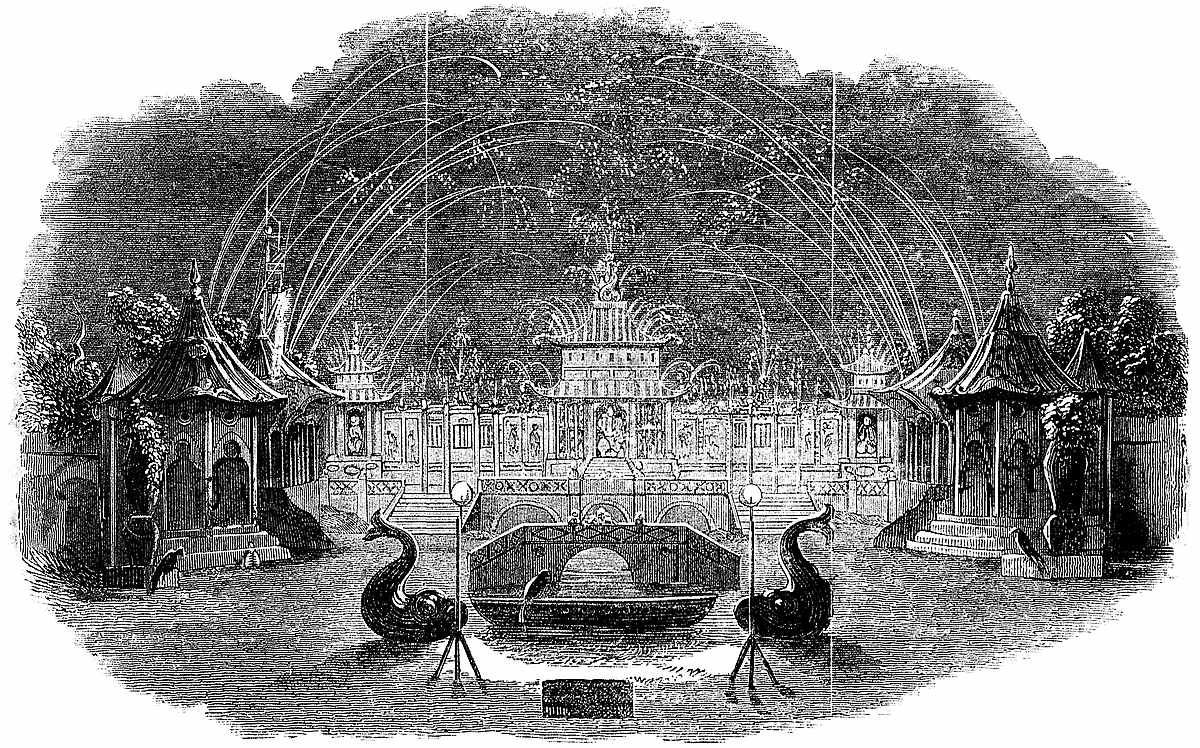
St. James’s Park was reserved for those who paid for
admission. The trees were illuminated with lamps, and a
Chinese bridge, which had been erected over the lake, was
similarly treated. The use of gas on this structure must be
one of the earliest occasions of its being employed for outdoor
illuminations of this nature. Neither can the result be
considered altogether successful, as the building caught fire
towards the end of the firework display, and a lamplighter,
who appears to have been caught by the flames in an attempt
to throw himself into the water, was killed. Other men similarly
employed were also severely burned. These men, evidently
through ignorance, had started lighting the lower lamps first,
working upwards on the structure, until they found themselves
in a position of intolerable heat with no means of
descending.
The pyrotechnic display consisted chiefly of aerial fireworks
with gerbs, roman candles, fountains, and wheels;
there do not appear to have been many devices of any size.
“The Times” reporter complains that “the repetition of these
things, with occasional pauses, for more than two hours became
tedious to all.”
The coronation of George IV, in 1821, was celebrated
by a display in Hyde Park, including land and water fireworks,
superintended by Congreve. The displays on the
coronation of William IV, in 1831, were directed by Congreve’s
successor, Sir Augustus Frazer, but appear to have
been of an insignificant character.
Queen Victoria’s coronation was celebrated by displays
in Hyde Park and Green Park, conducted by Southby and
D’Ernst, which exhibitions included a Temple on similar
lines to that of 1814.
In France, during the first few years of the nineteenth
century, there were many pyrotechnic displays of importance.
Napoleon is credited with being extremely partial to such
exhibitions. Displays took place in Paris in the Champs
Elysées, at the barriere Chaillot, before Les Invalides in 1801
to celebrate the foundation of the Republic, and in the following
year in honour of Napoleon’s arrival in that city.
Major-General Lord Blayney, who was captured by
Napoleon’s troops in the Peninsula in 1810, travelled on
parole across Spain and France on his way to Verdun. His
somewhat leisurely journey of nearly six months enabled
him to witness many celebrations of French victories in the
towns through which he passed. He records having seen
fireworks and illuminations among other places at Malaga
and Orleans.
In 1804 a display was given by Napoleon before the Hotel
de Ville, Paris, on his assumption of the title of Emperor of
the French. The scenery provided for this display took the
form of a representation of Mount St. Bernard, with a figure
symbolising Napoleon mounted on a charger on the summit.
This display was repeated in 1810 on the occasion of his
marriage with Marie Louise; this time, however, the topmost
feature was the Temple of Hymen, with figures of
Napoleon and his bride.
Other displays were given on the bridge of Louis XVI,
which appears to have been a popular position for such exhibitions,
in 1800, 1804, 1806, 1820, and 1821. Another site
frequently used for displays was the garden of the Senate,
where Ruggieri fired displays in the years 1801, 1806 (twice),
and 1807.
Fireworks continued to be a national institution in France,
irrespective of the form of government. Louis Napoleon, like
his uncle, being fond of fireworks, or it may be, considering
them a good means of gaining popularity, made any public
event an excuse for pyrotechnic displays. Notable occasions
were the Military Fetes, 1852, the Fete of the Emperor,
1853, the visit of Queen Victoria to the Paris Exhibition of
1855, in honour of which a most elaborate display was given
at Versailles, the Baptismal Fetes in 1856, the triumphal
entry and the Emperor’s birthday, 1859, and the visit of the
King Consort of Spain in 1864.
The Entente Cordiale movement in 1868 was responsible
for displays in the Fleets on both sides of the Channel, those
in France taking place in Cherbourg, those in England at
Spithead.
A previous event which had been celebrated pyrotechnically
on a large scale in both countries was the Peace Rejoicing
at the conclusion of the Crimean War.
This occasion was marked in London by four displays of
fireworks on a scale hitherto unprecedented. The sites chosen
were Hyde Park, Green Park, Primrose Hill, and Victoria
Park. They were arranged thus with the very sensible idea
of splitting the crowds of sightseers into sections and thus
preventing dangerous crowding to one spot. The fireworks
were prepared for these displays in Woolwich Arsenal, under
the direction of Mr. Southby, the pyrotechnist of the Surrey
Gardens, who went there for this event.
The programmes of these displays were precisely similar,
with the exception of that at Primrose Hill, which consisted
mainly of aerial fireworks.
Tyrrell, in his “History of the War with Russia,” gives
the following account of the display in Green Park: “At
the appointed signal there was a continuous discharge of
maroons, accompanied by brilliant illuminations with white,
red, green, and yellow fires.... Then for two hours followed
every conceivable design of elegant and dazzling pyrotechnic
art. Flights of rockets a hundred at a time; revolving wheels,
sun star and golden streamers, and fiery serpents chasing
each other through the air. Gerbs, Roman candles, tourbillions,
shells, and fixed pieces of the most fantastic designs and
brilliant hues. The eyes were dazzled by the intensity of the
light.... It was strange to believe that so fierce and ungovernable
an element as fire could be rendered so delicately
obedient to the will of man.... The triumph, however, of
the entertainment was reserved for the close of it. This was
a tremendous bombardment, during which the air was constantly
filled with flights of rockets, and was intended as a
representation of the last grand attack upon Sebastopol—the
blowing up of the magazines and works, and general conflagration.
“As an introduction to this there were five fixed pieces, all
of complicated construction, the centre being an enormous
one which, amid all its fantastic blazing and revolving, exhibited
the words ‘God Save the Queen.’ Language fails to
convey a vivid idea of the deafening, roaring, crashing and
grand appearance of the termination, during which the proud
fortifications of Sebastopol were supposed to succumb. Then
rose up into the blackness, rapidly one after another, six
flights of rockets, comprising altogether no less than ten
thousand of these beautiful and brilliant instruments.... It
was such a spectacle as man could not reasonably expect to
witness more than once in a lifetime.”
This account appears to be somewhat highly coloured,
as the official programme makes no reference to the fall of
Sebastopol, but it is evident from it that the writer was greatly
impressed with the display, and contemporary prints indicate
that he was voicing popular opinion.
It is worthy of note that these celebrations were the first
occasion of the kind in which the exhibitions consisted of
veritable fireworks without extraneous matter in the form of
scenery and buildings. This may account for the fact that
there was, on this occasion, considerably less of the usual
outcry against the “waste” involved. It is curious that on
occasions of this kind there are always to be found certain
damp spirits who begin a clamour against the expenditure of
money on fireworks which might be applied to other objects.
The Aix-la-Chapelle display excited these gentlemen to a
great pitch, probably on account of the elaborate nature of
the preparations, which, as we have already seen, occupied
over five months, thus providing them with plenty of time to
develop their theme, or an object lesson to prove their statements.
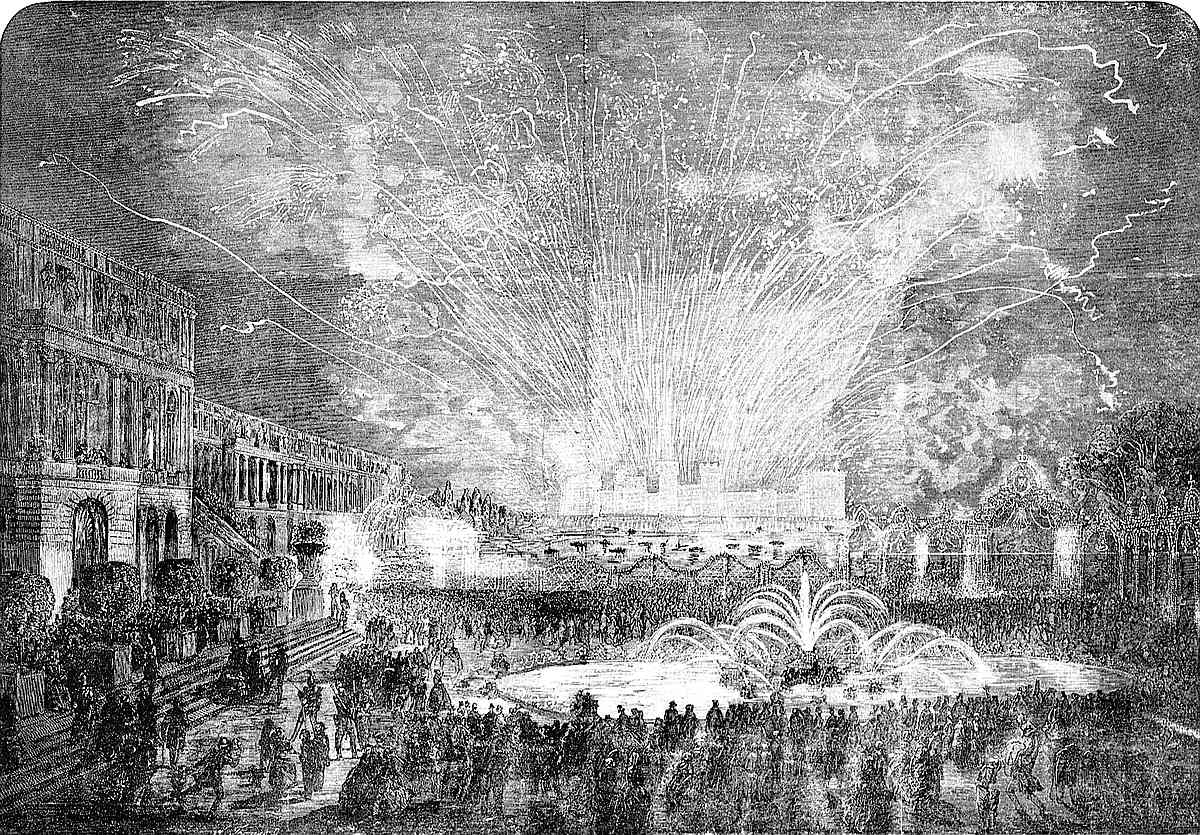
Queen Victoria’s Visit to France, 1855. The Fireworks at Versailles. From a drawing by Gustav Doré
in “The Illustrated London News.”
Where, however, the display consists—as on the occasion
under consideration—solely of fireworks proper, a few days’
preparation on the actual site is usually sufficient; the kill-joy
has less time to spread himself. It may be mentioned his
season is over with the display; generally the British public,
having enjoyed itself, turns a deaf ear to those who would
convince it that it ought not to have done so.
Other displays took place in various parts of the kingdom:
in Edinburgh on Arthur’s Seat, at Portsmouth on the Fleet,
to mention two only.
An interesting event which took place on the 25th August
was the entertainment of 2,000 men of the Guards at the
Surrey Gardens. This resort was at the time the home of
British pyrotechny, the displays being conducted by Southby,
who, as we have said, went into Woolwich Arsenal to assist
in the production of the fireworks for the official displays.
The amusements of the day concluded with an exhibition of
fireworks.
A further event connected with the foregoing celebration
was the festivities in Moscow on the occasion of the coronation
of the Emperor Alexander II, which concluded with a
pyrotechnic display.
From this time until the end of the century the history of
pyrotechny in this country is practically the history of pyrotechny
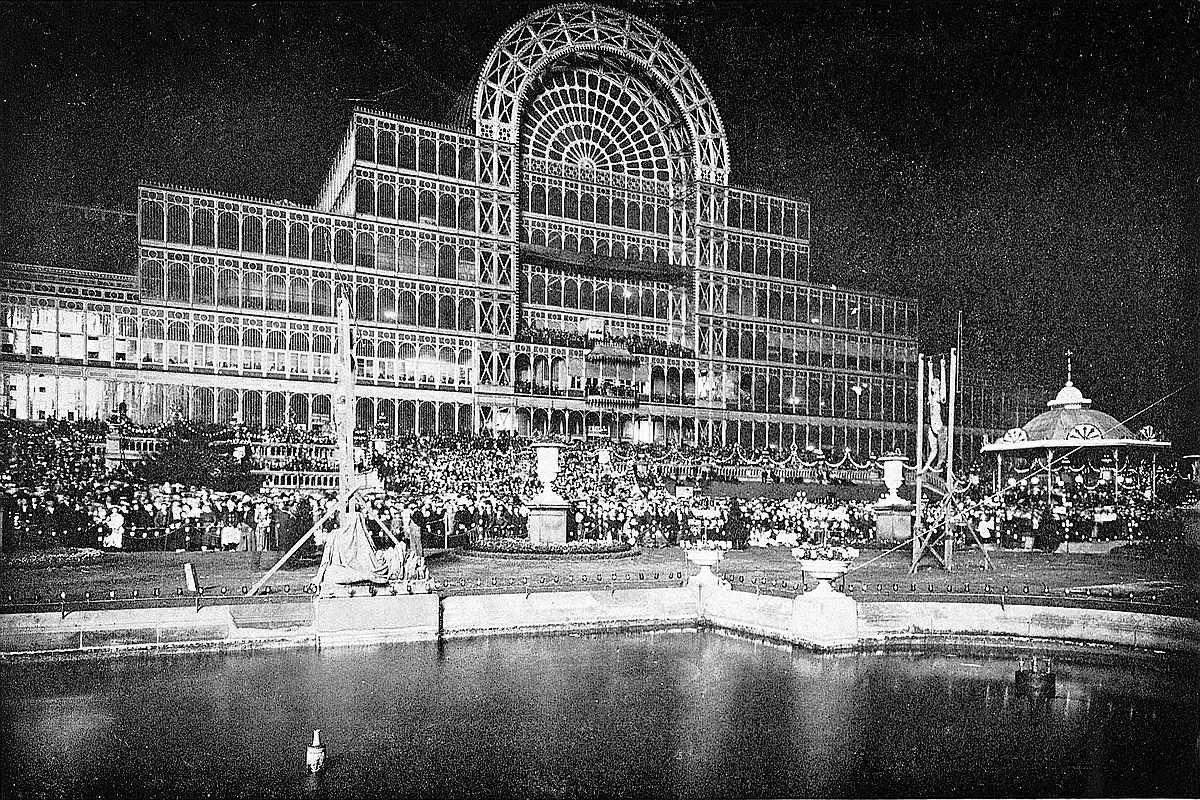
at the Crystal Palace; it has been the Crystal Palace
displays which have set the pace, as it were, to pyrotechnists
in this country, and has provided the spur which has placed
British pyrotechnists not only ahead but markedly ahead of
their competitors in other countries.
The Crystal Palace displays became a national institution,
and any public event worthy of such recognition was accorded
a pyrotechnic celebration there on a scale hitherto unattempted.
The credit for the original introduction of fireworks at
the Crystal Palace must belong to the late C. T. Brock, who
succeeded in inducing the Directors to institute a competition
among pyrotechnists in 1865. It may be interesting to give in
his own words an account of the matter, taken from an article
written by him some few years later:
“It occurred to me that of all the places of public resort
suitable for the inauguration of a new era for pyrotechny,
none offered such glorious advantages as the Crystal Palace,
then at the height of its popularity. Its terraces, fountains
and foliage offered unrivalled advantages for the display of
grand effects. The Directors of the Crystal Palace Company,
who had more than once been applied to for permission
to hold displays in the grounds, feared that, inasmuch
as fireworks had been recently associated solely with
gardens of the Cremorne class, the Palace itself would be
degraded to the same rank if consent were granted. I urged
that the Exhibition of 1862 had afforded no opportunity for
competition among firework makers—necessarily excluded
by the nature of their trade—although almost every other
branch of manufactures were embraced, that such a contest
might with reason and advantage be held at Sydenham, and
that fireworks were really not of an immoral tendency. I
further agreed that in the event of the result being unfavourable,
either financially or from a social point of view, no
second display need take place, but if, as I felt confident,
there should be a large attendance of the better classes, then
other exhibitions might follow. The Directors, after many
months of delay, consented to make the experiment, and
the favourable result of the trial on July 12th, 1865, far
exceeded my most sanguine expectations.
“The result was an unlooked-for success, 20,000 people
being present on the occasion. Three more displays took
place that year upon a small scale, but always with successful
results.
“The first display was produced jointly by my father and
Mr. Southby, the winner of the first prize, and continued
to the end of that season by my father alone under my
management.
“The success of fireworks at the Crystal Palace having
become an accomplished fact, I built extensive works at
Nunhead, and commenced manufacturing on a scale never
previously dreamt of in the trade—the vast expanse of the
locale of my displays obviously necessitating extraordinary
expenditure of material.
“By degrees the set pieces grew from twelve feet in
diameter to 300 feet. Shells for which the Crystal Palace
has been renowned grew to one hundred times more than
the ordinary shells of my early days, and thousands of
pounds weight of material was gradually introduced to
increase the effectiveness of these displays.”
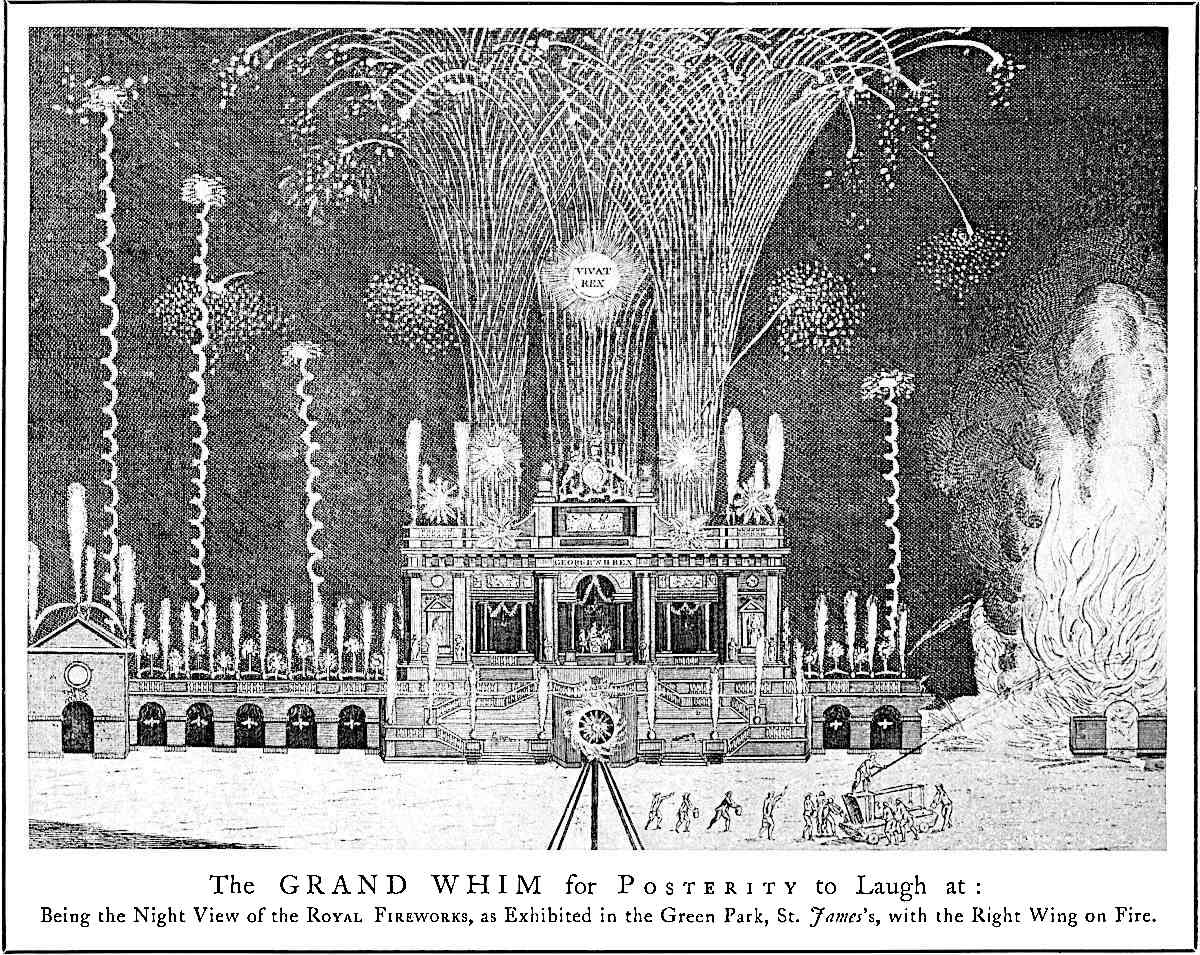
“The GRAND WHIM for Posterity to Laugh at:
Being the Night View of the Royal Fireworks, as Exhibited in the Green Park, St. James’s,
with the Right Wing on Fire.”
Firework Display in the Green Park to celebrate the Peace of Aix-la-Chapelle, 1749.
The Crystal Palace displays carried out by C. T. Brock
and his brother, Arthur Brock, who succeeded him in the
business on March 25th, 1881, have since become proverbial.
They continued up to 1910, when the Crystal Palace was
taken over by the promoters of the Pageant of Empire. They
have been revived in 1920, when the War Museum was opened,
and the attendance has proved that the public taste for fireworks
is very far from diminishing.
During the run of forty-five consecutive years an installation
was built up, method and technique were evolved
unknown in any other place of pyrotechnic exhibition.
While the firework terrace, with its magnificent background
of park and shrubberies, is unrivalled as a firing
ground, it is at the same time the most exacting. The huge
building, its imposing position and setting, the wonderful
fountains, all demand pyrotechnic effects on a corresponding
scale.
The pictorial set pieces, originally introduced by C. T.
Brock in 1875, increased in size until a plant was arrived
at capable of exhibiting a picture ninety feet high and two
hundred feet long on the main girder, which length could
be extended to even six hundred feet of frontage, as on the
occasion of the exhibition of a battle piece or similar subject.
During this period the subjects dealt with in the main set
pieces have covered a wide range. A favourite subject, and
one lending itself particularly well to pyrotechnic production,
is the sea battle. Almost every historic naval engagement of
sufficient size to warrant its adoption has been proved the
subject for a fire picture.
Among the battle pictures produced are the following:—Bombardment
of Alexandria in 1882, Siege of Gibraltar in
1883, Battle of Trafalgar in 1884; during 1885, two pictures
representing the use of the ironclads of the period and based
on the Naval manœuvres, entitled the “Attack on Dover,”
and the Battle of Bantry Bay; the following year another
imaginary picture depicting an attack by torpedo boats on the
latest battleship, the “Colossus.” The Bombardment of
Sebastopol was reproduced in 1887, followed by the Jubilee
Naval Review at Spithead. In 1888 the defeat of the Spanish
Armada was depicted; in 1890 Trafalgar, followed in 1891
by the engagement between the “Chesapeake” and the
“Shannon,” together with a portrait of Admiral Sir Provo
Wallis, then aged one hundred, and another from an early
painting showing him at the time of the engagement when
the command of the English vessel devolved upon him owing
to the casualties among the senior officers. Later in that year
the Battle of the Nile was reproduced; 1893 saw the Bombardment
of Canton; 1894 the Battle of the First of June,
and the Battle of the Yalu. The Battle of Manilla Bay was
produced in 1898, and on the centenary date the Battle of the
Nile. In 1889, H.M.S. “Implacable” was shown in action
on the day on which she was commissioned, followed in 1900
by the Bombardment of the Taku Forts, and in 1901 by the
immortal sea fight between the “Revenge” and the “Fifty-three.”
In 1904 the Russo-Japanese War gave subjects in the
various attacks on Port Arthur and the Battle of Tsu-Shima,
and the Battle of the Sea of Japan in the year following. The
Battle of Trafalgar was renewed that season, and in 1908
another imaginary picture portraying modern naval warfare
was produced, followed in 1909 by an imaginary encounter
between the first Dreadnought and other craft.
The revival of the Crystal Palace displays in 1920 saw the
reproduction of the Battle of Jutland, of which the following
appreciation appeared in the Press:
“The chief set piece in the programme is a Fire Picture
of the Battle of Jutland, the most realistic spectacle ever
produced in fire; by ingenious devices the guns fire, shells
burst in all directions, gaping holes appear in the sides and
upper works of the ships engaged, until—when the din of
battle has reached its height—the German cruiser ‘Lutzow’
blows up and sinks. One realises that here at least is
one pictorial subject in which the Cinematograph is hopelessly
outdone; the variety of noises, varying from the sharp
bark of quick-firers to the boom of the heavy guns, which
are here so wonderfully reproduced, are quite inadequately
rendered by the conventional thumps on the big drum in
the orchestra.”
Before the resources of lance-work were fully understood,
the reproduction of famous buildings was a fruitful source of
subjects; those reproduced vary from the Crystal Palace itself
to Worcester and Salisbury Cathedrals, and from the Arc de
Triomphe to the Mosque at Delhi.
Natural catastrophes such as the Avalanche, the Eruption
of Vesuvius, and the Destruction of Pompeii have been
portrayed. The Wreck of the Eider in 1892, with the rescue
of the passengers by the lifeboats, formed the subject of a
popular set piece; another successful scenic showed a wreck
with line-throwing rockets and transport of passengers by
the breeches buoy.
In 1879 portraits in fire were reproduced for the first
time, and since that date those executed have included almost
all the Royal Personages of the day, many of which have been
fired electrically from the Royal Box by the originals. Other
eminent people reproduced range from King Cetewayo in
1882, the Maori King in 1884, Li-Hung-Chang in 1896, to
Douglas Fairbanks and Mary Pickford in 1920.
In 1887 what is known as the transformation set piece was
introduced. Upon lighting, the piece exhibits a floral design in
colours, which, after burning some time, becomes transformed
into a portrait, the lines of which are worked inconspicuously
with those of the floral design, and, to use a modern term, camouflaged
by its colours, the colour of the portrait being white.
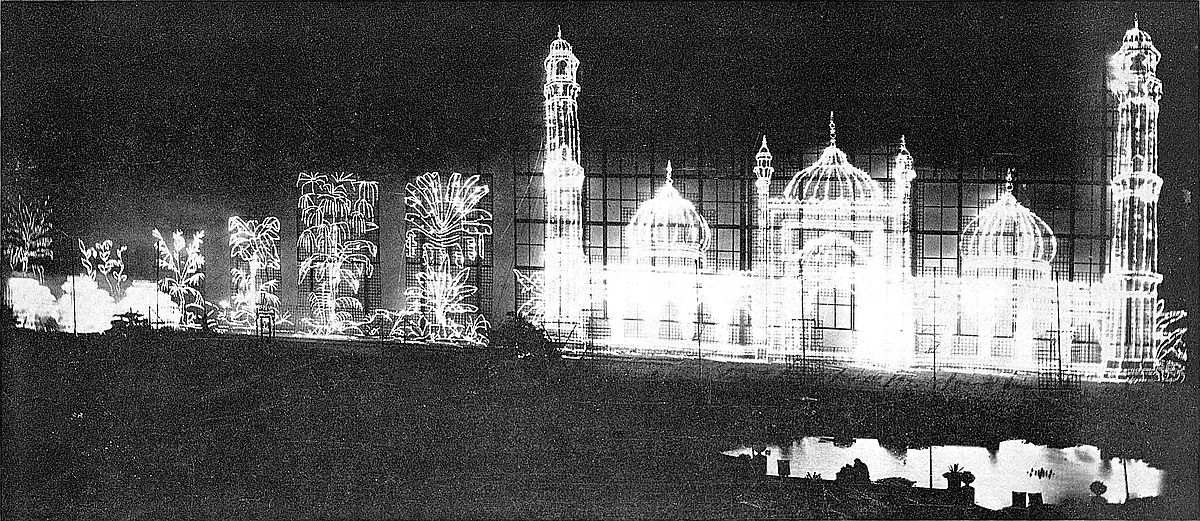
A full-size picture of the Jumma Musjid in Fireworks at the Crystal Palace, 1892.
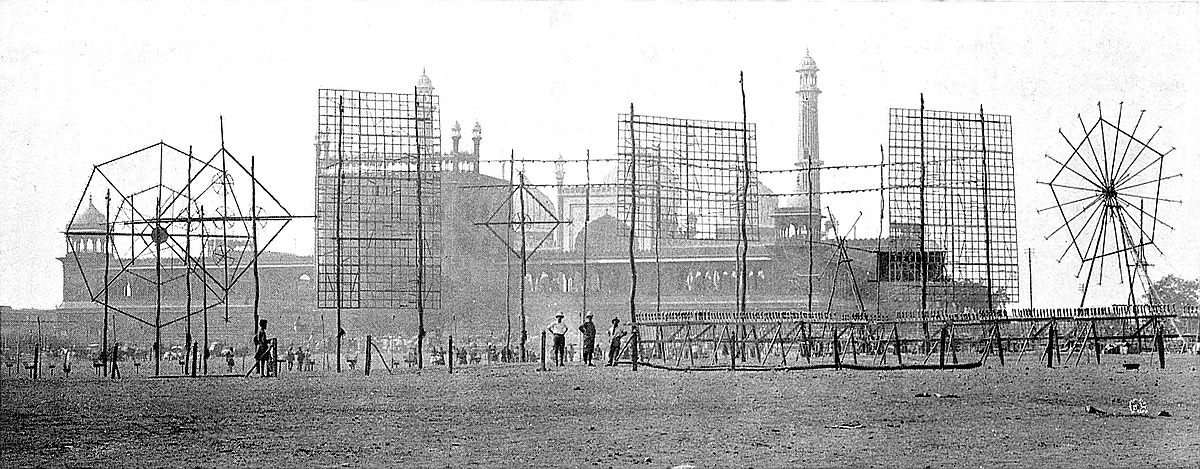
Firework Display for the Coronation Durbar at Delhi, January 3rd, 1903. In the background is the Jumma Musjid.
The first portrait to be so shown was Lord Beaconsfield,
the floral design being of primroses, and the occasion Primrose
Day. This, for the first example of its kind, was very
successful, and later in the year an enormous transformation
picture, 200 feet long and 100 feet high, was fired at the
Jubilee display, changing to portraits of Queen Victoria and
members of the Royal Family.
A popular picture of this kind is the puzzle picture which
transforms from a jungle scene to animals.
Another most successful changing picture was entitled
“The Seasons,” first produced in 1889, and revived from
time to time. A rural scene changes from Spring to Summer,
from Summer to Autumn, and finally to Winter. The effect
is produced by varying compositions in the lances, and by
employing lances of varying length, and requires very exact
manipulation and supervision.
Patriotic, congratulatory, and political cartoons and devices
have been exhibited in wonderful variety of design, sentiment,
and language: Chinese, Persian, and Maori, to mention
only three of the latter.
Living Fireworks, invented and patented by C. T. Brock
and Co., in 1888, have always been a favourite feature of the
Crystal Palace displays. The performer is clad in overalls of
asbestos cloth, and on the side nearest to the spectators wears
a light wood framework, of which the outline is “lanced”
to depict the particular character to be portrayed.
The first subject dealt with was the boxing match, which
has enjoyed continuous popularity up to the present day, and
is possibly the most successful.
Other favourites have been Blondin on the tight rope,
inspired by the appearance of the real Blondin on the firework
terrace, surrounded by firework effects, in 1871;
dancers of various kinds, from the Sailor’s Hornpipe to
Salome; Cat fights; Cock fights; the Boxing Kangaroo
in 1893, when that performance was attracting crowds to the
old Aquarium; an Indian Snake Charmer; a Fisherman;
a Trapeze Artist, have all been produced by living actors in fire.
In 1895 “The Village Blacksmith” was enacted, with
horse, blacksmith, assistant, and horse’s owner, with forge,
bellows, anvil, and all necessary “properties.” The following
year a piece was exhibited showing various members of the
building trades at work. Then followed the Fire Scene, in
which a house is seen on fire, the motor fire engine arrives,
the men jump down, unroll the hose, and proceed to extinguish
the outbreak with a jet of fire. Another ambitious
effort showed a City policeman regulating the traffic. The
most elaborate scene of the kind yet attempted was to work
living figures in connection with the main set piece. The
subject chosen was life in the Arctic Regions, and opened
with the open Polar Sea, with whaling vessels, spouting
whale, and launch of the whaling boat, which follows the
whale and fires a harpoon. The picture then changed to Arctic
winter, ice forms, and the vessel is frozen with the ice, sledging
parties travel over the ice, and the picture concluded with
a man and bear fight in living fireworks. The same year—1890—there
was introduced into the Children’s Fireworks,
which form an annual feature of the Crystal Palace displays,
a living Jack and the Beanstalk picture.
In 1906 the then popular song, “I wouldn’t leave my
little Wooden Hut for You,” was the basis of what was
described in the programme as a Living Firework Drama.
The popular songs of the day have provided the subject for
many successful set pieces, and form a class of picture which
derives much of its success from the band accompaniment
and the opportunity for vocal effort on the part of the crowd.
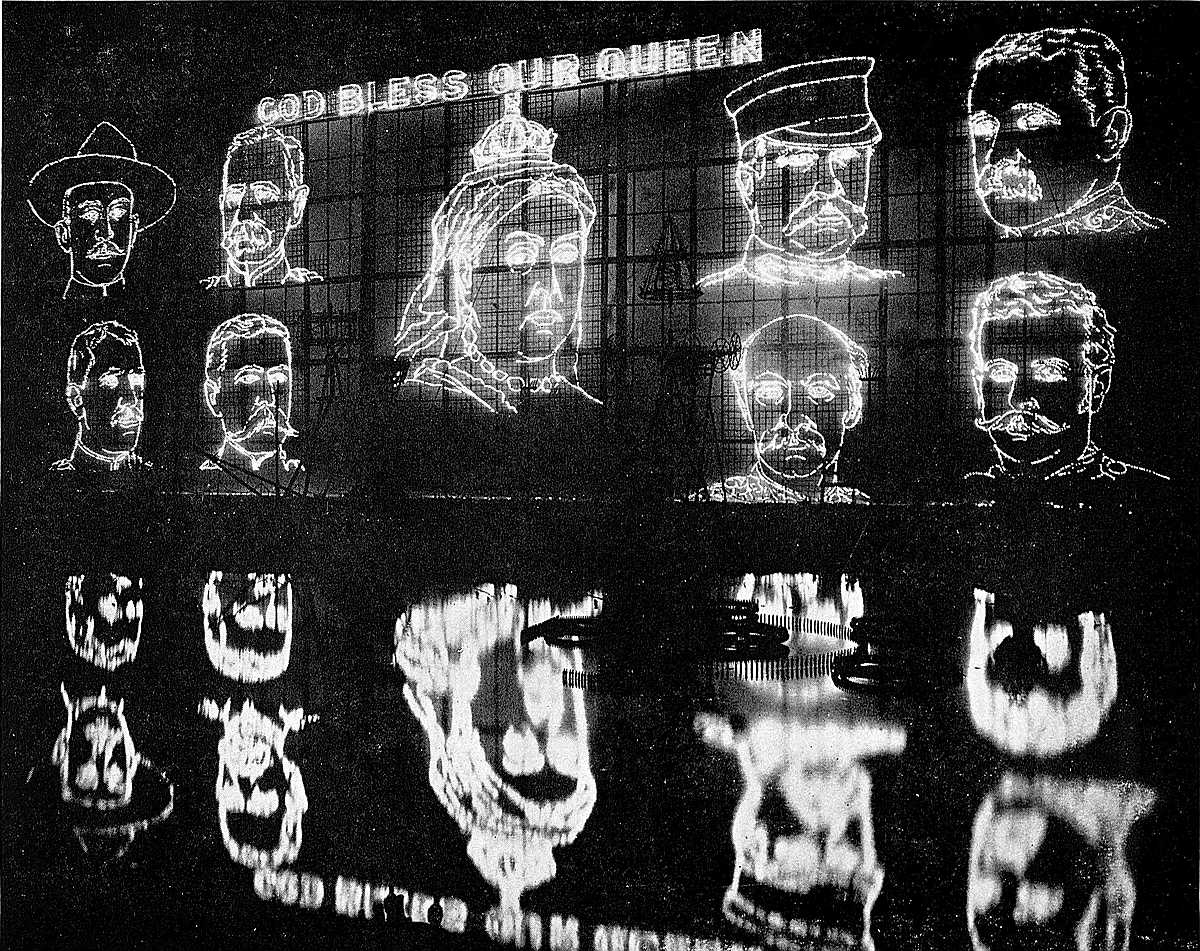
A Crystal Palace Set Piece at the time of the South African War. (200 ft. long by 70 ft. high.)
The origin of this type of picture is worth recording. In
1889 the Shah of Persia visited the Crystal Palace, and fired
a portrait of himself, electrically, from the Royal Box. A
popular song of the day, “Have you seen the Shah?” was
suggested to some musically inclined members of the audience,
who commenced to sing it, and were soon joined by the whole
of the spectators, numbering about 50,000.
The effect of this impromptu concert was so striking as
to lead to the production of the popular song whenever there
happened to be one suitable for pictorial rendering in fireworks.
In 1892 a mechanical Lottie Collins, 60 feet high, dancing
to the then popular strain of “Ta-ra-ra-bom-de-ay,” was
enthusiastically received. A series of patriotic and sentimental
songs at the time of the South African War, as “The Absent-minded
Beggar” and “Good-bye, Dolly Grey,” etc., were
very successful. The “Honeysuckle and the Bee” provided
the subject for a transformation picture, a design of honeysuckle
changing to a girl’s head with a mechanical bee twelve
feet long.
In 1908 three songs were included in one piece—“Bill
Bailey,” “Farewell, my Bluebell,” and “The Old Bull and
Bush.”
The smaller mechanical pieces form a history of locomotion
during the half-century covered by the displays.
Bicycles, motor cars, looping the loop, aeroplanes, costers’
barrows, hansom cabs, fire engines, scooters have all been
represented, and in 1895, on the occasion of the visit of the
Railway Conference, two of the best mechanical pieces ever
carried out—full-sized representations of the “Rocket” and
the latest type of express engine with exact details and working parts.
An effective working device introduced as early as 1870
was a comet travelling down a wire from one of the famous
towers to the ground. Later the comet was replaced by a
dragon, Mother Goose, and in 1872 by a “Fiery Bicycle,”
a subject which seems somewhat out of place in such a position.
The next development of this feature was to introduce a living
man who, clad in shining armour and surrounded and illuminated
by a frame of fireworks, striking an impressive attitude,
slid from the summit of the tower to the terrace.
The name of this performer, no doubt in imitation of the
Italian artists who on a smaller scale carried out a similar feat
at Vauxhall, was given in the programme as Signor Gregorini.
In private life or in the works, however, he went by the name
of Bill Gregory, and it is recorded that, when on the first
night he stuck half-way down and had to remain in his airy
position for the remainder of the display, his remarks left no
doubt as to the country of his origin.
It is characteristic of Mr. C. T. Brock that he who originated
the idea was the first to try the descent. The weight of
the cable was very considerable and the strain very heavy in
order to keep it sufficiently taut, and doubts were expressed
as to the advisability of putting such a stress on the structure,
which led to the abandonment of the performance.
It would be tedious to attempt to give anything like a
description of the many and varied moving and stationary
devices used in the Crystal Palace displays. The descriptions
in the traditional somewhat flowery language of the firework
programmes would convey little without illustration. One
feature generally to be found in the programme is that of the
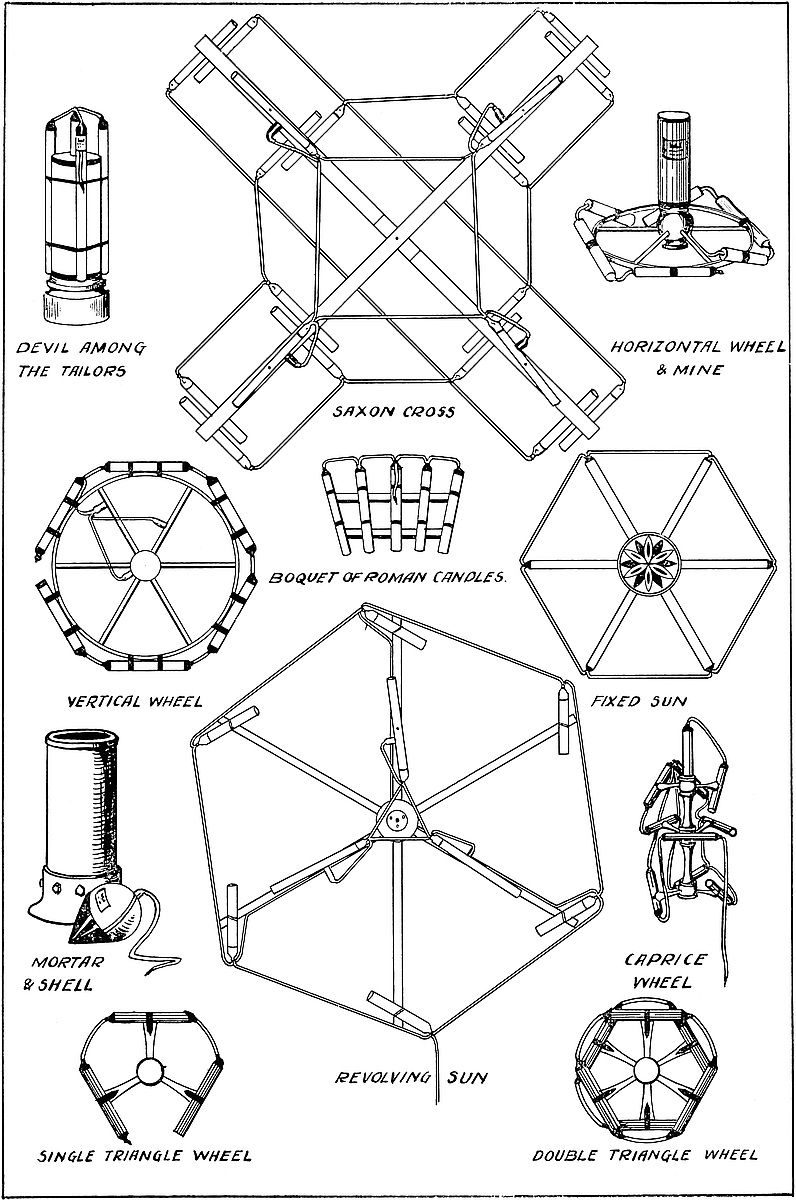
wheels. These are generally fired in a group of three in the
centre of the Terrace, the designs varying in form, movement
and colour from time to time, the fire of the centre or
largest wheel forming a circle one hundred feet in diameter.
The historical displays during this period include the
displays given in India in 1875–6, during the tour of King
Edward, then Prince of Wales, at Bombay, Madura, Colombo,
Madras, and Jaipur, and a series of enormous displays carried
out at the Philadelphia Centennial Exposition in 1876, at one
of which 250,000 people paid half-a-dollar admission, and
in 1877, the displays given at Calcutta and Delhi on the
occasion of the assumption by Queen Victoria of the title
Empress of India.
The Jubilee and Diamond Jubilee of Queen Victoria produced
enormous activity in the manufacture of fireworks.
Displays great and small took place all over the United Kingdom,
or rather, the Empire.
Among the displays fired on the occasion of the Diamond
Jubilee, certainly not the least interesting, although comparatively
small in extent, was that given at Blantyre in the
heart of the African continent. This display, which included
a portrait of Her late Majesty, was carried up three hundred
and sixty miles of the Zambesi, thence by canoe over eighty
miles of sandbanks and mud, and finally thirty miles overland
with a rise of 3,500 feet.
Other displays were the display on the Tagus in 1886 on
the occasion of the marriage of the late King of Portugal;
the display fired from Brooklyn Bridge for the Columbus
Tercentenary in 1892; the Imperial Fete on the Danube in
1903; the display fired from thirteen battleships moored at
a distance of a quarter of a mile from each other on the occasion
of the “Entente Cordiale” visit of the French Fleet in
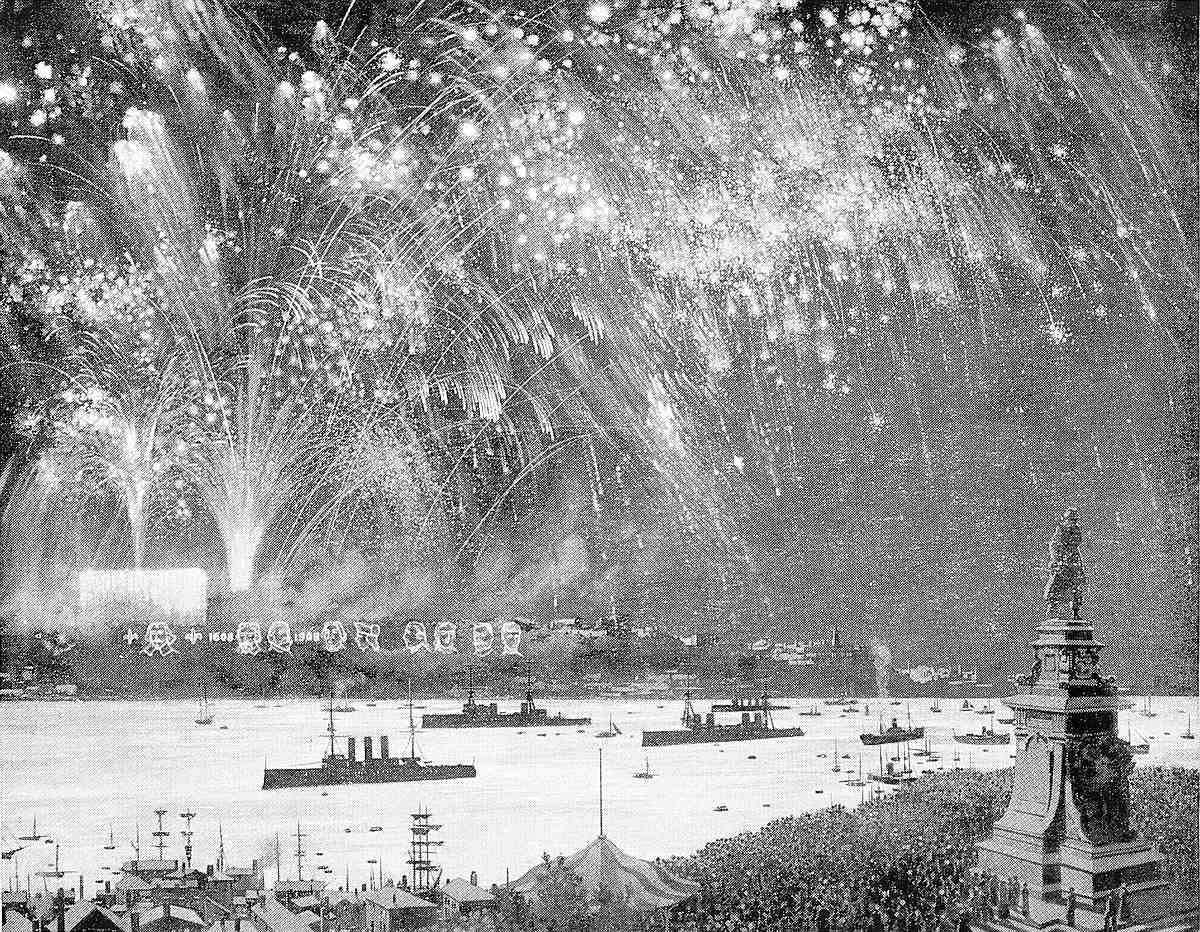
1905; the display celebrating the Tercentenary of the founding
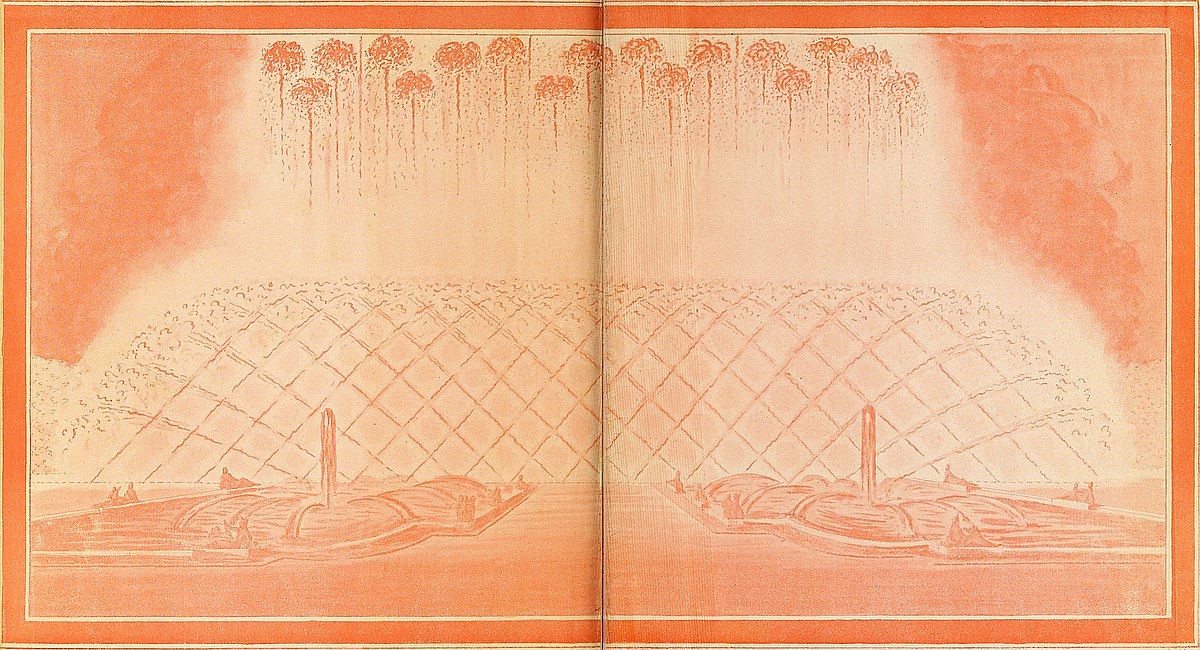
of Quebec in 1908; and the greatest display of fireworks
ever fired—the official Peace display in Hyde Park in 1919,
in which some of the ground works suffered from the rain
which, unfortunately, started about five o’clock, but the aerial
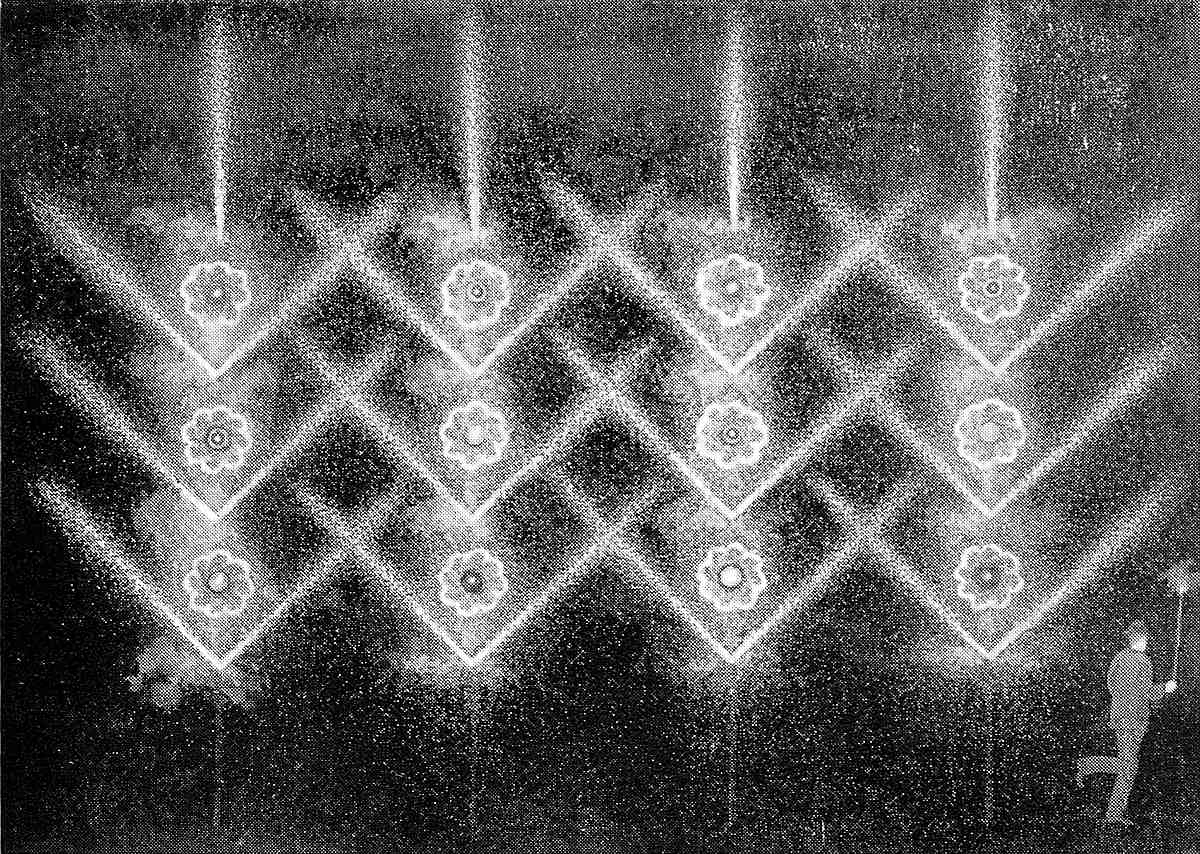
work was on an unprecedented scale, shells varying from
sixteen inches down to 5½ inches in diameter being fired in
salvoes of twenty-five to one hundred.
Rockets of 1 lb. were fired in flights of one hundred, and
a final flight of three thousand; sets of Roman candles, each
containing two hundred; one hundred fiery jets, etc., etc.
The “Fourth of June” celebration at Eton has always been
the occasion of a firework display, and displays have taken
place annually, with the exception of the years of the Great
War, from at least as early as the beginning of the nineteenth
century. Hone, in his “Everyday Book” (1831), speaks of
the fireworks as a well-established feature of the festival.
It is possible, and even probable, that they date from the
reign of George III, on whose birthday the event takes place.
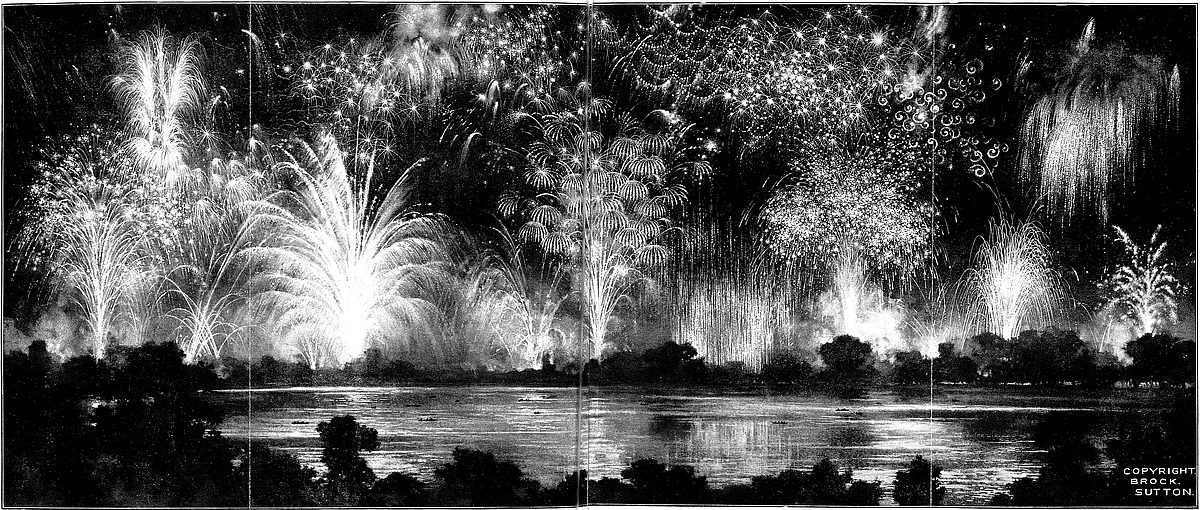
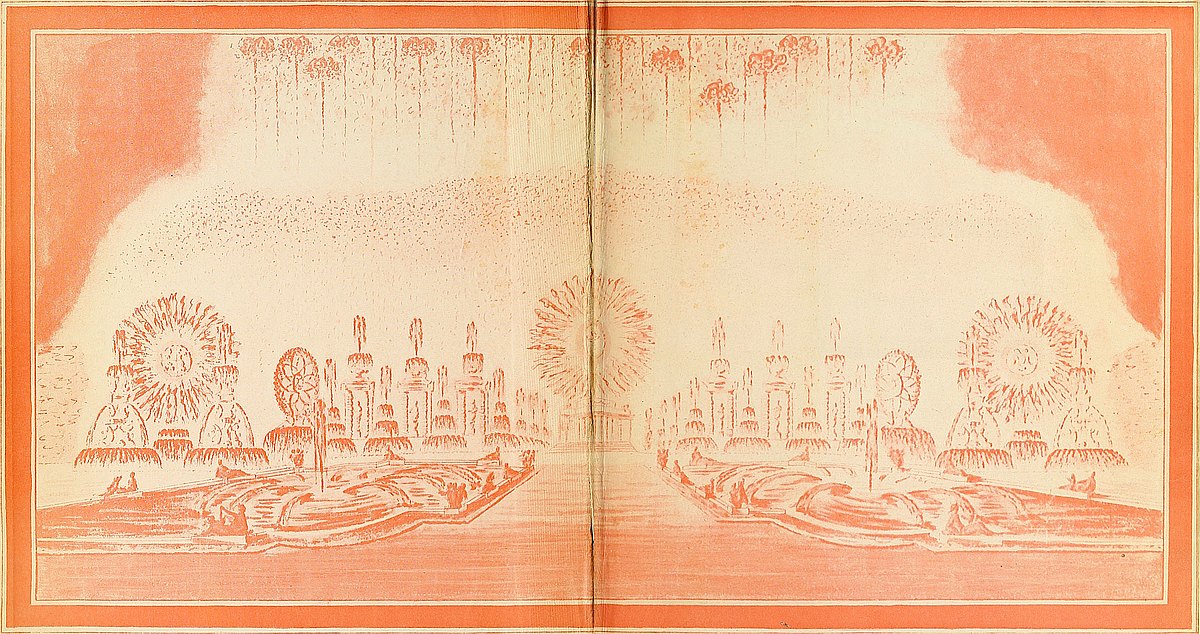
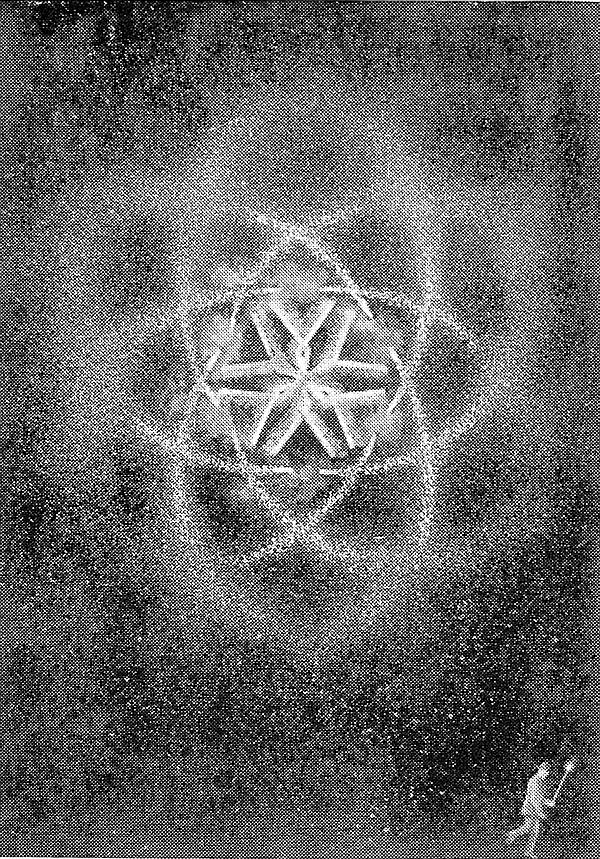
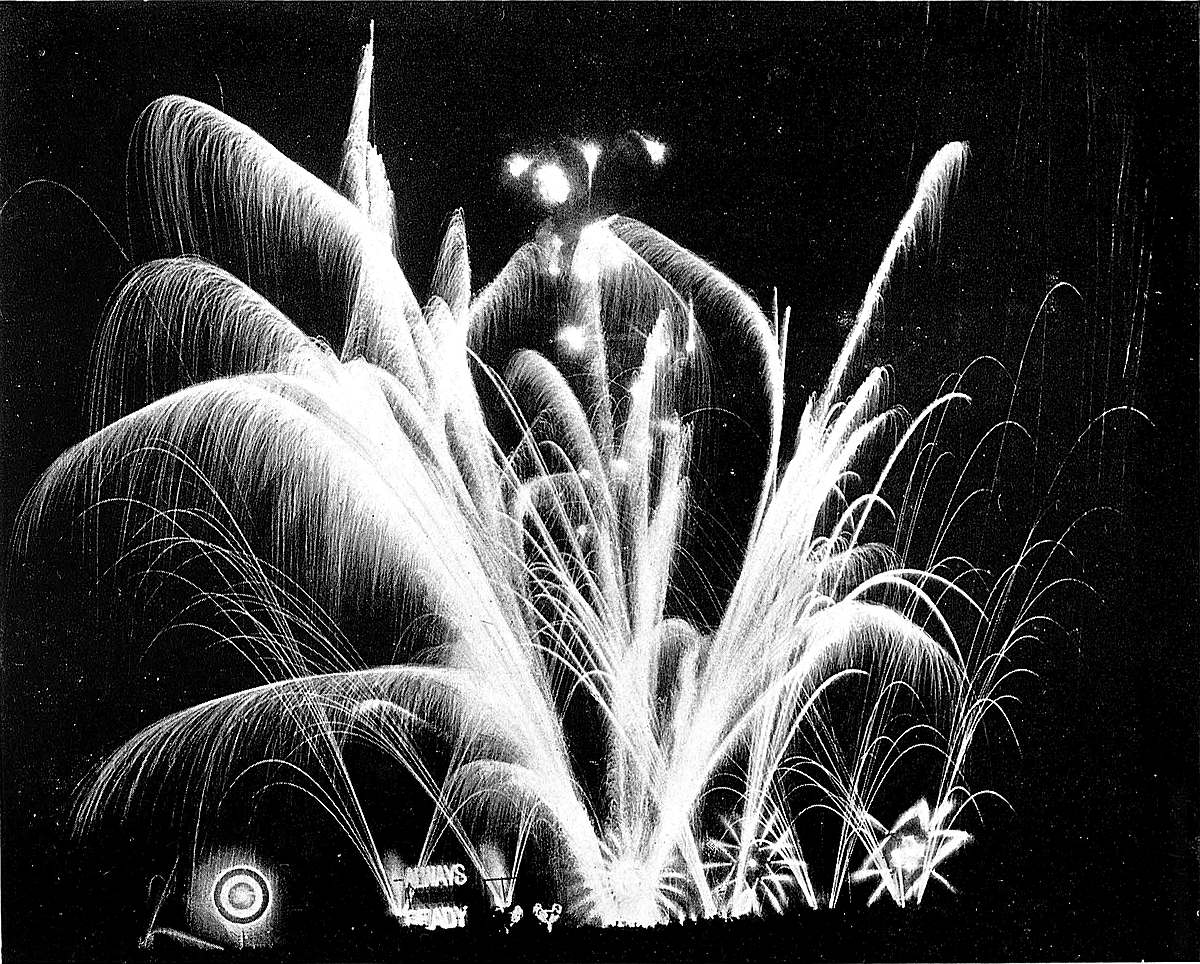
PANORAMA OF SOME OF THE AERIAL EFFECTS IN THE NATIONAL
FIREWORK DISPLAY AT HYDE PARK, 19th JULY, 1919.