NOTES ON THE BIRDS COLLECTED; BY THE B.O.U.
EXPEDITION TO DUTCH NEW GUINEA
By W. R. OGILVIE-GRANT
Our knowledge of the Birds of New Guinea is based
mainly on Count T. Salvadori’s monumental work Ornitologia
della Papuasia e delle Molluche, which appeared
in three large volumes in 1880-82, and on his Aggiunte
to the above work published in three parts in 1887-89.
Since that date our knowledge of the avi-fauna has
vastly increased and a very large number of splendid
Birds-of-Paradise and other remarkable new species have
been discovered.
A list of the principal works subsequently published,
placed in chronological order, will be found at the end of
this chapter, the most important papers being no doubt
those by the Hon. Walter Rothschild and Dr. E. Hartert,
which have appeared from time to time in the Tring
Museum periodical Novitates Zoologicæ. Mr. Rothschild
is to be congratulated on the success which has
attended the efforts of his various collectors in New
Guinea and on the energy which he has displayed in
obtaining birds from unknown districts of the most
interesting island in the world.
To give in a single chapter a brief and partly scientific,
partly popular, summary of the ornithological work
accomplished by our Expedition in Dutch New Guinea is
a more difficult task than might be imagined, for there
is not only an immense number of species to be dealt
with, but in most instances very little is known about
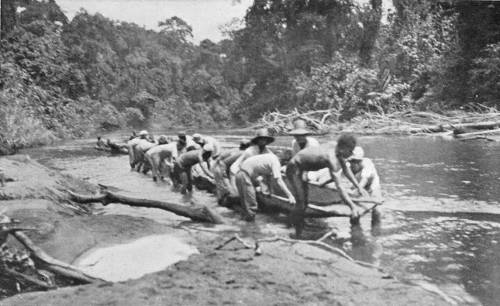
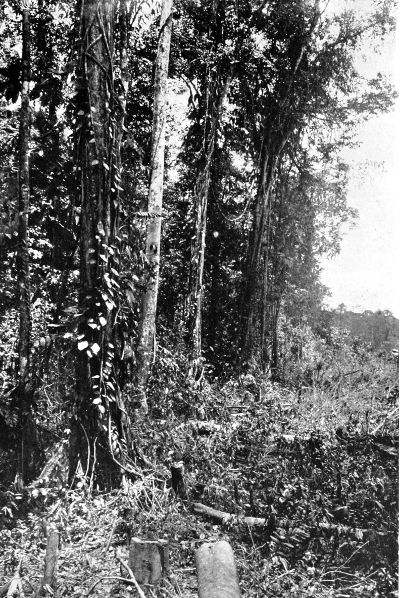
their habits. The jungles of South-western New Guinea
are so dense that white men can scarcely traverse them,
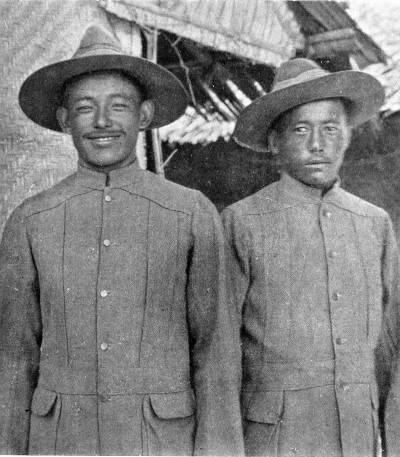
and most of the collecting had to be done by the trained
natives from the Malay Peninsula, kindly supplied by
Mr. H. C. Robinson, and by the Gurkhas who accompanied
the Expedition.
By dealing with each family in turn, I shall endeavour
to refer to all the more important species in the collection
in their proper scientific order, briefly describing
some of the more beautiful, so that those without any
special knowledge of birds may, if they care to do so,
form some idea of the marvellous types which have
been brought home from the interior of South-western
New Guinea.
It is certain that the resources of that wonderful
island are not nearly exhausted: on the contrary, every
fresh collecting expedition sent to the interior produces
remarkable novelties, and large chains of high mountains
are still unexplored. The members of our Expedition
were fortunate in procuring no less than 2,200 skins of
birds in New Guinea, representing about 235 species, of
which ten proved to be new to Science. A number
of new birds were also obtained by the late Mr. Wilfred
Stalker in the mountains of Ceram, which he visited
before joining the main Expedition at Amboina. His
premature death by drowning, a few days after he landed
in New Guinea, was an immense loss to the Expedition,
though his place was ably filled by Mr. Claude Grant,
who worked with his characteristic zeal and enthusiasm.
It will be noticed that the great bulk of the birds
inhabiting New Guinea belong to a comparatively small
number of families, but that each of these is represented
by a large number of different species, especially in such
groups as the Pigeons, Parrots, Flycatchers, and Honey-eaters.
Amongst the Pigeons of which no fewer than twenty-seven
different kinds were obtained, it would seem as
though, in some instances at least, Nature had almost
come to the end of her resources in devising new and
wonderful arrangements of colour and markings; for in
some of the smaller Fruit-Pigeons, such as Ptilopus
gestroi and P. zonurus we find two perfectly distinct
species, occurring side by side, possessing almost exactly
the same remarkable scheme of colouration, and only
differing in certain minor points to be found in the
markings of the wing-coverts. Another very similar
instance is to be seen in Ptilopus coronulatus and P. nanus
almost the same colours and pattern being repeated in
both.
The collection obtained by our expedition is a very
valuable one, and has added many new and interesting
forms of bird-life to the incomparable series in the
Natural History Museum, to which the bulk of the
specimens have been presented by the subscribers. A
large proportion of the birds were obtained at low elevations
from sea-level to 2,000 feet, only a comparatively
small number being procured at from 3000-4000 feet.
It is to be regretted that the immense physical difficulties
encountered and other causes prevented our collectors from
reaching a higher zone between 5000 and
10,000 feet, where no doubt much of interest remains to
be discovered by those who are fortunate enough to get
there.
| Family. | No. of
species. |
| Corvidæ | Crows | 2 |
| Paradiseidæ | Birds-of-Paradise, Bower-Birds and Manucodes | 13 |
| Eulabetidæ | Tree-Starlings | 4 |
| Dicruridæ | Drongos | 2 |
| Oriolidæ | Orioles | 1 |
| Ploceidæ | Weaver-Finches | 1 |
| Motacillidæ | Wagtails | 2 |
| Meliphagidæ | Honey-eaters | 26 |
| Nectariniidæ | Sun-birds | 2 |
| Dicæidæ | Flower-peckers | 2 |
| Zosteropidæ | White-eyes | 1 |
| Laniidæ | Shrikes | 8 |
| Prionopidæ | Wood-Shrikes | 4 |
| Artamidæ | Swallow-Shrikes | 1 |
| Timeliidæ | Babblers | 4 |
| Campophagidæ | Cuckoo-Shrikes | 11 |
| Muscicapidæ | Flycatchers | 30 |
| Hirundinidæ | Swallows | 2 |
| Pittidæ | Pittas or Ant-Thrushes | 2 |
| Cuculidæ | Cuckoos | 11 |
| Cypselidæ | Swifts | 4 |
| Caprimulgidæ | Nightjars | 2 |
| Podargidæ | Frog-mouths | 3 |
| Bucerotidæ | Hornbills | 1 |
| Meropidæ | Bee-eaters | 1 |
| Coraciidæ | Rollers | 2 |
| Alcedinidæ | Kingfishers | 11 |
| Psittacidæ | Parrots | } | 22 |
| Loriidæ | Lories or Brush-tongued Parrots |
| Bubonidæ | Horned and Wood-Owls | 7 |
| Phalacrocoracidæ | Cormorants | 1 |
| Anatidæ | Ducks | 2 |
| Ibididæ | Ibises | 1 |
| Ardeidæ | Herons | 4 |
| Œdicnemidæ | Stone-Plovers | 1 |
| Charadriidæ | Plovers | 8 |
| Laridæ | Gulls and Terns | 2 |
| Rallidæ | Rails | 1 |
| Columbidæ | Pigeons | 26 |
| Megapodiidæ | Megapodes or Mound-builders | 3 |
| Casuariidæ | Cassowaries | 3 |
| —— |
| | Total | 235 |
From the above table it will be seen that out of 235 species procured, 150 are
included in eight of the Families; viz. Birds-of-Paradise 13; Honey-eaters 26;
Cuckoo-Shrikes 11; Flycatchers 30; Cuckoos, 11; Kingfishers 11; Parrots, 22;
Pigeons, 26.
Though the true Crows are never brightly coloured
birds, many are extremely handsome, but this epithet
cannot be applied to the Bare-faced Crow (Gymnocorax
senex) which is common on the Mimika River and
distributed over New Guinea generally.
The adult is brownish-black with a slight purplish
or bluish gloss on the wings, but is generally in worn
and shabby plumage. Even when freshly moulted it
is rather a disreputable looking bird, its naked pink
face, pale watery blue eyes, slate-coloured bill and livid
feet adding to its dissipated appearance. Young birds
in their first year’s plumage are even plainer than their
parents, being dull drab-brown inclining to brownish-white
on the head and neck, and appear to be clad
in sackcloth and ashes. They have a weak uncrow-like
call pitched in a high key and their flight is feeble and
seldom sustained.
In addition to this Crow of unprepossessing appearance,
there is a handsome Raven (Corvus orru), much
like our familiar bird but smaller, which was met with
in pairs on the coast.
Closely allied to the well-known Greater Bird-of-Paradise
(Paradisea apoda) from the Aru Islands is the
New Guinea form P. novæ-guineæ, the males being
distinguished by their smaller size and by having the
long ornamental side-plumes of a much richer orange-yellow.
Though the call of this bird was frequently
heard on the upper parts of the Mimika, it was rarely
seen; but on the Wataikwa quite a number were
procured in all stages of plumage. The species was,
however, nowhere plentiful and confined to the foot-hills.
The Pygmies often brought plumes of the Lesser
Bird-of-Paradise (P. minor) to Parimau and traded
them with the natives, but the species was not found
on the Mimika, the Charles Louis mountains probably
forming its southern boundary.
My account of the display of that species, as witnessed
in the Zoological Gardens, Regent’s Park, will be found
in the Ibis, 1905, p. 429, accompanied by various
drawings and a coloured plate by Mr. G. E. Lodge. The
display resembles that of the Greater Bird-of-Paradise
(P. apoda) and the Red Bird-of-Paradise (P. raggiana)
and no doubt also that of P. novæ-guineæ. It is a
wonderful and beautiful sight to see these birds erect
their splendid side-plumes in an arch over the back,
which is concealed in a shivering cascade of colour,
orange and white, or red according to the species.
Numbers of the beautiful little King Bird-of-Paradise
(Cicinnurus regius) were brought home in all stages of
plumage from the young to the fully adult male, with
its scarlet head, shading into glittering carmine on the
back and wings and into purplish-carmine on the throat,
which is bordered below by a rich dark green band.
The sides of the chest are ornamented with fan-like
arrangements of grey feathers tipped with glittering
golden green; the breast and the rest of the under-parts
are of the purest white: the outer tail-feathers are
earthy-brown edged with orange-red, while the middle
pair, which cross one another, have the bare shafts
enormously lengthened, and terminate in a tightly
curled disc, golden green above and reddish-brown
beneath.
These beautiful ornaments are seen to the greatest
advantage when the King is displaying, the green-tipped
fan-like feathers on the sides and the white
feathers of the breast being spread out to form a
circular shield in front of the bird, while the green
metallic discs of the long middle tail-feathers are
erected and waved overhead. An interesting description
of the display of this species is given by Sir William
Ingram in the Ibis, 1907, p. 225, with a coloured
plate and figures drawn by Mr. G. E. Lodge from a
living specimen.
Mr. Walter Goodfellow made an interesting observation
on the habits of this species. While watching some
Pigeons on the opposite bank of the river through his
glasses he saw a small bird rise from the top of a tree
and soar into the air like a Sky-Lark. After it had
risen about 30 feet, it suddenly seemed to collapse and
dropped back into the tree as though it had been shot.
It proved to be a King Bird-of-Paradise and probably
this soaring habit is a part of the display not indulged
in by captive birds confined in comparatively small
cages.
A Rifle-Bird (Ptilorhis magnifica) was fairly common
both on the coast and near the mountains and its call
consisting of two long-drawn notes, one ascending, the
other descending, might be heard at all hours of the day.
Its plumage is mostly velvety black on the head and
upper-parts, but the crown, middle of the throat and
chest, as well as the middle pair of tail-feathers, are
metallic blue and a bronze-green band separates the
chest from the deep purplish-maroon under-parts. The
outer flight feathers are curiously pointed and strongly
falcate and some of the side-feathers terminate in long,
narrow decomposed plumes. The long curved bill and
the legs are black, while the inside of the mouth is pale
apple-green as is the case in several other species of
Paradise-Birds.
Though a well-known species, we must not omit to
mention the splendid Twelve-wired Bird-of-Paradise
(Seleucides niger). The plumage of the male is like dark
brown plush shot with bronze-green on the back and
deep violet on the wings, while the long dark breast-feathers
are edged with rich metallic emerald-green.
The long ornamental side-plumes and the rest of the
under-parts are beautiful bright cinnamon-yellow when
freshly moulted, but this colour is so volatile that it soon
fades to nearly white in skins which have been kept for
a few years. The shafts of six of the long side-plumes
on either side extend far beyond the vane of the feather
and look like twelve recurved wires, hence the bird’s
popular name. The eye is crimson, the bill black, the
gape bright apple-green, and the legs and toes yellowish
flesh-colour.
The Expedition procured three examples of a new
form of Parotia or Six-plumed Paradise-Bird on the
Iwaka River, but unfortunately did not succeed in shooting
a fully adult male. Simultaneously A. S. Meek, who
was collecting for Mr. Rothschild, procured specimens of
the same bird on the Oetakwa River a few miles to the
east, but he likewise did not secure the fully adult male.
The species has been named Parotia carolæ meeki by
Mr. Rothschild.
The plumage of this bird is like brownish-black plush
and equally soft to the touch. The head is ornamented
very wonderfully; on either side behind the eye there
are three long racket-like plumes on long bare shafts, (a
character common to all the members of this remarkable
genus of Paradise-Birds): the middle of the crown is of
a beautiful “old” gold colour in a setting of silvery
white and golden brown: on the occiput there is a
marvellous patch of stiff metal-like feathers, golden-green
bordered with deep violet; the sides of the head
before and behind the eye are golden-brown, the chin
and upper part of the throat deep brown, and the lower
part whitish, spotted with rufous. A lovely metallic
breast-plate of bronze-green and violet feathers with dark
middles covers the chest and the long flank-feathers are
white. The two outer flight feathers are curiously
attenuated near the extremity and terminate in a sharp
point, the shaft bearing only a very narrow web. No
doubt all these ornaments are displayed in a similar
manner to those of P. lawesi from British New Guinea,
males of which have been living for some years in the
Zoological Gardens, Regent’s Park.
Another very handsome species is the Golden-winged
Diphyllodes chrysoptera. The male has the bill and a
bare space behind the eye bluish-white, the inside of the
mouth apple-green and the feet Prussian blue. The
head is clad in short velvety reddish-brown feathers with
two metallic green spots between the eyes; the nape
bears a frill of lengthened brown-tipped plumes; the
mantle is light golden-yellow like spun glass and forms
a lengthened tippet; the inner secondary quills and
shoulder-feathers are orange-yellow, and the back
carmine and dull orange shading into sooty black on the
upper tail-coverts. The throat is deep velvety brown,
the neck and breast rich dark green bordered below
with metallic bluish-green, and with a row of metallic
green bars like steps down the middle of the neck and
chest; the rest of the under-parts are black. The short
outer tail-feathers are sooty brown, while the middle pair
which cross one another are very long and narrow and
of a metallic bluish-green. The female is very soberly
clad, dull brown above and narrowly barred with brown
and buff below.
The Bower-Birds have received their name from their
peculiar habit of constructing bowers or runs where the
males meet to play or pay their court to the females.
The bowers are built long before the birds begin to build
their nests which are placed in trees.
One of the most noteworthy species procured by the
Expedition was the gorgeously coloured Bower-Bird,
Xanthomelus ardens. The male has the eye yellow and
the head, sides of the neck and mantle orange-scarlet,
the feathers of the latter being very long and loose and
forming a dense cape; the rest of the plumage is orange-yellow
above and golden-yellow below: the ends of the
quills and the tail-feathers, being black.
The female has the iris brown and is more sombrely
clad, the head and upper-parts, including the wings and
tail, being earthy-brown, while the under-parts, under
wing-coverts and wing-lining, are yellow, like those of
the male, but less bright.
This beautiful species was originally described from
an imperfect native-made skin obtained by the Italian
naturalist, D’Albertis, on the Fly River. Subsequently,
Dr. H. A. Lorentz shot two adult males on the Noord
River, which were described and figured by Dr. Van Oort.
Our expedition was fortunate enough to secure not only
adult males, but also the immature male and adult female,
these latter being hitherto unknown.
The display of the male bird must be a very beautiful
sight, his scarlet cape being no doubt erected, and forming
a great hood over the head.
Among the Bower-Birds, one of the most interesting
was a remarkable female example of a species of Chlamydodera
procured on the Kamura River. Unlike any of
the allied forms, it has the under-surface washed with
yellow, and appears to be the female of C. lauterbachi,
of which the brilliantly coloured male was described by
Dr. Reichenow from an example procured in German
New Guinea.
The male has the crown and sides of the face golden-orange,
the upper-parts olive-brown, edged with yellowish,
and the under-parts bright yellow. It is a very striking
bird and much the most brightly coloured member of the
genus.
Though the two specimens were obtained in localities
so far apart, there seems to be no reason why they should
not be male and female of the same species. The female
obtained by the Expedition possesses many characteristics
in common with the male type of C. lauterbachi and the
differences in plumage are just what one would expect
to find in the female of that species.
The beautiful Cat-bird (Ælurœdus stonei) was fairly
plentiful, and is remarkable on account of its peculiar
colouring. The cap is brown, the back grass-green, and
the neck and under-parts buff, spotted with black, or
green on the longer flank-feathers. The eye is hazel
and the bill and legs slate-blue. The sexes are alike in
plumage. It derives its popular name from its peculiar
hissing alarm note, not unlike the sound made by an
angry cat.
Of the Manucodes, four different kinds were met
with. They are all crow-like birds with brilliant metallic
black plumage glossed with purple, green or blue, and
form a link between the Paradise-Birds and the true
Crows. The Purple-and-Violet Manucode (Phonygama
jamesi) is distinguished by possessing tufts of long,
narrow metallic green plumes behind the eye, and by
having the neck-feathers similarly lengthened; while the
other three belonging to the genus Manucodia have the
head and neck covered with short curly feathers. These
curly-headed species are much alike in general appearance,
but M. orientalis has the short curly feathers on
the chest and breast glittering golden-green, while in
M. jobiensis and M. altera the same parts are dark steel-blue.
Inter se the two latter kinds differ considerably,
both structurally and in colour. M. jobiensis is
smaller and has the feathers of the throat rounded and
crinkled, and the upper-parts glossed with a strong shade
of violet; while M. altera is larger and has the throat-feathers
short but rather pointed, and the general colour
above purplish-blue or steel-blue.
In most of the Manucodes the trachea is very long
and convoluted, that of the Purple-and-Violet species
possessing no fewer than twelve coils which lie between
the skin and the pectoral muscles. In spite of this
marvellous instrument its cries are not nearly so loud
as those of the Birds-of-Paradise of the genus Paradisea.
Mr. Claude Grant discovered a nest of M. altera with
two eggs at Parimau, an interesting find, as no properly
authenticated eggs of that species had hitherto been
obtained.
Among the smaller Glossy Starlings we must specially
mention a new species, Calornis mystacea, discovered by the
Expedition. It has the plumage purplish-bronze and is
especially remarkable in having long semi-erect plumes
on the forehead as well as long neck-hackles. Three
specimens were obtained flying in company with large
flocks of C. metallica, a rather widely distributed species,
which ranges to North Australia, the Moluccas and the
Solomon Islands.
The Grackles or Talking Starlings are represented by
two lovely species, the first being the well-known
Dumont’s Grackle (Mino dumonti) a dark glossy greenish-black
bird with a yellow belly and white under tail-coverts.
It has a brown eye surrounded by a large naked orange
patch partially covered with short stiff filaments. The
second species Robertson’s Golden Grackle (Melanopyrrhus
robertsoni) is an equally handsome, but much rarer bird,
and the fine series of adults obtained by the Expedition
proves that it is a species quite distinct from M. orientalis,
the form found in British New Guinea which has a large
black patch on the occiput.
Robertson’s Grackle has the cheeks and upper part of
the throat, as well as the back, wings and breast, black
glossed with green; the rest of the head, neck and chest,
as well as the lower back, rump, upper tail-coverts and
belly, are orange-yellow. In the adult there is no trace
of a black patch on the occiput, but the quite young
bird has the entire crown black and specimens which
have not assumed the fully adult plumage and still
retain some black feathers on the occiput might be
mistaken for M. orientalis. That they have been is
proved by the fact that Count Salvadori and many others
have regarded M. robertsoni, Sharpe, as a synonym of
M. orientalis, Schlegel, but they are really quite distinct.
A few very high trees left standing near the huts at
Wakatimi were the resort, morning and evening, of these
Starlings and various other species of birds. For a long
time during the hot mid-day hours Mr. Goodfellow had
observed that some bird, possessing a remarkably sweet
Thrush-like song, rested there, and, after many days of
watching, he found it to be Robertson’s Golden Grackle.
He says that the notes of this Starling would not pass
unnoticed, even in countries where the birds, as a rule,
have sweeter voices than those inhabiting New Guinea.
The Drongos, small Crow-like Flycatchers with
pugnacious habits, are represented in the collection
by two species—Chibia carbonaria and Chælorhynchus
papuensis.
The Orioles are represented by one species only,
Mimeta striata, belonging to the dull coloured brown-backed
group with heavily streaked under-parts and the
sexes alike in plumage. It was commonest in the
mangrove swamps near the coast.
This widely distributed group of Weaver-Finches is
not very numerous in New Guinea and the only representative
met with was a small species, Munia tristissima,
which was common in the clearing round the camp at
Wakatimi.
The Grey Wagtail (Motacilla melanope) and the Blue-headed
Wagtail (M. flava) were both met with on the
Mimika and other rivers. It is interesting to note that
both species are included in the British List, the former
being a regular breeding-species in our islands. The
birds wintering in far-off New Guinea, no doubt formed
part of the eastern colonies of these species which nest in
Siberia and visit the Indo-Malayan Islands in winter.
The Honey-eaters are very numerously represented
in South-western New Guinea and no fewer than twenty-seven
species were met with by our Expedition.
The family is divided in two sections, the first
including the comparatively brightly coloured genus
Myzomela the members of which resemble true Sun-birds
(Nectariniidæ) in general appearance. Seven species were
met with; the most brilliantly coloured being M.
cruentata which has the plumage of the body scarlet and
the wings washed with the same colour, another species
M. obscura has the entire plumage smoky-grey, and four
forms are intermediate between these two types of
colouration, being partly scarlet and partly grey. The
seventh is a very small and very rare species (Œdistoma
pygmæum), which was described by Count Salvadori
from the Arfak Peninsula.
The other section contains a number of larger species,
mostly with dull greenish or brownish plumage and
nearly all with a yellow tuft or patch on the ear-coverts.
Though rather uninteresting-looking birds several are
really of great scientific value, being new to the National
Collection, and one, Ptilotis mimikæ proved to be new to
Science. The largest form is the curious Friar-bird
(Philemon novæ-guineæ) with the bare sides of the face
and neck black and a swollen knob on the base of the
bill. It was generally met with in pairs and inhabited
the tops of the tallest forest trees whence its peculiar cry
might constantly be heard.
The Sun-birds are represented by two species Cinnyris
aspasiæ and C. frenata. The male of the former is
deep black with a dark metallic green cap, shoulders and
lower back, and purple throat, while the female is olive
above, and dull yellow below, with a grey head and
throat. The latter species is dull yellow above, brilliant
yellow below, with a purple throat in the male, which is
absent in the female.
Mr. Goodfellow tells us that among the riot of parasitic
plants which covered the trees a few Sun-birds and
Honey-eaters might always be seen. The nests of the
former, suspended from fallen and partially submerged
dead trees, were continuously swinging from side to side,
the strong current in the river keeping the trees in perpetual
motion. These nests might easily be mistaken
for a handful of drift left there by the river.
Dicæum diversum and Melanocharis chloroptera, a
dull-looking greenish-grey species described by Count
Salvadori, were the only Flower-peckers met with. They
are small Tit-like birds allied to the Sun-birds, but with
a short bill serrated along the edges of the mandibles.
Both species were very common everywhere except on
the coast and were extremely tame.
Zosterops chrysolæma, a beautiful little species with
the upper-parts golden-olive, the throat and under tail-coverts
yellow, and the breast and belly pure white, was
the only species met with of this most numerous and
widely distributed group. The popular name White-eye
is derived from the ring of tiny white plumes which encircles
the eye in all. They resemble Titmice both in
their mode of life and notes. The only pair observed
were met with on the Iwaka River, and the species is
probably more numerous in the higher parts of the
mountains.
The large Shrike-like birds with powerful hooked bills
known as the Piping-Crows are represented by two members
of the genus Cracticus; C. cassicus, a black and
white species, and C. quoyi, with uniform black plumage.
Both are much like their well-known Australian representatives,
but smaller. C. cassicus was much the
commoner bird and was generally observed feeding on
berries and fruits in high trees, its actions being very
Crow-like.
The Pachycephaline group of birds allied to the true
Shrikes is represented by half-a-dozen species, two of
which proved to be undescribed: a grey form with a
white throat Pachycephala approximans and a black
species with a white breast and belly, P. dorsalis.
Brilliantly coloured orange-yellow and black, or orangeyellow
and grey species were represented by Pachycephala
aurea and Pachychare flavogrisea.
This group is represented by Rhectes cristatus and R.
ferrugineus in which both sexes are rufous and by R.
nigripectus with the sexes different, the male being partly
black and partly chestnut. Pinarolestes megarhynchus,
an allied species with the sexes alike, is brown above and
dull rufous below. Some of these Wood-Shrikes lay
peculiar looking eggs of a long oval shape and large for
the size of the bird. The ground-colour is purplish- or
pinkish-grey with scattered spots or small blotches of
dark purplish-brown or maroon-brown, often blurred at
the edges and running into the ground-colour. These
eggs have on several occasions been palmed off on
travellers in British New Guinea as eggs of the Red
Bird-of-Paradise, which they do not in any way
resemble.
These birds which closely resemble Swallows in their
mode of life are represented by one species only, Artamus
leucopygialis, a grey bird with the breast and rump white.
It was common along the coast, and was generally seen
either perched on some dead tree or skimming swiftly
over the sands.
We now come to the Timeline group of birds: of
these we may mention two striking-looking species of
Eupetes. One, E. nigricrissus, with the plumage slate-blue
and the throat white, edged with black, was met
with on the Mimika; the other, E. pulcher, was only
seen further east on the Wataikwa River. It is very
similar to the above, but has the crown and back rich-chestnut,
instead of slate. Both species are ground-birds
and usually found in pairs; they are rather difficult to
procure as, when disturbed, they instantly conceal themselves
among the trunks of the trees and vegetation.
The Scimitar Babblers were represented by the reddish-brown
Pomatorhinus isidori.
The Cuckoo-Shrikes are well represented in the collection,
no fewer than eleven species having been obtained.
They belong to four genera and vary much in colour:
the large Graucalus cæruleogrisea has the entire plumage
bluish-grey, except the axillaries and under wing-coverts
which are pale cinnamon and the male has a black patch
in front of eye. Another genus Edoliisoma is represented
by E. melas of which the male is entirely black, and the
female chestnut and brown. A very attractive and
brilliantly coloured species is Campochæra sloetii, forming
a marked contrast to other members of the group. The
greater part of its plumage is orange-yellow, the forehead
white, the middle of the crown yellow and the wings black
and white; the male has the cheeks, throat and chest black
glossed with dull green, while in the female these parts
are dull grey. Several examples of this very rare Cuckoo-Shrike
were procured on the Mimika River. It is no
doubt most nearly allied to the Minivets (Pericrocotus)
which inhabit the Indo-Chinese countries and islands,
the predominant colour of most of the males being scarlet
and of the females yellow.
Flycatchers are very numerously represented and
among them two new forms were discovered, a Fantailed
Flycatcher (Rhipidura streptophora) and a broad-billed
species Myiagra mimikæ. Among the more notable
forms we may mention Monarcha aruensis, a brilliant
yellow and black species; Todopsis bonapartei, the male
being vivid ultramarine-blue, purple and black, while the
female differs in having the back and sides dark chestnut
and the breast mostly white; lastly Peltops blainvillei, a
black bird with the rump, vent and tail-coverts scarlet, a
large white patch on each side of the head and another
on the middle of the mantle; the sexes are alike in
plumage.
The Fan-tailed Flycatchers were commonly seen on
the Mimika River in May and June when numbers were
busy hawking the canary-coloured May-flies which
swarmed at that time.
The Black-and-white Flycatcher (Malurus alboscapulatus)
frequented the tall grasses near the camp on the
Wataikwa River. It was a delightful little bird, very
tame and might constantly be seen crossing the open
spaces with an undulating flight.
Two species of Swallows were met with Hirundo
javanica and H. gutturalis.
Of the Ant-Thrushes or Pittas two species were met
with, both brilliantly plumaged birds. Pitta mackloti
which was far the commoner of the two, has a dark
crown, reddish-chestnut nape, and greenish-blue upper-parts;
the throat is black, the chest shining greyish-blue
and the breast and belly scarlet, divided from the chest
by a wide black band.
The other species, Pitta novæ-guineæ, which was much
less frequently met with, has the head and neck black
and the rest of the plumage dark green washed with
bluish on the breast, which is black down the middle.
The shoulders are shining silvery-blue and the vent and
under tail-coverts scarlet.
These long-legged Thrush-like birds are entirely
terrestrial in their habits and frequent the depths of the
forests. They can hop with great agility and escape on
the slightest alarm, but are easily taken in snares.
Among the Cuckoos, the largest is a species of
“Crow-pheasant” or “Lark-heeled” Cuckoo, Centropus
menebiki, a bird of black plumage glossed with dark green,
with a large whitish-horn bill and heavy slate-coloured
legs and toes.
An allied, but smaller and rarer species, C. bernsteini,
was met with near the mouth of the Mimika. It is very
similar in plumage to the above, but is easily distinguished
by its smaller size, black bill and long, nearly
straight hind-claw. Both are almost entirely ground-birds
of skulking habits. Several other species of
Cuckoo were met with, and among these Cuculus micropterus,
the eastern form of the Common Cuckoo, closely
resembling our familiar bird. The rarest species
obtained was Microdynamis parva, a remarkable little
Cuckoo about the size of a Thrush, first described by
Count Salvadori in 1875. The origin of the type
specimen is uncertain, but it is believed to have been
obtained by Beccari in the Moluccas. Subsequently, Dr.
H. O. Forbes procured female examples in the Astrolabe
Mountains. Mr. Claude Grant obtained an adult male
and female which form a valuable addition to the
National Collection. The general plumage is brown,
but in the male the top of the head and the malar
stripe are black, glossed with steel-blue and the cheeks
and throat are cinnamon. In both sexes the bill is
short, thick and curved. The male has the eye bright
red, while in the female it is hazel.
The Swifts, though of especial interest, are not very
numerously represented in the collection. The commonest
species was that known as the Esculent Swiftlet (Collocalia
fuciphaga) which produces the best kind of edible
nest.
A very interesting discovery was the existence in
New Guinea of the large fork-tailed species Collocalia
whiteheadi originally described by myself from the highlands
of Luzon, Philippine Islands.
A remarkable Spine-tailed Swift (Chætura novæ-guineæ)
is new to the National Collection. It was fairly
common on the Mimika River and originally described
by Count Salvadori from specimens procured by D’Albertis
on the Fly River.
A pair of the magnificent Moustached Swift (Macropteryx
mystacea) with a wing expanse of more than two
feet were also procured. The plumage of this bird is
mostly grey, but the crown, wings, and long deeply-forked
tail are black glossed with purplish-blue. The
eye-brows and moustache-stripes as well as the scapulars
are white, the two former being composed of lengthened,
narrow, pointed plumes. The male has a small chestnut
spot behind the ear-coverts which is absent in the female.
The nesting-habits of this species are very curious, it
makes a very small exposed half-saucer-shaped nest of
bark and feathers gummed by saliva to a branch or
stump barely large enough to contain the single white
egg, and ridiculously small in comparison with the size
of the bird. When incubating, the greater part of the
bird’s body must rest on the branch to which the nest
is attached.
The common Nightjar of the country found along
the shingly banks of the rivers was Caprimulgus macrurus,
a widely distributed species. After the ground had been
cleared for the base camp at Wakatimi it was visited
every evening by a number of Nightjars, which no doubt
found such a large open space an admirable hunting-ground
and the members of the Expedition derived great
pleasure from watching their graceful evolutions. Another
very rare Nightjar was Lyncornis papuensis, not previously
included in the National Collection. Frog-mouths
were represented by the larger species Podargus
papuensis and the smaller, P. ocellatus. At some of the
stopping places on the river night was made hideous
by their mournful cries repeated to distraction on every
side, and ending up with a sharp snap.
A single example of the rare Wallace’s Owlet-Nightjar
(Ægotheles wallacei) was collected by Mr. G. C. Shortridge
on the Wataikwa River. It has a peculiar uniform
blackish upper plumage, without any trace of a distinct
nuchal collar. No doubt, like its Australian ally, it
roosts in holes in trees during the daytime and captures
its prey on the wing at night, like the true Nightjars,
though the flight is said to be less tortuous.
The only representative of the Bucerotidæ is the
Wreathed Hornbill (Rhytidoceros plicatus) a large bird
with a casque formed of overlapping plates on the base
of the upper mandible. The male is black with the head
and neck chestnut and the tail white, while the female
differs in having the head and neck black. It was plentiful
everywhere and its flesh was reported to be good eating.
It frequented the fruit-bearing trees in company with
various species of Pigeons and Mr. Claude Grant on one
or two occasions observed pairs at what he took to be
their nesting-holes high up in the bare trunks of very tall
trees. Their heavy noisy flight and raucous call, continually
repeated, renders these birds difficult to overlook.
A species of Bee-eater, Merops ornata, was common
about the base camp. It ranges to Australia, the
Moluccas and westwards to the Lesser Sunda group. Mr.
Goodfellow says it swarmed in some places after the
month of April; though previous to that date none had
been met with.
Two species of Rollers inhabit the Mimika district
Eurystomus crassirostris, a greenish-blue species with
brilliant ultramarine throat, quills and tail-feathers and
vermilion bill and feet; and a smaller species E. australis
with brownish-green upper-parts, verditer-blue breast
and bluish-green bases to the tail-feathers.
Both Bee-eaters and Rollers were common in flocks
along the banks of the Mimika during April and May
when preying on the canary-coloured May-fly, which
swarmed on the waters at that season.
Kingfishers were well represented in the Mimika
district and Mr. Goodfellow says that the Sacred Kingfisher
(Halcyon sanctus) was undoubtedly the most
conspicuous bird about the base camp, where its harsh
cry could be heard all through the hot hours of the day.
The huts and storehouses were infested by myriads of
black crickets, which take the place of the cockroaches
found in other countries and commit fearful havoc
among stores and personal possessions. The constant
packing up of goods to send up river drove thousands of
these insects to seek shelter in other parts of the camp,
and, at such times, Kingfishers became very tame and
darted in and out among the buildings, taking advantage
of the feast thus afforded. Mr. Claude Grant shot a
single specimen of the lovely Kingfisher H. nigrocyanea,
the only one obtained. It has the crown, wings, upper
tail-coverts, tail, and breast dark ultramarine blue, the
rump cobalt-blue, the throat and a band across the
breast pure white, and the remainder of the plumage
black. Another species met with at the base camp was
H. macleayi with purple head, wings and tail, verditer-blue
back, white lores, collar and under-parts, and
cinnamon flanks. Only one example of this fine bird was
procured. Others were the dark purplish-blue and
chestnut Alcyone lessoni, about the size of our Common
Kingfisher and the much smaller A. pusilla similarly
coloured above, but with the under-parts pure white.
Ceyx solitaria, a closely allied species, with purple
spangled upper-parts and cinnamon-yellow under-parts
was also found on the Mimika and Mr. Goodfellow was
surprised to find this diminutive species which he had
believed to be exclusively a fish-eater, greedily devouring
a canary-coloured May-fly which swarmed on the waters
of the Mimika during April and May.
On the river a few specimens of the large “Jackass”
Kingfisher (Dacelo intermedia) were obtained, but the
species was by no means common. The most conspicuous
bird was Gaudichaud’s Kingfisher (Sauromarptis gaudichaudi)
and its loud grating call might be heard in all
directions. The adult is a very handsome bird, the black
of the upper-parts being relieved by the electric-blue tips
to the wing-coverts and feathers of the lower back and
rump, the wings and tail are washed with dull purplish-blue,
the throat is white and extends in a buff collar
round the neck, the under wing-coverts are buff and the
breast and rest of the under-parts deep chestnut. The
natives brought numbers of the half-fledged young of
this species to the base camp during May and June and
many were purchased by the Javanese soldiers and
convicts; but as they fed them on boiled rice only, their
lives were brief. The great Shoe-billed Kingfisher
(Clytoceyx) was not met with by the members of our
Expedition, but Dr. Van Oort has described a new form
which he calls Clytoceyx rex imperator, from a specimen
procured by Dr. Lorentz on the Noord River. Another
large species, Melidora macrorhinus, with a curious brown
spotted plumage above was not uncommon; it usually
frequented the lower branches and undergrowth within a
few feet of the ground and when disturbed merely
mounted to a more conspicuous perch.
The lovely Racquet-tailed species of the genus
Tanysiptera were not procured, though Dr. H. A.
Lorentz met with a specimen on the Noord River.
Another very numerously represented group is the
Parrots of which twenty-two different species were
procured, varying in size from the Great Black Cockatoo
(Microglossus aterrimus), which is about the size of a
Raven and has an enormously powerful bill, to the
tiny Pygmy Parrot (Nasiterna keiensis) which is about
the size of a Golden-crested Wren. This latter species
has recently been described by Mr. Walter Rothschild
as new, under the name of Nasiterna viridipectus from
specimens obtained by A. S. Meek in the Oetakwa district,
but they do not seem to differ from the birds found
on the Kei and Aru Islands and also in the neighbourhood
of the Fly River. The plumage is green, paler
below, the crown dull orange, the shoulders spotted
with black, the middle-tail feathers blue and the outer
pairs black with yellow and green tips. A few solitary
Black Cockatoos might be seen on the lower River,
sitting on the tops of the highest trees; their loud
whistle always attracted attention and even on their
high perches their red faces and erect crests were conspicuous.
The Common Cockatoo of the country was
Cacatua triton, a moderate sized species with a yellow
crest which was met with in small numbers throughout
the mangrove belt, but it was a shy bird and when
approached always flew away, screaming. Lories of
different kinds were numerous and included some of the
most brilliantly coloured species, Lorius erythrothorax
combining in its plumage black, crimson, scarlet, purple,
blue, green and bright yellow. The adult has the under
wing-coverts uniform scarlet in marked contrast to the
bright yellow inner webs of the primary quills, but in
younger birds the smaller under wing-coverts are mottled
with scarlet, blue, black, green and yellow and the long
outer series are yellow with greyish-black ends, making
a dark band at the base of the quills. In this stage the
bird has been described by Dr. A. B. Meyer as Lorius
salvadorii.
A less brilliantly coloured and more common species
in the neighbourhood of the Mimika was Eos fuscatus
which has the general colour above sooty-black shaded
on the middle of the crown, neck, etc. with reddish-orange
and the under-parts widely banded with scarlet.
A lovely species with a longer tail was Trichoglossus
cyanogrammus which is green with a blue face and greenish-yellow
collar, and has the scarlet chest-feathers edged
with purple, while the belly and flanks are yellow barred
with green.
The tiniest Lory is Loriculus meeki, a minute species,
about the size of a Blue Titmouse, with brilliant green
plumage, orange-yellow forehead, and the rump and
upper tail-coverts as well as a spot on the throat scarlet.
The female differs in having the forehead and cheeks
verditer-green.
The genus Geoffroyus is represented by two species:
the commoner G. aruensis with the plumage green, the
male having the crown and nape violet-blue and the
rest of the head and neck scarlet, while in the female
these parts are brown; also the much rarer G. simplex
which is entirely green with a dull lilac blue ring round the
neck. This latter is a very rare bird in collections, but
was seen on the higher parts of the mountains above the
Iwaka River in flocks of upwards of twenty individuals.
Other small and brilliantly coloured species of Lories
are Charmosynopsis pulchella and C. multistriata, the
latter a remarkable new species with green plumage, and
the whole of the under-parts streaked with bright yellow.
It was recently described by Mr. Rothschild from a male,
shot by A. S. Meek on the Oetakwa River; a second
specimen, a female, was obtained on the Mimika by
Mr. Goodfellow. We must also mention Chalcopsittacus
scintillans, Hypocharmosyna placens, Charmosyna josephinæ,
the rare Glossopsittacus goldiei, and three species
of Cyclopsittacus, viz. C. melanogenys, which is green
with a white throat, black cheeks, deep orange breast,
and ultramarine wings; C. diophthalmus; and C. godmani,
a new and handsome species with the general
colour green, the head and nape orange-scarlet, the
upper mantle orange-yellow, the cheeks covered with
long, pointed, yellowish feathers, and the chest verditer-blue.
Behind the camp at Wakatimi lay a swamp which
Mr. Goodfellow tells us was every night the roosting-place
of thousands of Lories, chiefly Eos fuscatus, and
there were also smaller flocks of Trichoglossus cyanogrammus.
Long before sunset and until it was quite
dusk flocks of many hundred birds coming from all
directions flew over with a deafening noise. Often some
weak branch would give way under their weight, causing
a panic just as the noise was beginning to subside, and
clouds of these birds would again circle around, seeking
a fresh roosting place and keeping up a continual din.
One of the most peculiar Parrots, and bearing a
marked external resemblance to the Kea of New Zealand,
is the Vulturine Parrot (Dasyptilus pesqueti) which has
the black skin of the face almost entirely bare, the
plumage black and scarlet on the wings, rump and belly,
the breast feathers having pale sandy margins. Its
hoarse, grating call, quite unlike that of any other
species, could be heard a long way off, and was continually
uttered when on the wing. Mr. Goodfellow
says it usually moves about in parties of four or five
individuals, and that occasionally as many as seven may
be seen together. When not feeding they always select
the tallest trees to rest in, preferring dead ones which
tower about the general level of the jungle, and in
which they remain for hours at a time in rain or sunshine.
They do not climb after the usual manner of
Parrots, but jump from branch to branch with a jerky
movement, like the Lories, and with a rapid flicking
movement of the wings. They feed entirely on soft
fruits, chiefly wild figs. Apparently the species feeds on
the plains and retires to the mountains to roost, for
every evening flocks or pairs were observed passing high
over the camp at Parimau, and making their way
towards the Saddle-peak range.
A handsome new Parroquet of the genus Aprosmictus
was discovered, and has been named A. wilhelminæ, in
honour of the Queen of Holland. The male has the
head, neck and under-parts scarlet, the wings green, with
a pale yellow green band across the coverts, the mantle
and back mostly deep purplish-blue, and the tail black
tinged with purplish.
Finally, the Eclectus Parrot (Eclectus pectoralis) was
common. The remarkable difference in the colouration
of the sexes might lead some to believe that they belonged
to quite different species, the male being mostly green
with scarlet sides and under wing-coverts, while the
female is maroon with the head, neck and breast scarlet,
and the mantle, belly, sides and under wing-coverts blue.
The only Owl of which examples were obtained was
a small species of Brown Hawk-Owl (Ninox theomaca),
with the upper-parts, back, wings and tail uniform dark
brown, and the under-parts deep chestnut. It was a
strictly nocturnal species, and confined to the jungle along
the base of the mountains, where its weird double call
“yon-yon” might constantly be heard after dark.
A form of the Barn-Owl (Strix novæ-hollandiæ),
which occurs in the district, was not obtained by the
Expedition.
New Guinea possesses a very remarkable Harpy-Eagle
(Harpyopsis novæ-guineæ) allied to the Harpy Eagles of
America and to the Great Monkey-eating Eagle (Pithecophaga
jefferyi) which inhabits the forests of the Philippine
Islands. The New Guinea bird is like a large
Goshawk, having a long tail and comparatively short and
rounded wings; the feet are armed with very powerful
claws, but in strength and power it is far inferior to its
great Philippine ally or to the still more powerful species
inhabiting Central America. Mr. Claude Grant says that
this species was seldom met with; it has a rather loud
cry and a beautiful soaring flight, often in ascending
circles. Besides this large Eagle, two species of Goshawk
Astur etorques and A. poliocephalus were met with, likewise
a small chestnut and white Brahminy Kite (Haliastur
girrenera). A small Sparrow-Hawk was obtained near
the mouth of the Mimika River, but being in immature
plumage its identification is at present uncertain. Reinwardt’s
Cuckoo-Falcon (Baza reinwardti) with a crested
head and banded breast, was rather a rare bird and
appears to feed largely on insects.
The small black-backed white-breasted species Phalacrocorax
melanoleucus is the only representative of this
group. Several specimens were shot on the upper waters
of the Mimika, at Parimau and at the base camp at
Wakatimi.
The handsome white-necked Sheld-duck (Tadorna
radjah) differs from the Australian form in being much
darker on the back, the plumage being practically black
with indistinct mottlings of dull rufous on the mantle.
This dark form, found also in the Moluccas, was common
about the mouth of the Mimika River. The more rufous-backed
Australian form has been named T. rufitergum by
Dr. Hartert.
The only other species of duck brought home was an
immature male Garganey (Querquedula discors) shot on
the Kapare River.
The Eastern form of the Sacred Ibis (Ibis stictipennis)
was met with at the mouth of the Mimika. It is easily
distinguished from its western ally by having the innermost
secondaries mottled with black and white.
Several different species of Herons were procured including
the Night Heron (Nycticorax caledonica); the
Yellow-necked Heron (Dupetor flavicollis); the White
Heron (Herodias timoriensis); and a Tiger-Bittern
(Tigrisoma heliosylus). The last named is a very fine bird
with the general colour above black boldly barred with
rufous and buff; the under-parts buff barred on the neck
and chest with black. The feathers on the neck and
chest are very long and broad and no doubt form a most
imposing ruff when the bird is displaying.
A number of small wading birds were also procured
near the mouth of the river, and two species of Terns,
but as all belong to well-known, widely distributed species,
there is no special interest attaching to them. I may
however mention that the great Australian Curlew
(Numenius cyanopus), and the large Australian Thicknee
(Esacus magnirostris) were among the species found at
the mouth of the Mimika.
The only Rail met with was an example of Rallina
tricolor which has the head, neck and chest bright chestnut,
and the rest of the plumage dark brown with white
bars on the wing-feathers. It is also met with in some
of the Papuan Islands and in North-eastern Australia.
Pigeons were very numerously represented, no fewer
than twenty-six different species being obtained by
the Expedition. Some of the smaller forms are among
the most beautifully coloured birds met with in New
Guinea. The Crowned Pigeons (Goura) are represented
by G. sclateri which was fairly common near the base
camp and met with in all places visited by the Expedition.
In spite of the numbers shot for food during the
whole time the Expedition remained in the country,
the supply did not appear to diminish. This fine Pigeon
and a few others afforded the only fresh meat to be had.
On the canoe-journeys up the river Sclater’s Goura was
frequently met with in the early mornings in parties of
two or three searching for aquatic life along the muddy
banks. When disturbed they did not immediately take
flight, but with raised wings pirouetted around for a few
seconds and then flew to the nearest high tree. Mr.
Goodfellow found the remains of small crabs in their
stomachs and a large percentage of the birds shot were
infested by a small red parasite, the same, or similar to
that which is known in other parts of New Guinea as
“Scrub-itch.”
Another very handsome bird is the Ground-Pigeon
(Otidiphaps nobilis) with the head bluish-black, the nape
dull metallic green, the mantle and wings purplish-chestnut
and the rest of the plumage deep purple, all being
more or less metallic. Its long legs and the upward
carriage of its long tail give it much the appearance of a
Bantam hen. It was fairly common, but being extremely
shy was rarely met with.
Among the larger Fruit-Pigeons we must specially
mention Carpophaga pinon which has the general appearance
of a large Wood-Pigeon. It was met with in large
flocks and proved an excellent bird for the table. Another
very striking species, of rather lesser proportions and
very much rarer, was Muller’s Fruit-Pigeon (Carpophaga
mulleri) easily distinguished by its white throat, the bold
black ring round its neck and its shining chestnut mantle.
Among the handsomest was Carpophaga rufiventris, a
bird with the breast cinnamon and the wings and back
metallic green, copper and purple. Lastly a very striking
form was the large creamy-white Pigeon (Myristicivora
spilorrhoa) with the flight feathers, tips of the tail-feathers
and under tail-coverts blackish. It appears
to be entirely confined to the mangrove swamps and was
observed breeding in May along the creeks near the
mouth of the river, no less than seven nests being found
in one tree.
As already stated among the smaller Fruit-Pigeons
many are very beautifully marked and brilliantly
coloured, but always with the most harmonious shades.
It would seem as though Nature had almost exhausted
her scheme of colouration in dealing with some of these
birds; for we find two totally different species, Ptilopus
zonurus and P. gestroi, occurring together in which the
markings and colours of the plumage are almost identical;
on the under-surface the two species are practically alike,
both have the chin and throat pale lavender, extending
in a ring round the neck, the throat orange, the chest
washed with vinous and the remainder of the under-parts
green; on the upper-surface, the top of the head and
nape are greenish-yellow and the rest of the upper-parts
green, but in P. zonurus the median wing-coverts are
green with a subterminal spot of bright pink, while in
P. gestroi the least wing-coverts are crimson and the
next series grey fringed with greenish-yellow. Another
parallel case of close resemblance is found between the
small Ptilopus nanus and the larger P. coronulatus.
Though really extremely distinct species the under-parts
are very similarly coloured both being green with a bright
magenta patch on the middle of the breast and the belly
and under-tail coverts mostly bright yellow: viewed
from the upper surface the two birds are, however, very
different, P. coronulatus having the crown lilac-pink,
edged posteriorly with bands of crimson and yellow,
while P. nanus has the head green, but the ends of the
scapulars and secondaries are deep shining bluish-green,
tipped with bright yellow. Even more brilliantly
coloured species than the above are Ptilopus pulchellus,
P. superbus, P. aurantiifrons and P. bellus.
Near the camp at Wataikwa large flocks of D’Albertis’
Pigeon (Gymnophaps albertisii) were observed coming in
every evening from their feeding-grounds on the high
mountains to roost on the plains below. Mr. Goodfellow
tells us that their flight is extremely rapid and that their
strange aerial evolutions remind one of the common
“Tumbler” Pigeons.
The Long-tailed Cuckoo-Doves were represented
by the very large Reinwardtœnas griseotincta and the
smaller chestnut-plumaged Macropygia griseinucha; the
former being a large and abnormally long-tailed bird
with the head, mantle and under-parts grey, and the
back and tail chestnut.
The Game-birds are represented by three species of
Mound-builders, two being Brush-Turkeys and the other
a true Megapode (Megapodius freycineti). The fact that
two closely allied species of Brush-Turkeys are found in
the same district is of considerable interest. The common
species of the country Talegallus fuscirostris has a very
wide coastal range, being also found in S.E. New
Guinea and extending along the north coast to the
middle of Geelvinck Bay. The other species T. cuvieri
is of western origin being hitherto known from the Arfak
Peninsula, and the islands of Salwatti, Mysol and Gilolo.
Its occurrence on the Iwaka river was quite unexpected
and no doubt the range of the two species overlap in the
neighbourhood of the Mimika in the south and in the
vicinity of Rubi on Geelvinck Bay in the north. In
both the plumage is black, but T. cuvieri is a larger bird
than T. fuscirostris and is easily recognised by having
the tibia feathered right down to the tibio-tarsal joint
and the bill orange-red instead of sooty-brown.
All these species are of the greatest interest on
account of their remarkable nesting habits, and their
nesting mounds of decaying vegetable matter were
conspicuous objects in the jungle. The eggs, which are
very large for the size of the birds, are buried among
the débris which the birds rake together into a large
heap, the young being hatched, as in an incubator, by the
warmth of the decaying leaves. The parent bird, after
burying its eggs, takes no further notice of them, but the
young on leaving the shell are fully feathered and able
to fly and take care of themselves.
The discovery made by Mr. Walter Goodfellow that
two distinct forms of two-wattled Cassowary occur side
by side on the Mimika River has greatly modified Mr.
Rothschild’s views on the classification of the genus, and
he now finds that the ten forms possessing two wattles,
when placed side by side fall naturally into two groups,
one consisting of the Common Cassowary (Casuarius
casuarius), divisible into six sub-species or races, and
the other of C. bicarunculatus which may be divided
into four sub-species. The large forms found on the
Mimika are C. sclateri, representing the first group, and
C. intensus representing the second. Both these birds
have a large elevated casque or helmet and differ chiefly
in the pattern and colouration of the bare neck-wattles.
These Cassowaries were seen at various times searching
for food in the pools and shallow waters of the
river-beds, and during the cross-country marches would
sometimes dash across the trail, affording but a momentary
glimpse.
The natives have distinct names for the male and
female birds and judging from the quantities of feathers
in their possession must often succeed in capturing them.
Eggs and newly-hatched chicks were brought in during
January and February. On one occasion at Parimau
some eggs must have been kept by the natives for a few
days before they hatched, for young were brought to the
camp which had evidently just emerged from the shells.
A very interesting discovery was made by Mr. Claude
Grant on the foot-hills, where he met with a new dwarf
species of Cassowary, C. claudii. It is allied to C. papuanus,
but has the hind part of the crown and occiput
black instead of white. Like that bird it has a low
triangular casque and belongs to a different section of
the genus from the two larger species already mentioned.
C. claudii has very brilliantly coloured soft parts.
The occiput and sides of the head are entirely black;
between the gape and the ear is a patch of deep plum-colour;
the upper half of the back of the neck is electric-blue,
shading into violet-blue on the sides and fore-part
of the neck including the throat; the lower half of the
back of the neck is orange-chrome, this colour extending
down the upper margin of a bare magenta-coloured area
situated on each side of the feathered part of the neck.
This fine bird is now mounted and on exhibition in the
Bird Gallery at the Natural History Museum.
| 1875-88. | Gould. Birds of New Guinea and the adjacent Papuan Islands.
(Completed by R. B. Sharpe) (1875-88). |
1880-82
& 1889-91. | Salvadori. Ornitologia della Papuasia e delle Molluche. Vols. I-III.
(1880-82). Aggiunte, pts. I.-III. (1889-91). |
| 1883. | Ramsay. Proc. Linn. Soc. N.S.W. VIII. pp. 15-29 (1883). |
| 1884. | Sharpe. Journ. Linn. Soc. Zool. XVII. pp. 405-408 (1884). |
| | Meyer. Zeit. Ges. Orn 1. pp. 269-296, pls. XIV.-XVIII. (1884). |
| 1885. | Finsch and Meyer. Zeit. ges. Orn. II. pp. 369-391, pls. XV.-XXII. (1885). |
| | Guillemard. P.Z.S. 1885, pp. 615-665, pl. XXXIX. |
| 1886. | Meyer. Monat. Schutze Vogelw. 1886, pp. 85-88, pl. |
| | Meyer. P.Z.S. 1886, pp. 297-298. |
| | Finsch and Meyer. Zeit. ges. Orn. III. pp. 1-29, pls. I.-VI. (1886). |
| | Meyer. Zeit. ges. Orn. III. pp. 30-38 (1886). |
| | Salvadori. Ibis 1886, pp. 151-155. |
| 1887. | Ramsay. Proc. Linn. Soc. N.S.W. (2) II. pp. 239-240 (1887). |
| | Bartlett. P.Z.S. 1887, p. 392. |
| | Oustalet. Le Nat. I. pp. 180-182 (1887). |
| 1888. | Meyer. Reisen in Kaiser Wilhelms-Land und Englisch New-Guinea
in dem Jahren 1884 u. 1885 an Bord des Deutschen Damfers
“Samoa.” Leipsig, 1888. |
| | Cabanis. J.f.O. 1888, p. 119. |
| 1889. | Cabanis. J.f.O. 1889, p. 62, pls. 1 & 2. |
| | Meyer. J.f.O. 1889, pp. 321-326. |
| | De Vis. Proc. Roy. Soc. Queensland VI. pp. 245-248 (1889). |
| 1890. | De Vis. British New Guinea. Report of the Administration for the
period 4th Sept. 1888 to 30th June, 1889.
App. G. Report on Birds from British New Guinea, pp. 105-116 (1890).
(Reprinted, Ibis 1891, pp. 25-41). |
| | Goodwin. Ibis 1890, pp. 150-156. |
| | Meyer. Ibis 1890, p. 412, pl. XII. |
| | Salvad. Ann. Mus. Civ. Genov. (2) IX. pp. 554-592 (1890). |
| 1891. | Oustalet. Le Nat. V. pp. 260-261 (1891). |
| | Sclater. Ibis 1891, p. 414, pl. X. |
| | Meyer. Abh. Zool. Mus. Dresden 1891, No. 4, pp. 1-17. |
| 1891-98. | Sharpe. Monogr. Paradiseidæ and Ptilonorhynchidæ (1891-98) |
| 1892. | De Vis. Ann. Queensland Mus. II. pp. 4-11 (1892). |
| | De Vis. Annual Report Brit. New Guinea, 1890-91. App. CC.
pp. 93-97. pl. (1892). |
| | Salvad. Ann. Mus. Civ. Genov. (2) X. pp. 797-834 (1892). |
| | Meyer. J.f.O. 1892, pp. 254-266. |
| | Crowley. Bull. B.O.C. 1. p. XVI. (1892). |
| 1893. | Meyer. Abh. Zool. Mus. Dres. 1892-93, No. 3. pp. 1-33, pls. 1 & 2. |
| | Oustalet. Nouv. Archiv. Mus. Paris, (3) IV. pp. 218-220, pl. XV.;
V. pp. 295-299, pl. VI. |
| | Sclater. Ibis 1893, pp. 243-246, pl. VII. text fig. |
| | Finsch. Ibis 1893, pp. 463-464. |
| | Meyer. Ibis 1893, pp. 481-483, pl. XIII. |
| 1894. | De Vis. Annual Report, Brit. New Guinea, 1894, pp. 99-105. |
| | Salvad. Ann. Mus. Civ. Genov. (2) XIV. pp. 150-152 (1894). |
| | Meyer. Bull. B.O.C. IV. pp. VI., VII., XI., XII. (1894). |
| 1894. | Rothschild. Bull. B.O.C. IV. p. XI. (1894). |
| | Sharpe. Bull. B.O.C. IV. pp. XII.-XV. (1894). |
| | Reichenow. Orn. Monatsb. II. p. 22 (1894). |
| | Meyer. Abh. Zool. Mus. Dres. 1894-95. No. 2. pp. 1-4. pl. (1894). |
| | Büttikofer. Notes Leyden Mus. XVI. pp. 161-165 (1894). |
| | Mead. Amer. Natural. XXVIII. pp. 915-920. pls. XXIX.-XXXI.
(1894). |
| 1895. | Meyer. Bull. B.O.C. IV. p. XVII. (1895). |
| | Meyer. Abh. Zool. Mus. Dres. 1894-95, no. 5. pp. 1-11. pls. 1 & 2.
No. 10. pp. 1-2, pl. I. figs. 1-4 (1895). |
| | Rothschild. Nov. Zool. II. pp. 22, 59, 480, pls. III. & V. (1895). |
| | Hartert. Nov. Zool. II. p. 67 (1895). |
| | Rothschild. Bull. B.O.C. IV. pp. XXI., XXVI., XLII. (1895). |
| | Ogilvie-Grant. Bull. B.O.C. V. p. XV. (1895). |
| | Mead. Amer. Natural. XXIX. pp. 1-9, 409-417, 627-636, 1056-1065,
pl. VII. (1895). |
| | Sanyal. P.Z.S. 1895, pp. 541-542. |
| | Oustalet. Bull. Mus. Paris. 1895, pp. 47-50. |
| | Sclater. Ibis 1895, pp. 343, 344, pl. VIII. |
| 1896. | Rothschild and Hartert. Nov. Zool. III., pp. 8, 252, 530, 534, pl. I.
(1896). |
| | Rothschild. Nov. Zool. III., pp. 10-19 (1896). |
| | Salvadori. Ann. Mus. Civ. Gen. (2) XVI., pp. 55-120 (1896). |
| | Salvadori. Bull. B.O.C. V. p. XXII. (1896). |
| | Rothschild. Bull. B.O.C. VI. pp. XV.-XVI. (1896). |
| | Oustalet. Nouv. Archiv. Mus. Paris (3) VIII. pp. 263-267, pls. XIV.
& XV. (1896). |
| 1897. | Rothschild. Bull. B.O.C. VI. pp. XV., XVI., XXIV., XXV., XL.,
XLV., LIV. (1897). |
| | Rothschild. Bull. B.O.C. VII. pp. XXI.-XXII. (1897). |
| | Reichenow. Orn. Monatsb. V. pp. 24-26, 161, 178, 179 (1897). |
| | Kleinschmidt. Orn. Monatsb. V. p. 46 (1897). |
| | Kleinschmidt. J.f.O. 1897, pp. 174-178, text-fig. |
| | Reichenow. J.f.O. 1897, pp. 201-224, pls. V. & VI. |
| | Rothschild. Nov. Zool. IV. p. 169, pl. II. fig. 2 (1897). |
| | Hartert. Nov. Zool. IV. p. 396 (1897). |
| | De Vis. Ibis 1897, pp. 250-252, 371-392, pl. VII. |
| | Madarasz. Termes, Füzetek XX. pp. 17-54, pls. 1 & 2 (1897). |
| | Mead. Amer. Natural. XXXI. pp. 204-210 (1897). |
| 1898. | Hartert. Bull. B.O.C. VIII. pp. VIII. & IX. (1898). |
| | Rothschild. Bull. B.O.C. VIII. p. XIV. (1898). |
| | Rothschild. Das Tierreich Paradiseidæ, 52 pp. Berlin, 1898. |
| | De Vis. Annual Report, New Guinea, App. AA. Report on birds for
1896-97, pp. 81-90 (1898). |
| | Finsch. Notes Leyden Mus. XX. pp. 129-136 (1898). |
| | Rothschild. Nov. Zool. V. pp. 84-87, 418, 509, 513, pl. XVIII. (1898). |
| | Reichenow. J.f.O. 1898, pp. 124-128, pl. 1. |
| | Caley-Webster. Through New Guinea and the Cannibal Countries.
Appendices on birds by Messrs. Rothschild and Hartert (1898). |
| 1899. | Salvadori. Ann. Mus. Civ. Genov. (2) XIX. pp. 578-582 (1899). |
| | Rothschild. Nov. Zool. VI. pp. 75 & 218, pls. II. & III. (1899). |
| | Hartert. Nov. Zool. VI. p. 219, pl. IV. (1899). |
| | Madarasz. Termes, Füzetek. XXII. pp. 375-428, pls. XV.-XVII.
(1899). |
| 1900. | Finsch. Notes Leyden Mus. XXII. pp. 49-69 & 70 (1900). |
| | Rothschild. Bull. B.O.C. X. pp. C. CI. (1900). |
| | Rothschild. Bull. B.O.C. XI. pp. 25, 26, 30 (1900). |
| | Madarasz. Orn. Monatsb. VIII. pp. 1-4 (1900). |
| | Renshaw. Nature Notes XI. pp. 164-167 (1900). |
| | Currie. P.U.S. Nat. Mus. XXII. pp. 497-499, pl. XVII. (1900). |
| 1900. | Le Souëf. Ibis 1900, pp. 612, 617, text-fig. 1. |
| 1901. | Rothschild. Bull. B.O.C. XII. p. 34 (1901). |
| | Reichenow. Orn. Monatsb. IX. pp. 185-186 (1901). |
| | Madarasz. Termes Füzetek, XXIV. p. 73 (1901). |
| | Hartert. Nov. Zool. VIII. pp. 1, 93 (1901). |
| | Rothschild and Hartert. Nov. Zool. VIII. pp. 53, 102, pls. II.-IV.
(1901). |
| 1902. | Weiske. Ein Beitrag zur Naturgeschichte der Laubenvogel. Monat.
Schutze Vogelw. XXVII. pp. 41-45 (1902). |
| | Sclater. Bull. B.O.C. XIII. p. 23 (1902). |
| 1903. | Rothschild. Bull. B.O.C. XIII. p. 32 (1903). |
| | Finsch. Orn. Monatsb. XI. p. 167 (1903). |
| | Renshaw. Avicult. Mag. (2) II. pp. 26-27, fig. (1903). |
| | Rothschild and Hartert. Nov. Zool. X. pp. 65-89, pl. I. 196-231,
435-480, pls. XIII. & XIV. (1903). |
| | Hartert. Nov. Zool. X. pp. 232-254 (1903). |
| 1904. | Rothschild. Bull. B.O.C. XIV. pp. 38-40 (1904). |
| | Ogilvie-Grant. Bull. B.O.C. XIV. p. 40 (1904). |
| 1905. | Ogilvie-Grant. Ibis 1905, pp. 429-440, pl. VIII. text-figs. 22-26. |
| | Pycraft. Ibis 1905, pp. 440-453. |
| | Sharpe. Bull. B.O.C. XV. p. 91 (1905). |
| | Salvadori. Ibis 1905, pp. 401-429, 535-542. |
| 1905-10. | Salvadori. In Wytsman, Genera Avium. Psittaci, pts. 5, 11, & 12
(1905-1910). |
| 1906. | Salvadori. Ibis, 1906, pp. 124-131, 326-333; 451-465, 642-659. |
| | Rothschild. Bull. B.O.C. XIX. pp. 7-8, 27 (1906). |
| | Foerster and Rothschild. Two new birds of Paradise Zool. Mus. Tring.
3 pp. Tring. 1st October, 1906. |
| | Van Oort. Notes Leyden Mus. XXVIII. p. 129-130 (1906). |
| | Ogilvie-Grant. Bull. B.O.C. XIX. p. 39 (1906). |
| | North. Vict. Nat. XXII. pp. 147, 156-8, pl. (1906). |
| 1907. | Salvadori. Ibis 1907, pp. 122-151; 311-322. |
| | Ingram, (Sir W.). Ibis 1907, pp. 225-229, pl. V. text-figs. 8 & 9. |
| | Simpson. Ibis 1907, pp. 380-387, text-figs. |
| | Rothschild and Hartert. Nov. Zool. XIV. pp. 433, 447 (1907). |
| | Rothschild. Nov. Zool. XIV. p. 504, pls. V.-VII. (1907). |
| | Rothschild. Bull. B.O.C. XXI. p. 25 (1907). |
| | Hartert. Bull. B.O.C. XXI. p. 26 (1907). |
| | North. Vict. Nat. XXIV. p. 136 (1907). |
| | Ingram, (C.). Avicult. Mag. (2) V. p. 364, pl. (1907). |
| | Le Souëf. Emu. VI. p. 119-120 (1907). |
| 1908. | Van Oort. Notes Leyden Mus. XXIX. pp. 170-180, 2 pls. pp. 204-206
1 pl. (1908). |
| | Van Oort. Notes Leyden Mus. XXX. pp. 127-128 (1908). |
| | Rothschild. Nov. Zool. XV. p. 392 (1908). |
| | Sharpe. Bull. B.O.C. XXI. p. 67 (1908). |
| | Rothschild. Bull. B.O.C. XXIII. p. 7 (1908). |
| | Goodfellow. Bull. B.O.C. XXIII. pp. 35-39 (1908). |
| 1909. | Beaufort. Nova Guinea V. Zoologie Livr. 3, pp. 389-420 (1909). |
| | Van Oort. Nova Guinea IX., Zoologie Livr. 1. Birds from South-western
and Southern New Guinea, pp. 51-107, pl. III. (1909). |
| | Van Oort. Notes Leyden Mus. XXX. pp. 225-244 (1909). |
| | Horsbrugh, (C. B.). Ibis, 1909, pp. 197-213. |
| | Sassi. J.f.O. 1909, pp. 365-383. |
| | Nehrkorn. Orn. Monatsb. XVII. p. 44 (1909). |
| | Astley. Avicult. Mag. (2) VII. pp. 156-158 (1909). |
| 1910. | Van Oort. Notes Leyden Mus. XXXII. pp. 78-82, 211-216 (1910). |
| | Madarasz. Ann. Hist. Nat. Mus. Nat. Hung. Budapest VIII., pp. 172-174,
pl. II. (1910). |
| | Goodfellow. Avicult. Mag. (3) 1, pp. 277-286 (1910). |
| 1910. | Ogilvie-Grant. Bull. B.O.C. XXVII. p. 10 (1910). |
| | Rothschild. Bull. B.O.C. XXVII. pp. 13, 35, 36, 45 (1910). |
| | Hartert. Nov. Zool. XVII. p. 484, pl. X. (eggs) (1910). |
| 1911. | Rothschild. Ibis 1911, pp. 350-367, pls. V. & VI. |
| | Rothschild and Hartert. Nov. Zool. XVIII. pp. 159-167 (1911). |
| | Ogilvie-Grant. Bull. B.O.C. XXVII. pp. 66, 68, 83, 84 (1911). |
| 1912. | Rothschild. Ibis 1912, pp. 109-112, pl. II. |
| | Ogilvie-Grant. Ibis 1912, pp. 112-118, pl. III. |
| | Hartert. Nov. Zool. XVIII. p. 604. pls. VII. & VIII. (1912). |
| | Rothschild. Bull. B.O.C. XXIX. pp. 50-52 (1912). |