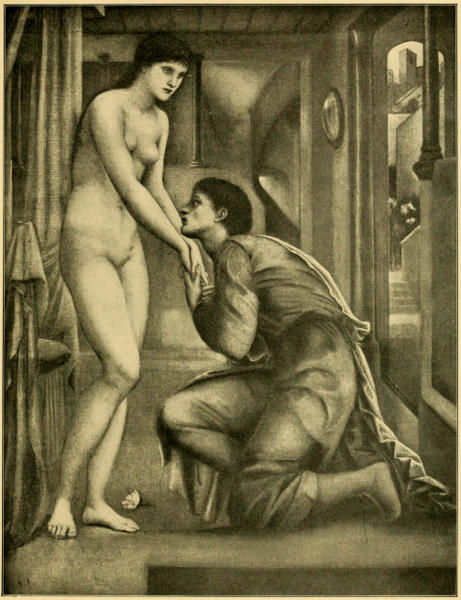
Then he remembered that the manner was
That fair-clad priests the lovely Queen should take
Thrice in the year, and through the city pass,
And with sweet songs the dreaming folk awake;
And through the clouds a light there seemed to break
When he remembered all the tales well told
About her glorious, kindly deeds of old.
So his unfinished prayer he finished not,
But, kneeling, once more kissed the marble feet,
And, while his heart with many thoughts waxed hot,
He clad himself with fresh attire and meet
For that bright service, and with blossoms sweet
Entwined with tender leaves he crowned his head,
And followed after as the goddess led.
But long and vain unto him seemed the way
Until they came unto her house again;
Long years, the while they went about to lay
The honey-hiding dwellers on the plain,
The sweet companions of the yellowing grain
Upon her golden altar; long and long
Before, at end of their delicious song,
They stripped her of her weed with reverent hands
And showed the ivory limbs his hand had wrought;
Yea, and too long e'en then ere those fair bands,
Dispersing here and there, the shadow sought
Of Indian spice-trees o'er the warm sea brought,
And toward the splashing of the fountain turned,
Mocked the noon sun that o'er the cloisters burned.
But when the crowd of worshippers was gone,
And through the golden dimness of the place
The goddess' very servants paced alone,
Or some lone damsel murmured of her case
Apart from prying eyes, he turned his face
Unto that image made with toil and care,
In days when unto him it seemed most fair.
Dusky and dim, though rich with gems and gold,
The house of Venus was. High in the dome
The burning sunlight you might now behold;
From nowhere else the light of day might come,
To curse the Shame-faced Mother's lovely home;
A long way off the shrine, the fresh sea-breeze,
Now just arising, brushed the myrtle-trees.
The torches of the flower-crowned, singing band
Erewhile, indeed, made more than daylight there,
Lighting the painted tales of many a land,
And carven heroes, with their unused glare;
But now a few soft, glimmering lamps there were,
And on the altar a thin, flickering flame
Just showed the golden letters of her name.
Blue in the dome yet hung the incense-cloud,
And still its perfume lingered all around;
And, trodden by the light-foot, fervent crowd,
Thick lay the summer flowers upon the ground,
And now from far-off halls uprose the sound
Of Lydian music, and the dancer's cry,
As though some door were opened suddenly.
So there he stood, that help from her to gain,
Bewildered by that twilight midst of day;
Downcast with listening to the joyous strain
He had no part in, hopeless with delay
Of all the fair things he had meant to say;
Yet, as the incense on the flame he cast,
From stammering lips and pale these words there passed:
"O thou forgotten help, dost thou yet know
What thing it is I need, when even I,
Bent down before thee in this shame and woe,
Can frame no set of words to tell thee why
I needs must pray? Oh, help me or I die!
Or slay me, and in slaying take from me
Even a dead man's feeble memory.
"Say not thine help I have been slow to seek;
Here have I been from the first hour of morn,
Who stand before thy presence faint and weak,
Of my one poor delight left all forlorn;
Trembling with many fears, the hope outworn
I had when first I left my love, my shame,
To call upon thine oft-sung, glorious name."
He stopped to catch his breath, for as a sob
Did each word leave his mouth; but suddenly,
Like a live thing, the thin flame 'gan to throb
And gather force, and then shot up on high
A steady spike of light, that drew anigh
The sunbeam in the dome, then sank once more
Into a feeble flicker as before.
But at that sight the nameless hope he had,
That kept him living midst unhappiness,
Stirred in his breast, and with changed face and glad
Unto the image forward must he press
With words of praise his first word to redress;
But then it was as though a thick, black cloud
Altar and fire and ivory limbs did shroud.
He staggered back, amazed and full of awe;
But when, with anxious eyes, he gazed around,
About him still the worshippers he saw
Sunk in their wonted works, with no surprise
At what to him seemed awful mysteries;
Therewith he sighed and said, "This, too, I dream,
No better day upon my life shall beam."
And yet for long upon the place he gazed
Where other folk beheld the lovely Queen;
And while he looked the dusky veil seemed raised,
And everything was as it erst had been;
And then he said, "Such marvels I have seen
As some sick man may see from off his bed—
Ah, I am sick, and would that I were dead!"
Therewith, not questioning his heart at all,
He turned away and left the holy place,
When now the wide sun reddened towards his fall,
And a fresh west wind held the clouds in chase;
But coming out, at first he hid his face,
Dazed with the light, and in the porch he stood,
Nor wished to move or change his dreary mood.
Yet in a while the freshness of the eve
Pierced to his weary heart, and with a sigh
He raised his head and slowly 'gan to leave
The high, carved pillars; and so presently
Had passed the grove of whispering myrtles by,
And, mid the many noises of the street,
Made himself brave the eyes of men to meet.
Thronged were the ways with folk in gay attire,
Nursing the end of that festivity;
Girls fit to move the moody man's desire
Brushed past him, and soft, dainty minstrelsy
He heard amid the laughter, and might see,
Through open doors, the garden's green delight,
Where pensive lovers waited for the night;
Or resting dancers round the fountain drawn,
With faces flushed unto the breeze turned round,
Or wandering o'er the fragrant, trodden lawn,
Took up their fallen garlands from the ground;
Or languidly their scattered tresses bound,
Or let their gathered raiment fall adown,
With eyes downcast beneath their lovers' frown.
What hope Pygmalion yet might have, when he
First left the pillars of the dreamy place,
Amid such sights had vanished utterly.
He turned his weary eyes from face to face,
Nor noted them, as at a lagging pace
He gat towards home, and still was murmuring,
"Ah, life, sweet life! the only godlike thing!"
And as he went, though longing to be there
Whereas his sole desire awaited him,
Yet did he loath to see the image fair,
White and unchanged of face, unmoved of limb,
And to his heart came dreamy thoughts and dim
That unto some strange region he might come,
Nor ever reach again his loveless home.
Yet soon, indeed, before his door he stood,
And, as a man awaking from a dream,
Seemed waked from his old folly; naught seemed good
In all the things that he before had deemed
At least worth life, and on his heart there streamed
Cold light of day—he found himself alone,
Reft of desire, all love and madness gone.
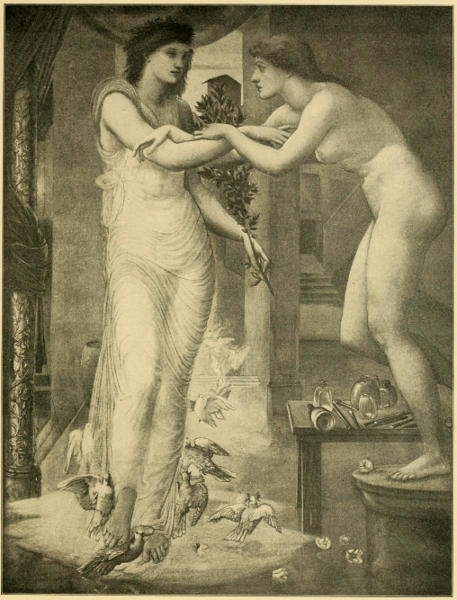
 ith the exception of
"The Doom of King
Acrisius," "Pygmalion
and the Image" is the
only poem of The
Earthly Paradise for the
illustration of which
Burne-Jones actually
executed a complete series of pictures; and
though the finished paintings are but four
in number, and the original designs, made
in 1866-1867, were twelve, the numerically
smaller set is complete in the best sense,
since not only does it illustrate fully the
text and spirit of Morris's poem, but each
picture in it, though finished with the loving
care and elaboration which Burne-Jones lavished
on his paintings, fails of its full significance unless
considered in its relation to the series of which
it forms a part.
ith the exception of
"The Doom of King
Acrisius," "Pygmalion
and the Image" is the
only poem of The
Earthly Paradise for the
illustration of which
Burne-Jones actually
executed a complete series of pictures; and
though the finished paintings are but four
in number, and the original designs, made
in 1866-1867, were twelve, the numerically
smaller set is complete in the best sense,
since not only does it illustrate fully the
text and spirit of Morris's poem, but each
picture in it, though finished with the loving
care and elaboration which Burne-Jones lavished
on his paintings, fails of its full significance unless
considered in its relation to the series of which
it forms a part. MAN OF CYPRUS, A SCULPTOR
NAMED PYGMALION,
MADE AN IMAGE OF A
WOMAN, FAIRER THAN
ANY THAT HAD YET BEEN
SEEN, AND IN THE END
CAME TO LOVE HIS OWN HANDIWORK
AS THOUGH IT HAD BEEN ALIVE:
WHEREFORE, PRAYING TO VENUS FOR
HELP, HE OBTAINED HIS END, FOR SHE
MADE THE IMAGE ALIVE INDEED, AND A
WOMAN, AND PYGMALION WEDDED HER.
MAN OF CYPRUS, A SCULPTOR
NAMED PYGMALION,
MADE AN IMAGE OF A
WOMAN, FAIRER THAN
ANY THAT HAD YET BEEN
SEEN, AND IN THE END
CAME TO LOVE HIS OWN HANDIWORK
AS THOUGH IT HAD BEEN ALIVE:
WHEREFORE, PRAYING TO VENUS FOR
HELP, HE OBTAINED HIS END, FOR SHE
MADE THE IMAGE ALIVE INDEED, AND A
WOMAN, AND PYGMALION WEDDED HER.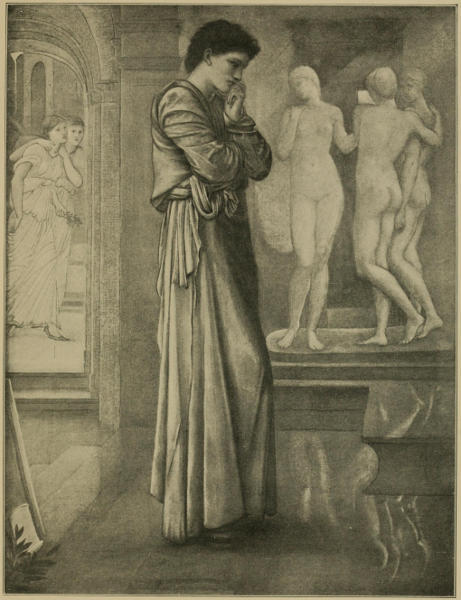
 ut the next morn, e'en while the incense-smoke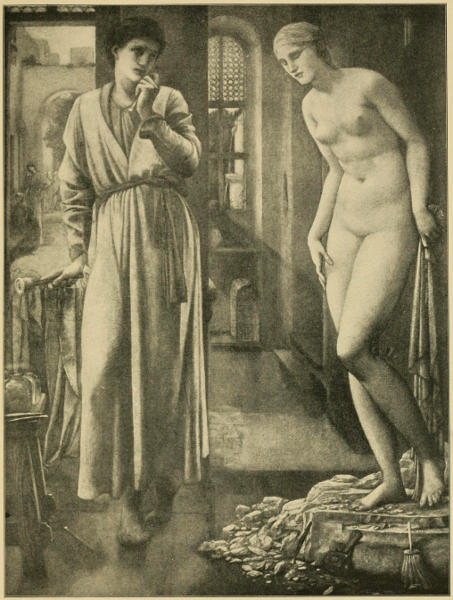
 hus to his chamber at the last he came,