All these works, acrimoniously discussed and
unjustly attacked by the critics, made the name
of Puvis de Chavannes widely known without
augmenting his reputation. The general public,
habituated to the stereotyped, elaborate, ornate
school, understood nothing of such deceptive simplicity.
His canvases would not sell. Even the
government had made no more purchases since its
acquisition of Peace. It had even refused to acquire
War, when the artist offered it. As we have
already said, sooner than have the two pictures
separated, Puvis made up his mind to donate it.
Commissions failed to come in, and nothing
afforded hope that this condition of affairs was
likely to change, when chance threw in the path
of Puvis de Chavannes a man whose providential
intervention completely transformed his destiny.
At about this epoch the city of Amiens had
started to build a museum. The architect of this
enterprise, M. Diot, came to see Puvis de Chavannes
and said to him:
"I saw your paintings in the Salon of 1861, and
was greatly pleased with them. In the edifice
which I am at present constructing, there are
some vast surfaces to be covered. Are your two
pictures, Peace and War, still in your possession?
I could find immediate use for them."
Puvis de Chavannes replied that the two paintings
in question belonged to the State. The city
of Amiens immediately solicited the concession of
them, which was courteously granted.
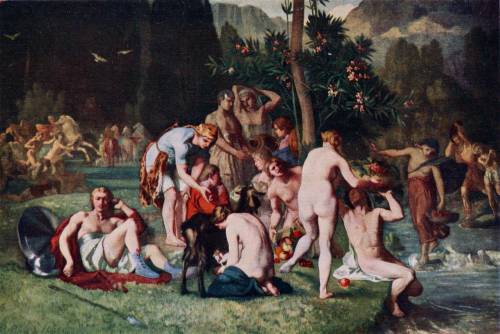
PLATE IV.—LUDUS PRO PATRIA
(In the Museum, Amiens)
This great composition, of which the present plate gives only a
fragment, is numbered among the most beautiful productions of
Puvis de Chavannes, because of the harmony of its parts, the
nobility of the postures and the charm of its detail.
The paintings were placed in the grand gallery
on the first floor, where they produced a most
beautiful decorative effect. Puvis de Chavannes,
delighted at this unhoped-for good fortune, offered
to complete the decoration of the gallery, by painting
the panels occupying the spaces between the
windows. The illumination is exceedingly bad,
but with infinite art the painter succeeded in harmonizing
his compositions with the atmosphere
and light of the room. It should be noted further
that the subjects treated in the panels on the right
gallery relate to the picture of War, which faces
them; they are a Standard-Bearer and a Woman
weeping over the ruins of her home. The same
holds true of the painting consecrated to Peace,
the corresponding panels being a Harvester and
a Woman spinning.
Puvis de Chavannes considered himself fortunate
in having two of his works which he so
greatly loved find a place in a museum. The
municipality of Amiens was none the less delighted
in possessing them; it gave proof of this by once
more sending its municipal architect to him on a
special embassy:
"I need two more mural paintings to decorate
the main staircase of the museum. Do you happen
to have what I need ready made, as you did
the other time?"
The architect was jesting. Puvis de Chavannes
betook himself to a corner of his studio, and unrolling
two canvases, presented them to M. Diot:
"Here are what you want. These two pictures
are of the same dimensions as Peace and War;
they represent Repose and Labour and form part
of the same series. Will they serve your purpose?"
They served the architect's purpose to perfection.
Unfortunately the city of Amiens did not
have the money to pay for them. The difficulty
was explained to the artist who, with his customary
disinterestedness, made a present of both
the paintings. They were soon stretched in the
places for which they were intended, in a framework
of fruits and flowers, and produced an admirable
effect. The municipality of Amiens was
so well satisfied with these paintings that it
decided at the cost of great sacrifices to commission
Puvis de Chavannes to prepare a large composition
destined to occupy the entire upper panel
of the staircase on the side of the grand gallery.
This panel was intersected by two doorways.
Puvis de Chavannes set to work immediately.
In the Salon of 1865 he exhibited his Ave Picardia
Nutrix, destined for the Museum of Amiens.
The painting produced a veritable sensation.
Even the unskilled in art experienced an instinctive
emotion in the presence of this important
canvas which they did not fully understand, but
which they felt to be sincere; as to the artists,
they were obliged to acknowledge that the painter
whom they had scoffed and derided, and who had
now produced the Picardia Nutrix, was unquestionably
a master.
The Ave Picardia Nutrix is a glorification of
the fertility and richness of the land of Picardy.
The artist has wished to represent in a succession
of episodes, harmoniously related one to another,
all the products of the soil and all the local industries
from which Picardy draws its prosperity.
To this end he has grouped his figures in the
setting of a Picardian landscape, quite faithful in
colour and in line. M. Marius Vachon analyzes
the painting as follows:
"Beneath the orchard of a vast estate some
peasants are turning a flour mill; women are
bringing apples for a keg of cider; masons are
building the walls of a house, and an old woman
is spinning on her distaff the native hemp. Along
the banks of a stream, women are weaving fish
nets; carpenters are constructing a bridge; boatmen
are steering heavy-laden barges. Add to
these professional labours the incidents of work-a-day
life, which are taking place on every side,
charming incidents, picturesque and touching; a
little lad, carrying a heavy basket of fruit on
his head, eager to show his strength before his
elders; a mother, nursing her youngest born;
some women bathing under the shadow of the
willows. The composition is abundantly suggestive
of delicate impressions; and it forms a magnificent
decoration for the edifice in which it has
been placed."
When the painting had been installed in its
position in the vestibule of honour on the main
floor, the municipality of Amiens perceived that
the fourth side of the staircase, the only one not
decorated, was precisely the one that best lent
itself to the development of a painting, because of
its considerable surface. The ceiling, it is true,
darkened this vestibule, owing to its insufficient
window space. It was, furthermore, adorned by
a painting by Barrias. Nevertheless the city
determined to replace the ceiling by a skylight,
on condition that Puvis de Chavannes would
paint the vacant panel thus made available.
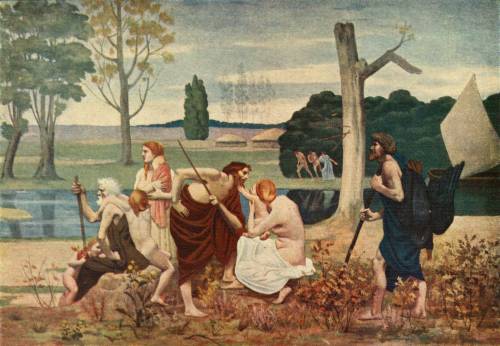
PLATE V.—REPOSE
(In the Museum, Amiens)
This work is one of the earliest by this great artist. It is very
interesting, because it still shows the influence of Couture's studio,
where Puvis de Chavannes had been a pupil. It serves as a point
of comparison for determining the evolution of the artist's talent.
However, the resources of the municipality
did not permit it to incur so great an expense. It
appealed to the State, which curtly refused its
coöperation. The city fathers of Amiens were
in despair, the painter not less so. What was to
be done? Wait until the municipality, through
slow economies, was in a position to order the
picture? Puvis de Chavannes, who had grown
enthusiastic over the task, was boiling with impatience
and listened day by day, as he expressed
it, to hear if no breeze was blowing his way from
Amiens.
But when the breeze remained persistently
unfavourable, Puvis de Chavannes, growing tired
of waiting, decided to execute the panel in any
case, come what might. And he composed the
admirable fresco which bears the name of Ludus
pro Patria.
Everyone knows the subject of this painting,
which has passed into a legend. In a plain traversed
by a running stream, some young men
are engaged in a game of rivalry with spears.
On a knoll, an old man, surrounded by women,
serves as umpire. He follows, with attentive eye,
the fluctuations of the game, while a young lad,
in a pose charming for its relaxation, rests one
arm around his neck. Behind him a young woman
holds out her baby for its father to kiss.
On the left of the picture, seated at the foot of a
tree, or grouped around a fountain, young girls
await the end of the game in which their brothers
or their betrothed take part. One of them leans
towards an aged minstrel and begs him to play
some dance music after the game is over.
All these groups are harmoniously disposed in
an open-air setting, dotted over with cottages and
stately trees, enveloped in a soft and mellow light.
This picture reveals the artist's predilection for
children, a very curious and touching predilection
to discover in a painter whose own fireside was
never gladdened by childish laughter. Let us examine
the Ludus pro Patria; in this picture Puvis
de Chavannes has been lavish of childhood games
and pastimes. Notwithstanding that his art was
before all else synthetic, and gained its effects
from harmony of attitude rather than from finish of
figures, he plainly expended loving care in modelling
those delicate and charming little bodies, which
he has endowed with infinite grace. Is there
anything more adorably exquisite than the gesture
of the infant stretching out its plump arms towards
its father? And does not the child standing before
the group by the fountain reveal the master's
tender solicitude for these little beings whose absence
from his domestic life he probably regretted?
The distinguished custodian of the Museum at
Amiens showed me the corner of the balustrade
on which the painter rested his elbows, in front of
the group of which that child forms part. After
some moments of contemplation, he might be
seen to mount his scaffolding, brush in hand, to
add a few strokes, some new tint to that delightfully
modelled little form.
The Ludus pro Patria is something more and
something better than a beautiful picture; it is a
symbolic work in which the noblest conceptions
of patriotism are exalted. With his incomparable
synthetic art, Puvis de Chavannes has endeavoured
to show all the diverse manners of serving usefully
one's native land. Young women, bearing
the tender burden of nursing children, are rearing
for their country a valiant generation, which before
long will be augmented through the robust
girls grouped on the left, awaiting the advent of
husbands. The children, grown to manhood, will
practise games of strength and skill which will
render them capable of defending their common
patrimony. The old man himself has his rôle
assigned in this ideal commonwealth; ripened
by experience of life, he supplements the feebleness
of his arms by the wisdom of his lessons;
he is the honoured counsellor, the arbiter of full
justice, who restrains the ardor of youth within
the path of reason.
The cartoon for this magnificent panel was
exhibited in the Salon of 1881; it achieved a unanimous
success. The State acquired it, and at the
same time commissioned Puvis to paint the picture
itself for the Museum of Picardy. The
finished work, in its proper dimensions, found a
place in the Salon the following year, and gained
its author the medal of honour from the Society of
French Artists.
We have followed Puvis de Chavannes in his
decoration of the Museum of Amiens, from the
beginning to the end of his artistic career, without
regard to chronological order, because of the
interest which he himself took in this extensive
work, which was, one might say, his constant
preoccupation. Accordingly we must go back in
point of time and follow step by step this astonishing
and genial worker whose accomplishment
is disconcerting in its power and its fecundity.
The first works executed for the Museum of
Amiens had attracted public attention to him.
The municipality of Marseilles had just crowned
the important enterprise of bringing the waters
of the Durance into the city, by erecting a sumptuous
Public Waterworks, bearing the name of
the Palace of Longchamps.
Two great mural surfaces enclose the principal
staircase. It was decided to decorate them with
paintings. And when the time came to choose
the artist, a unanimous agreement was reached
on the name of Puvis de Chavannes.
The latter, being notified, accepted joyfully, as
he accepted all occasions of converting a noble
vision of art into a reality. And what finer fortune
could come to an artist that to celebrate
Marseilles, the sun-bathed city, vibrant with light,
crouching royally on the azure mantle of the
Mediterranean?
Puvis de Chavannes hastened to the ancient
Ligurian city. He calculated the difficulties of
composing a great decorative composition, free
from banality, out of the habitual elements of a
seaport,—a subject a thousand times treated and
perilous of execution. He sought, he studied, he
promenaded the quays, he strode the length and
breadth of the city. At last the enlightening flash
he awaited came in the course of a trip to the
Chateau d'If. In the presence of that noble panorama
of the city seen from the sea, he remained as
if dazed, realizing that he had found what he was
in search of. He would not paint Marseilles with
the sea as a decorative background; it was the
city herself that should form the background, and
not the sea. He had his two pictures in his grasp.
And without stirring from the spot, while his
friends took luncheon, he remained seated on the
rocks, making notes and sketches, in order to fix
fully in his mind "the line and colour of that marvellous
maritime landscape."
The first of these pictures, Marseilles the Greek
Colony, stands for the entire history of the
Phocian city from its foundation to the present
time. But, following his essentially synthetic
method, he painted, not the successive transformations
of Marseilles, but symbolic figures of
the sources to which she owes her grandeur and
her prosperity.
In the background is the strand, which as yet
is only a natural harbour. Along the shore, vessels
are seen building; these are the symbol of
activity. Further off, horses are bringing merchandise
towards the boats about to sail, symbol
of the commercial instinct; masons, carpenters,
stonecutters, are zealously plying their craft; and
palaces, storehouses, and churches arise, symbols
of wealth and of taste in art.
Among the accessory features are a woman
vendor spreading before other women rich fabrics
and pearls, and some slaves conveying towards
the city jars of oil and skins filled with wine.
In Marseilles, Gateway of the East, a ship is
seen, laden with travellers, making its way into
port. All these passengers are Orientals, recognizable
by the gaudiness of their garments: they
admire the panorama of the rich city whose fortifications,
churches, and palaces stand out in bold
relief against the ruddy light of evening.
An atmosphere of warmth and brilliance emanates
from these two paintings, of which the city
of Marseilles has shown herself justly proud.
When Puvis de Chavannes received a commission
for a mural painting he gave himself
ardently to his task, but at the same time intermittently.
Contrary to a generally accepted
belief, his genius was not the result of "long
patience," but rather the realization of a vision.
He never applied himself to a painting if some
external cause, no matter what, had deadened in
him the essential inspiration. In such a case, he
would revert to some other work which his mind
could "see better" on that particular day. In
this way we can understand how he could carry
forward simultaneously several works of equal
importance, and at the same time paint in addition
occasional easel pictures.
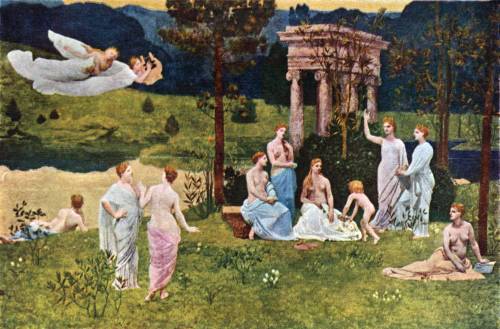
PLATE VI.—THE SACRED WOOD, DEAR TO THE ARTS
AND THE MUSES
(In the Museum, Amiens)
This painting, admirable in execution, is quite interesting to
study, because it serves to show in what a purely personal manner,
wholly detached from mythological traditions, Puvis de Chavannes
interpreted Antiquity.
Following the example of Marseilles and
Amiens, the city of Poitiers, which in 1872 had
just completed the building of a City Hall, commissioned
Puvis de Chavannes to decorate the
main staircase.
The two subjects chosen by the artist, with
the approbation of the municipality, were as
follows:
First panel:—"Radegonde, having retired to
the Convent of the Holy Cross, offers an asylum
to the poets and protects Literature against the
barbarism of those days."
Second panel:—"The year 732: Charles Martel
saves Christendom by his victory over the
Saracens near Poitiers."
The legend of Radegonde is well known:
"The virtuous spouse of Clotaire, fleeing from
the brutality of that crowned free-booter and
hiding in a convent in order to escape his
pursuit." But this convent is by no means a
cloister; the practice of arts and letters is
pursued alternately with the singing of
psalms.
The door stands open to poets. One of them,
Fortunatus, passing through Poitiers, stops there
and is received with cordial hospitality, and
conceiving for the saintly queen a delicate and
chaste love, he remains for twenty years in this
abode in which he purposed to spend only a few
days.
Puvis de Chavannes has magnificently rendered
the poetic beauty of this historic episode by
representing one of the fêtes given by Radegonde
in the Convent of the Holy Cross.
In the second panel, we see Charles Martel
returning to Poitiers, victorious over the Saracens
and receiving the benediction of the
bishops. Here the artist's brush attains a
vigour of expression such as in all his life
he found but few occasions to employ. The
countenances of the bishops, notably, stand
out with a relief and an energy that are
remarkable.
M. Marius Vachon relates that he once asked
the artist, who was a personal friend, to what
documents he had recourse in order to give
such forbidding features to the prelates in his
painting:
"I got the suggestion for them," he replied,
laughing, "from an old set of chess men, consisting
of the coarse and grouchy faces of knights and
jesters."