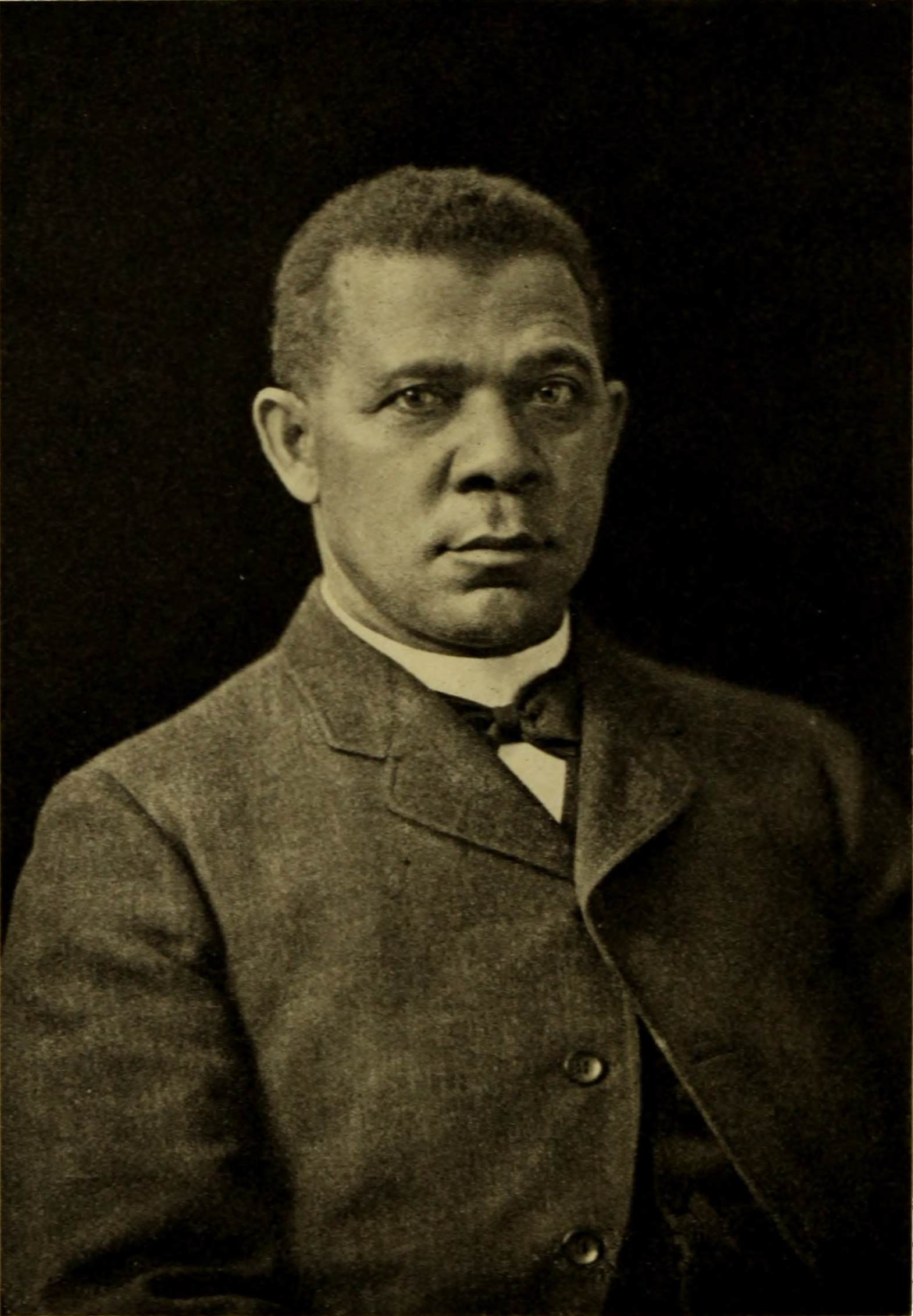
Copyright, 1906, by Thomas Y. Crowell & Co.
Published September, 1906
Composition and electrotype plates by
D. B. Updike, The Merrymount Press, Boston
The chapters in this little book were originally
part of a series of Sunday Evening Talks given
by the Principal to the students of the Tuskegee
Normal and Industrial Institute. They have
been recast from the second to the third person,
and many local allusions have been cut
out. They are now sent out, in response to repeated
requests, to a larger audience than that
to which they were first spoken.
The individual who puts the most
into life is the one who gets the
most out of life. The first requisite
for making life effective for one’s
self or society is a sound body.
There have been many people who in spite of
weak bodies have enriched the world by noble
thought and work. There has been a long line
of physically weak men who have helped the
world onward; but the rule holds that the best
work has been done by men and women of
vigorous health.
It is important that the Negro race in its present
condition shall learn just as quickly as
possible how to have good, strong, healthy
working bodies, for so much is dependent upon
them. In the world of industry, the world of commerce,
all mental activity and spiritual endeavor,—no
matter in what direction one’s attention
or energies may be turned, strong bodies
are needed to meet the demand. There are a
few simple rules which should serve as guide-posts
to those who would make the most of
their physical being. One of the conditions of
a good, strong, working body is contact with
fresh air. In the early days of this school, when
we were housed in shacks and cabins, whatever
else we lacked, we were, by virtue of necessity,
abundantly supplied with air; but now
that we are getting into plastered buildings,
with good floors and windows and doors, there
is danger of suffering from poorly ventilated
rooms and a lack of health-giving air.
Those who live in the large cities would do
well to become disciples of Wordsworth, and
with him learn to know the inspiration and
strength that come from wood and forest,—the
joy of intimate acquaintance with birds and
flowers. The individual who has the privilege of
living on the farm, and coming in contact with
the earth and grass and trees and real things,
is the individual who, provided he has an eye
to see and an ear to hear, is most to be envied.
Next in importance to an abundance of fresh
air is the habit of regular, systematic exercise.
People often think that this kind of exercise
costs a great deal of money, that it means costly
apparatus and artificial fixtures. Not so. It requires
no great outlay of time or energy for the
boy on the farm to breathe deeply as he follows
the plough or scatters the seeds. And yet, simple
exercises of this kind are essential to the
life of a race whose mortality from pulmonary
diseases is alarming. Every boy in the machine
shop knows how necessary it is to keep his
machinery well oiled and in good running condition.
Then, too, every such boy knows the
importance of keeping every part of his machinery
as clean as possible. Now, your body is
a machine, but how much more delicate and
intricate than any made by man! how much
more necessary to keep it in good running condition
and absolutely clean in order that it
may do its best work!
In addition to pure air and cleanliness, I want
to speak of the wearing of comfortable clothing
as another essential to right living. I am glad
to see that the world is fast getting away from
the old habits that used to enslave people in
this matter of dressing—the habit exercised
by many of wearing small shoes, for instance,
until their feet were cramped in severe pains
merely to have the world think they had small
feet. What does it matter to the world whether
a person has small feet or large feet? Who ever
stops to think whether great poets, historians,
the great workers in economic and religious
life,—men and women who have really accomplished
something,—had large or small feet,
whether they wore fours or eights, or wore
large or small corsets or none. I am glad to see
that all peoples and races are getting away from
that kind of thing, and I want the Tuskegee
students to make up their minds to buy shoes
to fit no matter what the number. We consider
the Chinese ridiculous to keep their feet cruelly
cramped in order that they may be small, but
many of us in somewhat less degree are guilty
of the same thing.
The importance of temperance has been repeated
over and over again from this platform;
and intemperance in eating or sleeping is not
less disgusting than intemperance in drink.
The world’s work is to be done by men and
women of vigorous intellect; but the sound
mind must have its foundation in a body which
is kept clean and made comfortable by proper
clothing, pure air, regular exercise and wholesome
food. No workman, however competent,
can do good work unless his tools are kept in
proper repair. My plea is that the young Negro
students shall acquire strong working bodies to
be used as tools to serve therewith their fellows
and their Maker. This is the end of all living.
ii Some of the Qualities Essential to the Most Successful School Life
The student who would put the
most into his school life must
first of all be happy. I do not believe
it is possible for a student
to accomplish very much, certainly
not the most, while he is in school, unless
he learns to be happy in all his relations in
school life. If the students are unhappy there is
something wrong with the institution, or with
the teachers, or with the student body. The
normal state of a student in a well-ordered institution
is a happy one. It is impossible to get
the most out of the life of any institution unless
there is joy in working out the ideals of
the institution. The student should make himself
familiar with the purposes of the school to
which he seeks admission, and having made
the choice, he should be loyal to its traditions
and purposes.
The Bible teaches over and over again that
freedom, without which happiness is impossible,
is self-imposed restraint, that to be really
free we must live within the law. He who lives
outside the law is a slave. The freeman is the
man who lives within the law, whether that law
be the physical or the divine. All life is governed
by law, and the student must acquire freedom
by obedience to law. The students in any institution
are divided into two classes: the happy,
contented, ambitious, hopeful ones, who have
faith in the institution and respect for its traditions,
and the miserable, discontented, grumbling
class. One class live not only within the
letter but in the spirit of the law, and are consequently
happy. The second class are miserable,
discontented and hopeless because they
try to live outside the law. No student can get
much out of any institution who does not enter
whole-heartedly into its spirit, its traditions
and its ideals.
The ability to do hard methodical work is one
of the prizes which every school worthy of the
name offers to its students. The years at school
not infrequently give bent to the whole life.
The student who does slipshod work at school
is more than likely to lack direction in his subsequent
career. But mental strength comes not
as a bequest. It is a prize that must be contended
for right earnestly, and dictionary, cyclopaedia,
text-book and shop are tools which
instructors place in the hands of students to
help them win the prize. The proper use of
these tools must depend finally upon the individual
student. No one gets much out of life
who does not make his education a real, vital
part of himself. Many people have education
very much as a parrot has at his command
a certain number of words or sentences. The
words and sentences that the parrot utters are
no real part of him. They are merely something
tacked on to the parrot, and foreign to his real
natural make-up. Some people use education
as they use their “Sunday clothes,” on extra
occasions only. They bring their education into
play when they are in the company of others,
commit a few quotations and use big words
which have no working place in their vocabulary.
To try to make education a real part of
one’s self is the way to get most out of one’s
school life. Just as the food a man eats becomes
a part of his blood and bone, so should education
become a vital part of him. Education
must be digested and assimilated in order to
make it significant.
The student who leaves undone immediate
duties because of bodily laziness is leaving
happiness far behind him. Sins of commission
and sins of omission alike tend to weakness.
Our ability to make the world better depends
entirely upon our ability to use every opportunity
to make ourselves better. A largeness
of life, a variety of interests and breadth of view
are among the prizes which a school offers to
its students. These qualities the ignorant man
does not possess. Largeness of life and breadth
of vision give faith in the future; that largeness
makes one person take the long view when
the other is taking the short view; that largeness
lifts the educated person far above the
temptation to gossip about little things, above
the temptation to get down into the mud
and slime with which weaker individuals are
smeared.
To be loyal and obedient to the legislation of
an institution, to make thrifty use of text-book
and shop and farm and every part of the school
equipment, is to attain that mental strength
that makes for largeness of life and breadth of
view. These qualities come not by observation,
but they do come by conscientious work in season
and out of season. They are all within the
reach of the student who is willing to work for
them, and they are all essential to real happiness.
iii A Word to Prospective Teachers about Putting the Most into their Work
The large problem of the teacher
is not to impart knowledge and
maintain discipline. The larger
problem is to bring school life and
real life into closer contact. With
the average teacher, as with the average student,
there is very little connection between
the school and life as it is actually lived every
day outside the school-room; and as long as
this is true there will be ground for reasonable
and just criticism.
In the primary school, the intermediary school
and the high school there is often little, if
any, connection between life as it is lived in the
shop, on the farm, in business and in the home.
It cannot but prove of mutual advantage if the
teacher can bring school life into actual touch
with the life of the people about him. The interest
of the parents will be increased just in
proportion as they find that the teacher is
making his instruction stimulate and vitalize
conditions outside the school-room.
It is difficult for the parent of the country
child to note the results of education through
the usual processes and channels of knowledge.
Colored parents depend upon seeing the
results of education in ways not true of the
white parent. It is important then that the colored
teacher in this generation should give
special attention to bringing school life into
closer touch with real life. Any education is to
my mind “high” which enables the individual
to do the very best work for the people by
whom he is surrounded. Any education is “low”
that does not make for character and effective
service.
The average teacher in the public schools is
very likely to yield to the temptation of thinking
that he is educating an individual when he is
teaching him to reason out examples in Arithmetic,
to prove propositions in Geometry and
to recite pages of History. He conceives this to
be the end of education. Herein is the sad deficiency
in many teachers who are not able to
use History, Arithmetic, Geometry as means
to an end. They get the idea that the student
who has mastered a certain number of pages
in a text-book is educated, forgetting that text-books
are at best but tools, and in many cases
ineffective tools, for the development of man.
Modern educators are getting more and more
away from books. Now this will be hard for
the average teacher who has worked out all
the problems in Arithmetic and proved them by
the answers in the book, but I believe that
the best educational thought tends toward the
study of real things and not mere books.
One of the ways of bringing the school into
closer touch with society is to make school surroundings,
including the grounds and buildings,
as homelike and as attractive as possible.
The school-rooms are in too many cases cold
and barren. In schools of this sort there is little
connection between the home and the school. I
believe that the teacher should study the home
surroundings of his pupils and become more
intimately acquainted with the parents. When
teachers are able to make their school-rooms
inviting and are able to project their influence
into the home life of the pupils, there will be
few absentees or truants. A child cannot be expected
to leave a comfortable, attractive and
convenient home to go into a dull, inconvenient,
uncomfortable school-room, nor can it be expected
that pupils will leave comfortable chairs
at home and go into school-rooms where they
must sit on stools with their feet six or eight
inches from the floor.
It is hardly necessary to say that the teacher
should set the example for the student in the
matter of cleanliness and neatness. The teacher
who would preach against grease spots, rents
in clothes and buttonless jackets must see to
it that he is himself without fault in these respects.
When I go into a school and notice that
the instructor has buttons off his coat, I am at
once convinced that he is not the right teacher.
I do not believe that there is much that the
student can learn at that school that can be
put into practice in real life. I believe that the
teacher should not only set an example himself,
but that he should go further than this:
he should see that every boy and girl in his
school is familiar with the practical applications
of soap and water, and knows the work
of the tooth-brush and the darning-needle.
Some parents may at first resent this encroachment
upon their special domain, but persistence
in an endeavor of this sort will finally
cause the parents to look upon the teacher as
a new force in the community. The average
parent cannot appreciate how many examples
Johnny has worked that day, how many questions
in History he has answered; but when he
says, “Mother, I cannot go back to that school
until all the buttons are sewed on my coat,”
the parent will at once become conscious of
school influence in the home. This will be the
best kind of advertisement. The button propaganda
tends to make the teacher a power in
the community. A few lessons in applied Chemistry
will not be amiss. Take grease spots, for
example. The teacher who with tact can teach
his pupils to keep even threadbare clothes
neatly brushed and free from grease spots is
extending the school influence into the home
and is adding immeasurably to the self-respect
of the home.
In the school-houses in the city, and in many
of the larger towns and country districts, janitors
do all the work of cleaning. This may
be necessary in city schools, where it is not
possible for the children to do all the work of
beautifying and cleaning the school building,
but when all this work is done by outsiders
the children are robbed of part of their instruction
and they thus lose a very important lesson
in cleanliness and order which it is the duty of
the teacher to give. Think of the time lost in
the average family looking for the broom when
the time comes to sweep the floor. At this time
all business suspends. Mother cries out first,
“Where is the broom?” The older sister cries
to John and Susie and Jane, “Where is the
broom?” and that kind of thing goes on every
day in the week and year. It takes the average
family from ten to twelve minutes every day to
find the broom. Now, we should teach a different
lesson in our schools. We can teach in the
first place that there are two ways for the
broom to be put up, a proper and an improper
way. We can teach the children that there is a
place for the dust-pan and the dust-cloth and
the match-box. The match-box is another thing
that suspends business. Every night when the
matches are wanted, everything goes helter-skelter.
This is a larger problem than the
broom, there being absolutely no light on the
subject. The children should be taught that
there must be a definite place for the broom
and for the match-box, and it is surprising how
quickly these lessons will be taken from the
school-room into the home. Even the listless
parents will be roused to interest by such practical
teaching. The child who goes to school in
a room that is clean and attractive will not long
be content to live in a home that is dirty and
disorderly.
I was recently in a school-room in South Carolina.
The teacher had a reputation for being
a well-fitted instructor, and I expected much
of him. He was teaching the children by the
latest methods. The children sang well, they
recited their lessons well, but the fact that one
third of the plastering was missing made the
greatest impression on me. I could not detect
the slightest attempt on the part of the teacher
or students to see that the plastering was restored.
I should have suspended school a day
or two until the plastering could be replaced,
rather than teach day after day by silent approval
a lesson of disorder. If the teacher is
careless, the pupils will accept his standards
and go through life in an indifferent, slipshod
manner. If from the first day they enter school
they are surrounded with object lessons of order
and cleanliness, more will have been done
to educate them in a large and helpful way
than if they had centred their interest in books
alone.
Order and beauty are sacrificed in many of our
schools because one third or one fourth of the
window-glass is out. Sometimes I have seen
obsolete hats and discarded dresses doing duty
in the absence of window-glass or window-panes
knocked out in order that the stovepipe
might be run through the broken place. The
child never outlives the impression made by
such a sight. The parents will join their children
in helping to patch broken plastering if
the teacher will take the lead. When the plastering
is mended, a few pictures should be
placed on the walls, and in this work the parents’
coöperation can be depended upon. Teachers
must put not less conscience but more
thought into the work for the children to whose
lives they are giving direction. By putting into
their work more of their better selves, more
of their personality, teachers will add not only
to their own happiness and usefulness, but will
be doing real work toward hastening the coming
of that kingdom for which they daily pray.
iv Industrial Efficiency an Aid to The Higher Life
It was Emerson who said that
“One generation clears the forests,
the next builds the palaces.”
Each generation is very anxious
to engage in the building of the
palaces, an ambition which is altogether laudable,
but the forests must first be cleared or
there will be no palaces. And so it falls to the
lot of every successful individual of every race
and nation to engage at some time or period
in their existence in dealing in a large degree
with the industrial or material affairs of life.
The forms of industry that occupy the majority
of people in a civilized country may be
classed under one of the following heads: first
and perhaps most largely, the production of raw
material in one form or another; the second
step is the manufacturing of these materials;
third, the problem of transportation and getting
these products on the markets of the
world, and having them properly distributed
and economically and wisely consumed.
The production of cotton in the South presents
a familiar example of all these processes.
The growing of cotton is an industry largely
in the hands of my race; in the second step,
the manufacturing of cotton, the colored people
have as yet little part; in putting these
materials on the market through the medium
of steamboats, steam-cars, and their distribution
through wholesale and retail establishments,
colored people have diminishing interests.
The lesson for all young people to learn
in this busy industrial age is to deal with materials,
whether at first hand in getting something
out of the soil, or as constructing or distributing
agents, so as to increase the value of
the material they handle and to make themselves
more useful as individuals.
The main source of all productiveness is in
the soil, and the work of getting out of the soil
all that can be gotten out of it has, in recent
years, made agriculture an intellectual pursuit.
It is very important to note the progress
of the world during the last few years, when
people have learned to put more into life by
putting brains and skill and confidence into
all industrial operations. A few years ago the
man who was going to be a farmer made almost
no preparation for his work. Skill and intelligence
were not considered necessary, but
to-day in every civilized country there are institutions
that have for their sole purpose the
teaching of methods of getting everything possible
out of the soil. A few years ago the mining
of coal, copper, silver and gold was left to
the most unintelligent, ignorant and unskilled
people; there was little thought or skill put
into preparation for this kind of work. To-day
mining schools have been established in all important
mining districts, and this industry has
been so dignified that intelligent and skilful
men delight to enter it. The same thing is true
of forestry. Within the last few months a chair
of Forestry has been established at Cornell
University, where young men can learn all
about the selection and cultivation of trees. The
Department of Agriculture at Washington is
spending over two million dollars yearly in
showing people how to take care of the forests.
The world is making all the material products
serve not as masters but as servants, and servants
in the sense that they are making people
put more thought, more effort, more skill into
life, and enabling them thus to get more abundant
returns wherewith to enlarge and ennoble
their lives. There are opportunities about us on
every hand. The Southern farm offers great opportunities
to every young man who will use his
talents. The idea that farming means ploughing
with one mule or digging the ground with
a spade is fast disappearing, for this industry
is developing into a high and dignified calling.
Young women of maturer races than ours are
making large economic successes in the raising
of chickens, in fruit growing, in raising
small berries; and young colored women should
begin to get some of the benefits of these industries.
But the chance for material success in connection
with industrial life is relatively of less
importance than is the chance for the individual
to get development through the mastering
of difficulties in the management of industrial
operations. The mere mastering of these difficulties
has made many of the Captains of Industry
of this country. Poverty discourages
many a youth who starts out in the busy industrial
world, but the fact that others have
conquered poverty is an earnest that others,
for centuries to come, will get courage and
strength out of adverse struggle. The colored
man starts out, it is true, with an additional
handicap, but here is the chance for Negro
youth to learn to turn disadvantages to advantages.
A colored man born in poverty and an ex-slave
owns to-day one of the largest tailoring
establishments in one of the most prominent
streets in the city of Boston. This man had
learned the sweet uses of adversity and knew
how to lay hold of disadvantages. His establishment
is patronized by people who buy from
him not in spite of the fact that he is a Negro,
but because he is a Negro. The world needs
men, be they white or black, who can rise on
successive failures to useful citizenship. No
person can enter industrial life without for a
time feeling some days of almost complete failure,
but mistakes and weariness beget confidence
and experience.
All industrial operations and material progress
should be used not as ends but as means
of making life more comfortable, more useful
and more beautiful. The intelligent farmer as
he plants and works and harvests the cotton
must remember that the production of cotton
is not the end of his effort. Every bale of cotton
can be turned into books, into opportunities for
travel and study. The man who grows corn
must remember that the growing of corn is not
the end of life, but that the corn can be turned
into refinements and beauties of a civilized life
and a Christian home.
No one can doubt that the people who have
built the railroads and constructed the great
steamships that bind country to country have
added to the wealth and happiness of the
world. Finally, it must be remembered that the
mastering of difficulties should bring poise,
purpose and vision. I want every Tuskegee
student as he finds his place in the surging
industrial life about him to give heed to the
things which are “honest and just and pure
and of good report,” for these things make for
character, which is the only thing worth fighting
for, either in this life or the next.
v Making Religion A Vital Part of Living
Educated men and women, especially
those who are in college
or other institutions of learning,
very often get the idea that religion
is fit only for the common
people and beneath the interest and sympathy
of the educated man. In too many cases they
are disposed to think that religion is for the
weak, and that to express doubts concerning
religion and the future life is an indication of
a vigorous, independent mind. No young man
or woman can make a greater error than this.
Some years ago, when I was in New York
City, I went down to Wall Street to consult a
friend as to methods of arranging for a large
meeting. I wanted in this meeting to get interest
centred in the work we are trying to do at
Tuskegee. My friend said: “If you can secure
the coöperation of four men in New York City,
the success of your meeting will be assured.”
I went to the four men whose names had been
given me and secured their interest and coöperation.
Some weeks later there was a large
meeting held in New York in the interest of
the Young Men’s Christian Association movement.
In looking over the list of persons who
were sponsors for this meeting I found the
names of the four men whom my Wall Street
friend had mentioned. He gave me these
names, however, with no thought that they
were leaders in the religious activity of New
York City. He named them chiefly because
he knew their standing in the commercial and
business life of the city was secure, and that
anything they said would attract the attention
of the public and would secure the confidence
of the people whose interest and aid we were
seeking. And so it appears that the four men
who at that time represented the commercial
and business interest of New York were men
who were closely identified with the religious
life of the city, and were active in Sunday-school
and church work, and connected with
many other agencies which had to do with the
uplifting of the masses. My observation has
taught me that the people who stand for the
most in the educational and commercial world
and in the uplifting of the people are in some
real way connected with the religious life of
the people among whom they reside.
This being true we ought to make the most
of our religious life and to avail ourselves of
certain outward helps, helps which are not
ends but aids to higher spiritual living. First
the habit of regular attendance at some religious
service should be cultivated. This is one
of the outward helps toward inward grace. Nothing
is ever lost by this habit of systematic
devotion. But one says, “What good is accomplished
by attending church?” Another says,
“I stay away from religious service and I am
just as good as those who go.” To put the
question another way, Was any one ever injured
by regular attendance upon religious services?
The man who allows himself to grow
careless about sacred things yields to a temptation
which is sure to drag him down. As you
value your spiritual life, see to it that you do
not lose the spirit of reverence for the Most
High as revealed in your own life and experience,
reverence for the Most High as revealed
in the men and women about you, in the
opening flower, the setting sun, and the song
of the bird. Do not mistake denominationalism
for reverence and religion. Religion is life,
denominationalism is an aid to life.
Systematic reading and prayerful study of
the Bible is the second outward help which I
would commend to those whom I wish to see
make the most of their spiritual life. Many people
regard the Bible as a wonderful piece of
literature only. The reading of the Bible as literature
only brings its reward in that it throws
new light on secular history and gives acquaintance
with men and women and ideals which
have been the inspiration of the noblest things
that have ever been spoken or written. Nowhere
in all literature can be found a finer bit
of oratory than St. Paul’s defence before King
Agrippa. But praiseworthy as this kind of
study is, I do not believe it is sufficient. The
Bible should be read as a daily guide to right
living and as a daily incentive to positive Christian
service.
I think that no man who lives a merely negative
religious life can ever know real spiritual
joy. There are many people who pride themselves
on the things they do not do. The negative
Christian always suggests a lamp-post to
me. The negative Christian says he is going to
heaven because he does not lie. Neither does
the lamp-post. The negative Christian does not
steal. Neither does the lamp-post steal. He does
not cheat, he does nothing of which he is
ashamed: he is therefore blameless. The lamp-post
has never done any one of these things. I
do not want the Tuskegee students to be lamp-posts
in their religious life, but I want them to
turn their beliefs into energy that shall work
into every detail of their lives.
Not less repulsive to me than the negative
Christian is the one who is always using his
religion as a means of escape from something,
from hell fire or brimstone or some less remote
punishment. This class of Christians use religion
as people use the conjurer’s bag or a disinfectant
to ward off evil. They are not drawn
to any vital thing in religion; they simply use
it as a cloak to shield them from harm.
To live the real religious life is in some measure
to share the character of God. The word
“atonement,” which occurs in the Bible again
and again, means literally at-one-ment. To be
at one with God is to be like God. Our real religious
striving, then, should be to become one
with God, sharing with Him in our poor human
way His qualities and attributes. To do this,
we must get the inner life, the heart right, and
we shall then become strong where we have
been weak, wise where we have been foolish.
We are often criticised as a race because people
say that our religion is not real. They say
that our religion is superficial, that in spite of
our attendance at religious services and protestations
of faith we are guilty of petty pilfering,
stealing, lying and of walking crookedly
in many directions. Whenever this criticism is
true it means that we have not learned what
the religious life really means. We must learn
to incorporate God’s laws into our thoughts
and words and acts. Frequent reference is made
in the Bible to the freedom that comes from
being a Christian. A man is free just in proportion
as he learns to live within God’s laws,
and he makes grievous mistakes and serious
blunders the minute he departs from these
laws.
As a race we are inclined, I fear, to make too
much of the day of judgment. We have the
idea that in some far-off period there is going
to be a great and final day of judgment, when
every individual will be called up, and all his
bad deeds will be read out before him and all
his good deeds made known. I believe that
every day is a day of judgment, that we reap
our rewards daily, and that whenever we sin
we are punished by mental and physical anxiety
and by a weakened character that separates
us from God. Every day is, I take it, a
day of judgment, and as we learn God’s laws
and grow into His likeness we shall find our
reward in this world in a life of usefulness and
honor. To do this is to have found the kingdom
of God, which is the kingdom of character
and righteousness and peace.
vi On Making Our Race Life Count in the Life of the Nation
In the Bible one finds over and
over again the words “a peculiar
people.” Reference is made to the
Jews as “a peculiar people,”—a
people differing in thought and
temperament and mode of life from others by
whom they were surrounded. Now the race to
which Americans of African lineage belong is
often described as “a peculiar people,” having
had, as we know, a peculiar history. They differ
in color and in appearance, and in a very large
degree their temperament and thought differ
from that of the people about them. Now the
Jews because they were different from the peoples
by whom they were surrounded, because
of their peculiar religious bent, were able to
give to the world the doctrine of the unity and
Fatherhood of God, and Christianity, the finest
flower of Jewry. It is then, I think, not too
much to hope that the very qualities which
make the Negro different from the peoples by
whom he is surrounded will enable him, in the
fulness of time, to make a peculiar contribution
to the nation of which he forms a part.
What that contribution is to be no man can
now tell, but we must keep in mind that the
race is made of individuals and
“every man God made
Is different, has some deed to do,
Some work to work. Be undismayed.
Though thine be humble, do it, too.”
As with an individual, so with a race. When
you and I and all the other individuals that go
to make up our race shall have learned to do
well our own peculiar work, we shall be able
to determine the bent of the race. It must fall
upon you and me, who have had opportunity
to work out in some measure our own individual
problems, to give direction to the race. It
is for us, therefore, to bring to the enrichment
of our lives, as individuals, every quality which
we are capable of cultivating.
There is in the New Testament a passage
which I like to refer to and to think of; it reads
something like this: “He that overcometh shall
be clothed in white raiment.” The expression
“He that overcometh” occurs several times in
the New Testament. I am anxious that the
Tuskegee students shall get the idea firmly
fixed in their minds that there are definite rewards
coming to the individual or to the race
that overcomes obstacles and succeeds in spite
of seemingly insurmountable difficulties. The
palms of victory are not for the race that merely
complains and frets and rails. I do not mean
to say that there is not a place for race loyalty
and enthusiasm. There is a proper and vital
place for protests against the wrongs that are
inflicted without cause or reason. Every race,
like every individual, should be swift to protest
against injustice and wrongs, but no race must
be content with mere protests. Every race
must show to the world by tangible, visible, indisputable
evidence that it can do more than
merely call attention to the wrongs inflicted
upon it. The reward of life is for those who
choose the good where evil calls out on every
hand. That reward is moral character. The
more temptations resisted—the more difficult
the struggle—the more robust the character.
The wholly innocent person is much less
praiseworthy than is he who has faced temptation
and has come out of it unscarred. The
virtues of foresight and thrift and frugality,
brought bravely to the front, will bring large
material possessions which if properly used
will refine and enrich life.
I am constrained to refer once more to that
“peculiar people,” the Jews,—a race that has
been handicapped in very much the same way
as the colored people. Their opportunities have
been limited in many directions. In Russia
to-day they are in many cases debarred from
schools and from entrance into the professions.
And, notwithstanding the barriers in this country,
one of the most noted banking firms in the
United States is composed of Jews. Members
of a despised race, they made up their minds
that in spite of difficulties they would not stop
to complain, but would compel recognition by
making a real contribution to the country of
which they formed a part. The Japanese race is
a convincing example of the respect which the
world gives to a race that can put brains and
commercial activity into the development of the
resources of a country. What material difficulties
the thrifty Hollanders have had to overcome
in the development of their country! But
the battle against water and wind has developed
not only a country, but an energetic, thrifty
people. The Netherlands have literally been
made by these sturdy Hollanders, who because
they overcame are looked upon as a great and
happy people.
There is, then, opportunity for the colored people
to enrich the material life of their adopted
country by doing what their hands find to do,
minor duties though they be, so well that nobody
else of any race can do them better. This
is the aim that the Tuskegee student should
keep steadily before him. If he remembers that
all service, however lowly, is true service, an
important step will have been taken in the solution
of what we term “the race problem.”
For it must be remembered that no individual
of any race can contribute to the solution of
any general problem until he has first worked
out his own peculiar problem. Some months
ago I met a former schoolmate whom I had not
seen for a number of years. I was naturally interested
to hear about his progress, and began
to question him. I asked him where he lived,
and he said he had no abiding-place, in fact he
had lived in a half dozen places since we parted.
In answer to other questions, I found that he
had no special trade, no special business, no
bank account. I asked then what he had been
doing in the intervening years, and he answered
he had been travelling about over the country,
doing his best to solve the race problem. That
man should rather have been at work at the
solution of his own individual problem. An
individual circumstanced as he was could
not solve anybody’s problem. It is important to
have one’s own dooryard clean before calling
attention to the imperfection in the neighbor’s
yard. Each Negro can put much into the life
of his race by making his own individual life
present a model in purity and patience, in industry
and courage, in showing the world how
to get strength out of difficulties. The late
President Garfield once said that no person
ever drowned, no matter how many times he
was thrown overboard, who was worth saving,
and that remark, with a few modifications,
might be applied to a race. No race is ever lost
that is worth saving, and no race need be
lost that wants to save itself. The world is full
of little people who through lack of wisdom
and patience and perseverance merely add to
the world’s burdens. The despised Negro has
the chance to show to the world that charity
which suffereth long and is kind and which
never faileth. In the face of discouragements and
difficulties the Negro must ever remember
that nobody can degrade him. Nobody can degrade
a big race or a big man. No one can degrade
a single member of any race. The individual
himself is the only one who can inflict
that punishment. Frederick Douglass was on
one occasion compelled to ride for several hours
in a portion of a freight car. A friend went into
the freight car to console him and said to him
that he hated to see a man of his intelligence in
so humiliating a position. “I am ashamed that
they have thus degraded you.” But Douglass,
straightening himself up in his seat, looked the
friend in the face and said, “They cannot degrade
Frederick Douglass.” And so they cannot
degrade a single individual who does not
want to be degraded. Injustice cannot work
harm upon the oppressed without injuring the
oppressor. The Negro people must live the
precepts taught by the Christ. They must go on
multiplying, day by day, deeds of worthiness,
piling them up mountain high. And just as you
and I, as individuals, are called upon to serve
the race of which we are a part, so let us as a
race recognize the fact that we are a part of a
great nation which we are bound to serve.
The End
Transcriber’s Notes
A larger version of the Frontispiece may be seen by right-clicking it
and selecting an option to view it separately, or by double-tapping and/or
stretching it.
Simple typographical errors were corrected.
Punctuation, hyphenation, and spelling were made
consistent when a predominant preference was found
in the original book; otherwise they were not changed.