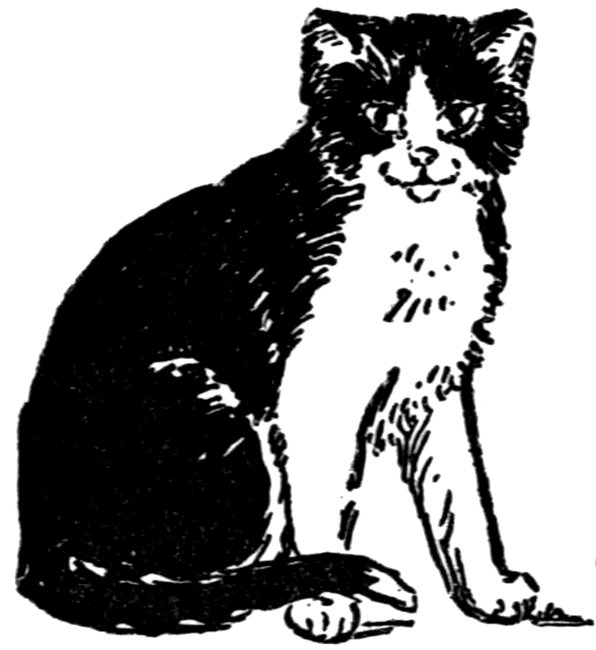
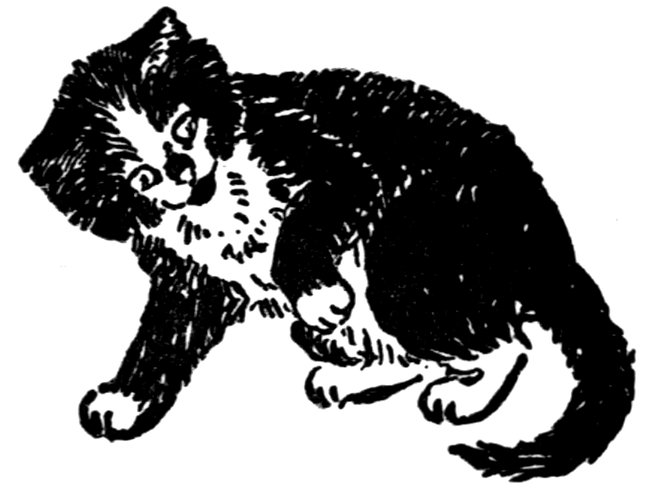
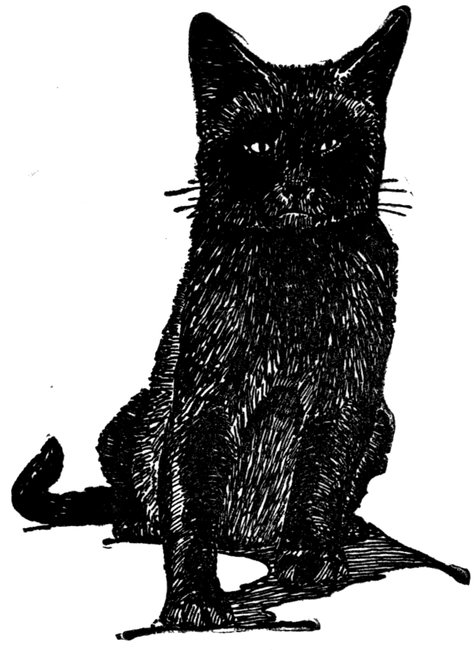
My name is Pussy Black-Face, and I am a
naughty young kitten. I wish I were good
like my mother. She is the best cat that I
ever saw. I try to be like her, and sometimes
I succeed, but most times I don't.
My mother's disposition is really lovely,
but then she has a weak back. It seems to
me that if I had a weak back I should be
good, too, but when there is a spring in my
spine that makes me want to jump all the
time, and something curled up in my paws
that makes me want to seize things, what can
I do? How can I be good?
My mother purrs wholesome advice into
my ears, and tells me to try, to try hard,
2and so I do, but usually it doesn't seem of
any use. I might as well be bad all the time,
and not worry about it.
Every night, as we sit around the fire before
we go to bed, I think things over. You
know how cats look and act when they are
getting sleepy. Some people say that cats
are stupid and can't think or feel. Don't you
believe it. They are just as clever as any
animals.
Well, I think the most beautiful sight in
the world is our little family on these chilly,
east-windy nights as we gather in the sitting-room
about bedtime.
First there is our dear mistress, Mrs. Darley.
She is a widow with two adopted children—Billy
and Margaret. After dinner
they go to the study to learn their lessons,
and Mrs. Darley sits for a little while with
us before she goes to join them. We cats are
allowed to run all over the house, but we
usually prefer the sitting-room, because
there is the broad window-seat for sunny
mornings, and the cushions by the fire for
dull weather.
3Mrs. Darley always takes my mother on
her lap, because she is the chief favorite, and
because she has suffered so much. I am not
ashamed to say that my mother was an ash-barrel
cat before Mrs. Darley rescued her.
That is, she was a poor cat who had to pick
up her living in back yards. She is a grayish,
wistful-looking creature with a quiet
manner. Her name is Dust-and-Ashes. She
knows a good deal, but she doesn't talk
much.
My father, whose name is the Piebald
Prince, is an Angora. He is very handsome,
very aristocratic, very dignified, but not at all
proud. He says he believes it is wrong to
call any cat common or unclean. Persian
cats, and Angora cats, and New Mexico cats,
and Manx cats, and all kinds of cats should
be treated in just the same way, and have an
equal amount of respect shown them.
He always makes my mother take a front
seat if there is company, and he treats her
with as much consideration as if she, like
himself, had come from the celebrated farm
up in Maine, where only pure bred cats are
4raised, and where they cost great sums of
money.
Many a cuff—a gentlemanly cuff—I have
had from him for being disrespectful to my
mother. He believes in keeping us young
ones in order.
Besides myself there is my sister Serena,
and my brother Jimmy Dory.
They are both much older than I am.
Serena is a very clever little cat. She has
beautiful manners, and purrs a good deal to
herself about culture. She and Jimmy are
both half Angora, and half common cat. So
I am, too, for that matter, but they are much
better looking than I am. My father is black
and white, and we are black and white; but
his black and white and Serena and Jimmy
Dory's black and white are laid on prettily.
I am a fright. Every one says so—cats
and human beings—so it must be true. I
think myself, when I look in the glass that I
am very ugly, but I don't care a bit. Why
should I worry? I can't see myself, unless
I look in a mirror. Let the other cats and
people worry about me, and say that my
5white face looks as if some one had thrown
an ink bottle and splashed me right across
it. They are the ones that suffer, for they
can see me. I don't see myself.
My body is prettier than my face. I often
laugh to myself when I am creeping softly
along, and some one says, “Oh! what a
lovely black kitten.” Then I turn round and
the some one always shrieks, “You little
fright!” or “You ugly little thing!”
My mother says it is naughty in me to
laugh, but I tell her that girl squeals and cat
squeals don't hurt me. The only things I am
afraid of are sticks and stones.
Then she smiles sadly, and says, “When
you grow up to be a cat, Black-Face, you will
be sorry that your face does not please every
one.”
I must say I don't believe her. I don't believe
that my mother knows half as much as
I do. She is getting old and fussy, but I
wouldn't say this to any one but myself for
the world. The kitten next door laughed at
my mother the other day, and I scratched
him. I'd do it again, too. I sha'n't let any
6one but myself criticise my mother while I
have claws in my velvet paws.
Well, I don't believe I'll think any more
about myself to-night. I am getting sleepy,
and my head is sinking down on my pink
cushion.
I wish I hadn't broken that pretty glass
vase to-day. Mrs. Darley felt very sorry.
What was I doing on the mantelpiece? The
dear only knows. It looked tempting up
there. It is such fun to twist between things
and not break them, and it is only once in a
great while that I do have a smash.
I hope Billy will find his lead-pencils. I
dropped them behind the sofa—and what
did I do with that dead mouse I was playing
with? Did I leave it on Margaret's bed? I
believe I did. Well, she is a fat little girl.
It won't hurt her to scream a while. Mrs.
Darley will run to her. Good night, everybody—I
am—so—sleepy.
CHAPTER II A CAT'S REFUGE
7
Where am I? Can I collect my thoughts
and reflect a little—was there ever such an
unhappy cat? Only last night I sat and
purred myself to sleep beside my dear
mother. Pressed close against her soft fur,
I had no thought of harm, and now where
am I? But I must not be silly. Let me close
my eyes, and purr hard for a while, then
sense will come to me.
I must not open them. When I look round
this room, and see the shadowy form of cat
after cat, I think I will go crazy—and yet
what a simpleton I am. I am safe here.
Danger is over; let me be thankful that I
escaped as I did.
Well, to go back to this morning. The east
wind was out of the air. When mother and
I, and father, and Serena, and Jimmy Dory
came yawning and stretching out of the sitting-room
8and looked down-stairs, the hall
door was wide open, the sun was pouring in.
Mrs. Darley was so glad. She just loves
sunshine. She went round the house opening
doors and windows, and just as soon as
breakfast was over, we all ran out on the
sidewalk.
Cats get dreadfully tired of a back yard,
and the back yards on Beacon Hill are so sunless
and dull. We like fun and excitement—a
little mild excitement—as much as human
beings do. So my father and mother sat on
the big sunny stone door-step, while Serena,
Jimmy Dory and I played on the pavement.
We had a tiny round pebble that we were
rolling with our paws. It was such a funny
little pebble. I pushed it, and danced, and
caught it in my paws and tossed it, and had
a beautiful time, until my mother began to
warn me.
“Black-Face, don't go down the hill;
there are bad boys there. Keep up here.”
“I don't see any boys,” I said wilfully.
“They will soon see you if you go down
there,” said my father severely.
9I didn't believe him, and I thought my
mother was fussy. I see now that little cats
have to learn by experience. Nothing would
have convinced me that there were bad boys
at the foot of the hill, if I had not seen them
and felt the grasp of their unkind hands.
While we were playing, the little pebble
suddenly began to roll down hill. How fast
it went! I watched it for a few instants, and
then something said: “Go after it, Black-Face!”
I tried hard not to. I looked back at my
parents sunning themselves on the door-step,
I stared at Serena and Jimmy Dory who were
cautious young cats, and rarely disobeyed
their parents.
“I'll just snatch it and run back,” I
mewed hastily; then I ran.
I caught the little pebble, but alas! Something
caught me. Just as I put my paw on
it, I saw out of the corner of my eye a group
of boys standing in a near alley. I turned
to run, but it was too late. One of them
sprang toward me, and seized me by the
back.
10Then he started to race, not up the hill, but
further down. I was nearly suffocated with
fright and pain, for the boy held me so
tightly that I could scarcely breathe. No one
had ever clutched me like this before. I had
never been whipped. I had never been
roughly handled, for Margaret and Billy
were good children.
This boy was a monster. His face was red
and dirty, his eyes were bulging from his
head, and he stumbled as he ran, so that I
was afraid he would fall on me and kill
me.
I may as well say here that the boy was
not as bad as he seemed to me. He had not
stolen me. He was merely having some fun,
or what he called fun. He was some poor
child that had had no one to teach him to be
kind to animals. He did not dream that I
was suffering. He did not think that a cat
was capable of suffering.
So he hurried on and on, and some of the
other boys ran yelling behind him. I don't
know exactly what streets he took. I was too
terrified to notice the way we were going,
11but soon I saw a river in the distance. Was
he going to throw me in it? Half choked as
I was, I dug my claws in his coat, and gave
a frantic “Meow!” for, like all cats, I hate
water.
“Boy,” called a policeman suddenly,
“what are you doing with that cat?”
My captor was frightened and dropped
me, and he and the other boys turned and
ran back. You may be sure that I made a
dash for liberty. I sprang wildly past the
policeman, and not daring to follow the boys
who were going toward my home, I leaped
into a narrow, dirty street where there was
a dreadful confusion of wagons, cars and
throngs of people.
I threaded my way among them all—I
don't know how I escaped being killed—until
finally I was forced to pause for breath.
Unfortunately some boys and girls saw me
and gave chase. I don't think they wanted
to hurt me. They wished to catch me, but I
was in terror again, and ran into an alley.
They followed me, so I sprang on a heap of
boxes, and then to a low porch.
12The children discovered me there, and
while some tried to coax me down, others
threw stones at me. I looked up desperately.
There was no help for me on the ground, for
a big boy had begun to climb on the porch.
I examined the sloping side of the house
roof. Then I leaped on it. Two or three
times I fell back, but at last I succeeded in
making my claws hold. They were fine
sharp ones, or they never would have done so.
In two minutes I was on the very roof of
the house, panting hard, my heart almost out
of my body, everything black before my eyes;
but I was safe.
There I saw that I was free from pursuit.
The children had gone away. At the same
time, the roof was not very comfortable. It
was cold and slippery, for, by this time, the
lovely sun had gone behind a cloud, and soon
I began to be very uneasy.
I thought of my father, and mother, and
Serena and Jimmy Dory—that distressed
group at the top of the hill—for I had had
one glimpse of them as I was snatched by the
boy. Oh, why had I not minded my mother,
13and not run away from home? What was
going to become of me? Must I spend the
night in this dreadful place?
I thought of my little blue and white
saucer that Mrs. Darley's kind cook filled
with milk for me every noon. “Oh, meow!
meow!” I cried pitifully. “Will no one
help a poor little cat?”
A skylight in the roof opened, and an old
man's face looked out. Such a kind face, but
still I did not trust him, and moved away to
the other end of the ridge pole. “Little
cat,” he said seriously, “there is help even
for such as you. I will go seek it,” and he
disappeared.
I did not know what he meant, so I continued
to cry piteously. I wanted my mother
and dear Mrs. Darley. I was too far up to
be heard from the street, but a few persons
opened near-by windows, and looked at me
indifferently.
“Only a cat,” they said. “Let her get
down the way she came up.”
“Oh, dear! dear!” I mewed, “must I
stay on this roof till I perish from hunger?”
14For now it was beginning to get dark and
cloudy and to look like rain. “Oh, meow!
meow!”
Just as I was giving up hope, the skylight
opened again.
“There she is, sir,” I heard the old man
say, then a young man put his head out, and
looked at me.
He had a good face. I'm only a kitten, but
I've found out that if a man spends his life
in doing good, he has a good face.
I trusted him, and yet I was afraid to go
to him, if you can understand that.
“Kitty,” he said soberly, “over there,”
and he waved his hand toward the heart of
the city, “is a place where lost dogs and cats
are sheltered. Come to me, and I will take
you to it. Come——” and he held out his
hand.
“Oh, meow! meow!” I said, “if I go to
you, perhaps you will throw me away down
there in that raging, horrible street.”
“No, Pussy,” he said seriously, shaking
his head. “No, I never have deceived an
animal. Come here, and I will put you in
15a nice basket where no one will see you, and
I will carry you through the noisy street.
Here——” and he threw me a tiny piece of
liver.
Now, I am very fond of nicely cooked liver.
I think it is vulgar to eat it raw. Fortunately,
I caught the liver, and it did taste
good, and made me think more of the man.
He still had some in his hand. I smelt it, so
I crept timidly toward him along the roof.
“Poor Pussy! poor Pussy!” he kept saying,
and presently I was eating from his
hand, and he was stroking my ears as I ate.
Then he stepped back quietly into the room.
He didn't try to catch me, but he put the
liver down where I could reach it.
I peeped in through the skylight. The
young man and the old man were talking.
“Yes, sir,” the younger one was saying,
“we've got a refuge for dogs and cats, but
it isn't half large enough. I look at the
matter this way. The animals are put in the
world by the same Creator that put us here.
They've got their rights. Give them their
share of room on mother earth, and if you
16don't love them, and love to take care of
them, and you worship only your own selfish,
old body, then take care of the animals out
of that same love for yourself.”
“That's so, sir, that's so,” and the old
man nodded his head.
“Because,” the young man went on, “a
neglected animal is a diseased animal, and a
diseased animal is a menace to the millionaire
as well as to the pauper. Germs of disease
can't be fenced in. So I say, kill sick
and homeless creatures, if you can't get a
good home for them.”
“Would you kill that cat?” asked the old
man pointing to me.
As his hand pointed toward me, my nose
pointed straight for the skylight, but the
young man re-assured me.
“No,” he said thoughtfully, looking me
over, “that is a young, healthy kitten,
and part Angora. We'll get a home for
her.”
By this time I had had enough liver, so I
went smelling round the little table where the
old man kept a basin and pitcher of water,
17and like the perfect gentleman that he was,
he got up, and gave me a drink.
Then I went to sleep. I was dreadfully
tired, and I knew that I could trust those two
men, so finding that the softest place was the
middle of the old man's bed, I jumped up
there and had a beautiful nap while they
went on talking.
I didn't sleep very soundly, and as soon as
the young man rose, I rose too. He stretched
out a hand, took me up gently, and put me in
a nice, lined basket. Then he covered me up,
and said “Good-bye!” to the old man.
I didn't like the basket, but I wasn't
frightened. Soon I heard round me the roar
of the street, then the jarring of an electric
car. Then, after a good while, I felt that the
young man was walking rapidly along another
street.
In a few minutes he stopped short, opened
one door, then another, and then the noise of
the street fell away, and I heard other
noises.
“Well, Mr. Green!” a woman's voice exclaimed,
“here you are at last. Do give me
18whatever you have got. Two urgent calls are
waiting. One for a mad dog in a yard on
Tremont Street, which, of course, means a
poor wretch which has been chased till he is
foaming at the mouth, and another for a cat
and kittens deserted in a cellar on Washington
Street—Do hurry.”
I felt some one take the basket and lift the
cover.
“Oh! a kitten, and half Angora,” and a
pleasant-faced young lady looked down at
me. “Well, she must go in the cat-room.
Mercy!” and she slightly raised her voice.
I stared about me. I was in a kind of office.
There was a large desk and many pictures
of animals were on the walls. Then a
nice, motherly-looking woman came in, took
me up as if I had been a baby, and carried me
into a hall, and up some stairs. She talked
kindly to me all the way up, and presently she
opened the door of a room, put me down
gently, paused an instant or two to see what
kind of a reception I met with, then went
away.
I gazed about me. Where was I? Was it a
19party? I had never seen so many cats together,
not even in the biggest yard congress
on Beacon Hill.
The room was large and beautifully neat
and clean. Around the walls were boxes and
baskets, and in many of them cats lay asleep.
Others walked about the room, some ran up
to me—mostly young ones—and asked my
name and where I came from.
I put up my back at first, but when I saw
they were all kindly disposed, I put it down
again.
“What is this place?” I asked, sitting
down against the door.
“Why, this is a cats' home,” said a young
thing with a yellow face. “Have you never
heard of it? Sick cats, lost cats, starved
cats, bad cats, good cats, young cats and
old cats are all brought here. You're kept
several days, and if you're not claimed,
you're mercifully destroyed, or else given
away. I say, do you suppose you'll be
claimed?”
“Be what?” I asked.
“Be claimed. Will your folks come to look
20for you? I wish mine would,” and she
gazed wistfully at the door.
“I believe they lost you on purpose,” said
a little white kitten spitefully.
My new friend had to box her ears for this,
so I turned to another cat who was politely
offering to show me around.
She pointed out the warmest sleeping
places in the room, then she took me out
through a little swinging door to the roof-garden.
Just fancy—a roof-garden for cats. I was
delighted with it. There were little trees in
boxes, and big pans of water, and a wire netting
over all to keep the cats from running
away.
“No boys could chase you here,” I said.
“Oh, no,” my new friend replied. “No
one chases us. It is a lovely place, but still
it has a serious drawback.”
“A drawback,” I repeated, “what is it?”
“You will see—just wait.”
I have seen. I have found out that all these
cats are homesick. Now bedtime has come,
it is dreadful. They all look sad, and some
21of them are moaning in their sleep. They
have all been used to human beings. Cat
society is not good enough for them.
Down below in the courtyard, for this is
a dogs' home as well, we can hear the big
animals crying out and howling. They are
dreaming of their dear masters and mistresses.
Oh! I hope Mrs. Darley knows about
this sheltering home for animals, and that she
will come in the morning to get me. Good
night, dear father Piebald Prince, and Mother
Dust-and-Ashes. I am not with you, but I
hope you will sleep well, and not think about
me. Good night, Serena, and Jimmy Dory.
You are often provoking, but I love you both.
CHAPTER III A SURPRISING CHANGE
22
Last night I thought I was in a queer place,
but upon my word, to-night I am in a queerer;
and I don't believe that in Boston there is a
more puzzled or confused little cat than I am.
Here I lie, curled up in a heap of soft, white
fur and pink silk—I think it is an old opera
cloak—that is carefully arranged in a big
armchair near the bed where sleeps a pale,
pretty little girl. I was the last thing that
her eyes rested on before she went to sleep,
and she wished me to be the first object before
her when she awoke.
There is a dull fire burning in the grate
with a wire guard before it. One of the
windows is open, and soon the fire will go out
and the room will be quite cold, but I won't
mind it, wrapped as I am in this soft cloak.
Fixing my eyes on the few red coals, I am
thinking over the events of the day. Let me
23begin from the first, for whenever we go out
and come in again, my mother says, “Please
tell me everything you have done since you
left me,” so that she has got her kittens in
the habit of relating things, and thinking
them over in a orderly way.
Last night I went to sleep in the big room
in the Cats' Home. I hadn't a very comfortable
night of course, but still I slept a good
deal, and whenever I woke with a start I was
glad to find myself in a place where no one
could chase me.
Early in the morning I went out in the
roof-garden. It was rather hard for the kittens
to get out, for two old cats stationed
themselves each side of the swinging door
and boxed the ears of every kitten that
passed. One boxed the right side, and one
the left, but after it was over we didn't mind
it much.
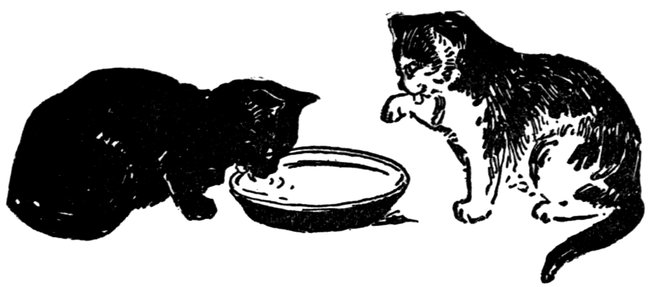
The most of us drank our milk out there.
Such nice big dishes of it, the woman called
“Mercy” brought to us.
As soon as breakfast time was over, we began
to have callers—mostly ladies and children.
24Some wanted to find an old cat, some
to find a new cat, some to get rid of a cat,
some to give money to the cats; but they all
wanted to see us.
It was very interesting to watch the actions
of the pussies. They would look narrowly at
the visitors. Then if they liked a lady or a
child, they would circle round that particular
person, and beg to be taken away.
I was sitting apart, watching the various
groups about the big room, when a little girl
came right up to the corner where I was
alone.
“Here is a lovely, little pussy,” she said
in a sympathetic voice. “Pussy, don't you
want to be adopted?”
“Meow!” I said doubtfully, for every
minute I was hoping that Mrs. Darley would
appear.
“Oh, mamma, mamma!” said the little
girl, “I love this pussy with the black splash
on her face. Mayn't I have her?”
A very pretty lady came up and looked at
me kindly. “Certainly, Mary, if you are
able to get her. There must be some good
25blood in her. See how long her fur is. I will
speak to the secretary about her,” and she
went away.
The little girl remained, and continued to
stroke and caress me. I did not respond
very much. I was uneasy and troubled.
Soon her mamma came back. “Yes,
Mary, you may have her, if no one claims
her, but the secretary thinks from her actions
that she has been a pet cat, so we had better
give the owner a chance of finding her.”
“Oh, mamma, I want this kitty, I want
this kitty,” said the little girl longingly.
“Her little sorry face just suits me. I think
I could make her happy,” and she took me in
her arms and petted me, until, for shame's
sake, I had to purr a little, and rub my head
against her.
Her mother stood looking at her smilingly.
Then another person came along, a taller
person, and stood gazing at us over her
shoulder.
I gave a loud and joyful meow, and sprang
forward. That was Mrs. Darley's lovely
face.
26Oh! how glad I was to see her! I went
round and round her. I rubbed my body
against her. I sprang on her shoulder. I
just burrowed in the fur collar of her coat,
till she laughed and put me down.
“Oh, how do you do, Mrs. Darley!” said
the mother of the little girl.
“Why—Mrs. Denville!” exclaimed Mrs.
Darley in surprise, “I did not see you. I
was so taken up with my kitten. I lost her
yesterday.”
Little Mary's face was a study. She
was trying hard not to be disappointed,
but, in spite of herself, she could not
help it.
“Oh, mamma, mamma,” she said in an
undertone, “I have lost my kitty.”
Her mother looked at her, in the way my
mother looks at her kittens when they want
something and she is afraid she can't get it
for them.
Then this lady—this Mrs. Denville—turned
to my dear mistress. “This is my
daughter, Mary,” she said. “Your arrival
has dashed her hopes to the ground. She was
27hoping to become the proud possessor of this
kitten.”
“Was she?” replied Mrs. Darley in her
good-humored way. “Come here, my dear,
and shake hands with me. You are a kind
little girl. I can see by your eyes. Now,
suppose I were to give you this kitty?”
Mary's eyes danced with joy, but horror
entered into my soul.
“You see,” said Mrs. Darley, caressing
my ears as she spoke, “I have so many cats.
I can easily spare one, but I am rather particular
about my pussies. I only give them
to persons who will love them and treat them
sensibly. Now, I have heard of you and your
love for animals, and I am sure a cat would
do well in your hands, so I will give you my
young Black-Face, if you like.”
Little Mary came slowly up to Mrs. Darley,
and laid a hand on her arm. “If you
give me that kitty,” she said solemnly, “and
I don't take good care of it, I hope the Lord
will punish me.”
Mrs. Darley smiled. “I don't think that
there is any danger of your ill-treating an
28animal. Well, now I must go. I am glad that
my wandering kitten was brought here.
What a blessed thing it is, that there is this
refuge for lost animals.”
“And are you not going to take away a
cat?” asked Mary gently.
“I don't think so,” replied Mrs. Darley.
“I have four at home. I suppose, though,
I could take one, for five is my limit. I never
keep more than that. Mercy,” she said to
the woman who had just come into the room,
“have you any hopeless cases?”
“Yes, ma'am,” said the woman, “there's
that Jane,” and she pointed to a gray cat in
the corner. “She's got to be killed with the
old cats, I think. She's ugly looking, and
she's lame, and she won't take any trouble
to make herself agreeable to strangers, and
she gives the young kittens a dreadful time
of it. She don't enjoy life herself, and she
won't let any one else enjoy it.”
“Jane,” said Mrs. Darley, “come here.”
Jane would not come.
“Poor Jane,” said Mrs. Darley. “I
wonder if I could soften that unhappy face.
29Mercy, I'll try her. Just put her in a basket,
and I will take her home—now good-bye,
Black-Face.”
I was in a whirl of confused emotions. My
dear mistress was going to leave me, and I
was helpless. I was not strong enough to
make her take me with her. I should never
again see my dear father and mother and
brother and sister. It seemed to me that my
heart was breaking.
“Cheer up, Black-Face,” whispered Mrs.
Darley, for I had climbed on her shoulder,
and had my head close against her face.
“Cheer up. Partings are hard to bear, both
for cats and human beings, but they are
sometimes for our good. You will have a
lovely home with that dear child—Good-bye.”
She hugged me to her for a minute, then
she resolutely put me down, and though I
ran and cried after her, Mary and her
mother held me back. Mrs. Darley went out
of the room without me, and with that horrible
Jane.
I was almost a crazy little cat, and Mary's
30eyes filled with tears as she listened to my
cries.
“Perhaps, mamma,” she said, “we ought
not to keep her.”
“She will get over her trouble,” her
mother replied; “try her for a few days.”
They asked for another basket, and Mercy
brought one, and I was put in it and carried
out-of-doors.
Mrs. Denville's carriage was waiting for
them, and we got in and were driven to their
home—and let me think again how surprised
I was when I found where their home
is—scarcely a stone's throw from Mrs.
Darley's. Mrs. Darley is on Mount Vernon
Street, the Denvilles are on Beacon Street.
I know the whole neighborhood, and as
soon as we arrived in the Denvilles' house,
and little Mary took me up to her room and
let me look out the window I was overcome
with joy. Why, I could run home any day,
and I began to be comforted.
“Now, Pussy,” said Mary taking me on
her lap, and sitting down by the window, “I
want to talk to you. I am going to tell you
31all about myself, and I want you to listen
attentively. My name is Mary Denville, and
I am not a very strong little girl. I have a
very weak back.”
“Oh meow! meow! just like my mother,”
I interrupted.
Mary smiled. “I see you understand me.
To continue, Pussy, my father is what is
called a banker. He was born in Maine, but
he went to California as a young man. He
married there, and we lived there until a few
years ago, he and I, and dear mamma. Then
we came 'East' as Californians say, for I
had spinal disease, and I had to be taken to
New York to see some clever doctors. Then
I got better, and mamma took me to Europe.
Papa bought this house, and when we came
home we established ourselves here. Do you
think you will like me, Pussy?”
Her little face was so sweet and so wistful
that I could not help saying, “Meow!” very
gently to her.
She stroked me, and turned my head
toward the window and pointed out nice
things on the Common opposite us. “You
32see, this is a beautiful situation for a home,”
Mary went on, half to herself, half to me.
“The snow has gone now, and one can see the
grass and the dear little buds coming on the
trees. Can you find that squirrel away over
there on the tree branch, Pussy? His bright
eyes are on me. All through the winter I
fed him with nice nuts, and he is grateful.
Some day I will carry you down to see him,
but you must not chase him, Pussy.”
She talked to me a long time about the
Common, and the people on it—it was noon,
and a great many were hurrying up to the
hill to get their lunch—until at last some
one opened the door.
“Lunch is ready, Miss Mary,” I heard
some one say, and looking round I saw an
old woman.
“Very well, nurse,” replied my little mistress,
and getting up, she slipped me in the
chair by the window.
“I do not dare to take you down-stairs
so soon, Black-Face, for you might run
away, but I will bring you up something
nice.”
33I sat by the window, and watched the people
outside, and dozed a while, until Mary
came back with a tray for me. I jumped up
then, and looked at it. It contained cream
toast, a slice of chicken, and a saucer of
milk.
I had a very nice lunch, then Mary said,
“Now, what shall I do with you? My
governess comes at three to give me
some lessons. Would you like to go in
the school-room, or would you rather stay
here?”
I did not want to be left alone, so I mewed
round her feet, and she took me up and carried
me to another room.
There was a fire in it, and a table with
books on it and some straight-backed chairs.
I lay down on the fur rug by the grate, and
soon went fast asleep, while Mary and a tall
young lady talked about things that I did not
in the least understand.
So our afternoon passed, then came dinner.
I was dreadfully tired and sleepy by
this time, and fell to nodding over my plate
of turkey bones.
34Soon after dinner, Mary's old nurse put
her to bed. First, though, the little girl
chose the most comfortable chair in the room
for me, drew it close to her bed and wrapped
me in this cloak. Here I lie, curled up comfortably,
half asleep and half awake, and, as
I say, very puzzled and confused. Am I going
to be happy here, away from my parents?
What shall I do to amuse myself all day?
There is not another cat in sight. I thought
I heard dogs in the basement. I smelt them,
anyway. I hate dogs. Well, I must go to
sleep. It won't do any good to lie awake
bothering about the future. Oh, how comfortable
I am! My poor old mother—I wish
she could have had a nice cloak like this to
sleep on, when she was a poor homeless cat,
crouching in the shelter of a fence to keep
herself from the cold rain. Why can't all
cats have nice homes? Aren't there enough
homes to go round? I saw a cat on the
Common this afternoon—very thin, and
dirty, and skulking from tree to tree looking
for scraps. Why am I wrapped in a fur
cloak, and why is she out in the cold? Am I
35a better cat than she is? Probably not. I
am called a naughty kitten. My brain is
quite tired from thinking about things. I
will go to sleep.
CHAPTER IV I VISIT MY FAMILY
36
To-day I had quite an experience.
I have been in the Denvilles' family just
three days, and the more I see of my young
mistress the more I like her.
Actually, I have not done one bad thing
since I came. My little mistress keeps me
with her all the time. Her company is a
great satisfaction to me, and a great safeguard.
If some bad animals were allowed to
be more in the society of the human beings
they love, they also would improve.
Well, I have been closely watched to see
that I did not run away. I have been even
taken in the carriage to drive. Little Mary
got an old muff of her mother—a huge, soft
thing, and when we go out, she puts me in
it. Oh! what fun I have sitting on the seat
beside Mary, and staring at all the queer
things in the streets. So many of them I
37have never seen before, and Mary explains
them to me as politely as if I were a human
being. Her nurse went with us one day, and
her mamma went the other days.
On account of little Mary's delicate health
she is always kept out-of-doors in the morning,
while the sun is nice and warm, and she
does lessons in the afternoon.
This morning when we started to drive
she said, “Black-Face, suppose we go and
call on your relatives?”
Now, I thought this was a perfectly sweet
thing for her to say, so I mewed my approval,
and Mary spoke to her nurse, and the nurse
told the coachman to drive us to Mrs. Darley's.
Oh! how my heart beat when I saw that
big green hall door. Just as soon as Gerty,
the house-maid, opened it, I sprang out of
the carriage and was into the house like a
flash. Up the steps, and into the sitting-room
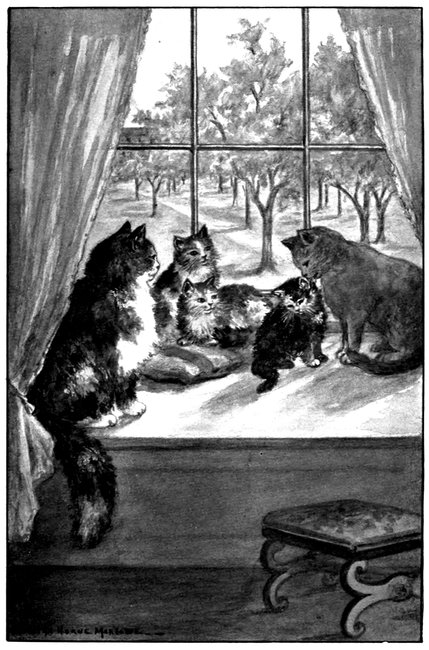
I went. There they were, all on the
window-seat—all the dear cats basking in
the warm spring sunlight. I jumped in the
midst of them. Didn't I give them a fright!
38My dear mother uttered a little cry, my
father drew himself up severely, and Serena
forgot her fine manners for once, and gave
me a smart cuff.
“Isn't that like Black-Face?” mewed
Jimmy Dory; “but I'll make her say, 'I beg
pardon,'” and he took me round the neck
by his two paws till I squealed.
“Well, my dear kitten,” said my father,
when we had all got ourselves straightened
out, “how are you, and how are you getting
on?”
This was a very proud moment for me. Of
course I had been dreadfully homesick away
from them all, but still it was worth going
through everything to come back and be
treated with so much consideration. They
were all actually sitting around, waiting for
me to speak. Now that had never happened
to me before in my short life, and I licked
my lips, and tried to speak slowly so as to
make the pleasure last.
“To begin with,” I drawled, “I have
nearly died of loneliness away from you all.”
“MY MOTHER BEGAN TO POLISH OFF MY HEAD.”
39“Oh, quit that,” said Jimmy Dory. “Tell
us about your adventures. We saw the boy
grab you, now go on. Mrs. Darley didn't tell
half enough when she came from the cats'
home.”
I began from the beginning. I told them
about the bad boys and the good old man,
and the good young one, and the cats' home,
and dear little Mary Denville. Then I said
anxiously, “Have you missed me?”
No one said a word, but my mother began
to polish off my head, just as she had done
every day since I was a tiny kitten. Indeed,
the first thing I remember was my mother
licking the top of my head. Just now, she
polished off one ear, she polished off the
other, she made me lower my head so she
could get at the back of my neck, and as she
licked, I was comforted. My dear mother
had missed me, if the others hadn't.
My father was clearing his throat. “Well,
you see,” he said with a proud, approving
glance at me, “cats are attached to their
offspring, but they are well pleased to see
them settled in life—comfortably settled, I
mean. Now I should say that, your first
40catastrophe over, you had fallen on your feet.
The Denvilles' establishment is a very fine
one.”
“Are you happy there?” purred my
mother in my ear.
“Now I am,” I mewed softly. “At first
I was dreadfully miserable——” Then I
raised my voice. “I am not complaining,”
I said, addressing my father. “That would
be ungrateful. Why, I am first in the affections
of my little mistress. I believe
she likes me better than she does her parents.”
“Hem! hem!” growled my father doubtfully,
while Serena and Jimmy Dory burst
out laughing.
“Well, anyway,” I said in some confusion,
“she just surrounds me with comfort from
morning till night. She never leaves me. I
go everywhere with her, and there is not another
cat about the place.”
“Then there must be dogs,” cried Jimmy
Dory promptly, “and we all love dogs—oh!
yes!”
“Yes, there are dogs,” I returned snappishly,
41“but they were kept away from me
at first so they wouldn't frighten me.”
“How many of the detestable creatures
have you?” inquired Serena grandly, and
she threw up her head, and looked at me as
if she had glasses on. It is her usual trick.
She thinks it is smart to pretend that she has
a pair of spectacles over the bridge of her
nose. She knows it makes me feel small and
kittenish, and as if I don't know anything.
“There are two,” I said, “and I have got
used to them already. They are the two best
dogs that were ever made.”
“You speak in superlatives, my dear
child,” purred Serena elegantly. “What
breed are the creatures?”
“One is a tiny spaniel,” I replied crossly,
“and one is a St. Bernard.”
“The two breeds I most dislike,” murmured
Serena. “How tiresome, I shall not
be able to go to see you.”
“Don't mind her,” purred my mother in
my ear. “She and Jimmy have been contrary
and nervous since you left. They miss
42you very much, and so does your dear
father.”
“By the way,” I said, “what became of
the cat Mrs. Darley brought home to take my
place? 'Jane' she called her.”
“Oh! that vulgar creature,” exclaimed
Serena elevating her nose. “We soon
chased her down-stairs. She undertook to
fight, but I settled her.”
“She is happier in the kitchen,” murmured
my mother. “She is a peculiar
cat.”
“What do you get to eat at your house?”
inquired Jimmy Dory suddenly, and smacking
his lips as he spoke.
“Oh, delicious things,” I replied; “cream,
and nice little bits of fish, and cheese, and
meat just as tender as possible, and French
bread and—I forget the other things.”
“If that is all you have not quite as much
of a variety as you had here,” remarked
Serena loftily.
The tears came in my eyes. If I had not
been such a bad little kitten perhaps Serena
would have thought more of me.
43“Go kiss her,” whispered my mother in
her sweet, rough voice.
That voice always overcomes me. It is
hoarse, because she has always a sore throat,
caught from being out-of-doors so much in
the cold.
I stepped firmly across Jimmy Dory to the
place where Serena lay lashing her tail in the
sunshine. Then I bent over her, and licked
one of her pretty paws.
That pleased her. Serena would like to
be a queen of cats. She didn't say a word.
She didn't speak of forgiving me for going
away, or coming to see me, but she lay and
looked at the spot I had licked. That meant
that she did really forgive me. Serena knew
I loved her, but she always said I made her
nervous.
“Come, have a wrestle,” exclaimed
Jimmy Dory, and he bit my tail to make me
spring after him. We were having a glorious
rough and tumble game, when Mrs. Darley
and Mary came into the room. My first impulse
was to run to Mary, and I did.
She was in an ecstasy. “Why, she likes
44me, the dear little creature!” she said catching
me up. “She wants to go home with
me. I was afraid that she would want to
stay with her parents.”
I looked back at them. I wanted to stay,
and yet I didn't. I had got out into the
world, and it was interesting.
My mother and father and Jimmy Dory
gazed curiously at little Mary, but they did
not get up to speak to her. They cared
nothing for her. Mrs. Darley was their mistress,
and their eyes rested lovingly on her—but
Serena went up and smelt the rich fur
on her coat.
“Cats are very comfortable creatures,”
said my little mistress, fondling me. “They
don't worry us, and they creep up to us when
we are in trouble.”
My dear little mistress—how could I run
away from her—and to-day, as she was
about to leave Mrs. Darley's, I nestled very
closely in her arms.
“Good-bye, pussies,” she said politely to
the window-seat—“Good-bye, Mrs. Darley—and
now, Black-Face, we must get out
45in the sunshine, or nurse will be impatient.”
I mewed apologetically to my family. My
mother's eyes rested on me, followed me
down-stairs, were fixed on me through the
window as I was taken into the carriage.
They are very speaking eyes. She didn't
want me to leave her. She was telling me to
take care of myself, to be cautious with the
dogs, to come soon again to see her. Oh, I
read a great deal in those eyes!
Mother cats must suffer a good deal.
After we left Mrs. Darley's this morning,
Mary and I had a lovely drive. Then we
came home for lunch, and had lessons in the
afternoon.
Mary was considerably worried about the
cat on the Common. This afternoon there
was a sharp wind, and when Mary saw her
come out toward dusk, and go skulking from
tree to tree as her habit is, she got one of the
maids to go out with some food in a basket.
The poor cat ran like the wind, and Mary's
face fell. No one can catch her. There
would be no use in sending the good agent
46after her who caught me, for we would not
know where to tell him to go.
I made up my mind what I would do when
I saw how my little mistress was grieved. I
would get that cat for her. So this evening
after dinner, when Mary went into the library
to have a little chat with her papa, I
slipped out in the hall. If I could get out
through that big hall door I would be able to
run out on the Common. I hid behind a curtain
and waited. Soon a ring came at the
door bell.
The young man-servant, Anthony, came
sauntering through the hall. He opened the
door, took a note from a boy, and while he
was looking at the address, and the boy was
looking at him, I crept by them both.
Neither saw me, and I sprang down the
steps, across the pavement, into the street,
over the other sidewalk, and down more steps
to the Common. Oh, how dark and cold it
was in spite of the bright lights sparkling
everywhere! How different from the Denvilles'
warm house. Was I frightened? No,
I was not. Something rose in me—something
47that was all joy. I loved the darkness,
because it was like a big, safe covering over
me. Boys could not see me now, nor dogs,
and I could see them. I was not a bit afraid,
but I was cold, and I would like to finish my
work, and get into the house again.
“Meow! meow!” I said tentatively, and
I walked toward the pond. The strange
pussy was not there. “Meow!” I said
again, and I went toward a big elm that was
a favorite hiding-place of hers.
She did not answer me, and I had to conceal
myself for a minute, until two young
men passed.
For a long time I went from tree to tree,
but there was not a sound. Then I gave up
calling and, crouching on all fours behind a
seat, I began to talk cat talk to myself. “I
wish I could find that poor creature. I would
like to do something for her. If she knew
what a good home I could lead her to, she
would come to me. Oh! meow! meow! I am
so sorry for her.”
I paused for an instant to listen to a distant
fire-alarm, then I got up and began to
48stretch myself. I might as well go home.
Just then, I thought I heard a faint sound.
“Meow!” I said encouragingly.
“Meow!” said a very small voice, a very
small, thin voice.
“Meow!” I said more loudly. “Don't
be afraid. I am only a kitten. Meow!
meow!”
She would not come to me, and I began to
investigate. There she was under the
shadow of the bank, a crouching, gray creature,
too terrified to move, and yet all ready
to spring away.
“I'm only a kitten,” I said again—“a
this spring's kitten. Don't be so frightened.
Have boys chased you?”
“The hull world chases me,” she said in
a faint voice.
“Well, I won't chase you. Can't you
come nearer?”
“Nop.”
“Are you hungry?” I asked, keeping my
distance.
“Not very. I had a sparrow yesterday.
It was dumpish, and fell out of a tree.”
49“My little mistress has been watching you
from her window,” I said. “She sent
some food out to you to-day, but you ran
away.”
“I was scared,” said the cat shiveringly.
“I thought the woman wanted to put me in
that basket.”
“Suppose she had. She would have carried
you to a good home.”
“A man put me in a basket onct, and took
me home. Then he tried to murder me, but
I hopped out the window,” she said in a
dreadful voice.
“Well, no one in our house would try to
kill you. I would like to do something for
you. Will you follow me home?”
“Oh, no! no!” she said gaspingly. “I
ain't got no acquaintance with you.”
I was silent for a few seconds, planning
what to do for her. I could not see her very
plainly, for she kept herself well in the background,
but I could see enough to make me
half sick with pity. She was skin and bone,
and her eyes were the most terrified things
I had ever seen.
50“Will you wait here a few minutes?” I
said at last. “I know where I can get you a
nice chicken bone. I'll run and find it, and
come to you as quickly as I can.”
“I never had no chicken bones,” she said
faintly.
“Don't move then, and I'll get you one,”
I returned, and I sped away.
Thinking it over, I wonder now I had
patience—I, who am supposed to be so impatient—to
go back to the house, to wait till
the door was opened, and then to sneak in,
find the bone that I had secreted in a corner
of Mary's room, seize it in my mouth, skulk
down-stairs, wait for another ring at the bell,
and dash out again.
Well, I did it, and I laid the bone down
near the cat. Then I went off a little way,
and one of the most beautiful sounds I have
heard so far in my short life was her hungry
teeth crunching that bone. There was a good
deal of meat on it, and of course she ate that
first, but the bone went too. She put her
head first on one side then on the other, till
she cracked it all to pieces.
“SHE PUT HER HEAD FIRST ON ONE SIDE THEN ON THE OTHER, TILL SHE CRACKED IT ALL TO PIECES.”
51“Did that taste nice?” I asked, when she
had finished.
She gratefully licked her lips. “It's the
first square meal I ever had.”
“Do you call that square?” I asked in dismay.
“Why, it's only a first course. But
I can't bring you any more to-night. Will
you wait here to-morrow night for me?”
“I don' know,” she said timidly.
“Please come,” I said. “I'll bring you a
nice piece of meat, maybe beefsteak.”
Her mouth watered, and I saw I had conquered
her.
“Will you come alone?” she asked.
“Yes, stark alone. Now, good night. My
young mistress will be anxious, if she misses
me.”
She didn't say good night. She hadn't any
manners, but what could one expect from
such a poor creature—and she didn't talk
nicely. She is a common, low-down thing, but
is that any reason why she should be left to
starve? She is just as good as I am in one
way, and thinking over the matter, as I sit
dozing here in my big chair, I am glad that
52I went to see her. I will be sure to go again
to-morrow.
Little Mary is coming up-stairs. I just
got home in time. Poor Common cat. I
wonder how you will sleep?
CHAPTER V THE CAT ON THE COMMON
53
For some nights I have been so tired that
the instant I jumped up on my opera cloak
I went right to sleep. No time for thought,
no time for a little cat to review the events
of her day, and wonder whether she had done
right or wrong, and whether she had made a
simpleton of herself, or whether she had been
very wise.
However, there is no need for me to indulge
in wonderment. I am a foolish, light-hearted,
selfish, mischievous kitten. I have
always heard that from my birth, from dear
Serena, and I know it without her telling me.
My mother has always praised me, but I see
through her. She is so good that she wants
to make me good too, and when I hear my
mother praising any one, cat, dog, or human
being, it always makes me suspicious of that
creature. The less it deserves praise, the
54more she gives it. However, I must not
dwell on my badness. I do not imagine it has
a good effect upon me. I will think over the
one really kind thing that I believe I have
done in the course of my short life. Perhaps
I did not do it in the best way—however, I
did it, and to my great joy I sit here dozing
and dreaming, and occasionally opening my
eyes to look at that Common cat, who, at the
present moment, is under Mary's bed, sound
asleep.
Yes, I got her here, but it was hard work.
How care pulls one down. I declare, I have
been just worn out with anxiety and secrecy.
I hate to do things slyly. Now for days
I have had to manœuvre. First to hide
some of my food, then to get it out to the
cat.
The night after my first interview with her,
all went well. I secured a lovely piece of
Porterhouse steak. I carried it down-stairs,
I hid with it behind the curtain. There were
a good many rings at the bell that night, and
I had no trouble in getting out, and no trouble
in getting in. The Common cat was in her
55place behind the bench with her eyes shining
like hungry stars.
She tore at the food, and I watched her
with my own mouth watering in sympathy.
When she had finished, she licked her lips
and washed her face, and muttered enjoyably,
“That's the stuff!”
It gave me a warm feeling round my heart
to see her so satisfied, and bidding her to be
in the same place the next night I ran
home.
The next night I had a dreadful time, a
horrible time. It was raining cats and dogs,
as the saying is, only I never saw them.
There were very few rings at the bell, but at
last one came after I had been crouching for
half an hour under the thick curtain before
the door of the reception-room.
As I slipped out the front door carrying a
tea biscuit in my mouth, which was the only
thing I had been able to hide that day, I could
hear my dear young mistress calling me to
come to bed. That was enough to make me
nervous, and then I kept dropping the biscuit,
and it got soggy in the rain, and by the
56time I got to the poor cat, I was, to tell the
truth, just a little bit out of temper.
“There, you see,” I said, almost throwing
the biscuit at her, “I haven't anything nice
for you. Whereas if you would come in the
house, and throw yourself on the mercy of
my young mistress, I assure you that she
would find a good home for you.”
“Oh, I dassen't,” said the poor cat in a
terrified way.
I silently watched her eat the biscuit, then
I shook the rain drops off myself, and started
for the house.
Alas! the door was shut, and kept shut. I
crouched close up to it, and mewed as loudly
as I could, for, to my grief, I could hear Mary
and the servants inside calling, “Pussy!
Pussy!”
They did this at intervals for an hour or
two.
Then I heard Mr. Denville's deep voice by
the hall door. “Tell the child to go to bed.
Her cat is coiled up somewhere asleep, and
does not want to be disturbed. She will appear
in the morning.”
57“Oh, papa!” I heard in a well-known,
tearful voice, and I knew that little Mary
was calling to him over the stair railing, “my
kitty wouldn't stay away from me, if she
heard me call. Something has happened to
her.”
“Perhaps she has been stolen,” said Mrs.
Denville to her husband.
“Oh! why don't they open the door,” I
thought to myself. “How stupid they
are!”
By this time I was very uncomfortable.
My long hair was dripping with rain drops,
and I was shivering with cold.
Just when my need was sorest, I heard to
my delight a command in the familiar deep
voice, “Open the door, Anthony, and look
outside.”
Mr. Denville was really a very clever man.
As Anthony opened the door, I sprang inside.
I just rushed up-stairs, and wet and bedraggled
as I was, my dear little mistress caught
me in her arms.
I was dried by the fire, and put to bed, and
next morning at the breakfast table there
58was a great deal of talk about “Pussy,” and
how she got out-of-doors.
“She never, never would go out herself,”
said little Mary shaking her pretty head as
she ate her boiled egg. “Never, mamma.
Black-Face hates the street. Some naughty
person must have stolen her, and she ran
away from him, and came back home. Oh!
how I shall watch her after this.”
I was sitting close by her feet under the
breakfast table, and her decision filled me
with dismay. How was I to get food to the
poor Common cat that night?
I could not do it. I was not left alone for
one instant, and the food I hid and tried to
take under the bed, was found and thrown
to the sparrows.
I was in a fine plight. However, I had to
go to bed, and sleep as well as I could.
The next night, which was to-night, I had
better luck. Mary's back was turned for a
few minutes after dinner. I ran like a fox
to the hall, and got behind the curtain. During
the day I had managed to put a little
piece of mutton there. Not a very large piece
59for a well-fed cat, but a good hearty meal for
a cat that didn't know what it was to go to
bed with a full stomach.
This evening there were plenty of rings at
the bell, and I soon slipped out. To my surprise,
the big St. Bernard watch dog, Mona,
who is usually in the back yard, was sitting
on the steps close to the door.
The dogs are very friendly to me, both this
big one and the little one, who is called Dolly.
I acted a little silly at first, and used to put
up my back whenever I saw them, but this
big creature came up to me one day, and said,
“You little simpleton, put your back down.
I am here to protect you. If any dog sprang
at you, I would shake him till he didn't know
whether he was a dog or a door-mat. You
might as well be friends,” and she touched
me with her great muzzle.
After that we were friends, and seeing her
on the step this evening gave me courage,
until I reflected that the size of her great
body would frighten the poor Common cat to
death, if she should see her. So I would not
enter into conversation, but stepped softly
60down the steps, carrying the mutton between
my teeth.
Mona stretched out her thick neck, and
sniffed at me. “You foolish cat, are you
going through the street with that bait in
your mouth? Something will catch you.”
“Nothing will,” I said in a voice muffled
by the mutton, and I went on toward the
Common.
Mona followed me slowly. What was I to
do? I turned, and instead of going right on
the Common, went deliberately down Beacon
Street toward Charles Street.
We must have looked rather ridiculous. I
can't help laughing when I think of it. I—a
small-sized cat—walking solemnly along
the middle of the street, holding the piece of
meat, and the huge dog stepping carefully
after me.
When we got to Charles Street, I turned to
the right. Then I suddenly sprang back,
flew to the Common, and ran up the hill
again.
I am a pretty swift runner, but that dreadful
dog kept me in sight, and at last I stopped.
61I did not dare to go near the cat with this
big creature in tow.
Opposite the house we both sat down on
the gravel walk of the Common, and stared
at each other. Mona was panting heavily.
Her fur is so long and thick that she gets hot
in a flash.
“You're up to some mischief,” she said
crossly. “Cats are sly anyway.”
I laid the piece of mutton between my
paws. “Cats are not sly. They are hunted
and chased, and have to act sly—but in reality
they are as open and honest as dogs.”
“Very well,” she said sarcastically, “it's
a matter of opinion.”
“Are you going to tag me all night?” I
inquired teasingly.
“Yes, I am.”
I repeated an aggravating rhyme I know.
“Tig-tag, rig-a-jag,
Get your news and put in a bag.
Watch your neighbor, spin a tale,
You'll earn your name without any fail.”
Mona didn't care for this, but merely went
on licking her paws.
62She looked very handsome, as she lay on
the path in the electric light. She has a
lovely yellow and white body, and big brown
eyes. I gazed all round the Common, at the
walks, and the people, and the trees, and the
glitter of lights in the fine buildings on Tremont
Street. It was a beautiful spring evening,
and the air was like balm, but my heart
was full of trouble. How was I to get rid
of the big dog?
“Spy, spy, open your eye,
Something nice is going by,”
I said tantalizingly.
Mona never looked at me. She has a great
deal of dignity, and she just went on licking
her paws. I could not insult her.
What should I do? Something flashed into
my mind—a saying of my mother. “When
you are in the midst of difficulties, Black-Face,
and don't know which way to turn,
nothing will help you like telling the truth to
some kind friend.”
“Mona,” I said abruptly, “I want you to
help me.”
63“That's what I'm doing,” she said
shortly.
“You're not,” I said petulantly. “You're
bothering me.”
“I was told to watch you, foolish kitten,”
she said, “and I'm going to do it.”
“You were told to watch me,” I repeated
in astonishment. “Who told you to do it?”
“Mr. Denville. He said, 'Mona, good dog,
there is some mystery about that little cat's
disappearance. Every evening when it gets
dark, I want you to take up your position
on the front door-step. See that no suspicious
person gets in or out.'”
I was very much interested. “I suppose
if any bad man stole me, and put me in his
pocket, you would smell me.”
“I'd smell one of your hairs,” said Mona
calmly. “What's a dog's scent for? You've
got a nose of your own. You understand.”
“Yes, I do,” I said. Then I went on,
“Mona, no one tried to steal me.”
“I know that,” she said coolly. “You're
up to some mischief of your own, and I'm
going to find out what it is.”
64“I'll tell you,” I said, and I went close up
to her, and sat between her great paws.
“Don't touch that mutton, Mona; it's
for my friend. Have you ever seen that
poor homeless cat here on this Common?”
“Yes, I've seen her.”
“You have never chased her?”
“When I chase sick cats I'll have less to
do than I have now,” said Mona contemptuously.
“Well,” I went on, “she is dreadfully unhappy,
and almost starved. Little Mary has
worried so much about her, that I resolved
to do something to ease her mind, and lately
I've been running out with scraps for the
homeless creature. Yesterday our little mistress
caught sight of her from her window,
and she was so pleased, for she noticed that
the poor wretch did not look so thin. 'I do
believe,' she said joyfully, 'that the Common
cat has found a friend.'”
“Why don't you bring her to the house?”
asked Mona suspiciously.
“She won't come. She is fearful of everything.
65If she saw you, she would be frightened
to death.”
“Why doesn't Miss Mary come out and
coax her in?”
“She has tried, Mona. The cat is shy beyond
description, and runs away from human
beings, and all this time she is waiting for her
supper,” and I looked at the piece of mutton.
“I'm going to keep you in sight,” said
Mona doggedly.
I didn't know what to do, and had to stop
and think for a while.
“Mona,” I said at last, “I know you like
to please our little mistress. Now, give me
one chance. You go down to the corner of
Charles Street, where the poor cat can't see
you, or smell you, and I will go to her with
this piece of meat. I will say, 'This is the
last scrap I can bring you. I am watched,
and after to-night I shall not be able to come
out. I am deceiving my little mistress, and
deception is hateful to me. If you won't follow
me to the house, where I assure you you
will meet with a warm welcome, I must leave
you to your fate.'”
66“I hate deception, too,” said Mona getting
up, “and in order to please you, I must
disobey Mr. Denville, for he told me not to
let you out of my sight. However, for this
once I will give in, but mind, no cat tricks.
If you come out one more night, I'll dog you
wherever you go.”
“Oh, thank you, thank you, Mona,” I said,
and I bounded away while she sauntered
slowly down Beacon Street, went round the
corner, and sat on Charles Street.
I knew she would keep her word, but I must
not make her wait too long. If Mr. Denville
came to the door, and found her away he
would be annoyed, and Mona could not explain.
If he should send Anthony in search
of her, and she was discovered away down
at the corner, she would be in disgrace.
Mona was really doing a great deal for me,
and Mr. Denville was doing a great deal for
me in having Mona on the front steps.
Usually she was strictly forbidden to go
there, for she was so large that the Denvilles
were afraid she would terrify callers. She
was such a noble creature that Mr. Denville
67knew she understood perfectly well whatever
he told her to do. Yes, Mona was very good,
and I thought of her every minute as I rushed
toward my poor friend's hiding-place. I did
hope that Mr. Denville would have gentleman
callers, so that he would not think about the
task he had set his dog.
When I look back on this evening I wonder
that my strength held out—my strength and
my patience. I had a trying time with Mona.
I had a worse one with the cat. In fact, I had
a horrible time. Of course I could not get a
word into her ear till she ate her meat. Her
table manners were atrocious, and when she
was eating she cracked her jaws and growled
to herself, and was absolutely deaf and
dumb to every sound but that of her own
eating.
She knew I was on guard, so she did not
listen for noises but gave herself up to enjoyment.
Well, when she finished, I began to speak
hurriedly. At first she would not hear a
word of my plan. No, no, she would stay on
the Common and die.
68“You'll miss your victuals,” I said
sharply.
Actually the only way to approach her was
through her appetite. I drew glowing pictures
of the Denvilles' table. She asked if
they had any mice.
“No, no,” I said, “not a mouse.” Then I
perceived I had offended her. She said she
liked mice and rats better than anything else.
I shuddered, but I kept on with my coaxing.
“I'll tell you what you can do,” I said.
“You can try it. Keep in my shadow to-night,
creep in the front door, come up-stairs,
and get under the bed. If you don't like it,
to-morrow night I'll get you out again.”
“I'd rather try the yard,” she said very
unexpectedly.
I was so pleased that I did not know what
to do. She was giving way. She was actually
thinking about coming; but there were
dogs in the yard, Mona and the spaniel slept
there in beautiful kennels.
I paused a minute, and she said sharply,
“Be there dogs there?”
Now, just here, I did a dreadful thing. I
69was so anxious to get her that I told a lie.
If I had had time to think about it, I wouldn't
have done it. But her question was sprung
on me, and before I knew what I was saying
my wicked little tongue had just tripped off
the words, “No, we have no dogs.”
I was punished though, and pretty quickly
too. She looked dreadfully disappointed,
and muttered, “Dogs is a purtection agin
cats. Cats always licks me, an' you kin run
from dogs, but cats is as quick as you be.”
“Oh, forgive me, forgive me,” I cried,
“we have got dogs—two of the noblest creatures
that ever lived.”
She turned very quickly toward me—the
ghostly-looking creature under the bench—“Then
you've bin lyin'.”
“I've only told one lie,” I said pitifully,
“only one little lie. I was so anxious to
please you.”
“Was that lies about what ye hev to eat?”
she went on shrewdly.
“No, no,” I repeated desperately;
“everything was true, but the dog part. If
you come, you'll see for yourself.”
70She still held out. She settled down under
the seat as if she were going to stay there all
night, and I grew desperate. Mona would
get tired of her long wait.
“I'll have to go,” I said. “Oh, do come,
do come and see what a lovely little mistress
I have. Why, she will pet you like a
baby.”
The strange cat said nothing. She just sat
there, and with tears in my eyes I turned to
leave her.
“If—if I possibly can,” I said over my
shoulder, “I'll try to come out to you occasionally
and bring you something, but I may
not be able to do so. Oh! how I hate to leave
you.”
I suppose she felt gratified at my reluctance
to go, but she said nothing. Poor soul!
I suppose her feelings are deadened.
I was creeping slowly and sadly away,
when I heard just one tiny sound behind me.
Something was touching the gravel softly.
I turned round. She was following me. I
could have screamed at the top of my voice
for joy, but I stifled the sound that was
71struggling to come up my throat. Something
told me to go on and not notice her.
I did, and she kept on after me. I crept
up the steps to the street and looked back—she
was still behind. I waved my tail encouragingly,
I did not dare to mew, for some
people were coming up the sidewalk. I ran
across the street to our own pavement, and
she came stealing after me.
Then I hid down in the corner by the yard
gate. I don't know where she went. I
thought I had lost her, and my heart sank
into my paws. I was perfectly exhausted,
and I had had all my trouble for nothing.
I closed my tired eyes for an instant. I
am only a kitten, and I had endured enough
to tire an old cat.
Something glided near me. I started.
There she was, not touching me, not speaking,
but as far from me as she could get in
the obscurity of the gate leading to the yard.
We sat there a long time, neither moving
nor looking at each other. Every instant I
was afraid that I should see Mona coming up
the street, but the good old creature did not
72come. Finally, a carriage drove up to the
door, and some ladies in evening dresses got
out. I remembered now, hearing the servants
say that there was to be a dinner-party this
evening.
I glanced significantly at my poor friend.
We two had a splendid chance to get in alongside
of those light skirts. I went first, and
the Common cat followed me. What nerve
she had, when she once made up her mind to
do a thing.
In two minutes we had glided up under
little Mary's bed. “Lie down quickly,” I
said, “and by and by I will get you something
more to eat.”
Then I sprang out, for I could hear Mary
calling, “Pussy, Pussy, come to bed. Pussy,
where are you?”
She was not worried about me, for she
knew that Mona was watching, and she felt
sure that I was somewhere in the house.
Then she had had a little friend in to spend
the afternoon and part of the evening with
her, so she had not missed me.
Now the little girl had gone, and Mary was
73getting ready for bed. I lay down on my
chair. I was so tired that I did not know
what to do, but I must not forget the poor
thing under the bed. Her appetite was not
satisfied yet.
After a while Mary went to sleep, and I
crept down-stairs. The rooms were all
lighted, and the doors were open, so I had
no trouble in getting to the pantry. Later
on, lovely things to eat were going to be
served. I stole a sandwich when no one was
looking, and ran up-stairs with it.
“How are you?” I asked, after I had
crept under the bed, and dropped it before
the poor cat.
She did not reply till she had disposed of
the sandwich, then she said sulkily, “It
smarts me tongue—I want water.”
“Come to Mary's bath-room,” I said, “no
one will see you.”
“I ain't afraid,” she said calmly.
“There's no one goin' to bite here.”
“Now,” I said triumphantly, “aren't you
glad you came?”
She gave me a queer look, and, without
74saying a word, lapped a little water, and went
under the bed—and here I sit, dead tired,
nearly asleep, but so happy that I don't know
what to do. That poor dear, unmannerly
thing is safe. Safe from dogs, and cats, and
persecution, and hunger. No one will ever
hurt her again. She will get sleek and fat in
some good home. I hope she has no disease.
Oh, dear! what a frightful thought—suppose
I should bring anything dreadful home
to my dear little mistress!
I will just crawl under the bed and ask her.
“Please, stranger, have you any disease?”
“No,” she says grumpily, “I haven't
been living with humans for a year.”
“That is all right,” and now I think of it
I have never smelt any sickness about her.
She is only thin and dirty. “Good night,
pussy stranger. I hope you will sleep well.”
She doesn't hear me. Perhaps she has already
dropped off. Oh! I wonder what dear
little Mary will say to her, and how I shall
introduce them.
CHAPTER VI MY FIRST FIGHT
75
Aren't things queer in this world? It
seems as if cats can't plan ahead very much.
All night I dreamed of the poor Common
cat. This morning when I woke up I began
to worry about introducing her to little
Mary. My head ached with the effort. I
have never had any business to do in my life.
My parents have always done everything for
me. Actually, I have been started in the
world with about only one instruction from
my mother, and that is not to lie. Perhaps
it is as good an equipment for the battle of
life as a little cat could have. I don't know.
I suppose I shall find out.
Well, I must bring my Common cat story
up to date in my mind. I have been utterly
astonished and confounded by her actions.
Let me think over what happened this morning.
76I woke up early. I find that a care in a
cat's mind will send her to sleep late, and
wake her up betimes. I had to think about
getting my friend's breakfast before any one
was astir, for I supposed she would be too
terrified to come from under the bed.
I ran down to the basement. The cook was
getting breakfast and there was plenty of
food lying about. I found two nice little
broiled kidneys. I just had to taste a little
bit myself, it was so good. Then I ran like a
fox up-stairs.
No one met me. The servants were all in
the rooms, sweeping and dusting and getting
things ready for the family. Soon the Denvilles
would be coming down, for they are not
lazy people.
I bounded in Mary's room. I went under
the bed, the cat was not there. I dropped the
kidneys in a terrible fright. I crept softly
round the room. I ran out in the hall, I went
up-stairs and down, and at intervals I kept
coming back to the bedroom. Where was my
poor friend?
At last, I pulled myself up short. I was
77getting dazed, and I was depending too much
on my eyes, as a kitten is apt to do. I went
back to the bed and smelt. She had been
here recently. I lifted my head. The air
was still full of Common cat suggestions. I
followed my nose, and now just let me think
of my utter surprise and consternation—There
was the Common cat curled up on my
chair, in the midst of my opera cloak.
I was very angry. I say it with shame.
She was in my place—usurping the attention
of my young mistress, for there lay little
Mary, wide awake, her head resting on her
arm, her face turned toward the cat on the
chair, a smile of utter beatitude playing about
her lips.
She was afraid of frightening the newcomer,
but she need never be afraid of that.
I have made a discovery. The Common cat
is not shy—she is bold. That is, she is shy
with enemies, but bold with friends. Or perhaps
I should say, sneaky. She would not
have jumped up on that chair, if I had been
in the room. She took advantage of my absence.
78Perhaps I did wrong to be angry, but it
was an awful blow to find her on my soft bed.
I sprang right up beside little Mary. I
tucked my head under her arm, and she
stroked and caressed me.
“Oh, you dear thing—you are so sweet
and generous. You don't mind that strange
cat being in your chair one bit.”
“Meow! meow!” I cried angrily, “I do.”
Mary was so taken up with the other cat
that she never minded me, but went on absently
patting my head, and looking at that
creature that was pretending to be asleep.
“How did she get here, Black-Face—did
you bring her in?—Oh! isn't it lovely.
Why, I never heard of such a thing as that
poor, shy cat coming right into a house. I
would just like to hug her.”
“You needn't be afraid,” I growled, “she
wouldn't mind. But still I hope you won't.
I'm your cat,” and I tried to get between her
and the stranger.
Mary laughed, and rubbed her face against
my fur. “You darling thing. Now I know
you did lead her in, for you are trying to
79push me toward her, and you weren't a bit
surprised to see her here.”
I sprang off the bed. What was the use of
being bad, when your little mistress was so
good that she turned your worst actions into
kind ones. With a very sad heart, I crept out
in the hall—and, do you know, I had scarcely
got out of sight, before I heard a deceitful
“meow,” from that creature by the bed.
She was trying to ingratiate herself with
little Mary, and for a few minutes, I had the
pleasure of hearing nothing but sweet pussy
talk from them both.
“Poor pussy, pussy, pussy,” Mary would
say, then the Common cat would reply,
“Meow! meow!” and then I knew Mary was
scratching her head for her. In fact, I was
mean enough to peep in through the crack
of the door. It made me sick, and after a
time I could not stand it, so I crept down-stairs.
One of the housemaids shook her broom at
me, so I went down, down, till I got to the
yard.
There was Mona sitting by her kennel, and
80looking as big and handsome as ever. “By
the way,” I said to myself, “I ought to
thank her for her kindness to me last night,”
so I walked slowly up to her, and said,
“Good morning, Mona.”
“Good morning,” she said kindly.
“I am ever so much obliged to you for
what you did last night,” I went on. “It
was perfectly sweet of you.”
“You got your cat in,” she remarked.
“Yes, I suppose you smelt our double
tracks.”
“How is she getting on?” Mona asked.
I looked over my shoulder. I didn't want
any one to hear me, for Dolly, the other dog,
was still in her kennel. So I jumped up on
the top of Mona's kennel. That brought me
into a little patch of sunlight, and also made
me get a little nearer to her big head, for
when I sat on the ground, she towered way
above me.
“Mona,” I said confidentially, “I am
having a dreadful time.”
“Are you?” she replied good-naturedly.
“You do look rather worried.”
“'MONA,' I SAID CONFIDENTIALLY, 'I AM HAVING A DREADFUL TIME.'”
81“I just can't stand that cat,” I went
on.
“Can't stand her. That's pretty sudden.
You loved her last night.”
“Mona,” I said, “think of her actions.
She came into this house on my invitation,
and now she has taken my chair, and is trying
to wean dear Mary's affections away
from me.”
Mona grunted. “Now, how do you know
that? You cats are always jumping at conclusions.”
“I see her and hear her. I feel it, Mona.
I can't explain to you but I just know it's
true—and I hate her.”
Mona didn't say anything, and I went on.
“I planned to have her come here and stay
a little while, then have a good home found
for her. Now, something tells me that she
will never leave here.”
“Well, suppose she doesn't.”
“Mona,” I almost screamed, “suppose
she doesn't! Do you imagine I could stand
having that low-down cat take my place,
sleep on my chair, eat from dear Mary's
82hand? No—I will run away before I will
endure that.”
“Hush! hush!” said the big dog commandingly.
“You are waking up Dolly.”
“Then don't be cruel,” I said sulkily. “I
believe you are on that cat's side.”
“You are an excited kitten,” said Mona
kindly. “Jealousy always wakes cats up.”
“I am dreadfully unhappy,” I replied,
with tears in my eyes. “I have half a mind
to run away to Mrs. Darley.”
“You would find more cats there than
here.”
“But they are my own family cats. I
love them.”
“Yes, you love them,” said Mona
shrewdly, “but you have left home. If you
go back, you will be twice the kitten you
were before you saw something of the
world.”
“Do you mean to say that I would be
jealous of my own dear parents and my
brother and sister?”
“No, not jealous exactly, but you have an
independent turn of mind, and you would not
83be willing to be as subject to them as you
were before. You had better not go home,
Black-Face.”
“What shall I do then?” I asked pitifully.
“I see my life is to be made miserable
here.”
“Your life will be what you make it yourself.
You carry misery or joy inside you.
No one can put it in you, if you are not willing.”
“I don't understand you,” I said stupidly.
Mona reflected for a few minutes, then she
said, “When I first came here, I was the
only dog. Then after a while, Dolly appeared.
I was dreadfully jealous. I felt
just as you are feeling. When Mr. and Mrs.
Denville petted Dolly I was nearly crazy. I
became sulky, and the consequence was that
I was neglected. No one wants a cross dog
about. Dolly was shown off to strangers,
and taken for walks, and I was left at home.
One day, when I was home here moping in
my kennel, I began to reason the thing out.
Dolly had as good a right to be here as I had.
Mr. and Mrs. Denville had hearts large
84enough to hold two dogs, even though one
was a pretty big creature. Why didn't I try
to get on with Dolly, and, in that way, please
my master and mistress. The thing was
worth trying, so when Mr. Denville put
Dolly in the yard an hour or two later, I ran
up to meet her. The poor little thing was
frightened, and crouched down, but I wagged
my tail and licked her kindly. Mrs. Denville
had come with her husband in the yard, and
as she lifted her dog whip to strike me, he
said, 'Don't, Maud—the St. Bernard is
getting over her jealousy.'”
“And did you?” I asked. “Could you?”
“Of course I did,” returned Mona coolly.
“Make up your mind to do a thing, and you
can do it. You know Mr. and Mrs. Denville
go for a walk together nearly every afternoon
after he leaves his bank. They go away
out Commonwealth Avenue and into the
Fens. I used to enjoy these walks so much,
but after I quarrelled with Dolly, they would
not take me, and I suffered from lack of exercise.
However, after I made up with Dolly,
the little creature would not go without me,
85and I assure you that we have lovely times
together. I have never regretted my resolution
not to indulge in jealousy.”
“But Dolly has a sweet disposition,” I
said gloomily, “and this cat is a low-down
thing.”
“That's true,” said Mona cheerily, “but
you can try to improve her. Be kind to her,
and she will be kind to you.”
“Are you sure of that?” I asked.
Mona looked thoughtful. “I must say,”
she went on, “that there are some ungrateful
natures in the world. I once knew a dog
that no kindness would melt. Perhaps he
was a little crazy. Perhaps he had had bad
parents.”
“This cat isn't crazy,” I said with assurance,
“she is a sneak.”
“I don't like her getting in your bed when
you were not in the room,” continued Mona.
“If I were you, I would not let her impose
on me. I would make her find a bed elsewhere,
but my advice to you is not to quarrel
with her. Be very patient, and remember
that it is better to be imposed upon than to
86impose on others; and my advice to you is
not to run away and leave the field to her.
Keep with your mistress. Demand your
share of the petting. Don't let the new cat
get ahead of you. You have the advantage,
anyway. You are better bred, better looking
and cleaner.”
“Those are not advantages,” I said sorrowfully;
“those are disadvantages. The
worse-looking a creature is, the better my
dear Mary likes it.”
“Then clean up the cat, lick her, get her
to hold herself up, and not sneak along the
way she does.”
“Mona,” I said, “you are a good dog. I
am much obliged to you for your advice, and
I will run right up-stairs and see what I can
do,” and I left her.
I did run up-stairs, but alas! I met Mary
coming down to breakfast with the cat. She
had a blue ribbon on her neck—the cat had—and
her manner was enough to make one
ill. The humility of it, and yet the sly pride—the
look she gave me out of the corner of
her eye. “Stand aside,” it said, “I have
87got enough out of you. I have a friend at
court now. I've ousted you.”
I did stand aside, then I humbly followed
them into the breakfast-room.
Oh! how careful human beings ought to
be about new pets. I thought my heart
would break as I sat under that table and
watched little Mary's hand stealing down
with scraps for that Common cat. Once, I
used to get all the scraps.
After a while, Mr. and Mrs. Denville came
to the table, and then I had to listen to the
whole story of the saintly Common cat, how
little Mary had just seen her skulking about
the Common, and had pointed her out to me.
That the poor creature had run when any one
went near her, and that early this morning
when Mary woke up, there she was in the
chair by her bed. “It seems like a lovely
miracle,” concluded little Mary in a happy
voice.
“How do you account for it, Harold,
dear?” asked Mrs. Denville of her husband.
“This cat brought her in,” he said shortly,
88and he looked under the table at me. “Come
here, Black-Face.”
I was terribly proud. Mr. Denville rarely
noticed me. I jumped up on a chair beside
him, and he looked in my face.
“You brought her in, didn't you?” he
said with a twinkle in his eye.
“Oh, meow! meow!” I replied and I laid
a paw on his coat sleeve.
“I've heard of such things before,” he
went on, still looking me in the eyes. “My
mother had a very intelligent tabby cat that
brought a sick friend to our barn and carried
food out to it till it got well.”
“How extraordinary,” murmured Mrs.
Denville.
“And you're a little bit jealous, aren't
you?” said Mr. Denville suddenly to me.
I felt ashamed of myself. How had he
known what was going on under the table?
“Come here,” he said, and he took me on
his knee, and fed me from his plate during
the remainder of the meal.
“Mary,” he said when he left the table,
“don't neglect the old cat for the new one.”
89“Just as if I could neglect my Black-Face,”
said the little girl earnestly. “Come
here, dear,” and she opened her arms, and
petted me till I was so proud and happy that
I forgot all about the other cat.
She was watching me though, watching me
from one sly eye, as she washed her face, and
pretended to be admiring the flowers in the
window. I understood her tricks.
After breakfast, Mary took me up-stairs
in her arms, and the Common cat had to
follow after. However, as if to get even with
me for this attention, she sprang up on my
chair as soon as we arrived in Mary's bedroom.
There the little girl left us and went
to clean her big canary cage, and I was about
to follow her, when I thought I had better
embrace the opportunity of having an explanation
with my rival.
“Cat,” I said, “I don't like your actions.”
She gazed at me steadily, and I had a good
chance to look into her eyes. They reminded
me of the pond on the Common. They were
muddy, and looked as if there were all kinds
90of queer things down at the bottom of
them.
I said nothing, and she said nothing for a
long time, then she murmured in her cracked
voice, “What's frettin' you?”
I didn't know what to say. Finally, I
thought of one of Serena's phrases, and replied
grandly, “I don't like your mental attitude.”
“What's that?” she said impudently.
“I don't suppose you know that you have
a mind,” I said patronizingly.
“I know I've got teeth and claws,” she
said with a grin. “You jest bet I do.”
I am ashamed to say I forgot all about
Mona's advice to love her, and lick her fur.
Something rose inside me, some kind of a
swelling, then I felt as if I had swallowed
something very hot. It burnt so that I
sprang up and just hissed, “Get off my bed,
will you?”
“Come, put me off,” she said maliciously,
“I'm bigger 'n you.”
I don't approve of fighting. I think it is
wicked and vulgar, but at her words a fierce
91joy rose within me. I thought what a delight,
what an ecstasy it would be to stick my
claws in her, and drag her from that chair.
Then I don't seem to remember anything
more for a few minutes, but hissing and spitting
and jumping and scratching and the
most awful cat language that I ever heard.
It was my first fight, and I didn't do any
talking. I wanted all my breath for panting,
for I was thumped and dragged and pounded
and beaten and shaken till I was nearly
dead.
Dear little Mary was in the bath-room,
singing, and talking, and fussing with her
canaries. She didn't hear us, and no one
else was near enough, but presently there
was a step. I didn't hear it. I was too far
gone, but the sly cat must have heard it, for
she dropped me like a shot, and flew up into
my chair. I lay for one minute, then I
dragged myself under the bed. I thought I
was dying, but I didn't want any one to see
me. My instinct was to keep out of sight.
The oldish woman who was Mary's nurse,
came into the room. I heard her give an exclamation,
92then stop short. “Miss Mary,”
she called.
The dear child came running in.
“Just look at that cat,” said the old
woman.
“Oh! oh!” cried my dear young mistress.
“Why, her eyes are scratched, and her nose
is torn—oh! my poor pussy,” and she went
down on her knees and began to dab at that
Common cat's face with her handkerchief.
“Nurse, please get me a wet towel—oh!
the poor cat. Who could have scratched her
so?”
“Depend upon it, it's that kitten,” said
the old woman, “she's a high-strung little
article.”
“My dear Black-Face!” exclaimed Mary.
“Oh! no, she is gentle.”
“Who could have done it?” the nurse
said grimly, “I didn't.”
“Perhaps some bad cat ran in,” said
Mary.
The nurse shook her head, and then I
stopped watching them. I was more dead
than alive, and I never stirred, though I
93heard Mary calling me everywhere. She did
not think of looking under her own bed,
though I think she looked under all the other
beds in the house.
Finally, her mamma made her go off to
drive, and everything was quiet in the room.
The bed had been made, so no one came near
to disturb us, and I lay on the carpet and
tried to recover myself, and the Common
cat lay on the chair, and spat at me if I
stirred.
After a few hours, I felt better. I could
move my paws, and my body did not ache so
much. I got up, tried to stretch, and could
not, then not minding the hissing from the
chair, I dragged myself out of the room, and
down-stairs, a step at a time. There was a
large mirror set into the wall at the head of
the first staircase, and I had a look at myself
as I went by. My fur was rumpled badly,
and I looked ill, but there was not a scratch
nor a drop of blood visible. How strange—for
from what Mary had said, I knew a good
deal of blood had run out of the Common
cat's wounds. How was it, that I, a kitten,
94had been able to scratch her, while she had
not given me a cut? I would ask Mona about
it, and I went on dragging myself painfully
down the staircases, till I reached the yard,
and saw the dear old dog sitting in front of
her kennel.
“Well,” she said getting up as I approached
her, “what have you been doing
to yourself? You look played out.”
“Let me by,” I said faintly. “I've had
my first fight.” She allowed me to crawl into
her kennel, then she lay down and put her
head in the doorway.
“Here,” she said kindly, “let me lick you
a bit. It will massage you.”
“Oh! if you will be so kind,” I said. “I
feel as if I had been pounded all over.”
“So you have,” she replied, as her big
tongue went over me very gently, but very
firmly. “I can feel that you have had a
mauling. Your new friend, I suppose.”
“You told me to love her,” I replied
weakly, “but somehow or other, the first
thing I knew, we were in the midst of a
fight.”
95“That sometimes happens,” said Mona
philosophically, “if one loves too hard.”
“I suppose I did not go about it in the
right way, but, Mona, it makes me so mad to
see her in my chair. I told her to get down,
and she wouldn't, and then I sprang at her,
and I wounded her. She has lots of scratches,
and blood came out of them. Why haven't I
any blood on me?”
“Because, kitten,” returned Mona calmly,
“she knows how to fight, and you don't.
This isn't her first battle. Some dogs fight
that way. They'll injure you inside, so that
you will nearly die, while other dogs merely
rip your skin a little.”
“I think I'd rather be ripped than
pounded on a marble hearth,” I said miserably.
“So would I,” said Mona. “You'll be a
long time getting over this. However, you
are a kitten and will recover more quickly
than a cat would.”
“Do you suppose she will be a long time
getting over her scratches?” I asked. “I
wouldn't like to injure her permanently.”
96“You couldn't, kitten,” said Mona with a
laugh. “She will be all right to-morrow.
When you fight next, choose some cat your
own size.”
“But you don't advise fights,” I remarked
anxiously.
“No, never fight unless you are sure you
can beat the other cat.”
“But how can you be sure?”
“You can't be—now how do you feel?”
“Much better—ever so much. There is
healing in your tongue.”
“Now put your head down, and go to
sleep,” said Mona, “and I will watch, and
see that no one disturbs you,” and she lay
down in front of the kennel.
It is wonderful what a nap will do. In
about an hour I awoke very much refreshed.
“Can you walk?” inquired Mona.
“Yes, pretty well,” I said, limping out of
the kennel.
“Then creep up-stairs, see if the coast is
clear to your room, and if the cat is still on
your bed, come back and tell me.”
I did as she requested, though I did not
97understand why I should do so. Painfully
crawling up, and painfully crawling down-stairs,
I, at last stood before her, and said
that there was no one in the halls. The servants
were busy with lunch.
“Then lead the way,” she said.
I gazed at her in surprise, but she made
no explanation, and I entered the house.
She followed me. We saw no one till we
were opposite the big hall door. Then we
heard the click of a latch key, and Mr. Denville
threw open the door, and stood before
us. He gave Mona a glance of surprise. She
rarely came in the house. The good old dog
walked up to him, and licked his hand. Then
she put her noble, honest head on his arm.
“Oh, you want something, do you?” he
said. “Well, go on.”
She did go on, and after a look at me, Mr.
Denville followed us.
It was such a funny procession I saw in
the mirror as we went up-stairs. First I, a
little cat with a black and white face, then
a big dog, then a big man.
I went right to Mary's bedroom. Mona
98walked in with me. Mr. Denville stood in the
doorway.
The Common cat lay on the opera cloak
with a white bandage over her face. She
was giving herself great airs on account of
that bandage, but I think she was a little
frightened when she heard Mona. However,
you can't tell much from her mud-colored
eyes when she doesn't want you to.
Mona slowly paced across the room, slowly
took the Common cat by the neck, slowly carried
her to the door, and set her outside in
the hall.
Mr. Denville stood aside to let Mona pass.
Then he smiled in a peculiar way. The
Common cat gazed about her through the
holes cut in the bandage for her eyes, as if
uncertain what to do, then she walked toward
a nice, sunny window that there was in the
hall. Across it was a big sofa with cushions,
near by was a bookcase. The cat went under
the sofa, and Mona looked well pleased. The
Common cat might sleep there. She was not
to go in the bedroom.
What a happy cat I was! I gave Mona a
99grateful glance, then I went and sprang on
my chair.
Mr. Denville laughed aloud, and calling to
Mona, went down-stairs.
Later in the day I saw her, and she said
Mr. Denville took her right to the pantry.
He saw a big roasted chicken there on a platter,
and seizing the chicken by the legs he
gave it to her. Mona said that she passed the
cook in the lower hall, and her face was something
indescribable, but, of course, she didn't
dare to say a word, as Mr. Denville was escorting
the good old dog.
All day I have been so happy. The Common
cat has not dared to once come in the
bedroom. Little Mary understands the matter.
At lunch time there was a great laughing
at the table. I heard an echo of it up
here, and dragged myself to the head of the
stairs to listen. Mr. Denville was telling his
wife and Mary about Mona and the Common
cat.
When Mary came up-stairs, she made a
nice bed on the hall sofa for “Slyboots,” as
her father calls the Common cat. There she
100has been all day, and Mary pets me in here,
and then goes out in the hall and pets her. I
think this is a very nice arrangement. Divided,
we agree, united, we fight. Perhaps in
time, Slyboots will get to like me better. I
have no feeling of resentment against her.
I only want her to keep out of my way.
I wonder what my family would say about
this? I fear they would be shocked if they
knew I had been quarrelling. All but Jimmy
Dory. He loves a fight.
Well, I must go to sleep. I wonder how the
new cat and I will get on to-morrow?
CHAPTER VII A NEW SENSATION
101
For a week I haven't thought about anything
but my lame back and my aching sides
and my stiff legs. I have been unable to
move without pain. Every day Mary has
lifted me off my chair, and has encouraged
me to move about the room, and even to go
out on the balcony and sit in the sun a little
while, lest I should get too stiff to move.
However, the effort until to-day has been
very painful to me, and I soon mewed to be
lifted back to my soft opera cloak.
Mr. Denville had a cat doctor come to see
me. She was a lovely woman with glasses on.
She felt me all over, and looked at my tongue,
and gave me some nice medicine to take, that
had catnip in it.
To-day I have been ever so much better,
and this morning and this afternoon I have
102had a new sensation that has taken my
thoughts off myself.
It thrilled me at noon. Mary had carried
me down-stairs to her papa's library, where
he was sitting waiting for lunch to be served.
Mrs. Denville was with him. She sat in a
big green chair by the window, and the sunshine
was streaming all over her brown head,
and her good face, and her pretty light dress.
“Harold,” she was saying to her husband
as Mary entered the room, “this is a lovely
day—spring will soon yield to summer.”
“Yes,” he said, “it will. What arrangements
do you wish to make for the summer?”
“I don't know,” she said thoughtfully.
“Did you enjoy yourself last year?” he
asked keenly.
Mrs. Denville smiled peculiarly, then she
said, “I did, and I did not.”
“It was sensible, wasn't it?” he said sarcastically.
“That great hotel crammed with
people. Everybody that we knew, and everybody
that we didn't want to know. Every
woman dressed to extravagance, and every
103man sulking in a stiff collar and tight fitting
coat. Oh! those hotel verandas were bliss!”
His wife laughed merrily. “Harold, I
think our summers lately have been too much
a repetition of our winters. That is, as far
as society goes. I wish we could do something
different.”
“Would you like to go to Europe?” he
asked.
“And be seasick? No, thank you—but
perhaps you would.”
“Too far from business this year. Perhaps
you would like to go yachting.”
“Harold, I am getting to hate the water.
There are so many accidents.”
“What do you want to do, anyway?”
“I want to go somewhere where I can wear
an old gown, and lie in a hammock all day.”
Little Mary was listening very intently to
this conversation, and seeing her interest, I
listened too.
“I am tired from this winter's gaieties,”
Mrs. Denville was saying, “and, in addition
to that, a quieter place will be better for
Mary.”
104“We will go to my old home up in Maine,”
said Mr. Denville decidedly. “I have not
spent a summer there since I was a boy, and
you and Mary have never been there.”
Mrs. Denville looked doubtful. “It is
rather primitive, is it not?” she asked.
Little Mary let me slip to the floor and
walked toward her father.
“Oh, dear papa, would you take us to the
old farm-house?”
He nodded his head.
“And I could see the cows and the other
things—I have never lived on a farm—oh,
do let us go.”
Just now the conversation began to appeal
to me personally. This was talk about leaving
Boston, the place I had been brought up
in. What was going to become of me if the
Denvilles went away?
“Meow! meow!” I cried suggestively,
and I crawled slowly to Mary's feet.
She looked down at me. “If we go to the
farm-house, I could take Black-Face, couldn't
I?”
Her father nodded again.
105“And Mona, and Slyboots, and Dolly, and
the canaries?” pursued Mary in a delighted
voice—“oh! how lovely. Hotel people are
always so horrid about animals. Oh! Black-Face,
what a lovely time we shall have,” and
she caught me up, and walked slowly about
the room.
She never runs and skips as other little
girls do. It hurts her back.
“Black-Face,” she said suddenly, “wait
here. I must, I just must go up-stairs, and
tell nurse and Slyboots about this,” and she
went as quickly as she could out into the hall.
Mrs. Denville looked significantly at her
husband. “Mary does not like hotel life.”
He sighed heavily, and stared down at me,
as I pressed up to his feet.
“I did not dream last year,” Mrs. Denville
went on in a low voice, “until the summer
was over, what the poor child was going
through. The attention she excited as being
set apart from other children, the sympathy
from strangers, though grateful to her, was
afflicting. You see, she is getting older and
more self-conscious.”
106“I knew it,” said Mr. Denville shortly.
“Why did you not tell me, Harold?”
asked his wife gently.
“Why did not Mary tell you?” he asked.
“Because,” she said earnestly, and the
tears started in her eyes, “because she is so
unselfish. Because you are both too mindful
of my comfort. You make an egotist of
me.”
“Hush,” he replied, “Mary is coming
back.”
“Black-Face,” said Mary excitedly, when
she reentered the room, “this is very wonderful
news. I think I must go up and tell
Mrs. Darley about it. Mamma, couldn't I
be excused from lessons this afternoon?
Really, I just feel boiling inside. If you
knew how I have wanted to see the place
where my papa was born! He has told me
such lovely stories about it.”
“Why did you not tell, me that you wished
to go to Maine?” asked her mother reproachfully.
“Because, mamma dear, I thought I might
make you feel sorry. You see, you had to be
107born in a city, so I asked papa to tell me
those stories only when we were alone.”
“And when have you been so much
alone?” asked the lady sharply.
“When you were at teas, and lectures, and
concerts, mamma, and making calls. You
know you used to go more than you do now.”
Mrs. Denville played with the rings on her
fingers. I thought she looked sorry about
something, so I went up to her, and crawling
on the footstool beneath her feet, I managed
to get on her lap.
She bent over and stroked me, and then I
saw that there were tears in her eyes.
I licked her pretty fingers, but she found
my tongue rough, and smiled and pushed me
away.
“And may I be excused from lessons,
mamma?” asked Mary coming up to her.
“It isn't that I don't want to study,” and
my dear little mistress shook her head earnestly,
“but really I feel so peculiar that I
think if I don't get out somewhere I shall fly
all to pieces.”
“You are no shirk,” said her mother
108gently, and she put her arm round her, “you
are an honest child. You need not explain.
Certainly, you are excused from lessons. I
will telephone to Miss Roberts—I will take
you wherever you wish to go.”
“Oh, thank you, thank you!” said Mary,
and she caught her mother's hand and
pressed it to her lips.
At this moment Anthony appeared in the
door announcing lunch, and they all went out
together.
All through the meal the little girl chattered
about the country, and it was beautiful
to see her parents' eyes resting on her. They
said very little, but they answered all her
questions.
When we went up-stairs Mary had to go
and lie down and not speak for one hour.
This was her old nurse's decision, when she
saw her flushed face.
I felt flushed myself, but there was no one
to make me lie down, so I gave way to my
excitement and crept out in the hall. I absolutely
had to talk to some one, so I thought
I would try that queer Slyboots.
109Mary had made her a nice bed on the
lounge, and she lay there looking like a gutter
queen. She always wore a ribbon. Mary
didn't put one on me, but she had to do something
to give Slyboots distinction.
“This is great news,” I said, going up to
the head of the sofa.
Slyboots gave me a disdainful glance, as if
to say, “It doesn't take much to excite
you.”
“Were you ever in the country?” I inquired.
“Nop,” she replied briefly.
“Do you want to go?”
“Nop.”
“Will you run away when the time comes
for you to be packed?”
“Nop,” she said again.
“Do you want to talk about it?” I went
on eagerly.
“Nop.”
“Do you want me to go away?”
“Yaw,” she said rudely, so I went. I
made my way down-stairs, and out in the
yard. Mona and Dolly would like to hear
110the good news, but bless me, they knew it
already. Human tongues, and dog tongues,
and cat tongues carry news like the wind.
Anthony had heard Mr. and Mrs. Denville
talking, and the table-maid had heard, and
they had told the house-maid, and the house-maid
had told the cook, and the cook had told
the kitchen-maid, and Mona had overheard,
and so she knew, and Dolly knew. However,
the dogs were glad to get further details from
me.
Mona asked me first thing how I felt, and
said that she had missed me during the last
week. Then she wanted to know how Slyboots
was behaving herself.
“Beautifully,” I said. “She lets me
alone, and I let her alone.”
“That is the best way, when there is incompatibility
of temper,” said Mona. “You
absolutely can't get on with some creatures
without quarrelling.”
“Well, this is great news about the country,
isn't it?” I remarked.
“Glorious,” said Mona heartily. “I love
the country.”
111“I have heard of Maine,” I said cautiously.
“It is all country, isn't it? Now,
what is the country like? You know I have
never been off Beacon Hill.”
“What do you imagine it is like?” she
asked.
“Something like the Common?”
“Very like it. Suppose each house on
Beacon Hill had a piece of land attached to
it as large as the Common, and even much
larger.”
“Why, you couldn't see the cats in the
next yard,” I replied in surprise.
Mona opened her great mouth and laughed
heartily. “Couldn't see them, nor hear
them, nor the dogs either. But you'll have
to go to the country, little cat, to see what it
is like.”
“What do you think about it, Dolly?” I
asked, as she crept toward us.
Dolly is the meekest, gentlest, most timid,
oddest dog I ever saw. She is afraid of
everything and everybody, and she never was
whipped in her life.
“Some ugly person must have spent all
112their time in beating her grandmother or
grandfather,” Mona said to me one day,
“for she is the most scared thing that walks
the streets of Boston. Why, when Mr. or
Mrs. Denville want her to go to walk, they
have to spend about five minutes coaxing her
to come out of her kennel.”
To-day, when I asked her what she thought
about going to the country, she looked perfectly
terrified, and crept up to Mona for
protection.
“She is afraid of bears, and wolves, and
foxes,” said Mona kindly. “The dog next
door heard that we were going to Maine, and
he has been stuffing her. He told her he
knew a spaniel who went up there and came
home inside a wildcat that his master had
shot.”
“How cruel!” I said indignantly.
“There aren't any wild animals in Maine,
are there, Mona?”
“None to hurt—there now, Dolly, prick
up your ears. See how brave this little cat
is!”
Dolly's nerves were too shaken to raise her
113long, silky ears, and she retreated into
Mona's kennel.
“She's got the quakes badly to-day,” said
good old Mona with a shake of her head.
“I'll have to stand guard here, till she gets
over them.”
“And I must go back to my young mistress,”
I said, “for I think she will take me
to see my parents to-day. Good-bye, Mona.”
“Good-bye, Pussy,” she said. “Keep
away from Slyboots. She's a solitary cat.”
Mary did take me with her when she went
to drive. Oh! what a strange time I had
with my family! Let me think over what
they said and I said.
Slyboots did not drive with us. Mary
wanted to take her, but she drew back. She
had no reason to like the streets, and I was
very glad to go without her.
As soon as our carriage drew up in front
of Mrs. Darley's, Mrs. Denville and Mary
found that she was not at home.
My heart sank, but to my great delight,
little Mary said to her mother, “Mamma
dear, let me leave Black-Face here with her
114parents, and we can call for her later. You
will, won't you?”
Mrs. Denville smiled. “Certainly, if you
wish it, though I think it is an excess of sentiment.”
Then she handed me to the foot-man,
and he winked mischievously at Gerty
who was holding the door open, and Gerty
lifted me into the hall.
An excess of sentiment!—I wish Mrs.
Denville could have seen my mother's face,
as I slowly walked into the sitting-room.
Cat mothers can feel as well as human
mothers, and wasn't my dear one glad to see
her kitten come creeping toward her!
She met me half-way, she smelt me and
licked me, and her soft, damp nose told a tale.
She had heard of my troubles.
They had all heard, for they all got up to
receive me. There was no sun in the window
this afternoon, but still they were all lying
on the broad seat on the cushions.
I was conducted to the place of honor in
the middle, and then they all began to talk
to me. Father, and Serena, and Jimmy Dory,
but mother didn't talk. She just licked.
115“How do you feel, eh?” said Jimmy
Dory, giving me a rough pat with his paw.
“Pretty sore, I guess.”
“How did you hear?” I asked sharply.
“Well, you see,” said Jimmy Dory,
“since you went down to Beacon Street,
daddy found that he has a cousin living in
the house next door to you. She is a white
Angora with blue eyes, and she came from
Maine when he did. The dog in the house
with her is a great gossip—a regular dickens
of a fellow.”
Just here Serena interrupted him, and
begged him not to swear.
“'Dickens' isn't swearing, is it, daddy?”
and my brother appealed to our father.
“It is rough and inelegant talk,” said my
parent grandly, “and that is next door to
swearing.”
Jimmy Dory, not a bit abashed, continued
to talk to me. “This fox-terrier is a regular
mischief anyway, and tells awful lies, but
usually there is a little grain of truth
wrapped up in his lies. We got the news the
day after. Father's cousin—Angora Girl,
116they call her—heard faint cat screams from
your house one day last week. She told the
fox-terrier, and the fox-terrier asked your
big dog Mona what had happened. Mona
said it was none of his business—to attend
to his own yard, and she would attend to hers.
However, this fox-terrier, Smarty, wasn't to
be put down that way; so the next time
Mona's back was turned, he cornered the little
dog. What do you call her?”
“Dolly,” I said.
“Yes, Dolly. He told Dolly that he would
chew her up and spit her out if she—”
At this point my sister Serena interrupted
him again. “Father,” she mewed piteously,
“must I be forced to listen to this back-yard
vulgarity?”
“No, you shall not,” said my father, and
he motioned with his paw for Jimmy Dory to
stop. Jimmy had to, and then my father
motioned for Serena to proceed with the
news they had heard.
“It seems,” began Serena grandly, “that
your spaniel has been endowed with rather
a pusillanimous disposition.”
117I tried not to laugh, for Jimmy Dory was
saying, “Oh glory!” in my ear.
“Do you mean that she is a coward?” I
asked.
“Certainly that is the signification of my
definition.”
“She is afraid of her own shadow,” I said.
“Apparently so, for the fox-terrier cowed
her—”
“Dogged her you mean,” muttered Jimmy
Dory.
“Cowed her into submission,” went on
Serena severely, “and Dolly had to relate
the entire disgraceful occurrence. Afterward,
the fox-terrier rehearsed the matter to
the cat known as Angora Girl, and Angora
Girl communicated the news to a cat who lives
next door to us, and she gossiped over the
wall with Jimmy Dory. The story, as it
reached our ears, was to the effect that you
had excited, braved, or, in some way, roused
the indignation of the street cat, Slyboots.
She had inflicted summary castigation on
you, even to the extent of bruising, pounding
and otherwise injuring your body,” and Serena
118lifting her head, looked at me through
her imaginary glasses as if to say, “I am
sorry for you, but I fear it served you right.”
“What kind of a cat is this Slyboots, anyway?”
inquired Jimmy Dory.
“She is a poor outcast cat,” I replied,
“and I have tried to be kind to her.”
“An elegant name,” remarked Serena
ironically.
“And she hurt you very much,” murmured
my mother in my ear.
“She gave me a fearful beating,” I said
frankly.
“You have not yet told us the occasion of
the altercation,” said my father.
I told all about Slyboots; then, with a
humble air, I waited for the verdict of my
family.
“Fighting,” began my father solemnly,
“is a low-down, vulgar way of settling disputes,
and brings not only the participant,
but also his or her family,” and he stared
significantly at Jimmy Dory, “into disagreeable
and unendurable prominence.”
“Just what I say,” interposed Serena
119with a toss of her head. “Here am I being
pointed out as the sister of the fighting cat
on Beacon Street.”
“It's fun, isn't it, when you get your blood
up?” said Jimmy Dory to me in a low voice.
I shook my head. I had found no fun in
fighting.
“I should advise you,” continued my
father, “not to let it happen again.”
Well pleased to think that I had got off
so cheaply, I yet plucked up courage enough
to say meekly, “Suppose she takes my bed
again?”
“Choose another,” said my father decidedly.
“You are only a kitten. You are
not settled in your habits. Now, if it were
a question of a cat of my age giving up his
bed, it would be another matter.”
“Suppose another cat should take your
bed, father,” I inquired humbly, “what
would you do?”
He said nothing, but there was a dangerous
glitter in his eye as he looked at me.
“I bet you'd wallop him till there wasn't
a grain of sense left in him,” exclaimed
120Jimmy Dory feelingly. Then he ran under a
big chair, for my father's paw was uplifted
threateningly.
This seemed a good time for me to throw
my sensation in among them. “My dear
family,” I said impressively, “I have a tremendous
piece of news for you. I am to be
taken from Boston.”
My mother stopped licking me, and put her
head close to mine, as if to listen more attentively.
My father and Serena were immensely
impressed, but tried not to show it, while
Jimmy Dory took advantage of their abstraction,
and crept from under the chair to his
former position beside me.
“Go on,” said my father commandingly.
“Well,” I continued, “the Denvilles are
going to the country for the summer. I am
to be taken with them, also Slyboots, and the
dogs, and the birds.”
“What country—where is it?” inquired
Jimmy Dory breathlessly.
“To Maine,” I replied, then I was silent,
for this was my great stroke.
121Maine was the far-distant, fabled country
that my father had come from. He had only
alluded to it vaguely, for indeed I don't think
he remembered much about it, having been
only a kitten when he left it. But to us, his
kittens, it was a land of dreams, of fair promise,
of beauty—in fact, just the kind of place
an adventurous little cat would like to
visit.
“Oh, cracky!” muttered Jimmy Dory, “I
wish I could go too.”
“You would get lost in the woods,” said
Serena disdainfully, “and bears would eat
you.”
“You are not going alone,” said my
mother anxiously, “who will there be to protect
you?”
“Oh, I shall keep close to Mona, I assure
you, if there is any danger,” I replied. “Do
not be afraid, dear mother. Don't you remember
that I said all the family are going,
Mr. and Mrs. Denville, and their daughter?”
“Oh!” she replied in a calmer voice, but
she was very uneasy. I could tell by her
looks.
122My father so far had not spoken. Now we
saw him licking his lips, and we all watched
him, to catch the words of wisdom that we
knew he would let fall.
“The first question is,” he said clearing
his throat, “whether the kitten is to be allowed
to go.”
“Oh!” I said in my turn.
I am a pretty good-sized creature now, and
being out in the world I am rather getting
unused to parental control. However, I have
been brought up to consider submission a
necessary thing in kittens, so I listened respectfully.
“Let us hear the arguments for and
against,” he said, then he paused.
“I vote she goes,” and Jimmy Dory, without
waiting to let ladies speak first, plunged
into a speech in defence of the free exercise
of cat will.
My father listened with a disapproving
air. When Jimmy Dory had finished, he
said, “Young fellow, your words are only a
wild chewing of the air in favor of individual
cat rights. Now, tell us plainly, why you consider
123that Black-Face should be allowed to
go to the country.”
“Because she wants to,” said my brother
bluntly.
“No reason at all,” replied my father
promptly. “Rather a reason for her to stay
at home. The young of any creature invariably
wish to do what is not good for them.”
“Father,” said Jimmy Dory in a sudden
rage, “you don't want to hear arguments
for her going. You only want to hear arguments
for her staying.”
“Hush! my son,” replied our parent authoritatively.
“My eldest daughter will now
state clearly and succinctly her reasons, or
rather her views, on the subject of this far-away
and doubtful trip for Black-Face.”
CHAPTER VIII SERENA ASTONISHES US
124
Serena stood up. She was addressing the
audience, and her imaginary glasses were
more in evidence than ever.
“Mr. Chairman, and ladies and gentlemen,”
she said with a slightly scornful
dwelling on “gentlemen,” as she turned for
an instant toward Jimmy Dory, “the subject
before us, as I look at it, is this. The
family is a sacred, collective body of persons,
or cats, who live in one house, and under one
head or manager,” and she gracefully
bowed to our father. “Now, has one member
of this body a right to violently and arrogantly
detach itself, without the consent
of the others?”
“Yes, it has,” grumbled Jimmy Dory
under his breath. “Oh, meow! meow! Come
off the roof, pussy, and talk sense.”
125I don't think Serena heard him, for she
drew a long breath and went on.
“If such a thing should happen, that one
member of this sacred, collective body should
wish to withdraw, or form outside connections
of its own, methinks it would be most
compatible with reason for that member to
be one of the older members of this same
sacred family.”
“Oho!” purred Jimmy Dory in my ear.
“The green-eyed monster has got our sister
by the tail. She's jealous of the youngest
member of the sacred collective body.”
“To condescend to the present case,” pursued
Serena, steaming grandly along with
her speech, “should a young kitten undertake
all alone, a long and perilous journey
into the wilds of an unknown land?”
Jimmy Dory clapped his paws together.
“Yes, yes, she should.”
Serena glared at him. “No, a thousand
times no. Do not risk the Benjamin of the
family in any wild and impracticable search
for happiness. Rather let the young and
frivolous creature remain within the circle of
126the sacred family. Let one of the older members
heroically and generously offer herself
on the altar of family affection. Let the kitten
stay and comfort the declining years of
its aged parents. Let the dear, sister cat
go.”
She had to stop here. No one could hear a
word of what she was saying on account of
Jimmy Dory's actions. He suddenly fell
over on the heap of cushions. He just yelled
with delight. Serena glared angrily at him
for a few instants. Her speech was not half
done. Then, as he did not recover, she took
to slapping and pinching him. Finally, she
pushed him on the floor.
Jimmy Dory rolled over and over, kicking
enjoyably, and just shrieking with laughter
and wickedness. He only controlled himself
when my father joined Serena, and they both
cuffed and beat him into submission.
I never saw my father, the Piebald Prince,
in such an unprincelike rage. “Stand there,
sir,” he said, holding Jimmy Dory in a corner,
“and explain yourself,” and he gave
him another whack to bring him to.
127“Oh! spare your wrath for mercy's sake,
And let me just a few breaths take,”
gasped Jimmy. “I will explain. I will electrify
you, my revered and honored sire.
You have been deluded, sir; basely deluded
and humbugged.”
“What do you mean, you young villain?”
inquired our parent, still holding Jimmy in
the corner, and gazing suspiciously over one
shoulder toward the door, as if fearful that
some wicked stranger had entered the room.
“Nay, sir,” panted Jimmy Dory, with a
ludicrous imitation of Serena's grand manner,
“the danger lies not without, 'tis within.
We are all victims of a fraud, sir, a shameless,
lying fraud.”
My poor father was so bewildered that he
did not know what to do, and yet he might
have known that it was only some of Jimmy
Dory's tricks.
“If you don't explain yourself,” he said
furiously, “I will give you the greatest
mauling that you have ever had yet.”
Jimmy Dory partly recovered himself.
“Sir, I would not have you soil your paws
128with the fighting that you so much detest.
Now, listen, and your wrath will be diverted
from your hopeful kitten son, to your eldest
hopeful kitten daughter. Our Serena, sir,
our talented eldest sister, has ambitions outside
this same sacred family.”
For answer, our father shook him.
Jimmy Dory went on unconcernedly.
“You yourself, sir, have often pointed out to
me the fact that cat nature is full of contradictions.
Would you dream that cultured,
domestic, home-loving, sister Serena has ambitions
beyond our domestic hearth, that in
cat spirit she daily and nightly roams the
world, in search of adventure?”
“You are a story-teller,” responded my
father excitedly. “Stop these aspersions on
your sister's character.”
Jimmy Dory put up a protesting paw, and
went on, “A long time I have suspected it.
When sister Black-Face went out into the
world, I fancied that sister Serena slightly
envied her. Now my suspicions are verified.
Your eldest daughter, sir, is trying to pull
the hair over your venerable eyes. She wants
129you to recall Black-Face, and let her take her
place at the Denvilles'.”
My father was just about to shake him
again, when Jimmy Dory dexterously wriggled
himself away and cried, “Look at
her! Is not guilt painted on her shameless
face?”
We did look at her, and if ever a cat looked
guilty Serena did. She stood with drooping
head—no words came to her.
There was an awful silence, then my father
said to her, “Serena, do you wish to go out
into the world, and leave us?”
“Meow!” she said faintly.
“Then go!” he replied sternly, and he
turned his back on her.
It was a fearful blow to my father. He
had so prided himself on Serena's beauty,
her accomplishments, her devotion to him, her
love for her home. Now she not only had
deceived and flattered him, but keenest pang
of all, she wished to leave him, and go in
search of those, as he calls them, vulgar adventures,
such as I am having.
Serena felt dreadfully, and so did my
130mother. Jimmy Dory did too, for he suddenly
stopped grinning, and making a goose
of himself, and went and lay down in a corner.
“Come,” said Serena under her breath to
me, “let us depart.”
“Do you really intend going away with
me?” I asked.
“Yes,” she said sulkily and firmly.
“Are you going to the Denvilles'?”
“Of course,” she replied snappishly;
“where else should I go?”
“Oh, very well!” I returned, “just as
you wish. Of course I have taken one cat
there already. I suppose there is a limit—”
She pretended not to hear me, and walked
slowly toward the doorway. When we got
there, my mother stood in it. She gave Serena
a dreadful look, then she put her paws
round her neck.
“Oh, get away, mother,” said Serena
peevishly pushing her aside. “You have
never understood me.”
I went close up to my dear mother. I
rubbed against her, I licked her sad face, then
131I said to Serena, “You go on—I am going
to stay at home.”
“Do you suppose I will go to the Denvilles'
without you?” she said angrily.
“Come on, this very instant!” and she bit
me on the neck.
“Go,” purred my mother softly, then she
turned her head away, and closed her eyes.
The parting was too bitter for her.
We had all been so used to Serena's domination,
that I stupidly followed her. When
we got to the hall door I paused. “Serena,”
I said, “I must wait till little Mary comes
for me.”
“Goose,” she replied, “and how am I to
get to Beacon Street?”
“Perhaps they will take you.”
“That would be very likely,” she said
ironically, then she just screamed for Gerty
to come and open the hall door.
Soon we found ourselves on the sidewalk.
Serena led the way. “Oh! isn't this glorious,”
she said, sniffing the fresh air. “How
delightful is liberty! This is what I have
been pining for in that dull house of ours. I
132have been longing for freedom, for an opportunity
to preach the gospel of culture. How
I shall astonish those Maine cats!”
I was so puzzled that I did not know what
to do. What would the Denvilles think of
me? I was a regular cat agent.
“Don't go in the front door,” commanded
Serena when we got to the house. By the
way, we had several frights going down—two
dogs chased us, but as it was the middle
of the afternoon, the streets were full of
well-dressed people, and Serena and I were
sharp enough to keep near them, and they
soon drove the dogs away.
“Why don't you want to go in the front
door?” I asked.
“Because I want to see the dogs. Haven't
I had my curiosity excited on their subject?”
Stupidly forgetting that Mona and Dolly
would be out for their daily walk with Mr.
Denville, I conducted her to the kennels.
Of course, they were vacant, so I led her in
the house, through the wash-room, kitchen
and store-rooms.
133The cook met us in the lower hall. “Oh,
what a beauty cat!” she exclaimed when she
saw Serena. “I say, Rosy and Bridget,
come here.”
Serena, in great gratification, purred
round the three women, and held aloft her
handsome tail.
“She beats the little fellow hollow,” said
the cook, staring at me; “yet there is a look
of the beauty in the fright. Where do she
come from, I wonder.”
Rosy, the house-maid, was laughing. “She
beats the Dutch—that little chappie Black-Face
does. She is always bringin' cats
home.”
“Lead on to the upper regions,” said
Serena in my ear. “I am tired of this vulgar
admiration.”
I did lead on. Serena glanced approvingly
in all the rooms as we passed. She
liked the dining-room, and reception-room,
but particularly the library.
“There is culture for you,” she said surveying
the books. “Mrs. Darley hasn't half
as many tomes as these.”
134“What do you mean by tomes?” I inquired.
“A tome means as many writings as are
bound in a volume, and a volume means a
book, goosie—show me your bedroom.”
To get to my room we had to pass Slyboots
in the hall.
“Introduce me,” said Serena imperiously.
Quaking on my velvet paws, I walked up
to the big sofa by the window. “Slyboots,”
I said, “my sister Serena wishes to be introduced
to you.”
Slyboots shut her eyes, and pretended to
go to sleep.
“What a charming vista,” remarked Serena
going close up, and peering out over her
shoulder at the long avenue of trees on the
Common.
Like a flash, Slyboots put up her paw and
scratched her right down the nose.
“You rude thing!” gasped Serena, and
she fell back.
“Come in here,” I said, and rushed into
Mary's bedroom. Of course, as Serena was
my sister, I had to let her get up on my bed,
135and for an hour she made me sit and lick her
nose. It was quite sore, but my licking kept
it from swelling, and making her look ugly.
After a long time I heard the carriage stop
before the house, then little Mary ran up-stairs.
She caught me in her arms, and
hugged me. “You darling thing, I was
afraid you were lost. Why did you not wait
for me?” Then her eye fell on Serena.
“Why, pussy dear,” she said, “how did
you get here?—Mamma, Mamma,” and she
ran in the hall, and met Mrs. Denville who
was just coming up-stairs. “Here is one of
Mrs. Darley's pussies. We must send her
right back.”
Mrs. Denville looked puzzled. However,
she rang the bell in Mary's room, and sent
for Anthony. Serena did not resist. She
knew that this would probably happen. She
fawned on Mrs. Denville and Mary, and
purred round them, but they did not understand
her.
Anthony took her home, and in an hour she
was back again.
Mrs. Denville returned her once more, and
136this time, Serena got back before Anthony
did. Then Mrs. Denville began to comprehend
the affair, and, smiling peculiarly, she
called Serena, and went into her own room.
“Harold,” she said, “are you here?”
Mr. Denville came out of his dressing-room
in his shirt sleeves, and stopped rubbing his
face with a towel to look at us as we stood
there, his wife, Serena and I.
“Well!” he said expectantly, “do I see
double, or have you another Black-Face
there?”
“It is Black-Face's sister,” replied Mrs.
Denville, “and she is acting so strangely.
She won't stay at home, and Anthony says
that Mrs. Darley is very much amused, and
sends word for us to keep her if we wish her.
I thought cats liked their homes.”
“So they do,” said Mr. Denville, “as a
general thing, but there are cat cranks as
well as human cranks. Come here, runaway.”
Serena glided up to him. Oh! the grace
and elegance of her motions! “Dear me!”
he said, “what style—what manners! We
137have something pretty high-toned here,
Maud.”
“But we don't want three cats,” said his
wife with a laugh.
“Ship them to Maine,” he replied, and he
laughed too, and went back into his room.
Serena was in an ecstasy. She posed, she
swam through the air, she threw out her
chest, she held up her head. She was addressing
an audience of country cats. She
was being hailed as the talented lecturer
from Boston. I really thought she would
expire from happiness.
When we came to bed she swelled so, or
perhaps I should say, she expanded so enormously
with happiness, and gratified conceit,
that there was no room for me in the big
chair beside her. I crept to the foot of
Mary's bed, and here I lie, watching Serena's
pretty chest rise and fall in a gleam of
electric light that shines through the window.
It seems like a dream that she should be
here, established in my bed. I am happy to
have my sister with me, and to see her so
138happy, but I don't like her manner of leaving
home.
Little Mary, by the way, does not seem to
take to Serena. She is very kind to her, but
she does not pet her as she does Slyboots and
me.
I was thinking to-night as I lay here, that
I had had one sensation to-day in the thought
of going to Maine for the summer. I should
rather say I have had two, for Serena's being
here is just about as wonderful as my proposed
journey. I suppose I am to be allowed
to go. I know my father did not want
me to, but now that he is so annoyed with
Serena I have a feeling that he would not
let either of us return home.
I am dreadfully sleepy. I wonder whether
I shall dream of Maine or Serena.
CHAPTER IX ON THE TRAIN
139
I have not had a good long think for some
time. In the first place, I have been turned
out of my bed, and I find that nothing upsets
a little cat like being deprived of her usual
sleeping-place. Then I found myself in a
place where it was too hot and stuffy to think.
I became tired and irritable, and at night I
could neither sleep nor meditate. After we
left the stuffy place, I found myself in this
home where everything is so quiet, that I
could do nothing for two nights but lie awake
and think of the stillness.
You listen to the noises in the city and in
the country you listen for them.
Let me see—when was it that I had the
last good, long think, and made a review of
my own conduct, and that of my friends and
family?
It was just after Serena had left Mrs. Darley,
140and had come to the Denvilles'. That
was the beginning of a very upsetting time
for me. Serena kept me on the go for a long
time. She would not stir without me, then
she got more independent, and I was left in
peace.
She never went home again before we came
here, for we are now in lovely Maine. I did,
several times. I got so bold that I would run
up Joy Street quite by myself. My parents
were always glad to see me, and Jimmy Dory
regularly used to stand on his head for glee,
when he saw me coming.
He missed Serena dreadfully, but he had
no thought of running away himself. “The
parents are a trifle dull for a young fellow
like me,” he said, “but that is all the more
reason why I should stay with them. They
took care of me, and amused me, when I was
a young fellow, and I ought to take care of
them, and make things a little lively now that
they are getting old. Then sometimes I go
down in the kitchen and play with Jane. She
is getting quite civilized.”
I approved of his sentiments, and told him
141so; then he used to ask me about Serena,
and how she was getting on.
“Serena is quite a belle,” I said. “Cats
come as far as from Arlington Street to call
on her.”
“Does any one pet her?” Jimmy Dory
used to ask.
“Yes,” I said, “but she doesn't care to
be too much handled. A caress now and then
is all that she wants. She likes Mrs. Denville
better than any one. She sits in the drawing-room
with her the greater part of the
time.”
This habit of Serena's of sitting in the
drawing-room was rather a trial to me, for
Mrs. Denville sat up late, and Serena never
would come to bed until that lady did. She
loved the pretty gowns of Mrs. Denville's
friends, and the music and talk, and the sweet
cakes and tea, and the admiration she excited.
I didn't mind that part of it, but what I
did mind was having Serena come walking
boldly to bed long after Mary and I were
asleep. She always woke me up with a stroke
142of her paw, and made me run my tongue all
over her body to compose her nerves for the
night, she said. It was nice for her nerves,
but discomposing for mine, and that is why
the time of her coming to Beacon Street is
rather confused in my mind. I had no chance
to think it over properly, for she deprived
me of my rest and made me sleepy all the
time.
I just forget how long Serena was there
before we broke up. I think it was about a
fortnight. Then a child next door had scarlet
fever, and Mrs. Denville was in a great
fright on account of her own daughter. She
bundled little Mary right out of the house,
and the child went in such a hurry that of all
her pets she was only able to secure me. Her
nurse went with her, and for some days we
were with Mary's grandmother, a fashionable
old lady who had a suite of rooms in a
big hotel.
I don't know why old ladies like to live in
hotels. I should think if the feeling of having
so many people in a house was bad for
a young cat, it would be worse for an old
143woman. However, Mary's grandmother
liked it. Her name was Mrs. Ainslee.
I was nearly crazy. There was no noise,
no confusion, only a great many well-dressed
people, but it seemed to me that I should
suffocate. There were so many curtains and
draperies, so many thick carpets, and so
much dark wood, and such a smell of rich
food. I don't think the human beings minded
the food smell as much as I did. In the open
air I should have liked it, but in this hotel it
made me miserable. I could not eat well, nor
sleep well. I was cross and disagreeable,
and my tongue became coated. Mary never
took me to drive here. Her grandmother
would not let her, and the only outing I had
was a short time every day, when I was allowed
to go on a balcony and look out over
the city. We were pretty high up, and it
made me melancholy to see how far I would
have to jump to get to the street. However,
I had no thought of running away. I was not
miserable enough for that, but how I did
wish that Mary's grandmother was a poor
woman, living in a house with a yard.
144Well, an end came to it. One day there
was a great talking between Mary and her
nurse, and I caught the word “Maine” several
times repeated. Then Mary came and
caught me up.
“To-morrow morning, darling Pussy,”
she said, “we are going to lovely Maine.
We are all to meet at the station. Oh! how
perfectly beautiful! I shall be with mamma
and papa again!”
I was so pleased that I did not know what
to do. When Mary put me down, I went and
crowded myself against one of the closed
windows, and looked at the busy street below.
I could not think, for I had a dull headache.
But I just felt happy. Mrs. Ainslee,
being an old lady, hated the cold, and she
kept her rooms at a suffocating heat all the
time.
Well, the next morning came. Very early
I found myself aroused by Mary's nurse, old
Hannah, who was stepping softly about the
room. Then little Mary woke up, and hurrying
out of bed as fast as she could, the child
began to dress herself. In about an hour,
145Mary had gone to her grandmother's bed,
and had said good-bye, and we were down in
the big dining-room, getting an early breakfast.
After that came a drive in a carriage, then
a meeting in a big, big building with Mary's
parents.
It was a very joyful time, but dreadfully
confused. I stared in dismay at the groups
of people. Some were standing quietly,
other men and women were rushing to and
fro as if they had just lost their pet cat, and
were trying to find her. Fortunately, my
dull eye wandering about in quest of more
friends fell on Mona.
I slipped from Mary's arms, and ran up to
her. “How do you do, dear Mona? I am
so glad to see you. Do tell me what
this great building is. Why, I should
think it would cover the whole of Beacon
Hill.”
“This is a railway station, Black-Face,”
she said kindly. “See Anthony over there
buying the tickets. Are you coming in the
baggage car with me?”
146“I don't know what a baggage car is,” I
replied.
“Do you see those long things over
there?”
“Those funny little houses on wheels?”
I asked.
“Yes—those are railway cars. Some
are for men and women, some for animals,
some for other things. Here is Anthony.”
The young man at this moment approached
Mr. and Mrs. Denville. Touching his cap, he
put some pieces of paper in their hands.
Then he came up to Mona, and fastened
something on her neck.
“What is that?” I mewed.
“My check,” said Mona. “Mr. Denville
has to pay for me.”
At that moment, I heard Mary's voice in
distress, “Black-Face, Black-Face, where
are you?”
I ran back to her, and Mrs. Denville
looked down at me. “You should have
had your cat put in a box or basket,
Mary.”
147“Oh, mamma, can't she go in the car with
me?”
“No, dear, it is breaking rules, and she
will be happy in the baggage car with the
other creatures. Serena is there, and Dolly,
and the canaries, and Mona is just going.
Anthony will ride with them.”
She put up a finger, and Anthony who
was now leading Mona by a chain, came
near.
“Take this cat,” said Mrs. Denville, “and
put a collar and string of some kind on her.”
I sprang into Anthony's arms. I did not
wish to be tied.
“She is a good little thing, ma'am,” said
Anthony. “I don't think she would bolt.”
“She might,” said the lady decidedly.
“Put a cord on her, in case of accidents.”
Still holding me, Anthony went up to a
kind of little shop on one side of the building,
and bought a collar and chain. Then
with me in his arms and leading Mona, he
passed through some big gates, and we went
alongside the rows of funny little houses on
wheels.
148I was so glad he had me in his arms. The
people pressed and jostled us, but Mona was
so big she did not seem to care.
At last Anthony stopped, climbed up some
steps, and entered one of the cars as Mona
called them.
I saw an open door behind us. Inside,
were lovely soft seats, and many persons
seated on them; but we did not go in there.
Right in front of us was a kind of store-room,
or lumber-room, with old trunks and boxes,
and some new ones. There were also some
bicycles.
“Good-morning, baggage-master,” I
heard Anthony say, and a man in his shirt
sleeves came toward us. “Where are the
rest of our critters?”
The man pointed toward the other end of
the car, so we walked on.
“Mew,” said a cat's voice, and there, to
my delight, was Serena looking at me
through the slats of a box.
“Well, Serena,” I said, “how do you do?
I am glad to see a member of my own family
again.”
149“I am very well,” she replied calmly.
“How are you?”
“Oh! nicely. I am sorry to see you in
that box.”
“Sorry!” she repeated bridling unamiably,
“Why, I was put in here for protection.
They were afraid that something would happen
to my lovely fur. I see you are not
boxed.”
I grinned from ear to ear. “No,” I said,
“I am not worth boxing. Where is Slyboots?”
“Here beside me in this other box.”
I looked at it. Slyboots was curled all in
a heap. She would hate this racketing
place.
She wouldn't uncurl herself when I spoke
to her, so I gazed round for Dolly.
She was flat on her face in a corner—a
perfect heap of misery.
“She is used to the train, too,” said Mona
in her rumbling voice—“has often been on
it before. Look up, Dolly. I am here.”
Dolly raised her head, and as Mona's chain
was fastened to a ring in the side of the car,
150she slipped between the big dog's front paws,
and sat there cowering and trembling.
The canaries were in a cage hanging up
on the side of the car. There was a thick
cloth all over them, and perfect stillness inside.
They did not like travelling any better
than the rest of us.
I was sorry for Slyboots. I knew she was
suffering, and I was pleased when Anthony
tied me, so I could sit beside her box.
Pretty soon we started, and glad I was to
get out of the dreadful noise and confusion
of that building. Bells were ringing, smoke
was puffing, men, women and children were
still hurrying, and the air was full of distraction
for cats.
The gliding motion was rather pleasant,
until we began to go bumpety bump, and
rattle rattle. I did not like that; however,
I saw that there was no danger. Anthony
did not look frightened, nor did the man with
the funny cap on, so I plucked up courage
and whispered to Slyboots:
“It is all right—you are quite safe, and
we are on our way to lovely Maine.”
“SHE SLIPPED BETWEEN THE BIG DOG'S FRONT PAWS, AND SAT THERE COWERING AND TREMBLING.”
151She never stirred, and I turned to Anthony.
He had dragged a stool right in the
midst of us, and sat there quietly looking at
us from time to time. He was a kind-hearted
young fellow, and if he had not been he would
not have dared to neglect us, for I had heard
the Denvilles talk of having discharged servant
after servant for being unkind to animals.
Anthony did not love us as the Denvilles
did. He rather made fun of us, but still
he was kind to us, and that was good in
him.
We soon rushed along at a fearful rate. I
never dreamed that Boston was so large. I
thought Beacon Hill was the most of it.
“Why, Mona,” I mewed at the top of my
voice to make her hear, “where did all the
houses come from?”
She smiled at me. “There are more
houses in the world than you ever dreamed
of, little cat.”
Suddenly we stopped with a great jerk.
“What is this?” I asked curiously. “Is it
to give the horses a rest?”
152“The what?” inquired old Mona wrinkling
her forehead.
“The horses who are dragging us. Have
they stopped to take breath, and get a drink
of water?”
Mona just roared with laughter. “Excuse
me, Black-Face,” she gasped, after a time,
“but I cannot help it. You are so innocent.
Our motive power does not consist of horses,
but steam.”
“Steam,” I said in astonishment—“like
the tea-kettle steam?”
“Yes, my kitten, yes.”
“And how many kettles does it take?”
Mona at this laughed so uproariously that
I paid no further attention to her, but looked
at the man whom Anthony called the baggage-master.
Had he gone crazy? The
train had stopped, and he had pushed back
further the big door in the side of the
car, and was throwing all the boxes
and trunks outside. Oh! how angry he
was!
I was perfectly terrified. Soon he would
get to our corner. Then would he throw us
153out? No, for there sat Anthony quite calm
and collected, and reading a newspaper.
“Mona,” I said timidly, for by this time
she had calmed herself, and was only snickering
occasionally. “You wouldn't let that
man hurt me, would you?”
“That man—the baggage-master?”
“Yes, Mona.”
“Don't be afraid. When your turn
comes to be handled, he will be quite gentle.
I saw Anthony giving him a good
big tip.”
“A tip?”
“Yes—money—to be good to us.”
“Meow!” I screamed suddenly, for as the
baggage-master stood panting and glaring
after his fit of fury, some other crazy men
outside began to fling back all that he had
just put out. However, I did not need to be
afraid, for now his rage was quite over, and
he seized the things rapidly, and put them
all neatly into the corner of the car furthest
away from us.
“Mona,” I said indignantly, “it was
hardly safe to put us in with that violent
154creature. If Anthony should leave us, I am
sure we would go out.”
“Hush! Pussy,” said the good dog authoritatively.
“He is only doing what he
is paid to do. At every station he must
throw out passengers' luggage and take on
more.”
A sudden light broke over me. Was that
what he was doing?
“See, there are the Denvilles' trunks behind
us,” continued Mona—“those big ones
with M. D. and H. D. on them.”
“Oh! thank you, thank you, Mona,” I replied.
“I am a very foolish cat. Let me
know when we get to Maine. I am so confused
with this racket that I am going to lie
down and close my eyes,” and I pressed close
up to Slyboots' box.
Serena was gazing at everything with
wide-open eyes. I don't think she understood
things any better than I did, but she
was too proud to ask questions. Before we
went to sleep that night I would probably
have to explain everything to her.
I lay down and got up again, and closed
155my eyes for hours, and then opened them.
It seemed to me that our journey would
never end.
“Are we going round the great, big world,
Mona?” I asked wearily.
“No, no, Pussy,” she replied gently,
“only over a little bit of it.”
I gazed out the large door in the side of
the car, for it was a lovely day, and the baggage-master
left it open a little bit. If he
had closed it I should not have seen a thing,
for the windows were high up in the sides of
the car.
We were passing through another big city.
Then came fewer houses, then green grass
and trees like the Common.
“Is this the country?” I asked Mona.
“Yes, we are in the real country now.”
“But not in Maine?”
“No, not yet. I will let you know when
we reach Maine.”
It was beautiful if it was not Maine, and
the scenery kept changing. Not steady rows
of trees like the Common, nor one little pond,
but many trees set different ways and large
156ponds—“lakes,” Mona called them, and
rivers.
Just when we were getting weariest, we
had a very pleasant diversion. Anthony
picked up a basket from the floor, and gave
us all something to eat. How good those
sandwiches tasted! Then he gave us some
milk which he poured from bottles into a pan.
I considered it was very thoughtful in him to
have provided this lunch and said so.
“It was Mrs. Denville,” said Mona. “It
would not have occurred to Anthony to do
it.”
In the bottom of the basket were some
nicer sandwiches for Anthony. He gave
some to the baggage-master, and they seemed
to calm him still more.
I went to sleep after our lunch. I actually
had a real nap, till I was awakened by some
one saying in my ear, “This is Maine, your
lovely Maine.”
My eyes just flew open—lovely Maine;
why it was the dirty part of a city that we
were passing through.
“But this is not the country,” I said.
157“No,” replied Mona, “but we shall soon
come to the country parts. Maine has some
towns and villages, you know. It is not all
fields and woods.”
“I did not know,” I said confusedly, then
I began to watch—to watch just as an ordinary
cat looks after a mouse. Our family
was not much good at catching mice. My
father is a little bit disinclined to exert himself,
and Serena thinks mouse-catching vulgar.
“We must make some difference between
ourselves and common cats,” she often says,
“so let it be as regards our table.”
Well, I did not at first find Maine very
different from Massachusetts. However,
after a while there was more forest—wild-looking
forest, and Mona told me that in
those woods the gentlemen from Boston
came to shoot deer.
“Now, Black-Face,” she said at last, “be
all alive. Anthony and the baggage-master
have just been saying that we are near our
destination.”
I told Serena and Slyboots. Serena's eyes
158sparkled, but Slyboots never uncurled herself.
Poor Dolly pricked up her ears just a
little bit, and I stretched my neck to see all
I could from the car door.
“This is the opening of the valley,” said
the baggage-master, “the Black River Valley.
Those are the Purple Hills on the north,
and the Green Hills on the south.”
“Have you ever been here before?” I
asked Mona.
“No, never, but I have been in other country
places. This is very charming though!”
Charming!—it was exquisite, and quite
took my breath away. “Serena,” I said,
“can you see?”
“Not a bit,” she replied bitterly; “describe
it to me. Is it like the Common?”
“Yes and no. There are huge green trees,
and grass, and water, but the Common has
no big things against the sky like great rows
of houses with trees standing on the top of
them.”
“Be more explicit, I beg of you,” she exclaimed
irritably. “You are exceedingly
confused in your statements.”
159“I will tell her, kitten,” interposed Mona
in her calm voice. “Serena, we are just entering
a long, flat valley with low ranges of
hills on each side. The train is gliding among
beautiful fields and orchards. Farm-houses
are scattered here and there. There are
strips of forest land, and many little streams.
We have not yet come to the Black River.”
“Thank you,” said Serena prettily.
“Your description heightens my desire to
escape from the protecting confines of this
travelling cage.”
Mona glanced at the grocer's soap box she
was in, and grinned. Then her heavy nostrils
moved delightedly, and she said, “Smell,
kitten!”
My own little nose went like a rabbit's.
“Oh! Mona,” I said, “how perfectly delicious.
What is it?”
“Apple orchards in bloom. The valley is
sheltered, and the trees blossom earlier here
than elsewhere.”
Just then, we swept right by the front door
of a large, old-fashioned house.
“Put here, of course, before the railway
160was built,” said Mona. “Now look, kitten,
we are entering the largest orchard yet.”
I did look. I had never seen anything like
this on the Common. I must say the shape
of the apple trees seemed rather low and
squatty; but the look of them!
“Oh! Serena,” I screamed, “they are all
dressed for a party—in pink and white.
Oh! what beauty. They are not common
trees. They must be Angora trees.”
“I cannot see,” mewed Serena excitedly,
“but I can smell. What delectable odors!
How I wish I were out of this box. That perfume
exceeds and goes beyond the catnip.”
“I don't know about that,” I said doubtfully,
“but it is very delicious. The water
is running from my mouth.”
“You vulgar thing,” said Serena disdainfully,
and she would not speak to me for a
long time.
There were more farms and farm-houses,
more meadows and patches of tall dark pine-woods.
“They seem to have every sort of scenery
in this valley,” said Anthony good-humoredly.
161Then he began looking round to
see if we were all right. “How many minutes
to Black River station, baggage-master?”
The man looked at his watch. “Five,” he
said.
I was greatly excited, and the five minutes
seemed as long as an hour.
However, they passed, and at last the train
stopped slowly, and Anthony got up, and
leading Mona, hurried out the door at the
end of the car.
The baggage-master handed the rest of us
down very carefully to him through the big
door at the side of the car. All the fierceness
had gone out of him.
CHAPTER X WE REACH THE COUNTRY
162
I found myself in the arms of a slight
young man, who had blue eyes and yellow
hair. He had slipped forward when the train
stopped, and had taken me as I was handed
out.
Cuddling me up to him quite nicely, he
said slyly—“A kitty that looks as if she
had been struck by lightning.”
I suppose I was dreadfully rumpled, still
I didn't like to hear it, so I said “Meow!”
in a loud voice, hoping that some of our own
party would hear me. They did not, though
I saw them in a great confusion of heads,
and arms, and hurrying feet.
The train did make the people jump at this
little station. For two or three minutes it
was dreadful to see the crowding and pushing,
and to hear the thumping of boxes. I
163thought that the Denvilles' trunks would be
knocked all to pieces.
Finally, when the trouble seemed at the
very worst, the train gave a dreadful yelling
and breathing and slowly dragged away.
“Where is my pussy?” I heard in Mary's
dear voice. “Where is my Black-Face?
Here are the others, but where is she?”
My captor slipped up to her and held me
out.
“Oh! thank you,” said Mary, and she
took me in her arms.
This was the first really happy moment
that I had known since leaving Boston. I
snuggled down to her. I even began to purr.
Mr. and Mrs. Denville were standing talking
to a tall, burly man in big top boots,
homespun clothes, and a soft felt hat.
Mr. Denville called him Mr. Gleason, and
I found that he was the farmer who had
bought the old Denville homestead. I liked
his face—it was so humorous. Sometimes
his mouth stopped smiling, but his eyes never
stopped. They were twinkling all the time,
whether he was talking or keeping still.
164He was a very big man, and he stood looking
about at us all without a word, but with
his eyes just dancing.
“Now,” said Mr. Denville at last, in his
business-like way, “we are ready to start,
Mr. Gleason.”
The farmer pulled himself together,
laughed “Ho! ho!” in a jolly voice, just
as if Mr. Denville had made some good
joke, then led the way to the back of the
station house. There was a good-sized,
double-seated carriage there, with a canopy
top, and near it stood a large express
wagon.
“Ho! ho! ho!” laughed the farmer
again, as he gazed round on us all—Mr. and
Mrs. Denville, Mary as she held me in her
arms, Anthony, Mona, Slyboots and Serena
in their boxes, nurse Hannah, and the big
cage of canaries, and the heap of trunks—“Ho!
ho! I guess I'll have to lay in some
more cornmeal, and put another house on
the top of the one I've got.”
While the farmer stood laughing to himself,
Mr. Denville calmly put his wife, Mary
165and me in the back seat of the carriage, and
got in the front seat himself.
Seeing this, the farmer stopped chuckling,
and going up to the horses' heads, unfastened
the rope that tied them.
“Denno,” he said to the slight young man
who had taken me from the train, “pack all
you can in the express wagon, and make
after me. Come back for what you have to
leave.”
Mary held me tightly in her lap, and I
gazed curiously about me as the farmer got
into the carriage, picked up the reins, and
started away from the station. A number of
little boys were on the ground staring up at
me, but I did not pay much attention to them.
I had seen boys before, and at present I was
more interested in lovely Maine.
The canopy over our heads made a grateful
shade, and I looked all about me. Back
of the station on the railway track, were some
big buildings that I heard the farmer tell Mr.
Denville were a creamery, a canning factory,
and a warehouse for apple barrels. As we
turned up from the station to drive along a
166wide road, we passed a number of stores and
houses. They made the station village of
Black River. It was not very pretty just
there. We had not yet come to the pretty
part.
Mrs. Denville was looking about her very
quietly, but very attentively as we passed
beyond the stores and the houses, then entered
on a long, country road.
“See there,” she said to Mary, “look at
those birds building nests in that bank of
earth!”
As she spoke, Mr. Denville leaned over the
back of the front seat. “I am very glad to
have you here, Maud,” he said in a deeply
gratified voice. “I have often longed to revisit
the haunts of my childhood with you.”
“Why did you not tell me?” she said in
a low voice. “I would have come long before!”
“Over there,” he said with a sweep of his
hand toward a grove of pines that we were
passing, “rye grew when I was a boy. Just
think of that.”
Mrs. Denville looked at the sturdy trees,
167then at her husband. “And you are not so
very old,” she said.
“And yonder,” he said with another gesture
toward the fields and woods on the other
side of the road, “I have hunted foxes and
wildcats many a day.”
“Oh, papa, are there any foxes here
now?” asked Mary.
“Not about here,” replied her father.
“The land has been cleared so rapidly that
they have retreated to other fastnesses.”
I had noticed that the farmer had been
occasionally throwing curious and sympathetic
glances over his shoulder at little
Mary, ever since we left the station. I knew
by his eyes that he was a man that liked
children, and soon he said kindly, “Would
you like to see a fox, little sissy?”
“Oh, yes,” she replied joyfully, “very
much.”
“Then you and I will take a gun some day
and go up on the hills.”
Mary shuddered, “Oh, not a gun, Mr.
Farmer.”
“Mr. Gleason,” her mother corrected her.
168“Mr. Gleason,” the little girl repeated.
“Oh, I would not like to shoot a fox. Little
foxes like to live, Mr. Gleason.”
“Ho! ho!” he chuckled, “but foxes eat
hens and chickens, little sissy.”
“Then fasten up the hens, and put out
some food for the foxes,” said Mary gently.
The farmer nearly choked himself laughing.
The idea of feeding foxes seemed to
deprive him of every remnant of self-control.
I thought myself it would be a nice plan to
feed them, if they were hungry, but then I
didn't know anything about the matter.
Mr. and Mrs. Denville were thoughtfully
examining the beautiful country about us,
and did not pay much attention to Mary and
the farmer.
“Have you any children, Mr. Gleason?”
Mary asked softly.
She did not mind his laughing. My little
mistress is very clever, and knows quite well
whether one is laughing with her, or at her.
“Children,” he said, drawing a big blue
and white handkerchief from his pocket, and
wiping his eyes with it, “now, little sissy,
169just guess. Would you say I had, or I
hadn't.”
“I should say you had,” she replied
firmly.
“Good again—you pulled up the right
turnip that time. I've got three children,
sissy.”
“Oh! I am so glad,” she replied. “I just
wanted some little children to play with, and
papa didn't know whether you had any or
not.”
“They're not at home now,” he said.
“They are up visiting their aunt on the hills
yonder,” and he pointed to the big swelling
land against the sky in front of us.
We were going now directly toward the
long range of the Green Hills, and away
from the Purple Hills.
“Look about you, Black-Face,” murmured
Mary in my ear. “Stare your little city
eyes out. Isn't this country delicious?”
I was amused at the remark about my eyes.
They were delighted, but it was my nose just
then that was giving me most pleasure. Animals
like strong perfumes, but I never had
170felt anything as strong and sweet as this air.
In the city of Boston of course I am very
near the ground. Human beings can't realize
how different is a cat's point of view, and
point of smell, unless they will drop on all
fours, and walk along close to the ground as
we do.
I was about to speak of the Boston smells.
They are very varied—some clean, but
mostly dirty. You go a little way, and in
addition to all the queer suggestions of the
pavement and gutter, you get a puff of sewer
gas. You go a little further, and get another.
Here in the country there is a different class
of smells. When Mary spoke to me it was
apple-blossom mixed with wild flower perfume
and coming in great waves of warm air.
I was almost intoxicated, so much so that I
closed my eyes, and gave myself up to the
pleasure of smell. Oh, the delicious country!
Why do not cats and people forsake the
cities?
I had a dream of bringing all the Boston
cats to Black River Valley, then curiosity
made me open my eyes.
171We were passing by scattering houses with
small orchards about them. Then turning a
corner, we found ourselves in a small village.
Nobody spoke. It was lovely to look down
that quiet village street in this June sunlight,
to see the pretty white houses half hidden in
shade trees, or in the exquisite pink and
white blossoms of apple trees. There was
just one store in the village. A buggy stood
in front of it, and the old horse attached to
it was meditatively chewing the top from his
hitching post, and did not even glance at us
as we went by. I saw one or two faces at the
windows, but there was no noise. No one
seemed to wish to disturb the beautiful stillness
of the village, and we drove through it
without a word being spoken.
After we left it and were going down a hill
to an iron bridge over a small river, Mr.
Denville said quietly, “This is old Black
River Village—not a very lively place since
the railway came, and persons began to build
about the station.”
“Oh, look at Mona!” said Mary suddenly.
The good old dog who had been following
172the carriage with Dolly close beside her, had
plunged down the steep bank of the river,
and rustling among the tall grasses and
rushes, lapped eagerly at the water.
“She is almost overcome with the warmth
of that thick coat of hers,” remarked Mrs.
Denville. “We must have her hair cut off
before the really warm weather comes.”
“Why, she is going to swim the river!”
exclaimed Mary. “Just look at her!”
The river was not a very wide one, and she
went boldly through it, with little, bedraggled
Dolly paddling behind.
“Now she will be cooler,” said Mary delightedly.
“I am so glad she went in.”
After leaving the little river, we went up
a hill past more houses, and then to my surprise
came another river, this one also with
a pretty iron bridge over it.
Mona and Dolly went into this river too,
and Mary and the farmer laughed heartily
to see their two heads above the running
stream.
I am trying to think how many rivers and
streams we passed. I like to be a truthful
173little cat, even to myself. It was the same
lovely thing, over and over—farm-houses,
orchards, strips of woodland, streams, and
beautiful green meadows.
“Do you like those meadows, sissy?” the
farmer said to Mary.
“Oh! they are lovely,” she replied in a
low voice. “I am thinking of the Bible.
Don't you remember where the Jews sat
down by the rivers of Babylon, and hung
their harps on the willow-trees?”
“And wept because they remembered
Zion,” said the farmer in his genial voice.
“Yes, sissy, I remember. They wept because
they were in a strange land, but we
should weep if the Lord should take us away
from our meadows. That rich low land is a
great thing for our farms. It does not require
fertilizing,” and then he went on to
explain how the streams and rivers brought
down the fertile soil from the high Green
Hills and deposited it on the valley.
“And the meadow grass makes hay for
the horses, does it?” said Mary with interest.
“That is nice to know; and now, Mr.
174Gleason, will you please tell me what you call
these handsome horses of yours?” and she
pointed to the fine pair of brown animals that
were drawing us so swiftly along.
“I call them Glory and Dungeon,” replied
the farmer, and his eyes twinkled.
“Glory and Dungeon,” she repeated in
rather a mystified tone. “What queer
names. What do they mean?”
“They don't mean anything,” said the
farmer with a burst of laughter. “When I
get a new animal, a name for him crops right
out of my mind. I don't know any reason
for it.”
Mary looked him up and down. Up his
broad back, and shoulders, and his thick neck,
and big hat. Then she peeped round, and
tried to obtain a more satisfactory glimpse
of his face that had for some time been half
turned toward her.
He was shaking with amusement, but no
one knew what it was about. I don't think
he knew himself. I think he just laughs because
he feels happy.
Mary did not speak, and after a few minutes
175he composed himself and turned to speak
to Mrs. Denville.
“Now, ma'am, just as you're getting
played out, I expect, here we are at the Black
River,” and he pulled up his big horses and
made them stop short on the rustic wooden
bridge.
CHAPTER XI MAINE, LOVELY MAINE
176
Mona and Dolly came draggling along,
paused at the brink of the river, then, as if
to say, “You are too beautiful to be polluted
by our muddy coats,” they came up on the
bridge, and lay down by the carriage.
“This here river,” said Mr. Gleason
warmly, “is to my mind, though one of the
smallest, yet the prettiest we've got. Up
there,” and he pointed his whip to the Green
Hills, “it rises among the woods, and comes
rushing down the steep slopes. Then it
creeps into yonder belt of trees and finally
comes out here, quiet and tired, and kind of
spreads itself about in these pools to think
a bit.”
No one spoke, and we all gazed earnestly
at the lovely green pools fringed by the tall
water grasses.
177“And after its meditating is done,” continued
the farmer, “it gathers itself up, and
meanders down through the meadows till it
reaches our farm, which it just about cuts in
two, or unites, whichever way you choose to
take it. Our place wouldn't be much without
the river—get up, Glory and Dungeon,”
and he urged on the big powerful horses.
I was very much interested, but how tired
I was! My eyes ached from the bright sunshine
and gazing at such far-away things. I
rather longed for the cool, quiet streets, and
the opposite houses of Beacon Hill. However,
this was only my first day, and I felt
that I should soon love this beautiful scenery.
Cats are sensitive as well as human beings;
they hate dull and sordid surroundings.
Up one more gentle hill, along a level road,
and then the farmer spoke again. “Here is
our young orchard, and there are the farm
buildings.”
Mary let me slip to the seat, and slowly but
eagerly, raised herself to her feet. “Papa,
papa, was this your very home?”
Mr. Denville nodded his head. “My very
178home, but I scarcely recognize it. This orchard
land used to be covered with a spruce
grove. The barn is new, and the house has
been changed.”
At this moment, Mr. Gleason turned
swiftly from the road to a short avenue of
maple-trees, and drew up in front of a good-sized
house with a green lawn before it.
Mrs. Denville put up her eyebrows. “This
does not look like an old-fashioned farm-house,
Harold,” she remarked.
“No, it has been altered,” he said, “the
old house has been put on top of the new
one.”
“Why, I never heard of such a thing,”
said Mrs. Denville, and little Mary exclaimed,
“But, papa, how could they do it?”
“After my father's death the place was
sold,” continued Mr. Denville, “and the new
owner lifted the framework of the old house,
and built under it. We will go over the
house, and I will show you what is new and
what is old. Let us get out now. There is
Mrs. Gleason.”
A white-faced, thin, quiet-looking woman
179with a blue apron on was standing on the
veranda at the end of the house. She was
smiling kindly, and stepping quietly forward,
she shook hands with the Denvilles. Mrs.
Denville and Mary went in the house with
her, but I stayed to greet Serena and Slyboots.
The express wagon was just turning
in the avenue.
Serena's box was soon put on the veranda,
and I found that she was in a fine rage because
she had not been allowed to come in
the carriage with us. “To think of putting
me in with the servants,” she said angrily,
“and why am I not let out? Can't you get
a hatchet?”
“I don't know where there is one,” I said,
“and if I did, I could not hold it in my
paws.”
“Well, do something,” she said. “Sit
down and mew.”
I sat down beside her box, and screamed
for help. Mary soon came running. “Anthony,
Anthony,” she called, “Black-Face
wants you to let her sister out of the box.”
The servant man came hurrying from the
180carriage-house, and soon Serena had her liberty.
“Now, Slyboots,” said Mary, and the poor
street cat was lifted out.
She went right back in the box again, and
lay there till some one let out the farmer's
big black and white dog. He had been shut
up before we arrived lest he should molest
us. Now he came bustling up, his tail in the
air, his nose excited, as if to say, “Who are
all these strange creatures that I smell?”
“Barlo,” said Mr. Gleason coming out of
the kitchen, “if you touch these cats, I shall
whip you.”
He stared up in his master's face, and
wagged his tail. Oh! how he did want to
chase us! Serena and I stood with our backs
up. Slyboots slowly rose from the box that
I fancy she thought would be her coffin, and
slunk into the house.
At this instant fortunately, Barlo caught
sight of Mona and Dolly who were lying
panting under the trees. Here were two lady
visitors. He could not be rude to them. In
great delight he ran toward them, prostrated
181himself on the ground, begged them to play,
but they would not. Then he ran like a fox
to the orchard, and began to dig up buried
bones from the ploughed land. These he
brought and laid before Mona and Dolly.
They were not going to eat dirty bones
when they had lately been having sandwiches,
so they scorned them. Barlo was in a dreadful
state of mind. He whimpered, and licked
the air, and behaved like a very silly dog.
“He is young,” remarked Serena disdainfully.
“Now, Black-Face, let us go in the
house and investigate.”
By this time it was getting to be late afternoon.
The air was very chilly, and I was
glad to go inside.
We entered a large kitchen. It had good-sized
windows, and two tables, and a sink
with a funny, big, red thing, that I afterward
learned was a pump to bring in water from
the well. There were also some rocking-chairs,
and a big black stove which was
throwing out a great heat.
Mrs. Denville was sitting in a chair with
her feet against the oven to warm them, and
182Mary was not dancing about her as she would
have done if she had not had a weak back, but
she was slowly circling about on her toes,
while she ate a slice of bread and molasses.
“Look under the stove, Black-Face,” said
Serena tragically, “and tell me what you
see.”
I stooped down. A big ugly, grizzled, tortoise-shell
cat with glassy yellow eyes was
staring in our direction.
“A grandmother cat you may be sure, and
as ugly as sin,” whispered Serena. “Now,
come this way. I smell another.”
She led me toward a deep box heaped with
sticks of wood which the farmer's wife kept
putting on the stove instead of coal.
“They must be rich to burn wood all the
time,” said Serena; “now, smell round
here.”
I did smell, and discovered a large, young
cat—a queer-looking fellow, apparently all
white, standing with one side pressed against
the wall.
His eyes were shut, and his expression was
most peculiar.
183“He has probably never seen an Angora
before,” remarked Serena.
“If he is frightened of us, what would he
do if he saw a thoroughbred, with still longer
hair?” I replied.
“Hush, Black-Face,” responded Serena,
“up here where common country cats don't
know much, I am going to be out and out
thoroughbred.”
“Are you?” I said. “Well, I am
not.”
“You shall be,” she responded angrily.
“I shall not,” I said firmly.
“Why not, dear?” she asked, suddenly
growing calm.
“Because mother told me never to lie, and
because I know if we do we are sure to be
found out.”
“Well, you may be whatever breed you
like,” said Serena with a toss of her head.
“I am going to be Angora, pure and simple.
I shall say we are only half-sisters.”
“And I shall contradict you.”
She paused for a few minutes, and surveyed
me angrily. “Black-Face, you are a
184teasing little wretch. I wish I had left you
at home.”
“That cat behind the box is listening to
all you say,” I remarked. “You do not
know how clear your voice is. Now, don't
try that thoroughbred trick, or he will expose
you, if I don't.”
“I am sure he could not have heard us,”
replied Serena in a confident tone.
“Very well,” I replied. “Suppose we
speak kindly to this cat. He looks much disturbed.”
“I would rather inspire respect than
familiarity,” replied Serena tossing her
head. “I am going to cry for milk. Good-bye,”
and she walked away.
“How do you do?” I inquired going up
to the box. “What is your name?”
“Whoop! Bang!” he exclaimed, suddenly
opening his eyes and turning a flying
somersault out into the room, “my
name's Joker—what for the land's sake, is
yours?”
I opened my eyes in undisguised astonishment.
This cat was neither shy nor frightened.
185He was a huge, ungainly young fellow,
most peculiarly marked, for one side was
white, and the other was Maltese gray, and
his manner was bold and assured.
“My name is Black-Face,” I said quietly.
“What's that other cat's name that was
with you,” he went on; “that stuck-up
thing?”
“Was there a stuck-up cat here?” I said
innocently looking over my shoulder. “I
was not aware of it.”
“You know what I mean,” he said with a
grin, “that white-faced mule.”
“Is that your grandmother under the
stove?” I asked.
“No,” he said, “I ain't got a relative
here. Though I call her grandma and I call
her daughter Aunt Tabby. Aunt Tabby's in
under the settin'-room sofy.”
I softly walked into the next room. There
was a pleasant-faced, very respectable pussy
under the sofa. “How do you do?” I said
politely to her.
She bowed her head gravely, and threw me
a kind glance.
186“I hope you won't mind having so many
strange cats come here,” I continued.
“Everybody keeps a number of cats
around here,” she said simply. “There are
so many mice.”
“They steal the food, I suppose.”
“They eat the grain,” she said in mild
surprise. “You know the farmers have
corn, buckwheat, oats, wheat and other things
in the bins in their grain-rooms. The mice
make sad havoc in the bins, unless there are
cats about. Up in the barn, there is a cat.”
“Called Thummie,” interposed the foolish,
grinning Joker. “He's got double side
claws on his paws. He's a sight.”
The tabby cat listened patiently to Joker,
then she continued, “I have charge of the
carriage-house, and Joker here, looks after
the house.”
“Grandma being most as good as dead,
does nothin',” interrupted that dreadful
grinning Joker.
“Do you allow young cats here to make
fun of old ones?” I said indignantly to the
pleasant-faced tabby.
187She seemed embarrassed, and Joker replied,
“Course we do—this is a free country,
ain't it?”
“Certainly, one is free to do anything,” I
replied, “but the question is, whether it is
right and kind to do certain things.”
“There you go preachin',” responded the
irresponsible Joker. “Blizzard said that
you Boston cats would make us most sick
with your airs. Go 'long with you. Preach
to the birds in the trees,” and he skipped
out the doorway.
“He is very young,” said the tabby looking
after him.
I did not reply. I had never seen a cat
that affected me so disagreeably. Not even
Slyboots, for there was some moderation
and restraint about her. This creature
was so forward, so unmannerly, so conceited,
so rude—and then I paused. How
wicked I was to take such a dislike to
him.
“Would you like a little walk outside?”
asked my new friend politely.
“No, thank you—I am dead tired. I believe
188I will go to bed. I wonder which room
my little mistress is to have.”
“I know,” said the tabby politely. “I
will show you.”
She was just about leading me into the hall
to go up-stairs when I heard a fearful shriek.
“Meow! Wow! Black-Face!”
It was my sister's voice, and she was calling
to me. I flew out of the sitting-room into
the kitchen, and out on the veranda. Which
way? Ah! there was the noise and there
were the combatants.
Out on the ploughed land under the apple
trees, a furry ball was rolling over and over.
It did not seem to be two cats but one.
Aunt Tabby had not come with me, but another
cat form was leaping along beside me,
and a voice that I had heard before was saying
in my ear, “That's Blizzard fast enough,
that's the way he gets in his work.”
I turned as I ran and saw Joker.
“We must separate them,” he gurgled in
his throat, as if this were something to be
enjoyed and prolonged, “but go easy,
strange cat, go easy.”
“OUT ON THE PLOUGHED LAND UNDER THE APPLE TREES, A FURRY BALL WAS ROLLING OVER AND OVER.”
189“She's my sister,” I gasped indignantly,
and I threw myself forward toward the part
of the ball that was not Serena's long hair.
Out of the corner of my eye, I saw other
cats approaching. One from the road, one
from the barn. The latter looked dishevelled.
It was poor Slyboots, and as I afterward
learned, she had been having trouble on her
own account. However, she nobly came to
our aid. The cat on the road I did not recognize,
and of course, at this time, I did not
know who Blizzard was.
Joker helped Slyboots and me. We seized
the gray hair, and pulled. I got hold of the
wicked Blizzard's tail, and I can assure you,
I nipped it. Of course they rolled over and
over, but Joker, and I, and Slyboots hung on,
and presently we dragged that gray beast off.
Then I had a look at him. He was a slight,
slim, gray and white cat, with the meanest
little head I ever saw—a regular sly, ugly
little scamp, and under-sized. Why, he was
not as large as I was!
Of course, I did not bestow much attention
on him, but confined myself to Serena. I
190found that she was dreadfully shaky and
frightened, but not much hurt.
“That's the way Blizzard fights,” said
Joker gleefully. “He doesn't do much damage,
'cause he doesn't want to knock you
out.”
“What!” I exclaimed, turning sharply to
him.
Joker's mouth was stretched from ear to
ear, and he was pointing toward the little
gray Blizzard who was being licked down by
the cat in the road.
Joker coolly explained. “There ain't
many cats around here. Blizzard has got to
fight. If he half killed you, you'd be laid
up for a week, so he fights easy. Then you
soon recover, and he can go at you again.”
“Oh my!” gasped Serena who was listening
to us. “I am all upset.”
“Lie down a while,” I said, “then we will
go to the house.”
Slyboots stood near us never saying a
word, but staring at Blizzard and his friend.
At last she said to Joker, “Who is the second
gray and white cat?”
191“That's Rosy,” he replied, “Blizzard's
wife. She always rubs him down, but never
takes part in a fight. When she hears him
yelling, she runs to be on the spot to help
him afterward.”
“I feel faint,” murmured Serena, “I
think I will go to the house.”
As our little procession formed, I happened
to cast a look toward the barn. There
sat another cat, watching us with a smile on
his face. This must be Thummie, but he was
too far off for me to see his double claws.
We all went into the house, and up-stairs.
The Denvilles and the Gleasons were having
dinner or supper as they call it here, in the
dining-room. There was a good deal of
laughing and talking, and I glanced up at
the table as we went by. It was drawn up
near some big windows that overlooked the
meadows at the back of the house, and the
lovely Purple Hills beyond. Mr. Denville
and the old farmer were talking about crops,
and Mrs. Denville and Mrs. Gleason and
Mary were chatting about fruit and vegetables.
192There were some very nice things to eat on
the table. I sprang up on a chair for a
minute to look, for I do love to see any one
enjoying good food. They had hot coffee,
and a glass pitcher of cream, and cocoa, and
strawberry preserves, and plum preserves,
and white cake with raisins in it, and layer
cake with jam in it, and boiled eggs, and cold
ham, and hot rolls, and cheese and crullers.
“That's a good enough supper for any
one,” remarked Joker proudly, and I agreed
with him.
When we got up-stairs we all went under
Mary's bed, even Slyboots and Aunt Tabby
joined us.
Then while I licked Serena and rubbed
her down, Joker talked about the fight. For
half an hour it was interesting, then it got
to be monotonous. It hadn't been much of
a fight, and Serena was more frightened
than hurt, but Joker went over and over the
particulars. How he had been under the
Siberian crab-apple tree looking down the
road, how he saw Blizzard slinking by but
suspected nothing, how he had heard a yell
193in a voice that was unfamiliar—which voice
was Serena's, and so on.
Serena went to sleep at last, but Slyboots
sat like a statue staring at him and saying
nothing.
Aunt Tabby did not speak either, but she
was quietly excited. However, she seemed
to realize that we were being bored to death,
and she coaxed Joker out in the hall where
we heard him going over the same old thing.
“Slyboots,” I said suddenly, “are you
hurt?”
“A little mite,” she said calmly.
I went closer. “Why, the tip of your ear
is bitten off,” I said.
“It was Thummie the barn cat that did
that,” she remarked coolly.
“How did it happen?”
“I went in looking for mice, and he
hopped at me.”
“Have you any other injuries?”
“One of my legs is ripped.”
“Lie right down,” I said, “and I will attend
to you. You can't reach your ear.”
I smoothed the fur on her head, I cleaned
194her nicely all over as long as she would let
me. At last she got up, and uttered a grave,
“Thank you.” Then she said quietly:
“Some of these country cats be spiteful.
We Boston cats must hang together,” and
with these words she crept away.
Serena soon came out from under the bed,
and got on top of it, and I lay down beside
her. I slept until little Mary came to bed,
and then it was so still that I could not sleep.
Beacon Hill is a quiet place, one does not
hear the cars up there, but still there is something
doing and breathing at night. Here, in
lovely Maine, there is absolutely nothing.
The quiet seems to press upon you. I didn't
sleep night before last which was the first
night we were here, and I did not sleep last
night. To-night I think I shall have a good
rest. All day yesterday we—that is, dogs
and cats—lay about and rested. Animals
always do that after a journey, or after any
exertion, unless they are prevented.
I often watch Mona and Dolly when they
come from a long tramp with Mr. Denville.
They go in their kennels and sleep, but he
195begins to read or write, or do something that
taxes his brain, and kitten as I may be, I am
beginning to think that body fatigue isn't
equal to head fatigue. Mr. Denville would
do better to lie down and rest as the dogs do,
after he has had a long tramp.
Well, I have had a good quiet think to-night,
even if I don't sleep. To-morrow I
want to go over the farm. Serena will be
herself then. Her slight scratches have
closed already. I wonder what to-morrow
will bring forth; I do hope we shall have no
more fights.
CHAPTER XII MY HEADSTRONG SISTER
196
I am very much disturbed about something
to-night. However, what is the use of worrying?
What will be, will be, and if you can't
prevent a thing, don't vex your brains over
it, but keep cool and calm, and reserve your
strength to mend the mischief after it's
done.
My dear sister is, I fancy, running her
head into trouble. Slyboots and I both fear
it, but we can't stop her. She has announced
her intention of spending to-morrow night
hunting in company with—well, I can hardly
believe it possible—Blizzard and his wife
Rosy.
It happened this way. Right after breakfast—and
I am surprised to find out how
early the farmer's family gets up—Joker
197bounded up-stairs, and said that Serena and
I and Slyboots had callers.
We were all three sleeping on an old
feather bed in a big hall closet. Of course
we got up and stretched ourselves, and went
down the front staircase.
The Denvilles were all asleep, but in the
kitchen the farmer's wife was frying eggs
and making corncake for her husband and
the young man Denno.
We cats went out on the veranda. No
callers there. “They are in the orchard,”
exclaimed Joker, and he plunged on excitedly.
They were not in the young orchard where
the fight had taken place, but in the old one,
sitting demurely under the shade of some currant
bushes.
I could hardly believe my eyes, when I saw
who our callers were—that impudent Blizzard
and his wife.
I drew back, and so did Serena and Slyboots,
but Joker plowed on. We looked at
each other. There is a perfect understanding
between us three; that is, when Serena
198is not provoking. That is one good thing
that came out of Serena's fight. It has
drawn Slyboots closer to us.
Well, we paused, and finally Joker paused,
and looked expectantly at Blizzard. Then the
sly, old, gray cat came forward, and bowing
very low, addressed himself to Serena.
“Madam,” he said, with what I thought a
very exaggerated manner, “I have come to
offer you an apology for yesterday. I did
not dream, I assure you, that it was one of
your exalted lineage that I was attacking.”
Serena still looked doubtful.
Blizzard bowed again, yet more humbly.
“Am I mistaken in supposing,” he continued
meekly, “that you are of pure Angora blood,
and that your forebears probably came from
the celebrated cat-farm not very far from us
in this state?”
Serena glanced at me. “My father is a
thoroughbred Angora,” she said, “and he
did come from Maine.”
“Then it's just as I supposed,” continued
Blizzard. “Kneel down, Rosy,” and the old
199hypocrite, for such I fear he is, made his
wife kneel at Serena's feet.
“Honor youth, and beauty, and high lineage,
madam,” he continued firmly, “and if
you cannot look like this young cat, at least
act like her.”
This was the time for Serena to confess
that she was only half Angora, that her
mother was a back-yard cat. However, she
did not do it, and I did not feel called upon
to put her to shame.
Blizzard went on blarneying her. He paid
no attention to Slyboots and me, and we
gazed irritably at each other.
“Madam,” he said flatteringly, “the
country is infested with tramp cats.”
“It isn't,” whispered Slyboots in my ear,
“Aunt Tabby told me it isn't.”
Blizzard went on. “And being one of the
guardians of the peace about here, whenever
I see a strange cat, I fly at it.”
This was too much for Serena, and she
said, “But are you not sometimes in danger
of mauling the wrong cat? All cats are not
bad.”
200“Maul first, and ask questions afterward,”
said Blizzard, “that's my motto.
Strangers ought to stay at home.”
“But you would put a stop to travel, and
improvement of the mind,” replied Serena
sweetly.
“Madam,” and he bowed low, “if all
strangers were like you, but they are not—and
anyway, my own neighborhood is good
enough for me. I don't want to travel.”
“I dislike to criticise your words,” remarked
Serena politely, “but it seems to me
they are just a little narrow-minded. We
learn much by our contact with our fellow
cats in foreign places.”
Blizzard smiled sweetly, and showed a set
of very bad teeth. “In time, I dare say you
will bring me over to your opinion. At present,
I should like to have a little further conversation
with you. Will you walk with me
and Rosy?”
All this time, he had never noticed Slyboots
and me, beyond throwing us one
shrewd glance. He saw that we did not approve
of him, and he would not be bothered
201with us. His present plan was to get Serena
out of our reach, so he could fool her to his
heart's content.
“Don't go with them, Serena,” and I
stepped up, and whispered in her ear.
She tossed her head, then sauntered along
with Blizzard and Rosy.
Joker followed them, grinning from ear to
ear, and Slyboots and I returned slowly to
the house.
The farmer's wife gave us a good breakfast,
then we lay out on the veranda in the
sun. When an hour had passed, after the
Denvilles had had their breakfast, Serena
and Joker reappeared. Serena was laughing
and talking excitedly, and shaking her head,
and seemed to be in high good humor with
herself and all the cat world.
“Where have you been?” I inquired anxiously,
as she passed me.
“Oh, having a walk on the meadow with
those two delightful cats. I am going out
again with them to-morrow evening,” and
she looked mysterious.
“Serena!” I exclaimed. Then after a
202while, I asked her why she was going with
those strangers.
For a long time, she would not tell me. She
said it was a secret.
“Have you promised not to tell?” I
asked.
“Yes,” she said she had.
“Then don't,” I replied, but then she
wanted to, and at last whispered that she was
going on a mole-hunt.
I was not much enlightened. However, I
said nothing more at the time. I just worried
in secret. Serena and Joker disappeared in
the house in search of something to eat, and
I coiled myself up again on the veranda, for
by this time the sun was further up in the
sky, and the air felt quite warm.
After a time, Mary and her mother came
out. They both had on big sun hats, and
they stood for a few minutes looking silently
at the lovely view out through the maples.
The Green Hills were soft and hazy in the
distance, and near at hand were the fine
shade trees, and the shock-headed pink and
white apple-trees.
203“Glorious,” murmured Mrs. Denville,
“too glorious to linger indoors. Come,
Mary, let us go over the farm.”
My little mistress held out a hand to me,
and being eager to follow, I sprang up and
circled round her.
Stepping off the veranda to a gravel walk,
they went round by the well to the carriage-house.
There was a huge door in front of it quite
closed, and I wondered how Mrs. Denville
would open it. She just laid a hand on it,
and it slid back quite easily. “These doors
are more convenient than the old-fashioned
ones,” she said to Mary.
I peeped in. This was very interesting.
There were different kinds of wagons, and
carriages, and queer sorts of machines that
Mrs. Denville told Mary were for planting
seed, and cutting, and raking hay. A wide
stairway led to a loft above, and I went tripping
up-stairs after Mrs. Denville and Mary.
Here were sleighs covered with white cloths,
a long carpenter's bench with pots of paint,
and bottles of different kinds, several stoves
204and a lot of pipe, some old chairs and
tables—it seemed to be a kind of lumber
room.
“How did Farmer Gleason get these
sleighs up here?” asked Mary with wide-open
eyes.
“Sleighs can be taken apart,” said her
mother, “and even if they couldn't be, two
strong, country men would think nothing of
dragging a thing like a sleigh up that wide
flight of steps. Now let us go down and visit
the next building.”
This one was not as large as the carriage-house,
and Mrs. Denville and Mary did not
go in, but contented themselves with looking
in the doorway. It was piled high with wood,
and Mrs. Denville asked her little daughter
if she knew why there was so much wood
there.
“No,” said Mary, “I do not.”
“It is a frugal way that farming people
have,” replied her mother. “Mr. Gleason
was telling us about it last evening. The
farmers cut their wood sometimes a year in
advance, and pile it up under cover to dry
205thoroughly. It lasts longer, and is easier to
burn than green wood. Now let us go on to
the big barn.”
We three sauntered along in the warm sunlight.
Mary had her arm tucked through
her mother's. The child was so happy that
she did not know what to do. It seemed as
if half the sunshine had caught in her face
and stayed there.
“Oh! oh!” she murmured, when we
reached the barn and went in through a little
door that was set in a big door. “Oh! smell
the hay, mamma.”
I stared about me. Away up in the air
was the top of the big building. There was
hay up there—not very much of it, but
enough to make a good smell.
“This is the hay that they cut from the
meadow,” said Mary. “Oh! I hope they
will bring in some more to-day.”
Mrs. Denville smiled at her. “Mary
dear, I am not much of a farmer, but I know
more than you do. That is last year's hay.
The men have not begun to cut this year's
grass. When they do, this big barn will be
206crammed with it, from the floor up to those
little windows in the peak.”
“Then I shall see them,” remarked Mary
in an ecstasy. “I shall be able to watch
the men cutting the grass and putting it in
the wagons, and perhaps I can ride on top.
Oh! say I can, mamma.”
“Certainly, dear, if your father consents.
Now let us see what is in this room,” and
Mrs. Denville opened a door.
I drew back, for as she opened the door,
the cat Thummie sprang out. However, I
had no cause for fright, for Thummie went
up a ladder like a flash, and disappeared
among the hay.
“This is the granary,” said Mrs. Denville,
“how neat it is,” and she glanced approvingly
about her.
The floor was swept and clean, and there
were rows of things like big boxes against
the wall.
“These are bins,” explained Mrs. Denville
to Mary. “After the grain is thrashed
it is put in here. See, this is some kind of
coarse flour—I don't know the name,” and
207as she lifted the cover of the big box she
looked about her as if seeking information.
“That is feeding flour, madam,” said the
hired man Denno, appearing just in the nick
of time.
“And this is middlings,” he went on, stepping
forward, and putting down a pail of
water that he held in his hand.
He lifted another lid and then another.
“This is bran,” he said, “and I am just
going to mix some for the pigs.”
He put his hand in a third box, took a tin
dipper, and lifting it out full of bran, mixed
it in the water with a stick.
“Oh! may we see the pigs?” cried Mary
eagerly. “Come, mamma dear.”
Mrs. Denville was going round the grain
room, lifting more lids and murmuring to
herself, “Cracked corn, buckwheat, oats,
rye, wheat.”
At Mary's request, she left the room, and
followed Denno down a rather steep stairway.
“This is what we call the barn cellar
down here, little miss,” said the young man
208over his shoulder to Mary who was next
him.
“Why, it is lovely and light,” exclaimed
my little mistress. “I should think a barn
cellar would be dark.”
“Look at the windows,” said her mother,
“see the sun streaming in.”
“It's as warm as toast here in winter,
ma'am,” said the young man. “Water
never freezes here.”
At this moment such a din arose that we
could scarcely hear him. Mary in a great
fright hid her face in her mother's arms, and
I paused half-way down the steps to look
about me.
CHAPTER XIII PIGS, COWS AND CHICKENS
209
There were several pig-pens. As the
young man explained to us later, it does not
do to put pigs of different sizes together.
The big ones impose on the little ones, and
push them away from the feeding-troughs, so
all Farmer Gleason's pigs were in assorted
sizes.
They were the rudest pigs I ever saw, but
of course I have not seen many live ones. I
have seen plenty of dead ones in Boston.
Their manners had plenty of repose, but
these creatures were yelling, jumping, pushing,
snorting and charging each other as if
they were crazy. Each pen wanted to be fed
first.
Mary soon grew calm, then she began to
laugh and scream, for the pigs excited her.
She and her mother stood on one side, while
Denno went up- and down-stairs with more
210feed. He got some milk from a hogshead—and
the milk almost set them wild. They
pushed and slobbered till each pig's head was
covered with white, and even the man had to
laugh, though he said he saw their greedy
goings-on twice every day of his life.
The man had to do his work, and could not
stay in the barn cellar, so Mrs. Denville and
Mary and I followed him up-stairs.
Little Mary was wiping her eyes, and I
heard her promising herself many visits to
the pigs in future.
When we got to the barn floor, Denno ran
up the ladder where Thummie had gone, and
began to throw down hay.
Mrs. Denville stepped along the floor, and
called to Mary, “Come here, dear, and see
the horses.”
There were some fine box stalls there on
the south side of the barn. Glory and Dungeon
came forward, and put their heads out,
expecting to receive a dainty of some kind.
“We have nothing now,” said Mrs. Denville.
“The next time we come, we will
bring you some bread or lumps of sugar—what
211fine big creatures you are! Mary, here
is a pony,” and she passed to the next stall.
“That is the children's pony,” said Denno
who at this moment came down from the
ladder. “They call him Ponto.”
The pony was very affectionate and gentle,
and Mary could hardly bear to leave him.
He was a dapper little fellow with a fine
arched neck, and silky mane, and beautiful
eyes.
“Come, I want to see the cows,” said Mrs.
Denville. “I wish to see the source of your
excellent milk supply.”
The cow stalls ran all along the other side
of the barn. Denno took us in, for Mrs. Denville
was rather nervous.
“They wouldn't hurt you, ma'am,” he
said; “still, if you're frightened, don't go
too close.”
“This is Miss Molly,” he said, pointing to
a fine red cow who had a chain round her
neck, and was having a good feed of something
from a box. “She is no particular
breed, but a grand milker. This is a Jersey,”
and he passed to the next stall.
212“Oh, what eyes, mamma,” murmured
Mary, “what eyes.”
The cow had eyes like big brown ponds.
They were beautiful country eyes, and she
turned them on us in a calm and deliberate
way.
We were walking behind the cows, but this
one seemed so gentle that Mrs. Denville
stepped forward, and glanced in her manger.
“What is she licking in there?”
“Rock salt, ma'am,” said Denno. “They
all have a big lump, and they set great store
by it.”
There were six or seven more cows, all
sleek, fat and clean.
“Do you groom them the way you do the
horses?” asked Mrs. Denville.
“Yes, ma'am, but not so much. We would
if we had time, but this is the busy season,
and we're just jumping.”
Mary was giving one of her happy little
shrieks. “Oh! mamma, see what I have
found. I almost stepped on it.”
I had seen it before she did. It was a
pretty little red calf tied near one of the
213cows. Oh! how anxious that cow was about
it.
“Is it her baby?” asked Mary.
Denno told her that it was.
“Then why don't you put it in with her?”
asked my little mistress.
“It wouldn't do, little miss. It would be
taking milk all the time. We always keep
the calves tied all day, except a little while
night and morning when they can get all the
milk they like from their mother. But I
guess I'll begin pretty soon to let this calf
out to pasture.”
“Are these cows going out to-day?” inquired
Mrs. Denville.
“Oh, yes, ma'am. I'm late getting them
milked. A neighbor's son hurt his foot, and
I had to go help attend to it. Usually I milk
by daylight, and get the cows out of the stable.
So-so, bossy,” he went on. Going in beside
the cow he called Miss Molly, he unfastened
her chain, and allowed her to leave her
stall.
She immediately went to a kind of trough
at one side of the stable, where there was
214running water. What a good long drink she
had. Then she leisurely made her way
toward a door in the north side of the barn,
stood for a few seconds in the doorway, as
if, Mrs. Denville said, she were admiring the
magnificent view of the Purple Hills in the
distance.
Denno was unloosing the other cows, and
as Miss Molly heard them coming behind her,
she stepped down a sloping walk, and entered
a large green field that stretched away beyond
the river.
“I suppose she won't come back till
dark,” said Mrs. Denville.
“No, ma'am,” replied Denno, “but she'll
be here then, waiting to get in that door, and
all the other cows with her.”
“Don't they ever run away like naughty
children?” asked Mary.
“No,” replied the man, “they don't run
away, but sometimes if we are careless about
our fences, they get into the neighbor's pastures.
Usually though, they come right
home. You see they love their stable. Mr.
Gleason keeps them clean and comfortable,
215and gives them extra feed, and cows know
when they are well off as well as human beings.
They like to sleep in their own beds.
Some of the neighbors have to run all over
their pastures hunting cows at night but we
never do.”
“Mamma, what are you laughing at?”
inquired Mary taking her hand.
Mrs. Denville's face was very much
amused. “I was just thinking, Mary,” she
said, “how many points of similarity there
are between human beings, and the lower
order of animals. These cows are just like
us in one respect. They like a quiet, happy
home. You remember what an unhappy
household there is next us in Boston. The
mother delicate and fretful, the servants unruly,
the master of the house a tyrant. Their
sons hate to come home. I have seen them
entering the front door late in the evening
with a regretful air, as if they were saying,
“I wish I did not have to spend the night
here—””
“And papa just hurries home,” concluded
Mary, as her mother paused with a slight
216frown, as if to say, “I should not be talking
about my neighbors.”
“How large is the pasture?” asked Mrs.
Denville hurriedly of the young man, and as
she spoke, she walked to the open door.
“It goes across the river, and away back
of that wood, ma'am. You can't see the
cows when they are at the further end of
it.”
“I should like to walk back there,” said
Mrs. Denville. “Would it be too far for you,
Mary?”
“Oh, no, mamma,” said my little mistress,
but just as we were about to step out through
the doorway, Denno said, “Don't you want
to look at the oxen, ma'am?”
“Yes, indeed,” replied Mrs. Denville, and
she went back into the stable.
Denno proudly opened a half-door that led
into a very large stall. There were two
enormous creatures in there, and I was quite
frightened of them.
“Are they cows?” asked Mary in an
awed voice.
“No, oxen,” replied her mother. “They
217do the work of horses. Are you going to
let them out, Denno?”
“Yes, ma'am. They go to pasture days
that we are not working them.”
Mrs. Denville and Mary drew up very close
in one of the vacant cow stalls, and Denno
let out the big animals.
They were beauties, dark red with fine
large eyes and big horns. They gave us a
calm, steady look as they passed by, then
they too went on out into the sunshine.
As soon as they disappeared, Denno
seized a big broom and began to sweep and
tidy the stable, so that the cows would find
it in order when they came home at night.
Mrs. Denville and Mary went out-of-doors,
and I, of course, followed them.
Beyond the big barn was what Mr. Gleason
called his young orchard. Young, I suppose,
because the trees were small, and just
on the edge of this orchard stood a red building
having many windows.
“It looks like a hen-house,” said Mrs.
Denville, “let us go and see.”
We walked toward it, found ourselves confronted
218by a wooden fence that bounded the
pasture. I easily went under it, and after a
little searching, Mrs. Denville found a gate.
She and Mary went through, then we approached
the little building and looked
in.
The door was wide open. Inside, there
were plastered walls and ceiling and a number
of perches. It was as clean as wax, and
if it had not been for the perches, if we had
seen tables and chairs, I should have said it
was some little house for human beings. I
am sure many poor people in cities have not
a home as snug as Farmer Gleason's hens
have.
The windows were open, and the whole
place was as quiet as—well, as quiet as the
rest of the things in the country. The floor
was covered with grass sods, and Mrs. Denville
stepping softly in asked, “Is there any
one at home?”
“Ka, ka, ka,” said a demure voice.
“Oh! the nest boxes,” remarked Mrs.
Denville in a voice equally demure, and she
approached the wall where there were fastened
219up some rows of things that I did not
understand.
It seems they were nest boxes. I crept
closely after Mrs. Denville, then, as I could
not see, I sprang on the rack of perches.
Oh! how cunning! There in that nice
roomy nest, on a clean straw bed, sat a fat
gray hen with a red comb and the quaintest
air in the world.
“She is likely sitting on eggs,” said Mrs.
Denville, “hens are shy at such times. We
must not frighten her.”
“Oh, mamma,” exclaimed Mary, “I must
stroke her,” and she reached out one cautious
finger.
“Be careful,” said her mother, but her
caution was not needed. The hen was evidently
a great pet, for she only pecked kindly
at Mary's finger, and said again gently,
“Ka! Ka! Ka!”
“I wonder how many eggs she has,” continued
Mrs. Denville, and she gently pushed
the hen on one side.
The gray biddy, far from resenting this
familiarity, agreeably stepped off the nest,
220said very loudly a number of times, “Ka!
Ka! Ka!” and went up to a dish of water
where she took a great many drinks.
Little Mary was squealing with delight.
There was one new-laid egg in the nest beside
a china nest egg.
“May I have it? May I have it?” she
cried, and Mrs. Denville said, “Certainly, if
you will explain to Mrs. Gleason how you got
it.”
“Why, here are more nest eggs,” said
Mrs. Denville, and she examined the other
boxes, “and quite a number of eggs. We
must get a basket, and come up here for the
fresh eggs every day. It will amuse you,
Mary, and save Mrs. Gleason trouble.”
The gray hen after drinking all she wished,
had taken to cackling.
“Poor biddy, biddy,” said Mrs. Denville
in a clear voice, “Mary and I will bring you
up some food.”
The moment she made that promise, she
had more claimants on her favor. I never
saw anything more funny than the way in
which more hens arrived after she raised her
221voice. They seemed actually to spring out
of the earth, and little Mary squealed with
delight.
First of all, a big, white rooster came running
round the corner of the hen-house, his
legs just sticking out behind him. He drew
up quickly when he saw Mrs. Denville, as if
to say, “Why, here is a stranger, what are
you calling us for?” Then, as if persuaded
that she had something for him, he glanced
over his shoulder, and called to the hens,
“Kut, kut, ka, da dee. Come on, girls, there
is nothing to be afraid of.”
The girls came cackling, running, complaining,
and pushing for front places.
Mary was very much disappointed to think
that she had nothing for them. Mrs. Denville,
however, found a little mixed grain covered
up in a box and this she gave to Mary.
Oh! how tame those hens were. They
crowded round my little mistress, and ate
from her hand, and I nearly collapsed with
laughter as I listened to their talk. Mary
and her mother could not understand them,
but I did.
222“Kut, kut, girls,” said the rooster, “these
strangers have good faces. Must be some
relation to the Gleasons. Don't be frightened,
girls. Stuff yourselves all you can.
We don't get much grain these days since
we are allowed to run in the orchard. A little
corn sits well on the angleworms in the crop.
Hurry up, girls, the sun is getting high, there
are lots of eggs to be laid.”
Then the hens would answer him. “Ka,
ka, the Leghorn is pushing me. I can't get at
the little girl's hand. It is a small hand anyway.
That Plymouth Rock just pecked
me—I've got a horse mane oat in my throat—it's
stuck fast, let me to the water dish.
I don't like these strangers much. I wish the
children would come home. Some one pulled
my tail—I say, it's mean to push.”
Then the rooster would settle their differences,
stepping very high and going gravely
from one to another. I don't know much
about hens. I never had any chance to study
them in Boston, but I easily saw that this
rooster was a good fowl. He was vain, that
was his one fault. Mrs. Denville told Mary
223that he was a white Wyandotte, and a very
handsome creature.
He understood her, and after that he was
so proud that he could not eat. He just
strutted. “Do they see my legs, girls?” he
chuckled in his throat to the hens, “do they
see my nice fine legs, and the big spurs just
like a gamecock's? Oh, I hope they will
notice my legs. It is all very well to praise
my body, but I am very proud of these nice
clean feet. Not a scale on them. Listen,
girls, they're giving me more praise. Oh!
isn't it lovely. I am so happy I can't eat. I
wish my comb hadn't got frost-bitten last
winter. It has marred its beauty just a little
bit. Oh, girls, this is a proud day for your
lord and master, when ladies from Boston
give him such delicious taffy.”
I had to laugh myself to hear him. Mary
was perfectly convulsed, though she did not
understand him as I did, and had to guess
at his meaning.
He had a good business head too, for the
instant that the grain was gone, he made his
hens follow him to the orchard.
224“Not the meadow, girls,” he said sharply,
as some of them seemed inclined to rebel and
go down by the river. “Didn't I tell you you
must give the grubs a rest there for a while?
Follow me to the orchard,” and he strutted
along, and pecked, and clucked, and looked
after them till they all went meekly after him.
Then we saw him in the distance, scratching
for worms, calling his girls and giving them
everything he found. I did not see him eat
once while we were watching.
Oh! what a good walk we had, after the
hens left us. Mrs. Denville with Mary hanging
on her arm, sauntered down the gentle
hillside to the meadow. There we came to
the river, and Mary took time to strip off her
shoes and stockings, and paddle in it.
There were willows and alders growing all
along the edge of it. Mrs. Denville said the
farmer had planted them there to keep the
watercourse from changing, then there were
small things, peppermint, spearmint, and
goldenrod, which Mrs. Denville said would
blossom toward autumn, and wild hop vines,
and little Mary brushing in among them,
225bruised the leaves which filled the air with
perfume.
After she had got tired of paddling in the
water, she put on her shoes and stockings,
and we went over a foot-bridge, and across
another meadow, then up through an orchard
of pear trees and across a field of winter rye,
and then—then into the most beautiful wood
I have ever seen.
It was not like the parks about Boston,
lovely as they are. They have a calm, cultivated
air. This wood in Farmer Gleason's
land is wild. Things grow any way they
like. First are the tall pine trees. I felt
myself such a very little cat as I stared up
at their long, straight trunks, and their green
heads away up, up against the blue sky.
What happy trees to be so very far up in
the air! It must be the next best thing to
flying.
Under the pines, were shorter trees, some
with big leaves—hardwood trees, but
mostly spruces and firs, shorter and more
stubby growths. They were all lovely, anyway,
then under them, spread huckleberry
226and blueberry bushes. What crops we shall
have later, for we saw thousands and millions
of little berries forming.
In one place, we saw a cranberry bog. I
stepped on it, and found it very soft for my
feet, softer than the softest carpet in the
Denvilles' house in Boston. The earth
seemed to be spongy underneath, then there
was moss, and then the pretty trailing vines
of cranberry.
I am very fond of turkey with a suspicion
of cranberry sauce. I hope the farmer's
wife will give us some.
Well, we stayed in that wood till dinner
time, for here dinner is at twelve. Mrs. Denville
and Mary took off their hats, and sat
down with their backs against the same tree
trunk, and they ate the strong, sweet wintergreen
leaves and talked about the beauties of
nature, and then they went to sleep, and only
woke when a dismal sound came faintly to us.
Mrs. Denville sprang up. She said she
thought she was in a steamer, and the foghorn
was blowing. Then she remembered
that country people blew a horn for meals,
227so she took her little daughter by the hand,
and they both walked slowly back to the
house.
We had a very odd dinner. “Pork and
beans,” Mrs. Gleason called it. It tasted
very nice here, but I have a feeling that I
wouldn't like it in the city. The farmer says
it is very “hearty,” and he has a good deal
of it as the haying season approaches.
Well, I must go to sleep. I am tired of reviewing
the events of this day, pleasant as
they have mostly been. If it weren't for
Serena, I should not have a worry to-night.
CHAPTER XIV MY SISTER GIVES A LECTURE
228
The mole-hunt is over, and Serena is an
enlightened cat. She says she wants to go
back to the city. I wish I could get her there,
for these country cats have covered her with
confusion and mortification.
That old Blizzard is a reprobate. He was
the originator of the whole thing. Slyboots
is an immensely clever cat. She sees through
him—she says he has been ruler and dictator
in this country district for years. He
heard that a bevy of Boston cats was coming.
Fearing lest we should snatch his empire
from him, he determined to deal us a crushing
blow at first.
Seizing upon Serena as the most gullible
one of the party, he has made a fool of her.
Now all the country cats are laughing at us,
and our influence is gone.
I knew yesterday that Serena was going
229mole-hunting with him and Rosy, but I did
not know that the mole-hunt was to be preceded
by a lecture till this morning, when
Joker went round to every cat in the house,
even to old Grandma, and informed us with
a grinning face, that as soon as it got dark
this evening, a lecture on “Felines” would
be delivered out behind the barn by the
thoroughbred Angora, Serena of Boston.
His grin, when he pronounced the word
“thoroughbred,” was so significant, that I
at once jumped to the conclusion that he had
heard Serena's remarks about herself on our
day of arrival, and that he knew she was not
pure bred. If he kept the knowledge to himself,
all would be well. If he didn't, Serena's
reputation for truthfulness was gone.
Well, I did not worry much about this, nor
about the lecture. She could speak well
enough, if she chose, but I did continue to
worry about the mole-hunt.
The day passed somehow or other. Mary
and her mother kept on exploring the farm.
I went over the house with them. It is a
queer house. The lower part is all new and
230fresh, but the upper part has odd little
rooms and windows and dark closets, and
funny wall-paper. A bat flew out of one
dark closet. These rooms are about eighty
years old, Mr. Gleason said. He took us over
the house, and he laughed and chuckled when
Mary shivered and grew pale in the attic, and
kept close to her mother.
“Why, there are no ghosts now, sissy,” he
said, “and all these things wouldn't hurt
you,” and he waved his hand about at the
old-fashioned furniture and extraordinary
clothes that fill the rooms in this old part.
Mary said she did not like them, and she
was glad when we came down from the attic
and Mr. Gleason locked the door behind us.
Through the day a great many men drove
up under the trees and up by the carriage-house,
or out by the barn to see Mr. Gleason.
I heard some of their talk. They were selling
horses and cows and all kinds of machines,
and they wanted to borrow money or
have a talk—no one seemed in a hurry, and
Mr. Gleason stood about and talked while
they were there, but when they left the work
231went right on. He had another man working
with Denno, and they were very busy, hoeing,
and pulling up weeds from the long rows of
potatoes and turnips and carrots and all
kinds of vegetables in the big field on the
south side of the barn.
The veranda was a very pleasant place to
lie. No one hurt us cats, and we could see all
that was going on. However, Slyboots found
a better place, and at dinner time she introduced
me to it.
It was an upper veranda over the lower
one. Here we could see just as well when we
lay on the chairs and looked through the
railing, and we were absolutely out of the
way, for no one sat on this veranda.
Slyboots liked this, and here I sat all the
afternoon with her, while Mary and her
mother went driving. Mr. Denville took
them, and Mona, and Dolly, and Barlo followed
after the carriage. They took Mona
somewhere to have her hair cut, and when
they came home I laughed so heartily at her
appearance that I rolled right over on the
veranda.
232Her magnificent coat was all gone, except
a ruff round her neck, and a little tuft on the
end of her tail. It was too ludicrous to see
her. She seemed shorn of her glory, but, of
course, she could not see how ridiculous she
looked, and she acted just the same as ever.
I ran down to see her just before supper,
and had a long talk with her. She was lying
out under one of the trees on the lawn, and
I crept up beside her and purred all my
troubles in her sympathetic ear.
“You can't do anything with Serena,” she
said, “let her go on and learn her lesson.
I fancy, from what you tell me, that Blizzard,
is going to play her some trick. He won't
hurt her, don't you be afraid. She is too conceited.
She wants taking down.”
“But she is my sister!” I said.
“Well, you stand ready to comfort her
after her pride has had a fall. Blizzard and
Rosy don't like her, and I don't think they
have any idea of hurting anything but her
self-conceit.”
“That is all very well,” I replied, “but I
should like to know what they are planning.”
233Mona looked round her in a puzzled way.
“I don't know what I can do to help you,
unless I could make some cat confess what
is going on. There is Joker. Just you step
out of sight.”
I did as she told me, and then watched her
as she slowly sauntered out toward the road
via the orchard. She was sniffing at the
ground as if in search of bones that had been
buried, and Joker coming deliberately home
from Blizzard's farm, had no suspicion that
Mona had designs upon him.
He knew perfectly well that Mona was
used to cats, and had no idea of hurting
them, so I fancy he was a pretty surprised
young fellow, when Mona gave one bound,
and laid her great paw on him.
She put her head right down beside him,
and kept him crouching for a few minutes.
Then she let him go, and he went leaping
toward the house while Mona came toward
me.
She was grinning almost as badly as Joker
does, but there was more sense in her face
than there is in his silly one.
234“I've found out everything,” she said,
sinking on the ground, for she was tired after
her long run behind the carriage, “and you
need not be uneasy. The secret of the mole-hunt
is a very simple one.”
“Can't you tell me, Mona?” I asked anxiously.
“No, Pussy. I promised Joker not to give
him away. But you need not worry. These
country cats are only going to have a little
fun with your sister. They won't hurt her.”
My heart felt very much lighter, and I
went in the house and up to the veranda to
tell Slyboots.
This was late in the afternoon. After
supper Aunt Tabby came quietly creeping
out from the house, and asked me if I were
going to the lecture.
“Oh, yes,” I said uneasily.
“Perhaps you would like to go along with
me,” she said. “I can tell you who the
strangers are.”
She was such a quiet, respectable cat that
I gladly embraced her offer. It was not yet
nearly dark, but she said we had better go
235early, so we could get a good seat, and see
what fun might be going on.
I asked what she meant by “fun,” and she
said that when there was any kind of a public
gathering, the young cats would often have
wrestling matches.
So Slyboots, Aunt Tabby, and I, crept
quietly away from the house, and trotted up
behind the barn. Mona saw us going, and
gave me an intelligent look, but she did not
offer to follow us.
I did not think the back of the barn a very
good place for a gathering, but Aunt Tabby
pointed out to me the piles of old boards near
by, where the cats could take shelter in case
of fright.
I wanted to get up on the top of a hogshead
that was standing there, but Aunt
Tabby would not let me, for she said that
place was reserved for the lecturer. She
guided me to a nice spot, where a plank had
been laid across some fence posts. We three
sat on it near the hogshead, and there was, of
course, room for many more cats beside us.
Soon they came trooping along. My! what
236a number of cats. I soon got confused among
so many, and asked Aunt Tabby why the
neighborhood was so alive with cats.
“There is a great deal of grain raised in
this valley,” she said, “and the mice bother
the farmers almost to death. In summer it
is not quite so bad, for the mice take to the
fields, but in winter it is dreadful. The barns
are alive with them and sparrows, and we
cats have to work pretty hard, not to clear
out the mice and sparrows altogether, for we
can't do that, but to keep them down.” Then
she added, after a time: “These are not all
neighborhood cats. Some have come as far
as three miles. You see, we don't often have
a chance to hear a lecturer from Boston.”
“Who is that big white cat with a yellow
patch over his eye?” I asked, “that one who
is coming along under the apple trees quite
alone?”
“That is old Circumnavigation,” she replied,
“a cat belonging to a retired sea-captain
who lives a quarter of a mile from here.
He has been round the world six times with
his master and is a fine cat. Those Tibbetses
237I don't like quite as much. See, they are
walking behind him, two twin Tibbet cats.
Neighbors of his, but low-down creatures.
We don't associate with them.”
I looked at Aunt Tabby in surprise. I
had never heard her speak so sharply about
any cat before.
It was getting dusk now, but, of course, we
could all see quite well. The arriving cats
were arranging themselves in groups or rows
on the piles of boards. Soon one young
Maltese cat sprang down to the square of
grass in front of the hogshead, and began to
walk up and down, and lash his tail.
“He is daring some one to come and
wrestle with him,” Aunt Tabby informed us.
His challenge was soon answered. Another
young cat, this one gray in color,
sprang down from the boards to meet him.
They closed with each other, and began to
wrestle and tumble about. It was very funny
to see them, until they grew angry, and began
to pull hair.
“That is nearly always the way,” sighed
Aunt Tabby, “a wrestle ends in a fight.
238There goes the Maltese cat's father. Why
doesn't he keep out of it?”
A very spiteful-looking old Maltese cat,
seeing that his son was under the gray, took
it upon himself to interfere, whereupon another
big cat who was, Aunt Tabby said, an
uncle to the gray, also took it upon himself
to interfere.
The two big old cats, and the two young
ones, had a regular mix-up. They were pommelling
each other in grand style, when a
shriek was heard from the orchard.
The Maltese cat's mother was just arriving,
and hearing that her son and husband
were fighting, she threw herself upon their
opponents, and being promptly seized by the
old gray cat, got her ears boxed for interfering.
She was in a fearful temper. Standing a
little aside, she just yelled to all her friends
and relatives for help. There was a dreadful
scene after that. Reserved seats, and other
seats were vacated, and the conflict became
general. Only Aunt Tabby, Slyboots and I
sat on the fence.
239“Oh! this is awful!” I said. “Never in
Boston, where cats are supposed to have such
powerful voices, have I heard such yelling
and caterwauling.”
“They had better look out,” remarked
Aunt Tabby, “or the dogs will hear them.
They are too near the house for such a
racket.”
“Will any one come out alive?” I gasped.
“Oh! this is terrible! Surely half will be
crippled for life,” and I gazed in fascinated
terror at the big, whirling, moving, hairy
bunch of cat figures leaping, vaulting, yelling
and spitting like furies.
Slyboots was grinning. “I see mother
cats pitchin' into their own young ones,” she
said sarcastically. “I guess they don't know
what they're about.”
Aunt Tabby was not nearly as concerned
as we were. “Cats round here often have
such bouts,” she said, “when they come together.
You see our lives are quiet, and we
like a little excitement occasionally.”
“But don't they kill each other?” I
mewed at the top of my voice, in order to
240make myself heard above the tumult about
me.
“When this scrimmage is over,” replied
Aunt Tabby, “there won't be a bunch of
hair the size of your head on the ground.
It's mostly fuss and fury—It's a pity Blizzard
isn't here. He would enjoy this. He
gets round on such occasions, and nips every
cat he has a grudge against. It's a great
chance to pay off any old scores.”
“There's Blizzard,” she cried, “and your
sister, and Joker, and Rosy.”
Sure enough, four cat figures were coming
hurriedly round the corner of the barn. I
learned afterward that Blizzard and Joker
had attempted a dignified escort of Serena
to the lecturer's hogshead, but on hearing
the tumult, and making the discovery that
the dogs were after us, they broke into a run.
Joker stood on his hind legs, and sprang
in the air just yelling, “Dogs!” and old
Blizzard leaping in among the combatants,
dealt a cuff here, and a kick and bite there,
and shrieked at the top of his voice, “Dogs!—take
to the cranberry bog.”
241Aunt Tabby understood. “Come,” she
said, and we were the first to leave the scene
of action.
Springing off the fence, she ran like the
wind across the now dark pasture, where
little Mary had walked so gaily this morning.
It was, and still is, a lovely night, for I am
only thinking over the events of a few hours
ago. The sky was a dark blue, the stars were
shining, the air was sweet and redolent with
wild flower blossoms, the grass was dewy
beneath our feet.
Aunt Tabby went like a shot down to the
meadow, over the foot-bridge, and across the
ploughed land to the big pine wood.
She knew her way to the cranberry swamp,
and when we got there, she quickly chose the
best place for us to sit.
“That old stump in the middle will be your
sister's place,” she said to me.
We were on a little moss-covered hillock,
close to it. Really, we did have about the
best place there.
Soon other cats arrived, mostly out of
breath and excited. They seemed to be enjoying
242themselves, and showed every emotion
much more plainly than city cats do.
Serena, Rosy, Blizzard and Joker were the
last to arrive. They came slowly and tried
to make a dignified entrance. Passing in a
grand way between the groups and rows of
cats almost covering the little bog, Blizzard
led the way to the big stump.
There was only room for two cats to sit
comfortably on it, so he scowled at Rosy and
Joker, and made them go elsewhere. They
promptly came and crowded on the hillock
beside us, and for the rest of the time we were
nearly squeezed to death. However, I did
not think about my own discomfort, in my
intense interest to know how Serena would
act and what she would say.
I really wished that my parents could see
her. She sat demurely on the dark stump,
while Blizzard made the opening speech. She
had groomed herself well, and she looked a
very handsome and aristocratic figure of a
cat, compared with the plebeian-looking
Blizzard.
He introduced her in a flourishing way,
243“Cats and kittens, we have this evening a
great and unexpected pleasure. Fresh from
the haunts of culture, reeking with the emanations
of art, bubbling over with the essence
of criticism, a fair and gentle Boston cat has
come to enlighten our dark minds.”
“He's makin' game of her,” whispered
Slyboots in my ear.
“Of course he is,” I returned, “but hush!
listen.”
“For you know, cats and kittens,” continued
Blizzard persuasively, “we know
nothing in the country, we are sunk in ignorance,
our minds are low and degraded, our
manners are repulsive and vulgar.”
A groan rose from the assembly of cats,
but he motioned with his paw and it subsided.
“Now, friends, listen attentively to this
ladylike cat, this thoroughbred, pure-bred
Angora—”
I groaned myself here, for the exquisite
sarcasm of his tone told me that Joker had
informed him that Serena was only half-bred.
“Try to remember what she says,” pursued
Blizzard, “try to live up to it—in
244short, try to be more like city cats, less like
vulgar, countrified felines—and now, without
further preamble, I will introduce to you
the learned lecturer and exponent of cat
rights and cat culture, Miss Serena Angora
Maybelle Prince, of Boston.”
I gasped at the long name. My sister had
probably improvised it for the occasion.
She certainly was a very ladylike-looking
cat as she gracefully bowed to Blizzard, who
was retiring with a grin to the back of the
stump, and then with equal grace bowed to
her attentive audience.
“My friends,” she said in a very sweet
voice, “I stand before you this evening quite
unprepared. I have only a few hastily
thrown-together notes on cat-life and cat-character,
which I beg your indulgence to
receive,” and then she proceeded to give
a most elaborate and carefully thought-out
address on cats.
“'MY FRIENDS, ... I STAND BEFORE YOU THIS EVENING QUITE UNPREPARED.'”
245She began with the cats of ancient times—the
wildcat inhabiting the mountains—then
she got to Egypt and told us of the sacred
awe in which the cat was held there, of the
temples raised and sacrifices offered in its
honor. Finally she proceeded to Europe, and
was on her way to America, but long before
she got there I became tired, although she
was my sister, and began to look about me.
Half the cats in her audience were asleep,
many were yawning, and wishing they could
sleep. A few had stolen away, a few looked
mad. I did wish she would stop, but she had
her head in the air, she saw only her own
glorified self, and sailed on and on, till I
thought I should scream from nervousness.
Blizzard sat behind her with the most inscrutable
look on his face, and yet I felt that
the longer she lectured the better he was
pleased.
Presently I got up. I could stand it no
longer. Creeping cautiously round the edge
of the bog, I came up to the back of the stump
where Serena stood. Reaching up, I stuck
my claws in the end of her tail and gave it
a slight pull.
She started irritably, and turned round.
“Oh, do stop,” I said; “can't you see
that you are tiring everybody to death?”
246“I see nothing,” she said blissfully, and
she shut her eyes.
Blizzard snickered beside me. Oh! how
pleased he was—the malicious fellow.
“Do wind up, Serena,” I went on desperately,
“everybody is sneering at you.”
She pulled her tail away from me, and
went on with her lecture, but I noticed that
she did wind it up in about five minutes. I
think her mind misgave her after all.
As soon as she concluded, Blizzard got up
and moved a vote of thanks. Then as no one
responded, everybody being too sleepy or
too cross, he cleared the stump at a bound,
and running down among the cats, went from
one to another, whispering something in
their ears.
An extraordinary animation took possession
of them. They sprang up, ran to
Serena almost in a body, and began saying
the most extravagant and flattering things
to her.
She immediately began to swim in another
sea of glory, and darted occasional furious
glances at me, as if to say, “Why did you
247interrupt me? See how my effort was appreciated.”
That old scamp Blizzard! He had her
completely under his influence. I was longing
to get her to go home with me, but she
would not do so. I knew it was of no use to
ask her, so I waited. After the congratulations
were over, the cats in a body began to
leave the bog.
Blizzard, Rosy, Serena and Joker were at
the head of the procession, and there was a
great laughing and mewing going on.
“Let us follow,” I said to Slyboots. Aunt
Tabby had left us, and with a curious shake
of the head when I asked her what was going
to happen, had run back to the house. She
said she had had excitement enough for one
evening.
“This is the beginning of the mole-hunt,”
I whispered to Slyboots, and she nodded her
head.
CHAPTER XV THE MOLE-HUNT
248
The cats ahead of us were leaving the pine
wood, and were filing out between the big
trees to the ploughed land. When we reached
it, they went skipping and prancing over it
to the meadow. Arriving there, the cats all
stopped, and we heard Blizzard's upraised
voice.
“Friends—all who are invited to be present
at the mole-hunt, follow me. All others,
go home.”
This last command was meant for Slyboots
and me, but we didn't wish to obey it.
“Come on,” whispered Slyboots in my
ear, “we'll fool him.”
I ran after her. We two cats were the only
ones to leave, and as we rushed along over
the cool, dewy grass, Slyboots said to me,
“Let's hide down here. They're coming
this way.”
249I did not think it was quite an honest thing
to do, however, I followed her. We pretended
to go over the foot-bridge, but instead
of that we turned aside, and went in among
the alders. Here we found a great clump of
ferns, and nestling down among them listened.
I could not help thinking what a lovely
night it was, as I lay there. The air seemed
so soft against our bodies, and the freshness
and the smell of it were so delightful to
breathe. The air just felt as if no cats had
ever breathed it before. In Boston, one often
has a feeling that the air entering one's lungs
has been breathed over and over again, till
it is quite tired out, and has no life left
in it.
It was not a very dark night, and having
cats' eyes, we could see plainly the crowd
that we had left behind us. Soon they came
toward us, just as Slyboots had prophesied.
We could hear Joker's loud, silly voice, and
Blizzard's crafty one, with an occasional remark
in Serena's clear, high-pitched one.
Slyboots and I were just crazy to fathom
250the mystery of the mole-hunt, so we listened
most attentively.
“We don't usually have such a gathering
for a mole-hunt,” Blizzard was saying, “but
it was so kind and condescending in you to
afford us the pleasure of hearing a lecture
from you, that every cat in the neighborhood
and beyond it wished to honor you.”
As Slyboots said, the army of cats was
coming toward us, and every word fell distinctly
on our ears in the clear night air.
“Let me recapitulate,” Serena remarked:
“This mole-hunt is to be ushered in by a
grand battue, which, of course, you understand
is the act of beating woods and bushes
for game.”
“Exactly,” we heard Blizzard exclaim in
a kind of ecstasy, “how you understand
things, Miss Serena! How you dive into the
heart of an affair,” and I could just imagine
him turning round with a rapt grin to the
cats behind him.
Slyboots, too, was disgusted, and grunted
as Serena went on.
“I, as a guest you are delighted to honor,
251am placed by you at the entrance to a mole-hill.
You retire with the other cats, and surrounding
the game, drive it toward me. I
catch it as it is about to enter its domicile,”
and here Serena paused, and I could fancy
her shudder, for she does not like catching
things.
“Yes, yes,” vociferated Blizzard, “true,
true—I wish these country cats to have an
exhibition of your physical ability. They already
know your mental equipment—they
have had a sample of your powers of mind.
Now I wish them to benefit by that grace of
movement, that agility without awkwardness,
which to such a high degree, distinguishes
the city cat from the country cat.”
There was quite a round of applause and
cat-yells at this, and I could imagine Serena's
scruples giving away.
“I have never cared for catching mice,”
she said in an easy voice, “but you say a
mole-hunt is quite different.”
“Oh, yes,” responded Blizzard, “a mole
is an exquisite little animal, far softer, far
prettier than a mouse; it has a shorter tail,
252a pointed nose, and cunning pink claws. Its
eyes are hardly to be seen. I assure you, you
will not mind clasping its little body in your
claws.”
“And when do we come to the mole-hills?”
inquired Serena.
“Right here,” responded Blizzard, and
the old rascal stopped at a few paces from us.
“Get to work, cats and kittens, find the mole-hills,
choose the best, then we will have the
hunt.”
The cats broke ranks and scattered hither
and thither. It was a regular frolic for
them, and I don't think any of them did much
work, but Blizzard and Rosy. Joker just
stood and grinned at Serena. If I had been
in her place that idiotic, tell-tale face of his
would have warned me, but there was a mist
before the eyes of my poor, deluded sister.
She saw only what she wanted to see.
In a few minutes Blizzard and Rosy had
fixed upon a place, and the mischievous old
cat raised his voice, “Cats and kittens!”
Immediately all the cats stopped their nonsense,
and gathered round him.
253“I have found three mole-hills, quite near
each other,” he said. “Now, Miss Serena,
come near. Stand with your eyes fixed on
these three small holes in the ground. The
moles being night workers, are off for food.
We will form a ring, surround them, and
drive them toward home. Be all ready to
spring as they arrive. Lay the dead in a
little pile, then when we think all the moles
have been driven from the surrounding
fields, we will come back, and have a celebration
over your victory. Now cats—away,
follow me,” and the old fellow bounded
off, as nimbly as a kitten.
Slyboots began to chuckle in a slow, enjoyable
way. “I see their little game,” she
said. “I track 'em.”
“What is it?” I whispered eagerly. “I
am all in the dark.”
She kept on chuckling, till the last shadowy
cat form was out of sight. Then speaking
very low, so that Serena would not hear her,
for she was sitting quite near us on a little
mound in the meadow, she murmured, “This
is a put-up job. There ain't no moles near.
254They're foolin' Serena. She'll sit there a
month afore a mole comes.”
“Slyboots,” I gasped, “it is all a trick.”
“Jest so. Blizzard and all them cats has
gone home laughin' like to kill themselves at
the way they're foolin' your sister.”
“I'll go tell her,” I exclaimed, indignantly
starting up.
“Hush—she'll ketch on,” and Slyboots
laid a detaining paw on my shoulder.
“There's no use in tellin' her now. She'd
scoff at ye. Wait a bit, till she gets tired.”
I trembled with anger. Oh, how I wanted
to bite Blizzard. Poor Serena! what a blow
to her pride! The whole aim and object of
the gathering this evening, had been to make
a simpleton of her. My dear sister!
After a long time I said to Slyboots, “I
should think if Blizzard is so desirous of
humbling her, that he would want to wait and
see her discomfiture when she finds that she
has been deceived.”
“He may do that,” said Slyboots. “I
should not wonder if he is in hiding somewhere
watching, or else he may slip back.”
255“How I would like to find him,” I said
revengefully, “and beat him.”
“You'd better let him alone,” remarked
Slyboots warningly. “He'd dress you down
in five minutes. Then don't forgit that your
sister goes out of her way to show off.”
“I know she has brought it on herself,”
I groaned. “Why did she not stay in the
city, where affectation is more pardonable?”
Slyboots laughed softly. “You can put on
airs in Boston, but don't ye try it in the country.
It don't go down.”
Well, I don't know how long we sat there.
It seemed to me half the night, but I suppose
it was only an hour or two. At last Slyboots
rose, stretched herself, yawned, and said,
“I'm goin' home.”
“Let us go speak to Serena now,” I said
eagerly. “Perhaps she will listen.”
Slyboots shook her head. However, she
followed me, and we both crept over the dark
cold meadow toward Serena. “Sister,” I
said, “it's late. Come home with me.”
She gave me a dreamy glance, and then
without speaking turned her head again.
256She was crouched in a graceful attitude near
a tiny mound of earth.
“The cats are deceiving you,” I continued,
“they are not coming back.”
She gave me another peculiar glance. She
seemed sunk in a doze of ecstasy, and my
words fell on dull ears.
“They are fooling you, Serena,” I went
on excitedly, “there are no moles to be
driven in. I expect they are snugly down
below you in the earth. Blizzard wishes to
make a simpleton of you.”
Serena roused herself slightly at this.
“Go away, you jealous kitten,” she said
haughtily. “Blizzard told me that you were
eaten up with jealousy of me, because I am
handsomer and cleverer than you.”
I felt like a simpleton, and I suppose I
looked like one, as I stared helplessly at Slyboots.
Jealous of her! I had never thought
of such a thing. However, I could not persuade
her of it, and I had better not try.
“Come home,” whispered Slyboots in my
ear, and throwing Serena one contemptuous
glance, she walked away.
257I followed her for a short distance. I was
amazed at the cleverness and cunning of that
wicked Blizzard. Suddenly I stopped short.
“Slyboots,” I said, “it does not matter
what Serena thinks of me. I am not going
to leave her alone on that meadow to-night.
I will creep back among the alders and
watch.”
Slyboots hesitated, and looked in the direction
of the house, where we could see some
lights twinkling, and then back at the dark
meadow. I knew she wanted to go home, and
lie on the feather bed; however, she kindly
turned back with me, and we once more went
to our old place among the ferns.
I soon went to sleep, and I think Slyboots
did, too. I was awakened by a push from
Slyboots. Sleepily opening my eyes, I heard
a malicious voice speaking, squealing, laughing.
It was Blizzard, and he had come back to
torture my sister. “Go home now, idiot,”
he was saying, “go back to your prig of a
sister, and tell her how we have fooled you.
Oh, what a sweet morsel you are! How tender,
258how juicy! If I hadn't more sap than
you, I wouldn't leave my mammy's side.
How did you ever grow up with so little
mind? What balderdash you gave us this
evening! Cats of ancient times! Cats of
fiddlesticks!”
All the time he was speaking, he danced
and pranced about my poor sister. He was
so full of evil that he could not keep still.
Rosy, sitting at a little distance, seemed to
be listening approvingly to what he was saying.
Poor Serena! If ever I saw a crestfallen
cat, she was the one. What a fearful fall her
pride had had! She looked as if she could
never hold her head up again.
Occasionally she gave him a bewildered
glance, as if to say, “Are you really speaking
the truth? Surely this is some game. In
a few minutes you will be yourself again, and
you will begin to praise me as you did formerly.”
No, it was no game, and that conviction at
last entered poor Serena's soul. She got up,
turned sadly from him, and with drooping
259head and dejected limbs began to make her
way to the foot-bridge.
Her attendant imp or demon seemed itching
to get his paws on her. He ran close
beside her, he taunted her shamefully, he advised
her to go back to Boston, and let country
cats run their own show, and at last, getting
bold, he began to give her an occasional
tap on the head.
My heart-broken sister resented nothing.
She travelled slowly on. I think Blizzard
could have killed her if he had wished to do
so. Now was the time for us to show that
she had friends. Without a word, Slyboots
and I stepped from the alders and placed
ourselves by her side.
Blizzard had begun to smell us, so we had
no chance to surprise him, nor did we wish to
do so. We were not hankering for a fight.
He fell back pretty quick, and we three
went slowly up the path toward the barn,
round the building where the dry wood is
stored, and the carriage-house, and toward
the back door which was wide open, for the
Gleasons never close doors or windows at
260night. In the first place, there are no tramps
here, and in the second, they could not get in
if they came, on account of the dog Barlo.
As we come into the house from the east
side next the barn, there is a small wood-house
and then the kitchen. As we were
about to go up the steps leading to the wood-house,
there appeared the figure of a cat in
the doorway.
It was Joker, and running to meet us he
began to prance round us in an extravagant
manner, and to taunt Serena. “Where is
your mole—didn't you catch one? I expected
to see you come home with half a
dozen hanging from your mouth. You a
thoroughbred! The cats are all bursting
laughing at you. You're a half-breed!”
I looked at Slyboots. It did seem too bad
that one of the conspirators should have been
under our roof.
“Did you ever hear of the laws of hospitality,
Joker?” I asked sternly.
“Laws—no,” he said grinning idiotically,
“but I know what claws be,” and he
pointed to Serena. “To catch moles—te,
261he, he,” and he giggled in a most aggravating
way.
We were all tired and sleepy, and had
stood about all we could. Slyboots particularly
was in a most irritable mood, and without
one preliminary, such as a growl or grimace,
she sprang at Joker, and didn't she
drag him over that door-yard!
He made a fearful wailing, and heads began
to come out of the open windows on this
side of the house.
Denno threw down several pairs of boots,
and at last a lot of water from a pitcher.
That stopped the fight, or rather the attack,
for Joker did not fight. He just yelled. Slyboots
is a master-hand at fighting, as I very
well knew. Joker will be sore for many a
day. I am sorry to have him punished, and
yet he has done very wrong and deserves all
he got.
Well, after a time, we again started on our
way up-stairs. Joker had run off somewhere,
and Serena, Slyboots and I lie here on our
feather bed.
I cannot sleep, for Serena needs comforting.
262She is perfectly crushed. She keeps
moaning that she wants to go back to the
city. She can't get there now. She will
have to wait, but oh! how sorry I am for
her. Her summer here is spoiled. She is so
ashamed of herself that she does not know
what to do. She has prided herself so much
on her cleverness. She thought that these
country cats were going to look up to her,
and admire her, and have her for a leader,
and now she sees that they despise her and
make fun of her, and don't want to have
anything to do with anything or any creature
from Boston—and they have found out that
she told a lie about being a pure-bred Angora.
That is about the worst cut of all.
Well, I hope she will soon go to sleep. It
is not interesting to think things over when
such disagreeable things happen. It would
be vastly more agreeable to sink into a
sound, sweet sleep.
CHAPTER XVI THE RETURN OF THE CHILDREN
263
We had a great surprise this morning. I
can't help thinking it over as I sit here this
evening on the feather bed, my body half
asleep, but my mind awake and lively.
It was just about dinner time—that is, the
early, noon dinner of the Gleasons—Slyboots
and I were on the upper veranda. Serena
was in here in this closet on the feather
bed. She feels so terribly about her experiences
of last night at the mole-hunt that I
have not been able to get her to budge out of
the house all day.
Well, Slyboots and I heard carriage wheels
and looked down. There was a stout-looking
woman driving a big horse harnessed to a
double-seated express wagon in which sat
beside herself three children. I knew that
they must be the Gleason children coming
264home, so I got up and looked curiously
through the veranda railing.
Yes, there they were, the two little boys,
and the little girl and their aunt. Mrs. Gleason
ran out of the house and kissed her
children, and Mary and her mother came out
too.
My dear little mistress was greatly excited.
I knew that she was, by the way she looked
from her mother to the children. She was
longing to go and speak to them, and presently
Mrs. Denville took her hand, and led
her forward.
The two boys were the queerest little fellows
I ever saw. There is only a year's difference
between their ages, and they look
almost like twins. Timothy and Robert are
their names. The girl is a little witch. Her
name is Della. The two boys are prim and
proper like two little old men. They keep
together nearly all the time. The girl is flying
about by herself all over the place. I
fancied at first that Mary would like the little
boys better than the little girl, but now I am
beginning to think I was mistaken.
265As soon as the aunt arrived this morning,
her sister-in-law, Mrs. Gleason, said: “You
will, of course, put your horse out.”
The fat woman nodded, and Mrs. Gleason
went in the house and blew the dinner horn
twice. That meant Denno, and he soon came
running to take the aunt's horse to the stable.
Then all the grown people went inside, and
Mary and the little Gleasons stood staring
at each other.
“Those your dogs?” inquired the little
girl, pointing to Mona and Dolly.
Mary nodded her head.
“Got any more animals?” inquired Della.
“Yes, some cats and birds,” replied Mary.
“Let's see 'em,” returned Della with a
commanding air, and Mary led the way up-stairs.
“I'm not going to be mauled by strange
children,” said Slyboots, and she fled. I
stood my ground, and presently they all
trooped out on the veranda.
The little girl gave a squeal when she saw
my long hair. The boys said never a word,
but they both stroked me gently.
266“Say,” remarked Della, “let's go see our
own critters.”
Forgetting all about the birds, for which
the canaries would be truly thankful, for they
hate strangers, the children rushed down-stairs,
and I came more slowly behind with
Mary.
“Why don't you go faster?” inquired
Della rebukingly, as she waited for us in the
kitchen doorway.
Mary blushed furiously. “I can't,” she
said. “I have a weak back.”
“Turn round,” said the little girl peremptorily,
“let me see it!”
Oh! how angry I was. I could have
scratched her. Her request, or command,
seemed so brutal when I thought of the sensitiveness
of my dear little mistress.
I heard Mary making a choking sound in
her throat. However, she did as she was told,
and then Della who, if rough, is at heart a
very kind child, did a very nice thing.
She passed her hand swiftly but gently up
and down Mary's back, then she turned her
round again and throwing her arms about
267her neck she kissed her heartily and said,
“I'm sorry.”
The two boys stared hard at the girls, then,
by common consent, they all walked slowly
instead of running to the barn. Della put
her arm round Mary's waist. It had not
taken them long to get acquainted. My dear
little mistress' face just beamed, and I saw
that she would like these children.
When we reached the barn, Della went
straight to the grain room. There she filled
the pockets of her blue cotton dress with oats
and cracked corn. Then she led the way to
the horse stalls. Oh! how glad the horses
were to see those children. They stretched
their heads over the door and neighed and
whinnied and Della and the boys rubbed and
hugged them. As for the pony, he almost
went crazy, and coolly opening the door of his
stall, Della let him out. He followed her just
like a dog, occasionally putting his nose over
her shoulder to sniff at the oats in her hand.
The cows were all out to pasture. Della
unfastened the calves, and let them play a
little about the barn floor. I never saw such
268extraordinary antics in any young creatures.
They were so awkward with their legs and
heads—Mary laughed till the tears came in
her eyes. After a while Della fastened up
the calves, said, “Come on!” and, going out-of-doors,
led the way round to the back of the
barn, where a big door opened into the barn
cellar. She would not go down the staircase,
because the pony wanted to go with her.
Mary and the boys followed meekly behind.
Della went up to the first pig-pen. The pigs
knew her, and began to squeal. She had no
food for them, so she got a stick and scratched
their backs.
“What dirty creatures pigs are,” remarked
Mary with a shudder.
“They ain't dirty,” said Della reprovingly.
“Pigs are clean. Men are dirty,
'cause they don't give them clean bedding.”
“But they are playing in such black stuff,”
said Mary.
“That stuff is nice sods from the
meadow,” said Della. “They have to work
it over. Don't you know 'Root hog or
die?'”
269Mary said she did not, and Della went on.
“Pigs like to play in the dirt, but my pa says
a pig always wants a clean bed. Sometimes
we keep pigs out in the pasture, and they
make lovely clean beds for themselves of
leaves and grass.”
“How do they do that?” asked Mary.
“They carry the stuff in their mouths,”
replied Della, “and when it's going to rain
they run fast and hurry to make a fresh bed.
You can always tell when a storm is coming
by the pigs.”
Mary looked doubtfully at the boys, but
they nodded their heads as if to say, “Our
sister is right.”
Della went from one pen to another. I
looked through the cracks in the board fence
about the pens. The pigs were nice-looking,
and although each one was playing in the
black earth, there was a clean bed of straw
in the corner for them.
At the last pen Della opened the little gate
leading to it and let a pig out. He was a pet
pig called Bobby, and he was as pleased to
see her as a dog would have been. He
270grunted with delight, and tried to rub himself
against her, and she leaped and danced to
get out of his way, for he was all covered
with mud, and the more she sprang in the
air the harder the boys and Mary laughed.
Finally they all went out in the sunshine
again, the pig and pony following. “Now
for the hens,” said Della, and she lifted up
her voice, “Biddy, biddy, biddy—chickie,
chickie, chickie.”
“Have you chickens?” inquired Mary
eagerly. “I haven't seen any yet.”
“Yes, two broods,” said Della, “but the
hens stole their nests away, and are pretty
shy. However, I think I can get them. You
and the boys stand here,” and she went on a
little way.
The pony and the pig followed her, but she
did not seem to mind them. “Biddy, biddy,
biddy,” she called again, and then the hens
came running from the meadow, the orchard,
and one old hen, with a following of lovely
yellow chickens, came out of the barn cellar
behind us, and hurried toward Della.
The little girl sat down on the ground, and
271it was most amusing to see the hens gather
round her. Some even got on her lap, and
looked in her pockets for the grain that they
knew she had. One old thing gave her a loving
peck on the neck that made Della squeal.
“What friends!” exclaimed Mary admiringly.
“How they love her!”
“She's always fussing round them,” said
Timothy, the elder of the two boys, “they
ought to like her—Come on, Robert, let's
go down to the river and have a swim.”
Mary looked at them curiously. She could
have stayed here all day watching the hens.
Then she said, “Don't you like animals?”
Timothy looked at Robert, and Robert
looked at Timothy, and finally the elder one
said, “Yes, but we don't want to live and die
with them the way Della does.”
Just then the dinner-horn sounded, and
without waiting for the girls, the two boys
ran like the wind toward the house.
Della dismissed the hens, put the pig back
in the pen, took the pony to his stall, then,
accompanied by Mary, went to the house.
Her father made a great fuss about her.
272“Ho, ho!” he laughed catching her up in
his arms, big girl though she was, “ho, ho!
I'm glad to have my tomboy back, and my
little sissies,” and he winked at the two demure
little boys.
Della wriggled away from him, and went
to her mother's bedroom to tidy herself.
The farmer and his men always washed their
faces and hands and brushed their hair in
a little wash-room off the kitchen.
In a few minutes every one was ready for
dinner. Mr. Gleason sat at the foot of the
table, his wife at the head, then there were
the four children, the two men, and Mr. Gleason's
sister. Mr. and Mrs. Denville, not caring
for such an early dinner, were going to
have theirs later.
The food smelt very nice and hot. They
had beef and potatoes, turnips and lettuce,
and a big plum pudding with a nice sauce. I
sat under the table, and listened to all that
was said. It was pleasant to have every one
so happy. There was a good deal of laughing
and joking, and no cross words.
CHAPTER XVII THE MISCHIEVOUS GUINEA-HEN
273
After dinner Della and Mary went out on
the front veranda, and after Mrs. Gleason
had given me something to eat, I trotted
after them.
There were two hammocks on the veranda,
and Mary was swinging in one, and Della in
the other.
“How old are you?” the farmer's little
girl was asking as I arrived.
“Twelve,” said Mary.
“And I'm thirteen,” returned Della.
“I'm going to tell you a secret—just between
you and me, and Pussy there,” she
added, looking down at me as I walked under
her hammock.
“Very well,” said Mary excitedly.
“What is it?”
“You're going to be my second-best
friend. I've got a best one, but I guess I can
274pass her on to another girl, then I'll have you
for first best.”
“That's lovely,” said Mary. “I'll be
true to you, and you'll be true to me.”
“We'll have to write our names in gore,”
murmured Della in a blood-curdling voice.
“In gore?” repeated Mary. “Whose
gore?”
“Yours and mine. You take a pin and
scratch your arm, then when the blood comes,
you get a pen, and write your name and your
best friend's name on a piece of paper. Then
you fold it, and wear it in a little silk bag
round your neck next your heart.”
“We never do that in Boston,” said Mary
in dismay. “And I wouldn't scratch anybody's
arm with a pin for the world. Why,
you might get a germ in it.”
“What's that?” inquired Della.
“A germ is a microbe, I think,” replied
Mary.
“And what's a microbe?”
“I fancy it's a bacillus.”
“And what's a bacillus?”
“I don't know,” said Mary frankly;
275“only it's something that might give you
scarlet fever, or small-pox, or diphtheria, or
measles, or lots of diseases. No, Della, you
must never scratch yourself with a pin. If
you just have to take a splinter out of your
hand, hold a needle point in the flame of a
candle before you stick it in you. That kills
the disease germs.”
“Why, I must be full of diseases,” said
Della in a queer voice. “I stick a pin in myself
every day of my life.”
“Of course there are little healthy germs
in us,” pursued Mary, “that fight the unhealthy
ones. There's always a battle going
on, or else we'd all die right off, of some
disease.”
“Is that why I feel so queer sometimes
inside of me?” continued Della.
“I don't know. I dare say it is,” replied
Mary. “I'm not much of a doctor. I hear
mamma and papa talking about these
things.”
Della looked thoughtful, but made no answer,
as she was watching a man drive into
the yard. After jumping from his wagon he
276lifted out a box and put it on the back door-step.
“That's Bill Seaforth,” said Della. “He
wants to see daddy, I guess,” and she sprang
out of the hammock and ran to the kitchen
door.
Mary and I followed more slowly.
“Hello, Mr. Seaforth,” said Della.
“How are you?”
“Oh! I'm whippin' the cat,” he said
easily. “How's all your care?”
“Whipping the cat,” I repeated in a
shocked voice to Aunt Tabby, who was sitting
on the door-step. “What does he mean?”
“It's just a country expression,” she said.
“He's always saying something queer.”
But it was Della who was saying the queer
thing now. “We're all stubbin' along,” she
said cheerfully.
I could not help smiling. It sounded like
tight shoes.
“Is your pa above ground?” pursued the
man.
“No, he's in the barn cellar,” said Della,
“beddin' the pigs.”
277“I'll resurrect him,” said Mr. Seaforth.
“He owes me two dollars for them two hawk
guards.”
“Oh! the guinea-hens,” said the sharp,
young Della, who seemed to know all her
father's business. “Do you s'pose, Bill
Seaforth, that they'll actshually scare the
hawks?”
“Well, if we ain't all black liars up on the
Little Purple Hill, they do,” drawled the
man.
The man did not seem at all offended with
her, and she hurried to the barn.
In a few minutes Mr. Gleason appeared,
and seizing the box and followed by the man,
he made his way to the hen-house.
Mary who was delighted with this new happening,
followed closely behind, and I kept
at the heels of her pretty Boston shoes.
Della wore brass-toed ones.
Arrived at the hen-house, the farmer
called us all in, closed the door, and let the
guinea-hens out. Mary was convulsed with
278amusement. It seemed she had never seen
any creatures like this before, and her fascinated
eyes followed them, as they went
round and round the hen-house uttering
plaintive, little cries, and walking with mincing
steps like two little old women.
“They look as if they had little gray
shawls on,” said Mary. “Oh! how queer
they are—what tiny heads.”
“Ain't as brainy as hens,” said the man
who had brought them, “and they wander
powerful. You'll have to keep 'em in limbo
for a while.”
They all stood for a long time watching the
guinea-hens. I used to marvel at the amount
of time everybody had in the country. Nobody
hurried, and yet they worked for a
longer time each day than the people in
Boston.
Finally the man got his two dollars and
went away, and Mary, Della and I went back
to the hammocks.
Serena was very much interested in my
account of the guinea-hens. She wasn't
going out much those days. She kept indoors,
279except at night when she took a little
walk all about the barn. This particular
evening she stole up to the hen-house to see
the guinea-hens, and when the time came for
them to be let out, as they had become
“wonted” to the place, she used to lie under
a clump of rose-bushes and watch them.
Their actions interested her very much.
They trotted all round the house, the barn,
and the carriage-house, only stopping occasionally
to eat.
“They're humbugs,” said Serena. “I've
seen a swift hawk take two chickens to-day,
when the guinea-hens were only a few feet
away from him. They never opened their
beaks, and he wasn't a bit afraid of them.
There he is coming back.”
“Meow, meow,” I said loudly, and I ran
toward Mary who had thrown herself on the
grass at the side of the house, and was reading
a book.
She looked up. The bird soaring overhead
appeared in the distance like one of Della's
blue homing pigeons that nested in the loft
of the carriage-house. When it came near,
280we saw it was larger than a pigeon. Like a
bullet it dropped over an unsuspecting
mother hen, seized one of her baby chickens,
and bore the dear little thing up in the air
with its legs dangling helplessly.
Mary burst into tears, and tried to find
Della.
“I hate those guinea-hens,” said Serena
contemptuously. “You just lie down here
beside me, sister, and watch. You have seen
one of their sins of omission, now find out
one of commission.”
I didn't know what she meant, but I
crouched down beside her. She was much
nicer to me since the downfall of her
pride, and I really enjoyed being with
her.
“Now,” she went on, “keep your eyes on
the smaller of those old maids.”
I always laughed when she called the
guinea-hens the old maids, for with their
little, prim ways, and gray tippet-like feathers,
they certainly did look like bachelor hen
girls.
“THE ROOSTER KEPT SO FAR AHEAD THAT NO ONE BUT OURSELVES SUSPECTED THE MISCHIEF SHE WAS DOING.”
281“Just see how one of the little wretches
is persecuting that lovely big rooster,” said
Serena viciously.
I could not help smiling. “Dear Serena,”
I said, “it is impossible that that small hen
should worry that huge Wyandotte.”
“You just observe,” she said decidedly,
and I did observe. The hen, apparently trotting
aimlessly round the back-yard and the
wood-house, and the young orchard, was
really all the time in pursuit of the Wyandotte.
The rooster kept so far ahead that no
one but ourselves suspected the mischief she
was doing.
“I've watched her for two days,” said
Serena, “she just trots after him. It makes
him nervous, and he keeps going. Sometimes
he gets so exhausted that he lies down.
She'll kill him if some one doesn't notice.”
“What makes her do it?” I asked of my
wise sister.
“I don't know,” she said in a puzzled
voice. “Just mischief, I fancy.”
“Why doesn't he stop and beat her?” I
went on. “He could do it in a minute.”
“She has got more brains than he has,”
282said Serena. “I don't care if her head is
small, she is his master.”
“I'd like to punish her,” I said angrily.
“I love that big Wyandotte. He is so noble
and generous about the hens.”
“He hasn't talked to them for two days,”
said Serena. “I too liked to hear him say,
'Come, girls,' as he led them down to the
meadow for worms. I can tell you how to
get ahead of her, Black-Face, if you will.
I'd do it myself, only I don't want to attract
attention.”
“How?” I asked eagerly.
“Get up and travel after her, till some one
notices you. If you take to chasing, you'll
be remarked.”
My blood was boiling at the meanness of
the guinea-hen. Why didn't she go play with
her sister, instead of chasing the poor Wyandotte!
So I gladly adopted Serena's suggestion,
and started in pursuit of the little
miscreant, keeping about three feet behind
her. She didn't like it, and kept looking
over her shoulder, but I didn't care. I kept
on trotting, but I got terribly tired, for we
283went for an hour before any one but Serena
noticed us. My sister lay under the bushes,
encouraging me by kind glances whenever we
went near her, but the poor Wyandotte in his
despair led us a dance all over the place, and
we seldom got near the rose-bushes.
Strange to say, the first one to notice us
was Mr. Denville. Like most men brought
up in the country, he was a very shrewd observer.
About the middle of the afternoon
he came out of the house to get a drink from
the old well, where he said a moss-covered
bucket had hung when he was a lad on the
farm. There was a fine pump in the kitchen
now, but he always came for his drinks to
the well that he had had cleaned out, and
equipped with a sanitary drinking fountain.
After he had satisfied his thirst, his eyes
roamed over the meadows, and the pasture,
and the hills in the distance, all of which were
visible from the high land at the back of the
house.
I saw his lips form the word “Beautiful!”
The Wyandotte was just sprinting
down from the barn to the chip yard. Mr.
284Denville barely noticed the three of us as we
tailed by, but when, after leading us round
the house, and the old orchard, back to the
side door, the Wyandotte made again for the
well, Mr. Denville gave us a puzzled glance.
I threw him an appeal over my shoulder as
we went travelling up to the spring where
the trout lived. It was not a very hot day,
but there is no fun in running when you don't
want to, and I was getting tired.
Mr. Denville took the hint and followed us.
When we got back of the barn the Wyandotte
flopped and lay with his beak open and his
eyes shut. Guinea stood patiently watching
him. I hissed at her, but she didn't care.
Just as the poor rooster was rousing himself,
preparatory to a fresh start, Mr. Denville
arrived on the scene.
When we started again he joined us, and
calling to Mary and Della, he had them
come too.
Serena hasn't much sense of humor, but I
could see she was nearly killing herself laughing
under the rose-bushes. Della understood
almost as quickly as Mr. Denville had done.
285Mary was mystified. Della and Mr. Denville
put their heads together, and soon the chase
was over. Guinea was caught and held
firmly, while Della went to rummage in her
mother's workbasket.
Mr. Denville took the empty spool and
made a little clog. This he fastened to
guinea's leg. Then he set her down. The
poor rooster who was thankfully reposing
under a tree, started up as soon as he saw
her coming, but she did not pursue. Every
step she took, the little clog flapped against
her leg. She would stop to look at it and the
rooster would stop to see why she wasn't
coming.
Dear little Mary just shrieked at the
guinea-hen's foolish actions. She was so
boisterous in her mirth that soon she had all
the family out in the back-yard. The men
were coming home from work, and I think
guinea was well paid for her unkindness.
Everybody made fun of her, and finally she
slunk away very quietly, and climbed to the
top of an apple-tree. There is a wild streak
in guinea-hens, and they hate hen-houses.
286Della petted the rooster and gave him a
special supper from the farm table. Next
day he came out of the hen-house refreshed
from a good night's sleep, and led his girls
gaily down to the meadow. His head was up,
he stepped high. Guinea was so taken up
with her clog that she never noticed him.
She had something to do now that kept her
active mind out of mischief, and later on,
when I got acquainted with her, I found she
was quite a nice sort of a creature, as fowls
go. There is good in every created thing,
even mischievous guinea-hens.
CHAPTER XVIII THE OWL AND THE CHICKENS
287
Serena liked me to go with her when she
took her walks about the farm at night. At
first I was flattered at her preference for me,
then I was interested, and finally I was responsive.
Serena was really getting fond of
me, and she was becoming unselfish and companionable.
She knew that I admired her,
and she was so clever that when she set about
trying to make me love her she succeeded
easily.
“We're sisters,” she said gently. “We
ought to be great friends.”
“Chums,” I said.
“Chums, if you like,” she responded graciously.
“The older I grow the more I recognize
the tie of blood between relatives—and
you are really quite nice-looking at
times, Black-Face. Just lower your head a
little, till I lick your fur into shape between
288your ears where you can't reach it with your
tongue.”
“Thank you,” I replied. “The tongue
can dress things down much better than damp
paws.”
Serena attended to my toilet beautifully.
That was last night. Then we sallied forth
for a moonlight walk. It was a beautiful
night. There were a few other cats about,
but we stepped into the bushes till they
passed by. We saw a weasel down near the
river, smelt a skunk, listened to the deep
breathing of the young cattle and the horses
sleeping out in the pasture, and saw with
regret that the lovely white woolly sheep had
broken into the meadow.
“We can't do anything about it,” said
Serena. “The farmer will turn them out in
the morning. Meantime they're having a
fine feed of rich meadow grass, and they
won't get whipped for it.”
“No, Farmer Gleason never whips anything,”
I said. “I wish he owned all the
dogs and cats and horses in the world.”
“What is that?” said Serena excitedly,
289as we came up the sloping road leading from
the meadow to the barn.
I looked at the top of the carriage-house.
There, perched on the ridge-pole where the
pigeons loved to sit in the daytime, was a
funny square-looking creature that never
moved.
“Is it a bird?” I asked.
“I think from what I have heard,” said
Serena, “that it is a big owl. Keep close to
the fence, sister. If he sees our fur, he may
seize us. Tabby says Joker was nearly
caught once by a big owl. Oh!” and Serena
gave a gasp.
With her native caution, as soon as she
saw the owl, she had led me under the snake
fence. Fortunately a few poles had fallen
out and had made a rough shelter, under
which we crept. I hadn't turned my eyes
from the owl but for a second when I felt
something strike the poles above us, and saw
the flash of two balls of fire, which were eyes.
Then I lay gasping with fright.
“He struck me,” moaned Serena—“what
claws—they felt red hot.”
290“Oh! the wicked creature,” I whispered,
then my conscience pricked me. I had just
been looking for a nice, sweet, little meadow
mouse down by the river.
Serena, who never ate mice, was following
the workings of my mind. “My back smarts
terribly where he ripped it,” she sighed. “I
am very sorry for every creature that suffers.”
“Wait till we get out of this,” I said comfortingly,
“and I will give your back a good
licking.”
“Thank you,” she murmured, then she
said, “Alas! poor Beauty.”
“Why do you say that?” I asked.
“Beauty and her chickens are sleeping in
that apple-tree to-night,” said Serena, nodding
toward the young orchard. “She
wouldn't go in the hen-house, and Della
laughed at her and said she could sleep out.
Every chick skipped up the branches after
her. That wretch hears them. Chickens
move about in their sleep sometimes, the way
human babies nestle.”
“Mona is sleeping up by the barn door to-night,”
291I said. “She likes to be there because
it is high, and she can see all over the
farm. I wish she were here.”
“She can't fly,” said Serena.
“No, but she could bark and rouse the
farmer. I'm going to call her,” and I
mewed loudly, “Mona, Mona.”
The good old dog, who does not sleep as
soundly as when she was young, heard me
and came running to us.
I soon told her the trouble. The owl, of
course, knew all about it, but he was a very
bold fellow and evidently scorned us all.
While Mona was staring and sniffing the air
in his direction, the great creature made another
swoop. Not a sound was audible.
Owls are very sneaky creatures. He hovered
over the apple-tree nearest the carriage-house—there
was a loud cackle from Beauty,
and a spluttering from the chickens. We
could hear some of them fluttering to the
ground.
Mona bounded away.
“She can't fly,” I said, “but that owl
will be smart if he gets any of the chickens
292while they are near her on the
ground.”
The owl knew better than to descend too
low, but the bold fellow made one more dash
at the apple-tree.
More chickens cried and flounced wildly
about in the darkness. Mona just yelled with
rage, and in a jiffy Barlo was leaping and
barking beside her. Mr. Gleason was at the
window sending up a rocket that made Mr.
Owl vanish like a ghost.
I laughed the most delicious cat laugh that
I ever enjoyed. I just fancied that owl's
astonishment when the rocket went flying
through the air in his direction. I don't think
he will ever come back to the farm.
“Let him hunt mice and vermin in the
meadow,” said Serena, “and leave our
chickens alone.”
Part of the family was at the windows, the
rest was out-of-doors. Serena and I advanced
to the side of Mr. Denville. He ran
his hand over my back, then over Serena's.
“This cat is bleeding,” he said.
“And some of the chickens are gone,”
293said Mr. Gleason, “look at these feathers.”
He whirled his lantern round under the trees
where the moonbeams did not penetrate, and
showed what he had picked up.
“There isn't one gone,” said Mona to me.
“When the owl flew away, he carried nothing
with him.”
“Count your chickens,” said Mr. Denville.
“Can't,” said the farmer, “they're scattered.”
“Do you find any large feathers?” asked
Mr. Denville.
“No,” said the farmer, “not one. I guess
you're right. Morning will tell, anyway.
Mona and Barlo will keep the old fellow from
making any more visits.”
Morning did tell the same story. The owl
had pulled a number of feathers out of the
chickens, but he had not got one of the little
creatures. They were wiser chickens after
that, and Beauty was a wiser mother. Every
night we saw her going to bed nice and early
in the hen-house with her fine brood behind
her. She told Serena that it was a dreadful
thing for a mother hen to lead her chickens
294into such danger, and she said that they suffered
more during the long night when they
crouched in the grass, and behind the woodpile,
and under the veranda, than when the
owl was attacking them. They were a scattered
family. Beauty was a very young hen.
Everybody called her old, but she really had
not had much experience in bringing up
chickens.
CHAPTER XIX THE CLOSE OF THE SUMMER
295
I am ashamed to say that weeks and weeks
have gone by since I have sat down at night
and had a good think over things that are
going on about me.
I have been happy and busy. All day long
something was happening on the farm to
keep us interested, and nearly every night
Serena and I would run about and play, till
we were so tired that we just tumbled into
our nice beds.
It seems impossible to think that the summer
is about gone. “Why, Aunt Tabby,” I
said to her just now, “surely it was only
yesterday that I asked you why Farmer
Gleason made nice little beds for the seeds
to go to sleep, and then kept fussing with
them till I was sure he would wake them
up.”
296Aunt Tabby smiled. “You were a very
ignorant little city cat. Now you know something
about grubs and worms, and the constant
care a farmer has to put forth to keep
his crops from being eaten up.”
“The haying was beautiful,” I murmured.
“I wish the sweet smelling days could come
again.”
“A pity Thummie has hay-fever,” said
Aunt Tabby. “He is glad when the haying
is over. It was pitiful to hear him sneezing
when the men were unloading the hay-carts.”
“I admire Thummie,” I said warmly.
“He is a brave cat not to desert his post
when it becomes unpleasant.”
“He's all right in winter,” said Aunt
Tabby. “He is out a great deal, and then
when he is cold he sits on a cow's back.”
“Bessie is his friend, isn't she?” I said.
“Yes, the Jersey. She loves Thummie.”
“Here comes Joker,” I said, as he walked
down from the barn and sat beside us.
I said nothing aloud, but I thought to myself
how much Joker has improved since we
came to the farm. Aunt Tabby says it is
297because he has been much with Serena and
me, and less with the untrained Blizzard and
the slippery Rosy.
I think he is better because Slyboots gave
him such a beating for taunting poor Serena,
however, I don't like to say this to Aunt
Tabby. These country cats all stand by each
other.
“I've got some news for you,” said Joker
to me. “I'm afraid you're soon going
away.”
“From the farm?” I said in dismay.
“Yes, I just heard Farmer Gleason tell
one of the men that soon you'll all be going
back to Boston.”
“Why, the summer has passed like a
dream,” I said.
“Perhaps you'll come back next summer,”
said Aunt Tabby.
“Oh! I hope so,” I said. “I just love
this place.”
“Slyboots is a lot better for her visit,”
said Aunt Tabby. “Her eyes look quite
strong now.”
“She strained them trying to see mice and
298rats in the Boston streets when she was cold
and hungry,” I said. “She was all run
down.”
“We are just like human beings in that
way,” said Aunt Tabby. “If we're not
properly fed and housed, all our bodily functions
suffer.”
“What's a function?” asked Joker slyly.
“You're trying to talk Bostonese, like Serena,
Aunt Tab.”
Aunt Tabby thoughtfully licked her paw
and said nothing.
“Where is Serena?” asked Joker looking
round.
“On the upper veranda,” I said.
“She never got over that mole-hunt, did
she?” he went on.
“A cat that never has trouble doesn't
amount to much,” said Aunt Tabby. “You
know that, Joker.”
He hung his head, then his eyes twinkled,
and he looked at me. “We ought to weigh
Black-Face before she goes back to the city.
She's gained about three pounds since she
came!”
299I gave a little sigh. My appetite is my
weak point. Then I said, “Your cream
here is so delicious, and I have never tasted
such bread and butter in Boston, nor such
savory meat.”
“Put a rein on your appetite, Black-Face,”
said Joker, “or you'll have kitten's
gout.”
“There are the Denvilles coming up from
the meadow,” said Aunt Tabby, “and little
Mary with them.”
“All as brown as berries,” said Joker.
“That child ought to live in the country.”
There was certainly an immense change in
our dear little Mary, and just now a wonderful
thing happened. Her parents came up
the hill, went to the barn, then began to descend
the slope to the carriage-house. Little
Mary left her parents and ran ahead—actually
ran—a thing I had never seen her do
before, though she could walk very fast.
I saw Mrs. Denville stop and snatch at her
husband's arm as if she were going to fall.
One hand pointed to Mary. Her lips were
moving. We cats knew that she was saying—“My
300little girl can run—she is stronger
than when she came. What wonders the
country has done for her.”
“You'll come next summer fast enough,”
said Aunt Tabby.
“Oh, I wish we could stay till apple-picking!”
I said, casting a glance at the old
orchard where each tree was a perfect sight
with its load of red fruit.
“You might be cold,” said Aunt Tabby
cautiously. “Up here in Maine cool winds
sometimes blow, and the farmers get their
fingers nipped while they are picking the
apples. Often Mrs. Gleason sends out hot
drinks to the orchard to keep the men warm
while they are up on the ladders at work.”
“Well, we have had a lovely summer,” I
said. “We shall have very pleasant things
to think over during the long winter.”
“I liked that picnic down by the river
about as well as anything,” said Joker licking
his lips. “I've often heard folks talk
about picnics but they always went so far off
that cats couldn't go. Now, when Farmer
Gleason had that one right here at home
301after haying, and had all the men who helped
him and their families, I thought it was
fine.”
“I liked the big evening party,” I said,
“when people drove in from miles round,
and they had speeches and singing.”
“And I liked the school children's parade
on the Fourth of July,” said Aunt Tabby,
“when they all marched up from the schoolhouse
with banners, and had that play-acting
on the front lawn and the feast afterwards,
and nobody got hurt at fireworks.”
“It was all good,” I said—“all this last
part of the visit has been lovely. I think it
must be easier to have happy times in the
country than in Boston.”
Aunt Tabby smiled. “You are young,
Black-Face. When you are older, you will
know that whether you are happy or unhappy
depends on the kind of cat you
are.”
Before I could answer her Slyboots came
trotting up. She seemed unusually excited
for her. “What's this I hear about going
back to Boston?” she said.
302We told her what we had heard, and I said,
“Don't you want to go?”
She shuddered as she said, “I hate the
train.”
“Do you want to stay here?” asked
Joker.
“Wouldn't be square,” she said firmly.
“I'm the Denvilles' cat and I've got to stick
it out with them.”
“They'll always be good to you,” said
Aunt Tabby. “You can trust those
people.”
Slyboots looked at me. “Is Serena going
to live with us?” she said.
“I suppose so,” I replied in surprise. “I
have never asked her.”
“You just go find out,” she said. “I
guess she'll jar you.”
I fled up-stairs to the veranda. Serena
was lying with half-shut eyes, and occasionally
glancing up into the blue sky seen
through the tree-tops.
Something told her I was coming, and without
turning her head she said, “The hawk
is around. Go warn Mona.”
303I flew down-stairs. There was great talk
on the farm of the intelligence of the St.
Bernard, whereas we cats told her when
the hawk was coming, and the birds told
us.
As I ran up to the barn I threw swift
glances about me. The little birds knew.
Wild sparrows, swallows, goldfinches, purple
finches, robins, and ever so many other birds
were all flying toward the west. The pigeons
saw them, and they were high up in the
air circling as swiftly as they could round
and round the carriage-house, so the hawk
could not drop on them from above. The
hens didn't know yet, for Beauty and her
brood were following Bobby, the tame pig,
up and down the young orchard where he
was rooting up worms. He wouldn't let any
other hen and chickens get near him.
“Mona, Mona,” I mewed as I ran to the
barn floor, “hawk! hawk!”
Mona opened her great jaws and bellowed,
“Bow! Wow!” as she ran from the barn
to the house and then to the orchard.
Every creature understood her warning
304note, and she was not the only enemy the
hawk had. There was a furious scolding and
chattering from the pine trees beyond the
orchard where a pair of crows had had a nest
during the summer. They had seen the
hawk, and they worried him till he passed
by the front door of their nest where the
young ones used to be.
He had a hard flight that morning. By the
time he reached the farm, every chicken was
hiding under bushes, or in the buckwheat, or
under the veranda, or on the woodpile, and a
pair of king-birds were nearly driving him
crazy.
Aunt Tabby had explained to me when I
first came to the farm about these brave little
birds, who are never frightened of a hawk
and who do no harm, though they are often
accused of eating too many bees. Aunt
Tabby, who has watched them closely, says
they kill a thousand noxious insects for
every bee they eat.
Mr. Hawk flew away to the westward, but
the little frightened birds were all scurrying
ahead of him, and he would not be able to do
305much damage in that direction. As soon as
I saw the last beat of his powerful wings, I
ran back to Serena.
“Oh, sister!” I said, “have you heard
that we are soon going back to Boston?”
She turned her handsome eyes on me.
“No, but I imagined the subject would soon
be under discussion.”
“And are you going to live with the Denvilles?”
I blurted out.
She smiled half sadly. “No, Black-Face,
I am going back to our parents.”
“Oh, Serena!” I said, “I am much disappointed.”
“That is nice in you, Black-Face, but I
must do my duty. Our father and mother
have missed me, and in thinking things
over lately, I know I did wrong to leave
them.”
I was so surprised that I did not say anything
for a long time. Then I murmured,
“You will come to see us sometimes.”
“Oh! yes,” said Serena brightly. “We
are close by.”
“Serena,” I said, “are you going back
306home because you want to, or because you
ought to?”
“The latter first, but I'll make it the
former, before I'm done with it,” she said
with a laugh.
CHAPTER XX IN THE CITY AGAIN
307
Weeks more have passed, and now we are
in the city. Life is so quiet and happy that
I don't seem to have much to think over! We
eat, sleep, have a good time, and, looking out
the window at the snow and ice, pity the poor
cats who have no comfortable homes. That
is our only trouble—Slyboots and mine.
She stood the journey back to the city remarkably
well, and as the days go by we
become firmer friends than ever. I even
proposed a while ago to have her sleep in my
bed, but she said, “Black-Face, you aren't
half grown up. Us cats want our own bed
and our own food-dish. Don't mix too much,
or you'll fight. We're better friends apart.”
Mona laughed when I told her this, and
said there was much truth in it. She and
Dolly are both well, and enjoy long walks
every day with Mr. and Mrs. Denville. Mona
308says it is all nonsense to say a dog can not
be kept healthy in a city. Good food and
plenty of exercise will keep animals in condition
anywhere, unless the air is poisonous,
and she says Boston air is as good as any air.
Little Mary is much brighter and better for
her visit to the country; and her parents are
planning to take her to the country again
quite early next spring. Mr. Denville is
going to have a furnace put into the farm-house,
so that they won't feel the cold. Just
now Mary and her mother are very busy
getting a Christmas box ready for the farm.
Della and the boys almost broke their
hearts when little Mary left them, and Slyboots
and I are lost in admiration of the
beautiful and useful presents that are going
into the box for those children.
With all their care for the human beings,
for the Denvilles do much for the poor children
in Boston, they do not forget the animals.
The animal refuge where I was taken
when I was a lost pussy, is to have a joyous
Christmas. Mary is going to help decorate
a Christmas tree for the cats, and the dogs
309are to have some new drinking-fountains,
and a sum of money which will go to the
rescue of suffering creatures who would
otherwise perish in the streets.
Mrs. Denville says that if boys and girls
are kind to cats and dogs and other creatures,
they will be kinder to each other. She says
we should all protect something weaker than
ourselves.
As I lie on my cushion on the window-seat
I watch the crowds hurrying across the
Common and think this over. Suppose all
the people were kind to each other, suppose
all the cats, and dogs, and sparrows, and
pigeons and squirrels on the Common were
well-fed and happy, what a beautiful spot
this Beacon Hill would be. Those people are
not all kind. I can tell by their faces. If I
were a human being, I would try to do something
to make them smile on each other.
I am only a little cat, and all I can do is to
be nice to Slyboots and the dogs, and the
dear family in this house, and in my parents'
house. Serena is the light of that home now.
She is more beautiful than ever, and more
310dignified. No one here knows of her troubles
in the country, and she is a leader in cat
society on the Hill. My mother and father
are so proud of her. She never tries them
now by being affected or conceited. She says
she doesn't want to go to the country again,
but she is glad that she went this time.
The Denvilles had a great joke about her
when she left them for her old home. They
did not understand. Many things in the cat
world are hidden from human beings. We
suffer, and rejoice, and scheme and plan
pretty much as the higher order of creation
does. If only more people would take the
trouble to study us. Serena says there is a
whole book of cat psychology waiting for
some one to open it and read aloud. Her
theory is that all created things should work
together, from kings to earth-worms. She
says they were started to accomplish great
things in unison, but some wicked people
threw things out of joint. She is preparing
a lecture on the subject for the Beacon Hill
Angora Club. I am to have a ticket.
I hope everybody in Boston is going to
311have a pleasant Christmas. That is a foolish
wish, Slyboots says, for everybody can't—Well,
then everybody that can, just as many
as possible. Some day, I may have some
more adventures to think out. Just now
there's nothing to tell except that we haven't
anything to tell, and we're all very happy
and wish the whole world were the same.
THE END.
313Works of
Marshall Saunders
☘
Beautiful Joe's Paradise
$1.50
Pussy Black-Face
1.50
'Tilda Jane
1.50
'Tilda Jane's Orphans
1.50
The Story of the Gravelys
1.50
For His Country
.50
Nita: The Story of an Irish Setter
.50
Alpatok: The Story of an Eskimo Dog
.50
☘
L. C. PAGE & COMPANY
53 Beacon Street, Boston, Mass.
314BOOKS FOR YOUNG PEOPLE
THE LITTLE COLONEL BOOKS
(Trade Mark)
By ANNIE FELLOWS JOHNSTON
Each 1 vol., large 12mo, cloth, illustrated, per vol.
$1.50
THE LITTLE COLONEL STORIES
(Trade Mark)
Being three “Little Colonel” stories in the Cosy Corner
Series, “The Little Colonel,” “Two Little Knights of
Kentucky,” and “The Giant Scissors,” in a single volume.
THE LITTLE COLONEL'S HOUSE PARTY
(Trade Mark)
THE LITTLE COLONEL'S HOLIDAYS
(Trade Mark)
THE LITTLE COLONEL'S HERO
(Trade Mark)
THE LITTLE COLONEL AT BOARDING-SCHOOL
(Trade Mark)
THE LITTLE COLONEL IN ARIZONA
(Trade Mark)
THE LITTLE COLONEL'S CHRISTMAS VACATION
(Trade Mark)
THE LITTLE COLONEL, MAID OF HONOR
(Trade Mark)
THE LITTLE COLONEL'S KNIGHT COMES RIDING
(Trade Mark)
MARY WARE: THE LITTLE COLONEL'S CHUM
(Trade Mark)
MARY WARE IN TEXAS
MARY WARE'S PROMISED LAND
These 12 volumes, boxed as a set,
$18.00
315THE LITTLE COLONEL
(Trade Mark)
TWO LITTLE KNIGHTS OF KENTUCKY
THE GIANT SCISSORS
BIG BROTHER
Special Holiday Editions
Each one volume, cloth decorative, small quarto,
$1.25
New plates, handsomely illustrated with eight full-page
drawings in color, and many marginal sketches.
IN THE DESERT OF WAITING: The Legend of Camelback Mountain.
THE THREE WEAVERS: A Fairy Tale for Fathers and Mothers as Well as for Their Daughters.
KEEPING TRYST
THE LEGEND OF THE BLEEDING HEART
THE RESCUE OF PRINCESS WINSOME: A Fairy Play for Old and Young.
THE JESTER'S SWORD
Each one volume, tall 16mo, cloth decorative
$0.50
Paper boards
.35
There has been a constant demand for publication in
separate form of these six stories which were originally
included in six of the “Little Colonel” books.
JOEL: A BOY OF GALILEE: By Annie Fellows Johnston. Illustrated by L. J. Bridgman.
New illustrated edition, uniform with the Little Colonel Books, 1 vol., large 12mo, cloth decorative
$1.50
A story of the time of Christ, which is one of the author's
best-known books.
316THE LITTLE COLONEL GOOD TIMES BOOK
Uniform in size with the Little Colonel Series
$1.50
Bound in white kid (morocco) and gold
3.00
Cover design and decorations by Peter Verberg.
Published in response to many inquiries from readers
of the Little Colonel books as to where they could obtain
a “Good Times Book” such as Betty kept.
THE LITTLE COLONEL DOLL BOOK
Large quarto, boards
$1.50
A series of “Little Colonel” dolls. There are many of
them and each has several changes of costume, so that
the happy group can be appropriately clad for the rehearsal
of any scene or incident in the series.
ASA HOLMES; Or, At the Cross-Roads. By
Annie Fellows Johnston.
With a frontispiece by Ernest Fosbery.
Large 16mo, cloth, gilt top
$1.00
“'Asa Holmes; or, At the Cross-Roads' is the most
delightful, most sympathetic and wholesome book that
has been published in a long while.”—Boston Times.
TRAVELERS FIVE: ALONG LIFE'S HIGHWAY.
By Annie Fellows Johnston.
With an introduction by Bliss Carman, and a frontispiece
by E. H. Garrett.
Cloth decorative
$1.25
“Mrs. Johnston's ... are of the character that cause
the mind to grow gravely meditative, the eyes to shine
with tender mist, and the heart strings to stir to strange,
sweet music of human sympathy.”—Los Angeles Graphic.
THE RIVAL CAMPERS; Or, The Adventures
of Henry Burns. By Ruel Perley Smith.
Square 12mo, cloth decorative, illustrated
$1.50
A story of a party of typical American lads, courageous,
alert, and athletic, who spend a summer camping on an
island off the Maine coast.
THE RIVAL CAMPERS AFLOAT; Or, The
Prize Yacht Viking. By Ruel Perley Smith.
Square 12mo, cloth decorative, illustrated
$1.50
This book is a continuation of the adventures of “The
Rival Campers” on their prize yacht Viking.
317THE RIVAL CAMPERS ASHORE
By Ruel Perley Smith.
Square 12mo, cloth decorative, illustrated
$1.50
“As interesting ashore as when afloat.”—The Interior.
THE RIVAL CAMPERS AMONG THE
OYSTER PIRATES; Or, Jack Harvey's Adventures.
By Ruel Perley Smith.
Illustrated
$1.50
“Just the type of book which is most popular with lads
who are in their early teens.”—The Philadelphia Item.
A TEXAS BLUE BONNET
By Caroline Emilia Jacobs (Emilia Elliott).
12mo, illustrated
$1.50
“The book's heroine Blue Bonnet has the very finest
kind of wholesome, honest lively girlishness and cannot
but make friends with every one who meets her through
the book as medium.”—Chicago Inter-Ocean.
BLUE BONNET'S RANCH PARTY
A Sequel to “A Texas Blue Bonnet.” By Caroline
Elliott Jacobs and Edyth Ellerbeck Read.
12mo, illustrated
$1.50
The new story begins where the first volume leaves off
and takes Blue Bonnet and the “We Are Seven Club”
to the ranch in Texas. The tables are completely turned:
Blue Bonnet is here in her natural element, while her
friends from Woodford have to learn the customs and
traditions of another world.
THE GIRLS OF FRIENDLY TERRACE
Or, Peggy Raymond's Success. By Harriet Lummis
Smith.
12mo, illustrated
$1.50
This is a book that will gladden the hearts of many
girl readers because of its charming air of comradeship
and reality. It is a very interesting group of girls who
live on Friendly Terrace and their good times and other
times are graphically related by the author, who shows
a sympathetic knowledge of girl character.
A Sequel to “The Girls of Friendly Terrace.” By
Harriet Lummis Smith.
Library 12mo, cloth decorative, illustrated
$1.50
Readers who made the acquaintance of Peggy Raymond
and her bevy of girl chums in “The Girls of Friendly
Terrace” will be glad to continue the acquaintance of
these attractive young folks.
Several new characters are introduced, and one at least
will prove a not unworthy rival of the favorites among
the Terrace girls.
THE HADLEY HALL SERIES
By LOUISE M. BREITENBACH
Each, library 12mo, cloth decorative, illustrated
$1.50
ALMA AT HADLEY HALL
“Miss Breitenbach is to be congratulated on having
written such an appealing book for girls, and the girls
are to be congratulated on having the privilege of reading
it.”—The Detroit Free Press.
ALMA'S SOPHOMORE YEAR
“The characters are strongly drawn with a life-like
realism, the incidents are well and progressively sequenced,
and the action is so well timed that the interest
never slackens.”—Boston Ideas.
THE SUNBRIDGE GIRLS AT SIX STAR
RANCH. By Eleanor Stuart.
Library 12mo, cloth decorative, illustrated
$1.50
Any girl of any age who is fond of outdoor life will
appreciate this fascinating tale of Genevieve Hartley's
summer vacation house-party on a Texas ranch. Genevieve
and her friends are real girls, the kind that one
would like to have in one's own home, and there are a
couple of manly boys introduced.
319BEAUTIFUL JOE'S PARADISE; Or, The Island
of Brotherly Love. A Sequel to “Beautiful Joe.”
By Marshall Saunders, author of “Beautiful Joe.”
One vol., library 12mo, cloth illustrated
$1.50
“This book revives the spirit of 'Beautiful Joe' capitally.
It is fairly riotous with fun, and is about as unusual
as anything in the animal book line that has seen the
light.”—Philadelphia Item.
'TILDA JANE. By Marshall Saunders.
One vol., 12mo, fully illustrated, cloth decorative
$1.50
“It is one of those exquisitely simple and truthful books
that win and charm the reader, and I did not put it down
until I had finished it—honest! And I am sure that every
one, young or old, who reads will be proud and happy to
make the acquaintance of the delicious waif.
“I cannot think of any better book for children than
this. I commend it unreservedly.”—Cyrus T. Brady.
'TILDA JANE'S ORPHANS. A Sequel to “'Tilda
Jane.” By Marshall Saunders.
One vol., 12mo, fully illustrated, cloth decorative
$1.50
'Tilda Jane is the same original, delightful girl, and as
fond of her animal pets as ever.
“There is so much to this story that it is almost a novel—in
fact it is better than many novels, although written
for only young people. Compared with much of to-day's
juveniles it is quite a superior book.”—Chicago Tribune.
THE STORY OF THE GRAVELYS. By
Marshall Saunders, author of “Beautiful Joe's
Paradise,” “'Tilda Jane,” etc.
Library 12mo, cloth decorative. Illustrated by E. B. Barry
$1.50
Here we have the haps and mishaps, the trials and
triumphs, of a delightful New England family.
PUSSY BLACK-FACE. By Marshall Saunders,
author of “'Tilda Jane,” “'Tilda Jane's Orphans,” etc.
Library 12mo, cloth decorative, illustrated
$1.50
This is a delightful little story of animal life, written
in this author's best vein, dealing especially with Pussy
Black-Face, a little Beacon Street (Boston) kitten, who is
the narrator.
320FAMOUS LEADERS SERIES
By CHARLES H. L. JOHNSTON
Each, large 12mo, cloth decorative, illustrated
$1.50
FAMOUS CAVALRY LEADERS
Biographical sketches, with anecdotes and reminiscences,
of the heroes of history who were leaders of cavalry.
“More of such books should be written, books that
acquaint young readers with historical personages in a
pleasant informal way.”—N. Y. Sun.
FAMOUS INDIAN CHIEFS
In this book Mr. Johnston gives interesting sketches of
the Indian braves who have figured with prominence in
the history of our own land.
FAMOUS PRIVATEERSMEN AND ADVENTURERS OF THE SEA
In this volume Mr. Johnston tells interesting stories
about the famous sailors of fortune.
FAMOUS SCOUTS
“It is the kind of a book that will have a great fascination
for boys and young men and while it entertains them
it will also present valuable information in regard to those
who have left their impress upon the history of the country.”—The
New London Day.
FAMOUS FRONTIERSMEN AND HEROES OF THE BORDER
This book is devoted to a description of the adventurous
lives and stirring experiences of many pioneer heroes
who were prominently identified with the opening of the
great west.
RALPH SOMERBY AT PANAMA
By Forbes Lindsay.
Large 12mo, cloth decorative, illustrated
$1.50
Real buccaneers who overran the Spanish main, and
adventurers who figured prominently in the sack of
Panama, all enter into the life of Ralph Somerby, a young
English lad, on his way to the colony in Jamaica. After
a year of wandering and adventure he covers the route of
the present Panama Canal.
321THE DOCTOR'S LITTLE GIRL
By Marion Ames Taggart.
One vol., library 12mo, illustrated
$1.50
A thoroughly enjoyable tale of a little girl and her comrade
father, written in a delightful vein of sympathetic
comprehension of the child's point of view.
“The characters are strongly drawn with a life-like realism,
the incidents are well and progressively sequenced,
and the action is so well timed that the interest never
slackens.”—Boston Ideas.
SWEET NANCY
The Further Adventures of the Doctor's Little
Girl. By Marion Ames Taggart.
One vol., library 12mo, illustrated
$1.50
In the new book, the author tells how Nancy becomes
in fact “the doctor's assistant,” and continues to shed
happiness around her.
NANCY, THE DOCTOR'S LITTLE PARTNER
By Marion Ames Taggart.
One vol., library 12mo, illustrated
$1.50
In Nancy Porter, Miss Taggart has created one of the
most lovable child characters in recent years. In the
new story she is the same bright and cheerful little maid.
NANCY PORTER'S OPPORTUNITY
By Marion Ames Taggart.
One vol., library 12mo, illustrated
$1.50
Already as the “doctor's partner” Nancy Porter has
won the affection of her readers, and in the same lovable
manner she continues in the new book to press the keynotes
of optimism and good-will.
BORN TO THE BLUE
By Florence Kimball Russel.
12mo, cloth decorative, illustrated
$1.25
The atmosphere of army life on the plains breathes on
every page of this delightful tale. The boy is the son of a
captain of U. S. cavalry stationed at a frontier post in the
days when our regulars earned the gratitude of a nation.
322IN WEST POINT GRAY
By Florence Kimball Russel.
12mo, cloth decorative, illustrated
$1.50
“Singularly enough one of the best books of the year
for boys is written by a woman and deals with life at West
Point. The presentment of life in the famous military
academy whence so many heroes have graduated is realistic
and enjoyable.”—New York Sun.
THE SANDMAN: HIS FARM STORIES
By William J. Hopkins. With fifty illustrations by
Ada Clendenin Williamson.
Large 12mo, decorative cover
$1.50
“An amusing, original book, written for the benefit of
very small children. It should be one of the most popular
of the year's books for reading to small children.”—Buffalo
Express.
THE SANDMAN: MORE FARM STORIES
By William J. Hopkins.
Large 12mo, decorative cover, fully illustrated
$1.50
Mr. Hopkins's first essay at bedtime stories met with
such approval that this second book of “Sandman” tales
was issued for scores of eager children. Life on the farm,
and out-of-doors, is portrayed in his inimitable manner.
THE SANDMAN: HIS SHIP STORIES
By William J. Hopkins, author of “The Sandman:
His Farm Stories,” etc.
Large 12mo, decorative cover, fully illustrated
$1.50
“Children call for these stories over and over again.”—Chicago
Evening Post.
THE SANDMAN: HIS SEA STORIES
By William J. Hopkins.
Large 12mo, decorative cover, fully illustrated
$1.50
Each year adds to the popularity of this unique series
of stories to be read to the little ones at bed time and at
other times.
323THE YOUNG PIONEER SERIES
By HARRISON ADAMS
Each, 12mo, cloth decorative, illustrated
$1.25
THE PIONEER BOYS OF THE OHIO; Or,
Clearing the Wilderness.
Boys will follow with ever increasing interest the fortunes
of Bob and Sandy Armstrong in their hunting and
trapping expeditions, and in their adventures with the
Indians.
THE PIONEER BOYS ON THE GREAT LAKES;
Or, On the Trail of the Iroquois.
In this story are introduced all of the principal characters
of the first volume, and Bob and Sandy learn much
of life in the open from the French trappers and coureurs
du bois.
THE PIONEER BOYS OF THE MISSISSIPPI;
Or, The Homestead in the Wilderness.
Telling of how the Armstrong family decides to move
farther west after an awful flood on the Ohio, and how they
travelled to the great “Father of Waters” and settled
on its banks, and of how the pioneer boys had many adventures
both with wild animals and with the crafty
Indians.
HAWK: THE YOUNG OSAGE
By C. H. Robinson.
One vol., cloth decorative, illustrated
$1.50
A fine story of North American Indians. The story
begins when Hawk is a papoose and follows him until he
is finally made chief of his tribe.
THE YOUNG APPRENTICE; Or, Allan West's
Chum.
By Burton E. Stevenson.
Square 12mo, cloth decorative, illustrated
$1.50
In this book Mr. Stevenson takes up a new branch of
railroading, namely, the work of the “Shops.”
324THE YOUNG SECTION-HAND; Or, The Adventures
of Allan West. By Burton E. Stevenson.
Square 12mo, cloth decorative, illustrated
$1.50
Mr. Stevenson's hero is a manly lad of sixteen, who is
given a chance as a section-hand on a big Western railroad,
and whose experiences are as real as they are thrilling.
THE YOUNG TRAIN DISPATCHER. By Burton
E. Stevenson.
Square 12mo, cloth decorative, illustrated
$1.50
“A better book for boys has never left an American
press.”—Springfield Union.
THE YOUNG TRAIN MASTER.
By Burton E.
Stevenson.
Square 12mo, cloth decorative, illustrated
$1.50
“Nothing better in the way of a book of adventure for
boys.”—Boston Herald.
CAPTAIN JACK LORIMER.
By Winn Standish.
Square 12mo, cloth decorative, illustrated
$1.50
Jack is a fine example of the American high-school boy.
JACK LORIMER'S CHAMPIONS; Or, Sports
on Land and Lake.
By Winn Standish.
Square 12mo, cloth decorative, illustrated
$1.50
“It is exactly the sort of book to give a boy interested
in athletics.”—Chicago Tribune.
JACK LORIMER'S HOLIDAYS; Or, Millvale
High in Camp. By Winn Standish.
Square 12mo, cloth decorative, illustrated
$1.50
Full of just the kind of fun, sports and adventure to
excite the healthy minded youngster to emulation.
JACK LORIMER'S SUBSTITUTE: Or, The Acting
Captain of the Team. By Winn Standish.
Square 12mo, cloth decorative, illustrated
$1.50
On the sporting side, this book takes up football, wrestling,
and tobogganing.
JACK LORIMER, FRESHMAN. By Winn
Standish.
Square 12mo, cloth decorative, illustrated
$1.50
This book is typical of the American college boys' life
and is a lively story.
325GABRIEL AND THE HOUR BOOK
By Evaleen Stein.
Small quarto, cloth decorative, illustrated and decorated in colors by Adelaide Everhart
$1.00
Gabriel was a loving, patient, little French lad, who
assisted the monks in the long ago days, when all the books
were written and illuminated by hand, in the monasteries.
“No works in juvenile fiction contain so many of the
elements that stir the hearts of children and grown-ups as
well as do the stories so admirably told by this author.”—Louisville
Daily Courier.
A LITTLE SHEPHERD OF PROVENCE
By Evaleen Stein.
Cloth, 12mo, illustrated by Diantha H. Marlowe
$1.25
“The story should be one of the influences in the life
of every child to whom good stories can be made to
appeal.”—Public Ledger.
THE LITTLE COUNT OF NORMANDY
By Evaleen Stein.
Cloth, 12mo, illustrated by John Goss
$1.25
“This touching and pleasing story is told with a wealth
of interest coupled with enlivening descriptions of the
country where its scenes are laid and of the people thereof.”—Wilmington
Every Evening.
ALYS-ALL-ALONE
By Una Macdonald.
Cloth, 12mo, illustrated
$1.50
“This is a most delightful, well-written, heart-stirring,
happy ending story, which will gladden the heart of many
a reader.”—Scranton Times.
ALYS IN HAPPYLAND. A Sequel to “Alys-All
Alone.” By Una Macdonald.
Cloth, 12mo, illustrated
$1.50
“The book is written with that taste and charm that
prepare younger readers for the appreciation of good literature
when they are older.”—Chicago Tribune.
326THE
Little Cousin Series
(TRADE MARK)
Each volume illustrated with six or more full page plates in tint. Cloth, 12mo, with decorative cover, per volume, 60 cents
LIST OF TITLES
By Mary Hazelton Wade, Mary F. Nixon-Roulet, Blanche McManus, Clara V. Winlow, Florence E. Mendel and Others
Our Little African Cousin
Our Little Alaskan Cousin
Our Little Arabian Cousin
Our Little Argentine Cousin
Our Little Armenian Cousin
Our Little Australian Cousin
Our Little Austrian Cousin
Our Little Belgian Cousin
Our Little Bohemian Cousin
Our Little Brazilian Cousin
Our Little Bulgarian Cousin
Our Little Canadian Cousin
Our Little Chinese Cousin
Our Little Cuban Cousin
Our Little Danish Cousin
Our Little Dutch Cousin
Our Little Egyptian Cousin
Our Little English Cousin
Our Little Eskimo Cousin
Our Little French Cousin
Our Little German Cousin
Our Little Grecian Cousin
Our Little Hawaiian Cousin
Our Little Hindu Cousin
Our Little Hungarian Cousin
Our Little Indian Cousin
Our Little Irish Cousin
Our Little Italian Cousin
Our Little Japanese Cousin
Our Little Jewish Cousin
Our Little Korean Cousin
Our Little Malayan (Brown) Cousin
Our Little Mexican Cousin
Our Little Norwegian Cousin
Our Little Panama Cousin
Our Little Persian Cousin
Our Little Philippine Cousin
Our Little Polish Cousin
Our Little Porto Rican Cousin
Our Little Portuguese Cousin
Our Little Russian Cousin
Our Little Scotch Cousin
Our Little Servian Cousin
Our Little Siamese Cousin
Our Little Spanish Cousin
Our Little Swedish Cousin
Our Little Swiss Cousin
Our Little Turkish Cousin
327THE LITTLE COUSINS OF LONG
AGO SERIES
The publishers have concluded that a companion series
to “The Little Cousin Series,” giving the every-day child
life of ancient times will meet with approval, and like the
other series will be welcomed by the children as well as
by their elders. The volumes of this new series are accurate
both historically and in the description of every-day
life of the time, as well as interesting to the child.
Small 12mo, cloth, illustrated
60c
OUR LITTLE ROMAN COUSIN OF LONG
AGO
By Julia Darrow Cowles.
OUR LITTLE ATHENIAN COUSIN OF LONG
AGO
By Julia Darrow Cowles.
THE PHYLLIS SERIES
By LENORE E. MULETS
Each, one volume, cloth decorated, illustrated
$1.25
PHYLLIS' INSECT STORIES
PHYLLIS' FLOWER STORIES
PHYLLIS' BIRD STORIES
PHYLLIS' STORIES OF LITTLE ANIMALS
PHYLLIS' STORIES OF BIG ANIMALS
PHYLLIS' TREE STORIES
PHYLLIS' STORIES OF LITTLE FISHES
“An original idea cleverly carried out. The volumes
afford the best kind of entertainment; and the little girl
heroine of them all will find friends in the girls of every
part of the country. No juveniles can be commended
more heartily.”—St. Louis Globe-Democrat.
TRANSCRIBER'S NOTES
Silently corrected typographical errors.
Retained anachronistic and non-standard spellings as printed.