Daily Graphic.—“Wonderland through the
camera. Mrs. Carine Cadby has had the charming
idea of telling in ‘The Dolls’ Day’ exactly what a
little girl who was very fond of dolls dreamed
that her dolls did when they had a day off. Belinda
the golden-haired, and Charles the chubby, and
their baby doll disappeared from their cradles
while their protectress Stella was dozing. They
roamed through woods and pastures new; they
nearly came to disaster with a strange cat; they
found a friendly Brother Rabbit and a squirrel
which showed them the way home. In short, they
wandered through a child’s homely fairyland
and came back safely to be put to bed at night.
It is a pretty phantasy, but it is given an unexpected
air of reality by the very clever photographs
with which Mr. Will Cadby points the
moral and adorns the tale.”
PUPPIES AND KITTENS — TWO PUPPIES — CHAPTER I TIM — CHAPTER II THE PUPPIES — CHAPTER III TIMETTE AND ANN — CHAPTER IV DOGS AND THEIR SENSE OF SMELL — CHAPTER V THE ADVENTURE — CHAPTER VI THE LOST PUPPIES — CHAPTER VII THE SEARCH PARTY — CHAPTER VIII TIMETTE AND ANN FALL OUT — CHAPTER IX TRAINING DOGS — CHAPTER X THE POET DOG
Some dogs love being photographed
and others simply hate it. We once
had a dog called Tim who was determined
to be in every photograph. It didn’t matter
what we were trying to take, Tim
would do his best to push in. And the
worst of it was that when you were busy
with the camera you couldn’t be looking
after Tim at the same time, and he would
somehow manage to get into the picture.
Perhaps he hadn’t got in quite far enough,
in which case you would see only a bit of
him, which was worst of all.
So you may be sure we had no trouble
with him if ever we wanted to pose him
for a photograph. Tim was a proud dog
then, and he would sit or stand any way
we liked; the only bother was to keep his
tail still, for being so pleased, he couldn’t
resist wagging it.
I believe you would have liked Tim because,
of course, you are fond of dogs,
and he was an adorable dog. He was
very sociable and hated being left out of
anything, so that if two or three of us
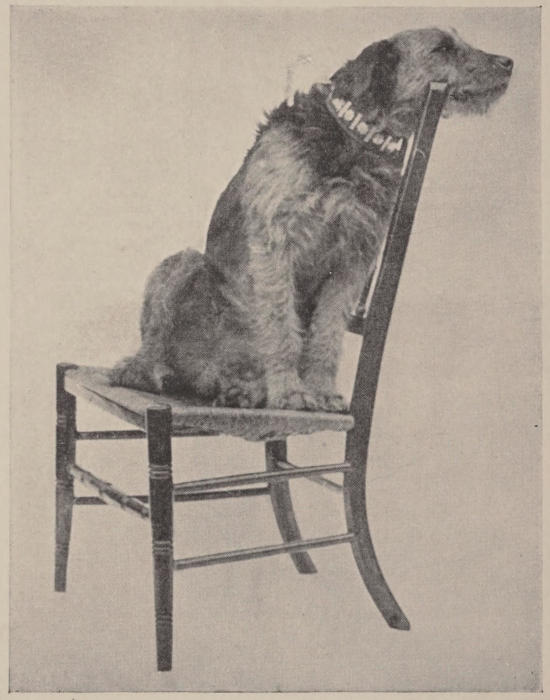
were chatting, Tim would jump on a chair
and join the party. He would lean over
the back, gazing so intelligently into our
faces, that it really seemed as if he were
talking, too.
A dog’s love for his people is a curious
and beautiful thing. Tim did not mind
how uncomfortable he was as long as he
could be near them. He had once been
known to give up his dinner to follow
them when they went for a walk. Perhaps
he was not as hungry as usual that
day.
He would lean over the back of a chair.
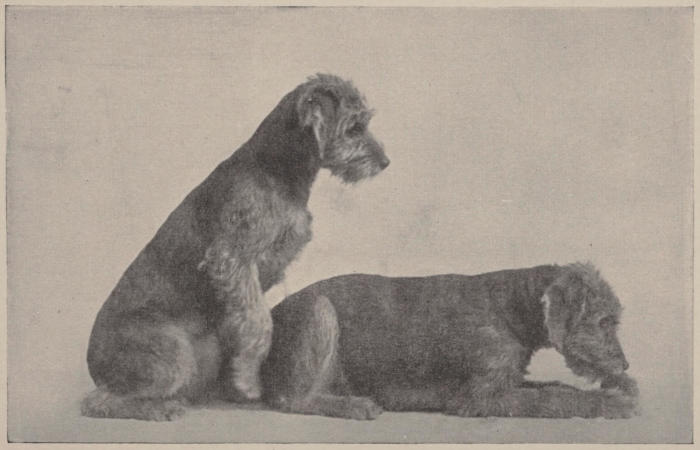
We had another dog with Tim called
Tess who hated the sight of a camera.
We wanted to get a photograph of her and
Tim sitting up together, but she was determined
we shouldn’t. As soon as we
had placed them in a good position and
were ready to begin, that silly Tess would
tumble on her back with her legs sticking
up in the air, and how could you photograph
a dog like that! We tried scolding
her, but that only made matters worse,
for she simply wouldn’t sit up at all, and
as soon as we had dragged her on to her
feet—flop, over she would go again! At
last we had to give it up as a bad job.
Tess had five jolly little puppies, three
boys and two girls, and as soon as ever
the pups could get on without their
mother, she was sent away. She went to
some kind people who never wanted to
photograph their dogs and where she
would get heaps and heaps to eat, for I
must tell you, Tess was rather a greedy
dog and not as faithful and affectionate
as Tim.
Tim was very good to the puppies.
Naturally, he didn’t trouble himself
about them quite like a mother, but he
was never snappy or disagreeable. Even
when they played all over him and nibbled
his ears he never growled like some father
dogs might have done.
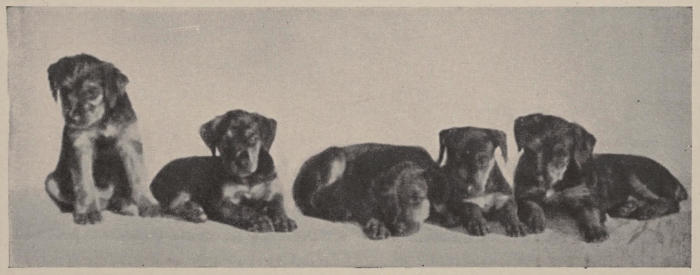
One day we wanted to take a picture
of the puppies sitting in a row, little thinking
the difficult job it was going to be.
Of course, Tim kept sitting just in front
of the camera, so before we began he had
to be taken indoors.
The Puppies.
At first the puppies were all good except
the two girls, Timette and Ann.
They wouldn’t stay where they were put,
but kept waddling away as if they had
some very important business of their
own. As soon as Ann was caught and
put back, Timette would wander off, and
when she was caught, Ann was off again
and so it went on. It was lucky there
were two of us, but we were both kept
busy. Then the other puppies didn’t see
why they shouldn’t have some fun and
they began wandering away, too. There
was only one thing to be done with the
two naughty pups who had set such a bad
example and that was to give them a
whipping. Of course, not a real one, for
they were such babies they couldn’t understand,
but just a few mild pats to keep
them still. You would have laughed to
see their puzzled faces, for they were not
sure what the pats meant and rather
thought it was some new game. After
this Ann was placed in the middle of the
group, where she promptly went to sleep,
and Timette was put at the end of the
row, where she sat blinking as sleepily as
you do when it is long past your bedtime.
Timette and Ann had never been so
tired in their short lives. First of all, the
running away and always being brought
back, then being made to sit in one place,
and after that the new game of pats had
been too much for the babies, and when
it was over they slept and slept as if they
never meant to wake up again.
I wonder what they said to each other
about it afterwards. I daresay the three
other puppies laughed at them and probably
made believe they had understood all
along that they were expected to sit still.
When old Tim came out again they told
him all about it. “We tried hard to get
away,” said Timette, and Ann joined in,
“We tried and tried over and over again,
but each time we were brought back.”
Then the other puppies explained about
the pats. “I see,” said Tim, “now I understand
you have had your first whipping
for disobedience; take care it is the
last.”
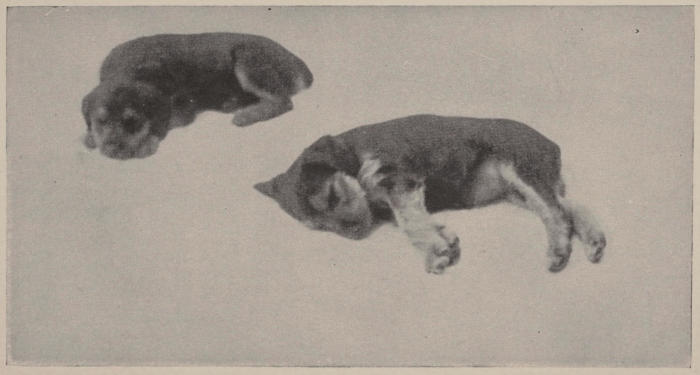
They slept and slept.
When the puppies grew a little
older, people used to come and
look at them, and soon the three boy puppies
were sold and taken to new homes.
Timette and Ann missed their brothers;
it seemed funny to be such a small family
and they did their best to entice old Tim
to play with them. But he was too
grown-up and dignified and rather slow
in moving about, so it was not altogether
a success. In the middle of a game he
would prick up his ears and listen as if he
heard some one calling him. And often
he would trot off, pretending he was
wanted elsewhere, just as an excuse to get
away from the rough, romping pups.
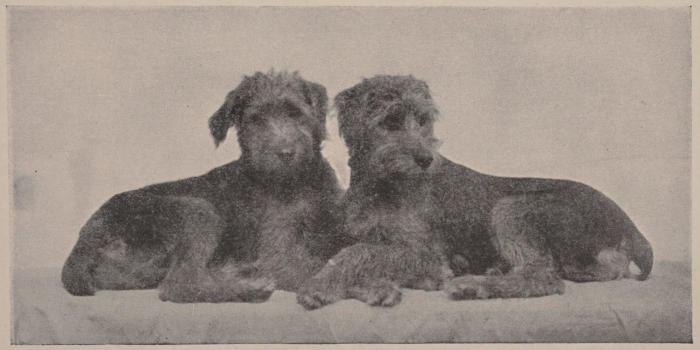
Timette was given her name because
she was so like Tim, and Ann hers because,
as she was rather old-fashioned
looking, it seemed to suit her. The puppies
were very much alike, so only those
who knew them well could tell them
apart, but in character they were very
different. Ann was gentle and timid,
while Timette was a thorough tomboy,
full of spirits and mischief and as bold as
a lion.
And now I am going to tell you about
the first adventure they had. They lived
in a garden that ran into a wood. It was
rather difficult to see just where the garden
ended and the wood began, for they
were only separated by a wire.
Now, Timette and Ann knew that they
were not supposed to go out of the garden
where they had plenty to amuse them:
an india-rubber ball, a piece of wood that
looked like a bone, and a bit of rag that
did for playing “Tug-of-war.” Ann
never had the least wish to wander, for
she was much too timid. But, as I said,
Timette was different; she was simply
longing to go into the wood and have
some adventures. She kept talking to
Ann about it, making most tempting suggestions
and persuading her to go.
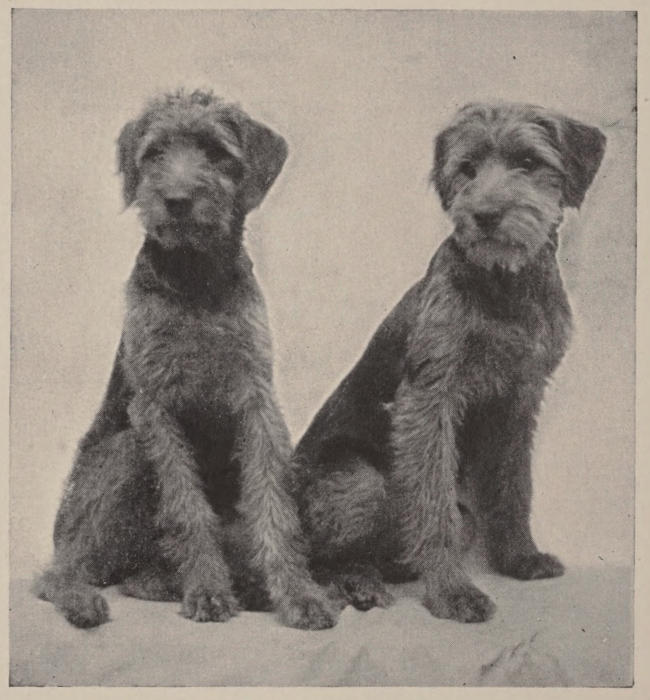
TIMETTE AND ANN.
“Two little Airedale pups are we,
Shaggy of coat and of gender ‘she.’”
“Look at old Tim,” she said; “he often
takes a walk by himself, and he never
comes to any harm.”
“That’s all very well,” Ann answered;
“he’s old, and he can take care of himself.”
“Well, and why can’t we take care of
ourselves?”
“Because I believe there are wild animals
that would eat us up.”
“Whatever makes you think that?”
asked Timette, for she knew Ann had
very sharp ears and keen scent; “do you
smell or hear them?”
“Both,” replied Ann, “only this morning
I smelt that some animal had been in
the garden. I got on its track and followed
it down to the cabbages and back
to the wood again.”
“I don’t think much of an animal who
only goes after cabbages,” Timette interrupted.
“There are others, too,” continued Ann,
“I often hear very strange scratching
noises like animals running up trees with
terribly sharp claws,” and Ann gave a
little shudder.
“Well, what of it?” said Timette boldly.
“I shouldn’t mind their claws as long as
the animals weren’t bigger than I am.”
“But they might run after us,” suggested
Ann.
“They wouldn’t run after me,” boasted
Timette, “for I should be running after
them!”
“Would you really?” asked Ann, and
she sighed, wishing she were as brave as
her sister.
“I should say so,” said Timette, “if
only you would come, too, we might even
catch one. Think what fun that would
be.”
“It certainly would,” replied Ann.
“Oh, how I should love it!”
“Well, come along,” urged Timette,
and Ann came along, and that is how the
adventure began.
This conversation took place after
the puppies had eaten their dinner
and were supposed to be taking their
afternoon nap. Tim was stretched out
on the lawn in the sun, having a doze, and
no one was about. The two puppies slunk
off quietly into the wood and no one saw
them go.
The wood was very exciting; there
were such strange smells about, and when
the puppies put their noses to the ground
they began to find out all sorts of animal
secrets. And now, before we go any further
with Timette and Ann into the
wood, I must just tell you a little about
dogs and their clever noses or you will be
wondering why these puppies talked so
much about smells.
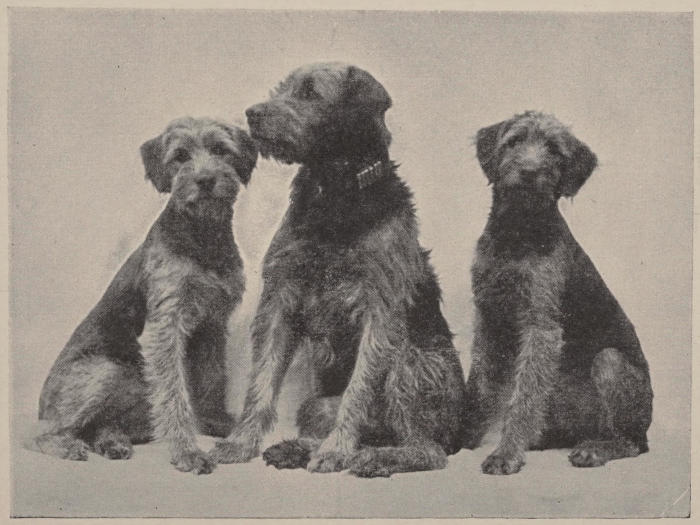
“Here you see us with Papa;
They sent away our dear Mamma.”
Hundreds of years ago, when there
were no maps or books or papers, people
could find out all kinds of wonderful
things by their noses. Your nose now
will tell you the difference between the
smell of a violet and strawberry jam and
other things, but when you know what a
dog can discover by its sense of smell,
you will see how feeble yours is.
A dog will know who has been along
the road by smelling the footsteps. Although
it cannot read the way on a sign-post
it can smell out the way to places
and follow any one who has been along,
even if it was some time ago.
You wouldn’t know if a friend had
been to see you while you were out unless
you were told, but a dog would know as
soon as he came back; he wouldn’t be
obliged to ask, for he would know just
who it was. If the friend had brought
another little dog, too, your own dog
would be so excited he would probably try
to tell you all about it, and yet he was
away when it happened.
The road is as interesting to a dog as
the most thrilling story book is to you.
It may look just an empty road, but to
a dog it has all sorts of messages that
conjure up pictures. He knows, for instance,
that another dog has traveled
there and can tell what kind of dog it was.
By and by his nose tells him this dog
found a rabbit and caught it. Then he
finds out a bigger dog came along and
chased the first dog and got the rabbit.
At least, did he get the rabbit? He is
puzzled and sniffs hard round one spot.
It is exciting news he is finding out and
you can see his tail wagging with eagerness.
No, it seems, neither dog got the
rabbit, for bunny was too sharp and between
the two managed to get away. If
a dog can find out all this by his sense of
smell you may guess he can easily track
the rabbit to its hole, and there he sits
probably waiting for it to come out and
give him the chance of a little sport, too.
Haven’t you often seen your dog stop
suddenly when he is coming towards you
and hold his head in the air? You must
have wondered why he didn’t come
straight on. He has probably had a message,
a scent blown on the wind, which
like a wireless, tells him a rat has just
crossed the road and is somewhere in the
hedge if he will only go and look. And
so it goes on; there is not a dull moment
in his walk.
To a dog every one has his own particular
smell which never deceives him.
If you dress yourself up you may puzzle
your dog’s eyes for a little while. He
may even bark at you as if you were a
stranger, but once let him get near
enough to smell you and it is all over. He
will wag his tail and look up at you, as
much as to say, “Did you really think you
could take me in?” So you can understand
why dogs when out hate to be made
to come to heel, as they miss all the fun
of the walk, and have no chances to stop
and read the interesting smells that tell
them so much.
“All the happy, livelong day,
We eat and sleep and laze and play.”
And now we must go back to Timette
and Ann and their adventure.
“The tree-climbing animal has been up
here,” cried Ann, sniffing at the bark of a
tree. And when they looked up they saw
a brown squirrel peeping at them from a
branch.
“Come down! come down! come down
at once!” barked the puppies, but Mr.
Squirrel was too wise for that. He knew
that even with such baby dogs it wouldn’t
be quite safe to trust himself on the
ground.
“I don’t call that playing fair,” Ann
called out, jumping up at the tree and
wishing she could climb it. But the squirrel
just sat tight.
Presently Timette smelt an enticing
smell and dived into some bushes, while
Ann anxiously watched and waited. She
could hear Timette working about and
breathing hard.
“Hi, hi, hi!” shrieked a big bird as it
flew out. Timette dashed after it, but it
rose in the air and left her looking very
surprised. “Well, that was a sell!” she
said.
Ann meanwhile was busy with her nose
on the ground. There were a number of
insects crawling about; they had no smell
to speak of, but they moved quickly, which
was rather fun. Once she chased a big
hairy buzzing thing. It settled on a bit
of heather and she nearly caught it, but
luckily not quite, for it was a bumble bee.
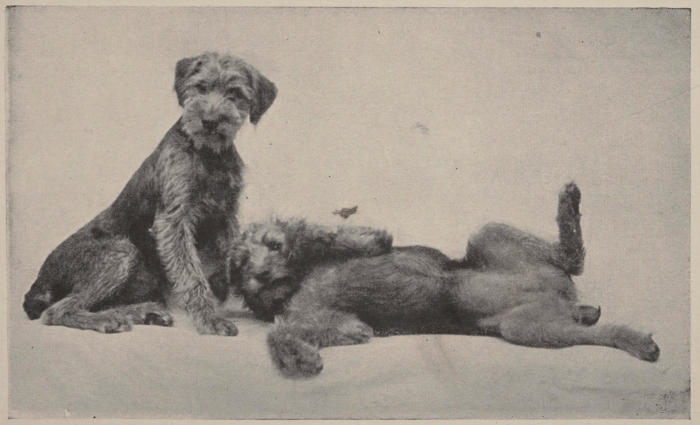
“Except when only one bone’s there,
And Sis takes care that I shan’t share.”
Timette didn’t care for the beetles; they
were feeble sport for a dog, she thought,
and putting her nose in the air she caught
a most wonderful smell. She gave a short
bark of delight and started running about
to find it on the ground. Ann looked up
and she too caught the message and was
as busy as Timette. It was a most enticing
scent: furry and alive and gamey
so that it promised real sport. As soon
as the puppies really got on to it, they put
their noses to the ground and followed it
up, their little stumpy tails wagging hard.
Their instinct told them it was not an animal
that could hurt them, but one their
mother and father and grandfathers and
great-grandfathers had chased, so you
can’t blame Timette and Ann for following
up the scent of a rabbit.
But although rabbits are often killed
by dogs, they are not silly enough to allow
themselves to be caught by two young,
inexperienced puppies. The rabbit they
chased was an old one who had his wits
too much about him to be even very afraid.
You will laugh when I tell you that he
didn’t even trouble himself to hurry and
just ambled along to a hole and popped
down it.
This hole had been the chief entrance
to his burrow, and he and his big family
had used it so often that it was worn quite
wide and smooth. The artful old rabbit,
however, only went a little way down it,
then he turned to one side and went up
another little passage and out into the
wood and off again.
The puppies came dashing along, giving
little short barks of delight at the
sport. They followed the scent to the
hole, and without stopping they plunged
right into what looked to them like a dark
tunnel. Of course, they were in much too
great a hurry to notice the little passage
where the old rabbit had turned aside, and
just pushed on as hard as they could. The
tunnel wound downhill and grew narrower
and narrower as they went on.
Timette was leading and she called back
to Ann, “Can you smell anything? I have
lost the scent.”
“So have I,” Ann answered, and then
as she was feeling nervous in the dark,
she added, “Let’s go back.”
“No, it’s all right!” cried Timette, “we
had better go on, I can see daylight and
smell the open air.”
This was a good thing, for the fat puppies
would have found it very difficult to
turn round in such a small space. At the
end the hole grew so narrow that Timette
had to squeeze to get through, and when
Ann crawled out, some of the roof fell in
and there was no more hole to be seen.
The puppies found themselves in a
hole in two senses of the word. It
wasn’t a nice hole either, but a deep one,
cold and damp, too, and with no enticing
smells. It had once been the home of a
lot of rabbits, but it had all been dug up,
and the only smell about it now was that
of a cold dull spade.
“I want to go home,” whimpered Ann.
“So do I, Cry-baby,” said Timette,
“but we shall have to climb out of here
first.”
“What a pity you should be
Such a greedy little she!”
Then they both stood on their hind legs
and stretched up the sides of the hole, and
when this was no good they gave little
feeble jumps. A child would have managed
to scramble out somehow, and kittens
could have reached the top in a twinkling;
but puppies are so clumsy and helpless,
and poor Timette and Ann’s struggles
were all in vain. They only fell on
their backs, and at last got so hurt and
tired they gave it up. It was their teatime,
too, and they were feeling hungry
as well as unhappy, and you know how
bad that is.
Ann cried, “Oh, I do want my bread
and milk! I’m so hungry. Oh! oh! oh!”
And Timette began crying, too, “We’re
lost, we’re lost! Oh, do come and find
us!” and then they both howled as loudly
as ever they could, “Help, help, help!”
But no one came and all was quiet.
Poor puppies! how miserable and lonely
they felt! It did seem hard that no one
should trouble about them, and when they
couldn’t cry any longer they curled themselves
up as close as they could to each
other and went to sleep. They were like
the lost “Babes in the Wood.”
And now I want to tell you what was
happening at home. A little girl
called Ruth, who was very fond of the
puppies, came to see them on her way
home from a party. She loved playing
with them, and the first thing she said
when she ran in was, “I am just going to
say good-night to Timette and Ann,” and
was off into the garden to find them.
But, alas! there were no puppies to be
found. There was the india-rubber ball
and the stick and the bit of rag, all looking
very lonely, but no sign of the puppies.
Ruth was very puzzled. “What have you
done with them?” she asked Tim, who
was sitting up looking rather worried.
He gave his tail a flop and his brown human
eyes seemed to say, “It really wasn’t
my fault; they ran away without asking
me.”
Ruth felt sure they couldn’t be so very
far off, as they were too babyish to be
able to stray a great distance, and that
with Tim’s help she would be able to find
them. She ran back to tell us the news
and that she and Tim were going out as
a search party to look for the lost ones.
“Don’t be long,” we called after her,
“remember your bedtime.”
“As if I could go to bed while the
darlings are lost!” we heard her say.
We watched them go into the wood,
Tim barking round Ruth most excitedly.
He seemed to know there was serious
business on hand, for instead of dashing
off to chase rabbits, he kept near her and
often put his nose to the ground. “We’ve
got to find those puppies,” Ruth told him.
Soon he gave a sharp bark and ran ahead
of her, looking round and saying as plainly
as he could, “You just follow me.”
Ruth understood dogs as well as she loved
them, and she trusted Tim and followed
where he led.
In a few minutes they had reached the
hole. The puppies woke up to see Ruth
and Tim standing looking down on them.
Oh, what a noise they made! I can’t tell
you how delighted they were. It seemed
like waking up from a bad dream. You
couldn’t have heard yourself speak, for
there was Tim barking, Ruth calling them
all the pet names she could think of, and
the puppies themselves simply shrieking
with joy. Ruth soon jumped down into
the hole, and when we came up there she
was hugging the puppies who were covering
her face with their wet sticky kisses,
giving little sobbing cries as if they
wanted to tell her over and over again
how glad they were to be found, and to
thank her for getting them out of the
nasty hole. Ruth carried them home in
her arms, talking to them all the way,
while Tim stalked along by her side with
a proud and injured air that plainly said,
“Well, after all, it was really I who found
them and I think you might make a little
more fuss with me.”
“This they say is not quite right;
But who can keep still in the midst of a fight?”
Puppies don’t have meat to eat;
they don’t really need it till they are
grown up. However, sometimes as a
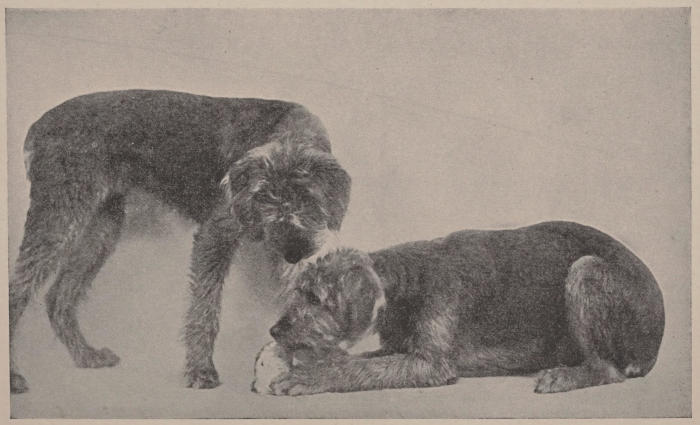
great treat, Timette and Ann would be
given a bone. They always had one each,
because being rather jealous dogs they
might have quarreled over one. Tim, too,
always had a bone to himself. One day
the cook threw Tim a bone, but he had
gone off for a saunter in the wood, and
the puppies rushed to get the prize. Timette
was first and, with a bound, was on
top of it. But she had jumped just too
far and Ann quickly dived in and snatched
it from under her. Poor Timette! her
baby face looked so disappointed. “Well,
you are a greedy pig,” she said; “you
might let me have a bit.”
“Go away,” said Ann, and she went on
calmly nibbling.
Then Timette made a dash for it, but
Ann was prepared and wheeled round, the
bone safely in her mouth. Timette tried
again, but Ann was too artful; she just
held on to the bone with her paws as well
as her teeth and gave a little growl when
Timette came too near.
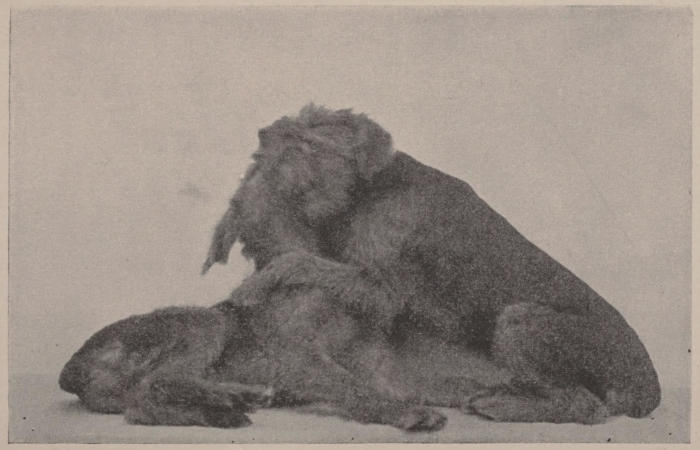
At last Timette’s patience gave way,
and with an angry cry she hurled herself
at Ann. Ann at once turned on her and
bit her ear, and then they got muddled
up, both trying to bite as hard as they
could. The bone was forgotten, for both
puppies were in a rage. They fought almost
savagely like big dogs and neither
would give in. They made such a noise
about it, too, that we came out to see
what was the matter, and as they wouldn’t
stop, we had to separate them. In the end
Ann got rather the worst of it, which
served her right for being so greedy over
the bone. She was not much hurt, though,
for Timette had only her puppy teeth, and
they can’t bite really hard, although they
are very sharp.
When it was over, they were both
rather sulky and gave each other long
scowling looks. Timette took the bone
and kept it all the afternoon. Ann looked
the other way, pretending she no longer
wanted it. In the end we took it away
altogether, and after that they were quite
good friends again, ate their evening
bread and milk in peace and went to sleep
curled up together.
“We’re good dogs now, and once more friends,”
And so my doggy story ends.
Dogs are very like children who
never grow up. But a child would
have to have a very loving heart to be as
fond of any one as a dog. A dog is so
faithful, too; he never tires of people or
thinks them wrong or unfair, and he is
just as devoted and obedient to them however
old he gets. He is always trying to
please them and is miserable and unhappy
when he fails. That is why it is so easy
to train a dog; you only have to make him
understand what you want and he will try
and do it. If dogs could understand all
our language, you would only have to say
to your dog, “Don’t walk on the flower-beds,”
or “don’t take anything off the
table,” or “don’t bark when we want to
go to sleep,” and he would obey you.
This doesn’t mean that dogs are never
naughty; I know they are sometimes, but
before you punish a dog you should be
quite sure he understands what it is for.
If he is an intelligent dog, a scolding will
often do as well as a whipping. Tim only
had a whipping once in his life, and yet
he was a very well trained dog. He was
taught not to go across the beds in the
garden by being called off and made to go
round, and he never stole after he had
taken one piece of cake.
I must tell you about that. It was really
not quite his fault, for it was on a very
low table, and being rather new I expect
it smelt extra tempting. He was made to
feel horribly ashamed. Ever afterwards
the cake plate was shown him with reproachful
remarks, such as “Oh, Tim,
how could you! Oh, fie, what a wicked
thief!” till he would turn his head away
as if he hated the sight of the stupid old
cake and wished we would stop teasing
him. After this he could be trusted never
to take anything however near the ground
it was, and no matter how long he was
left alone with it.
One day the tea had been taken into the
garden. Tim, of course, could be trusted,
but the puppies had been forgotten.
When he came out there was Tim sitting
up with a very dejected look, and the two
naughty puppies busy with the bread-and-butter,
some crumbs on their shaggy
mouths being all that was left of the
cake!
“Did they get a whipping?” you ask.
Well, when we found all our nice cake
gone we did feel inclined to give them
some pats, but then they were too much
of babies to understand, so they had a
shaking and a scolding and were shut up
for the rest of the afternoon. Tim soon
got more cheery when we petted him up
and told him it wasn’t his fault.
When Ann grew up she was given
to Ruth as a birthday present; or
to be quite truthful, she gave herself, for
she was so fond of Ruth that she followed
her about everywhere, and would stay
with no one else.
She was a very sedate and serious animal;
she might almost have been an old
lady dog. You would have thought by
the look of her she was wrapped in deep
thought and that if only she could have
spoken it would have been about very
clever things.
She looked so wise and grave.
Ruth would have it she was making up
poetry. The fact was Ruth was making
up poetry herself, and when we are thinking
hard of any subject we are inclined to
imagine other people are, too. Just now
Ruth was busy making verses and rhymes
and thought Ann must be doing the same.
Ruth was rather shy over her poetry;
she hadn’t told any one about it, she was
too afraid they might laugh at her. And
yet she badly wanted to know what they
would think of it.
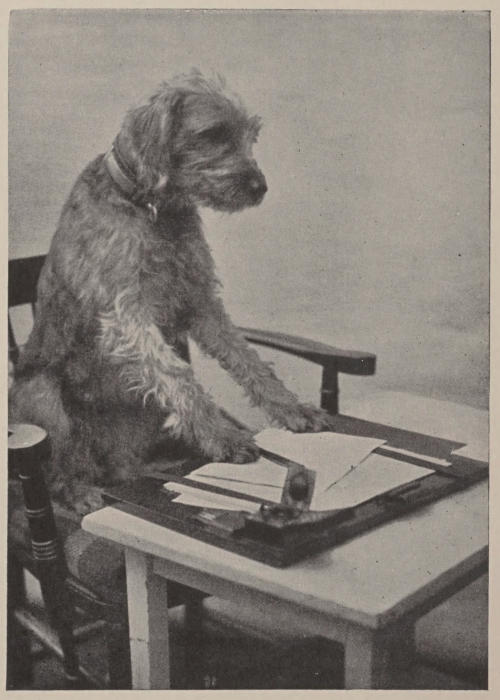
One day she sat Ann up in a chair at
a table with pen and ink and paper in
front of her. She looked so wise and
grave that you could quite well imagine
her a poet. And when Ruth called us in
to look at her, there sure enough were
some verses written.
“Look what Ann has made up,” cried
Ruth. “I told you she was thinking of
poetry.”
“How wonderful!” we said, for we saw
whose writing it was. “Clever Ann! who
will read it out?”
“I think Ann would like me to,” replied
Ruth, who was glad to get this chance to
read her own verses, “the poem is supposed
to be about Ann’s young days when
she and Timette were puppies.”
“How very interesting,” we remarked.
“Now I’ll begin,” said Ruth, with
rather a red face, “it is supposed to be
Timette speaking.”
“But why Timette?” we asked. “Why
isn’t it Ann herself speaking?”
“Because she is a poet,” Ruth explained,
“and poets always have to pretend
to be some one else.”
Then she read these verses:—
“Two little Airedale pups are we,
Shaggy of coat and of gender ‘she.’
“Here you see us with papa,
They sent away our dear mamma.
“All the happy livelong day
We eat and sleep and laze and play.
“Except when only one bone’s there
And Sis takes care that I shan’t share.
“What a pity you should be
Such a greedy little she!
“This they say is not quite right,
But who can keep still in the midst of a fight?
“We’re good dogs now and once more friends,
And so my doggy story ends.”
The Spider in the Web.
SPIDERS AND THEIR WEBS — CHAPTER I EMMA — CHAPTER II EMMA’S WEB — CHAPTER III A NARROW ESCAPE — CHAPTER IV ABOUT WEBS — CHAPTER V THE LITTLE HOUSE-SPIDER — CHAPTER VI BABY SPIDERS
“Spiders!” you say. “Ugh! what
dreadful things. I don’t want to
read about them.” But surely any one
as big as you are need not be afraid of a
poor little spider. Don’t you remember
when “there came a big spider and sat
down beside her” it was little Miss Moffat
that was frightened away, and I don’t
suppose she was much more than a baby.
You are quite a big boy or girl or you
wouldn’t be able to read this, and spiders
are really so clever and interesting that
I believe you will enjoy hearing a little
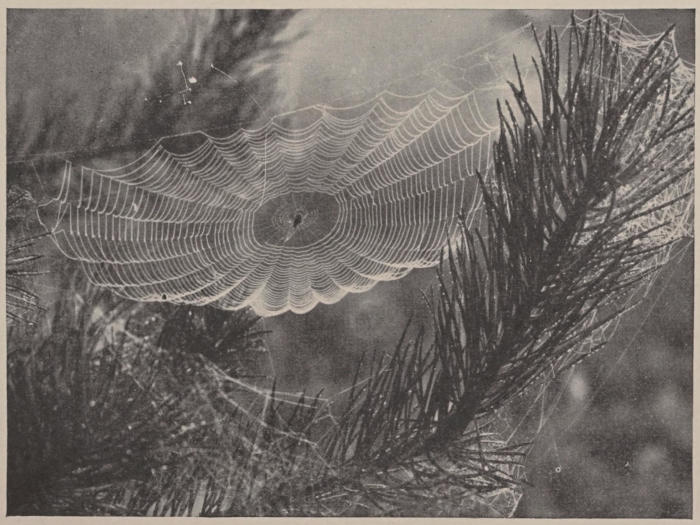
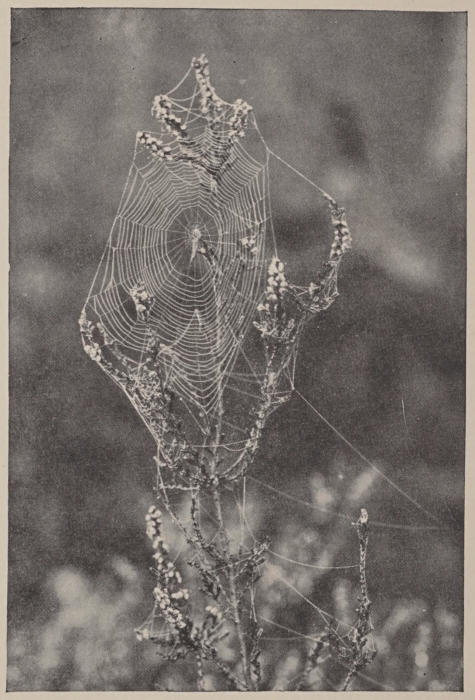
about them. Let us look at the picture of
the spider in the web and pretend it is a
real one; and shall we give it a name? I
don’t believe Miss Moffat would have
been frightened if she had known a little
more about it, or if it had a name, so we
will call this little spider “Emma.”
Emma is a girl spider and she will grow
up ever so much bigger than any boy
spider. It is rather topsy-turvy in the
spider world, for the she-spiders are not
only bigger but much stronger and fiercer
than the little he-spiders, and they are
quarrelsome, too, and love a fight. This
need not make you think Emma is going
to be savage with you; she would be much
too afraid, for you are a big giant to her.
It is only with other spiders and insects
her own size she will fight.
When Emma was younger she was a
light green color, but as she gets older she
grows darker and darker and different
markings come out on her back. As you
grow, your clothes get too small for you
and you have to have new ones or a tuck
is let down. This is the same with Emma,
only, as her coat happens to be her skin
as well, it is no good thinking about a
tuck. I don’t know how many new frocks
you have, but Emma has changed hers
seven times before she was grown up.
If you look closely at a real spider you
will see it has hairs on its body and on its
legs. Emma, too, has these same fine
hairs which are very important. She can
neither see nor hear very well, so these
hairs, which are sensitive, can warn her
of danger. They feel the least trembling
of the web and are even conscious of
sound, so you see how useful they are.
The spider is rather a lonely person and
not at all sociable. Perhaps this is because
she has to work so hard for a living.
In fact, all her time, day and night, seems
taken up either with making or repairing
the web, and lying in wait, when she dozes
far back in her little shelter out of sight,
with one hand always on the tell-tale cord
that connects with the web and lets her
know of its slightest movement.
And now I am afraid you are finding
this rather dry, and if I don’t tell
you a story you will be frightened away
like Miss Moffat.
A beautiful, regular pattern.
One day Emma felt very hungry; her
larder was quite empty and she had been
without food for nearly a week. It was a
fine evening, with just a gentle little wind
blowing, so she thought she would try a
new place for her web, where it would
have a better chance of catching something.
She climbed up fairly high and
then let herself drop with all her legs
stretched out, spinning all the time the
thread by which she was hanging. Then
she climbed up it, spinning another thread,
and when she had like this spun some nice
strong sticky threads she waited for the
wind to carry them on to some branches
of furze. When these held, Emma ran
along them, fastened them firmly and
spun a fresh thread each time till she
made a line that was strong and elastic,
and so not likely to break easily. When
she was satisfied it would bear the weight
of the web, she spun struts from it to hold
it firm and then began the web itself. She
first made a kind of outline and then spun
and worked towards the middle. It was
wonderful to see what a beautiful regular
pattern she was spinning, with nothing
but her instinct to guide her.
You know when a house is being built
it has tall poles all round it called scaffolding,
which helps the building; well, the
first outline of the web was Emma’s scaffolding,
and when it was no longer wanted
she got rid of it by eating it up!
“But how did Emma spin a thread?”
I can hear you asking.
It is like this—suppose you had a ball
of silk in your pocket and ran about twisting
it round trees to make a big net. This
is really what the spider does, but the silk
comes from inside her and will never come
to an end like the ball in your pocket. It
issues from what are called spinnerets.
When she lets herself drop, the spinnerets
regulate the thread, but when she is running
along spinning she uses two of her
back legs to pay it out, just as you would
have to use your hands to pull the silk out
of your pocket. It is a pity spiders usually
spin their webs at night, so that we seldom
get a chance of watching them.
I said just now that Emma’s silk never
comes to an end, but sometimes if a very
big fly or wasp gets caught in her net she
has to use a great deal of her silk, which
she winds round and round the fly, binding
him hand and foot, and then her stock
of thread which is carried inside her may
run low; but it soon comes again, especially
if she gets a good meal and a nice
long rest.
A fly struggling in her web.
When Emma had finished she was
pleased with the look of her web and hid
herself at the side of it under a furze
branch. She watched and waited. She
waited all night long and nothing happened.
In the morning she was still watching
and waiting, but at last there was a
sound. A deep humming was heard in
the air as if a fairy aeroplane were passing.
It was so loud that even deaf Emma
might have heard it if she had not been
too busy. Just then, however, her hairs
had received a wireless message to say
there was a catch at the far end of her
web. Although a spider is much more patient
than you, and can sit still a long
time, it is a quick mover when there is
need for speed. Emma darted out like a
flash of lightning and found a fly struggling
in her web. It was a very small thin
one, and poor hungry Emma was disappointed
not to see a larger joint for her
larder. She quickly settled it, however,
and spun some web round it to wrap it up,
for, after all, it was something to eat and
so worth taking care of. She was still
busy with her parcel when “Buzz, buzz,
buzz,” the whole web gave a big jump and
there quite close to Emma was a huge, terrible
beast. A great angry yellow wasp,
making frightful growling noises and
struggling desperately to get out of the
web. Poor Emma wasn’t very old or daring
and she knew the danger she was in,
for this savage monster could kill her
easily with his sting. He was fighting
hard against the sticky meshes of the web
and jerking himself nearer to her. She
was too frightened to move, and for a
minute she hung on to her web limp and
motionless looking like a poor little dead
spider. Then something happened. The
wind blew a little puff, the wasp put out
all his strength and gave a twist, the web
already torn broke into a big hole and the
great yellow beast was free. He glared
at Emma and hovered over her, buzzing
furiously. He would have liked to kill
her, but luckily he was too afraid of getting
tangled up again in that sticky, clinging
web, so, grumbling loudly, he flew
away.
“What did Emma do?”
Well, she quickly got over her fright
and I think she had a little lunch off her
lean fly; then she looked at her web and
was sorry to see it so torn and spoilt.
The best thing to do was to mend it then
and there, and as a spider always has
more silk in her pocket, so to speak, she
was able to do it at once. She repaired
it so well that it didn’t look a bit as if it
had been patched but just as if the new
piece had always been there, the pattern
was just as perfect.
I don’t believe you are feeling a bit
afraid of spiders now, are you?
There is no reason why we should fear
them, for they don’t bite or sting us; and
if they did the poison that paralyses
and kills their prey would not hurt us.
Besides, they kill the insects that harm
us. I saw a spider’s web once full of
mosquitoes, and you know what worrying
little pests they are. I was glad to
see so many caught, but sorry for the
spider, as they didn’t look a very substantial
meal. Then you know how dangerous
flies have been found to be, making
people ill by poisoning their food, so
it is a good thing that spiders help us to
get rid of them.
Another reason to like spiders is for
their webs. There is no animal or insect
that makes anything quite so wonderful
and beautiful as what these little creatures
spin.
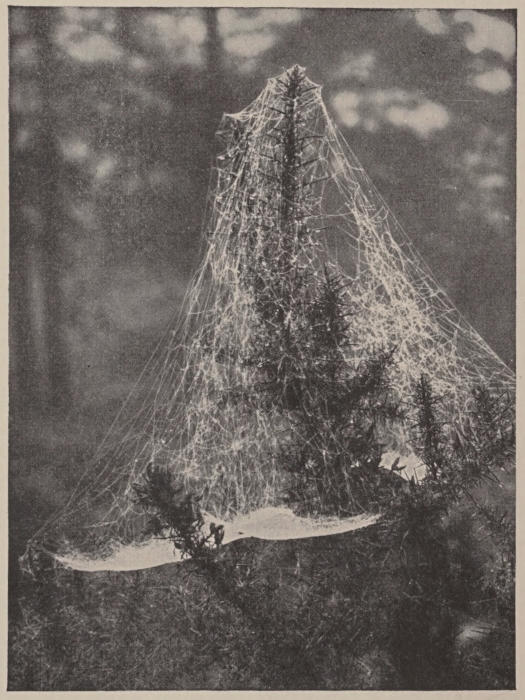
The spider’s web is really a snare for
catching her food. The strands of it are
so fine as often to be invisible in some
lights even in the daytime, and of course
quite invisible at night. Sometimes the
beetle or flying insect is so strong that
he can tear the web and get free, but not
often, for the spider can do wonders with
her thread. She spins ropes and throws
them at her big prey and doesn’t go near
it till it is bound and helpless.
Of course, there are many different
kinds of spiders who spin different kinds
of webs. In a hotter country than this
there is one that is as big or rather bigger
than your hand, and another called
the Tarantula whose bite is supposed to
be so poisonous that it can kill people,
but this is very exaggerated.
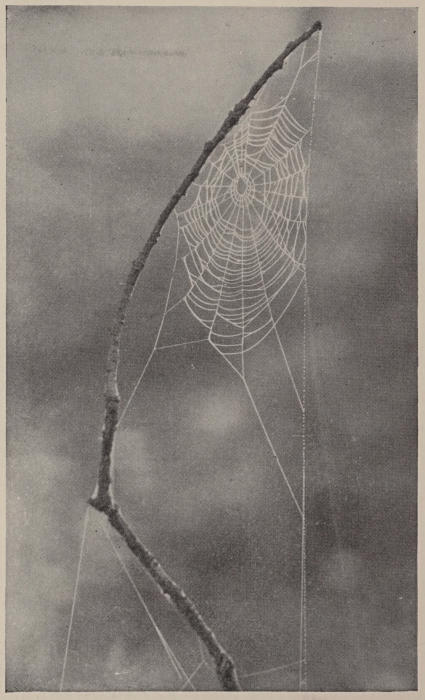
A Beautiful Web.
As the spider’s web is only her snare,
she naturally has to have some kind of
home, which must be quite near to her
place of business. If you look very close
and follow one of the strands of the web
you will find some little dark cranny
where the huntress can hide. If the
web is amongst trees it will probably be
a leaf she has pulled together with her
thread and made into a dark little tunnel
out of which she darts when something
is caught.
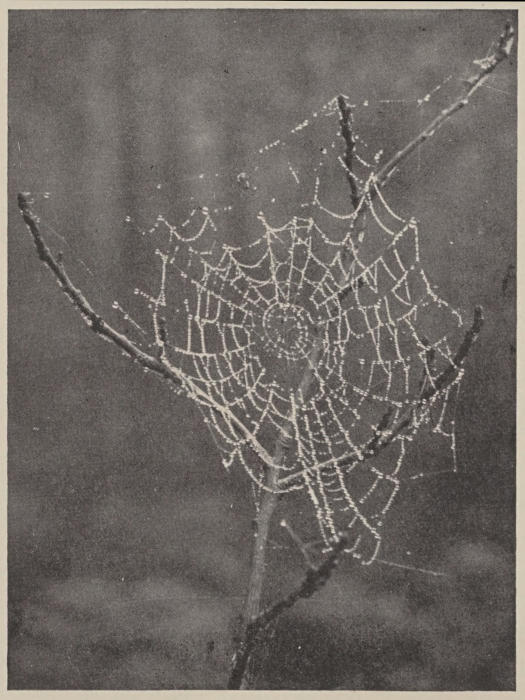
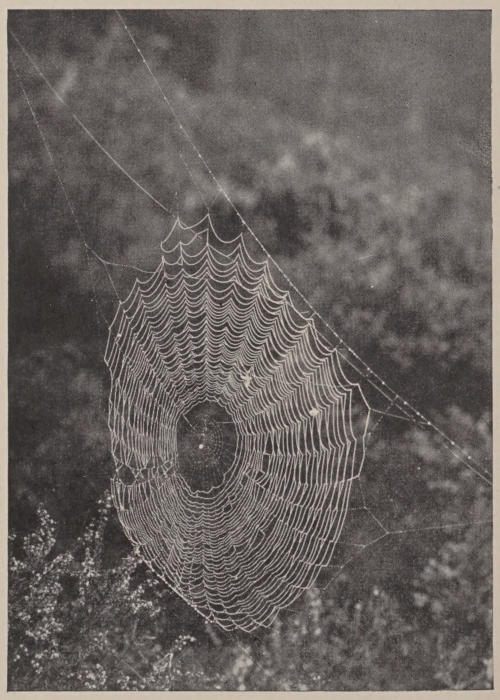
Now before we leave the spiders’ webs
you may wonder why you never see them
so clearly as they show in the photographs,
and I will tell you the reason.
You see if the spiders’ nets which are set
to catch sharp-eyed insects were always
to show as clearly as they do in the pictures,
I am afraid they would really
starve, for no fly would be silly enough to
go into such a bright trap. But sometimes
in the autumn, very early in the
morning, the dew hangs in tiny beads on
the webs, and makes them show up clearly,
and then it is that the photographs
are taken. If you get up early some still
September morning, just about the same
time as the sun, and go for a walk in a
wood, or even along a country road, you
may see the webs with what look like
strings of the tiniest pearls on them, and
you will find that until the sun has dried
up all the little wet pearls, which are of
course dewdrops, the poor spider has not
a ghost of a chance of catching anything.
But to return to the spider herself.
The one you know best is probably the
house-spider. It has eight legs and a
body rather the shape of a fat egg, with
a little round bead of a head. It runs
up the walls, sometimes hanging by a
thread from the ceiling, and seems very
fond of the corners of the room. How
glad these house-spiders must be when
they get to a dirty untidy house, where
they will be safe from the broom. Most
of us hate to see cobwebs in our houses,
and get rid of them as quickly as we can.
I will tell you about a little house-spider
who had a very exciting
adventure. She had made a beautiful
web in the corner of a bedroom, high up
near the ceiling. One day her sensitive
hairs told her there was some sort of
disturbance in the room, and looking
down from her web she saw all the furniture
being moved out. The curtains and
rugs had gone and the bed was pushed
up into a corner. Then, to her dismay,
a huge hairy monster came rushing up the
wall. Of course, it was only a broom,
but the poor little spider was so terrified
she thought it was alive. It came nearer
and nearer, and all at once there was a
terrific rush and swish right up the wall
where she lived, and web and spider
disappeared. It was very alarming, but
you will be glad to hear that the little
spider was not killed but only stunned;
and as soon as she came to her senses,
she found herself right in the middle of
the broom. She hung on and kept quite
still, and soon the servants went into
the kitchen to have some lunch and the
broom was stood up against the wall.
Now was the little spider’s chance to
escape, and out she popped. The coast
seemed clear, so she scuttled up the wall
and rested on the top of the door.
Spiders haven’t good sight, so she
couldn’t see much of the kitchen, but what
she did see looked nice, and she thought it
a much more interesting place than a bedroom,
besides there were some flies about,
so she determined to spin another web.
No sooner had she begun when there was
a crash like an earthquake. “Will horrors
never cease?” thought the spider. It
was really only the slamming of the door,
but it so startled her that she fell and
dropped on to the shoulder of some one
who had just come in.
A Snare.
“Oh, Miss Molly!” cried cook, “you’ve
got a spider on you, let me kill it.”
“No, no,” said Molly, “that would be
unlucky, besides it’s only a tiny one,” and
she took hold of the thread from which
the spider hung and put it out of doors.
Wasn’t that a lucky escape? She ran up
the wall and got on to a window sill. Here
she crouched down into a corner making
herself as small as she could for fear of
being seen, and then she fell asleep. You
see she had gone through a great deal
that morning, and the excitement had
thoroughly tired her out.
When evening came she woke up and
felt very hungry, so she quickly spun a
web, and would you believe it, before it
was even finished she felt a quiver, and
there was a silly little gnat caught right
in the middle. He was very tiny, but the
spider wasn’t big, and he made a very
good meal for her. She didn’t stop even
to wrap him up, for she couldn’t wait, but
gobbled him up on the spot.
Before a spider lays her eggs, she
spins some web on the ground.
She goes over it again and again, spinning
all the time, till it looks like a piece of
gauze. Into this she lays her eggs—often
over a hundred—and covers them with
more web and then wraps them up into
a round ball. I don’t suppose you would
think it, but a spider is a very devoted
mother, and this white ball is so precious
to her that she carries it everywhere she
goes and never lets it out of her sight.
She will hold it for hours in the sun to
help to hatch the eggs, and she would fight
anything that tried to hurt it or take it
away from her.
It is the same when the eggs are
hatched out, for her babies are always
with her. Their home is on her back, and
as there is such a swarm of them, they
cover her right up and you often can’t see
the spider for the young. Often some of
them drop off, but they are active little
things and they soon climb on again. As
long as they live with their mother they
have nothing to eat. This fasting, however,
doesn’t seem to hurt them for they
are very lively; the only thing is they don’t
grow.
It doesn’t seem to matter very much
even to grown-up spiders to go without
their dinners for several days. And when
they do at last get some food they gorge.
They eat and eat and eat, and instead of
making themselves ill like you would do,
they seem to feel very comfortable and
are able to go hungry again for some time.
Perhaps it is because, as babies, they got
used to doing without food.
Spiders love fine weather.
Spiders love fine weather, and they
seem to know when to expect the sun to
shine. When it is a bright day Mother
Spider brings out her big little family. It
is no good offering them any food, for
they can’t eat it yet, so she finds a sheltered
hot place and gives them a thorough
sun bath, which they like better than anything
else.
And now one more little story before
we say “Good-by” to spiders. When
Emma was a tiny baby she had thirty-nine
brothers and sisters. And as she
was just a tiny bit smaller than the others,
she was very badly treated. The stronger
ones would be very rough and cruel to
her. They used to walk over her and push
her near the edge where she would be
likely to fall off. Two or three times they
had crowded her so that she really had
slipped off and lay sprawling on the
ground. However, she was very nimble
and agile, and she had always been able
to pick herself up quickly and clamber
up one of her mother’s legs on to her back
again.
One day the little spiders were more
spiteful than usual. “You are a disgrace
to us,” they told Emma, “you might be
a silly ant.”
“I’m no more an ant than you,” said
Emma, “I can’t help being small.”
“Ant, ant, ant!” they cried, “ants belong
on the ground and that’s your
proper place,” and pushed her off on to
the ground.
The unlucky part was that Emma’s
mother didn’t know what had happened,
and before Emma could struggle to her
feet, she had hurried away having noticed
a bird hovering near. There was
Emma all alone, a poor lost little spider
without a mother or a home.
She was feeling very sad and wondering
what would become of her, when
along came another Mother Spider with
a lot of babies on her back. Two of
these fell off quite near to Emma, and
when they ran back to their mother she
ran with them. Up an unknown leg she
climbed and on to a strange back, and
yet she felt quite as happy and at home
as if it had been her own mother and
the companions she joined had been her
real brothers and sisters. How different
spiders are from us! Emma’s mother
never knew she had lost a baby, and the
new mother didn’t bother herself at all
that she had adopted one, and as for the
strange brothers and sisters, they treated
her rather better than her own, for they
happened to be just a little smaller than
Emma so were not strong enough to push
her off. As far as Emma was concerned
it was decidedly a change for the better,
and she was really a very lucky little
spider.
WHAT THE CHICKENS DID — CHAPTER I JOAN AND THE CANARIES — CHAPTER II THE WORM — CHAPTER III JOAN SAVES A CHICKEN’S LIFE — CHAPTER IV THIRSTY CHICKENS — CHAPTER V THE FIGHT — CHAPTER VI FLUFFY’S RECOVERY — CHAPTER VII HATCHING OUT
I wonder if you have ever watched
young chickens. You can’t help
liking such babyish, fluffy little things;
they are so sweet and so different from the
grown-up hens. I know a little girl who
cried out, “Look at all those canaries!”
Of course, they are not really a bit like
canaries, and it was only because of their
yellow coats that she made the mistake.
Chickens are so lively and cheery, too;
even when they are only a day old they
are able to feed themselves, and will run
about picking up grain. For such babies
they are quite bold and will wander off
a long way from the coop, but when anything
alarming comes along they will all
rush back to Mother Hen, making funny
little peeping noises showing they are
rather frightened; and she answers,
“Tuk, tuk,” as much as to say, “You are
little sillies, but I’m very fond of you,”
and takes them under her wing.
Joan was the little girl who had called
them canaries, and you may guess how
she got teased about it. She had come to
stay with an aunt who had a farm, and as
Joan had always lived in a town, she
couldn’t be expected to know very much
about animals or birds. She liked the
cows and the goats and the horses but
she loved the chickens best of all. When
she was missing, her aunt always knew
where to find her, and the chickens seemed
to know her too and were tamer with her
than with any one else.
When anything alarming comes along they will all rush back to Mother Hen.
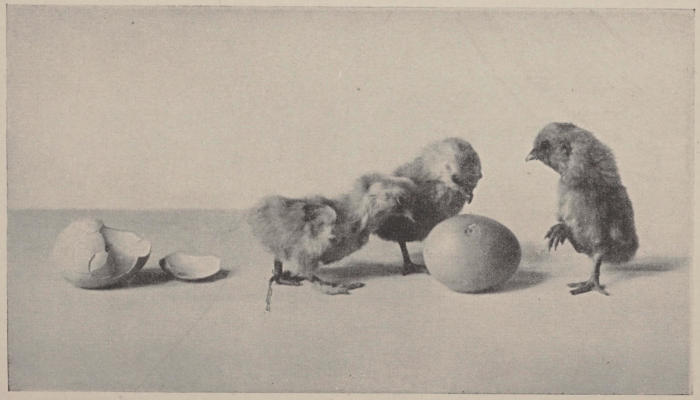
A little tapping sound.
Several of the hens were sitting on
their eggs, and Joan was told she mustn’t
go near them or disturb them at all.
While a hen is sitting she doesn’t want
to be bothered to think of anything else
except how she can best keep her eggs
warm and safe. She has to be careful
and patient till the chicks are ready to
come out. This is an exciting time, and
Joan used often to think about it. She
did wish so she might see a chicken burst
through its shell. She imagined there
would be a little tapping sound, and that
the other chickens would be very interested
and listen, and then the shell would
suddenly open and out would spring a
fluffy yellow chicken. She had been to a
pantomime once called “Aladdin,” and
there had been a huge egg, supposed to be
a Roc’s egg. In the last scene this egg
was in the middle of the stage. A dancer
struck it with a wand, when it opened,
and out sprang a full grown fairy, dressed
in orange and gold, with a skirt of fluffy
yellow feathers. Somehow Joan had always
imagined a chicken would begin its
life in this dramatic way.
As yet only one small family of chickens
had come out of their eggs but
they were quite enough for Joan to play
with. She soon made friends with them
and gave them all names. There were:
Honeypot, Darkie, Piggy, Fluffy, Cheeky,
Dolly and Long-legs. Darkie was rather
different from the others; he was a lively
little chick with a dark coat and white
shirt front. Cheeky was the boldest and
most impudent. He would cock his little
head on one side and stare at Joan, and
he was always the last to run to Mother
Hen if anything was the matter.
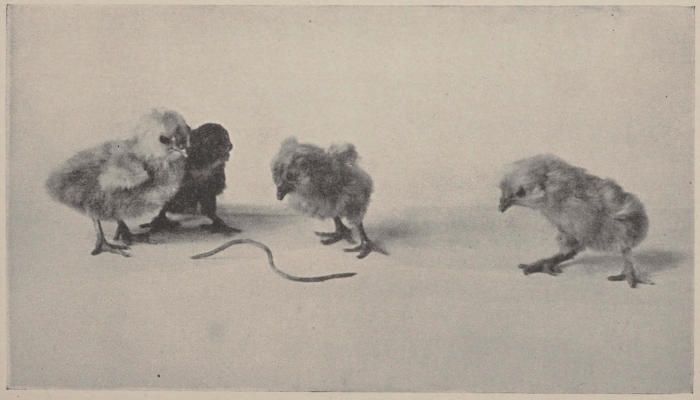
Dolly found a worm.
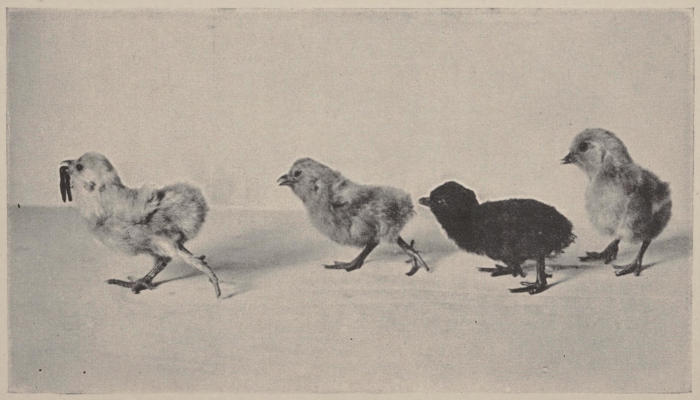
Cheeky dashing off with the prize.
Joan never forgot the morning Dolly
found a worm. Instead of keeping quiet,
the silly chick made such a fuss over it
that the others soon found it out. Cheeky
was on the spot at once, and before slow
Dolly could say a “peep” he had snatched
the worm out of her beak and was off. I
wonder if you have ever seen a chicken
running with a worm; it really is great
fun. Joan shouted with delight to see
that rascal of a Cheeky dashing off with
the prize while poor foolish Dolly only
looked on. However, one chick is never
allowed to have a worm to himself for
long, and soon Fluffy and Darkie were
after Cheeky trying hard to get the worm
for themselves. Round and round they
ran, into the long grass round the food
pails, into the corners of the yard and out
again, till at last poor Cheeky despaired
of ever being able to eat the worm, there
never was a second’s time. At last, he
tried to take a bite, and at once it was
snatched away from him by Darkie, and
then the race began again and they all
rushed about after each other till Fluffy
got it. He was just going off with it
when Mr. Cock came along, a very proud
and dignified gentleman. “Ah, Ha!” he
cried, “What have we here?”
“Please, it’s mine,” said Cheeky, “he
snatched it away from me.”
The cock looked very surprised, for I
don’t think any other chick would have
been bold enough to speak to him at all.
Every one was rather afraid of him, for
he had a very sharp beak and would take
no back answers.
“It isn’t yours at all!” cried Darkie and
Fluffy. “You stole it, you didn’t even find
it yourself.”
“Please, don’t make such a noise,” said
the cock, “I never knew such rowdy, ill-behaved
chickens, you have no dignity at
all. Now, so that there shall be no quarrel,
I am going to remove the cause,” and
he stooped down and gobbled up the
worm.
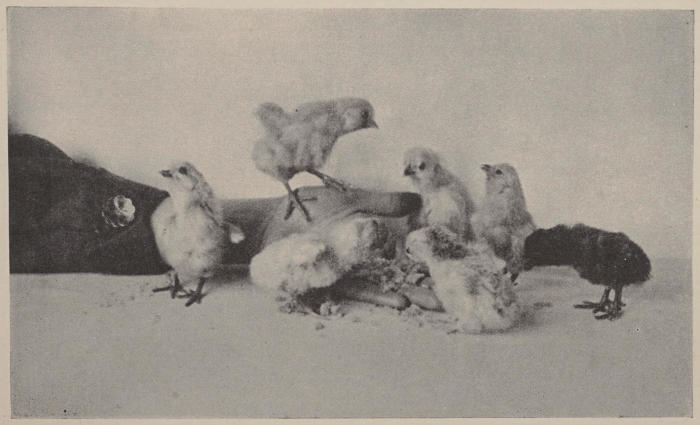
Made them take some grain out of her hand.
This is really what happened; it is quite
true for Joan saw it all. I am not quite
so sure that the cock actually used these
words because, you see, Joan couldn’t understand
his language, but she thought he
said something very like it.
I wonder if you have ever seen a
hen feed her chickens. It is a pretty
sight. She scratches on the ground, and
when she finds something to eat, she calls
her children. “Tuk, tuk, tuk,” she cries,
and all the little chicks come scurrying
up, for they understand quite well what
she means, and are always ready for
something more to eat. They peep out
all sorts of pleased things in chicken language,
and each tries to push the others
away to get most for himself.
Joan loved to see them, and she used
to imitate the old hen and call the chickens
and give them some chopped egg. They
liked this and got so tame that they would
eat out of her hand. Joan’s aunt was
quite surprised, and one day she made
them take some grain out of her hand.
Cheeky jumped on to her thumb, and
Piggy and Fluffy lost no time in getting
to their dinner. The other three were not
quite so trustful. Honeypot looked up in
her face as much as to say, “I know Joan,
she’s a friend, but I’m not quite so sure
about you.” The others, too, were a little
undecided and hesitated for a time, so
Joan felt the chickens were really sensible
enough to know her, after all.
The chickens were so pretty and attractive
that Joan wanted them to be like
real people, and she thought of all sorts
of ideas which she pretended they were
thinking. But even she had to own they
were not very original. If one did a
thing, they would all do it. Their favorite
game was certainly “Follow-my-leader.”
One would run into a corner and
scratch, and at once the others would run
and scratch, too. Then they would all run
to the gate, and if anything came along
there would be a quick scamper back to
mother and not one would be left behind.
Joan watched them once playing “Follow-my-leader”
round a barn door. It
was standing wide open and Fluffy ran
behind it and poked his head through the
crack, just below the hinge. It was not a
big space, but Fluffy could just squeeze
his neck through. Of course, the others
must follow his lead and try and do the
same; and all would have been well if only
Piggy’s head had been the same size as
the others. I expect it was because he
had eaten rather more than the rest that
his head was just a tiny bit bigger. When
it came to his turn, he pushed hard to get
his head through, as all the others had
done, but when he tried to pull it back,
it stuck. It was terrible; there he was
held as if he were in a trap. Oh, what a
noise he made! Joan heard his shrill
frightened peeping and thought at least
he must be nearly killed. She came running
up and was very alarmed when she
saw what was the matter. But she was a
sensible child, and instead of running
away to call some one, she squeezed in
behind the door, being very careful not to
push it to, as that would have choked the
poor little chick. Then she firmly took
hold of Piggy, and putting two fingers
through the crack she gently pushed the
fluffy little head back through it and
pulled the chicken out of danger. Just as
she had put him on the ground and he
had given another loud peep to show there
was no harm done, the old hen came running
up clucking in such an excited manner
as much as to say, “it doesn’t do to
leave these babies one minute, they are
bound to get into mischief.” She had
heard her chick crying and had hurried
up to see what she could do. I wonder
what she would have done to help. Something
I feel sure, for it is wonderful how
clever mother animals and birds can be
when it is a case of taking care of their
young.
Joan told her she had better lead her
little family further away from such a
danger trap, and to help her Joan called
the chickens to the other end of the yard,
and when they came running up, there on
the ground lay a nice long worm she had
found for them, and she took care that
each had a bit.
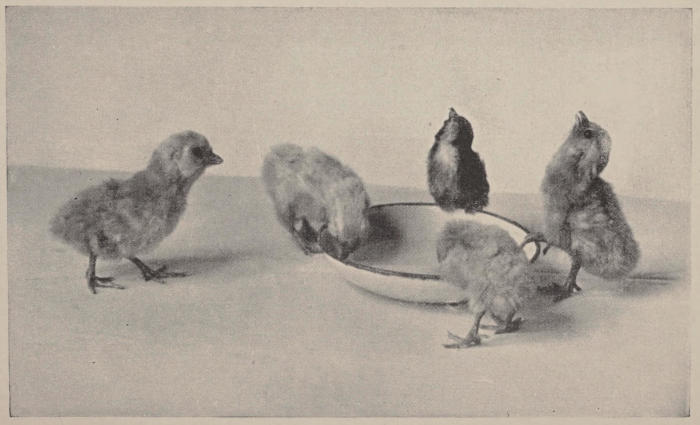
It is very funny to see chickens drink.
It is very funny to see chickens drink.
If you have ever watched them you
must have noticed how they dive their
beaks into the water and then quickly
hold up their heads. They do this to let
the water run down their throats for,
you see, their mouths cannot shut up
tightly and keep the water in like yours.
One morning all the chicks felt very
thirsty. I expect eating worms makes
you thirsty, and I am sure running about
with a worm and never getting the chance
to eat it must make you thirstier still.
So first one and then all the rest ran to
their saucer of water. Honeypot ran her
beak along the water before holding up
her head to swallow it. Of course, the
others must imitate her and do the same.
When Cheeky came up, of course, he tried
to do it too, but there was very little room,
the other chicks had got the best places
and they crowded him. Honeypot pushed
hard against him on one side and Fluffy
bumped into him on the other, so that he
kept losing the water he had collected in
his beak to drink.
“This is a silly game,” he said. “Can’t
you let me get a drink?”
The others pretended they hadn’t
heard, and kept on bobbing their little
heads up and down and took no notice
at all. Dolly, whose worm he had taken,
was rather pleased to annoy him and gave
Fluffy a sly push so that he bumped into
Cheeky and nearly upset him.
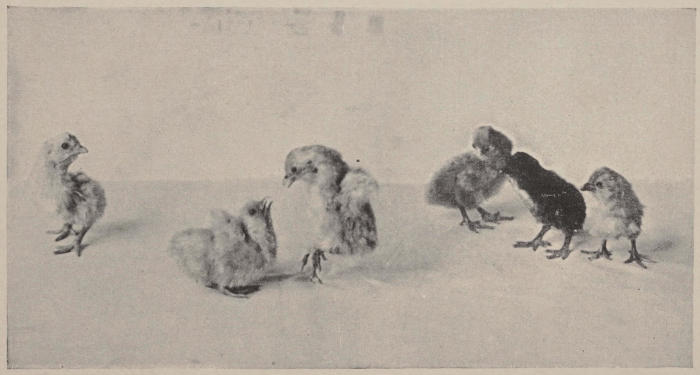
“Well, you are rude!” cried Cheeky. “I
never saw such ill-mannered chicks.”
“Who are you to talk about manners?”
said Fluffy, while the others stopped
drinking to listen. “Who took Dolly’s
worm?”
“And what business is that of yours?”
cried Cheeky, getting in a temper and
flapping his stumpy little wings.
“Take care or you’ll get a peck!” Fluffy
shouted with a threatening poke of his
head. It was quite a desperate quarrel,
but if you had been listening all you would
have heard was “Peep, peep, peep,” a
great many times over.
You know, I expect, that cocks are
given to fighting; that is why you
seldom see two cocks in the same run.
The hens are different and live together
very happily; they are too busy with their
eggs and looking after their baby chickens
to be quarrelsome. But Fluffy and
Cheeky were going to grow up cocks
which probably made them more inclined
to quarrel. Joan thought, perhaps, they
still bore each other a grudge over the
worm which neither of them had been able
to enjoy. So what began as a quarrel
ended in a regular fight. Weren’t they
naughty chickens? Cheeky and Fluffy
grew so fierce and angry with each other
that they began to fight like grown-up
cocks. They tried to fly up and pounce
down on each other, but their little wings
were too short and weak and they could
only give little hops. They pecked and
jumped and peeped loudly while the other
chickens stood round looking on, for they
had never seen such a fight before.
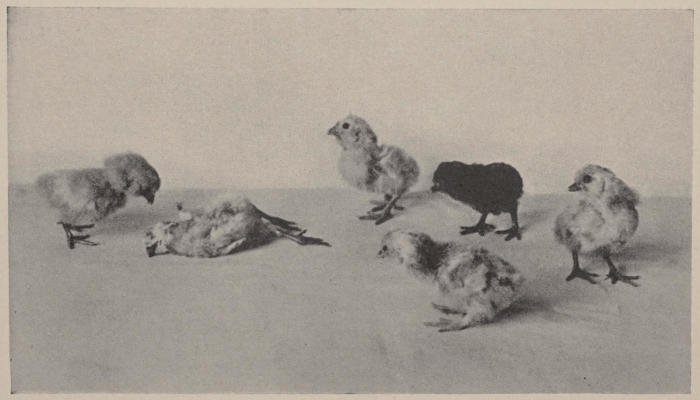
Cheeky gave one fly up and came down on
Fluffy, giving him a really hard peck full
on his little breast, when he fell over and
lay quite still just as if he were dead.
They began to fight.
I should like to be able to tell you that,
when Cheeky saw what he had done he
was desperately sorry because he had not
meant to hurt Fluffy like that. If he had
been a child he would have been terribly
sad and ashamed of himself, I am sure,
but chickens are different. In spite of
Joan’s ideas of them they haven’t really
much feeling and very little intelligence,
and so Cheeky just strutted off and didn’t
seem to care a bit. He even began scratching
the ground as if the fight had given
him an appetite and he was looking for
another worm. The others, too, were
quite happy and busy, and took no more
notice of poor Fluffy lying in a little heap
on the ground.
He fell over and lay quite still as if he were dead.
I don’t think this fight would have
happened if the mother hen had been
about, but through some mistake she had
been shut up for an hour with some other
hens who were not mothers. It was Joan
again who came to see what was the matter.
She was just too late to save poor
Fluffy, and was heart-broken when she
saw him lying on the ground so limp and
still just as if he were dead. “Oh, you
wicked chickens!” she cried, “what have
you done to poor Fluffy?” Cheeky cocked
his little head on one side as if he knew
nothing at all about it, and the other
chickens wandered off as if their brother
who had got the worst of the fight was no
business of theirs.
“What horrid, cold-blooded little
things,” thought Joan, “how could they be
so unkind?” But it is no good giving
chickens credit for tender hearts and
clever brains, for if you do you will be
disappointed. And it will not be the
chickens’ fault, for they can’t help it.
Joan found this out after a time and she
loved them for what they were and didn’t
expect too much.
Very gently Joan picked Fluffy up and
was glad to feel he was still warm. She
carried him carefully to the kitchen where
cook gave her a cosy little basket with a
piece of flannel. She laid him on this and
put him near the kitchen fire. Her aunt
looked grave when she saw his limp little
body, for she thought he was dead, but
she let Joan do as she liked.
Poor Fluffy lay still so long that Joan
grew tired of watching him and went off
to see the cows milked. When she came
in to tea she rushed first of all into the
kitchen to see if he had moved. He certainly
looked better, less limp and even a
little fatter, and actually his eyes were
open. Joan was delighted, and while she
was looking at him he opened his beak
and gave a kind of gape. “Oh, auntie!”
Joan called out, “Fluffy’s alive, and I believe
he wants something to eat.” Wasn’t
it splendid? The warmth of the kitchen
fire had revived him. After Joan had fed
him with a little warm food he was able
to get up and walk about. She liked having
him to herself like that, but when bedtime
came and the other chicks went
under their mother’s wing she took him
back and he ran in and settled down. I
expect he made up his mind it would be a
long time before he would have another
fight.
Hatching out is an exciting time.
The hen has to sit on the eggs and
keep them warm and quiet for three
whole weeks. It needs a lot of patience,
doesn’t it? Joan knew there were some
eggs due to hatch out very soon and she
did wish she might see them. She knew
it was really impossible though because
the hen must be left alone then and not
disturbed at all.
Joan was very fond of animals and always
wanted to do the kindest thing for
them; she was a nice child altogether, and
tried to help her aunt with the farm. She
was having such a good time and thoroughly
enjoying her holidays. Her cousin
Lulu had spent her holidays there too and
been rather naughty, so Joan’s aunt told
her. It seems Lulu had been asked not
to go near, or in any way disturb, the hens
that were sitting on their eggs, and had
promised faithfully not to do so. You
may guess the kind of child Lulu was
when I tell you she broke her promise.
There was a speckled hen who was a
very good mother and had brought up
ever so many families, and when Lulu
was there her eggs were due to hatch
out very soon. They were not the eggs
she had laid herself but some very special
ones. When they were hatching out
that naughty Lulu went to look. She simply
didn’t bother about her promise and
even pulled one of the eggs out from
under the hen to see if it was already
broken. The speckled hen was furious
and terribly flurried; she had never been
interfered with before and took it very
much amiss. She didn’t mean to hurt her
babies, of course, but she got so worried
and nervous that she was not careful
enough where she put her feet down and
killed five of them. In her excitement
she had trampled on them and the poor
little things had scarcely lived at all. Of
course, Lulu was very sorry, but that
didn’t mend her promise nor bring the
chickens back to life.
Joan was delighted when her aunt told
her she might have a chance of seeing
some hatching out. There were some
eggs in the incubator which were due out
very soon. An incubator is a sort of comfortable
box which keeps the eggs as safe
and warm as a mother hen, so that they
come out in three weeks just as if a hen
were looking after them. Only an incubator,
not being alive, wouldn’t get flurried
or excited at any one looking on.
Joan was told there were eggs in it which
were due to turn into chickens on Thursday
or Friday.
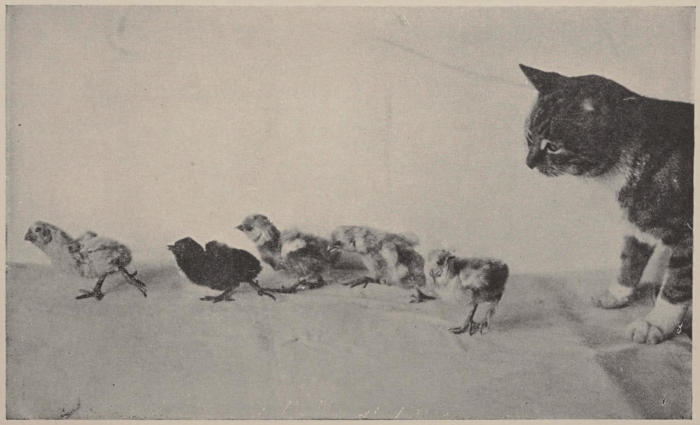
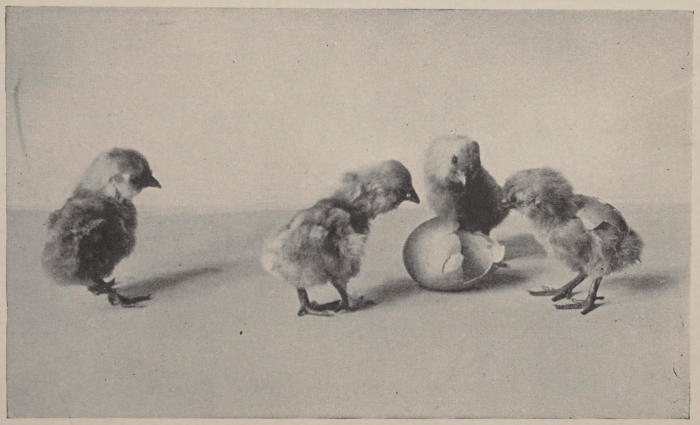
One had still a bit of shell sticking to his back.
On Wednesday Joan kept running to
look, on Thursday she still haunted the
place, but on Friday she began to get a
little tired of nothing happening. In the
afternoon she was having a game with
Cheeky, Fluffy and Co. when she was
called in to see a pretty sight. Some
chickens had just come out, and one had
still a bit of shell sticking to his back.
He was looking at the rest of it in such
a comical way as if he were asking how
he had ever been cramped up in such a
little space. They were darling little
chicks, and Joan was soon busy giving
them names. She always loved them and
often played with them, but somehow they
never seemed quite as clever nor as human
as her first friends.
Salome.
THE PERSIAN KITTENS AND THEIR FRIENDS — CHAPTER I TOMPKINS AND MINETTE — CHAPTER II TWO THIEVES — CHAPTER III MINETTE FINDS THE KITCHEN — CHAPTER IV THE KITCHEN KITTENS — CHAPTER V A SURPRISING CONVERSATION — CHAPTER VI THE RETURN VISIT — CHAPTER VII THE VISITORS’ TEA — CHAPTER VIII SALOME TO THE RESCUE — CHAPTER IX MISJUDGED KITTENS — CHAPTER X SALOME GIVES A LECTURE
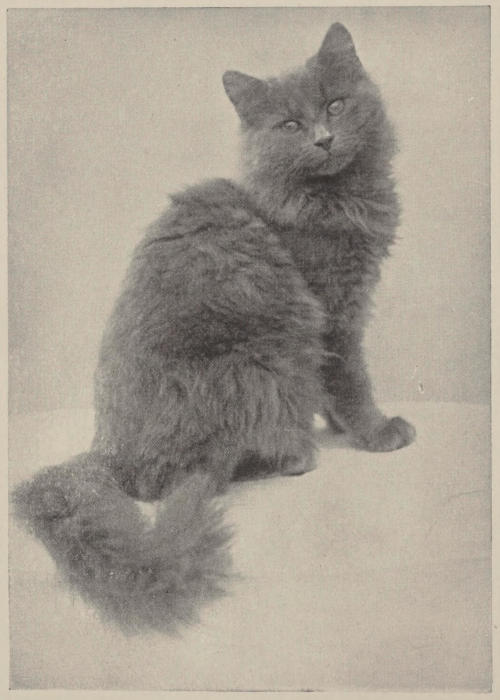
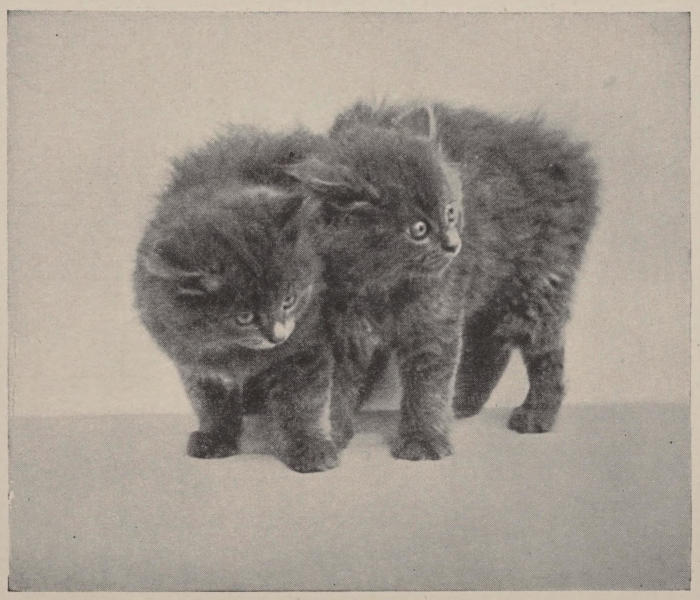
I want to tell you about two little
Persian kittens called Tompkins and
Minette. They were the prettiest you
have ever seen with their long fluffy fur,
their small ears and little impudent
stumpy noses. They looked such innocent
darlings, you felt you must kiss
them, but like most kittens, they dearly
loved a little fun, and as for mischief—well,
you shall hear all about them.
Their mother was a very handsome
Persian cat Salome, with a proud walk
and very dignified ways. She had four
kittens, but two had been given away and,
to tell the truth, Tompkins and Minette
were not altogether sorry. Four kittens
and a big fluffy mother take up a lot of
room in a basket, and theirs seemed getting
to be a tighter fit every day.
“We shan’t be quite so crowded now,”
remarked Minette with a yawn after the
others had gone away.
“And we shall have all the more to
eat,” said Tompkins.
“Our mother will love us more, too,”
purred Minette.
“The only bother is: she’ll have more
time to wash our faces,” said Tompkins.
So when Mary, their tender-hearted little
mistress pitied them saying, “Poor
darlings! how they will miss the others!”
Tompkins and Minette were saying in cat
language, “Not a bit of it.”
Besides, two kittens are quite enough
for a game, especially such rascals as
Tompkins and Minette.
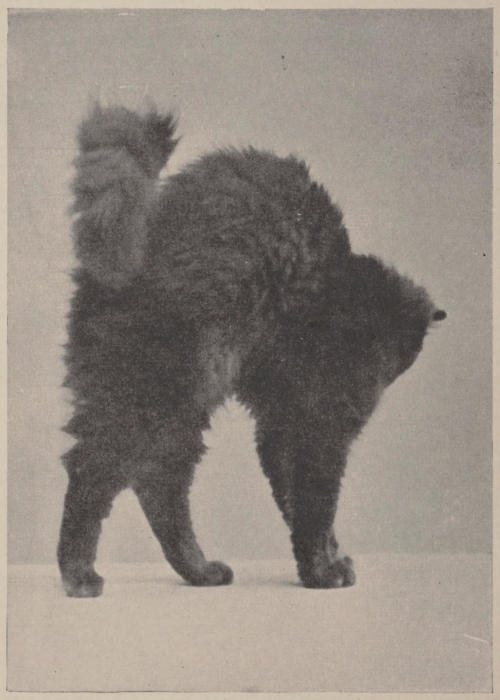
The two kittens arched their backs.
Tompkins loved anything in the shape
of a ball, and as there was a good deal of
knitting going on in the house there were
several balls in sight. The grown-ups,
however, were careful with theirs; they
knew kittens, but Mary, who was only
eight and had just begun to knit, seemed
the most hopeful, and it was her ball the
kittens watched. Her wool was thick, and
the scarf she was making never seemed to
get beyond the third row, so there was always
a nice fat ball of it.
“It does look nice and soft,” said Minette
looking at it.
“And wouldn’t it roll finely,” said
Tompkins.
One day Mary tried to knit, but her
hands got so sticky that the stitches kept
dropping off the needles. She got very
hot and cross. “Bother, bother, bother!”
she cried at last and flung the knitting
down and rushed off into the garden.
The ball of wool was still on the table,
but as the knitting was on the floor you
may guess it didn’t take those kittens long
to pull it down. It bounced off the table
and came rolling towards them. It really
looked almost like some live animal coming
at them, and the two kittens arched
their backs and looked quite fierce. When
it stopped Tompkins said to Minette,
“What a silly to be frightened of a ball
of wool,” and Minette answered, “You
were frightened, I was only pretending.”
But this argument didn’t last long for
there was the lovely fluffy ball on the
ground waiting to be played with. Tompkins
snatched it first and patted it round
a chair. Then Minette tried to bite it, and
when it rolled away they were like boys
after a football, and it was sent all over
the room and twisted round each leg of
the table.
You see, all cats love pretending even
when they are quite babies, so Tompkins
and Minette pretended to be grown-up
cats chasing a mouse until that bold
Tompkins suggested, “It’s really too big
for a mouse, let’s call it a rat.” And they
grew quite fierce as they hunted it, giving
savage miaous and growls just like big cats.
But after a little the rat seemed to shrink
into a mouse and the mouse into nothing
at all for the wool had all come unwound.
It never does to give way to temper,
does it? and when Mary returned she was
to find it out. She came back and brought
her mother to help her with the knitting,
and pick up all her stitches for her. They
found two tired little kittens with sweet
faces and big innocent eyes, and the wool
in a perfectly hopeless tangle all over the
room.
“What did Mary’s mother say?” you
ask. I am afraid she laughed. I know
she didn’t blame the kittens, and Mary
had to get her wool out of a tangle and
wind it up herself. Not for very long
though, because when her mother thought
she had suffered enough for her temper
and carelessness she helped her and they
soon got it finished. Mary gave the kittens
a good scolding, calling them “nasty,
mean mischievous little things.”
I am afraid Tompkins was rather inclined
to be greedy. He used to
watch his mother Salome having her afternoon
saucer of milk and he just longed
to have some too. It looked so nice and
creamy and he was so tired of his own
food. He used to watch her lapping it
and wish somehow he could get it instead.
Two little heads very busy with the saucer.
One day the milk was put down as
usual, but Salome didn’t hurry to go to
it. The fact was she had come in from
the garden, and as she sat on the window-seat,
she discovered her paws were rather
damp and dirty. She was a fussy and
particular cat who thought a great deal
of appearance, and she was very busy
licking her paws soft and velvety again
before having her tea. Now was Tompkins’
chance. He watched his mother
very carefully and then stole quietly up
to the saucer. But Minette had seen him
and she didn’t mean to be left behind, so
soon there were two little heads very busy
with the saucer. They lapped so quietly
that no one noticed them, and it was not
till their mother had finished her wash
and jumped down to have her milk that
she saw what had happened. And by then
the milk was nearly all gone.
What did their mother do?
I know what she ought to have done.
Scolded them well and given them a little
scratch, but cats are very funny and
not a bit like people or dogs. Salome just
pretended she didn’t care a bit. She made
out she wasn’t thirsty and never mewed
for any more milk. She jumped on to the
window seat again and stared out of the
window, and the naughty little kittens
thought themselves very clever indeed.
One day Minette smelt a nice fishy
smell. It tempted her out of the
room, down a passage and round a corner
till she arrived at the kitchen. Here
she came face to face with a strange cat.
The cook was just making fish cakes, and
Tibby the kitchen cat was asking for
some with loud miaous. Minette was
very alarmed at first, she thought this
strange cat might scratch her, but Tibby
was much too busy to take any notice of
a little kitten and kept miaouing and staring
up at the fish. Minette thought she
would rather like to try a little, it certainly
smelt very tempting. At last a
scrap fell on the floor. Of course Minette
rushed at it. But, oh, dear! how she
wished she hadn’t! There was such a
noise; Tibby flew at her with a nasty
spiteful swear, growled at her, snatched
the fish away and ate it up herself. Poor
Minette felt so hurt and surprised, it
wasn’t a bit how her dignified mother
would have behaved.
Tibby was much too busy to take any notice of a little kitten.
The cook was not at all nice either, for
instead of pitying Minette and giving
her a tit-bit of fish as Mary would have
done, she said, “Get out of my way,” and
shooed her out of the kitchen.
It was a very subdued and sad little
kitten that trotted back round the corner
and along the passage, and to tell the
truth, Minette was not at all sorry to get
back to her own cosy little basket and
home where no one was unkind to her.
Still though not very successful, this
had been an adventure and Minette pretended
to Tompkins she had had a perfectly
lovely time.
“This is a dull old room,” she told him,
“the kitchen is much finer. It is beautifully
warm for there is a great big fire,
and there are heaps of saucers and plates,
and such delicious smells.”
“Did you get anything to eat?” asked
Tompkins.
“Well, just a taste of fish,” Minette replied,
enjoying the envious look on Tompkins’
face.
“Did you see any one there?” he asked
next.
“Yes, a very grand cat, so beautiful and
sleek, she was very kind to me and asked
me to come again.” (Oh, Minette! what
terrible stories!)
Poor Tompkins was so jealous he could
have cried, and when Minette sat purring
in the basket with such a superior look on
her face, he felt he could have scratched
her.
“Never mind,” he told himself, “it will
be my turn next.”
His chance came that same afternoon.
Minette, tired out with her
exciting adventure and with all the stories
she had told about it, was having a sound
sleep, no one was about and the door was
open. Tompkins crept through it and
down the passage. He was making for
the kitchen but on the way he heard a
strange noise. It came from a little room
next to the kitchen and it made his little
heart beat and his tail swell out to twice
its size. This curious sound was just the
kind of noise that kittens make when they
are in the middle of a furious game.
Tompkins listened outside the door. “Oh,”
he thought, “if I could only get in and join
them! what fun it would be, and what an
adventure to tell Minette!” and he gave
a little plaintive miaou just near the crack
of the door. There was a silence for a
second, then he heard scratchings inside
and a voice called out in cat language,
“You push hard and we’ll pull, the door
isn’t fastened.” So Tompkins squeezed
hard against the door, and at last there
was a crack just big enough for him to
creep through.
Inside Tompkins saw, to his delight,
three small kittens. They were about his
own age too, and had got hold of the
waste-paper basket with which they were
having a splendid game. Next to a ball,
I believe, kittens love nice rustling paper,
and they were tearing and rumpling these
to their hearts’ content.
They had got hold of the waste-paper basket.
Tompkins was a little shy at first, but
he soon felt at home with the strange kittens
and tore the paper as fiercely as the
others. The basket, too, seemed made to
be played with. They pretended it was a
cage, and one of the kittens got inside and
growled so fiercely like a wild beast that
Tompkins was almost afraid. At last,
when it was upside down and the papers
scattered all over the room the kittens
began to think they would like a little rest.
They all stared at each other for a bit
till Tompkins thought it was time some
one made a little conversation.
“What are your names?” he asked.
The kittens looked rather confused and
didn’t know what to answer, for somehow
no one had thought of christening them.
However, they were not going to let a
stranger know this, so the prettiest said,
“I am generally called ‘Pussy,’ and this”—here
she pointed to the kitten next to
her—“is ‘Pet.’ Her real name is Perfect-Pet,
but we call her Pet for short.”
“And what is your name?” Tompkins
asked the third kitten. He, however, pretended
not to hear and busied himself
running after his own tail, which he
caught so unexpectedly that it made him
sit down with a bump.
“I can tell you his name,” cried Pussy;
“he has been called ‘Ugly,’ and I think it
rather suits him, don’t you?”
Tompkins was too polite to say how
heartily he agreed for it would have been
hard to find a plainer kitten.
“It was cook who called me that,” said
Ugly quite cheerfully; “she said I looked
scraggy as if I wanted feeding up, so I
hope she’ll see it’s done.”
“Who’s your mother?” Pet asked
Tompkins.
“She is Salome, a beautiful gray Persian,”
and as Tompkins answered he noticed
the three kittens looked rather
merry.
“Do you mean that stuck-up silly old
fluff-pot?” said Ugly. “We often watch
her stalking about the garden, giving herself
airs.”
“And looking just as if she wore petticoats,”
Pussy joined in.
“What a dull mother to have!” remarked
Pet. “Not much fun to be got out of
her, I should think.”
Tompkins was thunderstruck. He had
never been used to hearing his dignified
mother spoken of like this, and thought
the kittens were very rude. “My mother
is very beautiful and very valuable,” he
said indignantly; “besides, she is a nice
warm fluffy mother to go to sleep with.”
“Maybe,” said Ugly, “but we shouldn’t
care to change with you. Our mother
Tibby is the right sort. She never forgets
us and isn’t above stealing a little
now and then, and if it’s too big for her
she lets us help eat it.”
“And look what a sportsman she is!”
said Pussy. “You should see her after a
mouse. And once, she told us she almost
caught a rat.”
“I should like to see your old fluff-pot
of a mother running after a mouse,”
laughed Ugly. “I am sure she would be
much too ladylike to catch it.”
“Why, she would have to pick up her
petticoats,” said Pet, and then they all
three roared with laughter.
What bad manners they had, thought
Tompkins and he felt furious with them.
He wouldn’t play with them any more,
and with his head up and his tail fluffed
out he walked away, looking very like his
mother when she was offended.
But Pussy, who was a kind hearted kitten
and didn’t like to see him hurt, ran
after him and said, “Please, don’t go, we
were only in fun. Come back and tell us
more about your mother, I’m sure she
has her points, and anyhow I don’t expect
she boxes your ears like Jane does ours.”
Tompkins was surprised. “Does she
really?” he asked, for he had never heard
of such a thing.
“Indeed, she does, with her claws out,
too, sometimes,” said Pet.
“Yes, she nearly spoilt my beauty,” said
Ugly with a grin; “she gave me a horrid
scratch over the eye.”
As the kittens had given up teasing and
seemed rather nice again, Tompkins settled
down and told them how nice and
sweet-tempered his mother was and that
she was so admired that people always
wanted to photograph her. “In fact,” he
said, being just a little inclined to show
off, “she got so used to the camera that
she once tried to take a photograph herself
and got my sister Minette to sit for
her.”
“Whatever is a camera?” the kittens
asked astounded.
“I am afraid I can’t very well explain
just now,” replied Tompkins who didn’t
know himself, “as it’s time I said ‘Good-by,’”
and he trotted off home.
Tried to take a photograph.
A perfect bunch of bad temper.
When Tompkins got back, however,
Salome was looking anything
but beautiful. In fact she was looking
as ugly and disagreeable a cat as you
can imagine. You see, she wanted brushing
very badly and she simply hated it.
As soon as she saw her own special brush
and comb being brought out, she would
hump herself up with her ears back, and
look a perfect bunch of bad temper. This
time she was worse than usual, for her
long fur had got tangled, and as the comb
pulled, she turned round and spat at it.
Tompkins and Minette looked on tremblingly;
they had never seen their mother
in such a rage. Tompkins was glad the
kitchen kittens couldn’t see the mother he
had boasted about; how they would have
jeered.
When all was over, Salome flounced
back into the basket and curled herself
up to forget her annoyances in sleep, and
her children took care not to disturb her.
They whispered together and Tompkins
told Minette all about the kitchen kittens.
Minette was so excited she forgot to be
jealous and kept interrupting with: “Oh,
can’t I see them too?” and “What fun we
might all have together! Couldn’t we ask
them to come here?”
“Wait till we are quite alone,” whispered
Tompkins, “and then we will invite
them properly to tea.”
“How lovely!” said Minette, but she
couldn’t help wondering where the tea
was to come from.
The very next day the chance came,
for the door was left open, no one was
about, and actually there was a tea tray
on the table.
“Hunt the Thimble.”
Tompkins went to the door and mewed;
at least you would have thought he was
only mewing but really he was calling,
“Come, come, come,” and the little
kitchen kittens, right the other end of the
passage, heard him. They mewed back,
telling him they wanted to come badly
but their door was shut and they couldn’t
get out. “Well, come as soon as you can,”
he called back.
They didn’t have to wait long, for very
soon the cook came in and out again in
such a hurry that she forgot to shut the
door. You may guess the kittens didn’t
wait long, and they were out like lightning
and racing down the passage. You would
have laughed to see them come tumbling
into the room where the Persians lived, a
perfect bundle of mischief.
They weren’t a bit shy and Minette
loved them; she thought they were such
fun and so clever and bright. Ugly and
Pussy soon started a game of “Hunt the
Thimble,” and Minette thoroughly enjoyed
it. First of all they found a work-basket,
then they knocked it on the floor
and made hay of its contents till they
found that little shiny silver thing that is
so good at rolling. They chased the thimble
all over the room till it disappeared behind
a solid bookcase, and I shouldn’t be
surprised if it isn’t there still.
Minette had never had quite such an
exciting time, and she wondered why
Tompkins wasn’t enjoying it too. She
looked round for him, but he seemed to
have disappeared. At last she heard a
little “miaou,” and there he was right up
one of the curtains. Pet was up the other
curtain and they kept calling to each
other, “Look at me! I’m highest!” There
was no doubt that Pet was beating him,
for she was near the ceiling, but they were
both digging in their little claws and pulling
themselves up. After watching such
daring sport as this, “Hunt the Thimble”
seemed very tame, so the other three
joined the mountaineers, and soon there
were five kittens tearing and scratching at
the curtains trying to climb.
When Ugly had got a good way up,
he looked down and saw the tea
tray. “I know a better game than this!”
he cried and got down as quickly as he
could. “All this exercise makes me
thirsty, and I spy some milk.”
“Hurrah, for a feed!” cried Pussy and
Pet, and they too struggled down. Pussy
fell the last bit of the way, but it didn’t
seem to hurt her and she was soon on the
table with the others.
They were all a little disappointed, however,
for the tray was not as good as it
promised. All they could get at was the
sugar, and kittens don’t care a bit for
that. The milk seemed out of their reach
for the jug it was in was so small that
not even Ugly could get his lean head into
it. Pet was feeling very sad, for she did
so love milk, and there seemed no way of
getting any. However, Pussy had a splendid
idea: she pushed the jug over with
her paw and out ran the milk on the tray
and all the kittens had to do was to lap
it up.
“And why didn’t Tompkins and Minette
come and have some milk, too?” you
ask, and I should like to be able to tell
you it was because they were such superior,
well-brought-up and honest little
kittens that they scorned the idea of stealing,
but I am afraid this wouldn’t be true.
No, the reason the two little Persians
didn’t come to share the milk with the
kitchen kittens was because they were still
up the curtains.
She pushed the jug over with her paw.
It was not very difficult for them to
climb up, but coming down was quite another
thing. When they looked down it
frightened them and they were so afraid
of falling that they didn’t like letting go
to dig their claws in a fresh place lower
down. So there they hung, crying pitifully,
“Help, help, help,” which sounded
like “Miaou, miaou, miaou.”
I don’t know what would have happened
if no one had heard them, for
the little kitchen kittens were very busy
with the milk, and even if they had wanted
to, they wouldn’t have known how to
help. But a mother’s ears are sharp, and
before they had mewed ten times Salome
appeared at a trot, asking anxiously,
“What have those tiresome children of
mine done now?” She soon saw the danger
they had got into. If they had been
more of babies, she would have climbed
up after them and brought them down in
her mouth, but they were too big and
heavy for that. All she could do was to
sit at the bottom of the curtain and give
them courage by mewing and telling them
what to do. It was funny how quickly
their confidence came back. Directly the
kittens knew their own mother was there
watching them and ready to help, they
forgot to be afraid and in a few seconds
they had scratched their way down the
curtain and were safely on the ground.
Salome didn’t make a fuss or punish
them for being so naughty and wild; all
she did was to give their faces a lick and
tell them not to do it again or they might
hurt their claws or have a tumble.
The little kitchen cats looked on and
they thought what a good mother Salome
was, for not even their Jane could have
been kinder. They had to own, too, that
she was rather beautiful and so quiet and
self-possessed. Besides, she behaved so
well to them and instead of chasing them
away because they were strangers, like
Jane would have done, she took no notice
of them at all. She did not even seem to
mind when Pussy pretended to be her
daughter and sat close up to her.
“We were wrong,” said Pet to Tompkins
later. “I think your mother is an
old dear.” And although Tompkins
thought it might have been expressed differently,
he was glad to hear it.
“Miaou, miaou, miaou,” was heard
in the distance.
“What an ugly, hoarse voice!” remarked
Minette.
“Just like a croak,” said Tompkins. “I
wonder who it can be.”
But the little kitchen kittens didn’t wonder,
they knew it was their old mother,
Tibby, who had missed her babies and was
calling for them. They liked her ugly
voice and they answered with little mews,
and one by one they scuttled out of the
room. Ugly was the last to go and he
just lapped up a drop of milk on his way,
for he never neglected an opportunity.
A few minutes after, the cook came in
to find Mary’s mother, and of course,
caught sight at once of the disgraceful
looking tray. She was shocked to see it
in such a state, with the sugar scattered
about and a nasty sticky mess where the
milk had been lapped up.
“Oh dear! Oh dear!” she cried, trying
to tidy up, “whoever has done this?”
“Miaou, miaou,” said Tompkins, which
meant “not us.”
Cook turned round and saw the kittens.
“Well, of all the impudent little thieves!”
she cried, “so you must go and steal the
milk, must you? You little good-for-nothings!”
“No, really it wasn’t us,” mewed Minette.
But, of course, cook couldn’t understand
cat language and she went on scolding.
“You deserve a good whipping, that
you do, and I’ve a great mind to give it
you, greedy little things, when you get
as much to eat as ever you can swallow.”
Pussy pretended to be her daughter.
“You may look like little angels, but you are
nothing but little imps of mischief.”
Both kittens looked up at her with their
sweetest expressions, trying to convince
her how innocent they were.
“Oh, I know all about that,” cook went
on, but already her scolding was getting
more into a smiling one, “you may look
little angels but you’re nothing but little
imps of mischief.”
“Miaou, miaou,” said Minette in her
sweetest voice, and Tompkins gave a
plaintive little purr, for they were getting
very sleepy after their exciting adventure.
This was too much for cook; they
both looked such darlings that before they
could drop off to sleep she was down on
her knees petting them and calling them
her “saucy little poppets.”
The kittens were the first to wake up
the next morning. They couldn’t
resist talking about the kitchen kittens,
there was so much to say. Salome went
on pretending to be asleep.
“They were such jolly playfellows,”
Tompkins remarked.
“I wish we knew such exciting games,”
sighed Minette, “ours will seem so tame
now.”
“We’ll manage to see them again,
somehow,” suggested Tompkins.
“They very nearly got us into trouble
over the milk, though,” said Minette. Salome
gave a big gape. “Be quiet and go
to sleep,” she said and shut her eyes.
Sauntered grandly out of the room.
The kittens were silent for a short
time, then they began again. “I shall try
and climb the curtain again,” said Minette.
“I shan’t,” said Tompkins, “I shall
think of some quite new game.”
Salome woke up again. “What are you
two chatterboxes talking about?” she
asked.
“About the kitchen kittens, mother,”
Minette replied.
“I don’t wish to be proud,” said Salome,
“but really you mustn’t associate
with people like that.”
“But, mother,” protested Tompkins,
“the kitchen kittens are so clever.”
“In what way?” asked Salome. “I
don’t see anything clever in stealing milk;
it is just a common cat’s trick.”
Tompkins began to feel rather annoyed;
the kitchen kittens were his
friends and he admired them. He thought
them so bright and clever, and Salome
rather unfair. Then a naughty, mischievous
idea came into his head, and
looking very impudent, he asked his
mother, “Do you know what they called
you?”
“Oh, Tompkins!” begged Minette,
“please don’t be such a tell-tale.”
“I shall,” said that naughty Tompkins;
“I think mother ought to know.”
“You needn’t trouble,” remarked Salome
haughtily, “it doesn’t interest me in
the very least what those vulgar little kittens
call me.”
“Still, you had better hear,” persisted
Tompkins, and before Minette could stop
him he said, “they called you a ridiculous
old fluff-pot, there!”
Whatever did Salome say?
Nothing at all, and if you know anything
of Persian cats you will guess what
she did. She got up and had a good
stretch, then she shook out each leg and
sauntered grandly out of the room. It
was as if she meant that what the kitchen
kittens had called her was so unimportant
that it was not worth thinking or
saying anything about.
And what did the kittens do? Well,
I believe Tompkins felt rather small and
wished he hadn’t spoken. However, they
were alone in the room now, so it was a
good opportunity for planning fresh mischief,
and I only wish I had more pages
in this book that I might tell you all
about it.