Mr. Punch to Toby.
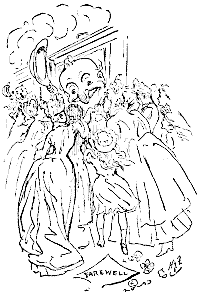
I am the only Painter without bias,
And Monster Panoramas, my Tobias,
Now being quite the order of the day,
I've limned the largest, which I here display;
And, issued in mine Almanack, 'tis clear
'Twill be the Biggest Order of the Year!
'Tis painted in the Highest Art Style—Mine!
Here you perceive the pith of 'Eighty-Nine,
A Year of Grace—and also of disgraces.
Look, Toby, on this sea of well-known faces!
Mark the familiar eyes, the salient noses!
(The sign of Gladstone or the mark of Moses.)
Kings, Lords and Ladies, Statesmen, Whigs and Tories.
No painter of great sprawling Allegories
Ever yet packed into so small a compass
So many who've won fame—or raised a rumpus.
A précis of a twelvemonth's work and babble is
This summary of the great Annus Mirabilis.
Perpend, Tobias. Hand me up the pointer.
Listen, O World! and, Time, thou great disjointer
Of hearts and epochs, stand awhile at gaze,
Whilst I explore, explain the Mighty Maze,
Which, being made by Punch, the Friend of Man,
You may depend is "not without a plan."
Now for the rostrum! Follow my pointer, Toby, with thy recording
pencil. Listen, O World, with ears attent, and eyes "sequacious
of the—Truth-teller!" I speak urbi et orbi!
First, the newly-elected County Council, Ladies and Gentlemen!
Ritchie's colossal Civic Symposium! "Ritchie's Folly," some
hasty assayers of innovations may have been tempted to term it. But
Punch is never hasty.
Macbeth at the Lyceum and Gladstone in Naples! Later on,
"Macbeth" Irving visits the Queen—an honoured guest! The
return of the dove—if the Brummagem Bruiser may be likened to
the Bird of Peace. All, at any rate, welcome his wife, a true
messenger of peace, let us hope, from across the Atlantic flood.
From West to North—the "Nitrate King." Let us trust he'll
prove a "True North" to the multitudes who trust him. Next the
Teuton Titan on the (Colonial) War-Path! Formidable competitor;
but even Titans trip at times, eh, Orion? From Bismarck asking
for Samoa to Chaplin "chucking" Protection is a transit. Big
'uns
both—of a sort? But Boulanger, the pseudo-great General Boum,
coming a cropper? Guarda, e passa!
The ingenious Japs at a new work of Art—scarcely native this
time. We'll hope their "New Constitution" may shape as well as
their cabinets, and wear better than their locks and keys. Pantomime
child-peris turned out—pro tem., thanks be—of their Stage
Paradise. "See me reverse!"
Two openings,—Parliament and the Parnell Commission. And
then—sinister sequel to the latter!—the flight of the pitiful Pigott.
A far pleasanter picture is the return of generous D'Aumale to
Chantilly. Scarcely less agreeable, to lovers of peace and of France,
is the flight of the blatant firebrand Boulanger. Welcome the
coming, speed the parting guest!
Big brave boys these American Base-Ball players. Game may be
acclimatised here, but they evidently thought our "climate" against
them, and with reason. Loss of the Sultan,—not the
Padishah himself,
worse luck! He would be no loss. Cambridge winning "the
classic race"! Bravo, Light Blue! Who mutters demur! Ah! you
are a brunette, though a "fair" one, my dear, so Punch pardons you.
The sight of your Gracious Queen enjoying her Royal self in
Portugal, will, perhaps, put you in a better temper, Miss.
Two bad endings! Abolition of the Board of Works, and abdication
of King Milan of Servia. Both can be well spared. But
Bright, brave belligerent John, true, tenacious,
trenchant,—no,
we could ill spare him. What, Punch wonders, would the fighting
Apostle of Peace have said of the "Naval Defence Bill" hard by?
Well, we know what the Country said of it. And the escape of that
Kane-Captained Rennie-engined Calliope,—England has not forgotten
that yet, if the Admiralty has.
Opening of the Great—the Colossal, the Titanic, the World-witching,
Republic-saving French Exhibition! As "Big" a thing as—as
the Tour Eiffel itself! Can even Mr. Punch say more? It must
have a paragraph all to itself. Well done, Lutetia! Well may you
pro tem. at least, kick out politics.
Sandy "takes the floor," and his "Scotch Local Government Bill!"
Hope he'll like it. He generally does like big things, be they
Bills or Cabers! Better anyhow than Paddy relishes "Balfour's
Battering-Ram," which comes next. And then, Gentlemen, the
match at Brummagem between those two political pugilists,
Churchill and Chamberlain! Fight unfinished, result as yet
uncertain. National Portrait Gallery to be fitly housed at last.
Then the picture takes us "across the herring-pond" to the great
Washington Centenary. Four Millions more money for Ships, the
opening of the Opera Season, the raising of the Rates; all matters
of interest, painful or otherwise, to most of you, Gentlemen.
Abandonment of the Sugar Bill! Not one of the much-talked-of
"sweets of office" this, eh? Ask Baron de Worms! Raid on
the Betting Clubs! But the great Demon of Gambling, like
the objects of the great Curse in Ingoldsby, "never" seems "one
penny the worse." Opening of the Spanish Exhibition. Equipment
of our Volunteers. Bravo, Lord Mayor Whitehead!
The Johnstown Floods, Gentlemen; too terrible to talk lightly of.
Here is symbolised the discreditable Parachute Mania, which was a
disagreeable feature of the dead year. May it die therewith! I hear
a stir, a silken amongst my fair auditors. Yes, Ladies, the Marriage
of the lucky Duke of Portland, lucky, as I said at the time, with
both Bridal and Bridle. Another Dropped Bill, Gentlemen; this
time the Land Transfer Bill, "knocked out" in the Lords by the
"Sluggers" of Legal Privilege. Westward Ho! goes the ubiquitous,
inexhaustible G. O. M. on party thoughts intent; whilst near him
is shadowed forth the rise of that Irreconcileable, Socialistic new
"Fourth Party," the avowed purposes of which probably sometimes
"give him pause."
Great Show of the "Humorists in Art." Hope you all went to see
it. If you didn't, 'twas your loss. Then—strange juxtaposition!—the
Great Turf Libel Case! Can one "libel" the Turf? Mr. Punch
wonders. Anyhow, "Donovan"—that Lucky Duke again!—wins the
Derby. "Donovan" was evidently "on the job," not "out for an
airing," eh? Visit of the Shah of Persia. You will not want me to
say anything more about that threshed-out subject. The Labour
Congress in Switzerland was less talked of, but probably quite as
important, whilst the appointment of Her Most Gracious Majesty as
President of the Royal Agricultural Society is of even greater home-interest.
Next comes the Great Event of the Year! Mr. Punch's Visit to the
Paris Exhibition, already celebrated by him in proper time and shape!
You all of you have its record, of course. If not—get it!!! That
Balloon bore a happy party, and needed no parachute.
The Delagoa Bay Railway business, Mr. Punch's pictorial comment
on which so infuriated mischievous Master Portugal! The Whitechapel
Woe! Not a matter for words, Gentlemen, but deeds.
Hooray! Another Royal Marriage! The Wedding March, with a
Fife accompaniment! And—quite "in a concatenation accordingly,"
though at t'other side of Panorama—the Golden Wedding of the
G. O. M. Prospect and retrospect, both pleasant. Was it the tender
association of sympathy which made the G. O. M. so eloquent in
favour of the Royal Grants? Who knows? Anyhow, his more rampant
"followers"—Labby among them—would have liked, for the
moment, to "muzzle" the "old man eloquent"—as Monro did the
London dogs. The Naval Review, and the German Emperor's brief visit,
"synchronised," as the saps say; and then, as another "Big Thing,"
they made Chaplin Minister of Agriculture! "Capping the Climax,"
that! Hard-by another Great—or Big—Man, hews away at the Tithes
Bill. Go it, Harcourt!
Following the example of another really Great Man, Mr. Gladstone
goes to Paris, sees the Exhibition, mounts the Eiffel Tower,
perorates pleasantly about the Two Republics, France and America.
Or should we say, America and France? Arcades ambo? And the
G. O. M. orating on them was very Arcadian indeed.
The miserable Maybrick Case calls for no comment here. The
Great Strike does. Memorable event, Ladies and Gentlemen, which—as
Truthful Thomas would say—"will have results." Ecclesiastical
dress for ladies may interest the more "dressy" portion of my
audience—or may not. The French Elections. Mr. Punch congratulates
Madame La République whom primarily the Exhibitors,
and secondarily the Urns, saved from chaos and General Boum-Boulanger!
Balfour's little faux pas, in connection with an Irish
University. That fish won't bite! "Outidanos" on the Triple
Alliance! Outis—the Ulysses of Liberalism—defying the huge
Polyphemus of Continental Despotism. So perhaps he, the Homer-lover,
would picture it. Polyphemus may have a different opinion,
perchance.
Railways in China! Ah! Mr. Punch thinks he has heard of
that before. He hopes it may be true this time; though, to the Mandarin,
the Locomotive is a Bogey, and the Line sacrilege. Arab
advance on Suakin! Neither is that a novel item of news! Gallantly
repelled this time, though, and partly, at least, by native valour.
A good omen!
Trials at Maryborough, consequent on the lamentable Gweedore
evictions, and yet more lamentable crime attending them. When
will this sort of thing be wiped out of the panorama of the year?
Raid of the egregious McDougall, compound, apparently, of
Bottom and Paul Pry. Well, all's well that ends well, eh, "Mister"
Rosebery? Glad, anyhow, you are to boss the London County
Council yet a little longer. You may be counted on to minimise the
McDougall element.
Greek Royal Wedding. Rare year this for what may be called
Splendid Splices! Royal Princes, Princesses, and lucky Dukes well
to the fore! As a set-off—alas!—Mr. Punch's Panorama has reluctantly,
and delicately, to record many lamented deceases of great, or
worthy, or well-beloved ones. Poor Crown Prince Rudolph, stout
and eloquent John Bright, quaint and clever Pellegrini, the
Vanity Fair Caricaturist, Lady Holland, of politico-social fame,
Wilkie Collins, the master of ingeniously Sensational Romance;
and last, but, to Mr. Punch and his young men certainly not least,
Percival Leigh, of Comic Latin Grammar, and Mr. Pips's
Diary
fame—to the world, and, to his private friends, "dear old Professor,"
of pleasant and unfading memory.
Royal Globe-trotters again? The German Emperor visits Constantinople,
and hob-nobs with the Sultan; the Prince of Wales is off to
Egypt, where, perhaps, he hob-nobs with Father Nile. Thence returning,
Punch hopes, happy, and with renewed stores of sturdy health!
Yet later in the year come two Big Shows, the Lord Mayor's to
wit, with pretty reproductions of old English dresses and disportings,
and that of the evergreen P. T. Barnum, with—well—with everything
in the marvel line, if Mr. Punch may trust Phineas's posters.
The Public, anyhow, may trust Mr. Punch's! By such a Panoramic
Poster even the Great Showman will admit himself outdone.
That is all, Ladies and Gentlemen, for the present. Mr. Punch,
in conclusion, wishes you all a Merry Christmas, and a Happy New
Year!
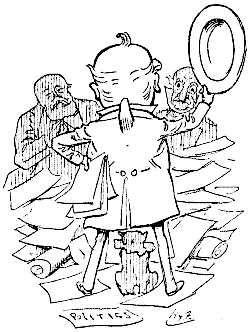
n 22nd of February
Session opened; date
unusually late, but
then remember our
Autumn Session of
previous year brought
us up to Christmas Eve.
Charles Lamb, arriving
at office late in the
morning, pleaded that
he made up for it by going
away early. House,
going away late, returns
little later. Very
modest Ministerial
Programme to commence
with. How it
has been carried out
has been told from day
to day with graphic
minuteness and uncompromising
fidelity by
Mr. Punch's humble,
but respected companion.
"The Diary
of Toby, M.P.," follows
the British flag.
It is read everywhere—by
the pathless ice-floes
of Canada, through the length of North and South America,
in the cities of Australia, by the watch-fires of the Squatters, on
Greenland's icy mountains, and eke on India's coral strand; where
Punch appears weekly on the bookstalls, price threepence. It will,
therefore, not be necessary to go much into detail, a brief summary
sufficing.
At the outset Georgie Hamilton promises Bill to strengthen
Navy; Lord Advocate mentions Scotch Universities Bill, with
Scotch Local Government Bill to follow. Parnell puts in early
appearance, challenging Balfour, amid wild cheers from Irish
Members, to explain why Carew, M.P., at present in prison, had
been deprived not only of his flannel shirt, but of his hair and
moustache?
Debate on Address turns largely on Irish affairs. Suddenly, in full
tide of attack, comes news of flight of Pigott. For awhile
Pigott's
presence fills the place; his name thrown at Balfour whenever he
rises; cries of "Pigott!" punctuate Ministerial replies. Nevertheless,
John Morley's Amendment to Address negatived by 339 votes
against 260; Address being finally carried without a division.
Georgie Hamilton got on early with his scheme for strengthening
the Navy. Twenty-one-and-a-half millions asked for, adding seventy
ships to British Navy. Not all to be built at once; whole scheme to
be accomplished by April, 1894. Bill, debated three several nights,
finally passed. In accordance with pledge given last Session, Supply
put in fore-front of business. House sat night after night, sometimes
voting money, always talking. All kinds of questions came up in
Supply; treatment of Irish prisoners; Ministers' alleged connivance
with Times; above all, Pigott, by this time, huddled up in
suicide's
grave at Madrid. Special attack made on Attorney-General for
his professional connection with the Times case. Harcourt led
attack, Charles Russell taking notable part in it. But his friends
stuck to him through thick and thin, and Vote of Censure defeated
by large majority.
On 28th of March, came news of death of John Bright; fell like
oil on troubled waters. Old Morality bore testimony to his worth.
Gladstone pronounced a splendid eulogy; Hartington added a
postscript; Justin M'Carthy spoke for Ireland; and
Chamberlain,
rising to height of occasion, informed the House, that Birmingham
had never allowed the Statesman they mourned to pay any of the
subscriptions ordinarily exacted from a Borough Member. Thereafter
the House went on with its ordinary business.
On 16th of April, Goschen introduced Budget in smallest House
gathered in similar circumstances for many years. Both ends made
to meet by increase of Death Duties, and a little tinkering of the
Malt Duty. About this time, the "Noble Baron," began to loom
on horizon with his Sugar Bounties Convention. Much time wasted
through remainder of Session over this matter. Government stood
gallantly by "Noble Baron;" in the end, amid the jeers of
Opposition, Sugar Bounties Bill withdrawn to avoid Ministerial
defeat.
On 14th of May, Old Morality brought in Bill to establish Board
of Agriculture for Great Britain, a measure which, happily passing,
has dowered the country with Chaplin as Minister of Agriculture.
Early in July, came on proposal to make provision for eldest
Son of Prince of Wales. Manifestations of opposition induced
Government to present the matter in modified form of Motion for
appointment of Select Committee to consider the whole question of
provision for Members of Royal Family. This agreed to, after debate,
in which Sage of Queen Anne's Gate came to the front, keeping
his place throughout subsequent proceedings. Great efforts made
to buy off opposition of this incorruptible person; hesitated for brief
moment, when position of Treasurer of Her Majesty's Household
dangled before his eyes. Principal public duty of Treasurer, is to
bring in gracious replies from the Throne to Addresses from faithful
Commons. In his mind's eye, Sage saw himself in Windsor uniform,
with gold stripe adown trouser-leg, leaning lightly on white wand of
office, as he stood at the Bar of the House awaiting the Speaker's
signal to bring up gracious reply. For a moment he faltered, but
only for a moment. "No," he said, "England expects every man
to do his duty, and Labby will not disappoint expectation;" and he
went straight off and put down five fresh Amendments. This, now
published for the first time, is authentic.
These debates on the Royal Grants were, perhaps, the most animated
of Session. Vote for Royal Family of course granted, but in face
of significant minority of 116. Gladstone supported Government,
marching into Lobby against large majority of his own following,
who turned aside with the Incorruptible Sage. Oddest thing of all
was to behold Irish Members voting with the Court Party—Joseph
Gillis going out shoulder to shoulder with Arthur Balfour, and
Tay Pay hobnobbing with Old Morality.
After this the Session languished. Old Morality expedited business
by announcing that no fresh measures of importance would be
taken. Members began to clear out, and early close of Session seemed
imminent. But, towards end of July, when everybody thought business
would be wound up, the Tithes Bill brought in, and stubbornly
pressed. A difficult position for the Government. Bill hotly opposed
by Liberals, and not loved by Conservatives. Gray, Conservative
Member for Maldon, moved crucial Amendment, which was negatived
only by critical majority of four in a House of 286 Members. Nevertheless
Government still stuck to framework of Bill. Attorney-General
tabled batch of Amendments which transmogrified the
Measure. On 16th of August House faced by practically new Bill.
This made matters no better. Liberals mollified, Conservatives angry.
Next day, amid storm of jeering, borne with characteristic calmness
by Old Morality, he withdrew the Measure.
After this it was all over, even the shouting, and on the very last
day of August the Session of 1889 came to a close. Its final hours,
otherwise peaceful, were fluttered by promise of a Measure endowing
an Irish University, whereat there was much spluttering in political
circles.
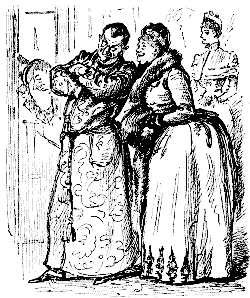
American Billionairess. "M. le Docteur, I see the Duc
de Sept-Cadrans is a Patient of yours. I want him to Propose to my
Daughter. A—any Fee that—a——"
Professor of Hypnotism. "Madam, I vill ypnotise M. le Duc. Ve shall
see!——" |
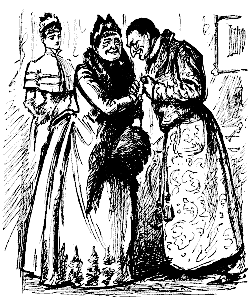
"Sorry to trouble you again so soon, Monsieur? But my
Daughter declares she won't accept M. le Duc, just because
he's a Hunchback, an Idiot, and a Pauper!"
"Madam, leave it to me. I vill ypnotise also your Daughter!" |
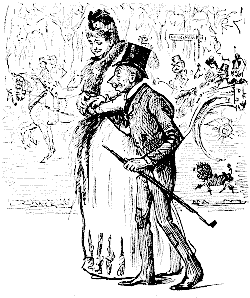
The American Billionairess becomes Madame la Duchesse de
Sept-Cadrans. She and her Husband are happy, although she
has no Money, and there is no such Dukedom as Sept-Cadrans,
for they have not yet lost their Illusions about each other. |
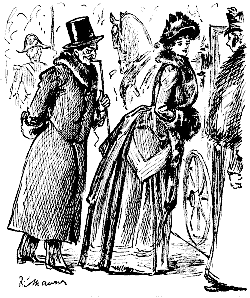
And her lovely Daughter is now the proud and adoring
Wife of the great Hypnotic Scientist, who thereby becomes an
American Billionaire. They move in the smartest Society in
Paris, and manage to do a great deal of good. |
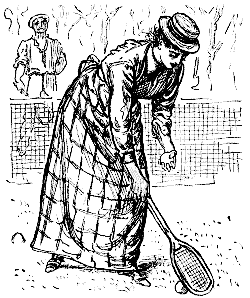
Mr. Punch left Mrs. Jones playing Lawn-Tennis with Mr.
Jones—that the little Jones might be sound in Wind and
Limb. |
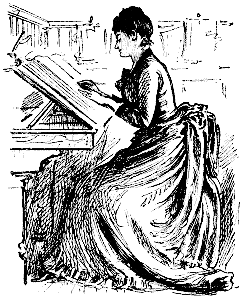
He found Madame Dubois keeping Monsieur Dubois' Books—in
order that he may prosper and grow rich, and spare an
extra Clerk. |
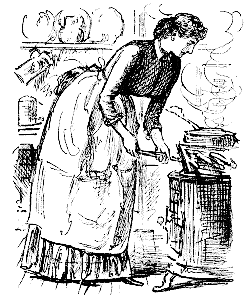
He found Frau Müller cooking Sauerkraut and Sausages—that
Herr Müller should eat of the best and cheapest and
most digestible. |
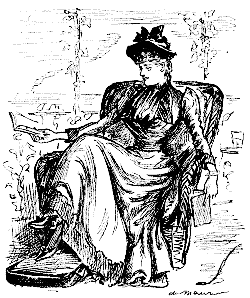
He found Mrs. van Trump reading Browning and Herbert
Spencer—to be an Intellectual Companion for George P. van
Trump, and his English Friends. |





