Amberry Parva certainly existed
before Shakspeare's time, but I doubt
if Shakspeare ever saw it. For which
he was so much the poorer, seeing
that Amberry is a faithful microcosm of
much of England.
Thomas Fallow, Aaron West and
George Hangar are all friends of mine.
Though still comparative youthful,
they are the shining lights of the
Amberry Rural Council, self-trained to
face a crisis or an emergency with calm
and steady bearing. When I came
upon them last week they were seated
about the bench outside the door of
"The Three Cups." A fourth man—a
small hairy stranger—was addressing
them.
Thomas Fallow motioned me to
halt.
"We're consultin'," he explained,
"with Mr. Chittenden as keeps the
baccy-shop in Wream."
Now Wream is a shade—the merest
shade—more important (in its own
esteem) than Amberry. It sits astride
the same high road that the Romans
carved seawards a thousand-odd years
ago, and supplies us with newspapers,
telegrams and gossip. While we score
in the possession of two tin chapels to
their one, we writhe inwardly over a
Diamond Jubilee Fountain which we
cannot hope to surpass.
"Mr. Chittenden," pursued Thomas,
"brings noos."
"Good news?" I asked.
Mr. Chittenden, like the Eldest Oyster,
shook his heavy head.
"I 'eard it from a natteralized German
two days ago. It seems that they're
goin' to make a fresh dash with invisible
Zeppelins. Once they can
e-vade the ships that's watchin'——"
He left the sentence unfinished.
"Consequence o' which," said George
Hangar, "we've gone an' made ourselves
into an Informal Committee o'
Defence, same as sits night an' day in
the War Office in London. An' the
question before the meetin' is, what's
to be done if some fine day we wakes
up to find a couple o' thousand black
'elmets marchin' down the main road?"
"Ambush 'em," said Thomas Fallow
definitely. "Told you so afore. Lie
be'ind the 'edges an' pick 'em off. My
old rook-rifle'd roll 'em over proper.
Shoot straight an' keep on shootin'."
Aaron made a scornful noise in his
throat.
"An' them as did get in the village'd
punish us for them as didn't! Burnin',
killin' an' worse."
"Then outflank 'em," insisted Thomas
doggedly. "Let 'em 'ave their fill of
advancin', same as old Joffer done, an'
then ketch 'em in the side an' discriminate
'em."
"You're not agoin' to do that with
the men left in Amberry," said Aaron.
He was a market-gardener by trade.
"'Twould be like a dozen sparrers
tryin' to outflank a steam-roller.
Trenchin's the thing. Dig deep, an'
lay the soil loose 'long the far edge.
There's a decent bit o' shelter by
Whemmick's Cottages."
"The best bein' opposite Number
Five," added Fallow, whereat there
was a bellow of laughter, and Aaron
flushed magnificently, for at Number
Five lives Molly Garner, wooed by
Aaron, but as yet hesitating between
him and the Wream plumber.
George Hangar, who up to the present
had scarcely spoken, intervened.
He has a bass voice, which on Sundays
makes the little roof of the United
Bunyans quiver; for the other six days
of the week he works at a carpenter's
bench in an open-fronted shed. He
has a sound knowledge of timber, and
is no ignoramus concerning the values
of Hepplewhite and Sheraton.
"You're wrong," he roared. "Silly-minded
an' wrong! This ain't the
Aisne. What do a village do when it's
attacked? Answer me that."
No one answered; to say the wrong
thing would exasperate him, to say the
right would exasperate him still more.
"They puts up barrycades," continued
Hangar. "An' for why? 'Cause
it's only them that can hold off horse,
foot an' 'tillery. Barrycades made o'
seasoned oak, same as I got stored at
the back o' my shed, sunk a good two
feet, with bolted cross-pieces an' spurs,
an' maybe a trifle o' barbed wire in
front."
"An' where's this contraption
to be set up?"
demanded Mr. Chittenden
with sudden suspicion.
"End o' village."
"Meanin' that the enemy
may march through Wream,
with nothin' to stop 'em
wreckin' the Fountain? An'
this was to be a meetin' for
the consideration o' mutual
defence!"
"The question afore the
members," said Aaron hastily,
"is, which place 'as most
strategetical value? Thing
is to stop 'em quick an' for
good."
"An' where'll you beat a
rook-rifle for doin' that?"
demanded Thomas Fallow.
"If I'm willin' to take the
risks——"
"'Tain't a question o'
willingness, but tatties," said
Mr. Chittenden, still unappeased.
"Then put the case afore
the sergeant as is stayin' at
the police-station," said
George.
There was a moment's
pause, then Aaron spoke.
"The motion is carried,"
he said, "an' the meetin'
stands adjourned sinny die."
I did not meet any of the members
for several days afterwards; then chance
took me in the direction of George
Hangar's workshop. I found him engrossed
in the unheard-of task of
arranging and packing his tools.
"Well?" I asked.
He rasped his chin pensively with a
chisel.
"Did the interview with the Sergeant
take place?"
"Ay; the feller's more brains than
the rest of us put together. Reckon
it's trainin'."
"What happened?"
"What 'appened? 'If you barrycades,
entrenches, enfilades or outflanks
'em outside Amberry,' says 'e, 'the
enemy'll wait for reinforcements, an'
then smash you with bigger guns.
'Twill be the same at Wream, Bewchester,
Lydhirst, Lower Thettley, an'
Capper'am.'"
"Which brings us to the sea?"
"Ezzackly."
"Where it's the Fleet's job."
"'Twould seem so. But, as the Sergeant
pointed out, the Germans is by
birth an' natur' land-fighters, an' must
so be met, trained man to trained man.
Meaning Territorials."
"Then your plans came to nothing?"
"Only in a manner o' speakin', Sir.
In fact, the resolution put afore the
meetin' would 'a' been carried nem. con.
but for the unsatisfactoriness o' Jacob
Chittenden's chest-measurement. As
it is, 'e's eatin' b'iled bread an' practising
three hours a day on the horizontal-bar."
I was a little bewildered.
"What resolution?"
He took a paper from his apron
pocket and read as follows:—
"That it be 'ereby decided, in the
joint int'rests of Wheam, Amberry Parva,
Great Britain and 'is Majesty's Dominions
beyond the Seas, that the undersigned,
bein' between the age limits,
sound in wind an' limb, an' not needed
at 'ome as much as they thought they
was, do 'ereby join the Territorial Army
at the earliest possible date. Thomas
Fallow, Aaron West, Geo. Hangar.
Also, when 'is chest-measurement do
allow of it, Jacob Chittenden."
Thus is the burden of the Empire
borne by her sons when once they get
the idea of it into their heads.
RULES FOR SPECIAL CONSTABLES.
[If a Special Constable finds himself outnumbered he may have
recourse to stratagem.]
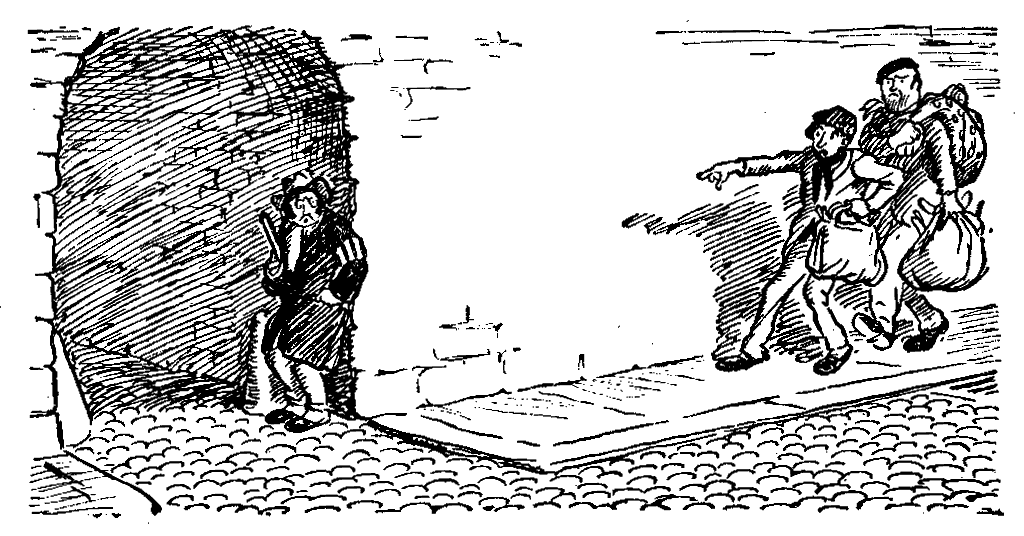
"Look out, Bill! Here's a Special Constable. He'll
cop us with the swag in our 'ands."
"I don't mind 'im, 'Arry. 'E's only a little un."
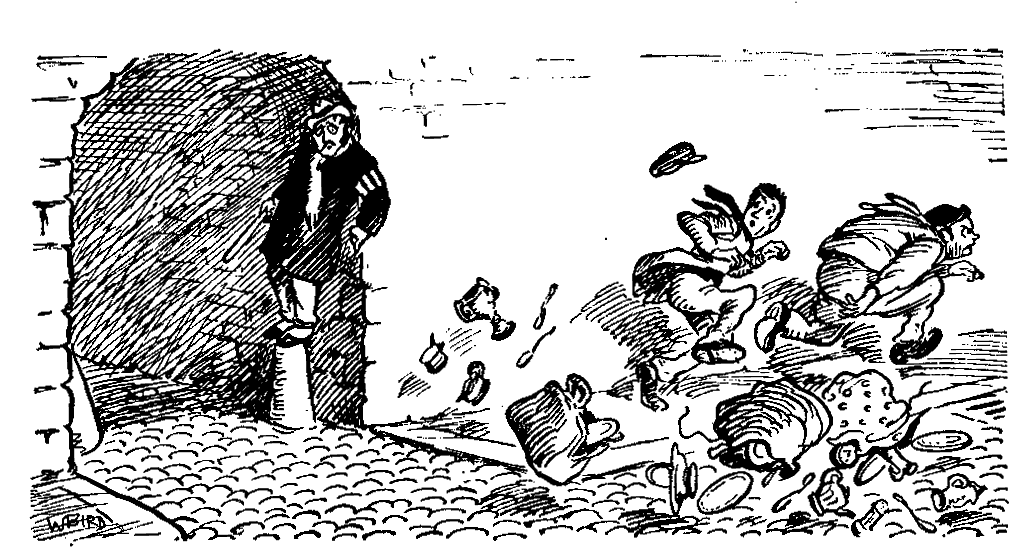
"But 'e 's got a big un with 'im."