(A Story in Scenes.)
PART XX.—"DIFFERENT PERSONS HAVE DIFFERENT OPINIONS."
Scene XXX.—Lady Maisie's Room at Wyvern.
Time—Saturday night, about 11.30.
Lady Maisie (to Phillipson, who is brushing her hair). You are
sure Mamma isn't expecting me? (Irresolutely.) Perhaps I had
better just run in and say good night.
Phillipson. I wouldn't recommend it, really, my lady; her ladyship
seems a little upset in her nerves this evening.
Lady Maisie (to herself). Il-y-à de quoi! (Aloud, relieved.)
It might only disturb her, certainly.... I hope they are making you
comfortable here, Phillipson?
Phill. Very much so indeed, thank you, my lady. The tone of the
Room downstairs is most superior.
Lady Maisie. That's satisfactory. And I hear you have met an old
admirer of yours here—Mr. Spurrell, I mean.
Phill. We did happen to encounter each other in one of the
galleries, my lady, just for a minute; though I shouldn't have
expected him to allude to it!
Lady Maisie. Indeed! And why not?
Phill. Mr. James Spurrell appears to have elevated himself to a
very different sphere from what he occupied when I used to know
him, my lady; though how and why he comes to be where he is, I don't
rightly understand myself at present.
Lady Maisie (to herself). And no wonder! I feel horribly guilty!
(Aloud.) You mustn't blame poor Mr. Spurrell, Phillipson; he
couldn't help it!
Phill. (with studied indifference). I'm not blaming him, my lady.
If he prefers the society of his superiors to mine, he's very welcome
to do so; there's others only too willing to take his place!
Lady Maisie. Surely none who would be as fond of you or make so
good a husband, Phillipson!
Phill. That's as maybe, my lady. There was one young man that
travelled down in the same compartment, and sat next me at supper
in the room. I could see he took a great fancy to me from the
first, and his attentions were really quite pointed. I am sure I
couldn't bring myself to repeat his remarks, they were so flattering!
Lady Maisie. Don't you think you will be rather a foolish girl if
you allow a few idle compliments from a stranger to outweigh such
an attachment as Mr. Spurrell seems to have for you?
Phill. If he's found new friends, my lady, I consider myself free
to act similarly.
Lady Maisie. Then you don't know? He told us quite frankly
this evening that he had only just discovered you were here, and
would much prefer to be where you were. He went down to the
Housekeeper's Room on purpose.
Phill. (moved). It's the first I've heard of it, my lady. It must
have been after I came up. If I'd only known he'd behave like
that!
Lady Maisie (instructively). You see how loyal he is to you. And
now, I suppose, he will find he has been supplanted by this new
acquaintance—some smooth-tongued, good-for-nothing valet, I
daresay?
Phill. (injured). Oh, my lady, indeed he wasn't a man! But
there was nothing serious between us—at least, on my side—though
he certainly did go on in a very sentimental way himself. However,
he's left the Court by now, that's one comfort! (To herself.) I
wish now I'd said nothing about him to Jem. If he was to get asking
questions downstairs——He always was given to jealousy—reason
or none!
[A tap is heard at the door.
Lady Rhoda (outside). Maisie, may I come in? if you've done your
hair, and sent away your maid. (She enters.) Ah, I see you haven't.
Lady Maisie. Don't run away, Rhoda; my maid has just done. You can
go now, Phillipson.
Lady Rhoda (to herself, as she sits down). Phillipson! So
that's the young woman that funny vet man prefers to Us! H'm, can't
say I feel flattered!
Phill. (to herself, as she leaves the room). This must be the Lady
Rhoda, who was making up to my Jem! He wouldn't have anything to say to
her, though; and, now I see her, I am not surprised at it!
Lady Rhoda (crossing her feet on the fender). Well, we can't
complain of havin' had a dull evenin', can we?
Lady Maisie (taking a hand-screen from the mantelshelf). Not
altogether. Has—anything fresh happened since I left?
Lady Rhoda. Nothing particular. Archie apologised to this New Man in
the Billiard Room. For the Booby Trap. We all told him he'd got to.
And Mr. Carrion Bear, or Blundershell, or whatever he calls
himself—you know—was so awf'lly gracious and condescendin'
that I really thought poor dear old Archie would have wound up his
apology by punchin' his head for him. Strikes me, Maisie, that
mop-headed Minstrel Boy is a decided change for the worse. Doesn't it
you?
Lady Maisie (toying with the screen). How do you mean, Rhoda?
Lady Rhoda. I meantersay I call Mr. Spurrell——Well, he's
real, anyway—he's a man, don't you know. As for the other, so feeble
of him missin' his train like he did, and turnin' up too late for everything!
Now, wasn't it?
Lady Maisie. Poets are dreamy and unpractical and unpunctual—it's
their nature.
Lady Rhoda. Then they should stay at home. Just see what a
hopeless muddle he's got us all into! I declare I feel as if anybody
might turn into somebody else on the smallest provocation after this.
I know poor Vivien Spelwane will be worryin' her pillows like rats
most of the night, and I rather fancy it will be a close time for poets
with your dear mother, Maisie, for some time to come. All this
silly little man's fault!
Lady Maisie. No, Rhoda. Not his—ours. Mine and Mamma's.
We ought to have felt from the first that there must be some mistake,
that poor Mr. Spurrell couldn't possibly be a poet! I don't
know, though; people generally are unlike what you'd expect from
their books. I believe they do it on purpose! Not that that applies
to Mr. Blair; he is one's idea of what a poet should be. If he
hadn't arrived when he did, I don't think I could ever have borne to
read another line of poetry as long as I lived!
Lady Rhoda. I say! Do you call him as good-lookin' as all that?
Lady Maisie. I was not thinking about his looks, Rhoda—it's his
conduct that's so splendid.
Lady Rhoda. His conduct? Don't see anything splendid in
missin' a train. I could do it myself if I tried?
Lady Maisie. Well, I wish I could think there were many men
capable of acting so nobly and generously as he did.
Lady Rhoda. As how?
Lady Maisie. You really don't see! Well, then, you shall. He
arrives late, and finds that somebody else is here already in his
character. He makes no fuss; manages to get a private interview
with the person who is passing as himself; when, of course, he soon
discovers that poor Mr. Spurrell is as much deceived as anybody
else. What is he to do? Humiliate the unfortunate man by letting
him know the truth? Mortify my Uncle and Aunt by a public
explanation before a whole dinner-party? That is what a stupid or
a selfish man might have done, almost without thinking. But not
Mr. Blair. He has too much tact, too much imagination, too much
chivalry for that. He saw at once that his only course was to spare
his host and hostess, and—and all of us a scene, by slipping away
quietly and unostentatiously, as he had come.
Lady Rhoda (yawning). If he saw all that, why didn't he do it?
Lady Maisie (indignantly). Why? How provoking you can be,
Rhoda! Why? Because that stupid Tredwell wouldn't let him!
Because Archie delayed him by some idiotic practical joke! Because
Mr. Spurrell went and blurted it all out!... Oh, don't try to run
down a really fine act like that; because you can't—you simply can't!
Lady Rhoda (after a low whistle). No idea it had gone so far as
that—already! Now I begin to see why Gerry Thicknesse has been
lookin' as if he'd sat on his best hat, and why he told your Aunt he
might have to be off to-morrow; which is all stuff, because I happen
to know his leave ain't up for two or three days yet. But he sees
this Troubadour has put his poor old nose out of joint for him.
Lady Maisie (flushing). Now, Rhoda, I won't have you talking
as if—as if—— You ought to know, if Gerald Thicknesse doesn't,
that it's nothing at all of that sort! It's just—— Oh, I can't tell
you how some of his poems moved me, what new ideas, wider views
they seemed to teach; and then how dreadfully it hurt to think it
was only Mr. Spurrell after all!... But now—oh, the relief of
finding they're not spoilt; that I can still admire, still look up to
the man who wrote them! Not to have to feel that he is quite commonplace—not
even a gentleman—in the ordinary sense!
Lady Rhoda (rising). Ah well, I prefer a hero who looks as if he
had his hair cut, occasionally—but then, I'm not romantic. He
may be the paragon you say; but if I was you, my dear, I
wouldn't expect too much of that young man—allow a margin for
shrinkage, don't you know. And now I think I'll turn into my little
crib, for I'm dead tired. Good night; don't sit up late readin'
poetry; it's my opinion you've read quite enough as it is!
Lady Maisie (alone, as she gazes dreamily into the fire). She doesn't
in the least understand! She actually suspects me of—— As if I
could possibly—or as if Mamma would ever—even if he—— Oh, how
silly I am!... I don't care! I am glad I haven't had to give up
my ideal. I should like to know him better. What harm is there in
that? And if Gerald chooses to go to-morrow, he must—that's all.
He isn't nearly so nice as he used to be; and he has even less
imagination than ever! I don't think I could care for anybody so
absolutely matter-of-fact. And yet, only an hour ago I almost——But
that was before!
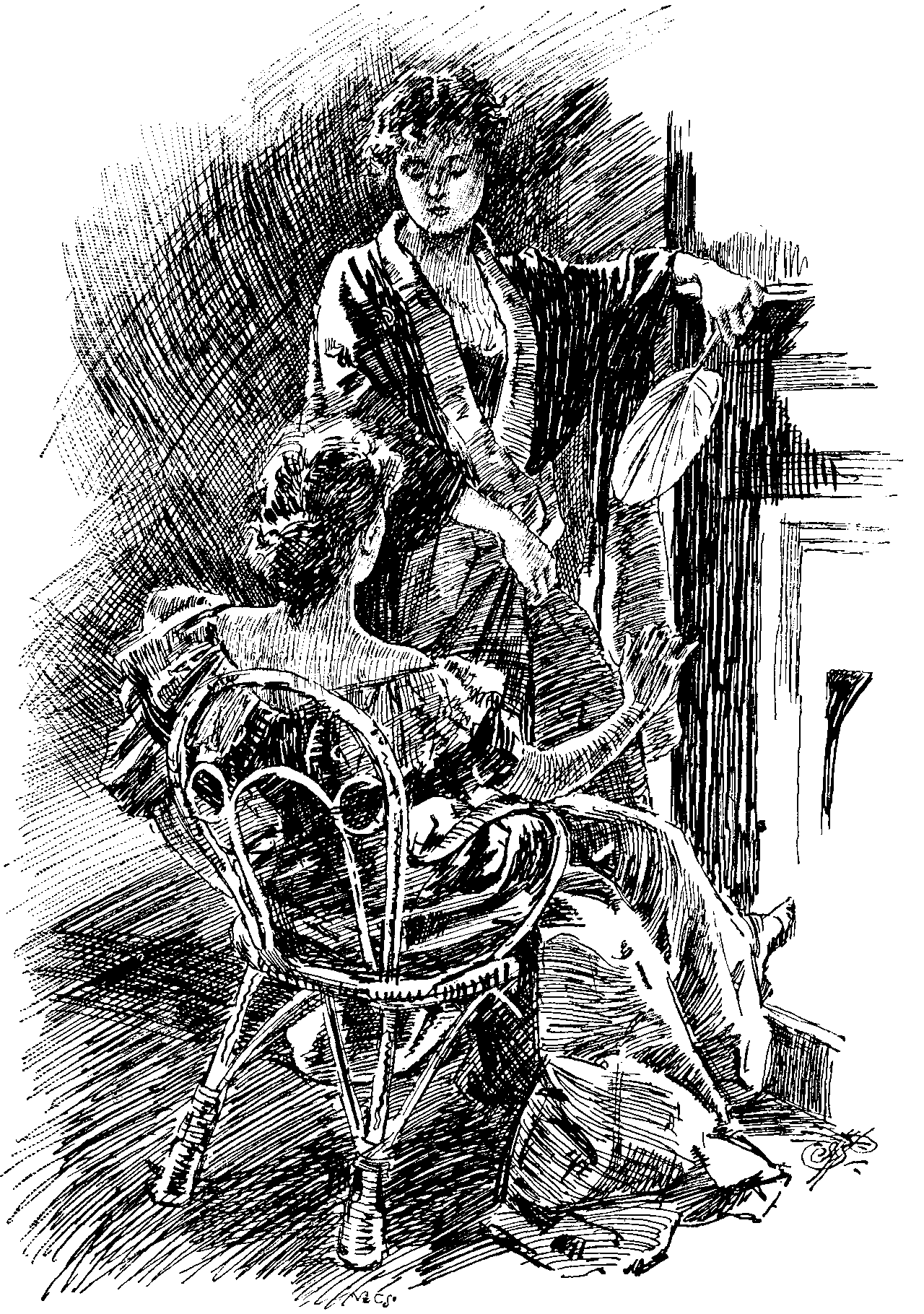
"Well, we can't complain of havin' had a dull evenin', can we?"
By Ben Trovato.—Mr. Arthur Roberts is always interested in
current events, with a view to new verses for his topical songs.
A friend came up to him one day last week with the latest Globe in
his hand, just as the Eminent One was ordering dinner for a party
of four. "They're sure to take Port Arthur!" cried the friend,
excitedly. "I never touch it myself," said Mr. Roberts, "but I'll
order a bottle."
With a Difference.—It is common enough, alas! for a man of high
aspirations to be "sorely disappointed," but it is quite a new thing
to be "sorely appointed," which is the case with Professor W. R.
Sorley, who has recently been placed in the Moral Philosopher's
Chair at the University of Aberdeen.
The New Broom.—The Republican Party in the United States
declare—apparently with some show of likelihood—that they will
"sweep the country." All honest citizens and anti-Tammany
patriots must heartily hope that they will sweep it clean.