(A Story in Scenes.)
PART X.—BORROWED PLUMES.
Scene XVII.—Undershell's Bedroom in the East Wing at Wyvern.
Time—About 9 P.M.
The Steward's Room Boy (knocking and entering). Brought you
up some 'ot water, Sir, case you'd like to clean up afore supper.
Undershell. I presume evening dress is not indispensable in the
Housekeeper's Room; but I can hardly make even the simplest toilet
until you are good enough to bring up my portmanteau. Where is it?
Boy. I never 'eard nothink of no porkmanteau, Sir!
Und. You will hear a good deal about it, unless it is forthcoming
at once. Just find out what's become of it—a new portmanteau, with
a white star painted on it.
[The Boy retires, impressed; an interval.
Boy (re-appearing). I managed to get a few words with Thomas,
our second footman, just as he was coming out o' the 'All, and he
sez the only porkmanteau with a white star was took up to the
Verney Chamber, which Thomas unpacked it hisself.
Und. Then tell Thomas, with my compliments, that he will
trouble himself to
pack it again immediately.
Boy. But Thomas
has to wait at table,
and besides, he says
as he laid out the
dress things, and the
gen'lman as is in the
Verney Chamber is a
wearin' of 'em now,
Sir.
Und. (indignant).
But they're mine!
Confound his impudence!
Here, I'll
write him a line at
once. (He scribbles a
note.) Here, see that
the gentleman of the
Verney Chamber gets
this at once, and bring
me his answer.
Boy. What! me go
into the Dinin' 'All,
with all the swells at
table? I dursn't. I
should get the sack
from old Treddy.
Und. I don't care
who takes it so long
as it is taken. Tell
Thomas it's his mistake,
and he must do
what he can to put it
right. Say I shall
certainly complain if
I don't get back my
clothes and portmanteau. Get that note delivered, and I'll give
you half-a-crown. (To himself, as the Boy departs much against
his will.) So, not content with denying me a place at her table, this
Lady Culverin allows her minions to clothe a more favoured guest
at my expense! I'm hanged if I stand it.
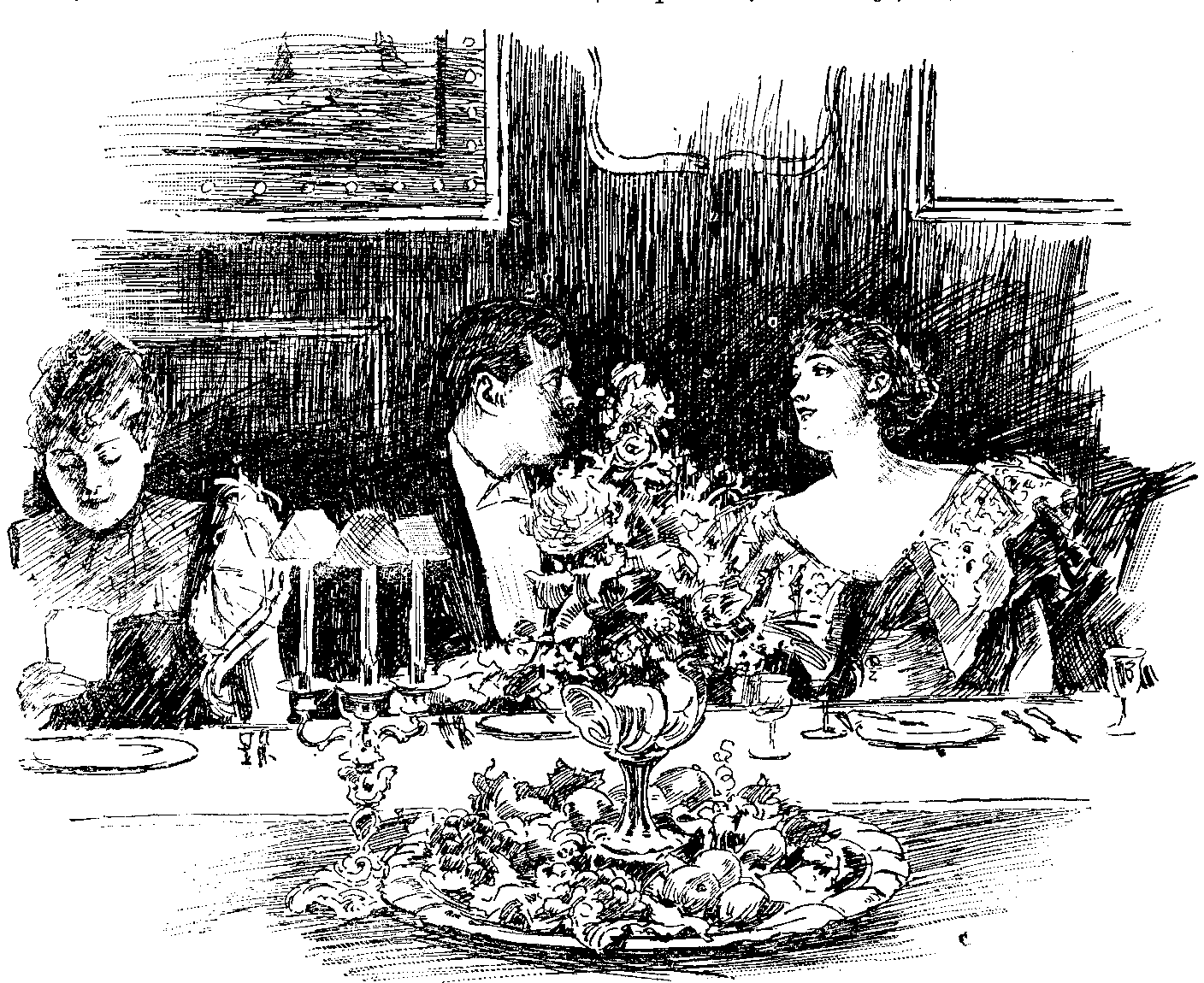
Scene XVIII.—The Dining Hall. The table is oval; Spurrell is
placed between Lady Rhoda Cokayne and Mrs. Brooke-Chatteris.
Mrs. Chatteris (encouragingly, after they are seated). Now, I shall
expect you to be very brilliant and entertaining. I'll do all the listening
for once in a way—though, generally, I can talk about all
manner of silly things with anybody!
Spurrell (extremely ill at ease). Oh—er—I should say you were
equal to that. But I really can't think of anything to talk about.
Mrs. Chatt. That's a bad beginning. I always find the menu
cards such a good subject when there's anything at all out of the
common about them. If they're ornamented, you can talk about
them—though not for very long at a time, don't you think?
Spurr. (miserably). I can't say how long I could go on about
ornamented ones—but these are plain. (To himself.) I can hear this
waistcoat going already; and we're only at the soup!
Mrs. Chatt. It is a pity. Never mind; tell me about literary and
artistic people. Do you know I'm rather glad I'm not literary or
artistic myself—it seems to make people so queer-looking, somehow.
Oh, of course I didn't mean you looked queer—but generally, you
know. You've made quite a success with your Andromeda, haven't
you? I only go by what I'm told—I don't read much myself. We
women have so many really serious matters to attend to—arranging
about dinners, and visits, and trying on frocks, and then rushing
about from party to party. I so seldom get a quiet moment. Ah, I
knew I wanted to ask you something. Did you ever know anyone
called Lady Grisoline?
Spurr. Lady—er—Grisoline? No; can't say I do. I know Lady
Maisie, that's all.
Mrs. Chatt. Oh, and she was the original? Now, that is exciting!
But I should hardly have recognised her—"lanky," you know,
and "slanting green eyes." But I suppose you see everybody
differently from other people? It's having so much imagination. I
daresay I look green or something to you now—though really I'm
not.
Spurr. (to himself). I don't understand more than about half
she's saying. (Aloud.) Oh, I don't see anything particularly green
about you.
Mrs. Chatt. (only partially pleased). I wonder if you meant that
to be complimentary—no, you needn't explain. Now tell me, is
there any news about the Laureateship? Who's going to get it?
Will it be Swinburne or Lewis Morris?
Spurr. (to himself). Never heard of the stakes or the horses
either. (Aloud.) Well,
to tell you the truth,
I haven't been following
their form—too
many of these small
events nowadays.
Mrs. Chatt. (to
herself). It's quite
amusing how jealous
these poets are of one
another! (Aloud.) Is
it true they get a butt
of sherry given them
for it?
Spurr. I've heard
of winners getting a
bottle or two of champagne
in a bucket—not
sherry. But a
little stimulant won't
hurt a crack when he
comes in, provided it's
not given him too
soon; wait till he's
got his wind and done
blowing, you know.
Mrs. Chatt. I'm
taking that in. I
know it's very witty
and satirical, and I
daresay I shall understand
it in time.
Spurr. Oh, it doesn't
matter much if you
don't. (To himself.)
Pleasant kind of woman—but
a perfect
fool to talk to!
Mrs. Chatt. (to herself). I've always heard that clever writers
are rather stupid when you meet them—it's quite true.
Captain Thicknesse (to himself). I should like her to see that I've
got some imagination in me, though she does think me such an ass.
(Aloud, to Lady Maisie.) Jolly old hall this is, with the banners, and
the gallery, and that—makes you fancy some of those old mediæval
Johnnies in armour—knights, you know—comin' clankin' in and
turnin' us all out.
Lady Maisie (to herself). I do trust Mr. Spurrell isn't saying
something too dreadful. I'm sure I heard my name just now.
(Aloud, absently, to Capt. Thicknesse.) No, did you really? How
amusing it must have been!
Capt. Thick. (aggrieved). If you'd done me the honour of payin' any
attention to what I was sayin', you'd have found out it wasn't amusin'.
Lady M. (starting). Oh, wasn't it? I'm so sorry I missed it.
I—I'm afraid I was thinking of something else. Do tell me again!
Capt. Thick. (still hurt). No, I won't inflict it on you—not worth
repeatin'. And I should only be takin' off your attention from a
fellow that does know how to talk.
Lady M. (with a guiltiness which she tries to carry off under
dignity). I don't think I understand what you mean.
Capt. Thick. Well, I couldn't help hearin' what you said to your
poet-friend before we went in about having to put up with partners;
and it isn't what you may call flattering to a fellow's feelin's, being
put up with.
Lady M. (hotly). It—it was not intended for you. You entirely
misunderstood!
Capt. Thick. Daresay I'm very dense; but, even to my comprehension,
it's plain enough that the reason why you weren't listenin'
to me just now was that the Poet had the luck to say somethin' that
you found more interesting.
Lady M. You are quite wrong—it's too absurd; I never even met
Mr. Spurrell in my life till this afternoon. If you really must
know, I heard him mention my name, and—and I wondered,
naturally, what he could possibly be saying.
Capt. Thick. Somethin' very charmin' and poetical, I'm sure,
and I'm makin' you lose it all. Apologise—shan't happen again.
Lady M. Please be sensible, and let us talk of something else.
Are you staying here long?
Capt. Thick. You will be gratified to hear I leave for Aldershot
to-morrow. Meant to have gone to-day. Sorry I didn't now.
Lady M. I think it was a thousand pities you didn't, as you seem
to have stayed on purpose to be as stupid and unkind as you possibly
can.
[She turns to her other neighbour, Lord Lullington.
Mrs. Chatt. (to Capt. Thicknesse, who is on her other side). Oh,
Captain Thicknesse, what do you think Mr. Spurrell has just
told me? You remember those lines to Lady Grisoline that
Mr. Pilliner made such fun of this morning? Well, they were
meant for Lady Maisie! They're quite old friends, it seems. So
romantic! Wouldn't you like to know how they came to meet?
Capt. Thick. Can't say I'm particularly curious—no affair of
mine, don't you know. (To himself.) And she told me they'd never
met before! Sooner I get back the better. Only in the way here.
Lady M. (turning to him). Well, are you as determined to be
disagreeable as ever? Oh, yes, I see you are!
Capt. Thick. I'm hurt, that's what it is, and I'm not clever at
hiding my feelin's. Fact is, I've just been told somethin' that—well,
it's no business of mine, only you might have been a little more
frank with an old friend, instead of leavin' it to come through somebody
else. These things always come out, you know.
Lady M. (to herself). That wretch has been talking! I knew he
would! (Aloud.) I—I know I've been very foolish. If I was to
tell you some time——
Capt. Thick. (hastily). Oh, no reason why you should tell me anything.
Assure you, I—I'm not curious.
Lady M. In that case I shall certainly not trouble you. (To
herself.) He may think just what he pleases, I don't care. But,
oh, if Mr. Spurrell dares to speak to me after this, I shall
astonish him!
Lady Rhoda (to Spurrell). I say—I am in a funk. Only just
heard who I'm next to. I always do feel such a perfect fool when
I've got to talk to a famous person—and you're frightfully famous,
aren't you?
Spurr. (modestly). Oh, I don't know—I suppose I am, in a sort of
way, through Andromeda. Seem to think so here, anyhow.
Lady Rh. Well, I'd better tell you at once, I'm no good at
Poetry—can't make head or tail of it, some'ow. It does seem to me
such—well, such footle. Awf'ly rude of me sayin' things like that!
Spurr. Is it? I'm just the same—wouldn't give a penny a yard
for Poetry, myself!
Lady Rh. You wouldn't? I am glad. Such a let-off for me!
I was afraid you'd want to talk of nothin' else, and the only things
I can really talk about are horses and dogs, and that kind of thing.
Spurr. That's all right, then. All I don't know about dogs and
horses you could put in a homœopathic globule—and then it would
rattle!
Lady Rh. Then you're just the man. Look here, I've an
Airedale at home, and he's losin' all his coat and——
[They converse with animation.
Spurr. (later—to himself). I am getting on. I always knew I
was made for Society. If only this coat was easier under the arms!
Thomas (behind him—in a discreet whisper). Beg your pardon,
Sir, but I was requested to 'and you this note, and wait for an
answer.
Spurr. (opening it, and reading). "Mr. Galfrid Undershell
thinks that the gentleman who is occupying the Verney Chamber
has, doubtless by inadvertence, put on Mr. Undershell's evening
clothes. As he requires them immediately, he will be obliged by an
early appointment being made, with a view to their return." (To
himself.) Oh, Lor! Then it wasn't Sir Rupert, after all! Just
when I was beginning to enjoy my evening, too. What on earth am
I to say to this chap? I can't take 'em all off here!
[He sits staring at the paper in blank dismay.
There is nothing new under the sun at all
To your journalist penny-a-lining and shoppy.
And how can a man be "original"
When his days (and his nights) are devoted to "copy"?
No, no, his tired head will ne'er "knock at the stars,"
Who is tied to the spinning of "leaders" and "pars."
[See Mr. Alfred Austin's article, entitled "That Damnable Country,"
in Blackwood's Magazine.]
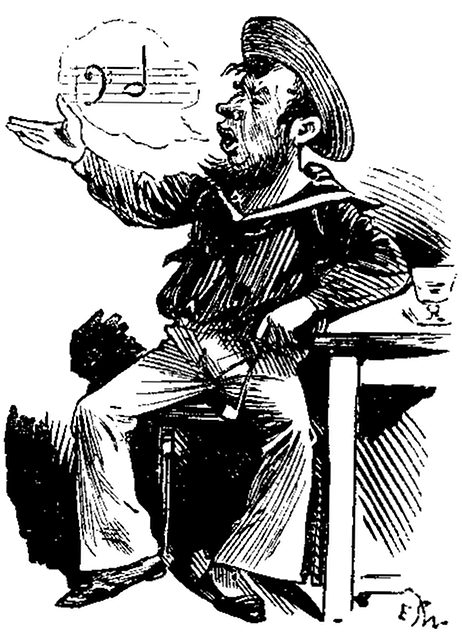
"Land, land!" cried Alfred Austin. "By my halidom, I spy land!
Many weary leagues we've wandered since we left our native shores,
Seeking still through calm and tempest a remote and barren island,
While we smote the sounding furrows of the ocean with our oars.
"Never wind availed to beat us; by the waters overweighted,
Or becalmed, with idle canvas hanging loosely from the mast,
Yet we steered her or we rowed her with our courage unabated,
And, our labours past and over, we have come to land at last.
"Though the land be bleak and barren, though barbarians its dwellers,
Let us add this last achievement to the record of our deeds;
When the savage tribes come shouting as attackers and repellers,
We can win the men with clothing and the women-folk with beads.
"There be savages in India as in Tierra del Fuego;
There be savages in Zululand with shield and assegai;
We have tamed them, whether cannibals or fed on rice and sago—
Shall a Briton ever flinch from such? No, by the Lord, not I!"
On the land he had discovered thus the Poet Austin landed;
Marco Polo or Columbus might have envied him the scene;
And in prose he has described it, in a language understanded
Of the people, and has printed it in Blackwood's Magazine.
The scenery was beautiful, so lovely that it dazed him;
He thought their manners charming, and he rather liked their rain.
He did not find them savages, which seems to have amazed him;
And he tells us all to visit them again and yet again.
We thank you for the hints you give describing what you've seen there,
It really is amazing; but——(a whisper in your ear)
You're not the first discoverer, for some of us have been there,
And shaken hands with Irish folk before the present year.
But in your precious article your wonder you exhaust in
Describing how an Irishman can really be polite:
"Behold," you say, "the Irishman as patronised by Austin;
He is not black, though painted so—in fact he's rather white."
Don't patronise so much, dear A. I do not say you write ill;
But oh that awful title, with its most offensive D——!
Devoutly do I hope, dear A., you'll find a better title,
And write a wiser article when next you cross the sea.
Studies from the New-de.—The rage for "New"-ness, which
commenced with the New Humour, is extending to the theatres. The
New Boy now has for a competitor The New Woman. What
matters, so long as neither is a Nui-S'ance?
"By their fruits ye shall know them," these vendors of peaches,
Tomatoes, and cob-nuts, and currants and cherries;
But what we yet lack is the wisdom that teaches
Detection of fraudulent fruits, nuts, and berries,
Which come from abroad, to the Britisher's table,
All marked "Finest English!" that lying old label!
A Trade Mark is wanted—to badge these false brutes,
That Bull may not only know them but their fruits.
The Seven Ages of Man.—Cot-age (Infancy), Trot-age (Nursery
Toddler), Hot-age (Youth), Shot-age (Sport), Knot-age (Matrimonial),
"Pot"-age (Celebrity), and Dot-age (Senility).
The Real Fall of Man.—Falling in love!
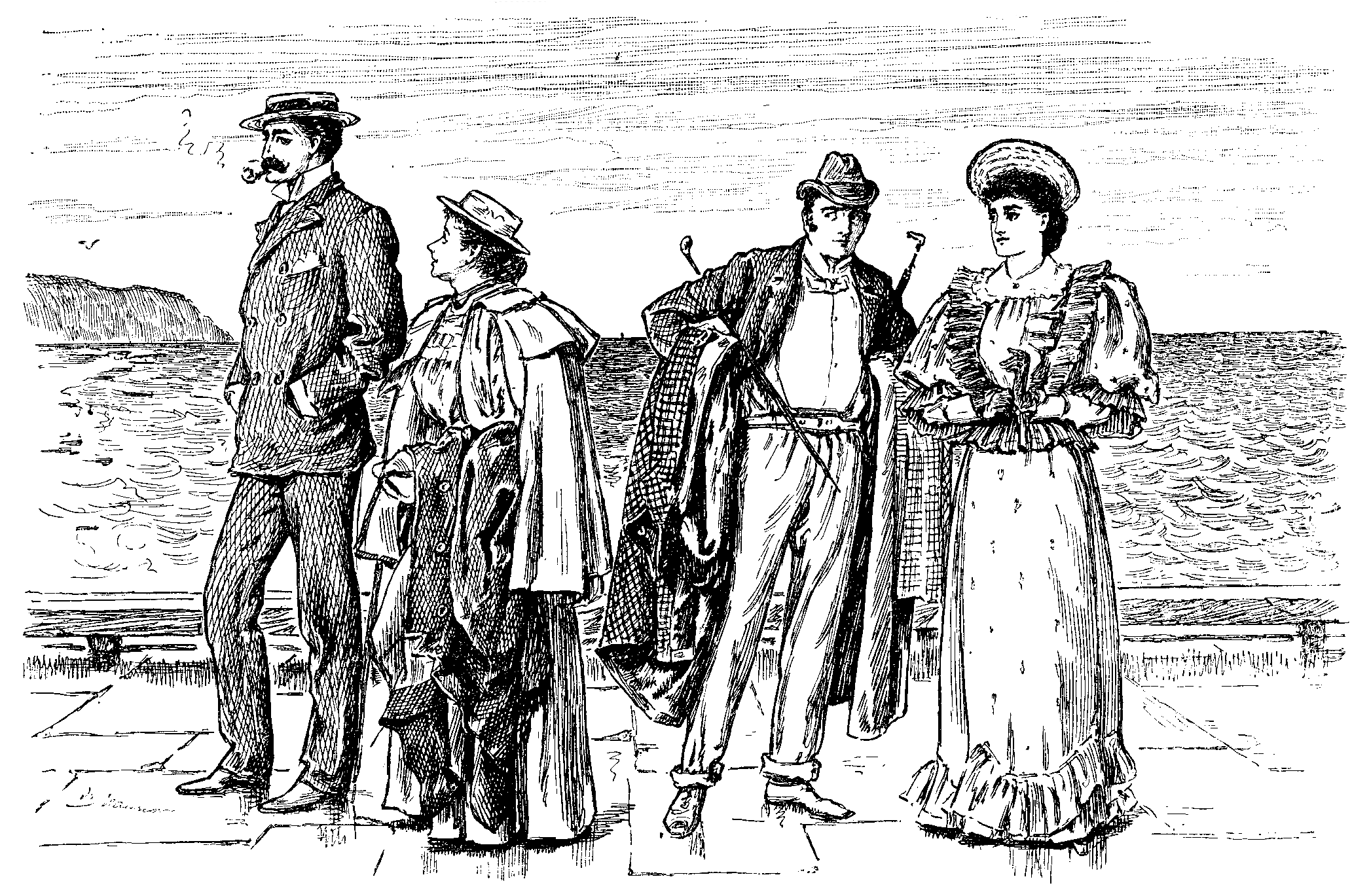
Mrs. Stanley Bounderson (née Martha Fullalove, the Liverpool heiress). "What would Doady do, if his loving little Wifey
didn't carry his great heavy Waterproof for him when it leaves off Raining, and he wants to Smoke?"
Mr. Stanley Bounderson (alias Doady). "He'd carry it himself, I suppose!"
Jones, Q.C. (aside to Mrs. Jones). "Yes; and be twice as fond of his little Wifey into the bargain, you bet!"
[Which is best, to love much, like Mrs. S. B, or be much loved, like Mrs. J.?
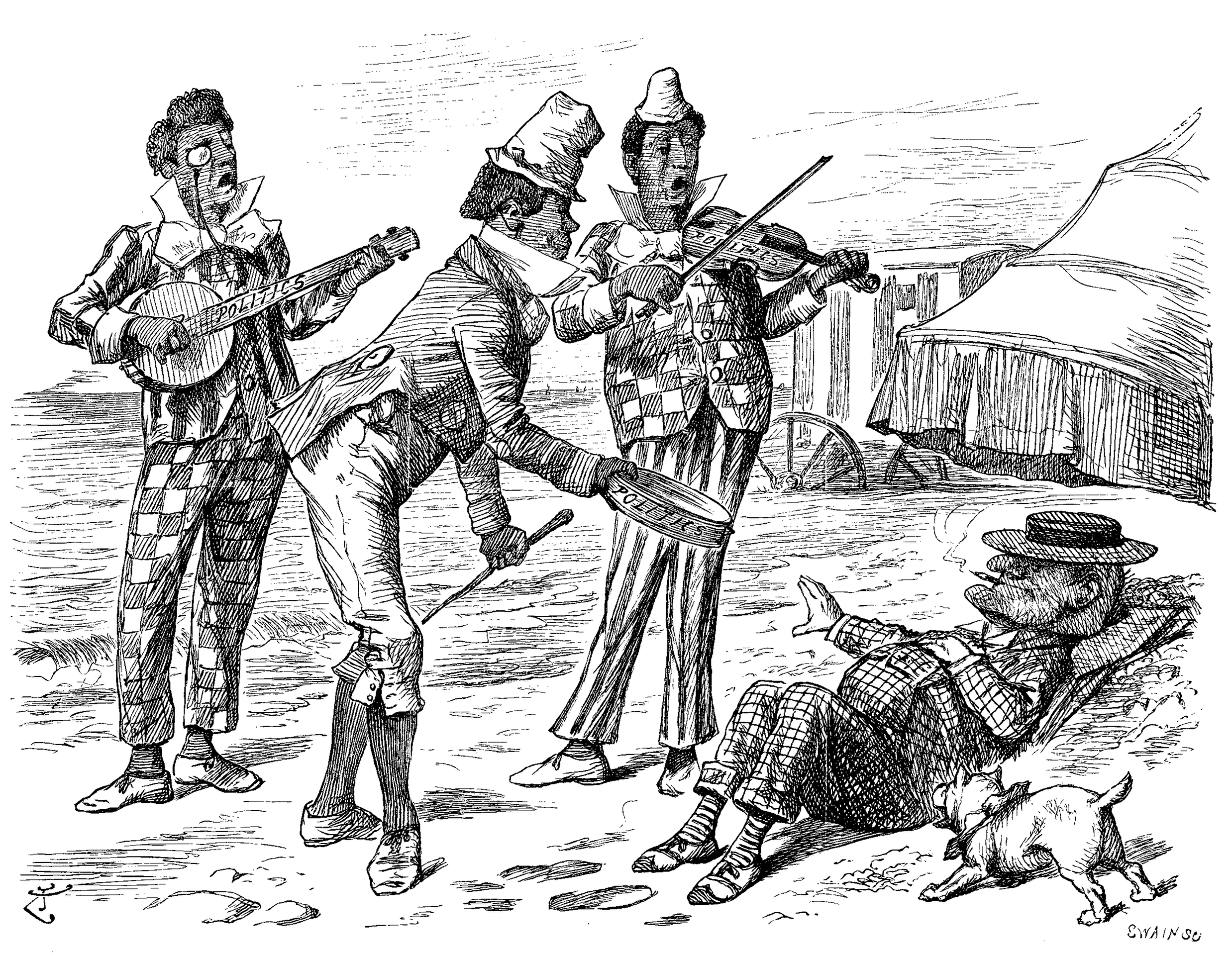
Mr. P. (sleepily). "GO AWAY—GO AWAY!—I'VE HAD ENOUGH OF YOU!"