(A Story in Scenes.)
PART IX.—THE MAUVAIS QUART D'HEURE.
Scene XVI.—The Chinese Drawing Room at Wyvern.
Time—7.50. Lady Culverin is alone, glancing over a written list.
Lady Cantire (entering). Down already, Albinia? I thought if I
made haste I should get a quiet chat with you before anybody else
came in. What is that paper? Oh, the list of couples for Rupert.
May I see? (As Lady Culverin surrenders it.) My dear, you're
not going to inflict that mincing little Pilliner boy on poor Maisie!
That really won't do. At least let her have somebody she's used to.
Why not Captain Thicknesse? He's an old friend, and she's not seen
him for months. I must alter that, if you've no objection. (She does.)
And then you've given my poor Poet
to that Spelwane girl! Now, why?
Lady Culverin. I thought she
wouldn't mind putting up with him
just for one evening.
Lady Cant. Wouldn't mind! Putting
up with him! And is that how
you speak of a celebrity when you are
so fortunate as to have one to entertain?
Really, Albinia!
Lady Culv. But, my dear Rohesia,
you must allow that, whatever his
talents may be, he is not—well, not
quite one of Us. Now, is he?
Lady Cant. (blandly). My dear, I
never heard he had any connection
with the manufacture of chemical
manures, in which your worthy Papa
so greatly distinguished himself—if
that is what you mean.
Lady Culv. (with some increase of
colour). That is not what I meant,
Rohesia—as you know perfectly well.
And I do say that this Mr. Spurrell's
manner is most objectionable; when he's
not obsequious, he's horribly familiar!
Lady Cant. (sharply). I have not
observed it. He strikes me as well
enough—for that class of person. And
it is intellect, soul, all that kind of
thing that I value. I look below the
surface, and I find a great deal that is
very original and charming in this
young man. And surely, my dear, if
I find myself able to associate with
him, you need not be so fastidious!
I consider him my protégé, and I won't
have him slighted. He is far too good
for Vivien Spelwane!
Lady Culv. (with just a suspicion of
malice). Perhaps, Rohesia, you would
like him to take you in?
Lady Cant. That, of course, is quite
out of the question. I see you have
given me the Bishop—he's a poor, dry
stick of a man—never forgets he was
the Headmaster of Swisham—but he's
always glad to meet me. I freshen
him up so.
Lady Culv. I really don't know whom
I can give Mr. Spurrell. There's
Rhoda Cokayne, but she's not poetical,
and she'll get on much better with Archie Bearpark. Oh,
I forgot Mrs. Brooke-Chatteris—she's sure to talk, at all events.
Lady Cant. (as she corrects the list). A lively, agreeable woman—she'll
amuse him. Now you can give Rupert the list.
[Sir Rupert and various members of the house-party appear one
by one; Lord and Lady Lullington, the Bishop of Birchester
and Mrs. Rodney, and Mr. and Mrs. Earwaker,
and Mr. Shorthorn are announced at intervals; salutations,
recognitions, and commonplaces are exchanged.
Lady Cant. (later—to the Bishop, genially). Ah, my dear
Dr. Rodney, you and I haven't met since we had our great battle
about—now, was it the necessity of throwing open the Public Schools
to the lower classes—for whom of course they were originally
intended—or was it the failure of the Church to reach the Working
Man? I really forget.
The Bishop (who has a holy horror of the Countess). I—ah—fear
I cannot charge my memory so precisely, my dear Lady Cantire.
We—ah—differ unfortunately on so many subjects. I trust, however,
we may—ah—agree to suspend hostilities on this occasion?
Lady Cant. (with even more bonhomie). Don't be too sure of that,
Bishop. I've several crows to pluck with you, and we are to go in
to dinner together, you know!
The Bishop. Indeed? I had no conception that such a pleasure
was in store for me! (To himself.) This must be the penance for
breaking my rule of never dining out on Saturday! Severe—but
merited!
Lady Cant. I wonder, Bishop, if you have seen this wonderful
volume of poetry that everyone is talking about—Andromeda?
The Bishop (conscientiously). I chanced only this morning, by
way of momentary relaxation, to take up a journal containing a
notice of that work, with copious extracts. The impression left on
my mind was—ah—unfavourable; a certain talent, no doubt, some
felicity of expression, but a noticeable lack of the—ah—reticence,
the discipline, the—the scholarly touch which a training at one of
our great Public Schools (I forbear to
particularise), and at a University,
can alone impart. I was also pained
to observe a crude discontent with the
existing Social System—a system
which, if not absolutely perfect, cannot
be upset or even modified without the
gravest danger. But I was still more
distressed to note in several passages a
decided taint of the morbid sensuousness
which renders so much of our
modern literature sickly and unwholesome.
Lady Cant. All prejudice, my dear
Bishop; why, you haven't even read
the book! However, the author is
staying here now, and I feel convinced
that if you only knew him, you'd
alter your opinion. Such an unassuming,
inoffensive creature! There,
he's just come in. I'll call him over
here.... Goodness, why does he shuffle
along in that way!
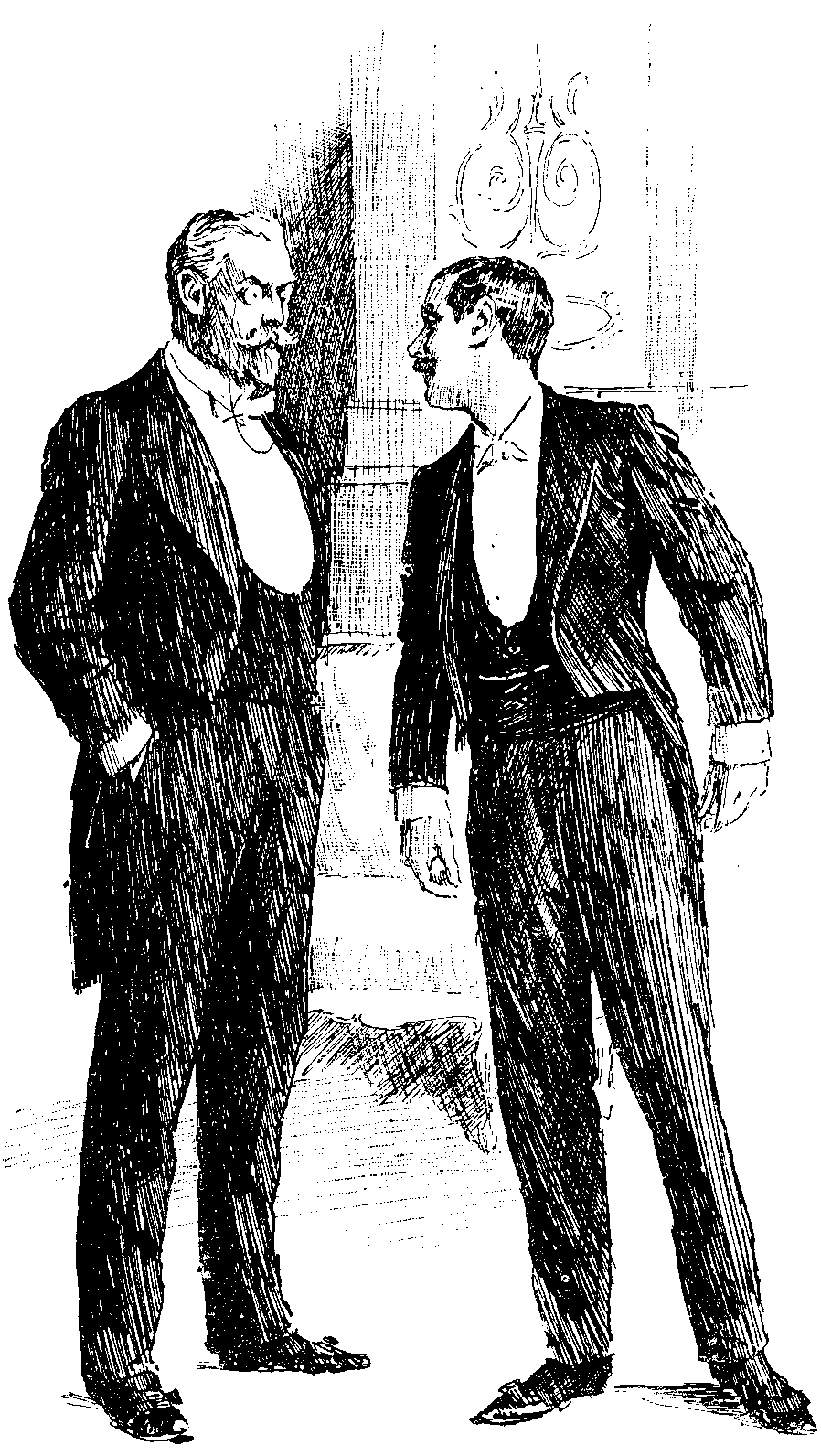
Spurrell (meeting Sir Rupert). Hope
I've kept nobody waiting for me, Sir
Rupert. (Confidentially.) I'd rather
a job to get these things on; but
they're really a wonderful fit, considering!
[He passes on, leaving his host
speechless.
Lady Cant. That's right, Mr. Spurrell.
Come here, and let me present
you to the Bishop of Birchester. The
Bishop has just been telling me he
considers your Andromeda sickly, or
unhealthy, or something. I'm sure
you'll be able to convince him it's
nothing of the sort.
[She leaves him with the Bishop,
who is visibly annoyed.
Spurr. (to himself, overawed). Oh,
Lor! Wish I knew the right way to
talk to a Bishop. Can't call him nothing—so
doosid familiar. (Aloud.)
Andromeda sickly, your—(tentatively)—your
Right Reverence? Not a bit of it—sound as a roach!
The Bishop. If I had thought my—ah—criticisms
were to be repeated—I
might say misrepresented, as the
Countess has thought proper to do,
Mr. Spurrell, I should not have ventured to make them. At the
same time, you must be conscious yourself, I think, of certain
blemishes which would justify the terms I employed.
Spurr. I never saw any in Andromeda myself, your—your Holiness.
You're the first to find a fault in her. I don't say there
mayn't be something dicky about the setting and the turn of the tail,
but that's a trifle.
The Bishop. I did not refer to the setting of the tale, and the
portions I object to are scarcely trifles. But pardon me if I prefer to
end a discussion that is somewhat unprofitable. (To himself, as he
turns on his heel.) A most arrogant, self-satisfied, and conceited
young man—a truly lamentable product of this half-educated age!
Spurr. (to himself). Well, he may be a dab at dogmas—he don't
know much about dogs. Drummy's got a constitution worth a dozen
of his!
Lady Culv. (approaching him). Oh, Mr. Spurrell, Lord Lullington
wishes to know you. If you will come with me. (To herself,
as she leads him up to Lord L.) I do wish Rohesia wouldn't force
me to do this sort of thing!
Lord Lullington (to himself). I suppose I ought to know all about
his novel, or whatever it is he's done. (Aloud, with courtliness.) Very
pleased to make your acquaintance, Mr. Spurrell; you've—ah—delighted
the world by your Andromeda. When are we to look for
your next production? Soon, I hope.
Spurr. (to himself). He's after a pup now! Never met such a
doggy lot in my life! (Aloud.) Er—well, my lord, I've promised
so many as it is, that I hardly see my way to——
Lord Lull. (paternally). Take my advice, my dear young man,
leave yourself as free as possible. Expect you to give us your best,
you know.
[He turns to continue a conversation.
Spurr. (to himself). Give it! He won't get it under a five-pound
note, I can tell him. (He makes his way to Miss Spelwane.) I say,
what do you think the old Bishop's been up to? Pitching into
Andromeda like the very dooce—says she's sickly!
Miss Spelwane (to herself). He brings his literary disappointments
to me, not Maisie! (Aloud, with the sweetest sympathy.) How
dreadfully unjust! Oh, I've dropped my fan—no, pray don't
trouble; I can pick it up. My arms are so long, you know—like a
kangaroo's—no, what is that animal which has such long arms?
You're so clever, you ought to know!
Spurr. I suppose you mean a gorilla?
Miss Spelw. How crushing of you! But you must go away now,
or else you'll find nothing to say to me at dinner—you take me in,
you know. I hope you feel privileged. I feel——But if I told you,
I might make you too conceited!
Spurr. Oh, no, you wouldn't.
[Sir Rupert approaches with Mr. Shorthorn.
Sir Rupert. Vivien, my dear, let me introduce Mr. Shorthorn—Miss
Spelwane. (To Spurrell.) Let me see—ha—yes, you take in
Mrs. Chatteris. Don't know her? Come this way, and I'll find her
for you.
[He marches Spurrell off.
Mr. Shorthorn (to Miss Spelwane). Good thing getting this rain
at last; a little more of this dry weather and we should have had no
grass to speak of!
Miss Spelw. (who has not quite recovered from her disappointment).
And now you will have some grass to speak of? How
fortunate!
Spurr. (as dinner is announced, to Lady Maisie). I say, Lady
Maisie, I've just been told I've got to take in a married lady. I
don't know what to talk to her about. I should feel a lot more at
home with you. Couldn't we manage it somehow?
Lady Maisie (to herself). What a fearful suggestion—but I
simply daren't snub him! (Aloud.) I'm afraid, Mr. Spurrell, we
must both put up with the partners we have; most distressing, isn't
it—but!
[She gives a little
shrug.
Captain Thicknesse (immediately behind her, to himself). Gad,
that's pleasant! I knew I'd better have gone to Aldershot!
(Aloud.) I've been told off to take you in, Lady Maisie, not my
fault, don't you know.
Lady Maisie. There's no need to be so apologetic about it. (To
herself.) Oh, I hope he didn't hear what I said to that wretch.
Capt. Thick. Well, I rather thought there might be, perhaps.
Lady Maisie (to herself). He did hear it. If he's going to be so
stupid as to misunderstand, I'm sure I shan't explain.
[They take their place in the procession to the Dining Hall.
"I'd rather a job to get these things on; but they're really a
wonderful fit, considering!"

 "CONTRIBUTIONS THANKFULLY RECEIVED."


