(A Story in Scenes.)
PART XVI.—AN INTELLECTUAL PRIVILEGE.
Scene XXV.—The Chinese Drawing Room. Time—About 9.45 P.M.
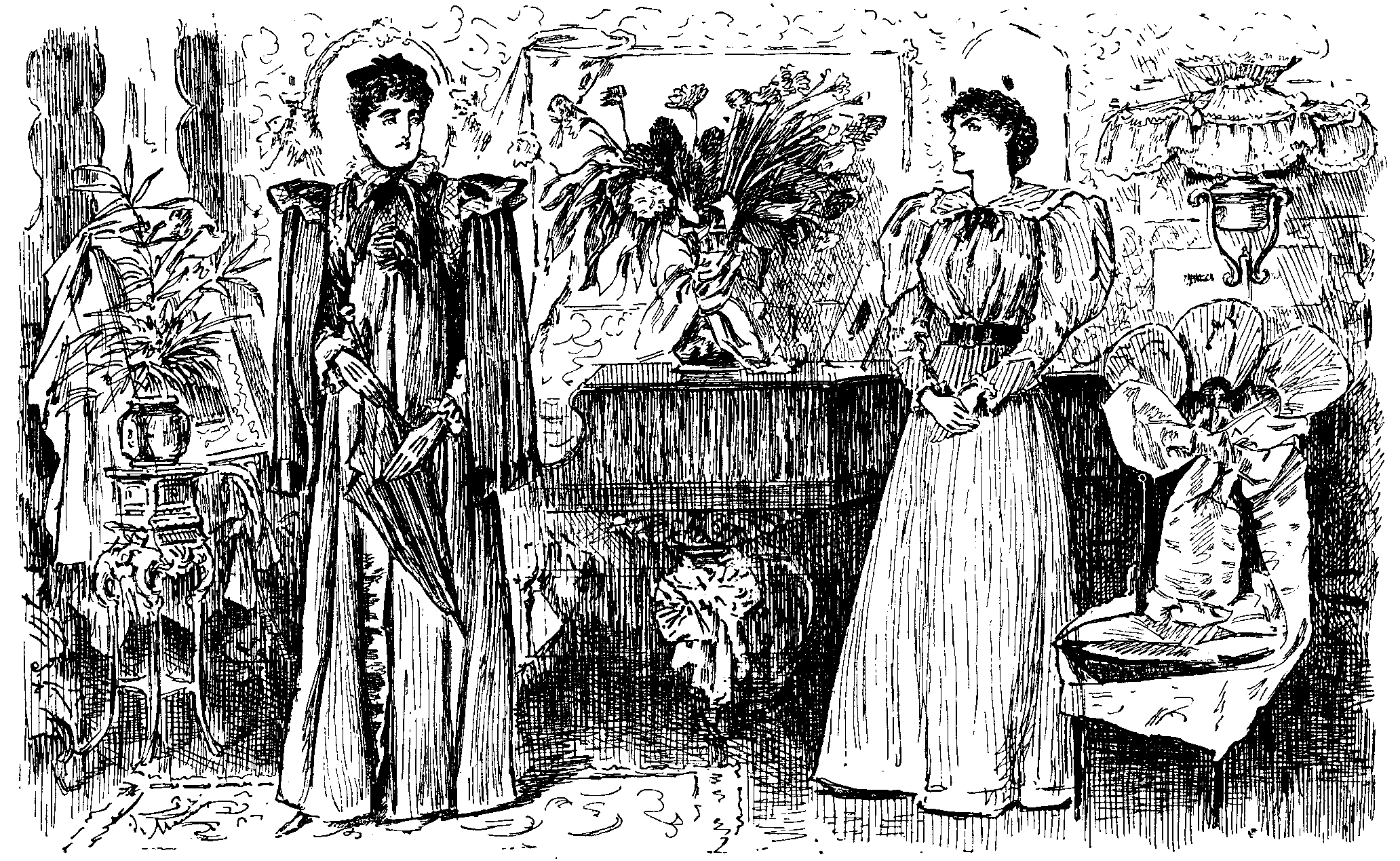
Mrs. Earwaker. Yes, dear Lady Lullington, I've always
insisted on each of my girls adopting a distinct line of her own,
and the result has been most satisfactory. Louisa, my eldest, is
literary; she had a little story accepted not long ago by The Milky
Way; then Maria is musical; practises regularly three hours every
day on her violin. Fanny has become quite an expert in photography—kodaked
her father the other day in the act of trying a
difficult stroke at billiards; a back view—but so clever and characteristic!
Lady Lullington (absently). A back view? How nice!
Mrs. Earw. He was the only one of the family who didn't recognise
it at once. Then my youngest, Caroline—well, I must say
that for a long time I was quite in despair about Caroline. It
really looked as if there was no single
thing that she had the slightest bent
or inclination for. So at last I thought
she had better take up Religion, and
make that her speciality.
Lady Lull. (languidly). Religion!
How very nice!
Mrs. Earw. Well, I got her a Christian
Year and a covered basket, and
quantities of tracts, and so on; but,
somehow, she didn't seem to get on with
it. So I let her give it up; and now
she's gone in for poker-etching instead.
Lady Lull. (by an act of unconscious
cerebration). Poker-etching! How very
very nice!
[Her eyelids close gently.
Lady Rhoda. Oh, but indeed, Lady
Culverin, I thought he was perfectly
charmin'; not a bit booky, you know,
but as clever as he can stick; knows
more about terriers than any man I ever
met!
Lady Culverin. So glad you found
him agreeable, my dear. I was half
afraid he might strike you as—well, just
a little bit common in his way of talking.
Lady Rhoda. Pr'aps—but, after all,
one can't expect those sort of people to
talk quite like we do ourselves, can one?
Lady Cantire. Is that Mr. Spurrell
you are finding fault with, Albinia?
It is curious that you should be the
one person here who——I consider
him a very worthy and talented young
man, and I shall most certainly ask him
to dinner—or lunch, at all events—as
soon as we return. I daresay Lady
Rhoda will not object to come and meet
him.
Lady Rhoda. Rather not. I'll come,
like a shot!
Lady Culv. (to herself). I suppose
it's very silly of me to be so prejudiced.
Nobody else seems to mind him!
Miss Spelwane (crossing over to them).
Oh, Lady Culverin, Lady Lullington has such a delightful idea—she's
just been saying how very very nice it would be if Mr.
Spurrell could be persuaded to read some of his poetry aloud to us
presently. Do you think it could be managed?
Lady Culv. (in distress). Really, my dear Vivien, I—I don't know
what to say. I fancy people would so much rather talk—don't you
think so, Rohesia?
Lady Cant. Probably they would, Albinia. It is most unlikely
that they would care to hear anything more intellectual and
instructive than the sound of their own voices.
Miss Spelw. I told Lady Lullington that I was afraid you would
think it a bore, Lady Cantire.
Lady Cant. You are perfectly mistaken, Miss Spelwane. I
flatter myself I am quite as capable of appreciating a literary
privilege as anybody here. But I cannot answer for its being
acceptable to the majority.
Lady Culv. No, it wouldn't do at all. And it would be making
this young man so much too conspicuous.
Lady Cant. You are talking nonsense, my dear. When you are
fortunate enough to secure a celebrity at Wyvern, you can't make
him too conspicuous. I never knew that Laura Lullington had
any taste for literature before, but there's something to be said for
her suggestion—if it can be carried out; it would at least provide
a welcome relief from the usual after-dinner dullness of this sort of
gathering.
Miss Spelw. Then—would you ask him, Lady Cantire?
Lady Cant. I, my dear? You forget that I am not hostess here.
My sister-in-law is the proper person to do that.
Lady Culv. Indeed I couldn't. But perhaps, Vivien, if you liked
to suggest it to him, he might——
Miss Spelw. I'll try, dear Lady Culverin. And if my poor
little persuasions have no effect, I shall fall back on Lady Cantire,
and then he can't refuse. I must go and tell dear Lady Lullington—she'll
be so pleased! (To herself, as she skims away.) I
generally do get my own way. But I mean him to do it to please Me!
Mrs. Chatteris (a little later, to Lady Maisie). Have you heard what
a treat is in store for us? That delightful Mr. Spurrell is going to
give us a reading or a recitation, or something, from his own poems;
at least, Miss Spelwane is to ask him as soon as the men come in.
Only I should have thought that he would be much more likely to
consent if you asked him.
Lady Maisie. Would you? I'm sure
I don't know why.
Mrs. Chatt. (archly). Oh, he took me
in to dinner, you know, and it's quite
wonderful how people confide in me,
but I suppose they feel I can be trusted.
He mentioned a little fact, which gave
me the impression that a certain fair
lady's wishes would be supreme with
him.
Lady Maisie (to herself). The wretch!
He has been boasting of my unfortunate
letter! (Aloud.) Mr. Spurrell had
no business to give you any impression
of the kind. And the mere fact that
I—that I happened to admire his
verses——
Mrs. Chatt. Exactly! Poets' heads
are so easily turned; and, as I said to
Captain Thicknesse——
Lady Maisie. Captain Thicknesse!
You have been talking about it—to him!
Mrs. Chatt. I'd no idea you would
mind anybody knowing, or I would
never have dreamed of——I've such
a perfect horror of gossip! It took me
so much by surprise, that I simply
couldn't resist; but I can easily tell
Captain Thicknesse it was all a mistake;
he knows how fearfully inaccurate I
always am.
Lady Maisie. I would rather you
said nothing more about it, please; it is
really not worth while contradicting
anything so utterly absurd. (To herself.)
That Gerald—Captain Thicknesse—of
all people, should know of my
letter! And goodness only knows what
story she may have made out of it!
Mrs. Chatt. (to herself, as she moves
away). I've been letting my tongue run
away with me, as usual. She's not the
original of "Lady Grisoline," after all.
Perhaps he meant Vivien Spelwane—the
description was much more like her!
Pilliner (who has just entered with some of the younger men, to
Miss Spelwane). What are you doing with these chairs? Why are
we all to sit in a circle, like Moore and Burgess people? You're
not going to set the poor dear Bishop down to play baby-games?
How perfectly barbarous of you!
Miss Spelw. The chairs are being arranged for something much
more intellectual. We are going to get Mr. Spurrell to read a
poem to us, if you want to know. I told you I should manage it.
Pill. There's only one drawback to that highly desirable arrangement.
The bard, with prophetic foreknowledge of your designs, has
unostentatiously retired to roost. So I'm afraid you'll have to do
without your poetry this evening—that is, unless you care to avail
yourself again of my services?
Miss Spelw. (indignantly). It is too mean of you. You must have
told him!
[He protests his innocence.
Lady Rhoda. Archie, what's become of Mr. Spurrell? I particularly
want to ask him something.
Bearpark. The poet? He nipped upstairs—as I told you all along
he meant to—to scribble some of his democratic drivel, and (with a
suppressed grin) I don't think you'll see him again this evening.
Captain Thicknesse (to himself, as he enters). She's keepin' a chair
next hers in the corner there for somebody. Can it be for that poet
chap?... (He meets Lady Maisie's eye suddenly.) Great Scott! If
she means it for me!... I've half a mind not to——No, I shall be a
fool if I lose such a chance! (He crosses, and drops into the vacant
chair next hers.) I may sit here, mayn't I?
Lady Maisie (simply). I meant you to. We used to be such good
friends; it's a pity to have misunderstandings. And—and I want
to ask you what that silly little Mrs. Chatteris has been telling you
at dinner about me.
Capt. Thick. Well, she was sayin'—and I must say I don't understand
it, after your tellin' me you knew nothing about this Mr.
Spurrell till this afternoon——
Lady Maisie. But I don't. And I—I did offer to explain, but you
said you weren't curious!
Capt. Thick. Didn't want you to tell me anything that perhaps
you'd rather not, don't you know. Still, I should like to know how
this poet chap came to write a poem all about you, and call it "Lady
Grisoline." if he never——
Lady Maisie. But it's too ridiculous! How could he? When he
never saw me, that I know of, in all his life before!
Capt. Thick. He told Mrs. Chatteris you were the original of
his "Lady Grisoline" anyway, and really——
Lady Maisie. He dared to tell her that? How disgracefully
impertinent of him. (To herself.) So long as he hasn't talked about
my letter, he may say what he pleases!
Capt. Thick. But what was it you were goin' to explain to me?
You said there was somethin'——
Lady Maisie (to herself). It's no use; I'd sooner die than tell him
about that letter now! (Aloud.) I—I only wished you to understand
that, whatever I think about poetry—I detest poets!
Lady Cant. Yes, as you say, Bishop, a truly Augustan mode of
recreation. Still, Mr. Spurrell doesn't seem to have come in yet, so
I shall have time to hear anything you have to say in defence of
your opposition to Parish Councils.
[The Bishop resigns himself to the inevitable.
Archie (in Pilliner's ear). Ink and flour—couldn't possibly miss
him; the bard's got a matted head this time, and no mistake.
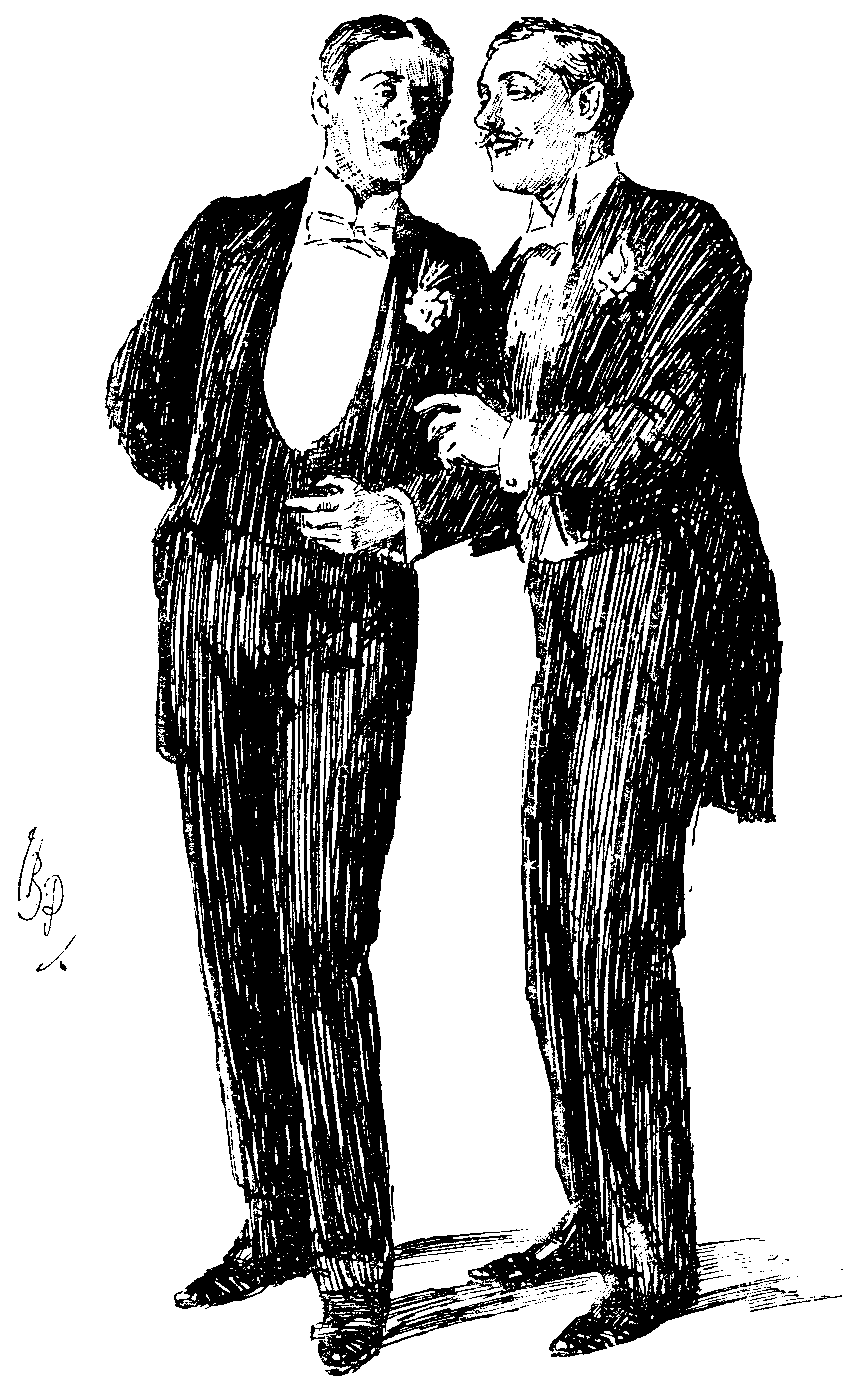
"Ink and flour—couldn't possibly miss him."
Pill. Beastly bad form, I call it—with a fellow you don't know.
You'll get yourself into trouble some day. And you couldn't even
manage your ridiculous booby-trap, for here the beggar comes, as if
nothing had happened.
Archie (disconcerted). Confound him! The best booby-trap I
ever made!
The Bishop. My dear Lady Cantire, here is our youthful poet,
at the eleventh hour. (To himself.) "Sic me servavit Apollo!"
[Miss Spelwane advances to meet Spurrell, who stands surveying
the array of chairs in blank bewilderment.