Happy Thought.—Ilfracombe, just now. If it be a question of
"Ways and Means," then Ilfracombe offers you "the ways" in the
matter of drives, walks, rides, excursions by rail, by sea, likewise by
river and road almost ad infinitum, and sometimes by sea ad nauseam.
Sea-bathing naturally excellent, but still open, considerably
open, to improvement. Still, as the man of no politics replied, when
asked why he belonged to the Reform Club, "There is in this world
nothing so good but what it is capable of improvement," and Ilfracombe cannot claim
exemption from this rule of universal application. Should an
Ilfracombe-ination require suggestions, mine are at the service of
the I. I. C. (Ilfracombe Improvement Committee).
***
On a bench at the summit of the Torrs sat three Elders. Gray-bearded
and full of confidence in their own wisdom. On another
bench facing them sat a cherry-cheeked maiden of some nineteen
summers, evidently an elder sister in charge of a little brother, with
whom in a shy sort of way, as if old enough to know better, and yet
unable to resist the temptation, she was sharing, with very evident
relish, some succulent toffy recently extracted from one of the many
"penny-in-the-slot" machines, which, as "bits of colour," are such
brilliant ornaments to the Torrs Walks, and such universal favourites
with youth of all ages. The three Elders were discoursing on the
mysteries of creation, with such a "cock-sureness" of tone as seemed
to imply that they themselves had been on some committee of management
when the first idea of making this particular planet, called the
world, had occurred to its Creator. "These rocks," said one grandly,
"were in existence long before the date assigned to the creation."
Whereat the toffy-sucking girl sniggered foolishly as if somehow
personally implicated, while the boy stared, open mouthed, with
toffy, yet untasted, in his dexter hand. "No one," observed the
second Elder, blandly, his eyes on the maiden,—not by any means
a Susanna but rather a fairly educated Awdrey,—"no one now
accepts the Mosaic account of Creation as given in Genesis." The
boy looked up, inquiringly, at his sister. The girl giggled bashfully
as if, in presence of so much learning and such reverend seniors,
she were suddenly somewhat ashamed of the home-teaching she had
received, and in which her trust had never been shaken, at least
until this minute. The third Elder, his eye too on the girl and boy,—and
perhaps the toffy,—now joined in. "It was absurd," quoth
he, supremely, "to believe that this"—here with a wave of his hand
he took in air, earth, sky, and all points of the compass—"was
made in six days." Then both boy and girl sniggered at one another.
"I suppose they teach you that all this," said the third Elder,
straightly addressing the girl, and again explaining his allusion to
the universe by waving his right hand about in an all-embracing
gesture, "that this was made in six days, eh?" With a demure
and silly giggle the damsel admitted that her education on the
subject had tended in the direction indicated. The three Elders
regarded one another with a sad, despondent air, as though here
were another case of crass ignorance which they had a special mission
to enlighten. "Why," said the second Elder, "the Chinese"—here
the little boy became suddenly interested—"the Chinese possess
records which reach back to a date anterior, by some thousands of
years, to that popularly assigned by Christians to the creation of the
world." The girl opened her eyes, but the boy, having lost his suddenly
awakened interest in the Chinese (probably he had expected
some stories about the war with Japan, or another tale of Aladdin),
had resumed his toffy-sucking process. At this point my companion,
who had been fidgetting on our bench, suddenly cut in and took a
hand. "You remind me, Sir," said he, quite pleasantly, speaking
to the second Elder, but addressing all three, "of the ancient and
royal Irish family of O'Toole, whose records, as you will of course
remember, went back for some millions of years; and in which, at a
comparatively late date, occurred the famous entry, 'N.B.—About
this time the world was created.'" As this was told with perfect
good humour, and with an inimitably comic imitation of a brogue,
the damsel and boy were greatly amused, and the Three Wise Men
looked as black as the trio of Anabaptists in Le Prophète when
there is a danger of the truth being told by Fides, as to Jean of
Leyden being no heaven-descended prophet but only her commonplace
peasant-born son. So girl and boy departed, laughing, to
gather more sweets, and perhaps to recount at home the Irish story,
which, thank heaven, is more likely to dwell in their memory than
is the second-hand philosophy "falsely so-called" of the Three
Wise Men of the Mountain.
***
Kodakers everywhere. Bathing, walking, resting, admiring the
scenery, no matter what you are doing, out pops Mr., Mrs., with the
Misses and Masters Kodaker, and you are taken in the act. The
snap-shooting season is at its height.
***
Startling to see staring advertisement over a shop in the Arcade,
"Dark Room for Amateurs." Sounds like a punishment. Bad
amateur actor, or entertainer, sentenced to dark room would, probably,
deserve it.
***
The visitor to the delightful Torrs can have one penn'orth or two
penn'orth of Torrs. Twopence is the top price. Well worth it, as a
treat, now and then. Ordinarily penn'orth of Torrs will suffice.
There should be shelters on the Torrs. Immediate attention of
I. I. C. requested.
***
The hedges in the lanes are redolent of honey-suckle; and the
Torrs Walks are sweet with honey-mooners.
***
Beware of taking too much of the cream of Devon. "Is it possible
to take too much?" asks my friend and companion, to whom half a
pound of it at breakfast, another half-pound at lunch, and a third at
dinner, are but as a dozen natives, at a single sitting, to a champion
devourer of bivalves. I cannot resolve my friend's question. But,
after emulating, as far as my limited powers would permit me, his
excellent example, I had the following curious dream. For particulars,
see next paragraph.
***
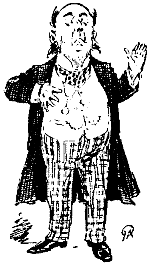
The Dream.—I was seated opposite a lady, popular alike in the
social and political world, whom I will designate as "Lady Jay."
It was at a dinner-party, I think, though it might have been some
other sort of entertainment, as there seemed to me to be, between
Lady Jay and myself, the narrow width of a very long table, the
ends of which were out of sight. This table was covered with a
white cloth, not too clean; and there were no knives, forks, plates,
or dishes. The room was inconveniently crowded by persons, inextricably
mixed up, none of whom, however, incommoded
us in the least, or, indeed, seemed to take
the slightest notice of our presence. Somehow, this
struck me as delicate conduct on their part. Lady
Jay was insisting that an Archimandrite could, or
could not, do something or other officially. But,
having more than once demonstrated to Lady Jay
that this act, whatever it was, had no essential
bearing on his clerical position, I continued to take
very slight interest in the discussion; at least, I
thought I did not, until, on Lady Jay suddenly
becoming dreadfully in earnest, and most positive
as to her being in the right, a Whip of the late
Government, whose name I could not recall, but
with whose lineaments I was perfectly familiar,
interposed some conciliatory remarks. Then Mr. Gladstone, in
the absence, unaccountably sudden, of both Lady Jay and the
Government Whip, strode up and down on the hearth-rug, rubbing
the back of his head with his left hand; whereupon I became aware
that we were no longer wherever I had been until the appearance of
Mr. Gladstone on the scene, but that we were in the library of the
Prime Minister's official residence in Downing Street. I was seated
in an odd sort of spider-legged arm-chair. Mr. Gladstone, bringing
himself to a halt, turned round, and asked me, pointedly, "Whether
I could play the piano." Being rather nettled at the tone of this
inquiry, which seemed to imply a doubt of my proficiency as a pianist,
I replied, somewhat testily, "Certainly; rather better than Beethoven."
Apparently satisfied with my answer, Mr. Gladstone said
that "if I would oblige him by not continuing my discussion with
Lady Jay, in which I had been," he admitted, "absolutely right"—and
here he made some facetious allusion as to ladies in general, of
which I could not catch one word—"I should," he went on, "have
a seat in the Cabinet." Oddly enough, this offer of his did not strike
me as anything so very extraordinary; and I at once replied, "No,
thank you, I'd rather not." But Mr. Gladstone would take no
refusal; he said, "I have come to a decision on this subject," and
then abruptly disappeared, through the wall. Whether it was a few
minutes, or hours, afterwards, I could not for the life of me determine,
being only conscious of some time having elapsed, before I found
myself in an avenue on the Bayswater side of Hyde Park, walking up and
down with Mr. John Morley. Our conversation there was, I suppose,
on the subject of Bulgaria, as this topic was continued by us in a kind
of narrow box-room, with hat-pegs on the walls, on which bathing-towels
were suspended; there were also trunks on the floor, and
school-desks all about, on one of which Mr. Morley rested his elbow,
swaying himself backwards and forwards like a pendulum, while
always talking to me (I was seated on a box), and uttering platitudes
about Bulgaria. I interrupted him by saying curtly, "It is no use
talking to me like that, as I am in the Cabinet." Mr. John
Morley
was staggered; but, recovering himself, he turned to Herbert
Gardner (to whom I apologised for not remembering his title, while
he, sitting on a smaller box, smilingly refused to enlighten me), and
asked for corroboration of my statement. Whereupon I produced
an autograph letter of Mr. Gladstone's to me, which
entirely satisfied
Mr. John Morley, who, having handed it to Herbert Gardner,
now candidly disclosed the schemes of the Government on the subject
in question, putting forcibly before me "how we are going to deal
with Bulgaria." Not a single word of what he said could I understand.
Still, as a member of the Cabinet, I felt bound to give his
explanations my gravest attention, my difficulty being not to expose
my hopeless ignorance by any inappropriate question. It was with
some new-born sense of importance that I found we were once again
in Lady Jay's company, this time in her drawing-room, and seated
in a low chair, while John Morley had brought with him the school-desk,
on which he was still leaning his elbow, and still swaying and
swinging like a pendulum. Lady Jay was all for resuming her discussion
about the Archimandrite, refusing to credit the assurances
given by Mr. Morley (balancing himself on his elbow) and myself as
to my being in the Cabinet secrets. At this point rushed in someone,
who was alternately Herbert Gardner and a Ponsonby, until he
settled down into being Herbert Gardner for certain, who
exclaimed excitedly, "I have just seen Mr. Gladstone! He says,
'It is absurd to suppose that his letter ever meant anything of the
sort!'" I quietly demanded the restoration of Mr. Gladstone's
letter to me; so did Mr. John Morley. The protean representative
of Herbert Gardner or Ponsonby, or anybody else, replied
simply,
"I haven't got it." This seemed to perfectly satisfy everybody, and
no further questions being forthcoming, Lady Jay seized the opportunity
to declare triumphantly, addressing me personally—John
Morley and the protean representative having disappeared—how
she had "ascertained from a Cardinal that".... But what was
the solution of the difficulty, or what was the original difficulty itself,
I shall never know in this world, though I may do so in the World
of Dreams, as here I awoke, and was so impressed with the reality
of the events that had passed, and with the present necessity for
recording them, that I at once entered them in my note-book, and
here they are.
(By "Hansom Jack.")
No. III.—SPORT—THE OVAL—GOOD OLD W. G.
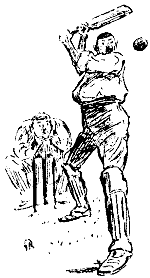
Sportsman? You bet! Where's the Cabby as isn't? It's born in the bones of us, somehow, I fancy.
'Ighly improper, I s'pose; but life's dull, and it's livened by something a little bit chancey.
Trying your luck's a temptation to most of us, own it or not. Wy, there's old Billy Barlow
Got as excited at winning a pig in a raffle as though 'e 'ad broke Monty Carlow.
Wot did 'e want with a pig? But 'twas pickings. Fifty-to-one chance pulled off; that's wot done it.
Bill swears 'is crock once run third in some 'Andicap. Wouldn't 'e like to 'ave owned it, and run it?
I 'ave drove cast-offs myself before now, broken-down old bits of blood. Ah! it's rummy
How "cracks"—of all sorts—come down in this world. It's fur easier, p'r'aps, to be cocktail or dummy.
Still I like "form," and I cannot help backing it, when there's a chance, in a oss most pertikler.
But all kinds o' sport cum excitin' to me, down from racin' to crioketin',—I'm not a stickler.
Few things more nicer, when summer sets in, than a chance fare out Kennington way in the day-time.
Bless yer. I've sit by that old Oval hoarding two hours by St. Mark's—ah! and more, during play-time.
Perched on my box with a heasy leg cock-over, I'm quite at 'ome in my private pavilion,
(That's wot I call it), a puffing my briar. Ah! cricket's the sport, after all, for the million.
Slap over from 'Arleyford Road to the Gasworks, I sweep the whole field and pay nothink. Wy, bless yer,
Young Thornton once slogged a hoff-ball through my winder as cost me two bob,—and I stood it with pleasure.
Seen Grace spank up more than one of 'is centuries, done "while I waited," most kind, like boot-soleing,
I know the old "Surrey Ring," and its chaff; and I'm not a bad judge of a bit of good bowling.
Lor! when the Mayblossom's out, and Grace in, with young Richardson pounding away at 'is wicket,
Jack isn't eager for no blooming fare as will take 'im away from the pick o' the cricket.
Well I remember that blue-gilled old buffer as wanted "King's Cross, and look sharp!" quite stercato
As Tenor Tim calls it. 'E weighed sixteen stun, and 'ad got a round face like a blooming tomato.
"Engaged, Sir!" I arnswers, quite heasy and haffable. Lor! 'ow 'e fumed, did that angry old josser,
Talked to me like a Dutch uncle, 'e did, or some Hemperor snubbin' a fourpenny dosser.
"Engaged, Sir, who by?"—"Mister Grace," I sez, artful, a-tipping the wink on the sly to the Peeler.
"Hordered me sharp for six-thirty, hay, constable?" "Right," sez the Slop. "Better try a four-wheeler.
Afternoon's 'ot, and you're not a light weight, Sir!" Oh lor! 'ow old crumpet-face slanged me and cricket.
Swore 'e'd ask W. G. if 'twos true, and 'e wanted to call 'im away from the wicket!
"Oh, shut your face and eat snuffers!" I sez; for the bowling just then was a-bein' fair collared,
And I 'ad missed two or three boundary 'its, all along o' this "fare," as 'e floundered and hollered.
"You ain't no sportsman!" That finished 'im proper, for 'e was a deacon, it seemed, out by Stockwell;
And didn't know Ladas from lucky Sir Visto, or Shrewsbury's "cut" from the "drive" of young Brockwell.
Well, I do get cricket-cracks for my fares. How the crowd gathers round with their eyes all a-glisten!
And 'ow big I feel; and lor! wot a temptation to look through the trap for a squint or a listen.
I've often druv Bishops and Premiers and such; but I doubt if the whole 'Ouse o' Lords took together,
Would match—say, Tom Sayers, or Stoddart or Grace after one of their six hours' slambanging the leather.
Sportsman? Oh yes, in my own 'umble way. But I ain't got the fever like Jerry-go-Nimble!
Poor Jerry! 'E carn't resist no sort of gamble, from Derby or Oaks to the pea and the thimble.
Mad on it, Jerry is. Bad when it's that way, the mischief in fack I like sport and a flutter
A bit within bounds; and if t'aint the best biz,—well there, life, after all, isn't all bread-and-butter!
"Hail, divinest Melancholy!" Decidedly the town of Penarth
must adopt this Miltonian line as its motto. At a meeting of the
Public Works Committee of the District Council, a letter was read
in which a citizen complained bitterly of the frivolous name given to
the street wherein he had his habitation. Gay Street! How too
shocking! "The whole neighbourhood objected to it," and not even
the assurance that the thoroughfare had merely been thus designated
out of compliment to a noble lady of the locality, whose Christian
name was "Gay," served to allay the righteous indignation. Away
with the demoralizing title and the base insinuation borne with it!
It was proposed that the street—being in the vicinity of All Saints—be
known for the future as "Amen Corner," a name suitable to the
unswerving sobriety and solemnity of the city. The proposal was
put to the vote and carried with only a couple of dissentients. Is it
possible that there are even two Penarthians in favour of gaiety?
A Matter of "Gorse."—Why will picnicers persist in being
so careless? The Liverpool Courier reports that a party of them
succeeded in setting fire to and destroying some 200 acres of gorse on
land belonging to Lord Cholmondeley and Sir Philip Grey
Egerton, at Broxton Hills, in Cheshire. Not only was the furze
completely burnt, but a "valuable fox cover" was also destroyed.
Shades of Jorrocks, M.F.H., and his huntsman, James Pigg, the
"canny" Novocastrian! Pity, that these reckless al fresco diners—ready
enough with their indignant resentment if turned off any
domain—could not be apprehended, and summarily dealt with.
Sportsmen will echo the words—adapted to the case in point—in
Handley Cross, "Cut 'em down, and hang 'em up to dry!"
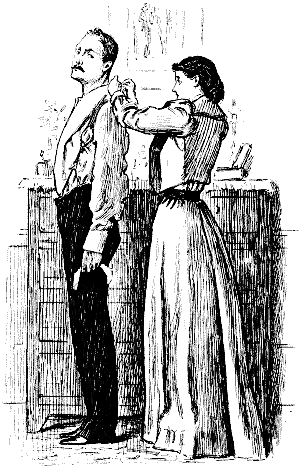
He. "That little Trip of ours to Boulogne never came off, after
all!"
She. "Nothing ever does come off—except
Buttons!"
(Fragment of a Romance found between Fleet
Street and the Kaatskill Mountains.)
Rip Van Winkle had slept (thanks to a
hypnotic trance) for a considerable time. On
opening his eyes he called for a paper. He
eagerly glanced through the columns, and
was absolutely baffled by the nature of their
contents.
"What is the matter?" asked a bystander,
who had watched his movements, not without
amusement. "Can I help you?"
"Well, yes," replied the sleeper awakened.
"When I commenced my slumbers all the
world was talking about the Armenian question.
Pray tell me, are the Powers going to
coerce the Turks?"
"No one knows, and no one cares," was
the prompt reply.
"And then there was the excitement about
our relation with the French in Africa. Will
the matter lead to international complications?"
"My good fellow, the matter does not
attract the smallest attention."
"Once more, there was the boom in gold
mines. Surely that is a topic of interest to
some one?"
"No, I fancy not," came the answer.
"Perhaps a few stockbrokers think about it—but
I doubt it."
"And how about the reserve of ammunition?
Have we got enough Cordite powder
or have we not?"
"Really I don't know, and don't care,"
smilingly replied the person Rip had accosted.
"And how about the Shahzada?"
"I believe His Highness has left England,
but the movements of the Afghan Prince
remain nowadays unreported in the daily
papers."
"You astonish me!" exclaimed Rip.
"Does nothing interest you?"
"Well, not such out-of-date matters as
those to which you have referred. My good
friend, you are talking of things that happened
ages—or to be quite accurate, about
three weeks—ago. They belong to the past."
"Then what is now engaging your attention?"
"Why, one subject to the exclusion of
all others—how to spend the recess!"
"Oh, indeed!" exclaimed Rip; and being
a reasonable sort of person he again sought
the good services of the hypnotist and went
to sleep, hoping to return to consciousness
when his countrymen had finished their
holiday.
A Song of the 172nd musical meeting of the Three
Choirs of Gloucester, Worcester and Hereford,
which opens at Gloucester on Tuesday, Sept. 10.
Air—"The Three Ravens."
There are Three Choirs—melodious three!—
Down-a-down-a-down-hey-down!
They are as fine as fine can be,
With a down!—
They're going at Gloucester for to meet,
By Tubal Cain, they're bad to beat.
With a down, derry, derry down!
Gloucester—Worcester—Hereford! Three!!!
Down-a-down, &c.
Hear them perform the "Mass in C"!
With a down!—
Cowen, Schütz, Parry, Lloyd, Macfarren!
You bet your boots they won't be barren!
With a down, &c.
Albani strong, clear Edward Lloyd!
Down-a-down, &c.
Ben Davies—won't he be enjoyed?—
With a down!—
And then there's clever W. Hann,
A brick, as fiddler or as man;
With a down, &c.
Again, Miss Rosalind Ellicott!
Down-a-down, &c.
That Bishop's daughter knows what's what,
With a down!—
Then C. Lee Williams, Gloucester's pride,
Conducts—himself and all beside.
With a down, &c.
They'll all go off, each Great Old Gun,
Down-a-down, &c.,
Handel, Beethoven, Mendelssohn,—
With a down!—
Nor, 'midst the old Titanic lot,
Shall Henry Purcell be forgot,
With a down, &c.
Ah! well-a-day! London admires,—
Down-a-down-a-down-hey-down
This Festival of the Three Choirs.
With a down!—
So heaven spare, music for to foster,
Hereford, Worcester, "Good old Gloucester!"
With-a-down-derry-derry-derry-derry-down!
News from the Provinces.—A gentleman
who was trying to cut a joke hurt himself
severely. He says he will never again
attempt the experiment, and his family express
themselves satisfied.
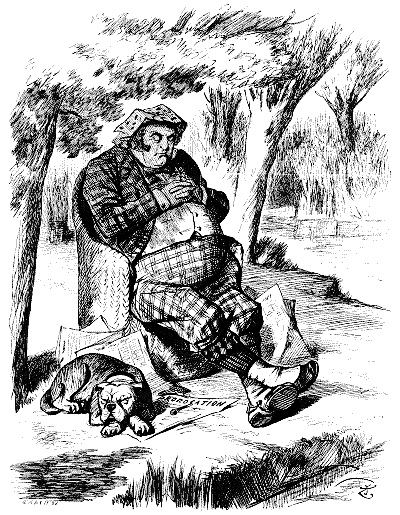
"FORTY WINKS!" — A HASTY INFERENCE. — ANOTHER DIALOGUE OF THE NIGHT.
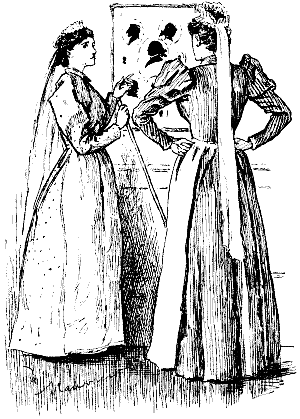
"And, me dear, if ye foind Misthress a bit hot-tempered
at toimes, ye mustn't moind it. The Family have black blood
in their veins. Just look at them Portraits of their Ancestors!"
Scene—The Shades at Nightfall. Swiftian Interlocutors as
before.
Mr. Neverout (reading). "I cannot but with some pride, and
much pleasure, congratulate with my dear country, which has outdone
all the nations of Europe, in advancing the whole art of
conversation to the greatest height it is capable of reaching."
Colonel Alwit. Ha! ha! ha! So wrote the Dean in the Eighteenth
Century. I wonder what he would say now!
Mr. Neverout (continuing). "The whole
genius, humour, politeness, and eloquence of
England are summed up in it."
Miss Notable. Oh la! Let anyone now
take a matron down to dinner, or sit out a
dance with a pretty girl!
Lord Sparkish. "The whole genius,
humour, politeness, and eloquence of England"
must have gone out with full-bottomed
wigs and hooped petticoats.
Lady Answerall. I protest that a neat
repartee, or a "smart turn of wit or
humour," is the rarest of things nowadays.
Lord Smart. Save among cabmen and
costers.
Sir John Linger. Faith, my Lord, your
street Arabs and gutter-snipes have a smack
of it. They are the true Neverouts and
Notables of the time.
Miss Notable. Sir John, you do me proud!
Mr. Neverout. Out on this pestilent, levelling
democracy, which brings even wit to its last refuge, the gutter!
Colonel Alwit. Better lie, like Sheridan, with Wit in the
gutter,
than perch, like H——y, with Dulness on the Woolsack!
Mr. Neverout. Egad! Miss Notable has wit at will.
Miss Notable. And Mr. Neverout would be Echo, were he not
Narcissus.
Lady Smart. Humph! We've had the "humour" and the
"politeness," now for the eloquence.
Mr. Neverout.
"Chloe, of every coxcomb jealous,
Admires how girls can talk with fellows."
Miss Notable.
In dinner's blanks, in dancing's whirls,
The fellows cannot talk with girls.
Lord Sparkish. Well capped, i' faith!
Sir John Linger. Will the New Woman talk, I wonder?
Lady Answerall. Nay; as she claims all Man's special privileges,
from votes to cigarettes, from bicycles to latch-keys, she will hardly
forego his most cherished and distinctive one—taciturnity!
Mr. Neverout. There was a travelling fellow awhile ago who hung
himself up in a cage in the tropical forests, to study the language
of—monkeys. Why did not he turn his attention to the equally
scanty, inarticulate, and unintelligible utterance of that Society
Simian, the haw-haw "Masher"—is not that the term for an up-to-date
dandy, my Lord?—of the banquet and the ball-room?
Lady Smart. Ah! now the eloquence-tap is turned on!
Mr. Neverout. But not like the Mulberry One's, at the main, your
Ladyship!
Miss Notable. Ah! if they had but companies to turn on talk at
pleasure, as they do gas and water!
Colonel Alwit. As it is, it comes like fountains in the desert or
Trafalgar
Square—only in intermittent spurts and squirts, not like the water
company's never-failing service, on the "constant supply" system.
Sir John Linger. Humph! An East-end fishmonger's comment
might throw some light on that subject, Colonel.
Lady Sparkish. Well, Sir John, we must admit that the growth
of Science keeps pace with the spread of Stupidity. So doubtless the
time will soon come when pocket-phonographs will obviate the necessity
of individual vocal efforts, and leave men to give undivided attention
to their dinners, matrons to their daughters' marriage-chances,
maidens to the marriageable men, and marriageable men to their—moustaches!
Mr. Neverout. Unless, indeed, when we know all we shall be
silent about everything.
Lord Sparkish. Quite likely, my dear Neverout. Already
talk—except
in spurts and spasms—is confined mainly to childhood—first
or second. Of the Seven Ages of Man—I say nought about Woman,
ladies!—why, the first and last only are loquacious.
Lady Smart. In which of the two garrulous stages would you
place Parliament, my Lord?
Lord Sparkish. The Commons in the former; the Lords in the latter.
Colonel Alwit. And the Hibernian Members?
Lord Sparkish. Oh, faith! an "iligant" blend of both!!!
Lady Answerall. Well, I agree with sweet William's
Gratiano,
that—
"Silence is only commendable
In a neat's tongue dried, and a maid not vendible."
Mr. Neverout. While your Ladyship speaks, speech will ever be
silvern!
Miss Notable. And silence is not yet golden—in the Shades.
ESSENCE OF PARLIAMENT.
EXTRACTED FROM THE DIARY OF TOBY, M.P.
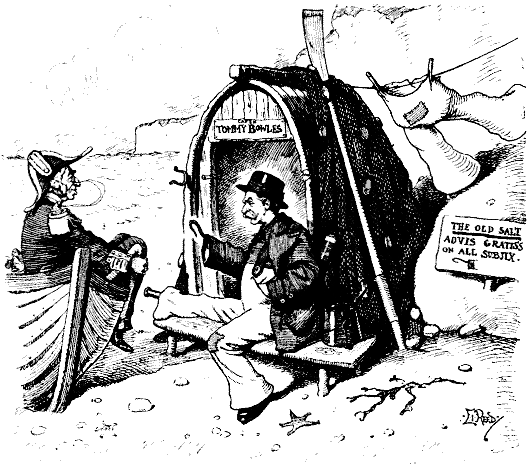
When in doubt, consult the Cap'en.
House of Commons, Monday, September 2.—A sight for Lords
and Commons to see Lord High Admiral Jokim seated between
Cap'en Tommy Bowles and Arnold-Forster, imbibing naval
information
at the pores, as Joey Ladle, in far-off-days, deep in the
recesses of his employer's cellar, took his spirituous refreshment.
"How happy could I be with either were t'other instructor
away," said Jokim, rubbing his pleased sides with rapturous
content. "Or, happier still," he added, sotto voce, "if both would
take themselves off."
In his secret heart the Cap'en looks upon Arnold-Forster as a
landlubber.
"He wouldn't," he says, with fine scorn, "know how to belay a
sheet when a ship was stepping fore and aft under a booming north-wester.
I'd lay a rope's end to a bumboat-man's back that he
couldn't pass a spare spar through the man-hole without first pulling
up the trysail."
Arnold-Forster, on his part, suspects the Cap'en hasn't seen
nearly so much of the wild ocean as casual observations dropped by
him may indicate. He makes much of certain variations in the old
salt's story of how he came to lose his hand in the service of his
country. There is, certainly, some doubt as to whether it was the
Prince Consort or Albert Prince of Wales who sent him that
famous letter accompanying the hook which at this day enables the
Cap'en to overhaul the estimates. But this is due rather to wealth
of experience than to poverty of veracity. When a man has seen
everything, gone so far, and knows so much as Tommy, he may be
forgiven if occasionally he mixes up a name or two, a date, or an
episode.
Some uneasiness in ministerial circles last week upon observation
of Macartney going about his country's business in white ducks.
These are, so to speak, Cap'en Tommy's colours. Always ducks
them when he goes on the warpath against the Admiralty. For
the Secretary of all men, he the only man, to follow Tommy's
example in this respect didn't look well. Was said to be a hint to
whom it might concern that if the department didn't treat him with
more respect, Macartney would carry over to the enemy his stored
wealth of naval knowledge. Since Private Hanbury got his
stripes, and is now referred to in debate as "The Honourable
Corporal," Cap'en has no party. With Macartney forming the
nucleus of one, who knows what might not happen?
House relieved to-night to find Secretary to Admiralty has hauled
down sign of revolt, and put on
ordinary trousers. If there was anything
in the incident, all is well
now. That there may have been
appears from the Cap'en's unusually
embittered tone when the
subject is alluded to.
"Call them ducks!" he cried in
scorn. "They were only white
drawers. No member of this House
should attempt to walk up the floor
in ducks unless he is prepared to
keep on his domestic staff a man
who has made the garment a life-long
study; who knows how to wash
it, starch it, iron it, and, above all,
to fold it up."
Business done.—Appropriation
Bill brought in.
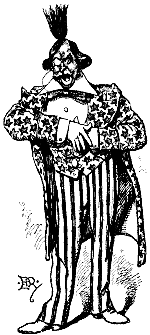
"Swaziland, my Swaziland."
Tuesday.—One decided advantage
of change of position of sections of
parties on formation of new Ministry
is to bring Silomio within reach of
Hemprer Joe's knobstick. In last
Parliament, united against common
enemy, Silomio was most deferential
to "my right hon. friend,"
while Joseph's respect for patriotic
instinct of Swazi Chief, whose
fathers, having come over with the
Conqueror, went out in the Mayflower,
was sometimes past expression.
Now Hemprer Joe has come
into his kingdom; his knobstick is
exchanged for a sceptre, whilst
Silomio begins to realise something
of the feelings of the Red Man when
harried by his haughty ancestors.
Like him, Silomio's possessions are
taken from him. His Civil Lordship
of the Admiralty is given to another,
and that other the son of his former
trusted right hon. friend.
When, therefore, to-night
Silomio, from his arid exile
below the gangway, sings
again his old song with its
low lament—
and when Hemprer Joe, to
the delight of scoffers opposite,
rolls him over and over,
pinks his fluffy eloquence with
scornful stiletto, no wonder he
turns at bay, and reminds
L'Hemprer of things he said
about Hercules Robinson at
a time he sat untrammelled
on Opposition benches.
Shaft goes home. L'Hemprer
very angry. "A statement
that ought not to be
made," he says, withering
Silomio with direful look.
Ministerialists loyally cheer;
Opposition lightly laugh;
Silomio, buffeted on all sides,
comforts himself with thoughts
of faithful friends in far-off
Swaziland. There is at least
one spot on earth where he is
appreciated. Soon he may
shake off from his mocassins
the dust of civilisation, and
hie him thither.
Business done.—Appropriation Bill read second time.
Wednesday.—Lo! the poor Indian Budget at last. 'Tis the poor
relation of Parliamentary Bills. At commencement of every Session
Members interested in India protest against Budget being postponed
till very last hours, when most people are gone away, and those who
remain are hopelessly weary. Secretary of State promises amendment.
Here we are something later than usual. Yesterday's sitting
was solemnly set apart for Indian Budget. Other things—Chitral,
Cotton Duties—crowded it out. Meekly looks in to-day, hoping it
doesn't intrude.
Strange peace fallen over House. Georgie Hamilton's voice
echoes over spaces desolate as the outlook of the rupee. Not a single
Irish Member left to object to anything. For them the scene of
conflict is transferred to Ireland. There the inoffensive Tim stands at
bay, Justin McCarthy having at length dealt him that "good hard
knock" the imminence of which E. R. lately forecast in these prophetic
pages. There William O'Brien, with wet handkerchief
mopping wetter eyes, tells stories out of school of Tim's unnatural
naughtiness when good Mr. G. was bringing in his Home-Rule Bill,
and upon other enticing occasions. There patriots bang their
brothers in pursuit of peace, and hate each other for the love of
Ireland.
"Did you ever," I in weak moment asked the unsympathetic
Sark, "read The Dead of Clonmacnois, a Gaelic lyric of a time
immemorial? There are two verses of the musical English rendering
that haunt me when I listen to an Irish debate.
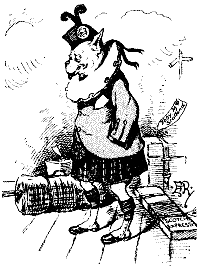
Exit Toby.
In a quiet watered land, a land of roses,
Stands Saint Kieran's city fair;
And the warriors of Erin in their famous generations
Slumber there.
Many and many a son of Conn the Hundred Fighter
In the red earth lies at rest;
Many a blue eye of Clan Colman the turf covers,
Many a swan-white breast."
"Pretty," said Sark,
with quite unexpected
approval. "First line perfection.
But, you will observe,
the poet studiously
refrains from affirming the
final extinction of the
family of the estimable
Conn. 'Many and many
a son,' he says, in the red
earth lies at rest. One at
least is left. They in
their time had Conn the
Hundred Fighter. We
have Tim the Hundred-and-Fifty
Fighter."
Business done.—All.
Thursday.—Parliament prorogued. World must go round as
best it may till February next.


