Notes from the Menu Card of Toby, M.P.
Hôtel Métropole, Wednesday Night.—Dinner in Whitehall Rooms
to celebrate completion of railway communication between Natal and
South Africa. Occasion important; list of guests comprehensive;
all the Colonies represented, whilst Don José, home from historic
Spain, happily typified the paternal British Lion glad to see its
cubs around it. Walter Peace, Agent-General for Natal, is the
Amphitryon—le véritable Amphitryon où l'on dîne. As Sark says,
"With Peace in the Chair and Plenty on the table, what more can
one desire?"
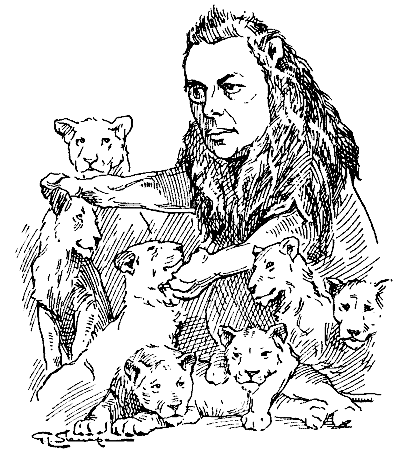
Joe Chamberlion encouraging the Colonial Cubs.
An excellent dinner, marked by an innovation against which protest
cannot be made too early. Between the entrée and the joint
cigarettes served.
Worse still, they were lit and smoked; timidly
at first, but weak-minded
men seeing others start also
made themselves
uncomfortable.
Room soon filled with poisonous smoke of tobacco
and paper. I like a cigar at dinner,
or even two—in proper place.
This spoiling of
the palate midway
through a meal was wanton
flying in the face of Providence
who had next provided excellent
saddle of Welsh mutton.
Custom of interpolating
cigarette has not even colonial origin to recommend it.
"Kicky" likes it, 'tis true. But the British public scornfully asks,
"Who's Kicky?" and will be no wiser if I tell them he's a capitalist.
After dinner, speeches. For a man whose breast is blazoned with
Victoria Cross, never saw anyone in such a funk as Redvers Buller
when he rose to reply to toast to the Army. Knees shook; manly
cheek blenched; evidently moment when he contemplated turning
his back on foe and bolting. But pluck of British soldier prevailed,
and he pulled through. If alternative were open to him, would
rather have gone through the Ashantee Campaign again, or worked
his way once more through the sad Soudan.
Nothing of this feeling apparent in demeanour of old friend
Martin F. Tupper. General impression is that, like Shakspeare,
he is dead. All a mistake; only changed his estate; dropped his earlier
initials; assumed name of Charles, with a baronetcy, the G.C.M.G.,
the C.B., and the High Commissionership of Canada. Talks prose
now instead of poetry. But the old style indelible, ineradicable.
His speech to-night marked by all the prosy, kindly, commonplace
verbosity of the Proverbial Philosophy of his earlier state.
Don José, rising to respond to toast of his health, met with hearty
reception. Misguided man at end of room proposed to greet him as
"a jolly good fellow." Effort well meant; had the songster
managed, at outset, to strike right note, the thing might have been
done. As it was inappropriateness of this particular hymnal, combined
with a certain flatness in the opening notes of the songster,
chilled the choir. As Sark says, "jollity not precisely the quality
one associates with Joe." So the melody, after feebly fizzling round
the tables, was drowned in burst of laughter.
Occasion was, as Don José remarked, first time he had publicly
appeared in capacity of Minister for the Colonies. In every way
a happy one. A gathering representing the uttermost corners of the
Empire, each vying with the other in loyalty to Crown. New Secretary,
with easy grace, rose to height of situation. Struck lofty note
in his picture of our fellow-subjects throughout the world recognising
the great inheritance that has befallen them by mere virtue of
their citizenship. "They must feel," he said, in ringing voice that
found echo in the crowded room, "that no separate existence, however
splendid, could compare with that they enjoy equally with ourselves
as joint heirs of all the traditions of the past, joint partakers
of all the influence, resources, and power of the British Empire."
A speech not too long, splendidly pitched, admirably phrased, full of
the old Palmerstonian ring, and yet, if closely examined, signifying
nothing likely to embarrass a Minister in future relations either
with Colonies or foreign powers. Just the thing for the hour, and
the place. Full of promise for fresh triumphs for Don José on the
new pathway he surprised some people by selecting as his own.
After the Colonial Secretary, the Lord High Admiral. Don
Currie, also, though in quite a different way, in his best form.
Could not look upon him as with clasped hands, and eyes upraised to
a perturbed firmament, he protested against continued absence of
imperial subvention of mail packets to the Cape, without thinking
what a tragedian is here lost to the stage!
Threw quite a fresh light on the Spanish Armada. "Why," he
exclaimed, "the Spanish Armada, with the assistance of Portugal
and Mexico, did not include as many ships as are under my management
in the Castle fleet!"
"Let us be grateful," said Sark, as the man in the hat and cloak
department handed him through the pigeon-hole someone else's
overcoat, "that Don Currie was not born before his time or out of
his place. Had he been a subject of Philip the Second, he would
certainly have commanded the Armada. In which case the whole
course of history would have been changed, and to-day Great Britain
would have been even as Cuba."
(Told by the Old Woman at the Farm.)
'Twere market day, and John were late,
I thart o' steppin' out up t' hill,
When there in t' road, 'gin barton gate,
I see a body, sim faint and ill.
'Twere one o' these yer cyclist folk,
Us ha'n't sin much on 'em Quantock way,
But Robert to Lunnon, he've often spoke
O' women in breeks—more shame, I say.
Well, there! 'twere one on 'em, sure as sure;
Look fair a-doneded—her must ha' bin—
So, breeks or no, when her knock on t' door,
"Wark in," I says to her. "Plase to wark in."
Her'd a summat to eat and drink, and then
Her do tark so fast as a chatter-pie
'Bout 't rights o' women, and tyrant men,
I tellee, her fair a-flummoxed I.
Such a power o' words, sim Latin and Greek,
As you couldn't tell up not one in ten,
And her said as us art for to vote and speak,
And be in t' Parliament, same as men.
And a tarr'ble plenty o' nonsense more—
The things some folk do get putt'n about
Afore John come home, us opened t' door.
And "Wark out, wull ee?" I says, "Wark out!"
What's in a Name?—The Hampshire County Council is dubious
whether it should surrender the title of "County of Southampton"
to the great borough, which Sir Charles Scotter has so greatly
benefited. Why not call the county Cockhamptonshire, a cognomen
which would en-hants its supremacy over the district with a similar,
but northern appellation? Those sensible county magnates
the Messrs. Portal are always open to a practical suggestion.
(On the Clyde.)
[What is called a "sympathetic" lock-out has been carried out by the
employers on the Clyde, in consequence of a strike on the Larne at Belfast].
Labour (after a celebrated model), loquitur:—
I sits with my hands in my lap,
And if any one axes me why,
I points out Belfast to the chap;
"It is 'sympathy' makes me," says I.
"Speed the Parting, welcome the coming Guest," or "The
'Outs and Ins' of it."—Lord Rosebery left Sandringham, and
Mr. Chamberlain arrived.
"O Reform it Altogether!"—The Lord Mayor's Show is a
thing of the past. It was better done last Saturday than it has been
on any recent occasion. But it would be "better done"—away with.
To Mr. Chamberlain as Colonial Minister.—Many Happy
Returns of his "Natal" Day.
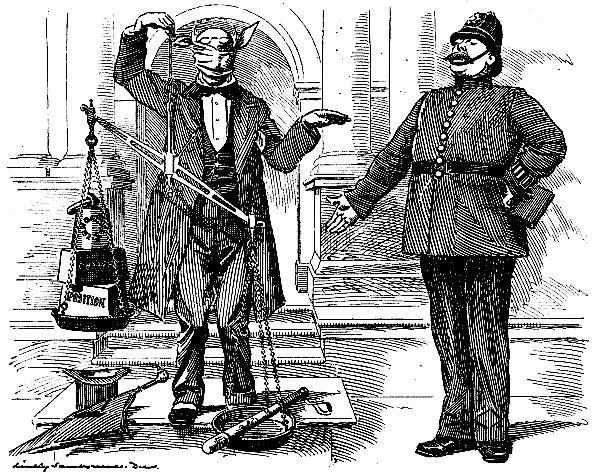
(Suggested by certain recent Cases in our Police Courts.)
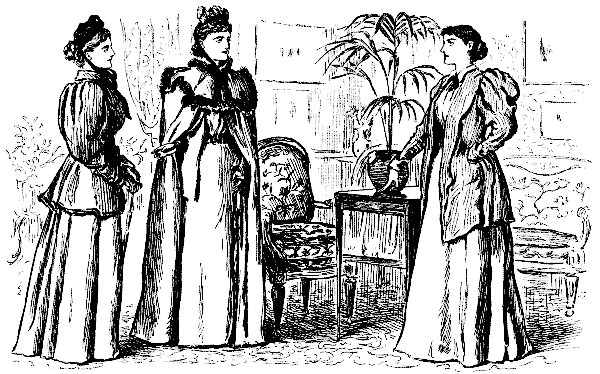
Customer (to famous Modiste). "I'm parting with my Maid,
Madame Aldegonde, and I should like to get her into your
Establishment."
Madame A. "What can she do?"
Customer. "She's already a very decent Dressmaker."
Madame A. "I'm afraid, Madam, that she would not do for most of
my Customers!"





