Scene I.—Terrace in front of quaint old country house.
Viola
Travers and Muriel Vane on garden-chairs.
Viola is twenty,
dark-eyed, and animated; she holds a scarlet parasol. Muriel
is eighteen; she has very fair hair, parted with puritanical
precision; the naïve innocence of her manner is not without a
suggestion of artistic premeditation.
Muriel (embroidering). It is a marvel to me, Viola, that
you can ever have a discontented moment in a house so Elizabethan as this.
Viola. It is lovely, Muriel; a background for mystery and
romance. And I have no romance. I have everything else; but I
have not a romance.
Muriel. You have Albert.
Viola. You know that Albert is not a romance.
Muriel. Once——
Viola. Ah, when everyone
opposed our marriage.
I married him for love,
and because he was poor
and "unsuitable." How
could I know that his
uncle would die and leave
him money and a country
house? Everything has
turned out so well! It is
rather hard to have made
"a good match," as they
say, without intending it.
Of course, I never reproach
him.
Muriel. No; you have
been very nice about it.
Viola. Albert is perfectly
happy, playing at
being a country gentleman.
He was so amazed
to find there were real
ducks and fowls in the
country—and buttercups!
He tells me everything.
He boasts we tell each
other everything. Oh! I
should so like to have
some little thing to conceal
from him—some secret, just for fun! Of course I should tell
him all about it afterwards, you know.
Muriel. I am sure you would, dear. You have dropped your
handkerchief.
(Muriel picks up handkerchief, book, and paper-knife,
and gives them to Viola.)
Viola. Dear Muriel, it is so nice to have you here. You are so
calm, and soothing, and decorative, and you never take anyone away
from anyone else!
Muriel. I think I have been rather unfortunate lately,
Viola.
No one seems to like me but middle-aged married men—often, too,
with whiskers!
Viola. You mean poor Mr. Averidge? He has been married so
long that he has forgotten all about it. To-night Claude Mignon is
coming to stay with us. He is the most accomplished idiot in
London. He sings, plays, paints, plays games, flirts—I think his
flirting, though, has rather gone off. It is getting mechanical. By
the way, have you an ideal, Muriel? I wonder what is your ideal?
Muriel (promptly and cheerfully). A man past his first youth,
who has suffered; with iron-grey hair and weary eyes, who knows
everything about life and could guide me, and would do exactly
what I told him.
Viola. And mine is a young man of genius, just beginning life,
with the world before him, who would look up to me as an inspiration—a
guiding star!
Muriel. You have dropped your handkerchief again, Viola. Who
is this coming out?
Viola. It is only Dr. Roberts. He has been to see Jane,
the housemaid. She has been rather ill.
Muriel. I suppose she had a housemaid's knee.
Viola. You are quite wrong. She had writer's cramp, poor thing!
Muriel. How absurd, Viola! How are you, Dr. Roberts!
[Dr. Roberts has iron-grey hair and dark eyes. As he joins
them Muriel leans down to pat a dog with all the graceful
self-consciousness of youth. Dr. Roberts looks at Viola
admiringly.
Viola. I hope poor Jane is better?
Dr. Roberts. Oh yes; she is quite out of the wood now, Mrs.
Travers. In fact, I don't think I need see her anymore.
(Muriel looks
up.) Perhaps though, I had better just look in—say—on Thursday?
Viola. Do; and stay and have some tennis.
[Dr. Roberts accepts with evident enthusiasm, and takes leave
with obvious regret.
Muriel (watching him drive away). Dr. Roberts admires you
dreadfully. Is that a romance?
Viola. For him perhaps—not for me! And it isn't a mystery!
[A telegram is brought in.
Viola. Oh, how delightful! Alan Roy, the wonderful boy
harpist, is coming down! He's coming by the early train! He'll
be here directly!
Muriel. You never told me you had asked him! I suppose you
forgot it—or remembered it. Doesn't he profess to be even younger
than he is? I mean, when he was four, didn't he say he was three?
I wonder if he'll come down in a sailor-suit.
Viola. He's quite nineteen. Here are those tiresome Averidges
again! I thought I got rid of them for a long drive. (Aloud.) Ah!
Here is dear Mr. Averidge!
Mr. Averidge (ponderously, to Muriel). And how is Miss
Vane
to-day? Looking as she always does, like a rose in June.
Muriel (coldly). Yes, Mr. Averidge?
Viola (to Mrs. Averidge and Albert,
who are coming up the steps
of the terrace). Alan Roy is coming down, the Alan
Roy. He will
be here directly.
Albert. All right, though I don't approve of child artists. Poor
little chap!
Viola. He is very nearly quite grown up, Albert! He has golden
hair and any amount of usage du monde.
Muriel. Albert will call it cheek—I daresay!
Mrs. Averidge. He is most amusing. I met him at Lady
Bayswater's.
He looks quite an angel playing the harp.
Albert. I hope he'll bring his halo in a hat-box. What is that
text about "Young lions do lack——"
Muriel. Oh, Albert!
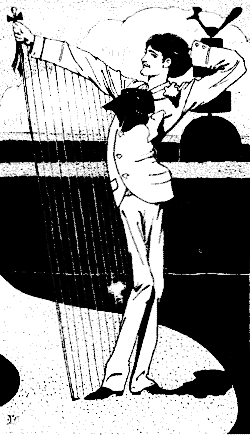
"Enter Alan Roy."
Servant. Master Alan Roy!
Albert (aside). Now, don't make the poor child shy.
Enter Alan Roy. Tall young man, in light grey suit. He wears a
turned-down collar, a pink button-hole, and carries a little stick.
Alan. How are you, Mrs. Travers? So sweet of you to ask
me! Isn't it a dear day!
[Greetings.
Mr. Averidge. And how did the infant prodigy manage to get
here all alone?
Alan. I pushed myself in a perambulator. Miss Vane, you look
like a Botticelli in a Paris dress. I didn't bring my harp, does it
matter?
[Chorus of sham disappointment and real relief.
Alan (smiling). It was dreadful of me! But I have been keeping
the poor thing up so late; I thought a rest——
[Lunch is announced. Muriel stoops to collect Viola's
handkerchief, &c.
Alan (to Viola). Oh, what a sweet scarlet parasol!
Curtain. End of Scene 1.
(To be continued.)
Neither Free Nor Easy.—The Larne Town Commissioners cannot
make up their minds whether they shall acquire the McGarel
Town Hall which apparently (to judge from a report in the Northern
Whig) appears to be in the market. The room, it seems, would be
used for a free library. The Committee, after a very lengthy discussion,
have adjourned the consideration of the question to some distant
date for further information. In the meanwhile, no doubt, they will
appropriately adopt for the municipal motto "Live and Larne."
[The great lack of the Age is its want of distinction."
Coventry Patmore.]
Alas, our poor Age! How against it we rage!
In the seat of the scorner the critics ne'er sat more.
If the pessimist bore would master her lore,
We've only to send him to Coventry—Patmore!
The bards do not love it. But how to improve it?
That question the poets, like that of the Sphinx, shun.
Distinction my lad? If the Age is so bad,
I think its "great lack" is not that, but extinction!
'Tis easier far to abuse it than mend it,
Must we try Morley's other alternative—end it?
A Musical Note.—Such has been the success of Mlle. Yvette
Guilbert, that, on dit (French must be used when speaking of this
lionne comique), it is not improbable she will be engaged to appear in
a part in the forthcoming Sullivan Savoy Opera, in which the relation
of librettists to composer is to be as two to one. If this be so, then once
more at the Savoy will there be a Sullivan-and-Guilbert Combination.


