EXTRACTED FROM THE DIARY OF TOBY, M.P.
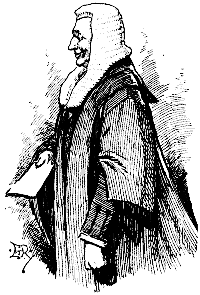
The Joys of Office.
"Speaker! Hats off, Strangers!"
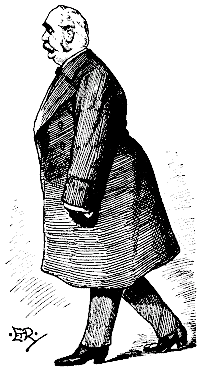
The Cares of Office.
Mr. Cawmel-Bannerman crosses the Lobby.
House of Commons, Monday, May 6.—Welsh Disestablishment
Bill on. So is The Man from Shropshire. Stanley Leighton, as
George Trevelyan pointed out long ago, is irresistibly like the
ruined Chancery Suitor of Bleak House. Always dashing into debate
as The Man from Shropshire broke in on the business of the Court of Chancery.
"Mr. Chairman!" he shouts, and waves his arms, as The Man from Shropshire
cried aloud, "My lord! My lord!" and tried to seize the Lord Chancellor
by wig or neck. After first ebullition, our Man from Shropshire
quietens down. Argues with gravity of tone and manner that seem to imply
he has something to say. Turns out he hasn't; but, on the Welsh Disestablishment
Bill, that no matter.
Curious how this Church Bill brings to the front men who, if heard
at all, certainly do not speak in chorus on any other question. After
The Man from Shropshire comes Tomlinson, who, early in proceedings,
displays irresistible tendency to discuss points of order with
Speaker. New Speaker has, however, already got hand in, and,
before Tomlinson, who remembers being on his feet addressing Chair,
quite knows where he is, he finds himself sitting down again, Cranborne
also on warpath, his very hair bristling with indignation at this
fresh attack on the Church. Glib Griffith-Boscawen
has a field-night; makes long speech on moving Instruction
standing in his own name. His obvious, unaffected enjoyment of his
own oratory should be infectious; but isn't.
Colonel Lockwood, that pillar of the Church, was
the first called on in Committee to move amendment.
Colonel not in his place. Report has it the devout
man is in library reading Thomas À Kempis, or Drelincourt
on Death. Here is opportunity for Glib-Griffith
to make another speech. Dashes in; starting
off with promise of good half-hour; desire for Lockwood's
appearance irresistible. As Addison says, with
hereditary disposition to drop into poetry, and the belief
that he is quoting Tennyson,
Better fifty words from Lockwood
Than a thousand from Boscawen.
Scouts sent out in all directions. The Colonel discovered in sort of
oratory he has contrived in far recess of library. Brought back to
House; found Boscawen bowling along. "This is my show," said
the Colonel as he passed Boscawen on his way to his seat. More
fierceness in his eye than befit the man or the occasion. Boscawen
stared over his head, and went on with his speech. Opportunity too
precious to be lost. If Lockwood meant to move his amendment he
should have been there when called upon. He wasn't: Boscawen
found it, so to speak, by roadside. Now it was his; would make
the most of it; pegged along whilst the Colonel muttered remarks
as he glared upon him. Some who sat by said it was a prayer.
Others, catching a word here and there, said it was a quotation from
Thomas À Kempis. Whatever it might have been, Colonel seemed
much moved. Hardly pacified when, at end of twenty minutes,
Glib-Griffith sat down, and Lockwood, finding himself in
peculiar
position of seconding his own amendment, delivered the speech he
had prepared for moving it.
Business done.—Got into Committee on Welsh Disestablishment
Bill.
Tuesday.—Pretty to see Prince Arthur drop down on George
Russell just now for speaking
disrespectfully of Silomio. That
eminent patriot, having in his
newly-assumed character of Patron
Saint of Japan, cross-examined
Edward Grey upon latest Treaty
negotiations, accused Asquith of
nothing less than stealing a county.
"Filching" was precise word,
which has its equivalent in Slang
Dictionary in sneaking. Idea of
Home Secretary hovering over
the Marches in dead of night, and,
when he thought no one was looking,
picking up Monmouthshire,
and putting it in his coat-tail
pocket, amused scanty audience.
But Silomio really wrath. "Always
Anti-English this Government,"
he exclaimed, with scornful
sweep of red right hand along line
of smiling faces on Treasury Bench.
"A stirring burst of British patriotism,"
George Russell characterised
it. John Bull in
excelsis. The more notable since,
on reference to official record, he
found the Knight from Sheffield
was born in the United States,
and descended from the Pilgrim
Fathers.
"Which one?" inquired voice
from back bench, an inquiry very
properly disregarded. (A new
phrase this, Sark notes, for use by
retired tradesmen, setting up to spend rest of useful lives in retirement
at Clapham or Camberwell. To trace their family tree back to
transplantation at period of Conquest, played out. Instead of
"Came over with the Conqueror," newer, more picturesque, equally
historical to say, "Came over with the Pilgrim Fathers.")
Prince Arthur not in mood for speculation of this kind. Cut to
the heart by remarks he suspected of slighting intent towards his
friend and colleague. In Silomio Prince Arthur has long learned
to recognise all the graces and all the talents. Apart from personal
consideration, he feels how much the Party owe to him for having
raised within its ranks the standard of culture and conduct. To have
him attacked, even in fun, by an Under Secretary, was more than
he could stand. So, in gravest tone, with no flicker of a smile on his
expressive countenance, he declared that a more unfortunate speech
he had never heard. "If the hon. gentleman intends," he added,
"to take a considerable part in debate, I would earnestly recommend
him either to change the character of his humour, or entirely
to repress the exhibition."
Beautiful! In its way, all things considered, best thing Prince
Arthur has done this Session. House grinned; but two big hot
tears coursed down cheek of Silomio, making deep furrows in the
war paint.
"That's tit for tat with Georgie Russell," said Herbert
Gardner to Solicitor-General, with vague recollection of a
historic phrase.
"Quite perfect," said Lockwood. "But what a loss the stage
has sustained by Prince Arthur taking to politics? Tried both
myself and know something about it." Business done.—An eight
hours day with Welsh Disestablishment Bill.
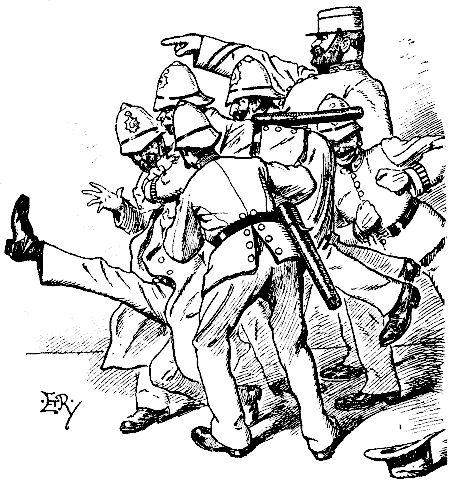
Piling Peeler upon Rossa!
Thursday.—Tanner's curiosity inconveniently uncontrollable.
At end of sitting given up to Scotland no one thinking about
Commander-in-Chief or Tanner either. Successive divisions had
carried sitting far beyond midnight, that blessed hour at which, in
ordinary circumstances, debate stands adjourned. Quarter of an hour
occupied in dividing on question whether they should divide on amendment.
Proposal affirmed; another quarter of an hour spent in fresh
division. Nothing possible further to be done, Members streamed
forth, scrambling for cabs in Palace Yard. Conybeare in charge of
a Bill dealing with false alarms of fire, managed to get it through
Committee unopposed. Members little recked how near they were to
real alarm of worse than fire.
Twenty minutes earlier, when last division taken, over 330
Members filled House. Now the tide ebbed; only the thirty odd
Members in their places jealously watching Speaker running through
Orders of the Day. Tanner bobbing up and down on bench like
parched pea. Heard it somewhere whispered that Duke of Cambridge,
worn out with long campaign, about to unhelm, unbuckle
his sword, hang up his dinted armour. Tanner feels he can't go to
bed leaving unsettled the problem of truth or phantasy. Not a
moment to be lost. Speaker risen to put question "That this House
do now adjourn." Then Tanner blurts out the inquiry, "Is it
true?" "Order! order!" says
the Speaker. Well, if they didn't
like the question in the form he
had first put it, he would try
again.
"I would ask," he said, adopting
conditional mood as least likely to
hurt anyone's feelings, "whether
a member of the Royal Family
who has really" (most desirous of
not putting it too strongly, but
really you know) "been drawing
public money too long is going to
retire?"
"Order! order!" roared the few
Members present.
"I would ask that question,"
repeated Tanner, still in the conditional
mood, but nodding confidentially
all round.
The Blameless Bartley happily
at post of duty. Broke in with
protest. Speaker ruled question
out of order. But the good Tanner
came back like a bad sixpence.
"Is his Royal Highness going
to retire?" he insisted, getting redder
than ever in the face. "Order!
order!" shouted Members in chorus.
Thus encouraged, Tanner sang out
the solo again, "Is his Royal Highness
going to retire?"
That was his question. The
Speaker, distinctly differing,
affirmed "The question is that the
House do now adjourn;" which it did straightway, leaving Dr.
Tanner to go to a sleepless bed haunted by an unanswered question.
"What I should like," said Lieut.-General Sir Frederick Wellington
Fitz Wygram, who served in the Crimea with H.R.H., has
been in command of the Cavalry Brigade at Aldershot, and in other
positions come in personal contact with the Commander-in-Chief,
"What I should like," he repeated reflectively, stroking his chin,
"would be the opportunity, enjoyed from a safe distance, of hearing
the Dook personally reply to Tanner's interrogation."
Business done.—Wrangle all night round Scotch Committee.
Friday.—Squire sat through dull morning sitting listening with
air of pathetic resignation to Members talking round Budget. Quilter
led off with prodigiously long paper on the Art of Brewing Beer.
Seems they fill up the cup with all kinds of mysterious ingredients.
Brookfield, looking round and observing both Joseph and
Jesse
absent, whispered in ear of sympathetic Chairman that Birmingham
has reputation in the Trade of making and drinking beer containing
minimum of malt, maximum of sugar, and warranted to do the
greatest damage to the system. Squire, momentarily waking up
from mournful mood, observed that Birmingham is also headquarters
of Liberal Unionism. Might be nothing in coincidence, but
there it was. Rasch posed as the distressed agriculturist.
Jokim
tried to walk on both sides of road at same time, and Government
got majority of 24. Business done.—Budget Resolutions agreed to.
Yvette! your praise resounds on every hand.
And those laugh loudest who least understand.
Page 229: 'visistor' corrected to 'visitor'.
(Knock.) Ah, here comes my visitor. (Enter stranger.)
The illustration for 'The Old Crusaders' originally covered 2 pages,
pp. 234 and 235 (centrefold/centerfold), with a blank page on either side.


