(A Story in Scenes.)
PAST XXIV.—THE HAPPY DISPATCH.
"Perhaps it was right to dissemble your love, but——"
Scene XXXV.—The Morning Room. Time—About 1
P.M.
Undershell (to himself, alone). I'm rather sorry that that Miss
Spelwane couldn't stay. She's a trifle angular—but clever. It
was distinctly sharp of her to see through that fellow Spurrell from
the first, and lay such an ingenious little trap for him. And she
has a great feeling for Literature—knows my verses by heart, I
discovered, quite accidentally. All the same, I wish she hadn't
intercepted those snowdrops. Now I shall have to go out and pick
some more. (Sounds outside in the entrance hall.) Too late—they've
got back from church!
Mrs. Brooke-Chatteris (entering
with Lady Rhoda, Sir Rupert,
and Bearpark). Such a nice, plain,
simple service—I'm positively
ravenous!
Lady Rhoda. Struck me some of
those chubby choir-boys wanted
smackin'. What a business it
seems to get the servants properly
into their pew; as bad as boxin' a
string of hunters! As for you,
Archie, the way you fidgeted
durin' the sermon was down right
disgraceful!... So there you are,
Mr. Blair; not been to Church;
but I forgot—p'raps you're a Dissenter,
or somethin'?
Und. (annoyed). Only, Lady
Rhoda, in the sense that I have
hitherto failed to discover any form
of creed that commands my intellectual
assent.
Lady Rhoda (unimpressed). I expect
you haven't tried. Are you a—what
d'ye call it?—a Lacedemoniac?
Und. (with lofty tolerance). I presume
you mean a "Laodicean."
No, I should rather describe myself
as a Deist.
Archie (in a surly undertone).
What's a Deast when he's at
home? If he'd said a Beast now!
(Aloud, as Pilliner enters with
Captain Thicknesse.) Hullo, why
here's Thicknesse! So you haven't
gone after all, then?
Captain Thicknesse. What an
observant young beggar you are,
Bearpark! Nothin' escapes you.
No, I haven't. (To Sir Rupert,
rather sheepishly.) Fact is, Sir, I—I
somehow just missed the train,
and—and—thought I might as well
come back, instead of waitin' about,
don't you know.
Sir Rupert (heartily). Why, of
course, my dear boy, of course!
Never have forgiven you if you
hadn't. Great nuisance for you, though. Hope you blew the fool
of a man up; he ought to have been round in plenty of time.
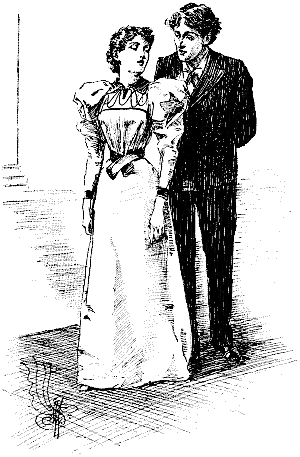
"Perhaps—when you come to think over it all quietly—you
will."
Capt. Thick. Not the groom's fault, Sir. I kept him waitin' a
bit, and—and we had to stop to shift the seat and that, and so——
Und. (to himself). Great blundering booby! Can't he see nobody
wants him here! As if he hadn't bored poor Lady Maisie enough
at breakfast! Ah, well, I must come to her rescue once more,
I suppose!
Sir Rup. Half an hour to lunch! Anybody like to come round to
the stables? I'm going to see how my wife's horse Deerfoot is
getting on. Fond of horses, eh, Mr.—a—Undershell? Care to
come with us?
Und. (to himself). I've seen quite enough of that beast
already!
(Aloud, with some asperity.) You must really excuse me, Sir
Rupert. I am at one with Mr. Ruskin—I detest horses.
Sir Rup. Ah? Pity. We're rather fond of 'em here. But we
can't expect a poet to be a sportsman, eh?
Und. For my own poor part, I confess I look forward to a day,
not far distant, when the spread of civilisation will have abolished
every form of so-called Sport.
Sir Rup. Do you, though? (After conquering a choke with
difficulty.) Allow me to hope that you will continue to enjoy the
pleasures of anticipation as long as possible. (To the rest.) Well,
are you coming?
[All except Undershell follow their host out.
Und. (alone, to himself). If they think I'm going to be
patronised, or suppress my honest convictions——! Now I'll go and pick
those—— (Lady Maisie enters from the Conservatory.) Ah, Lady
Maisie, I have been trying to find you. I had plucked a few
snowdrops, which I promised myself the pleasure of presenting to
you. Unfortunately they—er—failed to reach their destination.
Lady Maisie (distantly). Thanks, Mr. Blair; I am only
sorry you should have given yourself such unnecessary trouble.
Und. (detaining her, as she seemed about to pass on). I have
another piece of intelligence which you may hear less—er—philosophically,
Lady Maisie. Your bête noire has returned.
Lady Maisie (with lifted eyebrows). My bête noire, Mr.
Blair?
Und. Why affect not to understand? I have an infallible instinct
in all matters concerning you, and,
sweetly tolerant as you are, I instantly
divined what an insufferable
nuisance you found our military
friend, Captain Thicknesse.
Lady Maisie. There are limits
even to my tolerance, Mr. Blair.
I admit I find some people insufferable—but
Captain Thicknesse is
not one of them.
Und. Then appearances are deceptive
indeed. Come, Lady Maisie, surely you can trust Me!
[Lady Cantire enters.
Lady Cantire (in her most awful
tones). Maisie, my dear, I appear
to have interrupted an interview of
a somewhat confidential character.
If so, pray let me know it, and I
will go elsewhere.
Lady Maisie (calmly). Not in the
very least, Mamma. Mr. Blair
was merely trying to prepare me
for the fact that Captain Thicknesse
has come back; which was
quite needless, as I happen to have
heard it already from his own lips.
Lady Cant. Captain Thicknesse
come back! (To Undershell.) I
wish to speak to my daughter.
May I ask you to leave us?
Und. With pleasure, Lady Cantire.
(To himself, as he retires.)
What a consummate actress that
girl is! And what a coquette!
Lady Cant. (after a silence).
Maisie, what does all this mean?
No nonsense now! What brought
Gerald Thicknesse back?
Lady Maisie. I suppose the dog-cart,
Mamma. He missed his train,
you know. I don't think he minds—much.
Lady Cant. Let me tell you
this, my dear. It is a great deal
more than you deserve after—— How
long has he come back for?
Lady Maisie. Only a few hours;
but—but from things he said, I
fancy he would stay on longer—if Aunt Albinia asked him.
Lady Cant. Then we may consider that settled; he stays. (Lady
Culverin appears.) Here is your Aunt. You had better
leave us,
my dear.
Somewhat Later; the Party have Assembled for Lunch.
Sir Rup. (to his wife). Well, my dear, I've seen that young
Spurrell (smart fellow he is too, thoroughly up in his business),
and you'll be glad to hear he can't find anything seriously wrong
with Deerfoot.
Und. (in the background, to himself). No more could I, for that
matter!
Sir Rup. He's clear it isn't navicular, which Adams was afraid
of, and he thinks, with care and rest, you know, the horse will be as
fit as a fiddle in a very few days.
Und. (to himself). Just exactly what I told them; but the
fools wouldn't believe me!
Lady Culverin. Oh, Rupert, I am so glad. How clever of
that nice Mr. Spurrell! I was afraid my poor Deerfoot would have to
be shot.
Und. (to himself). She may thank me that he wasn't. And
this other fellow gets all the credit for it. How like Life!
Lady Maisie. And, Uncle Rupert, how about—about
Phillipson,
you know? Is it all right?
Sir Rup. Phillipson? Oh, why, 'pon my word, my dear, didn't
think of asking.
Lady Rhoda. But I did, Maisie. And they met this mornin',
and it's all settled, and they're as happy as they can be. Except
that he's on the look out for a mysterious stranger, who disappeared
last night, after tryin' to make desperate love to her. He is determined,
if he can find him, to give him a piece of his mind.
[Undershell disguises his extreme uneasiness.
Pilliner. And the whole of a horsewhip. He invited my opinion
of it as an implement of castigation. Kind of thing, you know, that
would impart "proficiency in the trois temps, as danced in the most
select circles," in a single lesson to a lame bear.
Und. (to himself). I don't stir a step out of this house while I'm
here, that's all!
Sir Rup. Ha-ha! Athletic young chap that. Glad to see him
in the field next Tuesday. By the way, Albinia, you've heard
how Thicknesse here contrived to miss his train this morning?
Our gain, of course; but still we must manage to get you back to
Aldershot to-night, my boy, or you'll get called over the coals by
your Colonel when you do put in an appearance, hey? Now, let's
see; what train ought you to catch?
[He takes up "Bradshaw" from a writing-table.
Lady Cant. (possessing herself of the volume). Allow me,
Rupert,
my eyes are better than yours. I will look out his trains for him.
(After consulting various pages.) Just as I thought! Quite
impossible
for him to reach North Camp to-night now. There isn't a
train till six, and that gets to town just too late for him to drive
across to Waterloo and catch the last Aldershot train. So there's no
more to be said.
[She puts "Bradshaw" away.
Capt. Thick. (with undisguised relief). Oh, well, dessay they
won't kick up much of a row if I don't get back till to-morrow,—or
the day after, if it comes to that.
Und. (to himself). It shan't come to that—if I can
prevent it!
Lady Maisie is quite in despair, I can see. (Aloud.) Indeed?
I was—a—not aware that discipline was quite so lax as that in the
British Army. And surely officers should set an example of——
[He finds that his intervention has produced a distinct sensation,
and, taking up the discarded "Bradshaw," becomes
engrossed in its study.
Capt. Thick. (ignoring him completely). It's like this, Lady
Culverin.
Somehow I—I muddled up the dates, don't you know. Mean
to say, got it into my head to-day was the 20th, instead of only
the 18th. (Lamely.) That's how it was.
Lady Culv. Delightful, my dear Gerald. Then we shall keep
you here till Tuesday, of course!
Und. (looking up from "Bradshaw," impulsively). Lady
Culverin,
I see there's a very good train which leaves Shuntingbridge
at 3.15 this afternoon, and gets——
[The rest regard him with unaffected surprise and disapproval.
Lady Cant. (raising her glasses). Upon my word, Mr.
Blair! If
you will kindly leave Captain Thicknesse to make his own
arrangements——!
Lady Maisie (interposing hastily). But, Mamma, you must have
misunderstood Mr. Blair! As if he would dream of——. He was
merely mentioning the train he wishes to go by himself. Weren't
you, Mr. Blair?
Und. (blinking and gasping). I—eh? Just so, that—that was
my intention, certainly. (To himself.) Does she at all realise what this
will cost her?
Lady Culv. My dear Mr. Blair, I—I'd no notion we were to lose
you so soon; but if you're really quite sure you must go——
Lady Cant. (sharply). Really, Albinia, we must give him
credit
for knowing his own mind. He tells you he is obliged to go!
Lady Culv. Then of course we must let you do exactly as you
please. (All, except Miss Spelwane, breathe more freely;
Tredwell
appears.) Oh, lunch, is it, Tredwell? Very well. By-the-bye,
see that some one packs Mr. Undershell's things for him, and
tell them to send the dogcart round after lunch in time to catch
the 3.15 from Shuntingbridge.
Pill. (sotto voce, to Archie). And let us pray that the
cart is
properly balanced before starting, this time!
Miss Spelwane (to herself, piqued). Going already! I wish I had
never touched his ridiculous snowdrops!
Lady Culv. Well, shall we go in to lunch, everybody?
[They move in irregular order towards the Dining Hall.
Und. (in an undertone to Lady Maisie, as they follow
last). Lady
Maisie, I—er—this is just a little unexpected. I confess I
don't
quite understand your precise motive in suggesting so—so hasty a
departure.
Lady Maisie (without looking at him). Don't you, Mr.
Blair?
Perhaps—when you come to think over it all quietly—you will.
[She passes on, leaving him perplexed.
Und. (to himself). Shall I? I certainly can't say I do
just——Why,
yes, I do! That bully Spurrell with his beastly horsewhip! She
dreads an encounter between us—and I should much prefer to avoid it
myself. Yes, that's it, of course; she is willing to sacrifice anything
rather than endanger my personal safety! What unselfish angels
some women are! Even that sneering fellow Drysdale will be impressed
when I tell him this.... Yes, it's best that I should go—I
see that now. I don't so much mind leaving. Without any false
humility, I can hardly avoid seeing that, even in the short time
I have been among these people, I have produced a decided impression.
And there is at least one—perhaps two—who will miss me
when I am gone.
[He goes into the Dining Hall, with restored equanimity.
THE END.
I have bin a having quite a long tork with a most respecful looking
Gent who tells me he is a reel County Counsellor, and that they
has a Gildhall of their own at Charing Cross, where they meets ewery
week, the same as the Common Counsellors does at their reel Gildhall
in the Citty, and that they has quite made up
their minds to make the two Gildhalls into one
and have them both for theirselves, and that
that will be what they calls Hunifikashun,
which means everything for them and not
nothink for nobody else.
Not content with what they have got allreddy
they means to have all the Citty Perlice, and
the Manshun House, and all the Citty's Money,
and the rite to all the Tems Water, and to the
Lord Mare and Sherryfs Carridges, and to the
Old Bayley, and to more other things than I can
manage to remember! And he really speaks of
all these warious matters jest as if he was quite
in ernest, and acshally expected as it woud all
be done by the next Parlement when they met
next year! And when he found as I reelly
didn't beleeve a word of his wunderful stories,
he acshally arsked me to go with him to their
Gildhall at Charing Cross, and there he put me
in a nice seat, and then I heard em all torking
away, jest as if they were quite in ernest, all about the many
wunderful things as they was about to do soon! Oh, I wunders how
long it will be before any on em reelly happens? Not in my life
time I'll be bound, nor most likely in nobody elses! Did any
reesonable man, woman or child ever hear such a pack of nonsense?
To acshally defraud the grand old Citty of Lundon, that is only jest
about seven hunderd year old, of all their priwileges and all their
rites and all their money! and then I shoud like to know what is to
become of me, and the duzzens like me? Nice lots of Lord Mares
and Alldermen these County Counsellors woud make! Why I
acshally douts whether they coud even manage to make up a decent
lot of Common Counselmen under at least a year.
There was one thing as I heard them squabling about while I was
there, and that was the nessessity of having some more lunatic
asylums, which did not much surprise me, as I shoud think they
will soon want a pretty good number for theirselves, if they continnes
to go on as they are going.
Brown told me a rayther funny story about the dredful solemnity
of these wunderful County Counsellors. He says they have by sum
means or other got the right of insistin that there shall be no fun in
the theaters, and no warking about between the hacts; and that the
publick got so disgusted with the silly regerlations, that in many
cases they left off going to them for ewer so long; but they are
better now, and will most likely soon go back to their old armless
jokes.
Robert.
(From some hitherto Unpublished Correspondence.)
["Photographs of ladies' feet are now taken in New York as souvenirs for
their admirers."—Globe, Dec. 6.]
... It is real kind of you, dearest, to mail your own laddie those
half-dozen lovely photographs, or should I call them footographs? I
can't say right here which I like best—they're all just fetching, anyway.
You bet, I'll treasure them some! I'll wear the midget
profile as a chest-protector right along, and put the full-foot
vignette under my pillow nights. And the three-quarter platino
shall go on my chimney rack—there's a considerable saucy look about
the big toe which I'm mashed on horrid. I guess you won't see such
a number-one instep as yours any time on these effete old London
side-walks. To look at the Britishers' foot-cases in Piccadilly makes
me tired, when I think of you any. I'll send views of mine soon in
exchange, but I reckon the naked truth might give you fits, so I'll just
sit with my rubbers on, and get the camera-man to map you off a
walking likeness of my right daisy-crusher. (My left is a trifle out
of focus.) Kind regards to you, Poppa....
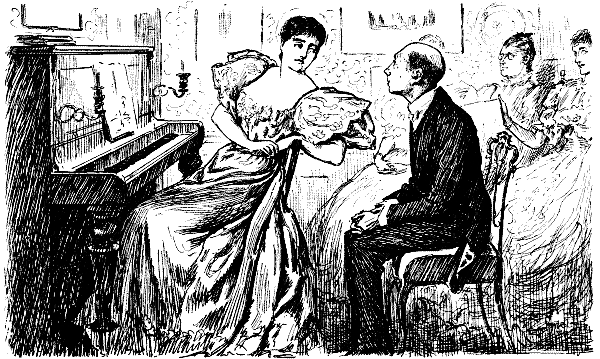
Miss Maud. "Won't you sing something, Mr. Green?"
The Curate. "I haven't brought my Music. But, if you know the
Accompaniment, and would play it, I think I could
sing 'The Brigand's Revenge'!"
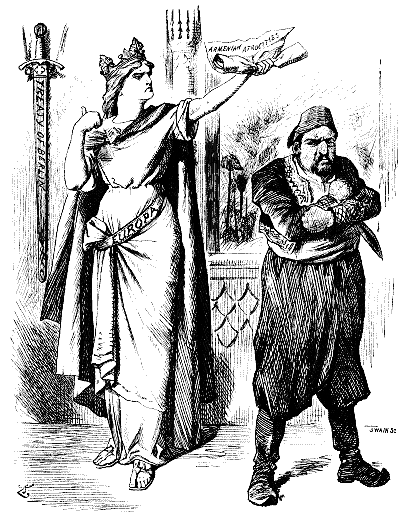
["It is impossible, we fear, to escape from the
conclusion that there is a substantial basis of fact
for the rumours ... of atrocities perpetrated by
Turkish troops on the Christian inhabitants of
Armenia.... By one of the Articles of the
Treaty of Berlin the Porte undertook 'to carry out
without delay the improvements and reforms demanded
by local requirements in the provinces
inhabited by the Armenians, and to guarantee
their security against the Circassians and the
Kurds.'"—"Times" Leader, December 4.]
Again! Is there nothing can humanise ever
The heart of Islam, that red-ravening wolf?
Will bonds of convention and treaty bridge never
Between Turk and Christian the broadening gulf?
Will no lesson teach, and will no promise tether,
The Ottoman hordes when let loose on the foe?
Must slaughter, and rapine, and outrage together,
The old vile triumvirate, fetterless go?
Time's fool seems the Turk, stern, unteachable, savage,
The fiercest fool-fighter on history's roll.
All indolent rest or undisciplined ravage.
The varnish of manner soaks not to his soul.
Red Man of the Orient, ruthless, untamable,
Neighbour, by fortune, in nothing near kin.
Humanity's brotherhood surely is blameable,
Leaving him free from Law's bondage to win!
In sheer self-defence we must muzzle and shackle
This wolf of the world; snatch its poor prostrate prey
From its crimsoning fangs. The old cynical cackle
Of "coffee-house babble" is silent to-day;
And a weapon's at hand, too long left there unlifted,
That Law and that Justice alike now commend
To the grip of Europa. Be murder short-shrifted
And bestial outrage meet summary end!
Not again must hot Islamite hate be permitted
In chase of creed-vengeance the East to embroil;
Not again must its prey fall unaided, unpitied,
The Gallio's mock, and the miscreant's spoil.
There hangs the good Berlin-blade, consecrated
By common agreement to Justice's work!
Be its blow not this time, as aforetime, belated!
Let Europe not bleed for the sin of the Turk!
New Parish-Council Version.
(By a Landlord and Lover of the Good Old Times.)
[At Merton, Surrey, where Mr. William
Morris has his factory, a blacksmith was highest
of the fifteen successful candidates for the Parish
Council, the vicar being eighth.]
Over the vicar, top o' the tree,
The Village Blacksmith stands;
The smith a mighty man is he,
With power in his strong hands;
And his victory well may stir alarms
In Squire-Parsonic bands.
The Squire looks black, his face is long,—
"Vicar not in the van?
Oh! things are going to the doose
As fast as e'er they can!
The blacksmith with his grimy face
Has proved to be best man.
"Week in, week out, he'll spout and fight!
We shall hear him bluff and blow.
He'll vote the good old times all wrong,
The good old fashions slow;
And won't he run the rates right up,
And keep tithe-charges low?
"He'll have his finger in the School,
He'll open wide its door;
He'll keep the Voluntaries starved,
And let the School-Board score.
And he'll want baths and washhouses
And villas for the poor!
"Then he may 'go for' the Old Church,
And rouse the village boys
To listen, not to Parson's drone,
But Agitation's voice,
And 'stead o' singing in the choir
He'll swell Rad ranters' noise.
"'Twill sound to him like Wisdom's voice,
Preaching of Paradise,
As though the thing were at his door;
Plumbed with Progressive lies,
He'll think his hard, rough hand will wipe
The Squire's and Parson's eyes.
"Broiling—orating—borrowing,
Swelling the rates, he goes.
Reform's raw task he will begin,
But who shall see it close?
Church will be robbed, and Land be sold.
Farewell old-time repose!
"'Tis thanks to you, my loud Rad friends,
These lessons you have taught!
By folly from the flaming forge
Our fortunes must be wrought.
And won't there be a blessed mess
Before the fight is fought!"
"AN OLD OFFENDER." — MARY JONES. — A VERY VULGAR BOY. — THE MODERN SOCIETY PLAY. — LOST IN LONDON. — INTER-UNIVERSITY FOOTBALL. — THE SUNDAY LECTURE CASE. — Prize Conundrum before Christmas. — THE PLUNGER. — NOTICES TO CORRESPONDENTS. — THE NEW NECTAR. — FIRST IMPRESSIONS. — THE TRUISMS OF LIFE. — A PRECISIAN. — OF VAIN COLOURS. — THE CHRONICLES OF A RURAL PARISH.
Europa. "AGAIN! BUT THIS TIME I HAVE A WEAPON AT HAND!"
(By her Husband.)
As I'm daily jolted down
On the early bus to town,
Through the yellow fog and brown,
O'er the stones,
I inhale the tawny air,
And I deem it ether rare,
For my soul is full of fair
Mary Jones.
Fellow-passengers are fain
To abuse the wind and rain,
And the weather, they complain,
Chills their bones:
But I laugh at snow and sleet
As I bump upon my seat,
For I'm thinking of my sweet
Mary Jones.
With a lightsome heart and gay
To the Bank I wend my way.
Where I calculate all day
Debts and loans;
Though anon my fancies flee
From the rows of £ s. d.,
And they wander off to thee,
Mary Jones.
And I cannot blame their taste,
Though a little time they waste
For my Mary would have graced
Monarchs' thrones.
What are pounds and pence to her?—
No. I cannot but concur
With their choice when they prefer
Mary Jones.
Then I hurry home to tea,
And I pass an A. B. C.,
Where I purchase two or three
Cakes and scones:
For I love the smiles that rise
In your laughing hazel eyes
When I offer you my prize,
Mary Jones.
And when tea is cleared away,
And you kindle me my clay,
As I listen to your gay
Dulcet tones,
Then I sometimes wonder who
In the world's the best to do?—
'Gad, it's either I or you,
Mary Jones!
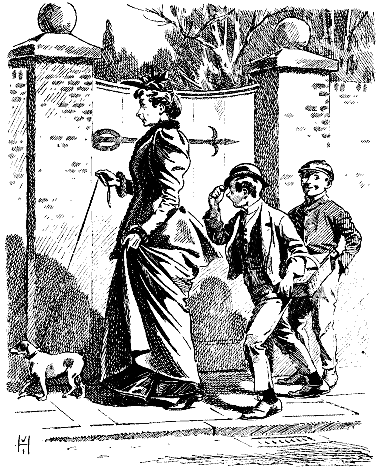
"Askin' yer pardon, Miss, but might that 'ere little Dog's Tail
ha' been cut off or druv' in?"
It surely should not be allowed,
The Modern Society Play,
That dreadfully shocking Kate Cloud,
That bad Mrs. P. Tanqueray.
That's what said
X. Y. Z.
It elevates everyone,
The Modern Society Play,
You stupid old son of a gun.
Replied, bursting into the fray,
Fearless, free,
H. B. Tree.
Why make such a clamour? Oh, blow
The Modern Society Play!
As nothing compels you to go,
X. Y. Z., you can just stop away;
Don't you see?
So say we.
- 1. Hymn-book stolen. Original price, in
superior binding, 11-¾d.
- 2. Hymn-book pawned for 2-½d. by thief.
- 3. Pawnbroker, finding my name inside,
tells Police.
- 4. Police inform me I can have the book
restored to me "on application."
- 5. Go to Scotland Yard. Told hymn-book is
at Bow Street. Cost of my journey so far, 4-½d.
- 6. At Bow Street have to take out summons
against Chief Commissioner! This is "the
invariable rule," I am informed. Cost of
summons and "service"—not the Church
Service—3s. Could have got three new hymn-books
with the sum.
- 7. Have to attend week later at hearing of
summons. Journey again 4-½d. Bow Street
not a nice court. Hymn-book restored to me.
- 8. Chief Commissioner appeals! Believes
there is another person of my name to whom
book may belong. "If I give it up quietly,
shall hear no more about it." Give up my
own hymn-book! Never!
- 9. Appeal dismissed. Attendance and costs
amount to £45. And I am the winning party!
- 10. Chief Commissioner "carries me" to
House of Lords, but does not pay carriage.
Preliminary costs, £80.
- 11. Long Vacation.
- 12. House of Lords sits. "Has no doubt
hymn-book belongs to other person of my
name." I to pay all costs in all Courts!
- 13. Ruined!
"I shall be all right again soon, I'll be
bound!" as a dilapidated First Edition observed.
[Yale v. Princeton University. "Before the
game commenced an Inspector of police, who was
on the ground, addressed the two teams, and
cautioned them against violent play. This warning
is without precedent in the history of the
University contests."—Reuter.]
Scene—Queen's Club. Oxford and Cambridge
Football Match. Teams undergoing
modern torture of ordeal by photograph.
Enter Police-Inspector, rampant,
supported by two Peelers proper. He
"addresses the two teams":—
I'm an Inspector bold, yet wary,
So, gents, you must all take care,
For I'm here to boss this battle,
And see that you all fight fair.
Now fisting, and scragging, and hacking,
Are all fair enough, we say,
But if gents exceed the limits
Of legitimate violent play,
We'll run them in, we'll run them in,
As sure as we're standing here,
We'll run them in, we'll run them in,
For the Peeler knows no fear!
Of course you may fight each other,
But you mustn't attack the crowd,
For we can't have unlimited bloodshed,
And weapons are not allowed.
So, gents, I must kindly ask you
To enter the field without
Your bludgeons and knives and pistols,
Or else, beyond all doubt,
We'll run you in, &c., &c.
[Teams join in chorus. Exit Inspector to
look after ambulance arrangements.
The Lord's Day Observance Society
Would make us all pinks of propriety—
All models of mental sobriety,
That is Stiggins and Chadband combined.
They gain, doubtless, some notoriety
By such overwhelming anxiety
To force on us their sort of piety
Of a most puritanical kind.
This Sunday at Home mental diet, I
Dislike, I would rather not try it; I
Suggest that, by way of variety.
Their own business now they should mind.
How to Make Life Happy.—An Infallible
Recipe:—Add fifty-nine to the latter half
of it. *** Solution will be given next week.
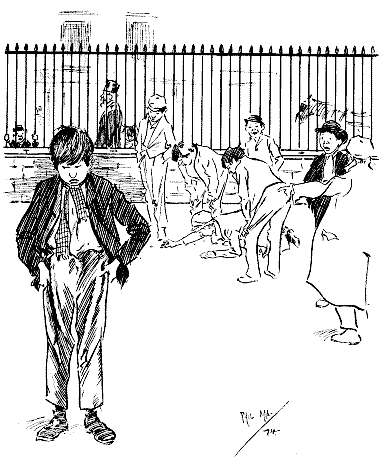
First Boy (much interested in the game of Buttons). "'As 'e
lost?"
Second Ditto. "Yes; 'e lost all them Buttons what 'e won off Tommy Crowther
yesterday, an' then 'e cut all the Buttons off 'is Clothes, and 'es lost them too!"
Kelt and Salted.—It may be true, as you have
heard, that Mr. Standish O'Grady intends to
supplement his series of Ossianic stories, Finn
and his Companions, by a work entitled Fin an'
Haddock. But, we confess, the story seems a
little fishy.
A Brummagem Spoon.—You are quite wrong.
The creation of the character of Rip Van Winkle
was, in point of time, far anterior to the invention
of the Self-working Noiseless Screw. Mr.
Chamberlain's playful application of the term
to Lord Hartington did not imply any proprietorship
in the article. The right hon. gentleman
was under the impression that he had
come across the character in the course of his
reading of Dickens' Christmas stories, and,
wanting to say something nice of his noble
friend, he just mentioned it. It led to some
misunderstanding at the time, but has now been
forgotten. See our answer to "Three Cows and
an Acre" in the Christmas Number.
Residuary Legatee.—Certainly you may
recover, especially if you can get A. to refund
the money. Don't hesitate to sue. We make a
practice of never accepting fees. The 6s. 8d.
you enclosed (in stamps, postal order preferable)
we shall, at the first opportunity, place in the
Poor Box.
Perplexed.—What do you mean by asking us
to tell you "If a herring and a-half costs three
hapence, how much will a dozen run you in
for?" This is just one of those simple problems
you can solve for yourself on reference to an
ordinary book of arithmetic. Do you suppose
we sit here to save the time of idle persons?
Our mission is to supply information drawn
from authorities not accessible to the average
subscriber.
Algernon and Sibyl.—Consult Sir George
Lewis, Ely Place, Holborn, E.C. We never
advise on delicate subjects such as yours. It is
impossible for us to reply to correspondents
through the post. Our motto is Audi altem
parterem. As the lady may not be familiar
with the dead languages, we may perhaps
do well to translate. Freely rendered,
it means, "We desire that all parties
(altem parterem) may hear and profit
by our advice."
One-who-has-had-no-rest-to-speak-of-for-fifteen-years-owing-to-neuralgic-
pains-and-a-next-door-neighbour-who-plays-the-piano-night-and-day.—No.
Beyond the Dreams of Avarice.—Your
record of an incident in the early
life of Mr. W. Astor is very interesting.
"Musing by the waters of the mighty
Hudson he," you say, "conceived the
ambition of becoming one of the richest
men in the world." It is pleasing to
know that his recent entrance upon journalistic
enterprise is likely to realise his
boyhood's dream.
Advertisement Agent.—There is, we
fear, no opening for you in this direction.
"Silonio" is not the name of a
new shaving soap, as you surmise. It
is the title of honour given by the delegates
of a remote but respectable African
race to a great and good British statesman.
Its literal translation into the
English tongue is, we are informed,
"Open-mouthed."
A Subscriber for Seventy Years.—Your
poem, commencing,
Diggle Diggle den,
How is Brother Benn?
Really, Mr. Riley,
Ain't you rather wily?
is perhaps a little monotonous in its interrogative
form. But it is not without
merit, especially from one of your
advanced age. A fatal objection is that
it should be out of date. The School-Board
Elections, we are glad to say, were
completed a fortnight ago. Try again—for
some other paper.
[Professor Huxley, at the anniversary
meeting of the Royal Society, suggested that
in the future imaginative speaking at their
dinners might be stimulated by the drinking
of liquid oxygen, bien frappé.]
Air—"Take hence the Bowl!"
Take hence the bowl; though beaming
Brightly as bowl e'er shone,
With Fizz sublimely creaming,
Or Port or Zoedone.
There is a new potation
To warm the hearts of men,
And wake imagination—
In Liquid Oxygen!
Each cup I drain, bien frappé,
My tongue pat talk can teach;
It helps to make me happy
In after-dinner speech.
At banquet, or at gala,
I match such mighty men
As Gladstone, Carr, or Sala,
On Liquid Oxygen!
A fig for Mumm or Massio,
Falernian and such fudge;
(Thin stuff those tipples classic
If I am any judge.)
But burning thoughts come o'er me
And fire my tongue, or pen,
When I've a bowl before me
Of Liquid Oxygen!
When fun needs stimulation,
Or fancy fails in fire;
When lags the long oration,
Or tongues postprandial tire;
Then take the tip Huxleyan,
And one long swig,—and then
You'll promptly raise a pæan
To Liquid Oxygen!
"There is nothing in Italy more beautiful
to me than the coast-road between Genoa and
Spezia." Remember these words of Dickens,
in his Pictures from Italy, as I start from
Pisa to see that lovely coast, and the Mediterranean,
for the first time.
Pisa is sleepy, but the railway officials are
wide awake. The man who sells me my
ticket "forgets" one lira. This answers
capitally with innocent old ladies from England
or Germany. The old lady counts her
change, and if she has carefully ascertained
the fare by reading the price marked on her
ticket, she finds at once that there is a halfpenny
wanting. She never learns that this
is the Government tax. "If you please," she
begins; or, "Bitte," and then she goes off
into—not hysterics, but French, and murmurs,
"Seevooplay, je pongse vous devays
avoir donnay moi un sou—er—er—more, vous
comprenny?" or, "Il y a encore—er—er—fünfzig,
vous savay, à moi à payer." Then
the official answers, also in French, "Ah
nong, Madame, ceci est la taxe doo gouvernemang
sul biglietto, capisce?"
Whereupon the old lady is so agitated by
the thought that she has wrongfully accused
him of stealing a soldo, that she never notices
that he has withheld a lira. If she counts
her money later in the day, she will blame
those nasty lira notes, which stick together
so, that she must have given two somewhere
instead of one. But the railway clerk is also
prepared for any more exacting stranger, and
holds the extra note ready for him. The
clerk at Pisa does so, handing it to me, without
a word of objection or explanation, as
soon as I ask for it. The system is as perfect
as it is simple. Having obtained my change,
I start for the Mediterranean.
A First Impressionist.
(By the Right Hon. the Author of "The Platitudes
of Life," M.P., F.R.S., D.C.L., LL.D.)
Chapter I.—De Omnibus Rebus.
"Ars longa, vita brevis;"1 and indeed
"man wants but little here below, nor wants
that little long."2 An oriental writer has
told us that "all flesh is grass," to which a
Scots poet3 has replied, that "A man's a
man for a' that." There is a Greek aphorism,
not sufficiently well known, which says γνῶθι σεαυτόν.
This has been ably rendered by Pope
in the words "Know thyself."4 Proverbially
"piety begins at home," but it is wrong
to deduce from this that education ends when
we leave school; "it goes on through life."5
Books are an educational force. They
"have often been compared to friends,"6
whom we "never cut."7 They "are better
than all the tarts and toys in the world."8
It is not generally known that "English
literature is the inheritance of the English
race,"9 on whose Empire, by the way, "the
sun never sets." We even have "books in
the running brooks," as the Bard of Avon10
tells us; so that not only "he that runs,"
but he that swims, "may read."
"Knowledge for the million,"11 is the
"fin de siècle"12 cry of the hour. But "life
is real, life is earnest,"13 and we have no
time to study original thinkers such as Confucius
and Tupper. "Altiora Peto"14 is a
saying for the leisured class only. The mass
must get its wisdom second-hand and concentrated.
If "reading maketh a full man,"15
this kind of reading maketh a man to burst.
Hence the "sad in sweet"16 of the book of
quoted platitudes. Yet, of course, "there
are great ways of borrowing. Genius borrows
nobly."17 And it is well to have "the
courage of" other people's "opinions."
But reading is not all. You must "use
your head."18 And you must, and can,
keep it too. For a good man's head is not
like a seed-cake that passes in the using.
And, again, remember the proverb that "manners
makyth man"; though this is not the
true cause of the over-population of our
islands. In social life much will depend on
the way in which you behave to others.
"Never lose your temper, and if you do, at
any rate hold your tongue, and try not to show
it"19—except, one may add, to a doctor.
Many people cannot say "No!" Others
early learn to say "No!" when asked to do
disagreeable things. "Mens sana in corpore
sano." If the last word is pronounced Say
No, this constitutes a word-play. There are
some bad word-plays in Shakspeare. I disapprove
of humour, new or old.
"No man who knows what his income is,
and what he is spending, will run into extravagance."20
Plutarch tells us of a man
whose income was £500, and he spent £5000 a
year knowingly. This must have been an
exceptional case. There is an obscure dictum
that "money is the root of all evil." "Gold!
gold!"21 said an ill-known poet, and, on the
other hand, "Hail, independence!"22 said
another. "If thou art rich, thou'rt poor"23
is on the face of it an untruth.
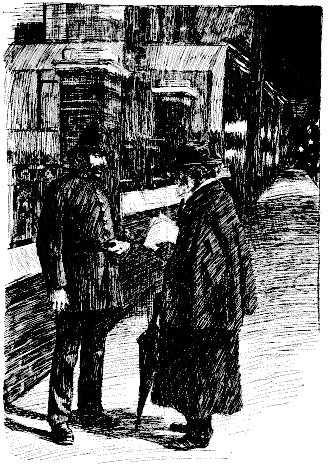
Professor Erasmus Scoles (of Epipsychidion Villa, St. John's
Wood). "Can you tell me,
Constable, whether there are any more—er—Atlantes to come up
to-night?"
D. 134. "Any More 'ow Much?"
When the century, growing a little bit mellow,
Produces carnations outrageously green;
When you notice a delicate, dairy-like yellow
Adorn the pale face of the best margarine;
When canaries, all warranted excellent singers,
Are sold in the street for a shilling apiece,
But at home all the yellow comes off on your fingers,
Substrata of brown making daily increase;
When a lady you happen to meet on a Monday
With hair that is grey, and with cheeks that are old,
Appears shortly after, the following Sunday,
With rosy complexion, and tresses of gold;
When a nursemaid has one of the worst scarlet-fevers,
Or merely, it may be, a fit of the blues;
When you're offered "Old Masters" as black as coal-heavers,
Or shirts of quite "fast" unwashoutable hues;
When a blue ribbon's equally known as denoting
Teetotal fanatics, a Rad, or a Tory—
In these and like cases too num'rous for quoting
Remember old Virgil, "Ne crede colori."
VI.—Preparing for the Poll.
When I do a thing, I like to do it properly, for even my
worst enemies, who call me a fool, admit that I'm a thorough fool.
I have accordingly lost no time in getting to work at my electoral
campaign. I commenced at a great disadvantage. The other seven
candidates were electioneering for a week before the Parish Meeting,
and the result was that they all
polled three times as many votes
as I did. That has happened
once. I don't intend that it shall
happen more than once.
"Vote for Winkins—a good All-round Man."
The first move I made was to
cover my house with placards. I
noticed that in a recent election
Mr. Athelston Riley had pursued
these tactics with great
success, so I plastered the whole
of the walls with "Winkins
for Mudford"—"Vote for
Winkins,"—but thereby hangs
a tale. I gave my instructions to
the local printer, and told him
where they were to be posted,
directing him to do it in the
twilight, so that the whole effect
might dawn once and for ever
upon an astonished village in the morning. He did it, but unfortunately
he didn't keep a proof-reader. I noticed next day,
before I went out, that all the school-children looked up at the
house and giggled. I thought it was merely the inappreciativeness
of the youthful mind. There I was wrong. It was the fact that the
children knew how to spell that caused the mischief. My house was
covered with appeals to "Wote for Vinkins!" It did not take
long to get new bills printed, but I am not disposed to deny I was a
trifle disconcerted by this false start.
I am now hard at work canvassing. My wife flatly declines to
help, and I'm afraid to suggest the girls should take the field in support
of their father. I tried to secure the services of the vicar's two
daughters, but he only wrote rather a stiff note to say that he thought
they would have quite enough to do in advocating his claims. I am
not always at one with the clergy, but for once I agree with him. I
have succeeded, however, in getting Miss Phill Burtt to help me.
Her full name is, of course, Phyllis; but it's always called and
spelt "Phill"—I could never understand why. She's a most delightful
girl, and is worth, at least, a hundred votes to me. As I explained
once before, she has an extraordinary habit of calling all the
villagers "idiots"—of course, I mean to her friends (such as myself),
not to the villagers themselves. I asked her one day why, if she
thought them idiots, she was kind enough to take the trouble to
canvass them. "Well, you see," she said with a charming smile that
was all her own; "I'm asking them to vote for you." At the time
I thought this was a pretty saying, prettily said. I even told it with
some amount of pride to my wife just to show her that there were
people who did not sympathise with her haughty indifference.
Curiously enough my wife only laughed consumedly. When she had
recovered, I asked her why she laughed. "Do you really mean to
say, Timothy," was her reply, "that you don't see what she meant?"
"Well, though it may seem idiotic...." I said, and was going to
add, "I don't," but before I said that, I did see what she
(Phyllis,
of course, I mean) might have meant. Yet I hope she didn't. Miss
Burtt has only one drawback as a canvasser. She is so ridiculously
scrupulous, I came across an old woman the other day who was quite
deaf to my appeals. Whilst I reasoned with her, I found out how
kind Phyllis was to her. "Miss Phill, she's really good to us
poor people. I'd vote for her if she was standing." I left, having
produced no impression. A day or two after I met Miss Phill
Burtt, and asked her to go and canvass the old woman; I felt sure
she could secure her vote. Will it be believed that she wouldn't?
She said it would be really undue influence if she did. How strange
that even the nicest of women are so strangely unpractical at times!
Another woman she refused to see because she never called upon her
at ordinary times. Still, with all her faults, Miss Burtt is a tower
of strength, and as I see her daily going about, canvass book in
hand, my hopes rise higher and higher.


