EXTRACTED FROM THE DIARY OF TOBY, M.P.
House of Commons, Monday, April 1.—There is about John Aird
an artlessness of look and manner the price whereof is beyond rubies.
Sark fancies it is the beard that has much to do with it. When you
get a man light-hearted as a boy endowed with long grey beard, complications
certain to ensue. Aird's beard has precisely same preternaturally
proper look whether he is sitting in parish church listening
to sermon, or dancing a hornpipe on the white deck of the P. & O.
Caledonia. Only he dances better than the average rector preaches.
Just the man to take part in the old Parliamentary game known as
asking friendly question. Usually played with Minister taking a
hand. If Treasury Bench wants to bring out some fact or appearance
of fact Whip gets Member on back bench to put question on
subject. Pretty to see Minister on such occasions; his startled look
on hearing himself addressed; his glance round to see if this is really
his hon. friend who is presuming to trouble him with what might be
awkward inquiry; then his slow, almost hesitating answer which
effectually corrects a calumny or nips a slander i' th' bud.
To-night, in view of pending division on second reading Welsh
Disestablishment Bill it was felt desirable to produce effect of overwhelming
national indignation at threatened spoliation of the Church.
Since Bill introduced petitions against it been dribbling in from
teeming population of English hamlets sternly saying This thing
shall not be. Apart from political importance of question, petitions
have peculiar interest as revealing existence of unknown clusters of
cottage homes. Thomas Hardy never invented such quaint, charming
names as the industry of compilers of petitions against this Bill
have brought to light. St. Dogmaels, St. Twynnel's, Pattiswick,
Neen Sollars, Chittlehamholt, Hampton Poyle. Woodeaton, Pawler's
Pury, Abbey Dore, Penwortham, Lillingstone Lovell, Crockham Hill,
Weston-under-Penyard, Itchen Stoke, Dunton Green—names musical
with the sound of church bells, sweet with the scent of newly mown
hay, the breath of cowslips.
This upheaval of the people on behalf of Mother Church loses its
effect by reason of ordinary procedure whereby petitions presented
at the Table are straightway thrust into a sack, and carted off to a
lumber room. Thing to do was to get Member to publicly inquire
from Chairman of Petitions Committee how the matter stood in the
ledger; how many petitions against Bill, how many in favour.
Who could do this better than John Aird? So he put question to
Dalrymple, and learned with dramatically ill-concealed surprise
that whilst over a thousand petitions against the Bill have poured in
on the House, not one had been received in its favour. It is true
that another question from opposite side of House brought out fact
that at least one of these State documents was result of labours of
wife of Clerk to Guardians of St. Asaph Union, who had been
instrumental in obtaining the unbiassed opinion of the resident
paupers on question at issue. But that a mere detail.
Business done.—Second Reading Welsh Disestablishment Bill
carried by majority of 44 in House of 564 Members. "Clwych!
Clwych!" roared Mabon, and was with difficulty restrained from
singing "The March of the Men of Harlech."
Tuesday.—Evidently in for another dull time. Welsh Disestablishment
Bill off, enter Irish Land Bill. Time precious; business pressing;
every quarter of hour worth a Chancellor of the Exchequer's
ransom. Ministers anxious above all things to get along with
business. John Morley, accordingly, sets useful example by delivering
speech an hour and twenty minutes long. This, as he mentioned,
followed upon exorbitant demands on patience of House
when he introduced the Bill. Carson, not to be outdone, certainly
not to be blamed, took up about as much time. Later came St.
John Brodrick, astonished at his own moderation in speaking for
only seventy minutes.
"This is not debating," Sark says. "It is just making speeches
by the yard. Hasn't the remotest effect upon the human mind, still
less upon deliberate action of House. Isn't even pretence of a fight;
second reading will be passed without division; Bill will go to
Committee in precisely same state as would have been the case had
it been read a second time before dinner, and Members spent rest of
evening in bosom of their families. Towards end of Session there will
be complaint of nothing done. At least Treasury Bench mustn't lift
up its voice in reproach at such conclusion. If right hon. gentlemen
set us such evil example, they mustn't complain if we follow it."
House in desolate state throughout spirit-sapping performance.
Tim Healy sat it all out. Contributed almost only token of life to
the dull monotony. In dangerously explosive state. If anybody
had sat on safety-valve would have burst to dead certainty. Happily
got off a few life-saving grunts and groans. Played sort of chorus to
Carson's speech and Brodrick's monologue. They severely
ignored
him—treatment which had no effect on his exuberance of spirits.
"Who are these Irish owners," Brodrick asked, looking severely
across table at John Morley, "who want to buy their tenants'
interest in order to sell it at a higher price?"
"I'll give you their names," cried Tim, after the fashion of the
naughty boy safe at the outer edge of a crowd.
"I defy the right hon.
gentleman to produce a
single instance," Brodrick
continued, taking no notice
of Tim.
"I'll give you half a
dozen," shouted Tim, ever
ready to oblige, though
leaving it in doubt whether
the half dozen he offered
were lashes or other instances.
Then the policeman,
in shape of Speaker,
appeared on scene, and for
awhile there was silence on
the back benches, and dullness
regained its sway.
Business done.—Second
Reading Irish Land Bill
moved.
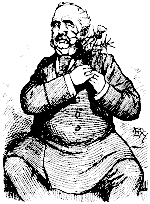
Campbell-Bannerman and his National
Emblem (Unsuited to the Convenience of
a Button-hole).
Thursday.—For illustration of soft answer that
turneth away wrath, Cawmel-Bannerman's
reply just now on the shamrock incident perfect in its way.
The heart of Ireland stirred by fresh stories of how her
sons, turning up on parade on St. Patrick's Day proudly wearing
shamrock, were ordered by brutal Saxon officers to "fling it on the
ground." Tim Healy had cases brought under his notice. Never
do for this branch of United Ireland to appear as sole champion of
national rights in this matter. So wearisome Willie Redmond
swaggers on scene with another case.
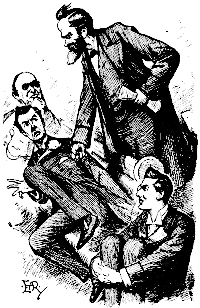
T. W. Russell between Landlord and Tenant.
A delicate subject for Secretary of State for War to handle.
On one hand, discipline must be maintained. On the other, national
sentiment must not be affronted, especially when represented
in House by sufficient votes to turn the scale in
any division. Cawmel-Bannerman not only said right
thing, but said it in right way. "I myself," he murmured
with prettily apologetic air, "stand in a somewhat neutral position,
because I belong to a country whose national emblem does not
lend itself to the convenience of the button-hole."
House laughed at idea of Cawmel-Bannerman
bustling in on St. Andrew's Day with bunch of thistles
in his button-hole. With the laugh the battle was won;
what might have been in less skilful hands an awkward
incident passed off amid genial laughter.
Business done.—Still explaining why we are not going
to oppose Second Reading Irish Land Bill, though we regard it as
most revolutionary and dangerous measure of recent times.
Friday.—Second reading Irish Land Bill through at last. Passed
stage without division, which seems odd considering apprehension
with which Opposition regard it. Situation largely due to Boanerges
Russell, one of few men who understand Bill. Explained it in
luminous speech, like some others thrown away on scanty audience.
Boanerges later indicated his impartial attitude by seating himself
between landlord and tenant, represented by Joseph of Birmingham
and son Austen. Joe incidentally mentions he has only one
tenant, that is Austen, "who," he added, with plaintive note,
which found echo with the Irish landlords, "pays no rent, and is
always coming down on me for compensation."
Business done.—Irish Land Bill read second time.
The present generation affirms that it cannot away with Pickwick,
and is not attracted by Vanity Fair. The balance of modern
opinion would be rather in favour of Thackeray than of
Dickens.
Take, for example, the two works already quoted, Pickwick and
Vanity Fair. A common modern objection made to Pickwick is,
that the characters in Pickwick are perpetually guttling or imbibing,
or both simultaneously. This is, to a certain extent, true. But how
about Thackeray's characters in Vanity Fair? A careful student
has sent us a list of the numerous eatings and drinkings in both
novels. In Pickwick, reckoning from the brandy-and-water partaken
of by Mr. Jingle, at the Pickwickians' expense, after the scene
with the pugnacious hackney-coachman, and finishing with the
breakfast that celebrated the marriage of Mr. Snodgrass with Miss
Emily Wardle, there are exactly (so we are informed) one hundred
and one instances of drinking and eating; some of them being of
drinking only, unqualified.
In Vanity Fair, from the introduction of Miss Pinkerton's
"seed cake," to Becky taking Amelia a cup of tea, vide
chapter
sixty-seven, we learn, on the same authority, that there are one
hundred and fifteen cases "allowed for refreshment" in some form
or other.
A collection of the meals of heroes and heroines in the most popular
works of fiction, and menus compiled therefrom, might be found
interesting, especially if carefully criticised by Sir Henry Thompson
in a separate chapter to be added to the next edition of his really
invaluable work, namely, Food and Feeding. Do the modern
novelists feed their characters as plentifully as did Dickens and
Thackeray theirs? Be this as it may, these two great Twin
Brethren—so utterly dissimilar in every thing except in the possession
of the gift of genius—fed their readers well and bountifully.


