(That is, if the House of Commons
were like our School Debating Society—as
indeed it is—and if its proceedings
were reported with the incisive brevity
of our School Magazine—and why not?)
On Wednesday the Society held its
2,187th meeting. There was some
regrettable rowdiness during Private
Business, and A. Moseley (Collegers)
had to be ejected for asking too many
questions. Members must not bring
bags of gooseberries into the debates.
In Public Business the motion was:—
"That in the opinion of this House
Science is better than Sport."
D. Lloyd George, Proposer (School
House), said that Science had won the
War, and quoted Wireless Telegraphy
and Daylight Saving to prove this. The
most successful Generals had had a
scientific training. His uncle had met
a General who knew algebra and used
it at the Battle of the Marne. Only
two first-class cricketers had ever been
in the Cabinet. Three scientists had.
The earth went round the sun. The
moon went round the earth. Rivers
flowed into the ocean.
An improving speaker, who is inclined
to be carried away by his enthusiasm.
Too many metaphors.
H. Asquith, Opposer (Collegers),
said that the speech of the hon.
Proposer was a tissue of fabrications,
as ineffective as they were insincere.
Never in the whole course of his career
had he encountered a subterfuge so
transparent, a calumny so shameless
as the attempt of the Hon. Prop., he
might say the calculated and cynical
attempt of the Hon. Prop., to seduce
from their faith the tenacious acolytes
of Sport by the now threadbare recital
of the dubious and, on his own showing,
the anæmic enticements of Science.
The War had proved that Science was
no good.
This speaker is steadily improving,
but he has a tendency to a "fatal
fluency," and he must beware of high-sounding
phrases. Also too many
passages in his speech sounded like
quotations.
A. Bonar Law, Seconder (Commoners),
said that the War had proved
that Sport was no good. Gas had been
invented by Science. He pointed out
the importance of astronomy in navigation.
A rapidly improving speaker. But
he must not mumble.
E. G. Prettyman (Hodgeites) said
that farming was both a science and a
sport. The canal system of Great
Britain had been neglected.
Some neat little epigrams.
Leslie Scott (Collegers) said that
his father was a lawyer. Science had
been used in the Russo-Japanese War.
This speaker was not at his best.
Perhaps it was the gooseberries.
Leslie Wilson (Hittites) said that
his Christian name was the same as
the previous speaker's—(Laughter)—but
his views were very different.
(Loud laughter.) He would like to
ask the House which had done most
in the War—Tanks or Banks.
The speech of the evening. Witty
and well-argued. But he must not
fidget with his waistcoat-buttons.
W. S. Churchill (Hivites) said that
this was a revolutionary motion. Sport
and Science must stand together. True
sport was scientific and true scientists
were sportsmen. (Applause.) Together
they would stand as an imperishable
bulwark against the relentless tide of
Socialism. Divided they would fall.
A steadily improving speaker, but
he must not recite.
H. A. L. Fisher (Collegers) was in
favour of Proportional Education.
E. Geddes (Perizzites) said he did
not mind what game he played. Rugger,
Soccer, Hockey, Cricket, Lacrosse,
Rounders—he was equally at home
with all of them.
An improving speaker. He must
not speak at the roof; there is no one
there.
F. Banbury (Sittites) must not go on
and on.
A. Mond (Moabites) must not fidget
with his feet.
H. D. King (Hivites) said that sailing
was scientific.
He has not been heard before.
R. Kenworthy (Day-boy) must not
be heard again.
R. Brace (Coalites) must not
wheedle.
Adamson (Coalites) must not shout.
A. Addison (Collegers) was inaudible
where we were.
E. Carson (Jebusites) was inaudible
everywhere. But we gather we did
not miss much. He must speak up.
W. Benn (Amalekites) was invisible.
A. Balfour (Stalactites) was insensible.
But why not sleep in the dormitory?
R. Cecil mi. (Parasites) must not
preach.
J. Devlin (Meteorites) said that Ireland
was a nation. But he must not get
excited.
R. Cecil ma. (Collegers) must not
eat while he is speaking. Otherwise a
gentlemanly speech.
The President summed up and the
Motion was carried by 12 votes to 11.
A. P. H.
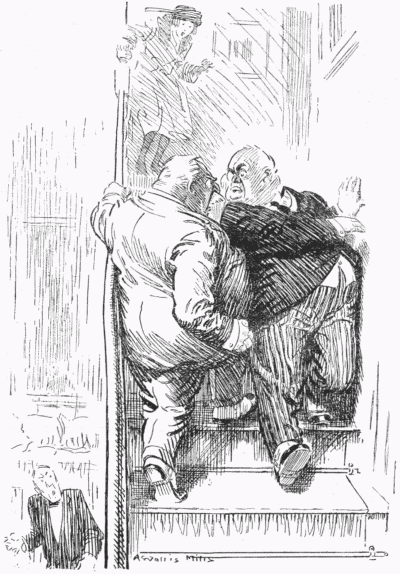
OUR ADMIRAL AND GENERAL, WHO ARE NOT ON SPEAKING TERMS,
FIND IT IMPOSSIBLE TO IGNORE ONE ANOTHER WHEN THEY MEET ON
THE STAIRS.
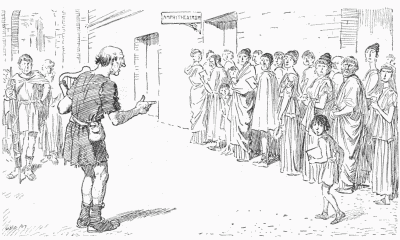
"Ladies and gents, I 'ope you will let me 'ave your kind attention while I give a rendering of 'Rule, Britannia,'
the national song of Britain, accompanyin' myself on the 'arp, wich I learned to play wen I was servin' in the army
of occupation in that remote and barbarous island."
Dear Mr. Punch,—This is one of
those social problems which end by
asking what A should do, only in this
case I want to know what you would
do.
It happened on the first day of my
leave, just after I had, as is my custom
on this day, had my hair cut and otherwise
made beautiful at a place in Bond
Street. (I am afraid this sounds as if
I was a rich man, but really I am a
Naval Officer.)
I was wearing—well, that would not
interest you, but it really was rather a
pleasant suit, with a hat which even
The Daily Mail could not improve
upon. Briefly, I was strolling along
in a perfectly contented frame of mind
when a horse, drawing a van, chose to
fall down right alongside me.
In a moment of rashness and chivalry—have
I said that the horse was being
driven by a girl?—I promptly sat on
the brute's head, an act which I had
always been told is the correct thing to
do, though, I should imagine, discouraging
for the horse.
In my haste I sat down with my
back to the van, so was unable to gauge
the progress of the refitting work which
was going on.
In an effort to convey to the crowd,
which had, of course, collected, that I
was in no way embarrassed, nay more,
that I was well accustomed to sitting
on horses' heads in the middle of Bond
Street, I lit a cigarette and tried to
look blasé, no easy thing to do in the
circumstances.
Small boys made tactless remarks
about my personal appearance and
eccentric habits, but I ignored them,
feverishly thinking that this adventure
would necessitate an early visit to my
club. I had just decided what brand
of cocktail would best meet the case
when I felt a tap on my shoulder and
looked up at a vast blue expanse which
I realised later was a policeman.
"If you've quite finished with that
there 'orse you're sitting on, young
man," he said, "the leddy wants to
take it 'ome."
The crowd chuckled and I rose
hurriedly. Unfortunately, so did the
horse, urged on, possibly by the cries
and kicks of several willing helpers, or
possibly by the sight of his mistress,
who had come up, I hoped, to thank me.
Not only did the horse rise, but he
rose at full speed and without giving
me time to get my foot off the rein on
which I was unwittingly standing.
My leg shot into the air and I lost
all sense of direction for a few seconds.
Then a slight shock, and I found myself
clasping the "leddy" firmly round
the neck.
At this juncture my aunt appeared.
My aunt, I should explain, is nothing
if not dignified. She is built on the
lines of a monitor, bluff in the bow,
broad in the beam, slow and majestic
of movement. Her lips were moving
feebly when I saw her, but she uttered
no sound, uncertain, I suppose, whether
to intervene or to pretend that I was
in no way connected with her.
Paralysed by her arrival, I saw her
slowly take in the scene. Her eye
wandered from the policeman to me,
from me to the unfortunate girl to
whom I still clung. I could see her
jumping—no, moving ponderously—towards
the wrong conclusion.
Mr. Punch, what would you have
done?
Yours faithfully, An N.O.
[Your first thought should have been
for the girl, whom you had clearly compromised
in your aunt's eyes. You should
at once have introduced her to that
lady as your long-lost fiancée. Later
in the afternoon you could have called
on your relative and told her that you
had mislaid the girl again—this time
irretrievably.—Ed.]
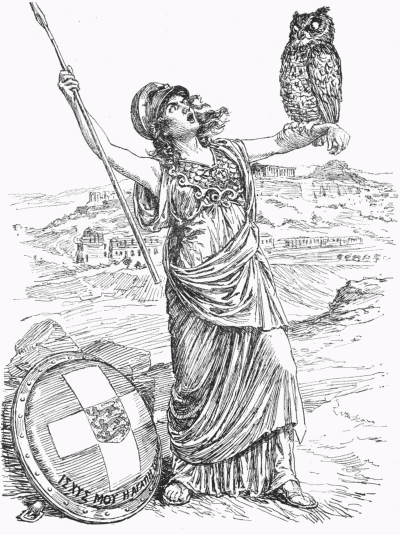
Athena (to her Owl). "SAY 'TINO'!"
The Owl. "YOU FORGET YOURSELF. I'M NOT A PARROT. I'M THE BIRD OF WISDOM."
ESSENCE OF PARLIAMENT. — THE OVERLOADED OMNIBUS. — BRER RABBIT IN HIS ELEMENT. — AMOR TRIUMPHANS. — THE BOOT MYSTERY.
Monday, November 15th.—To induce
the House of Lords to accept a measure
for the compulsory acquisition of land
is analogous to the process of getting
butter out of a dog's
mouth; and it is not
surprising that Lord
Peel essayed the task
of getting a second
reading for an Acquisition
of Lands Bill in
rather gingerly fashion.
When one remembered
a racy correspondence
in the
newspapers over certain
Midlothian farms
one could hardly have
been surprised if the
Laird of Dalmeny
had reappeared in the
arena, flourishing his
claymore. But, alas!
he still remains in retirement,
and it was
left to Lord Sumner
to administer some
sound legal thwacks
and, in his own words,
to "dispel the mirage
which the noble Viscount
raised over the
sand of a very arid
Bill." He did not oppose
the Second Reading,
but hinted that if
ever it emerged from Committee its
own draftsman would not know it.
The President of the Board of
Trade must regard Monday with rather
mixed feelings. That is the day on which
Questions addressed to his Department
have first place on the Order-paper;
and accordingly he has a lively quarter-of-an-hour
in coping with the contradictory
conundrums of Cobdenites and
Chamberlainites. On the whole he treads
the fiscal tight-rope with an imperturbability
worthy of Blondin. A Tariff Reformer,
indignant at the increased imports
of foreign glass-ware, provoked
the query, "Does my hon. friend regard
bottles as a key-industry?" And a Wee
Free Trader who sarcastically inquired
if foreign countries complained of our
dumping cement on them at prices
much above the cost in this country
was promptly told that "that is the
very reverse of dumping."
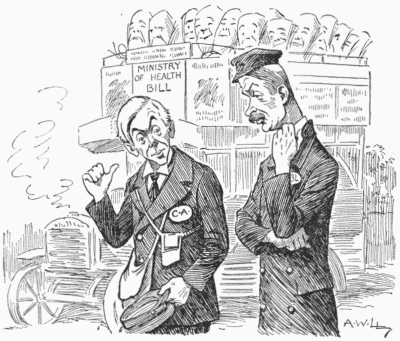
Conductor Addison (to Driver Law). "What, you can't get 'ome by Christmas
with all them passengers on top? Well, why didn't you tell me
before I took 'em on?"
Sir Donald Maclean was rewarded
to-night for all his uphill work as
leader of the Wee Frees before—and
since—Mr. Asquith's reappearance. On
the Financial Resolution of the Ministry
of Health Bill his eloquent plea for the
harassed ratepayers received an almost
suspiciously prompt response from Mr.
Bonar Law, who admitted that it was
inconvenient to drive an "omnibus"
measure of this kind through an Autumn
Session, and intimated that thirteen of
its clauses would be jettisoned. An
appeal from Lady Astor, that the
Government should not "economise in
health," fell upon deaf ears. Dr. Addison
not only enumerated the thirteen
doomed clauses, but threw in a fourteenth
for luck.
Tuesday, November 16th.—I don't suppose
Lord Crewe and the other noble
Lords who enlarged upon the theme
"Persicos odi" expected to embarrass
the Foreign Secretary by their cross-questioning.
Persia is to Lord Curzon
what "de brier-patch"
was to Brer Rabbit.
He has been cultivating
it all his life, and
knows every twist and
turn of its complicated
history, ancient and
modern. The gist of
his illuminating lecture
to the Peers was
that our one aim had
been to maintain Persian
independence
with due regard to
British interests, and
that it now rested
with the Persians
themselves to decide
their own destiny.
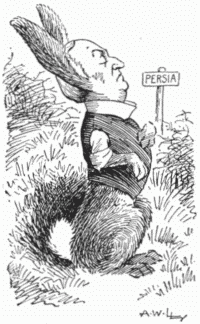
Lord Curzon.
Hopes of a relaxation
of the passport
restrictions were a
little dashed by Mr.
Harmsworth's announcement
that the
fees received for British
visas amounted
to some fifty per cent.
more than the cost
of the staff employed.
The Government will
naturally be loth to
scrap a Department which actually
earns its keep.
The War Minister was again badgered
about the hundred Rolls-Royces
that he had ordered for Mesopotamia.
Now that we were contemplating withdrawal
was it necessary to have them?
To this Mr. Churchill replied that the
new Arab State would still require our
assistance. A mental picture of the
sheikhs taking joy-rides in automobiles
de luxe presented itself to Mr. Hogge,
who gave notice that he should "reduce"
the Army Estimates by the
price of the chassis. A little later Mr.
Churchill came down heavily on an
innocent Coalitionist who had proffered
suggestions as to the better safeguarding
of the troops in Ireland. "Odd as
it may seem," he told him, "this
aspect of the question has engaged the
attention of the military authorities."
In the course of debate on the Agricultural
Bill, Mr. Acland hinted that
Sir F. Banbury, one of its severest
critics, was out of touch with rural
affairs. Whereupon Mr. Pretyman
came to the rescue with the surprising
revelation that the junior Member for
the City of London, in addition to his
vocations as banker, stockbroker and
railway director, had on one occasion
carried out the functions of "shepherd
to a lambing flock." The right hon.
Baronet, who is known to his intimates
as "Peckham," will have Mr. Pretyman
to thank if his sobriquet in future
is "Little Bo-Peep."
Wednesday, November 17th.—The
Lords, having welcomed the Bishop of
Durham—a notable addition to the oratorical
strength of the Episcopal Bench—proceeded
to show that even the lay
peers had not much to learn in the
matter of polite invective. Lord Gainford
invited them to declare that the
Government should forthwith reduce
its swollen Departmental staffs and incidentally
relieve our open spaces from
the eyesores that now
disfigure them. Perhaps
he laid overmuch
stress upon the latter
part of his motion, for
the Ministerial spokesman
rode off on this
line—Lord Crawford
confessing that his artistic
sensibility was
outraged by these "horrible
hutments"—and
said very little about
cutting down the staffs.
This way of treating the
matter dissatisfied the
malcontents, who voted
down the Ministry.
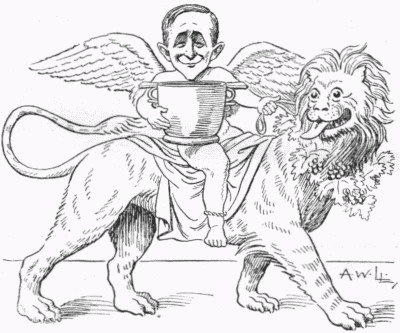
(After the Pompeii mosaic.)
With Mr. Punch's best wishes to Captain Wedgwood Benn.
The Front Opposition
Bench in the Commons
was almost deserted at
Question-time. Presently
the appearance
of Lieut.-Commander
Kenworthy in unusually
festive attire furnished
an explanation.
After forty years of
bachelorship and four
of fighting, Wedgwood Benn is Benedict
indeed; and his colleagues were
attending his wedding-festivities.
The Secretary to the Admiralty
has not yet attained to the omniscience
in Naval affairs that his predecessor
acquired in the course of twelve years'
continuous occupancy of the post. But
Sir James Craig can handle an awkward
questioner no less deftly than
"Dr. Mac." Witness his excuse for
not replying to a "Supplementary":—"The
hon. and gallant gentleman must
understand that I attach so much importance
to his questions that I wish
to be most punctilious in my answers."
Who could persist after that?
Mr. Bonar Law stated that the
treaties by which Great Britain and
France were responsible for constitutional
government in Greece came to
an end in August last. Consequently
the two Powers have "a completely
free hand" in regard to the Greek
Monarchy. But he begged to be excused
from saying in what manner that
"free hand" would bee used if Tino
should think of returning.
Thursday, November 18th.—In the
Lords the Acquisition of Land Bill had
most of its teeth drawn. Lord Sumner
was the most adroit of the many
operators employed, and he used no
gas.
The usual dreary duel of Nationalist
insinuation and Ministerial denial in regard
to Irish happenings was lightened
by one or two interludes. Mr. Jack
Jones loudly suggested that the Government
should send for General Ludendorff
to show them how to carry
out reprisals. "He is no friend of
mine," retorted the Chief Secretary,
with subtle emphasis. Later he read a
long letter from the C.-in-C. of the Irish
Republican Army to his Chief of Staff
discussing the possibility of enlisting
the germs of typhoid and glanders in
their noble fight for freedom. The
House listened with rapt attention until
Sir Hamar came to the pious conclusion,
"God bless you all." Amid the
laughter that followed this anti-climax
Mr. Devlin was heard to ask, "Was
not the whole thing concocted in Dublin
Castle?" Well, if so, Dublin Castle
must have developed a sense of humour
quite foreign to its traditions. Perhaps
that is the reason why the Prime Minister,
earlier in the Sitting, expressed
the opinion that "things in Ireland are
getting much better."
DRAMATIC SCENES AT BILBURY
QUARTER SESSIONS.
Counsel for Prosecution arrives from
London.
The Proceedings.
Notes on the Leading Personalities in
the Great Drama.
Prisoner Adkins' Awkward Admission.
[Note.—The author is surprised, not to say
pained, at the conspiracy of silence on the
part of the daily Press, as a result of which
he is left to write this matter up himself.
However ...]
A sombre court-house of Quarter
Sessions, the light with difficulty penetrating
the dusty panes of the windows.
On the so-called Bench
sits the Bench so-called;
in point of fact there
are half-a-dozen ripe
aldermen sitting on
chairs, in the midst of
which is an arm-chair,
and in it Mr. Augustus
Jones, the Recorder of
Bilbury.
Born in 1873 of rich
but respectable parents;
called, with no uncertain
voice, to the Bar in
1894; of a weighty corpulence
and stormy visage,
Mr. Jones now settles
himself in his arm-chair
to hear and determine
all this business
about Absalom Adkins
and the Boots. How
admirably impressive is
Mr. Jones's typically
English absence of hysteria,
his calm, his restfulness.
Indeed, give
Mr. Jones five minutes
to himself and it is even
betting he would be fast asleep.
The Clerk of the Court with awful
dignity suggests getting a move on.
Mr. Blaythwayte who, as well as Clerk
of the Court is also Town Clerk of Bilbury,
was born in 1850 and, having
survived the intervening years, now
demands the production of the prisoner
from below. Looking at this dignitary
one gets the poetic impression of a mass
of white hair, white moustache, white
whiskers, white beard and white wig,
with little bits of bright red face appearing
in between. From a crevice
in one of these patches come the ominous
words, of which we catch but a
sample or two: "... Prisoner at the
bar ... for that you did ... steal,
take and carry away ... pairs of
boots ... of our Lord the King, his
crown and dignity."
At this moment there arrives in court
a sinister figure wearing the wig and
gown so much affected by the English
Bar. Plainly a man of character and of
moment; obviously selected with great
care for this highly difficult and delicate
matter. His features are sharp, clean-cut.
One feels that they have been
sharpened and cut clean this very morning.
In his hand he holds the fateful
brief, pregnant with damnatory facts.
He makes his way into the pen reserved
"For Counsel only." The usher locks
him in for safety's sake.
Persons in the Drama (so far).
Mr. Augustus Jones. Recorder. Born in 1873.
Mr. Joseph K. Blaythwayte. Clerk of the
Court. Born in 1850.
Absalom Adkins, of uncertain age, supposed
boot-fancier.
Our Lord the King, whose peace, crown and
dignity are reported to have been rudely disturbed
by the alleged activities of Absalom
Adkins.
Who is this strong silent man, this
robed counsellor trusted with the case
of the Crown? Who is it? It is I!
Born in the year—but if I'm to tell
my life story it's a thousand pounds I
want. Make it guineas and I will include
portraits of self and relations,
with place of birth, inset.
The scenario (or do we mean the
scene?) is now complete. Leading
characters, minor characters, chorus,
supernumeraries and I myself are all on
the stage. Absalom Adkins, clad in a
loose-fitting corduroy lounge suit and his
neck encased in a whitish kerchief, rises
from his seat. Mr. Jones, the Recorder,
does much as he was doing before—nothing
in particular. Counsel for the
prosecution re-reads his brief, underlines
the significant points, forgets that
his pencil is a blue one and licks it. On
a side-table, impervious to their surroundings
and apparently unconcerned
with their significance, sit the crucial
boots.
"How say you, Absalom Adkins"—such
the concluding words of the
Clerk, the finish of the prologue which
rings up the curtain on this human
drama—"how say you? Are you
guilty or not guilty?"
"Guilty," says Absalom, and that
ends it.
Later a large and enthusiastic crowd
outside (had there been one) might have
seen a man with clean and sharp-cut
features carrying a bag in one hand
and an umbrella in the other, stepping
lightly on to a Bilbury corporation tram,
station bound. This is the counsel for
the prosecution (still me), his grave
responsibilities honourably discharged,
hurrying back to the vortex of metropolitan
life.
F. O. L.
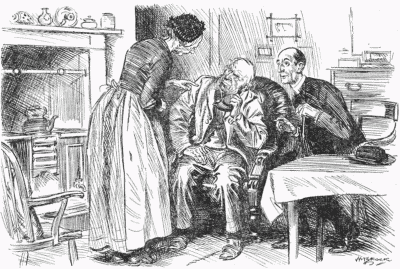
Vicar. "I understand from the doctor that your husband is hearing better with this ear."
Darby. "Eh, what? What's 'e say, Joan?"
Joan. "'E says 'e understands from the doctor that you're 'earing better with that there."
From a stores catalogue:—
"The —— Wringer.
Guaranteed for one year—Fair wear and
tear excepted."
There is always a catch somewhere.
"A consignment of Rumanian eggs has
arrived in this country. This shipment, which
is the first to arrive since the war closed this
source of supply in 1914, consists of 100 cases,
each containing 1914 eggs."—Scots Paper.
Referring, we trust, to the number and
not the vintage.
"Contracts, Tenders, &c.
The Great Northern Railway Company.
Allegro moderato
Notturno ............ |
} |
from String
Quartet, No. 2,
in D |
} |
Borodine. |
stores contracts."
Daily Paper.
It is generally supposed that the company
entertains the idea of attempting
to "soothe the savage breast" of the
Minister of Transport.
THE LETTERS I NEVER POST.
I met a philosopher the other day—he
is not a philosopher by profession,
but an architect—who told me that,
when annoyed by the anomalies and
petty red-tape restrictions of life or irritated
by incompetence and incivility, or
even when he feels that he can amend
somebody else's error or propose an improvement,
it is his habit to write a
letter expressing his indignation or embodying
his suggestions.
After remarking that he must be kept
very busy I asked him what kind of
replies he got.
"Oh, I don't get any replies," he said,
"because, you see, I don't send the letters;
I only write them and then I tear
them up."
This is how I knew that he was a
philosopher.
I propose to take to philosophy myself.
To a Taxi-Driver.
Dear Sir,—(You must understand,
as must all the people that I address
in these epistles, that by "dear" I do
not necessarily imply any affection. I
employ the word because I am too old
to care about breaking down harmless
conventions; but I might claim in the
present connection that it has more
than one meaning. That indeed you
will see, if you read on, is the main
point of this letter.)—Dear Sir, then,
you may remember me. I am the fare
who hailed you on your rank at the
corner of Fulham Road and Drayton
Gardens last Tuesday evening at a
quarter to six, and told you to drive to
the Marble Arch. You put down the
flag and then jumped off the box to
wind up the starter. It failed, and after
several attempts you had to examine
the machinery. I suppose that six
minutes were occupied in this way,
whether because you are a bad mechanic
or a careless fellow or because
the engine is defective, I cannot say;
all I know is that I was in a hurry and
that the flag was down, but we were not
moving. If you had not put the flag
down I should have got out and taken
another cab; but I felt that that would
be unfair to you. When, however, at
the end of the journey I paid you
without adding any tip, and you received
the money with an offensive
grunt, I wished that I had been less
considerate.
It is because nothing that I could
have said then, in your horrid hostile
mood, would have convinced you that
there is any injustice to a fare at all in
putting down your flag before you are
properly started, that I am writing this
letter. My hope is that quiet perusal
may demonstrate that the fare has, at
any rate, a grain of logic on his side if
he looks upon himself as defrauded.
We don't, you know, take your cabs
for the joy of sitting in them, or for the
pleasure of watching you struggling
with a crank, but to be conveyed quickly
from place to place. It is wrong to ask
us to pay for the time spent by you in
persuading your engine to behave, and
it is indecent to become abusive when
we act on that assumption. If I had not
been so busy I should have refused to
pay at all and forced you to summon
me; but who has time for such costly
formalities? And I might have had
to lose my temper, which I have not
done (much) since I read an article by
a doctor saying that every such loss
means an abbreviation of life. Life in
a world made fit for heroes may not be
any great catch, but it is better, at any
rate, than passing to a region where
one is apparently liable to be in constant
communication with mediums.
One other thing. I have just returned
from Paris, where, amid much
that is unsatisfactory and besmirched
by Peace, taxis remain trustworthy and
plentiful. The price marked on the
meter is that which the fare pays, and
any number of persons may ride in the
cab without extra charge. Nothing
exceeds my scorn for the English taxi-driver
who demands another ninepence
for an additional passenger, even though
only a child—nothing except my scorn
for the cowardly official who conceded
this monstrous imposition.
To an Administrator.
Dear Sir,—May I implore you to
authorise the instant removal of the
buildings in the St. James's Park lake?
During the War we who find on the
suspension bridge, looking West, the
most beautiful late afternoon view in
London, were content to endure the
invasion. But we have passed the
second Armistice Day, and still the
huts remain, and still there is no water,
and still the enchanted prospect is
denied us. After all, this lake is part
of London, and London ratepayers
should be entitled to their city's beauties
as well as its necessities.
To a Pretty Girl.
My Dear,—I want you to be a little
more merciful. The other day, when
your father, over the eggs and bacon,
was reading out the news from Greece,
with the defeat of Venizelos, you said
lightly that exile didn't matter very
much because Venizelos was a very
old man. You then returned to the
absorbing occupation of identifying
Society people, reading from left to
right. Now Venizelos is fifty-five
years of age, and I cannot allow the
term "very old" to be applied to him
without protest; I am too nearly his
contemporary. "Getting on," if you
like, "mature," "ripe," but not "very
old." You must keep that phrase for
the people who—well, who are very old.
To a Haberdasher.
Dear Sir,—When I came to put on
the collar that I bought from you yesterday
(I am the tallish customer who
takes sixteen and a half by two and was
in a hurry to get home to dress) I found
that your young man's finger-marks
were on it. Why don't you make your
assistants wear gloves when they handle
collars?
To a Minister of Religion.
Your Far-from-serene Gloominess,—Won't
you one day be a little cheerful,
and wrong? Won't you send out
a lifeboat to the wreck instead of watching
her through your smoked field-glasses
as she sinks? What you seem
to forget is that most people at times
are their own Gloomy Deans: some of us
too often; and there can be too much of
a good thing. Hopelessness butters no
parsnips and it is a mood not to be
encouraged or the world would be as
bad as we then think it. Gloomy-deaniness,
though salutary for brief intervals,
should be sparingly indulged
in; but you are at it all the time. There
is a Chinese proverb which says, "If
you can't smile don't open a shop;"
and, after all, St. Paul's Cathedral is in
a manner of speaking a kind of shop,
isn't it?—the goods, at any rate, should
be obtainable there. The phrase "there
is no health in us" does not constitute
the whole liturgy. Down with facile
optimists by all means, but, my dear
Sir——
E. V. L.


