Question. Do you agree with a certain female
lecturer, that it is the duty of the fair sex to
captivate the other?
Answer. Certainly, as cleverness need not be
divorced from fascination.
Q. You do not object, then, to brains in the
abstract?
A. No; but as some men have a horror of
the blue-stocking, I would cover fine heads with
pretty toques.
Q. And if a woman has literary tastes, what
would you advise?
A. That part of her reading should be devoted
to the fashion journals, and she should not
sacrifice her toilette to her intellect.
Q. What is your opinion about latchkeys,
visits to the music-halls, and cigarettes?
A. That, from a man's point of view, they are
played out, and consequently should be abandoned
by man's would-be help-mate.
Q. What do you think of glasses?
A. That, when necessary, they should take the
shape of a pince-nez, as it is more becoming than
spectacles.
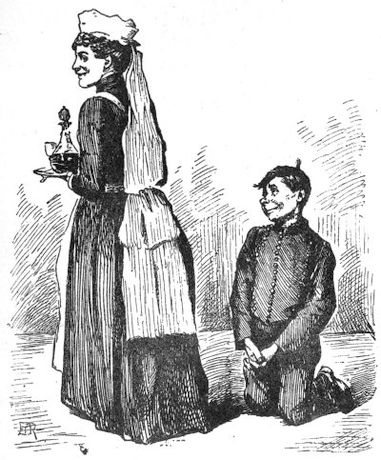
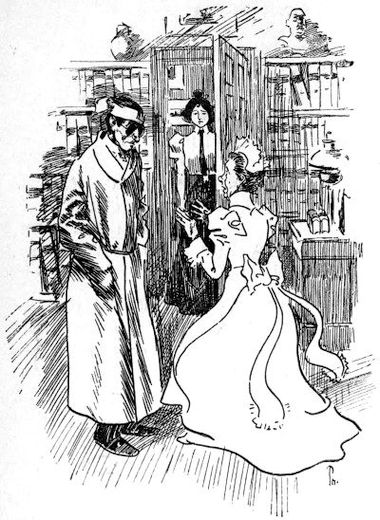
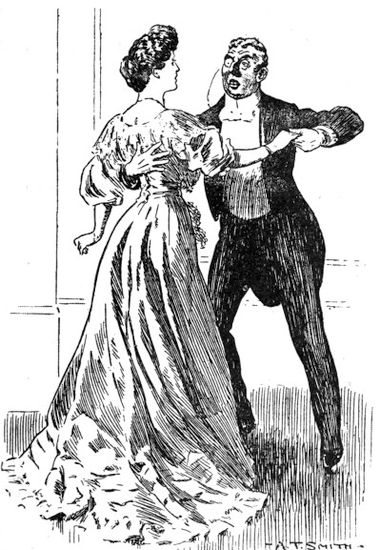
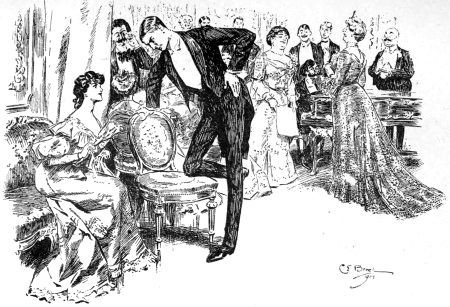
"INFLAMMABLE BUTTONS." UN PAGE
D'AMOUR
Q. Then, before marriage, what should be your
treatment of man?
A. I should do all I can in my power to please
him.
Q. And after the nuptial knot had been tied,
what then?
A. That, as Mr. Rudyard Kipling would observe,
is quite another story.
NEW RULES FOR "PIT"
[On the authority of the Athenæum Club]
(1) The table shall be firmly clamped to the
ground, and the cards shall be of metal not less
than ¼ inch thick, with rounded corners.
(2) Any player who speaks in such an audible
voice that the position of the roof is altered shall
be forced to make the damage good.
(3) No player shall use a megaphone or speaking-trumpet
of any kind.
(4) Muffin-bells may only be employed by
players who have formed a "corner," and desire
to communicate this fact to other players.
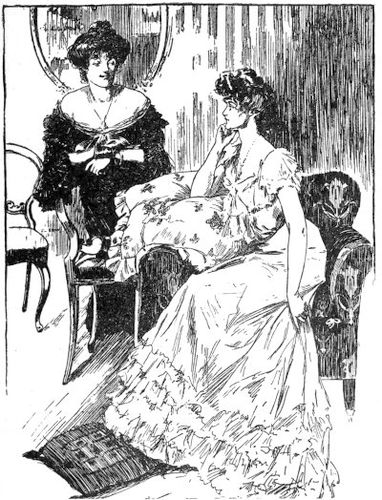
"The Earthly Paradise."—"What reason did he give for
wishing to break off the engagement so soon?" "He said the
report that he was engaged to me had not extended his credit nearly
as much as he had hoped for."
(5) If a player has called "corner," and is
found to have only eight similar cards in his hand,
the game shall be continued without him. His
remains may be removed at leisure.
(6) "Progressive Pit" with more than four
tables shall only be played in a house which is at
least five miles in any direction from other inhabited
buildings.
(7) No person who is not a player shall approach
while a game is in progress, except in the case
when a player faints across the table and so
obstructs the play.
SPRING CLEANING
[Scene—Spring Gardens. Enter Algy, L.H., meeting
Frankie as he strolls in, R.H.]
Algy. Hallo, old boy! (Greeting) I've just
had my house papered and painted inside and
out.
Frankie. Indeed! And—er—(struck by the novelty)
what sort of paper did you have put outside?
[Exit Algy, R.H., and Frankie, L.H. Scene closes.
Answer to Mary Anne.—The needle-gun is
not threaded with gun-cotton.
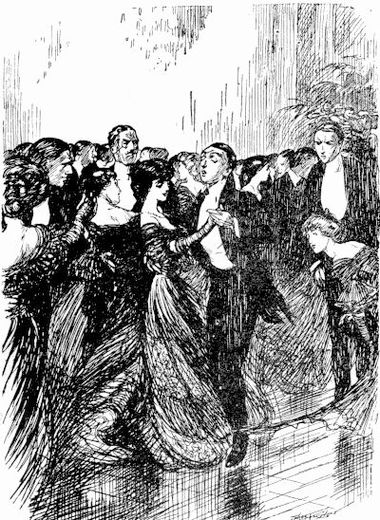
She (to clumsy steerer). "Rather like progressive bridge, isn't it?"
He. "Why?" She. "Well, you see, you run up against
everyone in the room before you've done."
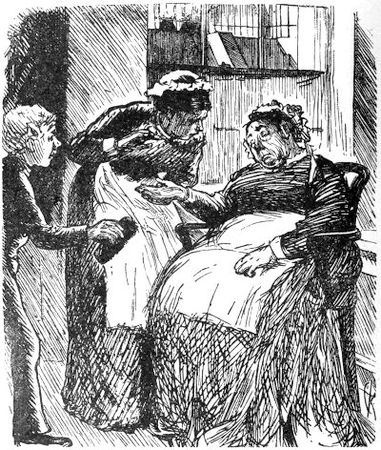
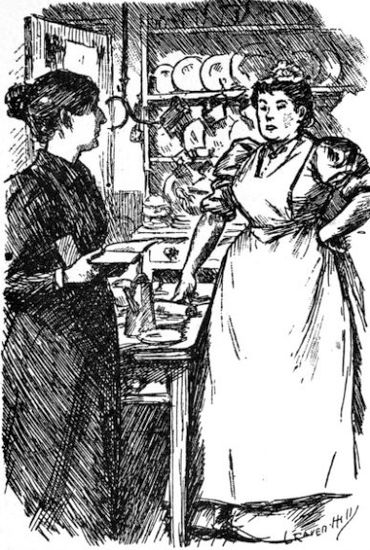
Cook (from the area). "O, 'Liza, gi' me my winigrette—I've
'ad a—offer—from the dustman!!"
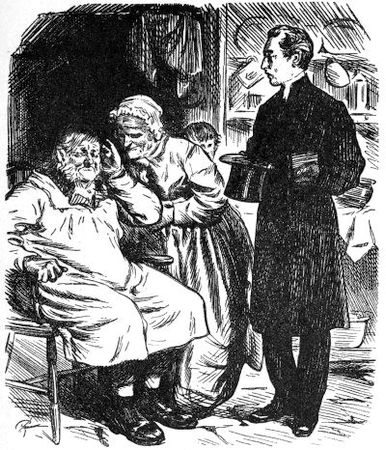
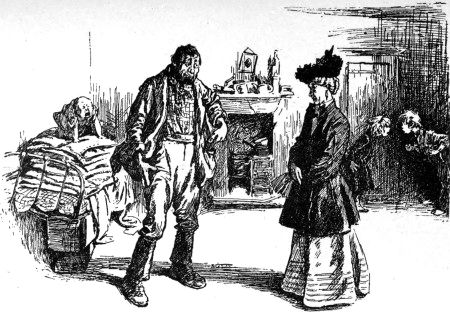
New Curate (tenderly). "My good man, what induced
you to send for me?"
Oldest Inhabitant. "What does he say, Betty?"
Betty. "Says what the deuce did you send for him,
for!!"
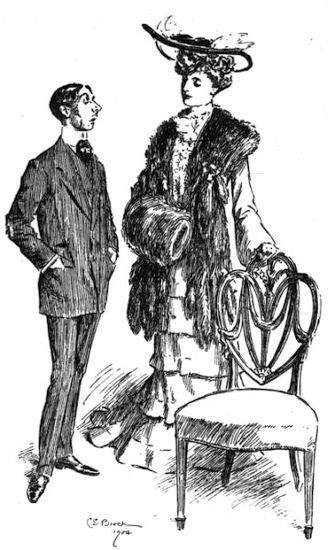
The Merest Accident.—She. "So you failed in your
vivâ voce exam.?" He. "Yes; but it was purely from
absence of mind."
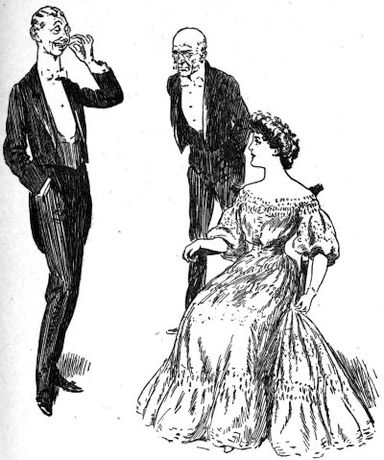
"O NOBLE FOOL! O WORTHY FOOL!"
Uncle (to nephew, who has just come into a fortune). "You must
remember, my boy, that 'a fool and his money are soon parted'!"
Fair Cousin. "Oh, but I'm sure Sammy will be the exception that
proves the rule!"
[Sammy is delighted.
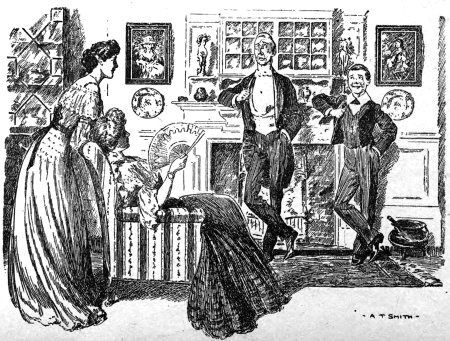
Pernicious Praise.—Mr. Ranty Snobbarts (holding forth). "By Jove, I'm awfully keen
on huntin'. Ain't you, what?" Horrid Boy. "Yes, by Jove, he is keen. Why, when he
wasn't huntin' the fox, he was huntin' his horse!"
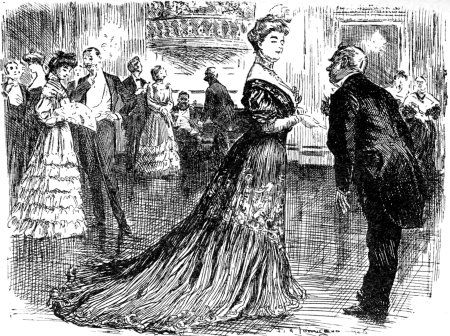
Duty First.—Her Ladyship (who is giving a servants' ball—to butler). "We shall begin
with a square dance, and I shall want you, Wilkins, to be my partner." Wilkins. "Certainly
my lady; and afterwards I presoom we may dance with 'oom we like?"
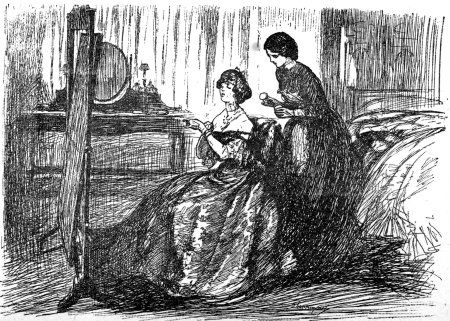
Maid. "There's a much better tone in this house now, m'm, than there used to be." Lady
(indignantly). "Indeed! I don't understand you Chalmers." Maid. "Oh, m'm, I mean
downstairs, of course. Not upstairs."
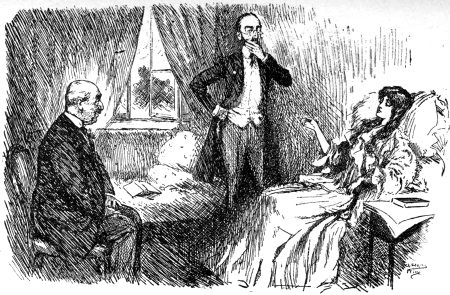
Things that might have been Expressed Differently.—Uncle George. "So glad you are
so much better, Amy, my dear." Amy. "Yes, thank you, Uncle George. Since Dr. Pillum took
me in hand my recovery has been simply miraculous!"
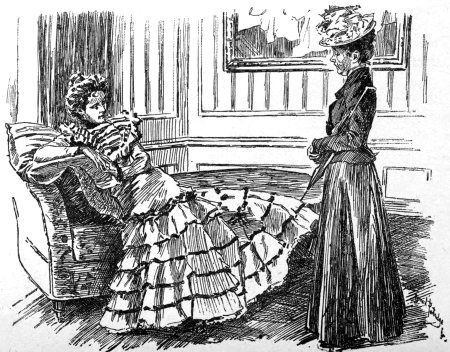
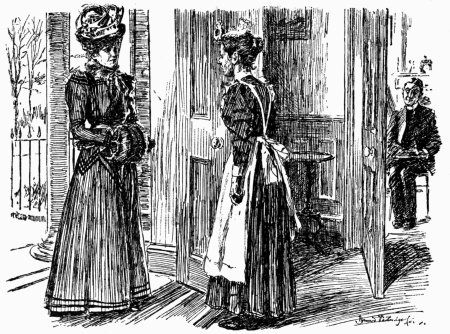
Applicant (for situation as parlour-maid). "Should I be expected to hand things
at lunch, madam, or do you stretch?"
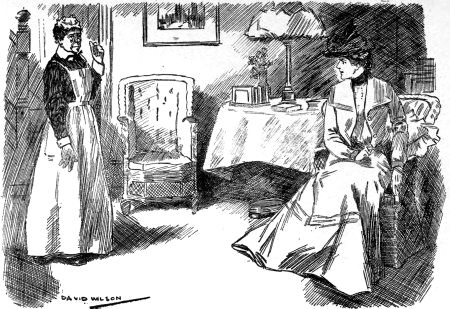
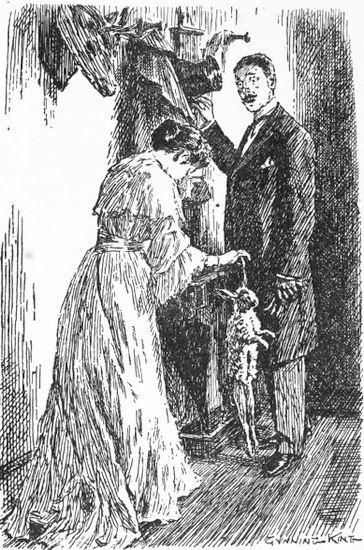
Lady Caller (to old family servant). "Well, Bridget, did Master Arthur shoot any tigers in India?"
Bridget. "Of coorse he did. Shure we have the horns of the craythurs hung in the hall!"
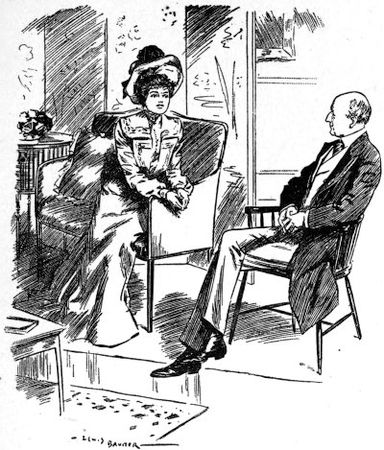
Smithson (the celebrated poet, novelist, playwright, &c.).
"But, my dear young lady, I really don't understand you.
I haven't been winning any ping-pong tournament. I don't
play."
Miss Brown. "Oh, but surely I heard our hostess say
you were 'the Mr. Smithson!'"
PRELIMINARY CHAPTER
Betty, "first catch your fish," is a golden rule
for a cook, and first catch your situation is a very
necessary piece of advice to be given to servants
in general. The choice of a mistress requires as
much judgment as the choice of poultry; and you
should be careful not to pick out a very old bird
in either case. The best market to go to in order
to suit yourself is a servants' bazaar—as it is
called—where mistresses are always on view for
servants to select from. On being shown up to a
lady, you should always act and talk as if you were
hiring her, instead of wanting to be hired. You
should examine her closely as to the company she
keeps, and the number of her family; when, if
there is any insuperable objection—such as the
absence of a footman, a stipulation against perquisites,
a total prohibition of a grease-pot, or
a denial of the right of visit, by a refusal to allow
followers—in either or all of these cases, it will be
as well to tell "the lady" plainly that you must
decline her situation. It is a good general rule to
be the first to give a refusal, and, when you find
you are not likely to suit the place, a bold assertion
that the place will not suit you, prevents any
compromise of your dignity. If you like the
appearance and manner of the party requiring
your assistance, but with some few concessions to
be made, the best way to obtain them will be by
declaring that you never heard of any "lady"
requiring—whatever it may be that you have set
your face against. By laying a stress on the word
"lady," you show your knowledge of the habits
of the superior classes; and as the person hiring
you will probably wish to imitate their ways, she
will perhaps take your hint as to what a "lady"
ought to do, and dispense with conditions, which,
on your authority, are pronounced unlady-like. If
a situation seems really desirable, you should
evince a willingness, and profess an ability, to do
anything, and everything. If you get the place,
and are ever called upon to fulfil your promises, it
is easy to say you did not exactly understand you
would be expected to do this, or that; and as
people generally dislike changing, you will, most
probably, be able to retain your place.
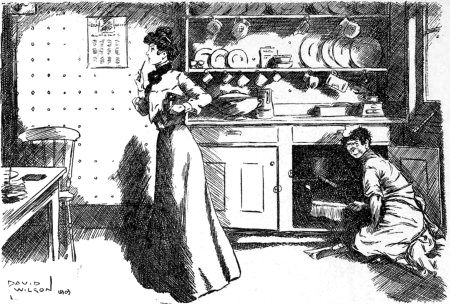
A Hint.—Young Housewife (as the front door bell rings).
"Now, is that the butcher's boy—or a visitor?" New "General"
(after a pause). "If you don't think you're tidy enough, mum—I'll go!"
When asked if you are fond of children, you
should not be content with saying simply "yes,"
but you should indulge in a sort of involuntary,
"Bless their little hearts!" which has the double
advantage of appearing to mean everything, while
it really pledges you to nothing. Never stick out
for followers, if they are objected to; though you
may ask permission for a cousin to come and see
you; and as you do not say which cousin, provided
only one comes at a time, you may have half-a-dozen
to visit you. Besides, if the worst comes
to the worst, and you cannot do any better, there
is always the police to fall back upon. By-the-way,
as the police cannot be in every kitchen at
once, it might answer the purpose of the female
servants throughout London, to establish police
sweeps, on the principle of the Derby lotteries, or
the Art-Union. Each subscriber might draw a
number, and if the number happened to be that
of the policeman on duty, she would be entitled to
him as a beau, during a specified period.
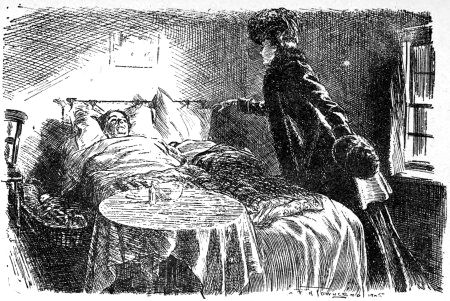
Visitor. "I'm so glad to find you going on so nicely,
Mrs. Jenkins! And is this the dear little soul? I would so love
to see him!" Mrs. Jenkins. "Lor, no, mum! That's my 'usband taking
his bit o' rest. He's a policeman on night duty." [Quick exit, with promise to look in again.
Always stipulate for beer-money, and propose it
less for your own advantage than as a measure of
economy to your mistress, urging that when there
is beer in the house it is very likely to get wasted.
You will, of course, have the milk in your eye,
when proposing this arrangement.
Tea and sugar must not be much insisted on,
for they are now seldom given, but this does not
prevent them from being very frequently taken.
Having said thus much by way of preliminary
advice, we commence our guides to service with
THE MAID-OF-ALL-WORK
On arriving in your new place you get from the
servant who is going away the character of your
new mistress. She has already had yours, and
you have a right to know hers, which, as it is
given by a domestic who is most probably discharged,
will, of course, be a very bad one.
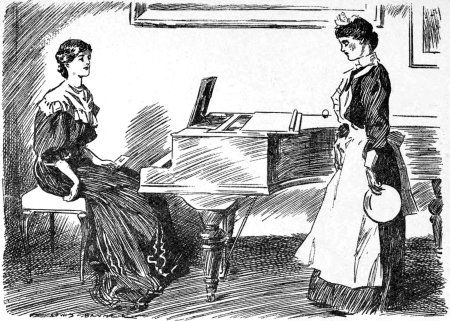
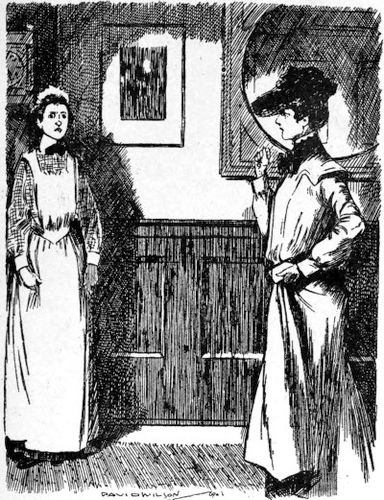
Mistress. "You wish me to take your notice,
Jane. This is very sudden, isn't it?"
Jane (blushing). "Oh no, mum,
I've known 'im three days!"
When your predecessor has taken her departure,
your mistress may, perhaps, come into the kitchen
and tell you what you will have to do, or, at least,
a part of it. She will show you the bells, and tell
you which is the house bell, which the parlour
bell, which the drawing-room bell, and which
are the bells of the different bed-rooms;
but she will not tell you how you are to
answer them when they are all ringing at
once, which may occasionally happen. As it will
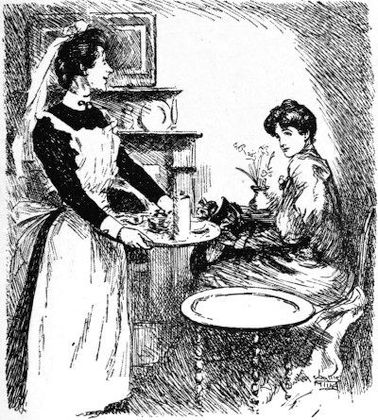
probably be late when you arrive, you will have to
carry up the tray for supper, when you will be
stared at, and scrutinised as the new servant, by
the whole of the family. Let us now look at your
wardrobe. Two of each article will be enough, for
if the washing is done once a week you have a
change; but if only once in three weeks, you must
contrive to supply yourself with the smaller
articles, such as stockings and pocket handkerchiefs,
from the family stock of linen.
As a maid-of-all-work, you have the great
advantage of being a good deal alone, and can
therefore indulge in the pleasures of philosophy.
You can light the fires, and think of Hobbes.
Fasten the hall-door, and recollect some passage
in Locke. Or broil the ham for breakfast while
wrapped up in Bacon.
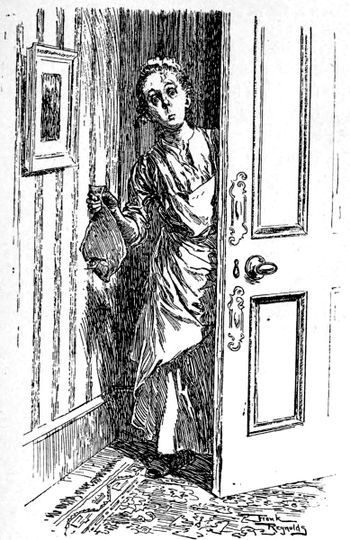
"Merely Mary Ann" Again.—"Please, 'm, the fishmonger says
will you have it filtered?"
You should rise early if you can, but if you cannot
you must make up for it by hurrying over your
work as quickly as possible. As warm water will
be wanted upstairs, don't stop to light the
wood, and set them all burning at once, when you
will have some hot water immediately. Run into
kitchen fire, but throw on two or three bundles of
the parlour and open the shutters, light the fire,
cut the bread and butter, clean the shoes, make
the toast; and when this is on the table, devote
any time you may have to spare to sweeping the
carpet.
Now, the family having gone down to breakfast,
you may light the kitchen fire, and then run up
and make the beds. After which you may sit down
to your own breakfast, having previously, of
course, taken the opportunity of helping yourself
to tea and sugar from the tea-caddy.
You may now go upstairs, professedly to sweep
the bedrooms, but really to look out of window,
and if the street is a narrow one, talk to the
servant opposite. Besides, looking out of window
saves time, for you are able to answer the fifty
people who come to the door in the course of the
morning with hair-brooms, apples, carpets and
rugs, tapes and stay-laces.
Being in a new place, you will be naturally
curious to examine all the cupboards and drawers
up-stairs, but do not be too inquisitive at first, for
you will have other opportunities for a good
rummage.
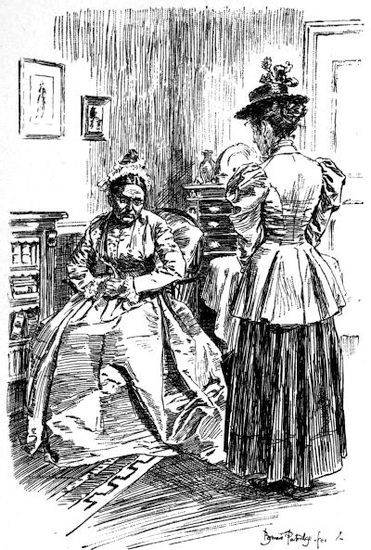
Lady (engaging servant). "I ought to tell you that we are all strict
teetotalers here. I suppose you won't mind that?" Mary Jane.
"Oh, no, mum. I've been in a reformed drunkard's family before!"
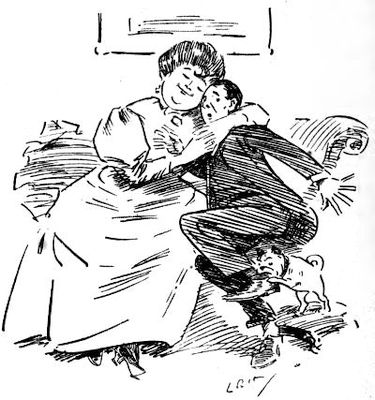
SIMPLE SAYINGS FOR THE SILLY
Bad as it is to be fawned upon, it is better than to be
bitten.
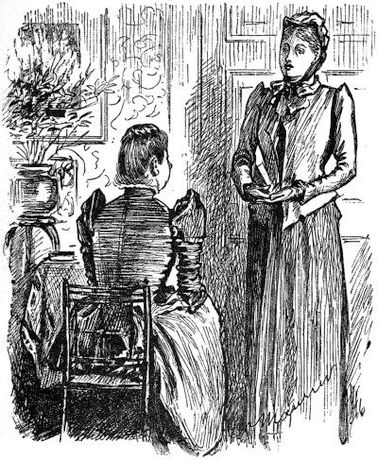
Orthodox Old Maid. "But, Rebecca, is your place of
worship consecrated?"
Domestic (lately received into the Plymouth Brotherhood).
"Oh no, miss—it's galvanised iron!"
You will now come down to cook the dinner;
but, as this is another branch of service, we proceed
to tell you how to lay the table. Lay the
knives and forks, taking the latter from the plate-basket,
where they will be kept, though they are
probably only Britannia metal or German silver;
nevertheless, call it "the plate," as it will gratify
your mistress.
If the family should be addicted to display,
without means, you will have to set round doyleys
and wine-glasses, with a decanter containing a
remnant of British wine, which will not be touched,
but will be brought on "for the look of the thing"
every day after dinner. The time has now arrived
for your own meal, and make the most of it.
Secure all the tit-bits, and if you cannot manage
to get through the whole of them at dinner, put
away part of them for supper.
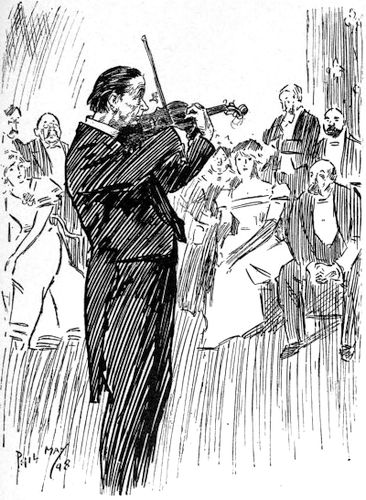
Disadvantages of Performing at a Country House in the
Wasp Season. (Just in the most important passage too.)
About this time the afternoon's milk will arrive,
and if you have beer-money you will take some of
the milk out for your own use, taking care to fill
up with warm water, so that you do not cheat your
mistress of her quantity. You will be in the
middle of washing up your dishes, when the
family will want tea, and you will have just sat
down to your own tea, when you will probably be
asked to do some mending. The best way to put
a stop to this is to turn sulky, do the work badly, or
express the greatest surprise, declaring that all the
time you have been out to service you never, &c.,
and would be glad to know who on earth, &c.,
&c., &c.
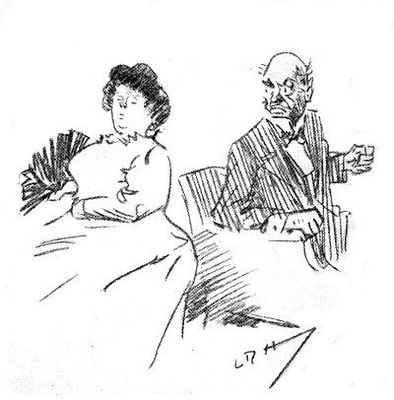
"I wish, madam, you would not interrupt me every time
I try to say something. Do I ever break in when you're
talking?"
"No, you brute, you go to sleep!"
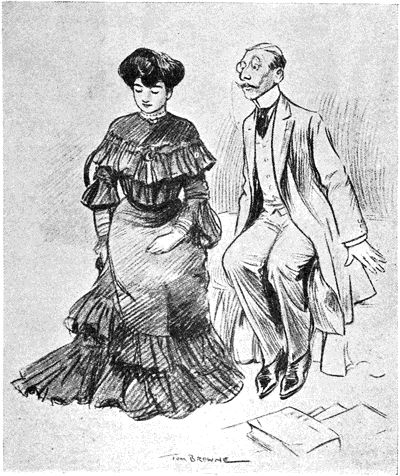
He. "I was an intimate friend of your late husband.
Can't you give me something to remember him by?"
She (shyly). "How would I do?"
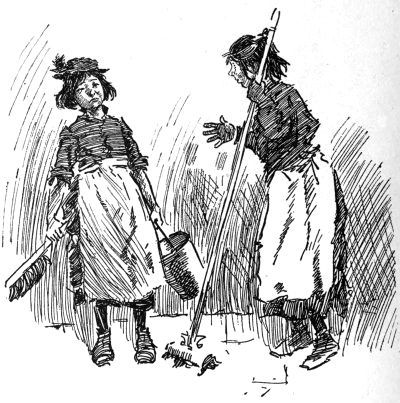
"Oh, I say, 'ave you seen the papers about 'shall we
do without servants?' I should like to see 'em try, that's
all!" "Yus, and me too!"
You must not forget to cultivate your mind, and
for this purpose you had better take in "Brainy
Bits," and if you read it through every week,
your head at the end of the year will be full of
volcanic rocks, the solar system, primary strata,
electric eels, organic remains, and hints for preserving
gooseberries.
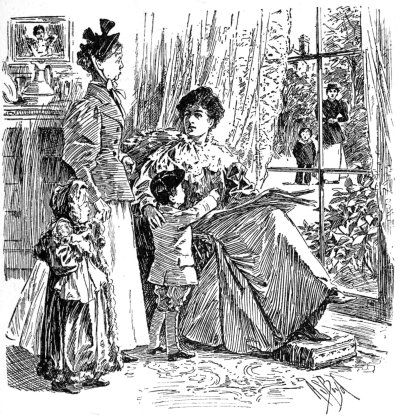
Lady of the House. "Oh, yes, Jane, I asked Mrs.
Johnston to let her little boy and his nurse call to go
walking with you and the children." Nurse. "Well,
ma'am, I hope as you don't expect me to go walking with
that young person? I don't think you can be aware as
she is only a nurse-'ousemaid!"
On washing days there will probably be a
woman come to wash; and in the mutual confidence
of the tub, you will probably become very
friendly. You may, no doubt, be of great service
to each other, you in giving her bits of this and
that, while she may serve you by becoming the
agent for the disposal of your kitchen-stuff.
Do not fall a victim to low spirits, and above
all, avoid sentiment. A morbid-minded maid-of-all-work,
whose heart has been carried off in the
butcher's tray, the milkman's can, or the baker's
basket, is for ever lost. Never hang your affections
on a policeman's staff. The force is proverbially
fickle, and many a servant girl has pined
with a hopeless passion for one who has moved in
a superior station.
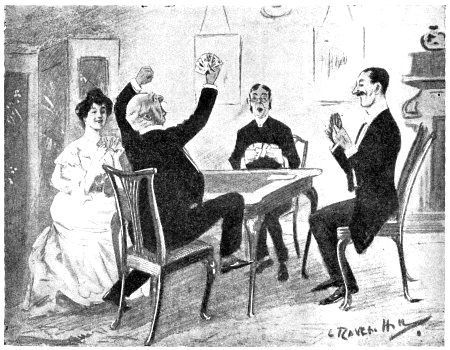
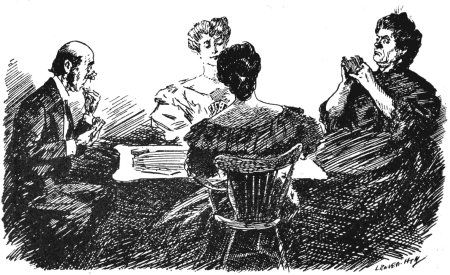
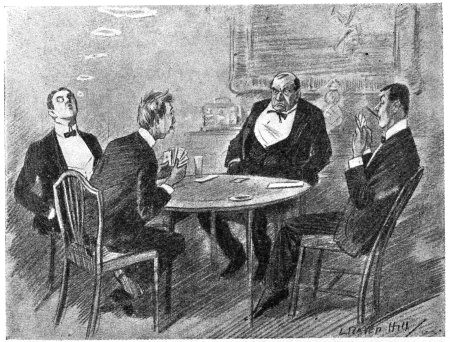
Bridge Problems.—No. 1.—What has the dealer declared?
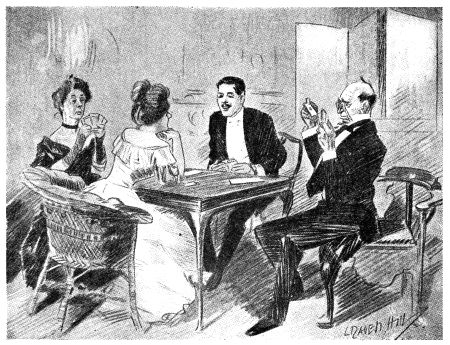
Bridge Problems.—No. 2.—Will dummy go spades?
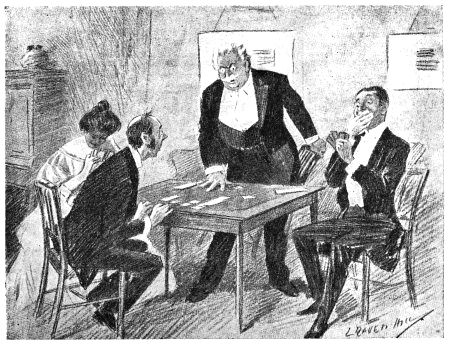
Bridge Problems.—No. 3.—Why did she declare hearts?
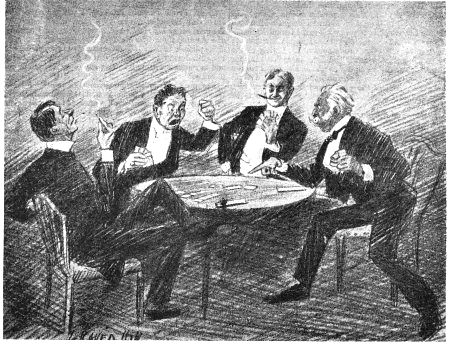
Bridge Problems.—No. 4.—What has dummy declared?
Bridge Problems.—No. 5.—Who doubled no trumps?
One of the most trying situations for a maid-of-all-work,
is in a house where there are lodgers.
She will, very likely, have to take everything at
once to everybody at once. She will be having
the first floor and the two-pair back clamouring
at the same time for the only tea-pot in the house,
while the parlour will be calling angrily for his
boots, which have been taken by mistake, to the
garret, who is writhing in intense agony for his
highlows.
THE COOK
For ages it has been believed that a certain
wicked person sends cooks; but Johnson has
well observed, and so by the by have Smith
and Brown, that "if we had no cooks, we should
be as bad as cannibals."
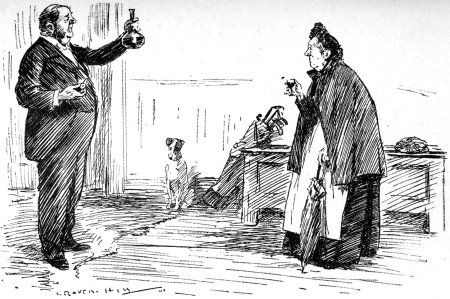
Butler.—"Master says you're to have a glass o' this before you go, Mrs. Giles. Now, that's some rare
good stuff, that is, an' will do 'ee a world o' good!"
Mrs. Giles.—"Well, it certainly do taste better than the physic I be in the 'abit o' takin'!"
Cooks have always been the subject of sarcasm,
and Jones tells us that even in his day the wits
loved to give the cooks a good roasting. It is
said, moreover, that "too many cooks will spoil
the broth," from which we may presume that, as
the workhouse broth is the very worst in the world,
a great many cooks must have a hand in it.
Apicius was the first man who made cookery a
science, and he poisoned himself: no doubt with
his own cookery. He invented several sauces,
and was, in fact, the Roman Harvey. He is
believed to have been the first who added the
trimmings to legs of mutton, and he took for his
motto the line in Virgil:—
"At Regina gravi jamdudum saucia curâ."
because the luxury of gravy, jam, sauce and curry
are all shadowed forth in the quotation alluded to.
Dr. Johnson was, according to Boswell, "a man
of very nice discrimination in the science of
cookery," and he was proverbial for his sauce,
which he dealt out to every one with the greatest
freedom. Boswell once asked him if he liked
pickles, when he said, "No, sir; the man who
would eat a pickle would pick a pocket."
Boswell adds, "I ventured to say he would";
and they wound up the evening with grog, which
Boswell, as usual, had to pay for; and it is thought
that the expression of "Standing Sam" originated
with Boswell having to stand whatever Sam
(Johnson) chose to call for.
The celebrated Dr. Parr was also a great
epicure, and liked his victuals underdone, from
which we have the expression Parr-boiling.
Milton loved his meat well dressed, and died with
a good thing in his mouth; but whether it was a
morsel of philosophy, or something nice, has never
transpired.
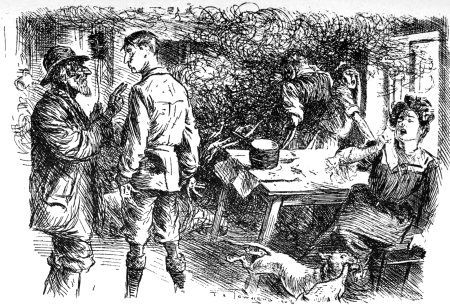
A Dead Cert.—Expert from the Estate (just arrived—the gardener being a distinct failure). "Why,
would you believe it, sir, I thoroughly cleaned your stove yesterday just before you came—took it all to
pieces—and" (most cheerfully) "I'll lay a sovereign I put some of it back wrong!"
Having said thus much of the ancient and
classical who took an interest in cookery, we
plunge down stairs into the modern kitchen, and
embrace the cook of the present period.
On going to be hired, you will, perhaps, be told
there are no perquisites allowed. Don't stick
out about that, for if perquisites are not allowed
you must take them.
It is easy to say the meat makes no dripping,
and, of course, you can't account for it.
It is a rule in cookery to make the best and the
most of everything, and you will therefore sell
your kitchen-stuff at the marine-store shop that
will give the best price for it.
In some families the mistress of the house will
assist the cook; but she should have a sickener
of that as soon as possible. If she makes a pie,
spoil it in the baking; for if there is any truth in
the adage about "too many cooks," the lady of
the house should not be encouraged in making one
of the number.
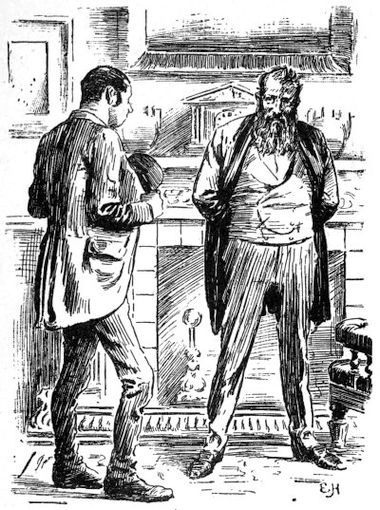
Genial Master (under the painful necessity of discharging
his coachman). "I'm afraid, Simmons, we must part. The
fact is, I couldn't help noticing that several times during
the last month you have been—sober; and I don't believe
a man can attend properly to the drink if he has driving
to do!"
Order is a great essential to a cook, who should
keep everything in its place, taking care to keep
herself as snugly in her place as possible. Never
connive at dishonesty in others, but keep yourself
to yourself; for, if you rob your mistress, the least
return you can make is not to sanction others in
doing so.
Never go into any place where a cat is not kept.
This useful domestic animal is the true servants'
friend, accounting for the disappearance of tit-bits,
lumps of butter, and other odd matters, as well as
being the author of all mysterious breakages.
What the safety-valve is to the steam-engine, the
cat is to the kitchen, preventing all explosions or
blowings up that might otherwise occur in the
best regulated families.
Having laid down some general principles for
the guidance of cooks, we give a few maxims that
cannot be too strictly attended to.
1. Keep yourself clean and tidy if you can. If
your fingers are greasy wipe them on your hair,
which thus acquires a polish.
2. When a joint comes down from dinner, cut
off what you intend for your supper. If cut while
the joint is warm, it does not show that it has
been cut. Relieve it also from all superfluous fat,
which will of course go into your grease-pot.
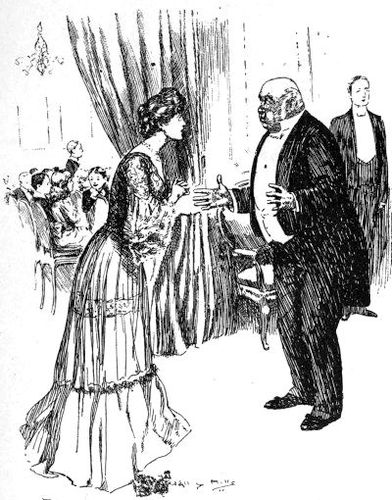
A Warm Welcome.—Distracted Hostess (to Uncle George, who
has arrived unexpectedly). "Oh, I'm so glad you have come! The
conjuror I had engaged hasn't turned up. So you'll do some tricks
to amuse the children, won't you?"
3. If you want a jelly-bag, cut up an ironing
blanket for the purpose. The former is of course
wanted in a hurry, but the latter may be procured
at leisure.
4. When your dishes come down stairs, throw
them all into scalding water at once. Those that
are not broken by the operation may afterwards
be taken out, and put in their proper places.
5. Scour your pickle-jars, but empty them first,
if you are fond of pickle.
6. If you have been peeling onions, cut bread-and-butter
with the same knife; it will show the
multifariousness of your occupations, and perhaps
give a hint for raising your wages.
7. Let your spit and your skewers be always
rusty; or, at least, do not take the trouble to
polish them; for by leaving great black holes in
the meat, they show it has been roasted, which is
always better than being baked, and it will be the
more relished in consequence.
8. Never do anything by halves, except lamb,
which you must sometimes do by quarters.
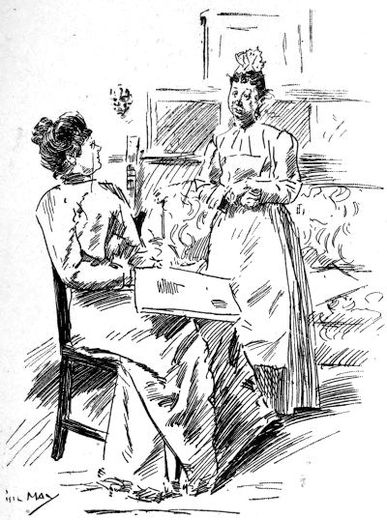
Indirect Oration.—"Oh, if you please, mum, there's
no meat for dinner. The butcher 'as been and gone and
never come this morning!"
9. If you are cooking even a sheep's head or a
bullock's heart, take pains with them, so that what
you do may be equally creditable to your head
and heart.
10. If you have a follower, or a policeman,
who likes a snack, cut it off each joint before
you cook it—for everything loses in the cooking—and
the disappearance of one pound, at least,
in eight or nine, may thus be easily accounted
for.
The above maxims will be sufficient to guide
the cook in her course of service, and we do not
add any receipts, for it has been well said by
Dr. Kitchener, or might have been said by him as
well as by anyone else—that he who gives a receipt
for making a stew, may himself make a sad hash
of it.
In bidding farewell to the cook, we would have
her remember that her control over the safe will
give her a peculiar influence over the hearts of
the police, and she must be careful not to enervate
a whole division, and leave a district defenceless,
by being too lavish with the blandishments of love
and the larder.
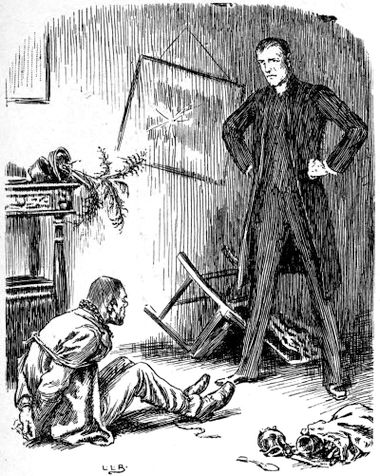
Burglar (who has been secured by athletic vicar after long
and severe struggle). "I think you're treatin' me very crool—and
a clergyman too!"
THE LADY'S-MAID
Ladies'-maids are the rarest articles of female
domestic service, and being in the nature of luxuries,
are the best paid. They are to cooks and housemaids
what the pine-apple is to the pomme de terre, and
for this pine-like superiority of station many are
doomed to pine in vain. The statistics of female
service give us a million maids as the grand total, and
deducting three-eighths for servants-of-all-work,
two-eighths for cooks, three-sixteenths for housemaids,
and one-eighth for nurses, we have a
surplus of one-sixteenth for ladies'-maids, which
will be about a fair average.
Servants belonging to this superior class should
be able to read and write. It is a good practice
in the former accomplishment to read all the notes
sent to your mistress, and the little motto wafers,
now in use, seem invented to facilitate this
arrangement, for they never adhere to the
envelope.
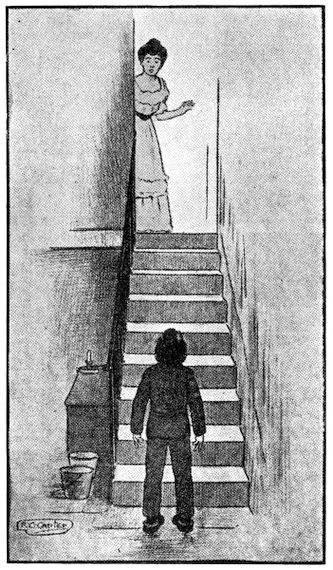
Bridge Below Stairs.—"Good gracious, James, whatever
is the meaning of this extraordinary hilarity in the
kitchen?"
"Cook's just revoked for the third time, marm!"
You will probably have the charge of your mistress's
apartments. Never suffer anything to lie
about, and, therefore, you should pocket any trifle
that is left carelessly out of its place. I do not
mean to say you should become a thief, for, if
found out, you would lose your place, and your
character, but you must take care of a thing till it
is missed, and when it is wanted, it will, of course
be asked for. It is then time enough for you to
find it in some hole or corner, into which it has of
course got by accident. Your lady's dressing-box
will be under your care. See that the scent-bottles
are always well supplied, which you can
only ascertain by taking a little out of them for
your own use very frequently.
You should endeavour at all times to save your
mistress trouble by acting for her as much as you
can; and in order to do this effectually, you
should dress as much like her as possible. Order
about other servants just as she would herself,
and talk to tradespeople exactly as if they were
being spoken to by your mistress, of whom
you are the representative. Of course the
closer the representation you give of her, the
more exact are you in the performance of your
duty.
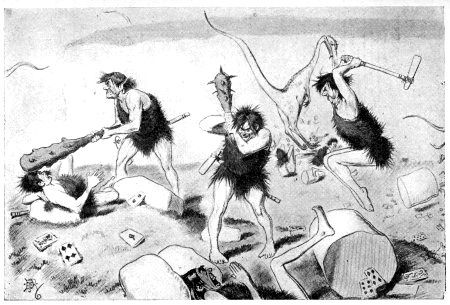
"Grand Slam" in the Stone Age.—It is, for obvious reasons, undeniable that a great wave of
"Progressive Bridge" passed over the entire human race at a remote period. It is no use blinking the
fact that while it lasted it was responsible for a marked "set-back" in the census returns.
Some ladies'-maids are expected to mend their
ladies' clothes; but no lady, that is a lady, ought
to wear any clothes that have been mended. You
should try and persuade her to be of the same
opinion, by which you will not only save yourself
the trouble of mending, but you will come in for
many things much sooner than you could otherwise
hope to do. The author of the proverb,
that "a stitch in time saves nine," no doubt
thought himself very clever; but if avoiding
trouble is the object, it stands to reason that
though "a stitch in time saves nine," it must be a
greater saving still never to put a stitch in anything.
If your mistress will make you work at your
needle, put a novel on your lap, so that you may
read and work at the same time. If you are
asked to cut out a body, make a bungling job of it,
that you may not be asked to do the same thing
again. If you cut out anybody it should be the
lady's-maid next door, with which your ambition
ought to be satisfied.
Taking out marks from linen is an essential part
of the duties of a lady's-maid. Some practise
themselves in this art by taking out the initials of
their mistress and substituting their own; but this
is a dangerous experiment.
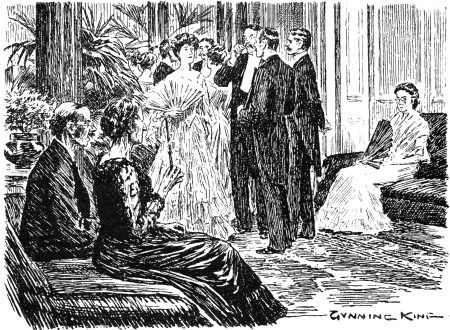
Prof. Gimlet. "Who is that pretty girl those men are talking to?"
Miss Bradawl. "Oh,
she's nobody; it's strange how some women attract the men; now there's Miss Blinkins over
there, such a nice clever girl, and I haven't seen a man speak to her the whole evening."
It is said in "Knight's Guide to Service" that
"when for the first time you stand behind your
mistress's chair to brush her hair, you may feel
that you are placed in a situation of high trust."
This, however, depends upon circumstances; for
if your mistress dyes her hair, it is a great mark of
her confidence to ask you to brush it. If she
wears false braids, she is, to a certain extent, in
your power; for, as the poet says—
"Should she upbraid,"
you might betray her; but if she is almost bald,
and wears a wig, from the moment of your being
entrusted to stand behind her chair and brush her
hair, you may do what you please with her.
If, in the story of Faustus, Margaret had worn a
wig, and Mephistophiles had seen her but once
without it, the power of the fiend over her would
have been irresistible.
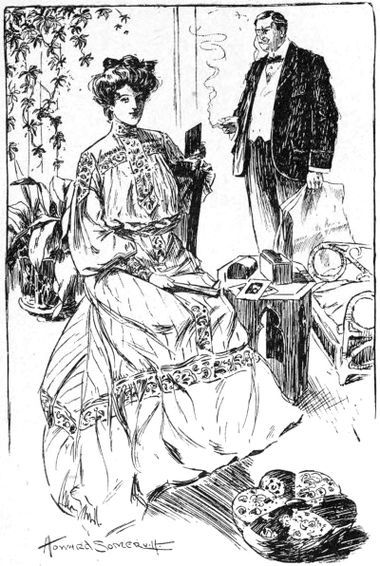
A Difficult Task.—"Jack, dear, I do wish you would
get another photo taken."
"How often have I told you I will not?"
"But why not?" (Then, thoughtfully, after
a pause.) "Are you afraid of being asked to look pleasant?"
In your position of lady's-maid, many family
secrets will perhaps come to your knowledge. Do
not talk of them to your fellow-servants, which
would, in fact, be destroying your own valuable
monopoly. A servant who knows a great deal of
the family affairs cannot be cheaply parted with.
You will be secure in your place, and will therefore
be in a position to make the most of all its
advantages.
The little work we have already alluded to says,
that if the lady's-maid is depressed in spirits, "she
should open her mind to the friend, whoever it
may be, that got her the place." This friend is
usually the keeper of a servants' office, who would
have enough to do if she were made to bear the
infliction of all the unbosomings of all the discontented
servants she may have found situations for.
This mode of easing your heart would involve the
necessity of constantly running out, besides the
expense of an occasional omnibus.
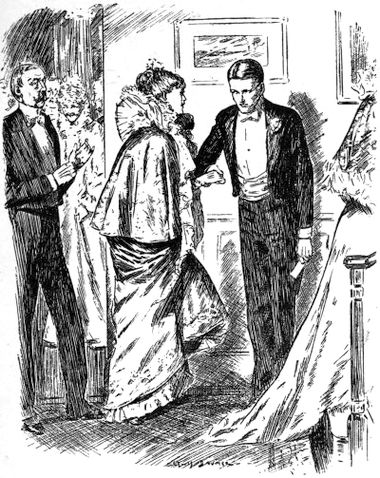
Unhappily Expressed.—She (who did not know they were
to meet). "Why, Mr. Brown, this is a pleasant surprise!"
He (who did). "I can't altogether say that it is so to me,
Miss Jones!"
Manners form an essential part of the qualities
of a lady's-maid, and making one's self agreeable
is the best mannered thing one can possibly
accomplish. This is to be done by praise, for
nothing is more agreeable to a lady than flattery.
However sensible your mistress may be, she is
sure to have a share of female vanity; and even if
she knows herself to be ugly altogether, she will
fancy she has some redeeming feature. If she
squints, praise her complexion; if that is bad, tell
her she has beautiful eyes: if she has a dumpty
figure, praise her face; and if her countenance is
as ugly as sin, tell her that her shape is exquisite.
Some people will tell you that sensible women
don't like flattery; but this you must not believe;
for, however sensible they are, they are pleased by
it, particularly when it is administered with so
much art as to seem not intended for mere compliment.
Very palpable praise is insulting to the
generality of ladies; but flattery can scarcely be
too gross for some few of them. You should study
the character of your mistress, that you may not
run the risk of offending her by too much praise,
or hurting her by giving too little. Your mistress
will sometimes take a journey, and you will then
have to pack her things for her. The following
directions for packing a lady's portmanteau may,
therefore, be of use to you:—Put the lighter
dresses at the bottom, for these will not be wanted
while travelling; and artificial flowers, wreaths,
&c., may go along with them. Insert next a layer
of dress caps, and ram well down with heavy
dresses, to keep the others in their places. Throw
in a sprinkling of shoes, and then add the rest of
the wardrobe; cramming-in the marking-ink and
the desk at the top, where they are easily got at
if they are wanted. Thrust in scissors and hairbrushes
anywhere that you can find room for
them. Get the footman to cord the box, for it
will be a good romp for you, as well as great
assistance.
By following these instructions, you will find
that you have a tolerably snug place of it.
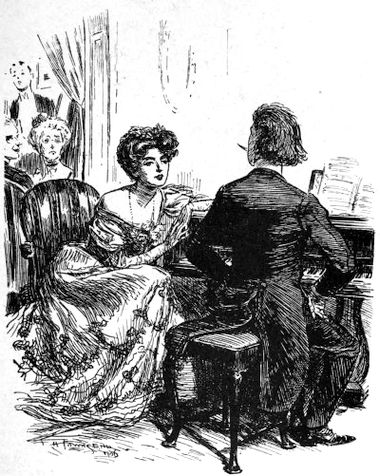
Belle of Balham (to professor, who has just played Chopin's
funeral march). "That's awfully jolly! Now play one of
Lohengrin's things!"
THE NURSERY-MAID
Any one may undertake the place of a nursery-maid.
As every female has, when a girl, been in
the habit of carrying, letting fall, snubbing and
slapping, either her own or some one else's little
brothers and sisters, it is easy to say you have
been accustomed to children.
Supposing that you enter service as a nursery-maid,
there will, perhaps, be an upper nurse, who
will be, in fact, your mistress. Your care at
home will be to wait on her; and when walking
out, you will have to keep the children at a
convenient distance while she flirts with her beau,
who will probably be one of the British soldiery.
This will be very tantalising to you at first; but
you must recollect that your own time will come,
if you wait patiently.
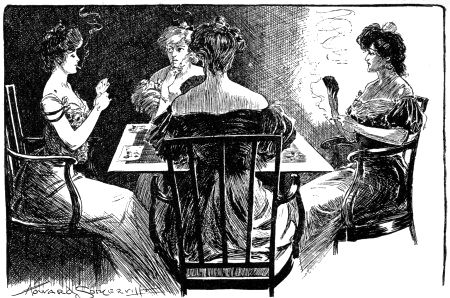
Primum Vivere, Deinde Philosophari.—"Is
Florrie's engagement really off, then?" "Oh, yes. Jack wanted her to give up
gambling and smoking, and goodness knows what else."
(Chorus.) "How absurd!!"
Some places are very different from others. You
may go into a wealthy family where the children
are kept upstairs, like live lumber, in the nursery,
and are only brought out now and then for show,
like the horses of the state carriage, or the best tea-set.
If you curb their spirits that they may be
docile on those occasions, and turn them out to
the best advantage as far as appearance is concerned,
you will be a favourite with your mistress.
In some places you will be what is called
"assisted" by the mother; or, in other words,
interfered with, just enough to destroy all your
attempts at discipline. In this case, your mistress
will doubtless tell you, that if you cannot
manage the children, she must find someone who
can, and will give you warning accordingly.
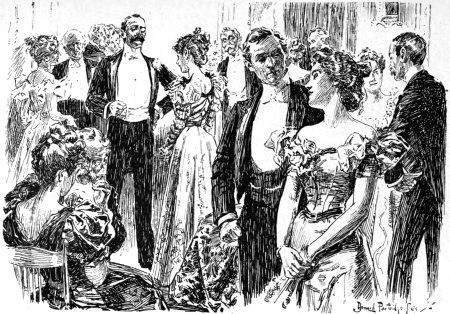
She. "What an enormous expanse of shirt-front Major Armstrong has!"
He. "H'm—it isn't his front I object to. It's his side!"
It is not necessary to give you any particular
directions about your dress, for the penny Belle
Assemblée will furnish you with all the latest
fashions; and you have only to do in cottons and
stuffs, what your mistress is doing in silks and
satins. You should bear in mind, that you are
not obliged to make yourself a dowdy to please
any one; for nature has doubtless given you a
pretty face, and the gifts of nature ought to be
made the most of. Besides, if you are a servant
at home, you are a lady out of doors; and you
may even keep a parasol at the greengrocer's, to
be ready for you when you take a holiday.
When you go to a new place, your mistress will,
perhaps, tell you the character of each child, that
you may know how to manage their different
tempers; but you will, of course, use your own
discretion. If one is pointed out as a high-spirited
little fellow, you may be sure that he is fond of
killing flies, tying toys to the dog's tail, striking
you, and crying, as if you had struck him, when
he hears his mamma coming. If you are told
that one of the dear boys has a turn for finding
out how everything is made, and he must not be
checked, as his papa intends him for a civil-engineer,
you may be sure that the juvenile spirit
of inquiry will be shown in pulling your work-box
to pieces, unless you turn his attention to the
furniture, which he should be encouraged to dissect
in preference to any of your property.
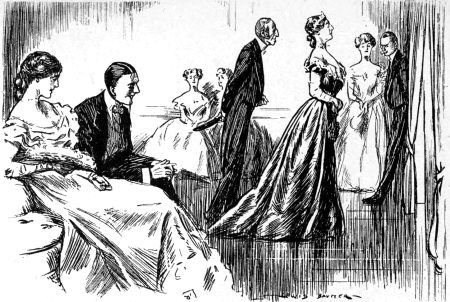
The Latest Little Game.—"The duchess is looking awfully pleased with herself this evenin'.
What's the matter?" "What! Haven't you heard? Why, she's just been made editor of the
pet poodle page in the Upper Crust Magazine!"
When you have a baby to take care of, some say
you should be particular in its food; but if the
child cries you have no time for this, and you must
stop its mouth with anything that comes handiest.
Indiscriminate feeding is said to lay the foundation
of diseases which remain with the child through
life; but as you do not remain with the child so
long, this is not your business. A nurse who
knows thoroughly what she is about, will keep a
little Godfrey's Cordial, or some other opiate,
always at hand—but quite out of sight—to soothe
the infant; for nothing is so distressing to the
mother, or such a nuisance to yourself, as to hear
a child continually crying. When there is only
one infant these soothing syrups must be cautiously
applied, lest the necessity for a nurse
should terminate altogether, and you are thrown
out of your situation.
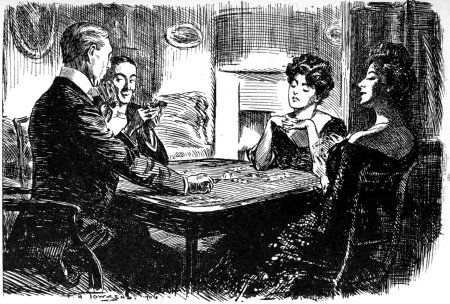
Nervous Player (deprecatingly playing card).—"I really don't know what to play. I'm afraid I've made
a fool of myself."
Partner (re-assuringly). "That's all right. I don't see what else you could have done!"
An infant sometimes requires example before it
will take to its food, and, as it is very nice, you
may as well eat one half of it first, to encourage
the infant to eat the other. Use sugar in children's
food very sparingly, and, lest the infant be
tempted to want some of the sugar that is saved
out of the quantity allowed, lose no time in locking
it up out of sight in your own tea-caddy. If you
wish to save your beer-money, recollect that milk
is heavy for children, unless mixed copiously with
water. As nothing ought to be wasted, you can
drink what remains, instead of beer, at your
dinner.
There are many very troublesome duties that
some nurses undertake in order to amuse the
child; but as Nature is acknowledged to be the
best nurse, you had better let Nature try her
hand at all the hard work, while you confine
yourself to that which is easy.
When a child reaches a certain age it will begin
to want amusement, when, if there are no toys,
you may give it the poker and tongs, or set it down
on the floor before the coal-scuttle. Opening and
shutting a box is also an amusement; as it involves
occasionally the shutting in of the child's own
fingers, the operation combines instruction also.
As a child may be troublesome while being washed,
give it the powder-puff; and as every thing goes
to the mouth, the dear little thing will commence
sucking the powder-puff, which will keep it quiet.
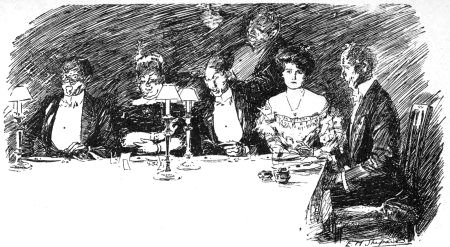
WORKING OUT THEIR OWN SALIVATION
This is not a feast of "funeral baked meats." It is a party of hygienic enthusiasts,
following the system by which all food is masticated eighty-five times and then allowed to
remain in the mouth till it disappears by involuntary absorption.
A very interesting age in children is when they
begin "to take notice." When taking a walk
with the children it cannot be expected that you
can always have your eyes on them, and you
must therefore accustom them to take care of
themselves as much as possible. Besides, self-preservation
is the first law of Nature, and a child
cannot too soon be taught to follow it. Thus, if
you are looking about you and the children get
into the road, while a carriage is passing, you will
probably not be aware of their danger, till it is
past, when you will begin slapping and scolding
your little charges that they may know better for
the future.
It is a very fine thing to encourage generosity in
children, and you should therefore talk a great
deal about the presents you have received on
birth-days and on other occasions from the little
dears in the place where you last lived. This will
of course give your mistress a hint as to what she
ought to do. For the children will naturally ask
to be allowed to make you presents, and the
parents not liking to check the amiable feeling,
and desirous of not being thought shabby in comparison
with your former employers, will no doubt
give—through the hands of the children—what
you may have occasion for.
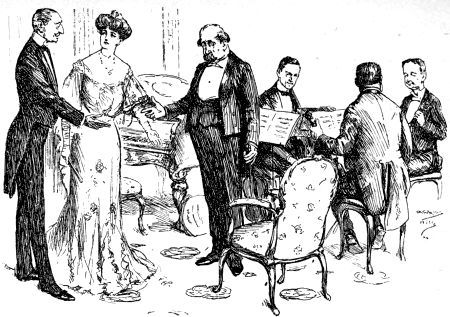
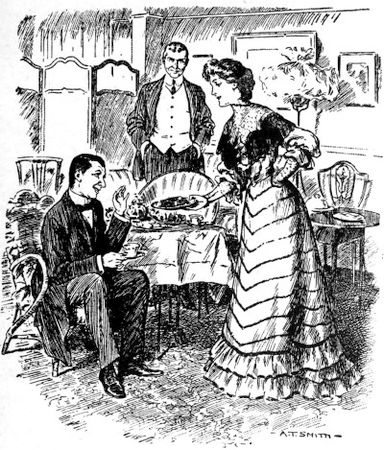
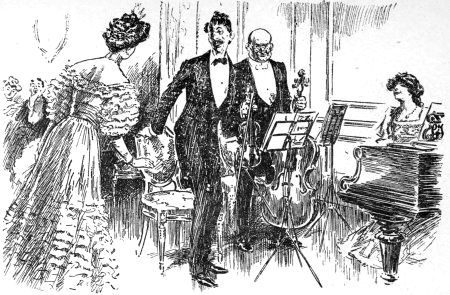
Hostess (introducing first violin to sporting and non-musical guest). "This is Professor Jingelheim,
who leads the quartet, you know."
Sporting Guest (thinking to be highly complimentary). "Leads—eh—ah—by
several lengths, eh—and the rest nowhere! What?"
If you have nephews and nieces you may supply
them with many little articles of dress that are pronounced
to be "past mending." If your mistress
notices that the stock of children's things diminish,
you can suggest that "things won't wear for
ever," which often passes as an apology for a
sensible diminution in the number of socks and
pinafores. You may observe that Master So-and-So
is such "a spirited little fellow, that he does
wear his things out very fast," and your mistress
will be satisfied if she thinks her child's spirit has
caused half his wardrobe to evaporate.
If you follow all these instructions to the letter,
you will make as good a nursery-maid as the best
of them.
Hint to Housemaids.—How to destroy flies—encourage
spiders.
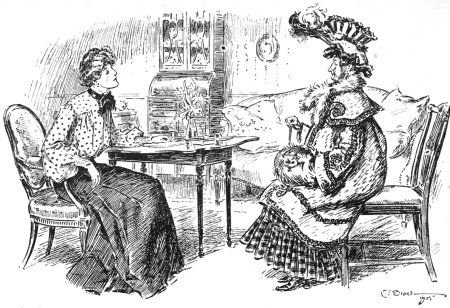
A Matter of Habit.—Lady (engaging new cook). "One thing more. I always like
my servants to dress quietly."
Applicant. "Oh, there won't be any trouble about
that, ma'am. I've got a quiet taste myself."
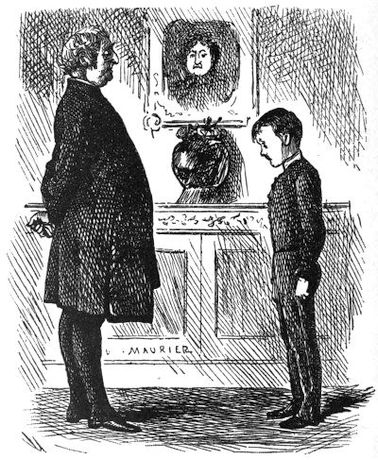
Bishop (reproving delinquent page). "Wretched boy!
Who is it that sees and hears all we do, and before whom
even I am but as a crushed worm?"
Page. "The missus, my lord!"
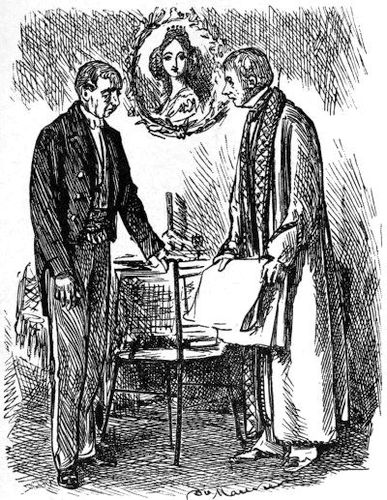
"A Fellow-feeling makes us Wondrous Kind."—"What!
going to leave us, James?"
"Yes, sir, I'm
very sorry, sir, but I really can't put up with missus any
longer!"
"Ah, James! think how long I've put up
with her!"
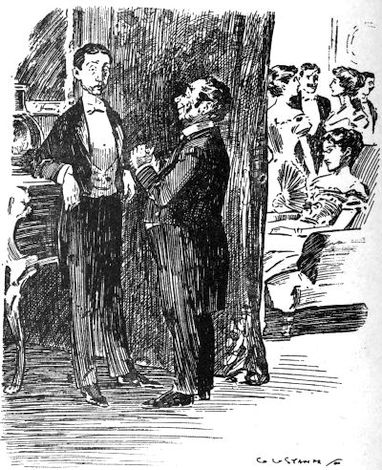
"Yes, she's a nice girl; but I can't get on with her.
She has so little to say for herself."
"Oh, but I've been talking to her for the last hour,
and she doesn't interrupt. Now, that's what I think so
charming!"
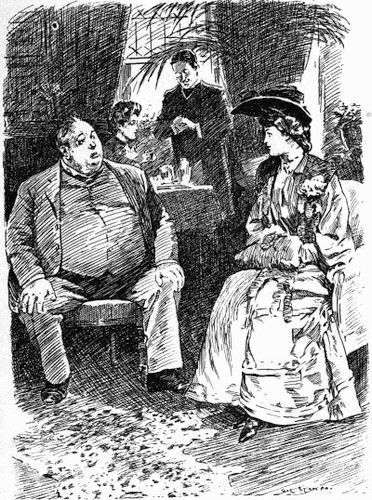
Impossible!—He (relating a thrilling experience), "If I hadn't
skipped to one side, I should have been run over! I assure you I
had a very narrow escape!"
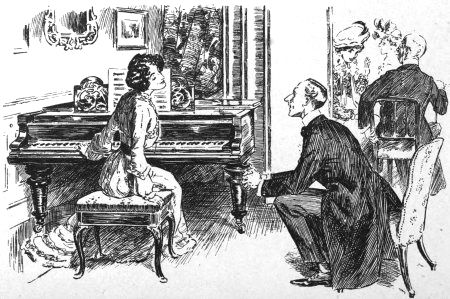
She (having played a little thing for Bertram). "I hope you didn't hear the wrong note!"
Bertram (thinking to be complimentary). "Which one?"
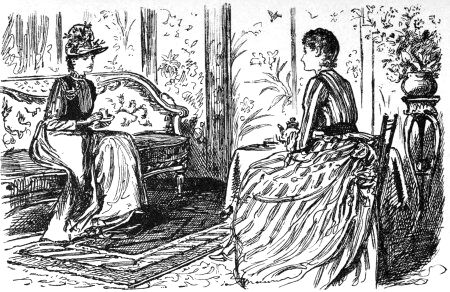
Things One Would Wish To Have Expressed Differently.—(Our semi-detached neighbours.)
Grace. "And yet, dear, how little we have seen of each other lately—considering there is only a partition-wall
between us!" Emily. "But then, dear, it is such a comfort to feel that you are on the other side!"
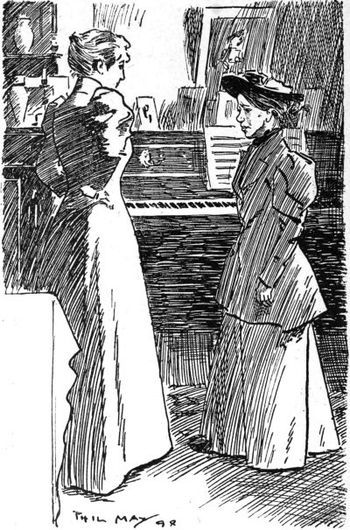
Mistress (about to engage a new housemaid). "Have you
had any experience?" Applicant. "Oh yes, mum.
I've been in 'undreds of sitiwations!"
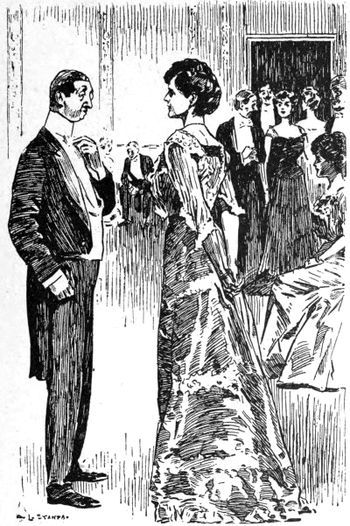
Something New.—Young Ass. "Aw—I'm bored to
death with life!" She. "Why don't you do something?"
Young Ass. "Aw—there's nothing worth doing that I
haven't tried." She. "Isn't there? There must be. Try
and think."
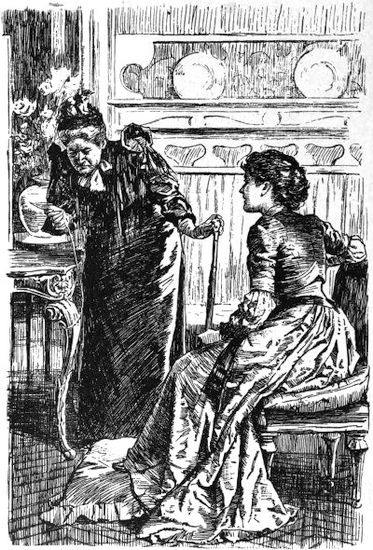
Bric à Brac.—Lady Crœsus. "Oh, what a sweet table! Where
did you get it, my dear? Oh, I see here's the man's card." (Spelling
the label.) "'Table—Louis Quinze.' Louis Quinzey! What a horrid
name! and why hasn't he put his address?"
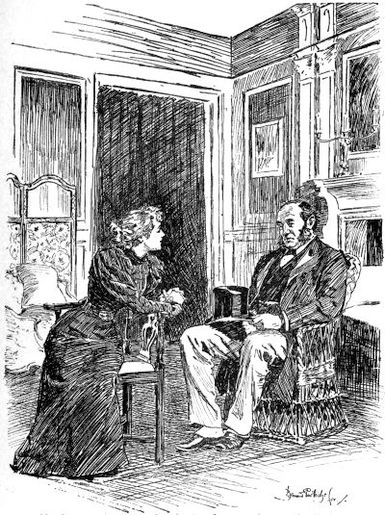
Mr. Boreham (who has already stayed over an hour and talked about
himself the whole time). "Yes, I'm sorry to say I'm a martyr to
insomnia. I've tried everything, but I cannot get sleep at night!"
His Hostess (sweetly). "Oh, but I can tell you a very simple remedy.
You should talk to yourself—after going to bed!"
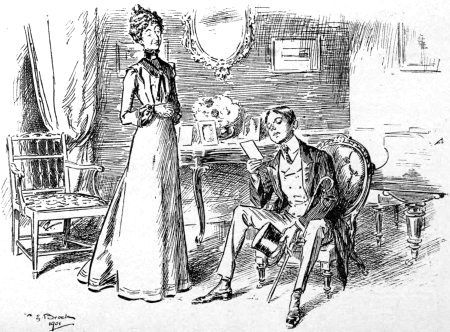
Miss Withers (showing photograph of herself). "I'm afraid it's rather faded."
Binks (inexperienced, aged nineteen). "Yes, but it's just like you."
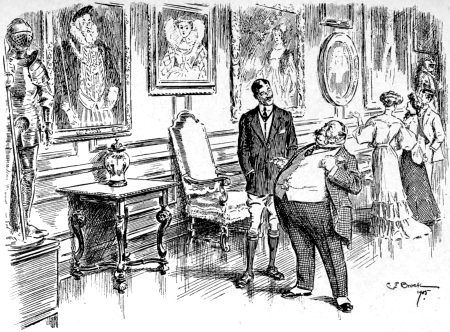
In the Picture Gallery of the Earls of Longline.—Sir Peter Stodgely.—"Curious
thing your family should all be took in fancy dress! I s'pose they're all by the same man, eh?"
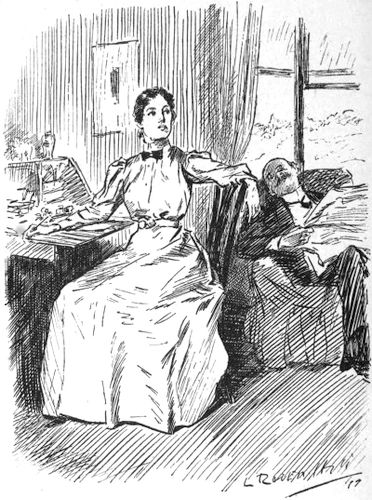
Our Domestics.—"Listen Jack. I've put down 'kitchen
and scullery maids kept; only two in family; beer allowed;
no dairy; extra help when required.' Now, can you suggest
any other inducement I can offer?"
"Well—you might add 'charming scenery!'"
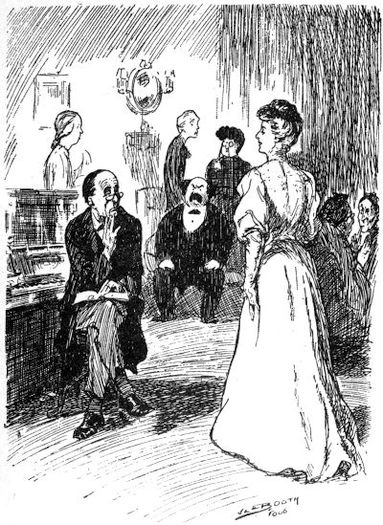
"——BUT THOSE UNHEARD ARE SWEETER"
Scene—A Boarding-house.
Wife. "Why do you always sit at the piano, David? You know
you can't play a note!"
David. "Neither can anyone else, while I am here!"
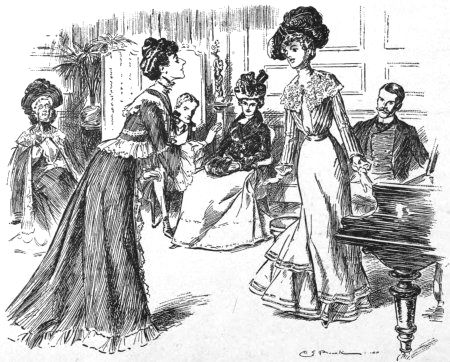
Hostess. "Please don't leave off, Miss Jessop."
Miss J. "But
shan't I bore you? It is possible to have too much of a good thing, you
know."
Hostess. "Yes; but that doesn't apply to your playing!"
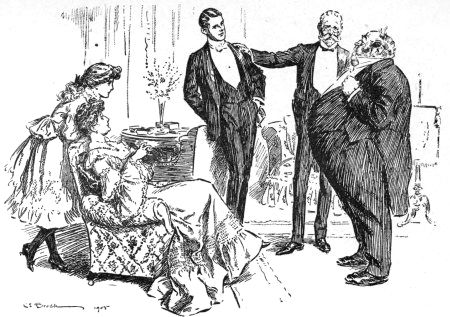
What Shall we do with our Boys?—Father. "Now, Sir William, I want Jack to go
into business—his mother wants him to read for the Bar. Jack's undecided. What do you
advise?"
Sir William Grubbe. "You go into business, my boy. See what it's made me!"
Jack (emphatically). "Oh, Sir William, I've quite decided to take the mater's advice."
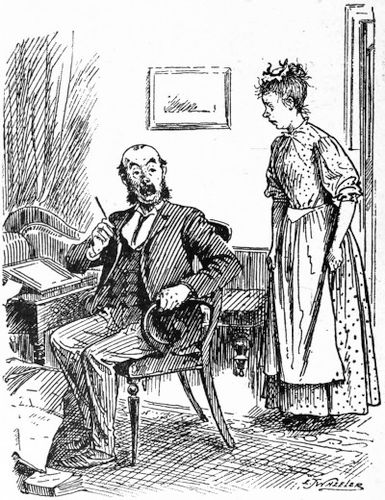
New Maidservant (much pleased with herself). A
gentleman called to see you, sir, and said as he
were just leavin' town for some time. Knowin'
as you didn't
want to be disturbed
this morning,
I told him as
you was hout—
Master. Quite
right. (To himself)
Sharp girl this!
New Maid
(cheerfully)—and
told him as I
didn't know when
you'd be back
again. 'Is card's
in the 'all, sir.
He 'ave wrote
somethin' on it.
[She fetches it, returns, and presents it.
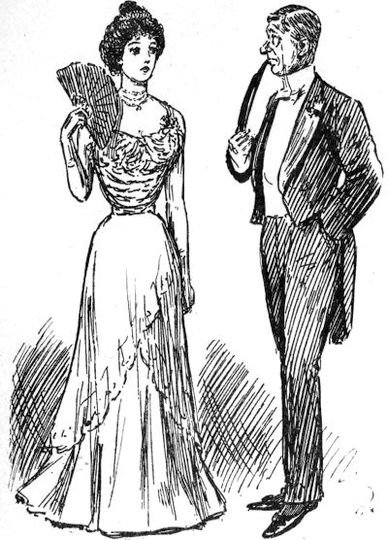
He. "Sorry I forgot your party the other evening!"
She. "Oh, weren't you there?"
Master (reads writing on card, then suddenly springing
up, exclaims) Oh—(stops the escape of a very strong
expletive)—How long ago?
New Maid (cheerfully). Oh, quite a hour. There
was luggidge on the cab.
Master (subsiding hopelessly in chair, to Maid).
You can go. (Alone, grinding his teeth.) Confound
the idiot! (Reads card muttering to himself.)
Snooker Poole, Chork Cottage, Kew. "Called to
repay coin personally. Sorry to miss you. So long!"
I shall never see my hundred and fifty again!...
That's the worst of new servants!
[He is left considering whether it would not be as
well to alter the form of his instructions to the
hand-maiden. Scene closes.
The Boastfulness of Belinda.—Arabella
(concluding the description of the magnificence of her
employer's home). And in the servants' 'all we 'as
'ot plovers' heggs ev'ry mornin' for brekfist.
Belinda. That's nothin'. At hour 'ouse hall
the fires is laid with reel sparrow-grass sticks
instead of wood!
[Arabella dries up.
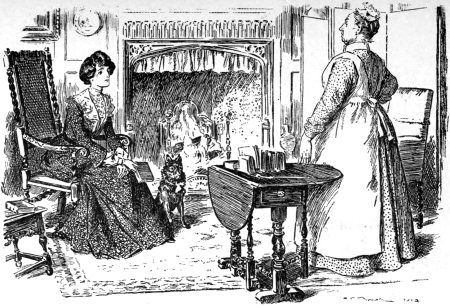
Inexperienced and anxious Young Mistress. "The new housemaid, Maria, is a Roman Catholic
but I hope you will not allow any religious controversy in the servants' hall."
Cook (with much dignity). "You needn't have any fear, my lady. In really 'igh class families
religion is never mentioned!"