Chief of Clinic of Psychiatry Columbia University; Chief of the
Neurological Department, Bronx Hospital and Dispensary;
former Assistant Physician in the Central Islip State
Hospital, and in the Clinic of Psychiatry, Zurich
NEW YORK THE MACMILLAN COMPANY
1914
(All rights reserved)
INTRODUCTION
Professor Freud developed his system of psychoanalysis
while studying the so-called border-line
cases of mental diseases, such as hysteria
and compulsion neurosis. By discarding the old
methods of treatment and strictly applying himself
to a study of the patient’s life he discovered
that the hitherto puzzling symptoms had a definite
meaning, and that there was nothing arbitrary
in any morbid manifestation. Psychoanalysis
always showed that they referred to some definite
problem or conflict of the person concerned. It
was while tracing back the abnormal to the
normal state that Professor Freud found how
faint the line of demarcation was between the
normal and neurotic person, and that the psychopathologic
mechanisms so glaringly observed in
the psychoneuroses and psychoses could usually
be demonstrated in a lesser degree in normal
persons. This led to a study of the faulty
actions of everyday life and later to the publication
of the Psychopathology of Everyday Life, a
book which passed through four editions in
Germany and is considered the author’s most
popular work. With great ingenuity and penetration
the author throws much light on the
complex problems of human behaviour, and
clearly demonstrates that the hitherto considered
impassable gap between normal and abnormal
mental states is more apparent than real.
This translation is made of the fourth German
edition, and while the original text was strictly
followed, linguistic difficulties often made it
necessary to modify or substitute some of the
author’s cases by examples comprehensible to the
English-speaking reader.
During the year 1898 I published a short essay
On the Psychic Mechanism of Forgetfulness.[1]
I shall now repeat its contents and take it as a
starting-point for further discussion. I have
there undertaken a psychologic analysis of a
common case of temporary forgetfulness of
proper names, and from a pregnant example of
my own observation I have reached the conclusion
that this frequent and practically unimportant
occurrence of a failure of a psychic
function—of memory—admits an explanation
which goes beyond the customary utilization of
this phenomenon.
If an average psychologist should be asked
to explain how it happens that we often fail to
recall a name which we are sure we know, he
would probably content himself with the answer
that proper names are more apt to be forgotten
than any other content of memory. He might
give plausible reasons for this “forgetting preference”
for proper names, but he would not
assume any deep determinant for the process.
I was led to examine exhaustively the phenomenon
of temporary forgetfulness through the
observation of certain peculiarities, which, although
not general, can, nevertheless, be seen
clearly in some cases. In these there is not only
forgetfulness, but also false recollection: he who
strives for the escaped name brings to consciousness
others—substitutive names—which, although
immediately recognized as false, nevertheless
obtrude themselves with great tenacity. The
process which should lead to the reproduction
of the lost name is, as it were, displaced, and
thus brings one to an incorrect substitute.
Now it is my assumption that the displacement
is not left to psychic arbitrariness, but that it
follows lawful and rational paths. In other
words, I assume that the substitutive name (or
names) stands in direct relation to the lost name,
and I hope, if I succeed in demonstrating this
connection, to throw light on the origin of the
forgetting of names.
In the example which I selected for analysis
in 1898 I vainly strove to recall the name of the
master who made the imposing frescoes of the
“Last Judgment” in the dome of Orvieto. Instead
of the lost name—Signorelli—two other
names of artists—Botticelli and Boltraffio—obtruded
themselves, names which my judgment
immediately and definitely rejected as
being incorrect. When the correct name was
imparted to me by an outsider I recognized it at
once without any hesitation. The examination
of the influence and association paths which
caused the displacement from Signorelli to
Botticelli and Boltraffio led to the following
results:—
(a) The reason for the escape of the name
Signorelli is neither to be sought in the strangeness
in itself of this name nor in the psychologic
character of the connection in which it
was inserted. The forgotten name was just as
familiar to me as one of the substitutive names—Botticelli—and
somewhat more familiar than
the other substitute—Boltraffio—of the possessor
of which I could hardly say more than that he
belonged to the Milanese School. The connection,
too, in which the forgetting of the name
took place appeared to me harmless, and led
to no further explanation. I journeyed by
carriage with a stranger from Ragusa, Dalmatia,
to a station in Herzegovina. Our conversation
drifted to travelling in Italy, and I asked my
companion whether he had been in Orvieto and
had seen there the famous frescoes of——
(b) The forgetting of the name could not be
explained until after I had recalled the theme
discussed immediately before this conversation.
This forgetting then made itself known as a
disturbance of the newly emerging theme caused
by the theme preceding it. In brief, before I
asked my travelling companion if he had been
in Orvieto we had been discussing the customs
of the Turks living in Bosnia and Herzegovina.
I had related what I heard from a colleague who
was practising medicine among them, namely,
that they show full confidence in the physician
and complete submission to fate. When one is
compelled to inform them that there is no help
for the patient, they answer: “Sir (Herr), what
can I say? I know that if he could be saved
you would save him.” In these sentences alone
we can find the words and names: Bosnia, Herzegovina,
and Herr (sir), which may be inserted
in an association series between Signorelli,
Botticelli, and Boltraffio.
(c) I assume that the stream of thoughts
concerning the customs of the Turks in Bosnia,
etc., was able to disturb the next thought, because
I withdrew my attention from it before it came
to an end. For I recalled that I wished to relate
a second anecdote which was next to the first in
my memory. These Turks value the sexual
pleasure above all else, and at sexual disturbances
merge into an utter despair which strangely
contrasts with their resignation at the peril of
losing their lives. One of my colleague’s patients
once told him: “For you know, sir (Herr), if
that ceases, life no longer has any charm.”
I refrained from imparting this characteristic
feature because I did not wish to touch upon
such a delicate theme in conversation with a
stranger. But I went still further; I also deflected
my attention from the continuation of
the thought which might have associated itself
in me with the theme “Death and Sexuality.”
I was at that time under the after-effects of a
message which I had received a few weeks
before, during a brief sojourn in Trafoi. A
patient on whom I had spent much effort had
ended his life on account of an incurable sexual
disturbance. I know positively that this sad
event, and everything connected with it, did not
come to my conscious recollection on that trip
in Herzegovina. However, the agreement between
Trafoi and Boltraffio forces me to assume
that this reminiscence was at that time brought
to activity despite all the intentional deviation
of my attention.
(d) I can no longer conceive the forgetting
of the name Signorelli as an accidental occurrence.
I must recognize in this process the
influence of a motive. There were motives which
actuated the interruption in the communication
of my thoughts (concerning the customs of the
Turks, etc.), and which later influenced me to
exclude from my consciousness the thought
connected with them, and which might have led
to the message concerning the incident in
Trafoi—that is, I wanted to forget something,
I repressed something. To be sure, I wished
to forget something other than the name of the
master of Orvieto; but this other thought
brought about an associative connection between
itself and this name, so that my act of volition
missed the aim, and I forgot the one against my
will, while I intentionally wished to forget the
other. The disinclination to recall directed itself
against the one content; the inability to remember
appeared in another. The case would
have been obviously simpler if this disinclination
and the inability to remember had concerned
the same content. The substitutive names no
longer seem so thoroughly justified as they were
before this explanation. They remind me (after
the form of a compromise) as much of what I
wished to forget as of what I wished to remember,
and show me that my object to forget
something was neither a perfect success nor a
failure.
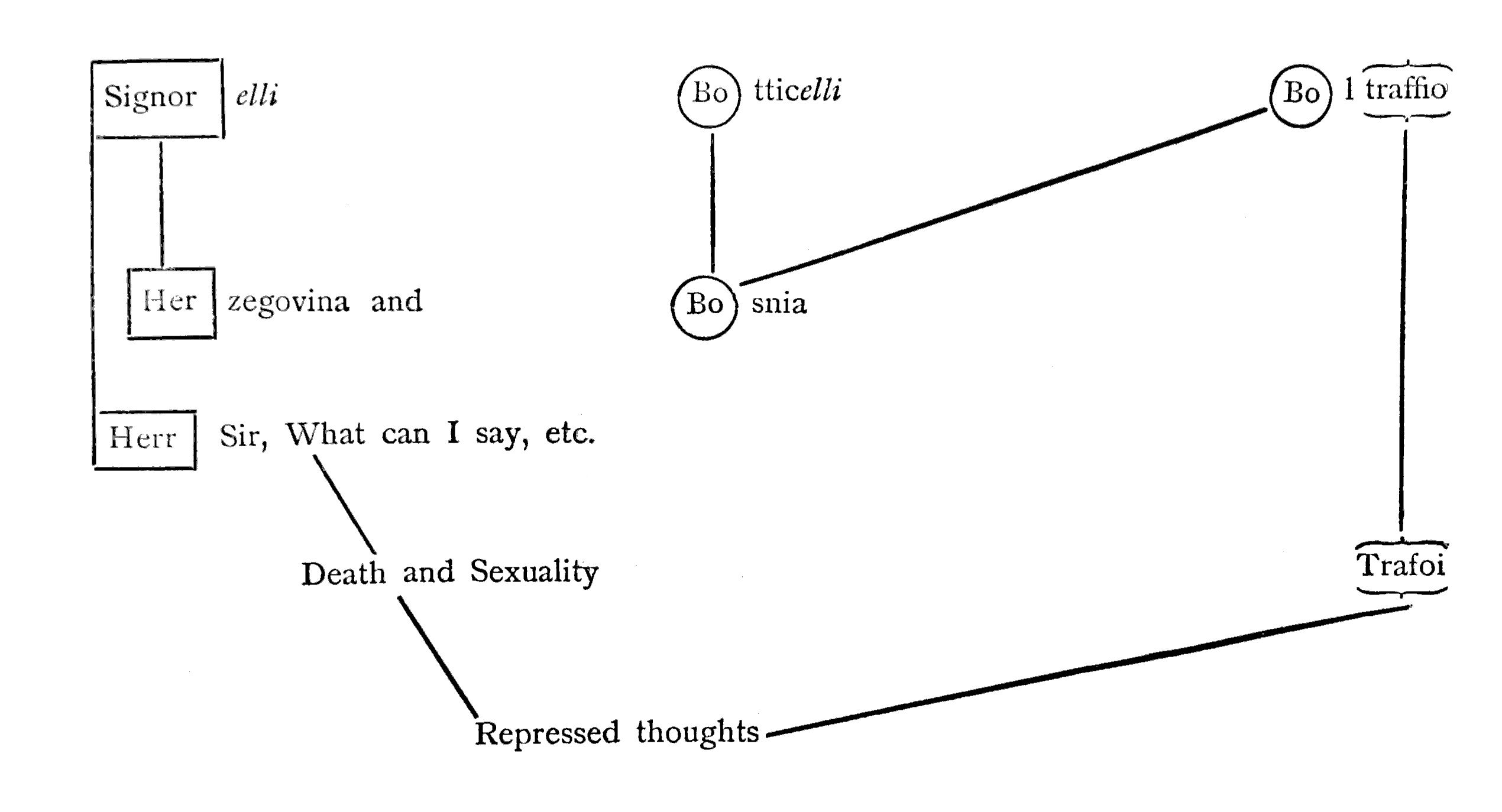
(e) The nature of the association formed
between the lost name and the repressed theme
(death and sexuality, etc.), containing the names
of Bosnia, Herzegovina, and Trafoi, is also very
strange. In the scheme inserted here, which
originally appeared in 1898, an attempt is made
to graphically represent these associations.
The name Signorelli was thus divided into
two parts. One pair of syllables (elli) returned
unchanged in one of the substitutions, while the
other had gained, through the translation of
signor (sir, Herr), many and diverse relations
to the name contained in the repressed theme,
but was lost through it in the reproduction. Its
substitution was formed in a way to suggest that
a displacement took place along the same
associations—“Herzegovina and Bosnia”—regardless
of the sense and acoustic demarcation.
The names were therefore treated in this process
like the written pictures of a sentence which is
to be transformed into a picture-puzzle (rebus).
No information was given to consciousness concerning
the whole process, which, instead of the
name Signorelli, was thus changed to the substitutive
names. At first sight no relation is
apparent between the theme that contained the
name Signorelli and the repressed one which
immediately preceded it.
Perhaps it is not superfluous to remark that
the given explanation does not contradict the
conditions of memory reproduction and forgetting
assumed by other psychologists, which they seek
in certain relations and dispositions. Only in
certain cases have we added another motive to
the factors long recognized as causative in forgetting
names, and have thus laid bare the
mechanism of faulty memory. The assumed
dispositions are indispensable also in our case,
in order to make it possible for the repressed
element to associatively gain control over the
desired name and take it along into the repression.
Perhaps this would not have occurred
in another name having more favourable
conditions of reproduction. For it is quite
probable that a suppressed element continually
strives to assert itself in some other way, but
attains this success only where it meets with
suitable conditions. At other times the suppression
succeeds without disturbance of function,
or, as we may justly say, without symptoms.
When we recapitulate the conditions for forgetting
a name with faulty recollection we find:
(1) a certain disposition to forget the same; (2)
a process of suppression which has taken place
shortly before; and (3) the possibility of establishing
an outer association between the concerned
name and the element previously
suppressed. The last condition will probably
not have to be much overrated, for the slightest
claim on the association is apt in most cases to
bring it about. But it is a different and
farther-reaching question whether such outer
association can really furnish the proper condition
to enable the suppressed element to disturb
the reproduction of the desired name, or whether
after all a more intimate connection between the
two themes is not necessarily required. On
superficial consideration one may be willing to
reject the latter requirement and consider the
temporal meeting in perfectly dissimilar contents
as sufficient. But on more thorough examination
one finds more and more frequently that the two
elements (the repressed and the new one) connected
by an outer association, possess besides
a connection in content, and this can also be
demonstrated in the example Signorelli.
The value of the understanding gained through
the analysis of the example Signorelli naturally
depends on whether we must explain this case
as a typical or as an isolated process. I must
now maintain that the forgetting of a name
associated with faulty recollection uncommonly
often follows the same process as was demonstrated
in the case of Signorelli. Almost every
time that I observed this phenomenon in myself
I was able to explain it in the manner indicated
above as being motivated by repression.
I must mention still another view-point in
favour of the typical nature of our analysis. I
believe that one is not justified in separating
the cases of name-forgetting with faulty recollection
from those in which incorrect substitutive
names have not obtruded themselves. These
substitutive names occur spontaneously in a
number of cases; in other cases, where they do
not come spontaneously, they can be brought
to the surface by concentration of attention, and
they then show the same relation to the repressed
element and the lost name as those that come
spontaneously. Two factors seem to play a part
in bringing to consciousness the substitutive
names: first, the effort of attention, and second,
an inner determinant which adheres to the
psychic material. I could find the latter in the
greater or lesser facility which forms the required
outer associations between the two elements. A
great many of the cases of name-forgetting
without faulty recollection therefore belong to
the cases with substitutive name formation, the
mechanism of which corresponds to the one in
the example Signorelli. But I surely shall not
venture to assert that all cases of name-forgetting
belong to the same group. There is no doubt
that there are cases of name-forgetting that
proceed in a much simpler way. We shall
represent this state of affairs carefully enough
if we assert that besides the simple forgetting
of proper names there is another forgetting
which is motivated by repression.
II — FORGETTING OF FOREIGN WORDS
The ordinary vocabulary of our own language
seems to be protected against forgetting within
the limits of normal function, but it is quite different
with words from a foreign language. The
tendency to forget such words extends to all parts
of speech. In fact, depending on our own
general state and the degree of fatigue, the first
manifestation of functional disturbance evinces
itself in the irregularity of our control over
foreign vocabulary. In a series of cases this
forgetting follows the same mechanism as the one
revealed in the example Signorelli. As a demonstration
of this I shall report a single analysis,
characterized, however, by valuable features, concerning
the forgetting of a word, not a noun,
from a Latin quotation. Before proceeding,
allow me to give a full and clear account of this
little episode.
Last summer, while journeying on my vacation,
I renewed the acquaintance of a young man of
academic education, who, as I soon noticed, was
conversant with some of my works. In our conversation
we drifted—I no longer remember how—to
the social position of the race to which we
both belonged. He, being ambitious, bemoaned
the fact that his generation, as he expressed it,
was destined to grow crippled, that it was prevented
from developing its talents and from gratifying
its desires. He concluded his passionately
felt speech with the familiar verse from Virgil:
Exoriare ... in which the unhappy Dido
leaves her vengeance upon Æneas to posterity.
Instead of “concluded,” I should have said
“wished to conclude,” for he could not bring the
quotation to an end, and attempted to conceal the
open gap in his memory by transposing the
words:—
“Exoriar(e) ex nostris ossibus ultor!”
He finally became piqued and said: “Please
don’t make such a mocking face, as if you were
gloating over my embarrassment, but help me.
There is something missing in this verse. How
does it read in its complete form?”
“With pleasure,” I answered, and cited it
correctly:—
“Exoriar(e) aliquis nostris ex ossibus ultor!”
“It is too stupid to forget such a word,” he
said. “By the way, I understand you claim
that forgetting is not without its reasons; I
should be very curious to find out how I came to
forget this indefinite pronoun ‘aliquis.’”
I gladly accepted the challenge, as I hoped to
get an addition to my collection, and said, “We
can easily do this, but I must ask you to tell me
frankly and without any criticism everything that
occurs to your mind after you focus your attention,
without any particular intention, on the forgotten
word.”[2]
“Very well, the ridiculous idea comes to me to
divide the word in the following way: a and
liquis.”
“What does that mean?”
“I don’t know.”
“What else does that recall to you?”
“The thought goes on to reliques—liquidation—liquidity—fluid.”
“Does that mean anything to you now?”
“No, not by a long shot.”
“Just go ahead.”
“I now think,” he said, laughing sarcastically,
“of Simon of Trent, whose relics I saw two years
ago in a church in Trent. I think of the old
accusation which has been brought against the
Jews again, and of the work of Kleinpaul, who
sees in these supposed sacrifices reincarnations or
revivals, so to speak, of the Saviour.”
“This stream of thoughts has some connection
with the theme which we discussed before the
Latin word escaped you.”
“You are right. I now think of an article in an
Italian journal which I have recently read. I
believe it was entitled: ‘What St. Augustine said
Concerning Women.’ What can you do with
this?”
I waited.
“Now I think of something which surely has
no connection with the theme.”
“Oh, please abstain from all criticism,
and——”
“Oh, I know! I recall a handsome old gentleman
whom I met on my journey last week. He
was really an original type. He looked like a
big bird of prey. His name, if you care to know,
is Benedict.”
“Well, at least you give a grouping of saints
and Church fathers: St. Simon, St. Augustine,
and St. Benedict. I believe that there was a
Church father named Origines. Three of these,
moreover, are Christian names, like Paul in the
name Kleinpaul.”
“Now I think of St. Januarius and his blood
miracle—I find that the thoughts are running
mechanically.”
“Just stop a moment; both St. Januarius and
St. Augustine have something to do with the
calendar. Will you recall to me the blood
miracle?”
“Don’t you know about it? The blood of St.
Januarius is preserved in a phial in a church in
Naples, and on a certain holiday a miracle takes
place causing it to liquefy. The people think a
great deal of this miracle, and become very
excited if the liquefying process is retarded, as
happened once during the French occupation.
The General in command—or Garibaldi, if I am
not mistaken—then took the priest aside, and with
a very significant gesture pointed out to him the
soldiers arrayed without, and expressed his hope
that the miracle would soon take place. And it
actually took place....”
“Well, what else comes to your mind? Why
do you hesitate?”
“Something really occurred to me ... but
it is too intimate a matter to impart ...
besides, I see no connection and no necessity for
telling it.”
“I will take care of the connection. Of course
I cannot compel you to reveal what is disagreeable
to you, but then you should not have
demanded that I tell you why you forgot the word
‘aliquis.’”
“Really? Do you think so? Well, I suddenly
thought of a woman from whom I could easily
get a message that would be very annoying to us
both.”
“That she missed her courses?”
“How could you guess such a thing?”
“That was not very difficult. You prepared
me for it long enough. Just think of the saints
of the calendar, the liquefying of the blood on
a certain day, the excitement if the event does
not take place, and the distinct threat that the
miracle must take place.... Indeed, you have
elaborated the miracle of St. Januarius into a
clever allusion to the courses of the woman.”
“It was surely without my knowledge. And
do you really believe that my inability to reproduce
the word ‘aliquis’ was due to this anxious
expectation?”
“That appears to me absolutely certain.
Don’t you recall dividing it into a-liquis and the
associations: reliques, liquidation, fluid? Shall
I also add to this connection the fact that St.
Simon, to whom you got by way of the reliques,
was sacrificed as a child?”
“Please stop. I hope you do not take these
thoughts—if I really entertained them—seriously.
I will, however, confess to you that the lady is
Italian, and that I visited Naples in her company.
But may not all this be coincidental?”
“I must leave to your own judgment whether
you can explain all these connections through the
assumption of coincidence. I will tell you, however,
that every similar case that you analyse
will lead you to just such remarkable ‘coincidences!’”
I have more than one reason for valuing this
little analysis, for which I am indebted to my
travelling companion. First, because in this case
I was able to make use of a source which is otherwise
inaccessible to me. Most of the examples of
psychic disturbances of daily life that I have here
compiled I was obliged to take from observation
of myself. I endeavoured to evade the far richer
material furnished me by my neurotic patients,
because I had to preclude the objection that the
phenomena in question were only the result and
manifestation of the neurosis. It was therefore
of special value for my purpose to have a stranger
free from a neurosis offer himself as a subject for
such examination. This analysis is also important
in other respects, inasmuch as it elucidates a
case of word-forgetting without substitutive recollection,
and thus confirms the principle formulated
above, namely, that the appearance or
nonappearance of incorrect substitutive recollections
does not constitute an essential distinction[3].
But the principal value of the example aliquis
lies in another of its distinctions from the case
Signorelli. In the latter example the reproduction
of the name becomes disturbed through the
after-effects of a stream of thought which began
shortly before and was interrupted, but whose
content had no distinct relation to the new theme
which contained the name Signorelli. Between
the repression and the theme of the forgotten
name there existed only the relation of temporal
contiguity, which reached the other in order that
the two should be able to form a connection
through an outer association.[4] On the other hand,
in the example aliquis one can note no trace of
such an independent repressed theme which could
occupy conscious thought immediately before and
then re-echo as a disturbance. The disturbance
of the reproduction proceeded here from the inner
part of the theme touched upon, and was brought
about by the fact that unconsciously a contradiction
arose against the wish-idea represented
in the quotation.
The origin must be construed in the following
manner: The speaker deplored the fact that the
present generation of his people was being
deprived of its rights, and like Dido he presaged
that a new generation would take upon itself
vengeance against the oppressors. He therefore
expressed the wish for posterity. In this moment
he was interrupted by the contradictory thought:
“Do you really wish so much for posterity?
That is not true. Just think in what a predicament
you would be if you should now receive the
information that you must expect posterity from
the quarter you have in mind! No, you want no
posterity—as much as you need it for your vengeance.”
This contradiction asserts itself, just as
in the example Signorelli, by forming an outer
association between one of his ideation elements
and an element of the repressed wish, but here it
is brought about in a most strained manner
through what seems an artificial detour of associations.
Another important agreement with the
example Signorelli results from the fact that the
contradiction originates from repressed sources
and emanates from thoughts which would cause
a deviation of attention.
So much for the diversity and the inner relationship
of both paradigms of the forgetting of
names. We have learned to know a second
mechanism of forgetting, namely, the disturbance
of thought through an inner contradiction emanating
from the repression. In the course of this
discussion we shall repeatedly meet with this process,
which seems to me to be the more easily
understood.
III — FORGETTING OF NAMES AND ORDER OF WORDS — Ode to Apollo
Experiences like those mentioned concerning
the process of forgetting a part of the order
of words from a foreign language may cause
one to wonder whether the forgetting of the
order of words in one’s own language requires
an essentially different explanation. To be sure,
one is not wont to be surprised if after awhile
a formula or poem learned by heart can
only be reproduced imperfectly, with variations
and gaps. Still, as this forgetting does not affect
equally all the things learned together, but seems
to pick out therefrom definite parts, it may
be worth our effort to investigate analytically
some examples of such faulty reproductions.
Brill reports the following example:—
“While conversing one day with a very
brilliant young woman she had occasion to quote
from Keats. The poem was entitled ‘Ode to
Apollo,’ and she recited the following lines:—
“‘In thy western house of gold
Where thou livest in thy state,
Bards, that once sublimely told
Prosaic truths that came too late.’
She hesitated many times during the recitation,
being sure that there was something wrong with
the last line. To her great surprise, on referring
to the book she found that not only was the
last line misquoted but that there were many
other mistakes. The correct lines read as
follows:—
“‘In thy western halls of gold
When thou sittest in thy state,
Bards, that erst sublimely told
Heroic deeds and sang of fate.’
The words italicized are those that have been
forgotten and replaced by others during the
recitation.
“She was astonished at her many mistakes,
and attributed them to a failure of memory. I
could readily convince her, however, that there
was no qualitative or quantitative disturbance of
memory in her case, and recalled to her our
conversation immediately before quoting these
lines.
“We were discussing the over-estimation of
personality among lovers, and she thought it was
Victor Hugo who said that love is the greatest
thing in the world because it makes an angel
or a god out of a grocery clerk. She continued:
‘Only when we are in love have we blind faith
in humanity; everything is perfect, everything
is beautiful, and ... everything is so poetically
unreal. Still, it is a wonderful experience;
worth going through, notwithstanding the terrible
disappointments that usually follow. It puts us
on a level with the gods and incites us to all
sorts of artistic activities. We become real
poets; we not only memorize and quote poetry,
but we often become Apollos ourselves.’ She
then quoted the lines given above.
“When I asked on what occasion she memorized
the lines she could not recall. As a teacher
of elocution she was wont to memorize so much
and so often that it was difficult to tell just when
she had memorized these lines. ‘Judging by
the conversation,’ I suggested, ‘it would seem
that this poem is intimately associated with the
idea of over-estimation of personality of one in
love. Have you perhaps memorized this poem
when you were in such a state?’ She became
thoughtful for a while and soon recalled the
following facts: Twelve years before, when she
was eighteen years old, she fell in love. She met
the young man while participating in an amateur
theatrical performance. He was at the time
studying for the stage, and it was predicted that
some day he would be a matinée idol. He
was endowed with all the attributes needed for
such a calling. He was well built, fascinating,
impulsive, very clever, and ... very fickle-minded.
She was warned against him, but she
paid no heed, attributing it all to the envy of
her counsellors. Everything went well for a
few months, when she suddenly received word
that her Apollo, for whom she had memorized
these lines, had eloped with and married a very
wealthy young woman. A few years later she
heard that he was living in a Western city,
where he was taking care of his father-in-law’s
interests.
“The misquoted lines are now quite plain.
The discussion about the over-estimation of personality
among lovers unconsciously recalled to
her a disagreeable experience, when she herself
over-estimated the personality of the man
she loved. She thought he was a god, but he
turned out to be even worse than the average
mortal. The episode could not come to the
surface because it was determined by very disagreeable
and painful thoughts, but the unconscious
variations in the poem plainly showed
her present mental state. The poetic expressions
were not only changed to prosaic ones,
but they clearly alluded to the whole episode.”
Another example of forgetting the order of
words of a poem well known to the person I shall
cite from Dr. C. G. Jung,[5] quoting the words
of the author:—
“A man wished to recite the familiar poem,
‘A Pine-tree Stands Alone,’ etc. In the line
‘He felt drowsy’ he became hopelessly stuck
at the words ‘with the white sheet.’ This forgetting
of such a well-known verse seemed to
me rather peculiar, and I therefore asked him to
reproduce what came to his mind when he
thought of the words ‘with the white sheet.’
He gave the following series of associations
‘The white sheet makes one think of a white
sheet on a corpse—a linen sheet with which one
covers a dead body—[pause]—now I think of
a near friend—his brother died quite recently—he
is supposed to have died of heart disease—he
was also very corpulent—my friend is corpulent,
too, and I thought that he might meet
the same fate—probably he doesn’t exercise
enough—when I heard of this death I suddenly
became frightened: the same thing might happen
to me, as my own family is predisposed to
obesity—my grandfather died of heart disease—I,
also, am somewhat too corpulent, and for
that reason I began an obesity cure a few
days ago.’”
Jung remarks: “The man had unconsciously
immediately identified himself with the pine-tree
which was covered with a white sheet.”
For the following example of forgetting the
order of words I am indebted to my friend Dr.
Ferenczi, of Budapest. Unlike the former examples,
it does not refer to a verse taken from
poetry, but to a self-coined saying. It may also
demonstrate to us the rather unusual case where
the forgetting places itself at the disposal of
discretion when the latter is in danger of
yielding to a momentary desire. The mistake
thus advances to a useful function. After we
have sobered down we justify that inner striving
which at first could manifest itself only by way
of inability, as in forgetting or psychic impotence.
“At a social gathering some one quoted,
Tout comprendre c’est tout pardonner, to
which I remarked that the first part of the
sentence should suffice, as ‘pardoning’ is an
exemption which must be left to God and the
priest. One of the guests thought this observation
very good, which in turn emboldened me
to remark—probably to ensure myself of the
good opinion of the well-disposed critic—that
some time ago I thought of something still better.
But when I was about to repeat this clever idea
I was unable to recall it. Thereupon I immediately
withdrew from the company and wrote my
concealing thoughts. I first recalled the name
of the friend who had witnessed the birth of
this (desired) thought, and of the street in
Budapest where it took place, and then the name
of another friend, whose name was Max, whom
we usually called Maxie. That led me to the
word ‘maxim,’ and to the thought that at that
time, as in the present case, it was a question
of varying a well-known maxim. Strangely
enough, I did not recall any maxim but the
following sentence: ‘God created man in His
own image,’ and its changed conception, ‘Man
created God in his own image.’ Immediately
I recalled the sought-for recollection.
“My friend said to me at that time in
Andrassy Street, ‘Nothing human is foreign to
me.’ To which I remarked, basing it on psychoanalytic
experience, ‘You should go further
and acknowledge that nothing animal is foreign
to you.’
“But after I had finally found the desired
recollection I was even then prevented from
telling it in this social gathering. The young
wife of the friend whom I had reminded of the
animality of the unconscious was also among
those present, and I was perforce reminded that
she was not at all prepared for the reception
of such unsympathetic views. The forgetting
spared me a number of unpleasant questions
from her and a hopeless discussion, and just that
must have been the motive of the ‘temporary
amnesia.’
“It is interesting to note that as a concealing
thought there emerged a sentence in which the
deity is degraded to a human invention, while
in the sought-for sentence there was an allusion
to the animal in the man. The capitis diminutio
is therefore common to both. The whole matter
was apparently only a continuation of the stream
of thought concerning understanding and forgiving
which was stimulated by the discussion.
“That the desired thought so rapidly appeared
may be also due to the fact that I withdrew into
a vacant room, away from the society in which
it was censored.”
I have since then analysed a large number
of cases of forgetting or faulty reproduction of
the order of words, and the consistent result
of these investigations led me to assume that
the mechanisms of forgetting, as demonstrated
in the examples “aliquis” and “Ode to Apollo,”
are almost of universal validity. It is not always
very convenient to report such analyses, for, just
as those cited, they usually lead to intimate and
painful things in the person analysed; I shall
therefore add no more to the number of such
examples. What is common to all these cases,
regardless of the material, is the fact that the
forgotten or distorted material becomes connected
through some associative road with an
unconscious stream of thought, which gives rise
to the influence that comes to light as forgetting.
I am now returning to the forgetting of names,
concerning which we have so far considered exhaustively
neither the casuistic elements nor the
motives. As this form of faulty acts can at
times be abundantly observed in myself, I am
not at a loss for examples. The slight attacks
of migraine, from which I am still suffering,
are wont to announce themselves hours before
through the forgetting of names, and at the
height of the attack, during which I am not
forced, however, to give up my work, I am often
unable to recall all proper names.
Still, just such cases as mine may furnish
the cause for a strong objection to our analytic
efforts. Should not one be forced to conclude
from such observations that the causation
of the forgetfulness, especially the forgetting of
names, is to be sought in circulatory or functional
disturbances of the brain, and spare
himself the trouble of searching for psychologic
explanations for these phenomena? Not at all;
that would mean to interchange the mechanism
of a process, which is the same in all cases,
with its variations. But instead of an analysis
I shall cite a comparison which will settle the
argument.
Let us assume that I was so reckless as to
take a walk at night in an uninhabited neighbourhood
of a big city, and was attacked and
robbed of my watch and purse. At the nearest
police-station I report the matter in the following
words: “I was in this or that street, and
was there robbed of my watch and purse by
lonesomeness and darkness.” Although these
words would not express anything that is incorrect,
I would, nevertheless, run the danger
of being considered—judging from the wording
of this report—as not quite right in the head.
To be correct, the state of affairs could only be
described by saying that, favoured by the lonesomeness
of the place and under cover of
darkness, I was robbed of my valuables by
unknown malefactors.
Now, then, the state of affairs in forgetting
names need not be different. Favoured by
exhaustion, circulatory disturbances, and intoxication,
I am robbed by an unknown psychic
force of the disposal over the proper names
belonging to my memory; it is the same force
which in other cases may bring about the same
failure of memory during perfect health and
mental capacity.
When I analyse those cases of name-forgetting
occurring in myself, I find almost
regularly that the name withheld shows
some relation to a theme which concerns
my own person, and is apt to provoke
in me strong and often painful emotions.
Following the convenient and commendable
practice of the Zurich School (Bleuler, Jung,
Riklin), I might express the same thing in the
following form: The name withheld has touched
a “personal complex” in me. The relation of
the name to my person is an unexpected one,
and is mostly brought about through superficial
associations (words of double meaning and of
similar sounds); it may generally be designated
as a side association. A few simple examples
will best illustrate the nature of the same:—
(a) A patient requested me to recommend to
him a sanatorium in the Riviera. I knew of
such a place very near Genoa, I also recalled
the name of the German colleague who was
in charge of the place, but the place itself I
could not name, well as I believed I knew
it. There was nothing left to do but ask the
patient to wait, and to appeal quickly to the
women of the family.
“Just what is the name of the place near
Genoa where Dr. X. has his small institution
in which Mrs. So-and-so remained so long under
treatment?”
“Of course you would forget a name of that
sort. The name is Nervi.”
To be sure, I have enough to do with nerves.
(b) Another patient spoke about a neighbouring
summer resort, and maintained that besides
the two familiar inns there was a third. I disputed
the existence of any third inn, and
referred to the fact that I had spent seven
summers in the vicinity and therefore knew more
about the place than he. Instigated by my
contradiction, he recalled the name. The name
of the third inn was “The Hochwartner.” Of
course, I had to admit it; indeed, I was forced
to confess that for seven summers I had lived
near this very inn whose existence I had so
strenuously denied. But why should I have
forgotten the name and the object? I believe
because the name sounded very much like that
of a Vienna colleague who practised the same
specialty as my own. It touched in me the
“professional complex.”
(c) On another occasion, when about to buy
a railroad ticket on the Reichenhall Station, I
could not recall the very familiar name of the
next big railroad station which I had so often
passed. I was forced to look it up in the time-table.
The name was Rosehome (Rosenheim).
I soon discovered through what associations I
lost it. An hour earlier I had visited my sister
in her home near Reichenhall; my sister’s name
is Rose, hence also a Rosehome. This name was
taken away by my “family complex.”
(d) This predatory influence of the “family
complex” I can demonstrate in a whole series of
complexes.
One day I was consulted by a young man, a
younger brother of one of my female patients,
whom I saw any number of times, and whom I
used to call by his first name. Later, while wishing
to talk about his visit, I forgot his first name,
in no way an unusual one, and could not recall it
in any way. I walked into the street to read the
business signs and recognized the name as soon
as it met my eyes.
The analysis showed that I had formed a
parallel between the visitor and my own brother
which centred in the question: “Would my
brother, in a similar case, have behaved like him
or even more contrarily?” The outer connection
between the thoughts concerning the
stranger and my own family was rendered
possible through the accident that the name of
the mothers in each case was the same, Amelia.
Subsequently I also understood the substitutive
names, Daniel and Frank, which obtruded themselves
without any explanation. These names, as
well as Amelia, belong to Schiller’s play The
Robbers; they are all connected with a joke of
the Vienna pedestrian, Daniel Spitzer.
(e) On another occasion I was unable to find
a patient’s name which had a certain reference to
my early life. The analysis had to be followed
over a long devious road before the desired name
was discovered. The patient expressed his apprehension
lest he should lose his eyesight; this
recalled a young man who became blind from
a gunshot, and this again led to a picture of
another youth who shot himself, and the latter
bore the same name as my first patient, though
not at all related to him. The name became
known to me, however, only after the anxious
apprehension from these two juvenile cases was
transferred to a person of my own family.
Thus an incessant stream of “self-reference”
flows through my thoughts concerning which I
usually have no inkling, but which betrays itself
through such name-forgetting. It seems as if
I were forced to compare with my own person all
that I hear about strangers, as if my personal
complexes became stirred up at every information
from others. It seems impossible that this should
be an individual peculiarity of my own person;
it must, on the contrary, point to the way we
grasp outside matters in general. I have reasons
to assume that other individuals meet with
experiences quite similar to mine.
The best example of this kind was reported to
me by a gentleman named Lederer as a personal
experience. While on his wedding trip in Venice
he came across a man with whom he was but
slightly acquainted, and whom he was obliged to
introduce to his wife. As he forgot the name of
the stranger he got himself out of the embarrassment
the first time by mumbling the name unintelligibly.
But when he met the man a second
time, as is inevitable in Venice, he took him aside
and begged him to help him out of the difficulty
by telling him his name, which he unfortunately
had forgotten. The answer of the stranger
pointed to a superior knowledge of human
nature: “I readily believe that you did not grasp
my name. My name is like yours—Lederer!”
One cannot suppress a slight feeling of unpleasantness
on discovering his own name in a
stranger. I had recently felt it very plainly when
I was consulted during my office hours by a man
named S. Freud. However, I am assured by one
of my own critics that in this respect he behaves
in quite the opposite manner.
(f) The effect of personal relation can be
recognized also in the following examples reported
by Jung.[6]
“Mr. Y. falls in love with a lady who soon
thereafter marries Mr. X. In spite of the fact
that Mr. Y. was an old acquaintance of Mr. X.,
and had business relations with him, he repeatedly
forgot the name, and on a number of
occasions, when wishing to correspond with X., he
was obliged to ask other people for his name.”
However, the motivation for the forgetting is
more evident in this case than in the preceding
ones, which were under the constellation of the
personal reference. Here the forgetting is manifestly
a direct result of the dislike of Y. for the
happy rival; he does not wish to know anything
about him.
(g) The following case, reported by Ferenczi,
the analysis of which is especially instructive
through the explanation of the substitutive
thoughts (like Botticelli-Boltraffio to Signorelli),
shows in a somewhat different way how self-reference
leads to the forgetting of a name:—
“A lady who heard something about psychoanalysis
could not recall the name of the
psychiatrist, Young (Jung).
“Instead, the following names occurred to her:
Kl. (a name)—Wilde—Nietzsche—Hauptmann.
“I did not tell her the name, and requested her
to repeat her free associations to every thought.
“To Kl. she at once thought of Mrs. Kl., that
she was an embellished and affected person who
looked very well for her age. ‘She does not
age.’ As a general and principal conception of
Wilde and Nietzsche, she gave the association
‘mental disease.’ She then added jocosely:
‘The Freudians will continue looking for the
causes of mental diseases until they themselves
become insane.’ She continued: ‘I cannot bear
Wilde and Nietzsche. I do not understand them.
I hear that they were both homosexual. Wilde
has occupied himself with young people’ (although
she uttered in this sentence the correct
name she still could not remember it).
“To Hauptmann she associated the words half
and youth, and only after I called her attention
to the word youth did she become aware that she
was looking for the name Young (Jung).”
It is clear that this lady, who had lost her husband
at the age of thirty-nine, and had no prospect
of marrying a second time, had cause enough
to avoid reminiscences recalling youth or old age.
The remarkable thing is that the concealing
thoughts of the desired name came to the surface
as simple associations of content without any
sound-associations.
(h) Still different and very finely motivated is
an example of name-forgetting which the person
concerned has himself explained.
“While taking an examination in philosophy
as a minor subject I was questioned by the
examiner about the teachings of Epicurus, and
was asked whether I knew who took up his teachings
centuries later. I answered that it was
Pierre Gassendi, whom two days before while in
a café I had happened to hear spoken of as a
follower of Epicurus. To the question how I
knew this I boldly replied that I had taken an
interest in Gassendi for a long time. This
resulted in a certificate with a magna cum laude,
but later, unfortunately, also in a persistent tendency
to forget the name Gassendi. I believe that
it is due to my guilty conscience that even now
I cannot retain this name despite all efforts. I
had no business knowing it at that time.”
To have a proper appreciation of the intense
repugnance entertained by our narrator against
the recollection of this examination episode, one
must have realized how highly he prizes his
doctor’s degree, and for how many other things
this substitute must stand.
I add here another example of forgetting the
name of a city, an instance which is perhaps not
as simple as those given before, but which will
appear credible and valuable to those more
familiar with such investigations. The name of
an Italian city withdrew itself from memory on
account of its far-reaching sound-similarity to a
woman’s first name, which was in turn connected
with various emotional reminiscences which were
surely not exhaustively treated in this report.
Dr. S. Ferenczi, who observed this case of forgetting
in himself, treated it—quite justly—as an
analysis of a dream or an erotic idea.
“To-day I visited some old friends, and the
conversation turned to cities of Northern
Italy. Some one remarked that they still showed
the Austrian influence. A few of these cities were
cited. I, too, wished to mention one, but the
name did not come to me, although I knew that
I had spent two very pleasant days there; this, of
course, does not quite concur with Freud’s theory
of forgetting. Instead of the desired name of the
city there obtruded themselves the following
thoughts: ‘Capua—Brescia—the lion of Brescia.’
This lion I saw objectively before me in the
form of a marble statue, but I soon noticed that
he resembled less the lion of the statue of liberty
in Brescia (which I saw only in a picture) than
the other marble lion which I saw in Lucerne on
the monument in honour of the Swiss Guard
fallen in the Tuileries. I finally thought of the
desired name: it was Verona.
“I knew at once the cause of this amnesia.
No other than a former servant of the family
whom I visited at the time. Her name was
Veronica; in Hungarian Verona. I felt a great
antipathy for her on account of her repulsive
physiognomy, as well as her hoarse, shrill voice
and her unbearable self-assertion (to which she
thought herself entitled on account of her long
service). Also the tyrannical way in which she
treated the children of the family was insufferable
to me. Now I knew the significance of the substitutive
thoughts.
“To Capua I immediately associated caput
mortuum. I had often compared Veronica’s head
to a skull. The Hungarian word kapzoi (greed
after money) surely furnished a determinant for
the displacement. Naturally I also found those
more direct associations which connected Capua
and Verona as geographical ideas and as Italian
words of the same rhythm.
“The same held true for Brescia; here, too,
I found concealed side-tracks of associations of
ideas.
“My antipathy at that time was so violent that
I thought Veronica very ugly, and have often
expressed my astonishment at the fact that any
one should love her: ‘Why, to kiss her,’ I said,
‘must provoke nausea.’
“Brescia, at least in Hungary, is very often
mentioned not in connection with the lion but
with another wild beast. The most hated name
in this country, as well as in North Italy, is that
of General Haynau, who is briefly referred to as
the hyena of Brescia. From the hated tyrant
Haynau one stream of thought leads over Brescia
to the city of Verona, and the other over the idea
of the grave-digging animal with the hoarse voice
(which corresponds to the thought of a monument
to the dead), to the skull, and to the disagreeable
organ of Veronica, which was so cruelly insulted
in my unconscious mind. Veronica in her time
ruled as tyrannically as did the Austrian General
after the Hungarian and Italian struggles for
liberty.
“Lucerne is associated with the idea of the
summer which Veronica spent with her employers
in a place near Lucerne. The Swiss Guard again
recalls that she tyrannized not only the children
but also the adult members of the family, and
thus played the part of the ‘Garde-Dame.’
“I expressly observe that this antipathy of
mine against V. consciously belongs to things
long overcome. Since that time she has changed
in her appearance and manner, very much to her
advantage, so that I am able to meet her with
sincere regard (to be sure I hardly find such
occasion). As usual, however, my unconscious
sticks more tenaciously to those impressions; it
is old in its resentment.
“The Tuileries represent an allusion to a
second personality, an old French lady who
actually ‘guarded’ the women of the house, and
who was in high regard and somewhat feared by
everybody. For a long time I was her élève in
French conversation. The word élève recalls that
when I visited the brother-in-law of my present
host in northern Bohemia I had to laugh a great
deal because the rural population referred to the
élèves (pupils) of the school of forestry as löwen
(lions). Also this jocose recollection might have
taken part in the displacement of the hyena by
the lion.”
(i) The following example can also show how
a personal complex swaying the person at the
time being may by devious ways bring about the
forgetting of a name.[7]
Two men, an elder and a younger, who had
travelled together in Sicily six months before,
exchanged reminiscences of those pleasant and
interesting days.
“Let’s see, what was the name of that place,”
asked the younger, “where we passed the night
before taking the trip to Selinunt? Calatafini,
was it not?”
The elder rejected this by saying: “Certainly
not; but I have forgotten the name, too, although
I can recall perfectly all the details of the place.
Whenever I hear some one forget a name it immediately
produces forgetfulness in me. Let us
look for the name. I cannot think of any other
name except Caltanisetta, which is surely not
correct.”
“No,” said the younger, “the name begins
with, or contains, a w.”
“But the Italian language contains no w,”
retorted the elder.
“I really meant a v, and I said w because I
am accustomed to interchange them in my mother
tongue.”
The elder, however, objected to the v. He
added: “I believe that I have already forgotten
many of the Sicilian names. Suppose we try to
find out. For example, what is the name of the
place situated on a height which was called Enna
in antiquity?”
“Oh, I know that: Castrogiovanni.” In the
next moment the younger man discovered the lost
name. He cried out ‘Castelvetrano,’ and was
pleased to be able to demonstrate the supposed v.
For a moment the elder still lacked the feeling
of recognition, but after he accepted the name he
was able to state why it had escaped him. He
thought: “Obviously because the second half,
vetrano, suggests veteran. I am aware that I am
not quite anxious to think of ageing, and react
peculiarly when I am reminded of it. Thus, e.g.,
I had recently reminded a very esteemed friend in
most unmistakable terms that he had ‘long ago
passed the years of youth,’ because before this
he once remarked in the most flattering manner,
‘I am no longer a young man.’ That my resistance
was directed against the second half of the
name Castelvetrano is shown by the fact that the
initial sound of the same returned in the substitutive
name Caltanisetta.”
“What about the name Caltanisetta itself?”
asked the younger.
“That always seemed to me like a pet name of
a young woman,” admitted the elder.
Somewhat later he added: “The name for
Enna was also only a substitutive name. And
now it occurs to me that the name Castrogiovanni,
which obtruded itself with the aid of a rationalization,
alludes as expressly to giovane, young,
as the last name, Castelvetrano, to veteran.”
The older man believed that he had thus
accounted for his forgetting the name. What
the motive was that led the young man to this
memory failure was not investigated.
In some cases one must have recourse to all the
fineness of psychoanalytic technique in order to
explain the forgetting of a name. Those who
wish to read an example of such work I refer to a
communication by Professor E. Jones.[8]
I could multiply the examples of name-forgetting
and prolong the discussion very much further
if I did not wish to avoid elucidating here almost
all the view-points which will be considered in
later themes. I shall, however, take the liberty
of comprehending in a few sentences the results
of the analyses reported here.
The mechanism of forgetting, or rather of
losing or temporary forgetting of a name, consists
in the disturbance of the intended reproduction
of the name through a strange stream of
thought unconscious at the time. Between the
disturbed name and the disturbing complex there
exists a connection either from the beginning or
such a connection has been formed—perhaps by
artificial means—through superficial (outer)
associations.
The self-reference complex (personal, family
or professional) proves to be the most effective of
the disturbing complexes.
A name which by virtue of its many meanings
belongs to a number of thought associations
(complexes) is frequently disturbed in its connection
to one series of thoughts through a stronger
complex belonging to the other associations.
To avoid the awakening of pain through
memory is one of the objects among the motives
of these disturbances.
In general one may distinguish two principal
cases of name-forgetting; when the name itself
touches something unpleasant, or when it is
brought into connection with other associations
which are influenced by such effects. So that
names can be disturbed on their own account or
on account of their nearer or more remote
associative relations in the reproduction.
A review of these general principles readily
convinces us that the temporary forgetting of a
name is observed as the most frequent faulty
action of our mental functions.
However, we are far from having described all
the peculiarities of this phenomenon. I also wish
to call attention to the fact that name-forgetting
is extremely contagious. In a conversation
between two persons the mere mention of having
forgotten this or that name by one often suffices
to induce the same memory slip in the other. But
wherever the forgetting is induced, the sought for
name easily comes to the surface.
There is also a continuous forgetting of names
in which whole chains of names are withdrawn
from memory. If in the course of endeavouring
to discover an escaped name one finds others
with which the latter is intimately connected, it
often happens that these new names also escape.
The forgetting thus jumps from one name to
another, as if to demonstrate the existence of a
hindrance not to be easily removed.
IV — CHILDHOOD AND CONCEALING MEMORIES
In a second essay[9] I was able to demonstrate
the purposive nature of our memories
in an unexpected field. I started with the
remarkable fact that the earliest recollections
of a person often seemed to preserve
the unimportant and accidental, whereas
(frequently though not universally!) not a
trace is found in the adult memory of the
weighty and affective impressions of this period.
As it is known that the memory exercises a
certain selection among the impressions at its
disposal, it would seem logical to suppose that
this selection follows entirely different principles
in childhood than at the time of intellectual
maturity. However, close investigation points
to the fact that such an assumption is superfluous.
The indifferent childhood memories owe
their existence to a process of displacement. It
may be shown by psychoanalysis that in the
reproduction they represent the substitute for
other really significant impressions, whose direct
reproduction is hindered by some resistance. As
they do not owe their existence to their own
contents, but to an associative relation of their
contents to another repressed thought, they
deserve the title of “concealing memories,” by
which I have designated them.
In the aforementioned essay I only touched
upon, but in no way exhausted, the varieties
in the relations and meanings of concealed
memories. In the given example fully analysed
I particularly emphasized a peculiarity in the
temporal relation between the concealing memory
and the contents of the memory concealed by
it. The content of the concealing memory in
that example belonged to one of the first years
of childhood, while the thoughts represented by
it, which remained practically unconscious,
belonged to a later period of the individual in
question. I called this form of displacement
a retro-active or regressive one. Perhaps more
often one finds the reversed relation—that is,
an indifferent impression of the most remote
period becomes a concealing memory in consciousness,
which simply owes its existence to
an association with an earlier experience, against
whose direct reproduction there are resistances.
We would call these encroaching or interposing
concealing memories. What most concerns the
memory lies here chronologically beyond the
concealing memory. Finally, there may be a
third possible case, namely, the concealing
memory may be connected with the impression
it conceals, not only through its contents, but
also through contiguity of time; this is the
contemporaneous or contiguous concealing
memory.
How large a portion of the sum total of our
memory belongs to the category of concealing
memories, and what part it plays in various
neurotic hidden processes, these are problems
into the value of which I have neither inquired
nor shall I enter here. I am concerned only
with emphasizing the sameness between the
forgetting of proper names with faulty recollection
and the formation of concealing
memories.
At first sight it would seem that the diversities
of both phenomena are far more striking than
their exact analogies. There we deal with proper
names, here with complete impressions experienced
either in reality or in thought; there we
deal with a manifest failure of the memory
function, here with a memory act which appears
strange to us. Again, there we are concerned
with a momentary disturbance—for the name just
forgotten could have been reproduced correctly
a hundred times before, and will be so again from
to-morrow on; here we deal with lasting possession
without a failure, for the indifferent childhood
memories seem to be able to accompany us
through a great part of life. In both these cases
the riddle seems to be solved in an entirely
different way. There it is the forgetting, while
here it is the remembering which excites our
scientific curiosity.
After deeper reflection one realizes that, although
there is a diversity in the psychic
material and in the duration of time of the
two phenomena, yet these are by far outweighed
by the conformities between the two. In both
cases we deal with the failure of remembering:
what should be correctly reproduced by the
memory fails to appear, and instead something
else comes as a substitute. In the case of forgetting
a name there is no lack of memory
function in the form of name substitution. The
formation of a concealing memory depends on
the forgetting of other important impressions.
In both cases we are reminded by an intellectual
feeling of the intervention of a disturbance,
which in each case takes a different form.
In the case of forgetting of names we are aware
that the substitutive names are incorrect, while
in concealing memories we are surprised that
we have them at all. Hence, if psychologic
analysis demonstrates that the substitutive formation
in each case is brought about in the same
manner—that is, through displacement along a
superficial association—we are justified in saying
that the diversities in material, in duration of
time, and in the centring of both phenomena
serve to enhance our expectation, that we have
discovered something that is important and of
general value. This generality purports that the
stopping and straying of the reproducing function
indicates more often than we suppose that there
is an intervention of a prejudicial factor, a
tendency which favours one memory and at the
same time works against another.
The subject of childhood memories appears
to me so important and interesting that I would
like to devote to it a few additional remarks
which go beyond the views expressed so far.
How far back into childhood do our memories
reach? I am familiar with some investigations
on this question by V. and C. Henri[10] and
Potwin.[11] They assert that such examinations
show wide individual variations, inasmuch as
some trace their first reminiscences to the sixth
month of life, while others can recall nothing
of their lives before the end of the sixth or
even the eighth year. But what connection is
there between these variations in the behaviour
of childhood reminiscences, and what signification
may be ascribed to them? It seems that
it is not enough to procure the material for this
question by simple inquiry, but it must later
be subjected to a study in which the person
furnishing the information must participate.
I believe we accept too indifferently the fact
of infantile amnesia—that is, the failure of
memory for the first years of our lives—and
fail to find in it a strange riddle. We forget
of what great intellectual accomplishments and
of what complicated emotions a child of four
years is capable. We really ought to wonder
why the memory of later years has, as a rule,
retained so little of these psychic processes,
especially as we have every reason for assuming
that these same forgotten childhood activities
have not glided off without leaving a trace in
the development of the person, but that they
have left a definite influence for all future time.
Yet in spite of this unparalleled effectiveness they
were forgotten! This would suggest that there
are particularly formed conditions of memory
(in the sense of conscious reproduction) which
have thus far eluded our knowledge. It is quite
possible that the forgetting of childhood may
give us the key to the understanding of those
amnesias which, according to our newer studies,
lie at the basis of the formation of all neurotic
symptoms.
Of these retained childhood reminiscences,
some appear to us readily comprehensible, while
others seem strange or unintelligible. It is not
difficult to correct certain errors in regard to
both kinds. If the retained reminiscences of a
person are subjected to an analytic test, it can
be readily ascertained that a guarantee for their
correctness does not exist. Some of the memory
pictures are surely falsified and incomplete,
or displaced in point of time and place. The
assertions of persons examined that their first
memories reach back perhaps to their second
year are evidently unreliable. Motives can soon
be discovered which explain the disfigurement
and the displacement of these experiences, but
they also demonstrate that these memory lapses
are not the result of a mere unreliable memory.
Powerful forces from a later period have moulded
the memory capacity of our infantile experiences,
and it is probably due to these same forces that
the understanding of our childhood is generally
so very strange to us.
The recollection of adults, as is known, proceeds
through different psychic material. Some
recall by means of visual pictures—their memories
are of a visual character; other individuals can
scarcely reproduce in memory the most paltry
sketch of an experience; we call such persons
“auditifs” and “moteurs” in contrast to the
“visuels,” terms proposed by Charcot. These
differences vanish in dreams; all our dreams
are preponderatingly visual. But this development
is also found in the childhood memories;
the latter are plastic and visual, even in those
people whose later memory lacks the visual
element. The visual memory, therefore, preserves
the type of the infantile recollections.
Only my earliest childhood memories are of a
visual character; they represent plastically
depicted scenes, comparable only to stage
settings.
In these scenes of childhood, whether they
prove true or false, one usually sees his own
childish person both in contour and dress. This
circumstance must excite our wonder, for adults
do not see their own persons in their recollections
of later experiences.[12] It is, moreover,
against our experiences to assume that the child’s
attention during his experiences is centred on
himself rather than exclusively on outside impressions.
Various sources force us to assume that
the so-called earliest childhood recollections are
not true memory traces but later elaborations
of the same, elaborations which might have been
subjected to the influences of many later psychic
forces. Thus the “childhood reminiscences” of
individuals altogether advance to the signification
of “concealing memories,” and thereby form
a noteworthy analogy to the childhood reminiscences
as laid down in the legends and myths
of nations.
Whoever has examined mentally a number of
persons by the method of psychoanalysis must
have gathered in this work numerous examples
of concealing memories of every description.
However, owing to the previously discussed
nature of the relations of the childhood reminiscences
to later life, it becomes extraordinarily
difficult to report such examples. For, in order
to attach the value of the concealing memory
to an infantile reminiscence, it would be often
necessary to present the entire life-history of the
person concerned. Only seldom is it possible,
as in the following good example, to take out
from its context and report a single childhood
memory.
A twenty-four-year-old man preserved the
following picture from the fifth year of his life:
In the garden of a summer-house he sat on a
stool next to his aunt, who was engaged in
teaching him the alphabet. He found difficulty
in distinguishing the letter m from n, and he
begged his aunt to tell him how to tell one from
the other. His aunt called his attention to the
fact that the letter m had one whole portion (a
stroke) more than the letter n. There was no
reason to dispute the reliability of this childhood
recollection; its meaning, however, was
discovered only later, when it showed itself to
be the symbolic representation of another boyish
inquisitiveness. For just as he wanted to know
the difference between m and n at that time,
so he concerned himself later about the difference
between boy and girl, and he would have been
willing that just this aunt should be his teacher.
He also discovered that the difference was a
similar one; that the boy again had one whole
portion more than the girl, and at the time of
this recognition his memory awoke to the corresponding
childish inquisitiveness.
I would like to show by one more example
the sense that may be gained by a childhood
reminiscence through analytic work, although it
may seem to contain no sense before. In my
forty-third year, when I began to interest myself
in what remained in my memory of my own
childhood, a scene struck me which for a long
time, as I afterwards believed, had repeatedly
come to consciousness, and which through
reliable identification could be traced to a period
before the completion of my third year. I saw
myself in front of a chest, the door of which
was held open by my half-brother, twenty years
my senior. I stood there demanding something
and screaming; my mother, pretty and slender,
then suddenly entered the room, as if returning
from the street.
In these words I formulated this scene so
vividly seen, which, however, furnished no other
clue. Whether my brother wished to open or
lock the chest (in the first explanation it was
a “cupboard”), why I cried, and what bearing
the arrival of my mother had, all these questions
were dim to me; I was tempted to explain
to myself that it dealt with the memory of a
hoax by my older brother, which was interrupted
by my mother. Such misunderstandings of
childhood scenes retained in memory are not
uncommon; we recall a situation, but it is not
centralized; we do not know on which of the
elements to place the psychic accent. Analytic
effort led me to an entirely unexpected solution
of the picture. I missed my mother and began
to suspect that she was locked in this cupboard
or chest, and therefore demanded that my
brother should unlock it. As he obliged me, and
I became convinced that she was not in the
chest, I began to cry; this is the moment firmly
retained in the memory, which was directly
followed by the appearance of my mother, who
appeased my worry and anxiety.
But how did the child get the idea of looking
for the absent mother in the chest? Dreams
which occurred at the same time pointed dimly
to a nurse, concerning whom other reminiscences
were retained; as, for example, that she
conscientiously urged me to deliver to her the
small coins which I received as gifts, a detail
which in itself may lay claim to the value of a
concealing memory for later things. I then
concluded to facilitate for myself this time the
task of interpretation, and asked my now aged
mother about that nurse. I found out all sorts
of things, among others the fact that this shrewd
but dishonest person had committed extensive
robberies during the confinement of my mother,
and that my half-brother was instrumental in
bringing her to justice.
This information gave me the key to the scene
from childhood, as through a sort of inspiration.
The sudden disappearance of the nurse was not
a matter of indifference to me; I had just asked
this brother where she was, probably because
I had noticed that he had played a part in her
disappearance, and he, evasive and witty as he
is to this day, answered that she was “boxed
in.” I understood this answer in the childish
way, but asked no more, as there was nothing
else to be discovered. When my mother left me
shortly thereafter I suspected that the naughty
brother had treated her in the same way as he
did the nurse, and therefore pressed him to open
the chest.
I also understand now why in the translation
of the visual childhood scene my mother’s
slenderness was accentuated; she must have
struck me as being newly restored. I am two
and a half years older than the sister born at
that time, and when I was three years of age
I was separated from my half-brother.
V — MISTAKES IN SPEECH
Although the ordinary material of speech of our
mother-tongue seems to be guarded against forgetting,
its application, however, more often succumbs
to another disturbance which is familiar
to us as “slips of the tongue.” What we observe
in normal persons as slips of the tongue gives the
same impression as the first step of the so-called
“paraphasias” which manifest themselves under
pathologic conditions.
I am in the exceptional position of being about
to refer to a previous work on the subject. In
the year 1895 Meringer and C. Mayer published
a study on Mistakes in Speech and Reading,
with whose view-points I do not agree. One of
the authors, who is the spokesman in the text, is
a philologist actuated by a linguistic interest to
examine the rules governing those slips. He
hoped to deduce from these rules the existence
“of a definite psychic mechanism,” “whereby the
sounds of a word, of a sentence, and even the
words themselves, would be associated and connected
with one another in a quite peculiar
manner” (p. 10).
The authors grouped the examples of speech-mistakes
collected by them first according to
purely descriptive view-points, such as interchangings
(e.g., the Milo of Venus instead of the Venus
of Milo), as anticipations (e.g., the shoes made
her sorft ... the shoes made her feet sore), as
echoes and post positions, as contaminations
(e.g., “I will soon him home,” instead of “I
will soon go home and I will see him”), and substitutions
(e.g., “he entrusted his money to a
savings crank,” instead of “a savings bank”).[13]
Besides these principal categories there are some
others of lesser importance (or of lesser significance
for our purpose). In this grouping it
makes no difference whether the transposition,
disfigurement, fusion, etc., affects single sounds
of the word or syllables, or whole words of the
concerned sentence.
To explain the various forms of mistakes in
speech, Meringer assumes a varied psychic value
of phonetics. As soon as the innervation affects
the first syllable of a word, or the first word of a
sentence, the stimulating process immediately
strikes the succeeding sounds, and the following
words, and in so far as these innervations are
synchronous they may effect some changes in one
another. The stimulus of the psychically more
intensive sound “rings” before or continues
echoing, and thus disturbs the less important process
of innervation. It is necessary therefore to
determine which are the most important sounds of
a word. Meringer states: “If one wishes to
know which sound of a word possesses the
greatest intensity he should examine himself while
searching for a forgotten word, for example, a
name. That which first returns to consciousness
invariably had the greatest intensity prior to the
forgetting (p. 160). Thus the most important
sounds are the initial sound of the root-syllable
and the initial sound of the word itself, as well
as one or another of the accentuated vowels”
(p. 162).
Here I cannot help voicing a contradiction.
Whether or not the initial sound of the name
belongs to the most important elements of the
word, it is surely not true that in the case of the
forgetting of the word it first returns to consciousness;
the above rule is therefore of no use.
When we observe ourselves during the search for
a forgotten name we are comparatively often
forced to express the opinion that it begins with a
certain letter. This conviction proves to be as
often unfounded as founded. Indeed, I would
even go so far as to assert that in the majority of
cases one reproduces a false initial sound. Also
in our example Signorelli the substitutive name
lacked the initial sound, and the principal syllables
were lost; on the other hand, the less
important pair of syllables elli returned to consciousness
in the substitutive name Botticelli.
How little substitutive names respect the initial
sound of the lost names may be learned from the
following case. One day I found it impossible to
recall the name of the small country whose capital
is Monte Carlo. The substitutive names were as
follows: Piedmont, Albania, Montevideo, Colico.
In place of Albania Montenegro soon appeared,
and then it struck me that the syllable Mont (pronounced
Mon) occurred in all but the last of the
substitutive names. It thus became easy for me
to find from the name of Prince Albert the forgotten
name Monaco. Colico practically imitates
the syllabic sequence and rhythm of the forgotten
name.
If we admit the conjecture that a mechanism
similar to that pointed out in the forgetting of
names may also play a part in the phenomena of
speech-blunders, we are then led to a better
founded judgment of cases of speech-blunders.
The speech disturbance which manifests itself as
a speech-blunder may in the first place be caused
by the influence of another component of the
same speech, that is, through a fore-sound or an
echo, or through another meaning within the
sentence or context which differs from that which
the speaker wishes to utter. In the second place,
however, the disturbance could be brought about
analogously to the process in the case Signorelli,
through influences outside this word, sentence or
context, from elements which we did not intend
to express, and of whose incitement we became
conscious only through the disturbance. In both
modes of origin of the mistake in speech the
common element lies in the simultaneity of the
stimulus, while the differentiating elements lie in
the arrangement within or without the same
sentence or context.
The difference does not at first appear as wide
as when it is taken into consideration in certain
conclusions drawn from the symptomatology of
speech-mistakes. It is clear, however, that only
in the first case is there a prospect of drawing
conclusions from the manifestations of speech-blunders
concerning a mechanism which connects
together sounds and words for the reciprocal
influence of their articulation; that is, conclusions
such as the philologist hopes to gain from
the study of speech-blunders. In the case of disturbance
through influence outside of the same
sentence or context, it would before all be a question
of becoming acquainted with the disturbing
elements, and then the question would arise
whether the mechanism of this disturbance
cannot also suggest the probable laws of the
formation of speech.
We cannot maintain that Meringer and Mayer
have overlooked the possibility of speech disturbance
through “complicated psychic influences,”
that is, through elements outside of the
same word or sentence or the same sequence of
words. Indeed, they must have observed that the
theory of the psychic variation of sounds applies,
strictly speaking, only to the explanation of sound
disturbances as well as to fore-sounds and after-sounds.
Where the word disturbances cannot be
reduced to sound disturbances, as, for example, in
the substitutions and contaminations of words,
they, too, have without hesitation sought the
cause of the mistake in speech outside of the
intended context, and proved this state of affairs
by means of fitting examples.[14] According to the
author’s own understanding it is some similarity
between a certain word in the intended sentence
and some other not intended, which allows the
latter to assert itself in consciousness by causing
a disfigurement, a composition, or a compromise
formation (contamination).
Now, in my work on the Interpretation of
Dreams I have shown the part played by the
process of condensation in the origin of the so-called
manifest contents of the dream from the
latent thoughts of the dream. Any similarity of
objects or of word-presentations between two
elements of the unconscious material is taken as a
cause for the formation of a third, which is a composite
or compromise formation. This element
represents both components in the dream content,
and in view of this origin it is frequently endowed
with numerous contradictory individual determinants.
The formation of substitutions and contaminations
in speech-mistakes is, therefore, the
beginning of that work of condensation which we
find taking a most active part in the construction
of the dream.
In a small essay destined for the general
reader,[15] Meringer advanced a theory of very practical
significance for certain cases of interchanging
of words, especially for such cases where one
word is substituted by another of opposite meaning.
He says: “We may still recall the manner
in which the President of the Austrian House of
Deputies opened the session some time ago:
‘Honoured Sirs! I announce the presence of so
and so many gentlemen, and therefore declare the
session as “closed”’!” The general merriment
first attracted his attention and he corrected his
mistake. In the present case the probable explanation
is that the President wished himself in
a position to close this session, from which he had
little good to expect, and the thought broke
through at least partially—a frequent manifestation—resulting
in his use of “closed” in place of
“opened,” that is, the opposite of the statement
intended. Numerous observations have taught
me, however, that we frequently interchange contrasting
words; they are already associated in
our speech consciousness; they lie very close
together and are easily incorrectly evoked.
Still, not in all cases of contrast substitution is
it so simple as in the example of the President as
to appear plausible that the speech-mistake occurs
merely as a contradiction which arises in the inner
thought of the speaker opposing the sentence
uttered. We have found the analogous mechanism
in the analysis of the example aliquis; there
the inner contradiction asserts itself in the form
of forgetting a word instead of a substitution
through its opposite. But in order to adjust the
difference we may remark that the little word
aliquis is incapable of a contrast similar to “closing”
and “opening,” and that the word “opening”
cannot be subject to forgetting on account
of its being a common component of speech.
Having been shown by the last examples of
Meringer and Mayer that speech disturbance may
be caused through the influence of fore-sounds,
after-sounds, words from the same sentence that
were intended for expression, as well as through
the effect of words outside the sentence intended,
the stimulus of which would otherwise not have
been suspected, we shall next wish to discover
whether we can definitely separate the two classes
of mistakes in speech, and how we can distinguish
the example of the one from a case of the other
class.
But at this stage of the discussion we must also
think of the assertions of Wundt, who deals with
the manifestations of speech-mistakes in his
recent work on the development of language.[16]
Psychic influences, according to Wundt, never
lack in these as well as in other phenomena
related to them. “The uninhibited stream of
sound and word associations stimulated by spoken
sounds belongs here in the first place as a positive
determinant. This is supported as a negative
factor by the relaxation or suppression of the
influences of the will which inhibit this stream,
and by the active attention which is here a function
of volition. Whether that play of association
manifests itself in the fact that a coming
sound is anticipated or a preceding sound reproduced,
or whether a familiar practised sound
becomes intercalated between others, or finally,
whether it manifests itself in the fact that altogether
different sounds associatively related to the
spoken sounds act upon these—all these questions
designate only differences in the direction, and
at most in the play of the occurring associations
but not in the general nature of the same. In
some cases it may be also doubtful to which form
a certain disturbance may be attributed, or
whether it would not be more correct to refer
such disturbance to a concurrence of many
motives, following the principle of the complication
of causes[17] (cf. pp. 380-81).”
I consider these observations of Wundt as
absolutely justified and very instructive. Perhaps
we could emphasize with even greater firmness
than Wundt that the positive factor favouring
mistakes in speech (the uninhibited stream of
associations, and its negative, the relaxation of
the inhibiting attention) regularly attain synchronous
action, so that both factors become
only different determinants of the same process.
With the relaxation, or, more unequivocally expressed,
through this relaxation, of the inhibiting
attention the uninhibited stream of associations
becomes active.
Among the examples of the mistakes in speech
collected by me I can scarcely find one in which
I would be obliged to attribute the speech disturbance
simply and solely to what Wundt calls
“contact effect of sound.” Almost invariably I
discover besides this a disturbing influence of
something outside of the intended speech. The
disturbing element is either a single unconscious
thought, which comes to light through the speech-blunder,
and can only be brought to consciousness
through a searching analysis, or it is a more
general psychic motive, which directs itself
against the entire speech.
(Examplea) Seeing my daughter make an
unpleasant face while biting into an apple, I
wished to quote the following couplet:—
“The ape he is a funny sight,
When in the apple he takes a bite.”
But I began: “The apel....” This seems
to be a contamination of “ape” and “apple”
(compromise formation), or it may be also conceived
as an anticipation of the prepared “apple.”
The true state of affairs, however, was this: I
began the quotation once before, and made no
mistake the first time. I made the mistake only
during the repetition, which was necessary because
my daughter, having been distracted from
another side, did not listen to me. This repetition
with the added impatience to disburden
myself of the sentence I must include in
the motivation of the speech-blunder, which
represented itself as a function of condensation.
(b) My daughter said, “I wrote to Mrs.
Schresinger.” The woman’s name was Schlesinger.
This speech-blunder may depend on
the tendency to facilitate articulation. I must
state, however, that this mistake was made by my
daughter a few moments after I had said apel
instead of ape. Mistakes in speech are in a great
measure contagious; a similar peculiarity was
noticed by Meringer and Mayer in the forgetting
of names. I know of no reason for this psychic
contagiousness.
(c) “I sut up like a pocket-knife,” said a
patient in the beginning of treatment, instead of
“I shut up.” This suggests a difficulty of
articulation which may serve as an excuse for the
interchanging of sounds. When her attention
was called to the speech-blunder, she promptly
replied, “Yes, that happened because you said
‘earnesht’ instead of ‘earnest.’” As a matter
of fact I received her with the remark, “To-day
we shall be in earnest” (because it was the last
hour before her discharge from treatment), and I
jokingly changed the word into earnesht. In the
course of the hour she repeatedly made mistakes
in speech, and I finally observed that it was not
only because she imitated me but because she had
a special reason in her unconscious to linger at
the word earnest (Ernst) as a name.[18]
(d) A woman, speaking about a game invented
by her children and called by them “the man in
the box,” said “the manx in the boc.” I could
readily understand her mistake. It was while
analysing her dream, in which her husband is
depicted as very generous in money matters—just
the reverse of reality—that she made this speech-blunder.
The day before she had asked for a
new set of furs, which her husband denied her,
claiming that he could not afford to spend so
much money. She upbraided him for his stinginess,
“for putting away so much into the strong-box,”
and mentioned a friend whose husband has
not nearly his income, and yet he presented his
wife with a mink coat for her birthday. The
mistake is now comprehensible. The word manx
(manks) reduces itself to the “minks” which
she longs for, and the box refers to her husband’s
stinginess.
(e) A similar mechanism is shown in the mistake
of another patient whose memory deserted
her in the midst of a long-forgotten childish reminiscence.
Her memory failed to inform her on
what part of the body the prying and lustful hand
of another had touched her. Soon thereafter she
visited one of her friends, with whom she discussed
summer homes. Asked where her cottage
in M. was located, she answered, “Near the
mountain loin” instead of “mountain lane.”
(f) Another patient, whom I asked at the end
of her visit how her uncle was, answered: “I
don’t know, I only see him now in flagranti.”
The following day she said, “I am really
ashamed of myself for having given you yesterday
such a stupid answer. Naturally you must
have thought me a very uneducated person who
always mistakes the meaning of foreign words.
I wished to say en passant.” We did not know
at the time where she got the incorrectly used
foreign words, but during the same session she
reproduced a reminiscence as a continuation of
the theme from the previous day, in which being
caught in flagranti played the principal part.
The mistake of the previous day had therefore
anticipated the recollection, which at that time
had not yet become conscious.
(g) In discussing her summer plans, a patient
said, “I shall remain most of the summer in
Elberlon.” She noted her mistake, and asked
me to analyse it. The associations to Elberlon
elicited: seashore on the Jersey coast—summer
resort—vacation travelling. This recalled travelling
in Europe with her cousin, a topic which we
had discussed the day before during the analysis
of a dream. The dream dealt with her dislike for
this cousin, and she admitted that it was mainly
due to the fact that the latter was the favourite of
the man whom they met together while travelling
abroad. During the dream analysis she could
not recall the name of the city in which they met
this man, and I did not make any effort at the
time to bring it to her consciousness, as we were
engrossed in a totally different problem. When
asked to focus her attention again on Elberlon
and reproduce her associations, she said, “It
brings to mind Elberlawn—lawn—field—and
Elberfield.” Elberfeld was the lost name of the
city in Germany. Here the mistake served to
bring to consciousness in a concealed manner a
memory which was connected with a painful
feeling.
(h) A woman said to me, “If you wish to buy
a carpet, go to Merchant (Kaufmann) in Matthew
Street (Mathäusgasse).” I repeated, “Then at
Matthew’s—I mean at Merchant’s——” It would
seem that my repeating of one name in place of
the other was simply the result of distraction.
The woman’s remark really did distract me, as
she turned my attention to something else much
more vital to me than carpet. In Matthew Street
stands the house in which my wife lived as a
bride. The entrance to the house was in another
street, and now I noticed that I had forgotten its
name and could only recall it through a roundabout
method. The name Matthew, which kept
my attention, is thus a substitutive name for the
forgotten name of the street. It is more suitable
than the name Merchant, for Matthew is exclusively
the name of a person, while Merchant is
not. The forgotten street, too, bears the name of
a person: Radetzky.
(i) A patient consulted me for the first time,
and from her history it became apparent that
the cause of her nervousness was largely an unhappy
married life. Without any encouragement
she went into details about her marital troubles.
She had not lived with her husband for about
six months, and she saw him last at the theatre,
when she saw the play Officer 606. I called
her attention to the mistake, and she immediately
corrected herself, saying that she meant
to say Officer 666 (the name of a recent
popular play). I decided to find out the reason
for the mistake, and as the patient came to me
for analytic treatment, I discovered that the
immediate cause of the rupture between herself
and husband was the disease which is treated
by “606.”[19]
(k) Before calling on me a patient telephoned
for an appointment, and also wished to be informed
about my consultation fee. He was told
that the first consultation was ten dollars;
after the examination was over he again asked
what he was to pay, and added: “I don’t like
to owe money to any one, especially to doctors;
I prefer to pay right away.” Instead of pay
he said play. His last voluntary remarks and
his mistake put me on my guard, but after a
few more uncalled-for remarks he set me at
ease by taking money from his pocket. He
counted four paper dollars and was very
chagrined and surprised because he had no more
money with him, and promised to send me a
cheque for the balance. I was sure that his
mistake betrayed him, that he was only playing
with me, but there was nothing to be done.
At the end of a few weeks I sent him a bill for
the balance, and the letter was returned to me by
the post-office authorities marked “Not found.”
(l) Miss X. spoke very warmly of Mr. Y.,
which was rather strange, as before this she
had always expressed her indifference, not to
say her contempt, for him. On being asked
about this sudden change of heart she said:
“I really never had anything against him; he
was always nice to me, but I never gave him
the chance to cultivate my acquaintance.” She
said “cuptivate.” This neologism was a contamination
of cultivate and captivate, and foretold
the coming betrothal.
(m) An illustration of the mechanisms of
contamination and condensation will be found
in the following lapsus linguæ. Speaking of
Miss Z., Miss W. depicted her as a very “straitlaced”
person who was not given to levities,
etc. Miss X. thereupon remarked: “Yes, that
is a very characteristic description, she always
appealed to me as very ‘straicet-brazed.’” Here
the mistake resolved itself into straitlaced and
brazen-faced, which corresponded to Miss W.’s
opinion of Miss Z.
(n) I shall quote a number of examples from
a paper by my colleague, Dr. W. Stekel, which
appeared in the Berlin Tageblatt of January,
1904, entitled “Unconscious Confessions.”
“An unpleasant trick of my unpleasant
thoughts was revealed by the following example:
To begin with, I may state that in my capacity
as a physician I never consider my remuneration,
but always keep in view the patient’s interest
only: this goes without saying. I was visiting
a patient who was convalescing from a serious
illness. We had passed through hard days and
nights. I was happy to find her improved, and
I portrayed to her the pleasures of a sojourn
in Abbazia, concluding with: ‘If, as I hope,
you will not soon leave your bed.’ This
obviously came from an unconscious selfish
motive, to be able to continue treating this
wealthy patient, a wish which is entirely foreign
to my waking consciousness, and which I would
reject with indignation.”
(o) Another example (Dr. W. Stekel): “My
wife engaged a French governess for the afternoons,
and later, coming to a satisfactory agreement,
wished to retain her testimonials. The
governess begged to be allowed to keep them,
saying, ‘Je cherche encore pour les après-midis—pardons,
pour les avant-midis.’ She apparently
intended to seek another place which would
perhaps offer more profitable arrangements—an
intention which she carried out.”
(p) I was to give a lecture to a woman. Her
husband, upon whose request this was done,
stood behind the door listening. At the end of
my sermonizing, which had made a visible
impression, I said: “Good-bye, sir!” To the
experienced person I thus betrayed the fact that
the words were directed towards the husband;
that I had spoken to oblige him.
(q) Dr. Stekel reports about himself that he
had under treatment at the same time two
patients from Triest, each of whom he always
addressed incorrectly. “Good morning, Mr.
Peloni!” he would say to Askoli, and to Peloni,
“Good morning, Mr. Askoli!” He was at first
inclined to attribute no deeper motive to this
mistake, but to explain it through a number of
similarities in both persons. However, he easily
convinced himself that here the interchange of
names bespoke a sort of boast—that is, he was
acquainting each of his Italian patients with the
fact that neither was the only resident of Triest
who came to Vienna in search of his medical
advice.
(r) Two women stopped in front of a drug-store,
and one said to her companion, “If you
will wait a few moments I’ll soon be back,” but
she said movements instead. She was on her
way to buy some castoria for her child.
(s) Mr. L., who is fonder of being called
on than of calling, spoke to me through the
telephone from a nearby summer resort. He
wanted to know when I would pay him a visit.
I reminded him that it was his turn to visit me,
and called his attention to the fact that, as he
was the happy possessor of an automobile, it
would be easier for him to call on me. (We
were at different summer resorts, separated by
about one half-hour’s railway trip.) He gladly
promised to call, and asked: “How about
Labour Day (September 1st), will it be convenient
for you?” When I answered affirmatively,
he said, “Very well, then, put me down
for Election Day” (November). His mistake
was quite plain. He likes to visit me, but
it was inconvenient to travel so far. In
November we would both be in the city. My
analysis proved correct.
(t) A friend described to me a nervous patient,
and wished to know whether I could benefit
him. I remarked: “I believe that in time I
can remove all his symptoms by psychoanalysis,
because it is a durable case,” wishing to say
“curable”!
(u) I repeatedly addressed my patient as Mrs.
Smith, her married daughter’s name, when her
real name is Mrs. James. My attention having
been called to it, I soon discovered that I had
another patient of the same name who refused
to pay for the treatment. Mrs. Smith was also
my patient and paid her bills promptly.
(v) A lapsus linguæ sometimes stands for a
particular characteristic. A young woman, who
is the domineering spirit in her home, said of
her ailing husband that he had consulted the
doctor about a wholesome diet for himself, and
then added: “The doctor said that diet has
nothing to do with his ailments, and that he can
eat and drink what I want.”
(w) I cannot omit this excellent and instructive
example, although, according to my
authority, it is about twenty years old. A lady
once expressed herself in society—the very words
show that they were uttered with fervour and
under the pressure of a great many secret
emotions: “Yes, a woman must be pretty if
she is to please the men. A man is much better
off. As long as he has five straight limbs, he
needs no more!”
This example affords us a good insight into
the intimate mechanisms of a mistake in speech
by means of condensation and contamination
(cf. p. 72). It is quite obvious that we have
here a fusion of two similar modes of
expression:—
“As long as he has his four straight limbs.”
“As long as he has all his five senses.”
Or the term “straight” may be the common
element of the two intended expressions:—
“As long as he has his straight limbs.”
“All five should be straight.”
It may also be assumed that both modes of
expression—viz., those of the five senses and
those of the straight five—have co-operated to
introduce into the sentence about the straight
limbs first a number and then the mysterious
five instead of the simple four. But this fusion
surely would not have succeeded if it had not
expressed good sense in the form resulting from
the mistake; if it had not expressed a cynical
truth which, naturally, could not be uttered
unconcealed, coming as it did from a woman.
Finally, we shall not hesitate to call attention
to the fact that the woman’s saying, following its
wording, could just as well be an excellent
witticism as a jocose speech-blunder. It is
simply a question whether she uttered these
words with conscious or unconscious intention.
The behaviour of the speaker in this case certainly
speaks against the conscious intention, and
thus excludes wit.
(x) Owing to similarity of material, I add
here another case of speech-blunder, the interpretation
of which requires less skill. A
professor of anatomy strove to explain the
nostril, which, as is known, is a very difficult
anatomical structure. To his question whether
his audience grasped his ideas he received an
affirmative reply. The professor, known for his
self-esteem, thereupon remarked: “I can hardly
believe this, for the number of people who
understand the nostril, even in a city of millions
like Vienna, can be counted on a finger—pardon
me, I meant to say on the fingers of a hand.”
(y) I am indebted to Dr. Alf. Robitsek, of
Vienna, for calling my attention to two speech-blunders
from an old French author, which I
shall reproduce in the original.
Brantôme (1527-1614), Vies des Dames
galantes, Discours second: “Si ay-je cogneu
une très belle et honneste dame de par le monde,
qui, devisant avec un honneste gentilhomme de
la cour des affaires de la guerre durant ces
civiles, elle luy dit: ‘J’ay ouy dire que le roy
a faiet rompre tous les c—— de ce pays là.’
Elle vouloit dire le ponts. Pensez que, venant
de coucher d’avec son mary, ou songeant à son
amant, elle avoit encor ce nom frais en la
bouche; et le gentilhomme s’en eschauffer en
amours d’elle pour ce mot.
“Une autre dame que j’ai cogneue, entretenant
une autre grand dame plus qu’elle, et luy louant
et exaltant ses beautez, elle luy dit après: ‘Non,
madame, ce que je vous en dis, ce n’est point
pour vous adultérer’; voulant dire adulater,
comme elle le rhabilla ainsi: pensez qu’elle
songeoit à adultérer.”
In the psychotherapeutic procedure which I
employ in the solution and removal of neurotic
symptoms, I am often confronted with the task
of discovering from the accidental utterances and
fancies of the patient the thought contents, which,
though striving for concealment, nevertheless unintentionally
betray themselves. In doing this
the mistakes often perform the most valuable
service, as I can show through most convincing
and still most singular examples.
For example, patients speak of an aunt and
later, without noting the mistake, call her “my
mother,” or designate a husband as a “brother.”
In this way they attract my attention to the fact
that they have “identified” these persons with
each other, that they have placed them in the
same category, which for their emotional life
signifies the recurrence of the same type. Or,
a young man of twenty years presents himself
during my office hours with these words: “I
am the father of N. N., whom you have treated—pardon
me, I mean the brother; why, he is
four years older than I.” I understand through
this mistake that he wishes to express that, like
the brother, he, too, is ill through the fault of
the father; like his brother, he wishes to be
cured, but that the father is the one most in
need of treatment. At other times an unusual
arrangement of words, or a forced expression,
is sufficient to disclose in the speech of the patient
the participation of a repressed thought having
a different motive.
Hence, in coarse as well as in finer speech
disturbances, which may, nevertheless, be subsumed
as “speech-blunders,” I find that it is
not the contact effects of the sound, but the
thoughts outside the intended speech, which
determine the origin of the speech-blunder, and
also suffice to explain the newly formed mistakes
in speech. I do not doubt the laws whereby
the sounds produce changes upon one another;
but they alone do not appear to me sufficiently
forcible to mar the correct execution of speech.
In those cases which I have studied and investigated
more closely they merely represent the
preformed mechanism, which is conveniently
utilized by a more remote psychic motive. The
latter does not, however, form a part of the
sphere of influence of these sound relations. In
a large number of substitutions caused by mistakes
in talking there is an entire absence of such
phonetic laws. In this respect I am in full
accord with Wundt, who likewise assumes that
the conditions underlying speech-blunders are
complex and go far beyond the contact effect
of the sounds.
If I accept as certain “these more remote
psychic influences,” following Wundt’s expression,
there is still nothing to detain me from conceding
also that in accelerated speech, with a
certain amount of diverted attention, the causes
of speech-blunder may be easily limited to the
definite law of Meringer and Mayer. However,
in a number of examples gathered by these
authors a more complicated solution is quite
apparent.
In some forms of speech-blunders we may
assume that the disturbing factor is the result
of striking against obscene words and meanings.
The purposive disfigurement and distortion
of words and phrases, which is so popular
with vulgar persons, aims at nothing else but
the employing of a harmless motive as a reminder
of the obscene, and this sport is so frequent
that it would not be at all remarkable if it
appeared unintentionally and contrary to the will.
I trust that the readers will not depreciate the
value of these interpretations, for which there is
no proof, and of these examples which I have
myself collected and explained by means of
analysis. But if secretly I still cherish the
expectation that even the apparently simple cases
of speech-blunder will be traced to a disturbance
caused by a half-repressed idea outside of
the intended context, I am tempted to it by a
noteworthy observation of Meringer. This
author asserts that it is remarkable that nobody
wishes to admit having made a mistake in
speaking. There are many intelligent and honest
people who are offended if we tell them that they
made a mistake in speaking. I would not risk
making this assertion as general as does
Meringer, using the term “nobody.” But the
emotional trace which clings to the demonstration
of the mistake, which manifestly belongs to the
nature of shame, has its significance. It may
be classed with the anger displayed at the inability
to recall a forgotten name, and with the
surprise at the tenaciousness of an apparently
indifferent memory, and it invariably points to
the participation of a motive in the formation
of the disturbance.
The distorting of names amounts to an insult
when done intentionally, and could have the
same significance in a whole series of cases
where it appears as unintentional speech-blunders.
The person who, according to
Mayer’s report, once said “Freuder” instead
of “Freud,” because shortly before he pronounced
the name “Breuer” (p. 38), and who
at another time spoke of the “Freuer-Breudian”
method (p. 28), was certainly not particularly
enthusiastic over this method. Later, under the
mistakes in writing, I shall report a case of name
disfigurement which certainly admits of no other
explanation.[20]
As a disturbing element in these cases there
is an intermingling of a criticism which must
be omitted, because at the time being it
does not correspond to the intention of the
speaker.
Or it may be just the reverse; the substituted
name, or the adoption of the strange name,
signifies an appreciation of the same. The
identification which is brought about by the
mistake is equivalent to a recognition which for
the moment must remain in the background. An
experience of this kind from his schooldays is
related by Dr. Ferenczi:—
“While in my first year at college I was
obliged to recite a poem before the whole class.
It was the first experience of the kind in my
life, but I was well prepared. As soon as I
began my recitation I was dismayed at being
disturbed by an outburst of laughter. The
professor later explained to me this strange
reception. I started by giving the title ‘From
the Distance,’ which was correct, but instead
of giving the name of the real author, I mentioned—my
own. The name of the poet is
Alexander Petöfi. The identity of the first name
with my own favoured the interchange of names,
but the real reason was surely the fact that I
identified myself at that time with the celebrated
poet-hero. Even consciously I entertained for
him a love and respect which verged on adoration.
The whole ambition-complex hides itself
under this faulty action.”
A similar identification was reported to me
concerning a young physician who timidly and
reverently introduced himself to the celebrated
Virchow with the following words: “I am Dr.
Virchow.” The surprised professor turned to
him and asked, “Is your name also Virchow?”
I do not know how the ambitious young man
justified his speech-blunder, whether he thought
of the charming excuse that he imagined himself
so insignificant next to this big man that
his own name slipped from him, or whether he
had the courage to admit that he hoped that he,
too, would some day be as great a man as
Virchow, and that the professor should therefore
not treat him in too disparaging a manner. One
or both of these thoughts may have put this
young man in an embarrassing position during
the introduction.
Owing to very personal motives I must leave
it undecided whether a similar interpretation
may also apply in the case to be cited. At the
International Congress in Amsterdam, in 1907,
my theories of hysteria were the subject of a
lively discussion. One of my most violent
opponents, in his diatribe against me, repeatedly
made mistakes in speech in such a manner that
he put himself in my place and spoke in my
name. He said, for example, “Breuer and I,
as is well known, have demonstrated,” etc.,
when he wished to say “Breuer and Freud.”
The name of this opponent does not show the
slightest sound similarity to my own. From this
example, as well as from other cases of interchanging
names in speech-blunders, we are reminded
of the fact that the speech-blunder can
fully forego the facility afforded to it through
similar sounds, and can achieve its purpose
if only supported in content by concealed
relations.
In other and more significant cases it is a
self-criticism, an internal contradiction against
one’s own utterance, which causes the speech-blunder,
and even forces a contrasting substitution
for the one intended. We then observe
with surprise how the wording of an assertion
removes the purpose of the same, and how the
error in speech lays bare the inner dishonesty.
Here the lapsus linguæ becomes a mimicking
form of expression, often, indeed, for the expression
of what one does not wish to say. It is
thus a means of self-betrayal.
Brill relates: “I had recently been consulted
by a woman who showed many paranoid trends,
and as she had no relatives who could co-operate
with me, I urged her to enter a State hospital
as a voluntary patient. She was quite willing
to do so, but on the following day she told
me that her friends with whom she leased an
apartment objected to her going to a hospital,
as it would interfere with their plans, and so
on. I lost patience and said: ‘There is no
use listening to your friends who know nothing
about your mental condition; you are quite
incompetent to take care of your own affairs.’ I
meant to say ‘competent.’ Here the lapsus
linguæ expressed my true opinion.”
Favoured by chance the speech material often
gives origin to examples of speech-blunders
which serve to bring about an overwhelming
revelation or a full comic effect, as shown by
the following examples reported by Brill:—
“A wealthy but not very generous host invited
his friends for an evening dance. Everything
went well until about 11.30 p.m., when there
was an intermission, presumably for supper. To
the great disappointment of most of the guests
there was no supper; instead, they were regaled
with thin sandwiches and lemonade. As it was
close to Election day the conversation centred
on the different candidates; and as the discussion
grew warmer, one of the guests, an ardent
admirer of the Progressive Party candidate, remarked
to the host: ‘You may say what you
please about Teddy, but there is one thing—he
can always be relied upon; he always gives you
a square meal,’ wishing to say square deal. The
assembled guests burst into a roar of laughter,
to the great embarrassment of the speaker
and the host, who fully understood each
other.”
“While writing a prescription for a woman
who was especially weighed down by the
financial burden of the treatment, I was interested
to hear her say suddenly: ‘Please
do not give me big bills, because I cannot
swallow them.’ Of course she meant to
say pills.”
The following example illustrates a rather
serious case of self-betrayal through a mistake
in talking. Some accessory details justify
full reproduction as first printed by Dr.
A. A. Brill.[21]
“While walking one night with Dr. Frink
we accidentally met a colleague, Dr. P., whom
I had not seen for years, and of whose private
life I knew nothing. We were naturally very
pleased to meet again, and on my invitation he
accompanied us to a café, where we spent about
two hours in pleasant conversation. To my
question as to whether he was married he gave
a negative answer, and added, ‘Why should a
man like me marry?’
“On leaving the café, he suddenly turned to
me and said: ‘I should like to know what you
would do in a case like this: I know a nurse
who was named as co-respondent in a divorce
case. The wife sued the husband for divorce
and named her as co-respondent, and he got
the divorce.’ I interrupted him, saying, ‘You
mean she got the divorce.’ He immediately
corrected himself, saying, ‘Yes, she got the
divorce,’ and continued to tell how the excitement
of the trial had affected this nurse to such
an extent that she became nervous and took
to drink. He wanted me to advise him how to
treat her.
“As soon as I had corrected his mistake I
asked him to explain it, but, as is usually the
case, he was surprised at my question. He
wanted to know whether a person had no right
to make mistakes in talking. I explained to
him that there is a reason for every mistake,
and that if he had not told me that he was unmarried,
I would say that he was the hero of
the divorce case in question, and that the mistake
showed that he wished he had obtained the
divorce instead of his wife, so as not to be
obliged to pay alimony and to be permitted to
marry again in New York State.
“He stoutly denied my interpretation, but his
emotional agitation, followed by loud laughter,
only strengthened my suspicions. To my appeal
that he should tell the truth ‘for science’ sake,’
he said, ‘Unless you wish me to lie you must
believe that I was never married, and hence your
psychoanalytic interpretation is all wrong.’ He,
however, added that it was dangerous to be with
a person who paid attention to such little things.
Then he suddenly remembered that he had
another appointment and left us.
“Both Dr. Frink and I were convinced that
my interpretation of his lapsus linguæ was
correct, and I decided to corroborate or disprove
it by further investigation. The next day
I found a neighbour and old friend of Dr. P.,
who confirmed my interpretation in every particular.
The divorce was granted to Dr. P.’s
wife a few weeks before, and a nurse was named
as co-respondent. A few weeks later I met Dr.
P., and he told me that he was thoroughly
convinced of the Freudian mechanisms.”
The self-betrayal is just as plain in the
following case reported by Otto Rank:—
A father who was devoid of all patriotic
feeling and desirous of educating his children to
be just as free from this superfluous sentiment,
reproached his sons for participating in a
patriotic demonstration, and rejected their reference
to a similar behaviour of their uncle with
these words: “You are not obliged to imitate
him; why, he is an idiot.” The astonished
features of the children at their father’s unusual
tone aroused him to the fact that he had made
a mistake, and he remarked apologetically, “Of
course, I wished to say patriot.”
When such a speech-blunder occurs in a
serious squabble and reverses the intended
meaning of one of the disputants, at once it
puts him at a disadvantage with his adversary—a
disadvantage which the latter seldom fails to
utilize.
This clearly shows that although people are
unwilling to accept the theory of my conception
and are not inclined to forego the convenience
that is connected with the tolerance of a
faulty action, they nevertheless interpret speech-blunders
and other faulty acts in a manner
similar to the one presented in this book. The
merriment and derision which are sure to be
evoked at the decisive moment through such
linguistic mistakes speak conclusively against the
generally accepted convention that such a speech-blunder
is a lapsus linguæ and psychologically
of no importance. It was no less a man
than the German Chancellor, Prince Bülow,
who endeavoured to save the situation
through such a protest when the wording
of his defence of his Emperor (November,
1907) turned into the opposite through a
speech-blunder.
“Concerning the present, the new epoch of
Emperor Wilhelm II, I can only repeat what I
said a year ago, that it would be unfair and
unjust to speak of a coterie of responsible
advisers around our Emperor (loud calls, ‘Irresponsible!’)—to
speak of irresponsible advisers.
Pardon the lapsus linguæ” (hilarity).
A nice example of speech-blunder, which aims
not so much at the betrayal of the speaker as at
the enlightenment of the listener outside the
scene, is found in Wallenstein (Piccolomini,
Act I, Scene 5), and shows us that the poet who
here uses this means is well versed in the
mechanism and intent of speech-blunders. In
the preceding scene Max Piccolomini was
passionately in favour of the ducal party,
and was enthusiastic over the blessings of the
peace which became known to him in the course
of a journey while accompanying Wallenstein’s
daughter to the encampment. He leaves his
father and the Court ambassador, Questenberg,
in great consternation. The scene proceeds as
follows:—
Questenberg. Woe unto us! Are matters thus? Friend,
should we allow him to go there with this false opinion, and
not recall him at once in order to open his eyes instantly.
Octavio (rousing himself from profound meditation). He
has already opened mine, and I see more than pleases me.
Questenberg. What is it, friend?
Octavio. A curse on that journey!
Questenberg. Why? What is it?
Octavio. Come! I must immediately follow the unlucky
trail, must see with my own eyes—come——(Wishes to lead
him away.)
Questenberg. What is the matter? Where?
Octavio (urging). To her!
Questenberg. To——?
Octavio (corrects himself). To the duke! Let us go, etc.
The slight speech-blunder to her in place of
to him is meant to betray to us the fact that the
father has seen through his son’s motive for
espousing the other cause, while the courtier
complains that “he speaks to him altogether in
riddles.”
Another example wherein a poet makes use
of a speech-blunder was discovered by Otto
Rank in Shakespeare. I quote Rank’s report
from the Zentralblatt für Psychoanalyse, I. 3.
“A poetic speech-blunder, very delicately
motivated and technically remarkably well
utilized, which, like the one pointed out by
Freud in Wallenstein (Zur Psychopathologie des
Alltagslebens, 2nd Edition, p. 48), not only
shows that poets knew the mechanism and
sense of this error, but also presupposes an
understanding of it on the part of the hearer, can
be found in Shakespeare’s Merchant of Venice
(Act III, Scene 2). By the will of her father,
Portia was bound to select a husband through
a lottery. She escaped all her distasteful suitors
by lucky chance. When she finally found in
Bassanio the suitor after her own heart, she had
cause to fear lest he, too, should draw the
unlucky lottery. In the scene she would like
to tell him that even if he chose the wrong
casket, he might, nevertheless, be sure of her
love. But she is hampered by her vow. In
this mental conflict the poet puts these words
in her mouth, which were directed to the welcome
suitor:—
“There is something tells me (but it is not love),
I would not lose you; and you know yourself
Hate counsels not in such a quality.
But lest you should not understand me well
(And yet a maiden hath no tongue but thought),
I would detain you here some month or two,
Before you venture for me. I could teach you
How to choose right, but then I am forsworn;
So will I never be; so may you miss me;
But if you do, you’ll make me wish a sin,
That I had been forsworn. Beshrew your eyes,
They have o’erlooked me, and divided me:
One half of me is yours, the other half yours—
Mine own, I would say; but if mine, then yours—
And so all yours.”
“Just the very thing which she would like
to hint to him gently, because really she should
keep it from him, namely, that even before the
choice she is wholly his—that she loves him,
the poet, with admirable psychologic sensitiveness,
allows to come to the surface in the speech-blunder.
It is through this artifice that he
manages to allay the intolerable uncertainty of
the lover as well as the like tension of the hearer
concerning the outcome of the choice.”
The interest merited by the confirmation of
our conception of speech-blunders through the
great poets justifies the citation of a third
example which was reported by Dr. E. Jones.[22]
“Our great novelist, George Meredith, in his
masterpiece, The Egoist, shows an even finer
understanding of the mechanism. The plot of
the novel is, shortly, as follows: Sir Willoughby
Patterne, an aristocrat greatly admired by his
circle, becomes engaged to a Miss Constantia
Durham. She discovers in him an intense
egoism, which he skilfully conceals from the
world, and to escape the marriage she elopes
with a Captain Oxford. Some years later
Patterne becomes engaged to a Miss Clara
Middleton, and most of the book is taken up
with a detailed description of the conflict that
arises in her mind on also discovering his egoism.
External circumstances and her conception of
honour hold her to her pledge, while he becomes
more and more distasteful in her eyes. She
partly confided in his cousin and secretary,
Vernon Whitford, the man whom she ultimately
marries, but from a mixture of motives he
stands aloof.
“In the soliloquy Clara speaks as follows:
‘If some noble gentleman could see me as I
am and not disdain to aid me! Oh! to be
caught out of this prison of thorns and brambles.
I cannot tear my own way out. I am a coward.
A beckoning of a finger would change me, I
believe. I could fly bleeding and through hootings
to a comrade.... Constantia met a
soldier. Perhaps she prayed and her prayer was
answered. She did ill. But, oh, how I love her
for it! His name was Harry Oxford.... She
did not waver, she cut the links, she signed
herself over. Oh, brave girl, what do you think
of me? But I have no Harry Whitford; I am
alone....’ The sudden consciousness that she
had put another name for Oxford struck her a
buffet, drowning her in crimson.
“The fact that both men’s names end in ‘ford’
evidently renders the confounding of them more
easy, and would by many be regarded as an
adequate cause for this, but the real underlying
motive for it is plainly indicated by the author.
In another passage the same lapsus occurs, and
is followed by the hesitation and change of
subject that one is familiar with in psychoanalysis
when a half-conscious complex is
touched. Sir Willoughby patronizingly says of
Whitford: ‘False alarm. The resolution to do
anything unaccustomed is quite beyond poor old
Vernon.’ Clara replies: ‘But if Mr. Oxford—Whitford
... your swans, coming sailing up
the lake; how beautiful they look when they
are indignant! I was going to ask you, surely
men witnessing a marked admiration for some
one else will naturally be discouraged?’ Sir
Willoughby stiffened with sudden enlightenment.
“In still another passage Clara, by another
lapsus, betrays her secret wish that she was on
a more intimate footing with Vernon Whitford.
Speaking to a boy friend, she says, ‘Tell Mr.
Vernon—tell Mr. Whitford.’”
The conception of speech-blunders here defended
can be readily verified in the smallest
details. I have been able to demonstrate repeatedly
that the most insignificant and most
natural cases of speech-blunders have their good
sense, and admit of the same interpretation as
the more striking examples. A patient who,
contrary to my wishes but with firm personal
motives, decided upon a short trip to Budapest,
justified herself by saying that she was going
for only three days, but she blundered and said
for only three weeks. She betrayed her
secret feeling that, to spite me, she preferred
spending three weeks to three days in that society
which I considered unfit for her.
One evening, wishing to excuse myself for
not having called for my wife at the theatre, I
said: “I was at the theatre at ten minutes after
ten.” I was corrected: “You meant to say before
ten o’clock.” Naturally I wanted to say before
ten. After ten would certainly be no excuse.
I had been told that the theatre programme
read, “Finished before ten o’clock.” When I
arrived at the theatre I found the foyer dark and
the theatre empty. Evidently the performance
was over earlier and my wife did not wait for
me. When I looked at the clock it still wanted
five minutes to ten. I determined to make my
case more favourable at home, and say that it
was ten minutes to ten. Unfortunately, the
speech-blunder spoiled the intent and laid bare
my dishonesty, in which I acknowledged more
than there really was to confess.
This leads us to those speech disturbances
which can no longer be described as speech-blunders,
for they do not injure the individual
word, but affect the rhythm and execution of
the entire speech, as, for example, the stammering
and stuttering of embarrassment. But
here, as in the former cases, it is the inner
conflict that is betrayed to us through the disturbance
in speech. I really do not believe that
any one will make mistakes in talking in an
audience with His Majesty, in a serious love declaration,
or in defending one’s name and honour
before a jury; in short, people make no mistakes
where they are all there, as the saying goes.
Even in criticizing an author’s style we are
allowed and accustomed to follow the principle
of explanation, which we cannot miss in the
origin of a single speech-blunder. A clear and
unequivocal manner of writing shows us that
here the author is in harmony with himself, but
where we find a forced and involved expression,
aiming at more than one target, as appropriately
expressed, we can thereby recognize the participation
of an unfinished and complicated
thought, or we can hear through it the stifled
voice of the author’s self-criticism.[23]
VI — MISTAKES IN READING AND WRITING — A. Lapses in Reading. — B. Lapses in Writing.
That the same view-points and observation
should hold true for mistakes in reading and
writing as for lapses in speech is not at all surprising
when one remembers the inner relation
of these functions. I shall here confine myself
to the reports of several carefully analysed
examples and shall make no attempt to include
all of the phenomena.
(a) While looking over a number of the
Leipziger Illustrierten, which I was holding
obliquely, I read as the title of the front-page
picture, “A Wedding Celebration in the
Odyssey.” Astonished and with my attention
aroused, I moved the page into the proper
position only to read correctly, “A Wedding
Celebration in the Ostsee (Baltic Sea).” How
did this senseless mistake in reading come about?
Immediately my thoughts turned to a book
by Ruth, Experimental Investigations of “Music
Phantoms”, etc., with which I had recently been
much occupied, as it closely touched the psychologic
problems that are of interest to me. The
author promised a work in the near future to
be called Analysis and Principles of Dream
Phenomena. No wonder that I, having just
published an Interpretation of Dreams, awaited
the appearance of this book with the most intense
interest. In Ruth’s work concerning music
phantoms I found an announcement in the beginning
of the table of contents of the detailed
inductive proof that the old Hellenic myths
and traditions originated mainly from slumber
and music phantoms, from dream phenomena and
from deliria. Thereupon I had immediately
plunged into the text in order to find out whether
he was also aware that the scene where Odysseus
appears before Nausicaa was based upon the
common dream of nakedness. One of my friends
called my attention to the clever passage in
G. Keller’s Grünem Heinrich, which explains
this episode in the Odyssey as an objective representation
of the dream of the mariner straying
far from home. I added to it the reference to
the exhibition dream of nakedness.[24]
(b) A woman who is very anxious to get
children always reads storks instead of stocks.
(c) One day I received a letter which contained
very disturbing news. I immediately
called my wife and informed her that poor Mrs.
Wm. H. was seriously ill and was given up
by the doctors. There must have been a false
ring to the words in which I expressed my
sympathy, as my wife grew suspicious, asked to
see the letter, and expressed her opinion that
it could not read as stated by me, because no
one calls the wife by the husband’s name. Moreover,
the correspondent was well acquainted with
the Christian name of the woman concerned.
I defended my assertion obstinately and referred
to the customary visiting-cards, on which
a woman designates herself by the Christian name
of her husband. I was finally compelled to take
up the letter, and, as a matter of fact, we read
therein “Poor W. M.” What is more, I had
even overlooked “Poor Dr. W. M.” My mistake
in reading signified a spasmodic effort, so to
speak, to turn the sad news from the man towards
the woman. The title between the adjective and
the name did not go well with my claim that the
woman must have been meant. That is why
it was omitted in the reading. The motive for
this falsifying was not that the woman was less
an object of my sympathy than the man, but
the fate of this poor man had excited my fears
regarding another and nearer person who, I was
aware, had the same disease.
(d) Both irritating and laughable is a lapse
in reading to which I am frequently subject when
I walk through the streets of a strange city during
my vacation. I then read antiquities on every
shop sign that shows the slightest resemblance
to the word; this displays the questing spirit
of the collector.
(e) In his important work[25] Bleuler relates:
“While reading I once had the intellectual
feeling of seeing my name two lines below. To
my astonishment I found only the words blood
corpuscles. Of the many thousands of lapses in
reading in the peripheral as well as in the central
field of vision that I have analysed, this was the
most striking case. Whenever I imagined that I
saw my name, the word that induced this illusion
usually showed a greater resemblance to my
name than the word bloodcorpuscles. In most
cases all the letters of my name had to be close
together before I could commit such an error.
In this case, however, I could readily explain
the delusion of reference and the illusion. What
I had just read was the end of a statement concerning
a form of bad style in scientific works,
a tendency from which I am not entirely free.”
(a) On a sheet of paper containing principally
short daily notes of business interest, I found,
to my surprise, the incorrect date, “Thursday,
October 20th,” bracketed under the correct date
of the month of September. It was not difficult
to explain this anticipation as the expression of
a wish. A few days before I had returned fresh
from my vacation and felt ready for any amount
of professional work, but as yet there were few
patients. On my arrival I had found a letter
from a patient announcing her arrival on the
20th of October. As I wrote the same date
in September I may certainly have thought
“X. ought to be here already; what a pity
about that whole month!” and with this thought
I pushed the current date a month ahead. In
this case the disturbing thought can scarcely be
called unpleasant; therefore after noticing this
lapse in writing, I immediately knew the solution.
In the fall of the following year I experienced
an entirely analogous and similarly motivated
lapse in writing. E. Jones has made a study
of similar cases, and found that most mistakes
in writing dates are motivated.
(b) I received the proof sheets of my contribution
to the annual report on neurology and
psychiatry, and I was naturally obliged to review
with special care the names of authors, which,
because of the many different nationalities represented,
offer the greatest difficulties to the
compositor. As a matter of fact, I found some
strange-sounding names still in need of correction;
but, oddly enough, the compositor had
corrected one single name in my manuscript,
and with very good reason. I had written
Buckrhard, which the compositor guessed to be
Burckhard. I had praised the treatise of this
obstetrician entitled The Influence of Birth on
the Origin of Infantile Paralysis, and I was
not conscious of the least enmity toward him.
But an author in Vienna, who had angered me
by an adverse criticism of my Traumdeutung,
bears the same name. It was as if in writing
the name Burckhard, meaning the obstetrician,
a wicked thought concerning the other B. had
obtruded itself. The twisting of the name, as
I have already stated in regard to lapses in
speech, often signifies a depreciation.[26]
(c) The following is seemingly a serious case of
lapsus calami, which it would be equally correct
to describe as an erroneously carried out action.
I intended to withdraw from the postal savings
bank the sum of 300 crowns, which I wished
to send to an absent relative to enable him to
take treatment at a watering-place. I noted that
my account was 4,380 crowns, and I decided to
bring it down to the round sum of 4,000 crowns,
which was not to be touched in the near future.
After making out the regular cheque I suddenly
noticed that I had written not 380 crowns, as
I had intended, but exactly 438 crowns. I was
frightened at the untrustworthiness of my action.
I soon realized that my fear was groundless, as I
had not grown poorer than I was before. But
I had to reflect for quite a while in order to
discover what influence diverted me from my
first intention without making itself known to my
consciousness.
First I got on a wrong track: I subtracted
380 from 438, but after that I did not know what
to do with the difference. Finally an idea
occurred to me which showed me the true connection.
438 is exactly 10 per cent. of the
entire account of 4,380 crowns! But the bookseller,
too, gives a 10 per cent. discount! I
recalled that a few days before I had selected
several books, in which I was no longer interested,
in order to offer them to the bookseller
for 300 crowns. He thought the price demanded
too high, but promised to give me a final answer
within the next few days. If he should accept
my first offer he would replace the exact sum
that I was to spend on the sufferer. There is no
doubt that I was sorry about this expenditure.
The emotion at the realization of my mistakes
can be more easily understood as a fear of
growing poor through such outlays. But both
the sorrow over this expense and the fear of
poverty connected with it were entirely foreign
to my consciousness; I did not regret this
expense when I promised the sum, and would
have laughed at the idea of any such underlying
motive. I should probably not have assigned
such feelings to myself had not my psychoanalytic
practice made me quite familiar with the
repressed elements of psychic life, and if I had
not had a dream a few days before which brought
forth the same solution.
(d) Although it is usually difficult to find the
person responsible for printers’ errors, the
psychologic mechanisms underlying them are
the same as in other mistakes. Typographical
errors also well demonstrate the fact that people
are not at all indifferent to such trivialities as
“mistakes,” and, judging by the indignant reactions
of the parties concerned, one is forced
to the conclusion that mistakes are not treated
by the public at large as mere accidents. This
state of affairs is very well summed up in the
following editorial from the New York Times of
April 14, 1913. Not the least interesting are
the comments of the keen-witted editor, who
seems to share our views:—
“A Blunder Truly Unfortunate.
“Typographical errors come only too frequently
from even the best-regulated newspaper
presses. They are always humiliating, often a
cause of anger, and occasionally dangerous, but
now and then they are distinctly amusing. This
latter quality they are most apt to have when
they are made in the office of a journalistic
neighbour, a fact that probably explains why we
can read with smiling composure an elaborate
editorial apology which appears in the Hartford
Courant.
“Its able political commentator tried the other
day to say that, unfortunately for Connecticut,
‘J. H. is no longer a Member of Congress.
Printer and proof-reader combined to deprive
the adverb of its negative particle.’ At least,
the able political commentator so declares, and
we wouldn’t question his veracity for the world;
but sorrowful experience has taught most of us
that it’s safer to get that sort of editorial disclaimer
of responsibility into print before looking
up the copy, and perhaps—just perhaps—the
world-enlightener, who knows that he wrote
unfortunate, because that is what he intended
to write, didn’t rashly chance the discovery of
his own guilt before he convicted the composing-room
of it.
“Be that as it may, the meaning of the
sentence was cruelly changed, and a friend was
grieved or offended. Not so long ago a more
astonishing error than this one crept into a book
review of ours—a very solemn and scientific
book. It consisted of the substitution of the word
‘caribou’ for the word ‘carbon’ in a paragraph
dealing with the chemical composition of the
stars. In that case the writer’s fierce self-exculpation
is at least highly plausible, as it seems
hardly possible that he wrote ‘caribou’ when
he intended to write ‘carbon,’ but even he
was cautious enough to make no deep inquiry
into the matter.”
(e) I cite the following case contributed by
Dr. W. Stekel, for the authenticity of which I
can vouch: “An almost unbelievable example
of miswriting and misreading occurred in the
editing of a widely circulated weekly. It concerned
an article of defence and vindication
which was written with much warmth and great
pathos. The editor-in-chief of the paper read
the article, while the author himself naturally
read it from the manuscript and proof-sheets
more than once. Everybody was satisfied, when
the printer’s reader suddenly noticed a slight
error which had escaped the attention of all.
There it was, plainly enough: ‘Our readers will
bear witness to the fact that we have always acted
in a selfish manner for the good of the community.’
It is quite evident that it was meant
to read unselfish. The real thoughts, however,
broke through the pathetic speech with elemental
force.”
(f) The following example of misprinting is
taken from a Western gazette: The teacher was
giving an instruction paper on mathematical
methods, and spoke of a plan “for the instruction
of youth that might be carried out ad libidinem.”
(g) Even the Bible did not escape misprints.
Thus we have the “Wicked Bible,” so called
from the fact that the negative was left out of
the seventh commandment. This authorized
edition of the Bible was published in London
in 1631, and it is said that the printer had to pay
a fine of two thousand pounds for the omission.
Another biblical misprint dates back to the
year 1580, and is found in the Bible of the
famous library of Wolfenbuttel, in Hesse. In
the passage in Genesis where God tells Eve that
Adam shall be her master and shall rule over her,
the German translation is “Und er soll dein Herr
sein.” The word Herr (master) was substituted
by Narr, which means fool. Newly discovered
evidence seems to show that the error was a
conscious machination of the printer’s suffragette
wife, who refused to be ruled by her husband.
(h) Dr. Ernest Jones reports the following
case concerning A. A. Brill: “Although by
custom almost a teetotaler, he yielded to a
friend’s importunity one evening, in order to
avoid offending him, and took a little wine.
During the next morning an exacerbation of an
eye-strain headache gave him cause to regret
this slight indulgence, and his reflection on the
subject found expression in the following slip of
the pen. Having occasion to write the name of a
girl mentioned by a patient, he wrote not Ethel
but Ethyl.[27] It happened that the girl in question
was rather too fond of drink, and in Dr. Brill’s
mood at the time this characteristic of hers stood
out with conspicuous significance.”[28]
(i) A woman wrote to her sister, felicitating
her on the occasion of taking possession of a new
and spacious residence. A friend who was
present noticed that the writer put the wrong
address on the letter, and what was still more
remarkable was the fact that she did not address
it to the previous residence, but to one long ago
given up, but which her sister had occupied when
she first married. When the friend called her
attention to it the writer remarked, “You are
right; but what in the world made me do this?”
to which her friend replied: “Perhaps you begrudge
her the nice big apartment into which she
has just moved because you yourself are cramped
for space, and for that reason you put her back
into her first residence, where she was no better
off than yourself.” “Of course I begrudge her
the new apartment,” she honestly admitted. As
an afterthought she added, “It is a pity that one
is so mean in such matters.”
(k) Ernest Jones reports the following example
given to him by Dr. A. A. Brill. In a
letter to Dr. Brill a patient tried to attribute his
nervousness to business worries and excitement
during the cotton crisis. He went on to say:
“My trouble is all due to that d—— frigid wave;
there isn’t even any seed to be obtained for new
crops.” He referred to a cold wave which had
destroyed the cotton crops, but instead of writing
“wave” he wrote “wife.” In the bottom of his
heart he entertained reproaches against his wife
on account of her marital frigidity and childlessness,
and he was not far from the cognition
that the enforced abstinence played no little part
in the causation of his malady.
Omissions in writing are naturally explained
in the same manner as mistakes in writing. A
remarkable example of omission which is of
historic importance was reported by Dr. B.
Dattner.[29] In one of the legal articles dealing
with the financial obligations of both countries,
which was drawn up in the year 1867 during
the readjustment between Austria and Hungary,
the word “effective” was accidentally omitted
in the Hungarian translation. Dattner thinks it
probable that the unconscious desire of the
Hungarian law-makers to grant Austria the least
possible advantages had something to do with
this omission.
Another example of omission is the following
related by Brill: “A prospective patient, who
had corresponded with me relative to treatment,
finally wrote for an appointment for a certain
day. Instead of keeping his appointment he sent
regrets which began as follows: ‘Owing to
foreseen circumstances I am unable to keep my
appointment.’ He naturally meant to write
unforeseen. He finally came to me months later,
and in the course of the analysis I discovered
that my suspicions at the time were justified;
there were no unforeseen circumstances to
prevent his coming at that time; he was
advised not to come to me. The unconscious
does not lie.”
Wundt gives a most noteworthy proof for the
easily ascertained fact that we more easily make
mistakes in writing than in speaking (loc. cit.,
p. 374). He states: “In the course of normal
conversation the inhibiting function of the will
is constantly directed toward bringing into
harmony the course of ideation with the movement
of articulation. If the articulation following
the ideas becomes retarded through
mechanical causes, as in writing, such anticipations
then readily make their appearance.”
Observation of the determinants which favour
lapses in reading gives rise to doubt, which I
do not like to leave unmentioned, because I
am of the opinion that it may become the starting-point
of a fruitful investigation. It is a
familiar fact that in reading aloud the attention
of the reader often wanders from the text and
is directed toward his own thoughts. The
results of this deviation of attention are
often such that when interrupted and questioned
he cannot even state what he has read.
In other words, he has read automatically,
although the reading was nearly always correct.
I do not think that such conditions favour any
noticeable increase in the mistakes. We are
accustomed to assume concerning a whole series
of functions that they are most precisely performed
when done automatically, with scarcely
any conscious attention. This argues that the
conditions governing attention in mistakes in
speaking, writing, and reading must be differently
determined than assumed by Wundt (cessation
or diminution of attention). The examples
which we have subjected to analysis have really
not given us the right to take for granted a
quantitative diminution of attention. We found
what is probably not exactly the same thing, a
disturbance of the attention through a strange
obtruding thought.
VII — FORGETTING OF IMPRESSIONS AND RESOLUTIONS — A. Forgetting of Impressions and Knowledge. — B. Forgetting of Intentions.
If any one should be inclined to overrate the
state of our present knowledge of mental life,
all that would be needed to force him to assume
a modest attitude would be to remind him of the
function of memory. No psychologic theory
has yet been able to account for the connection
between the fundamental phenomena of remembering
and forgetting; indeed, even the complete
analysis of that which one can actually
observe has as yet scarcely been grasped.
To-day forgetting has perhaps grown more
puzzling than remembering, especially since we
have learned from the study of dreams and
pathologic states that even what for a long
time we believed forgotten may suddenly return
to consciousness.
To be sure, we are in possession of some
view-points which we hope will receive general
recognition. Thus we assume that forgetting is
a spontaneous process to which we may ascribe
a certain temporal discharge. We emphasize
the fact that, just as among the units of every
impression or experience, in forgetting, too, a
certain selection takes place among the existing
impressions. We are acquainted with some of
the conditions that underlie the tenaciousness of
memory and the awakening of that which would
otherwise remain forgotten. Nevertheless, we
can observe in innumerable cases of daily life
how unreliable and unsatisfactory our knowledge
of the mechanism is. Thus we may listen to two
persons exchanging reminiscences concerning the
same outward impressions, say of a journey that
they have taken together some time before.
What remains most firmly in the memory of the
one is often forgotten by the other, as if it had
never occurred, even when there is not the
slightest reason to assume that this impression
is of greater psychic importance for the one
than for the other. A great many of those
factors which determine the selective power
of memory are obviously still beyond our
ken.
With the purpose of adding some small contribution
to the knowledge of the conditions of
forgetting, I was wont to subject to a psychologic
analysis those cases in which forgetting
concerned me personally. As a rule I took up
only a certain group of those cases, namely,
those in which the forgetting astonished me,
because, in my opinion, I should have remembered
the experience in question. I wish further
to remark that I am generally not inclined to
forgetfulness (of things experienced, not of things
learned), and that for a short period of my youth
I was able to perform extraordinary feats of
memory. When I was a schoolboy it was quite
natural for me to be able to repeat from memory
the page of a book which I had read; and
shortly before I entered the University I could
write down practically verbatim the popular
lectures on scientific subjects directly after
hearing them. In the tension before the final
medical examination I must have made use of
the remnant of this ability, for in certain subjects
I gave the examiners apparently automatic
answers, which proved to be exact reproductions
of the text-book, which I had skimmed through
but once and then in greatest haste.
Since those days I have steadily lost control
over my memory; of late, however, I became
convinced that with the aid of a certain artifice
I can recall far more than I would otherwise
credit myself with remembering. For example,
when, during my office hours, a patient states
that I have seen him before and I cannot recall
either the fact or the time, then I help myself
by guessing—that is, I allow a number of years,
beginning from the present time, to come to my
mind quickly. Whenever this could be controlled
by records of definite information from
the patient, it was always shown that in over
ten years[30] I have seldom missed it by more
than six months. The same thing happens when
I meet a casual acquaintance and, from politeness,
inquire about his small child. When he
tells of its progress I try to fancy how old the
child now is. I control my estimate by the
information given by the father, and at most
I make a mistake of a month, and in older
children of three months. I cannot state,
however, what basis I have for this estimate.
Of late I have grown so bold that I always
offer my estimate spontaneously, and still run
no risk of grieving the father by displaying
my ignorance in regard to his offspring. Thus
I extend my conscious memory by invoking my
larger unconscious memory.
I shall report some striking examples of forgetting
which for the most part I have observed
in myself. I distinguish forgetting of impressions
and experiences, that is, the forgetting of
knowledge, from forgetting of resolutions, that
is, the forgetting of omissions. The uniform
result of the entire series of observations I can
formulate as follows: The forgetting in all cases
is proved to be founded on a motive of displeasure.
(a) During the summer my wife once made
me very angry, although the cause in itself was
trifling. We sat in a restaurant opposite a
gentleman from Vienna whom I knew, and who
had cause to know me, and whose acquaintance
I had reasons for not wishing to renew. My
wife, who had heard nothing to the disrepute of
the man opposite her, showed by her actions
that she was listening to his conversation with
his neighbours, for from time to time she asked
me questions which took up the thread of their
discussion. I became impatient and finally
irritated. A few weeks later I complained to a
relative about this behaviour on the part of my
wife, but I was not able to recall even a single
word of the conversation of the gentleman in
the case. As I am usually rather resentful and
cannot forget a single incident of an episode
that has annoyed me, my amnesia in this case
was undoubtedly determined by respect for my
wife.
A short time ago I had a similar experience.
I wished to make merry with an intimate friend
over a statement made by my wife only a few
hours earlier, but I found myself hindered by
the noteworthy fact that I had entirely forgotten
the statement. I had first to beg my wife to
recall it to me. It is easy to understand that
my forgetting in this case may be analogous to
the typical disturbance of judgment which
dominates us when it concerns those nearest
to us.
(b) To oblige a woman who was a stranger
in Vienna I had undertaken to procure a small
iron safe for the preservation of documents and
money. When I offered my services, the image
of an establishment in the heart of the city where
I was sure I had seen such safes floated before
me with extraordinary visual vividness. To be
sure, I could not recall the name of the street,
but I felt certain that I would discover the store
in a walk through the city, for my memory told
me that I had passed it countless times. To my
chagrin I could not find this establishment with
the safes, though I walked through the inner
part of the city in every direction. I concluded
that the only thing left to do was to search
through a business directory, and if that failed,
to try to identify the establishment in a
second round of the city. It did not, however,
require so much effort; among the addresses
in the directory I found one which immediately
presented itself as that which had been forgotten.
It was true that I had passed the show window
countless times, each time, however, when I had
gone to visit the M. family, who have lived a
great many years in this identical building. After
this intimate friendship had turned to an absolute
estrangement, I had taken care to avoid the
neighbourhood as well as the house, though
without ever thinking of the reason for my action.
In my walk through the city searching for the
safe in the show window I had traversed every
street in the neighbourhood but the right one,
and I had avoided this as if it were forbidden
ground.
The motive of displeasure which was at the
bottom of my disorientation is thus comprehensible.
But the mechanism of forgetting is no
longer so simple as in the former example. Here
my aversion naturally does not extend to the
vendor of safes, but to another person, concerning
whom I wish to know nothing, and later
transfers itself from the latter to this incident
where it brings about the forgetting. Similarly,
in the case of Burckhard mentioned above, the
grudge against the one brought about the error
in writing the name of the other. The similarity
of names which here established a connection
between two essentially different streams of
thought was accomplished in the showcase
window instance by the contiguity of space and
the inseparable environment. Moreover, this
latter case was more closely knit together, for
money played a great part in the causation of
the estrangement from the family living in this
house.
(c) The B. and R. Company requested me
to pay a professional call on one of their officers.
On my way to him I was engrossed in the
thought that I must already have been in the
building occupied by the firm. It seemed as if
I used to see their signboard in a lower story
while my professional visit was taking me to
a higher story. I could not recall, however,
which house it was nor when I had called there.
Although the entire matter was indifferent and
of no consequence, I nevertheless occupied
myself with it, and at last learned in the usual
roundabout way, by collecting the thoughts that
occurred to me in this connection, that one story
above the floor occupied by the firm B. and R.
was the Pension Fischer, where I had frequently
visited patients. Then I remembered the building
which sheltered both the company and the
pension.
I was still puzzled, however, as to the motive
that entered into play in this forgetting. I
found nothing disagreeable in my memory concerning
the firm itself or the Pension Fischer, or
the patients living there. I was also aware that it
could not deal with anything very painful, otherwise
I hardly would have been successful in
tracing the thing forgotten in a roundabout way
without resorting to external aid, as happened
in the preceding example. Finally it occurred
to me that a little before, while starting on my
way to a new patient, a gentleman whom I had
difficulty in recalling greeted me in the street.
Some months previously I had seen this man in
an apparently serious condition and had made
the diagnosis of general paresis, but later I had
learned of his recovery, consequently my judgment
had been incorrect. Was it not possible
that we had in this case a remission, which
one usually finds in dementia paralytica? In
that contingency my diagnosis would still be
justified. The influence emanating from this
meeting caused me to forget the neighbourhood
of the B. and R. Company, and my interest
to discover the thing forgotten was transferred
from this case of disputed diagnosis. But the
associative connection in this loose inner relation
was effected by means of a similarity of names:
the man who recovered, contrary to expectation,
was also an officer of a large company
that recommends patients to me. And the
physician with whom I had seen the supposed
paretic bore the name of Fischer, the name of
the pension in the house which I had forgotten.
(d) Mislaying a thing really has the same
significance as forgetting where we have placed
it. Like most people delving in pamphlets and
books, I am well oriented about my desk, and
can produce what I want with one lunge. What
appears to others as disorder has become for
me perfect order. Why, then, did I mislay a
catalogue which was sent to me not long ago
so that it could not be found? What is more,
it had been my intention to order a book which
I found announced therein, entitled Ueber die
Sprache, because it was written by an author
whose spirited, vivacious style I like, whose
insight into psychology and whose knowledge
of the cultural world I have learned to appreciate.
I believe that was just why I mislaid the
catalogue. It was my habit to lend the books
of this author among my friends for their enlightenment,
and a few days before, on returning
one, somebody had said: “His style reminds
me altogether of yours, and his way of thinking
is identical.” The speaker did not know what
he was stirring up with this remark. Years
ago, when I was younger and in greater need
of forming alliances, I was told practically the
same thing by an older colleague, to whom I
had recommended the writings of a familiar
medical author. To put it in his words, “It is
absolutely your style and manner.” I was so
influenced by these remarks that I wrote a letter
to this author with the object of bringing about
a closer relation, but a rather cool answer put
me back “in my place.” Perhaps still earlier
discouraging experiences conceal themselves
behind this last one, for I did not find the mislaid
catalogue. Through this premonition I was
actually prevented from ordering the advertised
book, although the disappearance of the catalogue
formed no real hindrance, as I remembered
well both the name of the book and the
author.
(e) Another case of mislaying merits our interest
on account of the conditions under which
the mislaid object was rediscovered. A younger
man narrates as follows: “Several years ago
there were some misunderstandings between me
and my wife. I found her too cold, and though
I fully appreciated her excellent qualities, we
lived together without evincing any tenderness
for each other. One day on her return from a
walk she gave me a book which she had bought
because she thought it would interest me. I
thanked her for this mark of ‘attention,’ promised
to read the book, put it away, and did not find
it again. So months passed, during which I
occasionally remembered the lost book, and also
tried in vain to find it.
“About six months later my beloved mother,
who was not living with us, became ill. My
wife left home to nurse her mother-in-law. The
patient’s condition became serious and gave my
wife the opportunity to show the best side of
herself. One evening I returned home full of
enthusiasm over what my wife had accomplished,
and felt very grateful to her. I stepped to my
desk and, without definite intention but with the
certainty of a somnambulist, I opened a certain
drawer, and in the very top of it I found the
long-missing, mislaid book.”
The following example of “misplacing”
belongs to a type well known to every
psychoanalyst. I must add that the patient
who experienced this misplacing has himself
found the solution of it.
This patient, whose psychoanalytic treatment
had to be interrupted through the summer vacation
when he was in a state of resistance and
ill-health, put away his keys in the evening in
their usual place, or so he thought. He then
remembered that he wished to take some things
from his desk, where he also had put the money
which he needed on the journey. He was to
depart the next day, which was the last day of
treatment and the date when the doctor’s fee
was due. But the keys had disappeared.
He began a thorough and systematic search
through his small apartment. He became more
and more excited over it, but his search was
unsuccessful. As he recognized this “misplacement”
as a symptomatic act—that is, as being
intentional—he aroused his servant in order to
continue his search with the help of an “unprejudiced”
person. After another hour he gave
up the search and feared that he had lost the
keys. The next morning he ordered new keys
from the desk factory, which were hurriedly
made for him. Two acquaintances who had
been with him in a cab even recalled hearing
something fall to the ground as he stepped out
of the cab, and he was therefore convinced that
the keys had slipped from his pocket. They
were found lying between a thick book and a
thin pamphlet, the latter a work of one of my
pupils, which he wished to take along as reading
matter for his vacation; and they were so skilfully
placed that no one would have supposed
that they were there. He himself was unable
to replace the keys in such a position as to
render them invisible. The unconscious skill
with which an object is misplaced on account
of secret but strong motives reminds one of
“somnambulistic sureness.” The motive was
naturally ill-humour over the interruption of the
treatment and the secret rage over the fact that
he had to pay such a high fee when he felt
so ill.
(f) Brill relates:[31] “A man was urged by
his wife to attend a social function in which he
really took no interest. Yielding to his wife’s
entreaties, he began to take his dress-suit from
the trunk when he suddenly thought of shaving.
After accomplishing this he returned to the trunk
and found it locked. Despite a long, earnest
search the key could not be found. A locksmith
could not be found on Sunday evening, so that
the couple had to send their regrets. On having
the trunk opened the next morning the lost key
was found within. The husband had absent-mindedly
dropped the key into the trunk and
sprung the lock. He assured me that this was
wholly unintentional and unconscious, but we
know that he did not wish to go to this social
affair. The mislaying of the key therefore
lacked no motive.”
Ernest Jones noticed in himself that he was
in the habit of mislaying his pipe whenever he
suffered from the effects of over-smoking. The
pipe was then found in some unusual place where
it did not belong and which it normally did not
occupy.
If one looks over the cases of mislaying it
will be difficult to assume that mislaying is
anything other than the result of an unconscious
intention.
(g) In the summer of 1901 I once remarked
to a friend with whom I was then actively
engaged in exchanging ideas on scientific questions:
“These neurotic problems can be solved
only if we take the position of absolutely accepting
an original bi-sexuality in every individual.”
To which he replied: “I told you that two
and a half years ago while we were taking an
evening walk in Br. At that time you wouldn’t
listen to it.”
It is truly painful to be thus requested to
renounce one’s originality. I could neither recall
such a conversation nor my friend’s revelation.
One of us must be mistaken; and according
to the principle of the question cui prodest? I
must be the one. Indeed, in the course of the
following weeks everything came back to me
just as my friend had recalled it. I myself
remembered that at that time I gave the answer:
“I have not yet got so far, and I do not
care to discuss it.” But since this incident
I have grown more tolerant when I miss
any mention of my name in medical literature
in connection with ideas for which I
deserve credit.
It is scarcely accidental that the numerous
examples of forgetting which have been collected
without any selection should require for their
solution the introduction of such painful themes
as exposing of one’s wife; a friendship that
has turned into the opposite; a mistake in
medical diagnosis; enmity on account of similar
pursuits, or the borrowing of somebody’s ideas.
I am rather inclined to believe that every person
who will undertake an inquiry into the motives
underlying his forgetting will be able to fill up
a similar sample card of vexatious circumstances.
The tendency to forget the disagreeable seems
to me to be quite general; the capacity for
it is naturally differently developed in different
persons. Certain denials which we encounter
in medical practice can probably be ascribed
to forgetting.[32] Our conception of such forgetting
confines the distinction between this and
that behaviour to purely psychologic relations,
and permits us to see in both forms of reaction
the expression of the same motive. Of the
numerous examples of denials of unpleasant
recollection which I have observed in kinsmen
of patients, one remains in my memory as
especially singular.
A mother telling me of the childhood of her
nervous son, now in his puberty, made the statement
that, like his brothers and sisters, he was
subject to bed-wetting throughout his childhood,
a symptom which certainly has some significance
in a history of a neurotic patient. Some weeks
later, while seeking information regarding the
treatment, I had occasion to call her attention
to signs of a constitutional morbid predisposition
in the young man, and at the same time
referred to the bed-wetting recounted in the
anamnesis. To my surprise she contested this
fact concerning him, denying it as well for the
other children, and asked me how I could
possibly know this. Finally I let her know that
she herself had told me a short time before
what she had thus forgotten.[33]
One also finds abundant indications which
show that even in healthy, not neurotic, persons
resistances are found against the memory of disagreeable
impressions and the idea of painful
thoughts.[34] But the full significance of this fact
can be estimated only when we enter into the
psychology of neurotic persons. One is forced
to make such elementary defensive striving
against ideas which can awaken painful feelings,
a striving which can be put side by side
only with the flight-reflex in painful stimuli, as the
main pillar of the mechanism which carries the
hysterical symptoms. One need not offer any
objection to the acceptance of such defensive
tendency on the ground that we frequently find
it impossible to rid ourselves of painful memories
which cling to us, or to banish such painful
emotions as remorse and reproaches of conscience.
No one maintains that this defensive
tendency invariably gains the upper hand, that
in the play of psychic forces it may not strike
against factors which stir up the contrary feeling
for other purposes and bring it about in spite
of it.
As the architectural principle of the psychic
apparatus we may conjecture a certain stratification
or structure of instances deposited in
strata. And it is quite possible that this defensive
tendency belongs to a lower psychic instance, and
is inhibited by higher instances. At all events,
it speaks for the existence and force of this defensive
tendency, when we can trace it to processes
such as those found in our examples of forgetting.
We see then that something is forgotten for its
own sake, and where this is not possible the
defensive tendency misses the target and causes
something else to be forgotten—something less
significant, but which has fallen into associative
connection with the disagreeable material.
The views here developed, namely, that painful
memories merge into motivated forgetting with
special ease, merits application in many spheres
where as yet it has found no, or scarcely any,
recognition. Thus it seems to me that it has
not yet been strongly enough emphasized in the
estimation of testimony taken in court,[35] where
the putting of a witness under oath obviously
leads us to place too great a trust on the purifying
influence of his psychic play of forces. It
is universally admitted that in the origin of the
traditions and folklore of a people care must be
taken to eliminate from memory such a motive
as would be painful to the national feeling. Perhaps
on closer investigation it may be possible
to form a perfect analogy between the manner
of development of national traditions and infantile
reminiscences of the individual. The
great Darwin has formulated a “golden rule” for
the scientific worker from his insight into this
pain-motive of forgetting.[36]
Almost exactly as in the forgetting of names,
faulty recollections can also appear in the forgetting
of impressions, and when finding credence
they may be designated as delusions of memory.
The memory disturbance in pathologic cases
(in paranoia it actually plays the rôle of a constituting
factor in the formation of delusions)
has brought to light an extensive literature in
which there is no reference whatever to its being
motivated. As this theme also belongs to the
psychology of the neuroses it goes beyond our
present treatment. Instead, I will give from my
own experience a curious example of memory
disturbance showing clearly enough its determination
through unconscious repressed material
and its connection with this material.
While writing the latter chapters of my volume
on the interpretation of dreams, I happened to
be in a summer resort without access to libraries
and reference books, so that I was compelled to
introduce into the manuscript all kinds of references
and citations from memory. These I
naturally reserved for future correction. In the
chapter on day-dreams I thought of the distinguished
figure of the poor book-keeper in
Alphonse Daudet’s Nabab, through whom the
author probably described his own day-dreams.
I imagined that I distinctly remembered one
fantasy of this man, whom I called Mr. Jocelyn,
which he hatched while walking the streets of
Paris, and I began to reproduce it from memory.
This fantasy described how Mr. Jocelyn boldly
hurled himself at a runaway horse and brought
it to a standstill; how the carriage door opened
and a great personage stepped from the coupé,
pressed Mr. Jocelyn’s hand and said: “You
are my saviour—I owe my life to you! What
can I do for you?”
I assured myself that casual inaccuracies in
the rendition of this fantasy could readily be
corrected at home on consulting the book. But
when I perused Nabab in order to compare it
with my manuscript, I found to my very great
shame and consternation that there was nothing
to suggest such a dream by Mr. Jocelyn; indeed,
the poor book-keeper did not even bear this name—he
was called Mr. Joyeuse.
This second error then furnished the key for
the solution of the first mistake, the faulty
reminiscence. Joyeux, of which Joyeuse is the
feminine form, was the only possible word which
would translate my own name Freud into French.
Whence, therefore, came this falsely remembered
fantasy which I had attributed to Daudet? It
could only be a product of my own, a day-dream
which I myself had spun, and which did not
become conscious, or which was once conscious
and had since been absolutely forgotten.
Perhaps I invented it myself in Paris, where
frequently enough I walked the streets alone,
and full of longing for a helper and protector,
until Charcot took me into his circle. I had
often met the author of Nabab in Charcot’s
house. But the provoking part of it all is the
fact that there is scarcely anything to which I
am so hostile as the thought of being some one’s
protégé. What we see of this sort of thing in
our country spoils all desire for it, and my
character is little suited to the rôle of a protected
child. I have always entertained an immense
desire to “be the strong man myself.” And
it had to happen that I should be reminded of
such a, to be sure, never fulfilled, day-dream!
Besides, this incident is a good example of
how the restraint relation to one’s ego, which
breaks forth triumphantly in paranoia, disturbs
and entangles us in the objective grasp of things.
Another case of faulty recollection which can
be satisfactorily explained resembles the fausse
reconnaissance to be discussed later. I related
to one of my patients, an ambitious and
very capable man, that a young student had
recently gained admittance into the circle of my
pupils by means of an interesting work, Der
Künstler, Versuch einer Sexualpsychologie.
When, a year and a quarter later, this work
lay before me in print, my patient maintained
that he remembered with certainty having
read somewhere, perhaps in a bookseller’s
advertisement, the announcement of the same
book even before I first mentioned it to him.
He remembered that this announcement came
to his mind at that time, and he ascertained
besides that the author had changed the title,
that it no longer read “Versuch” but “Ansätze
zu einer Sexualpsychologie.”
Careful inquiry of the author and comparison
of all dates showed conclusively that my patient
was trying to recall the impossible. No notice
of this work had appeared anywhere before its
publication, certainly not a year and a quarter
before it went to print. However, I neglected
to seek a solution for this false recollection until
the same man brought about an equally valuable
renewal of it. He thought that he had recently
noticed a work on “agoraphobia” in the show
window of a bookshop, and as he was now looking
for it in all available catalogues I was able
to explain to him why his effort must remain
fruitless. The work on agoraphobia existed
only in his fantasy as an unconscious resolution
to write such a book himself. His ambition to
emulate that young man, and through such a
scientific work to become one of my pupils, had
led him to the first as well as to the second
false recollection. He also recalled later that
the bookseller’s announcement which had occasioned
his false reminiscence dealt with a work
entitled Genesis, Das Gesetz der Zeugung
(“Genesis, The Law of Generation”). But the
change in the title as mentioned by him was
really instigated by me; I recalled that I myself
have perpetrated the same inaccuracy in the repetition
of the title by saying “Ansätze” in
place of “Versuch.”
No other group of phenomena is better qualified
to demonstrate the thesis that lack of attention
does not in itself suffice to explain faulty
acts as the forgetting of intentions. An intention
is an impulse for an action which has already
found approbation, but whose execution is postponed
for a suitable occasion. Now, in the
interval thus created sufficient change may take
place in the motive to prevent the intention from
coming to execution. It is not, however, forgotten,
it is simply revised and omitted.
We are naturally not in the habit of explaining
the forgetting of intentions which we daily experience
in every possible situation as being due
to a recent change in the adjustment of motives.
We generally leave it unexplained, or we seek a
psychologic explanation in the assumption that
at the time of execution the required attention
for the action, which was an indispensable condition
for the occurrence of the intention, and
was then at the disposal of the same action, no
longer exists. Observation of our normal behaviour
towards intentions urges us to reject this
tentative explanation as arbitrary. If I resolve
in the morning to carry out a certain intention
in the evening, I may be reminded of it several
times in the course of the day, but it is not at
all necessary that it should become conscious
throughout the day. As the time for its execution
approaches it suddenly occurs to me and
induces me to make the necessary preparation
for the intended action. If I go walking and
take a letter with me to be posted, it is not at all
necessary that I, as a normal not nervous individual,
should carry it in my hand and continually
look for a letter-box. As a matter of
fact I am accustomed to put it in my pocket and
give my thoughts free rein on my way, feeling
confident that the first letter-box will attract my
attention and cause me to put my hand in my
pocket and draw out the letter.
This normal behaviour in a formed intention
corresponds perfectly with the experimentally
produced conduct of persons who are under a
so-called “post-hypnotic suggestion” to perform
something after a certain time.[37] We are accustomed
to describe the phenomenon in the following
manner: the suggested intention slumbers
in the person concerned until the time for its
execution approaches. Then it awakes and
excites the action.
In two positions of life even the layman is
cognizant of the fact that forgetting referring
to intended purposes can in no wise claim consideration
as an elementary phenomenon no
further reducible, but realizes that it ultimately
depends on unadmitted motives. I refer to
affairs of love and military service. A lover
who is late at the appointed place will vainly
tell his sweetheart that unfortunately he has
entirely forgotten their rendezvous. She will not
hesitate to answer him: “A year ago you would
not have forgotten. Evidently you no longer
care for me.” Even if he should grasp the above
cited psychologic explanation, and should wish
to excuse his forgetting on the plea of important
business, he would only elicit the answer from
the woman, who has become as keen-sighted
as the physician in the psychoanalytic treatment,
“How remarkable that such business disturbances
did not occur before!” Of course the
woman does not wish to deny the possibility of
forgetting; but she believes, and not without
reason, that practically the same inference of a
certain unwillingness may be drawn from the
unintentional forgetting as from a conscious
subterfuge.
Similarly, in military service no distinction is
recognized between an omission resulting from
forgetting and one in consequence of intentional
neglect. And rightly so. The soldier dares
forget nothing that military service demands of
him. If he forgets in spite of this, even when
he is acquainted with the demands, then it is
due to the fact that the motives which urge
the fulfilment of the military exactions are opposed
by contrary motives. Thus the one year’s
volunteer[38] who at inspection pleads forgetting
as an excuse for not having polished his buttons
is sure to be punished. But this punishment
is small in comparison to the one he courts if
he admits to his superiors that the motive for
his negligence is because “this miserable
menial service is altogether disgusting to me.”
Owing to this saving of punishment for economic
reasons, as it were, he makes use of forgetting
as an excuse, or it comes about as a compromise.
The service of women (as well as the military
service of the State) demands that nothing relating
to that service be subject to forgetting. Thus
it but suggests that forgetting is permissible in
unimportant matters, but in weighty matters its
occurrence is an indication that one wishes to
treat weighty matters as unimportant: that is,
that their importance is disputed.[39] The view-point
of psychic validity is in fact not to be contested
here. No person forgets to carry out actions
that seem important to himself without exposing
himself to the suspicion of being a sufferer from
mental weakness. Our investigations therefore
can extend only to the forgetting of more or
less secondary intentions, for no intention do
we deem absolutely indifferent, otherwise it would
certainly never have been formed.
As in the preceding functional disturbances,
I have collected the cases of neglect through forgetting
which I have observed in myself, and
endeavoured to explain them. I have found
that they could invariably be traced to some
interference of unknown and unadmitted motives—or,
as may be said, they were due to a counter-will.
In a number of these cases I found myself
in a position similar to that of being in
some distasteful service: I was under a constraint
to which I had not entirely resigned
myself, so that I showed my protest in the form
of forgetting. This accounts for the fact that I
am particularly prone to forget to send congratulations
on such occasions as birthdays,
jubilees, wedding celebrations, and promotions
to higher rank. I continually make new resolutions,
but I am more than ever convinced that
I shall not succeed. I am now on the point
of giving it up altogether, and to admit consciously
the striving motives. In a period of
transition, I told a friend who asked me to send
a congratulatory telegram for him, at a certain
time when I was to send one myself, that I would
probably forget both. It was not surprising that
the prophecy came true. It is undoubtedly due
to painful experiences in life that I am unable
to manifest sympathy where this manifestation
must necessarily appear exaggerated, for the
small amount of my feeling does not admit the
corresponding expression. Since I have learned
that I often mistook the pretended sympathy of
others for real, I am in rebellion against the
conventions of expressing sympathy, the social
expediency of which I naturally acknowledge.
Condolences in cases of death are excepted from
this double treatment; once I determine to send
them I do not neglect them. Where my
emotional participation has nothing more to do
with social duty, its expression is never inhibited
by forgetting.
Cases in which we forget to carry out actions
which we have promised to do as a favour for
others can similarly be explained as antagonism
to conventional duty and as an unfavourable
inward opinion. Here it regularly proves correct,
inasmuch as the only person appealed to
believes in the excusing power of forgetfulness,
while the one requesting the favour has no
doubt about the right answer: he has no interest
in this matter, otherwise he would not have forgotten
it.
There are some who are noted as generally
forgetful, and we excuse their lapses in the same
manner as we excuse those who are short-sighted
when they do not greet us in the street.[40] Such
persons forget all small promises which they
have made; they leave unexecuted all orders
which they have received; they prove themselves
unreliable in little things; and at the same time
demand that we shall not take these slight
offences amiss—that is, they do not want us to
attribute these failings to personal characteristics
but to refer them to an organic peculiarity.[41]
I am not one of these people myself, and have
had no opportunity to analyse the actions of
such a person in order to discover from the
selection of forgetting the motive underlying the
same. I cannot forego, however, the conjecture
per analogiam, that here the motive is an unusual
large amount of unavowed disregard for others
which exploits the constitutional factor for its
purpose.[42]
In other cases the motives for forgetting are
less easy to discover, and when found excite
greater astonishment. Thus, in former years I
observed that of a great number of professional
calls I only forgot those that I was to make on
patients whom I treated gratis or on colleagues.
The mortification caused by this discovery led
me to the habit of noting every morning
the calls of the day in a form of resolution.
I do not know if other physicians have come to
the same practice by a similar road. Thus we
get an idea of what causes the so-called neurasthenic
to make a memorandum of the communications
he wishes to make to the doctor.
He apparently lacks confidence in the reproductive
capacity of his memory. This is true, but
the scene usually proceeds in this manner. The
patient has recounted his various complaints and
inquiries at considerable length. After he has
finished he pauses for a moment, then he pulls
out the memorandum and says apologetically,
“I have made some notes because I cannot
remember anything.” As a rule he finds nothing
new on the memorandum. He repeats each point
and answers it himself: “Yes, I have already
asked about that.” By means of the memorandum
he probably only demonstrates one of his
symptoms, the frequency with which his resolutions
are disturbed through the interference of
obscure motives.
I am touching, moreover, on an affliction to
which even most of my healthy acquaintances
are subject, when I admit that especially in
former years I had the habit of easily forgetting
for a long time to return borrowed books, also
that it very often happened that I deferred payments
through forgetfulness. One morning not
long ago I left the tobacco-shop where I make
my daily purchase of cigars without paying.
It was a most harmless omission, as I am known
there and could therefore expect to be reminded
of my debt the next morning. But this slight
neglect, the attempt to contract a debt, was surely
not unconnected with reflections concerning the
budget with which I had occupied myself
throughout the preceding day. Even among the
so-called respectable people one can readily
demonstrate a double behaviour when it concerns
the theme of money and possession. The
primitive greed of the suckling which wishes to
seize every object (in order to put it in its
mouth) has generally been only imperfectly subdued
through culture and training.[43]
I fear that in all the examples thus far given I
have grown quite commonplace. But it can be
only a pleasure to me if I happen upon familiar
matters which every one understands, for my
main object is to collect everyday material and
utilize it scientifically. I cannot conceive why
wisdom, which is, so to speak, the sediment of
everyday experiences, should be denied admission
among the acquisitions of knowledge. For
it is not the diversity of objects but the stricter
method of verification and the striving for far-reaching
connections which make up the essential
character of scientific work.
We have invariably found that intentions of
some importance are forgotten when obscure
motives arise to disturb them. In still less important
intentions we find a second mechanism
of forgetting. Here a counter-will becomes
transferred to the resolution from something else
after an external association has been formed
between the latter and the content of the resolution.
The following example reported by Brill
illustrates this: “A patient found that she had
suddenly become very negligent in her correspondence.
She was naturally punctual and took
pleasure in letter-writing, but for the last few
weeks she simply could not bring herself to write
a letter without exerting the greatest amount of
effort. The explanation was quite simple. Some
weeks before she had received an important
letter calling for a categorical answer. She was
undecided what to say, and therefore did not
answer it at all. This indecision in the form of
inhibition was unconsciously transferred to other
letters and caused the inhibition against letter-writing
in general.”
Direct counter-will and more remote motivation
are found together in the following example
of delaying: I had written a short treatise on
the dream for the series Grenzfragen des
Nerven- und Seelenlebens, in which I gave an
abstract of my book, The Interpretation of
Dreams.[44] Bergmann, the publisher, had sent me
the proof sheets and asked for a speedy return
of the same as he wished to issue the pamphlet
before Christmas. I corrected the sheets the
same night, and placed them on my desk in
order to take them to the post office the next
morning. In the morning I forgot all about
it, and only thought of it in the afternoon at
the sight of the paper cover on my desk. In
the same way I forgot the proofs that evening and
the following morning, and until the afternoon
of the second day, when I quickly took them to
a letter-box, wondering what might be the basis
of this procrastination. Obviously I did not
want to send them off, although I could find
no explanation for such an attitude.
After posting the letter I entered the shop of
my Vienna publisher, who put out my Interpretation
of Dreams. I left a few orders; then, as
if impelled by a sudden thought, said, “You undoubtedly
know that I have written the ‘Dream’
book a second time?” “Ah!” he exclaimed,
“then I must ask you to——” “Calm yourself,”
I interposed; “it is only a short treatise for the
Löwenfeld-Kurella collection.” But still he was
not satisfied; he feared that the abstract would
hurt the sale of the book. I disagreed with
him, and finally asked: “If I had come to you
before, would you have objected to the publication?”
“No; under no circumstances,” he
answered.
Personally I believe I acted within my full
rights and did nothing contrary to the general
practice; still it seems certain to me that a
thought similar to that entertained by the publisher
was the motive for my procrastination in
dispatching the proof sheets.
This reflection leads back to a former occasion
when another publisher raised some difficulties
because I was obliged to take out several pages
of the text from an earlier work on cerebral
infantile paralysis, and put them unchanged into
a work on the same theme in Nothnagel’s handbook.
There again the reproach received no
recognition; that time also I had loyally informed
my first publisher (the same who published
The Interpretation of Dreams) of my
intention.
However, if this series of recollections is followed
back still farther it brings to light a still
earlier occasion relating to a translation from the
French, in which I really violated the property
rights that should be considered in a publication.
I had added notes to the text without asking
the author’s permission, and some years later
I had cause to think that the author was dissatisfied
with this arbitrary action.
There is a proverb which indicates the popular
knowledge that the forgetting of intentions is not
accidental. It says: “What one forgets once
he will often forget again.”
Indeed, we sometimes cannot help feeling that
no matter what may be said about forgetting
and faulty actions, the whole subject is already
known to everybody as something self-evident.
It is strange enough that it is still necessary to
push before consciousness such well-known facts.
How often I have heard people remark: “Please
do not ask me to do this, I shall surely forget it.”
The coming true of this prophecy later is surely
nothing mysterious in itself. He who speaks thus
perceives the inner resolution not to carry out
the request, and only hesitates to acknowledge
it to himself.
Much light is thrown, moreover, on the forgetting
of resolutions through something which
could be designated as “forming false resolutions.”
I had once promised a young author
to write a review of his short work, but on
account of inner resistances, not unknown to me,
I promised him that it would be done the same
evening. I really had serious intentions of
doing so, but I had forgotten that I had set aside
that evening for the preparation of an expert
testimony that could not be deferred. After I
thus recognized my resolution as false, I gave
up the struggle against my resistances and refused
the author’s request.
VIII — ERRONEOUSLY CARRIED-OUT ACTIONS
I shall give another passage from the above-mentioned
work of Meringer and Mayer (p. 98):
“Lapses in speech do not stand entirely alone.
They resemble the errors which often occur in
our other activities and are quite foolishly termed
‘forgetfulness.’”
I am therefore in no way the first to presume
that there is a sense and purpose behind the
slight functional disturbances of the daily life
of healthy people.[45]
If the lapse in speech, which is without doubt
a motor function, admits of such a conception,
it is quite natural to transfer to the lapses of our
other motor functions the same expectation. I
have here formed two groups of cases; all these
cases in which the faulty effect seems to be the
essential element—that is, the deviation from the
intention—I denote as erroneously carried-out
actions (Vergreifen); the others, in which the
entire action appears rather inexpedient, I call
“symptomatic and chance actions.” But no
distinct line of demarcation can be formed;
indeed, we are forced to conclude that all
divisions used in this treatise are of only
descriptive significance and contradict the inner
unity of the sphere of manifestation.
The psychologic understanding of erroneous
actions apparently gains little in clearness when
we place it under the head of “ataxia,” and
especially under “cortical ataxia.” Let us rather
try to trace the individual examples to their
proper determinants. To do this I shall again
resort to personal observations, the opportunities
for which I could not very frequently find in
myself.
(a) In former years, when I made more calls
at the homes of patients than I do at present,
it often happened, when I stood before a door
where I should have knocked or rung the bell,
that I would pull the key of my own house from
my pocket, only to replace it, quite abashed.
When I investigated in what patients’ homes
this occurred, I had to admit that the faulty
action—taking out my key instead of ringing the
bell—signified paying a certain tribute to the
house where the error occurred. It was equivalent
to the thought “Here I feel at home,” as
it happened only where I possessed the patient’s
regard. (Naturally, I never rang my own
door-bell.)
The faulty action was therefore a symbolic
representation of a definite thought which was
not accepted consciously as serious; for in
reality the neurologist is well aware that the
patient seeks him only so long as he expects to
be benefited by him, and that his own excessively
warm interest for his patient is evinced
only as a means of psychic treatment.
An almost identical repetition of my experience
is described by A. Maeder (“Contrib. à
la psychopathologie de la vie quotidienne,” Arch.
de Psychol., vi., 1906): “Il est arrivé à chacun
de sortir son trousseau, en arrivant à la porte d’un
ami particulièrement cher, de se surprendre pour
ainsi dire, en train d’ouvrir avec sa clé comme
chez soi. C’est un retard, puisqu’il faut sonner
malgré tout, mais c’est une preuve qu’on se sent—ou
qu’on voudrait se sentir—comme chez soi,
auprès de cet ami.”
Jones speaks as follows about the use of
keys:[46] “The use of keys is a fertile source of
occurrences of this kind, of which two examples
may be given. If I am disturbed in the midst
of some engrossing work at home by having
to go to the hospital to carry out some routine
work, I am very apt to find myself trying to
open the door of my laboratory there with the
key of my desk at home, although the two keys
are quite unlike each other. The mistake unconsciously
demonstrates where I would rather be
at the moment.
“Some years ago I was acting in a subordinate
position at a certain institution, the front
door of which was kept locked, so that it was
necessary to ring for admission. On several
occasions I found myself making serious attempts
to open the door with my house key. Each
one of the permanent visiting staff, of which
I aspired to be a member, was provided with
a key to avoid the trouble of having to wait
at the door. My mistake thus expressed the
desire to be on a similar footing and to be quite
‘at home’ there.”
A similar experience is reported by Dr. Hans
Sachs of Vienna: “I always carry two keys with
me, one for the door of my office and one for my
residence. They are not by any means easily
interchanged, as the office key is at least three
times as big as my house key. Besides, I carry
the first in my trouser pocket and the other in
my vest pocket. Yet it often happened that I
noticed on reaching the door that while ascending
the stairs I had taken out the wrong key.
I decided to undertake a statistical examination;
as I was daily in about the same emotional
state when I stood before both doors, I thought
that the interchanging of the two keys must show
a regular tendency, if they were differently determined
psychically. Observation of later occurrences
showed that I regularly took out my house
key before the office door. Only on one occasion
was this reversed: I came home tired, knowing
that I would find there a guest. I made an
attempt to unlock the door with the, naturally
too big, office key.”
(b) At a certain time twice a day for six
years I was accustomed to wait for admission
before a door in the second story of the same
house, and during this long period of time it
happened twice (within a short interval) that
I climbed a story higher. On the first of these
occasions I was in an ambitious day-dream,
which allowed me to “mount always higher and
higher.” In fact, at that time I heard the door
in question open as I put my foot on the first
step of the third flight. On the other occasion I
again went too far “engrossed in thought.” As
soon as I became aware of it, I turned back and
sought to snatch the dominating fantasy; I
found that I was irritated over a criticism of
my works, in which the reproach was made that
I “always went too far,” which I replaced by
the less respectful expression “climbed too
high.”
(c) For many years a reflex hammer and a
tuning-fork lay side by side on my desk. One
day I hurried off at the close of my office hours,
as I wished to catch a certain train, and, despite
broad daylight, put the tuning-fork in my coat
pocket in place of the reflex hammer. My
attention was called to the mistake through the
weight of the object drawing down my pocket.
Any one unaccustomed to reflect on such slight
occurrences would without hesitation explain the
faulty action by the hurry of the moment, and
excuse it. In spite of that, I preferred to ask
myself why I took the tuning-fork instead of the
hammer. The haste could just as well have been
a motive for carrying out the action properly in
order not to waste time over the correction.
“Who last grasped the tuning-fork?” was the
question which immediately flashed through my
mind. It happened that only a few days ago an
idiotic child, whose attention to sensory impressions
I was testing, had been so fascinated by
the tuning-fork that I found it difficult to tear
it away from him. Could it mean, therefore,
that I was an idiot? To be sure, so it would
seem, as the next thought which associated
itself with the hammer was chamer (Hebrew
for “ass”).
But what was the meaning of this abusive
language? We must here inquire into the situation.
I hurried to a consultation at a place on
the Western railroad to see a patient who,
according to the anamnesis which I received by
letter, had fallen from a balcony some months
before, and since then had been unable to walk.
The physician who invited me wrote that he was
still unable to say whether he was dealing with
a spinal injury or traumatic neurosis—hysteria.
That was what I was to decide. This could
therefore be a reminder to be particularly careful
in this delicate differential diagnosis. As it is,
my colleagues think that hysteria is diagnosed
far too carelessly where more serious matters
are concerned. But the abuse is not yet justified.
Yes, the next association was that the
small railroad station is the same place in which,
some years previous, I saw a young man who,
after a certain emotional experience, could not
walk properly. At that time I diagnosed his
malady as hysteria, and later put him under
psychic treatment; but it afterward turned out
that my diagnosis was neither incorrect nor
correct. A large number of the patient’s
symptoms were hysterical, and they promptly
disappeared in the course of treatment. But
back of these there was a visible remnant that
could not be reached by therapy, and could be
referred only to a multiple sclerosis. Those who
saw the patient after me had no difficulty in
recognizing the organic affection. I could
scarcely have acted or judged differently, still
the impression was that of a serious mistake;
the promise of a cure which I had given him
could naturally not be kept.
The mistake in grasping the tuning-fork
instead of the hammer could therefore be translated
into the following words: “You fool, you
ass, get yourself together this time, and be careful
not to diagnose again a case of hysteria where
there is an incurable disease, as you did in this
place years ago in the case of the poor man!”
And fortunately for this little analysis, even if
unfortunately for my mood, this same man, now
having a very spastic gait, had been to my office
a few days before, one day after the examination
of the idiotic child.
We observe that this time it is the voice of
self-criticism which makes itself perceptible
through the mistake in grasping. The erroneously
carried-out action is specially suited to
express self-reproach. The present mistake
attempts to represent the mistake which was
committed elsewhere.
(d) It is quite obvious that grasping the wrong
thing may also serve a whole series of other
obscure purposes. Here is a first example: It
is very seldom that I break anything. I am
not particularly dexterous, but by virtue of the
anatomic integrity of my nervous and muscular
apparatus there are apparently no grounds in me
for such awkward movements with undesirable
results. I can recall no object in my home
the counterpart of which I have ever broken.
Owing to the narrowness of my study it has
often been necessary for me to work in the most
uncomfortable position among my numerous
antique clay and stone objects, of which I have
a small collection. So much is this true that
onlookers have expressed fear lest I topple down
something and shatter it. But it never happened.
Then why did I brush to the floor the cover of
my simple inkwell so that it broke into pieces?
My inkstand is made of a flat piece of marble
which is hollowed out for the reception of the
glass inkwell; the inkwell has a marble cover
with a knob of the same stone. A circle of
bronze statuettes with small terra-cotta figures
is set behind this inkstand. I seated myself at
the desk to write, I made a remarkably awkward
outward movement with the hand holding the
pen-holder, and so swept the cover of the inkstand,
which already lay on the desk, to the
floor.
It is not difficult to find the explanation.
Some hours before my sister had been in the
room to look at some of my new acquisitions.
She found them very pretty, and then remarked:
“Now the desk really looks very well, only the
inkstand does not match. You must get a
prettier one.” I accompanied my sister out and
did not return for several hours. But then,
as it seems, I performed the execution of the
condemned inkstand.
Did I perhaps conclude from my sister’s words
that she intended to present me with a prettier
inkstand on the next festive occasion, and did
I shatter the unsightly old one in order to force
her to carry out her signified intention? If that
be so, then my swinging motion was only
apparently awkward; in reality it was most
skilful and designed, as it understood how to
avoid all the valuable objects located near it.
I actually believe that we must accept this
explanation for a whole series of seemingly
accidental awkward movements. It is true that
on the surface these seem to show something
violent and irregular, similar to spastic-ataxic
movements, but on examination they seem to
be dominated by some intention, and they accomplish
their aim with a certainty that cannot
be generally credited to conscious arbitrary
motions. In both characteristics, the force as
well as the sure aim, they show besides a resemblance
to the motor manifestations of the
hysterical neurosis, and in part also to the motor
accomplishments of somnambulism, which here
as well as there point to the same unfamiliar
modification of the functions of innervation.
In latter years, since I have been collecting
such observations, it has happened several times
that I have shattered and broken objects of some
value, but the examination of these cases convinced
me that it was never the result of accident
or of my unintentional awkwardness. Thus, one
morning while in my bath-robe and straw slippers
I followed a sudden impulse as I passed a room,
and hurled a slipper from my foot against the
wall so that it brought down a beautiful little
marble Venus from its bracket. As it fell to
pieces I recited quite unmoved the following
verse from Busch:—
This crazy action and my calmness at the
sight of the damage is explained in the then
existing situation. We had a very sick person
in the family, of whose recovery I had personally
despaired. That morning I had been
informed that there was a great improvement;
I know that I had said to myself, “After all she
will live.” My attack of destructive madness
served therefore as the expression of a grateful
feeling toward fate, and afforded me the opportunity
of performing an “act of sacrifice,” just
as if I had vowed, “If she gets well I will give
this or that as a sacrifice.” That I chose the
Venus of Medici as this sacrifice was only gallant
homage to the convalescent. But even to-day
it is still incomprehensible to me that I decided
so quickly, aimed so accurately, and struck no
other object in close proximity.
Another breaking, in which I utilized a pen-holder
falling from my hand, also signified a
sacrifice, but this time it was a pious offering
to avert some evil. I had once allowed myself
to reproach a true and worthy friend for no
other reason than certain manifestations which
I interpreted from his unconscious activity. He
took it amiss and wrote me a letter in which
he bade me not to treat my friends by psychoanalysis.
I had to admit that he was right and
appeased him with my answer. While writing
this letter I had before me my latest acquisition—a
small, handsome glazed Egyptian figure.
I broke it in the manner mentioned, and then
immediately knew that I had caused this mischief
to avert a greater one. Luckily, both the friendship
and the figure could be so cemented that
the break would not be noticed.
A third case of breaking had a less serious
connection; it was only a disguised “execution,”
to use an expression from Th. Vischer’s Auch
Einer, of an object that no longer suited my
taste. For quite a while I had carried a cane
with a silver handle; through no fault of mine
the thin silver plate was once damaged and
poorly repaired. Soon after the cane was returned
I mirthfully used the handle to angle for
the leg of one of my children. In that way it
naturally broke, and I got rid of it.
The indifference with which we accept the
resulting damage in all these cases may certainly
be taken as evidence for the existence of an
unconscious purpose in their execution.
(e) As can sometimes be demonstrated by
analysis, the dropping of objects or the overturning
and breaking of the same are very frequently
utilized as the expression of unconscious streams
of thought, but more often they serve to represent
the superstitious or odd significances connected
therewith in popular sayings. The meanings
attached to the spilling of salt, the overturning
of a wineglass, the sticking of a knife dropped
to the floor, and so on, are well known. I shall
discuss later the right to investigate such superstitious
interpretations; here I shall simply
observe that the individual awkward acts do not
by any means always have the same meaning,
but, depending on the circumstances, they serve
to represent now this or that purpose.
Recently we passed through a period in my
house during which an unusual number of glass
and china dishes were broken. I myself largely
contributed to this damage. This little endemic
was readily explained by the fact that it preceded
the public betrothal of my eldest daughter.
On such festivities it is customary to break some
dishes and utter at the same time some felicitating
expression. This custom may signify a sacrifice
or express any other symbolic sense.
When servants destroy fragile objects through
dropping them, we certainly do not think
in the first place of a psychologic motive for
it; still, some obscure motives are not improbable
even here. Nothing lies farther from the
uneducated than the appreciation of art and
works of art. Our servants are dominated by
a foolish hostility against these productions,
especially when the objects, whose worth they
do not realize, become a source of a great deal
of work for them. On the other hand, persons
of the same education and origin employed in
scientific institutions often distinguish themselves
by great dexterity and reliability in the handling
of delicate objects, as soon as they begin to
identify themselves with their masters and consider
themselves an essential part of the staff.
I shall here add the report of a young
mechanical engineer, which gives some insight
into the mechanism of damaging things.
“Some time ago I worked with many others
in the laboratory of the High School on a series
of complicated experiments on the subject of
elasticity. It was a work that we undertook of
our own volition, but it turned out that it took
up more of our time than we expected. One day,
while going to the laboratory with F., he complained
of losing so much time, especially on
this day, when he had so many other things to
do at home. I could only agree with him, and he
added half jokingly, alluding to an incident of
the previous week: ‘Let us hope that the
machine will refuse to work, so that we can
interrupt the experiment and go home earlier.’
“In arranging the work, it happened that F.
was assigned to the regulation of the pressure
valve, that is, it was his duty to carefully open
the valve and let the fluid under pressure flow
from the accumulator into the cylinder of the
hydraulic press. The leader of the experiment
stood at the manometer and called a loud
‘Stop!’ when the maximum pressure was
reached. At this command F. grasped the
valve and turned it with all his force—to the
left (all valves, without any exception, are closed
to the right). This caused a sudden full pressure
in the accumulator of the press, and as
there was no outlet, the connecting pipe burst.
This was quite a trifling accident to the machine,
but enough to force us to stop our work for the
day and go home.
“It is characteristic, moreover, that some time
later, on discussing this occurrence, my friend
F. could not recall the remark that I positively
remember his having made.”
Similarly, to fall, to make a misstep, or to
slip need not always be interpreted as an entirely
accidental miscarriage of a motor action. The
linguistic double meaning of these expressions
points to diverse hidden fantasies, which may
present themselves through the giving up of
bodily equilibrium. I recall a number of lighter
nervous ailments in women and girls which made
their appearance after falling without injury, and
which were conceived as traumatic hysteria as a
result of the shock of the fall. At that time I
already entertained the impression that these conditions
had a different connection, that the fall
was already a preparation of the neurosis, and
an expression of the same unconscious fantasies
of sexual content which may be taken as the
moving forces behind the symptoms. Was not
this very thing meant in the proverb which
says, “When a maiden falls, she falls on her
back?”
We can also add to these mistakes the case
of one who gives a beggar a gold piece in
place of a copper or a silver coin. The solution
of such mishandling is simple: it is an act of
sacrifice designed to mollify fate, to avert evil,
and so on. If we hear a tender mother or aunt
express concern regarding the health of a child,
directly before taking a walk during which she
displays her charity, contrary to her usual habit,
we can no longer doubt the sense of this apparently
undesirable accident. In this manner our
faulty acts make possible the practice of all
those pious and superstitious customs which
must shun the light of consciousness, because
of the strivings against them of our unbelieving
reason.
(f) That accidental actions are really intentional
will find no greater credence in any other
sphere than in sexual activity, where the border
between the intention and accident hardly seems
discernible. That an apparently clumsy movement
may be utilized in a most refined way for
sexual purposes I can verify by a nice example
from my own experience. In a friend’s house
I met a young girl visitor who excited in me a
feeling of fondness which I had long believed
extinct, thus putting me in a jovial, loquacious,
and complaisant mood. At that time I endeavoured
to find out how this came about, as a
year before this same girl made no impression
on me.
As the girl’s uncle, a very old man, entered the
room, we both jumped to our feet to bring him
a chair which stood in the corner. She was
more agile than I and also nearer the object,
so that she was the first to take possession of
the chair. She carried it with its back to her,
holding both hands on the edge of the seat. As
I got there later and did not give up the
claim to carrying the chair, I suddenly stood
directly back of her, and with both my arms
was embracing her from behind, and for a
moment my hands touched her lap. I naturally
solved the situation as quickly as it came about.
Nor did it occur to anybody how dexterously I
had taken advantage of this awkward movement.
Occasionally I have had to admit to myself
that the annoying, awkward stepping aside on
the street, whereby for some seconds one steps
here and there, yet always in the same direction
as the other person, until finally both stop
facing each other, that this “barring one’s way”
repeats an ill-mannered, provoking conduct of
earlier times and conceals erotic purposes under
the mask of awkwardness. From my psychoanalysis
of neurotics I know that the so-called
naïveté of young people and children is frequently
only such a mask, employed in order that the
subject may say or do the indecent without
restraint.
W. Stekel has reported similar observations
in regard to himself: “I entered a house and
offered my right hand to the hostess. In a most
remarkable way I thereby loosened the bow
which held together her loose morning-gown. I
was conscious of no dishonourable intent, still
I executed this awkward movement with the
agility of a juggler.”
(g) The effects which result from mistakes
of normal persons are, as a rule, of a most harmless
nature. Just for this reason it would be
particularly interesting to find out whether mistakes
of considerable importance, which could
be followed by serious results, as, for example,
those of physicians or druggists, fall within the
range of our point of view.
As I am seldom in a position to deal with
active medical matters, I can only report one
mistake from my own experience. I treated a
very old woman, whom I visited twice daily for
several years. My medical activities were limited
to two acts, which I performed during my
morning visits: I dropped a few drops of an eye
lotion into her eyes and gave her a hypodermic
injection of morphine. I prepared regularly two
bottles—a blue one, containing the eye lotion,
and a white one, containing the morphine solution.
While performing these duties my thoughts
were mostly occupied with something else, for
they had been repeated so often that the attention
acted as if free. One morning I noticed
that the automaton worked wrong; I had put
the dropper into the white instead of into the blue
bottle, and had dropped into the eyes the
morphine instead of the lotion. I was greatly
frightened, but then calmed myself through the
reflection that a few drops of a two per cent.
solution of morphine would not likely do any
harm even if left in the conjunctival sac.
The cause of the fright manifestly belonged
elsewhere.
In attempting to analyse the slight mistake
I first thought of the phrase, “to seize the old
woman by mistake,” which pointed out the short
way to the solution. I had been impressed by
a dream which a young man had told me the
previous evening, the contents of which could
be explained only on the basis of sexual intercourse
with his own mother.[48] The strangeness
of the fact that the Œdipus legend takes no
offence at the age of Queen Jocasta seemed to
me to agree with the assumption that in being
in love with one’s mother we never deal with
the present personality, but with her youthful
memory picture carried over from our childhood.
Such incongruities always show themselves where
one fantasy fluctuating between two periods is
made conscious, and is then bound to one definite
period.
Deep in thoughts of this kind, I came to my
patient of over ninety; I must have been well
on the way to grasp the universal character of
the Œdipus fable as the correlation of the fate
which the oracle pronounces, for I made a
blunder in reference to or on the old woman.
Here, again, the mistake was harmless; of the
two possible errors, taking the morphine solution
for the eye, or the eye lotion for the injection,
I chose the one by far the least harmful. The
question still remains open whether in mistakes
in handling things which may cause serious harm
we can assume an unconscious intention as in
the cases here discussed.
The following case from Brill’s experience
corroborates the assumption that even serious
mistakes are determined by unconscious intentions:
“A physician received a telegram informing
him that his aged uncle was very sick. In
spite of important family affairs at home he at
once repaired to that distant town because his
uncle was really his father, who had cared for
him since he was one and a half years old, when
his own father had died. On reaching there he
found his uncle suffering from pneumonia, and,
as the old man was an octogenarian, the doctors
held out no hope for his recovery. ‘It was
simply a question of a day or two,’ was the
local doctor’s verdict. Although a prominent
physician in a big city, he refused to co-operate in
the treatment, as he found that the case was
properly managed by the local doctor, and he
could not suggest anything to improve matters.
“Since death was daily expected, he decided
to remain to the end. He waited a few days,
but the sick man struggled hard, and although
there was no question of any recovery, because
of the many new complications which had arisen,
death seemed to be deferred for a while. One
night before retiring he went into the sick-room
and took his uncle’s pulse. As it was quite
weak, he decided not to wait for the doctor, and
administered a hypodermic injection. The patient
grew rapidly worse and died within a few hours.
There was something strange in the last
symptoms, and on later attempting to replace
the tube of hypodermic tablets into the case, he
found to his consternation that he had taken
out the wrong tube, and instead of a small dose
of digitalis he had given a large dose of hyoscine.
“This case was related to me by the doctor
after he read my paper on the Œdipus Complex.[49]
We agreed that this mistake was determined not
only by his impatience to get home to his sick
child, but also by an old resentment and unconscious
hostility toward his uncle (father).”
It is known that in the more serious cases of
psychoneuroses one sometimes finds self-mutilations
as symptoms of the disease. That the
psychic conflict may end in suicide can never
be excluded in these cases. Thus I know from
experience, which some day I shall support with
convincing examples, that many apparently
accidental injuries happening to such patients
are really self-inflicted. This is brought about
by the fact that there is a constantly lurking
tendency to self-punishment, usually expressing
itself in self-reproach, or contributing to the
formation of a symptom, which skilfully makes
use of an external situation. The required external
situation may accidentally present itself
or the punishment tendency may assist it until
the way is open for the desired injurious effect.
Such occurrences are by no means rare even
in cases of moderate severity, and they betray
the portion of unconscious intention through a
series of special features—for example, through
the striking presence of mind which the patients
show in the pretended accidents.[50]
I will report exhaustively one in place of many
such examples from my professional experience.
A young woman broke her leg below the knee
in a carriage accident so that she was bedridden
for weeks. The striking part of it was the lack
of any manifestation of pain and the calmness
with which she bore her misfortune. This
calamity ushered in a long and serious neurotic
illness, from which she was finally cured by
psychotherapy. During the treatment I discovered
the circumstances surrounding the
accident, as well as certain impressions which
preceded it. The young woman with her jealous
husband spent some time on the farm of her
married sister, in company with her numerous
other brothers and sisters with their wives and
husbands. One evening she gave an exhibition
of one of her talents before this intimate
circle; she danced artistically the “cancan,” to
the great delight of her relatives, but to the
great annoyance of her husband, who afterward
whispered to her, “Again you have behaved like
a prostitute.” The words took effect; we will
leave it undecided whether it was just on account
of the dance. That night she was restless in
her sleep, and the next forenoon she decided to
go out driving. She chose the horses herself,
refusing one team and demanding another. Her
youngest sister wished to have her baby with its
nurse accompany her, but she opposed this vehemently.
During the drive she was nervous; she
reminded the coachman that the horses were
getting skittish, and as the fidgety animals really
produced a momentary difficulty she jumped from
the carriage in fright and broke her leg, while
those remaining in the carriage were uninjured.
Although after the disclosure of these details we
can hardly doubt that this accident was really
contrived, we cannot fail to admire the skill which
forced the accident to mete out a punishment
so suitable to the crime. For as it happened
“cancan” dancing with her became impossible
for a long time.
Concerning self-inflicted injuries of my own
experience, I cannot report anything in calm
times, but under extraordinary conditions I do
not believe myself incapable of such acts. When
a member of my family complains that he or she
has bitten his tongue, bruised her finger, and so
on, instead of the expected sympathy I put the
question, “Why did you do that?” But I have
most painfully squeezed my thumb, after a youthful
patient acquainted me during the treatment
with his intention (naturally not to be taken
seriously) of marrying my eldest daughter, while
I knew that she was then in a private hospital
in extreme danger of losing her life.
One of my boys, whose vivacious temperament
was wont to put difficulties in the management
of nursing him in his illness, had a fit of
anger one morning because he was ordered to
remain in bed during the forenoon, and
threatened to kill himself: a way out suggested
to him by the newspapers. In the evening he
showed me a swelling on the side of his chest
which was the result of bumping against the
door knob. To my ironical question why he
did it, and what he meant by it, the eleven-year-old
child explained, “That was my attempt
at suicide which I threatened this morning.”
However, I do not believe that my views on
self-inflicted wounds were accessible to my
children at that time.
Whoever believes in the occurrence of semi-intentional
self-inflicted injury—if this awkward
expression be permitted—will become prepared
to accept through it the fact that aside from
conscious intentional suicide there also exists
semi-intentional annihilation—with unconscious
intention—which is capable of aptly utilizing
a threat against life and masking it as a
casual mishap. Such mechanism is by no means
rare. For the tendency to self-destruction exists
to a certain degree in many more persons than in
those who bring it to completion. Self-inflicted
injuries are, as a rule, a compromise between
this impulse and the forces working against it,
and even where it really comes to suicide the
inclination has existed for a long time with less
strength or as an unconscious and repressed
tendency.
Even suicide consciously committed chooses
its time, means, and opportunity; it is quite
natural that unconscious suicide should wait for
a motive to take upon itself one part of the
causation and thus free it from its oppression by
taking up the defensive forces of the person.[51]
These are in no way idle discussions which I
here bring up; more than one case of apparently
accidental misfortune (on a horse or out
of a carriage) has become known to me whose
surrounding circumstances justified the suspicion
of suicide.
For example, during an officers’ horse-race one
of the riders fell from his horse and was so
seriously injured that a few days later he succumbed
to his injuries. His behaviour after
regaining consciousness was remarkable in more
than one way, and his conduct previous to the
accident was still more remarkable. He had
been greatly depressed by the death of his
beloved mother, had crying spells in the society
of his comrades, and to his trusted friend had
spoken of the tædium vitæ. He had wished to
quit the service in order to take part in a war
in Africa which had no interest for him.[52]
Formerly a keen rider, he had later evaded riding
whenever possible. Finally, before the horse-race,
from which he could not withdraw, he expressed
a sad foreboding, which most expectedly
in the light of our conception came true. It
may be contended that it is quite comprehensible
without any further cause that a person in such
a state of nervous depression cannot manage a
horse as well as on normal days. I quite agree
with that, only I should like to look for the
mechanism of this motor inhibition through
“nervousness” in the intention of self-destruction
here emphasized.
Dr. Ferenczi has left to me for publication
the analysis of an apparently accidental injury
by shooting which he explained as an unconscious
attempt at suicide. I can only agree with his
deduction:—
“J. Ad., 22 years old, carpenter, visited me
on the 18th of January, 1908. He wished to
know whether the bullet which pierced his left
temple March 20, 1907, could or should be
removed by operation. Aside from occasional,
not very severe, headaches, he felt quite well,
also the objective examination showed nothing
besides the characteristic powder wound on the
left temple, so that I advised against an operation.
When questioned concerning the circumstances
of the case he asserted that he injured
himself accidentally. He was playing with his
brother’s revolver, and believing that it was not
loaded he pressed it with his left hand against
the left temple (he is not left-handed), put his
finger on the trigger, and the shot went off.
There were three bullets in the six-shooter.
“I asked him how he came to carry the
revolver, and he answered that it was at the
time of his army conscription, that he took it
to the inn the evening before because he
feared fights. At the army examination he
was considered unfit for service on account of
varicose veins, which caused him much mortification.
He went home and played with the
revolver. He had no intention of hurting himself,
but the accident occurred. On further
questioning whether he was otherwise satisfied
with his fortune, he answered with a sigh, and
related a love affair with a girl who loved him
in return, but nevertheless left him. She emigrated
to America out of sheer avariciousness.
He wanted to follow her, but his parents prevented
him. His lady-love left on the 20th of
January, 1907, just two months before the
accident.
“Despite all these suspicious elements the
patient insisted that the shot was an ‘accident.’
I was firmly convinced, however, that the neglect
to find out whether the revolver was loaded before
he began to play with it, as well as the self-inflicted
injury, were psychically determined. He
was still under the depressing effects of the unhappy
love affair, and apparently wanted ‘to
forget everything’ in the army. When this hope,
too, was taken away from him he resorted to
playing with the weapon—that is, to an unconscious
attempt at suicide. The fact that he did
not hold the revolver in the right but in the
left hand speaks conclusively in favour of the
fact that he was really only ‘playing’—that is,
he did not wish consciously to commit suicide.”
Another analysis of an apparently accidental
self-inflicted wound, detailed to me by an
observer, recalls the saying, “He who digs
a pit for others falls in himself.”[53]
“Mrs. X., belonging to a good middle-class
family, is married and has three children. She
is somewhat nervous, but never needed any
strenuous treatment, as she could sufficiently adapt
herself to life. One day she sustained a rather
striking though transitory disfigurement of her
face in the following manner: She stumbled in
a street that was in process of repair and
struck her face against the house wall. The
whole face was bruised, the eyelids blue and
œdematous, and as she feared that something
might happen to her eyes she sent for the doctor.
After she was calmed I asked her, ‘But why
did you fall in such a manner?’ She answered
that just before this accident she warned her
husband, who had been suffering for some
months from a joint affection, to be very careful
in the street, and she often had the experience
that in some remarkable way those things
occurred to her against which she warned others.
“I was not satisfied with this as the determination
of her accident, and asked her whether
she had not something else to tell me. ‘Yes,
just before the accident she noticed a nice picture
in a shop on the other side of the street, which
she suddenly desired as an ornament for her
nursery, and wished to buy it at once. She
thereupon walked across to the shop without
looking at the street, stumbled over a heap of
stones, and fell with her face against the wall
without making the slightest effort to shield herself
with her hands. The intention to buy the
picture was immediately forgotten, and she
walked home in haste.’
“‘But why were you not more careful?’ I
asked.
“‘Oh!’ she answered, ‘perhaps it was only
a punishment for that episode which I confided
to you!’
“‘Has this episode still bothered you?’
“‘Yes, later I regretted it very much; I considered
myself wicked, criminal, and immoral,
but at the time I was almost crazy with
nervousness.’
“She referred to an abortion which was
started by a quack and had to be brought to
completion by a gynecologist. This abortion was
initiated with the consent of her husband, as
both wished, on account of their pecuniary
circumstances, to be spared from being additionally
blessed with children.
“She said: ‘I had often reproached myself
with the words, “You really had your child
killed,” and I feared that such a crime could
not remain unpunished. Now that you have
assured me that there is nothing seriously wrong
with my eyes I am quite assured I have already
been sufficiently punished.’
“This accident, therefore, was, on the one
hand, a retribution for her sin, but, on the other
hand, it may have served as an escape from a
more dire punishment which she had feared for
many months. In the moment that she ran to
the shop to buy the picture the memory of this
whole history, with its fears (already quite active
in her unconscious at the time she warned her
husband), became overwhelming and could
perhaps find expression in words like these:
‘But why do you want an ornament for the
nursery?—you who had your child killed! You
are a murderer! The great punishment is surely
approaching!’
“This thought did not become conscious, but
instead of it she made use of the situation—I
might say of the psychologic moment—to utilize
in a commonplace manner the heap of stones to
inflict upon herself this punishment. It was for
this reason that she did not even attempt to
put out her arms while falling and was not much
frightened. The second, and probably lesser,
determinant of her accident was obviously the
self-punishment for her unconscious wish to be
rid of her husband, who was an accessory to
the crime in this affair. This was betrayed by
her absolutely superfluous warning to be very
careful in the street on account of the stones.
For, just because her husband had a weak leg,
he was very careful in walking.”
If such a rage against one’s own integrity and
one’s own life can be hidden behind apparently
accidental awkwardness and motor insufficiency,
then it is not a big step forward to grasp the
possibility of transferring the same conception
to mistakes which seriously endanger the life
and health of others. What I can put forward
as evidence for the validity of this conception
was taken from my experience with neurotics,
and hence does not fully meet the demands of
this situation. I will report a case in which it
was not an erroneously carried-out action, but
what may be more aptly termed a symbolic or
chance action that gave me the clue which later
made possible the solution of the patient’s conflict.
I once undertook to improve the marriage
relations of a very intelligent man, whose differences
with his tenderly attached young wife
could surely be traced to real causes, but as he
himself admitted could not be altogether explained
through them. He continually occupied
himself with the thought of a separation, which he
repeatedly rejected because he dearly loved his
two small children. In spite of this he always
returned to that resolution and sought no means
to make the situation bearable to himself. Such
an unsettlement of a conflict served to prove to
me that there were unconscious and repressed
motives which enforced the conflicting conscious
thoughts, and in such cases I always undertake
to end the conflict by psychic analysis. One
day the man related to me a slight occurrence
which had extremely frightened him. He was
sporting with the older child, by far his favourite.
He tossed it high in the air and repeated this
tossing till finally he thrust it so high that its
head almost struck the massive gas chandelier.
Almost, but not quite, or say “just about!”
Nothing happened to the child except that it
became dizzy from fright. The father stood
transfixed with the child in his arms, while the
mother merged into an hysterical attack. The
particular facility of this careless movement, with
the violent reaction in the parents, suggested to
me to look upon this accident as a symbolic
action which gave expression to an evil intention
toward the beloved child.
I could remove the contradiction of the actual
tenderness of this father for his child by referring
the impulse to injure it to the time when it was
the only one, and so small that as yet the father
had no occasion for tender interest in it. Then
it was easy to assume that this man, so little
pleased with his wife at that time, might have
thought: “If this small being for whom I have
no regard whatever should die, I would be free
and could separate from my wife.” The wish
for the death of this much loved being must
therefore have continued unconsciously. From
here it was easy to find the way to the unconscious
fixation of this wish.
There was indeed a powerful determinant in
a memory from the patient’s childhood: it referred
to the death of a little brother, which the
mother laid to his father’s negligence, and which
led to serious quarrels with threats of separation
between the parents. The continued course of
my patient’s life, as well as the therapeutic success
confirmed my analysis.
IX — SYMPTOMATIC AND CHANCE ACTIONS
The actions described so far, in which we recognize
the execution of an unconscious intention,
appeared as disturbances of other unintended
actions, and hid themselves under the pretext
of awkwardness. Chance actions, which we shall
now discuss, differ from erroneously carried out
actions only in that they disdain the support of
a conscious intention and really need no pretext.
They appear independently and are accepted
because one does not credit them with any aim
or purpose. We execute them “without thinking
anything of them,” “by mere chance,” “just
to keep the hands busy,” and we feel confident
that such information will be quite sufficient
should one inquire as to their significance. In
order to enjoy the advantage of this exceptional
position these actions which no longer claim
awkwardness as an excuse must fulfil certain
conditions: they must not be striking, and their
effects must be insignificant.
I have collected a large number of such
“chance actions” from myself and others, and
after thoroughly investigating the individual
examples, I believe that the name “symptomatic
actions” is more suitable. They give expression
to something which the actor himself does
not suspect in them, and which as a rule he has
no intention of imparting to others, but aims to
keep to himself. Like the other phenomena
considered so far, they thus play the part of
symptoms.
The richest output of such chance or
symptomatic actions is above all obtained in the
psychoanalytic treatment of neurotics. I cannot
deny myself the pleasure of showing by two
examples of this nature how far and how delicately
the determination of these plain occurrences
are swayed by unconscious thoughts. The
line of demarcation between the symptomatic
actions and the erroneously carried out actions
is so indefinite that I could have disposed of
these examples in the preceding chapter.
(a) During the analysis a young woman reproduced
this idea which suddenly occurred to
her. Yesterday while cutting her nails “she
had cut into the flesh while engaged in trimming
the cuticle.” This is of so little interest that we
ask in astonishment why it is at all remembered
and mentioned, and therefore come to the conclusion
that we deal with a symptomatic action.
It was really the finger upon which the wedding-ring
is worn which was injured through this
slight awkwardness. It happened, moreover, on
her wedding-day, which thus gives to the injury
of the delicate skin a very definite and easily
guessed meaning. At the same time she also
related a dream which alluded to the awkwardness
of her husband and her anesthesia as a
woman. But why did she injure the ring finger
of her left hand when the wedding-ring is worn
on the right? Her husband is a jurist, a “Doctor
of Laws” (Doktor der Rechte, literally a Doctor
of Rights), and her secret affection as a girl
belonged to a physician who was jokingly called
Doktor der Linke (literally Doctor of Left).
Incidentally a left-handed marriage has a definite
meaning.
(b) A single young woman relates: “Yesterday,
quite unintentionally, I tore a hundred-dollar
note in two pieces and gave half to a woman who
was visiting me. Is that, too, a symptomatic
action?” After closer investigation the matter
of the hundred-dollar note elicited the following
associations: She dedicated a part of her time
and her fortune to charitable work. Together
with another woman she was taking care of the
rearing of an orphan. The hundred dollars was
the contribution sent her by that woman, which
she enclosed in an envelope and provisionally
deposited on her writing-desk.
The visitor was a prominent woman with whom
she was associated in another act of charity.
This woman wished to note the names of a number
of persons to whom she could apply for
charitable aid. There was no paper, so my
patient grasped the envelope from her desk, and
without thinking of its contents tore it in two
pieces, one of which she kept, in order to have
a duplicate list of names, and gave the other to
her visitor.
Note the harmlessness of this aimless occurrence.
It is known that a hundred-dollar note
suffers no loss in value when it is torn, provided
all the pieces are produced. That the woman
would not throw away the piece of paper was
assumed by the importance of the names on it,
and there was just as little doubt that she
would return the valuable content as soon as she
noticed it.
But to what unconscious thought should this
chance action, which was made possible through
forgetfulness, give expression? The visitor in
this case had a very definite relation to my patient
and myself. It was she who at one time had
recommended me as physician to the suffering
girl, and if I am not mistaken my patient considered
herself indebted for this advice. Should
this halved hundred-dollar note perhaps represent
a fee for her mediation? That still remained
enigmatic.
But other material was added to this beginning.
Several days before a woman mediator
of a different sort had inquired of a relative
whether the gracious young lady wished to make
the acquaintance of a certain gentleman, and
that morning, some hours before the woman’s
visit, the wooing letter of the suitor arrived,
giving occasion for much mirth. When therefore
the visitor opened the conversation with
inquiries regarding the health of my patient, the
latter could well have thought: “You certainly
found me the right doctor, but if you could assist
me in obtaining the right husband (and a child)
I should be still more grateful.”
Both mediators became fused into one in this
repressed thought, and she handed the visitor the
fee which her fantasy was ready to give the other.
This resolution became perfectly convincing when
I add that I had told her of such chance or
symptomatic actions only the previous evening.
She then took advantage of the next occasion to
produce an analogous action.
We can undertake a grouping of these extremely
frequent chance and symptomatic actions
according to their occurrence as habitual, regular
under certain circumstances, and as isolated ones.
The first group (such as playing with the watch-chain,
fingering one’s beard, and so on), which
can almost serve as a characteristic of the person
concerned, is related to the numerous tic movements,
and certainly deserves to be dealt with in
connection with the latter. In the second group
I place the playing with one’s cane, the scribbling
with one’s pencil, the jingling of coins in one’s
pocket, kneading dough and other plastic
materials, all sorts of handling of one’s clothing,
and many other actions of the same order.
These playful occupations during psychic treatment
regularly conceal sense and meaning to
which other expression is denied. Generally the
person in question knows nothing about it; he
is unaware whether he is doing the same thing
or whether he has imitated certain modifications
in his customary playing, and he also fails to
see or hear the effects of these actions. For
example, he does not hear the noise which is
produced by the jingling of coins, and he is
astonished and incredulous when his attention
is called to it. Of equal significance to the
physician, and worthy of his observation, is everything
that one does with his clothing often without
noticing it. Every change in the customary
attire, every little negligence, such as an unfastened
button, every trace of exposure means
to express something that the wearer of the
apparel does not wish to say directly, usually
he is entirely unconscious of it.
The interpretation of these trifling chance
actions, as well as the proof for their interpretation,
can be demonstrated every time with sufficient
certainty from the surrounding circumstances
during the treatment, from the themes
under discussion, and from the ideas that come
to the surface when attention is directed to the
seeming accident. Because of this connection
I will refrain from supporting my assertions by
reporting examples with their analyses; but I
mention these matters because I believe that they
have the same meaning in normal persons as in
my patients.
I cannot, however, refrain from showing by
at least one example how closely an habitually
accomplished symbolic action may be connected
with the most intimate and important part of the
life of a normal individual.[54]
“As Professor Freud has taught us, the symbolism
in the infantile life of the normal plays
a greater rôle than was expected from earlier
psychoanalytic experiences. In view of this
the following brief analysis may be of general
interest, especially on account of its medical
aspects.
“A doctor on rearranging his furniture in a
new house came across a straight, wooden stethoscope,
and, after pausing to decide where he
should put it, was impelled to place it on the side
of his writing-desk in such a position that it
stood exactly between his chair and the one
reserved for his patients. The act in itself was
certainly odd, for in the first place the straight
stethoscope served no purpose, as he invariably
used a binaural one; and in the second place
all his medical apparatus and instruments were
always kept in drawers, with the sole exception
of this one. However, he gave no thought to
the matter until one day it was brought to his
notice by a patient who had never seen a wooden
stethoscope, asking him what it was. On being
told, she asked why he kept it there. He
answered in an offhand way that that place was as
good as any other. This, however, started him
thinking, and he wondered whether there had
been an unconscious motive in his action. Being
interested in the psychoanalytic method, he
asked me to investigate the matter.
“The first memory that occurred to him was
the fact that when a medical student he had been
struck by the habit his hospital interne had of
always carrying in his hand a wooden stethoscope
on his ward visits, although he never used it.
He greatly admired this interne, and was much
attached to him. Later on, when he himself
became an interne he contracted the same habit,
and would feel very uncomfortable if by mistake
he left the room without having the instrument
to swing in his hand. The aimlessness of the
habit was shown, not only by the fact that the
only stethoscope he ever used was a binaural
one, which he carried in his pocket, but also
in that it was continued when he was a surgical
interne and never needed any stethoscope
at all.
“From this it was evident that the idea of
the instrument in question had in some way or
other become invested with a greater psychic
significance than normally belongs to it—in other
words, that to the subject it stood for more than
it does for other people. The idea must have
got unconsciously associated with some other one,
which it symbolized, and from which it derived
its additional fulness of meaning. I will forestall
the rest of the analysis by saying what this
secondary idea was—namely, a phallic one; the
way in which this curious association had been
formed will presently be related. The discomfort
he experienced in hospital on missing the
instrument, and the relief and assurance the
presence of it gave him, was related to what is
known as a ‘castration-complex’—namely, a
childhood fear, often continued in a disguised
form into adult life, lest a private part of his
body should be taken away from him, just as
playthings so often were. The fear was due to
paternal threats that it would be cut off if he
were not a good boy, particularly in a certain
direction. This is a very common complex, and
accounts for a great deal of general nervousness
and lack of confidence in later years.
“Then came a number of childhood memories
relating to his family doctor. He had been
strongly attached to this doctor as a child, and
during the analysis long-buried memories were
recovered of a double phantasy he had in his
fourth year concerning the birth of a younger
sister—namely, that she was the child (1) of
himself and his mother, the father being relegated
to the background, and (2) of the doctor and
himself; in this he thus played both a masculine
and feminine part.[55] At the time, when his
curiosity was being aroused by the event, he
could not help noticing the prominent share
taken by the doctor in the proceedings, and the
subordinate position occupied by the father: the
significance of this for his later life will presently
be pointed out.
“The stethoscope association was formed
through many connections. In the first place,
the physical appearance of the instrument—a
straight, rigid, hollow tube, having a small
bulbous summit at one extremity and a broad
base at the other—and the fact of its being the
essential part of the medical paraphernalia, the
instrument with which the doctor performed his
magical and interesting feats, were matters that
attracted his boyish attention. He had had his
chest repeatedly examined by the doctor at the
age of six, and distinctly recollected the voluptuous
sensation of feeling the latter’s head near
him pressing the wooden stethoscope into his
chest, and of the rhythmic to-and-fro respiratory
movement. He had been struck by the doctor’s
habit of carrying his stethoscope inside his hat;
he found it interesting that the doctor should
carry his chief instrument concealed about his
person, always handy when he went to see
patients, and that he only had to take off his
hat (i.e., a part of his clothing) and ‘pull it out.’
At the age of eight he was impressed by being
told by an older boy that it was the doctor’s
custom to get into bed with his women patients.
It is certain that the doctor, who was young and
handsome, was extremely popular among the
women of the neighbourhood, including the
subject’s own mother. The doctor and his
‘instrument’ were therefore the objects of great
interest throughout his boyhood.
“It is probable that, as in many other cases,
unconscious identification with the family doctor
had been a main motive in determining the
subject’s choice of profession. It was here
doubly conditioned (1) by the superiority of the
doctor on certain interesting occasions to the
father, of whom the subject was very jealous,
and (2) by the doctor’s knowledge of forbidden
topics[56] and his opportunity for illicit indulgence.
The subject admitted that he had on several
occasions experienced erotic temptations in
regard to his women patients; he had twice
fallen in love with one, and finally had
married one.
“The next memory was of a dream, plainly
of a homosexual-masochistic nature; in it a
man, who proved to be a replacement figure
of the family doctor, attacked the subject with
a ‘sword.’ The idea of a sword, as is so frequently
the case in dreams, represented the same
idea that was mentioned above to be associated
with that of a wooden stethoscope. The thought
of a sword reminded the subject of the passage
in the Nibelung Saga, where Sigurd sleeps with
his naked sword (Gram) between him and
Brunhilda, an incident that had always greatly
struck his imagination.
“The meaning of the symptomatic act now
at last became clear. The subject had placed
his wooden stethoscope between him and his
patients, just as Sigurd had placed his sword
(an equivalent symbol) between him and the
maiden he was not to touch. The act was
a compromise-formation; it served both to
gratify in his imagination the repressed wish
to enter into nearer relations with an attractive
patient (interposition of phallus), and at the same
time to remind him that this wish was not to
become a reality (interposition of sword). It
was, so to speak, a charm against yielding to
temptation.
“I might add that the following passage
from Lord Lytton’s Richelieu made a great
impression on the boy:—
and that he became a prolific writer and uses an
unusually large fountain-pen. When I asked
him what need he had of this pen, he replied in
a characteristic manner, ‘I have so much to
express.’
“This analysis again reminds us of the profound
views that are afforded us in the psychic
life through the ‘harmless’ and ‘senseless’
actions, and how early in life the tendency to
symbolization develops.”
I can also relate an experience from my
psychotherapeutic practice in which the hand,
playing with a mass of bread-crumbs, gave
evidence of an eloquent declaration. My patient
was a boy not yet thirteen years of age, who
had been very hysterical for two years. I finally
took him for psychoanalytic treatment, after a
lengthy stay at a hydrotherapeutic institution had
proved futile. My supposition was that he must
have had sexual experiences, and that, corresponding
to his age, he had been troubled by
sexual questions; but I was cautious about
helping him with explanations as I wished to
test further my assumption. I was therefore
curious as to the manner in which the desired
material would evince itself in him.
One day it struck me that he was rolling
something between the fingers of his right hand;
he would thrust it into his pocket and there continue
playing with it, then would draw it out
again, and so on. I did not ask what he had
in his hand; but as he suddenly opened his
hand he showed it to me. It was bread-crumbs
kneaded into a mass. At the next session he
again brought along a mass, and in the course
of our conversation, although his eyes were
closed, modelled a figure with an incredible
rapidity which excited my interest. Without
doubt it was a manikin like the crudest prehistoric
idols, with a head, two arms, two legs,
and an appendage between the legs which he
drew out to a long point.
This was scarcely completed when he kneaded
the manikin together again: later he allowed
it to remain, but modelled an identical appendage
on the flat of the back and on other parts in
order to veil the meaning of the first. I wished
to show him that I had understood him, but at
the same time I wanted to deprive him of the
evasion that he had thought of nothing while
actively forming these figures. With this intention
I suddenly asked him whether he remembered
the story of the Roman king who gave
his son’s envoy a pantomimic answer in his
garden.
The boy did not wish to recall what he must
have learned so much more recently than I.
He asked if that was the story of the slave on
whose bald skull the answer was written. I
told him, “No, that belonged to Greek history,”
and related the following: “King Tarquinius
Superbus had induced his son Sextus to steal
into a Latin city. The son, who had later
obtained a foothold in the city, sent a messenger
to the king asking what steps he should take
next. The king gave no answer, but went into
his garden, had the question repeated there, and
silently struck off the heads of the largest and
most beautiful poppies. All that the messenger
could do was to report this to Sextus, who
understood his father, and caused the most distinguished
citizens of the city to be removed
by assassination.”
While I was speaking the boy stopped kneading,
and as I was relating what the king did
in his garden, I noticed that at the words
“silently struck” he tore off the head of the
manikin with a movement as quick as lightning.
He therefore understood me, and showed that he
was also understood by me. Now I could question
him directly, and gave him the information
that he desired, and in a short time the neurosis
came to an end.
The symptomatic actions which we observe
in inexhaustible abundance in healthy as well
as in nervous people are worthy of our interest
for more than one reason. To the physician they
often serve as valuable indications for orienting
himself in new or unfamiliar conditions; to the
keen observer they often betray everything,
occasionally even more than he cares to know.
He who is familiar with its application sometimes
feels like King Solomon, who, according
to the Oriental legend, understood the language
of animals.
One day I was to examine a strange young
man at his mother’s home. As he came towards
me I was attracted by a large stain on his
trousers, which by its peculiar stiff edges I
recognized as one produced by albumen. After
a moment’s embarrassment the young man
excused this stain by remarking that he was
hoarse and therefore drank a raw egg, and that
some of the slippery white of the egg had
probably fallen on his clothes. To confirm his
statements he showed the eggshell which could
still be seen on a small plate in the room. The
suspicious spot was thus explained in this
harmless way; but as his mother left us alone
I thanked him for having so greatly facilitated
the diagnosis for me, and without further procedure
I took as the topic of our discussion his
confession that he was suffering from the effects
of masturbation.
Another time I called on a woman as rich as
she was miserly and foolish, who was in the
habit of giving the physician the task of working
his way through a heap of her complaints before
he could reach the simple cause of her condition.
As I entered she was sitting at a small table
engaged in arranging silver dollars in little piles:
as she rose she tumbled some of the pieces of
money to the floor. I helped her pick them up,
but interrupted the recitation of her misery by
remarking: “Has your good son-in-law been
spending so much of your money again?” She
bitterly denied this, only to relate a few moments
later the lamentable story of the aggravation
caused by her son-in-law’s extravagances. And
she has not sent for me since. I cannot maintain
that one always makes friends of those to
whom he tells the meaning of their symptomatic
actions.
He who observes his fellow-men while at table
will be able to verify in them the nicest and most
instructive symptomatic actions.
Dr. Hans Sachs relates the following:—
“I happened to be present when an elderly
couple related to me partook of their supper.
The lady had stomach trouble and was forced
to follow a strict diet. A roast was put before
the husband, and he requested his wife, who was
not allowed to partake of this food, to give him
the mustard. The wife opened the closet and
took out the small bottle of stomach drops, and
placed it on the table before her husband.
Between the barrel-shaped mustard-glass and the
small drop-bottle there was naturally no similarity
through which the mishandling could be explained;
yet the wife only noticed the mistake
after her husband laughingly called her attention
to it. The sense of this symptomatic action
needs no explanation.”
For an excellent example of this kind which
was very skilfully utilized by the observer, I am
indebted to Dr. Bernh. Dattner (Vienna):—
“I dined in a restaurant with my colleague
H., a doctor of philosophy. He spoke about
the injustice done to probationary students, and
added that even before he finished his studies
he was placed as secretary to the ambassador,
or rather the extraordinary plenipotentiary
Minister to Chili. ‘But,’ he added, ‘the minister
was afterwards transferred, and I did not make
any effort to meet the newly appointed.’ While
uttering the last sentence he was lifting a piece
of pie to his mouth, but he let it drop as if out
of awkwardness. I immediately grasped the
hidden sense of this symptomatic action, and
remarked to my colleague, who was unacquainted
with psychoanalysis, ‘You really allowed a very
choice morsel to slip from you.’ He did not
realize, however, that my words could equally
refer to his symptomatic action, and he repeated
the same words I uttered with a peculiarly agreeable
and surprising vividness, as if I had actually
taken the words from his mouth: ‘It was really
a very choice morsel that I allowed to get away
from me.’ He then followed this remark
with a detailed description of his clumsiness,
which has cost him this very remunerative
position.
“The sense of this symbolic action becomes
clearer if we remember that my colleague had
scruples about telling me, almost a perfect
stranger, concerning his precarious material
situation, and his repressed thought took on the
mask of symptomatic action which expressed
symbolically what was meant to be concealed,
and the speaker thus got relief from his
unconscious.”
That the taking away or taking along things
without any apparent intention may prove to
be senseful may be shown by the following
examples.
I. Dr. B. Dattner relates: “An acquaintance
paid the first after-marriage visit to a highly
regarded lady friend of his youth. He told me
of this visit and expressed his surprise at the
fact that he failed in his resolution to visit with
her only a short time, and then reported to me
a rather strange faulty act which happened to
him there.
“The husband of this friend, who took part
in the conversation, was looking for a box of
matches which he was sure was on the table when
he came there. My acquaintance, too, looked
through his pockets to ascertain whether he had
not put it in his pocket, but without avail. Some
time later he actually found it in his pocket, and
was struck by the fact that there was only one
match in the box.
“A dream a few days later showing the box
symbolism in reference to the friend of his youth
confirmed my explanation. With the symptomatic
action my acquaintance meant to announce
his priority-right and the exclusiveness of his
possession (it contained only one match).”
Dr. Hans Sachs relates the following: “Our
cook is very fond of a certain kind of pie.
There is no possible doubt about this, as it is
the only kind of pastry which she always prepares
well. One Sunday she brought this pie
to the table, took it off the pie-plate, and proceeded
to remove the dishes used in the former
course, but on the top of this pile she placed
the pie, and disappeared with it into the kitchen.
We first thought that she had something to
improve on the pie, but as she failed to appear
my wife rang the bell and asked, ‘Betty, what
happened to the pie?’ to which the girl answered,
without comprehending the question, ‘How is
that?’ We had to call her attention to the fact
that she carried the pie back to the kitchen. She
had put it on the pile of dishes, taken it out,
and put it away ‘without noticing it.’
“The next day, when we were about to
consume the rest of the pie, my wife noticed
that there was as much of it as we had left the
day before—that is, the girl had disdained to eat
the portion of her favourite dish which was rightly
hers. Questioned why she did not eat the pie,
she answered, somewhat embarrassed, that she
did not care for it.
“The infantile attitude is distinctly noticeable
on both occasions—first the childish insatiableness
in refusing to share with anybody the
object of her wishes, then the reaction of
spite which is just as childish: ‘If you grudge
it to me, keep it for yourself, I want nothing
of it.’”
Chance or symptomatic actions occurring in
affairs of married life have often a most serious
significance, and could lead those who do not
concern themselves with the psychology of the
unconscious to a belief in omens. It is not an
auspicious beginning if a young woman loses
her wedding-ring on her wedding-tour, even if
it were only mislaid and soon found.
I know a woman, now divorced, who in the
management of her business affairs frequently
signed her maiden name many years before she
actually resumed it.
Once I was the guest of a newly married
couple and heard the young woman laughingly
relate her latest experience, how, on the day
succeeding her return from the wedding tour she
had sought out her single sister in order to go
shopping with her as in former times, while her
husband was attending business. Suddenly she
noticed a man on the opposite side of the street;
nudging her sister she said, “Why, that is surely
Mr. L.” She forgot that for some weeks this
man had been her husband. I was chilled at
this tale, but I did not dare draw any inferences.
The little story came back to me only several
years later, after this marriage had ended most
unhappily.
The following observation, which could as well
have found a place among the examples of forgetting,
was taken from a noteworthy work
published in French by A. Maeder.[58]
“Une dame nous racontait récement qu’elle
avait oublie d’essayer sa robe de noce et s’en
souvint la veille du marriage, à huit heur du
soir, la couturière désespérait de voir sa cliente.
Ce détail suffit à montrer que la fiancée ne se
sentait pas très heureuse de porter une robe
d’épouse, elle cherchait à oublier cette représentation
pénible. Elle est aujourd’hui ...
divorcée.”
A friend who has learned to observe signs
related to me that the great actress Eleanora
Duse introduces a symptomatic action into one
of her rôles which shows very nicely from what
depth she draws her acting. It is a drama
dealing with adultery; she has just been discussing
with her husband and now stands soliloquizing
before the seducer makes his appearance.
During this short interval she plays with her
wedding-ring, she pulls it off, replaces it, and
finally takes it off again. She is now ready
for the other.
I know of an elderly man who married a
young girl, and instead of starting at once on
his wedding tour he decided to spend the night
in a hotel. Scarcely had they reached the hotel,
when he noticed with fright that he was without
his wallet, in which he had the entire sum of
money for the wedding tour; he must have mislaid
or lost it. He was still able to reach his
servant by telephone; the latter found the
missing article in the coat discarded for the
travelling clothes and brought it to the hotel
to the waiting bridegroom, who had thus entered
upon his marriage without means.
It is consoling to think that the “losing of
objects” by people is merely an unsuspected
extension of a symptomatic action, and is thus
welcome at least to the secret intention of the
loser. Often it is only an expression of slight
appreciation of the lost article, a secret dislike
for the same, or perhaps for the person from
whom it came, or the desire to lose this object
was transferred to it from other and more important
objects through symbolic association.
The loss of valuable articles serves as an expression
of diverse feelings; it may either symbolically
represent a repressed thought—that is,
it may bring back a memory which one would
rather not hear—or it may represent a sacrifice
to the obscure forces of fate, the worship of
which is not yet entirely extinct even with us.[59]
The following examples will illustrate these
statements concerning the losing of objects:—
Dr. B. Dattner states: “A colleague related
to me that he lost his steel pencil which he had
had for over two years, and which, on account
of its superior quality, was highly prized by
him. Analysis elicited the following facts: The
day before he had received a very disagreeable
letter from his brother-in-law, the concluding
sentence of which read: ‘At present I have
neither the desire nor the time to assist you in
your carelessness and laziness.’ The effect connected
with this letter was so powerful that the
next day he promptly sacrificed the pencil which
was a present from this brother-in-law in order
not to be burdened with his favours.”
Brill reports the following example: “A
doctor took exception to the following statement
in my book, ‘We never lose what we really
want’ (Psychanalysis, its Theories and Practical
Application, p. 214). His wife, who is very
interested in psychologic subjects, read with
him the chapter on “Psychopathology of Everyday
Life”; they were both very much impressed
with the novelty of the ideas, and so on, and
were very willing to accept most of the statements.
He could not, however, agree with the
above-given statement because, as he said to
his wife, ‘I surely did not wish to lose my knife.’
He referred to a valuable knife given to him by
his wife, which he highly prized, the loss of
which caused him much pain.
“It did not take his wife very long to discover
the solution for this loss in a manner to
convince them both of the accuracy of my statement.
When she presented him with this knife he
was a bit loath to accept it. Although he considered
himself quite emancipated, he nevertheless
entertained some superstition about giving
or accepting a knife as a gift, because it is said
that a knife cuts friendship. He even remarked
this to his wife, who only laughed at his superstition.
He had the knife for years before it
disappeared.
“Analysis brought out the fact that the disappearance
of the knife was directly connected
with a period when there were violent quarrels
between himself and his wife, which threatened
to end in separation. They lived happily
together until his step-daughter (it was his
second marriage) came to live with them. His
daughter was the cause of many misunderstandings,
and it was at the height of these quarrels
that he lost the knife.
“The unconscious activity is very nicely shown
in this symptomatic action. In spite of his
apparent freedom from superstition, he still unconsciously
believed that a donated knife may
cut friendship between the persons concerned.
The losing of it was simply an unconscious
defence against losing his wife, and by sacrificing
the knife he made the superstitious ban
impotent.”
In a lengthy discussion and with the aid of
dream analysis[60] Otto Rank made clear the
sacrificial tendency with its deep-reaching
motivation. It must be said that just such
symptomatic actions often give us access to the
understanding of the intimate psychic life of
the person.
Of the many isolated chance-actions, I will
relate one example which showed a deeper
meaning even without analysis. This example
clearly explains the conditions under which such
symptoms may be produced most casually, and
also shows that an observation of practical importance
may be attached to it. During a
summer tour it happened that I had to wait
several days at a certain place for the arrival
of my travelling companions. In the meantime
I made the acquaintance of a young man,
who also seemed lonely and was quite willing
to join me. As we lived at the same hotel it
was quite natural that we should take all our
meals and our walks together.
On the afternoon of the third day he suddenly
informed me that he expected his wife to arrive
on that evening’s express train. My psychologic
interest was now aroused, as it had
already struck me that morning that my companion
rejected my proposal to make a long
excursion, and in our short walk he objected to
a certain path as too steep and dangerous.
During our afternoon walk he suddenly thought
that I must be hungry and insisted that I should
not delay my evening meal on his account, that
he would not sup before his wife’s arrival. I
understood the hint and seated myself at the
table while he went to the station.
The next morning we met in the foyer of
the hotel. He presented me to his wife, and
added, “Of course, you will breakfast with us?”
I had to attend first to a small matter in the
next street, but assured him that I would return
shortly. Later, as I entered the breakfast-room,
I noticed that the couple were at a small table
near the window, both seated on the same side
of it. On the opposite side there was only one
chair, which was covered, however, with a man’s
large and heavy coat. I understood well the
meaning of this unintentional, none the less
expressive, disposition of the coat. It meant
this: “There is no room for you here, you
are superfluous now.”
The man did not notice that I remained
standing before the table, being unable to take
the seat, but his wife noticed it, and quickly
nudged her husband and whispered: “Why, you
have covered the gentleman’s place with your
coat.”
These as well as other similar experiences have
caused me to think that the actions executed
unintentionally must inevitably become the source
of misunderstanding in human relations. The
perpetrator of the act, who is unaware of any
associated intention, takes no account of it, and
does not hold himself responsible for it. On
the other hand, the second party, having regularly
utilized even such acts as those of his partner to
draw conclusions as to their purpose and meaning,
recognizes more of the stranger’s psychic
processes than the latter is ready either to admit
or believe that he has imparted. He becomes
indignant when these conclusions drawn from
his symptomatic actions are held up to him;
he declares them baseless because he does not
see any conscious intention in their execution,
and complains of being misunderstood by the
other. Close examination shows that such misunderstandings
are based on the fact that the
person is too fine an observer and understands
too much. The more “nervous” two persons
are the more readily will they give each other
cause for disputes, which are based on the
fact that one as definitely denies about his own
person what he is sure to accept about the
other.
And this is, indeed, the punishment for the
inner dishonesty to which people grant expression
under the guise of “forgetting,” of erroneous
actions and accidental emotions, a feeling
which they would do better to confess to themselves
and others when they can no longer control
it. As a matter of fact it can be generally
affirmed that every one is continually practising
psychoanalysis on his neighbours, and consequently
learns to know them better than each
individual knows himself. The road following
the admonition γνῶθι σεαυτὁν leads through the
study of one’s own apparently casual commissions
and omissions.
X — ERRORS
Errors of memory are distinguished from forgetting
and false recollections through one
feature only, namely, that the error (false recollection)
is not recognized as such but finds
credence. However, the use of the expression
“error” seems to depend on still another condition.
We speak of “erring” instead of “falsely
recollecting” where the character of the objective
reality is emphasized in the psychic material to
be reproduced—that is, where something other
than a fact of my own psychic life is to be
remembered, or rather something that may be
confirmed or refuted through the memory of
others. The reverse of the error in memory
in this sense is formed by ignorance.
In my book The Interpretation of Dreams,[61]
I was responsible for a series of errors in historical,
and above all, in material facts, which
I was astonished to discover after the appearance
of the book. On closer examination I found
that they did not originate from my ignorance,
but could be traced to errors of memory explainable
by means of analysis.
(a) On page 361 I indicated as Schiller’s
birthplace the city of Marburg, a name which
recurs in Styria. The error is found in the
analysis of a dream during a night journey from
which I was awakened by the conductor calling
out the name of the station Marburg. In the
contents of the dream inquiry is made concerning
a book by Schiller. But Schiller was not born
in the university town of Marburg but in the
Swabian city Marbach. I maintain that I always
knew this.
(b) On page 165 Hannibal’s father is called
Hasdrubal. This error was particularly annoying
to me, but it was most corroborative of my
conception of such errors. Few readers of the
book are better posted on the history of the
Barkides than the author who wrote this error
and overlooked it in three proofs. The name of
Hannibal’s father was Hamilcar Barkas; Hasdrubal
was the name of Hannibal’s brother as
well as that of his brother-in-law and predecessor
in command.
(c) On pages 217 and 492 I assert that Zeus
emasculates his father Kronos, and hurls him
from the throne. This horror I have erroneously
advanced by a generation; according to
Greek mythology it was Kronos who committed
this on his father Uranos.[62]
How is it to be explained that my memory
furnished me with false material on these points,
while it usually places the most remote and unusual
material at my disposal, as the readers of
my books can verify? And, what is more, in
three carefully executed proof-readings I passed
over these errors as if struck blind.
Goethe said of Lichtenberg: “Where he
cracks a joke, there lies a concealed problem.”
Similarly we can affirm of these passages cited
from my book: back of every error is a repression.
More accurately stated: the error conceals
a falsehood, a disfigurement which is ultimately
based on repressed material. In the analysis of
the dreams there reported, I was compelled by
the very nature of the theme to which the dream
thoughts related, on the one hand, to break off
the analysis in some places before it had reached
its completion, and on the other hand, to remove
an indiscreet detail through a slight disfigurement
of its outline. I could not act differently,
and had no other choice if I was at all to offer
examples and illustrations. My constrained
position was necessarily brought about by the
peculiarity of dreams, which give expression to
repressed thoughts, or to material which is incapable
of becoming conscious. In spite of this
it is said that enough material remained to offend
the more sensitive souls. The disfigurement or
concealment of the continuing thoughts known
to me could not be accomplished without leaving
some trace. What I wished to repress has often
against my will obtruded itself on what I have
taken up, and evinced itself in the matter as an
unnoticeable error. Indeed, each of the three
examples given is based on the same theme: the
errors are the results of repressed thoughts which
occupy themselves with my deceased father.
(ad a) Whoever reads through the dream
analysed on page 361 will find some parts unveiled;
in some parts he will be able to divine
through allusions that I have broken off the
thoughts which would have contained an unfavourable
criticism of my father. In the continuation
of this line of thoughts and memories
there lies an annoying tale, in which books and
a business friend of my father, named Marburg,
play a part; it is the same name the calling out
of which in the southern railway-station had
aroused me from sleep. I wished to suppress
this Mr. Marburg in the analysis from myself
and my readers: he avenged himself by intruding
where he did not belong, and changed
the name of Schiller’s birthplace from Marbach
to Marburg.
(ad b) The error Hasdrubal in place of
Hamilcar, the name of the brother instead of
that of the father, originated from an association
which dealt with the Hannibal fantasies of my
college years and my dissatisfaction with the conduct
of my father towards the “enemies of our
people.” I could have continued and recounted
how my attitude toward my father was changed
by a visit to England, where I made the acquaintance
of my half-brother, by a previous marriage
of my father. My brother’s oldest son was my
age exactly. Thus the age relations were no
hindrance to a fantasy which may be stated thus:
how much pleasanter it would be had I been
born the son of my brother instead of the son
of my father! This suppressed fantasy then
falsified the text of my book at the point where
I broke off the analysis, by forcing me to put
the name of the brother for that of the father.
(ad c) The influence of the memory of this
same brother is responsible for my having advanced
by a generation the mythological horror
of the Greek deities. One of the admonitions
of my brother has lingered long in my memory.
“Do not forget one thing concerning your conduct
in life,” he said: “you belong not to the
second but really to the third generation of your
father.” Our father had remarried at an advanced
age, and was therefore an old man to
his children by the second marriage. I commit
the error mentioned where I discuss the piety
between parents and children.
Several times friends and patients have called
my attention to the fact that in reporting their
dreams or alluding to them in dream analyses,
I have related inaccurately the circumstances experienced
by us in common. These are also
historic errors. On re-examining such individual
cases I have found that my recollection
of the facts was unreliable only where I had
purposely disfigured or concealed something in
the analysis. Here again we have an unobserved
error as a substitute for an intentional concealment
or repression.
From these errors, which originate from
repression, we must sharply distinguish those
which are based on actual ignorance. Thus, for
example, it was ignorance when on my excursion
to Wachau I believed that I had passed the resting-place
of the revolutionary leader Fischof.
Only the name is common to both places.
Fischof’s Emmersdorf is located in Kärnthen.
But I did not know any better.
Here is another embarrassing but instructive
error, an example of temporary ignorance if you
like. One day a patient reminded me to give
him the two books on Venice which I had
promised him, as he wished to use them in
planning his Easter tour. I answered that I
had them ready and went into the library to
fetch them, though the truth of the matter was
that I had forgotten to look them up, since I
did not quite approve of my patient’s journey,
looking upon it as an unnecessary interruption
to the treatment, and as a material loss to the
physician. Thereupon I made a quick survey
of the library for the books.
One was Venedig als Kunststätte, and besides
this I imagined I had an historic work of a
similar order. Certainly there was Die Mediceer
(The Medicis); I took them and brought them
in to him, then, embarrassed, I confessed my
error. Of course I really knew that the
Medicis had nothing to do with Venice, but
for a short time it did not appear to me
at all incorrect. Now I was compelled to
practise justice; as I had so frequently interpreted
my patient’s symptomatic actions I could
save my prestige only by being honest and admitting
to him the secret motives of my averseness
to his trip.
It may cause general astonishment to learn
how much stronger is the impulse to tell the
truth than is usually supposed. Perhaps it is
a result of my occupation with psychoanalysis
that I can scarcely lie any more. As often as
I attempt a distortion I succumb to an error
or some other faulty act, which betrays my dishonesty,
as was manifest in this and in the preceding
examples.
Of all faulty actions the mechanism of the
error seems to be the most superficial. That
is, the occurrence of the error invariably indicates
that the mental activity concerned had to struggle
with some disturbing influence, although the
nature of the error need not be determined by
the quality of the disturbing idea, which may
have remained obscure. It is not out of place
to add that the same state of affairs may be
assumed in many simple cases of lapses in speaking
and writing. Every time we commit a lapse
in speaking or writing we may conclude that
through mental processes there has come a disturbance
which is beyond our intention. It may
be conceded, however, that lapses in speaking
and writing often follow the laws of similarity
and convenience, or the tendency to acceleration,
without allowing the disturbing element to leave
a trace of its own character in the error resulting
from the lapses in speaking or writing. It is
the responsiveness of the linguistic material
which at first makes possible the determination
of the error, but it also limits the same.
In order not to confine myself exclusively to
personal errors I will relate a few examples
which could just as well have been ranged under
“Lapses in Speech” or under “Erroneously
Carried-out Actions,” but as all these forms of
faulty action have the same value they may as
well be reported here.
(a) I forbade a patient to speak on the telephone
to his lady-love, with whom he himself
was willing to break off all relations, as each
conversation only renewed the struggling against
it. He was to write her his final decision,
although there were some difficulties in the way
of delivering the letter to her. He visited me
at one o’clock to tell me that he had found a
way of avoiding these difficulties, and among
other things he asked me whether he might refer
to me in my professional capacity.
At two o’clock while he was engaged in composing
the letter of refusal, he interrupted himself
suddenly, and said to his mother, “Well, I
have forgotten to ask the Professor whether I
may use his name in the letter.” He hurried
to the telephone, got the connection, and asked
the question, “May I speak to the Professor
after his dinner?” In answer he got an
astonished “Adolf, have you gone crazy!” The
answering voice was the very voice which at
my command he had listened to for the last
time. He had simply “made a mistake,” and
in place of the physician’s number had called
up that of his beloved.
(b) During a summer vacation a schoolteacher,
a poor but excellent young man, courted
the daughter of a summer resident, until the girl
fell passionately in love with him, and even prevailed
upon her family to countenance the matrimonial
alliance in spite of the difference in
position and race. One day, however, the
teacher wrote his brother a letter in which he
said: “Pretty, the lass is not at all, but she is
very amiable, and so far so good. But whether
I can make up my mind to marry a Jewess I
cannot yet tell.” This letter got into the hands
of the fiancée, who put an end to the engagement,
while at the same time his brother was
wondering at the protestations of love directed
to him. My informer assured me that this
was really an error and not a cunning trick.
I am familiar with another case in which a
woman who was dissatisfied with her old
physician, and still did not openly wish to discharge
him, accomplished this purpose through
the interchange of letters. Here, at least, I
can assert confidently that it was error and not
conscious cunning that made use of this familiar
comedy-motive.
(c) Brill[63] tells of a woman who, inquiring
about a mutual friend, erroneously called her by
her maiden name. Her attention having been
directed to this error, she had to admit that she
disliked her friend’s husband and had never been
satisfied with her marriage.
Maeder[64] relates a good example of how a
reluctantly repressed wish can be satisfied by
means of an “error.” A colleague wanted
to enjoy his day of leave of absence absolutely
undisturbed, but he also felt that he ought to
go to Lucerne to pay a call which he did not
anticipate with any pleasure. After long reflection,
however, he concluded to go. For pastime
on the train he read the daily newspapers. He
journeyed from Zurich to Arth Goldau, where
he changed trains for Lucerne, all the time engrossed
in reading. Presently the conductor
informed him that he was in the wrong train—that
is, he had got into the one which was
returning from Goldau to Zurich, whereas his
ticket was for Lucerne.
A very similar trick was played by me quite
recently. I had promised my oldest brother to
pay him a long-due visit at a sea-shore in
England; as the time was short I felt obliged
to travel by the shortest route and without
interruption. I begged for a day’s sojourn
in Holland, but he thought that I could stop
there on my return trip. Accordingly I journeyed
from Munich through Cologne to Rotterdam—Hook
of Holland—where I was to take the
steamer at midnight to Harwich. In Cologne I
had to change cars; I left my train to go into
the Rotterdam express, but it was not to be
found. I asked various railway employees, was
sent from one platform to another, got into an
exaggerated state of despair, and could easily
reckon that during this fruitless search I had
probably missed my connection.
After this was corroborated, I pondered
whether or not I should spend the night in
Cologne. This was favoured by a feeling of
piety, for according to an old family tradition,
my ancestors were once expelled from this city
during a persecution of the Jews. But eventually
I came to another decision; I took a
later train to Rotterdam, where I arrived late
at night and was thus compelled to spend a
day in Holland. This brought me the fulfilment
of a long-fostered wish—the sight of the
beautiful Rembrandt paintings at The Hague and
in the Royal Museum at Amsterdam. Not before
the next forenoon, while collecting my impressions
during the railway journey in England, did
I definitely remember that only a few steps from
the place where I got off at the railroad station
in Cologne, indeed, on the same platform, I
had seen a large sign, “Rotterdam—Hook of
Holland.” There stood the train in which I
should have continued my journey.
If one does not wish to assume that, contrary
to my brother’s orders, I had really resolved to
admire the Rembrandt pictures on my way to
him, then the fact that despite clear directions
I hurried away and looked for another train
must be designated as an incomprehensible
“blinding.” Everything else—my well-acted
perplexity, the emergence of the pious intention
to spend the night in Cologne—was only a contrivance
to hide my resolution until it had been
fully accomplished.
One may possibly be disinclined to consider
the class of errors which I have here explained
as very numerous or particularly significant. But
I leave it to your consideration whether there is
no ground for extending the same points of
view also to the more important errors of judgment,
as evinced by people in life and science.
Only for the most select and most balanced
minds does it seem possible to guard the perceived
picture of external reality against the distortion
to which it is otherwise subjected in its
transit through the psychic individuality of the
one perceiving it.
XI — COMBINED FAULTY ACTS
Two of the last-mentioned examples, my error
which transfers the Medici to Venice and that of
the young man who knew how to circumvent
a command against a conversation on the
telephone with his lady love, have really not
been fully discussed, as after careful consideration
they may be shown to represent a union
of forgetting with an error. I can show the
same union still more clearly in certain other
examples.
(a) A friend related to me the following experience:
“Some years ago I consented to be
elected to the committee of a certain literary
society, as I supposed the organization might
some time be of use to me in assisting me in
the production of my drama. Although not much
interested, I attended the meetings regularly
every Friday. Some months ago I was definitely
assured that one of my dramas would be presented
at the theatre in F., and since that
time it regularly happened that I forgot the
meeting of the association. As I read their
programme announcements I was ashamed of
my forgetfulness. I reproached myself, feeling
that it was certainly rude of me to stay away
now when I no longer needed them, and determined
that I would certainly not forget the next
Friday. Continually I reminded myself of this
resolution until the hour came and I stood before
the door of the meeting-room. To my astonishment
it was locked; the meeting was already
over. I had mistaken my day; it was already
Saturday!”
(b) The next example is the combination of
a symptomatic action with a case of mislaying;
it reached me by remote byways, but from a
reliable source.
A woman travelled to Rome with her brother-in-law,
a renowned artist. The visitor was highly
honoured by the German residents of Rome, and
among other things received a gold medal of
antique origin. The woman was grieved that
her brother-in-law did not sufficiently appreciate
the value of this beautiful gift. After she had
returned home she discovered in unpacking that—without
knowing how—she had brought the
medal home with her. She immediately notified
her brother-in-law of this by letter, and informed
him that she would send it back to Rome the
next day. The next day, however, the medal
was so aptly mislaid that it could not be found
and could not be sent back, and then it dawned
on the woman what her “absent-mindedness”
signified—namely, that she wished to keep the
medal herself.
(c) Here are some cases in which the falsified
action persistently repeats itself, and at the
same time also changes its mode of action:—
Due to unknown motives, Jones[65] left a letter
for several days on his desk, forgetting each
time to post it. He ultimately posted it, but
it was returned to him from the Dead-letter
Office because he forgot to address it. After
addressing and posting it a second time it was
again returned to him, this time without a
stamp. He was then forced to recognize the
unconscious opposition to the sending of the
letter.
(d) A short account by Dr. Karl Weiss
(Vienna)[66] of a case of forgetting impressively
describes the futile effort to accomplish something
in the face of opposition. “How persistently
the unconscious activity can achieve its
purpose if it has cause to prevent a resolution
from being executed, and how difficult it is to
guard against this tendency, will be illustrated
by the following incident: An acquaintance requested
me to lend him a book and bring it to
him the next day. I immediately promised it,
but perceived a distinct feeling of displeasure
which I could not explain at the time. Later it
became clear to me: this acquaintance had owed
me for years a sum of money which he evidently
had no intention of returning. I did not give
this matter any more thought, but I recalled
it the following forenoon with the same feeling
of displeasure, and at once said to myself: ‘Your
unconscious will see to it that you forget the
book, but you don’t wish to appear unobliging
and will therefore do everything not to forget
it.’ I came home, wrapped the book in paper,
and put it near me on the desk while I wrote
some letters.
“A little later I went away, but after a few
steps I recollected that I had left on the desk
the letters which I wished to post. (By the
way, one of the letters was written to a person
who urged me to undertake something disagreeable.)
I returned, took the letters, and again
left. While in the street-car it occurred to me
that I had undertaken to purchase something
for my wife, and I was pleased at the thought
that it would be only a small package. The
association, ‘small package,’ suddenly recalled
‘book’—and only then I noticed that I did not
have the book with me. Not only had I forgotten
it when I left my home the first time,
but I had overlooked it again when I got the
letters near which it lay.”
(e) A similar mechanism is shown in the
following fully analysed observation of Otto
Rank[67]:—
“A scrupulously orderly and pedantically precise
man reported the following occurrence, which
he considered quite remarkable: One afternoon
on the street wishing to find out the time,
he discovered that he had left his watch at
home, an omission which to his knowledge had
never occurred before. As he had an engagement
elsewhere and had not enough time to
return for his watch, he made use of a visit to
a woman friend to borrow her watch for the
evening. This was the most convenient way out
of the dilemma, as he had a previous engagement
to visit this lady the next day. Accordingly,
he promised to return her watch at that
time.
“But the following day when about to consummate
this he found to his surprise that he
had left the watch at home; his own watch
he had with him. He then firmly resolved to
return the lady’s property that same afternoon,
and even followed out his resolution. But on
wishing to see the time on leaving her he found
to his chagrin and astonishment that he had again
forgotten to take his own watch.
“The repetition of this faulty action seemed so
pathologic to this order-loving man that he was
quite anxious to know its psychologic motivation,
and when questioned whether he experienced
anything disagreeable on the critical day of the
first forgetting, and in what connection it had
occurred, the motive was promptly found. He
related that he had conversed with his mother
after luncheon, shortly before leaving the house.
She told him that an irresponsible relative, who
had already caused him much worry and loss of
money, had pawned his (the relative’s) watch,
and, as it was needed in the house, the relative
had asked for money to redeem it. This almost
“forced” loan affected our man very painfully
and brought back to his memory all the disagreeable
episodes perpetrated by this relative
for many years.
“His symptomatic action therefore proves to
be manifoldly determined. First, it gives expression
to a stream of thought which runs
perhaps as follows: ‘I won’t allow my money
to be extorted this way, and if a watch is needed
I will leave my own at home.’ But as he needed
it for the evening to keep his appointment, this
intention could only be brought about on an unconscious
path in the form of a symptomatic
action. Second, the forgetting expresses a sentiment
something like the following: ‘This
everlasting sacrificing of money for this good-for-nothing
is bound to ruin me altogether, so
that I will have to give up everything.’
Although the anger, according to the report
of this man, was only momentary, the repetition
of the same symptomatic action conclusively
shows that in the unconscious it continued to
act more intensely, and may be equivalent to
the conscious expression: ‘I cannot get this
story out of my head.[68] That the lady’s watch
should later meet the same fate will not surprise
us after knowing this attitude of the unconscious.’
“Yet there may be still other special motives
which favour the transference on the ‘innocent’
lady’s watch. The nearest motive is probably
that he would have liked to keep it as a substitute
for his own sacrificed watch, and that
hence he forgot to return it the next day. He
also might have liked to possess this watch as a
souvenir of the lady. Moreover, the forgetting
of the lady’s watch gave him the excuse for
calling on the admired one a second time; for
he was obliged to visit her in the morning in
reference to another matter, and with the forgetting
of the watch he seemed to indicate that
this visit for which an appointment had been
made so long ago was too good for him to be
used simply for the return of a watch.
“Twice forgetting his own watch and thus
making possible the substitution of the lady’s
watch speaks for the fact that our man unconsciously
endeavoured to avoid carrying both
watches at the same time. He obviously thought
of avoiding the appearance of superfluity which
would have stood out in striking contrast to the
want of the relative; but, on the other hand,
he utilized this as a self-admonition against his
apparent intention to marry this lady, reminding
himself that he was tied to his family (mother)
by indissoluble obligations.
“Finally, another reason for the forgetting of
the lady’s watch may be sought in the fact that
the evening before he, a bachelor, was ashamed
to be seen with a lady’s watch by his friends,
so that he only looked at it stealthily, and in
order to evade the repetition of this painful situation
he could not take the watch along. But as
he was obliged to return it, there resulted here,
too, an unconsciously performed symptomatic
action which proved to be a compromise formation
between conflicting emotional feelings and
a dearly bought victory of the unconscious
instance.”
In the same discussion Rank has also paid
attention to the very interesting relation of
“faulty actions and dreams,” which cannot, however,
be followed here without a comprehensive
analysis of the dream with which the faulty action
is connected. I once dreamed at great length
that I had lost my pocket-book. In the morning
while dressing I actually missed it; while undressing
the night before the dream I had forgotten
to take it out of my trousers pocket and
put it in its usual place. This forgetting was therefore
not unknown to me; probably it was to
give expression to an unconscious thought which
was ready to appear in the dream content.
I do not mean to assert that such cases of
combined faulty actions can teach anything new
that we have not already seen in the individual
cases. But this change in form of the faulty
action, which nevertheless attains the same result,
gives the plastic impression of a will working
towards a definite end, and in a far more
energetic way contradicts the idea that the faulty
action represents something fortuitous and requires
no explanation. Not less remarkable is
the fact that the conscious intention thoroughly
fails to check the success of the faulty action.
Despite all, my friend did not pay his visit to
the meeting of the literary society, and the woman
found it impossible to give up the medal. That
unconscious something which worked against
these resolutions found another outlet after the
first road was closed to it. It requires something
other than the conscious counter-resolution
to overcome the unknown motive; it requires
a psychic work which makes the unknown known
to consciousness.
XII — DETERMINISM—CHANCE—AND SUPERSTITIOUS BELIEFS — Points of View.
As the general result of the preceding separate
discussions we must put down the following
principle: Certain inadequacies of our psychic
capacities—whose common character will soon be
more definitely determined—and certain performances
which are apparently unintentional prove
to be well motivated when subjected to the
psychoanalytic investigation, and are determined
through the consciousness of unknown motives.
In order to belong to this class of phenomena
thus explained a faulty psychic action must
satisfy the following conditions:—
(a) It must not exceed a certain measure,
which is firmly established through our estimation,
and is designated by the expression “within
normal limits.”
(b) It must evince the character of the
momentary and temporary disturbance. The
same action must have been previously performed
more correctly or we must always rely on ourselves
to perform it more correctly; if we are
corrected by others we must immediately recognize
the truth of the correction and the
incorrectness of our psychic action.
(c) If we at all perceive a faulty action, we
must not perceive in ourselves any motivation
of the same, but must attempt to explain it
through “inattention” or attribute it to an
“accident.”
Thus there remain in this group the cases of
forgetting and the errors, despite better knowledge,
the lapses in speaking, reading, writing,
the erroneously carried-out actions, and the so-called
chance actions. The explanations of these
so definite psychic processes are connected with
a series of observations which may in part arouse
further interest.
I. By abandoning a part of our psychic
capacity as unexplainable through purposive
ideas we ignore the realms of determinism in
our mental life. Here, as in still other spheres,
determinism reaches farther than we suppose.
In the year 1900 I read an essay published in
the Zeit written by the literary historian R. M.
Meyer, in which he maintains, and illustrates
by examples, that it is impossible to compose
nonsense intentionally and arbitrarily. For some
time I have been aware that it is impossible to
think of a number, or even of a name, of one’s
own free will. If one investigates this seeming
voluntary formation, let us say, of a number of
many digits uttered in unrestrained mirth, it
always proves to be so strictly determined that
the determination seems impossible. I will now
briefly discuss an example of an “arbitrarily
chosen” first name, and then exhaustively analyse
an analogous example of a “thoughtlessly
uttered” number.
While preparing the history of one of my
patients for publication I considered what first
name I should give her in the article. There
seemed to be a wide choice; of course, certain
names were at once excluded by me, in the first
place the real name, then the names of members
of my family to which I would have objected,
also some female names having an especially
peculiar pronunciation. But, excluding these,
there should have been no need of being puzzled
about such a name. It would be thought, and
I myself supposed, that a whole multitude of
feminine names would be placed at my disposal.
Instead of this only one sprang up, no other
besides it; it was the name Dora.
I inquired as to its determination: “Who else
is called Dora?” I wished to reject the next
idea as incredulous; it occurred to me that the
nurse of my sister’s children was named Dora.
But I possess so much self-control, or practice
in analysis, if you like, that I held firmly to
the idea and proceeded. Then a slight incident
of the previous evening soon flashed through my
mind which brought the looked-for determination.
On my sister’s dining-room table I noticed
a letter bearing the address, “Miss Rosa W.”
Astonished, I asked whose name this was, and
was informed that the right name of the supposed
Dora was really Rosa, and that on accepting
the position she had to lay aside her name,
because Rosa would also refer to my sister. I
said pityingly, “Poor people! They cannot even
retain their own names!” I now recall that
on hearing this I became quiet for a moment
and began to think of all sorts of serious matters
which merged into the obscure, but which I could
now easily bring into my consciousness. Thus
when I sought a name for a person who could
not retain her own name no other except “Dora”
occurred to me. The exclusiveness here is based,
moreover, on firmer internal associations, for in
the history of my patient it was a stranger in
the house, the governess, who exerted a decisive
influence on the course of the treatment.
This slight incident found its unexpected continuation
many years later. While discussing
in a lecture the long-since published history of
the girl called Dora it occurred to me that one
of my two women pupils had the very name
Dora which I was obliged to utter so often in
the different associations of the case. I turned
to the young student, whom I knew personally,
with the apology that I had really not thought
that she bore the same name, and that I was
ready to substitute it in my lecture by another
name.
I was now confronted with the task of rapidly
choosing another name, and reflected that I must
not now choose the first name of the other woman
student, and so set a poor example to the class,
who were already quite conversant with psychoanalysis.
I was therefore well pleased when the
name “Erna” occurred to me as the substitute
for Dora, and Erna I used in the discourse.
After the lecture I asked myself whence the name
“Erna” could possibly have originated, and had
to laugh as I observed that the feared possibility
in the choice of the substitutive name had come
to pass, in part at least. The other lady’s family
name was Lucerna, of which Erna was a part.
In a letter to a friend I informed him that
I had finished reading the proof-sheets of The
Interpretation of Dreams, and that I did not
intend to make any further changes in it, “even
if it contained 2,467 mistakes.” I immediately
attempted to explain to myself the number, and
added this little analysis as a postscript to the
letter. It will be best to quote it now as I wrote
it when I caught myself in this transaction:—
“I will add hastily another contribution to
the Psychopathology of Everyday Life. You will
find in the letter the number 2,467 as a jocose
and arbitrary estimation of the number of errors
that may be found in the dream-book. I meant
to write: no matter how large the number might
be, and this one presented itself. But there is
nothing arbitrary or undetermined in the psychic
life. You will therefore rightly suppose that the
unconscious hastened to determine the number
which was liberated by consciousness. Just previous
to this I had read in the paper that General
E. M. had been retired as Inspector-General of
Ordnance. You must know that I am interested
in this man. While I was serving as military
medical student he, then a colonel, once came into
the hospital and said to the physician: ‘You
must make me well in eight days, as I have some
work to do for which the Emperor is waiting.’
“At that time I decided to follow this man’s
career, and just think, to-day (1899) he is at
the end of it—Inspector-General of Ordnance
and already retired. I wished to figure out in
what time he had covered this road, and assumed
that I had seen him in the hospital in 1882.
That would make 17 years. I related this to
my wife, and she remarked, ‘Then you, too,
should be retired.’ And I protested, ‘The
Lord forbid!’ After this conversation I seated
myself at the table to write to you. The previous
train of thought continued, and for good reason.
The figuring was incorrect; I had a definite
recollection of the circumstances in my mind.
I had celebrated my coming of age, my 24th
birthday, in the military prison (for being absent
without permission). Therefore I must have seen
him in 1880, which makes it 19 years ago. You
then have the number 24 in 2,467! Now take
the number that represents my age, 43, and add
24 years to it and you get 67! That is, to the
question whether I wished to retire I had
expressed the wish to work 24 years more.
Obviously I am annoyed that in the interval during
which I followed Colonel M. I have not accomplished
much myself, and still there is a sort
of triumph in the fact that he is already finished,
while I still have all before me. Thus we may
justly say that not even the unintentionally
thrown-out number 2,467 lacks its determination
from the unconscious.”
Since this first example of the interpretation
of an apparently arbitrary choice of a
number I have repeated a similar test with the
same result; but most cases are of such intimate
content that they do not lend themselves to
report.
It is for this reason that I shall not hesitate to
add here a very interesting analysis of a “chance
number” which Dr. Alfred Adler (Vienna) received
from a “perfectly healthy” man.[69] A.
wrote to me: “Last night I devoted myself to
the Psychopathology of Everyday Life, and I
would have read it all through had I not been
hindered by a remarkable coincidence. When
I read that every number that we apparently
conjure up quite arbitrarily in our consciousness
has a definite meaning, I decided to test it.
The number 1,734 occurred to my mind.
The following associations then came up:
1,734 ÷ 17 = 102; 102 ÷ 17 = 6. I then
separated the number into 17 and 34. I
am 34 years old. I believe that I once told
you that I consider 34 the last year of youth,
and for this reason I felt miserable on my last
birthday. The end of my 17th year was the
beginning of a very nice and interesting period
of my development. I divide my life into periods
of 17 years. What do the divisions signify?
The number 102 recalls the fact that volume
102 of the Reclam Universal Library is Kotzebue’s
play Menschenhass und Reue (Human
Hatred and Repentance).
“My present psychic state is ‘human hatred
and repentance.’ No. 6 of the U. L. (I know
a great many numbers by heart) is Mullner’s
‘Schuld’ (Fault). I am constantly annoyed at
the thought that it is through my own fault that
I have not become what I could have been with
my abilities.
“I then asked myself, ‘What is No. 17 of
the U. L.?’ But I could not recall it. But
as I positively knew it before, I assumed that
I wished to forget this number. All reflection
was in vain. I wished to continue with my
reading, but I read only mechanically without
understanding a word, for I was annoyed by
the number 17. I extinguished the light and
continued my search. It finally came to me
that number 17 must be a play by Shakespeare.
But which one? I thought of Hero and Leander.
Apparently a stupid attempt of my will to distract
me. I finally arose and consulted the
catalogue of the U. L. Number 17 was
Macbeth! To my surprise I had to discover
that I knew nothing of the play, despite the
fact that it did not interest me any less than
any other Shakespearean drama. I only thought
of: murder, Lady Macbeth, witches, ‘nice is
ugly,’ and that I found Schiller’s version of
Macbeth very nice. Undoubtedly I also wished
to forget the play. Then it occurred to me that
17 and 34 may be divided by 17 and result in
1 and 2. Numbers 1 and 2 of the U. L. is
Goethe’s Faust. Formerly I found much of
Faust in me.”
We must regret that the discretion of the
physician did not allow us to see the significance
of ideas. Adler remarked that the man did not
succeed in the synthesis of his analysis. His
association would hardly be worth reporting unless
their continuation would bring out something
that would give us the key to the understanding
of the number 1,734 and the whole series of
ideas.
To quote further: “To be sure this morning
I had an experience which speaks much for the
correctness of the Freudian conception. My
wife, whom I awakened through my getting up
at night, asked me what I wanted with the
catalogue of the U. L. I told her the story.
She found it all pettifogging but—very interesting.
Macbeth, which caused me so much trouble,
she simply passed over. She said that nothing
came to her mind when she thought of a number.
I answered, ‘Let us try it.’ She named the
number 117. To this I immediately replied:
‘17 refers to what I just told you; furthermore,
I told you yesterday that if a wife is in the
82nd year and the husband is in the 35th year
it must be a gross misunderstanding.’ For the
last few days I have been teasing my wife by
maintaining that she was a little old mother of
82 years. 82 + 35 = 117.”
The man who did not know how to determine
his own number at once found the solution when
his wife named a number which was apparently
arbitrarily chosen. As a matter of fact, the
woman understood very well from which complex
the number of her husband originated, and chose
her own number from the same complex, which
was surely common to both, as it dealt in his
case with their relative ages. Now, we find it
easy to interpret the number that occurred to
the man. As Dr. Adler indicates, it expressed
a repressed wish of the husband which, fully
developed, would read: “For a man of 34 years
as I am, only a woman of 17 would be suitable.”
Lest one should think too lightly of such
“playing,” I will add that I was recently
informed by Dr. Adler that a year after the
publication of this analysis the man was divorced
from his wife.[70]
Adler gives a similar explanation for the origin
of obsessive numbers. Also the choice of so-called
“favourite numbers” is not without relation
to the life of the person concerned, and
does not lack a certain psychologic interest.
A gentleman who evinced a particular partiality
for the numbers 17 and 19 could specify, after
brief reflection, that at the age of 17 he attained
the greatly longed-for academic freedom by
having been admitted to the university, that at
19 he made his first long journey, and shortly
thereafter made his first scientific discovery. But
the fixation of this preference followed later, after
two questionable affairs, when the same numbers
were invested with importance in his “love-life.”
Indeed, even those numbers which we use in
a particular connection extremely often and with
apparent arbitrariness can be traced by analysis
to an unexpected meaning. Thus, one day it
struck one of my patients that he was particularly
fond of saying, “I have already told you this from
17 to 36 times.” And he asked himself whether
there was any motive for it. It soon occurred
to him that he was born on the 27th day of the
month, and that his younger brother was born
on the 26th day of another month, and he had
grounds for complaint that Fate had robbed him
of so many of the benefits of life only to bestow
them on his younger brother. Thus he represented
this partiality of Fate by deducting 10
from the date of his birth and adding it to the
date of his brother’s birthday. I am the elder
and yet am so “cut short.”
I shall tarry a little longer at the analysis of
chance numbers, for I know of no other individual
observation which would so readily demonstrate
the existence of highly organized thinking
processes of which consciousness has no knowledge.
Moreover, there is no better example
of analysis in which the suggestion of the
position, a frequent accusation, is so distinctly out
of consideration. I shall therefore report the
analysis of a chance number of one of my
patients (with his consent), to which I will only
add that he is the youngest of many children
and that he lost his beloved father in his young
years.
While in a particularly happy mood he let
the number 426,718 come to his mind, and put
to himself the question, “Well, what does it bring
to your mind?” First came a joke he had
heard: “If your catarrh of the nose is treated
by a doctor it lasts 42 days, if it is not treated it
lasts—6 weeks.” This corresponds to the first
digit of the number (42 = 6 × 7). During the
obstruction that followed this first solution I
called his attention to the fact that the number
of six digits selected by him contains all the
first numbers except 3 and 5. He at once found
the continuation of this solution:—
“We were altogether 7 children, I was the
youngest. Number 3 in the order of the children
corresponds to my sister A., and 5 to my brother
L.; both of them were my enemies. As a child
I used to pray to the Lord every night that He
should take out of my life these two tormenting
spirits. It seems to me that I have fulfilled
for myself this wish: ‘3’ and ‘5,’ the evil
brother and the hated sister, are omitted.”
“If the number stands for your sisters and
brothers, what significance is there to 18 at the
end? You were altogether only 7.”
“I often thought if my father had lived longer
I should not have been the youngest child. If
one more would have come, we should have been
8, and there would have been a younger child,
toward whom I could have played the rôle of
the older one.”
With this the number was explained, but we
still wished to find the connection between the
first part of the interpretation and the part following
it. This came very readily from the condition
required for the last digits—if the father
had lived longer. 42 = 6 × 7 signifies the
ridicule directed against the doctors who could
not help the father, and in this way expresses
the wish for the continued existence of the father.
The whole number really corresponds to the fulfilment
of his two wishes in reference to his
family circle—namely, that both the evil brother
and sister should die and that another little child
should follow him. Or, briefly expressed: If
only these two had died in place of my father![71]
Another analysis of numbers I take from
Jones.[72] A gentleman of his acquaintance let
the number 986 come to his mind, and defied
him to connect it to anything of special interest
in his mind. “Six years ago, on the hottest
day he could remember, he had seen a joke in
an evening newspaper, which stated that the
thermometer had stood at 98·6° F., evidently an
exaggeration of 98·6° F. We were at the time
seated in front of a very hot fire, from which he
had just drawn back, and he remarked, probably
quite correctly, that the heat had aroused his
dormant memory. However, I was curious to
know why this memory had persisted with such
vividness as to be so readily brought out, for with
most people it surely would have been forgotten
beyond recall, unless it had become associated
with some other mental experience of more
significance.
“He told me that on reading the joke he had
laughed uproariously, and that on many subsequent
occasions he had recalled it with great
relish. As the joke was obviously of an exceedingly
tenuous nature, this strengthened my expectation
that more lay behind. His next thought
was the general reflection that the conception
of heat had always greatly impressed him, that
heat was the most important thing in the universe,
the source of all life, and so on. This remarkable
attitude of a quite prosaic young man
certainly needed some explanation, so I asked
him to continue his free associations. The next
thought was of a factory stack which he could
see from his bedroom window. He often stood
of an evening watching the flame and smoke
issuing out of it, and reflecting on this deplorable
waste of energy. Heat, flame, the source of
life, the waste of vital energy issuing from an
upright, hollow tube—it was not hard to divine
from such associations that the ideas of heat
and fire were unconsciously linked in his mind
with the idea of love, as is so frequent in symbolic
thinking, and that there was a strong masturbation
complex present, a conclusion that he
presently confirmed.”
Those who wish to get a good impression of
the way the material of numbers becomes elaborated
in the unconscious thinking, I refer to two
papers by Jung[73] and Jones.[74]
In personal analysis of this kind two things
were especially striking. First, the absolute somnambulistic
certainty with which I attacked the
unknown objective point, merging into a mathematical
train of thought, which later suddenly
extended to the looked-for number, and the
rapidity with which the entire subsequent work
was performed. Secondly, the fact that the
numbers were always at the disposal of my unconscious
mind, when as a matter of fact I am
a poor mathematician and find it very difficult to
consciously recall years, house numbers, and the
like. Moreover, in these unconscious mental
operations with figures I found a tendency to
superstition, the origin of which had long
remained unknown to me.
It will not surprise us to find that not only
numbers but also mental occurrences of different
kinds of words regularly prove on analytic
investigation to be well determined.
Brill relates: “While working on the English
edition of this book I was obsessed one morning
with the strange word ‘Cardillac.’ Busily intent
on my work, I refused at first to pay attention
to it, but, as is usually the case, I simply could
not do anything else. ‘Cardillac’ was constantly
in my mind. Realizing that my refusal to recognize
it was only a resistance, I decided to analyse
it. The following associations occurred to me:
Cardillac, cardiac, carrefour, Cadillac.
“Cardiac recalled cardalgia—heartache—a
medical friend who had recently told me
confidentially that he feared that he had some
cardiac affection because he had suffered some
attacks of pain in the region of his heart. Knowing
him so well, I at once rejected his theory,
and told him that his attacks were of a neurotic
character, and that his other apparent physical
ailments were also only the expression of his
neurosis.
“I might add that just before telling me of
his heart trouble he spoke of a business matter
of vital interest to him which had suddenly come
to naught. Being a man of unbounded ambitions,
he was very depressed because of late he had
suffered many similar reverses. His neurotic
conflicts, however, had become manifest a few
months before this misfortune. Soon after his
father’s death had left a big business on his
hands. As the business could be continued only
under my friend’s management, he was unable
to decide whether to enter into commercial life
or continue his chosen career. His great
ambition was to become a successful medical
practitioner, and although he had practised
medicine successfully for many years, he was
not altogether satisfied with the financial fluctuations
of his professional income. On the other
hand, his father’s business promised him an
assured, though limited, return. In brief, he
was ‘at a crossing and did not know which way
to turn.’
“I then recalled the word carrefour, which is
the French for ‘crossing,’ and it occurred to me
that while working in a hospital in Paris I lived
near the ‘Carrefour St. Lazarre.’ And now I
could understand what relation all these associations
had for me.
“When I resolved to leave the State Hospital
I made the decision, first, because I desired to
get married, and, secondly, because I wished
to enter private practice. This brought up a
new problem. Although my State hospital service
was an absolute success, judging by promotions
and so on, I felt like a great many others
in the same situation, namely, that my training
was ill suited for private practice. To specialize
in mental work was a daring undertaking for one
without money and social connections. I also
felt that the best I could do for patients should
they ever come my way would be to commit them
to one of the hospitals, as I had little confidence
in the home treatment in vogue. In spite of
the enormous advances made in recent years in
mental work, the specialist is almost helpless
when he is confronted with the average case of
insanity. This may be partially attributed to
the fact that such cases are brought to him after
they have fully developed the psychosis when
hospital treatment is imperative. Of the great
army of milder mental disturbances, the so-called
border-line cases, which make up the bulk of
clinic and private work and which rightfully
belong to the mental specialist, I knew very
little, as those patients rarely, or never, came to
the State hospital, and what I did know concerning
the treatment of neurasthenia and
psychasthenia was not conducive to make me
more hopeful of success in private practice.
“It was in this state of mind that I came to
Paris, where I hoped to learn enough about the
psychoneuroses to enable me to continue my
specialty in private practice, and yet feel that I
could do something for my patients. What I
saw in Paris did not, however, help to change
my state of mind. There, too, most of the work
was directed to dead tissues. The mental aspects,
as such, received but scant attention. I was,
therefore, seriously thinking of giving up my
mental work for some other specialty. As can
be seen, I was confronted with a situation similar
to the one of my medical friend. I, too, was
at a crossing and did not know which way to turn.
My suspense was soon ended. One day I received
a letter from my friend Professor Peterson,
who, by the way, was responsible for my
entering the State hospital service. In this letter
he advised me not to give up my work, and
suggested the psychiatric clinic of Zurich, where
he thought I could find what I desired.
“But what does Cadillac mean? Cadillac is
the name of a hotel and of an automobile. A
few days before in a country place my medical
friend and I had been trying to hire an automobile,
but there was none to be had. We both
expressed the wish to own an automobile—again
an unrealized ambition. I also recalled that the
‘Carrefour St. Lazarre’ always impressed me
as being one of the busiest thoroughfares in
Paris. It was always congested with automobiles.
Cadillac also recalled that only a few
days ago on the way to my clinic I noticed a
large sign over a building which announced that
on a certain day ‘this building was to be occupied
by the Cadillac,’ etc. This at first made me
think of the Cadillac Hotel, but on second sight
I noticed that it referred to the Cadillac motor-car.
There was a sudden obstruction here for
a few moments. The word Cadillac reappeared
and by sound association the word catalogue
occurred to me. This word brought back a very
mortifying occurrence of recent origin, the motive
of which is again blighted ambition.
“When one wishes to report any auto-analysis
he must be prepared to lay bare many intimate
affairs of his own life. Any one reading carefully
Professor Freud’s works cannot fail to become
intimately acquainted with him and his family.
I have often been asked by persons who claim
to have read and studied Freud’s works such
questions as: ‘How old is Freud?’ ‘Is Freud
married?’ ‘How many children has he?’ etc.
Whenever I hear these or similar questions I
know that the questioner has either lied when
he made these assertions, or, to be more charitable,
that he is a very careless and superficial
reader. All these questions and many more are
answered in Freud’s works. Auto-analyses are
autobiographies par excellence; but whereas the
autobiographer may for definite reasons consciously
and unconsciously hide many facts of
his life, the auto-analyst not only tells the truth
consciously, but perforce brings to light his whole
intimate personality. It is for these reasons that
one finds it very unpleasant to report his own
auto-analyses. However, as we often report our
patients’ unconscious productions, it is but fair
that we should sacrifice ourselves on the altar
of publicity when occasion demands. This is
my apology for having thrust some of my personal
affairs on the reader, and for being
obliged to continue a little longer in the same
strain.
“Before digressing with the last remarks I
mentioned that the word Cadillac brought the
sound association catalogue. This association
brought back another important epoch in my
life with which Professor Peterson is connected.
Last May I was informed by the secretary of
the faculty that I was appointed chief of clinic
of the department of psychiatry. I need hardly
say that I was exceedingly pleased to be so
honoured—in the first place because it was the
realization of an ambition which I dared entertain
only under special euphoric states; and,
secondly, it was a compensation for the many
unmerited criticisms from those who are blindly
and unreasonably opposing some of my work.
Soon thereafter I called on the stenographer of
the faculty and spoke to her about a correction
to be made in my name as it was printed in the
catalogue. For some unknown reason (perhaps
racial prejudice) this stenographer, a maiden
lady, must have taken a dislike to me. For
about three years I repeatedly requested her
to have this correction made, but she had paid
no attention to me. To be sure she always
promised to attend to it, but the mistake remained
uncorrected.
“When I saw her last May I again reminded
her of this correction, and also called her attention
to the fact that as I had been appointed chief
of clinic I was especially anxious to have my
name correctly printed in the catalogue. She
apologized for her remissness and assured me
that everything should be as I requested.
Imagine my surprise and chagrin when on
receiving the new catalogue I found that while
the correction had been made in my name I
was not listed as chief of clinic. When I asked
her about this she was quite puzzled; she said
she had no idea that I had been appointed
chief of clinic. She had to consult the minutes
of the faculty, written by herself, before she was
convinced of it. It should be noted that as
recorder to the faculty it was her duty to know
all these things as soon as they transpired.[75]
When she finally ascertained that I was right
she was very apologetic and informed me that
she would at once write to the superintendent of
the clinic to inform him of my appointment,
something which she should have done months
before. Of course I gained nothing by her
regrets and apologies. The catalogue was published
and those who read it did not find my
name in the desired place. I am chief of clinic
in fact but not in name. Moreover, as the
appointments are made only for one year, it
is quite likely that my great ambition will never
be actually realized.
“Thus the obsessive neologism cardillac, which
is a condensation of cardiac, Cadillac, and catalogue,
contains some of the most important efforts
of my medical experience. When I was almost
at the end of this analysis I suddenly recalled
a dream containing this neologism cardillac in
which my wish was realized. My name appeared
in its rightful place in the catalogue. The
person who showed it to me in the dream was
Professor Peterson. It was when I was at the
first ‘crossing’ after I had graduated from the
medical college that Professor Peterson urged
me to enter the hospital service. About five
years later while I was in the state of indecision
which I have described, it was Professor Peterson
who advised me to go to the clinic of
psychiatry at Zurich where through Bleuler and
Jung I first became acquainted with Professor
Freud and his works, and it was also through
the kind recommendation of Dr. Peterson that
I was elevated to my present position.”
I am indebted to Dr. Hitschman for the
solution of another case in which a line of
poetry repeatedly obtruded itself on the mind
in a certain place without showing any trace
of its origin and relation.
Related by Dr. E.: “Six years ago I travelled
from Biarritz to San Sebastian. The railroad
crosses over the Bidassao—a river which here
forms the boundary between France and Spain.
On the bridge one has a splendid view, on the
one side of the broad valley and the Pyrenees
and on the other of the sea. It was a beautiful,
bright summer day; everything was filled with
sun and light. I was on a vacation and pleased
with my trip to Spain. Suddenly the following
words came to me: ‘But the soul is already
free, floating on a sea of light.’
“At that time I was trying to remember where
these lines came from, but I could not remember;
judging by the rhythm, the words must be a part
of some poem, which, however, entirely escaped
my memory. Later when the verse repeatedly
came to my mind, I asked many people about
it without receiving any information.
“Last year I crossed the same bridge on my
return journey from Spain. It was a very dark
night and it rained. I looked through the window
to ascertain whether we had already reached
the frontier station and noticed that we were on
the Bidassao bridge. Immediately the above-cited
verse returned to my memory and again
I could not recall its origin.
“At home many months later I found Uhland’s
poems. I opened the volume and my glance
fell upon the verse: ‘But the soul is already
free, floating on a sea of light,’ which were the
concluding lines of the poem entitled ‘The
Pilgrim.’ I read the poem and dimly recalled
that I had known it many years ago. The scene
of action is in Spain, and this seemed to me to
be the only relation between the quoted verse
and the place on the railroad journey described
by me. I was only half satisfied with my discovery
and mechanically continued to turn the
pages of the book. On turning the next page
I found a poem the title of which was ‘Bidassao
Bridge.’
“I may add that the contents of this poem
seemed even stranger to me than that of the
first, and that its first verse read:
“‘On the Bidassao bridge stands a saint grey
with age, he blesses to the right the Spanish
mountain, to the left he blesses the French
land.’”
II. This understanding of the determination of
apparently arbitrarily selected names, numbers,
and words may perhaps contribute to the solution
of another problem. As is known, many persons
argue against the assumption of an absolute
psychic determinism by referring to an intense
feeling of conviction that there is a free will.
This feeling of conviction exists, but is not incompatible
with the belief in determinism. Like
all normal feelings, it must be justified by something.
But, so far as I can observe, it does
not manifest itself in weighty and important
decisions; on these occasions one has much
more the feeling of a psychic compulsion and
gladly falls back upon it. (Compare Luther’s
“Here I stand, I cannot do anything else.”)
On the other hand, it is in trivial and indifferent
decisions that one feels sure that he
could just as easily have acted differently, that
he acted of his own free will, and without any
motives. From our analyses we therefore need
not contest the right of the feeling of conviction
that there is a free will. If we distinguish conscious
from unconscious motivation, we are then
informed by the feeling of conviction that the
conscious motivation does not extend over all our
motor resolutions. Minima non curat prætor.
What is thus left free from the one side receives
its motive from the other side, from the unconscious,
and the determinism in the psychic realm
is thus carried out uninterruptedly.[76]
III. Although conscious thought must be
altogether ignorant of the motivation of the
faulty actions described above, yet it would be
desirable to discover a psychologic proof of
its existence; indeed, reasons obtained through
a deeper knowledge of the unconscious make it
probable that such proofs are to be discovered
somewhere. As a matter of fact phenomena can
be demonstrated in two spheres which seem to
correspond to an unconscious and hence to a
displaced knowledge of these motives.
(a)It is a striking and generally to be recognized
feature in the behaviour of paranoiacs, that
they attach the greatest significance to the trivial
details in the behaviour of others. Details
which are usually overlooked by others they
interpret and utilize as the basis of far-reaching
conclusions. For example, the last paranoiac
seen by me concluded that there was a general
understanding among people of his environment,
because at his departure from the railway-station
they made a certain motion with one hand.
Another noticed how people walked on the street,
how they brandished their walking-sticks, and
the like.[77]
The category of the accidental, requiring no
motivation, which the normal person lets pass
as a part of his own psychic activities and faulty
actions, is thus rejected by the paranoiac in the
application to the psychic manifestations to
others. All that he observes in others is full of
meaning, all is explainable. But how does he
come to look at it in this manner? Probably
here as in so many other cases, he projects into
the mental life of others what exists in his own
unconscious activity. Many things obtrude
themselves on consciousness in paranoia which
in normal and neurotic persons can only be
demonstrated through psychoanalysis as existing
in their unconscious.[78] In a certain sense
the paranoiac is here justified, he perceives something
that escapes the normal person, he sees
clearer than one of normal intellectual capacity,
but his knowledge becomes worthless when he
imputes to others the state of affairs he thus
recognizes. I hope that I shall not be expected
to justify every paranoic interpretation. But the
point which we grant to paranoia in this conception
of chance actions will facilitate for us
the psychologic understanding of the conviction
which the paranoiac attaches to all these interpretations.
There is certainly some truth to it;
even our errors of judgment, which are not
designated as morbid, acquire their feeling of
conviction in the same way. This feeling is
justified for a certain part of the erroneous train
of thought or for the source of its origin, and
we shall later extend to it the remaining relationships.
(b) The phenomena of superstition furnish
another indication of the unconscious motivation
in chance and faulty actions. I will make myself
clear through the discussion of a simple experience
which gave me the starting-point to these
reflections.
Having returned from vacation, my thoughts
immediately turned to the patients with whom I
was to occupy myself in the beginning of my
year’s work. My first visit was to a very old
woman (see above) for whom I had twice daily
performed the same professional services for
many years. Owing to this monotony unconscious
thoughts have often found expression on
the way to the patient and during my occupation
with her. She was over ninety years old;
it was therefore pertinent to ask oneself at the
beginning of each year how much longer she
was likely to live.
On the day of which I speak I was in a
hurry and took a carriage to her house. Every
coachman at the cabstand near my house knew
the old woman’s address, as each of them had
often driven me there. This day it happened
that the driver did not stop in front of her
house, but before one of the same number in a
near-by and really similar-looking parallel street.
I noticed the mistake and reproached the coachman,
who apologized for it.
Is it of any significance when I am taken
to a house where the old woman is not to be
found? Certainly not to me; but were I superstitious,
I should see an omen in this incident,
a hint of fate that this would be the last year for
the old woman. A great many omens which have
been preserved by history have been founded on
no better symbolism. Of course, I explain the
incident as an accident without further meaning.
The case would have been entirely different
had I come on foot and, “absorbed in thought”
or “through distraction,” I had gone to the house
in the parallel street instead of the correct one.
I would not explain that as an accident, but as
an action with unconscious intent requiring interpretation.
My explanation of this “lapse in
walking” would probably be that I expected
that the time would soon come when I should
not meet the old woman any longer.
I therefore differ from a superstitious person
in the following manner:—
I do not believe that an occurrence in which
my mental life takes no part can teach me anything
hidden concerning the future shaping of
reality; but I do believe that an unintentional
manifestation of my own mental activity surely
contains something concealed which belongs only
to my mental life—that is, I believe in outer
(real) chance, but not in inner (psychic)
accidents. With the superstitious person the case
is reversed: he knows nothing of the motive
of his chance and faulty actions, he believes in
the existence of psychic contingencies; he is
therefore inclined to attribute meaning to external
chance, which manifests itself in actual
occurrence, and to see in the accident a means
of expression for something hidden outside of
him. There are two differences between me
and the superstitious person: first, he projects
the motive to the outside, while I look for it in
myself; second, he explains the accident by an
event which I trace to a thought. What he considers
hidden corresponds to the unconscious with
me, and the compulsion not to let chance pass as
chance, but to explain it as common to both of us.
Thus I admit that this conscious ignorance
and unconscious knowledge of the motivation of
psychic accidentalness is one of the psychic roots
of superstition. Because the superstitious person
knows nothing of the motivation of his own
accidental actions, and because the fact of this
motivation strives for a place in his recognition,
he is compelled to dispose of them by displacing
them into the outer world. If such a connection
exists it can hardly be limited to this single
case. As a matter of fact, I believe that a
large portion of the mythological conception of
the world which reaches far into the most modern
religions is nothing but psychology projected
into the outer world. The dim perception (the
endo-psychic perception, as it were) of psychic
factors and relations[79] of the unconscious was
taken as a model in the construction of a transcendental
reality, which is destined to be
changed again by science into psychology of
the unconscious.
It is difficult to express it in other terms; the
analogy to paranoia must here come to our aid.
We venture to explain in this way the myths
of paradise and the fall of man, of God, of good
and evil, of immortality, and the like—that is, to
transform metaphysics into meta-psychology.
The gap between the paranoiac’s displacement
and that of superstition is narrower than appears
at first sight. When human beings began to
think, they were obviously compelled to explain
the outer world in an anthropomorphic sense
by a multitude of personalities in their own
image; the accidents which they explained superstitiously
were thus actions and expressions
of persons. In that regard they behaved just
like paranoiacs, who draw conclusions from insignificant
signs which others give them, and
like all normal persons who justly take the unintentional
actions of their fellow-beings as a
basis for the estimation of their characters. Only
in our modern philosophical, but by no means
finished, views of life does superstition seem so
much out of place: in the view of life of pre-scientific
times and nations it was justified and
consistent.
The Roman who gave up an important undertaking
because he sighted an ill-omened flock
of birds was relatively right; his action was
consistent with his principles. But if he withdrew
from an undertaking because he had
stumbled on his threshold (un Romain retournerait),
he was absolutely superior even to
us unbelievers. He was a better psychologist
than we are striving to become. For his
stumbling could demonstrate to him the existence
of a doubt, an internal counter-current the
force of which could weaken the power of his
intention at the moment of its execution. For
only by concentrating all psychic forces on the
desired aim can one be assured of perfect
success. How does Schiller’s Tell, who
hesitated so long to shoot the apple from his
son’s head, answer the bailiff’s question why he
had provided himself with a second arrow?
“With the second arrow I would have pierced
you had I struck my dear child—and truly, I
should not have failed to reach you.”
IV. Whoever has had the opportunity of studying
the concealed psychic feelings of persons by
means of psychoanalysis can also tell something
new concerning the quality of unconscious
motives, which express themselves in superstition.
Nervous persons afflicted with compulsive thinking
and compulsive states, who are often very
intelligent, show very plainly that superstition
originates from repressed hostile and cruel
impulses. The greater part of superstition
signifies fear of impending evil, and he who
has frequently wished evil to others, but because
of a good bringing-up has repressed the same
into the unconscious, will be particularly apt to
expect punishment for such unconscious evil in
the form of a misfortune threatening him from
without.
If we concede that we have by no means
exhausted the psychology of superstition in these
remarks, we must, on the other hand, at least
touch upon the question whether real roots of
superstition should be altogether denied, whether
there are really no omens, prophetic dreams,
telepathic experiences, manifestations of supernatural
forces, and the like. I am now far from
willing to repudiate without anything further all
these phenomena, concerning which we possess
so many minute observations even from men
of intellectual prominence, and which should certainly
form a basis for further investigation. We
may even hope that some of these observations
will be explained by our present knowledge of
the unconscious psychic processes without necessitating
radical changes in our present aspect.
If still other phenomena, as, for example, those
maintained by the spiritualists, should be proven,
we should then consider the modification of our
“laws” as demanded by the new experience,
without becoming confused in regard to the
relation of things of this world.
In the sphere of these analyses I can only
answer the questions here proposed subjectively—that
is, in accordance with my personal experience.
I am sorry to confess that I belong
to that class of unworthy individuals before whom
the spirits cease their activities and the supernatural
disappears, so that I have never been
in position to experience anything personally that
would stimulate belief in the miraculous. Like
everybody else, I have had forebodings and experienced
misfortunes; but the two evaded each
other, so that nothing followed the foreboding,
and the misfortune struck me unannounced.
When as a young man I lived alone in a strange
city I frequently heard my name suddenly pronounced
by an unmistakable, dear voice, and
I then made a note of the exact moment of
the hallucination in order to inquire carefully
of those at home what had occurred at that time.
There was nothing to it. On the other hand,
I later worked among my patients calmly and
without foreboding while my child almost bled
to death. Nor have I ever been able to recognize
as unreal phenomena any of the forebodings
reported to me by my patients.
The belief in prophetic dreams numbers many
adherents, because it can be supported by the
fact that some things really so happen in
the future as they were previously foretold by the
wish of the dream. But in this there is little
to be wondered at, as many far-reaching deviations
may be regularly demonstrated between
a dream and the fulfilment which the credulity
of the dreamer prefers to neglect.
A nice example, one which may be justly
called prophetic, was once brought to me for
exhaustive analysis by an intelligent and truth-loving
patient. She related that she once
dreamed that she had met a former friend and
family physician in front of a certain store in
a certain street, and next morning when she
went down town she actually met him at the place
named in the dream. I may observe that the
significance of this wonderful coincidence was
not proven to be due to any subsequent event—that
is, it could not be justified through future
occurrences.
Careful examination definitely established the
fact that there was no proof that the woman
recalled the dream in the morning following the
night of the dream—that is, before the walk and
before the meeting. She could offer no objection
when this state of affairs was presented in
a manner that robbed this episode of everything
miraculous, leaving only an interesting psychologic
problem. One morning she had walked
through this very street, had met her old family
physician before that certain store, and on seeing
him received the conviction that during the
preceding night she had dreamed of this meeting
at this place.
The analysis then showed with great probability
how she came to this conviction, to which,
in accordance with the general rule, we cannot
deny a certain right to credence. A meeting
at a definite place following a previous expectation
really describes the fact of a rendezvous.
The old family physician awakened her memory
of old times, when meetings with a third person,
also a friend of the physician, were of marked
significance to her. Since that time she had
continued her relations with this gentleman, and
the day before the mentioned dream she had
waited for him in vain. If I could report in
greater detail the circumstances here before us,
I could easily show that the illusion of the prophetic
dream at the sight of the friend of former
times is perchance equivalent to the following
speech: “Ah, doctor, you now remind me of
bygone times, when I never had to wait in vain
for N. when we had arranged a meeting.”
I have observed in myself a simple and easily
explained example, which is probably a good
model for similar occurrences of those familiar
“remarkable coincidences” wherein we meet a
person of whom we were just thinking. During
a walk through the inner city a few days after
the title of “Professor” was bestowed on me,
which carries with it a great deal of prestige even
in monarchical cities, my thoughts suddenly
merged into a childish revenge-fantasy against
a certain married couple. Some months previous
they had called me to see their little daughter
who suffered from an interesting compulsive
manifestation following the appearance of a
dream. I took a great interest in the case, the
genesis of which I believed I could surmise, but
the parents were unfavourable to my treatment,
and gave me to understand that they thought of
applying to a foreign authority who cured by
means of hypnotism. I now fancied that after
the failure of this attempt, the parents begged
me to resume my treatment, that they now had
full confidence in me, etc. But I answered:
“Now that I have become a professor, you have
confidence in me. The title has made no change
in my ability; if you could not use me when I
was instructor you can get along without me
now that I am a professor.” At this point my
fantasy was interrupted by a loud “Good
evening, Professor!” and as I looked up there
passed me the same couple on whom I had just
taken this imaginary vengeance.
The next reflection destroyed the semblance
of the miraculous. I was walking towards this
couple on a straight, almost deserted street;
glancing up hastily at a distance of perhaps
twenty steps from me, I had spied and realized
their stately personalities; but this perception,
following the model of a negative hallucination,
was set aside by certain emotionally accentuated
motives and then asserted itself in the apparently
spontaneous emerging fantasy.
A similar experience is related by Brill,
which also throws some light on the nature
of telepathy.
“While engrossed in conversation during our
customary Sunday evening dinner at one of the
large New York restaurants, I suddenly stopped
and irrelevantly remarked to my wife, ‘I wonder
how Dr. R. is doing in Pittsburg.’ She looked
at me much astonished and said: ‘Why, that is
exactly what I have been thinking for the last
few seconds! Either you have transferred this
thought to me or I have transferred it to you.
How can you otherwise explain this strange
phenomenon?’ I had to admit that I could offer
no solution. Our conversation throughout the
dinner showed not the remotest association to
Dr. R., nor, so far as our memories went, had
we heard or spoken of him for some time. Being
a sceptic, I refused to admit that there was
anything mysterious about it, although inwardly
I felt quite uncertain. To be frank, I was
somewhat mystified.
“But we did not remain very long in this state
of mind, for on looking toward the cloak-room
we were surprised to see Dr. R. Though closer inspection
showed our mistake, we were both struck
by the remarkable resemblance of this stranger
to Dr. R. From the position of the cloak-room
we were forced to conclude that this stranger
had passed our table. Absorbed in our conversation,
we had not noticed him consciously,
but the visual image had stirred up the association
of his double, Dr. R. That we should both
have experienced the same thought is also quite
natural. The last word from our friend was to
the effect that he had taken up private practice
in Pittsburg, and, being aware of the vicissitudes
that beset the beginner, it was quite natural
to wonder how fortune smiled upon him.
“What promised to be a supernatural manifestation
was thus easily explained on a normal
basis; but had we not noticed the stranger before
he left the restaurant, it would have been impossible
to exclude the mysterious. I venture
to say that such simple mechanisms are at the
bottom of the most complicated telepathic manifestations;
at least, such has been my experience
in all cases accessible to investigation.”
Another “solution of an apparent foreboding”
was reported by Otto Rank[80]:—
“Some time ago I had experienced a remarkable
variation of that ‘peculiar coincidence’
wherein one meets a person who has just been
occupying one’s thoughts. Shortly before Christmas
I went to the Austro-Hungarian Bank in
order to obtain ten new silver crown-pieces
destined for Christmas gifts. Absorbed in
ambitious fantasies which dealt with the contrast
of my meagre means to the enormous sums
in the banking-house, I turned into the narrow
street to the bank. In front of the door I saw
an automobile and many people going in and
out. I thought to myself: ‘The officials will
have plenty of time for my new crowns; naturally
I shall be quick about it; I shall put down the
paper notes to be exchanged, and say, “Please
give me gold.”’ I realized my mistake at once—I
was to have asked for silver—and awoke from
my fantasies.
“I was now only a few steps from the
entrance, and noticed a young man coming
toward me who looked familiar, but whom I
could not definitely identify on account of my
short-sightedness. As he came nearer I recognized
him as a classmate of my brother whose
name was Gold and from whose brother, a well-known
journalist, I had great expectations in
the beginning of my literary career. But these
expectations had not materialized, and with them
had vanished the hoped-for material success with
which my fantasies were occupying themselves
on my way to the bank. Thus engrossed I
must have unconsciously perceived the approach
of Mr. Gold, who impressed himself on my conscience
while I was dreaming of material success,
and thereby caused me to ask the cashier for
gold instead of the inferior silver. But, on the
other hand, the paradoxical fact that my unconscious
was able to perceive an object long
before it was recognized by the eye might in
part be explained by the complex readiness
(Komplexbereitschaft) of Bleuler. For my mind
was attuned to the material, and, contrary to
my better knowledge, it guided my steps from
the very beginning to buildings where gold and
paper money were exchanged.”
To the category of the wonderful and uncanny
we may also add that strange feeling we perceive
in certain moments and situations when it seems
as if we had already had exactly the same experience,
or had previously found ourselves in the
same situation. Yet we are never successful in
our efforts to recall clearly those former experiences
and situations. I know that I follow only
the loose colloquial expression when I designate
that which stimulates us in such moments as a
“feeling.” We undoubtedly deal with a judgment,
and, indeed, with a judgment of cognition;
but these cases, nevertheless, have a character
peculiar to themselves, and besides, we must not
ignore the fact that we never recall what we are
seeking.
I do not know whether this phenomenon of
Déjà vu was ever seriously offered as a proof
of a former psychic existence of the individual;
but it is certain that psychologists have taken
an interest in it, and have attempted to solve the
riddle in a multitude of speculative ways. None
of the proposed tentative explanations seems right
to me, because none takes account of anything
but the accompanying manifestations and the
favouring conditions of the phenomenon. Those
psychic processes which, according to my
observation, are alone responsible for the explanation
of the Déjà vu—namely, the unconscious
fantasies—are generally neglected by the
psychologists even to-day.
I believe that it is wrong to designate the
feeling of having experienced something before
as an illusion. On the contrary, in such moments
something is really touched that we have already
experienced, only we cannot consciously recall
the latter because it never was conscious. In
short, the feeling of Déjà vu corresponds to
the memory of an unconscious fantasy. There
are unconscious fantasies (or day dreams)
just as there are similar conscious creations,
which every one knows from personal experience.
I realize that the object is worthy of most
minute study, but I will here give the analysis
of only one case of Déjà vu in which the feeling
was characterized by particular intensity and
persistence. A woman of thirty-seven years
asserted that she most distinctly remembered that
at the age of twelve and a half she paid her first
visit to some school friends in the country, and
as she entered the garden she immediately had
the feeling of having been there before. This
feeling was repeated as she went through the
living-rooms, so that she believed she knew
beforehand how big the next room was, what
views one could have on looking out of it, etc.
But the belief that this feeling of recognition
might have its source in a previous visit to the
house and garden, perhaps a visit paid in earliest
childhood, was absolutely excluded and disproved
by statements from her parents. The woman who
related this sought no psychologic explanation,
but saw in the appearance of this feeling a prophetic
reference to the importance which these
friends later assumed in her emotional life. On
taking into consideration, however, the circumstance
under which this phenomenon presented
itself to her, we found the way to another
conception.
When she decided upon this visit she knew
that these girls had an only brother, who was
seriously ill. In the course of the visit she
actually saw him. She found him looking very
badly, and thought to herself that he would soon
die. But it happened that her own only brother
had had a serious attack of diphtheria some
months before, and during his illness she had
lived for weeks with relatives far from her
parental home. She believed that her brother
was taking part in this visit to the country,
imagined even that this was his first long journey
since his illness; still, her memory was remarkably
indistinct in regard to these points, whereas
all other details, and particularly the dress which
she wore that day, remained most clearly before
her eyes.
To the initiated it will not be difficult to conclude
from these suggestions that the expectation
of her brother’s death had played a great part in
the girl’s mind at that time, and that either it never
became conscious or it was more energetically
repressed after the favourable issue of the illness.
Under other circumstances she would have been
compelled to wear another dress—namely, mourning
clothes. She found the analogous situation in
her friends’ home; their only brother was in
danger of an early death, an event that really
came to pass a short time after. She might
have consciously remembered that she had lived
through a similar situation a few months previous,
but instead of recalling what was inhibited
through repression she transferred the memory
feeling to the locality, to the garden, and the
house, and merged it into the fausse reconnaissance
that she had already seen everything
exactly as it was.
From the fact of the repression we may conclude
that the former expectation of the death
of her brother was not far from evincing the
character of a wish-fantasy. She would then
have become the only child. In her later
neurosis she suffered in the most intense manner
from the fear of losing her parents, behind which
the analysis disclosed, as usual, the unconscious
wish of the same content.
My own experience of Déjà vu I can trace in a
similar manner to the emotional constellation of
the moment. It may be expressed as follows:
“That would be another occasion for awakening
certain fantasies (unconscious and unknown)
which were formed in me at one time or another
as a wish to improve my situation.”[81]
V. Recently when I had occasion to recite to
a colleague of a philosophical turn of mind some
examples of name-forgetting, with their analyses,
he hastened to reply: “That is all very well,
but with me the forgetting of a name proceeds
in a different manner.” Evidently one cannot
dismiss this question as simply as that; I do
not believe that my colleague had ever thought
of an analysis for the forgetting of a name, nor
could he say how the process differed in him.
But his remark, nevertheless, touches upon a
problem which many would be inclined to place
in the foreground. Does the solution given for
faulty and chance actions apply in general or
only in particular cases, and if only in the latter,
what are the conditions under which it may also
be employed in the explanation of the other
phenomena?
In answer to this question my experiences
leave me in the lurch. I can only urge against
considering the demonstrated connections as rare,
for as often as I have made the test in myself
and with my patients it was always definitely
demonstrated exactly as in the examples reported,
or there were at least good reasons to assume
this. One should not be surprised, however,
when one does not succeed every time in finding
the concealed meaning of the symptomatic
action, as the amount of inner resistances ranging
themselves against the solution must be considered
a deciding factor. Also it is not always
possible to explain every individual dream of
one’s self or of patients. To substantiate the
general validity of the theory, it is enough if
one can penetrate only a certain distance into
the hidden associations. The dream which
proves refractory when the solution is attempted
on the following day can often be robbed of its
secret a week or a month later, when the psychic
factors combating one another have been reduced
as a consequence of a real change that
has meanwhile taken place. The same applies
to the solution of faulty and symptomatic actions.
It would therefore be wrong to affirm of all cases
which resist analysis that they are caused by
another psychic mechanism than that here revealed;
such assumption requires more than
negative proofs; moreover, the readiness to
believe in a different explanation of faulty and
symptomatic actions, which probably exists universally
in all normal persons, does not prove
anything; it is obviously an expression of the
same psychic forces which produced the secret,
which therefore strives to protect and struggle
against its elucidation.
On the other hand, we must not overlook the
fact that the repressed thoughts and feelings are
not independent in attaining expression in
symptomatic and faulty actions. The technical
possibility for such an adjustment of the innervations
must be furnished independently of them,
and this is then gladly utilized by the intention
of the repressed material to come to conscious
expression. In the case of linguistic faulty
actions an attempt has been made by philosophers
and philologists to verify through minute observations
what structural and functional relations
enter into the service of such intention. If in
the determinations of faulty and symptomatic
actions we separate the unconscious motive from
its co-active physiological and psychophysical
relations, the question remains open whether
there are still other factors within normal limits
which, like the unconscious motive, and in its
place can produce faulty and symptomatic actions
on the road of the relations. It is not my task
to answer this question.
VI. Since the discussion of speech blunders
we have been content to demonstrate that faulty
actions have a concealed motive, and through
the aid of psychoanalysis we have traced our
way to the knowledge of their motivation. The
general nature and the peculiarities of the psychic
factors brought to expression in these faulty
actions we have hitherto left almost without consideration;
at any rate, we have not attempted
to define them more accurately or to examine
into their lawfulness. Nor will we now attempt
a thorough elucidation of the subject, as the first
steps have already taught us that it is more
feasible to enter this structure from another side.
Here we can put before ourselves certain questions
which I will cite in their order. (1) What
is the content and the origin of the thoughts and
feelings which show themselves through faulty
and chance actions? (2) What are the conditions
which force a thought or a feeling to make
use of these occurrences as a means of expression
and place it in a position to do
so? (3) Can constant and definite associations
be demonstrated between the manner of the
faulty action and the qualities brought to
expression through it?
I shall begin by bringing together some
material for answering the last question. In
the discussion of the examples of speech blunders
we found it necessary to go beyond the contents
of the intended speech, and we had to seek the
cause of the speech disturbance outside the intention.
The latter was quite clear in a series of
cases, and was known to the consciousness of
the speaker. In the example that seemed most
simple and transparent it was a similar sounding
but different conception of the same thought,
which disturbed its expression without any one
being able to say why the one succumbed and
the other came to the surface (Meringer and
Mayers’ Contaminations).
In a second group of cases one conception
succumbed to a motive which did not, however,
prove strong enough to cause complete submersion.
The conception which was withheld was
clearly presented to consciousness.
Only of the third group can we affirm unreservedly
that the disturbing thought differed from
the one intended, and it is obvious that it may
establish an essential distinction. The disturbing
thought is either connected with the disturbed
one through a thought association (disturbance
through inner contradiction), or it is substantially
strange to it, and just the disturbed word is connected
with the disturbing thought through a
surprising outer association, which is frequently
unconscious.
In the examples which I have given from my
psychoanalyses it is found that the entire speech
is either under the influence of thoughts which
have become active simultaneously, or under
absolutely unconscious thoughts which betray
themselves either through the disturbance itself,
or which evince an indirect influence by making
it possible for the individual parts of the unconsciously
intended speech to disturb one another.
The retained or unconscious thoughts from which
the disturbances in speech emanate are of most
varied origin. A general survey does not reveal
any definite direction.
Comparative examinations of examples of mistakes
in reading and writing lead to the same
conclusions. Isolated cases, as in speech
blunders, seem to owe their origin to an unmotivated
work of condensation (e.g., the Apel).
But we should be pleased to know whether
special conditions must not be fulfilled in order
that such condensation, which is considered
regular in the dream-work and faulty in our
waking thoughts, should take place. No information
concerning this can be obtained from the
examples themselves. But I merely refuse from
this to draw the conclusion that there are no
such conditions, as, for instance, the relaxation
of conscious attention; for I have learned elsewhere
that automatic actions are especially
characterized by correctness and reliability. I
would rather emphasize the fact that here, as so
frequently in biology, it is the normal relations,
or those approaching the normal, that are less
favourable objects for investigation than the
pathological. What remains obscure in the explanation
of these most simple disturbances will,
according to my expectation, be made clear
through the explanation of more serious disturbances.
Also mistakes in reading and writing do not
lack examples in which more remote and more
complicated motivation can be recognized.
There is no doubt that the disturbances of the
speech functions occur more easily and make
less demand on the disturbing forces than other
psychic acts.
But one is on different ground when it comes
to the examination of forgetting in the literal
sense—i.e., the forgetting of past experiences.
(To distinguish this forgetting from the others
we designate sensu strictiori the forgetting of
proper names and foreign words, as in Chapters I
and II, as “slips”; and the forgetting of resolutions
as “omissions.”) The principal conditions
of the normal process in forgetting are
unknown.[82] We are also reminded of the fact
that not all is forgotten which we believe to
be. Our explanation here deals only with those
cases in which the forgetting arouses our
astonishment, in so far as it infringes the
rule that the unimportant is forgotten, while
the important matter is guarded by memory.
Analysis of these examples of forgetting which
seem to demand a special explanation shows that
the motive of forgetting is always an unwillingness
to recall something which may evoke painful
feelings. We come to the conjecture that this
motive universally strives for expression in
psychic life, but is inhibited through other
and contrary forces from regularly manifesting
itself. The extent and significance of this dislike
to recall painful impressions seems worthy
of the most painstaking psychologic investigation.
The question as to what special conditions
render possible the universally resistant forgetting
in individual cases cannot be solved through this
added association.
A different factor steps into the foreground
in the forgetting of resolutions; the supposed
conflict resulting in the repression of the painful
memory becomes tangible, and in the analysis
of the examples one regularly recognizes a
counter-will which opposes but does not put an
end to the resolution. As in previously discussed
faulty acts, we here also recognize two types
of the psychic process: the counter-will either
turns directly against the resolution (in intentions
of some consequence) or it is substantially
foreign to the resolution itself and establishes
its connection with it through an outer association
(in almost indifferent resolutions).
The same conflict governs the phenomena of
erroneously carried-out actions. The impulse
which manifests itself in the disturbances of the
action is frequently a counter-impulse. Still
oftener it is altogether a strange impulse which
only utilizes the opportunity to express itself
through a disturbance in the execution of the
action. The cases in which the disturbance is
the result of an inner contradiction are the most
significant ones, and also deal with the more
important activities.
The inner conflict in the chance or symptomatic
actions then merges into the background.
Those motor expressions which are least thought
of, or are entirely overlooked by consciousness,
serve as the expression of numerous unconscious
or restrained feelings. For the most part they
represent symbolically wishes and phantoms.
The first question (as to the origin of the
thoughts and emotions which find expression in
faulty actions) we can answer by saying that in a
series of cases the origin of the disturbing thoughts
can be readily traced to repressed emotions of
the psychic life. Even in healthy persons
egotistic, jealous and hostile feelings and impulses,
burdened by the pressure of moral education,
often utilize the path of faulty actions to
express in some way their undeniably existing
force which is not recognized by the higher
psychic instances. Allowing these faulty and
chance actions to continue corresponds in great
part to a comfortable toleration of the unmoral.
The manifold sexual currents play no insignificant
part in these repressed feelings. That they
appear so seldom in the thoughts revealed by
the analyses of my examples is simply a matter
of coincidence. As I have undertaken the
analyses of numerous examples from my own
psychic life, the selection was partial from the
first, and aimed at the exclusion of sexual matters.
At other times it seemed that the disturbing
thoughts originated from the most harmless
objection and consideration.
We have now reached the answer to the second
question—that is, what psychologic conditions
are responsible for the fact that a thought must
seek expression, not in its complete form but,
as it were, in parasitic form, as a modification
and disturbance of another. From the most
striking examples of faulty actions it is quite
obvious that this determinant should be sought
in a relation to conscious capacity, or in the
more or less firmly pronounced character of the
“repressed” material. But an examination of
this series of examples shows that this character
consists of many indistinct elements. The
tendency to overlook something because it is
wearisome, or because the concerned thought
does not really belong to the intended matter—these
feelings seem to play the same rôle
as motives for the suppression of a thought
(which later depends for expression on the
disturbance of another), as the moral condemnation
of a rebellious emotional feeling, or
as the origin of absolutely unconscious trains
of thought. An insight into the general nature
of the condition of faulty and chance actions
cannot be gained in this way.
However, this investigation gives us one single
significant fact; the more harmless the motivation
of the faulty act the less obnoxious, and
hence the less incapable of consciousness, the
thought to which it gives expression is; the
easier also becomes the solution of the phenomenon
after we have turned our attention toward
it. The simplest cases of speech blunders are
immediately noticed and spontaneously corrected.
Where one deals with motivation through
actually repressed feelings the solution requires
a painstaking analysis, which may sometimes
strike against difficulties or turn out unsuccessful.
One is therefore justified in taking the result
of this last investigation as an indication of the
fact that the satisfactory explanation of the
psychologic determinations of faulty and chance
actions is to be acquired in another way and
from another source. The indulgent reader can
therefore see in these discussions the demonstration
of the surfaces of fracture in which this
theme was quite artificially evolved from a
broader connection.
VII. Just a few words to indicate the direction
of this broader connection. The mechanism of
the faulty and chance actions, as we have learned
to know it through the application of analysis,
shows in the most essential points an agreement
with the mechanism of dream formation, which
I have discussed in the chapter “The Dream
Work” of my book on the interpretation of
dreams. Here, as there, one finds the condensation
and compromise formation (“contaminations”);
in addition the situation is much the
same, since unconscious thoughts find expression
as modifications of other thoughts in unusual
ways and through outer associations. The incongruities,
absurdities, and errors in the dream
content by virtue of which the dream is scarcely
recognized as a psychic achievement originate
in the same way—to be sure, through freer usage
of the existing material—as the common error
of our everyday life; here, as there, the appearance
of the incorrect function is explained
through the peculiar interference of two or more
correct actions.
An important conclusion can be drawn from,
this combination: the peculiar mode of operation,
whose most striking function we recognize
in the dream content, should not be adjudged
only to the sleeping state of the psychic life when
we possess abundant proof of its activity during
the waking state in the form of faulty actions.
The same connection also forbids us assuming
that these psychic processes which impress us
as abnormal and strange are determined by deep-seated
decay of psychic activity or by morbid
state of function.[83]
The correct understanding of this strange
psychic work which allows the faulty actions to
originate like the dream pictures will only be
possible after we have discovered that the
psychoneurotic symptoms, particularly the
psychic formations of hysteria and compulsion
neurosis, repeat in their mechanisms all the
essential features of this mode of operation. The
continuation of our investigation would therefore
have to begin at this point.
There is still another special interest for us
in considering the faulty, chance, and symptomatic
actions in the light of this last analogy.
If we compare them to the function of the
psychoneuroses and the neurotic symptoms, two
frequently recurring statements gain in sense and
support—namely, that the border-line between
the nervous, normal, and abnormal states is indistinct,
and that we are all slightly nervous.
Regardless of all medical experience, one may
construe various types of such barely suggested
nervousness, the formes frustes of the neuroses.
There may be cases in which only a few
symptoms appear, or they may manifest themselves
rarely or in mild forms; the extenuation
may be transferred to the number, intensity, or to
the temporal outbreak of the morbid manifestation.
It may also happen that just this type,
which forms the most frequent transition between
health and disease, may never be discovered.
The transition type, whose morbid manifestations
come in the form of faulty and symptomatic
actions, is characterized by the fact that the
symptoms are transformed to the least important
psychic activities, while everything that can lay
claim to a higher psychic value remains free
from disturbance. When the symptoms are disposed
of in a reverse manner—that is, when they
appear in the most important individual and
social activities in a manner to disturb the
functions of nourishment and sexual relations,
professional and social life—such disposition is
found in the severe cases of neuroses, and is
perhaps more characteristic of the latter than the
multiformity or vividness of the morbid manifestations.
But the common character of the mildest as
well as the severest cases, to which the faulty
and chance actions contribute, lies in the ability
to refer the phenomena to unwelcome, repressed,
psychic material, which, though pushed away
from consciousness, is nevertheless not robbed
of all capacity to express itself.
[2] This is the usual way of bringing to consciousness hidden
ideas. Cf. The Interpretation of Dreams, pp. 83-4, translated
by A. A. Brill, The Macmillan Company, New York, and
Allen, London.
[3] Finer observation reduces somewhat the contrast between
the analyses of Signorelli and aliquis as far as the substitutive
recollections are concerned. Here, too, the forgetting seems
to be accompanied by substitutive formations. When I
later asked my companion whether in his effort to recall
the forgotten word he did not think of some substitution,
he informed me that he was at first tempted to put an ab
into the verse: nostris ab ossibus (perhaps the disjointed part
of a-liquis) and that later the word exoriare obtruded itself
with particular distinctness and persistency. Being sceptical,
he added that it was apparently due to the fact that it was
the first word of the verse. But when I asked him to focus
his attention on the associations to exoriare he gave me the
word exorcism. This makes me think that the reinforcement
of exoriare in the reproduction has really the value of such
substitution. It probably came through the association
exorcism from the names of the saints. However, those are
refinements upon which no value need be laid. It seems
now quite possible that the appearance of any kind of
substitutive recollection is a constant sign—perhaps only
characteristic and misleading—of the purposive forgetting
motivated by repression. This substitution might also exist
in the reinforcement of an element akin to the thing forgotten,
even where incorrect substitutive names fail to appear.
Thus, in the example Signorelli, as long as the name of the
painter remained inaccessible to me, I had more than a clear
visual memory of the cycle of his frescoes, and of the
picture of himself in the corner; at least it was more intensive
than any of my other visual memory traces. In another
case, also reported in my essay of 1898, I had hopelessly
forgotten the street name and address connected with a
disagreeable visit in a strange city, but—as if to mock me—the
house number appeared especially vivid, whereas the
memory of numbers usually causes me the greatest difficulty.
[4] I am not fully convinced of the lack of an inner connection
between the two streams of thought in the case
of Signorelli. In carefully following the repressed thought
concerning the theme of death and sexual life, one does
strike an idea which shows a near relation to the theme of
the frescoes of Orvieto.
[5] The Psychology of Dementia Præcox, translated by F. Peterson
and A. A. Brill.
[18] It turned out that she was under the influence of unconscious
thoughts concerning pregnancy and prevention
of conception. With the words “shut up like a pocket
knife,” which she uttered consciously as a complaint, she
meant to describe the position of the child in the womb.
The word “earnest” in my remark recalled to her the name
(S. Ernst) of the well-known Vienna business firm in
Kärthner Strasse, which used to advertise the sale of articles
for the prevention of conception.
[19] Similar mistakes dealing with Officer 666 were recently
reported to me by other psycho-analysts.
[20] It may be observed that aristocrats in particular very
frequently distort the names of the physicians they consult,
from which we may conclude that inwardly they slight them,
in spite of the politeness with which they are wont to greet
them. I shall cite here some excellent observations concerning
the forgetting of names from the works of Professor
E. Jones, of Toronto: Papers on Psycho-analysis, chap. iii.
p. 49:—
“Few people can avoid feeling a twinge of resentment
when they find that their name has been forgotten, particularly
if it is by some one with whom they had hoped or expected
it would be remembered. They instinctively realize that
if they had made a greater impression on the person’s mind
he would certainly have remembered them again, for the
name is an integral part of the personality. Similarly, few
things are more flattering to most people than to find
themselves addressed by name by a great personage where
they could hardly have anticipated it. Napoleon, like most
leaders of men, was a master of this art. In the midst of the
disastrous campaign of France in 1814, he gave an amazing
proof of his memory in this direction. When in a town near
Craonne, he recollected that he had met the mayor, De
Bussy, over twenty years ago in the La Fère Regiment. The
delighted De Bussy at once threw himself into his service
with extraordinary zeal. Conversely, there is no surer way
of affronting some one than by pretending to forget his
name; the insinuation is thus conveyed that the person
is so unimportant in our eyes that we cannot be bothered
to remember his name. This device is often exploited in
literature. In Turgentev’s Smoke (p. 255) the following
passage occurs: “‘So you still find Baden entertaining,
M’sieur—Litvinov.’ Ratmirov always uttered Litvinov’s surname
with hesitation, every time, as though he had forgotten
it, and could not at once recall it. In this way, as well as
by the lofty flourish of his hat in saluting him, he meant to
insult his pride.” The same author, in his Fathers and
Children (p. 107), writes: “The Governor invited Kirsanov
and Bazarov to his ball, and within a few minutes invited
them a second time, regarding them as brothers, and calling
them Kisarov.” Here the forgetting that he had spoken
to them, the mistake in the names, and the inability to
distinguish between the two young men, constitute a culmination
of disparagement. Falsification of a name has the
same signification as forgetting it; it is only a step towards
complete amnesia.”
[21] Zentralb. f. Psychoanalyse, ii., Jahrg. I. Cf. also Brill’s
Psychanalysis: Its Theories and Practical Application, p. 202.
Saunders, Philadelphia and London.
[32] If we inquire of a person whether he suffered from luetic
infection ten or fifteen years ago, we are only too apt to
forget that psychically the patient has looked upon this
disease in an entirely different manner than on, let us say,
an acute attack of rheumatism. In the anamneses which
parents give about their neurotic daughters, it is hardly
possible to distinguish with any degree of certainty the
portion forgotten from that hidden, for anything that stands
in the way of the girl’s future marriage is systematically set
aside by the parents, that is, it becomes repressed. A man
who had recently lost his beloved wife from an affection
of the lungs reported to me the following case of misleading
the doctor, which can only be explained by the theory of
such forgetting. “As my poor wife’s pleuritis had not
disappeared after many weeks, Dr. P. was called in
consultation. While taking the history he asked among
others the customary questions whether there were any
cases of lung trouble in my wife’s family. My wife denied
any such cases, and even I myself could not remember any.
While Dr. P. was taking leave the conversation accidentally
turned to excursions, and my wife said: ‘Yes, even to
Landgersdorf, where my poor brother lies buried, is a long
journey.’ This brother died about fifteen years ago, after
having suffered for years from tuberculosis. My wife was
very fond of him, and often spoke about him. Indeed, I
recall that when her malady was diagnosed as pleurisy she
was very worried and sadly remarked: ‘My brother also
died of lung trouble.’ But the memory was so very repressed
that even after the above-cited conversation about the trip
to L. she found no occasion to correct her information
concerning the diseases in her family. I myself was struck
by this forgetting at the very moment she began to talk
about Landgersdorf.” A perfectly analogous experience is
related by Ernest Jones in his work. A physician whose
wife suffered from some obscure abdominal malady remarked
to her: “It is comforting to think that there has been no
tuberculosis in your family.” She turned to him very
astonished and said, “Have you forgotten that my mother
died of tuberculosis, and that my sister recovered from it
only after having been given up by the doctors?”
[33] During the days when I was first writing these pages the
following almost incredible case of forgetting happened to
me. On the 1st of January I examined my notes so that
I could send out my bills. In the month of June I came
across the name M——l, and could not recall the person to
whom it belonged. My surprise increased when I observed
from my books that I treated the case in a sanatorium, and
that for weeks I had called on the patient daily. A patient
treated under such conditions is rarely forgotten by a
physician in six months. I asked myself if it could have
been a man—a paretic—a case without interest? Finally, the
note about the fee received brought to my memory all the
knowledge which strove to elude it. M——l was a fourteen-year-old
girl, the most remarkable case of my latter years, a
case which taught me a lesson I am not likely ever to forget,
a case whose upshot gave me many painful hours. The child
became afflicted with an unmistakable hysteria, which quickly
and thoroughly improved under my care. After this improvement
the child was taken away from me by the parents.
She still complained of abdominal pains which had played the
part in the hysterical symptoms. Two months later she died
of sarcoma of the abdominal glands. The hysteria, to which
she was greatly predisposed, took the tumour-formation as a
provocative agent, and I, fascinated by the tumultuous but
harmless manifestations of hysteria, perhaps overlooked
the first sign of the insidious and incurable disease.
[34] A. Pick (“Zur Psychologie des Vergessens bei Geistes- und
Nervenkranken,” Archiv. f. Kriminal-Anthropologie u. Kriminalistik,
von H. Gross) has recently collected a number of authors
who realize the value of the influence of the affective factors
on memory, and who more or less clearly recognize that a
defensive striving against pain can lead to forgetting. But
none of us has been able to represent this phenomenon and
its psychologic determination as exhaustively, and at the
same time as effectively, as Nietzsche in one of his aphorisms
(Jenseits von Gut und Böse, ii., Hauptstück 68): “‘I have done
that,’ says my Memory. ‘I could not have done that,’ says
my Pride, and remains inexorable. Finally, my Memory
yields.”
[36] Darwin on forgetting. In Darwin’s autobiography one
finds the following passage that does equal credit to his
scientific honesty and his psychologic acumen: “I had
during many years followed a golden rule, namely, that
whenever a published fact, a new observation or thought,
came across me which was opposed to my general results, to
make a memorandum of it without fail and at once; for
I had found by experience that such facts and thoughts were
far more apt to escape from the memory than favourable
ones” (quoted by Jones, loc. cit., p. 38).
[37] Cf. Bernheim, Neue Studien über Hypnotismus, Suggestion
und Psychotherapie, 1892.
[38] Young men of education who can pass the examination
and pay for their maintenance serve one instead of two
years’ compulsory service.
[39] In Bernard Shaw’s Cæsar and Cleopatra, Cæsar’s indifference
to Cleopatra is depicted by his being vexed on
leaving Egypt at having forgotten to do something. He
finally recollected what he had forgotten—to take leave
of Cleopatra—this, to be sure, is in full accord with historical
truth. How little Cæsar thought of the little Egyptian
princess! Cited from Jones, loc. cit., p. 50.
[40] Women, with their fine understanding of unconscious
mental processes, are, as a rule, more apt to take offence
when we do not recognize them in the street, and hence do
not greet them, than to accept the most obvious explanation,
namely, that the dilatory one is short-sighted or so engrossed
in thought that he did not see them. They conclude that
they surely would have been noticed if they had been considered
of any consequence.
[41] Dr. Ferenczi reports that he was a distracted person
himself, and was considered peculiar by his friends on
account of the frequency and strangeness of his failing. But
the signs of this inattention have almost all disappeared since
he began to practise psychoanalysis with patients, and was
forced to turn his attention to the analysis of his own ego.
He believes that one renounces these failings when one
learns to extend by so much one’s own responsibilities. He
therefore justly maintains that distractedness is a state
which depends on unconscious complexes, and is curable
by psychoanalysis. One day he was reproaching himself
for having committed a technical error in the psychoanalysis
of a patient, and on this day all his former distractions
reappeared. He stumbled while walking in the street
(a representation of that faux pas in the treatment), he forgot
his pocket-book at home, he was a penny short in his car
fare, he did not properly button his clothes, etc.
[42] E. Jones remarks regarding this: “Often the resistance
is of a general order. Thus a busy man forgets to mail
a letter entrusted to him—to his slight annoyance—by his
wife, just as he may ‘forget’ to carry out her shopping orders.”
[43] For the sake of the unity of the theme I may here digress
from the accepted classification, and add that the human
memory evinces a particular partiality in regard to money
matters. False reminiscences of having already paid something
are often very obstinate, as I know from personal
experience. When free sway is given to avaricious intent
outside of the serious interests of life, when it is indulged in
in the spirit of fun, as in card playing, we then find that the
most honourable men show an inclination to errors, mistakes
in memory and accounts, and without realizing how, they
even find themselves involved in small frauds. Such liberties
depend in no small part also on the psychically refreshing
character of the play. The saying that in play we can learn
a person’s character may be admitted if we can add “the
repressed character.” If waiters ever make unintentional
mistakes they are apparently due to the same mechanism.
Among merchants we can frequently observe a certain
delay in the paying out of sums of money, in payments of
bills and the like, which brings the owner no profit and can
be only understood psychologically as the expression of a
counter-will against giving out money. Brill sums it up
with epigrammatic keenness: “We are more apt to mislay
letters containing bills than cheques” (Brill, Psychanalysis, its
Theories and Practical Application, p. 197).
[48] The Œdipus dream as I was wont to call it, because it
contains the key to the understanding of the legend of King
Œdipus. In the text of Sophocles the relation of such
a dream is put in the mouth of Jocasta (cf. The Interpretation
of Dreams, pp. 222-4, etc.).
[49] New York Medical Journal, September, 1912. Reprinted
in large form as Chapter X of Psychanalysis, etc., Saunders,
Philadelphia.
[50] The self-inflicted injury which does not entirely tend
toward self-annihilation has, moreover, no other choice in
our present state of civilization than to hide itself behind
the accidental, or to break through in a simulation of
spontaneous illness. Formerly, it was a customary sign
of mourning, at other times it expressed itself in ideas of
piety and renunciation of the world.
[51] The case is then identical with a sexual attack on a
woman, in whom the attack of the man cannot be warded
off through the full muscular strength of the woman because
a portion of the unconscious feelings of the one attacked
meets it with ready acceptance. To be sure, it is said that
such a situation paralyses the strength of a woman; we need
only add the reasons for this paralysis. Insofar the clever
sentence of Sancho Panza, which he pronounced as governor
of his island, is psychologically unjust (Don Quixote, vol. ii.
chap. xlv). A woman hauled before the judge a man who
was supposed to have robbed her of her honour by force of
violence. Sancho indemnified her with a full purse which
he took from the accused, but after the departure of the
woman he gave the accused permission to follow her and
snatch the purse from her. Both returned wrestling, the
woman priding herself that the villain was unable to possess
himself of the purse. Thereupon Sancho spoke: “Had
you shown yourself so stout and valiant to defend your body
(nay, but half so much) as you have done to defend your
purse, the strength of Hercules could not have forced you.”
[52] It is evident that the situation of a battlefield is such as
to meet the requirement of conscious suicidal intent which,
nevertheless, shuns the direct way. Cf. in Wallenstein the
words of the Swedish captain concerning the death of Max
Piccolomini: “They say he wished to die.”
[53] “Selbstbestrafung wegen Abortus von Dr. J. E. G. van
Emden,” Haag (Holland), Zentralb. f. Psychoanalyse, ii. 12.
[54] “Beitrag zur Symbolik im Alltag von Ernest Jones,”
Zentralb. f. Psychoanalyse, i. 3, 1911.
[55] Psychoanalytic research, with the penetration of infantile
amnesia, has shown that this apparent precocity is a less
abnormal occurrence than was previously supposed.
[56] The term “medical questions” is a common periphrasis
for “sexual questions.”
[57] Cf. Oldham’s “I wear my pen as others do their sword.”
[58] Maeder, “Contribution à la psychologie de la vie quotidienne,”
Arch. des psychologie, T. vi. 1906.
[59] Here is another small collection of various symptomatic
actions in normal and neurotic persons. An elderly colleague
who does not like to lose at cards had to pay one evening
a large sum of money in consequence of his losses; he did
this without complaint, but with a peculiar constrained
temper. After his departure it was discovered that he had
left at this place practically everything he had with him,
spectacles, cigar-case, and handkerchief. That would be
readily translated into the words: “You robbers, you have
nicely plundered me.” A man who suffers from occasional
sexual impotence, which has its origin in the intimacy of his
infantile relations to his mother, relates that he is in the
habit of embellishing pamphlets and notes with an S, the
initial of his mother’s name. He cannot bear the idea of
having letters from home come in contact with other
unsanctified correspondence, and therefore finds it necessary
to keep the former separate. A young woman suddenly
flings open the door of the consulting-room while her
predecessor is still present. She excused herself on the
ground of “thoughtlessness”; it soon came to light that she
demonstrated her curiosity which caused her at an earlier
time to intrude into the bedroom of her parents. Girls who
are proud of their beautiful hair know so well how to manipulate
combs and hairpins, that in the midst of conversation
their hair becomes loosened. During the treatment (in a
reclining position) some men scatter change from their
pockets and thus pay for the hour of treatment; the amount
scattered is in proportion to their estimation of the work.
Whoever forgets articles in the doctor’s office, such as eyeglasses,
gloves, handbags, generally indicates that he cannot
tear himself away and is anxious to return soon. Ernest
Jones says: “One can almost measure the success with
which a physician is practising psychotherapy, for instance,
by the size of the collection of umbrellas, handkerchiefs,
purses, and so on, that he could make in a month. The
slightest habits and acts performed with a minimum of
attention, such as the winding of a clock before retiring
to sleep, the putting out of lights before leaving the room,
and similar actions, are occasionally subject to disturbances
which clearly demonstrate the influence of the unconscious
complex, and what is thought to be the strongest ‘habits.’”
In the journal Cœnobium, Maeder relates about a hospital
physician who, on account of an important matter, desired
to get to the city that evening, although he was on duty and
had no right to leave the hospital. On his return he noticed
to his surprise that there was a light in his room. On leaving
the room he had forgotten to put it out, something that had
never happened before. But he soon grasped the motive of
this forgetting. The hospital superintendent who lived in the
same house must have concluded from the light in the room
that he was at home. A man overburdened with worries
and subject to occasional depressions assured me that he
regularly forgot to wind his watch on those evenings when
life seemed too hard and unfriendly. In this omission to
wind his watch he symbolically expressed that it was a
matter of indifference to him whether he lived to see the
next day. Another man who was personally unknown to
me wrote: “Having been struck by a terrible misfortune,
life appeared so harsh and unsympathetic, that I imagined
that I had not sufficient strength to live to see the next day.
I then noticed that almost every day I forgot to wind my
watch, something that I never omitted before. I had been
in the habit of doing it regularly before retiring in an almost
mechanical and unconscious manner. It was only very
seldom that I thought of it, and that happened when I had
something important for the next day which held my interest.
‘Should this be considered a symptomatic action? I really
cannot explain it.’” Whoever will take the trouble, like
Jung (The Psychology of Dementia Præcox, translated by
Peterson and Brill), or Maeder (“Une voie nouvelle en Psychologie—Freud
et son ecole,” Cœnobium, Lugano, 1906), to
pay attention to melodies which one hums to himself aimlessly
and unconsciously, will regularly discover the relation of the
melody’s text to a theme which occupies the person at that
time.
[60] “Das Verlieren als Symptom-handlung,” Zentralb. f.
Psychoanalyse, i. 10-11.
[61] Translated by A. A. Brill. The Macmillan Company, New
York; George Allen Company, London.
[62] This is not a perfect error. According to the orphic
version of the myth the emasculation was performed by Zeus
on his father Kronos.
[68] This continued action in the unconscious manifested
itself once in the form of a dream which followed the faulty
action, another time in the repetition of the same or in the
omission of a correction.
[69] Alfred Adler, “Drei Psychoanalysen von Zahlen einfällen
und obsedierenden Zahlen,” Psych. Neur. Wochenschr., No. 28,
1905.
[70] As an explanation of Macbeth, No. 17 of the U. L., I was
informed by Dr. Adler that in his seventeenth year this man
had joined an anarchistic society whose aim was regicide.
Probably this is why he forgot the content of the play
Macbeth. The same person invented at that time a secret
code in which numbers substituted letters.
[71] For the sake of simplicity I have omitted some of the
not less suitable thoughts of the patients.
[73] “Ein Beitrag zur Kenntnis des Zahlentraumes,” Zentralb.
f. Psychoanalyse, i. 12.
[74] “Unconscious Manipulation of Numbers” (ibid., ii. 5,
1912).
[75] This is another excellent example showing how a
conscious intention was powerless to counteract an unconscious
resistance.
[76] These conceptions of strict determinism in seemingly
arbitrary actions have already borne rich fruit for psychology—perhaps
also for the administration of justice. Bleuler and
Jung have in this way made intelligible the reaction in the
so-called association experiments, wherein the test person
answers to a given word with one occurring to him (stimulus-word
reaction), while the time elapsing between the stimulus
word and answer is measured (reaction-time). Jung has
shown in his Diagnostische Assoziationsstudien, 1906, what fine
reagents for psychic occurrences we possess in this association-experiment.
Three students of criminology, H. Gross,
of Prague, and Wertheimer and Klein, have developed from
these experiments a technique for the diagnosis of facts
(Tatbestands-Diagnostik) in criminal cases, the examination
of which is now tested by psychologists and jurists.
[77] Proceeding from other points of view, this interpretation
of the trivial and accidental by the patient has been designated
as “delusions of reference.”
[78] For example, the fantasies of the hysterical regarding
sexual and cruel abuse which are made conscious by analysis
often correspond in every detail with the complaints of
persecuted paranoiacs. It is remarkable but not altogether
unexpected that we also meet the identical content as reality
in the contrivances of perverts for the gratification of their
desires.
[79] Which naturally has nothing of the character of perception.
[81] Thus far this explanation of Déjà vu has been appreciated
by only one observer. Dr. Ferenczi, to whom the
third edition of this book is indebted for so many contributions,
writes to me concerning this: “I have been convinced,
through myself as well as others, that the inexplicable
feeling of familiarity can be referred to unconscious fantasies
of which we are unconsciously reminded in an actual situation.
With one of my patients the process was apparently different,
but in reality it was quite analogous. This feeling returned
to him very often, but showed itself regularly as originating
in a forgotten (repressed) portion of a dream of the preceding
night. Thus it appears that the Déjà vu can originate
not only from day dreams but also from night dreams.”
[82] I can perhaps give the following outline concerning the
mechanism of actual forgetting. The memory material
succumbs in general to two influences, condensation and
disfigurement. Disfigurement is the work of the tendencies
dominating the psychic life, and directs itself above all
against the affective remnants of memory traces which maintain
a more resistive attitude towards condensation. The
traces which have grown indifferent merge into a process
of condensation without opposition; in addition it may be
observed that tendencies of disfigurement also feed on
the indifferent material, because they have not been gratified
where they wished to manifest themselves. As these processes
of condensation and disfigurement continue for long
periods during which all fresh experiences act upon the
transformation of the memory content, it is our belief that
it is time that makes memory uncertain and indistinct. It
is quite probable that in forgetting there can really be no
question of a direct function of time. From the repressed
memory traces it can be verified that they suffer no changes
even in the longest periods. The unconscious, at all events,
knows no time limit. The most important as well as the
most peculiar character of psychic fixation consists in the
fact that all impressions are on the one hand retained in
the same form as they were received, and also in the forms
that they have assumed in their further development. This
state of affairs cannot be elucidated by any comparison from
any other sphere. By virtue of this theory every former
state of the memory content may thus be restored, even
though all original relations have long been replaced by
newer ones.
[83] Cf. here The Interpretation of Dreams, p. 483. Macmillan:
New York; and Allen: London.
UNWIN BROTHERS, LIMITED, THE GRESHAM PRESS, WOKING AND LONDON
Original copyright information has been retained, but this book is in
the public domain in the country of publication.
In the printed version of this text, footnotes were positioned at the
bottom of each page.
In the printed version, each chapter began with a page containing
only its title, followed by a blank page. The chapter title was then
repeated at the start of the chapter text. The first occurrences of the
chapter titles have been removed, and the table of contents and index
have been changed to reflect this.
The following changes were made by the transcriber:
Title page, “A. A Brill” changed to “A. A. Brill”.
Page 35, “‘Man created God in His own image.” changed to “‘Man created God in
His own image.’”
Page 48, “tyranically” changed to “tyrannically”.
Page 93, end-quote added after “adultérer”.
Page 117, ““Music Phantoms,”” changed to ““Music Phantoms”,”.
Page 147, “f” was skipped in the list of case studies in the printed
text; this has been corrected.
Page 170, “had suddenly became” changed to “had suddenly become”.
Page 179, “Il est arrivé a” changed to “Il est arrivé à”.
Page 233 appears to introduce a list of examples with the numeral “I.”,
but there are no following terms before the chapter ends. This was
probably an error, but has been left uncorrected here.
Page 236, “hereuse” changed to “heureuse”.
Page 266, end-quote added after “Saturday!”.
Missing comma inserted after “187” in index entry for “Breaking of
objects”.
Missing comma inserted after “3” in index entry for “Forgetfulness,
Temporary, of proper names”.
Standardised indentation of “Psychology of” under index entry for
“Speech Blunders”.
Footnotes 1 and 9, “Monatschrift” changed to “Monatsschrift”.
Footnote 34, “Geistesund Nervenkranken” changed to “Geistes- und
Nervenkranken”; “Jenseits von Gut und Bosen” changed to “Jenseits von
Gut und Böse”, and “Haupstuck” changed to “Hauptstück”.
Footnote 42, the concluding end-quote has been added.
Footnote 58, “Contribution a la psychologie” changed to “Contribution à
la psychologie”.
Footnote 59, end-quotes added after “habits” and “explain it”.