The wide-spread and alarming mania of Spirit-rappings and
table-tippings of the present day, is only a modification, or
new garb, of devilish instrumentalities, operating through human
machinations, which have infested society from time immemorial. We
start with this proposition, harsh as it may sound to some, and if we
should fail to sustain it by facts, reasoning, and common sense, to
the entire satisfaction of all, we still say to the unbelievers in our
doctrine, show us the proof to the contrary; and with a confidence
firm as our belief in Holy Writ, and the unfailing laws of God,
we challenge the exhibition to our senses of any performance with
spirit-rappings, or table-tippings, which cannot be explained upon
natural, and well known natural laws. We will here premise, that
we do not attribute to Satan any direct agency in this matter other
than has always been ascribed to him in the crimes and misdeeds of man
from the fall down to this present time. That neither the "prince of
the power of the air," nor his imps (unless they be in human shape),
rap out intelligence by sounds, get under tables and tip them over,
swing them round, or perform any of these extraordinary feats, which
so many among us are determined to invest with supernatural character
and origin. Nor do we consider that the arch-enemy of man has brought
any new power or agency into operation to further his mischievous
designs. Far from it. A new power? It would frustrate
his schemes in their very inception. A new power? It is a lawful
subject of pursuit, to the very exhaustion of mental resources. A
new power? Its bare mention is an arousing signal to the devotees
of science, and upon the first scintillation of plausibility, the
midnight lamp will burn throughout Christendom, till its capabilities
and subserviency to man's actual wants are unfolded. No! the tempter
knows his game and tools, and perhaps his own limits, all too well to
give to man a new and legitimate object of research, and thus divert
investigation from hallucinating and mercenary sorceries to that which
is lawful and truthful. He works with his own and old tools, upon and
through that most successful instrumentality, over which, by long and
dire experience, he has acquired such mighty ascendency—the human
soul. This is his pliant tool, and here his stronghold. To those who
regard the Scriptural account of the devil's existence and agency as
allegorical, our argument, in its cardinal character and bearing, will
apply with the same force, for they have only to invest the mind of
man with all the force and attributes that the allegory gives to both
combined, and we address ourselves to them with the same interest and
hope of success as with those who believe the Scripture implicitly
to the letter. To all alike, the deep, untiring, unending wiles of
the human soul are familiar themes, and it matters but little to our
present purpose, whether these impious transactions proceed from the
main-spring of unaided, uninspired thought, or whether the unheeding
thought is impressed by supernal powers. There is in the mind a
strong and often morbid appetency for the supernatural and marvellous;
a proneness to inquire beyond what is actually revealed; and, worse
than this, a prurience of power, either real or specious, to exalt one
above his fellow mortals, and give the weight of Divine authority to
his words and acts. From this desire originates priestcraft, astrology
and sorcery, and in the former habitude of the mind lies the secret
of their success and perpetuation. It has been a real source of
distress to us, to see professing Christians, even among our immediate
friends, pushing their inquiries beyond the confines of realities into
the spirit-world, forgetting or misapprehending the injunctions of
Scripture forbidding us to look into such things, and unconscious of
the fact, that their well-meant invocations of spirits by the tipping
of tables and rappings, was, in every step and act of repetition,
lending encouragement to the mercenary and nefarious schemes of a
certain set of vile impostors, who originated the cheat, and were
continuing its practice for the sake of filthy lucre. To them, and
to all, we say Stop! ere this temerity be visited with the righteous
judgments of an offended Deity, who has pronounced, in his holy
oracles, in clear and unmistakable language, his malediction of sorcery
and witchcraft; has set the bounds of human inquiry where time stops
and eternity begins, and sealed up the future in impenetrable mystery;
who has refused to the yearning hearts of fond and bereaved parents all
knowledge of their dear departed, save the hopes and consolations of
the Scripture. What! shall the Great Judgment be anticipated,
and the archives of eternal retribution be read by the knocking of
sticks upon the floor, or the upsetting of tables? Shall eternity
be made subordinate to time; the immortal to the mortal? Shall the
silence of the grave be disturbed by grovelling mountebanks, or its
stern abodes become vocal through these gross mediums of rappers and
tippers? Impious! Impious! We need not quote Scripture against
this unholy pursuit, for its anathemas are full and loud, and he who
runs may read. We know there are those who are innocently engaged in
the invocation of spirits, and who seem to take delight in holding
converse with their departed friends, as they suppose. We ask them to
pause, and consider well what they are doing! to look around, and
see the devastation of human intellect, the fearful swellings of the
madhouse rolls, the frightful deeds of blood and violence, and the
stupendous frauds, all begotten of this monster mania! Are these the
fruits of legitimate and holy deeds? Are these your consolations while
at your spiritual shrines? Do they not bear evidence in themselves of
their diabolical origin, and are they not warnings to you to beware,
lest in your attempts to enter beyond the veil into the "Holy of
Holies," you be struck down also? If these pests of society are beyond
the reach of earthly tribunals, will you countenance and encourage
their career? Shall we be met here with the assertion that there are
religious maniacs, that religious excitement makes madmen, and leads to
deeds of violence? We spurn the fallacy; and with proud defiance, armed
with the Rock of Ages, we hurl back the apology in the very teeth of
the casuist who made it, and, fearless of his replication, triumphantly
assert that the true religion of Jesus Christ, whose first fruits and
very essence is peace to the soul, NEVER DROVE ANY BODY MAD.
We profess a profound reverence for all that is holy, and from our
earliest recollection have been imbued with a deep dread of profanity
in any shape, and approached this mockery of high Heaven with some
reluctance, unwilling that our veneration should suffer so much
violence. But we felt justified, in the full assurance that this
thing was not of Heaven, but of men. For the sake of unravelling
this imposture and illusion, for this purpose alone, we have put
ourselves frequently in the attitude of dupes of these impostors,
and feigning for a time conviction and conversion, have led them on
till they were completely baffled in every attempt to perform their
tricks, and the spirits became powerless and silent as the mortal
tenements they once actuated. When we first sat down to a table with
a few well-meaning and particular family friends to conjure spirits,
we confess to a momentary feeling of horripilation, not from fear of
meeting a visitor from another world, but from the impression that the
very act was heaven-daring and profane. But when we came to utter
the Rapper's Shibboleth, "If there are any spirits present, will
they please to signify it by tipping the table?" the thoughts of
sacrilege vanished, and were immediately supplanted by an irresistible
sense of the ridiculous, and the smile and the laugh rose above all
convictions of solemnity or irreverence. "Will the spirits please to
tip the table?" was again and again reiterated, but no table tipped
for us. Perhaps we are not "mediums," said one. "The spirits have
declared that I am a medium," said another; but that Great Exorcist,
common sense, was present and prevalent on this occasion; and the
spirits would not communicate, and the table would not tip, certainly
not, of itself. We introduced every variety of manipulation of
crossing hands, interlocking fingers, and, in spite of all, and the
most patient persistence, the table proved true to its lifeless
character, and the universal law that "matter is inert, and cannot
move of itself." What could have been the cause of this abortive
conjuration? Were the spirits present, and not disposed to gratify
a certain class of dilettanti who were present? Were they jesting
and teazing, or in bad humor with our persons, our fixtures, or our
espionage? For we had heard from very respectable sources, of the
spirits jesting and taunting those present on such occasions. Or were
they far away on some errand of duty, or busy and monopolized for some
special tippings elsewhere? This last idea seems to be precluded by
the fact that certain great spirits, such as Channing, Webster, Clay
and Calhoun, who figure so largely on these occasions, rap and tip in
different places at the same time. What mummery is all this to the
mind that believes in the omnipresence of the Great God himself, who
cannot look upon such practices but with abhorrence. Are you, Christian
man or woman, one whit better for these doings than that woman with
the familiar spirits, the Witch of Endor?[1] Are you not rather her
disciple? and is she not held up to you for an example and a warning?
Do you think that rappings and table-tippings give respectability to
witchcraft? Is reading the future and the invisible world by rappings
and tippings any better than the doings of yonder wretched crone, who
works out in her concealed abode the same problems by packs of cards
and mystical incantations? Are you not ministering encouragement to her
hagship, and pursuing her very vocation, though under another name?
Shall not this veritable beldame rise up in judgment, and plead in
justification of fortune-telling the example of the Christian Church
in spirit-rapping and table-tipping? Perhaps you think that these
seeming wonders are fraught with more interest, novelty, and mystery,
than the magical demonstrations of old. Why, in very truth, they are
contemptibly insignificant when compared with the witcheries of old.
Read Upham's letters on the witchcraft of the New England Colonies, Sir
Walter Scott's demonology and witchcraft, and see how the rappings and
tippings dwindle before the performances of the witches of yore. After
reading these, study well Sir David Brewster's Natural Magic—a book
that should be in the hands of every one who takes interest in these
marvels of the day. There you will see how phenomena, at first sight
inexplicable, are solved by the touch-stones of science and common
sense. You will there find that sorcery was not to be stopped entirely
by the gibbet, the gallows or the stake, but that the light of reason
and science were most effectual in promoting its overthrow. Sir Walter
Scott says of the opposers of witchcraft in the seventeenth century,
that the "pursuers of exact science to its coy retreats were sure to be
the first to discover that the most remarkable phenomena in nature are
regulated by certain fixed laws, and cannot be rationally referred to
supernatural agency" (meaning, of course, supernatural interference),
"the sufficing cause to which superstition attributes all that is
beyond her own narrow power of explanation. Each advance in natural
knowledge teaches us, that it is the pleasure of the Creator to govern
the world by the laws which he has imposed, and which in our times are
not interrupted or suspended."
In all ages, the Church has attributed sorcery to the agency of the
devil. If this is his work, he certainly proceeds upon the same general
modus operandi as ever. As one artifice wears out, or is exploded by
the power of science, he resorts to another; that is, he prompts new
tricks by his own unseen influences, upon the minds of those who become
his willing instruments. The most gross of all is spirit-rapping,
and next, the subtle delusions of mesmerism, and table-tippings. We
cannot stop here to discuss mesmerism, for whatever there may be in
it of lawful inquiry, surely the sending of clairvoyant spirits to
the portals of heaven or hell, to bring back descriptions of those
abodes and their inhabitants, is sorcery of the most impious character.
Some years ago said a distinguished poet, "Satan now, is wiser than
of yore;" doubtless he has advanced a few degrees in strategy, since
Pope's time, and as the light and power of science and wisdom increase,
so does he deepen his plots and shift his points of attack. Now we will
repeat here, that it is entirely immaterial to our purpose whether our
readers believe in the seen or unseen, direct or indirect influences
of the devil upon mind or matter, or in neither one nor the other. If
they do not believe that he "goes about like a roaring lion, seeking
whom he may devour," if they do not believe in the existence of such
a malignant being, they have only this alternative, that they must
find the devil's equivalent in the human heart, which though a less
palatable doctrine, will answer the design of this argument, which is
to show that these pretended wonders of knocks and table movements
are illusory, nefarious and mischievous, originating chiefly from
evil-minded persons, and perpetuated by the indifference of careless
observers, the connivance of others, and mainly by the fanaticism,
ignorance, and credulousness of a large class of persons found in every
community. These have been recognized in all ages as the principal
ingredients in sorcery, but there is yet another element which is doing
much to foster this crime, and although not a new feature, yet is quite
prevalent at this time, and less excusable than it was in the days of
Bacon and Napier. Sir Walter Scott, in one of his letters, has this
point in our discussion so strongly portrayed, that we take the liberty
of quoting him at some length, rejoicing in the opportunity of adding
his great wisdom and authority in these matters, to our own efforts.
Speaking of the causes which retarded the subversion of witchcraft
in the sixteenth and seventeenth centuries, among learned men, he
says, "The learned and sensible Dr. Webster, for instance, writing
in the detection of the supposed witchcraft, assumes, as a string of
undeniable facts, opinions which our more experienced age would reject
as frivolous fancies; for example, the effects of healing by the
weapon-salve, the sympathetic powder, the curing of various diseases by
apprehensions, amulets, or by transplantation." All of which undoubted
wonders he accuses the age of desiring to throw on the devil's back—an
unnecessary load, certainly, since such things do not exist, and it
is therefore in vain to seek to account for them. It followed, that
while the opposers of the ordinary theory might have struck the deepest
blow at the witch hypothesis by an appeal to common sense, they were
themselves hampered by articles of philosophical belief, which, they
must have been sensible, contained nearly as deep draughts upon human
credulity as were made by the demonologists, against whose doctrine
they protested. This error had a doubly bad effect, both as degrading
the immediate department in which it occurred, and as affording a
protection for falsehood in other branches of science. The champions
who, in their own province, were obliged by the imperfect knowledge
of the times to admit much that was mystical and inexplicable; those
who opined, with Bacon, that warts could be cured by sympathy—who
thought, with Napier, that hidden treasure could be discovered by the
mathematics—who salved the weapon instead of the wound, and detected
murders as well as springs of water by the divining-rod, could not
consistently use, to confute the believers in witches, an argument
turning on the impossible or the incredible.
"Such were the obstacles arising from the vanity of philosophers and
the imperfection of their science, which suspended the strength of
their appeal to reason and common sense, against the condemning of
wretches to a cruel death, on account of crimes, which the nature of
things rendered in modern times impossible."
Thus learned men seeking to unravel mysteries, for want of sagacity and
full knowledge, may become the apologists of sorcery and witchcraft.
Bacon was obliged to be a philosopher for the whole enlightened
world; but, in our day, so vast has each branch of science become,
that any one of them would be full enough for a Bacon's grasp, and
philosophers hardly dare to venture outside of their own boundaries,
lest they become, or be considered philosophists. We hear men of
science abused because they take such obstinate, inexorable positions
against these "fooleries." This they are bound to do. Familiar with
the laws of nature, all real phenomena are alike marvellous to their
minds, and those which claim to be miraculous, supernatural, and, par
excellence, the MARVELLOUS, they repudiate summarily as
absurdities, knowing that if they cannot disabuse the popular mind,
they can prove their irrationality to their own entire satisfaction, at
least. Formerly fortune-tellers were sometimes styled Philomaths, but
we think that as fortune-telling has degenerated into such disrepute,
the name is unworthily applied, and we propose to transfer it to
that class of learned writers of the present day, who seek to trace
these tricks of raps and tips to the direct agency of the devil, or
evil or good spirits;—supposing these spirits to make the sounds
or movements, and to give the communications;—and to that class
specially who attribute these phenomena to electricity, magnetism,
or to the action of some power or fluid hitherto unknown; in short,
to all, who look upon these things as any thing else than impostures
and illusions. These are the philomaths of the present day, and while
they thus stand in the way of advancement in true knowledge, they are,
in effect, fostering error, superstition, and sorcery. We boast in
our day of the enlightenment of the masses, the spread of education
and the diffusion of knowledge; but for all this, necromancy is not
dead nor stifled; and is now like a baleful poison running rife
through our land, upon the most preposterous foundations and pretexts.
Spirits, rapping upon doors, floors, and tables, upsetting tables
and swinging them about the room? Spirits, do you say? Has a "spirit
flesh and blood?" Has a spirit bones, muscles, fingers, heels, toes,
and sticks? Do spirits wear petticoats and long dresses?
A "new fluid," says another philomath. A new fluid, forsooth? None
other than that old fluid of credulity or gullibity, if we may be
allowed the latter term. An "old fluid," says another. "Electricity
or magnetism in some shape." This is insufferable. Since the first
discoveries in electricity and magnetism, these agents have had to
take the paternity of every rare and inexplicable phenomenon. This is
much more the case now than when Sir Walter Scott wrote his letters on
witchcraft, though he says that the divining-rod, and other remarkable
and misconceived phenomena, were assigned to the agency of electricity
and magnetism. At the present times these subtle agents are the common
scape-goats for mesmeric, electro-biological, psychological, and
every other kind of phenomenon, the cause of which eludes the senses,
and the new-fangled farce of "rappings and tippings" must fain take
advantage of the same subterfuge in order to make its way to popular
credence. Unfortunately, in this case an accurate knowledge of the
laws of electricity is possessed by comparatively few persons; and the
electric fluid, or power of magnetism, becomes a very clever instrument
in the hands of charlatans and empirics, through which to enforce upon
the popular mind the reality of their tricks and impostures. To one who
has an adequate knowledge of the laws of electricity and magnetism, it
is more than amusing to see with what pedantic gravity these latter
philomaths descant upon electricity and magnetism, contorting and
butchering their established laws all the while, to explain some vile
juggle, or unravel the psychomancy of rappers and tippers; and also to
see with what avidity their inflated arguments are gulped by gaping
crowds, who apparently are unwilling or unable to swallow a single
naked truth. It is often said that "men love to be deceived." This
is true to some extent, and it is sometimes the case that a quack
will draw crowds around him where a truly learned man could not get
a foothold. The truth however is mighty, and will prevail, and the
power of learning always has been, and will be felt, though it may be
somewhat slow to assert and maintain its supremacy. In verity, there
is not one property, condition, or law of electricity or magnetism, so
far as they have been established by experiment and science, that would
explain rappings and tippings without doing violence to philosophy.
A few years ago, a medical friend and brother came to our house late
at night, in considerable trepidation, and wished us to go and see a
woman who was bewitched in an extraordinary manner. At intervals she
would be seized with convulsions, and while the fit was on her she
pulled pins out of the hands, arms, and legs of bystanders, and tossing
the pins into her mouth, swallowed them. We remonstrated with him,
but though highly intelligent, and excelling in his profession, our
friend the Doctor would not give it up. He had seen it, believed it,
but could not account for it, and came to us specially to ascertain if
"ELECTRICITY had not something to do with it." Knowing that
the witches of old had a special fancy for pins, and fully prepared to
see nothing more than a dexterous feat of legerdemain, we consented to
go, late as it was, and as soon as the pretty little elf, who was lying
upon a pallet upon the floor, had become convulsed, and pulled a pin
from our person, and swallowed it, we discovered the quomodò, and the
next day, with a little practice, we were able to go into very fair
convulsions, and could draw out pins and swallow them as skilfully as
the witch herself. Our good friend, the doctor, had not even noticed
that the convulsive movements were all confined to the voluntary
actions upon the muscles, so engrossed was he with the idea of the
supernatural character of this performance. It is remarkable to notice
how the scrutinizing powers of the most astute, fail as soon as they
entertain the remotest idea of the supernatural in these cases. This
girl was visited by hundreds of respectable and intelligent persons
in our community, and notwithstanding a publication which was made
exposing the trick, but few were able to discover it for themselves,
and the greater portion believed it to be a genuine performance, and
alms were freely given in sympathy for her unfortunate condition. Our
sympathies were enlisted for those whom she bewitched, and we must
give the enchantress credit for more shrewdness than her customers,
and we believe she reaped quite a rich harvest for her skill in
legerdemain. We cite this case to show what violence is done to science
to account for modern sorceries. Remember, we are called on to decide
if electricity played any part in this extraordinary exhibition.
Many years ago a person of the name of Hannington came to Salem,
Massachusetts, then the place of our residence, to exhibit the
so-called mysterious lady. This lady had the power of naming and
describing various things which she could not see, declare names
written upon bits of paper handed to persons promiscuously in the
audience, and a variety of performances, which completely astounded her
visitors. Their programme announced that they had visited the principal
cities in this country and Europe, and that her extraordinary gift of
divination had baffled the ablest researches. We were invited to see
this great modern Pythoness, and specially for the purpose of judging
whether it was an auricular illusion. In a word, whether it might
not be an extraordinary case of ventriloquism, for this seems to have
been the last resort for a solution of the problem, with those who
repudiated witchery. Electricity would not answer this time, and the
science of sound had to be mutilated for the occasion. Being ourselves
expert in the performance of ventriloquism, and familiar with the laws
of acoustics, it needed but a moment to decide that ventriloquism was
utterly inadequate to the solution of the puzzle, and before we left
the room we discerned the whole trick, disconcerted the performers very
essentially, and the next day published a full exposure, after which
the whereabouts of the mysterious lady was a greater mystery than
her performances had been.
A few years since, an account was published throughout this country and
Europe, of a prodigy in the shape of an electrical girl in Paris,
who was indued with an extraordinary power—electrical of course—by
which, when she attempted to sit down in a chair, it was thrown from
her with great violence. This was one of the wonders of the day, and
after having deceived multitudes, and become an object of universal
interest and sympathy, she fell into the hands of a select committee
of the Academy of Sciences, with Arago at their head. Does any one
suppose that Arago ever entertained for a moment the idea of electrical
action in this connection? Not at all! Arago immediately set himself
to the examination of the girls heels, and soon found that she moved
the chairs by muscular effort. By long practice she had acquired such
skill and power of kicking, or thrusting the chair away from herself,
that it was always done without exhibiting any motion exterior to
her dress, or the slightest disturbance of her person. So much for
electricity or the "new fluid" in this case. This kicking girl was
styled the Electrical girl, or the Electrical wonder. Of course she
belonged to the new fluid class, for no one acquainted with the laws
of electricity, would have entertained a suspicion that electricity had
any thing to do with the phenomenon.
We may be accused of being somewhat dogmatical in this treatise,
and perhaps we are so, while we have to deal with so many fanatics
and pragmatical philomaths. For the superstitious and ignorant, we
have some charity, but we confess that we have little or no patience
for those among educated men, who are wearers of the amulets of
electricity, magnetism, or new fluids. They evince more pedantry
than penetration, and are inexcusable disseminators of sophistry
and error. They are exactly in the category of the believers in
perpetual motion, and, in fact, the ascription of such phenomena as
table-tippings to electricity, magnetism, or some new fluid, goes
a step beyond perpetual motion, if that is possible. Most of the
plodders after perpetual motion expect to get, by some new adjustment,
a machine that will barely move of itself without any great surplus
of power; but according to this new table-tipping philosophy, we
certainly should look for any amount of horse power, without any
consumption of material, and no other expense than that of keeping
a clever medium at hand. On the principle of touching a heavy table
lightly (for the touch must be light according to rule), and thus
causing by incantations the table to tip, rise up, whirl about, etc.,
it would cost but little to move a church or a mountain, and mediums
should be in great demand for mechanical purposes, as being cheaper
and safer than steam engines. How strange it does appear, that these
pseudo-philosophers have entirely lost sight of the one great radical
principle of all dynamic science, viz., that action and reaction are
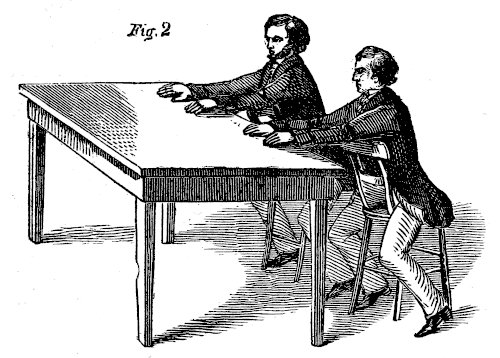
equal, and never have attached the least value to the fact, that when
persons put their hands lightly upon tables, their hands always
follow the motion of the table, whichever way the table moves. It
certainly appeared to us a very significant fact, when we first saw
the performance, and if considered in connection with electricity,
or the new fluid, is sufficiently anomalous to require a careful
analysis. But more of this anon, as we propose to examine the rappings
first. This imposture originated with two girls, by the name of Fox,
from Rochester, New-York, who are now, with their mother, travelling
through the country, and exhibiting their art for money. A few weeks
ago, the Fox-mother gave us an account of this wonderful development
of noises or rappings about the two daughters, and from her we learned
that the noises were kept up for a long time before they discovered
the cause. At first they were annoyed by them, but, after a while,
they became so familiar with the sounds, that they took but little
notice of them, until they discovered the mode of communicating with
their authors, and ascertained that the sounds were made by spirits
of the departed. According to her account, the spirits then rapped at
points remote from the girls, but it seems that the spiritual habit has
changed somewhat, for since the girls have been on exhibition,[2] the
spirits rap nowhere except directly under the girls, and about their
feet, or upon something with which their persons or dresses are in
contact. We had no desire to see these creatures, except to discover
the precise means by which they made the raps, and although fully
prepared to condemn them before we paid them a visit, we preferred not
to condemn them unseen, lest, on that ground, the clique of rappers
should have some advantage over our argument.
It amuses us greatly at times, when discussing these matters with our
friends, to be told that our "opinions are all made up beforehand,"
"that we are prejudiced," &c. We admit the charge, and say frankly
we are prejudiced, and mean to prejudge any effort to make black
appear to be white, and white, black; and declare the pretensions of
these rappers and tippers to be as grossly absurd and silly, as any
monstrosity in the shape of a proposition, that ever emanated from a
crazy or evil designing brain. When we are told that a table is moved
by the mere effort of the will, that it moves about when it is not
touched, we deny the statement flatly at once, and challenge the
reproduction of the miracle, and when we are told that spirits rap
upon tables, floors, doors, walls, or any thing else, we deny the
statement, and challenge the production of any kind of rap or sound
in these cases, which is not clearly traceable to human agency.
Perhaps it will be inferred that we either do or should take ground
against supernatural interference and miracles altogether, seeing
that we are prepared to condemn à priori, these manifestations,
claiming for themselves supernatural origin. We confess that one of
the greatest obstacles we have to encounter in the course of this
exposition, is the deep-rooted belief in the existence, at the present
day, of miraculous powers, agencies and deeds, and the readiness with
which many persons ascribe every thing which eludes their judgment or
senses, and especially whatever savors in the least of religion, to
superhuman agency. We do not mean to draw upon Holy Writ for arguments
in support of our decision, upon these rappings and tippings, but
anticipating the reception we shall meet, with this class of persons,
we must advert briefly to the grounds of their belief and objection,
and at the same time define our own position. We here find ourselves
arrayed against learned divines of the present day, who, failing to
account for these strange doings upon the supposition of human agency,
resort to their belief in the superhuman, and consistently with
their professional calling, must evidently found their views upon
scripture. Failing to discern the "finger of God," they have come
to their last resort, "that these manifestations are the work of the
devil, or of evil spirits." Without claiming any depth in biblical
lore, we ask them where is the authority for any such conclusion in
the Bible? The Bible teaches plainly of the devil's agency, of his
operations upon the heart of man, and so far would such a construction
be justifiable, but no farther. There is not one instance recorded,
in which Satanic agency was recognizable by man as immediate. "By
their fruits ye shall know them," is a sufficient rule of judgment
for any deeds, pretensions, or manifestations whatsoever; and here
they should rest content, and instead of going beyond the record,
might safely administer the general caution, that these "lies are of
their father, the devil," without introducing the whole Pandemonium
into our houses, to overturn our tables and upset the laws of gravity
and mechanical philosophy. We believe that miracles were performed
of old, for holy purposes, and no other; that they were necessary to
enforce the truth of revelation; that the day of miracles has gone
by, and that they ceased when their necessity ceased. We have our own
mode of fixing that period, but the discussion would be too far from
our present purpose, and we have digressed too much already. We take
the ground that every witch, wizard, magician, astrologer, sorcerer,
necromancer, and fortune-teller, from the earliest, down to the present
time, has had no more power over matter, or the laws of nature, than
any other person, and that whoever lays claim to familiar spirits,
foresight, or any direct communication with the invisible world,
through raps and tips, is either witch, wizard, conjurer, or sorcerer
de facto.[3] The prime movers in all these marvels are impostors,
and their disciples, dupes. While the former are filling their
coffers at the expense of the latter, they must often indulge in secret
merriment at the credulity of their adherents; and particularly at the
grave discussions of the learned clergy and others upon electricity,
magnetism, the new fluid, the nervous fluid, or the devil's immediate
agency, as probable causes of these strange phenomena. Surely the
"children of this world are wiser than the children of light." The
juggler with his legerdemain far outstrips any thing that has ever been
accomplished by rappers and tippers, but then he tells you that he
performs by sleight of hand, and that unless your eyes are quicker than
his hands, you will be deceived. If certain of his performances were to
be introduced with some religious jargon and pretext, his success in
infatuating the mass of the people, would put the rappers and tippers
entirely in the shade, for the tricks of these latter are clumsy and
poorly done at the best. Mr. Anderson, the professed juggler, known
as the Wizard of the North, has, to his great credit, published
a series of communications, in which he boldly avers that these
rappers are all impostors, and has contrived a system of rapping and
spiritual communications, quite as successful as those of the original
fraternity. He has failed, however, to elucidate the whole subject,
from the fact that he has been contented with a mere imitation, which
the rappers will of course pronounce a counterfeit. Our first visit
to the rappers, was in company with a gentleman of high eminence in
science, of keen discernment, and very fruitful in expedients. We had
formed no particular plan of procedure, except that we had agreed to
feign belief in these performances, lest incredulity might prove an
obstacle to investigation, and keep the rappers too much on their
guard. Repudiating all idea of the supernatural, we were not liable
to any distraction on that account, and our attention was directed
entirely to the scrutiny of the performances, with reference to their
solution upon established principles of evidence and natural laws. If
the advocates of this new "spiritual philosophy" should object to this
prejudication, our answer is, that aside from our prior experience in
unravelling many such pretended wonders, we hold our position to be
entirely justifiable, on the ground of probabilities, and that hitherto
we have never known an instance in which so much of presumption was not
in such cases, legitimated in the conclusion of facts.
Be this as it may, we had resolved to follow up these rappings and
tippings to see whether they were impostures, delusions, or illusions,
one or all. After the mother of the Fox girls had given us an account
of the spiritual visitation of her daughters, they three took seats
at a large circular table, and we joined the circle sitting opposite
to them. We were directed to ask if there were any spirits present.
This done, Bang, Bang upon the table announced the presence
of the spirits. The table was evidently struck underneath by something
hard, solid, material, and so as to jar the table perceptibly
to the hand resting upon it. Our coadjutor feigned surprise and
alarm, and stooped to look under the table, when the raps immediately
ceased. This he repeated several times and each time the raps ceased.
We asked again if there were any spirits present, but no answer came
while he had his eyes below the level of the table top, but as soon
as he sat up, the raps upon the table commenced again. He however was
so persevering in his scrutiny about the table as to give us a good
opportunity to say—for mere effect—"Why do you look under there,
you cannot see a spirit?" The rappers finding themselves baffled in
making their demonstrations through the table, were forced to retreat
from it, and taking their seats a short distance from the table, the
rappings then commenced upon the floor immediately under the girls, or
about their feet. Both the girls were rappers, but one conspicuously
so, she rapping much louder than the other, and did most of the
rapping for the occasion. Both the girls wore long dresses sweeping
the floor, but the principal rapper ought to have been attended by a
train bearer. "Are there any spirits present?" was again asked, and
the raps came promptly and so thick and fast that the spirits seemed
anxious to make some communications, so we proceeded to this part
of the ceremony. The instructions being given to us how to proceed,
we commenced by asking several questions, but to these we received
either no answers, or incorrect ones. The programme was this: We were
to write down three names[4] of spirits, one of which was to be the
name of the spirit we intended to invoke. We were then to put down the
names of three diseases, one of which was to be the disease of which
the person had died. We were then to put down three places, one of
which was to be the place where the person died. We were then to point
seriatim to the names of the persons, and that when we pointed to the
name of the person intended, the spirit would signify his presence and
approbation, by two raps, which mean Yes. Names of others,
or those not intended, would be answered by one rap, which meant
No. We made no progress, however, and, although there was an
abundance of rapping, there was no communication, no intelligence,
no confirmation to us, of what we already knew (in the imperfection
of human knowledge), and we appealed with an air and tone of assumed
naïveté to the rappers to know if perhaps our failures were not owing
to our great wickedness? "Oh, no!" said the Mother Fox, "it will happen
so sometimes." Just then a gentleman entered who, it appears, was a
devotee of Rappism, and a daily worshipper at the Fox shrine, for the
purpose of holding communication with the spirit of a departed wife. As
we had failed, entirely, to elicit even a respectable guess in answer
to our inquiries of the spirits, and this gentleman had been more
highly favored, his visit was rather fortunate at this juncture, for it
gave us an opportunity to observe more closely than when our minds were
occupied with the manipulation of the spiritual telegraph.
Mr. * * * commenced at once with an account of his previous interviews
and then proceeded to inquire for his beloved spirit. Rap, rap,
indicated her presence, and he asked some several questions which were
answered to his satisfaction, the Fox mother repeating over and over
the alphabet, so fast that we could not follow to get the answer for
ourselves, but the rappers being in good practice, seemed to find
no difficulty in keeping pace. We saw in this individual, a degree
of infatuation rarely to be met with in intelligent men of the
world, and unmistakable evidence of entire mental hebetude upon this
particular subject. We, however, turned his fascination to a very good
account, as we shall presently show. We inquired if these rappings ever
occurred any where except immediately about the persons of these girls.
"Oh yes," was the mother's answer, "the sounds have been made in that
wardrobe, and upon the door," etc. We pressed hard to have the raps
from the wardrobe, but to our surprise and disappointment the girl got
into the wardrobe, leaving the door open, and so snugly was she encased
there in consequence of a partition in the wardrobe, that her dress was
largely in contact with three sides or walls of the little apartment.
Of course we did not expect any better or different performance from
that with which we had been entertained outside the wardrobe. "Will the
spirit rap here?" says the girl, and rap, rap, it came on the floor of
the wardrobe. She was then requested to have the rappings made upon the
sides and back of the wardrobe, which she did, taking a little extra
time to arrange herself for these performances. She then requested us
to put our ear to the top of the wardrobe and the rap would proceed
from that quarter. We were not to be entrapped by this trick, for we
knew full well the old and trite experiment of placing the ear upon one
end of a long stick when a sound is made upon the other end. In this
experiment the sound will always appear to be made near the ear. We
therefore kept our attention fixed upon the bottom or lower part of
the wardrobe, and while some present, misled by the artifice, supposed
the sound came from the upper part of the wardrobe, we observed that
the sound was produced where it was at first, down below, and that
it was not modified in the least, which certainly ought to have been
the case, if the sound had been made opposite to the person's ear.
The girl then called attention to several points in the upper part
of the wardrobe, and it appeared to the satisfaction of some present
that the sounds came from those points, while to us it was perfectly
evident that the sounds were not at all changed in direction or
character, and in reality proceeded from the old quarter. Our knowledge
of ventriloquism also fortified us against this trick. Ventriloquism
is a deception, the success of which depends upon a certain power
of modulating the voice, a correct ear for imitation of sounds, and
skill and judgment in selection of time, place and circumstances for
the performance. When persons present are not aware or apprised of
the attempt to deceive them, the ventriloquist is not obliged to be
very particular in his selection. But when his intention is announced
or anticipated, his art is exercised to direct the attention of his
auditors to the quarter from which he wishes the sound to appear to
come. If our readers will turn to Brewster's Natural Magic on this
subject, they will find many interesting tricks described on this
principle. Nothing is more easy than to deceive completely, by calling
the attention of persons present to sounds from a certain position or
direction, while in reality the sounds are made elsewhere and in a
remote quarter, provided the real origin of the sounds be concealed
from the sight. So it was in the case of the raps, with those whose
eyes and expectations were fixed upon the top of the wardrobe. The
trick was poorly done however, for the sound did not undergo the proper
modification, and in fact it was out of the girl's power to modify it
to suit this case. For the origin of the raps, being concealed under
her dress, she could not divest it of its muffled character without
exposing her art. It is particularly worthy of note here, that for
these experiments in the wardrobe no particular spirit was invoked,
and the raps were continued as long as necessary for the gratification
of the bystanders, and were several times commenced without any
particular invocation on the part of the girl, she evidently forgetting
the dignity of the spirit in the excitement of the moment. This over,
it was desired to have the spirits knock at the door, but they could
not manifest without the girl's immediate presence, and accordingly,
she placed herself against the outside of the room door, which was
about two thirds open, she taking hold of the latch. We were about
to take position outside, in the passage, when she remarked that the
spirits would rap much better if we took hold of the door. This was
rather more necessary than cunning, and the rapper knew of course that
unless she or some one held the door, the knock upon it would move
the door on its hinges away from her. When she was fairly fixed with
her dress in contact with the door, the raps commenced upon the door.
After this she turned her head and asked if the spirit would please to
rap in the passage, when she gave rather a feeble rap, which suited
the trick tolerably well and here the rapping ended for this visit.
The rap from the passage explained the purpose of keeping us in the
room, for if we had gone into the passage the trick would have failed
for us, as we should have been able from our position there, to refer
the sound to the right quarter viz., about the girl's feet. On the
second visit we were there with our former coadjutor and several other
gentlemen of eminence, and a lady of the highest respectability, strong
mind, and distinguished for her indomitable energy and perseverance.
Our quondam enthusiast we found there at his matins, in company with
several persons eminent in political life. One of them, a member of
Congress, had been endeavoring to get some spiritual communications,
but became so disgusted with the bad guessing of the Fox girls, that
he left the room. The enthusiast, Mr. * * *, then invoked his favorite
spirit and proposed a question, the answer to which was spelled out by
the Fox mother as before, and he expressed himself perfectly satisfied
with the answer. We then took our turn. We put down upon paper the
names of three departed spirits, three diseases, and three places. In
pointing to these names with the pencil, we took good care to conceal
the pencil movement behind a book, and carefully guarded against
any emphatic movement which should betray our will to the practiced
eyes of the girls. The raps came for the wrong spirit, and rapped
the wrong disease, and place of death. We then made another effort.
Three names were selected, as follows, Webster, Clay, and Calhoun;
Webster's was the spirit we invoked, and they hit it right this time
for the name, but mark the sequel. The answer was that Webster died of
Croup! and at Salem, Mass. Of course we did not indicate by
any look or movement that our inquiries had been answered correctly
or incorrectly until we had got through. Our scientific friend next
made a trial, and his answers were more ludicrous if possible then
those we had obtained. He attempted in several ways to get replies
from the spirits, being always careful to give no clue to his thoughts
by outward signs, but all to no purpose. The spirits, judging from
the raps, were there in abundance, but no intelligence, or correct
answers could be had from them. Next another friend of ours came to
the trial. He had not been accustomed to investigate such tricks, and
very imprudently suffered Mr. * * * to put the questions for him. The
answers came in accordance with the facts, that is the right spirit was
designated by the raps, and the manner of his death. Mr. * * * put the
questions each in different tone and shape, and the girls undoubtedly
read him as they had done before. Noticing this, we remarked to Mr. * *
* that as he had been so successful we would like to have him inquire
for us, to which he readily assented. We, however premised, that he
must use the same intonation and language in asking each question,
which he agreed to do, as far as he could. This we exacted, not because
we had any suspicion of collusion in this case, but as we explained
it at the time, because many persons would unwittingly by emphasis or
some significance indicate to the rappers, or any shrewd person, the
particular object he had in view. With these precautions, the question
was put to the rappers. We were to fix our thoughts upon a particular
spirit, the disease of which the person died, and the place where;
the name with two others was put down upon paper, the disease with
several others, and also the place of death with two others. Mr. * *
* propounded as follows: Will the spirit inform us of the spirit the
gentleman is thinking of? Rap, rap! Yes. Will it inform us correctly?
Rap, rap! Yes. Pointing to a name with a pencil, he asked, Is it
this? Rap! No. Is it this? Rap, rap! Yes. Pointing to the diseases
and places, with the same question each time; when the whole was gone
through with, Mr. * * * asked, Has the spirit informed us correctly?
Rap, rap! Yes. We were thinking of Webster's spirit, and the result
was this. The rappers hit it right as to the name, but they informed
us this time that Mr. Webster died of Fungus Hæmatodes, in
Newark, New Jersey.
This was too much for forbearance, but still we kept our purpose of
investigation in view, and again pleaded our own wickedness as the
probable cause of these failures. "Oh! no," said they, "it will happen
so sometimes." What a deeply disgusting spectacle! These girls and
their mother sitting there, with all gravity, and pretending to be the
"mediums" of communication with disembodied spirits, and dealing out
such nonsense as that just related.
The rappers were then sitting some distance from the table, and we
asked if the "Spirits would rap upon the table?" Rap! No. "Will the
spirit please to rap upon the table?" Rap, rap, rap. "Not now." It
seems that three raps for the expression "Not now" was a part of the
spiritual stenography, as they had occasion to use this evasion quite
often to escape difficulties. "Will the spirit please to explain why it
will not rap upon the table?" Rap, rap, rap! "Not now." "When will it?"
"This evening, at such an hour," naming it. This last communication
was spelled out by the Fox mother, and a time was named at which it
would be impossible to get an opportunity to propound such a question,
as they held their spiritual levee in the evening to crowds. Moreover,
we had no desire to repeat the question to these tricksters, to
be shuffled, as we most certainly should have been, with the same
prevarication. On the occasion of our first visit, Mr. * * * said that
the spirits had rapped upon his foot, while sitting at a table. The
experiment was repeated by request, and very likely would have been
successful, if we had not fixed our eyes very intently upon his and
the rappers' feet. As it was, this feat was not performed. On the
second visit, we implored the spirits to rap upon our feet. "Not now,"
was the answer. It was evident that we were not receiving our money's
worth of spiritual manifestations according to the show-bill; but, as
every failure was our gain, we were not disposed to quarrel with the
rappers or the spirits. One of my scientific friends then asked if
they would not rap if they were suspended in a swing, or stood upon a
pillow? "Oh yes," was the reply, "we have done that; that has all been
tried." One of the Fox girls proposed to send upstairs for a pillow,
but it occurred to us that they might rap while standing upon any
common-sized pillow, for the reason that their dresses would cover
and extend beyond the pillow, and thus give them an opportunity to get
their rapping instrument down upon the floor over the sides of the
pillow. We therefore proceeded immediately, while they were engaged in
some conversation, to make up a cushion upon the floor to suit our own
views. We gathered a number of cloaks, and laid them folded upon the
floor, so as to make a circular cushion of about three and a half feet
diameter, and so thick that we were persuaded no ordinary raps with
their instrument could be heard through the soft mass, or if any sound
should be produced it would be so modified as to betray its origin.
The Fox mother objected to this preparation; but the girls said, "We
know we can rap; the spirits will rap there, for they have always done
so." By way of an excuse for making this cushion, we remarked that one
of the coats was silk, and that we would ascertain if electricity had
any thing to do with it. The Fox mother said, "All that had been tried
before; and that the girls[5]could rap standing upon glass tumblers,
and that she knew it must be the spirits, for these manifestations
had been with them now for six years." We replied (to keep up our
argument), "You know that there are persons who think these sounds are
all due to some modification of electricity, and others who think that
electricity is the very essence of spirituality,[6] and we wish to see
in this case how far it may be concerned in the phenomena." There
was no resisting this, and we were allowed to proceed. The result was
exactly as we anticipated. While standing upon the cushion they could
not rap at all. The principal rapper saw her predicament, and took her
stand upon the cushion so that her dress was partly over the edge of
the cushion, but this we objected to, and requested her to stand upon
the centre of the cushion, upon the plea that if her dress touched the
floor, it would conduct away the electricity. A perfectly empirical
reason, of course; but they were none the wiser for that, and as soon
as every thing was arranged to our liking, she invoked the spirit to
rap. No rap came. Again and again the spirit was besought, but no
response was given. She then asked her sister to come and stand upon
the cushion with her, thinking, in her subtlety, that two of them would
occupy so much room as to give one, at least, a chance to have her
dress over the edge of the cushion. But this we were prepared for; and
gathered in the skirts of their dresses upon the cushion, upon the same
plea as before. The result was the same as with one. No raps. The fact
was, their arts were completely baffled, the spirits had fled, and the
experiment not only proved the falsity of the assertion that they could
rap standing on cushions, or when suspended in a swing, but afforded
the most conclusive evidence of the immediate and wilful agency of
these Fox girls in producing these sounds.
Thinking to redeem themselves from the inevitable verdict of this
trial, the principal rapper proposed to stand upon glass tumblers,
to see if the spirits would rap then, as they had done on former
occasions. She took her stand upon the tumblers. This elevated the
lower border of her dress above the floor, and it so happened that
one of our number was sufficiently far from her that he could have
seen her feet on the rapping instrument. She invoked the spirit. "Will
the spirit please to rap?" No rap. She then stooped a little, as if
addressing the spirit below. "Will the spirit please to rap now?" No
rap. She then stooped a little more, and by this time her dress was
fairly down upon the floor, so as to cover feet and tumblers. "Will
the spirit please to rap now?" Rap, rap. This was very adroitly done,
but the trick was clear to us. How strange it is, that she should have
been obliged to stoop, and to have invoked the spirit three times
before the answer came; and, moreover, that she should look down to the
floor for the spirit; and how passing strange it is that these modern
spirits should have such a fondness for long dresses and girls'
toes. We then requested her to stand upon a chair, and rap. This she
did promptly, and the rap came at a bidding. The sound was different
from that produced upon the carpeted floor, and underwent just the
proper modification of a blow struck upon a hard, uncovered, wooden
seat. Here we stopped, having seen quite enough of this game of "Fox
and Geese." Before leaving the room, one of the rappers requested
our scientific friend not to publish them, and another stepped up to
the lady present, saying, "You do not think that I have any machinery
about me to make these sounds, do you?" We have it on the authority
of this lady, who seemed determined to leave nothing untried to lead
to the detection of this imposture, that she asked these rappers if
they would consent to a private examination of their persons, and that
they refused it positively, adding that if she had any doubt as to the
reality of these spiritual manifestations she would have satisfactory
revelations made to her in her bed-chamber five weeks from that time.
This prophetic intelligence they rapped out for the occasion according
to their own fancy and usual evasive duplicity in such cases. The five
weeks have passed, but the lady has, of course, received no spiritual
visitations as predicted.
Our readers are now ready to ask if we have discovered the machinery
or instrumentality by which these girls make the sounds. In answer,
we say that our investigation is conclusive that these sounds are
entirely at the control of these girls, and that we have placed them
in situations where they could not rap at all. And if, after all this,
we have invented several modes by which the rappings can be made as
successfully as by them, we think we have discovered enough. During
each of our two visits, we noticed, by very cautious and careful
inspection, one interesting and significant fact—that each rap was
attended with a slight movement of the person of the rapper, and
that a very distinct motion of the dress was visible about the right
hypogastric region. While watching this point the girl noticed us,
and immediately rose, went to the window, and dropped the curtain to
darken the room, which was on the north side of the building, and full
dark enough before. When she sat down she drew her shawl over this
part of her person. This was on the first visit. On the second visit,
we were soon discovered watching this movement again, and she rose and
procured a shawl with which she covered her person as before. We do not
pretend to decide that this movement had any direct connection with
the instrument by which she rapped upon the floor; if so, it was very
clumsy and awkward, for we have devised a mode of rapping that involves
no such motion, and which we will shortly explain. It may have been
that this movement was connected with the device for rapping upon the
table. We are of opinion that when they rapped upon the table, it was
upon the under side of the table-top and not about their feet. They
did not, and evidently could not, rap upon the table without sitting
closely up to the table. If this conjecture, as to the rap under the
table-top, is right, the movement we saw is easily accounted for. Be
it so, or be it not, we have invented a contrivance which raps upon
the under side of the table-top, and which involves precisely the
motion we discovered. It requires but little exercise of ingenuity to
contrive means of producing these sounds. It has been stated that a
relative of these girls has made a public statement under oath, that
they produce the raps with their toes, in a peculiar manner acquired
by long practice. The public papers tell us that electro-magnetism
has been employed to carry out this fraud. The snapping of the joints
has been resorted to by another; and indeed we can easily imagine
a variety of ways in which these sounds are, or may be produced.
The Fox girls rapped upon neither of these plans. The sound was
machine-like, and too loud for a sound that could be made by striking
the naked or unarmed toe upon the floor, and entirely too loud for,
and differing in character from, the snapping of the joints, and as to
electro-magnetism, it was entirely out of the question in this case.
The Fox girls visit the houses of strangers and rap always with the
same ease every where. The raps are never remote from their persons but
always directly about their feet, unless it be when they are sitting
at the table, as we have before said, when the rap appears to be on the
under side of the table-top, although we would not undertake to decide
fully upon this latter point, as they would not allow us to choose our
position so as to judge of the true direction of the sound; for as soon
as my coadjutor looked under the table, the spirits decamped and we
had no rapping. There are certain circumstances, under which no ear,
however skilful and practised, can judge correctly of the position or
distance where certain sounds originate. Such a case is exemplified in
the common speaking tubes used in public houses and elsewhere. When you
place your ear near the tube, the voice appears to be uttered close to
the ear, though the person speaking may be at a great distance. The
Invisible Lady is another instance, for a full account of which, see
Brewster's work on Natural Magic. But the most remarkable illustration
of this case is exhibited in the following manner. If you take an iron
rod ten, twenty, fifty, or one hundred feet in length and strike it
at one end, the blow is heard by a person having his ear close at
the other end precisely as if the blow was struck near his ear. This
illusion is more remarkable if the listener cannot hear the original
blow through the medium of the air. To make the whole experiment very
imposing, suppose an iron rod, three-fourths of an inch in diameter,
projecting three or four feet through the floor of a large hall, and
that this projecting part is a continuation of a rod passing beneath
the floor of the room, and concealed entirely from observation and
terminating out of doors, or in a distant apartment. Whenever a blow
is struck upon the remote and concealed end, the sound not being heard
except through the medium of the rod, appears to every person present,
precisely as if it issued from the projecting end within the hall. With
proper pre-concertion and ceremonial preparation, such a contrivance
as this would far exceed, in mysterious character, the shallow
trickery of these feet-rappers. From this experiment, which we have
tried with entire success with a rod only twenty feet in length, we
see how closely we must look to all the attendant circumstances and
possibilities of the case, before we can conclude strictly upon the
position of the origin of sounds, where their origin is out of sight.
We know that the rapping was always about their heels when these
girls sat in chairs, stood upon the floor, or in chairs, or stood in
the wardrobe, or rapped upon the door. For this part of the performance
we had abundant opportunities for examination, and if these girls will
stand upon the floor and allow us to examine their feet, at the time
of the rapping, we defy them and their spirits to produce the rappings
without a full exposure. It is worthy of note that witches have always
been far more numerous than wizards. There are reasons for such
disparity in numbers, but this rapping business is particularly the
province of females. There are no male rappers unless it be of late,
since they have resorted to confederacy, or electrical or mechanical
tricks. There are no men-rappers who rap upon such an extensive scale
as the Fox girls. The latter are not confined to a certain table, a
certain room, or certain spots in a room, or a certain house. They
carry their "Rattle-traps" about with them, and go from house to
house, and their "familiar spirits" are very sociable, unceremonious,
and accommodating. If they will but adopt the Bloomer costume,
our word for it, the spirits would signify their disapprobation by
departing at once. Relying upon their sex they trust the courtesy of
their visitors as sufficient protection against the examination of
even their feet, and therefore they make bold to wear unusually long
dresses the better to conceal their movements and rapping apparatus.
When the girl stood upon tumblers, she did not venture to rap till, by
gradual stooping, she brought her dress down so as to cover her feet
and touch the floor. There are then special reasons why this kind of
witchery should be played off by females. The Fox style of rapping
CANNOT be performed by men, or in the male attire. We do
not attribute to woman more or greater proneness, or power to deceive
than to man; but when woman undertakes to deceive, she is generally
more successful. She is less suspected, has fewer motives, runs greater
risk, and incurs greater loss in the event of disclosures, and with
the blandishments of person and sex, she silences opposition, smothers
inquiry, defies and escapes inspection, and lastly takes captive
the head with the heart. Possessed of greater susceptibilities and
easily impressed; she is more readily carried away by new and strange
fascinations, and in times of certain remarkable developements of
sympathetic witchcrafts, she is the first to be imposed upon and most
apt to impose upon herself. This characteristic is well illustrated in
the case of the jerks, a species of witch mania which prevailed
in this country so extensively many years ago, in which women figured
so largely. Sympathetic action is potential with both sexes, but
especially with women does it overpower sense, reason and volition,
giving rise to temporary insanity. We are however uncharitable enough
to believe that, in many cases, upon these occasions the surrendry of
the judgment and bewilderment of the imagination is not altogether
involuntary, and that the whole operation of being bewitched might
be arrested at a certain stage of its progress by an effort to
resist, except perhaps in conditions of extreme hysteria and nervous
prostration, or irritability. We have seen a young lady of the very
highest respectability at a table-tipping, tugging away at the
table to make it move, and all the while endeavoring to conceal her
exertions, and declaring, when interrogated, that she did "not make
the slightest effort." Can it be that she had become so infatuated
as to forget that she was, or to persuade herself that she was not,
deceiving, and yet all the while to be so assiduous and adroit in
accomplishing her object? Charity says yes. Well! after all, there is
something in the feat of deceiving and blinding reverend and grave
Senators, Judges and Priests, well calculated to whet the pride,
stimulate the cunning, and foster the love of power in a young Miss,
especially when her arts are practised upon some doings not embraced in
the criminal code nor amenable to law. There are probably—paradoxical
as it may seem—cases of honest deception. The desire to accomplish
something great, something exceeding the common course of familiar
phenomena, may be so strong as to beget an entire perversion of all
truthfulness, a self sanctioning of error, artfulness, and imposture,
oblivion of conscience, an enthusiastic profession of faith and
spirited advocacy of the new developments, a bending of every thing
to conceal the fraud, and withal a remarkable preservation of the
appearance of sincerity, and an air of ingenuousness so well put on as
to appear natural, which go very far to inveigle those who may witness
the performances.
Of the modes we have devised of producing rappings we will not explain
more than one, that being sufficient to effect rapping sounds without
disturbance of the person. We have contrived a great many, and although
we have not seen the particular mode employed by the Fox girls, yet
we can rap just as well. A piece of soft metal such as lead, shaped
like a chain shot or dumb-bell, tied to the great toe may be made
to pound upon the floor, the door, the bottom of a wardrobe, or any
surface or thing which may be under or about the feet, with forcible
demonstrations. If any person will make the effort to move the toe up
and down while the sole of the foot rests firmly upon the floor, it
will be found that a considerable motion may be effected, and of course
a rapping, without a disturbance of the person. A little practice
will make perfect. In order to walk about without the rattling of the
rapping piece, it is necessary to tie to one end of it an elastic
cord, a piece of vulcanized rubber answering very well, and fasten
this around the waist. A slight stooping or sitting down will leave
the instrument free to work. If you have thin shoes or slippers on, it
may be affixed outside of the slippers, or you can have it attached to
the toe, and make the slipper large enough to slip over the whole and
slip it off, when rappings are called for. One other element and we are
all equipped for spiritual rappings; petticoats or long dresses are
indispensable to complete the invention. Whatever be the contrivance
adopted to rap upon the floor, the whole must be concealed within the
sanctuary of skirts beyond the invasion of the curious or rude. We
have other more perfect, better concealed rapping instruments than the
one just described,[7] but not quite so simple or easy of application.
Moreover the one described gives the double rap, (a peculiarity of
the Fox contrivance.) These girls managed their instrument adroitly,
and deserve some little credit for their ingenuity in contriving and
operating an instrument so successfully as to baffle the scrutiny
of thousands of their visitors. They walk freely about with their
instruments, though a lady remarked to us that they both walked very
awkwardly. With local preparations "mysterious" rappings may be
produced in a variety of ways, but these girls, the prototypes of
all rappers, neither employed or needed any aid from electro-magnetic
motions, acoustic science, or confederacy to practise their arts,
they used more ingenious and simple means. It is possible to make a
rapping electro-magnetic movement, battery and all, small enough to be
carried under the dress, but like the telegraph, it must be controlled
by volition and muscular action of the operator, and where is the
advantage of this over a mechanical instrument that raps directly?
There is no necessity for wonderment or the taxation of ingenuity on
account of these rapping sounds so long as you are excluded from a
personal examination of the rappers. We wish very much that the civil
authorities would pounce upon these rappers in the "very act" (for
obtaining money upon false pretences)—(or some other plea) and make
a forcible disclosure of their trappings. We believe that this can and
should be done, and that such a proceeding would meet the full sanction
of law and justice; that universal public opinion would sustain it,
and we have no doubt of the nature and effect of the denouement.
If it had already been done, we should have been spared the labor of
this treatise at least, and we need not advert to the vast amount of
suffering and vice that would have been forestalled.
Seeing then, that we can rap, yes, and give the double rap, how shall
we account for the extraordinary prophecies, messages, coincidences
and communications in accordance with facts? We wish this had been
the only difficulty to surmount, for it perplexes much less than
the feminine security of these rappers against the inspection
of their actual quomodò. We can most safely presume that if by
search warrant, stratagem, or vi et armis, the rapping instrument
of these Fox girls had been exposed to the public, there would not
have been one doubt about the nature and origin of the spiritual
communications, nor the question ever asked, how it happened that
these communications were so wonderfully true to fact. Brains, books,
good and bad spirits, devils and all would not have been needed for
this discussion. Indeed where is the necessity at all, of dragging out
human weakness, credulity, and duplicity to solve the psychological
part of this fraud and forgery, if we can rap as well as the Fox girls
(the great guns of rappism), and on the strength of our rappings tell
more truth and fewer lies than their spirits, what need have we
of metaphysical disquisitions on the handwriting found in a drawer
or any where else, resembling Mr. Calhoun's, John Smith's, or any
other of the great departed?[8] So far as our experience went, the
Fox girls made few, very few good hits, and perpetrated a vast amount
of most intolerable nonsense and contradiction; enough of itself,
even if the rappings had been made outside the pale of their queenly
robes one inch, two feet, above their heads, in the aerial centre
of the room, disconnected with every tangible and visible thing, to
have turned any sensible man on his heel instanter, with contempt and
disgust. But for the sake of those who are duped or perplexed by these
communications, we must spend a little breath to enlighten them. When
a man suspects supernatural agency or interference in physical,
really visible, sensible, or tangible demonstrations, he is ready to
believe any thing communicated at the time, and when he comes to the
full belief in divine interposition, his faith is perfected. Where,
by long practice, preparation and skill, tricks are performed with
a view to imposition, it requires the highest degree of coolness,
calmness, and self-possession, to resist the impression of the
superhuman, and however well fortified we may be in these respects, it
is hardly to be expected that we should be able to discover the real
nature of the performance without some experience and practice on our
side. The instant the idea of the superhuman gets possession of the
mind all fitness for investigation and power of analysis begins to
vanish, and credulity swells to its utmost capacity. The most glaring
inconsistencies and absurdities are not discerned and are swallowed
whole, and so deep is the blindness and so extraordinary in its
character, that we have seen a convert made to spiritual rappism
upon the strength of one single coincidence selected from among a
great mass of disgusting mummery and perversion of truth. Not one of
the discrepancies, were of any importance with him; one lucky hit
of the rappers and the whole performance, errors, raps and all were
invested with supernatural power. Now, how does it happen, that the
believer in such cases does not notice the incongruities and failures,
or does not appear to notice them. This is somewhat of a psychological
phenomenon, but might as well be explained on the ground of unfairness,
as any other; unfairness is as often the beginning and accompaniment
of infatuation, as a mental incapacity for more than one idea. A
shrewd person can, at any time, take a promiscuous company, and with
the imposture of rapping, or any other trick, calculated to divert
the attention, and a mode of spelling out communications similar to
that adopted by the Fox girls, make out as many or more wonderful and
seemingly supernatural communications as they, certainly not more of
error and absurdity. We were once riding in a stage-coach, with a
gentleman, who, after a long journey, laid a wager with another that he
would tell the occupation of every person in the coach. To the surprise
of all he won the wager. A lady present, apparently much hurt, asked
how he knew she was a "housekeeper." The reply was, Because I saw you
frequently putting your hands to your belt—for the keys. Many of our
shrewd itinerant phrenologists, after the parade of measuring and
fumbling one's head, and a few master-key questions, will portray the
life and character with a wonderful degree of accuracy. Our stage-coach
pythonist had, during the journey, watched the motions, complexion,
conversation, expression of countenance, appearance of the hands, the
dress,—in fine, ever little circumstance of habit or person, and it so
happened judged rightly in each case. It is so with the phrenologist,
who draws his information mostly from similar sources.[9] It is so
with the rappers; they observe carefully, have experience with persons
of all classes, and generally, unless molested by some skeptic, have
every thing in their own way. Their visitors, especially the dupes,
betray more to these rappers than their own skill can eliminate, and
it is surely to be expected that they should hit right sometimes. Upon
mere hap-hazard conjecture, this might happen occasionally, but with
all the arts and aids of preparation, credulity, and fanaticism, they
become as successful as the oracles of Delos and Lesbos.
Before concluding the subject of rappings we remark briefly that
a SPIRIT that cannot or will not tell the truth on all
occasions, is wholly unworthy our credence or respect; and believing,
as we do, that miracles are God's prerogative and all miraculous
power is withheld from evil spirits as militating with the plan
of Revelation, we needed no further investigation for our own
satisfaction, than to know that a very large part of their pretended
communications were grossly erroneous; but we have held it to be
important for the sake of others that the whole subject should be
examined. The fever has somewhat abated of late, but unless boldly and
vigorously assailed it will reappear under some new pretension with
exacerbations more virulent than ever.