We have been considering the relationship between mind and body
from the standpoint of the mind. Our investigation has been largely
introspective; that is to say, we simply looked within ourselves
and considered the effects of our mental operations upon our own
bodies. The facts we had before us were facts of which we had
direct knowledge. We did not have to go out and seek them in the
mental and bodily activities of other persons. We found them here
within ourselves, inherent in our consciousness. To observe them we
had merely to turn the spotlight into the hidden channels of our
own minds.
We come now to examine the mind's influence upon the body from
the standpoint of the body. To do this we must go forth and
investigate. We must use eye, ear and hand. We must use the forceps
and scalpel and microscope of the anatomist and physiologist.
But it is well worth while that we should do this. For our
investigation will show a bodily structure peculiarly adapted to
control by a governing consciousness. It will reveal to the eye a
physical mechanism peculiarly fitted for the dissemination of
intelligence throughout the body. And, most of all, it will
disclose the existence within the body of subordinate mental units,
each capable of receiving, understanding and acting upon the
intelligence thus submitted. And we shall have strongly
corroborative evidence of the mind's complete control over every
function of the body.
Examine a green plant and you will observe that it is composed
of numerous parts, each of which has some special function to
perform. The roots absorb food and drink from the soil. The leaves
breathe in carbonic acid from the air and transform it into the
living substance of the plant. Every plant has, therefore, an
anatomical structure, its parts and tissues visible to the naked
eye.
Put one of these tissues under a microscope and you will find
that it consists of a honeycomb of small compartments or
units. These compartments are called "cells," and the structure
of all plant tissues is described as "cellular." Wherever you may
look in any plant, you will find these cells making up its tissues.
The activity of any part or tissue of the plant, and consequently
all of the activities of the plant as a whole, are but the combined
and co-operating activities of the various individual cells of
which the tissues are composed. The living cell, therefore, is
at the basis of all plant life.
In the same way, if you turn to the structure of any animal, you
will find that it is composed of parts or organs made up of
different kinds of tissues, and these tissues examined under a
microscope will disclose a cellular structure similar to that
exhibited by the plant.
Look where you will among living things, plant or animal, you
will find that all are mere assemblages of cellular
tissues.
Extend your investigation further, and examine into forms of
life so minute that they can be seen only with the most powerful
microscope and you will come upon a whole universe of tiny
creatures consisting of a single cell.
Indeed, it is a demonstrable fact that these tiny units of life
consisting of but a single cell are far more numerous than the
forms of life visible to the naked eye. You will have some idea of
their size and number when we tell you that millions may live and
die and reproduce their kind in a single thimbleful of earth.
Every plant, then, or every animal, whatever its species,
however simple or complicated its structure, is in the last
analysis either a single cell or a confederated group of
cells.
All life, whether it be the life of a single cell or of an
unorganized group of cells or of a republic of cells, has as its
basis the life of the cell.
For all the animate world, two great principles stand
established. First, that every living organism, plant or
animal, big or little, develops from a cell, and is itself a
composite of cells, and that the cell is the unit of all life.
Secondly, that the big and complex organisms have through long
ages developed out of simpler forms, the organic life of today
being the result of an age-long process of evolution.
What, then, is the cell, and what part has it played in this
process of evolution?
To begin with, a cell is visible only through a microscope. A
human blood cell is about one-three-thousandth of an inch across,
while a bacterial cell may be no more than
one-twenty-five-thousandth of an inch in diameter.
Yet, small as it is, the cell exhibits all of the customary
phenomena of independent life; that is to say, it nourishes itself,
it grows, it reproduces its kind, it moves about, and it
feels. It is a living, breathing, feeling, moving, feeding
thing.
The term "cell" suggests a walled-in enclosure. This is because
it was originally supposed that a confining wall or membrane was an
invariable and essential characteristic of cell structure. It is
now known, however, that while such a membrane may exist, as it
does in most plant cells, it may be lacking, as is the case in most
animal cells.
The only absolutely essential parts of the cell are the inner
nucleus or kernel and the tiny mass of living jelly
surrounding it, called the protoplasm.
The most powerful microscopes disclose in this protoplasm a
certain definite structure, a very fine, thread-like network
spreading from the nucleus throughout the semi-fluid albuminous
protoplasm. It is certainly in line with the broad analogies of
life, to suppose that in each cell the nucleus with its network is
the brain and nervous system of that individual cell.
All living organisms consist, then simply of cells. Those
consisting of but one cell are termed unicellular; those comprising
more than one cell are called pluricellular.
The unicellular organism is the unit of life on this earth. Yet
tiny and ultimate as it is, every unicellular organism is possessed
of an independent and "free living" existence.
To be convinced of this fact, just consider for a moment the
scope of development and range of activities of one of these tiny
bodies.
"We see, then," says Haeckel, "that it performs all the
essential life functions which the entire organism accomplishes.
Every one of these little beings grows and feeds itself
independently. It assimilates juices from without, absorbing them
from the surrounding fluid. Each separate cell is also able to
reproduce itself and to increase. This increase generally takes
place by simple division, the nucleus parting first, by a
contraction round its circumference, into two parts; after which
the protoplasm likewise separates into two divisions. The single
cell is able to move and creep about; from its outer surface it
sends out and draws back again finger-like processes, thereby
modifying its form. Finally, the young cell has feeling, and is
more or less sensitive. It performs certain movements on the
application of chemical and mechanical irritants."
The single living cell moves about in search of food. When food
is found it is enveloped in the mass of protoplasm, digested and
assimilated.
The single cell has the power of choice, for it refuses
to eat what is unwholesome and extends itself mightily to reach
that which is nourishing.
Moebius and Gates are convinced that the single cell possesses
memory, for having once encountered anything dangerous, it
knows enough to avoid it when presented under similar
circumstances. And having once found food in a certain place, it
will afterwards make a business of looking for it in the same
place.
And, finally, Verwörn and Binet have found in a single
living cell manifestations of the emotions of surprise and
fear and the rudiments of an ability to adapt means to an
end.
Let us now consider pluricellular organisms and consider them
particularly from the standpoint of organic evolution. The
pluricellular organism is nothing more nor less than a later
development, a confederated association of unicellular organisms.
Mark the development of such an association.
Originally each separate cell performed all the functions of a
separate life. The bonds that united it to its fellows were of the
most transient character. Gradually the necessities of environment
led to a more and more permanent grouping, until at last the bonds
of union became indissoluble.
Meanwhile, the great laws of "adaptation" and "heredity," the
basic principles of evolution, have been steadily at work, and
slowly there has come about a differentiation of cell function, an
apportionment among the different cells of the different kinds of
labor.
As the result of such differentiation, the pluricellular
organism, as it comes ultimately to be evolved, is composed of many
different kinds of cells. Each has its special function. Each has
its field of labor. Each lives its own individual life. Each
reproduces its own kind. Yet all are bound together as elements of
the same "cell society" or organized "cell state."
Among pluricellular organisms man is of course supreme. He is
the one form of animal life that is most highly differentiated.
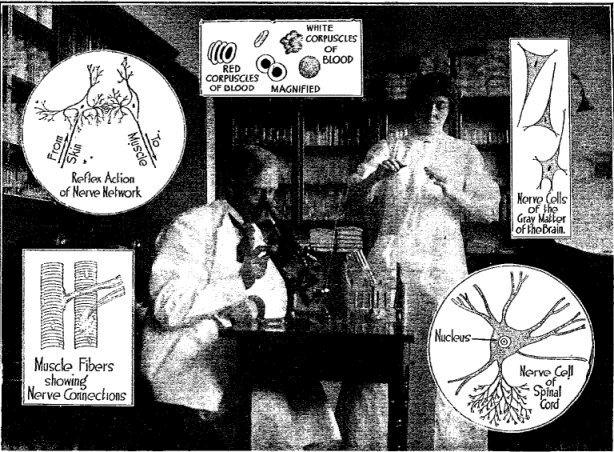 |
|
MICROSCOPIC STUDIES IN HUMAN ANATOMY, PRIVATE
LABORATORY, SOCIETY OF APPLIED PSYCHOLOGY
|
Knowing what you now know of microscopic anatomy, you cannot
hold to the simple idea that the human body is a single life-unit.
This is the naive belief that is everywhere current among men
today. Inquire among your own friends and acquaintances and you
will find that not one in a thousand realizes that he is, to put it
jocularly, singularly plural, that he is in fact an assemblage of
individuals.
Not only is the living human body as a whole alive, but "every
part of it as large as a pin-point is alive, with a separate and
independent life all its own; every part of the brain, lungs,
heart, muscles, fat and skin." No man ever has or ever can count
the number of these parts or cells, some of which are so minute
that it would take thousands in a row to reach an inch.
"Feeling" or "consciousness" is the sum total of the feelings
and consciousness of millions of cells, just as an orchestral
harmony is a composite of the sounds of all the individual
instruments.
In the ancient dawn of evolution, all the cells of the human
body were of the same kind. But Nature is everywhere working out
problems of economy and efficiency. And, to meet the necessities of
environment, there has gradually come about a parceling out among
the different cells of the various tasks that all had been
previously called upon to perform for the support of the human
institution.
This differentiation in kinds of work has gradually brought
about corresponding and appropriate changes of structure in the
cells themselves, whereby each has become better fitted to perform
its part in the sustenance and growth of the body.
When you come to think that these processes of adaptation and
heredity in the human body have been going on for countless
millions of years, you can readily understand how it is that
the human body of today is made up of more than thirty different
kinds of cells, each having its special function.
We have muscle cells, with long, thin bodies like pea-pods, who
devote their lives to the business of contraction; thin, hair-like
connective tissue cells, whose office is to form a tough tissue for
binding the parts of the body together; bone cells, a trades-union
of masons, whose life work it is to select and assimilate salts of
lime for the upkeep of the joints and framework; hair, skin, and
nail cells, in various shapes and sizes, all devoting themselves to
the protection and ornamentation of the body; gland cells, who give
their lives, a force of trained chemists, to the abstraction from
the blood of those substances that are needed for digestion; blood
cells, crowding their way through the arteries, some making regular
deliveries of provisions to the other tenants, some soldierly
fellows patrolling their beats to repel invading disease germs,
some serving as humble scavengers; liver cells engaged in the
menial service of living off the waste of other organs and at the
same time converting it into such fluids as are required for
digestion; windpipe and lung cells, whose heads are covered with
stiff hairs, which the cell throughout its life waves incessantly
to and fro; and, lastly, and most important and of greatest
interest to us, brain and nerve cells, the brain cells constituting
altogether the organ of objective intelligence, the instrument
through which we are conscious of the external world, and the nerve
cells serving as a living telegraph to relay information, from one
part of the body to another, with the "swiftness of thought."
Says one writer, referring to the cells of the inner or true
skin: "As we look at them arranged there like a row of bricks, let
us remember two things: first, that this row is actually in our
skin at this moment; and, secondly, that each cell is a living
being—it is born, grows, lives, breathes, eats, works, decays
and dies. A gay time of it these youngsters have on the very banks
of a stream that is bringing down to them every minute stores of
fresh air in the round, red corpuscles of the blood, and a constant
stream of suitable food in the serum. But it is not all pleasure,
for every one of them is hard at work."
And again, speaking of the cells that line the air-tubes, he
says: "The whole interior, then, of the air-tubes resembles nothing
so much as a field of corn swayed by the wind to and fro, the
principal sweep, however, being always upwards towards the throat.
All particles of dust and dirt inhaled drop on this waving forest
of hairs, and are gently passed up and from one to another out of
the lungs. When we remember that these hairs commenced waving at
our birth, and have never for one second ceased since, and will
continue to wave a short time after our death, we are once more
filled with wonder at the marvels that surround us on every
side."
Remarkable confirmatory evidence of the fact that every organ of
the body is composed of individual cell intelligences, endowed with
an instinctive knowledge of how to perform their special functions,
is found in the experiments of Dr. Alexis Carrel, the recipient of
the Nobel prize for science for 1912.
Dr. Carrel has taken hearts, stomachs and kidneys out of
living animals, and by artificial nourishment has succeeded in
keeping them steadily at work digesting foods, and so on, in
his laboratory, for months after the death of the bodies from
which they were originally taken.
We see, then, that every human body is an exceedingly complex
association of units. It is a marvelously correlated and organized
community of countless microscopic organisms. It is a sort of
cell republic, as to which we may truthfully paraphrase:
Life and Union, One and Inseparable.
Every human body is thus made up of countless cellular
intelligences, each of which instinctively utilizes ways and means
for the performance of its special functions and the reproduction
of its kind. These cell intelligences carry on, without the
knowledge or volition of our central consciousness—that is to
say, subconsciously—the vital operations of the
body.
Under normal conditions, conditions of health, each cell does
its work without regard to the operations of its neighbors. But in
the event of accident or disease, it is called upon to repair the
organism. And in this it shows an energy and intelligence that
"savor of creative power." With what promptness and vigor the cells
apply themselves to heal a cut or mend a broken bone! In such cases
all that the physician can do is to establish outward conditions
that will favor the co-operative labors of these tiny
intelligences.
The conclusion to be drawn from all this is obvious. For, if
every individual and ultimate part of the body is a mind
organism, it is very apparent that the body as a whole is
peculiarly adapted to control and direction by mental
influences.
Do not lose sight of the fact that in proving such control we
are laying the foundation for a scientific method of achieving
practical success in life, since all human achievement comes about
through some form of bodily activity.
We assume now your complete acceptance of the following
propositions, based as they are upon facts long since discovered
and enunciated in standard scientific works:
a. The whole body is composed of cells, each of which is
an intelligent entity endowed with mental powers commensurate with
its needs.
b. The fact that every cell in the body is a mind
cell shows that the body, by the very nature of its component
parts, is peculiarly susceptible to mental influence and
control.
To these propositions we now append the following:
c. A further examination of the body reveals a central
mental organism, the brain, composed of highly differentiated cells
whose intelligence, as in the case of other cells, is commensurate
with their functions.
d. It reveals also a physical mechanism, the nervous
system, peculiarly adapted to the communication of intelligence
between the central governing intelligence and the subordinate
cells.
e. The existence of this mind organism and this mechanism
of intercommunication is additional evidence of the control and
direction of bodily activities by mental energy.
The facts to follow will not only demonstrate the truth of these
propositions, but will disclose the existence within every one of
us of a store of mental energies and activities of which we are
entirely unconscious.
The brain constitutes the organ of central governing
intelligence, and the nerves are the physical means employed in
bodily intercommunication.
Brain and nerves are in other words the physical mechanism
employed by the mind to dominate the body.
Single nerve fibers are fine, thread-like cells. They are so
small as to be invisible to the naked eye. Some of them are so
minute that it would take twenty thousand of them laid side by side
to measure an inch. Every nerve fiber in the human body forms one
of a series of connecting links between some central nerve cell in
the brain or spinal cord on the one hand and some bodily tissue on
the other.
All nerves originating in the brain may be divided into two
classes according as they carry currents to the brain or from it.
Those carrying currents to the brain are called sensory
nerves, or nerves of sensation; those carrying currents from the
brain are called motor nerves, or nerves of motion.
Among the sensory nerves are the nerves of consciousness; that
is, the nerves whereby we receive sense impressions from the
external world. These include the nerves of touch, sight, pain,
hearing, temperature, taste and smell. Motor nerves are those that
carry messages from the brain and spinal cord on the one hand to
the muscles on the other. They are the lines along which flash all
orders resulting in bodily movements.
Another broad division of nerves is into two great nerve
systems. There are the cerebro-spinal system and the
sympathetic system. The first, the cerebro-spinal system,
includes all the nerves of consciousness and of voluntary
action; it includes all nerves running between the brain and
spinal cord on the one hand and the voluntary muscles on the other.
The second, the sympathetic nerve system, consists of all the
nerves of the unconscious or functional life; it therefore includes
all nerves running between the brain and sympathetic or involuntary
nerve centers on the one hand and the involuntary muscles on the
other.
Every bodily movement or function that you can start or stop at
will, even to such seemingly unconscious acts as winking, walking,
etc., is controlled through the cerebro-spinal system. All other
functions of the body, including the great vital processes, such as
heart pulsation and digestion, are performed unconsciously, are
beyond the direct control of the will, and are governed through the
sympathetic nerve system.
It is obvious that the cerebro-spinal nerve system is the organ
of consciousness, the apparatus through which the mind exercises
its conscious and voluntary control over certain functions of the
body. It is equally obvious that the sympathetic system is not
under the immediate control of consciousness, is not subject to the
will, but is dominated by mental influences that act without, or
even contrary to, our conscious will and sometimes without our
knowledge.
Yet you are not to understand that these two great nerve systems
are entirely distinct in their operations. On the contrary, they
are in many respects closely related.
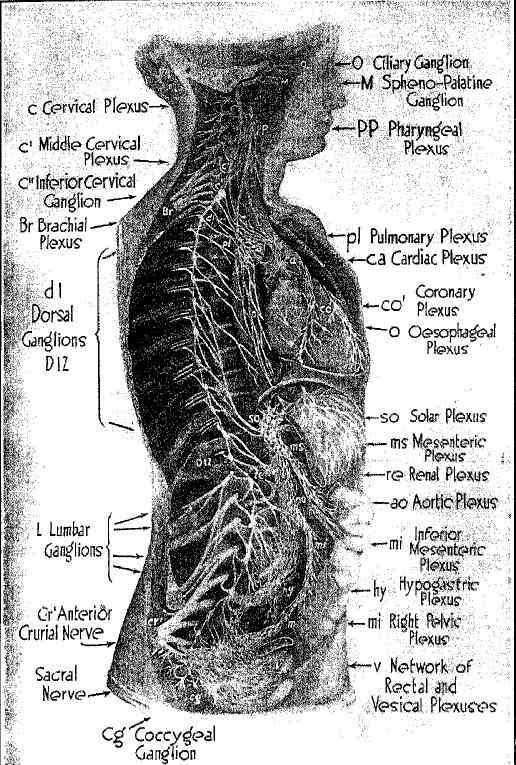 |
|
SEPARATE NERVE CENTERS, PLEXUSES AND GANGLIA,
THE "LITTLE BRAINS" OF THE HUMAN BODY
|
Thus, the heart receives nerves from both centers of government,
and besides all this is itself the center of groups of nerve cells.
The power by which it beats arises from a ganglionic center within
the heart itself, so that the heart will continue to beat apart
from the body if it be supplied with fresh blood. But the rapidity
of the heart's beating is regulated by the cerebro-spinal and
sympathetic systems, of which the former tends to retard the beat
and the latter tends to accelerate it.
In the same way, your lungs are governed in part by both
centers, for you can breathe slowly or rapidly as you will, but you
cannot, by any power of your conscious will, stop breathing
altogether.
Your interest in the brain and nerve system is confined to such
facts as may prove to be of use to you in your study of the mind.
These anatomical divisions interest you only as they are identified
with conscious mental action on the one hand and unconscious mental
action on the other.
It is, therefore, of no use to you to consider the various
divisions of the sympathetic nerve system, since the sympathetic
nerve system in its entirety belongs to the field of unconscious
mental action. It operates without our knowledge and without our
will.
Brains Parts and Functions
The cerebro-spinal system consists of the spinal cord and the
brain. The brain in turn is made up of two principal subdivisions.
First, there is the greater or upper brain, called the cerebrum;
secondly, there is the lower or smaller brain, called the
cerebellum. The cerebrum in turn consists of three parts: the
convoluted surface brain, the middle brain and the
lower brain. So that in all we have the surface
brain, the middle brain, the lower brain and the
cerebellum. All these parts consist of masses of brain cells
with connecting nerve fibers.
And now, as to the functions of these various parts. Beginning
at the lowest one and moving upward, we find first that the
spinal cord consists of through lines of nerves running
between the brain and the rest of the body. At the same time it
contains within itself certain nerve centers that are sufficient
for many simple bodily movements. These bodily movements are such
as are instinctive or habitual and require no distinct act of the
will for their performance. They are mere "reactions," without
conscious, volitional impulse.
Moving up one step higher, we find that the cerebellum is
the organ of equilibrium, and that it as well as the spinal cord
operates independently of the conscious will, for no conscious
effort of the will is required to make one reel from dizziness.
As to the divisions of the greater brain or cerebrum, we want
you to note that the lower brain serves a double purpose.
First, it is the channel through which pass through lines of
communication to and from the upper brain and the mid-brain on the
one hand and the rest of the body on the other. Secondly, it is
itself a central office for the maintenance of certain vital
functions, such as lung-breathing, heart-beating, saliva-secreting,
swallowing, etc., all involuntary and unconscious in the sense that
consciousness is not necessary to their performance.
The next higher division, or mid-brain, is a large region
from which the conscious will issues its edicts regulating all
voluntary bodily movements. It is also the seat of certain special
senses, such as sight.
Lastly, the surface brain, known as the cortex, is the
interpretative and reflective center, the abode of memory,
intellect and will.
The functions of these various parts are well illustrated by the
effects of alcohol upon the mind. If a man takes too much alcohol,
its first apparent effect will be to paralyze the higher or
cortical center. This leaves the mid-brain without the check-rein
of a reflective intellect, and the man will be senselessly
hilarious or quarrelsome, jolly or dejected, pugnacious or tearful,
and would be ordinarily described as "drunk." If in spite of this
he keeps on drinking, the mid-brain soon becomes deadened and
ceases to respond, and the cerebellum, the organ of equilibrium,
also becomes paralyzed. All voluntary bodily activities must then
cease, and he rolls under the table, helpless and "dead" drunk, or
in language that is even more graphically appreciative of the
physiological effects of alcohol, "paralyzed." However, the
deep-seated sympathetic system is still alive. No assault has yet
been made upon the vital organs of the body; the heart continues to
beat and the lungs to breathe. But suppose that some playful
comrade pours still more liquor down the victim's throat. The
medulla, or lower brain, then becomes paralyzed, the vital organs
cease to act and the man is no longer "dead" drunk. He has become a
sacrifice to Bacchus. He is literally and actually dead.
It seems, then, that the surface brain and mid-brain constitute
together the organ of consciousness and will. Consciousness and
will disappear with the deadening or paralysis of these two
organs.
Yet these two organs constitute but a small proportion of the
entire mass of brain and nervous tissue of the body. In addition to
these, there are not only the lower brain and the spinal cord and
the countless ramifications of motor and sensory nerves throughout
the body, but there are also separate nerve-centers or ganglia in
every one of the visceral organs of the body. These ganglia have
the power to maintain movements in their respective organs. They
may in fact be looked upon as little brains developing nerve force
and communicating it to the organs.
All these automatic parts of the bodily mechanism are dominated
by departments of the mind entirely distinct from ordinary
consciousness. In fact, ordinary consciousness has no knowledge of
their existence excepting what is learned from outward bodily
manifestations.
All these different organic ganglia constitute together the
sympathetic nerve system, organ of that part of the mind which
directs the vital operations of the body in apparent independence
of the intelligence commonly called "the mind," an intelligence
which acts through the cerebro-spinal system.
Yet this independence is far from being absolute. For, as we
have seen, not only is the cerebro-spinal system, which is the
organ of consciousness, the abode of all the special senses, such
as sight, hearing, etc., and therefore our only source of
information of the external world, but many organs of the body are
under the joint control of both systems.
So it comes about that these individual intelligences
governing different organs of the body, with their
intercommunications, are dependent upon consciousness for their
knowledge of such facts of the outer world as have a bearing on
their individual operations, and they are subject to the influence
of consciousness as the medium that interprets these facts.
It is unnecessary for us to go into this matter deeply. It is
enough if you clearly understand that, in addition to
consciousness, the department of mind that knows and directly deals
with the facts of the outer world, there is also a deep-seated and
seemingly unconscious department of mind consisting of individual
organic intelligences capable of receiving, understanding and
acting upon such information as consciousness transmits.
We have spoken of conscious and "seemingly unconscious"
departments of the mind. In doing so we have used the word
"seemingly" advisedly. Obviously we have no right to apply the term
"unconscious" without qualification to an intelligent mentality
such as we have described.
"Unconscious" simply means "not conscious." In its common
acceptation, it denotes, in fact, an absence of all mental action.
It is in no sense descriptive. It is merely negative. Death is
unconscious; but unconsciousness is no attribute of a mental state
that is living and impellent and constantly manifests its active
energy and power in the maintenance of the vital functions of the
body.
Hereafter, then, we shall continue to use the term consciousness
as descriptive of that part of our mentality which constitutes what
is commonly known as the "mind"; while that mental force, which, so
far as our animal life is concerned, operates through the
sympathetic nerve system, we shall hereafter describe as
"subconscious."
Let us summarize our study of man's physical organism. We have
learned that the human body is a confederation of various groups of
living cells; that in the earliest stages of man's evolution, these
cells were all of the same general type; that as such they were
free-living, free-thinking and intelligent organisms as certainly
as were those unicellular organisms which had not become members of
any group or association; that through the processes of evolution,
heredity and adaptation, there has come about in the course of the
ages, a subdivision of labor among the cells of our bodies and a
consequent differentiation in kind whereby each has become
peculiarly fitted for the performance of its allotted functions;
that, nevertheless, these cells of the human body are still
free-living, intelligent organisms, of which each is endowed with
the inherited, instinctive knowledge of all that is essential to
the preservation of its own life and the perpetuation of its
species within the living body; that, as a part of the specializing
economy of the body, there have been evolved brain and nerve cells
performing a twofold service—first, constituting the organ of
a central governing intelligence with the important business of
receiving, classifying, and recording all impressions or messages
received through the senses from the outer world, and, second,
communicating to the other cells of the body such part of the
information so derived as may be appropriate to the functions of
each; that finally, as such complex and confederated individuals,
each of us possesses a direct, self-conscious knowledge of only a
small part of his entire mental equipment; that we have not only a
consciousness receiving sense impressions and issuing motor
impulses through the cerebro-spinal nervous system, but that we
have also a subconsciousness manifesting itself, so far as
bodily functions are concerned, in the activity of the vital organs
through the sympathetic nerve system; that this subconsciousness is
dependent on consciousness for all knowledge of the external world;
that, in accordance with the principles of evolution, man as a
whole and as a collection of cell organisms, both consciously and
unconsciously, is seeking to adapt himself to his external world,
his environment; that the human body, both as a whole and as an
aggregate of cellular intelligences, is therefore subject in every
part and in every function to the influence of the special senses
and of the mind of consciousness.

