Psychological warfare is waged before, during, and after war; it is
not waged against the opposing psychological warfare operators; it is
not controlled by the laws, usages, and customs of war; and it cannot be
defined in terms of terrain, order of battle, or named engagements. It is
a continuous process. Success or failure is often known only months
or years after the execution of the operation. Yet success, though incalculable,
can be overwhelming; and failure, though undetectable, can
be mortal.
Psychological warfare does not fit readily into familiar concepts of
war. Military science owes much of its precision and definiteness to its
dealing with a well defined subject, the application of organized lawful
violence. The officer or soldier can usually undertake his task of applying
mass violence without having to determine upon the enemy. The
opening of war, recognition of neutrals, the listing of enemies, proclamation
of peace—such problems are considered political, and outside the
responsibility of the soldier. Even in the application of force short of
war, the soldier proceeds only when the character of the military
operation is prescribed by higher (that is, political) authorities, and
after the enemies are defined by lawful and authoritative command. In
one field only, psychological warfare, is there endless uncertainty as to
the very nature of the operation.
Psychological warfare, by the nature of its instruments and its mission,
begins long before the declaration of war. Psychological warfare
continues after overt hostilities have stopped. The enemy often avoids
identifying himself in psychological warfare; much of the time, he is
disguised as the voice of home, of God, of the church, of the friendly
press. Offensively, the psychological warfare operator must fight antagonists
who never answer back—the enemy audience. He cannot
fight the one enemy who is in plain sight, the hostile psychological warfare
operator, because the hostile operator is greedily receptive to attack.
Neither success nor defeat are measurable factors. Psychological strategy
is planned along the edge of nightmare.
In a formal approach
to this mysterious part of the clean-cut process of war, it might
be desirable to start with Euclidian demonstrations, proceeding from
definition to definition until the subject-matter had been delimited by
logic. Alternatively it might be interesting to try a historical approach,
describing the development of psychological warfare through the ages.
The best approach is perhaps afforded by a simplification of both a
logical and historical approach. For concrete examples it is most worthwhile
to look at instances of psychological warfare taken out of history
down to World War II. Then the definitions and working relationships
can be traced and—with these in mind—a somewhat more detailed and
critical appraisal of World Wars I and II organizations and operations
can be undertaken. If a historian or philosopher picks up this book, he
will find much with which to quarrel, but for the survey of so hard-to-define
a subject, this may be a forgivable fault.
![[Figure 1]](https://openoldbooks.sgp1.digitaloceanspaces.com/books/psychological-warfare/images/p1t.jpg)
Figure 1: A Basic Form of
Propaganda.
This American leaflet, issued during the Philippine landings,
was dropped on inhabited Philippine areas in order to obtain local
civilian cooperation with
the landing forces. It can be called the "civilian-action" type.
Psychological warfare and propaganda are each as old as mankind;
but it has taken modern specialization to bring them into focus as separate
subjects. The materials for their history lie scattered through thousands
of books and it is therefore impossible to brief them. Any reader
contemplating retirement from the army to a sedentary life is urged to
take up this subject.1 A history of propaganda would provide not only a
new light on many otherwise odd or trivial historical events; it would
throw genuine illumination on the process of history itself. There are
however numerous instances which can be cited to show applications of
psychological warfare.
One of the earliest (by traditional
reckoning, 1245 B.C.) applications was Gideon's use of the lamps and
pitchers in the great battle against the Midianites.
The story is told in the seventh chapter of the Book of Judges.
Gideon was in a tactically poor position. The Midianites outnumbered
him and were on the verge of smiting him very thoroughly. Ordinary
combat methods could not solve the situation, so Gideon—acting upon
more exalted inspiration than is usually vouchsafed modern commanders—took
the technology and military formality of his time into account.
Retaining three hundred selected men, he sought for some device
which would cause real confusion in the enemy host. He knew well that
the tactics of his time called for every century of men to have one light-carrier
and one torch-bearer for the group. By equipping three hundred
men with a torch and a trumpet each, he could create the effect of thirty
thousand. Since the lights could not be turned on and off with switches,
like ours, the pitchers concealed them, thus achieving the effect of suddenness.
![[Figure 2]](https://openoldbooks.sgp1.digitaloceanspaces.com/books/psychological-warfare/images/p2t.jpg)
Figure 2: Nazi Troop Morale Leaflet. In this leaflet, used on the Italian front in 1944, the Nazis did
not call for any specific action from their American GI readers. Their aim was merely depression
of American morale for future exploitation by action propaganda. Note the extreme simplicity of
the message. Throughout World War II, the Nazis were misled by their own tendentious political
intelligence reports and consequently overestimated the kind and degree of American opposition
to Franklin D. Roosevelt. They mistook normal complaint for treasonable sedition; hence, leaflets
such as this seemed practical to the Germans.
![[Figure 3]](https://openoldbooks.sgp1.digitaloceanspaces.com/books/psychological-warfare/images/p3t.jpg)
Figure 3: One of the Outstanding Leaflets of the War. Prepared in 1945 for distribution by B-29s
operating over Japan, this leaflet lists eleven Japanese cities which were marked for destruction.
The leaflet is apparently of the civilian-action type, calling on Japanese civilians to save their
own lives. At the same time, it had the effect of shutting down eleven strategically important
cities, thus hurting the Japanese war effort while giving the Americans a reputation for humanity
and also refuting enemy charges that we undertook indiscriminate bombing.
![[Figure 4]](https://openoldbooks.sgp1.digitaloceanspaces.com/books/psychological-warfare/images/p4t.jpg)
Figure 4: The Pass Which Brought them in. Germans liked things done in an official and formal
manner, even in the midst of chaos, catastrophe and defeat. The Allies obliged, and gave the
Germans various forms of very official-looking "surrender passes," of which this is one. The
original is printed in red and has banknote-type engraving which makes it resemble a soap-premium
coupon. (Western Front, 1944-45, issued by SHAEF.)
He had his three hundred men equipped with lamps and pitchers.
The lamps were concealed in the pitchers, each man carrying one, along
with a trumpet. He lined his forces in appropriate disposition around
the enemy camp at night and had them—himself setting the example—break
the pitchers all at the same time, while blowing like mad on the
trumpets.
The Midianites were startled out of their sleep and their wits. They
fought one another throughout their own camp. The Hebrew chronicler
modestly gives credit for this to the Lord. Then the Midianites gave up
altogether and fled. And the men of Israel pursued after the Midianites.2
That settled the Midianite problem for a while; later Gideon finished
Midian altogether.
This type of psychological warfare device—the use of unfamiliar instruments
to excite panic—is common in the history of all ancient countries.
In China, the Emperor-usurper Wang Mang on one occasion tried
to destroy the Hunnish tribes with an army that included heavy detachments
of military sorcerers, even though the Han Military Emperor had
found orthodox methods the most reliable; Wang Mang got whipped
at this. But he was an incurable innovator and in 23 A.D., while trying
to put down some highly successful rebels, he collected all the animals
out of the Imperial menagerie and sent them along to scare the enemy:
tigers, rhinoceri, and elephants were included. The rebels hit first, killing
the Imperial General Wang Sun, and in the excitement the animals got
loose in the Imperial army where they panicked the men. A hurricane
which happened to be raging at the same time enhanced the excitement.
Not only were the Imperial troops defeated, but the military propaganda
of the rebels was so jubilant in tone and so successful in effect that the
standard propaganda theme, "Depress and unnerve the enemy commander,"
was fulfilled almost to excess on Wang Mang. Here is what
happened to him after he noted the progress of the enemy: "A profound
melancholy fell upon the Emperor. It undermined his health. He drank
to excess, ate nothing but oysters, and let everything happen by chance.
Unable to stretch out, he slept sitting up on a bench."3 Wang Mang was
killed in the same year, and China remained without another economic
new deal until the time of Wang An-shih (A.D. 1021-1086), a thousand
years later. Better psychological warfare would have changed history.
A more successful
application of psychological warfare is recorded in the writings
of Herodotus, the Greek historian:
Themistocles, having selected the best sailing ships of the Athenians, went to
the place where there was water fit for drinking, and engraved upon the stones
inscriptions, which the Ionians, upon arriving the next day at Artemisium, read.
The inscriptions were to this effect, 'Men of Ionia, you do wrong in fighting
against your fathers and helping to enslave Greece. Rather, therefore, come over
to us or if you cannot do that, withdraw your forces from the contest and entreat
the Carians to do the same. But if neither of these things is possible, and you are
bound by too strong a necessity, yet in action, when we are engaged, behave ill
on purpose, remembering that you are descended from us and that the enmity of
the barbarians against us originally sprang from you.'4
This text is very much like leaflets dropped during World War II on
reluctant enemies, such as the Italians, the Chinese puppet troops, and
others. (Compare this Greek text with Figure 5.) Note that the propagandist
tries to see things from the viewpoint of his audience. His air
of reasonable concern for their welfare creates a bond of sympathy. And
by suggesting that the Ionians should behave badly in combat, he lays
the beginning of another line—the propaganda to the Persians, "black"
propaganda making the Persians think that any Ionian who was less
than perfect was a secret Athenian sympathizer. The appeal is sound
by all modern standards of the combat-leaflet.
Another type of early military propaganda was the political denunciation
which, issued at the beginning of war, could be cited from then
on as legal and ethical justification for one side or the other. In the
Chinese San Kuo novel, which has probably been read by more human
beings than any other work of fiction, there is preserved the alleged text
of the proclamation of a group of loyalist pro-Han rebels on the eve
of military operations (about A.D. 200). The text is interesting because
it combines the following techniques, all of them sound: 1) naming
the specific enemy; 2) appeal to the "better people"; 3) sympathy for
the common people; 4) claim of support for the legitimate government;
5) affirmation of one's own strength and high morale; 6) invocation of
unity; 7) appeal to religion. The issuance of the proclamation was connected
with rather elaborate formal ceremony:
The House of Han has fallen upon evil days, the bonds of Imperial authority
are loosened. The rebel minister, Tung Cho, takes advantage of the discord to
work evil, and calamity falls upon honorable families. Cruelty overwhelms
simple folk. We, Shao and his confederates, fearing for the safety of the imperial
prerogatives, have assembled military forces to rescue the State. We now
pledge ourselves to exert our whole strength, and to act in concord to the utmost
limit of our powers. There must be no disconcerted or selfish action. Should any
depart from this pledge may he lose his life and leave no posterity. Almighty
Heaven and Universal Mother Earth and the enlightened spirits of our forefathers,
be ye our witnesses.5
Any history of any country will yield further examples of this kind of
material. Whenever it was consciously used as an adjunct to military
operations, it may appropriately be termed military propaganda.
![[Figure 5]](https://openoldbooks.sgp1.digitaloceanspaces.com/books/psychological-warfare/images/p5t.jpg)
Figure 5: Revolutionary Propaganda. When revolution favors one side or the other in war, revolutionary
propaganda becomes an instrument which is used by one constituted government against
another. This leaflet was issued by the Azad Hind Fauj (Free India Army) of the Japanese puppet
Subhas Chandra Bose. (Singapore, then called Shonan, 1943 and 1944.) The leaflet avoids direct
reference to the Japanese, and is therefore "block" propaganda. Its theme is simple: the British
are alleged to eat while the Hindus starve. At the time, this argument had some plausibility. There
was famine in Bengal, but no white men were found among the thousands of emaciated dead.
In a sense, the experience of the past may, unfortunately,
provide a clue to the future. The last two great wars have
shown an increasing emphasis on ideology or political faith (see definition,
page
30 below) as driving forces behind warfare, rather than the
considerations of coldly calculated diplomacy. Wars become more serious,
and less gentlemanly; the enemy must be taken into account not
merely as a man, but as a fanatic. To the normal group-loyalty of any
good soldier to his army, right or wrong, there is added the loyalty
to the Ism or the Leader. Warfare thus goes back to the Wars of Faith.
It is possible that techniques from the Christian-Mohammedan or from
the Protestant-Catholic wars of the past could be reëxamined with a
view to establishing those parts of their tested experience which may
seem to be psychologically and militarily sound in our own time. How
fast can converts be made from the other side? In what circumstances
should an enemy word of honor be treated as valid? How can heretics
(today, read "subversive elements") be uprooted? Does the enemy faith
have weak points which permit enemy beliefs to be turned against personnel
at the appropriate times? What unobjectionable forms should
leaflets and broadcasts follow in mentioning subjects which are reverenced
by the enemy but not by ourselves?
![[Figure 6]](https://openoldbooks.sgp1.digitaloceanspaces.com/books/psychological-warfare/images/p6_1t.jpg)
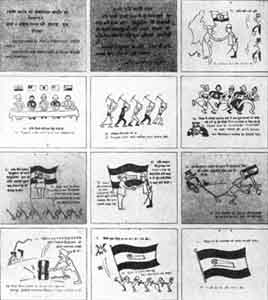
Figure 6: Propaganda for Illiterates. Propaganda reached out for the mass audience in World War
II. Some of the most interesting developments in this line were undertaken by CBI Theater facilities
and their Japanese competitors. The leaflet shown above is designed to tell its story in Hindustani (Devanagari script) or in Romanized Hindustani to Indians who could read either form, and
in pictures to the illiterates. It starts with the Union Jack and ends with the Congress flag used by
the puppet pro-Japanese Indian leader, Subhas Chandra Bose.
![[Figure 7]](https://openoldbooks.sgp1.digitaloceanspaces.com/books/psychological-warfare/images/p7t.jpg)
Figure 7: Propaganda Through News. News is one of the best carriers of psychological warfare to
the enemy. One of these newspapers is directed by the Allies to the German troops in the Ægean
Islands; the other by the Germans to the Americans in France. Of the two, the Allied paper (in
German) is the more professional job. Note the separation of appeals from the news, the greater
newsiness of the news columns, and the explanation provided for third-party civilians in their own
Greek language (top right).
The expansion of the Islamic Faith-and-Empire provides a great deal
of procedural information which cannot be neglected in our time. It has
been said that men's faith should not be destroyed by violence, and that
force alone is insufficient to change the minds of men. If this were true,
it would mean that Germany can never be de-Nazified, and that there is
no hope that the democratic peoples captured by totalitarian powers
can adjust themselves to their new overlords or, if adjusted, can be converted
back to free principles. In reality warfare by Mohammed's captains
and successors demonstrated two principles of long-range psychological
warfare which are still valid today:
A people can be converted from one faith to the other if given the
choice between conversion and extermination, stubborn individuals being
rooted out. To effect the initial conversion, participation in the public
ceremonies and formal language of the new faith must be required.
Sustained counterintelligence must remain on the alert against backsliders,
but formal acceptance will become genuine acceptance if all
public media of expression are denied the vanquished faith.
If immediate wholesale conversion would require military operations
that were too extensive or severe, the same result can be effected by toleration
of the objectionable faith, combined with the issuance of genuine
privileges to the new, preferred faith. The conquered people are
left in the private, humble enjoyment of their old beliefs and folkways;
but all participation in public life, whether political, cultural or economic,
is conditioned on acceptance of the new faith. In this manner,
all up-rising members of the society will move in a few generations
over to the new faith in the process of becoming rich, powerful, or
learned; what is left of the old faith will be a gutter superstition, possessing
neither power nor majesty.
These two rules worked once in the rise of Islam. They were applied
again by Nazi overlords during World War II, the former in Poland,
the Ukraine and Byelorussia, the latter in Holland, Belgium, Norway
and other Western countries. The rules will probably be seen in action
again. The former process is difficult and bloody, but quick; the latter
is as sure as a steam-roller. If Christians, or democrats, or progressives—whatever
free men may be called—are put in a position of underprivilege
and shame for their beliefs, and if the door is left open to voluntary
conversion, so that anyone who wants to can come over to the winning
side, the winning side will sooner or later convert almost everyone who
is capable of making trouble. (In the language of Vilfredo Pareto,
this would probably be termed "capture of the rising elite"; in the
language of present-day Marxists, this would be described as "utilization
of potential leadership cadres from historically superseded classes";
in the language of practical politics, it means "cut in the smart boys
from the opposition, so that they can't set up a racket of their own.")
![[Figure 8]](https://openoldbooks.sgp1.digitaloceanspaces.com/books/psychological-warfare/images/p8t.jpg)
Figure 8: One of the Mongol Secret Weapons. The Mongol conquerors used rumor and terror in
order to increase their military effectiveness. Once they came to power, they used spectacular military
displays as a means of intimidating conquered peoples. This old French engraving shows a war-howdah
mounted on four elephants allegedly used by Kublai Khan, grandnephew to Genghis
Khan and friend of Marco Polo the Venetian. Obviously impractical for field use, the vehicle is
well suited for ceremonial display and mere mention of it is a factor for "warfare psychologically
waged."
Another demonstration
of psychological warfare in the past was so effective that its results
linger to this day. It is commonly thought that the greatest conqueror
the world has seen—Temujin, the Genghis Khan—effected his Mongol
conquests with "limitless hordes" of wild Tatar horsemen, who flooded
the world by weight of sheer numbers. Recent research shows that the
sparsely settled countryside of Inner Asia could not have produced populations
heavy enough to overwhelm the densely settled areas of the
great Mongol periphery by weight alone. The empire of the Khan was
built on bold military inventiveness—the use of highly mobile forces,
the full use of intelligence, the coordination of half-global strategy, the
application of propaganda in all its forms.
6 The Mongols were fighting
the Sung Dynasty in China and the Holy Roman Empire in Prussia four
thousand miles apart when neither of their adversaries knew (in more
than rumor) that the other existed. The Mongols used espionage to
plan their campaigns and deliberately used rumor and other means to
exaggerate accounts of their own huge numbers, stupidity, and ferocity.
They did not care what their enemies thought as long as the enemies
became frightened. Europeans described light, hard-hitting
numerically
inferior cavalry as a "numberless horde" because Mongol agents whispered
such a story in the streets. To this day most Europeans do not
appreciate the lightness of the forces nor the cold intelligence of command
with which the Mongols hit them seven centuries ago.
Genghis even used the spies of the enemy as a means of frightening
the enemy. When spies were at hand he indoctrinated them with rumors
concerning his own forces. Let the first European biographer of Genghis
tell, in his own now-quaint words, how Genghis put the bee on Khorezm
(Carizme):
And a Historian, to describe their Strength and Number, makes the Spies
whom the King of Carizme had sent to view them, speak thus: They are, say they
to the Sultan, all compleat Men, vigorous, and look like Wrestlers; they breathe
nothing but War and Blood, and show so great an Impatience to fight, that the
Generals can scarce moderate it; yet though they appear thus fiery, they keep
themselves within the bounds of a strict Obedience to Command, and are intirely
devoted to their Prince; they are contented with any sort of Food, and are
not curious in the choice of Beasts to eat, like Mussulmen [Mohammedans], so
that they are subsisted without much trouble; and they not only eat Swines-Flesh,
but feed upon Wolves, Bears, and Dogs, when they have no other Meat, making
no distinction between what was lawful to eat, and what was forbidden; and
the Necessity for supporting Life takes from them all the Dislike which the
Mahometans have for many sorts of Animals; As to their Number, (they concluded)
Genghizcan's Troops seem'd like the Grasshoppers, impossible to be
number'd.
In reality, this Prince making a Review of his Army, found it to consist of
seven hundred thousand men....7
Enemy espionage can now—as formerly—prove useful if the net effect
of it is to lower enemy morale. The ruler and people of Khorezm
put up a terrific fight, nevertheless, despite their expectation of being
attacked by wolf-eating wrestlers without number; but they left the
initiative in Genghis' hands and were doomed.
However good the Mongols were in strategic and tactical propaganda,
they never solved the problem of consolidation propaganda (see page
46, below). They did not win the real loyalty of the peoples whom they
conquered; unlike the Chinese, who replaced conquered populations
with their own people, or the Mohammedans, who converted conquered
peoples, the Mongols simply maintained law and order, collected taxes,
and sat on top of the world for a few generations. Then their world
stirred beneath them, and they were gone.
Moving across the centuries for an
example, it is interesting to note that John Milton, author of Paradise
Lost and of other priceless books of the English-speaking world, went
blind because he was so busy conducting Oliver Cromwell's psychological
warfare that he disregarded the doctors' warning and abused his
ailing sight. And the sad thing about it was that it was not very good
psychological warfare.
Milton fell into the common booby-trap of refuting his opponents
item by item, thus leaving them the strong affirmative position, instead
of providing a positive and teachable statement of his own faith. He was
Latin Secretary to the Council, in that Commonwealth of England
which was—to its contemporaries in Europe—such a novel, dreadful,
and seditious form of government. The English had killed their king,
by somewhat offhanded legal procedures, and had gone under the Cromwellian
dictatorship. It was possible for their opponents to attack them
from two sides at once. Believers in monarchy could call the English
murderous king-killers (a charge as serious in those times as the charge
of anarchism or free love in this); believers in order and liberty could
call the British slaves of a tyrant. A Frenchman called Claude de Saumaise
(in Latin form, Salmasius) wrote a highly critical book about the
English, and Milton seems to have lost his temper and his judgment.
In his two books against Salmasius, Milton then committed almost
every mistake in the whole schedule of psychological warfare. He moved
from his own ground of argument over to the enemy's. He wrote at excessive
length. He indulged in some of the nastiest name-calling to be
found in literature, and went into considerable detail to describe Salmasius
in unattractive terms. He slung mud whenever he could. The
books are read today, under compulsion, by Ph.D. candidates, but no one
else is known to find them attractive. It is not possible to find that these
books had any lasting influence in their own time. (In these texts written
by Milton in Latin but now available in English, Army men wearying of
the monotonous phraseology of basic military invective can find extensive
additions to their vocabulary.) Milton turned to disappointment
and poetry; the world is the gainer.
The vocabulary of seventeenth-century propaganda had a strident
tone which is, perhaps unfortunately, getting to be characteristic of the
twentieth century. The following epithets sound like an American
Legion description of Communists, or a Communist description of the
Polish democrats, yet they were applied in a book by a Lutheran to
Quakers. The title of the tirade reads, in part:
... a description of the ... new Quakers, making known the sum of their manifold
blasphemous opinions, dangerous practices, Godless crimes, attempts to
subvert civil government in the churches and in the community life of the
world; together with their idiotic games, their laughable action and behavior,
which is enough to make sober Christian persons breathless, and which is like
death, and which can display the lazy stinking cadaver of their fanatical doctrines....
In its first few pages, the book accuses the Quakers of obscenity,
adultery, civil commotion, conspiracy, blasphemy, subversion and
lunacy.8 Milton was not out of fashion in applying bad manners to
propaganda. It is merely regrettable that he did not transcend the frailties
of his time.
Innumerable other instances of propaganda
in warfare and diplomacy could be culled out of history; these
would not mean much if they were presented as mere story-telling. The
cultural factors would have to be figured out; the military situation
would need to be appraised in realistic terms; the media available for
psychological warfare would have to be charted pretty carefully, before
the instances would become usable examples. Here are some of the
most promising topics:
- Naval psychological warfare techniques used by the Caribbean pirates to unnerve prospective victims.
- Cortez's use of horses as psychological disseminators of terror among the Aztecs, along with his exploitation of
Mexican legends concerning the Fair God.
- The failure of Turkish psychological warfare in the great campaigns of 1683 which left the issue one of purely
physical means and cost Turkey the possible hegemony of central Europe.
- The propaganda methods of the British East India Company in the conquest of India against overwhelming Indian
numerical superiority. (Edmond Taylor mentions these in his Richer by Asia.)
- The preventive psychological warfare system set up by the Tokugawa shoguns after 1636, which bottled up the
brains of the Japanese through more rigorous control than has ever been established elsewhere over civilized
people.
- The field psychological warfare of the Manchus, who conquered China against odds running as much as 400 to one
against them, and who used terror as a means of nullifying Chinese superiority.
- The propaganda of the European feudal classes against the peasant revolts, which identified the peasants with
filth, anarchy, murder, and cruelty.
- The Inquisition considered as a psychological warfare facility of the Spanish Empire.
- The agitational practices of the French Revolutionaries.
- Early uses of rockets and balloons for psychological effect.
- The beginnings of leaflet-printing as an adjunct to field operations.
Such a list just begins to touch on subjects which can and should be
investigated, either as staff studies or by civilian historians. Collection
of the materials and framing of sound doctrines for psychological warfare
are no minor task.
![[Figure 9]](https://openoldbooks.sgp1.digitaloceanspaces.com/books/psychological-warfare/images/p9_1t.jpg)
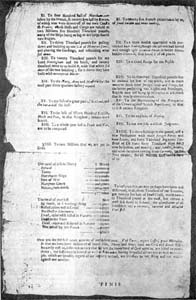
Figure 9: Black Propaganda from the British Underground, 1690. When William of Orange took the
crown of England away from the timid rascal, James II, he met opposition from the Loyalists devoted to the Stuarts. This broadsheet demonstrates an early form of black propaganda. It also
provides a good instance of propaganda material borrowing a familiar form of expression in order
to get its message across, in this case, the tradesman's enumeration of debit and credit.
![[Figure 10]](https://openoldbooks.sgp1.digitaloceanspaces.com/books/psychological-warfare/images/p10t.jpg)
Figure 10: Secret American Propaganda
Subverting the Redcoats.
Readers of Charles Dickens' great
novel, Barnaby Rudge, will remember
that anti-Catholicism was
a lively propaganda issue in
England at the time of the American
Revolution. This American
propaganda avoids discussion of
the theme of American independence—a
topic on which Englishmen
were liable to hold united
opinions—and instead attempts to
subvert British troops by means
of the anti-Catholic appeal.
(Original source unknown; from
War Department files. Probable
date, 1775.)
![[Figure 11]](https://openoldbooks.sgp1.digitaloceanspaces.com/books/psychological-warfare/images/p11t.jpg)
Figure 11: Desertion Leaflet from Bunker Hill. This leaflet is as valid today as the day it was
written. No source is indicated, but neither is any attempt made to suggest a false source different
from the true one; it is in modern parlance "grey" propaganda. Wealth, food, health and
economic status are played up simultaneously; difficult political issues are not argued—they are sidestepped.
In the American Revolution, psychological
warfare played a very important role. The Whig campaign of
propaganda which led up to colonial defiance of Britain was energetic
and expert in character, and the very opening of hostilities was marked
by passionate appeals to the civilian population in the form of handbills.
The American forces at the Battle of Bunker Hill used one of the
earliest versions of front-line combat propaganda (see
Figure 11). The
appeal was as direct as could be wished. Artful use was made of the
sharp class distinctions then existing between British officers and enlisted
men; fear was exploited as an aid to persuasion; the language
was pointed. Even in our own time, the Bunker Hill propaganda leaflet
stands as a classic example of how to do good field propaganda.
The Americans made extensive use of the press.9 When the newspaper
proprietors veered too far to the Loyalist side, they were warned
to keep to a more Patriotic line. If, in the face of counter-threats from
the Loyalists, the newspaper threatened going out of business altogether,
it was warned that suspension of publication would be taken as
treason to America. The Whigs, before hostilities, and their successors,
the Patriots of the war period, showed a keen interest in keeping the
press going and in making sure that their side of the story got out and
got circulated rapidly. In intimidation and control of the press, they
far outdistanced the British, whose papers circulated chiefly within the
big cities held as British citadels throughout the war. Political reasoning,
economic arguments, allegations concerning the course of the war,
and atrocity stories all played a role.
![[Figure 12]](https://openoldbooks.sgp1.digitaloceanspaces.com/books/psychological-warfare/images/p12_1t.jpg)
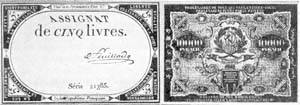
Figure 12: Money as a Carrier of Propaganda. The note on the left above is French revolutionary
currency; observe the use of revolutionary slogans. Next to it is the famous Russian 10,000 ruble
bill which calls for the world revolution in seven languages. The Japanese peso note (at top of
page
22) carries American propaganda on the reverse; captured notes were overprinted by Psychological
Warfare Branch during the Philippine campaign and dropped back on the enemy. The two
five-rupee notes date from the Japanese occupation of Burma. The lower of the two was issued
by Americans as a means of deriding the Japanese.
George Washington himself, as commander of the Continental forces,
showed a keen interest in war propaganda and in his just, moderate political
and military measures provided a policy base from which Patriot
propagandists could operate.
Some wars are profoundly affected by a book written on one side or
the other; the American revolutionary war was one of these. Thomas
Paine's Common Sense (issued as a widely sold series of pamphlets)
swept American opinion like wildfire; it stated some of the fundamentals
of American thinking, and put its bold but reasonable revolutionary
case in such simple terms that even conservatives in the Patriot
group could not resist using it for propaganda purposes.10 Common
Sense has become a classic of American literature, but it has its place
in history too, as "the book that won the war." Other pamphleteers,
with the redoubtable Sam Adams in the lead, also did well.
American experience in the Mexican war was less glorious. The
Mexicans waged psychological warfare against us with considerable
effect, ending up with traitor American artillerymen dealing out heavy
murder to the American troops outside Mexico city. Historians in both
countries gloss over the treason and subversion which occurred on each
side.
In the Civil War, psychological warfare was practised by both Lincoln
and the Confederacy in establishing propaganda instrumentalities in
England and on the continent of Europe. The Northern use of Negro
troops, which was followed, at the end of the war by the Confederate
plans for raising Negro troops, did not become the major propaganda
issue it might have because of the community of feeling on the two sides,
indecision on each side as to the purpose of the war (apart from the
basic issue of union or disunion), and the persistence of politics-as-usual
both North and South of the battle line.
In the latter part of the nineteenth century, two
sets of British wars indicate the effect psychological warfare can play.
The British conquered both Burma and the Boers. The Burmese were
more numerous, had the larger country, and (if they had had leadership
comparable to the Japanese leadership of the time) could have developed
the larger military potential. But Burma was conquered by the
British in a final war which went on quietly and ingloriously. No nation
came to their aid. They did not even get a chance to surrender. The
British simply ended the war in the middle by announcing the end of the
Burmese government, and by making a one-sided declaration that
Burma was annexed to the Empire of India. The political death of Burma
occurred on 1 January 1886, but the event has been forgotten.
The Boers, on the other hand, made a stir throughout the world.
They got in touch with the Germans, Irish, Americans, French, Dutch,
and everybody else who might criticize Britain. They stated their case
loudly and often. They waged commando warfare, adding the word
commando to international military parlance, and sent small units deep
into the British rear, setting off a mad uproar and making the world
press go crazy with excitement. When they finally gave in, it was on
reasonable terms for themselves; they left the British with an internationally
blacked eye.
Nobody remembered the Burmese; everybody remembered the Boers.
The Boers used every means they could think of; they did everything
they could. They even captured Winston Churchill.
These examples may show that the military role of propaganda and
related operations is not as obscure or intangible as it may have seemed.
They cannot be considered history but must be regarded as a plea for the
writing of history. More recent experience is another question, and involves
tracing the doctrines pertaining to psychological warfare which
have now become established military procedure in the modern armies.
Psychological warfare in the broad sense, consists of the application
of parts of the science called psychology to the conduct of war; in the
narrow sense, psychological warfare comprises the use of propaganda
against an enemy, together with such military operational measures as
may supplement the propaganda. Propaganda may be described, in
turn, as organized persuasion by non-violent means. War itself may be
considered to be, among other things, a violent form of persuasion.
Thus if an American fire-raid burns up a Japanese city, the burning is
calculated to dissuade the Japanese from further warfare by denying
the Japanese further physical means of war and by simultaneously hurting
them enough to cause surrender. If, after the fire-raid, we drop
leaflets telling them to surrender, the propaganda can be considered an
extension of persuasion—less violent this time, and usually less effective,
but nevertheless an integral part of the single process of making
the enemy stop fighting.
Neither warfare nor psychology is a new subject. Each is as old as
man. Warfare, being the more practical and plain subject, has a far
older written history. This is especially the case since much of what is
now called psychology was formerly studied under the heading of religion,
ethics, literature, politics, or medicine. Modern psychological
warfare has become self-conscious in using modern scientific psychology
as a tool.
In World War II the enemies of the United States were more fanatical
than the people and leaders of the United States. The consequence
was that the Americans could use and apply any expedient psychological
weapon which either science or our version of common sense provided.
We did not have to square it with Emperor myths, the Führer principle
or some other rigid, fanatical philosophy. The enemy enjoyed the positive
advantage of having an indoctrinated army and people; we enjoyed
the countervailing advantage of having skeptical people, with no inward
theology that hampered our propaganda operations. It is no negligible
matter to be able to use the latest findings of psychological
science in a swift, bold manner. The scientific character of our psychology
puts us ahead of opponents wrapped up in dogmatism who must
check their propaganda against such articles of faith as Aryan racialism
or the Hegelian philosophy of history.
Good propaganda
can be conducted by persons with no knowledge of formal psychology.
The human touch, the inventive mind, the forceful appeal—things such as these appear in the writings of gifted persons. Thomas
Paine never read a word of Freud or Pavlov, yet Paine's arguments during
the Revolutionary War played subtly on every appeal which a modern
psychologist could catalogue. But war cannot, in modern times, assume
a statistical expectation of talent. Psychology makes it possible
for the able but ordinary statesman or officer to calculate his persuasion
systematically and to obtain by planning those results which greater
men might hit upon by genius.
What can psychology do for warfare?
In the first place, the psychologist can bring to the attention of the
soldier those elements of the human mind which are usually kept out
of sight. He can show how to convert lust into resentment, individual
resourcefulness into mass cowardice, friction into distrust, prejudice into
fury. He does so by going down to the unconscious mind for his source
materials. (During world War II, the fact that Chinese babies remain
unimpeded while they commit a nuisance, while Japanese babies are
either intercepted or punished if they make a mess in the wrong place,
was found to be of significant importance in planning psychological
warfare. See below, page 154.)
In the second place the psychologist can set up techniques for finding
out how the enemy really does feel. Some of the worst blunders of history
have arisen from miscalculation of the enemy state of mind. By
using the familiar statistical and questionnaire procedures, the psychologist
can quiz a small cross section of enemy prisoners and from
the results estimate the mentality of an entire enemy theater of war at
a given period. If he does not have the prisoners handy, he can accomplish
much the same end by an analysis of the news and propaganda
which the enemy authorities transmit to their own troops and people.
By establishing enemy opinion and morale factors he can hazard a
reasoned forecast as to how the enemy troops will behave under specific
conditions.
In the third place, the psychologist can help the military psychological
warfare operator by helping him maintain his sense of mission and of
proportion. The deadliest danger of propaganda consists of its being issued
by the propagandist for his own edification. This sterile and ineffectual
amusement can disguise the complete failure of the propaganda
as propaganda. There is a genuine pleasure in talking back, particularly
to an enemy. The propagandist, especially in wartime, is apt to tell the
enemy what he thinks of him, or to deride enemy weaknesses. But to
have told the Nazis, for example, "You Germans are a pack of murderous
baboons and your Hitler is a demented oaf. Your women are slobs,
your children are halfwits, your literature is gibberish and your cooking
is garbage," and so on, would have stiffened the German will to fight.
The propagandist must tell the enemy those things which the enemy
will heed; he must keep his private emotionalism out of the operation.
The psychologist can teach the propaganda operator how to be objective,
systematic, cold. For combat operations, it does not matter how
much a division commander may dislike the enemy; for psychological
warfare purposes, he must consider how to persuade them, even though
he may privately thirst for their destruction. The indulgence of hatred is
not a working part of the soldier's mission; to some it may be helpful; to
others, not. The useful mission consists solely of making the enemy stop
fighting, by combat or other means. But when the soldier turns to propaganda,
he may need the advice of a psychologist in keeping his own
feelings out of it.
Finally, the psychologist can prescribe media—radio, leaflets, loudspeakers,
whispering agents, returned enemy soldiers, and so forth. He
can indicate when and when not to use any given medium. He can, in
conjunction with operations and intelligence officers, plan the full use of
all available psychological resources. He can coordinate the timing of
propaganda with military, economic or political situations.
The psychologist does not have to be present in person to give this
advice. He does not have to be a man with an M.D. or Ph. D. and years
of postgraduate training. He can be present in the manuals he writes,
in the indoctrination courses for psychological warfare officers he sets
up, in the current propaganda line he dictates by radio. It is useful to
have him in the field, particularly at the higher command headquarters,
but he is not indispensable. The psychologist in person can be dispensed
with; the methods of scientific psychology cannot. (Further on, throughout
this book, reference will be made to current psychological literature.
The general history of psychology is described in readable terms in Gregory
Zilboorg and George W. Henry, A History of Medical Psychology,
New York, 1941, and in Lowell S. Selling, Men Against Madness, New
York, 1940, cheap edition, 1942.)
Propaganda can be conducted by rule of thumb. But only a genius
can make it work well by playing his hunches. It can become true psychological
warfare, scientific in spirit and developed as a teachable skill,
only by having its premises clearly stated, its mission defined, its instruments
put in systematic readiness, and its operations subject to at
least partial check, only by the use of techniques borrowed from science.
Of all the sciences, psychology is the nearest, though anthropology, sociology,
political science, economics, area studies and other specialties
all have something to contribute; but it is psychology which indicates the
need of the others.
An infantry officer does
not need to study the whole nature of war, in order to find his own
job. Tradition, military skill, discipline, sound doctrine—these have
done the job for him. Sun Tzu, Vegetius, Frederick, Clausewitz and a
host of lesser writers on war have established the place of combat in war,
and have appraised its general character.
How much the traditional doctrines may be altered in the terrible
light of atomic explosion, no one knows; but though the weapons are
novel, the wielders of the weapons will still be men. The motives and
weaknesses within war remain ancient and human, however novel and
dreadful the mechanical expedients adopted to express them.
Warfare as a whole is traditionally well defined, and psychological
warfare can be understood only in relation to the whole process. It is no
mere tool, to be used on special occasion. It has become a pervasive
element in the military and security situation of every power on earth.
Psychological warfare is a part of war. The simplest, plainest thing
which can be said of war—any sort of war, anywhere, anytime—is that
it is an official fight between men. Combat, killing, and even large-scale
group struggle are known elsewhere in the animal kingdom, but war
is not. All sorts of creatures fight; but only men declare, wage, and
terminate war; and they do so only against other men.
Formally, war may be defined as the "reciprocal application of violence
by public, armed bodies."
If it is not reciprocal, it is not war, the killing of persons who do not
defend themselves is not war, but slaughter, massacre, or punishment.
If the bodies involved are not public, their violence is not war. Even
our enemies in World War II were relatively careful about this distinction,
because they did not know how soon or easily a violation of the
rules might be scored against them. To be public, the combatants need
not be legal—that is, constitutionally set up; it suffices, according to international
usage, for the fighters to have a reasonable minimum of
numbers, some kind of identification, and a purpose which is political.
If you shoot your neighbor, you will be committing mere murder; but if
you gather twenty or thirty friends, together, tie a red handkerchief
around the left arm of each man, announce that you are out to overthrow
the government of the United States, and then shoot your neighbor
as a counterrevolutionary impediment to the new order of things,
you can have the satisfaction of having waged war. (In practical terms,
this means that you will be put to death for treason and rebellion, not
merely for murder.)
Finally, war must be violent. According to the law of modern states,
all the way from Iceland to the Yemen, economic, political, or moral
pressure is not war; war is the legalization, in behalf of the state, of
things which no individual may lawfully do in time of peace. As a matter
of fact, even in time of war you cannot kill the enemy unless you do
so on behalf of the state; if you had shot a Japanese creditor of yours
privately, or even shot a Japanese soldier when you yourself were out
of uniform, you might properly and lawfully have been put to death for
murder—either by our courts or by the enemies'. (This is among the
charges which recur in the war trials. The Germans and Japanese killed
persons whom even war did not entitle them to kill.)
The governments of the modern world are jealous of their own monopoly
of violence. War is the highest exercise of that violence, and
modern war is no simple reversion to savagery. The General Staffs
would not be needed if war were only an uncomplicated orgy of homicide—a
mere getting-mad and throat-cutting season in the life of man.
Quite to the contrary, modern war—as a function of modern society—reflects
the institutional, political complexity from which it comes. A
modern battle is a formal, ceremonialized and technically intricate
operation. You must kill just the right people, in just the right way,
with the right timing, in the proper place, for avowed purposes. Otherwise
you make a mess of the whole show, and—what is worse—you
lose.
Why must you fight just so and so, there and not here, now and not
then? The answer is simple: you are fighting against men. Your purpose
in fighting is to make them change their minds. It is figuratively
true to say that the war we have just won was a peculiar kind of advertising
campaign, designed to make the Germans and Japanese like us and
our way of doing things. They did not like us much, but we gave them
alternatives far worse than liking us, so that they became peaceful.
Sometimes individuals will be unpersuadable. Then they must be
killed or neutralized by other purely physical means—such as isolation
or imprisonment. (Some Nazis, perhaps including the Führer himself,
found our world repellent or incomprehensible and died because they
could not make themselves surrender. In the Pacific many Japanese had
to be killed before they became acceptable to us.) But such is man, that
most individuals will stop fighting at some point short of extinction;
that point is reached when one of two things happens:
- Either, the defeated people may lose their sense of organization, fail
to decide on leaders and methods, and give up because they can no
longer fight as a group. This happened to the American Southerners in
April, 1865. The President and Cabinet of the Confederate States of
America got on the train at Richmond; the men who got off farther
down the line were "refugees." Something happened to them and to
the people about them, so that Mr. Davis no longer thought of himself
as President Davis, and other people no longer accepted his commands.
This almost happened in Germany in 1945 except for Admiral Doenitz.
- Or, the defeated people can retain their sense of organization, and
can use their political organization for the purpose of getting in touch
with the enemy, arranging the end of the war, and preparing, through
organized means, to comply with the wishes of the conquerors. That
happened when Britain acknowledged American independence; when
the Boers recognized British sovereignty; when Finland signed what
Russia had dictated; and when Japan gave up.
Sometimes these things are mixed. The people might wish to make
peace, but may find that their government is not recognized by the
enemy. Or the victors may think that they have smashed the enemy
government, when the new organization is simply the old one under a
slightly different name, but with the old leaders and the old ideas still
prevailing.
It is plain that whatever happens wars are fought to effect a psychological
change in the antagonist. They are then fought for a psychological
end unless they are wars of extermination. These are rare. The United
States could not find a people on the face of the earth whose ideas and
language were unknown to all Americans. Where there is a chance of
communication, there is always the probability that one of the antagonistic
organizations (governments)—which have already cooperated to
the extent of meeting one another's wishes to fight—will subsequently
cooperate on terms of primary advantage to the victors. Since the
organizations comprise human beings with human ways of doing things,
the change must take place in the minds of those specific individuals who
operate the existing government, or in the minds of enough other people
for that government to be overthrown.
The fact that war is waged against the minds, not the bodies, of the
enemy is attested by the comments of military writers of all periods.
The dictum of Carl von Clausewitz that "war is politics continued by
other means" is simply the modern expression of a truth recognized
since antiquity. War is a kind of persuasion—uneconomical, dangerous,
and unpleasant, but effective when all else fails.
An ideology is a system of deep-rooted beliefs about fundamental
questions in human life and affairs.
11 Ideology also plays a part in
psychological warfare. A difference in beliefs which does not touch
fundamentals is commonly termed a difference of
opinion. You may
believe in high tariffs; and I, in no tariff. You may believe in One
World; I may not. You may support Republicans; I, Democrats. Despite
these differences both of us can still believe in dollars as a method of
paying income, in marriage as a system of setting up the family, in private
property for most goods industrial or personal, in the Government
of the United States, in majority rule, in democratic elections, in free
speech, and so on.
If our difference of opinion is so inclusive that we can agree on
nothing political, our differences have gone from mere opinion into the
depths of ideology. Here the institutional framework is affected. You
and I would not want to live in the same city; we could not feel safe in
one another's presence; each would be afraid of the effect which the
other might have on the morals of the community. If I were a Nazi, and
you a democrat, you would not like the idea of my children living next
door to yours. If I believed that you were a good enough creature—poor
deluded devil—but that you were not fit to vote, scarcely to be trusted
with property, not to be trusted as an army officer, and generally subversive
and dangerous, you would find it hard to get along with me.
It was not metaphysical theories that made Protestants and Catholics
burn one another's adherents as heretics in early wars. In the seventeenth
century, the Protestants knew perfectly well what would happen if the
Catholics got the upper hand, and the Catholics knew what would
happen if the Protestants came to power. In each case the new rulers,
fearful that they might be overthrown, would have suppressed the
former rulers, and would have used the rack, the stake, and the dungeon
as preventives of counterrevolution. Freedom cannot be accorded to
persons outside the ideological pale. If an antagonist is not going to respect
your freedom of speech, your property, and your personal safety,
then you are not obliged to respect his. The absolute minimum of any
ideology is the assumption that each person living in an ideologically
uniform area (what the Nazi General Haushofer, following Rudolf
Kjellen, would call a geo-psychic zone) will respect the personal safety,
etc., of other individuals in the same area.
In our own time, we have seen Spaniards get more and more mistrustful
of one another, until years of ferocious civil war were necessary
before one of the two factions could feel safe. Spain went from republican
unity to dictatorial unity in four years; in neither case was the
unity perfect, but it was enough to give one government and one educational
system control of most of the country. The other countries of
the world vary in the degree of their ideological cohesion. Scandinavia
seemed serene until the German invasion brought to the surface cleavages,
latent and unseen, which made Quisling a quisling. Russia, Italy,
Germany and various other states have made a fetish of their ideologies
and have tried to define orthodoxy and heresy in such a way as to be
sure of the mentality of all their people. But most of the countries of
the world suffer from a considerable degree of ideological confusion—of
instability of basic beliefs—without having any immediate remedy
at hand, or even seeking one.
Education is a process usually institutional by which the
people of a given area transmit to their successors, their own children,
the purely practical information needed in modern life, together with a
lot of other teachings designed to make good men and women, good
citizens, good Christians or other believers, of them. In the democratic
states this process is ideological only in some parts of the curriculum;
elsewhere in the field of opinions, the government seeks to control ideology
only negatively—through laws concerning obscenity, blasphemy,
subversion, and so on.
In the states which are ideologically self-conscious and anxious to
promote a fixed mentality, the process of education is combined with
agitation and regulation, so that the entire population lives under conditions
approximating the psychological side of war. Heretics are put to
death or are otherwise silenced. Historical materialism and the Marxian
"objectivity," or the Volk, or Fascismo, or Yamato-damashii, or "new
democracy" is set up as the touchstone of all good and evil, even in
unrelated fields of activity. Education and propaganda merge into everlasting
indoctrination. And when such states go to war against states
which do not have propaganda machinery, the more liberal states are at
a disadvantage for sheer lack of practice in the administrative and mechanical
aspects of propaganda. Education is to psychological warfare
what a glacier is to an avalanche. The mind is to be in both cases captured,
but the speed and techniques differ.
Salesmanship is related to psychological warfare.
Propaganda is often compared to another art of our time—industrialized
salesmanship through mass printing and telecommunications. This
bad parallel was responsible for much of the inept American propaganda
overseas in the early part of the war; some of our propagandists
had a fundamental misconception of the nature of wartime propaganda.
Allegiance in war is a matter of ideology, not of opinion. A man cannot
want his own side to lose while remaining a good citizen in all
other respects. The desire for defeat—even the acceptance of defeat—is
of tragic importance to any responsible, sane person. A German who
wanted the Reich to be overthrown was a traitor to Germany, just as any
American who wished us to pull out of the war and exterminate American
Jews would have been a traitor to his own country. These decisions
cannot be compared with the choice of a toothpaste, a deodorant, or a
cigarette.
Advertising succeeds in peacetime precisely because it does not matter;
the choice which the consumer makes is of slight importance to himself,
even though it is of importance to the seller of the product. A
Dromedary cigarette and an Old Coin cigarette are both cigarettes;
the man is going to smoke one anyhow. It does not matter so much to
him. If Dromedaries are associated in his mind with mere tobacco,
while Old Coins call up unaccountable but persistent memories of
actresses' legs, he may buy Old Coins. The physical implements of propaganda
were at hand in 1941-1942, but we Americans had become so accustomed
to their use for trivial purposes that much of our wartime
propaganda was conducted in terms of salesmanship.
In a sense, however, salesmanship does serve the military purpose of
accustoming the audience to appeals both visual and auditory. The
consequence is that competing, outside propaganda can reach the domestic
American audience only in competition with the local advertising.
It is difficult for foreign competition to hold attention amid an almost
limitless number of professionally competent commercial appeals.
A Communist or Fascist party cannot get public attention in the United
States by the simple expedient of a "mass meeting" of three hundred
persons, or by the use of a few dozen posters in a metropolitan area.
Before the political propagandist can get the public attention, he must
edge his media past the soap operas, the soft drink advertisements, the
bathing beauties advertising Pennsylvania crude or bright-leaf tobacco.
The consequence is that outside propaganda either fails to get much
public attention, or else camouflages itself to resemble and to exploit
existing media. Clamorous salesmanship deadens the American citizen
to his own government's propaganda, and may to a certain extent
lower his civic alertness; but at the same time, salesmanship has built
up a psychological Great Wall which excludes foreign or queer appeals
and which renders the United States almost impervious to sudden ideological
penetration from overseas.
Psychological warfare
and public relations are different in the direction in which they apply.
Psychological warfare is designed to reach the enemy. Public relations
is designed primarily to reach the home audience. Both reach neutrals,
sometimes confusingly much. In some nations, the two functions were
combined in a single instrumentality, as in the Japanese
Joho Kyoku
(see page
184, below). The American army and navy traditions of public
relations are based on the ideas that the news should be as complete
as military security may permit, that it should be delivered speedily and
interestingly, that it should enhance the confidence of the people in their
armed services, and that its tenor (no less than its contents) should not
aid the enemy morale. These ideas are justified in terms of sound newspaper
practice, but they can lead to a weak psychological warfare position
when we must deal with an inventive and enterprising enemy.
It is not possible to separate public relations from psychological warfare
when they use the same media. During World War II, the Office of
War Information prepared elaborate water-tight plans for processing
war news to different audiences; at their most unfortunate, such plans
seemed to assume that the enemy would listen only to the OWI stations,
and that the American public releases issued from Army and Navy
would go forth to the world without being noted by the enemy. If a
radio in New York or San Francisco presented a psychological warfare
presentation of a stated battle or engagement, while the theater or fleet
public relations officer presented a very different view, the enemy press
and radio were free to choose the weaker of the two, or to quote the two
American sources against each other.
All modern armies, in
addition to public relations, also employ morale services facilities—officers
or employees whose function it is to supply troops with entertainment,
educational materials, political indoctrination, and other attention-getting
materials. Morale services are the prime overt defense against
enemy psychological warfare, and by a program of keeping the attention
of the troops, can prevent the enemy from establishing effective communication.
During World War II, the Armed Forces Radio Service
of the United States established global radio service for Americans, and
incidentally turned out material of top importance to United States propaganda.
Naturally, enemy and allied peoples would pay more serious
heed to communications from Americans to Americans than they would
to materials which they knew had been concocted for themselves. The
American morale services in the last war indignantly rejected the notion
that they were a major propaganda facility, rightfully insisting that their
audience counted on getting plain information, plain news, and plain
education without ulterior propaganda content. The fact that in a theater
of war all communication has propaganda effect was not always
taken into account, and only on one or two critical occasions was there
coordination of stress and timing.
It must be said, however, that propaganda by any other name is just
as sweet, and that the conviction of the propagandist that he is not a
propagandist can be a real asset. Morale services provided the American
forces with news, entertainment, and educational facilities. Most of the
time these morale facilities had huge parasitical audiences—the global
kibitzers who listened to our broadcasts, read our magazines, bought our
paper-bound books on the black markets. (It was a happy day for Lienta
University at Kunming, Yünnan, when the American Information
and Education set-up began shipping in current literature. The long-isolated
Chinese college students found themselves deluged with good
American books.)
The morale services lost the opportunity to ram home to their G.I.-plus-foreign
audience some of the more effective points of American
psychological warfare, but they gained as propagandists by not admitting,
even to themselves, that they were propagandists. Since the United
States has no serious inward psychological cleavages, the general morale
services function coordinated automatically with the psychological warfare
function simply because both were produced by disciplined, patriotic
Americans.
In the experience of the German and Soviet armies, morale services
were parts of a coordinated propaganda machine which included psychological
warfare, public relations, general news, and public education.
In the Japanese armies, morale services were directed most particularly
to physical and sentimental comforts (edible treats, picture postcards,
good luck items) which bore little immediate relation to news, and less
to formal propaganda.
In a free nation, the big media of communication
will remain uncoordinated even in time of war. The press,
the stage, motion-pictures, part of the radio, book publishing and so on
will continue. Psychological warfare has in such private facilities a
constantly refreshed source of new material for news or for features.
By a sparing but well considered liaison with censorship, psychological
warfare can effect negative control of non-governmental materials, and
can prevent the most overt forms of enemy propaganda from circulating
on the home front.
News becomes propaganda when the person issuing it has some purpose
in doing so. Even if the reporters, editors, writers involved do not
have propaganda aims, the original source of the news (the person giving
the interview; the friends of the correspondents, etc.) may give the
news to the press with definite purposes in mind. It is not unknown for
government officials to shift their rivalries from the conference room to
the press, and to provide on-the-record or off-the-record materials which
are in effect ad hoc propaganda campaigns. A psychological warfare
campaign must be planned on the assumption that these civilian facilities
will remain in being, and that they will be uncoordinated; the plan
must allow in advance for interference, sometimes of a very damaging
kind, which comes from private operations in the same field. The combat
officers can get civilian cars off the road when moving armored forces
into battle but the psychological warfare officer has the difficult task of
threading his way through civilian radio and other communication
traffic over which he has no control.
Psychological warfare is also closely related to diplomacy. It is an
indispensable ingredient of strategic deception. In the medical field,
psychological warfare can profit by the experiences of the medical
corps. Whenever a given condition arises among troops on one side,
comparable troops on the other are apt to be facing the same condition;
if the Americans are bitten by insects, the same insects will bite the
enemy, and enemy soldiers can be told how much better the American
facilities are for insect repulsion. Finally, psychological warfare is intimately
connected with the processing of prisoners of war and with
the protection of one's own captured personnel.
Psychological warfare is a field to itself, although it touches on many
sciences and overlaps with all the other functions of war. It is generally
divisible into three topics: the general scheme of psychological warfare,
the detection and analysis of foreign psychological warfare operations,
and the tactical or immediate conduct of psychological warfare. Sections
of this book deal with each of these in turn. In each case it must
be remembered, however, that psychological warfare is not a closed
operation which can be conducted in private, but that—to be effective—psychological
warfare output must be a part of the everyday living
and fighting of the audiences to which it is directed.
Psychological warfare seeks to win military gains without military
force. In some periods of history the use of psychological warfare has
been considered unsportsmanlike.12 It is natural for the skilled soldier to
rely on weapons rather than on words, and after World War I there was
a considerable reluctance to look further into that weapon—propaganda—which
Ludendorff himself considered to be the most formidable
achievement of the Allies. Nevertheless, World War II brought a large
number of American officers, both Army and Navy, into the psychological
warfare field: some of the best work was done without
civilian aid or sponsorship. (Capt. J. A. Burden on Guadalcanal wrote
his own leaflets, prepared his own public-address scripts, and did his
own distributing from a borrowed Marine plane, skimming the tree tops
until the Japanese shot him down into the surf. He may have heard of
OWI at the time, but the civilians at OWI had not heard of him.)
Psychological warfare has become familiar. The problems of psychological
warfare for the future are problems of how better to apply it, not
of whether to apply it. Accordingly, it is to be defined more for the
purpose of making it convenient and operable than for the purpose of
finding out what it is. The whole world found out by demonstration,
during World Wars I and II.
Psychological warfare is not defined as such in the dictionary.13 Definition
is open game. There are three ways in which "psychological warfare"
and "military propaganda" can be defined:
- first, by deciding what we are talking about in a given situation, book, conversation, or study course;
- second, by determining the responsibilities and authority involved in a given task;
- or third, by stating the results which are believed to be accomplishable by the designated means.
Plainly, the staff officer needs a different definition from the one used
by the combat officer; the political leader would use a broader definition
than the one required by soldiers; the fanatic would have his own definition
or—more probably—two of them; one (such as "promoting democracy"
or "awakening the masses") for his own propaganda and
another (such as "spreading lies," "corrupting the press," or "giving
opiates to the people") for antagonistic propaganda.14 Definition is not
something which can be done once and forever for any military term,
since military operations change and since military definitions are
critically important for establishing a chain of command.
The first method of definition is satisfactory for research purposes; it
may help break a politico-military situation down into understandable
components. The second method—the organizational—is usable when
there exists organization with which to demonstrate the definition, such
as, "Propaganda is what OWI and OSS perform." The third method,
the operational or historical, is useful in evaluating situations after the
time for action has passed; thus, one may say, "This is what the Germans
did when they thought they were conducting propaganda."
Since the first lesson of all propaganda is reasoned disbelief, it would
be sad and absurd for anyone to believe propaganda about propaganda.
The "propaganda boys" in every army and government are experts at
building up favorable cases, and they would be unusual men indeed if
they failed to work up a fine account of their own performance. Propaganda
cannot be given fair measurement by the claims made for it. It
requires judicious proportioning to the military operations of which it
is (in wartime) normally a part.
The term
propaganda springs from
the name of that department of the Vatican which had the duty of propagating
the faith. A multitude of definitions is available. Among Americans,
Walter Lippmann, Harold Lasswell and Leonard W. Doob have
done some of the most valuable critical, analytical, and historical writing,
but a host of other scholars have also made contributions, some
of them works of very real importance.
15 For the purposes of explaining
what this book is about, propaganda may be defined as follows:
Propaganda
consists of the planned use of any form of communication designed
to affect the minds, emotions, and action of a given group for a
specific purpose.This may be called the broad definition, since it would include an appeal
to buy Antident toothpaste, to believe in the theological principle
of complete immersion,16 to buy flowers for Uncles on Uncles' Day, to
slap the Japs, to fight fascism at home, or to smell nice under the arms.
All of this is propaganda, by the broad definition. Since War and Navy
Department usage never put the Corps of Chaplains, the PX system,
the safety campaigns, or the anti-VD announcements under the rubric
of propaganda, it might be desirable to narrow down the definition to
exclude those forms of propaganda designed to effect private or nonpolitical
purposes, and make the definition read:
Propaganda consists of the planned use of any form of public or mass-produced
communication designed to affect the minds and emotions of
a given group for a specific public purpose, whether military, economic,
or political.
This may be termed the everyday definition of propaganda, as it is
used in most of the civilian college textbooks.17 For military purposes,
however, it is necessary to trim down the definition in one more direction,
applying it strictly against the enemy and making it read:
Military propaganda consists of the planned use of any form of communication
designed to affect the minds and emotions of a given enemy,
neutral or friendly foreign group for a specific strategic or tactical
purpose.
Note that if the communication is not planned it cannot be called
propaganda. If a lieutenant stuck his head out of a tank turret and
yelled at some Japs in a cave, "Come on out of there, you qwertyuiop
asdfgs, or we'll zxcvb you all to hjkl, you etc.'s!," the communication
may or may not work, but—in the technical sense—it is not propaganda
because the lieutenant did not employ that form of communication
planned and designed to affect the minds or emotions of the Japanese
in the cave. Had the lieutenant given the matter thought and had he
said, in the Japanese language, "Enemy persons forthwith commanded
to cease resistance, otherwise American Army regrets inescapable consequences
attendant upon operation of flamethrower," the remark would
have been closer to propaganda.
Furthermore, propaganda must have a known purpose. This element
must be included in the definition; a great deal of communication, both
in wartime and in peacetime, arises because of the pleasure which it
gives to the utterer, and not because of the result it is supposed to effect
in the hearers. Sending the Japanese cartoons of themselves, mocking the
German language, calling Italians by familiar but inelegant names—such
communications cropped up during the war. The senders got a lot
of fun out of the message but the purpose was unintelligently considered.
The actual effect of the messages was to annoy the enemy, stiffening
his will-to-resist. (Screams of rage had a place in primitive war;
in modern military propaganda they are too expensive a luxury to be
tolerated. Planned annoyance of the enemy does, of course, have its
role—a minor, rare and special one.)
"Psychological warfare" is simple enough to understand if it is simply
regarded as application of propaganda to the purposes of war, as in the
following definition:
Psychological warfare comprises the use of propaganda against an
enemy, together with such other operational measures of a military, economic,
or political nature as may be required to supplement propaganda.
In this sense, "psychological warfare" is a known operation which
was carried on very successfully during World War II under the authority
of the Combined and Joint Chiefs of Staff. It is in this sense that
some kind of a "Psychological Warfare Unit" was developed in every
major theater of war, and that the American military assimilated the
doctrines of "psychological warfare."
However, this is only one of several ways of using the term, "psychological
warfare." There is, in particular, one other sense, in which the
term became unpleasantly familiar, during the German conquest of
Europe, the sense of warfare psychologically waged. In the American use
of the term, psychological warfare was the supplementing of normal
military operations by the use of mass communications; in the Nazi
sense of the term, it was the calculation and execution of both political
and military strategy on studied psychological grounds. For the American
uses, it was modification of traditional warfare by the effective, generous
use of a new weapon; for the Germans it involved a transformation
of the process of war itself. This is an important enough distinction
to warrant separate consideration.
Various labels were devised to
name Hitler's queer, terrifying strategy for the period 1936-1941. One
writer, Edmond Taylor, called it "the strategy of terror" in a book by
that name (Boston, 1940), and also "the war of nerves." Another,
Ladislas Farago, a political journalist who started out as an authority
on the Axis fifth column in the Near East and ended up in American
naval psychological warfare planning, put forth a book called German
Psychological Warfare: A Critical, Annotated and Comprehensive Survey
and Bibliography (New York, 1941), which digested hundreds of
German works on topics pertaining to psychology and war, much of
this material concerned personnel practices, psychosomatic medicine,
and other non-propaganda aspects of psychology, but the book as a
whole was an impressive demonstration of how much the Germans had
done to make their war scientific. Other articles and books on the Nazi
"inventions" followed in rapid succession.
After the excitement had died down, it was found that the novelty
of the German war effort lay in two special fields:
- first, the perfect or perfect-seeming synchronizing of political, propaganda, subversive, and military
efforts;
- second, the use of the findings of modern psychology for the attainment of military goals.
The Germans set the pace, in the prewar and early war period and
United Nations psychological warfare tried to keep up, even though
the two efforts were different in scope and character.
In conquering Europe, the German staff apparently used opinion
analysis. Much of this analysis has turned out to have been superb
guesswork; at the time, it looked as though the Nazis might have found
some scientific formula for determining just when a nation would cave
in. In the conduct of war, the Germans waged a rapid war—which was
industrially, psychologically and militarily sound, as long as it worked.
Their "diplomacy of dramatic intimidation" used the war threat to its
full value, with the result that the Czechoslovaks surrendered the Sudetenland
without a shot and then submitted themselves to tyranny half a
year later; the Germans wrung every pfennigs worth of advantage out
of threatening to start war, and when they did start war, they deliberately
tried to make it look as horrible as it was. The psychologists had apparently
taught the German political and military intelligence people
how to get workable opinion forecasts; German analysis of anti-Nazi
counterpropaganda was excellent. Add all this to strategy and field
operations which were incontestably brilliant: the effect was not that of
mere war, but of a new kind of war—the psychological war.
The formula for the psychological war is not to be found in the
books of the psychologists but in the writings of the constitutional lawyers.
The totality of war is a result of dictatorship within government;
total coordination results from total authority. The "secret weapon" of
the Germans lay in the power which the Germans had openly given Hitler,
and in his use of that power in a shrewd, ruthless, effective way. The
Führer led the experts, not the experts the Führer. If the Germans surprised
the world by the cold calculation of their timing, it was not because
they had psychological braintrusters inventing a new warfare, but
because they had a grim political freak commanding the total resources
of the Reich. Even in wartime, no American President has ever exercised
the authority which Hitler used in time of peace; American Cabinet
members, military and naval figures, press commentators and all sorts of
people are free to kibitz, to offer their own opinions, to bring policy into
the light of day. That is as it should be. The same factors which made
"psychological warfare" possible in the beginning of the war were the
ones which led to Germany's futile and consummate ruin in 1944-45:
excessive authority, an uninformed public, centralized propaganda, and
secret political planning.
That kind of "psychological warfare"—war tuned to the needs of
fanatically sought lusts for power, war coordinated down to the nth
degree, waged in the light of enemy opinion and aiming at the political
and moral weaknesses of the enemy—is not possible within the framework
of a democracy. Even from within Imperial Japan, Pearl Harbor
had to be waged secretly as a purely naval operation; those Japanese
who would have told the Board of Field Marshals and Fleet Admirals
that an unannounced attack was the best way to unify all American
factions against Japan were obviously not brought into the planning of
the Pearl Harbor raid. The Japanese still had too much of their old
parliamentary spirit left over, as Ambassador Grew's reports show; the
military had to outsmart the home public, along with the foreigners.
In the Western dictatorships, the home public is watched by élite troops,
secret police, party cells, and is made the subject of psychological warfare
along with the victim nations. Hitler could turn the war spirit on
and off; the Japanese did not dare do so to any effective extent. "Psychological
warfare" was too dictatorial a measure even for prewar Japan;
it is therefore permanently out of reach of the authorities of the United
States. After war starts, we are capable of surprising the enemy with
such things as incendiary raids, long-range bombers, and nuclear fission;
but we cannot startle with the start of war. The United States is not now
capable and—under the spirit of the Constitution, can never be capable—of
surprising an enemy by the timing of aggression. If the same were
true of all other nations, peace would seem much nearer than it does.
German psychological warfare, in the broad sense of warfare psychologically
waged, depended more on political background than on psychological
techniques. Disunity among the prospective victims, the
complaisance of powers not immediately affected, demonstration of new
weapons through frightful applications, use of a dread-of-war to harness
pacifism to appeasement, the lucky geographic position of Germany at
the hub of European communications—such factors made the German
war of nerves seem new. Such psychological warfare is not apt to be
successful elsewhere except for aggressions by dictatorships against democracies;
where the democracies are irritable, tough, and alert, it will
not work at all.
The psychological warfare which remains as a practical factor in
war is therefore not the Hitlerian war of nerves, but the Anglo-American
application of propaganda means to pre-decided strategy. Let him
who will advocate American use of the war of nerves! He will not get
far with commentators publishing his TOP SECRET schedule of timing,
with legislators very properly catechizing him on international morality,
with members of his own organization publishing their memoirs or airing
their squabbles right in the middle of the operation. He would end
up by amusing the enemy whom he started out to scare. Psychological
warfare has its place in our military and political system, but its place
is a modest one and its methods are limited by our usages, morality, and
law.
Propaganda has been defined (above,
page
39). It remains to distinguish some of the other technical and professional
terms which apply in this field. In operational terms, propaganda
can be distinguished by the consideration of five elements:
18
- 1. Source (including Media)
- 2. Time
- 3. Audience
- 4. Subject
- 5. Mission
These factors are given in approximate order of importance to the
analyst, and provide a good working breakdown for propaganda analysis
when expert staffs are not available. The five factors can be remembered
by memorizing the initial letters in order: S-T-A-S-M. The last
factor, "Mission," covers the presumed effect which the enemy seeks
by dissemination of the item.
Without going into the technique of field propaganda analysis (described
below, page 115), it is useful to apply these analysis factors to
the definition of some subordinate types of military propaganda.
Source is the most important. If the source is open and acknowledged,the government issuing it is putting the
propaganda on the record before the world, and must therefore issue the propaganda with a certain amount of dignity
and with an eye to the future. If the source is faked, then it is important for the government or army to make sure
that the faking is a good job, and that the propaganda cannot readily be traced back. Two very different techniques
are employed. Open sources require responsible public officials, preferably men with international reputations, who
will get the best effect from use of the name and facilities of the government. Use of an open source usually (but not
always) implies belief of the disseminator in the veracity of his materials. Fabricated sources require persons adept
at illicit imaginativeness, impromptu forgery, and general devilment, combined with a strong sense of discipline and
security. The United States was so chary of mixing the two kinds of propaganda during World War II that it operated
them in different categories, giving rise to the three following types:
- White propaganda is issued from an acknowledged source, usually a government or an agency of a government,
including military commands at various levels. This type of propaganda is associated with overt psychological
operations.
- Grey propaganda does not clearly identify any source.
- Black propaganda purports to emanate from a source other than the true one. This type of propaganda is
associated with covert psychological warfare operations.
White propaganda is shown in figure 4 which does everything
possible to make the message the official message of the British
and American governments. The border is done up in handsome banknote
fashion; the great seals of the nations are handsomely displayed;
the signatures of the commanding generals are shown as further attestation
of the openness and good faith of the issuer of the propaganda.
Figure 38 was also prepared by British-American authority; it too had
the job of making Germans surrender. But in this case, nothing was done
to make the British-American source evident; indeed, every effort was
made to hide the source, so that the German who read it would
think that it came from within his own territory. The two different
kinds of propaganda were both of them needed; each supplemented the
other but they had to be kept apart as far as possible.
In the field of radio, the difference between Covert and Overt was
even more plain. During World War II, the ether over Europe was
filled with appeals from radio stations both public and covert in character.
The British spoke to the Germans over B.B.C., making no effort to
conceal the fact that they were British. But they also spoke to the Germans
over clandestine stations, which pretended to be free-lancing
Nazis, German army stations, or freedom group operations. The Germans,
comparably, beamed official German news to the United States in
English; but they also pretended to be Americans broadcasting from an
isolationist radio in the American mid-west. In some cases, the belligerent
powers used the identical radio transmission facilities for overt and
covert propaganda. Radio Saipan, under the Americans, was most of the
time the relay for the acknowledged San Francisco programs; intermittently
OSS borrowed it, and it then became a "Japanese" station.
(Under such conditions, black radio cannot remain black very long.)
In terms of the timing, propaganda can be subdivided into two further
categories, strategic and tactical. Strategic propaganda is conducted with
no immediate effect in view. Its purpose is to wear down the enemy by
psychological changes that may extend over months. Figure 19, warning
the Germans of the remote future, is an example of this in leaflet form.
Tactical propaganda is operated to accomplish an immediate short-range
purpose, and normally does not cover a long time-span. Only in
a few cases, such as leaflets for a besieged enemy unit, is tactical propaganda
run for a purpose that encompasses a long delay between the
operation and the expected result. These two forms may be defined
as follows:
- Strategic propaganda is directed at enemy forces, enemy peoples, and enemy-occupied areas in their entirety,
and—in coordination with strategic planning—is designed to effectuate results planned and sought over a period of
weeks, months, or years.
- Tactical propaganda is directed at specific audiences, usually named, and is prepared and executed in support
of localized combat operations.
Another set of distinctions can be set up, depending on the relationship
of the propaganda operation to the simultaneous hostile propaganda
operations, namely offensive or defensive propaganda. Before
the advent of World War II, this distinction appeared to be significant
but experience on almost all fronts indicated that it meant little when
applied to day-in day-out necessities of actual practice. Propaganda is
so intimately keyed to the news and opinion situation that it does not
usually bear elaborate pre-operational analysis. Elaborate planning very
often ends up in the locked files; the distinction of offensive and defensive
means little in routine work. However, for the sake of the record,
the distinction can be listed:
- Defensive propaganda is designed to maintain an accepted and operating
form of social or other public action. (Soviet propaganda for the
Five Year Plans is a conspicuous instance.)
- Offensive propaganda is designed to interrupt social action not desired
by the propagandist, or to predispose to social action which he desires,
either through revolutionary means (within the same society) or
international, either diplomatic or belligerent (between different societies).
Another set of distinctions arises from the purpose which the propaganda
officer or group may have in mind for the people whom he addresses.
These distinctions, like offensive-defensive, are theoretical
rather than practical, and did not often appear in the actual operations,
although all the more hush-hush plans made elaborate references to
them:
- Conversionary propaganda is designed to change the emotional orpractical allegiance of individuals from one
group to another.
- Divisive propaganda is designed to split apart the component subgroups of the enemy and thereby reduce the
effectiveness of the enemy group considered as a single unit. (An instance is provided by the Allied effort to make
German Catholics think first as Catholics, then as Germans.)
- Consolidation propaganda is directed toward civil populations in areas occupied by a military force and is
designed to insure compliance with the commands or policies promulgated by the commander of the occupying force.
- Counterpropaganda is designed to refute a specific point or theme of enemy propaganda. (Japanese charges of
American atrocities usually followed American charges of Japanese atrocities.)
Except for those terms that are firmly rooted in the literature of propaganda,
most of the distinctions can be forgotten; the basic distinctions are
those determined by the task involved, and not by the propaganda content.
World War II brought up a very sore issue between military and
civilians with respect to propaganda in areas with unsettled governments—such
as Darlanist North Africa, Communist China, all of Siam.
(See, also, discussion of World War II, below, page 77 ff.) In these areas
every military act involved the definition of the political relations of the
United States Government to the governments locally enjoying authority.
Were we at war with them, or not? And so on. In these cases, politics itself
became a vital foundation to propaganda, especially when the local
authorities were themselves active in the propaganda field. The American
theater and unit commanders had to decide what kinds of political
promises they could or could not make. In this job, they had a more
difficult task than did the British, who possessed in the Political Warfare
Executive a pooling facility which coordinated foreign policy with
propaganda.19 Could we promise freedom from France to the Algerians?
Or immunity to the Siamese who re-doublecrossed in the matter of allegiance
and got ready to subvert the Japanese? Or the Yenan people
who wanted us to highjack the Generalissimo as a price of their support?
Or the Indonesians who might oppose the Japanese and already opposed
the Dutch? Such questions transcended propaganda. Their decision
made propaganda, or unmade it; but the deciding power was outside the
authority of the propaganda people.
Political warfare is therefore, in administrative terms, a higher-level
activity than propaganda, and may be defined as follows:
Political warfare consists of the framing of national policy in such a
way as to assist propaganda or military operations, whether with respect
to the direct political relations of governments with one another
or in relation to groups of people possessing a political character.
Such policy-framing does not normally fall within the authority of
the Army or Navy, though these may be consulted and called upon to
effect appropriate military action. An outstanding instance of the use
of political warfare was President Roosevelt's impromptu enunciation
of the theme "Unconditional Surrender" at Casablanca. The theme affected
not only our propaganda, but the types of surrenders which
American generals could accept from Germans.
Psychological warfare cannot be known simply in terms of what it is;
it must also be understood in relation to the limits which are imposed
on it. The limitations can be described under four headings:
- political limitations;
- security limitations;
- limitations arising from media;
- limitations of personnel.
Like all limitations, these are handicaps only to the person who lacks
the courage and resourcefulness to turn them into assets. Propaganda is
dependent on politics, even for such front-line requirements as "definition
of the enemy," yet intelligent exploitation of political goals
yields valuable results. Security is an asset to any army; its price is rarely
too high a price to pay for protection, but a selective and flexible censorship
can lead to positive advantages. Media—that is, the actual instrumentalities
by which propaganda is conveyed—are the ordnance of
psychological warfare. They limit the performable job but they also
make it possible in the first place. And as in any military operation, success
depends most of all on proper use of personnel.
Each of these merits discussion. The experience drawn upon has, in
almost all instances, been that of World War II. As in most other fields,
common sense runs a close second to experience as a guide in new
methods of struggle.
Politics has great
influence on the content of psychological warfare. The relationship between
two warring states is not one of complete severance; on the contrary,
in wartime the relationship becomes abnormal, acute, sensitive.
Each belligerent takes a strong interest in the other, in its affairs and
weaknesses. During World War II the American armed services, government,
and people learned more about the Japanese than they would
have in twenty years of peacetime education. Japanese names made news.
The purposes and weaknesses of the Japanese became the objects of
hatred and—along with the hatred—intense scrutiny.
Each warring nation tries to turn the known enemy interest in itself
into favorable channels. The propagandists of each country try to give
the enemy the news which the enemy wants, while so arranging that
news as to create a drop in enemy morale, to develop uncertainty in
enemy policies, to set enemy cliques into action against each other. The
propagandist sometimes becomes very agitated because he recognizes as
a technician propaganda opportunities which national policy prohibits
his using. The propagandist who is so intent on his target that he forgets
his broader responsibilities can often spoil the entire operation.
German broadcasters who emphasized the anti-capitalist character of
National Socialism in the programs beamed to Eastern Europe found
that B.B.C. picked up the most tactless statements and repeated them
to Western Europe, where the Germans posed as anti-Bolshevik champions
of private property. American attacks on the Germans for associating
with Japanese monkey-men were passed along by the Japanese
to the Chinese, who did not like the slur either. The most notorious example
of backfiring propaganda was of course the famous "Rum, Romanism,
and Rebellion" phrase, which may have made James G. Blaine
lose to Grover Cleveland in the national election of 1884; the phrase was
used by a Republican clergyman in New York, referring to the Democrats,
and implied that the Wets (anti-prohibitionists), Catholics, and
Southerners were important components in the Democratic Party. (This
may have been true, but it pleased none of them to have the matter
pointed out with such epithets; the phrase succeeded in its short-range
purpose, that of rousing Republicans, but failed by rousing the enemy
even more and offending neutral-minded persons as well.)
The balance between home-front politics and field psychological warfare
is difficult to maintain. The closer the psychological warfare officer
is to the enemy, the more apt he is to think of the mission in terms of
getting the enemy to come on over. Why quibble about a few phrases if
the words will save lives, matériel, and time? Unfortunately the phrase
that is successful against the enemy on the battle front may prove to be
an irritant to the home public, with the sure consequence that the
enemy will pick it up and send it back to do harm. Similarly, home-front
propaganda can get out to do the theaters of operation harm: "Do
your utmost—save lard!" sounds silly to men in combat areas.
This can be illustrated by the propaganda problem of the Japanese
Emperor. It would have helped domestic American politics to call the
Japanese Emperor a monkey, a swine, a lunatic, a witch-doctor or comparable
names; some people did so. But if the American government
had done so at home for the purpose of rousing its own public, the
Japanese home public would have been roused even more with the net
result that the Americans would have lost by such attacks. If the Russians
promised—as in another instance they are reported to have done—good
food and warm clothes to the Germans on the winter fronts, the
Nazis passed that promise along to the Russian civilians, who would
not think well of Stalin's letting Fascist invaders be plump and snug
while they themselves nearly starved. For the enemy audience, it is good
to portray excellent care of enemy personnel; for the home audience, it
is poor. For the home audience it is sometimes good to present the enemy
as ruthless lunatics, beasts in human form, cruel degenerates, and so on;
but the same claims, falling into enemy hands, can be used to the disadvantage
of the originator by being relayed to the enemy home audience.
Furthermore, sound psychological warfare must take account of the
fact that its ultimate aim is the successful ending of the war. For the
end to be successful it must occur—the fighting must stop and the nations
must enter into altered but renewedly peaceful relations. Propaganda
that promises the enemy too much will alienate both allies and
home public. But propaganda that promises bloody vengeance hurts possible
peace movements in the enemy camp. None of the great powers in
World War II went so far as to promise specific frontiers for the postwar
period. They kept their promises vague, knowing that a definite promise
would please somebody but alienate everyone else; furthermore, by
not promising, the expectations of the hopeful parties can be kept at a
higher pitch. If the French do not know that they will get the Saar they
will fight so much the harder; but if they are promised the Saar they
come in a very short while to regard the promise as a settled matter, and
proceed to ask for something else. Meanwhile, other possible claimants
to the Saar either have a sense of grievance or lose interest in the matter.
For this reason, postwar political uncertainty can be a propaganda asset.
President Roosevelt, in his conduct of the political world role of the
United States, promised Manchuria to the Chinese, Korea "in due
course" to the Koreans, and the integrity of the French Colonial Empire
to the French; outside of that he avoided specific promises. In another
instance (to put a complicated matter baldly), the British promised
Palestine to both the Arabs and to the Jews in World War I, and consequently
got themselves into a political mess which, thirty years later,
was still a mess.
Another significant connection between
politics and propaganda is found in definition of the nature of the
enemy. For combat operations, it is easy (most of the time) to tell who
the enemy is; he is the man with the other uniform, the foreign language,
the funny color or physique. For psychological operations, it is not that
easy. The sound psychological warfare operator will try to get enemy
troops to believing that the enemy is not themselves but somebody else—the
King, the Führer, the élite troops, the capitalists. He creates a
situation in which he can say, "We're not fighting you." (This should
not be said too soon after extensive use of bombs or mortars.) "We are
fighting the So-and-so's who are misleading you." Some of the handsomest
propaganda of World War II was produced by the Soviet experts
along this line. Before the War was over, Soviet propaganda created a
whole gallery of heel-clicking reactionary German generals on the Russian
side, and made out that the unprofessional guttersnipe Hitler was
ruining the wonderful German Army in amateurish campaigns. Joseph
Stalin's ringing words, "The German State and the German Volk remain!"
gave the Russians a propaganda loophole by which they implied
that Germany was not the enemy—no, not Germany! just the Nazis. This
was superb psychological warfare, since the Russians had already built
up the propaganda thesis that the common people (workers and peasants)
were automatically—by virtue of their class loyalty—on the side
of the workers' country, Russia. That left very few Germans on the
other side.
For psychological warfare purposes, it is useful to define the enemy
as:
- (1) the ruler;
- (2) or the ruling group;
- (3) or unspecified manipulators;
- (4) or any definite minority.
It is thoroughly unsound to define the enemy too widely. On the other
hand, too narrow a definition will leave the enemy the opening for a
peace offensive if the ruler dies, or if the ruling group changes part of
its composition. It was fear of a peace move by the German generals,
plus the desire to maintain the precarious anti-German unity of the occupied
countries, which led the United States and Britain to adopt the
policy of defining the German Reich rather than Naziism as the enemy.
In the instance of Japan, we defined the enemy as the militarists and
"Fascists," with the capitalists a poor second, and left the Emperor and
people with whom to make peace.
If the psychological warfare campaign is operated for a definite political
purpose, it is possible for politics to be an aid rather than a
limitation. The operator can describe his own political system in its most
radiant light. He can say complimentary things about the enemy leaders
or groups who might come over (though he should avoid giving them
the kiss of death which the Nazis gave certain prominent American
isolationists, by praising them too much). He can promise his own brand
of Utopia.
If the politics are defensive, vague, well-meaning but essentially non-committed,
psychological warfare has to avoid making blunders. In
World War II we could not say that we were against one-party states,
because our largest ally (Russia) was a one-party state. We could not
attack the ruin of free enterprise by the Japanese and German governments
since socialism existed on the Allied side too. We could not
bring up the racial issue, because our own national composition rendered
us vulnerable to racial politics at home. There was a huge catalog of
Don'ts (usually not written down but left to individual judgment) in
every propaganda office. Whenever we violated them, we paid the price
in adverse opinion.
Finally, psychological warfare must avoid promises that
may not be kept. The Americans during World War II never promised
much as a government, but individual American agents promised all
sorts of things which could not be delivered. We promised the Dutch
their homeland and empire by implication; we promised the Indonesians
self-government, also by implication; and we promised everybody, including
the Japanese, access to Indonesian raw materials. It is highly
probable that individual Americans, off-the-record, stated that they "expected,"
"hoped," or "thought" that their government would fulfill each
of these promises. The three are not compatible, especially the first and
second. The New York banker, James Warburg, has written a book, Unwritten
Treaty, pointing out that the United States promised just about
everything to everybody during the war (he was in OWI and he ought to
know), and that it is going to take a generous, wise, and intelligent
foreign policy to fulfill—even in part—the promises which we made.
The promises of the loser are forgotten; he can write them off and start
international policies with a clean slate. But the promises of the victor
remain, and have to be carried out or else repudiated.
The psychological warfare officer should not make promises to persons
in occupied territory, to friendly guerrillas, to underground movements,
or to enemy troops when those promises are not backed up by
word-for-word quotations from the head of his government or someone
of Cabinet rank. The promises may not conform with promises which
other psychological warfare officers are making to other groups. (In
China, some American officers told the Chinese Communists that the
Chinese Communists were wonderful people, and would be sure to get
American material aid and political sympathy against Chiang Kai-shek.
At the same time, other American officers told the Chinese government
people that the United States did not propose to short-circuit recognition
of the Chinese government, or to interfere in internal Chinese affairs.
The two sets of Chinese heard about the American promises and, for a
while, could not decide whether Americans were fools or liars. Much the
same sort of thing happened in our dealings with French, Serbs, and
Poles.) It is a poor piece of work for a combat officer to promise elections ,
liberties, labor rights, or even food to people in his path, unless
the rear echelon people will be able to deliver the goods when they come
up. And it is an irresponsible radio or leaflet man who makes promises
without finding out whether his government is in a position, in relation
to the political situation, to back up the promises one way or other. His
nation itself will be called a liar if he slips up.
Another serious set of limitations arises from
security problems.
The very conduct of psychological warfare encroaches upon perfectionist
plans for security. Security is designed to keep useful information
from reaching the enemy; propaganda operations are designed to get
information to him. Security is designed to keep the enemy from knowing
true figures; but propaganda must have a lot of good, current, true
information if it is to be believed. Security demands that military and
naval news be withheld until the extent of the enemy's knowledge is
known; propaganda is designed to tell the enemy the news faster than
his own sources tell him, thus discrediting enemy news. Security demands
that dubious persons, intimately associated with the enemy, be kept away
from communications facilities; propaganda officers have to keep an
eye open for people who speak the enemy language well, who can address
the enemy sympathetically and get his attention, who have a keen
appreciation of the enemy culture.
Often, it is plain, psychological warfare and security officers get in
each other's way. This conflict was lessened by American censorship
organization during World War II. The United States Office of Censorship
under Byron Price achieved a distinguished record of smooth,
reasonable, and modest operation. It took an adult view of the intelligence
of the American public, and permitted bad news to reach the
public except when the Services or the White House intervened. Much
of the story of this office is told in Theodore Koop's exciting book,
Weapon of Silence,20 which makes it plain that censorship sought to
avoid developing negative psychological warfare campaigns on its own
initiative.
The usual wartime security procedures apply with special force to
psychological warfare operations. Civilian employees who are qualified
as political experts, as writers, or as propaganda analysts are often well-educated
and artistic. They are apt to value classified information highly
for the pleasure which they can derive by violating security—that is,
by showing "people they can trust" how much they are "in on" certain
operations. The temptation to show off is almost irresistible. (The vice
is not unknown even in military echelons.) An atmosphere of excessive
security easily degenerates into melodrama, bringing out in many individuals
a silly zest for displaying to others how much TOP SECRET information
they possess. Where military and civilian personnel work together,
this human weakness is stimulated by rivalry. Even among the
Germans in World War II, propaganda groups were easily infected by
an atmosphere of gossip and intrigue.
Security procedures for psychological warfare
involve the usual common-sense precautions which apply to all operations,
and which may be summarized in the following rules:
(1) Classification should be kept at an absolute minimum. No information
should be classified unless there are genuinely strong reasons
for supposing that it would benefit the enemy. Classification and declassification
should be the responsibility of designated officers trained
for the task. (In World War II, many American civilians classified information
recklessly, with the result that all classification became a subject
of disrespect. The author once found a highly classified inter-Allied
plan in the hands of an elderly woman stenographer in Washington,
who safeguarded the information by leaving the papers in a desk drawer
which had no pull. The drawer had to be opened with a nail file and
that fact comprised the "security.")
(2) Security should apply, generally speaking, to units as a whole,
taking working units up to the limit of face-to-face working acquaintance
as a base. It is unsound procedure to give certain individuals a
higher level of information than others, since the privileged individuals
will be tempted to display their inside knowledge, and the underprivileged
individuals will be goaded by unwholesome, resentful, and acute
curiosity. Either the entire unit should be given the information, or denied
it.
(3) Security should not be applied for editorial purposes. Censorship
is a separate function. Improper security procedures, vesting arbitrary
powers in stated officers, may tempt the security officer to express
his personal literary, artistic, or political preferences under the guise of
maintaining security. The inevitable consequence is the breakdown of
both security and of procedure. Censorship should be applied in conformity
with national or theater censorship policies. Review and estimate
of radio or leaflet output is another function.
(4) Security for printed materials is easy enough to maintain. The
leaflets can be sent to the G-2 to check, or wherever else security functions may be vested. Radio security is another problem. Experience in
World War II indicates that spot news cannot wait for routine security,
but must be processed through. Two types of control, supplementing one
another, are desirable:
Security liaison on a 24-hour basis should be available to the radio operatives
for the rapid processing of military news. The security duty officer
should be indoctrinated with an attitude of cooperativeness, based on
an understanding of the value of propaganda, and should conceive it as
his mission to explain the needs of radio propaganda to his superiors,
rather than taking the attitude of being superior to the radio operatives.
There is a sound psychological reason for this. The presence of a sympathetic
security officer will increase cooperativeness on the part of the
propaganda broadcaster. An unsympathetic one will merely maintain
the official dignity of his office and position. High morale on the part
of script writers is more important than high morale of security officers.
Security supervision can be exercised by monitoring facilities: that is,
the security officers can equip themselves with a good radio receiver and
listen to the broadcasts without ever meeting the broadcasters. A critical
frame of mind on the part of such security personnel is desirable. Unlike
liaison officers, they need not be cooperative. Since their criticism applies
after the operation, they can afford to apply rigorous standards.
(During most of 1942 and 1943, no one in Washington had any
idea of what actually went out from San Francisco. The civilians who
broadcast to Japan received elaborate orders to do this and to do that,
but the Washington policy-makers did not know what was going on the
air. On one occasion, the civilian propaganda broadcasters told the
Army in Washington that the information was too highly classified to
be released or circulated. The result was that Army and Navy found out
what OWI was doing by receiving reports from listeners in the Pacific.)
Security liaison can check propaganda output in the process of transmission;
security supervision can check the output after it goes on the
air, and can transmit through channels recommendations for punitive
or corrective action. The final military connection should exist (for an
all-military psychological warfare group) in the person of a responsible
commanding or executive officer. For a civilian group functioning under
military control the military connection should lie in the hands of an
officer capable of watching a great deal and of saying little. Attempts
by security to act as propagandists have been found to be as disastrous
as the efforts of operators to get along without security.
Psychological warfare should not broadcast into
areas in which radio sets are unknown. Psychological warfare should
not drop books to illiterates. These rules seem obvious but they have
often been violated. Psychological warfare should not assume that an
extensive news or morale campaign is going to achieve the desired results
unless there is trustworthy intelligence to the effect that propaganda
is getting through.
It is ridiculous to broadcast to the masses of a country when the masses
are known not to have radio facilities. This was done in the anti-Japanese
broadcasts of OWI, at least in the early part of the war, in which
mass-audience soap operas and popular music were sent to Japan on
the short-wave—this despite reports that short-wave sets were almost
unknown outside governmental or plutocratic circles. What was known
was that the Japanese government itself had listening facilities, and
that the content of American broadcasts was relayed through Japanese
military and governmental groups. The propaganda (to fit the medium,
radio) should have been designed to affect the persons actually reached,
and not an audience known to be out of reach. The mere fact that enemy
counterpropaganda mentions one's own material is nothing more than
a professional exchange of compliments. Goading the enemy radio into
a reply may be fun, but unless non-propagandists are known to be
listening, the fun is expensive and unprofitable.
(It is really fun, though. The author suggested in the spring of 1942
that the San Francisco radio carry an item to the effect that "American
art lovers" hoped the Japanese would move their priceless books and
paintings away from the great cities. This was preparation for eventual
nagging on the topic, "the air raids will get you if you don't watch out!"
The radio civilians in San Francisco put the item on the air. Nothing
was heard from the Japanese on the subject. Four days later, Radio
Luxembourg [then under Nazi control, of course] broadcast in German
to Europe that a spokesman for the "beastly American Air Ministry"
had told the Japanese that the Americans planned to destroy cultural
monuments. The Nazi commentator added that this was characteristic
of the actions of uncivilized Americans. New York picked up the German
broadcast. The author enjoyed seeing his item go all the way
around the world, but in retrospect he wonders whether he did any good
other than to please himself. He did do the actual harm of giving the
Nazis another point to distort.)
Media consist simply of the facilities possessed. These are, most
commonly:
- (1) Standard-wave radio;
- (2) Short-wave radio;
- (3) Loudspeakers;
- (4) Leaflets;
- (5) Pamphlets;
- (6) Books;
- (7) Novelties.
The limitations consist simply of applying the right medium at the
right time. Radio broadcasts need be made only when receiving sets
are known to exist. Written material should be dropped only to areas in
which at least some people can read. (The OWI in China, at the request
cf CBI Forward Echelon Headquarters, made up the leaflet showing
pictures only. This was designed for the aboriginal hillmen between
China and Tibet—to tell them to rescue downed American pilots.
Broadcasting to these people would have been as profitable as spitting
in the ocean. None of them could read, much less understand radio.)
The probable number of listeners or readers should be calculated conservatively,
taking enemy policing, amount of enemy interest, customs
of the people, tension among enemy troops or civilians and other appropriate
factors into account.
Occasionally propaganda media exceed the expected limitations. The
Americans and British dropped leaflets on Berlin. The leaflets had little
key numbers in the corners, showing to which series they belonged, and
could thus be arranged in series. The Germans prohibited civilians from
picking up the leaflets. The Nazi authorities followed up the prohibition
by sending the Hitlerjugend and Hitlermädel out to pick up the leaflets
and turn them in for destruction. The boys and girls did their job with
gusto. Vast quantities were turned in for destruction. What the Nazis
discovered—too late, too late—was that the schoolchildren had begun
collecting the leaflets, using the key numbers to make up perfect
sets. Some numbers were rarer than others, so that the Hitlerite children
swapped Allied leaflets all over Berlin, trying to make up attractive albums.
Mother and Father—who did not dare pick the leaflets up off the
street for fear the Gestapo might be watching—found a convenient
file, reasonably complete, in the room of little Fritzl or Ermintrude! The
most hopeful British or American planner could not have counted on
such a happy result.
Another limitation, to be
found in any psychological warfare operation, is that imposed by the
types of personnel available. It would be a rash commander who assumed
that he had air support because he saw airplanes—without knowing
whether air crews were available. A microphone does not make a
propagandist. Personnel using the speaking voice have to be good speakers;
merely knowing the language is not enough. Writing personnel
must be up to the level of professional writers. On the other hand,
the available personnel must not be driven above its limits of performance:
often an attempt to do a too-professional job will defeat the propaganda.
(When the Japanese pretended to be perfectly American, and
used the corny obsolete slang of the 1920's, they aroused more contempt
than they would have done had they confined themselves to rather
bookish, plain English.)
The psychological warfare operation must be gauged to the personnel
facilities no less than to the material facilities. (In China, the author
sat in with an expert on medieval and modern Japanese art, who was
writing leaflets which were to be dropped on the Japanese garrisons of
the Yangtze cities. The expert wrote pure, dignified Japanese, but the
Chinese-Japanese language experts brought up the point, "Would the
Japanese common soldier understand this kind of talk?" For a while, we
had no plain-spoken Japanese at hand, and we had to send our Japanese
leaflets from Chungking up to Yenan, where the Japanese Communists
read the leaflets and wrote back long detailed criticisms.)
Whenever the politico-military situation permits, it is sound procedure
to check output with live enemies, either interned civilians or captured
military personnel. A shrewd interrogator can soon find out whether the
comments from the enemy jury are honest or not.
Intelligent psychological warfare procedures have often turned liabilities
into assets. Absence of a good orchestra has compelled propagandists
to make up current music schedules by recording enemy musical
programs, re-broadcasting them with new spoken commentary. Failure to
obtain native speakers (such as genuine home-grown Japanese, or
Chinese with the properly slurred Wu dialect) has led to the use of
substitutes that proved better than the original. There is no point in
trying to establish rapport with the enemy unless you talk his language
with effortless perfection on the one end of the scale—or else admit that
you really are a foreigner, on the other end of the scale. It is easier
to build up the image of a trustworthy enemy than it is to create trust
in a traitor. Frequently the attempt to talk the enemy's own language is
less successful than a frank acceptance of handicaps.
In actual practice this means that either—
- (a) the speaker should be authentically perfect in use of
the enemylanguage, whether spoken or written as script; or
- (b) the speaker should make no effort to conceal his
foreign accent.
In British broadcasts to Germany, for example, it was found to be desirable
for the radio announcers to have British accents in their German,
rather than the Viennese or Jewish lilt which many of them did have. A
Nazified audience was so infected with anti-Semitism that no Jewish
speaker could carry much weight, no matter how cogent his arguments
nor how eloquent his appeals. The British tone in the voices of other
speakers actually helped carry conviction. The Germans were prepared
to listen to a genuine Britisher, and might have been disappointed if he
had spoken letter-perfect German.21
Furthermore, with the perfect speaker of the enemy language there
is always the question, "What is that guy doing over there?" A traitor
is less appealing than an open enemy spokesman; a traitor has to be
sensationally good in order to get across at all. Lord Haw Haw was one
of a kind, but he seems to have had genuine theatrical talent along
with a crazy zeal which persuaded his hearers that though he was on the
wrong side, he did believe his own line. The perfect speaker, whether
enemy renegade or friendly linguist, has an inglorious role at the beginning
of war, when enemy morale is high and the enemy population
has not had time to think over the problem of changing sides. Only
toward the end of the war, or in any morale downgrade, the man who
says, "Come on over! See? I'm here. It's fine," has a chance of being believed.
The propaganda administrator must use his personnel thoughtfully.
It is a waste of talent and—in advance field units, of life as well—to impose
tasks which operatives cannot handle. An American nisei from
California should not be asked to talk slangy Edokko Japanese; a soldier
detailed to psychological warfare, because of some special linguistic
qualification, should not be considered a great journalist, radio commentator,
or actor just because he speaks the right language. If he is
given a microphone, and the feeling of having an audience (one that
cannot write adverse fan mail), it will be easy for the average man to
overestimate the effect of his own talk. The intelligent officer tries to
see his staff as the enemy would see them; he keeps their limitations in
mind. If they speak the enemy language perfectly, they fall under suspicion
as traitors; if they speak it poorly, they may sound like bunglers or
jackasses. Nevertheless, propaganda must come from men and through
words written by men, and the flavor must be fitted to the situation. Advance
planning should therefore consider the available personnel as an
actual factor in estimating the situation.
Counterpropaganda could be listed as a limitation,
as the enemy combat strength is sized up in physical warfare.
This, however, is one of the points at which psychological warfare differs
from other forms. If the propaganda message is worth putting
across, it need not be geared to what the enemy is saying. Enemy propaganda
should, in well conducted operations, be taken into account only
when it becomes an asset. That is, the enemy need only be heeded when
he tells a whopping lie, or comes forth with a piece of hyprocrisy so offensive
to his own people that it needs little improvement to be adapted
for counterpropaganda. Most enemy themes are beyond reach, especially
those of inter-ideological warfare. The Nazis and Russians made the
best propaganda against each other when they got down to the basic
necessities of life, not when they were trying to weave finespun theories
about each other's way of thinking or of life. Refutation is a joy; it is
delightful to talk back. But the best propaganda is only incidentally
counterpropaganda. It uses enemy blunders and counteracts enemy success
by building up unrelated successes of its own.
This does not mean that propaganda analysis is not needed. Somewhere
in every psychological warfare unit there must be an intelligence
group servicing the operation. If, for example, the enemy has announced
that the candy your aviators are dropping is poisoned (and has proved
it by dropping some of "your" candy, made by his black-operations boys
and actually poisoned), there is no point in calling him a liar; you may
not know for some time whether poisoned candy has been dropped or
not. If the enemy commander has shown his troops photographs of prisoners
whom your side has taken and "murdered" (according to his well
staged photos), it is not a good idea to ask people to surrender without
sending along equally convincing pictures of well cared for prisoners.
If the enemy alleges that you and your allies are rioting in the streets or
stealing each other's womenfolk, or that one of you is doing all the
fighting while the other sits around in safe staging areas, it may be a
good idea to send along some leaflets showing inter-allied cooperation
on your side, or to run a few radio shows on the subject.
This consists merely of reckoning the enemy propaganda as part of the
psychological warfare situation, and of using the enemy as part of the
background to your own advantage. The moment you start letting him
take the initiative, your propaganda wags along behind his. Tell his
people something he can't deny. Let him sit up nights worrying about
how he will counteract you. Make him drive his security officers crazy
trying to release figures that will please your G-2 in order to reassure
his home audience. Really good propaganda does not worry about counterpropaganda.
It never assumes that the enemy propagandist is a gentleman:
he is by definition a liar. Your listeners and you are the only
gentlemen left on earth.
World War I saw psychological warfare transformed from an incidental
to a major military instrument, and later it was even called the
weapon which won the war. The story spread, since the Germans liked
to imagine that they had been talked out of winning, and since ex-propagandists
among the Allies enjoyed thinking that their own cleverness
had been decisive when even the tremendous violence of trench warfare
had produced nothing more than a stalemate. If psychological warfare
is considered in the broad sense, it seems plain that it was among the
decisive weapons of 1914-1918. The political decency of the Allies, the
appeal of President Wilson's Fourteen Points, the patent obsolescence
of the Kaiser and what he stood for, the resurgence of Polish, Baltic,
Finnish, Czechoslovak and South Slav nationalisms—all these played a
real part in making Germany surrender in 1918. More real than the role
of guns, men, ships, planes, tanks? This cannot be answered: it is like
asking of a long-distance runner whether his heart, lungs, legs, or head
contributed most to his success. Since war is waged by and against all
parts of the human personality—physical condition, skills, intelligence,
emotions, and so on—it is impossible to distinguish between the performance
of one kind of weapon and the other in the attainment of a
goal itself complex—governmental surrender. Only a weapon which left
no enemy survivors could claim for itself undisputed primacy in victory.
Propaganda came to prominence in war because the nations involved
had made mass-communications part of their civilian lives. The appearance
of huge newspapers, systematic advertising, calculated political
publicity, and opinion manipulation in other forms made it inevitable
that skills which developed in civilian life should be transferred to the
military. In general, the psychological warfare efforts of each belligerent
were the direct equivalent of his peacetime nonpolitical propaganda
facilities. (By way of exception, the peculiar genius of the Bolshevik
leaders stimulated a propaganda effort disproportionate to the facilities,
either of personnel or matériel, to be found in pre-1914 Russia.)
Nations rarely change their basic character in time of war. When war
starts it is usually too late to re-educate generations already grown up,
teach them wholly new skills, or develop administrative or operational
procedures unknown in peacetime life. Sometimes, by great effort, a nation
can transform a small available cadre into large, new and effective
units on the political, military, economic or social fronts. Even then, the
character of the war effort will be colored and influenced by the experience
of the men undertaking it. The British had, in 1914, one of the
world's finest news systems, a highly sophisticated press, and extensive
experience in international communication for technical and commercial
purposes, notably the undersea cable system, and they turned these to
war use with considerable smoothness. The Germans had a far more
regimented press and a more limited network of commercial and technical
connections. The British, furthermore, had a diplomatic and consular
service of superb quality; comparable German services included a
much higher proportion of bunglers and enthusiasts.
From the very beginning the British had the lead. They nailed German
propaganda as propaganda, while circulating their own as news,
cultural relations, or literature. The Germans who boasted that they
were a "cultured" people had their naïveté rewarded when the British
let the German word Kultur become a synonym for boorish pedantic
arrogance. The Germans had the awful habit of putting many of their
own unattractive emotions into words, and the even more ruinous habit
of then printing the words. In many instances, the British simply let the
Germans think up braggadocio or vengeful phrases, then circulated the
German phrases to the world. The English language was permanently
enriched by some of these: strafe comes from the German plea that
God "strafe" (punish) England. The actual "Hymn of Hate" was
originally a song made up by Germans for Germans. The word "Hun"
was applied to the German Army by Kaiser Wilhelm himself, and so
on. Furthermore, the Germans created in their press and information
services a condition of bureaucratic snafu which has rarely been excelled
in any war. National character certainly worked out its automatic vengeances
in World War I.
The American psychological warfare effort of 1917-1919 also drew
heavily on familiar skills: the American press, second only to that of
the British at the time; the church, Y.M.C.A., and Chautauqua groups;
and the wealth of private clubs which flourish under our liberal system
of laws and usages. Other nationalities made efforts similarly in keeping
with their peacetime facilities. The Japanese were adroit, but even at
that time confused by the mix-up of trying to be a "civilized" power but
simultaneously expansionist. The French showed high professional
skill in adapting their military and diplomatic personnel to propaganda
tasks. France's position as battleground ensured her of the rage of her
own people and the sympathy of neutrals, giving propaganda from Paris
a hearing. The Chinese, though undergoing the downfall of the Yüan
Shih-k'ai dictatorship and lapsing into chaos, maintained an impeccable
diplomatic front and played a weak hand for everything it was worth;
they had their private quasi-war with the Japanese in 1915. That they
did so while putting the blame for Allied disunity squarely on the Japanese
where it belonged is to their credit.
The weight of the propaganda war, as of the material war, fell on
its prime contestants, Britain, Germany, and the United States. The private
and revolutionary groups which emerged as the revolutionary governments
played a vigorous part because they had few other functions
to distract their attention. The Republic of Czechoslovakia got its start
in Pittsburgh, Pennsylvania, in 1918, and fought psychological warfare
from the instant it took form; not till later did it assume the weightier
and more expensive responsibilities of ruling and warring.
In World War I, the British made most of the
mistakes and learned most of the lessons which the Americans were to
make and to learn in World War II. The British Foreign Office formed
a War Propaganda Bureau in 1914, but a great deal of the effort was
done by private facilities (patriotic associations) or by lower political
and military echelons of the government and armed forces—and without
coordination. Things became so confused that at the mid-point of
the war, the British organized a Department of Information with Colonel
John Buchan at its head. (Buchan will be remembered by all adventure-lovers
as author of The Thirty-nine Steps, The Courts of the
Morning, and other first-class thrillers; he was also made a peer under
the style, Lord Tweedsmuir, and became a popular Governor-General
of Canada.) Buchan did not always get along with the committee which
floated above him, telling him how to run his business.
The British, like the Germans, had immense organizational difficulties.
The British ended up by inventing a distinction of roles. Thus they
finished World War I with two separate propaganda agencies. The
Ministry of Information, under Lord Beaverbrook, with Colonel Buchan
as Director of Intelligence, carried on civilian psychological warfare
outside Britain; the National War Aims Committee carried on civilian
psychological warfare within Britain. Military psychological warfare
was carried on by military and civilian agencies, both. The British required
five years of honest effort, bitter wrangling, and positive political
invention in order to devise a psychological warfare system sufficient to
meet the needs of a great power at war. They did not let their administrative
difficulties prevent their conduct of correct, poised and highly
moral propaganda, nor impede their use of plentiful funds and high ingenuity
in getting their propaganda across.22
The British set the pace in coordinating political warfare with news-propaganda,
and in effecting workable liaison between national policy-makers
and operational and public-relations chiefs of the armed services.
It is not likely that, even in World War II, the Americans—within the
looser, younger, bigger framework of our more compendious government—achieved
as good results in terms of timing. State-War-Navy-OWI-OSS-Treasury
timing of related events or news items was obtained
through most of World War II in the following manner: the federal
agency affected did whatever it was going to do anyhow, and other federal
agencies took notice after the event, initiating their related actions,
if any were feasible, then and only then. The British sought to get
around this in World War I by correlating their policy toward various
countries with their policy involving different departments. They
were not totally successful but they learned a lot; the net product of
their propaganda was, for most of its purposes, superb.
German writers, after World
War I, sometimes attributed the superiority of the British in propaganda
to the innate fiendishness of Britishers as contrasted with the gullible
purity of Germans. The psychoneurotic non-com who made himself famous
to the world's cost did not make this mistake. In Mein Kampf Hitler
stated categorically that the British had understood the professional
touch in propaganda while the Germans had not. Hitler's contempt for
the masses was shown in his explicit statement of their inattentiveness,
their poor response to formal logic, their affirmative reaction to simple
one-sided reiteration. He said: "[In England] ... propaganda was a
weapon of the first class, while with us it was a sop to unemployed politicians...."
German nationalists of whatever stripe found themselves
in accord when they blamed their military defeat on the enemy's use of
propaganda. They thus succeeded in maintaining the myth, already
sedulously inculcated for two centuries, that the German army could not
be beaten in the field. The extremists and crackpots among them went
on to develop the "stab-in-the-back" theory that an unbeaten Germany
was betrayed from within by Jews, socialists, and democratic people.
(The mutually exclusive alternatives—namely that either Allied propaganda
was fiendishly good, and the Germans merely innocent victims,
or else that Allied propaganda was ineffectual and the anti-war sentiment
a purely German development—did not keep the Hitlerites from
exploiting both alibis simultaneously.)
The postwar period of the 1920's saw, therefore, the curious spectacle
of the Germans lauding American psychological warfare, and
counting it as a major factor of defeat, while the Americans naturally
emphasized the fighting record of American troops.
As for Kaiserist propaganda, it started out with the twin curses of
amateurishness and bureaucracy, each of them crippling but deadly
when paired. German writers and scholars ran wild in 1914 and 1915 in
trying to put the blame on the Allies; amateurish in public relations,
they succeeded in arousing a tremendous amount of antagonism. They
were handicapped by the ponderosity of the German Imperial Government,
by the intervention of persons unfamiliar with news or advertising
(at that time the most obvious sources of civilian propaganda personnel),
and by a military stodginess which made German press communiqués
infuriating even to anti-British readers. Overseas propaganda developed
through poorly secured clandestine channels, and was mixed up
with espionage and sabotage personnel. Inescapable "breaks" gave all
German agents a bad name. George Sylvester Viereck, who has enjoyed
the odd distinction of being our most vocal pro-German sympathizer in
both wars with Germany, later wrote a naïve but revealing account of his
operations under the title Spreading Germs of Hate (Boston, 1930).
(No British information officer was guilty, even after the war, of a comparable
breach of taste.) Viereck praises the British for their sang-froid
and skill; coming from him, the praise is more than deserved.
More seriously, German propaganda lacked both organization and
moral drive. Lieutenant Colonel Nicolai, the Imperial German General
Staff officer responsible, puts part of the blame on the German press
and on the press officers of the Army and the Reich: "In fact, the enemy
remained virtually untouched by any kind of German propaganda. This
reproach falls against the press, it would seem, as well as on the responsible
officials.... Internationally minded papers themselves failed
to cooperate. Yet it was precisely these which were circulated and
esteemed abroad. Newspapers with other (pro-militarist) editorial policies,
failing to get leadership from the Government, could not aim at
any unified effect.... Instead, the goal of the governmental press leadership
remained a thoroughly negative one: to prevent the press from
doing harm to national policy."23
Without developing his theme into systematic doctrine for psychological
warfare, the German colonel stated the basic defect of World
War I from the German point of view. Writing in 1920, he went on
to say: "The enemy alleges simply to have copied our front-line propaganda
when he initiated his. In so doing, he is guilty of a deliberate untruth,
made for the sake of removing the moral blot which is attached
to his victory...." Nicolai could not overcome the supposition that
propaganda was a dirty and unsoldierly device and that it was much
more honorable for armies to exchange loss of life than to save men on
both sides by talking the enemy into surrendering, but he went on to the
real point at issue. "Furthermore, it was not moralistic misgivings which
kept us from applying to the enemy front lines a propaganda campaign
as successful as theirs, but very sober practical obstacles. There were
available to us none of the (psychological) points of attack at which
propaganda would have been effective against the enemy forces, points
such as the enemy found in our own domestic conditions. What was
lacking was political propaganda as precursor of military."
What the Germans failed to learn in World War I, they later learned
and applied in World War II. The German Imperial Government started
in 1914 with a defiant assurance of its own power. Power was not sought
among the masses so far as Kaiser Wilhelm was concerned; one inherited
it from one's ancestors, along with an army, and the masses had better
keep their noses out of it. The Hitlerite German government of 1939
began its world war only after two decades of shrewd, conscienceless,
bitter domestic propaganda. Hitlerism had come to power by first wooing
and then bullying the common man, and the Nazi chiefs, in their
strategy of terror or "warfare psychologically waged," subsequently
applied the same tactics to the international community. Hitler conquered
Europe with these tactics; he started with flattery, made scenes,
and ended with cold brutality. These were the skills of the urban slum.
The fabulous American propaganda, of
which the Germans expressed such dread, was the work of two agencies.
The civilian agency was the Committee on Public Information, universally
known as the "Creel Committee" after its chairman, Mr. George
Creel. The military agency was the Propaganda Section (or Psychologic
Section), G-2D, General Headquarters, American Expeditionary Forces,
under Captain Heber Blankenhorn.
The Creel Committee had the superlative advantage of possessing a
chief who enjoyed the confidence of the President and whose participation
in national policy was on a high enough level to give propaganda
coordination to other governmental policies on a basis of equality. Creel
himself considered the task to be one of advertising, and he organized
his Committee with extreme looseness, expanding it rapidly. Although
his total gross budget for the war was only a fraction of OWI's budgets
in World War II, he systematized most of the publicity activities then
available.
News services were maintained by means of a news bureau in Washington
that fed material to the commercial press and processed other
material to publicity missions abroad. Heavy emphasis was placed on
the home audience for Creel's mission covered all phases of propaganda
work. Sections were set up for posters, advertising, "Four Minute Men"
(volunteer local speakers in all American communities), films, American
minority groups and the foreign-language press, women's organizations,
information bureaus, syndicated features, and cartoons. The
young but already large American motion picture industry was made a
channel whereby American propaganda movies went to both the United
States and overseas audiences. In one instance Creel got the American
producers to threaten Swiss exhibitors with a boycott unless they showed
American propaganda film along with the features.
Missions were sent to France, England, Italy, Switzerland, Holland,
Spain, Scandinavia, Mexico and other Latin American countries, China,
and Russia. It was not considered necessary to send American propagandists
to Japan in World War I. The Japanese were given the American
propaganda file and were asked to use it; they said they would.
The Creel Committee was run in simple, almost chaotic fashion.
Agencies proliferated whenever a new idea turned up. The basic concept
was that of domestic American agitation, as practiced commercially
through advertising and socially through the civic clubs. The war propaganda
left a rather bad taste in the mouth of many Americans, and the
boisterous joviality of the arousers probably produced negative attitudes
which encouraged pacifism and isolationism in the postwar years. The
purely technical side of the work was done well, but at the terrible cost
of overshooting national commitments.
America emerged from the war disappointed at home and discredited
abroad—so far as the heated propaganda of "making the world safe
for democracy" was concerned. A more modest more calculated national
propaganda effort would have helped forestall those attitudes which,
in turn, made World War II possible. Creel and his fellow-workers did
not remember that beyond every war there lies a peace, in its own way
as grim and difficult as war. They did not understand that no war is the
last war, that leeway must be left for propaganda to be effective again.
They said that World War I would be the last of all wars; perhaps they
believed it themselves.
The civilians of the Creel committee
patronizingly claimed to have helped the G-2 men at A.E.F.
Headquarters run psychological warfare. In the official history of Captain
Blankenhorn's group, which centered from the very beginning on
leaflet production, there is little reference to outside aid. Radio did not
exist as a means of mass communication, and loudspeakers then surpassed
an ordinary megaphone very little, if at all; hence communication
with the enemy had to be through print. Leaflets were basic.
The Americans at A.E.F. concentrated on morale and surrender leaflets.
They did work that was superb from the point of view of common-sense
psychology. They used British and French experience in applying
techniques of leaflet distribution, making inventions and improvements
of their own. Balloons and airplanes were the chief methods for air distribution;
the plane-borne leaflet bomb was a development of World
War II. Extensive improvements were made in the procedures of leaflet
distribution by means of mortars.
The morale leaflets used the anti-militarist, pro-democratic sentiments
of the world at that time. The autocracy and inefficiency of the German
government provided an excellent target. Since propaganda against the
upper classes was not yet regarded as a Communist monopoly, considerable
appeal was introduced for the common German soldier against
his generals, nobles, officials, and capitalists. German nationalism was
attacked by means of sectional appeals to Lorrainers and Bavarians. The
news that America was in fact producing vast weapons, that the American
army was truly in Europe, that the German retreats were really serious—these
were used in morale form (see below, page 212) rather
than as spot-news leaflets.
It was in the primary mission of combat propaganda—the inducement
to surrender—that the Americans excelled themselves. They produced
limitless appeals (see Figure 13) promising the Germans first-class
American food when they surrendered. Emphasis was indeed on
all surrender themes—good food, human care, privileges under international
law, patriotic value of remaining alive, opportunity to return
to loved ones, and so forth. But the Americans went over these variously,
and came back to the topic of food. For an army of hungry men who
knew that their homeland starved behind them, the enumeration of
things to eat had obsessive value.
Haughty and incompetent, the German high command tried to
counteract Allied leaflets—particularly the American leaflets—by the
use of appeals to "disregard propaganda." While the German armies
plainly backed down toward defeat, such German statements preached
about the situation. They did not put the common soldier's plight in
concrete terms. They did not say, "You will be unemployed, poor, sick,
dishonored, lonely, if you surrender. Your wife will be beaten by Frenchmen,
your daughters raped by savages, your father and mother starved
to death by the food prices." Such tactics had to wait for a later war. In
1918, the German command, senile and fussy, pointed out that enemy
leaflets were propaganda (nasty! nasty!) and that good German soldiers
would remember their duty. For men who probably imagined they
could smell white bread baking, bacon frying, and coffee cooking across
the lines, such wordage was nonsense. The Germans came on over to
surrender.
![[Figure 13]](https://openoldbooks.sgp1.digitaloceanspaces.com/books/psychological-warfare/images/p13_1t.jpg)
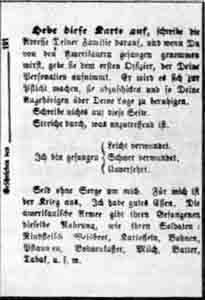
Figure 13: Surrender Leaflet from the AEF. Though this
American combat leaflet from World War I copies the
original form of the German Feldpostkarte (field postcard,
an early precursor of the V-mail form), it is not
black propaganda since neither source nor intent is concealed.
"When you are taken prisoner, by the Americans,
give this to the first officer who checks your identities."
The prisoner is commanded to fill in his own
battle-order history. By marking out appropriate items, he indicates whether he is hurt or not and
can explain that he is well cared for and fed "beef, white bread, potatoes, beans, plums, genuine
bean coffee, milk, butter, tobacco, etc."
Captain Blankenhorn's unit, without benefit of psychologists, developed
a German morale analysis chart. This was made up before
scientific polling had become a common technique, and was consequently
based on a group of selected known factors given arbitrary
weight and then averaged into a total. It was not, "number of German
prisoners per hundred who express attitudes characterized by doubt"
but "the U-boat situation," "unity in Germany," and other abstracted
generalities which were used as controls. The chart was carefully kept,
and sought to follow morale from its causative factors rather than by a
percentage count of attitudes discovered in the newspapers or among
prisoners.
The dynamic propaganda
development of this period came about in Russia. The Russian revolution
began as reaction to an adverse military situation, disesteemed
leadership, economic hardship, and long overdue reforms. In its first, or
constitutional phase, it had an inevitableness about it; there was little
resistance to the revolution, and the popular mood was one of relief,
joy, easement. However, the majority group of the Russian Socialists interpreted
the Marxist philosophy to mean (putting it bluntly) that the
end is justified by the means. They believed that they had developed a
system of politico-economic forecasting which, while not always certain,
was close to certain. And they further believed that no one else, lacking
this system of forecasting, could lead the workers and peasants to their
historically inevitable freedom. This philosophy may sound beside the
point, but it is not. Such abstruse doctrines of Hegelianism and Marxism
were used by the majority-Socialists (known by their Russian name, Bolshevik)
to give themselves a sense of unconditional rightness. From the
first phase of the revolution on, the Bolsheviks pitilessly sabotaged all
other democratic groups. There was no point in helping other groups,
when Bolsheviks alone had the inner secrets of history at their command.
In the geniuses Lenin and Trotzky, the Bolshevik movement found its
leadership. Lenin had no use for democracy as it was known in America.
To him it was a sham, a front for the great capitalist trusts, which—even
though the capitalists themselves might not know it—were
doomed to get bigger on a shrinking market, until international capitalist
war, bankruptcy, and working-class revolution was the result. Lenin
was as sure that this would happen as he was that the sun would rise the
next morning. The only dispute was the matter of timing; a few Bolshevik
pessimists thought that the capitalist world might last into the
1920's.
Such a frame of mind led to a very deadly kind of psychological warfare.
The Bolsheviks despised their opponents, desiring to "liquidate"
them (this meant breaking down a group and preventing its reforming
as a group, but came above all to mean mass murder). They were so
antagonistic to the "capitalist" world that they hated God, patriotism,
national history, churches, money, private property, chastity, marriage,
and verse that rhymed, all with equal intensity. Moscow became the
Mecca for the eccentrics and malcontents of the world and for some
years Russia was in fact looser in morals than any other civilized country.
Hatred for the capitalist world enabled the Bolsheviks to throw Russian
Czarist patriotism into the discard. They delighted in getting Russian
troops to desert at the front; the Germans delighted in this, too.
But the Bolsheviks were certain they would have the last laugh because
they knew it was only a matter of weeks or months before the revolution—the
inevitable revolution, forecast by Karl Marx's peculiar economics—broke
out in Germany as well. The Russian devil-may-care
attitude toward all established forms of society was perfectly characterized
by Trotzky's flip but deadly answer to the German military negotiators
at the Brest-Litovsk negotiations. When the Germans balked
at some point, "All right," said Trotzky, "no war and—no peace."
The Germans insisted that if the Bolsheviks did not sign the dictated
peace terms the German army would make more war.
Fine, said Trotzky in effect, he didn't mind. Go ahead and make war.
It wouldn't worry him or his army. They would go somewhere else and
would refuse to play games with capitalists.
This stopped the Germans in their tracks. They did not want to send
their troops into a starving country that roared with subversive doctrines.
They knew that while Trotzky wasted their time quibbling over negotiations,
his printing presses worked night and day telling the German
troops that the war was over, that capitalism was on its way out, that the
workers' revolution was coming, everywhere, for everybody, with food,
peace, plenty, atheism and all the other delights of the good Bolshevik
life. The Russians finally signed the surrender treaty but in point of fact,
the German divisions on the Eastern front were contaminated by Bolshevism,
and when they came back across Germany they brought the
message of freedom and peace with them. Germany did have an abortive
Communist revolution—partly because of Russian operations—though
it was stopped by an alliance of the moderate Socialists and the dependable
remnants of the army.
The Russians went on merrily through a living hell. For five more
years the Bolshevik leaders held their country together with wretched
industrial production, poor food, bad weapons. They had amazingly
high morale among their own select Bolshevik group, and against the
common people they had two weapons, propaganda and terror. (The
terror was symptomatic of the first of the modern totalitarian dictatorships;
its domestic police role is not a part of psychological warfare.)
The Bolshevik propaganda was probably the finest propaganda effort
ever known in history down to that time—down, perhaps, all the way to
our own time. The political limit was beyond reach; anything in the old
world was fair game. Things the sober Soviet citizen of 1946 would
regard with veneration were open to ridicule in 1919-1922: patriotism,
religion, national sovereignty, international law, treaties with or between
capitalist states. There flowed from Russia a world-wide stream of propaganda,
mostly clandestine, some of it overt. In every nation of the world
there was, to a greater or less degree, a "Red scare"; the propaganda of
the Bolsheviks was regarded as having mystical subversive powers which
no other operation could match. In retrospect it seems absurd that anyone
could have worried about the Americans of the 1920's revolting
against their own Constitution; but a lot of people, including the Attorney
General of the United States, did indeed worry.
They had cause for alarm though not for the reasons they supposed.
Much of the magic of Bolshevik propaganda arose from its taking
up where British, French and American propaganda left off. The psychological
warfare of the Allies had made the sad mistake of promising
a new, a better world to everyone on earth. When the war ended,
and conditions went back to normal, many people in the world did not
consider "normalcy" the fulfillment of that better world. The Bolshevik
propaganda reaped the harvest which the Allied propagandist had sown
and then left untended. Expectations, whipped up beyond normal,
turned to Bolshevism when the Western democracies abandoned both
domestic and foreign propaganda operations. The strategic advantage
of Bolshevik propaganda was overwhelming. The Allies had gotten
the world ready for it, so that the wild Utopia of the Leninists temporarily
made sense to millions.
This does not mean that the Bolshevik propaganda of the 1920s was
not good. It was good, technically, psychologically, politically—but
good in terms of achieving an immediate scare at the cost of
long-range confidence. The eventual cost to the Soviet Union was terrible.
The Soviet government isolated itself and declared a condition of
open psychological warfare against every other government on earth,
including the United States. (This so exasperated Presidents Wilson,
Harding, Coolidge, and Hoover that they refused to recognize the Soviet
Union.) The Bolshevik propaganda was carried by:
- Russian government channels;
- Communist "party" channels (the Communists not really being a political party, anywhere, but using the name "party" to designate the hierarchy of a dogmatic, ruthless and fanatical political religion);
- trade unions;
- individual subversive operators;
- "cover organizations";
- trade, consular and other official missions;
- leaflets in the mails;
- posters, books and other literature;
- films;
- radio.
The theme throughout was plain: the world revolution is coming, by
inescapable economic laws discovered by our theory. The world revolution,
which will come, will remove the owning classes from control
of the productive capital, and will put all capital in the hands of the
workers. "The expropriators will be expropriated." Thereupon the
economic laws we have found in Marx's books will cease their bad influence
and will guarantee world peace, world prosperity, happiness,
human freedom. This is not an appeal (they said); this is science. This
is objective. We know. Listen!
The Communists harped on these basic themes. They waged political
warfare along with the psychological. Every attempt of the non-Communist
countries to discuss the situation was termed "conspiracies of the
warmongers." The word "democratic" was reserved to the Communists
or to non-Communists who were certain to cause Communism no trouble.
The Communists invented an entirely new vocabulary, which the
Soviet and other Communist papers still use, with meanings that have
the same emotional value (plus-value, or, "that's good!") as in America
or Britain, but which have entirely different meanings in concrete
practice. "Democracy" means "free elections"; "free elections" mean
that the people elect "democratic leaders"; but "democratic leaders"
are not the people who are elected in non-Communist countries. Non-Communist
leaders are usually dubbed "tools" or "stooges" of something;
they are "servile" or "reactionary." Real "democratic leaders"
are only those people approved by the international Communist movement.
It knows. By science.
What was the net effect of such psychological warfare? In the first
place, much use of common terms without regard to ultimate fulfillment
means that Communist propaganda is self-defeating. It can succeed
only in situations of desperation, anarchy, or terror. That is satisfactory
to the Communist leaders, because they think their science tells them that
the capitalist states will lead to desperation, anarchy and terror anyhow.
Secondly, Communist propaganda sacrifices all other values to the propaganda.
One has to be a religious fanatic (of the Marxist sort) to turn
it out; one has to be ready for a totally new creed in order to keep on
accepting it. International understanding, patriotism, truthfulness, freedom
of action, artistic conscience—all these are sacrificed to propaganda.
In the end, everything is propaganda to the Communist. Nothing
which hurts Communism can be true. They have their science. (If
you would like to look at this fabulous science, read The Communist
Manifesto, V. I. Lenin's The Teachings of Karl Marx, and Stalin's
latest current compilation of speeches. You will be impressed by the
crazy logic, the genuine but ill-informed zeal.) Third and most important,
Communist psychological warfare is continuous. The themes
may change—sometimes provocative, sometimes almost conciliatory—but
the machinery, the operation, does not. Communist propaganda is
therefore seasoned and professional, dependent on a powerful police-state
at home and on uneducated or emotionally ill fanatics abroad,
except for those few countries where Communism is so stable as to attract
hard-headed or practical idealistic men.
This Bolshevik success, rather than the splendid but short-lasting
accomplishments of the Allies in World War I, kept psychological
warfare on the map. Modern Communism is permanent psychological
warfare in action.
The Communist leaders unwittingly made a tremendous mistake
between 1922 and 1927. They invited the military and political staff of
the Chinese Nationalists (Kuomintang) to cooperate with them. Filled
with their own Communist sense of certainty, it never occurred to them
that anyone else could outsmart them. The Chinese did. Their military
chief of mission in Moscow learned everything that the Communists had
to teach about irregular fighting, subversive propaganda, revolutionary
situations, mass agitation. He then went home and got more Communist
aid to carry out the military phase of the Nationalist revolution,
which started under way in the summer of 1922. The old war-lord
armies were helpless in the face of agents, agitators, poster crews, student
strikes, press propaganda and indoctrinated troops. The most sensational
war in modern Asia involved relatively little combat. The Nationalist
leader used all the Communist psychological warfare techniques,
and added a few more of his own. His name was Chiang Kai-shek.
In 1927 the Communists began a debate in Moscow as to whether they
had used the Nationalists enough or not. One group said they might
as well liquidate the Nationalists, Sunyatsenism, Chiang Kai-shek and
all; the other said they should use the Nationalists a little longer, to
carry on the struggle against American, Japanese, and British "imperialism."
Chiang Kai-shek displayed a keen interest in these formal theoretical
discussions which, thanks to his Moscow training, he understood
perfectly. While the Communists were still debating when and how to
hijack him, he hijacked them. In the fall of 1927, he turned against them,
using the weapons of terror and propaganda, and then shifting to the
more solid ground of economic development. They have not forgiven
him. Nationalist China to this day possesses a working duplicate of the
Moscow propaganda facilities which the Communists, unconscious of the
humor of it, call "fascist." (What is anti-Communist for whatever
cause is Fascist, they say.)
The Russian revolution of 1917-1922 and the Chinese revolution of
1922-1927 represent the situations created by Communist psychological
warfare. Since that time, except for Spain, Communist psychological
warfare has failed in every single attempt to come to power outside
Russia. Following World War II, Communist psychological warfare
proved itself capable of holding countries only after the military force
had occupied or won them. The magic has gone out of Communist
propaganda; it can keep control only with heavy military pressure behind
it. But in the far past, it has been capable of winning—as in Russia and
China—without outside military aid. With a renovation of techniques,
doctrines, and personnel, it may do so again.
Bolshevik accomplishments in psychological warfare were often regarded
as part of the peculiar mischief of Marxism, not as techniques
which could be learned and used by other people. Similarly, the history-making
sweep of the Chinese Nationalist armies northward in 1922-1927
was considered to be specially and incomprehensibly Chinese;
possible lessons which might have been learned from Chinese Communist
psychological warfare were left unheeded by officials and students
in the West. Meanwhile Germany, the greatest power of Europe,
had been fighting bitter internal psychological warfare battles24 which
looked like heated internal politics. Not until Adolf Hitler assumed the
Reich's Chancellorship and began using his Brown-shirt methods for
foreign affairs did other people wake up to the existence and application
of the new weapon.
(The War College files, for example, show that not one single officer
was assigned full-time to study of these problems during 1925-1935.
For the entire period 1919-1929, there are listed only two War College
research papers on the subject. Yet the American Army was far from
negligent. It was an excellent army, though crippled by outright poverty
of personnel and materials. The Army was simply American, and like
the rest of America for a while took the world for granted.)
The National Socialist German Workers' Party, as Hitler called his
movement, was a conglomerate built up around a few determined fanatics.
The Nazis do not appear to have believed their own doctrines to
anything like the degree to which the Communists believed theirs. From
the first, the Nazis regarded propaganda very consciously as a new,
fierce instrument which led to the accomplishment of modern power.
The Communists had proclaimed that democracy was a fake; the Nazis
agreed. The Communists had shown that a minority with a sacred mission
of its own invention could get mass support for a government that
claimed to be for the people, even though it was obviously not by the
people nor of them. The Nazis took this as a model. The Communists
had shown that a modern man-god could be set up and worshipped in
a twentieth-century state, and called leader (Vozhd in Russian). The
Nazis elevated the Soviet practice all the way into a principle, the principle
of the leader (Führer in German).
The Communists had shown that an organization calling itself a party,
actually a quasi-religious hierarchy with strong internal discipline, definite
membership, and active organizational components, could control
fifty times its own membership. The Nazis organized the same general
sort of party, copying the Italian Fascists in part, but copying more from
the direct example of the German Communists right in front of them.
The Communists had shown that such a movement needed to have
youth branches, women's organizations, labor sections, clubs of its own,
and so on, calling this "mass organization." The Nazis copied this too.
The machinery of Naziism was in many ways a copy of Communism,
applied to allegedly different ends, (the Nazis had an Aryan myth; the
Communists had their pseudo-economics). But the important thing
about them both was the destruction of the end by the means; the
problem of getting and keeping power despite the people was so obsessive
that propaganda became all-important. Theoretically, the end (to
the Nazi, German world rule; to the Communist, the fulfillment of history
in universal communism) was the most important thing. But since
any means at any time which led to that end was good, and since the
Party bosses were the sole ones who could determine whether a particular
action led to the very remote end or not, the outcome in both
Russia and Germany became the conscienceless seeking of power for its
own sake.
The new psychological warfare, a cause as well as a means of World
War II, arose from the subjection of other considerations to propaganda.
The propaganda addict takes everything with a ton of salt; what he does
believe is lost in what he doesn't believe. The ordinary controls of
civilized life—regard for truth, regard for law, respect for neighbors,
obedience to good manners, love of God—cease to operate effectively,
because the propaganda-dizzy man sees in everything its propaganda
content and nothing else. Everything, from a girl dancing on a stage to
an ecclesiastic officiating in a cathedral, is either for him or against him.
Nothing is innocent; nothing is pleasurable; everything is connected
with his diseased apprehension of power. Before he gets power, he hates
the people who have power; he does not trust their intelligence, esteem
their personalities, believe in their good will, or credit their motives.25
They must be scum, because they hold power when he, the propaganda-infatuated
man, is a member of the group that should hold it. Yet when
such a man comes to power he hates his colleagues and comrades. Remembering
the cold cynical way in which he himself sought power,
knowing that his brother fanatics have the same ruthless arrogance, the
propaganda-using Party man cannot trust anyone. Blood purges, mass
trials, liquidations, removal of families, concealment of crimes—all
these result from the establishment of propaganda in an overdeveloped
role.
It is against such people that we—ordinary folk, Americans—dared
wage psychological warfare during World War II. Propaganda had
grown into ideology; the world was convulsed with monstrous new religions.
For instance: the greatest journalist of the Soviet Union, Karl
Radek, was placed on trial for treason. He was asked by the prosecutor,
Vyshinsky,
"These actions of yours were deliberate?"
Radek answered: "Apart from sleeping, I have never in my life committed
any undeliberate actions."26
This answer sums up the mood of the totalitarian who is obsessed by
propaganda. He comes to believe that all activity, whether his own or
of other people, has meaning. He had developed the sense of responsibility
that made him violate tenets which Americans, in a free society,
regard as fundamental to human nature: things like self-respect, kindliness,
love of family, pity for the unfortunate.
This kind of mentality was found chiefly in the National Socialist and
Communist states, and to a lesser degree in dictatorships such as Italy;
by contrast, reactionary Japan was almost democratic. This mentality
makes it possible for the ruler to control his own people enough to
undertake "warfare psychologically waged." Without domestic fanaticism
and domestic terror, governments have to fall back on "psychological
warfare"—that is, the mere supplementing of politics and military
operations by propaganda. It is vain to expect a free people in a free
country to submit to such humiliating control, even for the purpose of
winning a war. What made the psychological warfare of World War II
peculiar was the fact that our enemies fought one kind of war ("warfare
psychologically waged," or total war) and we fought them back
with another. Theoretically, it is possible to argue that we had no business
succeeding.
But we did succeed.
The propaganda-conscious Axis states
had first to control their own people enough to wage aggressive war.
They then had to split their possible enemies, to make piecemeal victory
possible. They had to stay on good terms with the Soviet Union (Hitler
till 1941; Japan till the last week of war). They had to frighten their
immediate enemies while assuring their eventual enemies. This called
for a great deal of propaganda.
Pre-belligerent operations required extensive use of "black" propaganda.
Since their political systems aroused hostility and anger in audiences
which they wished to address, the aggressors sought to disguise
their propaganda. They used pacifist groups to keep the democracies
from rearming. Militarist groups were encouraged to keep the democracies
from undertaking domestic reforms or discussing military matters
with Russia. Financial groups were contacted to preserve the fiction
of normal international relations. Cultural groups were employed to
preserve friendliness for their respective nationalities as such. The Japanese
did a little global propaganda and for a while subsidized several
magazines in this country, but in general they concentrated their main
effort in the immediate area of their military operations.
It was the Germans who developed world-wide pre-belligerent propaganda
to a fine art. They exploited every possible disunity which could
contribute to the weakness of an enemy. They were not choosy about
collaborators. If the Communist Party of the United States lent a hand
(as it did between September, 1939 and June, 1941, terming the war "an
imperialist war"; after Russia got in, the war was called "the democratic
anti-fascist war"), the Nazis did not object. They willingly listened to
men who had fantastic schemes for world peace and later used such
men as aids in getting appeasement. They tried to rouse Catholics against
Communists, Communists against democrats, Gentiles against Jews,
whites against negroes, the poor against the rich, the rich against the
poor, British against Americans, Americans against British—anyone
against anyone, as long as it delayed action against Germany and weakened
the enemy potential. They went to special pains to organize German-speaking
minorities in non-German countries, but they never neglected
using people who had no open connection with Naziism at all.
This work was performed, so far as the open propaganda itself was
concerned, through the instrumentalities of the Reich's Ministry for
Propaganda and Popular Enlightenment under control of that malignant
intelligence, Paul Josef Göbbels. The broader program was not
solely a publicity matter, and was operated chiefly through Party channels.
The German capacity to learn was demonstrated by the contrast
between World War I and World War II. In World War I the Germans
lacked political motifs, professionalism, and coordination; in
World War II they had all of these.
Three basic propaganda accomplishments
were achieved by the Germans. First, in the political warfare field, they
succeeded in making large sections of world opinion believe that the
world's future was a choice between Communism and Fascism. Since
they and the Communists agreed on this the point seemed well taken.
Actually, there is no historical or economic justification for supposing
that those two forms of dictatorship constitute a real choice in the first
place, or that the civilized and truly free countries need ever depart from
their ancient freedoms in the second place.
Second, in the strategic field, they made each victim seem the last.
There was still hope that war would not arise, even while the Spanish
Republic was being strangled before the eyes of the world. The British
hoped that they could stay out even after Czechoslovakia fell. Astute
though the Russians were, they hoped to stay out even after Britain and
France fought. And as late as December 6, 1941 many Americans still
believed that the United States would avoid war. This suited the Nazis'
book; take them on one at a time.
Thirdly, in the purely psychological field the Germans used outright
fright. They made their own people afraid of Communist liquidations.
They brazenly showed movies of their blitzkriegs to the governing
groups of prospective victims, just to lower morale. When one nation
is really ready to fight, and the other knows it, the nation that doesn't
want to fight can be reduced to something resembling a nervous breakdown
by constant uncertainty. (The author was in Chungking during
the summer of 1940, when the German propaganda agent, Wolf
Schenke, showed these German movies to the Chinese leaders. The
author asked for an invitation and did not get it; it was for Chinese only,
said Schenke. But the Chinese were not awed, or made fearful of the
power of Japan's ally. They simply said, "Nice movie ... that's the
kind of thing we used to do in the Ch'in dynasty," and let it go at that.)
With the outbreak of war the
British and Germans found radio at hand. Neither had to change broadcasting
policies a great deal. Each could reach almost all of Europe on
standard-wave; each could jam the other's wave lengths, never with
complete success, and the struggle centered around a contest for attention.
Who could get the most attention? Who could get the most credence?
Who could affect the beliefs, emotions, loyalties of friendly, neutral,
and enemy listeners the most?
![[Figure 14]](https://openoldbooks.sgp1.digitaloceanspaces.com/books/psychological-warfare/images/p14_1t.jpg)
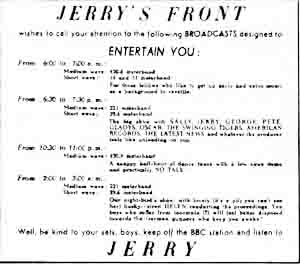
Figure 14: Radio Program Leaflet, Anzio,
1944. These leaflets were dropped by
the Germans on American troops at
Anzio in April 1944. They show an interesting
tie-in between two forms of
propaganda. The counterpropaganda to
the British Broadcasting Corporation is
slight; chief emphasis is on entertainment value of the German radio programs. (From photograph
taken by Signal Corps and released through War Department Bureau of Public Relations.)
The Germans showed evidence of real planning. Their public relations
facilities were perfectly geared to their propaganda facilities.
When the Germans wanted to build the British up for a let-down, they
withheld military news favorable to themselves. During the fight for
Norway, they even spread rumors of British successes, knowing that
if British morale went up for a day or two, it would come down all the
harder when authentic bad news came through the War Office. When
the Germans wanted to turn on a war of nerves, their controlled press
screamed against the victim; when they turned it off their press was
silent. The Germans thus had the advantage of not needing to make
much distinction between news, publicity, and propaganda. All three
served the same purpose, the immediate needs of the Reich.
![[Figure 15]](https://openoldbooks.sgp1.digitaloceanspaces.com/books/psychological-warfare/images/p15t.jpg)
Figure 15: Radio Leaflet Surrender Form, Anzio, 1944. Willingness of prisoners to surrender sometimes
involves speedy communication of their names to their families, as in the preceding illustrations.
At other times, prisoners are very unwilling to be identified and want their faces masked.
This leaflet combines radio program announcements with the standard surrender pass.
The Germans put on the following types of news propaganda:
- (1) Official OKW (Oberkommando der Wehrmacht, or Wehrmacht
HQ) communiqués. (These rarely departed from the truth, though they
naturally gave favorable situations in detail and unfavorable ones
scantily.)
- (2) Official government releases, marked by considerable dignity,
possessing more political content than the military communiqués.
- (3) News of the world, part of it repeated from the British
radio, part plain non-controversial news (for stuffing), and
part (the most important part) news of genuine curiosity value
to the listeners but which, at the same time, had the propaganda
effect of damaging belief in the Allied cause.
- (4) Feature items, comparable to feature articles in newspapers,
which tried to concentrate on a single topic or theme.
- (5) Recognized commentators, speaking openly and officially.
- (6) Pseudonymous commentators, pretending to speak from a
viewpoint different from that of the German Government, but who
were announced as being broadcast over the official German radio
system. (Of these the British traitor William Joyce, since hanged,
known as "Lord Haw Haw," was the most notorious. His colleagues were
the American traitors Fred Kaltenbach and Douglas Chandler. At the
end of the war Chandler was tried in Boston and sentenced to life
imprisonment but Kaltenbach fell into Soviet custody and died.)
- (7) Falsified stations, which pretended to have nothing at all to
do with Germany. (The "New British Broadcasting Company" transmitted
defeatist propaganda with a superficial anti-German tone. Others
took a strong Communist line and sought to build up opposition to the
British government within England.)
- (8) Falsified quotations on the official German radio. (Sometimes
it was easier to make up an imaginary foreign source, ostensibly
quoted in the German program, rather than to set up a special fake
program for the purpose.)
- (9) "Planted" news sources quoted on the German radio. (A great
deal of the German news was culled out of Swedish, Spanish and other
papers which were either secretly German-controlled or which—as in
the case of the United States papers involved—were so sympathetic to
Germany that they voluntarily printed German-inspired news which the
Nazis could then quote from a "neutral" or "enemy" source.)
- (10) Open falsification of BBC (British Broadcasting Company,
the official British agency) materials—at which the Germans were not
necessarily caught by their ordinary listeners, but at which BBC
caught them.
- (11) Ghost voices and ghost programs, transmitted on legitimate
Allied wave lengths when the Allied transmitters went off the
air, or else interrupting the Allied broadcasts by transmitting
simultaneously.
![[Figure 16]](https://openoldbooks.sgp1.digitaloceanspaces.com/books/psychological-warfare/images/p16t.jpg)
Figure 16: Invitation to Treason. Another German leaflet, also from Anzio, combines the radio surrender-notice
form with a political invitation to Britishers to commit treason. The Germans had a
few British traitors in their "Legion of St. George," and a few American civilian renegades, but
in general this line of appeal was useless. The last paragraph of the appeal is such naïve trickery
that it probably aroused suspicion in the minds of the men it was supposed to persuade.
Of all these, it was soon found that the communiqués and government
releases were the most important, although the bulk of the station time
had to be diversified with other types of program. The Germans and
British both found that radio was important as a starting point for news.
It was more valuable to have the press (as in England) or rumor (as in
Germany) pass along an item than it was to rely on the direct listeners.
Each side sought to make opinion analyses of the enemy; some of the
British studies were clever in technique. The radio propagandists had to
ask themselves why they made propaganda. It is simple to make mischief,
spreading rumors or putting practical jokes into circulation. Such
antics do not necessarily advance a military-political cause. Sustained
psychological warfare required—as both British and German radio soon
found out—a deliberate calculation of the particular enemy frame of
mind to be cultivated over a long period of time. When radio stations
had to broadcast day after day whether anything happened or not, it became
difficult to continue to circulate news without faking it and losing
the confidence of enemy listeners.
On the German side, the German radio had the forced attention of
the entire world. As long as the Germans had the strategic initiative for
field warfare, they were in a position to make news scoops whenever it
suited them. The security policies of the Allies often gave the Germans a
monopoly of news on a given operation. There was never any danger
that the Germans were not listened in on; the danger the Nazi operators
had to worry about was disbelief. Hence the Germans tried to keep a
moderate tone in their news, tried to prepare between crises for the news
that would become sensational during crises.
The Germans soon learned a basic principle of war radio. They
learned not to permit radio to run ahead of their military capacities. At
first, when their spokesmen promised attainment of a given goal by a
given time, and the army failed to live up to the schedule, the British
radio picked up the unfulfilled promise and dangled it before the world
as proof that the Germans were weakening. The Germans thereupon
effected Army-radio liaison so that the radio people could promise only
those things which the army was reasonably sure of delivering. (When
Allied propaganda analysis woke up to this fact, it added one more
source of corroboratory intelligence to be checked. (See page 126.))
The British had their hands full getting news out in the languages of
the occupied countries. It was immensely difficult for them to follow the
politics of the underground. German counterespionage, under the deadly
Sicherheitsdienst, made it difficult to keep track of opinion in the occupied
countries. Work against Naziism depended on the temper of the
people; propaganda against collaborators had to distinguish between
outright evil collaborators and those public officials who stayed on out
of a sense of mistaken or necessary duty. The British did not necessarily
announce themselves at any time as anti-Communist, and collaborated
for short-range purposes with Communists all over the Continent. Mr.
Churchill himself shifted his North Balkan political support from
Mikhailovich to Broz-Tito. But it was vitally necessary to know just how
and when to change support from one group to the other. Since the
undergrounds had very few radio transmitters, and none of these was
reliable during most of the war, the British faced the task of providing
radio facilities for all of the occupied countries. The consequence was
to make their radio warfare highly sensitive to politics; they had to address
the right people with the right language at the right time, on penalty
of failure.
![[Figure 17]](https://openoldbooks.sgp1.digitaloceanspaces.com/books/psychological-warfare/images/p17t.jpg)
Figure 17: Anti-Radio Leaflet. Sometimes ground-distributed leaflets were used in an attempt to
counteract enemy radio propaganda. This leaflet, circulated in France by the Nazis, uses the form
of an Allied leaflet and accuses the Armed SS of wanting such things as a decent Europe, and end
to atrocious killings every twenty-five years, and a worthy life. Allied broadcasters are identified
as Jews.
To effect this end, the British set up an agency which never had an
American counterpart, the Political Warfare Executive (known by its
initials, PWE). This agency had representation from the War Office,
the Admiralty, the Foreign Office, and the Ministry of Information.
The PWE was the policy-servicing and coordinating agency for all
British external propaganda, and left the execution of its operations to
the Ministry of Information (MOI) and to the British Broadcasting
Corporation (BBC). British radio propaganda maintained a high level
of effectiveness. American officials and propagandists often complained
that the British were running the entire war in their own national interest.
The charge was unjust. The British had facilities for knowing
exactly what they wished to do and when they wished to do it. If the
Americans came along without clear policies or propaganda purposes, it
was natural that the British should take the lead and let the Americans
string along if they wished. Furthermore, the British were usually scrupulous
in yielding to America's primary interest in areas they felt to be
American problems—Japan, China, the Philippines. They were least cooperative
when the OWI tried to spread the ideals of Mr. Henry Wallace
in Burma or to explain the CIO-PAC to the Hindus.
No clear victor emerged from the Anglo-German radio war; the victory
of the United Nations gave the British the last say. In the opinion
of many, the British were one war ahead of the United States. They had
profited by their World War I experience, and by their two years' operational
lead which they had on the Americans. But side-by-side with the
Germans, it is harder to appraise their net achievements. The British
had immense political advantages; the resentment of a conquered continent
worked for them. But they had disadvantages too. The enemy
worked from the starting point of a fanatical and revolutionary philosophy;
the British had the tedious old world to offer. The postwar interrogations
of civilians in Germany showed that an amazingly high proportion
of them had heard BBC broadcasts, and that many of the ideas
and attitudes which the British propagandized were actually transmitted
to the enemy. On the British side, it is almost impossible to find any
surviving traces of the effect of Nazi propaganda. Had the war been
purely a radio war this test might be conclusive. But if psychological
warfare supplements combat, combat certainly supplements propaganda.
The great British and American air raids over Europe unquestionably
created an intense interest in British and American plans and
purposes.
It is historically interesting to note that the Germans went on fighting
psychological warfare even after the death of Hitler and the surrender of
the jury-rigged government of Grossadmiral Karl Doenitz, which functioned
6-23 May 1945 at Flensburg under Allied toleration. This resulted
from the inability of the 21st Army Group swiftly to initiate information
control. The Flensburg radio, still under Nazi direction, emphasized
Anglo-American differences with the Soviet Union in every possible way
short of direct appeals. German naval radio also carried on propaganda
for a while, using topics such as the sportsmanship of the German surrender,
the hatred of the German Navy for atrocities committed by the
Nazis, and the usefulness of the phantom government to the Western
Allies.
Subversive operations formed a major part of the
Nazi pre-belligerent effort. The Germans planted or converted quislings
wherever they could, and when they failed to have time to prearrange
stooges they converted them rapidly after arrival. (A major cause
of the German defeat is to be found in the fantastic political policies followed
in the Ukraine and neighboring Soviet Socialist Republics. In
these areas, despite the Soviet boast that Russia had no fifth columnists
within her borders, the Germans found thousands of helpers. The Nazis
organized a large army (General Vlassov's Russian Army of Liberation)
out of Soviet prisoners, and these troops were usable and docile.
But in the political warfare field the Germans were too cocksure. They
let their men go wild in orgies of cruelty against the local population;
the economic system went entirely to pieces. The natives then became
convinced that the worst possible conditions of Sovietism were infinitely
better than the best that Naziism could offer.)
These subversive groups were formed by political means. Propaganda
aid was offered to such an extent that it was often difficult to tell how
much of the quisling movement was spontaneously native, and how
much mere cover for a purely German operation.
In the latter phase of the European war, the Russian Communists followed
the German Nazi example of having tame natives ready to take
over the government of occupied areas. In Poland, the so-called Lublin
Committee took over the government from the constitutional Polish
Government-in-exile at London. In Jugoslavia, the Russian-trained propagandist,
Tito, seized the leadership from the recognized Minister of
War, Draja Mikhailovich, after the British and American governments
had shifted their support to him; later Mikhailovich was put to death.
The Russian army brought along to Germany a considerable number of
German Communists. In Czechoslovakia the strength of the constitutional
regime was such as to compel the pro-Russians to allow the prewar
leadership a precarious toehold in the new government. The same
cadres of sympathetic persons who had been useful as propaganda
sources for psychological warfare during the period of hostilities became
useful instruments of domination after hostilities ended. The
British and Americans, with their belief that government should spring
from the liberated and defeated peoples, did not prepare and equip
comparable groups to rival the Communist candidates; only in Italy and
Greece did the friends of the Western Allies stay in power, and then
only because they were the nearest equivalent of de jure authorities. In
the Scandinavian and Low Countries the national leadership reemerged
without prodding or interference by the Western Allies; they
passed from the sphere of psychological warfare (that is, of being
someone's cover) to that of world politics.
Specific black propaganda operations were of considerable value.
However, black propaganda is more difficult to appraise than overt
propaganda. Analytical and historical studies, gauging the results obtained
by Black operations in relation to their cost, are not yet available.
(Certain particular operations are described later in this book, pages
208 and 237.)
Long after the outbreak of
war in the Far East, and even after the coming of full war in Europe,
neither the civilian nor military portions of the American government
possessed propaganda facilities. This is not as serious as it may sound,
for the United States is lucky in possessing a people well agreed on most
fundamentals. The commercial press, radio, magazine, and book publishing
facilities of the country for the most part expressed a national
point of view without being prodded. (The isolationist issue never
brought in the question of America's basic character.) Before the war,
and even after the government entered the field, private American news
and publishing continued to engage in operations which had the effect
if not the intention of propaganda. OWI at its most vigorous could
scarcely have reached the audience that had been built up by the Time-Life-Fortune
group, not to mention the Reader's Digest, both of which
became truly global in coverage during the war years. American movies
already had a world-wide audience. The propaganda turned out unwittingly
by such agencies may not have had the gloss and political smoothness
of Dr. Paul Josef Göbbels best productions, but it had something
no government propaganda had—the possession of a readership all of
which was unmistakably voluntary, obtained by the appeal of authentic
interest and entertainment—and proved by an ability to charm money out
of people's pockets.
The American problem of propaganda was thus not a simple one.
Total psychological warfare was out of reach if we were to remain a
free people. Otherwise the simple-seeming thing to have done would
have been to put a government supervisor in every newspaper, radio station
and magazine in the country, and coordinate the whole bunch of
them together in the national interest. Simple-seeming. Actually, such
an attempt would have been utter madness, touching off a furious political
fight within the country and meeting legal obstacles which would
have remained insurmountable as long as there was a Constitution with
courts to enforce it. The simplest official action which the United States
could take was therefore hedged about by the presence of private competitors
who would watch it enviously, jealous of their established rights
and privileges, and by the operational interference which vigorous private
media would have on public media.
The then Mr. or Colonel, later General, William Donovan had
tasted the delights of political warfare when President Roosevelt sent
him to Belgrade to talk the Serbs into fighting instead of surrendering.
He was successful; the Serbs fought. He came back to the United States
with a practical knowledge of what political warfare could do if qualified
personnel operated on the spot. The outbreak of the Russo-German
war lent urgency to American action in the political-intelligence field as
well as in the propaganda field. On 11 July, 1941 President Roosevelt
issued an order appointing Colonel Donovan as Coordinator of Information.
The agency became known by the initials COI.27
The primary mission of COI was the collection of information and
its processing for immediate use. Large numbers of experts were brought
into its Research and Analysis Branch, designed to do for the United
States in weeks what the research facilities of the Germans and Japanese
had done for them over a matter of years. The inflow of material
was tremendous and the gearing of scholarship to the war effort produced
large quantities of political, sociological, geographic, economic
and other monographs, most of them carefully classified SECRET, even
when they were copied out of books in the Library of Congress. However,
it was not the research wing of the COI that entered the broadcasting
field.
Radio work was first done by an agency within COI called FIS—Foreign
Information Service. In the few months before Pearl Harbor the
group became organized in New York under the leadership of Robert
Sherwood, the dramatist, and got a start in supplying the radio companies
with material. The radio scripts were poorly checked; there was
chaos in the matter of policy; little policing was possible, and the output
reflected the enthusiasm of whatever individual happened to be
near the microphone. Colonel Donovan had moved into this work without
written and exclusive authorization from the White House; hence
there followed a lamentable interval of almost two years' internal struggle
between American agencies—a struggle not really settled until the
summer of 1943, well into the second year of war. The occasion for
struggle arose from lack of uniform day-to-day propaganda policy and
from an unclear division of authority between the operating agencies.
But the work was done.
Radio operations had to be coordinated with strategy on the one hand
and foreign policy on the other, and we sought to develop methods for
doing this. It is significant that all the major difficulties of American
psychological warfare were administrative and not operational. There
was never any serious trouble about getting the facilities, the writers, the
translators, the telecommunications technicians. What caused trouble
were problems of personality and personal power, resulting chiefly from
the lack of any consensus on the method or organization of propaganda
administration.
Military Intelligence Division had created an extremely secret psychological
warfare office at about the time that the COI was established;
this had broad intelligence and policy functions, but no operational
facilities. It was headed by Lieutenant Colonel Percy Black, who began
auspiciously by putting Dr. Edwin Guthrie in office as his senior psychological
adviser. This ultra-quiet office was called Special Study Group;
it and the COI developed very loose cooperative relations, consisting
chiefly of SSG making suggestions to COI which COI might or might
not use as it saw fit. Meanwhile, the Rockefeller Office was conducting
independent broadcasts to Latin America; the Office of Facts and
Figures was dispensing domestic information; and at the height of the
psychological warfare campaigning, there were at least nine unrelated agencies in Washington, all directly connected with psychological
warfare, and none actually subject to the control of any of the others.28
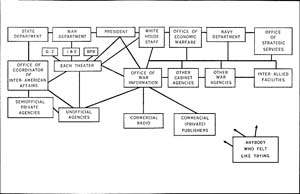
Chart I (Source: The author's observations.)
A year of wrangling produced the solution, after a Joint Psychological
Warfare Committee had been set up under the Joint Chiefs of
Staff, and had failed to fulfill an effective policy-supervising function.
On 13 June, 1942 the President created the Office of War Information.
This agency was given control directly or indirectly over all domestic
propaganda, and over white propaganda abroad, except for the Western
Hemisphere, which remained under the Rockefeller Committee in the
State Department. The FIS was taken from the COI, and the COI took
on the new name of OSS—Office of Strategic Services—under which it
retained three major functions:
- (1) continuation of scholastic and informal intelligence;
- (2) black propaganda operations (given explicit authority only
in March, 1943);
- (3) subversive operations, in collaboration with regular military
authority.
The OWI was placed under Mr. Elmer Davis, a Rhodes scholar and
novelist who had become one of the nation's most popular radio commentators.
The FIS was perpetuated under the control of Mr. Robert
Sherwood, who had a most extraordinary coterie of odd personalities assisting
him: Socialist refugees, advertising men, psychologists, psychoanalysts
(of both the licensed and lay varieties), professional promoters,
theatrical types, German professors, a commercial attaché, young men
just out of college, oil executives, and popular authors (novelists, slick
writers, Pulitzer winners, pulp writers, humorists, poets and a professional
pro-Japanese writer, fresh off the Imperial Japanese Embassy
payroll).
The War Department agency, under the Military Intelligence Service
of G-2, had been renamed Psychological Warfare Branch and had
executed within the G-2 structure the equivalent of a knight's move in
chess, ending up at a new place on the TO with no observable change
in function or authority; it had passed under the authority of Colonel
(later Brigadier General) Oscar Solbert, a West Pointer with wide international
and business experience; he had been out of the Army as a
top official with Eastman Kodak, after a cosmopolitan army career which
sent him all over Europe and gave him one tour of duty as a White
House aide. With the establishment of OWI, Colonel Solbert's office
fissiparated like an amoeba; the civilian half of Psychological Warfare
Branch, with a few officers, went over to OWI to be a brain-trust for
the foreign broadcast experts, who failed to welcome this accession of
talent; the military half remained as an MIS agency until 31 December,
1943, when OWI abolished its half and MIS cooperated by wiping out
the other, leaving the War Department in the middle of a war with no
official psychological warfare agency whatever, merely some liaison officers.
Psychological warfare became the responsibility of designated
individual officers in OPD—(the Operations Division of the General
Staff), an outfit celebrated for conscientious overwork, as well as in
MIS and the War Department got along very nicely. Meanwhile OWI
and OSS fought one of the many battles of Washington, each seeking
control of foreign propaganda. The D.C. and Manhattan newspapers
ran columns on this fight, along with news of the fighting in Russia,
Libya, and the Pacific. For one glorious moment of OSS, it seemed that
the President had signed over all foreign propaganda functions conducted
outside the United States to OSS, cutting the OWI out of everything
except its New York and San Francisco transmitters; the OWI
was stricken with gloom and collective indigestion. The next day, the
mistake was rectified, and OWI triumphantly planned raids on the
jurisdiction of OSS. Meanwhile, the following things were happening:
Highly classified plans for psychological warfare were being drafted
for both the Joint and Combined Chiefs of Staff. These were discussed
at various meetings and then classified a little higher, whereupon they
were locked up, lest the propaganda writers and broadcasters see them
and break security on them by obeying and applying them.
Broadcasts—thousands of words in dozens of languages—were transmitted
to everyone on earth. They were written by persons who had
little if any contact with Federal policy, and none with the military establishment,
except for formal security. The plans at the top bore no
observable relation to the operations at the bottom.
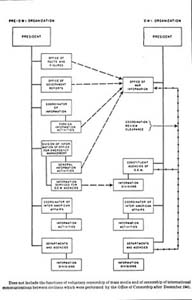
Chart II (Source: Bureau of the Budget: The United States at War, Washington, 1947, p. 225.)
![[Figure 18]](https://openoldbooks.sgp1.digitaloceanspaces.com/books/psychological-warfare/images/p18t.jpg)
Figure 18: Anti-Exhibit Leaflet. In the China Theater, we heard that the Japanese had organized a big
exhibit in Canton, showing the starved and apathetic population some pieces of shot-down planes
as demonstration of defeat of American air power. We made up this leaflet quickly, and dropped
it on the city while the exhibit was still in progress. (China, 1944.)
When Washington agencies wanted to find out what the broadcasts
really were saying, the actual working offices at New York and San Francisco,
their feelings hurt at not having been consulted by the Joint
Chiefs, refused (on their security ground) to let anyone see a word of
what they were sending out. This baffled other Washington agencies a
great deal. (The author, who was then detailed from the War Department
to OWI, outflanked this move in one instance by getting a report
on a San Francisco Japanese Broadcast from the Navy Department. It
had been monitored by an American submarine out in the Pacific.)
Large overseas offices were set up at various foreign locations. Some
of these went down to work quickly, efficiently, smoothly, and did a
first-class job of presenting wartime America to foreign peoples; others,
with the frailties of jerry-built government agencies, lapsed into inefficiency,
wild goose chases, or internal quarrels.
Lastly, the poor British officials continued to wander around Washington,
looking for their American opposite numbers in the propaganda
field—looking for one and always finding a dozen.
That was in 1942-1943.
By 1945, this had all become transformed into a large, well run, well
integrated organization. Three weeks before Japan fell, the OWI finally
prepared an official index of its propaganda "Directives"—that, is, of
the official statement of what kinds of propaganda to make, what kinds
not to make. The overseas units had been associated with the metropolitan
short-wave. Personnel had been disciplined. Techniques had become
more precise. Under the command of Lieutenant Commander Alexander
Leighton, an M.D. who was also a psychiatrist and anthropologist,
careful techniques were devised for the analysis of Japanese and
German morale. Comparable though dissimilar work on Europe had
been done by a staff associated with Harold Lasswell. The propaganda
expert Leonard W. Doob had been appointed controlling and certifying
officer for every single order of importance.
The military relationship had been clarified. The War Department,
acting through G-2, had reestablished a psychological warfare office
under the new name of Propaganda Branch, under the successive commands
of Lieutenant Colonel John B. Stanley, Lieutenant Colonel Bruce
Buttles, and Colonel Dana W. Johnston. The new branch undertook no
operations whatever, but connected War Department with OWI and
OSS for policy and liaison, and represented one-half of the Joint Chiefs
of Staff (an appropriate naval officer from a comparable office representing
the other half) at the weekly policy meetings of OWI. Military
needs in psychological warfare had been settled by regarding the Theaters
in this respect as autonomous, and leaving to the respective Theater
Commanders the definition of their relationships with OWI and OSS,
and their use of each. OSS and OWI had passed the stage of rival
growth, and consulted one another enough to prevent operational interference.
Each had sufficient military or naval supervision to prevent
interference with cryptographic security, communication and deception
operations.
The major job of psychological warfare passed to the
Theaters. In some theaters this was kept by the commander directly
under his own immediate supervision, and OWI was used simply as a
propaganda service of supply. In others, OWI was an almost independent
agent. In some places, OWI worked with OSS as in the European
Theater, in others independently, as in the China-Burma-India
Theater. In one, it worked completely without OSS (SWPA), since
General MacArthur did not let OSS into his Theater at all. (OSS got
in the general area anyhow; with Navy permission, it turned up blithely,
highly nautical on Saipan.) These Theater establishments were the ones
that set up local standard-wave programs which the enemy could hear in
volume. They provided the loudspeaker units which were taken right into
combat. They serviced the ground and air combat echelons with leaflets
as needed. They moved along behind the advances, opening up information
booths and explaining to liberated natives why each did not get
the four freedoms, the three meals a day, and the new pair of shoes
he thought he had been promised by the American radio.
These military establishments are better described under operations,
since it was their functioning which defined—down to the limit of present-day
experience—American military doctrine concerning the conduct
of psychological warfare in theaters of war. In concluding the historical
summary of psychological warfare, it is interesting to look at three
major points which emerge plainly from the experience of World War
II—points which either were not discovered in World War I, or else
failed to make an impact on the minds of the responsible officials and
informed citizens.
The first of these is simple. It became almost a litany with Colonel
Oscar Solbert, when he sought to indoctrinate civilian geniuses with
military proprieties: Psychological warfare is a function of command.
If command chooses to exercise it, it will succeed. If command neglects
it, or if it is operated independently of military command, it will either
interfere with the conduct of war proper, or it will be wasted. It took us
two bitter years to learn this lesson. Political warfare cannot be waged
without direct access to the White House and the Department of State;
field operations cannot be conducted unless they meet at some common
staff point with field command. No one can succeed in improvising alleged
policy and presenting that policy as United States policy, and get
away with it. Sooner or later actual policy catches up with him. In the
field, no civilian can write leaflets for air or ground distribution unless
he has some idea of when, where, why, and how they will be used.
The second lesson of World War II, set forth by Colonel Solbert and
Dr. Edwin Guthrie was simply this: Atrocity propaganda begets atrocity.
Everyone knows that war is cruel, sad, shameful to the soul of man;
everyone knows that it hurts, degrades, injures the human body; everyone
knows that it is not pleasant to undergo, nor even to look at. If any
particular war is worth fighting, it is worth fighting for some reason
other than the crazily obvious one—the fact that it is already war. It is a
poor statesman or general who cannot give his troops and people an
inspiring statement of their own side in war. Atrocity propaganda reacts
against war in general; meanwhile, it goads the enemy into committing
more atrocities. The anti-atrocity rule was not lifted in World
War II (save for one or two notable exceptions, such as President Roosevelt's
delayed announcement of the Japanese having executed the Doolittle
flyers) except for the specific purpose of preventing some atrocity
that seemed about to occur in a known situation from actually occurring.
Atrocity propaganda heats up the imagination of troops, makes them
more liable to nervous or psychoneurotic strain. It increases the chances
of one's own side committing atrocities in revenge for the ones alleged
or reported. Furthermore, atrocity propaganda scares the enemy out of
surrendering, and gives the enemy command an easier responsibility in
persuading their troops to fight with last-ditch desperation.
The third lesson was equally simple: America does not normally produce
psychological warfare personnel in peacetime, and if such personnel
are to be needed again, they will have to be trained especially and in
advance.
Effective psychological
warfare requires the combination of four skills in a single individual:
- (1) An effective working knowledge of U.S. government
administrationand policy, so that the purposes and plans of the
government may be correctly interpreted.
- (2) An effective knowledge of correct military and naval
procedure and of staff operations, together with enough understanding
of the arts of warfare, whether naval or military, to adjust
propaganda utterance to military situations and to practical
propaganda operations in forms which will dovetail.
- (3) Professional knowledge of the media of information, or
of at least one of them (book-publishing, magazines,
newspapers, radio, advertising in its various branches), or of some
closely related field (practical political canvassing, visual or
adult education, etc.).
- (4) Intimate, professional-level understanding of a given area
(Italy, Japan, New Guinea, Kwangtung, Algeria), based on first-hand
acquaintance, knowledge of the language, traditions, history,
practical politics, and customs.
On top of these, there may be a possible fifth skill to make the individual perfect:
- (5) Professional scientific understanding of psychology, anthropology,
sociology, history, political science, or a comparable field.
The man who steps up and says that he meets all five of these qualifications
is a liar, a genius, or both.
There is no perfect psychological warrior.
However—and the qualification is important—each psychological
warfare team represents a composite of these skills. Some members have
two or three to start with, the others virtually none. But all of the personnel,
except for men with peculiarly specialized jobs (ordnance experts;
cryptographers; translators; calligraphers), end up with a professionalism
that blends these together. They may not meet professional
standards as officials-officers-journalists-Japanologists-psychoanalysts
when they return from psychological warfare operations against the
Japanese, but they have met men who are one or more of these, and have
picked up the rudiments of each skill—enough, at least, to suspect what
they do not know.
The advertising man or newspaperman (skill 3) who goes into psychological
warfare must learn something of the enemy, neutral or
friendly groups whom he addresses (skill 4), something of United
States civilian government procedures (skill 1), something of military
or naval organization and operations (skill 2) and ideally something
of psychology or sociology or economics, depending on the topic of his
work (skill 5).
![[Figure 19]](https://openoldbooks.sgp1.digitaloceanspaces.com/books/psychological-warfare/images/p19t.jpg)
Figure 19: Propaganda Against Propaganda. As an occasional stunt, propaganda is directed against
propaganda. Hitler did so in his book, Mein Kampf. The leaflet, shown in the original and in
facsimile, was used by the Allies on the Germans in the West. A German leaflet, addressed to
their own troops ("defensive propaganda"), was picked up, X'd out, copied, and refuted.
The psychological soldier deals with enemy troops in their civilian
capacity; he addresses them as men, he appeals to their non-military
characteristics in most instances, and he does not follow sportsmanship,
as men did in other wars, by helping the enemy command maintain discipline.
Furthermore, the soldier works with writers, illustrators, translators,
script-writers, announcers and others whose skills are primarily
civilian, and he takes his policy cues from the civilian authority at the
top of the war effort. An infantry colonel does not have to worry about
what the Secretary of State is saying, if the colonel is on the field of
battle. But an officer detailed to psychological warfare must remain attuned
to civilian life even if he has seen no one out of khaki for two
months straight.
Personnel was probably the biggest field problem of the entire war.
Should psychological warfare be needed again, it will take careful culling
of personnel to obtain the necessary staff and operators. The continuation
of psychological warfare techniques, in part at least, by both
civilian and military agencies in time of peace will, it may be hoped,
provide the U.S. with a cadre for the next time. Very little of the living
experience of the Creel Committee was carried over into OWI. Walter
Lippmann, who had worked with both Creel and Blankenhorn, was not
a participant. Carl Crow, the advertising man and writer from Shanghai,
worked on China for the Creel Committee in World War I and on China
again for OWI in World War II. He was exceptional, and took no
major part in setting up indoctrination. One of the OWI executives in
1946, shortly after his return to civilian life, read James Mock and
Cedric Larson's account of the Creel Committee, Words That Won the
War (Princeton, 1939); his interest was avid. When he finished, he
said,
"Good Lord, those people made the same mistakes we made!"
He had forgotten that the Creel Committee record had been available
all the way through.
The net effects of the work of
civilian-operated propaganda are hard to appraise because the radio
broadcasts and leaflets for civilians were designed to have a long-range
effect on the enemy. Statistical computations come to nothing. It would
appear likely that some parts of our psychological warfare actually
lengthened the war and made it more difficult to win. The "unconditional
surrender" formula, the publicity given to proposals for the
pastoralization of Germany, the emphasis on Japanese savagery with its
implied threat of counter-savagery were not overlooked by the enemy
authorities. It is certain that other parts of our psychological warfare
speeded up the end of the war, saved lives, increased the war effort
which was enormous when measured in terms of the expenditure of
manpower, matériel and time involved.
![[Figure 20]](https://openoldbooks.sgp1.digitaloceanspaces.com/books/psychological-warfare/images/p20t.jpg)
Figure 20: Re-Use of Enemy Propaganda. Leaflets sometimes develop an enemy pictorial or slogan
theme and use it effectively against the original disseminators. Employing the colors and insignia
of the U.S. Air Force, this Nazi leaflet for Frenchmen makes no attempt to minimize American
bombing to the French. Instead, it uses the Allied heading, "The hour of liberation will ring...."
Then it adds the grim point, "Make your will, make your will."
One operation alone probably repaid the entire cost of OWI throughout
the war. The Japanese offered to surrender, but with conditions.
We responded, rejecting the conditions. The Japanese government
pondered its reply, but while it pondered, B-29s carried leaflets to all
parts of Japan, giving the text of the Japanese official offer to surrender.
This act alone would have made it almost impossibly difficult for the
Japanese government to whip its people back into frenzy for suicidal
prolongation of war. The Japanese texts were checked between Washington
and Hawaii by radiophotograph and cryptotelephone; the plates
were put into the presses at Saipan; the big planes took off, leaflets properly
loaded in the right kind of leaflet bombs. It took Americans three
and a half years to reach that point, but we reached it. Nowhere else in
history can there be found an instance of so many people being given so
decisive a message, all at the same time, at the very dead-point between
war and peace.
The Japanese had done their best against us, but their best was not
enough. We got in the last word, and made sure it was the last.
Soviet psychological warfare used Communist
party facilities during World War II, turning them on and off as needed.
But Soviet psychological war efforts were not characterized by blind reliance
on past experience. They showed a very real inventiveness, and
the political policies behind them were both far-sighted and far-reaching.
The Soviet government was the one government in the world which
could be even more totalitarian than Nazi Germany. Many Americans
may consider this a moral disadvantage, but in psychological warfare it
has very heavy compensating advantages. The Soviet people were propaganda-conscious
to an intense degree, but the authorities took no chances.
Revolutionary Communist themes were brilliantly intermingled with
patriotic Russian items. Army officers were given extraordinary privileges.
Everyone was given epaulettes. The Communist revolutionary
song, the famous Internationale, was discarded in favor of a new Soviet
hymn. History was rewritten. The Czars were honored again. The
Church was asked to pray for victory. The Soviet officials were able to
tailor their social system to fit the propaganda. They did so, even to the
name of the war. They call it the Great Patriotic War. Outsiders may
murmur, "What war is not?" But the Russian people liked it, and the regime
used traditionalism and nationalism to cinch Communism in the
Soviet Union.
In their combat propaganda the Russians were equally ruthless and
realistic. They appealed to the memory of Frederick the Great of Prussia,
they reminded the Germans of Bismarck's warning not to commit
their forces in the East, they appealed to the German Junker caste against
the unprofessional Nazi scum who were ruining the German army,
and they used every propaganda trick that had ever been heard of. They
turned prisoners into a real military asset by employing them in propaganda,
and talked a whole staff of Nazi generals into the Free Germany
movement.
Only in radio did the Russians retain some of their old revolutionary
fire with its irritating qualities for non-Communist peoples. This was
explicable in terms of the audience. The Russians could keep their domestic
propaganda half-secret by imposing a censorship ban on those
parts of it, or those comments on it, which they did not wish known to
Communists abroad. The censorship was a permanent institution, in war
and out, and therefore did not impose special difficulty. They could
keep their front-line propaganda quiet, since they did not allow their
Allies to send military observers up front, and the Nazis could be
counted on not to tell the world about effective anti-Nazi propaganda.
But their radio propaganda had to be audible to everyone. Hence the
radio propaganda was the least ingenious in using reactionary themes
effectively. The Russians and Germans both used black radio, but since
each policed the home audience rigorously against the other, it is possible
that the efforts cancelled out.
The Japanese invented little in psychological
warfare. They made excellent and judicious use of news to the
American audience. They actually got much more official Japanese news
into the American press during the war years than they had succeeded
in placing during peacetime, when they had offices in American cities.
They did so by maintaining the regular Domei news service in English-language
Morse wireless for the American press, ready-edited for the
newspaper offices. They put by-lines on the stories and it is said they
sometimes even told the American newspapers: "Please hold until nine
AM Eastern War Time. Thank You. Domei." In dealing with Asiatic
audiences, special Japanese butai did a great deal of black propaganda
along with subversive operations, but they displayed little initiative as to
the use of basic techniques. Their chief merits were industry, patience,
and the delivery of a first-class news service.
The Chinese Communist forces broke all records for
certain specialized aspects of combat propaganda. Japanese prisoners
were given cordial welcome, better food than they had in the Army, the
company of maidens, rich gifts, and political indoctrination about the
freedom of Japan. These soldiers then went with the Chinese Communists
back to the front lines and talked Japanese sentries out of their
strong-points. The Yenan forces went to great pains with this propaganda,
and even "elected" a Japanese prisoner to the City Council of
Yenan. The author talked with the Political Director of the Chinese
Communist authority at Yenan, and with some of the Japanese in Communist
China. There was evidence of a real understanding of the
problems of the Japanese common soldier, and of real sympathy with
him, which the Japanese enlisted men were quick to feel. The Communists
went so far as to throw gift packages into the Japanese lines—not
booby-traps, just nice gifts with the polite request for a reply. They
learned the names of Japanese field telephone operators, and then
spliced into the line and argued politics with them in a rough and jolly
way. When they had enough prisoners they kept the most promising
converts for political training. They fed the ordinary prisoners well,
entertained them royally, and sent them back to their own lines with
the suggestion that the Chinese Communists would appreciate it if their
good Japanese brethren would in combat please shoot their rifles in the
air, thus making sure of not hitting Communists while at the same time
avoiding unnecessary trouble with the Japanese officers.
Under "Chiang the Chairman," the Chinese national government
waged a dignified, humane kind of psychological warfare against Japan.
Few people remember an odd chapter out of modern history, the Chinese
bombardment of Nagasaki, although it is possible that Asiatic historians
of the future will make a substantial contrast between the Chinese who
struck the first blow at that city and the Americans who struck the last.
Shortly after the outbreak of the full quasi-war between China and
Japan in 1937, the Generalissimo ordered his bombers to attack Japan.
American-built Chinese bombers appeared over Kyushu, the first invaders
to show up since the shoguns repelled Kublai Khan 656 years
earlier. But instead of dropping bombs, they dropped leaflets denouncing
aggression and inferentially pointing out that while the Japanese
were uncivilized enough to bomb their fellow-Asiatics, the Chinese were
too civilized to undertake reprisals in kind.
The Generalissimo's troops also had fraternization and front-line
propaganda, but not to the extent to which the Chinese Communists
did. The Generalissimo himself followed a very liberal (not in the
Leftist but the true sense) political line toward Japan. He uttered no
threat of vengeance. He was the first leader of a great nation to say that
the Japanese Emperor question was to be settled by letting the Japanese
themselves choose their own form of government after the war was
all over. He had Japanese on his political staffs—democratic persons
whom his officials encouraged—and regular Japanese broadcasts were
kept up throughout the war on the Chungking radio.
![[Figure 1]](images/p1.jpg)
![[Figure 2]](images/p2.jpg)
![[Figure 3]](images/p3.jpg)
![[Figure 4]](images/p4.jpg)
![[Figure 5]](images/p5.jpg)
![[Figure 6]](images/p6_1.jpg)

![[Figure 7]](images/p7.jpg)
![[Figure 8]](images/p8.jpg)
![[Figure 9]](images/p9_1.jpg)

![[Figure 10]](images/p10.jpg)
![[Figure 11]](images/p11.jpg)
![[Figure 12]](images/p12_1.jpg)

![[Figure 13]](images/p13_1.jpg)

![[Figure 14]](images/p14_1.jpg)

![[Figure 15]](images/p15.jpg)
![[Figure 16]](images/p16.jpg)
![[Figure 17]](images/p17.jpg)


![[Figure 18]](images/p18.jpg)
![[Figure 19]](images/p19.jpg)
![[Figure 20]](images/p20.jpg)

![[Figure 21]](images/p21.jpg)
![[Figure 22]](images/p22.jpg)
![[Figure 23]](images/p23.jpg)
![[Figure 24]](images/p24.jpg)
![[Figure 25]](images/p25a.jpg)
![[Figure 25]](images/p25b.jpg)
![[Figure 26]](images/p26.jpg)
![[Figure 27]](images/p27.jpg)

![[Figure 28]](images/p28.jpg)
![[Figure 29]](images/p29.jpg)
![[Figure 30]](images/p30.jpg)
![[Figure 31]](images/p31.jpg)
![[Figure 32]](images/p32.jpg)
![[Figure 33]](images/p33.jpg)
![[Figure 34]](images/p34.jpg)
![[Figure 35]](images/p35.jpg)
![[Figure 36]](images/p36.jpg)
![[Figure 37]](images/p37.jpg)
![[Figure 38]](images/p38.jpg)

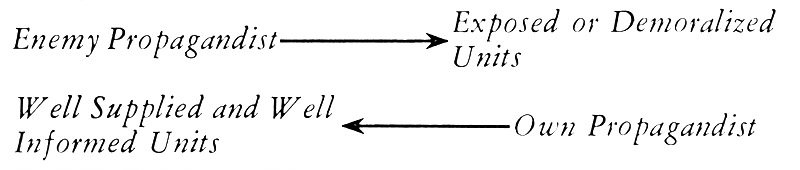
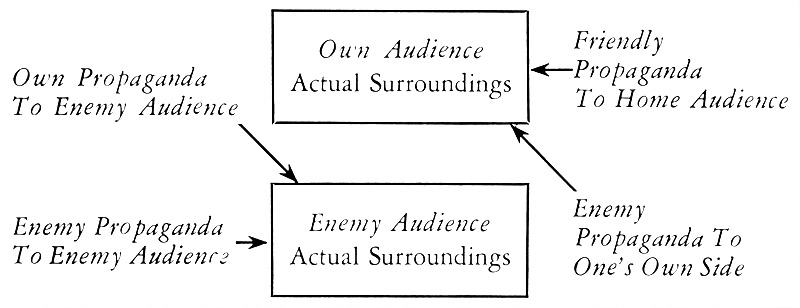
![[Figure 39]](images/p39.jpg)
![[Figure 40]](images/p40.jpg)
![[Figure 41]](images/p41.jpg)
![[Figure 42]](images/p42.jpg)
![[Figure 43]](images/p43.jpg)
![[Figure 44]](images/p44.jpg)
![[Figure 45]](images/p45.jpg)
![[Figure 46]](images/p46.jpg)
![[Figure 47]](images/p47.jpg)
![[Figure 48]](images/p48.jpg)
![[Figure 49]](images/p49.jpg)


![[Figure 50]](images/p50.jpg)

![[Figure 51]](images/p51.jpg)
![[Figure 52]](images/p52_1.jpg)

![[Figure 53]](images/p53.jpg)
![[Figure 54]](images/p54.jpg)
![[Figure 55]](images/p55.jpg)
![[Figure 56]](images/p56_1.jpg)

![[Figure 57]](images/p57_1.jpg)

![[Figure 58]](images/p58_1.jpg)

![[Figure 59]](images/p59.jpg)
![[Figure 60]](images/p60.jpg)
![[Figure 61]](images/p61.jpg)
![[Figure 62]](images/p62_1.jpg)

![[Figure 63]](images/p63.jpg)
![[Figure 64]](images/p64.jpg)
![[Figure 65]](images/p65.jpg)
![[Figure 66]](images/p66.jpg)
![[Figure 67]](images/p67_1.jpg)

![[Figure 68]](images/p68.jpg)
![[Figure 69]](images/p69.jpg)
![[Figure 70]](images/p70_1.jpg)

![[Figure 71]](images/p71.jpg)
![[Figure 72]](images/p72.jpg)
![[Figure 73]](images/p73_1.jpg)

![[Figure 74]](images/p74.jpg)
![[Figure 75]](images/p75.jpg)
![[Figure 76]](images/p76.jpg)
![[Figure 77]](images/p77.jpg)
![[Figure 78]](images/p78.jpg)
![[Figure 79]](images/p79_1.jpg)
