HELD AT THE
FIFTH INTERNATIONAL PSYCHO-ANALYTICAL CONGRESS
BUDAPEST, SEPTEMBER 1918
Ladies and Gentlemen,
With your permission I will commence my exposition of the
very serious and important subject that is the theme of my lecture
to-day with the recital of a little story which will lead us straightway
into the revolutionising events of this war. A Hungarian, who had the
opportunity of observing at close quarters a part of the revolutionary
upheaval in Russia, told me that the new revolutionary rulers of a
Russian town found with consternation that the change from the old
to the new regime had not taken place as rapidly as it should have
done according to their doctrinal calculations. According to the
teachings of the materialistic idea of history they could have set up
the new social order immediately after they had got the entire power
into their hands. Instead of this, irresponsible elements, which were
antagonistic to any new order of things, obtained the upper hand, so
that the power gradually slipped from the hands of the originators
of the revolution. Then the leaders of the movement put their heads
together in order to find out what had gone wrong in their calculations.
Finally they agreed that perhaps the materialistic idea was after all
too one-sided, as it only took into consideration the economic and
commercial relations, and had forgotten to take into account one
small matter, the feelings and thoughts of man, in a word, the psyche.
They were sufficiently consistent to send emissaries immediately to
German speaking countries, in order to obtain psychological works,
so that they might get at least subsequently some knowledge of this
neglected science. Many thousands of human lives fell victims, perhaps
to no purpose, to this omission of the revolutionaries; the failure of
their efforts resulted in their making one discovery however, namely,
that of the mind.
A somewhat similar thing has occurred among neurologists during
the war. The war has produced an enormous number of nervous disorders
which call for elucidation and cure; however, the familiar
organic-mechanistic explanation hitherto adopted—which in some
way corresponds to the materialistic idea of history in sociology—completely
failed. The mass-experiment of the war has produced
various severe neuroses, including those in which there could be no
question of a mechanical influence, and the neurologists have likewise
been forced to recognise that something was missing in their calculations,
and this something was again—the psyche.
To some extent we can forgive sociology for this omission; indeed
the estimation of mental elements in the science of society has hitherto
been in fact a very trifling one. However, we cannot spare neurologists
the reproach of having so long disregarded the pioneer researches of
Breuer and Freud concerning the psychical determination of many
nervous disturbances, and of having required the terrible experiences
of the war to set them right in this respect. And yet a science—psycho-analysis—has
existed for more than twenty years to which
many investigators had devoted the whole of their efforts, and which
had helped us to unexpected and important knowledge of the mechanisms
of mental life and its disturbances.
In my lecture today I shall confine myself to demonstrating the
introduction of psycho-analysis into modern neurology, an introduction
which has been effected to some small extent openly, but for the most
part with hesitation and under false colours, and I will briefly communicate
the theoretical principles upon which rest the psycho-analytical
conceptions of the “traumatic neuroses” which have been observed
during the war1.
Soon after the outbreak of the war there flamed up again the
great controversy, which had been carried on for more than ten years,
concerning the nature of the traumatic neuroses which Oppenheim
had in his time placed in a class by themselves. Oppenheim hastened
to make use of the experiences of the war, which exposed so many
thousands of men to sudden shocks, as supporting his old views,
according to which the phenomena of these neuroses always came
about, as the result of physical alterations in the nervous centres, (or
in the peripheral nerves which secondarily affect those of the centre).
The nature of the shock itself and its influence upon the method of
functioning he described in very general, one might even say, phantastic
terms. Links were “cut out” from the chain of the innervation
mechanism, most delicate elements “displaced”, paths “blocked”, connections
torn asunder, obstacles to conduction created, etc. With
these and similar comparisons, from which, however, all basis in fact
was tacking, Oppenheim sketched an impressive picture of the material
correlation of the traumatic neuroses.
The alterations in structure which would take place in the brain
through the trauma Oppenheim conceived as a delicate physical process
similar to that which occurs in the iron filing when it comes into
contact with the magnet.
The sarcastic Gaupp designates such specious physical and physiological
speculations as brain mythology and molecular mythology.
But in our opinion he does mythology an injustice.
The material brought forward by Oppenheim to support his views
was in no way suited to uphold his abstruse theories. To be sure, he
described with his usual precision characteristic symptoms, which this
war has produced in deplorable numbers, and also gave to them somewhat
high-sounding names (Akinesia amnestica, Myotonoklonia trepidans)
that said nothing as to their nature; these descriptions, however,
are not especially convincing with reference to his theoretical
conceptions2.
There were, it is true, many who agreed with Oppenheim’s views,
though for the most part with limitations. Goldscheider holds that
the cause of these nervous symptoms is partly physical and partly
psychical; Cassierer, Schuster and Birnbaum are of the same opinion.
Wollenberg’s question, as to whether the war neuroses were caused
through emotion or shock, Aschaffenburg answered by stating that
there was here concerned the joint effect of emotion and concussion.
As one of the few who obstinately persisted in maintaining the mechanistic
idea I will mention Lilienstein, who categorically demanded that
the word and the concept of “mind”, also that of “functional” and
“psychic”, and more especially that of “psycho-genesis” should be
struck out of the medical terminology; he maintained that this would
simplify the conflict and facilitate the investigation, treatment and
examination of the casualties; the progressive anatomical technique
would certainly sooner or later discover the material foundations of
the neuroses.
We must here refer to the train of thought pursued by V. Sarbó,
who seeks for the cause of the war neuroses in the microscopical destruction
of tissue and hemorrhages in the central organ of the nervous
system; these, he says, originate through direct concussion, sudden
pressure of the cerebro-spinal fluid, compression of the spinal cord
in the foramen magnum, etc. V. Sarbó’s theory is only supported by
a few authors. In this connection I might mention Sachs and Freud,
who consider that the shock puts the nerve cells into a condition of
heightened excitability and exhaustability, which is then the immediate
cause of the neuroses. Finally, Bauer and Fauser look upon the traumatic
neuroses as the nervous results of disturbances of the endocrine
glands produced by the shock, and as similar therefore to the
post-traumatic Basedow’s disease.
Strümpell was one of the first to oppose the purely organic-mechanistic
idea of the war neuroses. He had, moreover, for some time
previously referred to certain psychical factors in the causation of
the traumatic neuroses. He made the accurate observation that in
railway accidents, etc., those who suffered from a severe neurosis
were for the most part those who had an interest in being able to
prove an injury as caused by the trauma: for example, persons who
were insured against accidents and wished to obtain a large sum of
money, or those who instituted proceedings against the railway company
for compensation for injury. Similar or much more severe shocks
have, however, no lasting nervous results if the accident happens
during sport through one’s own carelessness, especially under circumstances
that exclude the hope of compensation for injury as those
mentioned, so that the patient has no interest in remaining ill, but
every interest in the speediest recovery. Strümpell asserts that the
shock neuroses always develop secondarily and purely psycho-genetically
as the result of desire of gain; he gave medical men the well-meant
advice not to take seriously the complaints of these patients,
like Oppenheim, but to bring them back as soon as possible to life
and work through the smallest allowance or through withdrawal of
their pension. The representations of Strümpell created a great impression
in the medical world even in peace time; they led to the
idea of the “compensation hysteria”; the sufferers, however, were treated
not much better than if they were malingerers. Strümpell now
suggests that the war neuroses are also neuroses of covetousness,
which serve the patients’ purpose in getting free from the military
authorities with the highest possible pension. Accordingly he demands
a strict examination and expert opinion of the neuroses occurring in
military persons. The content of the pathogenic ideas is always a
wish—the wish for material compensation, for remaining far from
infections and danger—and this wish acts along auto-suggestive paths
in fixing more firmly the symptoms, the persistence of morbid sensations
and of innervation disturbances of motility.
Much of the foregoing train of thought of Strümpell sounds to
the analyst very probable. For he knows from his analytical experience
that neurotic symptoms in general represent wish fulfilments,
and also the fixation of unpleasant mental impressions and their pathogenic
state is familiar to him. Still he has to reproach the one-sidedness
of Strümpell’s train of thought: for instance, in the undue prominence
of the cognitive aspect of the pathogenic experience and the
neglect of its affective side, as well as the complete ignoring of the
unconscious psychical processes, with which already Kurt Singer,
Schuster and Gaupp had reproached him. Strümpell also has a presentiment
that these neurotic forms of illness can only be explained by
means of a psychical investigation; he does not, however, tell us his
method of work with reference to this. Probably he understands by
psychical exploration simply a careful questioning of the patient as
to his material circumstances and concerning his motives for seeking
a pension. We must on the other hand protect ourselves in that he
calls this exploration “a method of individual psycho-analysis”. There
is only one procedure that has a right to this name, that which the
strict method of psycho-analysis has made its own.
As an argument in favour of the psycho-genesis of the war neuroses
it is a remarkable fact, which has been pointed out by Mörchen,
Bonhöffer and others, that the traumatic neuroses are practically never
seen in prisoners of war. The prisoners of war have no interest in
remaining sick after being captured, and they cannot reckon on compensation,
pension and sympathy from their surroundings while they
are away from home. They feel themselves in their captivity secure
for the time being from the dangers of the war. The theory of the
mechanistic shock can never explain to us this difference in the behaviour
of our own soldiers and prisoners of war.
Evidence as regards the psycho-genesis rapidly accumulated.
Schuster and many other observers refer to the disproportion between
the trauma and its results on the nervous system. Severe neuroses
arise from minimal shocks, while it is just the severe wounds accompanied
by great shock that for the most part are not followed by
nervous disturbances. Kurt Singer lays still greater stress on the disproportion
between trauma and neurosis, and even endeavours to explain
this fact psychologically: “In the kind of psychic trauma that
comes on in a flash, in the terror, in the paralysing horror, we are
concerned with cases of difficulty or impossibility of adaptation to
the stimulus”. In a severe wound there is a discharge of the suddenly
increased tension without anything further; when, however, no severe
external injury exists the excessive affect is discharged “by means of
a sudden abreaction through physical phenomena”. As the Freudian
expression “abreaction” shows, psycho-analysis must have been in the
mind of the writer when he thought out this theory. The expression
sounds like a delayed response to the Breuer-Freudian conversion
theory. However, it soon appears that Singer represents this process
far too rationalistically; he looks upon the symptoms of the traumatic
neuroses as the result of an effort on the part of the patient to find
a comprehensible explanation of the (to him) inexplicable morbid
process. Thus the work of this author is still far removed from the
dynamic conception of the psychical processes of which psycho-analysis
has taught us.
Hauptmann, Schmidt and others drew attention to the relation in
time in the development of the symptoms in the war neuroses. If it
is a question of a mechanical injury then the effect should be strongest
immediately after the operation of the force. Instead of which one
finds that the men thrown into a state of shock still make purposive
endeavours to arrange for their safety the moment after the trauma,
such as to get to the dressing station, etc., and only after having put
themselves under safe conditions do they collapse and the symptoms
develop. In some cases the symptoms appear only when the men
have to return to the firing line after a period of rest. Schmidt is
quite right when he refers this conduct of the patients to the psychical
factors; he suggests that the neurotic symptoms develop only after
the state of a transitory disturbance of consciousness has disappeared
and the men who have suffered the shock re-experience in memory
the dangerous situation. We would say: These injured men behave
like the mother who rescues her child from a danger which threatens
its life with calm imperturbability and disregard of death, but faints
after the act has been accomplished. It is immaterial as regards the
judgment of the psychological situation that here the person saved
was not a beloved stranger, but the beloved person himself.
I place Nonne in the forefront of those authors who have laid
particular stress on the psycho-genesis of the traumatic neuroses of
the war. Not only because he recognised that the symptoms of
the war shock neuroses were without exception hysterical, but because
he was also able to cause the severest war neurotic symptoms to
disappear for a time or to recall them by hypnotic and suggestive
measures. This excluded the possibility even of a “molecular” disturbance
in the nerve tissues; a disturbance that can be set right by
means of psychic influences can itself have been nothing else than
psychical.
This therapeutic argument had the greatest effect; by degrees a
marked silence fell over the mechanistic school, and attempts were
frequently made to explain their former utterances psycho-genetically.
The quarrel from now onwards lay entirely between the supporters
of the various psychological theories.
How is one to explain the method of working of psychical factors,
and also the fact of the psychogenic condition being more severe
than the impressive forms of disorders of organic origin?
One is reminded of the old theory of Charcot, that terror and
the memory of it can produce in a similar manner physical symptoms
after the nature of hypnosis and auto-hypnosis, just as they are intentionally
brought about by the post-hypnotic command of the hypnotist.
This reverting to Charcot means nothing less than paving the
way to fruitless speculations and the re-discovery of the sources from
which finally psycho-analysis sprang; for we know that the first researches
of Breuer and Freud into the psychical mechanisms of hysterical
phenomena originated directly from the influence of Charcot’s clinical
and experimental experiences. Hysterics suffer from reminiscences:
this, the primary axiom of the germinating psycho-analysis, is really
the continuation, deepening, and generalisation of the ideas of Charcot
applied to the neuroses of shock; the idea of the lasting effect
of a sudden affect and of the association of certain expressions of
affect with the memory of the thing experienced is common to
both.
Let us now compare with this the views of German neurologists
on the genesis of the war neuroses. Goldscheider says: “Sudden and
terrifying impressions can leave behind affects direct and also with
the associative help of ideation; to these memory pictures are due
the results of increased and lowered excitability. Thus it is the emotion,
the terror, which bestows upon the trauma the distribution and
fixation of the nervous results of the stimulus, which never occurs
with the purely physical stimulus itself”. It is easy to recognise that
this description is borrowed from the traumatic theory of Charcot and
the Freudian conversion theory.
Gaupp’s opinion is similar: “In spite of all the methods of modern
experimental psychology and of all the more precise and more delicate
methods of technique for neurological and psychiatric investigation,
there remains a residue, and not an insignificant one, in which
we do not arrive at a diagnosis by means of the present exact neurological
and psychiatric investigation of the condition at the moment
present, but only through its connection with an exact anamnesis and
with a laborious exploration of the pathogenesis of the existing condition”.
Gaupp accepts even explicitly a Freudian postulation, in that
he describes the war neuroses as a flight from psychic conflicts into
illness and, alluding to psycho-analysis, he says: “Much preferable is
the postulate of the effects of the unconscious on consciousness and
the physical system than a psychological theory which seeks by words
taken from the sciences of anatomy and physiology to gloss over the
fact that the path from the physical to the mental and vice versa is
entirely unknown to us”. In another place he goes still further and
puts the psycho-analytical postulate of the unconscious in the centre
of the whole problem. “If one only admits that mental processes can
react upon the body even when they do not lie in the conscious field
of vision, then most of the supposed difficulties disappear”. In this
connection Hauptmann must also be mentioned. He looks upon the
traumatic neuroses as mental illnesses psycho-genetically elaborated
and caused through emotional factors, and their symptoms as “unconscious
further elaboration of the emotional factors along paths of
least resistance”.
Bonhoeffer seems to have completely accepted the psychologically
complex experiences of psycho-analysis. He holds that the traumatic
symptoms are “psycho-neurotic fixations, dissociation phenomena which
have been rendered possible through the resultant splitting off of the
affect from its ideational content under the influence of the violent
emotion”.
Birnbaum showed in his excellent summary of the literature of
the traumatic neuroses that in many of the explanations of these neuroses
(for example, in Strümpell’s theory of covetousness) is summed
up a psychogenic wish of hysteria, and says: “If the psychogenic wish,
the wish fixation, etc. is an essential component of hysteria then it
belongs unconditionally in the definition of the disorder”. Psycho-analysis
has long maintained this; as is well known, it regards the
neurotic symptoms as expressions of unconscious wishes or as reactions
to them.
Vogt also refers to the “famous Freudian statement” according
to which the troubled mind flies into illness and he acknowledges
that “the compulsion which originates from this is more often unconscious
than conscious”. Liepmann divides the symptoms of the
traumatic neuroses into the direct results of the psychic trauma
and into “finally adjusted psychic mechanisms”. Schuster speaks of
symptoms which are evoked by means of “unconscious processes”.
You see, therefore, ladies and gentlemen, that the experiences
among war neurotics gradually led further than to the discovery of
the mind; they led neurologists very nearly to the discovery of psycho-analysis.
When we read in the more recent literature on the subject,
of the ideas and views which have become so familiar,—abreaction,
unconscious, psychic mechanisms, separation of the affect from its
idea, etc.,—we might easily imagine ourselves to be in a circle of
psycho-analysts, and yet it has never occurred to these investigators
to ask themselves whether, after these experiences in the war neuroses,
the psycho-analytical concepts cannot be made use of in the
explanation of the usual neuroses and psychoses which were well
known to us in peace times. The specificity of the war trauma is universally
denied; in general, it is said, that the war neuroses contain
nothing and have added nothing new to the already known symptomatology
of the neuroses; even the Munich Congress of German Neurologists
formally demanded the elimination of the word and concept,
“war neurosis”. If, however, the peace and war neuroses are identical
in their nature, then neurologists will be obliged to make use of all
these ideas of emotional shock, of the fixation of pathogenic memories,
and of their continued activity in the unconscious, etc., also in
the explanation of the usual hysterias, the obsessional neuroses and
the psychoses. They will be astonished how easy it will be for them
to traverse the path trodden by Freud, and will regret having shown
such obstinate resistance to his hints.
To the question of the disposition to fall sick with a war neurosis
the authors gave contradictory answers. Most of them follow the views
of Gaupp, Laudenheimer and others, according to whom most of the
war neurotics are ab ovo neuropaths or psychopaths, the shock merely
playing the part of the releasing factor. Bonhoeffer says direct: “The
possibility of a psychopathological condition being evoked by psychogenic
factors is the criterion of a degenerative predisposition”. Forster
and Jendrassik say the same thing. Nonne, on the contrary, finds that
the deciding factor in falling a victim to war neuroses lies less in
the personal constitution than in the nature of the operating injury.
Psycho-analysis takes a median position with regard to this question,
which Freud has frequently and expressly stated. It speaks of an
“aetiological succession” in the predisposition, the traumatic occasion
figuring as reciprocal value with this. A trifling predisposition and
severe shock can produce the same effects as an increased predisposition
and a much lesser degree of shock. Psycho-analysis, however,
is not content with the theoretical allusion to this condition, but it
endeavours—with success—to separate the complex idea of the
“disposition” into simpler elements and establish those constitutional
factors that influence the choice of neurosis (the special tendency to
fall sick with this or that neurosis). I shall return later to the question
as to where psycho-analysis looks for the special disposition to falling
sick with a traumatic neurosis.
The literature concerning the symptomatology of the neuroses of
the war is simply immense. According to Gaupp, for example, the
following hysterical symptoms are to be observed. “Attacks of a slight
nature up to those of the severest kind, with an arc de cercle lasting
for hours, sometimes with epileptic frequency, astasia-abasia, anomalies
of the position and movement of the body even to going on all fours,
all the varieties of tic and shaking tremors, paralyses and contractures
in monoplegic, hemiplegic and paraplegic forms, deafness and
deaf and dumbness, stuttering and stammering, aphonia and rhythmical
screaming, blindness with or without blepharo-spasm, all kinds of
disturbances of sensation, and most of all twilight states in quantities
never before met with and in combination with phenomena of physical
irritation and disorders”. You see, it is like a museum of glaring
hysterical symptoms, and whoever has once seen it will plainly have
to decline Oppenheim’s view, according to which purely neurotic
symptoms are rarely seen in the traumatic neuroses of the war.
Schuster draws attention to the frequent vasomotor and trophic phenomena;
according to him, these are no longer psychogenic. Psycho-analysis,
however, will agree with those who hold that these symptoms
can originate to some extent from psychic causes, analogous to the
physical alterations which can be produced under hypnosis. Finally,
all the authors allude to the alterations in disposition, apathy and
over-excitability, etc. after the trauma.
Out of this chaos of symptoms the “trembling” neurosis stands
out through its frequency and conspicuousness. You all know those
pathetic creatures who hobble along through the streets with shaking
knees, uncertain gait and peculiar motor disturbances. They give the
impression of being helpless and incurable invalids; and yet experience
shows that also this traumatic form of illness is purely psychogenic.
A single treatment with electricity and suggestion, a few hypnotic
sittings are often sufficient in rendering these men capable of doing
some work, if only temporarily and under certain conditions. Erben
has made the most careful investigation into these disturbances of
innervation; he found that these disturbances are only suspended or
increased when the respective group of muscles carry out an action
or intend to do so. His explanation for this is, that here the “volitional
impulse makes a path for the spasm”, which, however, is only
the physiological paraphrase of the facts of the case. Psycho-analysis
suspects here a psychical motivation: the activity of an unconscious
contrary wish which puts itself in the way of the consciously wished
act. This is indeed most striking in those patients of Erben who are
prevented from going forward through the most violent attacks of
shaking, but can carry out the much more difficult task of going
backwards without trembling. Erben also here has a complicated
physiological explanation ready, but forgets that the movement backwards,
which removes the patient from the dangerous goal of the
forward movement—and finally from the front line—does not
need to be disturbed by any contrary wish. The remaining kinds of
motor disturbances demand a similar interpretation, in particular the
striking, uncontrollable running of many neurotics, so like the propulsion
in paralysis agitans. These are the men who do not recover
from the effect of the terror and are still always flying from dangers
to which they were once exposed.
Many investigators, including non-psycho-analysts, came to the
conclusion from these and similar observations, that these disturbances
are not the direct effects of the trauma, but psychical reactions to it
and act in the service of the instinct of self-preservation against the
repetition of the unpleasant occurrence. We know that also the normal
organism has at its disposal such protective measures. The symptoms
of the terror, such as the immovable legs, the tremblings, the hesitating
speech, seem to be useful automatisms; one is reminded by
them of certain animals which simulate being dead when danger
threatens. And if Bonhoeffer looks upon these traumatic disturbances
as fixations of the means of expression of the terrible emotion which
has been suffered, Nonne goes further and discovers that “the hysterical
symptoms represent partly a reminiscence of inborn guard and defence
mechanisms, the suppression of which in those individuals whom we
call hysterical has not taken place in the normal degree or not at
all”. According to Hamburger the most frequently occurring type of
disturbances of standing, walking and speech associated with shaking
tremors represents a “complex of ideas of feebleness, weakness, refusal
and exhaustion”, and Gaupp sees in the same symptoms the lapse
into infantile and puerile states of obvious helplessness. Some authors
actually speak of the “fixation” in the traumatic posture of the body
and innervation.
It cannot escape the notice of anyone with a knowledge of psycho-analysis
how near these authors, without knowing it, are to psycho-analysis.
The “expressions of fixations of movements” described by
them are in reality only paraphrases of the Breuer-Freudian hysterical
conversion, and the lapse into atavistic and infantile methods of
reaction is nothing more nor less than what Freud called special
attention to as the regressive character of the neurotic symptoms,
all of which according to him only signify reversions into ontogenetic
and phylogenetic stages of development already overcome.
At any rate we have definite proof that neurologists have now decided
to interpret certain nervous symptoms, that is to say, refer them to
unconscious psychical contents, which would never have occurred to
anyone to do before the introduction of psycho-analysis.
I will now speak of the few authors who occupy themselves
with the war neuroses from the psycho-analytical points of view.
Stern has published a work on the psycho-analytical treatment
of the war neuroses in war hospitals. I have not been able to see
the work in the original, but I learn from the abstracts that the
author proceeds from the point of view of repression and finds the
situation of the serving soldier particularly suited to the production
of neuroses in consequence of the suppression of affects which his
service demands. Schuster admits that the investigations of Freud
“however one may feel towards them” have thrown a ray of light
on the psycho-genesis of the neuroses; they assist in revealing the
hidden connection between symptom and psychical content which
still exists though difficult to discover. Mohr treats the war neuroses
by the cathartic method of Breuer and Freud, by getting the patients
to live through the critical scenes again and brings about an abreaction
of their affects by letting them re-experience the terrible
emotion. Simmel is the only one up to the present who has occupied
himself methodically with the psycho-catharsis of the war neuroses,
and he will give his own report of his experiences to the Congress.
Finally, I will mention my own investigations concerning the
psychology of the war neuroses, in which I made the attempt to
bring the traumatic forms of disorder into the category of psycho-analysis.
In this connection I will allude to a discussion which branches
out in all directions on the question whether an affect can still act
psycho-genetically when the person concerned immediately loses
consciousness. Goldscheider and many others still maintain that a
psychical effect is made impossible through swooning, and Aschaffenburg
adheres to the view that loss of consciousness before falling
ill guards against the neurosis. Nonne rightly opposes this view,
and points out that unconscious mental streams could act psychically
in spite of the loss of consciousness. L. Mann, relying on Breuer’s
hypnoidal theory, puts forward the view that the loss of consciousness
before falling ill does not protect but disposes to the appearance of
the neurosis, by preventing the discharge of the affects. Orlovsky
expresses himself the most rationally on this vexed question; he
points out the possibility that the swooning itself can be a psychogenic
symptom, a flight into unconsciousness, which would spare the
person concerned the conscious experiencing of the painful situation
and sensations.
The possibility of the psychogenic formation of symptoms during
a faint is quite comprehensible to those of us who are psycho-analysts.
This problem could be started only by authors who take up a
standpoint, obsolete to psycho-analysis, that equates mental with
conscious.
I do not know, ladies and gentlemen, whether you also have obtained
the impression from all these quotations and references (which are only
taken at random from the literature) that an advance, even though one
that is not admitted, has taken place in the attitude of leading neurologists
towards the teachings of psycho-analysis. Moreover, candid
recognition is not lacking; for example, the expression of Nonne, that
Freud’s experiences concerning the elaboration in the unconscious have
received interesting illuminations and corroborations through the experiences
of the war.
However, the same sentence of acknowledgement also contains a
nihilistic opinion of Nonne concerning psycho-analysis; he states that
Freud’s idea of the almost exclusively sexual foundation of hysteria
has been conclusively disproved during the war. We can no longer leave
this unanswered, which after all is only a partial denial of psycho-analysis:
also we can very easily give the answer. The war neuroses, according
to psycho-analysis, belong to a group of neuroses in which not only
is the genital sexuality affected, as in ordinary hysteria, but also its
precursor, the so-called narcissism, self-love, just as in dementia praecox
and paranoia. I grant that the sexual foundation of these so-called
narcissistic neuroses is less easily apparent, particularly to those who
equate sexuality and genitality and have neglected to use the word
“sexual” in the sense of the old platonic Eros. Psycho-analysis, however,
returns to this extremely ancient standpoint when it treats all tender
and sensual relations of the man to his own or to the opposite sex,
emotional feelings towards friends, relatives and fellow-creatures generally,
even the affective behaviour towards one’s own ego and body,
partly under the rubric “erotism”, otherwise “sexuality”. It cannot be
denied that those to whom this idea is strange cannot so easily be
convinced of the correctness of Freud’s postulation of the sexual
theory in a narcissistic neurosis in particular, for example, in the traumatic
neurosis. We should like to advise them to examine themselves
into the usual (non-traumatic) hysteria and obsessional neuroses also,
and to keep strictly to the methods of free association, dream and
symptom interpretation proposed by Freud; then they will be much
more easily convinced of the correctness of the sexual theories of the
neuroses, and agreement about the sexual background of the war neuroses
will follow. At any rate the triumph concerning the overthrow
of the sexual theories is somewhat premature.
The observation that I have made as regards the participation of
sexual factors in the formation of symptoms in the traumatic neuroses
also shows that in traumatic neurotics the genital sexual hunger (libido)
and potency is generally greatly injured; in many cases it can even be
entirely suspended and that for long periods. This condition which is a
positive one is alone sufficient to demonstrate the rashness of Nonne’s
conclusion3.
Ladies and gentlemen: With what I have said I have discharged
the chief task of my paper, which was the critical survey of the literature
on the war neuroses from the standpoint of psycho-analysis.
However, I will make use of this rare opportunity to tell you some
of the observations I have made myself, and I will present points
of view which may help to explain these conditions psycho-analytically.
In the psychical sphere of the traumatic neuroses there predominate
such symptoms as hypochondriacal depression, terror, anxiousness, and
a high degree of irritability with a tendency to outbursts of anger.
Most of these symptoms can be traced back to increased ego-sensitiveness
(in particular the hypochondria and the incapability of tolerating physical
or mental discomfort). This over-sensitiveness arises from the fact
that in consequence of the shock, which has been experienced once or
repeatedly, the interest and sexual hunger (libido) of the patients is
withdrawn from the object into the ego. There thus comes about a
damming-up of the sexual hunger (libido) in the ego, which is expressed
in those abnormal hypochondriacal organic sensations and over-sensitiveness.
Frequently this heightened ego-love degenerates into a kind
of infantile narcissism: the patients would like to be pampered, cared
for, and pitied like children. One can therefore speak of a reversion
into the childish stage of self-love. This heightening corresponds to
the diminution of object-love, often also of genital potency. A man who
is already predisposed to narcissism will of course sooner fall a victim
to a traumatic neurosis; still no one is entirely immune from it, since
the stage of narcissism forms a significant fixation point in the development
of the sexual hunger (libido) of every human being. The combination
with other narcissistic neuroses, especially paranoia and dementia,
frequently occurs.
The symptom of anxiety is the sign of the shock to the self-confidence
occasioned by the trauma. This is most strikingly expressed
in men who, in consequence of an explosion, have been knocked down,
hurled over or blown up and have thereby permanently lost their
self-confidence. The characteristic disturbances of walking (astasia-abasia
with trembling) are protective measures against the repetition
of the anxiety, therefore phobias in Freud’s sense. The cases in which
these symptoms predominate are called anxiety-hysteria. Those symptoms,
on the contrary, which simply express the situation at the
moment of the explosion (innervation, position of the body) are
conversion-hysterias in the psycho-analytical sense. Also in the anxiety
there is naturally a constitutional predisposition; those persons more
easily fall ill in this way who, in spite of real cowardice, are
compelled from ambition to perform courageous deeds. The
anxiety-hysterical disturbance in walking is at the same time a reversion
to an infantile stage of not-being-able-to-walk or of learning-to-walk.
Also the tendency to outbursts of rage and anger is a highly
primitive method of reaction to a superior force; it can increase up
to epileptic attacks, and represents more or less incoordinate discharges
of affect analogous to those observed in the period of suckling. A
milder variety of this loss of restraint is the lack of adaptation to
discipline, which is practically never missing in the traumatic neuroses.
The excessive need for love and the narcissism also give rise to
this increased irritability.
The entire personality of most of the victims of trauma corresponds
therefore to the child who is fretting, whimpering, unrestrained
and naughty in consequence of a fright. The excessive importance
which almost all the persons suffering from trauma attach to good
food fits in with this picture. The slightest neglect in this respect
may produce in them the most violent outbreaks of affect and even
induce fits. Most of them are unwilling to work, they wish to be
supported and provided for like a child.
It is here, therefore, not only a question, as Strümpell considers,
of the production of illnesses on account of an actual gain (pension,
compensation for injury, flight from the front) which are only secondary
illness gains; the primary motive for the illness is the pleasure
itself of remaining in the secure retreat of the childish situation once
so unwillingly left behind. Both these narcissistic and apprehensive
manifestations of illness have their atavistic prototype; it is even
possible that the neurosis often reverts to methods of reaction which
play no part at all in the individual development (feigning of death
by animals, methods of progress and protection of the young of
animals in the ancestral series). It is as though an over-strong affect
could no longer be compensated along normal paths, but had to
regress to previously abandoned but virtually existent mechanisms
of reaction. I do not doubt that many other pathological reactions
will yet be revealed as recapitulations of overcome methods of
adaptation.
As symptoms of the traumatic neuroses which are less appreciated,
I might mention the over-sensitiveness of all the senses (shunning
of light, hyperacusis, extreme ticklishness) and the anxiety dreams.
The real terrors that have been experienced, or things similar to them,
are lived through again and again in these dreams. I am following
a hint of Freud’s when I look upon these terrors and anxiety dreams,
as well as the state of terror by day, as spontaneous attempts of cure
on the part of the patient. They serve to bring piecemeal to conscious
abreaction the shock, which in its totality was intolerable and
unintelligible and was therefore converted into symptoms, and to contribute
to the adjustment of the disturbed equilibrium in the psychical
economy.
Ladies and gentlemen, I hope these few remarks of mine may
serve as proof that the psycho-analytical conception discloses points
of view where the rest of neurology leaves us in the lurch.
From the methodical psycho-analysis of many cases we ought to
expect the full explanation of these morbid conditions and perhaps
also their radical cure.
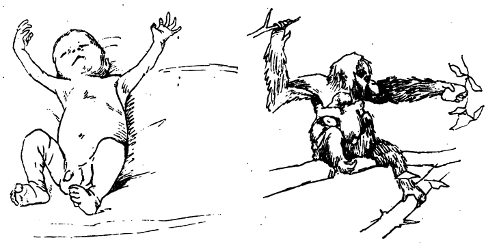
While this article was in the press, I read the interesting work
of Prof. E. Moro, the childrens’ specialist of Heidelberg, on “the first
Trimenon”, i. e. the peculiarities of the first three months of the infant’s
life. He says: “If one lays a young infant on a pillow on a table
and strikes the pillow on either side with the hands, then there results
a peculiar reflex action. Both arms are thrown up symmetrically apart
and then come together again in a curve with easy tonic movements.
A similar movement is carried out simultaneously by the legs”. We
would say: Moro has here artificially produced a little shock (or traumatic)
neurosis. The remarkable thing in this action is that this reflex
to the shock in the young infant of less than three months old shows
signs of the natural reflexes of clasping, which characterise the “carried
offspring”, i. e. the young of animals (monkeys) which are compelled
with the help of a pronounced clasping reflex to hold fast with the
fingers to the mother’s fur while she climbs about the trees. We
would say: Atavistic reversion of the method of reaction in sudden
terror4.
During the war academic neurologists have come round more and
more to regard the aetiology of the traumatic neuroses from psychological
points of view. However, in spite of the approach towards our
views, mentioned by Ferenczi, their ideas differ from ours in two
respects, namely, they for the most part only take into consideration
the reactions of the ego impulses to the trauma, and they keep entirely
to the manifest expressions of the neurosis. In the following
remarks, besides those factors which we do not dispute, I intend to
deal with the unconscious and sexual ones.
When in peace times psycho-analysis upheld the sexual aetiology
of the neuroses it was often pointed out as a contrary argument that
this could not hold good for the traumatic neuroses. Similarly now
the opinion is expressed that the genesis of the war neuroses contravenes
our ideas. Terror, anxiety lest the dangerous situation be
repeated, seeking for a pension, and some vague idea of disposition
are supposed to be adequate explanations of the illness; in the mass
of the neuroses which have broken out during the war the unimportance
of the sexual aetiology is thought to be clearly shown.
My investigations of the traumatic neuroses in peace time had
for a long time led me to conclude the importance of sexuality in
them similar to that in the other neuroses, but they have not yet
been sufficiently numerous and conclusive enough for publication.
I might mention the case of a young girl who met with a slight tram
accident when she was in the throes of a serious erotic conflict. The
analysis showed that the accident in a certain measure gave a pretext
for the outbreak of the neurosis. The symptoms were in connection
with the conflict in question; the importance of the trauma receded
quite into the background. I might also add that some litigious cases
of traumatic neurosis which I observed in greater detail all suffered
from impotence; this disturbance was produced by the accident,
but seemed to have its real basis in old and unconscious sexual
resistances.
The investigation of war neurotics has fully confirmed my surmises
connected with such observations. Moreover, the recurrence of
certain definite symptoms in war neurotics, which were familiar to
me not only in the traumatic neuroses of peace time, but also in the
non-traumatic cases, seems to me worth noting. I refer particularly
to the complex of symptoms which we could so often observe during
the war in the anxiety cases with trembling, such as trembling, agitation,
irritability, sensitiveness, sleeplessness, headaches, anxiety, depression
of spirits and feelings of incompetency. Two neurotic types
with the same symptoms—although these do not appear so prominently
as in the war—would be the impotent man and the frigid
woman. A similarity which is so marked in external phenomena leads
one to expect a similarity also in internal processes.
All my experience fully coincides with that which Ferenczi has
just communicated. The trauma acts on the sexuality of many persons
in the sense that it gives the impulse to a regressive alteration which
endeavours to reach narcissism. I might add that we both arrived at
this idea without having previously even mentioned it to one another.
The trauma, however, has this effect only in a portion of those participating
in the war, hence we are unable to dispense with the
assumption of an individual disposition, but we are in the position
to define it far more accurately than the prevailing school of neurology.
A couple of examples will make the problem before us
clearer.
At the beginning of the war a soldier at the front was wounded
on August, 12th, 1914. Before his wound was completely healed he
secretly left the hospital and went again to the front, soon getting a
second and after a few months a third wound. After repeated returns
to the front he was one day blown up by a shell explosion and was
unconscious for two days. After these four traumata he certainly
presented the phenomena following upon shock, but no neurotic
picture, being neither particularly anxious, depressed nor excited.
Another man at the front during a night attack fell into a hole without
injuring himself, but immediately developed neurotic trembling of a
most severe kind, and presented the picture of a mental breakdown.
How are such differences to be explained?
The previous history of such people, and naturally, still more, a
penetrating analysis, teaches us why the one in spite of the severest
physical and mental influences of the war remains to all intents and
purposes healthy, and why the other reacts to relatively trifling stimuli
with a severe neurosis. It transpires with great regularity that the
war neurotics already before the trauma were labile people—to
designate it, to begin with, by a general expression—and especially
so as regards their sexuality. Many of these men were unable to carry
out their tasks in practical life, others that were capable of doing
this, however, showed little initiative and manifested little impelling
energy. In all of them sexual activity was diminished, their sexual
hunger (libido) being checked through fixations; in many of them
already before the campaign potency was weak or they were only
potent under certain conditions. Their attitude towards the female
sex was more or less disturbed through partial fixation of the sexual
hunger (libido) in the developmental stage of narcissism. Their sexual
and social capacity of functioning was dependent on their making
certain concessions to their narcissism.
In the war these men were placed under completely changed conditions
and in the face of extraordinary demands. They had always
to be prepared for unconditional self-sacrifice in favour of the mass.
This signifies the renunciation of all narcissistic privileges. The healthy
person is able to accomplish such a complete suppression of his narcissism:
he loves according to the transference type, and so is capable
of sacrificing his ego for the whole. In this respect those disposed to
neuroses are inferior to healthy persons.
It is not only demanded of these men in the field that they must
tolerate dangerous situations—a purely passive performance—but
there is a second demand which has been much too little considered,
I allude to the aggressive acts for which the soldier must be hourly
prepared, for besides the readiness to die, the readiness to kill is demanded
of him.
A further factor which operates on the labile sexuality of those
disposed to neuroses is the almost exclusive association with men.
The sexuality of the normal person takes no harm from this, but it
is otherwise in men with strong narcissistic traits. The knowledge of
the connection between homosexuality and narcissism enables us to
understand this.
The previously unstable attitude towards women begins to waver
under such conditions. If the lability of the attitude towards the other
sex is very great then it does not need even a war trauma to cause
a neurosis to break out in such men. For instance, I observed a man
who on return from furlough at home had a convulsive attack and
was brought into the hospital showing signs of anxiety and depression.
The man had always been noted for his effeminate disposition, and in
his married life was weakly potent and always inclined to jealousy.
When he was home on leave he failed absolutely in the attempt to
have sexual relations with his wife. His fears that his wife would be
unfaithful to him reached a crisis, and soon after his departure from
home he had his convulsive attack.
Such men with labile heterosexual impulses need a support for
their sexuality. They frequently find this in their wife on whom their
sexual hunger (libido) is completely dependent, or they have to defend
themselves from their feelings of insecurity sexually by having constantly
to convince themselves that they are potent by going with
prostitutes. And so in war they constantly need a support for their
wavering activity. Their military usefulness also is dependent upon
conditions. They are frequently useful in rank and file, supporting
their activity upon that of their comrades. A changed situation, and
occurrence, which with a marked disposition needs only to be very
trifling, upsets the balance, making the previously weakly-active man
wholly passive. The passivity is expressed then not only in the sphere
of the ego impulses, but likewise in that of the sexual impulses. The
narcissism breaks out. The capability of the transference of the sexual
hunger (libido) dies away as well as the capacity of self-sacrifice in
favour of the community. On the contrary, we now have a patient
before us who himself needs care and consideration on the part of
others, who in a typically narcissistic manner is in constant anxiety
about his life and health. The obtrusiveness of the symptoms (tremors,
attacks, etc.) is also narcissistic. Many of the patients show themselves
completely female-passive in the surrender to their suffering. In their
symptoms they are experiencing anew the situation which had caused
the neurosis to break out, and soliciting the sympathy of other
people.
At this juncture we must again refer to the previously mentioned
circumstance that in our patients the anxiety as regards killing is of
a similar significance to that of dying. The symptoms in part are only
comprehensible in this sense. The case of a man who in the field suffered
from a relapse of a neurosis which he had had six years previously
is especially instructive. At that time he was taken with a tremor
of his arm which arose in connection with a dream in which he
murdered someone; a hand-to-hand fight in the field caused the old
symptom to reappear. Hysterical convulsive attacks are not only produced
through dangerous situations, terror, etc., but not infrequently
an act of aggression which he has failed to carry out is expressed in
them. Such an attack is especially often associated with an exchange
of words with his superiors; the suppressed impulse to forcible activity
finds in the expression its motor discharge.
The complete instability of many war neurotics, their disconcerting
depression, their propensity to thoughts of death, find a further
explanation in a particular effect of the trauma. Many of the neurotically
disposed persons, up to the moment when the trauma upsets
them, have supported themselves only through an illusion connected
with their narcissism, namely, through the belief in their immortality
and invulnerability. The effect of an explosion, a wound, or things of
a like nature suddenly destroys this belief. The narcissistic security
gives way to a feeling of powerlessness and the neurosis sets in.
To what an extent the regression can go is shown in those cases,
described also in the literature, in which the patients display the
conduct of little children. One of my patients who was previously
neurotic was thrown into this kind of condition through the terrifying
effect of a mine explosion. For a long time he behaved like a terrified
little child. For many weeks he could only reply to all questions about
his trouble with the two words, “Mine bombs”. He had therefore gone
back to the mode of expression of a child hardly two years old.
What apparently is an exception to the statement made at the
commencement is the following noteworthy case in which a previously
healthy, proficient and sexually completely potent young man was
taken in the field with a severe astasia-abasia coupled with a very great
over-excitability of affect. An explosion had hurled the lower part of
his back against the side of the trench; he had therefore suffered a
trauma, and had been already treated by various neurologists for
“traumatic hysteria”. A careful physical examination showed me undoubted
signs of an affection of the Conus Medullaris, manifestly a
haematomyelia. The patient remembered that after the trauma he
could not retain his urine and faeces, still he continued at his post
because he looked upon this condition as the result of terror. These
symptoms improved in the following weeks. However, during the same
period he noticed the disappearance of all sexual feelings. At first
he was not inclined to look upon this condition, which was disquietening
to him, at all seriously, having no idea that he had an
organic impotence. During leave at home he had to come to the
conclusion that the sexual insensitiveness was in no way to be overcome.
Now the neurosis appeared, not as the result of the psychic impression
of the explosion, but as a reaction to the organic impotence of traumatic
origin. This neurosis differed, by the way, from the usual traumatic
neuroses through the euphoristic, at times even manic state of mind.
This difference needs special appreciation and explanation. Also
other men who have received severe organic injuries show such mental
attitudes which must surprise us. For example, I have always found
that in the amputation hospitals a strikingly cheerful mood prevails.
At the beginning of the war I had my attention drawn to the euphoria
of the severely wounded men by a particular occurrence. I had to
treat four soldiers in a general hospital, who through the splintering
of the same shell had had their eyes severely injured. All four had
already had enucleation performed in another hospital. They were in
no way depressed but gave themselves up to a careless, serene frame
of mind. When they—all at the same time—received their artificial
eyes a remarkable scene took place. They jumped, danced, and
laughed in boisterous spirits, just like children who work themselves
up into a frenzy of joy. Also here there is without doubt a regression
to narcissism, it is however of a more partial nature. These patients
repress the knowledge that through the mutilation they have experienced
a depreciation in a more or less high degree, especially in the
eyes of the female sex. What they lose in love from outside they
seek to compensate by means of self-love. The damaged part of the
body receives for them a significance as an erotogenic zone which
did not previously belong to it5.
All the experiences here communicated speak unanimously in
the sense that the war neuroses are not to be understood without
taking the sexuality into consideration. This view receives a valuable
confirmation by means of the mental disturbances observed in the
war, which—like mental troubles in general—very often more
easily manifest the latent content of their ideas than the neuroses. The
mental disturbances which have broken out in the field, as other
observers have confirmed, are associated only in a trifling part with
the formation of delusions. However, if there is a delusion then it
has even a manifest sexual content. In the cases I have seen the
delusions are partly of jealousy, partly of homosexual persecution
by comrades. I might mention the paranoid illness of a soldier which
broke out when he, after long service in the field, went home on furlough
and turned out to be impotent with his wife. A very transparent
symbolism and other signs pointed with certainty to the significance
of homosexual components as the fundamental cause of the delusion.
Another man had the delusion of being, during sleep, infected with
syphilis in the hospital by his comrades, the origin of the delusion
was here also the result of imperfectly repressed homosexuality.
In this connection I should like to mention another remarkable
case. In 1915 when I was acting at a surgical station a man was treated
there for a gunshot wound of the penis. The operation, which was carried
out by a well known surgeon, was quite successful. Two years later
the same patient came to my psychiatric station. The man who was
previously unaffected psychically now showed a paranoid mental disturbance.
On questioning him it appeared that in consequence of the
wound there existed entire genital anaesthesia. Also here the psychosis
appeared to stand in close connection with the cessation of genital
manliness.
The so-called “seeking for pension” of many men injured in the
war is as little explained by means of the current ideas on the matter
as the symptoms of the neurosis. This also stands in connection with
the alterations of the sexual hunger (libido), just as do the neurotic
symptoms. The patient only apparently fights for compensation for
the stiffened wrist, for the shot-off finger, for his neurotic trouble.
It is quite overlooked as a rule that the neurotic inwardly perceives
the alteration which has taken place as regards his sexual hunger
(libido). He is filled with the feeling of an enormous injury. And he is
so far right when he actually has suffered loss from his capability
for transference of his sexual hunger (libido) and therewith an important
basis of the belief in himself. A man injured by an accident before
the war once told me that he had come to an agreement with
his insurance company for a definite compensation. Hardly had this
occurred when the thought came to him that this sum did not even
remotely cover his actual injury. Henceforth the sum which according
to his idea he ought to have claimed rapidly rose to an enormous
amount. The pension compensates only for the diminution of the capacity
for earning a livelihood, so far as this is objectively demonstrable, not
for that which the patient subjectively feels; he cannot be compensated
for his reduced capacity for object-love. Narcissism also explains here
the conduct of the patients. Where previously the capability of surrender
(in every sense of the word) existed, now the narcissistic avarice dominates.
The genital zone has lost its predominance; anal erotism is strengthened.
It is clear that the state pension favours the development of
the character traits described; this only takes place, however, when the
tendency already exists in the injured person to react narcissistically
to an external injury to his integrity.
Now as regards the question of the therapy and particularly that
of the psycho-analytic.
At the commencement of the war one took little notice of the
neurotics, they were placed perchance in a convalescent home but
practically without treatment. The increasing number of neurotic cases
necessitated other measures. The old method of “surprisal” was again
dug up. Then came the period of “active” curative procedures, the best
known of which is Kaufmann’s. These methods were at first deceptive
from the fact that they led to the rapid improvement of a great
number of patients. As regards, however, the duration of the cure,
they have not yielded what was hoped of them, and, in addition,
they produced certain unwished-for phenomena. The military medical
authorities therefore display a lively interest in putting on one side
the too “active” methods in favour of other effective but less
severe ones.
Is psycho-analysis able to step into the breach? Theoretically we
are justified in assuming that it is, because psycho-analysis alone of
all methods of treatment is a causal one. We also have already practical
experience to go upon; I refer to the publications of Simmel. I will
now briefly speak of my own therapeutic experiences. We psycho-analysts
had to be extremely cautious in our treatment of war neuroses,
for the addresses at medical congresses and the literature before the
war had demonstrated very clearly the refusal of the medical profession
to accept the conclusions of our ideas and efforts. When in 1916 I
founded a station for neuroses and mental diseases I abstained entirely
from all forcible therapy, likewise from hypnosis and other suggestive
means, but allowed the patients to abreact in the waking state
and sought to make intelligible to them by a kind of simplified psycho-analysis
the origin and nature of their suffering. I aimed at arousing
in the patients the feeling of being understood, complete relaxation,
and improvement. Later the station became that of a pure observation
station, chiefly for mental diseases; hence I could only collect isolated
therapeutic experiences.
The objection that psycho-analysis works too slowly does not
hold good as far as our experience goes up to the present.
Latterly it has appeared that the patients treated accordingly by
the Kaufmann method frequently relapsed when they were withdrawn
from the influence of the doctor, or were again exposed to the dangers
of the front. Time will show whether the psycho-analytic methods will
procure more lasting cures. I will communicate in conclusion the result,
instructive in this connection, of the recent treatment of a neurosis
carried out in my private practice. I was able in a few weeks to remove
a severe phobia in a boy twelve years old, which referred to air raids.
The cure persisted when the boy returned home; he was there again
daily exposed to the risk of air raids and put up with this situation
just like a healthy person. Perhaps this result justifies the expectation
that psycho-analysis will in fact in the permanence of its cures fill up
the gaps that exist at present. Psycho-analysis, which enables us to
penetrate deeper than any other method into the structure of the war
neuroses, will perhaps take therapeutic precedence also in the sphere
of the war neuroses6.
For the past eighteen months I have been in charge of a special
hospital for war neuroses, and the mass treatment necessary in such
an institution has enabled me to make a comparative study of the
different so-called psycho-therapeutic methods. Apart from the serious
objections that can be raised with regard to all forcible and restrictive
methods, which for the most part produce new psychic injuries, there
are serious doubts as to the use of pure suggestion in the form of
hypnosis when carried out indiscriminately as a blind technique for
war neurotics. The removal of the symptom, which is done regardless
of the remaining psychic constellations of the patient, generally
produces at the same time a considerable general disturbance with
marked subjective symptoms, such as headache, feelings of pressure
on the head, insomnia, diminution of intellectual capacity, sexual
impotence, etc.
On the other hand, the frequently observed fact that with the
disappearance of the manifest symptom the neurosis appears in another
form, has proved that with all these kinds of palliative measures the
root cause of the suffering has not been touched.
A medical treatment that is to be effective can only be built up
on the pathogenesis of a disease. The psycho-pathogenesis of the war
neurosis, (and no intelligent man any longer doubts its psychic origin),
obviously can be elucidated only by means of psycho-analysis. It is
intelligible that a hospital regime necessitating the simultaneous treatment
of a large number of cases and calling for rapid curative results,
would allow a more extensive individual analysis only in a few cases.
On account of this I had from the beginning to cut down the length
of the treatment. A combination of analytical-cathartic hypnosis with
analytical conversations during the waking state, and dream interpretation
carried out both in the waking state and in deep hypnosis,
has given me a method which on an average of two or three sittings
brought about relief of the symptoms. This mode of treatment implies
a systematic investigation of the symptoms that have appeared in
consequence of the incongruity of the war experience and the psychic
preparedness of the patient; such investigation being both aetiologically
conditioned as to its nature and automatically effective as to its
working. With the disappearance of the symptoms the essential treatment
of the war neurotics, according to modern hospital methods,
was looked upon as being at an end. An analytical cure of the entire
personality by a shortened and combined method will have to be
reserved for the psychological clinic of the future.
The psycho-analytical explanation of the war neuroses has proved
with wonderful clearness the correctness of the Freudian views on
hysteria, according to which all physical symptoms represent conversions
of something psychical. The body is the instrument of the
mind upon which it (the mind) allows its unconscious to manifest
itself in plastic and mimic expression. The functions of the unconscious
are the deciding factor in the formation and building up of the war
neuroses, also the frequently observed instances of the forgetting of
events accompanied by feelings hostile to the ego, even when these
events are very recent, permits us to recognise from the outside
alone the submergence and repression of ideas and affects of a painful
nature. It is comprehensible that under the pressure of years of
discipline, which limits the personality and thereby prevents every
individual reaction to events, the disposition to repression is extraordinarily
favoured. To what degree an enforced sexual abstinence
further increases this could not be tested.
The unconscious meaning of the symptoms of the war neurotics,
as we may state by anticipation, is for the most part of a non-sexual
nature, there being exhibited in them all those war-produced affects
of terror, anxiety, rage, etc. associated with ideas corresponding with
the actual occurrences of the war. Stekel is quite wrong in concluding
from my statements that I categorically deny a sexual basis for neuroses
in general, since at present only the symptomatology of the war
neuroses is explained on the basis of these analytical investigations.
The fact of the predisposition to neuroses is still a long way from
being exhausted. The fact that in the midst of the self-same experiences
one soldier remains well while another becomes a neurotic may, so
far as my experience goes, be very well connected with the psycho-sexual
constellation of the particular person. The systematic investigation
of the dream-life of the soldier, even after the removal of the
war neurotic symptoms, has indeed made it possible to recognise
quite frequently threads that lead down to the primordial network of
infantile sexuality. Also many soldiers who have broken down solely
under the pressure of discipline show even in this abortive form of
analysis an attitude of father defiance in consequence of an infantile
mother fixation as the subconscious condition of their need for
opposition. In some cases even the sexual trauma of childhood becomes
evident as the latent basis of the war neurosis just in the
quick and deep view which is gained by hypnosis in the combined
form of treatment. The war affects and ideas which form the symptoms
have, on the other hand, a certain intrinsic relation to sexuality
inasmuch as they are closely bound with the most primitive instincts
in man,—those connected with the self-preservation instinct. If the
sexual affect in the last resort originates in the instinct which is
directed towards the preservation of the species, the affects of anxiety,
horror, rage, etc. produced by the war are connected with the elementary
urging of the preservation of the individual, and not, as
superficial observers imagine, solely for the purpose of preserving
the physical existence, but above all that of the psychic existence.
The war neuroses are essentially interposed guarantees, the object
of which is to protect the soldier against a psychosis. Anyone who
has examined a great number of patients for eighteen months with
perception that has been analytically sharpened, must recognise that
the proportionately small number of war psychoses is only to be
explained by the proportionately large number of war neuroses.
One must have experienced the war occurrences themselves or
their recapitulation under analytical-cathartic hypnosis in order to
understand to what attacks the mental life of a man is exposed in
time of war. For instance, a man after being wounded several times
has to return to the front, or is separated from important events in
his family for an indefinite time, or finds himself exposed irretrievably
to that murderous monster, the tank, or to an enemy gas attack
which is rolling towards him; again, shot and wounded by shrapnel
he has often to lie for hours or days among the gory and mutilated
bodies of his comrades, and, not least of all, his self-respect is sorely
tried by unjust and cruel superiors who are themselves dominated
by complexes, yet he has to remain calm and mutely allow himself
to be overwhelmed by the fact that he has no individual value, but
is merely one unimportant unit of the whole.
It is now explicable why the war neurosis of the officer does not
generally exhibit such gross symptoms as that of the ordinary soldier.
The officer has raised himself above the crowd, and, with a higher
mental development, has more possibilities of individually sublimating
his own particular injuries. Nevertheless, the neuroses in officers will
claim our psycho-therapeutic treatment in a far higher degree as
soon as our colleagues agree not to look upon them from moral standpoints
and to consider their comrades of the officer class under the
courtesy diagnoses of Neurasthenia, Ischia, Neuralgia, etc.
The war neurosis, like the peace neurosis, is the expression of a
splitting of the personality. The conditions for such a splitting are
brought about by the consistent narrowing of the personality complex
as a result of the compulsory discipline and above all by the psychic
and physical exhaustion of one or more years of war. The soldier
severely burdened with undischarged mental material is compelled to
meet abnormally heavy demands. An accident or a disastrous event
then causes the obstructed personality to break down. Complexes
with accentuated feelings held down in the unconscious become unduly
powerful, and the neurosis becomes manifest. The passage from
the psychical to the physical, however, signifies here more than a
self-preserving process of the psyche. The act of falling ill is, in my
opinion, at the same time the commencement of the healing process.
The consistent use of analytic hypnosis has repeatedly shown that
the physical symptoms in their mute expression strive to bring to
the notice of the man the elements that are disturbing his personality
and which are imprisoned and obstructed in his unconscious. Since
the union between conscious and unconscious is interrupted within
by the strong barrier of the resistance, a detour by way of external
physical paths is necessary in order to re-establish the harmonious
fitting together of the personality.
If the predominant physical symptoms of the war neuroses are
modes of expression of unconsciously determined ideas, the more
psychic forms of these neuroses, the states of inhibition or excitement,
are due to an effort on the part of the repressed affects to re-establish
the disturbed psychic balance. A strict demarcation between aetiologically
effective ideas and sensations is naturally not conceivable.
The relationship can only be a quantitative one. All ideas obviously
stand in a quite special relationship to the ego of the patient through
their accentuation of feelings; on the other hand, the affects are bound
to their causative ideas.
The first part of our mental analytic therapy is to recognise the
meaning of the neurotic healing tendency, the second, to convey our
knowledge to the patient. The crowning point of our treatment consists
in securing the spontaneous cooperation of the neurotic who, freed of
his emotional inhibition, and now in harmony with himself, has, through
his wider mental field of vision, a greater scope for the activity of
his will power. Man can only desire what he knows. By reason of
this the analyst comes to realise that the diagnosis, “mala voluntas”,
which so often brings the doctor who is untrained in analysis into
conflict with his patient, mostly betokens a “mala potentia” of the
doctor who knows nothing about the functions of the unconscious.
The weakening of the personality complexes of the soldier, as
just described, his subjection to other ideas with accentuated feelings
which are held down in the subconscious and thus connected with the
constant readiness to subordination under the strivings of ego-hostile
feelings, represents the so-called morbid suggestibility. To make use
of this suggestibility for curative purposes without exposing its foundations
is to increase the illness instead of bringing about a cure.
The neurotic, in my opinion, succumbs in the first instance to
auto-suggestion, that is to say, to over-strong emotionally toned ideas
which have arisen in him at a time when the ego-complex is weakened
in power or completely suspended.
According to my observations, narrowings and suppressions of
consciousness represent the initial stages of the war neuroses. In the
smallest loss of consciousness, the shock effects of terror, up to the
severe fainting attacks and the long continued loss of consciousness
after being buried, we see the self-conscious of the personality more
or less obliterated and the way opened to the unconscious. Here undoubtedly
at the commencement are operating those teleological mechanisms
which constitute the foundation of the neuroses and their formation
of symptoms. Consciousness refuses to take up ideas or to assimilate
at the moment those things which are too horrible in their reality to
be consciously tolerated. Therefore those psychic shocks, those fainting
attacks and profound loss of consciousness denote, provided there is
no injury in cerebro, a power of the unconscious that attracts to itself
the entire psychosis in a salutary manner.
Hypnosis gives us a clear picture of these processes. It shows us
the patient in the same state of consciousness as that in which during
the war he had acquired the origin of the illness. During hypnosis
the soldier relates, or once again lives through, all the things that
he had experienced in former circumstances only unconsciously. We
learn of distressing pains of which, when he was buried, he never
became conscious. In such a hypnosis we see his anxiety displayed,
his anger arise, feelings which at the moment of the excitation were
benumbed and like lightning were dragged violently into the unconscious.
I can best illustrate what I have said by a few examples. For instance,
the simplest cases, which occurred so often, of a flaccid paralysis
of the arm after a slight gunshot wound that had been well
healed for a long time and which seemed to be of a purely physical
nature, showed its unconscious connections very quickly in one sitting.
Consciousness only knows, “I cannot move my arm”, and no
amount of reasoning was of any avail. However, the unconscious spoke
during hypnosis: “In the excitement of the attack my mind became
a blank. When I was hit the impact of the shrapnel was so great
that my arm felt as though it was pulled violently backwards, and I
immediately thought it was torn off”. The correction of the unconscious
idea in hypnosis which again united the idea of the torn off
arm with consciousness here quickly settled the question of an organic
basis of the symptom, It can be easily understood that an arm
which is no longer recognised as existing is also completely
analgesic.
The neurotic symptoms which owe their origin to such suddenly
occurring events we can consequently regard in their effects as realised
post-hypnotic auto-suggestions. I have confirmed this view by
numerous examples, I might mention the case of a soldier who suffered
from a severe facial tic by which he was constantly making a
grimace, and who at the same time had a contracture of the right
knee joint, both of which symptoms had proved quite refractory to
the usual treatment by suggestion. Hypnosis, which restored the conscious
situation of the initial blowing up, very soon yielded the following
information. While the patient lay unconscious under a wreckage
of stones and while scenes of his native place appeared to him as in
a dream, he was constantly compelled to make grimaces in order to
remove the mass of sand which lay on his face and also for the purpose
of breathing freely. At the same time a sharp stone was pressing
on his right heel which compelled him to keep his leg bent. This
compulsion which was united with unconscious ideas acted therefore
as a post-hypnotic suggestion for more than a year afterwards, until
at last the command which the unconscious had imposed on the patient
could be annulled during hypnosis by means of my correction. In
this way was the removal of these symptoms brought about. I could
quote further similar examples in which these kinds of contractures
represent a compulsory holding of a part in a position of ease which
is based on unconscious sensations of pain.
Apart from repressed physical sensations of pain the affects themselves
also naturally play an important part in the neurotic compulsion
to maintain a particular position, I remember a soldier who for
several months had a compulsion to keep both eyes fixed and turned
upwards and to the left. This symptom failed to react to methods of
suggestion. Analysis under hypnosis within a few minutes gave the
explanation and at the same time the removal of the symptom. The
patient had anxiously expected the falling down of trunks of trees
from above and to the left through the bursting of shells during a
drum fire. His eyes became fixed in dread before the fate threatening
him. The original situation had in the meantime become unreal, nevertheless
the anxiety in itself was valid. The patient was still a soldier
and retained in his neurosis the anxiety—an anxiety of similar situations.
The neurosis of another soldier, which for a long time had
been considered of an organic nature, a bulbar paralysis being suspected,
was very instructive and the success of the treatment most gratifying.
This man in addition to an apparently harmless superficial
gunshot wound of the back suffered from a spasm of the muscles of
the throat, a dysphagia, that made it impossible for him to take solid
food, while liquid food was only possible in small quantities. The
spasm of the throat and muscles of mastication turned out to be
“suppressed rage”. This soldier who was cut off when on patrol was
stealing alone through a wood when he saw a comrade being ill-treated
by Frenchmen on the main road. This scene he reproduced fully
and dramatically under hypnosis in which he stealthily crawled about,
ground his teeth together and gnashed them in impotent rage over
the scene which he had witnessed. At that time he was struck in the
back by a chance shot which caused him to faint for a short time.
He then succeeded in getting back to his company and was sent into
hospital on account of his superficial wound. The living through this
scene again with its accompanying emotions completely freed him
from his dysphagia. This example also shows how repressed rage
manifests itself as a more positive feeling tone through physical increase
of tonus in contrast to the previously described cases with
negative and depressed accentuation of feelings which are physically
represented by a lowering of tone and in flaccid paralyses. Here an
opportunity may be taken of alluding to the fact that one can demonstrate
without difficulty during hypnosis the displacement from the
psychical into the physical. If we interrupt the patient in the abreaction
of his rage during hypnosis then he reacts with a general tremor
or the tremor of an extremity which is already in some way psychically
affected.
Further I might mention the case of a neurotic who suffered
from a shaking tremor of the right arm with peculiar circular movements
of the thumb and fore-finger. This tremor had been removed
by pure suggestive methods, but one morning it returned, as the
patient expressed it “by itself”. On closer questioning he remembered
that the shaking had re-appeared in conjunction with a terrifying
dream during the previous night; the actual content of the dream
he had forgotten. During hypnosis the patient immediately became
conscious again of the dream, and by means of it of those events
which still compelled him to shake his arm. During the night he had
dreamed of a Russian with a black beard who sprang on to his bed
in order to strangle him. He awoke in anxiety and terror with his
arm shaking. The patient had seen the face of this Russian appear
over the parapet during a furious hand grenade fight just when he
was on the point of fixing a grenade fuse and was suddenly blown
over. He lost consciousness with his rage undischarged and an
incipient movement which served as a mimic abreaction of this
anger.
From this example, to which I could add many more, it becomes
evident that dream material directly forces itself on the attention of
the intelligent psycho-therapeutists as of great assistance in the treatment
of war neuroses.
I do not treat any patients whose dreams I do not know. I have
learnt for a long time now to estimate the dreams of my war neurotic
patients as an attempt at self-healing, especially in the psycho-cathartic
sense. I never give drugs for the dreams of anxiety, terror and rage.
I am glad of the cooperation of the patient, I learn by listening to
his dreams his own tendency to cure, then I get him to continue
the dream under hypnosis where it has stopped the previous night,
or, this I have several times found successful, I cause the patient to
continue in his dreams at night from where the hypnosis has left off.
Incidentally it may be remarked that after all these experiences I look
upon hypnosis not as an artificial sleep but as a definite stage of
natural sleep, which by virtue of its artificial induction enables one
to maintain a direct rapport with the sleeper.
The initial stage of auto-hypnosis, hypnosis, and dreams represents
the same niveau as that in which the germs of the illness lie embedded
and can be removed.
In corroboration of this view I might mention a patient who was
in a stuporose condition, with paralysis of all the limbs, and who was
also almost deaf and dumb. By means of suggestion en masse, i.e.
when lying down among other patients who were being hypnotised,
it at length became possible to hypnotise him. Even then the patient
remained completely stuporose. Only when his sister succeeded in
getting from him a few words concerning an anxiety dream, and
after I had repeated these words to him during hypnosis did marked
excitation take place in the stuporose man. The unconscious became
sensitised and with effective discharge came the recapitulation of the
causative occurrence. The patient having been forced by some jealous
and stronger companions to drag along some branches of trees was
overturned into a mass of mud in which he threatened to suffocate.
The subconscious idea was that his mouth and ears were filled with
mud and his limbs pressed into it. During hypnosis he cleared away
this imaginary mud with all his might.
There are, on the other hand, patients who inversely take over
the impulse for curative discharge from the hypnosis into the dream.
A young lieutenant assisted thus very practically in the reduction of
his pent-up affects. For weeks after being blown up he was mentally
deranged and delirious, and still suffered from states of excitement
being unable to carry out the simplest intellectual processes, such as
counting, reading, etc. After the first hypnosis which brought
about a recapitulation of the most recent occurrences with a corresponding
discharge of affect, there followed an intense fury dream.
The patient wrenched out several iron bars from his bed and battered
the wall with them. In the dream he was striking a canal worker with
them whom he had seen daily from the window of the hospital. The
conversation next morning showed that the canal worker had the
features of an orderly who had wanted to detain him in the field
hospital and thus prevent him going back to the front to avenge his
brother. The patient’s brother had recently been killed whilst serving
in the same regiment, and the lieutenant had been fighting with fury
and grief in order to avenge him when he was blown up. His first
delirious attack had been directed against this particular orderly.
Sometimes one succeeded in directly stimulating the self-treatment
of the patient in the dream. I recollect a neurotic who suffered from
a severe disturbance of speech and also of walking, the result of a
spastic paralysis of the legs and muscles of the mouth in consequence
of a strong repression of rage. The discharge which took place under
hypnosis was so dangerous to those in the vicinity that I had prematurely
to break off the treatment. However, before waking the
patient I told him to discharge the unreleased part in his dream.
I let him sleep alone with an orderly. In the middle of the night he
sprang up and again lived through an experience of anxiety and rage
accompanied with shouting and raving, and although previously
paralysed he ran down the whole length of the staircase of the
hospital.
An especially frequent symptom in the war neuroses—the convulsive
attacks—directly represents, in my opinion, an auto-hypnotic
state appearing in the form of an attack.
Being buried (as the result of an explosion) with its total obliteration
of the conscious ego, naturally the most frequent originator
of the war neuroses, acts most often as the first cause. The loss of
consciousness during the convulsive attack and the subsequent amnesia
is that beneficent not-knowing into which the neurotic person flies
before the memory of that all too horrible situation, or before the
knowledge of some act of his own which he may have to perform as
a result of his affective damming-up, but which nevertheless brings
him into grave danger. I have already in my earlier work alluded
to the fact that the physical form of expression of the convulsion
varies according to its unconscious symbolic meaning. The most
frequent form of the convulsion simply represents a repetition of
those defence movements which the patient made when he was
threatened with being shattered when he was buried. The convulsive
attacks always take place when the ideas regarding those events are
subconscious, and the strongly repressed affects which are bound to
them, are associatively stimulated. A door slammed, a thunder-clap,
a distant shot, makes the patient break down, and his previously
unconscious anxiety idea becomes over-weighted. Terror and dread
of death here generally form the primary basis for the dissociation
of the psyche and for the attack-like mastery of the conscious by
the unconscious.
A soldier who has once been paralysed for a time through the
emotion of terror in his conscious ego is in many ways no longer
in the position to satisfy consciously the repression which the pressure
of discipline demands. It is almost always the anger towards his
superiors which brings on further convulsive attacks. During hypnosis,
which lifts the curtain of this originally hallucinated dream-action
during the attack, we see again and again the patient struggling with
his highest superiors. He strikes, bites, stabs and shoots them, treads
them under foot with terrible oaths. He here lets free the fiercest
instincts against persons who restrained his conscious ego.
It is quite explicable why these kinds of attacks before they come
for treatment are often associated with mutism. The patient denies
himself in a certain degree the faculty of speech, because he is afraid
of speaking certain words that might bring misfortune upon him.
In one case I succeeded even without hypnosis in directly making
use of the convulsive attacks of the patient for treatment. I was able
to become en rapport with the patient in the attack so that he
informed me about the events which he actually hallucinated during
the single convulsive attack.
The sphere of the purely psychic war injuries without any physical
signs which can be treated in this way is also great. I mentioned
above a case of stupor. It is quite comprehensible that it is more
particularly the mental inhibitory phenomena which are accessible to
this treatment, because the cessation of mental processes is brought
about through an accumulation of affect which entirely owes its origin
to definite war occurrences. The psycho-catharsis as a foundation for
a further analytic treatment here works wonders.
I will take this opportunity of mentioning that as regards the
war neurotic an abreaction by means of words is mostly not sufficient
in this compressed form of treatment. The soldier is under the suggestion
of the deed “an eye for an eye, a tooth for a tooth”. His
overburdened subconscious now is freed by means of an acted
abreaction. On account of this I have for a long time proceeded to
construct an upholstered dummy against which the neurotic fighting
in his primitive human instinct victoriously frees himself.
The neuroses of anxiety and terror, so far as they have become
manifest through war experiences, can be treated successfully.
Nevertheless, it is to be noted that also in the feeling of guilt of the
war neurotic not only are real, specific and complex conditioned war
atrocities the inner kernel, but that things experienced only in
phantasy may be important.
One of the most frequent war psycho-neurotic symptoms represents
what after all is comprehensible without anything further, loss of
memory. It may extend over a limited period of the war or over the
whole of it, or even into pre-war times. The whole memory is blotted
out in order that definite things should not be brought to mind.
When these have once become conscious by means of the dream or
hypnosis, and are pondered over, the tendency of the unconscious is
robbed of its objects and the memory is again automatically re-introduced.
The frequent loss of other intellectual capabilities likewise is
mostly made good after sufficient discharge of affect. It is easy to
understand that just those capabilities which represent the person’s
highest art of sublimation, like artistic ones, would particularly suffer
through the war experiences. Thus, a not unknown painter when a
recruit in the war lost his ability for colour perception. My suggestion
during hypnosis that he should at night dream in a picture the subconscious
circumstances of his illness and then sketch it next day he
promptly carried out and therewith contributed to the removal of a
symptom which meant so much to him.
Regarding the condition of excitement and frenzy which I have
had ample opportunity of treating, I need say nothing further after
what has been said concerning the convulsive attacks. They represent
the positive side to the negative one of the convulsions. They are
evoked by association and refer in the direction of their affects to
definite persons or events that in a characteristic manner have more
or less been forgotten by the patients. The nature of the associative
production often enables one to recognise the typical neurotic displacement,
a projection outwards. There are numerous patients of this kind
who readily have an attack of rage at the sight of an officer’s shoulder
knot or a doctor’s overall, because they once had had to repress their
rage against a definite officer or doctor by whom they had psychically
felt themselves ill-used. A word further concerning the psychic illness
of the genuine pension neurosis. Here again the interpretation of dreams
particularly during hypnosis enables us to decide whether we are dealing
with a genuine war psycho-neurosis or the frequently falsely accused
conscious “ideas of covetousness”. I have found that the real pension
neurosis represents a kind of inferiority neurosis. The patient values
himself higher than he feels he is valued by his environment. He has
generally, in his opinion, performed some special military achievement.
He has counted on a distinction or at least a certain promotion which
he does not attain. An illness or wound finally raises him above the
general mass of the unknown, and now the pension is the substitute
for the missing iron cross or the lance corporal’s button with which
the patient endeavours to prove his particular value in opposition to
the state.
It can be understood that relapses occur in what is on the whole
a comparatively hasty treatment. However, with the help of the pure
analytic method described the character of the relapse can be established
without difficulty. Frequently it is solely a question of the
patients getting into the old surroundings through re-employment by
the military to which they are not psychically equal, and from which
they have escaped with the help of their neurosis, and now they in
defence react with a relapse.
On the other hand, it can frequently be established that the treatment
on account of its shortness has not removed all the unconscious
material. I might mention as an example a soldier who had suffered
from states of excitement and convulsive attacks. After two treatments
the states of excitement disappeared and within four weeks the attacks
had ceased. The patient had to be discharged in spite of the fact that
he still seemed somewhat distressed. After a few months he came
back into the hospital on account of a recurrence of the attacks. In
the treatment carried out when he had first been admitted into the
hospital only those things came to light which were connected with
his being blown up. During hypnosis on his second admission the
patient said that he still had the feeling as though “someone was behind
him”. This feeling of anxiety often increased so terribly that
he would have a convulsive attack. In this attack he constantly saw
a dead Russian in a white shirt who threateningly demanded back a
gold ring which the patient had taken from the Russian after killing
him. This occurrence the patient had completely forgotten, but after
I had talked it over with him when he was awake he became changed,
alert and keen to work, and was now permanently cured of his
convulsions.
These theoretical points which I have supported by means of
practical examples will suffice for a primary representation of the
symptomatology of the war neuroses. It is impossible within the compass
of this contribution, with the abundance of material at my disposal,
to represent the numerous forms of the neuroses not mentioned
here, and still further as regards their unconscious conditionality.
In conclusion I should like to give a short description of the neurosis
of a young civil servant, which despite the brevity of the treatment
revealed with classical clearness a modified picture of the
nature of the neurotic predisposition and the actual outbreak of the
illness.
This illness, when looked at from the outside, seemed to be a
complete war neurosis without any kind of “civilian” origin. The
patient had been for a long time in the field and constantly in the
front line and had been exposed to extraordinary hardships. He had
been wounded and only fell ill with his neurosis after being blown
up twice. He had a severe impediment in his speech in consequence
of an almost complete intention spasm of his lips, combined with
states of excitement and rage, and attacks of loss of consciousness.
The first conversation showed that all the physical disabilities signified
nothing to the patient, on the contrary, he was completely broken
down in mind and body through his struggles and friction with his
superiors. In the first dream the patient received a letter, which to
his unbounded rage his father had already opened, so that the red
lining to the envelope hung in shreds. In the hypnosis the patient
during the reading aloud of this dream underwent an extraordinary
state of excitation, in which he re-experienced his last blowing up
with unspeakable anxiety and terror. The red envelope lining was the
torn out jaw bone of a dear friend and comrade who had been shattered
beside him at that explosion. His relation to his father came out,
with anger at the thought that he (the father) did not esteem all the
great performances which he had accomplished in the field and communicated
to him. The next dream after this hypnosis brought up a
scene between the father and son. The father in the robe of the public
prosecutor forbade his son, according to the law, to speak with some
women imprisoned and kept in an underground dungeon. The son
started up in anger and said that he had his own law book which lay
by one of those women. He went to get it and wandered through
underground passages. He found in several rooms earlier loved women,
but not his law book. At last he came into the last room and on the
threshold his mother met him in her nightdress.
I do not think I need to add many words to this audience to
arrive at the interpretation. The patient fulfilled his “law” when he
volunteered for the war, in order to put himself over his father
through his manliness and obtain his mother. The symbol of the
envelope, which, destined for the son, was unjustly opened by the father,
is clear in its significance. It is peculiar and interesting how in this
letter, which contained for the patient the secret of his life, is shown
in combined representation the uninterrupted connection of the origin
and outbreak of the neurosis—from the female genitals to the corpse
of the shattered friend, to the memory of the last complete breakdown
of the ego through the explosion.
I have come to the end of my remarks, and hope that I have
proved that the combined psycho-analytical method gives us to-day
a true medical treatment for war neurotics. Those doctors who have
devised a system of tortures, such as hunger cures, dark rooms,
prohibition of letters, painful electric currents, etc. in order to extort
from the patients the abandonment of their neurotic symptoms, unconsciously
recognise the Freudian theory by the inversion of its
fundamental principles. They make a torture of the treatment in order
to force the neurotic “to flee into health”. The doctor schooled in
psycho-analysis does not need to hound in the opposite direction his
patients who have been driven into illness. He releases him from the
fetters of his unconscious mind and thus is in the position to guide
the neurotic into health and save him.