"Folded eyes see brighter colors
Than the open ever do."
It stormed next day; but as "brooks don't mind the weather," Maria and
her mother appeared again. When Aunt Madge went down to see them, Maria
was sitting near the dining-room door, the scarlet spots of excitement
coming and going in her cheeks. She could think of nothing but the
wonderful, unknown doctor, who would know in one moment whether she
could ever see or not.
"We hadn't ought to have come in this snow-storm, ma'am," said Mrs.
Brooks; "but poor Maria, she couldn't be denied. She said she must come,
whether or no. But of course we don't hold you to your promise, ma'am,
and I hope you don't think we're that sort of folks."
While Mrs. Brooks was talking, with her nose moving up and down, Maria's
face was turned towards Mrs. Allen, her quick ears eager to catch the
first sound of her voice. What if the word should be No? But Aunt Madge
was never known to break a child's heart.
"Who minds a snow-storm?" said she, gayly. "I love it as well as any
snow-bird. I am very sorry you were disappointed the other day. I'll
have my wraps on in two minutes."
The children watched from the bay-window as John came round with the
carriage, and the three ladies got in.
"She's a rare one," remarked Horace, with a sweep of his thumb.
"Who? Maria?"
"No, Dot; the one in front; the handsomest woman in the city of New
York. Tell you what, 'tisn't everybody would go round and look up the
poor the way she does; and she rich as mud, too."
"Why, Horace, that's the very reason she ought to do it. What would be
the use of her being rich if she didn't?"
"Poh!" said Horace, with a look of unspeakable wisdom. "Much as you
know, Prue. Rich people are the stingiest in the world. The fact is, the
more you have, the more you don't give away."
"O, what a story!" said Dotty. "The more I have, the more I do—I mean I
shall, if I ever get my meeting-house full."
Horace laughed heartily.
"What'd I say now, Horace Clifford?"
"I was only thinking, Dot, that's what's the matter with everybody;
they're waiting to get their meeting-houses full."
Dotty did not understand the remark, but thought it safe to pout.
"I can't help thinking about that poor Maria," said Prudy. "Do you
suppose, Horace, the doctor can help her?"
"Yes, I presume he can. It will probably take him about five minutes,"
replied Master Horace, as decidedly as if he had studied medicine all
his days. "But do you suppose he'll do it for nothing? Not if he knows
it. He'll see the carriage, and find out auntie has money; and then
won't he make her pay over? Just the way with 'em, Prue. He's one of
these doctors that's rolling in gold."
"Rollin' in gold," repeated Fly, thinking how hard that must be for
him, and how it would hurt.
But Horace was quite mistaken. The doctor did not say one word about
money. He asked Mrs. Brooks to tell him just how and when Maria had
begun to grow blind. And though she made a tedious story of it, he
listened patiently till she said,—
"Now, doctor, I am poor, and we've been unfortunate, and I don't know as
I shall be able to pay you, and I—"
"No matter for that, my good woman. I shan't charge you one penny. Don't
take up my time talking about money. It's my business to talk about
eyes. Lead the child to the window."
The scarlet spots in Maria's cheeks faded, leaving her very pale. She
held her breath. Would the doctor ever stop pulling open her eyelids?
It was not half a minute, though. Then he spoke:—
"Madam, are you willing to do exactly as I say? Can you both be patient?
If so, I have hope of this child."
Maria swayed forward at these words, and Mrs. Allen caught her in her
arms. Mrs. Brooks ran around in a maze, crying, "We've killed her! we've
killed her!" and wildly took up a case of instruments, to do, she knew
not what; but the doctor stopped her, and dashed a little water in
Maria's face.
When the dear little girl came out of her swoon, she was murmuring to
herself,—
"I thought God would be willing! I thought God would be willing!"
She did not know any one heard her. Mrs. Brooks rushed up to her.
"You are the best man alive, Maria," said she.
Then she turned to the doctor, calling him "my dear little girl," and
might have kissed him if he had not laughed.
"Why, I beg your pardon, sir," cried she, blushing. "I don't believe I
know what I am about."
"I don't believe you do, either, so I'll give my message to this other
lady. I want the little girl to come again to-morrow without fail. It is
well I saw her so soon. A few weeks longer, and she could not have been
helped."
"You don't say so, doctor! And I never thought of coming. I shouldn't
have stirred a step if it hadn't been for this good, kind Mrs. Allen. O,
what an amazing world this is!"
"And you know, Mrs. Brooks," returned Aunt Madge, "I should never have
heard of you if my baby niece hadn't run away. As you say, it is an
amazing world!"
"And there's One above who rules it," said the doctor, as he bowed them
out.
"Yes, there's One above who rules it," thought happy Maria, riding home
in the carriage. "If I've asked Him once, I've asked Him five thousand
times, and somehow I knew He'd attend to it after a while."
"O, what did the doctor say to her? What did he do?" cried the children,
the moment their aunt appeared in the parlor.
"He says he can cure her if she will only be patient."
Prudy screamed for joy.
"O, dear! why didn't he cure her right off?" cried Dotty. "We s'posed
she was seeing like everything."
"Why, child, do you expect things are going to be done by steam?" said
Horace, forgetting he had calculated it would take about five minutes.
"Well, if he didn't had no steam, he could 'a' tookened the sidders, and
picked 'em open," sniffed Fly, who had great contempt for slow people.
"Ah, little Hopelover," laughed auntie, "you're like us grown folks all
the world over, scolding about what you don't understand."
A few more days were spent in uninterrupted happiness. Fly declared
"Santa Claus is a darlin'," when she received the King Charles
spaniel, which, by the way, had not been purchased without the full
consent of Horace, who was even willing, for his little sister's sake,
to take him home in the cars.
The youth, in his turn, was made happy by the gift of a silver-mounted
rifle; while Prudy rejoiced in a rosewood writing desk, and Dotty in a
gold pen.
"All's well that ends well." Uncle Augustus was at home, and that in
itself was as good as most fairy stories. Fly had the kindness to "stay
found" for the rest of the visit, and did not even take another cold.
Dotty was unmixed sweetness. Maria came every day with such a beaming
face that it was delightful to see her.
Mrs. Pragoff asked for all their photographs, and gave the Parlins some
Polish mittens to carry home to their mother.
"I s'pose you know," said Dotty, privately to Prudy, "there's not
another girl at my school been to New York, and treated with such
attention; but O, I tell you, I shan't be proud. I shall always love
Tate Penny just the same."
When the day came to separate, it went hard with them all.
"Just as we got to having a good time," said Dotty, her face in a hard
knot.
"But we shall all meet next summer," said Prudy, hopefully.
"I don't want to wait," moaned Fly, going into her pocket-hangfiss—all
but her back hair and the rest of her body.
I have a great mind to let her stay there till we come to the next book,
which is, Aunt Madge's Story, told by herself.
"The authoress of The Little Prudy Stories would be elected
Aunty-laureate if the children had an opportunity, for the wonderful
books she writes for their amusement. She is the Dickens of the
nursery, and we do not hesitate to say develops the rarest sort
of genius in the specialty of depicting smart little
children."—Hartford Post.
LEE AND SHEPARD, PUBLISHERS, BOSTON.
"The children will not be left without healthful entertainment and
kindly instruction so long as Sophie May (Miss Rebecca S. Clarke)
lives and wields her graceful pen in their behalf. Miss Clarke has
made a close and loving study of childhood, and she is almost
idolized by the crowd of 'nephews and nieces' who claim her as aunt.
Nothing to us can ever be quite so delightfully charming as were the
'Dotty Dimple' and the 'Little Prudy' books to our youthful
imagination, but we have no doubt the little folks of to-day will
find the story of 'Flaxie Frizzle' and her young friends just as
fascinating. There is a sprightliness about all of Miss Clarke's
books that attracts the young, and their purity, their absolute
cleanliness, renders them invaluable in the eyes of parents and
all who are interested in the welfare, of children."—Morning
Star.
"Genius comes in with 'Little Prudy.' Compared with her, all other
book-children are cold creations of literature; she alone is the
real thing. All the quaintness of children, its originality, its
tenderness and its teasing, its infinite uncommon drollery, the
serious earnestness of its fun, the fun of its seriousness, the
naturalness of its plays, and the delicious oddity of its progress,
all these united for dear Little Prudy to embody them."—North
American Review.
Illustrated, Comprising:—
LITTLE PRUDY.
LITTLE PRUDY'S SISTER SUSIE.
LITTLE PRUDY'S CAPTAIN HORACE.
LITTLE PRUDY'S COUSIN GRACE.
LITTLE PRUDY'S STORY BOOK.
LITTLE PRUDY'S DOTTY DIMPLE.
In neat box. Price 75 cents per volume.
"I have been wanting to say a word about a book for children,
perfect of its kind—I mean Little Prudy. It seems to me the
greatest book of the season for children. The authoress has a genius
for story-telling. Prudy's letter to Mr. 'Gustus Somebody must be
genuine; if an invention, it shows a genius akin to that of the
great masters. It is a positive kindness to the little ones to
remind their parents that there is such a book as Little Prudy."—Springfield Republican.
"Every little girl and boy who has made the acquaintance of that
funny 'Little Prudy' will be eager to read this book, In which she
figures quite as largely as her bigger sister, though the joys and
troubles of poor Susie make a very interesting story."—Portland
Transcript.
"Certainly one of the most cunning, natural, and witty little books
we ever read."—Hartford Press.
"These are such as none but Sophie May can write, and we know not
where to look for two more choice and beautiful volumes—Susie for
girls and Horace for boys. They are not only amusing and wonderfully
entertaining, but teach most effective lessons of patience,
kindness, and truthfulness. Our readers will find a good deal in
them about Prudy, for so many things are always happening to her
that the author finds It impossible to keep her out."
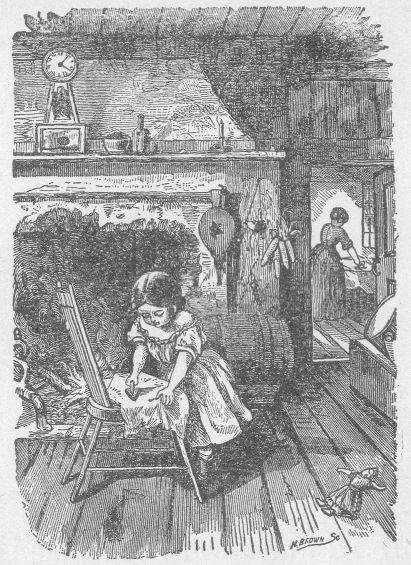
"There were a few articles to be ironed for the bride; and Prudy had a mind to try the Jewish flatirons; so, with
Barbara's leave, she smoothed out some handkerchiefs on a chair."
SPECIMEN OF "LITTLE PRUDY" CUTS.
"This story book is a great favorite with the little folks, for it
contains just such stories as they like to hear their aunt, and
older sister tell; and learn them by heart and tell them over to one
another as they set out the best infant tea-set, or piece a
baby-quilt, or dress dolls, or roll marbles. A book to put on the
book-shelf in the play-room where Susie and Prudy, Captain Horace,
Cousin Grace, and all the rest of the 'Little Prudy' folks are
kept."—Vermont Record.
"An exquisite picture of little-girl life at school and at home, and
gives an entertaining account of a secret society which originated
in the fertile brain of Grace, passed some comical resolutions at
first, but was finally converted into a Soldier's Aid Society. Full
of life, and fire, and good advice; the latter sugar-coated, of
course, to suit the taste of little folks."—Press.
"Dotty Dimple is the plague of Prudy's life, and yet she loves her
dearly. Both are rare articles in juvenile literature, as real as
Eva and Topsy of 'Uncle Tom' fame. Witty and wise, full of sport and
study, sometimes mixing the two in a confusing way, they run
bubbling through many volumes, and make everybody wish they could
never grow up or change, they are so bright and cute."
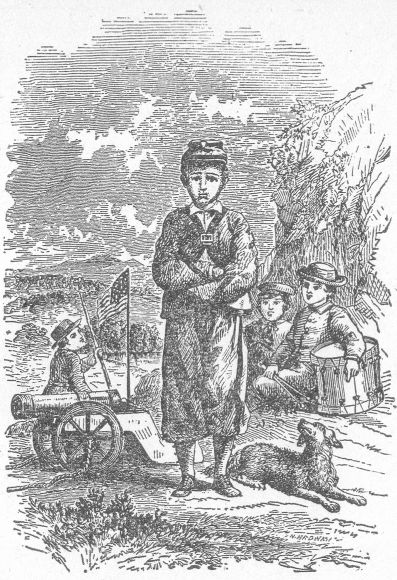 LITTLE PRUDY'S CAPTAIN HORACE.
"You wide-awake little boys, who make whistles of willow, and go
fishing and training,—Horace is very much like you, I suppose. He
is by no means perfect, but he is brave and kind, and scorns a lie,
I hope you and he will shake hands and be friends."
SPECIMEN OF ILLUSTRATIONS TO PRUDY BOOKS.
Six Volumes. Illustrated. Comprising:—
DOTTY DIMPLE AT HER GRANDMOTHER'S.
DOTTY DIMPLE OUT WEST.
DOTTY DIMPLE AT HOME.
DOTTY DIMPLE AT PLAY.
DOTTY DIMPLE AT SCHOOL.
DOTTY DIMPLE'S FLYAWAY.
In a neat box. Price 75 cents per volume.
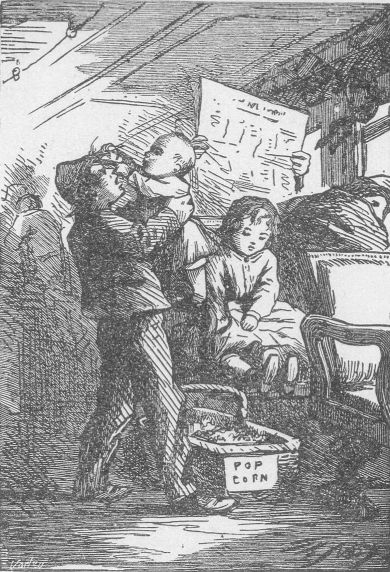 DOTTY GOING WEST
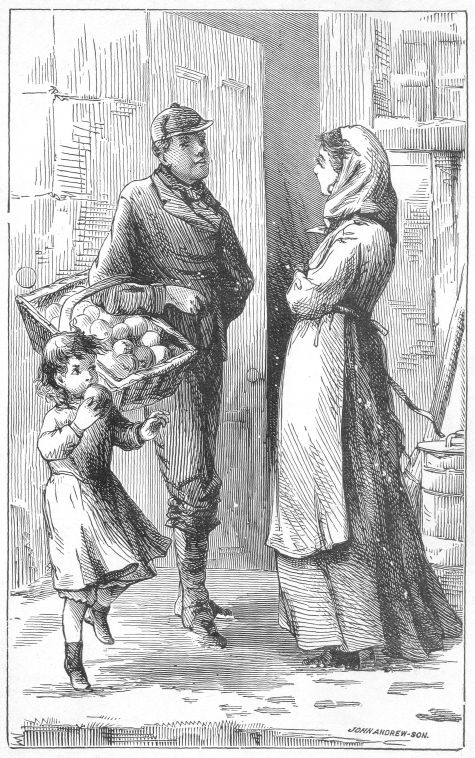
"'Please stop,' said Dotty faintly, and the boy came to her,
elbowing. 'I want some of that pop-corn so much! I could buy it if
you'd hold this baby till I put my hand in my pocket.' The youth
laughed, but for the sake of 'making a trade' set down his basket
and took the 'enfant terrible.' There was an instant attack upon
his hair, which was so long and straggling as to prove an easy prey
to the enemy."
SPECIMEN OF "DOTTY DIMPLE" ILLUSTRATIONS
"Sophie May's excellent pen has perhaps never written anything more
pleasing to children, especially little girls, than Dotty Dimple. If
the little reader who follows Dotty through these dozen
chapters,—from her visit to her grandmother to the swing under the
trees,—he or she will say: 'It has been a treat to read about Dotty
Dimple, she's so cunning.'"—Herald of Gospel Liberty.
"Dotty's trip was jolly. In the cars where she saw so many people
that she thought there'd be nobody left in any of the houses, she
offers to hold somebody's baby, and when it begins to cry she stuffs
pop-corn into its month, nearly choking it to death. Afterwards, in
pulling a man's hair, she is horrified at seeing his wig come off,
and gasps out 'O dear, dear, dear, I didn't know your hair was so
tender.' Altogether, she is the cunningist chick that ever
lived."—Oxford Press.
"This little book is as full of spice as any of its predecessors and
well sustains the author's reputation as the very cleverest of all
write of this species of children's books. Were there any doubt on
this point, the matter might be easily tested by inquiry in half the
households in the city, where the book is being revelled
over."—Boston Home Journal.
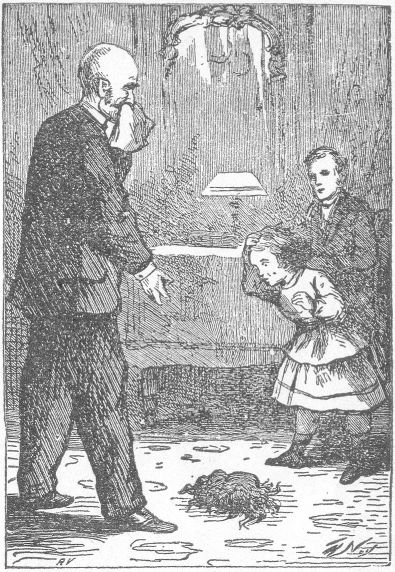
"As Dotty seized two locks of the Major's hair, one
in each hand, and pulled them both as if she meant to draw them out
by the roots, out they came! Yes, entirely out; and more than that,
all the rest of his hair came too. His head was left as smooth as an
apple. You see how it was. He wore a wig, and just for play had
slyly unfastened it, and allowed Miss Dotty to pull it off. The
perfect despair of her little face amused him vastly, but he did not
smile; he looked very severe. 'See what you have done,' said he.
Major Laydie's entire head of hair lay at her feet, as brown and
wavy as ever it was. Dotty looked at it with horror. The idea of
scalping a man."
SPECIMEN OF "DOTTY DIMPLE" ILLUSTRATIONS.
"Miss Dotty is a peremptory little body, with a great deal of human
nature in her, who wins our hearts by her comic speeches and funny
ways. She complains of being bewitched by people, and the wind
'blows her out,' and she thinks if her comrade dies in the
snow-storm she will be 'dreadfully 'shamed of it,' and has rather a
lively time, with all her trials in going to school."—New York
Citizen.
"'Charming Dotty Dimple' as she is so universally styled, has become
decidedly a favorite with young and old, who are alike pleased with
her funny sayings and doings.—Dotty at Play will be found very
attractive, and the children, especially the girls, will be
delighted with her adventures."—Boston Express.
DOTTY DIMPLE'S FLYAWAY.
"This is the final volume of the Dotty Dimple Series. It relates how
little Flyaway provisioned herself with cookies and spectacles and
got lost on a little hill while seeking to mount to heaven, and what
a precious alarm there was until she was found, and the subsequent
joy at her recovery, with lots of quaint speeches and funny
incidents."—North American.
"A Little Red Riding-Hoodish story, sprightly and takingly
told."—American Farmer.
Six Volumes. Illustrated. Comprising:—
LITTLE FOLKS ASTRAY.
PRUDY KEEPING HOUSE.
AUNT MADGE'S STORY.
LITTLE GRANDMOTHER.
LITTLE GRANDFATHER.
MISS THISTLEDOWN.
Price 75 cents per volume.
"This is a book for the little ones of the nursery or play-room. It
introduces all the old favorites of the Prudy and Dotty books with
new characters and funny incidents. It is a charming book, wholesome
and sweet in every respect, and cannot fail to interest children
under twelve years of age."—Christian Register.
"How she kept it, why she kept it, and what a good time she had
playing cook, and washer-woman, and ironer, is told as only Sophie
May can tell stories. All the funny sayings and doings of the
queerest and cunningest little women ever tucked away in the covers
of a book will please little folks and grown people alike."—Press.
"Tells of a little waif of a girl, who gets into every conceivable
kind of scrape and out again with lightning rapidity, through the
whole pretty little book. How she nearly drowns her bosom friend,
and afterwards saves her by a very remarkable display of little-girl
courage. How she gets left by a train of cars, and loses her kitten
and finds it again, and is presented with a baby sister 'come down
from heaven,' with lots of smart and funny sayings."—Boston
Traveller.
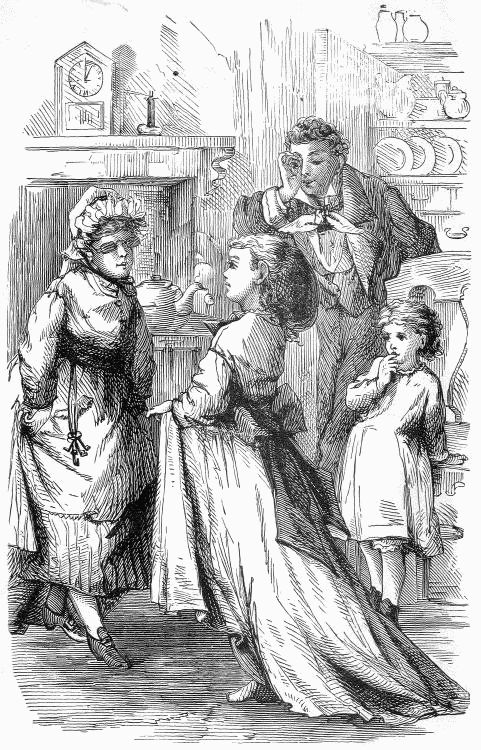
"'Oh, what a fascinating creature,' said the Man in the Moon, making
an eye-glass with his thumb and fore-finger, and gazing at the lady
boarder. 'Are you a widow, mem?'"
SPECIMEN CUT TO "LITTLE PRUDY'S FLYAWAY SERIES."
"Grandmother Parlen when a little girl is the subject. Of course
that was ever so long ago, when there were no lucifer matches, and
steel and tinder were used to light fires; when soda and saleratus
had never been heard of, but people made their pearl ash by soaking
burnt crackers in water; when the dressmaker and the tailor and the
shoemaker went from house to house twice a year to make the dresses
and coats of the family."—Transcript.
"The story of Grandfather Parlen's little boy life, of the days of
knee breeches and cocked hats, full of odd incidents, queer and
quaint sayings, and the customs of 'ye olden times.' These stories
of Sophie May's are so charmingly written that older folks may well
amuse themselves by reading them. The same warm sympathy with
childhood, the earnest naturalness, the novel charm of the preceding
volumes will be found in this."—Christian Messenger.
"One of the queerest of the Prudy family. Read the chapter heads and
you will see just how much fun there must be in it: 'Fly's Heart,'
'Taking a Nap,' 'Going to the Fair,' 'The Dimple Dot,' 'The Hole in
the Home,' 'The Little Bachelor,' 'Fly's Bluebeard,' 'Playing
Mamma,' 'Butter Spots,' 'Polly's Secret,' 'The Snow Man,' 'The Owl
and the Humming-Bird,' 'Talks of Hunting Deer,' and 'The Parlen
Patchwork.'"