"IF Jim doesn't ask for a date for the concert next week, Lark, let's
snub him good."
"But we both have dates," protested Lark.
"What difference does that make? We mustn't let him get independent. He
always has asked one of us, and he needn't think we shall let him off
now."
"Oh, don't worry," interrupted Connie. "He always asks. You have that
same discussion every time there's anything going on. It's just a waste
of time."
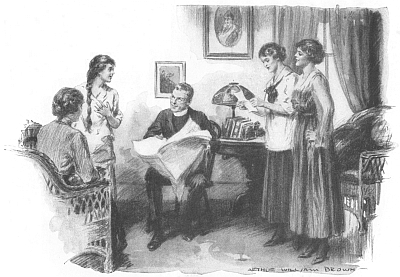
Mr. Starr looked up from his mail. "Soup of boys, and salad of
boys,—they're beginning to pall on my palate."
"Very classy expression father," approved Carol. "Maybe you can work it
into a sermon."
"Complexion and boys with Carol, books and boys with Lark, Connie, if
you begin that nonsense you'll get spanked. One member of my family
shall rise above it if I have to do it with force."
Connie blushed.
The twins broke into open derision. "Connie! Oh, yes, Connie's above
that nonsense."
"Connie's the worst in the family, father, only she's one of these
reserved, supercilious souls who doesn't tell everything she knows."
"'Nonsense.' I wish father could have heard Lee Hanson last night. It
would have been a revelation to him. 'Aw, go on, Connie, give us a
kiss.'"
Connie caught her lips between her teeth. Her face was scarlet.
"Twins!"
"It's a fact, father. He kept us awake. 'Aw, go on, Connie, be good to a
fellow.'"
"That's what makes us so pale to-day,—he kept us awake hours!"
"Carol!"
"Well, quite a while anyhow."
"I—I—" began Connie defensively.
"Well, we know it. Don't interrupt when we're telling things. You always
spoil a good story by cutting in. 'Aw, go on, Connie, go on now!' And
Connie said—" The twins rocked off in a paroxysm of laughter, and
Connie flashed a murderous look at them.
"Prudence says listening is—"
"Sure she does, and she's right about it, too. But what can a body do
when folks plant themselves right beneath your window to pull off their
little Romeo concerto. We can't smother on nights like these. 'Aw, go
on, Connie.'"
"I wanted to drop a pillow on his head, but Carol was afraid he'd run
off with the pillow, so we just sacrificed ourselves and let it
proceed."
"Well, I—"
"Give us time, Connie. We're coming to that. And Connie said, 'I'm going
in now, I'm sleepy.'"
"I didn't—father, I didn't!"
"Well, you might have said a worse thing than that," he told her sadly.
"I mean—I—"
"She did say it," cried the twins. "'I'm sleepy.' Just like that."
"Oh, Connie's the girl for sentiment," exclaimed Lark. "Sleepy is not a
romantic word and it's not a sentimental feeling, but it can be drawled
out so it sounds a little mushy at least. 'I sleep, my love, to dream of
thee,'—for instance. But Connie didn't do it that way. Nix. Just plain
sleep, and it sounded like 'Get out, and have a little sense.'"
"Well, it would make you sick," declared Connie, wrinkling up her nose
to express her disgust. "Are boys always like that father?"
"Don't ask me," he hedged promptly. "How should I know?"
"Oh, Connie, how can you! There's father—now, he never cared to kiss
the girls even in his bad and balmy days, did you, daddy? Oh, no, father
was all for the strictly orthodox even in his youth!"
Mr. Starr returned precipitately to his mail, and the twins calmly
resumed the discussion where it had been interrupted.
A little later a quick exclamation from their father made them turn to
him inquiringly.
"It's a shame," he said, and again: "What a shame!"
The girls waited expectantly. When he only continued frowning at the
letter in his hand, Carol spoke up brightly, "Yes, isn't it?"
Even then he did not look up, and real concern settled over their
expressive faces. "Father! Can't you see we're listening?"
He looked up, vaguely at first, then smiling. "Ah, roused your
curiosity, did I? Well, it's just another phase of this eternal boy
question."
Carol leaned forward ingratiatingly. "Now indeed, we are all
absorption."
"Why, it's a letter from Andrew Hedges,—an old college chum of mine.
His son is going west and Andy is sending him around this way to see me
and meet my family. He'll be here this afternoon. Isn't it a shame?"
"Isn't it lovely?" exclaimed Carol. "We can use him to make Jim Forrest
jealous if he doesn't ask for that date?" And she rose up and kissed her
father.
"Will you kindly get back to your seat, young lady, and not interfere
with my thoughts?" he reproved her sternly but with twinkling eyes. "The
trouble is I have to go to Fort Madison on the noon train for that
Epworth League convention. I'd like to see that boy. Andy's done well, I
guess. I've always heard so. He's a millionaire, they say."
For a long second his daughters gazed at him speechlessly.
Then, "A millionaire's son," Lark faltered feebly.
"Yes."
"Why on earth didn't you say so in the first place?" demanded Carol.
"What difference does that make?"
"It makes all the difference in the world! Ah! A millionaire's son." She
looked at Lark with keen speculative eyes. "Good-looking, I suppose,
young, of course, and impressionable. A millionaire's son."
"But I have to go to Fort Madison. I am on the program to-night. There's
the puzzle."
"Oh, father, you can leave him to us," volunteered Lark.
"I'm afraid you mightn't carry it off well. You're so likely to run by
fits and jumps, you know. I should hate it if things went badly."
"Oh, father, things couldn't go badly," protested Carol. "We'll be
lovely, just lovely. A millionaire's son! Oh, yes, daddy, you can trust
him to us all right."
At last he caught the drift of their enthusiasm. "Ah! I see! That fatal
charm. You're sure you'll treat him nicely?"
"Oh, yes, father, so sure. A millionaire's son. We've never even seen
one yet."
"Now look here, girls, fix the house up and carry it off the best you
can. I have a lot of old friends in Cleveland, and I want them to think
I've got the dandiest little family on earth."
"'Dandiest'! Father, you will forget yourself in the pulpit some
day,—you surely will. And when we take such pains with you, too, I
can't understand where you get it! The people you associate with, I
suppose."
"Do your best, girls. I'm hoping for a good report. I'll be gone until
the end of the week, since I'm on for the last night, too. Will you do
your best?"
After his departure, Carol gathered the family forces about her without
a moment's delay.
"A millionaire's son," she prefaced her remarks, and as she had
expected, was rewarded with immediate attention. "Now, for darling
father's sake, we've got to manage this thing the very best we can. We
have to make this Andy Hedges, Millionaire's Son, think we're just
about all right, for father's sake. We must have a gorgeous dinner, to
start with. We'll plan that a little later. Now I think, Aunt Grace,
lovely, it would be nice for you to wear your lavender lace gown, and
look delicate, don't you? A chaperoning auntie in poor health is so
aristocratic. You must wear the lavender satin slippers and have a
bottle of cologne to lift frequently to your sensitive nostrils."
"Why, Carol, William wouldn't like it!"
"Wouldn't like it!" ejaculated the schemer in surprise. "Wouldn't like
it! Why wouldn't he like it? Didn't he tell us to create a good
impression? Well, this is it. You'll make a lovely semi-invalid auntie.
You must have a faintly perfumed handkerchief to press to your eyes now
and then. It isn't hot enough for you slowly to wield a graceful fan,
but we can get along without it."
"But, Carol—"
"Think how pleased dear father will be if his old college chum's son is
properly impressed," interrupted Carol hurriedly, and proceeded at once
with her plans.
"Connie must be a precocious younger sister, all in white,—she must
come in late with a tennis racquet, as though she had just returned from
a game. That will be stagey, won't it? Lark must be the sweet young
daughter of the home. She must wear her silver mull, her gray slippers,
and—"
"I can't," said Lark. "I spilt grape juice on it. And I kicked the toe
out of one of my slippers."
"You'll have to wear mine then. Fortunately that silver mull was always
too tight for me and I never comported myself in it with freedom and
destructive ease. As a consequence, it is fresh and charming. You must
arrange your hair in the most Ladies' Home Journal style, and—"
"What are you going to wear?"
"Who, me? Oh, I have other plans for myself." Carol looked rather
uneasily at her aunt. "I'll come to me a little later."
"Yes, indeed," said Connie. "Carol has something extra up her sleeve.
She's had the millionaire's son in her mind's eye ever since father
introduced his pocketbook into the conversation."
Carol was unabashed. "My interest is solely from a family view-point. I
have no ulterior motive."
Her eyes sparkled eagerly. "You know, auntie darling—"
"Now, Carol, don't you suggest anything—"
"Oh, no indeed, dearest, how could you think of such a thing?"
disclaimed Carol instantly. "It's such a very tiny thing, but it will
mean a whole lot on the general impression of a millionaire's son. We've
simply got to have a maid! To open the door, and curtesy, and take his
hat, and serve the dinner, and—He's used to it, you know, and if we
haven't one, he'll go back to Cleveland and say, 'Ah, bah Jove, I had to
hang up my own hat, don't you know?'"
"That's supposed to be English, but I don't believe it. Anyhow, it isn't
Cleveland," said Connie flatly.
"Well, he'd think we were awfully cheap and hard up, and Andy Hedges,
Senior, would pity father, and maybe send him ten dollars, and—no,
we've got to have a maid!"
"We might get Mamie Sickey," suggested Lark.
"She's so ugly."
"Or Fay Greer," interposed Aunt Grace.
"She'd spill the soup."
"Then there's nobody but Ada Lone," decided Connie.
"She hasn't anything fit to wear," objected Carol.
"Of whom were you thinking, Carol?" asked her aunt, moving uneasily in
her chair.
Carol flung herself at her aunt's knees. "Me!" she cried.
"As usual?" Connie ejaculated dryly.
"Oh, Carol," wailed Lark, "we can't think of things to talk about when
you aren't there to keep us stirred up."
"I'm beginning to see daylight," said Connie. She looked speculatively
at Lark. "Well, it's not half bad, Carol, and I apologize."
"Don't you think it is a glorious idea, Connie?" cried Carol
rapturously.
"Yes, I think it is."
Carol caught her sister's hand. Here was an ally worth having. "You know
how sensible Connie is, auntie. She sees how utterly preposterous it
would be to think of entertaining a millionaire's son without a maid."
"You're too pretty," protested Lark. "He'd try to kiss you."
"'Oh, no, sir, oh, please, sir,'" simpered Carol, with an adorable
curtesy, "'you'd better wait for the ladies, sir.'"
"Oh, Carol, I think you're awful," said their aunt unhappily. "I know
your father won't like it."
"Like it? He'll love it. Won't he, Connie?"
"Well, I'm not sure he'll be crazy about it, but it'll be all over when
he gets home," said Connie.
"And you're very much in favor of it, aren't you, Connie precious?"
"Yes, I am." Connie looked at Lark critically again. "We must get Lark
some bright flowers to wear with the silver dress—sweet peas would be
good. But I won't pay for them, and you can put that down right now."
"But what's the idea?" mourned Lark. "What's the sense in it? Father
said to be good to him, and you know I can't think of things to say to a
millionaire's son. Oh, Carol, don't be so mean."
"You must practise up. You must be girlish, and light-hearted, and
ingenuous, you know. That'll be very effective."
"You do it, Carol. Let me be the maid. You're lots more effective than I
am."
But Carol stood firm, and the others yielded to her persuasions. They
didn't approve, they didn't sanction, but they did get enthusiastic, and
a merrier houseful of masqueraders was never found than that. Even Aunt
Grace allowed her qualms to be quieted and entered into her part as
semi-invalid auntie with genuine zest.
At three they were all arrayed, ready for the presentation. They
assembled socially in the parlor, the dainty maid ready to fly to her
post at a second's warning. At four o'clock, they were a little fagged
and near the point of exasperation, but they still held their characters
admirably. At half past four a telegraph message was phoned out from the
station.
"Delayed in coming. Will write you later. Very
sorry. Andy Hedges, Jr."
Only the absolute ludicrousness of it saved Carol from a rage. She
looked from the girlish tennis girl to the semi-invalid auntie, and then
to the sweet young daughter of the home, and burst out laughing. The
others, though tired, nervous and disappointed, joined her merrily, and
the vexation was swept away.
The next morning, Aunt Grace went as usual to the all-day meeting of the
Ladies' Aid in the church parlors. Carol and Lark, with a light lunch,
went out for a few hours of spring-time happiness beside the creek two
miles from town.
"We'll come back right after luncheon," Carol promised, "so if Andy the
Second should come, we'll be on hand."
"Oh, he won't come to-day."
"Well, he just better get here before father comes home. I know father
will like our plan after it's over, but I also know he'll veto it if he
gets home in time. Wish you could go with us, Connie."
"Thanks. But I've got to sew on forty buttons. And—if I pick the
cherries on the little tree, will you make a pie for dinner?"
"Yes. If I'm too tired Larkie will. Do pick them, Con, the birds have
had more than their share now."
After her sisters had disappeared, Connie considered the day's program.
"I'll pick the cherries while it's cool. Then I'll sew on the buttons.
Then I'll call on the Piersons, and they'll probably invite me to stay
for luncheon." And she went up-stairs to don a garment suitable for
cherry-tree service. For cherry trees, though lovely to behold when
laden with bright red clusters showing among the bright green leaves,
are not at all lovely to climb into. Connie knew that by experience.
Belonging to a family that wore its clothes as long as they possessed
any wearing virtue, she found nothing in her immediate wardrobe fitted
for the venture. But from a rag-bag in the closet at the head of the
stairs, she resurrected some remains of last summer's apparel. First she
put on a blue calico, but the skirt was so badly torn in places that it
proved insufficiently protecting. Further search brought to light
another skirt, pink, in a still worse state of delapidation. However,
since the holes did not occur simultaneously in the two garments, by
wearing both she was amply covered. For a waist she wore a red crape
dressing sacque, and about her hair she tied a broad, ragged ribbon of
red to protect the soft waves from the ruthless twigs. She looked at
herself in the mirror. Nothing daunted by the sight of her own
unsightliness, she took a bucket and went into the back yard.
Gingerly she climbed into the tree, gingerly because Connie was not fond
of scratches on her anatomy, and then began her task. It was a glorious
morning. The birds, frightened away by the living scare-crow in the
tree, perched in other, cherry-less trees around her and burst into
derisive song. And Connie, light-hearted, free from care, in love with
the whole wide world, sang, too, pausing only now and then to thrust a
ripe cherry between her teeth.
She did not hear the prolonged ringing of the front-door bell. She did
not observe the young man in the most immaculate of white spring suits
who came inquiringly around the house. But when the chattering of a
saucy robin became annoying, she flung a cherry at him crossly.
"Oh, chase yourself!" she cried. And nearly fell from her perch in
dismay when a low voice from beneath said pleasantly:
"I beg your pardon! Miss Starr?"
Connie swallowed hard, to get the last cherry and the mortification out
of her throat.
"Yes," she said, noting the immaculate white spring suit, and the
handsome shoes, and the costly Panama held so lightly in his hand. She
knew the Panama was costly because they had wanted to buy one for her
father's birthday, but decided not to.
"I am Andrew Hedges," he explained, smiling sociably.
Connie wilted completely at that. "Good night," she muttered with a
vanishing mental picture of their lovely preparations the day previous.
"I—mean good morning. I'm so glad to meet you. You—you're late, aren't
you? I mean, aren't you ahead of yourself? At least, you didn't write,
did you?"
"No, I was not detained so long as I had anticipated, so I came right
on. But I'm afraid I'm inconveniencing you."
"Oh, not a bit, I'm quite comfortable," she assured him. "Auntie is gone
just now, and the twins are away, too, but they'll all be back
presently." She looked longingly at the house. "I'll have to come down,
I suppose."
"Let me help you," he offered eagerly. Connie in the incongruous
clothes, with the little curls straying beneath the ragged ribbon, and
with stains of cherry on her lips, looked more presentable than Connie
knew.
"Oh, I—" she hesitated, flushing. "Mr. Hedges," she cried imploringly,
"will you just go around the corner until I get down. I look fearful."
"Not a bit of it," he said. "Let me take the cherries."
Connie helplessly passed them down to him, and saw him carefully
depositing them on the ground. "Just give me your hand."
And what could Connie do? She couldn't sternly order a millionaire's son
to mosy around the house and mind his own business until she got some
decent clothes on, though that was what she yearned to do. Instead she
held out a slender hand, grimy and red, with a few ugly scratches here
and there, and allowed herself to be helped ignominiously out from the
sheltering branches into the garish light of day.
She looked at him reproachfully. He never so much as smiled.
"Laugh if you like," she said bitterly. "I looked in the mirror. I know
all about it."
"Run along," he said, "but don't be gone long, will you? Can you trust
me with the cherries?"
Connie walked into the house with great decorum, afraid the ragged
skirts might swing revealingly, but the young man bent over the cherries
while she made her escape.
It was another Connie who appeared a little later, a typical tennis
girl, all in white from the velvet band in her hair to the canvas shoes
on her dainty feet. She held out the slender hand, no longer grimy and
stained, but its whiteness still marred with sorry scratches.
"I am glad to see you," she said gracefully, "though I can only pray you
won't carry a mental picture of me very long."
"I'm afraid I will though," he said teasingly.
"Then please don't paint me verbally for my sisters' ears; they are
always so clever where I am concerned. It is too bad they are out.
You'll stay for luncheon with me, won't you? I'm all alone,—we'll have
it in the yard."
"It sounds very tempting, but—perhaps I had better come again later in
the afternoon."
"You may do that, too," said Connie. "But since you are here, I'm
afraid I must insist that you help amuse me." And she added ruefully,
"Since I have done so well amusing you this morning."
"Why, he's just like anybody else," she was thinking with relief. "It's
no trouble to talk to him, at all. He's nice in spite of the millions.
Prudence says millionaires aren't half so dollar-marked as they are
cartooned, anyhow."
He stayed for luncheon, he even helped carry the folding table out
beneath the cherry tree, and trotted docilely back and forth with plates
and glasses, as Connie decreed.
"Oh, father," she chuckled to herself, as she stood at the kitchen
window, twinkling at the sight of the millionaire's son spreading
sandwiches according to her instructions. "Oh, father, the boy question
is complicated, sure enough."
It was not until they were at luncheon that the grand idea visited
Connie. Carol would have offered it harborage long before. Carol's mind
worked best along that very line. It came to Connie slowly, but she gave
it royal welcome. Back to her remembrance flashed the thousand witty
sallies of Carol and Lark, the hundreds of times she had suffered at
their hands. And for the first time in her life, she saw a clear way of
getting even. And a millionaire's son! Never was such a revenge fairly
crying to be perpetrated.
"Will you do something for me, Mr. Hedges?" she asked. Connie was only
sixteen, but something that is born in woman told her to lower her eyes
shyly, and then look up at him quickly beneath her lashes. She was no
flirt, but she believed in utilizing her resources. And she saw in a
flash that the ruse worked.
Then she told him softly, very prettily.
"But won't she dislike me if I do?" he asked.
"No, she won't," said Connie. "We're a family of good laughers. We enjoy
a joke nearly as much when it's on us, as when we are on top."
So it was arranged, and shortly after luncheon the young man in the
immaculate spring suit took his departure. Then Connie summoned her aunt
by phone, and told her she must hasten home to help "get ready for the
millionaire's son." It was after two when the twins arrived, and Connie
and their aunt hurried them so violently that they hadn't time to ask
how Connie got her information.
"But I hope I'm slick enough to get out of it without lying if they do
ask," she told herself. "Prudence says it's not really wicked to get out
of telling things if we can manage it."
He had arrived! A millionaire's son! Instantly their enthusiasm returned
to them. The cushions on the couch were carefully arranged for the
reclining of the semi-invalid aunt, who, with the sweet young daughter
of the home, was up-stairs waiting to be summoned. Connie, with the
tennis racquet, was in the shed, waiting to arrive theatrically. Carol,
in her trim black gown with a white cap and apron, was a dream.
And when he came she ushered him in, curtesying in a way known only on
the stage, and took his hat and stick, and said softly:
"Yes, sir,—please come in, sir,—I'll call the ladies."
She knew she was bewitching, of course, since she had done it on
purpose, and she lifted her eyes just far enough beneath the lashes to
give the properly coquettish effect. He caught her hand, and drew her
slowly toward him, admiration in his eyes, but trepidation in his heart,
as he followed Connie's coaching. But Carol was panic-seized, she broke
away from him roughly and ran up-stairs, forgetting her carefully
rehearsed. "Oh, no, sir,—oh, please, sir,—you'd better wait for the
ladies."
But once out of reach she regained her composure. The semi-invalid aunt
trailed down the stairs, closely followed by the attentive maid to
arrange her chair and adjust the silken shawl. Mr. Hedges introduced
himself, feeling horribly foolish in the presence of the lovely serving
girl, and wishing she would take herself off. But she lingered
effectively, whisperingly softly:
"Shall I lower the window, madame? Is it too cool? Your bottle, madame!"
And the guest rubbed his hand swiftly across his face to hide the slight
twitching of his lips.
Then the model maid disappeared, and presently the sweet daughter of the
house, charming in the gray silk mull and satin slippers, appeared,
smiling, talking, full of vivacity and life. And after a while the
dashing tennis girl strolled in, smiling inscrutably into the eyes that
turned so quizzically toward her. For a time all went well. The
chaperoning aunt occasionally lifted a dainty cologne bottle to her
sensitive nostrils, and the daughter of the house carried out her
girlish vivacity to the point of utter weariness. Connie said little,
but her soul expanded with the foretaste of triumph.
"Dinner is served, madame," said the soft voice at the door, and they
all walked out sedately. Carol adjusted the invalid auntie's shawl once
more, and was ready to go to the kitchen when a quiet:
"Won't Miss Carol sit down with us?" made her stop dead in her tracks.
He had pulled a chair from the corner up to the table for her, and she
dropped into it. She put her elbows on the table, and leaning her dainty
chin in her hands, gazed thoughtfully at Connie, whose eyes were bright
with the fires of victory.
"Ah, Connie, I have hopes of you yet,—you are improving," she said
gently. "Will you run out to the kitchen and bring me a bowl of soup, my
child?"
And then came laughter, full and free,—and in the midst of it Carol
looked up, wiping her eyes, and said:
"I'm sorry now I didn't let you kiss me, just to shock father!"
But the visit was a great success. Even Mr. Starr realized that. The
millionaire's son remained in Mount Mark four days, the cynosure of all
eyes, for as Carol said, "What's the use of bothering with a
millionaire's son if you can't brag about him."
And his devotion to his father's college chum was such that he wrote to
him regularly for a long time after, and came westward now and again to
renew the friendship so auspiciously begun.
"But you can't call him a problem, father," said Carol keenly. "They
aren't problematic until they discriminate. And he doesn't. He's as fond
of Connie's conscience as he is of my complexion, as far as I can see."
She rubbed her velvet skin regretfully. She had two pimples yesterday
and he never even noticed them. Then she leaned forward and smiled.
"Father, you keep an eye on Connie. There's something in there that we
aren't on to yet." And with this cryptic remark, Carol turned her
attention to a small jar of cold cream the druggist had given her to
sample.
 Come on. Let's beat it