IN order to show the absolute necessity of secure locks and safe
depositories for property, especially in banking establishments, it may
not be out of place just to trace the systematic care and great sagacity
with which large burglaries are planned. An unsuccessful attempt, where
the booty is of any magnitude, is seldom made. The first-rate
‘cracksmen’ always know beforehand where to go, when to go, and what
they are going for. When a ‘plant,’ as it is termed, is made upon a
house or a bank, precise information is gained if possible as to the
depository of the valuables, and if it is found that the safeguards are
so strong in themselves and the locks so invulnerable that there is but
little chance of success, the affair is quietly dropped; but if
otherwise, then no expenditure of time or misapplied ingenuity is spared
to gain the desired end; the house is constantly watched, and the habits
of its inmates observed, their ordinary times of going out and coming in
being noted. Possibly the confidential servants are bribed or cajoled,
and induced to leave the premises when their employers are absent, so
that impressions may be taken from the locks, and false keys be made.
When all the keys required are ready, generally one or two men who have
not been previously initiated are called in, and receive their
instructions to be ready at a certain hour on the following day to enter
the premises. A plan is put into their hands; they are cautioned to step
over a certain creaking stair or board, and the false keys of the
different doors are given to them. The inmates of the house being
absent, their servant takes advantage of this fact to fulfil a
long-standing engagement with his or her new and liberal friends; a
signal is given; the two confederates enter; the so-called safe is swept
of its contents; all the doors in the building are carefully re-locked,
and not until the house is opened for business next morning is the
robbery discovered.
Many years ago there was a bank robbery at a town in Kent, effected as
follows: Two respectable-looking and well-behaved men went to the
principal inn of the town and informed the landlord their object was to
look out for and purchase a small estate in the neighbourhood. They
stopped there for nearly three months, taking frequent drives in their
gig, lived well and paid well; and at length took leave one market-day
between twelve and one o’clock, much to the regret of the landlord, who
felt sorry to lose such unexceptionable customers.
These men were thieves, and at a few moments past one o’clock that very
day robbed the bank of nearly £5,000.
The banking-office was the ground-floor of a house in the Market Square,
and the manager never left the cash there at night, but always took it
to his own residence near by. He was accustomed, however, with the
clerk, to be absent from one till two o’clock in the day at his dinner,
during which time the money was put into the safe and the premises
locked up.
It appeared that all the arrangements of the business were perfectly
ascertained and understood by the two sojourners at the hotel, and that
the necessary impressions of the locks had been taken on various nights
and the false keys made.
On the day in question the gig was taken just outside the town. One of
the men went back, and in mid-day unlocked the street and internal
doors, opened the safe, took out the money, and then the two set off to
London with their booty and got the notes cashed the same afternoon.
After locking the safe the burglars slipped a small ring over the
key-pin of the lock, so that when the manager on his return from dinner
tried to open it with its proper key, the key would not enter. A smith
was sent for, and it was four hours before the safe was opened—too
late, of course, for any effective pursuit.
A more recent and notable instance is that of a daring burglary which
took place at Mr. Walker’s, the well-known jeweller of Cornhill, in
1865, the whole facts of which came to light in consequence of one of
the gang volunteering a confession during an action arising out of the
robbery. I am indebted to the ‘Times’ newspaper for the following
particulars, which doubtless are still fresh in the memory of some
persons: The robbery had been elaborately schemed, and was only
accomplished by a regular expedition of well-equipped thieves. The
cleverest of the gang had taken Mr. Walker, his family, and his habits
under the closest surveillance for seven weeks before, night and day,
until at last everything connected with his business and his practice
was thoroughly known. This information being complete, a party of five
of the robbers repaired to the premises at ten minutes past six on the
evening of Saturday, February 4, 1865. The house was let and occupied in
floors, Mr. Walker’s shop being on the ground-floor, Sir C. Crossley’s
offices immediately above, and other offices above those, while below
the shop was a room tenanted by a tailor. The occupants, when the
thieves arrived, had not yet all left for the night, but the offices on
the second floor were empty, and to these three of the robbers at once
ascended by means of the common staircase, and there took up their first
position, the other two remaining in the street to watch and give
signals. At twenty minutes to eight the signal was given by the
confederates outside the house that Mr. Walker’s foreman, who appears to
have been the last on the premises, was gone, and their operations
commenced.
It was past midnight before the three robbers inside began their most
important work. Mr. Walker’s shop was secured by iron doors or
partitions, but the thieves directed their attack against the floor,
which had not unnaturally been left with less protection. They got into
the tailor’s room, on the lowest floor, mounted upon his cutting-board
and forced their way through the ceiling and flooring to the shop above.
Having thus effected a lodgment against the real point of attack, they
distributed the duties of the night. Of the two thieves stationed in the
street one was to be on the watch, lest Mr. Walker or any of his people
should return to the house, while the other was to keep guard over the
police and give warning whenever a constable approached. Inside, one of
the gang sat upstairs in Sir C. Crossley’s arm-chair, at the window of
the second floor, to notice the sentries in the street, and the signals
of these men he communicated by means of a string to his comrades in the
shop.
One of these handed up such instruments as were wanted; the other at
length opened the safe (by wedging, as described on p. 36); so that at a
quarter to four they washed their hands in the office upstairs, and an
hour later were miles away on the Guildford road.
The success in this happily unique case was due to the desertion of the
premises for six-and-thirty hours together. The men did not get into the
shop till one-and-twenty hours after the commencement of their
operations. Aided by time, the science of the housebreakers was
successful. The police passed the place every nine minutes, but with
such deeply-laid plans were not likely to detect the mischief going on,
and so the thieves escaped for three weeks, when a part of the stolen
property was traced and the rascals themselves ultimately captured.
Caseley, the reputed leader of the gang, stated that he had had a great
deal of experience in opening safes, and there is no doubt he was a
clever man; but I believe a part at least of his subsequent statements
were exaggerations, likely to be indulged in by a man placed in his
position.
Very few cases of the kind, however, show such determination and skill,
and thus almost the first robbery in which wedges were used in
safe-breaking must rank as one of the most remarkable of our times.
When a large amount of property of either cash, plate, or jewels is
deposited in one place, it really is in fact offering a premium to
robbers, unless fit receptacles for such property are provided.
Notwithstanding the cunning, ingenuity, or violence of the professional
burglars, means are at hand by which they may be effectually baffled,
and all who are interested in the matter should see that their patent
locks or iron safes are really what they ought to be—impervious to
fraud and force.
The axiom that ‘the best is the cheapest’ will hold good with locks and
safes, as with most other things. Let it be remembered that first-class
work must be done by the best and most skilful workmen, and that to
secure them a high rate of wages must be paid.
Most of the house-robberies so common in all large towns are effected
through the common street-door latches in ordinary use being opened by
false keys. It is a notorious fact that thousands are made year after
year, but which do not afford the least security, as they are all so
made that any one key will open the whole, and it is not until the
owner has his hall cleared, or his plate carried off, that he finds out
that his apparently complex key is a mere sham, there not being in the
lock a single tumbler or ward to correspond with the cuts in the web of
the key. At a very low computation at least three-fourths of the houses
in London can be entered by false keys, and it is simply owing to the
vigilance of the often-abused police that robberies are not more
constantly effected.
The following particulars, kindly furnished me by Colonel Fraser, of the
City Police, will show what facilities are placed within the reach of
burglars by careless householders.
Return of Premises found open, or otherwise insecure, by the Police
in the City of London.
| Year | Number |
| 1871 | 2,656 |
| 1872 | 2,452 |
| 1873 | 2,957 |
| Total | 8,065 |
By using secure locks or latches on all the outer doors of houses an
immense amount of work would be saved to the police, and it is really a
question for ratepayers to decide if common and insecure locks should be
allowed to be used any longer.
While on the subject of house-robberies I may refer to other modes of
entering dwellings, with which the public ought to be acquainted in
order to be on their guard.
Admission to a house by the connivance of a dishonest servant is, of
course, sometimes obtained by thieves, and the only way of preventing
this is to be careful whom one employs in the house. But, if possible,
the thief will get into the house unaided by a confederate, who after
all might foil his plans, and in any event will claim a part of the
plunder. So the house must be carefully watched, and, if possible,
examined, in order to discover the easiest mode of access.
Frequently some coal-cellar window is found to be left conveniently
unbarred, although all other windows and doors are barred and bolted; or
perhaps all the windows have safety-fasteners but one, as was the case
in a residence near London, a short time ago, when the burglars
happened (so it was said) to pitch upon the unprotected window, and
entering cleared the room of valuable jewellery.
Beggars or hawkers are often in the pay of thieves, endeavouring to get
information—that may not be used perhaps for a long time hence—and
such visitors should certainly never be allowed inside one’s house,
though their visits are too often encouraged by the weakness of the
domestics.
Now, it will be asked, what are the remedies best adapted to prevent
robbery in these various ways? Firstly, be careful to have trustworthy
servants, or all other precautions are unavailing. Secondly, have
plate-glass to all windows in the house, for this cannot be broken, as
common sheet-glass can, without noise. Thirdly, as shutters are really
no protection at all, and frequently are not fastened at night, let all
windows and openings that can be reached easily from the ground have
strong bars built into the stone or brickwork, not more than five inches
apart, where this can be done without disfigurement; and let the windows
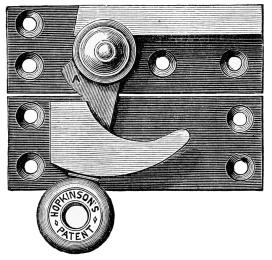
on every upper floor have either Hopkinson’s or Dawes’s patent window
fasteners, which cannot be opened from the outside, and are simple and
strong in construction and cheap in price.
The engraving shows Hopkinson’s fastener, an extremely simple and
ingenious invention. The projection on the left side, as the fastener is
moved, comes over the opening and wedges fast any instrument introduced
from the outside for the purpose of forcing back the catch.
Fourthly, keep a dog, however small, inside the house; this is a
wonderful safeguard, and extremely disliked by burglars. Fifthly, have
any number of bells on shutters, electric wires, or other gimcracks that
you please, and place no reliance on any of them. Lastly, leave as
little property as possible, certainly no silver plate or jewellery,
lying about, so that if a thief should overcome all obstacles to
entrance, he may not find much ready to hand.

The sort of robbery I have alluded to is committed either at night or in
the dusk of the evening or at the dinner-hour, when the inmates are all
in one part of the house. There is also that very frequent and too often
successful plan of stealing coats, &c. from a hall, when some stranger
calls with a fictitious message that causes the servant to leave him
alone for a moment, during which he hurries off with everything within
reach that is worth stealing. To prevent such an occurrence plainly the
best thing is never to allow a stranger to wait inside one’s door.
A professional burglar’s tools comprise skeleton-keys, silent matches, a
dark lantern, a wax taper, a palette-knife used for opening windows by
pushing the fastening back; a small crowbar, generally made in two
pieces to screw together, and with one end forked; a centre-bit, and a
carpet-bag. If the object of attack is a safe, then to these must be
added chisels and steel wedges of different sizes, an ‘alderman,’ or
large crowbar, a ‘Jack-in-the-box,’ some aqua fortis, and sometimes
gunpowder for blowing open locks. Besides providing himself with tools,
the burglar will often wear a ‘reversible,’ or a coat which can be worn
inside out, each side being a different colour, so that if he happened
to be noticed he will turn his coat in some quiet corner and become
another man to all outward appearances.
The writer of an able article in the Cornhill Magazine of January 1863
gives as a list of the various ways in which houses are regularly broken
into, the following: ‘Jumping a crib,’ which is entrance by a window;
‘breaking a crib,’ forcing a back door; ‘grating a crib,’ through cellar
gratings; ‘garreting a crib,’ through the roof. Entrance in this last
way, the writer states, is sometimes cleverly effected (from the leads
of an empty house adjacent) by means of an umbrella. First, a few slates
are removed, then a small hole is made, and through this aperture a
strong springless umbrella is thrust and shaken open. Again the thieves
go to work upon the hole in the roof, which they widen rapidly and with
perfect confidence, since the débris falls noiselessly into the
umbrella hanging beneath. When in the house the thieves’ only care is to
move silently and to show little or no light. When the plunder is
secured and the confederates signal that the way is clear, the burden is
divided, and they at once separate, though perhaps going to the same
place. Cabs are occasionally employed by the thieves; and though the
drivers are not exactly in league, yet they must know pretty well by
whom they are being hired. The plunder is disposed of immediately to
‘receivers,’ who always drive a good bargain, and if there is any plate
or gold at once put it into the melting-pot. These receivers are the
curse of large towns, where alone they are to be found. It is entirely
owing to them that the majority of robberies are committed, for if
thieves had to run a second risk in disposing of the goods after
stealing them, they would not continue a dishonest life with the chances
of success they now have. The police are generally well aware of the men
who thus assist the thieves, but the difficulty of getting evidence
against them is extreme, although occasionally a rascal is caught and
severely punished owing to information being received from some
informer. There are no less than eighty-seven houses in London known
to be those of receivers of stolen goods.
In February 1858 there were in Manchester alone ninety-four returned
transports, and out of the whole of that number there were not more than
six in employment or who had any known means of livelihood. In view of
this statement can it be wondered at that in the eleven years from 1857
to 1867 there were no less than seventeen successful robberies effected
in that city alone, involving a loss of property amounting to £25,788,
chiefly in cash and jewellery? This loss would have been largely
augmented had it not been for the vigilance of the Manchester police,
who could not, however, possibly frustrate every attempt made by
dishonest men let loose upon society in large numbers by a system which
is open to very serious objections. The Habitual Criminals Act proves
that the country has at length recognised the fact that the
ticket-of-leave system has been grossly abused by convicted persons, and
that to protect life and property effectually it is necessary to give
the police more power of supervision over suspected characters. For the
benefit of those not acquainted with this Act, I may state that its most
important provision is to give a Judge power to include in the sentence
of a person, who has been previously convicted, a certain term of police
supervision, to take effect after release from prison; and during this
term the person may be called upon at any time to prove that he or she
is gaining an honest livelihood—the burden of the proof resting with
the suspected person, instead of the police being required to prove
dishonesty.
A man who commits a great robbery is not one who up to that moment was
honest and industrious; it is most probable that he has been an
associate of thieves, and has been apprenticed to it, so to speak, as to
a trade; hence the advantage of the new system by which he can be
watched and if necessary captured on suspicion. The London police have
now on their register 117,000 names of habitual criminals, and the list
is said to be increasing at the rate of 30,000 a year.
A few somewhat imperfect statistics may be given. In London, during the
years 1862 to 1867 inclusive, there were eight successful burglaries, in
which £14,845 worth of valuables was stolen; in other large towns of the
kingdom, such as Glasgow, Sheffield, &c., there were thirteen
burglaries, with a loss of £11,375; and if our Colonies were to be taken
into account, at Hong Kong alone there was a robbery (referred to more
fully on page 59), in 1865, of £50,000 from a bank.
Omitting this last, however, it will be seen that in eleven years no
less than £52,000 of property was stolen by burglars in Great Britain.
It is true a great deal of this was recovered—sometimes in remarkable
ways, an instance of which was the finding of some gold watches in the
Thames, stolen from Mr. Walker’s, Cornhill; one of the watches having
attracted the attention of a river policeman. But, on the other hand,
there were numbers of successful attempts where no booty was found; a
large number of unsuccessful attempts; and many of both kinds which
never appeared in the newspapers at all.
The total would indeed make a formidable list, and yet there is hardly a
case in which proper care combined with the use of the best safeguards
would not have prevented all loss.
In the year 1873 the total amount of property lost by robberies of all
kinds within the metropolitan district alone was £84,000, of which
nearly £21,000 was subsequently recovered.
So large a proportion of this loss was occasioned by the use of insecure
fastenings on doors or windows, that the Metropolitan Police have drawn
the special attention of householders to the risks thus incurred.
Colonel Henderson not long since issued a notice, of which the following
is an extract:—
‘Caution to Householders and others.—The Commissioner considers it to
be his duty to caution householders and others that larcenies are in
most instances committed by thieves entering through windows left open
or so insecurely fastened that they can be readily opened by thrusting
back the catch from the outside with a knife, without any violence or
force whatever. The plates of window-fastenings should overlap each
other, and self-acting side-stops should be used in sashes. Attention is
also directed to the following means by which thieves effect their
purpose:—
‘In the absence of the family, especially on Saturday and Sunday
evenings, entering with false or skeleton keys, passing through an empty
house in the neighbourhood, going along the parapet, and entering any
window found open—climbing up the portico and entering through upper
windows—calling at houses under pretence of having messages or parcels
to deliver, and during the absence of the servant stealing articles from
the hall or passage and decamping.
‘If ordinary and necessary precautions were taken, as above recommended,
the efforts of the police in preventing crime would be materially aided,
and property more effectually secured.’
A short time since there was a robbery at the warehouse of a person who
immediately wrote to the newspapers blaming the police and making out a
plausible case. Now, the real facts were, that this person gave up
residing on his City premises without informing the police. The door had
on it only a common latch, easily opened by a false key. There was a
window up a side-passage through which it was easy to obtain entrance;
and though all these circumstances conspired to facilitate the
operations of thieves, yet this was thought a proper opportunity to
blame the City Police!
Although seventeen years have elapsed since the conviction of the men
who stole the bullion on the South-Eastern Railway, the case is still
the most remarkable of its kind—remarkable for the deliberation, the
professional spirit, and the pecuniary resources of the modern offender.
The following very condensed account I take from the ‘Times’ newspaper
of the day, merely premising that the case shows the extreme importance
of guarding one’s keys most jealously, for even up to the present time
no lock, such as can be brought within the reach of everyone for
practical use, has been invented that will permit of its keys being
carelessly used.
On the night of May 15, 1855, gold to the value of £12,000 was taken
from the van of a train on the South-Eastern Railway, between London and
Folkestone. The boxes were weighed in London and again at Boulogne; at
the second place the weight, as was subsequently discovered, differed
from the weight in London. The weight in Paris corresponded with the
weight at Boulogne. Consequently the boxes must have been tampered with
between London and Boulogne, or, as it had been impossible to touch them
while in the boat, between London and Folkestone. When the boxes were
opened, bags of shot were found substituted for gold. Of course the
surprise was great, and the search after the offender earnest. But
whatever may be the skill of the detectives, we know from sad experience
that the criminal world is more than equal to them in craft. For sixteen
months the pursuit was in vain, and the robbery was well-nigh forgotten,
when an unexpected revelation threw light on the matter. A man named
Edward Agar was convicted in October 1855 of uttering a forged cheque,
and sentenced to be transported for life. This man, after his
conviction, stated to the authorities that he could give information
respecting the great gold robbery of 1855. On being questioned he
announced himself as one of the perpetrators, and named as his
accomplices Pierce, formerly in the service of the South-Eastern
Company; Burgess, a guard; and Tester, a clerk in the traffic
department.
Agar was forty-one years of age, and had by his own confession lived by
crime from fourteen to twenty years. His evidence was that Pierce first
suggested the scheme, but that he himself thought it impracticable.
Pierce said he believed he could obtain impressions of keys of the
Chubb’s locks by which the iron safes were secured; and Agar then
answered that if it could be done he thought the thing might be
effected. Pierce and Agar went down to Folkestone as casual visitors for
the benefit of sea-bathing. They took lodgings and employed themselves
in observing the arrival of the tidal service trains to the boats. This
was in May 1854, twelve months before the actual commission of the
robbery—so long a time can modern depredators afford to spend upon
their preparations. They went daily to the pier to enjoy the fresh air;
but their constant observation of the trains and the station aroused
suspicion, and they left, though not before they had discovered ‘what
Chapman, who had the key of the iron safe, did when the trains arrived
and the luggage was removed to the boats.’ By these means it was
ascertained where the key was kept, the impression of which it was
desirable to obtain.
But to know where the key was kept and to obtain possession of it were
very different things, and Agar, according to his own story, was much
disheartened. Not so Pierce. Pierce knew a man named Tester who was in
the office of the Superintendent of Traffic, and Tester could get
possession of the keys for them. However, time rolls on, and we are in
August, when Pierce discovers that the locks are to be altered, and that
the new keys will be in Tester’s hands. Tester was the clerk who
corresponded with Mr. Chubb on the subject of the alterations, and by
his means the impression of a key which opened one lock of each box was
obtained.
But as each box had two locks it was necessary to obtain the impression
of another key, and the following device was adopted: Agar was in
possession of no less a sum than £3,000. It was arranged that a box of
bullion of the value of two hundred pounds should be conveyed in the
iron safe in the usual way, and that it should be delivered to him under
the name of Archer.
Agar goes for the box, and it is delivered to him by Chapman, who opens
the safe with a key which he takes from a cupboard. Thus Agar learns
where the second key is kept. Now, how are they to obtain an impression
of the key? Two months have elapsed since they got the impression of key
No. 1. This is October, and they are still without No. 2. But they are
not disheartened. Pierce and Agar go to Dover, and put up at the ‘Dover
Castle;’ they walk over to Folkestone, and arrive just when the train is
coming in. In the confusion of an arrival the attendants leave the
office for a few minutes. Pierce goes boldly in, opens the cupboard
which contains the key of the iron safe, hands it to Agar, who takes an
impression, and then replaces it. Thus five months after their
reconnoissance at Folkestone they have surmounted the first difficulty
which suggested itself to the reflective mind of Agar. They have
obtained wax impressions of the keys; everything else remains to be
done.
The next thing, of course, was to make keys from the impressions. For
that purpose lodgings are taken in Lambeth and Kennington. Pierce
disguises himself in a black wig, and the next two months are spent in
filing keys. When the keys were completed to a probable similarity with
the rough wax impressions—no easy task, it would seem, for two inexpert
operators with common files—it was necessary to try them. Agar went
down several times in the van with Burgess, the guard. They did not fit
at first, but they fitted more nearly every time he went. At last they
fitted completely, and the deed was resolved on. Of course, after nearly
a year’s labour, it was not worth their while to fly at any paltry
game—they would wait till a large sum was to be sent. Two chests would
hold about £12,000, and they heard that £12,000 was shortly to be sent.
They then buy shot to replace the gold. Agar and Pierce are admitted
into the van by Burgess, and on May 15, 1855, twelve months after the
deed was planned, the boxes of Messrs. Spielman, Bult, and Abell are
securely rifled. Nineteen months after the crime was committed, and more
than two years and a half after it was planned, justice overtook the
delinquents. No sentence was passed upon the informer Agar, who was
remitted back to prison under the sentence he had incurred by an act of
forgery; but Burgess and Tester were sentenced to transportation for
fourteen years, while Pierce, through a technicality, got off with only
two years’ imprisonment: and so ends this romantic case.
One of the convicts, I have heard, has been of some use to the police,
for, like many other convicted thieves, he has been communicative, and
at least one improvement in lock-making has resulted from this man’s
suggestions.
Though a robbery so patiently planned, so quietly carried out, and with
such a successful result, is rare; yet we still hear of instances
wherein the same forethought and misguided talent are shown.
The dark autumn and winter evenings have latterly been chosen for the
commission of what are earning a separate name, so numerous have they
become—‘Jewel Robberies.’ At the West End of London and the fashionable
suburbs there have been numerous cases in which the thieves wait till
the inhabitants are assembled at dinner—having possibly left some of
their jewellery lying about on dressing-tables—and by entering through
a window the burglars are able to make a successful haul. Either in this
manner or by an ordinary night burglary much of the plate and jewellery
is stolen with comparatively slight risk of discovery. The residences of
Sir F. Peel, the Dowager Marchioness of Cholmondeley, the Countess
Waldegrave, the Countess of Donoughmore, and many other noticeable
personages have recently suffered from these unwelcome visits.
The following notice, issued some time ago, I have Colonel Fraser’s
permission to republish. It very clearly shows the responsibilities
resting with both the police and the public of large towns. If
householders would but perform their part as well as the police do in
this matter, robbery of the kind indicated would be of the rarest
occurrence:—
POLICE NOTICE.
Recent occurrences having shown that an impression somewhat
extensively prevails in the City that the duty of protecting house
property at night is one which belongs exclusively to the police,
it is desirable to point out what the true functions of the police
are with respect to the guardianship of house property, inasmuch as
the proprietors of houses, when distinctly informed as to the
nature and extent of the protection which they may reasonably
expect to receive from the police force, will be in a better
position to determine what those additional safeguards should be
which ordinary prudence makes it incumbent on them to provide for
themselves.
Under the influence of the impression above referred to a practice
has sprung up in the City, and is gradually increasing, of leaving
shops and warehouses, stored with goods of great value, entirely
untenanted at night, and throughout the whole of Sunday. Numerous
buildings are let out in separate rooms to separate tenants, who
require them only for purposes of business during the day; the
street-door, during business hours, is left open, in order to give
ready access to every part of the house; and thus, in the case of
houses which are habitually deserted at night, not only have
thieves great facilities for entering them, and secreting
themselves there by day, but they may do this with the knowledge
that they will, almost certainly, be left for many hours at night
in the undisturbed possession of the abandoned premises.
These risks are, moreover, greatly aggravated by want of due care
in thoroughly searching the house before it is finally closed for
the night, by the defective condition, in many instances, of the
external fastenings, and by neglect in making even these fastenings
secure.
It has, indeed, been supposed by some persons that if, during their
absence, they leave lights burning in their shops, and openings in
the shutters through which the interior of the shop can be
partially inspected, the property within may be safely left to the
exclusive guardianship of the police. This practice has never been
approved by the head of the force, and is itself open to serious
objection, as tending to encourage reliance on a contrivance which
is not only untrustworthy, but which may be used by dexterous
thieves to further their own plans.
Nor must it be imagined that a policeman who is in charge of a beat
can, without manifest neglect of his duty to the householders
generally, devote to the shops where the practice in question is
followed, the special supervision which seems to be expected from
him. If a constable on duty were bound, each time he passed, to
make a careful inspection of the interior of shops through the
several apertures which individual shopkeepers may please to make
in their shutters, he would obviously be unable to complete the
circuit of the buildings under his charge within the time appointed
for that purpose, and the majority of houses on the beat, as well
as passengers in the streets, would be left without that protection
which the police should properly afford.
Under these circumstances it is most important to bear in mind that
the special watching over particular premises, which it is sought
by the adoption of the custom referred to to exact from the police,
is a duty which the police cannot undertake to perform.
The chief functions of police in connection with the protection of
house property at night are to prevent, as far as possible, a
forcible entry being made into any building from without; to afford
protection to all houses equally; to be vigilant in detecting the
first indications of fire, and to exercise a general supervision
throughout the night over the doors, shutters, and other external
defences of the houses.
These functions the police can discharge, but they cannot be
responsible for what may be occurring out of their sight, within
deserted buildings to which they have no access—they cannot keep
stationary guard over the doors of unoccupied warehouses unprovided
with any locks or outer fastenings but such as are of the most
worthless description—they cannot prevent robberies being effected
in premises to which thieves are admitted during the day and
secured from all interruption when locked in for the night by the
owners of the premises themselves—nor can they, in justice to the
legitimate claims which the majority of the ratepayers have on the
protection of the police, employ the greater portion of their time
in watching over the property of a few individuals, who invite
attacks from thieves by omitting to take the precautions which
common prudence enjoins.
James Fraser, Colonel,
Commissioner of Police.
City Police Office, 1865.


