Brantwood, 14th March, 1874.
Yesterday evening I was looking over the first book in which I studied
Botany,—Curtis's Magazine, published in 1795 at No. 3, St. George's
Crescent, Blackfriars Road, and sold by the principal booksellers in
Great Britain and Ireland. Its plates are excellent, so that I am always
glad to find in it the picture of a flower I know. And I came yesterday
upon what I suppose to be a variety of a favourite flower of mine,
called, in Curtis, "the St. Bruno's Lily."
I am obliged to say "what I suppose to be a variety," because my pet
lily is branched,[1] while
this is drawn as unbranched, and especially stated to be so. And the page
of text, in which this statement is made, is so characteristic of
botanical books, and botanical science, not to say all science as
hitherto taught for the blessing of mankind; and of the difficulties
thereby accompanying its communication, that I extract the page entire,
printing it, opposite, as nearly as possible in facsimile.
Now you observe, in this instructive page, that you have in the first
place, nine names given you for one flower; and that among these nine
names, you are not even at liberty to make your choice, because the
united authority of Haller and Miller may be considered as an accurate
balance to the single authority of Linnæus; and you ought therefore for
the present to remain, yourself, balanced between the sides. You may be
farther embarrassed by finding that the Anthericum of Savoy is only
described as growing in Switzerland. And farther still, by finding that
Mr. Miller describes two varieties of it, which differ only in size,
while you are left to conjecture whether the one here figured is the
larger or smaller; and how great the difference is.
Farther, If you wish to know anything of the habits of the plant, as
well as its nine names, you are informed that it grows both at the
bottoms of the mountains, and the tops; and that, with us, it flowers in
May and June,—but you are not told when, in its native country.
The four lines of the last clause but one, may indeed be useful to
gardeners; but—although I know my good father and mother did the
best they could for me in buying this beautiful book; and though the
admirable plates of it did their work, and taught me much, I cannot
wonder that neither my infantine nor boyish mind was irresistibly
attracted by the text of which this page is one of the most favourable
specimens; nor, in consequence, that my botanical studies were—when
I had attained the age of fifty—no farther advanced than the reader
will find them in the opening chapter of this book.
[318]
Class and Order.
Hexandria Monogynia.
Generic Character.
Cor. 6-petala, patens. Caps. ovata.
Specific Character and Synonyms.
ANTHERICUM Liliastrum foliis planis, scapo simplicissimo,
corollis campanulatis, staminibus declinatis. Linn. Syst.
Vegetab. ed. 14. Murr. p. 330. Ait. Kew. v. I. p.
449.
HEMEROCALLIS floribus patulis secundis. Hall. Hist. n.
1230.
PHALANGIUM magno flore. Bauh. Pin. 29.
PHALANGIUM Allobrogicum majus. Clus. cur. app. alt.
PHALANGIUM Allobrogicum. The Savoye Spider-wort. Park. Parad. p.
150. tab. 151. f. 1.
Botanists are divided in their opinions respecting the genus of this
plant; Linnæus considers it as an
Anthericum, Haller and Miller make it an Hemerocallis.
It is a native of Switzerland, where, Haller
informs us it grows abundantly in the Alpine meadows, and even on the
summits of the mountains; with us it flowers in May and June.
It is a plant of great elegance, producing on an unbranched stem about
a foot and a half high, numerous flowers of a delicate white colour, much
smaller but resembling in form those of the common white lily, possessing
a considerable degree of fragrance, their beauty is heightened by the
rich orange colour of their antheræ; unfortunately they are but of short
duration.
Miller describes two varieties of it differing
merely in size.
A loamy soil, a situation moderately moist, with an eastern or western
exposure, suits this plant best; so situated, it will increase by its
roots, though not very fast, and by parting of these in the autumn, it is
usually propagated.
Parkinson describes and figures it in his
Parad. Terrest., observing that "divers allured by the beauty of
its flowers, had brought it into these parts."
Which said book was therefore undertaken, to put, if it might be, some
elements of the science of botany into a form more tenable by ordinary
human and childish faculties; or—for I can scarcely say I have yet
any tenure of it myself—to make the paths of approach to it more
pleasant. In fact, I only know, of it, the pleasant distant effects which
it bears to simple eyes; and some pretty mists and mysteries, which I
invite my young readers to pierce, as they may, for themselves,—my
power of guiding them being only for a little way.
Pretty mysteries, I say, as opposed to the vulgar and ugly mysteries
of the so-called science of botany,—exemplified sufficiently in
this chosen page. Respecting which, please observe
farther;—Nobody—I can say this very boldly—loves Latin
more dearly than I; but, precisely because I do love it (as well as for
other reasons), I have always insisted that books, whether scientific or
not, ought to be written either in Latin, or English; and not in a
doggish mixture of the refuse of both.
Linnæus wrote a noble book of universal Natural History in Latin. It
is one of the permanent classical treasures of the world. And if any
scientific man thinks his labors are worth the world's attention, let
him, also, write what he has to say in Latin, finishedly and
exquisitely, if it take him a month to a page.[2]
But if—which, unless he be one chosen of millions, is assuredly
the fact—his lucubrations are only of local and temporary
consequence, let him write, as clearly as he can, in his native
language.
This book, accordingly, I have written in English; (not, by the way,
that I could have written it in anything else—so there are
small thanks to me); and one of its purposes is to interpret, for young
English readers, the necessary European Latin or Greek names of flowers,
and to make them vivid and vital to their understandings. But two great
difficulties occur in doing this. The first, that there are generally
from three or four, up to two dozen, Latin names current for every
flower; and every new botanist thinks his eminence only to be properly
asserted by adding another.
The second, and a much more serious one, is of the Devil's own
contriving—(and remember I am always quite serious when I speak of
the Devil,)—namely, that the most current and authoritative names
are apt to be founded on some unclean or debasing association, so that to
interpret them is to defile the reader's mind. I will give no instance;
too many will at once occur to any learned reader, and the
unlearned I need not vex with so much as one: but, in such cases, since I
could only take refuge in the untranslated word by leaving other Greek or
Latin words also untranslated, and the nomenclature still entirely
senseless,—and I do not choose to do this,—there is only one
other course open to me, namely, to substitute boldly, to my own pupils,
other generic names for the plants thus faultfully hitherto titled.
As I do not do this for my own pride, but honestly for my reader's
service, I neither question nor care how far the emendations I propose
may be now or hereafter adopted. I shall not even name the cases in which
they have been made for the serious reason above specified; but even
shall mask those which there was real occasion to alter, by sometimes
giving new names in cases where there was no necessity of such kind.
Doubtless I shall be accused of doing myself what I violently blame in
others. I do so; but with a different motive—of which let the
reader judge as he is disposed. The practical result will be that the
children who learn botany on the system adopted in this book will know
the useful and beautiful names of plants hitherto given, in all
languages; the useless and ugly ones they will not know. And they will
have to learn one Latin name for each plant, which, when differing from
the common one, I trust may yet by some scientific persons be accepted,
and with ultimate advantage.
The learning of the one Latin name—as, for instance, Gramen
striatum—I hope will be accurately enforced always;—but not less
carefully the learning of the pretty English one—"Ladielace
Grass"—with due observance that "Ladies' laces hath leaves like
unto Millet in fashion, with many white vaines or ribs, and silver
strakes running along through the middest of the leaves, fashioning the
same like to laces of white and green silk, very beautiful and faire to
behold."
I have said elsewhere, and can scarcely repeat too often, that a day
will come when men of science will think their names disgraced, instead
of honoured, by being used to barbarise nomenclature; I hope therefore
that my own name may be kept well out of the way; but, having been
privileged to found the School of Art in the University of Oxford, I
think that I am justified in requesting any scientific writers who may
look kindly upon this book, to add such of the names suggested in it as
they think deserving of acceptance, to their own lists of synonyms, under
the head of "Schol. Art. Oxon."
The difficulties thrown in the way of any quiet private student by
existing nomenclature may be best illustrated by my simply stating what
happens to myself in endeavouring to use the page above facsimile'd. Not
knowing how far St. Bruno's Lily might be connected with my own pet one,
and not having any sufficient book on Swiss botany, I take down Loudon's
Encyclopædia of Plants, (a most useful book, as far as any book in the
present state of the science can be useful,) and find, under the
head of Anthericum, the Savoy Lily indeed, but only the following general
information:—"809. Anthericum. A name applied by the Greeks to the
stem of the asphodel, and not misapplied to this set of plants, which in
some sort resemble the asphodel. Plants with fleshy leaves, and spikes of
bright yellow flowers, easily cultivated if kept dry."
Hunting further, I find again my Savoy lily called a spider-plant,
under the article Hemerocallis, and the only information which the book
gives me under Hemerocallis, is that it means 'beautiful day' lily; and
then, "This is an ornamental genus of the easiest culture. The species
are remarkable among border flowers for their fine orange,
yellow, or blue flowers. The Hemerocallis cœrulea has
been considered a distinct genus by Mr. Salisbury, and called Saussurea."
As I correct this sheet for press, however, I find that the Hemerocallis
is now to be called 'Funkia,' "in honour of Mr. Funk, a Prussian
apothecary."
All this while, meantime, I have a suspicion that my pet Savoy Lily is
not, in existing classification, an Anthericum, nor a Hemerocallis, but a
Lilium. It is, in fact, simply a Turk's cap which doesn't curl up. But on
trying 'Lilium' in Loudon, I find no mention whatever of any wild
branched white lily.
I then try the next word in my specimen page of Curtis; but there is
no 'Phalangium' at all in Loudon's index. And now I have neither time nor
mind for more search, but will give, in due place, such account as I can
of my
own dwarf branched lily, which I shall call St. Bruno's, as well as this
Liliastrum—no offence to the saint, I hope. For it grows very
gloriously on the limestones of Savoy, presumably, therefore, at the
Grande Chartreuse; though I did not notice it there, and made a very
unmonkish use of it when I gathered it last:—There was a pretty
young English lady at the table-d'hôte, in the Hotel du Mont Blanc at St.
Martin's,[3] and I wanted to
get speech of her, and didn't know how. So all I could think of was to go
half-way up the Aiguille de Varens, to gather St. Bruno's lilies; and I
made a great cluster of them, and put wild roses all around them as I
came down. I never saw anything so lovely; and I thought to present this
to her before dinner,—but when I got down, she had gone away to
Chamouni. My Fors always treated me like that, in affairs of the
heart.
I had begun my studies of Alpine botany just eighteen years before, in
1842, by making a careful drawing of wood-sorrel at Chamouni; and
bitterly sorry I am, now, that the work was interrupted. For I drew,
then, very delicately; and should have made a pretty book if I could have
got peace. Even yet, I can manage my point a little, and would far rather
be making outlines of flowers, than writing; and I meant to have drawn
every English and Scottish wild flower, like this cluster of bog heather
opposite,[4]—back, and
profile, and front. But 'Blackwood's Magazine,' with its
insults to Turner, dragged me into controversy; and I have not had,
properly speaking, a day's peace since; so that in 1868 my botanical
studies were advanced only as far as the reader will see in next chapter;
and now, in 1874, must end altogether, I suppose, heavier thoughts and
work coming fast on me. So that, finding among my notebooks, two or
three, full of broken materials for the proposed work on flowers; and,
thinking they may be useful even as fragments, I am going to publish them
in their present state,—only let the reader note that while my
other books endeavour, and claim, so far as they reach, to give
trustworthy knowledge of their subjects, this one only shows how such
knowledge may be obtained; and it is little more than a history of
efforts and plans,—but of both, I believe, made in right
methods.
One part of the book, however, will, I think, be found of permanent
value. Mr. Burgess has engraved on wood, in reduced size, with consummate
skill, some of the excellent old drawings in the Flora Danica, and has
interpreted, and facsimile'd, some of his own and my drawings from
nature, with a vigour and precision unsurpassed in woodcut illustration,
which render these outlines the best exercises in black and white I have
yet been able to prepare for my drawing pupils. The larger
engravings by Mr. Allen may also be used with advantage as copies for
drawings with pen or sepia.
Rome, 10th May (my father's birthday).
I found the loveliest blue asphodel I ever saw in my life, yesterday,
in the fields beyond Monte Mario,—a spire two feet high, of more
than two hundred stars, the stalks of them all deep blue, as well as the
flowers. Heaven send all honest people the gathering of the like, in
Elysian fields, some day!
MOSS.
Denmark Hill, 3rd November, 1868.
1. It is mortifying enough to write,—but I think thus much ought
to be written,—concerning myself, as 'the author of Modern
Painters.' In three months I shall be fifty years old: and I don't at
this hour—ten o'clock in the morning of the two hundred and
sixty-eighth day of my forty-ninth year—know what 'moss' is.
There is nothing I have more intended to know—some day or
other. But the moss 'would always be there'; and then it was so
beautiful, and so difficult to examine, that one could only do it in some
quite separated time of happy leisure—which came not. I never was
like to have less leisure than now, but I will know what moss is,
if possible, forthwith.
2. To that end I read preparatorily, yesterday, what account I could
find of it in all the botanical books in the house. Out of them all, I
get this general notion of a moss,—that it has a fine fibrous
root,—a stem surrounded with spirally set leaves,—and
produces its fruit in a small case, under a cap. I fasten especially,
however, on a sentence of Louis Figuier's, about the
particular species, Hypnum:—
"These mosses, which often form little islets of verdure at the feet
of poplars and willows, are robust vegetable organisms, which do not
decay."[5]
3. "Qui ne pourrissent point." What do they do with themselves,
then?—it immediately occurs to me to ask. And, secondly,—If
this immortality belongs to the Hypnum only?
It certainly does not, by any means: but, however modified or limited,
this immortality is the first thing we ought to take note of in the
mosses. They are, in some degree, what the "everlasting" is in flowers.
Those minute green leaves of theirs do not decay, nor fall.
But how do they die, or how stop growing, then?—it is the first
thing I want to know about them. And from all the books in the house, I
can't as yet find out this. Meanwhile I will look at the leaves
themselves.
4. Going out to the garden, I bring in a bit of old brick, emerald
green on its rugged surface,[6] and a thick piece of mossy turf.
First, for the old brick: To think of the quantity of pleasure one has
had in one's life from that emerald green velvet,—and yet that for
the first time to-day I am verily going to look at it! Doing so, through
a pocket lens of no great power, I find the velvet
to be composed of small star-like groups of smooth, strong, oval
leaves,—intensely green, and much like the young leaves of any
other plant, except in this;—they all have a long brown spike, like
a sting, at their ends.
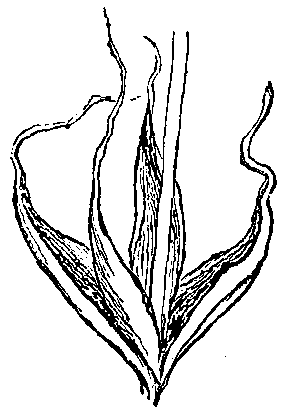 Fig
Fig. 1.
5. Fastening on that, I take the Flora Danica,[7] and look through its plates of mosses,
for their leaves only; and I find, first, that this spike, or strong
central rib, is characteristic;—secondly, that the said leaves are
apt to be not only spiked, but serrated, and otherwise angry-looking at
the points;—thirdly, that they have a tendency to fold together in
the centre (Fig. 1[8]); and
at last, after an hour's work at them, it strikes me suddenly that they
are more like pineapple leaves than anything else.
And it occurs to me, very unpleasantly, at the same time, that I don't
know what a pineapple is!
Stopping to ascertain that, I am told that a pineapple belongs to the
'Bromeliaceæ'—(can't stop to find out what that means)—nay,
that of these plants "the pineapple is the representative" (Loudon);
"their habit is acid, their leaves rigid, and toothed with spines, their
bracteas often coloured with scarlet, and their flowers either white or
blue"—(what are their flowers like?) But the two sentences that
most interest me, are, that in the damp forests of Carolina, the
Tillandsia, which is an 'epiphyte' (i.e., a plant growing on other
plants,) "forms dense festoons among the branches of the trees,
vegetating among the black mould that collects upon the bark of trees in
hot damp countries; other species are inhabitants of deep and gloomy
forests, and others form, with their spring leaves, an impenetrable
herbage in the Pampas of Brazil." So they really seem to be a kind of
moss, on a vast scale.
6. Next, I find in Gray,[9] Bromeliaceæ, and—the very thing I
want—"Tillandsia, the black moss, or long moss, which,
like most Bromelias, grows on the branches of trees." So the
pineapple is really a moss; only it is a moss that flowers but
'imperfectly.' "The fine fruit is caused by the consolidation of the
imperfect flowers." (I wish we could consolidate some imperfect English
moss-flowers into little pineapples then,—though they were only as
big as filberts.) But we cannot follow that farther now; nor consider
when a flower is perfect, and when it is not, or we should get into
morals, and I don't know where else; we will go back to the moss I have
gathered, for I begin to see my way, a little, to understanding it.
7. The second piece I have on the table is a cluster—an inch or
two deep—of the moss that grows everywhere, and that the birds use
for nest-building, and we for packing, and the like. It is dry, since
yesterday, and its fibres define themselves against the dark ground in
warm green, touched with a glittering light. Note that burnished lustre
of the minute leaves; they are necessarily always relieved against dark
hollows, and this lustre makes them much clearer and brighter than if
they were of dead green. In that lustre—and it is characteristic of
them—they differ wholly from the dead, aloe-like texture of the
pineapple leaf; and remind me, as I look at them closely, a little of
some conditions of chaff, as on heads of wheat after being threshed. I
will hunt down that clue presently; meantime there is something else to
be noticed on the old brick.
 Fig
Fig. 2.
8. Out of its emerald green cushions of minute leaves, there rise,
here and there, thin red threads, each with a little brown cap, or
something like a cap, at the top of it. These red threads shooting up out
of the green tufts, are, I believe, the fructification of the moss;
fringing its surface in the woods, and on the rocks, with the small
forests of brown stems, each carrying its pointed cap or crest—of
infinitely varied 'mode,' as we shall see presently; and, which is one of
their most blessed functions, carrying high the dew in the morning; every
spear balancing its own crystal globe.
9. And now, with my own broken memories of moss and this unbroken,
though unfinished, gift of the noble labour of other people, the Flora
Danica, I can generalize the idea of the precious little plant, for
myself, and for the reader.
All mosses, I believe, (with such exceptions and collateral groups as
we may afterwards discover, but they are not many,) that is to say, some
thousands of species, are, in their strength of existence, composed of
fibres surrounded by clusters of dry spinous leaves, set close to
the fibre they grow on. Out of this leafy stern descends a fibrous root,
and ascends in its season, a capped seed.
We must get this very clearly into our heads. Fig. 2, A, is a little tuft of a common wood moss of
Norway,[10] in its fruit
season, of its real size; but at present I want to look at the central
fibre and its leaves accurately, and understand that first.
10. Pulling it to pieces, we find it composed of seven little
company-keeping fibres, each of which, by itself, appears as in Fig. 2,
B: but as in this, its real size, it is too
small, not indeed for our respect, but for our comprehension, we magnify
it, Fig. 2, C, and thereupon perceive it to be
indeed composed of, a, the small fibrous root which sustains the
plant; b, the leaf-surrounded stem which is the actual being, and
main creature, moss; and, c, the aspirant pillar, and cap, of its
fructification.
11. But there is one minor division yet. You see I have drawn the
central part of the moss plant (b, Fig. 2,) half in outline and
half in black; and that, similarly, in the upper group, which is too
small to show the real roots, the base of the cluster is black. And you
remember, I doubt not, how often in gathering what most invited
gathering, of deep green, starry, perfectly soft and living wood-moss,
you found it fall asunder in your hand into multitudes of separate
threads, each with its bright green crest, and long root of
blackness.
That blackness at the root—though only so notable in this
wood-moss and collateral species, is indeed a general character of the
mosses, with rare exceptions. It is their funeral blackness;—that,
I perceive, is the way the moss leaves die. They do not fall—they
do not visibly decay. But they decay invisibly, in continual
secession, beneath the ascending crest. They rise to form that crest, all
green and bright, and take the light and air from those out of which they
grew;—and those, their ancestors, darken and die slowly, and at
last become a mass of mouldering ground. In fact, as I perceive farther,
their final duty is so to die. The main work of other leaves is in their
life,—but these have to form the earth out of which all other
leaves are to grow. Not to cover the rocks with golden velvet only, but
to fill their crannies with the dark earth, through which nobler
creatures shall one day seek their being.
12. "Grant but as many sorts of mind as moss." Pope could not have
known the hundredth part of the number of 'sorts' of moss there are; and
I suppose he only chose the word because it was a monosyllable beginning
with m, and the best English general expression for despised and minute
structures of plants. But a fate rules the words of wise men, which makes
their words truer, and worth more, than the men themselves know. No other
plants have so endless variety on so similar a structure as the mosses;
and none teach so well the humility of Death. As for the death of our
bodies, we have learned, wisely, or unwisely, to look the fact of that in
the face. But none of us, I think, yet care to look the fact of the death
of our minds in the face. I do not mean death of our souls, but of our
mental work. So far as it is good art, indeed, and done in
realistic form, it may perhaps not die; but so far as it was only good
thought—good, for its time, and apparently a great
achievement therein—that good, useful thought may yet in the future
become a foolish thought, and then die quite away,—it, and the
memory of it,—when better thought and knowledge come. But the
better thought could not have come if the weaker thought had not come
first, and died in sustaining the better. If we think
honestly, our thoughts will not only live usefully, but even perish
usefully—like the moss—and become dark, not without due
service. But if we think dishonestly, or malignantly, our thoughts will
die like evil fungi,—dripping corrupt dew.
13. But farther. If you have walked moorlands enough to know the look
of them, you know well those flat spaces or causeways of bright green or
golden ground between the heathy rock masses; which signify winding pools
and inlets of stagnant water caught among the rocks;—pools which
the deep moss that covers them—blanched, not black, at the
root,—is slowly filling and making firm; whence generally the
unsafe ground in the moorland gets known by being mossy instead of
heathy; and is at last called by its riders, briefly, 'the Moss': and as
it is mainly at these same mossy places that the riding is difficult, and
brings out the gifts of horse and rider, and discomfits all followers not
similarly gifted, the skilled crosser of them got his name, naturally, of
'moss-rider,' or moss-trooper. In which manner the moss of Norway and
Scotland has been a taskmaster and Maker of Soldiers, as yet, the
strongest known among natural powers. The lightning may kill a man, or
cast down a tower, but these little tender leaves of moss—they and
their progenitors—have trained the Northern Armies.
14. So much for the human meaning of that decay of the leaves. Now to
go back to the little creatures themselves. It seems that the upper part
of the moss fibre is especially undecaying among leaves;
and the lower part, especially decaying. That, in fact, a plant of
moss-fibre is a kind of persistent state of what is, in other plants,
annual. Watch the year's growth of any luxuriant flower. First it comes
out of the ground all fresh and bright; then, as the higher leaves and
branches shoot up, those first leaves near the ground get brown, sickly,
earthy,—remain for ever degraded in the dust, and under the dashed
slime in rain, staining, and grieving, and loading them with obloquy of
envious earth, half-killing them,—only life enough left in them to
hold on the stem, and to be guardians of the rest of the plant from all
they suffer;—while, above them, the happier leaves, for whom they
are thus oppressed, bend freely to the sunshine, and drink the rain
pure.
The moss strengthens on a diminished scale, intensifies, and makes
perpetual, these two states,—bright leaves above that never wither,
leaves beneath that exist only to wither.
15. I have hitherto spoken only of the fading moss as it is needed for
change into earth. But I am not sure whether a yet more important office,
in its days of age, be not its use as a colour.
We are all thankful enough—as far as we ever are so—for
green moss, and yellow moss. But we are never enough grateful for black
moss. The golden would be nothing without it, nor even the grey.
It is true that there are black lichens enough, and brown ones:
nevertheless, the chief use of lichens is for silver and gold colour on
rocks; and it is the dead moss which gives the leopard-like touches of
black. And yet here again—as to a thing I have been looking at and
painting all my life—I am brought to pause, the moment I think of
it carefully. The black moss which gives the precious Velasquez touches,
lies, much of it, flat on the rocks; radiating from its
centres—powdering in the fingers, if one breaks it off, like dry
tea. Is it a black species?—or a black-parched state of other
species, perishing for the sake of Velasquez effects, instead of
accumulation of earth? and, if so, does it die of drought, accidentally,
or, in a sere old age, naturally? and how is it related to the rich green
bosses that grow in deep velvet? And there again is another matter not
clear to me. One calls them 'velvet' because they are all brought to an
even surface at the top. Our own velvet is reduced to such trimness by
cutting. But how is the moss trimmed? By what scissors? Carefullest
Elizabethan gardener never shaped his yew hedge more daintily than the
moss fairies smooth these soft rounded surfaces of green and gold. And
just fancy the difference, if they were ragged! If the fibres had every
one of them leave to grow at their own sweet will, and to be long or
short as they liked, or, worse still, urged by fairy prizes into
laboriously and agonizingly trying which could grow longest. Fancy the
surface of a spot of competitive moss!
16. But how is it that they are subdued into that spherical
obedience, like a crystal of wavellite?[11] Strange—that the vegetable
creatures growing so fondly on rocks should form themselves in that
mineral-like manner. It is true that the tops of all well-grown trees are
rounded, on a large scale, as equally; but that is because they grow from
a central stem, while these mossy mounds are made out of independent
filaments, each growing to exactly his proper height in the
sphere—short ones outside, long in the middle. Stop, though;
is that so? I am not even sure of that; perhaps they are built
over a little dome of decayed moss below.[12] I must find out how every filament grows,
separately—from root to cap, through the spirally set leaves. And
meanwhile I don't know very clearly so much as what a root is—or
what a leaf is. Before puzzling myself any farther in examination either
of moss or any other grander vegetable, I had better define these primal
forms of all vegetation, as well as I can—or rather begin the
definition of them, for future completion and correction. For, as my
reader must already sufficiently perceive, this book is literally to be
one of studies—not of statements. Some one said of me once, very
shrewdly, When he wants to work out a subject, he writes a book on it.
That is a very true saying in the main,—I work down or up to my
mark, and let the reader see process and progress, not caring to conceal
them. But this book will be nothing but process. I don't mean to assert
anything positively in it from the first page to the last. Whatever I
say, is to be understood only as a conditional statement—liable to,
and inviting, correction. And this the more because, as on the whole, I
am at war with the botanists, I can't ask them to help me, and then call
them names afterwards. I hope only for a contemptuous heaping of coals on
my head by correction of my errors from them;—in some cases, my
scientific friends will, I know, give me forgiving aid;—but, for
many reasons, I am forced first to print the imperfect statement, as I
can independently shape it; for if once I asked for, or received help,
every thought would be frostbitten into timid expression, and every
sentence broken by apology. I should have to write a dozen of letters
before I could print a line, and the line, at last, would be only like a
bit of any other botanical book—trustworthy, it might be, perhaps;
but certainly unreadable. Whereas now, it will rather put things more
forcibly in the reader's mind to have them retouched and corrected as we
go on; and our natural and honest mistakes will often be suggestive of
things we could not have discovered but by wandering.
On these guarded conditions, then, I proceed to study, with my reader,
the first general laws of vegetable form.
THE ROOT.
1. Plants in their perfect form consist of four principal
parts,—the Root, Stem, Leaf, and Flower. It is true that the stem
and flower are parts, or remnants, or altered states, of the leaves; and
that, speaking with close accuracy, we might say, a perfect plant
consists of leaf and root. But the division into these four parts is best
for practical purposes, and it will be desirable to note a few general
facts about each, before endeavouring to describe any one kind of plant.
Only, because the character of the stem depends on the nature of the leaf
and flower, we must put it last in order of examination; and trace the
development of the plant first in root and leaf; then in the flower and
its fruit; and lastly in the stem.
2. First, then, the Root.
Every plant is divided, as I just said, in the main, into two parts,
and these have opposite natures. One part seeks the light; the other
hates it. One part feeds on the air; the other on the dust.
The part that loves the light is called the Leaf. It is an old Saxon
word; I cannot get at its origin. The part that hates the light is called
the Root.
In Greek, ῥίζα, Rhiza.[13]
In Latin, Radix, "the growing thing," which shortens, in French, into
Race, and then they put on the diminutive 'ine,' and get their two words,
Race, and Racine, of which we keep Race for animals, and use for
vegetables a word of our own Saxon (and Dutch) dialect,—'root';
(connected with Rood—an image of wood; whence at last the Holy
Rood, or Tree).
3. The Root has three great functions:
1st. To hold the plant in its place.
2nd. To nourish it with earth.
3rd. To receive vital power for it from the earth.
With this last office is in some degree,—and especially in
certain plants,—connected, that of reproduction.
But in all plants the root has these three essential functions.
First, I said, to hold the Plant in its place. The Root is its
Fetter.
You think it, perhaps, a matter of course that a plant is not to be a
crawling thing? It is not a matter of course at all. A vegetable might be
just what it is now, as compared with an animal;—might live on
earth and water instead of on meat,—might be as senseless in life,
as calm in death, and in all its parts and apparent structure unchanged;
and yet be a crawling thing. It is quite as easy to conceive plants
moving about like lizards, putting forward first one root and then
another, as it is to think of them fastened to their place. It might have
been well for them, one would have thought, to have the power of going
down to the streams to drink, in time of drought;—of migrating in
winter with grim march from north to south of Dunsinane Hill side. But
that is not their appointed Fate. They are—at least all the noblest
of them, rooted to their spot. Their honour and use is in giving
immoveable shelter,—in remaining landmarks, or lovemarks, when all
else is changed:
"The cedars wave on Lebanon,
But Judah's statelier maids are gone."
4. Its root is thus a form of fate to the tree. It condemns, or
indulges it, in its place. These semi-living creatures, come what may,
shall abide, happy, or tormented. No doubt concerning "the position in
which Providence has placed them" is to trouble their minds,
except so far as they can mend it by seeking light, or shrinking from
wind, or grasping at support, within certain limits. In the thoughts of
men they have thus become twofold images,—on the one side, of
spirits restrained and half destroyed, whence the fables of
transformation into trees; on the other, of spirits patient and
continuing, having root in themselves and in good ground, capable of all
persistent effort and vital stability, both in
themselves, and for the human States they form.
5. In this function of holding fast, roots have a power of grasp quite
different from that of branches. It is not a grasp, or clutch by
contraction, as that of a bird's claw, or of the small branches we call
'tendrils' in climbing plants. It is a dead, clumsy, but inevitable
grasp, by swelling, after contortion. For there is this main
difference between a branch and root, that a branch cannot grow vividly
but in certain directions and relations to its neighbour branches; but a
root can grow wherever there is earth, and can turn in any direction to
avoid an obstacle.[14]
6. In thus contriving access for itself where it chooses, a root
contorts itself into more serpent-like writhing than branches can; and
when it has once coiled partly round a rock, or stone, it grasps it
tight, necessarily, merely by swelling. Now a root has force enough
sometimes to split rocks, but not to crush them; so it is compelled to
grasp by flattening as it thickens; and, as it must have room
somewhere, it alters its own shape as if it were made of dough, and
holds the rock, not in a claw, but in a wooden cast or mould, adhering to
its surface. And thus it not only finds its anchorage in the rock, but
binds the rocks of its anchorage with a constrictor cable.
7. Hence—and this is a most important secondary
function—roots bind together the ragged edges of rocks as a hem
does the torn edge of a dress: they literally stitch the stones together;
so that, while it is always dangerous to pass under a treeless edge of
overhanging crag, as soon as it has become beautiful with trees, it is
safe also. The rending power of roots on rocks has been greatly
overrated. Capillary attraction in a willow wand will indeed split
granite, and swelling roots sometimes heave considerable masses aside,
but on the whole, roots, small and great, bind, and do not rend.[15] The surfaces of mountains
are dissolved and disordered, by rain, and frost, and chemical
decomposition, into mere heaps of loose stones on their desolate summits;
but, where the forests grow, soil accumulates and disintegration ceases.
And by cutting down forests on great mountain slopes, not only is the
climate destroyed, but the danger of superficial landslip fearfully
increased.
8. The second function of roots is to gather for the plant the
nourishment it needs from the ground. This is partly water, mixed with
some kinds of air (ammonia, etc.,) but the plant can get both water and
ammonia from the atmosphere; and, I believe, for the most part does so;
though, when it cannot get water from the air, it will gladly drink by
its roots. But the things it cannot receive from the air at all are
certain earthy salts, essential to it (as iron is essential in our own
blood), and of which when it has quite exhausted the earth, no more such
plants can grow in that ground. On this subject you will find enough in
any modern treatise on agriculture; all that I want you to note here is
that this feeding function of the root is of a very delicate and
discriminating kind, needing much searching and mining among the dust, to
find what it wants. If it only wanted water, it could get most of that by
spreading in mere soft senseless limbs, like sponge, as far, and as far
down, as it could—but to get the salt out of the earth it
has to sift all the earth, and taste and touch every grain of it
that it can, with fine fibres. And therefore a root is not at all a
merely passive sponge or absorbing thing, but an infinitely subtle
tongue, or tasting and eating thing. That is why it is always so fibrous
and divided and entangled in the clinging earth.
9. "Always fibrous and divided"? But many roots are quite hard and
solid!
No; the active part of the root is always, I believe, a fibre. But
there is often a provident and passive part—a savings bank of
root—in which nourishment is laid up for the plant, and which,
though it may be underground, is no more to be considered
its real root than the kernel of a seed is. When you sow a pea, if you
take it up in a day or two, you will find the fibre below, which is root;
the shoot above, which is plant; and the pea as a now partly exhausted
storehouse, looking very woful, and like the granaries of Paris after the
fire. So, the round solid root of a cyclamen, or the conical one which
you know so well as a carrot, are not properly roots, but permanent
storehouses,—only the fibres that grow from them are roots. Then
there are other apparent roots which are not even storehouses, but
refuges; houses where the little plant lives in its infancy, through
winter and rough weather. So that it will be best for you at once to
limit your idea of a root to this,—that it is a group of growing
fibres which taste and suck what is good for the plant out of the ground,
and by their united strength hold it in its place; only remember the
thick limbs of roots do not feed, but only the fine fibres at the ends of
them which are something between tongues and sponges, and while they
absorb moisture readily, are yet as particular about getting what they
think nice to eat as any dainty little boy or girl; looking for it
everywhere, and turning angry and sulky if they don't get it.
10. But the root has, it seems to me, one more function, the most
important of all. I say, it seems to me, for observe, what I have
hitherto told you is all (I believe) ascertained and admitted; this that
I am going to tell you has not yet, as far as I know, been asserted by
men of science, though I believe it to be
demonstrable. But you are to examine into it, and think of it for
yourself.
There are some plants which appear to derive all their food from the
air—which need nothing but a slight grasp of the ground to fix them
in their place. Yet if we were to tie them into that place, in a
framework, and cut them from their roots, they would die. Not only in
these, but in all other plants, the vital power by which they shape and
feed themselves, whatever that power may be, depends, I think, on that
slight touch of the earth, and strange inheritance of its power. It is as
essential to the plant's life as the connection of the head of an animal
with its body by the spine is to the animal. Divide the feeble nervous
thread, and all life ceases. Nay, in the tree the root is even of greater
importance. You will not kill the tree, as you would an animal, by
dividing its body or trunk. The part not severed from the root will shoot
again. But in the root, and its touch of the ground, is the life of it.
My own definition of a plant would be "a living creature whose source of
vital energy is in the earth" (or in the water, as a form of the earth;
that is, in inorganic substance). There is, however, one tribe of plants
which seems nearly excepted from this law. It is a very strange one,
having long been noted for the resemblance of its flowers to different
insects; and it has recently been proved by Mr. Darwin to be dependent on
insects for its existence. Doubly strange therefore, it seems, that in
some cases this race of plants all but reaches the independent life of
insects. It rather settles upon boughs than roots itself in them;
half of its roots may wave in the air.
11. What vital power is, men of science are not a step nearer knowing
than they were four thousand years ago. They are, if anything, farther
from knowing now than then, in that they imagine themselves nearer. But
they know more about its limitations and manifestations than they did.
They have even arrived at something like a proof that there is a fixed
quantity of it flowing out of things and into them. But, for the present,
rest content with the general and sure knowledge that, fixed or flowing,
measurable or immeasurable—one with electricity or heat or light,
or quite distinct from any of them—life is a delightful, and its
negative, death, a dreadful thing, to human creatures; and that you can
give or gather a certain quantity of life into plants, animals, and
yourself by wisdom and courage, and by their reverses can bring upon them
any quantity of death you please, which is a much more serious point for
you to consider than what life and death are.
12. Now, having got a quite clear idea of a root properly so called,
we may observe what those storehouses, refuges, and ruins are, which we
find connected with roots. The greater number of plants feed and grow at
the same time; but there are some of them which like to feed first and
grow afterwards. For the first year, or, at all events, the first period
of their life, they gather material for their future life out of the
ground and out of the air, and lay it up in a storehouse
as bees make combs. Of these stores—for the most part rounded
masses tapering downwards into the ground—some are as good for
human beings as honeycombs are; only not so sweet. We steal them from the
plants, as we do from the bees, and these conical upside-down hives or
treasuries of Atreus, under the names of carrots, turnips, and radishes,
have had important influence on human fortunes. If we do not steal the
store, next year the plant lives upon it, raises its stem, flowers and
seeds out of that abundance, and having fulfilled its destiny, and
provided for its successor, passes away, root and branch together.
13. There is a pretty example of patience for us in this; and it would
be well for young people generally to set themselves to grow in a
carrotty or turnippy manner, and lay up secret store, not caring to
exhibit it until the time comes for fruitful display. But they must not,
in after-life, imitate the spendthrift vegetable, and blossom only in the
strength of what they learned long ago; else they soon come to
contemptible end. Wise people live like laurels and cedars, and go on
mining in the earth, while they adorn and embalm the air.
14. Secondly, Refuges. As flowers growing on trees have to live for
some time, when they are young in their buds, so some flowers growing on
the ground have to live for a while, when they are young, in what
we call their roots. These are mostly among the Drosidæ[16] and other humble tribes,
loving the ground; and, in their babyhood, liking to live quite down in
it. A baby crocus has literally its own little dome—domus, or
duomo—within which in early spring it lives a delicate convent life
of its own, quite free from all worldly care and dangers, exceedingly
ignorant of things in general, but itself brightly golden and perfectly
formed before it is brought out. These subterranean palaces and vaulted
cloisters, which we call bulbs, are no more roots than the blade of grass
is a root, in which the ear of corn forms before it shoots up.
15. Thirdly, Ruins. The flowers which have these subterranean homes
form one of many families whose roots, as well as seeds, have the power
of reproduction. The succession of some plants is trusted much to their
seeds: a thistle sows itself by its down, an oak by its acorns; the
companies of flying emigrants settle where they may; and the shadowy tree
is content to cast down its showers of nuts for swines' food with the
chance that here and there one may become a ship's bulwark. But others
among plants are less careless, or less proud. Many are anxious for their
children to grow in the place where they grew themselves, and secure this
not merely by letting their fruit fall at their feet, on the chance of
its growing up beside them, but by closer bond, bud
springing forth from root, and the young plant being animated by the
gradually surrendered life of its parent. Sometimes the young root is
formed above the old one, as in the crocus, or beside it, as in the
amaryllis, or beside it in a spiral succession, as in the orchis; in
these cases the old root always perishes wholly when the young one is
formed; but in a far greater number of tribes, one root connects itself
with another by a short piece of intermediate stem; and this stem does
not at once perish when the new root is formed, but grows on at one end
indefinitely, perishing slowly at the other, the scars or ruins of the
past plants being long traceable on its sides. When it grows entirely
underground it is called a root-stock. But there is no essential
distinction between a root-stock and a creeping stem, only the root-stock
may be thought of as a stem which shares the melancholy humour of a root
in loving darkness, while yet it has enough consciousness of better
things to grow towards, or near, the light. In one family it is even
fragrant where the flower is not, and a simple houseleek is called
'rhodiola rosea,' because its root-stock has the scent of a rose.
16. There is one very unusual condition of the root-stock which has
become of much importance in economy, though it is of little in botany;
the forming, namely, of knots at the ends of the branches of the
underground stem, where the new roots are to be thrown out. Of these
knots, or 'tubers,' (swollen things,) one kind, belonging to the tobacco
tribe, has been singularly harmful, together with its pungent relative,
to a neighbouring country of ours, which perhaps may reach a higher
destiny than any of its friends can conceive for it, if it can ever
succeed in living without either the potato, or the pipe.
17. Being prepared now to find among plants many things which are like
roots, yet are not; you may simplify and make fast your true idea of a
root as a fibre or group of fibres, which fixes, animates, and partly
feeds the leaf. Then practically, as you examine plants in detail, ask
first respecting them: What kind of root have they? Is it large or small
in proportion to their bulk, and why is it so? What soil does it like,
and what properties does it acquire from it? The endeavour to answer
these questions will soon lead you to a rational inquiry into the plant's
history. You will first ascertain what rock or earth it delights in, and
what climate and circumstances; then you will see how its root is fitted
to sustain it mechanically under given pressures and violences, and to
find for it the necessary sustenance under given difficulties of famine
or drought. Lastly you will consider what chemical actions appear to be
going on in the root, or its store; what processes there are, and
elements, which give pungency to the radish, flavour to the onion, or
sweetness to the liquorice; and of what service each root may be made
capable under cultivation, and by proper subsequent treatment, either to
animals or men.
18. I shall not attempt to do any of this for you; I assume, in
giving this advice, that you wish to pursue the science of botany as your
chief study; I have only broken moments for it, snatched from my chief
occupations, and I have done nothing myself of all this I tell you to do.
But so far as you can work in this manner, even if you only ascertain the
history of one plant, so that you know that accurately, you will have
helped to lay the foundation of a true science of botany, from which the
mass of useless nomenclature,[17] now mistaken for science, will fall
away, as the husk of a poppy falls from the bursting flower.
THE LEAF.
1. In the first of the poems of which the English Government has
appointed a portion to be sung every day for the instruction and pleasure
of the people, there occurs this curious statement respecting any person
who will behave himself rightly: "He shall be like a tree planted by the
river side, that bears its fruit in its season. His leaf also shall not
wither; and you will see that whatever he does will prosper."
I call it a curious statement, because the conduct to which this
prosperity is promised is not that which the English, as a nation, at
present think conducive to prosperity: but whether the statement be true
or not, it will be easy for you to recollect the two eastern figures
under which the happiness of the man is represented,—that he is
like a tree bearing fruit "in its season;" (not so hastily as that the
frost pinch it, nor so late that no sun ripens it;) and that "his leaf
shall not fade." I should like you to recollect this phrase in the
Vulgate—"folium ejus non defluet"—shall not fall
away,—that is to say, shall not fall so as to leave any
visible bareness in winter time, but only that others may
come up in its place, and the tree be always green.
2. Now, you know, the fruit of the tree is either
for the continuance of its race, or for the good, or harm, of other
creatures. In no case is it a good to the tree itself. It is not indeed,
properly, a part of the tree at all, any more than the egg is part of the
bird, or the young of any creature part of the creature itself. But in
the leaf is the strength of the tree itself. Nay, rightly speaking, the
leaves are the tree itself. Its trunk sustains; its fruit burdens
and exhausts; but in the leaf it breathes and lives. And thus also, in
the eastern symbolism, the fruit is the labour of men for others; but the
leaf is their own life. "He shall bring forth fruit, in his time; and his
own joy and strength shall be continual."
3. Notice next the word 'folium.' In Greek, φυλλον, 'phyllon.'
"The thing that is born," or "put forth." "When the branch is tender,
and putteth forth her leaves, ye know that summer is nigh." The botanists
say, "The leaf is an expansion of the bark of the stem." More accurately,
the bark is a contraction of the tissue of the leaf. For every leaf is
born out of the earth, and breathes out of the air; and there are many
leaves that have no stems, but only roots. It is 'the springing thing';
this thin film of life; rising, with its edge out of the
ground—infinitely feeble, infinitely fair. With Folium, in Latin,
is rightly associated the word Flos; for the flower is only a group of
singularly happy leaves. From these two roots come foglio, feuille,
feuillage, and fleur;—blume, blossom, and bloom; our foliage, and
the borrowed foil, and the connected technical groups of words in
architecture and the sciences.
4. This thin film, I said. That is the essential character of a
leaf; to be thin,—widely spread out in proportion to its mass. It
is the opening of the substance of the earth to the air, which is the
giver of life. The Greeks called it, therefore, not only the born or
blooming thing, but the spread or expanded thing—"πεταλον." Pindar calls the
beginnings of quarrel, "petals of quarrel." Recollect, therefore, this
form, Petalos; and connect it with Petasos, the expanded cap of Mercury.
For one great use of both is to give shade. The root of all these words
is said to be ΠΕΤ (Pet), which may easily be remembered in
Greek, as it sometimes occurs in no unpleasant sense in English.
5. But the word 'petalos' is connected in Greek with another word,
meaning, to fly,—so that you may think of a bird as spreading its
petals to the wind; and with another, signifying Fate in its pursuing
flight, the overtaking thing, or overflying Fate. Finally, there is
another Greek word meaning 'wide,' πλατυς (platys); whence at
last our 'plate'—a thing made broad or extended—but
especially made broad or 'flat' out of the solid, as in a lump of clay
extended on the wheel, or a lump of metal extended by the hammer. So the
first we call Platter; the second Plate, when of the precious metals.
Then putting b for p, and d for t, we get
the blade of an oar, and blade of grass.
6. Now gather a branch of laurel, and look at it carefully. You may
read the history of the being of half the earth in one of those green
oval leaves—the things that the sun and the rivers have made out of
dry ground. Daphne—daughter of Enipeus, and beloved by the
Sun,—that fable gives you at once the two great facts about
vegetation. Where warmth is, and moisture—there, also, the leaf.
Where no warmth—there is no leaf; where there is no dew—no
leaf.
7. Look, then, to the branch you hold in your hand. That you
can so hold it, or make a crown of it, if you choose, is the first
thing I want you to note of it;—the proportion of size, namely,
between the leaf and you. Great part of your life and character,
as a human creature, has depended on that. Suppose all leaves had been
spacious, like some palm leaves; solid, like cactus stem; or that trees
had grown, as they might of course just as easily have grown, like
mushrooms, all one great cluster of leaf round one stalk. I do not say
that they are divided into small leaves only for your delight, or your
service, as if you were the monarch of everything—even in this atom
of a globe. You are made of your proper size; and the leaves of theirs:
for reasons, and by laws, of which neither the leaves nor you know
anything. Only note the harmony between both, and the joy we may have in
this division and mystery of the frivolous and tremulous petals, which
break the light and the breeze,—compared to what with the frivolous
and tremulous mind which is in us, we could have had out of domes, or
penthouses, or walls of leaf.
8. Secondly; think awhile of its dark clear green, and the good of it
to you. Scientifically, you know green in leaves is owing to
'chlorophyll,' or, in English, to 'greenleaf.' It may be very fine to
know that; but my advice to you, on the whole, is to rest content with
the general fact that leaves are green when they do not grow in or near
smoky towns; and not by any means to rest content with the fact that very
soon there will not be a green leaf in England, but only greenish-black
ones. And thereon resolve that you will yourself endeavour to promote the
growing of the green wood, rather than of the black.
9. Looking at the back of your laurel-leaves, you see how the central
rib or spine of each, and the lateral branchings, strengthen and carry
it. I find much confused use, in botanical works, of the words Vein and
Rib. For, indeed, there are veins in the ribs of leaves, as marrow
in bones; and the projecting bars often gradually depress themselves into
a transparent net of rivers. But the mechanical force of the
framework in carrying the leaf-tissue is the point first to be noticed;
it is that which admits, regulates, or restrains the visible motions of
the leaf; while the system of circulation can only be studied through the
microscope. But the ribbed leaf bears itself to the wind, as the webbed
foot of a bird does to the water, and needs the same kind, though not
the same strength, of support; and its ribs always are partly therefore
constituted of strong woody substance, which is knit out of the tissue;
and you can extricate this skeleton framework, and keep it, after the
leaf-tissue is dissolved. So I shall henceforward speak simply of the
leaf and its ribs,—only specifying the additional veined structure
on necessary occasions.
10. I have just said that the ribs—and might have said, farther,
the stalk that sustains them—are knit out of the tissue of
the leaf. But what is the leaf tissue itself knit out of? One would think
that was nearly the first thing to be discovered, or at least to be
thought of, concerning plants,—namely, how and of what they are
made. We say they 'grow.' But you know that they can't grow out of
nothing;—this solid wood and rich tracery must be made out of some
previously existing substance. What is the substance?—and how is it
woven into leaves.—twisted into wood?
11. Consider how fast this is done, in spring. You walk in February
over a slippery field, where, through hoar-frost and mud, you perhaps
hardly see the small green blades of trampled turf. In twelve weeks you
wade through the same field up to your knees in fresh grass; and in a
week or two more, you mow two or three solid haystacks off it. In winter
you walk by your currant-bush, or your vine. They are shrivelled
sticks—like bits of black tea in the canister. You pass again in
May, and the currant-bush looks like a young
sycamore tree; and the vine is a bower: and meanwhile the forests, all
over this side of the round world, have grown their foot or two in
height, with new leaves—so much deeper, so much denser than they
were. Where has it all come from? Cut off the fresh shoots from a single
branch of any tree in May. Weigh them; and then consider that so much
weight has been added to every such living branch, everywhere, this side
the equator, within the last two months. What is all that made of?
12. Well, this much the botanists really know, and tell us,—It
is made chiefly of the breath of animals: that is to say, of the
substance which, during the past year, animals have breathed into the
air; and which, if they went on breathing, and their breath were not made
into trees, would poison them, or rather suffocate them, as people are
suffocated in uncleansed pits, and dogs in the Grotta del Cane. So that
you may look upon the grass and forests of the earth as a kind of green
hoar-frost, frozen upon it from our breath, as, on the window-panes, the
white arborescence of ice.
13. But how is it made into wood?
The substances that have been breathed into the air are charcoal, with
oxygen and hydrogen,—or, more plainly, charcoal and water. Some
necessary earths,—in smaller quantity, but absolutely
essential,—the trees get from the ground; but, I believe all the
charcoal they want, and most of the water, from the air. Now the question
is, where and how do they take it in, and digest it into wood?
14. You know, in spring, and partly through all the year, except in
frost, a liquid called 'sap' circulates in trees, of which the nature,
one should have thought, might have been ascertained by mankind in the
six thousand years they have been cutting wood. Under the impression
always that it had been ascertained, and that I could at any time
know all about it, I have put off till to-day, 19th October, 1869, when I
am past fifty, the knowing anything about it at all. But I will really
endeavour now to ascertain something, and take to my botanical books,
accordingly, in due order.
(1) Dresser's "Rudiments of Botany." 'Sap' not in the index; only
Samara, and Sarcocarp,—about neither of which I feel the smallest
curiosity. (2) Figuier's "Histoire des Plantes."[18] 'Sêve,' not in index; only Serpolet,
and Sherardia arvensis, which also have no help in them for me. (3)
Balfour's "Manual of Botany." 'Sap,'—yes, at last. "Article 257.
Course of fluids in exogenous stems." I don't care about the course just
now: I want to know where the fluids come from. "If a plant be plunged
into a weak solution of acetate of lead,"—I don't in the least want
to know what happens. "From the minuteness of the tissue, it is not easy
to determine the vessels through which the sap moves." Who said it was?
If it had been easy, I should have done it myself. "Changes take place in
the composition of the sap in its upward course." I dare say; but
I don't know yet what its composition is before it begins going up. "The
Elaborated Sap by Mr. Schultz has been called 'latex.'" I wish Mr.
Schultz were in a hogshead of it, with the top on. "On account of these
movements in the latex, the laticiferous vessels have been denominated
cinenchymatous." I do not venture to print the expressions which I here
mentally make use of.
15. Stay,—here, at last, in Article 264, is something to the
purpose: "It appears then that, in the case of Exogenous plants, the
fluid matter in the soil, containing different substances in solution, is
sucked up by the extremities of the roots." Yes, but how of the pine
trees on yonder rock?—Is there any sap in the rock, or water
either? The moisture must be seized during actual rain on the root, or
stored up from the snow; stored up, any way, in a tranquil, not actively
sappy, state, till the time comes for its change, of which there is no
account here.
16. I have only one chance left now. Lindley's "Introduction to
Botany." 'Sap,'—yes,—'General motion of.' II. 325. "The
course which is taken by the sap, after entering a plant, is the first
subject for consideration." My dear doctor, I have learned nearly
whatever I know of plant structure from you, and am grateful; and that it
is little, is not your fault, but mine. But this—let me say it with
all sincere respect—is not what you should have told me here. You
know, far better than I, that 'sap' never does enter a plant at all; but
only salt, or earth and water, and that the roots alone could not make it;
and that, therefore, the course of it must be, in great part, the result
or process of the actual making. But I will read now, patiently; for I
know you will tell me much that is worth hearing, though not perhaps what
I want.
Yes; now that I have read Lindley's statement carefully, I find it is
full of precious things; and this is what, with thinking over it, I can
gather for you.
17. First, towards the end of January,—as the light enlarges,
and the trees revive from their rest,—there is a general
liquefaction of the blood of St. Januarius in their stems; and I suppose
there is really a great deal of moisture rapidly absorbed from the earth
in most cases; and that this absorption is a great help to the sun in
drying the winter's damp out of it for us: then, with that strange vital
power,—which scientific people are usually as afraid of naming as
common people are afraid of naming Death,—the tree gives the
gathered earth and water a changed existence; and to this new-born liquid
an upward motion from the earth, as our blood has from the heart; for the
life of the tree is out of the earth; and this upward motion has a
mechanical power in pushing on the growth. "Forced onward by the
current of sap, the plumule ascends," (Lindley, p. 132,)—this blood
of the tree having to supply, exactly as our own blood has, not only the
forming powers of substance, but a continual evaporation, "approximately
seventeen times more than that of the human body," while the force of
motion in the sap "is sometimes five times greater than that
which impels the blood in the crural artery of the horse."
18. Hence generally, I think we may conclude thus much,—that at
every pore of its surface, under ground and above, the plant in the
spring absorbs moisture, which instantly disperses itself through its
whole system "by means of some permeable quality of the membranes of the
cellular tissue invisible to our eyes even by the most powerful glasses"
(p. 326); that in this way subjected to the vital power of the tree, it
becomes sap, properly so called, which passes downwards through this
cellular tissue, slowly and secretly; and then upwards, through the great
vessels of the tree, violently, stretching out the supple twigs of it as
yon see a flaccid waterpipe swell and move when the cock is turned to
fill it. And the tree becomes literally a fountain, of which the
springing streamlets are clothed with new-woven garments of green tissue,
and of which the silver spray stays in the sky,—a spray, now, of
leaves.
19. That is the gist of the matter; and a very wonderful gist it is,
to my mind. The secret and subtle descent—the violent and exulting
resilience of the tree's blood,—what guides it?—what compels?
The creature has no heart to beat like ours; one cannot take refuge from
the mystery in a 'muscular contraction.' Fountain without
supply—playing by its own force, for ever rising and falling all
through the days of Spring, spending itself at last in gathered clouds of
leaves, and iris of blossom.
Very wonderful; and it seems, for the present, that we know nothing
whatever about its causes;—nay, the strangeness of the reversed
arterial and vein motion, without a heart, does not seem to strike
anybody. Perhaps, however, it may interest you, as I observe it does the
botanists, to know that the cellular tissue through which the motion is
effected is called Parenchym, and the woody tissue, Bothrenchym; and that
Parenchym is divided, by a system of nomenclature which "has some
advantages over that more commonly in use,"[19] into merenchyma, conenchyma, ovenchyma,
atractenchyma, cylindrenchyma, colpenchyma, cladenchyma, and
prismenchyma.
20. Take your laurel branch into your hand again. There are, as you
must well know, innumerable shapes and orders of leaves;—there are
some like claws; some like fingers, and some like feet; there are
endlessly cleft ones, and endlessly clustered ones, and inscrutable
divisions within divisions of the fretted verdure; and wrinkles, and
ripples, and stitchings, and hemmings, and pinchings, and gatherings, and
crumplings, and clippings, and what not. But there is nothing so
constantly noble as the pure leaf of the laurel, bay, orange, and olive;
numerable, sequent, perfect in setting, divinely simple and serene. I
shall call these noble leaves 'Apolline' leaves. They characterize many
orders of plants, great and small,—from the magnolia to the myrtle,
and exquisite 'myrtille' of the hills, (bilberry); but wherever you
find them, strong, lustrous, dark green, simply formed, richly scented or
stored,—you have nearly always kindly and lovely vegetation, in
healthy ground and air.
21. The gradual diminution in rank beneath the Apolline leaf, takes
place in others by the loss of one or more of the qualities above named.
The Apolline leaf, I said, is strong, lustrous, full in its green, rich
in substance, simple in form. The inferior leaves are those which have
lost strength, and become thin, like paper; which have lost lustre, and
become dead by roughness of surface, like the nettle,—(an Apolline
leaf may become dead by bloom, like the olive, yet not lose
beauty); which have lost colour and become feeble in green, as in the
poplar, or crudely bright, like rice; which have lost substance
and softness, and have nothing to give in scent or nourishment; or become
flinty or spiny; finally, which have lost simplicity, and become cloven
or jagged. Many of these losses are partly atoned for by gain of some
peculiar loveliness. Grass and moss, and parsley and fern, have each
their own delightfulness; yet they are all of inferior power and honour,
compared to the Apolline leaves.
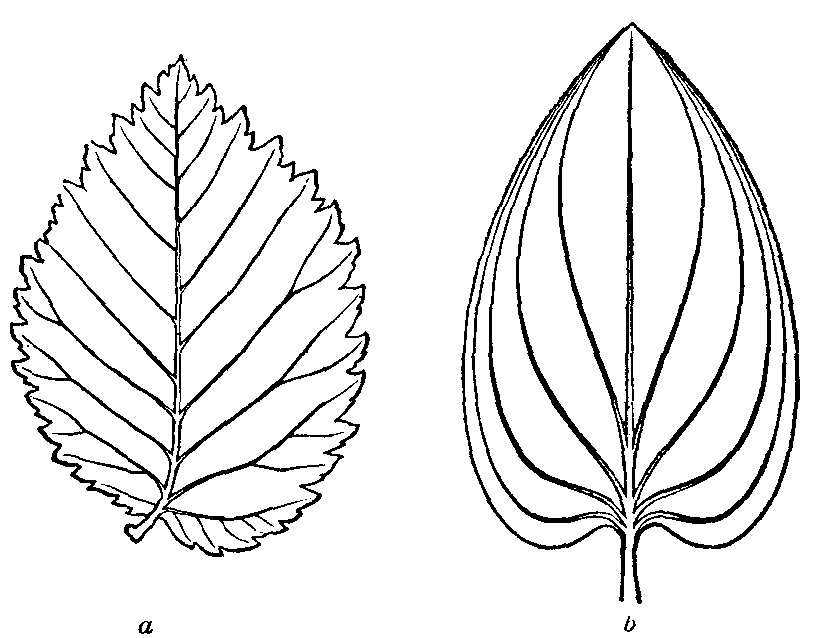 Fig
Fig. 3.
22. You see, however, that though your laurel leaf has a central stem,
and traces of ribs branching from it, in a vertebrated manner, they are
so faint that we cannot take it for a type of vertebrate structure. But
the two figures of elm and alisma leaf, given in Modern Painters (vol.
iii.), and now here repeated, Fig. 3, will clearly enough show the
opposition between this vertebrate form, branching again usually at the
edges, a, and the softly opening lines diffused at the stem, and
gathered at the point of the leaf b, which, as you almost without
doubt know already are characteristic of a vast group of plants,
including especially all the lilies, grasses, and palms, which for the
most part are the signs of local or temporary moisture in hot
countries;—local, as of fountains and streams; temporary, as of
rain or inundation.
But temporary, still more definitely in the day, than in the year.
When you go out, delighted, into the dew of the morning, have you ever
considered why it is so rich upon the grass;—why it is not
upon the trees? It is partly on the trees, but yet your memory of
it will be always chiefly of its gleam upon the lawn. On many trees you
will find there is none at all. I cannot follow out here the many
inquiries connected with this subject, but, broadly, remember the
branched trees are fed chiefly by rain,—the unbranched ones by dew,
visible or invisible; that is to say, at all events by moisture which
they can gather for themselves out of the air; or else by streams and
springs. Hence the division of the verse of the song of Moses: "My
doctrine shall drop as the rain; my speech shall distil as the dew: as
the small rain upon the tender herb, and as the showers
upon the grass."
23. Next, examining the direction of the veins in the leaf of the
alisma, b, Fig. 3, you see they all open widely, as soon as they
can, towards the thick part of the leaf; and then taper, apparently with
reluctance, pushing each other outwards, to the point. If the leaf were a
lake of the same shape, and its stem the entering river, the lines of the
currents passing through it would, I believe, be nearly the same as that
of the veins in the aquatic leaf. I have not examined the fluid law
accurately, and I do not suppose there is more real correspondence than
may be caused by the leaf's expanding in every permitted direction, as
the water would, with all the speed it can; but the resemblance is so
close as to enable you to fasten the relation of the unbranched leaves to
streams more distinctly in your mind,—just as the toss of the palm
leaves from their stem may, I think, in their likeness to the springing
of a fountain, remind you of their relation to the desert, and their
necessity, therein, to life of man and beast.
24. And thus, associating these grass and lily leaves always with
fountains, or with dew, I think we may get a pretty general name for them
also. You know that Cora, our Madonna of the flowers, was lost in
Sicilian Fields: you know, also, that the fairest of Greek fountains,
lost in Greece, was thought to rise in a Sicilian islet; and that the
real springing of the noble fountain in that rock was one of the causes
which determined the position of the greatest Greek city of Sicily. So I
think, as we call the fairest branched leaves 'Apolline,' we will call
the fairest flowing ones 'Arethusan.' But remember that the Apolline leaf
represents only the central type of land leaves, and is, within certain
limits, of a fixed form; while the beautiful Arethusan leaves, alike in
flowing of their lines, change their forms indefinitely,—some
shaped like round pools, and some like winding currents, and many like
arrows, and many like hearts, and otherwise varied and variable, as
leaves ought to be,—that rise out of the waters, and float amidst
the pausing of their foam.
25. Brantwood, Easter Day, 1875.—I don't like to spoil my
pretty sentence, above; but on reading it over, I suspect I wrote it
confusing the water-lily leaf, and other floating ones of the same kind,
with the Arethusan forms. But the water-lily and water-ranunculus leaves,
and such others, are to the orders of earth-loving leaves what ducks and
swans are to birds; (the swan is the water-lily of birds;) they are
swimming leaves; not properly watery creatures, or able to live
under water like fish, (unless when dormant), but just like birds that
pass their lives on the surface of the waves—though they must
breathe in the air.
And these natant leaves, as they lie on the water surface, do not want
strong ribs to carry them,[20] but have very delicate ones beautifully
branching into the orbed space, to keep the tissue nice and flat; while,
on the other hand, leaves that really have to grow under water, sacrifice
their tissue, and keep only their ribs, like coral animals; ('Ranunculus
heterophyllus,' 'other-leaved Frog-flower,' and its like,) just as, if
you keep your own hands too long in water, they shrivel at the
finger-ends.
26. So that you must not attach any great botanical importance to the
characters of contrasted aspects in leaves, which I wish you to express
by the words 'Apolline' and 'Arethusan'; but their mythic importance is
very great, and your careful observance of it will help you completely to
understand the beautiful Greek fable of Apollo and Daphne. There are
indeed several Daphnes, and the first root of the name is far away in
another field of thought altogether, connected with the Gods of Light.
But etymology, the best of servants, is an unreasonable master; and
Professor Max Müller trusts his deep-reaching knowledge of the first
ideas connected with the names of Athena and Daphne, too
implicitly, when he supposes this idea to be retained in central Greek
theology. 'Athena' originally meant only the dawn, among nations who knew
nothing of a Sacred Spirit. But the Athena who catches Achilles by the
hair, and urges the spear of Diomed, has not, in the mind of Homer, the
slightest remaining connection with the mere beauty of daybreak. Daphne
chased by Apollo, may perhaps—though I doubt even this much of
consistence in the earlier myth—have meant the Dawn pursued by the
Sun. But there is no trace whatever of this first idea left in the fable
of Arcadia and Thessaly.
27. The central Greek Daphne is the daughter of one of the great
river gods of Arcadia; her mother is the Earth. Now Arcadia is the
Oberland of Greece; and the crests of Cyllene, Erymanthus, and Mænalus[21] surround it, like the
Swiss forest cantons, with walls of rock, and shadows of pine. And it
divides itself, like the Oberland, into three regions: first, the region
of rock and snow, sacred to Mercury and Apollo, in which Mercury's birth
on Cyllene, his construction of the lyre, and his stealing the oxen of
Apollo, are all expressions of the enchantments of cloud and sound,
mingling with the sunshine, on the cliffs of Cyllene.
"While the mists
Flying, and rainy vapours, call out shapes
And phantoms from the crags and solid earth
As fast as a musician scatters sounds
Out of his instrument."
Then came the pine region, sacred especially to Pan and Mænalus, the
son of Lycaon and brother of Callisto; and you had better remember this
relationship carefully, for the sake of the meaning of the constellations
of Ursa Major and the Mons Mænalius, and of their wolf and bear
traditions; (compare also the strong impression on the Greek mind of the
wild leafiness, nourished by snow, of the Bœotian
Cithæron,—"Oh, thou lake-hollow, full of divine leaves, and of wild
creatures, nurse of the snow, darling of Diana," (Phœnissæ, 801)).
How wild the climate of this pine region is, you may judge from the
pieces in the note below[22] out of Colonel Leake's diary in
crossing the Mænalian range in spring. And then, lastly, you have the
laurel and vine region, full of sweetness and Elysian beauty.
28. Now as Mercury is the ruling power of the hill enchantment, so
Daphne of the leafy peace. She is, in her first life, the daughter of the
mountain river, the mist of it filling the valley; the Sun, pursuing, and
effacing it, from dell to dell, is, literally, Apollo pursuing Daphne,
and adverse to her; (not, as in the earlier tradition, the Sun
pursuing only his own light). Daphne, thus hunted, cries to her mother,
the Earth, which opens, and receives her, causing the laurel to spring up
in her stead. That is to say, wherever the rocks protect the mist from
the sunbeam, and suffer it to water the earth, there the laurel and other
richest vegetation fill the hollows, giving a better glory to the sun
itself. For sunshine, on the torrent spray, on the grass of its
valley, and entangled among the laurel stems, or glancing from their
leaves, became a thousandfold lovelier and more sacred than the same
sunbeams, burning on the leafless mountain-side.
And farther, the leaf, in its connection with the river, is typically
expressive, not, as the flower was, of human fading and passing away, but
of the perpetual flow and renewal of human mind and thought, rising "like
the rivers that run among the hills"; therefore it was that the youth of
Greece sacrificed their hair—the sign of their continually renewed
strength,—to the rivers, and to Apollo. Therefore, to commemorate
Apollo's own chief victory over death—over Python, the
corrupter,—a laurel branch was gathered every ninth year in the
vale of Tempe; and the laurel leaf became the reward or crown of all
beneficent and enduring work of man—work of inspiration, born of
the strength of the earth, and of the dew of heaven, and which can never
pass away.
29. You may doubt at first, even because of its grace, this meaning in
the fable of Apollo and Daphne; you will not doubt it, however, when you
trace it back to its first eastern origin. When we speak carelessly of
the traditions respecting the Garden of Eden, (or in Hebrew, remember,
Garden of Delight,) we are apt to confuse Milton's descriptions with
those in the book of Genesis. Milton fills his Paradise with flowers; but
no flowers are spoken of in Genesis. We may indeed conclude that in
speaking of every herb of the field, flowers are included. But they are not
named. The things that are named in the Garden of Delight are
trees only.
The words are, "every tree that was pleasant to the sight and good for
food;" and as if to mark the idea more strongly for us in the Septuagint,
even the ordinary Greek word for tree is not used, but the word ξυλον,—literally, every
'wood,' every piece of timber that was pleasant or good. They are
indeed the "vivi travi,"—living rafters, of Dante's Apennine.
Do you remember how those trees were said to be watered? Not by the
four rivers only. The rivers could not supply the place of rain. No
rivers do; for in truth they are the refuse of rain. No storm-clouds were
there, nor hidings of the blue by darkening veil; but there went up a
mist from the earth, and watered the face of the ground,—or,
as in Septuagint and Vulgate, "There went forth a fountain from the
earth, and gave the earth to drink."
30. And now, lastly, we continually think of that Garden of Delight,
as if it existed, or could exist, no longer; wholly forgetting that it is
spoken of in Scripture as perpetually existent; and some of its fairest
trees as existent also, or only recently destroyed. When Ezekiel is
describing to Pharaoh the greatness of the Assyrians, do you remember
what image he gives of them? "Behold, the Assyrian was a cedar in
Lebanon, with fair branches; and his top was among the thick boughs; the
waters nourished him, and the deep brought him up, with her rivers running
round about his plants. Under his branches did all the beasts of the
field bring forth their young; and under his shadow dwelt all great
nations."
31. Now hear what follows. "The cedars in the Garden of God
could not hide him. The fir trees were not like his boughs, and
the chestnut trees were not like his branches; nor any tree in the Garden
of God was like unto him in beauty."
So that you see, whenever a nation rises into consistent, vital, and,
through many generations, enduring power, there is still the
Garden of God; still it is the water of life which feeds the roots of it;
and still the succession of its people is imaged by the perennial leafage
of trees of Paradise. Could this be said of Assyria, and shall it not be said of
England? How much more, of lives such as ours should be,—just,
laborious, united in aim, beneficent in fulfilment, may the image be used of the leaves of
the trees of Eden! Other symbols have been given often to show the
evanescence and slightness of our lives—the foam upon the water,
the grass on the housetop, the vapour that vanishes away; yet none of
these are images of true human life. That life, when it is real, is
not evanescent; is not slight; does not vanish away.
Every noble life leaves the fibre of it interwoven for ever in the work
of the world; by so much, evermore, the strength of the human race has
gained; more stubborn in the root, higher towards heaven in the branch;
and, "as a teil tree, and as an oak,—whose substance is in them
when they cast their leaves,—so the holy seed is in the midst
thereof."
32. Only remember on what conditions. In the great Psalm of life, we
are told that everything that a man doeth shall prosper, so only that he
delight in the law of his God, that he hath not walked in the counsel of
the wicked, nor sat in the seat of the scornful. Is it among these leaves
of the perpetual Spring,—helpful leaves for the healing of the
nations,—that we mean to have our part and place, or rather among
the "brown skeletons of leaves that lag, the forest brook along"? For
other leaves there are, and other streams that water them,—not
water of life, but water of Acheron. Autumnal leaves there are that strew
the brooks, in Vallombrosa. Remember you how the name of the place was
changed: "Once called 'Sweet water' (Aqua bella), now, the Shadowy Vale."
Portion in one or other name we must choose, all of us,—with the
living olive, by the living fountains of waters, or with the wild fig
trees, whose leafage of human soul is strewed along the brooks of death,
in the eternal Vallombrosa.
THE FLOWER.
Rome, Whit Monday, 1874.
1. On the quiet road leading from under the Palatine to the little
church of St. Nereo and Achilleo, I met, yesterday morning, group after
group of happy peasants heaped in pyramids on their triumphal carts, in
Whit-Sunday dress, stout and clean, and gay in colour; and the women all
with bright artificial roses in their hair, set with true natural taste,
and well becoming them. This power of arranging wreath or crown of
flowers for the head, remains to the people from classic times. And the
thing that struck me most in the look of it was not so much the
cheerfulness, as the dignity;—in a true sense, the
becomingness and decorousness of the ornament. Among the ruins of
the dead city, and the worse desolation of the work of its modern
rebuilders, here was one element at least of honour, and
order;—and, in these, of delight.
And these are the real significances of the flower itself. It is the
utmost purification of the plant, and the utmost discipline. Where its
tissue is blanched fairest, dyed purest, set in strictest rank, appointed
to most chosen office, there—and created by the fact of this
purity and function—is the flower.
2. But created, observe, by the purity and order, more than by the
function. The flower exists for its own sake,—not for the fruit's
sake. The production of the fruit is an added honour to it—is a
granted consolation to us for its death. But the flower is the end of the
seed,—not the seed of the flower. You are fond of cherries,
perhaps; and think that the use of cherry blossom is to produce cherries.
Not at all. The use of cherries is to produce cherry blossoms; just as
the use of bulbs is to produce hyacinths,—not of hyacinths to
produce bulbs. Nay, that the flower can multiply by bulb, or root, or
slip, as well as by seed, may show you at once how immaterial the
seed-forming function is to the flower's existence. A flower is to the
vegetable substance what a crystal is to the mineral. "Dust of sapphire,"
writes my friend Dr. John Brown to me, of the wood hyacinths of Scotland
in the spring. Yes, that is so,—each bud more beautiful, itself,
than perfectest jewel—this, indeed, jewel "of purest ray
serene;" but, observe you, the glory is in the purity, the serenity, the
radiance,—not in the mere continuance of the creature.
3. It is because of its beauty that its continuance is worth Heaven's
while. The glory of it is in being,—not in begetting; and in the
spirit and substance,—not the change. For the earth also has its
flesh and spirit. Every day of spring is the earth's Whit
Sunday—Fire Sunday. The falling fire of the rainbow,
with the order of its zones, and the gladness of its covenant,—you
may eat of it, like Esdras; but you feed upon it only that you may see
it. Do you think that flowers were born to nourish the blind?
Fasten well in your mind, then, the conception of order, and purity,
as the essence of the flower's being, no less than of the crystal's. A
ruby is not made bright to scatter round it child-rubies; nor a flower,
but in collateral and added honour, to give birth to other flowers.
Two main facts, then, you have to study in every flower: the symmetry
or order of it, and the perfection of its substance; first, the manner in
which the leaves are placed for beauty of form; then the spinning and
weaving and blanching of their tissue, for the reception of purest
colour, or refining to richest surface.
4. First, the order: the proportion, and answering to each other, of
the parts; for the study of which it becomes necessary to know what its
parts are; and that a flower consists essentially of—Well, I really
don't know what it consists essentially of. For some flowers have bracts,
and stalks, and toruses, and calices, and corollas, and discs, and
stamens, and pistils, and ever so many odds and ends of things besides,
of no use at all, seemingly; and others have no bracts, and no stalks,
and no toruses, and no calices, and no corollas, and nothing recognizable
for stamens or pistils,—only, when they come to be reduced to this
kind of poverty, one doesn't call them flowers; they get
together in knots, and one calls them catkins, or the like, or forgets
their existence altogether;—I haven't the least idea, for instance,
myself, what an oak blossom is like; only I know its bracts get together
and make a cup of themselves afterwards, which the Italians call, as they
do the dome of St. Peter's, 'cupola'; and that it is a great pity, for
their own sake as well as the world's, that they were not content with
their ilex cupolas, which were made to hold something, but took to
building these big ones upside-down, which hold nothing—less
than nothing,—large extinguishers of the flame of Catholic
religion. And for farther embarrassment, a flower not only is without
essential consistence of a given number of parts, but it rarely consists,
alone, of itself. One talks of a hyacinth as of a flower; but a
hyacinth is any number of flowers. One does not talk of 'a heather'; when
one says 'heath,' one means the whole plant, not the
blossom,—because heath-bells, though they grow together for
company's sake, do so in a voluntary sort of way, and are not fixed in
their places; and yet, they depend on each other for effect, as much as a
bunch of grapes.
5. And this grouping of flowers, more or less waywardly, is the most
subtle part of their order, and the most difficult to represent. Take
that cluster of bog-heather bells, for instance, Line-study 1. You might
think at first there were no lines in it worth study; but look at it more
carefully. There are twelve bells in the cluster. There may be
fewer, or more; but the bog-heath is apt to run into something near that
number. They all grow together as close as they can, and on one side of
the supporting branch only. The natural effect would be to bend the
branch down; but the branch won't have that, and so leans back to carry
them. Now you see the use of drawing the profile in the middle figure: it
shows you the exactly balanced setting of the group,—not drooping,
nor erect; but with a disposition to droop, tossed up by the leaning back
of the stem. Then, growing as near as they can to each other, those in
the middle get squeezed. Here is another quite special character. Some
flowers don't like being squeezed at all (fancy a squeezed convolvulus!);
but these heather bells like it, and look all the prettier for
it,—not the squeezed ones exactly, by themselves, but the cluster
altogether, by their patience.
Then also the outside ones get pushed into a sort of star-shape, and
in front show the colour of all their sides, and at the back the rich
green cluster of sharp leaves that hold them; all this order being as
essential to the plant as any of the more formal structures of the bell
itself.
6. But the bog-heath has usually only one cluster of flowers to
arrange on each branch. Take a spray of ling (Frontispiece), and you will
find that the richest piece of Gothic spire-sculpture would be dull and
graceless beside the grouping of the floral masses in their various life.
But it is difficult to give the accuracy of attention necessary to
see their beauty without drawing them; and still more difficult to draw
them in any approximation to the truth before they change. This is indeed
the fatallest obstacle to all good botanical work. Flowers, or
leaves,—and especially the last,—can only be rightly drawn as
they grow. And even then, in their loveliest spring action, they grow as
you draw them, and will not stay quite the same creatures for half an
hour.
7. I said in my inaugural lectures at Oxford, § 107, that real botany
is not so much the description of plants as their biography. Without
entering at all into the history of its fruitage, the life and death of
the blossom itself is always an eventful romance, which must be
completely told, if well. The grouping given to the various states of
form between bud and flower is always the most important part of the
design of the plant; and in the modes of its death are some of the most
touching lessons, or symbolisms, connected with its existence. The utter
loss and far-scattered ruin of the cistus and wild rose,—the
dishonoured and dark contortion of the convolvulus,—the pale
wasting of the crimson heath of Apennine, are strangely opposed by the
quiet closing of the brown bells of the ling, each making of themselves a
little cross as they die; and so enduring into the days of winter. I have
drawn the faded beside the full branch, and know not which is the more
beautiful.
8. This grouping, then, and way of treating each other in their
gathered company, is the first and most subtle condition of form in
flowers; and, observe, I don't mean, just now, the appointed and
disciplined grouping, but the wayward and accidental. Don't confuse the
beautiful consent of the cluster in these sprays of heath with the legal
strictness of a foxglove,—though that also has its divinity; but of
another kind. That legal order of blossoming—for which we may
wisely keep the accepted name, 'inflorescence,'—is itself quite a
separate subject of study, which we cannot take up until we know the
still more strict laws which are set over the flower itself.
9. I have in my hand a small red poppy which I gathered on Whit Sunday
on the palace of the Cæsars. It is an intensely simple, intensely floral,
flower. All silk and flame: a scarlet cup, perfect-edged all round, seen
among the wild grass far away, like a burning coal fallen from Heaven's
altars. You cannot have a more complete, a more stainless, type of flower
absolute; inside and outside, all flower. No sparing of colour
anywhere—no outside coarsenesses—no interior secrecies; open
as the sunshine that creates it; fine-finished on both sides, down to the
extremest point of insertion on its narrow stalk; and robed in the purple
of the Cæsars.
Literally so. That poppy scarlet, so far as it could be painted by
mortal hand, for mortal King, stays yet, against the sun, and wind, and
rain, on the walls of the house of Augustus, a hundred yards from the
spot where I gathered the weed of its desolation.
10. A pure cup, you remember it is; that much at least you
cannot but remember, of poppy-form among the cornfields; and it is best,
in beginning, to think of every flower as essentially a cup. There are
flat ones, but you will find that most of these are really groups of
flowers, not single blossoms; and there are out-of-the-way and quaint
ones, very difficult to define as of any shape; but even these have a cup
to begin with, deep down in them. You had better take the idea of a cup
or vase, as the first, simplest, and most general form of true
flower.
The botanists call it a corolla, which means a garland, or a kind of
crown; and the word is a very good one, because it indicates that the
flower-cup is made, as our clay cups are, on a potter's wheel; that it is
essentially a revolute form—a whirl or (botanically) 'whorl'
of leaves; in reality successive round the base of the urn they form.
11. Perhaps, however, you think poppies in general are not much like
cups. But the flower in my hand is a—poverty-stricken poppy,
I was going to write,—poverty-strengthened poppy, I mean. On
richer ground, it would have gushed into flaunting breadth of untenable
purple—flapped its inconsistent scarlet vaguely to the
wind—dropped the pride of its petals over my hand in an hour after
I gathered it. But this little rough-bred thing, a Campagna pony of a
poppy, is as bright and strong to-day as yesterday. So that I can see
exactly where the leaves join or lap over each other; and when I look
down into the cup, find it to be composed of four leaves
altogether,—two smaller, set within two larger.
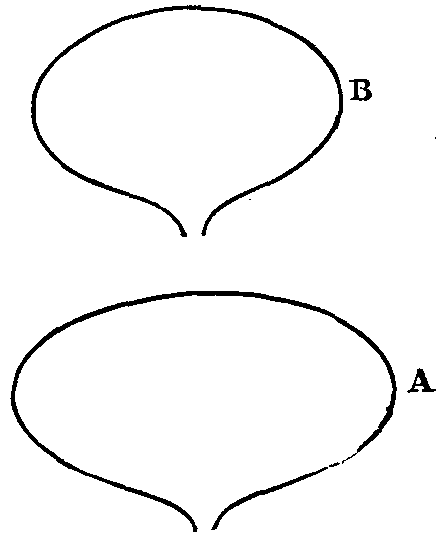 Fig
Fig. 4.
12. Thus far (and somewhat farther) I had written in Rome; but now,
putting my work together in Oxford, a sudden doubt troubles me, whether
all poppies have two petals smaller than the other two. Whereupon I take
down an excellent little school-book on botany—the best I've yet
found, thinking to be told quickly; and I find a great deal about opium;
and, apropos of opium, that the juice of common celandine is of a bright
orange colour; and I pause for a bewildered five minutes, wondering if a
celandine is a poppy, and how many petals it has: going on
again—because I must, without making up my mind, on either
question—I am told to "observe the floral receptacle of the
Californian genus Eschscholtzia." Now I can't observe anything of the
sort, and I don't want to; and I wish California and all that's in it
were at the deepest bottom of the Pacific. Next I am told to compare the
poppy and waterlily; and I can't do that, neither—though I should
like to; and there's the end of the article; and it never tells me
whether one pair of petals is always smaller than the other, or not. Only
I see it says the corolla has four petals. Perhaps a celandine may be a
double poppy, and have eight, I know they're tiresome irregular things,
and I mustn't be stopped by them;[23]—at any rate, my Roman poppy
knew what it was about, and had its two couples of leaves in clear
subordination, of which at the time I went on to inquire farther, as
follows.
13. The next point is, what shape are the petals of? And that is
easier asked than answered; for when you pull them off, you find they
won't lie flat, by any means, but are each of them cups, or rather
shells, themselves; and that it requires as much conchology as would
describe a cockle, before you can properly give account of a single poppy
leaf. Or of a single any leaf—for all leaves are either
shells, or boats, (or solid, if not hollow, masses,) and cannot be
represented in flat outline. But, laying these as flat as they will lie
on a sheet of paper, you will find the piece they hide of the paper they
lie on can be drawn; giving approximately the shape of the outer leaf as
at A, that of the inner as at B, Fig. 4; which you will find very
difficult lines to draw, for they are each composed of two curves,
joined, as in Fig. 5; all above the line a b being the outer edge
of the leaf, but joined so subtly to the side that the least break in
drawing the line spoils the form.
14. Now every flower petal consists essentially of these two parts,
variously proportioned and outlined. It expands from C to a
b; and closes in the external line, and for this reason.
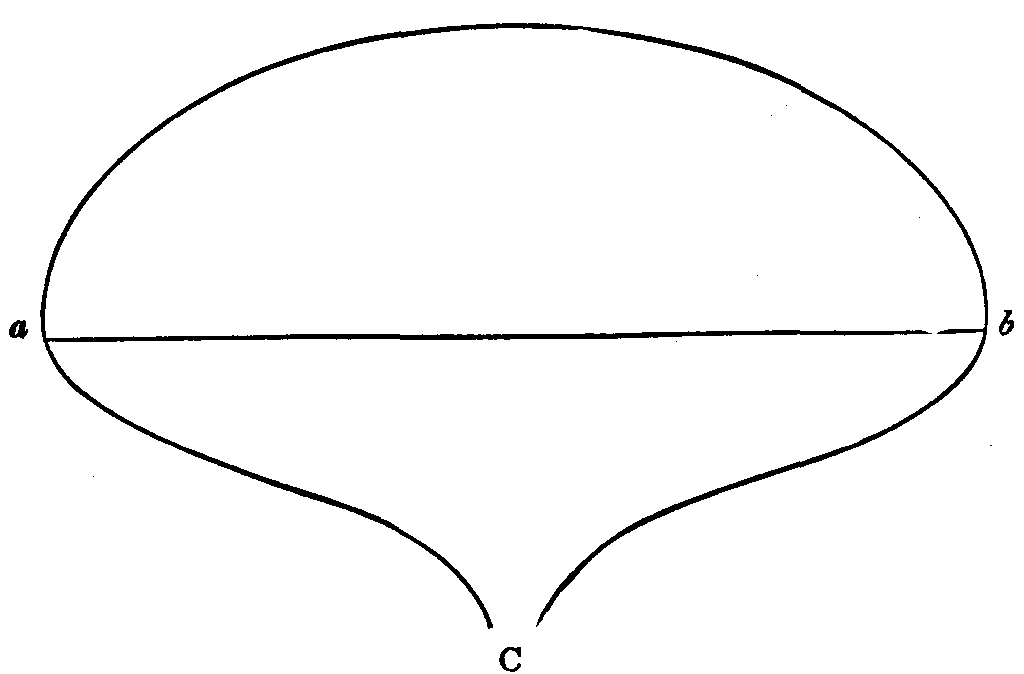 Fig
Fig. 5.
Considering every flower under the type of a cup, the first part of
the petal is that in which it expands from the bottom to the rim; the
second part, that in which it terminates itself on reaching the rim. Thus
let the three circles, A B C, Fig 6., represent the undivided cups of the
three great geometrical orders of flowers—trefoil, quatrefoil and
cinquefoil.
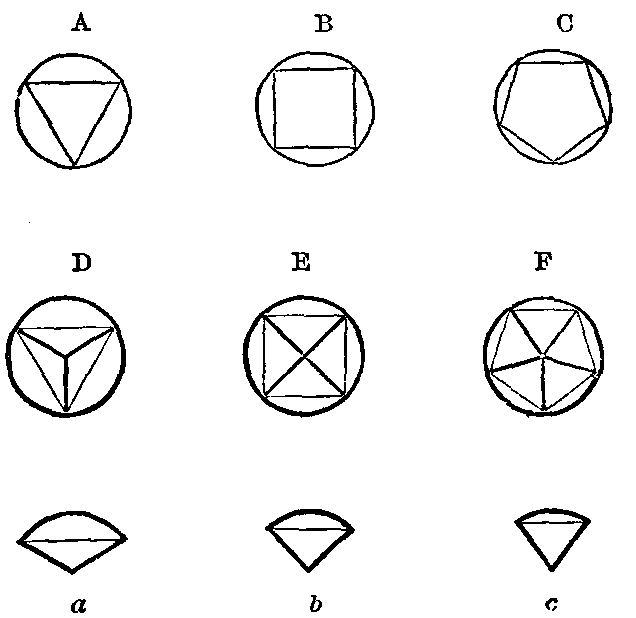 Fig
Fig. 6.
Draw in the first an equilateral triangle, in the second a square, in
the third a pentagon; draw the dark lines from centres to angles; (D E
F): then (a) the third part of D; (b) the fourth part of E,
(c) the fifth part of F, are the normal outline forms of the
petals of the three families; the relations between the
developing angle and limiting curve being varied according to the depth
of cup, and the degree of connection between the petals. Thus a rose
folds them over one another, in the bud; a convolvulus twists
them,—the one expanding into a flat cinquefoil of separate petals,
and the other into a deep-welled cinquefoil of connected ones.
I find an excellent illustration in Veronica Polita, one of the most
perfectly graceful of field plants because of the light alternate flower
stalks, each with its leaf at the base; the flower itself a quatrefoil,
of which the largest and least petals are uppermost. Pull one off its
calyx (draw, if you can, the outline of the striped blue upper petal with
the jagged edge of pale gold below), and then examine the relative shapes
of the lateral, and least upper petal. Their under surface is very curious,
as if covered with white paint; the blue stripes above, in the direction
of their growth, deepening the more delicate colour with exquisite
insistence.
A lilac blossom will give you a pretty example of the expansion of the
petals of a quatrefoil above the edge of the cup or tube; but I must get
back to our poppy at present.
15. What outline its petals really have, however, is little shown in
their crumpled fluttering; but that very crumpling arises from a fine
floral character which we do not enough value in them. We usually think
of the poppy as a coarse flower; but it is the most transparent and
delicate of all the blossoms of the field. The rest—nearly all of
them—depend on the texture of their surfaces for colour. But
the poppy is painted glass; it never glows so brightly as when the
sun shines through it. Wherever it is seen—against the light or
with the light—always, it is a flame, and warms the wind like a
blown ruby.
In these two qualities, the accurately balanced form, and the
perfectly infused colour of the petals, you have, as I said, the central
being of the flower. All the other parts of it are necessary, but we must
follow them out in order.
16. Looking down into the cup, you see the green boss divided by a
black star,—of six rays only,—and surrounded by a few black
spots. My rough-nurtured poppy contents itself with these for its centre;
a rich one would have had the green boss divided by a dozen of rays, and
surrounded by a dark crowd of crested threads.
This green boss is called by botanists the pistil, which word consists
of the two first syllables of the Latin pistillum, otherwise more
familiarly Englished into 'pestle.' The meaning of the botanical word is
of course, also, that the central part of a flower-cup has to it
something of the relations that a pestle has to a mortar! Practically,
however, as this pestle has no pounding functions, I think the word is
misleading as well as ungraceful; and that we may find a better one after
looking a little closer into the matter. For this pestle is divided
generally into three very distinct parts: there is a storehouse at the
bottom of it for the seeds of the plant; above this, a shaft, often of
considerable length in deep cups, rising to the level of their upper
edge, or above it; and at the top of these shafts an expanded crest. This
shaft the botanists call 'style,' from the Greek word for a pillar; and
the crest of it—I do not know why—stigma, from the Greek word
for 'spot.' The storehouse for the seeds they call the 'ovary,' from the
Latin ovum, an egg. So you have two-thirds of a Latin word,
(pistil)—awkwardly and disagreeably edged in between pestle and
pistol—for the whole thing; you have an English-Latin word (ovary)
for the bottom of it; an English-Greek word (style) for the middle; and a
pure Greek word (stigma) for the top.
17. This is a great mess of language, and all the
worse that the words style and stigma have both of them quite different
senses in ordinary and scholarly English from this forced botanical one.
And I will venture therefore, for my own pupils, to put the four names
altogether into English. Instead of calling the whole thing a pistil, I
shall simply call it the pillar. Instead of 'ovary,' I shall say
'Treasury' (for a seed isn't an egg, but it is a treasure). The
style I shall call the 'Shaft,' and the stigma the 'Volute.' So you will
have your entire pillar divided into the treasury, at its base, the
shaft, and the volute; and I think you will find these divisions easily
remembered, and not unfitted to the sense of the words in their ordinary
use.
18. Round this central, but, in the poppy, very stumpy, pillar, you
find a cluster of dark threads, with dusty pendants or cups at their
ends. For these the botanists' name 'stamens,' may be conveniently
retained, each consisting of a 'filament,' or thread, and an 'anther,' or
blossoming part.
And in this rich corolla, and pillar, or pillars, with their
treasuries, and surrounding crowd of stamens, the essential flower
consists. Fewer than these several parts, it cannot have, to be a flower
at all; of these, the corolla leads, and is the object of final purpose.
The stamens and the treasuries are only there in order to produce future
corollas, though often themselves decorative in the highest degree.
These, I repeat, are all the essential parts of a flower. But it would
have been difficult, with any other than the poppy, to have shown you
them alone; for nearly all other flowers keep with them, all their lives,
their nurse or tutor leaves,—the group which, in
stronger and humbler temper, protected them in their first weakness, and
formed them to the first laws of their being. But the poppy casts these
tutorial leaves away. It is the finished picture of impatient and
luxury-loving youth,—at first too severely restrained, then casting
all restraint away,—yet retaining to the end of life unseemly and
illiberal signs of its once compelled submission to laws which were only
pain,—not instruction.
19. Gather a green poppy bud, just when it shows the scarlet line at
its side; break it open and unpack the poppy. The whole flower is there
complete in size and colour,—its stamens full-grown, but all packed
so closely that the fine silk of the petals is crushed into a million of
shapeless wrinkles. When the flower opens, it seems a deliverance from
torture: the two imprisoning green leaves are shaken to the ground; the
aggrieved corolla smooths itself in the sun, and comforts itself as it
can; but remains visibly crushed and hurt to the end of its days.
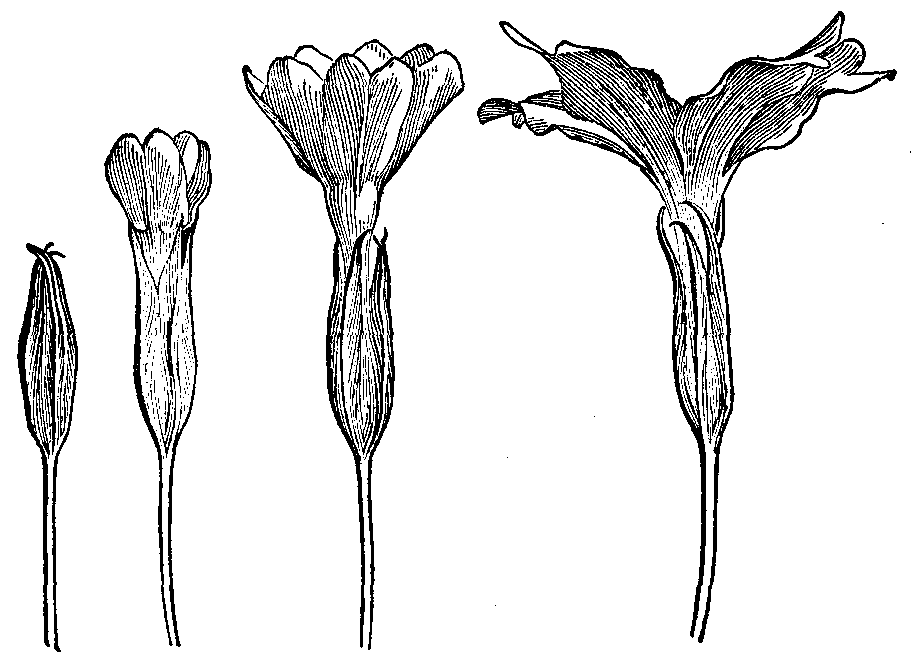 Fig
Fig. 7.
20. Not so flowers of gracious breeding. Look at these four stages in
the young life of a primrose, Fig. 7. First confined, as strictly as the
poppy within five pinching green leaves, whose points close over it, the
little thing is content to remain a child, and finds its nursery large
enough. The green leaves unclose their points,—the little yellow
ones peep out, like ducklings. They find the light delicious, and open
wide to it; and grow, and grow, and throw themselves wider at last into
their perfect rose. But they never leave their old nursery for all that;
it and they live on together; and the nursery seems a part of the
flower.
21. Which is so, indeed, in all the loveliest flowers; and, in usual
botanical parlance, a flower is said to consist of its calyx, (or
hiding part—Calypso having rule over it,) and corolla, or
garland part, Proserpina having rule over it. But it is better to think
of them always as separate; for this calyx, very justly so named from its
main function of concealing the flower, in its youth is usually green,
not coloured, and shows its separate nature by pausing, or at least
greatly lingering, in its growth, and modifying itself very slightly,
while the corolla is forming itself through active change. Look at the
two, for instance, through the youth of a pease blossom, Fig. 8.
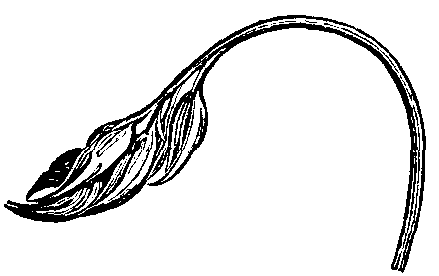 Fig
Fig. 8.
The entire cluster at first appears pendent in this manner, the stalk
bending round on purpose to put it into that position. On which all the
little buds, thinking themselves ill-treated, determine not to submit to
anything of the sort, turn their points upward persistently, and
determine that—at any cost of trouble—they will get nearer
the sun. Then they begin to open, and let out their corollas. I give the
process of one only (Fig. 9).[24] It chances to be engraved the reverse
way from the bud; but that is of no consequence.
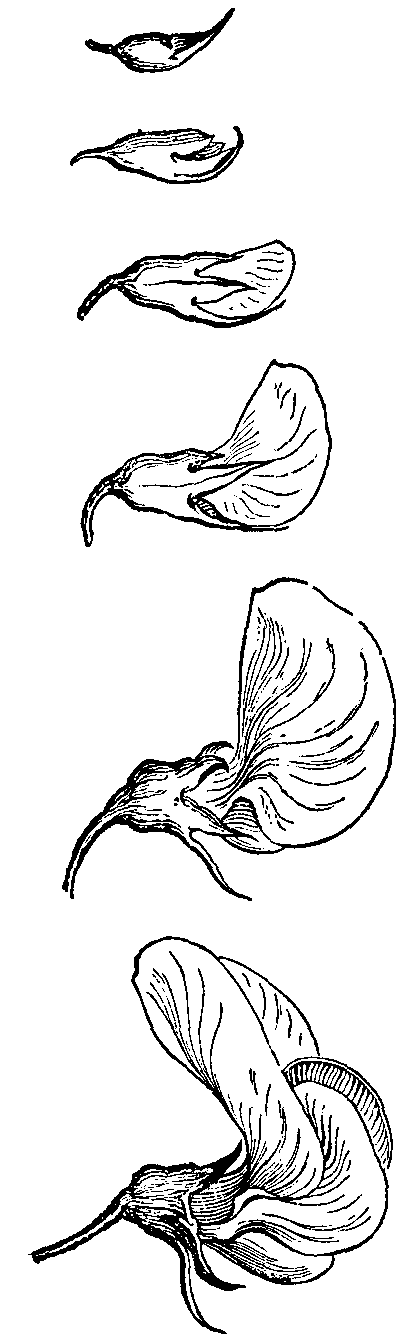 Fig
Fig. 9.
At first, you see the long lower point of the calyx thought that
it was going to be the head of the family, and curls upwards
eagerly. Then the little corolla steals out; and soon does away with that
impression on the mind of the calyx. The corolla soars up with widening
wings, the abashed calyx retreats beneath; and finally the great upper
leaf of corolla—not pleased at having its back still turned to the
light, and its face down—throws itself entirely back, to look at
the sky, and nothing else;—and your blossom is complete.
Keeping, therefore, the ideas of calyx and corolla entirely distinct,
this one general point you may note of both: that, as a calyx is
originally folded tight over the flower, and has to open deeply to let it
out, it is nearly always composed of sharp pointed leaves like the
segments of a balloon; while corollas, having to open out as wide as
possible to show themselves, are typically like cups or plates, only cut
into their edges here and there, for ornamentation's sake.
22. And, finally, though the corolla is essentially the floral group
of leaves, and usually receives the glory of colour for itself only, this
glory and delight may be given to any other part of the group; and, as if
to show us that there is no really dishonoured or degraded membership,
the stalks and leaves in some plants, near the blossom, flush in sympathy
with it, and become themselves a part of the effectively visible
flower;—Eryngo—Jura hyacinth, (comosus,) and the edges of
upper stems and leaves in many plants; while others, (Geranium lucidum,)
are made to delight us with their leaves rather than their blossoms; only
I suppose, in these, the scarlet leaf colour is a kind of early autumnal
glow,—a beautiful hectic, and foretaste, in sacred youth, of sacred
death.
I observe, among the speculations of modern science, several, lately,
not uningenious, and highly industrious, on the subject of the relation
of colour in flowers, to insects—to selective development, etc.,
etc. There are such relations, of course. So also, the blush of a
girl, when she first perceives the faltering in her lover's step as he
draws near, is related essentially to the existing state of her stomach;
and to the state of it through all the years of her previous existence.
Nevertheless, neither love, chastity, nor blushing, are merely exponents
of digestion.
All these materialisms, in their unclean stupidity, are essentially
the work of human bats; men of semi-faculty or semi-education, who are
more or less incapable of so much as seeing, much less thinking about,
colour; among whom, for one-sided intensity, even Mr. Darwin must be
often ranked, as in his vespertilian treatise on the ocelli of the Argus
pheasant, which he imagines to be artistically gradated, and perfectly
imitative of a ball and socket. If I had him here in Oxford for a week,
and could force him to try to copy a feather by Bewick, or to draw for
himself a boy's thumbed marble, his notions of feathers, and balls, would
be changed for all the rest of his life. But his ignorance of good art is
no excuse for the acutely illogical simplicity of the rest of his talk of
colour in the "Descent of Man." Peacocks' tails, he thinks, are the
result of the admiration of blue tails in the minds of well-bred
peahens,—and similarly, mandrills' noses the result of the
admiration of blue noses in well-bred baboons. But it never occurs to him
to ask why the admiration of blue noses is healthy in baboons, so that it
develops their race properly, while similar maidenly admiration either of
blue noses or red noses in men would be improper, and develop the race
improperly. The word itself 'proper' being one of which he has never
asked, or guessed, the meaning. And when he imagined the gradation of the
cloudings in feathers to represent successive generation, it never
occurred to him to look at the much finer cloudy gradations in the clouds
of dawn themselves; and explain the modes of sexual preference and
selective development which had brought them to their scarlet
glory, before the cock could crow thrice. Putting all these vespertilian
speculations out of our way, the human facts concerning colour are
briefly these. Wherever men are noble, they love bright colour; and
wherever they can live healthily, bright colour is given them—in
sky, sea, flowers, and living creatures.
On the other hand, wherever men are ignoble and sensual, they endure
without pain, and at last even come to like (especially if artists,)
mud-colour and black, and to dislike rose-colour and white. And wherever
it is unhealthy for them to live, the poisonousness of the
place is marked by some ghastly colour in air, earth, or flowers.
There are, of course, exceptions to all such widely founded laws;
there are poisonous berries of scarlet, and pestilent skies that are
fair. But, if we once honestly compare a venomous wood-fungus, rotting
into black dissolution of dripped slime at its edges, with a spring
gentian; or a puff adder with a salmon trout, or a fog in Bermondsey with
a clear sky at Berne, we shall get hold of the entire question on its
right side; and be able afterwards to study at our leisure, or accept
without doubt or trouble, facts of apparently contrary meaning. And the
practical lesson which I wish to leave with the reader is, that lovely
flowers, and green trees growing in the open air, are the proper guides
of men to the places which their Maker intended them to inhabit; while
the flowerless and treeless deserts—of reed, or sand, or
rock,—are meant to be either heroically invaded and redeemed, or
surrendered to the wild creatures which are appointed for them; happy and
wonderful in their wild abodes.
Nor is the world so small but that we may yet leave in it also
unconquered spaces of beautiful solitude; where the chamois and red deer
may wander fearless,—nor any fire of avarice scorch from the
Highlands of Alp, or Grampian, the rapture of the heath, and the
rose.
PAPAVER RHOEAS.
Brantwood, July 11th, 1875.
1. Chancing to take up yesterday a favourite old book, Mavor's British
Tourists, (London, 1798,) I found in its fourth volume a delightful diary
of a journey made in 1782 through various parts of England, by Charles P.
Moritz of Berlin.
And in the fourteenth page of this diary I find the following passage,
pleasantly complimentary to England:—
"The slices of bread and butter which they give you with your tea are
as thin as poppy leaves. But there is another kind of bread and butter
usually eaten with tea, which is toasted by the fire, and is incomparably
good. This is called 'toast.'"
I wonder how many people, nowadays, whose bread and butter was cut too
thin for them, would think of comparing the slices to poppy leaves? But
this was in the old days of travelling, when people did not whirl
themselves past corn-fields, that they might have more time to walk on
paving-stones; and understood that poppies did not mingle
their scarlet among the gold, without some purpose of the poppy-Maker
that they should be looked at.
Nevertheless, with respect to the good and polite German's
poetically-contemplated, and finely æsthetic, tea, may it not be asked
whether poppy leaves themselves, like the bread and butter, are not, if
we may venture an opinion—too thin,—im-properly
thin? In the last chapter, my reader was, I hope, a little anxious to
know what I meant by saying that modern philosophers did not know the
meaning of the word 'proper,' and may wish to know what I mean by it
myself. And this I think it needful to explain before going farther.
2. In our English prayer-book translation, the
first verse of the ninety-third Psalm runs thus: "The Lord is King; and
hath put on glorious apparel." And although, in the future republican
world, there are to be no lords, no kings, and no glorious apparel, it
will be found convenient, for botanical purposes, to remember what such
things once were; for when I said of the poppy, in last chapter, that it
was "robed in the purple of the Cæsars," the words gave, to any one who
had a clear idea of a Cæsar, and of his dress, a better, and even
stricter, account of the flower than if I had only said, with Mr.
Sowerby, "petals bright scarlet;" which might just as well have been said
of a pimpernel, or scarlet geranium;—but of neither of these latter
should I have said "robed in purple of Cæsars." What I meant was, first,
that the poppy leaf looks dyed through and through, like glass,
or Tyrian tissue; and not merely painted: secondly, that the splendour of
it is proud,—almost insolently so. Augustus, in his glory, might
have been clothed like one of these; and Saul; but not David, nor
Solomon; still less the teacher of Solomon, when He puts on 'glorious
apparel.'
3. Let us look, however, at the two translations of the same
verse.
In the vulgate it is "Dominus regnavit; decorem indutus est;" He has
put on 'becomingness,'—decent apparel, rather than glorious.
In the Septuagint it is ευπρεπειὰ—well-becomingness;
an expression which, if the reader considers, must imply certainly the
existence of an opposite idea of possible
'ill-becomingness,'—of an apparel which should, in just as
accurate a sense, belong appropriately to the creature invested with it,
and yet not be glorious, but inglorious, and not well-becoming, but
ill-becoming. The mandrill's blue nose, for instance, already referred
to,—can we rightly speak of this as 'ευπρεπειὰ'?
Or the stings, and minute, colourless blossoming of the nettle? May we
call these a glorious apparel, as we may the glowing of an alpine
rose?
You will find on reflection, and find more convincingly the more
accurately you reflect, that there is an absolute sense attached to such
words as 'decent,' 'honourable,' 'glorious,' or 'καλος,' contrary to another
absolute sense in the words 'indecent,' 'shameful,' 'vile,' or 'αἰσχρος.'
And that there is every degree of these absolute qualities visible in
living creatures; and that the divinity of the Mind of man is in its
essential discernment of what is καλον from what is αἰσχρον, and in his
preference of the kind of creatures which are decent, to those which are
indecent; and of the kinds of thoughts, in himself, which are noble, to
those which are vile.
4. When therefore I said that Mr. Darwin, and his school,[25] had no conception of the
real meaning of the word 'proper,' I meant that they conceived the
qualities of things only as their 'properties,' but not as their
becomingnesses;' and seeing that dirt is proper to a swine, malice to a
monkey, poison to a nettle, and folly to a fool, they called a nettle
but a nettle, and the faults of fools but folly; and never saw the
difference between ugliness and beauty absolute, decency and indecency
absolute, glory or shame absolute, and folly or sense absolute.
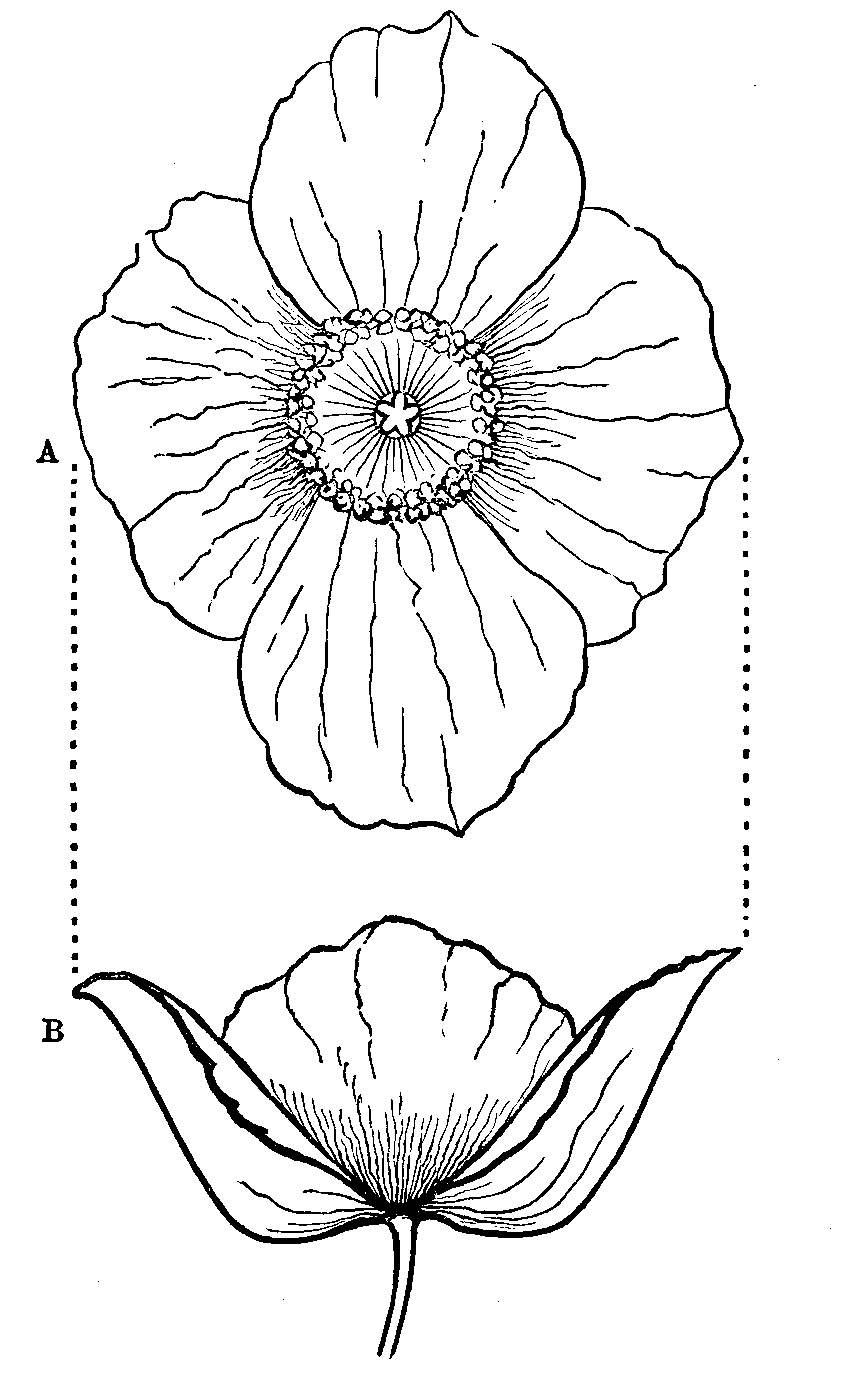 Fig
Fig. 10.
Whereas, the perception of beauty, and the power of defining physical
character, are based on moral instinct, and on the power of defining
animal or human character. Nor is it possible to say that one flower is
more highly developed, or one animal of a higher order, than another,
without the assumption of a divine law of perfection to which the one
more conforms than the other.
5. Thus, for instance. That it should ever have been an open question
with me whether a poppy had always two of its petals less
than the other two, depended wholly on the hurry and imperfection with
which the poppy carries out its plan. It never would have occurred to me
to
doubt whether an iris had three of its leaves smaller than the other
three, because an iris always completes itself to its own ideal.
Nevertheless, on examining various poppies, as I have walked, this
summer, up and down the hills between Sheffield and Wakefield, I find the
subordination of the upper and lower petals entirely necessary and
normal; and that the result of it is to give two distinct profiles to the
poppy cup, the difference between which, however, we shall see better in
the yellow Welsh poppy, at present called Meconopsis Cambrica; but which,
in the Oxford schools, will be 'Papaver cruciforme'—'Crosslet
Poppy,'—first, because all our botanical names must be in Latin if
possible; Greek only allowed when we can do no better; secondly, because
meconopsis is barbarous Greek; thirdly, and chiefly, because it is little
matter whether this poppy be Welsh or English; but very needful that we
should observe, wherever it grows, that the petals are arranged in what
used to be, in my young days, called a diamond shape,[26] as at A, Fig. 10, the two narrow inner
ones at right angles to, and projecting farther than, the two outside
broad ones; and that the two broad ones, when the flower is seen in
profile, as at B, show their margins folded back, as indicated by the
thicker lines, and have a profile curve, which is only the softening, or
melting away into each other, of two straight lines. Indeed, when the
flower is younger, and quite strong, both its profiles, A and B, Fig.
11, are nearly straight-sided; and always, be it young or old, one
broader than the other, so as to give the flower, seen from above, the
shape of a contracted cross, or crosslet.
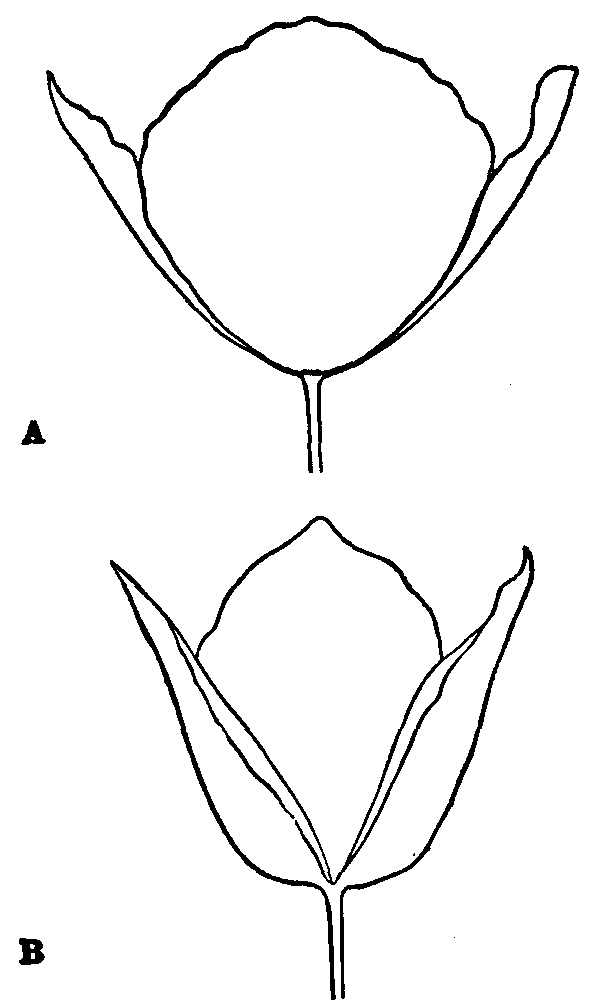 Fig
Fig. 11.
6. Now I find no notice of this flower in Gerarde; and in Sowerby, out
of eighteen lines of closely printed descriptive text, no notice of its
crosslet form, while the petals are only stated to be "roundish-concave,"
terms equally applicable to at least one-half of all flower petals in the
world. The leaves are said to be very deeply pinnately partite;
but drawn—as neither pinnate nor partite!
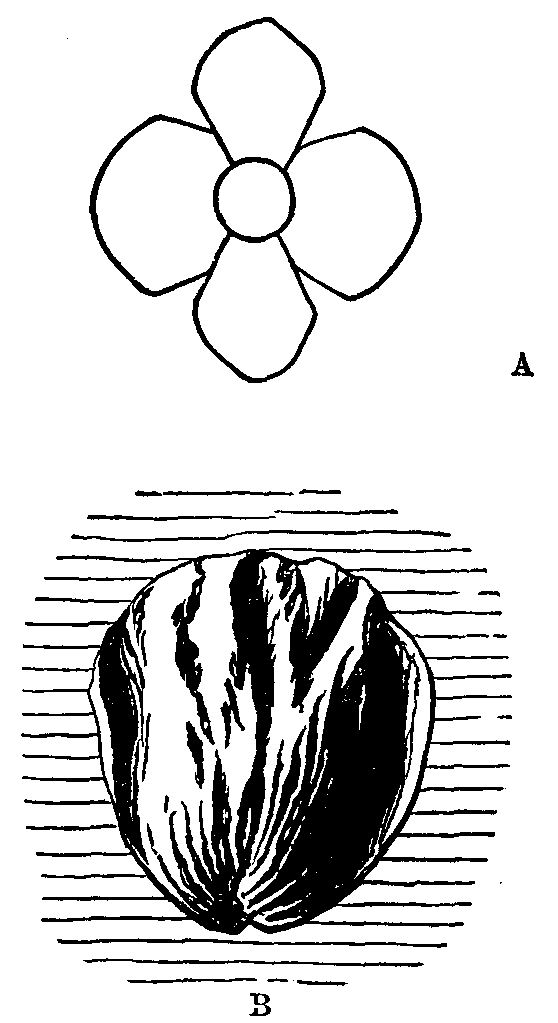 Fig
Fig. 12.
And this is your modern cheap science, in ten volumes. Now I haven't a
quiet moment to spare for drawing this morning; but I merely give the
main relations of the petals, A, and blot in the wrinkles of one of the
lower ones, B, Fig. 12; and yet in this rude sketch you will feel, I
believe, there is something specific which could not belong to any other
flower. But all proper description is impossible without
careful profiles of each petal laterally and across it. Which I may not
find time to draw for any poppy whatever, because they none of them have
well-becomingness enough to make it worth my while, being all more or
less weedy, and ungracious, and mingled of good and evil. Whereupon rises
before me, ghostly and untenable, the general question, 'What is a weed?'
and, impatient for answer, the particular question, What is a poppy? I
choose, for instance, to call this yellow flower a poppy, instead of a
"likeness to poppy," which the botanists meant to call it, in their bad
Greek. I choose also to call a poppy, what the botanists have called
"glaucous thing," (glaucium). But where and when shall I stop calling
things poppies? This is certainly a question to be settled at once, with
others appertaining to it.
7. In the first place, then, I mean to call every
flower either one thing or another, and not an 'aceous' thing, only half
something or half another. I mean to call this plant now in my hand,
either a poppy or not a poppy; but not poppaceous. And this other, either
a thistle or not a thistle; but not thistlaceous. And this other, either
a nettle or not a nettle; but not nettlaceous. I know it will be very
difficult to carry out this principle when tribes of plants are much
extended and varied in type: I shall persist in it, however, as far as
possible; and when plants change so much that one cannot with any
conscience call them by their family name any more, I shall put them
aside somewhere among families of poor relations, not to be minded
for the present, until we are well acquainted with the better bred
circles; I don't know, for instance, whether I shall call the Burnet
'Grass-rose,' or put it out of court for having no petals; but it
certainly shall not be called rosaceous; and my first point will be to
make sure of my pupils having a clear idea of the central and
unquestionable forms of thistle, grass, or rose, and assigning to them
pure Latin, and pretty English, names,—classical, if possible; and
at least intelligible and decorous.
8. I return to our present special question, then, What is a poppy?
and return also to a book I gave away long ago, and have just begged back
again, Dr. Lindley's 'Ladies' Botany.' For without at all looking upon
ladies as inferior beings, I dimly hope that what Dr. Lindley considers
likely to be intelligible to them, may be also clear to their very
humble servant.
The poppies, I find, (page 19, vol. i.) differ from crowfeet in being
of a stupifying instead of a burning nature, and in generally having two
sepals and twice two petals; "but as some poppies have three sepals, and
twice three petals, the number of these parts is not sufficiently
constant to form an essential mark." Yes, I know that, for I found a
superb six-petaled poppy, spotted like a cistus, the other day in a
friend's garden. But then, what makes it a poppy still? That it is of a
stupifying nature, and itself so stupid that it does not know how many
petals it should have, is surely not enough distinction?
9. Returning to Lindley, and working the matter farther out with his
help, I think this definition might stand. "A poppy is a flower which has
either four or six petals, and two or more treasuries, united into one;
containing a milky, stupifying fluid in its stalks and leaves, and always
throwing away its calyx when it blossoms."
And indeed, every flower which unites all these characters, we shall,
in the Oxford schools, call 'poppy,' and 'Papaver;' but when I get fairly
into work, I hope to fix my definitions into more strict terms. For I
wish all my pupils to form the habit of asking, of every plant, these
following four questions, in order, corresponding to the subject of these
opening chapters, namely, "What root has it? what leaf? what flower? and
what stem?" And, in this definition of poppies, nothing whatever is said
about the root; and not only I don't know myself what a poppy root is
like, but in all Sowerby's poppy section, I find no word whatever about
that matter.
10. Leaving, however, for the present, the root unthought of, and
contenting myself with Dr. Lindley's characteristics, I shall place, at
the head of the whole group, our common European wild poppy, Papaver
Rhoeas, and, with this, arrange the nine following other flowers
thus,—opposite.
I must be content at present with determining the Latin names for the
Oxford schools; the English ones I shall give as they chance to occur to
me, in Gerarde and the classical poets who wrote before the English
revolution. When no satisfactory name is to be found, I must try to
invent one; as, for instance, just now, I don't like Gerarde's
'Corn-rose' for Papaver Rhoeas, and must coin another; but this can't be
done by thinking; it will come into my head some day, by chance. I might
try at it straightforwardly for a week together, and not do it.
|
Name in Oxford Catalogue.
|
Dioscorides.
|
In present Botany.
|
|
1. Papaver Rhoeas
|
μηκων
ῥοιας
|
Papaver Rhoeas
|
|
2. P. Hortense
|
μ.
κηπευτη[27]
|
P. Hortense
|
|
3. P. Elatum
|
μ.
θυλακίτις[28]
|
P. Lamottei
|
|
4. P. Argemone
|
...
|
P. Argemone
|
|
5. P. Echinosum
|
...
|
P. Hybridum
|
|
6. P. Violaceum
|
...
|
Roemeria Hybrida
|
|
7. P. Cruciforme
|
...
|
Meconopsis Cambrica
|
|
8. P. Corniculatum
|
μ.
κερατίτις
|
Glaucium Corniculatum
|
|
9. P. Littorale
|
μ.
παραλιος
|
Glaucium Luteum
|
|
10. P. Chelidonium
|
...
|
Chelidonium Majus
|
The Latin names must be fixed at once, somehow; and therefore I do the
best I can, keeping as much respect for the old nomenclature as possible,
though this involves the illogical practice of giving the epithet
sometimes from the flower, (violaceum, cruciforme), and sometimes from
the seed vessel, (elatum, echinosum, corniculatum). Guarding this
distinction, however, we may perhaps be content to call the six last of
the group, in English, Urchin Poppy, Violet Poppy, Crosslet Poppy, Horned
Poppy, Beach Poppy, and Welcome Poppy. I don't think the last flower
pretty enough to be connected more directly with the swallow, in its
English name.
11. I shall be well content if my pupils know these ten poppies
rightly; all of them at present wild in our own country, and, I believe,
also European in range: the head and type of all being the common wild
poppy of our cornfields for which the name 'Papaver Rhoeas,' given it by
Dioscorides, Gerarde, and Linnæus, is entirely authoritative, and we will
therefore at once examine the meaning, and reason, of that name.
12. Dioscorides says the name belongs to it "διὰ τὸ
ταχέως τὸ
ἄνθος
ἀποβάλλειν,"
"because it casts off its bloom quickly," from ῥέω, (rheo) in the sense of shedding.[29] And this indeed it
does,—first calyx, then corolla;—you may translate it
'swiftly ruinous' poppy, but notice, in connection with this idea, how it
droops its head before blooming; an action which, I doubt not,
mingled in Homer's thought with the image of its depression when filled
by rain, in the passage of the Iliad, which, as I have relieved your
memory of three unnecessary names of poppy families, you have memory to
spare for learning.
"μήκων δ' ὣς ἑτέρωσε κάρη βάλεν, ἣτ' ἐνὶ κήπῳ
καρπῷ βριθομένη, νοτιῇσι τε εἰάρινῇσιν
ὣς ἑτέρωσ' ἤμυσε κάρη πήληκι βαρυνθέν."
"And as a poppy lets its head fall aside, which in a garden is loaded
with its fruit, and with the soft rains of spring, so the youth drooped
his head on one side; burdened with the helmet."
And now you shall compare the translations of this passage, with its
context, by Chapman and Pope—(or the school of Pope), the one being
by a man of pure English temper, and able therefore to understand pure
Greek temper; the other infected with all the faults of the falsely
classical school of the Renaissance.
First I take Chapman:—
"His shaft smit fair Gorgythion of Priam's princely race
Who in Æpina was brought forth, a famous town in Thrace,
By Castianeira, that for form was like celestial breed.
And as a crimson poppy-flower, surcharged with his seed,
And vernal humours falling thick, declines his heavy brow,
So, a-oneside, his helmet's weight his fainting head did bow."
Next, Pope:—
"He missed the mark; but pierced Gorgythio's heart,
And drenched in royal blood the thirsty dart:
(Fair Castianeira, nymph of form divine,
This offspring added to King Priam's line).
As full-blown poppies, overcharged with rain,
Decline the head, and drooping kiss the plain,
So sinks the youth: his beauteous head, depressed
Beneath his helmet, drops upon his breast."
13. I give you the two passages in full, trusting that you may so feel
the becomingness of the one, and the gracelessness of the other. But note
farther, in the Homeric passage, one subtlety which cannot enough be
marked even in Chapman's English, that his second word, ἤμυσε,
is employed by him both of the stooping of ears of corn, under wind, and
of Troy stooping to its ruin;[30] and otherwise, in good Greek writers,
the word is marked as having such specific sense of men's drooping under
weight; or towards death, under the burden of fortune which they have no
more strength to sustain;[31] compare the passage I quoted from
Plato, ('Crown of Wild Olive,' p. 95): "And bore lightly the burden of
gold and of possessions." And thus you will begin to understand how
the poppy became in the heathen mind the type at once of power, or pride,
and of its loss; and therefore, both why Virgil represents the white
nymph Nais, "pallentes violas, et summa papavera
carpens,"—gathering the pale flags, and the highest
poppies,—and the reason for the choice of this rather than any
other flower, in the story of Tarquin's message to his son.
14. But you are next to remember the word Rhoeas in another sense.
Whether originally intended or afterwards caught at, the resemblance of
the word to 'Rhoea,' a pomegranate, mentally connects itself with the
resemblance of the poppy head to the pomegranate fruit.
And if I allow this flower to be the first we take up for careful
study in Proserpina, on account of its simplicity of form and splendour
of colour, I wish you also to remember, in connection with it, the cause
of Proserpine's eternal captivity—her having tasted a pomegranate
seed,—the pomegranate being in Greek mythology what the apple is in
the Mosaic legend; and, in the whole worship of Demeter,
associated with the poppy by a multitude of ideas which are not
definitely expressed, but can only be gathered out of Greek art and
literature, as we learn their symbolism. The chief character on which
these thoughts are founded is the fulness of seed in the poppy and
pomegranate, as an image of life: then the forms of both became adopted
for beads or bosses in ornamental art; the pomegranate remains more
distinctly a Jewish and Christian type, from its use in the border of
Aaron's robe, down to the fruit in the hand of Angelico's and
Botticelli's Infant Christs; while the poppy is gradually confused by the
Byzantine Greeks with grapes; and both of these with palm fruit. The
palm, in the shorthand of their art, gradually becomes a symmetrical
branched ornament with two pendent bosses; this is again confused with
the Greek iris, (Homer's blue iris, and Pindar's water-flag,)—and
the Florentines, in adopting Byzantine ornament, read it into their own
Fleur-de-lys; but insert two poppyheads on each side of the entire foil,
in their finest heraldry.
15. Meantime the definitely intended poppy, in late Christian Greek
art of the twelfth century, modifies the form of the Acanthus leaf with
its own, until the northern twelfth century workman takes the
thistle-head for the poppy, and the thistle-leaf for acanthus. The true
poppy-head remains in the south, but gets more and more confused with
grapes, till the Renaissance carvers are content with any kind of boss
full of seed, but insist on such boss or bursting globe as
some essential part of their ornament;—the bean-pod for the same
reason (not without Pythagorean notions, and some of republican election)
is used by Brunelleschi for main decoration of the lantern of Florence
duomo; and, finally, the ornamentation gets so shapeless, that M.
Violet-le-Duc, in his 'Dictionary of Ornament,' loses trace of its origin
altogether, and fancies the later forms were derived from the spadix of
the arum.
16. I have no time to enter into farther details; but through all this
vast range of art, note this singular fact, that the wheat-ear, the vine,
the fleur-de-lys, the poppy, and the jagged leaf of the acanthus-weed, or
thistle, occupy the entire thoughts of the decorative workmen trained in
classic schools, to the exclusion of the rose, true lily, and the other
flowers of luxury. And that the deeply underlying reason of this is in
the relation of weeds to corn, or of the adverse powers of nature to the
beneficent ones, expressed for us readers of the Jewish scriptures,
centrally in the verse, "thorns also, and thistles, shall it bring forth
to thee; and thou shalt eat the herb of the field" (χορτος, grass or corn), and
exquisitely symbolized throughout the fields of Europe by the presence of
the purple 'corn-flag,' or gladiolus, and 'corn-rose' (Gerarde's name for
Papaver Rhoeas), in the midst of carelessly tended corn; and in the
traditions of the art of Europe by the springing of the acanthus round
the basket of the canephora, strictly the basket for bread, the
idea of bread including all sacred things carried at
the feasts of Demeter, Bacchus, and the Queen of the Air. And this
springing of the thorny weeds round the basket of reed, distinctly taken
up by the Byzantine Italians in the basketwork capital of the twelfth
century, (which I have already illustrated at length in the 'Stones of
Venice,') becomes the germ of all capitals whatsoever, in the great
schools of Gothic, to the end of Gothic time, and also of all the
capitals of the pure and noble Renaissance architecture of Angelico and
Perugino, and all that was learned from them in the north, while the
introduction of the rose, as a primal element of decoration, only takes
place when the luxury of English decorated Gothic, the result of that
licentious spirit in the lords which brought on the Wars of the Roses,
indicates the approach of destruction to the feudal, artistic, and moral
power of the northern nations.
For which reason, and many others, I must yet delay the following out
of our main subject, till I have answered the other question, which
brought me to pause in the middle of this chapter, namely, 'What is a
weed?'
THE PARABLE OF JOASH.
1. Some ten or twelve years ago, I bought—three times twelve are
thirty-six—of a delightful little book by Mrs. Gatty, called 'Aunt
Judy's Tales'—whereof to make presents to my little lady friends. I
had, at that happy time, perhaps from four-and-twenty to
six-and-thirty—I forget exactly how many—very particular
little lady friends; and greatly wished Aunt Judy to be the
thirty-seventh,—the kindest, wittiest, prettiest girl one had ever
read of, at least in so entirely proper and orthodox literature.
2. Not but that it is a suspicious sign of infirmity of faith in our
modern moralists to make their exemplary young people always pretty; and
dress them always in the height of the fashion. One may read Miss
Edgeworth's 'Harry and Lucy,' 'Frank and Mary,' 'Fashionable Tales,' or
'Parents' Assistant,' through, from end to end, with extremest care; and
never find out whether Lucy was tall or short, nor whether Mary was dark
or fair, nor how Miss Annaly was dressed, nor—which was my own
chief point of interest—what was the colour of Rosamond's
eyes. Whereas Aunt Judy, in charming position after position, is shown to
have expressed all her pure evangelical principles with the prettiest of
lips; and to have had her gown, though puritanically plain, made by one
of the best modistes in London.
3. Nevertheless, the book is wholesome and useful; and the nicest
story in it, as far as I recollect, is an inquiry into the subject which
is our present business, 'What is a weed?'—in which, by many
pleasant devices, Aunt Judy leads her little brothers and sisters to
discern that a weed is 'a plant in the wrong place.'
'Vegetable' in the wrong place, by the way, I think Aunt Judy says,
being a precisely scientific little aunt. But I can't keep it out of my
own less scientific head that 'vegetable' means only something going to
be boiled. I like 'plant' better for general sense, besides that it's
shorter.
Whatever we call them, Aunt Judy is perfectly right about them as far
as she has gone; but, as happens often even to the best of evangelical
instructresses, she has stopped just short of the gist of the whole
matter. It is entirely true that a weed is a plant that has got into a
wrong place; but it never seems to have occurred to Aunt Judy that some
plants never do!
Who ever saw a wood anemone or a heath blossom in the wrong place? Who
ever saw nettle or hemlock in a right one? And yet, the difference
between flower and weed, (I use, for convenience sake, these words in
their familiar opposition,) certainly does not
consist merely in the flowers being innocent, and the weed stinging and
venomous. We do not call the nightshade a weed in our hedges, nor the
scarlet agaric in our woods. But we do the corncockle in our fields.
4. Had the thoughtful little tutoress gone but one thought farther,
and instead of "a vegetable in a wrong place," (which it may happen to
the innocentest vegetable sometimes to be, without turning into a weed,
therefore,) said, "A vegetable which has an innate disposition to
get into the wrong place," she would have greatly furthered the
matter for us; but then she perhaps would have felt herself to be
uncharitably dividing with vegetables her own little evangelical property
of original sin.
5. This, you will find, nevertheless, to be the very essence of weed
character—in plants, as in men. If you glance through your
botanical books, you will see often added certain names—'a
troublesome weed.' It is not its being venomous, or ugly, but its being
impertinent—thrusting itself where it has no business, and hinders
other people's business—that makes a weed of it. The most accursed
of all vegetables, the one that has destroyed for the present even the
possibility of European civilization, is only called a weed in the slang
of its votaries;[32] but in
the finest and truest English we call so the plant which has come to
us by chance from the same country, the type of mere senseless prolific
activity, the American water-plant, choking our streams till the very
fish that leap out of them cannot fall back, but die on the clogged
surface; and indeed, for this unrestrainable, unconquerable insolence of
uselessness, what name can be enough dishonourable?
6. I pass to vegetation of nobler rank.
You remember, I was obliged in the last chapter to leave my poppy, for
the present, without an English specific name, because I don't like
Gerarde's 'Corn-rose,' and can't yet think of another. Nevertheless, I
would have used Gerarde's name, if the corn-rose were as much a rose as
the corn-flag is a flag. But it isn't. The rose and lily have quite
different relations to the corn. The lily is grass in loveliness, as the
corn is grass in use; and both grow together in peace—gladiolus in
the wheat, and narcissus in the pasture. But the rose is of another and
higher order than the corn, and you never saw a cornfield overrun with
sweetbriar or apple-blossom.
They have no mind, they, to get into the wrong place.
What is it, then, this temper in some plants—malicious as it
seems—intrusive, at all events, or erring,—which brings them
out of their places—thrusts them where they thwart us and
offend?
7. Primarily, it is mere hardihood and coarseness of make. A plant
that can live anywhere, will often live where it is not wanted. But the
delicate and tender ones keep at home. You have no trouble in
'keeping down' the spring gentian. It rejoices in its own Alpine home,
and makes the earth as like heaven as it can, but yields as softly as the
air, if you want it to give place. Here in England, it will only grow on
the loneliest moors, above the high force of Tees; its Latin name, for
us (I may as well tell you at once) is to be 'Lucia verna;' and
its English one, Lucy of Teesdale.
8. But a plant may be hardy, and coarse of make, and able to live
anywhere, and yet be no weed. The coltsfoot, so far as I know, is the
first of large-leaved plants to grow afresh on ground that has been
disturbed: fall of Alpine débris, ruin of railroad embankment, waste of
drifted slime by flood, it seeks to heal and redeem; but it does not
offend us in our gardens, nor impoverish us in our fields.
Nevertheless, mere coarseness of structure, indiscriminate hardihood,
is at least a point of some unworthiness in a plant. That it should have
no choice of home, no love of native land, is ungentle; much more if such
discrimination as it has, be immodest, and incline it, seemingly, to open
and much-traversed places, where it may be continually seen of strangers.
The tormentilla gleams in showers along the mountain turf; her delicate
crosslets are separate, though constellate, as the rubied daisy. But the
king-cup—(blessing be upon it always no less)—crowds itself
sometimes into too burnished flame of inevitable gold. I don't know if
there was anything in the darkness of this last spring to make it
brighter in resistance; but I never saw any spaces of full warm yellow,
in natural colour, so intense as the meadows between Reading and the
Thames; nor did I know perfectly what purple and gold meant, till I saw a
field of park land embroidered a foot deep with king-cup and
clover—while I was correcting my last notes on the spring colours
of the Royal Academy—at Aylesbury.
9. And there are two other questions of extreme subtlety connected
with this main one. What shall we say of the plants whose entire destiny
is parasitic—which are not only sometimes, and
impertinently, but always, and pertinently, out of place; not only
out of the right place, but out of any place of their own? When is
mistletoe, for instance, in the right place, young ladies, think you? On
an apple tree, or on a ceiling? When is ivy in the right
place?—when wallflower? The ivy has been torn down from the towers
of Kenilworth; the weeds from the arches of the Coliseum, and from the
steps of the Araceli, irreverently, vilely, and in vain; but how are we
to separate the creatures whose office it is to abate the grief of ruin
by their gentleness,
"wafting wallflower scents
From out the crumbling ruins of fallen pride,
And chambers of transgression, now forlorn,"
from those which truly resist the toil of men, and conspire against
their fame; which are cunning to consume, and prolific to encumber;
and of whose perverse and unwelcome sowing we know, and can say
assuredly, "An enemy hath done this."
10. Again. The character of strength which gives prevalence over
others to any common plant, is more or less consistently dependent on
woody fibre in the leaves; giving them strong ribs and great expanding
extent; or spinous edges, and wrinkled or gathered extent.
Get clearly into your mind the nature of those two conditions. When a
leaf is to be spread wide, like the Burdock, it is supported by a
framework of extending ribs like a Gothic roof. The supporting function
of these is geometrical; every one is constructed like the girders of a
bridge, or beams of a floor, with all manner of science in the
distribution of their substance in the section, for narrow and deep
strength; and the shafts are mostly hollow. But when the extending space
of a leaf is to be enriched with fulness of folds, and become beautiful
in wrinkles, this may be done either by pure undulation as of a liquid
current along the leaf edge, or by sharp 'drawing'—or 'gathering' I
believe ladies would call it—and stitching of the edges together.
And this stitching together, if to be done very strongly, is done round a
bit of stick, as a sail is reefed round a mast; and this bit of stick
needs to be compactly, not geometrically strong; its function is
essentially that of starch,—not to hold the leaf up off the ground
against gravity; but to stick the edges out, stiffly, in a crimped frill.
And in beautiful work of this kind, which we are meant to study,
the stays of the leaf—or stay-bones—are finished off very
sharply and exquisitely at the points; and indeed so much so, that they
prick our fingers when we touch them; for they are not at all meant to be
touched, but admired.
11. To be admired,—with qualification, indeed, always, but with
extreme respect for their endurance and orderliness. Among flowers that
pass away, and leaves that shake as with ague, or shrink like bad
cloth,—these, in their sturdy growth and enduring life, we are
bound to honour; and, under the green holly, remember how much softer
friendship was failing, and how much of other loving, folly. And
yet—you are not to confuse the thistle with the cedar that is in
Lebanon; nor to forget—if the spinous nature of it become too cruel
to provoke and offend—the parable of Joash to Amaziah, and its
fulfilment: "There passed by a wild beast that was in Lebanon, and trode
down the thistle."
12. Then, lastly, if this rudeness and insensitiveness of nature be
gifted with no redeeming beauty; if the boss of the thistle lose its
purple, and the star of the Lion's tooth, its light; and, much more, if
service be perverted as beauty is lost, and the honied tube, and
medicinal leaf, change into mere swollen emptiness, and salt brown
membrane, swayed in nerveless languor by the idle sea,—at last the
separation between the two natures is as great as between the fruitful
earth and fruitless ocean; and between the living hands that tend the
Garden of Herbs where Love is, and those unclasped, that toss
with tangle and with shells.
13. I had a long bit in my head, that I wanted to write, about St.
George of the Seaweed, but I've no time to do it; and those few words of
Tennyson's are enough, if one thinks of them: only I see, in correcting
press, that I've partly misapplied the idea of 'gathering' in the leaf
edge. It would be more accurate to say it was gathered at the central
rib; but there is nothing in needlework that will represent the actual
excess by lateral growth at the edge, giving three or four inches of edge
for one of centre. But the stiffening of the fold by the thorn which
holds it out is very like the action of a ship's spars on its sails; and
absolutely in many cases like that of the spines in a fish's fin, passing
into the various conditions of serpentine and dracontic crest, connected
with all the terrors and adversities of nature; not to be dealt with in a
chapter on weeds.
14. Here is a sketch of a crested leaf of less adverse temper, which
may as well be given, together with Plate III., in this number, these two
engravings being meant for examples of two different methods of drawing,
both useful according to character of subject. Plate III. is sketched
first with a finely-pointed pen, and common ink, on white paper; then
washed rapidly with colour, and retouched with the pen to give sharpness
and completion. This method is used because the thistle
leaves are full of complex and sharp sinuosities, and set with intensely
sharp spines passing into hairs, which require many kinds of execution
with the fine point to imitate at all. In the drawing there was more look
of the bloom or woolliness on the stems, but it was useless to try for
this in the mezzotint, and I desired Mr. Allen to leave his work at the
stage where it expressed as much form as I wanted. The leaves are of the
common marsh thistle, of which more anon; and the two long lateral ones
are only two different views of the same leaf, while the central figure
is a young leaf just opening. It beat me, in its delicate bossing, and I
had to leave it, discontentedly enough.
Plate IV. is much better work, being of an easier subject, adequately
enough rendered by perfectly simple means. Here I had only a succulent
and membranous surface to represent, with definite outlines, and merely
undulating folds; and this is sufficiently done by a careful and firm pen
outline on grey paper, with a slight wash of colour afterwards,
reinforced in the darks; then marking the lights with white. This method
is classic and authoritative, being used by many of the greatest masters,
(by Holbein continually;) and it is much the best which the general
student can adopt for expression of the action and muscular power of
plants.
The goodness or badness of such work depends absolutely on the truth
of the single line. You will find a thousand botanical drawings which
will give you a delicate and deceptive resemblance of the
leaf, for one that will give you the right convexity in its backbone, the
right perspective of its peaks when they foreshorten, or the right
relation of depth in the shading of its dimples. On which, in leaves as
in faces, no little expression of temper depends.
Meantime we have yet to consider somewhat more touching that temper
itself, in next chapter.
THE PARABLE OF JOTHAM.
1. I do not know if my readers were checked, as I wished them to be,
at least for a moment, in the close of the last chapter, by my talking of
thistles and dandelions changing into seaweed, by gradation of which,
doubtless, Mr. Darwin can furnish us with specious and sufficient
instances. But the two groups will not be contemplated in our Oxford
system as in any parental relations whatsoever.
We shall, however, find some very notable relations existing between
the two groups of the wild flowers of dry land, which represent, in the
widest extent, and the distinctest opposition, the two characters of
material serviceableness and unserviceableness; the groups which in our
English classification will be easily remembered as those of the Thyme,
and the Daisy.
The one, scented as with incense—medicinal—and in all
gentle and humble ways, useful. The other, scentless—helpless for
ministry to the body; infinitely dear as the bringer of light, ruby,
white and gold; the three colours of the Day, with no hue of shade in it.
Therefore I take it on the coins of St. George for
the symbol of the splendour or light of heaven, which is dearest where
humblest.
2. Now these great two orders—of which the types are the thyme
and the daisy—you are to remember generally as the 'Herbs' and the
'Sunflowers.' You are not to call them Lipped flowers, nor Composed
flowers; because the first is a vulgar term; for when you once come to be
able to draw a lip, or, in noble duty, to kiss one, you will know that no
other flower in earth is like that: and the second is an indefinite term;
for a foxglove is as much a 'composed' flower as a daisy; but it is
composed in the shape of a spire, instead of the shape of the sun. And
again a thistle, which common botany calls a composed flower, as well as
a daisy, is composed in quite another shape, being on the whole, bossy
instead of flat; and of another temper, or composition of mind, also,
being connected in that respect with butterburs, and a vast company of
rough, knotty, half-black or brown, and generally
unluminous—flowers I can scarcely call them—and weeds I will
not,—creatures, at all events, in nowise to be gathered under the
general name 'Composed,' with the stars that crown Chaucer's Alcestis,
when she returns to the day from the dead.
But the wilder and stronger blossoms of the Hawk's-eye—again you
see I refuse for them the word weed;—and the waste-loving Chicory,
which the Venetians call "Sponsa solis," are all to be held in one class
with the Sunflowers; but dedicate,—the daisy
to Alcestis alone; others to Clytia, or the Physician Apollo himself: but
I can't follow their mythology yet awhile.
3. Now in these two families you have typically Use opposed to Beauty
in wildness; it is their wildness which is their
virtue;—that the thyme is sweet where it is unthought of, and the
daisies red, where the foot despises them: while, in other orders,
wildness is their crime,—"Wherefore, when I looked that it should
bring forth grapes, brought it forth wild grapes?" But in all of them you
must distinguish between the pure wildness of flowers and their distress.
It may not be our duty to tame them; but it must be, to relieve.
4. It chanced, as I was arranging the course of these two chapters,
that I had examples given me of distressed and happy wildness, in
immediate contrast. The first, I grieve to say, was in a bit of my own
brushwood, left uncared-for evidently many a year before it became mine.
I had to cut my way into it through a mass of thorny ruin; black,
birds-nest like, entanglement of brittle spray round twisted stems of
ill-grown birches strangling each other, and changing half into roots
among the rock clefts; knotted stumps of never-blossoming blackthorn, and
choked stragglings of holly, all laced and twisted and tethered round
with an untouchable, almost unhewable, thatch, a foot thick, of dead
bramble and rose, laid over rotten ground through which the water soaked
ceaselessly, undermining it into merely unctuous clods and clots,
knitted together by mossy sponge. It was all Nature's free doing! she had
had her way with it to the uttermost; and clearly needed human help and
interference in her business; and yet there was not one plant in the
whole ruinous and deathful riot of the place, whose nature was not in
itself wholesome and lovely; but all lost for want of discipline.
5. The other piece of wild growth was among the fallen blocks of
limestone under Malham Cove. Sheltered by the cliff above from stress of
wind, the ash and hazel wood spring there in a fair and perfect freedom,
without a diseased bough, or an unwholesome shade. I do not know why mine
is all encumbered with overgrowth, and this so lovely that scarce a
branch could be gathered but with injury;—while underneath, the
oxalis, and the two smallest geraniums (Lucidum and Herb-Robert) and the
mossy saxifrage, and the cross-leaved bed-straw, and the white pansy,
wrought themselves into wreaths among the fallen crags, in which every
leaf rejoiced, and was at rest.
6. Now between these two states of equally natural growth, the point
of difference that forced itself on me (and practically enough, in the
work I had in my own wood), was not so much the withering and waste of
the one, and the life of the other, as the thorniness and cruelty of the
one, and the softness of the other. In Malham Cove, the stones of the
brook were softer with moss than any silken pillow—the crowded
oxalis leaves yielded to the pressure of the hand, and were not
felt—the cloven leaves of the Herb-Robert and orbed
clusters of its companion overflowed every rent in the rude crags with
living balm; there was scarcely a place left by the tenderness of the
happy things, where one might not lay down one's forehead on their warm
softness, and sleep. But in the waste and distressed ground, the distress
had changed itself to cruelty. The leaves had all perished, and the
bending saplings, and the wood of trust;—but the thorns were there,
immortal, and the gnarled and sapless roots, and the dusty treacheries of
decay.
7. Of which things you will find it good to consider also otherwise
than botanically. For all these lower organisms suffer and perish, or are
gladdened and flourish, under conditions which are in utter precision
symbolical, and in utter fidelity representative, of the conditions which
induce adversity and prosperity in the kingdoms of men: and the Eternal
Demeter,—Mother, and Judge,—brings forth, as the herb
yielding seed, so also the thorn and the thistle, not to herself, but
to thee.
8. You have read the words of the great Law often enough;—have
you ever thought enough of them to know the difference between these two
appointed means of Distress? The first, the Thorn, is the type of
distress caused by crime, changing the soft and breathing leaf
into inflexible and wounding stubbornness. The second is the distress
appointed to be the means and herald of good,—Thou shalt see the
stubborn thistle bursting, into glossy purple, which outredden, all
voluptuous garden roses.
9. It is strange that, after much hunting, I cannot find authentic
note of the day when Scotland took the thistle for her emblem; and I have
no space (in this chapter at least) for tradition; but, with whatever
lightness of construing we may receive the symbol, it is actually the
truest that could have been found, for some conditions of the Scottish
mind. There is no flower which the Proserpina of our Northern Sicily
cherishes more dearly: and scarcely any of us recognize enough the
beautiful power of its close-set stars, and rooted radiance of ground
leaves; yet the stubbornness and ungraceful rectitude of its stem, and
the besetting of its wholesome substance with that fringe of offence, and
the forwardness of it, and dominance,—I fear to lacess some of my
dearest friends if I went on:—let them rather, with Bailie Jarvie's
true conscience,[33] take
their Scott from the inner shelf in their heart's library which all true
Scotsmen give him, and trace, with the swift reading of memory, the
characters of Fergus M'Ivor, Hector M'Intyre, Mause Headrigg, Alison
Wilson, Richie Moniplies, and Andrew Fairservice; and
then say, if the faults of all these, drawn as they are with a precision
of touch like a Corinthian sculptor's of the acanthus leaf, can be found
in anything like the same strength in other races, or if so stubbornly
folded and starched moni-plies of irritating kindliness, selfish
friendliness, lowly conceit, and intolerable fidelity, are native to any
other spot of the wild earth of the habitable globe.
10. Will you note also—for this is of extreme
interest—that these essential faults are all mean
faults;—what we may call ground-growing faults; conditions of
semi-education, of hardly-treated homelife, or of coarsely-minded and
wandering prosperity. How literally may we go back from the living soul
symbolized, to the strangely accurate earthly symbol, in the prickly
weed. For if, with its bravery of endurance, and carelessness in choice
of home, we find also definite faculty and habit of migration, volant
mechanism for choiceless journey, not divinely directed in pilgrimage to
known shrines; but carried at the wind's will by a Spirit which listeth
not—it will go hard but that the plant shall become, if not
dreaded, at least despised; and, in its wandering and reckless splendour,
disgrace the garden of the sluggard, and possess the inheritance of the
prodigal: until even its own nature seems contrary to good, and the
invocation of the just man be made to it as the executor of Judgment,
"Let thistles grow instead of wheat, and cockle instead of barley."
11. Yet to be despised—either for men or flowers—may be
no ill-fortune; the real ill-fortune is only to be despicable. These
faults of human character, wherever found, observe, belong to it as
ill-trained—incomplete; confirm themselves only in the vulgar.
There is no base pertinacity, no overweening conceit, in the Black
Douglas, or Claverhouse, or Montrose; in these we find the pure Scottish
temper, of heroic endurance and royal pride; but, when, in the pay, and
not deceived, but purchased, idolatry of Mammon, the Scottish persistence
and pride become knit and vested in the spleuchan, and your stiff
Covenanter makes his covenant with Death, and your Old Mortality
deciphers only the senseless legends of the eternal gravestone,—you
get your weed, earth-grown, in bitter verity, and earth-devastating, in
bitter strength.
12. I have told you, elsewhere, we are always first to study national
character in the highest and purest examples. But if our knowledge is to
be complete, we have to study also the special diseases of national
character. And in exact opposition to the most solemn virtue of Scotland,
the domestic truth and tenderness breathed in all Scottish song, you have
this special disease and mortal cancer, this woody-fibriness, literally,
of temper and thought: the consummation of which into pure lignite, or
rather black Devil's charcoal—the sap of the birks of Aberfeldy
become cinder, and the blessed juices of them, deadly gas,—you may
know in its pure blackness best in the work of the greatest of these
ground-growing Scotchmen, Adam Smith.
13. No man of like capacity, I believe, born of any other nation,
could have deliberately, and with no momentary shadow of suspicion or
question, formalized the spinous and monstrous fallacy that human
commerce and policy are naturally founded on the desire of every
man to possess his neighbour's goods.
This is the 'release unto us Barabbas,' with a witness; and the
deliberate systematization of that cry, and choice, for perpetual
repetition and fulfilment in Christian statesmanship, has been, with the
strange precision of natural symbolism and retribution, signed, (as of
old, by strewing of ashes on Kidron,) by strewing of ashes on the brooks
of Scotland; waters once of life, health, music, and divine tradition;
but to whose festering scum you may now set fire with a candle; and of
which, round the once excelling palace of Scotland, modern sanitary
science is now helplessly contending with the poisonous exhalations.
14. I gave this chapter its heading, because I had it in my mind to
work out the meaning of the fable in the ninth chapter of Judges, from
what I had seen on that thorny ground of mine, where the bramble was king
over all the trees of the wood. But the thoughts are gone from me now;
and as I re-read the chapter of Judges,—now, except in my memory,
unread, as it chances, for many a year,—the sadness of that story
of Gideon fastens on me, and silences me. This the end of his
angel visions, and dream-led victories, the slaughter of all his sons
but this youngest,[34]—and he never again heard of in
Israel!
You Scottish children of the Rock, taught through all your once
pastoral and noble lives by many a sweet miracle of dew on fleece and
ground,—once servants of mighty kings, and keepers of sacred
covenant; have you indeed dealt truly with your warrior kings, and
prophet saints, or are these ruins of their homes, and shrines, dark with
the fire that fell from the curse of Jerubbael?
THE STEM.
1. As I read over again, with a fresh mind, the last chapter, I am
struck by the opposition of states which seem best to fit a weed for a
weed's work,—stubbornness, namely, and flaccidity. On the one hand,
a sternness and a coarseness of structure which changes its stem into a
stake, and its leaf into a spine; on the other, an utter flaccidity and
ventosity of structure, which changes its stem into a riband, and its
leaf into a bubble. And before we go farther—for we are not yet at
the end of our study of these obnoxious things—we had better
complete an examination of the parts of a plant in general, by
ascertaining what a Stem proper is; and what makes it stiffer, or
hollower, than we like it;—how, to wit, the gracious and generous
strength of ash differs from the spinous obstinacy of
blackthorn,—and how the geometric and enduring hollowness of a
stalk of wheat differs from the soft fulness of that of a mushroom. To
which end, I will take up a piece of study, not of black, but white,
thorn, written last spring.
2. I suppose there is no question but that all nice people like
hawthorn blossom.
I want, if I can, to find out to-day, 25th May, 1875, what it is we
like it so much for: holding these two branches of it in my
hand—one full out, the other in youth. This full one is a mere mass
of symmetrically balanced—snow, one was going vaguely to write, in
the first impulse. But it is nothing of the sort. White,—yes, in a
high degree; and pure, totally; but not at all dazzling in the white, nor
pure in an insultingly rivalless manner, as snow would be; yet pure
somehow, certainly; and white, absolutely, in spite of what might be
thought failure,—imperfection—nay, even distress and loss in
it. For every little rose of it has a green darkness in the
centre—not even a pretty green, but a faded, yellowish, glutinous,
unaccomplished green; and round that, all over the surface of the
blossom, whose shell-like petals are themselves deep sunk, with grey
shadows in the hollows of them—all above this already subdued
brightness, are strewn the dark points of the dead stamens—manifest
more and more, the longer one looks, as a kind of grey sand, sprinkled
without sparing over what looked at first unspotted light. And in all the
ways of it the lovely thing is more like the spring frock of some prudent
little maid of fourteen, than a flower;—frock with some little
spotty pattern on it to keep it from showing an unintended and
inadvertent spot,—if Fate should ever inflict such a thing!
Undeveloped, thinks Mr. Darwin,—the poor short-coming,
ill-blanched thorn blossom—going to be a Rose, some day soon; and,
what next?—who knows?—perhaps a Pæony!
3. Then this next branch, in dawn and delight of youth, set with
opening clusters of yet numerable blossom, four, and five, and seven,
edged, and islanded, and ended, by the sharp leaves of freshest green,
deepened under the flowers, and studded round with bosses, better than
pearl beads of St. Agnes' rosary,—folded, over and over, with the
edges of their little leaves pouting, as the very softest waves do on
flat sand where one meets another; then opening just enough to show the
violet colour within—which yet isn't violet colour, nor even "meno
che le rose," but a different colour from every other lilac that one ever
saw;—faint and faded even before it sees light, as the filmy cup
opens over the depth of it, then broken into purple motes of tired bloom,
fading into darkness, as the cup extends into the perfect rose.
This, with all its sweet change that one would so fain stay, and soft
effulgence of bud into softly falling flower, one has watched—how
often; but always with the feeling that the blossoms are thrown over the
green depth like white clouds—never with any idea of so much as
asking what holds the cloud there. Have each of the innumerable blossoms
a separate stalk? and, if so, how is it that one never thinks of the
stalk, as one does with currants?
4. Turn the side of the branch to you;—Nature never meant you to
see it so; but now it is all stalk below, and stamens
above,—the petals nothing, the stalks all tiny trees, always
dividing their branches mainly into three—one in the centre short,
and the two lateral, long, with an intermediate extremely long one, if
needed, to fill a gap, so contriving that the flowers shall all be nearly
at the same level, or at least surface of ball, like a guelder rose. But
the cunning with which the tree conceals its structure till the blossom
is fallen, and then—for a little while, we had best look no more at
it, for it is all like grape-stalks with no grapes.
These, whether carrying hawthorn blossom and haw, or grape blossom and
grape, or peach blossom and peach, you will simply call the 'stalk,'
whether of flower or fruit. A 'stalk' is essentially round, like a
pillar; and has, for the most part, the power of first developing, and
then shaking off, flower and fruit from its extremities. You can pull the
peach from its stalk, the cherry, the grape. Always at some time of its
existence, the flower-stalk lets fall something of what it sustained,
petal or seed.
In late Latin it is called 'petiolus,' the little foot; because the
expanding piece that holds the grape, or olive, is a little like an
animal's foot. Modern botanists have misapplied the word to the
leaf-stalk, which has no resemblance to a foot at all. We must
keep the word to its proper meaning, and, when we want to write Latin,
call it 'petiolus;' when we want to write English, call it 'stalk,'
meaning always fruit or flower stalk.
I cannot find when the word 'stalk' first appears in
English:—its derivation will be given presently.
5. Gather next a hawthorn leaf. That also has a stalk; but you can't
shake the leaf off it. It, and the leaf, are essentially one; for the
sustaining fibre runs up into every ripple or jag of the leaf's edge: and
its section is different from that of the flower-stalk; it is no more
round, but has an upper and under surface, quite different from each
other. It will be better, however, to take a larger leaf to examine this
structure in. Cabbage, cauliflower, or rhubarb, would any of them be
good, but don't grow wild in the luxuriance I want. So, if you please, we
will take a leaf of burdock, (Arctium Lappa,) the principal business of
that plant being clearly to grow leaves wherewith to adorn
fore-grounds.[35]
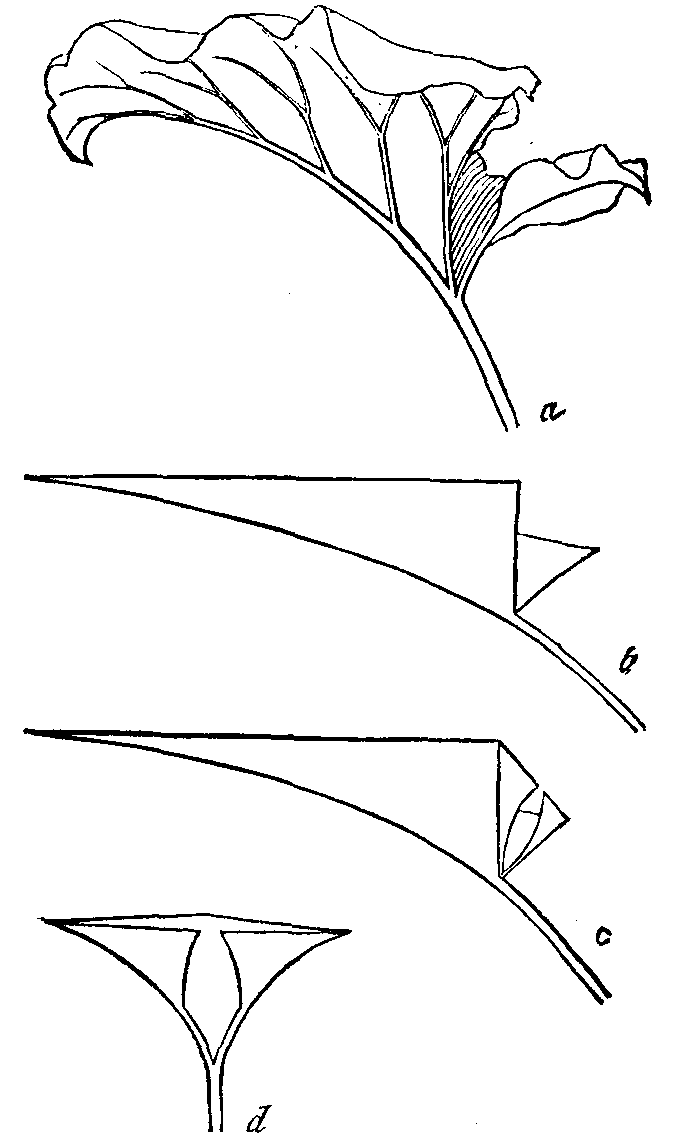 Fig
Fig. 13.
6. The outline of it in Sowerby is not an intelligent one, and I have
not time to draw it but in the rudest way myself; Fig. 13, a; with
perspectives of the elementary form below, b, c, and
d. By help of which, if you will construct a burdock leaf in
paper, my rude outline (a) may tell the rest of what I want you to
see.
 Fig
Fig. 14.
Take a sheet of stout note paper, Fig. 14, A, double it sharply down
the centre, by the dotted line, then give it the two cuts at a and
b, and double those pieces sharply back, as at B; then, opening
them again, cut the whole into the form C; and then, pulling up the
corners c d, stitch them together with a loose thread so that the
points c and d shall be within half an inch of each other;
and you will have a kind of triangular scoop, or shovel, with a stem, by
which you can sufficiently hold it, D.
7. And from this easily constructed and tenable model, you may learn
at once these following main facts about all leaves.
[I.] That they are not flat, but, however slightly, always hollowed
into craters, or raised into hills, in one or another direction; so that
any drawable outline of them does not in the least represent the real
extent of their surfaces; and until you know how to draw a cup, or a
mountain, rightly, you have no chance of drawing a leaf. My simple artist
readers of long ago, when I told them to draw leaves, thought they could
do them by the boughfull, whenever they liked. Alas, except by old
William Hunt, and Burne Jones, I've not seen a leaf painted, since those
burdocks of Turner's; far less sculptured—though one would think at
first that was easier! Of which we shall have talk elsewhere; here I must
go on to note fact number two, concerning leaves.
8. [II.] The strength of their supporting stem consists not merely in
the gathering together of all the fibres, but in gathering them
essentially into the profile of the letter V, which you will see your
doubled paper stem has; and of which you can feel the strength and use,
in your hand, as you hold it. Gather a common plantain leaf, and look at
the way it puts its round ribs together at the base, and you will
understand the matter at once. The arrangement is modified and disguised
in every possible way, according to the leaf's need: in the aspen, the
leaf-stalk becomes an absolute vertical plank; and in the large trees is
often almost rounded into the likeness of a fruit-stalk;—but, in
all,[36] the essential
structure is this doubled one; and in all, it opens at the place where
the leaf joins the main stem, into a kind of cup, which holds next year's
bud in the hollow of it.
9. Now there would be no inconvenience in your simply getting into the
habit of calling the round petiol of the fruit the 'stalk,' and the
contracted channel of the leaf, 'leaf-stalk.' But this way of naming them
would not enforce, nor fasten in your mind, the difference between the
two, so well as if you have an entirely different name for the
leaf-stalk. Which is the more desirable, because the limiting character
of the leaf, botanically, is—(I only learned this from my botanical
friend the other day, just in the very moment I wanted
it,)—that it holds the bud of the new stem in its own hollow, but
cannot itself grow in the hollow of anything else;—or, in botanical
language, leaves are never axillary,—don't grow in armpits, but are
themselves armpits; hollows, that is to say, where they spring from the
main stem.
10. Now there is already a received and useful botanical word, 'cyme'
(which we shall want in a little while.) derived from the Greek κῦμα, a swelling or
rising wave, and used to express a swelling cluster of foamy blossom.
Connected with that word, but in a sort the reverse of it, you have the
Greek 'κύμβη,' the hollow of a cup, or
bowl; whence κύμβαλου, a
cymbal,—that is to say, a musical instrument owing its tone to its
hollowness. These words become in Latin, cymba, and cymbalum; and
I think you will find it entirely convenient and advantageous to call the
leaf-stalk distinctively the 'cymba,' retaining the mingled idea of cup
and boat, with respect at least to the part of it that holds the bud; and
understanding that it gathers itself into a V-shaped, or even narrowly
vertical, section, as a boat narrows to its bow, for strength to sustain
the leaf.
With this word you may learn the Virgilian line, that shows the final
use of iron—or iron-darkened—ships:
"Et ferrugíneâ subvectat corpora cymbâ."
The "subvectat corpora" will serve to remind you of the office of the
leafy cymba in carrying the bud; and make you thankful that the
said leafy vase is not of iron; and is a ship of Life instead of
Death.
11. Already, not once, nor twice, I have had to use the word 'stem,'
of the main round branch from which both stalk and cymba spring. This
word you had better keep for all growing, or advancing, shoots of trees,
whether from the ground, or from central trunks and branches. I regret
that the words multiply on us; but each that I permit myself to use has
its own proper thought or idea to express, as you will presently
perceive; so that true knowledge multiplies with true words.
12. The 'stem,' you are to say, then, when you mean the
advancing shoot,—which lengthens annually, while a stalk
ends every year in a blossom, and a cymba in a leaf. A stem is
essentially round,[37]
square, or regularly polygonal; though, as a cymba may become
exceptionally round, a stem may become exceptionally flat, or even mimic
the shape of a leaf. Indeed I should have liked to write "a stem is
essentially round, and constructively, on occasion, square,"—but it
would have been too grand. The fact is, however, that a stem is really a
roundly minded thing, throwing off its branches in circles as a trundled
mop throws off drops, though it can always order the branches to fly off
in what order it likes,—two at a time, opposite to each other; or
three, or five, in a spiral coil; or one here and one there, on this side
and that; but it is always twisting, in its own
inner mind and force; hence it is especially proper to use the word
'stem' of it—στέμμα, a twined wreath; properly,
twined round a staff, or sceptre: therefore, learn at once by heart these
lines in the opening Iliad:
"Στέμματ' ἔχων ἐν χερσὶν ἑκηβόλου Ἀπόλλωνος,
Χρυςέῳ ἀνὰ σκήπτρῳ·"
And recollect that a sceptre is properly a staff to lean upon; and
that as a crown or diadem is first a binding thing, a 'sceptre' is first
a supporting thing, and it is in its nobleness, itself made of the
stem of a young tree. You may just as well learn also this:
"Ναὶ μὰ τόδε σκῆπτρον, τὸ μὲν οὔποτε φύλλα καὶ ὄζους
Φύσει, ἐπειδὴ πρῶτα τομὴν ἐν ὄρεσσι λέλοιπεν,
Οὐδ' ἀναθηλήσει· περὶ γάρ ῥά ἑ χαλκὸς ἔλεψε
Φύλλα τε καὶ φλοιόν· νῦν αὖτε μιν υἷες Ἀχαιῶν
Ἐν παλάμῃς φορέουσι δικασπόλοι, οἵ τε θέμιστας
Πρὸς Διὸς εἰρύαται·"
"Now, by this sacred sceptre hear me swear
Which never more shall leaves or blossoms bear,
Which, severed from the trunk, (as I from thee,)
On the bare mountains left its parent tree;
This sceptre, formed by tempered steel to prove
An ensign of the delegates of Jove,
From whom the power of laws and justice springs
(Tremendous oath, inviolate to Kings)."
13. The supporting power in the tree itself is, I doubt not, greatly
increased by this spiral action; and the fine instinct of its being
so, caused the twisted pillar to be used in the Lombardic
Gothic,—at first, merely as a pleasant variety of form, but at last
constructively and universally, by Giotto, and all the architects of his
school. Not that the spiral form actually adds to the strength of a
Lombardic pillar, by imitating contortions of wood, any more than the
fluting of a Doric shaft adds to its strength by imitating the
canaliculation of a reed; but the perfect action of the imagination,
which had adopted the encircling acanthus for the capital, adopted the
twining stemma for the shaft; the pure delight of the eye being the first
condition in either case: and it is inconceivable how much of the
pleasure taken both in ornament and in natural form is founded
elementarily on groups of spiral line. The study in our fifth plate, of
the involucre of the waste-thistle,[38] is as good an example as I can give of
the more subtle and concealed conditions of this structure.
14. Returning to our present business of nomenclature, we find the
Greek word, 'stemma,' adopted by the Latins, becoming the
expression of a growing and hereditary race; and the branched tree, the
natural type, among all nations, of multiplied families. Hence the entire
fitness of the word for our present purposes; as signifying, "a spiral
shoot extending itself by branches." But since, unless it is spiral, it
is not a stem, and unless it has branches, it is not a stem, we shall
still want another word for the sustaining 'sceptre' of a foxglove, or
cowslip. Before determining that, however, we must see what need there
may be of one familiar to our ears until lately, although now, I
understand, falling into disuse.
15. By our definition, a stem is a spirally bent, essentially living
and growing, shoot of vegetation. But the branch of a tree, in which many
such stems have their origin, is not, except in a very subtle and partial
way, spiral; nor, except in the shoots that spring from it, progressive
forwards; it only receives increase of thickness at its sides. Much more,
what used to be called the trunk of a tree, in which many branches
are united, has ceased to be, except in mere tendency and temper, spiral;
and has so far ceased from growing as to be often in a state of decay in
its interior, while the external layers are still in serviceable
strength.
16. If, however, a trunk were only to be defined as an arrested stem,
or a cluster of arrested stems, we might perhaps refuse, in scientific
use, the popular word. But such a definition does not touch the main
idea. Branches usually begin to assert themselves at a height above the
ground approximately fixed for each species of tree,—low in an oak,
high in a stone pine; but, in both, marked as a point of structural
change in the direction of growing force, like the spring of a vault
from a pillar; and as the tree grows old, some of its branches getting
torn away by winds or falling under the weight of their own fruit, or
load of snow, or by natural decay, there remains literally a 'truncated'
mass of timber, still bearing irregular branches here and there, but
inevitably suggestive of resemblance to a human body, after the loss of
some of its limbs.
And to prepare trees for their practical service, what age and storm
only do partially, the first rough process of human art does completely.
The branches are lopped away, leaving literally the 'truncus' as the part
of the tree out of which log and rafter can be cut. And in many trees, it
would appear to be the chief end of their being to produce this part of
their body on a grand scale, and of noble substance; so that, while in
thinking of vegetable life without reference to its use to men or
animals, we should rightly say that the essence of it was in leaf and
flower—not in trunk or fruit; yet for the sake of animals, we find
that some plants, like the vine, are apparently meant chiefly to produce
fruit; others, like laurels, chiefly to produce leaves; others chiefly to
produce flowers; and others to produce permanently serviceable and
sculptural wood; or, in some cases, merely picturesque and monumental
masses of vegetable rock, "intertwisted fibres
serpentine,"—of far nobler and more pathetic use in their places,
and their enduring age, than ever they could be for material purpose in
human habitation. For this central mass of the vegetable organism, then,
the English word 'trunk' and French 'tronc' are always in accurate
scholarship to be retained—meaning the part of a tree which remains
when its branches are lopped away.
17. We have now got distinct ideas of four different kinds of stem,
and simple names for them in Latin and English,—Petiolus, Cymba,
Stemma, and Truncus; Stalk, Leaf-stalk, Stem, and Trunk; and these are
all that we shall commonly need. There is, however, one more that will be
sometimes necessary, though it is ugly and difficult to pronounce, and
must be as little used as we can.
And here I must ask you to learn with me a little piece of Roman
history. I say, to learn with me, because I don't know any Roman
history except the two first books of Livy, and little bits here and
there of the following six or seven. I only just know enough about it to
be able to make out the bearings and meaning of any fact that I now
learn. The greater number of modern historians know, (if honest enough
even for that,) the facts, or something that may possibly be like the
facts, but haven't the least notion of the meaning of them. So that,
though I have to find out everything that I want in Smith's dictionary,
like any schoolboy, I can usually tell you the significance of what I
so find, better than perhaps even Mr. Smith himself could.
18. In the 586th page of Mr. Smith's volume, you have it written that
'Calvus,' bald-head, was the name of a family of the Licinia gens; that
the man of whom we hear earliest, as so named, was the first plebeian
elected to military tribuneship in B.C. 400;
and that the fourth of whom we hear, was surnamed 'Stolo,' because he was
so particular in pruning away the Stolons (stolones), or useless young
shoots, of his vines.
We must keep this word 'stolon,' therefore, for these young suckers
springing from an old root. Its derivation is uncertain; but the main
idea meant by it is one of uselessness,—sprouting without occasion
or fruit; and the words 'stolidus' and 'stolid' are really its
derivatives, though we have lost their sense in English by partly
confusing them with 'solid' which they have nothing to do with. A
'stolid' person is essentially a 'useless sucker' of society; frequently
very leafy and graceful, but with no good in him.
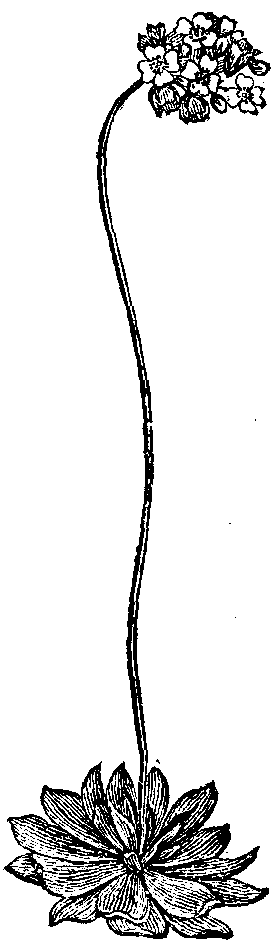 Fig
Fig. 15.
19. Nevertheless, I won't allow our vegetable 'stolons' to be
despised. Some of quite the most beautiful forms of leafage belong to
them;—even the foliage of the olive itself is never seen to the
same perfection on the upper branches as in the young ground-rods in
which the dual groups of leaves crowd themselves in their haste into
clusters of three.
But, for our point of Latin history, remember always that in 400
B.C., just a year before the death of Socrates
at Athens, this family of Stolid persons manifested themselves at Rome,
shooting up from plebeian roots into places where they had no business;
and preparing the way for the degradation of the entire Roman race under
the Empire; their success being owed, remember also, to the faults of the
patricians, for one of the laws passed by Calvus Stolo was that the
Sibylline books should be in custody of ten men, of whom five should be
plebeian, "that no falsifications might be introduced in favour of the
patricians."
20. All this time, however, we have got no name for the prettiest of
all stems,—that of annual flowers growing high from among their
ground leaves, like lilies of the valley, and saxifrages, and the tall
primulas—of which this pretty type, Fig. 15, was cut for me by Mr.
Burgess years ago; admirable in its light outline of the foamy globe of
flowers, supported and balanced in the meadow breezes on that elastic rod
of slenderest life.
What shall we call it? We had better rest from our study of terms a
little, and do a piece of needful classifying, before we try to name
it.
21. My younger readers will find it easy to learn, and convenient to
remember, for a beginning of their science, the names of twelve
great families of cinquefoiled flowers,[39] of which the first group of three, is
for the most part golden, the second, blue, the third, purple, and the
fourth, red.
And their names, by simple lips, can be pleasantly said, or sung, in
this order, the two first only being a little difficult to get over.
|
1
|
2
|
3
|
4
|
|
Roof-foil,
|
Lucy,
|
Pea,
|
Pink,
|
|
Rock-foil,
|
Blue-bell,
|
Pansy,
|
Peach,
|
|
Primrose.
|
Bindweed.
|
Daisy.
|
Rose.
|
Which even in their Latin magniloquence will not be too terrible,
namely,—
|
1
|
2
|
3
|
4
|
|
Stella,
|
Lucia,
|
Alata,
|
Clarissa,
|
|
Francesca,
|
Campanula,
|
Viola,
|
Persica,
|
|
Primula.
|
Convoluta.
|
Margarita.
|
Rosa.
|
22. I do not care much to assert or debate my reasons for the changes
of nomenclature made in this list. The most gratuitous is
that of 'Lucy' for 'Gentian,' because the King of Macedon, from whom the
flower has been so long named, was by no means a person deserving of so
consecrated memory. I conceive no excuse needed for rejecting Caryophyll,
one of the crudest and absurdest words ever coined by unscholarly men of
science; or Papilionaceæ, which is unendurably long for pease; and when
we are now writing Latin, in a sentimental temper, and wish to say that
we gathered a daisy, we shall not any more be compelled to write that we
gathered a 'Bellidem perennem,' or, an 'Oculum Diei.'
I take the pure Latin form, Margarita, instead of Margareta, in memory
of Margherita of Cortona,[40] as well as of the great saint: also the
tiny scatterings and sparklings of the daisy on the turf may remind us of
the old use of the word 'Margaritæ,' for the minute particles of the Host
sprinkled on the patina—"Has particulas μερίδας vocat
Euchologium, μαργαρίτας
Liturgia Chrysostomi."[41]
My young German readers will, I hope, call the flower
Gretschen,—unless they would uproot the daisies of the Rhine, lest
French girls should also count their love-lots by the Marguerite. I must
be so ungracious to my fair young readers, however, as to warn them that this
trial of their lovers is a very favourable one, for, in nine blossoms out
of ten, the leaves of the Marguerite are
odd, so that, if they are only gracious enough to begin with the
supposition that he loves them, they must needs end in the conviction of
it.
23. I am concerned, however, for the present, only with my first or
golden order, of which the Roof-foil, or house-leek, is called in present
botany, Sedum, 'the squatter,' because of its way of fastening itself
down on stones, or roof, as close as it can sit. But I think this an
ungraceful notion of its behaviour; and as its blossoms are, of all
flowers, the most sharply and distinctly star-shaped, I shall call it
'Stella' (providing otherwise, in due time, for the poor little
chickweeds;) and the common stonecrop will therefore be 'Stella
domestica.'
The second tribe, (at present saxifraga,) growing for the most part
wild on rocks, may, I trust, even in Protestant botany, be named
Francesca, after St. Francis of Assisi; not only for its modesty, and
love of mountain ground, and poverty of colour and leaf; but also because
the chief element of its decoration, seen close, will be found in its
spots, or stigmata.
In the nomenclature of the third order I make no change.
24. Now all this group of golden-blossoming plants agree in general
character of having a rich cluster of radical leaves, from which they
throw up a single stalk bearing clustered blossoms; for which stalk, when
entirely leafless, I intend always to keep the term 'virgula,' the
'little rod'—not painfully caring about it, but being able thus to
define it with precision, if required. And these are connected with the
stems of branching shrubs through infinite varieties of structure, in
which the first steps of transition are made by carrying the cluster of
radical leaves up, and letting them expire gradually from the rising
stem: the changes of form in the leaves as they rise higher from the
ground being one of quite the most interesting specific studies in every
plant. I had set myself once, in a bye-study for foreground drawing, hard
on this point; and began, with Mr. Burgess, a complete analysis of the
foliation of annual stems; of which Line-studies II., III., and IV., are
examples; reduced copies, all, from the beautiful Flora Danica. But after
giving two whole lovely long summer days, under the Giesbach, to the blue
scabious, ('Devil's bit,') and getting in that time, only half-way up it,
I gave in; and must leave the work to happier and younger souls.
25. For these flowering stems, therefore, possessing nearly all the
complex organization of a tree, but not its permanence, we will keep the
word 'virga;' and 'virgula' for those that have no leaves. I believe,
when we come to the study of leaf-order, it will be best to begin with
these annual virgæ, in which the leaf has nothing to do with preparation
for a next year's branch. And now the remaining terms commonly applied to
stems may be for the most part dispensed with; but several are
interesting, and must be examined before dismissal.
26. Indeed, in the first place, the word we have
to use so often, 'stalk,' has not been got to the roots of, yet. It comes
from the Greek στέλεχος,
(stelechos,) the 'holding part' of a tree, that which is like a handle to
all its branches; 'stock' is another form in which it has come down to
us: with some notion of its being the mother of branches: thus, when
Athena's olive was burnt by the Persians, two days after, a shoot a cubit
long had sprung from the 'stelechos,' of it.
27. Secondly. Few words are more interesting to the modern scholarly
and professorial mind than 'stipend.' (I have twice a year at present to
consider whether I am worth mine, sent with compliments from the Curators
of the University chest). Now, this word comes from 'stips,' small pay,
which itself comes from 'stipo,' to press together, with the idea of
small coin heaped up in little towers or piles. But with the idea of
lateral pressing together, instead of downward, we get 'stipes,' a solid
log; in Greek, with the same sense, στύπος, (stupos,) whence,
gradually, with help from another word meaning to beat, (and a
side-glance at beating of hemp,) we get our 'stupid,' the German stumph,
the Scottish sumph, and the plain English 'stump.'
Refining on the more delicate sound of stipes, the Latins got
'stipula,' the thin stem of straw: which rustles and ripples daintily in
verse, associated with spica and spiculum, used of the sharp pointed ear
of corn, and its fine processes of fairy shafts.
28. There are yet two more names of stalk to be studied, though,
except for particular plants, not needing to be used,—namely, the
Latin cau-dex, and cau-lis, both connected with the Greek καυλός, properly meaning
a solid stalk like a handle, passing into the sense of the hilt of a
sword, or quill of a pen. Then, in Latin, caudex passes into the sense of
log, and so, of cut plank or tablet of wood; thus finally becoming the
classical 'codex' of writings engraved on such wooden tablets, and
therefore generally used for authoritative manuscripts.
Lastly, 'caulis,' retained accurately in our cauliflower, contracted
in 'colewort,' and refined in 'kail,' softens itself into the French
'chou,' meaning properly the whole family of thick-stalked eatable salads
with spreading heads; but these being distinguished explicitly by Pliny
as 'Capitati,' 'salads with a head,' or 'Captain salads,' the mediæval
French softened the 'caulis capitatus' into 'chou cabus;'—or, to
separate the round or apple-like mass of leaves from the flowery foam,
'cabus' simply, by us at last enriched and emphasized into 'cabbage.'
29. I believe we have now got through the stiffest piece of etymology
we shall have to master in the course of our botany; but I am certain
that young readers will find patient work, in this kind, well rewarded by
the groups of connected thoughts which will thus attach themselves to
familiar names; and their grasp of every language they learn must only be
esteemed by them secure when they recognize its derivatives in these
homely associations, and are as much at ease with the Latin or
French syllables of a word as with the English ones; this familiarity
being above all things needful to cure our young students of their
present ludicrous impression that what is simple, in English, is knowing,
in Greek; and that terms constructed out of a dead language will explain
difficulties which remained insoluble in a living one. But Greek is
not yet dead: while if we carry our unscholarly nomenclature much
further, English soon will be; and then doubtless botanical gentlemen at
Athens will for some time think it fine to describe what we used to call
caryophyllaceæ, as the ἑδληφιδες.
30. For indeed we are all of us yet but school-boys, clumsily using
alike our lips and brains; and with all our mastery of instruments and
patience of attention, but few have reached, and those dimly, the first
level of science,—wonder.
For the first instinct of the stem,—unnamed by us
yet—unthought of,—the instinct of seeking light, as of the
root to seek darkness,—what words can enough speak the wonder of
it.
Look. Here is the little thing, Line-study V. (A), in its first birth
to us: the stem of stems; the one of which we pray that it may bear our
daily bread. The seed has fallen in the ground with the springing germ of
it downwards; with heavenly cunning the taught stem curls round, and
seeks the never-seen light. Veritable 'conversion,' miraculous, called of
God. And here is the oat germ, (B)—after the wheat, most
vital of divine gifts; and assuredly, in days to come, fated to grow on
many a naked rock in hitherto lifeless lands, over which the glancing
sheaves of it will shake sweet treasure of innocent gold.
And who shall tell us how they grow; and the fashion of their rustling
pillars—bent, and again erect, at every breeze. Fluted shaft or
clustered pier, how poor of art, beside this grass-shaft—built,
first to sustain the food of men, then to be strewn under their feet!
We must not stay to think of it, yet, or we shall get no farther till
harvest has come and gone again. And having our names of stems now
determined enough, we must in next chapter try a little to understand the
different kinds of them.
The following notes, among many kindly sent me on the subject of
Scottish Heraldry, seem to be the most trustworthy:—
"The earliest known mention of the thistle as the national badge of
Scotland is in the inventory of the effects of James III., who probably
adopted it as an appropriate illustration of the royal motto, In
defence.
"Thistles occur on the coins of James IV., Mary, James V., and James
VI.; and on those of James VI. they are for the first time accompanied by
the motto, Nemo me impune lacesset.
"A collar of thistles appears on the gold bonnet-pieces of James V. of
1539; and the royal ensigns, as depicted in Sir David Lindsay's armorial
register of 1542, are surrounded by a collar formed entirely of golden
thistles, with an oval badge attached.
"This collar, however, was a mere device until the institution, or as
it is generally but inaccurately called, the revival, of the order of the
Thistle by James VII. (II. of England), which took place on May 29,
1687."
Date of James III.'s reign 1460-1488.
OUTSIDE AND IN.
1. The elementary study of methods of growth, given in the following
chapter, has been many years written, (the greater part soon after the
fourth volume of 'Modern Painters'); and ought now to be rewritten
entirely; but having no time to do this, I leave it with only a word or
two of modification, because some truth and clearness of incipient notion
will be conveyed by it to young readers, from which I can afterwards lop
the errors, and into which I can graft the finer facts, better than if I
had a less blunt embryo to begin with.
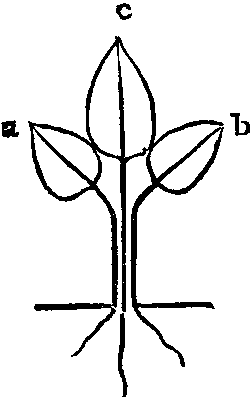 Fig
Fig. 17.
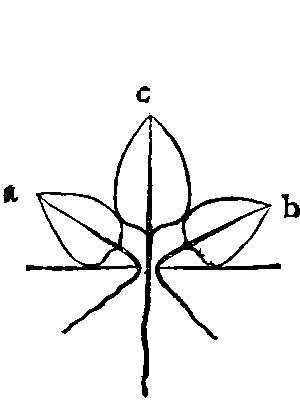 Fig
Fig. 16.
2. A stem, then, broadly speaking, (I had thus began the old chapter,)
is the channel of communication between the leaf and root; and if the
leaf can grow directly from the root there is no stem: so that it is well
first to conceive of all plants as consisting of leaves and roots only,
with the condition that each leaf must have its own quite particular
root[42] somewhere. Let
a b c, Fig. 16, be three leaves, each, as you see, with its own root, and
by no means dependent on other leaves for its daily bread; and let the
horizontal line be the surface of the ground. Then the plant has no stem,
or an underground one. But if the three leaves rise above the ground, as
in Fig. 17, they must reach their roots by elongating their stalks, and
this elongation is the stem of the plant. If the outside leaves grow
last, and are therefore youngest, the plant is said to grow from the
outside. You know that 'ex' means out, and that 'gen' is the first
syllable of Genesis (or creation), therefore the old botanists, putting
an o between the two syllables, called plants whose outside leaves grew
last, Ex-o-gens. If the inside leaf grows last, and is youngest, the
plant was said to grow from the inside, and from the Greek Endon, within,
called an 'Endo-gen.' If these names are persisted in, the Greek
botanists, to return the compliment, will of course call Endogens Ἰνσειδβορνιδες,
and Exogens Ὅυτσειδβορνιδες.
In the Oxford school, they will be called simply Inlaid and Outlaid.
 Fig
Fig. 18.
3. You see that if the outside leaves are to grow last, they may
conveniently grow two at a time; which they accordingly do, and exogens
always start with two little leaves from their roots, and may
therefore conveniently be called two-leaved; which, if you please, we
will for our parts call them. The botanists call them 'two-suckered,' and
can't be content to call them that in English; but drag in a long
Greek word, meaning the fleshy sucker of the
sea-devil,—'cotyledon,' which, however, I find is practically
getting shortened into 'cot,' and that they will have to end by calling
endogens, monocots, and exogens, bicots. I mean steadily to call them
one-leaved and two-leaved, for this further reason, that they differ not
merely in the single or dual springing of first leaves from the seed; but
in the distinctly single or dual arrangement of leaves afterwards on the
stem; so that, through all the complexity obtained by alternate and
spiral placing, every bicot or two-leaved flower or tree is in reality
composed of dual groups of leaves, separated by a given length of stem;
as, most characteristically in this pure mountain type of the Ragged
Robin (Clarissa laciniosa), Fig. 18; and compare A, and B, Line-study
II.; while, on the other hand, the monocot plants are by close analysis,
I think, always resolvable into successively climbing leaves, sessile on
one another, and sending their roots, or processes, for
nourishment, down through one another, as in Fig. 19.
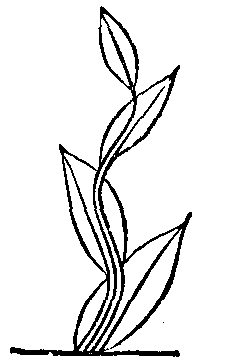 Fig
Fig. 19.
4. Not that I am yet clear, at all, myself; but I do think it's more
the botanists' fault than mine, what 'cotyledonous' structure there may
be at the outer base of each successive bud; and still less, how the
intervenient length of stem, in the bicots, is related to their power, or
law, of branching. For not only the two-leaved tree is outlaid, and the
one-leaved inlaid, but the two-leaved tree is branched, and the
one-leaved tree is not branched. This is a most vital and important
distinction, which I state to you in very bold terms, for though there
are some apparent exceptions to the law, there are, I believe, no real
ones, if we define a branch rightly. Thus, the head of a palm tree is
merely a cluster of large leaves; and the spike of a grass, a clustered
blossom. The stem, in both, is unbranched; and we should be able in this
respect to classify plants very simply indeed, but for a provoking
species of intermediate creatures whose branching is always in the manner
of corals, or sponges, or arborescent minerals, irregular and accidental,
and essentially, therefore, distinguished from the systematic anatomy of
a truly branched tree. Of these presently; we must go on by very short
steps: and I find no step can be taken without check from existing
generalizations. Sowerby's definition of Monocotyledons, in his ninth
volume, begins thus: "Herbs, (or rarely, and only in exotic genera,)
trees, in which the wood, pith, and bark are indistinguishable." Now
if there be one plant more than another in which the pith is defined, it
is the common Rush; while the nobler families of true herbs derive their
principal character from being pithless altogether! We cannot advance too
slowly.
5. In the families of one-leaved plants in which the young leaves grow
directly out of the old ones, it becomes a grave question for them
whether the old ones are to lie flat or edgeways, and whether they must
therefore grow out of their faces or their edges. And we must at once
understand the way they contrive it, in either case.
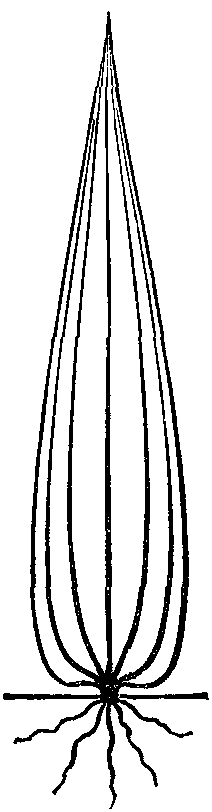 Fig
Fig. 20.
Among the many forms taken by the Arethusan leaf, one of the commonest
is long and gradually tapering,—much broader at the base than the
point. We will take such an one for examination, and suppose that it is
growing on the ground as in Fig. 20, with a root to its every fibre. Cut
out a piece of strong paper roughly into the shape of this Arethusan
leaf, a, Fig. 21. Now suppose the next young leaf has to spring out of
the front of this one, at about the middle of its height. Give it two
nicks with the scissors at b b; then roll up the lower part into a
cylinder, (it will overlap a good deal at the bottom,) and tie it fast
with a fine thread: so, you will get the form at c. Then bend the top of
it back, so that, seen sideways, it appears as at d, and you see you have
made quite a little flower-pot to plant your new leaf in, and
perhaps it may occur to you that you have seen something like this
before. Now make another, a little less wide, but with the part for the
cylinder twice as long, roll it up in the same way, and slip it inside
the other, with the flat part turned the other way, e. Surely this
reminds you now of something you have seen? Or must I draw the something
(Fig. 22)?
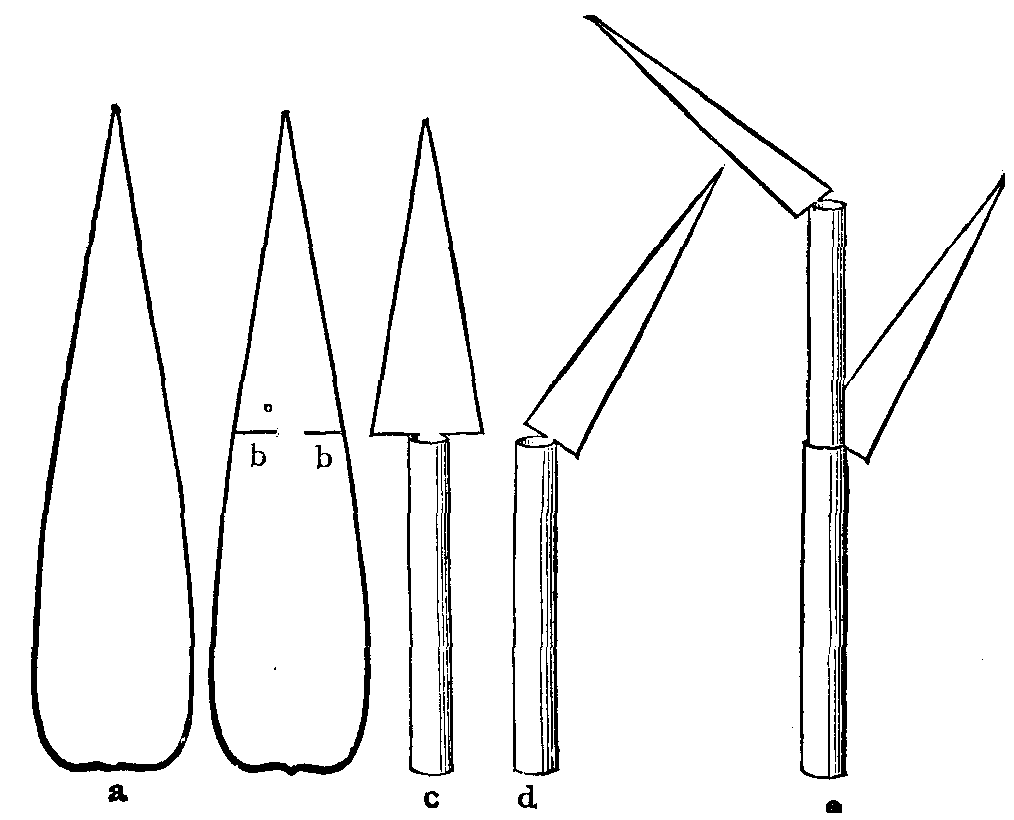 Fig
Fig. 21.
6. All grasses are thus constructed, and have their leaves set thus,
opposite, on the sides of their tubular stems, alternately, as they
ascend. But in most of them there is also a peculiar construction, by
which, at the base of the sheath, or enclosing tube, each leaf
articulates itself with the rest of the stem at a ringed knot, or joint.
 Fig
Fig. 22.
Before examining these, remember there are mainly two sorts of joints
in the framework of the bodies of animals. One is that in which the bone
is thick at the joints and thin between them, (see the bone of the next
chicken leg you eat), the other is that of animals that have shells or
horny coats, in which characteristically the shell is thin at the joints,
and thick between them (look at the next lobster's claw you can see,
without eating). You know, also, that though the crustaceous are titled
only from their crusts, the name 'insect' is given to the whole insect
tribe, because they are farther jointed almost into sections: it
is easily remembered, also, that the projecting joint means strength and
elasticity in the creature, and that all its limbs are useful to it, and
cannot conveniently be parted with; and that the incised, sectional, or
insectile joint means more or less weakness,[43] and necklace-like laxity or license in
the creature's make; and an ignoble power of shaking off its legs or arms
on occasion, coupled also with modes of growth involving occasionally
quite astonishing transformations, and beginnings of new life under new
circumstances; so that, until very lately, no mortal knew what a crab was
like in its youth, the very existence of the creature, as
well as its legs, being jointed, as it were and made in separate pieces
with the narrowest possible thread of connection between them; and its
principal, or stomachic, period of life, connected with its sentimental
period by as thin a thread as a wasp's stomach is with its thorax.
7. Now in plants, as in animals, there are just the same opposed
aspects of joint, with this specialty of difference in function, that the
animal's limb bends at the joints, but the vegetable limb stiffens. And
when the articulation projects, as in the joint of a cane, it means not
only that the strength of the plant is well carried through the junction,
but is carried farther and more safely than it could be without it: a
cane is stronger, and can stand higher than it could otherwise, because
of its joints. Also, this structure implies that the plant has a will of
its own, and a position which on the whole it will keep, however it may
now and then be bent out of it; and that it has a continual battle, of a
healthy and humanlike kind, to wage with surrounding elements.
But the crabby, or insect-like, joint, which you get in seaweeds and
cacti, means either that the plant is to be dragged and wagged here and
there at the will of waves, and to have no spring nor mind of its own; or
else that it has at least no springy intention and elasticity of purpose,
but only a knobby, knotty, prickly, malignant stubbornness, and
incoherent opiniativeness; crawling about, and coggling, and grovelling,
and aggregating anyhow, like the minds of so many people
whom one knows!
8. Returning then to our grasses, in which the real rooting and
junction of the leaves with each other is at these joints; we find that
therefore every leaf of grass may be thought of as consisting of two main
parts, for which we shall want two separate names. The lowest part, which
wraps itself round to become strong, we will call the 'staff,' and for
the free-floating outer part we will take specially the name given at
present carelessly to a large number of the plants themselves, 'flag.'
This will give a more clear meaning to the words 'rod' (virga), and
'staff' (baculus), when they occur together, as in the 23rd Psalm; and
remember the distinction is that a rod bends like a switch, but a staff
is stiff. I keep the well-known name 'blade' for grass-leaves in their
fresh green state.
9. You felt, as you were bending down the paper into the form d, Fig.
21, the difficulty and awkwardness of the transition from the tubular
form of the staff to the flat one of the flag. The mode in which this
change is effected is one of the most interesting features in plants, for
you will find presently that the leaf-stalk in ordinary leaves is only a
means of accomplishing the same change from round to flat. But you know I
said just now that some leaves were not flat, but set upright, edgeways.
It is not a common position in two-leaved trees; but if you can run out
and look at an arbor vitæ, it may interest you to see its
hatchet-shaped vertically crested cluster of leaves transforming
themselves gradually downwards into branches; and in one-leaved trees the
vertically edged group is of great importance.
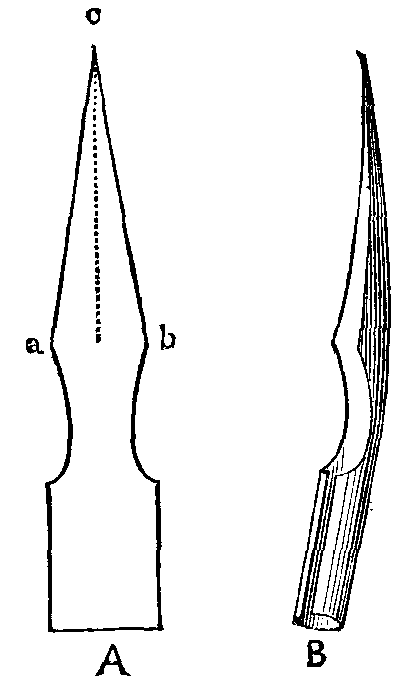 Fig
Fig. 23.
10. Cut out another piece of paper like a in Fig. 21, but now, instead
of merely giving it nicks at a, b, cut it into the shape A, Fig. 23. Roll
the lower part up as before, but instead of pulling the upper part down,
pinch its back at the dotted line, and bring the two points, a and b,
forward, so that they may touch each other. B shows the look of the thing
half-done, before the points a and b have quite met. Pinch them close,
and stitch the two edges neatly together, all the way from a to the point
c; then roll and tie up the lower part as before. You will find then that
the back or spinal line of the whole leaf is bent forward, as at B. Now
go out to the garden and gather the green leaf of a fleur-de-lys, and
look at it and your piece of disciplined paper together; and I fancy you
will probably find out several things for yourself that I want you to
know.
11. You see, for one thing, at once, how
strong the fleur-de-lys leaf is, and that it is just twice as
strong as a blade of grass, for it is the substance of the staff, with
its sides flattened together, while the grass blade is a staff cut open
and flattened out. And you see that as a grass blade necessarily flaps
down, the fleur-de-lys leaf as necessarily curves up, owing to that
inevitable bend in its back. And you see, with its keen edge, and long
curve, and sharp point, how like a sword it is. The botanists would for
once have given a really good and right name to the plants which have
this kind of leaf, 'Ensatæ,' from the Latin 'ensis,' a sword; if only
sata had been properly formed from sis. We can't let the rude Latin
stand, but you may remember that the fleur-de-lys, which is the flower of
chivalry, has a sword for its leaf, and a lily for its heart.
12. In case you cannot gather a fleur-de-lys leaf, I have drawn for
you, in Plate VI., a cluster of such leaves, which are as pretty as any,
and so small that, missing the points of a few, I can draw them of their
actual size. You see the pretty alternate interlacing at the bottom, and
if you can draw at all, and will try to outline their curves, you will
find what subtle lines they are. I did not know this name for the
strong-edged grass leaves when I wrote the pieces about shield and sword
leaves in 'Modern Painters'; I wish I had chanced in those passages on
some other similitude, but I can't alter them now, and my trustful pupils
may avoid all confusion of thought by putting gladius for ensis, and
translating it by the word 'scymitar,' which is also more accurate in
expressing the curvature blade. So we will call the ensatæ, instead,
'gladiolæ,' translating, 'scymitar-grasses.' And having now got at
some clear idea of the distinction between outlaid and inlaid growth in
the stem, the reader will find the elementary analysis of forms resulting
from outlaid growth in 'Modern Painters'; and I mean to republish it in
the sequel of this book, but must go on to other matters here. The growth
of the inlaid stem we will follow as far as we need, for English plants,
in examining the glasses.
Florence, 11th September, 1874.
As I correct this chapter for press, I find it is too imperfect to be
let go without a word or two more. In the first place, I have not enough,
in distinguishing the nature of the living yearly shoot, with its cluster
of fresh leafage, from that of the accumulated mass of perennial trees,
taken notice of the similar power even of the annual shoot, to obtain
some manner of immortality for itself, or at least of usefulness,
after death. A Tuscan woman stopped me on the path up to Fiesole
last night, to beg me to buy her plaited straw. I wonder how long straw
lasts, if one takes care of it? A Leghorn bonnet, (if now such things
are,) carefully put away,—even properly taken care of when it is
worn,—how long will it last, young ladies?
I have just been reading the fifth chapter of II. Esdras, and am fain
to say, with less discomfort than otherwise I might have felt, (the
example being set me by the archangel Uriel,) "I am not sent to tell
thee, for I do not know." How old is the oldest straw known? the oldest
linen? the oldest hemp? We have mummy wheat,—cloth of papyrus,
which is a kind of straw. The paper reeds by the brooks, the flax-flower
in the field, leave such imperishable frame behind them. And
Ponte-della-Paglia, in Venice; and Straw Street, of Paris, remembered in
Heaven,—there is no occasion to change their names, as one may have
to change 'Waterloo Bridge,' or the 'Rue de l'Impératrice.' Poor Empress!
Had she but known that her true dominion was in the straw streets of her
fields; not in the stone streets of her cities!
But think how wonderful this imperishableness of the stem of many
plants is, even in their annual work: how much more in their perennial
work! The noble stability between death and life, of a piece of perfect
wood? It cannot grow, but will not decay; keeps record of its years of
life, but surrenders them to become a constantly serviceable thing: which
may be sailed in, on the sea, built with, on the land, carved by
Donatello, painted on by Fra Angelico. And it is not the wood's fault,
but the fault of Florence in not taking proper care of it, that the panel
of Sandro Botticelli's loveliest picture has cracked, (not with heat, I
believe, but blighting frost), a quarter of an inch wide through the
Madonna's face.
But what is this strange state of undecaying wood? What sort of latent
life has it, which it only finally parts with when it rots?
Nay, what is the law by which its natural life is measured? What makes
a tree 'old'? One sees the Spanish-chesnut trunks among the
Apennines growing into caves, instead of logs. Vast hollows, confused
among the recessed darknesses of the marble crags, surrounded by mere
laths of living stem, each with its coronal of glorious green leaves. Why
can't the tree go on, and on,—hollowing itself into a
Fairy—no—a Dryad, Ring,—till it becomes a perfect
Stonehenge of a tree? Truly, "I am not sent to tell thee, for I do not
know."
The worst of it is, however, that I don't know one thing which I ought
very thoroughly to have known at least thirty years ago, namely, the true
difference in the way of building the trunk in outlaid and inlaid wood. I
have an idea that the stem of a palm-tree is only a heap of leaf-roots
built up like a tower of bricks, year by year, and that the palm tree
really grows on the top of it, like a bunch of fern; but I've no books
here, and no time to read them if I had. If only I were a strong giant,
instead of a thin old gentleman of fifty-five, how I should like to pull
up one of those little palm-trees by the roots—(by the way, what
are the roots of a palm like? and, how does it stand in sand, where it is
wanted to stand, mostly? Fancy, not knowing that, at
fifty-five!)—that grow all along the Riviera; and snap its stem in
two, and cut it down the middle. But I suppose there are sections enough
now in our grand botanical collections, and you can find it all out for
yourself. That you should be able to ask a question clearly, is
two-thirds of the way to getting it answered; and I think this chapter of
mine will at least enable you to ask some questions
about the stem, though what a stem is, truly, "I am not sent to tell
thee, for I do not know."
Knaresborough, 30th April, 1876.
I see by the date of last paragraph that this chapter has been in my
good Aylesbury printer's type for more than a year and a half. At this
rate, Proserpina has a distant chance of being finished in the
spirit-land, with more accurate information derived from the archangel
Uriel himself, (not that he is likely to know much about the matter, if
he keeps on letting himself be prevented from ever seeing foliage in
spring-time by the black demon-winds,) about the year 2000. In the
meantime, feeling that perhaps I am sent to tell my readers a
little more than is above told, I have had recourse to my botanical
friend, good Mr. Oliver of Kew, who has taught me, first, of palms, that
they actually stitch themselves into the ground, with a long dipping
loop, up and down, of the root fibres, concerning which sempstress-work I
shall have a month's puzzlement before I can report on it; secondly, that
all the increment of tree stem is, by division and multiplication of the
cells of the wood, a process not in the least to be described as 'sending
down roots from the leaf to the ground.' I suspected as much in beginning
to revise this chapter; but hold to my judgment in not cancelling it. For
this multiplication of the cells is at least compelled by an influence
which passes from the leaf to the ground, and vice versa; and which is at
present best conceivable to me by imagining the
continual and invisible descent of lightning from electric cloud by a
conducting rod, endowed with the power of softly splitting the rod into
two rods, each as thick as the original one. Studying microscopically, we
should then see the molecules of copper, as we see the cells of the wood,
dividing and increasing, each one of them into two. But the visible
result, and mechanical conditions of growth, would still be the same as
if the leaf actually sent down a new root fibre; and, more than this, the
currents of accumulating substance, marked by the grain of the wood, are,
I think, quite plainly and absolutely those of streams flowing only from
the leaves downwards; never from the root up, nor of mere lateral
increase. I must look over all my drawings again, and at tree stems
again, with more separate study of the bark and pith in those museum
sections, before I can assert this; but there will be no real difficulty
in the investigation. If the increase of the wood is lateral only, the
currents round the knots will be compressed at the sides, and open above
and below; but if downwards, compressed above the knot and open below it.
The nature of the force itself, and the manner of its ordinances in
direction, remain, and must for ever remain, inscrutable as our own
passions, in the hand of the God of all Spirits, and of all Flesh.
"Drunk is each ridge, of thy cup drinking,
Each clod relenteth at thy dressing,
Thy cloud-borne waters inly sinking,
Fair spring sproutes forth, blest with thy blessing;
The fertile year is with thy bounty crouned,
And where thou go'st, thy goings fat the ground.
Plenty bedews the desert places,
A hedge of mirth the hills encloseth.
The fields with flockes have hid their faces,
A robe of corn the valleys clotheth.
Deserts and hills and fields and valleys all,
Rejoice, shout, sing, and on thy name do call."
THE BARK.
1. Philologists are continually collecting instances, like our friend
the French critic of Virgil, of the beauty of finished language, or the
origin of unfinished, in the imitation of natural sounds. But such
collections give an entirely false idea of the real power of language,
unless they are balanced by an opponent list of the words which signally
fail of any such imitative virtue, and whose sound, if one dwelt upon it,
is destructive of their meaning.
2. For instance. Few sounds are more distinct in their kind, or one
would think more likely to be vocally reproduced in the word which
signified them, than that of a swift rent in strongly woven cloth; and
the English word 'rag' and ragged, with the Greek ῥήγνυμι, do indeed in a
measure recall the tormenting effect upon the ear. But it is curious that
the verb which is meant to express the actual origination of rags, should
rhyme with two words entirely musical and peaceful—words, indeed,
which I always reserve for final resource in passages which I want to be
soothing as well as pretty,—'fair,' and 'air;' while, in its
orthography, it is identical with the word representing the bodily sign
of tenderest passion, and grouped with a multitude of others,[44] in which the mere
insertion of a consonant makes such wide difference of sentiment as
between 'dear' and 'drear,' or 'pear' and 'spear.' The Greek root, on the
other hand, has persisted in retaining some vestige of its excellent
dissonance, even where it has parted with the last vestige of the idea it
was meant to convey; and when Burns did his best,—and his best was
above most men's—to gather pleasant liquid and labial syllabling,
round gentle meaning, in
"Bonnie lassie, will ye go,
Will ye go, will ye go,
Bonnie lassie, will ye go,
To the birks of Aberfeldy?"
he certainly had little thought that the delicately crisp final k, in
birk, was the remnant of a magnificent Greek effort to express the
rending of the earth by earthquake, in the wars of the giants. In the
middle of that word 'esmaragēse,' we get our own beggar's 'rag' for
a pure root, which afterwards, through the Latin frango, softens into our
'break,' and 'bark,'—the 'broken thing'; that idea of its rending
around the tree's stem having been, in the very earliest human efforts at
botanical description, attached to it by the pure Aryan race,
watching the strips of rosy satin break from the birch stems, in the
Aberfeldys of Imaus.
3. That this tree should have been the only one which "the Aryans,
coming as conquerors from the North, were able to recognize in
Hindustan,"[45] and should
therefore also be "the only one whose name is common to Sanskrit, and to
the languages of Europe," delighted me greatly, for two reasons: the
first, for its proof that in spite of the development of species, the
sweet gleaming of birch stem has never changed its argent and sable for
any unchequered heraldry; and the second, that it gave proof of a much
more important fact, the keenly accurate observation of Aryan foresters
at that early date; for the fact is that the breaking of the thin-beaten
silver of the birch trunk is so delicate, and its smoothness so graceful,
that until I painted it with care, I was not altogether clear-headed
myself about the way in which the chequering was done: nor until Fors
today brought me to the house of one of my father's friends at
Carshalton, and gave me three birch stems to look at just outside the
window, did I perceive it to be a primal question about them, what it is
that blanches that dainty dress of theirs, or, anticipatorily, weaves.
What difference is there between the making of the corky excrescence of
other trees, and of this almost transparent
fine white linen? I perceive that the older it is, within limits, the
finer and whiter; hoary tissue, instead of hoary hair—honouring the
tree's aged body; the outer sprays have no silvery light on their youth.
Does the membrane thin itself into whiteness merely by stretching, or
produce an outer film of new substance?[46]
4. And secondly, this investiture, why is it transverse to the
trunk,—swathing it, as it were, in bands? Above all,—when it
breaks,—why does it break round the tree instead of down? All other
bark breaks as anything would, naturally, round a swelling rod, but this,
as if the stem were growing longer; until, indeed, it reaches farthest
heroic old age, when the whiteness passes away again, and the rending is
like that of other trees, downwards. So that, as it were in a changing
language, we have the great botanical fact twice taught us, by this tree
of Eden, that the skins of trees differ from the skins of the higher
animals in that, for the most part, they won't stretch, and must be worn
torn.
So that in fact the most popular arrangement of vegetative adult
costume is Irish; a normal investiture in honourable rags; and
decorousness of tattering, as of a banner borne in splendid ruin through
storms of war.
5. Now therefore, if we think of it, we have five distinct
orders of investiture for organic creatures; first, mere secretion of
mineral substance, chiefly lime, into a hard shell, which, if broken, can
only be mended, like china—by sticking it together; secondly,
organic substance of armour which grows into its proper shape at once for
good and all, and can't be mended at all, if broken, (as of insects);
thirdly, organic substance of skin, which stretches, as the creatures
grows, by cracking, over a fresh skin which is supplied beneath it, as in
bark of trees; fourthly, organic substance of skin cracked symmetrically
into plates or scales which can increase all round their edges, and are
connected by softer skin, below, as in fish and reptiles, (divided with
exquisite lustre and flexibility, in feathers of birds); and lastly, true
elastic skin, extended in soft unison with the creature's
growth,—blushing with its blood, fading with its fear; breathing
with its breath, and guarding its life with sentinel beneficence of
pain.
6. It is notable, in this higher and lower range of organic beauty,
that the decoration, by pattern and colour, which is almost universal in
the protective coverings of the middle ranks of animals, should be
reserved in vegetables for the most living part of them, the flower only;
and that among animals, few but the malignant and senseless are
permitted, in the corrugation of their armour, to resemble the half-dead
trunk of the tree, as they float beside it in the tropical river. I must,
however, leave the scale patterns of the palms and other inlaid tropical
stems for after-examination,—content, at present, with the general
idea of the bark of an outlaid tree as the successive accumulation of the
annual protecting film, rent into ravines of slowly increasing depth, and
coloured, like the rock, whose stability it begins to emulate, with the
grey or gold of clinging lichen and embroidering moss.
GENEALOGY.
1. Returning, after more than a year's sorrowful interval, to my
Sicilian fields,—not incognisant, now, of some of the darker realms
of Proserpina; and with feebler heart, and, it may be, feebler wits, for
wandering in her brighter ones,—I find what I had written by way of
sequel to the last chapter, somewhat difficult, and extremely tiresome.
Not the less, after giving fair notice of the difficulty, and asking due
pardon for the tiresomeness, I am minded to let it stand; trusting to
end, with it, once for all, investigations of the kind. But in finishing
this first volume of my School Botany, I must try to give the reader some
notion of the plan of the book, as it now, during the time for thinking
over it which illness left me, has got itself arranged in my mind, within
limits of possible execution. And this the rather, because I wish also to
state, somewhat more gravely than I have yet done, the grounds on which I
venture here to reject many of the received names of plants; and to
substitute others for them, relating to entirely different attributes
from those on which their present nomenclature is confusedly edified.
I have already in some measure given the reasons for this change;[47] but I feel that, for the
sake of those among my scholars who have laboriously learned the accepted
names, I ought now also to explain its method more completely.
2. I call the present system of nomenclature confusedly
edified, because it introduces,—without, apparently, any
consciousness of the inconsistency, and certainly with no apology for
it,—names founded sometimes on the history of plants, sometimes on
their qualities, sometimes on their forms, sometimes on their products,
and sometimes on their poetical associations.
On their history—as 'Gentian' from King Gentius, and Funkia from
Dr. Funk.
On their qualities—as 'Scrophularia' from its (quite
uncertified) use in scrofula.
On their forms—as the 'Caryophylls' from having petals like
husks of nuts.
On their products—as 'Cocos nucifera' from its nuts.
And on their poetical associations,—as the Star of Bethlehem
from its imagined resemblance to the light of that seen by the Magi.
3. Now, this variety of grounds for nomenclature might patiently, and
even with advantage, be permitted, provided the grounds
themselves were separately firm, and the inconsistency of method
advisedly allowed, and, in each case, justified. If the histories of King
Gentius and Dr. Funk are indeed important branches of human
knowledge;—if the Scrophulariaceæ do indeed cure King's
Evil;—if pinks be best described in their likeness to
nuts;—and the Star of Bethlehem verily remind us of Christ's
Nativity,—by all means let these and other such names be evermore
retained. But if Dr. Funk be not a person in any special manner needing
either stellification or florification; if neither herb nor flower can
avail, more than the touch of monarchs, against hereditary pain; if it be
no better account of a pink to say it is nut-leaved, than of a nut to say
it is pink-leaved; and if the modern mind, incurious respecting the
journeys of wise men, has already confused, in its Bradshaw's Bible, the
station of Bethlehem with that of Bethel,[48] it is certainly time to take some order
with the partly false, partly useless, and partly forgotten literature of
the Fields; and, before we bow our children's memories to the burden of
it, ensure that there shall be matter worth carriage in the load.
4. And farther, in attempting such a change, we must be clear in our
own minds whether we wish our nomenclature to tell us something about the
plant itself, or only to tell us the place it holds in relation to other
plants: as, for instance, in the Herb-Robert, would it be well to
christen it, shortly, 'Rob Roy,' because it is pre-eminently red, and so
have done with it;—or rather to dwell on its family connections,
and call it 'Macgregoraceous'?
5. Before we can wisely decide this point, we must resolve whether our
botany is intended mainly to be useful to the vulgar, or satisfactory to
the scientific élite. For if we give names characterizing individuals,
the circle of plants which any country possesses may be easily made known
to the children who live in it: but if we give names founded on the
connexion between these and others at the Antipodes, the parish
school-master will certainly have double work; and it may be doubted
greatly whether the parish school-boy, at the end of the lecture, will
have half as many ideas.
6. Nevertheless, when the features of any great order of plants are
constant, and, on the whole, represented with great clearness both in
cold and warm climates, it may be desirable to express this their
citizenship of the world in definite nomenclature. But my own method, so
far as hitherto developed, consists essentially in fastening the thoughts
of the pupil on the special character of the plant, in the place where he
is likely to see it; and therefore, in expressing the power of its race
and order in the wider world, rather by reference to mythological
associations than to botanical structure.
7. For instance, Plate VII. represents, of its real size, an ordinary
spring flower in our English mountain fields. It is an average
example,—not one of rare size under rare
conditions,—rather smaller than the average, indeed, that I might
get it well into my plate. It is one of the flowers whose names I think
good to change; but I look carefully through the existing titles
belonging to it and its fellows, that I may keep all I expediently can. I
find, in the first place, that Linnæus called one group of its relations,
Ophryds, from Ophrys,—Greek for the eyebrow,—on account of
their resemblance to the brow of an animal frowning, or to the
overshadowing casque of a helmet. I perceive this to be really a very
general aspect of the flower; and therefore, no less than in respect to
Linnæus, I adopt this for the total name of the order, and call them
'Ophrydæ,' or, shortly, 'Ophryds.'
8. Secondly: so far as I know these flowers myself, I perceive them to
fall practically into three divisions,—one, growing in English
meadows and Alpine pastures, and always adding to their beauty; another,
growing in all sorts of places, very ugly itself, and adding to the
ugliness of its indiscriminated haunts; and a third, growing mostly up in
the air, with as little root as possible, and of gracefully fantastic
forms, such as this kind of nativity and habitation might presuppose. For
the present, I am satisfied to give names to these three groups only.
There may be plenty of others which I do not know, and which other people
may name, according to their knowledge. But in all these three kinds
known to me, I perceive one constant characteristic to be some
manner of distortion and I desire that fact,—marking a
spiritual (in my sense of the word) character of extreme
mystery,—to be the first enforced on the mind of the young learner.
It is exhibited to the English child, primarily, in the form of the stalk
of each flower, attaching it to the central virga. This stalk is always
twisted once and a half round, as if somebody had been trying to wring
the blossom off; and the name of the family, in Proserpina, will
therefore be 'Contorta'[49]
in Latin, and 'Wreathe-wort' in English.
Farther: the beautiful power of the one I have drawn in its spring
life, is in the opposition of its dark purple to the primrose in England,
and the pale yellow anemone in the Alps. And its individual name will be,
therefore, 'Contorta purpurea'—Purple Wreathe-wort.
And in drawing it, I take care to dwell on this strength of its color,
and to show thoroughly that it is a dark blossom,[50] before I trouble myself about its minor
characters.
9. The second group of this kind of flowers live, as I said, in all
sorts of places; but mostly, I think, in disagreeable ones,—torn
and irregular ground, under alternations of unwholesome heat and shade,
and among swarms of nasty insects. I cannot yet venture on any bold
general statement about them, but I think that is mostly their way; and
at all events, they themselves are in the habit of dressing in
livid and unpleasant colors; and are distinguished from all other flowers
by twisting, not only their stalks, but one of their petals, not once and
a half only, but two or three times round, and putting it far out at the
same time, as a foul jester would put out his tongue: while also the
singular power of grotesque mimicry, which, though strong also in the
other groups of their race, seems in the others more or less playful, is,
in these, definitely degraded, and, in aspect, malicious.
10. Now I find the Latin name 'Satyrium' attached already to one sort
of these flowers; and we cannot possibly have a better one for all of
them. It is true that, in its first Greek form, Dioscorides attaches it
to a white, not a livid, flower; and I dare say there are some white ones
of the breed: but, in its full sense, the term is exactly right for the
entire group of ugly blossoms of which the characteristic is the spiral
curve and protraction of their central petal: and every other form of
Satyric ugliness which I find among the Ophryds, whatever its color, will
be grouped with them. And I make them central, because this humour runs
through the whole order, and is, indeed, their distinguishing sign.
11. Then the third group, living actually in the air, and only holding
fast by, without nourishing itself from, the ground, rock, or tree-trunk
on which it is rooted, may of course most naturally and accurately be
called 'Aeria,' as it has long been popularly known in English by the
name of Air-plant.
Thus we have one general name for all these creatures, 'Ophryd'; and
three family or group names, Contorta, Satyrium, and Aeria,—every
one of these titles containing as much accurate fact about the thing
named as I can possibly get packed into their syllables: and I will
trouble my young readers with no more divisions of the order. And if
their parents, tutors, or governors, after this fair warning, choose to
make them learn, instead, the seventy-seven different names with which
botanist-heraldries have beautifully ennobled the family,—all I can
say is, let them at least begin by learning them themselves. They will be
found in due order in pages 1084, 1085 of Loudon's Cyclopædia.[51]
12. But now, farther: the student will observe that the name of the
total order is Greek; while the three family ones are Latin, although the
central one is originally Greek also.
I adopt this as far as possible for a law through my whole plant
nomenclature.
13. Farther: the terminations of the Latin family names will be, for
the most part, of the masculine, feminine, and neuter
forms, us, a, um, with these following attached conditions.
(I.) Those terminating in 'us,' though often
of feminine words, as the central Arbor, will indicate either real
masculine strength (quereus, laurus), or conditions of dominant majesty
(cedrus), of stubbornness and enduring force (crataegus), or of
peasant-like commonalty and hardship (juncus); softened, as it may
sometimes happen, into gentleness and beneficence (thymus). The
occasional forms in 'er' and 'il' will have similar power (acer,
basil).
(II.) Names with the feminine termination
'a,' if they are real names of girls, will always mean flowers that are
perfectly pretty and perfectly good (Lucia, Viola, Margarita, Clarissa).
Names terminating in 'a' which are not also accepted names of girls, may
sometimes be none the less honourable, (Primula, Campanula,) but for the
most part will signify either plants that are only good and worthy in a
nursy sort of way, (Salvia,) or that are good without being pretty,
(Lavandula,) or pretty without being good, (Kalmia). But no name
terminating in 'a' will be attached to a plant that is neither good nor
pretty.
(III.) The neuter names terminating in 'um'
will always indicate some power either of active or suggestive evil,
(Conîum, Solanum, Satyrium,) or a relation, more or less definite, to
death; but this relation to death may sometimes be noble, or
pathetic,—"which to-day is, and to-morrow is cast into the
oven,"—Lilium.
But the leading position of these neuters in the plant's double name
must be noticed by students unacquainted with Latin, in order to
distinguish them from plural genitives, which will always, of course, be
the second word, (Francesca Fontium, Francesca of the Springs.)
14. Names terminating in 'is' and 'e,' if definitely names of women,
(Iris, Amaryllis, Alcestis, Daphne,) will always signify flowers of great
beauty, and noble historic association. If not definitely names of women,
they will yet indicate some specialty of sensitiveness, or association
with legend (Berberis, Clematis). No neuters in 'e' will be admitted.
15. Participial terminations (Impatiens), with neuters in 'en'
(Cyclamen), will always be descriptive of some special quality or
form,—leaving it indeterminate if good or bad, until explained. It
will be manifestly impossible to limit either these neuters, or the
feminines in 'is' to Latin forms; but we shall always know by their
termination that they cannot be generic names, if we are strict in
forming these last on a given method.
16. How little method there is in our present formation of them, I am
myself more and more surprised as I consider. A child is shown a rose,
and told that he is to call every flower like that, 'Rosaceous';[52] he is next shown a lily,
and told that he is to call every flower like that,
'Liliaceous';—so far well; but he is next shown a daisy, and is not
at all allowed to call every flower like that, 'Daisaceous,' but he must
call it, like the fifth order of architecture, 'Composite'; and being
next shown a pink, he is not allowed to call other pinks 'Pinkaceous,'
but 'Nut-leafed'; and being next shown a pease-blossom, he is not allowed
to call other pease-blossoms 'Peasaceous,' but, in a brilliant burst of
botanical imagination, he is incited to call it by two names instead of
one, 'Butterfly-aceous' from its flower, and 'Pod-aceous' from its
seed;—the inconsistency of the terms thus enforced upon him being
perfected in their inaccuracy, for a daisy is not one whit more composite
than Queen of the meadow, or Jura Jacinth;[53] and 'legumen' is not Latin for a pod,
but 'siliqua,'—so that no good scholar could remember Virgil's
'siliqua quassante legumen,' without overthrowing all his Pisan
nomenclature.
17. Farther. If we ground our names of the higher orders on the
distinctive characters of form in plants, these are so many, and
so subtle, that we are at once involved in more investigations than a
young learner has ever time to follow successfully, and they must be at
all times liable to dislocations and rearrangements on the discovery of
any new link in the infinitely entangled chain. But if we found
our higher nomenclature at once on historic fact, and relative conditions
of climate and character, rather than of form, we may at once distribute
our flora into unalterable groups, to which we may add at our pleasure,
but which will never need disturbance; far less, reconstruction.
18. For instance,—and to begin,—it is an historical fact
that for many centuries the English nation believed that the Founder of
its religion, spiritually, by the mouth of the King who spake of all
herbs, had likened himself to two flowers,—the Rose of Sharon, and
Lily of the Valley. The fact of this belief is one of the most important
in the history of England,—that is to say, of the mind or heart of
England: and it is connected solemnly with the heart of Italy also, by
the closing cantos of the Paradiso.
I think it well therefore that our two first generic, or at least
commandant, names heading the out-laid and in-laid divisions of plants,
should be of the rose and lily, with such meaning in them as may remind
us of this fact in the history of human mind.
It is also historical that the personal appearing of this Master of
our religion was spoken of by our chief religious teacher in these terms:
"The Grace of God, that bringeth salvation, hath appeared unto all men."
And it is a constant fact that this 'grace' or 'favor' of God is spoken
of as "giving us to eat of the Tree of Life."
19. Now, comparing the botanical facts I have to express, with these
historical ones, I find that the rose tribe has been formed among
flowers, not in distant and monstrous geologic æras, but in the human
epoch;—that its 'grace' or favor has been in all countries so felt
as to cause its acceptance everywhere for the most perfect physical type
of womanhood;—and that the characteristic fruit of the tribe is so
sweet, that it has become symbolic at once of the subtlest temptation,
and the kindest ministry to the earthly passion of the human race.
"Comfort me with apples, for I am sick of love."
20. Therefore I shall call the entire order of these flowers
'Charites,' (Graces,) and they will be divided into these five genera,
Rosa, Persica, Pomum, Rubra, and Fragaria. Which sequence of names I do
not think the young learner will have difficulty in remembering; nor in
understanding why I distinguish the central group by the fruit instead of
the flower. And if he once clearly master the structure and relations of
these five genera, he will have no difficulty in attaching to them, in a
satellitic or subordinate manner, such inferior groups as that of the
Silver-weed, or the Tormentilla; but all he will have to learn by heart
and rote, will be these six names; the Greek Master-name, Charites, and
the five generic names, in each case belonging to plants, as he will soon
find, of extreme personal interest to him.
21. I have used the word 'Order' as the name of our widest groups, in
preference to 'Class,' because these widest groups will not always
include flowers like each other in form, or equal to each other in
vegetative rank; but they will be 'Orders,' literally like
those of any religious or chivalric association, having some common link
rather intellectual than national,—the Charites, for instance,
linked by their kindness,—the Oreiades, by their mountain
seclusion, as Sisters of Charity or Monks of the Chartreuse, irrespective
of ties of relationship. Then beneath these orders will come, what may be
rightly called, either as above in Greek derivation, 'Genera,' or in
Latin, 'Gentes,' for which, however, I choose the Latin word, because
Genus is disagreeably liable to be confused on the ear with 'genius'; but
Gens, never; and also 'nomen gentile' is a clearer and better expression
than 'nomen generosum,' and I will not coin the barbarous one,
'genericum.' The name of the Gens, (as 'Lucia,') with an attached
epithet, as 'Verna,' will, in most cases, be enough to characterize the
individual flower; but if farther subdivision be necessary, the third
order will be that of Families, indicated by a 'nomen familiare' added in
the third place of nomenclature, as Lucia Verna,—Borealis; and no
farther subdivision will ever be admitted. I avoid the word
'species'—originally a bad one, and lately vulgarized beyond
endurance—altogether. And varieties belonging to narrow localities,
or induced by horticulture, may be named as they please by the people
living near the spot, or by the gardener who grows them; but will not be
acknowledged by Proserpina. Nevertheless, the arbitrary reduction under
Ordines, Gentes, and Familiæ, is always to be remembered as one of
massive practical convenience only; and the more subtle arborescence of
the infinitely varying structures may be followed, like a human
genealogy, as far as we please, afterwards; when once we have got our
common plants clearly arranged and intelligibly named.
22. But now we find ourselves in the presence of a new difficulty, the
greatest we have to deal with in the whole matter.
One new nomenclature, to be thoroughly good, must be acceptable to
scholars in the five great languages, Greek, Latin, French, Italian, and
English; and it must be acceptable by them in teaching the native
children of each country. I shall not be satisfied, unless I can feel
that the little maids who gather their first violets under the Acropolis
rock, may receive for them Æschylean words again with joy. I shall not be
content, unless the mothers watching their children at play in the
Ceramicus of Paris, under the scarred ruins of her Kings' palace, may yet
teach them there to know the flowers which the Maid of Orleans gathered
at Domremy. I shall not be satisfied unless every word I ask from the
lips of the children of Florence and Rome, may enable them better to
praise the flowers that are chosen by the hand of Matilda,[54] and bloom around the tomb
of Virgil.
23. Now in this first example of nomenclature, the Master-name, being
pure Greek, may easily be accepted by Greek children, remembering
that certain also of their own poets, if they did not call the flower a
Grace itself, at least thought of it as giving gladness to the Three in
their dances.[55] But for
French children the word 'Grâce' has been doubly and trebly corrupted;
first, by entirely false theological scholarship, mistaking the 'Favor'
or Grace done by God to good men, for the 'Misericordia,' or mercy, shown
by Him to bad ones; and so, in practical life, finally substituting
'Grâce' as a word of extreme and mortal prayer, for 'Merci,' and of late
using 'Merci' in a totally ridiculous and perverted power, for the giving
of thanks (or refusal of offered good): while the literally derived word
'Charite' has become, in the modern mind, a gift, whether from God or
man, only to the wretched, never to the happy: and lastly, 'Grâce' in its
physical sense has been perverted, by their social vulgarity, into an
idea, whether with respect to form or motion, commending itself rather to
the ballet-master than either to the painter or the priest.
For these reasons, the Master name of this family, for my French
pupils, must be simply 'Rhodiades,' which will bring, for them, the
entire group of names into easily remembered symmetry; and the English
form of the same name, Rhodiad, is to be used by
English scholars also for all tribes of this group except the five
principal ones.
24. Farther, in every gens of plants, one will be chosen as the
representative, which, if any, will be that examined and described in the
course of this work, if I have opportunity of doing so.
This representative flower will always be a wild one, and of the
simplest form which completely expresses the character of the plant;
existing divinely and unchangeably from age to age, ungrieved by man's
neglect, and inflexible by his power.
And this divine character will be expressed by the epithet 'Sacred,'
taking the sense in which we attach it to a dominant and christened
majesty, when it belongs to the central type of any forceful
order;—'Quercus sacra,' 'Laurus sacra,' etc.,—the word
'Benedicta,' or 'Benedictus,' being used instead, if the plant be too
humble to bear, without some discrepancy and unbecomingness, the higher
title; as 'Carduus Benedictus,' Holy Thistle.
25. Among the gentes of flowers bearing girls' names, the dominant one
will be simply called the Queen, 'Rose Regina,' 'Rose the Queen' (the
English wild rose); 'Clarissa Regina,' 'Clarissa the Queen' (Mountain
Pink); 'Lucia Regina,' 'Lucy the Queen' (Spring Gentian), or in simpler
English, 'Lucy of Teesdale,' as 'Harry of Monmouth.' The ruling flowers
of groups which bear names not yet accepted for
names of girls, will be called simply 'Domina,' or shortly 'Donna.'
'Rubra domina' (wild raspberry): the wild strawberry, because of her use
in heraldry, will bear a name of her own, exceptional, 'Cora
coronalis.'
26. These main points being understood, and concessions made, we may
first arrange the greater orders of land plants in a group of twelve,
easily remembered, and with very little forcing. There must be
some forcing always to get things into quite easily tenable form,
for Nature always has her ins and outs. But it is curious how fitly and
frequently the number of twelve may be used for memoria technica; and in
this instance the Greek derivative names fall at once into harmony with
the most beautiful parts of Greek mythology, leading on to early
Christian tradition.
27. Their series will be, therefore, as follows: the principal
subordinate groups being at once placed under each of the great ones. The
reasons for occasional appearance of inconsistency will be afterwards
explained, and the English and French forms given in each case are the
terms which would be used in answering the rapid question, 'Of what order
is this flower?' the answer being, It is a 'Cyllenid,' a 'Pleiad,' or a
'Vestal,' as one would answer of a person, he is a Knight of St. John or
Monk of St. Benedict; while to the question, of what gens, we answer, a
Stella or an Erica, as one would answer of a person, a Stuart or
Plantagenet.
Eng. CHARIS. Fr. RHODIADE.
Rosa. Persica. Pomum. Rubra. Fragaria.
Eng. URANID. Fr. URANIDE.
Lucia. Campanula. Convoluta.
Eng. CYLLENID. Fr. NEPHELIDE.
Stella. Francesca. Primula.
Eng. OREIAD. Fr. OREADE.
Erica. Myrtilla. Aurora.
Eng. PLEIAD. Fr. PLEIADE.
Silvia. Anemone.
Eng. ARTEMID. Fr. ARTEMIDE.
Clarissa. Lychnis. Scintilla. Mica.
Eng. VESTAL. Fr. VESTALE.
Mentha. Melitta. Basil. Salvia. Lavandula. Thymus.
Eng. CYTHERID. Fr. CYTHERIDE.
Viola. Veronica. Giulietta.
Eng. ALCESTID. Fr. HELIADE.
Clytia. Margarita. Alcestis. Falconia. Carduus.
Eng. DELPHID. Fr. DELPHIDE.
Laurus. Granata. Myrtus.
Eng. HESPERID. Fr. HESPERIDE.
Aurantia. Aglee.
Eng. ATHENAID. Fr. ATHENAIDE.
Olea. Fraxinus.
I will shortly note the changes of name in their twelve orders, and
the reasons for them.
I. Charites.—The only change made in the
nomenclature of this order is the slight one of 'rubra' for 'rubus':
partly to express true sisterhood with the other Charites; partly to
enforce the idea of redness, as characteristic of the race, both in the
lovely purple and russet of their winter leafage, and in the exquisite
bloom of scarlet on the stems in strong young shoots. They have every
right to be placed among the Charites, first because the raspberry is
really a more important fruit in domestic economy than the strawberry;
and, secondly, because the wild bramble is often in its wandering sprays
even more graceful than the rose; and in blossom and fruit the
best autumnal gift that English Nature has appointed for her village
children.
II. Uranides.—Not merely because they are all of the
color of the sky, but also sacred to Urania in their divine purity.
'Convoluta' instead of 'convolvulus,' chiefly for the sake of euphony;
but also because pervinca is to be included in this group.
III. Cyllenides.—Named from Mount Cyllene in Arcadia,
because the three races included in the order alike delight in rocky
ground, and in the cold or moist air of mountain-clouds.
IV. Oreiades.—Described in next chapter.
V. Pleiades.—From the habit of the flowers belonging
to this order to get into bright local clusters. Silvia, for the
wood-sorrel, will I hope be an acceptable change to my girl-readers.
VI. Artemides.—Dedicate to Artemis for their
expression of energy, no less than purity. This character was rightly
felt in them by whoever gave the name 'Dianthus' to their leading race; a
name which I should have retained if it had not been bad Greek. I wish
them, by their name 'Clarissa' to recall the memory of St. Clare, as
'Francesca' that of St. Francis.[56] The 'issa,' not without
honour to the greatest of our English moral story-tellers, is added for
the practical reason, that I think the sound will fasten in the minds of
children the essential characteristic of the race, the cutting of the
outer edge of the petal as if with scissors.
VII. Vestales.—I allow this Latin form, because
Hestiades would have been confused with Heliades. The order is named 'of
the hearth,' from its manifold domestic use, and modest blossoming.
VIII. Cytherides.—Dedicate to Venus, but in all purity
and peace of thought. Giulietta, for the coarse, and more than ordinarily
false, Polygala.
IX. Heliades.—The sun-flowers.[57] In English, Alcestid, in honour to
Chaucer and the Daisy.
X. Delphides.—Sacred to Apollo. Granata, changed
from Punica, in honor to Granada and the Moors.
XI. Hesperides.—Already a name given to the order.
Aegle, prettier and more classic than Limonia, includes the idea of
brightness in the blossom.
XII. Athenaides.—I take Fraxinus into this group,
because the mountain ash, in its hawthorn-scented flower, scarletest of
berries, and exquisitely formed and finished leafage, belongs wholly to
the floral decoration of our native rocks, and is associated with their
human interests, though lightly, not less spiritually, than the olive
with the mind of Greece.
28. The remaining groups are in great part natural; but I separate for
subsequent study five orders of supreme domestic utility, the Mallows,
Currants, Pease,[58]
Cresses, and Cranesbills, from those which, either in fruit or blossom,
are for finer pleasure or higher beauty. I think it will be generally
interesting for children to learn those five names as an easy lesson, and
gradually discover, wondering, the world that they include. I will give
their terminology at length, separately.
29. One cannot, in all groups, have all the divisions of equal
importance; the Mallows are only placed with the other four for their
great value in decoration of cottage gardens in autumn: and their softly
healing qualities as a tribe. They will mentally
connect the whole useful group with the three great Æsculapiadæ,
Cinchona, Coffea, and Camellia.
30. Taking next the water-plants, crowned in the DROSIDÆ, which
include the five great families, Juncus, Jacinthus, Amaryllis, Iris, and
Lilium, and are masculine in their Greek name because their two first
groups, Juncus and Jacinthus, are masculine, I gather together the three
orders of TRITONIDES, which are notably trefoil; the NAIADES, notably
quatrefoil, but for which I keep their present pretty name; and the
BATRACHIDES,[59] notably
cinqfoil, for which I keep their present ugly one, only changing it from
Latin into Greek.
31. I am not sure of being forgiven so readily for putting the
Grasses, Sedges, Mosses, and Lichens together, under the great general
head of Demetridæ. But it seems to me the mosses and lichens belong no
less definitely to Demeter, in being the first gatherers of earth on
rock, and the first coverers of its sterile surface, than the grass which
at last prepares it to the foot and to the food of man. And with the
mosses I shall take all the especially moss-plants which otherwise are
homeless or companionless, Drosera, and the like, and as a connecting
link with the flowers belonging to the Dark Kora, the two strange
orders of the Ophryds and Agarics.
32. Lastly will come the orders of flowers which may be thought of as
belonging for the most part to the Dark Kora of the lower
world,—having at least the power of death, if not its terror, given
them, together with offices of comfort and healing in sleep, or of
strengthening, if not too prolonged, action on the nervous power of life.
Of these, the first will be the DIONYSIDÆ,—Hedera, Vitis, Liana;
then the DRACONIDÆ,—Atropa, Digitalis, Linaria; and, lastly, the
MOIRIDÆ,—Conîum, Papaver, Solanum, Arum, and Nerium.
33. As I see this scheme now drawn out, simple as it is, the scope of
it seems not only far too great for adequate completion by my own labour,
but larger than the time likely to be given to botany by average scholars
would enable them intelligently to grasp: and yet it includes, I suppose,
not the tenth part of the varieties of plants respecting which, in
competitive examination, a student of physical science is now expected to
know, or at least assert on hearsay, something.
So far as I have influence with the young, myself, I would pray them
to be assured that it is better to know the habits of one plant than the
names of a thousand; and wiser to be happily familiar with those that
grow in the nearest field, than arduously cognisant of all that plume the
isles of the Pacific, or illumine the Mountains of the Moon.
Nevertheless, I believe that when once the general form of this system
in Proserpina has been well learned, much other knowledge may be easily
attached to it, or sheltered under the eaves of it: and in its own
development, I believe everything may be included that the student will
find useful, or may wisely desire to investigate, of properly European
botany. But I am convinced that the best results of his study will be
reached by a resolved adherence to extreme simplicity of primal idea, and
primal nomenclature.
34. I do not think the need of revisal of our present scientific
classification could be more clearly demonstrated than by the fact that
laurels and roses are confused, even by Dr. Lindley, in the mind of his
feminine readers; the English word laurel, in the index to his first
volume of Ladies' Botany, referring them to the cherries, under which the
common laurel is placed as 'Prunus Laurocerasus,' while the true laurel,
'Laurus nobilis,' must be found in the index of the second volume, under
the Latin form 'Laurus.'
This accident, however, illustrates another, and a most important
point to be remembered, in all arrangements whether of plants, minerals,
or animals. No single classification can possibly be perfect, or anything
like perfect. It must be, at its best, a ground, or warp of
arrangement only, through which, or over which, the cross threads of
another,—yes, and of many others,—must be woven in our minds.
Thus the almond, though in the form and colour of its flower, and
method of its fruit, rightly associated with the roses, yet by the
richness and sweetness of its kernel must be held mentally connected with
all plants that bear nuts. These assuredly must have something in their
structure common, justifying their being gathered into a conceived or
conceivable group of 'Nuciferæ,' in which the almond, hazel, walnut,
cocoa-nut, and such others would be considered as having relationship, at
least in their power of secreting a crisp and sweet substance which is
not wood, nor bark, nor pulp, nor seed-pabulum reducible to softness by
boiling;—but quite separate substance, for which I do not know that
there at present exists any botanical name,—of which, hitherto, I
find no general account, and can only myself give so much, on reflection,
as that it is crisp and close in texture, and always contains some kind
of oil or milk.
35. Again, suppose the arrangement of plants could, with respect to
their flowers and fruits, be made approximately complete, they must
instantly be broken and reformed by comparison of their stems and leaves.
The three creeping families of the Charites,—Rosa, Rubra,
and Fragaria,—must then be frankly separated from the elastic
Persica and knotty Pomum; of which one wild and lovely species, the
hawthorn, is no less notable for the massive accumulation of wood in the
stubborn stem of it, than the wild rose for her lovely power of wreathing
her garlands at pleasure wherever they are fairest, the stem
following them and sustaining, where they will.
36. Thus, as we examine successively each part of any plant, new
sisterhoods, and unthought-of fellowships, will be found between the most
distant orders; and ravines of unexpected separation open between those
otherwise closely allied. Few botanical characters are more definite than
the leaf structure illustrated in Plate VI., which has given to one group
of the Drosidæ the descriptive name of Ensatæ, (see above, Chapter IX.,
§ 11,) but this conformation would not be wisely
permitted to interfere in the least with the arrangement founded on the
much more decisive floral aspects of the Iris and Lily. So, in the fifth
volume of 'Modern Painters,' the sword-like, or rather rapier-like,
leaves of the pine are opposed, for the sake of more vivid realization,
to the shield-like leaves of the greater number of inland trees; but it
would be absurd to allow this difference any share in botanical
arrangement,—else we should find ourselves thrown into sudden
discomfiture by the wide-waving and opening foliage of the palms and
ferns.
37. But through all the defeats by which insolent endeavors to sum the
orders of Creation must be reproved, and in the midst of the successes by
which patient insight will be surprised, the fact of the
confirmation of species in plants and animals must remain always a
miraculous one. What outstretched sign of constant Omnipotence can be
more awful, than that the susceptibility to external influences,
with the reciprocal power of transformation, in the organs of the plant;
and the infinite powers of moral training and mental conception over the
nativity of animals, should be so restrained within impassable limits,
and by inconceivable laws, that from generation to generation, under all
the clouds and revolutions of heaven with its stars, and among all the
calamities and convulsions of the Earth with her passions, the numbers
and the names of her Kindred may still be counted for her in unfailing
truth;—still the fifth sweet leaf unfold for the Rose, and the
sixth spring for the Lily; and yet the wolf rave tameless round the folds
of the pastoral mountains, and yet the tiger flame through the forests of
the night.
CORA AND KRONOS.
1. Of all the lovely wild plants—and few, mountain-bred, in
Britain, are other than lovely,—that fill the clefts and crest the
ridges of my Brantwood rock, the dearest to me, by far, are the clusters
of whortleberry which divide possession of the lower slopes with the wood
hyacinth and pervenche. They are personally and specially dear to me for
their association in my mind with the woods of Montanvert; but the plant
itself, irrespective of all accidental feeling, is indeed so beautiful in
all its ways—so delicately strong in the spring of its leafage, so
modestly wonderful in the formation of its fruit, and so pure in choice
of its haunts, not capriciously or unfamiliarly, but growing in
luxuriance through all the healthiest and sweetest seclusion of mountain
territory throughout Europe,—that I think I may without any sharp
remonstrance be permitted to express for this once only, personal feeling
in my nomenclature, calling it in Latin 'Myrtilla Cara,' and in French
'Myrtille Chérie,' but retaining for it in English its simply classic
name, 'Blue Whortle.'
2. It is the most common representative of the group of Myrtillæ,
which, on reference to our classification, will be found central between
the Ericæ and Auroræ. The distinctions between these three families may
be easily remembered, and had better be learned before going farther; but
first let us note their fellowship. They are all Oreiades, mountain
plants; in specialty, they are all strong in stem, low in stature, and
the Ericæ and Auroræ glorious in the flush of their infinitely exulting
flowers, ("the rapture of the heath"—above spoken of, p. 96.) But
all the essential loveliness of the Myrtillæ is in their leaves and
fruit: the first always exquisitely finished and grouped like the most
precious decorative work of sacred painting; the second, red or purple,
like beads of coral or amethyst. Their minute flowers have rarely any
general part or power in the colors of mountain ground; but, examined
closely, they are one of the chief joys of the traveller's rest among the
Alps; and full of exquisiteness unspeakable, in their several bearings
and miens of blossom, so to speak. Plate VIII. represents, however
feebly, the proud bending back of her head by Myrtilla Regina:[60] an action as beautiful in
her as it is terrible in the Kingly Serpent of Egypt.
3. The formal differences between these three families are trenchant
and easily remembered. The Ericæ are all quatrefoils,
and quatrefoils of the most studied and accomplished symmetry; and they
bear no berries, but only dry seeds. The Myrtillæ and Auroræ are both
Cinqfoil; but the Myrtillæ are symmetrical in their blossom, and the
Auroræ unsymmetrical. Farther, the Myrtillæ are not absolutely
determinate in the number of their foils, (this being essentially a
characteristic of flowers exposed to much hardship,) and are thus
sometimes quatrefoil, in sympathy with the Ericæ. But the Auroræ are
strictly cinqfoil. These last are the only European form of a larger
group, well named 'Azalea' from the Greek ἀζα, dryness, and its adjective ἀζαλέα, dry or parched; and
this name must be kept for the world-wide group, (including under
it Rhododendron, but not Kalmia,) because there is an under-meaning in
the word Aza, enabling it to be applied to the substance of dry earth,
and indicating one of the great functions of the Oreiades, in common with
the mosses,—the collection of earth upon rocks.
4. Neither the Ericæ, as I have just said, nor Auroræ bear useful
fruit; and the Ericæ are named from their consequent worthlessness in the
eyes of the Greek farmer; they were the plants he 'tore up' for his bed,
or signal-fire, his word for them including a farther sense of crushing
or bruising into a heap. The Westmoreland shepherds now, alas! burn them
remorselessly on the ground, (and a year since had nearly set the copse
of Brantwood on fire just above the house.) The sense of parched and
fruitless existence is given to the heaths, with beautiful application of
the context, in our English translation of Jeremiah xvii. 6; but I find
the plant there named is, in the Septuagint, Wild Tamarisk; the mountains
of Palestine being, I suppose, in that latitude, too low for heath,
unless in the Lebanon.
5. But I have drawn the reader's thoughts to this great race of the
Oreiades at present, because they place for us in the clearest light a
question which I have finally to answer before closing the first volume
of Proserpina; namely, what is the real difference between the three
ranks of Vegetative Humility, and Noblesse—the Herb, the Shrub, and
the Tree?
6. Between the herb, which perishes annually, and the plants which
construct year after year an increasing stem, there is, of course, no
difficulty of discernment; but between the plants which, like these
Oreiades, construct for themselves richest intricacy of supporting stem,
yet scarcely rise a fathom's height above the earth they gather and
adorn,—between these, and the trees that lift cathedral aisles of
colossal shade on Andes and Lebanon,—where is the limit of kind to
be truly set?
7. We have the three orders given, as no botanist could, in twelve
lines by Milton:—
"Then herbs of every leaf, that sudden flow'r'd
Op'ning their various colours, and made gay
Her bosom smelling sweet; and, these scarce blown,
Forth flourish'd thick the clust'ring vine, forth crept
The swelling gourd, up stood the corny reed
Embattel'd in her field; and th' humble shrub,
And bush with frizzled hair implicit: last
Rose, as in dance, the stately trees, and spread
Their branches hung with copious fruits, or gemm'd
Their blossoms; with high woods the hills were crown'd;
With tufts the valleys and each fountain side;
With borders long the rivers."
Only to learn, and be made to understand, these twelve lines
thoroughly would teach a youth more of true botany than an entire
Cyclopædia of modern nomenclature and description: they are, like all
Milton's work, perfect in accuracy of epithet, while consummate in
concentration. Exquisite in touch, as infinite in breadth, they gather
into their unbroken clause of melodious compass the conception at once of
the Columbian prairie, the English cornfield, the Syrian vineyard, and
the Indian grove. But even Milton has left untold, and for the instant
perhaps unthought of, the most solemn difference of rank between the low
and lofty trees, not in magnitude only, nor in grace, but in
duration.
8. Yet let us pause before passing to this greater subject, to dwell
more closely on what he has told us so clearly,—the difference in
Grace, namely, between the trees that rise 'as in dance,' and 'the bush
with frizzled hair.' For the bush form is essentially one taken by
vegetation in some kind of distress; scorched by heat, discouraged by
darkness, or bitten by frost; it is the form in which isolated knots of
earnest plant life stay the flux of fiery sands, bind the rents
of tottering crags, purge the stagnant air of cave or chasm, and fringe
with sudden hues of unhoped spring the Arctic edge of retreating
desolation.
On the other hand, the trees which, as in sacred dance, make the
borders of the rivers glad with their procession, and the mountain ridges
statelier with their pride, are all expressions of the vegetative power
in its accomplished felicities; gathering themselves into graceful
companionship with the fairest arts and serenest life of man; and
providing not only the sustenance and the instruments, but also the
lessons and the delights, of that life, in perfectness of order, and
unblighted fruition of season and time.
9. 'Interitura'—yet these not to-day, nor to-morrow, nor with
the decline of the summer's sun. We describe a plant as small or great;
and think we have given account enough of its nature and being. But the
chief question for the plant, as for the human creature, is the Number of
its days; for to the tree, as to its master, the words are forever
true—"As thy Day is, so shall thy Strength be."
10. I am astonished hourly, more and more, at the apathy and stupidity
which have prevented me hitherto from learning the most simple facts at
the base of this question! Here is this myrtille bush in my
hand—its cluster of some fifteen or twenty delicate green branches
knitting themselves downwards into the stubborn brown of a stem on
which my knife makes little impression. I have not the slightest idea how
old it is, still less how old it might one day have been if I had not
gathered it; and, less than the least, what hinders it from becoming as
old as it likes! What doom is there over these bright green sprays, that
they may never win to any height or space of verdure, nor persist beyond
their narrow scope of years?
11. And the more I think the more I bewilder myself; for these bushes,
which are pruned and clipped by the deathless Gardener into these lowly
thickets of bloom, do not strew the ground with fallen branches and faded
clippings in any wise,—it is the pining umbrage of the patriarchal
trees that tinges the ground and betrays the foot beneath them: but,
under the heather and the Alpine rose.—Well, what is under
them, then? I never saw, nor thought of looking,—will look
presently under my own bosquets and beds of lingering heather-blossom:
beds indeed they were only a month since, a foot deep in flowers, and
close in tufted cushions, and the mountain air that floated over them
rich in honey like a draught of metheglin.
12. Not clipped, nor pruned, I think, after all,—nor dwarfed in
the gardener's sense; but pausing in perpetual youth and strength,
ordained out of their lips of roseate infancy. Rose-trees—the
botanists have falsely called the proudest of them; yet not trees in any
wise, they, nor doomed to know the edge of axe at their roots, nor
the hoary waste of time, or searing thunderstroke, on sapless branches.
Continual morning for them, and in them; they themselves an
Aurora, purple and cloudless, stayed on all the happy hills. That shall
be our name for them, in the flushed Phœnician colour of their
height, in calm or tempest of the heavenly sea; how much holier than the
depth of the Tyrian! And the queen of them on our own Alps shall be
'Aurora Alpium.'[61]
13. There is one word in the Miltonian painting of them which I must
lean on specially; for the accurate English of it hides deep morality no
less than botany. 'With hair implicit.' The interweaving of
complex band, which knits the masses of heath or of Alpine rose into
their dense tufts and spheres of flower, is to be noted both in these,
and in stem structure of a higher order like that of the stone pine, for
an expression of the instinct of the plant gathering itself into
protective unity, whether against cold or heat, while the forms of the
trees which have no hardship to sustain are uniformly based on the effort
of each spray to separate itself from its fellows to the utmost,
and obtain around its own leaves the utmost space of air.
In vulgar modern English, the term 'implicit' used of Trust or Faith,
has come to signify only its serenity. But the Miltonian word gives the
reason of serenity: the root and branch intricacy of closest
knowledge and fellowship.
14. I have said that Milton has told us more in these few lines than
any botanist could. I will prove my saying by placing in comparison with
them two passages of description by the most imaginative and generally
well-trained scientific man since Linnæus—Humboldt—which,
containing much that is at this moment of special use to us, are curious
also in the confusion even of the two orders of annual and perennial
plants, and show, therefore, the extreme need of most careful initial
work in this distinction of the reign of Cora from that of Kronos.
"The disk of the setting sun appeared like a globe of fire suspended
over the savannah; and its last rays, as they swept the earth, illumined
the extremities of the grass, strongly agitated by the evening breeze. In
the low and humid places of the equinoxial zone, even when the gramineous
plants and reeds present the aspect of a meadow, of turf, a rich
decoration of the picture is usually wanting. I mean that variety of wild
flowers which, scarcely rising above the grass, seem to lie upon a smooth
bed of verdure. Between the tropics, the strength and luxury of
vegetation give such a development to plants, that the smallest of the
dicotyledonous family become shrubs.[62] It would seem as if the liliaceous
plants, mingled with the gramina, assumed the place of the flowers of our
meadows. Their form is indeed striking; they dazzle by the variety and
splendor of their colours; but, too high above the soil, they disturb
that harmonious relation which exists among the plants that compose our
meadows and our turf. Nature, in her beneficence, has given the landscape
under every zone its peculiar type of beauty.
"After proceeding four hours across the savannahs, we entered into a
little wood composed of shrubs and small trees, which is called El
Pejual; no doubt because of the great abundance of the 'Pejoa'
(Gaultheria odorata,) a plant with very odoriferous leaves. The steepness
of the mountain became less considerable, and we felt an indescribable
pleasure in examining the plants of this region. Nowhere, perhaps, can be
found collected together in so small a space of ground, productions so
beautiful, and so remarkable in regard to the geography of plants. At the
height of a thousand toises, the lofty savannahs of the hills terminate
in a zone of shrubs, which by their appearance, their tortuous branches,
their stiff leaves, and the dimensions and beauty of their purple
flowers, remind us of what is called in the Cordilleras of the Andes the
vegetation of the paramos[63] and the punas. We find there the
family of the Alpine rhododendrons, the thibaudias, the andromedas, the
vacciniums, and those befarias[64] with resinous leaves, which we have
several times compared to the rhododendron of our European Alps.
"Even when nature does not produce the same species in analogous
climates, either in the plains of isothermal parallels, or on table-lands
the temperature of which resembles that of places nearer the poles, we
still remark a striking resemblance of appearance and physiognomy in the
vegetation of the most distant countries. This phenomenon is one of the
most curious in the history of organic forms. I say the history; for in
vain would reason forbid man to form hypotheses on the origin of things:
he is not the less tormented with these insoluble problems of the
distribution of beings."
15. Insoluble—yes, assuredly, poor little beaten phantasms of
palpitating clay that we are—and who asked us to solve it? Even
this Humboldt, quiet-hearted and modest watcher of the ways of Heaven, in
the real make of him, came at last to be so far puffed up by his vain
science in declining years that he must needs write a Kosmos of things in
the Universe, forsooth, as if he knew all about them! when he was not
able meanwhile, (and does not seem even to have desired the ability,) to
put the slightest Kosmos into his own 'Personal Narrative'; but leaves
one to gather what one wants out of its wild growth; or
rather, to wash or winnow what may be useful out of its débris, without
any vestige either of reference or index; and I must look for these
fragmentary sketches of heath and grass through chapter after chapter
about the races of the Indian and religion of the Spaniard,—these
also of great intrinsic value, but made useless to the general reader by
interspersed experiment on the drifts of the wind and the depths of the
sea.
16. But one more fragment out of a note (vol. iii., p. 494) I must
give, with reference to an order of the Rhododendrons as yet wholly
unknown to me.
"The name of vine tree, 'uvas camaronas' (Shrimp grapes?) is given in
the Andes to plants of the genus Thibaudia on account of their large
succulent fruit. Thus the ancient botanists give the name of Bear's
vine, 'Uva Ursi,' and vine of Mount Ida, 'Vitis Idea,' to an Arbutus and
Myrtillus which belong, like the Thibaudiæ, to the family of the
Ericineæ."
Now, though I have one entire bookcase and half of another, and a
large cabinet besides, or about fifteen feet square of books on botany
beside me here, and a quantity more at Oxford, I have no means whatever,
in all the heap, of finding out what a Thibaudia is like. Loudon's
Cyclopædia, the only general book I have, tells me only that it will grow
well in camellia houses, that its flowers develope at Christmas, and that
they are beautifully varied like a fritillary: whereupon I am very
anxious to see them, and taste their fruit, and be able to tell my
pupils something intelligible of them,—a new order, as it seems to
me, among my Oreiades. But for the present I can make no room for them,
and must be content, for England and the Alps, with my single class,
Myrtilla, including all the fruit-bearing and (more or less)
myrtle-leaved kinds; and Azalea for the fruitless flushing of the loftier
tribes; taking the special name 'Aurora' for the red and purple ones of
Europe, and resigning the already accepted 'Rhodora' to those of the
Andes and Himalaya.
17. Of which also, with help of earnest Indian botanists, I hope
nevertheless to add some little history to that of our own Oreiades; but
shall set myself on the most familiar of them first, as I partly hinted
in taking for the frontispiece of this volume two unchecked shoots of our
commonest heath, in their state of full lustre and decline. And now I
must go out and see and think—and for the first time in my
life—what becomes of all these fallen blossoms, and where my own
mountain Cora hides herself in winter; and where her sweet body is laid
in its death.
Think of it with me, for a moment before I go. That harvest of
amethyst bells, over all Scottish and Irish and Cumberland hill and
moorland; what substance is there in it, yearly gathered out of the
mountain winds,—stayed there, as if the morning and evening clouds
had been caught out of them and woven into flowers; 'Ropes of
sea-sand'—but that is child's magic merely, compared to
the weaving of the Heath out of the cloud. And once woven, how much of it
is forever worn by the Earth? What weight of that transparent tissue,
half crystal and half comb of honey, lies strewn every year dead under
the snow?
I must go and look, and can write no more to-day; nor to-morrow
neither. I must gather slowly what I see, and remember; and meantime
leaving, to be dealt with afterwards, the difficult and quite separate
question of the production of wood, I will close this first volume
of Proserpina with some necessary statements respecting the operations,
serviceable to other creatures than themselves, in which the lives of the
noblest plants are ended: honourable in this service equally, though
evanescent, some,—in the passing of a breeze—or the dying of
a day;—and patient some, of storm and time, serene in fruitful
sanctity, through all the uncounted ages which Man has polluted with his
tears.
THE SEED AND HUSK.
1. Not the least sorrowful, nor least absurd of the confusions brought
on us by unscholarly botanists, blundering into foreign languages, when
they do not know how to use their own, is that which has followed on
their practice of calling the seed-vessels of flowers 'egg-vessels,'[65] in Latin; thus involving
total loss of the power of the good old English word 'husk,' and the good
old French one, 'cosse.' For all the treasuries of plants (see Chapter
IV., § 17) may be best conceived, and described,
generally, as consisting of 'seed' and 'husk,'—for the most part
two or more seeds, in a husk composed of two or more parts, as pease in
their shell, pips in an orange, or kernels in a walnut; but whatever
their number, or the method of their enclosure, let the student keep
clear in his mind, for the base of all study of fructification, the broad
distinction between the seed, as one thing, and the husk as another: the
seed, essential to the continuance of the plant's race; and the husk,
adapted, primarily, to its guard and dissemination; but secondarily, to
quite other and far more important functions.
2. For on this distinction follows another practical one of great
importance. A seed may serve, and many do mightily serve, for the food of
man, when boiled, crushed, or otherwise industriously prepared by man
himself, for his mere sustenance. But the husk of the seed
is prepared in many cases for the delight of his eyes, and the pleasure
of his palate, by Nature herself, and is then called a 'fruit.'
3. The varieties of structure both in seed and husk, and yet more, the
manner in which the one is contained, and distributed by, the other, are
infinite; and in some cases the husk is apparently wanting, or takes some
unrecognizable form. But in far the plurality of instances the two parts
of the plant's treasury are easily distinguishable, and must be
separately studied, whatever their apparent closeness of relation, or,
(as in all natural things,) the equivocation sometimes taking place
between the one and the other. To me, the especially curious point in
this matter is that, while I find the most elaborate accounts given by
botanists of the stages of growth in each of these parts of the treasury,
they never say of what use the guardian is to the guarded part,
irrespective of its service to man. The mechanical action of the husk in
containing and scattering the seeds, they indeed often notice and insist
on; but they do not tell us of what, if any, nutritious or
fostering use the rind is to a chestnut, or an orange's pulp to its pips,
or a peach's juice to its stone.
4. Putting aside this deeper question for the moment, let us make sure
we understand well, and define safely, the separate parts themselves. A
seed consists essentially of a store, or sack, containing substance to
nourish a germ of life, which is surrounded by such substance, and in the
process of growth is first fed by it. The germ of life itself rises into
two portions, and not more than two, in the seeds of two-leaved plants;
but this symmetrical dualism must not be allowed to confuse the student's
conception, of the three organically separate parts,—the
tough skin of a bean, for instance; the softer contents of it which we
boil to eat; and the small germ from which the root springs when it is
sown. A bean is the best type of the whole structure. An almond out of
its shell, a peach-kernel, and an apple-pip are also clear and perfect,
though varied types.
5. The husk, or seed-vessel, is seen in perfect simplicity of type in
the pod of a bean, or the globe of a poppy. There are, I believe, flowers
in which it is absent or imperfect; and when it contains only one seed,
it may be so small and closely united with the seed it contains, that
both will be naturally thought of as one thing only. Thus, in a
dandelion, the little brown grains, which may be blown away, each with
its silken parachute, are every one of them a complete husk and seed
together. But the majority of instances (and those of plants the most
serviceable to man) in which the seed-vessel has entirely a separate
structure and mechanical power, justify us in giving it the normal term
'husk,' as the most widely applicable and intelligible.
6. The change of green, hard, and tasteless vegetable substance into
beautifully coloured, soft, and delicious substance, which produces what
we call a fruit, is, in most cases, of the husk only; in others, of the
part of the stalk which immediately sustains the seed; and in a very few
instances, not properly a change, but a distinct formation, of fruity
substance between the husk and seed. Normally, however, the husk, like
the seed, consists always of three parts; it has an outer skin, a central
substance of peculiar nature, and an inner skin, which holds the seed.
The main difficulty, in describing or thinking of the completely ripened
product of any plant, is to discern clearly which is the inner skin of
the husk, and which the outer skin of the seed. The peach is in this
respect the best general type,—the woolly skin being the outer one
of the husk; the part we eat, the central substance of the husk; and the
hard shell of the stone, the inner skin of the husk. The bitter kernel
within is the seed.
7. In this case, and in the plum and cherry, the two parts under
present examination—husk and seed—separate naturally; the
fruity part, which is the body of the husk, adhering firmly to the shell,
which is its inner coat. But in the walnut and almond, the
two outer parts of the husk separate from the interior one, which becomes
an apparently independent 'shell.' So that when first I approached this
subject I divided the general structure of a treasury into three
parts—husk, shell, and kernel; and this division, when we once have
mastered the main one, will be often useful. But at first let the student
keep steadily to his conception of the two constant parts, husk and seed,
reserving the idea of shells and kernels for one group of plants
only.
8. It will not be always without difficulty that he maintains the
distinction, when the tree pretends to have changed it. Thus, in the
chestnut, the inner coat of the husk becomes brown, adheres to the seed,
and seems part of it; and we naturally call only the thick, green,
prickly coat, the husk. But this is only one of the deceiving tricks of
Nature, to compel our attention more closely. The real place of
separation, to her mind, is between the mahogany-coloured shell
and the nut itself, and that more or less silky and flossy coating within
the brown shell is the true lining of the entire 'husk.' The paler brown
skin, following the rugosities of the nut, is the true sack or skin of
the seed. Similarly in the walnut and almond.
9. But, in the apple, two new tricks are played us. First, in the
brown skin of the ripe pip, we might imagine we saw the part
correspondent to the mahogany skin of the chestnut, and therefore the
inner coat of the husk. But it is not so. The brown skin of
the pips belongs to them properly, and is all their own. It is the true
skin or sack of the seed. The inner coat of the husk is the smooth,
white, scaly part of the core that holds them.
Then,—for trick number two. We should as naturally imagine the
skin of the apple, which we peel off, to be correspondent to the skin of
the peach; and therefore, to be the outer part of the husk. But not at
all. The outer part of the husk in the apple is melted away into the
fruity mass of it, and the red skin outside is the skin of its
stalk, not of its seed-vessel at all!
10. I say 'of its stalk,'—that is to say, of the part of the
stalk immediately sustaining the seed, commonly called the torus, and
expanding into the calyx. In the apple, this torus incorporates itself
with the husk completely; then refines its own external skin, and colours
that variously and beautifully, like the true skin of the husk in
the peach, while the withered leaves of the calyx remain in the 'eye' of
the apple.
But in the 'hip' of the rose, the incorporation with the husk of the
seed does not take place. The torus, or,—as in this flower from its
peculiar form it is called,—the tube of the calyx, alone forms the
frutescent part of the hip; and the complete seeds, husk and all, (the
firm triangular husk enclosing an almond-shaped kernel,) are grouped
closely in its interior cavity, while the calyx remains on the top in a
large and scarcely withering star. In the nut, the calyx
remains green and beautiful, forming what we call the husk of a filbert;
and again we find Nature amusing herself by trying to make us think that
this strict envelope, almost closing over the single seed, is the same
thing to the nut that its green shell is to a walnut!
11. With still more capricious masquing, she varies and hides the
structure of her 'berries.'
The strawberry is a hip turned inside-out, the frutescent receptacle
changed into a scarlet ball, or cone, of crystalline and delicious coral,
in the outside of which the separate seeds, husk and all, are imbedded.
In the raspberry and blackberry, the interior mound remains sapless; and
the rubied translucency of dulcet substance is formed round each separate
seed, upon its husk; not a part of the husk, but now an entirely
independent and added portion of the plant's bodily form.
12. What is thus done for each seed, on the outside of the
receptacle, in the raspberry, is done for each seed, inside the
calyx, in a pomegranate; which is a hip in which the seeds have become
surrounded with a radiant juice, richer than claret wine; while the seed
itself, within the generous jewel, is succulent also, and spoken of by
Tournefort as a "baie succulente." The tube of the calyx, brown-russet
like a large hip, externally, is yet otherwise divided, and separated
wholly from the cinque-foiled, and cinque-celled rose, both in number of
petal and division of treasuries; the calyx has eight points, and nine
cells.
13. Lastly, in the orange, the fount of fragrant juice is interposed
between the seed and the husk. It is wholly independent of both; the
Aurantine rind, with its white lining and divided compartments, is the
true husk; the orange pips are the true seeds; and the eatable part of
the fruit is formed between them, in clusters of delicate little flasks,
as if a fairy's store of scented wine had been laid up by her in the
hollow of a chestnut shell, between the nut and rind; and then the green
changed to gold.
14. I have said 'lastly'—of the orange, for fear of the
reader's weariness only; not as having yet represented, far less
exhausted, the variety of frutescent form. But these are the most
important types of it; and before I can explain the relation between
these, and another, too often confounded with them—the
granular form of the seed of grasses.—I must give some
account of what, to man, is far more important than the form—the
gift to him in fruit-food; and trial, in fruit-temptation.
THE FRUIT GIFT.
1. In the course of the preceding chapter, I hope that the reader has
obtained, or may by a little patience both obtain and secure, the idea of
a great natural Ordinance, which, in the protection given to the part of
plants necessary to prolong their race, provides, for happier living
creatures, food delightful to their taste, and forms either amusing or
beautiful to their eyes. Whether in receptacle, calyx, or true
husk,—in the cup of the acorn, the fringe of the filbert, the down
of the apricot, or bloom of the plum, the powers of Nature consult quite
other ends than the mere continuance of oaks and plum trees on the earth;
and must be regarded always with gratitude more deep than wonder, when
they are indeed seen with human eyes and human intellect.
2. But in one family of plants, the contents also of the seed,
not the envelope of it merely, are prepared for the support of the higher
animal life; and their grain, filled with the substance which, for
universally understood name, may best keep the Latin one of
Farina,—becoming in French, 'Farine,' and in English,
'Flour,'—both in the perfectly nourishing elements of it, and its
easy and abundant multiplicability, becomes the primal treasure of human
economy.
3. It has been the practice of botanists of all nations to consider
the seeds of the grasses together with those of roses and pease, as if
all could be described on the same principles, and with the same
nomenclature of parts. But the grain of corn is a quite distinct thing
from the seed of pease. In it, the husk and the seed envelope have
become inextricably one. All the exocarps, endocarps, epicarps,
mesocarps, shells, husks, sacks, and skins, are woven at once together
into the brown bran; and inside of that, a new substance is collected for
us, which is not what we boil in pease, or poach in eggs, or munch in
nuts, or grind in coffee;—but a thing which, mixed with water and
then baked, has given to all the nations of the world their prime word
for food, in thought and prayer,—Bread; their prime conception of
the man's and woman's labor in preparing it—("whoso putteth hand to
the plough"—two women shall be grinding at the
mill)—their prime notion of the means of cooking by
fire—("which to-day is, and to-morrow is cast into the
oven"), and their prime notion of culinary office—the "chief
baker," cook, or pastrycook,—(compare Bedreddin Hassan in
the Arabian Nights): and, finally, to modern civilization, the Saxon word
'lady,' with whatever it imports.
4. It has also been the practice of botanists to confuse all the
ripened products of plants under the general term 'fruit.' But the
essential and separate fruit-gift is of two substances, quite distinct
from flour, namely, oil and wine, under the last term including for the
moment all kinds of juice which will produce alcohol by fermentation. Of
these, oil may be produced either in the kernels of nuts, as in almonds,
or in the substance of berries, as in the olive, date, and coffee-berry.
But the sweet juice which will become medicinal in wine, can only be
developed in the husk, or in the receptacle.
5. The office of the Chief Butler, as opposed to that of the Chief
Baker, and the office of the Good Samaritan, pouring in oil and wine,
refer both to the total fruit-gift in both kinds: but in the study of
plants, we must primarily separate our notion of their gifts to men into
the three elements, flour, oil, and wine; and have instantly and always
intelligible names for them in Latin, French, and English.
And I think it best not to confuse our ideas of pure vegetable
substance with the possible process of fermentation:—so that rather
than 'wine,' for a constant specific term, I will take
'Nectar,'—this term more rightly including the juices of the peach,
nectarine, and plum, as well as those of the grape, currant, and
apple.
Our three separate substances will then be easily named in all three
languages:
|
Farina.
|
Oleum.
|
Nectar.
|
|
Farine.
|
Huile.
|
Nectare.
|
|
Flour.
|
Oil.
|
Nectar.
|
There is this farther advantage in keeping the third common term, that
it leaves us the words Succus, Jus, Juice, for other liquid products of
plants, watery, milky, sugary, or resinous,—often indeed important
to man, but often also without either agreeable flavor or nutritious
power; and it is therefore to be observed with care that we may use the
word 'juice,' of a liquid produced by any part of a plant, but 'nectar,'
only of the juices produced in its fruit.
6. But the good and pleasure of fruit is not in the juice
only;—in some kinds, and those not the least valuable, (as the
date,) it is not in the juice at all. We still stand absolutely in want
of a word to express the more or less firm substance of fruit, as
distinguished from all other products of a plant. And with the usual
ill-luck,—(I advisedly think of it as demoniacal
misfortune)—of botanical science, no other name has been yet used
for such substance than the entirely false and ugly one of
'Flesh,'—Fr., 'Chair,' with its still more painful derivation
'Charnu,' and in England the monstrous scientific term, 'Sarco-carp.'
But, under the housewifery of Proserpina, since we are to call the
juice of fruit, Nectar, its substance will be as naturally and easily
called Ambrosia; and I have no doubt that this, with the other names
defined in this chapter, will not only be found practically more
convenient than the phrases in common use, but will more securely fix in
the student's mind a true conception of the essential
differences in substance, which, ultimately, depend wholly on their
pleasantness to human perception, and offices for human good; and not at
all on any otherwise explicable structure or faculty. It is of no use to
determine, by microscope or retort, that cinnamon is made of cells with
so many walls, or grape-juice of molecules with so many sides;—we
are just as far as ever from understanding why these particular
interstices should be aromatic, and these special parallelopipeds
exhilarating, as we were in the savagely unscientific days when we could
only see with our eyes, and smell with our noses. But to call each of
these separate substances by a name rightly belonging to it through all
the past variations of the language of educated man, will probably enable
us often to discern powers in the thing itself, of affecting the human
body and mind, which are indeed qualities infinitely more its own,
than any which can possibly be extracted by the point of a knife, or
brayed out with a mortar and pestle.
7. Thus, to take merely instance in the three main elements of which
we have just determined the names,—flour, oil, and
ambrosia;—the differences in the kinds of pleasure which the tongue
received from the powderiness of oat-cake, or a well-boiled
potato—(in the days when oat-cake and potatoes were!)—from
the glossily-softened crispness of a well-made salad, and from the cool
and fragrant amber of an apricot, are indeed distinctions between the
essential virtues of things which were made to be
tasted, much more than to be eaten; and in their various methods
of ministry to, and temptation of, human appetites, have their part in
the history, not of elements merely, but of souls; and of the
soul-virtues, which from the beginning of the world have bade the barrel
of meal not waste, nor the cruse of oil fail; and have planted, by waters
of comfort, the fruits which are for the healing of nations.
8. And, again, therefore, I must repeat, with insistance, the claim I
have made for the limitation of language to the use made of it by
educated men. The word 'carp' could never have multiplied itself into the
absurdities of endo-carps and epi-carps, but in the mouths of men who
scarcely ever read it in its original letters, and therefore never
recognized it as meaning precisely the same thing as 'fructus,' which
word, being a little more familiar with, they would have scarcely abused
to the same extent; they would not have called a walnut shell an
intra-fruct—or a grape skin an extra-fruct; but again, because,
though they are accustomed to the English 'fructify,'
'frugivorous'—and 'usufruct,' they are unaccustomed to the Latin
'fruor,' and unconscious therefore that the derivative 'fructus' must
always, in right use, mean an enjoyed thing, they generalize every
mature vegetable product under the term; and we find Dr. Gray coolly
telling us that there is no fruit so "likely to be mistaken for a seed,"
as a grain of corn! a grain, whether of corn, or any other grass, being
precisely the vegetable structure to which frutescent change is forever
forbidden! and to which the word seed is primarily and perfectly
applicable!—the thing to be sown, not grafted.
9. But to mark this total incapability of frutescent change, and
connect the form of the seed more definitely with its dusty treasure, it
is better to reserve, when we are speaking with precision, the term
'grain' for the seeds of the grasses: the difficulty is greater in French
than in English: because they have no monosyllabic word for the
constantly granular 'seed'; but for us the terms are all simple, and
already in right use, only not quite clearly enough understood; and there
remains only one real difficulty now in our system of nomenclature, that
having taken the word 'husk' for the seed-vessel, we are left without a
general word for the true fringe of a filbert, or the chaff of a grass. I
don't know whether the French 'frange' could be used by them in this
sense, if we took it in English botany. But for the present, we can
manage well enough without it, one general term, 'chaff,' serving for all
the grasses, 'cup' for acorns, and 'fringe' for nuts.
10. But I call this a real difficulty, because I suppose, among
the myriads of plants of which I know nothing, there may be forms of the
envelope of fruits or seeds which may, for comfort of speech, require
some common generic name. One unreal difficulty, or shadow of
difficulty, remains in our having no entirely comprehensive name for seed
and seed-vessel together than that the botanists now use, 'fruit.' But
practically, even now, people feel that they can't gather figs of
thistles, and never speak of the fructification of a thistle, or of the
fruit of a dandelion. And, re-assembling now, in one view, the words we
have determined on, they will be found enough for all practical service,
and in such service always accurate, and, usually, suggestive. I repeat
them in brief order, with such farther explanation as they need.
11. All ripe products of the life of flowers consist essentially of
the Seed and Husk,—these being, in certain cases, sustained,
surrounded, or provided with means of motion, by other parts of the
plant; or by developments of their own form which require in each case
distinct names. Thus the white cushion of the dandelion to which its
brown seeds are attached, and the personal parachutes which belong to
each, must be separately described for that species of plants; it is the
little brown thing they sustain and carry away on the wind, which must be
examined as the essential product of the floret;—the 'seed and
husk.'
12. Every seed has a husk, holding either that seed alone, or other
seeds with it.
Every perfect seed consists of an embryo, and the substance which
first nourishes that embryo; the whole enclosed in a sack or other
sufficient envelope. Three essential parts altogether.
Every perfect husk, vulgarly pericarp, or 'round-fruit,'—(as
periwig, 'round-wig,')—consists of a shell, (vulgarly endocarp,)
rind, (vulgarly mesocarp,) and skin, (vulgarly epicarp); three essential
parts altogether. But one or more of these parts may be effaced, or
confused with another; and in the seeds of grasses they all concentrate
themselves into bran.
13. When a husk consists of two or more parts, each of which has a
separate shaft and volute, uniting in the pillar and volute of the
flower, each separate piece of the husk is called a 'carpel.' The name
was first given by De Candolle, and must be retained. But it continually
happens that a simple husk divides into two parts corresponding to the
two leaves of the embryo, as in the peach, or symmetrically holding
alternate seeds, as in the pea. The beautiful drawing of the pea-shell
with its seeds, in Rousseau's botany, is the only one I have seen which
rightly shows and expresses this arrangement.
14. A Fruit is either the husk, receptacle, petal, or other part of a
flower external to the seed, in which chemical changes have taken
place, fitting it for the most part to become pleasant and healthful food
for man, or other living animals; but in some cases making it bitter or
poisonous to them, and the enjoyment of it depraved or deadly. But, as
far as we know, it is without any definite office to the seed it
contains; and the change takes place entirely to fit the plant to the
service of animals.[66]
In its perfection, the Fruit Gift is limited to a temperate zone, of
which the polar limit is marked by the strawberry, and the equatorial by
the orange. The more arctic regions produce even the smallest kinds of
fruit with difficulty; and the more equatorial, in coarse, oleaginous, or
over-luscious masses.
15. All the most perfect fruits are developed from exquisite forms
either of foliage or flower. The vine leaf, in its generally
decorative power, is the most important, both in life and in art, of all
that shade the habitations of men. The olive leaf is, without any rival,
the most beautiful of the leaves of timber trees; and its blossom, though
minute, of extreme beauty. The apple is essentially the fruit of the
rose, and the peach of her only rival in her own colour. The cherry and
orange blossom are the two types of floral snow.
16. And, lastly, let my readers be assured, the economy of blossom and
fruit, with the distribution of water, will be found
hereafter the most accurate test of wise national government.
For example of the action of a national government, rightly so called,
in these matters, I refer the student to the Mariegolas of Venice,
translated in Fors Clavigera; and I close this chapter, and this first
volume of Proserpina, not without pride, in the words I wrote on this
same matter eighteen years ago. "So far as the labourer's immediate
profit is concerned, it matters not an iron filing whether I employ him
in growing a peach, or in forging a bombshell. But the difference to him
is final, whether, when his child is ill, I walk into his cottage, and
give it the peach,—or drop the shell down his chimney, and blow his
roof off."
DESCRIPTIVE NOMENCLATURE.
Plants in perfect form are said, at page 26, to
consist of four principal parts: root, stem, leaf, and flower. (Compare
Chapter V., § 2.) The reader may have been surprised
at the omission of the fruit from this list. But a plant which has borne
fruit is no longer of 'perfect' form. Its flower is dead. And, observe,
it is further said, at page 65, (and compare Chapter III., § 2,) that the use of the fruit is to produce the
flower: not of the flower to produce the fruit. Therefore, the plant in
perfect blossom, is itself perfect. Nevertheless, the formation of the
fruit, practically, is included in the flower, and so spoken of in the
fifteenth line of the same page.
Each of these four main parts of a plant consist normally of a certain
series of minor parts, to which it is well to attach easily remembered
names. In this section of my index I will not admit the confusion of idea
involved by alphabetical arrangement of these names, but will sacrifice
facility of reference to clearness of explanation, and taking the four
great parts of the plant in succession, I will give the list of the
minor and constituent parts, with their names as determined in
Proserpina, and reference to the pages where the reasons for such
determination are given, endeavouring to supply, at the same time, any
deficiencies which I find in the body of the text.
I. The Root.
Origin of the word Root 27
The offices of the root are threefold: namely, Tenure, Nourishment,
and Animation 27-34
The essential parts of a Root are two: the Limbs and Fibres 33
I. The Limb is the gathered mass of fibres, or
at least of fibrous substance, which extends itself in search of
nourishment 32
II. The Fibre is the organ by which the
nourishment is received 32
The inessential or accidental parts of roots, which are attached to
the roots of some plants, but not to those of others, (and are, indeed,
for the most part absent,) are three: namely, Store-Houses, Refuges, and
Ruins 34
III. Store-houses contain the food of the future plant 34
IV. Refuges shelter the future plant itself
for a time 35
V. Ruins form a basis for the growth of the
future plant in its proper order 36
Root-Stocks, the accumulation of such ruins in a vital order 37
General questions relating to the office and chemical power of roots
38
The nomenclature of Roots will not be extended, in Proserpina, beyond
the five simple terms here given: though the ordinary botanical
ones—corm, bulb, tuber, etc.—will be severally explained in
connection with the plants which they specially characterize.
II. The Stem.
Derivation of word 137
The channel of communication between leaf and root 153
In a perfect plant it consists of three parts:
I. The Stem (Stemma) proper.—A growing
or advancing shoot which sustains all the other organs of the plant 136
It may grow by adding thickness to its sides without advancing; but
its essential characteristic is the vital power of Advance 136
It may be round, square, or polygonal, but is always roundly minded 136
Its structural power is Spiral 137
It is essentially branched; having subordinate leaf-stalks and
flower-stalks, if not larger branches 139
It developes the buds, leaves, and flowers of the plant.
This power is not yet properly defined, or explained; and referred to
only incidentally throughout the eighth chapter 134-138
II. The Leaf-Stalk (Cymba) sustains, and
expands itself into, the Leaf 133, 134
It is essentially furrowed above, and convex below 134
It is to be called in Latin, the Cymba; in English, the Leaf-Stalk 135
III. The Flower-Stalk (Petiolus):
It is essentially round 130
It is usually separated distinctly at its termination from the flower
130, 131
It is to be called in Latin, Petiolus; in English, Flower-stalk 130
These three are the essential parts of a stem. But besides
these, it has, when largely developed, a permanent form: namely,
IV. The Trunk.—A non-advancing mass of
collected stem, arrested at a given height from the ground 139
The stems of annual plants are either leafy, as of a thistle, or bare,
sustaining the flower or flower-cluster at a certain height above the
ground. Receiving therefore these following names:—-
V. The Virga.—The leafy stem of an
annual plant, not a grass, yet growing upright 147
VI. The Virgula.—The leafless
flower-stem of an annual plant, not a grass, as of a primrose or
dandelion 147
VII. The Filum.—The running stem of a
creeping plant
It is not specified in the text for use; but will be necessary; so
also, perhaps, the Stelechos, or stalk proper (26),
the branched stem of an annual plant, not a grass; one cannot well talk
of the Virga of hemlock. The 'Stolon' is explained in its classical sense
at page 158, but I believe botanists use it
otherwise. I shall have occasion to refer to, and complete its
explanation, in speaking of bulbous plants.
VIII. The Caudex.—The essentially
ligneous and compact part of a stem 149
This equivocal word is not specified for use in the text, but I mean
to keep it for the accumulated stems of inlaid plants, palms, and the
like; for which otherwise we have no separate term.
IX. The Avena.—Not specified in the text
at all; but it will be prettier than 'baculus,' which is that I had
proposed, for the 'staff' of grasses. See page 179.
These ten names are all that the student need remember; but he will
find some interesting particulars respecting the following three, noticed
in the text:—-
Stips.—The origin of stipend, stupid,
and stump 148
Stipula.—The subtlest Latin term for
straw 148
Caulis (Kale).—The peculiar stem of
branched eatable vegetables 149
Canna.—Not noticed in the text; but
likely to be sometimes useful for the stronger stems of grasses.
III. The Leaf.
Derivation of word 26
The Latin form 'folium' 41
The Greek form 'petalos' 42
Veins and ribs of leaves, to be usually summed under the term 'rib' 44
Chemistry of leaves 46
The nomenclature of the leaf consists, in botanical books, of little
more than barbarous, and, for the general reader, totally useless
attempts to describe their forms in Latin. But their forms are infinite
and indescribable except by the pencil. I will give central types of form
in the next volume of Proserpina; which, so that the reader sees and
remembers, he may call anything he likes. But it is necessary that
names should be assigned to certain classes of leaves which are
essentially different from each other in character and tissue, not merely
in form. Of these the two main divisions have been already given: but I
will now add the less important ones which yet require distinct
names.
I. Apolline.—Typically represented by
the laurel 51
II. Arethusan.—Represented by the alisma
52
It ought to have been noticed that the character of serration, within
reserved limits, is essential to an Apolline leaf, and absolutely refused
by an Arethusan one.
III. Dryad.—Of the ordinary leaf tissue,
neither manifestly strong, nor admirably tender, but serviceably
consistent, which we find generally to be the substance of the leaves of
forest trees. Typically represented by those of the oak.
IV. Abietine.—Shaft or sword-shape, as
the leaves of firs and pines.
V. Cressic.—Delicate and light, with
smooth tissue, as the leaves of cresses, and clover.
VI. Salvian.—Soft and woolly, like
miniature blankets, easily folded, as the leaves of sage.
VII. Cauline.—Softly succulent, with
thick central ribs, as of the cabbage.
VIII. Aloeine.—Inflexibly succulent, as
of the aloe or houseleek.
No rigid application of these terms must ever be attempted; but they
direct the attention to important general conditions, and will often be
found to save time and trouble in description.
IV. The Flower.
Its general nature and function 65
Consists essentially of Corolla and Treasury 78
Has in perfect form the following parts:—
I. The Torus.—Not yet enough described
in the text. It is the expansion of the extremity of the flower-stalk, in
preparation for the support of the expanding flower 66, 224
II. The Involucrum.—Any kind of wrapping
or propping condition of leafage at the base of a flower may properly
come under this head; but the manner of prop or protection differs in
different kinds, and I will not at present give generic names to these
peculiar forms.
III. The Calyx (The Hiding-place).—The
outer whorl of leaves, under the protection of which the real flower is
brought to maturity. Its separate leaves are called Sepals 80
IV. The Corolla (The Cup).—The inner
whorl of leaves, forming the flower itself. Its separate leaves are
called Petals 71
V. The Treasury.—The part of the flower
that contains its seeds.
VI. The Pillar.—The part of the flower
above its treasury, by which the power of the pollen is carried down to
the seeds 78
It consists usually of two parts—the Shaft and Volute 78
When the pillar is composed of two or more shafts, attached to
separate treasury-cells, each cell with its shaft is called a Carpel 235
VII. The Stamens.—The parts of the
flower which secrete its pollen 78
They consist usually of two parts, the Filament and Anther, not yet
described.
VIII. The Nectary.—The part of the
flower containing its honey, or any other special product of its
inflorescence. The name has often been given to certain forms
of petals of which the use is not yet known. No notice has yet been taken
of this part of the flower in Proserpina.
These being all the essential parts of the flower itself, other forms
and substances are developed in the seed as it ripens, which, I believe,
may most conveniently be arranged in a separate section, though not
logically to be considered as separable from the flower, but only as
mature states of certain parts of it.
V. The Seed.
I must once more desire the reader to take notice that, under the four
sections already defined, the morphology of the plant is to be considered
as complete, and that we are now only to examine and name, farther, its
product; and that not so much as the germ of its own future
descendant flower, but as a separate substance which it is appointed to
form, partly to its own detriment, for the sake of higher creatures. This
product consists essentially of two parts: the Seed and its Husk.
I. The Seed.—Defined 220
It consists, in its perfect form, of three parts 222
These three parts are not yet determinately named in the text: but I
give now the names which will be usually attached to them.
A. The Sacque.—The outside skin of a seed 221
B. The Nutrine.—A word which I coin, for general
applicability, whether to the farina of corn, the substance of a nut, or
the parts that become the first leaves in a bean 221
C. The Germ.—The origin of the root 221
II. The Husk.—Defined 222
Consists, like the seed when in perfect form, of three parts.
A. The Skin.—The outer envelope of all the seed
structures 222
B. The Rind.—The central body of the Husk. 222-235
C. The Shell.—Not always shelly, yet best described by
this general term; and becoming a shell, so called, in nuts, peaches,
dates, and other such kernel-fruits 222
The products of the Seed and Husk of Plants, for the use of animals,
are practically to be massed under the three heads of Bread, Oil, and Fruit. But the substance of which bread is made is more
accurately described as Farina; and the pleasantness of fruit to the
taste depends on two elements in its substance: the juice, and the pulp
containing it, which may properly be called Nectar and Ambrosia. We have
therefore in all four essential products of the Seed and Husk—
|
A. Farina.
|
Flour
|
227
|
|
B. Oleum.
|
Oil
|
229
|
|
C. Nectar.
|
Fruit-juice
|
229
|
|
D. Ambrosia.
|
Fruit-substance
|
230
|
Besides these all-important products of the seed, others are formed in
the stems and leaves of plants, of which no account hitherto has been
given in Proserpina. I delay any extended description of these until we
have examined the structure of wood itself more closely; this intricate
and difficult task having been remitted (p. 195) to the days of coming
spring; and I am well pleased that my younger readers should at first be
vexed with no more names to be learned than those of the vegetable
productions with which they are most pleasantly acquainted: but for older
ones, I think it well, before closing the present volume, to indicate,
with warning, some of the obscurities, and probable fallacies, with which
this vanity of science encumbers the chemistry, no less than the
morphology, of plants.
Looking back to one of the first books in which our new knowledge of
organic chemistry began to be displayed, thirty years ago, I find that
even at that period the organic elements which the cuisine of the
laboratory had already detected in simple Indigo, were the
following:—
Isatine, Bromisatine, Bidromisatine;
Chlorisatine, Bichlorisatine;
Chlorisatyde, Bichlorisatyde;
Chlorindine, Chlorindoptene, Chlorindatmit;
Chloranile, Chloranilam, and, Chloranilammon.
And yet, with all this practical skill in decoction, and accumulative
industry in observation and nomenclature, so far are our scientific men
from arriving, by any decoctive process of their own knowledge, at
general results useful to ordinary human creatures, that when I wish now
to separate, for young scholars, in first massive arrangement of
vegetable productions, the Substances of Plants from their Essences; that
is to say, the weighable and measurable body of the plant from its
practically immeasurable, if not imponderable, spirit, I find in my three
volumes of close-printed chemistry, no information what ever respecting
the quality of volatility in matter, except this one sentence:—
"The disposition of various substances to yield vapour is very
different: and the difference depends doubtless on the relative power of
cohesion with which they are endowed."[67]
Even in this not extremely pregnant, though extremely cautious,
sentence, two conditions of matter are confused, no notice being taken of
the difference in manner of dissolution between a vitally fragrant and a
mortally putrid substance.
It is still more curious that when I look for more definite
instruction on such points to the higher ranks of botanists, I find in
the index to Dr. Lindley's 'Introduction to Botany'—seven hundred
pages of close print—not one of the four words 'Volatile,'
'Essence,' 'Scent,' or 'Perfume.' I examine the index to Gray's
'Structural and Systematic Botany,' with precisely the same success. I
next consult Professors Balfour and Grindon, and am met by the same
dignified silence. Finally, I think over the possible chances in French,
and try in Figuier's indices to the 'Histoire des Plantes' for
'Odeur'—no such word! 'Parfum'—no such word.
'Essence'—no such word. 'Encens'—no such word. I try at last
'Pois de Senteur,' at a venture, and am referred to a page which
describes their going to sleep.
Left thus to my own resources, I must be content for the present to
bring the subject at least under safe laws of nomenclature. It is
possible that modern chemistry may be entirely right in alleging the
absolute identity of substances such as albumen, or fibrine, whether they
occur in the animal or vegetable economies. But I do not choose to assume
this identity in my nomenclature. It may, perhaps, be very fine and very
instructive to inform the pupils preparing for
competitive examination that the main element of Milk is Milkine, and of
Cheese, Cheesine. But for the practical purposes of life, all that I
think it necessary for the pupil to know is that in order to get either
milk or cheese, he must address himself to a Cow, and not to a Pump; and
that what a chemist can produce for him out of dandelions or cocoanuts,
however milky or cheesy it may look, may more safely be called by some
name of its own.
This distinctness of language becomes every day more desirable, in the
face of the refinements of chemical art which now enable the ingenious
confectioner to meet the demands of an unscientific person for (suppose)
a lemon drop, with a mixture of nitric acid, sulphur, and stewed bones.
It is better, whatever the chemical identity of the products may be, that
each should receive a distinctive epithet, and be asked for and supplied,
in vulgar English, and vulgar probity, either as essence of lemons, or
skeletons.
I intend, therefore,—and believe that the practice will be found
both wise and convenient,—to separate in all my works on natural
history the terms used for vegetable products from those used for animal
or mineral ones, whatever may be their chemical identity, or resemblance
in aspect. I do not mean to talk of fat in seeds, nor of flour in eggs,
nor of milk in rocks. Pace my prelatical friends, I mean to use the word
'Alb' for vegetable albumen; and although I cannot without pedantry avoid
using sometimes the word 'milky' of the white juices of plants, I must
beg the reader to remain unaffected in his conviction that there is a
vital difference between liquids that coagulate into butter, or congeal
into India-rubber. Oil, when used simply, will always mean a vegetable
product: and when I have occasion to speak of petroleum, tallow, or
blubber, I shall generally call these substances by their right
names.
There are also a certain number of vegetable materials more or less
prepared, secreted, or digested for us by animals, such as wax, honey,
silk, and cochineal. The properties of these require more complex
definitions, but they have all very intelligible and well-established
names. 'Tea' must be a general term for an extract of any plant in
boiling water: though when standing alone the word will take its accepted
Chinese meaning: and essence, the general term for the condensed dew of a
vegetable vapour, which is with grace and fitness called the 'being' of a
plant, because its properties are almost always characteristic of the
species; and it is not, like leaf tissue or wood fibre, approximately the
same material in different shapes; but a separate element in each family
of flowers, of a mysterious, delightful, or dangerous influence,
logically inexplicable, chemically inconstructible, and wholly, in
dignity of nature, above all modes and faculties of form.
TO THE PLANTS SPOKEN OF IN THIS VOLUME, UNDER THEIR
ENGLISH NAMES, ACCEPTED BY PROSERPINA.
Apple, 102
Ash, 120, 127
Aspen, 134
Asphodel, 8, 36
Bay, 51
Bean, 104
Bed-straw, 120
Bindweed, 144
Birch, 172
Blackthorn, 119, 127
Blaeberry, 52, 206
Bluebell, 144
Bramble, 119, 195
Burdock, 112, 131
Burnet, 95
Butterbur, 118
Cabbage, 131, 149
Captain-salad, 149
Carrot, 32, 35
Cauliflower, 131, 149
Cedar, 35, 61, 113
Celandine, 72
Cherry, 65, 130
Chestnut, 62
" Spanish, 166
Chicory, 118
Clover, 111
Colewort, 149
Coltsfoot, 110
Corn-cockle, 108
Corn-flag, 104, 109
Cowslip, 139
Crocus, 36, 37
Daffodil,
Daisy, 117, 144, 145
Dandelion, 117
Devil's Bit, 147
Dock, 131
Elm, 52
Fig, 63
Flag, 104
Flax, 165
Foils, Rock, 144
" Roof, 144, 146
Foxglove, 70, 118, 139
Frog-flower, 56
Grape, 103, 130
Grass, 52, 53, 55, 156, 158, 161, 163
Hawk's-eye, 118
Hazel, 120
Heath, 67, 68, 107, 208
Hemlock, 107
Herb-Robert, 121
Holly, 113, 119
Houseleek, 37, 146
Hyacinth, 65, 67
Ivy, 111
Jacinth, 83, 186
King-cup, 110
Laurel, 35, 59, 140
" leaves, 43, 51, 60
Lichen, 175
Lilac, 76
Lily, 1, 36, 53, 104, 109
Lily, St. Bruno's, 1, 7, 9, 10
Lily of the Valley, 143
Lily, Water, 55, 72
Ling, 68, 69
Lion's-tooth, 113
Liquorice, 38
Lucy, 110, 144
Mistletoe, 111
Moss, 12, 15, 175
Mushroom, 43, 127
Myrtle, 51
Nettle, 52, 88, 107
Nightshade, 108
Oak, 36, 140
" blossom, 67
Olive, 51, 63, 142
Onion, 38
Orange, 51
Pæony, 129
Palm, 43, 53, 54, 103, 156, 166
Pansy, 120, 144
Papilionaceæ, 145
Papyrus, 165
Pea, 32, 144
Peach, 130, 144
Pine, 140
Pineapple, 14
Pink, 144
Plantain, 134
Pomegranate, 102
Poplar, 52
Poppy, 70, 76, 86, 104
Primrose, 79, 144
Radish, 35, 38
Ragged Robin, 155
Rhubarb, 131
Rice, 52
Rock-foil, 144
Roof-foil, 144, 146
Rose, 64, 69, 75, 104, 109, 119, 121, 129, 144
Rush, 157
Saxifrage, 120, 143, 146
Scabious, 147
Sedum, 146
Sorrel-wood, 9
Spider Plant, 8
Sponsa solis, 118
Stella, 144, 146
" domestica, 146
Stonecrop, 146
Sweetbriar, 109
Thistle, 103, 104, 113, 117, 118, 121, 144 note, 151
Thistle, Creeping, 138
" Waste, 138
Thorns, 121, 127
" Black, 119, 127
Thyme, 118
Tobacco, 38, 108
Tormentilla, 110
Turnip, 35
Vine, 104, 108, 140, 142
Viola, 144
Wallflower, 111
Wheat, 127, 165
Wreathewort, 181
TO THE PLANTS SPOKEN OF IN THIS VOLUME, UNDER THEIR
LATIN OR GREEK NAMES, ACCEPTED BY PROSERPINA.
Acanthus, 104
Alata, 144
Alisma, 52
Amaryllis, 36, 37
Anemone, 107
Artemides, 196
Asphodel, 11
Aurora, 207
Azalea, 207
Cactus, 43
Campanula, 144
Carduus, 138
Charites, 188
Cistus, 69
Clarissa, 144, 155
Contorta, 181
Convoluta, 144
Cyclamen, 32
Drosidæ, 36, 199
Ensatæ, 203
Ericæ, 9, 206
Eryngo, 83
Fragaria, 188
Francesca, 144, 146
Fraxinus, 195
Geranium, 83, 120
Gladiolus, 104, 109, 163
Hyacinthus, 186
Hypnum, 13
Iris, 36, 103
Lilium (see Lily), 8
Lucia, 110, 189
Magnolia, 51
Margarita, 144
Myrtilla, 206
Narcissus, 109
Ophrys, 180
Papaver, 91, 96
Persica, 144
Pomum, 188
Primula, 143
Rosa, 144
Rubra, 188, 195
Satyrium, 182
Stella, 144, 146
Veronica, 75
Viola, 144
[1] At least, it throws off its
flowers on each side in a bewilderingly pretty way; a real lily can't
branch, I believe: but, if not, what is the use of the botanical books
saying "on an unbranched stem"?
[2] I have by happy chance just added
to my Oxford library the poet Gray's copy of Linnæus, with its
exquisitely written Latin notes, exemplary alike to scholar and
naturalist.
[3] It was in the year 1860, in
June.
[4] Admirably engraved by Mr.
Burgess, from my pen drawing, now at Oxford. By comparing it with the
plate of the same flower in Sowerby's work, the student will at once see
the difference between attentive drawing, which gives the cadence and
relation of masses in a group, and the mere copying of each flower in an
unconsidered huddle.
[5] "Histoire des Plantes." Ed. 1865,
p. 416.
[6] The like of it I have now
painted, Number 281, Case xii., in the
Educational Series of Oxford.
[7] Properly, Floræ Danicæ, but it is
so tiresome to print the diphthongs that I shall always call it thus. It
is a folio series, exquisitely begun, a hundred years ago; and not yet
finished.
[8] Magnified about seven times. See note at end of this chapter.
[9] American,—'System of
Botany,' the best technical book I have.
[10] 'Dicranum cerviculatum,'
sequel to Flora Danica, Tab. MMCCX.
[11] The reader should buy a small
specimen of this mineral; it is a useful type of many structures.
[12] Lucca,
Aug. 9th, 1874.—I have left this passage as originally
written, but I believe the dome is of accumulated earth. Bringing home,
here, evening after evening, heaps of all kinds of mosses from the hills
among which the Archbishop Ruggieri was hunting the wolf and her whelps
in Ugolino's dream, I am more and more struck, every day, with their
special function as earth-gatherers, and with the enormous importance to
their own brightness, and to our service, of that dark and degraded state
of the inferior leaves. And it fastens itself in my mind mainly as their
distinctive character, that as the leaves of a tree become wood, so the
leaves of a moss become earth, while yet a normal part of the plant. Here
is a cake in my hand weighing half a pound, bright green on the surface,
with minute crisp leaves; but an inch thick beneath in what looks at
first like clay, but is indeed knitted fibre of exhausted moss. Also, I
don't at all find the generalization I made from the botanical books
likely to have occurred to me from the real things. No moss leaves that I
can find here give me the idea of resemblance to pineapple leaves; nor do
I see any, through my weak lens, clearly serrated; but I do find a
general tendency to run into a silky filamentous structure, and in some,
especially on a small one gathered from the fissures in the marble of the
cathedral, white threads of considerable length at the extremities of the
leaves, of which threads I remember no drawing or notice in the botanical
books. Figure 1 represents, magnified, a cluster of these leaves, with
the germinating stalk springing from their centre; but my scrawl was
tired and careless, and for once, Mr. Burgess has copied too
accurately.
[13] Learn this word, at any rate;
and if you know any Greek, learn also this group of words: "ὡς
ῥίζα ἐν γῆ
διψωσῃ," which you may chance to
meet with, and even to think about, some day.
[14] "Duhamel, botanist of the last
century, tells us that, wishing to preserve a field of good land from the
roots of an avenue of elms which were exhausting it, he cut a ditch
between the field and avenue to intercept the roots. But he saw with
surprise those of the roots which had not been cut, go down behind the
slope of the ditch to keep out of the light, go under the ditch, and into
the field again." And the Swiss naturalist Bonnet said wittily, apropos
of a wonder of this sort, "that sometimes it was difficult to distinguish
a cat from a rosebush."
[15] As the first great office of
the mosses is the gathering of earth, so that of the grasses is the
binding of it. Theirs the Enchanter's toil, not in vain,—making
ropes out of sea-sand.
[16] Drosidæ, in our school
nomenclature, is the general name, including the four great tribes, iris,
asphodel, amaryllis, and lily. See reason for this name given in the
'Queen of the Air,' Section II.
[17] The only use of a great part
of our existing nomenclature is to enable one botanist to describe to
another a plant which the other has not seen. When the science becomes
approximately perfect, all known plants will be properly figured, so that
nobody need describe them; and unknown plants be so rare that nobody will
care to learn a new and difficult language, in order to be able to give
an account of what in all probability he will never see.
[18] An excellent book,
nevertheless.
[19] Lindley, 'Introduction to
Botany,' vol. i., p. 21. The terms "wholly obsolete," says an
authoritative botanic friend. Thank Heaven!
[20] "You should see the girders on
under-side of the Victoria Water-lily, the most wonderful bit of
engineering, of the kind, I know of."—('Botanical friend.')
[21] Roughly, Cyllene 7,700 feet
high; Erymanthus 7,000; Mænalus 6,000.
[22] March 3rd.—We now
ascend the roots of the mountain called Kastaniá, and begin to pass
between it and the mountain of Alonístena, which is on our right. The
latter is much higher than Kastaniá, and, like the other peaked summits
of the Mænalian range, is covered with firs, and deeply at present with
snow. The snow lies also in our pass. At a fountain in the road, the
small village of Bazeníko is half a mile on the right, standing at the
foot of the Mænalian range, and now covered with snow.
Saetá is the most lofty of the range of mountains, which are in face
of Levídhi, to the northward and eastward; they are all a part of the
chain which extends from Mount Khelmós, and connects that great summit
with Artemisium, Parthenium, and Parnon. Mount Saetá is covered with
firs. The mountain between the plain of Levídhi and Alonístena, or, to
speak by the ancient nomenclature, that part of the Mænalian range which
separates the Orchomenia from the valleys of Helisson and Methydrium, is
clothed also with large forests of the same trees; the road across this
ridge from Lavídhi to Alonístena is now impracticable on account of the
snow.
I am detained all day at Levídhi by a heavy fall of snow, which before
the evening has covered the ground to half a foot in depth, although the
village is not much elevated above the plain, nor in a more lofty
situation than Tripolitzá.
March 4th.—Yesterday afternoon and during the night the
snow fell in such quantities as to cover all the plains and adjacent
mountains; and the country exhibited this morning as fine a snow-scene as
Norway could supply. As the day advanced and the sun appeared, the snow
melted rapidly, but the sky was soon overcast again, and the snow began
to fall.
[23] Just in time, finding a heap
of gold under an oak tree some thousand years old, near Arundel, I've
made them out: Eight, divided by three; that is to say, three couples of
petals, with two odd little ones inserted for form's sake. No wonder I
couldn't decipher them by memory.
[24] Figs. 8 and 9 are both drawn
and engraved by Mr. Burgess.
[25] Of Vespertilian science
generally, compare 'Eagles' Nest,' pp. 25 and 179.
[26] The mathematical term is
'rhomb.'
[27] ἧς τὸ σπέρμα
ἀρτοποιεῖται.
[28] ἐπίμηκες
ἔχουσα τὸ
κεφάλιον.
Dioscorides makes no effort to distinguish species, but gives the
different names as if merely used in different places.
[29] It is also used sometimes of
the garden poppy, says Dioscorides, "διὰ τὸ ῥεῖν
ἐξ αὐτῆς τὸν
ὀπόν"—"because the sap, opium, flows
from it."
[30] See all the passages quoted by
Liddell.
[31] I find this chapter rather
tiresome on re-reading it myself, and cancel some farther criticism of
the imitation of this passage by Virgil, one of the few pieces of the
Æneid which are purely and vulgarly imitative, rendered also false as
well as weak by the introducing sentence, "Volvitur Euryalus leto," after
which the simile of the drooping flower is absurd. Of criticism, the
chief use of which is to warn all sensible men from such business, the
following abstract of Diderot's notes on the passage, given in the
'Saturday Review' for April 29th, 1871, is worth preserving. (Was the
French critic really not aware that Homer had written the lines
his own way?)
"Diderot illustrates his theory of poetical hieroglyphs by no
quotations, but we can show the manner of his minute and sometimes
fanciful criticism by repeating his analysis of the passage of Virgil
wherein the death of Euryalus is described:—
'Pulchrosque per artus
It cruor, inque humeros cervix collapsa recumbit;
Purpureus veluti cum flos succisus aratro
Languescit moriens; lassove papavera collo
Demisere caput, pluvia cum forte gravantur.'
"The sound of 'It cruor,' according to Diderot, suggests the image of
a jet of blood; 'cervix collapsa recumbit,' the fall of a dying man's
head upon his shoulder; 'succisus' imitates the use of a cutting scythe
(not plough); 'demisere' is as soft as the eye of a flower; 'gravantur,'
on the other hand, has all the weight of a calyx, filled with rain;
'collapsa' marks an effort and a fall, and similar double duty is
performed by 'papavera,' the first two syllables symbolizing the poppy
upright, the last two the poppy bent. While thus pursuing his minute
investigations, Diderot can scarcely help laughing at himself, and
candidly owns that he is open to the suspicion of discovering in the poem
beauties which have no existence. He therefore qualifies his eulogy by
pointing out two faults in the passage. 'Gravantur,' notwithstanding the
praise it has received, is a little too heavy for the light head of a
poppy, even when filled with water. As for 'aratro,' coming as it does
after the hiss of 'succisus,' it is altogether abominable. Had Homer
written the lines, he would have ended with some hieroglyph, which would
have continued the hiss or described the fall of a flower. To the hiss of
'succisus' Diderot is warmly attached. Not by mistake, but in order to
justify the sound, he ventures to translate 'aratrum' into 'scythe,'
boldly and rightly declaring in a marginal note that this is not the
meaning of the word."
[32] And I have too harshly called
our English vines, 'wicked weeds of Kent,' in Fors Clavigera, xxvii. 11.
Much may be said for Ale, when we brew it for our people honestly.
[33] Has my reader ever
thought,—I never did till this moment,—how it perfects the
exquisite character which Scott himself loved, as he invented, till he
changed the form of the novel, that his habitual interjection should be
this word;—not but that the oath, by conscience, was happily still
remaining then in Scotland, taking the place of the mediæval 'by St.
Andrew,' we in England, long before the Scot, having lost all sense of
the Puritanical appeal to private conscience, as of the Catholic oath,
'by St. George;' and our uncanonized 'by George' in sonorous rudeness,
ratifying, not now our common conscience, but our individual opinion.
[34] 'Jotham,' 'Sum perfectio
eorum,' or 'Consummatio eorum.' (Interpretation of name in Vulgate
index.)
[35] If you will look at the
engraving, in the England and Wales series, of Turner's Oakhampton, you
will see its use.
[36] General assertions of this
kind must always be accepted under indulgence,—exceptions being
made afterwards.
[37] I use 'round' rather than
'cylindrical,' for simplicity's sake.
[38] Carduus Arvensis. 'Creeping
Thistle,' in Sowerby; why, I cannot conceive, for there is no more
creeping in it than in a furzebush. But it especially haunts foul and
neglected ground; so I keep the Latin name, translating 'Waste-Thistle.'
I could not show the variety of the curves of the involucre without
enlarging; and if, on this much increased scale, I had tried to draw the
flower, it would have taken Mr. Allen and me a good month's more work.
And I had no more a month than a life, to spare: so the action only of
the spreading flower is indicated, but the involucre drawn with
precision.
[39] The florets gathered in the
daisy are cinquefoils, examined closely. No system founded on colour can
be very general or unexceptionable: but the splendid purples of the
pansy, and thistle, which will be made one of the lower composite groups
under Margarita, may justify the general assertion of this order's being
purple.
[40] See Miss Yonge's exhaustive
account of the name, 'History of Christian Names,' vol. i., p. 265.
[41] (Du Cange.) The word
'Margarete' is given as heraldic English for pearl, by Lady Juliana
Berners, in the book of St. Albans.
[42] Recent botanical research
makes this statement more than dubitable. Nevertheless, on no other
supposition can the forms and action of tree-branches, so far as at
present known to me, be yet clearly accounted for.
[43] Not always in muscular power;
but the framework on which strong muscles are to act, as that of an
insect's wing, or its jaw, is never insectile.
[44] It is one of the three
cadences, (the others being of the words rhyming to 'mind' and 'way,')
used by Sir Philip Sidney in his marvellous paraphrase of the 55th
Psalm.
[45] Lectures on the Families of
Speech, by the Rev. F. Farrer Longman, 1870. Page 81.
[46] I only profess, you will
please to observe, to ask questions in Proserpina. Never to answer any.
But of course this chapter is to introduce some further inquiry in
another place.
[47] See Introduction, pp. 5-8.
[48] See Sowerby's nomenclature of
the flower, vol. ix., plate 1703.
[49] Linnæus used this term for the
oleanders; but evidently with less accuracy than usual.
[50] "ἄνθη
πορφυροειδῆ"
says Dioscorides, of the race generally,—but "ἄνθη δὲ
ὑποπόρφυρα"
of this particular one.
[51] I offer a sample of two dozen
for good papas and mammas to begin with:—
Angraecum.
Anisopetalum.
Brassavola.
Brassia.
Caelogyne.
Calopogon.
Corallorrhiza.
Cryptarrhena.
Eulophia.
Gymnadenia.
Microstylis.
Octomeria.
Ornithidium.
Ornithocephalus.
Platanthera.
Pleurothallis.
Pogonia.
Polystachya.
Prescotia.
Renanthera.
Rodriguezia.
Stenorhyncus.
Trizeuxis.
Xylobium.
[52] Compare Chapter V., § 7.
[53] "Jacinthus Jurae," changed
from "Hyacinthus Comosus."
[54]
"Cantando, e scegliendo fior di fiore
Onde era picta tutta la sua via."—Purg., xxviii. 35.
[55] "καὶ θεοισι
τερπνά."
[56] The four races of this order
are more naturally distinct than botanists have recognized. In Clarissa,
the petal is cloven into a fringe at the outer edge; in Lychnis, the
petal is terminated in two rounded lobes and the fringe withdrawn to the
top of the limb; in Scintilla, the petal is divided into two sharp
lobes, without any fringe of the limb; and in Mica, the minute and
scarcely visible flowers have simple and far separate petals. The
confusion of these four great natural races under the vulgar or
accidental botanical names of spittle-plant, shore-plant, sand plant,
etc., has become entirely intolerable by any rational student; but the
names 'Scintilla,' substituted for Stellaria, and 'Mica' for the utterly
ridiculous and probably untrue Sagina, connect themselves naturally with
Lychnis, in expression of the luminous power of the white and sparkling
blossoms.
[57] Clytia will include all the
true sun-flowers, and Falconia the hawkweeds; but I have not yet
completed the analysis of this vast and complex order, so as to determine
the limits of Margarita and Alcestis.
[58] The reader must observe that
the positions given in this more developed system to any flower do not
interfere with arrangements either formerly or hereafter given for
memoria technica. The name of the pea, for instance (alata), is to be
learned first among the twelve cinqfoils, p. 214, above; then transferred
to its botanical place.
[59] The amphibious habit of this
race is to me of more importance than its outlaid structure.
[60] "Arctostaphylos Alpina," I
believe; but scarcely recognize the flower in my botanical books.
[61] 'Aurora Regina,' changed from
Rhododendron Ferrugineum.
[62] I do not see what this can
mean. Primroses and cowslips can't become shrubs; nor can violets, nor
daisies, nor any other of our pet meadow flowers.
[63] 'Deserts.' Punas is not in my
Spanish dictionary, and the reference to a former note is wrong in my
edition of Humboldt, vol. iii., p. 490.
[64] "The Alpine rose of
equinoctial America," p. 453.
[65] More literally "persons to
whom the care of eggs is entrusted."
[66] A most singular sign of this
function is given to the chemistry of the changes, according to a French
botanist, to whose carefully and richly illustrated volume I shall in
future often refer my readers, "Vers l'époque de la maturité, les fruits
exhalent de l'acide carbonique. Ils ne presentent plus dès lors
aucun dégagement d'oxygène pendant le jour, et respirent, pour ainsi
dire, à la façon des animaux."—(Figuier, 'Histoire des
Plantes,' p. 182. 8vo. Paris. Hachette. 1874.)
[67] 'Elements of Chemistry,' p.
44. By Edward Turner; edited by Justus Liebig and William Gregory. Taylor
and Walton, 1840.


