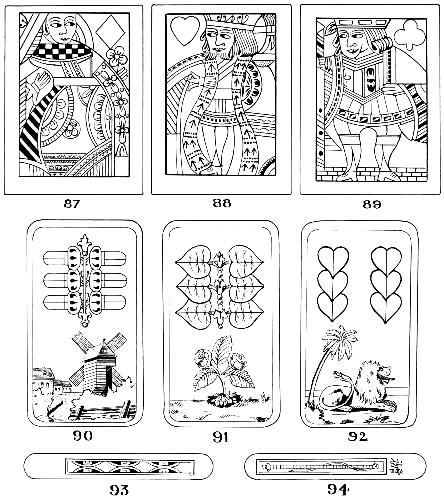
THE ATOUTS OF THE TAROTS
Since the creation of the world mankind has realized a divine power
shaping his destiny, and has tried to conciliate the unknown god. Since
life is made up of happenings that are unforeseen, man believed that
certain occult powers directed and shaped them. It was natural, therefore,
to try to ascertain the wishes of the controller of fate, so that they
might be complied with and misfortune thus averted.
Invocations, sacrifices and queries, private or public in the temples, are
recorded from early days. Some have been found that date from at least
five thousand years before Christ. Directions for “wave offerings,” “burnt
offerings,” etc., are frequent in the Old Testament. The commands for
marking the “rods” with the names of the twelve tribes of Israel, for the
purpose of laying them on the altar and awaiting results when the wishes
of the Lord would be revealed, are given in Numbers xvii. Prayers to Nebo,
Thoth, and Mercury are found everywhere in the countries where they were
worshipped. The use of divining arrows (rods), when demanding the wishes
of the gods, is a known historic fact, so it is readily seen whence the
Egyptians received their inspiration to gather together the customs,
ceremonies and superstitions of alien religions, to absorb them in the
worship of their god Thoth.
The temples of the Egyptian gods were generally gorgeously decorated, and
those of Thoth were filled besides with learned women and men who devoted
the result of their studies to the common good, without a thought of
self-aggrandisement. They made themselves the go-between of Thoth and man,
when revealing the wishes of the occult beings. The number of Hermetic
Books, written at Thoth’s dictation, is given by Jamblichus as 20,000.
Naturally, when sacrifices or offerings were made, the worshipper demanded
a reply to his inquiries, thus taxing the ingenuity of the prophets, who
were, in fact, no wiser than himself as to the predestinations recorded
at birth. So, sometimes they found the desires of the gods hidden in the
entrails of animals or in the palms of the hands.
Astronomers and astrologers, observing that the heavenly bodies conformed
to certain laws, decided that these laws also governed the lives of men.
In the worship of Ishtar, the great Babylonian goddess, who has been
identified with both Venus and Diana, the flight of birds had portent;
while at the oracle of Delphi straws (a variant of the rods of Aaron or
the divining arrows of the Asiatics) were employed to ascertain the wishes
of the gods, and it is the descendants of these that are now sometimes
known as Jackstraws, that came to us from the Chinese, and at others are
identified as the pip cards now in common use.
A close study of each card of the old Tarots reveals much of the history
of the book and its original intention, for the resemblance of the
different cards to the different Egyptian deities is clearly displayed to
the student. The attributes and costumes of Maut, Isis, Phthah, Neith,
Amun, Thmei, Nepte, Seth, Anubis, and Ra are all to be traced on the
detached leaves of the ancient book. The costumes are those of Italians of
about the thirteenth century, it is true, but the caps, the girdles, the
positions and the attributes, as well as the qualities assigned to each by
the fortune-tellers, are too apparent to be ignored. It would seem that
the cards were designed by some person to whom these different marks had
been described, but who had no knowledge of the original pictures of these
gods that are still so instructive in Egypt. While the attributes are
retained, the pictures do not recall the old ones that can still be found
in mummy cases or historic monuments. It was therefore impossible for
those who wrote on Playing Cards before the great discoveries in Egypt to
recognize the connection of the Tarots with the ancient mysteries,
although the symbols of Mercury might have given a clue, had these been
noted.
Without declaring that the deductions connecting the Atouts with the
Egyptian gods is infallible, the strong resemblance between them must be
carefully considered, and the intention of each card studied with all the
obtainable history connected with it.
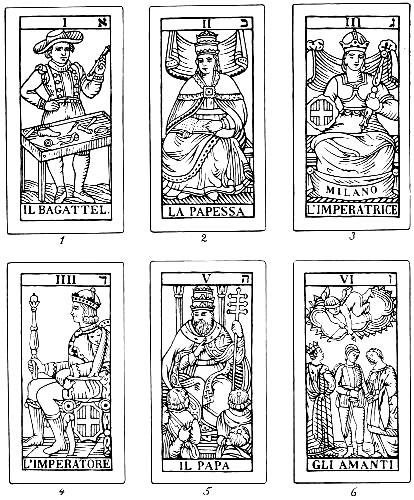
I. LE BAGATLEUR (Il Bagattel)
This card, also known as the Juggler or Pagat, bears various names,
according to the locality where it was used. “It is derived,” says Count
Emiliano di Parravicino, in the Burlington Magazine for December, 1903,
“from Bagat or Paghead and Gad, that signifies fortune, and the card is
often called Bagatto (or cobbler), since there are sometimes tools placed
on the board in front of the figure, one of which (in the corrupted
designs of modern cards) resembles a cobbler’s awl.” The figure on this
card represents the Player or Inquirer, and when the cards are laid out,
according to the rules of prophesying, it is controlled by all that are
dealt close to it. That is to say, the cards surrounding this figure tell
the events that are likely soon to befall the inquirer. The first Atout
represents a young man standing behind a table. On his head is a hat of
mystic meaning, for it is shaped like the sign of “eternal life,”
![[Illustration: Infinity Symbol]](https://openoldbooks.sgp1.digitaloceanspaces.com/books/prophetical-educational-and-playing-cards/images/infinity.jpg) ; his left hand carries a wand, called by
de Gebelin “son Bâton de Jacob, ou Verges des Mages.” This magician’s
wand was readily recognized by the shrewd Frenchman, who evidently
understood the symbolism of the rod of Aaron (or Jacob). The rod is really
the caduceus of Mercury that has so many significances. It is one of the
pip devices that has been reproduced in the Ace of Rods, Staves, or
Sceptres, as it is variously called, and, by placing it in the hand of the
inquirer, it denotes that he has been given the power to consult the
oracle. The other articles placed on the table before the youth are the
other devices that mark the suits of the cards, namely: Money, Cups and
Swords, although on modern Italian Tarots these emblems are often changed
for others that lack significance. In “the lottery chart,” called
Tsz-fa-to, used by the Chinese fortune-tellers, there is a figure like the
Bagatleur, holding up his hand in the same way, which recalls the many
mystic meanings attached to the “blessing hand.” The Pagat or Magician (as
this card is often called) is sometimes expressed merely by the Hebrew
letter Aleph, which is placed beside the figure, or is used alone, when an
Initiate understands the symbol as well as if the Pagat was in its place.
What relation the Hebrew alphabet has to the Tarots is a matter for
conjecture, but the characters are often placed on early packs, and some
writers have pointed out that, in their opinion, these letters offer fresh
evidences of the origin of cards and their connection with divination. So
Papus says: “The first letters of the alphabet express hieroglyphically
man himself as a collective unity—the Master principle—the ruler of the
world.” In very old packs the earth is represented at the bottom of the
picture, ornamented with its fruits. The centre is occupied with the man,
whose right hand bent towards the ground, the left hand raised towards
heaven, thus representing two principles, the one active and the other
passive, of the great All, and it corresponds with the two columns of
Jakin and Bohas of the temple of Solomon and of Freemasonry, as well as
with the great statues erected before the tombs of the Egyptian kings. The
meaning may be thus stated: “Man with one hand seeks for God in Heaven,
and with the other he plunges below to call up the demon to himself, and
thus unites the divine and the diabolic in humanity.”
; his left hand carries a wand, called by
de Gebelin “son Bâton de Jacob, ou Verges des Mages.” This magician’s
wand was readily recognized by the shrewd Frenchman, who evidently
understood the symbolism of the rod of Aaron (or Jacob). The rod is really
the caduceus of Mercury that has so many significances. It is one of the
pip devices that has been reproduced in the Ace of Rods, Staves, or
Sceptres, as it is variously called, and, by placing it in the hand of the
inquirer, it denotes that he has been given the power to consult the
oracle. The other articles placed on the table before the youth are the
other devices that mark the suits of the cards, namely: Money, Cups and
Swords, although on modern Italian Tarots these emblems are often changed
for others that lack significance. In “the lottery chart,” called
Tsz-fa-to, used by the Chinese fortune-tellers, there is a figure like the
Bagatleur, holding up his hand in the same way, which recalls the many
mystic meanings attached to the “blessing hand.” The Pagat or Magician (as
this card is often called) is sometimes expressed merely by the Hebrew
letter Aleph, which is placed beside the figure, or is used alone, when an
Initiate understands the symbol as well as if the Pagat was in its place.
What relation the Hebrew alphabet has to the Tarots is a matter for
conjecture, but the characters are often placed on early packs, and some
writers have pointed out that, in their opinion, these letters offer fresh
evidences of the origin of cards and their connection with divination. So
Papus says: “The first letters of the alphabet express hieroglyphically
man himself as a collective unity—the Master principle—the ruler of the
world.” In very old packs the earth is represented at the bottom of the
picture, ornamented with its fruits. The centre is occupied with the man,
whose right hand bent towards the ground, the left hand raised towards
heaven, thus representing two principles, the one active and the other
passive, of the great All, and it corresponds with the two columns of
Jakin and Bohas of the temple of Solomon and of Freemasonry, as well as
with the great statues erected before the tombs of the Egyptian kings. The
meaning may be thus stated: “Man with one hand seeks for God in Heaven,
and with the other he plunges below to call up the demon to himself, and
thus unites the divine and the diabolic in humanity.”
It is well known that among primitive people, boys, upon arriving at
manhood, went through certain ceremonies with fasting and incantations so
this card also represents a youth making his first offering to the gods of
the temple, and consulting them as to his future life, or asking what Nebo
or Thoth had written at the time of his birth on their “Tablets of Fate.”
In order to learn from the gods what his future occupation should be, one
of the symbols of Mercury is lifted haphazard from the table before him.
Thus, if a sword be grasped, a man will be a soldier, and a woman will
have a person of rank for a husband. The Cup represents the Church or
Love. In primitive nations various articles are still placed before a
child, and the one selected influences its occupations, when mature. In
Korea a bundle of yarn, a handful of rice, a few coins, a cake of ink, a
brush, and some paper are placed before a baby, on attaining its first
birthday. If it selects the yarn, it denotes a long life; the money means
prosperity; the writing materials signify that a scholar’s life will be
the one followed, while rice means happiness. Hebrew letters can be
expressed by numbers as well as by the conventional characters; this is
well exemplified by the way they were used in making the fringes of the
temple of Solomon, the strands of which were peculiarly knotted in groups
of different numbers, that, when deciphered, represented a text. A similar
knotted fringe adorns the Taleth or praying scarf, worn by the Jews when
worshipping in the synagogue, on which a text is typified by groups of
knots expressing Hebrew letters. “This fringe is made with four threads,
one of which is longer than the others. Two threads are bound together
with the longest one in a double knot, then it is wrapped seven times,
then eight, then eleven, followed by thirteen, with two knots separating
each.” “According to the Kabbalah,” states Professor Rosenau, in his book
entitled “Jewish Ceremonial Institutions,” “these knots and windings have
a secret meaning, making thirty-nine in all; they correspond to the
numerical value of the letters constituting two words, or ‘the Lord is
one,’ since each letter of the Hebrew alphabet has numerical
significance.”
Among uneducated people symbols took the place of written characters in
early days, so, since these knots conveyed a sound and a meaning, a number
is also indicated by the letters of the Hebrew alphabet. These letters or
numbers that were occasionally placed on the early Atouts have the
greatest value when deciphering the attributes found on the Tarots, since
each one has occult significance attached to it, evidently placed there
with the intention of assisting the early fortune-tellers to decipher
their meaning, although omitted in the later books of Thoth-Hermes, when
they were used only for amusement or gambling.
II. LA PAPESSA (THE FEMALE POPE)
This card is supposed to represent Isis. She is typified by a seated
female figure with two pillars behind her, between which hangs a curtain
indicating her temple. She is crowned with a triple tiara, and has an open
book in her lap. This goddess instructs and persuades. Law, erudition, and
occult science are under her protection. As the first female figure among
the Atouts, she represents the priestess of the temple of Thoth, also Eve,
also the mother. When a woman is the inquirer, this card represents her,
instead of the Pagat, which represents a man inquirer. The name of
Papessa, given to this card by the modern Italian card-painter, seems to
be a corruption of Isis. The former name is misleading, and has no
connection with the original meaning of the figure, for it has nothing in
common with the mythical Pope Joan of the Roman Church, while all the
attributes show that the figure represents Isis, or, perhaps, Tashitum,
the consort of Nebo, called “the Interceder.” “The Italian card-makers,”
says de Gebelin, “named numbers II and V of the Atouts, mother and father,
or Papessa and Papa;” but he declares “their emblems are Egyptian and the
triple phallus worn by number II is the one borne by Isis in the Fête des
Pampylies, where Isis joyfully receives Osiris. It is the symbol of
regeneration of plants, or spring.” The card is also supposed to represent
Juno in the Roman mythology. “The attitude connects it,” says the same
authority, “with la haute magic, since it is the first of the symbols of
the Emerald Tablet, one of the books of Thoth, that was discovered on the
mount of Nebo.” Wiltshire says: “Believers in magic find occult meanings
in the hands of this figure.” Roman women sacrificed to Juno on their
birthdays, as she was not only the goddess who presided over maternity
(making Mercury her messenger, who carried the child to its parents) but
she was also the protector of women. Part of the great book of Thoth,
called the Ritual of the Dead, said to have been written with the finger
of Thoth, and generally placed with a mummy, says: “I am yesterday.
Yesterday is Osiris. Phthah goes around. The divine Horus prefers Thee.
The god Set does so in turn, as well as Isis, whom thou hast seen.” The
Hebrew letter on the second Atout is Beth, which hieroglyphically
expresses mouth or tongue, one of the things used in the sacrifices to
Nebo and to Mercury.
III. L’IMPERATRICE (The Empress)
This card betokens Venus Urania according to the Roman mythology, or Maut
according to that of Egypt. The vulture is its emblem, one of Maut’s
attributes signifying maternity. The mouse also represents her, and it
typifies fecundity. The card has many significances, such as speech,
action, initiative, friendliness, protection, progress, production, and
helpfulness. The figure is that of a seated woman holding a shield and a
sceptre. In old cards she is crowned with a diadem that has twelve stars
on its points. This card also symbolizes generation and productive
forces. Its letter is Gimel, the meaning of which is the throat, or the
hand of a man half closed; hence, it signifies that which encloses, that
which is hollow, a canal, an inclosure. The card also represents a woman
friend, but not always one that is desirable. The Egyptian goddess, Maut,
wears a cap and crown, and she bears a sceptre. Her flowing robes are
confined below the breasts with a girdle, the typical zone that has such
occult meanings. Among the Persians and tribes of North Africa, the girdle
is always removed from a bride, as part of the wedding ceremony, and
neither is she nor the bridegroom allowed to wear one for seven days after
the marriage. Maut is called “Lady of Heaven,” and “Giver of Life,” and
has been identified by some as the Ishtar of the Babylonians.
IV. L’IMPERATORE (The Emperor)
The fourth Atout shows in profile a male figure seated on a throne. He
represents Jupiter or Amun, the Ammon of the Egyptians, the Marduk of the
Babylonians, and the Merodach of the Bible. This letter is Daleth,
suggesting growth, nourishment, generation, divine will, long life,
strong character or personal ability and ambition. This card and number
three have similar representations on the Persian cards, which pack alone
of those adopted by different countries retains the figure-pictures, to
the entire exclusion of the pip cards. This seems to point to the fact
that, while the Egyptians or Assyrians overran Persia and imposed some of
their customs and religious beliefs on the people, the great gods were
adopted reluctantly, and the key to their wishes was not bestowed on the
conquered people, as would have been the case had their use, in
combination with the prophetic arrows or rods, been taught at the same
time. The great temple of Ammon was at Thebes, the southern Egyptian
capital. The name Ammon means concealment, to veil, to hide. “His most
common title,” says Mr. Rawlinson, in “Ancient Egypt” (page 322), “was
Suten-Netern, king of the gods, also called Hek or Hyk, the Ruler, the
Emperor, Lord of Heaven, strong bull.” His image, like that of the fourth
Atout, is represented as seated on a throne. He is crowned, and wears a
collar and bracelets. He bears the sceptre, the symbol of power and
plenty. One of the invocations to Ammon begins “Hail to thee, Lord of
Truth, whose shrine is hidden.”
V. IL PAPA (The Pope)
The pronunciation of the name of this card alone proves its connection
with the Egyptian god, Phthah, but, besides this, it has many strange
significances assigned to it, all of them pointing to the same conclusion.
The figure denotes the religious superior, as it wears the triple crown,
combined with the two pillars of the temple. The African god was greatly
revered and feared, while many temples were dedicated to his worship. Four
figures kneel before Il Papa, whom he blesses with uplifted palm, sacred
to religious ceremonies, and inherited from the “hand of the Cohen” of the
Jews. In the old cemetery at Prague there are hundreds of tombstones, on
which the uplifted hands are carved to represent ideographically the
descendants of Aaron, who alone can bestow benediction in this way. The
hand plays an important part in heraldic emblems. “The Ulster, or bloody
hand,” is a mark of rank, not only in English heraldry, but is venerated
by Orientals as well. A bloody hand is frequently found stamped beside the
lintel of the door among North Africans, and small silver or brass
facsimiles of the right hand are also fastened to the door or worn on the
person, to ward off the evil eye, when it is called the “hand of Fatima.”
Arabs frequently wear this hand, that is then covered with engraved
quotations from the Koran. Their name for it is Kam or five fingers. The
number five—Khamsa—is considered so powerful and mystic that it is
believed to bring bad luck if it is mentioned, so the word is not
pronounced, but the Arabs say “two-three” instead. The Neapolitans
generally wear a hand with one finger outstretched as a charm, one of the
many links connecting them with Egypt. The fifth Atout in its position and
consequence represents aspiration, health, intelligence, union, strength
of will, religion and faith. The accompanying letter is He, the meaning of
which is aspiration. The triple-barred sceptre is an especial emblem of
Phthah, who was known as “the revealer,” the one who made hidden duties
manifest.
The first four figures of the Atouts are connected with family life. The
inquirer in number one, the parents in two and four, and the influence of
State and Church in three and five, forming a significant group when
studying the cards and their meanings.
VI. GLI AMANTI (The Lovers)
The sixth card has not yet been connected with any of the occult gods of
Egypt or Babylonia. The figures seem to belong solely to Cupid. The card
shows a young man between two females, symbolizing virtue and vice. Cupid
hovers overhead, blindfolded, and with bent bow, ready to “shoot an arrow
into the air.” When used for prophesying, this card is typical of a young
man starting in life, whose future depends upon the choice before him,
since good and evil both seem to claim him. The card also denotes
affection, love, friendship, charity, union and sight, the latter being
indicated by the letter, which is Vau, the hieroglyphic sign for eyes,
light or brilliancy. The import of this figure is personal magnetism. This
card also indicates marriage, and is emblematic of the legal tie, as well
as of luck and good fortune.
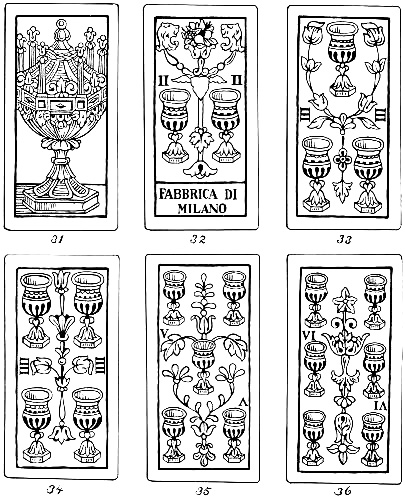
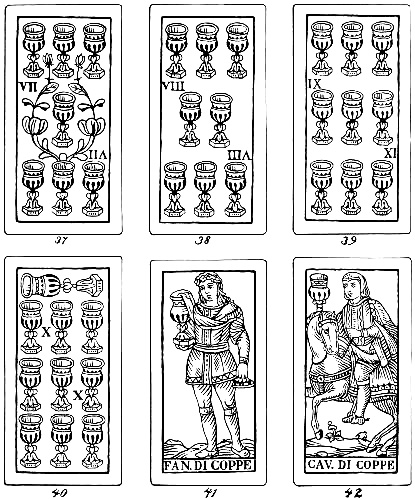
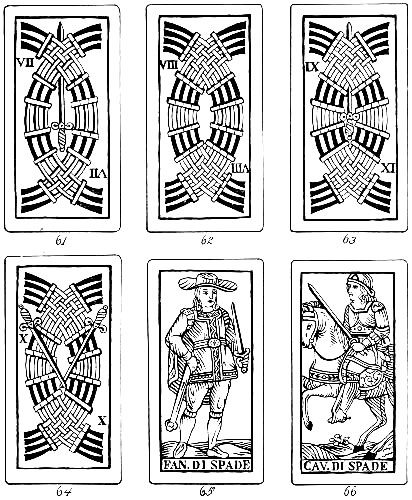
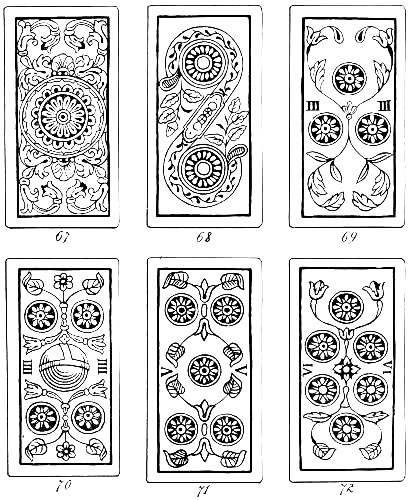
Early Italian Tarots
Pip and Court Cards of the Cup Suit
37 Seven of Cups
38 Eight of Cups
39 Nine of Cups |
|
40 Ten of Cups
41 Knave of Cups
42 Cavalier of Cups |
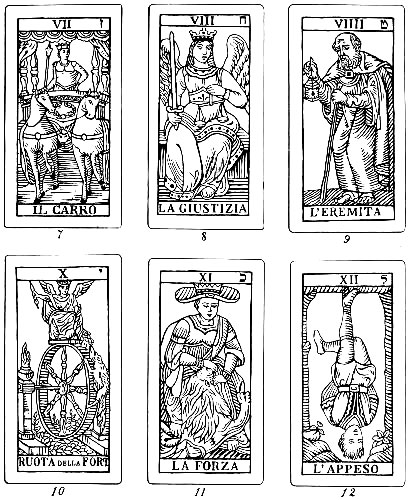
VII. IL CARRO (The Chariot)
This is one of the most mystic of cards, its number being one that was
regarded as occult by the ancients. It displays a picture of a king or a
conqueror, in his car drawn by beasts, precisely as Nebo was frequently
represented in the texts, “when the gilt chariot never marks the way.”
Sometimes the car is drawn by horses, frequently by oxen, sometimes by
lions, and occasionally by black and white sphinxes. This car typifies
Mars, the god of war mentioned in Babylonian mythology and in the Bible,
“when every nation made gods of their own and the men of Cuth made Neral
(Mars).” (2 Kings xvii:30.) As has been mentioned, Nebo bore a sword and
was regarded as accompanying warriors, although he generally represents
the pestilence that follows in the wake of war. The Hebrew letter of the
seventh Atout is Zain, that expresses an arrow, thus suggesting a weapon
as well as a soldier, so it denotes victory, a ruling power, triumph,
protection, a domineering character. “The arrows of divination” are
frequently referred to in the Bible, for instance, when “the king of
Babylon stood at the parting of the way at the head of the two ways to
use divination. He made his arrows bright, he consulted with images, he
looked at the liver.” The tablets found at Nippur frequently refer to all
the arts of divination, as when a text in cuneiform characters says: “the
arrows were marked Yes and No,” or, “the king had shaken the arrows,
questioned the house gods, and looked into the liver.” Mr. Culin, in his
“Korean Games,” considers that divination by arrows is one of the most
primitive forms, and it is still kept up in Korea, China, Japan, etc. The
sticks used for the purpose in China are in the form of arrows, and are
kept in a cube-shaped box resembling a quiver. They are shaken in a
peculiar way until one jumps out, when the design on it, and the direction
in which it points to the shrine, are considered to have replied to the
inquirer.
The Chariot of the Atouts was, under certain conditions, supposed to
represent Osiris. It was also called “the chariot of Mercury,” in the
sense that he was the messenger of Mars when war was to be proclaimed, or
when his caduceus was used as a flag of truce. Seven was always considered
by the Egyptian savants a mystical number, so this card played an
important part in occult science. Count Emiliano di Parravicino, in his
essay published in the Burlington Magazine, December, 1903 (page 238),
says: “Mgr. Antonio Dragoni (1814) suggests that the Atouts, numbering
twenty-one [not counting the Joker (Fou), which has no number],
represent the Egyptian doctrine beloved by Pythagoras, of the perfect
number Three and the mythical number Seven. Hence, Thoth, the Mercury of
the Egyptians, forms with the pack of pip cards his book or picture of the
creation of three classes of images, which symbolize the first three ages
of the world—i. e., the golden, the silver, and the bronze. Each of
these three classes is to represent in its seven divisions a greater
reference or mysticism, a mysterious book of the highest value in the art
of divination, since this book of unbound leaves contained the key to all
mysteries, although its contents were undecipherable to all but those
taught in the temples of Thoth.” This proves that other thinkers besides
Papus and de Gebelin had come to the same conclusions from their study of
the Tarot pack, although without having the benefit of exchanging views on
the subject.
The Babylonians believed in seven evil spirits, as the following prayer,
translated from a cuneiform tablet, will prove:
Seven are they. They are seven,
The same in the mighty deep;
And Seven are they in heaven,
’Though in water, sometimes they sleep.
They are neither male, nor female,
These awful spirits that fly,
But like destructive whirlwinds,
They swirl across the sky.
Without a home or offspring,
Compassion and mercy are nil,
Since prayers or supplications,
They neither hear nor feel.
Like wild beasts bred in the mountains,
They defy both gods and men,
Polluting even the fountains
The rivers, the marshes, the fen.
Evil are they, strangely evil,
In temples, in cities, in homes;
For Seven are they, cruel Seven,
With weird and terrible forms.
Mr. Willshire, in his “Catalogue of the Playing Cards in the British
Museum,” says: “It hardly requires a reference to the Bible to notice the
frequency with which the number Seven is mentioned. Not only was the
Seventh day to be kept holy, but, then, there was the mystery of the Seven
stars, of which Nebo (Mercury) was one, the latter being the most rapid
and brilliant. Also of the Seven golden candlesticks, and, in Zachariah
iii:9, we find that on the stone laid before Joshua there were Seven eyes.
Mercury invented the lyre, according to the Egyptians, in the year of the
world two thousand. At first it had only three strings, but in the hands
of the Muses, Seven were adopted. Then also the Seven virtues were called
the Seven cords of the human lyre, having their analogies in the Seven
colours of the prismatic spectrum. Then there were Seven precious stones,
namely: Carbuncle (garnet), Crystal, Diamond, Agate, Emerald, Sapphire,
and Onyx, besides the Seven chief metals.” The emerald was considered the
stone of Thoth, we may infer, since one of his books was entitled “The
Emerald Tablet.” Among the Berber tribes, of North Africa, the women put
seven marks on their foreheads, to protect them from the evil eye; this is
also done among some of the Negro tribes. When consulting the pip cards,
the Sevens have peculiar and occult values, marking the boundaries between
those lower and higher. They also make combinations that influence the
consideration of other cards.
VIII. LA GIUSTIZIA (Justice)
The figure on the eighth card is represented in the most modern fashion,
and yet, with its attributes and values, it is much as Egyptians would
have known it when the worship of Thoth was at its height. It is the
goddess of Truth or Ma. Her title was sometimes adopted by the kings, who
called themselves the friends of Truth. Mr. Rawlinson, on page 385 of
“Ancient Egypt,” says: “The chief judge of every court is said to have
worn an image of Ma around his neck, and when he decided a case he touched
the litigant with it, in whose favour the decision was made, in order to
testify that everything had been done with justice and truth. In the final
judgment of Osiris, the image of Ma was placed in the scale, and weighed
against the good actions of the dead.” It may easily be perceived what a
forceful figure the one of justice must have been to the people who
consulted the oracles in the temples of Thoth. Justice is represented on
the Atout as a seated female figure, on a throne bearing her usual
heraldic marks of a sword and a pair of scales. Law and order are denoted
by every line and emblem on the card, which, summed up, expresses
conscientiousness, balance, power, and poise, in all their forms. The leaf
also corresponds with some of the attributes of the god Tiemei, and again
represents one of the deities of Olympus. Heth, the letter corresponding
to it, means a field, and from that springs the idea of anything requiring
labour and continued effort, the elements and existence. When it typifies
Ceres, of the Olympic gods, it denotes the mother as she is generally
represented, with her daughter, Prosperpine, endeavouring (as the original
type of a mother-in-law) to keep her from the arms of Pluto, while Mercury
leads the wife forcibly away. This card is the dominating one of Cups
(meaning sacrifice) of the pip part of the pack.
IX. L’EREMITA (The Hermit)
The Hermit is one of the most mysterious designs on the Atouts, and has
not yet acknowledged all its intentions. For the meaning assigned to it,
and its value for soothsaying, hardly correspond with the personage
depicted, so it is supposed that the artist who modernized the ancient
design has altered it too completely to be recognised by those
unacquainted with the original intention. It shows an old man, holding a
lantern aloft, and by some is regarded as a watchman calling the hours of
the night, and by others, as Diogenes searching for an honest man. But the
attributes or values given to the card rather quarrel with the design, for
they signify friendship, protection, and wisdom. The rod or staff
signifies a pilgrim, certainly an overseer, and is a favourite emblem in
the Bible, as in Psalms xxiii:4, “Thy rod and thy staff, they comfort me,”
or, in Isaiah x:15, “If the staff should lift up.” It is the cane of the
medical man, and represents the Sceptre suit of the pip cards. This Atout
typifies strength of character, philanthropy, the wisdom of silence in
difficulties, circumspection, prudence, and sympathy; in short, all the
qualities desirable in a friend. The letter is Teth, which represents a
roof or place of safety, suggesting the idea of a shelter and protection
given by wisdom and forethought. The card also typifies human love and
humanity.
X. RUOTO DELLA FORTUNA
(The Wheel of Fortune)
This Atout has many and various connections with the superstitions of
ancient days. It is the Wheel of Fortune, and, among other things,
represents Osiris judging the souls of the dead. Anubis clambers up on one
side, while Typhon descends on the left of the wheel. “There are two
ideas,” says Papus, “expressed by this symbolic card. The first is that of
supremacy, the second of eternity.” The former is typified by Anubis and
Typhon climbing or falling, one reaching to overpower the other, while the
wheel turns eternally, lifting first one and then the other. Thus it is in
life, for fortune changes from good to bad with unceasing regularity,
sometimes slowly and sometimes rapidly, but always controlled by an
unknown force, that is called luck. The circle signifies eternity, and the
Wheel of Fortune is one of the oldest known symbols in the world. It is
deemed by some to have its analogy in the “Wheels of Ezekiel and of
Pythagoras,” with all the significances attached to these emblematic
figures. Being numbered ten, its Hebrew letter is Yod, the hieroglyphic
meaning of which is “the forefinger extended as a sign of command.” This
sign ![[Illustration: Pointing Finger]](https://openoldbooks.sgp1.digitaloceanspaces.com/books/prophetical-educational-and-playing-cards/images/finger.jpg) is recognised even by the
uninitiated, and is one of the surviving attributes of Mercury in common
use to-day. It was placed under the head of Mercury, when he was erected
by the roadside as Terminus to point out a road. In every synagogue is
found a pointer, called Yod, because its long arm terminates in a
beautifully modelled hand, with the forefinger outstretched. This is used
by the reader of the Scriptures to keep the place, since the text is
written in fine characters not easily followed without the pointing finger
of the Yod. The Wheel of Fortune typifies magic power, fortune, expression
of the will of the gods, or their commands, supremacy, superstition, and
luck. Anubis was the conductor of spirits to the judgment seat (or
Mercury, as Chthonius); he also held the balance in the hall of the dead.
He is called “Lord of the Burying-ground,” and is represented as a
jackal. The Wheel of Fortune is derived from Osiris, on the judgment seat,
with Anubis as assistant.
is recognised even by the
uninitiated, and is one of the surviving attributes of Mercury in common
use to-day. It was placed under the head of Mercury, when he was erected
by the roadside as Terminus to point out a road. In every synagogue is
found a pointer, called Yod, because its long arm terminates in a
beautifully modelled hand, with the forefinger outstretched. This is used
by the reader of the Scriptures to keep the place, since the text is
written in fine characters not easily followed without the pointing finger
of the Yod. The Wheel of Fortune typifies magic power, fortune, expression
of the will of the gods, or their commands, supremacy, superstition, and
luck. Anubis was the conductor of spirits to the judgment seat (or
Mercury, as Chthonius); he also held the balance in the hall of the dead.
He is called “Lord of the Burying-ground,” and is represented as a
jackal. The Wheel of Fortune is derived from Osiris, on the judgment seat,
with Anubis as assistant.
XI. LA FORZA (Strength)
This Atout shows a female figure, wearing the mystic hat, or vital sign
, seen on the Pagat, or the first Atout.
The girl forces open the mouth of a lion, expressing vitality, force,
courage, daring. It would seem the ancients believed that, in suffering or
trouble a woman was superior to a man, for endurance and strength of mind.
The figure also typifies innocence, so the fable of Una and the lion seems
to be depicted, whether intentionally or not. Another symbol is that of
the Amazons, who pretended, say modern writers, to great strength, in
spite of being women, but the translations of some of the cuneiform
tablets lead one to suppose that these female warriors were more noted in
their own times for their wit than for their strength. The value given to
the card indicates it to be under the protection of Minerva. The Hebrew
letter for this card is Kaph, which typifies a grasping hand. This card
represents subtle and mystic occultism, with its influence over mankind;
in fact, female charity. It recalls, by its costume and attributes, the
Egyptian goddess Neith, whose temple was at Sais, the chief city of the
Delta. She wears a peculiar emblem on her head, sometimes called a
“shuttle,” recalling the device of the Atout. Mr. Rawlinson, in his
“Ancient Egypt” (page 342), says the inscription on her shrine reads: “I
am all that was, and is, and is to be. No mortal hath lifted my veil.” The
last expression would be understood in Egypt, for the lifting of the veil
is the conclusion of the marriage service, when the bridegroom sees his
wife for the first time. Therefore, one meaning of the card is a bride.
XII. L’APPESO (The Hanged Man)
The hanged man is a remarkable figure on the twelfth leaf of the Book of
Thoth. The person is suspended by one foot from a gibbet that is crudely
made, by placing a bar in the fork of two opposite trees that have been
lopped of other branches. The hands are tied behind, and the right leg
crosses the left, by which the figure is suspended. This peculiar form of
punishment was at one time inflicted for certain kinds of crimes in
Etruria, and was probably typical when it was adopted. It has been
suggested that one of the signs of recognition between Freemasons consists
in crossing the legs, although these persons generally remain upright and
are not contortionists, so it is difficult to concede this connection with
the figure on the Atout. It shows a young man, who is said to be the
Pagat, or inquirer, of the first Atout, who, having passed through the
temptations of youth, begins to aspire to an ethical future. This is
exemplified by his position, indicating discipline, or submission to a
superior will. Perhaps another idea is, that since all the blood has run
to his head, the powers of knowledge are concentrated, and will be
increased. The card expresses equilibrium, charity, courage, knowledge and
prudence; also wisdom and fidelity. Lamed is the corresponding Hebrew
letter; it designates the arm, so is, therefore, connected with expansive
power and movement, as applied to all ideas of extension, of occupation,
of possession. The figure being raised above the earth, and in a position
of pain, together with humility, typifies a mind withdrawn from temporal
ideas, or a martyr to science. Vulcan is supposed to be the Olympian god
typified by L’Appeso, not only on account of the strong arm, but also
because he was thrown out of heaven and lamed for life.
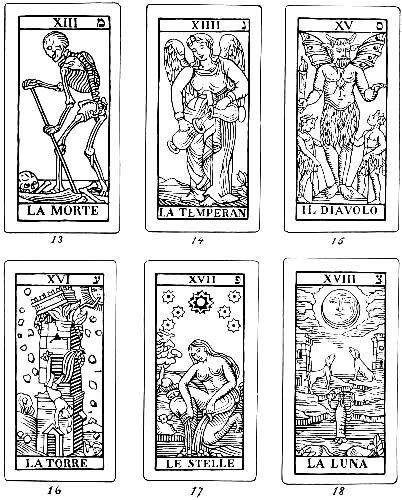
XIII. LA MORTE (Death)
This thirteenth Atout is represented on some cards as a skeleton mowing
off the heads of men, on some as a rider on a white horse, and on others
on a black one. There is an old proverb: “Death comes riding on a white
horse,” and sometimes the clouds betokening rain are called “the white
horses of death.” One of the horses of Aurora was called Abraxas, the
numerical value of these letters summing up three hundred and sixty-five,
or the number of the days of the year. The occult meanings attached to
this card and its number in the Atouts are well known, for the latter is
connected with bad luck or death in all European countries, and in every
place where the worship of Mercury or the Hermetic art, as connected with
cards, has penetrated. It is not so regarded, however, by savage tribes,
who have not followed this cult. This superstition is, therefore, by many
deemed to be one of the proofs that the cards were descended from those
mysteries. It is supposed that this image of Death was the half-way
position in the temple of Thoth, and therefore divided the Atouts to the
right and to the left, since they were placed in sequence on both sides.
Thoth Hermes, the unnumbered Atout, was represented by a statue that
occupied the centre of the building, under which stood an altar. On this
altar the rods (or pip cards) were thrown when consulting the oracle. At
any rate, the altar (or its remains) occupies the centre of the ruins of
the temple of Mercury, at Baiæ. The central position of Death was deemed
to indicate the dividing period of a man’s life. The inquirer, after
consulting the pictured figures, representing the family, religion,
government, and friends of the beginning of his life, now learned of the
more serious affairs of later years, not necessarily death or bad fortune,
but, rather, a transforming force, since this Atout marked such a distinct
epoch in the path of life, and was to be considered most seriously. Still
the card also portends sorrow, destruction, and death. The letter is Mem,
meaning fertility and formation, or the development of the being in an
unlimited space, perhaps regeneration after destruction, or immortality in
another world.
XIV. LA TEMPERAN (Temperance)
It is probable that this figure was intended for Nut or Nephthys. Of her
but little is positively known, and, so far, no temple erected to her has
been discovered. She was called the wife of Seb, and the mother of Osiris.
Her titles are “the Elder,” “the Mother of the Gods,” and “the Nurse.” She
is usually represented as veiled and pouring a liquid from a vase. Her
figure frequently appears in tombs, as if she was the guardian angel or
protector of the dead soul. This idea of an oblation to the gods, through
pouring wine or oil before them, is found to be common among the
Babylonians, and to “pour oil on the troubled waters” is no mere figure of
speech.
The fourteenth Atout is represented as a winged female pouring liquid from
one jug to another, signifying individual and corporeal existence,
production, fruition, health, temperance, economy and offspring. Its
letter is Nun, signifying fruit of any kind and all things produced.
Neptune is typified by one of his nymphs offering an oblation when
mingling the waters. There may be a remote and more occult connection with
this device and divination, for one of the earliest methods of consulting
the gods was through pouring water on oil, or oil on water, and
prognosticating from the results. This process is found to have been used
among the Babylonians as early as two thousand five hundred years before
Christ. Two books have been discovered on this subject that give full
directions for consulting the wishes of the gods through those means, and
they have been fully translated by Dr. Arthur Ungnad. One is,
“Interpretations of the Future among the Babylonians and Assyrians,” and
in it are found many directions for discovering the wishes of the gods,
such as: “If the oil fills the cup, the person dies;” “If the oil floats
on water to the east, the person will die;” “If to the right, it is good
luck, if to the left, it is misfortune.” The name, Temperance, given to
this card, seems to be rather misleading and modern, since the picture
evidently typifies this most ancient custom.
XV. IL DIAVOLO (The Devil)
Set, or Sutech, the principle of evil, who is connected with the myth of
Osiris, needs but little explanation. Even moderns can comprehend at a
glance all that it typifies. Mgr. Antonio Dragoni is one of the earliest
persons to identify this card with Set or Typho, the son of Seb, who was
the brother of Osiris, and one of the geniuses of evil. Any one who has
attempted to read the myth of Osiris will appreciate the difficulties of
unravelling it. The Hyksos, or shepherd kings, selected Set as their sole
deity, and Seti I assumed his name, thus placing himself under the
protection of the evil one. Afterwards the worship of Set ceased entirely
and he was abhorred. The long ears retained on the figure of the fifteenth
Atout mark the connection with Set, for that was one of his distinguishing
attributes. The Hebrew letter that represents this card is Zain, which
means arrow, or any weapon of destruction. The intention of this Atout is
destiny, chance, fatality, superstition, illness, temptation; it
represents a spirit of evil, hatred, jealousy, and suspicion.
XVI. LA TORRE (The Tower)
In this leaf, a building struck by lightning is portrayed, through a
thunderbolt shot by Jupiter, and conveyed by the “Messenger,” Mercury. The
“lightning god” was one of Nebo’s titles, and the mark is retained on the
Japanese cards, although probably accidentally, since there is no
connection between their playing cards and the original Atouts. Some
writers call this tower the “castle of Plutus” (the Roman god of wealth),
deeming it a warning to misers, for it recalls the legend relating to an
incident in the life of Rameses II, recorded in Herodotus. The Pharaoh
ordered a tower to be built for his treasures, and he alone had its key,
but daily he discovered that his valuables were disappearing, although
there was only one egress. A watch was set, and it was found that two of
the sons of the architect could enter by displacing a stone, that had been
left for the purpose of thieving, and when the men were entrapped inside,
they threw themselves headlong from the tower. This picture shows a
connection with Egyptian legend that must not be disregarded in seeking to
trace the Tarots to the mysteries of Thoth. Besides, some persons believe
that the card represents the destruction of the temples of Babylon, and
due weight must be given to the significance awarded by that people to
lightning, when consulting the gods through divination, particularly as it
was the weapon of Jove (Merodach), who was connected with the Baal of the
Bible, and sometimes worshipped as Enlil, who was frequently implored not
to destroy his people by lightning. But there are other legends connected
with the destruction of ancient temples that are even older than that of
Egypt, and we are lucky to have access to one that has lately been
translated from the Sumerian language, written in cuneiform characters on
one of the tablets discovered by Prof. Herman V. Hilprecht in the Temple
Library of Nippur. Above two hundred of them were of a religious or
historical character, which he set apart for the well-known scholar,
Doctor Radau, to translate. These related chiefly to the worship of the
gods of the second dynasty of Ur, or about two thousand five hundred years
before Christ. “Although the beginning of the Babylonian religion, as
portrayed in these tablets,” says Doctor Radau, in “Miscellaneous Sumerian
Texts from the Temple Library of Nippur” (page 389), “has to be sought
somewhere at about 5700 B. C., when the religions of Babylon were
systematized.” One tablet relates how a king of that period conquered his
enemies with the help of the chief god, who at that time was named Enlil,
“the Governor of the gods,” “the god who destines fate.” It was his son,
Nebo, who was his confidential messenger, his “lightning-rod,” and who
wrote on the “tablets of Fate” the decrees of the supreme being at the
birth of each mortal. It may be noted that Nebo is given a different
father at different times, but so it is in the mythologies as now
interpreted; the oldest accounts name the chief gods, whose qualities and
symbols later became merged in more modern ones, and they were given
different names at various times, which is most confusing. The great
temple consecrated to Enlil is called E-Kur, and is at Nippur. This name
for this particular tabernacle became the common name for temple in
general (page 411). No king of Babylon ventured to do anything or take
any step without “kissing the hand” of Enlil, to obtain his consent and
approval. According to Doctor Radau, Enlil was afterwards succeeded or
displaced by Marduk (the Merodach of the Bible, and the Jupiter of the
Romans), although the supremacy of Enlil lasted some three thousand five
hundred years, quite long enough to leave an impression on the “Book of
Fate.” One of the tablets translated from the Sumerian language has been
given almost literally, and is an invocation to Enlil, bewailing the
destruction and begging for the restoration of the principal cities of
Babylonia, together with the temples that had been destroyed, which were,
in fact, the homes of the priests, who always dwelt in the sanctuaries.
Doctor Radau (page 444) calls the song, “The Lamentation of the Goddess
Nin, of the City of Mar, who was called Nin-Mar.” He gives a literal
translation of the cuneiform text of the tablet that has a well-defined
metre, and is divided into sections. The first three verses are an
invocation to Enlil, the supreme god, by this goddess, Nin-Mar, who
declares that she is “Mistress of Mar,” who, through the power granted to
her by Enlil, was once able to destroy the enemies of her country and lay
waste their lands, but the power has left her, as her “Master” sleeps.
Nin-Mar gets a sympathetic god, named Nin-ib, to sing a hymn with her, in
which the destroyed temples are recounted. Nin-ib was the solar deity of
Nippur, also a war god, but inclined to be beneficent to mankind. One of
his titles was “the warrior,” and he is identified as the planet Saturn.
His symbol was a man with a lion’s head.
TO ENLIL.
Oh, Enlil, who placed on the waters
A shelter for men and for all,
Great God, who creates and then slaughters,
Come, hark to the children’s call.
Nin-Mar, the smiter of mountains, I sigh, I sigh;
Enlil, to thee I cry, cry, cry.
Shall the Mistress of Mar and his daughters,
His doves and the broods on their nests,
Shall their homes be cast out on the waters,
While their Master is lying at rest?
Nin-Mar, who was the destroyer of lands, I sigh, I sigh;
Enlil, to thee I cry, cry, cry.
Exalted one! Listen to pleadings,
For my Nippur now covers its face;
My E-Kur, my Ki-Ur have vanished,
May all be restored to their place.
It is Mar, the smiter of mountains, I sigh, I sigh;
Enlil, to thee I cry, cry, cry.
THE HYMN.
Great Nippur, and E-Kur and Ki-Ur with Girsu have perished in flame,
Then harken, oh, powerful Enlil, and restore them to greatness and fame.
Oh, then shall thy cities exalt thee, thy harems, thy children, thy lands,
The doves which fly over the towers, the temples that rise from the sands.
We pray that thy days may be lengthened, thy cities, like mountains, arise;
Then open thy ears, mighty Enlil, to thy children’s most sorrowful cries.
Listen to Nin-Mar, its Mistress, I sigh, I sigh;
Enlil, to thee I cry, cry, cry.
The Atout of the Tower typifies the money pip of the cards, with all of
its mundane significances, so its meaning is easily translated as
intending sorrow, destruction, vice, descent, perverseness, wickedness,
degeneration. Ayin is the letter of la maison de dieu, or le feu de
ciel, as the card is variously called, and both its design and its
complementary letter express all that is crooked, bad, and false.
XVII. LE STELLE (The Stars)
This Atout shows a young woman “beneath the mystery of the stars,” the
seven stars of the Bible, that were the seven planets of antiquity. The
name star is derived from that of Ishtar, the great Babylonian goddess.
The central and most brilliant star on the Atout represents Mercury as the
god of speech, or the transmitter of the wishes of gods to men, or Nebo,
“the writer on the tablets of Fate.” The Dog Star was called Thoth by the
Egyptians, who also considered this god the author of speech, language,
and writing, like his predecessor, Nebo, whose mountain was at the plain
of Moab, (Deuteronomy xxxiv:1), and he also had the same planet dedicated
to him. He, the differentiating letter, means voice or speech, just as
Nebo, or Nabi, means prophet, proclaimer. Hebe, who succeeded Mercury, as
cupbearer to the gods, represents him here dispensing the essence of life
equally between two jugs; and, to carry the resemblance still further, the
picture recalls oblations to Osiris, which were typical of the mingling of
life and power, as exemplified by pouring out water when standing on the
earth. Thus, two of the elements are shown, a third one having been
represented in the lightning of the preceding card. The different
connections between the ceremonies of the ancients with the Cup and the
cupbearer have been described in the chapter relating to that emblem. On
some of the oldest of the Atouts, before their designs became confused by
ignorant artists, when some of the most distinctive emblems were omitted,
or altered, a gazelle stands behind the woman. This still further shows
the connection of this card with old Egyptian legends, for it was said
that the gazelle gave warning of the rising of the Nile, by fleeing to the
desert, even before the inhabitants expected the flood. The gazelle is
sacred to Osiris. This animal is also retained on one of the pip cards of
the Spanish pack. The Stars typify immortality, creation, hope, song,
music, speech, and the connection between humanity and a supreme power. It
will be recalled that all these things were attributed to Mercury,
Thoth, and Nebo. A god pouring a liquid from one vessel to another is
frequently found on Egyptian seal cylinders. It is generally the sun god,
although other gods are frequently represented.
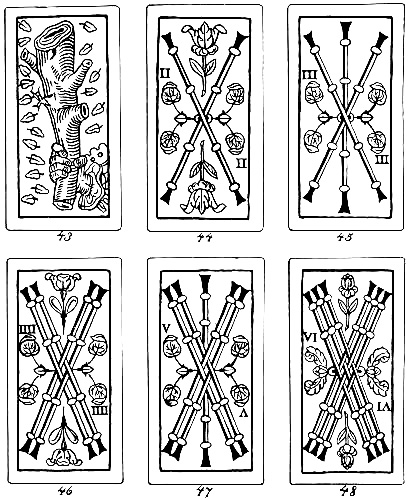
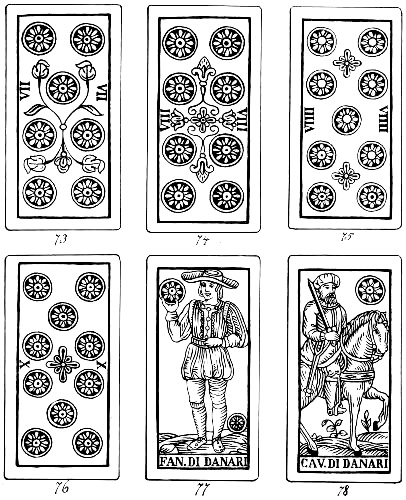
Early Italian Tarots
Pip Cards of the Rod Suit
43 Ace of Rods
44 Deuce of Rods
45 Trey of Rods |
|
46 Four of Rods
47 Five of Rods
48 Six of Rods |
XVIII. LA LUNA (The Moon)
The eighteenth Atout speaks for itself. The legends connected with it are
far spread, but all are practically the same. Two dogs bay at the moon,
that is represented at the top of the picture. They are symbols of Marduk,
which seem to have little connection here. A crawfish crawls from the
water to land. The meanings are manifold, for the letter Tzaddi (although
its hieroglyphic idea is similar to that of Teth on the ninth card) has
different significances, according to its position in a word. It chiefly
means an aim, an end, a succession, and its value varies.
The occult significance of this Atout is the material body, with its
gratifications, such as gourmandising, drinking, covetousness, gambling,
selfishness, and the danger of self-indulgence. Then, also, the card warns
of hidden dangers, enemies, and accidents, representing, besides the
ibis-headed Thoth, the god of letters. To discover all its significances,
the eighteenth card must be studied with due regard to conditions,
position, and the meaning of those adjoining it, all of which aid in
deciphering the obscure intentions of this leaf, that is assigned in
mythology to Diana.
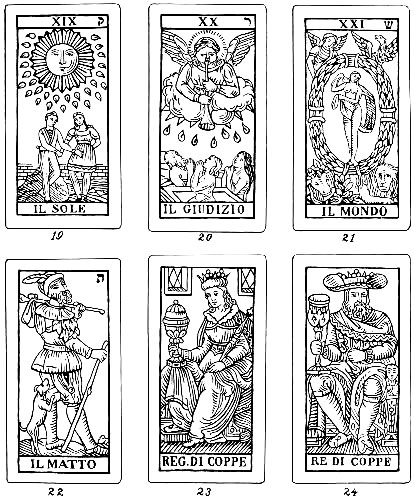
XIX. IL SOLE (The Sun)
A representation of the sun is the design on the nineteenth Atout, the
accompanying letter of which is Zoph, signifying a defensive weapon. This
Atout indicates the elements, precious stones, and minerals; an awaking,
revival, excitement, transition, nutrition and digestion; also
self-esteem, indulgence, eagerness to make money, and probable success by
self-exertion; also a worldly person, or a happy marriage. The god Ra is
represented by the sun in Egyptian mythology. He was greatly revered by
some of the Pharaohs, such as Rameses, who adopted his name.
XX. IL GIUDIZIO (The Judgment)
The Day of Judgment is the symbol of this Atout, and its letter is Resh,
representing typically the head of man. The picture shows an angel
blowing a trumpet from the clouds, while below, the earth is yawning, to
allow the dead to rise. This is a strange emblem to be placed among the
heathen leaves, for it is peculiarly Christian in its significances; but
even the oldest designs show it pictured in this way. As it stands, it
expresses motion, movement, travels, readjustments, originality,
determination, respiration, and regeneration. Then, also, it typifies
scenery, skill, and artistic capabilities. The Romans dedicated it to
Pluto, the ruler of the nether world. It has many of the attributes of
Ishtar, the goddess of the Babylonians, from whose name Easter is derived.
She represented spring, and was the protector of vegetation, growth, and
agriculture. The angel blowing the trumpet is a very old design, and one
often used on tombs or cenotaphs. It recalls Theodore Hook’s witty epitaph
on Lord de Ros, of whom little good could be said, and who was accused of
cheating at cards, but whose family erected a fine monument to his memory,
on which was the representation of the angel of the Resurrection. Under it
Hook wrote: “Here LIES England’s Premier Baron patiently waiting the
last trump.”
XXI. IL MONDO (The World)
This card shows the nude figure of a woman, in an ellipse of leaves and
flowers, the victor’s wreath of the Grecians. She represents verity or
truth. In the four corners are the emblems of the apostles that St. John
borrowed from Ezekiel, and the latter from Assyria and Babylonia. These
are the Man, Lion, Bull and Eagle. Besides typifying the apostles, they,
in a manner, suggest the four attributes of the pip suits, and also the
four elements. The inscrutable-looking man represents brain, knowledge,
and mystery. The ox typifies strength, and the lion courage, while the
eagle suggests inspiration and the power of soaring above mundane affairs.
These four emblems represent also the four seasons, when the ox stands for
autumn, the man for winter, the lion for summer, and the eagle for spring;
so the complex meaning of the twenty-first Atout suggests that the head or
wisdom of man prescribes the will of the ox, the courage of the lion, and
the aspirations of the bird, through the mouth of Truth. The attributes of
the designs on the cards are also included in this leaf from the book of
Thoth. The wand that the figure holds represents the Stave, or caduceus,
or magic wand of Aaron, “that was kept for a token,” as well as fire. The
Cup betokens the south, and summer, and water. The Sword, earth, and the
Coin (or Ring), eternity and air. Il Mondo’s letter is Tau, which
symbolises perfection. The meaning of the whole card covers the elements
of success, luck, happiness, marriage, contentment, bliss.
XXII. IL MATTO (The Fool)
The twenty-second Atout has no number upon it, and is called Le Fou, Il
Matto, or the Joker. It is the presiding deity himself, Thoth, Nebo, or
Mercury, in all his various moods, with all his many qualifications. These
are denoted by the cards that fall near him, when being dealt, that are
controlled or influenced by his overwhelming personality and
qualifications. He generally brings news and good luck. Count Parravicino
declares: “the Italian name is derived from an Egyptian one, Mat, which
signifies beginnings or perfection.” The card represents everything that
is typical of Mercury, such as irresponsibility, with all its
consequences. The figure of Il Matto carries the attributes of Mercury:
the staff he holds in his hand, while a purse dangles from his side. He is
travelling or walking, as if carrying news, or a message, and also
suggests a wanderer, a pedler, or a merchant. Motion, energy, and luck are
expressed, as well as fickleness, inconstancy, and unconventionality that
may amount to insanity. The letter is Shin, and expresses cyclic movement.
In some of the old Italian Tarots, Il Matto is represented as being naked,
or else in tattered garments, like a beggar, when he symbolises folly,
frivolity, or chance. In the Austrian Tarots he is dressed like a
harlequin, or else simply with cap and bells. He is the gypsy wanderer, as
we know him, believed by some persons to be the descendant of the Egyptian
priests of the temple of Serapeon, at Pozzuoli, who were forced to wander
by the destruction of this temple.
It must be remembered that no Tarots have been discovered that are over
five hundred years old, and that a great gap exists between these and the
mysteries of the temple of Thoth; therefore, some of the emblems or
symbols that we know may not resemble those of the originals. We must
also recall that there is more than one cult represented among the Atouts;
therefore, many of the attributes of different deities are mingled
confusingly, perhaps, on one and the same card. The student is necessarily
limited by conditions, for many of the virtues accredited to the
emblematic figures have been received traditionally, or have been
discovered by intuition, and are attributed first to one god, and then to
another, as the study of ancient myths or cults reveals a hitherto
unexpected connection.
The intention of the Atouts, as a whole, is the representation of a youth
and his parents or governors and sponsors. These are followed by
everything that can express human life, such as ambition, love, marriage,
temptation, friendship, luck, trials, illness, hatred, jealousy, despair,
hope, enemies, success, and death. When combined with the pip cards, the
whole makes an interesting game of life, presided over by the versatile
god, Mercury, “the writer on the tablets of Fate.”
The whole of the Tarot pack has been called “the Bible of the Gypsies,”
“the Athor of the Egyptians,” “the Thora of the Hebrews,” “the Great Book
of Thoth Hermes Trismegistus,” and “the Key of Things Hidden from the
Beginning of the World”; so, how should poor mortals be able to unravel
all its secrets and lay them bare before an uncrediting world.