PROGRESS AND ACHIEVEMENTS OF THE COLORED PEOPLE CONTAINING THE STORY OF THE WONDERFUL ADVANCEMENT OF THE COLORED AMERICANS—THE MOST MARVELOUS IN THE HISTORY OF NATIONS—THEIR PAST ACCOMPLISHMENTS, TOGETHER WITH THEIR PRESENT-DAY OPPORTUNITIES AND A GLIMPSE INTO THE FUTURE FOR FURTHER DEVELOPMENTS—THE DAWN OF A TRIUMPHANT ERA. :: :: :: :: :: A HANDBOOK FOR SELF-IMPROVEMENT WHICH LEADS TO GREATER SUCCESS
Transcriber’s Note:
The cover image was created by the transcriber and is placed in the public domain.
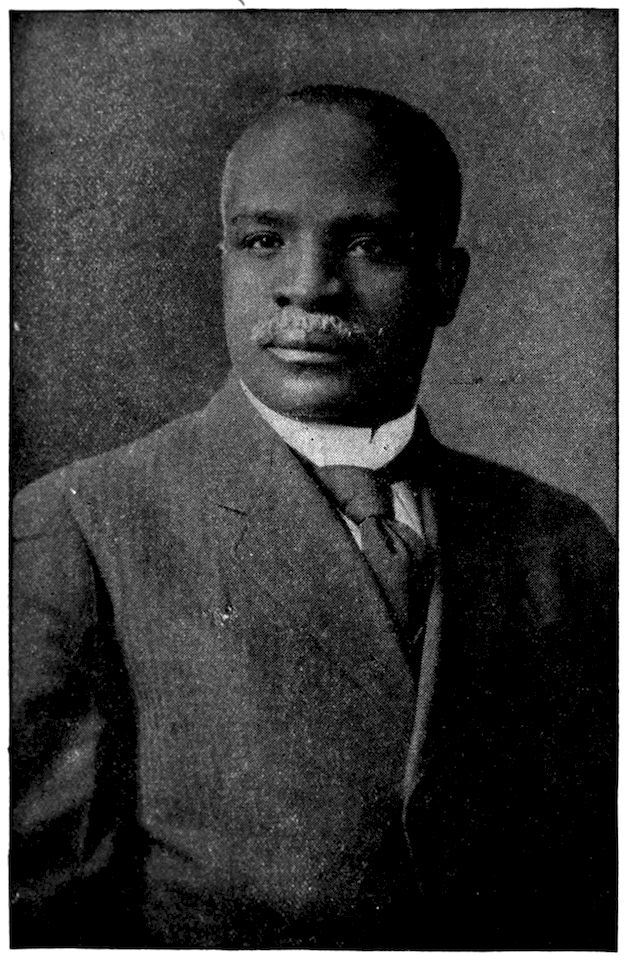
KELLY MILLER, A. M., LL. D.
Dean of the College of Arts and Sciences, Howard University, Washington D. C.
KELLY MILLER
AND
JOSEPH R. GAY
ILLUSTRATED WITH OVER 100 PHOTOGRAPHIC PICTURES, ACTUAL SCENES IN REAL LIFE AND EDUCATIONAL INSTITUTIONS
AUSTIN JENKINS CO.
Manufacturing Publishers of Subscription Books
Agents Wanted Washington, D. C.
Copyright MCMXIII
BY JOSEPH R. GAY
Copyright 1917
by AUSTIN N. JENKINS
The Story of a Rising Race Told in Pictures
PHOTOGRAPHED FROM LIFE
Special Collection A
INDUSTRY COMMERCE FINANCE INSURANCE
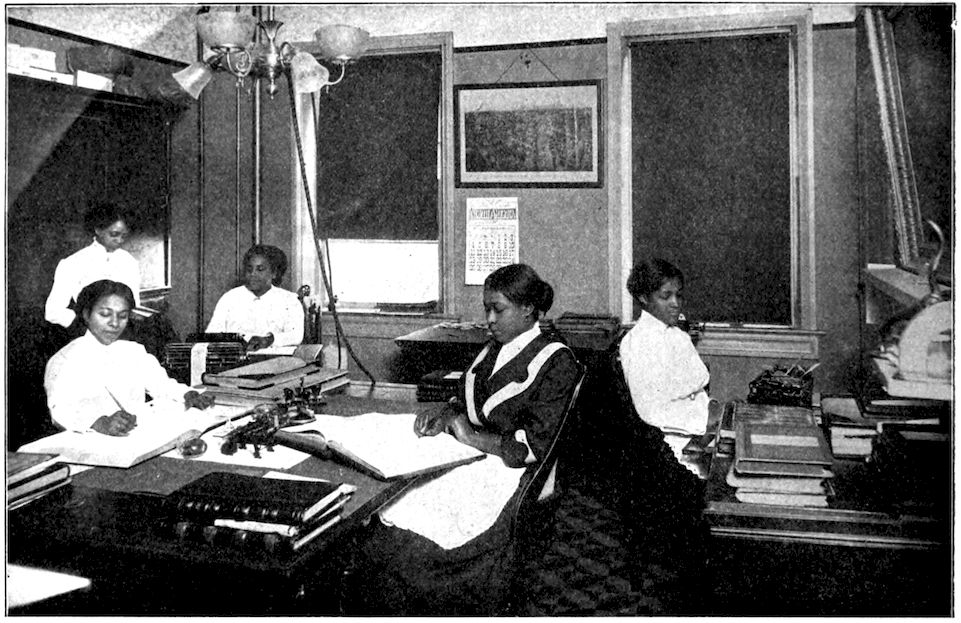
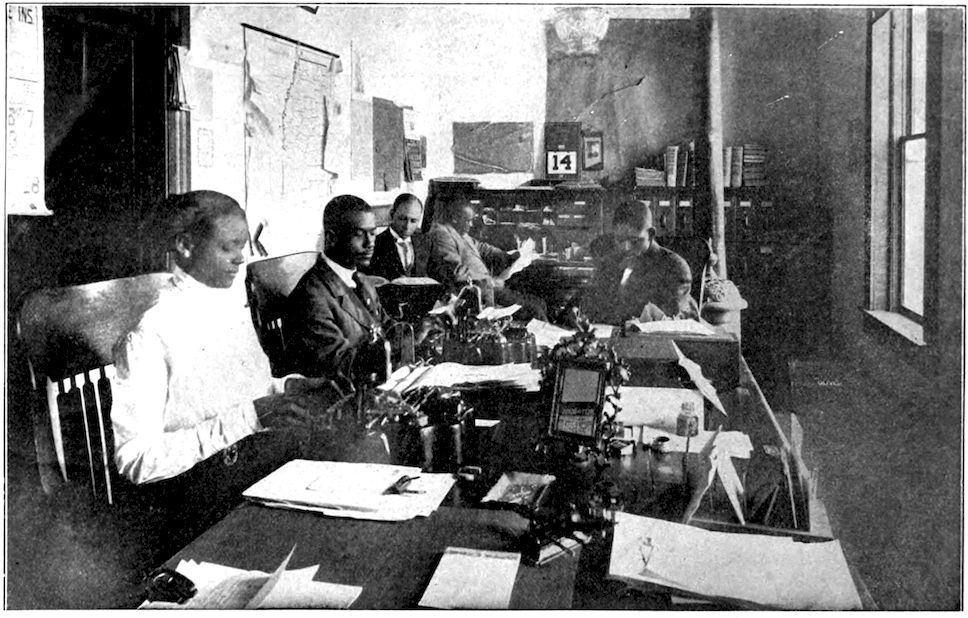
CAPABLE OFFICE STAFF
Bookkeeping Department, National Benefit Association, Washington, D. C.
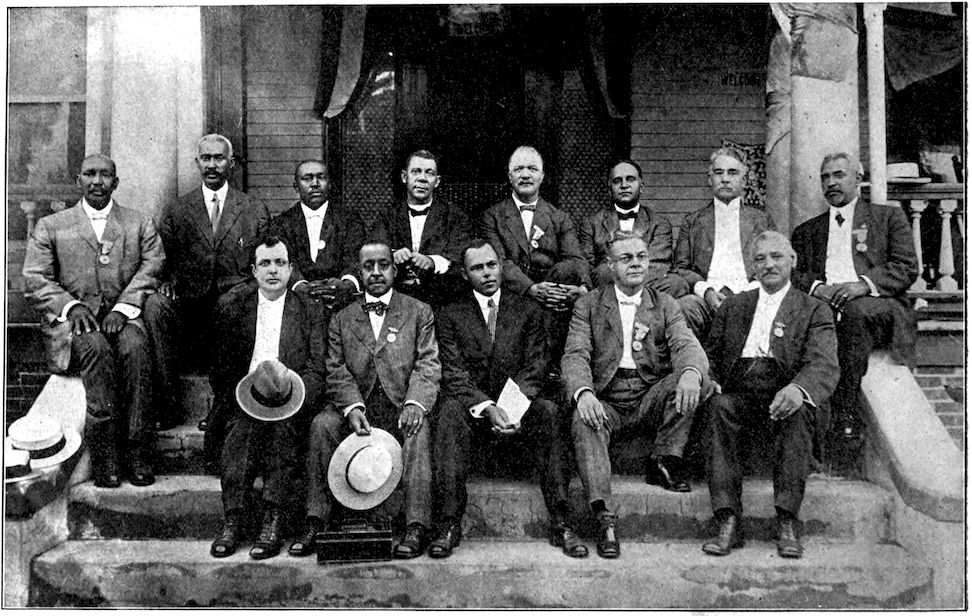
ENTERPRISING BUSINESS MEN
The Executive Committee of the “National Negro Business League.” The purpose of this league is to bring the business men together for mutual cooperation and trade advancement.
MONOTYPE OPERATORS
Modern typesetting machines. A. M. Sunday School Publishing House. Nashville, Tenn.
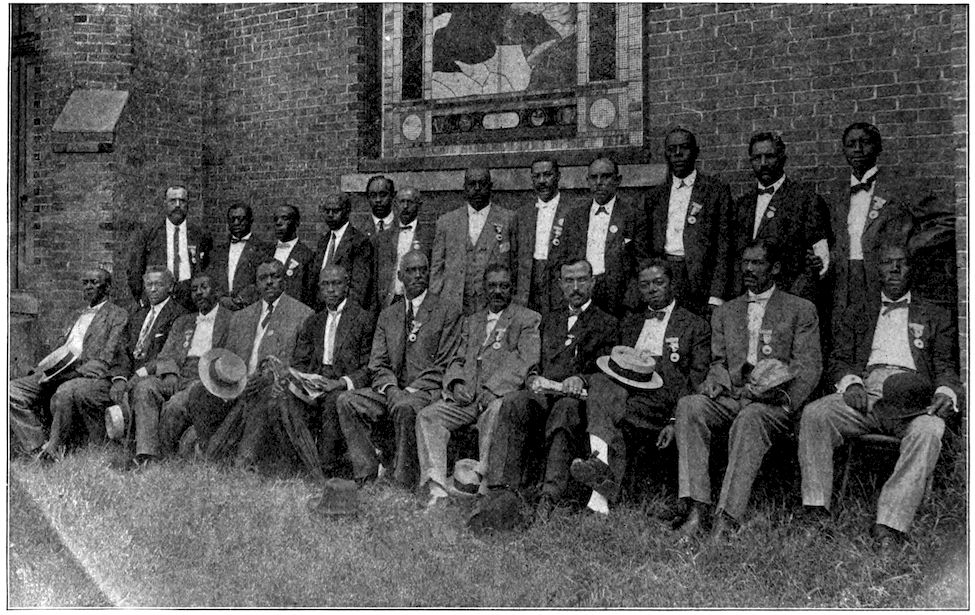
MEN OF FINANCE—BANKERS
Members of The National Bankers’ Association. The men who control trust funds and provide means for business and agricultural expansion.
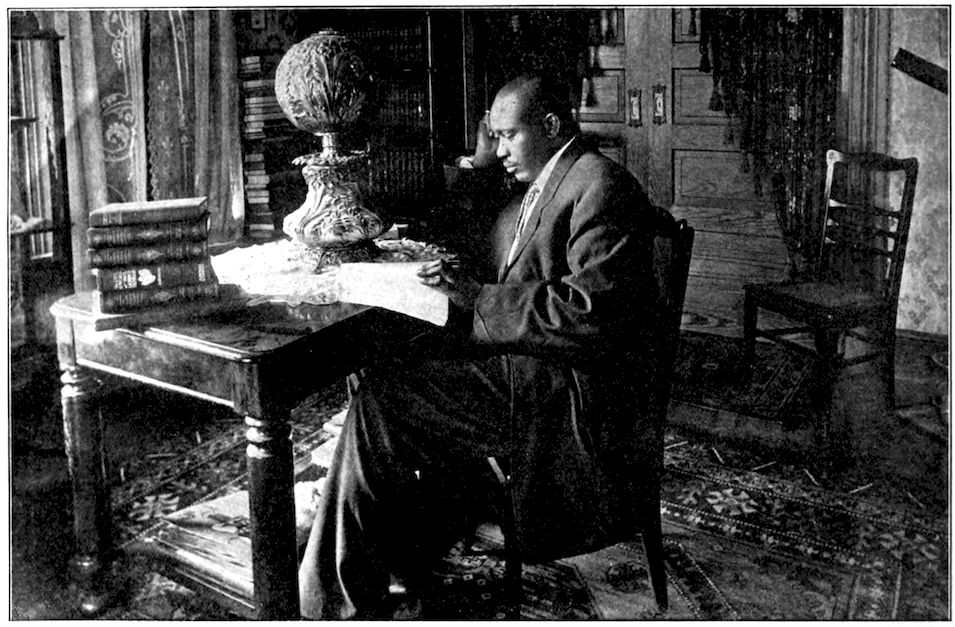
PRIVATE LIBRARY OF A PROSPEROUS HOME
Refinement and culture is here shown in the home of Chas. Banks, Mound Bayou, Miss.
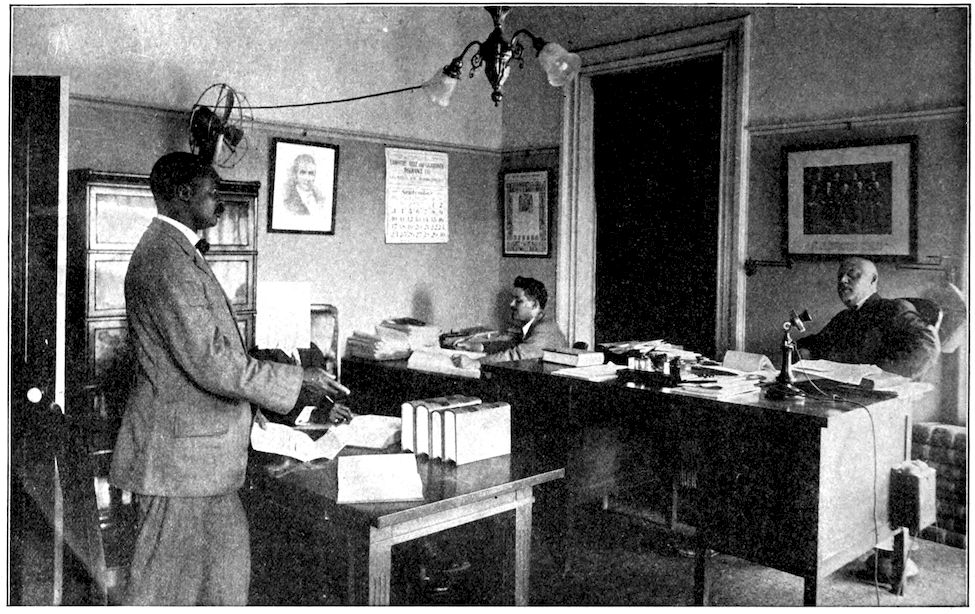
SUCCESSFUL IN LAW PRACTICE
A prominent lawyer presenting his case to Judge R. H. Terrell, who is a colored Judge of a Municipal Court in Washington, D. C.
STENOGRAPHY IN A WELL EQUIPPED OFFICE
The type-written letter in business correspondence is almost a necessity, hence the great demand for intelligent and experienced stenographers.
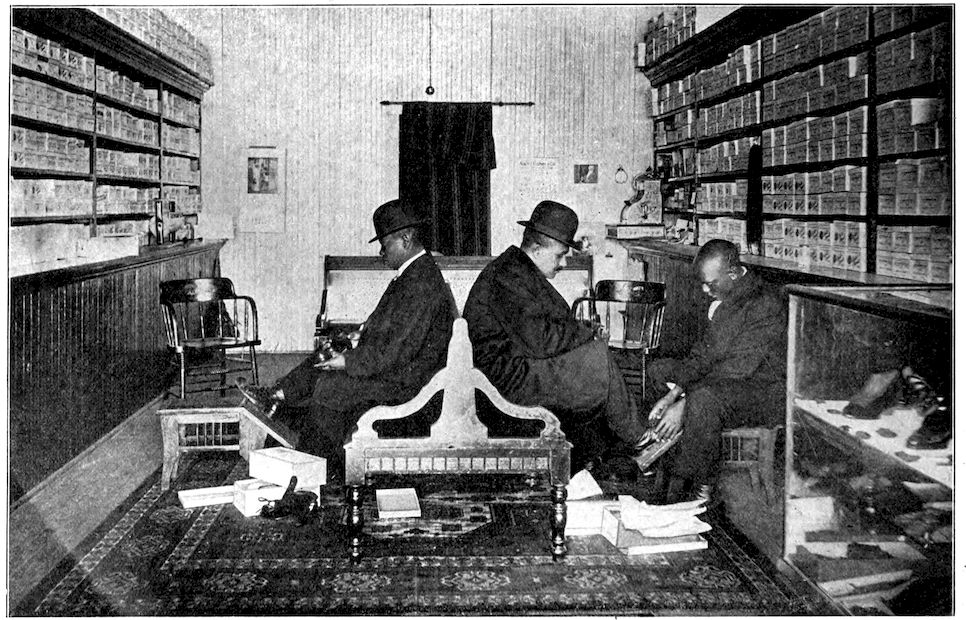
BUSINESS ACHIEVEMENT
Vandehorst’s Shoe Store, Jacksonville, Fla. Evidence of the opportunity for success in the shoe business.
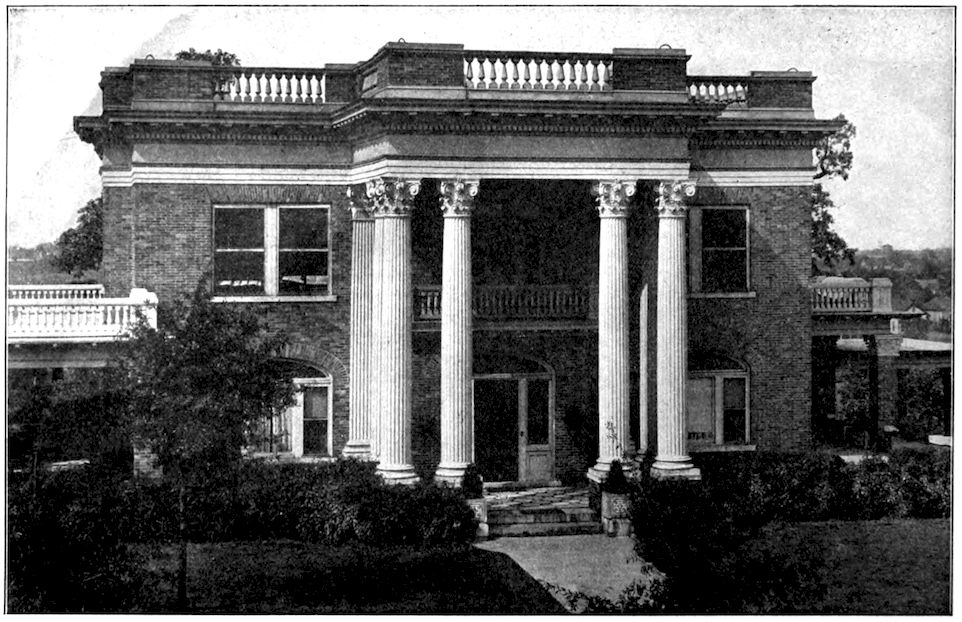
THE REWARD OF THRIFT AND ENERGY
The palatial residence of J. F. Herndon, a prosperous Colored citizen of Atlanta, Ga.
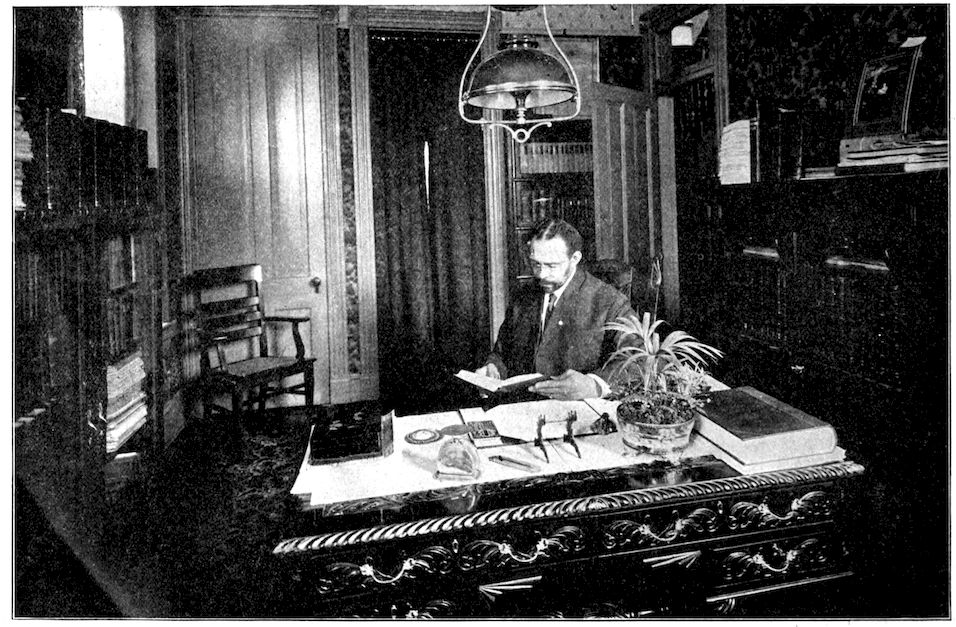
AN ELEGANT AND WELL-APPOINTED LIBRARY
An interior view in the home of a noted physician, Doctor George Cabaniss, Washington, D. C.
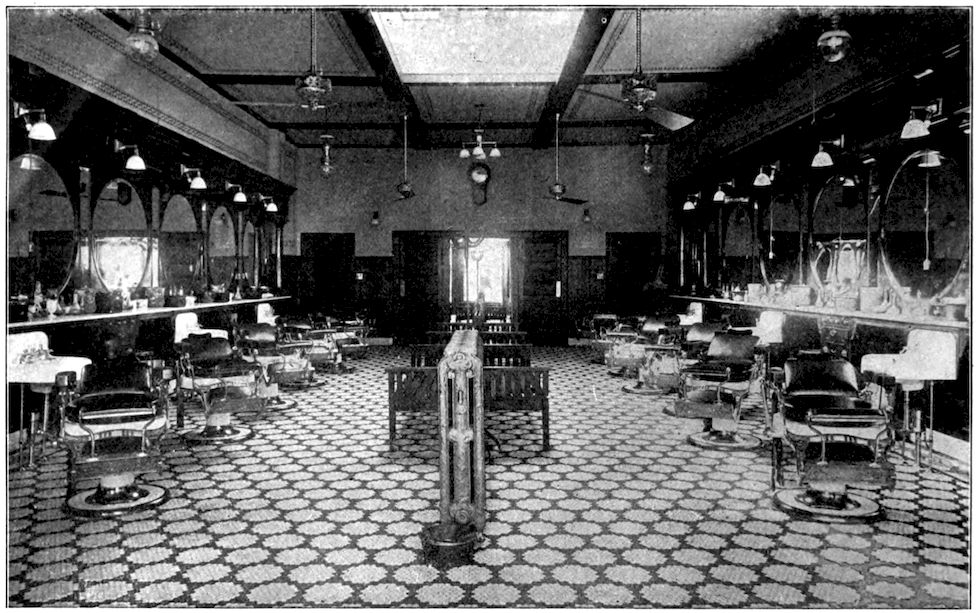
LUXURY AND COMFORT
An elegantly appointed Barber Shop owned and patronized exclusively by Colored citizens. Birmingham, Alabama.
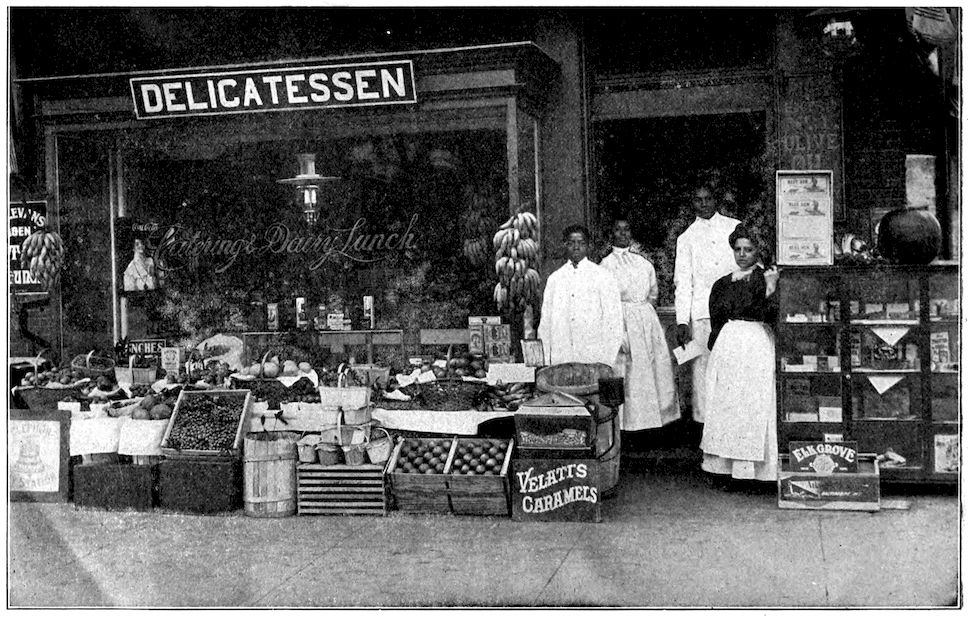
AN UP-TO-DATE STORE
An example of Mercantile Success, showing possibility and prosperity. Owned and operated by A. H. Underdown, Washington, D. C.
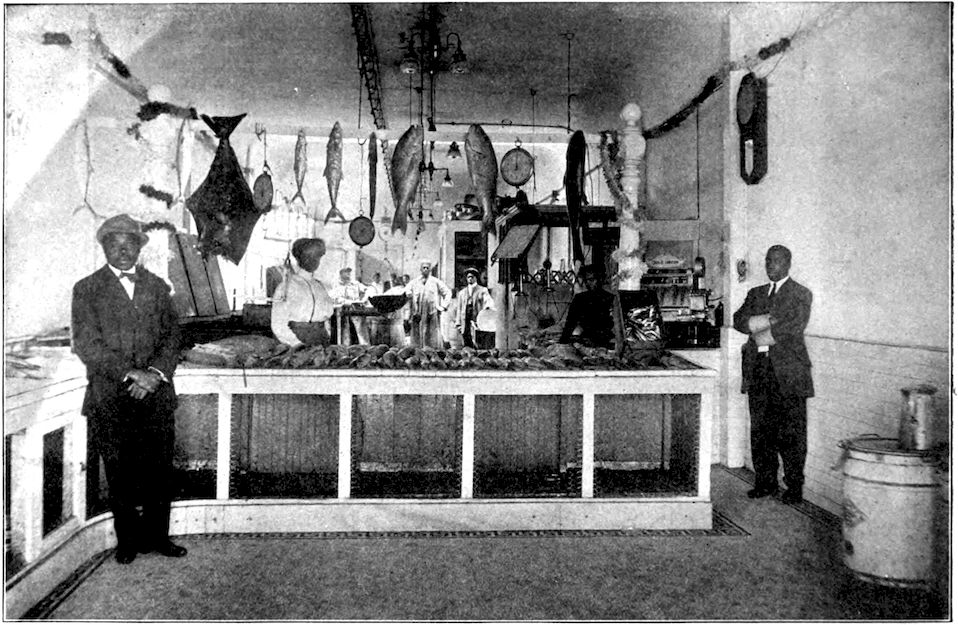
COMMERCIAL PROSPERITY
One of the largest Fish Markets in the South. Jacksonville, Fla.
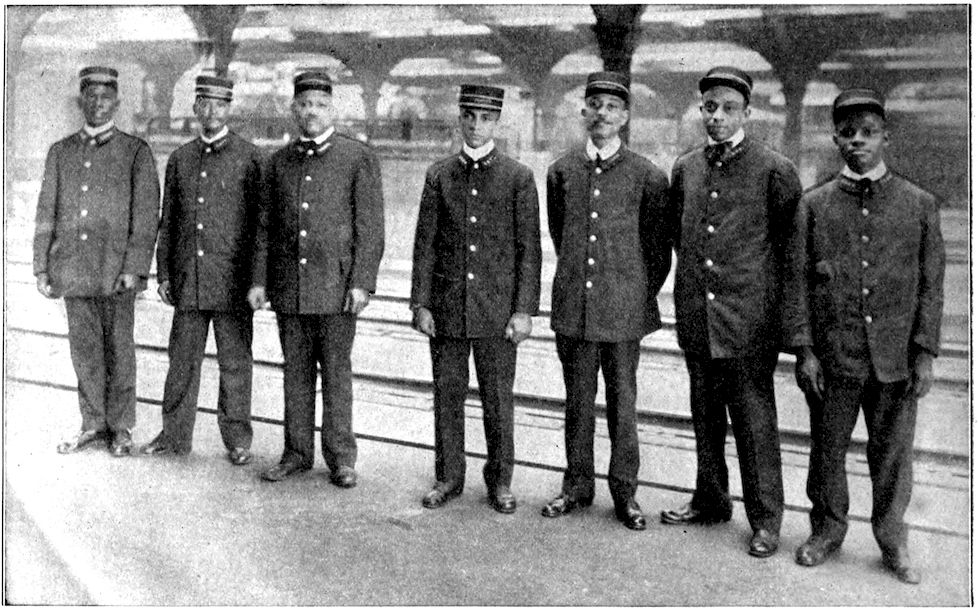
REPRESENTATIVES OF THE OVERGROUND RAILROAD
Here are lined up in their uniforms some of the brightest Parlor Car porters of the Chicago and Northwestern Railroad.
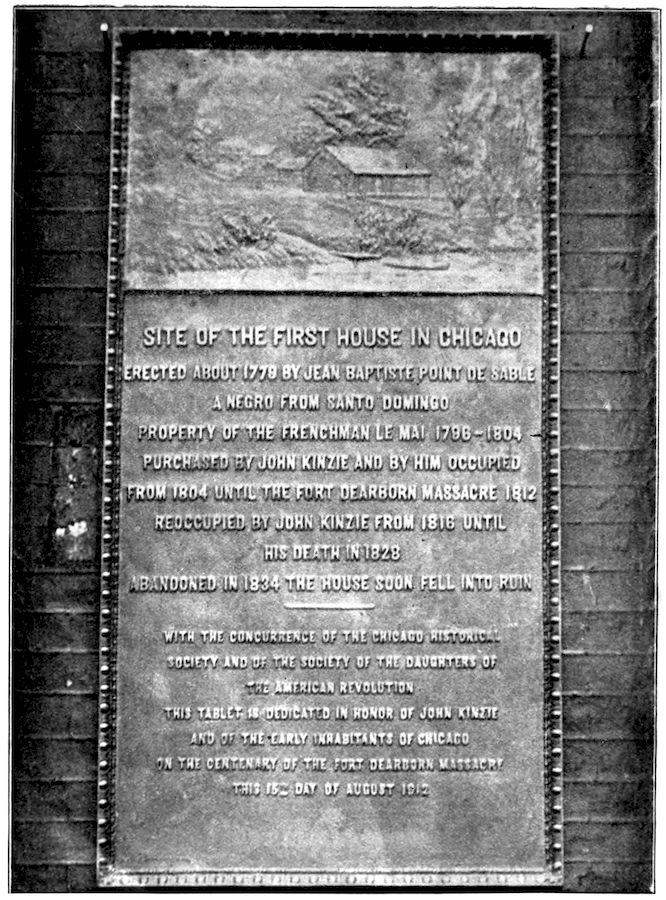
THE COLORED MAN AS A PIONEER
The first house in Chicago was erected by a Negro.
FOREWORD.
“The progressive era” aims to set forth the marvelous
achievements of the Negro race in the United States
since its emancipation fifty years ago. Its plan is to cover
the period of achievements by a series of chapters devoted
to the several lines of endeavor. I want especially to
commend the chapter on the Education of the Negro.
Education furnishes the standard in terms of which the past progress
of the race may be measured and its future progress gauged. Of the
many elements which must enter into the final solution of the race
problem none will be so important as that of education, whose purpose
is to fit the Negro for a useful and honorable place in the complex
schemes of American life.
This chapter brings together for easy reference information concerning
the working of Negro institutions in better form and in fuller detail
than has before been attempted in a private publication. Figures are
taken from the reports of the Bureau of Education, and their accuracy is
vouched for by the authority of the government. Each institution listed
was visited by a special agent of the Bureau of Education and its work
thoroughly examined and analyzed by educational experts. Over three
hundred institutions are described, with the account of the equipment,
facilities and course of instruction. There are over sixty photographs
containing the fullest pictorial illustrations of Negro schools that has
ever been made available in book form. This chapter involves, at once,
the feature of a treatise and an encyclopedia, while gaining the general
view of the education of the Negro as well. The reader may at the same
time gain definite information about any particular school in any part
of the country.
No one who wishes to keep abreast of the trend of educational movement
of the Negro race, as well as to have at his elbow a compendium of
Negro institutions, can afford to be without this work.
KELLY MILLER.
Howard University, Washington, D. C.
March 12, 1917.
CONTENTS. Progress and Achievements of the Colored People
THE COMING MEN OF THE RACE Our Young Men Will Be Our Future Leaders — EXAMPLES OF SUCCESS — MUSIC COMPOSERS AND PIANISTS — VOCAL ARTISTS AND PRIMA DONNAS — PAINTERS — SCULPTORS — ACTORS AND POETS — INVENTORS — GREAT DEMAND FOR WISE LEADERS — FUTURE LEADERS NOW UNKNOWN YOUTH — PERHAPS YOUR BOY WILL LEAD THE RACE — THE CHURCH OFFERS HIGH INDUCEMENTS — YOUR CHILDREN MAY BECOME DISTINGUISHED
17
Who are to be our leaders this coming generation?
We have had brilliant and faithful leaders in the past, men who
labored under adverse circumstances, but who succeeded in reducing
opposition, and brought the race up to a higher standard. They were
the pioneers in a great national movement. Their names are honored
and will be honored as long as the race exists.
Their preliminary great work done, they passed away leaving its
continuation in the hands of other noble men and women, who are still
among us.
Remember, we are now in the second generation of uplift, and the
mantle of the leaders of the first generation of freedom, passed to those
of the second generation, has been spread over a vastly wider field, and
shows room for still wider extension.
The history of man shows that in all great human movements for
betterment, there have been pioneers who commenced the work, and
carried it to a higher point. Then came a succeeding line of leaders
who took up the work and carried it higher still.
Neither the pioneers of the Colored people of the United States,
nor their successors, the present leaders, could do all or can do all that
is to be done in the way of elevation or betterment, because it has grown
to enormous proportions.
For this reason we must look about us and see who are to be the
future leaders of the Colored Americans.
We now have able leaders, men of great character and ability, men
whose loss would be keenly felt, but they know, and we know, that in
the course of nature all must pass away, and we have it from their
earnest utterances that their great hope is to have successors in the
18leadership. Many of them are ready to train others to walk in their
footsteps. There are thousands of men, children in our schools, youth
beginning college life, and young men who have completed their course
and are ready to take up a position as commanders in the battle of life.
Here are a few of our present leaders, between whom no invidious
comparisons can be made, and to whose number may be added a thousand
or more working in more or less conspicuous positions to fit their
people to become leaders. They are shining examples of success and
merely mentioned to show your own opportunities.
Look at and study this list earnestly, it concerns you:
Rev. S. G. Atkins, President of the State Normal and Industrial
College of North Carolina.
Dr. E. F. Boyd, physician and surgeon, Nashville, Tenn.
Hon. H. P. Cheatham, Recorder of Deeds of the District of Columbia.
Dr. D. W. Culp, A. M., M. D., author of “Twentieth Century Negro
Literature.”
W. E. Burghardt Du Bois, editor “The Crisis, A Record of the
Darker Races.”
Bishop G. W. Clinton, A. M. E. Zion Church, Charlotte, N. C.
Prof. J. M. Cox, President Philander Smith College, Little Rock.
E. E. Cooper, Editor “Colored American.”
Prof. A. U. Frierson, Professor of Greek, Biddle University.
Prof. N. W. Harllee, Principal High School, Dallas, Texas.
Dr. Lawrence Aldridge Lewis is a rising physician of Indiana, who
made the highest record in a competitive examination for the city hospital
of Indianapolis against 107 applicants.
Prof. R. S. Lovinggood, President Samuel Houston College, Austin,
Texas.
Kelly Miller, Professor Mathematics Howard University.
19D. W. Onley, D. D., Dentist, Washington, D. C.
I. L. Purcell, Attorney and Counselor at Law, Pensacola, Fla.
G. T. Robinson, Attorney and Counselor at Law, Nashville, Tenn.
Bishop H. M. Turner, D. D., LL. D., A. M. E. Church, Atlanta, Ga.
Rev. O. M. Waller, Rector Episcopal Church, Washington, D. C.
Prof. H. L. Walker, Principal High School, Augusta, Ga.
Prof. Booker T. Washington, President Tuskegee Institute.
Prof. N. B. Young, President Florida State Normal and Industrial
College.
The foregoing are a few leaders in the professions. There are numerous
others whose names and deeds have already made history and
fame.
The present field of leaders in the professions is large, but there are
other fields of leadership in the business world. These men are successful
and point the way to others to follow, and they must lay down
their leadership with the others:
Charles Banks, Cashier Bank of Mound Bayou, Mound Bayou,
Miss.
E. C. Berry, hotel man, Athens, Ohio. Said to keep one of the best
hotels in the United States.
Rev. R. H. Boyd, President National Doll Company; also of the
National Baptist Publishing House, Nashville, Tenn.
William Washington Brown, Founder of the True Reformers’
Bank, Richmond, Va.
Junius G. Groves, “The Potato King.” Edwardsville, Ky.
Deal Jackson, Albany, Georgia, the great cotton king.
John Merrick, founder of the North Carolina Mutual and Provident
Association, the strongest Negro insurance company in the world; North
Carolina.
W. E. Pettiford, founder of the Alabama Penny Savings Bank,
Birmingham, Alabama.
The following condition of the Colored American opportunities will
be of assistance in suggesting fields of leadership:
20The number of colored men now engaged in business and professions
are as follows:
Agricultural pursuits
2,143,176
Professional occupations
47,324
Domestic and personal service
1,324,160
Trade and transportation
209,154
Manufacturing and mechanical pursuits
275,149
This is close to 25 percent of the entire colored population of the
United States.
But this enormous field of opportunity, is not the limit. You have
aspirations toward music and the fine arts—singers, painters, sculptors,
actors and poets. Here are a few leaders to be followed by you or your
children, relatives or friends:
Harry T. Burleigh, New York, composer of “Jean,” “Perhaps.”
Robert Cole and J. Rosamond Johnson, New York, musical setting
to Longfellow’s “Hiawatha,” “Idyll for Orchestra,” “Dream Lovers,”
(operetta).
William H. Tyers, composer of “Trocha,” a Cuban dance and other
noted compositions.
Will Marion Cook, New York, “The Casino Girl,” “Bandana
Land,” etc.
De Koven Thompson, Chicago, composer of “Dear Lord, Remember
Me,” “If I Forget,” etc.
James Reese Europe, founder of the Clef Club Symphony Orchestra.
Among pianists is Miss Hazel Harrison, of La Porte, Indiana, who
is making her mark as a student of the piano under the celebrated
greatest living pianist, Ferrucco Buconi, of Berlin.
21These and other leaders in their art succeeded many illustrious
composers. And you are called upon to prepare to follow the present
leaders.
Remember the Black Swan, that wonderful prima donna whose
voice had a range of three octaves and was frequently compared with
Jenny Lind at the height of her fame.
Madam Marie Selika, of Chicago, achieved enormous success in Europe,
a marvelous singer whose voice “trilled like a feathered songster,”
and whose “Echo Song” has not yet been surpassed.
You have heard the “Black Patti” (Madame Sisseretta Jones)
who was a success in Europe, and has her own company of which she is
the head, “The Black Patti Troubadours.”
There is Mrs. E. Azalia Hackley, of Detroit. This lady has been a
prominent singer for years. She studied in Europe, and is the author
of “Guide to Voice Culture.”
William Edward Scott, of Chicago, should be noted for his extraordinary
works in America and Europe. Born in Indianapolis in 1884,
he graduated from the high school in 1903. From 1904, when he entered
the Chicago Art Institute, until the present time, he has been prolific
in paintings, three of which were accepted at the Salon des Beaux
Arts at Toquet, and others elsewhere. His work may be seen in
three mural paintings which decorate the Felsenthal School in Chicago.
This field is rich in artists of the colored people:
E. M. Bannister, the first Negro in America to achieve distinction
as a painter. One of his pictures was awarded a medal at the Centennial
Exposition of 1876 (Philadelphia).
Henry O. Tanner, the son of Benjamin T. Tanner, Bishop of the A.
M. E. Church, is one of the most distinguished artists of the present
day. He resides in Paris but is a native born American. During the
22past three years his paintings have been on exhibition in the leading
art galleries of the United States.
A rising young artist is to be found in Richard Lonsdale Brown, a
native of Indiana, but who spent many years of his life among the hills
of West Virginia. Not yet twenty years of age, he is on the road to
fame and has received the encomiums of artists as a young artist of
rare qualities with the precious gift of vision which indicates artistic
instinct.
The two great sculptors of the colored people are women:
Edmonia Lewis, of New York, now a resident of Rome, where she
turns out noted sculptures sought for in the great art galleries of the
world.
Meta Vaux Warrick (Mrs. Fuller, wife of Dr. Solomon C. Fuller of
South Framingham, Mass.). She first attracted attention by her exquisite
modeling in clay in the Pennsylvania School of Industrial Art.
Rodin, the great French sculptor, took her under his charge, and her
work is the admiration of the art galleries of the world.
Mrs. Mary Howard Jackson may also be mentioned as a rising
sculptress.
Ira Frederick Aldridge, of Baltimore, was a pupil of the great artist
Edmund Kean. Aldridge appeared as Othello and other characters, and
received a decoration from the Emperor of Russia.
Phillis Wheatley, the first woman white or black to attain literary
distinction in this country. While a child she began to write verses,
and received the endorsement of the most distinguished men of her
time, including General Washington.
Paul Laurence Dunbar, a noted poet born in Dayton, Ohio. He
showed poetic ability while at school, and soon became known as a
writer of ability.
All the foregoing actors and poets have passed away, but there
23are many treading and to tread in their footsteps. Success and fame
must come to them by utilizing their gifts to the best advantage.
We give you merely the edge of the field to be filled by you or some
one you know and hope to see attain it. It is a thickly sown field, and
if you cultivate it, you will be rewarded with an astonishing harvest.
The evidence is accumulating every day that the Colored citizen,
under favorable environments, has performed his whole duty in the
work of benefiting mankind, whether in arduous labor or advancing the
world by his thought.
The records of the United States Patent office show more than four
hundred inventors and inventions among the Colored people. Many of
these inventions are of the highest value and utility. These inventions
are for devices of every conceivable use, from a rapid fire gun, invented
by Eugene Burkins, a young colored man of Chicago, down to a pencil
sharpener in common use today. In the line of humanity, life saving
guards for locomotives and street cars have been invented. All of this
goes to show the trend of the Colored man’s mind, and what he can do
by thinking and the proper use of his brain.
As an inventor Mr. James Marshall, of Macon, Georgia, has attracted
national notice through his novel flying machine which he has
had patented. Mr. Marshall has introduced what is called a “Circumplanoscope,”
which renders the flying machine non-capsizable, and
which will enable it to stand still in the air.
R. W. Overton, a sixteen-year-old student of the Stuyvesant High
School, within the past year won the long distance record for model
aeroplanes against more than twenty competitors from all the high
schools of Greater New York and vicinity.
It was said that the pioneer leaders of our Colored Americans struggled
up and carried their people up with them. The questions presented
them, the problems they were called upon to solve were new and
the lights given them to solve them was somewhat dim. They worked
24for betterment by this dim light, but the light grew stronger as they
advanced, and when they came to lay down the lamp of leadership, it
was taken up by their successors burning brightly, and with added wisdom
to carry on the great work.
Who can tell then, the names of the leaders to succeed them? They
were in process of training, however, just as there are other leaders being
trained or growing up to follow in the footsteps of the present leaders.
They appeared and have expended and are expending their labors
in elevating their fellow citizens, but they will eventually be obliged to
lay down their mantle of leadership for others to take up. This means
that in the present Colored Americans there are those destined, or who
will make themselves fit to become great leaders in every department
of uplift.
Conditions have improved during the past generation, and the new
generation looks upon an enlarged field, with more varied prospects,
greater development, and opportunities that did not exist before, and
which have naturally sprung from the gradual progress of the race.
There is a greater demand for a skilled and wise leader now than
ever before, and in preparing for that leadership, let each man of the
race look to himself as a possible aspirant and successor to the present
leaders. The very thought of such a possibility, based upon the necessity
for such leadership, is an inspiration, an incentive to action, and a
motive to take advantage of the opportunities. The path has been
cleared and you can not lose your course.
Let us revert to the question: “Who are the coming men?” Who
will take the places of the men now leading the race, when they have
done their work, fulfilled their mission loaded with honors and fame?
They can not go on forever, for they are human and must yield to the
inevitable.
Perhaps you are one of the possible leaders to reach honor and
fame. Why not? Many a man living in apparent obscurity has suddenly
25come forth out of his retirement at the call of demand following
opportunity. This is life and the natural progress of the world. You
are living under auspicious circumstances, surrounded by events that
must cause you to think, and know just what is required to advance
along the lines of human betterment.
Every man thinks he knows just what he would do under certain
circumstances if he had the opportunity, and that he has the power to
do it. Very well, here are the opportunities, and if you develop your
natural ability and capacity and take hold with a firm hand, you will
attain the power. It is characteristic among all men, an attribute of
modern affairs, that to obtain anything an effort must be made to get
it. Everybody knows this by experience. It has been the experience
of all men, and of all nations. A man must reach out and take what is
before him within his reach. A wise man never attempts to try to take
what is beyond his reach. Children do that, but a modern man is no
child. There is an old maxim which says: “A bird in the hand is worth
two in the bush.” Wherefore, take the bird in hand and hold on to it,
and you will get the two in the bush by and by.
Even now in some humble home, there is a youth, a mere child with
possibilities unknown to him or to you, who may develop into a leader.
Many great men have sprung from such sources, and made the world
ring with their exploits. What has been done can be and will be done
again. It is not fate, nor is it perhaps destiny as some may think, it is
opportunity.
Do you suppose that the poor child who looks on at the amazing
things of life, the things going on around him, does not think about
them and feel ambitious to be or do something that will make as good
a showing?
It may be that he plods back and forth after his morning chores, to
some little elementary school with his few books under his arm, and
which he has pored over the night before or in the early morning. He
knows that he is learning, and his small ambition leads him to learn
26more. His interest is aroused and he represents the seed, the foundation
of a leader or of some of our leaders who will make their mark, an advanced
man to take the place of some who will soon pass away.
He may have left the plow and the little elementary school to go to
college; there are opportunities for this, and when he gets to this college,
his mind expands, and he becomes fertile in resources to embrace
opportunities before him. The more he learns, the more rapidly does
his mind quicken, and the more his mind quickens the more he advances
along the goal.
He is your boy, perhaps, your son for whom you have the highest
ambitions, and your bosom swells with pride at the thought that he is
your boy, and that you have opened the door to opportunity for him.
Some young man just out of college, just out of the refining process,
is on the high road to position and honor, and is already making a name
for himself, may become the leader or some leader along the many fields
open to him.
Can you say that it will not be yourself? Who knows that it may
not be you, your brother, nephew, cousin, or some valued friend? Give
yourself the benefit of the doubt if there be any doubt, and there need
not be, and take hold of the intellectual plow, and till the field of opportunity.
It is waiting for you and for yours.
Do not throw straws in your own and in the way of those you know
and to whom you may be related by the ties of blood or friendship.
Why not put them and yourself in the way of opportunities? Give
yourself and them a chance to prepare for opportunity, every one possesses
the chance, and he must prepare for it, it is in the future, perhaps
it is waiting now, are you ready for it? Do you think you will be ready
when it calls? If not get ready by keeping your ear close to the ground
and watch for the signal. Keep in touch with the people, their needs,
necessities and demands; observe the signs of the times and study the
shaping of events.
27These are progressive times, and age of hustle, and the man who
stands out in front will win the race, for he has the advantage of place
and position, also readiness to start at the first sound of the signal.
The Church offers the highest inducements to a life of usefulness
and honor. It is guided by men of distinguished ability and humanity.
The Bishops and clergy of the various denominations have taken advantage
of the new lights of the twentieth century, and are striving to
bring their fellow men of the same race, up to the highest standard of
right living.
The heights they have attained must be maintained like a protective
rampart in a great battle. Their successors are the ones to continue
the work of defence, and advance the lines still farther into the
country of the enemy of humanity and morality.
The army and navy have had their share of brave Colored men, and
has opened its ranks to more of them who are distinguishing themselves
and ennobling their race. In the school of army and navy discipline,
the Colored man has proven himself to be a man in every sense of the
word. Faithful and true to his duty, he honors and loves the country
under whose flag he is ready to draw his sword, and lay down his life.
You or your children may be the fortunate ones to be offered an opportunity
to become distinguished for bravery and generalship, for the
way has been prepared and those now striving to uphold peace will
have successors. Remember this point, that the longer the test and the
greater the perseverance, the more and the higher facilities will be
given you to reach the leadership.
It must be plain from the mere birdseye view that has been given
that many leaders will be needed in the near future. Indeed, some of
28our present leaders as they grow older will lay down their armor, and
others must be ready to take it up and wear it.
The filling of the ranks is almost imperceptible because it is so
gradual, but it goes on continually, and the time to prepare for stepping
into a vacancy is now. There is always a leader, and the coming men,
it is plain, are those who make themselves ready, and prepare for immediate
and future emergencies.
Have no fear that there will be no place for the lowly boy in the
humble home; the lad with his school books plodding his way to the
elementary school; the youth at college, or the newly made graduate.
The wheels of life are not going to stop, they are ever turning, and there
is a vast upward tendency which comes with every succeeding generation,
the last an improvement upon its predecessor, and the next one a
still greater improvement. So will go the world until the last whisper
of time shall beat against the gates of eternity.
THE TURNING POINT The Progress of the Colored American; His Chance in the Business World — THE SIGNS OF THE TIMES
29
There are three points upon which every colored citizen may base
his chances for success in the business world:
First—From their inability to engage in any business whatever a
generation and a half ago, the Colored race now numbers about
five hundred thousand members engaged in trade, transportation,
manufacturing and mechanical pursuits.
Second—The Colored race having increased from about four millions
of people a generation and a half ago, to nearly ten millions
of people in 1913, the commercial field has vastly widened
for exploitation.
Third—Under the now accepted doctrine announced by Rev.
Charles H. Parkhurst of New York City, the field is still farther
enlarged and bids fair to become unlimited.
The exact bearing of this increase in the population upon business
chances lies in the increased consumption, greater demand and advanced
civilization—that is a greater variety of objects are necessary
to comfort or pleasure. This makes more customers, and all things
being equal, perhaps they should be a trifle better, it is quite on the
cards to believe that the Colored American will get his increased share
of the trade of his fellow Colored Americans. If he does not, then he
is probably in fault through inferior goods, poor service and lack of
prompt delivery. The business is in his hands at any rate and the
opportunity is at his call.
The first proposition is to the effect that business chances are now
at high tide, where a few years ago there were no chances of any sort.
We are speaking of the subject of business chances exclusively, but
may venture to add such employments as miners, masons, dress makers,
30pavers, iron and steel workers, stationary engineers, engine stokers,
etc. In these latter occupations there are more than one hundred
thousand Colored Americans employed, a gain of over 85 per cent
in ten years, or rather since 1890. The other trades have fallen off
somewhat owing to the introduction of machinery.
To limit this question to commercial pursuits, it may be well to
state that economic progress has reached a high water mark among
Colored Americans. There are one hundred twenty-five and more
Colored business men’s local Leagues in about every State in the
Union, with eleven State Colored men’s business leagues in the Southern
States.
These leagues are composed of bankers, merchants, and dealers
generally in goods, wares and merchandise—dry goods and groceries,
hardware, etc., and are all at the top notch.
It is evident from the signs of the times, the business situation,
our interstate commerce laws, and the domination of the trusts and
combines by the Federal government, that there will soon come a great
change in our business methods, and practices.
We are expecting that competition will be restored to the place it
occupied before men were forced out of business by overpowering interests
and vast aggregations of capital. It will certainly happen in
the near future that any man will be able to open a modest store, or
engage in a quiet and reasonable business without being driven into
bankruptcy and poverty.
Our Colored Americans are not men of large capital, nor can they
control large amounts of capital, consequently they have been unable
to make any headway against great combinations, but here is an opportunity
and if you wish to grasp it make ready. Prepare for this
turning point, for it will be the turning point in the fortunes of many
of our people who never had such a chance before, and will not again
if they permit others with more sand and hustle to jump in and take
up every valuable claim and chance.
THE PROGRESSIVE COLORED AMERICAN EARNS RESPECT FOR HIS RACE What Other Races are Doing to Rise—Persistence and Determination Will Win — THE FLANNEL MOUTHED IRISHMAN — BECAUSE HE ALWAYS APPLIES THE VULGAR EPITHET TO HIS RACE
31
In a country like the United States where there are so many
different peoples gathered together, it is difficult for all of them to live
in perfect harmony.
In view of what is said in other parts of this book, it must come
that all men will be united as one nation, with one set of rules and
laws applicable to all alike and without discrimination against any
branch of the human family, and without regard to his color.
There are not so many prejudices against races as was formerly
the custom, or rather habit, and the signs of the times are that prejudice
and opposition are diminishing every day.
Colored citizens have had to fight against all kinds of prejudice
and even submit to humiliations that ought to rouse their manhood
and compel them to inquire when or whether it will ever end. Every
Colored American who reads this book may feel assured that the end
is in sight, and that his children will witness a great diminution
in the slights put upon his race and color. It will be effected by personal
influence based upon education and high standards of living.
Not so very long ago, the Jew was about as humiliated a race of
men as exist in the world. Driven out of public places because they
were Jews; unable to do business with others on account of their race,
they were made a byword and a laughing stock in every occupation
of life, and held up to the world on the theater stage as objects of derision
and caricature.
32The Jew was a “Sheeney,” a “Shylock,” an “Ol’ clo’ man,” a
“Christ killer,” and given other choice epithets to bring him into
disrespect and excite prejudice, even abhorrence.
All these epithets and others equally as cruel and vulgar, were applied
to the whole race of Jews, and it did not make any difference
whether he was an honest Jew, or one of education, and of high repute,
he was still a “sheeney.”
But a change has taken place and the Jew is no longer a “Sheeney,”
unless he merits the epithet, but stands as a man among the
other men and is entitled to and gains their respect. Jews, as a race,
are no longer “Sheeneys,” or “Shylocks,” only those individuals of
the race that are in bad repute among their own people are such.
Hence we perceive that prejudice against the Jew as a race is diminishing.
Not very long ago, an Irishman was considered a “Paddy,” and
to call a man “Irish” was to provoke a fight in which blood was
spilled. To call an Irishman a “Flannel mouth” meant a broken head
to the speaker. It was a term of reproach. The Irishman also was caricatured
on the theatrical stage and held up to derision. “O, he is
only an Irishman,” was an explanation for every outburst of disorder.
We find that these opprobrious epithets are now limited to certain
Irishmen, and not to the entire nation or race of Irish. To call an
Irishman a “Mick” does not hurt his feelings as it once did, because
he knows it does not apply to him as a member of the Irish race.
The Italian “Dago,” and the Chinese “Chink,” were epithets
applied to the entire nation or race of Italians or Chinese. But a
change has come over the situation. There are Italians who are not
“Dagos,” Chinese who are not “Chinks.”
Epithets cruel and vulgar have been and still are applied to
Colored men, and we often hear our Colored Americans styled “Niggers.”
33Of course this is slang for Negro, and although the word
“Negro,” means a high type of Ethiopian, nevertheless it hurts the
Colored American. Why should it hurt his feelings?
That is what the Jew used to do when he was called a “Sheeney,”
and it hurt the whole Irish race of people to call one of their number
a “Flannel mouth.” The Italian did not like to be called a “Dago,”
and he always felt for his dagger intending to kill for this insult to
his whole people. So too, the Chinaman does not mind being called
a “Chink,” because he now understands that the opprobrious word
does not mean the whole race of Chinamen.
When one white man calls another a “liar,” a “scoundrel,” a
“thief,” a “briber,” or other vulgar epithet, the whole white race of
Americans do not rush to arms to wipe out the insult to the nation,
because such epithets have nothing but a personal application, and the
white man, who is none of the things covered by the vulgar word,
merely laughs.
Let us extend the idea to religion:
If a wayward boy or man casts a rock through a church window,
he is charged with sacrilege and an enemy of religion. If a man even
on provocation slaps the face of a clergyman, he is also a desecrator
of religion, and an enemy of God. This is ridiculous, and we begin to
see how ridiculous it is to attach to an entire system a mere petty
detail of local or personal insult. Religion can not be harmed by
breaking a church window, nor is the majesty of God insulted by an
assault upon a clergyman. If that does happen, then it is mighty poor
religion that can not stand so small a thing.
Applying the idea to racial epithets:
You do not offend a Jew now, by speaking of “Sheenies,” because
34he knows that there are Jews who are Sheenies, that is, disreputable
Jews, and he is as anxious to get rid of them as you are.
When you mention “Dagoes” to an Italian, he shrugs his shoulders
as much as to say: “O, yes, there are Dagoes just the same as there
are grafting Yankees.” The Yankee to whom this is said does not
get angry because he knows that the Italian does not mean the Yankee
nation.
It is the same with the Irishman and the Chinese. They laugh at
the application of vulgar terms to members of their race that deserve
the appellation—they do not take it to mean the whole race.
There is a reason for this diminution of racial prejudice against
the other races. That reason lies in the fact that education has put
the races upon the same plane of intelligence and good citizenship.
When it comes to caricaturing their race in order to create prejudice
or excite animosities against the whole, they protest and their protests
are heard because they are founded upon reason and common
sense, as well as business sagacity.
The movement among the Jews and Irish to stop the caricaturing
of their race upon the theatrical stage is bearing fruit and is doing
much toward eliminating race prejudice.
All the Jewish organizations have combined to prevent caricatures
of the Jewish traits of character which are notoriously bad, in theaters
of all grades and to punish their representation. It is a business proposition
mainly, but it is effective. “You make fun of the bad traits of
my people,” intimates the Jew, “and I will not trade with you.”
Likewise the Irish organizations are unanimous in their movement
to prevent and punish caricatures of the bad traits of the Irish people.
Says the Irishman, “You keep the Flannel mouth off the stage, or off
goes your head at the next election.” This is the loss of political influence
mainly.
So with the other nationalities: “You let us alone in your caricatures,
or we will not trade with you, work for you, or vote for you.”
The consequence is, that high-minded people, or those who have
an eye to profits and success in their business ventures, find that there
35is less to be gained from encouraging the immature, or half educated,
the bigoted, and the ignorant whose race prejudices are based on mere
personal dislike or neighborhood animosity, gossip, or lies repeated
until they are regarded as gospel truth, than in the business of the
educated and cultured classes, or those who believe in equality of opportunity.
The people who cater to the public are discovering that honey
catches more flies than vinegar and gall.
Comic and even sharply satiric portrayals of Jewish, Irish, or even
Negro foibles are appreciated by these races themselves, just as Americans
of other race strains are amused by caricatures of themselves.
But there are limits beyond which race enmities and prejudices are
fostered, and those limits are to be respected, and will be respected
when the race affected establishes a high standard.
This can only be done by education and self-respect. The body
of men or the race that does not respect themselves, can not expect to
command the respect of others.
There are drones in every hive, and they live on the work of the
busy members of the hive. If you know anything about bees, you
must know that these drones are killed off and thrown out as useless
members of the bee colony.
Among men, if a man refuses to work when able, and nothing but
laziness is his trouble, he is quickly thrown out and becomes a “tramp,”
and when a man becomes a tramp, why then, an ignominious life and
an ignominious death are his portions.
The Colored Americans have it within their power to rise above
any race prejudice just as the Jews and other races are doing. They
made a bitter fight, and finding that the Constitution, while giving
them political rights, could not give them the respect of other fellow
citizens, they, turned to education, business, employment and embraced
every opportunity to get on top in progressive influences and they succeeded.
They made themselves kings of finance and are deeply concerned
in scientific investigations, appropriating large sums of money
to the cause of education.
36The Irish stand in the front as builders and workers, and none
can point his finger at any particular successful Irishman and call him
a “Flannel mouth” in derision. “Paddy” can refuse to eat meat on
Friday, or eat it as he wishes without calling forth any vulgar remarks—he
is respected as a race worth respecting.
So with the Italian, he is a worker and a fruit and produce caterer.
He is no longer a mere member of the “Dago” race, he is a respectable
member of the community. He does something.
The once despised “Chink” has arisen out of ages of superstition
into an enlightened member of a great republic. He is no longer a
“washee-washee,” but a man. He has cut off his pigtail and put on
civilized clothing. At a banquet or gathering, the chairman is proud
to introduce to the audience “My friend Wun Lung, who started out
as a laundryman in the Fifth Ward, and has risen up to the presidency
of the great Ginseng Company.” The Chinese are doing things and
none of them is sitting around waiting for something to turn up. They
go after opportunities and seize the one nearest and hold on to it until
another and better one comes along and then they grasp that.
We are all living in the present laying up treasures or preparing
for the future, and the Colored American stands in the same category
as every other race. The petty details incident to human nature of
every kind, go away with the present into the past. Every footstep
made in the mud yesterday is sunk out of sight on the morrow. What
you are called today, is nothing tomorrow, if you hold your position
in the world’s respect. Keep on doing something, and if the epithets
of the vulgar offer obstacles in the way of your progress, then give
battle as have the Jews, the Irish, the Italians, and the Chinese. You
belong to a race entitled to respect if you yourself respect it.
INCREASE OF OPPORTUNITIES FOR COLORED AMERICANS Trades, Business Occupations, and Professions Opening Up in Every Part of the United States—Four Hundred Millions of Acres of Fertile Land Waiting for the Tiller—Agricultural and Mechanical Facilities Multiply—Honor and Profit Within the Grasp of Every Colored American — TRAINING SCHOOLS FOR WOMEN — TRADE AND MANUFACTURING PURSUITS — THE JEW, THE IRISHMAN AND THE ITALIAN — THE SKILLED WORKMAN — FORTUNES TO BE MADE — THE FIELD OF OPPORTUNITY
37
Nearly every occupation known to the world of endeavor, that is
to say: the trades; arts and sciences; commerce; business; manufactures;
skilled labor, and others, are now filled by Colored Americans
with success and profit.
There are at least one hundred and fifty different occupations and
professions utilized by Colored Americans, and not a single occupation
can be mentioned or thought of that is not open to them.
One colored citizen in any business, occupation, or profession,
means another one, and the field grows more extensive every year,
with the advantages offered by institutions of learning, trade and
mechanical schools and colleges, and every industry represented by
an institution of learning.
The Colored American is to be found in the Army and Navy of
the country, and the walks of life which are not menial are so various
that one is almost tempted to disbelieve the evidence of the record.
There are 17 State Agricultural and Mechanical Colleges in the
United States, and in all of them, the Colored American stands on a
par with the other races, often at the head of his class.
Distributed through the various States, are one hundred and
eighty-four special Normal and Industrial schools of the highest class,
specially maintained for the benefit of the Colored Americans.
38To these add 14 schools of law, medicine, dentistry, and pharmacy,
and it will be seen that the colored citizen has opportunities within
easy reach.
If he does not want to fit himself for a high position, then the
training in the public schools gives him an insight into business
which makes him the equal of any other race in the struggle for
existence.
We must put the Colored American upon the same basis, or foundation,
as the other races, and in doing so, and giving him the same advantages,
it is most astonishing to find that he is improving along
the same line, and in the same ratio as the other races. That is, the
Colored citizen is the intellectual equal of the other races, when
given equal opportunities and advantages.
It must be admitted, to be strictly just, that without advantages
of education or uplifting environment, the races are also equal in
ignorance and prejudice. A perusal of any of our great daily newspapers
easily demonstrates this as a truth.
There are 36 institutions for the education of Colored women, and
in addition, there are 63 Training schools for nurses conducted by Colored
Americans.
It has been proved numberless times by actual experience, under
the most trying circumstances, that our Colored women make the very
tenderest of nurses. In these training schools, are to be found the
most important factors in the improvement of the health of our Colored
Americans. Indeed, their services are so valuable that they are
not limited to their own race.
At the close of the Civil war only five per cent of our Colored
Americans could read and write. In the year 1900, the number had increased
to 55.5 per cent, and in 1910, the number reached 69.5 per cent.
This is an astonishing increase in education, and it proves the reason
why our Colored Americans are forging to the front in the arts and
39sciences, trade, commerce, and the professions. It is stupendous progress
when we consider that scarcely two generations were required to
bring about this uplift of an entire race. It takes the banner of racial
improvement.
It appears that the manufacturing and mechanical pursuits are
very attractive to our Colored Americans, the increase during the last
ten years being about 40 per cent. If we may make the comparison,
it is on record that 62 and ²⁄₁₀ per cent of all our Colored Americans
are engaged in profitable occupations, whereas, there are forty-eight
and six-tenths of the White Americans so engaged.
The employment of Colored Americans in domestic and personal
service is becoming less and less every year, under the influence of
education, and is being changed into trade and transportation, mechanical
and manufacturing pursuits. This means as plainly as anything,
that our Colored Americans have found opportunities, and that
they are taking advantage of them. And where there have been opportunities
to permit such a transformation, there must be others equally
as advantageous and numerous—that is a law of trade and of progress.
One business or occupation successfully carried on always begets another.
In considering the various occupations, trades, etc., in which our
Colored Americans are engaged, the locality must be taken into account.
The colored man, like the Jew, the Irishman, and the Italian,
meets with more prejudice in one than in another locality, and
he must govern his occupation in a great measure by that prejudice,
until he is strong enough to overcome it, and intelligent enough to
find a way to overcome it.
There are many who hold that the Colored American in the South
finds less opposition and prejudice against him in the trades and occupations
40than in the North. There is less also in the East than in the
West, except that in the Middle West, or the northern portion of Mississippi
Valley, where there is less prejudice against the employment
of Colored Americans outside the large cities where the trades unions
prevail and control. Owing to this diminution of prejudice in the Middle
West, the number of Colored Americans in that part of the country
is increasing, likewise improving.
In the South, it is said, the differences between the two races is
not so much prejudice against employment, as a political idea that the
Colored Americans are on the way to obliterate the color line.
Notwithstanding this opposition, the Colored American readily
finds room for his labor where he would be impeded in the North and
West from the opposition of the great labor unions, the great aim of
which is material progress and not intellectual.
It is for the Colored American, therefore, to govern his choice of
a business, trade, or profession by the locality in which he lives or
purposes remaining during his natural life. In that selection, he is
afforded advantages to rise to any limit of perfection and thus obtain
profit from his talents and capacity.
The man who limits himself to become a skilled workman, or a
successful tradesman anywhere, must drop his personal grievances,
and not attempt to father the evils and troubles of the race upon himself.
Who cares about the downtrodden condition of Ireland? The
Irishman who is constantly calling attention to the heel of the oppressor
upon his neck, makes a poor workman and remains stationary in the
lower level.
The Jew who talks about the sufferings of his race receives but
little sympathy because he is referring to ancient history. So it is
with the others and so it is with everybody who attempts to take upon
his own shoulders the ills and burdens of the whole. In the first place,
it is not his business, and in the second place, people around him are
41fighting their way up, while he is always looking down to see how far
he must fall, and he gets dizzy and does fall.
It is an old but true saying applicable to Colored Americans as it
is applied to everybody else: “Laugh and the world laughs with you;
weep, and you weep alone.”
There is one subject of the greatest importance to Colored Americans,
because the opportunities are enormous, but they will be lost in
the course of time, and can never be regained.
That subject is the land question; the farm problem.
It is almost like sounding a tocsin to repeat what everybody is
saying, every economist urging, and every civic reformer giving as the
remedy for overcrowded cities, and a cure for vice and crime: “Back
to the farm.”
In the “Wise man’s philosophy,” every Colored American is advised
to become a land owner. Get an acre, two acres, ten acres, twenty
acres, forty acres, and so on. Why? There are two good reasons why:
1. Every man must have a home of some kind unless he prefers
to be a tramp or a beggar with his hand held out for pennies.
2. There is no possible uplift without being a producer of something,
and land offers the easiest solution of the production problem.
The enormous markets of the country in our great cities, make
such a heavy demand upon production, that the commonest vegetables
and fruit are brought from great distances at a high cost of transportation.
Within reach of every populous center, there is to be found vacant
land that could be made productive with very little labor, and the
result would be profitable, for the supply must keep up with the demand.
But out in the vast territories of the Mississippi Valley, there
are fortunes to be made in producing cereals, cotton, tobacco, live stock,
butter, poultry, and fruit. There is an unlimited field, and every one
who has ventured into it finds a large reward in a good bank account.
A man cannot begin and then, when he gets tired, lie down in the furrow
42and expect nature to pull him out. It never has and it never will
as many know to their cost.
It is estimated, that in the Mississippi Valley and its adjoining territory,
outside of mountain tops and rivers and lakes, there are in the
markets, four hundred million acres of land as fertile as the valley of
the river Nile. It is beyond the reach of present railroad transportation
and therefore it has been left untilled.
It matters little whether this enormous quantity of land exists or
whether it is exaggerated by one-half, it is a fact that millions upon
millions of acres of land are left untilled and can be had for small sums
of money. There are lands in Texas as an illustration, which can be
purchased for from one to four dollars an acre, with forty years to pay
for it in. This is not only the case in Texas, but cheap land can be had
even in the State of Illinois, or New York. In the great corn belt, the
farmers raise corn only, and even buy and bring their butter, eggs and
fresh vegetables from Chicago or St. Louis. Whoever heard of such
a thriftless condition? It is true, corn pays, but there is such a thing
as getting too much of one thing and not enough of another.
Investigation and inquiry shows that if a man should start a small
vegetable garden anywhere, on rented land, and supply the corn barons
with vegetables, eggs and butter, he would make a good profit and get
a large trade.
The idea sought to be conveyed is, that by taking advantage of a
demand where there is no supply, there is an opportunity to be seized
without arguing about it. It is there.
The advent of the motor track, which runs into localities fifty or a
hundred miles distant, carrying from five to ten tons of a load, and
trailing as much more, offers an opportunity for several workers to
club together and carry their products to market at small expense.
Our agricultural and mechanical colleges are turning their attention
in that direction, and preparing to fill the field. But it is a large field
and can not be fully occupied in a hundred years to come.
It is worth thinking about when a Colored American is in doubt
what opportunity to seize.
43The main object in every man’s life, if he has any manhood and
intelligence, is to produce something. He may use his hands or he may
use his brain, but the result is that something is produced, and whatever
is produced possesses some value.
Ten per cent of our population is made up of Colored Americans.
This number creates a demand that it would be profitable to supply,
but when it is considered that the other ninety per cent, or ninety millions
of people are constantly demanding something, and take everything
that comes along, there is an everlasting field of opportunity into
which every Colored American can fit in some capacity if he makes the
slightest effort.
THE COLORED AMERICAN IN THE EMPLOY OF THE UNITED STATES GOVERNMENT The Army, Navy, Government Services, and Legislatures—Opportunities to Colored Americans to Distinguish Themselves—Heroes and Patriots Furnished by the Race—The Advantage of Discipline in the Formation of Character—Avenues to Honor and Renown. — IN THE ARMY AND NAVY — FORCE OF CHARACTER — RECORDS OF THE WAR DEPARTMENT — IN THE GOVERNMENT SERVICE — THE DIGNITY OF THE RACE
44
The Federal government is a large and generous employer of men
of every nationality where brains and capacity are shown to exist. In
fact, there is no country in the world where so many opportunities are
offered to its people of every class.
Not only subordinate positions may be sought with perfect confidence
of a raise in rank or grade, but the very highest positions are
within reach. This pertains to our Colored Americans without distinction.
In the Army and Navy, beginning with the revolutionary war, Colored
Americans have taken an active part side by side with their other
fellow citizens in removing the foreign shackles from the limbs of the
nation.
The War of 1812 also brought out Colored Americans to drive the
foreigner from our shores, and in both great wars the fighting ability
and courage of Colored Americans have been amply tested, weighed
in the balance, so to speak, and not found wanting.
45The heroism displayed by thousands of Colored Americans in the
great Civil War, not only convinced the world of the sincerity and
patriotism of Colored Americans, but impressed the nation as well.
The result of this devotion to country and its interests, opened the eyes
of the government to an element of strength which it had recognized
but had not fostered to any great extent.
It is different now, for the government takes from the ranks of Colored
Americans its best and ablest men, satisfied from experience that
whatever duties are imposed upon them will be ably and intelligently
performed.
Along this line, the struggle of Colored Americans to acquire by
force of character and education, a high station and to fit themselves
for any position of honor in the government, has met with success.
Not only in the army and navy, but in the halls of Congress, the
Colored American has demonstrated his wisdom, sagacity, and statesmanship.
It is historical that the first martyr in the Boston massacre, a resistance
to British tyranny, was the Negro, Crispus Attucks. In the
War of Independence so many of the Colored Americans made themselves
conspicuous in their fight for national independence, that they
were recognized by Congress and the States as national defenders.
At the siege of Savannah, October 9, 1779, it was the Black Legion
under Count D’Estaing that covered the retreat and repulsed the charge
of the British, saving from annihilation the defeated American and
French army.
In the War of 1812, the Colored American was conspicuous for his
bravery. One-tenth of the crews of the fighting ships on the Great
Lakes were Colored Americans. In the great picture of Perry’s victory
on Lake Erie, may be seen a Colored American sailor.
Two battalions of five hundred Colored Americans distinguished
46themselves under General Jackson at the Battle of New Orleans. In
1814, 2,000 Colored Americans enlisted for the war and were sent to the
army at Sackett’s Harbor, where they performed deeds of valor.
During the great Civil War, 178,975 Colored Americans took up
arms and fought side by side with the men of the North to maintain
the nation. The records of the War Department at Washington show
that the Negro troops were engaged in many of the bloodiest battles of
the war, distinguished themselves more especially at Port Hudson, Fort
Wagner, Milligan’s Bend, and Petersburg.
In the late war with Spain, in 1898, Colored American soldiers took
a more conspicuous part than in any other war waged by the United
States. In the famous battle of San Juan Hill, the Ninth and Tenth
Cavalry and Twenty-fourth Infantry rendered heroic service. Col.
Roosevelt delights to tell of the part the Colored Americans took with
his Rough Riders. It is even said, that without the aid of the Colored
troops, the gallant Colonel would not have gone up the hill.
All this is evidence of physical prowess, patriotism and courage.
History has been made, and now the country is ready for the results
of a glorious history and as honorable a record as that exhibited by any
race on earth. Out of it has come a regular demand of the government
to make Colored Americans a part and parcel of its army and navy,
and the ranks of many regiments of infantry, cavalry, and artillery are
filled with heroes who have won their baptism of fire in the Philippines,
and others who are ready and fired with zeal to earn their spurs in
some well contested field of battle. They have but to ask, to be received.
Out of this also, has grown a confidence that has made the Colored
American a man of energy, fired him with an interest in improvement,
and a seeker after education. Out of his noble history has grown
a spirit of emulation, that impels him to aspire to high position not
only as deserved but because he is fitted to fill it.
47With the twenty-five United States Senators and Congressmen who
have done good service for the nation at large, and have been faithful
to the traditions of their race, the record is augmented.
In the executive branch of the government, Colored Americans are
conspicuous for their ability in highly responsible positions.
In the Treasury Department, the Attorney General’s Department,
the Auditor of the Navy, Customs Department, Internal Revenue, Land
Office, and others, there is no dearth of efficient Colored Americans performing
onerous duties and engaged in unraveling intricate governmental
details with as much ease and intelligence as if to the manner
born.
In the diplomatic and consular service, the Colored American is
fast making his way upward, many important posts being now filled by
them with honor to the country, and dignity to their positions.
With all these advantages in the way of opportunities, it can not
be said that Colored Americans are being crowded to the wall. Where
prejudice does hold him back, it is in small localities where there is
prejudice against everything, not the making of the prejudiced people
themselves. There is a prejudice against the Creator Himself, and to
expect all persons to drop prejudice is to expect more than the Almighty
can cure.
It is a fact that a blind man must be able to perceive, that the bitter
prejudice is becoming less aggravating. The rough edges of personal
opposition are being worn down smooth, and in the course of less than
another generation, the prejudices against Colored Americans will be
almost a horrid dream of the past.
It is for the Colored American to help smother the remaining shadows
of former prejudices by maintaining the dignity of his race, and
by education, fitting himself to stand beside any race on the earth. He
48has done it, is doing it, and the incentives are offered for still doing it.
Remember what Colored Americans are doing; the positions they
are filling by their education and energy; none of them are asleep in
the furrow but are busy harvesting—doing something. If they do
nothing else, they are demonstrating that Colored Americans can do
the same things, fill the same positions as the other races, and that
they possess an equally balanced intelligence, and have the same brain
power as others. They never spend their time quarreling with fate, but
overcome fate, and manufacture opportunity and ride upon destiny as
upon a fiery steed, curbing it with the whip and the lash of education
and intelligence, mingled with energy and persistent determination.
These are the reasons why the Colored American must win if he
tries.
THE COLORED AMERICAN IN THE SERVICE OF GOD The Church as a Career for Colored Americans—Influence of Religion a Powerful Incentive to Success—Opportunities to Follow an Honorable Vocation—High Religious Aspirations an Inborn Sentiment of the Race—Men Who Have Been Pioneers in the Field. — THE FORCE FOR GOOD — THE CAUSE OF RELIGION — YOUNG MEN’S CHRISTIAN ASSOCIATION
49
The church offers an opportunity to embrace a high and honorable
calling, a career that is the noblest in the world.
The spirit of religion is an instinct of the race, and the past decade
or two has demonstrated that the spirit has quickened into a most
beneficial activity, and is exerting an influence for good that has made
itself felt.
Before the race lifted itself up on the wings of freedom, there was
good soil to cultivate, and many apostles and evangelists of the Christ
prepared the way for the present splendid hierarchy. The latter are
preparing the way for their successors in the same manner as their
predecessors, but the field is enlarged to enormous dimensions. The
laborers in the vineyard are becoming too few to gather the harvest, so
it is necessary to prepare leaders of advanced thought to keep pace
with the work, and to increase it.
The Colored Americans are the fruitful vineyard, that is constantly
increasing and there must be more laborers. The foundation is laid,
the way is open, and the young Colored American with a vocation has
not far to seek to find an open door.
There is loving memory for Rev. Lemuel Haynes, the revolutionary
soldier, who drew the sword for his country and never laid it down
until the last foreign enemy had left the country. Then, he turned his
50sword into the Word of God, and fought the powers of evil as the first
Congregational minister in the United States.
In loving memory is held Bishop Daniel A. Payne, the most remarkable
preacher among his race that has ever been produced. He
was responsible more than anyone else for the Wilberforce Community
and University.
For sixty years the celebrated John Jasper, a preacher of highest
virtue, piety and sincerity, labored to bring souls to God, becoming a
national character.
There were Alexander Crummell, the eminent Colored Episcopal
minister and author; Henry Highland Garnett, missionary, army chaplain,
and diplomat; Joseph S. Attwell, missionary and rector, till his
death, of St. Philip’s church, New York City.
All these and many more have gone before and left their influence
as a continuing operative force for good.
Let us mention one Colored American woman who is still among
us, Amanda Smith, distinguished as an evangelist of the Methodist
Episcopal Church. This eminent lady taught herself to read and write
by cutting out large letters from newspapers, laying them on the window
sill and getting her mother to make them into words.
Her evangelical labors extended to Africa, India, England and
Scotland. The remainder of her useful days she is spending in charge
of the Amanda Smith Orphans’ Home for Colored children, at Harvey,
Illinois, a suburb of Chicago.
Through the influence of the Christian labors of the past and gone
apostles, and the apostleship of their enlightened and pious followers
and successors, religion has developed amazingly among our Colored
Americans.
Of Colored American members of white denominational churches,
numbering 5,377, there are 477,792 communicants.
Of Colored American members of Independent Negro denominations
numbering 31,393 churches, there are 3,207,305 communicants.
51
As showing their faith demonstrated by good works, the Colored
Americans are supporting 34,689 schools, and contributing 1,750,000
children to the cause of religion and education. They have donated
in money more than sixty million dollars to church property.
The shepherds guiding this enormous flock, consist of Bishops of
the highest attainments as scholars, teachers, and pious divines.
The Colored Methodist Episcopal Church has seven Bishops with
an able executive corps of ten members.
The African Methodist Episcopal Church is under the guidance of
fourteen wise shepherd Bishops, with an executive staff of eleven eminently
qualified divines.
The African Methodist Episcopal Zion Church, has nine Bishops,
devoted men all of them, aided by a staff of workers numbering sixteen
divines, lawyers, editors, missionaries and financiers.
The Afro-American Presbyterian council consists of three presidents
and a secretary. The National Baptist Convention is guided by
Rev. E. C. Morris, D. D., President, of Helena, Ark., aided by Rev. W.
G. Parks, Vice-President at Large, of Philadelphia, Pa., and eleven secretaries.
The Methodist Episcopal Church has one Colored Bishop, Isaiah
B. Scott, D. D., LL.D., Missionary Bishop to Liberia and West Africa,
Monrovia, Liberia.
The general offices and officers, however, are in the United States,
and consist of eleven clergymen and other distinguished men who attend
to missionary work and executive duties generally.
There are numerous Roman Catholic priests among our Colored
Americans, some of whom occupy high positions as educators. Rev.
Charles Randolph Uncles is a professor in the Epiphany Apostolic College,
Walbrook, Baltimore, Maryland. Rev. John H. Dorsey is a teacher
and Assistant Principal in the St. Joseph College for Negro Catechists,
Montgomery, Alabama. Rev. Joseph Burgess is a professor in
the Apostolic College, at Cornwells, Pennsylvania.
52
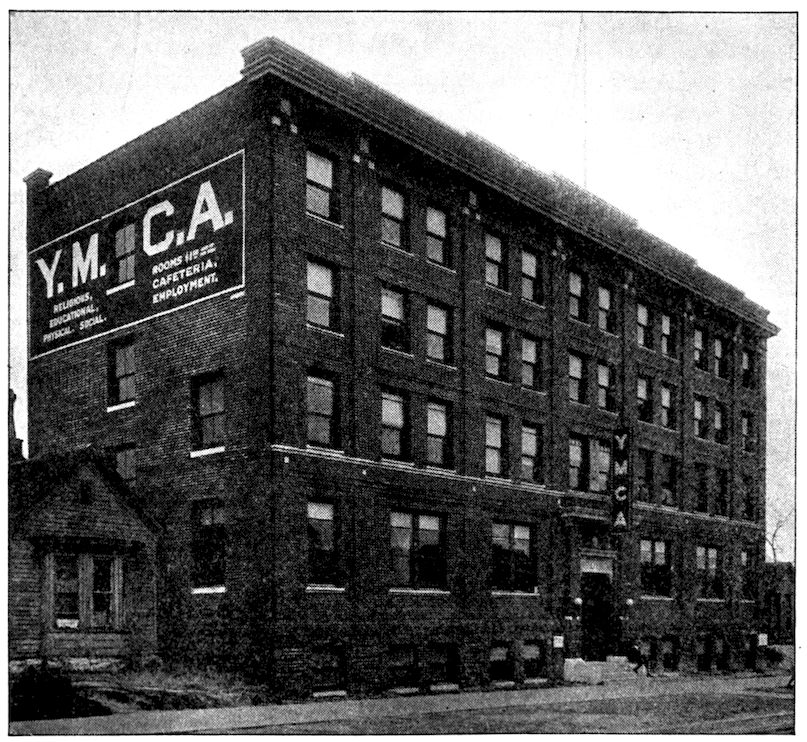
The Young Men’s Christian Association among Colored Americans
presents an illustration of the growth of the religious spirit in addition
to that exhibited by the churches, but of course, affiliated with them to
a greater or less degree. From the first student association at the Howard
University, organized in 1869, there are now six International Secretaries,
96 associations organized in Colored American educational institutions,
with an enrollment of 15,000 male students, and forty-five
city associations scattered over 23 States. The Colored women of the
United States began organizing Y. W. C. A. work in 1896, and there are
now 37 associations affiliated with the national organization, with 12
city associations for Colored women.
In connection with church or religious matters, the work of the
Colored Women’s Christian Temperance Union should not be forgotten.
This great national association makes for morals, sobriety, good
citizenship and education.
With all these remarkably large and numerous opportunities, the
young Colored American should be able to find an opening for his desired
ambition to be an apostle among his fellow men.
The spirit is working and inspires the race with noble ambitions,
and all the human virtues possible to inculcate in this world.
It may be said, in passing, that to lead the souls of men to eternal
bliss in the world beyond is the noblest and highest attainable profession
or calling. In preparing men for a future home beyond the skies,
he is converted into an advanced man of morals and good qualities on
this earth to fit him for the next world.
Men and nations have sometimes forgotten God, but their end has
always been untimely.
LEADERS OF AMERICA WHOSE EARS ARE CLOSE TO THE GROUND Americans, Regardless of Color, Who are Leading the People out of the Wilderness and Teaching the Brotherhood of Man. — THEODORE ROOSEVELT — PROF. BOOKER T. WASHINGTON — SELF HELP FOR YOUTH — PRESIDENT WILSON — DR. W. E. BURGHARDT DUBOIS — WILLIAM JENNINGS BRYAN
53
We have at the present time in the United States certain persons
regarded as eminent in progress and advanced thought, who must be
reckoned with when it comes to human improvement, and the removal
of obstacles to man’s intellectual life and physical welfare.
There have been numberless proofs in the years gone by, in fact,
we have only to survey the pages of all history, to learn that it is a
law of human nature, that there is no distinction between color and
race, and that brains, intellect, soul, are and always will be the test,
the criterion, the standard of human excellence.
To review the past would be to open the door to endless pages of
history, and require pages of illustrious names that have shone like
stars in the human firmament.
Those who are engaged in the development of the human family,
and apparently unconsciously working out the designs of God in their
persistent advocacy of human betterment, the destruction of inefficient
environments, and the promotion of peace and good will, as well as the
preservation of health, are numerous. Strikingly prominent are many
of our Americans who seem to be blessed with an almost prophetic insight,
and the ability to bring about changes in unpleasant conditions.
54
We have in Theodore Roosevelt, a man of many parts, none of
which is unimportant but all of them vital. When he speaks upon any
subject he not only speaks with determination but with an absolute
knowledge of the subjects he treats.
“Col.” Roosevelt, as he delights to be called, began in the New York
legislature, then became President of the New York City Police Commission,
where he did some powerful work in suppressing vice and the
saloon evil. Becoming too powerful a factor in American affairs after
his brilliant career as Governor of New York, he was nominated as
Vice-President of the United States, the politicians thinking thus to
close his career.
But he became President of the United States, succeeding to that
high office through the deplorable assassination of President McKinley,
and received the suffrages of the people for a second term because of
his energetic Americanism, and as an exponent of “Fair Play.”
He is now a private citizen, but as distinguished and as influential
as if he were filling the Presidential office. He is all energy, persistence
and force of character. He will fight, talk, or argue his points, as long
as he can stand on his feet, and then he will write them to the world.
No such man ever before lived in the United States.
On the other hand, among our Colored Americans, there stand at
the top two great leaders, Dr. Washington and Prof. Du Bois. Both of
these men represent different schools of thought and each of them has
an equally large following. This is encouraging, because working along
different lines, as is the case with diverse national parties, one serves
as a check upon the other, and without going to extremes they may
follow a happy medium.
Professor Booker T. Washington, whose aims, exertions and success
tends to advance his race along the same lines as other races, is
meeting with tremendous results, bringing about a more decided respect
for the intelligence of Colored Americans.
55Mr. Washington, born in 1857, has, by grit and determination,
reached the leadership of his race, and become one of the great men of
the nation.
After a life spent in struggles to acquire an education, he was recognized
as a great teacher, and called upon to take charge of a normal
school at Tuskegee, Alabama, established by the legislature. He organized
the school on July 4th, the anniversary of American Independence,
an idea that denotes the character of the man.
Since that period, the widely known Tuskegee Institute has made
such progress that, today, the site of the institution is a city of itself.
Mr. Washington worked his way to pay for his education at the
Hampton Institute, Hampton, Virginia. What he did and how he did
it is best described by himself in giving his experiences at Hampton:
“While at Hampton I resolved, if God permitted me to finish the
course of study, I would enter the far South, the black belt of the Gulf
States, and give my life in providing as best I could the same kind of
chance or self-help for the youth of my race that I found ready for me
when I went to Hampton, and, so, in 1881, I left Hampton and went to
Tuskegee and started the Normal and Industrial Institute.”
Mr. Washington literally worked his way through college. He
helped unload a vessel to get money to reach Hampton, and while there
did odd jobs of manual work, and acted as janitor.
Referring to another American of another race, President Woodrow
Wilson stands first, in reality he is the first gentleman in the land.
President Wilson is an uplifter rather than a reformer. When he
sees things to be done to better the people, or to better anybody, for
that matter, he does them and lets the reform take care of itself.
He has always been a student, and a worker at fashioning brains
56as a teacher, professor, college president and at the head of a great university—Princeton,
New Jersey.
Having a trained, enlightened mind, and not buried beneath books,
he expressed his views about public matters and public men who did
not perform their duty to the people, so vigorously and so truthfully,
that he was believed, and the people made him governor of New Jersey.
In this office he did so much in altering distasteful political conditions,
that he was considered a proper candidate for the presidency of
the United States where the same untoward conditions existed as in
New Jersey. He was elected, and is doing things all the time to better
conditions, and although he has many enemies who fancy only a settled
condition of things where they will not be disturbed in the management
of them, the President is driving them to cover and will undoubtedly
be successful in his endeavors.
Woodrow Wilson is a man of action and has a large background
of learning to fortify himself. Fortified in every direction and from
every point of attack, he is not an easy man to tackle or to find fault
with. The opposition to him was that he was a university man, and
therefore he did not know enough about politics to carry the country
safely through a four years’ term. But the people are finding out that
it does not require as much politics to run the country as it does education
and intelligence combined with energy and persistence. He is
beating down petty statesmanship and establishing the government
along the lines of benefit to the people. He may be considered as an instrument
in the improvement of a nation, and as giving it a long start
back to first principles which mean progress.
A noted man who is doing a great work along the line of betterment
of the Colored Americans and directing their thoughts into high
altitudes, is W. E. Burghardt Du Bois, known as the editor of “The
Crisis,” A Record of the Darker Races.
57Dr. Du Bois stands on the principle that intellectual emancipation
should proceed hand in hand with economic independence, and he is
making himself felt by the earnest advocacy of a truth that must impress
the people for whose interests he is laboring.
It may not be known to everybody that Dr. Du Bois is one of the
Directors of the National Association for the Advancement of Colored
People.
The movement of nations toward the accomplishment of the designs
of the Almighty to make all nations one, and in the supremacy of
the intellectual over physical force, is well understood by Dr. Du Bois,
and he is working along that line with other ardent humanitarians.
He aims to accomplish a world peace and a realization of human brotherhood.
To turn our attention to another race, William Jennings Bryan
looms up conspicuously with the others in his struggle to bridge the
chasm of prejudice and place all men upon the road toward human betterment
and universal peace.
For nearly twenty years William Jennings Bryan has fought the
battle of human rights, and his name has become a household word in
many ways. His versatility has no limit, and to say that he is an extraordinary
man and friend of the human race, is saying one-half the
truth.
Rising from the humble position of an attorney in Lincoln, Nebraska,
Mr. Bryan in an hour became the leader of the great masses of
the American people, and he has held his ground ever since. He had
aspirations and ambitions, but they were denied him through adverse
circumstances, but he never wavered in his love for the people and his
desire to benefit them in their onward movement toward betterment.
As Secretary of State in the Cabinet of President Wilson, he stands for
58everything that is admirable in a man of honor, virtue and probity, and
is in line with the great movement toward universal peace.
Miss Jane Addams is a lady that causes one to believe in the human
race along humanitarian lines. Miss Addams in her settlement work at
the celebrated “Hull House” on Halsted Street, has incited others to
copy and others have taken up the great work of bringing the homeless
workers into social contact for mutual benefit. The lady is not only a
worker among the people, but an author and a lecturer, whose example
may be followed to advantage.
THE COLORED AMERICANS’ NATIONALITY — “I AM AN AMERICAN, SIR” — BRICKLAYERS AND CARPENTERS — THE FIELD OF ORGANIZED LABOR
59
The Colored Americans’ field is the entire United States. They are
an integral part of the nation the same as other citizens, and their
rapid progress entitles them to an occupation of that field on a par with
all others.
We are fast getting rid of the vulgar epithets heaped upon citizens
of the United States who are Jews, Germans, Irish, etc., and the vulgar
epithets hurled at Colored citizens of the United States on account of
their color.
The time is soon coming, therefore, to ask: Why should we say,
“Colored Americans?” Let us advance to the next Government census
and forestall an episode to see how it would work:
The scene is supposed to be in the year 1920 and represents the
United States census taker of that period going his rounds and making
inquiries. He calls upon a well known Jewish citizen, and the following
conversation takes place:
“Mr. Solomon Isaacs, what is your nationality?” Mr. Isaacs replies:
“I am an American citizen, I was born in Chicago in the 19th Ward.”
The examining man asks: “Are you not a Jew?” Mr. Isaacs replies:
“No, sir, I am an American.” “But your nose,—” “My nose has nothing
to do with my nationality.” This being true, the Jew is allowed
to go.
Calling next upon Mr. Patrick McGillicuddy, he opens his book:
“Patrick McGillicuddy, what is your nationality?” Mr. McGillicuddy
makes the same answers as the Jew. “But,” says the examiner,
“Your long square chin and protruding lower jaw proclaim you an—”
“My chin, sir, has nothing to do with my nationality.” So the
Irishman is passed.
60Next in succession come visits to the Italian, the Spaniard, the
Japanese, the Chinese, the Russian, the Hindoo, and so on. All these
men deny that they are anything but Americans. The examiner points
out their nationality in their features, but is told that features, face,
complexion, noses, chins, or hair, have nothing to do with nationality.
They were all born in this country and there is nothing more to be said.
Finally, the examiner brightens up. He has found something that
can not be disputed. He calls upon George Washington Adams.
“Ahem, Mr. Adams, what is your nationality?” Mr. Adams responds:
“I am an American, sir.” The examiner is puzzled, but revives. “Are
you not a Negro?” Mr. Adams, having learned something from the
Jew, the Irishman and the others, replies: “No, sir, I am not a Negro,
I am an American born in the United States.”
“But, your color indicates that you are a Neg—.” “My color, sir,
has nothing whatever to do with my nationality, no more, in fact, than
the Jew’s nose, the Irishman’s jaw, or the Spaniard’s olive face, the
Russian’s matted hair, the Swede’s blonde whiskers, the Chinaman’s
pigtail, the Italian’s earrings, or the Indian’s scalplock. According to
the United States Constitution and all the laws thereunder, my color
has been erased and I am an American to all intents and purposes, the
same as you.”
After recovering from his swoon, the census taker goes out to the
nearest saloon, takes some refreshments and begins a movement to
have the legislature enact a law, prohibiting Colored Americans from
breathing the same atmosphere as other Americans. But the scheme
fails because when it comes to the question of color, the Jews, Spaniards,
Italians, Frenchmen, Mexicans, and so on, would be affected.
Of course this appears ridiculous. It is not intended to be ridiculous,
however, but suggested in sober earnest. It is what has been going
on in this country for several decades, and it is time to stop such
folly.
61The main point is, that the whole of the United States is the fair
field for the exploitation by Colored Americans. And there will not be
the slightest obstacle in the way of such exploitation, if Colored Americans
drop the past and look to the future. It is not supposable that ten
millions of people, who, in another generation will number twenty millions,
can be extirpated or crowded out of the enjoyment of human
rights because of the prejudices of a few persons who judge from their
own standpoint.
To show how fast this field is being exploited by Colored Americans
would require a large volume of statistics, but the essentials may be
given so that it may be inferred that the field is in a fair way of being
occupied.
Our most valuable account, strangely enough, comes from an English
source:
In 1911 a commission was sent by the English Board of Trade to
the United States to investigate the cost of living in American towns,
but the report included important information concerning the occupations
of Colored Americans in cities of the United States.
It appears from the report that the Colored Americans in New
York City, in spite of the industrial barriers that exist there, contain
within themselves most of the elements, professional, trading, and industrial,
that go to make up the life of other and more normally situated
communities.
In Atlanta, Georgia, about three-fourths of the bricklayers are Colored
Americans, but the majority of the carpenters are white. Nominally,
the rate of wages is the same for both races. One large employer
held, that Colored American’s as bricklayers had a value exceeded
by no one, and that in his own case the highest paid workmen
were Colored Americans.
In Baltimore, it was found that Colored Americans occupy a very
important position in the working class element of the population. An
overwhelming majority in the building trades are Colored Americans.
62In Birmingham, Alabama, there is a larger number of Colored
American workmen than in any other district in the United States. The
building and mining industries are the two in which the two races come
into the most direct competition with one another, yet in neither of
these industries does a situation exist which occasions any serious friction.
In Cleveland, Colored Americans were found in the steel and wire
works, as plasterers, hod carriers, teamsters and janitors.
In Memphis, in the transport trades and also in certain industries,
such as the making of bricks and cottonseed oil, the labor is almost
entirely Colored American. They are making their way into the skilled
trades, and in some wood working establishments both whites and
blacks work side by side at skilled occupations.
In New Orleans, the industries are of a kind which employ mainly
unskilled or semi-skilled labor, with the result that white men and Colored
Americans are found doing the same kind of work and earning
the same rate of wages.
In the Pittsburg district, more than a hundred Colored Americans
are employed in business as printers, grocers, hairdressers, keepers of
restaurants, caterers, etc. Many are employed by the municipality as
policemen, firemen, messengers, postmen, and clerks. A large number
of work people in the building and iron and steel trades are Colored
Americans, some being in highly skilled occupations.
Here is the truth from a foreign source that must be considered fair
and unprejudiced. But the home records show a more diversified distribution
maintaining a proportionate employment everywhere.
There does not appear anywhere to be a fear that the labor of Colored
Americans will crowd out the white labor, but there is a lingering
suspicion that it may do so, although practically it does not.
In consequence of this timidity, what are known as “segregation”
laws and ordinances have been passed in various places, Baltimore having
made the most extensive effort to keep the laborers of the two races
apart.
63In other cities, as Atlanta, Kansas City, Norfolk, Richmond, and
St. Louis, efforts were made to effect legal segregation.
The result of all these attempts to keep the Colored Americans out
of their legitimate field of competition with other Americans, failed
utterly, or caused such great financial losses to White Americans without
affecting Colored Americans in any way, or stopping their accumulations
of property, that segregation may be considered a dead issue.
In Spokane, Washington, it has been decided judicially, that Colored
Americans can not be excluded from buying property in any particular
place in the State. The same is the judicial sentiment in New
York and elsewhere.
In the field of organized labor, Colored Americans are also making
great strides, the prejudice heretofore existing having almost disappeared.
At New Orleans, Mr. T. V. O’Connor, President of the International
Longshoremen’s Union, sounded the keynote when he declared,
upon the admission of Colored Longshoremen to the Union: “We are
going to bring about industrial equality. If Colored Americans stand
ready to assist themselves, they will get the same wages and working
conditions that the white man enjoys.”
THE FOUR DIVISIONS of MANKIND The African One of the Purest Types — MAKING THE BURDEN OF LIFE MORE ENJOYABLE — THE JEWS HAVE AGES OF LEARNING
64
Of the four great primary divisions of the human race, the Aryan,
Mongolian, Semitic, and Hamitic, there are three that preserve their
racial type and have been little changed by intermixtures. These are
the Semitic, or Jews; the Hamitic, or Africans, and the Mongolians, or
Chinese.
The Aryan division spreading out from the Caucasus Mountains
by way of India, and thence westward, became split up into a hundred
different races, with varying peculiarities and racial differences, becoming
as they are today English, German, French, Irish, Scotch,
Swedes, Finns, Russians, Hindus, and a hundred other varying races
that have intermingled until the Aryan designation as a division of the
human race is entirely lost.
All these split Aryan races have become centralized in the United
States, where they are continuing their intermingling, and getting
farther away from the Aryan type.
On the contrary, the three other divisions, the Jews, the Africans,
and the Chinese, have maintained during all the ages since their creation,
their original characteristics, with only slight intermixtures, so
slight, indeed, that they are barely noticeable.
Historically, the races that make up the Aryan splits, are a mere
breath on the surface of the ages of time, when compared with the
other three divisions of the human race. Long before the ancestors of
many of them composed the barbarian hordes that thundered at the
gates of the Roman capitol, and finally effaced it from the face of the
65earth, the Jew, the African, and the Chinaman, were in possession of
the evidences of high civilization, wise government, and splendid monuments,
and cultivated the arts of peace. The Aryan posterity, on the
other hand, were warlike, and became conquerors of the others, appropriating
their arts, and are still digging among the ancient ruins of
splendid empires, wondering what manner of people could have perfected
such noble works.
All the races had many forward and backward movements, with
the dominance always with the warlike Aryan blood.
But today, in the United States, the Hamitic, the African, if you
please, has found and utilized the civilizing arts of the Aryan, and is
moving upward toward the pinnacle of the same civilization which is
essentially modern and original, and which retains the ancient civilization
of the other three great divisions of the human family, in its museums
as objects of curiosity and admiration. At the same time he is
maintaining his racial unity.
There is no going back, now, there can be nothing but advance toward
progress and higher civilization, that is, in the more adequate
and efficient means of making the burden of life more enjoyable and
easier.
In one thing only is there doubt as to our progress, and that is in
human development, and racial perfection. The scientists and thinkers
of the age are impressed with the fact that there is degeneracy, or at
least, “recession,” as it is termed, which means a going back to some
unknown evil type that will operate disastrously upon civilization,
morals, and general well-being of individuals.
By a remarkable unanimity of opinion, these marks of recession
and degeneracy, sometimes called “delinquency,” are limited to the
posterity of the Aryan type. Superhuman efforts are making to avert
catastrophe by what is known as “selection,” that is, by limiting intermarriages
to those who shall have been declared physically and mentally
66capable of assuming the marriage state. But in the opinion of
many, this will still be a further remove from the pure Aryan type,
and thus be always descending the human scale. At any rate, there
can be no reversion to an ancestral type, because the ancestor himself
is mixed, and there is no pure strain to culture up to.
But with the Jews and Africans, there is no such question, because
the type remains as it was in the beginning, and it is very easy to make
a selection.
The Jews understand this matter and they maintain their own
racial standards which are the highest and best. Now, it is up to the
African, the ten millions of them in the United States, to adopt the
standards of excellence proper to their dignity, and to their purity as
one of the original or primary divisions of mankind.
The Jews have ages of learning and wisdom to fall back upon, and
the African, although interrupted in his advance, by ages of repression,
nevertheless has the ages of high civilization, the reigns of the Queens
Candace, the learning of the Egyptians from Ethiopian magi, and the
startling wonders and marvels of buried cities and high culture recently
unearthed in Africa as a foundation. These ought to be an incentive
to him to regain the lost prestige. He has the opportunity now,
and there is no one to stay his march upward, on the contrary, there
are helping hands everywhere, and incentives such as no other race in
the world ever had or will ever have.
He may look back to his ancestral days with as much pride as any
other race, and he may point to the magnificent ruins of the departed
glories of his race to prove that his origin is to be found in as high a
type of civilization as compared to any other race.
THE WORLD’S CONGRESS of RACES Great Importance of Colored Race in the Tremendous World Upward Movement One Thousand Delegates from Fifty Different Races Proclaim Uplift of People — THE POSSIBILITY OF PROGRESS — BLACK MEN ORIGINATE EGYPTIAN CIVILIZATION — PIGMENT OF COLOR TO GUARD THE SKIN — ALL NATIONS AND TRIBES ONE GREAT FAMILY — WARS BETWEEN JEWS AND ETHIOPIANS
67
In considering the opportunities offered the Colored people of the
United States, two things must be constantly borne in mind:
1. That the advance of the world and of the nations toward harmonious
action and unity of motives, is purely of the mind and soul and
not of the material things of life.
2. As to the world’s progress the Colored Americans of the United
States occupy a prominent position in the vanguard with the other divisions
of the human race, all of whom are moving in the same direction
toward carrying out the Divine plan of bringing all nations into one
fold.
On July 26, 1912, there opened in the City of London, England, a
great congress of the races of the world including all the dark races
or their representatives. In fact, fifty different races were represented
by their leading men, consisting of over thirty presidents of parliaments,
the members of the permanent court of arbitration and of the
delegates to the Second Hague Conference, twelve British governors
and eight British premiers, over forty colonial Bishops, a hundred and
thirty professors of international law, the leading students of mankind,
and other scientific men of the world.
When Lord Weardale, at the head of the World’s Peace movement,
opened the first session of this congress, he looked into the faces of a
thousand people representing fifty different races of men.
68Lord Weardale said among other things: “To those who regard
the furtherance of international good will and peace as the highest of
all human interests, this First Universal Races Congress opens a vista
of almost boundless promise.
“Nearer and nearer we see approaching the day when the caste
population of the East will assert their claim to meet on terms of equality
the nations of the West; when the free institutions and the organized
forces of the one hemisphere will have their counterbalance in the
other; when their mental outlook and their social aims will be in principle
identical; when in short the color prejudice will have vanished
and the so-called “white races” and the so-called “colored races” shall
no longer meet in missionary exposition, but, in very fact, regard one
another as in truth men and brothers.”
Dr. Felix von Luschan, of Germany, declared, “There is an increasing
mutual sympathy between the races as they come to know each
other.”
Mr. Gustave Spiller, the organizer of the congress, said:
“The common standard provided by university diplomas shows
almost all races, even the majority of those which are regarded as inferior,
represented successfully in the universities of Europe and America,
and that they are equal in intellectual capacity with the others.
Hence the difference between them are mere physical characteristics.”
Professor Robertson, of England, among other things established
this comforting assurance:
“It is only after a long and painful apprenticeship that European
nations have attained autonomy. Why not admit that it may be the
same with the so-called backward peoples?”
The possibility of progress with regard to the Colored Americans
is emphasized by Professor Charles S. Myers of England, who gives the
results of his personal observations in other nations.
69Even viewing our Colored Americans as a primitive people with
only two generations of removals from the primitive state, Professor
Myers says:
“The possibility of the progressive development of all primitive
peoples must be conceded, if only the environment can be appropriately
changed.”
It is in evidence every day, that the “changed environments” of
the Colored race in the United States, has forwarded their progressive
development to an enormous degree.
In line with the opinion of Herodotus and the German ethnologists,
that the Black Men of Africa were the first race, and the originators of
the Egyptian and Cretan civilization, Professor Lionel W. Lyde, of
England, announces:
“We are in a position to say that primitive man was dark skinned,
and that he, as he made his way northward, began to bleach, thus creating
a semi-primitive yellow type. This yellow man exposed to conditions
of cold and moisture, might become entirely white. The human
skin develops pigments to protect itself against a strong sun, and the
quantity of pigment in the skin varies with the intensity of the sun.
“It is therefore the men who live in the hottest and least shaded
parts of the world—that is to say, in the African, that we find the blackest
skin. The white peoples, on the contrary, are confined to a region
where the humidity of the atmosphere forms a screen against the rays
of the sun. Finally, between the Negro and the White, is the Yellow
man, who is a product of desiccating grasslands with seasonal extremes
of temperature.”
The racial color, it will be understood, is merely a matter of skin
coloring. Nature provides pigments of color to guard the skin against
the inclemencies of sun and weather. Every modern man knows and
70has experienced the result of strong sun and wind in his own skin.
“Tan” it is called, and sometimes, within a few weeks the color of a
white man’s skin is transformed into a yellow or a dark brown. If the
exposure continues, the color remains.
In the opinion of noted scientists, it is certain that the difference
between the races as to color is merely skin deep. Their psychological
conditions are equal, as we shall see when we reach that point.
Professor Felix Adler, the eminent scientist, speaking with authority,
upholds the idea that the relations between the races can be only
psychological and not physical. He said at the great Congress of
Races:
“It is urgently necessary for us to have a clearer conception of the
ideal to be realized in international relations. What principle shall we
put in the place of war, brute force, etc?
“The appeal to sentiment and the progress of democracy, are not
in themselves a safeguard against war. It is not peace itself that we
must keep in view, but the object to be secured by peace. The ideal
principle of international relations consists in the progressive organization
of these relations between peoples and races. This organization
involves two postulates:
“First. To attain the most extreme differentiation of types of culture,
the maximum of variety and richness in the expression of human
faculties. The peace and progress of the world will depend on the formation
of a cultivated class of all civilized peoples.
“Second. This exchange between different types of culture will
serve to bring to light the weak points in each, and lead to their improvement
and healing.”
Sir Charles Bruce, the noted administrator of government attempts,
in various localities where the different races confront one another,
to give as his deliberate opinion, based upon experience and close study,
this succinct truism:
“The blacks have long been the instruments of the cupidity, cruelty
and luxury of the whites; but their intelligence, deliberately neglected
for ages, needs only to be awakened.”
71Sir Harry Johnston, of England, said:
“The Negro race has produced men of great ability in all departments.”
Dr. W. E. B. Du Bois, learned editor of the Crisis, appeared before
the Congress as a Colored American scientist, versed in ethnology, and
the needs and qualifications of the Colored race. After giving the number
of Colored Americans as about ten millions, and mentioning the
fact that “They live at the present time under a system of theoretical
liberty, which is restricted in practice by certain legal dispositions, and
by custom,” he adds: “Intellectual emancipation should proceed hand
in hand with economic independence.”
This is indeed the keynote to the elevation of the Colored Americans
to the high plane sought to be reached by all the nations of the
earth, and toward which they are surely drifting, in an unconscious fulfillment
of the designs of God to gather all nations and tribes together
into one great family.
Professor N. R. d’Alfonso, of Italy, laid before the Congress the
most profound thought that forms the basis of all progress and gives
the key to beneficial government:
“Speculative psychology teaches that the man, to whatever race
he may belong, has always the same psychological possibilities.
“Subject from childhood to certain conditions of climate, environment
and education, he can reach the highest and most complex grades
of civilization.
“It is the action and reaction of the external world on the internal
world of the mind that issues in the creation of man.
“If there are psychological differences between races they are the
outcome of the particular history of various peoples—a history that has
entailed a different education.
72“The psychological basis is the same in all men from whatever
part of the world they may come, and they may evolve in the same way
and attain the same psychic results.
“In the same way racial hostilities and prejudices are not due to
organic heredity, but to tradition and education.”
So far as science has gone, it must be apparent that the learned
men of the age have returned to the Biblical account: Genesis, 1:26.
“26. And God said, ‘Let us make man in our image, after our likeness:
and let him have dominion over the fish of the sea, and over the
fowl of the air, and over the cattle, and over all the earth, and over
every creeping thing that creepeth upon the earth.’
“27. So God created man in His own image, in the image of God
created He him; male and female created He them.”
Again in Genesis 2:7, it is said:
“7. And the Lord God formed man of the dust of the ground, and
breathed into his nostrils the breath of life; And man became a living
soul.”
Everywhere in Holy Writ, human beings are always referred to as
“Man” whenever he is considered as a being vested with a soul, a particular
psychological condition that makes him different from all other
creations.
In every movement toward human betterment, education, civilization,
development, and especially in the onward movement toward unification,
the human species is referred to as “Man” without any racial
distinctions whatever.
It is only when men are opposed to one another; when they depart
from the Divine intention to unify all men, that man is designated according
to his racial or national designation. For instance: The wars
between the Jews and the Ethiopians three thousand years before
Christ; the wars of the Romans, Persians, Assyrians, English, French,
and all other divergent upheavals which depart from the Divine Design.
73In such cases the psychological man, the man with a soul, the
man into whom God breathed the breath of life, is considered a different
being and he is unified as “Man.”
Not only is this distinctive unity of soul, of mind, of intelligence,
the predominating feature of the creation, known as “man,” but his
physical characteristics outside the mere skin deep differences, are exactly
the same.
Modern scientists, known as “biologists,” that is, men who investigate
the origin of physical life in men, have advanced so far that they
know and can easily demonstrate that there are no physical differences.
The infinitely small cells called “protoplasms,” which make up the
tissues of the human body, and which are present everywhere, plainly
visible to the eye under a microscope, are exactly the same in every human
being whatever his race or color, condition, education, environment,
etc.
All the machinery upon which these small cells of life operate and
give action, energy, and duration—the heart, the nerves, the blood, and
all the organs essential or co-operative, are identically the same.
Men have tried to find a difference in the physical make-up of the
various races but they have signally failed. They have even endeavored
to compare the blood and cells of inferior animals such as apes,
going so low as the common monkey, to show that some of the races
originated in what is known as the “Anthropoid Ape,” so as to bolster
up the doctrine of evolution and maintain the existence of an exclusively,
special God created race of men, of which they are the sole and
exclusive exponents, but they, also, have signally failed, and all men
today, proven by science demonstrating the truths of Holy Writ, stand
upon the same psychological, or soul plane, whether his skin be black,
yellow, brown, red, white or any other color or shade of color. They
are all part and parcel of the Divine movement which is impelling man
toward a universal psychological unity. Any man or nation that attempts
to bar the way, is submerged or cast aside like a straw before
an avalanche. This is written upon the pages of history so clearly, that
it is beyond controversy.
PROGRESS OF THE DIFFERENT RACES OF MANKIND Marvelous Rise of the Japanese from Barbarism in Five Decades—The Jews without a National Government Rule the Finances and Commerce of the World—China in Contact with Civilization Has Created a Great Republic—The American Indian Raised From Savagery to Peaceful, Profitable Pursuits—The Colored American’s Part and Opportunities in the Great Onward Movement — THE RISE OF THE ROMAN EMPIRE — THE JEWS — ADVANCEMENT OF THE JEWS — THE JEWS THIRST FOR KNOWLEDGE — THE AMERICAN INDIAN — RESULTS OF EDUCATION — THE JAPANESE AS AN ILLUSTRATION — THE CHINESE
74
A reader of history who does not go deeper than the mere words in
books, sees nothing but confusion in the steady, onward march of all
mankind from the dawn of creation to the present time.
We hope to bring something easily understood out of this chaos,
that will be of benefit to the Colored Americans, and put them in line
with the great movement of the human family toward universal peace
and prosperity. We expect to show that he is an essential factor in the
human race, and that he has performed his part when his ancestors, the
powerful kings of Ethiopia, brought civilization and the art of working
metals into Egypt, as far as Asia, and into Europe.
The most learned ethnologists hold that there was a time in the
history of the human race when all mankind were unified, and that
through different causes operating upon passion for power, religious
differences and climatic necessities, they became separated and split
into divisions each of which claimed supremacy, and made war upon
the others who denied it.
Wherever we begin the national history of any nation or tribe, we
75find them separate from every other nation and tribe, individual entities
with their own laws and government.
If we take any fanciful theory of the creation of man, or accept the
biblical account of the Dispersion at the plain of Shinar, at the building
of the Tower of Babel, 2218 years before Christ, we find them scattered
over the face of the earth, whereas before that Dispersion “The
whole earth was one language and of one speech.” (Genesis 2:1).
After that event “The Lord scattered them abroad upon the face of all
the earth.”
The races of mankind began in unity, but separated and scattered
becoming a multitude of nations with different languages and religions.
But, at the same time, visible as a fine thread through the movements
of mankind, was a trend toward another unification.
Nations rose and fell, leaving the earth to a few powerful ones who
attacked one another until, finally, the vast and powerful Roman Empire
rose upon the ruins of the others. The central point of unification
was nearer, and it appeared when Christ was born, the Saviour of all
the world.
From that time began a movement toward another unification, but
not a national movement, a human movement, an uplift into higher aims
and more complete brotherhood.
The conquest of Rome by barbarians did not stay this movement,
because the barbarians fell in with it and moved along with it. Every
great act on the chessboard of nations, whether war, or the present
peace movement toward universal peace, demonstrates that the purpose
of the entire human family, as a unit, will be fulfilled sometime.
It is rapidly reaching that point.
The great nations that stood in the way of this onward movement
toward unification, have been abolished politically, but not individually,
the individuals becoming merged, unified into the great moving
mass, and progressing onward with it to the end in view.
76Of these unified nations or rather peoples of nations who have no
more political power or significance, we find the following:
The Jews, the Semitic division of the human race.
The Colored Men, the Hamitic division of the human family.
The American Indians, Aborigines with tribal government.
We shall add to these, by way of illustration to demonstrate the
power of civilization, the following:
The Japanese, an offshoot of the Turanian.
The Chinese, pure Turanian.
The two latter races are foreign to our unification in the United
States, many of their people, however, have inserted the thin edge of a
wedge into our civilization and time alone will tell what the upshot
will be.
We have in the United States a most remarkable unification, or
merger into one political status, of the descendants of three great divisions
of the Human Family, who are living together substantially in
peace and amity. Whatever differences and difficulties arise are purely
personal.
Of the Colored Americans in the United States, this book refers
almost exclusively; in fact, it is dedicated to them and their interests,
and intended for their benefit. Hence, we may omit them in this chapter,
there being a full account of them elsewhere.
A short sketch of the Jews may be considered as pertinent to the
subject and as having a bearing upon the status of the Colored men.
The Jews considered from the biblical accounts exclusively, are
the descendants and representatives of the oldest branch of the human
family, but they existed as a nation contemporaneously with the Ethiopians,
in whose descendants we find the Colored men of the United
States.
It may be said that the unification of the Semitic or Jewish race
began with Moses, although Noah was in fact the father of the race.
77Their history is one of the wildest, most varied and romantic of that
of any other race or nation.
After centuries of miserable bondage under the Babylonian kings,
and in Egypt, they emerged under the leadership of Moses who married
an Ethiopian, and began anew the struggle for national autonomy.
Prior to Moses the government was essentially patriarchal, but
after Moses and in the course of time it became monarchical, with
various petty kings and offshoots, always quarreling with one another,
and meeting with defeats and slavery from other nations, until the
Romans had acquired power to conquer the world, and included in
their conquered territory the various sovereignties established by the
Jews.
Although the political power was taken from them, the Jews were
allowed to retain their religious authority, but in process of time, and
at the coming of Christ, their chief priests and spiritual rulers generally,
were sunk in corruption. In the 70th year of the Christian era,
Jerusalem and the great temple of Solomon were utterly destroyed, and
from that time until quite recent times, the Jews have been wanderers,
obtaining a foothold here and there against fearful opposition and
amazing suffering.
Bereft of political power and national autonomy, the Jews advanced
along the line of racial unification, and became leaders in the
arts and sciences, and have made themselves the financial and commercial
masters of the world. A power they never could have reached had
they maintained their national distinction under a monarchy or other
form of government.
Their position in the United States is exactly that of the Colored
Americans. They have all the political rights of freemen, and can rise
to positions of high trust and honor. Like their Colored brothers, they
are not a race within a race.
78
They are all intensely interested in education, and their children
possess an insatiable thirst for knowledge. As a consequence they are
always ready to seize upon opportunity when it comes their way, and
they always profit by experience, and gather information from every
source.
Many of the most distinguished scientists and statesmen in the
world have been Jews, and although able to dictate financially to governments,
and possessing political power, they have never yet attempted
to seize upon the reins of any government, or take it out of the
hands of those selected to govern.
If a Jew were to become President of the United States, and all
the offices filled by Jews, the government would run along the lines
upon which it was formed, without a change or jar, and at the expiration
of their term of office, or a change in political power, they would
lay down their trust and return to their individual avocations without
a single regret.
This is a unification such as the world has never before dreamed
of. And it is the same unification with regard to the Colored Americans.
The situation is the same, the conditions identical with the single
exception that the Jews are farther advanced than the Colored man,
his experience extending over a larger period of time, but the Colored
men are improving and soon they should be where the same sort of
unification can be said of them.
The American Indian has no ancestry of civilization to look back
to. His forebears so far as is known to history were savages, and the
Indians found in America by the first white settlers were also savages.
Their origin as a race is shrouded in obscurity, some asserting that
they are descendants of the Semitic race of Asia, others that they are
Turanian and Malaysian mixed. It is certain, however, that nothing
79remains of any very ancient civilization, what does exist consists of
“mounds” containing crude articles of pottery, flint arrows, etc., and
in the case of the descendants of the cliff dwellers in New Mexico and
Arizona, their habitations remain, showing that their surroundings
were crude and their civilization at a low ebb.
The descendants of the Aztecs, Toltecs and other tribes whose ancestors
were ruthlessly slaughtered by Cortez and his Spanish soldiers,
and oppressed by his successors, had small title to what is known as
civilization. Of these little can be said except that the present descendants
present the vestiges of degeneracy, and have no marks of being a
pure race of any sort. They are just the same as they were when first
discovered, barring vices which they have acquired from the civilized
races without receiving any benefit from their virtues.
These people present no example worth being followed, but as to
the descendants of the real savage American Indian, the Sioux, Algonquins,
and other large and savage warrior tribes encountered by the
American pioneer and frontiersmen, they show the power of civilization
and their adaptability to changed environment.
Among them were many noble men, men of high aspirations and
aims, who as soon as they understood civilization, broke away from the
trammels of savagery and became civilized. That is, they adopted the
manners and customs of the civilized races, and became unified with
them.
Among them, education has produced a large number of men of
high grade, and influence. Most of them have turned to agriculture,
but being a race that is still in embryo, so to speak, that is one of the
present era, the time has not yet arrived when it can be predicted of
them that they are equal to coming up to the highest rank in civilized
life.
They are an open, living illustration of the power of education and
modern civilization. The lesson to be learned from them is, that what
a race so sunk in savagery and barbarism can do, is much more within
80the reach of the Colored Americans who have a great and noble ancestry
back to which they may look with admiration and feel an incentive
to continue to advance—it is in them.
We come to the Japanese as an illustration of unification of the
races, because they have put themselves before the world as entitled to
consideration as much as any other race. Inasmuch as they are rapidly
becoming a world power, and have the warships and guns to back up
their pretensions, the nations of the earth feel justified in considering
their claims.
Whence they come nobody knows, not even their own learned men.
They originated somewhere in the past, but not ancient past, or they
would have been heard of, but may be a cross among the Turanian
tribes. They are small men and dark, which lends truth to this theory.
With their origin we have nothing to do, because their rise and
progress is something men now living have witnessed and stand
amazed at its suddenness and at the height to which these small men
have attained.
They are a brilliant example of what education and civilization
backed by intense persistence and energy will accomplish in taking
advantage of opportunity.
They were given an opportunity to enter the ranks of civilization,
but they refused the offer. Then, trade and commerce urged and then
forced it upon them, and seeing that they had to progress, they took
hold of opportunities, and now, never let the smallest opportunity pass
by them. When an opportunity does not present itself they go to meet
it or make one to suit themselves. They are giving the world a bad
scare by their persistence and clamors for equality with every other
nation and peoples, due, perhaps, to their newness as a nation and the
probability that they may relapse into barbarism should they get the
upperhand with restraint removed.
The Story of a Rising Race Told in Pictures
PHOTOGRAPHED FROM LIFE
Special Collection B
RELIGIOUS PHILANTHROPIC EDUCATIONAL FRATERNAL
IN THE SERVICE OF GOD
A meeting of the officers of the various churches of all denominations.
UNITY IN RELIGION
Bishops and Officers of all the Negro Churches in America, all denominations. Conference at Mobile, Alabama.
SEEKERS AFTER TRUTH
Graduating Class of the Bible Training School, Theological Department, Tuskegee Institute.
CHRISTIAN UNITY, FELLOWSHIP AND EDUCATION
Inter-Scholastic Young Men’s Christian Association Meeting, held at King’s Mountain, N. C., May, 1913.
SONGS OF PRAISE
Vested Choir attending devotional services. Howard University, Washington, D. C.
REFINING AND CHRISTIAN INFLUENCE
The Reading Room in the Y. M. C. A., Washington, D. C. The young men are studious and deeply interested in their educational and Christian work.
COLORED SISTERS OF THE HOLY FAMILY
The Holy Family Convent at New Orleans has eight Catholic Schools in Louisiana and two in Texas. The students are taught Industrial Art, Embroidery, Music, etc., and become very efficient.
BRINGING THE BOYS TOGETHER FOR SELF-IMPROVEMENT
Social Settlement Workers teaching boys innocent games and interesting them in developing their characters in order to make them useful citizens.
FOR THE ADVANCEMENT OF THE RACE
The Fourth Annual Conference of The National Association for the advancement of Colored People, at Chicago. In the group are, Jane Addams, Dr. DuBois, Bishop Lee, Dr. C. E. Bentley, and many other well known men and women.
WORLD-WIDE EDUCATIONAL MOVEMENT
International Conference on better education held at Tuskegee July, 1912.
THE WORKERS OF A PRINTING AND PUBLISHING HOUSE
The A. M. E. Sunday School Publishing House, Nashville, Tennessee. An association which spreads “Christian Teaching” broadcast and opens an avenue for the employment of intelligent men and women of the race.
MYSTIC SHRINERS
A group of the Mystic Shrine, or Scottish Rite Officers, which includes many prominent in the Order.
KNIGHT TEMPLARS
The International Conference, Pittsburg, Pa. Malta Commandery No. 19, Knight Templars, welcomed by the Young Men’s Christian Association.
ODD FELLOWS ANNUAL BANQUET
In attendance are such national characters as Booker T. Washington, Ex-Register J. C. Napier, Former Register J. D. Lyons, Ex-Recorder of Deeds Lincoln Johnson, the Local Grand Master, and others equally well known.
THE RISING GENERATION
A group of intellectual students comprising the Senior Class, 1913, Tuskegee Institute.
81Every man who has not had a very good or saintly past, is regarded with suspicion when he joins the ranks of the good and pious.
It is not credited that such a man can become good all at once, and the
belief spreads that his reform is a mere makeshift, a delusion, and an
opportunity for gain.
The Japanese have not been tested by any of the conditions that
have made the civilized races what they are as to reliability after
centuries of experience, and the only thing to be observed is, that they
were found first as a barbaric tribe, or semibarbaric, with the most
hideous manners and customs, and a religion that was mere idol worship.
If the first American admiral who forced western civilization upon
them through trade and commerce could see them now at the bargain
counter of opportunities, he would be amazed.
Their arts and sciences are marvels of beauty; their home life when
they are not fighting is amid a bower of roses, and they can imitate
anything as to mechanical workmanship from a toy dog to a complicated
man-of-war. They make everything the civilized men make, and
sell them for a pittance. They know what they want and they get it or
declare war.
Never did such a race of men exist since history began, and it has
sprung up into prominence within about half a century, without being
deep or profound, and having a character that is so dubious that
one never knows whether he is your friend or enemy.
While studying this race of small men, one is almost tempted to
urge every man behind in this world’s favors, to do as the Japanese.
It is indeed an incentive to wake up and go ahead.
The Chinese are as near the pure Turanian stock as it is possible
for a race with their environments to be.
The samples that come to the United States for employment are
coolies, mongrels of the race, just as we have natural born mongrels
from intermixtures with degeneracy.
But the real Chinaman, the Manchurian, and his similars among the
82pure Turanian strain, are magnificent men physically, without the slant
eye, and highly educated in the Chinese fashion.
Like the other grand divisions of the human race, they lived along
for ages in peace and comfort, until the outside barbarian in the form
of the little Japanese came along and shattered his dreams of content.
As Alaric and his Huns battered down the gates of Rome; as the Romans
put an end to the Jewish nation; as the combined attacks of the
gold hungered kings of Europe and Asia subdued and obliterated the
vast Ethiopian empire, so little Japan routed the big Chinese empire.
But this accomplished something that emphasizes the idea of a universal
unification of the nations of the world. Japan forced open China
and its people saw the opportunity, and took it. After studying the
methods of civilization, particularly those in vogue in this great republic,
its students returned to their native land, and aroused the half a
billion people from the slumbers and behold! A vast republic. The
Chinese are in line with modern education, with the arts of civilization.
Like the Japanese, they have begun to wear American clothing. Withal,
they have abandoned their old pagan practices, killed their dragon,
and are rapidly coming in under the remorseless movement toward the
unification of the world.
ETHIOPIA, THE GREAT BLACK EMPIRE THE AUTHORITY OF THE BIBLE AND ALSO RECENT DISCOVERIES IN AFRICA PROVE THE ANCIENT AND POWERFUL CIVILIZATION OF THE COLORED RACE 3,000 YEARS B. C.—THE STORY OF CANDACE, THE BEAUTIFUL BLACK QUEEN OF ETHIOPIA, AND THE MARRIAGE OF MOSES TO AN ETHIOPIAN WOMAN 1490 B. C.—HOW PIANKHI, THE BLACK KING, CONQUERED EGYPT 750 B. C., AND HOW EGYPT TOOK HER CIVILIZATION FROM ETHIOPIA. — THE BLACK NATIONS A POWERFUL CIVILIZATION — THE BLACK KINGS — THE BEAUTIFUL BLACK QUEEN — ETHIOPIANS FIRST LIVING MEN — THEATRES, PALACES AND TEMPLES — MOSES MARRIED A COLORED WOMAN — GREAT ANCESTRY OF COLORED RACE — THE BIBLE AS A PROOF — BLACK MEN DISCOVER ART OF WORKING METALS
83
We read about Napoleon, Frederick the Great of Prussia, Catherine
of Russia, Marie Antoinette of France, and other kings and queens,
many of whom led mysteriously cloudy lives and came to a bad ending,
but few have ever heard of Queen Candace, Queen of Ethiopia.
You are referred to the Bible (Acts 8:27) as a beginning of the information
to follow.
Few among the learned in this present age, and less of the unlearned,
know anything about the origin of the colored race in the
United States. They are completely in the dark as to their ancestry,
as a powerful and highly civilized race of people.
The fact is, that while the Anglo-Saxons, Celts, Scandinavians, Germans,
and so on, wore skin coats, devoured their food raw, lived in
caverns, and were busily engaged in cutting one another’s throats over
dry bones, the ancestors of our Colored people in these United States
were enjoying the highest arts of civilization, lived in palaces, and
erected magnificent specimens of the most wonderful architecture in
the world, and behaved generally like civilized people.
Recent and authentic discoveries in Africa have brought to light,
through monuments and other evidences, that the Hamitic race played
a very important part in the first stages of the world’s history. There
are modern records, which, together with the great number of monuments
84of great antiquity, demonstrate without the shadow of a doubt
that the African civilization of the Hamitic race, was older than the
most ancient history recorded of the Egyptians, going back centuries
before the birth of Moses.
It appears now that Egypt took its civilization from Ethiopia, the
black empire south of it.
The old theories have been smashed into atoms, and it now appears
that the black nations of certain regions of the continent of Africa were
not races in their infancy, but the descendants of a powerful civilization
gradually broken by misfortunes and disastrous wars against it.
The Egyptians have always contended that their forefathers
learned their arts and largely received their laws from the black empire
farther south. Throughout the pages of Homer, the Ethiopians are
spoken of with great respect, as the friends of the gods, the “blameless
Ethiopians” being a common phrase.
The great Greek historian, Herodotus, who has been charged with
drawing upon his imagination in his accounts of Africa, is now demonstrated
to have been truthful. His extraordinary stories about the ancient
empire of Ethiopians, south of Egypt, are being verified from the
recently unearthed monuments, as having been erected by the very people
of whom the historian wrote, to celebrate their victories and honor
their gods.
Although the most ancient inscriptions on the monuments along
the upper Nile have not yet been deciphered, the story of the Land of
the Blacks is well known as far back as eight hundred years before
Christ.
As showing a common civilization, in fact, perhaps a common origin,
the doings of the Black Kings were chronicled after the same fashion
as those of the Egyptian kings.
85The writing of the people of the Great Black Empire, is like that
of the Egyptians, and the gods they worshiped were closely related to
the gods of Egypt.
Inscriptions on these monuments that have been deciphered, tell
us that Piankhi, the black king, conquered Egypt 750 B. C., and that he
worshiped without question in Egyptian temples, and the carvings in
the excavated ruins, which show men and women unmistakably Negro,
give evidence of the similarity of religion.
We have always supposed, as told by the scientists, that civilization
went up the Nile, whereas, it is now proven that it came down the Nile,
that is, from Ethiopia to Egypt, instead of the other way.
When Cambyses, king of Persia, conquered Egypt six hundred
years before the Christian era, he ventured to arrange an expedition
against the black empire to the south, stories of the greatness of which
he had been told. He sent to the Black King gifts of gold, palm wine
and incense, and asked to be informed whether or not it was true that
on a certain spot called the “Table of the Sun,” the magistrates, every
night, put provisions of cooked meats so that every one who was hungry
might come in the morning and help himself.
The history proceeds to tell us, that the black king, Nastasenen,
received the envoys of Cambyses peacefully but without enthusiasm.
He showed them the “Table of the Sun” mentioned by Cambyses, and
took them to the prisons where the prisoners wore fetters of gold, so
that the Persians might be properly impressed.
Cambyses was very much impressed by the fact that gold was so
common that it was used in making the shackles of prisoners, and he
made war upon the black empire to get that gold, but miserably failed.
We now come to the Queen Candace mentioned in the Acts of the
Apostles. The account there given is as follows (Chapter 8):
“26th verse. And the angel of the Lord spake unto Philip, saying,
arise and go toward the south unto the way that goeth down from Jerusalem
unto Gaza, which is desert.
86“27th verse. And he arose and went: and behold, a man of Ethiopia,
an eunuch of great authority under Candace, queen of the Ethiopians,
who had charge of all her treasure, and had come to Jerusalem for to
worship.”
This is all that relates to Queen Candace, but it transpires from
subsequent verses of the same chapter, that the treasurer of Queen
Candace was baptized and went on his way rejoicing.
One queen Candace of Ethiopia, was a famous black queen, tales of
whose prowess spread as far as Greece. It appears from the monuments,
that the kingdom was ruled by successive queens each bearing
the name of Candace, which may account for the different descriptions
of her, some showing her as very beautiful, and some allowing her but
one eye with the disposition of a termagant.
These kings and queens, whose records have been deciphered, are
of comparatively recent years—not more than 2,500 or 3,000 years old.
It is expected that the results of the excavations of the older ruins will
be more interesting.
To revert to Herodotus. This ancient historian was a great traveler,
the first, perhaps, to visit the region of the blacks and their empire.
He says, somewhere in his history: “The Ethiopians were the first
men who ever lived.”
There is more astounding evidence of the civilization of the black
men to be found in recent excavations.
Lying north of Egypt and a little southeast of Greece, in the Mediterranean
Sea, is the famous Island of Crete, or Candia, embracing
3,326 square miles, and at the present time it has a population of about
300,000 people all told.
This island was anciently regarded as the spot where Jove himself
was cradled, and it became the center or reservoir of the highest forms
of ancient civilization. All the ancient Greek and Roman gods had their
origin or birthplace on this island, and under the famed King Minos,
87nothing disgraceful or monstrous was permitted to find a resting place.
It has always been a mysteriously unknown island, and the great aim
of delvers into antiquities.
Within the last ten years, there has been dug out in this island of
Crete, the remains of a civilization two thousand years more ancient
than any hitherto known in Europe.
There are actual buildings, theatres, palaces, and temples that existed
in 3,000 B. C., and were mere guess work in Homer’s time. What
has been unearthed shows that there was communication between Crete
and Egypt 2,000 years before Christ. One of the frescoes found shows
some religious ceremonial in the Egyptian style. Some of the priestesses
are black, others white, and the connection between African and
Cretan civilization as to dates will soon be settled.
Enough appears to show that there were two great civilizations at
a very early time, that in the Nile country begun and maintained by
black men, and the other in Crete. The Cretans seem to have been a
dark race, rather small, with regular, almost Greek profiles and full
lips.
Nothing has been found in this newly discovered cradle of the human
race to indicate that civilization came to them or to Africa from
Asia, whence it has always been thought all knowledge originated.
Everything so far unearthed in Crete and in the Soudan, favors the
theory that all around the Mediterranean there arose in the stone age
a common race of men, who in the course of centuries developed differing
physical characteristics, and they peopled Europe and Africa where
the first civilizations arose in Crete and the Soudan.
There is tremendous food for thought in these discoveries. It may
transpire after all is discovered the Colored American descended from
the African, the Hamitic, or the Negro—call him anything, it will not
harm his ancestry—is in fact descended from a superior race of people.
88While the colored race do not care for any admixture of their blood
with the Aryan, the latter need have no fear that it will ever be forced
upon him.
What would Moses, the great lawgiver, say to you? Listen to the
good book in Numbers 12:1. “And Miriam and Aaron spake against
Moses because of the Ethiopian woman he had married: for he had married
an Ethiopian woman.”
For this reviling, the Lord made Miriam leprous, and punished her,
and Aaron acknowledged that he had sinned.
While on this subject, it may be interesting to specify some of the
doings of the Ethiopians in ancient history. First, Moses married an
Ethiopian woman in B. C. 1490, quite a number of years before any legislature
had an opportunity to prevent it.
The Ethiopians must have flourished after the last mentioned date,
because we read in II Kings 9, that Tirhakah, king of Ethiopia, had
come out to fight the Assyrians—quite a distance from Ethiopia—and
the frightened Assyrian king besought the aid of Hezekiah, king of
Judah. This happened in B. C. 710.
Again, in B. C. 957, we learn from II Chronicles 14:9, that Zerah,
the Ethiopian, came out against Asa, king of Judah, with a million men
and three hundred chariots. The scripture reads, “an host of a thousand
thousand.”
Let the Colored American live up to the records of the past history
of his race and prove himself worthy of his great ancestry.
It was said in another place in this article that there appear to
have been two great civilizations at a very early period of time. One
flourished in the Nile country, maintained by black men, and the other
in Crete.
89It is an astonishing fact, for it is fast developing into a historical
fact, that a common race of men arose, and that in the course of centuries,
they developed differing physical characteristics, due to climatic
necessities, either black, brown or swarthy, and that they peopled Europe
and Africa, the first civilizations arising in Crete and the Soudan,
which is the very heart of the continent of Africa, extending from the
Equator to 25 degrees north latitude, and from 20 degrees west longitude
to 50 degrees east longitude. A territory comprising 1,650 by 4,650
miles extent, and including the “Phut” territory, it is nearly as large
again.
All this vast territory constituted the Empire of Ethiopia. An empire
that was able more than 600 years before the Christian era to send
a million of fully equipped soldiers against a Jewish king.
A very slight circumstance has been the beginning of explorations
that will undoubtedly alter all of our text-books upon the subject of the
origin of the human race.
A German explorer recently unearthed, in a remote region in the
Soudan, a bronze head of fine and exquisite workmanship. This has
been taken as another evidence of an ancient African civilization—indeed,
a black men’s civilization, and has operated as an incentive for
other explorations.
We read in the Bible (I Kings 10), a whole chapter concerning the
visit of the Queen of Sheba, who visited Solomon, coming to Jerusalem
with a very great train, with camels that bore spices, and very much
gold and precious stones. And that when she departed she presented
Solomon with a hundred and twenty talents of gold, and of spices very
great store, and precious stones. “There came no more such abundance.”
The same account of this great queen is given in 2nd Chronicles,
and in Matthew 12:42 she is styled “The Queen of the South.”
A queen from the South who could present Solomon with about a
90million dollars of our money in gold and precious stones, was certainly
a rich and powerful queen.
The Queen of Sheba had many successors, however, and they were
all warlike, leading their armies either to victory or successfully defending
the Ethiopian empire against attack. Ahasuerus, the most
powerful Persian monarch, who ruled over 146 provinces, attempted to
extend his dominion over into Ethiopia but could not succeed.
Some years ago, ruins of ancient dwellings were discovered in Upper
Rhodesia, which were declared by Dr. MacIver of Oxford to be
those of an ancient African civilization.
Within the past ten years, excavations in the Upper Soudan, verify
the claim that the black man was the first to discover the art of working
metals, and that they gave this knowledge to Europe and Asia. Dr.
Schweinfurth, the famous German ethnologist, and the University of
Berlin, have adopted this theory.
Lady Lugard, the authoress, gathered from old Arab books, many
details of this high civilization among the black men of the Upper Nile,
their customs and government until quite recent times.
We know as a historical fact, that the Nubians conquered Egypt,
and set the pace for a good government among the Egyptians, suppressing
many of their cruel practices.
The end of these discoveries is far from having been reached. Indeed,
they are just beginning to attract attention. Enough has been
unearthed, however, to establish the ancestry of the Colored race of
America, greater and higher than that of any of the mixed races.
The Genius of Colored Americans in Literature; The Arts and Sciences Inherited From the Ancient Ethiopians Read, Study, and Educate up to Opportunities—A High Racial Type Appears in Modern Times—A Cause for Pride and an Incentive to Action, Energy and Efficiency. — THE QUEEN OF SHEBA AND SOLOMON — THE ETHIOPIANS CONQUERED EGYPT — BLACK QUEENS WHEN CHRIST WAS BORN — ETHIOPIAN WOMEN HELD IN HIGH ESTEEM — ANCIENT EGYPTIANS WERE NEGROES — THE JEW AND THE COLORED MAN
91
Men of learning, wisdom, and honest, without prejudice, take the
standard of a race of men from his primitive type.
That type is sought for in the most excellent productions of the
race, their achievements and their position among civilized nations that
were the founders of our present civilization.
He who grovels in the worst human elements of any race, knows
nothing about that race, and opens the door to the degeneracy of all
the nations and races on earth, by advocating them as the evidences of
degeneracy.
Since the world began there have been good and bad elements
among the peoples that inhabited it, but the good elements alone have
survived, the bad or the evil has gone down into ruin. Nations that
sought to waylay and throttle progress for their own selfish ends, and
immoral purposes have been forced out into the world’s Gehenna, and
in the garbage heap there are still rummaging many of the split races
of the earth, and many individuals bury themselves in its reek refusing
to emerge into the clear sunlight.
It is, as it always has been, the great, the high hope and aim of men
of intellect, and higher aspirations than the luxuries of life which kill
the soul, to lift the evil in mankind out of the category of civilization,
92and develop mind and intellect as the only adjunct toward universal
unity and peace.
To cure all the evil which afflict men of every race and people, is
an impossibility so long as the earth exists for the use and benefit of
mankind. Force has been tried, but even the death penalty does not
stay crime and disorder. The Crucified One gave up his life and took
upon himself all the sins of men, and pointed out the way for them to
follow if they would be saved. But even this Majestic, this Divine Sacrifice
has not stayed the evils afflicting man when left to his own devices,
to his own ill-regulated freedom. We know the way, indeed, and
whoso refuses to follow it, must be classed with the evils we suffer.
Every man must lift himself out of the slough.
There is food for thought in the past, which hinges much upon the
present and the future, and if it is taken in the proper spirit, it can not
fail to develop the mind, the soul, and put men on the high road toward
the accomplishment of the designs of God.
It was related in another article, that the Queen of Sheba visited
Solomon, but we shall give a further account of this great queen because
it will lead to the reason why Ethiopia reached a high state of
development.
Open the Bible at 1st Kings, 10, verses 6 to 10 and read:
“6. And she said to the king, it was a true report that I heard in
mine own land of thy acts and thy wisdom.
“7. Howbeit I believed not the words, until I came, and mine eyes
had seen it: and, behold, the half has not been told me: thy wisdom and
prosperity exceedeth the fame which I heard.
“8. Happy are the men, happy are these thy servants, which stand
continually before thee, and that hear thy wisdom.
“9. Blessed be the Lord thy God, which delighted in thee, to set
thee on the throne of Israel: because the Lord loved Israel forever,
therefore made he the king, to do judgment and justice.”
93Here was an Ethiopian Queen who was clearly desirous of benefiting
her great empire and uplifting her people, traveling in pursuit of
the best way to do it, just as our modern men are now doing.
This, it should be remembered, occurred more than a thousand years
before the birth of Christ, or to bring the years down to date, it was
two thousand nine hundred and twenty-eight years ago—nearly thirty
centuries.
To diverge a few lines: Napoleon Bonaparte was a deep student,
and when attempting the conquest of Egypt, he pointed his soldiers to
the great Pyramids saying: “Soldiers of France, forty centuries are
looking down upon you,” he uttered a truth of history, and established
an Ethiopian empire a thousand years before Solomon. The reason is
this: The Ethiopians conquered Egypt, or erected it into a province,
and built the great Pyramids that still exist.
But to return to the Queen of Sheba.
She found a knowledge of God in her visit and carried it back to
her people, because we find His worship beginning to make its appearance
upon the monuments and inscriptions.
Now a singular circumstance is presented by the claim of Ethiopian
kings and princes after the visit of the Queen of Sheba to Solomon.
It was claimed by the princes of Axoum, in Ethiopia, which was
evangelized by the Empress Helena, consort of the Roman Emperor
Constantine, in the year 324 of the Christian era, that the Queen of
Sheba bore a son to King Solomon, and that he was the founder of a
dynasty, the annals of the kingdom giving a long list of the kings descended
from him, and relating that they governed for centuries without
interruption. Pieces of their money still in existence and the inscriptions
on recently unearthed monuments furnishing evidence of this
fact.
In a history of Alexander the Great, translated from the Ethiopian,
it is related of another Queen of Sheba, who, in the year 332 before the
94Christian era, resisted that mighty conqueror with so much vigor, that
he capitulated to her charms, as she was a most beautiful woman, and
left her kingdom in peace. She laughingly reproached him for his
weakness, so the story goes: “You, the mighty conqueror who have
never been defeated by man, have been captured and defeated by a
woman.”
The reign of the Sheban dynasty was followed by that of the queens
of Candace, who were ruling Ethiopia at the date of the birth of Christ,
indeed, one of them is mentioned in the New Testament, Matthew 12:42,
and her story is related in another chapter of this book.
Among the many evidences of high civilization in Ethiopia, are its
literary productions. There are several hundred books in the various
public libraries of Europe which show a remarkable condition of development.
In the way of history, there are the annals of ancient chronology
by Georges Ibn-al Amid, which follows the genealogy of David from
Adam, and a list of the kings of Israel and Judea, together with the
principal events of their reigns. To this is added a chronology of the
reigns of the Roman Emperors, and the Consuls.
In the chronological book, there is an entire chapter giving the history
of the kings of Ethiopia, from Ibn-al Hakim, son of Solomon by
the Queen of Sheba, down to recent times.
There are also volumes of poems of great beauty and perfect meter,
stories of wars, genealogical lists, biographies, commentaries, moral
maxims, philosophy, anecdotes, astrologies, homilies, hymns, etc. All
of these are contemporaneous.
In proof of this remarkable condition, reference is made to the
“Catalogue des manuscripts Ethiopiens (Gheez et Amharique) de la
Bibliotheque nationale de France, a Paris,” a copy of which may be
found in any of our great public libraries.
95
In refinement, the Ethiopians held women in a superior position
in the social scale, which says Dr. Reich, the historian, “Shows a higher
point of delicacy and refinement than either their Eastern or Western
successors. Colossal in art, profound in philosophy and religion, and
in possession of the knowledge of the arts and sciences, the Ethiopian
race exhibits the astounding phenomenon of an elevated civilization at
a period when the other nations of the world were almost unknown.”
Referring to this question of psychology in civilization exhibited
by the Ethiopians, the same Dr. Reich, in his “History of Civilization,”
says:
“People, as a rule cherish the idea that nations are like individuals,
and that accordingly nations have their childhood, their youth, and
their old age, and their death just as we are used to see in individuals.
This entire idea is utterly false. There is no such parallel development.
A nation is a mental thing only.”
Dr. Scholes, in his “Glimpses of the Ages,” citing Heeren’s “Manual
of Ancient History,” relative to the Ethiopians, says:
“It may be gathered from the monuments and records that Upper
Egypt (Ethiopia) was the first seat of civilization, which originating in
the South, spread by the settlement of colonies toward the North
(Egypt).
“These migrations are proved by the representations, both in sculpture
and painting found in the yet remaining monuments throughout
Egypt.” “Glimpses of Ages,” p. 191. Heeren, p. 57.
There were tribes among the Ethiopians which were of a low grade
of civilization, just as in the most civilized countries of the present
times, there are peoples of a very low grade, not only in civilization but
in intelligence. But, there existed a highly cultured and civilized Ethiopian
people, who dwelt in cities, erected temples and other edifices,
and who had good government and humane laws. Moreover, their fame
and progress in knowledge and their social arts spread in the earliest
ages over a considerable part of the earth.
96Upon the authority of Heeren, already referred to, and upon their
own investigations, Dr. Glidden and Dr. Morton, who are quoted in
Scholes’ “Glimpses of the Ages,” made an examination of the Egyptian
skulls, and gave it as their opinion that the Egyptians and the Ethiopians
never came from Asia, but were indigenous or aboriginal inhabitants
of the African Nile country, and were all of the “Negroid type.”
Featherstone in his “Social History of the Races of Mankind,” goes
still further, and confidently asserts that the ancient Egyptians were
of the Negro race.
“This,” he adds, substantially, “is borne out on all the Egyptian
paintings, sculptures, and mummies; the hair found, as well as that possessed
by their descendants, the Copts, is the curly, or woolly variety,
and the lips and nose the same.
“The fact that the ancient Egyptians were Negroes three thousand
six hundred years before the Christian era is substantiated, and that
their population in Egypt at that period amounted to seven millions.”
Admitting all these things to be true, it may be asked: “Well,
what of it? What good will that do the Colored Americans?”
It has to do with Colored Americans as much as an ancient highly
civilized ancestry has to do with the modern Jews. They know that
their race is not extinct; that they are an integral part of the great
movement of all mankind toward a unification of mind and intelligence.
This fact burned into their minds must operate as an incentive of the
greatest propelling force to urge them onward toward the high destiny
that awaits all mankind.
That they are working out the plans of the Almighty by so doing,
puts them in the vanguard of civilization, with opportunities at hand
to avail themselves of all the advantages attached to such a high purpose.
There is something to work for—something worth working for,
and when the Colored American takes this high view of his destiny, it
will be too small a thing to notice, even should he be denied the privilege
of sitting beside a white man.
97
A curious racial transformation is going on in the United States
outside the two divisions of man, the Jew and the Colored man, which
means much more to the ethnologist and lover of mankind than is apparent
on the surface. The various nations, such as the English, French,
German, Irish, Scotch, Spaniard, etc., are rapidly losing their identity
of race or descent, and becoming American with new facial traits, as
well as mental attributes. All these nations or tribes, will lose their
identity and be merged into another and different stock distinctly
American, perhaps revert to the parent Aryan stock. Thus we shall
witness, the four primitive divisions of mankind, the Aryan, rehabilitated;
the Jew or Semitic, with renewed wisdom; the Ethiopian, or
Hamitic, still a distinct race, and the Turanian, or Chinese, working
together to accomplish a unity of nations, one in thought and high purpose.
Everything is apparently working in that direction, and there
is no single nation, or union of nations of diverse civilization that will
be able to stay the movement.
DEVELOPMENT OF THE RACE IN THE UNITED STATES The Result of a Great Civilized Ancestry—Some of our Colored Americans, Their Doings and Their Personality — THE CASE OF THE JAPANESE — A GREAT DIVISION OF THE HUMAN FAMILY — OPPORTUNITY AND ADVANTAGES OF COLORED AMERICANS — ECONOMIC PROGRESS — INTELLECTUAL PROGRESS — AUTHORS, WRITERS, POETS AND THE FINE ARTS
98
The Colored Americans, as one of the great divisions of the human
family, with as proud an ancestry and as high a civilization as the Jews,
and co-eval with them in the point of cultured antiquity, are proving
themselves as progressive and, with the additions of modern culture,
civilization and progress, are building their race up to a high point of
excellence.
They have bridged the ages, so to speak, and are showing themselves
penetrated with the spirit of a civilizing evangelization, which
began in the Far East, nearly four thousand years ago.
They are carrying down to date, without losing by an intermission,
the great aims and purposes of the Ethiopian Candace and Sheba dynasties,
under which were introduced the arts and sciences, sculpture
and painting into Egypt and Europe, refinement, literature, and wise
government.
They are demonstrating every day, that they are moving with the
great divisions of the human race, toward that high goal of unity that
is the evident purpose of God in creating man.
Under an enlightened political system, the few aggravations in the
local laws of which will soon disappear beneath the mighty onward
tread of the peoples of the earth, our Colored Americans are beginning
to realize their destiny, and are seizing the opportunities that present
themselves for their benefit, as for the benefit of a common destiny of
all men.
They are beginning to understand, and they are acting upon the
99understanding that education is the chief factor in the solution and
proper attainment of their destiny.
This “education” has always been the essential element in the rise
and progress of every nation on the earth, the educated have forced
their way upward toward the light, and become factors in the world’s
progress toward enlightenment. Those who have ignored education
have fallen and lie buried beneath the sands of the deserts of Europe
and Asia, without descendants or successors, and known only to the excavator
of ruins. Their very races have disappeared without a trace.
The marvelous rise of the Japanese is due to the seizure of the opportunity
of education, and appropriating every detail that goes to
make power and physical influence.
Not much more than three generations ago, the Japanese empire
was a mere name, an isolated country of semi-barbarians, a mere tribe
without power, influence or standing as a national unit. It is now clamoring
at the door of every civilized nation for recognition as a world
power, and threatens to enforce its demands with an army and navy
that is too formidable to be ignored or slighted.
It has reached the acme of the physical and lays claim to that alone
as its right to recognition. It has not yet learned that in the great
movement of the peoples of the earth toward unification, the physical
must go down before the psychological, and therefore, if the Japanese
persist in their physical prowess, they will disappear as have other
greater nations claiming the same force as the summit of earthly influence.
They are mere fragments of a tribe detached from the Turanian
division of the human family.
History repeats itself always in the cases of the great divisions of
the human family, where some branch attempted to usurp the power,
functions and authority of the whole.
The Assyrians, the Persians, the mighty mistress of the world, the
100Roman Empire, vanished like a breath when they presumed to stand in
the way of the designs of the Almighty.
All were pawns upon the chessboard of time, so to speak, the very
foundation of which is soul, that attempted to wrest the fiat from its
meaning by the adoption of brute or national force.
They served the purpose of carrying man toward a certain goal on
the way to his final pinnacle, then claimed the results of the uplift, and
went down through vanity and presumption.
Japan with its physical impress persisted in, will go down like the
rest. It must go down because it does not represent any factor in the
Divine designs. But it is an illustration of what education will accomplish,
and its fate will illustrate what human nature, obsessed by its
own reliance upon force, will reach in the end.
Our Colored Americans have no such incentive as force or physical
designs. The conquerors of the earth were compelled to yield to the
educational programme to uplift the soul of man, not his material prospects,
except so far as they advanced the psychological, and they may
be said to be now in that psychological phase of the movement of the
nations of the earth, which leads to the highest point of intensive civilization.
It should be constantly borne in mind, that the Ethiopians and their
descendants, the Colored Americans in the United States, represent a
great division of the human family, which, with the others, are alone
to be considered in the great design of unification.
The Roman Empire represented no such portion of the human family.
Assyria, Persia, Egypt, and the dominating historical peoples were
all mixed, and when their uses had culminated, that is, when there was
no more use for them, or when they ventured to assume superiority
over the rest of the earth, they were submerged.
Of the mighty races that constituted the primitive divisions of man,
there are now remaining, with each bearing a sharp line of distinction
101between them, the Aryan, Semitic, Turanian, and Ethiopian. Into these
four divisions all the nations and peoples of the earth may be resolved.
It may be said that the Aryan consists of the white race; the Ethiopian,
or Hamitic of the dark race; the Semitic, the Jews, and the
Turanian, the yellow race, of which the Japanese are a mere branch of
a subdivision.
Each of these great divisions of the human family has its own part
to play in the great drama of the world’s progress, and the elimination
of brute force or the physical as a negative element in progress, has
brought these grand divisions face to face with the problem of psychology,
mind or soul. It is immaterial what it is called, it cannot be disregarded.
The conditions or environments that have hedged in these great
divisions have appeared to be similar in the world’s history. The Jews
had their mighty empire. The Aryan developed into enormous power,
but broke into fragments. The Ethiopian possessed the initial civilization
of the world, and the Turanian, evidenced by the Chinese, have still
a high position in the world.
Let us give a few details and then proceed to the progress of our
Colored Americans toward the fulfillment of the great design:
The Jews lost their physical empire to become a psychological
force. The Aryan became split into numerous branches which are now
existing and moving steadily forward toward the psychological. The
Turanians that controlled the Orient for ages by their physical prowess,
have become a great republic based upon the power of mind. The great
Ethiopian empire after leaving its impress upon the civilization of the
world, was transformed into the psychological progress of the other
members of the human family.
It will be perceived that all of them are drifting toward the same
point, and that each of them is employing all the advantages and devices
of modern life to continue on the march toward that point, at
which all men shall be of one mind, one soul.
102
The Colored Americans in the United States, with their advantages
are accepting the inevitable in the form of opportunities presented
them, and are as irresistibly impelled toward the ultimate goal of unified
mankind as the others.
Let us consider our Colored Americans at close range and see what
they are doing in the way of seizing opportunities, and building themselves
up to the accepted modern standards.
The one essential of modern life which the Colored American has
not attained to perfection, is the proposition of economy. Not saving,
but business qualifications. But he is an apt pupil and is rapidly acquiring
experience.
The reports of 1912 give the value of property owned by the Colored
people in the United States as six hundred millions of dollars. And
upon this they pay taxes.
A year ago, The National Negro Business League held its eleventh
annual session at Little Rock, Arkansas, with every State represented
by delegates.
The wide range of Negro business activities discussed at that annual
meeting, shows a vast stride toward improved commercial conditions,
and an adaptability to the opportunities presented. Some of
these activities were: Raising and shipping fruits and poultry; pickles
and preserve manufactories; horticulture: grain, hay, and fuel; cotton
raising; dealers in fresh and salt fish; farming and stock raising; town
building; real estate; railroad building; coal and iron business; general
and special merchandising; banking, and a multitude of other businesses.
Sixty-two banks are operated by Colored Americans, and there
is a National Negro Bankers’ Association, with W. R. Pettiford its
President, the latter gentleman being President of the Alabama Penny
Savings Bank, the second oldest Negro bank in the country. The Bankers’
103Association has in process of formation, a large central Negro bank
to act for Negro banks in the same capacity as the great banks of the
East act as clearing houses for the other banks of the country.
It transpired in this connection, that the various Negro secret societies
had on hand a large amount of money for the purposes of members’
funds and for widows. The Knights of Pythias alone, holding in
all, cash and property $1,500,000.
When it comes to mental success and adaptability, the advance of
Colored Americans is phenomenal, and shows as high an order of intelligence
as any nationality in the world. Remember they are just regaining
a lost heritage of renown.
The schools, colleges and universities number among their brightest
and most brilliant pupils numerous Colored American youths, who are
an honor to the cause of education and to their race. They have won
scholarship prizes at Cornell University, at Amherst College, Simmons
College, Columbia University, Wellesley College, Radcliffe College,
Howard University, and in numerous public schools prizes have been
awarded them against numbers of competitors.
Our Colored Americans are taking hold of the educational problem
with a vim and courage, and they are succeeding along every department
of study.
As an illustration of the thirst for knowledge, the case of Mrs.
Martha Harmon, of New York, will be agreeable: This lady is seventy
years of age, and attended night school for four years, taking an elementary
course. She never missed an evening and was late only once.
The New York Board of Education presented her with two gold medals,
one for attendance, and the other for proficiency in her studies.
The intellectual progress of the Colored Americans may be emphasized
by reference to that highly modern and civilized agent of education
known as “The Press.”
104There are now more than one hundred and fifty-three organs of the
Colored Americans, edited and managed exclusively by them, and devoted
to their interests as well as to the cause of general intelligence,
improvement and higher education. These organs of the “Press” are
classified into: magazines, 3; daily papers, 3; school papers, 11; weekly
papers, 136.
Ten of these newspapers own the buildings they occupy, and fifty-four
own their own printing plants.
There is a large field here for exploitation and splendid opportunities
for the development of a high order of intellect. Only one of these
newspapers was established before the Civil War, the Christian Recorder,
of Philadelphia, which began in 1839. All the others were established
after the Civil War, one in 1865, the others after 1870—a fact
which demonstrates the ability of Colored Americans to advance in intellectual
ability when the opportunities are presented for its free exercise.
The sphere of influence of the newspapers can not be disputed, we
know how it is regarded and the enormous deference paid to that influence
among the White Americans, and the same results must obtain
among the Colored Americans.
There is room in this department of intellectual development, for
many strong and vigorous writers, who will be able to crystallize the
energies of the Colored Americans into a determined effort to maintain
their position in the onward movement of the human race toward unification.
An investment in brains has always been regarded as the most productive
in profitable returns. It is becoming the fixed opinion, based
upon ages of experience, that the uplift of the world, the advancement
of people and their progress can be accomplished by brains only.
War and its desolations, its ravages, rapine, and cruelties, have for
a time swayed and dominated various parts of the earth, but, it must be
105considered that violence is the mere handmaid to an uplift by intellectual
effort. War prepares the way for intellect and secures it an opportunity
to be made manifest without molestation.
If we refer to the “Catalogue des manuscripts Ethiopiens,” already
mentioned, we shall find a most amazing condition of intellectual development
among the ancient Ethiopians. It was this intellectual condition
that made its impress upon Egypt, and the other nations of Europe
and Asia, because the Ethiopians were not a conquering race by force
of arms, except so far as it was necessary to protect themselves against
attack.
If we turn to their descendants—our Colored Americans—we find
the same intellectual efforts resumed and progress going on in a marked
degree under favorable circumstances and highly civilized and free
conditions and environments. The same talent and genius that sculptured
the exquisite Ethiopian bronze statuary recently discovered in
The Soudan, carved the beautiful designs on Egyptian monuments,
traced the architecture of noble palaces and immortal buildings, still
traceable in ruins more than three thousand years old, and other evidences
of art, is manifesting itself at the present day among our Colored
Americans and other descendants in foreign countries.
Consider Lethierre, once president of the School of Fine Arts at
Rome, within our present generation, and view his paintings that now
adorn the walls of the Louvre in Paris.
We should not omit Edmonia Lewis, the sculptress, whose admirable
works required a residence in Rome, nor Henry Owassa Tanner,
the eminent artist, whose gems of art are represented in the fine art
museums of the world. There are numerous others but these are given
to emphasize the point of present Ethiopian intellectual ability.
Among writers were Alexander Poushkin, the celebrated Russian
poet. He was a Negro with curly hair and a black complexion, but a
man of extraordinary talent and versatility, in prose fiction, and history
as well as poetry.
Jose Maria Heredia, the greatest of Spanish-American poets, was a
Colored man, likewise the poet Placidio.
106We can not forget Paul de Cassagnac, of France, editor, author and
poet, who was also a Colored man.
Dumas, the noted dramatic author and novelist, was a colored man,
and a most prolific popular author, poet, dramatist, novelist and essayist.
That great production “Camille” is familiar to all theater-goers in
the world, and when a man rises and says: “The world is mine,” he
uses the language of Dumas’ Monte Christo, a world-wide novel that
has been translated in all languages and performed on every stage.
We might go on for pages and refer to the Ethiopian intellect as
something almost dominant in the world of letters in foreign countries,
but must refer to our own Colored Americans as this work concerns
them particularly.
We can claim as our own Williams, the historian, the first Colored
American ever elected to the Ohio legislature, and at one time judge
advocate of the G. A. R. of Ohio.
Phillis Wheatley, the girl who translated the Latin “Metamorphoses
of Ovid” in Boston, which were republished in England as
standard. Under the most distressing and adverse circumstances Phillis
Wheatley became a scholar and a poetess of distinction and the associate
of culture and refinement in Boston.
Paul Laurence Dunbar may be held up to all as an example worth
following as a man, a poet, a novelist, and a journalist. At the age of
twenty-one years he published his first book, “Oak and Ivy,” and followed
it with others that commanded the attention and received the
encomiums of the literary world in the United States. His poetry appeals
to the heart and the hearth, and the intensity of thought displayed
in his numerous writings is relieved by humor and quaint philosophy.
Dunbar is a triumphant and unerring demonstration of Ethiopian intellect.
James B. Corrothers, the poet and prose writer, is another illustration
of the power of applied intellect. Corrothers will be always known
for the high order as well as humor of his writings, in the United
States and in England where his “Jim Crow” idea of Negro fun is still
supreme. Of his “The Black Cat Club,” a prominent literary and
107critical magazine, says: “The Black Cat Club should be commemorated
by cultivated people of color as a second Emancipation Day.”
Charles W. Chesnutt, lawyer, writer, editor, historian and novelist,
easily stands as a standard to be looked up to by the members of his
race.
Miss Inez C. Parker, whose flights of fancy evolved from the higher
realms of thought, betray the poetic gift of her race to a singular degree
of beauty. As a poetess and writer, her destiny in aiding the uplift
of humanity and helping it toward the universal goal, is manifest
in every outpouring of her genius.
These are only a few of many, the most prominent now before the
world. There are many others coming on and they will soon appear to
the astonished eyes and ears of the people who have no thought of the
great future and destiny of the Colored Americans.
THE OVERGROUND RAILROAD A Mighty Way to Progress—The Underground Railroad a Thing of the Past — SUCCESS THROUGH SELF HELP
108
The old folks revel in stories about the “Underground Railroad.”
They traveled over it, and we may admit that it took them to liberty.
We may even go farther than that, and say that it lifted from the shoulders
of a great race, a weight that was crushing them down, and
brought them into the land of “Opportunity.”
But all that is ancient history. What happened even yesterday is
old, and we are too busy today working to take advantage of the things
offered us today, and that will happen tomorrow, to dream about the
past.
We are all working to make things turn out to our advantage, and
the less we dwell about the past the closer we get to the golden fruit.
We are living in a practical age, and the man who does things
prospers, while the dreamer starves or gropes about at the bottom of
the ladder.
All men need things; want something done for them. It is good
business policy to supply the wants and to do the things everybody
wants done.
We mentioned the “Underground Railroad” as something that
benefited the race; but we have its successor in the way of transportation
that is reaping profit from that benefit.
That successor is the “Overground Railroad.” It is a system of
transportation such as the world has never seen or used.
You ask: “What is an ‘Overground Railroad?’” Everybody can
answer, or thinks he can, so he says: “Why, it is a railroad that runs
over the land and transports passengers and freight.” But the answer
109does not hit the mark, for this particular Overground exercises a
mightier power; possesses a wider influence than the mere haulage of
passengers and freight.
It carries opportunity, activity, benefit, incentive, intelligence,
knowledge, and progress to every corner of this great land and into
every town, village, city, hamlet, even the cross-roads are reached.
It reaches every one of ten millions of a great race that less than
two decades ago were forbidden opportunity, and compelled to travel
over the “Underground Railroad.” Now, everything belonging to the
great mass of mankind, or to which they are entitled or may aspire, is
parceled out with lavish hand to all who wish to take. The effort is
yours, the prize awarded you.
In round numbers there are about two hundred thousand miles of
railroads in the United States, spreading out in every direction from
ocean to ocean, and from Lake Superior to the Gulf of Mexico. Many
of them reach over into Mexico and Canada.
On the trains operated by these railroads, there are thousands of
Pullman cars, drawing-room and chair-cars. All of these cars are in
the charge of Colored Americans, the sum total of their number running
up into tens of thousands. These men are the posterity, the descendants
of the passengers of the old “Underground Railroad.”
It is true philosophy that makes for education and wisdom, gives
polish, affords incentives to ambition and a leaning toward high ideals,
as well as offering opportunities—always bear in mind “Opportunity”
for that is what counts. Now imagine the bright men and women that
travel on these two hundred thousand miles of railroad. Imagine also,
our ten thousand men circulating among them; mixing with them; in
daily and hourly contact with them! Something must come of this
association, and something does come, which something is of incalculable
benefit.
The passengers on the Overground Railroad are men and women
from every part of the world. They are the successful people; the experienced
people, and the leaders of thought. They have taken opportunity
by the forelock and ridden it to the finish. Otherwise they would
not be able to travel.
110They are soldiers, statesmen, politicians, lawyers, clergymen, physicians,
scientists, and everything that is the highest and noblest in the
world.
Their number according to statistics, runs up into the hundreds of
millions of passengers annually. Our ten thousand in the performance
of their duties, listen to their interchange of opinions; note everything
that is worth knowing; glean opportunities, and absorb information and
wisdom.
If you have noticed any of these ten thousand off duty and on his
way home, you can not have failed to see gentlemen.
These men are really the operators of our “Overground Railroad”
in the highest sense of management. They are not mechanical, they are
observing and possess the power of mental acquisitiveness, due to their
surroundings and their contact with the passengers. They are the opposites
of the patrons and passengers, and managers of the old “Underground
Railroad,” which is switched off into the sidetrack of forgetfulness.
The Pullman man from New York City meets his brother Pullman
employee from San Francisco, let us say, at St. Louis. Their regular
stunt is about two thousand miles each, with the care of numbers of the
passengers coming from tens of thousands of miles apart, from all over
the globe, in fact.
What is the result of this meeting? To an outsider it is something
like this:
“How are you, Sam?”
“How are you, Bill?”
“Have a New York stogie.”
“Have a San Francisco cheroot.”
That is all the outsider sees or learns. But when these men get
away and apart, they exchange notes of everything that they have
learned on the trip or has transpired on their routes. They are message
bearers of everything they have learned new from their passengers.
Multiply this one instance with thousands of similar instances.
111We have every city in the world linked with every other city; every
nationality brought in contact with every other nationality; every class
and character of individual tied up with every other class of individuals,
and these men are the great deposit reservoirs of everything.
They become laden with unlimited cosmopolitan and universal
knowledge and information, charged with it as a bee is charged with
honey in its flights from bush to bush and from flower to flower.
This is not an exaggeration, on the contrary, it is of such common
knowledge that we think nothing about it. It is every-day fact that
any one can see for himself by going to any railroad depot in the country.
We said these men are the great deposit reservoirs of everything,
but unlike the most of our deposit reservoirs, they are also the sources
of distribution through innumerable channels. Their business is like
the training at a State Normal School with actual experience added in
unlimited quantities. They go out from these training schools, or rather
from this educational system belonging to every Overground Railroad
and scatter knowledge, information, and opportunity. A word,
even a hint, of what “a man told me on the run from New Orleans to
Chicago,” and one or perhaps many, find themselves boosted into opportunities
they never would have found without the operators on the
Overground Railroad.
These Pullman employees are evangelists, news gatherers, and experienced
men acquainted with the ways and doings of the world. They
have homes, abiding places, wives, sweethearts, brothers, sisters,
friends. They have their clubs and meeting places, and they unload
their information and knowledge, mixed with opportunity, to ears
greedy for advancement, and opportunities for betterment.
They scatter broadcast high aspirations and incentives to progress
among the ten millions of the posterity of the patrons of the old Underground
Railroad.
Through this means the most astounding results have been accomplished—results
that have never happened any other race since the
world began.
112The Israelites dwelt in Egypt for four hundred and thirty years,
and waited for a Moses to come and lead them out of their unpleasant
environments. There were about six hundred thousand of them, and
most of their posterity are still dreaming of the past.
The four millions that started the Underground Railroad, have increased
to ten millions in a generation and a half, and they led themselves
out to the promised land.
Imagine ten millions of any other race in the United States with
perfect freedom of action! We might well shudder at what would happen
us—happen the country. We do not feel that way about the posterity
of the operators and passengers of the old Underground Railroad.
They are peaceable, earnest students of the ways of civilization,
and they are working upward—they are ambitious to learn and constantly
devise methods of improving their condition in the same way
all true American citizens are following. They have their homes, their
children, and their attachments in our midst, in fact, they belong to
our soil, and have no desire to depart elsewhere to spend their money.
They are always ready to shed their blood for the Stars and Stripes,
and are always willing to leap to the nation’s rescue, or to aid in promoting
its welfare.
Where does the Colored race learn all these things? Not in the
schools for they are limited, and live too much in the musty past, but
the cap-sheaf of the education of the race, its maintenance as a factor
in the civilization of the earth, is in their contact with the world, their
absorption of the wisdom and experience of the world’s people, due in
a great measure to the operators of the Overground Railroad.
Through this source the great race is learning that there is no vocation
to which it may not aspire in time to come and the opportunities
for intellectual development and its benefits are multiplying rapidly.
Already there is a great sprinkling of dark skins in every avenue
of life, commerce, trade, science, and in everything that the white skin
aspires to. Look down for a moment, and compare your state with
that of the scavenger, the sewer digger, the section hand, and the grades
of labor so attractive to foreign elements that come here to scrape up
enough to return to their wallow in their various native lands. You
are far above these and you belong here and you are rising with the
best.
The Story of a Rising Race Told in Pictures
PHOTOGRAPHED FROM LIFE
Special Collection C
MANUAL TRAINING HOME SCIENCE HOSPITAL PRACTICE DENTAL SURGERY
PROFESSION OF DENTAL SURGERY
Students practicing in the Dental Infirmary, prior to taking their degree. Howard University, Washington, D. C.
ACCURACY OF MIND AND HAND
Drafting Class of young men receiving a course in mechanical drawing, qualifying them for making working plans of machinery, vehicles, buildings, etc. Hampton Institute.
INDUSTRIAL TRAINING FOR WOMEN
Developing talent and taste in the art of millinery, an industry for women. A class at Spellman’s Seminary, Atlanta, Ga.
UNIVERSITY GIRLS
A class of ornamental workers at Wiley University, Texas.
LEARNING TO BE HOME MAKERS
A cooking class, canning fruit at Hampton Institute. The girls are learning the art of becoming good housewives.
AN ARTISTIC AND USEFUL VOCATION
A class receiving instructions in the art of dressmaking in the training school at Hampton Institute.
LEARNING INDUSTRY AND THRIFT
Dressmaking in the Spellman Seminary, Atlanta, Georgia. The young women are fast becoming experts in their work.
FUTURE HOME MAKERS
The science of poultry dressing as taught at Hampton Institute.
A MODERN SANITARY DAIRY
Agricultural students receiving their training in milking at the dairy farm of Hampton Institute.
MODERN SURGERY
Dr. W. A. Warfield, Negro surgeon, operating. Freedmen’s Hospital, Washington, D. C.
OPERATING ROOM—LATEST EQUIPMENT
Douglass Hospital Philadelphia, Pa.
NURSING THE LITTLE ONES BACK TO HEALTH
Children’s Ward L., Frederick Douglass Memorial Hospital and Training School, Philadelphia. “Suffer Little Children to Come Unto Me, for Such is the Kingdom of Heaven.”
MINISTERING TO THE SICK
Private ward with trained nurse in attendance. Frederick Douglass Memorial Hospital and Training School, Philadelphia, Pa.
STUDENTS IN THE ART OF HEALING
A class of trained nurses preparing for their life’s work. Tuskegee Institute.
NURSES’ TRAINING SCHOOL
A class of nurses at study. Frederick Douglass Hospital, Philadelphia, Pa.
113You are put upon the initiative, and find out new ways of doing old
things which is what makes civilization progress, and you have the door
of opportunity invitingly open to you always. You have only to open
your eyes to see opportunity within your grasp. You are associated
with the management of the Overground Railroad.
The opportunities afforded by the Overground Railroad, in the
way of obtaining information, can not be overestimated. It is, practically,
a school of instruction that may be attended by any one, and
who may follow the bent of his desires afterward.
There are two classes of people who may avail themselves of the
educational process undertaken by the dissemination of information
through the medium of the Overground Railroad: The man who is
aided in his life work, and the man who must help himself. It is of the
man who must help himself, of the “self-help” man, that there is more
to be said of than the other. He represents the bone, sinew and brains
of the nation.
When a man or woman succeeds in reaching a high position
through his or her own efforts, or in attaining a point from which the
work of a lifetime begins, and in the direction of success, the pride of
attainment is justifiable.
There are many who have the strength of purpose and the will
power to utilize the forces of mind and body within them, and develop
themselves with the aid of that power.
Their examples are an illustration of a higher education that really
educates.
The man or woman who sits with folded hands waiting for someone
to help him, or for something to turn up or come his way, so that he
can seize upon it without trouble or labor, is too far gone in uselessness
in the present age to be worth trying to lift up.
114We are all interdependent in this world of business, but must not
imagine that because we must live with and do business with others,
that we can depend solely upon those others. Every man must stand
upon his own ability and exertions.
The men who do this succeed through self-help, self-reliance, self-knowledge,
and self-sufficiency. The greatest men in history are those
who worked themselves up from humble surroundings and against tremendous
odds. It is always the brain that conceives the thought, and
the strong arm that executes the mandates of the thought. Where the
physical arm is not strong enough, the brain quickly conceives a method
of supplying the difficulty.
It was the boast of the philosopher Archimedes that he could move
the world if he could find a fulcrum for his lever. The modern man is
so far advanced that he finds a fulcrum for his lever, and if he does not
move the earth, he moves a large part of it.
If we take the pains to look about us, we shall find every avenue of
human endeavor occupied by self-made men. These men originated
in the most humble surroundings, but lifted themselves up through the
sheer force of their own energy of character and vital force backed
by persistence.
The history of the world has pages about the men who sprang up
from humble sources and amid the greatest difficulties. They overcame
them somehow, some say by the aid of Providence, but we know that
it was through innate courage, brains, energy and persistence.
Every man may raise himself up by his own efforts, indeed, the
man who uses another as his ladder will soon find himself leaning on a
broken reed, and amount to very little in this world of struggle and
competition.
Who knows better what a man can do than the man himself?
There are always hidden sources of strength in every man, and he
alone is able to bring them into use. Remember one point in this age
of competition: Learn how to do things, and then set about doing
them of your own accord. The man who waits to be pushed ahead seldom
finds any pushers. This is the wisdom of experience, and will not
bear argument, so true it is.
TRAIN YOURSELF FOR YOUR LIFE’S WORK Physical Development—Exercise for Pleasure and Profit—Uniformity in the Use of the Muscles—General and Special Muscle Training—Systematic Hardening of the Body—Various Kinds of Exercises—Key to Good Health and Mental Activity A Strong Healthy Man Is Always Selected for the Best Positions — ETHIOPIANS NEARLY PERFECT
115
In all ages of the world physical development has been regarded
as a preparation for health and the successful beginning of a life work.
The ancients had a maxim to the effect that there should be a
healthy mind in a healthy body, and that there could not be a healthy
mind in an unhealthy body.
In these days when good health and a companion physical development
are so much in demand, you must train yourself for your life
work in such a way as to merit a selection for the best positions.
Here is the reason why a man is often turned aside from a position
where he might be mentally qualified. One look at him explains the
reason for his failure to be given the opportunity. He is not physically
developed.
The times and the business undertaken by every man is strenuous.
He must be prepared for hardships, and will never attain any good position
if he carries that in his body or face which indicates inability to
stand the strain or liability to succumb under it.
Nobody wants a man who will work along for a shorter or longer
116time and then break down and be obliged to quit altogether or for time
enough to recuperate.
This physical training is now called “Athletics,” and it must be
practiced advisedly and not at random. It is for the promotion of
health and manly vigor, just as much as bathing is for the promotion
of cleanliness and health.
Among the Colored race, there are many splendid types of athletes.
In the old days, the Ethiopian was considered a masterpiece of physical
architecture. He entered any list where muscular power was to be
exhibited and carried off the victory. In great trials of strength and
wrestling he had no superior.
As the Ethiopian was in the past, his descendants in our Colored
Americans are today. In football, baseball, rowing and in wrestling,
the Colored American has no superior in skill or prowess.
Particularly is this the case in the college-trained athlete. His
prowess has brought him fame, his skill and courage have gained for
him the respect and admiration of thousands. Not only that, but it is
easily established from ocular evidence that nearly every college athlete
of prominence has worn his honors with modesty.
There is a native muscular development in the Colored American
of healthy and good habits, which, if directed in the right channels of
athletic activities would lower many a record.
Physical training including athletics is becoming a well outlined
course in every school for colored youth. When in the hands of experienced
teachers, and developed under the direction of a department of
physical education, it will lift our Colored Americans up a few notches
higher in the scale of manhood.
There can be no question about its value as a developer of manhood
and a health producer. But never as a prize-fighting school. This
of itself is debasing in the extreme. We are growing away from the
mercenary brutality of former years, and all classes are vying with one
another to engage in a contest of development that will make for manhood.
117Our schools and colleges are aware of the difference between athletics
for health and manhood and the debasing school of the prizefighter.
They are introducing it in many instances, and the course
offers an opportunity not to be ignored or lost. Young man, your physical
nature is part and parcel of your intellectual condition.
Physical exercise is as essential to the growth of the human body
as drink and food is for nourishment.
The human body is developed by muscular exertion, and its good
health and perfect growth depend upon the regular practice of some
form of motion that will bring into use all the various parts of the
system.
When we say “regular practice” we mean that if it is desired to
maintain the body in a good condition for the uses and occupations
of life, exercises must be practiced every day—not once in a while, or
at random.
The man or woman whose muscles are trained in line with the occupation
pursued for a livelihood, is better fitted to become perfect in
that occupation than one who does not take exercise, or not enough to
keep his usable muscles well trained. Nobody can play the piano
perfectly unless the muscles of the fingers, hand, and wrist have undergone
a severe training. It is the same with driving a nail, digging
a garden, singing a song, or anything requiring muscular exertion, the
muscles put into use must be trained, or there is no perfection in the
work.
The first and most important muscle training, in fact the very
essence of physical development, is in breathing. The lungs must have
oxygen to supply the blood, and the oxygen being in the air we
breathe, the more we can put into the lungs, the better for development.
In breathing, the muscles of the chest are expanded in proportion
to the length of the breath taken. The lungs should be filled to their
full capacity, and this can only be done by taking long, deep breaths,
slowly and evenly, swelling out the chest to its widest extent.
The inspiration of the breath should be commenced slowly and
118continued evenly until no more air can be inhaled. Then the respiration,
or breathing out should be slow and continuous until you feel
the necessity of taking another breath.
To breathe properly, there must not be anything to restrict the
swelling of the muscles of the chest. Any posture that will give
these muscles free action is proper. Standing, lying, arms extended,
held over the head, head thrown back or forward, are all suitable
positions for deep breathing.
One point to be always borne in mind, is to breathe deep and full
whatever work you are engaged in. In running, the breath is apt to
come in short, snappy volumes, or panting. In hard muscular work
with the arms it is customary to measure the breaths by the exertion
employed in the work. All this is not conducive to deep breathing,
and it may be overcome by a little practice. Try running and at
the same time breathe slowly and deeply and you will run faster
and tire out less quickly.
Always breathe through the nostrils and never through the mouth.
If you have to open your mouth to breathe, it is either habit or
because the nostrils are clogged. In the latter case they should be
cleared out to permit drawing in a deep inhalation of air through
the channel nature intended.
The exercises for breathing should be preliminary to any other
exercise of the muscles. The reason for this: Every exercise or
movement of the body either when at work or at play, consumes or
burns up a certain amount of the tissues of the body and these used
up tissues must be replaced, or nature will very soon call a halt
and refuse to permit you to do any work or play—the body becomes
used up. The waste of the body is replaced by the oxygen taken into
the lungs through breathing, and a person may eat all sorts of nourishing
foods, and take all kinds of remedies to restore his weariness
and bring him up to his work, but none of them will be of any avail
without the air drawn into the lungs by the breath. There is where
the stomach, the blood, the liver, the heart, etc., obtain the essential
element of oxygen to stimulate them into activity.
119With our breathing regulated, the next step is to begin developing
the other muscles of the body. There is at this point a good rule
to follow which is: Train every muscle of the body uniformly to
acquire a general development along every organ and muscle. This
general muscular training should be begun with the child at an early
age, and be conditioned upon his strength for their quantity of exercise.
So a weak person can not stand as much or as strong exercise as
a stronger person. Every one must be his own judge in this matter.
Many noted men have brought on a fatal illness from over exertion
or over exercise at a late age when their system was not prepared to
withstand violent methods. It is said that James G. Blaine began
a course of gymnastic exercises in the belief that he would gain
strength, but it killed him. The younger a beginning is made at
gymnastics, the better it will be in after life.
One point to be remembered is: Never overstrain or attempt to
harden the body. Every shock is dangerous, and the delicate mechanism
of the human body must be handled gently until it can bear
greater strains. To plunge into violent exercises without previous
training is as bad as using a delicate and costly watch as a base ball
and expect it to keep good time.
To train all the muscles of the body uniformly as a beginning
of muscular or physical development, prepares a foundation for any
special muscle training that may be desired, and guarantees success
where failure would most undoubtedly result from the special training
first. All the muscles of the body are interdependent. One of
them cannot be trained alone without affecting another one, or drawing
upon it for material to supply the waste already spoken of. But
when all are trained, then it is easy to pass to the training of any
special muscle.
To begin a general training or muscular development of the body,
it should be borne in mind that it is the muscles that hold the body
up and not the bones. Both are essential to the human construction,
but the muscles play a more important part in the bodily movements
than the bones. Few people consider that to stand or sit properly
120the muscles of the body must be trained. The poise of the head, the
erect position of the shoulders, the proper holding of the arms and
hands, depend upon the training and development of the arms and
shoulders. Most persons are negligent in this respect and allow the
upper part of their bodies to hang by their bones. This is noticeable
in those who are “stoop shouldered,” a habit which becomes fixed.
The first thing a soldier is trained to do is to stand erect and hold
himself up by his muscles. No person who can not control his upper
muscles will acquire any grace or beauty of movement. The use of
Indian clubs, even an ordinary chair, would be something to grasp
and swing about to train the upper muscles, all the time breathing
slowly and as deep as possible. Grasp something tight with the
hands and swing it about the head or up in the air, or round and
round and keep it up a certain length of time every day. Throwing a
ball is good for the muscles of the arm, shoulders and back particularly.
Let the muscles have free play is the rule to follow in every
variety of exercise.
The muscles of the lower limbs come next in the order of development
systematically, although they should be exercised at the same
time as the muscles of the upper portion of the body. The object of
this is to prevent over-development of any series of muscles by training
all simultaneously.
The muscles of the lower limbs include those of the hips down
to the extremity of the toes. Persons in sedentary occupations MUST
exercise these muscles under penalty of having them become feeble,
flabby and unreliable. With such persons, as age creeps on, the
steps become uncertain and “wobbly,” presenting the appearance
of extreme age even before middle age has been reached.
Those who walk much should take systematic exercise for the
benefit of the lower muscles, because the occupation requiring the
use of the lower muscles fixes them in a groove or habit not conducive
to control. That is, the muscles become set in a certain direction,
whereas, it is essential to enable them to move freely and easily in
any direction.
121The best exercises for standing, sitting, and walking are those
directed by the will power or energy acting directly upon all the
muscles and maintaining an equilibrium so that gradual development
of the entire body will be reached.
This is accomplished by what is known as “flexible action,” in
the lines of changing curves which distinguishes the beauty and grace
of motion from mere strength.
There are three phases in this natural development: Angular,
circular and spiral. The human form poised squarely on both feet
is the spiral, the head a convexed curve, the body a concave curve,
and the legs a convexed curve, like a wave line. To preserve this
spiral line of changing curves, the weight is always thrown against
the strong side so as to develop the weak side and maintain an equilibrium.
Standing should be principally upon the balls of the feet,
and the exercise should be to incline the body to and from the opposite
curves. There should be no slouching at the hips. In walking,
stand erect, feet together, abdomen in, chest up, and shoulders firm.
Then advance the thigh and let the leg hang free from the knee down.
Straighten the leg and plant the ball of the foot in advance with the
toes straight in front, and so on alternately with each foot, carrying
the head erect with the chin drawn well in.
To sit down let the muscles come into play and not the bones,
as it is through the muscles only that gracefulness can be acquired.
To rise from a sitting to a standing position, all the muscles should
work in unison and the body arise at once to a standing position. To
kneel the same play of the general muscles should be applied. A cow
or a camel is not very graceful when performing the act of kneeling
preparatory to lying down, but that is because they are animals
and not human. The mere act of touching the hat in salutation is
graceful or awkward as the muscles are trained. A graceful sweeping
curve of the arm, a gentle bend of the muscles of the neck, inclining
to a curved bow, and the salutation is graceful. Otherwise the
motion is raw and provocative of an idea of ill breeding.
122While exercising the muscles of the body simultaneously, we are
not only acquiring grace and suppleness, but we are strengthening
the various muscles and enabling them to develop along the lines of
their natural curves. By a systematic training, the surface of the
body becomes filled or rounded out, all angularity disappears, and the
various muscles work or slide smoothly over one another and each
one fits into the proper place without a jar or wrinkle. Even the
face may be trained to the avoidance of wrinkles and seams by a
trifle of exercise applied to the muscles. The main point being to
prevent any muscular habit which means a wrinkle or a seam. Massage
alone may do some good in this respect, but the muscles of the
face should be worked through the will power.
In line with exterior physical development, the interior muscles
should not be forgotten. The proper play of the interior muscles,
those belonging to the heart, the lungs, the intestines, stomach, etc.,
are all more or less affected by exterior exercises tending toward physical
development. Flabbiness of exterior begets flabbiness of the interior
muscles, and this means an imperfect action which ends in inability
to resist disease, or the encroachments of age and hardening
of the walls of the arteries.
Movement is the law of nature and whatever does not or can not
move is considered dead to the scientists, or on the way to death.
Every atom of the human body is in motion toward the maintenance
of life in the muscles of every kind. The blood circulates rapidly, so
rapidly that any perfumed substance injected into the blood at a
finger point, is immediately tasted by the mouth. So with the lymph
channels which convey nourishment to the blood for distribution to
all the muscles to keep them up to their work. The billions of atoms
that constitute the flesh of the muscles and of the nerves, are in constant
motion, without which, the body would lose all energy and become
inert. By exercising the muscles constantly and uniformly,
we are giving the atoms of the human system free and full play, and
enabling them to perform their functions. We may indeed say, that
exercise and physical development mean LIFE.
THE TEACHER, DOCTOR, LAWYER, CLERGYMAN—WHICH ARE YOU FITTED FOR?
123
There are four professions, callings or vocations, which are justly
styled “learned professions,” because they carry with them the highest
degree of intelligence, tact, and wisdom.
They are so common, however, in these modern times, that many of
their followers do not command the respect to which their calling is entitled,
and hence, the professions themselves have greatly fallen into
disrepute; particularly so when it comes to select one of them for a
life work.
Viewing the teacher, the doctor, the lawyer, and the clergyman from
the common standpoint, there is no money in the professions.
Here is where the trouble lies. To be a teacher, a doctor, a lawyer,
or a clergyman for the sake of what can be made out of either, is to insult
the noblest professions in the world. They are what have kept the
world together since the beginning, and we should take our hats off to
them out of respect.
The lawyer’s duty is to protect his client’s civil rights and keep
society within the law.
The doctor preserves the health of his patients while they are about
their business, and the clergyman points out the way to a hereafter
that may mean our eternal weal or woe.
In the chapter on “Opportunities,” we show that these professions
are within the reach of any one who possesses an aptitude and has the
brains to acquire proficiency.
As to brains, let it be understood that everybody possesses sufficient
brains for any avocation in life, but they must be properly fed or
124trained to be of use. Most men’s brains are of the same weight and
measurement. But some very learned men have possessed very small
brains, while men of the most magnificent proportions, but as ignorant
as men can be and feed themselves, have been known to possess brains
of double the weight of the learned.
We give the manner of training brain in another place, but assume
here that the young man who desires to enter either one of the three
professions we are treating of, must have the aptitude and the brains.
The same general remarks may be applied to the lawyer and the
clergyman.
The aptitude is the trend of the mind in the direction of the profession
chosen. It must be a “first and only love,” so to speak, for the
brain is an exacting master or mistress and easily changes if not cuddled
and humored.
Back of and aiding aptitude, is the humanity demanded of every
man of either of these professions. When life hangs in the balance the
doctor is called upon to display the tenderest humanity. If a man is
to be sent to poverty through loss of his liberty or property the lawyer
must exhibit all the refinements of skill and humanity without regard
to his fees. The human soul striving to reach the eternal goal of rest,
peace, and happiness, appeals to the highest heart throbs of the clergyman.
If you can not enter into this spirit, then do not choose either of
these learned professions for you will prove a failure.
The learning required to master either of these professions can be
acquired only after the most painstaking and arduous study. To learn
the essence of things, the meaning of life and death, the movements
that produce life and death, and the symptoms that proclaim disease,
come within the purview of the doctor. How can he tell what will be
the effect of his medicine unless he knows what the disease is and what
effect upon the human body will be his medicines? He must know intimately
the thousand and one essential parts of the human body, how
they operate and their effects. If in aiming at one part he affect another,
death may ensue.
Have you a steady hand, controllable nerves, and a cool brain?
125You need them all to perfection to be a surgeon and apply the knife in
order to cure suffering humanity. The surgeon must stand in the presence
of a mortal enemy with his finger pressed to the trigger of his
weapon and watch for the exact instant when he shall press it to save
life.
The lawyer must possess not only an intimate acquaintance with
the laws of the land, but must have delved deep into the underlying
principles that form the foundation of all law and government. Logic,
tact, patience, and verbal skill with ready wit on all occasions, are to
him what the electric spark is to a motor. It was said by a learned
judge that many cases were lost where justice should have prevailed to
win, because of a failure to properly present the matter to the court.
It is not a loud voice, a browbeating disposition, or a pompous bearing
that bring success, it is the careful close reasoner, the quiet mole
that undermines the solid earth foundation of his opponent, and topples
it down.
The clergyman is a man of sacrifices. His own opinions go for
naught because he is not the maker of justice and right, but their exponent.
He sees beyond the faint traces of what we humans call
“love,” a powerful love that rules the world—the love of God—and he
puts the two together so that the lesser will be absorbed in the greater.
The great trouble may seem to be the variety of different sects and
the difficulty to select the right one. Man, they are all aiming in the
right direction. They point toward the sky, and bring a man’s manhood
in line with the soul, his spiritual part, and the imperishable part.
There is no room for bigotry, no room for anything but charity, and
loving kindness.
THE ROAD TO SUCCESS OR EASY LESSONS FOR EVERY DAY LIFE
126
The way to success in anything is always an upward climb, the
down grade is always a flat failure.
In considering this matter, it will be well to remember and bear
constantly in mind, that it is easier to slide down hill than it is to climb
up.
We may say, therefore, that success is purely a question of exertion.
The road to and up the slope of the hill of life is roomy enough and
to spare for everybody, and there need not be any crowding. But the
way is strewn with wrecks, many submerged before beginning their
journey, others lodged in some cranny half way up, and others start up
so bravely and so rashly that they can not stop at the summit where
the prize is situated, but their momentum carries them over and down
to the bottom on the other side.
The steady, earnest worker plods along, sees that his footing is
firmly fixed before he takes a next step. He grabs at some retaining
point and never lets go of it until he has hold of another support.
When he reaches the top, he can stop and breathe, likewise flatter
himself that he has succeeded by hard work and steady perseverance.
The fact is, that unless a man is born with a silver spoon in his
mouth, that is, well provided by his ancestors with a goodly supply of
this world’s goods, there is no royal road to anything. No man can roll
about like a smooth pebble and hope to land into a mossy hollow.
When a man starts off on a voyage he generally has some definite
destination in view, some object to be attained when he reaches it. Nobody
can spend his life traveling about for the mere purpose of keeping
127in motion. There is no advantage in this except to the transportation
companies.
Here is the keynote to success—character. We do not know what
character is, we know only that it accomplishes results.
Why do some men succeed and others fail, assuming that they all
start out on the same plane equally well equipped? The reason why
can not be told, it lies in the man himself, it is his character.
We are living in an age when new things are utilized; new ways
of doing business are demanded. We run to specialties more than we
did in the past. Even ten years make a difference in business methods.
If you have aspirations, are they up to the times?
Not so very long ago, one man made everything about a machine.
If he had a watch to make, he made the case, the wheels, the springs
and all the parts, and also put them together into a perfect instrument.
Now, a dozen or more men make, not the watch, but each of the several
parts. The cases are machine made by one man; another rolls the
springs, another turns the screws, another the wheels, and so on. Every
thing is done piecemeal, so to speak, and none of the workers is able
to make a perfect watch. So it is with clothing, with furniture, tin and
iron ware.
The doctor is a specialist. Something ails your eyes—you must go
to an eye specialist, the throat specialist knows nothing about the eyes.
Have you a fever? You go to a bacteriologist to find out what germ is
infecting you. Formerly you took a dose of salts and senna, or other
nauseating drug.
You have a case of collection, but your regular lawyer makes a
specialty of criminal cases and can not help you. Perhaps you have
been injured in an automobile accident and want damages from the
owner, but your regular lawyer does not know anything about damage
cases, he is a corporation lawyer, or a divorce lawyer, or a patent attorney,
or takes admiralty cases only.
A bookkeeper applies for employment. Do you know anything
about cards? This is the question. You know about playing cards, but
the employer keeps his accounts on loose cards, not in heavy books.
128There is division of labor in every pursuit, and no man can become
learned in all of one thing. He may acquire a smattering, but there are
no more universal geniuses, the world of industry has become complicated,
unlimited, and special.
We see then, the futility of trying all of one thing or aspiring to
reach all of one thing. You can not succeed because you have a mere
smattering of many details, and not a perfect knowledge of any single
detail.
This however, makes the road to success much easier than in the
old days. You can become perfect in some one thing, and life is not too
short to learn it; it can be mastered.
It goes without saying, that in our intercourse with men we must
put them on an equality with us and place ourselves on an equality with
them. Are you an inferior man? Then go elsewhere for employment.
“I want skilled workmen,” says the employer. “I want a physician
that will cure me, not one to experiment upon me,” says the sick man.
It is always man to man now-a-days. No cringing, remember, and on
the other hand, no bluffing.
THE MAN OF HOPE; THE MAN OF DESPAIR; AND THE MAN OF “DON’T CARE” Optimism, Pessimism, Indifference
129
The people of the earth are made up generally of three classes: optimists,
pessimists, indifferents.
The radical optimist floats in a balmy spring air on a rosy cloud,
stringing his banjo and singing lullabies to the gorgeously feathered
songsters that surround him.
The pessimist is like a fly with its wings stuck on fly paper, and bemoans
his fate as that of every other fly.
The indifferent is a devil-may-care sort of a person who does not
care whether the sun shines, or whether it rains.
The extreme optimist is too happy to be of any use on earth; the
pessimist sends us all to perdition and is afraid to walk under a ladder
lest it fall on him, while the indifferent is of no use because he does not
take any interest in the things around him. He is usually a tramp, or
a free lunch fiend. He will offer to shovel the snow from your walks in
July, and gladly offer his services as a harvest hand in January.
Apart from indifference, which is the offspring of the other two,
optimism and pessimism, though extremes, meet among men, but possess
different working machinery. One is really the aid of the other.
The earth was created in an optimistic spirit. Of that there can be
no doubt in the mind of any man who believes in creation at all. But
by the extraordinary conduct of our first parents in the Garden of Eden,
this creation by the supreme Optimist, was changed into the most radical
of pessimistic ventures—judged from the human standpoint, of
course. We hear it from the most pious divines and it is probably correct.
130A large gulf was dug in the original optimism and filled with the
darkness of pessimism, where, floundering in it, man looks back to the
joys lost to him forever by another’s folly, and then forward to the forbidding
cliffs that bar his entrance to the joys to come, unless he engage
in a mighty struggle and a hand-to-hand conflict with his animal
nature. He may and must scale the cliffs.
It is quite certain that the evils said to be afflicting the people of
the earth can never be cured by optimistic fancies, no more than can
the racking pains and galling sores of the bedridden be healed by their
concealment, or by covering them with a blanket of joy.
Financially, the man pressed by dire want, fancies the earth is
ready to come to an end, whereas, the man with substantial wealth
treads in a garden of flowers. The pangs of hunger find a lodging place
in the stomach of a pessimist, while a royal good dinner is the joy of an
optimist. The man in jail looks through a darkened glass, but his jailer
sees all things bright and clear.
Optimism is a comparative virtue; pessimism a relative vice. Love
is the destroyer of pessimism, while bankruptcy withers optimism at a
touch. The contest between the two is like a perpetual game of tenpins,
in which the pins are constantly overthrown to be as constantly re-set,
and the score of the game is always a tie.
Our modern extreme optimists bewilder us with vain ideals. They
flatter themselves with high sounding words and vague and dreamy utterances
that entangle many, but which mitigate no evils, redress no
wrongs, soothe no pain, cure no wounds.
“I am so sorry,” said a gentle optimist over a man who had just
been run over by an automobile and both legs broken, and she wrung
her hands in pity.
“I am sorry five dollars worth,” said a rough old heathen pessimist
in the crowd as he passed his hat for money to relieve the poor man’s
family.
Whenever a human wrong has been righted, an enslaved nation
freed, a sinner brought to salvation, there has always been a pessimist
131at the beginning of the work, while the optimist came in later and realized
the profits from the work.
There is a philosophy practiced by the optimist to be found in the
lines of a great poet:
“One truth is clear, whatever is, is right.”
A philosophy that plunges men down into a gulf of despair, without
hope of relief, without power to defend himself and his against oppression
and injustice. It is a philosophy which, carried to its ultimate
optimistic length, leads to the depths in which are sunk all those who
bear upon their banner the legend:
“Eat, drink, and be merry, for tomorrow we die.”
There is less hope for those who climb to dizzy heights of optimistic
congratulation, than for those plunged in the dark gulf of pessimistic
woe, for to the latter there shall come a new heaven and a new earth,
and former things shall pass away. But the former have forestalled
their future abiding place by a creation out of their own presumption.
Here we have it—“presumption.” This is a worse condition than
the despair of the pessimist, for the latter is constantly striving to get
out of the slough of Despond, whereas the former is so puffed up with
pride at his own achievements, that he is hidebound in the thralls of his
own goodness and perfection.
The great fear of the extremes of optimism and pessimism is the
danger of falling into indifference. When a man refuses to take advantage
of the opportunities presented him, and says: “What’s the
use?” his life is ended so far as any activity is concerned, and he is a
useless member of society.
Be neither extreme, and remember that while there is life there is
hope. The quality of optimism must be strained through the sieve of
common sense.
THE PLEASURES OF THE FLESH, and the PLEASURES OF THE MIND
132
When a hungry man is seated before an appetizing meal, his mouth
waters in anticipation and he experiences the joys of anticipated satisfaction.
Every mouthful lingers on his palate with a delicious sensation and
when his hunger is satisfied, a feeling of intense comfort steals over
him. He is at peace with the world, and forgives his enemies. Any
favor you ask, if within his power to grant, will not be refused.
It is the same with a thirsty man. A delicious invigorating drink—and
there is none preferable to water—gurgles down his parched
throat and he smacks his lips with enjoyment.
All these matters together with other pleasurable sensations are
purely physical and passing. They must be renewed to be experienced,
and when the physical nature is out of order or does not respond, we
are in a very bad condition if we have nothing else to fall back upon.
Physical enjoyments are all sensual. The nerves thrill with excitement
and the world looks good to us and mighty pleasant. A few flies
to pester us are mere details and not to be considered.
But we have another being separate and apart from the physical
body; something much finer and more elevated. A being that is of a
higher order of appreciation and more enduring.
Every man knows without being told, that is, he knows from his
own feelings and sensations, that he has a spiritual nature, a mental
body, a mind.
Now, this mental body, this mind, is far above the physical, and
its pleasures and sensations, and its delights are as far above the physical
sensations as the spirit or mind is above the flesh.
133Let us follow up this idea:
We said that a hungry man enjoys eating. This is true, but all
hungry men do not eat alike. Some men bolt their food to appease
hunger, and swill their drink to quench thirst. But others enjoy their
food and while satisfying hunger and thirst, gratify their taste and enjoy
certain foods more than others. These others have what is called
“educated” appetites, which is a mental acquisition above the purely
animal sensation of satisfying hunger or thirst. It is an art to be cultivated.
This is the point sought to be reached—education and learning.
If the pleasures of the flesh are so enjoyable, then the pleasures of
the mind are still more enjoyable, because the mind is more appreciative
besides more enduring.
The food of the mind, the drink of the mind, means all the other
pleasures of the flesh resolved into the spiritual body through education
and learning, and the more education, the more learning, the higher
the enjoyment.
A great lawyer once said: “The pleasure of learning may be likened
to a bucket in a deep well of clear, cool water. It is easy to move
the bucket about if it is kept beneath the water, but when we attempt
to raise it above the surface, then comes a tug and a hard pull.”
Whence he derived the conclusion that the deeper we plunge into the
clear, cool depths of education and learning the more pleasure there is
and the easier it is to remain there.
One of our poets says:
“Drink deep or taste not the Pierian spring.”
In these modern days every man must have some sort of an education,
preferably that for the occupation or profession which he selects
for his life work.
If he goes in for a commercial business, then he must learn all about
the rules and laws governing his business or the branch of it he aspires
to learn. He must know all about the nature of the goods he purposes
to sell; the markets; the prices; the demand; the production; the consumption,
and other matters connected with the business.
134If he does not learn these things he will fail in business, and if he
does not learn some of them he can not get a job in any business house.
The rule is the same in every trade and profession. The modern
man is exacting. He demands the best service, because his customers
or clients demand better goods, better qualities, and better treatment.
The time has gone by when a tradesman, for instance, could offer
goods to his customer with a “take it or leave it” air. Competition is
too keen to permit that, and prices are too liable to be cut to enable him
to say, “That’s my price,” for there are others who will say, “I will
knock off ten per cent.”
An education that does not fit in with a man’s occupation is a relaxation,
and aids him to rise in his business and profession, so that
nothing is lost by keeping up with the times, but there is everything to
be gained. This is refinement and a valuable asset. Everything that
can be learned is worth something sometime.
How to tell a fresh egg from a stale one is a matter of education,
but to give the reason why a stale egg is not so good as a fresh one is
a matter of learning.
You can distinguish one man from another by his facial differences.
That is education, but when you can tell a good man from a bad one
by a study of his characteristics, that is learning.
To learn how to do things is education, but to learn the nature of
the things you make or the reasons why involves learning.
The housewife in making bread sets the loaves of dough in a warm
place so that they will rise. This is education, and her education tells
her that if she puts the dough in a cold place the bread will not rise.
If she knew that the yeast plant requires heat to grow, and is easily
killed by cold, she is learned.
If you eat a cucumber or any green fruit in the hot summer time
you are liable to get the colic. You are educated up to that by experience,
perhaps. But if you know that nature always gives you a pain
when you eat something indigestible, as a warning to get rid of it, or
not to do so any more, you will be learned indeed, if you take a cathartic
instead of a pain killer to stop the pain or warning nature gives you.
135We can not live among our fellow men without an education of
some kind, adaptable
First—to our life work whatever it may be.
Second—suitable and proper to the people with whom we associate
or are placed in contact in our daily round of business and pleasure.
We can live and get along through life without any learning, but
learning adds to education and enables us to apply what we learn. Besides
that, it puts us in a position to rise higher, the more learned we
become.
It is not intended, by these remarks, to advise any one to learn
everything there is to be learned, for the very good reason there are
too many things in these modern times for one man’s brain to hold.
But it may be taken as a truth, that a man should be learned along the
line of his trade, business, or profession, with a few enjoyments for good
measure.
It is easy to learn, in fact one thing brings another. Like some
food we eat—one mouthful makes us hungry for another. Our modern
system is so linked and connected together, that every thing that may
or can be learned is a link in the great entire chain. You begin pulling
at the educational chain and find that you can not stop. You feel impelled
to keep on taking up link after link, until before you are aware
of it, you have mastered some definite branch of learning through the
force of education.
One thing to be noted is, what one man knows another man can
find out. The only way, therefore, is to keep ahead of him and learn
things he can not find out, or will not find out until too long afterward
to be of any disadvantage to you.
THE SURVIVAL OF THE FITTEST The Laws of Nature Determine Who Shall Live, and Who Shall Die
136
The theory of the survival of the fittest is agitating the world more
than ever before. But it has changed its significant title to what is
known now as “Eugenics,” which means substantially “well born,” or
good birth.
Briefly speaking, it is claimed that it is a law of nature that the
weakest shall go to the wall, and that the strongest shall survive. In
carrying out this doctrine, the ancient nations, Sparta, for example, put
to death all the weak and decrepit children, permitting only the strong
and well-shaped physically to live.
In our day, the scientists, or rather those who claim to be scientific,
advocate the same practice in a different but equally as effective a manner.
The doctrine of “selection,” as it is termed, has been invented to
cover up the Spartan tragedy of murdering the helpless, and by it, it is
hoped our admitted degeneracy will be stopped.
I do not apply the term “degeneracy” to the Colored people, because
degeneracy works back to a type and not away from it in the
human family. The average Colored American is too near the pure
type of his race to be in a very deep degeneracy, but the word must be
applied to the mixed races of the Aryan, Caucasian, of whom it would
be vain to find a pure type except among the Georgians of Asia.
In explaining the doctrine of the survival of the fittest, or eugenics,
to give it its modern name, it is said that those who fail in life, fail because
they are not fitted to succeed, that is they are not “fit.” This is
called a law of nature. It is purposed to overcome this law of nature,
137by selecting the parents by a medical examination or other process, and
confine parentage to them exclusively.
In other words, to prevent humanity from becoming any worse than
it is, the people who are to marry and bear children shall be of the
very best and highest type, and then their children will be finely developed
and make perfect citizens and become parents to other children.
But where shall we begin and what is the type aimed to reach as
the standard? It is important to the Colored man to know the meaning
of this movement to better the race, and also to discover what race
is to be the standard of excellence.
An effort will be made to explain as clearly as possible.
Who are the strongest that shall be permitted to survive, and who
are the weakest whose death knell is sounded?
It must be borne in mind in the outset, that all this controversy is
among the Caucasian, or as it is called in other places of this book, the
“Aryan” race, or division of the human family. It has not yet reached
the Colored race, nor has it been applied to them particularly. Hence,
let the Colored man stand outside and look on with interest, and also
watch that the theory does not spread to his race.
A man who lives in the slums is unfit to live anywhere else, so it is
said. A man who has made a million by a turn in the stock market,
lives in a palace, but can only write his name to a check, and can not
tell a spade from a rake. J. Pierpont Morgan possessed boundless
wealth and tremendous power in the financial world. Walt Whitman,
the humane poet, had a small competence and no power at all except
to touch the hearts of mankind. Burns was a plowman; Bunyan a
tinker; a writer of slang and jokesmith, makes a million; Brigham
Young was a prophet and a ruler, wealthy and honored; Stevenson was
in the last stages of tuberculosis; Byron was a cripple; Johnson was a
glutton, and the composer of a silly ragtime waltz owns an automobile
and keeps a valet and a chauffeur.
Which of these shall we select as the type, and how are we going to
tell whether the offspring of our selections will come up to the type?
Modern medical scientists declare in the most positive terms, that
138every child is born free from infectious diseases, and at the moment of
its birth is a perfect type. That the first breath it draws fills it with the
germs of future diseases that tend to make it a weak and diseased abortion
of humanity. All its troubles come from its surroundings or environments,
which are the conditions it must meet and with which it
must struggle to live at all.
It may avoid future disease from the infecting germs it breathes
at the moment of birth, by making its environments better, purer and
altering the bad conditions under which it lives.
We know, because we can see it every day, that of two plants or
animals, that one will survive which is the fittest to endure the conditions
in which both exist. He, the man, or it, the plant, can be afforded
opportunities in the way of good food, care, and proper training, to
resist the encroachments of disease and degenerate conditions.
Hence, we may say, that the question of which man shall survive,
depends upon the conditions under which he shall struggle for survival.
There is no law of nature here, it is the law of common sense and
good government. We are surrounded by conditions best suited for
strength and survival, and the conditions which promote weakness, disease
and degeneracy are removed or beyond our reach.
In a nation of marauders or robbers, those who live by spoliation
and the sword, would be the fittest to survive, and they would be a different
type of men from those who get first place in a nation of traders,
where fierceness and strength are less called for than tenacity of purpose
and clearness of head.
When a man says he is poor, somebody says, that man is poor because
he is not fitted to gain wealth. But we say, he is not fitted to gain
wealth under the conditions of his life. Take him out of those conditions,
put opportunities in his way and he becomes “fit” because he
gains wealth. It is done every day.
One condition of society enables one kind of a man to succeed, another
condition of society enables another kind of man to succeed. And
so on all along the long line of different conditions.
The great mistake made by many so-called scientific purifiers of the
139human race, is in not being able to separate man with reason from animals
or beasts without reasoning powers. There is such a thing as intellectual
progress and the betterment of the reasoning faculties, but so
long as we limit survivorship to the physical and not to the mental
powers, we are betraying man into degeneracy instead of helping him
out of it.
There is one great teacher whose lessons are to be learned and
deeply pondered. They lead to an uplift that no money, and no medical
examination, or selection, can possibly attain. He was poor and forsaken;
rejected by his own, but he was and is the type to be attained.
In establishing the highest type possible to man with reasoning powers,
he ran counter to the doctrine of the survival of the fittest as men saw
it in his day, so they crucified Him but too late to efface the type which
we must follow or fall into degeneracy.
THE VICTORY OF THE MAN WHO DARES — THE WISE MAN’S PHILOSOPHY — The Secret of Successful Work — The Key to Success — Start Right in Life By Avoiding Foolish and Unnecessary Extravagances — Quick Sales and Small Profits — The Early Bird Gets the Worm — OPEN A SAVINGS BANK ACCOUNT — SAVE YOUR MONEY AND MAKE IT WORK FOR YOU — BECOME A LAND OWNER — OWN YOUR OWN HOME — DON’T BORROW MONEY FOR NEEDLESS EXPENSES — ESTABLISH A REPUTATION FOR YOURSELF — IMPROVE PRESENT OPPORTUNITIES — HOW TO MAKE USE OF VALUABLE SPARE TIME — FIT YOURSELF FOR SOME TRADE OR CALLING — WORK FOR SUCCESS WHILE YOUNG — Opportunity for Business Life — Build Up Your Credit — Stiffen Your Backbone and Keep on Climbing — Keep in the Race, Don’t Give Up — Keep an Eye on the Future — Produce Something and Increase Your Own Value to the World — STOP, LOOK, LISTEN! — BE EVERY MAN’S FRIEND — Help Your Fellow Man — Take Counsel of Your Best Friends — SELECT YOUR OWN COMPANY — KEEP YOUR NERVE — STUDY YOUR HEALTH — MAKING ONE HAND WASH THE OTHER — SUPERSTITION AND LUCK — GOOD AND BAD LUCK — BE SLOW TO ANGER — PRACTICE LOGIC, COMMON SENSE AND TACT — ENCOURAGE OTHERS — HOW TO LEARN SELF-CONTROL — DON’T BE A DREAMER — DON’T BE BASHFUL — DON’T BE UNDECIDED — DON’T BE TOO BIG FOR YOUR BUSINESS — DON’T GET DISCOURAGED — DON’T BE PREJUDICED — DON’T BE SMALL MINDED — DON’T WASTE TIME — DON’T DECEIVE YOURSELF — DON’T HIDE YOUR FAULTS — DON’T BE A PESSIMIST, BE AN OPTIMIST — DON’T BE A COWARD — DO NOT SPEAK EVIL OF ANY ONE — DO NOT NEGLECT YOUR PARENTS OR YOUR FAMILY — Do Not Drink Alcohol Or Form Other Bad Habits — Do Not Be a Spendthrift — DON’T BE A KICKER OR A KNOCKER — A GOOD WOMAN THE GLORY OF MAN — EDUCATE YOUR CHILDREN — THE GOLDEN RULE, OR THE PRINCIPLE OF LIVE AND LET LIVE — DON’T GO INTO PARTNERSHIP WITH “THE DEVIL” — HONESTY THE BEST POLICY — Do As You Would Be Done By — Keep in Touch With God — Do Not Try to Succeed Without the Help of God — The More a Man Gains Wisdom the Nearer He Gets to God — Do Not Violate the Laws of Nature — The Devil’s Work in the Home, in Society, in Business, in Politics, and in Every Walk of Life
140
This is the Era of the man who dares.
His opportunity has blossomed out of conditions unparalleled in the
history of nations.
Too many have been plodding along in a furrow afraid to come out
of the rut. They have lived, it is true, but they have not touched success.
All animals live, but man has higher motives than mere existence.
Enterprise, business, commerce, capital, government demand a man
who dares. Many leaders have fallen beneath the spell of malignant
influence, and have dragged down into the pit with them, respect, honor,
confidence, and honesty.
An army of men who dare is needed to drag up out of the pit and
into our every day lives, the respect, honor, confidence, and honesty,
groveling in the mud at the bottom, and the nationality, color, or race
makes no difference, they are needed among all classes.
The eyes of the world are turned toward the inscription, “I will,”
on the banner of the man who dares, as he hurdles across all obstacles
and brings back to its pedestal, virtue, that has been dragged away
into disreputable haunts.
His is the initiative; to him belong the rewards of efficiency.
The man who dares to venture out into new and undeveloped fields
fills the pages of history; his name is blazoned in heavy head-lines on
the front page of every newspaper and magazine. He does not have to
seek after fame, he is sought.
The man who dares is no rash, reckless fool who rushes in where
angels fear to tread.
“I dare do all that may become a man;
Who dares do more is none.”
141He lets “I dare” follow upon “I will,” and plunges into the tide
of the affairs of men, and at its flood, is led on to victory.
He is brave and courageous with regard to men, but is a coward
with regard to God, wherefore he fears to worship the Golden Calf; to
swear, to steal, or cheat, or swindle; to degrade his neighbor’s wife; to
covet his neighbor’s property.
Why do you fail to reach success? Why do you lag behind in a
world so stuffed with opportunities and possibilities?
Watch the man who dares.
He has no hand held out behind for bribes, nor before for alms.
He reaches out and takes, and those from whom he takes are loud in
their praise of him, because he represents a force they would fain exercise
but dare not.
The power that impels him is dynamic. It grows out of an inertia
charged with the vibration of living eternal forces—a training that fits
him to propel himself into chaos and evolve order and profit—out of
an education that shows him how—out of a system that changes to suit
altered conditions—out of the same mighty impulses that have fashioned
the conquerors of armies, or nations, leaders of men, the world’s
financiers, the masters of commerce, the uplifters, governors and kings
of men.
LIFE AND ALL IT IMPLIES, ALL ITS INCIDENTS,
HAPPINESS, RENOWN, COMPENSATIONS, ARE IN THE
TRAIN OF THE MAN WHO DARES. HE MAY EVEN
SCALE THE WALLS OF PARADISE TO GAIN A CROWN
OF ETERNAL GLORY.
Life and all it implies are in the train of the man who dares.
Stirred by his energy, every one of the billions of living principles of
life that form his body, is an individual acting in unison to maintain
his physical balance, and to free his brain from the clouds and vapors
of an infected atmosphere. He is made immune to the attacks of pestilences,
and follows the universal law of ceaseless activity that keeps
the earth, the sun and the millions of suns and planets in the firmament
in their proper places. Death, disease, infection, poverty, disgrace are
142nothing to the man who dares, he rises above and beyond their reach.
He builds his castle with hope and cements its walls with imperishable
faith in his own powers, and anchors it with good works. He says: “I
will not die until I have won,” and he dares to cast his hopes into one
throw of the dice—and wins, and in the winning lives. What is life
to a clod? To a blind mole? To a man who never lifts his eyes to the
gleaming stars, or raises them beyond the brittle straws that clog his
feet? To the man who dares, life is a tumult of happiness, of radiant
love, of a joyous household, a fortress of friends. His hair turns gray,
his limbs grow weak, and his eyes are dim, but around his bedside hover
the deeds he has done, his nostrils snuff in the incense of his successes,
and he dies content that he will still live in the posterity that he has
dared raise up to follow in his footsteps.
Life and all incidents are in the train of the man who dares.
In the great center of life, with its circumference everywhere and
nowhere, the incidents of life are few and mere matters of routine. But
they must be gained, and can not be gained except by the man who
dares. Beginning with nothing but his muscles, courage, and high
hopes, the boy who dares forces his way through rain and storm, sunshine
and shadow; quaffs to the dregs the cup of disappointment and
refills it with determination. From the lowest rung of the social or
business ladder, he mounts upward rung by rung, gaining here and
there a fresh supply of energy, until bursting forth from a chrysalis of
helplessness into an initiative, he assumes first place and dares still
more to reach after the mastery. He dares the professions and becomes
a statesman or a scientist influenced by a desire to benefit his fellowmen.
In the mercantile, manufacturing, and commercial world, his
name is a synonym of honesty and probity, fair dealing, justice and impartiality.
The hands and mouths of his less daring fellowmen never
depart empty. The train of evils that follow humanity, he knows are
mere incidents in life and he does what he can and may to alleviate
them, and in their alleviation he finds comfort and joy. “Do unto others
as ye would that others do unto you,” is the absorbing incident of
life, the concentration, amalgamation of all other incidents. “This do
and thou shalt live.”
143Happiness is in the train of the man who dares. “As arrows are in
the hand of a mighty man; so are children of the youth. Happy is the
man who hath his quiver full of them: they shall not be ashamed, but
they shall speak with the enemies in the gate.” The man who dares
fill this quiver with arrows needs no other happiness. All other kinds,
varieties, and species of happiness follow in its train. Most of our happiness
is “so-called,” that is we think it is happiness, but it becomes
bitter after a while and then sours. True happiness never ferments,
never corrupts. The man who dares would not dare take a course in
the school of dissipation, he is too much of a man and has the courage
of his convictions. There are certain things every man must do to be
happy, and the man who dares does them. He must dare to do right,
to keep away from bad company, to avoid the ungodly, and the devil
and all his works are rendered innocuous by his daring to discountenance
them.
Renown is in the train of the man who dares. To be in every man’s
mouth, as Caesar, Napoleon, Washington, is what many claim to be renown.
But the word means far more. It means honor, glory, and peace,
and these go “to every man that worketh good.” Every act of the man
who dares is an achievement of greater or less degree, and although he
may not have an exalted reputation to the great outer world, he is enshrined
in the hearts of his friends and acquaintances. The man who
dares shines bright in the firmament of teachers who have made good
by exalting others. He leads where others may follow and succeed, and
as a guide, teacher and example, his renown is not limited to an immediate
circle of people astonished at his daring, but accumulates force
as time passes, and soon becomes a rule of conduct, a precedent to be
followed as rigidly as a mathematical proposition in Euclid. Most men
are content with what they have and never go beyond their own possessions
and desires. They have grown rich, and then it is “Let us eat,
drink and be merry for tomorrow we die.” This is the fool’s theory,
but it is not that of the man who dares, because he wanders off into new
fields of operation, attempts new cultures, adds something to the phases
of life, and as such, becomes renowned, whether he has a high sounding
144epitaph on his tombstone or not. People do not go to cemeteries to seek
for souvenirs of the man who dares, his life and deeds are impressed
upon the plastic material of every brain within reach of his influence.
There he is enshrined; there he possesses the renown he dared seek, and,
as in his other deeds of daring, he succeeds.
Compensations are in the train of the man who dares. Compensation
is a higher, nobler word than wealth, riches, money, or jewels.
Money is a good thing to possess, and wealth is not to be despised, but
the love of money is the root of all evil. Have you never noticed that
the harder a man strives to get money the farther he gets away from
it? This is in pursuance of a law of nature, that in striving too hard to
acquire anything, we omit some essential that if remembered would
bring it to us. There are certain things that if we dare do them, other
things will unexpectedly come to us in the way of compensation.
Money, wealth, riches, etc., are a recompense, a remuneration, of
course, but of themselves they are mere wages for labor performed. But
when we speak of “compensation,” we allude to something of greater
value than mere dollars and cents which procure bread and meat,
clothes, a roof for our heads, and certain pleasures. But a hog has all
of these in his own way and to his own satisfaction; but the man who
dares does not belong to that branch of the animal kingdom. He is a
man and claims a man’s compensation, or so acts that the desired compensation
will be forthcoming. Think of the words of Othello and ponder
a little over their meaning:
“Good name in man and woman, dear my lord,
Is the immediate jewel of their souls.
Who steals my purse, steals trash; ’tis something, nothing;
’Twas mine, ’tis his, and has been slave to thousands;
But he that filches from me my good name
Robs me of that which not enriches him,
And makes me poor indeed.”
The Story of a Rising Race Told in Pictures
PHOTOGRAPHED FROM LIFE
Special Collection D
MUSIC THE DRAMA SOCIAL LIFE PHYSICAL CULTURE
BELLES OF THE BALL
Basket Ball Team, Normal School, No. 2, Washington, D. C.
FINE SPECIMENS—PHYSICAL DEVELOPMENT
Hampton Institute Champions of 1912, showing a strong team of the Colored boys and their Indian fellow students.
TRAINED ATHLETES
Tuskegee Base Ball Team skilled in the art of the great national game.
RELIGIOUS TRAINING AND PHYSICAL CULTURE
An evidence of the remarkable advancement of members of the Young Men’s Christian Association in the development of mind and body.
THE “HOWARD THEATRE,” WASHINGTON, D. C.
This magnificent theatre is owned and operated by Colored citizens. The beautiful and artistic effect of the interior is an inspiration.
TALENTED DRAMATIC PERFORMERS
The performance of the noted Shakespearian comedy “A Midsummer Night’s Dream.” Evidence of the dramatic art now being developed by the best talent of the race.
THE SOCIAL SIDE OF LIFE
The Baltimore Assembly, a social gathering of distinguished Colored citizens.
MASTERS OF MELODY
“The Washington Trio,” noted for harmony and rhythm in the rendering of musical composition.
CO-EDUCATIONAL DRILL
The March to Dinner on Anniversary Day of students at the Hampton Normal and Agricultural Institute. The boys are lined up and the girls march through between the ranks.
EDUCATIONAL PROGRESS
Commencement Day Exercises, 1912. Howard University, Washington, D. C.
MUSIC HATH CHARMS
Glee Club and Orchestra, Tuskegee Institute.
THE BOYS IN UNIFORM
A splendid company of cadets who show in their appearance and deportment the careful training received at Tuskegee Institute.
RESULTS OF MILITARY TRAINING
Company G, Tuskegee Institute, showing a group of well disciplined young men who have received military training as part of their education.
A MILITARY DRILL
The Winning Company at the M Street High School, Washington, D. C.
PLEASURE AND WORK COMBINED
The pleasure derived by the musical ear exceeds the work and practice required to become a skilled musician.
145In the great game of grab after money, which is enthralling the
earth at the present time, the man who dares takes no part except to
see that his compensation is adequate to his efficiency. His abnegation
of the canker worm of gold is a strong recommendation in his favor,
and brings him much more than it does to one who bites every dollar
to test its genuineness. He becomes renowned for this disposition, and
nobody turns him down on any proposition for everybody knows that
his disposition is to dare, to venture, to try, to win, to succeed. It is
the best sort of renown to possess; it is a policy, really a dare.
He knows that everything comes to him who knows how to wait,
and he plays the waiting game in a diplomatic manner, so diplomatic,
indeed, that he wins.
The man who dares may scale the walls of Paradise to gain a crown
of eternal glory. Nobody can slide through St. Peter’s gate unobserved.
It requires a constant fight to reach it even, and blessed is he who gets
that far, for he is sure to enter. We have it from the Saviour Himself:
“And from the days of John the Baptist until now the kingdom of
heaven suffereth violence, and the violent take it by force.”
There is authority, therefore, for saying that the man who dares
may scale the walls of Paradise. The fact is, that a mollycoddle cannot
be connected with the idea of taking the kingdom of heaven by
force. It requires a man who dares to accomplish that feat, and it is
the man who dares that gets there.
Let us suppose that you are a timid man and have little initiative—that
is you are a follower of somebody and can not lead in anything.
You must raise some steam and get a move on or you will never succeed.
That is a settled fact, and if you to whom this is addressed, can
not raise enough steam to start out on a dare, why then, fall out and let
somebody else take your place in the waiting line.
Suppose you wanted to make a stagger at a dare, how would you
go about it! That’s about the idea you are after. Well, in the first
place, you must make ready. You can not ride without a horse, and
even if you have a horse, he is no good to you unless you know how to
ride. To learn to ride, you must get on the horse, of course, and take
your chances of being thrown or of falling off through sheer fright.
That is nothing. A few bruises are honorable scars in the onward
struggle. Let us start you our way:
146Fix your mind on what you aim at and never lose sight of it. It is
your target.
Fix a straight road toward it. This will enable you to get there
sooner, and if there are competitors, you will out-distance them.
Make a start. You may not be entirely ready and may have to stop
on the way for repairs, but all the same—start. Some people are always
making ready and never starting, so they never get anywhere because
they never start. It is better to start, even if you have to return and
begin over again. It shows your intention to win out, and that will encourage
your backers, or find backers if you have none.
Don’t wander. Keep on the straight road, and don’t let counter attractions
tempt you away. Keep thinking about what you are going to
do when you arrive, and build up a strong castle.
Let tomorrow’s troubles take care of themselves. The saying is:
“Sufficient for the day is the evil thereof.” Fight the troubles that you
have in hand now, and you will gain skill to fight those of tomorrow.
Attend to your own business and let other people’s alone. You
can’t take care of your own business and that of another at the same
time. To do that a man must sit on two stools at once. A difficult thing
to do and not fall between. Try this as an experiment.
Keep your nerve, and your eyes in front. There are always times
when a man meets some obstacle that spells failure if he lets it. Don’t
let failure appear in any shape. Cut the word out of your dictionary.
Make haste slowly. This is an old saying of the Romans who knew
a few things about success. Hurry, but hurry slowly. That is, be careful
in getting everything ready and then make a break for the target.
A man can act quickly and methodically, which is making haste slowly.
Take plenty of physical exercise. You do not have to go to a gymnasium
to get enough exercise. Take a walk for the sake of walking.
You can not make exercise work and derive any benefit from it. You
must take pleasure in it or it is work and not exercise.
Do not work ahead. Keep your mind up with your work. Do not
think about the hours it will take to complete it. If you do that, you
147will tire out your mind and make it do extra work. Mind and body
should keep together.
Dare to aspire to a higher position. Study to get it. Talk with
others who have risen and find out how they got there. Don’t copy
them, but try to initiate some better way. If you are sawing boards,
study how to run the engine, and incidentally learn how to manage the
whole business. It can not harm a man doing a small work to know
how to do a greater one. He will be ready to slip into the better work
when the opportunity comes and it is sure to come.
Do not run behind in your work. This is a fatal deficiency. It
means a backward movement and you must keep on pressing forward.
If you feel yourself going back, study the reason. Perhaps you are
bilious, eating too much, or not enough nourishing food. Keep your
body working regularly, for your health is the most important item
toward success.
Save your money. But do not become a miser. You must live
among others and you can not afford to be considered small or mean.
But you do not have to squander money for any reason. If you are considered
mean because you refuse to squander money, let it go at that,
and some day you will be better understood. Such things are small details
not worth noticing.
Keep in touch with the outside world. Read newspapers and magazines
and learn to discuss or talk over the various topics of the day,
whether you understand them or not. Somebody will give you the keynote
and then you will add to your stock of knowledge. You can not
learn too much, you may fail by not knowing enough. Please remember
this, no man is turned down because he knows too much.
Learn to master yourself. Don’t let anything ruffle your temper,
and think seriously before starting a fight. You may win the fight but
lose your own self-respect and gain enmity. A man can not afford to
throw away a friend. He needs all he can get.
Don’t be afraid to work. Take work as it comes to you. Do not
select the easiest jobs, or you will get tired of the hard ones before you
148reach them. Accustom yourself to work easily, and with your whole
heart and skill.
Give your imagination full swing as to the uses of the work you are
doing, and imagine how you could better it. This is efficiency and leads
to invention.
Don’t brag about what you can do. Do it and there will not be any
need to brag. Everybody will see what sort of a man you are and give
you credit for common sense and for knowing more than you really do.
Surround yourself with good influences, a club, a church, or some
society where you will be in touch with other men. Nobody who dares
can afford to be a hermit, and the man who gets disheartened at the
obstacles in his way, is a fool and ought not to and will not succeed.
Keep away from small vices and the large ones will not trouble you.
This will make your sailing on a smooth sea, where there are no rocks
or concealed reefs to wreck you.
There are many other things that pertain to human life in its aspects
as a road to success. But when you have done your best, do not
be anxious because you have not done more. No man can accomplish
everything in one short life, and the best we can do is all that is required
of us. Look upon every man as a fellow worker, not in a vale
of tears, but as cultivating a pleasant valley blooming with flowers. If
your friend falls down help him up, and he will help you in return. If
he offends you, do not notice it, for no man deliberately offends a friend.
If disagreement is likely to lead to trouble, turn around to your opponent’s
way of thinking. Everybody has burdens to bear; and never
forget that yours are not the only ones hard to carry. Be a man who
dares, and when life’s fitful fever is over, and you have accomplished
all you could according to your lights and your ability, let a feeling of
peace steal over you, and trust in God for the rest.
The man who desires to become a man of courage, and a man who
dares, may gain force from the words of wisdom in the wise man’s philosophy
expressed in the following essentials.
149
“Who so wise, and will observe these things, even
they shall understand the loving kindness of the Lord.”
—(Psalms CV, 11–43.)
A WORLD OF KNOWLEDGE
For Progressive Colored Americans
“The wise in heart shall be called prudent: and
the sweetness of the lips increaseth learning.”
—(Proverbs XVI, 21)
151
Knowing how to work is a secret all men do not possess.
When a man is born his life work is born with him, but the
work he does remains after he is gone. Hence the necessity of
doing good work for the evil work we do remains along with the
good and hangs upon it like fetters upon a felon’s wrists.
Whether a man works with his hands or his brain he exhausts,
uses up a certain quantity of his physical body. His brain, muscles,
and every part of his body are drawn upon to help do the work in
hand.
Now, a man may lessen the hardship of his work, or he may
increase it by his manner of doing it.
When any work is begun, a certain amount of vital energy is
started up and continues working until it is stopped. That energy
is like the movement of a clock pendulum—it keeps on moving back
and forth as long as it is kept wound up. When the clock runs
down, the pendulum stops because there is no stored up force to keep
it in motion.
This is exactly what takes place in the body when we work.
We set the pendulum in motion and it keeps on going until the
clock runs down, that is until we drop with exhaustion.
This vital energy is an intellectual quality, and when we work
our mind keeps it active. It is the same when we make hard
work of any job. The vital energy works hard also.
Some men, sawing a stick of wood, for instance, will begin
sweating over the job before they have half sawed it through.
That is, they have already finished the job so far as their vital
energy is concerned but more vital energy must be exhausted to complete
it.
Do not let your mind run ahead of your work, but keep it up
even with that work. Then you will not tire out, and after a good
sleep you will be fresh to begin another day. Work easily and steadily.
152
Character; Education; Industry; Wealth.
These are the successive stages on the road to success, and they
follow in their regular order.
Character belongs to every man individually, and can not be
copied from another. It lies in the man; that is all anybody can
tell about it. Natural probity combined with insight into what
you are doing, your trade, business, occupation, etc., are the factors
that make up character. It is different from reputation, for a man
may have a bad reputation and still possess a good character. But
he can not have a bad character and possess a good reputation.
The power to succeed in business is character.
Education goes with character, and means more than learning
or mere knowing. It means capacity and ability to utilize what
you know. This is education.
You must not only know things but also know how to apply
your knowledge, otherwise you are as well off as if you knew nothing.
Industry means diligence in developing character and utilizing
education for all they are worth.
“The hand of the diligent maketh rich,” says Solomon, the
wisest man that ever lived. He also says, “The diligent gaineth
favor.”
Wealth comes by the observance of the foregoing and certain
things which should be added. For instance:
To become industrious you must give yourself and your fellow
man a fair exchange for what you receive.
You must watch your intellectual, spiritual and worldly welfare.
Progressive Colored Americans must seek opportunity which
does not come of itself, and which has been denied them in the past.
You must make yourself, and follow high standards.
153
Economy tells us we must learn to do without many things we
would like, and forego all unnecessary luxuries, recreations and
pleasures which call for money.
We can be happy without these things and enjoy the forgotten
pleasures of home.
Cut down on rent, table, clothes, etc.
The burden of economy falls upon the women who do the
marketing, cooking and housework.
Let the men save on personal expenses. A woman can throw
out more at the back door than a man can bring in through the
front, but his billiards or pool, cigars and drinks soon devour the
pennies and dimes saved by the wife.
Do not buy what you do not need or that you can get along
without.
Do not make fun of pennies and dimes as unimportant. Instead
of saying, “It is only a penny,” say “It is a whole penny.”
Strive to learn economical buying. No one has enough money
to say that cost is of no account. Get the very best for your money.
Don’t buy blindly without inquiring the price, and always remember
that a penny or a dime in your pocket is just as much at home as in
that of the merchant.
Do not ride when you can walk. You need exercise and walking
is the best and cheapest method, much cheaper and better than
the bowling alley.
Don’t buy two pounds of meat when one pound will do; nor a
bushel when a peck is sufficient.
The first fruits and vegetables of the season are expensive; wait
a few days and they will be cheaper and more mature.
154
Our modern system of transacting business has so materially
changed from what it was a decade or so ago, that a special training
is required to make a success.
Theoretically, the difference between the cost price and the
selling price represents profit. But it often represents loss.
If goods could be delivered at your place of business at the invoice
or purchase price, the selling price might cover some profit.
But complications begin as soon as you have made a purchase.
There is transportation, insurance, demurrage, haulage, rent,
light, heat, clerk hire, taxes, and perhaps license fees, to be added
to the burden of the cost price.
With such, and so many additional charges, how can there be
any profit, if the goods are sold customers at a fair price that will
attract them?
There is only one way to cover possible loss and that is in getting
rid of the goods at a small profit. If you do not, depreciation enters
the field to compete with the other troubles, and with handling, dust,
mussing, etc., you will have to put up a sign “Selling below cost,”
or “Bargain Sale.”
A quick turn is the best turn in business, and to hold on to a
price until you get a fixed profit you have determined on, is like refusing
a good job because the wages or salary is lower than you have
calculated upon getting. The opportunity slips away.
A landlord demands a certain rent for his premises and he will
not come down a dollar a month. So his property is untenanted for
a long time, and he loses in pocket although eventually he gets his
price.
Make quick turns at small profits and repeat often. Nickel car
fares are making the car companies multi-millionaires.
155
This is a saying that contains a large load of philosophy.
There is always a worm around for an early bird to pick up for
breakfast. Of course it is very foolish for the worm to come out, but
that is the way things are in this world.
What you have to do is to play the part of the bird by getting
there first. To carry out the idea, remember that you are not the
only bird after the foolish worm.
This means hustle on your part, and that is what every business
must show—hustle.
In any event do not be the worm.
You watch the markets and take advantage of every fall in
prices. Perhaps there is a small telegram in an out of the way place
in your morning newspaper, which intimates that there is going to
be a large shipment to market of potatoes, peaches, cabbages and
so on. Down you go and put in an order at a small price and you
get the product. Or, you have a lot on hand and a glut will lower
prices. Up you get and down you go to sell out your lot at less than
the market rates to those who have not yet seen the approach of a
glut.
You do not have to wait for breakfast or for anything—just
travel and hustle.
The weather report mentions a probable frost. Down you go
and mark up the product likely to be affected. Everybody—every
early bird is doing it, and it is the custom of business men to do this.
The worm picked up by the early bird is the man who says
“Pooh! I don’t believe there is going to be any glut or any frost.”
This is a mighty big country and things are coming and going
all the time. There is a big production and it is crowded to the
point where there is liable to be a frost—that is a deficiency in the
market, and then you have a glut. Keep your eyes and ears open and
watch the market reports.
156
If you ever hope to be considered a thrifty citizen, a man to be
looked up to, you must exhibit some financial standing.
You can do this by opening a savings bank account. A man
who has a bank account is never ignored, whether his account is
large or small. It means something substantial, and you feel more
like holding up your head and looking at the sun without a smoked
glass.
Many people save their money, or think they do, by hiding it
away in the bottom of a trunk, burying it, or carrying it around in
their pocket. These people generally lose their money because it is
as easily accessible to others as well as to themselves.
Banks are safe institutions at the present day, but not a bank
run by private parties for their own benefit. You must not be deceived
by glowing promises of returns on your money, for they
always come from those who are scheming to get it away from you
without returning it.
There are all sorts of tricky people roaming about looking for
those who have a little money saved up and who are afraid to put it
into a savings bank. Do not listen to them for you will be deceived.
You can not take up a newspaper without reading about some man
or woman who has been defrauded of the little money hoarded in a
tea pot, or burned up in an old stove, dug up from some secret hiding
place under a tree, or picked from his pocket by an enterprising
thief.
Trust your money to first-class savings banks and it will be there
when you want it, and it can not be lost or stolen. The bank is responsible.
“Some banks burst.” True, but not a good bank, the shady
ones always fail when they get a good sized roll.
If you do not know enough to put your money in a safe place,
you do not deserve to have any, and you generally do not.
157
There is one open opportunity that everybody can take if he
wishes to do so, and with very little exertion on his part.
The man who makes his money earn money for him relieves his
own back of many heavy burdens.
To do this is the object and aim of every go ahead person, and
there are many men who walk our streets who have money making
money for them, even while they sleep.
All you have to do is to save your dollars instead of giving them
away for somebody else to work with—work them yourself.
It is worth knowing that when you squander, or spend unnecessarily,
one dollar, you are at the same time parting with a servant
that will bring you in profitable returns—you are killing the goose
that lays golden eggs.
Stop and think that whenever you part with one dollar you are
sacrificing two or more dollars, some say, five or ten, for the reason
that in the course of a few years, your dollar will earn you several
other dollars by being put out at interest, or in bonds that pay good
rates of interest.
It is a comforting thought to know that when you can not work,
your money is working for you every moment.
The following tables will show you just what it does:
TIME IN WHICH MONEY DOUBLES.
Per Cent
Simple Int.
Comp. Int.
2
50 years
35 years
2½
40 years
28 yrs. 26 da.
3
33 yrs. 4 mos.
23 yrs. 164 da.
3½
28 yrs. 208 da.
20 yrs. 54 da.
4
25 years
17 yrs. 246 da.
4½
22 yrs. 81 da.
15 yrs. 273 da.
5
20 years
14 yrs. 75 da.
6
16 yrs. 8 mos.
11 yrs. 327 da.
7
14 yrs. 104 da.
10 yrs. 89 da.
8
12½ years
9 yrs. 2 da.
9
11 yrs. 40 da.
8 yrs. 16 da.
10
10 years
7 yrs. 100 da.
A Dollar Saved Is a Dollar Earned
A small sum saved daily for fifty years will grow at the following rate:
Daily Savings
Result
One cent
$ 950
Ten cents
9,504
Twenty cents
19,006
Thirty cents
28,512
Forty cents
38,015
Fifty cents
47,520
Sixty cents
57,024
Seventy cents
66,528
Eighty cents
76,032
Ninety cents
85,537
One Dollar
95,041
158
From the material point of view, there is nothing on this earth
that leads to so much success, security, and social standing as the
ownership of land.
By owning land you become a landlord, and you gain that opportunity
by thrift and economy.
Land is the soundest investment in the world, and it has always
been one of the great objects and hopes of the people of the earth to
own a small slice of its surface.
If you own land, you acquire a sense of responsibility to the
community where it is located. You are invested with a dignity
which you can not obtain in any other way. You possess a sense of
security and independence that nothing else will give you.
All over the world it is land which is considered first security.
In this country, the courts refuse money or jewels for bail, insisting
upon land as the requirement of the bond.
The reason is because land is a fixture; means security that can
not be carried away or be lost, it is always there when it is wanted.
Buy land, therefore, if only a small portion. If you can not get
forty acres, get twenty, or ten, or one, but get some land, and you
will be surprised to find how fast your acre will become two, etc.
There are always opportunities to buy land on time, so that you
do not have to wait until you have a large sum of money, but you
can pay in small amounts on long time.
It is a good business that of real estate. You buy land, then subdivide
it, sell a part to pay for the whole, and own the rest. It is a
common, every day transaction, and is successful, but you must keep
your eyes open.
159
A man without a home may as well be a man without a country.
A home is bail for success in life. Not a mere place to live and sleep,
or eat and get your washing done, but a home of your own, what an
Englishman calls his “castle.” Yours where you are safe from intruders,
and feel like a king in his own domain.
It is easy to acquire a home, but you must begin at the beginning
and do as all others have done and will always do. Buy the beginning
of a home with what you can easily save out of your earnings or
wages.
The way to do is to buy a small lot for a home, a small piece of
ground upon which you can build a little cage for yourself, your dear
ones, and for your posterity, or in anticipation of such an event. It
pays. The man who does not dream of a posterity is not a good
citizen, a good friend, nor a safe man to deal with.
You do not have to pay out a large sum of money; a small sum
to begin with will secure you a start toward a home. Paying gradually,
you will soon have the ownership of a portion of this green
earth, and a spot all your own. Then you can build when the
ground is paid for. That is the key to a home—get a lot paid for
and you can always secure a building fund.
In this way you become a real member of society, a citizen who
has an interest in the way his affairs are carried on. In addition to
that, you are deemed a solid citizen, a fixture, and when the time
comes you are the one selected to fill an opportunity of any sort
within your capacity.
160
It is a common business transaction to borrow money when
there are sufficient assets to justify it. But in such cases there
is a regular rate of interest fixed by law as payment for the use of
the money borrowed. You can not risk any other than the legal
rate of interest, if you do you are taking unwarranted risks, and
subjecting yourself to the yoke of a loan shark, out of whose clutches
you can never emerge without tremendous sacrifices, often ruin.
Money borrowed to speculate with is a heavy and dangerous
burden on the borrower. When he loses, he not only has nothing
to show for his folly, but is goaded into borrowing more in the hope
of making good his loss. Once in the toils, he will not stop until
ruined financially—perhaps morally. If he wins he will still pursue
the phantom fortune on borrowed money and lose finally. Speculation
is a gamble with the odds against you.
In speculations, “Neither a borrower nor a lender be.”
If you have to borrow money to complete or perfect some transaction
or business deal, or to carry you through, or tide yourself
over some delay, you can always get it at the regular rate of interest,
provided you have reputation, and security. But do not mortgage
your clothes, furniture, etc., for anything but an absolutely necessary
loan.
Remember always, that money borrowed and spent is a hardship
to return unless you have the wherewith in the way of business to
make good.
If you worked half as hard to get money for your own pocket
as you do to repay a loan, you never would need to borrow.
161
To get along successfully in business, or in any other occupation,
for that matter, every man must establish a reputation for himself.
Indeed, reputation is the basis of credit; it is his first and best
capital with which to make a start in life.
Of course, the reputation meant is a good reputation, and not
one that is open to question.
A man may have a reputation as a fighter, a shrewd man, a
tricky man, a dishonest man, and so on, but these keep him back
in the life struggle, and even if he should succeed, as the wicked are
often said to do, his success will be only temporary.
It is the lasting reputation for honesty and fair dealing that
brings a man up to the standard of success.
Be true to your word, stand by your contracts even if you
should lose an advantage, for you will regain more than you lose by
your reputation.
A good reputation in small things means the acquirement of a
reputation in large things. You are always gaining.
It must be borne in mind constantly, however, that a reputation
is easily lost by a false step: “At every word a reputation dies.”
Hence, having once gained a reputation for fairness, honesty, and
squareness, do not let any small advantage or chance of gain persuade
you to throw it away, for a reputation once lost will cost you years
of sorrow to regain. When you have lost the good opinion of your
fellow man, you may as well withdraw from their society for you will
be an object of suspicion ever after.
162
If you knew that by pulling up a rope hanging down a well, you
would get a rich prize, a bag of gold, or a box of diamonds, you
would keep on pulling.
Now, life is nothing but pulling at something at the end of which
we hope and expect to find something worth while.
What we pull at consists of a long string of opportunities, and
if we let go, then we lose.
The fact is, we must improve our present opportunities, for they
lead to other and better ones. Small opportunities are not to be
despised for several of them make one large one which is what you
are aiming at. “Little drops of water, little grains of sand, make
the mighty ocean and the beauteous land.”
Some people want to get rich immediately, and venture into all
kinds of speculations to get there. These are not opportunities, they
spell ruin in the end. They are the destroyers of opportunities.
An opportunity always makes good if you stick to it, but flies
away from you if you neglect it.
Opportunity says to you: “Oh, well, if you do not care for my
company, there are others who do,” and away it goes to the others,
and then you have regrets, too late perhaps, some other man has
appropriated it.
It is a common saying: “Everything comes to him who waits,”
but Napoleon said: “Everything comes to him WHO KNOWS HOW
to wait.” There is a vast difference.
Do you know HOW to wait, friend? If you do then you are
ready to grasp opportunity when it comes your way.
Christ said: “Seek and ye shall find.” To this may be added
the saying of St. Paul the great Apostle who was certainly a wise
man: “Prove all things; hold fast that which is good.” Do it now,
for time flies. “The Bird of Time has but a little way to fly—and
Lo! the Bird is on the Wing.”
163
What do men do when their work for the day is over?
We are arranging things so that a man will have eight hours’
work, eight hours’ play and eight hours’ sleep. The sleep you must
have or you can neither work nor play. This division of time consumes
the whole day.
When we speak of eight hours’ work, we mean “work,” not
dawdling.
By attending to the business you have on hand you work, and
the clergymen say: “A man who labors prays.”
But what to do during the eight hours set apart for play; that
is the rub. Of course everybody should understand that by “Play”
is not meant dissipation, far from it. It means “recreation” of some
sort that will help do the work and induce sleep.
A change of occupation is often play to some, because it gives
the mind and the unused muscles a variety which is equal to rest.
A few hours of the play time devoted to improvement either of
the mind or in the business we are in, will be of great benefit and
result in a “raise.”
Few people want to die young, but the sure way to reach the
end is to work when we should play. Labor constantly undergone,
for sixteen hours every day, shortens life by about one-half. The
human machine is built for so much service, and if that service is
crowded into a short space of time, why then the machine gives out.
Like any other machine it gives out and goes to the scrap pile.
If we play all the time, why then, the machine rusts, and gives
out just the same. So if we sleep all the time, we rust and the brain
gives out by inaction.
It is wise to divide the day equally as is suggested, and do something
during sixteen hours, and sleep the other eight hours. This
is scientific, and leads to good health, long life, and, if you do not
speculate, leads to wealth, at least to a good living.
164
What do you intend to do for a living?
Plenty of time to decide that, you say for yourself or for your
boy.
You deceive yourself, for there is not plenty of time. You must
decide early, and educate yourself for the trade or calling you have
decided to follow.
You must have some definite aim in life. Nobody can fix one for
you. You know best what you can do, what you would like to do,
and what sort of an education you need to do it.
Things move swiftly in these modern times, and you must decide
quickly, or fall behind in the race to the life goal.
Others are treading on your heels and you must go ahead or
fail out altogether, and the procession is so large, and so closely
packed that you can not wedge your way in again without a hard
struggle.
Do you want to be a farmer? Study farming, and everything
that pertains to farm work.
Perhaps you would prefer to be a doctor. Well, then you must
study for a doctor’s profession and let farming alone. If you are
built for a doctor you can be one, but you should study yourself carefully
and take advice on the subject.
You would rather be a lawyer? The same effort to be a doctor
must be made. You can not be a lawyer just because you are bright
and say funny things sometimes.
Whatever you decide to do, whether farmer, doctor, lawyer,
blacksmith, carpenter, or merchant, be one or the other and do not
try to straddle all of them.
A Jack of All Trades is master of none, and he is not wanted in
this age of specialties. Be some one thing and be that thing for all
there is in it.
165
Youth is the time to work for success.
Old age is the winter time of life and if no provision has been
made to acquire a competence before that period, it will be an unhappy
time, perhaps a miserable existence as the result.
Success has no tomorrow, it is always today, and if the sun of
today sets upon failure, it can not be hoped that it will rise tomorrow
upon success, there being nothing to cause it to do so.
There is no greater duty to be performed by man than to lay by
provision for the future. Even the animals prepare for a rainy day,
the worst specimens are those who neglect this instinct.
It is an instinct, the instinct of self-preservation.
Experience demonstrates, in fact, it has become an axiom of
science, that after a certain age, a man is incompetent to perform
his duties in as profitable a manner as before.
Some fix the age at forty years, while others say that a man
has reached the fullness of his capacity at the age of fifty years.
It depends, of course, upon your employment, as to that. When
a man’s occupation consists of hard physical labor, he should have
acquired enough to carry him over during the rest of his life, by the
time he has reached the age of fifty years.
It is certain in business and trade circles, that a man need not
look for employment as a skilled laborer after the age of forty-five
years.
The body wears out after years of toil, or years of idleness—which
is the same thing—and the mental vigor lessens materially.
For this reason, you will become worn out before attaining success,
unless you spend your time of youth in attaining it.
166
Become a merchant, if that is your inclination, but begin in a
small way and build up. You have children, then the business will
be for them when they grow up and are able to help you.
The way is easy if you look around for the best opening. Pick
out your neighborhood and study the wants of the people. There is
always a law of demand and supply, for people want things of
every description every day and every hour.
Now what does a particular neighborhood need? That is the
first thing to learn. Next, what do they want? That is the second.
Thirdly, how many people are there needing and wanting things?
There you are with the elementary knowledge ready at hand.
Talk with a few of them and find out how they feel about a
business among them within reach and with accommodations of
supply and delivery.
Then begin quietly without a splurge or plunging. Go slowly,
except when there is a sudden demand, then work quickly to supply
that demand. Generally, however, you should work up, and put
yourself in a position to be liked. You treat everybody as if you
wanted to accommodate them, and they soon realize that.
You never can tell what a small beginning will lead to. If you
keep your eyes open the future will unfold itself. In every locality
in our cities and settled country districts, the population is increasing,
in many cases by leaps and bounds. You are there and with
the proper kindliness and affability you will grow with the place,
and the more the population increases the greater will grow your
business.
There you are, a business man, grown to be such by the force
of circumstances and tact with good judgment. The business will
grow still more with the help of your children.
167
By making your word as good as your bond, you are seizing an
opportunity to build up your credit, and without credit you can not
hope to win in the battle of life.
Pay your debts and meet all your obligations as promptly as you
can, and if you can not on the specified day, come out squarely and
give the reasons why.
Be frank and open with the man you owe, and while he expects
you to meet your engagements according to the express letter of
your contract, he recognizes the fact that in every business transaction
there are accidents that prevent it.
There are always modifications of contracts, because human
nature makes mistakes. The best of men do this, but they come out
in a manly fashion and admit it.
It is said that business is hard, and knows no yielding; that
when a man promises to do a thing, he MUST do it whether he can
or not. This is nonsense, business is like every other department of
life, it hinges upon humane principles.
If, however, you have not established your credit, you must do
so, and you must keep it up. You can not begin your credit by begging
for delay the very first engagement you make to pay. That
is always a bad beginning, in fact, it is no beginning at all.
Business men watch your progress, and if you have shown yourself
capable, honorable, and prompt for a reasonable time, they are
always ready to help you out in the time of adversity or bad luck.
It is policy to do this, and you may as well adopt the following
idea also: “A man may be down today and up tomorrow. If he
is down today and has credit of good repute, he will get up tomorrow
through help extended to him. Otherwise he will be left
where he falls.”
168
The owner of a stiff backbone is not easily put down by adverse
circumstances.
No man’s troubles overwhelm him unless he gives in to them
weakly.
This is the experience of men since the world began: You must
fight your way up and never look back to slipping places, for then
you will surely stumble.
Worry is one of the symptoms of a weak backbone. Everybody
should know that small stumbles are not killing matters to mourn
over or worry about. You may have had in your own experience,
many cases where your worries and anxieties proved nothing but
phantoms. You think you will not survive until tomorrow, but you
always see the sun shining the next day whatever befalls you today.
Things always come out as a rule much better than you expect,
or dared hope.
If you have health and good friends to encourage you, why
should you worry or fret over the things of life which are always
small and insignificant?
Keep your eyes open and watch for another opportunity to
wedge yourself back in, if you should happen to be crowded out of
anything.
You must not think that every avenue to opportunity is sealed
up against you because you do not find a wide open way to get in.
Try a small way first, and keep on pushing and the road will widen.
That is you must not weaken, if you do you will slide back and so
be always climbing up and sliding down the hill.
169
The Holy Bible tells you, and man’s experience has always
demonstrated it, that “The race is not to the swift, nor the battle
to the strong.”
You are fearful that you will not win. Why? Is it not because
you are looking backward instead of forward?
You have had much to contend with, let us say; very well, are
you going to lie down now that you can see daylight ahead?
We are living in the present, acquiring strength for the future,
the past is dead and should be buried. The man who looks back is
useless for present needs.
Get away from the downtrodden notion, the servant idea, and
be a man with an intelligent brain aspiring to higher things.
Every man is what he thinks himself to be, and if you have
no aspirations beyond your present occupation, then you will remain
in that occupation and nobody can pull you out of it.
On the contrary, a man who thinks he is fitted for some better
occupation than the one he is engaged in, will soon find that other
occupation; he will soon be his own master.
No man is kept out of a thing unless he wants to stay out. It
is true there are sometimes many difficulties, and in the case of our
Colored Americans, they have been appalling and discouraging. But
the light is breaking, the black clouds are disappearing, and soon,
if you keep in the race, you will find the land of sunshine and
happiness.
Don’t give up the ship as long as there is a timber to float on.
170
It is quite true that we are living in the present but we do not
stop with today or stand still. You know that the sun will rise tomorrow
and that you will see it rise. That is, in all probability.
The sun of tomorrow and your rising are future events.
In the present you prepare for tomorrow and continue what you
began on the yesterday. Otherwise you are standing still. No man
can proceed if he must begin over again every tomorrow that comes
to him in his life, he must have done something that can not be
completed except in the future.
That gives him work to do, something at which he can make
progress. You will be of more value tomorrow than you are today
because you have advanced by experience—you have learned something,
and so you will learn something every day and every tomorrow
will find an improvement in you. Your time will be of more
value, and your services command a higher price. You must work
things around so that this will happen to you.
To every young man the future holds everything dear to him,
his hopes are all centered on the future. In it he sees a home, a
family, honor, fame perhaps, wealth possibly, comforts and a peaceful
old age.
He may bring all these to pass but he must carry them always
in his mind as things to be attained.
We may not know what the future has in store for us, but we
can shape events, our lives and our doings so that we will know
something of the future. When we say we do not know what the
future will bring forth, we do not mean things of our own creation
because we do know that much, but accidentals, and against those
dangers we can provide by taking counsel and making provision to
defeat them.
171
The man who is a consumer only is of little use in this world.
He is out of balance with energies and activities in the business or
professional world.
The earth, the soil, is valuable only because it PRODUCES
something that did not exist before. It creates in its way. The more
it creates or produces, the more its value. When it produces nothing
it is called a desert and is avoided for all useful purposes.
It is the same way with men; they must produce, make something,
and the more things they make or produce, the higher their
value, the greater their wage earning capacity, or income producing
power.
Let the Colored American get into a business of his own; begin
in a small way, but make something for others to buy or use.
To become a producer he must enter the manufacturing and
commercial fields. He must grow up with his business of producing.
In this way he will establish an enterprise for his sons and
daughters, and he will be able to sit in comfort beneath his own
vine and fig tree.
Present “Opportunity” lies in taking advantage of present conditions,
always remembering that as we progress we open up other
and better opportunities that may be temporarily closed to us.
To get the means to do this, we must educate and work. The
race has made wonderful progress in the field, the workshop, and in
the professions, but it must reach out into commercial life, for the
wherewith to carry out higher ideals.
We must cultivate the commercial instinct if we would master
our own destinies.
We are all what we make of ourselves, and can not accuse
another of spoiling the work.
172
At every cross road in the country there is a warning signal:
“Look out for the Locomotive.” At every railroad crossing in every
large city, there are bells rung, whistles blown, and even guards let
down when a locomotive passes.
Policemen stand at corners to warn people to look out, etc.
Why all these precautions? Simply to prevent people from
endangering their lives. Yet, there are lives lost every day from
failure to heed the warning signals, and many persons are maimed
and crippled for life from the same cause.
The impression seems to be that people do not know enough
to take care of themselves, and that they are disposed to rush into
danger heedlessly and imperil their lives.
The impression is based upon truth. People do not know how to
take care of themselves, and therefore the law exercises a sort of
guardianship over them. It is all very nice to feel that there is
somebody caring for us and shielding us from our own stupidity.
That is what it is—stupidity.
If men would only stop, look and listen, that is, keep their wits
about them, there would be fewer accidents, fewer failures in business,
and fewer failures to succeed at anything.
It is not the foolish, the ignorant, and the small child who
incur risks that are fatal, but grown men, men of intelligence and
even wisdom and sagacity who venture too far and are caught up
by hidden or exposed dangers, and lose their lives.
It is almost suicide for any man to lose his life through his own
carelessness and inattention to danger signals.
These warnings exist everywhere in every department of business,
and in every occupation. A suit for heavy damages is no consolation
to the man who throws his life away through carelessness.
173
Every man with a grain of common sense prefers a friend to an
enemy.
Not that a man need to have enemies, for if you make yourself
a friend to every man, every man will be your friend and you will
have no enemies.
There is much comfort and peace of mind, besides greater
opportunities for succeeding in any occupation, if you possess that
charming trait known as “friendship.”
Friendship is a valuable asset in character. There are always
times during life when you need a friend, and you can always have
one ready at hand if you are a friend to others.
We all know that a friend in need is a friend indeed, but do
not bank upon what you are to gain by being a friend and persuading
others to be your friend. That is mercenary, and not provocative
of good feeling or self-satisfaction.
It is very proper to be friendly with every one from the standpoint
of business, for then you gain friendship in a variety of pleasant
ways.
There is always social intercourse to be considered. You want
friends for that; indeed, if you have none, you are in a bad way,
and apt to wander off into by-paths that are shady and disreputable.
With a friend by your side you have a guide and adviser.
174
You are not put here on earth for your own sole benefit. There
are others with the same rights and privileges to enjoy the things
of life as well as yourself. This is important to remember.
Now, if you help your fellow man to maintain his rights, do you
not see that you are laying the foundation for help to maintain your
own?
If you trample on any person you must expect to be trampled
upon in your turn, and then away go your rights, and trouble ensues.
If you help your friends and neighbors in their need, you are
opening the way to be a success in whatever you may undertake.
Under such circumstances, men will swear by you, and if you cannot
be helped by them—there being some things that are too deep
to be aided, sorrow for instance—you will at least have their sympathy,
good will and countenance in your undertakings.
Let all your dealings and intercourse with your fellow men be
based upon mutuality. There is a proverb which may not be inappropriate,
which says, “Molasses catches more flies than vinegar.” Of
course, helping your neighbor out of his difficulties or even sympathizing
with him in his sorrows or grief, is a sweetness to him and
to you.
Every kind, every good act, has a reciprocal effect. It may not
be done out of whole heartedness, and there may be a grain of selfishness
in it, but the principle is there, and often repeated, it becomes
a second nature to act like the Good Samaritan without hope of
reward.
Nevertheless there is always a reward more or less substantial.
175
It is as old as the hills that “Two heads are better than one.”
It is true that every man has two feet, two hands, two eyes, two
ears, and so on, but only one head. Things do not seem to balance
with only one thing, so to complete the balance it is the height of
policy to have two heads. Why not?
But one of the two heads is that of your best friend who can
advise you when your one head is apt to go astray in some important
step or undertaking.
You may not follow the advice of your friend, but he may give
you an idea that will save you from making mistakes leading to
failure.
Solomon says: “Without counsel purposes are disappointed.”
But you must take counsel of your friends; not of the ungodly,
or those who may take advantage of you to counsel you wrong for
their own purpose.
It is to be hoped that you have friends, if not make some immediately,
because you will always need them. Now, when you have
a friend go to him and counsel with him, and stick to him closer
than to a brother. You should not give all your ideas away or consult
with everybody about your affairs. You should keep close
mouthed about them, but when you are in doubt consult a friend.
We repeat: consult a FRIEND, not one who calls himself your
friend, and wants to borrow money, or use you for a purpose, but a
real friend upon whom you can rely.
Such a counselor will not betray you, but will be your other
head and study your needs and help you in your troubles.
The word “friend” is a high and noble word and possesses a
meaning not common to other relations between man and man.
Thus, Abraham was the “Friend of God.”
176
“A man is known by the company he keeps.”
This is a proverbial saying and it is a true one.
You have only one life to live, and you must be as careful of
that life as a man is of his gold.
Good companions help you on the upward path; evil companions
drag you down. Men possess free will, but a misuse of it brings
speedy punishment.
Opportunity meets you and asks: “Who are your companions?”
Not being able to deceive Opportunity, you tell the truth and
answer: “Oh, I go around with the boys. We stand around the
street corners; smoke cigarettes; hang around the billiard and pool
rooms; play craps occasionally, and—”
But Opportunity does not wait to hear any more, it vanishes and
keeps away from you, leaving you free to follow your own head.
It has come to be a test of quality made by every employer, to
judge an applicant by the company he keeps.
“Tell me who your companions are and I will tell you who you
are.”
There is no mind reading about this, it is common sense.
In these days when there is so much vice and crime; when men
have become suspicious of their next door neighbor, a wise man is
careful whom he trusts. If you associate with an element that is
suspicious you can not complain if you are yourself suspected.
It is not necessary to go about with your hands folded in an attitude
of prayer, or pretend to be overly virtuous and honest, all you
need is to be a man, open and above board, and decent in your associations
with others.
177
Most of our troubles are imaginary, nine-tenths of them never
coming to us as we expected. They are mostly matters of nerve
weakness.
We start something during the day, and lay awake at night
worrying for fear it may not turn out successfully. We brood over
phantoms and scarecrows, for that is what most of our worries are.
If you have started anything right, and your conscience is at
rest, why do you worry? There is no reason for it.
Or if you have used your best judgment and made your best
effort to make your venture a success, go to rest, put your trust in
God and you will sleep.
The man who loses his nerve in the middle of a railroad or any
place where there is danger, comes to grief. The life on earth is a
road full of pitfalls and unpleasant things, many of them as dangerous
as a railroad train bearing down upon us.
If you keep your nerve, you simply get out of the way of the
locomotive, or of the runaway horse, or the automobile, and keep
on living.
So it is in your every-day transactions. Keep out of the way of
things than may undo you. Step aside and let them pass by. Everything
works for good in this world, what you do not accomplish
some other man does, and it helps you because everything is along
parallel lines.
Where a thing is unavoidable, or inevitable, why then it is foolish
to worry, and shows poor control of your nerves.
Put your trust in God, follow the straight path, and stiffen up
your nerves.
178
The ancients said that there can not be a healthy mind in an
unhealthy body. And they established this rule for all to follow:
“Keep your body healthy and your mind will be healthy.”
By a healthy mind is meant a calm, cool, clear, active brain
that can act up to its full capacity without faltering, or falling down
at trifles.
To have that sort of brain, you must preserve your bodily health.
One patent way to lose your bodily health is to acquire bad
habits of any kind that you know are bad for you.
You have a headache in the morning, and no appetite. It does
not require a Solomon to tell what ails you. You have been drinking,
carousing, staying up late instead of going to bed and getting
your necessary sleep.
You have eaten things that do not agree with you, and so you
must see a doctor. Besides that, you are too sick to go to work.
All you have to go upon in this world are your health and
your mind. It does not matter what you do for a living, you must
keep your wits about you all the time, and you can not do this unless
you keep your health.
The mind is so closely connected with the body that what affects
one affects the other, favorably or unfavorably.
Eat proper food, something that you know by experience will
agree with you. Take your accustomed sleep, and exercise your
muscles to keep your nerves—those nerves that spread up into the
brain—in full play and ready for emergencies.
A healthy man does not worry; he is an optimist and looks at
the bright side of life. An unhealthy man is a pessimist and sees
things through a dark cloud. He ends by running down at the
heels, and ceases to possess any economical functions.
179
It is a good commercial and business maxim: “Make one hand
wash the other.”
There are little delicate attentions shown men to induce them to
do you a favor. It is not exactly doing to others as you would have
others do to you, but you do something for a person in the expectation
that he will do something for you. This is the origin of the
saying.
Politeness, forbearance and social amenities are the rule in these
days, and it is the best policy to assume that distinction even if you
do not feel that way.
The propensity for making one hand wash the other is more
apparent in commercial and trade transactions than in any other. It
is in these occupations that the eye beholds dollars or doughnuts
at the end of a string, and a gentle pulling in the way of attention
and brotherly reciprocation will bring the dollars or doughnuts
within reach.
Bears and dogs growl and get nasty whenever they feel like
it regardless of consequences, for they live in the present entirely
and nothing is of any importance to them on the morrow. They do
not even know enough to lay in a supply of provisions for a rainy
day. A squirrel will do that, but squirrels are not quarrelsome,
they are friendly and gentle, they make one paw wash the other.
Watch one of them grab for a nut, get it, and beg prettily for
another.
We must provide for a rainy day, and if we are in business we
must have friends and customers to fall back upon for shelter.
Waiting until the rain sets in and then beginning, fails—it is then
too late, at least for that day, but by beginning you will perhaps be
ready for the next rainy day.
180
More people are superstitious than are willing to admit the
fact. From bygone ages to modern times, both high and low, rich
and poor, educated and ignorant, have yielded to some curious
vein of fancy that leads them to expect “luck” or success more
readily if certain whimsical conditions are complied with. Who has
not, at some time, felt the power of one or another of the odd ideas
that seem to have such a firm hold on the mind of man? Laugh it
off as we will, declare it nonsense as we know it to be, still there is
the tendency to put an unreasoning half-belief in it.
Do we not all know those who are nervous with fear if salt is
spilled; who would go without a meal rather than be one of thirteen
at table; who never begin any important work on a Friday;
who are careful to take their first sight of the new moon over their
right shoulder instead of the left; who rejoice in the finding of a
four-leaved clover?
“Luck” is a plant that grows from the seed. And the seed
sown is the kind of thoughts we entertain; ideas about ourselves,
about God, about our work, and about the rest of the world.
Thoughts can be chosen. If we think ourselves weak and
inferior, we invite failure; because then the work that we do will
not be our best, and will be surpassed in value by that of others.
If we think instead, “I can do this work better than it has
ever been done before—and I will,” the seed will grow and bear
fruit in results to ourselves and others.
181
Your success in life never depends upon the turn of a card or
the dice. You can neither dream yourself into good luck, nor dream
yourself out of bad luck.
Good luck keeps company only with industrious, thrifty and
honorable people who have faith in themselves, faith in their fellow
men, and faith in God.
Even then, luck will disappear like smoke in a wind unless you
can also demonstrate that you possess wisdom, patience and courage.
What you think is good luck, may keep company with you for
a short time, but will speedily desert you if you do not make good.
The dictionary says “Luck” means “that which happens a person;
chance; accident; good fortune; success.”
In your luck you should keep away from the element of
“chance” or “accident.” Let your luck depend upon your own
efforts, and take things by the forelock and make them come your
way. Things will happen you just as you intend they shall.
There is really no such thing as bad luck, for if a thing does
not happen because of your mistakes, it is not bad luck but mistake.
Try as you may to reach a certain result, and failing, you say
you had bad luck. You merely did not know how to succeed or went
too far, or reached out for more than you could handle. That is
not bad luck, it is mismanagement. You might have succeeded if
you had managed properly.
Chance must be kept out of the way or you will flounder about
in a swamp whose quicksands will engulf you sooner or later.
182
The Scripture says: “He that is slow to anger is better than
the mighty.”
We are also advised not to let the sun go down on our wrath.
If we desire to succeed in any enterprise we must “possess our
souls in patience.” In Luke XVI, 19, it is explained: “In your
patience possess your souls.”
We are nowhere advised not to be angry, but to possess our
souls in our anger. That is: Never let anger get the better of our
control.
In Ephesians IV, 26, it is said: “Be ye angry and sin not; let not
the sun go down upon your wrath.”
This is the key to what is known as “temper.” It is the part
of a wise man to control his temper. Not to have any temper at
all is to be one whom Col. Roosevelt calls “a mollycoddle,” and such
a person is truly weak and without any backbone.
But the anger or the temper which leads to violence is to be controlled
absolutely. Those sudden gusts of passion lead to crime as
sure as the sun rises and sets every day. And it is always personal
violence, even to the extent of murder that is the result of giving
way to such an emotion. No one ever becomes violently angry
because he is not a good man.
If a man stands up in his manhood, and despises small things, he
will be in a position to control his angry feelings no matter how
much he may feel hurt by the acts of another.
If we could get angry with ourselves because we do not improve,
that would be an anger worth cultivating. But so far as others are
concerned, let your anger be mild and never reach the point of
resentment, for that always leads to revenge which is a fatal emotion.
If others are the cause of anger to us, keep away from them,
and if we must associate with them, keep cool and bide your opportunity.
183
When a man can give a good reason for what he does he practices
logic. Not excuses for doing what he should not do, but REASONS
why.
When he gives good reasons, and follows the universal practice
of other men under the same circumstances, he practices common
sense.
When he does things in a quiet, unobtrusive, and agreeable manner,
so that other men are satisfied with his way, he practices tact.
These three qualities are badges of success among every nation
and in every occupation, trade, or profession.
The business and professional resourcefulness of every man is
not measured upon the quantity of his learning, or his high proficiency,
but according to his ability to apply what he knows to the
matter in hand.
A man may be able to measure the stars, and yet not be able to
saw a board straight. Such a man may know much but he makes a
poor carpenter.
A man should reason with himself as to the best way of doing
anything, and then do it, giving good reasons for it.
Common sense is good judgment applied to the every day things
of life, and tact is doing those things without disturbing others or
by considering their feelings with as much care as you do your own.
To use a common expression: “You have got to worm things out
of the world, but you must do it as gently as inserting a corkscrew
in a stubborn cork.”
184
When you encourage others to go ahead with what they are
doing, with a cheery word or a pleasant smile, you are laying up
treasure for yourself. For the man you encourage will encourage
you, and heaven knows we all need encouragement.
Many men stand on the verge of a precipice of indecision, not
being able to decide whether they should draw back or fall over.
It is not help these men want so much as it is encouragement.
They are able to help themselves but they haven’t the nerve, and
you give them a word of cheer or encouragement, and they get right
with themselves and their work.
If a man starts into business and you can trade with him, do so,
and that will encourage him to go ahead and strive to be successful.
He may be a beginner at manufacturing something for the use
of others. Tell him how his work or productions are well received,
or take one yourself and use it even if you do not want it. You
encourage him to go on, and by and by you may be in a position
where you will need a little encouragement, then he will remember
you.
It is customary for the unthinking to imagine that they must
do something big or great in order to expect returns, but this is a
mistake. We show our greatness in little things, because we know
that many little things make up a great thing. The more small
things we do the greater will be the accumulation in the end.
Do not patronize any man or he will repulse your approach;
you must encourage, which is far different from patronizing. By
assuming a patronizing air you assume a superiority which is disliked.
This is an age of small things that go to make up big things,
and we must fall in with the conditions of the age in which we live
and expect to do business.
185
To master the feelings the head and the heart should work
together.
All of our emotions may be said to come from the heart, and
the latter is set in motion by the will power which is the head.
There are times when a man feels like “boiling over” as it is
called, but policy and good judgment warn him to keep within
bounds.
It is always our sentiments or feelings and emotions that need
a curbing hand, our opinions can take care of themselves.
Where our feelings and our mind go together there is no
trouble, for then duty and inclination go together. But where our
feelings are not regulated and controlled, they become unstable and
shifting. Like the winds that blow where they list and whither no
man can tell, our lack of self-control may drive us to the most violent
acts. We become the sport of chance desires and vagrant
impulses.
Control is essential because from our ill-regulated acts much
injustice and harm may be done, not only to ourselves but to others.
A man who stands above whim and caprice is a superior in
strength to a man who permits his caprices to direct him.
What we call character has its emotions and passions, its affections
and intense sympathies, but mastered and controlled into a
whole of outward justice and fairness.
The true freeman fights himself free from blind feeling and
impulse; he is a happy warrior and fights on a battlefield where his
convictions and emotions are a unit.
The Martyrs possessed such self control that burning at the
stake, or limbs torn by savage beast did not wring a note of pain
from them. “But,” you say, “that was Divine strength.” Of
course, and any one who desires the same Divine strength to aid him
control his emotions, may have it for the asking.
186
Waste no Time Dreaming of the Past
You are living in the present preparing for the future. The
past is dead and you should let the past bury the past.
The man who dreams of the past and forgets his future, is like
a man who rises in the morning not of today but of yesterday. He
is going backward when his face is put in front pointing always
forward.
Life is too short to be wasted in vain regrets for what has
transpired in the past. Even yesterday is ancient history and best
forgotten.
We have work to do in the present to perfect or accomplish
something in the future; it is our time of grace, given us to grasp at
opportunities as they come before us.
While you are lamenting an opportunity that escaped you
yesterday, a better one comes along today and passes us unnoticed.
There is too much of this sort of sorrow experienced by the
people of the earth, but when it comes to a man with an occupation,
a business man or a young man getting ready for business, it is
positively foolish and detrimental.
We know that it has been the practice of people in all times
to fret and worry about the things of the past, for there are numerous
sayings cautioning them against it. One of them is very appropriate:
“Never cry over spilled milk.” It is gone and can not be
restored.
Many persons may have what is called a “skeleton” in his
closet, but it does not do him nor his friends any good service to
keep rattling its bones continually.
If you have been very wrong in the past, repent and begin over
again.
187
There are many persons who stand in their own way to success
by their timidity, or bashfulness.
Such people are too self-conscious, and betray their lack of self-confidence
which is regarded as an evidence of ignorance, or at least,
inability to perform the duties they aspire to impose upon themselves.
Every man is better acquainted with himself than anybody else,
but when he relies upon the knowledge of others as superior to his
own knowledge, he loses the respect of his fellows, and finally loses
his own respect and becomes bashful in their presence.
You should cultivate courage and exhibit symptoms of self-confidence,
for by that means you show others that you are willing
to “dare” and venture a trial of your capacity.
If you are too timid and have no confidence in yourself, you
must not expect others to take you except at your own valuation.
There is, however, such a thing as being over-confident and
brazen, which is the extreme of timidity, and becomes boastfulness.
Men have a way of studying each other and judging from their
own standpoint, and if they perceive any timidity or bashfulness,
they judge against you as incompetent. On the other hand, they
quickly see beneath the surface of boasting, and reach the same
opinion.
Be self-confident, and gentlemanly about it, for so you will pull
through any opportunity, besides making hosts of friends in a business
and social way.
Look a man straight in the eye, but do not try to look him down.
188
A man who can not make up his mind to do or not to do a thing
without a great deal of wobbling first one way and then another, is
as bad as an unsafe wall in a building—everybody keeps off lest it
fall and do some damage.
When a man has first carefully considered a project, or a certain
line of action, and also taken the advice of his friends if the
matter is important, he should decide one way or the other at once.
A wobbly man is weak-kneed, and not to be depended upon
for any purpose.
If you have ever had dealings with that kind of a man you will
understand how painful it is to wait for him to decide.
A man at a cross-roads hesitates and says: “Shall I go this
way or that?” He hesitates, starts, returns, starts the other way,
and finally goes the wrong way and falls into a hole.
It has passed into a proverb that, “He who hesitates is lost.”
Of course, there is reason and judgment to be observed in everything,
for things should not be done at random, but when there are
common sense, education, and good counsel to guide you, to hesitate
then is to go wrong.
It should not take a man long to decide when there is a speculation
presented him, and his decision should be obstinately against
the speculation. There are too many good opportunities to succeed
in ventures that are legitimate to touch speculation. It is in the
legitimate field of operations that indecision is so often fatal.
There is another saying applicable to this subject: “Be sure
you’re right, then go ahead.”
189
Most children must creep before they can walk. The reason
is because they are not sure of their small limbs and try them before
venturing to depend upon them.
When the child can walk he goes right ahead and walks all his
life without fear or hesitation.
It is the same in every line of business. The business man must
know just where he stands all the time, and he must begin small in
order to learn how to rely upon himself.
You are looking for something big, large, something you think
commensurate with your abilities. Well, then, let me tell you that
you will never find anything to suit you. You are inflated with your
ability, your importance, and fail to see the small things at your feet
and within your reach that if put together will aggregate the very
big thing you want.
You aim at the moon and feel bad because you do not hit it.
While your aim may be perfectly good and correct, the object may
be too far off for you to hit, or else you must work yourself within
reach of it and then you will hit it.
Small beginnings have made every great man on earth. Out of
the huts and squalid cabins of the world have issued men who have
conquered the world of arms and commerce.
You have the advantage of them from an educational point of
view, and think you must be saddled upon a fiery horse before you
know whether you can ride a steady going one.
The millionaire was not a millionaire when he started, he was
an obscure clerk in a dry goods store working for wages that you
scorn. Reduce your size to something near the right one and you
will see things differently and take what you can get cheerfully,
biding your time to reach higher. Let your hat fit your head.
190
One of the greatest causes for failure in life is discouragement.
It seems to be an element in the life of every man to be up one
day and down the next.
When a man gets up it is possible for him to stay up by hard
work and persistence, but if he permits himself to go down below his
balance he may consider himself altogether down-and-out.
Failure does not mean that you will not succeed, because struggle
as we may we must meet failure and look it squarely in the face.
But be not afraid of it, take hold of it by the throat and compel
it to work to your advantage.
The lessons learned during the struggle toward success, and the
ups and downs of the road are valuable and stand for experience.
When a driver has gone over a hard road once, he knows the rocky
portions and can avoid them when going over it again.
It is human to make mistakes. In fact, it is a maxim: “It is
human to err.”
Knowing this to be inevitable, why repine, or be discouraged?
Follow the example of the small child who falls and picks himself
up over and over again. By and by, he can walk without
falling down.
Remember this: Every dark cloud has a silver lining. You see
the dark side, but if you make your way around to the other side
you will see the sun shining.
Much of the discouragement is caused by undertaking more than
we can accomplish. If that is the case, then by leaving off a little
here and there we shall soon reduce our enterprise to a success
that we can handle.
191
We sometimes dislike a man, or hate him, which is the same
thing, because he possesses certain peculiarities of person or conduct
which are different from ours, or has ideas that are different from
those we favor.
The man may be a perfect stranger to us, and we may know
nothing about his environments or conditions under which he lives,
or the reasons why he differs from us—we hate him all the same and
take the other side of the street rather than meet him face to face.
If we were to look into ourselves we might believe that this man
we dislike, has many reasons for not liking us.
We show prejudice when we judge any man. “Judge not, lest
ye be judged,” says Christ. You are not the judge of any man’s
conduct, and to judge him entails slander, backbiting, and conspiracies
to his undoing.
You throw mud at another man. Why? Is it not because you
have some spots yourself and want to draw attention away from
them?
You are afraid that if you boost the other man up you will lower
yourself. Hence you unload upon him some of your objectionable
qualities to lighten your load.
Every man who does this admits that the other man is better
than he, and hopes by adding his faults to that other man, to reduce
the level to somewhere near a balance. But experience demonstrates
the contrary.
Even if a man should be as bad as you say he is, it is not your
business to correct him. You can not extract the fangs of a rattlesnake
by abusing him.
Look out for your own destinies and leave the judgment of your
fellow man to the judgment seat of God, where it belongs.
192
A broad, liberal-minded man is beloved by all, but a narrow,
small minded man is an object of dislike.
You do not have to squander money to be considered broad
minded, or be extravagant in your life and home. A man of that sort
is drawing upon his future to use up in the present, and there is no
greater folly than this.
In all your dealings with your fellow men, you must exhibit
that trait of open mindedness that will draw men to you.
If you stick at trifles and refuse to concede a point to another
he will avoid you in future dealings.
“Grab” is a good game, you say. Very well, “you shall not grab
anything belonging to me,” and everybody says the same thing.
So it will come to pass by and by that there will be nothing for you
to grab.
Generosity within a man’s means is always a noble trait, and
meets with the approbation of every man. But you must be wise in
your generosity and not run into vain glory, or phariseeism—which
is fancying that you are better than other men because you squander
money. Others don’t think so, they call you “fool” behind your
back.
A close-fisted, penurious man, a driver of hard bargains, is always
a small man, and everybody is on the look out for a chance to
beat him at his own game, and they generally do.
There are small men who will sell you large eggs by the pound,
and small ones by the dozen. People find that out and go somewhere
else to do their marketing.
In every hill of potatoes, there are some small ones—they did
not grow with the others, and they are also cheaper than the others.
In the human hill, the small men do not grow like the large ones,
hence they are cheaper.
Do not be a small potato, be a large one and sell for more.
193
Time is not a thing to be wasted, for it is given you for the purpose
of working out your destiny.
Time does not belong to you, it is a loan and sometime, perhaps
before you are ready, the loan will be called in.
It is said that “Time is Money.” This is not to be understood
as meaning dollars and cents, but as something valuable to you. A
drink of water is not cash money, but it is valuable to a thirsty man.
The proverb “Waste not, want not,” is as applicable to time as
it is to bread and meat, clothing or money.
Yet we are wasting time when we stick at trifles, embark in
trivial things, or are connected with something not worth the trouble
of exploiting.
A man who wastes his time soon acquires a reputation for being
good for little else than small things, a trifling character, and his
wages or salary is gauged upon his dawdling peculiarities.
Every man is considered as large as the things he does and no
larger, and the time he steals—yes, steals from himself, he will try
to steal from others.
It is not necessary to keep in constant motion, or always at
work to save time, but idle things, trifling matters, idle words and
silly things are a mere waste of time.
You must prepare for the time of need, the time of trouble, and
generally look ahead of you, and you can do this only by not wasting
your present time of action.
There will come a period when time shall be no more; when you
will look back and sigh over wasted moments.
Take time to be cheerful, for amusement, for pleasure, of course.
Such things are good for the soul and body, and the time is not
wasted when they are reasonable and decent.
194
The man who shuts his eyes deliberately and walks toward a
deep hole into which he falls, is a fool and does not deserve sympathy
or help.
But the man who deliberately deceives himself and uses false
arguments to bolster up some bad habit, or shady dealing with his
fellow men, is working dead against his conscience, and drifting
down deep in the human scale. He is an object of contempt.
You get the better of a man by some trick and say to yourself:
“Oh, he would have done the same thing to me.”
So you measure yourself by others? This is not an assertion of
manhood, it is a slavish subjection to others mentally.
When a man goes wrong, or commits a wrong act, and deceives
himself into the belief that he was right, he commits moral suicide,
just the same as if he killed himself.
There is another point of view to this question: If you could
deceive yourself and let it go at that, there might be no harm done
except to your own self-respect, but in deceiving yourself you deceive
others into the belief that you are honest and square. Whereas,
you are a hypocrite.
Others will find you out very soon, and then you may as well shut
up shop, for all the business and trust you will get.
A man who is square with himself will be true to everybody
else. This makes for character, and character is all a man has on
this earth; once lost it can never be regained. You see, there are
too many people on earth to deal with. You are not the only one,
and so your disappearance will not make even a small ripple.
Be a man among other men, and be true to yourself, for so you
will gain the respect and good will of all.
195
Confession is good for the soul.
This does not mean that you are to go about and tell everybody
what a bad man you are. If you do that, they will soon begin to
believe you and keep away from you.
Where there is smoke there is always some kind of a fire.
When you are wrong, say so without hesitation. Nobody is perfect,
and all men have their faults.
In the business world every man wants to know every other
man, then it will be safe to do business with him. But you can not
know another without knowing his faults.
Concealment of one’s frailties is dangerous, and leads to harm
if you are found out, and you are always found out. You are a
suspicious character, and sometimes suspicions are “as strong as
proofs of Holy Writ.”
You chew cloves to hide the fact that you have taken a drink.
Why do you not say that you take a drink occasionally if that is
the fact, and not try to hide the odor of the drink behind cloves?
Nobody is deceived, and you get the reputation of being a steady
drinker, which may be far from the truth.
You apply for a job, and you are asked: “Do you drink?”
Why not answer bravely: “No, sir, not as a rule. I do take a drink
once in a while, but will not do so anymore.” Your probable employer
says to himself: “I can trust this man because he does not
hide his faults, but confesses them and intends to avoid them.”
It is so with other faults that will weigh against you if concealed
and found out.
196
A pessimist is a man who has a constant grievance against
somebody or something.
He is forever standing in his own light, and thinks the whole
world has picked him out to be the scapegoat for everything that is
bad.
He says: “Everybody and everything is against me and I can
not succeed. It’s no use trying.”
Before you give up to despair, friend, bear this in mind:
You say you have not the same opportunities every other man
has.
You will not believe that if you stop to think a moment.
The average Colored American has ten times the opportunities
his father had, and a hundred times the opportunities his grandfather
possessed.
You are one of the average Colored Americans, perhaps. Well
then, your grandfather had no opportunities at all. If he had one,
he was not permitted to grasp it. Your father had more opportunities
than his father, but opportunities were just beginning to show
themselves.
You live in a far advanced age when the very air is full of opportunities,
and yet you think you have none.
The reason why you are a pessimist is because you want to be.
You think it is too much trouble to reach out and take the opportunities
offered you, sometimes even forced upon you.
Instead of being a pessimist you ought to laugh and thank God
that the bright side of life is always turned toward you, and you
can see it by merely turning your eyes in its direction.
Keep your eyes open; laugh and the world will laugh with you;
weep, and you weep alone.
197
It is cowardly to “dare” do a wrong thing when the right
course would take real moral courage. It is cowardly to “dare” do
a foolish thing to avoid being laughed at by “the other fellows.”
It is cowardly, and vulgar as well, for a girl to let herself be
drawn into a silly flirtation, a course that cheapens her own womanly
nature and makes her the toy of the moment, just because “the other
girls do it.”
It is cowardly for a grocer to give short weight, put sand in his
sugar or sell cheap substitutes for pure food, just because his competitors
do.
It is cowardly for a lawyer, merchant or other business man to
indulge in sharp practices because others in the same line of business
have set the example.
It is cowardly for a woman to try to dress more extravagantly
than her purse will permit, to keep pace with her neighbors. And
here I am going to say something which will cause some eyes to open
wide in astonishment—it is cowardly to deny one’s self or one’s family
the reasonable comforts of life when they can be afforded. Some
do go to this extreme just from the love of being considered “prudent.”
Don’t mind what the “other fellow” says, or thinks, in these
matters that concern only yourself and those nearest and dearest.
Live so as to make the very most and highest of the life God has
given you,—and let the tongues wag as they will.
Why bless you, if folks couldn’t talk they would die—some of
them. Let them talk and let yourself be free from care concerning
what they say,—if you know you are acting from principle. Tastes
differ. Yours is as apt to be right as your neighbor’s. Live your own
life—only so it be a brave, true, sensible one—and let the other
fellow live his.
198
When you speak evil of another you assume the position of his
judge and sentence him to punishment without a hearing.
“Judge not lest ye be judged.” That is the inhibition, which is
a command inasmuch as it contains a threat of punishment.
When you speak evil of a man, you injure him if what you
speak of him is not true and you make yourself a spreader of falsehood.
You also injure his reputation which is not in your keeping but
is his property. You steal something from him that is his own and
to which he has a right.
You blast a reputation heedlessly and without its being of any
value to you. You shut it out for life from all that it holds dear
and valuable. For what? Perhaps to gratify your lust for gossip.
You will not get off so easily as you think by ruining or attempting
to ruin another’s reputation. You weaken yourself. The
man you malign has friends that will stand by him, and they will
become your enemies, not only in business but socially, and you will
soon find yourself ostracized from respectable people and sent down
to associate with other liars like yourself.
Even if what you say should prove to be true, who constituted
you the judge? As already said, you must not judge.
One way of hurting a man is to misinterpret his acts. How do
you know what a man’s motives are in any case? Every man looks
into a mirror and sees himself, whence he interprets according to his
own motives under the same circumstances. As it is commonly put:
“A man generally judges another from himself.”
It is an unwise habit to fall into, and should be avoided lest
others see us as we see others.
199
Every man is judged by his home life.
What kind of a son are you? In answering this question which
will be asked to determine your character, the only answer possible
to insure favorable consideration is “a good son.”
The home life of the nation and of the race is vital. If you are
a home preserver or a home builder, your station in life is assured.
To sum up the requirements you should stand upon the platform
open to the eyes of all men as a good son, faithful brother, kind
father, helpful friend, and a good citizen. It is not difficult. Such
virtues come to be a habit if practiced faithfully.
It is easier to be all these than to be vicious, and wrong with
your parents, family, and relatives.
“Honor thy father and thy mother that the days may be long in
the land which I will give thee.”
Something of a promise, is it not? It is a promise that has been
strictly kept since the world began.
Your mother suffered for you; your father struggled for you,
and you can not repay them with ingratitude. You may be higher
than they, better educated, more of a social ornament, but you are
theirs, and only the vain, foolish and wicked would neglect them.
It does not pay to treat them with contumely and scorn because
they do not make the same fine appearance you do. There is no
man or woman on this earth of higher social value to you than your
parents.
If you are a man of family, remember that you are building up
a posterity. You have fulfilled a noble mission, the greatest on earth.
They owe you something, but the indebtedness is mutual, you owe
them much.
200
Drink is the curse of the age, and it has been truly said of it
“A man is a fool who will put that in his mouth which will steal his
brains.”
The habit of drinking intoxicating liquors is not a mere personal
vice, it is public and affects every person belonging to or connected
with you.
Looked at from a business standpoint, it is a destroyer of opportunity,
and undermines the most brilliant prospects in life. It
leads to moral and physical death.
If you hope to win you must not drink intoxicating liquors, it
matters not whether you can stand them or not. They will get you
finally, besides that, nobody wants a man who drinks.
Drink brings on other habits that are destructive of character
and opportunity. A man who gambles will drink. Why? Because
he knows he is doing something he should not do, and the drink
hardens his conscience. The hardening process continues and he
forms all sorts of bad habits. The more he forms the more reckless
he becomes, then it is a case of “Good night” to everything decent
and noble, or worth having.
There are few cures to bad habits. They become diseases in the
course of time, and fatal diseases, besides encouraging other diseases
by reducing the resisting power of the body.
There is a preventive to all bad habits, however, and only one—never
take your first drink of intoxicating liquor; never gamble for
a first stake; never taste the first dose of cocaine to know how it will
affect you. In other words: never begin a bad habit and it can not
become your master and crowd you out of the companionship of men.
201
The man who squanders his hard earned money is an enemy
to himself.
By squandering money is meant expending it for something
you do not need and which is of no value, use, or merit.
“A penny saved is a penny earned” is a well known saying,
also “Take care of the pence and the pounds will take care of
themselves.”
Don’t imagine it looks big when a young man is with his companions
and throws his money right and left. Does he gain their
respect? Never. They look upon him as a fool and while they
are willing to take advantage of his “liberality,” it will always
be noticed that they never reciprocate. They are wiser than he.
It is not necessary to be a miser either, for that is the other
extreme and equally as reprehensible.
No man should live on crusts and hoard away his money for some
public administrator to find and spend in fees when he is dead.
Neither can a man waste his money and expect to have any
left for the rainy day that always comes to every mortal. Such
a man says when he is too old to earn money, and is kicked about
from pillar to post without friends or companions: “If I had only
saved my money when I was young, I might be a rich man now.”
That is quite true, but you wasted your money and you have
reached the end of your chapter in life.
What do you want money for anyway? You can live on bread
and water. There is a great question in this idea. We have
needs; we have rights to be observed, to marry, to be decent, to
live in healthy places, raise a family and educate them. All these
things make a man, an American citizen, and if you throw away
the money to make you these things, then you can not become any
of them. In that case you are—nothing. Do you aspire to be a
nonentity?
202
If a man keeps on complaining about things in general and
particular, he will soon be thrown out of decent society.
Grievances and troubles come to every man in this world, and
every man knows it without constantly repeating it. He has his
own troubles, and does not care to be saddled with yours.
This is a good old earth if you would take off your blue spectacles
and look at it with your own eyes.
Some men are so dissatisfied with things that there is no
pleasing them, but if you attempt to take from them the things
that do not satisfy or please, they set up a roar.
When there is a wrong to be righted, some right to be protected,
it is well enough to complain, but there are numerous persons
who go about complaining all the time. When it is not one
thing it is another.
These persons are given the name of “kickers,” and when
they keep it up they are deemed “chronic kickers.”
It is sometimes impossible to pass these people by, lest a really
suffering brother human be denied help. But they become known,
and should be avoided for the sake of one’s peace of mind.
The strong man will bear his troubles in silence, but the weak
one whines about them and fancies they are the worst.
If you stop to consider how this earth would get along without
you, and that it did without you a long time, perhaps you
would quit kicking and give others a rest from your complaints.
A little kicking may be useful, but too much of it lands a man
outside the reach of opportunity.
203
Man’s Best Friend and Counselor
When God created Adam, it was found that he had no helpmeet,
so woman was created to be his companion.
St. Paul says: “The woman is the glory of man,” and still
farther elaborating the idea of the helpmeet says: “Neither is the
man without the woman, neither the woman without the man, in
the Lord.”
That is as much as saying that the man and the woman must
stand side by side in this world as companions and helpmeets
toward the glory of the Lord.
The Holy Scripture is full of allusions to good women. Thus:
“A virtuous woman is a crown to her husband,” 2 Prov. 12, 4.
“Her price is above rubies,” Prov. 31, 10. “Dorcas: this woman
was full of good works and almsdeeds which she did.”
As the mother of the Christ, woman, in the person of the Virgin
Mary, has been put upon a high pedestal for a pattern and a
model to all good women.
Her part in the world may be well explained by the words of
the orator: “The hand that rocks the cradle rules the world.”
The greatest deference and respect is the due of every woman,
since she is the mother of the race, and its guardian and protector
when in the helpless period of infancy.
The most beautiful and unanswerable tribute to women is
paid by King Lemuel in the words of the prophecy that his mother
taught him. It is to be found in Proverbs 31, and includes the
entire chapter of 31 verses.
204
It can not be doubted that education is the father and mother
of opportunity and success in life.
You may know this from your own deficiencies, therefore,
give those belonging to you a chance at opportunity and success
by educating them.
You bring helpless beings into the world; you see them growing
up amid modern surroundings that demand education, and it
can not be possible that you will permit them to become weeds in
the human garden—useless incumbrances to be thrown out upon
the garbage heap.
It is the right of your children to be educated to fit some
sphere in life. They are yours, and look to you to aid them. Besides,
whatever you do to educate your children must redound to
your own advantage.
Some people are jealous because their children know more
than their parents. If your mind runs that way you come within
the condemnation:
“He that provideth not for those of his own household hath
denied the faith; he is the companion of the destroyer.”
Think this over and let it sink into your mind.
Your children want things you did not have when you were
a child, and therefore, if the things that were good enough for
you are not good enough for your children, they must go without.
You reason like a cheese that is full of blind mites.
We are progressing far beyond the dreams of your youth,
and your children are tied to the car of progress. You must not
only let them go along with it, but you must help them to keep up
with the procession. They are confronted by opportunities, and
you dare not blind their eyes to them. Education is the only thing
that will keep their eyes wide open to the chances of life.
205
Life is a natural right in all men, and it is inalienable.
“The Lord is not willing that any should perish.”
Under our constitutions and laws, life, liberty and the pursuit
of happiness are the inalienable rights of all men.
No man has a right, under any sort of provocation to deprive
another of his life, no more has another man any right to
deprive us of life.
There is an eternal balance in this right to live, and an eternal
duty on our part to let our fellow man live. But there are indirect
ways of accomplishing another man’s death, and we are equally
as guilty as if we were to deprive him of life directly.
A mark was set upon the murderer Cain lest any one finding
him should kill him. The right to live may be extended over all
men, the sinner as well as the saint, even the murderer is marked
so that his right to live shall not be interfered with.
When a man is in the full tide of vigorous life, his impression
is that he has more right to live than the weak, decrepit and useless,
but there is no such difference—the right is conferred upon
all.
We must look to it lest we so act as to deprive another of this
right to live, for though we may not actually kill, we may interfere
with his life in many ways. We wrong him in many ways;
destroy his character; interfere with his existence in business, by
slander, and often “drive another to the wall,” as it is said. But
when we do that we are interfering with that man’s right to live,
for the right is attached to everything that a man may do. I
have a right to work, but you say, “Not unless you do as I say.”
This is an invasion of his right to live.
Every man orders his life to suit himself, it is his life and no
one may order it for him. The Golden Rule is here exemplified:
“Do unto others as you would have others do unto you.” It is a
good and safe rule to follow always.
206
It may be true, as many contend, that every man has a personal
devil within him that goads him on to do the wrong things
at the right time. Any person who has that sort of a devil can
easily get rid of him by the use of a strong will and determination.
But outside of him, this “Devil” is quite an institution whose
great aim seems to be to monopolize you and everybody else. The
feature he displays is a willingness to go into partnership with
you in your undertakings.
He will make suggestions to you that sound plausible and
good, and his promises are lurid. But beware of him, he is working
for himself and not you. He is extremely selfish and will grab
all the profits, leaving you thrown out like an old shoe that is no
longer fit to wear.
A suggestion of wrong, of crooked work, of something that
will injure your fellow man, that will best him, and cause him to
lose money, character, friends, or honesty, comes from this outside
Devil who wants you for a partner.
In a partnership the partners are supposed to work together
for the common interest, but with the Devil as a partner you do
all the work and he takes the pot of gold.
If you are a sterling, upright man, and insist upon being so,
you may and probably will be tempted to go into partnership
with the Devil, but knowing him, you will flaunt his honied words
and stick to your uprightness. By and by he will leave you and
you will win your way and enjoy all the profits.
In baptism you renounce the world, the flesh and the Devil.
The world ruins you, the flesh overcomes you, and the Devil gets
you. This is the usual routine, so stand by your baptismal vows,
they are wise.
207
Honesty is a question of morals. The law demands that all
men shall be honest, but the maxim says it is the “best policy”
to be honest.
To succeed in business or in any affairs where others are
concerned, it behooves a man to be open and above board with
every one.
The truth is, that a dishonest man is not wanted in anything
where there is responsibility, or where a loss may result through
dishonesty.
If a man is honest with himself, it is probable that he will be
honest with others. In this respect, honesty is like charity: “It
begins at home, but does not end there.”
To be honest does not mean merely that a man is not to steal
another man’s money, but does mean that every man should be
given his due, whether in financial matters or in duty. The man
who half does his work, watches for the clock to hasten toward
closing time, or dawdles when haste is required, is not honest,
however square he may be in money matters.
The trouble is, we limit all our morality to money, and imagine
that if we handle money carefully and without loss to the owner,
we are honest.
Even taking that broad view of the virtue, we are robbing a
man when we shirk work, do it badly, or pretend we can do a
thing we can not do in a proper manner and take his money for
the doing of it.
To be honest truly, a man must be fair in everything that
pertains to his fellows. A man who will deliberately lie will cheat.
To give every man a square deal is to be honest.
208
It is not an easy matter to do to others what you would they
should do unto you, when they are not following this rule themselves.
When Christ enunciated the Golden Rule in the Sermon on the
Mount, Matthew 7, 12, he announced what is the law and the
prophets.
“All things whatsoever you would that men should do to you,
do ye even so to them.”
It is good morals and also contains a masterful business proposition.
The reason is, because it is a moral precept, and men are
inextricably mixed with morals in all their transactions.
We can not be guided in our actions by what other men do,
except in a general way, but every one must be dependent upon
his own energies, and be responsible for his own acts.
If we were to do as other men do to us, sometimes, we should be
apt to cause a breach of the peace or commit a murder. That is
conceded. But the persistent observation of this rule will bring
all men around in your favor.
There is reason and common sense to be observed, however,
in the observance of every moral precept. Thus: “Whosoever
shall smite thee on thy right cheek, turn to him the other also.”
This is good advice coming from the Great Master, but it is
not interpreted as meaning that your cheeks shall be turned toward
the smiter as long as he chooses to strike. There comes a
time when the precept has been complied with, and then let the
smiter beware, for a defense will be made.
We know what the Savior means in all His sayings. He inculcates
peace if we have to fight for it. So it is well to be guarded
in our too rigid observance of precepts, lest we fall into the contrary
condition which would deprive us of our manhood.
“Be strong and quit yourselves like men.”
209
The wisest man that ever lived says: “Remember now thy
Creator in the days of thy youth.”
The basis of a moral life is the remembrance of thy Creator.
With this in your memory you will be able to establish a moral
character; without it you can not have a moral life.
Below the nature of every man, the foundation of his nature,
the everlasting rock upon which it is built, is God. He can not be
ignored in any act, in any transaction. You may attempt to blot
Him out, or cover Him up out of the sight of your own intelligence,
but He is there always. He is your Creator, and the
more you are in touch with Him, the more responsive you are to
His promptings, the higher your moral character.
The old Pagans had no morality because they hid God from
their own hearts and understandings, and substituted gods of
wood and stone.
They really worshipped themselves, for when a man casts
out God there is nothing but himself to worship.
The fact is, when men desire to lead immoral lives, or commit
violations of law of any kind, they begin by closing their eyes to
God and forgetting their Creator, and they say: “There is no
Hell.”
In these days it is impossible for a man to live without a
knowledge of his Creator. His name is everywhere and stamped
upon everything. This very knowledge makes it incumbent upon
every man to keep in touch with his Creator, for it is the common
sentiment of all mankind, and can not be ignored.
The observance of every moral precept is prompted by the
Creator, who “wills not that men shall perish, but that they shall
live.”
To turn away from Him is to lose moral character, to keep in
touch with Him is to preserve it. We keep in touch with God
by remembering Him.
210
“Trust in the Lord with all thine heart; and lean not unto
thine own understanding.” Proverbs, 3, 5.
The Lord is a mighty power of strength to you, as He is to all
mankind, and He invites you to make use of that strength. Human
life is a poor and small thing without something to make it of
great importance. That something is the Lord, and He is part of
our lives, of every moment, and we can not drive Him out of it.
Why? Because He created us, and will not permit one of His
creations to be without help.
“Not a sparrow falleth” that He does not know it, and how
much more are you of interest than the sparrow? “Every hair
of your head is numbered.”
Some men imagine they can get along without the help of
God, but they deceive themselves. When they are prosperous they
forget Him, but when adversity comes, they turn to Him for succor.
Are they ever refused help? Not if asked in the proper spirit.
He helps you if you help yourself, and you can not voluntarily lie
in a ditch and ask God to help you out. That would be presumption.
By making God a part of your daily lives, taking counsel
from Him and leaning upon Him for good qualities, you will be
surprised at your success. You do not have to be a bigot, or a
ranter; show by your example what you are and upon whom you
lean for support.
Do not be shamed to give the Lord as the cause of your success,
the greatest men of the earth have always recognized His
hand.
Believe in Him faithfully and fully.
To an Atheist who did not believe in God, Napoleon Bonaparte
in the height of his power said: “You do not believe in God?
Who made the stars?”
211
St. Paul says: “Whether ye eat or drink, or whatsoever ye
do, do all to the glory of God.”
There is a glory of man and a glory of God. The former is
transient, but the latter is eternal, and is what all men should aim
to see.
“All flesh is grass, and all the glory of man as the flower of
grass. The grass withereth, and the flower thereof falleth away.”
It is plain to every right thinking and reasoning man that we
should seek that which is the best. We so act in all our business
affairs, and why should we not do the same so far as our immortal
souls are concerned?
The kingdom of God is His glory, and seeking that first, all
other things will come to you.
In striving to attain to a sight of the glory of God, we are
moving upward from every point of view. Compared with that
glory, the man who seeks only the glory of man, is satisfied with
tinsel instead of pure gold.
Do not imagine that because we are far away from the kingdom
and glory of God, that it is not worth consideration. His
glory is visible everywhere. In the rising sun; the flowers and
plants; the winds and the rain; in the smallest animal, and particularly
in man.
It can be cultivated, and imitated by using the intellect. The
more a man learns the nearer he gets to the glory of God, and the
better he will be prepared to finally reach it.
All men are moved and have their being in pursuance to a
law of God who created all things for His own glory. You are
intended to share in that glory, it is your heritage as a man.
212
To violate any law is reprehensible, and in most cases is
punishable.
A man steals, and he is put in jail as a punishment for not
letting another man’s property alone. It is his and you have no
right to it, wherefore you are punished.
But when you violate a law of nature, you are inflicting an
injury upon yourself such as no wise man will do.
All men were created for a special purpose, and every man
who has reached the age of reason knows what that purpose is.
It is a law of that man’s nature which he must obey or take the
consequences.
It is a law established by God, the Creator, and can not be
violated with the same impunity as the laws of man.
For instance: The legislature enacts a law forbidding you to
steal. You steal, nevertheless, and you are punished as has been
said, being sent to prison. But if you violate a law of God—or a
law of nature, which is the same thing, you do not see any prison
in sight and you imagine you are going to get off free from punishment.
But wait a moment.
A man commits suicide or does other flagrant acts upon himself.
The suicide commits a murder, but if he murdered another he
might have an opportunity to repent—to make his peace with
God. But by putting an end to himself he cuts off his chance of
repentance and appears before his Creator with the blood stains
indelibly fixed upon his hands. He is a marked Cain, and he fixes
his own punishment to begin immediately.
Any flagrant violation of the laws of nature are an insult to
the majesty of the Creator who made all things perfect, and fixes
sure punishment upon him who defaces His handiwork.
Temptation, Drunkenness, Murder—The Trial in Court, the
Sentence of the Prisoner, a Life Term in the Penitentiary, or
WORSE. After that ETERNAL DARKNESS.
THE SUICIDE
Dissipation, Gambling, Speculation With Other People’s
Money—ALL IS LOST. Suicide.
THE PUBLIC PLUNDERER
Intimidation, Bulldozing, Brute Force, Vote Stealing, Ballot
Box Stuffing, Bribery, Malfeasance in Office, Embezzlement of Public
Funds—Impeachment, Political Death, Moral Debauchery, Disgrace—RUIN.
One of the finest school buildings for colored people. Recently erected at a cost of more than $500,000. The school is modernly equipped, has 50 teachers and nearly 800 students.
PROGRESS IN EDUCATION. — INTRODUCTION.
215
Compiled from official figures recently issued by the United States Bureau of Education.—Editor.
Education is the highest test of a people’s capacity and the best
measure of their progress. The ability of the Negro to become educated
according to the highest standards of the times is one of the great marvels
of the last half century. Never in the history of the world has any people
met with such overwhelming opposition against acquiring such training as
will fit them for the full duties of citizen, as have the Freedmen in the
United States; never before has a people struggled as nobly and succeeded
so well in mastering every branch of learning, as this people, practically
all of whom were illiterate at the close of the Civil War; but of whom only
thirty per cent were illiterate in 1910.
The influences through which the colored people have passed in their
quest for learning constitutes one of the most interesting pages of American
history. No historian can chronicle the heart throbs, the ambitions
and the untiring energy that they have spent, and are still expending, in
their education.
The various education processes to which the Negroes of America
have been subjected is interwoven with the history of the United States
from the year 1619, when the first slaves were landed, to the present
moment. The story of the development of the African slave, to the
present condition of the American Negro is full of interest and instruction
and worthy of much more extended scientific treatment than this chapter
can possibly comprehend.
With all the mistakes that have been made by a loose-jointed American
democracy in its treatment of the Negroes, both as slaves and as free
men, the general movement of the Negro people has been decidedly forward.
216Even under slavery these people benefited by a contact with civilization
that no corresponding groups have had in any other part of the
world. They were quick to perceive that the mastery of the white man
over them lay in his education. Though crushed to the lowest level, they
never lost hope or opportunity to learn the meaning of books and figures.
Sometimes through sympathy of a master’s child, sometimes by a kindly
stranger from the North, a slave learned the alphabet and a little arithmetic.
When the Emancipation Proclamation was sounded the eagerness
and determination of the Negro to obtain an education opened into full
blossom, and the colored people consecrated themselves to the one great
task of educating their children, so that these coming men and women
might be able to live happier and better lives. It was here that systematic
efforts were undertaken to build schools for the colored and by the colored
people. How wonderful has been the result of their effort is revealed by
facts which have just been published by the United States Bureau of
Education. These figures show:
1. That $5,860,876 is spent annually by the public authorities of
Southern States in the wages of teachers in public schools for Negroes.
2. That the Federal State and land-grant schools have an annual income
of $963,611, and a total property valuation of $5,727,609.
3. That the private schools have an annual income of $3,026,460, and
a property valuation of $28,496,946.
4. That eight educational funds are devoting part or all of their
income for the improvement of Negro schools.
5. That the Negroes themselves are contributing an increasing share
to the support of their schools.
6. That Negro illiteracy is now only thirty per cent.
7. That Negro farm laborers and Negro farmers cultivate at least
a hundred million acres of land, of which forty-two and a half millions
are in farms owned or rented by Negroes.
8. That Negroes own twenty million acres of land, an area equal to
that of Vermont, New Hampshire, Massachusetts, and Rhode Island.
These facts are indisputable evidences of progress in the past and
afford great promise for the future.
HISTORY OF NEGRO EDUCATION. — THE EARLY TEACHING OF SLAVES. — PRE-CIVIL-WAR PERIOD.
217
Into the struggling life of the pioneers of America came the first
Negroes landed in this country; brought out of African savagery and sold
in Virginia as slaves; set down side by side with indentured bondmen from
England, whose lot was little better, to be taught civilization. How soon
they learned to talk the English language; to copy the kindlier manners
of their new neighbors; to fulfill the duties laid on them; to put their
mind upon their tasks; and to lose their native traits in the happier faith
of Christianity. It was all as unlike the valley of the Congo from which
they came as one could well imagine. People were clothed instead of
going naked; they could not live on uncultivated fruits; but had to dig
that they might enjoy the harvest; there were better enterprises to undertake
than to hunt for men and to fight with other tribes on the chance
of catching slaves from them or being caught themselves; it was a condition
of order and of law, of homes and housekeeping, or community
life and neighborly usages, with prizes of a hundred kinds for good behavior
and the habit of fidelity. Of course, there was a great deal that
was rough and hard; sometimes there were cuffs and blows, curses and
the driver’s lash for any lagging in the work required; often injustice and
cruelty; but in contrast with Africa, it was a land of golden opportunity.
In the two hundred years and more that preceded the great emancipation,
the number of people of African descent grew to be about 4,000,000.
The processes of these 200 years are profoundly significant as a preparation
for the responsibilities of freedom that came so suddenly at the close
of the war. The training of the Negro during this period, and the attitude
of the thoughtful people of the country toward his training, are deserving
of treatment separate from that given to the development of the school
system as it is known today. The difference in attitude brought on by
the fear of so-called slave uprising and by the pre-Civil War debates,
divides this period rather clearly into two parts.
The first extends from the landing of the slaves in 1619, to about
1830; the second, the pre-Civil War period, extending from about 1830 to
1860.
218
There is striking proof of the high estimate which the more enlightened
people of the country put upon the Negro’s character and capabilities
in the enterprises for African colonization which were made so much of
in the first half of the last century. An interesting feature of this
movement was the union of benevolent people in the South with those of
like mind in the North, and the harmony of spirit which long prevailed.
With the teachings of the Declaration of Independence dominant everywhere,
thinking people felt that slavery could not be countenanced
forever in a free country; and the practical way to deal with the Negroes
seemed to be to set them off in colonies by themselves. Jefferson suggested
that there might be such a colony in some part of the region northwest
of the Ohio or that a retreat be found for them in the West Indies; and,
later, in 1811, after the colony of Sierra Leone had been planted by the
British Government, he wrote that nothing was more to be wished than
that the United States should undertake to make such an establishment on
the coast of Africa. In 1816, the Legislature of Virginia took action to
the same end, and a year later, the American Colonization Society was
organized at the Capital of the Nation, with Justice Bushrod Washington
as president and distinguished men from all parts of the land in the list of
vice presidents. During the following 15 years, until 1832, vigorous
efforts were made for the support of this society in all the different
States. State societies, county societies, church societies and local bands,
auxiliary to the national organization, were started; in 1832, a list was
printed of 231 such auxiliaries, of which 127 were in the slave States
and 104 elsewhere. In the lists of their presidents, secretaries, and
treasurers are found the names of John Marshall and James Madison, of
Virginia; Charles Carroll, of Maryland; Charles C. Pinckney, of South
Carolina; Theodore Frelinghuysen, of New Jersey; Edward Everett, of
Massachusetts; Gerrit Smith and Arthur Tappan, of New York; Jeremiah
Day and Leonard Bacon, of Connecticut, with others of similar
standing in the North and South alike, governors, judges, ministers of
the gospel, and prominent business men. The purpose on which the
219country was thus united was the building up of Liberia, the establishment
in Africa of a Republic upon the pattern of the United States, to
be made up of freed slaves from America. That shows what was thought
of the Negroes at that time; how the ablest men believed in them as
equal to grave civil responsibilities. However wild the project looks today,
the very launching of it was a significant tribute to these people.
Prior to 1830 the thoughtful people of the South were not opposed
to the education of their slaves. There was a special recognition of the
need of teaching reading as a means of becoming familiar with the Bible
and the doctrines of Christianity. It was necessary for practical reasons
that some of the slaves on a large estate should know how to read. Some
of the house servants who were depended on for the care of the masters
children, aided them in their lessons, and for this reason needed to have
some knowledge of reading, writing, and simple arithmetic. The history
of the South in early times tells of men and women, here and there, who
interested themselves particularly in the welfare of the slaves and in
teaching them to read as a prerequisite for religious training and membership
in the church. In 1695 the minister of Goose Creek Parish, near
Charleston, gathered a class of Negroes and gave them a course of
systematic instruction in Christian truth. Before 1700 the Friends of
North Carolina were especially active in similar efforts. In 1744 two
young colored men, who had received a special education for the purpose,
were set over a school in Charleston which opened with some sixty pupils
and was continued for a number of years. Later the free colored people
of Charleston, who were prosperous and had ample means, maintained
their own schools; and in the early part of the nineteenth century, when
the law forbade Negroes to teach, white teachers were employed in their
schools. Particularly interesting is the story of the Mood brothers,
the eldest of whom began to teach Negro children in 1638, and was
followed by his three brothers and a brother-in-law, one after another,
till they had together given instruction to some 1,200 pupils.
Carter Goodwin Woodson’s book, The Education of the Negro, gives
an impressive array of historical illustrations. Dr. Woodson relates
220briefly how more than fifty Negroes of some distinction severally received
in slavery days the beginnings of their education, usually by the favor of
some one who was personally interested in their improvement. He
estimates that in 1863 some ten per cent. of the adult Negroes in the
United States had the rudiments of education, to which he adds the
opinion that the number was much less than it had been about 1825.
It seems open to question whether there were more educated Negroes
in 1825 than in 1863. Undoubtedly there were more in some cities where
the harsh measures used against them led to a flight to more favorable
abodes. But the removal, for example, of Frederick Douglass, from
Baltimore to New York, or of Daniel A. Payne from Charleston to
Gettysburg, or of the Quakers in North Carolina to a freer air in Ohio,
did not by any means eliminate them from the Negro ranks; but rather
set them in positions where their own education could go on by leaps
and bounds, and their inspiring personality become a ten-fold greater
force in promoting the educational ambition of their comrades. In 1825
education for the Negro was undoubtedly more in honor among the
white people than afterwards. The advertisements of the time show that
it was sometimes regarded as adding to the market value of a slave, so
as to be put forward to help the sale. By the middle of the century
all this was changed; the schools of free Negroes were frowned upon
and teaching slaves was under the ban; an intelligent Negro became an
object of suspicion, and it was not politic for one to be known as able to
read and write. On this account the estimate of their number was likely
to be much below what is actually was.
Although some of the early State legislatures passed laws providing
for the supervision of meetings of slaves by white men, the more stringent
laws prohibiting the assembling and teaching of Negroes were not passed
until the period between 1830 and 1935. The immediate cause of the
passage of these laws was a series of uprisings of slaves. The laws were
enacted to prevent the slaves from reading the literature of the French
and Haitian Revolutions and the writings of the abolitionists.
221While these laws were a natural expression of the highly wrought
emotional excitement that prevailed after the disturbance headed by
Denmark Vesey and the more serious affair of Nat Turner, it is probable
that such laws were not rigidly enforced. It is more likely that the effect
of the law was to make the slaves value the ability to read all the more,
and to incline them in quiet ways to impart the precious gift to their
friends.
It seems likely, too, that the more liberal-minded masters and mistresses,
out in the open country over the vast regions of the South, thought
nothing whatever of such a law and paid no attention to it, in any instructions
they wished to impart to favorite servants in their houses. As
bearing on this point, some weight may be given to words uttered about
1840, by the Hon. J. B. O’Neil, a distinguished jurist of South Carolina,
at one time Speaker of the House of Representatives, and in his later
years the chief justice of the State:
“It is in vain to say there is danger in it. The best slaves of the
State are those who can and do read the Scriptures. Again, who is it that
teaches your slaves to read? It is generally done by the children of the
owners. Who would tolerate an indictment against his son or daughter
for teaching a slave to read? Such laws look to me rather cowardly.”
Perhaps it is not a bold conclusion that this kindly and reasonable
usage in a great many homes was one of the things that bound the
slaves so closely to their master’s families as to hold them fast in all the
vicissitudes of the war.
It may safely be concluded, therefore, that a great many more
Negroes were able to read and write in the period just preceding the
Civil War than was generally thought to be the case, either in the South
or the North. Nor is it unreasonable to suppose that the intellectual
enlightenment which was beginning to have so many expressions in the
earlier years of the century grew on and steadily became wider in its
quiet pervasiveness, notwithstanding the many adverse conditions with
which it had to contend.
If the estimate is correct that some ten per cent. of the adult Negroes
222at the time of the war had the rudiments of education, or if even only five
per cent. of the Freedmen had this knowledge, the task of the hour for
the teachers was quite different from what has usually been supposed.
To bring the chance for an education to a people of whom five out of every
hundred have the habit of learning is another thing from dealing with
those who have none of them taken even the first steps. It is all the
difference between taking them at the lowest stage and meeting them after
they have mastered the earlier lessons. It must have meant very much
to the teachers if there were a few of their pupils who were above the
primary grade. This goes far to explain the demand that came so soon
for secondary schools and those of a more advanced grade. There were
some of the pupils whose education had begun long before these teachers
saw them; had begun in their old slave environment and with their own
parents or some fellow slave, or perhaps their master’s children, for
teachers, and so they were the more ready for new privileges.
It may well be supposed that these men and women of greater intelligence,
as soon as opportunities began to open, were especially ambitious
for the superior education of their children and that the pupils of most
promise in all the schools were largely drawn from their ranks. This
is the ready explanation of the swift development of these schools and of
the necessity for classes above the primary grade. Here, too, is the
explanation of certain unlooked for manifestations of a scholarly spirit
and intellectual aptitude that early surprised the teachers. Actually
their pupils, many of them, had a good deal more back of them than they
ever imagined. They were of parentage that was by no means to be despised.
They had been tenderly watched over from infancy and received
a careful training in manners and behavior. As servants in their
master’s house they had been daily observers of the life going on there;
breathing its atmosphere of elevation; seeing the able men and cultivated
women that were entertained at its table; listening often to superior conversation,
and catching many a strong impression to stay with them.
The colored men who escaped into the Union lines were of a different
type. They were hungry, ragged, ignorant, confused by their wretched
223plight and begging for protection. The first necessity was food, shelter,
clothing; in some cases immediate medical attendance; and the pitiable
creatures were to be counted by hundreds and thousands. The appeal
that went up to the people of the North, was not altogether unlike that
which has come from the stricken and homeless sufferers in the European
war. And the response at that time was similar to the generous relief
provided for the people of Belgium, Serbia and Poland.
But in one respect the need of the these Negroes was peculiar. They
were escaped slaves, and it was decided that they were not to be returned
to slavery; so it was a question, not merely of present relief; but of how
they could be provided for permanently. Something had to be done
that they might be prepared to take care of themselves eventually and
make an honest living. In the new life of independence they were entering
they had everything to learn; therefore they had to be taught. In
a word, those who were dealing with them had about the same problem to
handle that the old Virginia settlers had when the first cargo of Negroes
was landed there from Africa. These sorry creatures must be taught
to behave; to mind what they were about; to work and do their work well;
to use good English and to play the part of men. It was the teacher’s
job and a hard job for any who were bold enough to try it.
But the teachers were forthcoming; hundreds of them; cultivated,
and high-minded. They could see no way to make these fugitive slaves
into decent, law-abiding, industrious people, but to give them a new
character, a changed life. They must be led into an intelligent religion
that should govern the whole round of their conduct. And for this
they must be brought to the Bible. Therefore they must learn how to read
it at the very start. And so they went to teaching grown up men and
women their letters. Perhaps it looks odd to us; but there was good sense
in it. This was the way of opening the Bible to these groping men; the
way of leading them to an intelligent acquaintance with Jesus Christ,
the hope of lost men always and everywhere.
It was a noble service. There were aspects of sublimity about it;
and any who are disposed to belittle it or to speak lightly of the results
224that flowed from it show that they do not understand the tremendous
interests at stake in that critical hour of the Nation’s life; that hour of
destiny, too, for these many thousand Negroes “scattered abroad as
sheep having no shepherd” and faint-hearted for a friendly voice and
some word of encouragement.
While such efforts were made to teach the Negroes to read, those
engaged in this work did not by any means stop here; they set about every
sort of teaching that might be of practical use. They did their best to
improve the habits of the people; influencing them to be cleanly and orderly;
calling them to promptness and regularity in their attendance on
appointed exercises; giving the men work to do of various kinds and
looking out to see that it was done properly; showing the women how to
cook their food so as not to spoil it, how to mend and make garments
and to be good housekeepers. The Boston Educational Commission
in 1862 laid it down as a foremost object to bring about the “industrial
improvement” of the Negroes, and it was in the very make-up of these
thrifty New England men and women, and those from other parts of
the North, to be a vital force in behalf of general efficiency wherever they
took up a work like this.
EDUCATION AS A SOLDIER. — CHURCH SCHOOLS AFTER THE WAR.
The training which the Negroes received during the Civil War as
soldiers should not be overlooked. It represents his first opportunity for
real manhood training in an effective way. The training of the military
camp is no less important than the training of the school-room in the
development of good habits and manners.
With the beginning of 1863, immediately after the Emancipation
Proclamation, a call was made for Negroes to enlist in the United States
Army, to which there came a ready response. Before the end of that
year there were 100,000 former slaves in the military service, about half
of whom bore arms in the ranks; and by the close of the war the number
of Negro troops had risen to 186,000.
It has been usual to speak of this enlistment in its bearings on the
225progress of the war. General Grant set a high estimate upon his Negro
troops, as some of his dispatches show, and President Lincoln said:
“By arming them we have added a powerful ally. They will make
good soldiers, and taking them from the enemy weakens him in the
same proportion as they strengthen us.”
But there is another point of view, the influence of this military life
on the men who enlisted. Taken as they were at that time, especially those
who were in the camps or floating about the country, without settled
abodes or regular occupation, what could have happened more to their
advantage than to be summoned to the orderly habits and rigid discipline
of a soldier’s life. It put the Freedmen into a far more effective school
than it was possible to provide for them in the former way.
In some of the regiments there were commanding officers of so fine
a mold that is was an inspiration to noble manhood to be under their
orders. When Governor Andrews of Massachusetts was choosing officers
for the two colored regiments that went from that State, he set it before
him to find men “of acknowledged military ability and experience, of
the highest social position if possible, and who believed in the capacity
of colored men to make good soldiers.” Colonel Thomas Wentworth
Higginson, of the first colored regiment mustered into service, was a man
of this order, as his illustrious life has amply shown. Colonel Robert
Gould Shaw, of the Massachusetts Fifty-fourth, not only proved his own
greatness, but his aptitude in making heroes of the men who charged with
him to their death in the storming of Fort Wagner. Another of these
commanders of Negro soldiers was General Samuel Chapman Armstrong,
who went from his honorable military service to the still larger civil
service of building up the famous industrial school at Hampton. And yet
another was Major Horace Bumstead, who was afterward president of
Atlanta University. The colonels, majors, captains and lieutenants of
the colored troops as a whole were men of no ordinary character. They
were of the sort who do not flinch from taking their stand on the side of
an unpopular cause, so it be right, and they put their best endeavor into
the training of the troops over whom they were in command. It was
226an educational opportunity of no trifling significance. Two years or more
of daily drill in such a school had in it the making of manhood.
Soon after the Civil War began, several societies were formed to aid
in the care and education of the Freedmen. With the progress of the war
the operations of the societies were constantly changing to meet new demands.
They began at Fortress Monroe and Hilton Head in 1861, and
took up work in other places, as one by one they were opened, and necessity
appeared for the service they might render. As the field widened,
supplies in larger quantity were required; more money had to be raised
and a greater number of agents and teachers sent down to the several
centers of activity. The teachers at the beginning were mostly men, as
was befitting the rough duties undertaken; but it was not long before
conditions were such as to invite the ministries of women and the force
was largely made up of them. The work of looking after the refugees
yielded in time to efforts of many kinds in behalf of the communities.
Attention was turned to the young people and children, and schools were
opened and maintained particularly for their benefit. Preaching and
Sunday school work were also made very prominent. Thus a certain
stability and promise of continuance began to be seen.
While the war lasted, these movements were carried on and maintained
by voluntary organizations in the North, though uniformly with
the approval and cooperation of the military forces. But on March
3, 1865, about a month before the surrender of General Lee, the United
States Congress passed an act establishing the Freedmen’s Bureau in
the War Department: “A bureau of refugees, freedmen, and abandoned
lands, to which should be committed the supervision and management of
all abandoned lands and the control of all subjects relating to refugees
and freedmen.” This brought the Government into formal participation
in these endeavors, with the certainty of adequate financial resources.
The bureau was organized with a general superintendent, a general inspector,
and a superintendent of schools in each district. “In entering on
the work a few schools were found in charge of tax commissioners, a few
maintained by the Negroes themselves; but by far the greater number
227were under the care of the Northern societies. General supervision was
at once instituted over all schools; reports were made at stated intervals;
unused Government buildings were thrown open for schools houses,
and transportation and subsistence for a time were furnished to the
teachers.” This cooperation was definitely approved by Congress in the
following year, July 16, 1866, and provision for maintenance extended to
two years from that date. Half a million dollars was set aside for school
expenses. Then grading and systematizing followed, and the societies
were stimulated to greater endeavor. The efficiency of the bureau continued
to 1870, when the last congressional appropriations for this object
were expended and its influence became little more than nominal.
At first, and for some years after the close of the war, the teaching
in colored schools was mostly elementary. It was so from the nature of
the situation. There was no call for any other than the simplest lessons;
and after the Negroes had all been made free it was most essential that
a chance should be given them everywhere to acquire some education
as a qualification for citizenship. So the task of the Freedmen’s Bureau,
joining with the other agencies already in the field, was to set up these
elementary schools in all places where there were Freedmen to attend
them. These schools were made public in the largest sense and free to
all who cared to attend them. And out of them grew the present public
school system for Negroes in the South. It was at this point that denominationalism
entered into the education of the Negro. In discussing this
phase of Negro Education, it is noteworthy that one of the first denominational
schools established, was by the colored people themselves in the
founding of Wilberforce University.
White church boards.—With these developments under the leadership
of the bureau, the people who had maintained the previous operations
began to turn their minds to schools of a higher grade; and at this
point appear indications of denominational purpose. During the war,
considerations of patriotism and humanity were dominant, and churches
of every name united in the efforts undertaken; but, with the return of
228peace, missionary enterprise took into view the churches that were to
grow up among the Freedmen, and shaped itself more or less in their
behalf. This was most natural in those churches whose affiliations in the
South had been strongest before the war—the Baptist, Methodist and
Presbyterian churches. For the sake of these churches that were to be,
they took measures to build up schools of higher learning at carefully
chosen centers, which they hoped might become favorite resorts for scholars,
rallying points for religious organization and institutions of Christian
culture and enlightenment for all the region around.
The Baptists instituted Shaw University at Raleigh, in 1865, Roger
Williams at Nashville and Morehouse at Atlanta, in 1867, Leland at
New Orleans, in 1869, and Benedict at Columbia, in 1871; and the Free
Baptists established Storer at Harper’s Ferry in 1867. The Methodist
Episcopal Church instituted Walden at Nashville, in 1865, Rust at Holly
Springs, in 1866, Morgan at Baltimore, in 1867, Haven Academy at
Waynesboro, in 1868, Claflin at Orangeburg, in 1869, and Clark at
Atlanta, in 1870. The Presbyterians already had their important school
in Pennsylvania, called Ashmun Institute, now Lincoln University,
founded in 1854; to which was added Biddle University, in 1867. The
Episcopal Church instituted St. Augustine’s at Raleigh, in 1867. The
Congregational Church, through the American Missionary was one of the
earliest denominations to enter the field of Negro education systematically.
In 1865, it had Avery Institute at Charleston, Ballard Normal
at Macon, and Washburn at Beaufort, N. C.; in 1866, Trinity at Athens,
Ala., Gregory at Wilmington, N. C., and Fisk University at Nashville;
in 1867, Talladega College in Alabama, Emerson at Mobile, Storrs at
Atlanta, and Beach at Savannah; in 1868, Hampton Institute in Virginia,
Knox at Athens, Ga., Burwell at Selma, Ala., since removed to Florence,
and the Ely Normal, now a public school in Louisville; in 1869, Straight
University at New Orleans, Tougaloo in Mississippi, Le Moyne at Memphis,
and Lincoln at Marion, Ala.; in 1870, Dorchester Academy at McIntosh,
and the Albany Normal in Georgia.
The United States Government in 1867 chartered Howard University
229“for the education of youth in the liberal arts and sciences,” with special
provision for the higher education of negroes, but designed for all who
might wish to study there, with no race discriminations.
Several notable schools were started in this early period by representatives
of the Society of Friends; in 1862 Miss Towne and Miss Murray
opened the Penn School on Helena Island, in the neighborhood of Hilton
Head; in 1865 Cornelia Hancock, of Philadelphia, opened the Laing
School at Mount Pleasant, in the vicinity of Charleston, and carried it
on until 1869, when it passed into the charge of Abby D. Munro, of Bristol,
R. I., who continued it for upwards of forty years; in 1868 Martha
Schofield, of Pennsylvania, founded the industrial school at Aiken, which
bears her name and was under her management till very recently, when
she resigned on account of the infirmities of age. In 1864, Calvin and
Alida Clark, with the support of the Society of Friends in Indiana, started
a work for colored orphans in Helena; and then, in 1869, the education
want having become paramount, removed some ten miles to a farm in the
country and established there the Southland College.
The growth of educational forces throughout the field is shown by
the continual establishment of new schools as well as by the increasing
effectiveness of the older ones. Several churches that have not been
referred to have had an important share in the movement. The Reformed
Presbyterians had their workers among the Negro refugees at Beaufort,
Fernandina, Washington, and Natchez during the war, and between 1864
and 1866 they maintained a school at Natchez with an enrollment of some
300 pupils; but in 1874 they undertook a more permanent work in Selma,
Ala., with the planting of Knox Academy, which has kept to high educational
standards and exerted a most important influence. The United
Presbyterians, likewise, had a school in Nashville in 1863, which was
carried on in a quiet way till 1875, when Knoxville College was started
to do normal work, and forthwith took its position as a central station
from which a whole group of schools was directed, several in east Tennessee,
others in North Carolina and Virginia, and a number of rural schools
in Wilcox County, Ala. In 1878 a school was opened at Franklinton,
230N. C., which was maintained by the “American Christian Convention”
and in 1890 was chartered as the Franklinton Christian College. The
Southern Presbyterians, in 1876, established Stillman Institute at Tuscaloosa
for the education of Negroes for the Christian ministry. The
Southern Methodist Episcopal Church in 1884 founded Paine College at
Augusta, Ga. Thus the several bodies of Christian people each had its
own organized activities in behalf of the colored people.
Negro church boards.—Meanwhile, as these people became better educated,
their churches grew in numbers and strength, and the conviction
began to find expression that they ought to have schools under their own
management. The African Methodist Church had already had Wilberforce
in Ohio, founded in 1817, and Western in Kansas, founded in 1864;
but they felt that the time had come for other institutions, which should
be planted at important centers of power in the South. So, in 1880, this
church secured ground in Columbia, S. C., began to build as soon as they
were able, and in 1881 opened Allen University; then steps were taken to
establish another school in Atlanta, and in 1885 Morris Brown was
opened to students; now they have schools at Waco, Tex.; Jackson, Miss.;
Selma, Ala., and elsewhere. At about the same time the Zion Methodist
Church moved for the establishment of Livingstone College, which was
incorporated in 1879, and began work on its present site at Salisbury in
1882; this church now has other smaller schools also. The Colored
Methodist Church which is closely affiliated with the Southern Methodist
Church, projected Lane College, at Jackson, Tennessee, in 1878
and in 1882, a building was erected and the school opened; this body now
has other schools at Birmingham, Ala.; Holly Springs, Miss.; and Tyler,
Tex. The Colored Baptists have shown similar enterprise, often in
cooperation with the Home Mission Society of the Northern Baptists,
but particularly through their own conventions.
PUBLIC PROVISION FOR NEGRO EDUCATION.
Public Elementary Schools:—The existence of the large number of
private schools for colored people is largely explained by the inadequacy
of the public schools. The inequality in the public schools for white and
231colored children is apparent to every one who visits the South. The
Report on Negro Education recently published by the Bureau of Education,
presents these inequalities in terms of salaries spent. The report
shows that in fifteen Southern States and the District of Columbia,
$42,510,703 is spent annually in teachers’ salaries. Of this sum
$36,649,827 was for teaching 3,552,431 white children and only $5,860,876
for teaching 1,852,181 colored children. In other words the number of
white children is less than twice the number of colored children, but
the amount of money spent for their education is over six times that spent
for the colored children. The average or per capita annual expenditure
for the education of the white child is $10.32, while that for the colored
child is only $2.89.
In addition to the sums appropriated for the maintenance of the
common schools the South in 1912–13 appropriated $6,429,991 for higher
schools for white people and only $336,970 for similar schools for colored
people.
The amount expended in teachers’ salaries in the Southern States and
the average for each child of school age are shown in the following table:
STATE
AMOUNT OF TEACHERS’ SALARIES
AVERAGE PER CHILD
WHITE
COLORED
WHITE
COLORED
Alabama
$2,523,550
$372,177
$9.41
$1.78
Arkansas
2,587,462
455,938
12.95
4.59
Delaware
357,071
47,415
12.61
7.68
Florida
1,022,745
167,381
11.50
2.64
Georgia
2,884,580
483,622
9.58
1.76
Kentucky
3,389,354
401,208
8.13
8.53
Louisiana
2,807,103
211,376
13.73
1.31
Maryland
2,567,021
282,519
13.79
6.88
Mississippi
1,284,910
340,459
10.60
2.26
North Carolina
1,715,994
340,856
5.27
2.02
Oklahoma
3,232,706
283,385
14.21
9.96
South Carolina
1,454,098
305,080
10.00
1.44
Tennessee
1,938,487
298,772
8.27
4.83
Texas
4,892,836
904,335
10.08
5.74
Virginia
2,767,365
421,381
9.64
2.74
These figures explain the efforts of the colored people to enlist the
sympathy and support of the North and their willingness to contribute
out of their poverty to the establishment of schools.
232Public High Schools.—There are only 65 public high schools for
negroes in the Southern States. Of these, 47 maintain four-year courses
and 18 have three-year courses. In addition, there are about 200 public
schools which enroll a few pupils above the elementary grades. Practically
all the four-year high schools are in the large cities of the border
States. Over half are in Texas, Kentucky, Tennessee and West Virginia;
16 are in Oklahoma, Tennessee and Virginia. South Carolina and Florida
have only 2 each; North Carolina and Louisiana have no public high
schools for negroes. North Carolina, however, provides three well-managed
State normal schools offering secondary work. The city high
schools of Washington, D. C., and St. Louis, Mo., are unusual in extent
of plant, ranging in value from $200,000 to $450,000.
The following table presents the more important facts for the Public
High Schools:
County Training Schools.—The organization of the “county training
school,” is a comparatively new but promising movement. There
are 27 schools of this type in the various Southern States. These schools
234have in most cases done work through the ninth grade, and in some
cases through the tenth grade, including in the last two years some elementary
teacher training. In addition much industrial work has been
included in the curriculum, the aim being to make these schools articulate
as nearly as possible with the life of the people in the rural communities
and the type of work their graduates will be called upon to do.
They are supported partly by private funds and partly by public
funds. The State Fund provides about $15,000 a year for these schools,
while about $35,000 is provided by the Counties. The following table
presents the more important facts for these schools:
COUNTY TRAINING SCHOOLS.
Counties Maintaining Training Schools.
City or Town.
Attendance.
Teachers.
Income.
Value of Plant.
United States, total
5,906
139
$51,501
$145,570
Alabama
694
19
6,650
20,900
Coosa
Cottage Grove
189
4
1,650
11,000
Lowndes
Charity
150
5
1,250
4,700
Mobile
Plateau
241
6
2,500
1,500
Pickens
Carrollton
114
4
1,250
3,700
Arkansas
1,242
25
10,957
27,500
Chicot
Dermott
245
4
1,804
5,000
Hempstead
Hope
300
8
2,662
9,000
Lee
Marianna
350
6
3,740
10,000
Ouachita
Camden
347
7
2,751
3,500
Georgia
365
9
3,725
10,500
Ben Hill
Queensland
185
4
1,725
3,000
Washington
Sandersville
180
5
2,000
7,500
Kentucky
70
3
2,000
3,500
Bourbon
Little Rock
70
3
2,000
3,500
Louisiana
254
7
3,030
8,600
Calcasieu
West Lake
118
4
1,680
4,600
Morehouse
Bastrop
136
3
1,350
4,000
North Carolina
995
26
8,690
36,650
Johnson
Smithfield
308
7
1,690
6,500
Martin
Parmelee
150
4
1,500
6,500
Pamlico
Stonewall
135
5
1,580
5,000
Sampson
Clinton
242
5
1,870
4,500
Wake
Method
160
5
2,050
14,150
South Carolina
291
6
1,998
5,500
Clarendon
Manning
291
6
1,998
5,500
Tennessee
1,173
20
6,025
14,040
Fayette
Somerville
275
5
1,340
4,540
Haywood
Brownsville
423
8
2,405
2,500
Shelby
Lucy, R. F. D.
475
7
2,280
7,000
Texas
208
6
2,511
4,080
Travis
Manor
208
6
2,511
4,080
Virginia
614
18
5,915
14,300
Albemarle
Charlottsville
75
4
1,100
3,500
Caroline
Bowling Green
212
4
2,080
4,300
Nottaway
Blackstone
166
6
1,455
3,500
York
Lackey
161
4
1,280
3,000
235
AGRICULTURAL AND MECHANICAL COLLEGE, BATON ROUGE, LA.
The land-grant school for Louisiana. Formerly Southern University at New Orleans. Several large brick buildings have been erected. The school now has 23 teachers, 300 pupils and property valued at nearly $100,000.
AGRICULTURAL BUILDING, A. AND M. COLLEGE, TALLAHASSEE, FLA.
One of the best buildings in colored schools devoted entirely to teaching agriculture. The school has 35 teachers, about 350 pupils and property valued at $135,000.
236Land-Grant Schools:—The third type of schools supported by public
funds is the Land-Grant Schools. The purpose for which the land-grant
institutions receive Federal appropriations are clearly outlined in
the following extracts from the various congressional acts granting
public lands and making appropriations for their support:
Morrill Land-Grant Act of 1862.—An act donating public lands to
the several States and Territories which may provide colleges for the benefit
of agriculture and the mechanic arts.—The leading object shall be,
without excluding other scientific and classical studies, and including
military tactics, to teach such branches of learning as are related to
agriculture and the mechanic arts, in such manner as the legislatures of
the State may respectively prescribe, in order to promote the liberal and
practical education of the industrial classes in the several pursuits and
professions in life.
Morrill Act of 1890.—An act to apply a portion of the proceeds of the
public lands to the more complete endowment and support of the colleges
for the benefit of agriculture and the mechanic arts. To be applied only
to instruction in agriculture, the mechanic arts, the English language, and
the various branches of mathematical, physical, natural, and economic
science, with special reference to their applications in the industries of
life, and to the facilities for such instruction. Provided, That in any
State in which there has been one college established in pursuance of the
act of July second, eighteen hundred and sixty-two, and also in which an
educational institution of like character has been established, or may
be hereafter established, and is now aided by such State from its own
revenue, for the education of colored students in agriculture and the
mechanic arts, however named or styled, or whether or not it has received
money heretofore under the act to which this act is an amendment, the
legislature of such State may propose and report to the Secretary of the
Interior a just and adequate division of the fund to be received
under this act between one college for white students and one
institution for colored students established as aforesaid which shall be
divided into two parts and paid accordingly, and thereupon such institution
for colored students shall be entitled to the benefits of this act and
subject to its provisions, as much as it would have been if it had been
included under the act of eighteen hundred and sixty-two, and the fulfillment
of the foregoing provisions shall be taken as a compliance with the
provision in reference to separate colleges for white and colored students.
237
ADMINISTRATION BUILDING. MECHANICAL BUILDING.
FARM BUILDINGS. EXPERIMENTAL PLOTS.
AGRICULTURAL AND TECHNICAL COLLEGE, GREENSBORO, N. C.
One of the best Land-grant schools in the South. It has 25 teachers, about 200 young men students and property valued at $130,000.
238Nelson Amendment of 1907.—An act making appropriations for the
Department of Agriculture.—That said colleges may use a portion of this
money for providing courses for the special preparation of instructors for
teaching the elements of agriculture and the mechanic arts.
Rulings and instructions relative to the acts of Congress of August
30, 1890, and March 4, 1907, in aid of colleges of agriculture and mechanic
arts.—“To be applied only to instruction in agriculture, the
mechanic arts, the English language, and the various branches of mathematical,
physical, natural, and economic science, with special reference
to their applications in the industries of life, and to the facilities for such
instruction” and “for providing courses for the special preparation of
instructors for teaching the elements of agriculture and the mechanic
arts.” It is held that this language authorizes the purchase from this
money of apparatus, machinery, text-books, reference books, stock, and
material used in instruction, or for the purposes of illustration in connection
with any of the branches enumerated, and the payment of salaries
of instructors in said branches only; but in case of machinery (such as
boilers, engines, pumps, etc.) and farm stock, which are made to serve for
both instructional and other purposes, the Federal funds may be charged
with only an equitable portion of the cost of said machinery and stock.
The acts prohibit the expenditure of any portion of these funds for
the purchase, erection, preservation, or repair of any building or buildings
under any pretense whatever, and the salaries of purely administrative
officers, such as treasurers, presidents, secretaries.
In accordance with these acts, 17 institutions for Negroes in the
Southern States are receiving Federal funds. The principal facts for
sixteen of these institutions are shown in the table herewith. Hampton
Institute is classified with the independent institutions because its financial
support is very largely from private sources. The total annual income
for the current expenses of the sixteen institutions is $544,520. Of
this amount $263,074 is received from State appropriations and $2,598.51
from the Federal acts. Including the Federal grant to Hampton Institute,
the total of Federal appropriations is $286,817. The value of property
in the sixteen institutions is $2,576,142.
239
TENNESSEE AGRICULTURAL, AND INDUSTRIAL STATE NORMAL SCHOOL, NASHVILLE, TENN.
The land-grant school for the State. It was founded in 1912, has 32 teachers, 1200 students and property valued at $250,000.
240
VIRGINIA NORMAL AND INDUSTRIAL INSTITUTE, PETERSBURG, VA.
The largest school building in the United States for colored students. The institution is owned and supported by the State. It has twenty-five teachers and 600 students. The property is valued at approximately $250,000.
The principal facts concerning these schools, by States, are as
follows:
STATE
ATTENDANCE
TEACHERS
INCOME
VALUE OF PROPERTY
Total
4,875
400
$544,520
$2,576,142
Alabama
264
27
29,209
182,500
Arkansas
170
12
24,003
141,456
Delaware
71
8
13,159
42,150
Florida
345
34
34,168
131,421
Georgia
390
21
25,369
68,449
Kentucky
234
19
22,327
156,700
Louisiana
160
23
31,384
95,250
Maryland
123
12
15,528
44,950
Mississippi
484
24
47,774
258,500
Missouri
264
33
42,162
226,375
North Carolina
150
26
32,518
129,700
Oklahoma
408
28
46,400
153,827
South Carolina
726
33
44,216
397,300
Tennessee
300
25
39,819
193,915
Texas
552
46
49,985
237,200
West Virginia
234
29
46,499
216,449
241State Schools:—In addition to the land-grant schools there are eleven
State schools. Four of these institutions are in Northern States. The
following table gives the important facts concerning this group.
STATE
ATTENDANCE
TEACHERS
INCOME
VALUE OF PROPERTY
Total
2,638
188
$246,834
$1,394,547
Alabama
714
31
21,500
70,000
Kansas
82
14
15,830
131,395
„
106
26
38,148
195,300
Maryland
50
8
8,053
33,500
New Jersey
93
18
27,755
99,159
North Carolina
249
8
6,074
45,000
„
227
7
5,544
38,700
„
165
10
5,258
51,700
Ohio
231
29
77,000
436,893
Virginia
573
25
27,898
233,900
West Virginia
148
12
13,774
59,000
Federal Schools:—The one institution classed as Federal is Howard
University at Washington, D. C. It is the only institution supported by
direct annual appropriations from Congress. It is generally considered
the best institution for colored people in college and professional training.
It has an attendance of 1,401 pupils, 106 teachers, an annual income
of $172,257 and property valued at $1,756,920.
SCHOOLS MAINTAINED BY PRIVATE AGENCIES.
It is said that the deficiencies in the public expenditure for the
education of colored people largely explain the active campaign for
private and higher schools since the Civil War. These schools not only
represent the effort of the colored people and their friends to provide
higher training for their children, but also to make up for the inadequacy
of the elementary public schools.
According to the recent report of the Bureau of Education, there
are 625 private schools for colored people in the United States. These
schools have property valued at $28,500,000, an annual income of $3,027,000,
4,600 teachers and an attendance of approximately 100,000.
242
HOWARD UNIVERSITY, WASHINGTON, D. C.
The leading institution in the country for the higher and professional training of the Negro. In quality of work it ranks favorably with the best New England Colleges. It was founded in 1867, largely through the efforts of General O. O. Howard. It has 106 teachers, 1400 students and property valued at nearly $2,000,000.
243The three great factors which have entered into the development
of the educational possibilities of the colored people are the North, the
South and the Negro himself.
Though the Northern States are not so immediately concerned in the
education of the Negro race as the South and the Negroes themselves,
the northern point of view and northern philanthropy have been just
as important and are just as essential to continued development as the
other two elements. In many respects the remoteness of the northern
friends to Negro education gave them freedom from the traditional
prejudices and the frequent irritations to which those nearby were
subjected. Problems are rarely settled without the aid of those who
are not party to the differences. Evidence is now gradually accumulating
that the southern people are realizing that the northern teachers have
rendered a valuable service not only to the Negroes but also to the South.
The following testimony was given as early as 1885, by Bishop Haywood
of the Southern Methodist Church in speaking of President Ware, the
founder of Atlanta University:
“Very small encouragement do workers in this field get from us of
the white race in the Southern States, although, next to the Negro race,
we are of all men on earth most concerned in the success of your work,
and most concerned because we have most at stake.”
The total annual contribution of the North for the current expenses
of the private schools aggregate $2,500,000. Of this fully a million and
a half is given by the white churches for their denominational schools,
and another $1,000,000 is contributed by individual donors and churches
for the maintenance of the independent institutions. Property valuations
in the private institutions founded by northern gifts now amount to
$24,000,000.
244
ATLANTA UNIVERSITY, ATLANTA, GEORGIA.
One of the best schools of higher education. A number of notable colored men are graduates of this institution. It was founded in 1867 by the American Missionary Association (Congregational), but it now has an independent board of trustees. It has 35 teachers, nearly 600 students and property valued at $405,000.
245Without the institutions thus erected and maintained, the industrial
and agricultural education of the colored people would be almost entirely
confined to the very limited facilities of the public schools, and the inadequate
work of the land-grant institutions. Teacher training would be
almost negligible, secondary courses would be conspicuously inadequate
and no college work would be offered. Upon the North therefore, and
the Negroes must rest the responsibility of providing higher training.
While constant effort should be made to induce public authorities to
provide for every phase of education, any plan to diminish private support
should be adopted only after careful consideration of the local situation.
The per capita public school expenditures for white children of the
Southern States is four and five times that for the Negroes. All the available
facts indicate that the financial aid of the North would be needed for
some decades to come.
Essential as northern philanthropy has been to the education of the
Negro, the greatest contribution of the North has been the teachers, sons
and daughters of the best families, who have been willing to work in
colored schools, and to show their colored pupils by precept and example
that education is not only head knowledge, but the formation of habits
that guarantee such fundamental virtues as cleanliness, thoroughness,
perseverance, honesty, and the essential elements of family life.
The work of the Northern teachers is no less important than that
of the northern soldier. While the one emancipated the Negro from
slavery, the other laid the foundation for the greater emancipation from
ignorance. In the conduct and management of colored schools, it is to
be expected that the South should stress contact with the white neighborhood
and conformity to the community standards. The concern of the
Negro is naturally the preservation of his self-respect and the increase
of opportunities for employment and influence. The concern of the North
is the maintenance of such school activities as will produce manhood and
womanhood of good physique, discerning minds and sound morals. In
accordance with this purpose, northern people have erected schools of all
types for the Negroes, including industrial, agricultural and collegiate institutions.
No greater loss could befall the Negro schools than the elimination
of northern philanthropy and northern teachers.
The two types of institutions which are largely supported by northern
philanthropy are designated as independent schools, and schools under
white denominational boards. Many of these schools also receive large
sums from their colored patrons. The following table gives the important
facts concerning the independent schools in the several States. The
names of the larger institutions of this group are given in the table at the
end of this Chapter.
246
DINING HALL. BIRDSEYE VIEW OF GROUNDS.
STUDENTS AT WORK ON NEW BUILDING. JOHN A. ANDREW HOSPITAL.
TUSKEGEE INSTITUTE, TUSKEGEE, ALABAMA.
One of the best known schools in the world. Considered by many as the greatest achievement of the Negro race. It was founded in 1880, by Booker T. Washington. It has nearly 200 teachers, 1400 students and property valued at approximately $4,000,000.
INDEPENDENT SCHOOLS.
247
By independent schools is meant such as are not connected with any
public or denominational agency; but are under the direction and control
of a general board of trustees. These trustee boards are usually composed
of colored men, northern men and southern men. As a rule
they are self-perpetuating—that is—the trustees themselves elect new
members of the board to fill vacancies such as may occur through death
or resignation.
In number and income the independent schools form the most
important group of schools. They are non-sectarian in character, and
draw support and pupils from all sources and classes of the people.
The leading facts concerning this group of schools, according to the
recent report of the Bureau of Education are as follows:
INDEPENDENT SCHOOLS.
States
Number of Schools
Counted Attendance
Teachers
Income for Current Expenses
Value of Property
Total
White
Negr.
Total
118
14,851
1,144
249
895
$1,099,724
$12,369,441
Alabama
23
4,887
331
23
308
369,544
4,279,566
Arkansas
2
70
2
2
1,100
3,700
Delaware
2
22
4
4
5,250
18,600
Florida
3
234
24
24
19,158
85,875
Georgia
21
2,654
97
29
68
2,888
493,673
Kentucky
3
177
19
8
11
20,351
529,698
Louisiana
7
671
34
34
10,831
118,037
Maryland
3
38
3
3
1,385
2,750
Mississippi
4
858
58
58
33,618
314,220
Missouri
1
19
6
6
2,837
38,500
North Carolina
9
597
55
55
18,389
120,000
South Carolina
11
1,012
84
3
82
51,235
416,205
Tennessee
3
1,061
78
33
45
103,305
733,058
Texas
4
363
23
23
10,364
42,000
Virginia
11
1,685
256
147
109
321,660
4,414,459
Northern States
11
472
70
6
64
57,309
759,100
248
UTICA INSTITUTE, UTICA, MISSISSIPPI.
The upper figure shows building in which the school began, the lower, the present main building. The school was founded in 1903 by W. H. Holtzclaw, the present principal. It now has buildings valued at almost $100,000. There are 27 teachers and over 300 pupils. The annual income is about $20,000 and the property is valued at over $160,000.
249The number of pupils in attendance was 14,851, of whom 12,273 were
elementary, 1,841 secondary, and 737 were collegiate and professional.
The secondary courses are offered in twenty of the larger institutions.
The collegiate and professional students are in Meharry Medical College,
Fisk University and Atlanta University. Of the total attendance reported
above, the 72 smaller schools have 4,404 pupils, of whom only 66
are secondary.
The number of teachers and workers in all independent schools was
1,144, of whom 249 were white and 895 were colored; 521 male, 623 female;
558 academic, 222 industrial, 49 agricultural, 315 other workers.
The ratio of teachers and workers to pupils indicates that these institutions
are fairly well managed. About a fourth of the teachers in the
larger schools are white. The smaller schools are practically all taught
by colored workers. On the basis of sex, the workers in the larger institutions
are about equally divided.
250
HAMPTON INSTITUTE, HAMPTON, VIRGINIA.
Students at drill. The institution is one of the most widely known schools in the United States, and the pioneer school in industrial education. It has 210 teachers, 762 pupils, and income of almost $300,000 annually, and property valued at approximately $4,250,000.
251
GEORGE W. HUBBARD HOSPITAL, OF MEHARRY MEDICAL SCHOOL, NASHVILLE, TENN.
One of the best hospitals in Nashville. It is well equipped and has an able staff of physicians. The property value is approximately $75,000.
The schools of this group which have received most liberal support
are Hampton Institute, Hampton, Virginia, and Tuskegee Institute, Tuskegee,
Alabama. The large support and remarkable growth of these two
schools is due largely to the growing popularity of individual education
and also to the personalities of General Armstrong, who founded Hampton,
and Dr. Booker T. Washington, who founded Tuskegee. The independent
institutions of college grade that have attained a national
reputation are Fisk University, Nashville. Tennessee, and Atlanta University,
Atlanta, Georgia. The one independent professional institution
of nation-wide reputation is Meharry Medical College, Nashville, Tennessee.
A number of smaller schools, mostly of the industrial type, have
attained noteworthy success. Among these might be mentioned the
Daytona School for Girls, Daytona, Florida; Calhoun Colored School,
Calhoun, Alabama; Penn School, St. Helena, Island, South Carolina;
Snow Hill Institute, Snow Hill, Alabama; Utica Institute, Utica Mississippi,
and Okolona Industrial Institute, Okolona, Mississippi. There
are numerous other institutions that are doing most successful work.
The existence of such institutions becomes doubly significant when the
personality of their founders and the opposition they met with are considered.
The influence of General Armstrong and his attitude toward education are being more and more felt in the whole educational system of
the country. The story of Dr. Washington, who found at Tuskegee a log
cabin and left there an industrial town is well described in his illuminating
book, “Up from Slavery.” The names of Bumstead and Ware at
Atlanta University, and of Gravath at Fisk, are well known. One
of the leading lawyers of New York City is the son of the late President
Gravath of Fisk. The growth of such institutions as Utica Institute,
Snow Hill, Okolona Institute and Daytona School proves the capacity
of young colored men and women to acquire training in school and also
to acquire the more important qualities of leadership and determination
to overcome difficulties. It is said that when William H. Holtzclaw
reached Utica, Mississippi, the banks of the town refused to accept
252his money for deposit, because he was colored. In the thirteen years he
has lived there he has succeeded in winning the friendship of the people,
the credit of all the banks, and he has built an institution which has an
income of nearly $20,000 a year, and property valued at over $160,000.
The stories of Miss Bethune, at Daytona, Wallace A. Battle, at Okolona,
and W. J. Edwards, at Snow Hill, are no less interesting and inspiring.
MEHARRY MEDICAL COLLEGE, NASHVILLE, TENN.
One of the best medical schools in the country, and one of the two medical schools maintained largely for colored pupils. It was founded in 1876 through gifts from the five Meharry Brothers. It has thirty teachers, five hundred pupils and a property valuation of $175,000.
253The names of the more important schools and the States in which
they are located are given below:
SCHOOLS MAINTAINED BY INDEPENDENT BOARD OF TRUSTEES.
Alabama: Beloit Industrial Missionary Association School, Selma;
Calhoun Colored School, Calhoun; Corona Normal Industrial Institute,
Corona; Centerville Industrial School, Centerville; Kowaliga Academic
and Industrial Institute, Kowaliga; Montgomery Industrial School for
Girls, Montgomery; Mount Meigs Colored Institute, Montgomery;
Peoples’ Village School, Montgomery; Snow Hill Normal and Industrial
Institute, Snow Hill; Street Manual Training School, Richmond; Tuskegee
Institute, Tuskegee.
Florida: Daytona Industrial Educational School, Daytona; Robert
Hungerford School, Eatonville.
Georgia: Albany Bible and Manual Training Institute, Albany;
Atlanta University, Atlanta; Forsyth Normal and Industrial Institute,
Forsyth; Helena B. Cobb Home and School, Barnesville; Model and
Training School, Athens; Sparta Agricultural and Industrial Institute,
Sparta.
Kentucky: Lincoln Institute of Kentucky, Lincoln Ridge.
Louisiana: Gaudet Industrial Home and School, Orleans; Sabine
Normal and Industrial School, Sabine.
Mississippi: Okolona Industrial School, Okolona; Piney Woods
Country Life School, Braxton; Prentiss Industrial School, Prentiss;
Utica Normal and Industrial Institute, Utica.
Missouri: Bartlett Agricultural and Industrial School, Macon.
North Carolina: Laurinburg Normal and Industrial Institute, Laurinburg;
National Training School, Durham; Palmer Memorial Institute,
Sedalia.
South Carolina: Maysville Institute, Maysville; Penn School, St.
Helena Island; Port Royal Agricultural School, Beaufort; Voorhees
Industrial Institute, Denmark.
Tennessee: Fisk University, Nashville; Meharry Medical College,
Nashville.
Texas: Farmers’ Improvement Agricultural College, Ladonia; Houston
Industrial and Training School, Huntsville.
Virginia: Franklin Normal and Industrial Institute, Franklin;
Fredericksburg Normal and Industrial School, Fredericksburg; Hampton
Normal and Agricultural Institute, Hampton; Manassas Industrial
School, Manassas, Prince William.
Northern States: Berean Manual Training School, Philadelphia;
Cincinnati Industrial School, Cincinnati; Downingtown Industrial and
Agricultural School, Downingtown, Pa.; Avery Collegiate Training
School, Pittsburgh, Pa.
Fisk is the second largest arts college for colored people in the world: was founded in 1866 by the American Missionary Association; and was recently called a “great National University” by the United States Commissioner of Education. The famous Jubilee Singers of this school rescued the Plantation Melodies of the colored people from loss, and raised money for the erection of the building above. The institution has 45 teachers, 500 pupils, and property valued at nearly $550,000.
WHITE CHURCH BOARDS MAINTAINING COLORED SCHOOLS.
254
The extent and character of the educational work done by the white
churches are emphatic evidence that these churches have recognized the
255great opportunity for service in behalf of a struggling people. They have
given their money to build and maintain the schools, they have sent their
sons and daughters to teach in them, and they have rendered a service to
humanity that is destined to receive recognition.
The following table presents the more important facts concerning
the schools under white denominational boards:
WHITE CHURCH BOARDS MAINTAINING SCHOOLS FOR COLORED PEOPLE.
Denominational Boards
Number of Schools
Counted Attendance
Teachers
Income for Current Expenses
Value of Property
Total
White
Negr.
Total
354
51,529
2,562
1,069
1,493
$1,546,303
$13,822,451
Baptist:
American Home Missions Society
24
5,536
419
139
280
304,861
3,870,744
Women’s American Baptist Home Mission Society
1
125
14
11
3
7,746
16,500
Catholic Board of Missions
112
13,507
404
384
20
146,821
491,000
Christian Woman’s Board of Missions
5
440
37
15
22
29,910
184,602
Congregational American Missionary Association
29
6,922
383
212
171
235,764
1,733,589
Friends Society and other Friends Agencies
8
1,642
96
12
84
63,868
915,900
Lutheran Board for Colored Missions
9
1,147
26
13
13
18,319
72,000
Methodist:
Freedman’s Aid Society
18
5,059
266
65
201
230,160
2,605,687
Women’s Home Missionary Society
12
808
71
41
30
42,975
309,500
Presbyterian Board of Missions for Freedmen
85
8,915
423
84
339
200,124
628,743
Protestant Episcopal Boards, American Church Institute, and the Domestic and Foreign Missionary Society
24
2,988
176
12
164
118,526
2,151,321
United Presbyterian Church Boards of Freedman’s Missions
15
2,870
166
44
122
88,512
455,600
Nine small church boards
12
1,570
81
37
44
58,717
387,265
The total number of schools under the direction of white church
boards is 354. The annual income for current expenses of these schools
is one and a half million ($1,546,303). The value of property is almost
fourteen millions ($13,822,421.)
256
LECTURE HALL. KINGSLEY HALL DORMITORY.
DINING HALL. PRESIDENT’S HOME.
VIRGINIA UNION UNIVERSITY, RICHMOND, VIRGINIA.
Some of the handsome buildings in colored schools. All of granite. Founded in 1899 through the union of Wayland Seminary and Richmond Theological School. It is owned by the American Baptist Home Mission Society. Teachers, 16; attendance, 275; value of property $500,000.
257The attendance on these institutions was 51,529, of whom 43,605 were
elementary, 7,188 were secondary, and 736 were collegiate. The number
of teachers and workers was 2,562, of whom 1,069 were white and
1,493, or 58 per cent. were colored. On the basis of sex, 714 are men and
1,848, or 70 per cent. are women. Classification according to character of
work shows that 1,916, or 74 per cent. of the teachers are academic, 339
industrial, 31 agricultural, and 276 administrative. Comparison with
other groups of schools indicates that those under white boards still retain
a considerable fraction of white teachers, that the number of women teachers
is rather larger than in other groups, and finally that the proportion
of academic instructors is higher than in any group except those under
the colored boards.
There are ten denominational groups which own and maintain a number
of institutions for the education of colored people. Nine other denominations
are supporting one or two schools each. Very few of the
churches represented by either the larger or smaller of these boards have
any considerable proportion of Negroes in their membership. There are
other denominations, notably the Unitarians, who have contributed liberally
to colored schools without any thought either of increasing their
church membership or their control over these schools. The primary
purpose of practically all of these organizations has been the education of
the Negroes in America, and their preparation for life in a democracy.
In this connection, it is interesting to note the religious preference
of the Negroes in the United States as compiled by the United States
census of 1904. According to this census there were 3,685,097 Negroes
in the various denominations. Of these 2,354,789 were enrolled by Baptists,
1,182,131 belonging to various branches of Methodism, and the
remaining 148,177, hardly 4 per cent of the total, were distributed among
the Catholic, Presbyterian, Christian, and Congregational denominations.
The larger denominations maintain central offices and one or more
traveling secretaries whose duties include both the supervision of the
schools and the appeal for funds to the supporting churches. This personal
supervision, together with regular reports of both financial and educational
activities, has developed economy and honesty in the use of funds
and thoroughness in the school work.
258
MAIN BUILDING. GIRLS DORMITORY.
SHAW UNIVERSITY, RALEIGH, N. C.
One of the leading schools for colored people. Founded in 1865 by the American Baptist Home Mission Society. It has 30 teachers, 250 students and property valued at nearly $400,000.
259The American Baptist Home Mission Society.—The American Baptist
Home Mission Society owns or supervises 24 educational institutions.
All of these are large and important schools. These schools are effectively managed, and their general average of educational efficiency is
very high. The following table shows the distribution of these schools
by States:
AMERICAN BAPTIST HOME MISSION SOCIETY.
States
Number of Schools
Counted Attendance
Teachers
Income for Current Expenses
Value of Property
Total
White
Negr.
Total
24
5,536
419
139
280
$304,861
$3,870,744
Alabama
1
268
21
1
20
9,479
83,000
Arkansas
1
313
18
18
15,109
90,000
Florida
1
404
18
18
8,070
80,158
Georgia
5
1,287
106
50
56
81,573
621,624
Kentucky
1
130
15
1
14
11,308
60,000
Louisiana
2
572
26
10
16
16,356
462,000
Mississippi
1
310
16
16
1,591
100,000
Missouri
1
66
11
11
4,486
20,000
North Carolina
3
419
46
14
32
41,051
433,251
South Carolina
1
507
30
18
12
21,384
635,744
Tennessee
2
242
31
31
9,942
117,500
Texas
1
371
22
12
10
19,247
314,935
Virginia
3
537
36
21
15
37,684
630,354
West Virginia
1
110
23
12
11
17,581
222,178
The annual income for current expense of the 24 schools is $304,861,
of which $150,637 is received from the board. On the basis of income
five of the schools have incomes between $1,500 and $5,000; ten between
$5,000 and $15,000; six between $15,000 and $30,000; and twenty
have incomes of over $30,000. The total property is valued at $3,870,744,
of which about three and a third millions are in plant and almost half a
million is in endowment. According to property, only one school has a
valuation under $10,000; three schools have valuations between $10,000
and $25,000; four between $25,000 and $50,000; seven between $50,000
and $150,000; three between $150,000 and $250,000, and six over $250,000.
The attendance of these schools was 5,504, of whom 3,186 were elementary,
2,068 secondary, and 250 collegiate. All the schools maintain elementary
classes, and all but two have secondary pupils. Seven of the
institutions are offering instruction in college subjects. Two of the
seven, however, had neither the equipment nor teachers to maintain college work. The number of teachers is 419, of whom 139 are white and 280,
or 66 per cent. are colored; 148 are men and 271, or 65 per cent., are
women; and 295, or 70 per cent., are academic teachers.
260
BENEDICT COLLEGE, COLUMBIA, SOUTH CAROLINA.
One of the leading colleges for colored people in the South. It was founded in 1871, by the American Baptist Home Mission Society. It has 30 teachers, over 700 pupils, an endowment of $140,000.00, and property valued at $635,744.
261
MAIN BUILDING, ROGER WILLIAMS UNIVERSITY, NASHVILLE, TENN.
The school is located on a high bluff, overlooking the Tennessee River. It was founded in 1867, by the American Baptist Home Mission Society. It has twenty teachers, one hundred and fifty students and a property valuation of $100,000.
These percentages for the color, sex, and work of the teachers indicate
that the Baptist Society is following an average course in the selection
of its workers, and the arrangement of the school program. The high
grade of colored officers and teachers now in charge of some of the Baptist
Society schools indicates that the transfer from white to colored management
has usually been made with considerable care. Of the 419
teachers and workers, only 42 are offering industrial courses and seven
are teaching agriculture or gardening. For a people eighty per cent.
rural, this proportion of agricultural teachers is evidently not adequate.
262
MOREHOUSE COLLEGE, ATLANTA, GA.
One of the leading Baptist Colleges. It is owned and controlled by the American Baptist Home Mission Society. It was founded in 1867, and now has 20 teachers, about 300 students and property valued at $185,000.
263The history of the work of the American Baptist Home Mission Society
in the south begins with the following resolution passed by its
executive committee in 1862:
Resolved, That we recommend the society to take immediate steps to
supply with Christian instruction by means of missionaries and teachers,
the emancipated slaves—whether in the District of Columbia or in other
places held by our forces—and also to inaugurate a system of operations
for carrying the Gospel alike to free and bond throughout the whole
southern section of our country, so fast and so far as the progress of our
arms and the restoration of law and order shall open the way.
From that day to the present time the society has worked unceasingly
for the education and religious development of the colored people.
Some measure of the remarkable success achieved in these fifty years of
service is given in the educational institutions described in this report.
The efforts of the society have doubtless been strengthened by the consciousness
of a certain responsibility for the colored Baptists, who constitute
such a large proportion of the membership of all colored churches.
Most of the schools are well known. They number among their
graduates some of the ablest leaders of the colored race. The most
widely known schools are: Morehouse College and Spelman Seminary,
Atlanta, Georgia; Shaw University, Raleigh, North Carolina; Virginia
Union University, and Hartshorn Memorial College, Richmond, Virginia;
Jackson College, Jackson, Mississippi; Arkansas Baptist College, Little
Rock, Arkansas; Roger Williams University, Nashville, Tennessee; Storer
College, Harper’s Ferry, West Virginia; and Selma University, Selma,
Alabama.
The names of the men and women who gave many years of faithful
service would constitute a list too long to be entered here. Two of those
whose wisdom has directed the policies in recent years should be mentioned.
Dr. H. L. Morehouse belongs to the past as well as to the present.
He began as secretary of the society in 1879, and has continued until the
present time. Dr. George Sale was superintendent of education for several
years until his death in 1912. His influence on the educational
methods of the institutions under his direction was a valuable contribution
to the education of the colored people.
264
MOREHOUSE HALL, GIRLS DORMITORY.
GIRLS HALL, MAIN BUILDING, SPELLMAN SEMINARY, ATLANTA, GA.
A splendid girls school. The campus is among the most beautiful to be found anywhere. There are 51 teachers, about 600 students and the property is valued at $400,000.
265The Woman’s Baptist Home Mission Society.—The Woman’s Baptist
Home Mission Society owns and maintains Mather Academy, contributes
liberally to the support of Spelman Seminary and Hartshorn College,
and provides some aid for other schools. So far as the facts could be
ascertained, the officers of the society supervise its contributions with considerable
thoroughness, and it is to be desired that their activities in
Negro education could be increased, especially in the education of colored
girls.
Founded in 1881 by the American Baptist Home Mission Society and now owned and supported by that body. It is the leading Baptist school of Texas. There are 22 teachers, 375 students and property valued at $315,000.
266
ARKANSAS BAPTIST COLLEGE, LITTLE ROCK, ARK.
The leading Baptist school of Arkansas. It has 18 teachers, over 300 pupils, an annual income of approximately $15,000, and property valued at over $90,000.
267Roman Catholic Board.—In recent years the work of the Roman
Catholic Church in developing schools and churches for colored people
has been very marked. The various orders of the church now own 112
schools of which seven are rated by the Bureau of Education as large
institutions. While most of the colored schools are small they are rendering a needed aid to the meagre public schools in the places in which
they are located. The following table is a summary of these schools:
CATHOLIC BOARD OF MISSIONS.
States
Number of Schools
Counted Attendance
Teachers
Income for Current Expenses
Value of Property
Total
112
13,507
404
$146,821
$491,000
Alabama
9
885
25
13,064
25,000
Arkansas
3
253
13
4,230
Delaware
1
80
18
23,000
75,000
Florida
7
663
17
3,330
Georgia
7
1,170
23
4,840
Kentucky
6
506
10
2,510
Louisiana
25
3,142
83
18,304
Maryland
4
888
20
5,650
Mississippi
13
1,440
42
8,952
56,000
North Carolina
6
407
12
2,700
Oklahoma
2
65
4
750
South Carolina
3
366
10
2,500
Tennessee
2
281
9
4,350
Texas
6
617
17
3,640
Virginia
7
847
52
31,075
335,000
Northern States
9
1,387
38
15,094
District of Columbia
2
510
11
2,882
So far as they could be determined, the annual income for current
expenses is about $150,000. The value of the property of the seven larger
schools is about $500,000, of which $335,000 is in the two schools at Belmeed,
Va. The total attendance is 13,507, of whom 13,443 are elementary
and only 64 secondary. The number of teachers is 404, of whom the majority
are white sisters of various Catholic orders. The proportion of
teachers of simple industry is small and the number teaching gardening
and agriculture is negligible.
The two largest Catholic schools are located at Rock Castle, Virginia.
Both of these schools receive the greater part of their support from Mother
Catherine Drexel, of Philadelphia and her family. These schools are the
St. Emma Industrial and Agricultural College and the St. Francis de
Sales Institute. The literary works of these schools is low; but the
industrial work is of high order. Other large Catholic schools are:
St. Joseph’s Catholic School, Montgomery, Alabama; St. Joseph’s Industrial
School, Newcastle, Delaware; Holy Ghost Catholic School, Jackson,
268Mississippi; St. Joseph’s Parish School, Meridian, Mississippi, and St.
Mary’s Commercial College, Vicksburg, Mississippi.
BIRDSEYE VIEW OF SOUTHERN CHRISTIAN INSTITUTE, EDWARDS, MISS.
The leading school of the Christian denomination. It was founded in 1875, and is owned and supported by the Christian Woman’s Board of Missions. It has 18 teachers, nearly 200 pupils, an annual income of $21,000, and property valued at $160,090.
The Christian Church.—The Christian Church began work among
the colored people as soon as the Civil War was ended. The official body
of the denomination is called The Christian Woman’s Board of Missions.
The church had no organized plan until 1872, when a group of
philanthropists formed a stock company to start a school in Mississippi.
About 1890 the American Christian Missionary Society took over the
property and work of the stock company. In 1900 all the property was
finally transferred to the Woman’s Board. Through the efforts of this
board the annual contributions have increased from $3,000 to $10,000,
and four schools have been added to the one in Mississippi. A summary
of the schools of this church is given herewith:
269
CHRISTIAN WOMAN’S BOARD OF MISSIONS.
States
Number of Schools
Counted Attendance
Teachers
Income for Current Expenses
Value of Property
Total
5
440
37
$29,910
$184,602
Alabama
1
93
6
2,512
8,875
Mississippi
1
196
18
21,006
160,491
Tennessee
1
61
4
1,730
3,750
Texas
1
14
3
1,712
3,000
Virginia
1
76
6
2,950
8,485
The Christian Woman’s Board maintains five schools, of which two
are rated as “larger or more important.” The total income for current
expenses is $29,910, of which $21,000 is for the Southern Christian Institute
in Mississippi. The value of property is $184,602, of which
$160,492 is also in the plant of the Southern Institute. The total income
for current expenses is $29,910, of which $21,000 is for the Southern Christian
Institute in Mississippi. The value of property is $184,602, of which
$160,492 is also in the plant of the Southern Institute. The total attendance
is 440, of whom 409 are elementary and 31 secondary. The number
of teachers is 37, of whom 15 are white and 22 colored; 14 are men and
23 are women.
The general management of these schools is economical and the educational
work is effective. This simplicity of organization and the genuine
interest of the teachers are noteworthy. The other important school of
this denomination is The Alabama Christian Institute, Lowndes County,
Alabama.
Congregational Board.—No church denomination has made a greater
contribution of the Negro than the Congregational church through the
American Missionary Association.
The American Missionary Association owns and supervises 29 schools
for Negroes in the Southern States. The Association also owns property
in other schools and makes contributions to their work. As the management
of these affiliated institutions has been transferred to independent
boards of trustees, they are classified under other groups. Credit must
270here be given to this association, however, not only for such splendid
affiliated institutions as Fisk University and Atlanta University; but also
for a number of others now maintained independently.
No denominational schools surpass those of this group in educational
standards or administrative efficiency. It is probable that no church
board has equaled this association in the thoroughness of its self-examination.
The following quotation from the 1914 report outlines several
policies to which every church board should give serious consideration:
In the realm of educational policy we record a most important change
of tendency, which it is better to state positively, as a movement toward
concentration in order to greater efficiency. This has involved the discontinuance
or radical limitation of five of our smaller schools, including
some of long history and rich service. * * * The time had come when the
socialized Christian conscience demanded such improved methods in
missionary service as it requires—often by law—of educators, landlords,
employers of labor and congregations of men anywhere. It has cost $1,000
for instance, literally to stop rat holes in mission buildings, and thus
to save New Orleans and Porto Rico from danger from bubonic plague.
We had to do better what we did at all, and our resources were insufficient.
We simply had to close institutions. * * *
While these peremptory conditions have closed some of the schools
nearest to the masses of the people, we are glad to record as the chief
technical gain of the year, that the colleges have been made more available
and useful to the masses. Their curricula have been broadened, and
the conditions of entrance made more democratic and in harmony with
those of the great middle western State universities. This is immediately
manifest in the increased number of high-school pupils, and will affect
the colleges tomorrow.
As to educational plant, last year’s survey touched upon the demand
of the socialized conscience for better housing conditions in missionary
institutions. Our response is in the fact that no year has ever spent so
much for sanitation, that more fire escapes have been erected, and more
bathtubs installed than any previous year. * * * As a class, they are
271more nearly fire-proof, they have more steel in their structure, more
scientifically determined allowance of light and air, and more beauty
than any previous group. * * * If the Lord’s work is attempted at
all it shall be done under somewhat decent conditions. Nor do we feel
that it is a substitution of the physical for the spiritual. To live up to
plumbing is itself a training of character, health is a prerequisite of
thought, and beauty an inalienable right of the spirit.
A summary of the schools is given below:
AMERICAN MISSIONARY ASSOCIATION.
States
Number of Schools
Counted Attendance
Teachers
Income for Current Expenses
Value of Property
Total
White
Negr.
Total
29
6,992
383
212
171
$235,764
$1,733,589
Alabama
6
1,714
89
57
32
63,553
546,769
Florida
1
225
12
12
3,343
49,300
Georgia
6
1,459
68
32
36
33,583
133,900
Kentucky
1
170
10
7
3
5,559
39,000
Louisiana
1
578
30
17
13
20,885
150,000
Mississippi
4
843
47
38
9
32,489
172,400
North Carolina
5
826
52
16
36
30,000
394,920
South Carolina
2
484
21
17
4
13,626
53,900
Tennessee
1
285
21
14
7
12,537
54,000
Texas
1
223
20
14
6
12,792
103,500
Virginia
1
115
13
13
788
35,900
The total income for the current expenses of these institutions is
$235,461, of which $129,429 is from the association. This includes the income
from the Daniel Hand Fund, which is administered by the association.
On the basis of income 5 of the schools are under $2,500, 7 have
incomes between $2,500 and $5,000, 13 between $5,000 and $15,000, 3 between
$15,000 and $30,000, and one has an income of over $30,000. The
total property is valued at $1,733,589, of which about one and a third million
is in plant and a third of a million in endowment. With the Daniel
Hand Fund of almost two million dollars, the property of the American
Missionary Association for work among Negroes aggregates over three
and a half millions. According to property, four schools have a valuation
under $10,000, ten schools have valuations between $10,000 and $25,000,
272nine schools between $25,000 and $50,000, five schools between $50,000
and $250,000, and two have a valuation over $250,000.
The attendance on these schools was 6,922, of whom 5,448 were
elementary, 1,380 secondary, and 94 collegiate. All the schools have elementary
classes, all but three have secondary, and four offer instruction
in college subjects. The number of teachers is 383, of whom 212 are white
and 171, or 45 per cent. colored; 92 are men and 291, or 76 per cent. are
women; and 270, or 70 per cent., are academic teachers.
One of the most picturesque institutions in America, being located in a magnificent grove. It was founded by the American Missionary Association in 1869. There are thirty-one teachers and five hundred students. The property is valued at $150,000.
Though the colored membership of the Congregational Church is almost
negligible as compared with that of the Baptist and Methodist
Churches, the American Missionary Association was probably the first
to undertake educational work in behalf of the Negroes. In 1861 Rev.
L. I. Lockwood, commissioned by the Association, wrote from Fortress
Monroe:
273“I ask especial interest in your prayers that I may be endowed with
wisdom for these peculiar and momentous responsibilities. Parents
and children are delighted with the idea of learning to read.”
The history of the American Missionary Association is a story of the
patient and persevering efforts of hundreds of faithful men and women
who have given themselves and their means for a people struggling upward
from slavery.
The administration of the affairs of the association has always been
in the care of strong men of broad education. Some of them were statesmen
in power and vision. Dr. Beard, the honorary secretary, and secretaries
Ryder and Douglass, are worthy successors of these able men.
The most far reaching work of the association was, perhaps, the
founding of Fisk University, Atlanta University and Talladega College.
The names of these institutions are inseparably connected with the higher
education of the Negro. Fisk and Atlanta are now independent institutions;
but the spirit of their founders still lives in them and the policies
of the American Missionary Association are still maintained.
The names of the American Missionary Association schools and the
States in which they are located are given below:
Alabama: Burrel Normal School; Cotton Valley School; Emerson
Institute; Lincoln Normal School; Talladega College; Trinity College.
Florida: Fessenden Academy.
Georgia: Albany Normal School; Allen Normal School; Ballard
Normal School; Beach Institute; Dorchester Academy; Knox Institute.
Kentucky: Chandler Normal School.
Louisiana: Straight University.
Mississippi: Girls’ Industrial School of Mississippi; Mount Bayou
Institute; Mount Hermon Seminary; Tougaloo University.
North Carolina: Gregory Normal School; J. K. Brick Agricultural,
Industrial and Normal School; Lincoln Academy; Peabody Academy;
Washburn Academy.
South Carolina: Avery Institute; Brewer Normal Institute.
Tennessee: Le Moyne Institute.
274Texas: Tillotson College.
Virginia: Gloucester High and Industrial School.
Friends Educational Boards.—The various societies of Friends maintain
six schools rated as “larger and more important” and two smaller
schools. All of these schools are owned and managed by independent
boards composed largely of Friends. The names and locations of the
six more important schools are as follows: Schofield Normal and Industrial
School and Laing School, in South Carolina; Cheyney Institute, in
Pennsylvania; Christiansburg Industrial Institute, in Virginia; High
Point Normal School, in North Carolina; and Southland College, in
Arkansas. The educational work and administrative management of these
institutions compare favorably with those of other church schools. In
proportion to their numbers no religious group has surpassed the Friends
either in financial contributions or personal endeavor for the education
of the Negroes. While none of these schools are of college grade, all
of them are doing excellent work. Cheyney Institute, Christiansburg Institute
and High Point Normal are presided over by colored men who
rank high in educational circles.
A summary of the schools maintained by Friends is given herewith:
FRIENDS SOCIETIES AND OTHER FRIENDS’ AGENCIES.
States
Number of Schools
Counted Attendance
Teachers
Income for Current Expenses
Value of Property
Total
White
Negr.
Total
8
1,642
96
12
84
$63,868
$915,900
Arkansas
1
352
16
6
10
4,115
79,400
North Carolina
1
408
14
14
12,366
39,000
South Carolina
2
408
31
4
27
8,551
180,000
Virginia
1
225
13
13
8,798
157,500
Northern States
3
249
22
2
20
30,038
460,000
The total income for current expenses is $63,868, and the value of
property is $915,000, of which $378,900 is in plants and $537,000 in endowment.
The attendance is 1,642, of whom 1,444 are elementary and 198
secondary. The teachers are 96 in number; 9 are white and 84 are
275colored; 19 are men and 67 women; and 57 are academic teachers. Only
two of the schools are managed by white officers. The proportion of
industrial teachers is fairly adequate. Instruction in gardening and
agriculture is, however, not sufficiently emphasized to meet the needs
of a rural people.
Lutheran Board of Education.—The Lutheran Board of Colored Missions
owns and maintains two large schools and seven smaller schools.
Luther College is located at Greensboro, N. C. While the name would indicate
college grade, full college courses have not yet been provided.
Luther College at New Orleans is also to be developed as a training
school for colored leaders of the Lutheran faith. All of the smaller
schools are located in Louisiana.
MAIN BUILDING, PHILANDER SMITH COLLEGE, LITTLE ROCK, ARK.
Founded in 1883 by a donation from Philander Smith of Illinois. It is owned by the Freedmen’s Aid Society of the M. E. Church. It has 15 teachers, nearly 450 students and property valued at $75,000.
276
RUST COLLEGE, HOLLY SPRINGS, MISSISSIPPI.
One of the leading Methodist schools. It was founded in 1866 by the Freedmen’s Aid Society of the M. E. Church. It has 19 teachers, 336 students and property valued at $115,000.
277The total income for current expenses of these schools is $72,000.
The attendance is 1,147, practically all of elementary grade. The total
number of teachers is 26, of whom 13 are white and 13 colored; 21 are
men and 5 are women. Some effort is made to teach secondary and
theological subjects at the Greensboro school. The teachers devote practically
all their time to academic instruction. There seems to be little
effort to give instruction in gardening or simple industry.
The Lutheran work for Negroes was begun as early as 1879, and the
board has expended considerable money and effort in the development of
the schools.
Methodist Episcopal Church.—The Freedmen’s Aid Society of the
Methodist Episcopal Church owns and supervises 18 educational institutions
for Negroes in the United States. All of these schools are rendering
valuable educational service to their communities and all deserve the
support and interest of the church. In addition to these institutions,
credit must be given to this society for the organization of Meharry Medical
College, now managed by an independent board of trustees and classified
with that group.
A tabular view of the work of the Freedmen’s Aid Society of the
Methodist Episcopal Church is given herewith:
FREEDMEN’S AID SOCIETY OF THE METHODIST EPISCOPAL CHURCH.
States
Number of Schools
Counted Attendance
Teachers
Income for Current Expenses
Value of Property
Total
White
Negr.
Total
18
5,059
266
65
201
$230,160
$2,605,687
Alabama
1
190
11
11
5,657
42,500
Arkansas
1
439
15
15
9,226
72,300
Florida
1
408
14
3
11
9,387
101,578
Georgia
2
382
23
9
14
43,714
859,200
Louisiana
2
645
28
9
19
16,133
219,000
Maryland
1
81
11
7
4
16,419
96,874
Mississippi
2
504
23
5
18
21,850
146,200
Missouri
1
73
12
2
10
8,520
59,000
North Carolina
1
312
12
12
6,000
49,000
South Carolina
1
814
27
6
21
39,547
362,035
Tennessee
2
365
42
24
18
25,084
274,000
Texas
2
761
43
43
25,223
293,000
Virginia
1
85
5
5
3,400
35,500
278The annual income for current expenses of the 18 schools is $230,160,
of which $105,835 is from the society. All of the schools have an annual
income of $2,500 or over; two have incomes between $2,500 and $5,000;
12 between $5,000 and $15,000; three between $15,000 and $30,000; and
one has an income of over $30,000. The total property valuation is $2,605,687,
of which $1,824,778 is in the school plant and $742,874 in endowment.
All of the schools have a property valuation in excess of $25,000,
four have valuations between $25,000 and $50,000; five between $50,000
and $100,000; three between $100,000 and $150,000; three between $150,000
and $250,000; and three have valuations over $250,000.
MAIN BUILDING, GAMMON THEOLOGICAL SEMINARY, ATLANTA, GA.
The leading theological school for colored people. It is beautifully located and well endowed. It was founded in 1882, through a gift from Mr. Gammon, and is now under the Freedmen’s Aid Society of the M. E. Church. It has 6 teachers, 78 pupils and endowment of $420,000.
The attendance on these schools is 5,059, of whom 3,263 are elementary,
1,600 secondary, and 196 collegiate. All but 2 of the schools have elementary
pupils, all are maintaining secondary classes, and 8 are offering
279instruction in college subjects. The number of teachers is 266, of whom
65 are white and 201, or 75 per cent. are colored; 109 are men and 157, or
59 per cent., are women; and 191, or 72 per cent., are academic teachers.
CHRISMAN HALL, CLARK UNIVERSITY, ATLANTA, GA.
One of the leading schools of the Freedmen’s Aid Society of the Methodist Episcopal Church. It was founded in 1870. It has 17 teachers, 304 students, and property valued at nearly $300,000.
The schools of the Freedmen’s Aid Society rank high in educational
efficiency. Some of them are well known colleges for colored people.
Claflin University, Orangeburg, South Carolina; Wiley University, Marshall,
Texas; Rust College, Holly Springs, Mississippi; Walden University,
Nashville, Tennessee; Morgan College, Baltimore, Maryland; Morristown
Normal and Industrial College, Morristown, Tennessee; Philander
Smith College, Little Rock, Arkansas; Bennett College, Greensboro,
North Carolina; Samuel Houston College, Austin, Texas, and New Orleans
University, New Orleans, Louisiana. Of these Wiley University,
Walden University, Philander Smith College, Samuel Houston College
280and Bennett College are ably managed by colored presidents. Other
institutions under this board are: Central Alabama Institute, Mason City,
Alabama; Cookman Institute, Jacksonville, Florida; Gilbert Industrial
Institute, Baldwin, Louisiana; Haven Institute, Meridian, Mississippi;
George R. Smith College, Sedalia, Missouri, and Virginia Collegiate and
Industrial Institute, Lynchburg, Virginia. In addition to these credit
must be given to this society for the organization of Meharry Medical
College, now managed by an independent board of trustees; for the maintenance
and support of Gammon Theological Seminary, the best training
school for colored ministers, and of the Sarah Goodridge Nurse Training
School and Hospital at New Orleans, Louisiana. Princess Anne Academy
which receives a portion of land-grant funds through the Federal Government
is also supervised by the society.
The proportion of academic teachers is about the same as that in
most of the denominational schools. The emphasis on the literary courses
is marked. It is evidently unfortunate that this large denomination
with 18 educational institutions should provide only three gardening
teachers for the education of a people so largely rural. The percentage
of men in the teaching force is above the average of church schools. This
is probably explained by the fact that the proportion of colored teachers
in these institutions is also above the average. The substitution of
colored for white teachers in these institutions in the Freedmen’s Aid
schools has evidently proceeded with considerable rapidity. The indications
are that the change has been too rapid for the good of the schools.
While democracy in education requires the recognition of the colored
teachers, it is equally true that these schools need not only the financial
aid of white people; but also their personal influence.
The Freedmen’s Aid Society was organized in 1866 “for the purpose
of aiding the recently emancipated slaves and their children in securing
the benefits of a good common school education, and such other educational
preparation as was necessary to provide Christian ministers, physicians,
school teachers, and industrial leaders for the race.” The colored
members of the various branches of Methodism are next to the colored
Baptists in number. The number of colored members in the Northern
Methodist Church represented by the Freedmen’s Aid Society and the
Woman’s Missionary Society is about 350,000. These members contribute
about a fourth of the total sums collected by the Freedmen’s Aid
Society for the education of colored people.
281
GIRLS’ DORMITORY. ELIZA DEE HOME. BOYS’ DORMITORY.
SAMUEL HOUSTON COLLEGE, AUSTIN, TEXAS.
Founded in 1900 by the late President, J. S. Lovinggood. Now under the Freedmen’s Aid Society of the M. E. Church. It has 17 teachers, about 400 pupils, an income of $15,000, and property valued at $100,000.
282
MAIN BUILDING, WILEY COLLEGE, MARSHALL, TEXAS.
The institution was founded in 1873 by the Freedmen’s Aid Society of the Methodist Episcopal Church. It has thirty teachers, four hundred students and a property valuation of $200,000.
Of the many notable persons who have rendered valuable service
to this society, only two or three of those who are now in the service
can be mentioned here. Reference is made in the school sketches to the
long years given by the presidents of Meharry Medical College, Claflin University,
and Morristown Normal and Industrial College. To these
should be added the name of Bishop W. P. Thirkield, whose wisdom and
energy in the various important positions entrusted to him have contributed
283greatly not only to the work of this society, but also to the
general welfare of the colored people.
The executive officers of the society at present, are two corresponding
secretaries and a school inspector. These three officers supervise the
schools and appeal to the white and colored churches for funds to support
the institutions.
MORGAN COLLEGE, BALTIMORE, MD.
Owned and supported by the Methodist Episcopal Church. It has eleven teachers and one hundred students. The total value of the college is $100,000.
The purpose of the Freedmen’s Aid Society to continue its splendid
work of education is revealed in the report of the commission recently
appointed by the Society to study the schools, which among other things,
said:
284
GEORGE R. SMITH COLLEGE, SEDALIA, MO.
285“We are persuaded that in spite of the better rural schools now being
provided for the Negroes, in spite of some growth in normal school and
high school accommodations, the work of the Freedmen’s Aid Society
is still an urgent need of the South. So far from sounding any retreat, we
of the church should make a great advance, provide a large endowment,
give more adequate facilities, pay better salaries, and, in general, strengthen
the institutions we have established. They are needed to train a Christian
leadership for the colored race, and while they can touch but a few
out of the negro millions, they can do, as they have already done, great
things through these selected leaders.”
Woman’s Home Missionary Society of the Methodist Episcopal
Church.—The Woman’s Home Missionary Society owns and maintains
12 home schools for girls. Eight of them are connected with the various
educational institutions of the Freedmen’s Aid Society. These homes
usually provide home training for the girls at the larger schools of the
Freedmen’s Aid Society. All of these homes are well managed. They
are in charge of the best type of northern women and colored women,
who have manifested unusual devotion and efficiency in their work. The
important facts for these schools by States, are given below:
WOMAN’S HOME MISSIONARY SOCIETY OF THE METHODIST EPISCOPAL CHURCH.
States
Number of Schools
Counted Attendance
Teachers
Income for Current Expenses
Value of Property
Total
White
Negr.
Total
12
1,572
71
41
30
$42,975
$309,500
Arkansas
1
119
3
1
2
2,257
14,300
Florida
1
224
13
4
9
6,281
73,000
Georgia
2
259
11
7
4
7,220
15,000
Louisiana
1
175
6
4
2
3,171
45,000
Mississippi
1
55
4
3
1
4,895
32,000
North Carolina
2
380
13
10
3
7,488
33,000
South Carolina
1
279
12
7
5
5,373
75,500
Tennessee
1
31
2
2
2,595
8,700
Texas
2
50
7
3
4
3,695
13,000
286
LINCOLN UNIVERSITY, LINCOLN, PENNSYLVANIA.
One of the oldest colleges for colored people. Founded in 1854 by Rev. John Dickey, of Oxford, Pa. It is one of the most liberally endowed institutions, and has an able faculty. There are 14 teachers, about 225 students, and property valued at approximately $1,100,000.
287The total income for the current expenses of all the homes is $54,975,
of which $38,502 is received from the Missionary Society. The value of
all the property is $287,000. The total attendance is 1,572 girls, of whom
808 are in the homes not connected with the Freedmen’s Aid Society.
The teachers and workers are 71 women, of whom 41 are white and 30
colored; 18 are academic and 42 are industrial teachers.
MAIN BUILDING, BIDDLE UNIVERSITY, CHARLOTTE, N. C.
An institution maintained exclusively for colored young men. It was founded in 1867, by the Presbyterian Board of Missions for Freedmen. It has sixteen teachers, over two hundred students and property valued at nearly $300,000.
The names and locations of these homes are as follows: Adeline
Smith Home, Little Rock, Alabama; Boylan Home, Jacksonville, Florida;
Thayer Home, Atlanta, Georgia; Haven and Speedwell Home, Savannah,
Georgia; Peck Home, New Orleans, Louisiana; Rust Home, Holly
Springs, Mississippi; Kent Home, Greensboro, North Carolina; Allen
Industrial Home and School, Asheville, North Carolina; Browning Industrial
Home, Camden, South Carolina; New Jersey Home, Morristown,
Tennessee; Eliza Dee Home, Austin, Texas, and King Industrial Home,
Marshall, Texas.
The society began its work in 1881, when Thayer Home was built
at Clark University, Atlanta, Georgia. The society is divided into
288“bureaus” consisting of a secretary and assistants who are white volunteer
workers. “Each bureau has the responsibility in its own field of
executing the plans and applying the funds as ordered by the general
board of managers.” The central office is at Cincinnati, Ohio.
Presbyterian Board.—The Board of Missions for Freedmen of the
Presbyterian Church owns and supervises 85 schools for colored people.
Of these 32 are large important institutions. Through wise administration
and fairly adequate equipment, they are meeting the needs of their
communities or working successfully in that direction. Five of them
are seminaries for colored girls. The educational work and general
administration of these seminaries are excellent. They are among the
best schools for colored people in the South. Two are boarding schools
for young colored men, the others are boarding and day schools for boys
and girls.
A summary table of these schools follows:
BOARD OF MISSIONS FOR FREEDMEN OF THE PRESBYTERIAN CHURCH.
States
Number of Schools
Counted Attendance
Teachers
Income for Current Expenses
Value of Property
Total
White
Negr.
Total
85
8,915
423
84
339
$200,124
$2,151,321
Alabama
3
391
25
13
12
10,116
55,000
Arkansas
8
774
28
28
5,911
40,350
Florida
3
247
9
9
1,150
4,000
Georgia
11
1,787
67
67
20,192
91,444
Kentucky
2
98
9
9
3,000
11,050
Mississippi
1
199
14
14
6,517
71,000
North Carolina
15
1,879
93
15
78
47,346
478,665
Oklahoma
1
93
6
6
1,976
8,000
South Carolina
19
1,808
75
7
68
22,907
158,050
Tennessee
8
607
34
34
10,052
87,950
Texas
1
115
13
13
10,979
60,000
Virginia
12
701
36
10
26
11,915
44,400
Northern States
1
216
14
12
2
48,063
1,041,412
The total income for current expenses of the schools under the Freedmen’s
Board, including Lincoln University, was $200,124. Of this $176,946
was spent in the 32 larger schools and $23,178 in the 53 smaller
schools. According to income, 17 schools were under $2,500; 4 between
$2,500 and $5,000; 9 between $5,000 and $15,000, and one between $15,000
and $30,000. Lincoln University has an income of $48,000.
289
HAINES SCHOOL, AUGUSTA, GEORGIA.
One of the best private High Schools in the South for Negroes. Founded in 1886, by Miss Lucy Laney, a young colored woman of marked ability. It has 25 teachers, about 900 pupils, an income of $9,000, and property valued at $75,000.
290The total value of property of the 31 schools directly under the board
was $1,109,909, of which $1,038,729 was in the property of the larger
schools and $71,180 in the property of the smaller schools. The inclusion
of Lincoln University, would bring the property of the larger Presbyterian
schools up to $2,151,321. On the basis of property valuation 14
schools were below $2,500; 5 between $10,000 and $25,000; 3 between
$25,000 and $50,000; 8 between $50,000 and $100,000 and one over $30,000.
The attendance of all the schools under this board, including Lincoln
University, was 8,915, of whom 7,833 were elementary pupils, 930 secondary,
and 152 in college studies. Lincoln University had 130 students
reported as of collegiate grade and Biddle University 22 in college subjects.
The teachers and workers in these institutions are 423 in number
of whom 84 are white and 339, or 80 per cent. are colored; 115 are men
and 308, or 70 per cent., are women; and 373, or 88 per cent., are academic.
These percentages indicate that the schools under the Freedmen’s
board have an usual proportion of colored teachers. As the secretary
recently reported, “an overwhelming number of their workers belong to
the colored race. There are only six white men in our employ.” White
workers are now limited to the five girls’ seminaries and one other school.
These comments do not refer to Lincoln University, whose teachers
are with two exceptions white men.
The Presbyterian Church began work among Negroes as early as 1864.
Two committees, with headquarters at Indianapolis and Philadelphia,
were combined by the general assembly at Pittsburgh in 1865. In 1870
a committee doing similar work in New York was consolidated with
the Pittsburgh committee. In 1882 this committee was incorporated
under the present name of the board. The woman’s department of the
board was organized in 1884. Through this department the women of the
church rendered valuable aid to the schools.
The name and locations of the larger Presbyterian schools are given
below:
291
SCOTIA SEMINARY, CONCORD, N. C.
A splendid girls’ school. Founded in 1866. Owned and supported by the Board of Missions for Freedmen of the Presbyterian Church. Teachers, 20; Attendance, 300; Property, $65,000.
Barber Memorial Seminary, Anniston, Alabama; Miller Memorial
School, Birmingham, Alabama; Arkadelphia Academy, Arkadelphia, Arkansas;
Cotton Plant Academy, Cotton Plant, Arkansas; Boggs Academy,
Keyesville, Georgia; Gillespie Normal Academy, Cordele, Georgia; Haines
Institute, Augusta, Georgia; Hodge Academy, Washington, Georgia; McClelland
Academy, Newman, Georgia; Seldon Normal and Industrial
School, Brunswick, Georgia; Union Point Normal and Industrial School,
Union Point, Georgia; Bowling Green Academy, Bowling Green,
Kentucky; Free Memorial Institute, Camp Nelson, Kentucky; Mary
Holmes Seminary, West Point, Mississippi; Albion Academy, Franklinton,
North Carolina; Biddle University, Charlotte, North Carolina; Mary
Potter Memorial School, Oxford, North Carolina; Scotia Seminary, Concord,
North Carolina; Alice Lee Elliott Memorial School, Valliant, Oklahoma;
Andrew Robertson Institute, Aiken, South Carolina; Brainerd
Institute, Chester, South Carolina; Coulter Memorial School, Cheram,
292South Carolina; Goodwill Parochial School, Mayeville, South Carolina;
Harbison College, Irmo, South Carolina; Kendall Institute, Sumter,
South Carolina; Mayers Industrial School, Knoxville, Tennessee; Newton
Normal School, Chattanooga, Tennessee; Swift Memorial School;
Mary Allen Seminary, Crockett, Texas; Danville High and Industrial
School, Danville, Virginia; Ingleside Seminary, Burkville, Virginia;
Lincoln University, Lincoln, Pennsylvania.
Protestant Episcopal Boards.—The Domestic and Foreign Missionary
Society of the Protestant Episcopal Church has general supervision
of all of the Episcopal schools. The American Church Institute for
Negroes, a subordinate organization to the society, was incorporated in
1906, for the purpose of assisting in the religious education of Negroes.
Its first secretary was the Rev. Samuel H. Bishop, whose faithful service
was ended by death in 1914. The Rev. Robert W. Patton, the secretary of
the Fourth Provincial Synod, now gives partial time to the raising of
funds and the supervision of the eight schools receiving aid from the
institute. These schools are as follows:
St. Augustine’s School, Raleigh, N. C.
St. Paul’s Industrial School, Lawrenceville, Va.
Bishop Payne Divinity School, Petersburg, Va.
St. Athanasius’ School, Brunswick, Ga.
Vicksburg School, Vicksburg, Miss.
St. Mark’s School, Birmingham, Ala.
St. Mary’s School, Columbia, S. C.
Fort Valley School, Fort Valley, Ga.
The church, through the Missionary Society, appropriates about
$50,000 annually for the education of Negroes in the United States. These
gifts are made on the suggestion and advice of the bishops of the various
dioceses. Appropriations for the larger institutions are sent directly to
their treasurers. The small parochial schools are aided through the
bishops of their diocese. These are frequently only little groups of children
taught in the church. A state summary of the Episcopal schools
follows:
293
AMERICAN CHURCH INSTITUTE AND THE EPISCOPAL BOARD OF MISSIONS.
States
Number of Schools
Counted Attendance
Teachers
Income for Current Expenses
Value of Property
Total
24
2,988
176
$118,526
$628,743
Alabama
1
192
7
4,485
22,000
Florida
3
193
8
1,835
3,500
Georgia
5
685
38
18,204
66,500
Mississippi
1
121
5
2,514
5,000
North Carolina
5
640
39
30,069
211,500
South Carolina
4
607
15
3,976
12,000
Tennessee
1
32
4
1,182
4,000
Texas
1
73
4
2,500
25,000
Virginia
2
445
56
53,761
279,243
The Episcopal Board of Missions and the American Church Institute
give aid to 24 schools, of which 10 are large institutions. On the basis
of income one of the large schools has an income under $2,500, five have
incomes between $2,500 and $5,000, two between $5,000 and $15,000, and
two over $15,000. These four are St. Augustine’s School in North Carolina;
Fort Valley School, in Georgia; St. Paul’s School, and Bishop Payne
Divinity School in Virginia.
The total income of these schools is $118,536, of which $109,181 is for
the ten “larger” institutions and $9,345 is for the fourteen “less important”
schools. The total value of property is $628,734, of which
$604,543 is the property of the larger institutions, and $24,200 is the
property of the smaller schools. The larger institutions have an endowment
of $106,835.
The total attendance comprises 2,988 pupils, of which 2,720 are elementary
and 268 secondary. The fifteen students at Bishop Payne
Divinity School are preparing for the Episcopal ministry. About a thousand
of the pupils reported were in attendance at the “smaller” schools.
The total number of teachers and workers is 176, of whom 12 are white
and 164 are colored; 58 are men and 118, or 67 per cent., are women; and
118, or 68 per cent., are teachers of academic subjects.
294
VIEW OF ENTRANCE.
CAMPUS AND RECITATION HALL, KNOXVILLE COLLEGE, KNOXVILLE, TENN.
The leading school of the United Presbyterian Church. It was founded in 1875, by the Board of Freedmen’s Missions of that church. It has 30 teachers, 350 students and property valued at $175,000.
295The proportion of colored workers is very large. Only St. Augustine’s
and Bishop Payne Divinity School have any white officers or
teachers. In addition to the scholars under the American Church Institute,
the St. Michael’s School at Charlotte, North Carolina and the St.
Phillip’s School, San Antonio, Texas, are among the important schools.
United Presbyterian Church.—The Board of Freedmen’s Missions of
the United Presbyterian Church owns and maintains 15 schools for
Negroes in the United States, of these eleven are rated as “more important,”
and four as “less important.” While eleven schools are regarded
as “important,” or essential parts of the educational activities of their
community, the average income per school is only about six or seven
thousand dollars a year. Knoxville College, with an income of $25,470,
is the central institution of the system. The colored teachers of all these
schools are largely prepared at Knoxville. The good work of this institution
is seen in the high type of graduates who are employed in the smaller
schools.
BOARD OF MISSIONS OF THE UNITED PRESBYTERIAN CHURCH.
States
Number of Schools
Counted Attendance
Teachers
Income for Current Expenses
Value of Property
Total
White
Negr.
Total
15
2,870
166
44
122
$88,512
$455,600
Alabama
6
1,022
58
58
20,648
753,650
North Carolina
1
375
18
18
8,500
50,400
Tennessee
5
635
50
24
26
33,820
196,950
Virginia
3
838
40
20
20
25,544
134,600
The total annual income for current expenses is $88,512, and the
value of property is $455,600. The attendance is 2,870, of whom 2,470 are
elementary, 370 secondary, and 30 collegiate. All the schools have elementary
pupils, and seven schools maintain secondary classes. Only
Knoxville College offers instruction of college grade. The total number
of teachers is 166, of whom 44 are white and 122, or 73 per cent., are
colored; 46 are men, and 120, or 72 per cent., women; and 108, or 65 per
cent., are teachers of academic subjects.
296The proportion of colored teachers is large; but, in view of the location
and type of these schools, it is probable that the present division is
necessary. Any increase in the proportion of colored teachers should be
seriously questioned. It is suggested that the experience of other church
boards should be consulted on this problem. The percentage of women
teachers is above the average. The emphasis on industrial courses is
somewhat more marked than in other church schools. The provision for
instruction in gardening and agriculture is by no means sufficient, however,
for the rural masses of the communities in which those schools are
located.
BENNETT COLLEGE, GREENSBORO, NORTH CAROLINA.
The leading Methodist school of the State. It was founded in 1889 by the Freedmen’s Aid Society of the Methodist Church. It has 12 teachers, 312 pupils, an annual income of $6,000, and property valued at approximately $45,000.
Much of the success of the colored schools of the United Presbyterian
Church is due to the ability and faithfulness of Dr. Witherspoon, whose
297long service forms a notable contribution to religious and educational
work. In 1915 the Board of Freedmen’s Missions published the Fifty-fifth
Annual Report of its activities. The time and consideration which
this board of conscientious business men and ministers devote to the management
of the affairs of the school under their care are....
In educational work and administration the United Presbyterian institutions
compare favorably with the best church schools. While the majority
of them are not large, they are managed with economy and their
activities are conducted with considerable regard for thoroughness. With
the exception of two or three in eastern Tennessee, they are all well located.
The six schools in Alabama are all in Wilcox County, forming
a county system of private schools. The influence of these schools has
transformed the conditions in the county. The unusual development of
these schools in this one county is probably due to the interest and ability
of a Scotchman, member of the United Presbyterian Church, who settled
in the county soon after the Civil War.
Miscellaneous Denominational Schools under White Boards.—There
are a number of miscellaneous denominational schools maintained by
white boards. These boards are not discussed separately, because there
are so few schools under each board as is indicated in the table below.
Many of the schools of this group represent churches with considerable
wealth. Of special interest are the two institutions maintained by
white church boards of the South. Paine College of Augusta, is maintained
by the Methodist Episcopal Church South. This institution is the
largest of the group. The other school owned by the South is Stillman
Institute, maintained by the Presbyterian Church South. Both of these
schools are taught by Southern white people who are genuinely interested
in the colored. It is especially significant in this connection to mention
the fact that it is the announced purpose of the Methodist Church to make
Paine College an institution of higher education in every sense of that
term. Stillman Institute, at Tuscaloosa, Alabama, is also of importance
as it touches of point of most vital concern to the development of the
race, the development of trained ministers. While the institution has not
reached its highest point of development, there is every hope that it too
will eventually be a higher institution for the training of ministers.
298
ADMINISTRATION BUILDING.
PAINE COLLEGE, AUGUSTA, GEORGIA.
Founded in 1884 by the Methodist Episcopal Church South. One of the few private institutions for Negroes owned and taught by Southern white people. It has 20 teachers, over 200 pupils, an income of about $25,000, and property valued at $125,000.
299The figures for schools under these miscellaneous boards are herewith
presented:
The total number of schools under these boards is twelve. Of these,
six are rated by the United States Bureau of Education as large or important
institutions. The total income of the 12 schools is $58,717, of which
the largest sum provided by any one denomination is $23,050, the income
of Paine College, Augusta, Georgia, supported by the Methodist Episcopal
Church South; the total number of teachers is 81, of whom 37 are white,
and 44 are colored; the value of property is $387,265, of which $125,000
is for Paine College.
Of the six large schools under these boards Paine College and Stillman
Institute have been mentioned, Stillman being maintained by the
Presbyterian Church South. The other four are: Boydton Institute, Boydton,
Virginia, maintained by the Christian Alliance; Franklinton Christian
College, Franklinton, North Carolina, maintained by the Christian
Church; Knox Institute, Selma, Alabama, maintained by the Reformed
300Presbyterian Church, and Oakwood Manual Training School, Huntsville,
Alabama, maintained by the Seventh Day Adventist Church.
COLORED CHURCH BOARDS MAINTAINING SCHOOLS.
WALKER BAPTIST INSTITUTE, AUGUSTA, GA.
Founded in 1888 by the Baptist Association. Now owned and supervised by the American Baptist Home Mission Society. It has 13 teachers, about 200 pupils, an income of $7,000, and property valued at $30,000.
301
MAIN BUILDING, LANE COLLEGE, JACKSON, TENN.
One of the best buildings in Negro schools. The institution was founded in 1879 by the Tennessee Conference of the C. M. E. Church. It has 15 teachers, about 250 pupils and property valued at $90,000.
302In the foregoing pages facts and figures have been given for all of
the schools under white hoards, together with the names of the more
important schools. It is apparent from these facts that the interest of
the more fortunate members of the white race in the education of the
Negro has by no means passed. The works of the colored boards, however,
while they have not the money and the training such as have been brought
to the schools under white boards, is the best proof of race progress.
Indeed the establishment of the large number of schools by the colored
people is one of the most noteworthy achievements of the race. As is to be
expected, practically all of these schools are supported through the various
religious denominations. The works of these boards is convincing evidence
of the determination of the colored people to help themselves. The
liberality with which they contribute to the maintenance of these schools
is both wonderful and inspiring. This is especially significant when it is
remembered the colored are taxed for educational purposes just as any
other people. While authentic statistics are not available to show what
proportion of the taxes paid by them are returned in the form of public
school facilities, it is quite generally believed that they receive an unequal
share. In the face of this condition, their willingness to establish schools
for themselves, that they, optimism, resolution and courage. These are
among the best signs of race power, and prove the capacity of the colored
people to progress, even in the face of opposition. The following table
shows the number of schools, teachers, students, amount of income and
value of property of the schools under the different colored denominations:
NEGRO CHURCH BOARDS MAINTAINING SCHOOLS.
States
Number of Schools
Counted Attendance
Teachers
Income for Current Expenses
Value of Property
Total
153
17,299
828
$380,933
$2,305,054
Baptist Local Conventions
110
11,250
474
181,914
821,295
African Methodist Episcopal
17
3,212
187
129,778
800,609
African Methodist Episcopal Zion
11
1,207
77
37,600
316,950
Colored Methodist Episcopal
9
1,313
72
25,991
328,200
Five Small Church Boards
6
317
18
5,650
38,000
From this table it will be seen that there are 153 institutions supported
entirely by colored people; that they have over 17,000 students,
828 teachers, an annual income of $380,933, and property valued nearly
$2,500,000. These figures represent conservative compilations by the
United States Bureau of Education. Significant as these facts are, however,
they do not represent the sum total of the conditions which the
Negroes make for the maintenance of schools. They contribute large
sums annually to schools under white denominations, and to independent
schools.
Colored Baptist Schools.—It is to be expected that the Baptist denomination
with its large membership should lead in the support of
schools.
303
ALLEN UNIVERSITY, COLUMBIA, SOUTH CAROLINA.
One of the leading institutions under colored management. It was founded in 1880 by the African Methodist Episcopal Church of South Carolina. It has 20 teachers, 450 pupils, an income of $16,000, and property valued at nearly $100,000.
304Though there are several national organizations of Negro Baptists,
none of them seem to own or maintain any educational institution. The
schools are owned and directed by State or local organizations or by independent
boards of trustees selected from the membership of Baptist
churches. The origin of the national and State associations was suggested
in the discussion of the white Baptist Boards. The local Baptist
associations are composed of churches located in one or more counties.
The following table presents the important facts for these schools by
States:
BAPTIST LOCAL CONVENTIONS AND ASSOCIATIONS.
States
Number of Schools
Counted Attendance
Teachers
Income for Current Expenses
Value of Property
Total
110
11,250
474
$181,914
$821,295
Alabama
14
1,613
51
14,087
53,300
Arkansas
7
606
27
10,926
40,350
District of Columbia
1
71
11
8,981
42,500
Florida
3
382
12
5,096
35,000
Georgia
12
951
47
14,224
52,400
Kentucky
2
18
2
1,500
8,200
Louisiana
16
2,228
62
21,551
75,300
Maryland
2
76
5
Mississippi
12
1,837
58
19,751
81,590
North Carolina
15
809
39
15,640
60,300
South Carolina
9
1,202
52
15,192
96,000
Tennessee
1
77
5
1,000
5,000
Texas
7
788
56
28,140
167,725
Virginia
9
642
47
25,826
103,630
The various associations of Negro Baptists own and maintain 110
schools, of which 31 are rated as “larger or more important” by the
Bureau of Education. Some of the 31 schools are classified as “more
important” on the basis of quality of work rather than on size of plant.
The total annual income for current expenses is $181,914, of which
$99,040, is for the 31 larger schools, and $82,874 for the 79 smaller schools.
The value of property is $821,295, of which $539,545 is in the smaller
schools. According to these figures, the average income of the larger
schools is only about $3,200, and the average income of the smaller schools
is about $1,000, and the average value of plant about $3,600.
305
WILBERFORCE UNIVERSITY, WILBERFORCE, OHIO.
One of the oldest institutions for colored people. It was founded in 1847 by the Ohio Conference of the African Methodist Church, and has always been under colored management. It has in the University proper and in the Combined Normal and Industrial Department an attendance of over 400, 50 teachers, an annual income of $100,000, and property valued at almost $600,000.
306The total attendance is 11,250 pupils, of whom 10,324 are elementary
and 926 secondary. The number of teachers is 474, of whom 159 are male
and 315 female. There are only 20 teachers of industrial courses and
two teachers of agriculture. The 79 smaller schools have only four industrial
teachers.
MORRIS BROWN UNIVERSITY, ATLANTA, GA.
One of the leading schools owned and supported entirely by Negroes. It was founded in 1881, by the Georgia Conference of the Afri-Methodist Episcopal Church. There are 30 teachers, over 500 students and property valued at $150,000.
307
LIVINGSTONE COLLEGE, SALISBURY, N. C.
One of the leading colleges in the South for colored people. It was founded in 1882 by a group of ministers representing the African Methodist Episcopal Zion Church. It is entirely under colored management. It has an attendance of 200 pupils, 20 teachers, an annual income of approximately $20,000, and property valued at $207,000.
308Livingstone Colored Normal and Industrial Institute, Livingstone,
Alabama; Union Springs Normal School, Union Springs, Alabama; Consolidated
White River Academy, Brinkley, Arkansas; Immanuel Industrial
Institute, Almyra, Arkansas; South East Baptist Industrial
Academy, Dermott, Arkansas; National Training School for Women
and Girls, Washington, D. C.; Florida Institute, Live Oak, Florida;
Cabin Creek High School, Griffin, Georgia; Central City College, Macon,
Georgia; Rome High and Industrial School, Rome Georgia; Howe Institute,
New Iberia, Louisiana; Israel Academy, Belle Alliance, Louisiana;
Mansfield Academy, Mansfield, Louisiana; Baptist Industrial High
School; Natchez College, Natchez, Mississippi; Sardis Industrial College,
Sardis, Mississippi; Rich Square Academy, Rich Square, North Carolina;
Bettis Academy, Trenton, South Carolina; Friendship Normal and Industrial
College, Roche Hill, South Carolina; Morris College, Sumter,
South Carolina; Seneca Institute, Seneca, South Carolina; Nelson-Mary
Academy, Jefferson City, Tennessee; Central Texas College, Waco, Texas;
East Texas Academy, Tyler, Texas; Fort Worth Industrial and Mechanical
College, Fort Worth, Texas; Guadaloupe College, Seginn, Texas;
Houston College, Houston, Texas; Corey Memorial Institute, Portsmouth,
Virginia; Pittsylvania Normal, Industrial and College Institute, Gretna,
Virginia; Rappahannock Industrial Academy, Ozeana, Virginia; Virginia
Theological Seminary and College, Lynchburg, Virginia.
SHORTER COLLEGE, ARGENTA, ARKANSAS.
Founded in 1886; owned and controlled by the Arkansas Conference of the African Methodist Episcopal Church. Teachers, 15; Students, 225; Value of property, $35,000.
African Methodist Episcopal Church.—Next to the Baptist denomination
the African Methodist Episcopal Church has been most active among
309colored denominations in the establishment of schools for its members.
The following table presents the facts for the A. M. E. schools:
AFRICAN METHODIST EPISCOPAL CHURCH.
States
Number of Schools
Counted Attendance
Teachers
Income for Current Expenses
Value of Property
Total
17
3,212
187
$129,778
$800,609
Alabama
1
265
13
6,500
35,600
Arkansas
1
219
14
8,416
29,622
Florida
2
343
17
18,901
44,500
Georgia
3
710
41
17,448
180,300
Kentucky
1
33
3
1,500
7,000
Louisiana
1
142
6
1,500
10,150
Mississippi
2
282
15
8,450
47,000
North Carolina
1
176
12
9,046
61,500
South Carolina
2
462
21
16,902
82,500
Tennessee
1
101
11
4,737
48,400
Texas
1
286
15
8,064
97,000
Northern States
1
193
19
28,314
157,037
The various conferences of the African Methodist Episcopal Church
own and maintain 17 schools, of which 13 are rated in this report as “larger
or more important,” by the Bureau of Education. The total income for
current expenses is $128,778, and the total value of property is $800,609.
On the basis of income four of the larger schools have incomes under
$5,000, six between $5,000 and $15,000, and three between $15,000 and
$30,000. According to property, three schools have a valuation under
$25,000, five between $25,000 and $50,000, three between $50,000 and
$100,000, and two between $150,000 and $250,000.
The total attendance is 3,212 pupils, of whom 2,096 are elementary,
1,028 secondary, and 88 collegiate. Three institutions offer college
courses. The number of teachers is 187, or whom 98 are men and 89 women.
As an indication of the progress of the colored people, the extent of
these educational facilities and the character of the organization are
exceedingly satisfactory.
The 13 larger schools of the A. M. E. Church are: Payne University,
Selma, Alabama; Shorter College, Argenta, Arkansas; Edward Waters
College, Tallahassee, Florida; Morris Brown University, Atlanta, Georgia;
310Payne Institute, Cuthbert, Georgia; Central Park Normal and Industrial
Institute, Savannah, Georgia; Lampton Literary and Industrial
College, Alexandria, Louisiana; Campbell College, Jackson, Mississippi;
Kittrell College, Kittrell, North Carolina; Allen University, Columbia
South Carolina; Turner Normal School, Shelbyville, Tennessee; Paul
Quinn College, Waco Texas; Wilberforce University, Wilberforce, Ohio.
African Methodist Episcopal Zion Church.—The African Methodist
Episcopal Zion Church has been very active and effective in the establishment
and management of schools. Much credit is due Dr. S. G. Atkins,
the former educational secretary, through whose tact and ability a number
of these schools greatly increased in the value of their work. The leading
facts are given below:
AFRICAN METHODIST EPISCOPAL ZION CHURCH.
States
Number of Schools
Counted Attendance
Teachers
Income for Current Expenses
Value of Property
Total
11
1,207
77
$37,600
$316,950
Alabama
1
137
8
4,074
25,450
Arkansas
1
77
6
1,047
6,200
Kentucky
1
44
6
2,282
12,600
North Carolina
4
464
32
22,518
219,450
South Carolina
2
422
17
3,640
29,000
Tennessee
1
18
2
500
5,500
Virginia
1
45
7
3,000
18,750
The conferences of the African Methodist Episcopal Zion Church
own and maintain 11 schools, of which nine are rated as “larger or more
important.” The total income for current expenses is $37,600, and the
value of property is $316,950. Livingstone College in North Carolina
represents over half of the total of income and property.
The total attendance is 1,207, of whom 923 are elementary, 267
secondary and 17 college subjects. The teachers are 77 in number, of
whom 36 are men and 41 women.
311The general standards of educational work have been good. This is
especially true of the smaller schools.
Lomax Hannon High School, Greenville, Alabama; Walter Institute,
Warren, Arkansas; Atkinson College, Madisonville, Kentucky; Edenton’s
Normal and Industrial College, Edenton, North Carolina; Eastern North
Carolina Industrial Academy, Newbern, North Carolina; Livingstone
College, Salisbury, North Carolina; Lancaster Normal and Industrial
College, Lancaster, South Carolina; Clinton College, Rock Hill, South
Carolina; Dinwiddie Agricultural and Industrial School, Dinwiddie,
Virginia.
Colored Methodist Episcopal Church.—The general board of education
of the African Methodist Episcopal Church has only recently been
organized. Its functions with regard to the schools are advisory. The
secretary is, however, doing much to improve the methods of administration
and the standards of educational work. His point of view is well
stated in the following quotation from his annual report:
The strongest plea for help is first-class work. Our schools must run
on business principles and not on sentiment. We must arrange the classification
and standards of our schools so that they will be each what
its name indicates—not professing to do what we do not do. A good
grammar school is greater than a poor high school; a good academy more
desirable than a sorry college; a well-conducted college is preferable to a
sham university. We must meet present-day needs and demands if we
expect to get money.
A very important fact with regard to this denomination and its
schools is the relation to the Methodist Episcopal Church South. The
Colored Methodist Episcopal Church was founded through the missionary
interest of the Southern Methodist Episcopal Church in the
former slave States. Through this interest, the Methodist Episcopal
Church maintains Payne College, at Augusta, Ga., and contributes annual
sums to several of the African Methodist Episcopal schools. In the cooperation
now being developed, the Southern Methodist Episcopal Church
312has been ably represented by Dr. John M. Moore, the secretary of the
mission department, and Dr. Anderson, the secretary of education.
COLORED METHODIST EPISCOPAL CHURCH.
States
Number of Schools
Counted Attendance
Teachers
Income for Current Expenses
Value of Property
Total
9
1,313
72
$25,991
$328,200
Alabama
2
300
17
3,954
60,400
Georgia
2
148
7
2,300
8,500
Louisiana
1
164
7
2,400
12,000
Mississippi
1
242
12
3,672
87,000
Oklahoma
1
131
4
1,300
1,300
Tennessee
1
218
15
8,600
89,000
Texas
1
110
10
3,765
70,000
The conferences of the Colored Methodist Episcopal Church own
and maintain nine schools, of which six are rated as “larger or more
important” and three as “smaller or less important.” The total income
for current expenses is $25,991, and the value of property is $328,200.
Lane College in Tennessee is the only institution with an income of over
$5,000. Three schools have property valuations of over $50,000.
The total attendance is 1,313 pupils, of whom 1,030 are elementary,
267 secondary, and 10 collegiate. The number of teachers is 72, of whom
32 are men and 40 are women.
The nine larger C. M. E. schools are: Miles Memorial College, Birmingham,
Alabama; Holsey Academy, Cordele, Georgia; Homer College,
Homer, Louisiana; Mississippi Industrial College, Holly Springs, Mississippi;
Lane College, Jackson, Tennessee; Texas College, Tyler, Texas.
Miscellaneous denominations.—In addition to the educational institutions
of the colored churches mentioned, five other denominations are
attempting some educational work. Only one of these maintained more
than one school, The Free Will Baptist Church, which maintains Kinston
College, Kinston, North Carolina, is the only denomination in the group
that supports a school classed as large or important by the Bureau of
Education. The following table presents the facts for these schools:
MISCELLANEOUS DENOMINATIONS SCHOOLS—NEGRO BOARDS.
States
Number of Schools
Counted Attendance
Teachers
Income for Current Expenses
Value of Property
Total
6
317
18
$5,650
$38,000
Free Will Baptist Church
1
60
4
1,700
15,000
Methodist Episcopal local conventions
2
22
4
450
6,000
Afro-American Presbyterian Church
1
25
2
1,500
7,000
Church of Christ Sanctified
1
130
6
1,500
10,000
Colored Local Seventh Day Adventist Church
1
80
2
500
OTHER AGENCIES INTERESTED IN NEGRO EDUCATION.
313
In addition to the public, independent and denominational agencies
maintaining colored schools, there are certain funds and associations that
are deserving of consideration. There are educational funds, religious
organizations and educational associations.
The funds and associations interested in the education of Negroes in
the United States differ widely in purpose and resources. Some are rendering
a remarkable educational service not only to the Negroes; but also
to the South and the whole Nation. A number of the agencies are devoting
only a part of their resources to Negro education. A few are of
comparatively little importance. The work of the more important agencies
is discussed herewith.
General Education Board.—Because of the large sums controlled by
this board and its wide influence upon the education of the country as a
whole, it is important to outline its attitude toward Negro education.
The report just issued by the Bureau of Education describes the attitude
and works of the General Education Board in establishing some of the
more recent movements in the improvement of the colored schools and
communities. Among the more important of these are State supervisors
of Negro rural schools, cooperation with other agencies, home-makers
clubs for girls and farm demonstration works. Most of these movements
have been carried on either directly or indirectly with the schools. In
describing these more recent movements in Negro education, the report
says:
314“The guiding principal of the General Education Board in all its
efforts in behalf of Negro education is cooperation, first of all with public
authorities and second, with agencies that are thoroughly constructive
in purpose. The secretaries are men of ability and foresight. The work
and influence of Dr. Wallace Buttrick have been especially notable. The
policies of the board are based upon a study both of educational facilities
and community needs.”
Its activities have included the improvement of country life through
farm demonstration agents and boys’ and girls’ clubs in such projects as
the cultivation and canning of vegetables; encouraging secondary schools
to adapt their program to the needs of democratic society; and aiding
colleges and universities to increase their efficiency and broaden their
curriculum so as to provide adequate emphasis on modern problems.
These undertakings have been conducted with statesmanship and a real
regard for the welfare of democracy. While the sum spent on educational
efforts in behalf of Negroes forms but a comparatively small part of the
total appropriations made by the board, the activities encouraged or
maintained have been effective in the development of cooperation with the
public school authorities, and in the improvement of both private and public
schools for Negroes.
Perhaps the most important form of cooperation on the part of the
General Education Board in behalf of Negro education, is with the State
departments of public instruction in the appointment and support of
State supervisors of Negro schools. Ten Southern States have made
such appointments. These supervisors are capable of Southern white
men who are devoting their energy with much success to the advancement
of Negro schools. Their efforts have already resulted in small
but significant increases in public appropriations, a better attitude toward
Negro education, and greater cooperation between public and private
institutions.
Another important contribution of the General Education Board
has been correlation of effort with private funds, church boards, and
individual institutions. The Jeanes fund has received financial aid and
encouragement in the excellent work of placing industrial supervisors
315and teachers in many counties throughout the Southern States. The
Slater fund has been similarly assisted in the development of the county
training schools. In the study of Negro education, the agents of the
Phelps-Stokes fund not only had access to the board’s valuable records,
but were enabled to call upon the board’s representatives for information
and counsel. Church boards of education and individual schools have
received substantial appropriations from the board and valuable suggestions
on educational method from its educational experts.
Homemakers’ clubs have been formed in a number of Southern States.
These clubs are composed of colored girls who are taught the essentials
of rural homemaking, including the cultivation of a garden and the canning
of fruits and vegetables. The movement has been very successful
in the inculcation of sound ideas of sanitation, thrift and morality. Hundreds
of clubs have been formed under the general direction of the State
supervisors, and the more immediate care of the Jeanes fund county teachers.
Under the provisions of the Smith-Lever Act some Federal funds
are also being spent for this purpose.
The farm demonstration movement is undoubtedly the most important
educational effort which the General Education Board has encouraged
for the improvement of white and colored people. While the influence
of the movement has been primarily among white farmers, its future possibilities
for the colored people are so significant that a description of the
plan must be included herein. The purpose of the movement is the increase
of the productivity of the soil. The plan was originated by Dr.
Seaman A. Knapp about 1903, in order to enable the farmers of Texas
to combat the ravages of the bollweevil. The fundamental element in
the plan is Dr. Knapp’s principle that the most effective way of teaching
good farming is to prevail upon one farmer in every neighborhood to
cultivate an acre of his land according to scientific methods of agriculture.
The effect of such a plan has been that the farmer with the demonstration
acre extends the plan to the remainder of his farm and the neighboring
farms soon follow his example. It has been shown that such an
experimental plan is much more effective than the distribution of printed
matter or even explanations by traveling lecturers.
316When the remarkable possibilities of this simple method had been
demonstrated, the General Education Board entered into cooperation
with the United States Department of Agriculture to extend the movement
throughout the Southern States and especially in the section suffering
from the bollweevil. As a result of this cooperation, begun in 1906,
the board made increasing appropriations each year until the sum for
1913–1914 had become $252,000. In that year the Federal Government
also appropriated $375,000, and the States and counties gave approximately
$400,000. In 1915, further cooperation was prohibited by
Congress, but in recognition of the value of the work, the Federal appropriation
was considerably increased.
The economic and educational significance of the farm demonstration
movement is now gradually being understood. Committees have lifted
themselves out of poverty. Schools and churches and roads have been
built. The general average of community welfare has been elevated in
many rural districts. Schoolmen have been impressed with the value
of actual demonstration in instruction and school methods are requiring
that pupils shall “learn to do by doing.”
Carnegie Foundation.—The interest of Mr. Carnegie in Negro education
is well known. His gifts have been large and significant. The
activities of the Carnegie Foundation, however, have been such that little
systematic study could be devoted to Negro education. Many educational
leaders have expressed the hope that the perplexing problems of
educating the 10,000,000 Negroes may receive the counsel and aid of the
Carnegie Foundation. Many schools, however, have received large gifts
from the Foundation, and from Mr. Carnegie. Several schools have
splendid libraries as the result of these gifts.
John F. Slater Fund.—One of the most widely known funds devoted
exclusively to Negro education, is the John F. Slater Fund. The work
made possible through this gift, is one of the notable achievements in the
education of Negroes in the United States. The fund, amounting to
$1,000,000, was given in 1882, by John F. Slater of Connecticut, for the
purpose of “uplifting the lately emancipated population of the Southern
States and their prosperity.” In recognition of the public spirit of the
317donor, the United States Congress gave him a vote of thanks and a medal.
At the time of the final distribution of the Peabody Fund in 1914, the
Peabody trustees voted to transfer a sum amounting to about $350,000 to
the John F. Slater Fund, “the income to be used for improving the rural
schools for the Negro race.” The total amount of the Slater Fund is
now about $1,750,000.
In 1915–16 the Slater Fund appropriated $67,250 for Negro schools
located in 13 Southern States. Of this amount $25,425 was given to supplement
the work of institutions owned by State or county authorities.
The total number of schools receiving aid in 1915 was 68, of which 17
are county training schools, and 19 others are owned by city, county, or
State. Approximately $3,000 has been given to aid summer schools for
teachers.
The general purpose of the appropriations made by the trustees of
the Slater Fund, has been the encouragement of industrial courses. The
number of schools receiving aid has varied from year to year. The following
statement indicates the number of schools and the amounts appropriated
in different periods:
Time.
Number of Schools.
Amount.
1882–83
12
$16,250
1883–84
18
17,106
1884–85
29
36,764
1889–90
37
42,910
1894–95
16
42,400
1900–1901
11
43,330
1904–5
27
53,550
1909–10
40
69,750
1914–15
68
69,250
The variation in the number of schools reflects the different policies
of the fund as well as the changes in the amount of money to be distributed.
The present policy is that of increasing cooperation with
public school authorities in all efforts to improve and increase the supply
of public school teachers. Dr. Dillard, the director of the Slater Fund
and the executive officer of the Jeanes fund, has been very successful
in arousing the interest of public authorities in Negro schools. Realizing
that the majority of elementary school teachers receive their education in
318their own or neighboring county, he is directing as much as possible of
the Slater Fund to the improvement of public schools centrally located in
the counties, so that courses of training for teachers may be established.
The usual conditions observed in the organization of these schools are:
first, that the property shall belong to the State or county; second, that
an appropriation of at least $7.50 shall be made annually by the county
for the maintenance; third, that at least eight grades of instruction shall
be provided, including some industrial work and simple instruction in
teaching methods. In 1912, there were three schools of this character.
In 1915, the number had increased to 17. With the aid of the General
Education Board and other agencies, it is probable that before the close
of 1917, there will be over 40 county training schools for Negroes in the
Southern States.
Anna T. Jeanes Fund.—The origin of the Jeanes Fund is so significant
of the spirit and purpose of its present policy, that space must here
be taken to relate some of the incidents connected with that event. In
1906, Dr. Frissell appealed to Miss Anna T. Jeanes for a contribution
to the work of Hampton. Miss Jeanes was an elderly Quaker lady of
Philadelphia. As Dr. Frissell described the hardships of the teachers
in rural schools, she said: “Thee interests me,” and proceeded to write a
check to aid the work of small rural schools. Dr. Frissell, expecting to
receive not more than a hundred dollars looked at the check and saw, to
his great surprise, that it was for $10,000. He said: “Well, you certainly
are interested. Would you like to have Booker Washington call on you to
explain the need of small schools in Alabama.” Miss Jeanes replied that
she would and soon afterwards she gave another ten thousand to Dr.
Washington. At the suggestion of Mr. George Foster Peabody, then the
Treasurer of the General Education Board, she gave $200,000 more to be
used according to plans to be determined upon by Dr. Frissell and Dr.
Washington.
When she was convinced of the successful use of this gift, she said
to Dr. Frissell: “I am going to show thee my will.” Reading it, he saw
that she had bequeathed practically all her estate for the improvement of
little county schools for Negro children. The will also provided that the
319funds were to be administered by a trustee board to be appointed by
Dr. Frissell and Dr. Washington. Dr. Frissell assured her that it could
be done, and asked whom would she like to have on the board. She
replied: “Andrew Carnegie.” Plans for forming the board were immediately
decided upon. Mr. Carnegie, Dr. Washington and Dr. Frissell
organized a board of trustees, which consisted of five southern white
men, five northern white men and five Negroes. Mr. Taft, then President
of the United States, became a member of the board, and Dr. Dillard of
Virginia was elected as the executive officer.
When the arrangements were complete, Miss Jeanes consented to see
a few of the members of the board. This meeting was dramatic in its
simplicity. There were present Mr. George Foster Peabody, President
Taft, Dr. Dillard, Dr. Frissell, and Dr. Washington. Miss Jeanes was
very feeble, her arm, swollen with pain, was supported by pillows. When
she had signed away her estate of $1,000,000 she said to Dr. Frissell and to
Dr. Washington in turn: “Dost thee remember when thee came and I
gave thee $10,000 for the little country schools? And then I gave thee
$200,000 more. And now I am giving all for these little schools. This
is a great privilege. I am just a poor woman, and I gave it not to save
my soul from hell; but because I wanted to.”
The trustee board in charge of this fund is composed of five southern
men, five northern men, and five men of the colored race. In 1915, the
trustees expended $34,475 for the improvement of Negro rural schools in
Southern States. Practically all of this money is used to pay the expenses
of county supervisors and industrial teachers These are usually
young colored women who visit the public schools of the counties for the
purpose of aiding and encouraging the schools in all phases of their work.
The more important service of these traveling teachers, working under
the direction of the county superintendent, is to introduce into the small
country schools simple home industries; to give talks and lessons on sanitation,
personal cleanliness, etc.; to encourage the improvement of
schoolhouses and school grounds; and to conduct gardening clubs and
other kinds of clubs for the betterment of the school and the neighborhood.
The teachers are appointed by the county superintendent and their
320work is supervised by that officer. Effort is made by the representatives
of the Jeanes Fund to have the country authorities and the colored people
undertake as much as possible of the salary and expenses of these teachers.
In 1913, the counties contributed from public funds for this purpose,
$3,400; in 1914, $6,255; in 1915, $12,183, and in 1916, $17,913. In 1915–16
Jeanes-Fund teachers were maintained in 164 counties distributed
through 16 Southern States. It is to be hoped that all of these States will
follow the example of Maryland in its provision of State aid, so that every
county with a considerable number of Negroes may have county industrial
teachers.
Phelps-Stokes Fund.—The endowment of the Phelps-Stokes Fund is
approximately $1,000,000. Over half of the income has been spent to
maintain several projects pertaining to Negro education. The more important
of these are:
1. Cooperation with the United States Bureau of Education in preparing
a comprehensive report on Negro education.
2. The establishment of fellowships at the University of Virginia
and the University of Georgia. Twelve thousand five hundred dollars
is given each of these universities for the permanent endowment of a
research fellowship on the following conditions:
The university shall appoint annually a fellow in sociology for the
study of the Negro. He shall pursue advanced studies under the direction
of the department of sociology, economics, education, or history,
as may be determined in each case by the president. The fellowship shall
yield $500, and shall, after four years, be restricted to graduate students.
Each fellow shall prepare a paper or thesis embodying the result of
his investigations, which shall be published by the university with assistance
from the income of the fund.
3. The establishment of a fund at the Peabody College for teachers,
Nashville, Tenn., in accordance with the following vote:
Voted, that $10,000 be given to the Peabody College for Teachers to
establish a fund for the visitation of Negro schools and colleges, the
income to be used to enable the teachers, administrative officers, and students
321of the Peabody College to come into direct and helpful contact with
the actual work of representative institutions of Negro education.
4. Assistance to the Southern University Race Commission by an
annual appropriation for traveling expenses.
5. Appropriations for constructive movements, such as the teaching
of home and school gardening, the educational use of school dormitory
and dining room, the installation of adequate financial and school records,
and the dissemination of advice on the construction and care of buildings
and grounds.
Rosenwald Fund.—In 1914, Julius Rosenwald, of Chicago, announced
through Tuskegee Institute that he would give money to assist in the
erection of rural school buildings for Negroes in the South. According
to the terms of the announcement, Mr. Rosenwald agreed to give any rural
community a sum not exceeding $300 for the erection of a school building
for Negroes, provided the people of the community should raise from
public funds or from their own resources a sum equal to that given by
him. It was further specified that total sums in each case must be sufficient
to erect and furnish one school building.
Up to June 30, 1916, Mr. Rosenwald has given $44,718 toward promoting
rural schoolhouse building. To meet Mr. Rosenwald’s contributions
the Negroes in the communities where these schoolhouses were
erected have contributed $61,951; from the public funds of the States,
$21,525 has been appropriated; and white citizens have given $8,820.
Through Mr. Rosenwald’s benefactions 142 rural schoolhouses for
Negroes have been erected, as follows: In Alabama, 107; North Carolina,
11; Georgia, 8; Arkansas, 6; South Carolina, 1; Tennessee, 5; Mississippi,
2, and Virginia, 2.
Daniel Hand Fund.—This Fund is administered by the American
Missionary Association 287 Fourth Avenue, New York City. Daniel
Hand was born in Madison, Conn., July 16, 1801. When 16 years of age
he went to Augusta, Ga., under the direction of his second brother residing
there, whom he succeeded in business. Mr. Hand remained in some
part of the Southern Confederacy during the entire war. His partner,
Mr. Geo. W. Williams, who was conducting a branch of the business at
322Charleston, S. C., protected the capital of Mr. Hand, from the confiscation
seriously threatened, in view of his being a northern man of undisguised
anti-slavery sentiments. After the war, when Mr. Hand came
north, Mr. Williams adjusted the business, made up the account, and
paid over to Mr. Hand his portion of the long-invested capital and its
accumulations. Bereaved of wife and children for many years, his
benevolent impulses led Mr. Hand to form plans to use his large wealth
for the benefit of his fellowmen.
The total amount of the endowment of the Daniel Hand Fund is
approximately $1,500,000, and the income in 1915 was $69,000. This income
is spent under the direction of the officers of the American Missionary
Association for the maintenance of educational work in the schools
of that association.
In 1888 Daniel Hand, of Guilford, Conn., gave $1,000,000 as a
permanent fund, “the income of which shall be used for the purpose of
educating needy and indigent people of African decent, residing, or who
may hereafter reside, in the recent slave States of the United States,
sometimes called the Southern States.” When Mr. Hand died, in 1891,
he left the residue of his fortune, amounting to $500,000, to be added to
his original gift.
Stewart Missionary Foundation for Africa.—The total endowment
of the Stewart Missionary Foundation is $110,000. The income is used
to provide classroom instruction on missions at Gammon Theological
Seminary; to issue a monthly journal, “The Foundation,” devoted to the
awakening of an interest in missions; and to maintain a lecturer who
travels among Negro schools lecturing on missions.
This Fund was given in 1894 by the Rev. W. F. Stewart and his wife,
to establish missionary training in Gammon Theological Seminary. Mr.
Stewart had been a missionary in the Methodist Episcopal Church, and
he was eager to arouse a strong interest in missions among Negro youth.
Miner Fund.—The Miner Fund has property valued at $40,000, and
the annual income is about $2,100. This income is used for the aid of
the Manassas Industrial Institute for Colored Youth of Virginia, and
for the Colored Social Settlement of Washington, D. C.
323The fund is named after Miss Myrtilla Miner, of Brooklyn, N. Y., who
in 1851 established a normal school for colored girls of Washington.
In 1862, she incorporated the school as “Institution for the Education of
Colored Youth.” The first property purchased by the institution was in
the square now occupied by the British embassy. Later this lot was sold
and another purchased, on which a new normal school was erected. In
1879 the District of Columbia leased this property from the trustees of
the fund, and maintained the institution as a part of the public school
system. About 1900 the trustees purchased another building in which
they maintained a day nursery and a kindergarten. This work was later
taken over by the public authorities. The combined annual income from
both properties amounted at one time to $4,000.
In 1915, the city school board purchased a site and erected a magnificent
new building to house the normal school. This building was named
“The Myrtilla Miner Normal School.” After the removal of the public
school from the building owned by the Miner Fund, it was necessary to
sell the building and invest the money in other forms of real estate at a
reduced income.
Cushing Fund.—The total amount of the Cushing Fund is $33,500
and the income varies from $1,200 to $1,500 annually. This income
is distributed by the executive officer among 28 schools for colored people.
The fund was bequeathed for the education of colored people in
accordance with the will of Miss Emeline Cushing, of Boston, who died
in 1895. The will designated Mr. Archibald Grimke and two others as
trustees and executors. Mr. Grimke is now the sole survivor and administers
the fund.
The Association for Negro Youth.—This Association was organized
at Knoxville, Tennessee, in 1913. The plan has been to admit only institutions
maintaining work of college grade. So far 10 institutions have
been admitted to membership. The following quotation indicates the
embarrassment of the association in its effort to be just to the colleges
within and without the organization:
One of the most important topics of the several sessions was that of
admission of additional colleges into the association. The consensus
324of opinion prevailed that the association needed more careful detailed information
about the colleges, both within and without the organization,
and the executive committee was authorized to make a careful study of
all colleges both within and without the association that some standards
for grading of membership might be established.
The general purpose of the association is indicated by the following
list of topics discussed at the four annual meetings, 1913 to 1916:
1. College entrance requirements.
2. The requirements for a college degree.
3. The reception of students dismissed from other colleges.
4. How far should we allow students to specialize in professional
work during their college course?
5. Foreign languages as requirements for college entrance.
6. Uniformity in the exchange of records.
7. What should be done with deficiencies of college students in English,
spelling, composition and penmanship?
8. The control of athletics and place of physical education in the
curriculum.
9. What should be done on the matter of our students who go North
to work during the summers, and who thereby do not return to their home
communities for several years, thus getting out of touch with the life of
their home communities, in which places many of them are needed after
they finish school?
10. How far are we preparing teachers for the public schools and the
high schools? What is our part in the forward rural school movement?
11. How far are our efforts for religious education giving our students
training for religious leadership?
It is evident that the association is rapidly broadening the scope of
its interest from the formal topics of the earlier meetings to the vital
problems outlined in the questions discussed at the last meeting.
The National Association of Teachers in Colored Schools.—This
association was organized in 1904. Annual meetings have been held each
year. State associations have been formed in almost all the Southern
States. Teachers representing 21 States were present at the last annual
meeting of the national association. These meetings are having a wholesome
effect in the development of higher ideals, better methods, and cooperation
among teachers in all efforts to adapt education to community
needs.
The twelfth annual session of the National Association of Teachers
in Colored Schools was held in Cincinnati, July 29, to August 1, 1915.
Among the subjects discussed were “The need of a graduate school for
Negroes,” “College athletics,” “Standardizing of Negro schools,” “Harmonizing
conflicting views of Negro education,” and “National education.”
The 1916 meeting of the association will be held in Nashville. In
connection with the meeting of the National Association of Teachers in
Colored Schools the Annual Conference of the Presidents of Land-Grant
Colleges took up “Its mission,” “Its responsibility,” “Its opportunity,”
and “Its relation to the public school system.” Other subjects were “The
problem of dormitory life,” and “Preparation of teachers of agriculture.”
Another organization which met with the national association was the
Council of College Presidents.
HOSPITALS AND NURSE TRAINING SCHOOLS.
325
The changed conditions of modern life have occasioned a wholly new
order of things for the care of the sick and disabled; and well equipped
hospitals with training schools for nurses are now numerous, where they
were almost unknown fifty years ago. This has led to the institution of
hospitals for the colored people. These have been very necessary for
the colored people, and also for the colored physicians and surgeons.
There are now several thousand of these physicians and surgeons who have
received diplomas in the regular medical schools and are practicing their
profession among their own people. These, however, are not usually admitted
to practice in the general hospitals of the Southern States, which
is a serious hindrance to their progress in knowledge and skill, as well
as a great embarrassment in the care of their patients. There has been
a growing demand also for colored nurses with the training that can be
acquired only in hospitals. Thus for more reasons than one, hospitals
designed particularly for the colored people have become necessary.
The first of these was founded at Hampton, Va., in 1891, by Miss
Alice M. Bacon, who was at that time connected with Hampton Institute,
though her hospital was independent and bore the name of “Dixie.” In
the same year the “MacVicar Hospital,” was established as a feature of
Spelman Seminary in Atlanta, and the “Provident Hospital” was instituted
in Chicago. Three years later, in 1894, the “Freedmen’s Hospital”
was started in Washington and the “Lamar Hospital” in Augusta,
Ga. Then, in 1895, came the “Frederick Douglass” in Philadelphia;
in 1896, the “Sarah Goodrich” in New Orleans; and in 1897, the “Hospital
and Training School for Nurses” in Charleston. Others have followed,
one by one, in other important centres; Charlotte, Richmond, Columbia,
Savannah, Jacksonville, Nashville, Knoxville, Louisville, Raleigh,
Tuskegee, Durham, Atlanta and elsewhere. In all of these hospitals the
training school for nurses is a conspicuous feature, and the nurses who receive
this training show very great efficiency, finding employment largely
among the white people, who frequently prefer them to white nurses with
similar training. Some of these institutions have been built up by the
sheer enterprise of individual colored physicians. A notable example of
this is “St. Luke’s Hospital” at Columbia, founded and maintained in
the face of many discouragements by Dr. Matilda A. Evans, who received
her education at Schofield Institute, Oberlin College, and the Woman’s
Medical College of Pennsylvania. Hospitals of this type are held in high
esteem by the communities in which they are located, and are centers of
beneficence for the country around.
THE THREE IMPORTANT TYPES OF EDUCATION.
326
In the development of Negro education the various types or kinds of
education have received much discussion and the conflicting claims of
certain type of education have been ably presented by their advocates.
Space does not admit of a full discussion of the conflict which has raged
between the so-called “higher education” and the so called “industrial
education.” The most notable colored men who have taken sides on this
question during the past 25 years have been Dean Kelly Miller and Dr.
W. E. Dubois as advocate of the higher education and Dr. Booker T.
Washington, and Dr. R. R. Moton, as advocate of industrial education.
327The result of the various discussions has been that the whole nation has
been convinced that there is, and can be no real conflict between higher
education for the Negro and industrial education. The conviction is
now very general that the Negro needs and should have every type of instruction.
The type of education most needed for the full development
are college education, professional education and industrial education.
College Education.—No type of education has meant more to the
colored people than college education. There are however very few institutions
of college grade among colored schools. Many institutions are
called colleges, but they have not been able to do real college work. According
to the recent report of the Bureau of Education, only 33 of the
private and State schools for colored people are doing work of college
grade. These institutions are classified into three groups. The following
table presents the facts for these institutions:
Characterization and Name of College.
Support.
College Pupils.
Professional.
Other Pupils.
All Colleges
1,952
1,093
10,089
“Colleges”
722
972
717
Fisk University
Independent
188
317
Howard University
Federal
534
467
400
Meharry Medical School
Independent
505
“Secondary and College”
675
22
4,789
Atlanta University
Independent
44
542
Benedict College
Baptist
45
462
Bishop College
„
42
329
Claflin College
Methodist
26
788
Knoxville College
United Presbyterian
30
207
Lincoln University
Presbyterian
130
86
Morehouse College
Baptist
49
246
Morgan College
Methodist
26
55
Shaw University
Baptist
24
22
175
Talladega College
Congregational
45
516
Tougaloo University
„
20
424
Wilberforce University
A. M. E.
65
128
Wilberforce C. N. & I. Department
State
40
191
Wiley College
Methodist
38
346
Virginia Union University
Baptist
51
204
“College Subjects”
246
4,583
Arkansas Baptist College
Baptist
13
300
Biddle University
Presbyterian
22
185
Clark University
Methodist
32
272
Florida A. & M. College
Land-grant
12
333
Lane College
C. M. E.
10
208
Livingston College
A. M. E. Z.
17
174
Morris Brown University
A. M. E.
10
498
New Orleans College
Methodist
9
423
Paine College
M. E. South
14
188
Paul Quinn College
A. M. E.
13
273
Philander Smith College
Methodist
39
400
Rust College
„
16
320
Sam Houston College
„
18
359
Straight University
Congregational
11
567
Tillotson College
„
18
215
328Of the 12762 pupils in total attendance on these institutions, only
1,643 are studying college subjects, and 995 are in professional classes.
The remaining 10,125 pupils are in elementary and secondary grades.
In reply to a questionnaire sent to all the Northern colleges, 66 reported
a total of 430 Negro students of college grade. Of these 309
were in college proper, 86 were in medical courses, including dental and
pharmaceutical; 10 were in theological schools; 18 in law; and 7 in veterinary
medicine. It is probable that the total number of students in
northern institutions is at least 500.
Only three institutions, Howard University, Fisk University, and Meharry
Medical College, have a student body, a teaching force and equipment
and an income sufficient to warrant the characterization of
“college.” Nearly half of the college students and practically all of the
professional students are in these institutions.
Professional Education.—The standards of professional training are
so involved with the development of colleges that for some time to come
the professional training of colored people must be carried on largely in
connection with college and secondary work. The scarcity of good
teachers, the great need for increased library and laboratory facilities, and
the small enrollments in all institutions of higher learning for colored
people, render the chances of the development of strong professional
schools better where they are affiliated with schools of collegiate or university
grade.
At present, less than ten institutions for colored people offer professional
courses with teaching force and equipment separate from their
academic departments. The majority of these are affiliated with colleges.
Howard University has a medical, a law, and a theological department,
with considerable equipment and a full quota of students in each department.
Meharry Medical College has a large student body and a valuable
plant. The theological department of Lincoln University, Lincoln, Pa.,
is fairly well equipped; but the number of pupils is small. Gammon Theological
Seminary, Atlanta, Ga., is a well endowed institution owned by
the Methodist Episcopal denomination. The teaching force and equipment
are adequate, but the number of students is not large. Bishop
329Payne Divinity School of the Protestant Episcopal denomination, Petersburg,
Va., has a scholarly faculty, but a small number of students. Tuskegee
Institute maintains a department for the instruction of rural ministers.
The instruction is effective and practical. Talladega College
provides a separate building for the Theological Seminary, and its teaching
force is separate; but the number of students is small. Payne Theological
Seminary, of Wilberforce University, is incorporated independently
and its work is done by its own teachers and its own building.
Virginia Union University, Richmond, Va., and Morehouse College,
Atlanta, Ga., do not have a separate plant for their theological departments;
but the instruction is effective and the number of students is fair.
Shaw University, Raleigh, N. C., maintains a preparatory medical course,
and offers instruction to ministerial students. Other institutions maintaining
theological departments are Livingstone College, Salisbury, N.
C.; Biddle University, Charlotte, N. C.; Paine College, Augusta, Ga.;
and Stillman Institute, Tuscaloosa, Ala. The following table gives the
names, together with the number of teachers and pupils in the theological
schools:
Theological Schools.
Teachers.
Students.
Gammon Theological Seminary
6
78
Tuskegee Institute
3
77
Howard University
4
73
Lincoln University
6
54
Wilberforce University
4
30
Virginia Union University
6
24
Stillman Institute
2
21
Morehouse College
2
18
Bishop Payne Divinity School
4
15
Livingstone College
3
14
Talladega College
2
10
Shaw University
2
10
Paine College
2
9
Biddle University
2
8
Total
40
441
The one law school of note is at Howard University. It has a separate
building, a three-story structure, located near the District Courthouse.
Applicants for admission must be graduates of a recognized high
330school or college. The regular course for the degree of LL. B. covers a
period of three years.
The attendance was 106, of whom 104 were male, and 2 female.
There were 8 teachers, 5 white and 3 colored; all are men.
The medical profession offers the largest opportunity for the ambitious
young colored man. The number of colored physicians, according
to the United States Census of 1910, was 3,077; colored dentists were
478 in number. Each group is increasing rapidly. The following table
gives the number of medical students in the different colleges.
Total.
Medical.
Dental.
Pharmaceutical.
All Schools
878
431
287
160
Howard University
288
100
116
72
Meharry Medical College
482
291
137
54
Shaw University
22
9
13
Northern Colleges
86
31
34
21
Industrial Education.—The phrase “industrial education” as applied
to colored schools is very misleading. While the effective industrial
schools are making a genuine effort to develop industrial skill, this fundamental
purpose is much broader than vocational efficiency or the resulting
comfort and culture. The underlying principle of these schools is the
adaptation of educational activities, whether industrial or literary, to
the needs of the pupil and the community. Leaders in these schools believe
that education should include not only the head but the hand and the
heart. These broad purposes were strikingly expressed by Gen. Armstrong,
the founder of Hampton Institute, in his school reports as early as
1870. The following quotations from these reports illustrate the principles
which guided him in the organization of his work:
The past of our colored population has been such that an institution
devoted especially to them must provide a training more than usually
comprehensive, must include both sexes and a variety of occupation, must
produce moral as well as mental strength, and while making its students
331first-rate mechanical laborers, must also make them first-rate men and
women.
Through Dr. H. B. Frissell, his successor as principal of Hampton
Institute, and through the late Dr. Booker T. Washington, his pupil, Gen.
Armstrong’s idea of education for life has been worthily advocated and
extended, until now his thoughts are the common property of all progressive
leaders of education.
In discussing industrial education, Dr. Thomas Jesse Jones of the
Bureau of Education, has eloquently said:
“Industrial education in the comprehensive sense is the very essence
of democracy in education. Civilized society has long been democratic
in the advocacy of education for all the people, regardless of race, color,
and previous condition. In curriculum and method, however, the schools
of the land have continued to be both aristocratic and arbitrary. Subjects
introduced in the middle ages to meet the needs of the aristocracy of that
time have been retained for their cultural value. Democracy in the
content of education demands that the curriculum shall impart culture
through knowledge and practice related to the farm, the shop, the office,
and, above all, the home.”
According to figures recently published by the Bureau of Education
there are 61 public and private institutions which offer some industrial
training to their pupils, and 174 with manual training and household
arts courses. Of the former group, 29 are maintained by State and Federal
funds. The 16 agricultural and mechanical schools largely supported
by appropriations from the National Government are fairly well equipped
to teach the more important trades and to train girls in household
arts. Only a few of them, however, teach the trades effectively, and practically
all subordinate the industrial training to the literary instruction.
The 13 State institutions are schools of elementary and secondary grade,
with some teacher-training courses and some facilities for manual training.
Six of them are located in Northern States. In addition to these
State institutions, well-managed manual training schools are maintained
by the cities of Washington, D. C.; Charleston, S. C., and Columbus, Ga.
332The private institutions are divided into two groups: Hampton Institute
and Tuskegee Institute, with their large plants, constitute the
first group. They occupy a unique position, not only for their influence
among the schools for colored people, but also for the part they play in
determining the educational policies of the country.
A number of effective movements for the extension of industrial education
have been organized within the past ten years. These movements
are the result of the cooperation of the Jeanes Fund, the Slater Fund,
and the General Education Board with the State and county departments
of education. Through this cooperation, State supervisors of colored
schools have been appointed in ten Southern States and county industrial
teachers are maintained in 131 counties of these and other States. These
agencies have organized home-makers’ clubs, encouraged the introduction
of industrial courses into the schools, and assisted in arousing public
opinion favorable to industrial education.
No discussion of industrial education is complete without reference
to the late Dr. Booker T. Washington, who in this field attained world-wide
fame and brought more to the cause of all education, than any other
individual of this generation. His life history and the wonderful story of
Tuskegee, which he founded, are too well known to be given in detail.
But his influence was not limited to Tuskegee. He did more than any
other individual in teaching the world “that democracy’s plan for the
solution of the race problem in the Southland is not primarily in the philanthropies
and wisdom of Northern people; nor is it in the desires and
struggles of the colored people; nor yet in the first hand knowledge and
daily contacts of the Southern white people. Democracy’s plan is in the
combination of the best thought and the deepest sympathy and the most
abiding faith of these three groups working with mutual faith in one
another.”
No more appropriate ending can be found to this section on industrial
education or the entire chapter on Negro education, than the beautiful
poem of Paul Lawrence Dunbar, written as a tribute to Dr. Washington:
333The word is writ that he who runs may read,
What is the passing breath of earthly fame?
But to snatch glory from the hands of blame—
That is to be, to live, to strive indeed.
A poor Virginia Cabin gave the seed.
And from its dark and lowly door there came
A peer of princes in the world’s acclaim,
A master spirit for the Nation’s need.
Strong, silent, purposeful beyond his kind,
The mark of rugged force on brow and lip,
Straight on he goes, nor turns to look behind
Where hot the hounds come baying at his hip,
With one idea foremost in his mind,
Like the keen prow of some on-forging ship.
334
Y. M. C. A. BUILDING, KANSAS CITY, MO.
THE TRAINING OF CHILDREN The Child an Imitator — CHILD’S FUTURE MOLDED BY EXAMPLE — GLITTERING IMITATIONS A SERIOUS EVIL — GUIDANCE IN THE RIGHT DIRECTION — GOOD MANNERS AND SOCIAL ETIQUETTE
335
Imitation is the basis of all education; it is instruction through
action. Especially so is this in the case of young children. The tiny
infant lying so snugly within his mother’s arms, knows nothing of the
“why and wherefore” of this world. It is content, and as long as its
physical wants are looked after, it matters not. Toward the ending
of the first year it begins to take notice, and we see the fond mother
teaching her darling to shake bye-bye, play pat-a-cake, and to throw
a kiss from his tiny fingers. All these gestures are mere imitations
of what he sees. He hasn’t the slightest idea of the meaning of it all.
Later the infant will imitate the noise of the “bow-wow,” the “moo-cow”
and he will do his best to “mew” like a cat. These, too, are
imitations of what he hears and are of importance in its development.
An interesting story is told of a young mother who took great
pains to teach her first little one to lisp “Da-Da” at the approach of
its father. The mother succeeded admirably and the fond father never
got tired of hearing his little one utter this new name of his. What
was their utter dismay when one day a despicable looking tramp came
to the door and the little one insisted in holding out its arms to him
and fondly calling him “Da-Da.” We can easily see that the early
knowledge of a child is an imitation of what he sees and hears and you,
watchful mother, must always keep the watchwords, “what he sees”
and “what he hears” ever before you, and let it be the keynote of all
early training.
It is always interesting to watch children at play; more so when
they are playing “house” or some other amusement relative to home
life. Have you not noticed how the little girl will assume the manner
336and actions of her own mother? Supposedly, the “dolly” has been
taken suddenly ill and the doctor has been sent for. It is a most critical
case and the little boy who is playing doctor will knit and pucker
up his brow and will imitate the solemnity and dignity of the professional
man most vividly. He even tries to make his voice lower
and gruffer in tone, so as to make the “doctor” more real. Yes, children
in their play are prime representatives of realities and are often
good teachers in some respects, for they are not only good imitators
but good observers.
Everything to a child is a model of manner, of gesture, of speech,
of habit, of character. Let these models be of the highest type. If
we would have fine characters we must necessarily present before
children fine models. The model the child constantly has in his mind’s
eye is the mother. She it is through the example she provides who
sets the standard for the child’s future. The child comes into the
world with its plastic mind open to all impressions and these it receives
and retains by outside forces. It is a very poor plan to take children
to a theatre. They cannot help but hear and see things which will
cause them often to imitate, and which may result in disaster.
A true story is told of a boy, ten years old, who was taken by his
mother to see a show. During the play the audience was treated to an
exciting domestic quarrel on the stage. One of the characters, a young
boy, was supposed to protect his mother by shooting an intruder. The
boy was applauded by the audience, which plainly showed they considered
him a hero. Henry, for this was the boy’s name who was
witnessing the play, was carried away with all that he saw and decided
that he, too, would deal likewise to anyone who would harm his mother.
Some weeks later a peddler came to his mother’s house and insisted
that she buy some of his wares. She told him she didn’t care for any,
but the peddler’s voice was rather loud and he seemed very persistent.
Henry, hearing it all, thought the time had come to imitate the actor’s
337bravery. He turned to a drawer, took his father’s pistol and without
one moment’s reflection shot the peddler, but, fortunately, did not kill
him. This plainly shows what imitation in the young mind can lead to.
Example is far better than precept. In the face of bad example,
the best of precepts are of little use. Can you expect a child who constantly
sees before him ignorance, coarseness and selfishness, to grow
up anything more than the reflection of these faults?
It sometimes happens that a child brought up under these circumstances
finds himself, in adult life, placed amidst other scenes. He
immediately sees the difference and compares his training to those
around him. If he is ambitious and wants to change his mode of life,
he has to commence all over again his work of imitation. He has
reason with him now to help him, yet he will at first find it uphill work;
but when he succeeds, he will be the much better man. Should a child
when he reaches adult age care not to pluck these traits from his
character, he becomes at once a rude, dangerous member to society
and a grievance to those with whom he comes in contact.
Too much care cannot be taken in teaching the children the avoidance
of sham. This must especially be insisted on in the matter of
dress. Most all of us are fond of “fine raiment,” and we cannot help
but feel that appearances play an important part in life. It must be
the avoidance of imitating of finery and the adoption of the substantial
in dress, that we must teach our children.
In the matter of dress, girls are more influenced by its grandeur
than are boys, and the wise mother will do well to teach her daughter
simplicity in everything. Never allow her to wear imitations of precious
stones or jewelry. This is not only bad taste, but it is a bad habit
to form. Many a poor girl has fallen from grace just through the
love of glittering baubles. Teach her never to rouge her cheeks or
use cosmetics. If Nature has not given her a perfect complexion, she
can never get it by imitation. “You can’t cheat Nature,” but you can
338aid it. Have her imitate God’s creatures by copying cleanliness, simple
eating and regular habits. She may not get a faultless complexion—few
people have this gift—but she can get that soft texture of skin,
that buoyancy of spirit, that brightness of eye with the soul showing
through. Let these be her models and the imitation will be of real
worth.
While the imitation of dress and the lighter vanities of life are
more indulged in by the girl, the boy also is a decided imitator in other
weaknesses. A boy will imitate any quality which he thinks manly.
Would that the points they imitate deserved this name, but most of
the things they copy are those which will sooner or later, make slaves
of them. How early we see the tiny tot of three or four years placing
a piece of stick or anything which resembles a cigar, between his lips.
Watch him puff at it; see him imitate the strut of a man. This sometimes
appears comical, and the child is often prevailed upon to show
how clever he is. Alas, this is only the first attempt to imitate the
manly arts, and if not guided in the right direction his imitations may
become a tragedy instead of a comedy.
By imitation of acts the character becomes slowly and imperceptibly,
but at length decidedly formed. Do not think, mother, that because
your child is young it cannot judge. In this you are greatly mistaken.
Children are very clever judges and especially do they see through
any inconsistency. They hear you say: “You mustn’t do thus and so.”
What do you think is in their childish minds when they discover you
doing it? Children do not appreciate the motto which the preacher
gave to his congregation: “Do as I say, not as I do.” No, indeed, they
follow the example. The precept is forgotten.
The habits, which are our constant companions and followers
through life, are based on imitation. If good habits are to be formed,
childhood is the time to plant them. You cannot begin too early. The
little tot who sees her mother throw down her belongings cannot be
339expected to take care of her playthings, nor, as she grows up, to be
neat and tidy. Order is Heaven’s first law and the successful mother
will start with having a place for everything and have everything in
its place.
The demeanor of a child is also a vast reflector of home training.
You cannot always teach morals by imitation, but you can the custom
of manners and social etiquette. In the primitive appetites of eating
and drinking, imitation is a very strong force. How easily a little
child will imitate the smacking of lips after some article of diet especially
enjoyed. How easily he comes to use his knife in conveying
food to his mouth, if he has seen this performance. How anxious he is
to rush from the table as soon as he has finished eating. These, and
many other breaches of good manners, I am sorry to say, come as a
result of seeing others do likewise.
It is our duty to read up on all manners and customs of etiquette.
The mother must acquaint herself with all its details; then your child
will be a credit as well as a joy to his parents.
One of the best illustrations of the power of imitation is in the
way the deaf are taught. The natural way of speaking any language
is by hearing; by trying to imitate the sounds which are made. In the
case of the deaf, they learn their expression of thought through imitation
entirely, the lips and gestures of the hands and fingers being the
only source of communication.
We have learned that imitation is the sincerest form of flattery.
So long as this imitation is of sterling value, let us all become flatterers.
Let us flatter Love, which lightens labor. Let us flatter Care by crowning
and beautifying its rugged and repellant features. Let us all
endeavor to flatter the serenity of Life by being constantly on the outlook
for the foes without and the foes within—the “little foxes that
seek to destroy the vines.”
GIVE YOUR BOYS AND GIRLS THE OPPORTUNITY TO DEVELOP THEIR TRUE NATURES — DIRECT YOUR CHILD’S ENERGY — KEEPING THE BOY BUSY — ENCOURAGEMENT FOR THE BOY — THE SOUL NEEDS SPACE TO DEVELOP
340
The child must be encouraged to unfold. Its thoughts, its ideas,
its method of carrying out its ideas, its instincts and intuitions, in a
word, its genius must be brought forward, never suppressed. If the
ideas are wild, the play rough, the instincts perverse and the child is
unruly, the mother must seek ways to direct them.
How can you judge the workings of that mind and soul? You must
study your little one’s motives, in order to pass a sentence on the act
he has committed. If your boy is noisy, rough, pugnacious, you may
lay it to a surplus of nervous energy that has no proper outlet.
He is ungovernable perhaps, neither you nor his father nor the
teacher at school can manage him. What are you going to do? His
father whips him, but the youth is India rubber—he rebounds. The
rod has not reached his inner consciousness. The teacher keeps him
in after school, and on being freed, he rushes into a fight. You, his
mother, are distracted, for although he seems to listen to you, he pays
little heed to your commands.
What are you going to do with such a child? Send him to a reform
school, and ruin his life? Beat him until all the buoyancy has gone out
of his nature? Keep him in after school until he becomes irritable
and nervous? No, indeed! The best thing to do with a lively and unrestrained
child is to set his energies in a safe and sane channel. Teach
him field sports, open up for him the delights of the manual training
room. Give him a hammer, a few nails, a bit of lumber, a paste pot,
some cardboard. Boys love to work with their hands, so let your boy
make things. He will like to build stools and coat racks, boxes, broom-holders,
341anything that is useful. That is one of the great secrets of
bringing up a boy, make him useful. He likes the little sense of power,
the natural feeling of pride that comes from a knowledge that he is
of some consequence, that his work counts. The boy who is taught to
do something well, will not long be unmanageable.
Supposing the boy is not to be directed at once into the enchanting
field of handcraft; supposing his mother has allowed him to run wild
a little too long or has not noticed that he was evincing signs of lawlessness
until the neighbors or teachers send home uncomplimentary
reports, what’s to be done? Try another tactic. See if you cannot
interest him in outdoor sports to a point where he reaches self-respect.
Baseball will do, a bat and a ball may help him to rouse the best that
is in your lad. Then let him help his father with chores, let him drive
the team to town, or sell a load of produce—nothing brings out a boy’s
incipient manhood like the thought that he is helping his “dad,” that
he can be depended upon, and held responsible for something really
worth while.
I know a fine boy of twelve, the son of a store-keeper in a small
Georgia town, who is raising hens. He has forty flourishing Wyandottes,
a couple of dozen Leghorns and as many Buff Cochins. He has
built a substantial hen house, and fenced in a part of the yard. Friends
and relatives became interested in his enterprise and gave him suggestions,
the benefit of their experience, until now he is a thriving
chicken farmer. Last summer, he sold on an average of five dozen eggs
a day. We were among his customers, and we paid him thirty cents
a dozen, his regular price, which means that the twelve-year-old made
$1.50 a day, or $10.50 a week. Besides earning a little money he was
having a lot of fun.
He had enough on his mind to keep him out of trouble, and enough
on his hands to work off the physical force that otherwise might have
gone to waste, making him an undesirable citizen.
342
If your boy is mischievous, can you not make a merchant or a
farmer or a gardener out of him? It need not be his vocation. Let it
be his avocation, his hobby. Don’t shut him in, don’t keep him down;
encourage him to come out along life’s highway and show the world
the sort of stuff he’s made of.
A very noble-minded woman of my acquaintance is suffering from
the effects of having been constantly restrained when she was a child.
She is in consequence, diffident, lacking in self-confidence, liable to
become the victim of a strong-willed person’s whim. She says that,
as a girl, all her natural instincts were put to scorn. Full of abounding
life, she loved to leap down the stairs, throw herself into her mother’s
arms, shout with laughter, sing at the top of her voice as she went
about her tasks. This was looked upon with horror by her sedate and
cautious parent. “Don’t run down the stairs,” her mother would say.
“Don’t laugh so loud!” “Don’t shout like that!” Don’t, don’t, don’t,
until the poor girl did not really know what she might do with impunity.
She was constantly being humiliated before visitors, and the
joy in life that might have been cultivated and utilized, nay, even
glorified, was driven quite out of her soul. Yet her mother was an
excellent woman, who meant to do just the right thing by that little
girl of hers. She had her own idea of what a young girl should be.
This gay, hilarious creature was not just what the mother desired.
She had hopes of bringing up a dignified, gentle, lady-like, delicate,
feminine daughter rather than a hoyden. What might not that mother
have done had she but understood the glorious material God had lent
her to work with a little while!
If she had only realized that the quality she was stamping out was
a radiant, winged, rare, inspired and inspiring touch of nature springing
out of a fullness of life, a superabundance of health, she might have
made her child a queen among women, a leader, a creature admired
and adored.
343
Instead, she accomplished not the dainty, refined model she set her
unwise hands to, but an anomaly, an unwieldy statue with the helmeted
head of Athene and the dancing body of Terpsichore. The mother can
do much for her child, but she cannot put her soul into the other body.
The child’s soul is its own. Inspirations and energies can be directed,
that is all. The soul must grow; it must develop, and for this it must
have a wide space. Do not bind the growth with a too compelling
hand. Let cooperation, not coercion, be the stimulus between you.
The whole world is yours and your child’s, dear mother, therefore
do not cramp his mental or spiritual gymnastics. There are a thousand
outlets, a hundred thousand modes of expression. Find your
child’s height and depth; sound him, measure his capacity for learning,
pleasure, pain, work, and let him grow in beauty, wisdom and
peace ever unfolding into the Infinite.
DEVELOPING MORAL CHARACTER — HOME THE PLACE FOR STUDY — IMPRESSIONS MADE BY THE EYE — THE HOME THE SOCIAL CENTER — APPETITE AS A FACTOR IN CHARACTER — STORY OF THE TWO BROTHERS — APPETITE MAY BE ACQUIRED — THE PERIOD OF “COLTISHNESS” — SUBJUGATION OF THE APPETITE — PROPER APPLICATION OF OUR DESIRES — SOWING SEEDS OF KINDLINESS — RESENTMENT AGAINST INJUSTICE — THE JOYS OF CHEERFULNESS — PRINCIPLE AND CONSCIENCE — WILL DISTINGUISHED FROM CONSCIENCE — DUTY BEGINS IN THE HOME
344
The whole field of our obligation both positive and negative; that
is, the “I oughts” and the “I ought nots”; what we ought to do and
what we ought to avoid; our duty toward ourselves, our duty toward
mankind and our duty toward God, come to us through what we term
moral or ethical science. A mental construction having as its basis
purity and duty. When the moral nature is cultivated and developed
it controls every action of man, radiating from the individual to society
and from society back again to the individual.
We study moral science in order that we may conduct ourselves
properly in all relations of life; that we may be inwardly pure and
outwardly moral; that we may be harmonious in our mental construction
and in our relations with the world. It is true that we may attain
some degree of morality without giving it especial study, just as
we may live in the world and perform the ordinary work of life
without scholastic learning. There is a natural desire for knowledge—we
seek a rational account of things. Moral science endeavors to give
us this rational account of moral conduct which we find everywhere in
some form, to correct and improve it, to elevate and purify our moral
ideals.
We know of no more appropriate place for the practical beginning
of this most important duty than in the home. The influence of the
parents’ character upon the children cannot be estimated. Everything
that we come in contact with has a certain influence upon us. A man
took a political paper only to laugh at it, but he read the same theories
345over and over until at length they became truths to him. As the constant
dropping of water will wear away the stone, so will constant
association have an everlasting influence upon the character. It may
be changed—either elevated or degraded—but it never can be destroyed.
Every child is born with a natural temperament or disposition,
which is the product of two elementary factors. (1) Inheritance—those
qualities which are transmitted by nature from one’s ancestors
and (2) maternal impression—the impression made upon the plastic
brain of the foetus. The first comes from generations of ancestry,
whereas the last is entirely dependent upon the mother; the influence
of what she sees, what she hears and what she thinks. These qualities
combine for good or for bad, to influence the life of the child.
Fortunate indeed is the child who is well born, but doubly fortunate
is he who may also be well trained.
The home is the true soil for the cultivation of virtue. Mere cultivation
of intellect has little influence upon character. Most of the
principles of character are implanted in the home and not in the school.
Children are more apt to learn through the eye than through the ear.
That which is seen makes a much deeper impression on the mind than
that which is read or heard, and that which they see they will unconsciously
imitate.
Notice the little mannerisms of your children. It may be a way
of walking, or a twist of the mouth or an accent. How easily you can
detect the origin! Therefore it behooves parents to place before their
children examples of character that as nearly as possible approach
perfection. Whatever benefit there is derived from the schools, the
examples set in the home are of far greater influence in forming the
character of our future men and women.
346
The home is the center of social and national character and from
that source issues the habits, principles and maxims that govern public
as well as private life. Examples of conduct even in apparently trivial
matters are of great importance, inasmuch as they are to become interwoven
with the lives of others and contribute to the formation of the
character for better or for worse.
We have first certain implanted principles of involuntary action.
They are the appetites which are tendencies toward things for bodily
life and continuance; the desires which are tendencies toward things
necessary for mental life and development, and the affections which
are tendencies toward social life and welfare.
The appetites are cravings produced by recurring wants and needs
necessary to the body and are seven in number: hunger, thirst, sex,
sleep, rest, exercise and air—all of which are necessary for our animal
existence. The appetites play a strong part even in our social and
moral life, and they may be lifted up to a higher plane of moral action
or they may be drawn down to a mere brute impulse. Every gift of
the body and soul can be moralized for good.
The higher moral attainment rests in and arises out of the physical
nature. The intellect and the moral structure can be no greater than
the foundation will allow. The appetites are attended by an uneasy
sensation which incites action. There is no moral quality in the appetites
themselves, as can be seen in the brute, but in man with his
higher gifts they become important factors of his moral character.
They not only impel him to action, but bring him into relationship
with the material world and with his fellowmen.
The pleasures accompanying the appetite are legitimate and useful
in their proper indulgence, and are necessary to life and existence.
347The child, naturally born, will soon display the uneasiness naturally
attendant upon the appetites and it is the duty of the mothers to supply
the needs in a careful, intelligent manner. A child may be so bodily
impoverished that he will become a moral degenerate, so we would
impress the greatest importance upon the bodily care of the child.
The case is recalled of a young mother who had two sons, the
younger of whom was a healthy, rosy little lad, while the elder was
thin and delicate. The healthy boy ate heartily of all that was served
him, while the delicate boy only ate choice bits of food and constantly
indulged in sweets. The mother praised the healthy boy and showed
her disappointment that the elder was not like his brother. Suddenly
the family noticed the thin boy was getting stouter and they all told
him how pleased they were, and the mother was beginning to feel
very happy when to her dismay she discovered that he had padded
himself. Her heart was touched with pity when she thought of the
pathos in his little mind that prompted him to resort to such measures.
The boy was acting a falsehood in order to meet his mother’s approval.
This may have all been prevented had the mother sought to ascertain
the cause of the poor appetite and supplied the remedy. Had she taken
the time to explain to him food values and the necessity of fresh air
and exercise, seeing that he availed himself of them, this desire to
deceive would probably never have arisen.
The appetite of sex bears the same relation to the continuance
of the species as the other appetites bear to the well-being of the body.
The family based first on natural love is essential to the existence and
development of man. Afterward paternal and maternal love are added
and then come all the wider affections toward mankind.
We not only have the natural appetites but the acquired appetites,
which are related to desires but in their action they are like original
348appetites. Artificial appetites may be inherited. This is especially
true in the case of the children of the drunkard, opium taker and
tobacco user. This is probably due to the effect upon the nervous
system, and it is, as a rule, for the effect upon the nervous system that
these things are taken. Or, they may be acquired by the individual’s
deficiency of self-control and a natural inclination on his part to act
the braggadocio or abandon, deluding himself that he is acting manly,
and endeavoring to create a like impression upon others.
This disposition is always more or less present in children, and
particularly so in youth. It would appear in the minds of a great many
there is the necessity of a period of coltishness through which we all
must pass, and during which there would seem no help for us but a
free rein and copious mother-tears. As the world is growing wiser
and better, and as we all are coming to recognize this improvement of
conditions, these fatuous delusions are losing ground and now instead
of it appearing “big” to the child or youth to do those “smart”
things, he is beginning to realize that his standing in the community
and the respect which he wishes to command, must be governed wholly
by the qualities of manliness and gentility of which he is possessed.
It is a failing on our part individually to look upon our own as
good and all others as bad, where there is a difference, and however
comforting this may be to us, we must face the question squarely—that
there is just about as much bad in one as there is in the other.
The scales may not always balance in such a comparison, but usually
they will very nearly do so. The virtues which are possessed by different
individuals may not always be the same, but they always make
up for the more or less patent deficiencies.
For instance, our attention was once called to a very lovable young
man, weak in character and somewhat dissipated, who was so sympathetic
that he would show the deepest solicitude for the poor and helpless
child, the dumb brute in its sufferings, or the poor wounded bird.
349Had the character of this young man been properly trained in the
days of his childhood, no thought would have been given by him to
those things resulting in dissipation, but that natural energy of young
manhood would otherwise have found vent, and have been a great
good and a great blessing.
The appetites are not to be eradicated but to be restrained and
kept in subjection to their proper ends. The desires are in many ways
analogous to the appetites, hence the common expression we “hunger”
and “thirst” for knowledge, or power, or any of the so-called six original
desires—knowledge, society, love, power, superiority and possession.
All proper desires end in their proper objects and seek nothing
more. We may seek knowledge whereby we may control and elevate
the natural qualities we possess and make safe our influence upon
others: or again we may seek knowledge out of vanity for the means
of display.
Social life is the chief sphere of our activities and improvements,
without which the moral nature could not be developed. But then we
may desire society for purely selfish motives, as the child may seek a
playmate merely that he may himself be amused, not that he may give
pleasure to the other child. The disposition to be loved and esteemed
appears very early in childhood. It is considered a mark of bad character
to be careless of the regard of others. A moralist once said:
“A young man is not far from ruin when he can say without blushing,
‘I don’t care what others think of me’,” and on the other extreme
esteem may be craved to such an extent that it may lead to hypocrisy
and deceit.
So on through the whole list of desires both natural and acquired,
we have the benefits of their proper application and the sorrows and
discomforts of their abuses. “Place even the highest-minded philosopher
in the midst of daily discomfort, immorality and vileness, and he
350will insensibly gravitate toward brutality. How much more susceptible
is the impressionable and helpless child amid such surroundings!
It is not possible to rear a kindly nature, sensitive to evil, pure in mind
and heart, amidst coarseness, discomfort and impurity.”
It is said that “the highest of our joys are found in the affections,”
but because the appetites and desires seem primarily intended for the
existence of our nature it does not follow that they are selfish. We
would never know that we needed to take food were it not for the
implanted appetite. We would never know that we needed to seek
knowledge were it not for implanted desires, nor would we ever be led
to deeds of love and sympathy were it not for the implanted affections.
Good and friendly conduct may meet with an unworthy and ungrateful
return, but the absence of gratitude on the part of the receiver
cannot destroy the self-approbation which compensates the giver, and
we can scatter the seeds of courtesy and kindliness around us at so
little expense. Some of them will inevitably fall on good ground and
grow up into benevolence in the minds of others, and all of them will
bear fruits of happiness in the bosom whence they sprang.
Bentham says that “a man becomes rich in his own stock of pleasures
in proportion to the amount he distributes to others. Kind words
cost no more than unkind words. Kind words produce kind actions,
not only on the part of him to whom they are addressed, but on the
part of him by whom they are employed; and this not incidentally only,
but habitually, in virtue of the principle of association. It may indeed
happen that the effort of beneficence may not benefit those for whom
it was intended, but when wisely directed it must benefit the person
from whom it emanates.”
A well-known author tells a story of a little girl, a great favorite
with every one who knew her. “Why does everybody love you so
much?” She answered, “I think it is because I love everybody so
much.” This little story is capable of a very wide application; for our
happiness as human beings, generally speaking, will be found to be
351very much in proportion to the number of things we love, and the
number of things that love us. The greatest worldly success, however
honestly achieved, will contribute comparatively little to happiness
unless it be accompanied by a lively benevolence toward every human
being.
Then we have with the kindly affections the defensive affection—resentment,
the spontaneous uprising of our natures against harm and
injury. It meets impending danger in an instant—not only personal
danger, but is present in our relations with others; as the mother
repels harm from her child. The resentment against wrong and injustice
should be taught as a righteous and noble attainment, but the
abuses are equally dangerous.
The mother will do well to explain to the child the different qualities
of this attainment. That quality which will protect him from
wrong and injury and which is excited by cruelty and injustice on the
one side, and on the other side the abuses which are passion and peevishness.
Teach him that the giving away to sudden fits of anger stamps
him as being ill-bred and peevishness is a sign of weak character;
both of which are diseases that if not cured will tend to destroy the
moral structure.
There is more virtue in one sunbeam than a whole hemisphere of
clouds and gloom. Therefore, look on the bright side of things. Cultivate
what is warm and genial—not the cold and repulsive, the dark
and morose. Don’t neglect your duty; live down prejudice.
Cheerfulness! How sweet in infancy, how lovely in youth, how
saintly in age! There are a few noble natures whose very presence
carries sunshine with them wherever they go; a sunshine which means
pity for the poor, sympathy for the suffering, help for the unfortunate,
and benignity toward all. How such a face enlivens every other face
it meets, and carries into every one vivacity, joy and gladness.
352At the same time, life will always be to a large extent what we
make it. Each mind makes its own little world. The cheerful mind
makes it pleasant, the discontented mind makes it miserable. “My
mind to me a kingdom is,” applies alike to the peasant and the monarch.
Life is, for the most part, but the mirror of our own individual
selves.
The true character acts rightly, whether in secret or in the sight
of others. That boy was well trained who, when asked why he did not
pocket some pears, for nobody was there to see, replied: “Yes, there
was; I was there to see myself; and I don’t intend ever to see myself
do a dishonest thing.” This is a simple but not inappropriate illustration
of principle, or conscience, dominating in the character, and exercising
a noble protectorate over it; not merely a passive influence, but
an active power regulating life.
Such a principle goes on molding the character hourly and daily,
growing with a force that operates every moment. Without this dominating
influence, character has no protection, but is constantly liable
to fall away before temptation; and every such temptation succumbed
to, every act of meanness or dishonesty, however slight, causes self-degradation.
It matters not whether the act be successful or not, discovered
or concealed; the culprit is no longer the same, but another
person; and he is pursued by a secret uneasiness, by self-reproach, or
the workings of what we call conscience, which is the inevitable doom
of the guilty.
We have within us that controlling element or power known as
the will which should be distinguished from mere impulse, and which
gives us the ability of passing upon and determining suggestions made
to our mind and of allowing or disapproving the thought or possible
impulse which gives them use. Will is distinguished from conscience
in that it marks the determination and lends the force which makes
353conscience potent, drawing us nearer to the perfection which self-denial
and self-control create and, let us hope, to the end—
“That God which ever lives and loves,
One God, one law, one element,
And one far-off divine event,
To which the whole creation moves.”
“The great end of training,” says a great writer, “is liberty; and
the sooner you can get a child to be a law unto himself, the sooner you
will make a man of him. I will respect human liberty in the smallest
child even more scrupulously than in a grown man; for the latter can
defend it against me, while the child cannot. Never will I insult the
child so far as to regard him as material to be cast into a mold, to
emerge with the stamp given by my will.”
Duty embraces our whole existence. It begins in the home where
there is duty which children owe to their parents on the one hand, and
duty which parents owe to their children on the other. There are in
like manner, the respective duties of husband and wife, of employer
and employee; while outside the home there are the duties which
men and women owe to each other as friends and neighbors.
May it be borne in mind that the first seven years of training, in
a child’s life, is of such importance as to leave its impress on the
character throughout all the coming years. Lyman Abbott says:
“Training is the production of habit. Actions oft repeated become a
habit; habit long continued becomes a second nature.”
If gentleness and kindliness born of love is given to the child, at
the same time forgetting not that kind firmness which guides the
child’s life aright; demanding and exacting an immediate and implicit
obedience to your instructions and directions, using whatever patience
and firmness may be necessary to compel such obedience—then has the
parent, and only then, accomplished that beginning and foundation of
character building which will send their children forth to bless the
world, and crown you with glory.
REVERENCE AND RESPECT — EVIL EFFECTS OF BAD EXAMPLE, ETC. — LOVE, HONOR AND REVERENCE — CHINESE RESPECT FOR PARENTS AND AGED — RESPECT IN THE SCHOOL ROOM — LOVE AND REVERENCE FOR ONE’S COUNTRY
354
“Life is the wonder of wonders.” We can neither create it nor can
we comprehend its mystery. From the sun worshiper of the East to
the red man of the West, from the philosopher to the child there is in
him that natural inclination to bow with reverence to that all majestic,
all powerful source of this which we call life. “The greatest harm one
may do in life is to destroy it.”
The child has a natural tendency toward destruction, which we
often see illustrated in the youth whose chief pleasure is obtained by
pulling up the wild flowers and shrubs. He says, “they do not suffer.”
Possibly not, but they have been a means used to decorate and beautify
the earth. To destroy them for amusement is an insult to the great
Creator, and is also hardening his own heart. He will not long be satisfied
to trample upon the rose or crush the lily, but will want to torture
living things that will cry out with pain. When he has robbed
the bird’s nest, mutilated the toad and tied the tin can to the dog’s
tail, he will then turn to his fellowman to satiate his cultivated taste
for cruelty. The attack upon the flowers was only the preliminary act
to destroy his sympathy, love and pity. He has forgotten the law,
“Thou shalt not kill.”
To spoil another’s life is almost as grave an act as to take it from
him. Each one of us in a way holds the health and happiness of others
in his keeping, and by bad example, ill-treatment or injustice may
make life to some one so undesirable that death would be a pleasure.
Many children have been made nervous wrecks by the mockery and
cruel tricks of their companions, and many parents and teachers have
355had their health and happiness seriously impaired by disobedience and
disregard. Life is forever imperiled by the wickedness, ignorance and
thoughtlessness of those who, in their childhood, failed to receive the
instructions due them by those who were responsible for their future
being.
As a counterpart to this disposition of destruction we have in our
nature a gentle, sympathetic tendency which will respect life and development
and will guide us to its protection and care from the dropping
of the seed to the harvest. Pity must be aroused when we see life
endangered, not only at the misfortune of humanity, but even the
wounded bird or the flower crushed by the storm should bring a responsive
heart-throb.
Teach the child to straighten the broken flower and to replant and
gently press the soil around the uprooted shrub. Notice the pleasure
he will experience when the flower revives and the shrub takes root.
How much greater will be his pleasure to minister to some living thing.
Help him dress the broken wing of the bird and warm the chilled kitten;
with what eagerness he will work only that they may recover.
He has then learned to join to pity those activities which constitute
mercy. It will then be an easy matter for him to care for the sick
and infirm, to see for the blind, to hear for the deaf and to walk for the
lame. Let them lift the burden from the shoulders of the aged who
have “blazed the trail” and made possible our present benefits. To
them all love, honor and reverence is due. It is said, “old men for
counsel, young men for action.” Necessarily, the old engineer who
has been going over the road for many years knows more of the dangerous
grades and uncertain curves than the strong young man who is to
take the throttle from the trembling hand, and who will be assured
of success if he has learned the lesson of wisdom in respecting the
counsel of the aged.
It is a mistaken idea to shield children from all knowledge of
356misery and suffering. It is not those who are blinded to suffering who
experience the greatest amount of joy in life, but the acme of joy comes
to those who have relieved some suffering. It is not always possible to
do great acts of charity, but it is an easy matter to give the kind word
or smile that may turn the tide which will convince some one that life
is worth while. It has been our experience that children may be taught
the elementary principles of nursing to a very great advantage. The
knowledge of diet and hygiene enables them not only to care for others,
but is applicable to their own bodily needs. The quiet step, the gentle
voice, the self-control necessary to the care of the sick, and the respect
due the physician and patient, are all good lessons in his early moral
and mental training.
We must confess that the Chinese hold a higher regard for their
parents and the aged than we do. They look upon the Western custom
of the son’s coming of age and going out into the world without regard
to his parents, or they for him in many cases, as behavior fit for
the brute and not fit for human beings. With them, as the parents
are held responsible for the conduct of the child, so the child is responsible
for the credit of the parents.
All children cannot be clever or highly intellectual, but they may
all be well trained and unselfish. A child should be taught in a mannerly
fashion and not in accordance with a story told of a mother who
was taking her well-beloved child, Tommy, to a Christmas-tree entertainment
given in a public hall. At the door of the hall she said:
“Tommy, mind your manners; smile and look pleasant, or when I get
you out again I will break every bone in your body.” As the mother
is rude to her child, in like degree she may expect rudeness from the
child. A child has a right to civility as well as the adult. General
Garfield said: “I never pass a ragged boy in the street without feeling
that one day I might owe him a salute.”
357
There is no surer way to teach a child to respect himself than to
respect him. Trebonius, a great schoolmaster, upon entering the school-room
was wont to lift his hat and say: “I uncover to the future senators,
counsellors, wise teachers, and other great men that may come
forth from this school.” There is no place where the respect of children
is more potent than in the school-room. The teacher who so respects
them, will in return receive that reverence and love which will
make labor pleasure instead of toil.
There is no greater indication of rudeness and ill-training than too
great familiarity with any one, more especially to those in higher official
positions. A young man was asked why, as he had a preference for
the army, he did not seek to become an officer. He replied: “I would
not like to have to salute a superior officer.” A young man of this
description would not be of value in any profession or to society. It
is not the individual that we salute, but the commission of the superior
officer. Every rank in life has its distinctive dignity, so we should
insist upon that respect due our position, at the same time not forgetting
the respect due others in both private and public life.
We cannot impress too early on the child’s mind the love and reverence
he owes to his country. The superior merits of her institutions
should always be present in such teachings so that the child always
would recognize the best under the flag which stands for his welfare
and protection. Regardless of the respective merits of different governments,
let none be greater than his own so that the child will learn
always to defend and maintain the honor and dignity of his country.
The essential condition to be aimed at in home life should be that
as the child grows up there be no question of fear, and that if the parents
are to do the most for their children and are going to get the
greatest amount of pleasure and comfort for themselves from them,
358there must be a spirit of perfect respect and kindly comradeship. Parents
and children, to use the common but most expressive phrase,
should in the best sense of the term be companions.
The laws of this and every civilized land teach respect for the
property of others, the justice, not the penalty which commands due
respect. But respect for the opinions and views of others—this is a
virtue that needs be inoculated in your children’s minds early. It is
closely connected with charity. In teaching this form of respect impress
upon them the great difference in people. No two persons see or
think exactly alike. The world would be monotonous were all of its
people the same in thought and expression. It is always well to remember
that, “it takes all kinds of people to make a world.” Respect
for parents, for strangers, for the aged, should be instilled in the mind
of every child. Explain to them that, “respect for others’ views is the
surest way of winning them to your own.” Reverence for things sacred
always helps to brighten the way. The reverence with which a little
child kneels at his mother’s side is a beautiful sight. Respect for the
mother’s teachings and reverence in the worship of God through her
implicit faith in a higher power. Reverence and respect go hand in
hand. “As ye measure to others, so in like manner shall it be measured
to you again.”
DUTIES OF CHILDREN TO THEIR PARENTS — CHILDREN SHOULD SHARE IN DUTIES — COURTESIES DUE THE MOTHER — MOTHER SHOULD BE CONFIDED IN — THE DUTIES OF HUSBAND AND WIFE TO EACH OTHER — AS TO FINANCIAL OBLIGATIONS — REGARD, PROTECTION AND CONSIDERATION — MOTHER THE HIGHEST TYPE OF HUMANITY
359
Let the children share in the duties of the home. Even while very
young there are many steps that a child may save the mother. Let
them do the little things, such as bringing mother’s work basket or
having something ready for father’s comfort when he comes home
from the day’s work and care. Gradually, as they grow, let the tasks
gently shift over to the young shoulders. It results by so doing in the
mother always finding time to be the companion of her husband and
children—and that they will appreciate.
The prospective and nursing mother should receive especial consideration.
It should be known and recognized that her requirements
for wholesome food, and above all wholesome surroundings, are necessary
for the normal development of her child and for her own physical
safety. How can she,—perhaps already a mother of several children,
have the needed rest and time to read or walk in the fresh air, unless
the family co-operate with her? It is so easy for the husband to direct
the children at these times and at all times, as to the care the mother
is deserving. We know a gentleman who, as a judge, has never had his
opinion on legal questions reversed, would commonly, after dinner,
when there was no help in the house, lead his wife to an easy chair,
affectionately express his and the family’s appreciation of the fine dinner
that they had all enjoyed and turning to their son, would say:
“Come, son, we must wash the dishes; we would not be very appreciative
were we to permit mother to work longer today.” Some would
say that such work is not in keeping with his august position. Be that
as it may, one fact remains: He has taught his children to care for
their mother in such a way that there will never arise any questions as
to her position or her rights.
360
In this same manner the children can be taught that mother will
remain happier and younger if she is given the assurance of their love
and thoughtfulness by the occasional remembrance of a desirable gift,
a book, or a pretty bouquet of flowers. They may be wild flowers,
gathered by your own hands. So much the better. The little gifts of
labor are so much the sweeter. Then there is mother’s birthday to be
remembered by little offerings of love from the family. They do not
remind her of advancing years, but count each year a pearl; each pearl
a prize. On her wedding anniversary the husband brings to his sweetheart
wife some gift as a lover’s token. So as time passes, each year
the vows of their youth are renewed and the bonds between them sustained.
The most practical appreciation of love and worth that a woman
may show her husband—the provider of her family—is the careful consideration
of the best interest of the family. Eventually the man who
receives such sympathy and help will find his life being purified and
strengthened.
There is not much that can be achieved in the world without knowing
conditions and requirements. So it is with the home. The family
cannot enjoy the sympathy of the mother without giving her their
confidence. The husband who confides his financial affairs to the wife
will seldom fail. Let her know the amount and source of his income;
let her feel that she is his partner and that a portion of his income is
hers, and there will be little danger of financial failure or domestic unhappiness.
A mother’s success with her family depends upon how much she
lives in their lives and experiences; the interest she takes in each day’s
effort. Even though she cannot go with them she can enjoy their feelings
and live them all over again with them in the home. The habit of
telling mother everything which has happened during the day is not
361only a great safeguard to the children, but the mother may live over
her childhood days of dolls and toys, and may enlighten her mind by
reading and studying with her bright boy and girl; may even dream
the sweet love dreams all over again as with a gentle hand and sympathetic
heart she guides her children to a life of safety and happiness.
The mother’s rights are real and comprehensive. They are something
not to be disputed. Hers are the greatest in the family. These
rights her children may not in early youth be able to fully realize, but
these she must teach to them simply and must insist upon. She has
rights, very clearly defined, to be accorded by her husband, and if he
hesitates she is most unfortunate and he is most unworthy. Her dues
from him are the greatest of all. They are the greatest in the world.
If she has borne him children she has done for him the utmost that one
human being can do for another. She has, literally, given him herself.
Well has it been said that a man’s duty to a faithful wife can never end
while life lasts. “When she consented to be his helpmate and to virtually
transform every organ in her body that his lineage may not die
out, that he may have children, healthy, happy and able, she has done
more for him than he can ever repay in a lifetime of service. She has
taken the chance gladly and risked her life for him.” Under what
more tremendous obligation could she place him? She has established
a right which covers all things.
These greatest rights—those of the mother from the husband—are
so numerous, so all-comprehending, that they cannot be given in
detail. They imply simply that he should look upon her as a part of
himself and show it instinctively and as a matter of course. She has
the right to claim from him that he should always be to her as he was
before marriage, save that the relationship is closer and more familiar.
What proportion of husbands remember this? How often does there
come a time after marriage when the husband forgets that they are
one? How often does he show unmistakably that he thinks his family
362is a drag upon him, that he is bearing a burden, that he deserves
especial credit for bearing it and that what he pays out for family expenses
he is “giving?” There would be short work were he to assume
such an attitude toward his partner in a business venture, yet he is,
literally, in partnership with his wife in the greatest business this life
affords and that she put in by far the greater part of the capital in the
beginning!
If there be anything a wife has a right to be fiercely sensitive about
it is absolutely necessary money, according to the standard of living
which may have been adopted. What wonder that she should feel grief
and resentment when this money is doled out to her as if it were a
“gift,” and not infrequently with grudgingness and reluctance and
captious words! It is no “gift.” It is no concession. Except when
beyond the ordinary requirements of living, within the limit of his
means, no man ever “gave” his wife anything. He is simply meeting
a wise obligation he has assumed and the manner in which he meets it
may be said to afford a fair estimate of the standard of the man. This
applies equally to the man of business affairs, to the farmer or to the
workman.
To say just how the wife and mother shall assert this right in the
matter of money is difficult to say. She should not have to assert it. It
is a delicate matter and must ever be between the two, but is referred
to here at some length because it is the cause of so much needless unhappiness—this
heedless disregard for one of the mother’s rights.
This matter of being placed under no personal obligation, even
implied, is, however, but a specific illustration of one of the rights of a
good wife. Her rights are first in all directions. Her rights include
the utmost limit of protection and consideration and regard from all
about her, and they are granted readily in the household where affection
363and intelligence prevail. She should not be the one to think of her
rights—the good mother rarely is—but those about her—the husband
first and all the time—should be the ones to see to it that they are
guarded with all jealousy and fairly thrust upon her if she neglects to
take them.
It is the mother’s right that what she is doing every day should be
appreciated and that she should be assisted in every manner possible.
She can never be fully repaid, for hers is the one position requiring
constant care and sacrifice, but her burden can be made as easy as possible,
and that will more than satisfy her. A wonderful creature is
the mother.
A broader right of the mother,—and this is one which she may
with all propriety assert herself, as she is beginning to do wherever the
best and highest thought prevails—is that she is looked upon by the
world as being the highest type in example and in fruition of all humanity.
She is the extreme of what God has made in human beings
of the one who is carrying out, better and better with each age, the
wonderful scheme of creation and evolution. She is no longer the mere
beaten bearer of her species. She is the keynote; she is the producer
and hers is the first guiding hand.
THE FUTURE OF THE CHILD, THE FUTURE OF THE RACE — HOME LIFE A JOYFUL OCCUPATION — NEED OF CARE AND WATCHFULNESS
364
The future of the child is the future of the race. What the future
of the child shall be depends altogether upon the men and women of
the present. What thus becomes our vast responsibility is plain to see.
It rests, not upon parents alone, but upon the whole community.
There is no greater problem before thinking and aspiring humanity
and, certainly, no finer one than that of making the growing generation
what it should be and there is, as assuredly, none which appeals
to us with such overwhelming force, both with regard to our own welfare
and the welfare of those who fill our hearts and in whom our hopes
are centered. It is one involved alike in the parental instinct and that
of patriotism. Our children must be so reared as to develop into good
sons and daughters and good citizens as well. The keynote of all progress
and advancement in the good of the world is centered here. Each
generation should excel the one preceding it, and can be made to do so
if the parents of today and the communities of today are not neglectful.
Always today must be determined the nature of tomorrow. Parents
and governments have a glorious responsibility bestowed upon them.
They determine what all coming history shall be, what shall be the
future of any nation and the degree of the world’s happiness.
In developing the intelligence of the children the home may be
made a place of delightful occupation while they are becoming wiser.
Every home should be equipped with a little working library of reference
books, always accessible, including a Bible, a dictionary, an atlas
365and a good encyclopedia, if possible. Then there is something to do
with. Nothing delights a child or a group of children more and nothing
is more profitable to them, than a search for information on some
doubtful or disputed point. Rightly used, these times of search, with
the father or mother as a guide and assistant, are of infinite value in
developing a spirit of investigation and, not only that, but one of comradeship
between parent and child. They are chums together in a common
study, looking for “the why and wherefore of things.”
The parent, however, as the head of the class, should endeavor to
be competent to lead. In fact, it is only by keeping abreast of what is
finest in the world’s advance can one become a companion really good
enough for one’s children. What a maker of all that is worth having
the home is in a thousand ways!
No, the work of rearing children as they should be reared is not
so difficult, if there be care and watchfulness enough. Therein lies the
need. Wishing lovingly and earnestly to do a thing is one matter;
knowing how to do it is quite another. Constant, unfailing study and
“thinking out” of things by a parent is a necessity. There are no two
children in the world whose needs are just alike.
THE WAY TO PERFECT HEALTH The Human Body and How it is Made—How to Take Care of Yourself—Rules for a Long and Happy Life—General Information — THE HUMAN BODY AND ITS CONSTRUCTION — PROPER FOOD AND ITS IMPORTANCE — CLOTHING AND ITS RELATION TO HEALTH — THE BATH AND ITS IMPORTANCE — HOT WEATHER BATH SUGGESTIONS — SLEEP AND ITS VALUE — VENTILATION OF BEDROOMS — REGULARITY OF HABITS
366
If the question were generally asked, “What is the most important
factor in the happiness of mankind?” spiritual matters not to be considered
in the query, it is safe to say that a tremendous majority of
all the intelligent people of the world would reply, “Health.”
Indeed, almost all the other conditions of real importance in life
depend more or less on health, and with health as a possession almost
all misfortunes can be overcome or borne with patience. Wealth, for
instance, is of very little consequence in comparison with health.
Without the latter there can be little real enjoyment of the former.
Without wealth, however, health can assure true happiness, and it is,
indeed, one of the most serviceable factors in enabling one to add
wealth to his possessions.
With these facts clearly recognized as they are, it is not strange
that intelligent men and women more and more give their attention to
the welfare of their bodies. In the most highly civilized countries the
advance of scientific surgery and discoveries in medicine are hailed
with the greatest applause. In such countries the subjects of sanitation
and hygiene are given the closest attention, not only by students
and scientists, but by every thoughtful individual. It is being recognized
that there is no great and impressive mystery about our physical
natures by virtue of which we escape responsibility for guarding our
own health in every reasonable way. The thing to do is to keep well
if we possibly can, and when we fail, give the best attention possible
to repairing the damage.
367The one who should neglect the well-known principles of hygiene,
because of faith that a good doctor could cure any resulting sickness,
would be no less than a fool. The one who gets wet on a stormy day,
fails to change his clothes, neglects the cold which follows, contracts
pneumonia and dies, is not “removed by an all-wise Providence,” as
so many resolutions of sympathy declare, but by his own folly. It is
unjust to blame a wise and beneficent Power for such results. The
household that suffers from typhoid, when drinking well-water drained
from its own cesspool, needs sympathy, indeed, not only for the sickness
but for the stupidity that placed the well and the infection side
by side.
Thus it is that, in arranging the order of subjects in this book of
practical information for everyone, it was readily decided to discuss
this subject with considerable detail. Household recipes and suggestions
appeal specially to women; stock, farm and orchard come
within the province of men; but health, hygiene and the kindred subjects
command attention with equal force, from man and woman and
child.
Anyone who adopts the policy of “getting all the money he can,
and keeping all he can get,” is certain to make himself obnoxious to
all about him, and in the end to become very miserable as an embittered,
soured and friendless man, a failure in life, however wealthy he
may become. But the one who chooses the policy of getting all the
health he can and keeping all he gets, will have a very different tale to
tell. Regular habits, careful living, sunny disposition, a clear head, a
bright eye, a sound mind and a sound body give one a cheerful outlook
on the world, enable one to use all his energies to the best advantage,
guarantee that he will have real friends, assure happiness, and make
of one a genuine success in life, whether with or without the prosperity
that is very likely to accompany such qualities.
And what does it involve, this intelligent effort to acquire and retain
good health in these bodies of ours?
We have here at our disposal a marvelous and complicated machine,
perfect in design, and imperfect only through some inherited
368fault or weakness of our ancestors. Most of its processes are automatic,
though some are deliberate, or voluntary. The automatic
processes themselves may fail to operate, however, through some carelessness
of our own in details that we must attend to of our own will.
When the voluntary processes are continued with great regularity,
they become so habitual that they may be considered almost automatic
themselves, and in this state of affairs the whole machine is operating
to the best advantage, and will receive no injury except from some
outside cause.
This wonderful machine must breathe—an involuntary or automatic
action—but it must have pure and wholesome air, day and night,
which is to be made sure only by our own care and voluntary action.
It must be well nourished by proper food, obtained, selected and prepared
by our own voluntary effort, but the food then is assimilated
into our strength and support by the automatic and involuntary
processes of digestion. So it is through a long list of details which
might be named, that the machine of our body is kept in running order—in
health, as we say—by a combination of voluntary and involuntary
processes, the latter depending on the former in high degree for their
success. All of these details are simple enough in themselves when
studied a little.
In normal and wholesome surroundings, such as, fortunately, most
people in this country enjoy, it is an easy matter to avert disease by
proper care, and to bring the system into such condition that in the
event of sickness the ailment can be thrown off readily by proper
attention. Carelessness of habits not only makes the individual more
liable to the outbreak of disease, but weakens the power to combat the
disease after it has once gained a hold.
This chapter is not primarily a medical work in the general use of
that term. That is to say, it does not go into the scientific and technical
details of physiology, nor yet the description and treatment of
every disease, simple or otherwise. Until all persons are educated in
disease and medicine, the very best advice that can be given in
the event of serious illness is—Call a competent, progressive, educated
369physician as promptly as possible, and yield absolute obedience to his
instructions and treatment. But these instructions will include details
of nursing and diet, general care of the health, and other things which
are of great importance in assisting the work of the doctor. He will
welcome the evidence of knowledge of such things which can be gained
from this practical book. Furthermore, for an intelligent understanding
of the human body, how to keep it in health, and how to treat its
simple ailments, and the emergencies of all sorts that demand quick
attention, this department of the present work is confidently offered to
the reader.
Let us now look briefly at the construction of the human body and
the duties which its various parts are intended to perform, after which
we will take note of the methods of preserving health in general, and
the diseases and injuries which must be guarded against.
First, some explanations of the terms used in these connections:
We divide all nature into three classes of objects, those belonging to
the Animal, Vegetable and Mineral Kingdoms, and all things belong
in one or another of these. They are also divided into organic and
inorganic bodies. The first are those having organs by which they
grow, such as animals and plants. Inorganic bodies are those which
are without life of their own, such as air, water, stone and the like. All
inorganic bodies are included in the mineral kingdom. Those organic
bodies which have no power to feel are included in the vegetable kingdom,
and those which have the power to feel form the animal kingdom.
There are things in nature which are so close to this dividing line that
even scientists disagree as to whether they belong to the vegetable
or animal kingdom.
The parts of an organized body, such as the mouth or the foot of
an animal, the root or the leaf of a plant, are called the organs, and the
work which an organ is intended to perform is called its function.
The material out of which any organ is composed is called tissue, and
in the human body, for instance, at least six different kinds of tissue
370are found, forming the various organs. We will speak of the various
solids and fluids of the body by name, only in connection with their
ailments and their care hereafter. The tissues themselves are composed
of fifteen of the sixty-five chemical elements, or simple substances,
known to exist in nature.
The various organs of similar structure and common purpose
found in the human body, when taken together, are called a system.
These are the Osseous System, the Muscular System, the Digestive
System, the Circulatory System, the Respiratory System and the Nervous
System. The Osseous System means the skeleton, which gives
shape to the body and supports it, enables us to move and extend our
limbs, and protects the delicate organs from injury. The Muscular
System is the flesh of the body, forming a pad or covering around the
bones, and thus also serving as a protection, in addition to producing
at will the motions of our limbs and the controllable organs. The Digestive
System is composed of those organs which receive, transmit
and dispose of our food, separating the waste matter from the useful,
and giving the latter to our nourishment and strength. The mouth,
the stomach, the intestines, and various other organs are included in
this service.
The Circulatory System includes the heart, the arteries, the veins
and the capillaries, those organs which transmit and purify the blood,
building up all other organs by this essential fluid which is life. The
Respiratory System is that which transmits the air and makes use of
it in the body for purifying the blood, thus including the lungs, and
the passages and valves which lead thither. The Nervous System is
that part of the organism by which the different parts of the body are
controlled and caused to work together, and through which mind and
body are connected. The brain, the spinal cord, the nerves and the
ganglia of the nerves are the organs of the Nervous System. They
have been compared most appropriately to an intricate telegraph system,
of which the brain is the head office or directing intelligence, the
spinal cord is the main line, the nerves are the wires running to every
station, and the ganglia are the stations themselves.
371In addition to these general systems which have been named we
must take note also of the skin, which covers the whole exterior of the
body; the mucous membrane, which covers the open cavities and lines
the organs; the urinary organs, which separate and discharge the
liquid waste of the body and thus are akin to the digestive system;
and the organs of generation and reproduction by which the race is
perpetuated.
To keep all of these various tissues and organs in health, as has
been suggested heretofore, we must be properly nourished by the most
suitable food. It is of prime importance, therefore, to know the true
value of foods in order that we may select wisely. To a higher degree
than is commonly realized, our physical welfare depends on this matter.
We are not speaking here of food for the sick, but of food for the
well, not of special delicacies, but of the every-day food of the average
household the practical subject for the practical man, woman or child.
Let us see what we may learn from the researches of the wisest
students who have considered the subject. It is not necessary here to
go into the chemical analysis which has proved the following facts, for
facts they are. They may be accepted absolutely as safe guides, with
the assurance that only benefit can result.
The popular division of foods into animal and vegetable is neither
scientific nor satisfactory. Not that it is a matter of indifference
whether man lives on a purely animal or purely vegetable diet or on
one derived from both kingdoms, but the differences depend not on
the source whence the foods are obtained, but on the proportions in
which the various food elements are combined, and on the digestibility
and other special properties of the foods selected. The materials supplied
in the form of food, and digested and absorbed by the body, are
partly employed for building up growing organs and making good the
wear and tear—the loss of substances—which they are constantly undergoing,
and partly as fuel for the production of heat and of energy.
Speaking roughly, raw meat of ordinary quality consists of water
372seventy-five per cent, albumen and nitrogenous matters twenty per
cent, and fat five per cent. Although meat becomes more tender by
keeping, it is more wholesome while fresh, and freshness should not
be sacrificed for a tenderness really due to the beginning of decomposition.
The flesh of mature cattle, that is, four or five years old, is
more nutritious than that of younger ones. It is a matter of experience
that beef and mutton are more easily digested than veal and pork.
Veal broth, however, contains more nutritious matter than mutton
broth or beef tea. Poultry and wild birds, if young, yield a tender and
digestible meat. Fish vary much in their digestibility, salmon, for
instance, being utterly unfit for weak stomachs. Crabs and lobsters
are notoriously indigestible.
Milk is the sole nourishment provided by nature for the young
of man and beast, and contains all food stuffs in the best proportions
for the infant’s needs. But milk alone is not adapted to the adult.
Supplemented by other food, however, it is invaluable and not appreciated
as it ought to be. Cheese is highly nutritious, but not very
digestible. Eggs resemble milk in composition, except that they contain
less water. The nearer raw the more digestible they are, and
the yolk is more so than the white, which, when hard boiled, is the
most indigestible form of albumen known. The addition of eggs to
baked puddings is of questionable utility, and next to a raw egg, well
beaten, in milk or water or in soup or beef tea, not too hot, a light
boiled custard is the best form for invalids.
From the earliest ages the grains or cereals have formed a portion
of man’s diet. Wheat has always been the most esteemed, and some
varieties of it may be grown in every climate except the very hottest
and coldest. Barley, rye and oats may be grown much farther north,
but are less digestible. Oatmeal cannot be made into bread, rye bread
is rapidly being displaced by wheat, and barley has almost entirely
fallen into disuse, except for the purposes of the brewer and distiller.
In the tropics rice is the chief cereal. It consists almost entirely of
starch, and is thus unfit for bread making. Our own corn, which we
373inherit from the Indians and have immensely improved, is of all the
cereals the nearest approach to a perfect food.
Among roots the potato holds the most prominent place. Potatoes
are wholesome only when the starch granules, which compose them,
are healthy, as shown by their swelling out during boiling, bursting
their covering, and converting themselves into a floury mass, easily
broken up. They contain from twenty to twenty-five per cent of nutriment,
but this is almost entirely starch, and as a food in combination
with meat, cheese or other vegetables, they are not equal to rice. Parsnips,
beets and carrots are wholesome and nutritious, and should be
used much more than they are. Turnips are not so valuable. Cabbages
and their kindred have but little food value, although the salts they
contain are excellent in the preservation of health. As regards green
vegetables in general the importance of having them fresh is not sufficiently
realized. When they have been cut some days changes occur
just as truly as in animal food, and the freshness should be carefully
watched, except with those specially adapted for storing.
Salads are useful in maintaining the health, although many of
them are very indigestible, those of radishes, celery and cucumbers
among the list. Fruits are prized chiefly for their taste. Grapes alone,
among fresh fruits, contain any large proportion of food stuff. As an
aid to digestion, however, they all are properly highly prized. Fruits
should be fully ripe, but without any trace of decomposition.
Stimulants and condiments of high seasoning have little food value
of their own, but they have value as aids to digestion when used moderately,
and in making simpler foods more palatable. Alcoholic
liquors, whether mild or strong, hardly need to be considered here.
It is to be gravely doubted if such beverages are ever necessary or of
value in the diet, and in this place we are not considering them from
any other point of view.
It is equally difficult to speak positively and generally in reference
to tea and coffee. It is safe to say, however, that many people drink
these tempting beverages to excess, with harm resulting to themselves
from it. Tea and coffee alike act as exciters of the nerve centers, accelerating
374and strengthening the heart’s action and respiration, causing
wakefulness, and increasing the secretion of the kidneys and skin.
Tea and coffee are far superior to alcohol in enabling man to resist the
depressing influence of fatigue and exposure to cold, and are admirably
adapted to the needs of soldiers on the march or men on outdoor night
duty. Cocoa, chocolate and their preparations contain some active elements
similar to those of tea and coffee, but the proportion of nutritive
material is so much greater that they are to be looked on rather as
food than drink.
The considerable use of ice and iced drinks is to be avoided. Small
quantities are of service in relieving thirst and vomiting, and in cooling
the body when exposed to great heat. But since ice causes the
mucous membrane of the stomach to become temporarily pale and
bloodless, it checks or altogether suspends the flow of the gastric juice.
Thus iced drinks at meals interfere seriously with digestion. Observe
also that there is no truth in the popular notion that frozen water or
ice is always pure. Water is not purified by freezing, and may be even
more polluted than it was before.
Having considered thus briefly the matter of food and its relation
to health, the question of clothing and personal hygiene now rises for
attention. Besides serving for covering and adornment and guarding
the body from injury, the use of clothing is to help in preserving the
proper animal heat in spite of external changes. In health the normal
temperature of the body, ninety-eight to ninety-nine degrees Fahrenheit,
is invariable. In order that this temperature shall be maintained
with the least strain on the vitality, the clothing should be such that
heat is not readily conducted to or from the body.
Cotton and linen keep off the direct rays of the sun and favor the
loss of heat from the body, but being bad absorbers of moisture they
are apt to interfere with evaporation from the skin, and cause dangerous
chills. Linen and cotton are good conductors of heat, especially
375the former, and do not readily absorb moisture. Silk and wool are bad
conductors. Wool has also a remarkable power of so completely absorbing
moisture that it feels dry when cotton or linen would be wet
and cold. Its value as a non-conductor, retaining internal heat and excluding
external heat, is shown by the fact that we wrap ice in blankets
to keep it from melting, and cover teapots with woolen “cosies” to
keep them from getting cold. These qualities together render it the
most perfect material for clothing under all conceivable circumstances.
The young and the old, the rheumatic, all persons liable to colds
or weak in lungs, or who have suffered from kidney diseases, those who
are exposed to great heat or cold or are engaged in laborious exercises,
ought to wear woolen next to the skin and, indeed, everyone would be
better for doing so. Rheumatic persons and those liable to cold feet
will find it a great luxury to sleep in blankets in winter instead of
sheets, and young children who are apt to get uncovered at night
should wear flannel night-gowns next the skin in the winter and over
cotton ones in the summer.
The color of clothing is a matter of little importance in the shade,
but in the sun the best reflectors are coolest, such as white and light
grays, while blue and black are the worst, absorbing the most heat.
Dark colors also absorb odors more than light colors do. Indeed, for
every-day use light-colored garments of whatever material, provided
it can be washed, are to be recommended, though dark colors are too
often preferred because they do not show the dirt. What woman would
like to wear a cotton waist and skirt six months without washing? Yet
it would not be half so dirty as the more absorbent dark woolen dress
that she would wear as long without a scruple.
Beds and bedding are likewise elements of importance in the general
health, although not always sufficiently considered. Soft, and
especially feather, beds are weakening. The harder a bed, consistent
with comfort, the better. Good hair mattresses are the most wholesome.
Coverings should be light, porous enough to carry off the evaporations
from the body, and yet bad conductors of heat. Most blankets
are too heavy, and thick cotton counterpanes are heavy without being
376warm. Flannel night-dresses are much preferred to cotton at all times,
both for comfort and for health. Warmer in winter, they obviate the
chill of the cold sheets; while in summer they prevent the more dangerous
chill when in the early morning hours the external temperature
falls, when the production of internal heat in the body is at its lowest
ebb and the skin perhaps bathed in perspiration—a chill which otherwise
can be avoided only by an unnecessary amount of bed clothes.
The dirt of the skin and underclothing consists of the sweat and
greasy matters exuded from the pores, together with the cast-off surface
of the skin itself, which is continually scaling away. The importance
of frequent bathing will be better appreciated when we remember
what are the functions of the skin, and the amount of solid
and fluid matter excreted thereby. The quantity varies greatly according
to the temperature and moisture of the air, the work done, and the
fluids drunk, but is probably never less than five pounds or half a gallon
daily, and with hard labor and a high temperature this amount may
be multiplied many times. From one to two per cent of this consists
of fatty salts, without taking into account the skin scales.
A good cistern, spring or well of wholesome water is a positive
necessity on every farm. A bath-tub and its frequent use are quite
as essential to the welfare of the farmer.
In the cities, where soot and dense coal smoke soil linen and mulch
the lungs and air passages, there is necessarily a greater regard for
cleanliness on the part of the inhabitants than may be observed in the
country, where the agencies which oppose cleanliness are of an entirely
different composition and productive of different results.
The farmer during the summer season is lightly clad—a straw or
hickory hat, a strong shirt, a pair of overalls, socks and heavy shoes
constituting his bodily protection. The absence of underwear—sometimes
socks—is excused upon the ground that the lighter the harness
the less energy is diverted from the performance of work.
377Clothed as he is, the farmer when working in the fields or engaged
in any farm work, soon not only gets his clothing soiled, but the pores
of his skin fill with particles of dust and this retards their normal and
vitally necessary functions. No vocation in life makes frequent bathing
unnecessary. Farmers and miners, perhaps more than any other
class of laborers, who are continually in contact with the earth, need
the elevating influence, physical and spiritual, of a daily bath.
From a moral and hygienic standpoint the matter of cleanliness,
which is next to godliness, is of great importance, and it is fine evidence
of intellectual progress and spiritual growth when men use more
water and soap at the end of the day’s work.
For purposes of cleanliness a bath without soap and friction is
perfectly useless, and warm water is more effectual than cold. The
shock of a cold plunge or sponge bath, however, has a powerful invigorating
influence on the nervous system, and helps it guard against the
risks of catching cold. The purpose of health and cleanliness alike
will be best served by the daily bath with cold water and once a week
with warm.
Speaking of cold baths, we may take note of a popular error as to
what this means. The temperature of the body is always a little under
one hundred degrees F. If, then, in summer, a bath at sixty degrees
F., or forty degrees below that of the body, is considered cold and gives
the desired amount of shock, it will do the same in winter, and to insist
on plunging into water still colder than that is, to say the least unreasonable.
The cold bath, then, is one at forty degrees below the temperature
of the blood, and is the same in January as in July. To bathe
in water from which the ice is broken, as some do, is a result of misunderstanding
or folly, and may be followed by dangerous consequences.
It is dangerous to bathe after a full meal, and also when fasting.
An hour or two after breakfast is a good time, but if one wishes to
bathe earlier, a bit of food should be taken first. Again it is dangerous
to bathe when exhausted by fatigue, but the glow of moderate exercise
is a decided advantage. A light refreshment and a short run or
brisk walk are the best preparations for a swim, which should not be
378prolonged until fatigue and chill are felt, and should be followed by a
rub-down, speedy dressing and a quick walk home.
When the resisting and rallying power and the circulation generally
are weak, as shown by shivering, coldness of the extremities,
and sense of exhaustion, river or sea bathing should be given up. So,
too, persons whose lungs and hearts are weak, and above all those who
have any actual diseases of those organs, should not attempt it. There
is a general tendency among those who enjoy outdoor bathing to stay
in the water too long. Boys in summer remain for hours at lake or
river side, most of the time in the water. This is an exceedingly weakening
practice. Half an hour is ample for all the benefit that can be
derived from such a swim, and a longer time in the water is apt to be
distinctly injurious.
A good health preservative, especially in summer and in warm
climates, is to sponge the body with water which contains a small
amount of ammonia or other alkali. The ammonia combines with the
oil or grease thrown out by the perspiration, forming a soap which
is easily removed from the skin with warm water, leaving the pores
open and thus promoting health and comfort.
No general rule can be laid down as to the number of hours which
should be passed in sleep, since the need of sleep varies with age,
temperament, and the way in which the waking hours have been employed.
The infant slumbers away the greater part of its time. Young
children should sleep from six to seven in the evening, until morning,
and for the first three or four years of their life should also rest in the
middle of the day. Up to their fourteenth or fifteenth year the hour
of retiring should not be later than nine o’clock, while adults require
from seven to nine hours. Some can do with two or three hours less
379than this, but they are so few that they offer no examples for us to follow.
Insufficient sleep is one of the crying evils of the day. The want
of proper rest of the nervous system produces a lamentable condition,
a deterioration in both body and mind. This sleepless habit is begun
even in childhood, when the boy or girl goes to school at six or seven
years of age. Sleep is persistently put off up to manhood and womanhood.
Persons who are not engaged in any severe work, whether bodily
or mental, require less sleep than those who are working hard. Muscular
fatigue of itself induces sleep, and the man who labors thus awakes
refreshed. But brain work too often causes wakefulness, although
sleep is even more necessary for the repair of brain than of muscular
tissue. In such cases the attention should be forcibly withdrawn from
study for some time before retiring to rest, and turned to some light
reading, conversation or rest before going to bed. A short brisk walk
out of doors just before bed time may aid the student in inducing sleep.
Drugs should be avoided.
After a heavy supper, either sleep or digestion must suffer, but the
person who goes to bed hungry will not have sound and refreshing
sleep. If one works after supper, through a long evening, he should
eat a light lunch of some sort an hour or two before bed time.
Ordinarily persons do best to retire at ten or eleven, and the habits
of society which require later hours are to be regretted. Brain work,
however, after midnight is most exhausting, and though sometimes
brilliant, would probably be better still if diverted to earlier hours.
Whatever be the explanation, it is an undoubted fact that day and
night cannot be properly exchanged. About one or two o’clock in the
morning the heart’s action sinks, and nature points to the necessity for
rest. Sleep in the day time does not compensate for the loss of that at
proper time, and slumbers prolonged to a late hour do not refresh the
mind or body as does sleep between the hours of eleven and six or
seven, the normal period for rest.
380Old persons require, as a rule, less sleep than those of middle age,
just as they require less food, because their nutritive processes are
less active than when they were younger, and perhaps because their
mental efforts also are less forced and attended by less exertion and
more deliberation. Women, generally speaking, require more sleep
than men, at least under like circumstances, apparently because in
their case the same efforts involve greater fatigue.
Rooms which are to be slept in after having been occupied during
a whole evening must be thoroughly ventilated before the occupant
prepares for bed. Doors and windows must be thrown open for several
minutes, the gas or lamp put out, and the air completely changed,
no matter how cold it may be outside. This is the only way to obtain
refreshing sleep. On going to bed the usual ventilating arrangements
should then be followed, but the great point is to change the air thoroughly
first.
The importance of regularity and punctuality in every circumstance
of daily life is not sufficiently realized. The more often and
regularly any act is performed the more automatic it tends to become,
and the less effort, whether mental or physical, attends its performance.
This is a matter of daily experience and observation, and is true
not only of mental work and manual or mechanical exercises, but of
the organic functions of the body. Quite apart from the harm done
by too frequent eating or too prolonged periods between meals or want
of rest, the brain finds itself ready for sleep, the stomach for digestion
and the bowels for action at the same hour every day, when these acts
are performed with unbroken punctuality, and the strain upon the
system to adjust itself to new conditions is therefore reduced to a
minimum.
GENERAL HEALTH CONDITIONS Guard Your Water Supply—How Diseases Are Classified—How to Prevent Contagion—Care of the Sick Room—Disinfection, Its Importance and Its Methods—Period of Isolation or Quarantine—Duty of All Households Where Sickness Has Invaded, to Guard Others Against Its Spread. — GUARD YOUR WATER SUPPLY — HOW DISEASES ARE CLASSIFIED — HOW TO PREVENT CONTAGION — CARE OF THE SICK ROOM — DISINFECTION, ITS IMPORTANCE AND ITS METHODS — PERIOD OF ISOLATION OR QUARANTINE
381
Man cannot preserve his health entirely by his own caution as to
his food and personal habits. His surroundings enter into the matter
at all times. By this is meant the house in which he lives, its situation
and conditions, as well as the community itself. Fortunately, in this
country we have not yet become so overcrowded as to forbid ordinary
care in the matters of drainage, light, ventilation and other requisites.
Americans should congratulate themselves that their ample country
and general prosperity enable them to regulate their food, their habits
and the conditions around them in high degree. At the same time the
fact that these things are so generally within our control places upon
us the obligation to do what we can for the community to maintain the
general health.
Let us note now, briefly, some points of primary importance in the
conditions that assure general health. Air, warmth and light must be
provided for the dwelling. In cities we cannot always choose, but in
smaller communities and in the country we can in large degree control
such things for ourselves. Some things require only to be suggested
to be clearly understood. A house should stand where the character
of the soil and the contour of the surface will provide the best drainage.
Hollows should be avoided. When a house is built on a hillside
the ground should not be dug out so that a cliff rises immediately behind.
Trees may afford valuable shelter, not only from cold winds,
but from fogs. But it is not generally wise to have them close around
382a dwelling, at least in large numbers, since they impede the free circulation
of the surrounding air, and retain dampness beneath their shade.
In the country a house may be sheltered from cold winds on the side
from which they prevail, by trees. Exposure of each side of a house
in succession to the rays of the sun helps to keep the outer walls dry,
to warm it in winter and to aid ventilation in the summer. The north
wall may be made with advantage a dead wall, and ventilating pipes
and soil pipes may be carried up through it, but chimneys carried up
through a north wall, being warmed with difficulty and apt to smoke,
should not project but be built inside the house. Attics with slanting
ceilings and dormer windows are cold in winter and hot in summer.
Once occupied, the most important thing in the house is fresh air.
The most common impurity in the atmosphere of rooms is carbonic
acid gas, which is thrown off by the lungs of the occupants, and must
be disposed of by ventilation in order that health shall be assured.
The lamps or gas lights used in the room likewise give off carbonic
acid, which is formed at the expense of the oxygen of the air, the vital
element, which we require to breathe. Crowded rooms, or any rooms
improperly ventilated, become tainted in this manner, and the headaches
and faintness which we experience under such circumstances are
direct and natural results of carbonic acid poisoning. School rooms
are particularly trying upon pupils and teachers, unless their ventilation
is especially guarded. It is considered that the proper degree of
purity in the air of a room can be maintained only by introducing at
least 2,500 cubic feet of pure air per hour for each person, this being a
virtual minimum. In mines it has been noticed that the men require
not less than 6,000 cubic feet per hour, and that when the quantity falls
to 4,000 cubic feet there is a serious falling off in the work done. Manifestly
the better and tighter the building the more need there is for
special means of ventilation.
In the days when open fireplaces were almost the only means of
heating houses they were of great value in aiding ventilation. Nowadays
our stoves, radiators and furnaces do not help us in this matter,
and we must take additional pains to see that ventilation is provided
383in some other way. Of course the simplest and most perfect method
is to permit the free passage of the wind through open doors and windows.
Every room should have its air thus completely renewed at
least once a day. The mere renewal is done in a few minutes, but a
longer time is required to dislodge the organic vapors and other impurities
that lurk in the corners and behind furniture. In schools and
work shops this should be done during the intervals for meals, and in
churches between services. But in our climate it is not possible to have
windows and doors open during all the time a room is occupied, except
in very warm weather. It is seldom, however, that the window
of a bedroom cannot be opened for a few inches all night without direct
benefit to the occupant of the room. His bed, of course, must not be
immediately in the draught. Curved pipes, ventilating shafts and
slides under the windows are substitutes easy to use when windows
cannot be actually opened.
Water supplies differ greatly in purity and composition, and are
of the utmost importance in their effect upon the general health of a
household. There is nothing which requires to be guarded more carefully.
Absolutely pure water is almost unknown. Rain water collected
in open countries is the purest, though even it takes up matters in its
passage through the air, and in towns may be strongly acid. All waters
which have been in contact with the soil dissolve out of it numerous
inorganic and organic substances. Waters are described as hard
or soft, hardness being the popular expression for the property of not
easily forming a lather with soap. It is due to the presence of salts of
lime and magnesia. Hard waters, if their hardness be not excessive,
are agreeable and wholesome for drinking, but not well adapted for
laundry or bathing purposes. They tend to harden vegetables cooked
in them, and do not make as good tea as soft water. Rain water is, of
course, the softest, but as a rule lakes yield waters also quite soft.
384When a good and wholesome water cannot be obtained from springs
or rivers, as in malarial districts, and when there is reasonable ground
for thinking the ordinary sources are contaminated by epidemics, it is
well to fall back on the rainfall for drinking purposes, with special
care that it is collected in a cleanly manner.
Surface wells are always to be viewed with suspicion when they
are in the vicinity of stables and cesspools, farm yards, cemeteries and
anywhere in the towns. The filtration of the water through the soil removes
the suspended matters, so that it may be clear enough to the
eye, but it has no power to remove impurities actually dissolved. The
eye cannot be trusted to judge the impurities of drinking water. Water
which appears absolutely clear may be unwholesome in the extreme,
and water with sediment floating in it may be in no way unwholesome.
Nothing but an analysis of the water can settle this with
absolute certainty. Deep wells and artesian wells which penetrate the
surface strata are likely to be safe. Marsh waters carry malaria and
should never be drunk without boiling. Indeed suspicious water of all
sorts may be made safe by boiling, although it is not sufficient always
merely to bring it to a boil. Thirty minutes above the boiling point is
a safe rule to follow. Typhoid, diphtheria, dysentery, cholera, diarrhea
and other dangerous diseases are caused by impure water, either
by suspended mineral matters acting as irritants, by suspended vegetable
and animal matters, or by dissolved animal impurities. Sewer
gases dissolved in water, in addition to these diseases, cause sore
throats, boils and other ailments.
It must not be forgotten that water closets, stable yards, manure
piles, decaying kitchen slops and all sorts of filth are responsible for
many of the most serious diseases, either by draining into the well and
so contaminating the water supply, or by direct breeding of disease
germs carried as dust and inhaled. Health is one of the rewards for
household cleanliness of the most careful kind.
385
In one sense most diseases are preventable, if all the circumstances
which tend to spread them could be absolutely controlled by a single
wise authority, and if all the physiological laws would be obeyed by
all persons at all times. But as this happy condition is not in effect,
we have to reckon with various kinds of diseases, as well as the accidents
and injuries which come to us in health. The various diseases
are classified into general groups.
Endemic diseases are those which are constantly present in a community
because of certain unfavorable conditions, such as malaria in
swampy regions, rheumatism from bad climatic conditions, and diseases
resulting from unhealthy employments. Miasmic diseases are
those due to conditions of the soil, and comprise the various forms of
intermittent fevers, agues and the like. Infectious diseases, on the
other hand, belong to the people, and not to the place. They are communicated
from one person to another through the air, or by means of
infected articles of clothing, etc., and they attack the strong and
healthy, no less than the weak. Among such are smallpox, scarlet
fever, measles, etc. Various branches of infectious diseases are recognized
in addition, as combining some of the characteristics of the
classes already named. For instance, erysipelas and other blood poisons
are generated with the body of the individual who, so to
speak, infects himself and may then infect others. Typhoid, cholera
and yellow fever are miasmic diseases, but they are also capable of being
carried by human intercourse, infected clothes, polluted water, etc.,
within certain limits of space and time. Hydrophobia, glanders and
such diseases are communicated only by actual contact of body. Rickets
and scurvy are preventable, though not communicable diseases,
being direct results of mal-nutrition or imperfect nourishment, and
consequently are diseases of diet.
Bacteria are those minute organisms which under various names
are the active causes not only of diseases but of all putrefaction, fermentation
and like changes in dead organic matter. Like all living
386things they may be killed, and on this is based the whole theory of disinfection.
Some are more hardy than others, under conditions which
are frequently supposed to be unfavorable to them. Merely to destroy
an unpleasant odor or to admit fresh air into a room does not mean to
disinfect, and it is necessary to understand this clearly in the effort
to purify rooms in the event of infection.
Contagion is communicated sometimes with the utmost ease, if the
new victim be in a receptive condition, and in the presence of any
disease, even the most simple, it is well to take every precaution. The
mucous surfaces are peculiarly ready to absorb infection of many
kinds. Measles is easily absorbed from pocket handkerchiefs, as are
also scarlet fever, whooping-cough and other diseases. By inhalation
through the nostrils or mouth, scarlet fever, measles, whooping-cough,
mumps, diphtheria, dysentery, cholera and even pneumonia and meningitis
may be communicated. By eating or drinking something which
contains the germs of cholera, typhoid, malaria, tuberculosis or consumption,
diphtheria and scarlet fever, these diseases are communicated.
It is an undoubted fact that not enough attention is paid to isolation
in times of sickness. There is too much visiting in the sick room,
too many people share the care of the patient, the nurse mingles too
freely with other members of the family, and there is not enough care
to keep the soiled bedding, garments and refuse of the sick room absolutely
separated from that of the rest of the house. Scarlet fever is a
noteworthy instance of a disease which constantly spreads by carelessness.
Just as long as the scaling or shedding of the outer skin continues
contagion may be carried, for it is these scales which bear it.
It is nothing less than criminal, therefore, to permit the patient who is
recovering to mix with other persons, except those who have been
caring for him already. In the early stages of the disease the infection
is chiefly in the breath, and in the secretion of the nostrils. During the
387disease pocket handkerchiefs should never be used, soft linen or cotton
rags being substituted and immediately burned.
Most of the same things are true as to measles, whooping-cough,
mumps and German measles, which are constantly spread by sheer
carelessness because people do not realize the obligation resting upon
them to guard others from contact with disease. These ailments are
highly infectious before they are certainly recognized, and for that
reason it is not possible always to isolate cases in time, but at least
after the fact is clearly understood there should be no further carelessness.
Another prevalent disease in which carelessness is responsible for
much of its spreading is tuberculosis, phthisis, or consumption, as it
is more familiarly known. It is not possible yet to isolate every person
suffering with this insidious disease, nor is that suggested. But at
least it may be urged that every such sufferer shall thoughtfully guard
in every way in his power against communicating it to his own neighbors
and family. The bacilli, or bacteria, of consumption swarm in the
spittle of the patient, and are diffused by the wind as dust as soon as
they are dried. To guard against infection from this cause, spittoons
should be used, which can be absolutely disinfected, or cloths which
can be promptly burned.
Smallpox is perhaps the most infectious of diseases. Yet in vaccination
we have a means of protection which we have not in any other.
As long as a large unvaccinated population exists, however, we shall
have epidemics from time to time. Before the introduction of vaccination
nearly everyone had smallpox, just as now almost all persons have
measles at some time or other. The heaviest mortality occurred within
the first five or ten years of life, the deaths in later periods being very
few, since the population had mostly been rendered immune by having
had it already.
Measles is a well-defined disease, intensely infectious, occurring
but once in a lifetime. It is very rarely fatal, nearly all the deaths
credited to it being really due to bronchitis and inflammation of the
lungs, the results of neglect and exposure to cold. No age is exempt.
388The only reason why it is looked on as a disease of childhood is that
being in the highest degree infectious from the beginning, when its
nature is not suspected, few children in the schools can hope to escape
it, but if by chance they do, they are just as susceptible to it in afterlife.
Whooping-cough is a highly infectious disease, occurring but once
in a lifetime, but at any age, though most frequently in childhood.
The frequent belief that children suffering from whooping-cough
should be as much as possible in the open air is an entirely mistaken
one, as it leads not only to continuing the disease longer, but to danger
of bronchitis and pneumonia. As in diphtheria and scarlet fever the
mucus is the chief vehicle of contagion, and pocket handkerchiefs
should be forbidden, pieces of soft rag being substituted and burned as
soon as used.
Typhoid or enteric fever is slow and uncertain in its onset, a full
month in duration, and the return of health is usually tedious. It is
like diphtheria, directly a result of unsanitary conditions. Danger of
direct infection from the patient is slight, but the poison remains in
the evacuations from the bowels and is propagated by them. By this
means a reservoir or river has been known to infect a whole town.
Broken or defective drains, the entrance of sewer gas into houses, wells
polluted by cesspool drainage, and milk diluted with infected water,
are among the principal means of spreading the disease. It is an absolute
rule that all bedding which becomes soiled should be destroyed,
and the refuse of the sick room should be instantly disinfected and
removed from the dwelling.
Although it is quite possible that few may be able to follow every
instruction or precaution advised to guard against the spread of diseases,
we may at least outline the conditions to be aimed at and secured
as nearly as possible. In spite of the additional labor that it
389makes, the ideal place for a sick room in a private house is as far from
the ground as possible. To be of any service at all isolation must be
real and complete. A room should be selected in the topmost story, the
door kept closed, a fire, large or small, according to the weather, kept
burning, and the windows open as much as possible. Even in the winter
this can be done without danger under most circumstances by lowering
the upper sash and breaking the draught by a blind or a screen.
The staircase and hall windows should be kept open day and night.
The other inmates of the house should keep their own rooms thoroughly
ventilated. The persons nursing the patient should on no account
mix with other members of the family, or if that cannot be helped
they should take off their dresses in the sick room, and after washing
their hands and faces, put on other dresses kept hanging outside the
room, or in an adjoining apartment.
All dishes used in the room should be washed separately, and not
with others in the kitchen. The room itself, except in case of measles
and whooping-cough, the poison of which does not retain its vitality
for any length of time, should be as scantily furnished as possible, containing
nothing which can retain infection. All woolen carpets, curtains
and bed hangings should be removed, and only wooden or cane-bottomed
chairs kept. There should be no sofa, and iron bedsteads are
better than wood. A straw mattress of little value, which may be destroyed
afterwards, is better than a hair one, which can be disinfected,
but feather beds and such coverings should be absolutely forbidden.
In scarlet fever, diphtheria, smallpox and typhoid, all soiled clothing
and bedding should be immediately put into an earthenware vessel,
containing a solution of corrosive sublimate (one drachm to a gallon
of water) and left to soak for some hours before being washed. On
being taken from this disinfecting solution they must, even at risk of
spoiling flannels, be thrown into boiling water and boiled for some minutes
before soaping and washing. No infected clothes should, under
any circumstances, be sent out of the house, unless all of these precautions
are absolutely guarded.
In cases of typhoid and scarlet fever the vessel which receives the
390passages from the bowels should have in it a solution of corrosive
sublimate or of carbolic acid. The contents then should be stirred with
a poker before being poured into the water closet, and the same disinfectant
should be sprinkled liberally into the closet.
After the peeling in scarlet fever or the shedding of scabs in smallpox
has set in, the patient should take, at intervals of three or four
days, hot baths with soft soap, the hair, previously cut short, being
well scrubbed with the same. In scarlet fever and diphtheria the
mouth and throat should be frequently sprayed, washed out or gargled
with a pretty strong solution of permanganate of potash or a weak one
of chlorinated soda.
There are few subjects on which greater ignorance exists, not only
among the public but among medical men as well, than on that of disinfectants.
The word is used vaguely to mean deodorants, which destroy
bad odors; antiseptics, which prevent the spread of injury by
putrefaction in a wound; and germicides, which actually destroy the
bacteria or microbes which produce contagion in a disease. In some
cases one of these may serve the function of another, but that is merely
incidental. Deodorants may be such simple things as perfumery, tobacco
smoke or camphor, and they serve very useful purposes in masking
bad smells, but they are entirely useless in preventing disease.
Permanganate of potash, or “Condy’s fluid,” as the druggists call
it, is a powerful antiseptic, instantly destroying the matter that is beginning
to putrefy by what is really a burning process. It sweetens
the foul discharges from wounds and bad throats, but is nearly powerless
to destroy the living germs of disease.
The disinfectants of most practical value, which are at the same
time germicides, are carbolic acid, chloride of zinc, sulphurous acid,
chlorine and corrosive sublimate. Carbolic acid, when strong enough,
is fairly satisfactory. Five per cent solutions (one part in twenty)
stop the activity of bacteria, but do not actually destroy their vitality.
391Solutions twice as strong do, but water will not dissolve so much, and
the odor that remains is an objection to their use for disinfecting linen.
Chloride of zinc is far more powerful. If too strong a mixture is used
it may injure cloth, so that this wants to be guarded against.
Sulphurous acid (the fumes of burning sulphur) is a most convenient
disinfectant. Shut the windows down tight, leave all the clothing
in its place and open trunks and drawers. Put a thick layer of ashes
in an old iron pot, over which place a shovel of live coals; throw a teacup
of pulverized sulphur on the coals and run out, closing the doors
in your exit. Stay out several hours. On returning open all doors and
windows, and the odor will soon be gone, also the bugs, insects and
the germs of any disease that may be lodged in the clothing, etc.
The following instructions, published in the Hospital Gazette, were
prepared by a board of eminent physicians and surgeons for public information,
and on the general proposition of disinfection they can
hardly be surpassed: Three different preparations are recommended
for use to make the purifying of a house, where infection has been,
complete. The first is ordinary roll sulphur or brimstone, for fumigation;
the second is a copperas solution, made by dissolving sulphate of
iron (copperas) in water in the proportion of one and one-half pints
to one gallon, for soil, sewers, etc.; the third is a zinc solution, made
by dissolving sulphate of zinc and common salt together in water in
the proportion of four ounces of the sulphate and two ounces of the
salt to one gallon, for clothing, bed linen, etc. Carbolic acid is not included
in the list, for the reason that it is very difficult to determine
the quality of what is found in the stores, and the purchaser can never
be certain of securing it of proper strength. It is expensive when of
good quality, and it must be used in comparatively large quantities to
be of any use. Besides it is liable, by its strong odor, to give a false
sense of security. Nothing is commoner than to see saucers of carbolic
acid and other disinfectants in a sick room. Considering the vitality
of bacteria, and that they require carbolic solutions of more than
five per cent or several hours of intense heat or similar heroic measures
to kill them, it must be evident that such feeble vapors as can be tolerated
392in the sick room are utterly useless. Here are the instructions in
full:
In the Sick Room, the most valuable agents are fresh air and cleanliness.
The clothing, towels, bed linens, etc., should, on removal from
the patient and before they are taken from the room, be placed in a
pail or tub of the zinc solution, boiling hot if possible. All discharges
should either be received in vessels containing the copperas solution,
or, when this is impracticable, should be immediately covered with the
solution. All vessels used about the patient should be cleansed or
rinsed with the same. Unnecessary furniture—especially that which
is stuffed—carpets and hangings should, when possible, be removed
from the room at the outset; otherwise they should remain for subsequent
fumigation, as next explained.
Fumigation.—Fumigation with sulphur is the method used for disinfecting
the house. For this reason the rooms to be disinfected must
be vacated. Heavy clothing, blankets, bedding and other articles
which cannot be treated with the zinc solution, should be opened and
exposed during fumigation, as next directed. Close the rooms tightly
as possible, place the sulphur in iron pans supported upon bricks placed
in wash-tubs containing a little water, set it on fire by hot coals or with
the aid of a spoonful of alcohol, and allow the room to remain closed
twenty-four hours. For a room about ten feet square at least two
pounds of sulphur should be used; for larger rooms proportionally increased
quantities.
Premises.—Cellars, stables, yards, gutters, privies, cesspools, water
closets, drains, sewers, etc., should be frequently and liberally treated
with the copperas solution. The copperas solution is easily prepared
by hanging a basket containing about sixty pounds of copperas, in a
barrel of water. (This would be one and one-half pounds to the gallon,
or about that. It should all be dissolved.)
Body and Bed Clothing, Etc.—It is best to burn all articles which
have been in contact with persons sick with contagious or infectious
diseases. Articles too valuable to be destroyed should be treated as
follows: Cotton, linen, flannels, blankets, etc., should be treated with
393the boiling hot zinc solution, introduced piece by piece; secure thorough
wetting, and boil for at least half an hour. Heavy woolen clothing,
silks, furs, stuffed bed covers, beds, and other articles which cannot
be treated with the zinc solution, should be hung in the room
during the fumigation, their surfaces thoroughly exposed, and the
pockets turned inside out. Afterward they should be hung in the
open air, beaten and shaken. Pillows, beds, stuffed mattresses, upholstered
furniture, etc., should be cut open, the contents spread out
and thoroughly fumigated. Carpets are best fumigated on the floor,
but should afterward be removed to the open air and thoroughly
beaten.
Corpses.—Corpses of those dying from infectious diseases should
be thoroughly washed with a zinc solution of double strength; should
then be wrapped in a sheet wet with zinc solution and buried at once.
Metallic, metal-lined, or air-tight coffins should be used when possible,
certainly when the body is to be transported for any considerable distance.
Of course a public funeral is out of the question.
In addition to these disinfectants of long standing, which have been
recognized in medicine for many years, another of great value is now
coming into high favor. This is formalin, which, in its various forms,
is convenient, economical and highly effective. Under the name of
formaldehyde, one preparation of this disinfectant is widely but improperly
used as a preservative for milk, meat and some other perishable
foods. In almost every instance this is illegal, and properly so,
for the substance is a poison and even when diluted cannot fail to be
injurious. From formalin various disinfecting substances are made,
and may be had at the drug stores, some as liquids and others in tablets
to evaporate over a lamp for the general disinfection of rooms or
houses. The latter may be recommended in the highest degree as a
safe, economical and absolutely sanitary process.
Corrosive sublimate is, perhaps, the most powerful germicide
known, a solution of one part in a thousand, or a little more than a
drachm to a gallon of water, being amply sufficient for all practical
purposes. It does not injure or stain wood, varnish, paint, plaster or
394ordinary fabrics, and if the ceiling be whitewashed with a genuine
lime wash, and the walls, floors, doors and furniture of the room be
washed down with the mixture, no microbes can possibly escape. It
attacks metals, but iron bedsteads are protected by the enameling.
Poisonous as corrosive sublimate is, the danger from it is easily
guarded against. The smallest dose of it known to have proved fatal,
even to a child, would require no less than a quarter of a pint of the
solution of one in a thousand parts. A mouthful of this would not
cause more than temporary discomfort, while the taste would prevent
a second being swallowed. Still, as a further safeguard it might be
well to add a little laundry bluing to give color to the mixture, and a
little wood alcohol to give it a smell. Then with a proper poison label
on it surely no one would be endangered by it.
A person who has had any infectious disease and has been thoroughly
disinfected, with his clothes, may be allowed to mix freely with
his fellows, in school, for instance, after the following periods. Scarlet
fever: Not less than eight weeks from the appearance of the rash,
provided peeling has completely ceased, and there be no sore throat.
Six weeks is not enough, as there are cases of direct infection after
seven weeks when all symptoms have entirely disappeared. Measles
and German measles: In three weeks, provided all peeling and coughing
have ceased. Smallpox and chickenpox: A fortnight after the last
scab has fallen off; the hair, in case of smallpox, having been cut short
and scrubbed with carbolic soap or soft soap. Mumps: Four weeks
from the attack if all swelling has disappeared. Whooping-cough:
Six weeks from recognition of the whoop if the cough has entirely lost
its spasmodic character, or four weeks if all cough whatever has
ceased. Diphtheria: In a month if convalescence be complete, there
being no trace of sore throat or discharge from the nose, eyes, etc.
Ringworm: When the whole scalp, carefully examined in a good light,
shows no stumpy broken hairs or scaly patches.
395It has been very difficult to impress upon communities and individuals
the extreme importance of strict obedience to the foregoing
rules. There is an unfortunate tendency in too many instances for
households to fail in guarding their neighbors from contact with their
own members who are convalescing from disease. Even such common
and simple diseases as whooping-cough, chickenpox, mumps and others
that are considered especially to belong to children, frequently prove
fatal to those who are susceptible to them, and it is truly wicked to
permit by carelessness such an infection to reach a school or elsewhere
where weaker children may suffer as a result.
COMMON SENSE IN THE SICK ROOM Ventilation, Light, Temperature and Furnishings—Care of the Patient—His Temperature and Pulse—Bed Sores—The Characteristics of Fever—Simple Household Remedies—What to Put in a Remedy Cupboard—How to Keep the Baby Well — CARE OF THE PATIENT — TEMPERATURE AND PULSE — SIMPLE HOUSEHOLD REMEDIES, HERBS AND OTHERWISE — WHAT TO PUT IN A REMEDY CUPBOARD — HOW TO KEEP THE BABY WELL
396
To every living person air must be furnished every moment if life
is to be preserved. The vital element of the air is oxygen gas, the life-giving
medium, and this is diluted with nitrogen, because the oxygen
itself, breathed alone, would be too stimulating for our lungs. In the
delicate cells of the lungs the air we have inhaled gives up its oxygen
to the blood, thus purifying it, and receives in turn carbonic acid gas
and water, foul with waste matter, which the blood has absorbed during
its passage through the body and which we now exhale. The blood
is red when it leaves the heart, pure. It returns to the heart purple
from the impurities it has picked up, and by the oxygen is once more
changed to red.
Manifestly if this process is so important to a person in health, it
must be doubly so to one who is sick. The impurities of a sick room
consist largely of organic matter, including in many instances enormous
numbers of the disease germs themselves. If we uncover a
scarlet fever patient in the direct rays of the sun a cloud of fine dust
may be seen to rise from the body, the dust which carries the contagion
itself. In an unventilated place this is but slowly scattered or
destroyed, and for many days it retains its poisonous qualities. “The
effect of rebreathing the air cannot be overestimated,” says Martin
397W. Curran of Bellevue Hospital, New York City. “We take back into
our bodies that which has been just rejected, and the blood thereupon
leaves the lungs bearing, not the invigorating oxygen, but gas and
waste matter, which, at the best, is disagreeable to the smell, injurious
to the health, and may contain the germs of disease.”
Fortunately rooms may be ventilated by means of windows in several
different ways with little risk of draught. For instance, the
lower sash of the window may be raised three or four inches, and a
plain bar of wood an inch in thickness, extending the whole breadth
of the window, may be put below the window sash, entirely filling
the space. By this means the air current enters above, between the
two sashes in an indirect line, and it is gradually diffused through the
room without a draught. Here is a simpler way of doing the same
thing. Take a heavy piece of paper or cloth, about twelve inches
wide, and long enough to reach across the window. Tack it tightly
at both ends and the lower edge to the frame, and raise the lower
sash of the window a few inches. The air entering will be diverted
by the cloth. If the air is very cold it must not be admitted at the
bottom of the room, but from the top of the window, and should be
directed toward the ceiling so as to fall and mix gradually with the
warmer air of the room.
The influence of the sun’s rays upon the nervous system is very
marked. That room is the healthiest to which the sun has freest
access. The sick room should be kept looking bright and cheerful,
unless the disease be one that requires the eyes to be specially guarded
from the light. The eyes are weaker, however, in all sickness, and
the bed should be turned so that the patient does not look directly
toward the bright light of the open window.
The proper temperature for a sick room is sixty-eight degrees
above zero. In the hot days of summer when this temperature is
greatly exceeded, or the air is too dry, hang some thin muslin, soaked
in ice water, across the opening in the windows, which will moisten
the air, cool the room, and keep out many particles of floating dust.
If the floor of the sick room is carpeted and the illness is serious,
398cover the carpet with sheets and sprinkle on them a weak solution of
carbolic acid at intervals. The sheets can be changed as often as
necessary. The cleanest wall is one that is painted, which can be
washed and disinfected in any way desired. Nurses consider papered
walls the worst ones, and plastered the next, but the latter can be
made safe by frequent lime washings and occasional scraping.
Have as little furniture as possible in the sick room, and all of this
of wood, metal or marble, kept clean by being wiped with a cloth
wrung out of hot water. A small, light table should be placed for
the patient’s use, from which he may reach his own glass of water.
The bed should not be placed with one of the sides against the wall,
as a nurse should be able to attend to a patient from either side.
In all cases where the patient is too ill or forbidden to sit up in
bed, a feeding cup with a curved spout should be used. The nurse’s
hand should be passed beneath the pillow, and the head and pillow
gently raised together. Where there is extreme prostration a glass
tube, bent at a right angle, one end of which is placed in the cup containing
the food and the other in the patient’s mouth, will enable him
to take liquids with scarcely any effort.
If the patient is in a state of delirium, or unconscious, endeavor to
arouse him somewhat before giving him his food. Sometimes
merely putting the spoon in his mouth is enough, but at other times
you will require to get it well back on the tongue. In such cases,
watch carefully to see that the liquid is swallowed before attempting
to give a second spoonful.
When it comes to the convalescent patient the food is no less
important than during the time of illness. Serve it on a tray, covered
with a fresh napkin, have the dishes and spoons clean and shining,
and be careful not to slop things into the saucers. Take the tray
from the room as soon as the meal is ended, for uneaten food sometimes
becomes very obnoxious to the sick person if it remains in
399sight. To provide food for the sick which is both suitable and
attractive sometimes requires great care, judgment and patience, but
the effort is worth all the trouble it costs. The aim should be to give
what will be at the same time easy to digest and of nutritive value
after it is digested. In another department of this work will be
found many recipes adapted for invalids.
Medicine should be given at regular hours, and careful attention
should be paid to the directions as to the time when the doses are to
be given, as, for instance, before or after meals. The exact quantity
ordered should be given, as even a slight error may defeat the results
intended. Never give any medicine without looking at the label,
being absolutely certain that you have the right one. Never allow a
bottle to stand uncorked, for many mixtures lose their strength when
exposed to the air.
We follow Mr. Curran again in his clear statement of the importance
of temperature in disease. Every household should have a
clinical thermometer to use in taking the temperature of the patient
in the event of sickness. The average normal temperature in adults
is from 98.4 to 98.6 degrees. There is a daily variation of sometimes
1.5 degrees, the highest point being reached in the evening. Exercise,
diet, climate and sleep cause deviation from the standard.
Almost every disease, however, carries with it an abnormal variation
in temperature. If the rising temperature does not always show
what the disease is, it does show what it probably is not. For instance,
a rapid rise of three of four degrees above the healthy standard
does not mean typhoid fever, but may mean measles or scarlet fever,
and in whooping-cough and smallpox, the highest temperature precedes
those diseases from two to four days. In diphtheria there is
this rise before anyone thinks of looking at the throat. Increase of
temperature calls for cooling remedies, external and internal, and
degrees of temperature below the standard require warming and sustaining
treatment.
400An increase of temperature beginning each day a little earlier is a
bad sign; one beginning later promises well. A decrease of fever
beginning each day earlier is a good sign, but if later each day, is a
bad one. A very high temperature, say 105 degrees, is dangerous in
itself, but more so if it has come on gradually as the last of a series.
A fall of temperature below normal is far more dangerous than a
much greater corresponding rise. One degree below normal is more
an indication of a bad condition than two and one-half above normal.
In convalescence if there is no rise of temperature after eating there
is no nourishment secured from the food; if there is a sudden or high
rise of more than one degree the food was too stimulating or bulky.
To be beneficial in convalescence food must increase the temperature
a quarter to half a degree and this must almost subside when digestion
is over, though leaving a gradual improvement in the average
daily temperature.
Temperature from 106 degrees upward and from 95 degrees downward
is extremely dangerous and virtually a sign of fatal ending. As
the temperature increases or decreases from normal toward these
extremes, it consequently becomes more threatening. Temperature
should be taken by placing the bulb of the clinical thermometer in the
rectum or under the tongue.
There is a close connection between the temperature and the
pulse, both of which guide the judgment in matters of health. The
pulse is most rapid at birth, and becomes constantly slower until old
age, ranging from a maximum at the beginning of 130 to 150 pulsations
a minute to a minimum at the end of life of 50 to 65 pulsations.
The average pulse through the period of adult life is from 70 to 75
beats per minute. It is considered that every rise of temperature of
one degree above normal corresponds with an increase of ten beats of
the pulse per minute.
We have already spoken of the importance of the bath in health.
Baths have their equal importance in sickness, and their direct effect
upon many diseases. All the vital organs are affected through the
skin, and by keeping it in a healthy condition the circulation of the
401blood, the action of the kidneys and bowels and all the digestive
processes are promoted, many diseases warded off, and the assimilation
of food aided. In many fevers, for instance, a sponge bath with
water a few degrees cooler than the normal temperature of the body
will give great comfort and relieve and reduce the temperature
materially. A warm bath with water about at the temperature of the
body, or a degree or two less, produces no shock to the system but
makes the pulse beat a little faster and causes a little more activity
of circulation.
Put bran enough in the water to make it milky, and the bath will
assist in softening the skin, when it is dried and flaky. Put in a
pound of rock salt to every four gallons of water and you will find the
bath useful in invigorating feeble constitutions.
Thirst is Nature’s Signal that the system needs an increased supply
of water just as truly as appetite shows need for food. It is
relieved not only by water but by barley water, toast water and similar
drinks, by small pieces of ice held in the mouth, and by drinks made
from the juices of fruit. Care must be used, however, in the employment
of these apparently harmless things, or injury may follow from
taking them to excess.
Bed Sores are the inflamed spots which occur on the body, often
as a result of carelessness during a long illness. They are not likely
to occur if the bedding is kept smooth and free from wrinkles and
the patient kept dry, his position varied as frequently as possible, and
the proper bathing not neglected. If such sores threaten there are
several remedies which will help to prevent them. Alcohol, brandy
or glycerine rubbed over the parts exposed to pressure, after washing
in the morning and evening, will serve to harden the place where
applied. A solution of nitrate of silver, painted on threatened but
unbroken skin as soon as it becomes red, will prevent sores. In the
early stages of bed sores apply a mixture of equal parts of rectified
spirits and white of egg. Put it on with a feather and renew as it
dries till an albuminous coating is formed. For bed sores occurring
in typhoid and other fevers an excellent prescription is composed of
402two parts of castor oil and one of balsam of Peru, which are spread
on pieces of lint, laid on the sore and covered with a linseed poultice
to be changed three or four times a day.
The Characteristics of Fever are a rising of the temperature, and,
as a rule, increased rapidly of the circulation as shown by the pulse,
and alterations in the secretions of the body, which are usually diminished.
Fever diet consists in giving the patient plenty of milk,
arrowroot or broth, composing a light, easily-digested fluid diet, every
three hours, day and night. If milk alone is used the patient can take
from three to five pints in twenty-four hours. The general treatment
recommended for fevers consists in sponging off the body of the
patient under the bed clothes with cool water three or four times a
day, keeping him lightly covered, the room well ventilated, and its
temperature from sixty-eighty to seventy degrees. He should be
given plenty of cooling drinks in small quantities from fear of overloading
his stomach, but frequently repeated even if he has to be
coaxed to take them. The secretions of the kidneys and bowels must
be kept up by such medicines as are prescribed by the physician in
charge.
Those who live in the city, where a doctor can be summoned in a
few minutes, if needed, cannot realize how important it is that the
farmer’s wife should keep a supply of simple remedies on hand and
know how to use them. It is a good plan to have an herb bed in one
corner of the garden, where catnip, thoroughwort, camomile, hoarhound,
pennyroyal, etc., can be grown. These are nature’s remedies
and are often just as effective and always safer than strong drugs.
Almost all kinds of herbs should be gathered while in blossom and
tied up in bunches until dry. Then put them in bags, keeping each
kind separate, and labeling them. The bags keep them clean and
the labels enable one to find them quickly. In the springtime when
one feels languid and miserable, a cup of boneset or thoroughwort tea,
403taken several mornings in succession, will arouse the sluggish liver
and make quite a difference in one’s feelings.
For sprains, bruises and rheumatism steep tansy in vinegar, having
it almost boiling hot; wring woolen cloths out of it and apply, changing
often. Plantain grows almost everywhere and is very useful as a
medicine. A strong tea made of the leaves or a poultice made of them
and applied quite hot to the cheek will relieve facial neuralgia, A tea
made of the seeds and taken in tablespoonful doses every ten minutes
is good for sick stomach.
If it is desirable to preserve plant remedies make a strong decoction
by steeping in water kept just below boiling point half an hour.
Strain it and to one pint of the liquid add one gill of alcohol. Put it in
bottle, cork tightly and it will retain its virtues as long as desired.
Many fruits and vegetables possess valuable medicinal properties.
Tomatoes, either canned or fresh, are a pleasant remedy for constipation.
Blackberry cordial is an old and well-tried remedy for diarrhea
and dysentery. To prepare it get the fresh berries; mash them
with a potato masher and let them stand several hours; then strain out
the juice. To one quart of juice add one pound of granulated sugar
and one heaping teaspoonful each of cloves, cinnamon, allspice and nutmeg.
All the spices except the nutmeg should be tied in a cheesecloth
sack before they are put in. Boil until it is a rich syrup; put it in
bottles and seal while hot.
Many housewives who have used borax in various ways have
never known its value as a medicine. It is almost the only antiseptic
and disinfectant known that is entirely safe to use. Clothes washed
in borax water are free from infection, and can be worn again without
fear of contagion. A solution of ten grains of borax to one ounce
of pure soft water is an excellent lotion for sore eyes. Apply it two or
three times a day until it strengthens and heals them. Half a teaspoonful
of borax and a pinch of salt dissolved in a cupful of water and
used frequently as a gargle will cure sore throat.
A heaping tablespoonful of table salt or two of mustard stirred
into a glass of warm water will start vomiting as soon as it reaches
404the stomach, which is one of the best remedies known for poisoning.
A teacupful of very strong coffee will nullify the effects of opium, morphine
or chloroform.
In every house there should be a remedy cupboard. We do not
mean the ordinary medicine chest with innumerable bottles huddled
together, but a well-stocked emergency cupboard, easy of access, and
containing simple remedies for the many aches and pains of humanity.
Such a medicine chest is considered by some as one of the most important
pieces of furniture in the house. It should be more like a little
cupboard than a chest. It may be made of a rather shallow box, fitted
with shelves, and there should be a door which fastens with a lock and
key. The key should be kept by the mother, so that no one can go to
the chest without permission. It should be fastened rather high up
against the wall. In this chest should be kept everything that experience
has proven to be essential in the treatment of such emergency
cases as most mothers have to deal with.
No household is conducted without an occasional accident or
bruise; burns and ugly cuts are all of frequent occurrence where
there are children. If there is a place where one can always find some
soft medicated cotton, bandages of different widths, absorbent gauze
and a bottle of some antiseptic solution, it will prevent the frantic
running about when such articles are needed and save to the sufferer
many throbs of pain. To be thoroughly satisfactory the emergency
cupboard must be kept in perfect order and systematically arranged.
For instance, in one compartment keep the every-day remedies for
coughs and colds, such as quinine and listerine, croup kettle, atomizer
and a compress and flannel bandages.
There should be prepared mustard plasters, rolls of court plaster,
salves, liniments, lotions, laudanum, pills, porous plasters, castor oil,
sulphur, salts, camphor, and in fact everything that is needed should
be found here, and in this way many times the cost of the chest will
405be saved in doctors’ bills. Everything should be carefully labeled
and so arranged that things can almost be found in the dark.
Many young mothers are anxious to learn all they can about the
physiology and hygiene of babyhood. Hours of anxiety might be
spared them if they could only profit by the experience of those who
have raised large families.
Babies’ hands and feet frequently become cold in a room where
older people are quite comfortable. This is sometimes caused by
having the clothing too tight. Keep the temperature of the room as
near seventy degrees as possible and have it well ventilated, but do
not allow the little one to lie in a draught, or an attack of colic may be
the result. Take him out in the fresh air frequently if the weather is
good, but when the wind is blowing and the air is damp the best
place for the baby is in the nursery. It is never safe to expose him
to all kinds of weather in order to get him used to it, for it may cost
his life.
Give the baby a bath every day in hot weather, never having the
water cool enough to cause him to catch his breath, nor warm enough
to make him cry. He will soon learn to enjoy it. “My baby will laugh
and clap his hands every time he is put in the water,” says one happy
mother, “and after a few minutes’ bath and a good rubbing he is
ready for a long, refreshing sleep.”
If the baby’s head becomes covered with a yellow coating rub
vaseline well into the scalp, and after it has remained four or five
hours take a fine comb and carefully comb it all off; wash thoroughly
with soft water and good toilet soap as often as may be necessary to
keep the scalp white and healthy. The vaseline loosens the scurf and
makes it easy to comb out.
Nothing is so important as the baby’s diet. Of course the mother’s
milk is the food nature intended for him, but frequently the supply
406is not sufficient for his needs, and there are many cases where it is
impossible for a mother to nurse her baby. Cow’s milk is sometimes
used, but the result is seldom satisfactory. It sours so easily in warm
weather and is then really poisonous to the little one. Then we can
never be sure that the cow is healthy, and we seldom have any means
of knowing what kind of food she eats, or if the water she drinks is
pure. All these things seriously affect the child’s health. Various
prepared foods are good, but what agrees with one baby may not agree
with another, so the effects of the one chosen should be carefully
watched. It should be freshly prepared for each meal; there will
then be none of the bad effects that so often follow the use of stale
food. Do not get into the habit of offering the baby the bottle every
time he cries, regardless of the cause. He may be thirsty, and a few
spoonfuls of cold water will quiet him.
Do not feed the baby with a spoon. It is not nature’s way, and the
sucking motion of the lips and mouth is needed to mix the food with
the fluids of the mouth and keep it from getting into the stomach too
fast. Use a plain nursing-bottle with a rubber nipple, which should
be taken off after each feeding so that both bottle and rubber may be
washed thoroughly. Let them soak in hot water two or three times
every day to destroy any germs that may be left in them. Under no
circumstances ever use a bottle with a long tube of rubber. Absolute
cleanliness in everything pertaining to his food is necessary to keep
the baby healthy.
Do not put anything in his mouth that needs chewing, until he has
his teeth. In fact until he is seven months old the prepared food will
be all that is necessary for him. After that he will take a little
oatmeal gruel that has been strained through a coarse wire sieve to
remove the husks, or some of the excellent preparations of wheat now
on the market. If he is constipated, the juice of stewed fruit is beneficial
in small quantities.
RULES FOR ACCIDENTS AND EMERGENCIES Poisons and Their Treatment—Bites, Stings, Bruises, Splinters, Cuts, Sprains and Burns—Lockjaw—Poison Ivy—How to Bring the Drowned to Life—Suffocation—Fainting—Sunstroke—Freezing—The Eyes and How to Care for Them—Earache and Toothache—Felons, Warts, Corns and Boils—Home Remedies for Diphtheria—Treatment of Smallpox—Convenient Disinfectants—Sick Room Suggestions—Fruit in Sickness—An Antidote for Intemperance—Milk Strippings for Consumption—Stammering Cured at Home — POISONS AND THEIR TREATMENT — RATTLESNAKE BITES CURED BY SWEET OIL — RATTLESNAKE BITES—A FAVORITE REMEDY — POISON IVY, OAK AND SUMAC-REMEDIES — BEE AND WASP STINGS—HOW TO SOOTHE THEM — BORAX FOR INSECT BITES — HOW TO TREAT A SPRAIN — HOW TO TAKE SORENESS FROM A CUT MADE BY GLASS — NAIL WOUNDS IN THE FOOT—HOW TO RELIEVE THE PAIN — TURPENTINE FOR LOCKJAW — BRUISES, SPLINTERS, CUTS AND BURNS—SIMPLE REMEDIES — BURNS AND THEIR TREATMENT — COLD WATER FOR ORDINARY RECENT BURNS — TO RELIEVE A SCALDED MOUTH — HOW TO BRING THE APPARENTLY DROWNED TO LIFE — WHEN ONE FALLS INTO THE WATER — WHAT TO DO IN CASE OF SUFFOCATION — HOW TO REVIVE A FAINTING PERSON — SUNSTROKE AND HOW TO TREAT IT — FREEZING AND HOW TO TREAT A CASE — THE EYES AND HOW TO CARE FOR THEM — STYES AND THEIR TREATMENT — TO TAKE THE COLOR FROM A BLACK EYE — TO REMOVE BITS OF DIRT FROM THE EYE — QUICK RELIEF FOR EARACHE — INSECTS IN THE EAR—TO REMOVE — TOOTHACHE—A QUICK RELIEF — DISAGREEABLE BREATH—HOW TO CURE — TO STOP NOSEBLEED — HICCOUGHS—A SIMPLE CURE — FELONS OR WHITLOWS AND THEIR TREATMENT — SIMPLE CURE FOR WARTS — CORNS AND CORN CURES — BOILS AND CARBUNCLES—HOW TO TREAT THEM — THE PROPER WAY TO MAKE A MUSTARD PLASTER — DANGER IN DAMP SHEETS — TAR AND TURPENTINE FOR DIPHTHERIA — TO PREVENT PITTING IN SMALLPOX — MEDICAL USES OF WHITE OF EGG — LEMONS OF VALUE IN MANY USES — PAINTED WALLS BEST FOR SICK ROOMS — VALUE OF PLANTS IN THE SICK ROOM — TO AVOID CONTAGION IN THE SICKROOM — LIME AND CHARCOAL AS DISINFECTANTS — CHLORIDE OF LIME AS A DISINFECTANT — HOW TO PURIFY FOUL WATER — A WORD CONCERNING GOOD DIGESTION — A PRACTICAL SPRING REMEDY — CASTOR OIL—MAKING IT EASY TO TAKE — CREAM OF TARTAR A MILD CATHARTIC — BOILED MILK FOR BOWEL DISEASES — WHEN TO EAT FRUIT AND WHY — FOR FEVER OR SORE THROAT PATIENTS — WAKEFULNESS CURED BY LEMON JUICE — FRUIT AS AN ANTIDOTE FOR INTEMPERANCE — HOME REMEDY FOR CONSUMPTION — STAMMERING CURED AT HOME
407
Here are some short and simple rules for quick action in the
event of accidents:
For Dust in the Eyes, avoid rubbing, and dash water into them.
Remove cinders, etc., with the rounded end of a lead pencil or a small
camel’s hair brush dipped in water.
Remove Insects from the Ear by tepid water; never put a hard
instrument into the ear.
If an Artery Is Cut compress above the wound; if a vein is cut
compress below.
If Choked get upon all fours and cough.
For Light Burns dip the part in cold water; if the skin is destroyed
cover with varnish.
Smother a Fire with carpets, etc.; water will often spread burning
oil and increase the danger.
Before Passing through Smoke take a full breath and then stoop
low; but if carbonic acid gas is suspected then walk erect.
Suck Poisoned Wounds unless your mouth is sore. Enlarge the
wound, or better, cut out the part without delay. Hold the wounded
part as long as can be borne to a hot coal or end of a cigar.
408
The treatment of poisons in general consists of the use of substances
which, by combining chemically with an injurious dose,
will neutralize, as acids with alkalies and vice versa; by solvents,
which take up the poison, as olive oil with carbolic acid; and by
emetics which produce vomiting and dislodge the poison. The stomach
pump is also used, if available, to empty the stomach, and for some
poisons electricity is used.
If the exact poison is unknown it is best to follow a general plan
of treatment. We want an emetic, an antidote and a cathartic. For
the first a draught of warm water and tickling the throat with a
finger or a feather will generally succeed. For an antidote that will
neutralize the great majority of poisons give a mixture of equal parts
of calcined magnesia, pulverized charcoal and sesquioxide of iron,
mixed thoroughly. Castor oil is the best cathartic for general use in
poisoning.
Here are a few special instructions for the treatment of the more
common cases of poisoning:
For carbolic acid give olive oil or castor oil or glycerine.
For ammonia give frequently a tablespoonful of vinegar or lemon
juice, and follow this with a cathartic of castor oil.
For alcohol empty the stomach by emetics, warm salt water,
repeated at short intervals, being the best. If the head is hot, dash
cool water upon it. Keep up motion and rubbing and slapping to
increase the circulation.
For arsenic, fly poison or paris green, take milk, gruel water with
starch dissolved in it, oil and lime water. Be sure and empty the
stomach by vomiting. It may require three or four repetitions of an
emetic to dislodge the sticky paste from the walls of the stomach.
Oil and barley gruel or mucilage water should be given to protect the
stomach.
For chloroform and ether, artificial breathing must be stimulated.
Lower the head of the patient and elevate the legs. Place ammonia
409at the nose to be inhaled, and slap the surface of the chest smartly
with the fringe of a towel dipped in ice water.
For sulphate of copper or blue vitriol, give an emetic of warm
water or mustard and warm water. Do not give vinegar or acids.
After vomiting give milk or white of egg and oil.
For mercury poisoning by corrosive sublimate or calomel, give
promptly the white of eggs mixed in water or milk. Empty the
stomach by vomiting and then give quantities of egg and water or
milk or even flour and water.
For opium, morphine, laudanum, paregoric or soothing syrup
poisoning cleanse the stomach thoroughly by vomiting, and then give
strong coffee. The patient must be kept in constant motion. At the
same time he must be frequently aroused by smart blows with the
palm of the hand, or switching, and whipping the body with a wet
towel. When all else fails artificial respiration should be kept up for
a long time.
For phosphorus, heads of matches, etc., use a mixture of hydrated
magnesia and cold water in repeated draughts, and produce free
vomiting. The emetic is mustard, flour and water. Do not use oil,
as it tends to dissolve the phosphorus.
For strychnine, rat poison and the like give an emetic, and after
this operates administer draughts of strong coffee. Control the convulsions
by inhaling chloroform, a teaspoonful poured upon a napkin
and placed near the nostrils. Between paroxysms give chloral
dissolved in water. The patient should be allowed to go to sleep if
so inclined and under any circumstances kept perfectly quiet, for any
shock brings convulsions.
For venomous snake bites tie a bandage tightly above the point
of the bite, leave the wound to bleed, and draw from it what poison
may remain by sucking, unless you have a sore mouth. Cauterize
the wound with caustics, a hot iron or a hot coal. Give alcoholic
liquors and strong coffee freely. Dress the wound with equal parts
of oil and ammonia.
For poisonous mushrooms give a brisk emetic, then epsom salts
410and then large and stimulating injections to move the bowels,
followed by ether and alcoholic stimulants. The poison of mushrooms
is very similar to that of venomous snake bites.
Few people know that sweet oil, the common olive oil of commerce,
the salad oil used on our tables, is a specific for rattlesnake
bites. Use both internally and externally. Give the patient a teaspoonful
of oil every hour while nausea lasts. Dip pieces of cotton
two inches square in the oil and lay the saturated cloth over the
wound. In twenty minutes or less bubbles and froth will begin to
appear on the surface of the cloth. Remove the square, burn it, and
replace it with a fresh square until all the swelling has subsided.
Where rattlesnakes abound every household should keep a six or
eight ounce vial of the best oil ready for emergencies. Avoid rancid
or adulterated oil. No whiskey or other stimulant is needed, and in a
majority of cases the patient is much better off without any other
so-called relief than that afforded by the oil.
Relief is accelerated if some one with mouth and lips free from
sores and cracks will suck the poison from the bite before applying
the patches of oil-saturated cloth. A few drops of oil taken in the
mouth before beginning will insure exemption from any disagreeable
results.
A favorite remedy for a sufferer from rattlesnake bite, which
proves very effective, is as follows: Iodide of potassium four grains,
corrosive sublimate two grains, bromide five drachms. Ten drops of
this compound taken in one or two tablespoonfuls of brandy or
whisky make a dose, to be repeated at intervals if necessary.
It is unfortunate that some of the most attractive plants that grow
in woods, ivy, oak and sumac, for instance, are poisonous in their
411effects. They act differently, however, on different people, for some
seem not to be susceptible under any circumstances, while others are
poisoned by simple contact with clothing that has touched the noxious
plant. The remedies likewise do not in every case affect people with
the same degree of success.
Various remedies are used in case of poisoning from ivy. The
affected parts may be bathed with water in which hemlock twigs or
oak leaves have been steeped. Fresh lime water and wet salt are
likewise recommended. Spirits of niter will help to heal the parts
when bathed freely with it. Another suggestion is to bathe the
poisoned part thoroughly with clear hot water, and when dry paint
the place freely three or four times a day with a feather dipped in
strong tincture of lobelia. A similar application of fluid extract of
gelsemium sempervirens (yellow jessamine) is likewise very effective.
A beekeeper advises those who are around bees should have a
small bottle of tincture of myrrh. As soon as one is stung apply a
little of the tincture to the sting, when the pain and swelling cease.
It will also serve well for bites of spiders and poisonous reptiles. If
an onion be scraped and the juicy part applied to the sting of wasps
or bees the pain will be relieved quickly. Ammonia applied to a bite
from a poisonous snake, or any poisonous animal, or sting of an
insect, will give immediate relief and will go far toward completely
curing the injury. It is one of the most convenient caustics to apply
to the bite of a mad dog.
Dissolve one ounce of borax in one pint of water and anoint the
bites of insects with the solution. This is good for the irritation of
mosquito bites and even for prickly heat and like summer irritations.
For the stings of bees or wasps the solution should be twice as strong.
412Another Simple Remedy.—For bee or wasp stings bathe the part
affected with a teaspoonful of salt and soda each in a little warm
water. Apply the remedy at once after being stung. If this be used
just after one is stung there will be no swelling. If one is off in the
field and is stung take a common hog weed and rub the part vigorously
therewith. It will stop the pain and prevent swelling.
In treating a sprain wring a folded flannel out of boiling water by
laying it in a thick towel and twisting the ends in opposite directions;
shake it to cool it a little, lay it on the painful part and cover it with
a piece of dry flannel. Change of fomentations until six have been
applied, being careful not to have them so hot as to burn the skin.
Bandage the part if possible, and in six or eight hours repeat the
application. As soon as it can be borne, rub well with extract of
witch hazel.
If one should sustain a wound by stepping on a piece of glass, as
children frequently do, soreness and much pain may be avoided by
smoking the wound with slow-burning old yarn or woolen rags.
To relieve from the suffering produced by running a nail in the
foot of a horse or a man, take peach leaves, bruise them, apply to the
wound, and confine with a bandage. They give relief almost immediately
and help to heal the wound. Renew the application twice a
day if necessary, but one application goes far to destroy the pain.
413
A simple remedy recommended for lockjaw is ordinary turpentine.
Warm a small quantity of the liquid and pour it on the wound, no
matter where the wound is, and relief will follow immediately. Nothing
better can be applied to a severe cut or bruise than cold turpentine,
which is very prompt in its action.
The Best Treatment for a Bruise is to apply soft cloths wet with
hot water, and if the contusion is very painful a little laudanum may
be added to the water.
To Extract a Splinter from a child’s hand, fill a wide-mouthed
bottle half full of very hot water and place its mouth under the
injured spot. If a little pressure is used the steam in a few moments
will extract the splinter.
Before Bandaging a Cut wash it thoroughly with some antiseptic
solution. When it is perfectly clean bring the edges together and
hold in place with warm strips of adhesive plastering. Leave a place
between them for the escape of blood, and apply a dressing of absorbent
gauze. When the wound is entirely healed the plaster may be
easily removed by moistening at first with alcohol.
The Stinging Pain of a Superficial Burn may be instantly allayed
by painting with flexible collodion, white of egg, or mucilage. If the
skin is broken apply a dressing of boracic acid ointment or vaseline.
Common cooking soda, as found in every kitchen, is a convenient
remedy for burns and scalds. Moisten the injured part and then
sprinkle with dry soda so as to cover it entirely and loosely wrap it
with a wet linen cloth.
Another convenient remedy for the same kind of injury, if you
414have a mucilage bottle at hand, is to brush or pour a coating of the
mucilage over the entire injured part. The chief cause for pain from
burns and scalds is their exposure to the air, and the mucilage coating
will keep the air from coming in contact with the inflamed tissue.
The following is the recommendation of an eminent physician for
treating burns from gunpowder:
“In Burns from Gunpowder, where the powder has been deeply
imbedded in the skin, a large poultice made of common molasses and
wheat flour, applied over the burnt surface, is the very best thing that
can be used, as it seems to draw the powder to the surface, and keeps
the parts so soft that the formation of scars does not occur. It should
be removed twice a day, and the part washed with a shaving brush
and warm water before applying the fresh poultice. The poultice
should be made sufficiently soft to admit of its being readily spread
on a piece of cotton. In cases in which the skin and muscles have
been completely filled with the burnt powder we have seen the parts
heal perfectly without leaving the slightest mark to indicate the position
or nature of the injury.”
The best treatment for ordinary recent burns at first is cold water,
which soothes and deadens the suffering. The burnt part should,
therefore, be placed in cold water, or thin cloths dipped in the cool
liquid should be applied and frequently renewed. In a short time,
however, the cold water fails to relieve and then rags dipped in
carron oil (a mixture of equal parts of linseed oil and lime water,
well shaken before using) should be substituted for the water. When
the treatment with carron oil begins, however, care should be taken
to keep the rag moist with it until the burn heals. This is the main
point in the treatment, so the authorities say. The cloth must not be
removed or changed.
415
To relieve a scald on the interior of the mouth from taking hot
liquids, gargle with a solution of borax, and then hold in the mouth a
mucilage of slippery elm, swallowing it slowly if the throat also has
been scalded. The slippery elm may be mixed with olive oil.
The bringing to life of those who are apparently drowned is
something that should be understood by every person, for such emergencies
may rise at any time or place when no professional relief
is at hand. There are astonishing instances of revival after a considerable
time has passed, and it is worth while to persist in the effort
most energetically and constantly for a long time before hope is
given up. The following rules for saving the life of those who are
apparently drowned are made up from various sources, official and
otherwise, and may be accepted as thoroughly reliable.
Whatever method is adopted to produce artificial breathing, the
patient should be stripped to the waist and the clothing should be
loosened below the waist, so that there shall be no restraint on the
movement of the chest and body. Lose no time in beginning. Remove
the froth and mucus from the mouth and nostrils and the mud, too,
if any has been drawn in. Hold the body for a few seconds with the
head sloping downward, so that the water may run out of the lungs
and windpipe.
The tip of the tongue must hue drawn forward and out of the
mouth, as otherwise it will fall back into the throat and impede
breathing. This is an important matter, for if it is not done successfully
all that would otherwise be gained by artificial breathing may
not be accomplished. If you are not alone the matter becomes simpler.
Let a bystander grasp the tongue with a dry handkerchief to prevent
it slipping from the fingers, or he may cover his fingers with sand
for the same purpose. If you are alone with the patient draw the
416tongue well out and tie it against the lower teeth in this manner: Lay
the center of a dry strip of cloth on the tongue, which is drawn out
over the teeth, and cross it under the chin. Carry the ends around the
neck and tie them at the sides of the neck, which will keep the tongue
from slipping back. You are now ready to begin the actual restoration
of life.
If the ground is sloping turn the patient upon the face, the head
down hill; step astride the hips, your face toward the head, lock
your fingers together under the abdomen, raise the body as high as you
can without lifting the forehead from the ground, give the body a
smart jerk to remove the accumulating mucus from the throat and
water from the windpipe; hold the body suspended long enough to
slowly count five; then repeat the jerks two or three times.
The patient being still upon the ground, face down, and maintaining
all the while your position astride the body, grasp the points of
the shoulders by the clothing, or, if the body be naked, thrust your
fingers into the armpits, clasping your thumbs under the points of
the shoulders, and raise the chest as high as you can without lifting
the head quite off the ground and hold it long enough to slowly count
three.
Replace the patient slowly upon the ground, with the forehead
upon the bent arm, the neck straightened out, and the mouth and
nose free. Place your elbows against your knees and your hands upon
the sides of his chest over the lower ribs, and press downward and
inward with increasing force long enough to slowly count two. Then
suddenly let go, grasp the shoulders as before, and raise the chest;
then press upon the ribs, etc. These alternate movements should be
repeated ten to fifteen times a minute for an hour at least, unless
breathing is restored sooner. Use the same regularity as in natural
breathing.
After breathing has commenced and not before, unless there is a
house very close, get the patient where covering may be obtained, to
restore the animal heat. Wrap in warm blankets, apply bottles of
hot water, hot bricks, etc., to aid in the restoration of heat. Warm
417the head nearly as fast as the body, lest convulsions come on. Rubbing
the body with warm cloths or the hand and gently slapping the
fleshy parts may assist to restore warmth and the breathing also.
When the patient can swallow give hot coffee, tea or milk. Give
spirits sparingly, lest they produce depression. Place the patient in a
warm bed, give him plenty of fresh air and keep him quiet.
Another method which is perhaps simpler than the first and
equally effective is as follows:
The water and mucus are supposed to have been removed from
the mouth, and the tongue secured by the means above described. The
patient is to be placed on his back, with a roll made of a coat or a
shawl under the shoulders. The nurse should kneel at the head and
grasp the elbows of the patient and draw them upward until the
hands are carried above the head and kept in this position until
one, two, three can be slowly counted. This movement elevates the
ribs, expands the chest and creates a vacuum in the lungs into which
the air rushes, or, in other words, the movement produces inspiration.
The elbows are then slowly carried downward, placed by the sides
and pressed inward against the chest, thereby diminishing the size of
the latter and producing expiration. These movements should be
repeated about fifteen times during each minute for at least two
hours, provided the signs of animation present themselves.
If a person who cannot swim falls into deep water, it is still
possible in many instances for him to save his own life if he can keep
his wits about him. Remember that one always rises to the surface
at once after falling into deep water, and that the person must not
raise his arms or hands above the water unless there is something to
take hold of, for the weight thus raised will sink the head below the
point of safety. Motions of the hands under water, however, will do
no harm, for in quiet water, with the head thrown back a little, the
face will float above the surface unless heavy boots and clothing drag
418the person down. The slow motion of the legs as if walking upstairs,
keeping as nearly perpendicular as possible, will help to keep one
afloat until aid comes.
Suffocation from any cause may be treated in some details the
same as apparent drowning.
For suffocation from hanging, remove all the clothing from the
upper part of the body and proceed to restore breathing in the way
directed under the subject of drowning. Of course if the neck is
broken there is no hope in this.
For suffocation from gas and poisonous vapors, get the person into
the open air, relieve the lungs of the gas and restore natural breathing
in the same way as directed in case of drowning. Throw cold
water upon the face and breast and hold strong vinegar to the nostrils
of the patient. If oxygen can be obtained promptly, it should be
forced into the lungs.
In a case of fainting lay the patient on his back with his head
slightly lower than his feet. Be sure that the room is fully ventilated
with fresh air, and rub gently the palms of the hands, the wrists, the
arms and the forehead. Sprinkle a little cold water upon the face
and hold to the nose a napkin upon which spirits of camphor, ether,
ammonia or vinegar has been sprinkled.
In case of sunstroke get the patient into the coolest place you can,
loosen the clothes about his neck and waist, lay him down with his
head a little raised, and cool him off as promptly as possible. Cloths
wrung out in cold water, applied to the head, wrists and soles of the
feet, are the simplest applications. In severe cases of extreme prostration
419from sunstroke, the patient should be immersed in cold water,
and even in an ice pack to get prompt results. After a little recovery
is visible careful nursing is the next important thing. Sunstroke is
commonly a summer disease, but the same conditions may come from
overwork in extremely hot rooms. It begins with pain in the head,
or dizziness, quickly followed by a loss of consciousness and complete
prostration. The head is often burning hot, the face dark and swollen,
the breathing labored, and the extremities are cold. If the latter detail
is observed, mustard or turpentine should be applied to the calves of
the legs and the soles of the feet, after which the hands should be
chafed with flannels or with the palms of the hands. In case of genuine
sunstroke lose no time in calling the doctor.
In cases of severe freezing, when a person is apparently frozen to
death, great caution is needed. Keep the body in a cold place, handle
it carefully, and rub it with cold water or snow for fifteen or twenty
minutes. When the surface is red, wipe it perfectly dry and rub with
bare warm hands. The person should be then wrapped in a blanket
and breathing restored if possible as already directed. It may be
necessary to continue the treatment energetically for several hours.
A little lukewarm water, or wine, or ginger tea is recommended for
the patient to swallow as soon as possible.
Here are some simple and sound rules for care of the eyes, as
formulated by a recognized authority on the subject. Avoid reading
and study by poor lights. Light should come from the side of the
reader, and not from the back nor from the front. Do not read or
study while suffering great bodily fatigue or during recovery from
illness. Do not read while lying down. Do not use the eyes too long
at a time for anything that requires close application, but give them
occasional periods of rest. Reading and study should be done systematically.
During study avoid the stooping position, or whatever
420tends to produce congestion of the blood in the head and face. Read
with the book on a level with the eyes, or nearly so, instead of in
your lap. Select well printed books. Correct imperfection in sight
with proper glasses, not selected carelessly by yourself or bought from
an irresponsible wandering peddler, but properly fitted by an educated
optician. Avoid bad hygienic conditions and the use of alcohol and
tobacco. Take sufficient exercise in the open air. Let physical culture
keep pace with mental development, for imperfection in eyesight is
most usually observed in those who are lacking in physical development.
A stye is a small boil which projects from the edge of the eyelid,
and is sometimes much inflamed and very painful. A poultice of
linseed meal or bread and milk will soothe it and soften it. When the
stye forms a head showing matter, pierce it with a clean, sharp
needle and then apply some mild, soothing ointment.
A black eye is usually caused by a blow and may be a very disfiguring
object. If inflamed and painful wash the eye often with very
warm water, in which is dissolved a little carbonate of soda. A repeated
application of cloths wrung out of very hot water gives relief.
A poultice of slippery elm bark mixed with milk and put on warm is
also good. To remove the discoloration of the eye bind on a poultice
made of the root of “Solomon’s seal.” It is often found sufficient to
apply the scraped root at bedtime to the closed eye and the blackness
will disappear by morning.
To remove dirt or foreign particles from the eye take a hog’s
bristle and double it so as to form a loop. Lift the eyelid and gently
insert the loop under it. Now close the lid down upon the bristle,
which may be withdrawn gently and the dirt should come with it.
421Another Process.—Take hold of the upper eyelid with the forefinger
and thumb of each hand, draw it gently forward and down
over the lower lid, and hold it in this position for about a minute.
When at the end of this time you allow the eyelid to resume its place,
a flood of tears will wash out the foreign substance, which will be
found near the lower eyelid.
If lime gets into the eyes, a few drops of vinegar and water will
dissolve and remove it.
Olive oil will relieve the pain caused by any hot fluid that may
reach the eye.
A particle of iron or steel may be extracted from the eye by
holding near it a powerful magnet.
When Something Gets into Your Eye.—An easy method of removing
bits of foreign bodies from the eye is to place a grain of flaxseed
under the lower lid and close the lids. The seed becomes quickly
surrounded by a thick adherent mucilage which entraps the foreign
body and soon carries it out from the angle of the eye.
To relieve earache take a small piece of cotton batting, depress it
in the center with the finger and fill up the cavity with ground black
pepper. Gather it into a ball and tie it with thread. Dip the pepper
ball into sweet oil and insert it in the ear, then putting cotton over
the ear and using a bandage or cap to keep it in place. This application
will give immediate relief and can do no injury.
Another Remedy.—Take a common tobacco pipe, put a wad of
cotton into the bowl and drop a few drops of chloroform into it.
Cover this with another wad of cotton, place the pipe stem to the
suffering ear and blow into the bowl. The chloroform vapor will in
many cases cause the pain to cease almost immediately.
422
To destroy insects which fly or crawl into the ear, pour a spoonful
of warm olive oil into the ear and keep it there for some hours by
means of a wad of cotton batting and a bandage. Afterward it may
be washed out with warm water and a small syringe.
One of the best mixtures to relieve acute pain and toothache is
made as follows: Laudanum, one drachm; gum camphor, four
drachms; oil of cloves, one-half drachm; oil of lavender, one drachm;
alcohol, one ounce; sulphuric ether, six drachms, and chloroform, five
drachms. Apply with lint, or for toothache rub on the gums and
upon the face against the tooth.
Of course if the trouble comes from the teeth by decay, it is a case
for the dentist, and if because the teeth are not properly and frequently
cleaned, the remedy is a toothbrush and a good tooth powder.
Bad breath, however, is frequently the result of low vitality or
torpidity of the excretory organs, either the skin, bowels, kidneys,
liver or lungs. Should one of these, the bowels, for instance, become
affected, the others have more work to do. The lungs then have to
throw off some of this waste matter, and the result is bad breath. If
from one of these causes, or from the stomach, or from catarrh in the
nose, a doctor should be called to treat the difficulty intelligently.
For temporary cleansing of the breath, however, the following
recommendations are good. A teaspoonful of listerine to half a glass
of water makes a wholesome and refreshing gargle and mouth wash.
No harm is done if some of it be swallowed. A teaspoonful of powdered
charcoal is a good dose to take. A teaspoonful of chlorine water
in half a glass of water makes another good mouth wash.
423Of course the teeth should be brushed twice a day at all times,
and the listerine is the best of lotions for that use, particularly when
used alternately with powdered chalk to whiten the teeth. Do not
use a brush that is too stiff, and never brush so hard that you make
the gums bleed.
A correspondent in the Scientific American declares that the best
remedy for nosebleed is in the vigorous motion of the jaws, as if in
the act of chewing. A child may be given a wad of paper or a piece
of gum and instructed to chew steadily and hard. It is the motion
of the jaws that stops the flow of blood.
A safe and convenient remedy for hiccoughs is to moisten a teaspoonful
of granulated sugar with a few drops of vinegar. The dose
is easy to take and the effect is almost immediate.
A felon, or whitlow, although not very large, may become not only
very painful but dangerous if neglected. The milder ones may be
treated with hot water, cloths and poultices, and if matter forms may
be relieved by a lancet. There are others, however, which, if neglected,
gradually affect the bone of the finger where they form, and these need
the attention of a surgeon as soon as they begin to be very troublesome.
As soon as the finger begins to swell wrap the part affected with
cloth soaked thoroughly with tincture of lobelia. This rarely fails to
cure. Another simple remedy is to stir one-half teaspoonful of water
into one ounce of Venice turpentine until the mixture appears like
granulated honey. Coat the finger with it and bandage. The pain
424should vanish in a few hours. A poultice of linseed and slippery elm
will help to draw the felon to a head, and when a small white spot in
the center of the swelling indicates the formation of matter it should
be carefully opened with the point of a large needle. A poultice of
powdered hops will help to relieve the pain.
Oil of cinnamon dropped on warts three or four times a day will
cause their disappearance, however hard, large, or dense they may be.
The application gives no pain and causes no suppuration.
Corns are always the result of continued pressure, such as wearing
shoes too small or not properly fitted to the foot. At first they are
merely thickenings of the outer skin, but in time they come to be
connected with the true skin beneath, and even with the muscles.
There are almost as many corn cures advertised and recommended
as there are corns, and sometimes they all fail, but here are a few
of the most approved:
Soak the corn for half an hour in a solution of soda, and after
paring it as closely as possible without pain apply a plaster of the
following ingredients: Purified ammonia, two ounces; yellow wax,
two ounces, and acetate of copper, six drachms. Melt the first two
together and after removing them from the fire add the copper acetate
just before they grow cold. Spread this ointment on a piece of soft
leather or on linen and bind it in place. If this application is kept on
the corn faithfully for two weeks there should be a certain cure.
The soft corn occurs between the toes and from the same causes,
but in consequence of the moisture which reaches it, it remains permanently
soft. It may be healed by first cutting away the thick skin
from the surface, then touching it with a drop of Friar’s balsam and
keeping a piece of fresh cotton for a cushion between the toes.
Tincture of arnica or turpentine will serve a similar purpose.
425A small piece of lemon bandaged over a corn will help to relieve
the pain and enable it to be treated to good advantage.
Corn plasters made of felt, with a hole punched through the center,
will cushion the troublesome visitor so that it may be treated with
the proper remedies and the pain be relieved at the same time.
Boils prove that an impurity exists in the blood, and the general
health should be improved by means of careful diet and regular habits.
The bowels must be kept open and regular, and the food should be
simple, easily digested, and not heating.
Poultice the boil from the beginning with bread and linseed meal
mixed with a little glycerine or sweet oil. When fully to a head and
ripened the boil should be opened and the pus drained out. Then
dress the wound with some soothing ointment spread on soft linen.
Carbuncles are apt to be much more serious than ordinary boils,
and are very weakening to the system, in which they show a weakness
already to exist. They should be carefully poulticed and treated as
above, but the best advice is to call a good doctor and draw on his
knowledge of treatment at once.
The making of a mustard plaster may seem a very simple thing,
yet there are few households in which it is properly done. Care and
attention must be given the work in order to have the results satisfactory.
A plaster should never be applied cold to a patient, the shock
being too great. It should either be mixed with warm water or well
heated after mixing. Strong ground mustard should be used, a little
flour added, and the whole stirred to a smooth, thick paste with warm
borax water, which soothes and prevents too great irritation. Some
426nurses add a teaspoonful of molasses or mix the mustard with the
white of an egg. When prepared spread a piece of old linen on a warm
plate, cover with the mixture, lay a second cloth over and apply at
once. If allowed to remain on until the skin is burned or blistered,
bathe gently with a little borax water, dry, and rub with vaseline.
Among the dangers which beset travelers in strange hotels and
elsewhere is the really great peril of sleeping in damp sheets. It is
hard enough to secure the proper airing of linen and clothes at home.
Unless each article is unfolded and its position changed until all the
moisture has been driven out of it, it is really not fully dried. As a
matter of fact heavy articles, such as sheets, are scarcely ever thoroughly
dry, and when delicate persons, perhaps fatigued by a journey,
seek rest in a bed made of them, they risk rheumatism and other mischief.
In case of doubt it is better to remove the sheets from the bed
and sleep in the blankets until assured that the linen is thoroughly dry.
The vapors of tar and turpentine are of great value in the treatment
of diphtheria. The process is simple. Pour equal parts of turpentine
and tar into a tin pan or cup and set fire to the mixture. A
dense resinous smoke arises which clouds the air of the room. The
patient immediately experiences relief. The choking and rattle in the
throat stop, the patient falls into a slumber, and seems to inhale the
smoke with pleasure. The vapors dissolve the fibrous membrane which
chokes up the throat in croup and diphtheria, and it is coughed up
readily. A remedy so convenient and so easily given should be in
every household for prompt use when necessary.
Turpentine also is a convenient remedy for croup. Saturate a
piece of flannel with it and place the flannel on the throat and chest.
In a very severe case three or four drops in a lump of sugar may be
taken internally.
427
By careful treatment, pitting in smallpox may be generally prevented.
One successful method is to dissolve India rubber in chloroform
and then paint the skin, where exposed, with this solution, by
means of a soft camel’s-hair brush. When the chloroform has evaporated,
which it very soon does, a thin film of India rubber is left over
the face. This relieves itching and irritation, and permits the patient
to be more comfortable in addition to preventing the pitting. Another
suggestion is to keep the whole body, face and all, covered with calamine,
or native carbonate of zinc, which must be purified and pulverized
for the purpose. It may be shaken onto the body from a common
pepper box. To assist in relieving the inflammation sprinkle an
ounce of powdered camphor between the under sheet and the pad on
which it rests, scattering powder the whole length of the bed, and
freely where the back and shoulders are lying. This gives great
relief to the sufferer.
It may not be generally known that there is nothing more soothing
for either a burn or a scald than the white of an egg. It is contact
with the air which makes a burn so painful, and the egg acts as a
varnish, and excludes the air completely, and also prevents inflammation.
An egg beaten up lightly, with or without a little sugar, is a
good remedy in cases of dysentery and diarrhea; it tends by its
emollient qualities to lessen the inflammation, and by forming a
transient coating for the stomach and intestines gives those organs a
chance to rest until nature shall have assumed her healthful sway
over the diseased body. Two, or at the most three, eggs a day would
be all that would be required in ordinary cases, and since the egg is
not only medicine but food, the lighter the diet otherwise and the
quieter the patient is kept the more rapid will be the recovery.
428
Lemons have a very wide variety of uses. For all people, either
in sickness or in health, lemonade is a safe drink. It corrects biliousness.
It is a specific or positive cure for many kinds of worm and
skin diseases. Lemon juice is the best remedy known to prevent and
cure scurvy. If the gums are rubbed daily with lemon juice it will
keep them in health. The hands and the nails are also kept clean,
white and soft by the daily use of lemon instead of soap. It also
removes freckles and prevents chilblains. Lemon used in intermittent
fever is mixed with strong, hot black tea, or coffee without sugar.
Neuralgia may be relieved by rubbing the part affected with a lemon.
It is valuable also for curing warts, and it will destroy dandruff on
the head by rubbing the roots of the hair with it.
The walls of the room used for sickly members of a family should
be painted so they can be easily washed. The painted wall is the
only clean wall. A papered wall is an abomination where there is
sickness, and a plastered wall can be made safe only by frequent
whitewashing. But the painted wall may be washed with disinfectants
when necessary, and when painted some dainty shade it is never
a trial to sick eyes.
It was once thought that it was injurious to the sick to have plants
growing in the room, and science never did a kinder thing than when
it proved the contrary to be true.
If it is necessary to enter a sick room, particularly where there is
fever, these simple rules should be observed to avoid contagion.
Never enter fasting. At least take a few crackers or some such
429simple food before going in. Do not stand between the patient and
the door where the current of air would naturally strike you. Avoid
sitting on or touching the bed clothes as much as possible, and do not
inhale the patient’s breath. The hands should always be washed in
clean water before leaving the room, in order not to carry infection
by them to other people or things you may need to touch. After
visiting a fever patient change the clothes if possible. As soon as a
fever is over and the patient is convalescent, the dress which has been
used by the nurse should be fumigated in the same manner as the
bedding, as already explained.
Housekeepers are gradually being educated up to a more practical
knowledge of the laws of sanitation, and are coming to understand
that cleanliness consists in something more than scrubbing the floors
and washing the windows. Hence the following hint: A barrel each
of lime and charcoal in the cellar will tend to keep that part of the
house dry and sweet. A bowl of lime in a damp closet will dry and
sweeten it. A dish of charcoal in a closet or refrigerator will do
much toward making these places sweet. The power of charcoal to
absorb odors is much greater directly after it has been burned than
when it has been exposed to the air for a length of time. Charcoal
may be purified and used again by heating it to a red heat. The
lime must be kept in a place where there is no danger of its getting
wet, and not exposed to the air.
Chloride of lime is a great purifier and disinfectant. One pound
of it mixed with three gallons of water makes a solution which may
be used for many purposes. To purify rooms, sprinkle it on the floor
and even on the bed linen. Infected clothes should be dipped in it
and wrung out just before they are washed. The lime without water
may be sprinkled about slaughter houses, sinks, water closets and
430wherever there are offensive odors, and in a few days the smell will
pass away. The odor of decaying vegetables or of dead animals is
soon dispersed by the lime.
Two ounces of permanganate of potash thrown into a cistern will
purify foul water sufficiently to make it drinkable. This is the disinfectant
known as “Condy’s solution.” It is used in destroying the
odors in the hold of vessels, and for many other disinfectant uses.
In a recent novel one of the characters—a woman, of course—is
made to speak the following interesting sentiments about husbands:
“The very best of them don’t properly know the difference between
their souls and their stomachs, and they fancy they are wrestling
with their doubts, when really it is their dinners that are wrestling
with them. Now, take Mr. Bateson hisself; a kinder husband or
better Methodist never drew breath, yet so sure as he touches a bit of
pork he begins to worry hisself about the doctrine of election till
there’s no living with him. And then he’ll sit in the front parlor and
engage in prayer for hours at a time till I say to him, ‘Bateson,’ says
I, ‘I’d be ashamed to go troubling the Lord with such a prayer when
a pinch of carbonate o’ soda would set things straight again.’”
It is nourishing and helps to clear out the system, to give sulphur
and molasses every night for nine days some time during the spring.
Sulphur and cream of tartar may be given instead. This may be
made into little pills, using a little molasses to form a paste, and each
pill being rolled in sugar.
Castor oil may be taken with ease if its taste be disguised. One
way is to put a tablespoonful of orange juice in a glass, pour the
431castor oil into the center of the juice, where it will stay without
mixing, and then squeeze a few drops of lemon juice upon the top of
the oil, rubbing some of the same juice on the edge of the glass. The
person who drinks the dose without delay will find the nauseous
flavor completely covered.
The French administer castor oil to children in a novel way.
They pour the oil into a pan over the fire, break an egg into it and
“scramble” them together. When it is cooked they add a little salt
or sugar or some jelly, and the sick child eats it agreeably without
discovering the disguise.
Castor oil may be beaten with the white of an egg until they are
thoroughly mixed and not difficult to take.
Cream of tartar is a good laxative. Take a teaspoonful mixed
with a little sugar in a cup of warm water at night. If it does not
have the desired effect, repeat the dose in the morning. It will often
work off colds and other maladies in their incipient stage.
Boiled milk, taken while still hot, is one of the best of foods in
almost all bowel complaints, and is very successful as a remedy. In
India, where the climate produces many such ailments, it is in constant
use for such purposes. A physician in practice there says that
a pint every four hours will check the most violent diarrhea, stomach
ache, incipient cholera or dysentery. It is soothing and healing to
the whole digestive tract. No patient will need other food during
bowel troubles, so that the same simple preparation serves at once
for medicine and nourishment.
If people ate more fruit they would take less medicine and have
much better health. There is an old saying that fruit is gold in the
morning and lead at night. As a matter of fact, it may be gold at
432both times, but it should be eaten on an empty stomach, and not as a
dessert, when the appetite is satisfied and the digestion is already
sufficiently taxed. Fruit taken in the morning before the fast of the
night has been broken is very refreshing, and it serves as a stimulus
to the digestive organs. A ripe apple or an orange may be taken at
this time with good effect. Fruit to be really valuable as an article
of diet should be ripe, sound and in every way of good quality, and if
possible it should be eaten raw. Instead of eating a plate of ham and
eggs and bacon for breakfast, most people would do far better if they
took some grapes, pears or apples—fresh fruit as long as it is to be
had, and after that they can fall back on stewed prunes, figs, etc. If
only fruit of some sort formed an important item in their breakfast
women would generally feel brighter and stronger, and would have
far better complexions than is the rule at present.
Put some ice in a towel and crush it until it is as fine as snow and
of an even fineness. Then squeeze on it the juice of an orange or
lemon, and sprinkle over it a little sugar. It is a very pleasant food
for persons suffering with sore throat.
The wakefulness that comes from drinking too strong tea or
coffee can be conquered, says a household informant, by swallowing
a dash of fresh lemon juice from a quartered lemon, placed in readiness
on the bedside table, and taken at the time you discover that sleep
will not come.
A writer in a European temperance journal calls attention to the
value of fruit as an antidote to the craving for liquor. He says: “In
Germany, a nation greatly in advance of other countries in matters
relative to hygiene, alcoholic disease has been successfully coped with
by dieting and natural curative agencies. I have said that the use
of fresh fruit is an antidote for drink craving, and this is true.
433“The explanation is simple. Fruit may be called nature’s medicine.
Every apple, every orange, every plum and every grape is a
bottle of medicine. An orange is three parts water—distilled in
nature’s laboratory—but this water is rich in peculiar fruit acids
medicinally balanced, which are specially cooling to the thirst of the
drunkard and soothing to the diseased state of his stomach. An apple
or an orange, eaten when the desire for ‘a glass’ arises, would generally
take it away, and every victory would make less strong each
recurring temptation.
“The function of fresh fruit and succulent vegetables is not so
much to provide solid nourishment as to supply the needful acids of
the blood. Once get the blood pure and every time its pure nutrient
stream bathes the several tissues of the body it will bring away some
impurity and leave behind an atom of healthy tissue, until, in time,
the drunkard shall stand up purified—in his right mind.”
Dr. B. J. Kendall, of Saratoga Springs, New York, urges the use
of milk strippings in curing consumption. He says that milk strippings
taken in large quantities immediately after milking, before
the animal heat has departed, are the most potent remedy known for
building up a poor, debilitated person who is suffering with consumption.
“This was only a theory of mine years ago,” he says, “but
now I know it to be a fact, for I have demonstrated it to be so. I
wish to say it emphatically. If you want to get well drink a quart of
strippings. I do not mean any milk from any cow, however poor
milk she may give, nor do I mean to take it in a haphazard sort of a
way, cold or warmed up or just as it may best suit your convenience;
but take it regularly, at the proper time, and in the proper manner,
and have all your diet and habits regulated by proper hygienic laws.”
It is said that stammering can be cured by this plan: Go into a
room alone with a book and read aloud to yourself for two hours,
434keeping your teeth tightly shut together. Do this every two or three
days, or once a week if very tiresome, always taking care to read
slowly and distinctly, moving the lips, but not the teeth. Then when
conversing with others try to speak as slowly as possible, keeping
your mind made up not to stammer. Undoubtedly your teeth and
jaws will ache while you are doing it, but the result will be good
enough to pay for the discomfort.
Sixty-four pages are here added to the folios to include full-page illustrations not before numbered,
making a total of 490 pages.
TRANSCRIBER’S NOTES
P. 297, changed “The time and consideration which this board of conscientious
business men and ministers devote to the management of the affairs of the school under
their care are” to “The time and consideration which this board of conscientious business
men and ministers devote to the management of the affairs of the school under their care
are....”. The sentence was not completed in the original.
Silently corrected typographical errors and variations in spelling.
Archaic, non-standard, and uncertain spellings retained as printed.