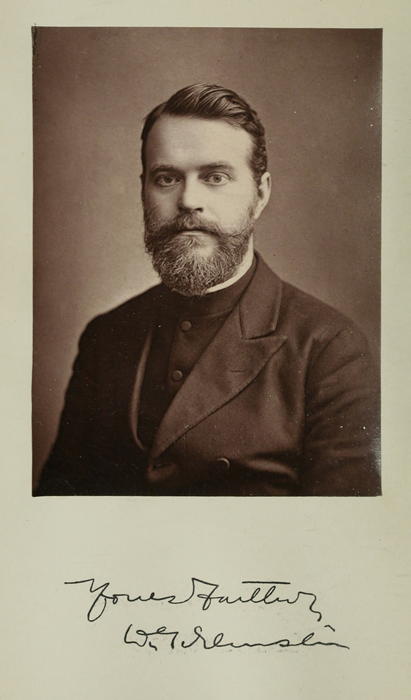
Professor W. G. Elmslie, D.D.: Memoir and Sermons by William Gray Elmslie, W. Robertson Nicoll, and A. N. Macnicoll
Whole book · 22 sections
PROFESSOR W. G. ELMSLIE, D.D.: MEMOIR AND SERMONS .
Transcriber's Note:
Obvious printer errors have been corrected silently.
Correspondence included in the 'Memoir' has been set in smaller font.
A notice of another book by one of the editors has been shifted to the end.
Yours faithfully,
W. G. Elmslie
EDITED BY
W. ROBERTSON NICOLL, M.A., LL.D., AND
A. N. MACNICOLL.
SECOND EDITION.
London:
HODDER AND STOUGHTON, 27, PATERNOSTER ROW.
MDCCCXC.
Printed by Hazell, Watson, & Viney, Ld.,
London and Aylesbury.
ADVERTISEMENT.
MY share in this book has been the writing of the
brief introductory Memoir, with the exception
of the pages relating to Regent Square and Willesden.
These have been contributed by Mr. A. N. Macnicoll,
who has also given me the benefit of his advice throughout.
I have also to acknowledge the kindness of
Principal Dykes, who has read the proofs, and of the
friends who have, amid pressing engagements, enriched
the volume with their reminiscences. The many correspondents
who sent help of various kinds are warmly
thanked. There was abundant material for a larger
biography, and some of it will be utilised in another
way. But it was thought desirable that the memorial
volume should be issued at a moderate price, and that
it should, so far as possible, consist of Professor
Elmslie's own work.
W. R. N.
For the selections from Dr. Elmslie's sermons which
are contained in this volume I am entirely responsible.
These sermons were seldom fully written out, and some
of them required considerable amplification. In every
case the thought of the writer has been rigidly preserved,
and the wording has been left, as far as
possible, untouched. In cases where I have had the
benefit of short-hand reports I have, with the slightest
alteration, printed the sermons as they were delivered.
Two "Sunday Readings" are reprinted from Good
Words, and an article on Genesis from the Contemporary
Review.
"Behold, I stand at the door, and knock: if any man hear My voice, and
open the door, I will come in to him, and will sup with him, and he
with Me."—Rev. iii. 20.
"And unto the angel of the Church in Sardis write; These things saith
He that hath the seven Spirits of God, and the seven stars; I know thy
works, that thou hast a name that thou livest, and art dead. Be
watchful and strengthen the things which remain, that are ready to die:
for I have not found thy works perfect before God."—Rev. iii.
1, 2.
Reading the last clause a little more literally will more fully bring
out the meaning: "For I have found no works of thine fulfilled before
my God."—R.V.
"Wherefore lift up the hands which hang down, and the
[en]feeble[d] knees; and make straight [smooth] paths for [with] your
feet, lest that which is lame be turned out of the way; but let it
rather be healed [or, in order that that which is lame may not be
caused to go astray, but may rather be healed]."—Heb. xii. 12, 13.
"He [Hezekiah] removed the high places, and brake the images, and cut
down the groves, and brake in pieces the brasen serpent that Moses had
made: for unto those days the children of Israel did burn incense to
it: and he called it Nehushtan."—2 Kings xviii. 4.
(Preached at
Nottingham, before the Congregational Union of England
and Wales, on Monday Evening, October 8th, 1888.)
"In the year that King Uzziah died I saw the Lord
sitting upon a throne, high and lifted up, and His train overspreading
the temple floor. Seraphs were poised above, each with six wings, with
twain veiling his face, with twain veiling his feet, and with twain
hovering. And those on one side sang in responsive chorus with those on
the other side, saying, 'Holy, holy, holy is the Lord of hosts. The
fulness of the whole earth is His glory.' And the foundations of the
threshold trembled at the sound of that singing, and the house was
filled with incense smoke. Then cried I, 'Woe is me! for I am a dead
man; because I am a man of unclean lips, and I dwell in the midst of a
people of unclean lips; for mine eyes have seen the King, the Lord of
hosts.' Then flew one of the seraphs unto me, having in his hand a
burning ember, which with a tongs he had taken from off the incense
altar; and he touched my mouth with it, and said, 'Lo, this hath
touched thy lips; and thine iniquity is taken away, and thy sin
purged.' Thereupon I heard the voice of the Lord, saying, 'Whom shall I
send, and who will go for us?' Then I cried, 'See me; send
me.'"—Isaiah vi. 1-8 (annotated).
"When I consider Thy heavens, the work of Thy fingers, the moon and the
stars, which Thou hast ordained; what is man, that Thou art mindful of
him? and the son of man, that Thou visitest him? For Thou hast made him
a little lower than the angels, and hast crowned him with glory and
honour. Thou madest him to have dominion over the works of Thy hands;
Thou hast put all things under his feet."—Psalm viii. 3-6.
"But now we see not yet all things put under
Him."—Heb. ii. 8.
(Preached in
Willesden Presbyterian Church, September 24th, 1882.)
"O death, where is thy sting? O grave, where is thy victory? The sting
of death is sin; and the strength of sin is the law. But thanks be to
God, which giveth us the victory through our Lord Jesus Christ.
Therefore, my beloved brethren, be ye steadfast, unmovable, always
abounding in the work of the Lord, forasmuch as ye know that your
labour is not in vain in the Lord."—1 Cor. xv. 55-8.
"Now concerning the collection for the saints, as I have given order to
the churches of Galatia, even so do ye. Upon the first day of the week
let every one of you lay by him in store, as God hath prospered him,
that there be no gatherings when I come. And when I come, whomsoever ye
shall approve by your letters, them will I send to bring your
liberality unto Jerusalem."—1 Cor. xvi. 1-3.
"Lord, my heart is not haughty,
Nor mine eyes lofty:
Neither do I exercise myself in great matters,
Or in things too high for me.
Surely I have behaved
And quieted myself;
As a child that is weaned of its mother,
My soul is even as a weaned child.
Let Israel hope in the Lord
From henceforth and for ever."—Ps. cxxxi.
I.
Read Job xxvi., and 1 Cor. xiii. The Source of Unrest.
"Things too high for me."
II.
Read Ps. xxxvii., and Matt. xi. The Secret of Rest.
"Lord my heart is not haughty, nor mine eyes lofty."
III.
Read Ps. lxxiii. and Heb. xii. Calm after Storm.
"Surely I have behaved and quieted myself."
IV.
Read Ps. xlvii. and Phil. ii. Victory by Surrender.
"As a child that is weaned of his mother: my soul is even as a weaned
child."
V.
Read Gen. xxxii. and Rev. vii. The Recompense of Faith.
"Let Israel hope in the Lord from henceforth and for ever."
ALTHOUGH Dr. Elmslie was not destined to a long
career, and died with the greater purposes of
his life work almost entirely unfulfilled, very few men
in the Nonconformist churches of Great Britain were
better known and loved. The expectations of many in
his native Scotland were fixed on him from the first;
in England no preacher of his years had a larger or
more enthusiastic following. Among students of the
Old Testament he was beginning to be known as a
master in his own subject, and as one likely to accomplish
much in the reconciliation of criticism and faith.
Add to this that he possessed the rarer charm of an
almost unique personal magnetism—that many were
attached to him by the chain which is not quickly
broken, the bond of spiritual affinity, and it becomes
necessary to apologise only for the imperfections, not
for the existence, of this memorial.
William Gray Elmslie was born in the Free Church
Manse of Insch, Aberdeenshire, October 5th, 1848, the
second son of the Rev. William Elmslie, M.A., and
May Cruickshank, his wife. Writing to his parents
from Berlin more than twenty years after, he says,
"How thankful I ought to be that I was born in dear
old Scotland, and in the humble little Free Church manse
of Insch!" His father was famous for his shrewd,
homely, genial wisdom. He was a native of Aberdeen,
and had the strong sense and quick perception for which
Aberdonians are known. By no means without the
nobler enthusiasms of Christianity, he had shared in
the fervour of the Disruption movement, and was the
popular and successful minister of a congregation large
for the district, and including many members of earnest
Christian principle. Mr. Elmslie was the father and
counsellor of the whole parish; his advice was sought
by members of all Churches, and cheerfully given. If
there was any danger of his practical nature becoming
somewhat too hard and worldly, the influence of his
wife was a corrective. Dr. Elmslie's mother—a beautiful
and accomplished woman—was a religious enthusiast.
"I recognised," writes her son, from the New
College, Edinburgh, "mamma's review in the Free
Press by the words 'wrestling believing prayer.'" They
were indeed characteristic, and it was the rare union of
mystic elevation and warmth with perfect comprehension
of ordinary life that gave Dr. Elmslie his separate
and commanding place among the teachers of his time.
The austerity, the somewhat chilly rigour which characterised
manse life in the Free Church were not
found at Insch. The children never suffered from the
want of affection—what the French call le besoin d'être
aimé. All the best was brought out in them, and in
the case of our subject the brightness and sweetness
of his disposition procured for him more than ordinary
endearments. Two lovingly preserved letters in a large
round child's hand give a better idea of the home than
anything I can say. The first describes a visit to
Huntly and the home of Duncan Matheson, the great
evangelist, who did yeoman service in the Crimean
War.
"Insch, July 14th, 1856.
"My dear Mamma,—I am always glad when I hear that you are all
keeping well. I have such a long string of news that I do not know
where to begin, for I was at Huntly, and saw so many things there. I
will now tell you the most of what I saw. I first saw the Bogie, and a
few sheep being washed in it. When I arrived at Huntly, and had walked
a short distance, Mr. Matheson and I met his dog Dash. When I got to
the house I was first shown the Bugle, then the Drum, and three swords;
one was broken after killing five Rusians, and the man who had used it
killed. And then I saw the Rifle, and fired it off, though without
shot. When I got out of the house I went to a shop where I bought a gun
and Almonds, and on our way home Miss Matheson and I called on the
Lawsons, and brought Johny and Jamie home, where we met William Brown,
with his Aunt Mrs. Douglas, waiting us. When we went into the house
there were two pistols which William and I took, and frightened some
boys with them. I saw a piece of the rock of Gibralter. I saw a piece
of wood made into stone, and two teeth—one a shark's, and the other an
Alligator's—hardened into stone. There were medals and coins of the
various countries of Europe, a piece of a church in Sevastopool, and a
thing which the Russian soldiers wear on their coats. I also saw a
brush which the Turks use for brushing themselves. I also saw an idol
and a great many pictures of the Virgin Mary. I saw a small
picture-book with all the different priests of Rome. Our Rabbits are
all quite well and growing. I am your affᵗᵉ Son,
"My dear Mama,—I am glad to hear that Papa is keeping better.
How I would like to be with you, and see the beautiful scenery and the
many rabbits. Tell our cousins to come here some time soon, and let
them see our rabbits if they will come. I send some Heather and some
broom which we got on the hill beside John Davison, and took tea with
him. I enclose what I got down of the forenoon sermon. I am your affᵗᵉ
son,
"W. G. Elmslie."
P.S.—We sometimes receive to small dinners, but sometimes pretty good.
"W. G. Elmslie."
The religious forces of the time were those of that
Evangelicalism which has been the base of so many
powerful characters, even among those who have afterwards
rejected it, like Cardinal Newman and George
Eliot. These were reinforced by the influences of the
Disruption, then at their strongest. It was something
to be born at such a time, a time when, to use the words
of Lacordaire, there was a noble union of heroic character
and memorable achievement. The pecuniary
poverty and spiritual opulence of Scotland, on which
Carlyle has said so much, were then seen at their best.
If a cautious, reticent race, impatient of extravagant
action and unmeasured speech, is to be found anywhere,
it is among the peasants of Aberdeenshire; but when
possessed and stirred by religious feeling they are
capable of unyielding firmness and unstinted devotion.
These qualities were remarkably brought out at the
Disruption. The religious life of New England, pictured
by Harriet Beecher Stowe, must have been
similar in many things, and Dr. George Macdonald,
who was born in Huntly, a few miles from Insch, has
rendered some aspects with incomparable beauty and
tenderness in his first works. The preaching was
intensely theological. The great highways of truth
were trodden and retrodden. Texts were largely
taken from the Epistles, and the doctrines of grace
were accurately and thoroughly expounded. Freshness,
style, and the other qualities now held essential
to popular sermons were unknown. But the preaching
did its work, nevertheless, as Dr. Macdonald says,
because it was preaching—the rare speech of a man to
his fellows, whereby they know that he is in his inmost
heart a believer. As the result, every conscience
hung out the pale or the red flag. Dr. Macdonald
complains of the inharmonious singing, but others
will testify with Mrs. Stowe that the slow, rude, and
primitive rendering of the metrical Psalms excited them
painfully. "It brought over one, like a presence, the
sense of the infinite and the eternal, the yearning,
and the fear, and the desire of the poor finite being, so
ignorant and so helpless." Not less impressive was
the piety to be found among the peasants. There were
David Elginbrods in their ranks, men among whom
you felt in the presence of the higher natures of the
world—and women delivered from lonely, craving
solitude by the Eternal Love that had broken through
and ended the dark and melancholy years. These were
to be found not only among the prominent Church
members, but among others willing to be unknown,
to be stones sunk in the foundation of the spiritual
building. Under such influences the boy became a
Christian almost unconsciously. There was no crisis
in his life, that I can trace. When a mere boy he
writes to his parents, during their absence from Insch,
that he had conducted family worship according to
their desire. "It required a great deal of previous
thought and prayer, too, for I have found that is useful,
and not study only, in preparing for the service of
God. Yet I have good cause to be glad and thankful
that I am able to do it; and I feel it a real relief and
privilege to commit all to the care of God." At this
time he visited an aged member of his father's Church,
and prayed with her. He repeats with pride the compliment
paid him in return, "Ye ken hoo to be kind
and couthy wi' a puir auld body." His faith and vision
grew clearer, but in cruder shape those thoughts were
his from the beginning that haunted him to the very
end.
The intellectual atmosphere of the place was much
more quickening than might be thought. Insch is a
cosy little village enough, and though not in itself
beautiful, has picturesque bits near it. But even in
summer sunshine it can hardly be called lively, and in
winter, when the snow is piled for weeks on hill and field,
and the leaden-coloured clouds refuse to part, it could
not well look duller. But the Free Church manses of the
district were full of eager inquiry. The ministers were
educated men, graduates of the University, and in
some cases had swept its prizes. Their ambition was
satisfied in the service of Christ. There was a noble
contentment with their lot which it is inspiring to think
of; but they cherished a righteous ambition for their
children, and spared no toil and no self-denial to open
the way for them. From three Free Church manses in
that neighbourhood, all at first included in the same
Presbytery, have gone forth men whose names are
familiar to the English people. From the manse of Keig,
Professor Robertson Smith; from Rhynie, Mr. A. M.
Mackay, of Uganda, the true successor to Livingstone,
whose early death is announced as these sheets are
passing through the press; and from Insch, Professor
Elmslie. The educational facilities of the district were
of almost ideal excellence. The parish teachers, when
salaries were increased by certain wise and liberal
bequests, were almost without exception accomplished
scholars. They took pride in a promising pupil, and
would cheerfully work extra hours to ensure his success.
Their fees were sufficiently moderate, one pound being
enough to cover all expenses for a year. At these
schools a boy might remain till he had reached the age,
say, of fourteen or fifteen, when he might go to Aberdeen
to compete for a scholarship, or "bursary" as it
was called. Of these, perhaps forty were offered every
year, varying from £35 a year for the University
course, downwards. It was thought wiser to go for
the last year or two to the Grammar School in Aberdeen,
to receive the last polish; but often lads went in from
their native glens, and defeated all competitors. Elmslie
was trained at first in the Free Church school at Insch,
then at the parish school, under the Rev. James
McLachlan. He then proceeded to the Aberdeen
Grammar School, where he was two years, under the
Rev. William Barrack, a teacher of rare attainments and
enthusiasm. He carried off one of the highest honours,
and in 1864 entered the University of Aberdeen.
It is, or was, the ambition of every hopeful youth in
the North to wear the student's gown. "Oh that God
would spare me to wear the red cloakie!" said John
Duncan, afterwards the well-known Professor of Hebrew
in the New College, Edinburgh, when weakened by an
early illness. The life of the Aberdeen student has
never, perhaps, been rendered with sufficient fidelity,
save in "Alec Forbes," and Dr. Walter Smith's "Borland
Hall," and it may have changed in some respects
since Elmslie's time. Then it was emphatically a period
of plain living and hard work. Eight shillings a week
sufficed to cover many a student's expenses for board
and lodging, amounting to less than £10 for the
twenty weeks of the session, and the summer was
spent at home. The spirit of the place was democratic
in the extreme. There were a few students who came
out of wealthy families, but any claim to respect on
this ground would have been fiercely resented. George
Macdonald tells of an aristocrat among the students
condemned and sentenced by a meeting presided over by
"the pale-faced son of a burly ploughman." The high
spirits of youth would at times break out in coarse and
even ferocious excesses, but these were rare, and the
characteristic of the place was a limitless persistency of
application. Most of the men felt that this was their
one chance. If they could distinguish themselves, there
were scholarships to be had which would open the path
to Oxford or Cambridge, or give them a fair chance in
other fields of life. Some yielded to temptation, and
became wrecks; others, after a period of obscuration,
recovered themselves; a few soon abandoned the quest
for University honours, and busied themselves with
other lines of reading and study; but Elmslie set
himself, without flinching or turning aside, to his task.
Evil did not lure him. There was no stamp of moral
défaillance on that clear brow. His watchful parents
were still with him, for they set up another home in
Aberdeen, and were constantly with their children. It
ought, perhaps, to be mentioned that Elmslie's father
was an enthusiastic total abstainer, in days when the
practice was quite unfashionable, and in many parts of
the country entirely unknown. In this his son warmly
sympathised, maintaining the principle of abstinence to
the end of his life, and carrying out the practice even
during his studies in Germany. He wrote home, when
assistant in Regent Square, "Glad you are getting on
so famously in the temperance line, and do hope it
will have a permanent and wide influence." But the
secret of his University success was his indefatigable
labour at the prescribed tasks. Although he
might well be termed l'esprit soudain, he was capable of
the long-continued and daily application which belongs
to the rare union of ardour and patience. He had the
characteristic of his countrymen—nothing could daunt
him from fighting the battle out. His success accordingly
was great and growing. In a class which numbered,
perhaps, an unusual proportion of brilliant men, he
steadily made his way to the front. He distinguished
himself by taking prizes in almost every department of
study, specially excelling in mathematics, and closed
his career by carrying off the gold medal awarded by
the Aberdeen Town Council to the first student of the
year, in April, 1868. The victory was not gained without
a price. From the first his studies brought on
some occasional headaches, and the first triumph resulted
in a serious illness, which his wise and skilful
physician, Dr. Davidson, of Wartle, warned him would
reappear twenty years later—an ominous prophecy,
which was but too exactly fulfilled. The chief intellectual
force in the Northern University at that time
and long after was Dr. Alexander Bain, the Professor
of Logic. In after life Dr. Elmslie frequently referred
to his influence. But other chairs were also occupied
by powerful men. Geddes infected many with his own
enthusiasm for Greek literature; Fuller and Thomson
were admirably efficient teachers of mathematics; and to
name no more, "Jeems" Nicol, the Professor of Natural
History, with his hoarse voice, his homely kindness,
and his thorough knowledge of his subject, was a universal
favourite. Thomson was, perhaps, the most
original and cynical character of them all, and his dry
wit had a great attraction for Elmslie.
The Rev. Thomas Nicol, of Tolbooth, Edinburgh, a
distinguished minister of the Church of Scotland and
one of the most outstanding of Professor Elmslie's classfellows,
wrote thus to his father: "Since Dr. Elmslie's
death I have often gone back to the days, just twenty-five
years ago, when we first met at the bursary
competition, and in the Bageant class at King's College,
Aberdeen. Even from the first he was one of the most
winsome and attractive members of the class, full of
fun and mirth, with a perennial smile on his beautiful
and finely formed face, and with a cheery word for
everybody. I can see him to-day, with his neat Highland
cape and the college gown over it, coming through
the quadrangle, as distinctly as if it were yesterday, and
it is easier for me preserving that picture because we
have met so seldom of recent years. He is associated
in my mind with another of our classfellows, who
achieved distinction early, and early met an heroic and
tragic death—I mean Mr. William Jenkyns, C.I.E., who
died with Sir Louis Cavagnari, at Cabul. Your son
and he were unlike in some things, but in delicacy of
features, and expressiveness of countenance, and slimness
of figure one associates them at once together.
When I was helping to get up funds for the memorial of
Mr. Jenkyns now in the University Library at Aberdeen
I well remember the cheerfulness with which Mr.
Elmslie contributed, and the kindly words of affection
and esteem which accompanied his contribution. Of
both it might most truly be said that 'being made
perfect, in a short time they fulfilled a long time.'
Like others of my classfellows, Mr. Bruce, our first
Bursar, now minister of Banff, W. L. Davidson, LL.D.,
minister of Bourtie, and our mutual friend John Smith,
of Broughton Place Church here, and many more, I
watched your son's career with the deepest interest,
and as I have said, took quite a pride in the career of
usefulness and honour which by his ability and hard
work he shaped for himself in London. We really felt
as if he were our own somehow, and as if we had a
share in all the honours he was gaining, both as a
literary and as a public man." The Rev. W. A. Gray,
of Elgin, who was brought up in a neighbouring Free
Church manse, says, "What characterised him then was
his intense sense of fun, his perception of the comic
side of things, especially in regard to people, and his
never-failing stock of anecdotes, almost always humorous,
never malicious." Coming several years after
Elmslie to the University of Aberdeen, I only knew him
from a distance. To an outsider his prominent quality
was winsomeness. There was no jealousy in Aberdeen
of fairly won success; if there had been, Elmslie would
have disarmed it. Then, as always, he took his victories
with the utmost simplicity. He was always
humble, with the humility which is very consistent with
strenuous effort and even great ambition.
The sons of Free Church ministers in those days, however
great their University successes might have been,
generally desired no higher position than that of their
fathers. It was, no doubt, the wish of his parents that
Elmslie should be a minister, and his inclination fell
in with that. At the same time there were counter-inducements;
for one, many Aberdeen students had
been winning high distinction at Cambridge, the senior
wranglership having fallen to some of them, and his
teacher and some of his relatives were anxious that he
should try his fortunes there. He had himself a strong
bent to the medical profession. Whatever line he had
taken in life he would have been successful. A well-known
revivalist preacher, also a professional man, is
understood to have counselled him to go in for a business
life. One who knew him well has remarked to me,
since his death, that his true pre-eminence would have
been shown in a scientific career. But his life, and
especially its closing years, made it plain that his own
choice was wise.
A new era opened for him when he went as a
theological student to the New College, Edinburgh.
The Free Church possesses a theological seminary in
Aberdeen which assuredly did not lack for able Professors,
but the number of students is small, and
the more ambitious men usually go to Edinburgh. In
Edinburgh the Free Church College (known as New
College) had for its first Principal Dr. Chalmers, and
in succession Dr. Cunningham and Dr. Candlish, the
three greatest of the Disruption worthies. It had also
some notable men among its Professors. When Elmslie
went up Candlish was at the head. His appearances
were only occasional, as he was also minister of Free
St. George's, Edinburgh. But although his contribution
to the vitality of the New College was necessarily
small, it was real. Mr. Gray writes: "He gave no
lectures, his work being confined to the examining and
criticising of the students' discourses. There was
always a considerable interest in these criticisms, and a
good turn out to hear them. They were usually strongly
put, both in the direction of censure and of praise;
but any one who knew the Doctor's methods, and made
allowance for vigour of phrase, could depend on a true
and perceptive estimate of the merits or demerits of
a sermon. Sometimes he could be savage enough.
Fancy a man tomahawked with the following, delivered
with the well-known burr, flash of eye, and protrusion
of underlip: 'All I have got to say about this discourse
is' (raising his voice) 'that one half should be struck
out, and' (lowering it again) 'it doesn't matter which
half.' This may have compared with another historic
criticism, attributed to Dr. Cunningham when addressing
the author of a certain Latin thesis: 'Of this
discourse I have only to say two things—the writer
has murdered the Latin tongue, and perverted the
glorious Gospel of Christ.' But Candlish was one
of the kindest of men. How well I remember the
little figure, with the gold spectacles flashing beneath
the big hat; the loosely fitting coat; the wide trousers,
lapping two or three inches above the shoes, which
were usually set off by a foot of loose lace; the gruff
greeting, which usually changed into a warm, hearty
smile if he were accosted."
Among the Professors, Elmslie evidently appreciated
Dr. Davidson and Dr. Rainy, while conscious of receiving
benefit from others. The longest personal sketch
he ever wrote was an article on Professor Davidson in
the Expositor (January, 1888). In this he says, "His
singular and significant influence does not consist in
what he does, but in what he is. It is not the quantity
or the contents, but the quality and kind of the thinking.
It is not even the thought, so much as the mind that
secretes it. It is not its clearness nor its profundity,
not its reserve nor its passion, not its scepticism nor
its superiority of spiritual faith; but it is the combination
of all these, and the strange, subtle, and fascinating
outcome of them. The central and sovereign spring
of Dr. Davidson's unique influence in the literature,
scholarship, and ministry of the Church is his personality....
If the Church of Christ within our borders
should pass through the present trial of faith without
panic, without reactionary antagonism to truth, and
without loss of spiritual power, a very large part of the
credit will belong to the quiet but commanding influence
of the Hebrew chair in that college which rises so
picturesquely on the ancient site of Mary of Guise's
palace in Edinburgh." Of Dr. Rainy he has nowhere
written at length, but he was wont to speak of his
"smouldering passion," and the great ideas with which
he inspired the receptive among his students. Dr.
Elmslie, though resolute and even daring on occasion,
was a warm admirer of statesmanship, and Dr. Rainy's
skilful piloting of the Free Church through many
troubles he would often praise, emphasizing strongly,
at the same time, his belief in the Principal's perfect
honesty and singleness of purpose.
There are many kind allusions in his letters to Dr.
Blaikie, to whom he was specially grateful for having
introduced him to practical mission work. In this he
was always intensely interested, maintaining that on
this ground the true battle of Christ must be fought.
"Blaikie gave us a capital lecture, its only fault being
that there was too much matter, so that we could not
get down even a mere abstract of the substance."
"Edinburgh, 1868.
"Things are still going on capitally. At the hall Davidson is most
admirable, and Blaikie every day coming out even better and better. For
instance, speaking of the fondness the early apologists displayed
at pointing not to the lives, but to the deaths of Christians, he
added, 'And indeed, gentlemen, I cannot help saying that in the course
of my experience as a minister I have always noticed the hush and
breathless attention such a subject ever commands, and I have found
nothing make a deeper impression, or act more powerfully as a means of
producing good, than a description of a triumphant death-bed.' This is
practical, true, and useful."
Elmslie threw himself with intense energy into the
work of his classes. At first he found it difficult to
maintain the place he had achieved at Aberdeen, for
he had able competitors, but his unweariable diligence
and quick apprehension soon put him at the head.
In one of his earliest letters from Edinburgh he
writes, "On Wednesday evening I did first copy of
my essay with a headache coming on, which came on
with such heartiness that I went to bed, and I could
not go to college on Thursday. (N.B. It is remarkable
that when I have no mamma to nurse me my headaches
never come to such extremes as they do when I have
a fall-back. This one was bad enough, but not one
of the desperate kind.)"
There was only one cure for these headaches, and
he could never bring himself to take it. It would be
tedious to go over the story of his successes. By this
time his younger brother, Leslie, had entered the
University of Edinburgh, where his triumphs were
scarcely less than those of his senior at the New
College. So used did the household at Insch become
to telegrams announcing new prizes and scholarships,
that at certain periods of the year the faithful mother
had telegrams of congratulation already filled up,
waiting to be despatched.
Many students of theology are more impressed by
the preaching they hear than by their Professors,
and Edinburgh has always been known for pulpit
eloquence. But it was the reverse with Elmslie. No
preacher seems to have had any great power over him.
He attended the Free High Church, then ministered
to by Mr. William Arnot; but though he admitted the
freshness and fertility of the preacher's mind, he was
not a warm admirer of his sermons. He often listened
to Dr. Charles J. Brown, in the Free New North, and
liked him: "he seems such a fine-hearted man." One
day he went to hear a fellow-student, and missed the
way to the church. He turned aside into the Barclay
Church, where Mr. (now Dr.) Wilson was preaching.
"I like Mr. Wilson very much. He is thoroughly
practical, both in his preaching and in his prayers.
For instance, in the one after the chapter he prayed
for boys and girls at school, that they might be helped
with their lessons when they were difficult, and that
they might learn obedience and courtesy and be made
blessings to their teachers; also for those persons
who had not had a good training in their youth, and
felt it now in showing a good example to the children,
and especially for those parents and children who were
troubled with bad tempers." After remarking on the
great predominance of young people in the congregation,
he says that the sermon was delivered with
a great deal of energy and action, and that the idea of
the preacher seemed to be to bring religion down on
the every-day life, that it might become the motive
power in work. "On coming out I accosted an intelligent-looking
man, and said, 'Was that Mr. Wilson?'
'Yes,' he said, and added, with a proud smile, 'And
didn't you like him?' I answered, 'Very much indeed,'
whereupon he looked exceedingly gratified and
prouder than ever. I wish there were more such
pride."
On another occasion he writes, "At present I had
sooner hear Dr. Candlish than any one. He is so
strong and honest, and wide in his sympathies. His
address to the students was full of passion and feeling,
and sympathy with the difficulty of believing some of
our Calvinistic doctrines, such as eternal ruin, heathens'
doom, etc. He went a very great length indeed, and
ended by saying it was too hard for him, and his heart
drew him the other way, and all he could do was to fall
back on his loyalty to Christ. It was more a picture of
his own heart's struggles than the Principal's address."
But his usual note is, "Heard ————, in ———— Church:
middling."
In 1871 he gained the Hamilton Scholarship in a most
brilliant manner, his marks being so extraordinary that
as they came in the secretary of the Senatus thought
there must be some mistake. His fellow-students, he
writes, were overwhelmingly kind in their congratulations,
and he himself seems to have rejoiced in this success
more than in any other of his life. One thing was
that in his after-work he would not have the same amount
of anxiety and despair that weighed him down in his
preparations. But the chief thing was the joy it would
give at home. "I need not tell you," he writes to his
mother, "how sweet your letter was to me, telling me of
your joy on receipt of the telegram. When no letter
came in the morning you cannot think how disappointed
I was, for, to confess the truth, I had been thinking all
Sabbath of the pleasure of reading the home letters,
and in them getting the real joy of the scholarship.
For, except the pleasure of knowing the gladness caused
at home, there is not much satisfaction otherwise in
it. It is strange how soon, after the first surprise of
getting it, the delight of getting it passed away, and I
think there was more enjoyment in the working for it
than in the having it."
This incident may stand as typical of many others,
and of his prominent place among men not a few of
whom were of real mark. His comradeships among
the students filled a large place in his life. Of all his
friends the most intimate and best loved was Mr. Andrew
Harper, now Lecturer on Hebrew in Ormond College,
Melbourne. I regret much that exigencies of time make
it impossible to include, for the present at least, any of
his letters to this brother of his heart. They were
always together, for ever disputing, and never quarrelling,
very close to one another in heart and mind. Two
years before Dr. Elmslie's death Mr. Harper visited this
country. The friends resumed their ancient intercourse,
visited Switzerland in company, and found that
the changes of the years had only drawn them nearer.
Some of the best life in the New College has always been
found in the Theological Society—an association of the
students who gather to discuss controverted questions,
and do not fear to go into them thoroughly. These meetings
were greatly relished by Elmslie. Among the
leading members in his time was Professor Robertson
Smith, whose amazing keenness in debate is often
admiringly mentioned in his letters home. The first
time Elmslie spoke in the Society was in connection
with a discussion whether the Free Church should
return to the Establishment on the abolition of patronage.
He took the negative side, and was complimented
on both sides for the ability and ingenuity of his
speech. The speculative daring in the Society at a
time when outside the old orthodoxy was hardly
questioned partly amused and partly pleased him. He
speaks of entertaining Dr. Davidson very much by
telling him that the men at the Theological fathered all
their heresies on Dr. Candlish's "Fatherhood of God,"
by, as they expressed it, carrying out its principles to
their logical conclusions. The subjects themselves,
however, were the main thing and took abiding possession
of his heart. "I intend," he says, "to still
go on studying these themes of Christ more deeply,
for they have interested me intensely. By the way, I
believe what will be of more value to me than the
scholarship, and also far more satisfactory, is the feeling
I have that in preparing for it I have made an
immense addition to my knowledge in several departments,
and done it so thoroughly that it will never pass
away. Two subjects have so interested me that I mean
to go on studying them—namely, the Person of Christ,
and the Early Apostolic Church."
On his work and influence at New College the
letters of Professor Drummond and Dr. Stalker will
give a distinct impression, but I cannot leave the
subject without giving room to what was almost before
everything with him—his work among the poor, and
especially among their children. They show the
brilliant and courted student in another light, and it
is worth mentioning that the larger proportion of his
letters home is made up of such stories. His pupils in
the ragged school greatly interested him, and his letters
from Edinburgh are largely filled with picturesque
incidents of his experience among them.
Edinburgh seemed to him more terrible in its undress
than Aberdeen. "I never saw such miserable
squalid faces, intermingled with roughs and coarse-looking
women." There was a humorous side to it,
also, which he does not fail to give account of. One
day in the Sunday-school a little boy behind indulged
in an occasional pull at his coat-tail, or a facetious
poke at his back, to all of which demonstrations he
preserved an appearance of utter unconsciousness.
When the school was over, and they were waiting their
turn to get out, he turned round and said, not with
a very ferocious countenance, "Now, which of you
young rascals was pulling at my tails?" Of course,
this occasioned immense amusement, and one bright-eyed
little fellow said it could not have been so.
"Oh, well," he said, "it is strange; I wonder if
the forms could have done it." This was a very
tickling idea, and immediately the little fellow said,
"Sir, I gave you a poke." He said, "That is honest,
now, and I suppose some other one took the tails."
"Yes, sir, it was me," said another merry young
monkey, with a comical look. He answered, "I know
you are not good scholars. How do I know that?
Oh, you never heard of good scholars pulling the
teacher's tails!" This was a very striking view of
things to them, and they did not know whether to be
impressed or amused.
The quickness of the city children, and their readiness
of sympathy, specially struck him. But the main issue
of the work was practical. "I cannot help saying
that I feel that this work will do me real good, and
will give me an actual, and not a mere theoretical
interest in the work I have before me. And that is
a thing very much needed. One other thing I may
mention here. We have been having worship once a
day very regularly, and to me at least it has been very
pleasant and very useful. And now good-night to both."
"I shall be very sorry to leave my poor little bairns,
for I have come to like them exceedingly, especially of
late; they have become so numerous that I have to
put some of them on the floor—nearly fifty last night.
I don't know how it is, but I have a strange sort of
feeling, as if they were having a deeper interest in what
I say than I ever saw before; perhaps it is because I
think I have myself. Since Christmas-time I have told
them every night about Jesus, and only stories that
directly illustrated His love and work, and I feel a
difference in the way they listen; some of them especially
sit so very still and quiet, with such an earnest,
solemn look on their faces. Some nights ago Donald
English (who made the disturbance the first night I
began), as I was beginning, took hold of my hand and
said, 'Oh, tell's about Jesus again, the night!' I often
end by asking them to pray Jesus, before they go to
bed, to make them His little ones; and several times, as
they went out, some of them have put their hand in
mine and whispered, 'I'll ask Him the nicht.' Last
Sabbath, when I was speaking of Jesus having died for
our sakes, they were all sitting so very attentive, but
three little boys in one corner began quarrelling about
a bonnet, and disturbing me by the noise. I stopped
twice and looked at them, but they always began again.
Presently I stopped for the third time, and was going to
speak to them, when one of the boys, who had been
very attentive, rushed at them, and before I could interfere
dragged one of them on to the floor, and commenced
a furious onslaught of blows and abuse for interrupting
me. I had hard work in persuading him to stop.
Another very funny thing was the looks of reproachful
indignation which some of the attentive ones had been
casting at the disturbers, previous to the final outbreak.
It was terribly annoying at the time, especially as I
saw that many of them were very deeply interested.
When I was ending I spoke of how Jesus deserved to
be loved, and that they should ask to be made to love
Him. One little girlie whispered, 'I will ask Him, for,
oh, I do want to love Him!' and when I said it was
time to go away they cried, 'Oh, dinna' send's away
yet, tell's mair about Jesus;' and then they came
round me, and made me promise to tell them 'bonnie
stories about Jesus' next Sabbath. I have found that
nothing interests them more than what is directly about
Jesus. I could not help telling you all these little
things, but I never had the same sort of feeling in
teaching a class before, and I would like you to remember
sometimes my poor little children down in the
Canongate. I wish I could take them all into a better
atmosphere, for it is sad to think of their chances of
ever becoming good in such an evil, wretched place.
Harper and I have been having many nice talks. I
mean to preach often in the summer—I want to."
Here he describes an incident of open-air preaching.
A friend was speaking, and Elmslie was managing the
audience.
"Edinburgh, Jan. 23rd, 1872.
"During this the man I had heard swearing at F———— came up to S————,
who was standing a few yards off, and spoke to him. I went up just in
time to hear him say, 'That fellow cannot even talk grammar.' I
replied, 'We don't come here to teach grammar.' He was rather taken
aback, but replied, 'Well, I could have said all your man said
in half the time.' 'Then wait till he is done, and you shall have the
next turn.' 'No, no, I don't want that; if I spoke I should oppose you.'
'I am ready for that; will you do it?' I said; 'We don't come here to
argue.' 'No; you are wise to decline to argue with me.' I answered,
'Pooh! are you so conceited as to suppose that our arguing would make
any difference to Christianity? Why, it has been argued hundreds of
times over by men a deal wiser than you or me, and you see Christianity
has not gone to the wall.' By that time I saw I was going to win, and
got very cool and at my ease, while he got excited and put out; then he
started on a new tack by saying, 'And what good do you expect to do to
humanity by preaching here, and disturbing us?' I said, 'Well, perhaps,
for one thing, we will get some drunken characters like those'
(pointing to some) 'to give up the drink, and be decent, and keep their
wives and children from starving.' 'Well, that may be, but speaking
like yours will never do it.' I answered, 'No, you are quite right, but
we are young, you see, and some of us have not much voice, and some
have not much sense; but we are just trying to find out who of us can
do the thing, and so, you see, we are just doing as well as we can.' He
looked rather amazed at my frankness, and said, 'Well, I'm sure I have
not any ill-will to you, but I don't believe in religion, and there are
such a lot of hypocrites.' I said, 'Yes, there are a great lot, but
that's just a reason why you should believe in the goodness of
religion.' 'How do you make that out?' 'Why, you never heard of people
making imitation of the stones and stuff like that' (pointing to the
gutter), 'but it is sovereigns and things like that they make
counterfeits of.' 'Ay, but I hate hypocrites, and say, Down with them.'
'So do I; and if you could down with all the religious hypocrites you
would do more for Christianity than we can by preaching here.' 'Ah!' he
said, 'if that's your opinion
you should not take to street preaching; they are all hypocrites.' 'Oh,
nonsense!' I replied. He exclaimed, very bitterly, 'Look at ————'
(mentioning a recent scandal); 'what good has that man done?' I
answered, 'More than ever you or I have.' 'I would like to hear how.'
he sneered. 'Why, you know, for one thing, he did manage, whether his
preaching was sense or nonsense, to persuade a lot of drunken working
men to give up drink and go to the kirk, and not waste their money in
the public-house; and now you go and ask their wives and bairns whether
R———— has done any good in the world.' 'Ay, but what do you say to,'
etc.? 'That it was a great sin and shame to him; but that is no reason
for refusing to own that he has done a vast deal of good before he did
that piece of ill; and besides, I doubt if you or I are so good as to
throw stones at him, etc., etc. Now I've listened to your criticisms on
us, and pretty hard some of them were, so you will come up with me now,
and hear what we've got to say.' He said, 'Well, I must say I like your
way of taking things; I never heard them put in the way you have done;
but I have not time now to come up; I have to take tea in half an hour
with a mate.' I said, 'Still, you'll promise to come back next Sunday
and hear us, and I may tell you, in secret, we shall have better
speakers next time, and if you like, after the meeting is over, I'll
have a talk with you. I never did meet one of your side before, but
I've read some of your books. We won't call it a discussion, for I've
not had any experience at arguing, and I suppose you are an old hand.'
He gave a queer laugh, and said, 'Any way I never came across anybody
on your side with half your sharpness and common sense; and besides, I
must say you are honest about it.' And then we shook hands,
and he promised to come along next Sunday.... By the way, in my talk
with the Deist my 'heretical' reading came in useful to me; for if I
had not come through all that, I could not have heard his attacks on
religion and kept my coolness, or taken them up the way I did; so it is
some good; it will give me confidence in myself for the
future—another good thing."
Pleasant interludes in his New College life were a
session spent at Aberdeen University, as assistant to
the Professor of Natural Philosophy, Mr. David Thomson,
and two sessions spent at Berlin in the study
of theology. At Aberdeen he had in his class Mr.
Chrystal, now the celebrated Professor of Mathematics
in the University of Edinburgh, whose abilities he
repeatedly refers to in his letters. His work was
enjoyable, and his relations with Professor Thomson
of the most cordial kind. He was tempted in various
ways to alter his life purpose, was offered a professorship
of Natural Philosophy with a large salary in
the Colonies, and was specially tempted to enter the
medical profession. His closest friend at the University,
Mr. James Shepherd, now a medical missionary
of the United Presbyterian Church in India, was
pursuing his professional studies, and with him he
frequently visited hospital patients, finding a double
interest in the work. Thus he writes:—
"Aberdeen, March 14th, 1870.
"As to Medicine, I have read up most of the text-books prescribed
here, so that I am really very well up on the subject, and Jim Shepherd
says I would make a capital doctor. I went along with him to the
'Dissecting-room,' 'Anatomical Museum,' 'Infirmary,' and 'Incurable
Hospital,' and he did his best to sicken
me (as you remember befell me three years ago), but I was all right, so
he says I am now 'hardened'! It was very interesting seeing all the
poor ill folk, and it was a real pleasure to speak to them, and joke
with them, and leave them cheery."
In Germany it is evident even from his meagre
notebooks that he thoroughly enjoyed life, and entered
into it with his usual zest and brightness. But everything
was subordinated to study. He made himself
master of the language, and did his best to profit from
the lectures he attended.
His good parents were naturally alarmed at the
effects which German practice and thought (more
dreaded then, perhaps, than now) might have upon their
son. He warns them against uncharitableness. "There
is nothing so difficult," he says, "as to convey a true
and fair picture of the religious state of a people.
Just as one's opinion of a person's character is often
wholly changed on coming in contact with him, so
actual life in a country alters one's estimate of it,
and differences of circumstances and training condition
the development of thought." He comes to the conclusion
that it is not a breach of charity to say that the
Germans are in a lower state religiously than Scotland,
but asserts that at the same time there are many good
and spiritual men among them, and that Germany is not
so much more irreligious than, for example, London. He
quotes Dorner as saying of missionary work, "You
send more money, but we send more men." At that
time he was beginning to understand Dorner's lectures,
and says they are very good and very useful, especially
for Germany. "For instance, he has been defending
the doctrine of the Trinity, the personality of the Holy
Ghost, the Divinity of Christ, and eternal punishment.
He is very practical and thorough."
His attachment to Dorner grew as is witnessed by
the following letter:—
"Dorner is a thoroughly good and very able man, and I have found your
remark true, for I have already got a great deal of good from his
lectures on Romans. He is at present lecturing on the 4th chapter, and
since I began to understand him I have enjoyed his lectures very much;
formerly the first few chapters of Romans seemed to me almost
unintelligible, but I now see not only the meaning of the separate
verses, but the grand line of thought and argument running through the
whole, and I have a far clearer conception of many of the grandest
Gospel doctrines than I had before, and especially of the nature of
Christ's sacrifice for sin, and the necessity lying on God to punish
sin. I wish I could send you some extracts from the lectures to show
you how very good they are, but I can only give you one illustration.
On iii. 28—which Luther translates, 'We conclude, then, that a man is
justified by faith alone, without the deeds of the law'—he
remarked that the Romanists misrepresent the meaning of this, and
accuse Luther of Antinomianism, but (he added) Luther's position is
simply this: 'The fruit does not make the tree, but a good tree
cannot be without fruit.' When he was lecturing on iii. 25, where the
question comes up whether Christ was merely the Altar for the
propitiatory sacrifice or Himself the Sacrifice, he quoted Dr. Chalmers
and another Scotch theologian with extreme approval, viz.,
Morison—do you know who he is? (Dorner took strongly the view that
Christ was Himself the Sacrifice.) It is a great pleasure to hear him
reading the verses of the passage he is to examine, for he does it with
such earnestness and impressiveness that they seem to have double the
meaning that they have ordinarily; he has a great deal of eloquence in
him, and I like him very much."
"I always read Meyer's Commentary on Romans before going to the class,
so that I am studying Romans very thoroughly, and as the other
Professor I attend is lecturing on Paul's Teaching, and has been
lecturing on his Life, I shall know a good deal more of Paul before I
come back."
"On Wednesday, the 9th, I bought two Commentaries—De Wette on Psalms,
and Meyer on Romans; they were rolled up in a sheet of paper taken out
of an old book, containing some sixteen pages. I happened to glance at
it in unfolding it, and my attention was caught by these words, in
German, of which the following is a translation: 'Look upon your
children as just so many flowers, which have been lent to you out of
God's garden; the flowers may wither or die, yet thank God that He has
lent them to you for one summer.' I thought at once that I had surely
known the style long ago, and on glancing down the pages I was not at
all surprised to find where the letter broke off—'S. R.— Aberdeen,
March 7th, 1637.' Was it not strange to come in that odd way on a
German translation of Samuel Rutherford's Letters? (See if you can find
the passage.) I also notice, in the bookseller's catalogue, that
Bunyan's works are all translated, also Spurgeon's, 'Schonberg-Cotta
Family,' Mrs. Henry Wood's novels, etc."
In the autumn of 1873 Mr. Elmslie came to London.
Four years previously Dr. Dykes had assumed the
pastorate of the church at Regent Square. His health
made it necessary for him to receive, from the commencement,
assistance in his work. He was always
anxious to secure the services of young men who might
be trained under him for high achievements in later years.
He heard of Mr. Elmslie's brilliant promise and invited
him to fill the position, then vacant, of assistant to
himself. The invitation was accepted, and Mr. Elmslie
settled in London.
At Regent Square he flung himself into the work of
the congregation with eager sympathy. He rapidly
became popular and was made welcome in every home.
In Dr. Dykes he found a wise and kind helper, to whom
he became warmly attached. He appreciated his methods
of working and his power as a preacher; but most of
all he was struck by that grace of devotional fervour
which gave Dr. Dykes' prayers so constraining a power
to draw the souls of his people into communion with
God. Nothing could have been brighter and happier
than the life of the young preacher in his new surroundings,
and his contagious enthusiasm and energy reacted
on all who knew him. Here in London, at the busy
centre of so much of the world's activity, his eager,
questioning spirit found material for its restless enquiries;
whilst that knowledge of human nature and its
needs, which lay at the back of his most powerful
spiritual work in later years, was slowly moulded by
the opportunities of this time.
He describes in a letter to his mother the opening of
his pulpit work at Regent Square. His chief fear was
for his voice: "It looked such a distance," he writes,
"to the faces in the end gallery." He got a friend to
sit at the far end of the church, just over the clock,
with a handkerchief which he was to wave if the speaker
were inaudible. The subject of his sermon was, "The
blood of Jesus Christ cleanseth us from all sin."
It is curious that the only despondent note that sounds
through his correspondence at this time is the lamentation
that he is unfitted for the pulpit. Repeatedly he
expresses the fear that he will never make a preacher.
He feels stiff and ill at ease. Official trappings of any
kind he always disliked; and the pulpit robes, which he
afterwards, as far as possible, discarded, he even then,
as he told Dr. Dykes, detested. "I find it," he writes,
"most hopeless to get anything I much care to say, and
even then it is a perplexity generally to see what really
is the reason. I am at the very point of giving over
preaching altogether." Again, "I am more sure than
ever that I am not a preacher," "Romps with Mr.
Turnbull's children's singing-class are, on the whole,
the most satisfactory occupation I know of."
These doubts and discouragements are not surprising.
From the very first Dr. Elmslie conceived of the
Christian Faith in a deep, comprehensive way, and its
ideals of purity and holiness touched and warmed his
nature at many points. Just because the outline was
so large the filling-in took years to accomplish. It was
only by continuous and patient self-analysis, by long
observation and study of his fellow-men, that he was
able to meet the needs of humanity, at all points, with
a message which no one interpreted more largely. His
sermons at Regent Square are sketches and outlines
which experience alone could embody and complete. I
have been much struck, in preparing a selection of his
sermons for the press, with the growth of their composition.
The sermon, for example, which stands first in
this volume is, I think, the earliest he ever wrote. But
the sermon, as it was last preached and is now printed,
is not the sermon as he wrote it. The latter, though in
outline identical, has been emptied of its original contents
and re-filled out of the abundance of a heart which
had grown in deeper knowledge of human needs and
the approaches of Divine compassion.
His greatest satisfaction he found in his intercourse
with the young men in the congregation.
"At the Young Men's Society," he writes, "I have
been chairman for some time, and have to sum up: it
costs me no preparation, and yet how they listen, and
how I feel I can sway them as I please! I enjoy that
kind of speaking."
It was at the close of these weekly discussions that
Mr. Elmslie and I used often to meet. Our homeward
paths were not identical, but we used to imagine that
we were alternately escorting one another home as we
spent a measurable portion of many a night upon the
pavement, heedless of the thinning traffic, in keen
debate over some of those deep insoluble problems
which, I am glad to think, trouble his eager heart no
longer. "I have long believed," he writes, "thinking
to be more unhealthy than fever, cholera, bad drains,
etc. I would give a good deal to be only an animal
now and then."
Almost the first hopeful word about his preaching
in Regent Square occurs in the following passage; it
is interesting otherwise:—
"On Monday evening I was at Mr. Bell's. He pressed me to stay; thought
I should not be a Professor; meant for a preacher; would have great
power; something quite peculiar about my sermons; made Christ and
everything so real, and near, and helpful; and my prayers always did
him good, etc., etc.
"Curious, that in my sermons tells with everybody, for it comes from my
line of reading and thinking at college, especially from the German
books on Christ, such as Strauss; they made me trust Him as a
Person rather than a doctrine; besides, I know I have come to regard
Him all round differently in consequence. I have had to pay dearly for
the reading, and have often wished I had not, so it is a little comfort
to find that my coming through it makes me more helpful now."
The following is worth quoting as an instance of his
ready resource:—
"48, Regent Square, Tuesday.
"My Dear Folks,—On Saturday morning a shabby man called, said
he was a cousin of Dykes, needing money too, etc., just come from
America—awkward Dykes on Continent. I saw he was an impostor, so
resolved to get rid of him. I answered, 'It is awkward.' Then he
said, 'What is to become of me? I look to you, sir.' 'Nothing will come
of that, I fear.' 'But are you not Dr. Dykes's assistant?' 'Yes, I
assist him, but not his relatives.' 'Well, but, sir, what would
you advise me to do?' 'To say "Good morning," and not lose more of your
time here.' As he got up he rubbed his stomach and said, 'I have had no
breakfast to-day.' 'Very hard that mine is over, and my landlady does
not like to have to make a second; do you often go without food?' 'Many
and many a time, sir.' 'Ah, the doctor says it is good for the health!
I wish I looked as well-fed as you do, going without breakfast. It must
be economical. Good morning.' And we parted with mutual grins."
Among the congregation at Regent Square Mr.
Elmslie formed many friendships. He conceived a
warm regard for Professor Burdon-Sanderson (now of
Oxford) and his wife; and other names might be mentioned
of those who became lifelong friends. Among
men who have since become well known, he saw something
of Professor G. J. Romanes, who was then an occasional
visitor at Regent Square. About this time he
describes a meeting with Macdonell of the Times, whom
he speaks of as "full of light." On the same occasion
he met Dr. Marcus Dods for, I think, the first time.
"Dods, I like very much," is his brief comment.
Two years after his first arrival in London Mr.
Elmslie settled in Willesden as minister of the Presbyterian
Congregation there. When he left Scotland in
1873 he had formed no resolve to sever his ecclesiastical
connection with that country. Circumstances and
inclination, however, kept him in the south. He was
much impressed with the type of congregation which
represented English Presbyterianism at Regent Square.
For many members of the session he had a warm
respect and friendly admiration. He was interested in
the experimental position of a Church, such as the
Presbyterian one in England, comparatively young and
small. The appeal that came to him from Willesden
was direct and urgent. It is not to be wondered at
that he yielded, at first rather reluctantly, to its pleading.
The next eight years of his life were spent in
active ministry in this little metropolitan suburb.
When Mr. Elmslie came to Willesden the place was
much less populous than it has since become. The
streets were only partially lighted. The road from
the Junction Station to the little village of Harlesden,
which is now a continuous row of shops and houses,
passed then between ragged hedges, under a canopy
of elms. The Presbyterian Church was not built,
but services were held in a hall, which was the first
building the Scotch residents put up. Mr. Elmslie
took rooms near the site of the prospective church,
but shortly after moved to the little house in Manor
Villas which belonged to the chapel-keeper and his
wife—Mr. and Mrs. Oxlade—a worthy couple, who
returned the respect with which he regarded them by
a loving admiration for the best man, as they phrased
it, whom they ever knew.
On November 23rd, 1875, Mr. Elmslie was duly
ordained. His dear mother was present at the service,
and many friends. I had been with him during the
earlier part of the day. Among other subjects of
conversation we had been anticipating an episcopal
discussion on the ethics of betting. He recognized
the difficulty of the subject, and as he got more hopelessly
perplexed in his effort to justify an absolute
prohibition of the practice on grounds which could
be intellectually defended, he turned, I remember, to
his mother with a look of comical helplessness: "Here
am I going to be ordained, and I don't even know why
it's wrong to bet."
The congregation under his watchful care grew and
prospered. A more united body of people never kept
together in corporate life, and this happy result was
due in chief measure to the unwearied tact and resource
of the young minister.
In the spring of the following year the new church
was completed and opened for public worship. Mr.
Elmslie seemed to be able to draw into it men of all
shades of religious opinion, and some even whose
family traditions were at variance with evangelical
orthodoxy. One of the distinguished sons of a famous
Unitarian household was a fellow-worshipper with
Ned Wright the evangelist. Throughout the whole
of the little community which he ruled, for young and
old alike, there was life, energy, and kindly charity.
He felt that the path of Christian living was not to be
trodden without ardent effort; and his example was at
once a stimulus to the strong and an encouragement
to the weak. "Your prayers," said a lady to him at
this time, "always make me feel that it is a terribly
difficult thing to be a Christian—but you can't think
what a lot of good they do me."
The year after (1877) Mr. Elmslie commenced mission
work. The London and North Western Railway
Company had just built an Institute for their employés
who are housed in large numbers in what is known as
the Railway Village, at Willesden Junction. Above the
recreation rooms in the new building was a large hall,
which was placed at the disposal of Mr. Elmslie, by
the directors, for Sunday services. He willingly took
advantage of this kindness to gain a further hold on
men whose hearts, in many cases, he had already
reached. An engine-driver, who had been long ill,
remarked to a friend about him: "He comes here, has
a long chat, and tells me about many things; but never
lets me feel he knows more than I do." The services
then commenced are still continued under the oversight
of Mr. Elmslie's successor.
Four years later another mission was started from
Willesden which has since grown into an independent
charge. The district of College Park came into being
beneath Mr. Elmslie's eyes, and its spiritual needs
attracted his attention. He applied to the London
School Board for use of a schoolroom in which to hold
Sunday services. The application having failed he
bought, in the following year, along with his office-bearers,
the site for a hall and church. The hall was
at once built, and by the kindness of Mr. Andrew
Wark, and other friends to whom Mr. Elmslie made
a personal appeal, the money to meet the cost was
subscribed. The church has been more recently completed.
One noticeable feature in his work at Willesden was
his power to attract the young. I remember his saying
on one occasion, half jestingly, that he liked to make
children happy, as he knew how miserable they would
be when they grew up. He meant that the strain of
living was bound to tell, and that children should have
all the happiness which can be enjoyed in the elasticity
of youth. I do not know which were more attractive
to the young people of Willesden—his children's sermons,
or the sweets which he used to produce from mysterious
stores when they came to visit him. Both were
excellent and both did good.
The following contains an interesting account of his pastoral work, and
is worth quoting at length:—
"Though it is late, and the text for Sunday (Communion) has not been
fixed yet, I am going to tell you a very sad story, that has made me
think of many things. Over a year ago Mrs. X————, on my recommendation,
engaged as governess a Miss Y————, a great friend of Mrs. Z————, who
asked that she might be very kindly treated, because she had had a deal
to bear, and was all but disgusted with religion. She was a bright
young girl, very pretty and graceful, clever in talk and repartee.
Often I wished to find a way of showing her some kindness, but
naturally that was hardly possible. However,
I knew that both Mr. and Mrs. G———— were good to her. She was to have
left last Saturday, but took suddenly unwell—had to go to bed. On the
same day I called in at Mrs. G————'s on my way to say good-bye to Miss
Y————; learning of her attack, I did not go on.... Mrs. G———— had given
her some eau-de-Cologne, and she had liked it much, so I took with me
my little spray bottle. Her mother was with her; she looked wretchedly
ill in face, eyes, and hands, but spoke in a very firm voice, and that
made me think there was certainly no immediate danger.
"I at once told her about the spray bottle, and making her shut her
eyes, applied it on her temples. She said it was delicious, and took it
in her hands.
"I cannot try to describe her talk, for it was broken by moments of
wandering, when she said very odd things, and in the midst she grew
sick, and I had to go outside; she was too ill then to say much. I
deemed it kind not to remain, but had a short, simple prayer. She said,
very earnestly, 'Thank you so much for that!' I told her I would come
again, and she must not fear to say to me all she wished. She answered,
'Yes, come again.' Thursday was a very busy day, for I had many
engagements in London. Though I tried hard, I could not get home early,
but it would have made no difference. She had been delirious night and
day, with occasional intervals, and died at a quarter to three in the
afternoon. She was only twenty-three.
"... J———— G———— went up and held her hands. She struggled for a moment
or two, and then let her head down, and while he spoke to her, quieting
her, she said she was going to be good and sleep now. Her wild eyes
shut at last, and she was in a sleep, such as she had not had since
Saturday.
"The mother and Mrs. G———— stole out, leaving only a sister, thinking
it was recovery; but it was death. In ten minutes, with a little sigh,
she ceased to breathe. Mr. G———— was her great friend, and she died in
his arms. You can hardly think how sad her death has made me. So many
forlorn things are about it that I have no time to write. Those lonely
nights of agony and death-like sickness, that she had said nothing
about at the time, believing herself dying, a governess among
strangers, etc.
"Two things I am glad of—that Mrs. G———— was with her one night, and
that I thought of the spray bottle. She said to me, 'You had
Mrs. G———— to nurse you; is not she an angel?' and I
said, 'Yes, as much as if she had wings,' and I meant it.
"Then her sisters told me that all that last night and day, till close
on the end, my little bottle was never out of her hand; the coolness of
the air and the softness of the spray relieved her sickness so much.
Once, when in a spasm she jerked the bottle on the floor, she cried,
for fear it was broken. The mother has sent a message asking if she may
keep it, since it was the last thing in her child's hand, and the last
that gave her any pleasure. It seems, too, that she spoke more than
once of my prayer for her. Before the mother left last night to go
home, she said to Mrs. G————, 'I shall always love you and your husband
for what you have done for my child. Your kindness to her and the
preaching she heard in your church did her so much good. She came to
you with her life embittered, and with her religious beliefs nearly
gone. Only a month ago she told me they had all come back again, and
she understood Christ better, and believed in Him more, because of the
way Mr. Elmslie preached of him, and we all have seen that this
last year at Willesden has been the happiest in all her life. If she
had been taken a year ago our recollections would have been very, very
sad; now it is different,' and then the poor lady burst out crying.
To-day I tried hard to get some white roses to lay on her ere the body
is taken home, but I could only get some smaller white flowers, and
maiden-hair ferns. Mrs. G———— had also got a basket of flowers, and I
think the sight of them will comfort the old folks at home a little, as
also a letter I have sent the poor mammy, saying some kind things about
her lassie.
"Many other touching things the poor girl said and did come to my mind,
and I could tell you more, but there is not time. I called it a sad
story, but in some ways it is not sad. Indeed, I almost think that it
is death alone that makes life at all sacred.
"All these things have made me think that Christ's account of the
judgment must be quite real. I mean the 'Inasmuch as ye did it to one
of these,' etc., for that is just how we would feel, that is just how
the poor mother of the dead girl felt. There is nothing to thank God
for more than to have been able to do a kindness to a dying soul. To
think that a poor troubled soul has gone out of the pain and tiredness
of life straight into the arms of God from yours, with the touch of
pitying hands fresh on it; to feel God sees that, and knows those hands
were yours, seems to me to bring you and God very near to each other.
If it be true that He loves 'the souls that He hath made,' surely He
must love you for loving them. I do not think it would matter very much
about other things, if you had loved a good deal. If a little child
said, as you were being turned away, 'He made me so happy!' and
another, 'He fed and clothed me;' and another, 'He held me so
gently in the agony of death,' even if he were a very sinful man, what
could God do to him who had been good to the 'little ones'? The Apostle
John had thought of it, and said, 'He that dwelleth in love dwelleth in
God,' and Paul must have been in the same mind when he wrote 1 Cor.
xiii."
They were very bright and happy, those Willesden
days with their expanding usefulness; and before Mr.
Elmslie left the district his life had been crowned by
the commencement of that heart-union with another
which seemed to more than double the separate influence
of each for good. He worked unremittingly,
and even his holidays were not given to idleness or
rest. When he came to London he knew little of
French, and one of his first holidays was spent in Paris,
where he worked at the language with conscientious
thoroughness, and obtained an adequate mastery over
its difficulties. He returned to Paris on another occasion
for further study, and one late summer he spent in
Rome studying Italian.
His second visit to Paris was very helpful to him
in more ways than one, especially in the influence
exercised upon him by Bersier.
"I find that the £30 I spent on going to Paris is
going to pay me far more than I thought of, not merely
in French, though I rejoice in that daily, but in preaching.
Perhaps you remember me saying that I had got
several hints from the style of Bersier, who spoke, not
read—mainly in letting out, adopting a free, direct style,
variation, etc. Since coming back I have had constantly
to preach very badly prepared; but I knew that
(partly in consequence) I was much more free, bold,
and roused. On Sunday I was very ill-prepared,
nothing written, even order of thoughts not fixed; and
I did not stick, even, to the line intended; but feeling
this, I let out tremendously in vehemence and language.
I saw how it took, and several spoke. Yesterday two
old folks were on the sermon, and then they said,
'But ever since you came back from Paris you have
been so much improved,' etc., etc. And indeed, I have
heard more of my sermons during the last few weeks
than ever before. So I owe a debt to M. Bersier.
Another item, however, is, I fancy, that Paris made
some things a little more real to me than they were
before."
During all these years Mr. Elmslie's reading was
wide and various. At the same time it was not difficult
to see that the subject that interested him most was the
study of man, and the books that attracted him were
those that threw light upon the actions and passions of
men. When he returned from Paris for the first time,
for example, the author of whom he was most full was
Rousseau—not Rousseau the philosopher and speculative
thinker—but the Rousseau of the "Confessions"—with
their strange candour and unblushing avowals.
He read little of the works of the great imaginative
masters of English prose or verse. If he did read
a volume of Tennyson or Ruskin, for example, his
criticisms were always brilliant and penetrating; but
he never nourished his spirit upon their loftier utterances,
nor was his style moulded by the melody of
theirs. One exception I should perhaps make. His
study of George Eliot was frequent and appreciative.
One of his students has told us how, shortly before his
own death, he referred to the scene in which Mr.
Tulliver's is described to point a characteristic lesson
in theology and charity. The passage was a favourite
one, from the day when a friend first gave him the
"Mill on the Floss" to read. I remember another
remark of his about George Eliot which is worth
quoting, but to appreciate its point I must introduce a
word of explanation. I had, just at that time, drawn
up a memorial on a subject in which we were both
interested. Avoiding the conventional "wharfoes"
which "Uncle Remus" has satirized in such documents,
I had worded the appeal with perhaps exaggerated
directness. Each sentence contained a distinct proposition,
and the whole was expressed with something of
that oracular emphasis with which, in those days,
Victor Hugo used, from time to time, to address the
citizens of Paris. After talking of this composition,
and the subject of which it formed part, the conversation
turned on George Eliot. I referred to "Romola"—especially
to the closing scenes in the life of Savonarola,
which, as it has always seemed to me, touch the highest
point that has been reached in analysis of the drama of
spiritual conflict. As I recalled the passage in which
the disciplined imagination of the writer shows us the
great Florentine stripped, one after another, of all those
dazzling evidences of divine favour with which he used
to feed his soul in pride, till there is nothing left to
tell him of the unforsaking love of God save the lowly
witness of his own bowed and penitent heart, the eyes
of my companion grew bright with a large approval.
After a pause he said, "If we find George Eliot is not
in heaven when we get there, I think you and I will
have to draw up a memorial—in the style of Victor
Hugo."
When one thinks of the versatility of Dr. Elmslie's
mind, and of the keenness of his intelligence, one feels
that he might have won laurels in any domain of intellectual
effort. And yet theology was the one subject
on which his heart was set. He conceived of it grandly
and nobly. He believed in it in that deep, derivative
sense in which it is referred to by Carlyle in the opening
to his story of the Puritan revolt, as a knowledge of
God, the Maker, and of His laws. And for him Christ
was the Divine Lawgiver—sole Lord of his conscience
as well as Saviour of his spirit. For me at least, the
facts of Christianity seemed always to grow larger and
more solemn as he pressed their spiritual significance;
its doctrines seemed to grow more real as he pierced
beneath the forms in which they are encased to explore
their ethical contents. God and man, and the
relations between them, were the absorbing subjects
of his study. It was his constant brooding over human
nature as seen in the light of Divine pity, which gave
its largeness to his measurement alike of the deadly
hatefulness of sin and of the atoning charity of Christ.
Sin was for him a thing far more terrible than any
punishment which could possibly await it; and his
sense of its dread, though still expiable, terror gave to
him his Christlike eagerness to watch for the faintest
signs of contrition and amendment. The following
passage in a letter written to his mother some years
earlier contains, it seems to me, the heart and soul of
all his preaching.
"Am very much touched to hear about the poor
Doctor. No matter what he may have done, with his
disordered brain and troubled home life, I had rather
go into the next world like him than like most of those
who have condemned, though there were even nothing
more than that near the end he tried a little to do right,
and had a pitiful wish in his heart to be at rest, and go
back to his old mother, and live a Christian life. And
if it is really true that there is a heavenly Father who
pities sinful men, and a Christ who died to save them,
then I think my mammy, in helping him only but a
little to better thoughts and hopes, did a greater thing
than most deeds men call great. Any way, she has the
satisfaction of having done kindly by an unfortunate
man, and of knowing that it is all well with him—unless,
indeed, Christ was altogether mistaken. It is not the
first time, either, that she has done that sort of thing."
In 1880 he was appointed tutor of Hebrew in the
Presbyterian College, London, and carried on the work
along with that of his congregation in Willesden. He
made himself very popular with the students, and when
a permanent appointment came to be made in 1883,
he was unanimously elected Professor of Hebrew. He
writes: "It seems that the speeches of Walton, Fraser,
and Watson were just perfect, so earnest and generous,
and loving and hopeful. That put the Synod into a
melting and happy mood. All yesterday I felt very
grave, and almost afraid. I see that a very great thing,
of good or evil, has happened in my life. God grant
that it may be for good."
Almost immediately after his appointment to the
Professorship, he married Kate, daughter of Mr.
Alexander Ross, formerly Rector of the Grammar
School, Campbeltown. The home which he made
first at Upper Roundwood, Willesden, then at 31,
Blomfield Road, Maida Vale, will ever have the
brightest associations for his friends. He had all the
qualities that fit a man to bless and grace married
life. When his son and only child was born it
seemed as if he were drinking the richest happiness
of life in its fulness. I shrink from quoting words
so sacred and tender as these which I take from a
letter to his wife, but I cannot otherwise convey the
full truth:—
"It makes me so glad, dear, every time I think of it,
to know that we chose each other for no base worldly
motives, but out of pure love and esteem for what
(with all faults and defects) was good, and tender,
and true, in one another. It was not for the mean
things that the world and fashion make much of and
worship that we two came together, meaning to go
hand in hand through life with mutual help and kindness.
We knew quite well the world's ways, and we
could feel the pressure of its lower estimates and aims.
But this act at least was done not with shallow hearts
and for mean ends, but in honest friendship out of true
affection, and with a very earnest wish to do only what
was good and right, and to help each other to live a
happy and a noble life." Such a life it was, though
its years were few; and when the news of his death
came, amid all the absorbing and confounding regrets
which filled many minds, the thought was ever uppermost
of the wife and child left desolate in the home
that had been so full of sunshine.
Dr. Elmslie gave himself unsparingly to the work of
his chair. He declined preaching engagements, and
made zealous preparation for his classes. Apart from
his own high standard of duty, he greatly respected
the opinion of students. He thought Professors could
have no fairer judges. The diligent study of the
Old Testament, with the aid of the best German commentaries,
was of course the main part of his preparatory
work. But he did more with dictionaries
than with commentaries, and made up his mind for
himself. He always kept pace with the progress
of research, and followed with deep attention the
absorbing discussions of recent years on the structure
of the Old Testament. As he was himself so chary in
expressing publicly the conclusions he had arrived at
on these subjects, it would not be right for me to say
much. Of this, at least, he was sure, that the worth
and message of the Old Testament were unimpaired by
criticism, and would be so whatever the ultimate conclusion
might be. He was also exceedingly sceptical
as to the finality of the critical verdicts generally
accepted at present: he believed that the analysis would
be carried much farther. But although he diligently
studied these things, and was an accurate and exact
grammarian, he had his own theory of the duties of
a Professor, which cannot be better described than in
his own words, in an anonymous article contributed
to the British Weekly for September 16th, 1887.
There he says—
"Theological colleges are not in the first instance
shrines of culture or high places of abstract erudition,
but factories of preachers and pastors. They are not
so much fountains of pure scholarship, but are rather to
be classed with schools of medicine and institutes of
technical education. Their function is not to produce
great theologians, but to train efficient ministers—though
they will hardly do that without possessing all that is
essential to do the other. The ideal Professor is not
your dungeon of learning, in whose depths he and his
pupils are buried away from all practical life and usefulness.
Information is good, in large measure indispensable,
but the rarer gift of the heaven-born teacher
is infinitely more. The old institution of the "lecture"—pretentious,
laborious, in every sense exhaustive—must
vanish. What was spun out into an hour of dry-as-dust
detail must be struck off in ten minutes of
bright, sharp, suggestive sketching. It is the difference
between the heavy leading article of our newspapers
and the crisp incisiveness of the French press. There
must be much more teaching from text-books, and direct
instruction from the Bible and human life. Dogmatic
must deal less with theories and mouldy controversies,
and more with the actual forces of sin and salvation.
Exegetic cannot be allowed to fool away a whole session
in a wearisome analysis of a few chapters of an epistle
or a prophecy, fumbling and mumbling over verbal
trivialities, blind to the Divine grandeurs that are enshrined
within, while the students are left without even
a bird's-eye view of the contents of the Bible as a whole,
and destitute of any adequate conception of its vital
majesty and meaning. Above all, a new scope and
purpose must be given to the teaching of Practical
Theology. Instead of a few lectures on the doctrine
of the Church, and the ideal construction of a sermon,
and the theoretical discharge of pastoral duty, this ought
to constitute the crowning and chief study in the curriculum.
And it should be in the form, not of teaching,
but of actual training. Montaigne complained of his
physicians that they "knew much of Galen, and little
about me." They manage better in medical education
now. Fancy the souls of tempted and sick men, women,
and children handed over to the unpractised mercies
of our book-taught young ministers. Colleges cannot
quite mend this difficulty; but they might do much.
And still more would be done if each student could be
secured a year of travel abroad, and after that be
required to serve an apprenticeship as curate or evangelist
in connection with our larger congregations."
Through the kindness of my friend Mr. W. D. Wright,
B.A., a student in the English Presbyterian
College, I have received some very interesting reminiscences
from his students. Space does not permit me
to give them fully, but they show that Elmslie acted
up to his own conception of a Professor's duties. One
gentleman says—
"In recalling my impressions of Professor Elmslie, nothing strikes me
so forcibly as his unfailing gentleness towards his students. It was
very seldom indeed that any student was inattentive or troublesome in
class, but when anything of the kind did occur Elmslie never spoke a
word to the offender, and but for the pained flush on his face, one
would have thought he had not noticed the occurrence. Again, when a
student had not prepared his Hebrew lesson, and was unable to read it,
Elmslie always appeared more ashamed than the student himself, but
never said a word in blame or warning. Only he was afterwards chary of
asking the same student to read.
"Elmslie was always ready to answer questions or meet any difficulties
raised by the students, and he was often more eloquent on these
occasions than when engaged in the ordinary routine of the class. He
had rather a dislike for the schoolmaster's work that he was compelled
to do with junior students, and hurried the class on until they were
able to read passages in Hebrew. He did not aim so much at turning out
Hebrew scholars as at making preachers, with a deep interest in Hebrew
literature, and imbued with its spirit. If he could only secure our
interest in a Hebrew author, and enlist our sympathies, he was willing
to excuse any ignorance of ours in regard to grammar or syntax."
Another says—
"Perhaps my most vivid remembrances of Dr. Elmslie
collect round his criticisms upon his students' trial discourses.
Always kind, invariably conciliatory, in his criticism, yet he pointed
out very plainly the defects, and indicated what was lacking with
unfailing clearness of judgment. Even in the midst of his rebukes he
would frequently take the bitterness away by some half-playful remark
or reference to his own experiences.... But better than any criticisms
were his own concluding remarks on the text. Compressed, as they had to
be, into a very few minutes, the whole intensity of his nature was seen
in them. We often left the lecture-hall with our brains all astir and
our hearts glowing with the inspiration of his words.
"I rather think some of his first-year students generally thought him
occasionally heretical in his remarks at the close of his criticism.
The one thing he could not bear was dulness, a uniformity of mediocre
unreproachableness about a sermon. So he loved to give with startling
effect a single side of a truth, and thus to send us away with our
minds in a state of rather anxious activity. Once he half-humorously
gave us the advice to begin our sermons with a truth stated in an
unusual, half-heretical way, if one liked; for there is nothing makes
people listen so attentively as a suspicion of heresy. But these early
doubts of our Professor's soundness soon vanished, and we found him, as
one has said, 'not so much broad, as big.'"
"He read to us a letter from a young man in much doubt as to whether he
should enter the Wesleyan pulpit or no. His correspondent had read with
relish Dr. Elmslie's article on Genesis. Could the Professor tell him
of any books in which points of Christian faith were dealt with in an
intelligent and convincing way? He, the correspondent, knew of no such
books. Dr.
Elmslie asked our opinion. I ventured to suggest that everybody had to
hammer out these points of faith for himself. The Doctor was rather
pleased with this remark, and at once said, 'Oh, yes! indeed he has,
and to live them out too.'"
In his old students who had become ministers he took
an earnest interest, and their letters show sufficiently
how they prized him. "I feel," says one, "that you
have inspired me with a something quite apart from
the detailed work of the class—with spirit and enthusiasm
for preaching."
He himself was soon drawn back to the pulpit, and
as he preached in the various Nonconformist churches
of the Metropolis it was almost immediately felt that a
new force of the first rank had appeared. He preached
frequently in Brixton Independent Church, then under
the brilliant and devout ministry of James Baldwin
Brown. Mr. Brown's health was very infirm when
Dr. Elmslie began to preach there, and on his death
the congregation looked to the Professor as his natural
successor. Ultimately a cordial invitation was given.
The inducements offered were great, and the position
was among the most influential London Nonconformity
can bestow. That a change of ecclesiastical relations
would have been necessitated by his acceptance would
have been no difficulty to Dr. Elmslie. But he feared
to face the physical strain involved, and preferred to
continue his work as Professor.
The disappointment felt at his declinature of the
invitation to Brixton Independent Church was very
deep, although the members construed his refusal in
the right way, and understood that no difference of
opinion on ecclesiastical polity and no doubt of their
fidelity had anything to do with it. Some of the letters
written to him were very touching. Among these I
may quote the following:—
"Dear Sir,—We are, with the exception of my
husband (who is somewhat of an invalid), closely
occupied all the week, sometimes even the strain becoming
excessive. On Sundays, when you come, your
teaching and influence lift us above all our difficulties,
and we start for the next week full of hope, and feeling
nothing too hard to be accomplished. With regard to
my sons, it is an especial boon, because, though they
are thoughtful and good, it has been almost impossible
to get them to attend church during the last two or
three years. They did not meet, perhaps, with a single
service for many weeks into which they could enter
with the slightest interest, so they stayed away. We
have all found our Sundays very wearisome, but on
those you have visited us all is changed. All are
deeply interested, one competing with the other in
bringing forward the ideas that have interested them."
The writer goes on reluctantly to acquiesce in a declinature
which had evidently gone to the heart of the whole
household.
His sphere as a preacher steadily widened, and he
became, in addition, a most popular platform speaker at
the May meetings in Exeter Hall and elsewhere. There
is no room to recount his triumphs, and no need to do
so. All who heard him bore the same testimony. If
he was preaching in one of the suburbs the trains
towards the time of service brought a company of
admirers from all parts of London. The chapel would
be crowded to the doors. When he stood up in the
pulpit strangers felt surprise. Youthful in appearance,
unpretending in manner to the last degree, and in the
early part of the service generally nervous and restrained,
it was not till the sermon began that he showed
his full powers. He usually read the first prayer, and
was always glad if he could get some one to help him
with the lessons and the giving out of hymns. But
in preaching all his powers were displayed at their
highest. He did not read his sermons, but his language
was as abundant and felicitous as his thought, and his
audience was always riveted. Alike in manner and
matter he was quite original. He imitated no preacher;
he did not care to listen to sermons, and was rarely much
impressed by them when he did. I doubt if he ever read
a volume of sermons unless it was to review them. His
knowledge of the Bible and his knowledge of life gave
him inexhaustible stores; he had always matter in
advance, and never felt that sterility of mind which so
often afflicts the preacher. He would retell the stories
of the Old Testament, and make them live in the light of
to-day. The reality and firmness with which he grasped
life—the life of toiling, struggling, suffering men and
women—was his chief power. His sympathetic imagination
helped him to divine the feelings of various classes
of the young men in business, for example, with a small
salary, and little prospect of rising, forbidden the hope of
honourable love, and tempted to baseness from without
and within. He had an intense concern for the happiness
of home life, and much of his preaching was an
amplification of the words—
"To mak' a happy fireside clime
To weans and wife;
That's the true pathos and sublime
Of human life."
Mothers' hearts he would win by praying for the "dear
little children asleep in their beds at home." Young
couples he would warn to keep fresh the tenderness
and self-sacrifice of first love. But the sermons which
follow speak for themselves, though nothing can transfer
to the printed page the light and fire of which they were
full as the preacher spoke them.
Of the helpfulness of his preaching he had from time
to time many testimonies, of which he preserved a few.
These were very welcome to him, far more so than any
appreciation of the intellectual ability or the eloquence
of his sermons. This, from one letter, is a specimen
of many more: "I wandered past my own church in a
heavy weight of business care, knowing that a mortgagee
would this week likely take all I had, and caring little
where I wandered when I went in to hear you, and
was surprised at the text you preached from, and more
so at the helpful words you spoke, which I hope, by
God's grace, will enable me to see—
'Behind a frowning providence
He hides a smiling face.'"
He delivered courses of lectures to Sunday-school
teachers under the auspices of the Sunday-school
Union. These were very largely attended and highly
appreciated. He received many letters of encouragement,
among them one from the vicar of a London
church, who wrote that although he could not attend
them all, owing to the exacting nature of his own
work, he listened to those he could be present at with
the deepest attention and the greatest thankfulness.
"That a great scholar should fearlessly approach these
vexed questions, and with his grasp of them be able to
make them popular and understood by the people, and
above all attractive to the people, is to me a great joy.
You make the Bible a living book, filled with people
met with in workaday life. You show that the social
problems which superficial minds imagine are utterly
new are only old difficulties under new names, and
that the Bible has a definite word to say upon them,
and its 'Thus saith the Lord' is to be listened to still.
I venture to think that this is the great need of this
fevered age of ours, and I heartily thank you."
An attempt was made in 1888 by the Westminster
Congregational Church, where he had often preached
with great acceptance, to secure him as pastor. This
invitation he was inclined to accept. The condition of
the Theological College was not at the time satisfactory,
and for that and other reasons it seemed not unlikely
that the call would be closed with. To me, as to others
of his friends, it seemed certain that his physical
strength was wholly inadequate to the position, and
I am glad to think of the urgency with which this view
was pressed on him. He was reassured about the
College, and gratefully declined the invitation. In connection
with it he received the following letter, which
reflects so much honour on all concerned that I venture
to include it here:—
"London, March 8th, 1888.
"To the Rev. Professor Elmslie, M.A., D.D.—We hear with
sympathetic interest that the Westminster Church is calling you to its
pastorate.
"The traditions of the Westminster Church are good, its ministry has
always been highly spiritual and largely human, and its importance and
influence have been second to none among the churches of our order in
this great Metropolis.
"We feel special interest in this call from the fact that it will
involve on your part the crossing of the
denominational boundary between Presbyterianism and Congregationalism.
Identical though the churches practically are in the foundation of
their theological belief, we appreciate the strain upon early and
sacred association which this may involve, with, however, this
compensation, that, borne in answer to a call for service and
furtherance of the kingdom of Christ, it is a practical and valuable
evidence that the sister denominations are truly wings in the one great
army of God.
"Should you accept this call to the highly honourable post which the
Westminster Church offers you, we beg to assure you of the cordial
welcome, brotherly sympathy, and, as the occasion may arise, the
friendly co-operation of the ministers of our body.
"It is unusual for the representatives of other churches to intervene
in cases of this kind, but understanding there may be questions in your
mind as to the feelings with which you would be received into the ranks
of the Congregational ministry, we have thought it right, on the
suggestion of a representative of the Westminster Church, to give you
this assurance.
"With best wishes for your future welfare and highest prosperity,
"Yours fraternally,
"Alexander Hannay,
"Henry Allon,
"J. C. Harrison,
"J. Guinness Rogers,
"Andrew Mearns,
"Samuel Newth,
"Joseph Parker,
"Robert F. Horton,
"John Kennedy,
"John Fredk. Stevenson,
"R. Vaughan Pryce,
"Alfred Cave,
"John Stoughton,
"Henry Robert Reynolds."
It is unnecessary to refer in detail to the numerous
invitations to Presbyterian pulpits which reached him
from time to time. Some of these were from Scotland,
on which he looked back with mingled feelings. He
did not willingly turn his face to the north, or think
of it with much pleasure. "I worked too hard there,"
he would say. On the other hand, he writes from
Edinburgh in 1880—"I had a splendid talk, fit to be
printed, with Taylor Innes, Davidson, and Iverach.
I think I might become a great divine with such
stimulating society."
Elmslie's connection with the Congregationalists not
only greatly heightened his estimate of the loyalty and
piety still abiding in the Nonconformist churches of
England; it also brought him more fully into the current
of modern life. He began to be deeply interested in
politics, which he had previously rather held aloof from,
became a diligent reader of newspapers, and was led to
an absorbing interest in Socialism, on which he delivered
a memorable address in Exeter Hall in connection with
the Pan-Presbyterian Council of 1888. In politics he
was an ardent Liberal and a thoroughgoing Home
Ruler.
Dr. Elmslie added to his other engagements some
of a literary kind. He became adviser to the firm
of Messrs. Hodder and Stoughton, of 27, Paternoster
Row, and occupied this position for a few years with
great satisfaction on both sides. His work was to
write estimates of any manuscripts Messrs. Hodder and
Stoughton submitted for his consideration, and that he
did it incisively and honestly the following specimen,
selected almost at random, will show:—
"Energetic, intelligent, earnest discourses on the
lines of the old Evangelical Protestant school, not in any
way original in exposition or fresh in presentation, but
quite sensible, vigorous, and good. That they are not
up to date appears in such a reference as this: 'The
excitement caused in this country by the publication of
"Essays and Reviews," and subsequently of Bishop
Colenso's heretical works, is still fresh in our memories,'
etc. Even if thoroughly rubbed up and revised, the
sermons would only sell where writer's name would
carry them, and to some extent to preachers in search
of ready-made discourses."
He ceased to act in this capacity some time before
his death, but continued to be a constant visitor to
No. 27, where his appearance gave pleasure to every
one in the place. His inaugural lecture on Ernest
Renan was published in the excellent "Present-day
Tracts" of the Religious Tract Society, and was very
well received. He had often heard Renan lecture, and
was thoroughly conversant with his books. To the
Expositor he made some contributions, but in spite of
pressure, delayed publishing extended articles. In
Good Words and the Sunday Magazine some of his
sermons were published from time to time. To the
British Weekly he was a large contributor, mostly of
short anonymous reviews and paragraphs; occasionally
he would write an extended critique or a travel sketch.
But he was making ready for work as an author. A
remark made by Dr. Marcus Dods had sunk into his mind;
it was to the effect that men should study till they were
forty, and then publish the result of their studies. He
had arranged to begin writing and to give up preaching,
and had he lived this purpose would have been carried
out. His schemes were numerous, but the chief was to
write a book which should make the Old Testament
intelligible—its contents and message—to the common
people. He had made a careful study of the Minor
Prophets, the result of which will shortly appear in
a popular commentary.
So his life went on, useful, happy, honoured, and but
too busy. In 1888 he received the degree of Doctor
of Divinity from his Alma Mater. In the same year
he preached the opening sermon at the Nottingham
meeting of the Congregational Union. This high
honour was never before conferred on a Presbyterian
minister. He enjoyed social intercourse, and in recent
years had much of it. He had many pleasant Continental
holidays. But the claims upon him constantly
increased, and alas! his strength did not. He had
the happiness of being under the care of an accomplished
and skilful physician, who was also an intimate
friend—Dr. Montague Murray. I need not speak of
the faithful care that never ceased its vigilance. But
although often warned against overwork, and constantly
paying the penalty in severe headaches, no serious
danger was apprehended. I am anxious to make it
clear that he did not wilfully throw his life away. He
apprehended no danger, and thought he was taking
sufficient precautions. The last summer of his life he
took two Continental holidays. He loved life. His last
years were his best—the brightest and the fullest of
influence. If one had been asked to say who among
his friends had the prospect of the surest happiness and
the greatest influence, he would have named Elmslie
without hesitation. It was in such a noon that his sun
went down.
He spent September 1889 in the Engadine. Although
he enjoyed the trip he benefited from it less than he
had hoped, and began the work of his classes with a
certain feeling of weariness. He did not, however,
imagine that anything was seriously wrong, and accepted
many engagements for the winter. He preached with
wonderful eloquence to crowded audiences in St. John's
Wood Presbyterian Church on the Sunday evenings
of October, and had promised to take anniversary
services on Sunday, November 3rd, for the Rev.
John Watson, M.A., of Sefton Park Church, Liverpool.
Although unable to go to College on the previous
Friday, he was anxious not to disappoint his friend, and
accordingly went to Liverpool. His medical adviser
reluctantly allowed him to preach once. He officiated
at the forenoon service, getting help from one of his
students in the service. That afternoon he spent in
bed, and he was too unwell to return to London till
Wednesday. Dr. Murray saw he was seriously ill, and
ordered that all his engagements should be postponed.
On Thursday, however, he lectured at the College, but on
Friday he was prostrated, and remained so till Tuesday,
when unconsciousness set in. He suffered from agonizing
headache. Symptoms of diphtheritic sore throat
set in on Sunday, November 10th. On Tuesday the
medical man in attendance pronounced the disease to
be typhoid fever, and after the evening of that day he
was never conscious. His busy brain worked on.
The faithful friend and physician, who hardly left his
side, says he never heard such intelligent unconscious
talk. If his mind travelled to the scene of his recent
journeys he would give directions in German about
ordering rooms, arranging for dinner and the like, with
perfect clearness. More often he would fancy himself
in his class-room teaching Hebrew, and urging the
students to put heart into their work. Over and over he
spoke to his wife of what had been the master thought
of his life. Lifting his hand he would say with great
earnestness, "No man can deny that I always preached
the love of God. That was right. I am glad I did
not puzzle poor sorrowful humanity with abstruse
doctrines, but always tried to win them to Christ by
preaching a God of Love." Once he turned to her with
wistful eyes and said, "Kate, God is Love. All Love.
We will tell every one that, but specially our own boy—at
least you will, for I seem to be so tired these
days, and my one wonder and trouble is, that all these
people (meaning the nurses) try to prevent me from
going home, where we were always so happy." He
was reassured for the moment, when some familiar
object was pointed out, and asked that he should often
be told that he was at home. He was soon to go
home indeed. He recognised his wife on Friday, with
the last signs of consciousness. Shortly after he
became faint, closed his eyes, and never opened them
again on earth. About four o'clock on the morning of
November 16th, 1889, he quietly passed away.
Scarcely any death could have made a greater rent
than this, and the tokens of sorrow—public and private—were
almost unexampled in the case of one who
held no high office in Church or State, who had not
lived long enough to make his mark in literature, who
had sought no fame or honour, but had been content
with doing his duty as it called him day by day.
The funeral service was conducted in Marylebone
Presbyterian Church (Dr. Donald Fraser's), of which
he was a member. Dr. Fraser and Dr. Allon delivered
addresses, while Dr. Dykes and Dr. Monro Gibson
offered up prayer. The great church was crowded
with a deeply moved audience of two thousand persons,
every one of whom probably represented some word
spoken or some service rendered by the kind heart
then cold. He was buried at Liverpool next day by
the side of his mother, his attached friend and colleague
the Rev. Dr. Gibb, being among those present at the
interment. A service was conducted at the Presbyterian
College, where Principal Dykes delivered a deeply
moving address. "You may send us another Hebrew
Professor," said he, "and we shall welcome him, but
you cannot send us another Elmslie."
Tributes from the Presbyteries of the Church, from
congregations of various denominations to which he
had ministered, from well-known Church leaders, from
old students, and, not least, from unknown men and
women whom he had helped and comforted, poured in.
They were too numerous to be quoted or further referred
to, but the intensity and turmoil of feeling
expressed in them, showed that the sorrow for him was
as deep as its appointed signs were extensive. One
for whom much sympathy was felt, his aged father,
seemed to bear up bravely against the blow. He received
with eager gratitude the abundant testimonies
to the honour and love in which his son was held. But
the grief had gone to his heart, he soon began to
sink, and died a few months later.
What was said of Henri Perreyve is eminently true
of Elmslie: he was gifted for friendship and for persuasion.
During the last years of his life, the period
when I knew him intimately, he came to what has been
called the grand moral climacteric, and all his nobler
qualities were manifest in their full strength. There
was about him the indefinable charm of atmosphere,
at once stimulating, elevating and composing. He had
an inexplicable personal attraction that drew to it whatever
loving-kindness there might be in the surroundings,
as certain crystals absorb moisture from the air
they breathe. In his company speech became of a
sweeter and purer flavour. There was no austerity,
no Pharisaism about him; he delighted in fun and
gave himself a large liberty; but nothing he said
or welcomed marred the moral beauty which he had
reached through long self-discipline.
No one could know him long without perceiving that
he was full of generous ardour for pure aims. His was
not the coarse ambition for the glittering prizes of life,
nor was his enthusiasm such as would have cooled with
time. In that delicate and watchful consideration for
others, which has been called the most endearing of
human characteristics, he could hardly be surpassed.
He concerned himself with the whole life of his friends,
and especially with their trials and perplexities. Dr.
Elmslie was, indeed, one of the very few men to whom
one might go in an emergency, sure of a welcome more
kindly if possible than would have been accorded in
a time of prosperity. His whole energies were solicitously
given to the task of comforting. If things could
be set right he delighted in applying his singular nimbleness
of mind to the situation. He was adroit in action,
and almost amusingly fertile in schemes and suggestions.
I think it is safe to say that all his friends felt it was
better worth while talking over a difficulty with him
than with any one else. Even in cases of moral failure—perhaps
I should say specially in those cases—he was
eager to do what was possible. He had a profound
and compassionate sense of the frailty of men, their
sore struggles and thick temptations. Wherever he
saw true repentance he would do his utmost to secure
a fresh opportunity for the erring. He thought the
Christian Church sadly remiss in allowing so many lives
to be ruined by one great fault. Out of an income which,
for a man of his talents, was not great, he gave largely,
secretly, and with the most careful discrimination.
His spirit in speaking of others, whether friends or
foes was always charitable. But I must guard against
the danger of mistake. He did not indulge in indiscriminate
laudation. His perception of character was very
keen, he was not a hero-worshipper, and he had always
a certain impatience of extravagant and unmeasured
speech. But he had learned the secret of not expecting
from people more than they have to give, and this,
along with the generosity of his nature, helped him to
make large allowance for what seemed unhopeful and
disappointing, and made him eager to do justice and more
than justice to whatever was good. On occasion however,
he would with grave kindness point out the
limitations of a character, and sometimes, though very
rarely, he would be moved to vehemence as he spoke
of modern religious Pharisaism.
In conversation he was ready alike to listen and to
speak. Nothing gave him greater delight than a long
and animated talk. He loved individuality in whatever
sphere it was manifested, and would often relate with
delight the racy remarks made to him by poor people.
Of decorous commonplace he was rather impatient,
and complained once that a young man of promise,
with whom he had spent a day, had said nothing during
the whole of it but what he ought to have said.
Dr. Elmslie had abundantly that charity which
"rejoiceth not in iniquity." It gave him real pain to
hear of the mistakes and misfortunes of men. Without
a trace of jealousy, he delighted in any success or happiness
that came to his friends. Of all virtues he most
admired magnanimity, and when he was told of generous
actions, his face would glow with pleasure. To the
spirit of malice and revenge he was always and utterly
opposed. Like other public men he was occasionally
attacked; the fancied breadth of his religious views
excited animosity in certain quarters and was at times
the subject of anonymous letters. He would regret
that his critics did not know him better, and might
show pain for the moment, but it was soon past. He
never in any way retaliated.
Dr. Elmslie had no dæmonic passion for literature.
For books as books he had no love, and this indifference
disturbed some of his associates not a little. When he
had got out of a book what he could he exchanged it
for another. Hence his personal library was small,
consisting mostly of Oriental literature, and some
favourite French and German works. But his reading
was wide, and he knew the best in everything. He was
master of French, German, Italian, and Dutch, and had
a working knowledge of other languages. Of his preferences
in literature he did not often speak; when he did
he would say that to George Eliot and Goethe he owed
much and very much.
No one could be his friend without perceiving that
he was through and through a Christian. In his later
years his doubts seemed completely conquered. You
saw nothing but the strength he had gained in overcoming
them. He held his faith with a certain large
simplicity, but with absolute conviction. Among all his
attracting qualities the chief was his great hope in God.
He was indeed "very sure of God." Latterly, he could
hardly listen without impatience to gloomy forecasts of
the future. He believed that all was right with the
world; that Christ was busy saving it, and would see of
the travail of His soul. Men prone to darker thoughts
loved him very much for that. No sickness, no bodily
suffering, ever altered this mood of trust and hope.
His dogmatic position is not easy to define. Although
liberal in his views he disliked rashness; and avoided
giving offence so far as he could. My impression is,
that he held an attitude of suspense towards many
debated questions. He did not feel the need of making
up his mind. The truths of which he was sure gave
him all the message he needed, and these were independent
of the controversies of the hour. But he kept
an open mind, and was ever ready to add to his working
creed. He could not preach what did not thoroughly
possess his own soul, but never dreamt that he had
reached finality, and I think was increasingly disposed
to respect the doctrines, which, as history proves, have
stirred and commanded men. A thorough Liberal and
Nonconformist, he knew comparatively little of the
Church of England, and was repelled by its exclusive
spirit, but when told of the great qualities of the younger
High Church leaders, he listened with interest and
pleasure. He was happy in being able to think more
kindly and hopefully of men from whom he was divided
in principle. As has been already said, he considered
the spiritual life of Congregationalists very deep and
true; he loved the warm old-fashioned piety he found
among them, and heartily believed in their future.
Of the differences among Nonconformists he made
nothing, was a vehement advocate of union, and strongly
opposed to whatever interrupted cordial relations between
Churches.
Though never chary in speaking of his religious
experiences he did not obtrude them. A real belief
in immortality he thought could hardly exist without
other faiths being right. Such a belief would give life its
true shape and colour. He was very patient of honest
doubts, but had to make himself sure that they were
honest, not the cloak of moral laxness. What he loved
best to speak of was the magnificence of Divine grace—the
love of God commended in Christ's death.
But it is time to lay down the pen. We may apply
to Dr. Elmslie words, used, I think, about an American
writer: his charm was of the kind that we fail to
reduce to its grounds. It was like that of the sweetness
of a piece of music, or the softness of fine September
weather. In a certain way it was vague, indefinable,
inappreciable; but it is what we must point to, for
nothing he has left behind gives any adequate idea
of his powers. Friendship occupied an immense
space in his life, and all who knew him are conscious
that,
Now the candid face is hid,
The frank, sweet tongue has ceased to move,
something has gone from them never to be replaced till
that daybreak which shall unite all who belong to one
another. But over the sense of their own loss there
rises and remains the feeling how much God indicates
in this life of which only some small portion is fulfilled.
The world of expectation and love thus suddenly closed
for earth must be open somewhere. There must be
ministries in other spheres for which he was prepared
and summoned. His life must—we know not how—be
complete in Him, Who alone of all who lived fully
achieved His life's programme, Who came down from
Heaven to do His Father's business, and having done it
died.
"From my first acquaintance with the late Professor Elmslie, I availed
myself of every opportunity of seeing him, for intercourse with him
never failed to be inspiring. Our acquaintance may be said to have
culminated in a five weeks' tramp through the Black Forest and the
Tyrol, in company with Professor Drummond—to myself a
never-to-be-forgotten holiday. Often compelled to sleep in one room,
and always thrown upon one another from sunrise to sundown, we came to
have a tolerably complete insight into one another's character. And for
my own part, I never ceased to marvel at the unfailing good humour and
gaiety with which Elmslie put up with the little inconveniences
incident to such travel, at the brightness he diffused in four
languages, at the sparkling wit with which he seasoned the most
commonplace talk, and at the ease and felicity with which he turned his
mind to the gravest problems of life and of theology, and penetrated to
the very heart of them. His cleverness, his smartness of repartee, his
nimbleness of mind, his universal sympathy and complete intelligence
were each hour a fresh surprise, and were as exhilarating as the
mountain air and the new scenes through which we were passing. I have
often reproached myself with not treasuring the fine sayings with which
he lifted us into a region in which former difficulties were scarcely
discernible and not at all disturbing. But, indeed, one might as well
have tried to bottle the atmosphere for home consumption, for into
everything he said and did he carried a buoyancy and a light all his
own.
"As a preacher Professor Elmslie was, in many of
the highest qualities of a preacher, without a peer. No one, I think,
appreciated more highly than he the opportunity the preacher of Christ
has to apply balm to all the wounds of humanity, and no one exercised
this function with a more intelligent or tender sympathy or with
happier results. No human condition, physical, mental, or spiritual,
seemed beyond his ken, and none but found in him the suitable
treatment. His wealth of knowledge, his unerring spiritual insight, and
his rare felicity of language gave him the ear of cultured and
uncultured, of the believer and the sceptic alike. It has always seemed
doubtful to some of his friends whether such exceptional aptitude for
preaching should have been, even in any degree, sacrificed to
professorial work. Yet he himself delighted in that work, and the very
last time I saw him he was full of enthusiasm for Old Testament
studies, and hopeful of what might be done by himself and his
fellow-labourers in this field.
"When so energetic an individuality is withdrawn the world suffers an
appreciable loss; and one cannot yet think of the place he filled, or
of the place we all hoped he would yet fill, without a keen shoot of
pain."
From Professor Henry Drummond.
"Dear Mr. Nicoll,—It is futile to plead want of recollection
as an excuse for what must be a too brief contribution to your little
portrait, for no one who ever knew Elmslie could ever forget him. But
the truth is, I never knew him well. At college he was too much my
senior for me to have presumed to know him, and in after years we
scarcely ever met, except on one occasion, for more than a passing
moment.
"I never heard Elmslie preach, or lecture, or do anything public. I
knew him chiefly as a human being. Elmslie off the chair was one of the
most attractive spirits who ever graced this planet. It was not so much
his simple character, or the bubbling and irresistible
bonhommie, or even the amazing versatility of his gifts, but a
certain radiance that he carried with him, a certain something that
made you sun yourself in his presence, and open the pores of your soul,
and be happy. I think I can recall no word that he ever spoke, or even
any idea that he ever forged, but the man made an impression on
you indelibly delightful and joyous.
"My first distinct impression of him was crossing the College
quadrangle with 'Romola' under his arm. He was kind enough to stop and
introduce me to the authoress, whom I forthwith proceeded to cultivate
assiduously. Shortly after this Elmslie gave a supper-party, a function
much too rare among Scotch students. I had the honour to be invited to
represent the juniors—an act of pure mercy, for I then neither knew
Elmslie nor his set. If I were now asked by a senior man at college how
he could best influence his less-advanced colleagues, I should answer,
'Make him your debtor for life by asking him up to your rooms.' Of the
entertainment itself—the literary entertainment, I mean—I remember
little; it was the being there that helped me. And what I do remember I
do not know that I ought to divulge, for the pièce de
resistance was the Hans Breitman Ballads, which
Elmslie carved and served himself, with extraordinary relish,
throughout most of the evening.
"It was this same man, unchanged by the weight of years and work, whom
I met several years after in the Black Forest, and accompanied for some
weeks in a
walking tour. The third member of the party was Dr. Marcus Dods, and we
tramped with our knapsacks through the Tyrol, the dolomite country, and
the Saltzkammergut. Elmslie at first was full of the Strasburg
professors under whom he had been studying, but after a few days I saw
no more of his wisdom, for he gave himself up like a schoolboy to the
toys of St. Ulrich and the Glockner glaciers. But of this most perfect
of all vacations nothing now remains with me but an impression of
health, sunshine, and gentle friendship.
"Elmslie's graver side I can only dimly realise from the appearances he
used to make in the Theological Society of the New College, Edinburgh.
I do not remember even the theme of any debate in which he ever took
part, but the figure and voice, and especially the look of the student
as he stood up there amidst the almost awe-stricken hush of his
classmates, lives most vividly in my mind. When Elmslie spoke every one
felt that he at least had something to give, some message of his own.
He never seemed to be merely saying things, i.e. 'making a
speech,' but to be thinking aloud, and that with an intensity and
originality most inspiring and impressive. His voice and tone had that
conviction in them which was as impossible to define as to resist. I
could with difficulty imagine any one moving the previous question
after Elmslie. Another peculiarity, which added greatly to his power,
was that he thought with his whole face. In fact, in listening to him
one did not so much hear a man speaking as see a man thinking. His eyes
on these occasions would become very large and full of light, not of
fire or heat, but of a calm luminosity, expressive of a mingled glow of
reason, conscience, and emotion.
"One of the last things I read of Elmslie saying was
that what people needed most was comfort. Probably he never knew
how much his mission, personally, was to give it. I presume he often
preached it, but I think he must always have been it. For all
who knew him will testify that to be in his presence was to leave care,
and live where skies were blue.
"Yours very sincerely,
"Henry Drummond.
"Brindisi, March 17th, 1890."
From the Rev. John Smith, M.A.
"Broughton Place United Presbyterian Church,
"Edinburgh.
"It is very difficult, in a few sentences, to convey to another the
impression which gradually grows up from frequent contact with a nature
so sympathetic, clear-sighted, active, and many-sided in its activities
as that of a fellow-student and friend like Elmslie. Acquaintance with
him was mainly confined to two widely sundered periods, both of them
anterior to the last, crowded, brilliant years.
"It was during the session of 1866-67, at King's College, Aberdeen,
that I first met him. As every one who knew the Aberdeen of that time
is aware, the third year was to most students peculiarly severe. Bain—a
consummate teacher—made distinction in his class appear the blue ribbon
of the college course, for which the best men earnestly contended.
Fuller was merciless in his demands upon his senior mathematical class,
who found, as the months went on, that it was less and less possible to
keep him in sight. And with 'Davy' Thomson there was no trifling,—fear
of his
sarcasm greatly helping our thirst for natural philosophy. As the
session advanced the chariots of most of us drave heavily. Elmslie,
however, who studied everything, seemed to do his work with a masterful
ease which impressed us all. He came up smiling to an examination as if
it were a thing of nought. Study could not blanch the fresh bloom on
his cheek, or damp the lively play of spirit which characterized him
then as much as in after years. I have just been looking at his
portrait in our class group, and at his clear bold signature in the
lithographed autographs which accompanied it. To a singular extent his
personal character was formed, and his peculiar excellencies were
developed, at that early date. He was, when little more than a boy, a
man whose words clung to you, whose ways lingered in your memory. Even
then, too, he had something of that sweet hopeful Christian spirit
which was to make his preaching so helpful. One student, whose
opportunities had been few, whose struggle had been painful in the
extreme, used to speak to me with enthusiasm of Elmslie's kindly notice
and assistance. While other natures were but emerging from chaos,
barely conscious to themselves, giving but the faintest indication to
others what they were to be, he whose course was to be so soon run, was
already girt up and disciplined for life's way.
"After our college course was completed, I did not meet him till 1878,
when already he had been for some time minister in Willesden. On more
than one occasion, I stayed with him for a day or two, and saw with my
own eyes how full and many-sided a life he was living then, even before
fame came. He was carrying on his studies, advising publishers with
regard to learned and bulky MSS., superintending a railway
mission, maintaining in briskest activity the work of his congregation,
and in these and many other channels winning 'golden opinions from all
sorts of people.' Especially did I admire his faculty of adapting
himself to English ways of thinking and feeling. And amid this
abounding life, and with the promise of all that came after bright
before him, he was so unaffected and ingenuous and humble, never
shrinking from his future, yet not feverishly anticipating it, that it
was impossible not to love him. Here, too, he showed his skill in
discovering elements of strength in men whom others would dismiss as
incompetent. I remember a missionary who succeeded to the astonishment
of everybody, and I verily believe of himself, under his kindly and
stimulating superintendence. It is one of the pleasant memories of my
life that I carried the motion in Synod which made it possible for him
to be elected as permanent Professor. I remember how the Willesden
flock were between smiles and tears all that day, and how when the
second vote was carried which severed the tie between their minister
and them, they did not know whether to be grieved or glad, so strong
was their love, so eager was their desire for his advancement. No one
could hear him speak that night and doubt his future. All that the
great world has since seen in him, we knew to be there, and more, which
would have been revealed had not death so soon sealed his lips.
"Of the later years, others will speak. Out of these earlier memories I
have woven—all unskilfully I fear, yet with sincere affection—this
modest wreath for his tomb."
"Dear Mr. Nicoll,—What a bright time it is to look back to!
There is nothing else in life afterwards quite equal to it. Never again
can one mingle day by day with so many picked men; never is thought so
free; never are there such discoveries and surprises. Those years in
the New College have in the retrospect almost a dazzling brightness,
and Elmslie contributed more, perhaps, than any one else to make them
what they were.
"I just missed being by his side all the four years, for we entered
together; but after a week or so I left to go abroad with the Barbours,
to whom I was tutor. I have no recollection of him that session, for I
had not gone in for the bursary examination, where any one competing
with him was pretty certain to be made aware of Elmslie to his cost.
Next session, when I returned, I was of course separated from him by a
year, which makes a great difference in college life. But for three
sessions we must have met nearly every day, and I was thrown into the
closest contact with him in the committees and societies where students
of the different years come together.
"The Theological Society was at that time the centre of the life of the
College. Under Robertson Smith, Lindsay and Black, whose last year was
Elmslie's first, it had entered on a career of the most brilliant
activity, in which, I suppose, it has never faltered since. We used to
say, in our exaggerative way, that we got more good from it than from
all the classes put
together. And indeed it would be difficult to over-estimate the gain
to be obtained from debates for which the leading men prepared
carefully, being stimulated by audiences of fifty or a hundred to do
their very utmost. Questions of Biblical Criticism were at that time
the staple of the most important discussions; and then were fought out
in secret the very battles which are now about to be fought out in the
Church under the eyes of the world, with very much the same division of
parties and amid the play of the same passions.
"It was here that Elmslie first unfolded his marvellous powers as a
speaker. At the University I had been a member of the Dialectic, where
there were one or two fine speakers. One of them was more fluent and
agreeable to listen to than any one I have ever heard since;
another—long ago, alas! gone over to the majority—spoke with a freer
play of mere intellectual force than even Elmslie possessed. But I had
never before, and have never since, heard speaking which, taken all in
all, quite came up to that to which Elmslie treated us Friday after
Friday. The combination of powers was the marvel of it—the knowledge,
the clearness of exposition, the fecundity of ideas, the telling force
with which he put his points, the play of fancy, the exuberant wit and
humour, the tenderness and pathos into which he could glide for a
moment if it invited him; there was no resource which he had not at
perfect command. Yet it was entirely without display; he was always
perfectly natural and familiar. He never won a triumph which humiliated
any one; and, whilst others by expounding the same free views excited
bitter feelings of opposition, he had the gift of saying the most
revolutionary things in such a way
that no one was hurt; his weapon, though it cut deep, having the
marvellous property of diffusing an anæsthetic on the wound it made.
"If it is necessary to throw some shade into a picture so bright, I
should say that in those days his speaking had one defect: while he had
always complete mastery of his subject, he rarely made the impression
that the subject had complete mastery of him. He could play with it so
easily, and he could play so easily with his audience, that, as part of
the audience, you felt that you were not quite sure whether he was
giving you all his mind or only as much of it as he considered good for
you. He had not yet been gripped so tightly by the realities of life as
he was later, when his sense of the wrong and misery of the world
transformed his eloquence into an irresistible stream of passion and
made him the most earnest and whole-hearted of comforters. As yet the
bantering, laughing element was in excess; and he did not always
remember where to draw the line in the abandon of animal
spirits. I used to wonder how it would do when he was settled as the
moderator of a session of 'douce' Scotch elders.
"But to us at the time it was splendid. It was in one of our sessions
that Dr. Blaikie founded the College dinner, which has since proved so
valuable an institution, bringing all the students together daily in a
social capacity; and any day you could have told where Elmslie was
seated at the table by the explosions of laughter rising in that
quarter all through the meal. Men strove to sit near him, and he
diffused a glow up and down, his budget of stories never getting
exhausted or his flow of spirits flagging. I well remember a speech he
made at the close of the first session during
which the dinner existed, to thank Professor Blaikie for his efforts on
behalf of the students and congratulate him on the success of his
experiment. It was, perhaps, the most remarkable of all Elmslie's
speeches. Professors and students alike were simply convulsed with
laughter, and one explosion followed another, till the assembly was
literally dissolved; yet under all the nonsense there was capital
sense, and the duty which he had undertaken could not have been more
gracefully or completely discharged.
"On the serious side of college life he was equally a leader. His
enormous influence over his fellow-students was uniformly pure and
elevating; and in confidential hours, when conversation went down to
the depths of experience, it was easy to see that his life, which was
so gay and exuberant on the surface, was deeply rooted in loyalty to
Christ. He threw himself heartily into the work of the Missionary
Society in the Cowgate and the High Street. We began one winter to
speak in the open air, but none of us were successful till we brought
down Murray, who afterwards also went to the English Presbyterian
Church and finished his career even sooner than Elmslie. Murray was no
scholar, but in ten minutes he had a crowd round him extending
halfway across the street, while we could never attract more than
forty or fifty. It was a lesson which we often afterwards discussed
with no small astonishment.
"I remember an incident of the Mission which Elmslie used to tell with
great gusto. He was addressing the Children's Church on the story of
Samson and the lion, when, observing that the children were not
attending, he, instead of saying that the lion roared, emitted as near
an approach to the roar itself as he could command. Instantly there was
breathless attention; and when,
after pausing long enough to allow for the full effect, he was about to
proceed, a little girl cried out anxiously, 'O sir, do it again!' On
another occasion he stopped to reprove rather sharply a boy who was
very restless, when a companion, springing up, told him with great
solemnity that he ought not to speak so to this boy, because he was
deaf and dumb. Taken completely aback, Elmslie began humbly to
apologise, when the whole class burst out into a shout of laughter at
the skill with which he had been taken in. The boy could both hear and
speak.
"After he went south I saw him very seldom. Once he caught me in London
and took me out to preach at Willesden, where I was immensely impressed
with his hold on the people and the extent of the field of influence he
had opened up. Like his other friends, I was very impatient for some
literary production worthy of his genius, and, when the brilliant tract
on Renan appeared, I took the liberty of writing him urgently on the
subject. It was always my hope that before very long we should be able
to entice him back across the Border, to adorn a chair in one of our
colleges. I did not hear of his illness till you wrote me that he was
just dying. 'God moves in a mysterious way.' I have no hesitation in
saying that Elmslie was by far the most brilliant man I have ever
known, and there was never a human being more lovable. He seemed to be
the man we needed most; but it is little we know; the Master must have
had need of him elsewhere.
"Behold, I stand at the door, and knock: if any man hear My voice,
and open the door, I will come in to him, and will sup with him, and
he with Me."—Rev. iii. 20.
GOD is close to us. Every moment of our life He
is doing countless things in us and around us.
If a man were to do these things we should see him
with our eyes, we could touch him with our hands; we
should not fail to observe his presence. Because we
cannot see God with our bodily eye, or grasp Him
with our hand, we forget His working, we lose sight of
His nearness.
When you were children, some time or other, I
suppose, in your young lives, you got hold of a flower-seed,
and planted it in a pot of moist earth, and set it
in the sunniest corner of your room. Morning after
morning, when you awoke, you ran to see if the flower
had begun to grow. At last your eagerness was
rewarded by the sight of some tiny leaves which had
sprung up during one night. Then the stalk appeared,
frail and tender, and then more leaves, and buds, and
branchlets, till at length there stood, blooming before
you, a fair and fragrant flower.
Who made it? Somebody worked to produce that
flower. It could not make itself. The dead earth
could not shape that lovely leaf; the bright sunshine
could not paint those tendrils. A deep-thinking man,
when he sees these wonderful things, must ask himself,
Who fashioned them? Not the sunshine nor the air,
but God, if there is a God, willed that that plant should
grow. God toiled to make the plant—in your room, at
your side.
At this moment, in your breast, your heart is beating.
All your life it has gone on beating. It is not you who
sustain its motion. Even when you forget it, when
you are asleep, its pulsations do not cease. Somebody
works to keep your heart beating. God, who is the
foundation of all life, out of whose loving heart it
streams, and back to whom it must return, has to
remember your heart.
But God comes still nearer to you. Do you remember
a time in your life when, in your inmost heart, that
hidden, secret chamber where you dream your dreams,
and love your loves, and pour out your sorrows all
alone, you felt a strange influence? It was a vague
unrest, a great self-weariness. It was as if all brightness,
hope, and satisfaction had gone from your life,
and had left behind them, in departing, a sick, wistful
longing to find something new, something brighter,
better, and more noble than you yet had known. It
was as if you could hear voices calling, and your heart
moved within you, as if some new friend might be
there. Do you know what that was? It was God.
It was the great Heart that made your heart, longing
and pleading to have it for His own. "Behold, I stand
at the door, and knock: if any man hear My voice, and
open the door, I will come in to him, and will sup with
him, and he with Me." Do you believe that? You, men
and women, who love your Bible, and are angry if any
man seems to speak against it, or throw doubt upon
one jot or tittle of its letter, have you ever thought
what that means if it is true? Ay! it stands written
there, and you have read it a hundred times, and think
you believe it; but do you indeed know what it means?
It means that God, the Eternal, Infinite, Almighty God,
who wields these worlds of shining stars, and keeps
them in their mighty courses; that God, the Spotless,
the Holy, the Stainless, cares with a great longing to
have the heart and love of you; you, who are no saint;
you, the most commonplace and lowly, the most insignificant
and sinful of men. Is that easy to believe?
Is it easy to believe that God would miss something if
your heart never went out in tender affection and adoration
towards Him; that He should take pains and
trouble to get Himself into your poor, battered heart—that
heart which is so filled with sordid cares as to how
you may make a living, and the envyings and strivings
which accompany; in which such sinful, base, and
vicious thoughts too often dwell? Is it possible that
the great, holy God wishes to get in there?
It is not easy to believe it. One of the greatest
religious thinkers who ever lived, by the confession of
believers and unbelievers alike; a man who laboured
so much under the effort to find out God, and became
so absorbed in the quest, that the name of "God-intoxicated"
was applied to him; a man who conceived more
than any one else of the grandeur and transcendency of
God, till he found this poor world of ours and the whole
universe fade into insignificance before the thought of
Him; this man, this great philosopher, Spinoza, said,
"A man should love God with his whole being, but he
must not expect God to love him in return." And
the bible says, "We love Him, because He first loved
us." Which is true?
There are two things, I think, which make it hard to
believe that we can be of consequence to God—that
God holds each one of us in a separate thought of
knowledge, sympathy, and Fatherly affection. One of
them is this: How is it possible for God to do it?
Think of the myriads of men and women on this world
of ours, and the possibility of this universe teeming
with countless creatures of God's creative power and
Fatherly love. How is it possible that God should
know each one of us, and love us each one? God, so
omnipotent, so transcendent, so almighty! But the
very thing that makes the difficulty to our reason
seems to me the very thing that should undo it. If
God were not so great, then I could not have the hope
that I was something to Him by myself.
Is it not a fact that it is precisely a weak, uncultured,
low, and undeveloped intellect that finds it difficult to
give attention to a great mass of details, holding each
apart, and doing justice to each? Precisely as you
rise in the scale of intellect and mental power, that
capacity increases quite incalculably. It is the great
genius of a general who not merely directs his army as
a mass, but holds it at every point, knows the value of
every unit of force at his command, follows the movement of
each squadron, troop, and even of each single
individual, and precisely by this faculty is able to overthrow
the enemy and lead the army to victory.
You have listened to a beautiful oratorio, where
scores of instruments and hundreds of voices were all
blended together in one tide of magnificent harmony.
How is it possible for a small intellect to keep them
thus in unison? It requires a master-mind in music
to do this—one that is fully conscious of the value of
each string and voice, and who can therefore combine
them all in glorious harmony. And God is almighty;
it is nothing to Him that He is far away from you;
you, a speck of dust upon this world. It is precisely
because I believe in God's omnipotence that I can
believe that He cares for each separate creature He
has made.
But then there is another question. Even if God
can love each one of us, apart from all the rest, with
an individual, personal, watchful kindness, what right
have we to think that He should care to do it? Once
again, that difficulty need but be faced, and you discover
that it is a delusive spectre and empty of reality.
Is it likely that God should miss the love of me, His
creature?
Turn to the early chapters of Genesis, and read the
story they have to tell you. They tell you how through
measureless periods of time, in the fields of infinite
space, the great God built up our world; first the stone
foundations, layer upon layer; above that, the strata of
mineral wealth, to be used hereafter, clothing the surface
of it with a verdant soil. Out of the mineral world he
evolved the nutritive, vegetable world, out of vegetable
life the higher creation of animal life, and out of that
emerges man, standing on the summit of God's great
toil and building, with eyes that see, ears that hear,
and mind that can understand, answering to the call of
God, interpreting all the wisdom, patience, beauty, and
love in that mighty labour of creation, and saying,
"Father, I adore Thee." Do you think that man, then,
His last crowning work of creation, is nothing to God?
What should you say of one who spent years and years,
and sank uncounted capital, upon a great mass of
wonderfully contrived machinery, to produce some
beautiful fabric of beneficence to mankind, and when it
was produced turned away and left it all? You would
call such a one a fool, and mad.
God made this world, and spent toil and industry in
making the heart of man, and keeping it conscious of
Him, capable of loving Him. And do you mean to tell
me that God does not care for human love? It is
impossible. There is no God at all, or the Gospel is
true. He does miss it when your heart does not bend
to Him. The supreme gladness we can give our
Maker is the simple, sincere adoration of our poor
human hearts.
There is a picture that paints the idea of my text.
It says, to those who look at it, what I could not say
in many paragraphs. A cottage neglected, falling into
ruin, is shown in the picture. In front of the window
tall thistles spring up, and long grass waves on the
pathway, leading to the door overgrown with moss.
In front of that fast-closed door a tall and stately
figure stands, with a face that tells of toil and long,
weary waiting, and with a hand uplifted to knock. It
is Christ, the Son of God, seeking to get into our sinful
hearts. Is it true that there can be a man or woman
who refuses to admit so fair a guest, so great and good
a friend? It must be true. "Behold, I stand at the
door, and knock: if any man hear My voice, and open
the door, I will come in to him, and will sup with him,
and he with Me."
But you think you can justify yourself. You say to
me, "I feel it were a mad, foolish thing to refuse to
admit to my own, if it be true, the loving heart of God,
and a thing altogether unjustifiable. You say He
comes and knocks at our hearts—that He calls and asks
us to let Him in. No; many have called at the door
of my heart, but I never knew Christ to call or knock.
If ever He had, I think I should have let Him in." I
believe you speak the truth, but I am certain that
Christ has been to your heart.
Let me speak plainly to you. There may be various
reasons why you have failed to detect His presence.
Perchance your life has not been so good as even
common morality would have made it, and now your
heart is a very dreary place, filled with painful memories.
Perhaps you are always outside, gadding about, and do
not like to dwell alone in your heart and think; and so
when Christ knocks and calls He finds empty rooms;
or if even you are there you are not there alone, but you
have filled its chambers with a noisy, revelling company
and din. The call has reached you as a dim, half-heard,
strange sound, which moved you half pleasantly
and half with pain. You turned in your heart and
listened for an instant, but there was something in
the sound too painful, and you plunged back again into
revelry and mirth. You did not know that it was God,
the very heart of God, that had knocked and called.
Again, your life may have been very respectable, but
very light and frivolous, engrossed in earthly affairs;
and Christ has come, and you did not know it. For
He comes in such simple, human guise. You remember
when He came on earth the poor Jews did not know
Him for more than the carpenter's son. He comes like
that to you and me. He takes a human hand, and
with its fingers knocks, but all you see and recognise is
the human touch. You do not see the heart Divine
that touches you through it with an appealing thrill.
Thank God, there are so many good mothers in this
world. Thank God for the little children, and the lads
and maidens here, whom a mother's memory follows
like a very angel, often after she herself has gone.
You remember that Sabbath evening custom when you
and the little ones knelt at your mother's knee, and she
told you the stories of the Bible; and the last one was
always about the gentle Jesus, meek and mild, who
came to the world with such a great heart of love, who
knew no sin at all, who was so good to women and
children and the very worst of broken-hearted sinners,
and whom men with hard hearts and cruel hands took
and crucified; oh, such a death of pain for you! till
you could almost see His face on the cross. And your
mother's voice had got so low and reverent that it felt
as if some one else was in the room, and your young
child's heart grew so soft and loving to that Christ that
died for you. Yes, He was there. Did you take Him
quite inside? Or if you took Him in for a little while
did you let Him go again, when your heart grew
colder? Oh, young men and maidens who had a
mother like that, remember her, and take that Christ
into your hearts!
Some of you can remember a time when you had
grown many years older, and perhaps had memories
you would not like your mother to know of. And God
struck you down with a great illness, and for a long
time you were at the point of death. But at last the
crisis was past, and you woke out of unconsciousness,
brought back to life again, weak as a little child. All
the din and turmoil of your manhood's life seemed to
have faded in the distance, and once again you became
as a little child. Do you remember how you felt when
you turned that corner between life and death? Somehow,
old memories came back to you—perhaps because
your body was so weak—the memory of old days, of
the father and mother, and the church in the country,
and of all the things that were said and done. And
then there came a wish that many things in your later
life had never been done by you; a strange, solemn
sense that there is a God; and into your heart a feeling
of repentance for the past, and a wish to do better in
the future. And you were so tired, and wished for a
friend to speak to you in these words: "Come unto Me,
all ye that labour and are heavy laden, and I will give
you rest." Afterwards you got stronger and said,
"Perhaps it was only weakness." But I tell you it
was the living, loving Christ, seeking to get into your
heart.
I cannot stop to enumerate the countless knocks and
calls that come to all of us, in those strange aspirations
that come with the secret, tender affections, the dreams
of love and truth. For God's sake, never be ashamed
of them, and be true to the dreams of your youth. Do
not think that Christ is part of a creed only, or belongs
only to church and Sunday. No, Christ is in everything
holy, everything pure, everything loving, and
everything that draws your heart. I would have you
understand that Christ works to get into your heart,
and not into your head. There is plenty of time for
the latter after He has once secured possession of your
heart and life. Into the homeliest chamber of your
heart, too, not into a state apartment, opened only on
occasions of ceremony, He seeks to come, that He
may stay with you and sup with you, and be with
you in your home. There are some people who think
this would be treating Him with very scanty respect,
and so they think they must take a nook of their heart,
like a piece of consecrated ground, and keep Him there,
and only visit it on Sunday. No; Christ wants to
come into your life and mind. Take Him to your
office, and consult Him about your business; your
affairs will not be managed with less skill and wisdom,
but perhaps more honourably. Take Him to the fireside,
where you plan your plans and dream your
dreams, and make out a future for your little boys.
He loved little ones on earth, and do you think He has
lost that love in heaven?
Take Him into your heart to overcome the evil
passions and habits, the things you would be ashamed
to own to the most loving earthly friend, which you are
fighting in God's name and cannot conquer by yourself.
You say, "Tell us how we can do it. He is so very
good, we fain would have Christ in our heart, but it
seems so difficult when our heart is so unworthy."
No, it is so easy—and yet so difficult to describe in
words. The moment you have done it you wonder
that you ever asked how it must be done.
I can tell you some things like it. You know what
it is for a great grief to come into your heart, the first
great disappointment in love, in friendship or ambition.
You did not see it enter with your eyes, but you knew
it had got in, for it changed everything, throwing a
dark, cold shadow over all your life. Some of you
know what it is for a real, true joy to get into your
heart. Some of you, fathers and mothers, know what
it is for a very true friend to get there. You hardly
know how it happened, but one came right in to the
inmost being of your life, and ere you knew it, you
would be nothing without him—without him loving
you. Love was all joy and happiness, and has stayed
there ever since. It has made you different; you have
learned to love the things he loves, and the love and
knowledge have brought peace.
It is just like that when you take Christ into your
heart. Go to the Gospels, you who feel the want of a
friend like that, and read what He said to poor weeping
men and women, till you feel the breath of His love
encircle you, till your heart goes out to Him, and you
will be vexed to grieve Him, and want to please Him;
and you will think as He thinks, and love men as He
loves.
There are many, many things about the mysteries of
our religion which I do not understand. But this I
say to you, before God: Beyond all this world holds of
pride, splendour, pleasure, and joy, to have taken that
real, living, holy Jesus Christ into your heart, to be
your Saviour, Counsellor, and Friend, your Divine
Lord and Master, means blessedness both here and
hereafter.
This morning I ask your attention to the story
that has been read in the eleventh chapter of the
Gospel of St. John.
The rulers of the Jews at Jerusalem had resolved on
Christ's death, and the mass of the people sympathised
with them. The Master's life had been threatened by
a popular outburst. His work on earth was not yet
done, and so He withdrew into the country, to escape
from the violence and danger of Jerusalem. He went
away to the Jordan, to the point, not very far from
Jerusalem, where John first began baptizing, and there
He remained in comparative seclusion. But people
knew where He was. Probably people in the surrounding
districts gathered together to hear Him teach; and
possibly, as a very ingenious commentator has suggested,
Christ, reaping the harvest of John's prolonged
teaching in this district, succeeded in winning the faith
of a great many of his hearers; and so He was busy
doing good and happy work, building up His kingdom
on the banks of the Jordan.
Meanwhile, sickness came to the home at Bethany,
where most He felt Himself at home during His
wanderings in this world of ours. Lazarus was
stricken with a very dangerous illness, grew worse and
worse, and at last all hope was gone. Now, I should
fancy that from the very first day that it became evident
that their brother was seriously ill, the hearts of Mary
and Martha longed to have Jesus come to them, if it
was only to be with them in their anxiety, and suspense,
and watching. And the heart of the sick man must
have longed for that great Divine Friend of his to be
by his sick bed. Why did they not send for Him at
once? I think there is a very simple reason. They
were not selfish, as we sometimes tend to be in our
sickness or in our sorrow. They thought about others
as well as about themselves. They remembered that
for Jesus to come back to the vicinity of Jerusalem was
to risk His own life, and not even for the safety of their
brother could they bring themselves for a long time to
ask the beloved Master to run such a risk as that, and
so they delayed really till too late. In the extremity
of their grief and despair they sent a messenger to
Jesus—not to ask Him to come: there, again, I read
that that was their meaning—they would not take it on
themselves to ask Him to imperil His life, but they
could not resist just letting Him know that their
brother, whom Jesus so loved, was very sick. It is
exceedingly touching, that simple message, "Lord,
behold, he whom Thou lovest is sick." And they knew
that it would say to Jesus, "Thou knowest how much
we would like Thee to come and recover him, and Thou
knowest, too, the last thing we would ask of Thee
would be, out of favour and kindness to us, to risk that
life on which so much hangs—the kingdom of God
upon earth."
There was real danger in Christ's return to Jerusalem.
He was conscious of it, for you find that when
He did make His way to Bethany He seems to have
taken care, as far as possible, to conceal the fact from
the inhabitants of Jerusalem. He came very quietly.
He did not at first enter into Bethany. He remained
outside the precincts of the village. He sent word
secretly to Martha, so that not even Mary or the other
persons that were with them in the house knew of the
fact. And then, again, He sent Martha back, or Martha
went back, to Mary, and, with somewhat studied concealment,
warned her of the Master's vicinity, so that
when she went out those who were with her fancied
she was going to the grave. I point all that out to you
in order that you may see that it is not a mere imagination
or fancy, but that one of the great elements in
determining the conduct of the family at Bethany, and
the action of Christ, was that real hazard of His life,
which He dared not needlessly risk in perils at this
time, since His time of toil on earth, His daylight of
labour, was not yet over and done.
When Jesus received the message He behaved in a
seemingly strange fashion. Apparently He just did
nothing, but went on with His teaching and preaching
for two long days. Did He think how often anxious
faces would be at the door of that house in Bethany,
peering along the road that led to the home, looking for
the figure that had so often trodden that way, because
His heart drew Him to that happy family circle? Did
Jesus know that Lazarus was dying? Did Jesus think
that the hearts of Mary and Martha were breaking?
Oh, He had the most loving heart that ever man had
on earth, and yet He delayed two days before He set
out for that home of distress. Now, that fact is often
presented in a somewhat revolting fashion, and I think
it is worth while just to diverge from my main theme
to remove the effect of such presentation if it weighs
with any of you. It is said that Jesus deliberately
hung back for two days in order to let Lazarus die.
That is a mistake—a total mistake. Lazarus had been
already buried four days before Christ arrived. Now,
suppose He had lost no time; suppose He had set out
at once, He would only have reached Bethany two days
earlier, and so, you see, Lazarus would have then
already been buried two days. The real fact is just
this, that the message was sent too late, and the sick
man had died; and even if Christ had gone at once,
all the same He would have found him in the grave.
But none the less the story is so told as to shut us up
to this conviction, that it was planned, and purposed,
and accepted in the will of God, and in the will of
Jesus, that Lazarus should be sick, and grow worse
and worse, and should sink and fail, and die and be
buried. Indubitably Jesus, with His knowledge, could,
of His own action, have returned earlier to have intervened
and prevented the sickness ending fatally.
He was absent that Lazarus might die. When He
spoke of the thing He told His disciples, first of all,
the perfect, complete truth. "This," said Jesus, "is
not to end in death's darkness. Its real goal and
termination is to be the glory of God, revealed in the
glory of his Son, the Christ on earth." That is the end
of it; nevertheless, Lazarus must die. God's glory is
to find its consummation, not in rescuing Lazarus from
the grave, but in restoring him from death, and bringing
him back into life. It was part of the material Christ
used in building up His kingdom—the sickness and
the death of Lazarus. He did delay, not in that seeming
revolting, cold-blooded fashion in which it is often
portrayed. He did deliberately hold His hand and
delay; ay, and He held His loving human heart too,
and He let his friend sicken, and suffer pain, and die,
and He let the hearts of those two women that loved
Him well-nigh break. He did it.
Can we justify Him? Did the sisters divine truly
when they sent that message, "He whom Thou lovest
is sick"? If He loved him, why did He prolong the
agony? Why did He not intervene? Why did He
not at once cancel death? Why those terrible four
days of mourning, and gloom, and darkness, and doubt?
Now that is precisely the painful position of all of us
in this world of sin, and pain, and sickness, and parting,
and death. We think a good God made our world;
we think a loving Father holds our lives in His hands;
and then we turn and look at this world, we look at
the terrible strifes and struggles, we look at the great
entail of sin that lies on our race, we see the ravages
of disease, and disaster, and violence, and cruelty, and
see everywhere the last black enigma of death and the
grave, and this in spite of all our Christian faith, learnt
from the Bible; ay, learnt from God's Spirit speaking
often in the instincts of our heart and nature—we, too,
are forced to ask the question, "Lord, why art Thou
not here? Why does our brother die? If Thou wert
here Thou couldest save him. Dost Thou love him?
and if Thou lovest, why are we sick? Why do we
die?"
The inmates of that house at Bethany had received
Jesus with a rare degree of sympathetic feeling and
heartfelt welcome. They entered into the meaning of
His teaching and preaching with a degree of fellowship
and quick response that moved His heart and soul even
beyond the best of His disciples. One of them at least—Mary,
and almost certainly Lazarus too—had come
very near to that Divine Lord, in full understanding of
all His grandeur, His sinlessness, His mighty love
Though yet all ignorant of a great deal about His
person, and about the fashion in which He was to
make His kingdom, with a genuine purity and ardour
of attachment and affection, they worshipped Him,
they recognised the Divine within Him, they hailed
Him as the world's Christ and Saviour. Listen to
Martha's cry in her perplexity: "I cannot understand
it all, but I know Thou art the Christ come from God,
the world's King, the world's Saviour. That I know,
that I hold to." It was that understanding, that sympathy
in that home, that made it so sweet a place of
rest to Jesus. More than that—manifestly the two
sisters and brother lived a life of sweet human affection.
There was an atmosphere of tender love in their home,
broken by little storms of misunderstanding, as may be
in the very best of our imperfect human homes, but in
reality a great depth of tenderness, and clinging attachment,
and loyal love to one another, bound the household
together. Oh, thank God for every such home on
earth! That is the real bulwark against all pessimism,
the charter of our eternal birthrights. Given the
grandeur, the reality of human love, as, thank God,
most of us know it in our homes, that is the absolute
guarantee that it came from the creating hands of
grander Love Divine.
Jesus was not merely loved by the family where He
came to spend the nights when He was working in
Jerusalem, but He got to love them with a very
wonderful tenderness. You remember that chivalrous,
impassioned defence of Mary, when she was assailed
by the coarse attacks of the disciples. You catch it,
too, in that message sent to Him—"He whom Thou
lovest." Ah, many an act of affection, many a look
that was a caress, many an appeal for sympathy that
bespoke brotherhood, had passed between Jesus of
Nazareth and that Lazarus, else the sisters would not
have thought of saying, "He whom Thou lovest is
sick."
And yet into that home so dear to the heart of Jesus,
the Son of God, into that home that had for its Friend
the Man that was master of life and of death, of
calamity and prosperity, of all earthly powers and
forces, into that home there penetrated cruel, painful,
deadly sickness. The man Jesus loved lay there on
his bed dying.
Now, I emphasize that, because there used to be a
great deal of thinking about God's relation to those
that love Him and whom He loves—a great deal of
teaching in the Christian Church that counted itself
most orthodox, and which was, indeed, deadly heresy,
coarse, materialistic, despicable, misunderstanding the
ideal grandeur of the Bible promises. Some of you
know the sort of teaching that used to prevail—the idea
that God's saints should be exceptionally favoured; the
sun would shine on their plot of corn, and it would not
shine on the plot of corn of the bad man; their ships
would not sink at sea, their children would not catch
infectious diseases; God would pamper them, exempt
them from bearing their part in the world's great battle,
with hardness and toil of labour, with struggle, and
attainment, and achievement. It came of a very despicable
conception of what a father can do for a child,
as if the best thing for a father to do for his son was
to pet and indulge him, and save him all bodily struggle
and all difficulties, instead of giving him a life of discipline.
As if a general in the army would, because
of his faltering heart, refuse to let his son take the post
of danger; as if he would not rather wish for that son—ay,
with a great pang in his own soul—that he should
be the bravest, the most daring, the one most exposed
to the deadliest hazard.
Ah, we have got to recognise that we whom God
loves may be sick and dying, and yet God does love
us. Lazarus was loved by Jesus, yet he whom Jesus
loved was sick and dying. Ah, and there is a still
more poisonous difficulty in that materialistic, that
worldly way of looking at God's love; that horrible,
revolting misjudgment that Christ condemned, crushed
with indignation when it confronted Him. "The men
on whom the tower of Siloam fell must have been
sinners worse than us on whom it did not fall." Never,
never! The great government of the world is not
made up of patches and strokes of anger and outbursts
of weak indulgence. The world is God's great workshop,
God's great battle-field. These have their places.
Here a storm of bullets falls, and brave and good men
as well as cowards fall before it. You mistake if you
try to forestall God's judgments, God's verdicts on the
last great day of reckoning.
Still we have got the fact that Christ does not interpose
to prevent death, that Christ does not hinder those
dearest to Him from bearing their share of life's sicknesses
and sufferings, that God Himself suffers death
to go on, apparently wielding an undisputed sway over
human existence.
What is the consequence of it? Well, the first consequences
seem to be all evil. You might look on
the surface of life, and when you read superficially the
narrative of this chapter in St. John, it looks as if
mischief and evil came of the strange delay of God and
of His Christ. Look at the effect upon the disciples.
Now here there is not enough told to justify me in
putting more positively to you the picture of their inner
hearts, but I am going to present—I dread that I may
be guilty of a want of charity, at all events of disproportion—but
as I read this chapter, and try to think
myself into it, this is the conception I have: Had these
men known that Lazarus was very sick, they would
not have wished their Master to go back to try and
save him. They were selfish enough to have been
rather glad that He was at a distance, to wish that
He should not know. When the message did come
I think they were puzzled and perplexed. Selfishly,
they were rather pleased that He did not set off to go.
But, on the other hand—for, mind you, a selfish man
understands the dictates of love—they said to themselves,
"It is not quite like Him. Well, it is wise,
it is prudent not to go, but it is a little cowardly.
Does He love Lazarus so much as we used to think?"
Oh, if I am right, what a painful thing, all these bad,
poor, selfish thoughts of the Divine heart in Jesus!
all created, mark you, because Jesus suffered the man
whom He loved to be sick, and at last to die, and did
not go and check death, and drive the dark King of
Terrors back.
Then Jesus says to them that He has resolved to
go and visit Lazarus. It is here I get the ground on
which I stand in forecasting that selfishness in them.
Then they thought He was wrong. They did venture
to blurt out what was a censure: "He will go; He
ought not to do it. What are we to do who see with
clearer eyes the pathway of prudence? To let Him
go and die? It was a total blunder, a mistake, but
all the same we cannot let Him go and die alone. Let
us go and die with Him."
Oh, what a dearth of understanding of their Master,
His love, His power, His real character, created by
the enigma of Christ's conduct, that He had held His
hand, that He had suffered His friend to be sick, that
He had permitted him to die!
Then come to the two sisters. Ah, what a struggle
must have gone on in their hearts, as hour after hour
passed after the point had come when Jesus should
have been with them if He had listened to their message,
if He pitied their brother, His own beloved friend.
What could the Master mean? Did something hinder
Him and prevent His coming? or was it the danger to
His life? Was there a little selfishness? or had they
any right to expect it? Either He is lacking in love,
or else He is lacking in power. What could it mean?
And then, when at last the poor sick eyes shut and
their brother lay there dead, their hearts were like
stones within them. And the burial, following swiftly
after in the East, because decay begins so quickly
there; and then the mourning and the hired mourners,
professional mourners, all around them, and these poor
women there saying in their hearts, "Surely, surely it
need not have been; certainly if the Master, who healed
so many sick, had been here, if He had come, if He
knew, if He had been here all this horror, this agony,
this pain, might have been escaped."
So when Jesus did come, look at them, how they
met Him. Martha goes away out, and the first thing
she says is just what they had said so often to one
another and to their own hearts: "O Master, if Thou
hadst only been here our brother had not died." And
then the spirit of the woman told her that perhaps she
had hurt Jesus' feelings, that perhaps He was not to
blame, that perhaps there was some explanation, though
she could not see it, and so, in her blundering way—for
she had not the fine tact that was in Mary—she
tried to mend it, and only made it worse by volunteering
that she did believe in Him after all.
The soul of Christ felt the intended love, and
shuddered at that tremendous distance of sympathy
and understanding. "You believe in Me." He could
not hold it in. "Thy brother shall rise again." And
poor Martha was unable to rise to the height of Christ's
meaning. "Oh, yes, Lord, I know, at the great resurrection.
Yes, he will rise again." Then comes Jesus'
declaration, "I am the Resurrection and the Life. The
man that lives in Me, in whom I live, has in Me a
deathless life. I am here to-day to prove that." That
was what He meant, but He was far away above her.
The poor heart in her had lost Him. She was dazed,
and so she just fell back upon the one thing that she
was quite sure of, even if He had not been quite kind
to her, or even if His power was limited. "Yes, yes,
Master, I know Thou art the Christ, the Son of God,
come into this world to be its Saviour and its King."
And then, perhaps, with a sort of sense that Mary
could understand the Master better, could read His
meaning and tell it to her, she slipped away, and she
found her sister, and whispered in her ear, "The
Master is come, and asks for thee." Then Mary went
away to meet Him too.
It is much harder to read what was in that sweet
heart of Mary. I have no doubt that she, too, had
fought a battle with doubt. The story seems to show
that she had attained to greater faith than Martha.
She had been pained, but still there was a divining
instinct in her, like the divining instinct that warned
her, when all the disciples were blind to it, that He
was going to die, and she went and anointed Him to
His burial; a divining instinct in her that somehow the
cloud was going to be rolled away. And she went out
and said simply, "Lord, if Thou hadst been here our
brother had not died." And then she was too wise to
say one word more. With her finer tact, with her
deeper understanding, she knew that was all she should
say. But it was like saying, "There is perplexity in
this visitation, in Thy delay, in my brother's death;
Thou couldst have made it different if Thou hadst seen
it well to be here. I cannot understand the right and
the love of it." It was a question. It did say,
"Master, what art Thou going to do?" And Christ
felt it was. As she broke out and burst into tears, He
lost control and wept with her.
But there were others—the Jews, the enemies of
Christ; men who hated Him, men who disbelieved in
Him, men who grudged Him all His glory and the
love He had won on the earth. They had hurried out—some
of them with a degree of human compassion—to
that home of bereavement. It was known as the
home of Christ, and I think some of them had come
with greater pleasure that Lazarus had died. What
they said when they saw Him weep betrays their
mood. "This is He who professed to be able to open
the eyes of the blind and heal all sicknesses. How,
then, is it that He allows His dearest friend on earth
to be sick, and die, and be buried? He has lost His
power, if He ever had it." They were rejoicing over
His seeming defeat. They had no love for Him, and
so had no faith in Him.
Is not that true of our world to-day? The best of
you, Christians, when death comes to your own homes,
do you manage to sing the songs of triumph right
away? Well, you are very wonderful saints if you do.
If you do not, perhaps you say, "If God is in this
world, how comes that dark enigma of death?"
And others of you grip hold of your faith, but yet
your heart cries out against it. You believe that God
is good, but has He been quite good to you? Like
Martha, you feel as if you had some doubt; you feel
bound in your prayers; you say, "O God, I do not
mean to reproach Thee;" weak, sinful if you will, yet
the sign of a true follower of the Christ.
And then the enemies of Christ, the worldlings all
about in this earth of ours, as they look upon death's
ravages, they are saying, "If there were a God, if
there were a Father, if there were a great heart that
could love, why does not He show it?" Now, I said to
you that at first it looks as if nothing but evil came of
God's delay to interpose against death; but when you
look a little deeper I think you begin to discover an
infinitely greater good and benefit come out of that
evil.
I must very briefly, very rapidly, trace to you in the
story, and you can parallel it in the life of yourselves,
that discipline of goodness there is in God's refraining
from checking sickness and death. Christ said, the end
of it is first of all death, but that is not the termination.
Through death this sickness, this struggle of doubt and
faith, should end in the glory of God. He meant this:
In the preparation of His life and His death the death
and resurrection of Lazarus held a central position. It
was the turning-point, the thing that determined His
crucifixion on Calvary. That tremendous miracle compelled
the rulers of Jerusalem to resolve on and carry
out His death. That miracle of Lazarus' resurrection
gave to the faith of the disciples and of Christ's followers
a strength of clinging attachment that carried them
through the eclipse of their belief when they saw Him
die on Calvary.
Now, what would you say? Was it cruel of Christ
to allow His friend Lazarus, His dear friends Mary and
Martha, to go through that period of suspense, of
anxiety, of sickness, of death, and of the grave, that
they might do one of the great deeds in bringing in the
world's Redeemer? Oh, men and women, if God be
wise, and if God be great, then must it not be that
somehow or other the structure of this world is the
best for God's end, and our tears, and partings, and
calamities but incidents in the grand campaign that
shall end in the resplendent glory of heaven? Yes, for
the glory of God, and for the sake of others, for the
sake of the disciples, for the sake of the world, says
Christ, I have suffered My friend Lazarus to die.
"Ah," you say, "you have still got to show God's
goodness and kindness to me individually. My death
may be for God's glory, it may be for the good of
others; but how about me and those who mourn?"
Well, now, look at it. You must get to the end of the
story before you venture to judge the measure, the
worth, of God's goodness. After all, was that period
of sickness and death unmitigated gloom, and horror,
and agony? Oh, I put it to you, men and women, who
have passed through it, watching by the death of dear
father or mother that loved the Lord and loved you,
and whom you loved—dark, and sore, and painful
enough at the time; but oh, if I called you to speak
out, would you not say it was one of the most sacred
periods of your life—the unspeakable tenderness, the
sweet clinging love, the untiring service, the grateful
responses, the sacredness that came into life? Ay,
and when the tie was snapped, the new tenderness that
you gave to the friends that are left, the new pledge
binding you to heaven, and to hope for it, and long for
it—death is not all an evil to our eyes. Death cannot
ultimately be an evil, since it is universal—the consummation,
climax, crown of every human life. Ah,
if we had the grander majesty of soul to look at it from
God's altitude, we should call death, not a defeat, but a
victory, a triumph. I think sometimes that if death did
not end these lives of ours, how weary they would get.
Think of it—to live on for ever in the sordidness, in
the littleness, in the struggle, the pain, the sin of this
life of ours. Oh, we need that angel of death to come
in, and now and then stir the pool of our family life,
that there may be healing in it, that there may be
blessing in it! Death, holding the hand of God through
it, to those that stand by and see the sweetness of
human love, the triumph of faith celestial, has a grandeur
in it, like Christ's death on the cross; it hides out
of sight of the people the ghastly, the doubt-creating
features and elements of its external impediment—death
becomes God's minister. It is going home to
one's Father.
Yes, but you want the guarantee that death is not
the end, and that day it was right and lawful for Christ
to give it, to anticipate the last great day, when in one
unbroken army, radiant and resplendent, shining like
jewels in a crown, He shall bring from the dark grave
all that loved Him, fought for Him, and were loyal to
Him on the road, and went down into the dark waters
singly, one by one, in circumstances of ignominy often,
and yet dying with Christ within them, the Resurrection
and the Life.
Ah, that great, grand vindication of God, and interpretation
of this world's enigma was made clear that
day when Christ called Lazarus back, and gave him alive
to his sisters in the sight of His doubting disciples, in
the sight of those sneering enemies. And what I like
to think as best of all and most comforting of all is this,
that Christ did that deed of love and goodness to hearts
that so misunderstood Him, were so ignorant of His
glory, denied and disbelieved so much of His claims,
were then and there so despairing, so hopeless, that
perhaps it was only in one heart, the heart of Mary, there
was hope or faith like a grain of mustard-seed. Yet
He did it. Why? He whom He loved died, and they
whom He loved mourned. It was not that they loved
Him; it was that He loved them.
Ah, when I read sneers at the simple Evangelical
Gospel that says, "Put away all thoughts of earning
heaven; your good works are rags"—true enough, true
enough—the sneers are mistaken. It is a very grand
Gospel that, for what it says is this, "There is hope,
salvation from sin, life eternal, for you and for me, not for
anything in us, nor for anything we can do, even if we
did the best we could. We hold the hope and confidence
of redemption, resurrection, in our hearts, because
the God that made us loves us;" and so—as I read
lately in a recently published book, amid much that I
think is foolish, what yet struck me as singularly tender
and true—"When in the hour of death we cry, 'Good
Lord, deliver us,' we might stop and leave out the
'deliver us.' It is quite enough if we are dying in the
arms of a God that is good."
TO a man who believes in a living, personal God
the world's history is the record of God's actions.
The Bible story is an account of an exceptional period
in the Divine activity, during which God's dealings with
men are peculiarly significant; as it were more immediate,
frank, and expressive, more true to His inmost
character. Then, traits found utterance that in general
are mute. Repression gave way to expression. The
incidents in this expression are out of the common,
look marvellous; we call them miracles. Such things
do not happen to us, but we hold they happened for us.
They are, so to say, a personal explanation on God's
part, at once a disclaimer and a declaration. He is not
altogether to be judged by the normal course of events.
His feelings do not quite answer to appearances. His
heart does not correspond entirely to His hand. He is
more than His deeds. Measure Him by these, and you
mistake Him, because for the most part He acts under
restraint. His love may be much greater than His
language, His kindness warmer than His conduct.
Reticence is often imposed on affection. You do not
always tell your child all the praise you might express,
and admiration you feel. When he has entered the
struggle of school-life you look on while he battles
with a hard task, till his weariness pains you, but you
hold back and do not help him. It may be my lot to
know of a friend contending against unjust accusation,
well-nigh crushed, and I may not stand by him, knowing
my aid would harm, not help, though at the risk of
his misunderstanding me. God would have us know,
as we with perplexity look to His silent heaven out of
our sin and sorrow, that spite of strange seeming, His
heart is love. We do not fare as our Father fain
would have us fare. Things are not as He would wish
them. There is a discrepancy between the desires of
His heart and the doings of His hand. He cannot
quite trust us as He would. There is an obstacle; we
should be better off but for that. We do right to say,
with Martha, "Lord, if Thou hadst been here my brother
had not died." And that we may be sure it is so, once
He broke through His reticence; He was here; He
gave His heart full play, and treated men as He always
feels towards them. Their sicknesses were healed,
their sins forgiven; the Infinite Love laid soft hands
on their pain; the Eternal Pity whispered peace in
their souls. Now we can look on Christ and say we
know what God is. But for hindrances, we can say,
He would always act so. Spite of our fortunes, that
is how He feels. At length the barrier will be overthrown,
and He will treat me so likewise.
This is the practical use we are to make of such
stories of Scripture as Dorcas's restoration from death.
It is a marvel—what, precisely, we know not. But, for
this woman God did a splendid and wonderful act of
love, that dispelled the eclipse of death in a sunshine
of endless security. What happened to her happens
not to us. But God's heart is unchanged. If you be
like her, such another, the Divine regard round you in
life and in death is as tender and strong as it was
about her.
In the important seaport town of Joppa there were
gathered together some believers in Jesus. Among
them was a woman named Tabitha (Heb.), or Dorcas
(Gr.). The name signifies Gazelle, or Fawn. It was
one of those pet names given to woman, a name of
beauty, though the bearer of it may have been plain
enough. Not much is told about her, but what is told
is of such a kind that we may conjecture more. Little
things have a significance in combination. Thus we
can fill in the meagre outline that is given us, till the
picture grows into completeness.
Dorcas was a lone woman. Of husband or of
children we hear nothing. Unlike those others with
whom she is linked in Bible story as fellow-sharers
in the miracle of restoration to life—unlike Lazarus,
unlike the daughter of Jairus or the widow's son at
Nain—we read in her case of no loving relatives who
soothed her dying bed and wept when she was gone.
She stands alone in the world—one of those women
of whom we speak as of persons to be pitied, unhappy;
with a woman's natural hopes and occupations, in which
she finds rest for her instincts, denied or blighted.
Dorcas is a forlorn figure, stricken by grief and woe.
We feel inclined to turn away from such. The bleak,
cold winds that blow across the lonely spaces where
they find their planting seem to chill our joy. We
forget that it is not thorns alone which grow in spots
that we deem waste; not seldom God's fairest flowers
and fruits spring up on what we count barren and
forsaken ground. In Dorcas, we may well believe,
there was nothing woe-begone or repellent; it is as
pleasant, amiable, and beloved that we think of her.
The tree of her life had been stricken by the lightning;
its own leaves and branches stripped; but it did not
remain a bare and unsightly stump, naked and alone.
Lichens and clinging plants had gathered at its roots,
and twined about its stem, and clothed it with a new
verdure and beauty.
All this might have been so different. Dorcas might
have succumbed to sorrow, and amid the ruins of her
shattered home she might have flung herself on the
ground in despair. She might have been moping and
repining, selfishly nursing her grief, embittered, envious,
and grudging to others their joy. God pity those who
are; it is often that the milk of human kindness has
turned sour: the fault is of misfortune. She might
have made herself a burden to all around, held the
world a debtor, and herself a wronged creditor. She
might have insisted on being miserable—as if a long
face made a lighter heart. Some in her position act so.
They resent the smiles of others, and hold that if weeping
is their portion, then all should weep. Others hide
under a smiling face a sad heart, and laugh with you.
Dorcas did none of these things. She set herself to be
of use, to give aid and help to others. Ah! I think it
sometimes happens that God removes the home of a
woman's love, breaks down its walls, and unroofs it
before the storm, in order that the love may go out to
embrace a larger family. The hearts of some women
are made to shelter and console all homeless ones.
Their love takes wings, and flies through the earth in
search for the desolate and afflicted. It does not need
the ties of home, of husband and children, to form a
loving, useful, warm-hearted woman.
How long had Dorcas been such a woman as the
story tells of? We cannot say. Perhaps she was
humbly good and sensible, and had borne her sorrows
bravely from the first, an unconscious follower of Jesus.
Perhaps she was once soured, bitter, and woe-begone,
till she heard of the great Sorrow-bearer, and learnt
from Him to make her sorrow an offering, and to use
her knowledge of sadness to lighten others' woe. For
she was "a disciple." That means just one who looks
how Christ went about the world, and sets to to go
likewise.
Having made up her mind to do good, what could
she do? Nothing much. She could not preach; she
could not be an apostle, and do great deeds of healing.
She was too poor, too stupid, too uninfluential to start
a mission or build a hospital. But she could darn, and
stitch, and plan garments for widows—and how many
such does not the life of a seafaring town create! She
could speak kind words and do good turns, go to
meeting, and be a quiet, gentle, sweet, helpful woman.
That she could be, nothing more; and that she was.
Why should she be more? That is what God means
a good woman to be.
A homely, unromantic, dull, unattractive life, you
say; good, but uninteresting. So, perhaps, the neighbours
said. So we all go on thinking and saying, while
the angels laugh at our folly. As if God did not often
conceal under the hardest, coarsest shells and husks
the silkiest of downy lining and the very sweetest of
fruit-kernels. Yes, outside it looked a stripped, bare,
monotonous life. But within there was a whole world
of beauty and pathos. God knew the tender thoughts
of the dead; the rising of old cravings that woke and
called once more for buried loves; the silent, speechless
prayers in lonely eventides. He knew of memories
that were tears to her, but turned to warmth and cheer
for others; of very kindly thoughts and gentle love
woven and sown into those garments. No, the neighbours
did not see all this. But God's eyes looked, and
saw a very garden of the Lord for beauty and fragrance.
I know it must have been so, from the love her way of
doing kindness won. Merely to do good is not enough
to get love; one must be good. It is wonderful how
some people do endless good, and yet none cares for
them. Dorcas was not a machine, actively good
because actively wound up. People do not weep such
tears as fell when she died for the loss of a sewing-machine,
useful though such might be, and working for
nothing. Nor was she a woman with a mission,
bustling, important, loud-voiced; useful and needed
such may be, respected, but not quite loved. Nor was
she a lady patroness, looking down on those upon whom
she showered her benefits. Those who work like Dorcas
do not work of mechanical duty, nor for fuss of fame,
nor for thanks. It is but little likely that thanks were
given her. People would say, "She has nothing else
to do;" "She has no family to look after;" "She has
plenty of time on her hands;" "It's almost a kindness
to take her sewing;" "She had sooner work than not."
Exactly, that was it. She was nothing more than
a kindly, humble-hearted, womanly soul, that feared
God and loved men, and did good in solid ways; one
whose life made other women glad that she was born.
What more would you have her be? Are you sure
you understand what that was?
She became ill. She did not tell how ill she felt,
but lay lone and sick. She would not burden others
with her pain, and to die she did not fear. Her neighbours
found it out and nursed her tenderly, but she
died. Then there was nothing to do but reverently to
lay her out, to put flowers on her breast and in her
hands; it was all the kindness they could do now;
how they wished they had done more when she was
alive! Then they thought what to do next. When one
is dead there is so little you can do, and yet you want
to do so much. Then some one thought of Peter. The
Apostle was only twelve miles off. He will surely come
to see poor Dorcas once again, and show honour to her
memory. And so the little groups of busy, tearful
talkers united in one resolve to send for Peter. They
would like him to be with them, to tell him all their
trouble and sorrow, and pour into his sympathetic ears
an eager chronicle of Dorcas's holy deeds. It is wonderful
how much good your neighbours know to tell of
you when you are dead, and how much evil while you
are still alive.
This was the reason why they sent for Peter; not
that they expected him to restore the dead to life. Had
they not laid the dead body of their benefactress out,
and washed and prepared it for burial? Why should
they expect a miracle on her behalf? Stephen and
James had trodden their martyr path, and no voice from
heaven had called them back to leadership and witness-bearing
in the Church. What should they expect
for Dorcas from the Apostle beyond his sorrowful
compassion?
Peter came. He found the room full of weeping
women, telling of her goodness, of her clever fingers;
showing him on them (middle voice) the dresses and
petticoats she had made. How many they seemed
when gathered together in that little room! All the
results of the toil of her busy hands, scattered through
the town, now gathered in the chamber of death to tell
of her goodness after she was gone. Herself, she did
not know the whole. "Blessed are the dead who die
in the Lord; for their works do follow them."
We die and are not much missed. The world rolls on.
Yet none is quite unwept, unnoticed. There are two
sets of people who will mourn. There are those who
loved you and found their joy in ministering to you;
a mother, a lover: good or bad you may have been,
but they will weep over your grave. Or, in heaven,
they smile; in smiles or tears they love. And there
are those you loved, on whose souls are the marks
of your kindness, warmth, help, and cheer; they will
miss you.
How came Peter to conceive the hope of recovering
Dorcas to life? It was not through the message of an
angel, or the narrative would tell us of it; nor was it
through a special communication of the Spirit, or the
sacred history would record it, as the habit of the Bible
is. It seems to have been in an ordinary way, though
under the Spirit's guidance. A little thing in Peter's
doings suggests that he followed the train of an old
memory, that he was dominated and inspired by a
bygone incident. Amid those weeping women his
heart was moved: he recalled an unforgotten scene.
He remembered an old man coming to the Master with
a white, anxious face and quivering lips, to plead for
his sick child. He remembered their hurrying steps,
and the eager impatience of the stricken father as they
turned their faces to his house; the messenger bringing
the sad tidings "dead;" the Master's face lighting up
with a quiet, strange resolution as He said, "She is
not dead;" and then how He put them all out and
restored the maiden to her parents. Why should he
not ask the Master now? He put them all out. He
prayed. Confidence filled his heart. He summoned
the dead woman from the shadow-land. She opened
her eyes. To the weeping, mourning, loving women
he gave her again—alive from the dead!
It was a tremendous deed of wonder and glory. It
was done on a lonely, simple, humble woman. Why
on her? Why not on James or Stephen? I cannot
tell, for certain. God knows. His reasons are other
than our thoughts. But I see this as possibly a cause:
You observe that two narratives are conjoined. Dorcas,
for her alms-deeds, receives this miracle of resurrection;
while, for alms-deeds, Cornelius is acknowledged in a
miracle also. Nowhere else in the Acts of the Apostles
are alms-deeds made so prominent. In each story, and
in the conjunction, I see design. God meant to set a
mark of honour on the love that was displayed. I think
He would guard the Church against undue estimation
of preaching, apostles, miracle-working, deeds of show,
gifts; and teach us that beyond all is love. So He
singles out not an apostle, not a martyr, but this gentle,
kind, womanly life, and crowns it with grandeur and
glory, makes it conqueror of death, encircles it with a
halo of most wonderful, Divine, loving care. Not preaching,
not angel speech, not mountain-removing faith,
but love is the centre. God judges differently from
us. We worship the great leaders, orators, reformers,
creed-makers; our statistics are of Churches, prayers,
and preachers. God reckons all love for Himself and
man as vaster, wider, and grander. Ah! while we think
not of it, in unseen corners, in hidden nooks, He sees
and garners a harvest of love and lowly service that
shall be the beauty and glory of heaven. Let us think
as God thinks. Let us learn to worship not gifts, but
graces, not greatness, but goodness only. Bend your
knee to such a woman with a reverence you will yield
to no king, to no genius, however Godlike; and bend
it, for you bend it to Christ. Humble, lonely, simple
Christian souls, God cares for you as for her, if you
are like her. Patiently toil on; God feels towards you
as towards her. Go forward to death, sure that He
will gather your life with equal care, not back into
earth's struggle, but up into heaven's glory.
"And unto the angel of the Church in Sardis write; These things
saith He that hath the seven Spirits of God, and the seven stars; I
know thy works, that thou hast a name that thou livest, and art dead.
Be watchful, and strengthen the things which remain, that are ready
to die: for I have not found thy works perfect before God."—Rev.
iii. 1, 2.
Reading the last clause a little more literally will more fully bring
out the meaning: "For I have found no works of thine fulfilled
before My God."—R.V.
THE passage forms a picture—God on His throne,
Christ by His side, the work of the Churches on
earth travelling up to God, and presenting itself before
the throne Divine, and Christ, as the Churches pass in
procession, judging them. The religious activity of
the Church in Sardis swept by before God's throne,
under Christ's eyes, and as it passed He saw that not
one single task undertaken by that Church was done
fully; everything was half done, and therefore worthless.
It was not that the church was doing nothing,
but it was doing nothing worth doing. These were
the facts. Christ's judgment on the facts is this:
"Thou hast a name that thou livest, and art dead." A
Church all whose labours are but half done is dead.
Yet there were good men and women in the congregation
at Sardis. If you read on you find this said by
Christ: "Thou hast a few names even in Sardis which
have not defiled their garments."
So, then, a Church may be dead though it contains
living members. How can that be? A Church is not
a mere number of individuals added to one another;
something results from that combination of separate
individuals; something very different, with fresh powers
and added responsibilities, rises out of grouping together
a number of individual Christians, that is a
Church. A Church, a congregation (it is in that sense
I use the word "Church" all through this discourse),
has an individuality of its own; a Church has a character
of its own; a Church has a spirit of its own;
a Church has capacities of its own; a Church can do
what no individual nor any mere number of individuals
added together can do; a Church, as soon as it is
constituted, creates a new kind of life, a new kind of
being, a new kind of activities. No individual Christian,
however good he may be, can out of himself
make Christian fellowship, Christian devotion, Christian
labour and co-operation, all that social life which
springs from the union of severed individuals; no
separate Christian, nor any number of separate Christians,
can produce that. A Church, therefore, is something
distinct from the individual members of whom
it is built. A house is not a thousand bricks; it is
something quite different, something made not merely
by the presence of the bricks, but by their being
built together. Each separate element of the building,
when united, is able to do its share in the great work
that none of them, or any member of them, could do
without that combination which forms the edifice. A
Church, a congregation, has its own character. Each
provincial town in England has a character of its own;
and an intelligent man, with quick sympathies, recognises
the difference of spirit when he enters a town
from that which was prevalent in the town he left.
One is Radical, one is very Materialistic; one is full of
poetry, and imagination, and literature; and the individual
residing in the town is affected by the general
spirit of that town. Every school has a character of
its own, a spirit of its own; not that each boy in the
school is just modelled on that type, but to a large
extent each individual pupil is affected by the spirit of
the school. The spirit of the school exists in the boys
that dominate it. It is the same with Churches. In
one congregation you are conscious of warmth, and
enthusiasm, and friendliness, and love; in another
congregation you are conscious of stiffness, and a
rigid propriety, and distance, and coldness, and artificiality.
In one Church you are conscious of a large,
and liberal, and generous spirit; in another Church you
are conscious of factions, fighting, and meanness and
stinginess. That is a fact; you have felt it. A mere
stranger entering the building on a Sunday morning
feels it; it is there, there in the very faces of the people
as they sit in their pews, there in the minister as he
stands in the pulpit. A public speaker said to me this
last week, "I may come with my address to a weekday
meeting, but it all depends upon the spirit and
mood of the meeting; it is one thing in one place, and
another in another;" and if you have ever tried to
speak in a Church or at a meeting you will have found
it to be so. There may be a dozen men present in that
meeting whose spirit is all that you may want, but
they cannot make the result; the general result of it is
determined by the mass. So it may come to pass that
in a congregation there may be not a few individual
members who are warm, living, earnest servants of
Jesus Christ; but their goodness is not of the dominating
kind; they have piety, but they lack manly power;
they have good feeling and good intentions, but they
have not character; they cannot command the whole;
they cannot give their spirit to the mass of men; they
just survive, but they cannot take the offensive; they
have need of protection. They live themselves, but
do not live half so strongly or half so healthily as they
would in a congregation which was warm to the very
tips of its fingers and the fringes of its garments; they
are living, but the Church is dead.
What is the life of a Church? The life of a Church
is loving loyalty to Jesus Christ, present more or less
in the actual human heart of all the members; an inner,
hidden thing, that you cannot weigh in a balance, that
you cannot set down in figures in an annual report,
that you cannot exhibit to a non-believer or a worldling,
but the greatest, the most powerful force in all our
world.
The life of a Church is a living, real presence of Jesus
Christ, as a daily influence on the conduct, the thoughts,
the words, the deeds of all the members of that Church.
The life of a Church is the living presence of Jesus
Christ in every committee of management, in every
meeting of Sunday-school teachers, in every social
gathering of the congregation; a living loyalty and
devotion to the Lord Jesus Christ, born out of a grateful
certainty that He died to save us, born out of a
grand sympathy with Him, and under the belief that
He is willing to save all the men and women and all
the little children who are round about us. That is the
living life of a Church, and nothing else is. You may
have a perfect orthodoxy, and death; you may have
great activity, and yet you may have death. Nothing
is the life of a Church but actual living loyalty and
love to the real living Lord of the Church, Jesus Christ.
Christ stands at the right hand of God, judging the
Churches. He judges them by their works. But the
life of a Church is not a thing of the hands or of the
tongue; it is a thing of the heart. At the same time
Christ has to make His judgment just; He has to go
upon visible facts, and He can safely proceed upon the
Church's work. Wherever there is life it cannot be
still; it works, it moves, it beats, it becomes warmed;
it must come out. If a Church has no works it has no
life. What are those works which are the visible
signs of a living Church? They are these: No dry,
spasmodic zeal for orthodoxy when some heresy crops
up which makes a public sensation; no straight, rigid
propriety, and fineness of outward form, and æsthetic
culture of ceremonial. The life that is loving loyalty to
Christ, present in the heart of every individual member
of a congregation, comes out in this way: it makes
hearty singing on a Sunday. Even a man who has no
musical voice, and who is a little weary, cannot help
singing when his heart is stirred, even if he stops
short in case he should make discord to his neighbours.
It is all nonsense to say that people have grateful hearts
to Christ when they sit with shut mouths to Christ's
praise. I know well that habit has a great deal to do
with it. It is the way of some Churches to sing heartily,
and it is the way of some other Churches to let the
choir do the singing; and I know, therefore, that you
must not too absolutely take such a test as a standard
by which you will judge whether or not there is a
living warmth, and enjoyment, and cheering in the service
and in the congregation. I believe all that, nevertheless
I have seen the most stiff and silent congregation
roused to sing when their hearts were aroused. Such
silence is a bad habit. And how about the prayers?
Men will not merely listen to the words, and will not
criticise a man when he prays; men will be reverent; men
will, by their very attitude, make it felt that souls are face
to face with God. Men will not be sitting finding fault
with all the blurs and blemishes that there are in the
services (which there must be in every human service)
when their hearts are being fed, and when their souls
are going out to God. There will be no lack of Sunday-school
teachers; and the Sunday-school teachers in
such a Church will not do their work in a listless and
negligent way, and fail in keeping their appointments
and engagements, but will do it as if it were a pleasure.
It is not the blame of Sunday-school teachers in a
dead Church if they are teachers of that sort; it is the
blame of the dead Church. How can they keep alive?
Shall we put the penalty upon those who are partially
living? No; it is the great mass of death, and decay,
and coldness which is to blame. Let us visit the sins
on the guilty parties.
A living Church will show its life in hearty, generous
liberality to every good cause. A living Church will
show its life by bravery and courage in taking up new
responsibilities that may offer themselves, and working
them most heartily. A living Church is living, not
because it does one or all of these things, but because
it loves loyalty to the Lord Jesus, who died for it, and
feels that goodness and holiness are the grandest things
in the world, and is eager to have all the children
taught to love the Lord Jesus, and all the young people
who are going out amid the temptations of life strengthened
and helped to withstand them, and old people
whose lives are embittered when a disaster comes
upon them made tender, and soft, and submissive, by
the life of Christ in that Church and among their
Christian neighbours. Yes, the life of a Church is not
a mere liking for what Christ loves, and a wish to
please Him, but real life and real love to Christ will
come out, not in correctness of creed, but in life and
in work. It is an awful thing when a Church is
dead, with all the children in it gathering to go to a
Church which is cold, and to a dragging service, and
to spiritless singing, and to melancholy prayer, and to
a dry preaching. Ay, I have seen children who hated
religion, because their parents, as I believe, were living
in a dead Church. I have often said, "Cut your connection
with such a Church; go rather to another
denomination, which has life." I venture to say that
a father who loves his child will sacrifice anything in
order that that child may have pleasant and attractive
views of religion. But shall the child's first idea of
religion come to him in the shape of a crippled and
broken-down failure? Fathers and mothers are absolutely
bound thus to promote the spiritual interests of
their children; it is worth more than anything else
that is done for them; and I say that a Church which
is gathering those young people around it, and keeping
them from more dangerous places, and leading them to
have it in their hearts to come and sit down with
Christian people, is doing more than all the world will
ever do. It is worth taking a great deal of trouble to
belong to a living Church, and it is the absolute duty
of every member of every Church to do all he can not
merely to make himself alive, but to make the whole
Church full of warm, living life.
When a Church is dead, or only half alive, the
defect shows itself specifically and certainly in this
manner: The Church's work is only half done, and
can only half be fulfilled, when only a portion of its
members fulfil their allotted task to their Master. If,
in a Church which numbers five hundred, only fifty are
doing the utmost they can do, the Church's measure
of work will not be fulfilled before the judgment-seat
of God. Fifty individuals cannot do what it takes
five hundred to do. A half-done work, how it is
spoiled! The army were defending the frontier
bravely and successfully; but one cowardly regiment
gave way, and the ranks were broken, and all the
bravery, and the blood, and the death of the brave
men were lost—lost by the cowardice. The work of a
Church that is wearily done, in its life and extent,
by a few living men and women in it, is poorly done;
they do it with such a struggle; they are so weary
and worn out; they have not pleasure, they have not
enthusiasm, in doing it. How can they have? Oh,
it is hard when a few men and women have to do all
the teaching, and all the visiting, and all the work at
the meetings! it spoils their work; it is not fair play.
I appeal to you to determine whether I speak truly or
not. One man cannot do another man's work. One
link of a chain cannot do duty for another link, and
if the one goes, sometimes the chain is worth nothing
at all. The work of a dead or half-dead Church stands
before God's judgment-seat unfulfilled. How can it
tell on the careless? how can it tell on the worldly?
Do you think that they will be just, and say, "Ah,
look at what the fifty are doing"? No, you may
be quite sure that they will look at the deficiency of
the four hundred and fifty, and say, "Is this a Church
of Christ?" Who blames them?
A living Church must work, and it must work on,
and it must send life through every part and fragment
of its whole frame, or else it has begun to die. It is
not a small thing, of no concern, if some members of a
Church are doing nothing by being idle. The work
that a Church has to do is the creation of living
Christian character, and of the conviction that being in
Church on Sunday and belonging to a congregation
make a man a kinder brother, or a more loving father
or husband, and make a woman a better mother or a
more kindly neighbour. That is the best work a Church
can do, and that does not come to a man through a
dead Church. A living Church must be making itself
felt all around in the world outside by work of that
kind; and I say that it is not a matter of no consequence
if some members of a Church are not receiving
and not transmitting that warmth and activity. It is
not a small matter if one organ of my body be dying,
be passing into mortification; it means death to the
whole body, and I must cut it off unless life can be
brought back again into it. It is the very law of life,
as God has made it, that everything which has life in
it must be working; it cannot stop. If your heart
stops it is death; nothing else can make it stop but
death. If any organ in your body is always receiving,
but giving nothing, and not sending out what it gets,
improved, to the rest, it means diseased life, it means
death. Does the stomach receive its daily food to keep
it to itself, as we so often receive the prayers and
sermons in a Church? No; as soon as the feeding is
done the hard work begins; the stomach gives it to the
blood, and what does the blood do? As the great
carrier of the system, it delivers it here and there—here
a little to this muscle, there to that bone, there to the
brain, and all through the body. And what the muscles
and the other parts have received do they keep? No;
if the various portions of the body did not give out
what they receive they would get choked; it would be
death by surfeit; they must work. And so the circle
of life goes round; stop it at any one point, and you
spoil the whole circle. If the blood-vessels do not do
their work, if the muscles do not do their work, and so
on throughout the entire system, it means this, that
that body is not healthy; it means death to the whole
frame. A business man said to me yesterday, "As
soon as a man ceases pushing his business, and does
not endeavour to extend it, it falls off." He does not
want actually to increase it, but he must adopt that
plan to keep it up to its present mark. The Church,
alas! has not been willing to increase its work, desiring
to take on other responsibilities; it does not say, "I
cannot rest while people are cold and not interested in
doing the Church's work, not bent upon bringing in
sinners, and bringing children into the Sunday-schools
to be taught to love and reverence religion, and causing
people whose life is sour and bitter to be soothed and
comforted."
What I have been pressing upon you is the law of
life. Is it a hard law? No, it is a kind law. That is
how God rewards you for what you have done; He
gives you more work to do. In reading the parable of
the men to whom it was assigned to rule over the cities
did you ever mark how they were rewarded? Here is
a man who has actively and effectively used ten talents.
How does his lord reward him—by giving him a
sinecure? No; he says, "You shall be ruler over ten
cities;" and in the same way the man who has been
successful with five talents is made ruler over five cities.
Did you ever know a man who had served his country
well, and benefited it, wish to withdraw into a drawing-room,
and spend the remainder of his life in luxury and
ease? Did you ever know a successful general who
wanted to get a big fortune and to retire? No; successful
men cannot be rewarded better than by giving
them a deal more to do—larger responsibilities, larger
powers, a larger sense of strength successfully exerted.
That is the blessing and the joy which shall go with
larger toil, and grander accomplishment, and brighter
goodness. The few who are used to work shall have
plenty of work. I take it as a sign that God is pleased
with the results of a Church when He gives them new
work to do, and the heart to take it up. It is not extra
work; it is the reward of the past, and it is a step that
shall lead you to a higher throne. Nay, more; work
is indispensable to the enjoyment of a Church's good.
No Church can heartily enjoy what we call religious
privileges unless it is working hard; and no individual
member of that Church will get the good of it unless
he is taking a part in the Church's work. He does not
need to be an office-bearer or anything of that sort;
his work may be just friendliness to others in the
house of God, showing a kind spirit to them or taking
an interest in them, showing neighbourliness by his
Church character. Do not think that it is a high array
of talents that is required; no, it is the Church's function
of being "all of one mind," and knit together and
helping one another, and sympathising with one another,
being bound up in the common lot of disasters and
trials. I say that no individual member, unless he is
taking his part, is a living member of that Church. If
people are very fastidious about the doctrines which
are preached, if people are searching into the sense of
every hymn or prayer, if people are finding fault with
the way in which everything is done, then it may be
that the Church is to blame; but if the Church is doing
its work as well as any poor human Church can do it,
I advise such a one to say to himself, "May not I be to
blame?" If you think that the daily food which is
provided for you is not properly cooked, and it is not
of the proper sort, and does not taste well, is it not
your doctor you want to go to, to ask him to cure you
of dyspepsia? And in all probability he will recommend
to you exercise and hard work. A hard-working
man does not complain even of dry bread; he is not
particular; he has an appetite. I have known, in the
Church to which I belonged before I began to preach,
how pleased I was even with sermons which had no
originality in them if I saw that they were part of the
common work. It was my home, and you do not
criticise your own home; and you do not criticise your
father and mother; you believe in the power which you
get from your father, because he is yours. Throw
yourself into the Church, become a part of it, take an
interest in everything, and it is wonderful how little
you will have of criticism about you. Take plenty of
spiritual exercise, and you may be sure that even a
bare and poor spiritual diet will agree wonderfully
with you.
Christ reckons with Churches—Christ at God's right
hand, what is He about? When He was down here
on earth He went hither and thither, seeking the lost;
He forgave the woman that wept at His feet; He saved
the dying thief. Oh, gentle, loving Saviour Jesus, "the
same yesterday, and to-day, and for ever"! And at
God's right hand He is loving, and pitying, and forgiving
my sins, and pleased with my tears of repentance—forbearing,
tender, saving Jesus! We preach that; we
should not be men, we should not be Christians, if we
did not preach that; we could not live without that
thought of Jesus. But let us be true; do not let us
hide facts. That same Jesus stands at God's right
hand, judging the Churches, reckoning with them. Oh,
to a penitent sinner He is all heart, but to a slothful
servant He is a faithful Master! He reckons with
Churches; He reckons with individuals. It would not
be kind if He did not reckon with you. Would you
wish Him not to reckon? Would you like to say, "I
do not care whether He does anything with me or not"?
Ah, I should begin to think that Christ did not love
you at all if He did not reckon with you, if he were not
grieved and angry when you did not do your duty to
Him and to your neighbour! Where would be the
dignity of life if we did not believe in a great last
judgment, with a stern reckoning with sin? We
should sink to the level of the animals if there were no
judgment. It proves that man has an immortal spirit.
What does it matter, with the animals, what they do?
But God must reckon with man, and He would not be
reigning if man had not to reckon on an awful judgment-day
for every spirit. It is a proof to me that I
am of moment, and that my human spirit has dignity;
it makes clear to me my place in the universe, and my
claim to immortality; it shows me that I am of sufficient
importance to necessitate God's reckoning with
me. Churches, too, must be reckoned with. It would
argue that they were mere nurseries, were hospitals
for people to be convalescent in, mere nonentities,
counting for nothing in the great work of the world
and the mighty purpose of God, if we did not know
that Christ was to reckon with them. They have great
powers given to them, they have great capabilities, they
have tremendous responsibilities; they can fulfil God's
purposes in the world, and nothing but their supineness
and listlessness hinders them; and God and Christ
must reckon with Churches. I would not have it
different. Let Them reckon with them, and let me remember
that They will reckon with me and my Church;
and let me be full of good works. Christ must reckon
with it, for the Church's sake. How could He but care?
Oh, if we did but believe what we preach and what
we read in our Gospels! It is that Jesus lost all things
which men look for; that He turned aside from every
joy of life; that He gathered sorrows around Him;
that His great heart was broken upon the cross; that
He spent all His life—for what? That He might save
men from eternal banishment from God; that He might
put happiness instead of misery into every house where
there are unholiness and evil; that He might make men
brighter and better. His great heart was all warm and
eager for it. Oh, what He has sacrificed! He is a
disappointed, lost man if He fails, and if He succeeds
it must be done through His congregations, through
His Churches, through men and women here. How
can He but care? how can He but watch? As all
the Church's activity goes by before God's throne, the
recording angel takes it down. Does He see a Church
whose members have taught the little children on the
Sunday afternoon to love Him better; a Church which
has made men whose faith in Him was nearly crushed
out by sinful practices think again of Christ and
heaven; a Church which has put a man once more on
his feet, and given him to his wife and children, and
they have been glad because the father and husband
has loved them again? How can it but be that those
who fight for Him should rejoice when a Church is thus
acting for God, as compared with a Church that does
nothing? Oh, if we could but believe and feel, when
we come into church on a Sunday morning, that Jesus
is watching all that is going on—watching to see
if our hearts are made more soft and tender, more
reverent and gentle, more full of kind thoughts to those
who sit round about us—watching to see if we speak
a kind word—watching to see if we resolve to do more
for Him—watching to see if we can give liberally to
help in what is being done for Him, and to support
those who have special gifts for special work! The
Lord Jesus has His eyes upon us in this spiritual
Church framework. It does bind us together, and,
thank God! I will say of ourselves has bound us together
for much good work, and I believe will bind us
more closely together. If every Sunday morning we
only felt and believed it, and came and knelt and
praised, and listened with light in our hearts, we should
do our work well and have the reward of very faithful
servants.
"Wherefore lift up the hands which hang down, and the
[en]feeble[d] knees; and make straight [smooth] paths for [with]
your feet, lest that which is lame be turned out of the way; but
let it rather be healed [or, in order that that which is lame may not
be caused to go astray, but may rather be healed]."—Heb. xii. 12, 13.
SUBJECTED to severe and harassing persecution
on account of their Christian faith, and plied by
subtle arguments and doubts, which had all the more
seductive powers from the immunity from suffering
which would be gained by yielding to them, the members
of the Church to whom this letter was addressed
had become discouraged, depressed, perplexed, and
some, staggered and tempted, were even in danger of
renouncing their allegiance to Jesus of Nazareth. After
warning them of the doom and misery of deserting the
cross of Christ, inciting them to endurance by the long
and shining roll of patriarchs, prophets, martyrs, and
by the example of the dying Saviour, the Apostle explains
to them how all this trial and suffering is the
chastening of Fatherly love, destined to bring forth
the peaceable fruit of righteousness, and finally exhorts
them to rise above their despondency and enfeeblement,
to advance with strong, unwavering faith in the
right path, in order that thereby those who were
crippled by doubt or temptation might be saved from
straying quite away, helped over their difficulties, and
in the end restored to firm and abiding faith.
The command in the text assumes the existence of
two classes in the Church—those that need help, that
must lean on others, and those who are able and ought
to give help and support. Just as in a flock of sheep,
so in the Church, there will be some strong, vigorous,
active, and others weak, feeble-kneed, lame. Let us
recognise this fact honestly, and be prepared to face it.
Differences and degrees of faith, assurance, consistency,
there are and must be. When the Church of
Christ is oppressed by persecution, seduced by temptation,
assailed by unbelief, do not be amazed to find
that some spirits will be crippled, drawn away into
wrong, just on the very point of being altogether perverted,
and remember that there ought to be others
who, by their indomitable perseverance, their immovable
faith, the unbroken solidarity and persistence of their
march, shall support and carry forward in safety those
who, but for such environment and protection, if left to
combat solitary and unaided, had stumbled and fallen
in the storm of persecution and seduction, or been
clean swept away by the waves of doubt and unbelief.
There are ever these two classes among the followers
of Jesus—the strong, the brave, the helpful, the steadfast;
the weak, the timorous, the dependent, the wavering.
Brother, to which of these do you belong? Answer
that question honestly, and then think what you should
reply to this other question: To which class ought you
to belong?
I am confident if Christian men and women would
but enrol themselves not according to their meaner
and unworthier inclinations, but in accordance with the
voice of duty and the promptings of all that is most
noble and generous in them, we should not have (as
we do now) in the army of Christ the vast majority
ranking as incapable and non-efficient, while only a
small minority do the fighting and defending. Clearly
my text supposes that the mass will be strong and
helpful, with only one or two feeble, incompetent; just
as in a flock of sheep the greater number are healthy,
whole, and able-bodied, while only a few are disabled
and lamed. It should be so in all our congregations.
Perhaps in some the ideal is fairly realised. But
looking at the Church as a whole, do I exaggerate in
thinking that there are many, very many, who ought
to be able-bodied and aidful, but who regard themselves
as exonerated from active service, as incompetent to
take part in any way in the warfare of the Cross, as
persons to be defended, not to help in the defence?
How is it with each of you? What is your habitual
attitude when goodness, truth, righteousness, Christ are
assailed? In some social or intellectual company where
the followers of Christ are in the minority, or it may be
where you stand quite alone, you hear virtue or purity
sneered at, condemned; or justice and mercy ridiculed,
discredited; or the faith in things unseen rudely
mocked and denied. Do you then always bravely
speak out for the glory and majesty of purity and goodness,
for the reality and grandeur of God and Christ?
or do you yield to the craven cowardice that lurks
even in regenerate men, and, saying it is for ministers,
or apologists, or the strong and clever to defend Christ,
meanly hold your peace? So far from dreaming
that you are bound to defend the truth, you perhaps
pity yourself for being subjected to such trial, and
admire your own fidelity, that can survive such assaults.
Instead of feeling yourself a coward, you rather regard
yourself as a martyr, a person much to be commiserated
and admired, and wonder how the Lord should so
heartlessly expose your faith to such trials, while all
the time you are in reality a weak, ignoble recreant.
But you may say, "What! am I to speak when I
know that I should only be ridiculed, laughed at, beaten
in argument, when I am certain my effort would be
defeated, rejected with ignominy?" But there is no
necessity you should argue; nay, if your arguments
will be foolish or weak it is your duty to keep them
to yourself. But you are not bidden to argue, prove,
demonstrate anything; only you are to confess, to protest
against evil, and loyally side with the truth. And if
you are not to do that except when you know you will
be applauded and triumphant, what of your Master's
conduct? He was laughed at, scorned, despised, rejected,
defeated, and He knew it all from the first.
Brother, you are to "follow Him" in all He did, and
so you are to stand by the truth even when you know
it will only bring scorn, scoffs, defeat, failure on you.
Nevertheless be sure in such a defeat and failure only
you shall suffer. As in Christ's death, though He dies,
the truth triumphs, and the crown of thorns becomes a
crown of glory.
This sin of selfish indolence, of weak-minded inaction,
carries its own penalty with it. Who of us has not
learned the terrible retribution by bitter experience?
If you who ought to have been strong, who ought to
have defended your Lord, were guilty of timidly shirking
your duty, of feebly failing to declare your faith,
then your faith will seem to you a poor, weakly thing,
and Christianity itself feeble and infirm. In these days
of outspoken unbelief, of staggering attack, and of
widespread defection, if you think only of yourself, feel
no obligation of defence, yield aggrievedly to terror
and alarm, regarding yourself as wronged in being
exposed thus, and reproaching others who, you think,
ought to have been able to silence such foes and quite
shelter you from seduction, then your faith will be
shaken, your hands hang down, and your knees tremble.
But if you felt yourself bound to be considerate of
others, to be one of the strong, not one of the feeble, to
defend the infirm and the timid, how different it would
be with yourself! you would have courage, faith,
strength; in this fashion doing the will of God, you
would learn that the doctrine was of God.
In the case of Christianity men act as they would be
ashamed to act in other situations. You who are so
given over to alarms, so hopeless of the faith, suppose
you were in a ship that has sprung a leak, how should
you act? Should we find you among the timid and
the hysterical, who lose head and heart, refuse to help
at the pumps, fling themselves in despair on the deck,
and do their best to dishearten and impede the brave
men who, keeping their misgivings to themselves, toil
on with bravery to try and save the lives of all? There
are some constituted with such despondent, enfeebled
nerves as to be excusable for such conduct, but in the
Christian Church there are many with no such justification,
who shake their heads gloomily, cry despairingly
that the Church is in danger, the faith abandoned, do
their utmost to weaken and dispirit their brethren, all
the time never dreaming how weak and cowardly is
their conduct, or that they ought rather to be comforters,
helpers, defenders.
The cause of this ignoble conduct seems to me to
consist in the fact that many Christians have got to see
only one side of Christianity, and that the selfish or
personal side. They have learned that by becoming
Christ's He undertakes to save them, but they have
failed to apprehend that, on the other hand, this relation
involves that they are to serve Him. Again, their
notion of what is implied in entering the membership
of the Church is quite as one-sided. They consider that
the purpose of this tie is that you may be cared for,
guarded, developed by the Church—all which is true;
but then they quite fail to see that also you are bound
to aid, defend, and protect the Church. How many
Christians are there who never dream of owing any
duty to the Church, but consider it to be simply constructed
for the purpose of doing everything for them
needful for salvation. Within it they are to be surrounded
by sanctifying influences, fed by ordinances,
guarded in its holy atmosphere from the world's miasma;
in a word, they are to be fostered, preached to, prayed
for, visited, tended, and all the time they have nothing
whatever to do for the Church. But while all
this is done by the Church, that is not the only nor
the cardinal conception of either the Church or its
members. Brethren, the Church of Christ is a great
army of valiant and able-bodied soldiers, sent out to
battle with evil, led on by officers who ought indeed
to encourage and care for the men, but whose main
duty, nevertheless, is to lead them to conflict and conquest.
According to this modern notion, that Church
members are to do nothing but be cared for and protected,
the Church is made to be more a sort of great
nursery or convalescent hospital, provided with a staff
of doctors, nurses, and visitors, and the Church members
are not soldiers, but rather a sect of weaklings, invalids,
and infirm, who are just kept in life by ceaseless care
and nursing.
From this mistaken and perverted notion of what it
means to belong to Jesus Christ, from the miserable
failure to recognise the public and primary obligations
resting on all the Lord's followers, from forgetting that
the kingdom of God is founded not merely to foster
and ripen those in it for heaven, but that they may
extend its conquering boundaries over all the world;
from these unhappy errors spring the impotency, the
half-heartedness, the dispirited timidity of so large a
part of the Church in the present day. This is the
origin of that general sort of notion as if we should
be thankful if Christians just survived; as if it were
natural and changeless that the Church should be
despised and scorned; as if against unbelief Christianity
should not venture to raise her voice very
assuredly, but stand on the defensive, and be thankful
if she can just hold her own; as if it were natural and
normal that Christians should find their faith hard
pressed, hardly able to stand its ground, and they
themselves feel weak, timid, alarmed, and helpless.
But perchance you may be inclined to defend this
state of mind and this selfish notion of Christianity;
nay, you may think that you have Scripture on your
side. In opposition to the assertion that in place of
being merely cared for, you are to fight, and in place
of being timid, you are to be brave, you may recall the
fact that Christ compares His people to sheep whom
He shelters safely and tends in a snug fold, free from
struggle and terror; and urge that sheep are not suggestive
of combativeness, and that it is natural for them
to tremble when a lion roars outside, and to count on
the shepherd driving the evil beast away, while nobody
expects them to face the ravager. But do you not see
that our Lord meant that comparison to illustrate only
His relationship to them and His treatment of them?
while if you are to infer from it also that He meant
them, in their attitude to the world and unbelief, to be
timid and helpless as sheep, then how do you explain
that elsewhere they are compared to soldiers, commanded
to be valiant, fearless, daring? If they are to
do no fighting, then why are they told to put on the
whole armour of God, to be faithful unto death, to
endure hardness as good soldiers of Jesus Christ?
Ah, we are very fond of these pleasant, comfortable
comparisons, and are constantly perverting them by
misapplying them to positions they have nothing to do
with. But you may reply, "Did not our Lord say
Himself, to His disciples, that He sent them out as
sheep among wolves?" Yes, indeed, but only to
inform them of what treatment they might expect from
the world, not surely with the intention of indicating
that they were to meet the world's hostility as a sheep
meets a wolf's, cowering, trembling, fleeing. If He
meant that they were to be timid, helpless, sheeplike,
why did He say also, "I give you power to tread on
serpents and scorpions and over all the power of the
enemy"? why did He send them out to conquer the
world? How was it that the disciples so thoroughly
misunderstood the command? When Peter, facing the
hostile judges, avowed that he would obey God, and
not them, that was not timid, that was not sheeplike.
When Paul fought with wild beasts at Ephesus, that,
too, was not at all in the manner of a sheep among its
foes. When the Apostle, in the same Epistle, bids the
readers resist unto blood, when you remember how so
many of our Lord's followers have indeed sealed their
witness with their lives, surely it is plain that we have
forgotten one side of our Christian duty. We ought to
be "wise as serpents" in dealing with the foe, "harmless
as doves" to our brethren and friends; but that is
very much inverted now, and the chief characteristic
of many a soldier of the Cross is just his perfect harmlessness
in the combat. Brethren, you look for the
crown of righteousness that sparkled before Paul's
closing eyes, bright amid the gathering shades of his
martyr death. But that crown was not gained without
hazard, not won by slothful ease, but earned on many
a bloody, painful field, while he "fought the good fight."
Believe me, there shall be no crown for you unless,
like Paul, you too have fought that fight, and kept that
faith, for which he bravely lived and bravely died.
Nevertheless there will always be among Christ's
disciples those that are weak-handed, feeble-kneed, and
lame; some permanently and constitutionally affected
with feebleness and infirmity; and now and again a
strong one maimed, injured by extreme and undue
exposure, or crippled by some untoward accident. It
was so among these Hebrew Christians. Intimidated
by persecution, disheartened by the spoiling of their
goods, shaken by the arguments of unbelief, several
grew less steadfast in their confession of Christ, others
were perplexed and confused, and some were just on
the verge of deserting and abandoning the faith.
Among us there is no more imprisoning, goods spoiling
and persecution to stagger our faith in Christ, but
there are instead a whole world of seductions, of discouragements,
of mockeries, and of unbelieving sneers.
Still, too, there are with us the weak, the maimed,
the misled; many who never have attained to much
spirituality or consistency; others who for a time went
well, but became entangled in the mazes of the world's
sinful attractions, or were overtaken by sudden temptation,
enfeebled by persistent opposition and ridicule,
paralysed by difficulties, disappointments, doubts, or
unbelief.
I wish we did more fully realise and constantly
remember that there are to be among Christ's own
ones really such as these, weaklings, cripples, tempted,
fallen; brethren overtaken by snares, seductions, unbelief,
whom we ought to pity, whom we ought to help.
Only it is needful to bear in mind that we are not to
conclude that every one who gives himself out as such
is really a wounded brother, to be sympathised with and
aided. For there are many who only imagine themselves
distressed, who give themselves out as greatly
tried and buffeted, more from a kind of mental hypochondriasis
or foolish fondness for being talked of and
fussed over. This is especially so in the matter of
doubt and religious difficulty. For just as it happens
that in the fashionable world it is sometimes proper to
have a lisp or limp, in imitation of some dignitary, so,
unfortunately, at the present day it has become fashionable
to go halt of one foot in faith; and there are
persons, thoroughly excellent and orthodox in reality,
who are impelled to let all their acquaintances know
what dark struggles of soul they pass through, and of
how much it costs them to face the unbelieving spectres
of their minds. Brethren, when a man has a real skeleton
in his closet he does not go round the circle of his
friends, flaunting that unpleasant fact in their faces.
When a man tells you, with a smile of complacent
superiority on his face, of his conflicts with doubt, you
need not expend much sympathy or anxiety on him;
like all other affectations, this one may be left to die a
natural death. No, the man to whom doubt is a real
spectre, a veritable agony, does not blazon his pain
abroad; like Jacob's wrestle with his dread midnight foe,
the real soul-struggles are fought out in darkness and
alone. It is these who are truly stricken, wounded,
well-nigh carried away—these, and these alone, whom
you are asked to pity and to help.
But as a matter of fact, how do we Christian men and
women who have not fallen treat such weaker brethren,
I mean persons who have really been crippled, really
erred? The text very plainly implies that we are not
to cast them off, but to compassionate them and seek
to recover them. Nay, mere human kindness would
require the same. As soldiers seek to rescue, not to
slay, a comrade well-nigh carried off by the foe, so
surely we Christians should not attack, but strive to
regain a brother captured in the meshes of temptation
or unbelief. And no doubt to a very large extent
true Christians do act so, though I fear not with that
unvarying pitifulness that ought to extend the same
charity to all. Do we not make unrighteous differences,
leaving room for restoration to some of the erring, and
closing heart and door against others? Partly from
thoughtlessness, partly from prejudice, partly from contempt
of what is weakness or cowardice, there are some
falling, straying souls whom we treat too much like
those evil animals that whenever one of the herd is
wounded or crippled fall upon the victim and tear him
in pieces. When we hear of a brother falling, doubting,
denying, have we not all sometimes felt only anger,
reprobation—nay, uttered sharp, cruel, merciless words
of final condemnation and irretrievable doom? Do we
not often treat erring ones so? It is very natural, for
these feeble-handed, weak-kneed, crippled ones are an
eye-sore, unpleasant to have to do with, a discredit to
the Church and the most convenient plan is to cast them
off. Nevertheless, it is most inhuman, most unchristian,
and can only spring from one of two errors. Either you
do not have that fraternal love for all your brethren in
Christ which you ought to have. When your brother
after the flesh, or your son, catches a deadly complaint (it
may be through his own recklessness and disobedience),
or is wounded by some hostile assault, you do not in
anger cast him out to die, for you love him. Would
God we had more love among Christians! Or it may be
the reason of your harsh treatment is that you mistake
your straying, doubting brother for an enemy, and fail
to see that he is a victim. Of course there is a great
distinction between one of Christ's little ones swept
into doubt, and a hostile, malignant unbeliever, seeking
to harm the flock. This last you must indeed oppose,
and seek to drive out of the fold, though even then you
will feel for him as our Lord did when He wept over
Jerusalem, and on the cross prayed, "Father, forgive
them." But it is not of such we speak now, only of
those who are themselves not wolves, but wounded,
wandered sheep. Remember, therefore, that they are
your brethren, and pity and help them.
Perhaps you say, "What! can it be right to feel
pity, kindness, compassion, love for men who have gone
astray from Christ, rebelled against the Master, forsaken
and denied the Saviour?" Remember how Jesus
treated the eleven, who deserted Him, Peter, who denied
Him, Thomas, who would not believe. Nay, more, can
you for one moment doubt the rightfulness of feeling so
to sinning brethren, be they as bad as they may, and of
treating them so, you who do believe that from all
eternity God set His love, compassion, saving purpose
on sinners—rebellious, hateful sinners—without one
spark of merit or goodness in them to deserve it?
Brethren, it is not wrong, it is not weak, it is noble,
Christlike, Godlike to pity, to love, to tenderly seek and
save the lost, the sinning, the erring, the fallen.
Finally, remark how the text suggests that you are
to render them assistance and support. Suppose it is
a brother becoming involved in worldly or dangerous
entanglements, lapsing into doubtful courses, or yielding
to the freezing influence of ungodly or sceptical companions.
Now, direct interference, immediate intervention,
is not always possible, is often difficult, sometimes
impossible. Besides, often the mischief is already done
ere you perceive it. Or again, it is intellectual difficulty
or doubt that you have to deal with. To meet the
objections, to remove the doubts, would be well, but
perchance you are not skilled, competent to do that;
or it may be they are such as cannot be removed.
Here, again, direct remedies may be impracticable. Are
you, then, powerless, helpless to aid? Far from it.
A method better than all immediate and special action
lies open for you, for all Christian men and women.
"Make straight, smooth paths with your feet." It may
be you cannot personally do anything to support the
maimed or arrest the erring, but you can nevertheless
render most important service. As a flock of sheep, by
all moving on regularly in one united mass, with their
feet smooth down the roughnesses and entanglements
of the way, breaking down the entrapping brambles,
clearing away the furze and tripping briers, leaving
behind them a plain and open track, trodden down and
freed of obstructions, stones, and stumbling-blocks, so
that the weak and crippled are not turned aside or
overthrown; so if the strong and whole body of Christian
men and women will but move steadfastly on amid
the mazes of temptation and over the stumbling-stones
of evil, the feeble, tempted, erring will be helped
forward, and, borne along in the united, combined
advance, will not fall behind or be baffled, overthrown,
or led astray by difficulties and impediments. Yes,
infinitely more powerful than any isolated rebuke, or
warning, or intervention, is the force of united Christian
example and protecting aid, to keep in the right path
the halt, the maimed, the blind. What the tempted,
the world-seduced, the doubting, the unbelieving need
is not rebukes, cautions, exhortations, refutations of
objections, but it is to be drawn out of the cold, freezing
world of evil and doubt into the warm, living, breathing
atmosphere of loving, real Christian fellowship; to be
surrounded by the resistless progression in rectitude, in
faith and love, of Christlike, God-fearing souls. With
blows of reprimand and logical argument you may
pound and break the ice of sin and unbelief, but though
broken, it remains cold, winter ice, freezing still. Bring
it into the summer radiance, the golden sunshine of
warm Christian life; then it will be melted away, and
the hard heart grow soft and tender in the breath of
the all-quickening Spirit.
Brethren, it is for this that the Master has gathered
us into families and homes, friendly circles and fellowships,
congregations and churches. It is because some
of His own will be very weak, timid, facile to fall,
lukewarm, tempted, erring, doubting. Have you settled
it with yourself, strong, high-principled, undoubting
Christian, that the Church is not a club of stainless,
perfect souls, but that there are to be in it such foolish,
feeble, ignoble ones, real doubters, backsliders, wanderers,
and that yet they are your brethren, little ones
of the common Lord? And it is just for their sake, that
they may be saved, that He has caused us to be knit
together into one flock, that they may be kept from
falling, restored when they err, strengthened, cheered,
loved, and helped. Ah, we know not for the most part
how much there is of strength and comfort for us in
this! For all of us there is, for even the very strong,
they that have comforted most, sometimes will be very
weak themselves, and long for sympathy and support.
Once even the blessed Master Himself in broken-hearted
agony besought that help, and prayed His
followers, "Tarry ye here, and watch with Me." My
brother, if you can remember a time when you were
enabled to endure, to conquer, because Christian
friends stood around you and watched with you, then
be pitiful to your tempted brother now. It may be that
his limping, stumbling gait is very unpleasant to you,
and you do not care to be known as of his company; his
halt, ungainly walk does not look well beside your high,
triumphal march. Perchance in heaven there is more
good pleasure over his paltry pace than over your proud
progress. Ah, friends, we see too little now to judge,
who know not one another's hurts and trials! We who
have the sunshine on our path, and bounding vigour in
our tread, forget, I fear, how to many struggling souls
the path is very flinty, rough, and hard, swept by wild
storms of passion and rushing floods of fierce temptation;
while the thick darkness and awful solitude,
haunted by mocking spectres of death-like doubts and
fears, wrap them round with a chill, paralysing shroud
of despair. You who have never been so tempted, give
God thanks and be humble, very humble, and lowly, and
merciful. Have infinite forbearance and compassion.
Remember that one harsh word, one hopeless look
from you may numb a last feeble grasp on goodness,
and sink a brother despairing in the black abyss; while
a kindly look, a helping hand, a loving, free, generous
pardon and word of hope from you may be to him the
voice of eternal forgiveness in heaven, and power of
restoration even now.
Brethren, when, against some brother who has fallen,
sinned or gone astray, quick anger flames in your heart,
and to your lips sharp, cutting words of reprobation
leap, let this word of Christ ring in your ears: "Whoso
shall offend one of these little ones which believe in Me,
it were better for him that a millstone were hanged
about his neck, and that he were drowned in the depth
of the sea." And as that word of dreadful condemnation
awes each lurid spark of hasty anger from your soul,
let these words of endless peace, and joy, and mercy
steal in, and soften all your spirit into gentlest pity,
tenderness, and love: "Brethren, if any of you do
err from the truth, and one convert him; let him know,
that he which converteth the sinner from the error of
his way shall save a soul from death, and shall hide a
multitude of sins." "Wherefore let us lift up the
hands which hang down, and the feeble knees; and let
us make straight paths with our feet, lest that which is
lame be turned out of the way; but let it rather be
healed."
"By faith Joseph, when he died, made mention of the departing
of the children of Israel; and gave commandment concerning his
bones."—Heb. xi. 22.
FAITH is a word that we hear a great deal of in
theological exposition and in religious teaching. It
is a good thing constantly to remind ourselves of what
its actual meaning is. The 11th chapter of this Epistle
begins with a definition of faith, and then gives
examples of it. The definition is a little hard to understand;
nobody can misunderstand the illustrations.
According to the inspired writer, faith is recognising
the will of God, taking it and doing it; that is faith,
and nothing else is—no theories about God, no rules,
and laws, and definitions about God's government of
the world, no intellectual adherence to any explanation
of theology. Faith, real and living, means that the
God who comes into contact with you in your life and
your world has a will, and shows it to you. If you bow
down before that actual will of God, that it may save
you from your real sins, and that He may use you
in saving the dead around you; if you adore it, and
worship it, and account it the best thing in your life,
and give yourself up to it, as the one thing worth
doing, though there be many a forsaking and many
a return to God, if you hold on through your life, doing
the will of God, then you are a man of faith.
Joseph was a man of faith, in the olden times, all
his life long. From his very boyhood he had possessed
faith. In the dreams that came to him as a lad
he welcomed God's face, not quite understanding all He
meant, and a little misusing the high vocation that
came to him, accepting it in the pride of his heart. In
his trials and his prosperity, in his public career, in his
private home life, on his death-bed, he lived with God,
reckoned with God, and loved God, and tried to do
God's will on the earth. One deed stands out supreme
and stupendous. Joseph on his dying bed looked
forward into the future, and there, amidst the mists,
discerned the promise of the world's redemption, forecast
the coming of God's kingdom on earth, and chose
what to him was the greatest and grandest thing in his
dying, and so gave commandment for the burying of
his bones away in distant Canaan.
I am going to ask you to follow me as I rapidly
sketch the great outstanding elements of struggle and
triumph in Joseph's career, in order that I may show
you the splendid feature of faith, and that in dying he
was still loyal to the dreams of his youth. Joseph
was a younger son. He had the misfortune to be his
father's favourite; he was exempted from hard toil;
he was kept near his old father; his brethren hated
him for it; probably he misbehaved himself; he was
no saint, else there would be no good in my preaching
about him. He had the misfortune to be spoiled by his
father. He had intelligence, and he was wide awake;
but there was nothing in the early years of the lad to
give evidence of any extraordinary ability, or to forecast
any splendid career for him, with the exception of one
thing: Joseph was a great dreamer in his sleep; and
as a boy he woke up from his sleep, and saw visions,
glorious castles in the air; and they were not all floating
away in cloudland, high up above him, but he saw
himself in them; they had an intense personal interest
for him. Perhaps he was very injudicious, and probably
disagreeable, in the tone and fashion of telling
these dreams to his brothers. Their sheaves in the
harvest gathered round and made obeisance to his
sheaf; the meaning plainly being that he was to rise
to great power, that he would hold them in his hand,
and be lord and master over them. They might not
have much interest for us; but Joseph belonged to a
family that believed that they held a unique position in
the world's history, and that they were to bring a great
blessing into this world. They had not grasped exactly
what it was, nor understood the significance of the
spiritual kingdom of heaven; but none the less they
heard God's voice around them, so that this world
became to them a place in which He lived and moved:
thus they rose to the grandeur of the conception that
they were to have a master hand in carving the fortunes
of the world. Out of many of his brethren, God had
selected Joseph to be an inheritor and administrator
of the Divine purpose of blessing to the world, and to
do unique deeds of valour for the kingdom of God.
Now I have said that the one remarkable thing about
Joseph's boyhood, the one thing that might excite your
expectation about his future, was that he dreamt
dreams; he was a great dreamer in his youth. I can
understand many a shrewd, practical man saying that
that was not much to his credit: "A lad that is always
dreaming dreams will not do much." Quite true, if
the one, the only purpose of life is to eat and drink
and to gather all the dirt together with the muck-rake;
but if man has a Divine destiny in him, if man lives in
two worlds—a world that you see with your eyes, a
world where money is current, and another world where
your sovereigns are worth nothing, a world of truth and
honour, generosity, love, goodness, self-denial, moral
achievement and victory, then it comes to a great deal;
it means very much for a boy's future if he has dreams
that are not of earth, but of heaven. There are dreams
and dreams. There are dreams that come of laziness,
idleness, selfishness, and over-feeding, gross nightmares,
fit for swine; dreams coming of self-indulgence and
worldliness, poor grovelling things; a man's mind is
not much better for them. There are dreams that are
born of a back-boneless sentimentality, of sweet mock
chivalry, that loves to represent itself in pretty pictures;
not much good comes of them. But there are other
dreams, that come out of a man's wide-awake activity;
dreams that are the vapours rising from a fervent
spirit, from the cooling of the machinery. They work
out the character that God is weaving in that lad or in
that young girl. These dreams are prophetic; they
have something of heaven in them; they are something
higher than the common: from God they come; they
are the threads and fibres by which He would lead us
on to do great deeds on earth, and at last receive us as
faithful and good servants of our Master. I do believe
in the dreams of youth, that come in at that window
which is open heavenward in every young soul, until
the dust and dirt of earth cloud it over; the dreams of
romance, that stupid old people try to crush and drive
out, and that the world puts its heel upon; those
dreams of friendship and honour, of truth and purity,
to be chosen rather than worldly gain; those dreams
of love, generous and tender, that shall make two lives
knit together into one of exceptional tenderness and
goodness. There is the breath of heaven here; these
are the golden glows in the mists of life's morning, that
come from God, and are the guarantees of a splendid
sunset on earth, and beyond, a brighter dawn in
heaven. Would to God that all of us, when we are
old men and women, may be able to think without
shame and remorse about the dreams of our youth;
that the woman has been true to her dreams, and has
fulfilled the sweet, unselfish ideals of her girlhood, and
been a noble, loving wife and mother; that the lad has
come through this world, at least comparatively unspotted,
with a heart fresh and tender, not eaten up by
selfishness and greed, with a clean conscience, with the
benediction in his old age of having made other men
happy and good. Oh, the worst enemies of your
dying bed, that will come to mock you, will be the
dreams of your youth, of your boyhood and girlhood,
should they be unfulfilled! But if you can only in part
realise them in your life they will be angels that will
come to comfort you.
There is a great deal more dreaming done in this
world than we dull, prosaic, old people will allow. It
is not merely the lads and girls that dream, for the fact
is that we do not know how much we ourselves dream;
both young and old do it, but with a difference: the
young folks mostly dream about themselves, and the
old folks are tired of dreaming about themselves; but
there are the wonderful dreams in the hearts of fathers
and mothers, to keep their children pure and good, and
to make them happy. What would the world be without
those sweet, loving dreams? Thank God for them!
How much it means for the boy and the girl that their
mother dreamt noble things for them when they were
young! There never was a man yet that came to be a
very great or good man in God's world but his mother
dreamt how he was to be brave, true, generous, loving,
helpful to others; and because her dreams came from
God, she prayed for that son that he might be good,
and brave, and noble, and the lad grew great because
his mother dreamt great things for him.
There is a sad experience that almost all young folks
must come to: the day which breaks so shiningly, with
such sweet promise of goodness, nearly always clouds
over and grows dark and stormy; the dreams get broken,
the dreams that hover over you and seem so easy to
reach, recede farther and farther, like one of those
Alpine peaks when you are trying to climb it. From
the village you start from, you see a peak which you
think must be the summit, but when you reach it, it is
only to find yourself separated from a far higher ridge
by a valley, which you have to descend in order to reach
it, and you have no sooner climbed up again than you
realise that this, again, is but an intermediate peak.
How toilsome, how weary it is! but in the same way
dreams would be worth nothing if you had not to win
them by struggle and battle. It is the tedium of the
contest, I suppose, that disheartens most. It is not
easy for young hearts to wait for the fulfilment of life's
promise till it can be achieved honestly. Joseph is
trapped in a pit, betrayed by his brethren, sold to slave-merchants,
settled in an Egyptian house, becomes the
bond-slave of Potiphar, torn from father, from his own
country, from his God, Who had not interfered to
protect him, a bond-slave, his dignity gone, all the pride
of life gone! Would it have been wonderful if all the
heart had gone out of him too—if he had said that God
had forgotten him—"My dreams were a delusion; there
is nothing worth living for"? Are there young men
and women here whose hearts are aching very bitterly,
and who are tempted to think that there is no outlet to
this slavery of life? How did Joseph look at it? He
might have broken down, and got wild with despair,
and said to himself, "I will become demoralised;" but
though he lay down at night tired, yet he was cheerful,
and still dreamt his old dreams, and God was over him.
If a man is true to himself and to his God he will
come through anything; if he will be man enough, if
he will not be beaten, if he will make the best of things,
he must conquer. So presently Joseph reached a better
position, things began to look up a little, his master
marked his spirit, and made him his chief slave.
A lad who had dreamt of being a ruler and king of
men, so that his father would bow before him for what
he could do for him, how terrible it must have been
for the boy to be sold as a slave! How terribly he must
have been tempted to say, "God has deceived me; He
made me to dream dreams, and here I am left in a
dungeon, a slave: I cannot get what I want honourably;
I will get it dishonourably; I will snatch the
fruit of life, even if it be in defiance of what God and
good men call right"! That is the temptation that
drives many a lad to dishonesty and treachery, and
many a girl to bitterness and sin. It came to Joseph
in the deadliest form. The mistress of the household
made overtures to him which, had he accepted them,
would have meant immediate promotion, perhaps to
the court; for her husband was the chief of Pharaoh's
body-guard. Could there have been devised a deadlier
temptation for that poor, homeless boy, so treacherously
treated by those who should have loved him—who
had dreamt such dreams, and had such proud ambitions,
and withal no danger of discovery if he would
but take the path that opened up the way of promotion?
I think that was the crisis in Joseph's life; that was
the supreme deed which determined his destiny. Then
it was that he had to stand, and stand for ever, for
God and good, or to fall and sink for ever into ruin.
And what saved him? I will tell you what saved him.
When Fortune tells a clerk that he has but to take a
little of his master's money, which he can repay very
soon, and she will smile on him, what he will do all
depends upon his past. Those dreams of Joseph's
meant everything to him at that great moment. If
his dreams had been of the flesh, if his dreams had
been base, and selfish, and sordid, and of grasping
the world's gains, honourably if possible, but anyway
grasping them, he could not have stood. But that boy
had dreamt of being a prince, a king among men; he
had dreamt of a noble, stainless manhood, of self-respect,
and honour, and truth; and he had dreamt of God
caring about him, of God choosing him to be His
instrument in this world; he was a lad in whose soul
the whispers of childhood's prayers and of morning
devotions murmured, with sweet echoes of heaven.
A lad on whose head still rests the soft pressure of
the blessing of his Father in heaven is no game for
the devil. Joseph turned from that temptation without
a moment's faltering; he said to himself, "Be a traitor
and a knave! stain my soul and my manhood with
this foul lust!"—and in the presence and the sight of
God he conquered; he was loyal to the dreams of his
youth, and the result was that he went to prison.
Young men and women, do you sigh? You would
fight the battles of life bravely enough, and resist its
temptations, if there were a fair field and no favour;
but treachery and dishonesty are saturating everything.
It is not the best men who get the best wages.
The whole city is full of cheating. I am afraid it is so,
for many good men have told me they could hardly
keep their hands clean. When you hear of a lad
going to the bad, for God's sake be just; be not hard
on him; it is but the common immorality tolerated
everywhere. But what of that? Are you going to
lose your life, and stain your conscience, because
another has injured you? So long as you do not
injure yourself, never mind; be a man in the image of
God.
If you come nearer and nearer to that standard it
will be a grander work to do in your lifetime, if you
live in a poor lodging-room till your death, than to
become a millionaire by injustice or cruelty. In prison
Joseph played the man; he was not broken nor
dispirited. And remember what I said about dreams.
Those dreams of his did not allow him to lie down
idly in the prison; he wanted to do everybody's work.
Joseph was industrious, and kept working on because
of his dreams. The keeper of the prison was evidently
a man who was glad to have things managed for him;
and Joseph got promoted in a wonderful way till he
reached the royal court, and aided by perseverance
and intelligence and an untarnished character, he
became the premier, the first prince in the land. And
now followed—what, do you think? Prosperity, peace,
ease? No; immense responsibility, discharged nobly
by Joseph, and perilous temptations. When a man
has overcome the temptations of adversity I can tell
him that he has fought a splendid battle, but the
deadliest are those that come in the days of prosperity.
The generous deeds that you thought you would do,
when you were a poor clerk, if you were only wealthy—the
help to churches, to missions, to the poor,
where are they? You know the story told in all the
collection sermons about a man who gave liberally
when he was poor, but did not give in the same
proportion when he grew rich, and explained it by
saying that when he was poor he had a guinea heart,
but now it was a penny heart! But Joseph conquers
once more. He loves his cruel brothers tenderly, and
he brings them, with the old father, to the land of
plenty, and tends them. What was his temptation?
It comes out later on, and with it the reason why he
triumphed over it. While the old man lived the
brothers that had betrayed Joseph were safe, because
of his love to his father; but when he dies the brothers
are fearful lest Joseph should wreak his vengeance on
them, and so they come with their whining lie to him;
the old father had told them, they say, to implore
Joseph to be still generous to them. Joseph burst into
tears to think that his brethren had judged so meanly
of him. But to do these men justice, we must confess
that the average man would act as they did. How
came it that Joseph had preserved the heart of his
boyhood amid his Egyptian prosperity? Men and
women, do you want to know the secret of a pure and
loving life? Do you want to know the magic formula
that will lift you up and ennoble your character, so that
it will not occur to you to pay off old wrongs when you
get the chance, the formula that will make you a blessing
to others? It is to open your heart wide to the
sight, and the touch, and the presence of God in your
life and in your world. When I hear wise men, and
men that mean the world good, telling us that we shall
be able to preserve morality when we have ceased to
believe that Jesus had a Father in heaven, when we believe
that we live our little day, and then die and vanish,
and the world goes on as well without us, my heart
sickens within me. Tell men and women that they
are the highest race of beasts, and what motives have
they for being generous and doing noble deeds? Take
away the good Jesus, take away the great high heaven
with its sunshine, crush down a low roof over our
earth, and you crush out life's grandeur. Tell men that
every human spirit has in it something mysterious,
that death means something awful, that their souls are
born for eternity; then life becomes great and solemn,
and the great thought arises that we are born to be the
sons of God.
And now the last thing in Joseph's life. I think that
when he died all men and women in Egypt were talking
about him, and I am pretty sure they talked about
him as much in a mistaken fashion and with as many
blunders as people will talk about you and me when
we die. There is no man that ever lived yet that was
known to the world; God only knows what we are;
so when we die they are bound to speak of us better
or worse than we deserve, for they will not know you
nor me as we are known to God, as we have lived, and
what has been our purpose in life, how earnestly we
have striven for it; these are known to God, and to
Him only. Thank God, there are more merciful judgments
up there in heaven about us than the kindest on
earth will deliver. I am pretty sure that the Egyptians
all said that Joseph would be proud to be buried in
Egypt. He had lived very nearly all his life there. Had
he not brought his relatives there? Was he not engrossed,
heart and soul, in Egypt, with not a particle of
interest left for the old land, the old home, and the old
life? We may imagine what would have been the
exclamations of astonishment if the Egyptians could
have listened at the dying bed of the prince and statesman,
and have heard that while all the time he had
been a loyal servant to his royal master, his heart was
nevertheless away in the land of his boyhood, and that
the future he was looking for was not a future of immortality
among the Egyptian dead. "Promise me this
one thing," he says, "that when God takes you back to
the sweet dear land, back to make God's kingdom
there, you will take all that is left of me, that you will
take my bones out of this Egypt, where I have been in
body, but never in spirit." Oh, the grandeur of such
an utterance! All the Egyptian greatness, power in
one of the mightiest empires the world has ever seen,
is as nothing to him compared with the power that his
dreams of sweetness, and goodness, and the service of
God had over him. That is a life that is not broken
in two when death comes.
Men and women here, who have said your prayers
when you were young, and have stopped praying now;
who have gone into society and given yourselves up to
the world, stop and look at your poor broken life, and
before it is too late come back to where in your childhood
you knelt at God's throne.
Oh, young men and women that have dreamed
Joseph's dreams, pray to God that you may dream the
dreams of your childhood once more, if you have let
the lust and greed of the world into your heart! Old
men and women, for whom this world is not long, go
back to your childhood, and end your life as you
began it.
This is the supreme thought (and I like to end with
it, for it is a comforting thought too) in the story of
Joseph's life; because I know that there are so many
lives crippled and broken through their own fault, as
well as through the wrongs and injuries of others;
lives dark, and poor, and disappointing; lives that have
no triumph in this world, and find it very hard to keep
up heart, to keep true to hope, and faith, and God.
Listen to the lesson of Joseph's life. No true life of
goodness to man and God can ever be a failure. In a
pit, in a dungeon in far-off Egypt, you may seem to be
shut out of all splendid achievements; wronged and
smitten by the storms of life, it may seem as if God
had left you; but if you can only keep your heart
sweet, and good, and pure; if you can but keep yourself
honourable, and generous, and loving, then, though
God may give you no ties of home life, and all may
appear dark and cheerless; if you can only keep yourself
a good, sweet, loving woman, a brave, true, honourable
man, if you can but hold fast to your faith, there
is a great God over you, there is a Christ who came to
die to save you, there is a holiness which God will give
you. If you will but hold fast to the end—to His end,—then
your life cannot be a failure; its roots are in
God, and its end shall be with God; from heaven you
came, and to God you shall return.
[1]
Preached on Sunday evening, October 20th, 1889, in St. John's
Wood Presbyterian Church.
"He [Hezekiah] removed the high places, and brake the images,
and cut down the groves, and brake in pieces the brasen serpent
that Moses had made: for unto those days the children of Israel did
burn incense to it: and he called it Nehushtan."—2 Kings xviii. 4.
IN that verse we hear the last of the brazen serpent;
this morning I am going to put before you some
practical thoughts that spring from the whole story.
What has the brazen serpent got to do with our modern
life? The children of Israel, with their cattle and
sheep, wandering about the wilderness, get sick of it,
complain against God and against Moses, and are ready
to break into active rebellion. They are punished by
a sudden attack of venomous serpents that sting them,
and they, in dread of death, lose that sham courage of
theirs and independence, and they appeal to God to
save them. He bids Moses manufacture a mysterious
brazen serpent, put it upon a pole, and then, if any
dying Israelite looks at that serpent it heals him. The
brazen image is regarded ever after as clothed with
great sanctity. It was once the supernatural channel
of life direct from God to dying men, and so, in course
of time, men came to it, and in its vicinity offered up
their prayers, and finally burned incense to it, and
surrounded it with a false worship. Then comes a
reforming king, who regards that symbol of wonderful
old power Divine and goodness, that has been turned
into an idolatrous and superstitious instrument of
human degradation; and, divided between his respect
for it and his consciousness of the mischief it is doing,
he finally decides to break it into pieces, scatters it
into the dust, and there is an end of it. Now, what
has all that got to do with your life and mine? The
Hebrew history does not have its meaning lying just
on the face of it. If you take the bare letter you will
not get much out of it; if you stick to the bare letter
you will find yourself landed in a great many difficulties
that are puzzling good people and bad people at the
present day, and all the time, whether you attack those
difficulties with a profound faith or with a doubting,
critical, sceptical spirit, you may be missing the very
heart of the story. Because Hebrew history is manifestly
history written with a purpose. It was never
intended that it should be taken as an exact reporter's
chronicle of external things that happen. The real
interest of the writers is something different; it is to
get down below the surface, in behind the scenes, to
come upon the great hands of God fashioning this
world's story. They felt that beneath all the events,
common and secular, that befell them, the battles they
had to fight, the journeys they had to make, the famines
that destroyed their crops, the outbursts of prosperity,
the victories that were won by them, the lives they
lived in homes like ours—behind and beneath all that
they felt that God held the reins in His hand, that He
Himself was thinking of them, had designs in them,
was shaping and fashioning their fortunes, controlling
all that befell them, and they comprehended that the
greatest thing in this world is to get to know God.
The people at this point in their story had been
wandering about in the wilderness for nearly forty
years; at last they had been led by Moses to the very
edge of the territory of Edom. Nothing lay between
them and the land God had promised them except
the country belonging to their kinsmen, the Edomites.
You can understand how the hearts and faces of the
people were flushed with eager expectation. Oh! they
were so sick of that restless, weary life in the barren
desert, and the pictures were called up before their eyes
in their dreams at night, and in their day visions
through the bright sunny hours, of those smiling vineyards,
those oliveyards, and those waving cornfields in
that land flowing with milk and honey, existing somewhat
in fact, but very much in the imagination of those
who were to be its possessors. Nothing lay between
them and the actual possession and enjoyment but the
country of Edom, so they sent an eager message to
the king, their kinsman, asking leave to pass through
the territory so that they might get at their enemies
and his. The king of Edom doubted them, or he was
churlish, and refused to give them passage. No doubt
every brave young Hebrew warrior went to Moses at
once and said, "Let us force our way through; if
they will not yield us passage we shall make it for
ourselves—we are able, we have the weapons, we have
the spirit; let us get at the homes that are waiting for
us." But then that would have been to enter into the
land of promise with a bloodstain on their conscience,
with a bitter, bad memory, spoiling all the joy of it;
for those Edomites were their blood relations, and blood
meant a vast deal in those old days—even if your
brother treated you ill you must not stain your hands
with his blood. To have your very living and money-making
all corroded with that colour of blood of a near
kinsman shed, was to get what your heart longed for,
but to get it spoiled. So Moses, under Divine guidance,
told them, "We must go back into the wilderness, we
must make a big, roundabout march, and reach the land
at some other point." Unwillingly the people agreed;
they packed up all their baggage once again, put their
weapons into their sheaths, turned their backs on the
smiling land of Canaan, and their faces to the arid
stretch of the sandy, scorched wilderness, and set out.
But before they had gone very far their spirit ran short—that
is what the old Hebraist says literally—their
spirit ran down, they could not stand it. Man turned
to man, and said, "This is too hard; more than man
can endure; the thing is intolerable; Moses is blundering;
let us depose our leader and choose generals of
our own, and force our way across Edom into the
Promised Land. What is the use of this God—this
Moses who brought us out of Egypt and kept us in the
wilderness all these weary years—at every new camp
leaving a graveyard behind us, dying man after man,
with no prospect before, no progress made, no goal
reached, no land of rest attained?"
Now I wonder how many of my hearers to-day are
wandering in the desert just like these Hebrews, and
have been wandering in a wilderness for years and years.
I am pretty sure that that is so with some of you old
folks with white hair on your heads. Ah! it is so very
far away in the Eastern world and in Old Testament
times, this story of these wanderers, never living in a
comfortable house, never owning any land, packing up,
and on again, wondering where they are going to die,
with nothing much to look forward to. Yes, but here
in London, living in your own house, in your own
workshop, there are men and women wandering in the
wilderness. Ah! what a deal of weary waiting there
is for young men and maidens, in this artificially bad
society of ours at the present day—which has been
made by selfishness much more than by the love of
God and the love of man—waiting with divine instincts
that God has put into their hearts; dreaming of a land
of promise, a land of rest, a land flowing with milk and
honey.
Ay, it is wandering in a wilderness. Our hearts
were not made to live in a wilderness; our hearts were
made to live in homes; we were all meant to be in a
promised land. There is no need to ask who is to
blame. There the wildernesses are, and they have to
be got through. It is not easy. Many a time the
bravest heart breaks down. The last straw breaks the
camel's back. Some little extra worry or care adds
itself on, and then the gentle woman or the courageous,
uncomplaining man is broken in heart and spirit—oh!
so weary—ay, and if they have a tender conscience,
upbraiding themselves, counting it sin to feel so tired.
Why have they not been doing good? Have they not
been following the steps of Jesus? And there they
are worn out in being good as He was. Do you
remember how sometimes He sighed a great sigh?
how sometimes He was so sick of men and their waywardness
and selfishness and wilfulness, that for His
soul's sake He fled from them and hurried off to the
mountain-top to get away above the world, up beneath
the blue sky into the purer air, up where God was
direct above Him, and He all alone; then came back
next morning all the braver and able to bear the battle
once again? No, do not blame yourself if you are often
very weary. Do not try to pretend that you like your
wilderness, that you do not wish anything different.
You may have got so used to your wilderness as to
be like those people in the old Bastille. Some of the
prisoners, we are told, were not willing to go into the
world again; they did not know it. So there are hearts
that get so wedded to sorrow that they are almost
afraid to have done with it. Still, as a general rule,
hearts do long for joy, for sunlight, for success. It
is human nature, and there is no harm in being weary
when the clouds are always over the heavens. Christ
was weary, and He understands you and your heart.
Now, I have willingly allowed myself to run the risk
even of exaggeration in sympathising with the men and
women whose lives are a wilderness, and who are
exposed to these dangers in their weariness, in the
hardness of their battle. But now, precisely because
of that danger, to steel your heart against its temptations,
I am bound to speak about the other side; I am
bound to ask you men and women, whose lives are not
so good and rich as they ought to be, "Is not the blame,
at least somewhat, your own?"
Why had these Israelites been wandering forty years
in the wilderness? God had led them to the edge of
the Promised Land, and bidden them go in and take it,
and they had not the manhood to do it, they were such
cowards that they trembled, they were craven-hearted;
and so they could not enter because of their unbelief.
Ah! it was no good to turn round on God and blame
Him; it was no good to attack the brave-hearted
Moses; it was their own fault that their life was spent
in the wilderness. But, more than that, we must not
make too much of the hardship, and the pain, and the
weariness of wilderness wandering. It is human nature
to want always sunshine and to hate storms; to love
hours of play and shirk hours of toil; but, after all,
does not the rain do as much for the corn as the sunshine?
Does not darkness do as much on earth as
light? Do we not need hardness as well as lightness in
our inner lives if we are to make ourselves men and
women? It was years of wandering in the wilderness
that turned those Egyptian slaves into the dauntless
warriors that carried Canaan by storm. Ah! men and
women sitting in the church to-day with your children
round you, do not spoil their lives, but lead them to
live nobly. Was it not when you were kept to your
tasks and toil, when you got your share of the world's
burdens and the world's pain—was it not in the things
least agreeable to you that there were formed within
you elements of character that are doing most to make
your joy to-day? Oh, do not grudge them to your
children, do not grudge them to yourself! God gives
them. Surely it is supreme wisdom to take our life in
its entirety from God, to sing through the whole gamut
of life, the low wailing note of sorrow as well as the
bright, dancing, radiant notes of joy, rejoicing in God
so that the music of our life when it is done shall be
filled with the fulness of that great Heart Divine that
planned and fashioned it.
There was deadly danger in that murmuring of the
children of Israel. You must not imagine that God
resented it because of the insult to His dignity. God
is above such a feeling as that, He does not resent the
ignorance, with the mixture of superstition, that goes
into the lives, ay, of good men and women, Protestant
or Roman Catholic. He takes men's hearts and their
real life. It was not the insult to Him in their murmurs
that made Him deal with them so strongly. Oh, it was
not sternness at all that dealt with them, it was love
unutterable! They were ready to spoil their lives, to
rush away on their own plans to make their fortunes,
and so to bring themselves to ruin. Do you know how
God checked them? They were complaining of the
food that they had, and of their long weary marches,
and the heartlessness of their toil in the wilderness,
instead of having comfortable homes and rich farms,
and God cured them by sending among them fiery
serpents that bit them, filled their veins with venom,
agony, and death, and as they lay there writhing in
pain with death looking into their eyes they said,
"What fools we were to repine and complain because
of the bread that was tasteless and the life that was
void of interest." That was God's way of curing men
who were about to spoil their lives by discontent. Is
it not God's way still? You men sitting there, do you
remember that for years you had been bad-hearted,
bitter, discontented, because your life was not great or
famous, till God sent that deadly illness and you lay in
bed like to die, and then you would have given all you
had to get back to that life that you thought so little
of? I have seen the father who made the foolish mistake
of harping too much on the faults and failings of
those who dwelt in his home, not acknowledging the
large amount of good and obedience, but ever making
misery and bitterness there, and thinking himself justified
in doing it, accounting himself an unappreciated,
unrewarded man, till a day came when God sent a fiery
serpent into his heart, when the blinds were drawn
down in that house, and a life lay still and silent that
had had faults, but had been sweet, and loving, and
lovable. Or, a real disgrace has come to a home, and
a child has done a deed that might break a father's
heart. Oh, the misery and the pity of it, to see that
man sitting there all alone with his head bent and his
face buried in his hands, thinking of the years that
might have been bright with joy, and love, and cheer,
and that he in his madness had made bad and bitter!
Ay, it was a fiery serpent, but it was effective.
Yet God's heart shrinks from those sharp penalties
that come to cure us of our sins. See, what happened
the instant those Israelites returned to Him, ignominiously
crying to the very Moses, and the very God,
they had cast off and grumbled at, to come and save
them.
Ay, but God is more eager than they. Make the
brazen serpent, lose not a moment. Set it up on high,
and tell them that one look is enough, and they shall
live. That is Godlike; that is how God forgives. Why
did God bid Moses make the brazen serpent and set it
up on that pole? God could have healed these men by
telling them to look up even in any way. Why precisely
the brazen serpent should be the instrument of their
cure I do not know; the Bible does not tell me. I can
only tell you a thought that has come to me about it.
Perhaps it was for this reason: It would be surely the
thought of every dying Hebrew who looked at that
serpent and felt a new life pulsing through all his veins,
and the pain of death vanishing away, that that serpent
came from God, and was a very token and proof of the
warm heart-love of God to him. But it would not be
so easy for the man that had been bitten and lay there
dying to think of that fiery serpent that bit him as a
messenger of God's love. He would be more likely to
think that the fiery serpent, that came with death in his
bite, was from the devil. And yet the serpent that bit
him to death came from God, and came from God's love
as absolutely as the serpent that healed. Is not that
it? Could they but put two and two together, would
not the thought flash into their heart, "A serpent God
gave to heal; a serpent it was that hurt"? Is it then
so, that the serpent that harmed came from God's love,
as much as the serpent that healed? Is not that just
God's way with you? Do not many of you sitting in
the church to-day remember great sorrows or sharp
blows of disaster that came into your life, and at first
you writhed against them and were in great pain?
You could not think there was any love of God in them;
but they have lain there and they have made your
heart more gentle, they have made your faith more
strong, they have brought God nearer to you, they
have made you kinder in your own home, and you look
at them now with the glow of a goodness that has
grown from them, and you say to yourself that not
merely the goodness that has followed since, but the
pain that came and hurt was from God—from God who
is love.
How did the healing come to the dying Hebrew who
looked at the brazen serpent? Not from any efficacy in
the serpent, not from any magical virtue in the look;
the new life that came to him came direct from God.
Why, then, did God interpose the looking at the
serpent? Why did God make the cure dependent on
a gaze at a serpent erected there by Moses? I will
tell you why. It was not the look; it was the change
of heart that was in the look that God wanted. The
real mischief that had to be undone was not the bodily
death of those men; there was a worse evil than that,
there was the loss of faith in God, the fracture of a
loving dependence on God. That is the essence of all
sin. Sin is disobedience to God. It means that you
snatch your life out of God's hand, that you will not
live according to God's will, that you make yourself
your God; you will be your own master, you will take
your own way—you can do better for yourself than
God. Now, mark, you never would choose that sinful
course as long as you trusted God. Loss of faith, that
is sin. It is no good talking of cures, no good talking
of salvation, unless you undo the mischief done by sin.
Loss of faith: that is the beginning, the essence, the
end of sin. Ah! that doctrine of salvation through
faith that men mock at and call a legal sophism, it has
got the heart of all truth in it, only I think we are to
blame that we have so much talked of faith as the
means of salvation as if it were some external condition
attached by God to salvation. Faith is salvation; Jesus
Christ hangs there on the cross as Moses lifted up the
brazen serpent. The moment a man believes on Him
he is saved from sin. How? Through some magical
virtue in the cross, in the Body hanging there, in the
blood poured out, or in the man's mental act of faith?
Never, never. That Christ hanging there is the living
embodiment of faith in God: His life, His death, are the
incarnate declaration that all sin is error, that all sin is
an outrage, that men erred and went wrong when they
disobeyed God. He condemns all sin by His life of
holiness, by His death of antagonism against sin, hanging
there on the cross, wrestling with sin, seeking to
undo it, offering to God the world's love and obedience
that sinful men have failed to give to God, dying in their
stead, obeying in their stead, making Himself a perfect
sacrifice and substitute for this world of ours. All that
still would not be salvation, is not salvation, to you until
the sight of it turns you, regenerates you, makes you see
that all your sin was madness, folly; fills you with
hatred of it. When once the love of God binds you
over to follow that Christ in obedience to God, in trust
to God, in love of God, that is faith in Christ, that is
salvation.
That serpent became an object of idolatrous and
superstitious worship. It was very natural, and it is
very evil. Hezekiah with his reforming zeal took it,
and with real reverence, though with seeming external
irreverence, dashed it in pieces. Has not that also a
parallel, hundreds of parallels in Church history?
Hezekiah rightly interpreted the heart of God; he
believed that the great heart of God up there in heaven
was pained every time that a poor ignorant Israelite,
man or woman, poured out on that brazen image the
gratitude that should have gone direct to Him. And so
it is that in the Church's story you find that whenever
priests have set up any channel or means of actual grace
divine, grace supernatural, and have attached to it undue
reverence, and made it bulk too largely in the eyes
and worship of common men and women, so as to come
between them and God, then God has raised up infidels
and unbelievers to break it and dash it to pieces. Was
not that what was done by the Reformers? At the
Reformation, when the Mass had been set between
eager longing hearts of men and women seeking forgiveness
and the great loving heart of God that gives it, it
was taken and shattered. Ay, and when this Bible of
ours—this Protestant Bible of ours, or our great evangelical
doctrines, are taken and have given to them a
place of importance in our salvation and in our belief
that they ought not to have, once again be sure of it
God will create a true, lawful, and blessed recoil, and
you will have these sacred things even dashed down to
a position of undue depreciation. It is God's ways of
leading us to Himself. Ah! there is a grand thought
in that—the unutterable glory about our God that
shines for me through all the tale of that great battle
about belief, and doctrines, and Church institutions that
makes up the Church's story—through it all what I see
is the heart of God our Father longing for the touch of
our hands in His hands, the gaze of our eyes into His,
giving us things that shall help us to Him, lesson books
to teach us about Him, steps that shall lead us to His
feet. But the moment we make these a barrier that
keeps us far from Him, things sacred and good are
dashed away. What does that mean? It means to
you and me the revelation in all wonder, awe, and
comfort of how tender, near, and true and clinging is
the love of God's heart to you and me—of that God
whom we sometimes think so awful and so terrible, but
who in His inmost being through and through is love,
wholly, absolutely love.
I AM going to ask you to study with me this morning
the 73rd Psalm. Before I read the Psalm I had
better tell you what it is about; then you will follow
the line of thought in it with greater ease. The central
faith of the Hebrew religion was that God governs
this world according to the principles of morality, that
He is on the side of goodness, and against wickedness.
The facts of life clashed with that dogma of Hebrew
faith. Good men in those old times found it as hard
to believe in God and goodness as we do, and they got
just as little, or just as much, supernatural help as we
do. Therefore they could nowhere find an absolute
certainty; they nowhere received from heaven a supernatural
and complete explanation of the enigmas of
life. God, because He loved them, deliberately left
them to fight their battle for faith with the actual facts
and the actual difficulties. He left them constantly
trying to find a complete intellectual solution of the
problem, and failing to do that, just as we fail; and so
He shut them up to discovering a resting-place for faith
in the heart when they could not get it in the head. A
great many psalms have welled out of men's hearts,
just like fountains away among the hills, and valleys,
and slopes. This 73rd Psalm is brimful of human
thoughts, and duties, and longings, pains, and battles,
and victories, just like bits of your life when you were
all alive to the real grandeur of your human existence,
when your heart longed to think loftily of life, and to
hold fast to God, and precisely because your heart was
all alive you found it was not easy. I am going to ask
you to follow this man's struggle against doubt, to watch
the steps by which he descended into the valley of real
questioning of God's goodness and of God's government
of the world, and then to trace the steps by which he
climbed back again to a hill-top of serene and tranquil
certainty.
I have already indicated to you that I do not think
that anywhere in the Old Testament, or in the New
Testament, or in all Christian theology or philosophy,
does there exist a complete demonstration of the fact
that God is good, and that He is on the side of goodness.
Whether that is true or not every intelligent
believer will admit that this 73rd Psalm is no complete
theodicy. It will not hold its own as a logical demonstration
that the government of this world is moral or
just. The man's certainty that there is a good God,
and that God takes sides with good men, rests not
upon sight, but upon faith; it is a solution of the
heart, not of the head. Thank God! that is the universal
law of religious experience. One thing I want
to point out to you at the beginning, especially to those
of you who are thinkers, and who study the various
religions of the world. There is a very simple characteristic
about the fashion in which the problem of
life is dealt with in those Psalms, when we compare
them, say, with the very finest of Greek devotion and
Greek religion. In all Greek philosophy there is only
one fixed quantity—that is, the world. The problem
of Greek thought is this: Given the world, the clear,
solid, certain fact, to find the God that made it. They
took life as it stood, and from its elements and components
they tried to determine what kind of a Maker this
world has had. Now, at the very outset, all through
Hebrew religious thought and philosophy, you find two
fixed quantities. There is the world, but over against it
there is God—God, holy, just, righteous; and therefore,
while the Greek problem was always, Given the
world, to construct God, the Hebrew problem is, Given
the world as it exists, and given God as He exists,
can those be reconciled? It is a very simple and striking
contrast. I will tell you the picturesque aspect that
it gives to the two literatures. Greek thought is all
philosophical, speculative—great minds rising back to
the First Cause, from this actual world; and this world
being what it is, no wonder that at one time they
reached iron Fate, at another time Materialism, at another
time Pantheism, at another time Manichæism. Hebrew
thought does not sway about in that fashion; it is
simply concerned with this—the vindication of God's
character; and there is the striking contrast. In
Greek poetry, in all Pagan poetry, you will find warm-hearted,
large-minded men contemplating life, with all
its great wrongs, injustices, pains, sorrows, disappointments,
and then breaking into pity and compassion for
men. In Hebrew poetry, in Hebrew religion, you will
everywhere find the same dark aspects of life fearlessly
held up, acknowledged, and confronted; but what do
you think is the supreme pain that breaks in upon the
hearts of the Hebrew sages and seers as they contemplate
the world's enigmas? It is anxiety for the character
of God. It is not pity for poor men and women, ground
under the wheels of this earth, but a terribly agonising
question, "How can we defend God and God's goodness
when the world is so evil and so dark?" Ah, you
want to prove what the Bible is by its own light, to
show that it has a right to be spoken of as a revelation
and as inspired! Do not go to all the trivial Mediæval
theories and doctrines about it; go to the book itself,
and go to the world. It can hold its own, without
claiming anything outside to buttress it up. Set the
heart-life in it against the heart-life of any other
religion, and you will see that it has the blue of God's
heaven in it—unsullied, splendid, perfect. Now, I am
going to take this one Psalm—to take one glimpse into
that long, painful chemistry of revelation, as God came
into human hearts with pain and perplexity, with
struggle, with triumph, with glory, and made those
hearts know Him, not through explanations, but by His
indwelling in them, His life, His love, His holiness,
echoing and throbbing into their heart life.
I am now tempted to break off here for a moment,
and say to you what always strikes me when I look at
that aspect of this revealed, inspired Bible—that it does
seem just possible that the good Christian Church we
belong to in our time is not in quite the right way of
thinking about religious doubt. I am not talking about
doubt of the head, the intellect, and the schools—intellectual
fence, that sort of triviality; let it alone, it is
not worth taking notice of. But the real doubt of any
age, the doubt of any man's heart and head—what are
we to think of that? Are we to stamp it as devilish?
Are we to denounce it, and excommunicate it? Why,
we might be fighting against God. If I read my Bible
aright, real, genuine, patient struggle for faith means
just the birth-throes of God's revelation of Himself in
men's hearts. Now come to this point, and see what
it reveals to you that is sacred, pathetic, instructive in
the heart of a man dead hundreds of years ago. Look
into his heart, and you may learn a great deal about
your own heart. The problem that confronts him is
the fact that has always been very evident in every
age, that honesty is not by any means always the best
policy, if by that you mean that it pays you best. I
am putting it in homely language. It is a big question.
Do the world's good things go predominantly to the
good men? or do they go to the clever and unscrupulous
men? In the professions is it your honest, truthful
man, of modest merit, that succeeds best, or your humbug,
impostor, flatterer, self-advertiser? In the State,
in politics, is it your honest man, that speaks truths to
the people, that is lauded and flattered? or is it your
skilful adventurer? In the City does strict honour
make a man's fortune? or are profits bigger in proportion
as a man can wink at things? Anywhere on the large
scale are the virtuous classes the most prosperous?
Are the powers of this world raised up to their lofty
elevation by goodness, or rather in spite of badness?
Is God on the side of goodness? or does He not care?
or is He rather on the side of violence, and wrong, and
wickedness? Now, this point is the real struggle in
the poet's heart, to solve that difficulty of life. I am
going to read it to you, giving you the headings of the
various parts of it, the steps of emotion and of thought
through which his heart has passed.
He begins, first of all, with the point at which he
ends. This is the right result of that struggle of doubt
and faith within him; he believes that God is on the
side of goodness. But there is a curious little word,
very difficult to reproduce in English, that expresses
how the firm conviction that he has of goodness having
God backing it was reached through painful conflict.
"Surely"—yes, after all—"God is good to His people,
good to such as are pure in heart." Then we come to
the history of doubt, the progress of doubt, in the man's
soul. That you have in the first fourteen verses. The
first step of it was his recognition of the fact of prosperous
wickedness. It is a little difficult to divide the
Psalm exactly, and I do not give you the divisions that
I am choosing as certainly the precise, original structure
of the poem, but roughly they bring out the outstanding
thoughts. The first division would be verses 2 to
5—the fact of prosperous wickedness: "But as for me,
my feet were almost gone; my steps had well-nigh
slipped. For I was envious at bad men—at successful
bad men—when I saw the prosperity of the wicked.
For they have no barriers, no entanglements; they are
never tripped up on to the time of their death"—that,
I think, is the real translation—"but their success
remains firm. They are not in trouble like other men;
neither are they plagued like other men."
That is the first step of doubt. Then comes the
second, the effect upon themselves: "Therefore pride
is like a golden chain round their neck; violence
covers them as a garment. Their eyes stand out with
fatness; they have more than heart could wish. They
scoff, and in wickedness utter oppression, pour forth
oppressive taunt; they speak loftily. They have set
their mouth in the heaven, and their tongue stalketh
through the earth."
Then there is a third step of doubt, the effect upon
good men: "Therefore God's people are prevented
that way, and the waters of a full cup are drained by
them. They say, How can God know? and is there
knowledge in the Most High? Behold, these are the
wicked; and being always secure, they heap up
wealth."
Then there is the effect on the poet himself: "Surely
in vain have I cleansed my heart, and washed my
hands in innocency. For all the day long have I been
plagued, and chastened every morning." You see here
the doubt reaching its last full result.
Then we come to the recoil, the restoration of faith.
That also is set in three steps. The first is the perception
of the fact of retribution. Verse 15: "Had I
made up my mind, I will speak thus; behold, I should
have dealt treacherously with the generation of Thy
children. When I thought how I might know this—how
to read this riddle—it was too hard for me, until
I went into the sanctuary of God, and considered the
last end of them. Surely Thou didst set them in
slippery places; Thou hast hurled them down to destruction.
How are they become a desolation in a
moment! They are utterly consumed with terrors.
As a nightmare when one awaketh, so, O Lord, when
Thou awakest Thou dost despise [flout] the presentment
of them."
Then there is the next step, the perception of his
own stupidity: "My mind was in a ferment, and I was
pricked in my heart. How brutish I was, and how
ignorant! I was no better than a proud beast before
Thee; and I am continually with Thee, held by Thy
right hand."
Then there is the last step, the perception of the
immeasurable joy, the intrinsic superiority, of goodness.
"Whom have I in heaven but Thee? and there is
none upon earth that I desire beside Thee. My flesh
and my heart faileth; but God is the strength of my
heart, and my portion for ever. For, lo, they that are
far from Thee shall perish; thou hast destroyed all
them that go straying away from Thee. But it is good
for me to draw near to God: I have made the Lord
my refuge, that I may tell all Thy works."
Now, for our own help and instruction, let us follow,
step by step, the struggle of that good man's heart. Is
it evident on the face of things that goodness has the
best of it in this world? Now, I am going to say to
you a thing that perhaps many of you will think little
of me for saying, but I cannot help thinking that the
poet exaggerated the actual facts; and I am quite persuaded
that a great many people who think themselves
very wise, and are very wise, at the present day, make far
too much of the external material advantage gained by
dishonesty. I am quite prepared to admit that goodness
often keeps a man back from earthly joy. I am
quite prepared to admit that the prizes of this world go
far too much to men that possess no real right to them.
There are endless social wrongs and individual wrongs.
Things are not rightly adjusted, either in the Church or
in the world, in professions or in business. All that is
true. Nevertheless, I rather think that the amount of
it is exaggerated. I do not think that is the predominant
aspect of life. It is only when a man is morbid,
when existence is pressing too hard on himself, when
he is sharply injured and wronged, that he would take
upon him to say that evil out and out, clearly and
without question, has the best of it. I am talking, of
course, of our society nowadays; but I rather think
that in all states of society it could never have been
the case that wickedness absolutely had the best of it.
I will tell you why: Because this world cannot stand
without a good deal of love and a good deal of faith, a
good deal of honesty, a good deal of mutual trust.
Why, if business were the utter mass of cheating and
unscrupulosity that some men would have us believe,
you would have an end of all credit, of all business.
There must be some brotherliness; there must be a
certain trustworthiness; there must be a considerable
amount of honesty. It is the very salt of the world;
it maintains it; the world would come to an end
without it. But all the same, I am willing to admit
that that is the superficial aspect of existence, and that
it is a very staggering blow to men's faith, especially
faith that is inherited from one's father, that is not a
man's own; it is a thing to make a young man's heart
bitter; it is a thing to make him hesitate and doubt
whether he ought to hold to the pathway of honour.
It is not, I think, the paramount, the predominant
aspect of life, looked at calmly and dispassionately, quite
apart from religious faith, but certainly it is a very
prominent aspect—prominent because it is superficial.
Well, then, that fact of successful wrong-doing is the
cause of religious doubt, but not by any means a very
dangerous cause.
We come to the second source of doubt and questioning—an
infinitely more subtle and hazardous one.
It is the perception that successful ill-doers do not seem
to be miserable. You know how we are all taught that
bad men have such terribly evil consciences, that harpies
are always behind them, that their hearts are gnawed
with dread and anxiety, that they cannot sleep at night,
that remorse haunts them. Not a bit of it. You go
into the world and pick out men who have gained their
wealth, who have wrung it out of the heart's blood of
their fellow-men—got it by downright dishonesty; their
eyes stand out with fatness, they roll about in their
carriages, they have splendid houses, and everybody
bows down to them and makes much of them; their
faces are wreathed with smiles of self-satisfaction; you
sit at their tables, and they tell you how successful they
have been; they expect you to envy them; they are not
humble and miserable. Then the deadly question comes
to you, Where, then, is God? Ah, one can quite
understand God letting the external world run its own
course! One might explain in some way that God
allows, to try men, the prizes of wealth and the joys of
life to go to men that do not deserve them. As a good
man once said to me, "It is plain that God does not
think much of money—why, look at the kind of people
he gives it to!" That is so; but the one thing you
would believe is this, that in that strange inner world
of the human heart, the mind, the conscience God could
not keep still. If He gives them the external gift, if
He sends them the desire of their flesh, He will send
leanness into their soul. Why do you not see their
faces haggard? Why can you not trace the lines of
care? Why does not shame and degradation sit upon
the wealthy man's face who gained his wealth by
cheating and lying, by dishonour and meanness?
Oh, they seem so happy, so contented, so pleased,
so proud, so arrogant! Why does their tongue reach
up to heaven, in its pride, and haughtiness, and complacency?
Well, you would think that that is a deadly
enough doubt to be gnawing at a good lad's heart;
but there is a still deadlier one. Here you have the
deadliest cause of doubt, when a man, pressed hard by
the great fact of prosperous ill-doing, staggered by that
blow, does not see the inner, ethical, moral vengeance
of God stamped on it. He looks round for confirmation
to the good men in the Church; he looks at religious
Christian society, he falls back on it, to let it support
him, to let it help him; and what does he discover when
his eyes pierce through and penetrate? In the heart
within him he begins to recognise the hearts of others.
Everywhere the Church is secretly doubting too; good
men are longing for a share in the ill-gotten gain—ay,
tampering with their consciences, themselves turning
into the same direction, drinking of the waters of the
same cup, and then some of them, more reckless or
more honest, speaking straight out: "Yes, I was
brought up, like you, to believe in virtue, in honesty,
in God, and in goodness; but I have seen throughout
that this world is not governed by a good God. If
there is a good God, He does not know or does not
care; He does not step in; it is the wicked that have
the best of it in this world; I am going to take that
course." Ah, the moral perversion, the tainted breath
of the base, selfish, greedy, unscrupulous world! that
detected in the heart of his own father, the good
elder, the church member; that detected in his own
mother, not valuing or choosing for the society of
her home the honourable, the pure, the good, the true,
but the people with money, and tainted reputations,
and all the rest of it; that is the deadliest thing; that
makes the real doubt, the real unbelief; that carries
a lad, not to books of philosophy—he will never take
much harm from them, even if he has head enough to
understand them—but carries him clean away from
religion, into shady company too, and takes the virtue
and morality out of him, making him sell himself for
money in life's sacredest relationships: it is that—the
perversion of good. Oh, how much we Christian men
and women have to answer for when we denounce
sceptics and worldlings, the ungodly young men who
stop going to church, and all that! Ay, poor souls,
they will have to answer for it! but how much shall
we have to answer for it too? The Church, is it
not tainted by worldliness? Do we go and take the
bravest, the most patient, the most loyal, the most
prayerful, the most devout Sunday-school teacher, a
working man, and put him in the chair of our Sunday-school
assemblies in Exeter Hall? No, no; it is not
pure goodness. I do not know that we can help it, but
it would be worth while trying that system, instead of
the Church, for want of faith, making so very much of
the world, of social position, and of purse power.
But I have rather wandered from my point. Doubt
has now run its course, completed its curriculum. The
question is often raised, Does it matter what a man
believes? No, not what he believes about the abstract
theories or explanations either of philosophy or theology—it
will not matter much what he thinks about these
abstruse questions; but it matters infinitely and eternally
what he thinks about God, and goodness, and life. Ah,
there a man's heart-faiths make his life-conduct! It
was so with the poet here, when those dark, demon
doubts had filled his soul, when his mind was in a ferment,
when his heart was pricked and bitter within him,
when he heard good men—men that were good once—round
him saying, "Does God know?" and when he
felt himself in a God-forsaken world, where there was
nothing but each man snatching the best he could
get, where everything was given over to wickedness
and evil. Ah, then, such a man does not stop at
theoretical atheism and scepticism! he goes farther.
"Surely in vain have I kept my hands clean; I have
been a fool to deny myself forbidden joys and pleasures;
I have been punished, I have been injured; those that
were unscrupulous, and impure, and dishonest have had
the best of it; I have done with being a fool; I am
going to have my share too." Now doubt has reached
its most dangerous point; it is going to hurry into
forbidden action.
It was at this moment that the recoil came. I will
tell you how. If a man has got any heart at all, he
can go any length in his own head with his doubts
and questions about whether there is a God or a heaven,
or whether it is worth while trying to be holy, and
pure, and honest; but if he has any heart at all, the
moment that he says, "I am going to be pure no
longer, but I am going to be foul," then there is something
in him that draws him back. He sees himself,
or rather he feels, that he is not doing harm to any one
with those doubts that are in his own intellect, but the
moment he says, "I am going out into the world, in
the train, in the town, in the warehouse, and I am
going to tell it, right and left, that I count it an old
wife's fable that there is a God and heaven, that I
count the man an idiot who denies himself any fleshly
joy that he can get without coming within the grasp
of the law"—I say, if he has any heart at all, he
suddenly thinks to himself, "If I say that to my younger
brother, if I say that to that innocent maiden, I shall
be doing a cruel wrong to the generation of God's
people." Oh, there is an eternal, immovable fact!
Doubt may have all logic on its side, but doubt and
the denial of God and of virtue are the world's damnation.
It may be an advantage to a man to cheat and
steal, but it cannot be an advantage to his neighbours.
Take the worst man in the City, and ask him if he
would wish that all goodness, all virtue, all religion
should be so crushed out that every man should become
a thief, a robber, a burglar. No; he does not want that.
Even in the case of an infidel, if he be a man of fine
conscience and fine heart—I have known such—not for
his life would he tell his doubts to a child, not for his
life would he say a word to stop that mother teaching
her boy to pray. I have known such men who told me
that they were thankful that the mother of their children
kept on doing it. Yes, that Psalm is far away from
our theoretical theologies or intellectual apologies and
the rest of it. See how intensely human it is—that
recognition that doubt held within the intellect is not
very harmful, but let it go out into the world, and it
will do unspeakable mischief; it is that that gives the
doubter check. Ay, and there is reason in it, rationality.
When a man recognises that fact he has got
to go farther. If doubt manifestly would harm the
world, if the denial of God, and goodness, and the
earth's moral government would damage human society,
then there must be something wrong in the reasoning
that leads up to that denial. The facts cannot be as
I have fancied, or else my inferences are wrong; for
never, never can it be evil to know the truth. Therefore
that denial of mine that there is a good God, or
that if there be a God He governs this world by
goodness, must be false. Now all things appear to
the man in a new light. Why? Because he has got
up to a great elevation. Suddenly it darts upon him,
"Before, I was looking at this world out of my little
self; I judged everything by its effect upon my own
personality, my own life. I was suffering, and therefore
all things must be wrong." What a poor little
aspect that is! Now he has risen up to a point where
he stands as God stands; he looks at the big world
out of himself, and he sees that the doubt, the denial,
would destroy all that is best in the world. And he
looks farther; he has reached to God's sanctuary.
Now his eyes travel over wider reaches of human
story. Before he was like a man down in a valley
where there is a winding river, and just where he stood
the river seemed to flow in one direction, and he went
away and proclaimed to men that the river ran north.
Now he has travelled away up the mountain, and he
is able to look over the whole extent, and he sees that
there was a winding and twisting in the stream, but
observes that its great ultimate course is to the southern
seas. The man stands up above this world of ours,
he looks over the great spread of its course and history,
and what is the absolute conclusion? That everywhere
in the end immorality has death in it; that violence,
wickedness, selfishness ruin themselves; that oppressive
dynasties have fallen, and corrupt peoples have
been struck down; that sin everywhere has God's
vengeance set in it, and ends in death. Everywhere
in the end virtue does triumph and survive, goodness
proves superior. That is a fact which the evolutionist
tells us. This world seeks and reaches the moral, the
good, the true, the noble in intellect, heart, and soul.
It was made, the religious man says, by a good God,
and it is making for goodness. Yes; but there comes
another revelation. For the good man says to himself,
"Now, how came it that I could not see that before?"
and suddenly an overwhelming shame falls upon him.
"How could I not see that before? Oh, because I
was such a little soul, because I lived in such a
despicable, little world! I failed to see the truth
because I was as base as those bad men. What makes
them forsake God and goodness? Because they count
earthly gain the supreme thing. Why was I so bitter
against their getting the earthly gain? Because I
counted it the supreme thing. I, a man made in God's
image, a man held by God's hand, a man whose will
was being overshadowed, and led, and guided by God's
Spirit, through all was so ignorant and so brutish that
I thought God's best gift that He had to give to His
children was money, or fleshly pleasure, or earthly
adulation. I was no better than a brute beast. To
the brute beast God can give nothing more than meat,
and drink, and fleshly sensual delight; but that a man
held in God's hand, loved by God, should have great
joy about these things! Ah, my doubt grew not out
of the world's enigmas alone! it grew out of my own
low morals." Now he stands in a new position. He
sees as God sees, and he says to himself, "Ah, let
this world grow as ill as it may; even if it were the
case that money, power, social ambition, earthly rewards
did go predominantly to wickedness, what then? Here
am I, a man loving honour, truth, justice, mercy, purity,
God; shall I hesitate for one moment if I must lose all
the world? Can I hesitate for one moment? No;
goodness alone, with no earthly reward, is heaven,
and far more precious than all worldly gain." Why?
Because goodness has in it the very breath of God,
the throb of His Spirit, the echo of His heart. The
good man has God in him, loving him, continually
with him, he continually with God; and this world lies
beneath him, and death beneath his feet. Ah, the
best this world can give trembles before death and the
grave, and breaks and is gone! but in goodness the
human heart clasps God, and doubt is at an end.
Oh, how much our world to-day wants that supreme
daring faith in goodness just for itself, and that close
fellowship with God, that defies all questionings, all
doubts, that would stand if all the evidences about our
Gospels and Epistles were swept away, still sure that
God is up there, that God loves men, and that God
draws them to Himself to make them holy, as their
Father in heaven is holy!
THE subject to which I invite your attention
to-night is the Story of Queen Esther. The
kernel of it has been read to you in the fourth chapter.
I shall read the closing verses, so as to give you the
key-note to the meaning of the narrative. After Esther
had refused to go and plead for the Hebrews with
the King of Persia, "Mordecai commanded to answer
Esther, Think not with thyself that thou shalt escape
in the king's house, more than all the Jews. For if
thou altogether holdest thy peace at this time, then
shall there enlargement and deliverance arise to the
Jews from another place; but thou and thy father's
house shall be destroyed: and who knoweth whether
thou art come to the kingdom for such a time as this?
Then Esther bade them return Mordecai this answer,
Go, gather together all the Jews that are present in
Shushan, and fast ye for me, and neither eat nor drink
three days, night or day: I also and my maidens
will fast likewise; and so will I go in unto the king,
which is not according to the law: and if I perish, I
perish. So Mordecai went his way, and did according
to all that Esther had commanded him."
It is a very difficult task to calculate how much
religion there is in the world—true religion, that God
accepts. Elijah once tried to calculate, and concluded
there was nobody true to God but himself; blind to
the seven thousand that had not bowed the knee to
Baal. It is quite possible to take superficial, indulgent,
optimistic views of the progress made by mankind, but
God knows there are as deadly and wicked and more
blasphemous errors committed by good men, who talk
of this world as if it were given over to the devil to
reign and rule in it, as if things were growing worse
and worse, as if the number of men and women whose
hearts are God's were few. I think the blunder comes
from looking for goodness often in the wrong place,
from a mistaken idea of what true religion is. It won't
do to reckon up our church members; they are not
all genuine. It won't do to count our acts of worship,
our prayer-meetings, our praises. These are often
mere sound, breath, empty air. If you want to know
how much of Christ there is in this world, you must
go outside the churches, into the workshops, into the
homes of the people. Ay, you must go to lands where
Christ's name is not often heard, and you have got to
listen with a sympathetic ear, and whenever you hear
the accents of Christ's human voice ringing out in any
way of genuine love and tenderness, whenever you see
duty done patiently, and loyally, and uncomplainingly,
whenever you see a heart or a soul follow the light,
however dim and glimmering, understand that there
you are touching Christ, and stand on a bit of the
kingdom of heaven. The eleventh chapter of Hebrews
is the golden roll of the Old Testament heroes, men
of God, stamped by God Himself as genuine; and
the deeds recited, too, as having been done by them,
that gave them their degree and title as heroes,
and nobles, and princes in heaven's kingdom, are not
the preaching of sermons, or the writing of books of
theology, or the fighting about petty little trivialities
of doctrinal explanation, or the performance of rites
and ceremonies and acts of worship, but brave deeds
of battle, noble, dauntless generalship, heroism, and
courage, and self-sacrifice, loyalty to the cause of truth
and righteousness in this world. These are the deeds
that were done, following the guidance of God, under
the inspiration of Heaven, and the men who did them
are recited in one long unbroken chain, and linked on
in line direct with Jesus Christ, whose death and
redemption are presented as the crown and consummation
of that long series of priests, and kings, and
prophets, and warriors, and heroes, true-hearted men
and women who lived for God and fought for God in
the olden time. It is sometimes said that Christ was
not present in the Old Testament times. True, the
human Jesus of Nazareth was not there, but oh, the
spirit of Him was! He was the very heart-beat,
and pulse, and inspiration of all that long, continuous
struggle to bring heaven down into earth, for that is
what the Old Testament story presents to us. In
every brave deed, in every true word, in every pure
and righteous life, it was not the heart of man that
glowed, but the very spirit of Christ—Christ coming
to full birth and maturity in this world's story.
Some people are puzzled to discover how the Book
of Esther comes to be in the Old Testament. It is
said to be a romance of history. It contains no religious
teaching. The name of God is not once mentioned
in it, from the first verse to the last. How comes it in
the Bible?
Now, it is quite true that there is no direct dogmatic
teaching of religious truth. It is absolutely true that
the name of God is not to be found in its pages. But
what of that? what of that, if the book is one of
the most powerful presentations of God's providence
working among men, if the book itself has for its
very soul and idea the conception of God overruling
events in a marvellous fashion to preserve His kingdom
on earth? Is the great thing to get the name of God,
spelt with its three letters, or to be shown God? Ah!
it is the same kind of blunder that causes us to make
so much of mere forms of words in the Church, instead
of looking to see if the Spirit of God animates the man
and woman and the preacher who inhabit the professed
house of God on earth. There may be no teaching
of religion, no prophesying of Jesus, no foreshadowing
of the evangelical truths of redemption in the Book of
Esther; but what it does paint for you is a majestic
picture of a human heart struggling against its own
weakness, rising to a grandeur that had in it the glory
of Christ's own self-sacrifice. The name is not there,
the phrase is not there; but the core, and kernel, and
heart of Christ's love, and faith, and redemption of men
are pulsing and beating in the book.
It is a puzzling book. There is a great deal in it
that is revolting. The background on which Esther's
deed of heroism was done is ugly and repulsive. She
lived in a social state that was degraded and base,
containing in it customs and habits that almost sicken
us who, through Christ's mercy, have been lifted into
comparative purity and sweetness.
You remember the story. A dissolute Persian
monarch, in a drunken frolic, requires of his queen to
do a deed that ran against all that was womanly within
her, and she refused. Mercilessly he deposes her from
the throne, and he sets to to select another queen. The
fair maidens of the land are collected, and in a very
disgusting fashion presented to the tyrant, and from
among them he chooses the beautiful young Jewess
Esther, and makes her his queen. One cannot but
pity her for having lived in such a time, for having
had to play a part on such a stage of the world's story.
One may even fairly ask the question, if it had not
been nobler if she had not been presented by her
guardian in such a revolting competition? But it is
no good for us finding fault with the actual course of
the world's story. If God was not too fine to lead
men in all the bygone days—polygamy and such like
practices were tolerated in the Old Testament time,
because of the lowness of men's hearts, as Christ
explains to us—it is a mistake in you and me being
too fine to recognise God where God was numbering
Himself among transgressors, that He might lift mankind
to His own level. And then the narrative proceeds;
presents to us a succession of cruel, unscrupulous
intrigues, mainly between Esther's guardian, Mordecai,
(a Jew whom one cannot admire and love, taking the
picture of him drawn in this book) and the king's
favourite courtier, Haman. In the course of the rivalry
between the two, the very existence of God's people
throughout the Persian empire is imperilled. Partly
through Haman's scheming, but also through dauntless
devotion to what they believed to be the cause of God,
and which was the cause of God, in spite of the earthliness
and imperfections attaching to its soldiers and
defenders, partly by evil fixed to them, partly through
nobility and goodness, a drama is presented to us, a
struggle of heroism and bravery, and in the centre of
it is that young queen doing a deed that we cannot
but call Christlike.
Now, I want to say this to you: Men's lights in the
world are very diverse. The possibilities of goodness
and attainment for one man are far greater and far
higher than for another. Some of you may be so
entangled with evil customs and habits of commercial
or of social life that you feel your very position there
is impossible to make quite consistent with the full
requirements of Jesus Christ. Thus things are. It
is no good blinking them. And what are you to do?
To despair, to give up any attempt to be good, and
pure, and noble? Never! never! Look at all that
Old Testament story—men far behind in their notions
of common morality, yet on that low, degraded background
discerning always a higher that may be done,
a lower that may be avoided. No matter where you
may stand, no matter how difficult the achievements
may be, the one great question is, not what is the
framework, but what is the painting you put in it.
Are you living for self? or are you living for God?
living to your own self-will, or striving to do your
duty as far as you can do it?
From a very lowly lot Esther rose to be the first
lady in the land, and I suppose all her sister Jewesses
envied her, and thought that there was nothing that
was not happy, and prosperous, and pleasant in her
position. Yes, it was a position of great advantage,
of great pomp, flattering to her pride—rich raiment,
jewellery, the adulation of fawning courtiers, the admiration
of the great monarch of the mightiest kingdom
in the world, promoted to the throne as queen, wielding
power over the destinies of man. Ah! it was a very
enviable, happy lot, and yet not altogether so very
enviable. I will tell you why—a thing that we apparently
forget. When we all of us enter into our estates,
when we come of age, nearly all good fortune in this
world is heavily mortgaged. It is encumbered estates
that we come heir to; and without disloyalty, without
being renegades and dishonourable, we cannot cast off
these encumbrances. The present has always got to
pay the purchase price to the past. You must not
kick away the ladder by which you rose to fortune.
Ah! and sometimes into the bright sunshiny present
the past comes with a very long bill to pay—comes
with a very stern face and a demanding hand, and bids
you, perhaps, risk all that is making your heart so
warm, and so proud, and so gay.
That was the case with Esther. She was a Jewess.
She owed her birth and her breeding to that despised,
exiled people. She had won her proud position on the
emperor's throne through the planning, and toiling, and
sacrifice of her Jewish guardian. And now her people's
destiny hangs on the balance. A deadly conspiracy
against them has brought it about that on a given day,
rapidly approaching, there is to be a universal merciless
massacre of these defenceless Jews. And through the
mouth of her old revered guardian the demand comes
to her—the one human being that might have influence
with the cruel king to cancel the decree and save the
lives of men, women, and children—at the risk and
peril of her own life in asking it, to go and intercede
for them.
Hard! oh, how hard! Don't you judge harshly the
poor queen when she shrank away from it and could
not face the stern summons. Think of it, the young
flesh, the soft heart—a woman's heart—within her, and
think of the cruel death by torture that was wont to be
inflicted upon any one that, unbidden, dared to force his
way into the king's presence; coming, too, in the bright
noonday of all her good fortune. It would have been
easier to risk life when she was an unknown Jewish
maiden; but oh, in this good luck, this fortune, this
love, this adulation, this admiration, with her right fair
beauty all upon her, to take it all and go and confront
grim death! it seemed too much to ask. And so Esther
began arguing within herself: Was she bound to hazard
her life for these Jews? After all, what had they done
for her? They were her race, her kindred, but what
of that? Had she not come out from among them?
Has not destiny taken her lot and separated it from
theirs? Why cannot she live her own life apart from
them? Why should she come down from the throne
and take her stand among them, exposed to cruel
massacre and death? What is the obligation? Where
are the ties that bound her lot to theirs? Ay, where
were the ties of love and the obligations to generosity?
They are too fine and impalpable to be proved by
argument. The moment you begin discussing them
or questioning them—ties that bind brother to brother,
sister to sister, child to parent—they vanish like life
dissected for. You destroy them. They have to be
felt, not proved, but are more real, more solemn, more
important in determining a man's destinies than all the
legal bonds and moral obligations that bind him in
society.
But then, again, the queen would ask herself, What
would be the good of her running such a risk? Is it
reasonable that she, a single weak woman, unskilled in
the ways of courts and of cunning courtiers; that she
should be asked to plunge into a whirlpool of race-hatreds
and furious feuds between unscrupulous nobles
and potentates about the court; that she should confront
the reckless rage of the royal tyrant—she, so defenceless,
so impotent, so frail? Ah, yes! once again the argument
was good to shirk the path of heroism; but once
again, what business had she to argue? When duty
comes to you it is not a thing to reason about. You
have got to just go and do it.
Mother, when your little one was struck down with
the deadliest and most infectious ailment, did you
reason for one moment whether you could be expected
to risk your life, whether you were not too delicate to
make it worth while doing it, whether you would not
be throwing away your existence? If any man came
and suggested that to you,—"No!" Love, duty, they
do not argue, they command.
The fact of the matter was, the queen was standing
in a false position. She could not see the truth, she
could not see the right, where she stood. I hope I
have been able to show you how very plausible, how
very weighty, the grounds were on which she made her
refusal to risk her life. But have not you yourselves felt
something about a home atmosphere in which such
reasoning moved that is contemptible and despicable?
Have not you recognised its infinite pettiness and
littleness? Oh, what a narrow, contracted, selfish world
that woman's heart is living in! It has been all a question
about Esther—Esther's life, Esther's risks, Esther's
obligations, as if that were the whole. Why not break
down those prison walls of littleness? Look at those
thousands of Jews—fathers, mothers, young maidens,
brave lads, little children with their bright eyes, and
with terrible death impending over them. How is
Esther so forgetful of them, with their white faces
and their anxious eyes, and of God's purposes in this
world? Ah, no man can ever choose the path of
right, of heroism, of goodness, of duty, till he sees
and feels himself in God's big world, and with God
above him up in heaven!
Mordecai recognised the root of the queen's cowardice,
and swiftly and sternly he sent back a reply
that shattered those barriers of her selfishness, and
lifted her out of her little self-centred world, and set
her on the pinnacle whence the whole line and way
of duty shone out unmistakably. "Go back," said he—"go
back and tell the queen to be ashamed of her
despicable selfishness. Does she imagine that she
lives separate and unconnected in this world of God's,
so that she can save her own life by sacrificing,
cowardly, the lives of her kinsmen? Go, tell the
queen that she does not live in a will-less, random
world, where she may pick and choose the best things
for herself. Go, tell her that confronting her, sweeping
round her, seizing her in its currents, the great will of
God is moving on down through the centuries. If she
will not save God's people, then God will find another
deliverer, and she herself shall be dashed aside. Go,
tell the queen she may refuse the task, but the deed
shall be done. God's purpose in His chosen people
shall not be baulked. Deliverance will come to the
Jews, but she, poor blind queen, may have missed a
noble vocation. Go, bid the queen look at the strange
providence that picked her out among her people, that
placed her on the throne, that set her by the side of
the despot in whose hands the fate of her people is
held, and then bid her ask whether she thinks God
did that deed out of partial, indulgent favour of her
petty self, or whether it is not clear as noontide that
just for this hour of peril, and of danger, and of death,
to be the redeemer and the saviour of the Jews, God
gave her that dignity and set her on the throne."
Ah, what a new world we are in now! what a new
light floods everything! The queen felt it. All that
was noble, all that was good in her waked and gained
the upper hand, and crushed down her baseness, and
her meanness, and her selfishness. And yet heroism
had a struggle with the weakness of the flesh. That
is nothing strange. Remember Christ in Gethsemane:
"Oh, watch with Me, with your human sympathy and
fellowship, in My dire hour of need!" It was a cry
like that that made Esther send back that message to
Mordecai. She wanted to feel the binding force of the
ties of common human brotherhood that connected her
with her people to make her strong. She saw how it
was. Away from them, and living alone, proudly, selfishly,
her heart had got hard, and she could not go
out among them; but it would mean a deal for her
during those days if she knew that in every Jewish
home men and women, young men and maidens, and
little children, from morning till night, were fasting, and
by the pain and abstinence of fasting kept thinking, from
morning till night, of the deadly danger hanging over
them, and Esther steeling herself to risk her life for love
of them. Oh, wrapped round with that sense of human
sympathy, nerved and braved by the thought of all these
human lives hanging on her heroism, the weak woman
conquered, and she could go and do the deed of valour!
But one thing more: the other element, the sense
of her own weakness, her own impotence—for that she
needed to fall back on God. Ah, if it were the case
simply of a nation pleading with her to intercede on
their behalf, she could not have done that all alone!
But when she herself, through those two days, lived
face to face with God, till this world was filled with His
presence, till all the old stories of the generous rescues
of bygone days were blazing resplendent before her
eyes, guaranteeing that it was a call of God, that God
would be behind her and with her and that His
strength would be sufficient for her weakness—so
backed with intimate love and sympathy with her
fellow-men, and a strong faith in God, she could go
and do her duty. Look at this striking contrast.
Read that first refusal of hers—selfish, self-centred,
cowardly, prudent. I think you feel all through it a
restlessness, a dissatisfaction, a vacillation, a nervous
excitement, a sense of uneasiness, a hidden doubt
whether in saving her life she may not be losing it.
Read that reply now, when she pledges herself to go
and dare the king's deadly rage. How grand, and
majestic, and calm it rings out! solemn, earnest, like
the voice of a brave veteran going on a forlorn hope,
but with the tranquillity, the serene certainty, of a
brave heart doing what it knows to be duty. Ah, the
man that goes through this world regardless of right or
wrong, not asking what is duty, taking and choosing
what shall be for his own advantage, trimming, and
chopping, and setting his sails to catch every breeze of
dishonourable prosperity, the restless heart that made
response hanging upon himself, every step his own, if
wrong then the upbraiding and the remorse all will be
his. Oh, the sweetness, the grandeur, the calmness of
the man who has asked simply, in any circumstances
of danger and difficulty, "What is right? what is
duty? what is the will of God? what alone can
and ought to be done?" and then does it, ay, with
death hanging over. He can sleep tranquilly. He is
not responsible for the issue, no matter what it be.
Here on earth he has done the right, done his duty,
and the responsibility rests on God.
Esther, by that deed of heroism, delivered God's
people from destruction. In her measure she did the
same thing that Christ did perfectly later. Like Him,
too, she laid her own life down on the altar. That it
was not sacrificed does not diminish the value of the
offering. A man does not need to perish in saving
another from drowning, if he plunge into the wild,
stormy sea, to deserve an admiration as great as if he
had perished in the task.
She did a deed of Christ. That deed roused the
admiration of her day and generation. That deed of
hers was told with kindling eyes and ringing voice,
and pride and triumph, from father to child, generation
after generation. That deed of hers stood out as a
pledge, a guarantee, of the reality of God's purpose for
His kingdom on earth. By her deed, in her own day
and generation, she saved God's people from imminent
destruction; by that deed, preserved in history, she
lifted up and made strong the hope and faith of generations
after. And so, rightfully, her story finds its
place in that long record of the hearts, noble, and brave,
and true, who, for love of men and faith in God, at the
bidding of Heaven, loved not their own lives to death,
but laid them down for their brethren.
Oh, we men and women have got to learn this lesson
from this Bible of ours—the real service of God, that
is real religion, and that does build God's kingdom on
earth, is done not altogether, by a long way, in our
churches, in our religious exercises of worship; but
done in purity, love, and truth, and goodness, out of
generous kindliness to one another, at the bidding of
God, through all the common chapters that make up
our daily life.
"Take, my brethren, the prophets, who have spoken in the name of
the Lord, for an example."—James v. 10.
WE possess the books produced in olden times by
a number of different nations. Each national
literature has its own peculiarities. The literature of
Israel has various features that are very characteristic
of it. Among them all, one stands out and is unique.
All along the nation had a conviction that they were
destined to be the greatest nation in the world, and
they believed that this destiny of theirs lay in the fact
that through their government the world was to be
made good, righteous, holy, and happy. They believed
that God had a large plan, embracing the whole world
in its operations; they believed that God was using all
the different races as tools to work out that design of
His; but they held that infinitely beyond all lesser
instruments, He had made up His mind to employ
Israel in accomplishing that great purpose of His high
heart; through Israel He was to make the whole world
into one Divine kingdom, ruled by Himself, and reverencing
Himself as the one only God and Lord.
The mass of the people constantly forgot that sense
of a lofty destiny; they constantly tired of that great
ideal; they chose to prefer present gain and advantage;
they disregarded that predicted end of their history in
determining their contemporary policy in relation to
other nations; they were dumb, and blind, and deaf to
that feeling of God's movement in history and His purpose
for the future. Nevertheless, in every age down
through that nation's story there existed in their midst
men who were possessed by a supreme conviction of
this presence, and power, and purpose of God, men
who sacrificed bread, profession, home, happiness, and
life itself, that they might seek to carry out that intention
and desire of God. In every age they declared
what God wanted Israel to be and to do. In every
age they recommended a policy founded on that destiny
of Israel and that design of God. The darker the
national history grew, the more decided was their
certainty of the fulfilment of God's purpose. But this
singular change took place in the form in which they
conceived that fulfilment: In the earlier times Israel—the
whole nation—was to be the minister of God's
intention; but as age after age exhibited the depravity,
the unholiness, and the jealousy of the nation, the
thought of the coming kingdom of promise, and of
gladness and goodness, concentrated itself not so much
about the people, but about the King. More and more,
it was not the chosen people of Israel, but it was the
chosen Son of Israel, the chosen Heir of David, the
coming Deliverer, the King, that was to bring it in.
It is a strange spectacle to behold how God, by His
external dealings with the people of Israel, and by the
development of their conduct, led His servants the
prophets to see that if ever this grand purpose of God
for mankind was to be accomplished, it could not be
done by the whole people, or any number of them, but
must be done by one single individual, who should
combine in his character all the goodness, and all the
truth, and all the knowledge, and all the power of God
that were necessary to make a kingdom of God on
earth. So it came to pass that inside the progress of
Israel's history, as a wall down the long march of that
history, there was a line of men first of all foreseeing a
grand future, mainly connected with Israel in the government
of the nation, and gradually defining more brightly
the covenant, and the establishment, and the maintenance
of that kingdom as contained in the person, in
the character, in the work, in the heart, in the sufferings,
in the triumph of a great coming Messenger of
God, a Man of God, a Son of God, yet so stamped with
Divinity that He gets names which set Him on a level
with God. It is the long procession of prophets, the
line of foreseers, who, in succession to the patriarchs,
touch, ages in advance, the coming of Christ, and make
the world expect it, and preserve faith in mankind till
Christ does come.
The history of these men within their own nation is
striking. As a rule, they stood in a small minority,
were despised and disbelieved, had to maintain the
truth of their Divine conviction in the face of almost
universal denial, were ill-treated and persecuted, were
declared to be impostors or traitors to the national
cause, were cast out, and an immense number of them
were killed. But as time rolled on the development of
events proved that those men had seen the calamities
and vengeances of God which had been foretold as
about to fall on Israel, because of Israel's sin. The
people were cast out of their own native land; they
were driven into captivity, and in captivity they remembered
what the prophets had spoken; and then, with
humble hearts and penitent spirits, they said to themselves
"Those men were right; they spoke true; they
anticipated what has come to pass; God was with
them; they were His messengers; we were in the
wrong; it was a true word from heaven that they
uttered amongst us;" and so the old contempt and
disbelief vanished away, and there came a reverence
and a faith for those prophets that almost reached
the verge of superstition; they gathered together their
writings; they treasured them, and made the books of
those prophets into their Bible. It is in that fashion
that our own Old Testament of the prophets was
formed. The prophets were first rejected, derided, put to
death, and, then with repentance and humility, accepted
as the true messengers of God, taken as authoritative
interpreters of God's mind and will; their writings
were treasured and preserved, and made into the national
Bible.
It is these prophets that the Apostle James bids us
take as an example. He means that every Christian
man and every Christian woman is, in a measure, to be
a prophet; He means especially that every Christian
man and every Christian woman in the battle of life
stands in some measure between God and others, and
is to be a prophet. He means further that every father
is to do for his children what those prophets did for
Israel—he is to make them know God. He means
that every mother is to be the very channel of making
her children come into contact with God's character,
and comprehend God's intentions for them. He means
especially that every Sunday-school teacher is to be
just what those old prophets were in Israel—to make
others who are more ignorant than he is sensible of
the presence, and purpose, and progression of God's
designs through life in his own present age and time.
He means that every preacher, and every teacher, and
every man who speaks about religion is, in his conduct
and character, and what he teaches and what he
preaches, to be a prophet. And above all, he means
that one and all of us of this age shall, even down to
the humblest Christian, who hardly has any influence,
act as a mediator or interpreter between other men and
God, as did many of the prophets, with an unswerving
belief of the truth, and with a patience and perseverance
of spirit in every unenlightened time, and amidst the
most adverse circumstances, founded upon the certainty
of the fulfilment of God's promise that Christ should
come, and shall come again.
Now I want to say a few things to you about the
character and the office of those prophets in the world,
that we may see some respects in which we may and
certainly ought to imitate them. What was a prophet?
I imagine that many of us are content with a very
superficial notion of the part played in actual life by
those men. I imagine, because of the class of books
that has been written in great profusion in our present
century, and is still written, that we are apt to think of
a prophet simply and only as a man who predicted
things that were going to happen—incidents and events
that were to fall out in the unfolding of history. The
prophets did a vast deal more than that, and the very
essence, and life, and grandeur of their character and
conduct appear only in a small fragment in that portion
of their office. Their real movement and meaning are
in quite another department.
If we wish to know what a prophet is, we may, first
of all, take the names given to the prophets in the
Bible. Then, again, we may remember who were the
prophets. And then we may take their writings, the
records of their deeds, the history that tells of their
fortunes. What are the names given to a prophet
in the Old Testament? The first and holiest is "a
man of God"—"the man of God." All that that tells
us is that in a peculiar sense the prophet belonged to
God. The next name is "the servant of God." That
tells us that he belonged to God in the sense of serving
God, doing things for God. Then he is called "the
ambassador, or the messenger, of God." That tells you
that he served God by bringing messages from God.
Then he is called an interpreter. That tells you that it
was to men he took God's message, and that he had to
make it understood by them. The next thing that we
come to is a "seer," connected with the word "watchman,"
a spier or seer. It means one who saw what
other men could not see, who saw into God's mind,
who saw God, who saw what God was about. It tells
us how he got to know his message, how he learnt it;
it was by insight, seeing into the hidden, underlying
purposes of God. Then the last name of all is what
we translate "prophet," and it literally means a man
who bubbles up and runs over, whose heart gushes
out, in the sense of being poured into, that what is
poured in comes out of him. It tells us that he
pours out what he has learnt, to other men; and it
adds this shade of meaning (the very form of the
Hebrew word does so), that he is, as it were, spoken
through; it does not end with himself, nor does it take
its rise with himself, but it comes into him like a flood,
and it overflows; he cannot help himself; he is possessed,
he is pressed; he is compelled to utter what
his God tells him.
The names of a prophet, therefore, tell us this; this
is his function; he, beyond other men, has to do with
God, belongs to God; he belongs to God in being
God's servant; he is God's servant in being God's
messenger; he is God's messenger in bringing things to
men that God wants men to know; he learns what he
has to tell men by seeing it himself, by knowing it,
understanding it, feeling it, and then he utters it by a
resistless compulsion and impulse, the fire burning in
his heart, a pressure being put on him to tell what God
has taught him. Already you have got the thought of
a man with a grandeur, a greatness, a significance, and
a meaning immensely above what you think of when
you think of a man who can tell you where an axe
which has been lost is to be found, or whether a sick
person will die or live, or whether a town is going
to be destroyed or not. What you have is a living,
breathing, warming channel of communication between
the great God in heaven and the human hearts of men
on earth.
Then, who were the prophets? Moses was a prophet,
the greatest of all the Old Testament prophets.
He was a prophet because of his whole life work, not
because once or twice he predicted a thing which was
going to happen. Because he was Moses, the moulder
and the maker of Israel, and the giver to them of all
their knowledge about God which is contained in God's
law, therefore Moses was a prophet. Samuel was a
prophet; Saul the king was a prophet for one night,
when he lay on the ground in an ecstasy, and uttered
strange sayings. There were all kinds of prophets; I
cannot deal with them all. Isaiah was a prophet;
Daniel was a prophet supremely. Christ was the Prophet,
and the complete Prophet. How? Because He
foretold the doom of Jerusalem? Because He foretold
His own death? Undoubtedly because He did those
things; but that was not why He was called the
Prophet. Why was it? A very excellent book, the
Shorter Catechism, puts it better than I can: "Jesus
Christ is a Prophet in making known to us the mind
and will of God for our salvation."
I put this deliberately and very strongly, almost
unduly depreciating the idea of foretelling future events,
just because I know from my own experience, and certainly
from the experience of others, that one thinks
that the latter is the whole meaning of the word. It is
startling and intensely interesting when you can pick
out a prediction which was uttered ages before, and
which was afterwards fulfilled. By all means take
that; but never forget that, just like Christ's miracles,
it was, as it were, only the accompaniment of the prophet's
main work as a prophet, and that the real work
of a prophet is making known unto us the whole character,
and heart, and mind, and will of God, as these are
revealed in working out the world's salvation.
If you turn to the writings of the prophets in the
Old Testament you instantly discover that that is the
true idea of a prophet. Take Isaiah, take Micah, take
Jeremiah, take any prophet you please; every here
and there you come upon a prediction—"Babylon
shall be destroyed;" "Nineveh shall be destroyed."
Yes, but it is one prediction, as an impassioned declaration
of God's ways to men, showing how He must punish
their wickedness, and must visit the impenitent. But
the story of God's character and dealings for the world's
redemption is, after all, the grand substance of Old
Testament prophecy; it is a record of God's pity for
mankind, and His determination to make them holy and
happy, and of the fact that it is all to be done by the
great coming Christ, the world's Sacrifice and the world's
Saviour.
And when you are told to take the prophets as your
example do not go away saying, "I cannot predict
future events, and astonish people, and make them
feel that I have some supernatural power." No, they
could not be that example to you. A prophet was
a man who knew the character of the true and living
God; and because he knew and loved Him, and was
living with Him, he made other men know Him, and
feel Him, and understand Him too.
I have no time to enter into all the questions concerning
the precise manner in which the prophet got to
know God's mind and will—by dream, in ecstasy, in
lofty rapt thought, in wonderful insight into the Spirit
of God, and sometimes by a vision like that of Isaiah,
where he "saw the Lord, high and lifted up," on His
throne. Or, the prophet got to know God in a similar
way to that which we read of in the case of the child
Samuel, when the voice of God in the lonely Temple
struck upon the child's ear so that there was nothing
startling, and he thought it was his master's voice
calling him; but he lived to see the terrible fulfilment
of the first teaching which God gave to the child, in
that which befell the master. I have no time to go
into all that, nor to enter largely into the place and
purpose of the prophets in working out that history
which shows, when properly understood, nothing else
but the growth of the Spirit of Jesus Christ through
the ages, till that Spirit came in its completion in Jesus
the Son of Mary; for there is the whole meaning of
the prophets in Israel; they were an incarnation of
the very same heart, and mind, and will of the Divine
dispensation and of God for the world's redemption
which were in Jesus; it was the Spirit of Jesus. And
do not put away the words as a mere figure unless
you put away the words as a mere figure when you
read that Jesus was the incarnate Son of God. It was
the very Spirit of God. The same Spirit as was consummate
in Jesus, the perfect Prophet because the
perfect Revelation of God, in its measure was present
in every prophet who made the people believe God
as they had never done before, and recognise His
presence in the history of their time. The prophets
taught them to repent of their sin, to live for God, to
take their share in the great conflicts for righteousness
that God was fighting in their age. In a measure the
Spirit of Jesus Christ, the Son of God, the Saviour of
the world, was present in every age of it. There is
scarcely any occurrence, any story, any Psalm, in the
prophecies of the Old Testament, which has not an
application to Jesus Christ, and a meaning showing
that He is in it. It is made a specimen, as it were, of
all that is practically to be found in Him. The history
of Israel in prophecy, which was the rising and the
beginning of the future history of Israel, was just the
growing of Jesus through the ages, till at length He
culminated in the Son of Mary.
I want to-day rather to tell you some of the qualifications
of a prophet—some of the elements of character
that a man must have if he is to play the part of a
prophet to the people he lives among, bidding myself
and you take the prophets as an example. One thing
is remarkable—the office of a prophet was not hereditary.
The great departments of God's government,
and teaching, and dealings with Israel were the kingship,
the priesthood, and the prophethood—the rule, the
fellowship, and the teaching and guidance. Now, all
these culminated in Jesus; He is Prophet, Priest, and
King. In Israel no mere man or body of men was fit in
unity to fill those offices; they were distributed. The
burden was too great, the power was too grand, for any
single man, except the perfect Son of Man, to combine
them in their fulness, and so they were divided in Israel,
to be reunited in the perfect embodiment of Israel, God,
Prophet, Priest, and King to the people. God's meaning
was that all Israel in its completeness should be king,
and prophet, and priest, without any active, separated,
divided government; that it should be a theocracy, as
God's kingdom, ruling themselves, every one of them
being a king to God, every one of them being a priest,
every one of them being able to come direct to God for
himself, and to bring his prayers to God without any
intervention of man; in the same way every man, as a
prophet, hearing God's voice direct to his heart, and
being taught the truth that God revealed. God wanted
them all to be prophets; God wanted them all to be
priests; God wanted them all to be kings: but they were
not fit for it, and so among them special men had to be
cultivated to fill those offices. Now, there is this distinction
between those divided offices or faculties of
God's rule and guidance in Israel: the kingship was
hereditary; the priesthood was hereditary: the prophethood
was never hereditary. A priest's son was born
a priest; a king's son was born a king: a prophet's son
was not born a prophet. The prophets were selected,
not born. Why? Because it was the supreme and
grandest office, the most difficult, the most responsible,
the most sacred. Any man was fit to be a
priest, to conduct the ritual and external ordinances of
worship, through which men's hearts were brought to
God. And any man, comparatively, might be a king,
so long as he devoted to his office that amount of
thought and time which was necessary. It needed no
special moral qualifications and no special insight. A
man was the better who had these, but he could be a
good enough king without them. But a prophet could
not be born a prophet; a prophet had to be chosen, a
prophet had to be made by God. And the reason was
this: the prophethood was a creative office and function.
God's dealings with Israel were not done when He had
given the ancient economy of a religious priesthood
and kingdom. God had to reshape, and remodel, and
adopt His laws, and teaching, and meaning, and the
outward ordinances of religion to every age. As the
nation both externally and internally altered, new teaching
had to come to it at the hands of the prophets.
Were the priests the channel by which God could
do it? Their duty was fixed, and in the law, as well
as in the form of government, men could not err; they
could follow the Divine precepts exactly in administering
them. But when an addition has to be made, and
a remoulding to take place, it wants a man capable of
entering with strange, grand insight into God's purposes,
a man with eyes, with soul; it needs a man lifted up.
And so the prophets' office was never hereditary; they
were always selected; God chose them; why? Why
did God choose one man, and not another? I think that
He chose a man, first of all, who had a natural adaptation,
who had rare powers of mind, who had rare genius
and sympathetic feeling, and not a mere presentiment of
the movements of the world and its destiny as it went on
round about him. I think that, as a rule, God selected
a man with a natural adaptation, and prepared him for
all that he had to do and tell. It transformed a man's
life; it took him clean out of the common world in which
men lived. We presume that it was so from what is recorded,
and from the facts which we know concerning the
prophets' characters and lives. God caused something
to happen to a man that made God appear to him what
He was not to common men. An awful vision was presented
to Isaiah of the great, grand God, and thenceforth
all earthly considerations were nothing to Isaiah. He
had seen God, and the future was God's making. In the
face of empires, however mighty in name and in armies,
it is the will of God that settles the future, and such a
man disregards all earthly advantages; he knows that
God means to do His deed; he says, "It shall be done;
and if you set yourselves against it there is no other end
than destruction, which is sure to fall upon you, for
God will do the deed which He means to do." It was
a revelation of God which made the man a prophet; it
made him a man who felt God to be supreme; it made
him to be certain of God's sovereignty, and absoluteness,
and the goodness of God's authority; so that
nothing could induce him to swerve from the path that
God appointed for him. He was a man who stood like
a rock amidst the earthly, selfish, planning, scheming
men of his time, and declared the future truly, because
he had seen God's meaning, and held men to it; and
when they would not be so held he was content to
die, declaring the truth of his message, and looking
forward to the time when the future would manifest
its truth. He was a fit prophet, a living teacher, who
spoke of the future—a grand man, with a grand office
and a grand destiny to play in the world.
The man, the father, the mother, the teacher, the
preacher, who takes the prophets as examples, who
will play his destined part in his own little home, in
his own Sunday-school class, in his own congregation,
in his own neighbourhood, in the great world round
about him, must be a prophet; he must be a man who
knows God; he must be a man who feels God to be
all about him; he must be a man who is not merely
orthodox in theology, and believes all that is written
about God's dealings in the past; but he must be a
man that will make you know that God is living, and
moving, and loving in the events of his own time; he
must be a man who recognises God in the providences
of his own life; he must be a man who does not shape
his conduct for earthly gain or for social advantage;
he must be a man despising all these things, and
paying heed to his own high destiny, yet whose character
and conduct move on the lines which I have
indicated; who says, "God is making me great, but
He bids me live as He lives—but He bids me sacrifice
friends and home; I must do it; I must tell this truth,
though all good men should be against me, for I have
learnt it of God, at my risk of having mistaken its
meaning; yet I must speak it." Ay, even if such
a man makes mistakes in learning this new lesson of
God, and does not read it quite right, even if he
goes wrong, nevertheless he has life in him, Divine
life; he has honesty; he is a true man; he is a man
who is not of the world; he is a man who is not a
mere ecclesiastic; he is a man who is not a mere
self-seeker. That man does God's work on earth. And
I venture to say that in the Church's story you will
find that there has been a succession of men who have
done what was the work of the priest in the old time,
and there has been a succession of men who have
done the work of the prophet. You need both; you need
the priest, to keep alive, as it were, the ordinary level
of religion, to preserve some sort of uniformity; and
in the Church's story you will find that God has raised
up prophets, men who sometimes broke loose, who
were not always true, who sometimes mistook God's
meaning, who had but little of the character of the old
prophets, and yet who taught truth, and adapted the
old ecclesiastical doctrines to the new necessities, suiting
their work to the age; and though disbelieved and
openly denounced in their own day, they have become
our teachers since. What of the Reformers? what
of Wesley? what of Whitefield? what of many another
name, much nearer our own time, but which does not
diminish the effect of the general principle? Ay, and
what of men not so good and great as these, but who
had life in them; who broke up the stagnation of ecclesiastical
life, and brought new faith to men; who by
their dazzling earnestness, and spiritual insight, and their
teaching brought up the ordinary level of God's presence?
Thank God it is so. It is the lot of the human
prophet and priest, and of similar teachers, in our day,
to make men know that there is a God, and a Christ,
and a soul to be saved, and that they are men, and not
mere machines. Thank God for it; but pray God to
make you and me true prophets; pray God to give us
the passion of prophets, to give us sympathy with all
the wants of the age, to give us to know that He is
moving, to give us to know what new teachings come
from Him; pray God to give us generosity, and self-sacrifice,
and liberality, and largeness of heart, with
our means, with our abilities, with our whole soul,
with our prayers and spirits, and all that we have, to
play our part as faithful prophets in the world's story,
showing men God, and winning them to follow Him.
"In the year that King Uzziah died I saw the Lord sitting upon a
throne, high and lifted up, and His train overspreading the temple
floor. Seraphs were poised above, each with six wings, with twain
veiling his face, with twain veiling his feet, and with twain hovering.
And those on one side sang in responsive chorus with those on the
other side, saying, 'Holy, holy, holy is the Lord of hosts.' 'The
fulness of the whole earth is His glory.' And the foundations of the
threshold trembled at the sound of that singing, and the house was
filled with incense smoke. Then cried I, 'Woe is me! for I am a
dead man; because I am a man of unclean lips, and I dwell in the
midst of a people of unclean lips; for mine eyes have seen the King,
the Lord of hosts.' Then flew one of the seraphs unto me, having in
his hand a burning ember, which with a tongs he had taken from off
the incense altar; and he touched my mouth with it, and said, 'Lo, this
hath touched thy lips; and thine iniquity is taken away, and thy sin
purged.' Thereupon I heard the voice of the Lord, saying, 'Whom
shall I send, and who will go for us?' Then I cried, 'See me; send
me.'"—Isaiah vi. 1-8 (annotated).
ISAIAH was a prophet. A prophet, we say, was a
man who foretold future events. It is not an apt
description. He did that, and much more besides.
He interpreted past, present, and future alike in the
light of eternal truth. But his supreme concern was
with the present, and he cared for the past and the
future only as they threw light on the problems of
instant, pressing duty. The prophet was no dealer in
futurities, no dreamer babbling to an age unborn. He
was a potent actor in history, living and working amid
the actual sins, and sorrows, and struggles of his day
and generation.
Read the memoirs of Isaiah, and you will see how
intense and intimate was the part he played in the life
and movement of his age. One day you will find him
at the Temple, scathing with scornful reprobation the
hypocrisy and hollowness of the established ritual of
religion. Another time he has taken his stand over
against the fashionable promenade of Jerusalem, and
as he watches the passing procession of pomp and
opulence, built up on the misery and degradation of
defenceless poverty, his heart grows hot with honest
indignation, and he breaks into impassioned invective
against the stream of selfish luxury, as it rolls by with
a smiling face and a cruel heart. Again, he forces his
way into a meeting of the Privy Council, fearlessly confronts
the King and his advisers, denounces the iniquity
of a faithless foreign policy and sternly demands its
abandonment. In every department of national life, in
every section of social and religious existence, his voice
was heard and his personality felt. Yet nobody ever
mistook him for a mere politician, philanthropist, or
reformer. He was ever, and was ever felt to be, a
prophet. For he did not speak like other men, he did
not act like other men, he did not reason like other
men. He spoke not for himself, but for God. He
claimed for his speech, not the persuasiveness of human
probability, but the imperativeness of Divine certainty.
He relied solely on the coercive power of truth. He
did not touch the tools of political partisanship or
scheming statecraft. He cared nothing for the suggestions
of expediency; he defied the most certain
conclusions of earthly wisdom, and followed absolutely
the bidding of an unseen guidance. He was a man
taken possession of by an irresistible perception of the
will of God, and an all-absorbing passion to have that
will done on earth. He held in the commonwealth
the place that is held by that inexorable voice which,
deaf to all balancings of earthly gain or loss, unflinchingly
proclaims the antithesis of right and wrong, and
imperatively demands that right shall be obeyed. The
prophet was the conscience of the nation. Preachers
and teachers of religion, that is what England asks of
us. It is a high calling.
The office of a prophet was not an easy one. The
man had to hazard or sacrifice most of those things
that men count dear—property, popularity, home.
Every day he had to take his life in his hand, as he
risked the rage of a royal tyrant, or faced the fury of
insensate mobs. Still harder was it to stand alone in
his faith and opinion, rejected by the multitude, by the
wealth, by the wisdom of his day, mocked or pitied as
a madman; hardest of all to see his efforts foiled, his
country humiliated, his people depraved, to feel his
heart sink within him, to struggle with dark misgivings,
to doubt the reality of the Divine prompting,
and despairingly to ask whether this world were indeed
governed by a righteous Will, or were not rather the
sport of blind caprice or the slave of iron fate! Ah!
it was not easy to be a prophet. Before a man could
become a prophet he needed to possess a knowledge of
God of such absolute certainty as nothing could shake.
Once at least in his life he must have come into actual
contact with God.
The experience that made Isaiah a prophet took the
form of a vision. It happened in a period of distressing
perplexity and gloom. Wrestling passionately with the
darkness, craving wistfully for light, the yearning to see
God in the man's soul became so intense and sensitive
that the great Heart in heaven answered the longing of
the heart on earth, and aspiration leapt into realisation,
and faith flashed into vision. On a throne, high and
lifted up, crowning and dominating all things, fixed on
immovable foundations, untouched by the changes of
time, unshaken by the shocks of history, Isaiah beheld,
seated in sovereign supremacy, a Form of ineffable
splendour, the power and presence of the Eternal in
awful actuality, beyond all doubt or question the Lord
of the universe and the Arbiter of destiny. Henceforth
he could never doubt the being and the might of God.
That is a great experience, but it leaves the heart
unsatisfied. We want to know the nature, the character
of this God, who holds our fortunes in His awful hands.
Is He good, and just, and gentle, or hard, and cold, and
cruel? The answer came to Isaiah in the seraphs' song
of adoration, with its ascription of perfect triune holiness.
It told him that in God is light, and no darkness at all.
Through and through, utterly and absolutely, in every
chord and fibre of His being, there is no baseness, no
harshness, no injustice; there is nothing but stainless
purity and splendour, nothing but radiant justice,
goodness, and truth. "Holy, holy, holy is the Lord
of hosts." Still, one wistful doubt, one anxious question,
lingers in the human heart. For what were our
poor world the better of this holy God if He be content
to sit aloof in the light and glory of heaven, leaving the
web of human story to be woven by the blundering
fingers of sinning, erring men on earth? That fear,
too, was laid for ever in Isaiah's soul by the comforting
response of the seraphs' chorus. God does not sit
apart in frigid isolation, but with His own hands He
guides and controls our lost world's course. Into its
strange, sad, perplexing progress He is pouring the
goodness, truth, and love of His holy heart; and so
when the record is finished and fulfilled, every page
and syllable shall shine with that hidden holiness come
to manifested light and splendour. "The fulness of
the whole earth is His glory!" That sight of God—the
living, holy, loving God—made Isaiah a prophet.
Preachers and teachers of to-day, if we are to be
prophets, we need just such a sight of God.
The vision of God made Isaiah a prophet; but the
immediate effect was something very different. The
first effect of contact with God was to produce in his
soul an intolerable sense of sin. "Woe is me! for I
am undone; because I am a man of unclean lips, and
I dwell in the midst of a people of unclean lips: for
mine eyes have seen the King, the Lord of hosts."
Was, then, Isaiah an exceptionally wicked man?
Hardly, when God chose him as His ambassador. But
if not, is, then, the proper effect on a good man of an
access of nearness to God an overwhelming consciousness
of personal defilement? What else should it be?
Had Isaiah been a Pharisee, he would have seized the
opportunity of his sudden vicinity to the Almighty to
direct the Divine attention to his virtues, and excellence,
and superiority over other men. Had he been one of
those philosophers in whom the heart has been overlaid
by the intellect, he would have calmly proceeded to
make observations on the Divine for a new theory of
the Absolute and Unconditioned, in sublime insensibility
to the deepest problem of existence, the awful antithesis
of human sin and of Divine holiness. Because Isaiah
was a good man, his new proximity to God woke
within him a crushing horror of defilement and undoneness.
And it was so precisely because he had never
been so near to God before, and had never felt himself
of so much importance. Away down here, sinning
among his fellow-men, the blots and blemishes of his
soul seemed of little moment. But up there, in the
stainless light of heaven, with God's holy eyes resting
on him, every spot of sin within him grew hot and
horrible, every defiling stain an insult and a suffering
inflicted on the sensitive holiness of God. What he
does has an effect on God; what he is, is of consequence
to God. Never had Isaiah felt himself so near
to God; never had he felt himself of such importance
to his Maker; and therefore never had he felt his sin
so black and so unpardonable. Believe me, these two
things are linked together, and no man can divorce
them—the dignity of humanity and the damnableness
of sin. You cannot tamper with the one without touching
the other. Men may, of laxity or of pitifulness,
seek to extenuate the guilt of sin and its infinite possibilities
of woes; but be sure of this, they will be
compelled ere long to attenuate the moral grandeur of
our human nature, and to surrender its majestic birthright
of immortality. Two things go hand in hand
through the Bible, from the first chapter to the last,
and mark it out from all other books: the one is its
unique and awful sense of the guiltiness of sin; the
other is the quite unapproachable splendour of its conception
of the dignity of man, made in the image of
God, and destined for His service here, and the fellowship
of His love for evermore.
The ethical process by which, in the imagery of the
vision, Isaiah's sense of sinfulness came home to him,
is finely natural and simple. It was at his lips that
the consciousness of his impurity caught him. "Woe
is me! for I am undone; because I am a man of
unclean lips." That, judged by our formulas and
standards, might seem a somewhat superficial conviction
of sin. We should have expected him to speak of
his unclean heart, or the total corruption of his whole
nature. But conviction of sin, actual conviction of sin,
is very regardless of our theories, and is as diverse in
its manifestations as are the characters and records of
men. Sin finds out one man in one place, and another
in a quite different spot, and perhaps the experience
is most real when it is least theological. Isaiah felt
his defilement in his lips, for suddenly he found himself
at heaven's gate, gazing on the glory of God, and
listening to the seraphs' ceaseless song of adoring
praise. Isaiah loved God, and instinctively he prepared
to join his voice to the seraphs' chant, but ere
the harmony could pass his lips he caught his breath
and was dumb. A horrible sense of uncleanness had
seized him. His breath was tainted by his sin. He
dared not mingle his polluted praise with the worship
of that pure, sinless host of heaven. Oh, the shame
and agony of that disability! for it meant that he has
no part or place in that fair scene. He is an alien and
an intruder. Its beauty and its sweetness are not for
him. He belongs to a very different scene and a very
different company. He is no inhabitant of heaven, no
servant of God; but a denizen of earth, and a companion
of sinners. Down there, amid its squalor, and
shame, and uncleanness, is his dwelling-place, remote
from heaven, and holiness, and God. "Woe is me!
because I am a man of unclean lips, and I dwell in
the midst of a people of unclean lips." With that, the
horror of his situation reached its climax. He stands
there, on the threshold of heaven in full sight of God
and of His holiness, dumb and praiseless, while all
heaven rings and reverberates with the worship of its
adoring hosts. The awful tremor of that celestial praise
passed into Isaiah's frame, and it seemed like the pangs
of instant dissolution. He, a creature of God's, stands
there in his Maker's presence, alone mute, alone refusing
to chant his Creator's glory, a blot and blank in the
holy harmony of heaven, a horrible and foul blemish
amid the unsullied purity of that celestial scene. It
seemed to Isaiah as if all the light, and glory, and
holiness of heaven were gathering itself into one fierce
lightning fire of vengeance, to overwhelm and crush
him out of existence. "Woe is me! for I am undone;
because I am a man of unclean lips, and I dwell in the
midst of a people of unclean lips: for mine eyes have
seen the King, the Lord of hosts."
Isaiah in the presence of God felt within him the
pang of that death which must be the end of unpardoned
sin in contact with the Divine holiness. He
felt himself already as good as dead, yet never in all
his life had he so longed to live as now, in sight of
God, and heaven, and holiness. He did not ask to
escape. He was too overwhelmed to pray or hope.
But to God's heart that cry of despair was an infinitely
persuasive prayer for mercy. Ah! Heaven needs no
lengthy explanation, nor requires the recital of prescribed
forms or theories. The moment a sinful soul
turns loathingly from sin, and longingly to God and
goodness, that instant the Heart above responds, and
meets it with pity, pardon, hope. Ere the piteous echo
of Isaiah's cry had died away, one of the seraphs flew
with a burning ember from the incense altar, and laid
it on Isaiah's mouth, and said, "Lo, this hath touched
thy lips; and thine iniquity is taken away, and thy sin
purged." The action is of course symbolic, but the
thing symbolised is a great spiritual fact. In it we
have mirrored the very heart of the process of redemption.
The cleansing efficacy of the burning ember
resided not in the ember, but in the Divine fire contained
in it. In the imagery of sacrifice the fire is
always conceived as God's method of accepting and
taking to Himself the offering. The sacred flame that
comes down from God, licks up the sacrifice, and in
vapour carries it up to heaven; a sweet-smelling savour
represents, therefore, the pitying holiness of God, that
stoops forgivingly to sinful men, and graciously accepts
and sanctifies them and their sacrifices. Contact with
that has sin-cleansing power, and nothing has besides.
Pagan sages and Christian saints alike unite in proclaiming
the overmastering strength of sin. Mightier
than nature's most potent forces, stronger than all
influences of persuasion, not to be reversed or uprooted
by any resources of earthly origin, is the grasp of
inveterate sin within the sinner's soul. Is there, then,
no possibility of recovery, no way of cleansing, no
ray of hope? One there is, and one alone. If Divine
Purity would but stoop in pity to the sinful one, would
but enter, in claiming love, into his polluted soul, would
but come into actual contact and conflict with the sin
and uncleanness in a decisive struggle of triumph or
defeat, then which must prove the stronger, which must
conquer—human sinfulness or Divine holiness? Ay,
if only God so loves our sin-stained race as that His
stainless purity enters really into our humanity, and
wrestles with our impurity in a contact that must be
suffering to the Divine holiness, and is sin-cleansing to
us, that were salvation surely, that were redemption.
But is it a reality? Brethren, Jesus Christ has lived,
and died, and lives again, and we know that His Holy
Spirit dwells in us and in our world. That, and that
alone, is salvation—not any theories, nor any rites, but
God's Holy Spirit given unto us.
It was at Isaiah's lips that the sense of sin had stung
him, and it was there that he received the cleansing.
The seraph laid the hot ember on his lips, and it left
about his mouth the fragrance of the celestial incense.
He felt that he breathed the atmosphere and purity of
heaven. He too might now join in heaven's praise
and service; no more an alien, but a member of the
celestial choir and a servant of the King. That act of
Divine mercy had transformed him. He was a new
creature, and instantly the change appeared. The
voice of God sounds through the temple, saying,
"Whom shall I send, and who will go for us?" And
the first of all heaven's hosts to offer is Isaiah. A
moment before he had shrunk back, crushed and
despairing, from God's presence, feeling as if the Divine
gaze were death to him. Now he springs forward,
invokes God's attention on himself, and before all
heaven's tried and trusty messengers proposes himself
as God's ambassador. Was it presumption? was it
self-assertion? I think if ever Isaiah was not thinking
of himself at all, if ever he had utterly forgotten self,
and pride, and all things, and was conscious only of
God, and goodness, and gratitude, it was then, when
his heart was running over with wonder, love, and
praise for God's unspeakable mercy to him. It was
not presumption; it was a true and beautiful instinct,
that made him yearn with resistless longing to do
something for that God who had shown such grace
to him. Oh, the tender love and irrepressible devotion
of a forgiven heart! Nothing can restrain it, nothing
hold it back. Salvation, real salvation, springs resistlessly
onward into service.
[2]
Preached at Nottingham, before the Congregational Union of
England and Wales, on Monday evening, October 8th, 1888.
"He that is not with Me is against Me: and he that gathereth not
with Me scattereth."—Luke xi. 23.
"He that is not against us is on our part."—Mark ix. 40.
IT has never been an easy task to settle with any
degree of exactitude who among men should be
reckoned the Saviour's friends, and who His foes. But
perhaps no time has surrounded the problem with such
difficulties as those that arise from the circumstances
of our own age. On every side we see truth and error
intertwined in such a perplexing tangle that we scarce
know on which side to rank men and parties. The
Church of Christ is divided into so many divergent
sections, within which good and evil are so strangely
combined, that you can hardly tell if they are for Christ
or against. You find men of unexceptionable profession
and ample creed, but with a jarring life and scant
morality. On the other hand, you see men whose creed
is erroneous or imperfect, but whose life and character
are instinct with the spirit of Christ. And amid such
anomalies you feel it almost impossible to determine,
with even an approach to certainty, whom you shall
count followers, and whom foes, of the Lord Jesus
Christ.
True, we are not called to sit in judgment on the
inner state of heart, the hidden attitude of men's spirits,
which is cognisable only by "larger, other eyes than
ours;" yet we must for practical guidance form a
conditional opinion regarding the position and action of
our fellow-men; for so alone can we determine our treatment
of them; so alone can we decide whether it is our
duty to oppose or co-operate with them, to acknowledge
them as brethren or deny to them the name of Christ.
Besides, for your own comfort, you must have some
standard or test to determine who are Christ's and who
are not, for otherwise how shall you be able to adjudicate
on your own case? You are confronted, it may be, by
large and influential bodies of Christians who declare
you to be no member of Christ's Church at all, because
you do not follow after them. You feel all the
weight that attends such a verdict; you are sensible of
the solemn, tragic awfulness of the question; you are
humble, diffident, uncertain yourself of many things,
and so, perchance, your heart knows little rest or
peace. You would give much to ascertain some sure
test by which you could settle, once and for ever,
whether you are on Christ's side or against Him.
For our guidance in such matters we can do no better
thing than to try and understand how the Saviour,
when He was on earth, estimated the attitudes of men to
Himself. Let us try, then, to determine the principles
that guided Him.
He had come with a very definite aim in view, viz.,
to establish a kingdom of heaven on earth; that is to
say, to secure the domination of men's hearts by God's
will, so that they should always act in accordance with
the Divine decrees. Or, in other words, He had come
to perform this work of delivering men from sin, of
making them pure, and holy, and Godlike. For this
end, He sought to bring them under His immediate
influence, to gather and attach them to His Person, to
inspire them with faith and love for Himself. All who
aided in this, all who contributed to draw men to Him,
all who strove to make Christ and His word accepted
and esteemed, all who were at one with Him in His
aim, manifestly, were counted by Him as friends;
while, on the contrary, those who exerted themselves to
thwart Him, who endeavoured to alienate men from
His Person and doctrine, all such were His enemies,
were against Him.
"But," you may be inclined to say, "while it is true
there were some men who did devote themselves to
active support of Christ, and others who did commit
themselves to declared hostility, was there not, between
these two opposing classes, a large number who took
sides neither for nor against Him, but preserved a
sort of neutrality? What, then, does Christ say of
these?" The two sayings of our Lord which I have
taken for my text have both been applied to solve this
problem. At first sight they have the appearance of
clashing with one another. "He that is not with Me
is against Me" seems to be a declaration that all who
were not positive friends were really enemies, and thus
to imply that the Master classed this whole body of
neutrals as foes; and so some use it. But again, the
second saying, "He that is not against us is on our
part," has the appearance of asserting that all who are
not declared foes are in reality the Saviour's friends,
and so, according to this principle, all neutrals should
be counted as allies. The appearance of discrepancy
only lasts when you look at these sayings singly and
apart from their occasions. They speak not of neutrals
at all. Taken in conjunction, they are seen to enunciate,
in fact, quite a different principle, viz., that in regard to
Christ, indifferentism, neutrality, is impossible, and that
every man must be either for or against the Saviour.
"He that is not a friend is a foe," while "he that is
not a foe is a friend;" consequently there is no such
thing as a position of neither friendship nor enmity.
Let us, then, run cursorily over the incidents that
gave rise to these two sayings, in order that we may
see what is the essential character of the two attitudes
of being for or against Christ, and so exhibit how
neutrality is impossible.
One day a man possessed of a dumb devil was
brought to Jesus. By His word of power Jesus cast out
the evil spirit, and immediately the man regained the
power of speech. The crowd looking on were filled
with wonder and admiration. They were pleased at
the good deed which had been done. They partook in
the dumb man's joy and gratitude, and they regarded
the Saviour with increased reverence and esteem. The
influence of the miracle was to attach men to Himself,
and draw them towards the kingdom of God. But
among the spectators there were some who had no
pleasure in the act of healing at all. They were not
glad to see their fellow-man in new possession of
speech and soundness of mind. On the contrary, they
wished it had not been done, for they grudged the
credit it brought to the Saviour. His popularity was
gall to them. It pained them to see men revere or
trust Him. They did not wish that men should be
drawn to Him. Accordingly, they attempted to turn
the people's admiration into distrust by flinging out a
dark suggestion that it was by the aid, not of God, but
of the evil one, that the Lord had been able to work
the cure. The effect designed is manifest. Such a
suspicion would have the effect of turning men away
from Christ, of preventing them from submitting to
His guidance. Their purpose was not to draw men
to Him, but rather to alienate from Him any who
were attracted. Thus they were in direct antagonism
to Christ's purpose and striving. They did not like
Himself, nor His teaching, nor His aims, so they set
themselves to oppose Him in every way. It was of
such men our Lord said, "He that is not with Me
is against Me; and he that gathereth not with Me
scattereth."
Turning to the second story, we find that Christ's
disciples had come upon a man casting out devils in
the name of their Master. It is evident this man had
not been much in direct communication with Christ,
if at all, for apparently he was not known previously to
the disciples, and their grievance is that one who did
not with them follow Christ should thus employ the
Master's name. It cannot but have been, therefore,
that this man knew very little of Christ's Person or
teaching. His knowledge of Him must have been
very much more imperfect than that of the disciples,
and he did not deem it his duty to become an immediate
follower of the Lord. Nevertheless, he had made the
discovery that Christ's name had power to cast out
devils, and for this beneficent purpose he was in the
habit of using it. The disciples, perhaps jealous that
another, not of their number, should possess the same
power, and believing that he could not be one of the
Lord's privileged servants, forbade him to make any
further use of the Saviour's name. On reporting this
to the Master He countermanded their decision and
gave His grounds for so doing. They were these:
Though he did not attach himself to the personal
company of Christ, though he might be very ignorant,
etc. etc., nevertheless, by performing miracles of healing
through Christ's name, he was bringing new honour
and reverence to that name; and again, while he was
thus in deed spreading Christ's fame and arousing
belief in Him, he was not likely to imitate the Pharisees
in slandering the Saviour—for in our Lord's words,
"There is no man which shall do a miracle in My name
that shall be able easily to speak evil of Me." That
is to say, "By using My name to perform a miraculous
cure, he puts himself out of a position to say anything
that would detract from My credit." Such an one was
certainly not a scatterer, but a gatherer. And "he
that is thus not against us is on our part."
Reverting now to the first narrative see how the
active antagonism of the Pharisees was the inevitable
outcome of the fact that inwardly they were not with
Him in heart and aim.
Because they did not like Him, and did not desire
Him to gain influence with the people they would not
unite in the general approbation of the crowd. Such
conduct was marked and demanded an explanation.
Apparently a good and wonderful miracle had been
wrought. It will not do for them to merely refrain
from approving. They must justify their reticence.
Neutrality is impossible. If they will not adore they
must malign. So they are forced to impugn the
character of Christ's act. To justify their want of
sympathy they must disavow its claim to their approbation.
There is no alternative between frank acceptance
of the miracle or open repudiation and disparagement
of its character.
Still you must take sides for or against Christ, and
you cannot be neutral. For His claims reach you not
as external facts to be passively gazed at, but as imperative,
active demands that lay hold of you, and insist
that you shall take action upon them. You must yield
or you must resist. You must comply or you must
oppose. Christ lays His hand on you and if you will
not obey you must shake that hand rudely off. In
countless forms that strange, drawing power lays hold
of you, and you must follow or reject. It may be a call
to you to yield your reverence, your support, your participation
to some benevolent or religious movement.
If you will not, while others do accede to this claim,
you must seek to justify your refusal. So you are
forced into disparaging it, depreciating it, slandering it.
You cannot own it to be of God and yet remain a
rebel against its demands. So you must, with evil,
malignant tongue, sneer at it as folly, or revile it as
delusion—thus imitating the Pharisees who set down
Christ's work to be the doing of the devil.
Remember, too, what a black-hearted, hateful sin
that was they were guilty of. Try and picture that
gentle, beneficent, holy Jesus. Realise the cruel blow
such a thought was to the man just healed. Surely
caution, reserve, would have made men hesitate to speak
so. But they cruelly, malignantly, eagerly cry, "By
Beelzebub He casteth out devils." It was in the face
of such light, such considerate helpful words of Christ,
that they did it. Think of the gracious words He
spoke, and of the beauty of all that life, which in our
days bring from the hearts of unbelievers encomiums
that sound like adoration. In spite of all that, they
were not made reverent, careful, slow to condemn.
Nay, they were exasperated by it all.
But you may say, "They were zealous, mistaken
men, wrongly trained; they thought Christ a heretic;
they were the victims of an erroneous creed. So many
had deceived them, so many false Christs had appeared!
Besides, did not Moses say that they were not to
believe a miracle simply, but to judge it by the teaching
of the worker?" It is true, there were many such.
But you do not find them among the number who
ascribed Christ's works of healing to the devil. There
were, indeed, honest but timid souls who were staggered
by the pretensions and claims of Christ, but how did
they act? Remember how one such came to Christ
and went away with mingled feelings of attraction and
perplexity; but when the body of Christ lay lone and
forsaken Nicodemus came and did honour to the sacred
dead. But these men were not such as he; their error
was not of the intellect, but of the heart. They did
not yield to the beauty of Christ's character, life, and
teaching. They were not one with Him in His longing
to establish God's kingdom on the earth. There
was an inner antagonism of spirit, of nature. They
were proud, haughty, self-righteous, and they were
hypocrites, evildoers, cruel. They hated Christ because
His pure life shamed and pained them, and they
dreaded the loss of their own prestige and power. The
secret and the essence and seat of their antagonism was
not intellectual error, but deep, dark, moral perversion
and evil of heart and conscience. Thus, because they
were not with Christ, even in so far as to have sympathy
with the undeniable good in Him, therefore they
were in act and word against Him.
Finally, from the second narrative see what it is to be
with Christ and how those who inwardly are not against
are by His own verdict on His side. And, first of all,
note the error into which the disciples fell. Very like
the conduct of the Pharisees is theirs. They find a
man doing good in Christ's name. He is not all he
should be, not one of them, and not a constant pupil
of Christ's. But instead of seeking to draw him
to more perfect light, they intolerantly forbid him to
do the good he was doing. So mistaken an action
must have come from a wrongness of heart. They,
too, fell before that evil, monopolising tendency that
grudges to another God's gifts which we possess. It
was a cruel thing to the man, a harmful thing, and might
have turned him from Christ. Let us take the lesson
to ourselves. Let us beware of refusing to allow good
in those who differ from us; let us beware of rashly
judging those who are not just the same as we. Harm—grave
harm—is often done by treating imperfect,
immature followers of our Master as if they had neither
part nor lot with Him. But mark how this man was
with Christ; only, remember, he is not an example of
what we should be, rather he is a specimen of one just
over the borderland: but over. It was not intellectual
orthodoxy; not a perfect knowledge of God's mysteries
that he possessed. He was very ignorant about God,
about Christ. He did but know a little of the power
of Christ and His majestic character and stupendous
work. Yet so far as his knowledge went of Christ
he had received it gladly. He rejoiced in the power
of the Saviour's name to cast out devils, to cure the
troubled ones. He did the good he knew. He acted
up to his light. In his measure he gave glory and
reverence and obedience to the Saviour. He was
working for good and mercy and truth and God in
the world. Thus he was not against Christ in these
his aims, and so was for the Lord. It is only of those
who are not against Christ in this sense that He says
they are on His side.
Friends, there is warning and comfort in that.
Warning there is, for, mark, that vain dream is dispelled
which would read Christ's words as meaning that
if only you do not oppose Him actively you are to be
counted on His side. No! if that is your position,
you are not for Him; you must be against Him: for
passivity, neutrality is impossible.
Comfort there is, on the other hand, to you who feel
yourselves very feeble, very imperfect; to you who
find it hard to understand; to you who fear you are
mistaken about many things. Ah! men may condemn
you; the disciples may dissuade you from taking His
name and counting yourself His, but do not fear. If
you do, as far as you see how, strive to do the good
He has taught you; if you do, it may be afar off, follow
in His footsteps; if you have learned to find in Him
in any degree a power that helps you to cast out the
evil spirits in your soul and in the hearts of men: be
sure that though you may not follow with other disciples,
though you may be very deficient, very immature,
a very unworthy servant—be sure that, nevertheless,
you are not against, but for Him, and that in the end
of the days He will not forbid you to claim His name,
but will acknowledge you for His own.
"When I consider Thy heavens, the work of Thy fingers, the moon
and the stars, which Thou hast ordained; what is man, that Thou art
mindful of him? and the son of man, that Thou visitest him? For Thou
hast made him a little lower than the angels, and hast crowned him
with glory and honour. Thou madest him to have dominion over the
works of Thy hands; Thou hast put all things under his feet."—Psalm
viii. 3-6.
"But now we see not yet all things put under Him."—Heb. ii. 8.
THE Eighth Psalm is a very striking one. It lifts
the mind of the reader to a lofty height where he
seems to have soared above sin and sorrow. It exults
in man's greatness and Nature's grandeur. It is not
Hebrew and theocratic, but human and universal.
What it says is said of man as man; of man as he
ought to be, was meant to be, may be. The subject is
Humanity.
The New Testament writer of the Epistle to the
Hebrews takes what is said in this psalm to be true
of Christ, and he thinks that he has a right to find in
the words a prophecy of Christ's coming. If you read
the psalm without thinking of what is said in the
Epistle you would not immediately apply it to Christ.
How, then, is there a real connection between this old
Hebrew utterance and the coming of our Lord?
It is a fact that the patriarchs expected the coming
of some great and wonderful blessing in the future,
and it is a fact that in the coming of Christ a gift came
to men in the lines of anticipated blessing; but far
greater than they ever dreamed of.
Reflecting on those predictions and anticipations of
future blessing, might there not be in the very structure
of the world, of the material universe itself, in the
course of events as they have fallen out in history,
something to lead men to expect the advent of their
Christ? God makes His plans looking, as a wise man
looks, to the end. We should expect, then, in all the
foundation-laying, that that was provided for and
expected which should be the crown of all.
Is there not in creation an aspect of things which
makes men think that there is something great and
grand in store for their race? The writer of this
psalm conceived his poem as he stood in the open
fields and looked up into the solemn sky, and watched
the unhasting and untiring motion of the shining stars—worlds
upon worlds burning and throbbing in the
abyss of space. Away from the hum and tumult of
men, no one can look at those hosts of silent stars
without a subdued and awed sense of the mystery of
being, of the infinite possibilities that the universe discloses.
The star-studded heaven at night makes a man
irresistibly think of God. It makes a man think, too, of
himself. The silence, the shining, the mystery and the
solemnity of the starry heavens make a man's beating,
living life, as it were, become heard. A man is intensely
conscious of himself. That is exactly what passed
through the heart of this writer. It was not he who
chose to have these thoughts, no more than it is our
wish to have these thoughts. God was playing upon
the strings of this man's heart—more directly, more
rigorously in him, but just as He plays upon the strings
of your own when you have had great solemn thoughts
of God on a dark night, beneath the burning stars.
The man's thoughts went up, and then they went down
into himself, when he looked up into heaven, when he
saw the moon and the stars, when he realised all their
wondrous being, the regularity, the order, the vastness,
the distance; then he thought of God, and God became
great and grand and majestic, and then he burst out, "O
Lord, our Lord, how excellent is Thy name in all the
earth!" That is what he said. Then he looked into
himself, his own conscious life, met its failure, and his
first thought was of his own terrible pettiness. In the
face of these countless worlds revolving in the far heaven,
"what is man?" And then there came another thought
to him: "And yet how great is man!" That mighty
moon, millions of times vaster than man, does not know
its own shining, its lustre, its own motions, its majesty.
It is blind, and deaf, and dumb, and insensate, and man
sees it and wonders at it, measures and weighs it, and
understands its nature; and so man in all his meanness,
in all his smallness, in all his weakness, in all the
fragility of his life, is greater far than sun and moon
and stars, and all revolving worlds. How little is man—and
yet how great, O God! Here down below on
earth man watches the stars, and up in heaven God
watches them too. Man thinks, God thinks; man
creates, God creates; man loves, God loves; so little,
so great, and yet so like; Father and child, the One so
grand, the other so insignificant.
Then he turned to the earth on which he stood, and
with a grandeur of soul he recognised man's position
on earth sharing the likeness of God, gifted with God's
power of thought and of plan, of will and of love; man
stands lord of all lower things that have been made,
king and ruler with power to control, with mastery to
move them, he is lord and master over all their ways,
uncontrolled by aught, undismayed by aught, king, god
of earth: "Thou hast made him ruler over all the
works of Thy hands."
Is it not a grand poem, that? If I could read to
you the best poems written in other lands by men of
other days, by men of other faiths, if I could compare
the thoughts of this psalm with other thoughts of God's
plan and of man's position, you would understand what
I mean when I say the psalm is grand, the psalm is a
revelation of man and of God.
If I had the capacity or the time to try and show
you how these thoughts about God and about Nature
and about man, give man all the dignity, all the elevation
of character, all the powers and abilities to shape
and fashion the world he is in, one could not but
wonder at the grandeur of that psalm. The faith about
God, and the faith about man's destiny written down in
that psalm—that faith is the Magna Charta of humanity
that has emancipated men from the slavery to sun,
moon and stars, and all the powers of Nature.
The psalm is a true conception of man's relation—upwards
to God, and downwards to Nature. It has
been perfectly described by a German commentator as
a poetical echo of creation! A psalm, a poem, such as
this flings a spell about you. You forget actualities.
It is so good, it seems so true, it is so human, it is so
living, you yield your soul to it, you are filled with its
glow and joyfulness, you are warmed with its strength
and triumph. You hail it;—and then you begin to
think, you look round, and what do you see? Mankind
lord over lower things, yourself lord over your
own body, master of your appetites? Your neighbours
kings? The best of men enslaved! Bound down by
the greed of gain! So that the nobler powers of mind
and body, and soul, are degraded and cramped in
them—men and women slaves of superstition, slaves
of prodigies and foolish fancies wrought into their very
nature.
"We see not yet all things put under him." If exultation
was the mood made by the picture of the psalm,
depression is the mood made by the picture of mankind;
and are we to end with that? No. The writer to the
Hebrews has given us the key by which we can unlock
the secret, and have confidence in the triumph of man's
better nature, and hope for a better future.
Let us look a little deeper into things, let us do men
justice. Has man ever acquiesced in his sinful, sorrowful
slavery? Never. It is always under protest that
he regards it. It is always with a sense of fallen greatness.
It is always with discontent. It is always with
an unconquerable conviction that man was made for
something better. Proof, do you want? Why is it
when you read a story of heroic generosity, like that of
the captain who gave away his own life for that of a
wretched boy the other day, that you feel life to be
worth living? What is the meaning of that sense of
grandeur, of greatness, of triumph, that comes over
you? How is it? What is it? When you see a
brave deed of self-denial; at another time, when we
hear of a cruel, mean deed done—how do we feel towards
each? Are we all bad? If that were our natural lot
we should acquiesce in the evil deed, we should have
no shock, no surprise; instead of that there is a sense
of surprise, and revolt. There is an error somewhere—a
disaster, a calamity. It is a sin—sin—a thing that
robs us of our heavenly nature. Do we recognise it as
a part of human nature? No. Sin is unnatural, sin is
horrible. That is the meaning of the death scene in
Macbeth. A knock at the door reveals to the murderer
the distance his crime has set between him and the
simple ordinary life of man. Sin is something unnatural,
it is a calamity, an intrusion, it ought not to
be there. Fellowship with God! Impossible to us!
Why? Because we were never meant to have it?
No. If there be a God at all, if He made this world,
if He made men to think, and feel and understand, then
God meant the world to be like a written book that
should speak of Him. Why does not all Nature so
speak to man? Because we have sinned, because we
have lost the lineage, because we are not like Christ,
the sinless Son: to Him the lilies had the touch of
God on them, the birds in every song proclaimed His
praise.
So, then, while we see that all things are not put
under man, we see plainly that God meant it otherwise,
and that God made man to be lord of creation.
What God does not wish is hardly likely to stand. If
man has missed being what he was meant for, there
is good possibility that he may regain it. If God
be love, there is certainty. I enter a master-painter's
studio, and I see upon his easel a spoiled picture. I can
see the majesty of the design, the beauty of the ideal,
but from some defect in the pigment or flaw in the
canvas, it has gone wrong; it is blurred and dim and
spoiled. But not so to himself; that man will not
allow the disaster to prevent him creating in visible
form the vision of beauty that once charmed his
heart. The man would not be a man of will and
determination if he allowed the disaster to hinder him
in his purpose. God is unchangeable. God is God.
Man is not what God made him for; man is not
what God made him to be; and God is God. His
purpose may lapse for a little, His designs may be
delayed on the way, but if the beginning points to
the grand end, that end will be reached. God meant
it. God means it. God shall do it.
We stand farther on along the track of God's providential
dealings with men. We see more than the
writer to the Hebrews saw. He, too, remembered that
psalm when he described man as he ought to be.
Why did he still let it live and exist as a thing that
is true? He could wait. What was he waiting for?
And what were the singers thinking of as they chanted
that psalm? They thought of a good time coming,
they thought not the less of the disaster, they thought
of God redeeming men, of God causing a Man to be
born who should be a Deliverer, they thought of Him
reaching out hands of help to all who came to Him,
and the writer to the Hebrews writes truly when he
says that that is prophesied of Christ. It is a prediction
of His coming. God cannot be foiled. Man is
not yet what God created him to be, the crown of all
the earth-creation, but in the divine heart and mind
there has been that vision—man wanting but little of
exaltation to be next to God—man the lord of all—and
the writer to the Hebrews was able to say, "God has
achieved it; in Christ, crowned King and Lord of all
creation, the psalm is fulfilled."
What depth of meaning and of wonder, of future
joy and triumph, there is in that feeling he has of
Christ as the Flower and Fruit of God's design in all
creation! What depth of meaning there may be I do
not dare to fathom, of good to all mankind; but this
I will think,—that in the end of time when all things
have been summed up and restored in Jesus Christ,
when God shall have gathered together in one the broken
threads, when the whole creation that with man groaneth
until now, shall be delivered from its bondage—God will
be seen not to have failed. What future revelation of
grandeur, and of Divine goodness, and of redemption
beyond our utmost thoughts, there may be, I do not think
we were meant to know. I do not think we should dare
to dogmatise; but we were meant to have our eyes
drawn away to that glorious, radiant, splendrous future,
and we are bidden there to see all God's loving pity and
wise provision for us. Ah! God is working; He is
creating, loving; He is providing, planning; He is redeeming
creation, gathering together into one grand
whole a restored humanity and a ransomed creation;
and all mysteriously and strangely wrought into a great
unity with Christ, and through Christ, with God.
Preached in Willesden Presbyterian Church,
September 24th, 1882.
"O death, where is thy sting? O grave, where is thy victory? The
sting of death is sin; and the strength of sin is the law. But thanks
be to God, which giveth us the victory through our Lord Jesus Christ.
Therefore, my beloved brethren, be ye steadfast, unmovable, always
abounding in the work of the Lord, forasmuch as ye know that your
labour is not in vain in the Lord."—1 Cor. xv. 55-8.
"Now concerning the collection for the saints, as I have given order
to the churches of Galatia, even so do ye. Upon the first day of the
week let every one of you lay by him in store, as God hath prospered
him, that there be no gatherings when I come. And when I come,
whomsoever ye shall approve by your letters, them will I send to
bring your liberality unto Jerusalem."—1 Cor. xvi. 1-3.
I HAVE read this passage for one single purpose;
it is to draw your attention to the singular way
in which St. Paul passes from the doctrine of the
Resurrection to the practical duty of Christian giving.
It almost startles us, who have not quite St. Paul's way
of thinking about collections, to hear him pass from that
triumphant apostrophe of death, "O death, where is thy
sting?" to "Now concerning the collection."
This seeming incongruity in the Epistle, and in the
Church's work, is not confined to the Bible or to the
Church; it runs all through life. Man has a poor,
fleshly body, needing food, and drink, and sleep, and
nursing; and he has an immortal soul. Say what you
will, we cannot deny that the body is there; and I do
not think we shall ever come to deny that the soul is
there too, and will live, so long as goodness, tenderness,
and devotion, and truth, and being last. Life has got
into it; and the material framework which carries that
soul-man's life corresponds to himself. In our homes,
in our national life, in our business life there is the
strangest intermingling of tragedy and comedy, of what
is reverent and sacred, and what is most secular, and
common, and mean. You cannot divorce the two.
You may dislike the commonplace, and the mean, and
the material; but if you hope to preserve the region
of the spiritual and the sympathy of the good, that
you can only do by preserving the body; they are
gone when you forget the body.
What is it that is the brightest, heavenliest thing in
the whole earth? It is love. No amount of mere
common propriety, in the humblest action, will make
up for the absence of that which comes out in a sudden
tear or looks out in a sweet smile. We all know it,
however earthly and material we are. But what I have
to say is this: Look at that sacred thing, that love, which
is almost too refined to put its hands on the soiling
things of earth; what do you find it doing? Nursing
at the sick bed, doing tasks that are repulsive, planning,
with all kinds of material medicaments, and helps,
and reliefs, to ease bodily pain. Now, it is easily possible
for a coarse heart and poor bodily eyes to be
in the midst of all that is sacred, and secular too, and
to call it all common, and poor, and mean. It needs a
quick, warm heart, and it needs almost, I may say, some
imagination, some touch of a fine fancy, something of
that Divine power which comes of tender affection and
love, to do such acts for God.
In the life of Christ's spiritual family, which we call
"the Church" (and by calling it "the Church" so often
put it clean away out of all control of common sense and
of affection), the very same law holds. The Church
is worth nothing if it is not lit up and warmed with
heavenly devotion to Jesus Christ. It may look solemn
at the Communion-table; but it is not worth having
if it does not reach men's hearts with fingers which
squeeze out their hardness, and make them penitent
for their sins; it is not worth having if it has not God,
and Christ, and the life of the soul all throbbing through
it. And yet it has a body, and material buildings, and
expenses to maintain its earthly fabric and framework;
and the spiritual life and the spiritual love that will have
nought to do with these "cares of all the Churches,"
which Paul, the greatest preacher and Apostle, carried,
or with collections and planning for the maintenance of
preachers, thereby destroy themselves. If we try to
put away that, and say, "It is not spiritual," or "It
is a low thing," we are simply committing suicide of
the religious life. It cannot live without that. Christ
Himself had to plan how His preachers were to be
maintained; and He spoke a great word when He said
that they were to go and live on those who could not
preach; not taking it as charity—never!—but taking it
as a helpful service, which, combined with their searching
of the Divine Word, should make it triumph in the
world. "He that receiveth" into his house—maintaining
him, that he may preach—"a preacher" (that
is the meaning of "a prophet"), "in the name of a
preacher"—not because he brings honour to the house,
and because he is a great man, but because he is a man
who is converting souls, a man that takes God at His
word, and prays, and preaches unto men—will have
the same "reward" in heaven, Christ providing for
the spiritual wants and for the bodily wants of the
preacher, and for his maintenance. And so, if once
we lived in good earnest into that real, loving, great,
broad thought of the actual life of Christ, we should
not feel any surprise when we read how St. Paul passes
from the great triumph of the doctrine of the Resurrection
to the enforcement of Christian liberality.
Now I am going to spend the time at my disposal
this morning in a very practical way. I hardly think
that it needed that introduction to justify this use of
the time at a Sunday morning's service; still, possibly,
what has been said may be of use, not so much as a
justification, but just as a preparation. I think that
these things are for you. The subject is not a mere
question of Church business; it is not a mere question,
either, of interest to the men whose minds have a little
of the statesman in them, and who consider the problems
of Church government and Church management,
as well as of national government and management;
but I will say that it is a subject which ought to have
a thorough interest to every one of you. I have been
led to take it as my subject this morning because I was
sent, a fortnight ago, by our Synod, as a deputy to one
of our largest Presbyteries in the North, in order that
I might interest congregations there in our Church's
financial system of maintaining the preaching of the
Gospel throughout this country; and I had the feeling,
when I was doing it, and I had the assurance from
those whom I visited, that it did them good. I have
thought, therefore, that it might do my people good.
Moreover, I had this feeling about the very strong and
plain things that I said to them, that I should hardly
be an honest man if I did not care openly to say the
same things to my own people. Nay, I was led in
some things to speak of my congregation, and what
they had done not only for their minister, but for all
the schemes of the Church, as an example; and therefore
I feel my honour somewhat pledged that our congregation
should not only do well, as it has done, but
should do better. I say these things that I may have
your sympathy in what I am going on to explain and
to say to you.
The special subject, in our Church's government and
economy, of which I want to make you understand a
little is what is called the "Sustentation Fund." I
wish to be short and to be simple. Let me begin in
this fashion: We believe that wherever there are
Christian congregations who have the love of their
Master in them, and some spiritual life, all these are
blessed spots and centres, wherever they stand. We
know how sorrows are soothed away by that Christian
brotherhood and friendship, by those common prayers
and praises, and by those words of truth which are
read out of the Bible and often spoken by preachers.
We believe that, or we do not believe in Christ at all.
That is how Christ comes to men and women, and
boys and girls, and little children, on earth. Oh, He
does nothing for them like that! Well, now, it is a
very practical question, that comes to all Christian
men and women who are gathered together into any
section of Christ's Church, how they can make their
ministers, and their managers, and their elders, and
their deacons, and their office-bearers (by whatever
name you call them), and all their members, most useful
and effective for good. It is the first question that
their Master puts to them. He says, "Do your best."
It is the duty of every Church in England just now to
do everything in its power, by business methods as
well as by spiritual methods, to make every congregation
have a happy, harmonious, earnest, liberal, joyful,
successful Christian life.
Now I will say this: It seems to me that the good
which will be done by any denomination in England
just now depends, of course first of all on its possession
of the living Spirit and heart of Jesus Christ in its
members; but that is not my subject to-day; I am
talking of the material side, the body surrounding the
soul; I say, the good which will be done by any Church
in England will depend upon three things: first of all,
that it shall have devised a government which will
exercise power—superior control—over individual members,
office-bearers, ministers, congregations; which will
preserve a harmonious, law-abiding, just, and generous
spirit and conduct between them all; not leaving it
to two individuals in the Church, or some individual
member, to fight the thing out, if a disagreement
arises, without asking, before an impartial tribunal,
which party is right, and each of them being willing
to take the right. I say that a government which,
without the evils of undue centralization, without
crushing individual freedom, and liberty, and enterprise,
will combine all congregations into one strong,
united body, powerful to do Foreign Mission work and
Home Mission work, cemented together so that the
strong carry the weak when they are overtaken by
sickness or disaster—and the strong get the blessing
when doing work like that—a government the likest to
that is a government which will make the most useful
and the most spiritual and successful Church in our
England. I say that I have watched the progress
of things in these times of profound interest, and it
seems to me that men are looking at one another in
the Churches for what is good and desirable. That I
believe to be our attitude in watching other Churches,
and to be the attitude of other Churches in watching
us. I look forward to a powerful, happy future in
consequence.
The second thing which seems to me to be a great
spring of a Church's usefulness in this modern England
is the earnestness and success with which it devises
methods of instructing its young people; not merely
winning their affections for Christ, but giving them a
reason for the faith that is in them; not merely teaching
them that there is a Saviour to protect them at the
Judgment, but giving them the life and thoughts of
Christ, and that knowledge which shall cause them to
grow into the perfect manhood of Christ. I say, the
Church that most successfully and thoroughly, from
the children in the Sunday-school and in the Bible-classes
to those under higher systems of instruction,
carries forward a knowledge of the Bible, and of God's
ways with man, and of human nature in its religious
aspects, to its young people, will be the greatest blessing
in England; and once again I see that all the
Churches are awake to it.
And the third thing is this (not by any means that
there are not other things, which are perhaps just as important,
but these three stand out prominent on account
of the state of men's minds in England just now): the
Church that can devise a method which will fill its pulpits
with men who are not merely earnest converted men,
loyal to Jesus Christ, but men abreast of the intelligence
and thought of the times, men who have a calm reliance
in their own faith by having looked all difficulties in
the face, men who have something of the self-control
and the large thoughts that come with culture; men
who will be, not despised, but respected by the people
that come to listen to them, and with whom they come
in contact in the sorrows and trials of life—the Church
that can best fill its pulpits with such preachers, and
put such pastors into its congregations, will do the
best work in England. And, mark you, it is not merely
a question of denominational success; God forbid that
I should care for that; but that Church is best fulfilling
its Master's command, best doing its Master's work,
most contributing to the realisation of that time when
Christ shall be King of men.
I now come to the particular part of our Church's
method of government and order which I have chosen
for explanation to you to-day. We aim at having all
our ministers men who, with great differences of
original natural ability, have at least had all the
thorough discipline and culture that training can give
them. Our ministers have all passed through a high
school course, a University course, and a course of
study at a theological hall. Now, all that means a
period of education of something like at least twelve
years. We aim at having men who have ability, men
who will be able to bear themselves, in all the relations
of life, with dignity. We aim at having men worthy
to speak in Christ's name. It is a worthy aim. Well,
now, how are you to have such men? By praying for
them; by planning thoroughly disciplined study for
them; by seeking them out in families, and persuading
and inducing them to give themselves to the work of
preaching Christ's Gospel, and keeping alive spiritual
love and truth in people's hearts. It is a worthy
object. But I will be very plain: the Church's hands
are largely tied by a very mean, material fact; it is the
question of the salary which is attached to that office.
If it be a wretched pittance, then it is a simple matter
of fact that you will not get men who are capable of
taking a position in the Christian world with dignity
and efficiency to devote themselves to the work of
preachers. Why should they? You say, "Why
should a mercenary motive act?" Very good; why
should it? But it does. But why should it not?
Sometimes it is said, "You must not make the ministry
a bribe by the largeness of its emoluments." Does it
cease to be a bribe when its emoluments are a pittance?
You only lower the level of temptation to an inferior
grade of men, as well as where nothing is paid at all.
God meant that men should be tempted, and you
cannot get rid of it; they must battle with it and withstand
it. But how does the thing work? I do not
think that many men of much ability will be tempted,
at least till the Millennium comes, by the emoluments
of preaching, however good they come to be. I, for my
part, should regret if it ever became a temptation to
the highest ability—a money temptation, I mean. But
what I have to say is this: I am talking of a thoroughly
adequate maintenance—not of payment. The kind of
service that is done by a man who saves a human
being from sin and hell is a service which cannot be
paid. That man can only be maintained to do that
work; there is no money equivalent to such a service.
Partly the same thing is true of a medical man's service;
he saves a life. Why, if you paid him the commercial
value of his service you must give him your fortune;
he saves your life. There are some things which
cannot be paid for. You cannot pay for the love of
wife and children. The sweetest things cannot be paid
for; you can only show your appreciation of them by
a worthy maintenance; it would be a pity to talk of
paying for them.
Now, suppose that the maintenance awarded to
ministers, to preachers, be so small that they cannot
live and bring up their children as men of such culture
and such ability are made by God to require that they
should be able to do; what is the effect of it? You
often break that man's heart; you embitter it; he
would be more than human if you did not. To go
about begging for wife and child! That is the result;
and it is not the result of mere disaster, but of stinginess
and meanness in Christian England. I will tell
you how it works. Where shall we get young men
with brains, with talent, with ability, that they may
give themselves to a life which is not thought to be
worth a decent maintenance by Christian people? Look
at it. Here is a young man, a member of some
country Church; God has moved his heart, and made
him wish to do all the good he can in the world. He
has a feeling that he could do more if he were a
minister. He would like to be one. He knows himself
to possess powers to rise in the world and take a
position of eminence, a position of dignity, and to do
good in that fashion. Here is this youth with a warm
heart, who wishes to be a minister. But I will suppose
that the minister of his congregation has had some
wretched pittance to live on, has been worn out with
the cares of just making ends meet, has often been
behindhand, has been talked of as such, and more
than talked of, even by kind-hearted Christian men and
women, with something of pity, and something of concern;
and this youth says to himself, "That is the life
of a preacher." He would be more than human if he
thought it right and wise to choose it. And what of
his father and mother—will they encourage him to do
so? They would not be parents if they did. They
will tell him, "Do not you suppose that there is
anything so excellent, or dignified, or worthy, in a
minister's work." Ah, you may say that it is a
mercenary thing! True; but where does the mercenariness
begin? who brings it in? After all, men will
go by reason, and they will estimate what are the worth
and dignity of the career of a preacher of the Gospel
by what Christian men and women set them down at
in pounds, shillings, and pence. That is reason.
I have said these things strongly; I have said them
very strongly here, because, though I dislike to speak
of things concerning ourselves, I am bound to say
frankly that you to your minister have always acted
with rare liberality and generosity, beyond what sometimes
I have thought was proportionate. You will
perfectly understand, then, that in what I speak it is
not to reproach you; far from it; it is to interest you,
and make you feel the importance of this question.
Since I came to be myself a teacher of theological
students, and to take a pride in my students, and to
seek that they should be able ministers, I have come to
feel how my hands are hampered and crippled, and
that the best men are kept out by such poor, mean
drawbacks as these. You will understand me.
I now come to explain more fully the working of the
particular method adopted by our Church to maintain
an honourable, able, dignified Christian ministry: We
call it the "Sustentation Fund." The immediate aim
is this, to gather together the strength and liberality
of rich congregations, and distribute them in districts
where they are poorer. In that way the poorer congregations
are able to give a more handsome maintenance
to their ministers. In that way, instead of the
Church having men of parts, and culture, and dignity in
the wealthier charges only, it has men of at least fair
eminence, and dignity, and ability in all its branches;
and that is an immense advantage. If it is a bane
to society to have too great extremes of wealth and
poverty, it is the same with the Church. If any Church
is bound to avoid it, it is our Church; for one of the
central principles of our Church is that its ministers
and office-bearers should all sit as equals in a deliberative
assembly, and that none should be able to make
their will press upon others. If you have one set of
ministers begging for doles from other and richer
ministers, what have you? You have destroyed the
Church as a brotherhood, as a family. Now I have
given you in that a reason why we endeavour to
distribute the generous strength of the richer among
the poorer congregations by the Sustentation Fund.
Another method would be by an Augmentation Fund,
by which wealthier congregations would dole out money
to poorer congregations. That is not our system; our
system is this: Every congregation is asked to give,
"as God has prospered them," to a fund which we
prefer to call by our old Scotch term, a "Sustentation"
Fund; they have to give all that it is in their hearts
to give to that fund, and they send it up to a central
committee, charged with the duty of distributing it.
The whole amount is divided by the number of the
ministers, and an equal share is sent to each. Note
how that works. It does not preclude the wealthier
congregations from adding a supplement, as it is
called—adding as much as they like to the income
of their own minister. It would be unreasonable that
a man should not give more to the minister to whose
ministrations he has attached himself, and who has
drawn out his sympathies; and therefore no such
liberality is asked to this fund, which goes among all
the ministers.
Again, the weaker congregations are urged to contribute
a sum which is equal to their common share;
but if they come short the deficiency is made up by the
surplus from the other Churches. For instance, suppose
the distributed sum is £200, and one congregation
sends £230. Of that sum £200 comes back, £30
remains, and goes probably to some congregation in
Northumberland who have only sent up £170.
Now, I have no time to go into details, or to talk about
objections, technical objections, and so on; but just let
me show you very briefly some of the advantages of
this way of working. I have spoken about the sentiment
of the thing. Ministers, like men, have feelings.
The poorer ministers prefer to get their larger stipend
in that fashion, rather than getting the money as a
dole. That point has to be considered; and when you
remember how great a part feeling plays in all our life
you will not disregard such a thing, even if it is only
sentiment. But look at the thing practically. It may
be said, "What is the use of sending up the whole
amount? What good is there in a congregation sending
up £230, and getting £200 back? What good is
there in a congregation sending up £170, and getting
£200 instead? Cannot you just as well send the
£30?" If you did that it would become a Dole Fund;
it would not be a Sustentation Fund. Then is it a
mere difference of arrangement or sentiment? Not a
bit of it. I will show you how the thing works practically.
It is one of those secondary sorts of advantage
which generally go, more than anything else, to prove
a principal good. I suppose that, if you have ever
thought of it, you are not surprised to find that Church
business is constantly done in a most slovenly way.
I suppose you are aware that even down in the City
there are many offices where things are done in a
slovenly, hap-hazard fashion. If that is so in business,
and parish matters too, it is worse in Church matters;
for even Church people seem to think that Church
business need not be done with the same method and
regularity as that with which secular matters should be
done. Now, that is especially the case in country congregations,
and the bearing of it upon finances is that
moneys are not collected as they should be; they are
not asked for, and are lying out when they ought to
come in. A man who can give a shilling a month
cannot get up twelve shillings at the end of the twelve
months. All of you who are business men know what
an immense advantage it is to business to have the
whole of the book-keeping, and everything, done in an
efficient manner. I saw, in this visitation of mine,
congregations that had not connected themselves with
this Sustentation Fund whose business affairs were in
a shameful condition. It meant that the minister did
not get his salary; it did not come in at the time; not
that the money would not be given the moment it was
applied for, but the treasurer was careless about it, and
never thought of it. You can see the foolishness of
such a position, and what a bad thing it is for the
Church. What do they care about giving, when the
thing is done in that careless fashion? Now, the
Sustentation Fund means that the whole money collected
for the minister's maintenance goes up to London; and
the country people down in Northumberland try not to
disgrace themselves in the eyes of the central officers in
London, and the central officers in London have no
hesitation in giving them a reminder. The advantage
is the same as it is to a business house every year to
have all its books and business pass through the hands
of an accountant. It makes a man careful; things do
not fall behind. This mode of working brings regularity
and punctuality, not merely into the Sustentation
Fund, but into the whole of the funds of all
our charges. Well, but you may say, "What is the
use of aid-giving congregations sending up their
£200?" They do it, who do not need it, to get the
others, who do need it, to do it too.
I have shown you what a very practical thing the
Sustentation Fund is. I am now going to mention an
advantage which requires little more of Church statesmanship
to appreciate it. It is not the minister, but the
congregation, who gets the greatest benefit; I will tell
you how. Ministers do not like to go to congregations
where they are kept in arrears, and where they do not
get that proper maintenance which they should, just
through carelessness, or where they have to ask the
treasurer for money. To revert to the commercial
illustration, you would not go as partner into a firm
where all the books were carelessly kept, and everything
was in a slovenly, negligent condition. And
the congregation that has its whole business arrangements
and financial affairs completely regular and
punctual stands in a much better position when it has
to seek a minister than one that has not; it will get a
better man. That is a very real consideration.
Once more, the system of the Sustentation Fund acts
in such a fashion that does not allow congregations to
impose on it. The Committee of the Sustentation
Fund say this: "We fix with the poorer congregation
how much of the money it shall send up, and we
undertake that it shall share with the richer congregations
so long as it does its duty." If they find that it
is imposing on them, then they act very sharply; but
if there is some local disaster, the loss of a wealthy
member, or some sweeping misfortune, the Sustentation
Fund will do what a family does for a sick child;
it will nurse the sick child till it is strong again, and
will not let it die out.
Once again, look how this system improves the
position of the congregation (to use a commercial
phrase) in the ministerial market. See what the Sustentation
Fund amounts to. You know how the credit
of a weak State is improved when a powerful State
backs it up; it can borrow at a lower rate of interest.
Any man, or any firm, whose business is punctually
done, and whose books are properly kept, can get
money from a banker much more readily than one who
has the reputation of being slovenly. And the system
of the Sustentation Fund improves the character of a
congregation; it gives the shield of the whole Church
to an individual congregation; it says that disaster
shall not depress it; it carries such a congregation
through a time of difficulty. A minister has more heart
to go to a weak charge, to a congregation exposed to
such disasters, when that congregation has its credit
backed by the general credit of the whole Church.
That is a businesslike and statesmanlike consideration,
and it is a very real one.
There are a great many other things which I could
tell you. Let me mention one fact to show what our
Sustentation Fund has already done. It has always
been weak hitherto, and there has been a great deal
of opposition to it, and there have been a great
many difficulties in introducing it. It has not been
able to do what it would do if it were strong; but I
will tell you what it has done already. In Northumberland,
where our Churches get the best members and
Church officers—young men brought up properly—young
women brought up with prayers morning and
evening—Churches with full light in them, but very
poor—in these Northumberland Churches the annual
ministerial stipend has in many cases been nearly
doubled. Of course you may say that many ministers
are not worth even £200 a year. That is true; but
if they are not worth £200 a year they are not worth
anything; it is better to have them out. It is not a
question of degree or amount, but the question is, Is
the man doing a minister's work in an honest way?
If he is, it is not fair that he should have to struggle
on upon such a pittance as many of the ministers have
been receiving. Well, now, I will tell you what the
Sustentation Fund has done. With the exception of
two or three charges that have to be nursed by the
Home Mission Fund, and put, as it were, on the child
platform, this Sustentation Fund has given to every one
of our ministers an annual income of £200; and what
has it proved? That our giving it has brought before
the congregations the duty of supporting their ministers
as has never been done before. It has taught them
to be more liberal in maintaining their ministers; it
has induced them in that way to be more generous and
liberal themselves.
Now I have left myself no time for some more
spiritual thoughts with which I wanted to end. I do
not think that it much matters, if you remember how
the spiritual lives on the practical material working
of Church organisation; but I just want to say this
(I wish I could feel it for myself, and I do wish that
our members could feel it), that there is a great risk
of well-to-do congregations unconsciously growing very
selfish, and being shut up in themselves. That position
brings a curse with it if it brings a blight in the heart,
and if we come to Christ just to get our souls saved,
and then selfishly congratulate ourselves upon that.
Christ wants a great, loving heart, panting to do good
to every one, and to save him from sin. He says, "Do
not be satisfied with just coming to say your own
prayers, and sing your praises, and get your sorrows
comforted, and have your joys brightened, by belonging
to a congregation; but think of all the great Church
everywhere, and whether you might not do something
for it." I think that God gathers us into congregations
just for the same reason that He gathers us into families.
Our love is too weak to be left spread out—it would
die altogether; it would be chill and cold as the world—and
so he shuts it in, and bids a man love wife and
child with family affection; and so he nurses that love,
and makes it profound. What is it that causes the love
of father and mother to be so strong and tender? Is
it not that there are such endless demands upon them
for giving their money, and time, and prayers? It is
God's greatest gift. But sometimes I see men and
women misuse it, and make gigantic walls, and turn
them into prison walls, and they do not care for any
human being outside their little circle. It becomes a
blight and a curse to them. Our Church is strong now
in England under the Presbyterian system, while others
are isolated. There is a real danger that our hearts
will be dried up and narrowed; and I put it to you
that here is one means of counteracting it, by giving
with a warm heart, thinking of the manses away in the
North, and the ministers' homes, that will be made
happier and better by the liberality of those whom God
has prospered. The Church that shows most liberality
and loyalty to others is the Church that will have most
love and loyalty to the Master.
XV. OUR LORD'S TREATMENT OF ERRING FRIENDS. — I. — II. — III. — IV. — V.
Sunday Readings.
Read Ps. cxxxviii., and John xiii. 1-17. The Self-asserting.—John xiii. 4, 5.
ON the evening before He died, Jesus washed the
disciples' feet. This touching action of our Lord
is constantly taken and turned into a picture of spiritual
truths, and it is a very fair use to make of the story.
No wonder if there is ever an overflowing surplus of
meaning in all the things that Jesus said and did. But
we must not forget that their symbolic use is a matter
of secondary moment, and we must take care, first and
chiefly, to recognise in our Lord's words and deeds that
simple, direct meaning which He intended them to have.
In the present case He has Himself told us why He
did this strange and beautiful act of self-abasement to
His faulty followers, and what effect the memory of His
great humility ought to have on our hearts and characters,
if we would be like Him, divinely wise and good
in our treatment of erring friends.
In the country where Jesus lived the roads were hot
and dusty, and the people wore sandals that left the
upper part of the foot exposed. In the course of even
a short journey the skin became covered with an
irritating kind of sand. Therefore, on the arrival of a
visitor, it was the first duty of hospitality to offer water
to wash and cool the weary feet. When a feast was
made the guests, as they entered, would lay aside their
sandals, and take their places on the couches that surrounded
the table. Then the humblest servant of the
house was wont to come with basin, towel, and pitcher
of water, to kneel behind each couch, to pour the water
over the projecting feet, to wash them clean and free
from stain, and to wipe them gently dry. It was a
comfortable and kindly custom, and we know, from the
anecdote of Simon the Pharisee, that our Lord missed
it when it was omitted, and gratefully welcomed it
when it was observed.
This night Jesus and His disciples are gathered for
supper in the upper room of a strange house in Jerusalem.
The room has been lent for the occasion, and
so there is no servant in attendance on them. In such
circumstances it had been customary among the little
company for one of their number, ere the meal began,
to do this needful service for the rest. In a corner of
the room stood the pitcher and basin, with the towel
folded by their side. They had all taken their places
round the table, and the time to commence supper had
come (so read verse 2). But this night—the last of
their Master's life on earth—none rose to wash their
feet, none stirred to perform that friendly office. One
and all, they kept their places in painful and embarrassed
silence. Their refusal of the lowly but accustomed
task was due to an unwonted access of pride
and self-assertion in their hearts. That very day, in
the way, there had been a fierce contention among the
disciples as to which of them was greatest. The dispute
reached the Master's ear, and he firmly rebuked
their rivalry and quelled the quarrel. The storm of
passion was silenced on their lips, but the sullen surge
of anger had not quite died out of their hearts. Not
yet would it be easy for any one of them to forget his
dignity, and do a humbling service to the rest. And
so it came to pass on that solemn evening, when their
Master's heart was so soft and tender, their hearts were
hard with pride and anger, and though they felt the
painfulness of the pause and the wrongfulness of their
obstinacy, not one of them had the manliness to rise
and end it, and by humbling himself make peace and
harmony in their hearts.
The consciousness of discord entered the holy heart
of Jesus and pierced it. His soul was filled that night
with love unspeakable, and He longed to pour out to
His friends the joy and the pain of His mighty purpose.
But that could not be while their breasts were possessed
by petty rivalries, and mean thoughts, and angry
feelings. He must first shame away their pride, and
melt their hardness, and make them gentle, lowly, and
loving. How can He do this most quickly and completely?
"He riseth from supper, and laid aside His
garments; and took a towel, and girded Himself. After
that He poureth water into a basin, and began to wash
the disciples' feet, and to wipe them with the towel
wherewith He was girded." Who is not able to picture
the scene—the faces of John, and James, and Peter;
the intense silence, in which each movement of Jesus was
painfully audible; the furtive watching of Him, as He
rose, to see what He would do; the sudden pang of
self-reproach as they perceived what it meant; the
bitter humiliation and the burning shame! The way
John recites each detail tells how that scene had
scorched itself on his soul and become an indelible
memory. Truly his Master had "given him an
example." To his dying day John could see that sight,
and many a time in the hour of temptation it crossed
his path and made him a better man. May that same
vision of our Lord's great humility rise before our eyes,
when life is full of pride and rivalry, and our hearts are
hot and angry; and may its sweet influence come on
our spirits like cool, pure water, to wash these evil
passions out, and to make us good and gentle, like
Jesus!
Read Job xvi., and Matt. xxvi. 31-46. The Unsympathetic.—John xiii. 1-3.
The preface to the narrative of the feet-washing is
long and involved. The ideas move in a lofty sphere,
seemingly very remote from the simple scene they prelude.
At first sight the reader is tempted to count the
introduction cumbrous, and to question the relevancy.
A more profound appreciation of its contents and connection
changes questioning into admiration, and transforms
perplexity into wondering delight. We perceive
how the thoughts of the prelude light up the whole
scene with a golden glow of human tenderness and
Divine grandeur, so that, like a picture set in its true
light, we now discern in it a depth of meaning and a
wealth of beauty previously unsuspected. The perplexing
preface proves to be the vestibule that leads
into the innermost shrine of the temple.
The Gospel of St. John was not written till half a
century later than the events it records; yet it is
written as though it were but yesterday the Apostle
had witnessed the scenes he describes. Those recollections
had not been casual visitants, but constant
inmates of his mind and heart. There was hardly ever
a day he had not thought about them. At night when
he lay awake and could not sleep he had thought about
them. He conned them over in memory, he pored
over them in his mind, he cherished them in his heart
lovingly. And the promise his Lord had given came
true to him, for the Holy Spirit took of these things of
Christ, and showed them unto him, so that they grew
to his eyes better and better, and more beautiful, and
more full of meaning, till their inmost heart of Divine
goodness was revealed to him. Ah! when we first get
to know Christ it is but His face, His eyes, His outer
form we see. That is a great sight! But to see and
know all the heart of God that was in Him—that takes
a very long time; it takes half a century; it takes
eternity to get at that! John lived in that high quest
almost all his life, gazing at the Master, worshipping
and adoring, laying his heart on the Master's heart;
and the result was that he got to know Jesus far better
than he did when he lived with Him. Hence it is that
the fourth Gospel is so different from the other three.
They just tell us what Jesus said and what Jesus did.
But John's Gospel mixes up the acts and words of
Jesus with John's own thoughts and explanations, so
that it is sometimes hardly possible to tell whether we
are reading what Jesus said or what John thought
about it. He is ever passing behind the loveliness of
the human life, to trace its explanation in the inner
heavenly nature. He paints for us the tree with its
beauteous branches, leaves, and blossoms, and then he
bids us behold the great root in God's earth out of
which it grew; that wonderful root, which is Divine,
and which is the source of all the sweetness that is
brightening the upper air. The Jesus of John's Gospel
has more of God in the look of face and eyes, and in
the ring of His voice, than the Jesus of Matthew, Mark,
and Luke. It is the Jesus that lived and grew on in
John's loving memory, year by year becoming greater,
holier, Diviner in the illumination of the Holy Spirit,
that was brooding over that home of Christ in the
heart of John. It is, indeed, Jesus coloured by John's
thoughts and John's feelings; but then they are true
thoughts and true feelings. And so it is that sometimes,
in the evangel of the Beloved Disciple, we almost
lose sight of the outer form and familiar features of our
Lord, but only that we may see more clearly the glory
of His inner nature and the beauty of His heart
Divine.
It is to this loving industry of John's mind that we
owe the preface of our story, so laden with great
thoughts. It bids us, before we scan the picture of our
Lord's humility, gaze into His heart, and see how that
night it was filled with contending emotions of exaltation
and agony, of tenderest devotion and unrequited
love, and then, in the light of His inner grandeur, grief,
and forlornness, measure the marvel of this wondrous
act of self-abasement. He who washed the feet of
those sinful men was the Son of God and the world's
Saviour. He made Himself their servant! He washed
their feet! But more than that, He was a dying man
that night, and He knew it. His hour was come. Already
the presaging pangs of the bloody sweat, of the
scourging and the spitting, of the anguish and forsakeness
of the cross, had broken like stormy waves of a
troubled sea on Christ's sensitive spirit. The pain, and
the parting, and the solemn awe of death had fallen
upon His soul. He was going to bid good-bye to the
faces He had loved, to the things that were so beautiful
in His eyes, to the lilies and the birds, to those He had
clung to on earth, to mother, and brother, and friend, to
all that was sweet and dear to His human heart. His
thoughts were preoccupied that night. He was preparing
Himself for death. His heart was already getting
detached from earth. Oh, if ever there was an
hour when He might have been forgiven, if He had had
no thought but of Himself, it was that night! If ever
He might have held Himself exempt from thinking of
others, and expected them to think of Him, it was that
night. If ever there was an hour when He might have
counted selfishness unforgivable, and bitterly resented
want of sympathy, it was that night, when His grief
was so great and His love so warm and tender. And
yet, says John, it was on that night that amongst us
all, engrossed in our petty, selfish rivalry, He was the
one that could forget Himself, could lay pride aside,
and humble His heart, and do the lowly act that made
peace amongst us, and melted all our pride away, and
made us good, and loving, and fit to hear the wondrous
thoughts of grace and love that were glowing in His
heart for us and for all mankind.
The lesson is one for good men and women. They
are too apt to think, because they have set out on some
great enterprise of goodness, that therefore they are
exempt from the little courtesies and forbearances of
lowlier service. They mean to do good, but they must
do it with a high hand and in a masterful fashion.
They cannot stoop to conciliate the lukewarm and to
win the unsympathetic. And so too often their cherished
purpose ends in failure, and we see that saddest
sight in Christ's Church—beautiful lives marred and
noble service spoiled, because the sacrifice is not complete
enough, because pride lingers in the heart, and
self-assertion and selfishness. We cannot be faithful
in that which is greatest unless we are willing to be
faithful also that in which is least.
Read 2 Sam. xxiv., and John xxi. 15-23. The Wilful.—John xiii. 6-10.
The character of Peter stands clear cut in the Gospels.
He had a warm heart, an eager mind, an impulsive
will, a quick initiative, and a native aptitude for pre-eminence.
He took the lead almost unconsciously and
without premeditation, but none the less he was conscious
of a keen pleasure in being first. Prominence
with him was not a choice of calculation, but rather an
innate instinct and necessity of nature. Alike by what
was best and by what was worst in him, it was natural
for Peter to stand out from the rest, and whether right
or wrong, to be their spokesman, champion, and chief.
As Jesus went round, washing the disciples' feet,
there was perfect stillness in the room. None ventured
to speak in explanation or remonstrance till He came
to Peter. But as He prepared to kneel down behind
him, Peter stopped Him with a protest: "Lord, dost
thou wash my feet?" It looks on the face of it altogether
good, and pure, and manly. But then Christ
was no narrow-hearted pedant, eager to find fault, and
imagining offence where none existed. Yet Peter's
protest, instead of being approved, is gently but firmly
refused. "What I do thou dost not understand now,
but thou shalt understand presently." Beneath the fair
surface of the remonstrance there must have been some
unlovely thing that had to be rebuked away. What
was the jarring chord? Had Peter's motive been contrition,
and contrition only, would he have waited till it
came to his turn? Would he not have leapt to his feet
at once, and insisted on taking the Master's place, and
washing the feet of them all? Did he sit still, ashamed
for himself and them, but angrily ashamed, resolving
first that he would not basely allow his Lord to demean
Himself, then thinking hard things of the others, who
suffered it without protest? And so, when it came to
his turn, was his heart full of censorious thoughts, and
a proud resolve that he would come out of the humiliation
better than the rest? If, without breach of charity,
we may take this to have been his mood, then we can
understand Christ's kindly deprecation of his words
and act. He fancied his impulse all good and noble.
He did not know the treachery of his own heart. He
did not fathom the necessity for the humbling experience
of having to be washed by his Master. With the
cleansing of his feet in simple obedience, his heart
would be cleansed also of pride and of anger. Then
he would understand what his Master was doing, and
how He had to do it to put right so much that was
wrong in the heart of His wayward follower.
It is not easy to obey without understanding.
What was noble in Peter, and what was base, combined
to hold him back from yielding. Peter's love recoiled
from the humbling of his Master. Peter's pride shrank
from the humbling of himself. "Thou shalt never
wash my feet." Truly a noble, proud refusal! There
was in it a strange mixture of good and evil. Peter
wanted to come back to right, but he wished to come
in his own way. Christ's way was painful, and the
disciple would fain choose another that did not lead
through the Valley of Humiliation. But then, if you
have gone wrong through pride you cannot get right again
and yet keep your pride. If you would be good you
must abase yourself. Peter's refusal meant that his
spirit still was not quite subdued, his heart not quite
humble and contrite. In that mood he could not enter
into the sacred communion of his Master's dying love.
With that spirit cherished and maintained he could
not belong to His fellowship. "If I wash thee not,
thou hast no part with Me."
Christ knew Peter's heart. The man loved his Master
with a passionate personal attachment. These words
fell on his spirit with a sudden chill. To have no
part with Christ—that was more than he could bear.
"Lord, not my feet only, but also my hands and my
head." It is as though he would say, "A great part
in Thee!" And we might readily count the request
blameless, and the mood that uttered it commendable
only. But Jesus declines it, and in refusing suggests
that it has in it something of unreality and excess. So
then, without his knowing it, there must have lurked in
the thought Peter's love of pre-eminence. First of all,
he had wished to differ from the others in not being
washed at all. Now that he must be washed, he would
be the most washed of all. Ah, the subtle danger of
wanting to be first, even in goodness! We cannot
safely try to be good for the sake of being foremost.
We must be good just for goodness' sake, with no
thought of self at all. And surely silent submission
had become Peter better than any speech. When a
man knows he has gone wrong again and again, and
Christ has undertaken to set him right, his wisdom is
to offer no resistance, nor make any suggestion, as if
he knew better than Jesus what had best be done.
Self-will in choosing the way in which we are to be
saved and sanctified is a blunder from which few are
quite free. We cannot leave our souls simply in God's
care and teaching. We catch at Christ's hands, and
distrust the simplicity of His grace, and dictate to the
Holy Spirit the experience and discipline we deem best.
Surely it is not becoming and it is not wise. When a
man has been taken into God's hands, and has been
forgiven his sins, and is being taught by God, he should
just keep very still and very humble, and let God make
of him what He will.
Read 1 Sam. xxiv., and Luke xxii. 47-62. The Faithless.—John xiii. 11.
Jesus enjoined us to love our enemies. We count it
a hard saying. An enemy is not lovable. The sight
of him wakes instinctively not affection, but antagonism.
It is not easy to wish him well, to do him good. We
find it difficult to endure his presence without show of
repugnance. Still harder is it to pity him, to help him,
to do him a service. But there is something worse
than an enemy, something more repulsive, more unforgivable.
That is a traitor—the faithless friend, who
pretends affection with malice in his breast, who receives
our love while he is plotting our ruin, and under
cover of a caress stabs us to the heart. Open hostility
may be met, resented, and forgotten, but cold-blooded
treachery our human nature stamps as the all but
unpardonable sin. Its presence is revolting, and its
touch loathsome. An honest heart sickens at the sight
of it.
Among the guests gathered around the table, that
night before our Lord's death, was Judas, who betrayed
Him. He had sold his Master for thirty pieces of
silver, and was watching his opportunity to complete
the covenant of blood. He sat there while Jesus washed
their feet. Jesus knew all his falseness, all his heartlessness,
all his treachery. He knew it, and He washed
the traitor's feet.
The perfection of our Lord's holiness is apt to mislead
us into the idea that because it was faultless, it
was therefore easy. We conceive His goodness as
spontaneous, His sinlessness as without effort. But in
truth He was a man tempted in all points like as we
are. He was obedient unto death, but His obedience
He learned by the things which He suffered. He was
perfect in purity, meekness, self-denial, but only by
humbling Himself and crucifying the flesh. His self-control
was absolute, but it cost Him as much as it does
us—perchance more. His sinless, holy heart shrank
from sin's foulness, and suffered in its loathsome contact
as our stained souls cannot. The base presence
and false fellowship of a Judas must have been a
perpetual pain to His pure spirit. But He endured his
meanness with a heavenly self-restraint that curbed
each sign of repugnance, and to the last He maintained
for the traitor a Divine compassion that would have
saved him from himself, and that in Jesus's nature
compelled the very instincts of loathing to transform
themselves into quite marvellous ministries of superhuman
loving. It was no empty show of humility and
kindness, it was pity and love incarnate, when Jesus
knelt at Judas's back, and washed the feet of His
betrayer.
That seems to me one of the most wondrous, most
tragic scenes in this world's story. Could we but have
seen it—Jesus kneeling behind Judas, laving his feet
with water, touching them with His hands, wiping
them gently dry, and the traitor keeping still through
it all! What a theme for the genius of a painter—the
face of Jesus and the face of Judas—the emotions
of grandeur looking out of the one, of good and evil
contending in the other! If anything could have
broken the traitor's heart, and made him throw himself
in penitent abasement on the Saviour's pity, it was
when he felt on his feet his Master's warm breath and
gentle touch, and divined all the forgiving love that
was in His lowly heart.
This was our Lord's treatment of a faithless friend.
On the night of His betrayal He washed the feet of
His bitterest enemy, of the man who had sold Him
to death. He rises from that act, and speaks to you
and me, and says, "I have given you an example,
that ye should do as I have done to you." If you
have a friend that has deceived you, do not hate him;
if you have an enemy, forgive him; if you can do
him a humble kindness, do it; if you can soften and
save him by lowly forbearance, be pitiful and long-suffering
to the uttermost. It is the law of Christ. If
you call it too hard for flesh and blood, remember how
your Master, that night He was betrayed, washed the
feet of the man that betrayed Him
Read Isa. xl., and 1 Cor. xiii. The Secret of Magnanimity.—John xiii. 12-17.
There is a contagious quality in greatness. Young
hearts, generous souls, dwelling in the vicinity of a
hero, are apt to catch his thoughts, and words, and
ways. Christ's greatness is His goodness, and that
is absolute. Men look at Jesus, behold His perfection,
grow to love Him, and hardly knowing how, become
like Him. We see His tranquillity, whose minds are
so perturbed by life's worries and men's wrongs. We
wonder at His infinite peace, whose hearts are so hot
and restless with the world's rivalries and ambitions.
Our spirits, tired, and hurt, and fevered, gaze wistfully
at the great serenity of His gentle life, and ere we
know it a strange longing steals into our breast to
learn His secret and find rest unto our souls. Plainly
the panacea does not consist in any change outside us,
for, do what we will, still in every lot there will be
crooks and crosses that cannot be haughtily brushed
aside, that can only be robbed of their sting by being
humbly borne and patiently endured. Moreover, the
world was not least, but most unkind to Him, yet could
not mar His peace, nor poison the sweetness of His
soul. Within Himself lay the talisman of His charmed
life, the hidden spring of His unchanging goodness.
It was the spell of a lowly, loving, and loyal heart.
This is the key to the enigma of His perfect patience.
He loved us, and He gave Himself for us. And so,
whether His friends were gentle and obedient or wayward
and rebellious, whether they were kind and
sympathetic or cold, and hard, and selfish, whether they
were good or evil, He remained unchanged and unchangeable.
"Having loved His own which were in
the world, He loved them unto the end."
The machinery of life is not simple, but complex and
intricate. In its working there cannot but be much
friction. If the strains and jars of social existence are
to be borne without irritation and ill-will, there must
be between us and our neighbours a plentiful supply
of the oil of human kindness. The pressure and constraint
that from a stranger would be irksome or
unendurable become tolerable or even gladsome when
borne for one we love. Did we, as God meant us to
do, love our neighbour as ourself, life's burdens would
seem light, for love makes all things easy. But then
the difficulty just is to love our neighbour as ourself.
Here, as elsewhere, it is the first step that costs. For
too often our neighbour is not lovable, but hateful, and
our own self is so much nearer to us than any neighbour
can be. Its imperious demands silence his claims
on our kindness, and drown the calls of duty. Its
exuberant growth overshadows his, and robs him of
the sunshine. Its intense acquisitiveness absorbs all
our care and interest, all our sympathy and affection,
so that we have no time or heart to spare for his
exactions—no, not even for his necessities. Clearly in
this inordinate love of self is the root of the wrong and
unrest of our life. Because we love our own self too
much, we love others too little to be able to be generous
and good like Christ. Wrapped up unduly in selfish
anxiety for our own happiness and dignity, we become
too sensitive to the injuries of foes, the slights of
friends, the cuts and wounds of fortune. The reason
why we lack the lowliness of Jesus, and miss the blessedness
of His heavenly peace, is our refusal to take
up the cross and follow Him in the pathway of self-sacrifice.
It was His detachment from self that made
Him invulnerable to wounds, imperturbable amid wrongs,
good and kind to the evil and to the froward. Because
He cared much for others and little for Himself, He
was lifted above the strife and restless emulation of
our self-seeking lives. The charm that changed for
Him the storm of life into a great calm was the simple
but potent spell of self-renunciation.
The thought is one that captivates fresh hearts and
noble souls with the fascination of a revelation. It
seems to unlock all doors, to break all bars, and to lift
from life its mysterious burden of perplexity and pain.
The pathway of renunciation opens before their eyes
with an indefinable charm, unfolding boundless vistas
of lofty achievement, haunted by sweet whispers of a
joy and content, dreamt of many a time, but never
before attained. It is a fond delusion, that experience
soon dispels. At the outset the way glows with the
rosy light of a new dawn, and our footsteps are light
with the bounding life of a fresh springtide; but ere
many miles are traversed the road becomes hard and
rough, and we, with heavy hearts, drag hot and dusty
feet along a weary way. For the way of the Cross
has indeed blessedness at the end of it, but easy it
cannot be till it is ended. To curb our pride, to crush
our self-seeking, to conquer passion, to quell ambition,
to crucify the flesh—these things are not easy. They
have the stern stress and strain of battle in them. To
be patient under injuries, to suffer slights and wrongs,
to take the lowest place without a murmur, are conquests
that demand a strong heart and a great mind.
Where shall we learn a serenity that can be disturbed
by no trouble, where find a peace that disappointment
cannot break, where reach a goodness that no wrong
can ruffle? What is the secret of magnanimity?
The answer comes to us from John's picture of his
Lord's humility. In the forefront we behold Jesus
kneeling on the ground and washing His disciples'
feet, and we wonder at such lowliness. But now
John's finger points, and our eyes rest on the heart of
this lowly Saviour, and reverently we read His thoughts.
"Jesus, knowing that the Father had given all things
into His hands, and that He was come from God and
went to God," washed the disciples' feet. There is
at once the marvel of His condescension and its explanation.
He was so great He could afford to abase himself.
His followers stood on their dignity, and jealously
guarded their rank. He was sure of His position.
Nothing could affect His Divine dignity. He came
from God; He was going to God. What mattered it
what happened to Him, what place He held, what
humiliation He endured, in the brief snatch of earthly
life between? And we, if we would be great-minded
like Him, must have the same high faith, the same
heavenly consciousness. We must know that this
world, with its wrongs and disappointments, is not all;
that this life, with its pride and pomps, is but a passing
show. We must remember ever the grander world
beyond, the infinite life within, and even now, amid
the glare and din of time, live in and for eternity.
Then we should no longer fret for a thousand trifles
that vex us, we should not trouble for all the wrongs
that pain and grieve us. What dignity, what grandeur,
what Divine nobility there would be in every thought, in
every word, in every deed of all our life on earth, were
the consciousness ever glowing in our hearts that we
too came from God and are going back to God!
XVI. A HYMN OF HEART'S EASE. — I. — II. — III. — IV. — V.
Sunday Readings for the Month.
"Lord, my heart is not haughty,
Nor mine eyes lofty:
Neither do I exercise myself in great matters,
Or in things too high for me.
Surely I have behaved
And quieted myself;
As a child that is weaned of its mother,
My soul is even as a weaned child.
Let Israel hope in the Lord
From henceforth and for ever."—Ps. cxxxi.
Read Job xxvi., and 1 Cor. xiii. The Source of Unrest.
"Things too high for me."
We are apt to think and speak as if difficulty of
faith were an experience peculiar to our age.
It is indeed true that at particular periods speculative
uncertainty has been more widely diffused than at others,
and our own age may be one of them. But the real
causes of perplexity in things religious are permanent
and unchanging, having their roots deep-seated in the
essential nature of man's relation to the world and to
God. There has never been a time when men have
not had to fight hard battles for their faith against the
dark mysteries and terrors of existence, that pressed
in upon their souls and threatened to enslave them.
What is this brief Psalm, echoing like a sea-shell in its
tiny circle the heart-beat of a vanished world, but the
pathetic record of a soul's dread struggle with doubt
and darkness, telling in its simple rhythm and quiet
cadences the story how through the breakers of unbelief
it fought its way to the firm shores of faith, and
peace, and hope? It reads like a tale of yesterday. It
is just what we are seeking, suffering, achieving. Yet
more than two thousand years have come and gone
since the brain that thought and the hand that wrote
have mouldered into dust.
The poem must have been penned at a time when the
poet's own misfortunes, or the general disorders of the
age, were such as seemed to clash irreconcilably with
his preconceived notions of God's goodness, character,
and purposes. The shock of this collision between fact
and theory shook to its foundations the structure of his
inherited creed, and opened great fissures of questioning
in the fabric of his personal faith. He was tempted
to abandon the believing habits of a religious training
and the confiding instincts of a naturally devout heart,
and either to doubt the being and power of the Almighty,
or to deny His wisdom and beneficence. For a long
time he was tossed hither and thither on the alternate
ebb and flow of questioning denial and believing affirmation,
finding nowhere any firm foothold amid the
unstable tumult of conflicting evidence and inconclusive
reasoning. At last out of the confusion there dawned
on his mind a growing persuasion of something clear
and certain. He perceived that not only was the
balance of evidence indecisive, but also that the issue
never could but be indeterminate. For he saw that the
method itself was impotent, and could never reach or
unravel the themes of his agonised questioning. A
settled conviction forced itself upon his mind that there
are in life problems no human ingenuity can solve,
questions that baffle man's intellect to comprehend,
"great matters, and things too high" for him. It was a
discovery startling, strange, and painful. But at least
it was something solid and certain; it was firm land, on
which one's feet might be planted. Moreover, it was
not an ending, but a beginning, a starting-point that
led somewhere. Perchance it might prove to be the
first step in a rocky pathway, that should guide his
footsteps to heights of clearer light and wider vision,
where the heart, if not the intellect, might reach a solution
of its questioning and enter into rest. The quest he
had commenced had turned out a quest of the unattainable,
but it had brought him to a real and profitable
discovery. He had recognised and accepted once and
for ever the fact of the fixed and final limitation of
human knowledge.
It is an experience all men have to make, an experience
that grows with age and deepens with wisdom,
as we more and more encounter the mysteries of
existence, and fathom the shallowness of our fancied
knowledge. What do we know of God, the world,
ourselves? How much, and how little! How much
about them, how little of them! Who of us, for instance,
has any actual conception of God in His absolute being?
You remember how in dreamy childhood you would
vainly strive to arrest and fasten in some definite image
the vague vision of dazzling glory you had learned to
call God, which floated before your soul, awing you with
its majesty and immeasurable beauty, but evading every
effort to grasp it. With gathering years and widening
horizon you watched the world's changeful aspects and
ceaseless movements, till nature seemed the transparent
vesture of its mighty Maker, but it was all in
vain that you tried to pierce the thin veil and behold
the invisible Worker within. You took counsel with
science, and it told you much concerning the properties
of matter and the sequences of force, but the ultimate
cause, that which is beneath, that which worketh all in
all, it could not reveal. You turned to philosophy, and
you traced the soaring thoughts of the sages, that
rushed upward like blazing rockets, as if they would
pierce and illuminate the remotest heaven; but you saw
how, ere they reached that far goal, their fire went out,
their light was quenched, and they fell back through
the darkness, baffled and spent. You betook yourself
to revelation, counting that at last you were entering
the inner shrine, and you did indeed learn much that
was new and precious; but soon came the discovery that
here also we do but see through a glass darkly, and
that our best knowledge of God is no more than a
knowledge in part. "Lo, these are but the outskirts of
His ways; and how small a portion we know of them!
But the thunder of His power, who can understand?"
We are, as it were, surrounded on every hand by
mighty mountain peaks, whose rocky sides foil every
effort to explore the pinnacles that lie hidden in distant
cloud and mist. The achievements of the human intellect
are many and marvellous, but above and beyond
its realm remain, and doubtless ever shall remain,
"great matters, and things too high" for us.
Read Ps. xxxvii., and Matt. xi. The Secret of Rest.
"Lord, my heart is not haughty, nor mine eyes lofty."
There is in the human intellect an insatiable eagerness
and an indomitable energy of acquisitiveness. It
carries in its consciousness an ineradicable instinct of
domination, that spurs it to boundless enterprise and
prompts it to spurn defeat. This lordly quality of the
human mind is the natural outcome of its sovereignty
over the physical creation, and the appropriate expression
of its kinship with the Creator. It is part of man's
Divine birthright, and the insignia of his nobility. But
it brings with it the peril of all special prerogative, the
inevitable temptation that accompanies the possession
of power. It tends to breed a haughtiness that is
restive of restraint, a self-sufficiency that forgets its
own boundaries, and an arrogance that refuses to wield
the sceptre of aught but an unlimited empire. So it
comes to pass, when reason in its restless research is
brought to a stop by the invisible but very actual
confines of human knowledge, it resents the suggestion
of limitation, and declines to accept the arrest of its
onward march. The temptation that besets it is twofold.
On the one hand, pride, irritated by the check,
but too clear-sighted to ignore it, is tempted to refuse
to admit any truths it cannot fathom or substantiate,
and to deny the real existence of any realm of being
beyond its natural ken. This is the characteristic
error of Rationalism and Positivism. On the other
hand, there is in the opposite direction a tendency, born
equally of intellectual pride and self-will, to refuse the
restriction, to ignore reason's incapacity, and so to
venture to state and explain that which is inexplicable.
Alike in the spheres of science and of religion men
strive recklessly to remove from God's face the veil
which His own hand has not drawn, and irreverently
intrude into mysteries hopelessly beyond human thought
to conceive or human speech to express. This is the
transgression of rash speculation and of arrogant
dogmatism, and it is in itself as sinful, and in its
consequences as harmful, as are the blank negations of
scepticism.
Each of these errors the author of our poem was
fortunate enough to escape. Recognising the limitation
of all earthly knowledge, he does not rage against the
restrictions and beat himself against the environing
bars. He does not take it on himself, by a foolish fiat
of his finite littleness, to decree the non-existence of
everything too subtle for his dim eyes to perceive, or
too fine for his dull ear to hear. Where he fails to
understand the wisdom or goodness of God's ways he
does not intrude and try to alter them, neither does he
wildly struggle to comprehend their meaning, nor madly
refuse to submit to them. He adapts himself to the
Divine dealing, and is content to obey without insisting
on knowing the reason why. He curbs in the cravings
of his mind, nor will suffer the swift stream of his
thought to rush on like an impetuous torrent, dashing
itself against obstructing rocks, and fretting its waters
into froth and foam. He possesses his soul in patience,
and does not "exercise" himself "in great matters, or
in things too high" for him.
This attitude of acquiescence is the position imposed
on us by necessity, and prescribed by wisdom. But,
as a matter of fact, its practical possession depends on
the presence of a certain inner mood or disposition.
We have seen that the denials of scepticism and the
excesses of dogmatism are alike the offspring of pride,
and spring from an over-estimation of the potency of
reason. Therefore, as we might expect, the poet's
simple acceptance of limitation and contentment with
partial knowledge are due to the fact that he has
formed a modest estimate of himself. "Lord, my
heart is not haughty, nor mine eyes lofty." His submission
to restraint has its root in humility. He does
not exaggerate his capacity. He takes the measure of
his mind accurately. He does not expect to be able to
accomplish more than his abilities are equal to. It
seems to him quite natural that men should not be
able to comprehend all God's ways. It is to be expected
that there should be many things in God's operations
beyond their knowledge, and in his thoughts passing
their understanding. It is, therefore, no matter for
surprise that men should encounter in God's universe
"great matters," and "things too high" for them. Nay,
the wonder and disappointment would be if there were
no mysteries, no infinitudes, transcending our narrow
souls. Would it gladden you if indeed God were no
greater than our thoughts of Him? What if the sun
were no brighter and no vaster than the shrunken, dim,
and tarnished image of his radiance framed in a child's
toy mirror? Alas for us if God and the universe
were not immeasurably grander than mankind's most
majestic conceptions of them! Measuring ourselves
thus, in truth and lowliness, over against God, who
will not say, with the poet of our Psalm, "Lord, my
heart is not haughty, nor mine eyes lofty: neither do I
exercise myself in great matters, or in things too high
for me"?
Read Ps. lxxiii., and Heb. xii. Calm after Storm.
"Surely I have behaved and quieted myself."
Peace bulks largely in all our dreams of ideal
happiness. Without repose of heart we cannot conceive
of perfect contentment. But we must not forget
that the peace of inexperience is a fragile possession,
and that the only lasting rest is the repose that is based
upon conquest. We speak with languid longing and
ease-seeking envy of the peace of Jesus, because we
forget that His peace was a peace constituted out of
conflict, maintained in the face of struggle, and made
perfect through suffering. Therefore it was a peace
strong and majestic, and the story of His life is the
world's greatest epic. A life that commenced with
effortless attainment, proceeded in easy serenity, and
ended in tranquillity were a life without a history,
pleasant but monotonous, devoid of dramatic interest,
and destitute of significance. The young cadet, in his
boyish bloom and unworn beauty, furnishes the painter
with a fairer model, but the grizzled hero of a hundred
fights, with his battered form and furrowed face, makes
the greater picture. It means so much more. And it
means more precisely because the tried valour of the
veteran is so much more than the promise of the untested
tyro. Innocence unsullied and untried has a
loveliness all its own, but it lacks the pathos of suggestion,
the depth of significance, and the strength of
permanence that make the glory of virtue that has
borne the brunt of battle, and has known the bitterness
of defeat, the agony of retrieval, and the exultation
of recovered victory. We talk proudly of the faith that
has never felt a doubt, that has been pierced by no
perplexity, and shows no mark of the sweat and stress
of conflict. We look askance on difficulty of faith,
have no mercy on lack of assurance, and reckon them
happy who are convinced without trouble and believe
without effort. That is not quite the Bible estimate.
The Psalms echo with the prayers of hard-pressed
faith, and throb with the cries of agonised doubt. The
New Testament speaks of faith as a fight, counts them
happy who endure, and pronounces blessed the man
who encounters and overcomes temptation. If "strait
is the gate and narrow is the way that leadeth unto
life," how should faith be easy, since faith is that gate,
that way? The truth is that we invert the Divine
standard of values, and put last what God puts first.
We count enviable the land-locked harbours of unthreatened
belief, that are protected from assault by their
very shallowness and narrowness. We are blind to
the providential discipline which ordains that men should
wrestle with difficulty, and in overcoming it attain a
tried and tempered faith possible only to those who
have passed through the furnace of temptation. For
sinful men there can be no real strength that is not
transmuted weakness, no permanent peace that is not a
triumph over rebellion, no perfect faith that is not a
victory over doubt. The saints that have most reflected
the spirit of Christ formed their fair character, like
their Master, in lives of which it may be said, "Without
were fightings, within were fears." The way of the
cross has ever been a way of conflict, and it is they
who come out of great tribulation that enter into the
rest that remaineth. The deep lakes that sleep in the
hollows of high mountains, and mirror in their placid
depths the quiet stars, have their homes in the craters
of volcanoes, that have spent their fury, quenched their
fires, and are changed into pools of perpetual peace.
There breathes through our Psalm an atmosphere
of infinite repose—a subdued rest, like the hush of a
cradle song. Nevertheless, if we listen closely enough
to its music, we catch under its lullaby the low echo
of a bygone anguish, the lingering sob of a vanished
tempest. Nature's most exquisite embodiment of calm
is the sweet fresh air that is left by a great storm;
and the perfection of the Psalm's restfulness is that it
consists of unrest conquered and transmuted. For the
poet's peace is the result of a great struggle, the
reward of a supreme act of self-subjection. "Surely
I have behaved and quieted myself;" or, preserving
the imagery of the words, "Surely I have calmed and
hushed my soul." His submissiveness had not been
native, but acquired. His lowliness of heart was not
a natural endowment, but a laborious accomplishment.
His acquiescence in God's mysterious ways was a thing
not inborn and habitual, but was rather the calm that
follows a storm, when the tempest has moaned itself
into stillness, and the great waves have rocked themselves
into unruffled rest. For his soul had once been
rebellious, like a storm-lashed sea dashing itself against
the iron cliffs that bounded its waves, and impetuous
like a tempest rushing through the empty air, seeking
to attain the unattainable, and spending its force vainly
in vacancy. He had longed to flash thought, lightning
like, athwart the thick darkness that surrounded
Jehovah's throne, and to lay bare its hidden secrets.
It was all in vain. Hemmed in on every hand, beaten
back in his attempts to pierce the high heaven, baffled
in every effort to read the enigma of God's ways, he
had been tempted to revolt, and either to renounce his
trust in the Almighty's goodness or to refuse to submit
to His control. It cost him a hard and weary struggle
to regain his reliance, to restore his allegiance, to calm
and hush his soul.
There was nothing wonderful in this conflict, nor
anything exceptional in the experience. It is the
common lot of men. True, there are some natures for
whom the tenure of faith is less arduous than it is for
others. But in almost every life there come crises
when this same battle has to be fought. For it is not
always easy to be content to trust without seeing, and
to follow God's leading in the dark, when the way
seems all wrong and mistaken. There are things in
life that rudely shake our faith from its dreamless
slumber, and sweep the soul away over the dreary
billows of doubt and darkness. There are times when,
to our timorous hearts, it seems too terrible to be
compelled just to trust and not to understand. Such
conflicts come to us all more or less. Painful and
protracted the struggle sometimes is, but not necessarily
evil, not even harmful. For if we do but fight it out
honestly and bravely the fruits will be, as they were
with our poet, wholesome, good, and peaceable.
Read Ps. xlvi., and Phil. ii. Victory by Surrender.
"As a child that is weaned of his mother: my soul is even as a weaned child."
It is good to cheer men on in a noble strife by speaking
of the certainty of victory, and by the story of
heroic deeds to nerve their arms for battle and stir
their hearts to war. But that is not enough. They
want more than that. They want to learn how to
wage a winning war, how to secure the highest triumph,
how out of conflict to organise peace. In the good
fight of faith what is the secret of success? Has our
Psalm any light on that point? By what method did
the poet still the turmoil of his doubt and reach his
great peace? The process is finely pictured in a
homely but exquisite image: "Like a weaned child on
its mother, like a weaned child is my soul within me."
What does that mean? Torn by an insatiable longing
to know the meaning of God's mysterious ways, he
had struggled fiercely to wring an answer from the
Almighty. His heart was long the abode of unrest,
and storm, and tempest. At length peace falls on the
fray; there is no more clangour of contention: all is
quietness and rest. How is this? Has he succeeded
in solving the enigmas that pained him? Have his
cravings for an answer from God been gratified? If
not, how has he attained this perfect repose? His
peace is the peace of a weaned child. Not, therefore,
by obtaining that which he craved has he found rest;
for the rest of a weaned child is not that of gratification,
but of resignation. It is the repose, not of satisfied
desire, but of abnegation and submission. After a
period of prolonged and painful struggle to have its
longings answered, the little one gives over striving
any more, and is at peace. That process was a picture
to our poet of what passed in his own heart. Like a
weaned child, its tears over, its cries hushed, reposing
on the very bosom that a little ago excited its most
tumultuous desires, his soul, that once passionately
strove to wring from God an answer to its eager questionings,
now wearied, resigned, and submissive, just
lays itself to rest in simple faith on that goodness of
God whose purposes it cannot comprehend, and whose
ways often seem to it harsh, and ravelled, and obscure.
It is a picture of infinite repose and of touching beauty—the
little one nestling close in the mother's arms, its
head reclining trustfully on her shoulder, the tears
dried from its now quiet face, and the restful eyes, with
just a lingering shadow of bygone sorrow in them still,
peering out with a look of utter peace, contentment,
and security. It is the peace of accepted pain, the
victory of self-surrender.
The transition from doubt to belief, from strife to
serenity, is remarkable. We want to know what produced
this startling change of mood, what influences
fostered it, what motives urged it, what reasons
justified it. Perhaps a glimpse, a suggestion of the
process is hinted in the simile chosen from child life.
The infant takes its rest on the breast of its mother—of
its mother, whose refusal of its longings caused it
all the pain and conflict, whose denial of its instinctive
desires seemed so unnatural and so cruel. How is it,
then, that instead of being alienated, the child turns to
her for solace in the sorrow she caused, and reposes
on the very breast that so resolutely declined to supply
its wants? It is because over against this single act
of seeming unkindness stand unnumbered deeds of
goodness and acts of fondness, and so this one cause
of doubt and of aversion is swallowed up in a whole
atmosphere of unceasing tenderness and love. Besides,
rating the apparent unmotherliness at the very highest,
still there is no other to whom the child can turn that
will better help it and care for it than its mother. So,
since it cannot get all it would like, the little one is
content to take what it may have—the warmth, and
shelter, and security of its mother's breast.
This process of conflict between doubt and trust,
rebellion and resignation, which half-unconsciously
takes place in the child, is a miniature of the strife that
had surged to and fro in the poet's soul. Pained and
perplexed by the mystery of God's ways, foiled in his
efforts to fathom them, denied all explanation by the
Almighty, he was beset by the temptation to abandon
faith and cast off his allegiance to his heavenly Friend.
But he saw that that would not solve any enigma or
lighten the darkness. Rather it would confront him
with still greater difficulties, and leave the world only
more empty, dark, and dreary. Then, benumbed and
tired out, he gave over thinking and arguing, and was
content for a little just to live in the circle of light
and sunshine that ever is within the great darkness.
Gradually it dawned upon him that in the world of
men's experience there was much, very much, of goodness
that could only be the doing of the God that
moves in the mystery and in the darkness. The
warmth of the thought crept into his heart, softer
feelings woke, love and lowliness asserted themselves,
and at length he became content to just trust God,
spite of all perplexities, partly because there was so
much undeniable proof of His tenderness, and partly
because there was more of rest and comfort in this
course than in any other.
Read Gen. xxxii., and Rev. vii. The Recompense of Faith.
"Let Israel hope in the Lord from henceforth and for ever."
Who has not wondered why there is so much
mystery in the universe, such perplexity in our life,
and in revelation itself why so many doubts are
permitted to assail our souls and make it hard for
us to be Christians? Is this wisely or kindly ordered?
Perchance it is necessary, but is it not evil? Can
warfare ever be aught but loss and not gain? The
question is natural, but the answer is not uncertain.
The fight of faith is a good fight. Success means no
bare victory, but one crowned with splendid spoil.
We shall be the better for having had to fight. The
gain of the conflict shall out-weigh all the loss, and in
the final triumph the victors shall manifestly appear
more than conquerors. This is no paradox, but the
common law of life. The same principle rules in the
homely image of the child. Weaning is not needless
pain, is not wasted suffering. It is a blessing in
disguise. The distressing process is in truth promotion.
It is the vestibule of pain that leads to a
maturer and larger life. In like fashion the struggles
of doubt are inevitable, if faith is not to remain feeble
and infantile. Only in the furnace of affliction does it
acquire its finest qualities. Were there no clouds and
darkness around God's throne, how should men learn
humility and practise reverence? Human nature is
too coarse a thing to be entrusted with perfect knowledge.
A religion of knowledge only were a hard and
soulless thing, devoid of grace, and life, and love; for
sight and reason leave nothing for the imagination, and
rob affection of its sweet prerogative to dream and to
adore. Without the discipline of toil and the developing
strain of antagonism, how should faith grow strong,
and broad, and deep? Most of us start in the life
religious with an inherited, fostered, unreasoning belief,
which therefore is weak, puny, and unstable. It
is the storms of doubt and difficulty that rouse it to
self-consciousness, stir it to activity, urge it by exertion
to growth and expansion, and compel it to strike deep
roots in the soil of reality. For in such conflict the
soul is driven in upon God. It is forced to make
actual proof of its possessions, to realise and employ
properties that hitherto were known to it only through
the title-deeds or as mere assets available in case of
necessity. With wonder faith discovers the rare value
of its inheritance, and enters for the first time into
actual enjoyment of its spiritual treasures. It is no
longer faith about God, but is now faith in God. In
its agony and helplessness the soul is compelled to
press close up to God, to take tighter hold of His hand,
to fling itself on Him for help and comfort, just as a
sick child clings to its mother. And ever after such a
struggle there are a fresh beauty and sacredness in its
relation to God. There is that pathetic tenderness of
affection friends have who by some misunderstanding
were well-nigh sundered, but having overcome it, are
nearer and dearer to each other than ever before.
There are a quiet community of knowledge, and a restful
confidentiality of affection, that were not there before,
that come of having had to fight that you might not be
severed from each other. The recoil of joy from the
dread of loss, and the memory of the agony that thought
was to you, make God dearer to you now than ever.
Out of the very strife and doubt there is born a new
assurance of your love, in the consciousness you have
acquired of the pain it would be to you to be deprived
of your Divine Friend.
The experience is of general application. It is the
secret of serenity amid the world's mystery and life's
pain and perplexity. Therefore, when at any time the
clouds gather around you, and their blackness seems to
darken on the very face of God, do not turn away in
terror or anger, but cling the faster to Him, even if it be
by the extreme hem of His garment. What wonder if
your feeble eye fails to read clear and true each majestic
feature of that Divine face which is so infinitely high
above you? What matter if sometimes its radiance is
obscured by the chill fogs and creeping vapours of
earth's mingled atmosphere? The darkness is not on
God's face, but beneath it. One day you shall rise
higher, and you shall see Him as He is. Meantime, in
your gloomiest hour, when overwhelming doubts, like
hissing waves, wind and coil around your heart, and
seek to pluck it from its hold, then do but let all other
things go, and with your last energy cling to this
central, sovereign certainty, that whatever else is true,
this at least is sure, that God is good, and that He
whose doings you cannot comprehend is your Father.
And so, weary of dashing yourself vainly against the
bulwarks of darkness that girdle His throne, be content
to lay yourself down humbly as a tired child on the
breast of your heavenly Father. Thus, with your questionings
unanswered, with the darkness not rolled away,
with a thousand problems all unsolved, be quieted, be
hushed, be at peace. Lay down your head, your weary,
aching head, on the great heart of God, and be at rest.
Doing this, you shall reach not merely passive resignation,
but joy, and peace, and trust. For of humble
submission hope is born. "Let Israel hope in the
Lord from henceforth and for ever." Perchance all
you can do now is just, in weariness, more out of helpless
despair than active expectancy, to fall back on a
faint, broken-hearted trust in God's goodness. It is an
act of faith, poor enough, in truth, but it holds in it the
promise and potency of a better confidence. For it is
into the arms of God that it carries you. Resting there
in the lap of His infinite love, you shall feel the warmth
of His great heart penetrating softly into yours. The
weary, throbbing pain will slowly pass away. Deep
rest and quiet peace will steal into your spirit. And at
length, out of a helpless, compelled, and well-nigh hopeless
surrender, there shall be born within you fearless
trust and winged reliance, and you shall hope in the
Lord from henceforth and for ever.
There is in many people's minds a painful uneasiness
about the relation of the Bible to modern
science and philosophy. The appearance of each new
theory is deprecated by believers with pious timidity,
and hailed by sceptics with unholy hope. On neither
side is this a dignified or a wholesome attitude. Its
irksome and intrusive pressure promotes neither a
robust piety nor a sober-minded science. It is worth
while inquiring whether there is any sufficient foundation
for either alarm or expectancy in the actual relations
of the Bible to scientific thought. We shall work out
our answer to the question on the historical battle-field
of the 1st chapter of Genesis. Results reached there
will be found to possess a more or less general validity.
There are two records of creation—one is contained
in the Bible, which claims to be God's Word; the other
is stamped in the structure of the world, which is God's
work. Both being from the same Author, we should
expect them to agree in their general tenour; but in fact,
so far from being in harmony, they have an appearance
of mutual contradiction that demands explanation.
In studying the problem certain considerations must
be borne in mind. There is a loose way of talking
about antagonism between the natural and the revealed
accounts of creation. That is not quite accurate.
Conflict between these there cannot be, for they never
actually come into contact. It is not they, but our
theories, that meet and collide. The discord is not in
the original sources, but in our renderings of them.
That is a very different matter, and of quite incommensurate
importance.
The Bible story is very old. It is written in an
ancient and practically dead language. The meaning
of many of the words cannot be fixed with precision.
The significance of several fundamental phrases is at
best little more than conjecture. Since it was penned
men's minds have grown and changed. The very
moulds of human thought have altered. Current
impressions, conceptions, ideas are different. It is
hard to determine, with even probability, what is said,
still harder to realise what was thought. Certainty is
impossible. No rendering should be counted infallible,
not even our own. Every interpretation ought to be
advanced with modest diffidence, held tentatively, revised
with alacrity, and adjusted to new facts without
timidity and without shame. This has not been the
characteristic attitude of commentators. The exegesis
of the 1st chapter of Genesis presents a long array of
theories, propounded with authority, defended dogmatically,
and ignominiously discredited and deserted. Had
a more lowly spirit presided over their inception, maintenance,
and abandonment, the list would perhaps not
have been shorter, but the retrospect would have been
less humiliating. As it is, we can hardly complain of
the sting of satire that lurks in Kepler's recital of Theology's
successive retreats: "In theology we balance
authorities; in philosophy we weigh reasons. A holy
man was Lactantius, who denied that the earth was
round. A holy man was Augustine, who granted the
rotundity, but denied the antipodes. A holy thing to
me is the Inquisition, which allows the smallness of the
earth, but denies its motion. But more holy to me is
truth. And hence I prove by philosophy that the earth
is round, inhabited on every side, of small size, and in
motion among the stars. And this I do with no disrespect
to the doctors."
The physical record is also very old. Its story is
carved in a script that is often hardly legible, and set
forth in symbols that are not easy to decipher. The
testimony of the rocks embodies results of creation, but
does not present the actual operations. Effects suggest
processes, but do not disclose their precise measure,
manner, and origination. You may dissect a great
painting into its ultimate lines and elements, and from
the canvas peel off the successive layers of colour, and
duly record their number and order; but when you
have done you have not even touched the essential
secret of its creation. In determining the first origin
of things the limitation of science is absolute, and even
in tracing the subsequent development there is room
for error, ignorance, and diversity of explanation. Of
certainties in scientific theory there are few. For the
most part, all that can be attained is probability,
especially in speculative matters, such as estimates of
time, explanations of formation, and theories of causation.
As in exegesis, so in geology, all hypotheses
ought to be counted merely tentative, maintained with
modesty, and held open at every point to revision and
reconstruction. The necessity of caution and reserve
needs no enforcing for any one who knows the variety
and inconsistency of the phases through which speculative
geology has passed in our own generation. In
this destiny of transitoriness it does but share the lot
of all scientific theory. Professor Huxley was once cruel
enough to call attention to the fact that "extinguished
theologians lie about the cradle of every science, as the
strangled snakes beside that of Hercules." The statement
is a graphic, if somewhat ferocious, reminder of
a melancholy fact, and the fate of these trespassing
divines should warn their successors—as the Professor
means it should—not to stray out of their proper pastures.
But has it fared very differently with the mighty men
of science who have essayed to solve the high problems
of existence and to make all mysteries plain? Take
up a history of philosophy, turn over its pages, study
its dreary epitomes of defunct theories, and as you
survey the long array of skeletons tell me, are you not
reminded of the prophet who found himself "set down
in the midst of the valley which was full of dry bones:
and, behold, there were very many in the open valley;
and, lo, they were very dry"?
If it is human to err, theology and geology have
alike made full proof of their humanity. That in itself
is not their fault, but their misfortune. The pity of it
is that to the actual fact of fallibility they have so often
added the folly of pretended infallibility. The resultant
duty is an attitude of mutual modesty, of reserve in
suspecting contradiction, of patience in demanding an
adjustment, of perseverance in separate and honest research,
of serenity of mind in view of difficulties, coupled
with a quiet expectation of final fitting. The two
accounts are alike trustworthy. They are not necessarily
identical in detail. It is enough that they should
correspond in their essential purport. It may be that
the one is the complement of the other, as soul is to
body—unlike, yet vitally allied. Perchance their harmony
is not that of duplicates, but of counterparts.
They were made not to overlap like concentric circles,
but to interlock like toothed wheels. In the end, when
partial knowledge has given way to perfect, they will
be seen to correspond, and nothing will be broken but
the premature structures of adjustment with which
men have thought to make them run smoother than
they were meant to do.
To attempt anew a task that has proved so disastrous,
and is manifestly so difficult, must be admitted to be
bold, if not even foolhardy. But its very desperateness
is its justification. To fall in a forlorn hope is not
ignoble. To miss one's way in threading the labyrinth
of the 1st chapter of Genesis is pardonable, a thing
almost to be expected. If in seeking to escape Scylla
the traveller should fall into Charybdis, no one will be
surprised—not even himself. It is in the most undogmatic
spirit that we wish to put forward our reading
of the chapter. It is presented simply as a possible
rendering. What can be said for it will be said as
forcibly as may be. It is open to objection from
opposite sides. That may be not altogether against it,
since truth is rarely extreme. Difficulties undoubtedly
attach to it, and defects as well. At best it can but
contribute to the ultimate solution. Perchance its
share in the task may be no more than to show by trial
that another way of explanation is impossible. Well,
that too is a service. Every fresh by-way proved
impracticable, and closed to passage, brings us a step
nearer the pathway of achievement. For the loyal
lover of truth it is enough even so to have been made
tributary to the truth.
The business of a theologian is, in the first instance
at least, with the Scriptural narrative. To estimate its
worth, and determine its relation to science, we must
ascertain its design. Criticism of a church-organ,
under the impression that it was meant to do the work
of a steam-engine, would certainly fail to do justice to
the instrument, and the disquisition would not have
much value in itself. Before we exact geology of
Genesis we must inquire whether there is any in it.
If there be none, and if there was never meant to be
any, the demand is as absurd as it would be to require
thorns of a vine and thistles of the fig-tree. Should it
turn out, for instance, that the order of the narrative is
intentionally not chronological, then every attempt to
reconcile it with the geological order is of necessity a
Procrustean cruelty, and the venerable form of Genesis
is fitted to the geological couch at the cost of its head
or its feet. Either the natural sense of the chapter is
sacrificed or the pruned narrative goes on crutches. If
we would deal fairly and rationally with the Bible
account of creation, our first duty is to determine with
exactness what it purposes to tell, and what it does
not profess to relate. We must settle with precision,
at the outset of our investigation, what is its subject,
method, and intention. The answer is to be found,
not in à priori theories of what the contents ought to
be, but in an accurate and honest analysis of the
chapter.
The narrative of creation is marked by an exquisite
symmetry of thought and style. It is partly produced
by the regular use of certain rubrical phrases, which
recur with the rhythmical effect of a refrain. There is
the terminal of the days—"and there was evening, and
there was morning, day one," etc.; the embodiment of
the Divine creative will in the eightfold "God said;"
the expression of instant fulfilment in the swift responsive
"and it was so;" and the declaration of perfection
in the "God saw that it was good." But the symmetry
of the chapter lies deeper than the wording. It pervades
the entire construction of the narrative. As the
story proceeds there is expansion, variety, progression.
Yet each successive paragraph is built up on one and
the same type and model. This uniformity is rooted
in the essential structure of the thought, and is due to
the determination with which one grand truth is carried
like a key-note through all the sequences of the theme,
and rings out clear and dominant in every step and
stage of the development. Our first duty is to follow,
and find out with certainty, this ruling purpose, and
then to interpret the subordinate elements by its light
and guidance.
The narrative distributes the operation of creation
over six days, and divides it into eight distinct acts
or deeds. This double divergent arrangement of the
material is made to harmonise by the assignment of a
couple of acts to the third day, and another couple to
the sixth—in each case with a fine and designed effect.
We shall take a bird's-eye view of the contents of these
divisions.
The chapter opens with a picture of primeval chaos,
out of which God commands the universe of beauty,
life, and order. Nothing is said of its origin. The
story starts with it existent. It is painted as an abyss,
dreary and boundless, wrapped in impenetrable darkness,
an inextricable confusion of fluid matter, destitute
of character, structure, or value, without form and void.
It is the raw material of the universe, passive and
powerless in itself, but holding in it the promise and
potency of all existence. For over it nestles, like a
brood fowl, the informing, warming, life-giving Spirit
of God, sending through its coldness and emptiness
the heat and parental yearnings of the Divine heart,
that craves for creatures on which to pour out its love
and goodness. This action of the Spirit is, however,
no more than preparative, and waits its completion in
the accession of a personal fiat of God's will, in which
the Divine Word gives effect and reality to the Divine
Wish. This is a feature of supreme importance, for
in it consists the uniqueness of the Bible narrative. In
the Pagan accounts of creation we find the same general
imagery of dull, dead matter, stirred and warmed into
life and development by the action of an immaterial
effluence of "thought," "love," or "longing." But in
them the operation is cosmic, impersonal, often hardly
conscious; in the Bible it is ethical and intensely personal.
In them the language is metaphysical, materialistic,
or pantheistic; here it is moral, human, personal,
to the point of anthropomorphism. They show us
creative forces and processes; the Bible presents to us,
in all His infinite, manifold, and glorious personality,
the thinking, living, loving "God the Father Almighty,
Maker of heaven and earth."
The result of the first day and the first Divine decree
is the production of light. The old difficulty about the
existence of light before the sun was made, as it was
invented by science, has been by science dispelled.
The theory of light as a mode of motion, which for the
present holds the field, knows no obstacle to the presence
of light in the absence of the sun. But this
harmony is not due to any prescience of modern
science in the writer of Genesis. His idea of light is
not undulatory, and not scientific, but just the simple
popular notion found everywhere in the Bible. Light
is a fine substance, distinct from all others, and it
appears first in the list of creation, as being the first
and noblest of the elements that go to make up our
habitable world. The emergence of the light is presented
as instantaneously following the Divine decree.
That is manifestly the literary effect designed in the
curtness of the sequence, "Let there be light, and
there was light." The light is pronounced good, is
permanently established in possession of its special
properties and powers, and is set in its service of the
world and man by having assigned to it its place in the
"alternate mercy of day and night." There is a very
fine touch in the position of the declaration of goodness.
It stands here earlier than in the succeeding sections.
Darkness is in the Bible the standing emblem of evil.
It would have been discordant with that imagery to
make God pronounce it good, though as the foil of
light it serves beneficent ends. The jarring note is
tacitly and simply avoided by introducing the assertion
of the goodness of light before the mention of its
background and negation, darkness. The picture of
the first day of creation is subscribed with the formula
of completeness—"There was evening, and there was
morning, one day," or "day first"—and has for its
net result the production of the element or sphere of
light.
The second day and the second Divine decree are
devoted to the formation of the firmament. All through
the Old Testament the sky is pictured as a solid dome
or vaulted roof, above which roll the primeval waters
of chaos. The notion is of course popular, a figment
of the primitive imagination, and quite at variance with
the modern conception of space filled by an interastral
ether; though it is well to remember that this same
ether is no more ascertained fact than was the old-world
firmament, and is in its turn simply an invention
of the scientific imagination. It is of more moment to
note that the real motive and outcome of the day's work
is not the firmament. That is not an end, but a means,
precisely as a sea-wall is not an object in itself, but
merely the instrument of the reclamation of valuable
land. What the erection of the firmament does towards
the making of our world is the production of the intervening
aërial space and the lower expanse of terrestrial
waters. Since this last portion of the work is not
complete prior to the separation of the dry land, the
declaration of goodness or perfection is, with exquisite
fineness of suggestion, tacitly omitted. The net result
of the day is, therefore, the formation of the realms of
air and water as elements or spheres of existence.
The third day includes two works—the production of
the solid ground, and of vegetation. The dead, inert
soil, and its manifold outgrowth of plant life, are strikingly
distinct, and yet most intimately related. Together
they make up the habitable earth. They are
therefore presented as separate works, but conjoined
in the framework of one day. Two sections of the
vegetable kingdom are singled out for special mention—the
cereals and the fruit-trees. It is not a complete
or a botanical classification, and manifestly science is
not contemplated. Those divisions of the plant-world
that sustain animal and human life, and minister to its
enjoyment, are drawn out into pictorial relief and prominence.
The intention is practical, popular, and
religious. The net result of the day is the production
of the habitable dry land.
The fourth day and the fifth decree call into being
the celestial bodies—the sun, moon, and stars. They
are called luminaries; that is to say, not masses or
accumulations of light, but managers and distributers
of light, and the value of this function of theirs, for the
religious and secular calendar, for agriculture, navigation,
and the daily life of men, is formally and elaborately
detailed. Were this account of the heavenly
bodies intended as a scientific or exhaustive statement
of their Divine destination and place in the universe, it
would be miserably inadequate and erroneous. But if
the whole aim of the narrative be not science, but
religion, then it is absolutely appropriate, exact, and
powerful. In the teeth of an all but universal worship
of sun, moon, and stars, it declares them the manufacture
of God, and the ministers and servants of man.
For this practical religious purpose the geocentric
description of them is not an accident, but essential.
It is not a blunder, but a merit. It is true piety, not
cosmical astronomy, that is being established. In the
words of Calvin, "Moses, speaking to us by the Holy
Spirit, did not treat of the heavenly luminaries as an
astronomer, but as it became a theologian, having
regard to us rather than to the stars." The net result
of the fourth day is the production of the heavenly orbs
of light.
The fifth day and the sixth work issue in the production
of birds and fishes, or, more accurately, all
creatures that fly or swim. It is evidently a classification
by the eye—the ordinary popular division—and it
makes no attempt at scientific pretension or profundity.
As having conscious life, these new creatures of God's
love are blessed by Him, and have their place and
purpose in the order of being defined and established.
The net result of the day is the formation of fowls and
fishes.
The sixth day, like the third, includes two works—the
land animals and man. The representation admirably
expresses their intimate relationship, and yet
essential distinction. The animals are graphically divided
into the domestic quadrupeds, the small creatures
that creep and crawl, and the wild beasts of the
field. The classification is as little scientific in intention
or substance as is the general arrangement into
birds, fishes, and beasts, which of course traverses
radically alike the historical order of palæontology and
the physiological grouping of zoology. The narrative
simply adopts the natural grouping of observation and
popular speech, because that suffices, and best suits its
purpose. With a wonderful simplicity, yet with consummate
effect, man is portrayed as the climax and
crown of creation. Made in the image and likeness of
God, he is clothed with sovereign might and dominion
over all the elements and contents of Nature. The
personal, conscious counterpart and child of God, he
stands at the other end of the chain of creation, and
with answering intelligence and love looks back adoringly
to his great Father in the heavens. Mention is
made of lesser matters, such as sex and food; but
manifestly the supreme interest of the delineation is
ethical and religious. Science is no more contemplated
as an ingredient in the conception than prose is in
poetry. With the making of man the circle of creation
is complete, and the finished perfection of the whole, as
well as the parts, is expressed in the superlative declaration
that "God saw everything that He had made, and,
behold, it was very good." The net result of the sixth
day is the formation of the land animals and man.
The six days of creative activity are followed by a
seventh of Divine repose. On the seventh day God
rested; or, as it is more fully worded in Exodus
(xxxi. 17), God "rested and was refreshed." It is a
daring anthropomorphism, and at the same time a
master-stroke of inspired genius. What a philosophical
dissertation hardly could accomplish it achieves by
one simple image. For our thought of God the idea
performs the same service as the institution of the
Sabbath does for our souls and bodies. The weekly
day of rest is the salvation of our personality from
enslavement in material toil. During six days the
toiler is tied, bent and bowed, to his post in the vast
machinery of the world's work. On the seventh all is
stopped, and he is free to lift himself erect to the full
stature of his manhood, to expand the loftier elements
of his being, to reassert his freedom, and realise
his superiority over what is mechanical, secular, and
earthly. What in the progressive portraiture of creation
is the effect of this sudden declaration that the
Creator rested? Why, an intensely powerful reminder
of the free, conscious, and personal nature of His
action. And this impression of such unique value is
secured precisely by the anthropomorphism, as no
philosophical disquisition could have done it. The blot
and blemish of all metaphysical delineation is that
personalities get obliterated and swallowed up in
general principles and impersonal abstractions. In all
other cosmogonies of any intellectual pretension the
process of creation is presented as passive, or Necessitarian,
or Pantheistic, and invariably the free personality
of the Creator becomes entangled in His work, or
entirely vanishes. By this stroke of inspired imagination
the Bible story rescues from all such risks and
degradations our thought of the Creator, and at its
close leaves us face to face with our Divine Maker as
free, personal, living, loving, and conscious as we are
ourselves.
We have now got what is, I trust, a fairly accurate
and complete summary of the contents of the narrative.
It is not necessary for our purpose to discuss its
relations to the Pagan cosmogonies. From the sameness
everywhere of the human eye, mind, and fancy,
certain conceptions are common property. There is
probably a special kinship between the Biblical and
the Babylonian and Phœnician accounts. But with
all respect for enthusiastic decipherers, we make bold
to believe, with more sober-minded critics, that the
1st chapter of Genesis owes very little to Babylonian
mythology, and very much indeed to Hebrew thought
and the revealing Spirit of God. The chapter strikingly
lacks the characteristic marks of myth, and is on the
face of it a masterpiece of exquisite artistic workmanship
and profound religious inspiration. Proof of this
has appeared in plenty during our brief study of its
structure and contents. Let us proceed to use the
results of our analysis to determine some more general
characteristics of its structure and design.
The process of creation is portrayed in six great
steps or stages. Is this order put forward as corresponding
with the physical course of events? and,
further, does it tally with the order stamped in the
record of the rocks? Replying to the second question
first, it must be admitted that, primâ facie, the Bible
sequence does not appear to be in unison with the
geological. Of attempted reconciliations there is an
almost endless variety, but, unfortunately, among the
harmonies themselves there is no harmony. At the
present moment there is none that has gained general
acceptance: a few possess each the allegiance of a
handful of partisans; the greater number command the
confidence only of their respective authors, and some
not even that. It is needless to discuss these reconciliations,
because if geology is trustworthy in its main
results, and if our interpretation of the meaning of
Genesis is at all correct, correspondence in order and
detail is impossible. If the order of Genesis was meant
as science, then geology and Genesis are at issue; but,
on the other hand, if the sequence in Genesis was never
meant to be physical the wrong lies with ourselves,
who have searched for geology where we should have
looked for religion, and have, with the best intentions,
persisted in trying to turn the Bible bread of life into
the arid stone of science. Now, we venture to suggest
that in drafting this chapter the ruling formative thought
was not chronology. It must be remembered that the
narrative was under no obligation to follow the order of
actual occurrence, unless that best suited its purpose.
Zoology does not group the animals in the order of
their emergence into existence, but classifies and discusses
them in a very different sequence, adopted to
exhibit their structural and functional affinities. If the
design of Genesis was not to inform us about historical
geology, but to reveal and enforce religious truth, it
might well be that a literary or a logical, and not a
chronological, arrangement might best serve its end.
As a matter of fact, the order chosen is not primarily
historical. Another quite different and very beautiful
idea has fashioned, and is enshrined in, the arrangement.
Looking at our analysis of their contents, we
perceive that the six days fall into two parallel sets of
three, whose members finely correspond. The first set
presents us with three vast empty tenements or habitations,
and the second set furnishes these with occupants.
The first day gives us the sphere of light; the fourth
day tenants it with sun, moon, and stars. The second
day presents the realm of air and water; the fifth day
supplies the inhabitants—birds and fishes. The third
day produces the habitable dry land; and the sixth day
stocks it with the animals and man. The idea of this
arrangement is, on the face of it, literary and logical.
It is chosen for its comprehensive, all-inclusive completeness.
To declare of every part and atom of
Nature that it is the making of God, the author passes
in procession the great elements or spheres which the
human mind everywhere conceives as making up our
world, and pronounces them one by one God's creation.
Then he makes an inventory of their entire furniture
and contents, and asserts that all these likewise are the
work of God. For his purpose—which is to declare
the universal Creatorship of God and the uniform
creaturehood of all Nature—the order and classification
are unsurpassed and unsurpassable. With a masterly
survey, that marks everything and omits nothing, he
sweeps the whole category of created existence, collects
the scattered leaves into six congruous groups,
encloses each in a compact and uniform binding, and
then on the back of the numbered and ordered volumes
stamps the great title and declaration that they are one
and all, in every jot, and tittle, and shred, and fragment,
the works of their Almighty Author, and of none
beside.
With the figment of a supposed physical order
vanishes also the difficulty of the days. Their use is
not literal, but ideal and pictorial. That the author
was not thinking of actual days of twenty-four hours,
with a matter-of-fact dawning of morning and darkening
of evening, is evident from the fact that he does not
bring the sun (the lord of the day) into action till three
have already elapsed, and later on he exhibits the sun
as itself the product of one of them. Neither is it
possible that the days stand for geological epochs, for
by no wrenching and racking can they be made to
correspond. Moreover, it is quite certain that the
author would have revolted against the expansion of his
timeless acts of creative omnipotence into long ages of
slow evolution, since the key-note of the literary significance
and sublimity of his delineation is its exhibition
of the created result following in instantaneous sequence
on the creative fiat. The actual meaning underlying
the use of the days is suggested in the rubrical character
of the refrain, as it appears rounding off and
ending each fresh stage of the narration—"And there
was evening, and there was morning—day one, day two,
day three," and so on. The great sections of Nature
are to be made pass in a panorama of pictures, and to
be presented, each for itself, as the distinct act of God.
It is desirable to enclose each of these pictures in a
frame, clear-cut and complete. The natural unit and
division of human toil is a day. In the words of the
poet—
"Each morning sees some task begin;
Each evening sees it close."
In Old Testament parlance, any great achievement or
outstanding event is spoken of as "a day." A decisive
battle is known as "the day of Midian." God's intervention
in human history is "the day of the Lord."
When the author of Genesis i. would present the
several elements of Nature as one and all the outcome
of God's creative energy, the successive links of the
chain are depicted as days. Where we should say
"End of Part I.," he says, "And there was evening, and
there was morning—day one." Moreover, it is needless
to point out how finely, from this presentation of the
timeless fiats of creation in a framework of days,
emerges the majestic truth that not in the dead order
of nature, nor in the mere movement of the stars, but
in the nature and will of God, Who made man in His
image, must be sought the ultimate origin, sanction, and
archetype of that salutary law which divides man's life
on earth into fixed periods of toil, rounded and crowned
by a Sabbath of repose.
If this understanding of the structural arrangement
of the chapter be correct, we have reached an important
and significant conclusion regarding the author's method
and design. He does not suppose himself to be giving
the matter-of-fact sequence of creation's stages. His
interest does not lie in that direction. His sole concern
is to declare that Nature, in bulk and in detail, is the
manufacture of God. His plan does not include, but
ipso facto excludes, conformity with the material order
and process. He writes as a theologian, and not as a
scientist or historian. Starting from this fixed point,
let us note the outstanding features and engrossing
interests of his delineation. We shall find them in the
phrases that, like a refrain, run through the narrative
and form its key-notes, and finally in the resultant
impression left by its general tenour and purport.
The recurrent key-notes of the narrative are three—God's
naming His works, His declaration of their goodness,
and the swift formula of achievement—"and it was
so." The naming is not a childish triviality, nor a mere
graphic touch or poetical ornament. It does not mean
that God attached to His works the vocables by which
in Hebrew they are known. Its significance appears in
the definition of function into which in the later episodes
it is expanded. Name in Hebrew speech is equivalent
to Nature. When the story pictures God as naming
His works, it vividly brings into relief the fixed law
and order that pervade the universe. And by the
picturesque—if you will, anthropomorphic—fashion of
the statement, it attains an effect beyond science or
metaphysics, inasmuch as it irresistibly portrays this
order of Nature as originating in the personal act of
God, and directly inspired by and informed with His
own effluent love of what is good, and true, and orderly.
Thus the great truth of the fixity of Nature is presented,
not as a fact of science or a quality of matter, but as
rooted in and reflecting a majestic attribute of the
character of God. The interest is not scientific, but
religious. In like fashion, the unfailing declaration of
goodness, though it might seem a small detail, is replete
with practical and religious significance. The Pagan
doctrines of creation are all more or less contaminated
by dualistic or Manichean conceptions. The good
Creator is baffled, thwarted, and impeded by a brutish
or malignant tendency in matter, which on the one hand
mars the perfection of creation, and on the other hand
inserts in the physical order of things elements of
hostility and malevolence to man. It is a thought that
at once degrades the Creator, and denudes Nature,
as man's abode, of its beauty, comfort, and kindliness.
How different is it in the Bible picture of creation!
This God has outside Himself no rival, experiences
no resistance nor contradiction, knows no failure nor
imperfection in His handiwork; but what He wishes
He wills, and what He commands is done, and the
result answers absolutely to the intention of His wisdom,
love, and power. In its relation to its Maker the work
is free from any flaw. In its relation to man it contains
nothing malevolent or maleficent. It is good. And
once again, mark with what skill in the delineation the
light is thrown, not on the work, but on the Worker,
and the goodness of creation becomes but a mirror to
drink in and flash forth the infinite wisdom, might, and
goodness of its Divine Maker. Here also the interest
is not metaphysical, but practical and religious. A third
commanding aim of the narrative appears in the significant
and striking use of the formula "and it was so."
With absolute uniformity the Divine fiat is immediately
followed by the physical fulfilment. There is no painting
of the process, no delineation of slow and gradual
operations of material forces. Not once is there any
mention of secondary causes, nor the faintest suggestion
of intermediate agencies. The Creator wills; the thing
is. In this exclusion from the scene of all subordinate
studies there is artistic design—profound design. The
picture becomes one, not of scenery, but of action. It
is not a landscape, but a portrait. The canvas contains
but two solitary objects, the Creator and His work.
The effect is to throw out of sight methods, materials,
processes, and to throw into intense relief the act and
the Actor. And the supreme and ultimate result on
the beholder's mind is to produce a quite overpowering
and majestic impression of the glorious personality of
the Creator.
Here we have reached the sovereign theme of the
narrative, and have detected the false note that is struck
at the outset of every attempt to interpret it as in
any degree or fashion a physical record of creation. In
very deed and truth the concern of the chapter is not
creation, but the character, being, and glory of the
Almighty Maker. If we excerpt God's speeches and
the rubrical formulas, the chapter consists of one continuous
chain of verbs, instinct with life and motion,
linked on in swift succession, and with hardly an
exception, the subject of every one of them is God. It
is one long adoring delineation of God loving, yearning,
willing, working in creation. Its interest is not in the
work, but the Worker. Its subject is not creation, but
the Creator. What it gives is not a world, but a God.
It is not geology; it is theology.
Why do we so assert, accentuate, and reiterate this to
be the central theme of the chapter? Because through
the scientific trend and bias of modern inquiry the essential
design of the chapter has got warped, cramped, and
twisted till its majestic features have been pushed almost
clean out of view, and all attention is concentrated
on one trivial, mean, and unreal point in its physiognomy.
Its claim to be accounted an integral part of
a real revelation is made to hinge on its magical
anticipation of, and detailed correspondence with, the
changeful theories of modern geology. The idea is,
in our humble but decided opinion, dangerous, baseless,
and indefensible. The chapter may not forestall
one single scientific discovery. It may not tally with
one axiom or dogma of geology. Nevertheless, it
remains a unique, undeniable, and glorious monument
of revelation, second only in worth and splendour to
the record of God's incarnation of His whole heart
and being in the person of Jesus Christ, our Lord and
Redeemer. Consider what this chapter has actually
accomplished in the world, and set that against all
theories of what it ought to be doing. For our knowledge
of the true God and the realisation of mankind's
higher life it has done a work beside which any question
of correspondence or non-correspondence with science
sinks into unmentionable insignificance. Place side by
side with it the chiefest and best of the Pagan cosmogonies,
and appreciate its sweetness, purity, and
elevation over against their grotesqueness, their shallowness,
and their degradation alike of the human and the
Divine. Realise the world whose darkness they re-echo,
the world into which emerged this radiant picture
of God's glory and man's dignity, and think what it
has done for that poor world. It found heaven filled
with a horde of gods, monstrous, impure, and horrible,
gigantic embodiments of brute force and lust, or at
best cold abstractions of cosmical principles, whom
men could fear, but not love, honour, or revere. It
found man in a world dark and unhomelike, bowing
down in abject worship to beasts and birds, and stocks
and stones, trembling with craven cowardice before the
elements and forces of Nature, enslaved in a degrading
bondage of physical superstition, fetishism, and polytheism.
With one sweep of inspired might the truth
enshrined in this chapter has changed all that, wherever
it has come. It has cleansed the heaven of those foul
gods and monstrous worships, and leaves men on
bended knees in the presence of the one true God,
their Father in heaven, who made the world for their
use, and them for Himself, and whose tender mercies
are over all His works. From moral and mental
slavery it has emancipated man, for it has taken the
physical objects of his fear and worship, and dashing
them down from their usurped pre-eminence, has put
them all under his feet, to be his ministers and servants
in working out on earth his eternal destiny. These
conceptions of God, Man, and Nature have been the
regeneration of humanity; the springs of progress in
science, invention, and civilisation; the charter of the
dignity of human life, and the foundation of liberty,
virtue, and religion. The man who, in view of such
a record, can ask with anxious concern whether a revelation
carrying in its bosom such a wealth of heavenly
truth does not also have concealed in its shoe a bird's-eye
view of geology must surely be a man blind to all
literary likelihood, destitute of any sense of congruity
and the general fitness of things, and cannot but seem
to us as one that mocks. The chapter's title to be
reckoned a revelation rests on no such magical and
recondite quality, but is stamped four-square on the
face of its essential character and contents. Whence
could this absolutely unique conception of God, in His
relation to the world and man, have been derived,
except from God Himself? Whence into a world so
dark, and void, and formless did it emerge fair and
radiant? There is no answer but one. God said,
"Let there be light; and there was light."
The specific revelation of the 1st chapter of Genesis
must be sought in its moral and spiritual contents.
But may there not be, in addition, worked into its
material framework, some anticipation of scientific
truths that have since come to light? What were
the good of it, when the Divine message could be
wholly and better expressed by the sole use of popular
language, intelligible in every age and by all classes?
Is it dignified to depict the Spirit of Inspiration standing
on tiptoe, and straining to speak, across the long millenniums
and over the head of the world's childhood, to
the wise and learned scientists of the nineteenth
century? It is never the manner of Scripture to
anticipate natural research or to forestall human industry.
God means men to discover physical truth
from the great book of Nature. What truth of science,
what mechanical invention, what beneficent discovery
in medicine, agriculture, navigation, or any other art
or industry, has ever been gleaned from study of the
Bible? Not one. These things lie outside the scope
of revelation, and God is the God of order. Moreover,
in Scripture itself the framework of the chapter is not
counted dogmatic nor uniformly adhered to. In the
2nd chapter of Genesis, in Job, in the Psalms, and
in Proverbs there are manifold deviations and variations.
The material setting is handled with the freedom
applicable to the pictorial dress of a parable, wherein
things transcendental are depicted in earthly symbols.
In truth, this is essentially the character of the composition.
We have seen that the delineation, classification,
and arrangement are not scientific and not
philosophical, but popular, practical, and religious. It
is everywhere manifest that the interest is not in the
process of creation, but in the fact of its origination in
God. While science lingers on the physical operation,
Genesis designedly overleaps it, for the same reason
that the Gospels do not deign to suggest the material
substratum of Christ's miracles. Creation is a composite
process. It begins in the spiritual world, and
terminates in the material. It is in its first stage
supernatural, in its second natural. It originates in
God desiring, decreeing, issuing formative force; it
proceeds in matter moving, cohering, moulding, and
shaping. Revelation and science regard it from opposite
ends. The one looks at it from its beginning, the
other from its termination. The Bible shows us God
creating; geology shows us the world being created.
Scripture deals solely with the first stage, science solely
with the second. Where Scripture stops, there science
first begins. Contradiction, conflict, collision are impossible.
In the words of the Duke of Argyll, "The
1st chapter of Genesis stands alone among the traditions
of mankind in the wonderful simplicity and
grandeur of its words. Specially remarkable—miraculous,
it really seems to me—is that character of reserve
which leaves open to reason all that reason may be
able to attain. The meaning of these words seems
always to be a meaning ahead of science, not because
it anticipates the results of science, but because it is
independent of them, and runs, as it were, round the
outer margin of all possible discovery."
May we not safely extend this finding to the entire
Bible, and on these lines define its relation to modern
thought? Its supernatural revelation is purely and
absolutely ethical and spiritual. In questions physical
and metaphysical it has no concern and utters no voice.
With the achievements of science it never competes,
nor can it be contradicted by them. It encourages its
researches, ennobles its aspirations, crowns and completes
its discoveries. Into the dead body of physical
truth it puts the living soul of faith in the Divine
Author. Like the blue heaven surrounding and spanning
over the green earth, revelation over-arches and
encircles science. Within that infinite embrace, beneath
that spacious dome, drawing from its azure depths
light, and life, and fructifying warmth, science, unhampered
and unhindered, works out its majestic mission of
blessing to men and glory to God. Collision there can
be none till the earth strike the sky. The message of
the Bible is a message from God's heart to ours. It
cannot be proved by reason, nor can it be disproved.
It appeals, not to sight, but to faith, and belongs to the
realm of spirit, and not to that of sense. Science may
have much to alter in our notions of its earthly embodiment,
but its essential contents it cannot touch.
That is not theory, but reality. It is not philosophy,
but life; not flesh, but spirit. It is the living, breathing,
feeling love of God become articulate. It needs no
evidence of sense. In the immutable instincts of the
human heart it has its attestation, and in a life of
responsive love it finds an unfailing verification. It
rests on a basis no sane criticism can undermine nor
solid science shake. Happy the man whose faith has
found this fixed foundation, and whose heart possesses
this adamantine certainty: he shall be likened "unto
a wise man, which built his house upon a rock: and
the rain descended, and the floods came, and the winds
blew, and beat upon that house; and it fell not: for it
was founded upon a rock."
Printed by Hazell, Watson, & Viney, Ld., London and Aylesbury.
In 8vo, with Etched Portrait by Manesse. Price 12s.
"Sincere, sympathetic, loyal, and artistic.... This masterly
monograph."
"James Macdonell was one of the most accomplished and brilliant
journalists of the day.... We have a full record of Macdonell's
life, and it forms one of the most interesting of recent books of
biography."
"An admirable portrait, ... so carefully and so judiciously
written that the example it sets is likely to be followed."
"An admirably written life."
"The story is told by Mr. Nicoll with admirable perfection and
a real sense of the value of such a record."
"The biographer has performed his task with eminent success."
"In many ways an attractive biography."
"Interesting and valuable."
"We are likely to have, for some time to come, no more light
thrown upon the mysteries of the 'leading journal' than there is
given in this account of James Macdonell.... The life of him
which Mr. Nicoll has given to the world is full of interest, and we
lay it down with sincere regret for the brilliant career which was
cut short midway."