SUPPLEMENTARY PROCEEDINGS — LIVE STOCK FARMING AND SOIL FERTILITY. — THE CONSERVATION OF THE FARM — BACK TO THE FARM — ADDRESS. — INCREASING THE YIELD BY PROPER CULTIVATION OF THE SOIL — THE CHURCH IN THE OPEN COUNTRY. — THE EXTENSION OF THE POSTAL SAVINGS SYSTEM TO OUR SCHOOLS AND ITS VALUE TO THE PRESENT AND COMING GENERATION. — ADDRESS. — REPORT OF THE AMERICAN HUMANE ASSOCIATION. — CONSERVATION OF BIRD LIFE. — ADDRESS. — WILD LIFE PROTECTION. — PREVENTABLE FIRE WASTE: CONSERVATION EFFORTS FOR ITS REDUCTION. — REPORT OF THE NATIONAL ASSOCIATION OF AUDUBON SOCIETIES. — A LETTER. — ADDRESS. — REPORT FROM IDAHO. — REPORT FROM ILLINOIS. — REPORT FOR INDIANA. — REPORT FOR IOWA. — REPORT FROM KANSAS. — REPORT FOR LOUISIANA. — REPORT FROM MASSACHUSETTS. — REPORT FROM MINNESOTA. — REPORT FOR NEBRASKA. — REPORT FOR NEW YORK. — REPORT FOR OKLAHOMA. — REPORT FOR OREGON. — REPORT FOR PENNSYLVANIA AND PHILADELPHIA. — ORGANIZATION OF THE CONSERVATION MOVEMENT IN PENNSYLVANIA. — REPORT FOR SOUTH CAROLINA.
By F. B. Mumford,
Of the University of Missouri
The agricultural industry has been and will continue to be the greatest and most
fundamental industry in the economic life of the American nation. Not only does
agriculture supply the means of livelihood to a larger number of people than any
other calling, but because of its intimate relation to many other arts, it occupies a
most important place among American industries. From reliable statistics, the
materials of manufacture drawn from agriculture constitute 42 per cent of all the
materials used in the manufacturing industries. Any conditions tending to decrease
these necessary materials of manufacture will react unfavorably on this industry
and result in hardship to great number of laborers engaged in this occupation.
The dominant place of agriculture in the commercial and economic life of the
Nation is indicated by the enormous aggregate wealth invested in agricultural enterprises.
In 1910, there was invested in lands, buildings and equipment used in agricultural
pursuits $36,703,418,000. The value of agricultural products for the one
year of 1910, according to the Secretary of Agriculture, was $8,926,000,000. A sum
so large that the human mind is unable to grasp its real significance.
All this enormous wealth comes directly from the soil. Any factors which
tend to diminish the productiveness of this fundamental resource are of national
concern.
The fertility of the soil is not inexhaustible, it is not self-perpetuating. Soil
fertility can be mined out of the soil as coal can be mined out of the earth. When
the fertility of soils has decreased beyond a certain point, then the cost of cultivation
becomes too great, and farming becomes unprofitable and we may have
abandoned farms. This fact has been repeatedly demonstrated in the history of
ancient and modern agriculture.
But it is also true that soil fertility can be so utilized that the continuous production
of crops on the same land can be indefinitely and successfully accomplished.
It is also a fact that the conditions of fertility are of such a nature that the natural
productiveness of the average soil can be greatly improved and the total production
of food crops largely increased. Improved systems of farming based on perfectly
definite scientific principles are now being practiced, which are not only
more profitable, but likewise maintain successfully the productiveness of the soil.
A permanent agriculture can only be established through a rational system of
soil conservation. The most important factor in all agriculture is the productiveness
of the acre of land. No system of farming can endure which is not profitable.
Any scheme of conservation which aims to benefit succeeding generations but fails
to provide for the necessities of the people now living on earth will surely fail.
Systems of farming which are recommended should then fulfill two conditions;
they must maintain or improve the fertility of the land, and they must be profitable.
The failures in agriculture in the past have resulted from the failure to recognize
one or the other or a combination of these two causes. Either the productiveness
of the soil has been exhausted by unintelligent system or the agriculture has been
unprofitable. In fact, the exhaustion of soil is rather to be regarded as an
economic term which means that the operations of agriculture are no longer carried
on at a profit rather than that the elements of fertility have been entirely removed
from a one-time fertile soil.
In considering live stock farming, then, it is only necessary to determine first
whether it is and has been successful in maintaining soil fertility.
What is needed to maintain and improve the fertility of the soils? The investigations
on this matter are clear. There are four things needed under existing
conditions to supply directly or indirectly to agricultural lands: vegetable
matter or humus, phosphorus, nitrogen and potash. Does live stock farming,
as a system, provide these materials in sufficient quantity to conserve the fertility
of the soil? Without going too much into detail, it is correct for us to say that
in any well planned system of stock farming, the humus supply can easily be sustained;
the nitrogen can be rapidly increased and the phosphorus and potash
supplied either through the application of fertilizers directly or by the purchase
of foods to be first fed to animals and the manure later applied to the land.
In attempting to determine whether or not live stock farming is to be considered
as a system calculated to conserve soil fertility, one cannot be greatly
impressed with the unanimity of opinion in favor of animal husbandry as a means
of soil improvement. When soils have become exhausted and unprofitable from
continuous grain growing, the almost universal advice is to change the system of
farming to stock husbandry and feed out all crops on the land. Nor is this advice
to be regarded as emanating from theorists whose conclusions have been
drawn alone from the test tube of the chemist, but more often such advice comes
from men who are trained in farm management, and have themselves demonstrated
that a rational system of animal husbandry will not only maintain but improve
the fertility of the average farm located in the corn belt. Live stock farming
carried on for the purpose of soil improvement is not an untried experiment. Not
only individual farms but whole communities have been brought up from a condition
of exhaustion and unprofitableness to a condition of productiveness by animal
husbandry.
Exclusive grain farming as practiced from New England westward to the
Dakotas has left behind a trail of depleted soils and where carried on for too
long a time ruined farms and abandoned homes have marked the way.
These same soils are today being reclaimed and profitably tilled as the result
of changing from grain farming to dairy and stock farming. This change
has taken place in Ohio, Michigan, Wisconsin, and is now occurring in Minnesota.
The result of profitable system of live stock farming on even the poorest of soils
is to be seen in Holland. On thin, sandy lands reclaimed from the sea, dairy
farming has increased the value of the farming lands until now they are valued at
$500 to $1,000 per acre. Holland today supports a population twelve times as dense
as Illinois, and yet has an annual surplus of cheese and butter for export amounting
to more than four dollars per acre.
Fifty years ago Denmark was a wheat producing country. Its soils were
gradually being depleted of fertility and agricultural ruin was imminent. The
system of farming was at that time radically changed to a system of live stock
production, with the result that after forty years of dairy farming the agriculture
of Denmark is regarded as a model of farm management, both from the standpoint
of the conservation of soil fertility and profits per acre.
Farmyard manure is now and always has been the greatest resource for maintaining
soil fertility on the typical Middle West farms. Dr. C. G. Hopkins says
that “Farm manure always has been, and without doubt always will be, the principal
material used in maintaining the fertility of the soil.”
Director Thorne of Ohio has pointed out that the increased fertility of English
farms as measured in increasing wheat yields has, in his opinion, been due to
the fact that the cattle, sheep, hogs and horses have increased rapidly per cultivated
acre since 1865. In that year Great Britain was maintaining the equivalent
of one cattle beast for each acre cultivated, while in 1900 the live stock population
had increased until there was maintained on British farms the equivalent of
one cattle beast for each cultivated acre.
When Great Britain maintained one cattle beast for each two acres of land
cultivated in grain, the average wheat yield was twenty-eight bushels per acre.
When she had increased her live stock population to the equivalent of one cattle
beast to one acre of land cultivated in grain, the yield of wheat had risen to thirty-two
bushels per acre.
The limits of this paper will not permit me to quote the opinions of all the
leading agricultural and soil experts who have publicly expressed themselves on
the important relations of animal husbandry to soil fertility. But such national
authorities as Henry Wallace, President Waters, Dean Davenport, Dean Curtis,
Governor Hoard and a host of others have publicly placed themselves on record
as favoring live stock husbandry for conserving soil fertility on the American
farm.
The production of farmyard manure in this country now represents a value
greater than the total value of the corn crop. The estimated annual value of farm
manure produced in America is two and one-third billion dollars. All authorities
agree that more than one-third of this material is absolutely wasted by the farmers.
Here is a source of fertility ten times as great as all the commercial fertilizers
annually sold in the whole United States. If this manure now wasted could be
intelligently applied to the corn lands of America, there would be added $800,000,000
annually to the agricultural wealth of this country.
In planning systems of live stock farming for permanent agriculture, it is
necessary to apply the amount of phosphorus removed in the annual products
sold, either as commercial fertilizer or by the purchase of supplementary foods.
This amount will be comparatively small, and if added by the purchase of supplementary
foods may be supplied at little or no additional cost, as the profits from
feeding will pay for the phosphorus used.
No scheme of soil conservation can be successful unless it is profitable. If
live stock farming conserves fertility, but is unprofitable, then it need not be further
considered. But live stock farming is profitable, and is more profitable than
any other system of permanent agriculture which has been devised.
The latest census figures show conclusively that the net income per acre is
greater from stock and dairy farms than from hay and grain farms.
The average annual net income from stock and dairy farms in the United
States for the ten-year period ending with the year 1899 was $11.42, while the
income from hay and grain farms was only $7.72 per acre.
Not only was the average income in the United States as a whole greater from
stock farms, but in some of the more strictly grain growing states the same
increased profit from stock farms is shown. In Illinois the income from grain
farms was $10.60 per acre; from stock farms, $12.55. In Missouri, the income
from grain farms was $7.69, and from stock farms, $9.55. In Iowa the income
from grain farms was $8.88, and the income from stock farms, $13.17 per acre.
In other words the profits from stock farming in Illinois were 18 per cent, in
Missouri 24 per cent, and in Iowa 48 per cent greater than from grain farms.
In any ten-year period of the agricultural history of this country, the net
income per acre from live stock farms has been greater than from grain crops.
I think all fair minded students of farm management problems in the Middle
West will agree that the most prosperous and best managed farms throughout the
corn belt today are the farms where live stock is a large, if not the chief, factor of
production.
The argument that live stock farming can be profitable only on cheap land
is fallacious. The highest priced farming lands in the world are utilized for stock
and dairy farms.
In all systems of exclusive grain farming which have been planned for the
maintenance of soil fertility, it is recommended that considerable quantities of
clover be plowed under and that all of the straw and stover likewise be added
directly to the soil for keeping up the humus supply. While this practice unquestionably
will accomplish the results intended it is true that from an economic
point of view such materials are too valuable for the nutrition of animals to be
thus employed. When we remember that at a very conservative estimate, the
stover or stalks, leaves and stems of the corn plant contain not less than 25 per
cent of the total feeding value of the entire plant, and that under systems of
exclusive grain farming, all this material is so utilized that only its humus value
is secured, we must conclude that if there is another method whereby this valuable
feedstuff may be first converted into animal products, such a method is certainly
to be recommended in a convention assembled to discuss the broad problem of
conservation.
Plowing under green clover likewise is to be regarded as a practice of doubtful
economic value. At the Missouri Experiment Station, for a series of two years,
the average income from such clover pastured off with hogs amounted to $34.11
per acre. This was estimating the pork product at only six cents per pound. As
a matter of fact during the years in which this investigation was conducted, the
pork was actually worth seven cents per pound, and the actual income from the
clover alone amounted to $40.00 per acre.
I submit that when an acre of clover can be so utilized through animals as
to return to the farmer the equivalent of $40.00 in cash, that it is doubtful economy
to use this material solely for its humus value by plowing under.
In accomplishing the above result, it was necessary to feed an average of 3,000
pounds of grain per acre with the clover. This grain at prevailing market prices
was charged to the hogs at sixty cents per bushel, the market price, and the $40.00
per acre is therefore net income. The large amount of grain fed to the hogs on
the clover undoubtedly returned to the soil as much phosphorus as was removed
in the body of the animals, and the ultimate result of this experiment was therefore
not only to secure a greater profit from the land by this method of utilization,
but also to provide generously for the plant food losses incurred by the storing
up of such materials in the bodies of the hogs.
On the average Middle West farm, there are now and will continue to be great
quantities of stover, hay, straw, grass and other materials which are too valuable
to be used solely for manurial purposes and are yet too bulky to be profitably
placed on the market. All such materials can be profitably marketed through animals,
and by so doing at least 50 per cent of the humus value of the materials can
be retained and a considerable profit secured from feeding to animals.
The development of animal husbandry in modern farm practice is fundamentally
important. Exclusive grain farming has never yet been satisfactory or permanently
successful. History and present practice have clearly demonstrated the important
relation of soil fertility to the keeping of animals. The productiveness of the acre
of land is the most important factor in profitable agriculture. If it is true that
the productiveness of the acre of land is maintained and often increased by the
large use of domestic animals, this is a sufficient reason for large attention to
live stock farming.
Animal husbandry is more profitable than grain farming. In any ten-year period
of American agriculture, skillful live stock farming has been more profitable than
exclusive grain farming. It is no argument to say that the average stock farmer
would have secured larger temporary gains by selling his grain instead of feeding
to animals. Statistics have shown a larger net income per acre from live stock
farms throughout the United States than grain farms.
The highest type of farming is found in those localities where skillful stock
farming is the rule. In Denmark, Holland, Great Britain, France, Canada and
the United States, it is undoubtedly true that greater intelligence, skill and efficiency
are required for the successful management of a live stock farm than a
grain farm.
The yield of wheat in England has increased in direct proportion to the increase
of the number of animals per cultivated acre.
The Middle West farmer will always produce large areas of grass, of corn
stover, cheap hay and other products having little cash value. The profitable utilization
of these materials involves the feeding and keeping of animals. The permanent
prosperity of the Middle West farmers, and the conservation of our soil
resources both require increased attention to successful methods of stock husbandry.
By Ex-Governor W. D. Hoard,
Of Wisconsin
In the limited remarks I shall have to make on this subject, I wish to preface
by saying that it seems to me that one of the crying needs of conservation today
is to conserve conservation. There is an immense waste of talk and time and
crude unconstructive thought on this subject. Too many men are crying, “Lo!
salvation lies in this direction, or that.” Too many are talking with an ulterior
purpose of personal gain in notoriety or politics. Forests, mines and water powers
claim the principal part of the thought and attention, when they are not the paramount
subjects of conservation we consider. It is too easy to generalize or denounce
or set up impractical standards of action by men who have not a constructive,
practical thought to offer whereby the desired things we might wish for
may be obtained. But here stands a great necessity, a glaring mistake, the result
of gross ignorance on the part of the farmers of the American nation for many
generations. They have wasted their heritage; they are continually wasting it.
Eighty-three millions of people are depending today for food on the wisdom,
the skill, the conserving good sense of seven millions of farmers. By another
decade a hundred million will face the same dependence. The cry goes up from
this vast army of consumers against the high cost of living. The contingencies
of the seasons, serious as they are oftentimes, are enough for producer and consumer
to face. But we are confronted with the most serious danger of all in the
wasting of fertility, the steady decline in the productive power of our arable lands.
Here stands the question: An increasing demand and necessity for food and a
steady decline in our lands of the power to produce food. How long shall that
reproach to our intelligence continue?
Before that great and overwhelming necessity all other questions of conservation
pale into insignificance. Study the situation as it exists today: From the
Atlantic to the Rocky Mountains the American farmer has blazed a pathway of
destruction to fertility and forests. His is the hand that hath wrought this great
destruction until today vast stretches of territory are hardly able to produce enough
in an ordinary season to pay the cost of production.
The Commissioner of Agriculture of the State of New York asserts that that
state alone has lost a hundred and sixty-eight millions of dollars in thirty years
in the decline of farm values. In my native county of Madison in that state I
can buy farms today for $20 to $30 an acre that once sold for $100 an acre. The
same is true of the famous old Western Reserve in Ohio, of many sections in
Indiana and proportionately so in the southern portion of Illinois. Who hath
wrought this fearful destruction of the original productive power of the state and
Nation? The farmer. Why? Because of his ignorance of the principles of fertility
and of the methods that belong to intelligent agriculture.
Until very recently the forces of education, all under the control of the states,
have done nothing to educate the farmer to a better understanding of his duty
to himself, his calling as a farmer, and the millions who must depend upon him
for food. The people have gone mad, so to speak, in the pursuit and worship of
so-called higher education, and neglected the basic subsidiary schools where the
main body of farmers must be trained, if trained at all, into an understanding of
what they are about. You know, as every man knows, that the country district
school is the only school where 90 per cent of all of the farmers of the land have
received or will receive for many years to come the schooling they will get. The
teachers of the state and the political forces of the state are solely responsible for
the character of the country school. There has been but little vital pushing
force among the teachers for the uplift of the country schools. The politicians
have given it the go-by because as yet there are no votes in it as an issue. The
farmers do not believe in it as a vital energizing principle in their midst for their
own enlightenment and that of their children concerning the things that make
for the betterment of agriculture.
Do you for a moment suppose that all of this appalling waste of fertility that
exists and consequent destruction of farm values would have taken place if the
country district school had been organized to teach the farm children the elements
of fertility as science and common sense knew them to exist? We must
then charge upon the past and present system of education the responsibility for
this ignorance that has wasted the productive power of the Nation. And the
processes of ignorance and indifference are going on today with but little, if any,
check. Our schools of agriculture reach but a thousandth part of the farm children
with their corrective knowledge. The agricultural press is doing what it can,
but not more than 50 per cent of the farmers are readers and students of this vital
question.
We flatter ourselves that we of the Middle West are to be saved from this
tide of destruction because God has given us a soil of such marvelous fertility.
But our farmers are just as great spendthrifts of this God-given heritage as were
the Eastern farmers. The trouble lies in our lack of knowledge, real helpful
knowledge. Think of the millions of acres of corn stalks in the great corn producing
states of Illinois, Missouri, Kansas, Nebraska and Iowa that will stand
next winter unharvested, and in mute reproach of the lack of a little conserving
intelligence sufficient to store them in silos where the contents might be fed to
cattle and sheep and so produce an abundance of meat cheaply for the people. An
average acre of that corn in an average season, if placed in a silo, will yield ten
tons of the finest meat and milk producing fodder known on earth. Thirty pounds
a day with ten pounds of alfalfa hay is sufficient to fatten a fifteen-month-old
steer to the pink of condition in a year. Each acre, then, and an acre of alfalfa,
would suffice to feed two steers for the year. What a tremendous feeding power
at low cost is here disclosed, and yet it is annually wasted and not a country district
school or school teacher is telling the farmer and his children any better. Think
of the thousands upon thousands of poor cows that are kept by the farmers of the
dairy states because they do not know better. Think of the wasted labor to raise
the feed to support those cows, the wasted time and effort to milk and care for
them, when, by exhaustive research it can be shown that not half of those cows
are producing enough to pay for their keeping. You ask: Don’t the farmers
know better than to keep such cows? Can you believe they would continue to
breed and keep such cows if they did know better? Everywhere is seen the appalling
waste of our farming—in fertility, in poor live stock, in lack of breeding knowledge,
in lack of sanitary understanding, in a lack of intelligent methods of farm
management. The discontent of the farmer is great. Let us be thankful for that,
for we are told that “discontent is the vice of noble minds.” But, likewise, everywhere
is he misled by contending politicians to believe that his salvation lies in
politics, in the tariff up, or the tariff down, in fighting the corporations and the
trusts, in order that certain leaders may have place and power. And all the time
this mighty demon of waste is getting in his work. When will the farmer see that
he must educate himself and his children back in the country district school to know
good from evil, to understand the conservation of the soil and the great economic
laws that underlie his very existence?
He cannot escape the demand of the millions who wait upon his hand for
bread and meat. He is responsible to his own good citizenship not to waste the
productive energies of the state. He owes it to himself and the hoped for profit
of the labor of his hands that he make of this question of the conservation of
the farm the foremost question of the age, as it truly is.
Dairy farming, if rightly understood and conducted, has the power to “knit
up this raveled sleeve,” to re-endow all of these wasted farms with their original
fertility and productiveness. For, understand, the true dairy farmer must be a
wise manipulator of the soil, of plant life as well as animal life. No man in the
domain of agriculture is confronted with a greater necessity of “knowing good
from evil,” at every turn and in more ways, than is the dairy farmer. Ignorance
is at work here to destroy fertility and profit as well as in all other branches of
agriculture. But there are certain natural advantages that govern here more than
in other lines of farming.
(1) The dairyman must so handle his farm as to support sufficient animal
life to give him a living profit for his time and labor.
(2) That animal life is a constant contributor to the fertility of the soil
through the abundant manure that is made.
(3) As a rule the dairy farmer is a buyer as well as grower of feed, particularly
of nitrogenous feeds. This gives added fertilizing value to the manure.
(4) He builds silos and so consumes the coarser roughage of the farm,
enabling him thereby to carry a much larger stock of cattle, hogs and sheep than
he otherwise could.
(5) He is obliged to build barns and sheds, whereby the forage of the farm
shall be stored with the least possible loss of its nutritive powers, and consequently
this saves waste very greatly.
(6) He is compelled to become a large producer of legumes, like clover,
alfalfa, vetch, etc., whereby by natural means, nitrogen is more largely restored to
the soil.
All these are the natural and inevitable things that belong to his vocation if
he is a man big enough to comprehend them. But there are some things he must do
of an extra character if he handles his farm so as to constantly increase its fertility.
He must be a liberal feeder of the land as well as his animals. He must comprehend
that nothing can be grown on the farm without an expenditure of nitrogen,
phosphorus and potash. The nitrogen, to a large extent, the legumes will evolve
and deposit in the soil. But the phosphorus and the potash must be purchased. He
must know something about these important elements, and he must accept it as
one of his fixed expenses of the farm that these elements, as well as lime, must
be yearly supplies.
Certain forms of dairying, like milk shipping, cheese making and condensing,
are wasteful of fertility, unless the farmer guards against such loss, by artificially
supplying the lime, and phosphate potash. It is largely through this taking of the
whole milk from the farm without adequate making up of the loss, that so many
farms in the eastern states became depleted of their fertility. Whenever butter
dairying was carried on, and consequently the skim milk was used to grow calves
and pigs, the live stock complement of the farm was kept up and the manure supply
greatly enhanced. Such sections like Delaware county, New York, have suffered
much less in the depletion of the soil in the past fifty years, than did Herkimer,
St. Lawrence, Madison, Oneida and other of the cheese making counties of
that state. The same a depleting process has been going on in New England, New
Jersey, Pennsylvania, Ohio, and farther west. The wonderful growth of villages
and cities calls for an enormous consumption of dairy products. This means
taking the whole milk from the farm in a large degree and thereby greatly reduces
the growing of live stock. We well remember sixty years ago how that central New
York produced great crops of clover and a large supply of cattle, hogs and sheep.
The tops of the hills were kept covered with the splendid forests that characterized
that state. The springs and small streams were by that means maintained and we
fished for trout in brooks that have not known a trout for the past thirty years,
and which are dry most of the year. All this has been changed and sadly so for the
worse. Had the farmers kept the tops of the hills covered with trees it would have
conserved the water supply and helped maintain the side hill pastures.
Fifty years ago Horace Greeley, through his Tribune, warned the farmers of
New York against the destructive effect of stripping the forests from the hill tops.
Dairying in all its branches of butter production, milk shipping, cheese making and
condensing, must, of course, be kept up for the necessities of the great army of consumers
who demand it.
But the demand is just as imperative that the dairy farmer know what he is
about and conduct his farm with an eye single to the preservation of its fertility.
He must know more of the scientific side of his calling. He must be more willing
to use some of his revenue in the purchase of fertilizers to produce against the
natural waste that is constantly going on. He must adopt the principle that it is to
his ultimate greater profit as well as the well-being of the state that he farm towards
an increase rather than a decrease of the fertility of his land.
These are some of the paramount problems of the day and hour that confront the
dairy farmer. The trouble is that here as well as elsewhere in this broad field of agriculture,
ignorance has held sway. “We all, like sheep, have gone astray.” The wise
live teachers of agriculture are becoming more obsessed every day with the thought
that if the future millions of this country are fed, the American farmer must wake
up, and that right soon, to the fearful mistakes he has been making through his
ignorance and indifference in destroying the productive capacity of his land.
Every man, woman and child in the Nation is vitally interested in the promotion
of conserving intelligence among the farmers of this country.
By Henry Ide Willey.
This is the slogan of our clan; too long has the farm been deemed the dumping
ground for those whom poverty or mediocre ability has kept out of the professions,
arts and sciences.
“Anyone can farm” was the ancient idea. Not so the modern maxim. It is “back
to the farm,” with education, intellect and experience that more than double the
production of our soil and elevate the farmer to the same high plane occupied by
others of equal ability and intellect in other callings.
Back to the farm is the maxim of our chief executive as he tours our country
in the interest of progress.
It is not the aim of this article to enter into a scientific dissertation upon the
chemical properties of all fertilizers, or to cover the entire ground with reference
to the art of fertilization, it would prove too scopey a work to attempt any such a
thing within the time and space that could be prudently allotted upon an occasion
like this.
All that I shall attempt to do will be to touch upon some salient features of the
art, and deal briefly with the most important details to be kept in view by the progressive
farmer, who seeks to get the maximum results from a minimum area and
amount of labor. Also I want to warn you of the danger of being victimized by unscrupulous
dealers in fertilizers, and suggest some basic precautions to be observed,
and finally to convince you that there is no dearth of fertilizing material in the United
States that should be available at a reasonable price, to all who may require it. A
just and beneficent Deity seems to have wisely provided abundantly all of the factors
required to enable us to equalize the productions of our country, only demanding that
we perform a certain amount of prefatory labor and wisely use the brains He has
endowed us with.
Generally speaking we are required to do a dollar’s worth of work to obtain
a dollar’s reward in all vocations. One dollar’s value in any of the precious metals
requires a dollar’s worth of work or outlay; the same is true with a dollar’s worth
of wheat, oats, beans, or anything else.
Where rains are not abundant and opportune, there are adjacent mountains with
their precipitating possibilities and lakes, or reservoir sites in which to store water
to irrigate about all of the lands capable of being profitably watered. Just so within
our area are vast deposits of calcium, phosphates and other fertilizing factors, only
requiring a certain amount of labor, to enable us to place them where they will do
the most good.
Florida probably produces the greatest volume and best quality of calcium phosphates.
Tennessee next. Then the Carolinas, Utah and Idaho, the former only needing
railways to provide transportation facilities to provide abundant and cheap supply
throughout the west.
In 1889, Albert Richter, Esq., discovered these last named deposits which are
gigantic reserves for the future.
When tillage begins, other arts follow. Daniel Webster says: “The farmers
therefore are the founders of human civilization.”
Farming is as much a business as any other vocation, and primarily, the farmer
should be a good business man to be successful. In the main he follows his calling
for the money he can make thereby, like other prudent men, seeking the largest
possible return from his outlay.
It is not enough to raise a crop, a profit must be realized upon the labor and
capital invested.
He must understand his business, must observe needed economics, yet must
be ever ready to spend a dollar when he can see a fair interest to be derivable
therefrom.
Farming is not only a business, but equally an art—the art of producing animal
and plant life needful and useful to mankind.
A true knowledge of agriculture and kindred occupations necessitates a complete
grasp of the principles upon which the art is based. In this enlightened age
such knowledge is indispensable. When our country was new and only the most
fertile soil was tilled, “anyone could be a farmer.” To sow and reap were all that
was required, so lavish was Dame Nature in giving of the fertility stored up for
centuries. But this soon sapped the vitality of the soil, its tillage ceased to be
profitable, and in many instances abandonment of the farms ere long would follow.
This unfortunate result is greatly to be lamented, because, by intelligent precautions
the calamity could have been averted. The farming of the future must be
carried on by intelligent, educated men of liberal training.
Geology, botany, zoology, chemistry and physics have already done much toward
the conservation of the fertility of the soil, but not generally, as should be
the case.
Importance of water, as a source of plant food and a conveyor thereof, is one
of the most important factors developed by chemical analysis. The enormous proportion
of water entering into the composition of the plant and its incalculable
value as a conveyor of plant food to the roots. Nearly 900 of 1,000 parts of the
matured corn plant are water, exclusive of exhalations, which are considerable, or
1,000 pounds of corn during its growing period use about thirty tons of water. As
this amount of corn can be raised on one-thirtieth of an acre, 900 tons, or an eighth
inch depth layer, would be required for an acre, and about the same amount being
lost by percolation and drainage gains as 1,800 tons of water per acre, thus proving
the need for the conservation of the moisture of the soil. In fact 300 to 500
times more water in pounds is required, than dry matter.
First, as it composes 80 per cent of the mature crop, it is the most essential
plant food. It also furnishes the hydrogen and oxygen found in dry matter equal to
10 per cent more, making 90 per cent in all derived directly from water.
Water also dissolves the plant food, facilitating its distribution. It stiffens, or
prevents the wilting of plants to replace losses by evaporation, probably controls
the temperature of the plants, and water is indispensable for the movement of food
within the plant, constituting this the most vital single factor in determining the
fertility of land, hence the great importance of irrigation where moisture is not
abundant.
Within the time and space allotted, it would be impossible to deal with every
factor relating to question of fertilization such as carbon, nitrogen, etc. I will
therefore proceed to treat of the most potent and effective fertilizing compound.
Phosphoric acid, tricalcite phosphate of lime or calcium phosphate. This is present
in normal soil, in much smaller quantities than potash, and experience demonstrates,
is more likely to become exhausted. In fact in some regions no other fertilizer is
used.
The phosphates may be subdivided into two general classes, natural and the
manufactured phosphates: The natural phosphates have two general sources—the
bones of dead animals, and certain phosphates containing minerals which will be
designated. Raw bone meal is made by the grinding of raw bones to a powder, and
the finer it is, the more valuable the product. This contains about 22 per cent of
phosphoric acid and 4 per cent of nitrogen. Raw bones contain a small quantity
of fat also, and as this promotes rapid decay of the bone, the phosphoric acid and
nitrogen are quite slowly disseminated to the crop.
Most of the bone meal of commerce is made from bones previously steamed to
remove the fat, and a portion of the nitrogen compounds. Bone so treated contains
about 28 per cent to 30 per cent of phosphoric acid and 1½ per cent of nitrogen.
As these can be ground finer and decay more rapidly, they are more valuable and
effective than the raw bones.
Tankage is an important source of phosphoric acid in so-called animal politogess.
When the product contains a very large proportion of bone, it is sometimes designated
as bone tankage, and may contain 7 to 18 per cent of phosphoric acid.
Bone black or animal charcoal is made by heating bone in air-tight vessels, until
the volatile matter is drawn off, and is used in the refineries to purify sugar.
After it has become spent or used by refineries, it is sold for fertilizing purposes.
Bone black contains from 32 to 36 per cent of phosphoric acid. In a number
of places rock deposits are found that contain varying percentages of phosphate
of lime. These phosphates are usually named after the place where they are
obtained, as “Carolina,” “Florida,” “Tennessee” phosphates.
These rocks contain from 18 to 32 per cent of phosphoric acid, and differ from
the bone products in that they contain no organic matter, and are purely mineral
substances. Ground to a fine powder, they are sometimes sold under the name of
“floats,” but the rock phosphates are used only to a limited extent in the crude condition.
The phosphoric acid in all the natural phosphates described is combined with
lime, in a form that is extremely insoluble in water. In order to render the phosphate
soluble it is sometimes treated with sulphuric acid which unites with part of
the lime, leaving a phosphate which contains only a third as much lime as the
natural phosphate and is soluble in water.
The lime and sulphuric acid make a compound which is the same as found in
gypsum or landplaster. This combination of soluble phosphate and gypsum made
by treating the natural phosphates with acid is called by various names of superphosphate—soluble
phosphate, acid phosphate, acidulated rock, etc. For its manufacture
the rock phosphates are generally employed, both because they are cheaper,
and because the organic matter in the bones interferes with the use of sufficient
acid to make all of the phosphate soluble. A good sample of phosphate contains
about 16 per cent of phosphoric acid in a form that is soluble in water.
Sometimes when insufficient acid has been used a part of the soluble phosphate
will change into a form intermediate in solubility, between the natural phosphate
and the acid phosphate, and this is said to have undergone “reversion.” The new
compound being called “reverted phosphates.” The latter product is supposed to be
more available to the plant than the insoluble or natural phosphate, hence, the soluble
and reverted phosphoric acid taken together are known as the “available phosphoric
acid.”
Sometimes, bone meal is treated with a limited amount of sulphuric acid and
the product is called “acidulated bone.” This contains a much smaller proportion
of its phosphoric acid in soluble form, than does the rock superphosphate. When
soluble phosphates are added to the soil, they combine soon with the mineral matter
and are converted, first into the reverted phosphate, and finally into the insoluble
form, such as is found naturally in the soil. In this way the phosphoric
acid is fixed and there is no danger of its being lost by leaching.
The soluble phosphate present in acidulated goods is generally considered the
most favorable form of phosphoric acid for use as a fertilizer.
At first sight it seems useless to go to the expense of making the phosphate
soluble when it is again rendered insoluble by the soil, before the plant can make
use of it. The true object in making it soluble is to aid in its distribution to the
soil and thence to the plant.
When an insoluble phosphate is applied it remains where it falls, except for
the slight distribution it receives by cultivating. In the case of the soluble phosphate,
on the other hand, the phosphate dissolves in the soil water, and is widely distributed
before it becomes fixed by the soil. In the former, also, the roots must go to the
phosphate, while in the latter, the phosphate is carried to the roots.
It will therefore be observed that after the soluble phosphate is distributed
throughout the soil, the individual particles must be very much smaller than is the
case with the insoluble phosphate. The importance of fineness of division can not be
too strongly emphasized.
Too much stress cannot be laid upon the need of intelligent use of fertilizers.
A little expense and effort in carefully analyzing the soil to be treated, proving its
component parts and proportions, then leaving what should be added to result in the
largest production of the crops desired. No guessing nor conjecture should be
indulged in, it can only lead to disaster, whereas a little scientific investigation and
analysis will render success certain.
Analysis alone will not suffice. Actual testing of the various classes of soil,
dividing same into small blocks and using different proportions of fertilizers on
some, none on others, will insure the best results.
Farmers are furnished with a great variety of so-called fertilizers of greater
or less merit, and a vast variety of mixtures almost too numerous to classify, many
of which I regret to state are not at all what they are represented to be, and often
are worth less than one-third the price charged therefor. No one should under any
circumstances be induced to purchase anything claimed to be a fertilizer, without
first having had an analysis made of the same by some chemist of unimpeachable
integrity. A failure or refusal to observe this precaution will be certain to defeat
the purpose in view and result in loss, instead of the gain desired. There can be
no good excuse given for the unfair adulteration of fertilizers, because the supply
of basic material is abundant, cheap, and can be reasonably transported, leaving a
good profit for all dealers, when an absolutely pure article. As the product is
now sold it ranges from 1 to 3 per cent ammonia, 6 to 12 per cent phosphoric acid,
4 to 10 per cent potash.
The unit basis of purchase is a fair one to both vendor and vendee. A unit
means 1 per cent on the basis of a ton, or twenty pounds.
For example, a unit of available phosphoric acid would be twenty pounds, and
if the quotation was $1.00 a unit, the phosphoric acid would cost five cents a pound.
The system is applied to the sale of nitrate of soda, the potash salt, blood, meat,
tankage, superphosphate, etc., and in nitrogenous goods the price is usually stated
as so much a unit of ammonia.
The number of units in the material is determined by chemical analysis. This
system could be applied as well to mixed as unmixed goods. But home mixing
would prove by far the wisest policy, as none of the frauds common to commercial
fertilizers could then be perpetrated.
It is little less than idiocy to buy any mixed fertilizer for any specific tract of land,
because you may be paying for an excess of many elements, when the addition of
some one single acid, such as sulphuric, for instance, would double its production.
Lime, marl, muck, wood or coal ashes only would at times produce better results
than the most perfect and elaborate mixed fertilizer.
Apropos of this subject, permit me to call attention to a little work of great
value to every farmer. None should be without it. Viz., A treatise on “American
Manures, and Farmers’ and Planters’ Guide,” by Wm. H. Buckner, Analytical Consulting
Chemist, and J. B. Chynoweth, Eng., published in Philadelphia.
The great lawyer, Theodore Cuylor, and others, give this work unqualified approval,
and any farmer, after its perusal, is amply advised as to the many frauds
perpetrated in the name of fertilization, and can guard against being victimized
thereby.
To attempt to deal with the fertilization question without giving ample scope
to the question of water supply, would be a waste of effort, as water is the most
important of all elements to be considered.
Not all land is to be benefited by irrigation, but vastly more is improved than is
generally supposed. There are few sections where the natural supply is precipitated
at the right time, and in proper proportion, and wherever this is the case irrigation
can be profitably resorted to always, providing the supply can be economically obtained
and distributed.
For example, take the rich Willamette valley in Oregon, where the rainfall
is excessive during the entire spring, but little or none falls during the summer
months, and it has been proven that larger or more frequent crops can be raised
there with irrigation, even in this “Web-foot state.”
Perfect production is only attainable when control of all the elements is possible,
and this can be accomplished only in a hot house or conservatory. But
the nearest approach thereto in the open, is in an almost rainless country, where
the sunshine is constant by day, the soil fertile, and irrigation possible.
Where these conditions prevail, as in Sinaloa, Mexico, as many as three crops
a year can be produced upon the same area, and it is safe to state that there are
few regions where the irrigation of the land will not prove beneficial. In most
instances the providing of irrigation carries with it the necessity for a drainage
system as well. It is not the placing of water on the land which causes the benefit,
but the passage of the water through the soil, carrying the fertility or plant food to
the roots, hence flow must be kept up, and often this can only be insured by providing
a drainage system.
Our country is so new, and our soil was so fertile originally, that abundant crops
were produced thereon for many years, but this constant cropping of the same product,
year after year, has exhausted vast areas and their life must be renewed.
Fertilizers are abundant and accessible in the United States and can be laid
down on any farm near to lines to transportation, and if of genuine character and
properly applied, crops can be doubled or better each season.
Professor Hopkins of the Illinois university more than doubled the production
of wheat on a certain tract of land under this supervision. The natural yield was
about twenty-four bushels; fertilized, fifty-six bushels per acre.
Although the phosphate deposits now known to exist are of vast area, it was
not until 1889 that the Florida deposits were accepted as valuable and extensive.
Pebble deposits of Florida are supposed to underlie an area of about 2,000
square miles, and are on lands about 160 feet above sea level.
Over-burden:
- 1. Soil and subsoil, few inches to six feet.
- 2. A light colored sand, few inches to ten feet.
- 3. Stiff clay vari-colored at times, capping of sandstone color brown to
pure white.
Matrix 212°.
| Organic matter |
2.40 |
| Phosphoric acid |
15.29 |
| Carbonic acid |
6.70 |
| Lime |
20.00 |
| Iron and aluminum |
13.06 |
| Fluoride and magnesia |
.60 |
| Insoluble silica and sand |
41.95 |
|
100.00 |
| Equivalent to tribasic phosphate of lime |
32.33 |
| Equivalent to carbonate of lime |
15.20 |
Land pebbles average from 65 to 70 per cent tribasic phosphate of lime.
River pebbles are of the same origin, but slightly less value, 60 per cent to 63
per cent phosphate of lime. The whole Peninsula of Florida is underlaid with
white limestone of the Vicsburg age (Lower Eocene), according to Professor
Lyall, upper middle Eocene, according to American geologists, which is the oldest
rock in Florida. Florida was submerged until the end of the Eocene period, after
which its elevation occurred. Then came the Miocene submergence followed by a
second elevation, next the Champlain period and submergence, when it was covered
with a mantle of sand and clay, before it arose to its present elevation.
The phosphate pebbles were formed before this last submergence, and hence
washed into the depressions of limestone and over same.
Analysis Gravel Rock.
Many Samples.
| Phosphoric acid |
36.08 |
| Carbonate of lime |
2.17 |
| Oxide of iron and aluminum |
1.94 |
| Silica |
4.50 |
| Moisture |
2.50 |
European Analysis of some organic matter—water.
|
Voelker |
Gilbert |
Marat |
| Phosphoric acid |
36.56 |
36.33 |
36.84 |
| Lime |
52.08 |
|
|
| Oxide of iron |
1.36 |
|
|
| Aluminum |
1.39 |
|
|
| Magnesia carb. phos |
7.17 |
|
|
| Insoluble |
0.85 |
|
|
|
100. |
|
|
| Tribasic phosphate of lime |
79.81 |
79.31 |
80.43 |
Early in this century the marl beds of New Jersey were worked and used for
fertilization. This led to the discovery of similar deposits in South Carolina. One
Lardue Venaxen, who made the first geological survey in 1826, discovered same,
but no work was done until 1842, when Edward Ruffin of Virginia confirmed the
reports of previous explorers.
First carbonate of lime only was evolved; 20 per cent up to 90 per cent, but
later from 2 per cent to 9 per cent of phosphate of lime was found by Dr. C. W.
Sheppard and J. Lawrence Smith, Esq.
During the war, nodules and strata of rock phosphate were found by Dr. N. A.
Pratt near Ashley River.
It was not until April 14, 1868, that any systematic production of phosphate
was accomplished in South Carolina, when the first cargo was shipped from Charleston
and the arrival of same created a veritable epidemic of phosphate fever in New
York, Boston, Philadelphia and other cities.
Analysis.
Mean of many hundreds of samples.
| [1]Phosphoric acid |
from 25.0 per cent to 28.00 per cent |
| [2]Carbon acid |
from 2.50 per cent to 5.00 per cent |
| Sulphuric acid |
from 0.50 per cent to 2.00 per cent |
| Lime |
from 35.00 per cent to 42. per cent |
| Magnesia |
traces |
| Aluminum |
traces |
| Sesqui oxide of iron |
1.00 to 4.00 per cent |
| Fluoride |
1.00 to 2.00 per cent |
| Sand and silica |
4.00 to 12.00 per cent |
| Organic matter and water. |
|
In 8 per cent there was shipped from
| Florida |
250,000 tons |
| North Carolina |
150,000 tons |
| South Carolina |
200,000 tons |
| Alabama |
125,000 tons |
| Virginia |
150,000 tons |
| Mississippi |
50,000 tons |
| Louisiana |
25,000 tons |
| Tennessee |
25,000 tons |
|
975,000 tons |
In Ontario there exists one area of from seventy-five to one hundred square
miles, and another from fifteen to twenty-five miles wide, and 100 miles long of
commercial phosphate.
It is found in many other places, but not proven.
Here it occurs in flint and has been worked by farmers in a desultory way,
costing much and yielding little profit to the operators.
On the Lievre River, two and one-half miles from Highfall and twenty miles
from Bushman, there was the famous Watt mine, where, from a cone-shaped
mountain, a vast amount of pure apatite was mined, once called “Emerald.” Quite
a number of deposits have been worked in Canada, but not any with great profit.
Analysis.
| Phosphoric acid |
40.868 |
| Fluoride |
3.731 |
| Chloride |
0.428 |
| Carbonic acid |
0.105 |
| Lime |
48.475 |
| Calcium |
4.168 |
| Magnesia |
0.158 |
| Alumina |
0.835 |
| Sesqui oxide |
0.005 |
| Insoluble |
1.150 |
|
100.823 |
| Tribasic = 89.219 |
About the year 1880 a stratum of calcium phosphate was discovered near Mount
Fairview, Tennessee. At first it was not believed to be of great extent, or good
quality, but ere long both were abundantly proven, and a large quantity of high
grade phosphates was mined.
But owing to the rush of producers in every direction, without any system or
unity of action, the crazy competitors soon glutted the market, forcing the price
down below cost of production.
Of recent years, a few big operators have gathered in most of the choice areas,
and by introducing up-to-date methods, etc., have gradually brought the production
down to a normal basis, and the price up to a profitable figure.
The volume of deposit in this region is very great, extending from about ten
miles south of Mount Pleasant to the line of the Tennessee Central Railway and
beyond, and a width of over fifty miles.
In and about Mount Pleasant the deposit lies under a very thin over-burden,
often only the surface soil of ten feet thickness or width, a layer of from two to eight
feet of white sandstone beneath this, the substratum of limestone being near the
surface, and of vast thickness. Also somewhat uneven or undulating, making depressions
of twenty-five feet at times, which are in turn filled with the phosphate
deposit.
As the topography becomes uneven the plains cease and foothills occur, the
character of the over-burden changes and that of the phosphate likewise.
As an elevation of 600 feet above sea level is reached, and exceeded, the over-burden
becomes of greater thickness, and chert or flint and some limestone and conglomerate
overlie the phosphate.
In and about Mount Pleasant the deposit is mixed with sand and is soft and
easily excavated from the surface, whereas in the higher altitude, the same becomes
hard as stone and has to be excavated by tunneling under the chert, as drift
mining is done.
The protection of this latter deposit from atmospheric action and percolating
waters, both, or with the compression, renders the phosphate of higher class. Although
the stratum is not so thick as out in the valley, it ranges from two to six
feet. Two is a fair mean. Quite an extensive area of this deposit has been bought
or leased by a Cincinnati company, which plans to develop same upon an intelligent
modern plan and gradually upon a large scale.
At Mount Pleasant, Mr. John Ruhm, Jr., a college-bred man of rare intellect
and great capacity, has devoted many years to a study and operation of his phosphate
deposits, in the most scientific manner possible. He has kept in close touch with the
most advanced men of the age, such as Prof. Hopkins of the State University of
Illinois, who has given more time to the study and practice of fertilization than any
man in the United States. Prof. Hopkins finds it necessary to reduce the phosphates
to a 100-mesh fineness to enable him to obtain the best results, and Mr.
Ruhm has for years been experimenting with the grinding machinery to discover
the best and cheapest for this purpose. Only this year, in July, did he discover that
the “Hardinge” tube-mill is, in all respects, the best machine tested. He got 90
per cent duty from over 200 tons a day at 100-mesh, and some of this over 200-mesh
fineness; 100-mesh is possible, grinding the same either wet or dry.
I had the good fortune to witness these July tests and can confirm Mr. Ruhm’s
claims for his process, which he does not selfishly try to keep, but generously gives to
all who ask information.
The Tennessee phosphates of commerce are not quite as high grade, and do
not command as high a price as others, but this is entirely due to the careless preparation
of same for market. So soon as Mr. Ruhm’s plan is followed, the grade
will be raised, and price follow to topmost.
Analysis.
| Phosphoric acid |
36.33 |
| Lime |
52.08 |
| Oxide of iron |
1.36 |
| Aluminum |
1.39 |
| Magnesia and carbonic acid |
7.17 |
| Insoluble |
0.85 |
|
99.19 |
The above represents a mean of about thirty analyses of samples taken from
over a 10,000 acre area, principally from exposed outcrop, hence a test of protected
product would give larger percentages.
As the United States Geological Survey has not been extended over the area
embracing a large part of these phosphate lands, one can only conjecture concerning
their scope although it is safe to assume it to be very great.
I believe this crude treatment of this question will suffice to suggest two
important facts:
First. That we have available in this country an abundant supply of phosphates
to enable us to replenish the fertility of our soils at a reasonable cost.
Second. That this feature should be carefully studied by every farmer in the
country, and the maximum result obtained from every acre tilled and every day’s
labor performed.
In addition to the deposits of phosphate in Idaho, Utah and Wyoming, which
only need equal transportation facilities to introduce their product, we must have
others, as yet undiscovered, because few laymen, and not all engineers, recognize
the deposit when found, and it is not always discoverable without excavation
where it does exist.
“A little farm well tilled” can be made to produce more abundantly, more
profitably, than one larger and less effectively handled, hence no matter how
rich and fertile nature may have made your farm, it is hardly possible that it may
not be improved and reward you abundantly for it.
During the summer of 1911, I had the good fortune to be employed to examine
an area of phosphate deposit some fifty miles above Mount Pleasant in Tennessee,
and, in order to better understand the subject, first visited Mount Pleasant
and vicinity to note conditions, progress, etc., hence my data relative to this section
is fresh and new.
I know I am justified in asserting that there is a vast field for the exploitation
of this valuable deposit in this region, with ample assurance of the development
of a vast area that can be profitably worked.
One thing is certain, nowhere can the deposit be more fully determined, and
nowhere be more economically worked, hence this region should become the most
productive of any ere long.
Over an extensive area there is spread out a layer or blanket of this phosphate
rock, lying under a huge mass of chert or flint rock and resting on a bed
of shale or slate, which in turn rests upon a vast bed of limestone several hundred
feet deep.
The phosphate seam is from six inches to four feet in thickness and lies about
600 feet above sea level and about 150 feet above the valleys that cut through
it, so that tunnels can readily be run in under the seam at any desired place, and
the phosphate be stoped out ad libitum.
Only a very small portion of the country has been surveyed by the United
States Geological Survey, hence but little is known of its contents and characteristics.
But my investigations prove that a very large area contains this deposit,
extending for many miles east and west and north and south from Boma on the
Tennessee Central as a center.
It is therefore quite certain that there is no dearth of this commodity, and
there is not likely to be for many years to come, as other deposits are likely to
be discovered as the known ones are exhausted.
Now! the moral of the foregoing: We have available at reasonable cost the
elements to reënrich our soil. Hence, our farmers should first cultivate their
minds, that they may be able to discover in what elements their soil is defective,
or what is wanting, to enable them to get best results. A very liberal education
should be obtained, if possible, for in no walk of life is a greater scope of knowledge
required and profitable to a farmer. Then, the farmers should unite all
over the country to endeavor to elevate and ennoble labor and the laborers, which
can be done only by example, by acts and deeds, not by preaching.
Every honor, reward and benefit of every character should be open to and be
given the farmer and artisan laborer, and, in the degree that each deserves credit
for work well done, the reward should follow.
Why not offer prizes for workers? Why not fill all of our executive and
administrative government bodies with the best farmers, business men, carpenters,
etc., instead of lawyers? Just think of it. Everyone knows lawyers are proverbially
poor business men. Yet our Nation, states, counties and cities all are governed
principally by men who privately are considered as inferior business men.
By compelling the lawyers by some labor, some successful work, to first prove
their business ability and capacity, and making labor—work—the honest, real basis for
the elevation of men and women to places of trust and profit, and by this course
only can labor be exalted and every child in the land be led to look with pride and
pleasure upon the laborers, who are the true bone and sinew of the world.
Preaching that “labor is ennobling,” then bestowing honor and benefits upon
those who never have cheerfully done a day’s hard work will not exalt the laborer.
Let us get back to the farm and honor the farmer, that our days may be long
in the land that the Lord has given us, and let the laborer be truly ennobled.
If farmers “were the founders of civilization,” as Mr. Webster states, then
are they also the main pillars supporting the same, and should be looked up to,
be honored and rewarded as such. And far above any lawyer, merchant or millionaire,
we can trust our workingmen and women. Let us try it at once, one
and all of us.
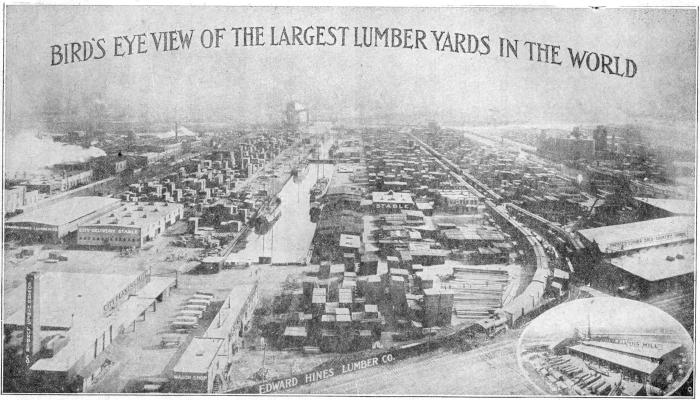
By E. G. Griggs,
President of the National Lumbermen’s Manufacturing Association
It was my pleasure to attend the Second Annual Conservation Congress a
year ago in St. Paul. That I am here today representing a lumber producing delegation
would intimate that my interest in these proceedings is at least perennial.
I deplored the introduction of politics and regretted the delay in publication of
the excellent reports submitted with leave to print at the Congress. Just recently
I have read the many excellent technical reports, the discussion of which I
deemed of more importance to the upbuilding of the conservation movement than
the political outbursts that rankle in our breasts and tend to array class against
class. Conservation is education, and we all have something to learn. The experience
of the older and great states of this Union should profit the younger
and perhaps greater.
As a lumberman, conservation to me is not a theory. It is the proper utilization
of a great heritage and the elimination of waste in the process of manufacturing
and logging. What theory is more vital commercially to the lumberman
than that? The establishment of values will determine to what extent conservation
will be practiced and reforestation followed. When men devoted to the general
welfare of these United States are giving liberally of their time and money and
energy to protect the vast resources of this country from wasteful extravagance,
I feel it is little enough to expect those who are actively engaged in commercial
enterprises to second their efforts.
The importance of sane laws and wise legislation must be apparent to all of
us. Unless the business interests of the country heed the call and guide the effort,
an outraged public will some day awaken to its lost opportunities.
As an official of the National Lumber Manufacturers’ Association, I feel that
we, as lumbermen, are vitally interested in the proceedings of this Congress. I
come to you from a state that stands in the front rank as a lumber producer—a
citizenship interested from its lowliest to its highest in the proper utilization of
its wonderful forest growth. It is true that there is a divergence of opinion
among some of our Washington state officials as to state and federal control—but
to me, the important issue seems a national one. The value of our timber
resources is determined altogether by the demand existing outside our own states.
If conservation depends on values, then I say the price you in the Middle West
must pay for lumber has a great deal to do with reforestation and utilization of
our raw product. It is therefore entirely a national issue, and the question of
supply and demand, that inexorable commercial law, concerns us all.
I am a strong believer in the knowledge of conditions and in the benefits of
coöperation. The final outcome of the reciprocity pact, conceived, as it was, in
secret, emphasizes the fact that our Canadian brethren intend to adopt a conservative
policy of their own. As a lumberman, I have never agreed with our honored
President in the belief that the trade was a good one for us. To a man not concerned
in politics, it seemed that our Canadian traders out-traded the Yankee.
Why the argument for a permanent tariff commission, non-partisan and thoroughly
competent, should apply on wool, cotton, steel and not on lumber, hardly
appeals to me. Now that we know where we stand, is it not high time the tariff
issues be studied as in foreign countries, particularly Germany, by a body of
experts permanently engaged, that Congress hear and discuss officially its report
and that facts be placed before the people? I am democratic enough to still
believe in the great American people.
No industry not unduly protected need fear the light or a business upheaval.
Today a presidential year causes stagnation in business, either assumed or real.
Our country never will settle the tariff issue right until business integrity governs.
The revelation in accumulated wealth and control of millions can only be justified
if our country prospers. Neither should the people be taxed to accumulate
swollen fortunes. The prices at which the same commodities are sold to the
people of different nations ought to determine the tariff issue. America is for
Americans; let us develop our latent resources, not squander our heritage with
prodigality. Golden opportunities or luxurious surroundings do not warrant idleness,
but rather a higher sense of individual and national responsibilities. To
get the best out of that which we have should concern us all.
Our taxation problems, the methods which have prevailed so long, do not
encourage timber holding. Lumbermen have one crop and yearly taxes, while
the farmer has yearly taxes and annual crops. A timber investment of $5,000, say
at $1.50 per thousand, with taxes and interest compounded, in twenty years will
equal $7.50 per thousand, allowing no profit at all, nor considering the fire risk.
In President Taft’s address a year ago, he says that “States must legislate to protect
their individual holdings from waste and private greed.” Had the Reciprocity
Agreement become a law, the Nation would have been responsible for an increased
competition and uncalled for development of timber resources in no way
beneficial to the United States, except those speculators who have invested in
British Columbia timber. The development of Canadian timber holdings will not
save our trees as long as growing trees are taxed, capital invested and timber is
sold on time contracts. The more competition, the more will be left in the woods,
as only in the higher grades will there be profit. Lumber is constantly rising in
value because of its increasing inaccessibility and the distance it has to travel to
market.
Why deprive our great lumber producing states of the great purchasing
power resulting from the manufacture of this resource? Over three-quarters of
the cost at the mill of one thousand feet of lumber represents pay roll, and to the
Western states this means outside capital. Of the money received for 1,000 feet
of 2×4’s delivered on a fifty-cent rate of freight today, the railroad takes $13.00
freight money, leaving $7.00 to pay for logging, manufacturing, selling and stumpage.
What your retailers charge I do not know. As manufacturers, we have no
trust controlled product and do not control the price to the consumer. Suffice it
to say that there is little or no margin in the price of common lumber today to
the manufacturer. A comparison of the selling prices at home and abroad, with
due regard for grades furnished, should determine the existence of a lumber
trust, and the same reasoning applies conversely to steel and other industries.
Harassed as the industry has been by government proceedings and investigation
of alleged trust and monopoly, we feel that a great injustice is being done that
should be righted. If the marketing through retailers is not legal, I predict a
commercial upheaval is due in all lines of industry.
Reforestation will come when it is profitable—when the land is more suitable
to grow trees on than to sow annual crops or build cities. The methods followed
in the East will not apply to the South and West. The character of the timber
must be studied to determine how it can be profitably handled. Its proximity to
market, and the rail and water haul are to be considered. This was emphasized
in the Congress last year and is more apparent today, as the completion of the
Panama Canal approaches. It was stated that adequate and economical transportation
facilities are viewed among the means of conservation, and realizing
that the growth of the country has exceeded its transportation facilities, I trust a
comprehensive resolution will be adopted by this Congress regarding the Panama
Canal tolls. With our coastwise shipping laws and regulations governing shipments
from one American port to another, the benefits of this canal will be seriously
menaced unless Congress acts intelligently in the matter, and with due regard
to the development of our country. If we are to have tariff revision or free
trade, let us at least be consistent and give to our own manufacturers access to
ships on a competitive basis.
In my judgment, it will not do to merely resolute and spread high sounding,
well-meaning platitudes on the records; we should organize to actively acquaint
our citizenship throughout the states with the prevailing conditions and the benefits
to be derived through experience of others and knowledge of conditions. Educate
the people, and a great public sentiment will demand improved conditions.
The efforts of conservationists are often misjudged because considered impractical.
I say eliminate the visionary and theoretical, get down to the practical and
immediate remedies. We will have a movement so widespread and effective that
the Nation will rejoice and problems undreamed of now will be solved by an
enlightened, unprejudiced public.
We should encourage men and money in the development of our resources,
but by wise supervision control their operations. This government is bigger than
any of its component parts, and not only have railroads and corporations felt its
guiding hand to their betterment, but the court of final resort must always and
forever be the people of this, our native land.
Let us strive for the highest type of citizenship which demands the best that
is in us, and we will play our part in the ascendency of the star of the greatest
of empires—the American Republic.
By A. M. Ten Eyck,
Professor of Farm Management Kansas State Agricultural College and Superintendent
Fort Hays Branch Experiment Station.
How to increase the acre yield of staple crops is the important problem which
the American farmer must solve in order that the world may not go hungry, and
also that his own prosperity may continue. The average crop yields in this country
are too low. It is possible to double our acre-yields of staple crops by adopting
better farming methods.
There are three principal factors which have to do with increasing crop yields:
(1) increasing the productive power of the land by fertilizing the soil; (2) planting
seed of high-bred and better producing varieties; (3) practicing proper and
more thorough cultivation of the soil.
The work in testing varieties and breeding crops at the Kansas Experiment
Station has shown that it is possible to increase the average yield of the standard
crops in this state twenty-five per cent by the single factor of introducing and
planting pure seed of well-bred and high producing varieties. To illustrate,[3]
one of the improved varieties of winter wheat grown on the Kansas Agricultural
College farm actually produced twelve and one-half bushels more grain per acre
each year, or a net profit of nearly $7.00 per acre per annum, as an average for
three years, above that produced by common scrub wheat of the same type.
Farmers all over the state who have planted this improved wheat have reported
similar results, the increase in yield from the well-bred wheat being often much
larger than the differences secured at the station. It is hard to believe that one
variety of wheat, improved by breeding and selection, will outyield another strain
of the same variety, which has not been improved, as much as fifty per cent; but
a large number of reports from reliable Kansas farmers indicate that this has
occurred, when the two strains of wheat were grown in the same field side by
side.
Corn is more susceptible to soil and climatic changes than wheat, so that the
well-bred seed does not always give the best results from the first year’s planting;
but breeding will tell in the corn crop, as shown by experiments at the Kansas
Station,[4] in which the high-yielding row, seed has produced from ten to twenty
per cent larger yields per acre, and twenty-five to thirty-five per cent more good
seed ears than the average corn from which the improved strain was originated.
The possibilities along this line of increasing the yield of corn by the planting
of better seed are shown by the reports which have been received from
Kansas farmers, reporting sixty and eighty-bushel yields where the average for
the county was twenty or thirty bushels.
The soil of our western states is abundantly fertile; but mismanagement and
continuous cropping with corn and wheat have reduced its productive power. It
is possible by the proper use of barnyard manure to double the yield of corn and
increase the yield of wheat thirty-three per cent, as shown by the results of the
experiments at the Station. A single experiment in manuring wheat land
previous to planting to alfalfa increased the wheat yield thirty-three per cent, and
doubled the crops of alfalfa for the first two years after seeding, making a total
increase in the returns per acre of nearly $45.00 for the three years, or $15.00
net increase per annum.[5]
It is possible by a proper rotation of crops, including alfalfa, clover and
grasses, to double the productive capacity of thousands of acres of our western
corn and wheat lands. This is shown by the experiments at the Kansas Station
and by the reports of farmers. In 1906, a careful investigation of the corn yields
of Jewell County, Kansas, made by Hon. J. W. Berry, formerly a member of the
board of regents of the Kansas State Agricultural College, showed that the average
yield from land previously in alfalfa was over eighty bushels per acre, while
similar land on the same farm and adjoining farms, which had not been in
alfalfa, yielded less than sixty bushels per acre on the average, and the average
yield of corn in Jewell County for that year was less than thirty bushels per acre.
It has been shown by the experiments carried on for the last six years at the
Station that it is possible to increase the yield of corn ten per cent simply
by practicing better methods of preparing the seed-bed. When corn has been
planted with the lister, winter or early spring plowing or listing of the ground
previous to the planting has given an increase in crop as an average for six years,
amounting to six bushels of corn per acre each year, as compared with ground which
received no cultivation previous to planting.
Different methods of cultivation of corn, deep or shallow, etc., have not
affected the yield so much as different methods of preparing the seed-bed, except
where the cultivation of the corn was neglected. The lack of sufficient cultivation
means greatly reduced yields or crop failure.
It is possible to increase the wheat yield of Kansas fifty per cent by practicing
better methods of seed-bed preparation. As an average for two years’ trials, 1908
and 1909, at the Station the yield of wheat due to preparation of seed-bed alone
varied from 21.6 to 37.4 bushels per acre, an increase of seventy-three per cent in
yield due to the better preparation of the seed-bed.[6]
In 1911, one of the driest years which Kansas has ever experienced, this experiment
was repeated with remarkable results. The most poorly prepared seed-bed
(ground disked, not plowed) yielded a little over four bushels of wheat per
acre, while the largest yield was thirty-eight bushels per acre from early deep
plowing, which received frequent cultivation after plowing until seeding time.
Ordinary loose ground, plowed late, yielded fourteen bushels per acre, while
ground cultivated early with the lister plow and leveled with the disk harrow
gave thirty-five bushels per acre. The better methods of seed-bed preparation
employed in these experiments are such as may be successfully practiced throughout
the Western winter wheat belt.
Of the three factors concerned with increasing the acre-yields, the last named,
“Practicing Proper and More Thorough Cultivation of the Soil,” is the simplest
and most readily applied. Probably more low yields and crop failures are due
to insufficient or improper cultivation than to any other single factor over which
the farmer has control in the production of any particular crop. With a soil of
average fertility, the preparation of the seed-bed by the proper tillage and cultivation
methods very largely determines the yield of the crop.
There are four important objects to be accomplished by cultivating the soil:
1. To secure a proper physical condition of the soil favorable to sprouting seed
and promoting plant growth. 2. To kill weeds. 3. To conserve soil moisture.
4. To develop or prepare plant food.
The texture of the soil is nearly always more important than mere richness.
Many “worn” lands have simply been robbed of their organic matter, often still
containing an abundant supply of the mineral elements of plant food. Others
have been injured in texture and hence in productiveness by careless or faulty
management.
The maintenance and improvement of soil texture are more dependent upon
plowing than upon any other operation of tillage. A finely divided, mellow soil
is more productive than a hard lumpy one of the same chemical composition,
because it affords greater feeding ground and more favorable environment for
the plant roots; absorbs and retains more moisture, has better aeration, and
less variable extremes of temperature. Also, because it promotes nitrification
and the development of available plant food by giving favorable conditions for
the development of soil bacteria, and for the decomposition and solution of the
soil minerals. In all these ways and others, “mellowness” renders plant food
more available and affords a more congenial, comfortable place in which the
plants may grow.
Plowing, especially in the spring, tends to ventilate, warm and dry the seed-bed,
and if properly done, lessens evaporation from the deeper soil by the development
of a soil mulch above it.
Deep plowing brings up new stores of inert plant food, enlarges the moisture
reservoir, deepens the seed-bed, gives more root room and more material
for the soil bacteria to work over into available plant food. Deep plowing or
subsoiling also serves to break up the plant food, to break up the “furrow-sole”
or “hard-pan,” thus loosening up compact, impervious, clayey subsoils.
Plowing is an efficient means of destroying weeds and many kinds of injurious
insects which prey on farm crops. Hard, clayey or “gumbo” soils are
mellowed by late fall or winter plowing, and further, proper and timely plowing
is the most efficient and practical means of preparing a suitable seed-bed for
nearly all farm crops. Too many farmers who have allowed their land to become
deficient in fertility seek to restore its productivity by application of expensive
commercial fertilizers, without first putting it in good tilth. This is a great
mistake. The way to treat such land is to “plow” it well, and work up a physical
condition suitable for the best growth of crops. After all this is done, the
application of concentrated commercial fertilizers may give profitable returns.
In order to secure the ideal condition for seed germination and plant growth,
a seed-bed for planting small seeds should not be too deep and loose; rather
the soil should be mellow, but well pulverized only about as deep as the seed
is planted. Below the depth at which the seed is planted it should be firm
and well settled, making a good connection with the subsoil, so that the water
stored therein may be drawn up into the surface.
The firm soil below the seed, well connected with the subsoil, supplies the
moisture to the seed, while the mellow soil above it allows sufficient circulation
of air to supply oxygen and favors warming by gathering the heat of the sunshine
during the day and acting as a blanket to conserve the soil heat, maintaining a more
uniform temperature during the night.
The mellow soil above the seed conserves the moisture, acting as a mulch
to keep the water from reaching the surface, where it would be rapidly lost by
evaporation. The same condition favors the upward growth of the young shoots
into the air and sunshine.
The loose, deep seed-bed is almost wholly dependent upon rains for sufficient
moisture to germinate the seed and start the young plant. If the crop
starts, it is very apt to be injured by short periods of dry weather, because of
the rapid drying out of the loose surface soil. In such a seed-bed the crop
is more apt to “burn out” in the summer, or “freeze out” in winter, than a crop
grown in the “ideal” seed-bed described above.
It should not be inferred from this description of the “ideal” seed-bed that
the soil should not be plowed deeply; rather, deep plowing should be encouraged,
but timely, so that the soil may settle and fill with moisture, and such cultivation
should be given after plowing, so as to secure a favorable physical condition of the
seed-bed.
So far as cultivation is concerned there are three principal steps in the conservation
of soil moisture:
1. The soil must be loosened to a considerable depth in order to prepare
a reservoir to receive the rain and carry the water downward. This may be accomplished
by deep plowing, by listing, or by disking unplowed lands.
2. The water which is carried down into the subsoil must be brought back
again into the surface where the seed is germinating and the young roots
are growing, and to accomplish this a good connection must be made between
the furrow-slice and the subsoil, and this is the purpose in the use of the subsurface
packer immediately after plowing.
3. Finally, in order that the water which is drawn up again towards the
surface may not reach the air and be wasted by evaporation, the upper two or
three inches of the soil must be kept mellow in the form of a soil mulch, and
this is accomplished in the growing of crops, by frequent cultivation, which is
not so practicable with wheat, and other small grains, as with corn and other
intertilled crops.
The most important step in soil moisture conservation is to get the water
into the soil. When this has been accomplished, the keeping it there and returning
it gradually to the growing crop is a relatively simple matter. Many farmers
have yet failed to learn this most important fact of dry farming, that the storing
of the moisture is the first and great principle of soil moisture conservation. The
firming and pulverizing to prepare the seed-bed, and the surface cultivation to maintain
the mulch, are each without avail unless there has been stored in the deeper
soil a sufficient amount of moisture to support the growing crop in time of drouth.
Now the moisture should be stored at all times during the season, but especially
during the interval between harvest and planting. This requires early plowing
so that the soil may be in condition to catch the rain and absorb it.
In order that there may be room to receive and store a heavy rain, deep
plowing is desirable. If plowing can not be done early, the cultivation of the
unplowed land with a disk harrow will keep the soil in good condition longer and
favors the absorption of rain.
A good rule, but it cannot always be followed, is to plow when the soil is
in such condition that it will drop from the mold-board in a mellow, friable
condition.
Loosening the soil by deep plowing favors the absorption of moisture, but
if rains do not come in time such land will suffer from drought more quickly
than though it had been plowed shallow.
The loose soil dries out and capillarity is broken, preventing the furrow-slice
from receiving moisture from the subsoil rapidly enough to sustain the
growing crop. The depth and frequency of plowing should vary according to
the nature of the soil. A light or sandy soil requires less depth of plowing and
less frequent plowing than a heavy, or compact clayey or “gumbo” soil.
As a general proposition, plowing should be shallow when it precedes planting
only a short time.
Plow deep in the fall, and plow deep for summer fallow.
A long interval between plowing and seeding allows the soil to settle sufficiently,
while freezing and thawing mellow the raw, hard subsoil which has been
brought to the surface.
The relative depths of plowing may be stated as follows:
| Shallow plowing |
3 to 4 inches. |
| Medium plowing |
5 to 6 inches. |
| Deep plowing |
7 to 8 inches. |
Plowing deeper than eight inches with the common plow is not usually practicable,
but the soil may be stirred twelve to eighteen inches deep with a tillage
plow or subsoil plow, and in heavy soil with hard, compact subsoil, such deep
stirring may occasionally be desirable.
When land is allowed to lie for a considerable period after plowing before
the crop is planted, the settling of the soil, together with the surface cultivation
to preserve the mulch and the cementing due to rain, usually causes it to repack
and firm up to a sufficient extent to make a good seed-bed.
The use of the packer is most essential on late spring plowing, when the
purpose is to plant at once. It is not so necessary to use the subsurface packer
on fall plowing which is not intended to be planted until the following spring,
but for sowing fall wheat, if the plowing precedes the sowing by a very short
interval, the subsurface packer may be used very advantageously.
The principle involved in the use of the subsurface packer is correct, and
the lighter the soil and the greater its tendency to remain loose and mellow the
more necessary becomes the use of the subsurface packer or similar implement,
in order to prepare a proper seed-bed.
In plowing under trash or manure, subsurface packing, by pulverizing the
bottom of the furrow-slice, sifts the soil through the coarse trash and causes a
better union with the subsoil below, so that the capillary water may be drawn
up into the surface, whereas, if a heavy coat of stubble or manure plowed
under in this way is left without packing or pulverizing, the furrow-slice is apt
to dry out and the crop that is growing on the land may be injured by a short
interval of dry weather.
By setting the disks rather straight and weighting the harrow, a disc-harrow
may be used as a substitute for the subsurface packer, resulting in a pulverizing
and firming effect at the bottom of the furrow-slice. Very often, however, early
plowing, with the proper use of the common harrow, may largely accomplish the
results required in preparing a proper seed-bed. It is usually advisable to weight
or ride the common straight-tooth harrow in order to cause it to stir and pulverize
the soil deeper and prevent the “slicking” effect which is apt to result from light
harrowing.
The cultivation necessary, after early plowing, to destroy weeds, in the experience
of the writer, has usually been sufficient to settle and pulverize the seed-bed.
For the early cultivation after a good rain and after the weeds have started,
there is no implement superior to the disk harrow. The double disk which gives
two cultivations and leaves the ground level, being preferred. For late cultivation
the common harrow or the Acme harrow should be used with the purpose of not
loosening the ground too deeply just previous to planting or seeding.
It is very essential that sufficient and proper cultivation be given to destroy
weeds. This is more important than to maintain a soil mulch, since weeds exhaust
both the soil moisture and the available plant food. If a proper mulch is
maintained, however, the weeds will be kept in subjection. In the ideal system
of culture the purpose is to keep a mellow soil mulch on the surface of the land
all of the time, not only during the growing of the crop, but also in the interval
between harvest and seeding time. Thus, after the corn is planted the land is
cultivated with the weeder or harrow in order to break the surface crust and
prevent the loss of moisture, and following out the same principle the harrowing
or work with the weeder is continued after the grain or corn is up, and during
the growing period frequent cultivation is required for intertilled crops.
Again, after the crop is harvested, the cultivation is continued; the land is
plowed at once or listed, or the surface of the soil is loosened with the disk
harrow, and thus the land is kept continually in a condition to not only prevent
the loss of water already stored in the soil, but also this same condition and
mellow surface favors the absorption of rain and largely prevents the loss of water
by surface drainage.
The smooth, finely-pulverized surface left by continuous light harrowing
really defeats the purpose of the cultivation, since soil in such condition will
shed heavy rains, causing a waste of water which should have been stored, and the
surface often becomes too fine and compact, preventing the proper aeration, and
producing an unfavorable seed-bed condition. Thus during the interval between
crops, it is often advisable to use the Acme harrow or the disk, or spring-tooth
harrow, in order to keep the surface of the soil open and mellow.
A new method for preparing the seed-bed is now coming into general practice
in Western Kansas. In preparing land for wheat, the plan is to list the ground
with the ordinary corn lister as soon after harvest as possible. The lister furrows
are run about three to three and a half feet apart, very much the same as when
the lister is used for planting corn. Later, when the weeds have started, the
soil is worked back into the lister furrows by means of a harrow or disk cultivator.
Several cultivations are usually required by the harrow, and disk harrow, in
order to level the field and bring it into good seed-bed condition. Once over
with the disk cultivator is usually considered sufficient, the further work necessary
to prepare the seed-bed being given with the common harrow or other cultivating
implement.
In a dry climate this method of preparing the seed-bed has several advantages,
as follows:
The cultivation of the land soon after harvest tends to conserve the moisture
already stored in the soil. The furrowed land is in good condition to catch and
store the rain and the later cultivation clears the land of weeds and volunteer
wheat and leaves a mellow soil mulch to conserve the moisture which has been
stored in the subsoil. The early and continued cultivation of the soil favors the
action of the bacteria and the development of available plant food.
By practicing this method the farmer may cultivate a larger area early in
the season when the soil is in good condition, when if it had been necessary
to plow the whole area, some of the land might become too dry to plow
well. Likewise the later plowing leaves the soil too loose and not in good seed-bed
condition. In preparing land for corn, the listing may be done late in the
fall or during the winter, or early spring. The usual plan being to split the
ridges with the lister later in the spring when the corn is planted. It is advisable
to harrow the listed field once or twice before planting to destroy weeds, or prevent
soil drifting and to preserve a mellow soil mulch to conserve the water which
has been stored in the subsoil. In preparing land for corn, the early listing has
proved equal to early plowing and superior to early disking, as shown by the
experiments at the Kansas Station.
In the drier portions of the great plains area and throughout the mountain
states, where dry farming is practiced, the annual rainfall is not sufficient to
produce a crop every year, and it becomes necessary to practice a system of
summer fallowing every third or fourth season, or in alternate years in localities
of least rainfall, in order to store moisture and develop plant food and thus insure
the production of a profitable crop each year.
Deep plowing either in the fall or spring, and frequent surface cultivation as
described above is the method of summer fallowing which has given the best
results at the Montana, Western Nebraska, and Western Kansas Experiment
Stations.
The weeder is better adapted for harrowing wheat and other small grains
than the common harrow, but the harrow may be used when the ground is firm.
I question whether it is necessary or advisable as a rule to harrow wheat if due
precautions have been taken in preparing the seed-bed.
Under certain conditions, where heavy rains firm and puddle the soil, it may
be advisable to harrow, but very young grain may be injured by harrowing, and
after the wheat covers the ground, harrowing is unnecessary. The harrowing
of wheat at regular intervals at the Kansas, Nebraska and Montana Experiment
Stations has not resulted favorably. Without question, the proper preparation
of seed-bed is a much more important factor in the growing of small grains,
than the cultivation after seeding.
While it is a disputed point among authorities whether it pays to harrow
wheat and other sowed crops, there is no difference of opinion regarding the
necessity or value of frequent cultivation of corn and of all other crops usually
planted in rows. Regarding the depth and frequency of cultivation desirable, I
favor rather deep cultivation in our drier, hotter climate, and after every hard
rain, if possible, or at least sufficient to keep the weeds in check.
It is not necessary or practicable to attempt to cultivate after every rain
and there is no virtue in the admonition “Keep the Cultivator going in a dry
time.” If the soil has been well stirred and the mulch is of sufficient depth, to
cultivate again would be loss of time and might do actual harm by drying out
the deeper portions of the soil mulch and also causing a too fine and dusty condition
of the surface soil, unfavorable to the absorption of moisture when the rain
comes.
It is not necessary to have extra machinery in order to successfully practice
the system of culture outlined above. The only implements required or recommended
which are not in general use on every well equipped farm, are the subsurface
packer and the weeder.
The principles stated above have been known and practiced more or less
for a long time and are mostly included in the “Campbell” system of culture.
H. W. Campbell was among the early apostles of dry farming in the West, and
has perhaps done more to call the attention of western farmers to the necessity
and advantages of thorough cultivation of the soil than any other investigator.
Scientific farming pays, everywhere. I believe in the practicability of thorough
tillage and good cultivation on every farm, and the increase in crops by such
farming will more than pay for the extra labor. But the great problem in Western
agriculture today is not how to get larger crops out of the soil for a few years,
but rather how to produce paying crops every year and at the same time maintain
the fertility and productiveness of the land.
Simple tillage will not maintain soil fertility. It becomes necessary finally
to replace the plant food, exhausted by the continuous growing of crops, with
the application of manure, or chemical fertilizers, and by green manuring and
the rotation of crops, in which the legume crops, such as alfalfa and clover are
introduced in order to restore again the nitrogen and organic matter, the supply
of which has only become more rapidly reduced because of intensive cultivation.
There is little question regarding the value and even the necessity of the
summer fallow in the drier areas of the West. The tests at a number of Western
stations and the general experience of farmers prove this; yet there are serious
objections to the continued practice of bare summer fallowing.
First, there is the tendency for the soil to waste by drifting in strong winds
and by washing away in heavy rains.
Second, summer fallowing with frequent cultivation hastens nitrification and
decay, thus more rapidly exhausting the organic matter in the soil.
It is possible for the soil to become more rapidly exhausted in fertility by
alternate bare summer fallowing and cropping than by continuous cropping. At
least the bare summer fallow does not add any fertility to the soil. In order
to maintain the productivity of our Western lands, it will become necessary to
add fertility to the soil preferably during the year of fallowing.
I am beginning the practice of a method of green manuring and partial summer
fallowing, which I believe to be superior to bare summer fallowing and which
will largely overcome the objections to summer fallowing.
The plan is to plant some fall crop or early spring crop and plow it under
late in May or early in June, practicing a summer fallow with surface cultivation
for the rest of the season, until seeding time.
Certain crops adapted to the West are being tested for this purpose with
some degree of success. The more promising are sweet clover and sand vetch
for fall seeding and field peas for early spring seeding. These crops are hardy,
rapid growers, and somewhat drouth resistant and may be used also in part for
pasture, thus giving some return other than their fertilizing value. Some experiments
have already been made at the Hays Station in Western Kansas and the
yields of wheat secured from the green-manuring summer fallow compare favorably
with the yields from the bare summer fallow. And in my judgment, this
method of fallowing will soon be generally adopted and will solve the problem
for a long time at least, of increasing the organic matter and maintaining the
productiveness of our western lands.
This method of green manuring and rotation of crops will largely prevent
soil drifting, the control of which is a very serious problem in western agriculture.
Our experience at the Station at Hays has demonstrated also that large areas in
wheat may be protected and largely prevented from being injured by the drifting of
soil within the field itself. The spreading of straw or coarse manure and packing
the straw into the soil with the subsurface packer was the most effective means
employed for protecting the fields from injury by winds last spring (1911). The
subsurface packing alone helped to prevent the starting of the drifting soil within
the field, but was not very effective in preventing the soil from adjacent fields from
sweeping over the wheat field, but the straw covered area actually stopped the
drifting soil, causing it to lodge, and thus protected the field beyond the straw
barrier.
It is quite as necessary, however, to prevent the drifting of adjacent fields,
as to protect the wheat field itself. This may be done by early listing or disking
of the fall plowed fields and corn or kaffir stubble fields which are almost sure
to drift in a violent wind, when the soil is very dry at the surface. Disking or
other surface cultivation will prevent drifting of soil for a time, until the looser
portion dries out, then the soil can only be held by deeper cultivation as by listing
or plowing. For putting the surface in the best condition to resist wind force a
long time, I prefer to break the ground with a lister, forming deeper furrows
and higher ridges than may be prepared with the disk or cultivator.
During the season of 1911, which has been extremely dry and hot, the wheat
on summer fallow at the Station at Hays made a larger growth and a much better
showing in the early part of the season than other wheat, but before the crop
matured the conditions of drouth and heat became so severe that the wheat was
greatly injured, and the summer fallow produced a little larger yield but a poorer
quality of grain than was secured from other land not summer fallowed.
The yields compare approximately as follows: Summer fallowed, five bushels
per acre. Not summer fallowed, two bushels per acre. In other localities in
Western Kansas where the rain was greater and the condition less severe, the
summer fallow made a better showing.
It was also true last season, at the Western Kansas Station, that the extra
cultivation in preparing the seed-bed was without beneficial effect, in producing
a larger yield of wheat. However, in ordinary seasons the reverse has usually
been true; summer fallow has given much larger yields than continuous cropping,
and early plowing and extra cultivation have usually given a marked increase
in yield in the comparative tests which have been carried on at the Experiment
Stations, both at Manhattan in Eastern Kansas and also at Hays in the
western third of the state. At the Manhattan Station the careful preparation of
the seed-bed was very effective in increasing the yield of wheat in 1911, even
doubling and trebling the crop. The results of much of this work are summarized
in the succeeding pages.
Three general methods of tillage for preparing the land for winter wheat
are practiced in this state, namely: plowing, listing and disking. There may be
variations of these three methods; as early plowing, shallow plowing, deep plowing,
single listing, double listing, disking without plowing, disking before plowing,
little cultivation after plowing, frequent cultivation after plowing, etc., and local
conditions may determine which method is the best. That certain methods are
superior to others may be readily shown by comparative trials which have been
carried on at the Kansas Station during the past two years. These experiments
include the several general methods of tillage named above with variations as
described in Table I, which gives the yield of wheat per acre and other data
determined by those experiments. This work was done at the State Experiment
Station at Manhattan, located in the middle eastern part of the state.
TABLE I.—METHODS OF PREPARING SEED-BED FOR WHEAT.[7]
| Methods of Preparation. |
Yield per Acre, Bushels. |
Data for 1919-11 Crop Only. |
| 1907-1908. |
1908-1909. |
1910-1911. |
Average for Three Years. |
Cost per Acre for Preparation. |
Value of Crop at $0.80 per bu. |
Value of Crop Less Cost of Preparation. |
| Plowed Aug. 15, 7 inches deep |
34.74 |
40.12 |
27.74 |
34.20 |
$3.90 |
$22.19 |
$18.29 |
| Plowed July 15, 7 inches deep |
28.84 |
35.02 |
38.36 |
34.07 |
4.95 |
30.69 |
25.74 |
| Plowed Aug. 15, 7 inches deep; not worked until Sept. 15 |
30.53 |
38.12 |
23.62 |
30.76 |
3.55 |
18.89 |
15.34 |
| Listed July 15, 7 inches deep; ridges split Aug. 15 |
28.67 |
31.33 |
34.35 |
29.78 |
3.75 |
27.48 |
23.73 |
| Listed July 15, 7 inches deep; ridges harrowed |
20.02 |
32.17 |
35.07 |
29.09 |
3.70 |
28.05 |
24.35 |
| Plowed July 15, 3 inches deep |
— |
— |
33.45 |
— |
4.45 |
26.77 |
22.32 |
| Disked July 15, plowed Aug. 15, 7 inches deep |
— |
— |
32.68 |
— |
4.70 |
26.14 |
21.44 |
| Disked July 15, plowed Sept. 15, 7 inches deep |
20.11 |
30.56 |
23.57 |
24.75 |
4.35 |
18.85 |
14.50 |
| Plowed Sept. 15, 3 inches deep |
21.19 |
30.76 |
14.46 |
22.14 |
3.05 |
11.57 |
8.52 |
| Plowed Sept. 15, 7 inches deep |
19.59 |
27.98 |
15.79 |
21.12 |
3.55 |
12.63 |
9.08 |
| Disked at intervals until seeding; not plowed |
14.95 |
28.24 |
4.29[8] |
15.83 |
1.95 |
3.42 |
1.47 |
Much of it was done by myself or under my direction during eight years
of service as agronomist at that station.
Observe that the largest yields have been secured, as an average for the
three years from July and August plowing seven inches deep. The July listing
has ranked next to early plowing, but yielding on the average nearly five bushels
less wheat per acre than early plowing, or a decrease in yield of 14 per cent.
The decrease in yield from listing was less in the dry year of 1910-11.
All of the higher yielding plots were cultivated at intervals after plowing or
listing with the harrow, disk or Acme. Thus the weeds were destroyed, the soil
was well pulverized and well settled and put into excellent seed-bed condition
by the first of October, when the wheat was planted.
One or two cultivations after August plowing, at an extra cost of thirty-five
cents to fifty cents per acre, has given an average increase in the yield of wheat
of three and a half bushels per acre. Land disked before plowing, July 15, and
plowed August 15, 1910, gave an increase in yield of five bushels per acre in 1911.
Deep plowing in July, 1910, gave nearly five bushels more wheat per acre
in 1911 than shallow plowing. As an average for the several seasons, the September
shallow plowing has given a little larger yield than the deeper plowing.
The beneficial effect of early plowing and of frequent cultivation after plowing
in preparing the seed-bed for fall wheat was most marked in the dry season of
1910-11, when plowing a month later each time decreased the yield at the rate of
ten and one-half to twelve bushels per acre.
The preparation with the lister has proved to be a little less effective than
early plowing, but has given better results than early disking followed by plowing
a month later. Filling the furrows by harrowing, versus splitting the lister ridges
and leveling with the harrow have given about equal results. The second listing
is not necessary and makes the preparation somewhat more expensive. Preparing
the seed-bed by listing and harrowing is cheaper than early plowing and frequent
cultivation. The largest yield and largest net income, however, has been secured
from early plowing followed by sufficient cultivation to kill weeds and maintain
a mellow soil mulch.
Preparing the seed-bed by disking has given the lowest yields and least income.
The disked land has produced on the average each year eighteen bushels less
wheat per acre than early plowing. That is, the well prepared seed-bed has given
114 per cent the greater yield, or more than double the yield of the poorly prepared
seed-bed, and at very little greater cost of preparation.
The next lowest yield was produced by late plowing, a week or two before
the wheat was planted. The average decrease in yield from September plowing
compared with July plowing was over twelve bushels per acre per annum, or
early plowing increased the yield fifty-four per cent. In the drier seasons of
1910-11 the difference was greater, the early plowing producing more than double
the yield received from the late plowing.
“Disking in” wheat in the dry season resulted in an almost complete crop
failure, giving a small yield of only four bushels per acre; compared with thirty-eight
bushels per acre produced by deep early plowing. This is certainly a marked
example of the value of “proper” cultivation in preparing the seed-bed for wheat.
The seed-bed for corn should be deeper and more mellow than the seed-bed
for wheat, and the early cultivation of the corn land previous to planting may
cause a marked increase in yield, as shown by experiments which have been recently
completed at the Kansas Station. These experiments relate to different methods
of tillage which may be practiced during the winter or early spring in preparing
the seed-bed for corn, and include deep and shallow plowing, double disking, and
listing, namely, plowing land into ridges with a double mold-board plow or lister.
In these experiments corn has usually been planted in listed furrows, except
that the surface and lister methods of planting have been compared each year
on the plowed plots. Table II gives the yield of shelled corn per acre secured
by the continued practice of the methods described, for a period of six years. The
average yield for three years (1906-08) and for six years (1903-08) is also given.
TABLE II.—PREPARATION OF SEED-BED FOR CORN.
| Early Treatment. |
Method of Planting. |
Yield Per Acre in Bushels. |
Average 3 Years 1906-1908 |
Average 6 Years 1903-1908 |
| 1903 |
1904 |
1905 |
1906 |
1907 |
1908 |
| Disked twice |
Listed |
68.61 |
55.12 |
34.74 |
70.29 |
41.30 |
73.60 |
61.73 |
57.28 |
| Disked twice, harrowed |
Listed |
65.18 |
50.27 |
41.48 |
75.34 |
44.38 |
78.80 |
66.17 |
59.24 |
| Listed |
Listed in old furrows |
— |
— |
44.00 |
80.10 |
49.81 |
70.40 |
66.77 |
— |
| Listed |
Listed breaking ridges |
74.28 |
52.37 |
40.40 |
82.29 |
45.31 |
74.00 |
67.20 |
61.44 |
| Untreated |
Listed |
64.14 |
58.35 |
38.17 |
68.61 |
40.87 |
72.40 |
60.63 |
57.09 |
| Plowed shallow |
Listed |
64.26 |
54.96 |
40.82 |
84.23 |
55.48 |
76.90 |
72.20 |
62.28 |
| Average of listed |
|
66.69 |
54.21 |
39.94 |
76.81 |
46.19 |
74.35 |
65.78 |
59.47 |
| Plowed shallow |
Surface planted |
— |
— |
42.40 |
71.90 |
46.87 |
68.40 |
62.39 |
— |
| Plowed deep |
|
73.74 |
70.95 |
41.66 |
81.89 |
51.28 |
75.40 |
69.46 |
65.79 |
| Av. of surface planted |
|
73.74 |
70.95 |
42.03 |
76.80 |
49.08 |
71.90 |
65.93 |
65.79 |
While the relative yields vary somewhat from year to year, it is very clear
that the early plowing and early listing have given increased yields of corn, ranging
from six to twelve bushels per acre for the three years, and four to five bushels
per acre as an average for six years.
As an average for three years the double disking and harrowing early in the
spring has given an increased yield of five and one-half bushels of corn per acre.
It will be observed that in the above comparison all of the corn was planted in
listed furrows.
Comparing the two methods of planting it appears that the highest yield for
three years was produced by listing in the early shallow plowed land: The average
yield for six years, however, was 3.3 bushels per acre in favor of the surface
method of planting.
The results may be explained by the fact that the seasons of 1904 and 1905
were very wet, hence there was less necessity of conserving soil moisture, and
the early cultivation gave little benefit, while the lister method of planting was
placed at a disadvantage. The method of planting corn in listed furrows is
adapted to dry climate and warm soil. Corn planted in the bottom of a furrow
four to six inches deep develops a deeper root system than surface planted corn;
hence listed corn is not readily injured by drouth. The effect on the root system
is shown by the study of corn roots made at the Station.[9]
It is quite evident that the best method of preparing the seed-bed for corn
and the best method of planting corn will vary for different climatic and soil
conditions. Yet it is very important that the farmer test these methods and
determine which is the better for his particular conditions, since the method of
seed-bed preparation and the method of planting may be very important factors
in securing large yields.
In the cultivation experiments carried on at the Station during the past six
years the practice has been to “lay the corn by” with a final cultivation about the
first of July. In these experiments the plan has been to cultivate duplicate plots
by four different methods, as follows: shallow; deep; deep early and shallow
late; shallow early and deep late. The shallow cultivation has been performed
with the knife or gopher type of cultivator, while for the deep cultivation, the
six-shovel cultivator has been used.
The plan has been not to cultivate excessively deep but only medium deep,
three to four inches. The depth of the surface cultivation has averaged one and
one-half to two inches. The corn has usually been cultivated four times each
season, and the practice has been to cultivate by the same method twice in succession
those plots in which the method of cultivation was changed during the season,
that is, certain plots were cultivated shallow at the first two cultivations and deep
at the last two cultivations, and vice versa. The yield of shelled corn each year
and the average yield for seven years, by the different methods of cultivation, are
given in Table III.
TABLE III.—CULTIVATION EXPERIMENTS WITH CORN, 1903-1909.
| Method of Cultivating. |
Yield of Corn Per Acre, Bushels. |
Average 3 years, 1907-1909 |
Average 7 years, 1903-1909 |
| 1903 |
1904 |
1905 |
1906 |
1907 |
1908 |
1909 |
| Shallow, 1 to 2 inches |
51.65 |
57.51 |
45.64 |
56.19 |
41.21 |
75.72 |
35.1 |
50.69 |
51.86 |
| Shallow, early; deep, late |
52.96 |
57.25 |
49.68 |
51.67 |
42.17 |
87.12 |
34.7 |
54.66 |
53.56 |
| Deep, 3 to 4 inches |
50.87 |
53.98 |
50.86 |
50.55 |
38.73 |
78.81 |
33.7 |
56.41 |
51.07 |
| Deep, early; shallow, late |
53.66 |
49.62 |
49.39 |
50.09 |
43.11 |
76.93 |
31.3 |
50.45 |
50.30 |
| Wrong time |
— |
— |
— |
— |
— |
79.7 |
44.1 |
61.9 |
|
| Right time |
— |
— |
— |
— |
— |
82.9 |
51.2 |
67.0 |
|
The average yield for the seven years favors the shallow-early-deep-late cultivation
by a little over three bushels per acre per year, when compared with the
deep-early-shallow-late cultivation, which gave the lowest average yield.
The variation in yield by the different methods of cultivation from year to
year and the nearly uniform average yields for the long period of seven years,
indicate that the method of cultivation practiced, whether shallow or deep, may
not make much difference in the yield of the crop, provided the cultivation is
done well and at the right time.
The factors heretofore described, which have to do with seed germination
and plant growth, are largely controlled by cultivation. There are, perhaps, no
exact rules or methods for cultivating corn, but a farmer observing the crop
and soil conditions, and understanding the principles of soil cultivation, may vary
the manner and practice of cultivation somewhat to suit the conditions and accomplish
the objects desired.
It is very important to cultivate corn at the “right” time. An experiment
which has been carried on for two years in cultivating corn at the “right” time and
the “wrong” time, has resulted as follows:
Average yield for “wrong” time cultivation, 61.9 bushels per acre. Average
yield for “right” time cultivation, sixty-seven bushels per acre, or six and one-tenth
bushels per acre in favor of cultivating the corn at the “right” time. The
“right” time means soon after the rain, when the weeds have started and the
soil is just dry enough to cultivate well; the wrong time is a week or ten days
later, when the weeds have become larger and the soil is hard and dry and turns
over in clods and lumps. It costs more to cultivate corn at the “wrong” time
than at the “right” time, because of the slower and more difficult work and greater
draft of the cultivator due to unfavorable soil conditions—and yet the “right”
time cultivation increased the yield 10 per cent.
It is important also to use the best implements, but doing the work well
and at the right time is even more important than the type of cultivator used.
No one type of cultivator can be recommended as superior to others, but different
kinds of cultivators are useful for different work and for different conditions.
The corn grower should have more than one kind of corn cultivator. I prefer
at least two types, one for shallow and one for deep cultivation. The knife
and shovel cultivators serve their purpose well, but the disk cultivator may be
used in place of shovels, and is especially recommended for use during the early
cultivation of listed corn.
It is possible, as shown by the work at the Station, for the wheat farmer who
will practice the best culture methods, to increase his yield of winter wheat 50 to
100 per cent by careful and proper preparation of the seed-bed, with practically no
greater cost for cultivation (See Table I.).
The skillful corn grower may readily increase his corn yields five bushels per
acre by a little extra cultivation of the corn land early in the spring before planting.
He may add another five bushels to the crop by practicing the correct method
of planting, which experience has proved to be the most suitable to his soil and
climate. And finally, by the simple factor of sufficient cultivation of corn at the
right time and in the right way he may still further increase the yield at the rate
of ten bushels per acre.
Thus it is possible for the farmer who is not now doing these things to add
40 per cent to the average corn yield of his farm by practicing improved culture
methods. The yield of other crops may be likewise increased, but the farmer should
bear in mind this fact: that the increase in yield by better culture may be secured
only by maintaining the fertility of the land and planting well-bred seed adapted
to the soil and climate.
By Warren H. Wilson,
Superintendent of the Department of Church and Country Life of the Board of
Home Missions of the Presbyterian Church of the United States.
It is my purpose to answer the question, “What is the use of the church in
the open country?” We have some people who call themselves “spiritual,” who do
not believe there is any permanent use of a church. Their religion consists of
an insurance against fire; and as soon as they get a policy from an evangelist,
they have no more use of a church, certainly not of a strong church. I want
to speak to you of the church as an efficient institution, the builder of rural
civilization.
We have other folk who are without land and without ownership of productive
tools; they are under economic pressure; they are our American poor.
They think they cannot afford anything that is not a necessity. I am here to
argue that the church in the open country is a necessity, especially to the poor.
We have also some theorists, who believe that all rural institutions should
be assembled in towns and villages, and that ultimately the farmers should reside
there, going out every morning to their fields. I hope the time will never come
when American farmers will so live. And I wish to speak to you of the church
in the open country as the conserver of the soil, of the social life, the family
and the school in the country.
The first reason for the existence of the church in the open country is the
fact that “the soil is holy.” Already we are faced with a depleted soil in some
of our richest agricultural states. But when the soil produces less, the poor will
have to pay more for food and for wearing apparel. We have been warned that
the time will come when the workingman cannot any longer wear wool or eat
white bread. I have observed in the last two years that the clothes which I buy
from a tailor who has supplied me for seventeen years do not any longer attract
the moths. The moth turns up his nose at cotton, and cries for wool. The business
of the farmer and of the sheep raiser is a religious business, because it is
in the interest of the whole people. Whatever makes for the prosperity of the
farmer will enrich and dignify all the people. The church is an institution essential
to good farming, and it should be maintained where the farmer lives, out in the
open fields.
Religion is a valuation of life. It values some things high, and some low,
but it is, in the opinion of a recent scholar of repute, a system of values. Its
highest word is “holy.” The land in which the Hebrews were settled was called
“the Holy Land,” and nowadays the teachers of modern farming are declaring
to the young, “The land is holy.” At a recent summer school for country ministers
a professor lectured upon “the Holy Land,” meaning Palestine; and a great agriculturist
came also to lecture upon the soil of the state in which the school was
held, announcing his theme as “The Holy Earth.” We are entering a new era
in religion, in which the values of life will be estimated by their services to the
poor. In this consecration of the soil to the interest of the whole people the
church of the open country will have a great place.
I know a minister in Maryland, where the soil has been exhausted by generations
of peach-culture, and the farmers are turning to other crops in order to
make a living. There the minister has found that his business is to preach scientific
agriculture, and his most impressive service has been to raise a great crop
of potatoes, with a dust mulch, the greatest ever raised at that time in that region.
He became the leader of those farmers in the actual struggle for a livelihood. He
helped them set their business on a firm footing. He preached as he worked, and
his people responded accordingly.
The second reason for the maintaining of the church in the open country
is the fact that it is the best school by which to teach the farmers to give of
their prosperity to the community and to the common good. Farming is an austere
occupation. The best farmers are always economically austere, which is defined
by an economist as “the condition in which men produce much and consume little.”
The very definition shows that of all occupations farming must be the most austere.
But the practice of this austerity makes the farmer close and often mean. He
stints himself and he stints everybody else. He refuses to support good roads,
and he declines to pay for better schools because he is not a spender but a producer.
The church, of all institutions, makes the closest and most intimate appeal
to the farmer. It is his school of giving. It has an agent living in the community,
needing to be supported. The salary of the minister, and the supplying
of his needs, are a constant education in the building of community utilities. The
schools will be better maintained, the roads will be sooner reconstructed, even
at greater cost, and the poor will be better cared for, where the church exists in
the open country; to fertilize, with its appeals, the sour soil of the farmers’ austerity,
with the needed ingredients for benevolence.
The third reason for the church in the open country is the fact that the church
is a family builder. The rural household, which for three generations was the
spring of American idealism, has been dissolved, in the past twenty years, by
speculation. The exploitation of farm lands has made so many families nomads,
and has retired so many farmers to the towns, that there is need of a new era of
home building in the country.
The best fitted of all institutions for this service is the church. Her work,
as she well knows, is with the young. Her membership is always made up largely
of women, and with them lies the future of the American home in the country.
The moving force in the exodus from the farm is too often the woman. The
church will do more to make life worth while for her on the farm than all other
institutions.
The fourth use of the church in the open country is as a center of the concern
for the farmer’s income. The church in the country which does not sanctify the
livelihood of the farmer will not survive. “The most successful farmers in
America,” says an economist, “are the Mormons, the Scotch Presbyterians and the
Pennsylvania Dutch.” All these are religious farmers, and their churches are
their coöperative associations for farming. They all idealize country life. They
are organized for agriculture. But, mark this, in all these country churches—and
their churches are out in the open—the church has concern for the prosperity of
its farmers as farmers. The income is the man’s job, and when the church would
get the men it will care for the income. The Lord Almighty cares more for the
feeding of the whole people than for any other thing. First of all God is the
Father of men, and He cares most for their satisfaction in material things than
for their having books, or for their having any of the higher refinements. If the
people have not abundance of food and warm clothing, all moral and religious
values will suffer. Therefore the farmer is the Lord’s hired man; and the church’s
first business in the open country is “to produce the spirit in which the knowledge
will be used, which will enable the farmer to succeed.”
The transition in economic affairs, through which we are passing, is working
its effects upon the country churches. For the church is the best of all thermometers
of the social economy. Many churches in the country are being closed.
In the South alone, according to the Southern Baptist organ, sixteen hundred
Baptist and Methodist country churches are closed every Sunday of the year. In
the state of Illinois, our sociological surveys have shown that about seventeen
hundred country churches have been closed and abandoned. It is the elimination
of the unfit. It is the realignment of the religious people for greater efficiency,
at new centers. There is no sign that country people are less religious than they
were. But there is every indication that the churches are being sifted on the
principle of efficiency.
The churches are suffering at the farmers’ hands another process, which I
would like to describe as dehorning. It is like the removal of the horns from
the heads of dairy cows; and it has the same purpose. Doctrinal subjects which
divide are being tabooed, and the churches are no longer to hook and horn one
another, but to live together in peace and produce the most of the milk of human
kindness, with the greatest economy in the fodder of doctrine.
This transition is showing also in the inventing of a new type of church. It
is appearing all over the land at the same time. I find it in all denominations,
and it bears the marks of the same spirit everywhere. My friend, McNutt, at
Plainfield, Illinois, has become the most eminent exponent of this new ideal of
the pastorate, but he is far from being the only man who is so succeeding. He
has a unique power of telling of his work; but many others, who cannot tell of
it, can do as well. His church has the heart of the community; and there all
the people, especially the young, gather for musical culture, for recreation, as well
as for worship.
The modern church for the open country will be a community center. It
will bring all the people together, by serving the needs which are common to all.
For the community has taken the place once held by the farm household, as the
circle of the life of country people. Tradition once ruled farming, but its place
has been taken by science. The farmer can no longer teach his son to farm the
land, therefore the household cannot dominate the country, as once it did. The
new ideals of country life are community ideals. And the churches which are
succeeding in the country are community churches.
The community center church cares for the young, for the growing boys
and girls of the community, and for the farm hands. It is a center for the recreative
life of the people. Music has its home in that church. Plays are presented
under its auspices. The holidays of the year are celebrated at its instigation.
Every needful enterprise that the country community requires for its development
is fostered by the community church. I have known side paths to be made
on country roads, in this manner, the whole countryside coming together for a
“frolic” for the purpose of laying out these walks. I have known a country bank
to be started in this way. There is no limit to the good that can be done in the
country, in making country life worth while, by a church which has the community
spirit.
My friends, worship is the symbol of the community. The church spire out
in the fields is the center around which the whole locality revolves. The common
assembly, on Sunday, does more, all over the open spaces of this great land, to
organize people in neighborhoods, and to cultivate a country life ideal, and to
make country life worth while, than all other institutions combined.
For there is nothing in the high price of farm land to keep the boy and girl
on the farm. The only way for the conservation of the highest value of country
life is to secure pastors who will live in the country, and churches through which
they may build men into communities of farmers, contented, devoted to the work
of a Divine Providence, and crowning the productive labor of the week with
worship on the Lord’s Day, in the place where the community meets most fitly,
in the church of the open country.
By F. A. Filson,
President of the Missouri Association of Assistant Postmasters.
Of the three great forward movements which have marked the history of the
postal service during the past dozen years the inauguration and extension of the
postal savings system is, we believe, destined to be the greatest and most far-reaching
in its effects on the general welfare of the great mass of our people.
Rural delivery, the first of the three great forward movements, it is true, has
been not only a phenomenal success but has been of untold value to all classes
of our people and is sure to grow in popularity and efficiency as the years go by.
And the parcels post, the third great movement which we believe is sure to be
inaugurated will in a measure revolutionize many branches of business, but in
the end be of untold blessing and value to the masses; and whatever in our country
is of great and lasting benefit to the masses is sure to be accomplished notwithstanding
the opposition of wealthy corporations and selfish personal interests.
The postal savings system, like all other great forward movements, in its infancy
met with violent opposition from many classes of our citizens, who for selfish
reasons or lack of information violently opposed the enactment of the necessary
legislation for its installation. Many of the same arguments which have been worn
threadbare in the discussion of rural free delivery, parcels post and other progressive
measures, were again brought into use and vociferously enunciated through
the press and from the public platform and on the floors of Congress; but after
mature deliberation and thorough discussion the right prevailed, as it generally
does, and the necessary bill was enacted by Congress and a committee appointed
who immediately got busy and laid plans for the inauguration of the system and
adopted rules and regulations for the conduct of the business. Be it said to the
everlasting honor and credit of this committee and its co-workers that the system
evolved is, in the judgment of your humble servant, one of the very best, most
comprehensive and practical of any system of its kind in use throughout the world.
In fact, it is the product of the experience of all other nations plus the practical
common sense American ideas of our illustrious chief and his co-workers on the
committees. While our system is yet in its infancy, the phenomenal record it is
making and the ease and celerity with which the machinery of the same is moving
quietly along proves conclusively that while it may not be perfect it is founded
upon correct principles and with a few alterations will become famous throughout
the world as the American system of postal savings. It is with considerable pride
that its advocates and promoters can point to the fact that every one of the
predictions which they made before its inauguration and during the long campaign
for the enactment of the necessary legislation has already been fully and conclusively
demonstrated and proven beyond the possibility of a reasonable doubt. In
fact, many of the bankers and those who so violently opposed the inauguration
of the system have become fully convinced of the fact that it will be no detriment
to the banking business of the country, but, on the other hand, will be of inestimable
value in bringing from its hiding place the idle currency of the country and placing
it in the banks and putting it into circulation. Not only has it demonstrated
that it does and will do this, but it has, in the localities where depositories have
been opened, originated and is continuing a sentiment favorable to creating and
maintaining savings funds among many classes of people who have never before given
the matter as much as a serious thought. The experience of our postal savings
depository at Cameron is, I presume, about the same as that in other localities,
namely, that over sixty per cent of our 300 or more depositors are men, women
and children who never before had a bank account of any kind.
From our standpoint we believe that the fact that the system thus induces such
thrift and frugality will be of untold blessing to the present as well as coming generations,
and that as a result our nation will become richer and greater in the
coming years and its people more prosperous, contented and happy. While the
system inaugurated by the committee in charge is complete and comprehensive,
yet in the very beginning of our experience at Cameron we saw the need of a
little further extension of the same, and after giving the matter much thought
and serious consideration we laid plans and have inaugurated in all the schools of
our city penny savings banks, to be operated in each room of the schools, under the
direction and charge of the superintendent and teachers. This system of penny
savings banks in the schools works in connection, and is really a part of, our postal
savings depository at the post office; and while it is an idea of my own, yet I have
submitted it to the postmaster general and the postal savings system committee,
and hope in the near future to see it adopted and extended to all the schools
throughout the country. It is very simple and easily instituted and operated, and
we believe will be heartily and enthusiastically received by the teachers of a majority
of the schools throughout the country.
A brief explanation of the system, as we have it in Cameron, I believe would
be of interest to all postal officials that have to do with the postal savings system,
and I therefore take pleasure in presenting at this time a brief outline of the same,
and would be pleased at any time to explain the workings more in detail or answer
any questions that may be propounded.
The extension of the postal savings system to our schools and the establishment
of the penny savings banks therein is based upon the facts that many of our children
do not receive as much as ten cents at one time for their labor or for their
spending money, and that they, like many of their elders, find it very difficult and
at times almost impossible to keep money in their pockets for any given length
of time. In fact, in many cases it immediately begins to “burn their pocket,” and
must be spent at once. Hence their pennies and nickels are spent before they
accumulate the necessary ten cents with which to purchase a saving card at the
Post Office. Then again, the tendency of our time for years has been for the youth
of the land to spend all they have or get, be it much or little, with great rapidity
and absolutely without any idea of its value. In the inauguration of penny savings
banks in our schools we endeavored to impress two valuable admonitions on the
minds of every pupil: First, that every boy and girl should, as soon as he enters
school, make it a point to earn a small amount of money each week; and, second,
that they should make it an invariable rule to save at least one-half of all the
money earned and given them and place it in a savings fund. In giving these two
admonitions we made the assertion that if those in the primary department would
follow these rules and deposit their money in the postal savings banks and invest it
in government bonds, compounding their interest by withdrawing and depositing
same, that at the age of twenty-five years the larger majority of them would have
amassed sufficient capital to enter into any retail business in our city.
In introducing this extension I first laid the matter fully before our superintendent
and received his unqualified endorsement of the same, and then arranged
for a meeting with all the teachers of our schools and to them presented the postal
savings system and our extension system for the schools, and after a full explanation
they, with the superintendent, voted unanimously to place the same in our
schools. Immediately after the opening of the schools I visited each one separately
and presented the matter to the pupils and opened a penny savings bank, which was
placed in charge of the teacher. I closed this feature of the work on Friday, September
15, and the results to date have been eminently satisfactory and very gratifying.
I have arranged with the teachers to have them submit a weekly report
during the two remaining weeks of this month showing, first the total number of
depositors, second the total amount deposited, and third the average age of depositors.
After the close of this month these reports will be made monthly instead of
weekly.
F. C. Schwedtman,
Chairman of the Delegation of the National Association of Manufacturers
of U. S. A.
Permit me to extend to you, in the name of the great organization which I
have the honor to represent, the good will, coöperation and support of thousands of
progressive manufacturers from almost every state and city of the Union in every
sane endeavor to preserve the natural resources of our nation.
I have listened with keen interest to yesterday’s and today’s arguments for the
conservation of coal and timber, soil and water. It seemed to me particularly significant
to have a lumberman in the person of the honorable chairman of your
executive committee urge the preservation of our forests, and it was equally fitting
to hear our great farmer Governor of Missouri make a plea for the soil. Of course,
both of these gentlemen spoke upon subjects nearest to their hearts. Unfortunately
I am not a farmer, but their action gives me courage to devote a few minutes to
a few phases of the conservation problem nearest my heart.
Allow me, an employer of industrial labor, to plead for higher efficiency in the
industries and especially for better opportunities for the millions of toilers, in the
shops as well as upon the farm. The greatest nation of the future will be the nation
that best understands how to economize and preserve human energy and happiness
at home, and how to build up trade abroad.
President Taft told us last night how, by mixing science and proper education,
our crops per acre can be doubled and trebled. In the same way can the output
of our mines and factories be increased tenfold in value by industrial education.
Instead of selling steel billets to the nations of the world, we want to sell them
sewing machines, dynamos and watch springs; and instead of exporting raw cotton
we want to export high grade cotton goods. This requires government support for
industrial education, and I urge you, in return for our aid to secure agricultural
schools and experimental stations, you give us yours to secure scientific industrial
training. The National Association of Manufacturers is persistently and systematically
working to that end. And there is another phase of preservation even
more important. Among the measures pointed out in your handbook to which the
association will give its vigorous support, both legislative and administrative, I find
this: “Means wisely designed to diminish sickness, prevent accidents, and increase
the welfare and comfort of American life, believing that human efficiency, health
and happiness are natural resources quite as important as forests, water, land and
minerals.” Now, I do know something of this feature of the preservation movement,
and after the vigorous campaigning which the National Association of Manufacturers
has carried on in the last two years for “human preservation” under my supervision,
I feel that it is not only of equal importance to soil preservation, but more so.
Authorities tell us that in comparison of the vital and physical assets of a
nation, as measured by earning power, the former are from three to five times as
valuable as the latter. These authorities assert that there is as great room for
improvement of our vital resources as in our lands, waters, minerals and forests,
and that this improvement is possible in respect to both the length of life and to
freedom from disease and accidental injury during life.
Prof. Irving Fisher estimates (in Bulletin Number 30 of the committee of
one hundred on national health) that $250,000,000,000 is a minimum estimate of the
vital assets of the United States in 1907 and that of the estimated annual loss of
three billions of dollars due to sickness, accident and death, one-half, or one and
one-half billion dollars, is preventable.
According to Dr. Tolman, the total number of work casualties suffered by our
army of wage-workers is sufficient to carry on perpetually two such wars at the
same time as the Russo-Japanese and our Civil war. According to the same
authority, our railroads, during the year of 1906, killed and wounded more persons
than were killed and wounded in the six bloodiest battles of the Civil War.
In all these directions our losses are from five to ten times greater proportionately
than those of the most progressive European nations, and what are we
doing about it?
The National Association of Manufacturers has carefully compiled facts and
figures and has everlastingly spread the gospel of preventing these losses and compensating
equitably the sufferers from unpreventable losses.
Do not think for one moment that this is a subject that does not concern the
farmer. I can prove by facts and figures that the percentage of injuries among
farmers is greater than in the industries, and easier prevented. If you want to
convince yourself go to the nearest insurance office. You will find the accident insurance
rates for the farmer higher than for the carpenter or machinist.
Some European countries have evolved compensation schemes by which $78
of every $100 paid for accident insurance is paid to the injured wage worker. Under
our liability laws, only about $30 out of every $100 reaches the injured worker.
What would you think of your neighbor if he were trying to run a machine with
30 per cent efficiency in competition with yours of 78 per cent efficiency? He would
not last very long.
We ask your help in establishing sound, safe and efficient schemes in all the
states of the Union. The first part of the problem will have to be solved by legislation,
the second by coöperation, and it can be done only by a combination of all
the progressive elements of society. It must be done as quickly as possible, bearing
in mind all the time that he who starts out well prepared for a race is in better
shape to win than he who hurries on without due preparation. We must have
facts and figures before us and we must select the best men in the various states
to act as investigation commissioners.
So-called reformers do not always appreciate this. A short time ago I addressed
the governor and the legislature of one of our Middle Western states.
The governor, a man of many fine qualities, asked me during the progress of my
arguments why I had gathered such a mass of facts and figures from European
sources. I asked him in return how he would settle it without statistics, and he
replied, “We need no facts and figures, all we need is the right kind of a gizzard.”
Of course there is no sense in arguing with such a man. He misunderstands the
issue. Americans do not need, and do not want charity; they want justice.
We in the United States will eventually have the best system for preserving
the best resources of our country, the health and well-being of our people, the
self-respect and earning capacity of our wage-workers, the lives and limbs of our
toilers, but it will take the combined energy and wisdom of all of us to bring this
about.
By Wm. O. Stillman,
President.
The American Humane Association, during the past year, has been actively
engaged in promoting the development of humanitarian work in the United States,
and has also been useful in promoting a similar work in many foreign lands. During
October, 1910, there was held under the auspices of this association, in the city
of Washington, D. C., and under the Honorary Presidency of William H. Taft, the
President of our country, the first American International Humane Conference.
There were present representatives from thirty foreign countries. The addresses,
papers and topics which were heard were of great value. There was also held, in
connection with the International Conference, the first international exhibit of objects
of humane interest. This was shown in the New United States National
Museum building, where the conference was also held. The exhibition, which
lasted a week, proved phenomenal in extent and interest.
As a direct and acknowledged result of the Washington conference, there is to
be held, during June, 1912, in London, England, a similar international congress,
which it is believed will greatly assist the spread of work which we represent.
The result of international meetings of this description is to promote the spread
of humanitarian doctrines everywhere. Representatives were present at Washington
from Japan, China, India, Persia, Turkey, Russia, Australia, and almost every
section of the globe. We believe that the choicest asset which any nation possesses
is its childhood. Our anti-cruelty societies are seeking all over the world to protect
childhood from influences which are prejudicial to health or morals. This means
a better standard and average in childhood, and the elimination of great masses of
the youth which, under present conditions, inevitably become recruits of the armies
of vagrancy and crime.
The other great field of humane endeavor is to promote the conservation and
protection of animal life. The livestock of a country constitutes one of the most
valuable assets, in an intrinsic sense, which a country like ours can possess. As
pointed out in our report last year, efforts which may readily be made would
result in the saving of hundreds of thousands of horses and cattle for longer and
more useful service.
The American Humane Association intends to ask Congress for relief of
transportation conditions which are responsible for great injury and loss of livestock,
by requesting that a minimum speed bill be enacted. This proposition has
been heartily endorsed by the Department of Agriculture in Washington and by
humanitarians generally. Various other reforms are contemplated and will be
pushed to a conclusion in the near future.
We feel that our work is a thoroughly practical one, and that in its largest
sense it stands for better citizenship and the promotion of the moral interests of
the commonwealth as well as its commercial ones. We trust that the Third National
Conservation Congress will approve of the work in which we are engaged, which
represents a membership of much over one hundred thousand persons and an
expenditure of more than a million and a half dollars annually.
By Dr. George W. Field,
Representing the National Audubon Society.
I want to call your attention to one phase which has hardly been touched upon—importance
of the conservation of our bird life. When you realize that the insect
places a tax upon every one of us twice as great as we are called upon to pay to our
towns, cities and states, a tax of at least five per cent on every agriculturist and
consumer of food in this nation, we realize the work of the National Audubon
Society, which is organized for the purpose of protecting the wild insectivorous birds.
The resources of this association last year were about $35,000. Over against that was
this damage to our agricultural interests of over one million dollars. So you can see
therefore that we have been able to do but very little relatively. When we compare
the condition in this country with that of Germany, where they have one hundred
times as many birds to the square mile as we have in this country, we realize the
importance of the work which this association is carrying on. We ask your support,
every one, in every way, to assist the activities of this National Audubon Society.
(Applause)
I also represent the National Shell Fish Association. Now, the purpose of this
association is to issue, so to speak, a sanitary insurance to every person who consumes
oysters, clams, lobsters and that type of sea food. In other words, we want
to make it possible that when you in Kansas, Missouri, and in the interior of the
country, eat from your table, or in your hotels, oysters brought from the seacoast
of both sides of this nation, to be certain that there is no chance of infection, of
typhoid fever, or other disease. To do that we are asking every state in the Nation
to realize the enormous waste of material in the form of sewage and manufacturing
waste which is pouring into our streams and into our coastal waters. To take one
concrete illustration, the city of Boston, in Massachusetts, spent five or six millions
of dollars for the purpose of putting the sewage into the ocean. It did that, but
when it did it destroyed annually the potential capacity of that water to develop
shell fish food. In other words, it was precisely the same as if so many thousands
of acres in your farming country were utterly destroyed forever for all farming
purposes. It was reduced merely to a desert, whereas, if that material had been
placed on the land, where it belonged, there would have been enormous benefits
arising to the farm, and it would have been possible to cultivate that land under
water for raising food. Now, we are demonstrating, acre for acre, that the land
under water can raise more food—nitrogenous food, the most expensive type of
food for man—at a less expense in time, in capital, and in labor, than the very best
acres in your boasted river bottoms, a type of food material which can be raised
nowhere else than on the coasts of our country, on both the Atlantic and Pacific and
the Gulf.
By W. J. Rushton,
President American Association of Refrigeration.
I desire to thank the Congress in the name of the members of the American
Association of Refrigeration for the invitation to be represented here by official
delegates.
We consider it especially fitting that our association should participate in the
deliberations of this Congress, because it stands for the conservation of the perishable
foods of the people in the broadest sense.
In order that those who are not already familiar with the objects of our Association
and with the methods it employs in carrying these into effect, and to illustrate
how well our work meshes with the purposes of this National Congress, I will
call your attention to several statements taken from the statutes by which our
organization is governed. Among our objects are:
“To institute investigations, experiments and tests for the purpose of demonstrating,
correct solutions of scientific, technical and industrial problems
pertaining to the art of refrigeration.
“To inspire confidence in the public mind, and appreciation of the beneficial
effects of refrigeration upon perishable food products, both in transit and
when stored for the purpose of conservation, by collecting and disseminating
authentic information on the subject.
“To encourage the expansion of American trade, commerce and transportation
of perishable agricultural products, and to assist the commercial and
industrial interests affected by mechanical refrigeration, both at home and
abroad.
“To further its purposes and extend its influence by publications, meetings,
conferences and courses of lectures, and by encouraging the introduction in
educational institutions of regular courses in refrigeration.
“To coöperate with the International Association of Refrigeration in
the organization of international commissions for the discussion of questions of
international import, and in the determination of correct basic data pertaining
to the art of refrigeration.”
The conservation of the natural resources of the country is now recognized by
all thinking persons as a vital factor in our national life, both as an obligation to
posterity and because of its immediate influence on the material welfare and the
health of the people.
The influence of this Congress, as it is felt more generally over the country,
must result in strongly stimulating thrift and economy as well as respect for law
among the people. The exercise of these qualities is essential to the conservation
of the waters, the forests, the lands and the minerals, as well as all of the vital
resources of the country.
Our people—in fact, the people of all the civilized countries of the world—are
now confronted with serious problems due to the high prices of the necessaries of
life, principally their food supplies.
It is believed that these conditions largely grow out of neglect to properly
conserve and market perishable foods and to lack of adequate means for promptly
collecting and transporting them in sound condition from regions capable of ample
production to the thickly populated centers; also to insufficient means for preserving
such supplies from seasons of overproduction to periods of scarcity.
It is certainly a very necessary and laudable mission, to concentrate the intelligence
and energy of a body of men such as compose this Congress for the conservation
of the forests, lands, waters, minerals and vital resources of the country.
Our association is very much interested in all of this, because lumber, minerals and
water are very necessary to the refrigerating industry, while the conservation of
the soil is of paramount importance as the source of the fuel of the great human
engine through the operation of which all of the other resources are harnessed to
the world’s work.
We are, therefore, here particularly to emphasize the necessity of conserving
the perishable foods of the people by refrigeration, that much misunderstood and
often misrepresented natural mode of preservation.
However productive the soil may be made, and however ample the supply of
highly nutritious food may be, unless such food is made available for use when and
where it is needed, and where it must be supplied at prices the people can afford to
pay, the conservation of the soil will have failed of extending the fullest measure
of its possible benefits to the people.
Our organization has made an especial study of the subject of the production,
the transportation and the conservation of perishable foods, and of the laws and
proposed laws applying to the subject. The hearings before the Senate committees
on manufactures of the Sixty-first and Sixty-second Congresses, the reports of
which are published by the National Government, abound in evidences of the
activity of our committees and individual members.
Therefore, if it is in order and otherwise agreeable, I would like to propose
that, in furtherance of the purposes of this Congress, and in order that its opportunities
for doing good may be realized in the fullest measure, a standing committee
on food be added to the present standing committees. Such committee to be composed
of persons best qualified to render the most efficient service in the study of
the questions involved in the production, collection, transportation, preservation and
marketing of perishable foods, and to report to the Fourth Congress. Such report
to be made the basis of measures to conserve the perishable foods of the people,
to improve their quality, increase their production, and to promote such relations
between the producer and consumer as will bring about lower and more nearly
uniform prices throughout each year.
William Edward Coffin,
Vice-President Camp Fire Club of America, Chairman Committee on Game Protective
Legislation and Preserves.
The Camp Fire Club of America was founded as an organization of big game
hunters, with the protection of wild life and forests as its great objects. Dan
Beard once characterized the club as a “Society of Criminals for the Suppression
of Crime.” Big game hunters have always been active in game protection, indeed
in all conservation measures, and that because their touch with the woods keeps
the problem alive.
To the sportsmen of America are due nearly all the existing game protective
laws.
Among the Camp Fire Club’s members are Dr. W. T. Hornaday, whom all
honor as the Washington of wild life protection; Ernest Thompson Seton and Dan
Beard, who by their work with the boys are doing more for the future of conservation
than any men living with but two exceptions: Irving Bacheller, A. W.
Dimock, Dillon Wallace, Gifford Pinchot—God bless him—and many others, who
with pen, time and money are laboring ceaselessly for the great cause of conservation
which is so near your hearts and mine.
The club may fairly claim for less than two years’ work: Yeoman service
in the defeat of the bill permitting the sale of wild bird plumage in New York;
the defeat of a bill authorizing spring shooting of ducks on Long Island; in securing
the $20,000 appropriation for the starving elk in Wyoming; in enlarging the Waterton
lake, park and game preserve now being formed in Southwestern Alberta.
To the Camp Fire Club belongs the sole credit, outside of Congress, for defeating
the proposed twenty-year renewal of the Fur Seal Killing lease on the
Pribilof Islands. Much of the credit for that public opinion which forced the
treaty stopping pelagic sealing. When the fur herd is, through complete protection,
restored to something like its old numbers, the country will have the Camp
Fire Club to thank for fairly snatching that herd from the jaws of complete
annihilation.
To Dr. Hornaday, our great leader, is due the famous Bayne-Blauvelt
bill—the greatest single piece of game protective legislation ever enacted by any
state or country. Think of it; that bill absolutely prohibits the sale of all wild
game in the State of New York. The lion’s share of the campaign work incident
to its passage was done by members of the Camp Fire Club. How well it was
done you will realize when I state that the bill passed with only one dissenting
vote in the whole legislature; and how it was done when I say that upwards of
30,000 letters were written asking senators and assemblymen to support the bill.
The passage of that bill was the turning point of the war between the army of
destruction and the army of preservation in New York state.
I must not leave this subject without a tribute to Governor Dix of New York,
without whose hearty coöperation and steadfast support we would have been
helpless.
In spite of great pressure by selfish interests he stood like a rock and has
fully redeemed the ante-election pledges of himself and of his party. Let his
name be written in the Conservation Temple of Fame.
So much for the past. For the future: 1st. We propose to keep everything
we have gained. 2d. We have arranged for Gifford Pinchot and Overton Price
to visit the Adirondack Mountains, study the situation and make a report which
will make possible sound, seasonable legislation for “Scientific Fire Protection,”
“Scientific Reforestation,” “Scientific Care of Existing Forests.” Legislation
which combines sane utilization with sound conservation.
I wish you all could have seen the cheerfulness with which Pinchot and
Price responded to the request of the club that they undertake this work.
The club is, at the request of the New York State Conservation Commissioners,
to coöperate in a complete codification of the state game laws.
This we hope will result in a series of stringent but reasonable laws; simple,
plain, readily enforced. Laws which the National Conservation Congress will be
proud of and can safely recommend as a model for other states.
This is largely work in one state only, but it is wise to clear your own door
yard before preaching sanitation to your neighbors, and with the beam removed
from our own eye, we can the better see how to remove the mote from our
brother’s.
Outside of New York we propose: 1st. To push Bayne-Blauvelt bills in the
North Atlantic states for stopping the sale of game. Thus striking at the root
of game slaughter is far more effective than attempting to police the army of
market hunters or any other method of trimming the branches. 2d. We shall
agitate ceaselessly for the complete protection of the fur seal. 3d. We shall
do what we can to put life into the Migratory Bird Bill, which has been in congressional
cold storage for so many years, and to promote a migratory fish bill.
4th. We propose to urge upon states—even upon counties—the formation of bird,
game and fish refuges, one of the most effective methods of game protection.
5th. We shall hold ourselves in readiness to further any and every sound proposition
for the conservation of this country’s natural resources, whether animal,
vegetable or mineral.
And now having finished my report, permit me a few words of indictment
and a few words of appeal.
The National Conservation Congress and Association heretofore have practically
ignored wild life. Infinite and detailed attention has been given to lands,
minerals, water and forests, and the Camp Fire Club is with you in all these,
but are your halls so narrow, your boundaries so confined, that you have no
room for the great cause of wild life protection?
Do you realize that in New York state alone there are nearly 150,000 active
gunners; in Pennsylvania over 100,000, and that even a two shot gun does not
satisfy them?
The laws in all states are so liberal to the killers and so hard on the game
that wild life is swiftly vanishing.
The commercial interests of gun-making, game selling and feather working
are terribly destructive influences. No wild species can stand exploitation for
commercial purposes. In every case it spells extermination. Look backward at
the millions of bison, fur seal, passenger pigeon, pinnated grouse and Florida
egrets. Where are they all? Exterminated to fill the cash boxes of greedy men.
How much longer is Christian civilization, how much longer are you going
to stand for such things? In birds alone six species are absolutely extinct, thirteen
more nearly so. Our states are spending millions to fight insect pests whose
increase is due chiefly to the decrease of bird life. How can it be stopped? By
your efforts, those of the Camp Fire Club and other organizations. There must
be a pull, a long pull and a pull all together. The majority of the American people
are conscientious, humane, just and merciful toward all creatures; once arouse
that majority and it will right any wrong.
The protection of wild life requires a campaign of education and publicity;
given these, legislation will follow as light follows the sun. Congressmen and
legislators will do the right thing if they are asked to do it often enough and
hard enough by the people they represent. We do not appeal to this Congress
as sportsmen or in the interest of sportsmen; but for the millions of men, women
and children who love the outdoor life and who do not shoot at all.
We therefore ask for two things: 1st. A broad definite recognition in your
platform organization and proceedings of this great branch of the conservation
movement. We ask a standing committee on wild life protection. 2d. Your
coöperation, collectively and individually. Bone of our bone, flesh of our flesh,
blood brothers, the Camp Fire Club, true of heart, clear of hand, eager in support of
all you stand for, calls to you.
Come over into Macedonia and help us.
By a Committee of the National Board of Fire Underwriters.
In each of the previous national assemblages of this character the National
Board of Fire Underwriters has been represented and has earnestly endeavored
to portray the enormity of the preventable fire waste of our country and its retarding
effect on our national growth and prosperity.
With each annual meeting of our organization, statistical information has
been prepared and furnished to the public and press, setting forth the tremendous
money value in property which was being annually destroyed by fire throughout
our country. As an aid toward convincing our people that a vast amount of real
wealth was being wiped out of existence annually by preventable fires, our committee
on statistics and origin of fires, by the aid of the Federal Government,
secured figures of the fire loss in European cities and countries, which were compared
with the fire loss of the cities of the United States and the United States
as a whole and reduced to a comparison of the loss per capita. These figures were
published by the National Board of Fire Underwriters in 1906. The comparison
was so startling as to attract very wide attention and gave activity to the fire
conservation movement.
The Geological Survey, through its technologic branch, investigated the fire
loss and the cost of fire protection in the United States in 1907, and published
Bulletin 418, known as “The Fire Tax and Waste of Structural Materials in the
United States”—a pamphlet most impressive in the facts presented and irrefutable
in its arguments. We quote a section:
“The investigation disclosed the fact that the total cost of fires in the United
States in 1907 amounted to almost one-half the cost of new buildings constructed
in the country for the year. The total cost of the fires, excluding that of forest
fires and marine losses, but including excess cost of fire protection due to bad
construction, and excess premiums over insurance paid, amounted to over $456,485,000,
a tax on the people exceeding the total value of the gold, silver, copper,
and petroleum produced in the United States in that year. The cost of building
construction in forty-nine leading cities of the United States reporting a total
population of less than 18,000,000 amounted, in 1907, to $661,076,286, and the cost
of building construction for the entire country in the same year is conservatively
estimated at $1,000,000,000. Thus it will be seen that nearly one-half the value of
all the new buildings constructed within one year is destroyed by fire. The total
fire cost in this country is five times as much per capita as in any country of
Europe. This fire cost was greater than the value of the real property and improvements
in any one of the following states: Maine, West Virginia, North
Carolina, North Dakota, South Dakota, Alabama, Louisiana, Montana.
“The actual fire losses due to the destruction of buildings and their contents
amounted to $215,084,709, a per capita loss for the United States of $2.51. The
per capita losses in the cities of the six leading European countries amounted to
but 33 cents, or about one-eighth of the per capita loss sustained in the United
States. In addition to this waste of wealth and natural resources, 1,449 persons
were killed and 5,654 were injured in fires.
“The total loss on buildings in the United States was $109,156,894 and on
contents $105,927,815. There were fires in 36,140 brick, iron, and stone buildings,
with a loss of $31,092,687 on the buildings and $37,332,580 on the contents, and in
129,117 frame buildings, with a loss of $78,064,207 on the buildings and $68,595,235
on the contents. In cities and villages with a population of 1,000 or more
there were 6,324 fires that extended beyond the building of origin, with a total
exposure loss of $13,913,694. The loss on fires that were confined to the building
of origin in the cities and villages amounted to $93,179,589.”
The records of this board herewith subjoined show to what extent our fire
loss has increased almost yearly since 1875.
| Year. |
Aggregate
Property Loss. |
| 1875 |
$78,102,285 |
| 1876 |
54,630,600 |
| 1877 |
68,265,800 |
| 1878 |
64,315,900 |
| 1879 |
77,703,700 |
| 1880 |
74,643,400 |
| 1881 |
81,280,900 |
| 1882 |
84,505,024 |
| 1883 |
100,149,228 |
| 1884 |
110,008,611 |
| 1885 |
102,818,796 |
| 1886 |
104,924,750 |
| 1887 |
120,283,055 |
| 1888 |
110,885,665 |
| 1889 |
123,046,833 |
| 1890 |
108,993,792 |
| 1891 |
143,764,967 |
| 1892 |
151,516,058 |
| 1893 |
167,544,370 |
| 1894 |
140,006,484 |
| 1895 |
142,110,233 |
| 1896 |
118,737,420 |
| 1897 |
116,354,575 |
| 1898 |
130,593,905 |
| 1899 |
153,597,830 |
| 1900 |
160,929,805 |
| 1901 |
165,817,810 |
| 1902 |
161,078,040 |
| 1903 |
145,302,155 |
| 1904 |
229,198,050 |
| 1905 |
165,221,650 |
| 1906 |
518,611,800 |
| 1907 |
215,084,709 |
| 1908 |
217,885,850 |
| 1909 |
188,705,150 |
| 1910 |
214,003,300 |
The fire insurance interests have carried on an aggressive campaign for the
reduction of our discreditable fire losses and have been foremost in suggesting
practical and reasonable remedial measures.
At the First Conservation Congress a paper on “The Fire Waste in the United
States” was presented by this board and upwards of 12,000 copies were distributed
to state and municipal authorities and to the press. We quote the causes then
set forth as operating to make the large fire waste in the United States.
“First: The difference in the point of view and the responsibility of the
inhabitants of Europe and those of the United States.
“Second: The difference in the construction of buildings.
“Third: The difference in the regulations governing hazards and hazardous
materials and conditions, and in the enforcement of such regulations.”
And suggested as essential means toward its reduction:
“First: That the public should be brought to understand that property destroyed
by fire is gone forever and is not replaced by the distribution of insurance
which is a tax collected for the purpose.
“Second: That the states severally adopt and enforce a building code which
shall require a high type of safe construction, essentially following the code of
the National Board of Fire Underwriters.
“Third: That municipalities adopt ordinances governing the use and keeping
of explosives, especially inflammable commodities and other special hazards, such
as electric wiring, the storing of refuse, waste, packing material, etc., in buildings,
yards or areaways, and see to the enforcement of such ordinances.
“Fourth. That the states severally establish and support the office of fire
marshal and confer on the fire marshal by law the right to examine under oath
and enter premises and to make arrests, making it the duty of such officer to
examine into the cause and origin of all fires and when crime has been committed
requiring the facts to be submitted to the grand jury or proper indicting body.
“Fifth: That in all cities there be a paid, well-disciplined, non-political fire
department adequately equipped with modern apparatus.
“Sixth: That an adequate water system with proper distribution and pressure
be installed and maintained. In the larger cities a separate high pressure water
system for fire extinguishment is an absolute necessity, to diminish the extreme
imminence of general conflagrations.”
At the Second Conservation Congress a paper on the “Conservation of Utilized
Resources from Destruction by Fire” was presented by us and about 13,000 copies
were widely distributed. We quote a section:
“If the office of State Fire Marshal were created by every commonwealth,
and that official and his deputies given power to enforce good fire prevention laws,
investigate, and, if necessary, prosecute cases of arson or criminal carelessness in
the starting or spreading of fires, ascertain the cause of every fire, and by the
distribution of literature educate the citizen to the need of care and forethought
in the protection of his property, a distinct conserving of the utilized resources
in that state would follow.
“If our municipalities will enact and enforce improved and safe methods of
building construction and cause the removal or reconstruction of existing structures
which constitute, because of their construction, a menace to adjoining properties,
our cities will be freer from the imminent conflagration which now threatens them.
Eliminate defective chimney flues, unprotected external and internal openings,
excessive areas, weak walls, and combustible roofs; prohibit the storage of rubbish
and demand the safe use and handling of dangerous inflammable liquids and
oils; regulate the use of explosives; and the destruction of our values, created
from the natural resources but enriched many fold by human toil, industry and
skill, will be materially diminished.
“If the citizens of a community, as members of their local civic bodies and
boards of trade, will create in such organizations a Committee on Fire Prevention,
whose duty it shall be to study the subject and awaken among their associates
a realization of individual and communal responsibility, and if our boards of education
will emulate the action of the State of Ohio in prescribing primal education
of the school children as to the chemistry of fire, the causes of fires in our homes
and how to guard against them, and how to extinguish incipient fires or hold
them in check while awaiting the response of the fire department, a preparation
will be made in that community which will check the constantly increasing fire
waste.”
This organization has not been alone in its efforts in this direction, neither
has there been an entire absence of activity on the part of state and municipal
authorities.
The National Fire Protection Association, of which the National Board of
Fire Underwriters is an active member, has through some of its members, but
principally through its secretary, delivered forty-two addresses on the fire waste
in thirty-one different cities. At the annual meeting of the association held in
New York in May last, it adopted the following resolutions, urging upon the
public the vital importance of better construction and protection, and of a greater
care in the maintenance of property:
“The National Fire Protection Association, with all the force at its command
and with the absolutely united and unanimous support of its entire membership,
wishes to place before the public in the strongest possible terms that the
situation in connection with the fire waste is becoming so acute that there is
necessity for action.
“Action by all cities and towns in adopting proper building codes, which
will call for improved conditions and the use of fire resisting construction in
congested districts.
“Action by the state and municipal authorities covering the regulation of the
transportation and storage of inflammable oils and explosives.
“Action by those in authority to the end that all buildings where people congregate,
such as schools, theaters, factories, and hotels, shall be so constructed
and equipped that the lives of the people within them may be safe-guarded.
“Action by the proper authorities requiring the introduction of automatic fire
extinguishing apparatus in all commercial establishments and city blocks.
“Action by the proper authorities prohibiting the manufacture and sale and
use of the snap match and requiring the universal adoption and use of the safety
match.
“Action by the public in bringing about a safe and intelligent celebration of
Independence Day, and, above all,
“Action by every citizen of the land in using his individual effort in the cause
of educating the public in regard to the dangers from fire, not only in so far
as it applies to the personal and immediate consideration, but also from the broader
standpoint, namely: that of the welfare of our land.”
At the same meeting the Association was honored in being addressed on
“The Fire Waste” by the Hon. Walter L. Fisher, Secretary of the Interior, from
whose remarks we quote:
“Indeed, I do not doubt that the average intelligent citizen of the United
States is aware of the fact that fires in America are comparatively frequent. He
undoubtedly appreciates in a general way that a large percentage of our fires are
from preventable causes, and that the sacrifice of life and property through loss
by fire is, much of it, needless. What he does not fully realize is his own duty,
and the duty of city, state and nation in the premises. He understands as yet
but vaguely the significance of that change of public sentiment which has made
of the movement for the conservation of our natural resources. He glimpses
but dimly how great an obstacle to human progress and to human happiness is
needless waste, whether it be in the use we make of the products and the forces
of nature, or the productions and the energies of men. If the justification of
private property is that it tends to promote the common good through increased
energy and increased efficiency, which is the antithesis of waste, then the broadest
application of the principles of conservation should extend to our created as well
as our natural resources, for in the last analysis the loss by fire of a city building
owned by an individual will be just as important to the people of the United
States as the loss by fire of timber in the public domain. Both the building and
the timber are assets of the Nation. If they are destroyed these assets are wiped
out. No system of taxation will serve to bring them back, whether this tax be
collected by the constituted authorities under the law, or collected by private
interests as premiums on policies of insurance. In either event, the taxation is
paid by the owners of property and it is ultimately borne by the community as a
whole. Reforestation costs money which must be levied through taxation in
some form. Rebuilding a dwelling house, or a business block, or the business
district of a city, costs money, a large proportion of which under insurance methods
is assessed against property which has not burned. It is the people who pay,
whether they own land or buildings or other things of value. It follows thus that
the question of fire waste is of direct pecuniary interest to every citizen. Beyond
the individual pecuniary interests, there is also the obligation of each citizen to
his fellows to so protect his property and conduct his affairs as not to endanger
the lives and property of his neighbors.
“It is the duty of organized society to protect its members in life and property.
But organized society, it is clearly shown, has been remiss in its duty. The obligations
of municipal, state and national government have not been met.
“It takes the force of public opinion to accomplish any reform, and your association
should receive hearty aid and encouragement, for through it much of the
educational work which is a prerequisite to any successful agitation may be
accomplished. There is a real and vital necessity for teaching each citizen of the
United States the significance of the national fire waste. The truth in regard to
our national ash heap should be brought home to each person having a family
to protect and property to preserve.
“It seems ridiculous that a people so apt and so eager to seek out and destroy
the mysterious and hidden enemies of mankind should be so slow and sluggish
in fighting a foe so plainly in sight and so readily vanquished. We have led
the world in seeking out the causes of pestilence and removing them. We are
in the very vanguard of the battle against tuberculosis, typhoid and yellow fever,
and still we stand apart and let the older nations lead the fight against an enemy
much more easily conquered.
“To arouse the people against the fire foe is our task. If there were any
dispute as to the facts, if anyone opposed a movement to check the fire loss, the
American people might more readily become partisans of this movement which
you are leading. But there is no difference of opinion regarding the essentials.
The average American citizen would admit that our fire waste is in the nature
of a national disgrace. The task is to make him do something to remedy conditions.
You must popularize your movement and create a general demand for
adequate laws and thorough enforcement. To relieve the people of the unnecessary
burden which they are now carrying, you must teach them the importance
and the significance of that burden. You must show them the necessity for a
defence against this common enemy. Organized methods must be adopted for
bringing the significance of the fire waste before every person who will read the
written word or listen to the spoken one. Let the people once realize the exact
facts of their own negligence, and they will be swift to provide the remedy.”
The Western Union, an organization of insurance companies operating in the
Middle and Central West, has carried on, by public speeches of some of its members
and through its committee on publicity, a most commendable campaign to
impress the public with the significance of our fire waste. Numerous circulars
have been distributed and printed in whole or in part in the newspapers.
Many commercial bodies and boards of trade of our cities have taken up the
subject of the fire waste, appointed local committees on fire prevention and advocated
and secured improvements tending to afford better fire protection, and lessen
the great financial drain which the fire loss was causing in their communities.
The National Association of Credit Men, which has perhaps devoted more
time to the study of insurance and the fire waste of the country than any other
commercial body, has been very active in acquainting business men with the
importance of the subject and in encouraging the adoption by municipality and
state of such remedial measures as will tend to diminish the steadily and rapidly
increasing fire losses.
The states of Ohio, Montana, Nebraska and Iowa are instructing their school
children as to the importance of observing greater care in the handling and use
of the ordinary fire hazards. The Fire Insurance Commissioners in annual convention
in August last adopted the following resolutions:
“The appalling annual loss of life and property in the United States by fires,
due to criminal carelessness, ignorance or dishonesty, commands the serious attention
of the American people. From present indications over $300,000,000 in property
values will be utterly wiped out during the current year—a sum so vast that
it must have a serious economic effect on the prosperity of the country. The
causes for this enormous drain on the savings of the Nation are well known and
to a large extent preventable.
“The destruction of property by fire is ten times as great per capita in the
United States as it is in Germany, France, England, and other countries abroad;
and in addition to this needless waste of property there are also thousands of
men, women and children burned to death or crippled in the various local fires
and conflagrations that constantly occur. The chief factor responsible for this
situation is general carelessness and the utter lack of personal responsibility for
the removal of causes productive of fires.
“We recommend a campaign of education through the governors, insurance
commissioners and fire marshals of the various states, for the purpose of bringing
directly to the attention of the people the causes responsible for the national ash
heap, and the adoption of legislation which will safeguard the lives and property
of the people by holding every individual responsible for carelessness resulting
in fires.
“We commend the suggestion unanimously adopted by the Association of
Fire Marshals of North America, urging that the governors of the various states
set aside one day each year to be known as ‘fire prevention day.’ By proclamation
the governor can call the attention of the citizens to the enormous preventable
fire waste of the country, and urge the taking of such precautions, individual,
municipal and state, as will tend to reduce it. Appropriate exercises can be held
in the public schools, instruction on the common fire hazards can be given the
children, and the day can be made the occasion of the ‘clean-up’ day, which is
doing so much to remove hazardous conditions.
“Resolved. That the individual members of the convention will use their
influence to secure such action by the governors of their respective states, as an
important, practical and educational assistance in the work of fire prevention.”
The governors of a number of our commonwealths have already acted favorably
on part of the foregoing suggestions and by proclamation have set aside a
day to be known as “fire prevention day,” when the citizens will be called upon
to clean up their several premises and provide better fire protection, as a part of a
nation-wide study of fire waste, and the individual responsibility of property owners
and householders.
The State Fire Marshals in annual session adopted somewhat similar resolutions.
The awakening of our people on this subject affords encouragement, but
as yet it is only partial, incomplete, and not in keeping with the national importance
of the subject.
A number of our states enacted fire marshal laws during their last legislative
sessions, some of which were commendable in their provisions, but many of them
embodied the false theory that such laws are more beneficial to the fire insurance
companies than to the public, and impose on the former an additional tax
for its support and enforcement. In contrast to this policy, the Legislature of
New York State, recognizing that the state was collecting through its insurance
department vastly more than the expenses of the department, enacted what may
be taken as a model fire marshal law, the provisions of which are to be carried
out and enforced by the state at its own expense.
Probably two-thirds of our fire loss is from preventable causes. Based on
this estimate, nearly two hundred million dollars of property values are unnecessarily
destroyed annually, reducing the wealth of the Nation in like measure, since
insurance does not restore but merely indemnifies out of remaining wealth. It has
truly been said that this preventable fire waste is a national disgrace, and we have
the humiliation of knowing that the United States is by far the leader in this
discreditable condition.
Publicity has been mentioned recently as a cure, or partial cure, for other
evils. Likewise publicity will have an advantageous effect in preventing fires. A
special lesson to be preached and reiterated is that those who cause, or have,
avoidable fires, injure their neighbors, their municipalities, their states and their
country. They have created a part of the two hundred million yearly “national
scandal.” They have destroyed wealth and increased taxes. They have been bad
citizens.
If the distinguished persons who are in attendance here will interest themselves
in their respective communities and states and advocate the cause of conservation
of the fire waste and the elimination of preventable fires, they will
help, and give an impetus to, the movement for lessened fire losses and the saving
of lives from fire. While the members of the National Board of Fire Underwriters
have an advantage of contact and outlook as to the fire situation, they have no
more and no different interest in the subject than have other citizens. Good
citizenship demands that all, individually and collectively, should do their full
part in inculcating principles and bringing about practices which will stop the
ravages of the tremendous fire waste that is scandalous because obviously preventable.
- Geo. W. Babb, New York.
- W. N. Kremer, New York.
- E. W. West, Glens Falls, N. Y.
- E. G. Richards, New York.
- R. M. Bissell, Hartford, Conn.
- R. Dale Benson, Philadelphia.
- C. G. Smith, New York.
By William P. Wharton.
To cultivate in the public mind a more lively appreciation of the value of
preserving the wild bird and animal life of America, is the object of the National
Association of Audubon Societies for the protection of wild birds and animals.
Backed by thirty-eight state Audubon societies, the National Association is directing
its endeavors along certain definite lines of activity.
Coöperating with state forest, fish and game commissions and with local
clubs, organized for game protection, the association is an important factor in
aiding to secure legislation looking to the protection at all times of the valuable
non-game birds, and the preservation from undue killing of the various game birds
and game animals with which the country is blessed. In forty states the Audubon
law for the protection of non-game birds has been enacted, and in many other
states Audubon bills for the establishment of state game warden forces, the shortening
of seasons for killing game, the creation of game protective funds by
requiring hunter’s licenses, limits on the number of game birds which may be
killed in a day and other restrictive measures have been enacted.
The association has always been active in advocating the passage of various
federal laws looking to the conservation of our native wild life. Through its
officers, agents and members large numbers of violators of the game laws are
annually reported to the state authorities and in many instances prosecutions are
begun and pushed by its representatives.
Its continuous fight against the millinery traffic in the feathers of native birds
is a well-known subject in contemporaneous history. To safeguard American
water birds, the association has purchased, leased and in other ways secured
control of numbers of islands, lakes and swamps where birds of this class are
accustomed to congregate in great numbers for the purposes of laying their eggs
and rearing their young. Today virtually all of the important breeding colonies
of birds on the Atlantic and Gulf coasts of the United States, as well as many
of those along the Pacific coast, are guarded in the summer by wardens employed
by the association. Through its efforts, the United States Government
has been interested in establishing fifty-three bird sanctuaries by making islands
and lakes frequented by breeding birds in summer federal reservations. The
association coöperates with the Government in paying for the services of wardens
who guard these birds from the inroads of hunters who may desire to kill them
for food or to secure their plumage for the feather markets.
The association conducts a wide educational campaign by means of lecturers
and the annual distribution of hundreds of thousands of pages of literature and
pictures of native birds. It is pushing the organization of bird study classes in
the schools, and as an example during the past year, over ten thousand Southern
school children received systematic instructions in bird study.
The association in its various fields of endeavor coöperates with the officials
of the United States Department of Education, with the United States Commissioner
of Education and numerous scientific societies. Its growth during the past
few years has been almost phenomenal and the results achieved in rehabilitating
the bird life of many sections of the country is a source of great encouragement.
From J. L. Van Ornum, Representing the Society for the
Promotion of Engineering Education and the Society for Testing Materials.
Had there been time for me to extend the greetings of the Society for the
Promotion of Engineering Education to the Third Conservation Congress, I should
have stated that:
At our annual convention of fifteen years ago a paper was presented on
the subject of “The Conservation of Government Energy Through Education and
Research,” in which the statement is made with reference to our natural resources,
“the Government must be possessed of large resources and a settled
policy. Resources are not so easily commanded now as formerly. All sources
must be guarded and everything realized must be successfully husbanded.”
In the work of the engineering colleges, which distinctively consists in educating
young men in those fundamental principles which particularly concern the
direction of the great resources of materials and power in nature to the use and
convenience of mankind, the student is trained to regard wastefulness as serious
a fault as he does otherwise defective design.
With this idea of the essential economy of their plans and works thus impressed,
engineers have been filling their place in the development of the material
resources of the Republic for more than half a century, until there exists a body
of trained men to whom conservation is an ingrained trait.
Having this common ground of interest, it would seem that each organization
may be of service to the other; that which I represent gaining an enlarged
interest in those social, economic and moral questions which so vitally affect human
welfare, and you, perhaps, utilizing the trained experience available to most fully
disclose the true conditions upon which conclusions must depend, so that the
principles advocated may always be based upon ascertained facts.
As I listened to the reading of the resolutions on the last afternoon, it seemed
to me that if the situation referred to in my last paragraph had been utilized,
the statement with regard to the purity of rivers would have been materially modified.
I think that civil (sanitary) engineers are rapidly realizing that there is
a practicable limit set by conditions of civilization to the absolute purity of rivers,
in some cases, which has been theoretically deemed desirable. However, I wish
to say in general, that it seems to me the resolutions passed by the Congress are
excellent.
By J. C. Baumgartner of California.
I regret exceedingly that a gentleman from our state with whom many of
you are well acquainted, a former governor, George C. Pardee, who is the chairman
of our State Conservation commission, is not here. I feel wholly incompetent
to represent California upon this occasion, but have been asked to say just
a few words.
When the governor of California asked me a few days ago to take a place
upon the state Conservation commission I was very proud and glad to do so. I
happened to be a newspaper man by profession, and quite a number of papers
throughout the state had little items about my appointment, and the heading in
many instances read something like this: “Baumgartner gets a fat plum,” “An
editor recognized,” and so on down the line. I made a little reply to that in
this way: I said that I was very glad indeed to be recognized as a man who
was willing and perhaps in some little measure competent to have a part in the
great work of conservation, without money and without price, as you all know,
and as was expressed from this platform this morning, this work is a work in
which no individual has any selfish interest. It is a public-spirited work. And it
is certainly one of the biggest and best things that is going on in this country
today. Nothing has been done in California by the state government by way of
recognition of this work until within the past few months. So that we who are
here from that state are here to learn, and not to attempt to instruct. If we can
learn our A B Cs here, we shall feel that our time and money have been well
spent in coming here.
About five or six months ago—I haven’t a recollection of the exact date—the
Conservation commission of California was appointed and began its work.
I have had the pleasure and the privilege of attending only one meeting which
was held a week ago last Friday, and at that meeting I was prevailed upon to
come to this Congress, because other members, more competent to represent the
state, could not leave home. Accompanying me are other gentlemen from that
state. The secretary of our state commission, and representatives of other phases
of conservation are here. We have a great deal of rich agricultural land in California,
and we are a little shy of water in some places. We have ideal conditions
in many respects for manufacturing, but we are also a little shy on coal. So that we
turn our attention naturally to water and power first. We have entered into coöperative
agreements with federal employes, representatives of the various federal bureau
departments, who are working in our state, especially the geological survey people,
and the representatives of the department of agriculture, and we have men of our
own in the field gathering data on those important phases of conservation in California—water
resources and power resources. The work has only just begun,
but we feel that we were fortunate in securing this coöperation of the National
Government. It is barely possible that this may be a suggestion to some other
state. We entered into agreements with these people to gather the data that we
need in order to give us the information necessary for intelligent recommendation
to the legislature as to the necessary legislation in our state. This work
has just begun, and we feel that we have saved a great deal of time in not having
to organize a complete force of our own, and also a great deal of money has been
saved in eliminating overhead charges. These gentlemen are gathering for us complete
data as to the amount and character of lands that can be irrigated, and complete
data as to the water that is available for irrigating those lands. We also in our
last legislature, in addition to providing for this commission, provided for a board
of control of water power, and under that law the state has absolute control and
regulation of water power. In California there is sufficient water power to turn
every wheel that is now turned in the United States. It is estimated by federal
government experts that we have in California in use and operation 250,000 horsepower,
and that we might easily develop five million. It is also estimated that this
five million horsepower on the basis of the price of coal in California is a billion
dollars a year. So you can see how important that phase of the work is to us.
We are accompanied here by the secretary of our commission, Mr. Louis R. Glavis,
and during the course of the convention if there is anything that any one wishes to
ask about our work or plans, Mr. Glavis can no doubt answer the questions
intelligently. Very likely I could not if the questions were put to me.
We wish to say in this same connection that we would indeed be glad to
have the representatives and the conservation commissions in other states and
all conservation bodies and organizations, send us any information they have that
may be of benefit to us, and we shall be glad, indeed, to reciprocate that courtesy.
I do not think there is anything else that I can say, ladies and gentlemen. We
merely wanted you to know that we were awake, or just beginning to get awake
in California on this important subject, and that we shall give it our best efforts,
and invite your hearty coöperation. I thank you. (Applause)
By Mrs. Holland C. Day.
While I am not a native of Idaho, I must say that I claim allegiance to the
state of Missouri, and Governor Hadley is my governor. (Applause) But, as I
spent many months in Idaho, I was appointed by the newspapers to speak a
word for Idaho in case there was no one else here to represent her. Therefore
that is my excuse for appearing before you.
Through the Carey act Idaho has had more opportunity to be settled than
through the general homestead act, as there is not so much time required to stay
on the land before beginning to cultivate. Of course, you all know that is a sage
brush country, and there is lots of grubbing to be done there. A few years ago
I helped to plant an orchard of 167 acres. Eight thousand fruit trees were planted
there. It is called Pasadena valley. From my little hut we counted sixteen
settlements of school teachers and their wives, and young people settling in that
valley, making a new start in life. That valley blossoms, I was going to say,
like a rose, but I mean like an apple tree. For two years now these apple trees
have been growing and putting out fine new shoots and they have been obliged
to cut these twigs away in order to have the best kind of apples two years from
now. Dr. Morrison’s orchard is situated in Pasadena valley: he has 167 acres
there. He is a man well known in the State of Washington, and he took up this
land for the sake of inducing others to come. Now, as far as the irrigation
problem is concerned, you all know about it. I am confined to five minutes, but
I want to say that the sooner the people of the United States, especially of the
East, will not think so much about the productiveness of the soil as they will
of the locality, and they think more of the locality I would say, than the productiveness,
then the whole western country will be a Mecca for some of the hide-bound
people of the East. (Applause)
Now, I am a New Yorker myself originally. I was a New York girl up to
thirty years ago, and now I am a Missourian, and once a Missourian always a
Missourian. And when I went out West they did not have to show me, either.
(Applause) But I see the people of the East do not understand the conservation
theory as well as they might. I have talked with many, and you take up
the New York papers, and you will find that they are very provincial. There
is nothing outside of New York. You have to come West and get the western
papers to find out what is going on all over the world, and conservation is the
touch-word nowadays. I want to say that Idaho is heart and soul in this movement.
I represent a paper that goes all over Idaho and is looking forward to some
report from this Congress with a great deal of interest, and I shall be pleased to
report it as well and effectively as only a woman can. I thank you very much,
and if you want to plant any orchards and have them grow and make money,
and send your apples to Europe and all over the world, come to Idaho, to King’s
Hill or Glenn’s Ferry. I thank you. (Applause)
By Colonel Isham Randolph.
Col. Randolph—I bring you God speed and the good will of our Governor
who cannot be here himself. He is lying upon a bed of pain with a broken leg,
but that is the only thing that is lame about him. He is as determined in spirit,
and as earnest in his efforts for the good of his own people and for the good of
the whole Nation as though he was sound in every bone in his body.
Illinois, the sister state to Missouri, is not a novice in the conservation movement.
She began it a long time ago. She has had her conservation work going
on for many years, and she has learned that in union there is strength.
In Illinois we have had for a number of years, the Internal Improvement
commission, which joined hands with the State Geological Survey, with the United
States Government Survey, with the water survey, with the fish commission, and
hand in hand they have worked for the development of the state and the conservation
of our resources. Something has been said about the failure of the land
in the East. It was my good fortune to be a delegate to the first Conservation Congress
in the White House. The president of our Illinois University, in the course
of his remarks said, that so much was said about the misfortunes, of the impoverishment
of the land of New England, of the lands of New York, of the lands
of Virginia and other eastern states, but, he said, “My friends, I do not so regard
it. The impoverishment of these lands has sent the sons of those states to build
up the West. They have carried with them their energy, their brains, their character,
and they are making the great West what it is today.” I repeated that to a
distinguished educator in agricultural lines who is now in this audience, and
what do you think his remark was? He said, “Did he also go on to say that
wherever the English-speaking people had set foot they had robbed the soil, and
given it nothing back?” Now, our universities are teaching our English-speaking
people, and our people of all languages, how to give back to the soil that which has
been taken from it. Our University of Illinois, with its experiment stations, its work
on behalf of agriculture, has so educated its people that each year the results of
that education is to give back to the state more than all the money that Illinois
has ever put into this great institution. It has been said of a great eastern college
that it is a kindergarten for hell. Not so of our great institutions. That is a
kindergarten from which we are educating men to upbuild our state, to make it
agriculturally and in every other way, what that great state should be. We have
in Illinois a number of things to be conserved. We have our coal resources. These
problems have been taken up by the Geological Survey, and are being handled in a
way which still result in great good for the state. We have no arid lands in
Illinois, but we have flooded lands, overflowed lands. We have hundreds of
thousands of acres which we are now starting in to reclaim. It is the business of a
commission which was appointed by the State of Illinois to study its streams, to
look out for the interests of the state, to recover from all unlawful owners, unlawful
seizure of lands which rightfully belonged to the state. It is the business
of that commission to conserve the water power of the state. There is a great
asset for which our Governor is making an excellent fight. The question is, shall
Illinois own the water power of the Illinois river, and conserve it for all use, or
shall private capital own that, and all the people use it by paying for it? It has
been said that we have been defeated in this thing. Why, gentlemen, as a great
leader—I believe he was a commander of a vessel—when called upon to surrender
said, “We have just begun to fight.” We are going to conserve that water power
for the people of the state and we are going to give the state and the Nation a
water way. This is a congress to consider the conservation of the land, the soil
development of the land, but, gentlemen, you must bear in mind that this country
is growing by leaps and bounds, and that the railroads of our country cannot keep
pace with the transportation demands. We must look to the future. It is said
that our water ways are of no use today. Ah, but they will be of use. The time
is coming when these water ways, when every water way that can float a boat
will be required to take the produce of our farms to market. The time is not
long past when our railroads were so glutted with produce that the farmers were
losing their hard earnings because they could not put their grain into market. This
occurred at a time when the population of the states which may be considered tributary
to the Mississippi river were only 31.4 per square mile. The same census gave
Great Britain a population of 312.5 to the square mile, and these states are so rich
in soil that they will support a population equal to that of any other area on the
face of the earth, and that population is coming—you cannot begin to get ready
for it too soon. In 1913 at the present rate of progress the Panama Canal will
be opened to the nations of the earth for business. Will the Mississippi valley be
able and ready to float its produce down to avail that great opening, or must
it go on forever shipping its produce by rail to some Pacific or Atlantic port, to
be there loaded into the vessels, and go through this canal in vessels that ought
to be loaded at your own doors, in your own city? I make this appeal for the
water ways, and I make it brief, because my time is up, and I thank you for your
attention. (Applause.)
By Harry Everest Barnard.
I represent the Indiana branch of the National conservation association. The
state which is the center of population, the center of industrial activity, the center
of literary activity. We believe that Indiana is the state most progressive in the
way of constructive, conservative legislation of any of the states of our great
country. During the last few years our legislature has been doing active constructive
work. We have this last year placed upon our statute books the first
cold storage bill passed in the United States which is really constructive legislation.
We believe, in Indiana, that conservation means utilization, economic utilization,
and that the manufacturers who know how to make a better brick out of Indiana
clay; the health officer who shows us how to conserve and improve the health of
our school children, or teaches us how to build a better school house; the man
who can produce a new product out of Indiana oil, is a true conservationist. The
state boards of health of Indiana have been devoting most of their time in the
last few years to a study of stream pollution. We have been studying the pollution
of the southern end of Lake Michigan, by the industrial activities at the northern
end of our state. We have shown the citizens in that northern part of Indiana
how they are pouring their sewage into Lake Michigan through one pipe and
drawing water from Lake Michigan through another. At the present time we are
studying the pollution of the Ohio river by the sewage of the cities of Indiana,
and we have now demonstrated by a survey which is still in operation, but which
has covered over 300 miles of the Ohio river, that wonderful stream of water is
nothing but a stream of sewage its entire length, wholly unfit for drinking purposes.
Indiana is regulating the propagation of the unfit, by effective legislation.
Indiana is taking a stand in the front of all health organization work. It has this
last year introduced compulsory medical inspection of school children. Within
the last two years Indiana, although not at the present time a forest state, has
become aroused to the necessity of work along the lines of intelligent forest conservation,
not only because we need the lumber, and the timber and wood, but
because we need to preserve the life of our streams. Indiana has found that within
the last twenty years the ground water level throughout the state has been lowered
some twenty feet, and is now realizing that without proper forest conservation it
cannot expect to find sufficient water for its needs in the not distant future.
(Applause.)
By Thomas H. MacBride.
I shall say nothing about the resources of Iowa. This is an intelligent audience
(applause) and I take it there is not a man or woman in any state in the United
States who does not know all about the fact that Iowa is the most magnificent
garden on the face of the earth. I shall, therefore, say nothing about Iowa. I do
say, however, that my notion of this whole conservation movement is simply the
devotion to an idea. And that idea is the right use of this world. Our problem,
therefore, is the right use of the state of Iowa. Now, then, we have magnificent
soil; we have streams that run riot in spring and winter and are so dry in summer
that all the large catfish have to move away. We have lakes, the most beautiful
perhaps of all the lakes, the small lakes, on the northern plains. We have some
forests, and Nature put the forests in the right place; she put it to protect the
streams. Four years ago the legislature of Iowa made provision for a commission
which should report upon the proper conservation of our soils, our lakes, our
streams and our woods. That commission did make a report. That report is
available for the members of this Congress; it can be had. That report was presented
to our last legislature, our latest legislature was called to the momentous
task of choosing a senator for the senate of the United States, and in devotion to
that tremendous problem the report of the commission was entirely overlooked.
That report was a good one; I say so because I was a member of that
commission, and I therefore make this apology for the legislature of my state, in
view of the fact that I think the legislature overlooked the most magnificent piece
of work. But in all seriousness, Iowa is at work. The people of Iowa are alive
to these problems. We have there many agencies that are at work. Our whole
subject is before our state colleges of agriculture, than which it is admitted there
are none better. There are many men in all parts of the state who are devoted to
this idea, and one of them has been so prominent that he stands above us all
today as the president of this Congress (applause). It is therefore less necessary
that I should say anything about Iowa. Mr. President, do you believe that hundreds
of men and women would leave their homes at their own cost, and at the
cost and sacrifice of their own business, for anything less than an idea? And, Mr.
President, the time has come when that idea shall win. It must win, if we are
going to use this world rightly, because no problem is solved until it is solved
rightly. Then, when that time comes, you will see in Iowa, and in all these border
states, not only the freest people on the face of the earth, but the happiest. (Applause.)
By Dean H. J. Waters,
Of the State Agricultural College.
I understand that this is a report of progress in the great movement of conservation.
I regret that Kansas, unlike Iowa, has no beautiful lakes. They have
all long since gone dry, as has Kansas in other particulars, and where these lakes
once were are now growing crops, great and bountiful crops of alfalfa, and in the
places where Kansas went dry in other particulars there is now growing a great
crop of temperate and stalwart men and women. (Applause.) It was said by your
distinguished chairman this morning that Kansas was the experiment station of
this Nation, and she pleads guilty to the charge, and is proud of it. They have the
courage to try any experiment in government, in business, in farming that promises
to be successful, and that promises real progress.
You ask what Kansas is doing to conserve its resources? She is conserving
her resources of men and women by having less intemperance than any other state
in the union; by having less illiteracy than any other state in the union; by
having empty jails and almshouses, and having full school houses with seven
months of school in every district in Kansas each year; with a teacher the minimum
salary of which is $50 a month. (Applause.) And, with a larger proportion
of our sons and daughters in colleges, in proportion to our population, than
any other state in the Union. (Applause.) But, speaking more specifically concerning
the questions immediately before this Congress, what is Kansas doing towards
the conservation of her so-called material resources? Our last legislature
made provision for a state commission of conservation, and I regret exceedingly
that the chairman of that committee happened to be absent at this particular moment,
so that I might have been spared the embarrassment of speaking for the state on
this occasion. That commission is actively at work, and is considering the matter
of soil fertility, of the education of the people in the country and in the city,
and considering all matters that would naturally be considered in connection with
this subject.
And then, what has the agricultural college been doing along this line, and
these agricultural colleges have been the pioneers in this field of conservation?
Last year the Kansas state agricultural college spoke to 150,000 people in Kansas
concerning the question of conservation, and at every farmers’ institute held in
that state for the last six years the question of soil fertility has been discussed,
and has been the topic of discussion at meetings, and the details of soil fertility
has come to be a household word.
There are today in the state of Kansas 340 farmers’ institutes or farmers’
clubs, that meet once every month, with a membership of 14,000 heads of families,
the membership representing sixty or seventy thousand persons. They discuss
once a month the details of prosperous, progressive and successful farming,
including soil fertility. In the great corn belt, on an average fully 25 per cent
of our great corn crop—and the greatest crop we produce—is wasted for the want
of a silo in which to preserve it. In Kansas four years ago there were 62 silos.
The agricultural college has made a special campaign through its extension department
along this line, and today there are 2,000 silos in Kansas, and all of them
full. That is the only thing I know of in Kansas that is full. Within the last
six years the area of alfalfa has been doubled; and this is in the line of conservation,
for here is a crop that enriches the father but does not impoverish the
son, and that is but a part of what Kansas is doing. I say these things not boastfully,
for Kansas is not doing a quarter of what she ought to do in these lines,
and not a quarter of what she will do in the very near future through the stimulus
of great Congresses like this. (Applause.)
By Fred L. Grace.
Just a few words about conservation from our state, Louisiana. Our very
emblems are symbolic of conservation. Our state emblem is a pelican, the only
bird of flight that will pull the flesh from its own breast to feed it to its young.
Our state flower is the magnolia, whose stately trees by the same name grow all
over our state, and whose wood is very valuable for furniture.
At the last session of the general assembly of Louisiana, under the progressive
administration of Governor J. Y. Sanders, there were enacted and made into laws
twenty-nine measures relating to conservation of our natural resources and the
preservation of the gifts so bountifully provided us by an all-wise Providence.
Louisiana leads in the production of lumber, as well as sulphur, and salt, much
mineral oil and gas. In fact, Louisiana leads in having the greatest store of natural
resources.
She has in pine lands, as near as I have been able to figure, about 4,269,928 acres.
In hardwoods, such as oak, gum, willow, persimmon, hickory, magnolia, beech,
elm, sycamore and poplar, 3,338,486 acres.
In cypress approximately 900,000 acres.
We have, in Louisiana, two mills which alone cut daily nearly one and three-quarter
million feet of lumber. Of these the mill of the great Southern lumber
company of Bogalusa, La., and Fullerton, La., is the largest in the world.
This company is putting in an alcohol plant so that utilization can be made of
waste products and they be manufactured into alcohol. The number of employees
at this plant and their logging operation are about 1,600 to 1,800. Their motto
is, “Utilization as well as Conservation.” They now make charcoal of the limbs,
and paper and alcohol of the refuse wood and sawdust. In a short time they will
begin to work the stumps, and in connection with this I will add that there is
more turpentine in a stump than in any part of the tree. Utilization of the stumps
will clear the lands for farming purposes and these soon will bloom with growing
crops.
Louisiana has many bayous and creeks and all of these are lined with mills
and lumber companies which are steadily cutting on the vast supply at hand. Our
forests are teeming with woods of all kinds and Louisiana has more kinds of woods
than any state in the Union.
The long leaf pine of Louisiana obtains preëminence over those of other states
for its superior qualities of strength and elasticity, combined with comparatively
light weight and ease of working, making it adaptable to many classes of work.
Our cypress, which grows principally in the southern part of the state and
also to some extent in the lower and swampy portions of the middle and northern
portions, is of extremely slow growth, but is the most lasting of all our woods,
and under water is practically indestructible. We ship more cross-ties of oak and
cypress than any other state, a great many of these being creosoted and exported to
foreign countries where they are in great demand.
Another tree that is springing into prominence is the pecan. East Baton
Rouge has a pecan orchard of 700 acres and the Parish of Iberville has a number of
varieties of several hundred acres each. In some of the parishes bordering on
Bayou Teche, inhabitants are going into the culture of this tree on a large scale.
The profits in this business are large, each tree producing, when having attained a
growth, one or more barrels of the pecans of which the average price is from 15
to 25 cents per pound.
We are now drafting laws for the protection of timber from devastation by
fire and from indiscriminate logging.
Over in the southwestern part of Louisiana is located the plant of the Union
Sulphur Company, engaged in the mining of sulphur by a novel process.
The product is mined by being melted by superheated steam pumped down
through the deposits and it is then pumped up in a molten state and allowed to
cool and solidify in vats where it is broken up and shipped to market.
This mine is one of the largest in the world, if not the largest, and its output
is close to one thousand tons per day. This, I think, shoves Sicily hard for first
place in the production of this mineral.
Borings made by the company to ascertain the amount of sulphur in that
vicinity show fully 40,000,000 tons underlying their holdings.
The discovery of the famous Beaumont oil field in 1901 was the signal for oil
exploration, both in Texas and Louisiana.
Since that time Louisiana has proven to have within her borders oil deposits
second only to the famous Pennsylvania fields. And the deposits of the Caddo
field are generally conceded to be the greatest single field in the world.
The depths at which oil is found varies from 500 to 2,200 feet in the different
fields.
The Welsh and Jennings fields have produced oil at from 1,000 to 2,000 feet.
And while these fields in their beginning produced gushers, they are now all pumpers
and are producing in the neighborhood of 10,000 barrels per day.
Along with oil in the Caddo field have also been found large supplies of
natural gas and this is now being utilized in many ways and will continue to be, as
the supply is seemingly inexhaustible.
A great waste of these valuable mineral deposits was made before pipe lines
were built and receptacles constructed. Now the matter is being taken in hand
and soon, under the conservation measures adopted at the last general assembly,
control of the situation will be complete. There is still some work along this line
to accomplish, and at the next session of the General Assembly these will be written
in our statutes.
The conservation of game and fish, as well as the other natural resources, is
most momentous to the people of our state. Louisiana has adopted good and sound
measures for the protection of her game and fish and has created a commission with
a system of wardens and provides that hunters shall contribute to the support of
the commission for protection by the payment of a nominal license for the privilege
of hunting.
Of course, changes will have to be made, but the ground work has been done.
Louisiana has in her many streams and water courses, as well as in her bays
and lakes, a vast supply of fish and shrimp. The shrimp and salt water fisheries
furnish employment to a great number of persons. These are dependent on the
supply of this valuable resource and are directly interested in the protection of it.
The oyster industry during the past year has enjoyed a healthy and expansive
growth, and while the general business depression has affected the canner, still
a great many acres of water bottoms were leased for oyster culture and other improvements
were made.
There are now under lease and cultivation over 14,391.24 acres of water bottoms
at $1.00 per acre per annum, and yielding on an average of two hundred barrels
of oysters per acre.
There are more than 2,700 boats engaged in the oyster industry and 2,400,000
bags were caught last season with a market value of something over $2,000,000.
The shores of Louisiana are largely indented with lakes, bayous and bays,
where the tides ebb and flow daily, mixing the salt water of the Gulf of Mexico
with the fresh waters of the Mississippi river and the bayous and small rivers
leading therefrom. The area of this water surface, susceptible to oyster culture, is
calculated to be 4,720,502 acres.
There are now under cultivation slightly over 15,000 acres, producing about
200 barrels of oysters per acre each year, and something like 62,740 acres, estimated,
of natural reefs where oysters grow wild and unaided.
Deducting the leased bottoms and the natural oyster reefs from the total area
mentioned would leave about 4,660,000 acres of barren bottoms at present unproductive,
but which, with the expenditure of labor and a small amount of money,
could be made to yield enormous revenues and be a great source of food supply.
The oyster industry of Louisiana offers to the people of this country one of
the greatest fields of exploitation and development.
Salt has been known to exist in Louisiana for many years, and has been mined
commercially in one deposit, that of the Avery salt works, since 1852. This deposit
is one of pure salt rock and at the present time nearly a thousand tons a day are
being produced. This is only one of the several similar mines in Louisiana and I
have no doubt that there are many very valuable deposits of salt yet undiscovered
and undeveloped.
By Prof. Frank William Rane,
State Forester.
Complying with the request of the officials of this association in reporting
herewith for the state of Massachusetts, I wish to say at the outset that I feel certainly
incompetent to undertake the task and to point out the numerous activities
that the good old Bay State is fostering. Being a Massachusetts citizen by adoption
only, I feel privileged to express myself more frankly as otherwise my report might
seem prejudiced.
We have in Massachusetts, in the first place, a conservation of the old-time
ancestry which is not only renowned for its brilliant deeds in the Nation’s early
history, but is still firm and abiding even after these many years. What state has
a fairer reputation in its dissemination of its natural resources and still lives to
enter more heartily into the conservation and restoration of those remaining.
The historic setting and general environment of Massachusetts in the early days
of the Nation are natural resources that constitute an ever-bubbling fountain. Yearly
the pilgrimage to the old Bay State of thousands upon thousands from throughout
the Nation to visit Boston, Concord, Lexington, Arlington, Cambridge, Salem, Plymouth
and a score of other cities and towns goes to show what the conservation of
high ideals and true patriotism mean.
The state has always been liberal, progressive and a natural leader in all that
stands for education, advancement and enlightenment.
Many wonder at the splendid showing that Massachusetts always makes and
seem confounded at her successful progress. The explanation is that as a state
we do not confine our interests to state bounds, but our people are equally interested
in promoting and developing copper and other mines or sheep ranches and other
industries in the South or West, as much as they are at home. Succeeding elsewhere
means also better opportunities for home development. In this way mutual
associations and enterprises of a stalwart and permanent nature are established.
The old biblical saying that it is more blessed to give than receive is literally
true of the old Bay State. While she has been generous in the Nation’s life, yet
there are few states that for their size have greater natural advantages and hold out
better prospects for success in the future.
Contrary to the minds of many, Massachusetts has advantages that are hard to
surpass. I wonder how many have read the article entitled “Golden New England,”
by Sylvester Baxter, which appeared in the Outlook in 1910. If not, you may be
interested in doing so. The author therein portrays various rural industries and
very entertainingly points out their success. One of our enterprising business houses,
N. W. Harris & Co., bankers, Boston, very kindly has sent out excerpts to those
desiring the same.
Massachusetts is a state with many manufacturing centers and, therefore, a
great consumer of all kinds of resources, particularly in the raw material. This
material is put through our factories and goes out as the manufactured article.
Our high standard of education in literature, science and art has evolved men of
usefulness. In the modern or applied sciences we point with pride to our technical,
agricultural and trade schools which are already accomplishing results toward conservation,
restoration and economic utilization of natural resources.
Massachusetts people began to see the handwriting on the wall many years ago
and even before this Congress was born they were agitating and accomplishing actual
results. Our cities and towns are already well forearmed with generous water
supplies. The great metropolitan water system of Boston and its suburbs, already
a reality, is one of the greatest engineering feats yet accomplished in its line. Our
metropolitan and municipal park systems are a credit to our people. The state
highway system of Massachusetts needs no introduction to an intelligent audience
like this, as its reputation has attracted road engineers from all over the world and
many states have come to the Massachusetts highway commission and induced our
men away. Dr. Field of the fish and game commission is here at the convention;
hence, he will inform you of this field of our activity. Simply let me say that our
marine natural resources are far greater than most people realize. Massachusetts
has a large and important coastal boundary and were I able to tell you of the great
possible future we have in mind even for the old historic Cape Cod Country, I know
it would interest you. While the great fishing industries of Old Gloucester, Nantucket
and New Bedford are not as thriving as in earlier times, nevertheless with
the guidance of modern science to water farming, we have great promise of the
restoration of these industries that will go far toward feeding the Nation in the
future.
Speaking of fishing and game, forestry, natural history and Appalachian clubs,
I am frank to say that I believe there are no people on earth who are more in love
with Nature herself, heart and soul, than our Massachusetts people. We have organizations
galore and they are not only organized but bubbling full of real activity
and accomplishing things. Were you the state forester of Massachusetts, I can
guarantee that you could spend your whole time simply lecturing on conservation or
forestry, as the demands are so great and the work so popular.
In the development of a new nation it invariably follows that conditions are
constantly changing, and as intercourse with other nations through trade and business
relations progresses, the evils and blessings are shared. While we are greatly
indebted to the various countries of the world for many an introduction, nevertheless
now and then we unfortunately get an insect or fungus development that proves
extremely disastrous.
It would not be fair to Massachusetts in reporting on her conservation policies
did I not mention the great fight that the state has waged for years against the
gypsy and brown-tail moths. These two insects are indigenous to Europe and while
they have their natural enemies and are under subjection there, upon reaching this
country they find an open field and with no enemies become a veritable pest.
Both species are destroyers of trees. The brown-tail moth devours the leaves
of the deciduous, or hardwood trees only, while the gypsy is no respector of vegetation
and will defoliate evergreens as well, if food is scarce, although it, too, prefers
the deciduous. The brown-tail moths besides being tree destroyers, give off hairs
from the larvae and moth, which, when brought in contact with the skin of human
beings produce a rash that is extremely irritating. Of the two insects the gypsy
moth is generally considered the worse. The fact that when the white pine, or our
evergreens, are once stripped they die outright; and that the pine in particular is
one of our most valuable species, both from the economic and aesthetic standpoint,
make their protection from the gypsy moth important.
I will not take time to give you the life histories of these insects, for should
anyone be interested this information can be had by applying to the State Forester,
Boston, Mass. We have illustrated matter in natural colors showing these insects.
Practically all of our trees in the residential sections of the cities and towns, in
the eastern part of the state, are sprayed annually. Our main travelled roadsides are
sprayed each year. Individuals, municipalities and the state all coöperate in this
work. The annual appropriation of the state is $315,000 a year. The total expenditure
from all sources, within the state, up to the present time in this work is estimated
at $6,000,000. Besides this the United States Government has spent in
Massachusetts probably $700,000. We have had as high as 2,700 men at work at
one time in the busiest season of the year. The renewed North Shore, our fashionable
summer resort, spends practically $100,000 a year to protect the trees in
this section alone.
The state forester’s spraying apparatus is composed of an aggregation of 300
spraying outfits. We use in a single season over 400 tons of arsenate of lead, the
state’s contract alone being for 250 tons a year.
During the past two years the state forester’s department has made great improvements
in power spraying equipment, the cost of spraying woodlands having been
reduced from $30.00, or more, per acre, down to as low as $6.00 in some instances.
Instead of its being necessary to climb trees as heretofore, the modern power sprayer
enables us to spray directly over the tops of tall trees from the ground. The whole
spraying problem has been revolutionized. It is certainly to be hoped that these
insects may not secure a foothold elsewhere. Surely Massachusetts is doing her
part, and I cannot urge too strongly the necessity of other states and the Nation
realizing the importance of this work. We have introduced parasites from all over
the world, and they are showing great promise. The work with disease also seems
very effective, and I feel optimistic. It is clear that the practice of modern forestry
methods, and the employment of highly developed mechanical devices, are doing
much, and we trust ere long the parasites and diseases will bring about the desired
balance.
Massachusetts is enthusiastically interested in forestry and the state forester
this past season was given an appropriation of $10,000 for forest fire work. We
have appointed a state forest fire warden, who is organizing and perfecting a workable
system. He is also establishing lookout stations, and patrol systems in different
sections of the state.
Our forest management, reforestation and general forestry, educational and
demonstration work are all well established and progressing. We have 3,000,000
trees in the state nursery for use another season. The state is planting 1,000 acres
each year, and our lumbermen and people generally are showing interest, and doing
more each season. Our appropriation, including that for forest fires this past year,
was $40,000.
In Massachusetts the work of restoration is even of more importance than conservation
when applied to forestry. The annual cut of our forest products at
present amounts to only five per cent of that used each year throughout the commonwealth
for manufacturing, building and other purposes. Surely we can and
ought to supply a larger amount of our own home grown woods. Although the
state has been well cut over, even now our wood harvests play an important factor
in the industries of many of our rural sections. While we believe thoroughly in
conservation where it will apply, still the more potent force begins farther back.
We need to teach the A B C of restoration in forestry. When our work of reforestation
shall have begun to demonstrate its value, it will be an object lesson,
which will mean much toward perfecting a better state forest policy.
Practical forest restoration, therefore, is what Massachusetts needs most. If
we will reconvert our hilly, rocky, mountainous, moist sandy and waste non-agricultural
lands generally into productive forests the future financial success from
rural sections of the commonwealth is assured. This is no idle dream; it can be accomplished.
Massachusetts is a natural forest country and all that is needed is
simply to assist nature, stop forest fires and formulate constructive policies. Then
we can grow as fine forests as can be found anywhere. Germany and many of the
countries of the old world have already demonstrated what can be done. Are we
to be less thrifty and far-sighted? Americans do things, when they are once aroused,
and it is believed that reforestation and the adopting of modern forestry management
must be given its due consideration in this state from now on.
I have been delighted to follow the interest that has been aroused and the
great tendency for all our people to not only welcome and appreciate the new idea
of “conservation,” but to even credit the term or phrase, as covering every phase
of new endeavor.
It is not my purpose to lessen the glory one whit or bedim a single gem in
the crown of the national phrase, “Conservation of Natural Resources,” nor could
I were it to be tried, for the heralded motto has already stamped itself firmly
upon the Nation.
As time goes on, however, it will be found that our popular phrase will not
carry with it the whole panacea for overcoming our wasteful and depleting conditions,
and that new and equally applicable terms, though perhaps never so popular,
will come to express more aptly our real needs.
To my mind the phrase, “Restoration of Natural Resources,” vies with that
of “Conservation of Natural Resources,” and expresses a force to be aroused in the
Nation for good that in many ways surpasses the present popular one.
We have our forest reserves and minerals, what are left, and now to conserve
them economically is a worthy undertaking, but in the older sections of the Nation
to conserve what we have in depleted and worn-out lands and forests is to pick
the bones of the withered and shrunken carcass.
Let conservation apply where it may, but the force that is needed in Massachusetts
and all of New England, yea the South, extending even well into the
middle of the Nation, following the great depleting agricultural cereal and cotton
crops on the one hand, and the lumberman’s axe and forest fires on the other, is
greater than this term can begin to express.
The term, “Restoration of Natural Resources,” I claim, meets our present
needs far better and breathes greater hope and definite accomplishments for our
children’s children in the future.
By D. M. Neill.
To undertake to tell you of the resources of the state of Minnesota would be to
recapitulate nearly the resources of all the states of the union. But I don’t understand
that is what we are here for. When the governor of Minnesota asked me to
come down here, I asked him what I was to say to the people who might be here
at this time. He said, “You have been on the state conservation commission for two
years, and you ought to know what to say,” and in addition to that he said, “Go
down and tell them what we are trying to do in Minnesota.” That is what I will
try to tell you about. In the first place, the men who settled Minnesota looked
far into the future. The state had an immense amount of what was called swamp
lands donated by the government for educational purposes. These men of the early
days, looking to the future, passed a law whereby these lands could not be disposed
of except at a minimum price of what then seemed to be a ridiculous sum entirely
beyond what these lands would probably then be worth. But these lands are found
to be among the most valuable assets of the state of Minnesota, and have sold at
double, triple, ten times, and some of them for more than a thousand times the
minimum price. So that today the state of Minnesota is next to the state of Texas,
has the largest school fund in the United States—something over $25,000,000—and
with the resources on hand belonging to the fund, it probably, in the course of time,
will amount to over $250,000,000. That looks like conservation of our school resources.
In our farm work, our agricultural college has been doing of late years a splendid
work throughout the state. In connection with the commercial clubs it has
established a considerable number of experimental farms in different localities, to
give somewhat of a practical education to the farmers already tilling the soil. The
leaders in this movement have felt that the ordinary processes of sending the children
to school, giving them an agricultural education, trying to get them back to the farm
again—to spread that education was too slow. It seemed necessary to do something
with the parents that they may see the necessity for the children having an
agricultural education, and for that reason the state agricultural college has been conducting
this set of experiments through the experimental farm. The results are
already beginning to show.
The state of Minnesota has succeeded in the last few years in raising the
number of bushels of wheat alone 3½ bushels to the acre. That is some of the
practical conservation of the soil. Minnesota used to have the reputation of having
the worst roads in the United States, and I think she fully lived up to her reputation.
That condition is very rapidly being changed. The state wide campaign
for good roads is being constantly conducted by the good roads commission. The
last legislature, in fact the legislature of four years ago, took the matter in hand
and levied a small tax for the betterment of the state roads. These roads were required
to be built under the supervision of state engineers. If the roads were so
built the state contributed one-third of their cost up to a certain maximum amount
which to any one county did not exceed $2,000. That was the starting of the state
movement. The last legislature provided for a tax that will raise something like
$2,000,000 to be divided among the eighty counties of the state to aid in the work
of good roads. A project is now on foot to build a state highway from the southern
boundary to the northern boundary, and one across the state from the city of Duluth
to the city of East Grand Forks. These to be great state highways, and all other
highways radiating out from them. These experimental roads are built on scientific
lines furnished by the state, and are conditioned according to the quality of the
soil through which the road runs. The effort is first to get a system of good dirt
roads. The state is not yet developed sufficiently to warrant us going in to macadamized
roads at this time, except in the large cities.
In the matter of our mineral wealth the state long ago provided that the people
at large shall receive the benefit of it. No state land is now sold except where the
mineral rights are retained and the mines already opened and in operation
pay very large taxes toward the maintenance of the state government, thus contributing
to the welfare of the whole people. These are some of the things that
the state of Minnesota is trying to do and is doing. I do not feel that I can take
the time to go into detail of many other things that we are just starting, the prevention
of disease—already one or two tuberculosis institutions have been started
in the pine woods of Minnesota—and a general campaign against the great white
plague is constantly in progress. My time is up. I thank you. (Applause)
By George Coupland.
I have been very strongly reminded today in these remarks that I have heard
made that the state that I represent is purely an agricultural state. That is about all
the industries that we have. I thought perhaps of one manufacturing interest that we
were trying to develop, that of furnishing presidential timber, but we had to give
that up, and the factory is in the hands of the repairers today. (Applause.) I think
that perhaps there is no more important factor in the development of a sentiment
that means what it says, than such a gathering as this. I notice in the paper that
I just picked up it is, “Back to the Land”—yes, I am glad that that is the story—for
it is out of the land that this country has to maintain its position as a nation.
The state that I represent, I am glad to say, recognizes the importance of perhaps
its only industry, and how much its future was tied up in its development. It
has had in motion for quite a number of years agencies that are looking forward
to the betterment of life upon the land and the development of the natural resources,
the only natural resources perhaps that we have. And I am glad to say that this
movement had its inception in the hearts and minds of the men who lived upon
the land in Nebraska. I am also glad to say that the men who lived in the cities,
the business men, have responded in splendid manner to this idea. My mind runs
back to that fine pioneer of my state, J. Sterling Morton, and the idea that he had
in mind, and I want, Mr. President, to impress the thought that you so beautifully
expressed today, that it is not the giving of more expert ability to exploit the soil,
but it is the building up within the heart of the man and the boy and the woman
and the girl who live upon the land a love for the place where they live; to love
the tree that father planted; to love the home that father built, to love the farm
that father homesteaded. That is what we want to cultivate. If along with these
other agencies that we have in motion, we will see to it that this is emphasized in
our educational system, then we will have a better conception of what real country
life means. I like to think of my ancestral home, the generations that were born
and died on the land. I was born on the land and I hope to die on the land. My
children were born there, and I hope that they will have the same sentiment,
and be willing and glad to die upon the land. Our state has in motion today—I
will hurriedly tell you—I do not want to take any more of your time than necessary—I
will tell you the agencies that we have at work. We have a farmers’ congress;
we have a conservation congress; we have a rural life commission that was
authorized by our last legislature, which I consider one of the most potent agencies
for the betterment of rural conditions in the state of Nebraska; an affiliated agricultural
society which takes in all the agricultural organizations. Every year our
state university is their host, and nearly every year we have two thousand representative
farmers of Nebraska gathered in our capital city to discuss questions pertaining
to agriculture. Then we also have a conservation soil survey which is
doing splendid work.
There is one feature to which I want to draw your attention, that I think is
very important, and that is the question of sanitation upon the farm, sanitation in
the small town. And this has been taken up by our conservation congress. We have
different divisions of this congress, and we have splendid men at the head of these
divisions, who during the year take pains with the particular work that has been
assigned them, and then each year we meet and hear their reports. We have a lot
of splendid things that are going forward in our state, and I am sure what we have
heard today is inspirational, and that we will go home vowed to do better things.
I do not want to boast, but I just thought as I listened to what every man who has
spoken for his state had to say, I must tell you this story.
I live on a little farm in eastern Nebraska, which is typical of a large area of
our state. If I had to go to the commercial fertilizer man and buy the fertilizing
matter, the lime, the phosphorus, the potash, and nitrogen that are wrapped up in
the first four feet of the soil that I till it would cost me $7,000 per acre. If I had
to buy the same kind of fertilizing matter that is wrapped up in the first ten feet
of the soil that I till, and which my alfalfa fields, when they are planted, supplied, it
would cost me $28,000 per acre. I feel that we own pretty good land in Nebraska,
and for that reason we are anxious to take good care of it. (Applause.)
By John D. Moore,
Member State Conservation Commission.
On my arrival in Kansas City this morning a man at the hotel asked me where
I came from, and I said I came from New York. And he said, “What have you
fellows got in New York you want to get conserved?” And I said, “We have the
greatest conservation problem in New York of all the states in the Union.” In the
first place, we have nine million people, over one-tenth of the population of the United
States. It is one of our jobs to provide these nine million people with pure water
to drink. I told him about the great reservoir on which the city of New York alone
has spent upwards of two millions of dollars in order to bring into New York drinking
water at the rate of five hundred millions of gallons per day. I told him furthermore
that in the state of New York there were 32,000,000 acres of land, and of that
more than one-third wild forest land. I told him, too, that in the public parks of
New York we had a conservation problem of our own which did not begin three
years ago, or five or ten years ago, but began forty years ago when Governor Seymour
appointed a commission in 1872 to investigate the matter of public parks and
public forests.
Since that time the state of New York has accumulated more than 1,600,000
acres of the greatest parks in this Union, and of that 1,300,000 acres are in the
Adirondacks, and in these parks any citizen of New York, or any other state can
come and hunt and camp as freely as he will. Furthermore, of the timber land of
that park, which is of priceless value, and a value which has been protected by a
constitutional amendment adopted in 1894, and not yesterday, or the day before, but
sixteen or seventeen years ago. This law says that these lands shall neither be
leased or sold or exchanged nor taken by any person, or by any corporation, and
the timber thereon shall not be removed, or cut or destroyed. That has placed a
perpetual safeguard, the like of which exists in no other state in the union. (Applause.)
In the reforestation we have six state nurseries. In these nurseries there are
at the present time 15,000,000 trees. A man this morning said he did not believe it.
I told him they were there and he could go and count them. (Laughter.)
Last year we sold to the railroad companies, and to the lumber companies of
the state of New York approximately two million seedlings, and obtained for the
state of New York something upward of ten thousand dollars. The state law says
we must sell those seedlings at cost. We are able to furnish to the lumbermen and
the railroad interests of New York seedling trees at the rate of less than one-half
cent apiece. Furthermore, the state has reforested, as an example to her citizens,
more than 6,000 acres of its own land. Those trees are there, and constitute an object
lesson to every visitor to the Adirondacks. This afternoon I heard some of
our friends say what their state was doing for good roads. The state of New
York has expended within the last five years upwards of $100,000,000 for its state
roads. (Applause) Of that we have built 10,000 miles of road—not dirt road, or
earth road, but the finest kind of macadam roads, running from sixteen to twenty-four
feet in width. We are gridironing New York with a system of highways the
like of which is not found under the Stars and Stripes. More than that, we are not
devoting our attention entirely to the development of our land locomotion. We are
equally strong with water ways.
The Birch canal of the State of New York will be completed within three
or four years. The state has appropriated money, sold bonds, and got the money
in the treasury for $101,000,000 of Birch canal improvements in order that you
Western gentlemen can bring your wheat on boats to the seaboard at the lowest
possible cost of transportation. (Applause) Furthermore, we have a system of fish
and game laws which is extremely rigorous and has had a marvelous tendency to
improve the condition of the wild life of the state. I hold in the State of New
York, ladies and gentlemen, that we must not look after only our water power and
our forests; we must look after the wild things that live in the water and forest—the
fish and the game. (Applause) The deer have been so thoroughly protected
by our laws that they have increased so that last year in the Adirondacks there
were killed 16,000 deer. Trappers tell our woodsmen today that never in the history
of the Adirondacks have so many deer been seen.
This may appear to you strange. It is strange, except when we consider
that in primitive times before the settlers came with firearms wolves were abundant
in the Adirondacks and preyed upon the deer. Now there is not, within the
confines of the State of New York, a single wolf—not one. The present legislature
has passed a game law which has been in effect since the first of September, and
we take a fair view of the protection of wild life. We are not confined to the
protection of game in New York State. We have extended it to every state in
the Union. The game law says in effect this: That you cannot bring into the
State of New York and sell in the State of New York a bird or animal which has
been killed under the American flag. In other words, we have closed to the pot
hunter and the market hunter, to the slaughterer of game, the richest and the most
plentiful market which they have enjoyed in the past. We have turned it to good
account. The law states that they may bring in from foreign countries outside of
the United States the unplucked carcasses of birds and venison. Incidentally we
expect to import this year 100 tons of venison, and we have already imported 200,000
birds, and upon the leg of each the state has fastened a tag, and exacted for the
tag one nickel. So out of the 2,000,000 birds which the dealers tell us they will
import this year the State of New York is going to exact the magnificent sum of
$100,000 and maybe more. This game law should be a lesson to every state in the
Union. It is not fair for a state to protect its own game and fish and let the state
be a market for the game of its neighbors.
The State of New York, gentlemen, is more prolific and a more bountiful
spender in water power and more bountifully supplied with this power than almost
any other state of the Union. I won’t dispute the figures of our friend from
California who says there are 5,000,000 horsepower running loose there, but I do
know that whereas his state has developed 250,000 horsepower, the State of New
York, outside of the St. Lawrence river and Niagara Falls, which are really international
waters, and do not come under consideration, my commission has upwards
of 650,000 horsepower and we know from actual survey which costs hundreds of
thousands of dollars and has been in progress some eight years, that a million
horsepower is still going to waste, but that million is to be harnessed and put to
use, so that the State of New York can get some of the profits which have heretofore
gone into private coffers.
By Milton Brown.
As yet Oklahoma is not conserved in presidents like Ohio. We have conserved
a lot of fads and vagaries and isms down there, but nevertheless notwithstanding
all that, Oklahoma for the past two years has got down to a practical standpoint in
this matter of the conservation of our material resources and a few of the items
I want to mention in my five minutes are these. First, good roads. We are now
constructing a road, beginning at the north line of Oklahoma and running almost
through to the south, across the whole state, to be entirely of macadam. Of course,
the Automobile Association started the matter in one sense, but yet all the farmers’
institutes joined in, and the two are now working together. Not only have we
state aid in that matter, but we have aid in the counties. That is one item of the
good roads that will make some of these older states ashamed of themselves when
they come down to Oklahoma and see it. (Applause)
Another proposition is that we have gone into the development of our water
supply down there for our own consumption, not only for the farmers but for the
cities, and that, too, without any Federal aid. Some of the older states have been
aided by donations from the Federal Government, and although millions of dollars
have been taken from Oklahoma by the sales of lands to the settlers of that state,
not one penny has been returned to Oklahoma in the way of any particular aid
in the matter of the conservation of these resources. Yet at the last session of our
legislature we appropriated $45,000 for the purpose of sinking deep wells in the
extreme northwestern part of Oklahoma to get down to the underflow water, so
that we can irrigate the lands out there in the extreme Northwest. They are going
ahead and now have several of those wells in operation.
Another proposition is that these underground waters in the northwestern part
of the state are just like the underground water in Nebraska, in Kansas and Colorado;
they flow along with the country, with the fall of the country from the
mountain ranges. We enacted a law at the last legislature to encourage any person,
any firm, any corporation that will come in and put down wells, drains, dams or
anything of that kind, and encourage them by exempting them from taxation for
a period of five years. That is having its effect already. Some parties are there
now engaged in the North Canadian and in the lower Canadian making surveys and
putting in plants to raise this underground water by a process of gravity underflow
and bring it out on the surface to spread it over our broad acres.
Also we have a pure water supply for the city, keeping the sewage separate
and apart. We have laws upon that subject and they are being enforced.
We finally had to go into the Federal Court to have one proposition settled
down there, so that our swamp lands could be drained under the law passed by
our state legislature. We had a state drainage law by which they undertook to
drain some of the lands southeast of Guthrie and Oklahoma City. That entrenched
upon the railroads, and they set up the howl that the act was unconstitutional, that
we could not change the bed of the river, that we could not change the flow of
the water so as to bring our ditches in and drain the swamp lands. But Judge Cotterill
of the United States Court held that law constitutional, and that big
drainage ditch has been constructed and the swamp lands there have been reclaimed
within the last year.
You remember the Arkansas river; if you have ridden along on the Santa Fe
railroad out in Kansas you have seen it at times when you could walk across it
dry shod and would not get your feet wet, for the bed was as dry as a bone. And
yet from Arkansas City south there is more water. Congress passed an act, and
today they are working on a survey, making the preliminaries up as far as Muskogee,
and they propose to go on up to Arkansas City, so as to make the bed of
that river broader and run boats. They have run boats up as far as Arkansas City
in times past, and they have run to Muskogee in more recent years. Now, they
are going ahead on that proposition to make the Arkansas navigable as far as
Arkansas City.
By Joseph N. Teal,
Chairman Oregon State Conservation Committee.
On behalf of the Oregon State Conservation Commission and in response to
your request, I herewith submit brief report of its work and activities.
The first conservation commission in Oregon was appointed by Honorable
George E. Chamberlain, Governor of the state, on May 23, 1908. It was a semi-official
organization and consisted of fifteen members. All funds were secured
through voluntary subscription.
As the most pressing subject demanding legislation then was the use and
conservation of water resources, a water code was prepared and submitted to the
legislature for its consideration and action. The bill was adopted substantially
as prepared. The act is elastic and practicable. It provides: (1) A simple, inexpensive
method of determining and fixing rights initiated under earlier statutes;
(2) a precise and definite procedure for initiating and perfecting new rights, beneficial
use always being the basis thereof; (3) an elastic administrative board, to
insure the enforcement of water right decrees and its own decisions.
The cost of administration is borne by those benefited. Water power franchises
are limited to forty years with a preference right of renewal.
While it was not expected the fees provided for would produce excess revenue,
the operation of the law has been very satisfactory and more than self-sustaining
under the intelligent and careful administration of the State Engineer, John H.
Lewis. The beneficial results following its enactment are conceded and are set
forth in the official reports of the State Engineer. Since its enactment some minor
changes have been made respecting practice and procedure, but none as to principle.
We are now engaged in a careful study of its workings in order to recommend
such further changes as experience may show wise or necessary. That changes will
be necessary is not to be doubted, but I feel I am safe in saying we have the foundation
and framework of a water code based on right principles.
The legislature of 1909 also passed an act creating a state conservation commission
of seven members, to be appointed by the Governor, carrying an appropriation
of $1,000. Upon the enactment of this measure the original commission discontinued
its work and Hon. F. W. Benson, then Governor, appointed another commission,
the membership of which was selected from the original commission.
During the year 1909 the commission offered money prizes to students in the
various educational institutions of the state covering the following topics: The
Forests in Oregon; Irrigation Institutions in Oregon; Soils; Dry Land Farming
in Oregon; Roads in Oregon; Fish in Oregon.
The prizes were awarded and paid according to announcement. The money
for this purpose, as well as for other uses by the commission, was secured through
voluntary contributions, no public money being used for this purpose.
In 1909 Mr. C. B. Watson, one of the members of the commission, called the
attention of the commission to the beauty and grandeur of the Josephine County
caves and asked that steps be taken to preserve and keep them in their original
beauty as a national monument. The commission took up the matter with Mr.
Gifford Pinchot, then Forester of the United States, and on July 12, 1909, the caves
were, by proclamation of President Taft, duly set apart as a national monument by
an act approved June 8, 1906, under the name “Oregon Caves.” These caves are
under the immediate care of the Forest Service, being in a national forest. They
are of great beauty and will be preserved as a public monument forever.
During the year 1910 the work of educating the public to the necessity of
action in the protection of our forests from fire and other destructive agencies was
carried on. In coöperation with other organizations a law was framed to submit
to the legislature for action. The legislature of 1911 adopted this measure, and it
was passed with but few amendments, and in connection with the bill an appropriation
of $60,000 was made.
We submitted to the same legislature a bill for coöperation between the state
and federal agencies engaged in gathering physical data of the state’s resources
and in disseminating the information so gathered. This bill carried with it an
appropriation of $20,000 in addition to the $5,000 provided by the Act of 1905, conditioned
upon the Federal Government appropriating an equal amount. The legislature
passed this measure with substantial unanimity.
The commission has prepared and circulated annual reports for the years 1908,
1909 and 1910; also a special report during the years 1908 and 1910 on the rivers
and harbors in Oregon, setting forth their needs and requirements for improvement
and justification therefor. In conjunction with the Forest Service and other associations,
the commission also aided in the preparation of a pamphlet for general
distribution on the use of Oregon woods.
The only appropriation the commission has received from the state was the
one made in 1909 of $1,000.
To insure prosperity to the agriculturist, the tiller of the soil, the producer,
should be our constant aim. His well-being is the measure of the well-being of
the country. The commission has therefore undertaken to aid and further better
agricultural methods throughout the farming sections of the state, particularly in
the semi-arid regions of eastern Oregon. It is its desire to encourage improved
methods, wise selection of products, diversity of crops and increased animal productions.
It is operating in close and sympathetic affiliation with the State Agricultural
College, the railroads and others taking an active interest in this work. It
is proposed to offer prizes, employ an expert farmer to live in the particular section
in question during the coming harvest year, to encourage the holding of
district fairs, and in every way possible awaken an active interest in better farming
methods. It seems to us that a more fruitful field for the principles of conservation
cannot be found. It is practical and shows that conservation is a real vital
force with a definite object and aim.
It is hoped something can be accomplished toward encouraging the development
of this industry in the state. One of the members of the commission is
especially qualified for this task, and he has it in hand.
While Oregon is a great agricultural state, it also has large mineral resources.
The state, however, has not given the encouragement to this industry that it
deserves.
The laws for the protection of game birds and other fowl and food fish are constantly
being improved. A very excellent game commission has been appointed
with a game warden of national reputation who has the keenest sympathy with
animal and bird life, who does not believe in extermination, and who will, we
believe, enforce the law.
It has been suggested that the national resources in the various states, and
heretofore undisposed of, be turned over to the respective states by the National
Government. Personally, I do not think this would be the wise course to pursue.
Those of us—and there are many—who were born and raised in the West understand
how little regard has been paid in the past to the public interest in the disposition
of public resources by both state and Nation. We know that it is not
necessary for the rapid development of the West that every valuable right and
resource now belonging to the public should irrevocably pass from the public to be
monopolized by the few. It is my conviction that in every state on the Pacific
Coast the great mass of the people is in favor of the conservation of the
public resources in the interest of the people as a whole. I do not believe the
methods of the past appeal to them. Their face is toward the rising sun. The
conservation in which they believe is that which secures the greatest, widest and
wisest use. They believe in equal opportunities now, and, what is of more importance,
opportunity for their children hereafter. They are not alarmed at national
conservation where necessary or proper. They realize that many of the public
resources are the property of the Nation and not that of the state. That there
must be a wise and sympathetic coördination of purpose and effort. The Nation
has its duties and functions; the state has its duties and functions; and the individual
has his. They must all unite in a common cause, under a common banner,
for the common good. No matter by what name conservation may be called,
conservation has come to stay. No more will the great resources of this country,
either public or private, be treated or allowed to be treated as they have been in
the past. An enlightened public opinion and a growing one will in itself prevent it.
A much higher standard in viewing this matter now prevails than formerly. Money
and material prosperity are not everything. Patriotism and good citizenship are
much more important. We look at things now from a different point of view than
we did formerly. Those who are primarily responsible for this great movement
builded more wisely than they knew and their work will endure forever. No one
need feel in the least discouraged—the old ways are gone forever. All that is
needed from now on is a wise, prudent, conservative policy, meeting the problems
as they arise and allowing for the greatest possible use, without unnecessary waste,
of every resource. The principles are understood. It is in their wise application
that wholesome results will be secured.
By Emil Gunther.
As a concrete example of what conservation has done, I desire to cite the
County of Lancaster, which, according to its area, occupies the distinction of being
the leading county in agricultural wealth in this country. I am also informed that
the children in the public schools are taught the importance of each planting at
least two trees each year.
The campaigns inaugurated throughout the states for the conservation of the
national resources of our country have secured the attention of the whole Nation.
To some it may seem that the East has looked supinely upon the movement which
has received the most practical endorsement of the western half of our continent.
The City of Philadelphia, however, which I have the honor to represent, may
justly claim to have been a pioneer in questions of conservation, nor is there any
state more alive to the importance of this matter than the Commonwealth of
Pennsylvania.
Philadelphia’s place in the history of this movement may not be known to
all, but it is interesting to note that as early as 1868 there was organized in our
city a national board of trade largely under the initiative of our local board of
trade of the Executive Council, of which I have the honor to be a member. That
this board has taken an early interest in such matters permit me to quote from an
address lately delivered by Mr. George H. Maxwell at the annual meeting of the
National Board of Trade.
“I should like to say for Philadelphia that its local board of trade was
among the first to recognize by official utterance its deep interest in the question
of national irrigation. It expressed in its petitions and memorials the view
that the national control of this important subject was of the deepest interest
to the whole Nation, independent of locality. It has likewise strongly urged
upon the National Government the improvement of all navigable rivers and
harbors, believing that such improvements must inure greatly to the prosperity
of our whole country and to place our manufacturers and producers in a
position successfully to compete with foreign trade.”
It is hardly necessary for me to call to your attention the place which Philadelphia
holds in the manufacturing world due to its position upon the banks of
the Delaware and Schuylkill rivers. Nor have these waterways alone been put to
commercial use; they have also afforded to the inhabitants of Philadelphia opportunities
of real recreative value.
Philadelphia has recognized that true conservation is to put to proper and
immediate use those resources which are peculiarly its own. From the days of the
proprietors large areas have been set aside and improved for the enjoyment of the
people; under the Fairmount Park Commission has been developed the largest—and
it would seem to many of us the most beautiful—park of its kind in the world.
Thirty-five hundred acres abounding in streams and woodlands, with formal gardens
and wild ravines, are always open to the use of our citizens. There have been
organized, not only under municipal control but also through the instrumentality of
private citizens, many associations to conserve those resources which are our
heritage.
Therefore, it is with pleasure that on behalf of the city of Philadelphia I
bring to this Congress a word of greeting and assure you that our interest in all
that pertains to conservation is both practical and sincere.
By A. B. Farquhar,
President of the State Branch of the N. C. A. of Pennsylvania.
Our movement is nowhere a thing of yesterday and least of all in Pennsylvania,
where work of the highest value for conservation in certain particular directions
has for a number of years been conducted. Only within three months, however,
has the cause of conservation in general progressed so far as to have an organization
especially devoted to it, and it was on the 23d of last June that the Pennsylvania
state branch of the National Conservation Association was formed in Harrisburg.
It is of and for that branch that I speak.
The aims and purposes of the branch which I shall first set before you are in
ten sections, designated by Bishop Darlington, one of the conferees, as “The Ten
Commandments of Conservation.”
“1. A Purified Water Supply. Since the physical, mental and moral health
of our people is the most important of all national resources, and since stream
pollution by sewage and by factory wastes is a menace to the health as well as
to the comfort of all citizens, the state should continue and extend its systematic
investigation of the extent, sources and effects of stream pollution to
the extreme headwaters of every stream in the commonwealth, where danger
is often the greatest because least suspected, in order to discover the facts and
to propose adequate remedial measures. Any further legislation required should
be promptly enacted into law, under conditions which would continue,
strengthen and fully enforce the present admirable work of the Department
of Health, under Dr. Dixon and his assistants.
“2. Forest Fire Protection. The state authorities should have power in
dry and dangerous seasons to establish, in such localities as need protection,
efficient patrols for the prevention of forest fires. The expense of such fire-patrol
service should be assessed upon the forest lands protected thereby.
Lumbermen should be required, under adequate inspection, to burn or otherwise
dispose of all inflammable debris, at times and under conditions to be
prescribed by the State Forestry Reservation Commission. The use of fire
in or near woodlands in dry and dangerous seasons should be prohibited,
except under stringent regulation and upon written permit from a responsible
officer of the forest service or fire patrol; and the governor should have power
to designate, upon suggestion to that effect from the Commissioner of Forestry,
periods of peculiar danger within which the carrying of firearms, the carrying
and use of matches, and the setting of fires for any purpose in public or private
woodlands, should be forbidden by law.
“3. Just Taxation of Forest Lands. To encourage reforestation and the
growth of timber on land chiefly valuable for that purpose, timber land which
the owners are willing to treat upon modern reproductive forest methods should
be classified separately from other real property, with the levy of a nominal
annual tax until the trees are cut at the proper stage, under regulation or
with knowledge of the State Forestry Commissioner, when a higher rate of
tax should be imposed either per acre or per thousand feet.
“4. Watercourses as a Public Resource. The waters of the state are
one of its most important assets. They should be systematically mapped and
considered, and eventually developed and utilized for the equal benefit of all
citizens. In such development every stream should be considered as a unit,
from its source to its mouth. Domestic and municipal water-supply should be
recognized as the highest use, and consideration of the value of the stream
as a potential source of attracting revenue by reason of its scenic beauty
and for its educational worth should rank as equal in importance with its
potential value in respect to navigation and the production of power; and
preference rights should be recognized and granted in order of the above
uses in all cases where projects for two or more of these uses conflict. There
should be every endeavor to combine these various uses in so far as such
combination may be found practicable. For these ends the coöperation of
the Federal Government may require to be sought. Existing private rights
in waters and riparian lands should not be enlarged, except upon conditions
adequate to insure full public control.
“5. Supervision of Use of Water by Corporations. Private projects for
water-power development seeking state aid in the form of a corporate franchise
carrying the right to condemn property, to use land or water rights
belonging to the public, to obstruct navigable rivers, or otherwise, should be
subjected to careful consideration and to strict regulation, in order to secure
prompt, complete and orderly development; efficient service at fair prices and
on equal terms to all consumers in like conditions; full public information as
to costs and profits; honest capitalization on the basis of cost; and fair rentals
for public property used within the franchises granted. No water-power
franchises or privileges should be granted for a longer period than from
thirty to fifty years, with a provision for a readjustment of the compensation
or terms at least each ten years, and any assignment of the right or privilege
should require the approval of the proper state authorities to be legal.
“6. Wild Life in the Forest and Stream. A prompt recognition of the
remaining wild life in the forest and in the stream as a valuable natural resource
is desirable, through uniform game laws for its effective protection,
and the present game laws of Pennsylvania should be revised and extended
as required to properly protect such wild life for its beneficient value to the
state.
“7. Economy of Mineral Resources. Mining is the most important industry
of Pennsylvania. It is now accompanied by a culpable waste of human life
and of minerals, especially coal. There should be promptly applied preventive
measures reducing materially the loss of life through mine accidents, and
requiring careful economy in the exploitation of our remaining mineral wealth.
The state should take the position that, in respect to these unreplaceable natural
resources, the temporary owner of the land has no right so to treat his property
as to work injury to all.
“8. Agricultural Resources. Since cultivated land is the foundation of the
Nation’s prosperity, the proper use and continued improvement of the
soil should everywhere receive especial care; and in order that agricultural
and horticultural products may reach the best markets with the least loss of
time and at the least expense, we most heartily favor the present policy of
Pennsylvania in the development of improved highways, and urge their rapid
and efficient extension, with due economy and under capable and expert
engineering supervision.
“9. The Value of Natural Scenery. We hold that the beauty of the land
is one of the main sources of that love of country which is at the very basis
of patriotism, and that natural scenery is an economic asset of great value
yet unconsidered and undeveloped. With the rapid disappearance of the great
primeval forest which once covered two-thirds of the area of the state; with
the mutilation of wide areas in the careless abstraction of mineral wealth;
with the pollution and restriction of streams for private benefit, and the laying
waste of areas of arable lands through preventable floods, this great and
potentially valuable resource is being constantly and ruthlessly destroyed. We
insist that it should be considered as of great economic importance, and we
point, in support of this attitude, to the scenic travel income of many millions
of dollars contributed each year to Europe by Americans, who leave at home,
unnoted and in process of destruction, many natural scenic advantages of at
least equal merit.
“We further assert that it is not only in the interest of the state to foster
and encourage the provision of adequate breathing places and playgrounds
for the relief of our congested population, but that it is equally important that
the state shall open and adequately maintain in suitable forest reserves public
camping-grounds, available especially to those of our population who cannot
otherwise obtain access to the restorative and uplifting influences of an intimate
association with Nature. We insist that it is the part of wisdom for the
state to intelligently promote public parks in all their forms—municipal, county
and state—in order that every citizen may have easy opportunity to receive
the material and definite benefits attendant upon their proper use.
“10. Education in Conservation. In order that the rising generation may
know of the actual basis of the prosperity of the state which makes life here
possible, and of its rapid and serious depletion through senseless and unconsidered
waste, we urge that an accurate statement of the remaining natural
resources of the state be prepared in such form as to make it available for
public school instruction. We favor all proper methods of inculcating in the
youth of the state that care for its prosperity which alone can prevent the
state from becoming a barren waste, resembling like areas in foreign lands
in which selfishness, neglect and ignorance have accomplished their destructive
work.”
It is not claimed that our “ten commandments” cover the whole of the moral
law, on our subject, although the endeavor was to include in them the points that
most urgently needed attention in the campaign for conservation in Pennsylvania.
The principles as stated in the development of a “commandment” are often of
a wider generality than as set forth in the heading; in the opening sentence, for
example, to which attention will be called further on, and in the third paragraph
also, where the principle of encouraging the care of forests appears in the text,
while the heading alludes only to forest taxation. Care for the forests is itself
but a special application of the still broader principle of saving where we are
now wasting, of which this national association is the great exponent.
The civilized man, as President Roosevelt reminded us, looks beyond present
needs and provides for those to come. He seeks to leave his children, who will
be in a few years all that is left to represent him, as good a patrimony as he
received from his forefathers. He would provide for the greatest good to the
greatest number for the longest time. He therefore necessarily interests himself
in the conservation of natural resources. For conservation does not mean, as has
been too hastily inferred, locking up something valuable so that it will be of no
service to anybody; it means using and safeguarding the resources of ourselves and
posterity in the way that will best serve both. It means use without waste.
That there has been waste, and shameful waste, of natural resources no
rational man will deny. It is an abuse of many centuries standing, as witness
Persia, The Euphrates valley, Syria, and much of Asia Minor, and the once fertile
valleys of China, where the sites of a teeming population are now deserts. When
the forests disappear, the water no longer remains in the soil; there is alternation
of dry stream-bed, and flood-torrent carrying away the soil itself. Vegetation,
requiring a steady water supply, can no longer exist; and man cannot outlive vegetation.
This may be the history of the destroyed woodlands of Pennsylvania.
The disappearance of trout streams has been but a symptom; the real evil is the
sacrifice of our woodland, of which all belonging to our state were until a generation
ago sold without discrimination at twenty-seven cents an acre. The same
land, denuded of timber, the state is now buying back, though at a much higher
price, and endeavoring to reforest it. A million acres have already been so purchased,
and it is hoped that the replanting will proceed rapidly and uninterruptedly
so that our children’s heritage may yet be saved for them.
The preservation of our woodlands, it has already been admitted, is only
one way of stopping waste. There is the waste of war, of recovery from war
as counted in our annual pension roll, and of preparation for war for which
we are now paying, in these years of profound peace, more than three hundred
millions annually. The most terrible of all wastes, doubtless, is that of disease,
especially when we include with it the Nation’s drink bill, of which the first cost
of the liquor, huge though that is the country over, is the smaller part; the
greater, all a dead waste, being the impairment of physical, mental and moral vigor
and of productive capacity to which that baleful appetite leads, and the cost of
the crimes of which it is the constant cause. We should no less include the costs
in money and in deterioration of body, mind and soul, that are incurred by disregard
or defiance of sex-hygiene. To these two points, particularly the last, the
tenth of our Pennsylvania Conservation Commandments, on “Education in Conservation,”
particularly applies. On nothing, not even “the remaining natural resources”
of our commonwealth, is it more vitally necessary that education should
lay stress than the conditions of bodily and moral health. Conservation of human
life is the most important element in the conservation problem, for without man
everything else would be valueless.
The public health is most evidently a public concern, and its furtherance has
now become, by general consent, a recognized part of the duties of government.
For a generation and more, a board of health has been one of the most important
branches of our city government; county health boards are now found to be
requisite for similar reasons; the services of state boards, bureaus or departments
of health, are coming more and more in demand; and there is by this time an
imperative call for a national bureau or department with similar functions and
wider authority. That is a call that cannot long be resisted. The several agencies
now under federal control, among which its care for health has heretofore been
scattered—those pertaining to the army, the navy, the revenue marine service,
and the “pure food” office of the Agricultural Department—have severally done
some very good work, despite their limited separate responsibility; and their work
could not but be more effective for good if brought all under one direction, and
granted appropriations correspondingly ample. There would be the same increase
in efficiency through combination, that has so often been noted in consolidations
of railways, combinations of industries, forming a federal army out of promiscuous
state militias, and welding a bunch of geological “surveys” into a well-disciplined,
compact bureau. It is a reform demanded by the interests of sound government,
and by the people’s needs: and it must come.
Testimony to the good work that can be done in a few years by the Health
Department of our state, I am enabled to give by the favor of a highly capable
member of that department in Harrisburg, Chief Medical Inspector Royer, as
follows:
In the creation of the Department of Health of this commonwealth and in
the very liberal provision of funds for its organization and maintenance, Pennsylvania
took her first great step forward in the conservation of human life.
The bill which when enacted created the Department of Health of Pennsylvania
was drawn by Dr. Charles B. Penrose of the University of Pennsylvania,
and carried with it an appropriation of $400,000 for its organization and maintenance
and $50,000 for emergency work. The governor was slow to make his
selection of the commissioner, Dr. Dixon, who was appointed in June, 1904, during
an epidemic of smallpox. The emergency work was carried on with the organization
which was completed January 1, 1906, when the work assumed its great
systematic battle against disease. This police department had to be handled with
exceeding care, as the people in our representative form of government had not
been used to the observation of health laws.
So rapidly did the work grow that the 1907 legislature appropriated $1,000,000
for general health work and $1,000,000 for the purpose of organizing a campaign
against tuberculosis, $600,000 of which was specifically set aside for state
sanatoria and $400,000 for dispensaries and additional work.
The commissioner was permitted to take over the small tuberculosis camp
already organized by the Forestry Department, and he almost immediately enlarged
it by the addition of tents to accommodate more than one hundred additional
patients and at once planned a great sanatorium to be built on the site
near Mont Alto.
The legislature of 1909 repeated the appropriation of $1,000,000 for general
health work, including sanitary engineering, and gave the unprecedented sum of
$2,000,000 for extending the tuberculosis campaign, both by increased facilities
offered through the dispensaries already organized and by further extension of
state sanatoria.
The legislature of 1911 still further increased the appropriations for the
department so that a total of $3,701,360 was provided for furthering public health
work, including $2,653,248 for fighting tuberculosis.
In the first organization of the Department of Health a broad and liberal
educational campaign was started, on a comprehensive plan through seven important
executive divisions and two auxiliary divisions, whose chiefs reported directly
to the central authority, the Commissioner of Health. In a very short time the
vital statistics of this commonwealth were so thoroughly gathered that the census
office included the state in the “registration area.”
The division of medical inspection, in a comprehensive way, covered all the
quarantinable diseases in the second-class townships of the commonwealth, the
reports being gathered from the health officers in the 720 sanitary districts under
the general supervision of sixty-six county medical inspectors. By these officers
quarantining and disinfecting is performed.
The division of sanitary engineering, through seven subdivisions, undertook
the important work of protecting the stream from pollution and the supervision
of the plans for water works and sewerage works.
The sanatorium division took charge of operating the hospitals.
A dispensary division with 115 dispensaries, one in each large center of population,
rendered great assistance to the indigent poor afflicted with tuberculosis,
and supervised the work done by a corps of 110 nurses.
The division of distribution of biological products had the disposition of
diphtheria antitoxin from 650 distributing stations and of tetanus antitoxin from
sixty-seven.
The auxiliary division of accounting, auditing and purchasing looked out for
important business and office details.
A division of supplies arranged for prompt distribution of everything needed
for record work and field work and through each of these important divisions
forwarded daily, weekly and monthly reports to the commissioner’s office, a record
of its work and accomplishment. All of which was transmitted to the public by
means of monthly bulletins, weekly newspaper talks, and oral addresses. Educational
leaflets showing the methods of prevention of all of the different diseases
were distributed in large numbers throughout the commonwealth, and a scheme
of education was organized, giving to the public through some 900 newspapers
all of the facts gleaned by careful study.
A traveling tuberculosis and sanitary exhibit is sent to all the large centers
of population throughout the state, papers are prepared and read before scientific
societies, charitable organizations, boards of trade, civic clubs, teachers’ institutes
and the various bodies interested in saving human life. Lantern slides are furnished
ministers and educators to promote the public health interest, and not only
does the state do this important educational work, but through its dispensaries
a very important sociological work is carried on, which not only protects those
in their homes against tuberculosis and secures much needed charitable aid, but
assists in protecting against every disease due to unsanitary conditions.
The department is preparing to comply with the new school code and make
medical inspection of all school children in districts of the fourth class. This one
agency must have a far-reaching influence in conserving health.
Quoting from a recent published report of the department, a few of the
things that have been accomplished may thus be referred to:
From June 1, 1907, to August 1, 1911, 5,819 patients have been admitted
to the State Sanatorium for Tuberculosis at Mont Alto. Many of these patients
have been discharged with the disease arrested; hundreds have been benefited
and have gone back to their homes disciples of fresh air and right methods
of living; many more whose cases were too far advanced to hope for much
aid have been made comfortable and happy and provided with a good home
where they would not be a source of danger to others.
From July 22, 1907, when the first dispensary was opened, to June 30,
1911, 41,792 poor tuberculosis sufferers received skilled medical aid and the
attention of trained nurses which the department’s 115 dispensaries provide.
The death rate from tuberculosis in Pennsylvania had fallen from 134
to 119.6 per one hundred thousand of population in five years, this meaning
a saving of one thousand lives annually.
From October, 1905, when the state began its free distribution of diphtheria
antitoxin among the poor, to the end of December, 1910, 27,318 cases
of diphtheria, mostly little children, were treated for cure, with diphtheria
antitoxin. We know by statistics that without antitoxin forty-two out of every
100 of these children, or 11,476 in all, would probably have died; but with
the aid of antitoxin furnished by the department, only 2,324 died, and the
death rate among these little sufferers was reduced to eight and five-tenths
per cent. Diphtheria antitoxin was given for immunizing purposes to 20,294
cases. The computed saving of child life resulting from the free distribution of
antitoxin since 1905 is 9,152.
Throughout Pennsylvania the streams are slowly becoming freed of pollution:
not so slowly either, when records show that up to August 1, 1911, 34,481
private sources of stream pollution have been abated upon notice from the
department, not to speak of the thousands more that have been stopped through
the moral influence of this work. Eighty-nine modern sewage disposal plants
either have been built or are in process of construction as approved by the
department. Two hundred and eighty-four municipalities and private sewerage
corporations are building comprehensive sewerage systems in accordance
with plans for such work, details of which must be approved by the department.
Already eighty-six modern filtration plants have been approved and
begun accordingly.
And what of typhoid fever in view of all this work for pure water? In
1906, 56.5 out of every 100,000 people died from this disease; in 1907, 50.3;
in 1908, 34.4; in 1909, 23.4, and in 1910, 25.7. That is, there are now living
2,448 inhabitants of Pennsylvania who, had the death rate of 1906 prevailed
in 1910, would have died from typhoid fever.
In 1906 the death rate from all causes, per 1000 population, was 16.5; in
1908, it had dropped to 15.7; and in 1910 to 15.6. At first glance this saving
of life may not seem a remarkable diminution, but with Pennsylvania’s 7,655,000
population, is a great gain. This appears when one figures precisely
what this slight numerical drop means in the actual saving of lives. Had
the rate of 1906 prevailed in 1908, some 6,000 more people would have died
than actually succumbed. Had this same rate applied in 1910 instead of the
decreased rate recorded by the Department of Health, just 6,889 men, women
and children now living and presumably in average health and spirits would
have died. In other words, these matter-or-fact statistics, when interpreted
in their real relation to the welfare and happiness of the state, mean the saving
to the state of 20,000 lives in three years.
And the fight is only fairly well begun.
In the semi-official summary I have just read, the subject of “a purified water
supply” was treated in a single paragraph, as a subordinate part of the general
work of the State Health Department for the conservation of human life. If
an apology is due for what appears a straying from my main topic, the declaration
of purposes of the Pennsylvania state branch, I am ready to make the apology;
but I cannot believe any excuse is needed for giving to conservation of life and
health an importance far ahead of all other conservation.
The curse of forest fires still hangs over us, and prohibits the planting of
vast areas which should be growing timber. It is comforting that these fires are
less destructive than formerly, but it is nevertheless a disgrace to our civilization,
or lack of civilization, that they must occur at all. Education of our people and
condign punishment of those whose carelessness or malice causes them will eventually
make these annual holocausts a thing of the past. To this end liberal appropriations
should be made by the state, rewards or prizes being offered to those
who prove most efficient in checking fires.
Nothing is more vital to forestry than the total suppression of these fires. No
attempt need be made to replant vast treeless areas, or no expense incurred in
protecting the young growth upon them until the fires are prevented. In the
year 1908 the cash value of timber destroyed by forest fires in New York was
estimated at $780,164. For the same period in Pennsylvania the estimate was
$688,980. The loss of humus and general forest litter was even more serious
than the loss of timber because of wasted fertility and increase of surface wash
during heavy rains. Each successive fire leaves the ground more exposed and
less productive, the end of which is a desert condition. It is safe to say that
at this hour our state has thousands of square miles which are unproductive because
of forest fires. A radical change of policy in this matter is needed. Attention
should be given to prevention rather than to suppression of the forest fires, and
sufficient force and funds provided to accomplish this end, which is essential to
the continued prosperity of the state.
Taxation of forest lands under our present system leads the state to impoverish
itself, by premature destruction of its timber resources, and the industries
depending upon them, and by increasing the areas of stripped lands, which, because
of their unprotected condition, become year by year less and less fit for agriculture
when an increasing population requires their occupation for home and farm sites.
The law wisely requires that our engineers, physicians and lawyers shall have
received proper training before entering upon duties intimately associated with the
welfare and safety of others. It is to be regretted that prospective legislators
and commissioners cannot be required to show some fitness for the work expected
from them, before coming before the people as candidates.
It is notorious that the taxes imposed lead to the destruction of growing
trees which are each year earning their right to stand by the benefit they confer
upon the public. The only exclusive privilege which the owner enjoys from them
is that of paying taxes for a seldom-accorded protection against fire, and depredation.
Timber should be taxed only when cut and then at a rate per thousand feet
proportionate to the income received from it, but sufficient to make good, in a
measure, the loss of tax during the growing period. This conclusion seems to
have been reached by every disinterested person who has fairly considered the
problem in all of its aspects. Bills leading to such a system of taxation have been
defeated in the last three sessions of our legislature, but that is not the last of
them, for the ultimate adoption of a proper system of forest taxation is beyond
question. Pennsylvania has done and is doing too much in behalf of forest-growing,
to hesitate at an expedient so necessary and so simple.
The state has practically a million of acres, distributed over twenty-six counties,
in its forest reserve system. There are two admirable schools of forestry, one of
which is intended solely to prepare men for the forest service of the state.
Three extensive nurseries produce seedling forest trees for planting on the
state’s land and for distribution to our citizens at nominal cost, on assurance
that they will be properly planted and cared for. In 1909 there were set out in
permanent position 750,318 young trees, mostly on abandoned farms which had
come, by purchase, into the possession of the commonwealth. We are rapidly
increasing the output of these nurseries and expect at an early date to plant at
least ten to twenty million trees annually. We are fortunate in having no laws
which prevent scientific forestry. A tree, or a forest, may be cut when it is in
the interest of the state to do so.
Water courses as a source of power are considered apart from water supply
for domestic purposes, the latter being, in Pennsylvania, mainly controlled by the
Department of Health.
Many water powers were purchased or seized, by those who anticipated their
value, under our earlier lax laws, before their importance was generally recognized.
They have thus passed too far out of state control to be available under
existing laws as a source of public revenue. But in constituting the Water Power
Commission it was provided that future letters patent “will not be issued to any
water, or water-power company, nor will any such company be allowed to merge
and consolidate, or to purchase the property and franchise of any other such
company until the application for the charter, or the agreement of merger and
consolidation, or the purchase and sale has been first submitted to and received
the approval of a majority of the commission. Nor will any person, corporation
or municipality be allowed to construct, erect or build any dam or other obstruction
in any river or stream without the approval of the commission.” No franchise
whatever in the interest of any individual or corporation, should be granted
without adequate compensation to the state, nor should any obstruction be allowed
place in any navigable stream unless locks of liberal size are provided for passing
it. In the near future every important river in the state will probably be converted
into a lake system capable of dead water navigation up to head waters, as an
accompaniment of the dams erected for power purposes.
Better protection of wild life in forest and stream can readily be provided
by taxing, as is the usage in most of the states, those who enjoy the privilege
of hunting and fishing. A license fee of one dollar a year from each sportsman
would pay for a much more efficient system of forest and stream protection than
we have ever had. This would exempt those who have no interest in the sport
and place the slight burden where it belongs, upon those who hunt and fish.
Conservation means use without waste, and is sound doctrine whether our
mineral resources are to last for fifty, or for five thousand years. That there has
been waste, not all unavoidable, is attested by the constant endeavor of our best
mining engineers to discover more economical methods.
It is gratifying to be assured that their investigations have borne fruit, and
that the loss of good coal in anthracite mining has within recent years been reduced
so that “at present the recovery will average about sixty per cent and loss
about forty per cent.” Not long ago these proportions were exactly reversed.
The numbers annually killed and crippled by serious injuries among the coal
miners of this state are still appalling. The annual report of the department of
Mines in Pennsylvania for 1909 says:
“In producing the output for the year 567 persons were killed in the
anthracite region and 1034 were injured. In the bituminous region 506 were
killed and 1126 were injured.”
From the same report we learn that these casualties, though exceeding the
dead and wounded in many famous battles, are yet slightly less per million tons
mined than were suffered the same year in the deep collieries of England; but the
difference is hardly enough to bring us much comfort.
In mining, as in every other industry, we may look to education as a most
hopeful factor in reducing the number of accidents. Christian sympathy is another
factor; to that we owe it that children under fourteen years of age are by law
excluded as laborers from our mines. We must love our brother even when
begrimed with coal dust.
The ease with which land could at first be obtained in Pennsylvania led to
neglect of conservative principles in agriculture. It was cheaper, for a time, to
abandon a worn-out farm than to restore it to a productive condition. The result
is seen in thousands of acres of barren, neglected hillsides. The average production
per acre in Pennsylvania was, twenty years ago, so much below the possibilities
as to be discreditable to the commonwealth.
This negligence is fast giving way to more modern methods, and the yield
of our acres is on a rapid ascent. The struggle for existence has no doubt contributed
somewhat to this, though education through the agency of improved
schools, of the Grange, farmers’ clubs and institutes, and more easy access to
markets have been more potent. The former isolation of the farmer was against
him. His land hunger kept him from seeing that there was more money in fifty
acres of well-tilled land than in one hundred acres of starved soil. Experience is
bringing wisdom to him, and to the rest of us. We must have better roads, more
improved machinery, more social intercourse and more fertilization of the soil, to
keep the lad on the farm and to bring our yield per acre up to that of England
and Belgium.
The Water Gap of the Delaware River, the Horse Shoe Curve in the Alleghanies,
the Blue Ridge near the Mason and Dixon line, the environs of Mauch
Chunk, are admired every year by thousands, a very large proportion of whom
live outside the limits of our state. Pennsylvania values these scenic attractions
as sources of revenue to railroads and resort keepers. It is a pity, but it is true,
that our people have not yet awakened to the educational and uplifting influences
of the beauties of our river and mountain scenery. We lack the inborn love for
the landscape that characterizes the dweller on the heaths of Scotland, or under
the shadow of the Alps, and in so far we fail to attach their just value to some
of the noblest and most precious possessions of our state. These possessions
should be zealously protected before they are hopelessly ruined, or given over to
less important uses.
The gospel of fresh air, for the physical salvation of the people is sweeping
the land. “It is cheaper, wiser, and more humane to prevent disease than to cure it.”
Within recent years, largely by the efforts of the secretary of our state conservation
branch, it has become possible for a municipality to own and care for parks,
which may become not only beauty-spots, but outing-grounds, and lumber-producers
as well. It is hard to limit the possibilities of such a law, for good, and it is in
the direction of public desires.
Education in conservation means education in citizenship. Every child not
only should know, but is entitled to know, what our national resources are and
how they may be preserved. He is a partner in ownership of this stock in trade,
out of which his living is to come. He should have full access to the inventory,
and should know how long it will last, where it may be distributed to best advantage,
and where the next supply is to come from. This is even more important
to him and to the country than all involved in allegiance to any particular political
party. It would be well for every family to have a copy of “The Land We Live
In,” a new book by Overton W. Price, vice-president of the National Conservation
Association, published by Small, Maynard & Co., of Boston. It was written especially
for boys, but contains a vast fund of valuable information compiled in an
attractive form which would interest everyone. The natural laws upon which our
continued productive capacity depends should be taught in every school and to
every pupil; for violation of those laws brings punishment which is as certain as
it is bitter.
This commentary on the Pennsylvania statement of purposes, or “ten commandments,”
has called for some condensation, for the amount that might be said,
and well said, on each of these points could be indefinitely extended. It is largely
the work of Dr. Rothrock, one of my colleagues, a veteran in the conservation
cause. I think it may be an encouragement to this Congress to have a clear and
full statement of the work in furtherance of its aims, now done or undertaken in
our state; and, without making or suggesting a comparison with the achievements
of any other state, I may add that Pennsylvania is not ashamed of the beginning
it has made.
By Dr. M. W. Twitchell.
I shall carry out the advice given to the speaker of experience who has told
us to say our best things first and then stop. I have only a few
things to say. I represent a state quite a little distance from the state of Missouri.
I came as the representative of the Governor of South Carolina, as a member of
the conservation commission, and just want to say one or two of the things which
South Carolina is doing to help on the cause of conservation. First, in regard to
the conservation of human life, and the prevention of disease. There is one thing
just being done down there which is new in this respect; that we have a pure food
commission which is doing something, in that it is inspecting the food products
which are coming into the State of South Carolina, particularly the corn products.
We are confiscating diseased corn, taking possession of it, and insisting upon that
the corn products which are brought into South Carolina shall be pure and healthful.
Another thing which we are doing is in regard to the drainage of our swamp
lands. Today we heard of the importance of this movement with regard to the
swamp lands of the Mississippi valley. We have swamp lands, as you know,
along the Atlantic coast, thousands of acres of them, and we want them made
available for cultivation. They will then be amongst the richest lands of our
country, and we are actually going at it. We find that we cannot afford to wait
for national aid of a direct type, so we are organizing drainage districts under a
state law, which permits organization of districts, coöperating with the
government, and actually draining certain portions of the swamp lands. So
far we have had three drainage districts organized, and over two thousand acres
of land in one district, and about three thousand acres in another have already
been drained by this new method under a swamp land drainage law. We are going
ahead along that line, and in the future you will hear of many thousands of acres
of this swamp land that will be made garden spots, truck lands, similar to those
that we already have in the vicinity of Charleston. Just a word in regard to the
conservation of the soil. We have no law, there is no special state move
in this respect, but the State of South Carolina produced last year 1,200,000 tons
of commercial fertilizer, and the largest part of that immense product was used
within the state of South Carolina itself. Now, that is conserving the soil. That
is doing the thing that many of the people of the West will have to come to in
view of the lost fertility by rotation of crops upon the same land year after year.
Just a final word in regard to the work in the improvement of rural life conditions.
The State of South Carolina is a leader in that we have appointed a state
inspector of rural schools. He is an educational engineer and travels all over
the state. He visits rural school after rural school. He studies the conditions
there, and he makes reports to the state board of education, and conditions are
improved, and the state has made appropriations for the aid of these rural schools
as the educational engineer reports along these lines. We are interested in the
conservation movement. We think it is a grand movement for the benefit not only
of the present day, but of the generations to come. I thank you. (Applause)