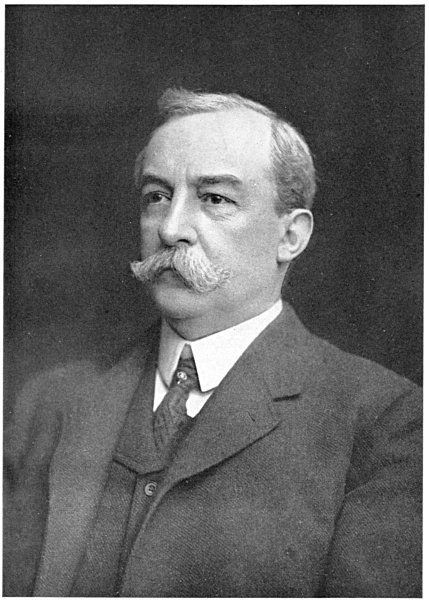
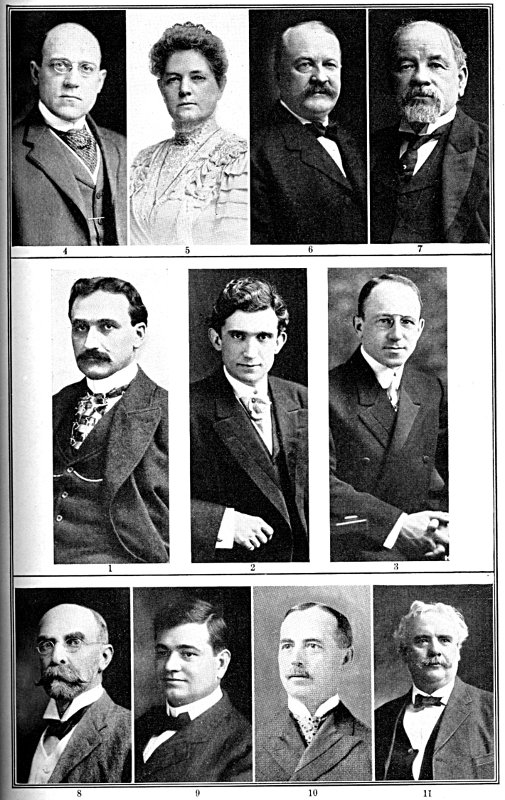
Francis G. Newlands
Senior Senator From Nevada
Regretting my inability to address the Conservation Congress personally
on the subject assigned to me, I submit my views briefly by telegraph.
Conservation legislation necessarily involves harmonious action by
forty-seven sovereigns, the Nation and the States, each acting within
its jurisdiction. As the legislative bodies cannot confer together, it
is necessary that there should be some intermediate organization which
will bring about team work. There should be a National Commission and
State commissions which can act together, as well as separately, in
recommending needed legislation. A reactionary Congress disregarded
Roosevelt's recommendations on this subject, but the progressive
sentiment of the country will not brook further resistance; and the bill
for the appointment by the President of a National Conservation
Commission composed of publicists and experts in civil, hydraulic, and
electric engineering, in arid and swamp land reclamation, in
transportation, and in mining and lumbering, reported by the Senate
Conservation Committee at the last session, should surely pass. With
Roosevelt as chairman, and Garfield, Pinchot, Newell, and the Chief of
Engineers of the Army as members of this Commission, we would have the
men who in practical administration have become more thoroughly informed
regarding the natural resources of this country than any others.
As to the land laws: It is evident that for years large portions of the
public domain have been gradually drifting into private and monopolistic
ownership under antiquated and misfit land laws utterly unadapted to
existing economic conditions, and therefore stimulating fraud in their
evasion and perversion. Legislators outside of the public land States
have taken little interest in the subject, relying mainly upon the
States involved to suggest legislation. Had the Senators and
Representatives from the public land States counseled together
continuously, patiently, and tolerantly regarding the land laws, as they
did regarding the Reclamation Act, the confusion and scandal and the
prosecutions of the past six years would have been lessened, and a wise
solution of needed legislation would have been evolved and accepted by
the country. At the next session of Congress such a council of western
Senators and Representatives should be held, and the present deadlock of
conflicting views ended. In shaping laws regarding the public lands the
central idea should be a rational development, without monopoly or
waste; the establishment of individual homes upon the agricultural
lands; the utilization of the forests and the coal, iron, and oil
deposits under conditions that will enlist the aid of needed capital
without monopolistic exaction or excessive prices; and the improvement
of our waterways, regardless of State lines, so as to promote every use
to which civilization can put them, and in that connection secure team
work on the part of the various services, National and State, engaged
upon them, as well as the cooperation of the Nation and the States, each
within its appropriate jurisdiction in the work to be done and the
expenditures to be made.
Until comprehensive plans are developed, the Nation should not part
permanently with the title to any lands suited for the development of
water-power, the promotion of navigation, or the establishment of
transfer facilities and sites, but should hold the National properties
in such shape that they may be utilized in the working out of
comprehensive plans involving the union of National and State powers. In
forming these plans it should be borne in mind that the Nation holds the
public domain, not for National profit, but in trust for the population,
present and future, of the public land States which welcome immigration
from other States whose surplus population there finds a resting place.
The money realized either from sale or rentals should therefore be
applied to the schools, roads, reclamation projects, and other public
development of the States in which the lands are located.
The ultimate purpose of the laws should be to gradually substitute State
sovereignty for National sovereignty in the direction and control of
this great public trust; but great care should be taken not to
prematurely turn over the trust to States too weak to resist powerful
combinations and monopolies, or until the organization of adequate
public regulation and control is effected.
J. B. White
Chairman of the Executive Committee of the National Conservation
Congress
In the division of the program set apart for discussion there are many
ideas and inquiries crowded upon our minds for expression; and while
much will be made clearer to us, there will be many questions that will
remain to us unanswered.
Perhaps we may first ask ourselves: Why are we here? What came we here
to do? What is Conservation? To whom does it apply? Who are
Conservationists? And who are enemies of Conservation? Are there any,
and why? What special principles must we subscribe to in order to be
known as sufficiently orthodox in creed that we will be received as
worthy disciples in this cause? And who but ourselves (and each for one
another) shall pass upon our credentials as to our honesty of purpose in
this great work? To whom are we answerable but to ourselves, the people?
And why should a great congress of thousands of American people meet
here, as we are doing this week, on this occasion, when we have a legal
Congress in Washington representing every district in this broad land,
whose members we have elected to make such laws as are necessary for our
present and future welfare?
The answer seems to be that this assemblage represents a popular
upheaval of public sentiment, animated and encouraged by those who have
thought along advanced lines and are pioneers in this cause in the press
and on the rostrum; some of whom have been right, and others of whom
were almost wholly wrong. We are here to discuss these features, to
winnow the chaff from the golden grain in this agitation of thought
which we trust will be the beginning of wisdom, to be crystallized as
far as practicable into proper National and State laws for the
regulation of Conservation of public resources, and that the people may
become awakened to that greater saving principle of personal and private
Conservation. It is we, the people, instead of we, the politicians, who
are and should be most in evidence at this Congress.
It has been said that knowledge is power. It is perhaps a better truism
to say that action, with knowledge, is power. Knowledge without action
would avail little; and action without knowledge would be groping in the
dark. But with knowledge and action we can accomplish noble results.
All great reforms and improved conditions spring from the wants, needs,
and consciences of a dissatisfied people. Sometimes the needed relief
comes through an armed and sometimes through a peaceful revolution. Some
man looms up above his fellows from the sea of unrest and his greatness
is proven by his devotion to the cause, free from the selfish thought of
personal aggrandizement; and by his wisdom and tact he creates
confidence in his judgment, in his sagacity, in his fitness for
leadership. So few there are who are willing to bear the cross from this
high sense of duty and offer themselves a mark for calumny and
vituperation, and often in many ways to become a sacrifice to a people's
cause! And when one is found, it frequently happens that the public are
slow in showing their gratitude and appreciation for what his
discernment and discretion saved to a nation; the reward of proper
recognition is often withheld until long after he is dead, because he
lived in advance of his time.
But there are fictitious and exaggerated issues which are created and
developed to huge proportions for the dear people by the sleek
politician (and his name is Legion) who sets up his scarecrow of
impending woe that he may rush valiantly in and save his constituents
and the citizens of a nation from dire calamity, and generations unborn
from distress and want. It is not my purpose to attempt to lull to sleep
in fancied security those who have been influenced by those suspected of
being unnecessarily active in fighting windmills. Always there is need
of sound, conservative consideration before taking hasty action, and the
people are becoming better informed and more critical in their
discriminations, and are learning to know the loud-mouthed pretender
from the thoughtful, loyal, public-spirited citizen. People now are
doing their own thinking. Time was not long ago when the greatest
newspapers of largest circulation manufactured public opinion so
successfully that they were the great thinking machines for the country.
It was so much easier for the people than doing the actual thinking and
logical reasoning for themselves. People read the editorials of their
respective journals in order to get ideas to use in their arguments
with each other. I think that as an educator the newspapers then, as
now, served a most valuable purpose, but it is infinitely of more help
to the thinking man, who criticizes and analyzes what he reads before he
accepts and assimilates it as his own. The pen has been mightier than
the sword, and the "power of the press" has matured and developed
conditions that had to be arbitrated by the sword.
The People Deceived
Much harm has been done by wrong thinking in regard to Conservation, and
the people have been deceived and prejudiced; and like a strong man
awakening from a sleep they have reached out in alarm to search for and
punish, in advance of ascertaining what, if anything, was really the
matter. Innocent people and innocent industries were maligned and
injured. The public are now finding that they have been deceived by the
scheming politicians, and by highly colored newspaper comments, and that
"Conservation" has been used as a trick word and is not what they
thought it was. They had been led to believe that it was something that
someone else ought to do, or should be forced to do, and that they were
being robbed because Conservation was not practiced; and that if
Conservation laws should be passed as recommended by these ignorant
agitators they would be greatly benefited; that everything would be
cheaper than they had to pay, and that they could get more for what they
had to sell. They never stopped to reason that Conservation without use
means holding back from development the natural resources of the country
and producing stagnation in business, and that if each succeeding
generation should follow the same policy there never would be any
improvement.
Those whose education never has extended beyond the three Rs can
understand the principles of Conservation in reforestation, reclamation,
and restoration—reforestation where it will pay to reforest;
reclamation where it will pay to reclaim; and restoration where it will
pay to restore to the soil the elements needed, and where forestry will
not pay better.
The great American leader of Conservation always has maintained, and
especially in his speech at the first Conservation Congress a year ago,
that the first principles of Conservation is development of resources
for the benefit of the people who live here now; he stated that there
might be just as much waste in neglecting the development and use of
natural resources as there is in their destruction by wasteful methods.
In the second place, Conservation stands for the prevention of waste;
and in the third place, Conservation stands for the preservation and
perpetuation of our resources through wise economy and thrift. And its
principles apply alike to individuals and to nations. If a policy in any
department of Conservation requires great outlay of money in order to
develop and conserve for this and future generations, then the
Government, the whole people, and succeeding generations may be
rightfully asked to bear part of the expense, which could be done by the
selling of bonds, and by exemption from taxation some products of
growth, like the forests, which are now taxed every year, making the
owners pay taxes for a hundred years to get for the market only one
crop. No other crop is taxed like this. The owners of any one resource
should not bear all the burdens for growing it for future generations;
and, if it does not pay, the soil will be used for other crops which
will pay better.
True Leaders Misunderstood
As a matter of fact, the true leaders in intelligent Conservation have
been misunderstood by press and people. The principle has been attacked
as if it meant the non-use of our natural resources by the present
generation. Even in Alaska the best known teachers of Conservation urge
the development of all the resources for the benefit of all the people.
They wish to encourage pioneering on both a small and on a large scale.
It is not the purpose of Conservation to preserve from exploration and
discovery unknown resources if there can be found for new fields men
brave and fearless enough to take the risks of life and of capital. For
instance, when in the prospecting of a country's possibilities, and in
the risks of life and capital incident thereto, there is called into
action every bit of physical or mental energy to meet conditions that
seem insurmountable, it is not our purpose to hamper or retard, and say
that this risk and cost shall be left entirely to future generations. We
are willing to encourage the cutting out of the way, and doing all we
can in this generation, believing that the next generation will find new
duties suited to its advanced condition and change of needful
requirements.
Wise Conservation with use means the maximum of efficiency and profit
with the minimum of waste and cost. We do not wish the few to have
unfair advantage. We desire each and all to have opportunity according
to their talents and their physical or financial abilities, that the
known and unknown resources of a country shall not be gobbled up by a
few without an equal opportunity to others who can furnish the same
needed measure of requirements to insure success. We realize that
corporations are necessary to develop a country; that aggregations of
capital, made up from large and small stockholders of the people, can
accomplish more with less waste than can individuals. They can put in
expensive and saving devices and can operate at a far smaller percentage
of profit.
For example, in gold mining the individual works his placer claim with
simple equipment; he will leave 50 percent as waste. Then the dredging
companies will follow, and get half as much more. Then come the big
hydraulic companies, reaching benches and levels that men with small
capital could not attain. These companies require millions of capital,
and they save the waste and are satisfied with a net profit of a few
cents per ton. Just so with Alaska's coal; Alaska needs the coal, and
all we ask is that some fair method shall be adopted which will best
subserve the requirements and will encourage development.
Conservation and economy must enter into our very life, and every effort
should be made to get the most out of little; to find a use for what now
we are in various ways wasting. In European countries the hard struggles
of the masses have produced the saving habit—a virtue we have got to
learn and practice individually and as a people before Conservation will
become a National success. Unless we halt in our mad extravagances,
perhaps there will come to us in some degree those sad experiences of
suffering that have put the saving principle into the very fiber of the
old world peoples; and we will learn our lesson as they long ago learned
theirs. We must each share the burdens of Conservation, and we all
likewise will share in its blessings.
Conservation is not any one man's opportunity, prerogative, or
privilege. It is for the use and benefit of each and all, and can be
practiced in any business or occupation as an important aid to success.
It is for peasant and prince, rich and poor, and for the Nation as well
as for the individuals. We must discover some effectual means to prevent
disastrous forest fires. We must restore the fertility of our soils.
The Question of Ownership
Whether Conservation is best promoted by individual ownership of certain
natural resources is a disputed question, depending on the nature of the
public utilities, the location, and other conditions. Government
ownership does not mean that the Government is going into business
competition with private capital. It means reasonable royalty and
fairness and protection to the lessee, to enable him to compete under
prescribed conditions favorable and just alike to all parties.
In most cases ownership causes a man to see the need of conservation and
economy. The idea of protecting natural resources against waste is not
so strong with some, if they do not have possession; while with others
it is true that possession gives them the desire and opportunity to see
the actual dollars, and they make haste, manufacturing more than the
market demands so that only the prime and best qualities find a market,
which causes a grievous waste. Especially is this true in the lumber
business, but it is not so true in the meat business. The packers of
meat products have studied the science of saving and conservation, so
that the entire carcass is utilized in some useful manner absolutely
without waste. And on the farm the man who is financially able to study
and practice conservation of the soil prevents its exhaustion, while his
poorer neighbor, lacking the funds for the initial expenses, sells the
life of the soil with the crop that he markets, and his farm is soon
impoverished. We, or some of us, believe that there should be some way
of extending State aid at a low rate of interest to the poor farmer to
enable him properly to fertilize his soil; and that the chemistry of
soils and scientific agriculture should be taught in the common schools.
Thus would the entire country be benefited, and National efficiency
strengthened.
Practical Application
The science of Conservation, as a philosophy, is wholly independent of
who owns the property; but its successful practical application often
depends very much on ownership. Combinations of capital have the
advantage, and this needed capital gives greater possibilities for
Conservation. Compare the country butcher and his 50-percent waste with
the million-dollar packing house which has no waste. It is not the fault
of Conservation that there are extremes in combinations, resulting in
trusts or monopolies. They are practicing Conservation in the extreme,
in saving of raw material by greater utilization, and by the discovery
of new uses for by-products. The Standard Oil Company is another example
of the very fineness of division and subdivision of by-products, which
finds a place in therapeutics and in the arts, and appear in vaseline,
paints, dyes, and a hundred other valuable chemical products. This is
Conservation. But there are hundreds of ways where Conservation can be
practiced to a profit in every occupation of life, to the physical,
intellectual, and moral betterment of mankind. As corporations are made
up of many individuals to do certain things that are necessary to be
done, which it would be impracticable or impossible for any individual
to do alone, is it not best to recognize them as artificial individuals,
subject to the control as well as to the protection of wise laws, which
permit no individual to prosper at the expense, discomfort or injury of
another individual?
Conservation, as a living, vital principle stands out beyond and above
selfish partisan politics; and no man or combination of men will ever be
able to make a political issue of it any more than you can make the
gospel of spiritual salvation a political issue. But, like the gospel of
spiritual and physical health, it demands the homage and acceptance of
all. There will be many men of many minds, crystallizing by their
combinations into different sentiments, and advocating different
methods. It is so with churches. But their central doctrine of salvation
will continue to be the basis of creed. And ours is Conservation, that
the country and its people may continue to prosper and progress, and
that the principle and practice of love and charity, which make up the
Golden Rule, shall not cease to influence the hearts of men. The great
question to each one should be: Where and how does Conservation apply to
me?
We are here to build the temple, and to bring men up to the standard
which we now unfurl to the world.
The sower goeth forth to sow; some sow to discord and strife, and some
to peace and harmony; some sow to love and some to hate; some sow to
adversity, and some to prosperity; some sow to selfish greed, and some
to philanthropy and public good; some sow to prudence and Conservation,
and some sow to extravagance and waste.
"There is that scattereth, and yet increaseth; and there is that
witholdeth more than is meet, but it tendeth to poverty."
"Be ye not deceived. For whatsoever ye sow, that shall ye also reap."
A. B. Farquhar
Executive Committeeman National Conservation Congress
In the forum of argument the Cause of Conservation, as a general
principle and in every detailed application, has already won. When taken
on its own merits, hardly a voice is now raised in opposition. Yet it
has still its enemies, none the less pertinacious or dangerous that
their antagonism is based not on public but on private interest—enemies
who are carrying on a bitter contest by indirect methods, and clouding
the issue by starting side questions. We have all heard of the medical
practitioner who covered his general ignorance of pathology by the
device of inducing fits, which were his specialty. So, when anybody
finds the Conservation policy an obstacle to his pecuniary interest, it
is an easy expedient to cover his inability to overthrow or confute that
policy on point of principle by a display of his skill in exposing real
or fancied weaknesses on irrelevant points.
Instances of this effort to secure an advantage by an adroit befogging
of the question will occur to everyone who has followed the discussion
of our subject. Some of these have been so often exposed that it would
be only wearisome to allude again to them, were it not for the
importance of being on guard at all times on all points against the
crafty contrivings of the enemy.
Let us first consider the confusion of Conservation with hostility to
corporations; of encouragement to enterprise, with license to
destruction of natural resources. It is true that we have heard and read
some vigorous protests recently against grants of timber and
water-rights to certain business corporations, whose profits would be
sharply curtailed by preventing or limiting their free use of the
country's forest and river wealth. Perhaps those protests were stronger
because a combination was to profit by the grants than they would have
been had the beneficiaries been dissociated individuals; what is certain
is that they were decidedly stronger because of a belief that the
concessions were to be granted without exacting for them their full
money value. Yet, even allowing that objections founded on the
principles of Conservation may have been mixed in this case with
objections on other grounds, it is contrary to common-sense to apply to
the former the invalidity or the validity that may be discovered in the
latter. Arguments for Conservation are no more or less sound because
aggregations of capital in large industrial undertakings are dangerous
or useful to the public. As Conservationists, we are not concerned
either to palliate the frequent dangers or to depreciate the frequent
valuable services to the public from such aggregations. But we are
concerned to see that the National resources are not squandered for
private gain, if our best efforts can prevent it.
Another example of a confusion of the question, or raising a false
question, is when a saving of natural resources is identified with
locking them up; as though energy conserved were to be understood as
energy neutralized. Quite the contrary: Conservation means so treating
our resources as to get the most we can from them. In the case of our
forest wealth, as of any other in which there is growth and decay, a
judicious degree of consumption of the product is a necessity. After the
period of most rapid development has been succeeded by a slower rate of
increase, approaching that when losses by accident and by interior
degeneration are barely made up by the growing season, there is
obviously a gain in removing the tree and leaving its place to be filled
by something that will continue to grow. In a properly conserved forest
no tree is left standing until attacked by decay, but each is cut when
its value is greatest, so that the best management is recognized not so
much by the largest amount of standing timber as by the largest yearly
gross increase in growth of timber. It is somewhat similar with
water-power. "The mill never grind with water that is past," so the
power has to be used when it is within our grasp, or be lost.
Conservation of water-power is maintenance of the amount of such power
that so appears, and disappears. It is for use; Conservation for disuse,
in this case, becomes an absurdity. Even as to mineral resources, which
cannot be replaced when once withdrawn, Conservation calls only for
economical use, not for neglect or insufficient use. The argument is
that we have quite as good a right to the enjoyment of the gifts of
Nature as our successors have, but not a right so much better than
theirs as to render a wanton waste of our patrimony justifiable, or even
pardonable.
In connection with this same identification of forest Conservation with
neglect of the forests, we should consider the hasty tendency shown in
some quarters to regard the terrible forest fires of the last few weeks
as proof that we are safer without a woodland than with it, and that
therefore our policy is at fault. But our policy is care, and not
neglect. We would avoid such calamities by preventing them. The recent
fires appear to have been due very largely to carelessness, from
meal-preparation or from smoking in presence of dry combustible
material; and in some instances to actual incendiarism, which was, where
it occurred, a crime no less serious than wilful murder. These forests
might have been safeguarded by an expenditure of one-tenth the loss by
fire, and at no danger to life. Fires from locomotive sparks—a far too
frequent nuisance—should no longer be classed with unavoidable
accidents; for the masses of dried grasses, etc., that make the sparks
dangerous could and should be removed from the track vicinity; or the
locomotives provided with efficient spark-arresters, or oil used instead
of coal. From strictly non-preventable accidents such as lightning,
general conflagrations must be exceedingly rare; and thus the cure for
the entire evil is within the reach of capable caretakers. Where an
efficient forest guard is provided, as experience in European countries
and some American States has demonstrated, these disastrous visitations
are no longer dreaded. To look on a universal removal of our Nation's
tree-wealth as the only remedy, is like the old proposition to drive
rats from the granary by burning the barn.
One more illustration will be enough. It is a great advantage to any
cause when the opposing advocate can be found in error on any point, no
matter how trivial or how far aloof from the essential issue; for then
the convenient presumption of "false in one thing, false in all," can be
raised, and the weakness of the said cause most effectively disguised.
This expedient is at least as good as the famous rule in pleading: "When
you have no case, then abuse the plaintiff's attorney." It is readily
possible, I dare say, to show that some of our Conservationist champions
may have in a few cases underestimated the life yet remaining to our
National resources. Estimate in these matters is necessarily uncertain,
few or none of the elements of the calculation being well ascertained.
This is particularly true of our mineral supply. The time when our
coal, for example, may be expected to become practically exhausted
cannot be set within a hundred years, for we cannot gauge the stock in
veins out of sight, nor foresee the rate at which the use of coal will
be accelerated. But it would seem sufficient to know that, at the
present rate of extraction (the amount mined in 1906, as the figures
show, excelled all previous records, and yet the increase in 1907 over
1906 was more than the total annual supply 10 years earlier), no finite
quantity could indefinitely survive; hence more attention must be paid
to avoiding the present lavish waste in mining, as well as applying
water-power and wind-power wherever adapted to do the work now done by
burning coal. These economies should be introduced now from choice, not
left till the disappearance of our fuel-supply drives us to them by
force. It is a wretched business to allow our boast that "The country's
coal supply is good for many hundreds of years yet" to uphold us in the
reckless waste we now make of it.
But I attempted to cover the whole field of Conservation in an address
at our first Congress, and will not repeat but, in conclusion, will
touch upon that form of Conservation which all will concede to be of
supreme importance—the Conservation of the most precious asset of the
State: its men, women, and children. If the life and health of citizens
is sacrificed, by vicious measures or by simple neglect, no saving of
any other of our possessions will at all avail us. The importance of
efforts, on a National scale, for the maintenance of public health has
been proved by ample experience, and we should see to the continuance,
and especially to the proper organization, of such efforts. An important
step in that direction is the proposed formation of a Department of
Health under the Federal Government, as contemplated in the bill so ably
championed by Senator Owen at the last session of Congress. Our race is
a prey to epidemics which extend far beyond State boundaries, arising
from causes that often require long-continued and expensive
investigations for their determination and their counteraction; and it
is obvious that any effectual work against them must be under charge of
the General Government. The clear and cogent reasons for this view have
again and again been given by sanitary experts, and it is needless to
repeat them. The matter is of sufficient importance to call for action
from our Congress, and a resolution favoring a Department of Health, at
the National Capital ought surely to meet with no opposition. I would
propose the following resolutions:
Resolved, That this Congress declares its hearty approval of
the opinion made public last week by our honored Chief
Executive, President Taft, that his party and his
Administration are pledged "to make better provisions for
securing the health of the Nation. The most tangible and useful
form that this can take would be the establishment of a
National Bureau of Health, to include all the health agencies
of the Government now distributed in different departments."
Resolved, That we accept, in principle, the "Health
Department" bill of Senator Owen now pending, and strongly
recommend that that measure, suitably amended where necessary,
be enacted into law.
Resolved, That our Secretary be directed to communicate a
resolution advocating a Department of Health to the members of
the National Senate and House of Representatives, and that our
own membership be urged to use all their individual influence
to aid the passage of the measure hereby recommended.
Sid B. Redding
Secretary Arkansas Conservation Commission
Progress has been made in the Conservation movement in Arkansas through
the recent organization of the Arkansas Conservation Commission. Up to
this time we have had no legislation along Conservation lines, and our
Conservation Commission is one whose members serve without compensation.
The Commission was appointed by our present Governor, and its officers
are George W. Donaghey, Chairman, and Sid B. Redding, Secretary. The
Commission has effected a permanent organization, and its membership
includes some of the leading business and professional men of our State.
The Arkansas Legislature will convene in January, 1911, and at that time
Governor Donaghey will perhaps recommend legislation covering a fixed
Conservation policy for our State.
Frank C. Goudy
President Colorado Conservation Commission
The Colorado Conservation Commission is composed of thirty-six members
appointed by the Governor of the State February 17, 1909, with Mr Frank
C. Goudy designated as Chairman. The Commission met on call to organize
March 11, 1909, at which time Mr Goudy, the Chairman, was elected
President of the Commission for the ensuing year, and the following
subjects were fixed upon as embracing the general scope of Conservation
in Colorado, viz: Lands, Waters, Minerals, Forestry, and Natural
History. Standing Committees were appointed and put in charge of these
five divisions of labor.
The organization is composed of men holding all shades of opinion
concerning Conservation. Some think the Federal Government should turn
over to the State all the public domain within its borders, together
with its natural resources of every kind; that the State should own and
control the public land and all it contains. Others hold that these
transfers from the Federal Government to the State should be made, but
that they should be subject to conditions to be named in the grant,
providing adequate protection against monopoly and other objectionable
control. Still others believe there should be cooperation with the
General Government, at least until such laws are enacted as will assist
in the work of Conservation and until the State is better prepared,
financially, to meet the expense necessarily attending such a work.
There are many others who believe in the continued Federal control of
the public domain and its resources.
Including the first meeting, five sessions have been held, each
occupying two days. In connection with the several sessions already
held, considerable labor has been performed. Many papers have been read,
numerous addresses have been delivered, and the Standing Committees have
made sundry carefully prepared reports. Of the papers read, more than
half have been given by persons not members of the Commission, not for
lack of readiness on the part of our own people, but to divide this
feature of the work with the public at large. It has never been
difficult to secure speakers either inside or outside of the Commission.
The Commission itself is composed of a body of more than ordinary
intelligence. The Annual Meeting was marked with a banquet to emphasize
the passing of the year. The last meeting, April 18-19, 1910, was
devoted entirely to the subject of the water-power resources of the
State. Numerous letters from men prominent at Washington were received
and read, and five papers were given by persons interested in the
subject. All phases of the question were presented, and the most mature
thought of the present time was elicited.
One of the duties of the Secretary of the Commission is to take notice
of any unlawful waste or destruction of natural resources and report the
same to the proper authorities. This work has been sufficiently pursued
to disclose a field calling for special attention—one that calls for
legislative recognition, authority, and assistance.
It may be of interest to the Congress to know something of the
resolutions that have been adopted by this Commission. A brief abstract
of the elements of a few will suffice to show how the body stands on the
subject of Conservation.
1—A hearty endorsement of the general policy of the Government in
control and conservation of the resources of the Nation.
2—Hearty cooperation between the State and Nation in Conservation.
3—That all plans of Conservation should safeguard against monopoly.
4—That in disposing of water-power sites, all franchises should be
limited to a reasonable period to prevent monopoly and regulate charges.
5—That in taxing forested lands, no account should be taken of the
timber until it is cut and sold.
6—That all afforested lands over one acre and not over ten acres on a
tract of 160 acres should be exempt from taxation for a period of ten
years.
7—That the State, by proper laws and reasonable appropriations, should
cooperate with the General Government in the protection of the forests
within the State from fire and lawless depredations of every kind.
Among other things, a committee has been appointed to prepare and submit
to the next meeting a brief and clear statement, for general
circulation, as to what Conservation is and what it is not; what it
stands for, and what it seeks to do. The purpose is to clear away the
haze of misunderstanding and misapprehension in the public mind
concerning it.
The Commission is about to publish a full report of its proceedings,
covering the five sessions already held.
In closing this statement, it may not be out of place to say that
nature has been lavish of resources in our State—they are many and
abundant, but in a certain measure undeveloped, and, so far, we have had
no leisure to take up matters not directly and specifically local to
Colorado, except in cases where they are necessarily general.
Cromwell Gibbons
Florida Conservation Commission
The spirit of Conservation prevaileth everywhere in these modern times,
and for the reason that during the past several years vicious attacks
have been made upon the National resources throughout the length and
breadth of our land, and to such a marvelous extent that our whole
people have awakened to the fact that something must be done and at once
if we wish to preserve our general resources sufficiently to care for
those we expect to come after us, and who are dependent on our country
for an honest and successful living. We have been greedy and selfish in
the past, and now is the time for us to curb this vicious appetite and
think of those who are to come hereafter. Modern times have come to
stay, but the spirit of Conservation will grow until we have
accomplished the grand results of providing proper protection to our
forests, mineral wealth, lands, water-power and waterways, and last but
not the least our various climates that God Almighty has given us to
conserve the health of our people.
Much is said as to the methods to be adopted and what necessary
legislation should take place to obtain actual results of Conservation.
The idea of giving absolute control over the forests, the inland
waterways, and the public lands confined within the States to the
National Government is repugnant to me and I believe to all of the
people of my State. It has too much the tinge of centralization of power
in the Federal Government, and we have had enough of this already. The
notion that giving the States power and control is in favor of the
special interests is ridiculous when we look back and know what has
already been done by the Federal Government giving away some of its most
valuable resources to the trust-monopoly corporations of the country,
and we view in comparison what the States have done where they have
controlled many of these resources. I have but to call your attention to
what we are doing in Florida and have done the past several years in the
way of Conservation. We realized some years ago that our public lands
were fast being absorbed by the railways operating in our State, and
that the time would soon be at hand when our people would be unable to
secure homesteads, and immigration to our great State would be unable to
place that energy with the soil of our State and bring about the
development of resources we were entitled to through the natural course
of developments. We had within our borders a vast empire of land, over
4,000,000 acres of fertile land known as the Everglades, all of which
was looked upon by the land grabbers as not worth 15 cents an acre; but
greatly to his credit, to Governor Napoleon B. Broward, now our nominee
for United States Senator, is due the reclamation of this property and a
saving to the State of lands now valued at over $35,000,000. Against
great political odds and vigorous contests, the policies of Governor
Broward were endorsed; and after much litigation through the State and
Federal courts we have been able to conserve this vast area of land by
drainage under State supervision and at the expense of the State. The
policy was greatly doubted, but it has proven a grand success in that
the State, securing title to these lands, successfully sold half of the
same at a price sufficient to build the necessary dredges and pay for
the work of the draining of the entire tract of property by carrying the
surplus waters from Lake Okeechobee through the trunk canals to the
waters of the Gulf and to Atlantic Ocean. The work that is now going
on has accomplished over 100 miles of main canals with locks to preserve
sufficient water for the purpose of irrigation in dry spells. When the
work is completed, which will be inside of three years, the State will
have provided over 275 miles of canals with the lateral canals
approaching the properties of the various owners, all of which will not
only result in giving the necessary drainage and irrigation but will
also furnish water transportation to the Gulf and to the inland water
route from Key West to Jacksonville (a distance of about 500 miles), as
well as deep-sea connections at the various ports along this route. By
this State Conservation we are giving to the people one of the richest
bodies of fertile lands in the United States, a territory greater than
the States of Rhode Island and Connecticut combined, every inch of which
will grow either sugar-cane or truck of all kinds through winter and
summer. These lands will produce at least three crops a year, and to the
industrious citizen who desires to live in a country that will give
renewed youth and a climate unexcelled and a living independent of the
world. I know of none that can be found better located to give the
results than this vast empire known as the Everglades, so promptly
conserved by our State Government and our people.
We are also interested in another line of Conservation, and that is the
preservation of our pine forests and the prohibiting of the destruction
of our sapling trees which have been attacked by those who are greedy
for wealth and have no regard for the future. Much will be accomplished
in this direction, as our people are absolutely opposed to the complete
destruction of the forests, as it will provide no future for our timber
markets; and destruction of our pine forests would undoubtedly affect
our climate, which by all means should be conserved as well as the
timber for the building of our homes of the future.
It may be as well for me to call your special attention to the fact
that, in addition to this great work of Conservation I have related in
reference to the saving of public land and our efforts in the direction
of saving the forests, our State has for several years aided in a public
way in the building of the great inland waterway along the Atlantic
coast within the State of Florida. These canals have been made during
the past 15 years, until now we have a thorough water route from Saint
John's River southward connecting streams and inlets until there has
been dug over 300 miles of canal, giving this great waterway and
enabling the people along the eastern coast sections a cheap means of
transportation to the railway center of the State at Jacksonville.
I think that we have done our part toward Conservation, and all under
the jurisdiction and authority of our State. There has been no effort at
graft, but all have worked in harmony in the interests of the public
welfare, thus demonstrating (so far as Florida is concerned) that she is
able to control her own affairs; and all she asks of the National
Government is its aid and assistance.
Jerome J. Day
We believe that, in the interest of the United States and the State of
Idaho, the agricultural land within the forest reserves of Idaho should
be opened to settlement and made available for home building; and that
the decision as to whether land is good agricultural land or not should
be referred to those who are primarily agriculturists, rather than to
those who are primarily arboriculturists, and to those who are familiar
with farming in Idaho rather than to those who are familiar only with
farming in general.
We believe that the protection of the forests of Idaho and the safety of
life and property in Idaho require that good roads be built along the
lines of streams leading into the heart of the forest reserves; and that
the land along these roads, whether valuable for agriculture, timber, or
mineral, should be open to entry, with such provisions in relation to
habitation and improvement as will secure the presence, between the
months of June and September, of a local fire-fighting force, consisting
of men who know the country, have a financial interest in the locality,
and are skilled in the use of the axe and in methods of fighting a
forest fire.
We believe in the separate classification of coal lands, oil lands,
phosphate and mineral lands; and we believe in the administration of
those lands in such a way as to prevent waste, promote safety in mining,
and defeat monopoly. We do not believe in a policy for revenue in
relation to these lands. The revenues to be derived should be
incidental, and belong of right to the State of Idaho.
We believe in the cooperation of the State and the National Government
in the conservation and utilization of the water-power within the State
of Idaho.
We will recommend that the Governor of Idaho call a convention or
congress to consider questions relating to home Conservation in Idaho,
and to recommend policies and legislation and a system of administration
for all forms of public wealth that lie within the borders of the State.
A. E. Metzger
Indiana Conservation Commission
The Indiana Conservation Commission was appointed by former Governor
Frank P. Hawley shortly before he left the gubernatorial chair. The
Commission as appointed by Governor Thomas R. Marshall, his successor,
consists of nine members with Mr Henry Riesenberg as chairman. The
Commission, through its chairman, made an effort to get a bill through
the Legislature, making an appropriation for the use of the Commission,
but it failed to pass. Governor Marshall was repeatedly urged to set
aside a small sum out of the contingent fund so that an investigation
could be made and published, but this the Governor has repeatedly
declined to do, and it is thought he is not very favorably disposed
toward the cause of Conservation. Having no means the Commission could
do absolutely nothing, and hence may be said to be in a state of
"innocuous desuetude."
Mr Riesenberg, the chairman, has, however, lectured on the subject
throughout the State, visiting many points, giving his time freely and
defraying the expenses out of his own pocket. He has also written
innumerable articles for the papers of Indiana, and these, together with
his lectures, have served to keep the subject alive; and Indianians are
probably as well informed and as fully alive to the subject as people in
any other State.
A. C. Miller
Chairman Iowa State Drainage, Waterways and Conservation Commission
I have been asked to prepare for your consideration and information a
history of the Conservation movement in Iowa, reviewing briefly the work
done by the State Drainage, Waterways and Conservation Commission.
The sentiment toward the Conservation of our natural resources has been
developing gradually for a number of years, keeping pace with the
development that has been aroused throughout the country. So far as Iowa
is concerned, it was augmented greatly through the efforts of the
commercial bodies throughout the State, and especially of those of the
city of Des Moines, when during the year 1907 they inaugurated a
movement which had for its object the securing of an appropriation by
Congress to be used in surveying three of our principal streams in order
that we might determine whether or not they were subject to improvement
for navigation, and for the further purpose of ascertaining the value of
the water-power which might be developed if the rivers were improved for
navigation.
Great interest was manifested by our people, and we were finally
successful in securing an appropriation by Congress for a survey of the
larger of the three rivers, the Des Moines; and the United States
Government has at this time a corps of some 30 engineers at work. They
expect to finish their work early in 1911.
The Thirty-third General Assembly of Iowa convened in December, 1908,
and remained in session until the following spring. The sentiment had
been aroused to such an extent at this time that there seemed to be a
general demand for the creation of some kind of a Commission to take
these matters up and work them out intelligently for the good of our
people and report with recommendations to the next General Assembly. It
seemed hard, however, for all to unite on a general plan. Portions of
our State demanded a Commission for dealing with the question of
drainage only, leaving it to other Commissions to handle the question of
water transportations, forestry, and water-power. A compromise was
finally made, and this Commission was created. It is composed of seven
members appointed by the Governor: A. C. Miller, Chairman, L. W.
Anderson, E. A. Burgess, A. F. Frudden, T. W. Keerl, Thomas H. McBride,
and W. H. Stevenson.
Duties Defined
First—To investigate the present condition of public drainage in Iowa
and the benefits which can be derived from the best drainage engineering
practice, the most economical administration of drainage projects, and a
more economical best method of procedure to bring about the development
of the water-power of those benefits may be secured.
Second—To investigate the present condition of all overflow of
flood-plain lands of Iowa, showing losses due to floods in the
destruction of farm crops, the losses due to the destruction of property
in the cities and towns and built-up districts, the losses due to the
withdrawal from crop cultivation of such flooded lands, and recommending
the proper methods of preventing such flood conditions.
Third—To investigate and survey at least one representative Iowa
river to ascertain the available dam sites and the potential water-power
and report the best method of procedure to bring about the development
of the water-powers of the State, at the same time retaining the
ultimate control of the water supply as a property of the State.
Fourth—To cooperate with the United States survey provided by act of
Congress and investigate the possibilities of navigation upon the rivers
or upon adjoining lands by canal, and to secure the aid of the
Government experts when practicable in the several matters investigated
by this Commission.
Fifth—To investigate the questions of forests and their preservation
and culture in the State, especially with reference to the influence of
forests on the flood conditions of the rivers and the erosion and waste
of the soils.
Sixth—It is the clear intent and purpose of the act providing for the
Commission that the close interrelation of the several phases of river
development shall be shown, and the necessity for a broad, comprehensive
treatment of our rivers shall be studied and reported upon.
Seventh—The general question of the relation of the State to the
preservation of the fertility of the Iowa soils.
Eighth—The general question of the wise and conservative development
and use of the mineral resources of the State, especially with reference
to the mining of coal.
Ninth—The general question of the nature and condition of such lakes
in Iowa as now belong to the State, and the relation of lakes and
streams to the preservation of such varieties of fish, birds, and native
animals as are desirable which now belong to the State.
Members Serve Without Pay
We have but $5,000 to carry on the expenses of our two years' work. Out
of this must be paid our secretary and office expenses, and the cost of
printing our reports and whatever field work is done by the engineers.
It would seem that the great State of Iowa, producing annually more than
$600,000,000 of wealth could well afford to have been more liberal in
appropriating for this work. The task assigned surely is no small one.
Work of the Commission
We have begun to compile our report for the printers, and expect to
present a report that will be valuable for future reference and we hope
of much interest to our people.
We have investigated the drainage conditions over the State quite
extensively, and undertaken to ascertain the number of acres of land not
available for agriculture through lack of drainage. We will have
recommendations to make pertaining to this question, but have not yet
worked out any plan for financing cost at reduced rates. This will be
considered later, but the Iowa farmer has money and is not so much
interested in having the interest rates for carrying his debt reduced,
as he is in getting the first cost reduced.
Water-Power
We have investigated and surveyed a number of water-power sites and are
more and more impressed with the importance of the State looking after
them and seeing that the control does not slip away. No estimate has yet
been made as to the value of the undeveloped water-power of the State,
but I will venture that it will be shown to be several millions of
dollars. If not looked after, it will be but a short time until it will
be under the control of individuals or private corporations. Almost
invariably wherever our engineers have gone, they either find the
engineer for some crowd of individuals—for some corporation—on the
job, or find that he has preceded them. I will cite one example in our
State: On Cedar River, at Moscow, individuals are planning the
construction of a great dam which will store an immense body of water.
They have 7,500 acres of land already acquired, adding greatly to the
power developed by the natural flow of the river itself. When this dam
is completed, it will turn from the channel into a canal practically the
entire discharge of the river at low stage, carrying it around the
country to the city of Muscatine, with an average fall of about ninety
feet, developing 25,000 horse-power, and finally discharging the water
into the Mississippi, never returning to the original channel from which
it was taken. A syndicate plans to finance this proposition on a basis
of $3,000,000, and if unmolested the probability is that it will be
carried out successfully. The Commission, however, is powerless, being a
temporary creation with its duties defined. We, therefore, can only call
attention in our report and urge upon our Legislature that it take some
action toward protecting our people in their rights in these matters.
We are working in perfect harmony with the United States Government
engineers who are on the Des Moines River work at this time. We expect
much from them in the way of information that we can use in our report.
Iowa is interested in some 900 miles of navigable streams, either
touched by her borders or within her territory, and we hope some day to
again reap the benefit of being able to load and unload freight at docks
within the corporate limits of our beautiful capital city, as we did for
many years in its early history; and not only Des Moines but all the
cities bordering on the great Mississippi or the equally great Missouri.
Iowa occupies a proud position among the States today, rich in fertile
soil, rich in minerals, coals, and shales, blessed with a happy and
contented people; if given the benefit of improved waterways like the
Mississippi, the Ohio, and the Missouri, making them great highways; and
if at the same time permitted to improve our tributary rivers and the
water-powers of this great Central West, it will make a mighty empire of
itself—and Iowa, magnificent State that she is, will be in the center
of it all.
We are not yet so far advanced with our work that I am able to tell you
what the Commission will or will not recommend to the next Legislature.
I am firm in the belief that a permanent Commission should be created,
with a liberal appropriation for carrying forward the work. Possibly the
field now covered by our Commission should be divided. It would seem
that the drainage interests of the State would be of sufficient
importance to justify the employment of a State engineer, and possibly
the question of drainage would receive the entire attention of some
State board. There is a great work that can be done by our Commission in
the future if the State should see fit to make it permanent and
appropriate the money to carry forward the work. The beautifying of our
meandered lakes is something that is attracting the attention of our
people, and would prove a popular move if started. They are also
becoming much interested in the treatment and handling of soils, and
much good would ultimately result to our farmers if this phase of
Conservation was handled intelligently and carefully. Professor
Stevenson, of the Iowa State Agricultural College, a member of this
Commission, is recognized as an expert in this line of Conservation
work, and I believe that his part of the report when published will be
instructive and interesting. I can only hope that enough interest will
be aroused throughout our State to influence the next Legislature to put
the Commission on a permanent basis, furnishing the means to carry on
the great work.
Henry E. Hardtner
Chairman Louisiana Conservation Commission
Louisiana was the first State to create a commission for the
Conservation of Natural Resources by legislative enactment, and enjoys
the proud distinction of being the first to enact sane and comprehensive
laws tending to conserve, protect, and perpetuate the natural resources
of the State. In 1908 the Legislature created a Conservation Commission,
whose duty it was to report to the Legislature in 1910 as to the
conditions of the various resources and to recommend necessary laws for
their use and preservation.
The Commission went to work with a will, holding meetings all over the
State for the purpose of arousing the people and educating them in the
great work. The lumbermen were our friends from the beginning; so were
the owners of timber lands, and operators in the production of oil, gas,
sulphur, and salt; the farmers dependent on the streams for irrigation
purposes soon saw the benefit to be derived from a policy that would
protect and perpetuate our natural resources, and also gave us their
hearty cooperation. This great work accomplished, the people as a whole
soon realized that 80 percent of the proceeds of the forests and rivers
was expended for labor and supplies, and joined heartily in the
movement; and thus we were prepared to ask the Legislature that certain
laws be enacted.
Honorable Harry Gamble, our efficient Secretary (and a member of the
Commission) prepared the various acts, and with such care that they will
stand the test of any court. It was my pleasure as a member of the
Legislature from the newly created parish of Lasalle to introduce and
handle a number of the Conservation measures. Governor Sanders, one of
the greatest men in the United States, who recently resigned a United
States senatorship to which he had been unanimously elected because the
people needed him at the helm of the State Government, gave his hearty
support to every measure bearing on Conservation. But with all the
serious obstacles removed, and the advantage of a friendly
administration, our bills could not be made effective without a
constitutional amendment; and so we faced a real crisis.
In order to raise a sufficient fund to protect our forests from fires
and for reforestation purposes, and to prevent the gas and oil fields
from being recklessly exploited and wasted, it was necessary to levy a
license-tax on timber and minerals severed from the soil. Our resources
being in the hands of individuals and corporations, it was just and
proper that they contribute to the cost of the work for preserving their
properties, and the people through the State would enact and carry such
laws into effect as would benefit all. To pass a constitutional
amendment is not any easy matter; and thus the real work began. The
Constitution of the State, which provided for a license-tax on nearly
every profession or business, had left out lumber and minerals, probably
because it has only been in recent years that there was any development
along such lines. That part of the amendment referring to natural
resources was as follows: "Those engaged in severing natural resources,
as timber or minerals, from the soil or water, whether they thereafter
convert them by manufacturing or not, may also be rendered liable to a
license-tax, but in this case the amount to be collected may either be
graduated or fixed according to the quantity or value of the product at
the place where it is severed."
When the amendment came up for final passage I spoke in part as follows:
"The whole Conservation program as recommended by the Conservation
Commission, of which I had the honor to be chairman, is dependent on
this amendment of Article 229 of the Constitution. In carrying out the
idea of Conservation, as in carrying out any other governmental policy,
it is necessary to raise money. In order to introduce a forestry system
and to protect your forests from fires, it is necessary to have money to
employ persons informed along these lines whose special duty it will be
to look after that kind of business. Now in order to do this, it seems
no more than fair that the persons who are profiting by the depletion of
our natural resources should contribute to the payment of these bills;
but before that can be done, it is necessary to change the Constitution.
"Article 229, as originally made, exempts manufacturers. Notwithstanding
this fact, in 1902 a general license act was passed in which the
Legislature, in their wisdom, saw fit to levy a license-tax on the
manufacture of lumber. When it was attempted to collect this tax, it was
carried to the Supreme Court which held that a license-tax levied on the
manufacture of lumber could not be collected for the reason that
manufacturers were exempt under Article 229, and the sawing of lumber
was a manufacturing business. The court did not say that the attempt of
the Legislature to levy a license-tax on the manufacture of lumber was
inequitable or unjust, but merely that it was unconstitutional according
to Article 229. This bill, from and including lines 12 to 24, attempts
to change the Constitution so that the tax may be levied on the severing
of trees from the soil. It is to be noticed that there is no attempt to
levy a license-tax on the manufacture of lumber, but it is proposed to
change the Constitution so that the license-tax may be levied on the
cutting down of trees in forests.
"As stated before, the Conservation Commission, after having
investigated this question for two years and examined the laws not only
of the United States but of foreign countries, has reached the
conclusion that those persons who are engaged in the exhaustion of the
natural resources of the State, in justice to the State which permits
them to do business under this law, in justice to the people, and in
justice to future generations of the State, should bear a slight
additional tax in order to restore and protect those resources.
"This, Gentlemen, is the reason why you are asked to change Article 229
of the Constitution. You are already acquainted with the facts connected
with the natural resource depletion of this State, and I will not now
discuss that question. I am simply explaining to you, to the best of my
ability, the necessity of changing the Constitution as proposed in this
bill in order that we may have the proper source to raise a revenue in
order to carry out Conservation policies."
We succeeded in passing the amendment, and then passed the License-tax
or Revenue Act which provides the following taxes: 3/4 cent per 1,000
feet log scale on fine and hardwoods severed from the soil; 1 cent per
100 stave bolts; 3/10 cent for each telegraph and telephone pole; 1 cent
each for piles; 1/8 cent per cup per year for extracting turpentine from
growing trees; for production of oil, 2/5 cent per barrel; for natural
gas, 1/5 cent per 10,000 cubic feet; for mining sulphur, 2 cents per
ton; for mining salt, 1/5 cent per ton. The license-tax on timber will
yield about $20,000 annually, and the same amount will accrue from mines
and mining. The Conservation Commission will use these funds for the
protection and perpetuation of the State's natural resources.
The Forestry bill, which we consider a good one, was then passed. There
are no restrictions as to size-limit in cutting timber. Ample provisions
are made for a complete fire patrol system and methods for preventing
loss by fires. In Louisiana and all southern States, denuded lands will
reforest naturally if fires are prevented, and a good crop can be grown
in from 25 to 40 years. For any one who will engage in the business of
growing timber, especial inducements are held out. The assessment on the
land is fixed at $1.00 per acre for 30 or 40 years, and the growing
timber is not taxed during that period. The Deputy Forester must be a
man practically and theoretically educated in silviculture, and under
the State Forester has supervision of forestry work. Consent is also
given to the United States to acquire by gift or purchase not exceeding
100,000 acres for a National forest reserve; the State may also acquire
by gift or purchase lands for forest reserves.
Act 254 provides for the establishment of a department of mining and
minerals, including oil and gas production, authorizing the prohibition
of unsafe and wasteful mining and the appointment of a supervisor of
minerals on recommendation of the Conservation Commission.
Act 265 to "establish a Board of Commissioners for the protection of
Birds, Game, and Fish," empowers them to employ wardens, officers, and
assistants, and to provide means to carry the Act into effect; gives
them complete control and management of all the waters of the State,
such as the Gulf of Mexico (within the jurisdiction of the State), all
lakes, bays, sounds, rivers, streams, passes, bayous, creeks, lagoons,
and ponds by granting management and control of all fish, shell-fish,
oysters, diamond-back terrapin, turtles, shrimp, crabs, and alligators;
and provides for oyster, game, and fish reserves by granting them
control of birds, game, and fur-bearing animals, etc. Birds, game, and
fish are among the greatest natural resources of the State, yielding an
enormous food supply and a large revenue.
Act 57 declares that waters found in the bayous, lagoons, lakes, bays,
and rivers to be the property of the State. The idea is that the State
will not permit any one to create a monopoly of this resource, which
belongs to the people.
Act 280 provided for the creation of a Commission for the Conservation
of Natural Resources.
Act 333 provided for conservation of natural gas and oil by preventing
waste.
A number of other Conservation measures were enacted into laws, 29 in
all, but I cannot touch upon them at this time.
We are proud of our success in inaugurating safe and sane policies for
Conservation; we are proud of our Governor, J. Y. Sanders, who urged the
passage of the various bills; we are proud of our lumbermen, timber
owners, gas and oil operators, and miners who recognized the need for
Conservation and the justness of our bills, and assisted in their
passage. And above all we are proud of our people as a whole, who are so
wide-awake on the question of Conservation of natural resources.
Cyrus C. Babb
District Engineer Maine State Water-Storage Commission
The two principal resources of the State of Maine are its forests and
its water-powers. Of its total area of 30,000 square miles, 21,000
square miles, or 70 percent are in forest lands. Over 1500 lakes and
ponds are located in the State, covering 2200 square miles of water
surface, and not including the innumerable little ponds of an acre or
two in area that are located in all directions. There are in the State
one lake to each 20 square miles of territory, and one square mile of
lake surface to each 14.3 square miles of territorial area.
Although the State ranks 35 in area, and 30 in population, it ranks
third in the Union in water-power development, having, according to the
U. S. Census, a total of over 343,000 horsepower in use. It is surpassed
only by New York and California in total horsepower.
The State has always conserved its water-power. The Supreme Judicial
Court of the State has held as follows:
It is a rule of law peculiar to this State and Massachusetts
under the Colonial Ordinance of 1641-7 that all great
ponds—that is ponds containing more than 10 acres—are owned
by the State.
While private property cannot be taken for public use without
compensation, the waters of great ponds and lakes are not
private property.
Under the ordinance, the State owns the ponds as public
property held in trust for public uses. It has not only the jus
privatum, the ownership of the soil, but also the jus publicum,
and the right to control and regulate the public uses to which
the ponds shall be applied.
The authority of the State to control waters of great ponds
and determine the uses to which they may be applied is a
governmental power, and the governmental powers of the State
are never lost by mere non-use.
Early Investigation
Maine has always been in the forefront in the investigation and
conservation of its resources. Thirty years before the National
Government authorized its first geological investigations, and over
forty years before the Federal Geological Survey was established, the
State of Maine had made such a survey. By Act of the State Legislature,
March 28, 1836, a geological survey of the State was authorized under
the direction of Dr Charles T. Jackson, State Geologist. The
investigation was continued for three years. The results of this
geological survey, considering the difficulties of transportation at
that time and the non-existence of accurate maps, are interesting.
A detail survey and report on the natural history and geology of the
State was made in 1861 and 1862 by Ezekiel Holmes, Naturalist, and C. H.
Hitchcock, Geologist. Reports were made on the zoology and botany of the
State, but the most interesting and detailed reports treated of the
geological resources.
A hydrographic survey of the State was authorized by the Legislature as
early as 1867. The resulting report of Mr Walter Wells is considered as
authority even to the present day.
Present Organizations
At the present time there are two organizations in this State working
along geological, topographic, and hydrographic lines. They are known as
the Maine State Survey Commission, and the Maine State Water-Storage
Commission. The first organization was authorized by Act of the State
Legislature March 16, 1899. Its powers were subsequently amended and
enlarged by an Act approved March 23, 1905. It is authorized to
cooperate with the U. S. Geological Survey, and its work includes the
topographic and geological surveys of the State.
The creation of the State Water-Storage Commission was authorized by Act
of the Legislature April 2, 1909. His Excellency, Governor Fernald, at
the Conference of Governors in May, 1908, was so impressed with the
importance of the objects and recommendations there brought forth that,
at the next meeting of the State Legislature, he advocated and finally
approved the Act creating said Commission. This Commission is directed
to collect information relating to the water-powers of the State, the
flow of rivers and their drainage area, the location, nature, and size
of the lakes and ponds in the State, and their respective value and
capacity as storage reservoirs, with a view to conserving and increasing
the capacity of the water-powers of the State. The Act further provides
that every person, firm, or corporation before commencing the erection
of a dam for the purpose of developing any water-power in the State, or
the creation or improvement of a storage reservoir, shall file with the
Commission certain prescribed engineering plans.
The first report of the Commission to the Legislature is asked to show,
in so far as time will allow, a comprehensive and practical plan for the
creation of such water-storage reservoirs as will tend to develop and
conserve the water-powers of the State, and to report the necessary
steps that should be taken by the State to further conserve and increase
them. The Commission is further requested to ascertain what lands can be
purchased by the State and the cost thereof, with information as to
their value as forest reserves or for conserving the water-powers of the
State, or for reforestation; and further to investigate the question of
denuded, burnt-over, or barren lands in the State, and their extent and
value, with a view to their purchase by the State for reforestation.
By an agreement dated December 1, 1909, between the Director of the U.
S. Geological Survey, the Chairman of the State Survey Commission and
the Chairman of the State Water-Storage Commission, the work of the
three organizations in the State is brought under one direction. This
agreement provides for a cooperative survey of the natural resources of
the State; that said survey shall include the continuation of
topographic mapping, a determination of the amount and availability of
water resources, their present development and the best methods of their
future utilization; also the further determination of geologic
resources. The executive officer, under the terms of this agreement, is
a duly appointed employee of the U. S. Geological Survey, with the title
of District Engineer.
State Highway Department
This department was authorized by legislative Act of 1907. The
appropriation for the work is based on a tax of 1/3 mill on the State
valuation. Provision is made in the law whereby the State will aid
financially, on a sliding scale, the various towns if they raise money
for highway construction purposes. On the average it may be said that
for every dollar appropriated by a town, the State will pay an
additional dollar. The law further provides for a limitation of the
amount that the towns may raise for this purpose, based on the valuation
of said town. The sliding scale of appropriation by the State is as
follows: to towns having a valuation of $200,000 or less, the State will
pay two dollars for each dollar appropriated by said towns; to each town
having a valuation of over $200,000 and less than $1,000,000, one dollar
for each dollar appropriated by said town; to towns having a valuation
of over $1,000,000 and less than $1,200,000, ninety-two cents; to towns
having a valuation of over $1,200,000 and not exceeding $1,400,000,
eighty-five cents; to towns having a valuation of over $1,400,000 and
not exceeding $1,600,000, eighty cents; to towns having a valuation of
$1,600,000 and over, seventy-five cents for each dollar appropriated by
the town; and to unincorporated townships, one dollar for each dollar
appropriated.
State Forestry Department
This department was created by legislative Act of 1891 through the
appointment of the State Land Agent as Forest Commissioner. This
Commissioner is directed to institute an inquiry and to report as to the
extent to which the forests of the State are being destroyed by fires
and by wasteful cuttings, and the effect of such action on the
watersheds of the lakes and rivers and on the water-powers of the State.
His principal duties, however, are the supervision and control of
measures for the prevention and extinguishment of forest fires in all
plantations and unorganized townships in the State. An efficient
fire-fighting organization is now in operation in the State under this
department, and during recent years valuable tracts of timber have been
saved that would otherwise have been destroyed.
Other Organizations
There are other departments and organizations that are doing very
valuable work in the preservation of the natural resources of the State
of Maine. Many pages could be written on their results but at present a
number of them will only be mentioned by name. Included in this list are
the Departments of Inland Fisheries and Game, Department of Agriculture,
Bureau of Industrial and Labor Statistics, State Board of Health, and
Department of Harbor and Tidal Waters.
Frank William Rane
State Forester
Henry H. Sprague
Chairman Metropolitan Water and Sewerage Board
While we do not have an authorized Conservation Commission in
Massachusetts, we nevertheless have many wide-awake and active State
officials and commissions in charge of work which in the total answers
the same purpose to the Commonwealth.
Massachusetts is noted for her excellent roads, and she is constantly
enlarging the mileage. The Fish and Game Commission is perfecting our
laws and encouraging modern protection and management of both fish and
game. The propagation and dissemination of each is a large part of their
work.
General agriculture is undoubtedly improving and various rural
industries such as apple raising, cranberry growing, asparagus culture,
and various specialties are receiving renewed attention. The State
Agricultural College is growing in influence and value to the State.
The increasing population of the State has made it necessary to set
apart and protect many of the ponds and streams throughout the
Commonwealth for the purpose of water supply. During the past fifteen
years the Commonwealth has expended more than $41,000,000 for the
acquisition and construction of Metropolitan works in order to provide
the city of Boston and surrounding municipalities with water. One of the
storage reservoirs constructed for the "Metropolitan District" is the
largest reservoir in the world built up to the present time for the
purpose of providing domestic water supply. Large sums have been spent
not only for the direct protection of the reservoirs from pollution, but
also in acquiring and improving large marginal areas of woodland, and in
the planting with trees of many hundreds of acres of cleared lands which
have been acquired. Cities and towns outside of the Metropolitan
District have made and are making like provisions for obtaining and
preserving their water supplies.
Under recent legislation the gradual metering of all water services in
the Metropolitan District is required, and more vigorous inspection has
been introduced; so that in the past year or two a material reduction in
the total consumption has been effected notwithstanding the increasing
number of water takers.
In the building of the great Wachusett reservoir for the Metropolitan
Water-works provision has been made for the utilization of the power
which may be generated by the fall of the water over the dam to the
level of the aqueduct through which the water is conveyed into the
Metropolitan District. Machinery for a power plant is about to be
installed in the power house already erected, by which it is estimated
that from 2500 to 3000 horsepower may be generated and disposed of, not
only at a profit to the District, but also to the advantage of the local
industries.
While the State has permitted the taking, for the benefit of the
municipalities, of the necessary sources of water supply by the exercise
of the power of eminent domain, it has adopted the policy of compelling
the husbanding of the waters by the prevention of unnecessary and
wasteful consumption, and of utilizing the power generated by water
works for the benefit alike of the works of the mechanical industries of
the Commonwealth.
For conserving forest, park, and shade trees, Massachusetts has
undertaken the great task of suppressing the ravages of the gypsy and
browntail moths. This work has now extended over a period of years, and
eminent entomologists concede that nothing equal to this undertaking has
ever before been attempted. As many as 2700 men at one time have been
employed by the State in this work. Massachusetts has spent millions of
dollars in the work, and it is not only a protection to our own people
but equally prevents the dissemination of these pests to other States.
Parasites have been collected and introduced from foreign countries, and
everything possible undertaken to assist in the work. Our improved
high-power spraying machines with new and improved devices for
destroying these insects will undoubtedly prove of great value in future
spraying undertakings throughout the Nation.
The forestry work meets with continued whole-hearted support at the
hands of our people. The work of reforestation is becoming more popular
each year, and great good is bound to result therefrom. Our forest fire
laws are proving to be workable and hence practical. The poorer towns
are receiving State aid in the purchase of fire-fighting equipment, and
the wealthier towns are equipping themselves. The past year, as
heretofore, the Legislature has been inclined to assist the State
Forester in his various endeavors.
Hermann Von Schrenk
Chairman Missouri State Forest Commission
The Forest Commission of the State of Missouri was appointed a year ago
for the purpose of making recommendations to the Governor concerning a
future forestry policy for the State.
The Commission, after a thorough study of the conditions prevailing in
the State, prepared a report to the Governor, the principal feature of
which was the recommendation that a State Forest Board be established
with a State Forester. In submitting its report to the Governor, the
Commission suggested a bill, modeled after what appeared to be the best
laws already in force in other States. The Commission called particular
attention to the necessity for establishing fire guards and doing
educational work among the people of the State. The report and the bill
were sent to the Legislature by the Governor with a strong
recommendation that the bill be passed. Owing to the enormous amount of
other business on hand and the lateness in the year, the Legislature
did not have time to fully consider the bill, and it will come up again
at the next session.
The Commission has investigated the forest resources of the State in a
general way, and feels that there is a large field for the work of
perpetuating forests, especially in some parts of the State where the
land is more or less unfit for agricultural purposes. The Commission has
furthermore planned the organization of a State Conservation
Association, this to be organized sometime this fall along lines similar
to those of Associations already existing in many States.
While the Conservation work of this State is as yet in its infancy, the
general interest awakened is very large, and the Commission anticipates
large practical results during the coming year.
Rudolph von Tobel
Chairman Montana State Conservation Commission
Probably none of the Governors of States who attended the Conference of
Governors called by President Roosevelt in May, 1908, returned to their
constituents more thoroughly imbued with the principles of Conservation,
or more fully determined to put those principles into practice in this
State, than Governor Norris, of Montana. Almost immediately, acting on
the suggestion of Governor Folk at the Conference, he appointed a
Forestry Commission, consisting of Judge Lew A. Callaway, of Virginia
City, Ex-Governor Robert B. Smith, of Kalispell, and Ex-Senator Paris
Gibson, of Great Falls.
It soon became apparent to Governor Norris, in view of the most
unsatisfactory condition of the land laws of the State, that there was
work along the lines of Conservation of a broader scope than was
comprehended in the plans laid down for the Forestry Commission, and he
appointed what was known as the State Lands Commission, which was
expected to draft a bill covering all State lands, except timber lands,
to present to the Legislature. This Commission consisted of Honorable
David Hilger, of Lewistown, Ex-Governor B. F. White, of Dillon, and
Honorable Charles S. Hartman, of Bozeman. Subsequently, Mr E. M.
Brandagee, of Helena, was appointed to fill the vacancy on the Forestry
Commission caused by the death of Ex-Governor Smith, and Mr Rudolf von
Tobel, of Lewistown, was appointed on the Land Commission to fill the
vacancy caused by the resignation of Mr Hartman.
After several meetings had been held by each of these Commissions, it
was found impracticable to separate the work of the two without
duplicating much of it and causing some conflict; so the two were
consolidated, and thereafter worked together in the preparation of a
bill covering the entire land holdings of the State to present to the
Legislature. Such a bill was prepared, submitted, and passed by the
Legislature, and approved by the Governor, March 19, 1909, and is now
the law of the State.
This Act places all State lands under the control of the State Board of
Land Commissioners, consisting of the Governor, Secretary of State,
Attorney General, and Superintendent of Public Instruction. It provides
for the appointment of a Register of the State Land Office, a State Land
Agent, a State Forester, and other minor officials. The duties of the
Register are to attend to the sale of lands, and he is the chief of the
office. The State Land Agent's duties are, generally, to examine all
lands in the field; and the State Forester has general charge of the
timber lands of the State.
The Act further provides that no timber land shall ever be sold, except
only such as, after being cleared, would be more valuable as
agricultural land, than it would be for the growing of timber; and that
only the merchantable timber in the forests of the State shall be sold
from time to time. It also provides for the reforestation of the lands
as occasion may require. The State Forester is made the general Fire
Warden of the State, and the Deputy Forester, all peace officers, and
the Game Wardens, are made Deputy Fire Wardens, charged with the duty of
protecting the forests of the State, all being liable to forfeiture of
office for neglect.
The Act provides for prohibiting the sale of lands known to be coal
lands, and provides that mines may be opened in the coal lands of the
State and worked on the royalty basis, the minimum royalty being fixed
at ten cents per ton; it provides that every patent issued for State
lands shall reserve to the State the coal, oil, gas, and other minerals
contained therein, with the right to enter upon the land and extract the
same: thus reserving to the State all coal and other minerals in State
lands, whether the same are known at the present time to exist or not.
It also provides for the location of water-rights by the State for
irrigation of State lands and provides for the location of mining claims
on State lands in practically the same manner as it provided for the
location of such claims under the Federal Statutes.
This, in brief, is an outline of the work accomplished by the
Commission.
Owing to the facts that the timber lands of the State are not in one
compact body and that large tracts of timber land lying adjacent to the
State forests are owned by private parties and corporations, the
experiences of the past summer in fighting forest fires, has
demonstrated that all owners are not equally interested in preventing
the destruction of the timber upon their lands; at any rate that they
are not equally willing to pay the expense of preserving it. It was
found that while some few corporations, owning large tracts of timber
land, furnished their quota of men and money to protect their interests,
by far the larger number either declined or neglected to furnish either,
throwing upon the State the burden of protecting the timber of private
owners in order to protect State property; and it is the intention of
the Commission to recommend and urge upon the Legislature the passage of
an Act requiring private owners of timber land to protect their forests,
and in case of their failure or neglect to do so, authorizing the State
to do so and to charge the expense thereof to the land.
Inasmuch as the State has a large quantity of timber land within the
National forests which is unsurveyed, and which if surveyed would be
school sections, but which the Secretary of the Interior has decided
belongs to the National Government until surveyed, the State derives no
benefit whatever from the land and will not derive any until the same
has been officially surveyed. The Commission proposes to recommend the
passage of an Act ceding to the Federal Government all of the lands
within the National Forests which would be school section, upon Congress
granting to the State a like area of equally good timber land, in one or
more compact bodies so located that the State can obtain some benefit
therefrom. This method of handling the matter, I understand, was
favorably considered by Mr Pinchot while in office, and also by
President Taft.
The Commission also has in mind the preparation of a bill looking to the
conservation of the waters of the State. While Montana has many valuable
water-powers, most of which are still undeveloped, the principal use of
water in the State is, and always must be, for the irrigation of the
land; nevertheless, much of the water of the State is available for
power purposes which could not be made available for irrigation. Under a
long line of decisions of the Supreme Court of the United States,
beginning with the case of Martin vs. Waddell (16 Peters, 367) decided
by Chief Justice Taney in 1842, down to the case of Kansas vs. Colorado
(206, U. S.), the beds of all navigable streams below high-water mark,
together with the waters flowing over them, belong absolutely to the
State, subject only to the right of Congress to regulate commerce, and
are subject to State control. On the other hand, the land bordering upon
such streams all belonged to the general Government originally, and in
many places available for power sites the lands bordering on the streams
still belong to the General Government. In order to develop these power
sites the work must be undertaken by both State and Nation, or by their
joint consent; and it is hoped that some legislation may be secured in
the State and in Congress regulating this joint control. Much has been
said and written in regard to the compensation due the Government,
either State or Nation, from the owners of developed power sites such as
we have in Montana; but the Montana Commission is more interested in the
power to regulate rates than in the power to exact compensation for the
use of the waters, for the reason that all compensation paid to the
Government must eventually come from the consumer, and in any event
would be comparatively small, while the regulation of rates to the
consumer is the only power necessary to complete control and the
prevention of monopoly—although it is believed that some compensation
should be exacted. Such legislation would eventually conserve the
undeveloped water-powers of the State, but other questions arise as to
those sites which have already been developed.
There are four dams across the Missouri river in Montana, either
completed or in process of construction, each of which utilizes, or is
intended to utilize, the entire flow of the river. All of these powers
were developed under special Acts of Congress passed after Montana
became a State; but in no case was the consent of the State obtained, or
even sought. The Commission has not yet decided whether it will attempt
to bring these developed powers under State control or not, and of
course has not devised any method of doing so (in case it should be
deemed advisable to attempt it), although individual members of the
Commission—including the writer—have expressed themselves as
decidedly of the opinion that the owners of these developed powers, not
having obtained any consent from the State for the construction of their
dams or for the use of the water, may be brought under State control.
The Montana Commission looks upon this water conservation as its main
work for the immediate future.
On the whole, the Commission feels that it has already accomplished
considerable in the way of practical Conservation, but that there is
much more to be done, some of which it hopes to be able to accomplish at
the coming session of the Legislature during the first of the coming
year.
Colonel W. A. Fleming Jones
I come from a Territory that for sixty years has been knocking at the
doors of Congress, seeking admission to the sisterhood of States. The
treaty of Guadalupe Hidalgo provided that our Territory should be
admitted to Statehood "at the proper time" (which was to be judged by
the Congress of the United States), and to the enjoyment of all the
rights of citizens of the United States according to the principles of
the Constitution. The implied requisites for admission are population,
taxable wealth, and the desire of Statehood. All of these we have in
abundance, including a population that exceeds by far that of any of the
States at the time of their admission, with the single exception of
Oklahoma, and something that is by no means generally known is the fact
that our Territory has fewer foreign-born citizens per thousand than any
State in the Union. However, the present Congress has enacted
legislation under which we may be admitted, and our Constitutional
Convention is now in session, framing a fundamental law that I am sure
will meet with the approval of Congress and the President. But for the
fact that the best brains of our Commonwealth are engaged in the work of
framing this Constitution, a much larger representation would have been
present here.
New Mexico is proud of what she has done in the cause of Conservation.
The Act of the Thirty-eighth Legislative Assembly creating our
Conservation Commission is broad in its scope and is a model for those
States which have not enacted any such legislation.
I hope to attend the Third National Conservation Congress, not from a
Territory whose people are wards of the Government and not considered
capable of the management of their own affairs, but as the
representative of the Great State of New Mexico, the forty-seventh star
in our flag.
J. S. Whipple
Chairman State Forest, Fish and Game Commission
New York may well be called the Empire State because of its great
population, its railways, canals, navigable rivers, agricultural
development, and diversified industries. It also has within its
boundaries vast forests that give it an important place among the States
of the Union in regard to woodland products, fish, and game.
No statement regarding the Conservation question in New York would be
complete without first referring to a few of its assets and their
stupendous value. Those to which I refer will readily indicate the
importance of New York as a field for the protection, development, and
use of natural resources.
The State has an area of 50,203 square miles, or 32,129,920 acres. Of
this great territory 27 percent is occupied by forests, a proportion
nearly the same as that of the forest area of Germany. There is standing
in New York about 41,500,000,000 board feet of timber; the output of our
forests last year was 1,064,000,000 board feet. There are 2,308
saw-mills. The value of our forest product in 1907 at the mill was
$24,000,000. In the manufacture of wood pulp New York leads all other
States. Last year 245,000,000 board feet of domestic logs were used for
pulp, and that was only about 20 percent of the total amount used. New
York also leads in the number of paper-mills. It has approximately 170
establishments for the manufacture of paper. The paper and wood-pulp
industry is represented by a capital investment of about $57,000,000.
New York's vast wilderness contains much large game. Over 6,000 deer and
100 bear are killed each hunting season. The annual commercial value of
fur and game animals and game birds approximates $750,000. We rank
third as a fish-producing State; the products of all species, including
shell-fish, amounts to about $40,000,000 annually, the annual shell-fish
product being valued at about $12,000,000.
The Adirondack Park contains 3,313,564 acres, the Catskill Park 576,120
acres, and 1,641,526 acres of land are owned by the State, of which
one-third is virgin forest or that which is now equally good. Twelve
large rivers wholly within the State have their source in the
Adirondacks. The course of each is marked at frequent intervals by falls
or rapids, and they, with others outside of the Adirondacks (excluding
the Niagara and Saint Lawrence), have a natural horsepower already
developed of 630,000; they are capable of furnishing at least 1,500,000
horsepower. This estimate would indicate that there is still 880,000
horsepower running into the sea wasted. It has been estimated that New
York State would derive a revenue of over $15,000,000 annually from its
fully developed water-power if controlled and sold by the State. Besides
the Adirondack rivers there are the Delaware, Susquehanna, Chemung,
Alleghany, Esopus, Genesee, and many other rivers of great value.
New York has over 500 miles of canals, or about 25 percent of the total
canal mileage of the United States, over which there are transported
annually some 3,500,000 tons of freight. Mineral production is
considerable. The mining of iron ore is a well developed industry. One
of the largest known iron ore deposits in the world is located in the
Adirondack wilderness. Gas, oil, garnet, graphite and many other mineral
products are marketed annually to an amount over $5,000,000.
Only three other States yield a greater total value of agricultural
products. New York ranks first in average value of production per acre.
One-ninth of the hay and forage of this country are raised in New York,
and the animal industries are of enormous value. Our hay-producing acres
are worth $93,000,000. New York has 226,720 farms with an aggregate area
of 9,522,000 acres, valued at $1,070,000,000, furnishing employment for
373,650 persons. The annual product of these farms is worth
$345,000,000. New York has 30 acres of tree nurseries capable of
producing 12,000,000 trees annually, and will double that acreage during
the next year. We have taken the lead in the establishment of tree
nurseries, in planting, and general work of tree propagation.
Work Accomplished
These are some of the factors which make Conservation of natural
resources in New York State very important. The work is being carried on
by various State Departments rather than by any single commission.
Governor Charles E. Hughes, and the Departments under him, gave great
impetus to the work during his term as Governor. Besides $101,000,000
authorized for canal improvement and $55,000,000 for good roads, over
$2,000,000 is expended each year by the State in Conservation work as
represented by the activities of the Forest, Fish, and Game Commission,
the Agricultural Department, and the State Water Supply Commission.
All sections of the State have been awakened, and active steps are being
taken in every direction. New York was first to achieve an onward
movement in the preservation of its natural resources when in 1885 it
led the way in the establishment of State Forest Preserves, and
inaugurated the policy of protecting her forests for the health and
recreation of the people and the protection of water sources. The same
leadership has been continued in control of water by statute creating
the State Water Supply Commission in 1905 and vesting it with
jurisdiction over the water supply of the State.
Water
Water is now recognized as one of the most valuable economic resources
of the earth, and the importance of measures for public control to
secure full benefit of hydraulic resources to the people is being
realized very rapidly as the great educational propaganda now carried on
in New York progresses. The powers of the Water Supply Commission extend
to the progressive development of water-powers of the State for the
public use under State ownership and control. It also has the power of
improving, straightening, and dredging the channel of any water course
of which the irregular flow is shown to be detrimental to public health
and safety. Four great reservoir projects have been located and
surveyed; many other propositions have been tentatively examined, so
that all water storage possibilities of the State are approximately
known.
I want to say just a word about the granting of franchises, especially
in respect to water-power rights in perpetuity. We have become so
accustomed to the idea of a non-controllable ownership of our natural
resources that even our agents in the Legislature have seemed at times
not to fully appreciate the importance of State control and the rights
of the people at large. No agent of the people has any moral right, nor
have the people themselves, to bind by water rights in perpetuity future
generations who will have their own problems to solve and their own
lives to live. It is therefore of first importance to understand our
relationship as trustees toward these public resources. Are they ours to
do with as we please, to use or waste as we see fit, or are they ours to
use to the best advantage and with the least waste; and is it our duty
to pass them on unimpaired, improved if possible, for those who are to
follow us? It is self-evident that this world was not made for us alone.
After us countless millions will come and go. Could it have been
intended that during our temporary occupancy we should have such a
complete control of God's gifts to Man that we, by our own act or
legislative will, could determine for all time how these blessings might
be used or enjoyed? We may give them away, we may deprive the people of
their rights in them; but when on the one hand a road leads to safety
and on the other a way to danger, there should be no hesitation about
which we should take. New York has improved on its old policies, which
can best be illustrated by an extract from an address by Governor
Hughes:
"Water-power privileges have been granted in the past without any
provision for a payment to the State in return for what the State gives.
These grants have frequently been made without proper reservations or
conditions and without anything constituting a suitable consideration.
They have amounted simply to donations of public rights for private
benefit. It does not fetter individual enterprise to insist upon
protection of the common interest and due payment for what is obtained
from the public. Last year on the grant of a franchise to a development
company which was to develop power from Saint Lawrence river it was
insisted that provision should be made for compensation for the
privilege upon a sliding scale according to the power developed. And
thus it was established that hereafter in the State of New York public
privileges, on terms of justice to the investors and the public alike,
must be paid for."
Proposed Legislation
Last year a measure prepared for the purpose of relieving the tax burden
on reforested land was presented to the Legislature, but it failed of
passage. This effort will be renewed until the much desired result is
obtained. Timber should be treated as a crop and taxed when cut. Timber
owners and tree planters should be encouraged to conserve and plant by
making the carrying charges less, that better management may be had and
more planting done.
The leasing of camp-sites on State land, the building of good roads
through the Forest Preserve, and the removal of dead and down timber
were all submitted in the shape of constitutional amendments, but the
Legislature also failed to sanction these propositions. The public mind
is not yet ready for complete and comprehensive Conservation in New
York, to have which requires a change in our Constitution. The need is
urgent, but, I regret to say, not fully appreciated.
Agriculture
The Agricultural Department is performing a splendid work in soil
Conservation. It assists in the preservation and protection of trees and
in planting work, as well as the fostering of farm crops and the
husbandry of meat products. The College of Agriculture is devoted to the
cultivation of intelligent and scientific methods in all branches of
crop production. Fertilization of the soil, destruction of injurious
agents, and new methods of intensive farming, are all taken up in the
various branches of the Department. In the State College of Agriculture
there were enrolled last winter nearly 1000 students. We have two
experiment stations with over fifty scientific men on their staffs. We
have three lower-grade agricultural schools, and the State is conducting
farmers' institutes, which have held more than a thousand sessions in
the past season.
Forests
All the foregoing endeavors are closely related to the continued life of
our forests, and in many respects are dependent on them. A producing
soil we must always have, or life of all kinds will become extinct.
Without a fairly regular supply of water a producing soil is
impossible; producing farm land is impossible. Hence if our water
sources do not perform their natural functions, we cannot get along very
well. The absence of forests in a mountainous State like New York will
prevent a regular flowing water supply, necessary to the demands of good
soil productivity; therefore, forests very largely hold the key to the
whole Conservation situation as it bears on the life, health, and
general welfare of the people of New York State. The question of timber
supply, water-power, health resorts, and atmospherical conditions, as
affected by the forests, are matters of secondary consideration in view
of the indirect but vital influence forests have on our soil production.
Neither soil nor water can be totally destroyed. They may become
impaired and unavailable on account of irregularity in rainfall, but to
some degree they will always perform their natural services for mankind.
The forests, however, might suffer total obliteration as they have in
many sections of the Orient and Occident. Wherever this calamity has
occurred, we find soil and water have reached their minimum of
usefulness. While we could not exist without water or soil, that does
not mean that they are the most important subjects for Conservation in
my State. The question of having to exist without them is entirely
eliminated; they will always be there in some degree of efficiency or
inefficiency. They will always be with us in their efficient state if we
exercise reasonable care in the use of our forests. On the other hand,
it is within the scope of possibility that our forests might be
destroyed to all practicable purposes, and history points out that soil
and water supply would then be of slight utility in a mountainous
country. The forest is the controlling resource, like the governor of an
engine without which the engine would destroy itself. Hence forests in
New York State by their influence upon soil and water flow occupy the
position of first importance among our natural resources to be
conserved.
The waste of our forests has been appalling, both by lumbering and
conflagration. The great "burns" found through all our mountains furnish
striking evidence of gross carelessness and indifference to the value of
this great resource. It is time that these acts of colossal folly were
stopped. Supreme selfishness on the one hand and deadly indifference on
the other are at the root of it all. Some people do not understand the
great danger of total forest destruction threatening certain of our
watersheds. It takes 50 to 100 years to grow a mature tree. The average
soil may increase about one inch in a century. It requires soil to grow
trees, and fire, the great enemy of the forest, destroys not only the
trees but the soil as well. On two or three occasions in the past seven
years the Adirondack Park has come dangerously near being wiped out by
fire. Rain alone has saved it. In 1903 and again in 1908 several large
fires burning at the same time threatened to unite and destroy the
entire park. No human agency can combat successfully a great forest
conflagration when once it is under way. In 1908, 177,000 acres of land
was burned over in New York State; the loss approximated $644,000. In
1903, 500,500 acres were burned, and the loss was more than $1,000,000.
Loss of soil and reproduction was not considered in the estimated loss
and never is.
It is logically evident from the history of forest fires that prevention
is the right objective in seeking to remedy this great evil. Methods of
protection after fire starts will fail when certain commonly occurring
weather conditions prevail. In New York we have devised an effective
forest fire-fighting organization, based on the principles of
prevention. The Adirondack and Catskill sections have been divided into
four districts, three in the Adirondacks and one in the Catskills. A
superintendent was appointed to take charge of each district. Under him
there were assigned regular patrolmen and special patrolmen, and to a
certain extent the superintendent cooperates with supervisors of towns.
The aggregate number of men engaged in this work this year is 356. In
addition to this the supervisors in every town in the State of New York
are responsible personally for damages caused by forest fires in their
respective towns, if they are negligent in putting them out.
I met the Boards of Supervisors of the various forest preserve counties
and discussed with them ways and means of fighting fire, explaining the
law and showing their responsibility. This action was followed by good
results. The superintendents were in turn assembled at Albany, and
properly instructed as to their duties and the relationships to be
carried on between their subordinates and themselves. Twenty observation
stations were erected on high points, and equipped with strong field
glasses, range finders, maps, and telephones. The whole territory has
been covered with telephone lines. These stations have proved an
incalculable benefit in the apprehension of fires when they are in an
incipient state. We have also added to the fire-fighting apparatus
portable fire extinguishers. These are very useful in checking a fire
at the beginning. Old trails and tote roads are kept clear of
obstructions to make the woods more accessible. The whole system is
chiefly valuable in that it is based on the fundamental principles of
early discovery, immediate alarm, and prompt action. Over 250 fires were
discovered and extinguished last year so quickly that they attracted no
public notice, and the damage done was unappreciable.
Another step was taken by the Forest, Fish, and Game Commission when the
question of oil-burning locomotives running through the Forest Preserve
was called to the attention of the Public Service Commission. After an
exhaustive investigation, oil as fuel was substituted for coal by order
of the Public Service Board. This order required that the railroads
should install oil-burning engines for use between 8 a.m. and 8 p.m.
from April 15 to November 1 each year, all engines to be inspected by
representatives of the Commission. Coal-burning locomotives still run
through the Forest Preserve at night which, on account of the heavy dew,
it is thought in most seasons does not materially increase the fire
risk; but it is doubtful whether in an extremely dry season coal-burning
locomotives would not set fires at night as readily as they do during
the day time. The partially restricted use of coal as fuel was the best
change obtainable at the time the order was promulgated.
The third factor contributing to reduce fire danger was the provision of
the new law requiring the lopping of tops of all coniferous trees felled
in the forest preserve. The value of this provision is realized when it
is understood that the tops of trees felled a decade ago, when not
lopped, are still ready to burn, while the debris of lopped trees
disappears entirely as a fire menace in the same period of time because
they lie flat on the ground, absorb moisture and rapidly decay.
Scenic assets have a tangible value. Figures have been adduced showing
that $200,000 was paid in fares to Niagara Falls to the New York Central
Railroad in three months. The visitors to the Adirondacks leave nearly
$8,000,000 behind them each season. These figures seem to suggest the
culture of the esthetic, as that side of the problem is very
remunerative. There ought to be as much attention paid to the
acquirement and preservation of places of natural beauty, public
usefulness, and historic interest, for the full enjoyment and use of all
the people, as there is for the preservation of natural resources that
have only a commercial value. To this end the people of the State of New
York and New Jersey have established an interstate park, and by
statutory enactment preserved for all time the picturesque and
historical palisades of the Hudson, and many acres of woodland. To this
end Mrs Harriman gave 10,000 acres of wild wooded land and $1,000,000 to
the State last winter, to which the State of New York added by bond
issue $2,000,000 for the enlargement of the interstate park. By statute
also about 53 square miles of the historic Highlands of the Hudson south
of West Point have been saved and set aside for park and forestry
purposes. Watkins Glen, a beautiful part of Schuyler County near Seneca
Lake, has been purchased by the State, and its scenic beauty preserved.
A reservation has been established in the Thousand Islands of Saint
Lawrence river and one at Niagara Falls preserving these beautiful
places to the people for all time. Without such places pleasant to the
eye and conducive to health, a numerous portion of the race thus
deprived of opportunity for exercise, for recreation, and the quiet
enjoyment of nature's great gifts of beauty that have existed for the
full and untrammeled benefit of former generations, we must become a
nation of human derelicts rather than a nation of healthy-bodied men and
women. We must have these resources to keep up the physical standard of
men and women, and more so in the future than in the present because
conditions of living are changing rapidly in America. In 1800 only 3
percent of the people dwelt in the cities or large towns; in 1900 more
than 33 percent lived amid urban conditions.
President Roosevelt never said a more striking thing than when he gave
as the definition of civilization something to this effect: "The prime
difference between a civilized and an uncivilized people is that
civilized man looks beyond his own immediate needs, and even beyond
those of his lifetime, and provides for generations yet unborn."
In considering the principles of Conservation, development comes first,
using and improving the natural resources of our country for the benefit
of the people. The second principle is the prevention of waste.
Conservation comprehends the substitution as far as possible of
materials for those that are exhaustible. Conservation reaches out into
a wide field, and, as often said, it means the "greatest good to the
greatest number for the longest time." Conservation advocates the use of
foresight, prudence, thrift, and intelligence in dealing with public
matters. It means the application of common sense to our public
affairs. Conservation guarantees progress, efficiency, supremacy,
perpetuity, the life of the Nation. There is no interest of the public
to which the principles of Conservation do not apply.
Henry H. Persons
President State Water Supply Commission
The people of the State of New York have a deep natural interest in the
important economic problems now brought so forcibly to the attention of
the American people through the Conservation movement. That interest is
properly manifested at this time because, in all probability, no other
State in the Union is invested with conditions so favorable and
opportunities so promising for the early accomplishment of material
progress in the practical conservation of one of its most valuable
natural resources. In New York State the surface water supply as a
natural resource is second in value only to the land itself, which
indeed owes its value largely to the existence of an abundant natural
water supply. It must be conceded that the value of water for potable
and domestic purposes cannot be estimated in dollars and cents,
constituting as it does a necessity of life for which no substitute
exists. Its money value is represented by whatever it costs to obtain
the supply, be that much or little.
Aside from any such consideration as this, water is practically the only
natural resource within the State of New York for the development of
power, that great and fundamental requisite to the prosperity and
comfort of a civilized community. The State does not have enough coal of
its own to operate its existing iron mines, to say nothing of mining the
whole of the valuable deposit, estimated at 300,000,000 tons. This
condition is compensated for in a large measure if not altogether by the
fact that, in addition to the existence of an abundance of water, the
profiles of the streams and the general topography of a large portion of
the State are naturally favorable for the establishment of hydraulic
power developments and the construction of storage reservoirs for the
regulation of the flow of the streams.
The State has taken a notable step forward by assuming certain
regulative powers over the disposition of these resources, and by the
institution of a systematic inventory of them to determine the extent
not only of the supply but of existing developments and present uses,
and the possibilities for additional uses and new developments. It has
also made extensive studies to determine the possibilities for water
storage, the necessary complement to extensive power developments within
the State.
Development of Water Conservation as a State Policy
A brief statement of the most important historical facts leading up to
and determining the present status of water conservation within the
State seems pertinent, and will doubtless be of assistance in furnishing
a clear prospectus of the controlling conditions and the complicated
problems involved in the formulation of a comprehensive and practicable
plan for the regulation of these waters.
In 1902 a special Act of the Legislature created the Water Storage
Commission. That Commission was directed to make surveys and
investigations to determine the causes of the overflow of the various
rivers and water courses of the State, and to determine what, if
anything, could be done to prevent such overflow. The serious nature and
wide extent of the floods occurring at more or less frequent intervals
in a large number of streams throughout the State had long been a source
of anxiety to the residents of the flooded districts owing to the
injuries and dangers occasioned by the sudden overflow.
The failure to take proper measures of a corrective nature earlier was
not due in any sense to a lack of interest, intelligence, or energy on
the part of the citizens of the State. The interest was usually
localized, owing to the fact that ordinarily the entire State does not
suffer from floods at the same time, so that while small communities had
made some attempts to secure relief there had been no State-wide
movement or concerted action in that direction. Several obstacles
usually rendered individual and local remedies comparatively difficult
and ineffective. The complexity of the hydrographic problems usually
involved in a study of flood conditions, together with the expense
incident to a technical investigation to determine the causes and means
of relief, constitute one of these obstacles. Small municipalities
cannot usually see their way clear to employ a hydraulic engineer to
investigate such problems, and conclusions arrived at, or remedies
applied without such a study are likely to result in an unsatisfactory
manner. Furthermore, the proper remedies, when ascertained, usually
require for their execution the acquisition of land and water rights
which individuals or minor municipalities have no power to condemn.
Another obstacle arises from the fact that the distribution of the
burden of expense for any particular improvement can scarcely be made
equitably, or the payment of the amount enforced by any means other than
the power of assessment.
These were the conditions which led up to the demand for a State
investigation and the creation of the State Water Storage Commission.
That Commission, after about a year's investigation and research with a
remarkably small appropriation at their disposal, submitted to the
Legislature an extremely valuable and comprehensive report on the flood
conditions of the principal streams of the State. The report pointed out
that storage reservoirs constituted the only practicable solution of the
problem in the majority of instances, and recommended the construction
of several such reservoirs at points where conditions were known to be
favorable. Having submitted its report, the Water Storage Commission
automatically ceased to exist.
The next step in the development of the water-storage movement was the
creation of the River Improvement Commission by act of the Legislature
in 1904. The creation of that Commission was the only practical outcome
of the valuable report on the causes and remedies of floods in New York
rivers made by the Water Storage Commission in 1903. The River
Improvement Commission was invested with power to make preliminary
investigations, plans, and surveys for the regulation of the course of
any stream, of which the restricted or unrestricted or irregular flow
should be shown by petition of local residents to be a menace to the
public health and safety of the community. If the improvement appeared
to be of sufficient importance and the Legislature approved, the
Commission was then authorized to carry out the project and to assess
the cost of the same according to the benefits received by the various
individuals and the properties benefited. To provide for carrying on the
work pending the collection of such assessments, authority was given the
Commission by the act to issue certificates of indebtedness, or to sell
bonds, to be retired on the collection of the cost from the
beneficiaries. That Commission was composed principally of State
officers as ex-officio members, and while its work was excellent its
progress was unavoidably slow.
While the River Improvement Commission was still in existence, the State
Water Supply Commission was created in 1905; the primary object of its
creation being to insure an equitable apportionment of the sources for
public water supplies among the various municipalities and civil
divisions of the State. The Legislature apparently had a very clear
conception of the need for such a State agency and hence created the
Water Supply Commission with those specific powers. It soon became
apparent that this Commission was in better position than the River
Improvement Commission to study flood conditions, involved as they were
with the general subject of water supply; so that by Act of the
Legislature in 1906 the River Improvement Commission was discontinued as
a separate board, and all its powers and duties were transferred to the
State Water Supply Commission.
The jurisdiction of the Water Supply Commission was thus considerably
broadened to include the study of water storage on a large scale. Its
powers and duties were subsequently extended to an investigation of
water-powers within the State, and the preparation of a plan for their
general development. The Commission is therefore engaged in three
distinct but closely related lines of work: (1) the apportionment of
municipal water supplies; (2) the improvement of rivers in the interest
of public health and safety; and (3) the formulation of a plan for the
general development of the water-power resources of the State.
Municipal Water Supplies
In practically working out a comprehensive plan for water conservation,
the State has rightly begun with the matter of public water supplies.
Previous to the establishment of the Water Supply Commission, the laws
of the State permitted any city, village, or other municipal corporation
to acquire or condemn lands for sources of water supply practically at
will, and without regard to whether its plans were just and equitable to
other municipalities and their inhabitants that might be affected
thereby. Thus, a large city armed with the power of eminent domain might
take territory from a smaller community regardless of the present or
prospective needs of the latter for the water sources thus appropriated.
In fact, the people of the community invaded did not always have the
foresight to realize that they would sooner or later require those
sources for themselves. It can readily be seen that such a course might
involve a serious menace to the future growth of the smaller community.
Fear of such procedure led to the passage of special prohibitory laws
for many localities, particularly those adjoining New York City, against
what was feared might be the ruthless exercise of the great power of the
larger community. The effect of such legislation, involving as it did so
much hostility between the different localities of the State, proved
that the then current practice afforded but a partial, inadequate, and
unfair method of administering the distribution of sources of water
supply.
Provision for a pure and adequate supply of water for domestic purposes
for all its inhabitants is one of the first duties of the sovereign
State. Through its important effect upon public health alone, the
general use of pure water is a matter of the gravest importance to every
man, woman, and child regardless of local divisions of government or
grouping of citizens. It was with a realization of these principles that
the Legislature of 1905 wisely determined to delegate the power of
control over the selection of sources of public water supply to a
permanent commission which, by the aid of constant and special
consideration of this subject, should become expert in controlling such
selection so as to insure equity, among all the inhabitants and civil
divisions of the State, and the resulting unimpeded prosperity, growth
and comfort of each and every community. The law, therefore, provides
that no municipality, or person, or water-works corporation engaged in
supplying the inhabitants of any municipal corporation with water shall
have power to acquire lands for any new or additional sources of water
supply until its plans have been submitted to, and approved by, the
Water Supply Commission.
In passing upon plans thus submitted to it, the Commission is empowered
to determine: (1) whether the proposed plans are justified by the public
necessities of the community; (2) whether the plans are just and
equitable to other communities, special consideration being given to
future as well as present needs for water supplies; and (3) whether the
plans make fair and equitable provision for the determination and
payment of any and all damages, both direct and indirect, which will
result from their execution.
Under the operation of this law, which appears to have set a precedent
among the States of the Union in the general State administration of
water-supply resources, there has resulted a smoothly adjusted progress
in the development of public water supplies, without further need of
appeal to the Legislature for the drastic prohibitory special
legislation formerly so much sought after.
It is thus well established in the public law of New York State that the
control of sources of water supply is a State function, and that all
persons or municipalities must apply to the central State Government and
receive permission to take what may be determined to be a just share
from the State's total supply of this indispensable resource. It must,
therefore, be evident that the State should aim toward an ideal of
administration of its water resources which would secure fully and
impartially the rights of each and every one of its inhabitants and all
of their local groupings to a just and equitable share of the public
waters. This problem becomes especially complicated under our modern
conditions of civilization which in promoting the growth of enormous
cities, call for engineering works of the greatest scope and magnitude
for the purpose of providing the requisite quantity of pure and
wholesome water.
One of the most recent and familiar illustrations of this fact is the
present vast undertaking of New York City, which at a cost of about
$161,000,000, is going 90 miles to the Catskill Mountains to secure a
water supply which its engineers estimate will be sufficient for its
needs for only a comparatively few years. In this great project, as well
as in the case of many others not so great, there is involved a large
element of hardship and damage to the locality invaded, in the necessary
taking of private property for the larger public water supply by
constructing immense storage reservoirs which permanently occupy the
lands thus acquired, and furnish no considerable means of support and
prosperity to the region—as is the case when land is acquired for
railroad purposes.
This project of New York City constituted the first important case to
come before the Water Supply Commission for its official approval. After
extended and careful consideration of all the manifold interests
involved in this remarkable project, and after a protracted series of
hearings, the suggestions of the Commission with regard to the
protection of the rights of all the other municipalities and people
affected were incorporated into law, and the project received the
sanction of the Commission. Under the authority thus given New York City
has entered upon its work of constructing the most pretentious municipal
water-supply system in the United States.
Subsequent to the New York City petition, many other applications from
villages and cities, large and small, have been passed upon. By the
accumulation of special knowledge resulting from comparing the problems
of different localities, the Commission has been able to bring to the
aid of the smaller communities of the State a fund of experience and
counsel which in not a few instances has proved of great benefit and
assistance. The Commission aims to make its practice simple,
expeditious, and inexpensive; and the technical points involved in each
application are carefully passed upon by a competent engineer.
A complete census of all existing water supply plants and systems has
been made and is revised from time to time, and the progress of each
applicant whose plans are approved is carefully followed. Construction
work involving expenditures of $230,000,000 has been passed upon by the
Commission and undertaken by the municipalities of the State. This has
entailed the official consideration by the Commission of 85 separate
applications, in connection with each of which public hearings are
conducted.
Numerous complaints have been filed with the Commission alleging
unsatisfactory domestic or fire service both on the part of
municipalities and water companies. The source of dissatisfaction seems
to be the lack of foresight on the part of the municipal or water
company officials, as a result of which they have obtained an inadequate
supply or insufficient pressure. There are many instances of this
condition in the State. There are also many consumers who object to
excessive rates which they claim are imposed upon them by water
companies. On the other hand, some of the companies themselves have
attempted to secure legislation to provide that the State shall be the
arbitrator in the adjustment of water rates. These conditions seem to
point to the conclusion that in the comparatively near future the State
will have to assume control over these matters. A certain degree of this
sort of control is exercised in an indirect way at present in the case
of applications which are before the Commission for consideration, but
no jurisdiction lies with the Commission unless the acquisition of lands
for a new or additional source of supply is involved.
River Improvement for Health and Safety
A number of river-improvement petitions presented to the River
Improvement Commission and still pending at the time that Commission's
powers were transferred to the Water Supply Commission involved the
construction of storage reservoirs in the Adirondack forests. The River
Improvement Commission had considered the constitutional questions
involved in the utilization of State forest lands for storage reservoir
purposes, and had reached the conclusion that the force of a clause in
the Constitution prohibiting the removal of timber was paramount to all
exercise of the police authority of the State to protect the public
health and safety; and it had declined further to consider any petitions
involving the utilization of State forest lands for reservoir purposes.
The Water Supply Commission on the other hand has held that the statutes
relating to river improvements in the interest of the public health and
safety are not sufficiently comprehensive to afford a proper basis on
which to advance systematic water conservation involving water-powers.
The existing river improvement law has the health and safety element as
its basis, whereas the carrying out of a comprehensive conservation
policy would be of greatest financial value to the existing and new
power developments, owing to the regulating effect of storage reservoirs
on the flow of the streams. For this reason the Water Supply Commission
has not urged the execution of river improvement projects involving
water storage, under existing statutes, and has recommended to the
Legislature that the advancement of such projects should await the
determination of a definite State policy and the formulation of a
thoroughly comprehensive plan by means of which the storage reservoirs
shall constitute a source of income to the State, even after the bonds
are retired. Several projected improvements therefore await the
enactment of a more suitable statute.
Meantime, however, an important project calling for rather different
treatment had arisen in the proposed improvement of the Canaseraga
creek, the most important tributary of Genesee river. This project
originated with the River Improvement Commission, and the Water Supply
Commission inherited and actively carried on the consideration of the
problems involved. For the last 22 miles of its course this creek flows
through a broad, fertile valley. Owing to the steep declivities of the
upper water-shed and the resulting suddenness and severity of floods in
the valley, a large portion of these flat lands were submerged two or
three times a year, and the channel had gradually become filled with
silt which raised the prism to such a height that the stream itself and
its banks were actually higher in places than the adjacent land. In
times of flood the stream overflowed and the water would stand for
several days at a time over the low areas, in a large measure destroying
such crops as were in a growing condition and effectually deterring the
farmers from cultivating the lands thoroughly and systematically. The
project of improvement which, after due course of public hearings and
consideration by the Water Supply Commission received the official
approval of the Legislature, contemplates the straightening, widening,
and deepening of the channel of the stream, so as to afford a much more
capacious flood prism and to shorten the length of the stream through
the flooded district by about six miles. At the same time lateral
ditches are proposed to be constructed to carry off the overflowing
waters from the lower adjacent lands in order to protect them
permanently from any serious or protracted inundation.
This project did not involve the use of any State forest lands, nor did
it affect any water-power developments. The fact was readily established
that the proposed improvement was of great importance to the public
health and safety of the community, and also of great importance, from a
financial point of view, to the prosperity and general welfare of the
community on account of the benefits that would accrue to agriculturists
from the protection to be afforded by the proposed improvements against
flood damages. The machinery involved in the working out of the project
was put in operation and from time to time various obstacles were
encountered which had to be surmounted by amending the law. Gradually
the statute has been so moulded that it is now thought to be in
practical working order, and the proposed Canaseraga creek improvement
is actually provided for and financed; the bonds having been sold at a
good premium. The actual work of the construction of the proposed
improvement will probably be begun in the near future.
The practicability of the method having thus been established the Water
Supply Commission believes that the State now has a method by which
floods may be mitigated if there are no water-powers or State forest
lands involved. On the other hand, the solution of the problem where
these complications do exist, is much more difficult. In the cases of
the Genesee, Hudson, and Raquette rivers, petitions for the improvement
of which have been filed under the public health and safety statute,
very little real relief can be afforded by straightening or enlarging
the channels of the streams. Water storage appears to be the only
practicable solution, and the water-powers which would be improved could
afford to bear a larger share of the cost of improvement than those who
would benefit from flood control.
Water-Power and Water Storage
The most recent extension of the jurisdiction of the Commission, under
which it is investigating the water resources of the State, contemplates
three principal lines of operation. These are: (1) To collect
information relating to the water-powers of the State; (2) to make plans
for such specific developments as the Commission deems available; and
(3) to make such other investigations and studies as will enable it to
devise a comprehensive and practicable plan for the general development
of the water-powers of the State for the public use and benefit and the
increase of the public revenue under State ownership and control. In
accordance with this statute, the Commission has proceeded to
investigate in great detail the conditions governing rainfall and
run-off of streams within the State, and has maintained a number of
observation and gaging stations in cooperation with the United States
Weather Bureau and the United States Geological Survey. A detailed
investigation was also made by competent engineering employees to
determine the number, capacity, equipment, and other material
information relating to practically every water-power in the State. A
general investigation of topographic conditions has also been made and
practically all promising storage opportunities have been located and
their approximate possibilities determined. A number of great reservoir
projects have been surveyed and mapped in great detail. In many
instances borings have been made to determine the character of
foundations for dams, and complete detail plans of the dams and other
structures have been prepared. The financial phases of a number of these
great projects have been gone into in detail, and an exhaustive study of
the constitutional and other legal aspects of the problems involved has
been made by the Commission, and the required comprehensive plan has
been prepared.
In spite of the great natural advantages which New York State possesses
in its interior streams with their enormous possibilities for power,
developed and undeveloped, the fullest utilization of these
possibilities can never be realized under existing conditions. Every
river in the State exhibits such irregularity of flow that the
water-power which may be economically developed from the present minimum
flow is far below the average which can be attained by means of
scientific regulation. The difference between maximum and minimum flow
of most of our streams when stated in figures is startling to the
layman. The Hudson, which is more or less typical of the streams of the
State, has a maximum recorded daily discharge of 100 times its least
daily flow. The Genesee, which is much more flashy, has a maximum daily
discharge about 400 times the minimum daily flow. On the other hand the
Oswego, which is naturally more or less regulated by storage in the
"Finger Lakes," has a maximum discharge about 20 times the minimum. The
yearly discharge of some of the rivers in a wet year is nearly double
the yearly flow of a dry year. On a great many streams as much as
three-fourths of the volume of yearly flow usually runs off in the
spring and early summer months. These remarkable fluctuations of stream
flow are principally attributed to the uneven distribution of
precipitation through the year, which unfavorable conditions are
undoubtedly aggravated by the varying conditions affecting evaporation,
which is generally greatest in the months of least precipitation. Over a
large portion of the State, the greater part of the annual precipitation
occurs in the winter and spring months. Considerable water is
temporarily stored in the snow banks, and is usually reduced to the
equivalent of rain simultaneously with the customary heavy rainfall of
the early spring months. It is quite common for millions of cubic feet
of water to run over the falls and dams in the streams during these
spring freshet periods which, if it could be stored until the drier
summer and fall months, would be of wonderful utility in not only
maintaining a higher rate of flow in those dry months, but also doing
away largely with the damage and inconvenience incident to the sudden
run-off of flood waters in their natural condition. These conditions
point to the necessity for large water storage reservoirs as the only
practical means of accomplishing any considerable degree of regulation.
The investigations of the Water Supply Commission have shown that there
is an installation of water-wheels having a capacity of about 830,000
horsepower within New York State, of which amount about 200,000
horsepower is at Niagara Falls. The average daily output of the plants
is about 620,000 horsepower, including 145,000 at Niagara Falls. There
are in all more than 1,800 hydraulic power plants within the State, many
of which are equipped with steam auxiliary power plants. The total
capacity of these auxiliary plants is about 124,000 horsepower. The
investigations have indicated a total development of about 1,500,000
horsepower to be economically feasible within the State. This would be
uninterrupted continuous power, exclusive of Niagara river and the
portion of Saint Lawrence river not under the jurisdiction of New York
State. A considerable part of this amount is represented by that which
would be added to the existing developments by the regulation of the
flow of the streams. A number of individual opportunities exist for
considerable new developments, some of the more important of which are a
30,000 horsepower on Genesee river at Portage Falls, a 30,000 horsepower
on Sacandaga river at Conklingville, a 32,000 horsepower on Raquette
river at Colton Falls, and many others ranging from 1,000 to 20,000
horsepower.
The investigations of the Commission have shown that the construction of
large storage reservoirs for impounding flood waters may be beneficial
in many ways. Probably not all of the possible advantages would result
from the construction of any particular reservoir. The extent and
variety of benefits may be summarized somewhat as follows:
(1) The equalization of stream-flow by storing the water during wet
seasons and using the same to increase the volume of the stream through
dry seasons;
(2) A consequent large increase in the power value of the stream, due to
augmenting the low-water flow, and thus doubling or trebling the
dependable flow for power purposes;
(3) A consequent decrease in the height of freshets, thereby reducing
the great pecuniary damages caused by the periodic recurrence of floods;
(4) By increasing the low-water flow of polluted rivers a dilution would
result which would improve the sanitary conditions on the stream;
(5) Navigation would be benefited by a higher stage of water on the
lower reaches of the rivers;
(6) The extension of transportation facilities, often to an important
and desirable extent, by navigation on the proposed reservoirs;
(7) The low lands of the river valleys could be made somewhat more
tenable, and their agricultural products increased by reducing the
contingency of floods;
(8) The perpetual submergence of extensive tracts of swamp lands, which
are now unsightly and a menace to health, would be possible;
(9) The creation of extensive lakes with beautiful shores offering
desirable locations for permanent homes and great attractions to summer
visitors seeking recreation and health; and
(10) Inestimable indirect benefit to the State due to the stimulation of
industrial enterprises, the increase in number and prosperity of the
people, and the creation of taxable wealth by the progressive
development of water-powers.
Among the more promising opportunities for the inauguration of a State
policy in storage reservoir construction is that offered by Genesee
river. The Commission's investigations have shown that it is practicable
to build a reservoir with a dam near Portage, which would be about
fifteen miles long and over a mile wide, with a total capacity of about
18,000,000,000 cubic feet at a cost of about $4,500,000. The regulation
of the stream by this reservoir would not only practically do away with
disastrous floods in the Genesee valley, but would add power worth at
least $200,000 a year to the existing developments at Rochester, and
develop at least 30,000 horsepower in connection with the dam; the value
of water-power at Mount Morris would also be greatly enhanced, and the
nuisance created by the present polluted condition of the river below
Rochester would be abated. Other opportunities are offered on Sacandaga
river and other tributaries to the Hudson, on Raquette river, and on
Black river, where a system of several reservoirs is proposed. Many
smaller projects are also under consideration. It is estimated that
$20,000,000 would be sufficient to build the reservoirs whose
construction is justified under present conditions.
Problems Involved With Water Storage
There are in general two acceptable methods of reducing or preventing
floods. The storage of the water which constitutes the hood wave, or a
considerable portion thereof, is doubtless preferable if there is a site
for a reservoir of sufficient capacity and the construction is not too
expensive. The other method consists of widening, deepening, and
straightening the channel. In recent years, the public has been rather
generally educated to believe that storage reservoirs constitute the
universal and easily applied remedy. There are many rivers in New York
State on which this method may be used effectively, but on many others
the absence of basins of sufficient capacity or the excessive cost
preclude the possibility of complete flood control in this manner.
The problem of absolute flood control is, however, more complex than the
foregoing simple statement would imply. One complication arises from the
fact that the damage from floods in New York State is often increased by
the formation of ice gorges. The formation of these gorges cannot be
prevented by an ordinary system of storage reservoirs, although the
temporary holding back of the ice in a reservoir would in a few cases
undoubtedly be of some assistance. It seems that the most effective
method of dealing with this condition consists of keeping the ice broken
up on the reaches of the stream where gorges are most likely to form,
and thus provide a clear passage for ice brought down by floods. This
method would probably work hardships or inconvenience to the ice
harvesters on some of the rivers; but the protection afforded to
property would doubtless more than offset the disadvantages. The State
has entered upon a policy of protecting property in this manner along
the Hudson below Albany.
Another condition by which floods are greatly aggravated is the
obstruction of the channel by insufficient bridge openings and other
structures. The cause may be ignorance as to volume of flood run-off, or
in the struggle to realize a large ultimate income from a small present
investment the possibility of occasional damages may be carelessly
disregarded. This encroachment on the channels of streams should be a
matter for official regulation, and deserves more public attention than
has yet been given it in this country.
Perhaps the complication which involves the most difficult problems of
construction and operation of flood-control works is that of combining
adequate flood protection with equalizing of stream-flow for the
development of power and other purposes. To materially ameliorate flood
conditions on large rivers usually requires the provision of an enormous
amount of storage; logically, the larger the proportion and the greater
the capacity, up to a certain limit, the better the control. On many
streams it is doubtless feasible to build systems of reservoirs which
would entirely do away with destructive floods, provided the reservoirs
be intelligently operated solely for flood control. It must be frankly
admitted, however, that the ideal use of storage for flood control is
not entirely consistent with the best use of the same storage for
equalizing the flow throughout the year. For the purpose of ideal flood
control, the reservoirs should be emptied of accumulated flood waters
immediately after the flood has subsided and as rapidly as possible
without swelling the stream to dangerous proportions, in order to have
the storage available for another flood. On the other hand, for the
purpose of equalizing the flow as completely as possible throughout the
year, the reservoirs should only be drawn upon when necessary to
supplement the natural flow in the stream in order to maintain the
desired average flow. Theoretically, if the extremes both of the rate
and volume of flow of the stream can be determined (which usually
requires very long records of discharge), and if sufficient storage be
provided for the absolute equalizing of the flow, the solution of both
problems would go absolutely hand in hand, and flood control by storage
would be synonymous with ideal equalization of stream flow. The most
practical solution, where conditions will permit, seems to be to
provide an excess of reservoir capacity so that the portion of the
reservoir above a certain elevation may be reserved entirely for flood
control while the portion below that elevation may be used for
equalizing the flow of the stream. This plan has been proposed by the
Commission in the case of the projected Portage reservoir on Genesee
river.
Undoubtedly the greatest economic problem involved in a study of flood
control is that of the adjustment of the relative rights of the
residents of the upper and lower sections of the river valley. From the
point of view of each the matter calls for different modes of treatment.
The up-river resident believes the solution of the problem will be found
in facilitating the passage of the flood by his district. This may
result in discharging a great volume of water on the communities
down-stream at a time when it would swell the crest of the flood in that
section. The down-stream resident naturally has to contend with a much
larger volume of water, so that to restrict it to a channel of moderate
dimensions is out of the question, and he therefore prefers an
arrangement whereby the surface waters from the upper stream may be at
least temporarily stored in the basins containing the lands of his
up-stream neighbor. The Water Supply Commission has held that the proper
disposition is the improvement which will work the greatest good to the
greatest number, provided there is a distinct economic advantage to the
community in the river valley as a whole.
The matter of municipal water supply is likely to be involved in some of
the great storage projects, also the water supply for the canals of the
State. Several streams on which water storage is practicable are at
present or will be in the future used as sources for canal water supply.
The plans contemplated by the Commission would result in insuring the
sufficiency of these supplies, but the uninterrupted maintenance and
protection of a constant water supply during the navigation season is
undoubtedly essential to the proper operation of the canal system. In
these times of extensive municipal water supply systems, it seems
reasonable to assume that there may be instances in the practical
working out of a comprehensive plan of water conservation where the
project of water supply for a municipality or group of municipalities
may be combined with a water-storage project to good advantage. At any
rate the careful and prolonged study which has been made of municipal
and domestic supplies by the Water Supply Commission has given it a full
appreciation of their prime importance, and the Commission believes that
in any water-shed the question of municipal water supplies should be
given first consideration.
It has been believed by many that the State, in the exercise of its
police power, could construct storage reservoirs which involved the use
of some of the State's forest lands in spite of the constitutional
provision that "The lands of the State, now owned or hereafter acquired,
constituting the Forest Preserve as now fixed by law, shall be forever
kept as wild forest lands," and that "They shall not be leased, sold, or
exchanged, or be taken by any corporation, public or private, or the
timber thereon be sold, removed or destroyed." The River Improvement
Commission considered the constitutional question thus involved, and
reached the conclusion that the force of this prohibitory clause in the
constitution was paramount to all exercise of the police authority of
the State to protect the public health and safety, and it declined
further to consider any petitions involving the utilization of State
forest lands for the construction of storage reservoirs. The Water
Supply Commission has held practically the same view of this question
and has accordingly recommended to the Legislature that the Constitution
of the State be so amended as to permit the flooding of State forest
lands for the purpose of constructing storage reservoirs which are to be
forever owned, maintained, and controlled by the State for the public
use and benefit and for the purpose of providing a public revenue.
The conservation of the water resources of the State on a broad and
comprehensive basis, which shall give practical consideration to the
most favorable natural opportunities and produce the most beneficial
results necessarily involves the flooding of relatively small areas of
State forest lands in the Adirondacks. The surveys indicate that 55,000
acres of State land would be required for a complete system of water
storage, including many reservoirs likely to be built only in the
distant future, if ever. Even this total of 55,000 acres is only 3.9
percent of the State's holdings within the boundaries of the Adirondack
Park; of this amount about four-fifths is low swampy land or is under
water, and only one-fifth, or eleven thousand acres, is of any
considerable value for forest purposes. This question of the amendment
of the Constitution is under consideration by the State Legislature.
The drainage of swamp lands is another problem which tends to complicate
rather than simplify the water-storage situation. There are within the
State extensive areas of swamps whose owners would like to have them
drained and reclaimed for agricultural purposes. Some projects of this
character have already been carried out, but the questionable
constitutionality of most drainage laws has interposed to retard any
very widespread reclamation movement of this character. Here again the
desires of the up-stream and down-stream residents do not harmonize. The
down-stream riparian owner, especially if he operates a water-power,
objects to the drainage of those marsh lands on the ground that they
constitute a natural storage reservoir which operates to steady the flow
of the stream. His solution of the problem would be to build dams across
the outlets from these great swampy tracts and thus increase their
capacity for storage. In some instances it appears to be entirely
feasible to do so, while at the same time it seems equally practicable
to secure the necessary storage by raising the surface of some existing
lakes and subjecting them to some fluctuation. The question enters as to
whether it is not better to flood a comparatively small additional area
around the shores of existing lakes in order to secure the required
storage and then drain and reclaim swamp lands for agricultural
purposes.
By special act of the Legislature in 1909 the Water Supply Commission
was given jurisdiction over certain local improvements to streams which
contemplated the betterment of both the sanitary and scenic conditions.
Certain lakes in the State are bordered with large areas of unattractive
swamp and stump land which the local residents would prefer to have
permanently submerged. It is claimed that the scope of improvement would
include not only benefits to the conditions affecting the health of the
community, but that such improvements would in a number of instances
result in rendering the region more attractive, especially to summer
visitors seeking recreation and health. It is also pointed out that in
some instances the interior navigation on some of the lakes would be
materially improved, and that the community would materially benefit
from the improvement in this manner. The State has already carried out
some improvements of this nature, and it seems quite probable that there
are possibilities of a number of similar improvements. The problem does
not appear to enter into the larger storage reservoir projects, and has
not been given very extended consideration by the Water Supply
Commission.
New York State and her citizens are justly proud of her scenic falls. Of
these the American Falls of Niagara are doubtless the most widely known.
There are, however, other falls on streams within the State which
constitute local attractions of great interest in their respective
communities. The Salmon Falls on Salmon river in Oswego County, the
series of falls in Letchworth Park on the Genesee, and High Falls on the
Ausable are prominent examples. The Water Supply Commission entertains a
deep appreciation of the esthetic value of these beautiful masterpieces
of the hand of nature, and believes intrinsically in their preservation.
This attitude of the Commission is exemplified in the plans for the
proposed Portage Falls power development, which provide for a flow
greatly in excess of the minimum flow over the falls for a period of
twelve daylight hours in each day. On the other hand, the Commission
sees also the wonderful amount of quiet comfort which would be afforded
to modern civilization by electric light and the many other applications
of power which can be generated by the waters running over some of the
falls of the State. The major part of the surplus water is wasted in the
spring months of the year, and does not contribute in any appreciable
measure to the scenic beauty of the falls; on the other hand, the
natural flow of the streams frequently is reduced to such a low rate
that the falls lose something of their attractiveness. It will doubtless
prove practicable in connection with power developments at some of the
naturally attractive falls in the State to insure a larger minimum flow
in the dry weather as well as to conserve the great amount of power at
present running to waste over the falls in the wet season.
In humid climates irrigation is admittedly more or less of an
experiment. Its financial feasibility seems to depend on its being
considered a matter of insurance against the failure of crops in seasons
of low rainfall. There have been a number of scattered experiments
carried on at different places in the State, but the plants used,
especially in the older experiments, were comparatively complicated and
expensive. The equipment for one particular set of experiments cost
about $500 per acre. More recent experiments have been conducted in
sections of the State where the precipitation is light during the
growing months, and in fact throughout the year, and with a less
expensive and a more generally practical equipment. In a few instances,
which have been brought to public attention, the experimenters have been
able to raise excellent orchards and garden products by means of a
comparatively inexpensive irrigation plant, whereas other portions of
the gardens and orchards of the same farms did not produce results
nearly as satisfactory. One successful experimenter claims that he has
made 20 percent interest on his investment by the installation of a
small irrigation plant. The precipitation records show that there are
portions of New York State where the rainfall during the crop-growing
months does not amount to more than one-fourth or one-fifth of the water
which is applied to the same crops where irrigation is conducted on a
broad scale. The subject has not been entered into in great detail by
the Water Supply Commission owing to the fact that its statutory
jurisdiction does not seem to justify such a study, but it appears that
the possibility of such use of at least a portion of the water supply of
the State should be borne in mind and its development carefully watched
in connection with the formulation of a general plan for the
conservation of the water resources of the State by means of storage
reservoirs.
Need for Comprehensive Plan and Definite Policy
The importance of a fixed policy establishing State leadership and
control in the matters of water Conservation cannot be overestimated.
Without it, there is no place for consecutive and correlated action,
either executive or legislative. In the past the State has had no policy
of power development, either under public ownership or by encouragement
and regulation of private or corporate development. Unlike many other
States, New York has never, under general laws, granted the right of
eminent domain to individuals or corporations for the purpose of
flooding lands to create storage ponds and develop water-power.
Moreover, it must be conceded that in view of the doubtful
constitutionality of the "mill acts" of other States, and particularly
in view of the strength of the modern sentiment demanding universal
sharing in the benefits of natural resources, this State is not likely
in the future indiscriminately to grant its power of eminent domain for
this purpose. Unless the State shall define its policy and enter upon
the work of carrying it out, this feature of its natural resources must
largely remain in its present undeveloped condition, or be subject to
the same haphazard and uncontrolled methods of utilization that have
governed in the past. If we are to permit private interests to build
storage reservoirs for power purposes on any broad and satisfactory
plan, it can only be done by amending the Constitution. As adequate
reservoirs cannot be generally constructed for power purposes by private
enterprise without constitutional amendment, and possibly not then, the
better way to accomplish this object is for the State itself to announce
its policy and undertake its performance in the interest of all classes
and citizens.
Development by the State ensures the fullest possible utilization of the
power possibilities of each stream, whereas development by uncontrolled
private enterprise often involves waste of resources. Private capital,
seeking the greatest possible immediate return on the investment,
naturally confines its attention to the most concentrated portion of a
given fall. The less precipitous portions of the fall above and below,
involving a large unit outlay in development, are consequently apt to be
neglected, and in too many cases permanently wasted, because no other
enterprise is likely to undertake their development afterward, even if
the rights of the company already on the spot would permit this to be
done. On the other hand, the State, with its greater power and scope,
and with financial resources enabling it to defer the return on its
investment, could undertake the construction of the more extensive works
necessary to develop the full extent of the fall in the supposed case.
Without amplifying the point, it should be clear that the State is the
only authority with sufficient power to ensure the complete development
of each and every stream so that every foot-pound of energy represented
by its falling waters may be given up when necessary to the service of
man.
The prime inclusive reason for the exercise of State authority over the
control of stream-flow for power development is that under modern social
and economic conditions this step is necessary to ensure the equal
participation of all citizens in this form of natural wealth, which is
peculiarly the heritage of the whole people. Some of the more particular
supplemental reasons for State control have been mentioned in the
foregoing. It appears that from all points of view the State is the
proper authority to undertake and carry out the conservation of its own
water resources.
The State Water Supply Commission is engaged in studying the subject of
conserving the falling waters in the rivers and streams of the State. In
a country where all of the streams both great and small fill their banks
in the springtime after heavy rains, and then decrease in volume all
through the dry months so that they become in most instances worthless
as power streams and of but little value in many other ways, it is clear
that storage reservoirs of large capacity, the size depending, of
course, on the water-shed in each case, must be built, if wasted water
and worthless streams are to be turned into valuable assets. The
building of storage reservoirs requires available areas to flood,
favorable sites for dams, and scientific knowledge to supervise the
construction of such damns and reservoirs. There must be, also, some
general head to locate and plan such reservoirs on a broad and
comprehensive scale, so as to store the largest possible amount of water
in each given case; otherwise opportunities for economic development
will be lost and money wasted. The plan should be so feasible and
comprehensive as to include every profitable storage possibility, be it
either great or small. The plan must permit of doing the work by
reservoir units, and at such places as make promise of early and
satisfactory return. With such a plan all who are interested in using to
the best advantages that which is our own, and saving and conserving for
the future that which justly belongs to our children, can work in
harmony. Such a plan will enlist the people of every locality in the
possibilities of water storage in their own developments, and at the
same time not interfere in the least with the developments of a similar
character in other parts of the State.
A plan that will enlist such an interest and make possible such a
systematic development of a great and wasted natural resource, the Water
Supply Commission has been trying to devise. It makes no claim to
perfection, but it does claim that it has devised a workable plan for
saving and conserving this wasted energy for both public and private use
and so as to provide a public revenue. The plan includes the building of
storage reservoirs by the State which shall be owned and controlled by
it. The scheme is to use the stored water to equalize the flow of each
stream upon which it is built, and charge the users of the stored water
for the additional power such stored water gives to mill owners further
down the stream. This does not contemplate charging a mill owner
anything for the power he now has, but only for the additional power he
gets by reason of the equalized flow of the streams due to using the
stored water when he needs it most.
The Water Supply Commission as a part of its last annual report to the
Governor and Legislature submitted a bill providing for a systematic
development of the water-power resources of the State under State
control. This bill contemplated the return of a net revenue to the State
and accordingly provided for the assessment of benefits upon individuals
and properties benefited by reason of the construction and operation of
storage reservoirs. Many of the provisions of this bill were new in
principle, and it was to be expected that a measure of such far-reaching
effect would meet with some opposition. Although the bill provided for
contracts to be entered into with respect to payments for benefits to be
conferred, and the power of assessment was only to be resorted to in
order to forestall an unwilling beneficiary from blocking the progress
of a great public enterprise, such a provision met with disapproval in
the Legislature and the bill was not advanced. The Commission believes
that as the Legislature becomes more familiar with the problems
involved, it will approve of this policy. For these reasons, the bill
with amendments in other respects will again be submitted to the
Legislature in connection with the next annual report.
C. B. Waldron
State Agricultural College of North Dakota
While Conservation means the same to all people, namely, the
perpetuation of those resources and conditions that make a prosperous
existence possible, yet each Commonwealth must develop its own best
means for bringing this about.
While it is wise for the Federal and State governments to take what
steps they may to prevent the wasteful destruction of certain natural
resources like our minerals and forests, yet if all this be done and
with the thoroughness that the most ardent of us could demand, still the
great problem of Conservation taken as a whole would scarcely be
touched. The utmost that the Government can do directly, though of
considerable magnitude in itself, is relatively of small importance.
Even meetings like the present one have a significance and value only as
they inaugurate and vitalize Conservation movements more important and
extensive than any Government can ever hope to bring about by direct
means.
This principle applies to the greatest degree in instances in which
control of the natural resources has already passed to the individual
owners. It applies with even added force when such ownership lies in
agricultural lands. The reason for this lies in the fact that of all
natural resources the soil is by far the most important, and, further,
that conservative principles and practices apply with greater directness
and profit there than in any other field. The conservation of this
season's plant food and soil moisture means next season's crop. Through
plant and animal breeding the more prolific and profitable strains are
conserved, and through battle with plant and soil diseases and with
pests of all kinds we conserve the purity of our soil and the crops that
we grow. Such active and constant exercise of Conservation as this may
be, in a field that directly affects our entire population in the most
vital and direct manner possible, is a matter for our most earnest
consideration.
What is being done to train the great body of mankind to whom this
important task of Conservation is entrusted; and are the present
measures adequate?
Aside from legislation pertaining to weeds, plant diseases, and insect
pests, there is little that can be done directly to enforce Conservation
measures. The friction encountered in enforcing even this body of laws
indicates the difficulties that arise when public restrictions come into
conflict with private enterprises. True, it is a crime to waste the
fertility of the soil on which the very existence of the race depends;
but until all our traditions change, the only punishment that will be
visited upon the offender is not from the legally constituted State but
from nature herself. He whose will is to rob and skin the land may not
be reached by legal process, but he must be taught that the penalties
which an outraged nature exacts are as inexorable as the Blind Goddess
ever pronounced.
While there always will be fools that can learn only in the school of
experience, yet the great majority are glad to find an easier and
cheaper way.
Back of the Conservation of the farm must lie the education of the
farmer; and greater than all the other problems of Conservation is this
one. We are barely entering upon this field, for the reason that the
fund of knowledge upon which this education is to be based has been but
recently acquired. Our knowledge of the soil in its relation to plant
growth, the control of plant diseases, and the laws of plant
improvement, have all come to us in recent years. Still, much as there
is yet to determine, there is already a vast fund of knowledge of untold
worth; but means are not yet provided for making it useful and
effective.
Speaking for North Dakota, such natural resources as she possesses,
aside from her soils, are being well protected and conserved through
public measures already in force. Her vast fields of lignite coal
underlain with valuable clays have been withdrawn from homestead entry,
and hereafter only surface rights in these lands will be granted.
Such forests as the State originally had have long since passed into
private hands, and the land has mostly been cleared for farming. In
North Dakota, forestry, like agriculture, will be operated by the
individual land owners for their direct if not immediate benefit. It may
be found advisable to plant public forests in parts of the Bad Lands and
other rough areas, but by far the greater part of tree planting will be
done upon small areas on the individual farms. The State already
encourages such planting by a bounty paid in the remission of taxes.
This is not enough. The land owner in most cases does not know what
trees will prove the most profitable, nor how they may best be grown.
Here again the one necessity is education. Object lessons in tree
planting should be established in each community, and all pupils in the
public schools should be shown how to grow a grove of trees. Such a
system would produce immeasurably greater results in the way of timber
production than would come from the public forests, important as these
doubtless are.
But agricultural education will conserve something more than the
fertility of the soil and the vitality and purity of our crops. It means
also the conservation of a prosperous, virile, self-dependent, and
intelligent people. It means a prosperous people, for no cost of
education of the right kind was ever known to impoverish a people, and
no expenditure rightly made could ever equal the gain. Conservation can
never be expected of the ignorant. Conservation is but the larger and
more altruistic expression of the term known as thrift; and ignorance
and poverty know it not. The means for extending and improving
agricultural education will develop and expand in the same measure that
we apply ourselves to the problem.
Agricultural colleges have not rendered the assistance that they should
in extending agricultural education, because their field has been too
restricted. Excellent as their instruction may be, it reaches only a
very small percentage of our people directly. Their scope and activities
must be enlarged till their influence is felt in every community. They
should not be shut out from participating in the work of general
education as they now are in many instances. In a measure we repudiate
the findings of science, and discount the progress we have made, in not
providing a wider application for our researches. There is at present no
adequate means for the dissemination of the vast body of knowledge that
alone will save to us our own great underlying industry of agriculture.
The world has oftentimes tried the experiment of building a State upon
other foundations than that of a conservative agriculture and an
intelligent and prosperous agricultural class, and always with the same
fatal outcome. The grandeur of cities, the glory and might of great
armies, the highest culture in the arts, and the noblest of religions
and philosophies, will not suffice to save the nation that knows not
nature and defies her laws. That State but hastens the day of its own
destruction that fails to train its citizens in the right use and
management of their land holdings. No jealous interest of whatever worth
in itself should be given consideration at the expense of that which
maintains all of our interests.
North Dakota has been favored by nature with a soil so productive that,
properly tilled and conserved, it will feed one-tenth of the present
population of the entire Nation. It is an asset such as few nations
ever possessed, and it should be so safeguarded that its great
contribution to the Nation's existence may steadily increase. The one
way to do this is to teach the land owners that Conservation in
agriculture means not only patriotism and good citizenship but
prosperity as well, that useful education at any price is always cheap
and ignorance costly, and that no values can be more stable and certain
than those lying in productive farm lands.
The patriotic sentiment that leads men to sacrifice time and money that
our natural resources may be conserved is most commendable. Of still
more service is he who aids in developing a system of education that
shall teach men to conserve the natural resources entrusted to their own
hands. The task is a great one, but not beyond the range of possibility;
and upon its successful accomplishment rests the welfare of the whole
Nation.
William R. Lazenby
Ohio State University
Chairman Executive Committee of the Society for Horticultural Science
The welfare of our country, as well as that of the States composing it,
depends on a wise Conservation of its rich and varied natural resources.
Many of these resources have been so bountiful, and apparently so
inexhaustible, that we have drawn upon them without a thought of their
limitations of the dire effects of their exhaustion.
Speaking especially for Ohio, I trust it will be understood that by
"Conservation" I mean an honest effort to make that State a good one to
live in for all of us now there, and for all who may come after us.
In addition to the three problems named below, other Conservation
questions will doubtless require attention; but for these, every
instinct of justice and humanity insists that we accord them instant and
earnest consideration.
1—The Forestry Problem
I place this first, because the influence of the forests is so
far-reaching, and we have no clear-cut, well-defined policy in Ohio
designed to preserve, improve, and extend our forests.
Ohio has an area of 41,000 square miles, and has been tremendously rich
in hardwood timber. We have cut down this timber most improvidently,
with no effort to restore the supply, and so far as the State is
concerned are now on the verge of a timber famine. In 1900, according to
the Twelfth United States Census, Ohio ranked seventh as a
lumber-producing State, being exceeded by Michigan, Wisconsin,
Pennsylvania, New York, Minnesota, and Maine. Since then she has dropped
to the nineteenth rank, and bids fair in the near future, unless prompt
and vigorous action is taken, to have so little timber left as not to be
rated at all. The effects of this wholesale removal of our forests may
be briefly summarized as follows:
(1) We are compelling those who come after us to pay an almost
prohibitive price for lumber, and are likely to see an end of some of
the most important wood-consuming industries of the State. As a source
of wood supply our forests touch the interests of all. We are a
universally wood-consuming as well as food-consuming people.
(2) The recent floods in the river-valleys of Ohio, which have caused
losses of life and of property valued at millions, have followed and
will continue to follow the denudation of our hills by excessive
tree-cutting, followed by fire.
(3) In many places the erosion or wash caused by the rapid run-off of
the rain and melting snow is reducing the deforested hills to barren
wastes, and is covering much of the fertile soil of the valleys with
sterile sand and gravel.
The forest problem is the great Conservation problem in Ohio. It affects
the State, because it concerns every citizen of the State, and it can
only be solved by action of the State and the Nation.
2—The Waterway Problem
In my opinion this question comes next in importance. By waterways I
mean not only navigable streams and canals, but power sites on
non-navigable as well as navigable streams. If the forests are properly
managed, water will be an unfailing source of power. No few men, nor any
special interest, should control these sources of power, for this means
a control of all industry that depends on power. Our waterways may not
be so enormously valuable as those of some other States, and this is all
the more reason why they should be conserved for the public good.
We shall be needlessly mortgaging the future by allowing any special
class or interest to use our waterways and water-power sites without
making some direct payment for these valuable privileges. This is
important not only for State revenue, but as a recognition of the
principle that what belongs to the people should not be absolutely
surrendered to private interests. There is great value in our
undeveloped water-power. An engineer's inventory of all the waters of
the State, with their possibilities of power, would cause Ohio to sit up
and take notice.
If forests and waterways were properly conserved, we would hear less
from railroads and power companies of the enormous bill of expense from
floods at one time, and loss from low water at another.
3—The Mineral Problem
Ohio is rich in coal, oil, gas, stone, clay, sand, and other mineral
resources. These should be carefully catalogued, so that the people
could know more about the material assets of the State.
Mineral lands should be sold only to those who are prepared to develop
them, and under conditions that will prevent the improvident waste of
reckless exploitation. For the present it is probable that the actual
development or working of the mineral properties of the State can best
be done by private interests acting under some public control, but the
State has no moral right to permit such valuable privileges to pass from
its control for nothing in return. It is only by some form of National
and State Conservation that we can secure an abundant and continuous
supply of such primal necessities as wood, water-power, and coal.
The control of animal diseases and of insect and fungus pests that are
spread by interstate transportation, and the preservation of migratory
birds, which are our best allies in fighting injurious insects, are
vital subjects for the consideration of a National Conservation
Congress. The control and destruction of enemies and the protection and
multiplication of friends by the concentrated and cooperative action of
the States are subjects that clearly come within the scope and interest
of National Conservation.
Conservation can only be effective by good laws faithfully executed. By
proper legislation we can encourage the reforestation of our denuded
hillsides and stimulate the planting and care of valuable timber trees
through relieving such land from undue taxation. Timber should be taxed
like other property, when cut; but to tax land and its timber crop every
year is manifestly unjust.
In order to rightly conserve our forests we should furnish good
opportunities for young men to become well trained in forestry. For this
our schools of forestry must be well equipped. I am pleased to state
that Ohio has made a splendid beginning in this direction; and there is
no reason, if properly supported, why this centrally located State
should not have one of the best forestry schools in the country.
What is needed to properly investigate the conditions and formulate a
Conservation policy for the State is a good Conservation Commission. In
addition to this, we need more thought, more study, more science, on the
part of the public, concerning the natural resources of the State, with
less blind devotion to the old ways and means of doing things, which if
ever judicious, have long ceased to be so.
Benj. Martin
I have the honor to represent as a Delegate to this Congress the
Muskogee Commercial Club of Muskogee, one of the leading organizations
of Oklahoma, under the influence of which the city of Muskogee grew from
a town of 4,000 inhabitants in 1900 to its present population of 30,000.
A distinguished citizen of a neighboring State, on a recent visit to our
city, constituted himself a Grand Jury and indicted each citizen of
larceny. He charges that Oklahoma for years had been stealing from the
other States of the Union some of their best brain and brawn, until now
we have approximately two millions of the choicest sons and daughters of
the American Republic. To this indictment we now offer ourselves for
arraignment before this Congress, and plead guilty, and we are ready to
receive our sentence without a plea that justice be tempered with mercy.
As to other charges of wrongdoing on the part of some of Oklahoma's
distinguished sons, which have been much heralded in the press, I most
emphatically enter a plea of "Not guilty," either in law or morals; and
time will completely vindicate them.
The resources of Oklahoma are vast, far beyond the conception or
knowledge of those who have resided within her borders for many years.
Conservation is of particular importance to us, for yet our resources
are practically in their virgin state. We heartily join hands with you
of our sister States in this great movement, in my opinion due to the
work and wisdom of Gifford Pinchot more than any other American citizen.
However, his ideas and earnestness were very fully and heartily
appreciated by that foremost American, Theodore Roosevelt, to whom for
his great work in inaugurating and fostering Federal Conservation we
give honor.
Chief among our resources are the vast variety of agricultural products
which grow in great abundance. In the same field may be seen growing
enormous yields of corn, cotton, oats, wheat, and alfalfa. No other
State can excel Oklahoma in the production of these products. We join
the great corn-belt of Illinois and Iowa in singing the song of
Whittier—
Heap high the farmer's wintry hoard,
Heap high the golden corn;
No richer gift has autumn poured
From out her lavish horn.
Let other lands exulting glean
The apple from the pine,
The orange from its glossy green,
The cluster from the vine.
We better love the hardy gift
Our rugged vales bestow,
To cheer us when the storm shall drift
Our harvest fields with snow.
The following extract is from the First Biennial Report of the Oklahoma
State Board of Agriculture:
"Oklahoma is the greatest country on earth, not only because we can grow
everything here that can be grown anywhere else in the United States,
but because many crops we can grow here are decidedly more profitable
than are crops of like character in many other sections of the country."
We join our sister States of Pennsylvania, West Virginia, Tennessee,
Alabama, and others in the endeavor to conserve their vast deposits of
coal, not solely from patriotic motives, but also because of our
extensive coal, oil, and gas fields, only a small part of which have yet
been developed. The supply of timber in the eastern and southeastern
portions of our State is worthy of the consideration and protection of
the Conservation movement. Particularly rich is our State in its streams
of water and its water-power. The principal rivers are the Arkansas, the
Grand, the Verdegris, the Canadian, the Cimarron, the Washita, and the
Red, the latter forming the boundary between Oklahoma and Texas. These
streams within themselves contain great resources, yet in the virgin
state, awaiting but to be developed and utilized by American genius.
I know of no more appropriate way of closing my statement than in the
words of Colonel John A. Joyce—
The rolling hills and mountains,
Without their forest dress
Will soon bring to the Nation
Great hunger and distress;
And if we do not listen
To the scientific strain,
The soil of grand Columbia
Will be washed away by rain.
Brave nature in her glory
Works for animated things,
And tells the old, old story
Of feeding serfs and kings;
But man, obtuse and greedy,
Will not listen in his pain
To the poor, and weak, and needy,
Who must live by sun and rain.
We must save the soil and water,
Or a desert there will be
For wife, and son, and daughter,
In this land of Liberty.
And the Congress of the Nation,
Must now listen to the brain
Of our scientific sages
Who would husband soil and rain.
E. T. Allen
Assistant Secretary Oregon Conservation Commission
Oregon's chief Conservation advances of late have been the passage of
progressive water laws, by the effort of the State Conservation
Commission, and the progress of private timber owners in the prevention
of forest fires. The most urgent task now on hand is to secure more
liberal State aid in forest protection.
Immediately following the Conference of Governors at the White House in
1908, Governor Chamberlain appointed for Oregon a Conservation
Commission of 15 members. This semi-official Commission was reduced to 7
members, and given statutory standing and a small appropriation, by Act
of Legislature filed February 23, 1909. Its work is "To ascertain and
make known the natural resources of the State of Oregon, and to
cooperate with the National Conservation Commission to the end that the
natural resources of the State may be conserved and put to the highest
use."
No legislative session has been held since the statutory Commission was
appointed. In its earlier form, however, it recommended and secured the
passage, by the same Legislature which gave it official standing, of a
workable law for the development of Carey act projects, and one for
complete State control of waters within the State. Both have proved
excellent, no defects of importance having developed.
The Oregon water law, in particular, is generally regarded as an example
of good State action. It is based on the police power of the State to
preserve the public peace and safety of its water users. Under this law,
rights to the use of water for power development are limited to a period
of 40 years. A simple and expeditious method is provided for determining
early water rights, protecting existing rights, and acquiring new
rights. Prior rights are determined by a Board of Control consisting of
the State Engineer and the division superintendents of the two water
divisions into which the State is divided. Established rights are
protected by a water master in each district of a division, acting under
the direction of the division superintendent. He may make arrests and
compel the installment of suitable devices for controlling the use of
water. New rights are granted by certificate of the Board of Control,
after proof, under a system based on priority of application and
beneficial use. Water for irrigation is made appurtenant to the land
irrigated. Oregon also has a law providing for a State tax, on a
horsepower basis, upon water-power projects.
Oregon has a non-partisan State Board of Forestry, consisting of
representatives of the industries and agencies chiefly concerned in
forest management and protection; also an excellent forest code, so far
as punitive and regulative provisions are concerned. It lacks
appropriation or machinery to make this code effective. To secure such
provision by the next Legislature is the chief present work of the
Commission. The Commission works under the plan of attacking one point
at a time, instead of dissipating efforts among all the improvements
needed. Water and water-power were felt to be the most urgent, forestry
is considered next, and when the forest laws are made satisfactory,
other branches of Conservation will receive concentrated effort.
There is also an Oregon Conservation Association which, under the same
plan, is now chiefly devoted to carrying out the work of the State Board
of Forestry for which no appropriation exists. Its secretary is
secretary of the State Board, and the funds of the Association help to
pay postage and clerical help derived by the State.
Under an alliance called the Oregon Forest Fire Association, affiliated
in turn with the Western Forestry and Conservation Association embracing
five States from Montana to California, a large number of the private
forest owners of Oregon cooperate to secure better protection from
forest fires. These owners spend from $50,000 a year upward for patrol
and fire-fighting, their employees having authority from the State as
fire wardens.
Among the Conservation problems to be taken up next in Oregon are the
protection of fisheries, good roads, improvement in technical methods in
irrigation and dry-land farming, topographic surveys, and inventories of
State resources.
Henry A. Barker
Chairman Rhode Island Conservation Commission
This Conservation Congress has been so very generous with its
invitations that it happens that about every organization in which I am
interested has been asked to send Delegates. As a result, quite a good
lot of them have been so kind as to bestow this honor upon me—most of
them prudently waiting until they found out that I was coming anyhow.
For that reason my desk in Providence is adorned with a nice little pile
of beautifully engraved cards, each telling me that this City of Saint
Paul takes pleasure in extending its hospitality, etc. Along with each
of them came other cards to warn me that if I wanted hotel
accommodations I had better speak quick. So I spoke with reasonable
speed—and eminently satisfactory results; but I am glad I did not have
to find accommodations for all of the Delegates that I seem to be.
I want to say, also, that if it gives the cordial City of Saint Paul
pleasure to extend this charming invitation, the pleasure is entirely
mutual; I am delighted to accept the hospitality.
I am glad that I need not report at this time for anything except the
State of Rhode Island, and I am sure you will be. You may ask, "What has
Rhode Island to conserve?" In reply I want to tell you that no State in
the Union in proportion to its population has so much that needs
conserving. Some of our friends from the Far West tell us heartbreaking
things about how the Government has reserved or restricted so much of
the western area that there isn't enough left to make farms and villages
on. I think I heard day before yesterday that in the State where I
attended the First Conservation Congress last year there were Government
reservations as big as Massachusetts and Rhode Island combined—though I
should say these wouldn't necessarily look so very big when painted on
the map of Washington, or seriously hamper the operations of its people.
And we have this sad condition contrasted with that of the happy East
where the Government owns no reservations at all; but back in the East
we do not realize that this is a good fortune. Never having had any land
in our part of New England owned either by the State or by the Nation,
we have been somewhat frantically endeavoring to have them secure some
for the good of our people, even though it now has to be bought.
Everybody knows how earnestly we wish that the Government might have
done for us at the beginning of our settlement just what the Government
is able to do, and is doing, for the West today. There isn't any talk of
"State rights" in the East. It is a question of the States' necessities.
The Eastern States are all working to their utmost to get the Government
to undertake certain enterprises like the Appalachian White Mountain
reservations, that are of an interstate character; but each State
expects to cooperate for as much of the remaining work as it can.
You will be glad to know that Little Rhody is trying to do its share. It
always does its share. It always matches the Government, at least dollar
for dollar, on any public improvement work. Just now it is spending a
million dollars on the harbor of Providence to match another million
that the Government appropriated last year. That is the kind of "State
rights" the Government gives it. But not much compared with what the
railroads are putting in.
The formal establishment of a Conservation Commission was almost the
very last act of the Rhode Island Legislature at its special session,
only about two weeks ago. We didn't expect, of course, to be quite so
much up to date, or so early in any new field, as our brethren in
Montana for example, though we have had a Conservation Commission,
rather informally appointed by the Governor, ever since that notable
gathering of the Governors at Washington, and work that such a
commission would naturally do has been going on, under other names,
longer than I can remember.
The aim of the new Commission is to secure the maximum of efficiency and
the minimum of politics. I do not know what the political affiliations
of its members are, or if they have any, and I do not believe the
Legislature knows. It is made up of ex officio members, to bring into
efficient cooperation several well-established departments that have
long dealt with some phase or other of Conservation. The head of the
Bureau of Industrial Statistics, which is conducting a State survey of
natural resources, including soil analysis; the Secretary of the State
Board of Agriculture; the Director of the Experiment Station of the
State College; the State Forester; and the Secretary of the Metropolitan
Park Commission—these departments will now contribute their efforts to
a common purpose. The State Forestry Department, with advice from the
National Forest Service, has been getting some very up to date forest
laws passed, and the Park Commission has made a visible beginning to
secure for public use and preservation some necessary recreation places
for the over-crowding population of the Providence "Metropolitan
District," which has about four-fifths of the population within about
four-fifths of the area of the Twin Cities combined.
The State College, assisted by the U. S. Bureau of Soils, has been
showing such farmers as care to take notice that southern New England is
a very different sort of place agriculturally than it has been the habit
to suppose, and that at least three ears of corn may be made to grow,
where, previously, one went to the dogs—or the hogs. The very fact that
there are more ever-hungry mouths to feed and more manufactures to the
square inch in southern New England than there are anywhere else makes
this necessary. We must care for every drop of water that falls on our
hillsides. The cities need it; the manufacturers need it (and can use it
first); the great bleacheries—that furnish about all the textiles that
all of you use and wear—need all they can have; and the people need the
lakesides and the river banks for recreation as in the past.
At present our markets get most of their "fine Rhode Island turkeys"
from Vermont and their "new-laid eggs" from beyond the Mississippi. A
large part of the Rhode Island greenings and Massachusetts Baldwin
apples come from Oregon and Washington, though not because they refuse
to grow in their native habitat. But much of the soil must have put back
into it those elements which previous unscientific generations robbed it
of. And here is an amusing paradox: With a population growing in density
faster than in any other State of the Union, and with more markets just
around the corner, there are, nevertheless, more acres of forest-covered
lands and more acres of unutilized lands in Rhode Island than there were
50 years ago—and more in proportion than in almost any other State in
the Union.
Well, that's where Rhode Island comes in, in this Conservation movement;
and it has come in none too soon. If it had only had a wise and paternal
Government to help it administer and develop its natural resources a
century ago, the cost of living would be less today for every one of its
inhabitants.
Rhode Island has awakened to vital things, but even if it had only an
indirect interest in Conservation it would still feel that it owed its
moral influence to the country as a whole, and that it is not a separate
selfish little two-cent republic all by its lonesome, but a part of a
great Nation that prefers to be governed from Washington rather than
from Wall Street: a Nation whose prosperity and power and glory need the
cooperation and loyalty of every one of its citizens.
E. J. Watson
Commissioner of Agriculture
Chairman State Conservation Commission
South Carolina Commission's full report delayed, so report briefly by
wire. Active work has been done. A preliminary forest survey has been
made, and a complete measure for conservation of forests and protection
against forest fires has been introduced in the General Assembly and
will be pushed during the coming session. Active steps have been taken
toward drainage and reclamation of coastal lands, and a measure to
provide for a complete system under the direction of the State
Commission is now being prepared for introduction in the Legislature in
January next. Conservation of human resources has been greatly advanced
in the past two years, following the enactment of complete factory
inspection laws. No State is giving more attention to conservation of
all her resources at this time than is South Carolina. I am heartily in
sympathy with everything making for Conservation, and greatly regret I
cannot be with you at the Congress.
Doane Robinson
Secretary Conservation Commission of South Dakota
The South Dakota Conservation Commission, consisting of Senator Robert
J. Gamble (Chairman), Eben W. Martin, Samuel H. Lea, O. C. Dokken, and
Doane Robinson (Secretary), was appointed by Governor Coe I. Crawford
in August, 1908, and has been continued by Governor Vessey.
The Commission made a preliminary report on the resources of the State
in December, 1908. It has been unprovided with funds, but the newspapers
of the State and of the Northwest have been open to its use, and from
the beginning the policy was adopted of furnishing a weekly letter,
educational in its nature, pertaining to the State's resources and their
Conservation. These articles have received very wide publicity, both
within and without the State.
The Commission acted as Executive Committee of the South Dakota
Conservation and Development Congress called by Governor Vessey and held
at Pierre June 29-July 1, 1910. This was an exceptionally successful
Congress, in which nearly two thousand citizens participated. Every
county was represented, and the interest was very marked. The program
consisted of addresses and papers educational in character, many
speakers of national reputation participating. An annual Congress is
contemplated.
Will L. Sargent
Secretary Conservation Association of Texas
The interests of Conservation in Texas are promoted largely by a
voluntary organization of citizens, the Conservation Association of
Texas. The Association held a Congress at Fort Worth in April last, at
which much enthusiasm was manifested, and plans and policies were
adopted, largely in the form of resolutions. The substance of these
resolutions forms the body of this report.
We lay especial stress on the dirt roads of our State. Considering our
great farming interests and their numerous and increasing yearly output,
and the impassable condition of roads during certain seasons, we urge
upon our county and State authorities the immediate betterment of our
Texas roads by drainage, split-log drag, top-gravel dressing, or other
up-to-date methods.
As the services of a large number of experts are necessary for the
intelligent guidance and direction of all plans of Conservation in all
lines, and as intelligent workers are necessary for the effective
carrying out of such plans, we urge upon our legislative authorities, as
the necessary foundation for all Conservation the better financial
support of our great public school system, the introduction of
agricultural and industrial studies into these schools, and the better
equipment and maintenance of our higher educational institutions, and
that more substantial financial support be accorded to the Agricultural
and Mechanical College, and the Department of Agriculture, and that
adequate appropriation be made for those institutions and for farmers'
institutes to the end that the supply of experts and leaders may be made
more nearly adequate to the needs of our rapidly growing State.
We know from past experiences that the overflow of our rivers and
streams have resulted in washing away not only a great deal of rich and
fertile soil, thereby injuring the lands of our farmers, but that these
floods have destroyed crops running into millions of dollars in value
and brought destruction and ruin to hundreds of our most worthy
citizens. We earnestly recommend that the Legislature shall pass such
laws as will constitutionally and in practical and adequate way prevent
or curtail such losses in the future, the details of which can be worked
out at the proper time and in an appropriate way by the legislative body
itself.
We deplore the wasteful methods of lumbering practiced in Texas and look
with dismay at the early day (say fifteen years) when all our best
timber will be cut and unobtainable except at great cost, when the
cut-over land, littered with dead branches and decayed treetops, will be
annually burned over, the humus destroyed and the soil become unfit for
cultivation and washed into the streams. We also apprehend with dismay
the direful effects resultant upon our Texas climate when the timber is
gone and the forest area has become a grassy, burned-over waste. We
urgently recommend to the people of Texas that they call upon the
Legislature for the establishment of a forestry department, under charge
of a trained forester, and under control of the State Agricultural
Department; and it shall be the duty of said forester also to lecture in
both the University and the Agricultural and Mechanical College, and
take charge of all forestry work in the State, and his work shall be in
connection with the Forest Service of the United States Government, for
the saving of the forest remnant in our State and the replanting of the
cut-over area on lands not suitable for agricultural purposes.
We believe in a strict conservation and preservation of the public
domain of Texas in a way that will best encourage homesteaders, and that
all laws made for the protection of the State and the people against
fraudulent entries or the illegal acquisition of the public domain on
the part of private citizens or corporations should be strictly
enforced, and we recommend to the next Legislature the passage of a law
making it a felony against all persons knowingly and fraudulently
entering into conspiracy to acquire any portion of the public domain in
violation of the laws of Texas made for the benefit of actual settlers.
Recognizing the importance of fish as a food supply for our people, we
indorse such laws as have already been enacted for the purifying of our
rivers and lakes and such further legislation along that line as
conditions demand, and recommend that hatcheries for the propagation and
protection of fish be established and maintained by the State.
We indorse the work of the Texas Audubon Society in behalf of the wild
birds of Texas, and urge that the next Legislature shall enact laws for
the better protection of the birds, to the end that their extermination
be prevented, so that they may be allowed to increase in numbers,
delighting the world with their beauty and song, and also serving the
economic purpose for which they were created, namely, the protection of
crops by the extermination of insect enemies.
We congratulate the farmers of Texas for adopting modern methods in
tilling the soil and in a diversification of crops. The great and
beneficial results that have come to them through this system have
clearly demonstrated its practicality.
The Legislature is asked to pass a law covering the features now
partially covered by several independent laws and providing for a State
Department of Engineering, which department shall be authorized to make
surveys, maps, and estimates looking to the reclamation of overflow and
wet lands anywhere within the State, and further being authorized to
examine and approve all the plans and estimates of such improvements
before said improvements can be accomplished, by this means being
empowered to mutually protect all interests involved, whether these
interests are at present active or in the future probable.
In order to carry out most economically the Conservation of the wealth
latent in the soil and water supply of Texas, we recommend the enactment
of legislation which will provide means and instrumentalities for a soil
and water survey of the State as a basis for the earliest possible
development of such wealth for the common good.
We recognize in the reclamation of our arid lands one of the greatest
factors in the future development of the State, because of the million
acres of fertile lands that can and should be reclaimed by irrigation.
Recognizing all vested rights, we encourage the conservation, storage,
and equitable distribution of natural and flood waters of streams,
artesian wells, springs, rainfall, and other sources of water supply. We
favor a uniform system of irrigation laws that will give security for
the investment of capital in the development of irrigation projects, and
at the same time fully protect and safeguard the users of water and
define the rights as well as the obligations of the enterprises
delivering the water to them. We favor the State never parting with
title to her water-power and the control of her streams to corporations
or private individuals; we favor legislation that will secure the aid of
the State in its conservation and reclamation work, such as the
construction of reservoirs to be used for power, for irrigation, as well
as for domestic and other purposes. The State is requested to enact a
law creating an irrigation commission, acting under the direction of the
Commissioner of Agriculture, whose duties shall be fully defined by
statute.
We heartily endorse the purposes and objects of the National
Conservation Association, and urge all the friends of Conservation in
Texas to cooperate by becoming members of the National Conservation
Association.
Recognizing that the prosperity and the happiness of our people depend
on the utmost protection of their health and the protection of their
domestic animals from disease, we recommend that the Legislature
appropriate sufficient funds for the maintenance of the State Board of
Health and the State Sanitary Board.
Recognizing the great value of the experiment stations and demonstration
farms located in the various agricultural sections of our State, we
indorse the work of the stations already established, and recommend that
a law be passed authorizing the County Commissioners of each county to
provide, at their discretion, for such stations and demonstration farms,
in order that the most approved methods of agriculture may be
exemplified and new facts may be determined.
We believe it would be advisable for the Congress of the United States
to pass a law repealing all laws authorizing the sale of any of the
public domain in the United States and its Territories, including the
Philippine Islands and other possessions, and in the future only sell
the surface for agriculture and stock raising purposes, and forever
retain title in the people of the United States of the timber and of all
minerals and all coal, oil, gases, phosphates, water and water-powers,
to be worked under control of laws passed by Congress by paying a
reasonable royalty to the people for the same.
O. J. Salisbury
Vice-President Utah State Conservation Commission
The Utah State Conservation Commission was authorized by an Act of the
State Legislature approved March 22, 1909. The Act prescribed the powers
and duties of the Commission, and appropriated a certain sum annually to
be expended for the purposes thereof. Pursuant to the said Act the
Governor of the State duly appointed a Commission, consisting of seven
members, who organized and began active operations about the first day
of October, 1909.
Such legislation was called for and enacted on account of the pressing
necessity of devising ways and means of preserving and protecting the
abundant, varied, and valuable natural resources of our young and
growing State; and it was a source of gratification to this Commission
to find that such resources had suffered comparatively little waste in
the years past, and that the duties required of the Commission were to
ascertain the character and extent of the State's resources, and to work
along lines of Conservation and protection rather than those of
restoration.
The Commission prepared and issued a preliminary report on the resources
of the State late in the year 1909, and 2000 copies were distributed to
our State legislators, to Government departments, Conservation
associations, public libraries, etc. Owing to the short time in which
the Commission had to collect data and prepare the report, it was
somewhat limited in its scope and general in its character.
The Commission has now in course of preparation a complete map of the
State, showing the National Forests, ownership of public lands (whether
Federal or State), character of the soils with analyses thereof, with
other information to enable it to make an intelligent and accurate
report to the Governor and State Legislature at the coming session in
1911, suggesting and recommending such legislation as will best conserve
and protect the State's natural resources to the benefit and advantage
of our citizens of present and future generations.
The amount of the annual appropriation for the purposes of the
Commission is $3,000.00. There was expended during the year 1909 the sum
of $211.55, and during the year 1910 the sum of $2,767.62.
It is the intention and purpose of the Commission to continue along the
lines upon which it has started, to ascertain the extent and character
and point out the location of the agricultural, mineral, power, and
other natural resources of the State, and to place before the public
such information concerning these resources as will enable the
home-seeker, the investor, the manufacturer and all those seeking
industrial pursuits adapted to our State, to secure for themselves some
of the advantages which the development of such resources offers.
E. T. Merritt
Delegate from Utah
The State of Utah has not yet undertaken any great work in the matter of
Conservation of public resources, although a Commission has been created
with the Governor as chairman. An office is maintained and the gentlemen
of the Commission are giving earnest thought and study to the issues
involved, feeling that they want to be sure they are right before they
go ahead. However, the General Government has been very liberal in the
attention it has given us, and we find our phosphate lands, the public
coal lands, lands adjoining streams suitable for power sites, and
practically every acre of our forest lands have been withdrawn from
entry. And yet we feel that we have no quarrel with the Government in
these matters. We believe that just as soon as equitable and reasonable
methods have been devised for the sale or lease of the first three named
they will be placed in such a position to be of practical use and
benefit to the people, as they should be; in other words, we do not
believe they will be bottled up or pickled or preserved for future
generations, but under wise and equitable laws and administration will
be converted to the use of the people.
The forest reserves are properly cared for in Utah, and their use and
administration is equitable and fair. Mr Pinchot told us when he began
his administration that while no doubt mistakes would be made and some
inconvenience suffered by the people, yet he wanted it understood that
the forests belonged to the people, and that the purpose of the
Government was not to exploit them for revenue or for glory or for the
fun there was in it, but rather to take care of them for the use and
benefit of the people, especially for the people who had conquered and
developed the adjoining country; to conserve the water supply, and to
perpetuate and care for all the resources and homes of the people. He
further told us that whenever we could suggest betterment of the Service
in the interest of the people, such suggestions would be gladly
welcomed. Such promises have been faithfully carried out, and we believe
the Government has been a kind parent to the State of Utah. We see no
reason for a quarrel as to the rights of the State and those of the
Government. We think there is plenty for both to do, and at least to us
there is profit and benefit for us to go hand in hand in cooperation
with the Federal Government in the development of our State.
We believe that only by the General Government can the problem of
water-power sites, particularly on large or interstate streams, be
handled. The history of Utah shows that some years ago the adjudication
of water-rights was in the courts of the several Judicial Districts of
the State, and that in the course of their procedure it was a common
thing for all the water of the stream to be decreed to the several
owners residing within that Judicial District, absolutely without regard
to the rights of other citizens using water from the same stream,
although residing in some other Judicial District. We changed our laws,
placing the acquirement and adjudication of water-rights in the State
Engineer. We found this a big improvement, but we still find ourselves
in the matter of interstate streams entirely at the mercy of the fellow
above us. Of course the fellow below can take care of himself. The
lesson is obvious. We maintain that only the General Government can
properly and rightly hand out justice and equity in the matter of power
sites and water-rights as affecting interstate streams.
We have found cooperation with the General Government immensely valuable
to us in the matter of experiments in the drainage of water-logged or
alkali lands, measurement and recording of the flow of our streams, the
eradication of disease among our livestock, and in fact in every
department where cooperation has been tried.
We are suffering today in Utah, as in many other parts of the country,
from mistakes and carelessness of the general Government in the handling
of the public resources, but this is also true of ourselves in our own
administration; and we are very glad to see an awakening on this
subject. The people of Utah, in common with all of the people of the
whole country, are deeply interested in the subject of Conservation in
all its phases, and believe that the great mistakes of the past, both
National and in our own State, will not be repeated.
George Aitkin
Vermont Conservation Commission
The Commission on the Conservation of the Natural Resources of Vermont
has no statutory existence, but was originally appointed by Governor
Fletcher D. Proctor in support of the general Conservation movement
instituted by the Conference of Governors at Washington in May of 1908.
The Commission has been continued by parole of Governor George H.
Prouty.
It has recognized and been in absolute sympathy with the principles
fundamental to Conservation work, namely, that conservative use and,
where practicable, the intelligent maintenance and restoration of
natural resources are indispensable to the continued prosperity of State
and Nation and of inter-nations; that State boundaries or National
boundaries do not confine and limit natural resources; that it has
become the sacred duty of State and Nation to take measures for the
preservation on the people's account of all the means of their life,
welfare, and comfort, including soils, water, minerals, and forests;
these to be safeguarded as public utilities to be used and treated in
the interests of future as well as of existing generations, and to be
stripped of every vestige of monopoly and trust.
Apart from the conservation of these necessary and material things, we
have been interested in the advancement also of what is nearly as, if
not more, important, the conservation of health, the retention and
improvement of our self-governing opportunities, the equalizing and
qualification of educational opportunity, and of every phase of civic,
moral and social advance. Vermont is mainly interested directly in the
conservation and right use of public health, of its soil, of its forests
and woodlots, of its water supplies, of its quarries of granite, marble,
and slate, of its game and fish, and in its steadfast attention to
educational opportunity and the administration of justice. For the
greater part it possesses a very widespread individual ownership and
control in all its natural resources and their development and use. It
has for decades prior to the so-called Conservation movement supervised
and fostered all these economies through legislation; so that it may be
said that the State has gradually but definitely applied the principles
of Conservation to its affairs and its resources for many years prior to
the existing discussion of the subject. This is true in connection with
quarrying, agriculture, forestry, and water supplies, though it should
be added that Conservation subjects have been much more prominently
considered in recent years with increasing advantage to the farmers of
the State and also with an increase in manufactures.
Our method of legislation and the machinery of our self-government
represent an evolution and are the result of much and intimate public
discussion, and they are working out good economic results. Perhaps this
may best be indicated by a reference to the legislation passed in 1908.
There was enacted a law which abolished the Board of Agriculture, and
substituted in its place a Board of Agriculture and Forestry, consisting
of the Governor, the director of the State Agricultural Experiment
Station, and two citizens known to be interested in the advancement of
agriculture and forestry. The disbursement of the appropriation under
this Act was left discretionary between agriculture and forestry, and
the results in the brief elapsing period since its passage have been
very gratifying. In addition to this there were acts sustaining the work
of the State Agricultural College, providing for increased support of
agricultural fairs, for the acquisition of forest reserves, for the
appointment and maintenance of a State Forester, for the more definite
supervision of all agricultural interests, and for a more direct
inspection of cattle and of dairies. The appropriations of 1908 included
increased provision for the conservation of agricultural, forest, and
dairy interests, for the care of game, for education and public health,
and for the investigation of the water resources of the State. Special
attention was given to amendments of the law which aim to safeguard
forests from fire and game from extinction, and to prevent the loss or
misuse of water for domestic, power, and transportation purposes. This,
however, was not an accident of recent agitation, but more particularly
an evolution; and it operates, so far as Vermont is concerned, in a true
appreciation, use, and care-taking of its local resources.
There has been special consideration given of late to public health, and
laws were enacted governing the inspection of animals, supervising
control of contagious and infectious diseases, suppressing adulterations
of foods and drugs, advancing the working plans of the State laboratory
of hygiene, more closely regulating the practice of medicine and
surgery, forcing more specific duties on health officers everywhere,
defining the practice of optometry—in short, all the means by which a
State government may advance the well-being of its citizens through the
application of what has been made known in science touching all these
questions.
The State also advanced the well-being of its people by conserving their
natural resources, material or acquired, through the creation of a
Public Utility Commission, whose work has since demonstrated the need
and value of its existence by its influence in behalf of the public of
their use and service. We hold here that one of the most effective
Conservation measures is that which gives the people the best service at
the lowest cost of all the applications of natural resources, as
interpreted by science, which nature bestows in the way of power, water,
light, and drainage. We wish to state positively, however, that these
problems cannot be treated as accidents of public experience, but as
subjects of legislation and public treatment which define themselves in
their true relationship to property rights and individual rights and to
public necessity by the process of evolution.
This is illustrated by the way in which forestry conservation was
instituted in Vermont many years back, when a few men of foresight took
an interest in the subject, formed a society, and kept bringing
attention to the subject until it was made a part of the law and in
equal standing with agriculture in this State, and is now apparently an
assured State subject of continued standing as much as other subjects
of legislation, like education, public health, the preservation of game,
and the administration of justice.
The expansion of the granite and marble industries of Vermont has been
so great as to give it rank among the foremost producing States of the
Union, and in the art and quality of its material and work it is
foremost in all respects.
In self-government, as affects all the things which make living
conditions naturally satisfactory and profitable, there has been marked
increase in the conservation of all the living opportunities afforded by
the State; but it is again emphasized that this has been in due course
of growth and not the incidental recognition of a possibility. Our
people have been conservative, rational, and human in the development of
their chance, their natural resources, and their duty in regard to
these, and have not required either through neglect or by any lapse of
their rights the service of the National Government in this regard,
least of all through any material modification of the relationship
defining State rights and State duties. There is a greater disposition
here to accept direction as concerns the husbandry of our resources from
science than from politics, and to insist that the care and supervision
of such matters will best conserve our interests and our happiness if
left to the judgment, regulation, and control of our own folks.
There has been in the past few years a marked increase of income per
acre from cultivated land in Vermont, and a relatively greater income
per acre than in the leading agricultural States, due, no doubt, to more
intense farming, and there has also been an increase in the output of
dairy products, while quarrying and stone-cutting manufactures have
multiplied and taken a strong grasp on market opportunity. At the same
time the great glory and strong defense of our State, its forests and
its woodlots, have been conserved, and planting and scientific cutting
have more and more become the rule. The reports from the stone
industries indicate a growing demand for the manufactures of the State
in granite, marble, and slate. The reports from agriculture indicate an
increasing tillage and a larger financial return, an advance in the
price of land, and vastly improved living conditions of the farm. The
report from all the State commissions charged with the supervision of
public health and the real life interests of the people supply
increasing evidence of improved water supplies, of municipal lighting
and power ownership, of increased transportation facilities, of
reduction on accident hazards, and of steady advances in the art of and
provision for public instruction.
In forestry, which is one of the greatest natural resources of Vermont
apart from its vast contribution to the beauty of the State as a great
natural park and game preserve, there has been the most marked advance.
The office of State Forester was established in April of 1909, since
which date its occupant, Mr A. F. Hawes, has made sixty-three addresses
upon the subject in various parts of the State before numerous
associations, agricultural societies, and forestry conventions. The
State nursery under his direction has become one of the largest in the
United States, today containing over 3,000,000 trees, and there have
been sold within the past year—a remarkable exhibit for a State of our
size—750,000 trees, distributed through every county in our State.
Private timber holdings have been examined, detailed advices for
handling many forests have been furnished, and in many instances trees
have been marked for cutting by State advice on private lands. Besides
this, there have been established two State forests of 800 acres which
will be treated as subsidiary reservation nurseries to the one
established at Burlington.
Attention has been and is being given to all details relating to the
promotion of agriculture, forestry, dairying, minerals, and water
powers, so that it is possible to advise you that Vermont is wholly
alive to all natural, moral, educational, industrial, civic, and
political propositions as they stand related to the Conservation of
everything that will best promote the well-being and happiness of its
people.
E. G. Griggs
Chairman Washington Delegation
On behalf of the Washington delegation, of which I have the honor of
being Chairman, I desire to congratulate this Congress and every
delegate on the opportunity afforded us in hearing that grand
interpretation of Conservation so ably presented by President Taft. It
will live as an epic, and should be translated throughout the land.
Since that opening day I have been thrilled and electrified by this
theme of Conservation, which is but another name for Patriotism, the
husbanding of the Nation's resources.
The country is stirred by that same feeling which I sometimes think
aroused our Fathers before the Civil War. Let us profit by the great
forward steps they made in the determination of State and Federal
rights. To us it has fallen to solve these patriotic, philanthropic, and
commercial questions of the day.
I deplore the interjection of demagoguery and personal political
advancement. I believe there is a sane, safe and sound Conservation that
we can all practice. Above all things, let us eschew politics and throw
a little more of that unselfish, self-sacrificing effort into this great
fight for the Nation that characterizes our friend and collaborator,
Gifford Pinchot.
We should leave this Congress united in this one idea at least, that we
will stop the Nation's waste and encourage its development, so far as it
lies within our power.
Eighteen years ago I left the State of Minnesota and this delightful
city which was my home, to do my share in the development of the Pacific
Slope—"I love its rocks and rills, its woods and templed hills." Wild
horses could not drag me back to Minnesota, where fifty years ago my
father pioneered, and is yet interested—not that I love Minnesota less,
but only that I love Washington more. You have grown and developed great
cities. Do not forget to let us do likewise.
We no longer say, with Greeley, "Go West;" we say, Come West. Under the
classic shades of our noble forests and within easy access of the
snow-capped peak of Mount Tacoma—that mother of water-powers and
protector of forests—we are solving our pioneer problems, and we are
not lagging behind in the race.
Our citizenship is of the highest type and from all of your States, for
it is composed of that progressive element that first made your own
cities famous—and did not back out of big problems. We are no longer
savages devastating the frontier and Uncle Sam's patrimony. He is no
longer "rich enough to give us all a farm;" but we are citizens alive to
the big problems of the day—and we are the virgin State in which
Conservation and common sense can be practiced before it is too late. I
predict for the State of Washington—with wise Federal and State
legislation—a shining example of what horse-sense and Conservation will
bring about.
If we sell our common lumber at the mills on Puget Sound for $8 to $10 a
thousand, which is two to three dollars less than we got 15 years ago,
and have to pay $600 to $700 for a team of horses in Minnesota today
that 15 years ago we could buy for $200 to $300, is it any wonder that
we lumbermen of the West are interested in Conservation?
Rich beyond measure in timber, coal, fish, mines, and agricultural
lands, the great State of Washington is with you and your commissions
that must finally work out and crystallize wise and patriotic
legislation. Let us Nationally inventory our stocks and resources, unify
and codify our laws affecting taxation and irrigation, liability and
responsibility—develop our interstate commerce, and promote the general
welfare.
Hu Maxwell
Chairman State Conservation Commission
Near the close of 1908 Honorable W. M. O. Dawson, then Governor of West
Virginia, appointed a commission of three members, Neil Robinson, James
H. Stewart, and Hu Maxwell, to prepare a report for the guidance of the
Legislature in framing laws for the Conservation of the State's
resources. The report was ready for the Legislature when it convened in
January, 1909. It recommended a number of changes in existing laws, and
the enactment of several new ones. Its principal recommendations were as
follows:
1—A forest law providing for the prevention and suppression of fire,
and for the care of woodlands and watercourses. A draft of the proposed
law was included in the report.
2—A law to lessen the waste of natural gas, by requiring the plugging
of wells when not in use, and saving the gas from others instead of
permitting it to blow into the air. It was urged that effort be made to
check the leak from gas mains.
3—For the purpose of checking the tremendous loss of by-products in
coke making a law was recommended, to take effect five years from its
passage, prohibiting the erection of any other than by-product ovens,
but placing no restrictions on any ovens then in use, so long as they
might last.
4—The State was urged to cooperate with the Federal Government in all
reasonable ways for the improvement of navigable rivers in the State,
and in the protection of mountain forests and the building of storage
reservoirs to check the rush of floods and improve low-water conditions.
5—The establishment of an engineering school was recommended for the
special purpose of educating men to develop and conserve the State's
resources. It was pointed out that much of the practical work of
Conservation does not depend so much on the enactment of laws as on the
training of men to do the work. In this connection it was shown that
vast quantities of low grade coal, which is now unmarketable, is thrown
away or left in the mines, though it would be sufficient, if
manufactured into producer gas, to furnish power to drive much of the
machinery in the State and in surrounding regions. If the State's
water-power were fully developed it would be sufficient to turn every
wheel in the State, but this development cannot be brought about by laws
alone; it must depend largely on trained men.
6—Better game and fish laws were recommended to take the place of the
old laws which had failed to produce the desired results.
7—It was urged that prompt investigation be made of the question of
municipal water supply in the State with the view to the prevention of
pollution of the running streams.
8—It appearing probable that certain valleys in West Virginia would
respond in a satisfactory way to irrigation, it was recommended that
experiments be carried out to test the matter.
9—The State's natural scenery is such that it might be made a valuable
asset, in connection with the protection of forests and streams, and the
Commission recommended that the fact be borne in mind in laying out new
roads, so that full advantage be taken of all scenic possibilities.
10—An immigration agency was recommended for the purpose of bringing
into the State desirable immigrants who will cultivate the farms which
suffer from neglect in many parts of the State.
11—Changes in road laws were urged which would make possible the
building of permanent, durable, desirable highways in place of the
gullies and precipitous paths which in many parts have been tolerated as
roads from the earliest settlement of the region down to the present.
12—The purchase of land by the State in each of the congressional
districts was recommended for farms to serve as models and object
lessons for the surrounding farmers; their management to be in the hands
of trained agriculturists.
The Legislature which convened in January, 1909, considered one or two
of the recommendations of the Commission. A forest and game law was
enacted, though it was not the measure which the Commission recommended.
The law, however, is a good one so far as it goes, and if its provisions
shall be carried out, much good may be expected.
No steps were taken by the Legislature to lessen the waste of natural
gas or to save the by-products in coke making. A new highway law was
enacted, and a State commission was appointed to study the road problem.
E. M. Griffith
State Forester
Governor James O. Davison appointed the Wisconsin State Conservation
Commission July 24, 1908. The seven members appointed were men whose
positions gave them a considerable knowledge as to the natural resources
of the State, and the Governor gave the Commission full authority to
call upon any State department for detailed information.
During the summer of 1908 the Commission held several meetings in the
Capitol, and reports were prepared on the three most important and
pressing Conservation problems in Wisconsin, viz: water-powers, forests,
and soils. A full report covering these three subjects was then made to
the Governor, and this the Governor transmitted to the Legislature in
February, 1909. The Commission made the following recommendations:
Water-powers. 1—That franchises for water-powers be granted under a
general statute.
2—That the issuing of such franchises be placed in the hands of the
railroad rate commission, or similar board, under conditions to be
provided by a general statute.
3—That such franchises be in the nature of leases for a long term of
years. Such leases should be renewable on equitable terms. Rentals
should be low, and should be applied to the extension of the State
forest reserve.
4—That a reasonable Conservation charge be levied on all developed
water-powers on rivers of which the headwaters are protected by forest
reserve lands, the income from such charge to be applied to the
extension of the State forest reserve.
5—That the survey of the water-powers of the State be completed in
cooperation with the United States Geological Survey.
Forests. 1—The State Conservation Commission regard it of the utmost
importance that the State forest reserve, located about the headwaters
of the more important streams of the State, be greatly extended. At the
present time the opportunities to make such extensions are much more
favorable than they will be in the future, and therefore the Commission
recommend that immediate action be taken to secure such extensions.
2—The State Conservation Commission recommend to the Governor that, in
view of the large increase in area of the forest reserves since the last
session of the Legislature and the probability that in the future such
holdings will be materially added to, the annual appropriation of the
State board of forestry for administrative purposes should be largely
increased.
3—The State Conservation Commission also approved the following
principles as adopted at the Lake States Forestry Conference, held at
Madison, December 10, 1908:
"Resolved, That forest fires being one of the greatest enemies of the
State, and thus akin to riot and invasion, the Executive power of the
State should be employed to the utmost limit in emergencies in their
suppression and control for the protection of the lives and property of
the people.
"Resolved, That we advocate the patrol system as the only satisfactory
method of preventing forest fires, and the commanding factor in fighting
them.
"Resolved, That we recommend the retention of the fire warden system
with the county, rather than the town, as the unit, as being essential
in securing interest and responsibility among the people most affected.
"Resolved, That in all districts covered by State fire patrol a
reasonable portion of the expense for such patrol should be placed upon
the unoccupied, unimproved, or wild lands, whether forest or cut-over
land, preferably in the form of an acreage tax.
"Resolved, That the expense of the local fire warden service, and the
help called out for the suppression of fires, should be borne wholly or
in part by the county or town, but the payment should first be made by
the State to insure promptness.
"Resolved, That all officials, including public prosecutors, charged
with the enforcement of fire-protective measures, should be subject to
severe penalty or removal from office for non-performance of duty.
"Resolved, That the successful prosecution and a commensurate
punishment in case of conviction often cannot be secured in the locality
where the offense has been committed, and in order that the law shall be
enforced, in the interest of justice, and under authority of the
attorney general, a change of venue should be permitted.
"Resolved, That it is the sense of this meeting that lands containing
forests should be taxed in the usual manner so far as the land is
concerned, said land to be assessed as if it contained no timber; but
the forest products should be assessed and taxed only when they are cut
and removed, and then in an appropriate manner; that the harvest timber
tax should be based on a stumpage value determined by the value of the
forest product at the place where it is assessed, less the cost of
placing it there."
Soils. The State Conservation Commission recommend to the Governor that
a soil survey of the State be undertaken and carried on at such a rate
as will give a general view of the soils of the State in about five
years. The Commission call especial attention to the immediate need of
such a survey in the central and northern parts of the State, the soils
of which are now coming rapidly into agricultural use; and also to its
necessity on lands which may be included in a forest reserve and which
should be devoted to forestry or agriculture according to the nature of
their soil.
Let us see what were the results of these recommendations. A number of
bills were introduced in the Legislature of 1909, seeking franchises to
dam navigable streams and to create reservoirs and reservoir systems;
but acting upon the recommendations of the Conservation Commission, all
such bills were referred to a special committee of the Legislature on
"Water-powers, Forestry, and Drainage" which has carefully investigated
the development of the water-powers of the State and will report either
to a special session of the Legislature or to the regular session in
1911. Undoubtedly the issuing of such franchises will be placed in the
hands of a competent board or commission. All forestry bills introduced
in 1909 were referred to the same special committee of the Legislature.
Two members of this committee have made their report, and include the
following recommendations in regard to the forestry work of the State:
1—An act to provide a State tax of two-tenths of one mill for each
dollar of the assessed valuation of the taxable property in the State,
to be collected annually for a period of twenty years, the tax when
levied and collected to constitute "a forestry investment fund" to be
used for the purchase, improvement, and protection of the forest reserve
lands.
2—An act to provide for the piling and burning of white Norway and jack
pine slash.
3—An act to provide for the employment of an efficient fire patrol by
the State board of forestry.
In accordance with the recommendations of the Conservation Commission,
the Legislature in 1909 passed an Act providing for a soil survey of the
State, and this work is being done by the Geological Survey and College
of Agriculture, for the purpose of ascertaining the character and
fertility of the developed and undeveloped soils of the State, the
extent and practicability of drainage of the swamp and wet lands of the
State, and the means for properly conserving and increasing the
fertility of the soil of the State.
It will be seen from the above that the work of the State Conservation
Commission has already shown important results, and it is believed that
the Legislature and people of Wisconsin have now begun to realize
clearly the urgent need and also the means which should be taken to
conserve the great natural resources.
The Conservation of natural resources is a subject in which an American
academy of political and social science must necessarily have a keen
interest. The primary purpose of the American Academy being to assist in
the right solution of the political and economic problems confronting
the people of the United States, it has actively cooperated with those
individuals and organizations that have done most to give impetus to the
Conservation movement.
At the White House Conference called by President Roosevelt in May,
1908, the American Academy was one of the National organizations
represented. The following November, the Academy devoted one of its
regular scientific sessions to Conservation, the chief address of the
session being delivered by Mr Gifford Pinchot, the Chairman of the
National Conservation Commission. The Academy was also represented at
the Conference which met in Washington in December, 1908, upon the
invitation of the National Conservation Commission.
The most valuable aid the American Academy has given the Conservation
movement was rendered by the publication, in May, 1909, of a
comprehensive volume containing eighteen papers especially prepared by
men prominent in the Conservation movement. The scope and character of
this volume are indicated by the following list of papers and
contributors:
Forestry on Private Lands—Honorable Gifford Pinchot, U. S.
Forester, and Chairman National Conservation Commission.
Public Regulation of Private Forests—Professor Henry Solon
Graves, Director Forest School, Yale University.
Can the States Regulate Private Forests?—F. C. Zacharie,
Esq., of the Louisiana Bar, New Orleans.
Water as a Resource—W J McGee, LL.D., U. S. Inland Waterways
Commission; Member National Conservation Commission.
Water Power in the United States—M. O. Leighton, Chief
Hydrographer, U. S. Geological Survey.
The Scope of State and Federal Legislation Concerning the Use
of Waters—Charles Edward Wright, Assistant Attorney to the
Secretary of the Interior.
The Necessity for State or Federal Regulation of Water-power
Development—Charles Whiting Baker, C. E., Editor-in-Chief
Engineering News, New York.
Federal Control of Water Power in Switzerland—Treadwell
Cleveland, Jr., U. S. Forest Service.
Classification of Public Lands—George W. Woodruff, Assistant
Attorney-General for the Department of the Interior.
A Summary of our Most Important Land Laws—Honorable Knute
Nelson, U. S. Senator from Minnesota; Chairman of the Senate
Committee on Public Lands, and Chairman of Committee on Lands,
National Conservation Commission.
Indian Lands: Their Administration with Reference to Present
and Future Use—Honorable Francis E. Leupp, Commissioner of
Indian Affairs.
The Conservation and Preservation of Soil Fertility—Cyril G.
Hopkins, Chief in Agronomy and Chemistry, University of
Illinois Agricultural Experiment Station, Urbana.
Farm Tenure in the United States—Henry Gannett, Geographer
U. S. Geological Survey.
What may be Accomplished by Reclamation—Honorable Frederick
H. Newell, Director U. S. Reclamation Service.
The Legal Problems of Reclamation of Lands by Means of
Irrigation—Morris Bien, Supervising Engineer, U. S.
Reclamation Service.
Our Mineral Resources—Honorable George Otis Smith, Director
U. S. Geological Survey.
The Production and Waste of Mineral Resources and their
Bearing on Conservation—J. A. Holmes, Chief, Technologic
Branch U. S. Geological Survey; Member National Conservation
Commission.
Preservation of the Phosphates and the Conservation of the
Soil—Charles Richard Van Hise, President of the University of
Wisconsin.
There were 5500 copies of this volume published, and its wide
distribution at a most opportune time caused it to have an exceptionally
effective influence. By the end of 1909 the edition was practically
exhausted, and a new edition became necessary. The Canadian members of
the American Academy, it is interesting to note, were particularly
pleased to receive this publication.
It is the belief of those most active in the work of the American
Academy that the question of the Conservation of American resources
outranks all other economic questions now before the people of the
United States. It is especially important that National and local
organizations should cooperate as fully as possible in educating the
public as to the present condition of our resources, the manner in which
they are being used, and the measures that should be taken to make these
resources of permanent as well as of present value to the American
people.
Respectfully submitted,
[Signed]
Emory R. Johnson, Chairman
Frederick C. Stevens
Wm. B. Dean
W. A. Fleming Jones
Wm. L. West
Charles W. Ames
Committee
When the American Automobile Association was originally honored with an
invitation to the National Conservation Congress it promptly accepted
with two objects in view; first, to influence, if possible, the
advocacy of a good highway construction and maintenance policy
throughout the United States—National, State, and local—in its program
in order to broaden and help the movement itself, and second, to
enlist the friends of Conservation in advancing highway construction; in
other words, to make the theory of Conservation cover not only the care
and perpetuation of natural resources, but all broad economic
activities, throughout the length and breadth of the country, concerning
the care and betterment of property, whether natural or artificial. The
resident in the East must feel that only by bringing within the scope of
the Conservation movement these somewhat narrower and more artificial
economic measures can any wide and deeply interested following be
secured in the more thickly settled eastern States, as most questions of
bulk ownership and management of natural property in this section have
long since been settled in law and in fact. If you adopt this theory and
definition of Conservation, and thereupon, among other efforts, give
your help to advance the matter of good roads, then the advocates of
good roads all over the country will have gained an ally, and you will
have secured new friends.
The American Automobile Association is devoting the major part of its
time, means, and enthusiasm to advancing and coordinating the activity
of good highway construction and maintenance, and to the preparation and
enactment of good National, State, and local legislation regulating
traffic on these highways all over the country. The Association is
organized in the large majority of all our States, with a large local
following in every center, and with an effective central management
cooperating with the most important like bodies abroad and with such
associations at home as the U. S. Office of Good Roads; National Grange,
Patrons of Husbandry; Farmers' Educational and Cooperative Union; and
League of American Wheelmen. It consists of State organizations in most
of the States, comprising approximately 250 local clubs and over 30,000
members. It is an active force engaged in useful educational and
constructive work to better our National life by improving in an
intelligent and public spirited manner a very important branch of
transportation. It is and has been for some years the leading spirit in
this work, as witness the organization of the National Good Roads
Convention with the above-mentioned cooperating associations to be held
in Saint Louis toward the end of this month.
Transportation, broadly considered, has been the greatest ruling
economic force in every civilization created by man. Its absence or
limitation ever makes for barbarism or the decadence of the people so
confined. It is the pioneer and prime moving force in the creation of
progress and enlightenment. Each stage of the world's history that has
witnessed some pronounced advance in transportation methods has been
swiftly followed by a more than proportionate advance in progress, in
wealth, and in happiness of the people affected. Witness the march of
wealth and education following the practical operation of the steam
railway in the later half of the last century, and the further advance
following the practical perfection of electrical transportation during
the last quarter of the same century. Steam has provided transportation
for the great bulk of world life; electricity opened the way for
relatively lighter and cheaper transport, thus opening sections
otherwise not accessible for economic reasons. The motor-car and the
public highway have crowned these achievements by providing a means for
speedy, cheap, safe, and agreeable transport to any corner of the
country, the qualities just described constituting the essence of what
is best in transportation.
The public highways in the country, however, which premise the
reasonable use of motor transportation, have not advanced either in
quality or quantity with the means of transport itself during the past
fifteen years. The very existence of steam transport when this country
was young and sparsely settled and poor and badly developed, and even of
electrical transport at a later day, had in themselves limited the
development of a reasonable highway system, when comparison is made with
other older countries of like wealth, population, and civilization. In
earlier days military necessity did not compel this Government to build
National highways for the movement of troops—the railroads did that.
Economy of transport did not compel the several States to build
highways—the railway, the steamboat, the electric tram cared for that.
It was not until the advent of the practical modern motor-car that the
almost savage condition of this country with respect to highways became
apparent. Since then, say within the past ten years, the force moving
all over the country toward reasonable highway development, maintenance,
and regulation (which had its great inspiration in the army of motor-car
tourists acquiring a knowledge of the geography and the beauties of this
country by a new and independent method of travel, and which has more
recently turned into a flood of growing purpose and organization for
better highways because of the conviction of the farmer and the business
man of the United States of their economic value in reducing the cost of
ton-mile detail haulage to the lines of bulk transportation), as well as
toward the moral uplift of the entire farming and country life, due to
releasing the country resident from the unhealthy isolation of former
times—this force must now be recognized and satisfied, and this
Conservation Congress is a logical forum for exploiting and advancing
these aspirations.
A recent phase of this great new interest and industry has been the
abuse heaped upon it by certain special interests that have been touched
by the change the motor-car has wrought over the country. The Reverend
Sam Small once remarked that if you threw a brick in the dark and heard
a dog howl you knew that you had hit him. The misrepresentation and
denunciation and apparent lack of understanding of the true meaning of
this new interest seems to come near those financial and bulk
transportation interests—with their affected fear of largely
mythological mortgages—from which the motor-car user in the aggregate
has detached some profit either in transport or in investment. It needs
no fine intelligence in these times to understand the weight and purpose
of this opposition which has assumed an almost proscriptive right to the
collection and handling of the loose money of the unorganized individual
all over the country. What is this doctrine that the banker has become
the censor of the individual's needs and actions with his own money?
Have the farmer and the business man of this country recently become so
poor or reckless or so much in debt as to apologize to their fiscal
agents for the purchase of a motor-car with their own money or lose
credit? Does this not logically lead to an equal apology and loss of
credit for owning a decent home instead of a miserable one, or wearing
good clothing, or eating good food, or getting a good education, or
buying a carpet, a piano, or any of the other things which in the sum
constitute the high environment of American life? The tens of thousands
of users of motor-cars that are today deriving health and pleasure and,
in a far greater number of cases than generally known, profit from the
purchase and use of motor-cars, are deflecting interest and capital from
channels which have long enjoyed them to their great benefit. That is
the origin of the detraction of the motor-car industry and the
individuals who created it and who are enjoying it today.
Fair and intelligent consideration is not generally given to the fact
that speedier transportation wherever possible is inevitable in human
history; that, when a farmer or a doctor or a real estate agent, or a
business man of any sort, finds that, at the same cost, he can do, with
the same personal effort per day, four times more work in a motor-car
than with a pair of horses, provided decent roads exist—when this
fundamental economic fact reaches the masses, then good roads teeming
with motor-cars and trucks and reasonable universal legislation will be
demanded and gotten. When added to this, the same investment provides
the means of winging off where fancy leads on a healthful and charming
tour or visit, who shall deny that the individual is wise to avail
himself of this new facility?
Finally, sufficient weight is not given to the fact that every ton of
freight in this broad country must be carried from its primal source,
not once but several times, to a railroad or steamboat or tram, before
it reaches the goal of the final user. The perfected motor-wagon and
truck made in quantity at reasonable cost, provided the good highway
exists everywhere, is the inevitable source of such reasonable
transport: and, from the standpoint of utility, or effectiveness, or
congestion of street areas, or speed—from any standpoint whatsoever—it
is as distinct an advance over animal traction as was the electric tram
thirty years ago over animal traction in that field of enterprise. The
millions of dollars going into this industry spread out through the
people, irrigating the total prosperity of the country through its
appropriate channels, just as money spent on everything else the
individual buys throughout the country, adds its appropriate quota to
our National prosperity, and should be quite as immune from attack and
misrepresentation.
Good highways and highway legislation are today a generally recognized
National necessity. If this country were now through concerted action,
Nationally, in States, in counties, and in cities, to spend enough money
to put its streets and highways in a comparable condition with those of
England or France, and to replace the great percentage of animal
traction and motor-cars as now made, to carry the bulk of detail tonnage
on these highways, it could not in any other manner or with any better
advantage to the coming generation, as concerns its wealth, happiness,
and profit, invest this enormous sum or, in any other manner, not only
add to the value of country property but influence so positively and so
speedily an increase in the happiness and general content of country
life in the United States.
In conclusion, it is respectfully urged that the project of good
highways and reasonable uniform State and National legislation governing
their use should be incorporated in detail in the program of this
National Conservation Congress and every kindred association throughout
the length and breadth of the land.
Respectfully submitted,
[Signed]
Powell Evans
Chairman, A. A. A. Conservation Committee
I have already had the honor of presenting some statement of Rhode
Island's interest in the Conservation movement, and of the ways in which
she proposes to demonstrate it. But I also bear messages from the
American Civic Association and other organizations. Perhaps one might
think, on first consideration, that there was nothing very closely
related, or perhaps related at all, in the purposes of the Conservation
Commission of the State of Rhode Island and those of the American Civic
Association, the Providence Board of Trade, the Metropolitan Park
Commission of Providence Plantations, the Atlantic Deeper Waterways
Association, and the Rhode Island Chapter of the American Institute of
Architects; yet I bring you greetings from all of these. I want to tell
you that they are all working with all the enthusiasm there is in them
for some phase or other of the mighty movement for Conservation.
Some people have said—half contemptuously perhaps (I am afraid
so)—that Conservation is made to cover about every kind of a movement
there is on this great footstool, but perhaps the statement is about
true so far as these movements are concerned with the preservation and
development of any of the great assets of nature or artificial
achievements of man that are necessary or useful to the well-being of
our own or future generations. Whether we are considering the forests
upon the mountain sides that control the floods and affect the farms and
the water-powers and the navigable streams below, or are thinking how to
plan and lay out and construct our towns and cities so that they shall
most worthily and efficiently fulfill their two great purposes as places
(1) to live happily in and (2) to work most successfully in, we find
their principles overlapping and leading from one end of the line clear
to the other. You cannot separate them, and it is not worth while to
try.
The interests of the American Civic Association, of course, are not
restricted to any State or section. Its activities are Nation-wide. "For
a Better and More Beautiful America" is its motto, and it believes that
a more beautiful America is bound to be a better and more prosperous
America. It believes also that the Conservation of beauty means the
Conservation of patriotism; and its distinguished president has
paraphrased a well-known utterance of Ex-Mayor McClellan to the effect
that "The country healthy, the country wealthy, and the country wise,
may excite satisfaction, complaisance, and pride: but it is the country
beautiful that compels and retains the love of its citizens." It is the
love of country that lights and keeps glowing the holy fire of
patriotism, and this love is excited primarily by the beauty of the
country and the environments of the citizens.
The American Institute of Architects believes that when a thing is most
usefully done it is most beautifully done. It believes that Conservation
deals with two great departments closely related in human endeavor, and
that you cannot divorce the necessity of city planning from the
development of the resources of nations. A properly planned structure,
whether it be of a single building or of a whole city, with all its
homes and shops and streets, means the Conservation of the people's
efficiency through all the generations that shall ever come to dwell
therein. Similarly, the park movement, as we see it scientifically
promoted, is almost wholly a measure of Conservation. It is not, as the
previous generation believed, primarily to tack on ornate luxuries to
the urban fabric, but to preserve the necessary recreation places that
would otherwise be obliterated, but without which the race of city-bred
dwellers cannot survive. It is to safeguard human efficiency and
happiness.
The Atlantic Deeper Waterways Association, whose president, Honorable J.
Hampton Moore, has bidden me extend his greetings, calls for things that
mean much Conservation of effort. Its project would remove much of the
material burden of unnecessary cost. There is Conservation of vast
energy and the saving of huge National burdens in the present eastern
ambition for the fuller improvement of harbors and development of
connecting inland waterways. Let me tell you how the improvement of the
harbors related to the handling of at least 80 percent of the
$1,500,000,000 worth of all our imports, for this is the proportion that
comes into the eastern harbors of the Nation. It relates to the
transportation of products of the eastern States worth over
$14,000,000,000 a year—of 85 percent of all the cotton that the Nation
raises, and 58 percent of all our manufactures; to the 765,000,000 tons
of merchandise that has to be transported through these States in which
more than 50 percent of all our people dwell, and then transferred in
various ways for the equal benefit of the other 50 percent. No item in
the cost of our existence is of more importance than that of
transportation.
Well, of course, the Board of Trade is interested in all these things,
though it looks upon them primarily as they bear upon the up-building of
a city. It believes that it is working to assist the logical development
of a city of glorious possibilities where certain services to the Nation
may best be performed. If there were not sound economic reasons for the
up-building of a great city at any given place, it would be foolish and
wicked to attempt by artificial means to talk it into being, or try to
force it by the hothouse method of overheated air. But if you have the
necessary natural assets and opportunities that but await intelligent
handling, why here comes the need of Conservation as a vital obligation.
[Signed]
Henry A. Barker Delegate
No organization can more appropriately than the American Forestry
Association make its statement and its appeal to this Congress; for it
is the first of our Conservation organizations. It has a past of nearly
thirty years to which it can point with pride of real achievement; an
active and efficient, though not a noisy, present; and a future of ever
enlarging opportunity.
In a very real sense we may say that the work of this Association,
through years of much misunderstood effort, under the able guidance of
the great leaders of the American forestry movement, made this Congress
possible; for it was through the study of forestry and its relation to
the country that the whole problem of our National resources came to be
understood. The man who has given the Conservation of natural resources
its impetus, with the help of his distinguished chief, then President of
the United States, was the recognized leader, the apostle and
evangelist, of the forestry movement; and today no portion of our
natural resources holds a more important place than the forests. They
are inseparably linked with soils and waters, both of which depend on
them in great measure; and as a product of the soil, nothing exceeds the
forests in value and in necessity to human welfare. Forests, like
agricultural crops, belong to the renewable class of products, and their
maintenance involves much more complicated and permanent problems than
the non-renewable products like metals, coal, oil, and gas. Therefore we
conceive the field of our Association to be vital and lasting, and so
broad, many-sided, and far-reaching as to amply justify the existence of
an organization dedicated to the advancement of scientific forestry for
the best utilization of our forest lands for all time.
Our appeal is to the citizen who desires to promote the economic and
moral welfare of the Nation, for moral welfare comes only through good
economics and such management of natural resources as makes for
prosperity; to the lumbermen and to all manufacturers who use forest
products, for to them this is a subject that touches the permanence of
their industries; to the educator who looks beyond mere culture and
believes that our education must more and more fit men and women to cope
with the complex problems of modern life. In this last connection we
shall soon announce plans, recently set on foot, for giving practical
and definite assistance to those teachers who wish to bring the
fundamental principles of forestry into their work, but who do not know
how. We shall try to show them how in a systematic and practical way.
Our work is independent of that of the Government, but is conducted in
close touch with it. As an independent body of citizens we can do and
say what Government officials cannot do and say. Our program embodies:
(1) An equitable system of taxation which shall not unduly burden the
growing crop; (2) adequate protection against fire, which will reduce
this greatest of forest perils to a minimum; (3) the practice of
scientific management upon all existing forests; (4) the planting of all
unoccupied lands which can be utilized more profitably for forestry than
for any other purpose; and, (5) the whole to be brought about through
harmonious adjustment of functions between the three classes of
owners—National, State, and private. We do not believe that either one
of these agencies is to be relied on alone. Each has its place. I say
this because our position in this regard is often misconceived. I may
add (to correct another misapprehension) that we do not believe in
putting under forest land more valuable for agriculture. Forestry and
agriculture are not rivals. They go hand in hand.
One specific object to which we have given much effort for several
years is the establishment of National Forests on the great interstate
water-sheds of the Northern and Southern Appalachians. The conditions,
which are acute for the thickly populated East, can only be handled by
the united action of the National and State governments and private
owners. The central cores of the White Mountains and the Southern
Appalachians clearly require National care and management. With this and
cooperation of the States and private owners with the National
Government, we can save a rare country of beauty, health, and
productiveness from being made a depopulated waste. We begin to see the
light. In the House of the last two Congresses we have passed a bill,
after fighting to a finish the reactionary element which has controlled
that body and throttled legislation framed in the public interest. In
the Senate we have a strong working majority which can only be beaten,
as in the Sixtieth and Sixty-first Congresses, by filibustering in the
last hours of the session. If we are not cheated of our reward next
winter we shall mark a new step in the progress of American forestry by
making the National Forest system really National.
The Association now has about 6600 members; it maintains an office in
Washington, where a close watch is kept upon National legislation, and
through its correspondents, upon State legislation. It provides
lectures, issues bulletins on important subjects, conducts a
correspondence bureau, and publishes a monthly magazine, American
Forestry, which is contributed to by the best authorities in the
country, and is the only popular magazine of its class of National
scope. We enjoy the cordial cooperation of the U. S. Forest Service and
of the various State forest bureaus.
We look forward confidently to a future in which the practice of
scientific forestry will become general throughout the United States,
when our forest lands will be clearly defined and permanently maintained
in productive growth, when waste lands will cease to play so large a
part in our National statistics, when the production of the forests will
cease to be so much less than the consumption of forest products, and
when the National wealth will be contributed to largely each year from
this source. But even with this hopeful outlook we cannot see that our
work will ever be done, and we welcome the assistance which this
Conservation Congress can give us.
[Signed]
Edwin A. Start
Executive Secretary
The Committee on Conservation of National Animal Resources (the same
being a sub-committee of the National Conservation Commission of the
Federal Government) have the honor to report as follows:
The animal resources of the United States constitute a large proportion
of its natural productive energy. This country has hundreds of millions
of dollars invested in horses, mules, cattle, hogs, sheep, and chickens.
These constitute natural resources which are producing a larger
percentage of wealth and a larger proportionate return for capital
invested than almost any one other resource. Furthermore, the actual
means of sustaining life is more dependent on these resources than on
all others combined, for aside from the food value of the cattle, hogs,
sheep, and chickens, and also aside from the other products which are
received from them, agricultural operations would be rendered largely
inoperative if the assistance of the larger animals were withdrawn. In
this way the products of the soil upon which man is so largely dependent
for sustenance would be materially affected, and without the assistance
of these animals the supply would diminish to the extent of actual
starvation for vast numbers of the world's populace. Even if mechanical
contrivances should replace the labor of beasts, the cost would be
enormously increased; and the natural fertilizing products being
removed, the productive value of the soil would also be progressively
decreased.
From whatever point we look at this important question, the value of our
animal resources is so great and so fundamental that the Nation may well
give its best energies and most discriminating intelligence to their
protection and conservation. It has been estimated that through the
humane treatment and care of horses the average life of these useful
creatures can be easily increased from 20 to 25 percent. This likewise
means a proportionate increase in the results derived from their labor,
which in the aggregate would amount to hundreds of millions of dollars a
year. The same is also largely true of the increased value of other
domestic animals as the result of humane and considerate treatment,
which in all instances would greatly prolong their lives.
The American Humane Association has been greatly interested in promoting
the more merciful treatment of range stock, which in the past have been
largely left to shift for themselves during the cold, bleak winters of
the Northwestern ranges. This has resulted in the death of vast numbers
of livestock. A recent report of the Department of Agriculture indicates
that over 1,000,000 domestic animals die in the United States each year
from hunger and exposure.
Another department in which the humanitarian societies of the United
States have been largely interested which bears directly on the
conservation of a great natural resource, has been the protection of the
fur seals. These interesting and valuable animals, through piratical
efforts employed in their destruction, have become partially
exterminated, and a great source of National wealth has been almost
annihilated. From vast herds, numbering a great many hundreds of
thousands, the seals have been reduced until their rookeries in the
islands of the northern Pacific belonging to the United States have been
almost depopulated. Friends of the Conservation policy have earnestly
protested in Congress against this inhumane and economically unwise
course, and during the last session legislation was passed and signed by
President Taft, which would insure the ample protection of the seals.
Grave fears are expressed at the present time lest this result should be
endangered by unwise administrative measures which are threatened. I
earnestly hope that the second National Conservation Congress will speak
in no uncertain terms in regard to this important question, so that the
seals may be restored once more to their original numbers and productive
value.
This Committee will not undertake to present all the activities in which
we have been interested which bear upon this subject, but content
ourselves with showing the great importance of this particular phase of
Conservation. We trust that this Committee will continue for another
year, and that the results of this Congress will be felt in every
portion of the United States.
Respectfully submitted,
[Signed]
William O. Stillman, Chairman
M. Richard Muckle
Alfred Wagstaff
John Partridge
Samuel Weis
John L. Shortall
Guy Richardson
Committee
The Committee of the American Institute of Architects on the
Conservation of Natural Resources has the honor to report as follows:
A wide and increasingly active interest in the subject exists among the
officers and members of the Institute. The Committee believes that few,
if any, of the great National organizations touch the subject of
Conservation at so many points, or are more vitally interested in its
wise and efficient progress, or can be more directly helpful in the
application of the principles of Conservation in a great series of
important industries.
The construction of modern buildings, either for residential or business
purposes, involves the use in one form or another of practically the
entire list of materials included under the general meaning of the term
the "natural resources" of the country, excepting only agricultural land
and foodstuffs; and in common with all other thinking citizens, the
architects realize that the continued prosperity of the building
interests is in the long run dependent on the wise use of these
resources. Exact statistics of the great building industry of the
country are not obtainable; but a somewhat extended inquiry recently
made led to an approximate estimate of the amount of money expended upon
buildings in the United States per annum at an average of not less than
$1,000,000,000, practically all of which passes under the hands of the
architects in the specifications of materials to be used and in
certification as to quality and cost.
Among the materials used are metals, including iron and its various
products in rolled steel, sheet metal, pipe, castings, and machinery,
with copper, lead, graphite, zinc, nickel, silver, and even gold; lumber
in enormous quantities and of all kinds; clay products, such as brick,
terra cotta, roofing tiles, drain tiles, floor tiles, and porcelain;
stone, including granite, marble, limestone, sandstone, and other quarry
products; cement, lime, sand, glass, oils, gums, hemp, bitumen, asphalt,
asbestos, barytes, and many other minerals; woven cotton, linen, wool,
and other fibres. There are also used coal and water-power, and above
all that greatest of all resources of the Nation, the labor of Man, both
skilled and unskilled. This but briefly suggests the variety and extent
of the interests represented in modern building. Therefore the
profession of architecture, represented by the American Institute of
Architects, has a most real interest in this great topic, and can and
does wield a very potent influence upon the use of the products of mine,
quarry, factory, and field.
It has been stated, with a large measure of truth, that if the
architects will study the economic use of lumber and specify or permit
the use of short lengths (such as 2-foot and 4-foot lengths as against
12-foot and 14-foot lengths) where such are structurally permissible,
that a quarter of the lumber cut per annum could be saved without
lessening the amount of lumber used in building. If the architects
specify concrete to the exclusion of steel, the steel market is
affected; if brick or clay products, the cement market is affected; if
copper or sheet iron, or lead, or tile, or slate, or pitch, or even
thatched straw, for roofing instead of shingles, the number of shingles
used is correspondingly reduced. It is obvious that if the architects
will substitute clay products or concrete or steel for lumber now used
in building, no more effective method of conserving our lumber supply
could be devised.
Materials used in buildings are not necessarily lost to the future,
however. On the contrary, a certain class of materials, such as steel
and other metals, are thus preserved, though temporarily withdrawn from
use. Who shall say that other needs and other customs of building of a
future time will not be as different from ours as ours are from those of
former times? Indeed it is not wholly fantastic to prophesy that the
skyscrapers of today may become the iron mines of tomorrow.
The architects are only indirectly employers of labor, but as such they
can, more fairly and with less self-interest than any other class,
observe the conditions under which labor in the building trades is
employed. Your Committee believes that the great annual losses by reason
of accidents to men engaged in the building trades are largely
preventable; that laws governing the construction of scaffolding,
hoisting apparatus, derricks, and other machinery used in quarrying or
manufacturing and building, should be passed where they do not already
exist, and should be rigorously enforced everywhere; that mechanics and
laborers should be taught not to take unnecessary risks but should
suffer their fair share of blame if they do, and that they should be
encouraged by the public authorities in all reasonable demands for the
opportunity to pursue their avocations without unnecessary hazard of
life and limb.
The architects believe in the Conservation of buildings once they are
erected, and to this end that fire-proof construction should be adopted
wherever possible. In all American cities today fire is a constant
menace, and the annual loss from this cause both in life and property is
appalling. The strict enforcement of wise building laws will largely
prevent this loss; but some concession in taxation to those erecting
fire-proof buildings might be found feasible, whereby a premium would be
given to those owners of buildings who contribute to the greater safety
of life and property by erecting fire-proof structures—or on the other
hand an increase of taxation might be made on those erecting buildings
which endanger the lives and property of their neighbors and whose
flimsy structures make necessary the present large public expenditure
for fire-department service in our cities.
This Committee, in common with those who have from the beginning
promoted the cause of Conservation, believes in the use of our natural
resources, not in their abuse—in their equitable distribution and
development in the hands of the people or in the hands of the
Government, not in locking them up in the hands of a few; and that if
corporate capital can develop them better than individual capital, then
that it should be so done only under restrictions that will safeguard
the interests of the people and be subject to Governmental control and
limitation, while at the same time giving the capital engaged absolute
assurance of protection, security, and reasonable profit. This Committee
believes that use does not mean waste or loss, nor does it mean that
reckless spendthrift policy which would squander in a generation, or
less, the vast natural resources of this Nation, or permit these
resources to be monopolized.
The American Institute of Architects is heartily in sympathy with the
principles of the Conservation of our natural resources—and will do its
part to advance those principles.
[Signed]
Cass Gilbert
Chairman
As long ago as 1898 the officers of the American Paper and Pulp
Association, realizing the importance of maintaining a perpetual supply
of pulpwood, devoted the annual meeting of that year principally to a
discussion of the science and practice of forestry, then almost unknown
in the United States. At that meeting addresses were delivered by Doctor
Fernow, then Chief of the Government Forestry Bureau, by Mr Gifford
Pinchot, his successor, and by Mr Austin Carey, now connected with the
Forestry Department of the State of New York. Mr Hugh J. Chisholm, then
President of the Association, in his annual message said:
"Those among us who have weighed the matter carefully are well aware
that if we as a Nation are to take and permanently hold the foremost
place in paper making, we must begin at once to husband our resources.
Fortunately, the science of forestry, until recently but little known
and heeded less, is ready to point out the way, and we shall learn from
three of the best authorities of the country, not only why we should,
but how we may, put in practice the principles of forestry. I hope that
everyone will go away resolved directly or indirectly to do what he can
to secure a rational use of this mainstay of our business."
The attitude of the Association, in the past twelve years, has been to
exert its influence in every way possible in the encouragement of forest
Conservation. Every year resolutions have been adopted urging timber
land owners in the paper industry to practice conservative methods; and
at the same time attention has been called to the vital importance of
preventing forest fires, and in more recent years the subject of
taxation of timber lands has also received attention.
Not only has a universal sentiment in favor of Conservation been created
in the industry, but practical results have been accomplished. It is not
too much to say that our timber land owners, with possibly here and
there an exception, have been for a number of years all conducting their
operations so as not to impair the reproductive capacity of their lands.
In the first place, they have carefully studied their holdings, in many
instances being assisted by the Forest Service at Washington; they have
thus become enlightened as to how far cutting timber can go without
jeopardizing the future. In the next place, they have voluntarily
limited the size, or the diameter of trees, below which no cutting shall
be done. They have very generally, although to just what extent cannot
be definitely estimated, adopted the method of felling trees with the
saw instead of the axe, and have in other ways sought to bring the waste
down to a minimum. But perhaps in no way have they done better service
than by encouraging legislation and the enforcement of it for the
prevention of fires.
It is roughly estimated that the paper makers own in the United States
about 5,000,000 acres, consisting mostly of spruce timber lands. While
this is insufficient to afford a natural growth equal to the demands,
the deficit is made up by purchases in the United States and by
importations from Canada, and the use of other kinds of wood. There is
still much more spruce cut for lumber than for pulpwood, but the paper
makers are continually adding to their holdings, and there appears to be
a readjustment of prices going on which is leading to the substitution
of pulpwood production for lumber production.
The example set by paper makers is being followed by other timber land
owners, so that we may confidently say that no timber lands of any
moment are in any sense being denuded for the production of pulpwood.
Less than 2 percent of the consumption of wood in this country is
domestic pulpwood, and with a continuation of the conservative methods
now in vogue, there need be no fear of diminution of our forests by the
paper industry. In fact the perpetuation of the industry in the United
States depends largely on the perpetuation of the forests of the United
States, so that the paper manufacturers have every incentive to maintain
them. The use of hemlock and other kinds of wood for pulp making has
greatly increased, thus tending to relieve any drain there might be on
the supply of spruce. As most of the paper mills are dependent on
water-power, the manufacturers have still further incentive to protect
the water-sheds. The Forest Commissioner of Maine has stated—
"Since the advent of the pulp and paper industry in Maine, covering a
period of less than twenty years, the system of handling our forest
lands has been completely revolutionized. Prior to ten years ago, in
cutting logs in the woods, it has been demonstrated by actual tests and
measurements that only from 60 to 65 percent of the volume of the lumber
trees actually cut was saved and utilized for lumber purposes, while
since that period on account of the paper industry it has been
demonstrated by later measurements and experiments that from 80 to 85
percent of the volume of lumber trees is actually utilized, and what is
of far greater importance is the fact that crooked, seamy and defective
trees, as well as all of the undersized trees formerly cut and destroyed
in swamping and in making yards and landings are now utilized. * * *
Fully one-half of the whole territory of Maine has never as yet produced
one single log for pulp and paper production. I refer to Saint John
River drainage, where the same wanton system of lumbering, although
possibly in a somewhat lesser degree, is being followed as was followed
through the long period from 1860 to 1900. Were this territory fully
developed for lumbering by means of proper railroad connections or water
facilities, it is safe to assert that conservatively managed, as the
paper companies are endeavoring to do today with the best knowledge
obtainable, it would supply the entire demand for all the mills now
located in Maine indefinitely."
In the State of New York all the paper makers who own lands in the
Adirondacks have an Association, including many other lumbermen, which
has cooperated with the State authorities in securing legislation which
would foster conservative cutting and the prevention of fires.
The International Paper Company, owning nearly a million acres of forest
lands in New England, New York State, and elsewhere in the United
States, has always conducted its operations with a view to the future
supply. In eleven years this company has cut less than two-tenths of a
cord per year per acre, which is believed to be less than the natural
growth. Two years ago this company started a nursery in Vermont, and
each year it has been putting in transplants in increasing quantities in
Maine, New Hampshire, Vermont, and New York State, supplementing its own
supply by purchases of seedlings and transplants at home and abroad.
This replanting is being done on abandoned farms, pasture lands and
burns. On their other holdings no replanting is necessary, as there is
always sufficient growth left for reproduction. Some other companies
have done replanting, but in general conservative cutting and protection
from fire render extensive planting unnecessary.
The paper industry has acted on its own initiative, and while
self-interest may have actuated it the result is none the less
beneficial from the public point of view, and the policy is more apt to
be followed permanently than if impractical law, attempting to make
Conservation compulsory, were passed.
[Signed]
E. W. Backus
Delegate
The most important interest which this Nation has to guard is human life
and health. The conservation of National vitality is fundamental to all
plans for the conservation of property and material welfare. As the life
is more than meat and the body more than raiment, so is the preservation
of health and the avoidance of unnecessary sickness and death of far
greater importance than any other interests. Realizing this, the
American Medical Association, the National organization of the American
medical profession, has been in hearty sympathy with the Conservation
movement from its inception. Composed of 52 State and Territorial
associations and 1997 local branches with over 70,000 members, this
Association has for years advocated the conservation of human life
through the abolition of preventable diseases and the betterment of
sanitary and hygienic conditions with a view to making the future work
of the profession prevention rather than cure. For the accomplishment of
these purposes it is today carrying out a number of important lines of
work:
1—The American Medical Association has, since its organization in 1847,
labored constantly for the elevation of medical schools and of the
standard of medical education. Especially during the last five years it
has, through its Council on Medical Education, carried on a system of
inspection of medical schools with the publication of reports thereon,
which has materially raised the standard of medical education and has
eliminated a considerable number of low-grade institutions. It is
obvious that any increase in efficiency of the medical profession of the
present or of the future cannot but result in increased economy of
health. The Association is glad to report that medical education in the
United States is today upon a higher plane than ever before, and that
the public is coming more and more to realize the value of a thorough
scientific training for those who undertake the care of the sick.
2—Through its publication, The Journal of the American Medical
Association, it is constantly laboring to improve the economic
condition of the profession, recognizing as a general principle the fact
that a poverty-stricken doctor is a dangerous doctor, both to the
profession and to the community. The physician who is not able to
procure proper instruments and drugs, or who through poverty cannot keep
up with the progress of the profession or secure the necessary books and
medical journals for his instruction, may and often does become an
actual danger to his patients. Proper efforts on the part of the
profession for its own material well-being will result in a better class
of physicians and consequently in better medical services to patients.
3—One of the most important activities of the Association in the past
five years has been the work of our Chemical Laboratory established for
the investigation of pharmaceutical preparations offered to physicians
for administration to patients, and for the analysis of so-called patent
medicines sold directly to the public. This work has been carried on
through the Council on Pharmacy and Chemistry supported by the
Association, and has resulted in a much-needed reform in pharmaceutical
products. Many preparations which were carelessly, ignorantly, or
fraudulently compounded, as well as many others which were sold under
false representations, have been investigated and the results published
to the medical profession. Although much yet remains to be accomplished,
the reform in pharmaceutical preparations has already resulted in an
enormous amount of benefit to the people through the enlightenment and
education of the profession on this important question. An investigation
of "patent medicines" has also been carried on, and many of the
preparations offered to the public have been shown, by chemical
analysis, to be fraudulent; some are positively harmful, some are
harmless but are not as represented; while extravagant, absurd, and
impossible claims, false testimonials, and misleading advertisements,
are common to many of these preparations. The Association, by its work,
has exposed many swindlers and fakirs, and as a result has earned their
bitter antagonism.
4—In addition to investigating and exposing frauds in pharmaceutical
preparations, the Association has also established a bureau for the
collection and preservation of material regarding medical frauds and
fakes—including fraudulent "cures" for tuberculosis, cancer, paralysis,
locomotor ataxia, and other diseases—which are advertised to the public
through false representation, leading not only to an enormous loss to
the people through money paid to the swindlers without any beneficial
results, but also to great loss of life and economic loss through
illness owing to the victims of these frauds being deprived of proper
treatment. The Association is cooperating with other organizations and
with the proper authorities for the detection and punishment of these
frauds and for the suppression of this most despicable kind of
swindlers—those who prey upon the sick and, as a means of extorting a
few dollars of blood money, take advantage of the natural desire of the
sick or dying to recover health. It has been estimated by the National
Association for the Prevention of Tuberculosis that the money loss alone
to the people of the United States through fake consumption cures
amounts to $15,000,000 annually. Probably the loss to sufferers from
cancer and other incurable diseases is as great. This robbery of the
sick and helpless should no longer be tolerated in any civilized
country.
5—The Association has maintained a committee for the past four years on
the prevention of ophthalmia neonatorum or blindness in infants due to
gonorrheal infections, a preventable cause of a large percentage of
existing blindness. The United States Census for the blind and deaf
taken in 1900 states that 11 percent of the total number of blind lost
their sight before the completion of the first year of life, and that in
25 percent the cause of blindness was due to this form of infection. The
committee of the Association has been laboring for four years past, and
is still at work, endeavoring to educate the public so as to secure
proper legislation for the prevention of this form of blindness.
6—Through its State and county branches, as well as through its
official publications and its connection with State boards of health and
other agencies, the Association has been endeavoring to educate the
public on the importance of better hygienic and sanitary conditions and
laws, with special reference to pure food and water; proper ventilation
of houses, stores, schools, factories, and work-shops; the prevention of
avoidable accidents; the development of parks and playgrounds; and the
avoidance of the evils of intemperance and excesses. Realizing the
importance of this work and the inadequacy of existing methods for
bringing practical instruction on sanitary and hygienic questions before
the public, the Association at its last annual session established a
Council on Health and Public Instruction, the special function of which
shall be to place before the people, through the public press,
magazines, pamphlets, public meetings, addresses, moving pictures, and
every other available means, the best information obtainable as to the
preservation of life and the avoidance of disease. The significance and
importance of this action on the part of the organized medical
profession of the country can hardly be overestimated. It means that
physicians as a class have taken up seriously and systematically the
prevention of disease and the education of the public as to how the
elimination of avoidable diseases can be secured. With the cooperation
of the newspapers and of the people many preventable diseases which have
for centuries claimed a fixed toll of human life can be practically
eliminated, and hundreds of thousands of lives saved each year.
7—While the Association has labored for the enactment of any laws,
either State or National, which were for the benefit of the public
health, it stands particularly committed to legislation on three
subjects. These are: (a) Adequate State laws insuring purity of the
food supply, (b) such State laws as will increase the efficiency of
State boards of health and enable them to combat and suppress
unnecessary and controllable diseases, and (c) such legislation as
will provide an adequate plan for the collection and preservation of
vital statistics, in order that proper data for the study and prevention
of diseases may be available. It is not to the credit of this country
that in half of our States human beings are born and die without any
legal recognition of the fact, that not even as much attention is paid
to the birth of a human infant as is given to the birth of a race-horse,
a pedigreed bull, a blooded dog, or even an Angora kitten. It is not to
our credit as a civilized Nation that human beings die and are buried
without any legal recognition or record being made of the cause or
manner of their death. It is in no sense to our credit that in many
communities diphtheria, scarlet fever, and cerebro-spinal meningitis
decimate the infant population yet no one knows, nor is it anyone's
business to find out, how many deaths result from these epidemics, or
how many persons die from various diseases in the course of a year.
Proper birth registration lies at the basis of social organization, and
has been so recognized for years by European nations, yet it does not
exist today in this country. Vital statistics, showing the relative
health, morbidity, and mortality of various sections, are of the utmost
importance, since healthfulness is recognized as one of the best
business assets which a town and county or a State can possess. Yet
through lack of proper laws we have today death registration alone in
only half of the Nation, and practically no registration of births
whatever. This disgrace on our civilization, which is the wonder and
amazement of European nations, should be at once removed by the passage
and enforcement of uniform laws in all of the States.
8—The following resolutions were adopted by the House of Delegates of
the American Medical Association, June 7, 1910:
"Resolved, That the principles of the Owen Bill, having for its object
the creation of a National Department of Health, now pending in the
Senate, and similar bills introduced in the House by Representatives
Simmons, Creager, and Hanna, be, and are hereby, heartily approved by
this Association, and the cordial thanks of the medical profession of
the United States, officially represented, are hereby tendered to
Senator Robert L. Owen, Irving Fisher, and their co-workers for their
able and unselfish efforts to conserve and promote the most important
asset of the Nation—the health and lives of its women, its children and
its men—properly understood the greatest economic question now
confronting our people.
"The members of this Association stand for pure food, pure drugs, better
doctors, the promotion of cleaner and healthier homes, and cleaner
living for individuals, for the State and for the Nation. We believe
this to be held as equally true by the reputable and informed physicians
of all schools or systems of practice.
"We welcome the opposition of the venal classes, long and profitably
engaged in the manufacture of adulterated foods, habit-producing
nostrums, and other impositions on the people, to the extent of hundreds
of millions of dollars annually, and express our sympathy for the
well-meaning men and women who have been misled and worked into
hysterics by the monstrously wicked misrepresentations of a corrupt and
noisy band of conspirators, who are being used as blind instruments to
enable them to continue to defraud and debauch the American people.
"Medical science is advancing, especially on its life-saving side, with
a rapidity unknown to any other branch of human knowledge. It is known
of all men that our members in every community in the United States are
unselfishly working day and night, instructing the people how to prevent
tuberculosis, typhoid fever, and the other diseases from which
physicians earn their livelihood. Therefore, we welcome and will wear as
a badge of honor the slanders of these unholy interests and their
hirelings."
The American Medical Association, representing as it does the medical
profession of the country, stands pledged and committed to any measure
which will improve the public health and preserve the lives of our
people. Believing as it does that health and life is our greatest
National asset, and that no nation is truly great whatever its material
possessions that cannot boast of strong and healthy citizens, we ask
the support and approval of the American public and of this Congress in
the efforts which are being made for the preservation of human life.
[Signed]
J. T. Priestly, Des Moines
F. F. Wesbrook, Minneapolis
A. R. Mitchell, Lincoln
Chas. S. Sheldon, Madison
F. R. Green, Chicago
Committee
In October, 1908, the National Conservation Commission invited the
American Railway Engineering and Maintenance of Way Association, in
connection with other technical bodies of this country, to be
represented at the Conference in Washington, and to assist the National
Conservation Commission with suggestions concerning advisable lines of
inquiry, nature of report to be made, and possibilities of
accomplishment on the part of the Commission. Acting upon this
invitation, the Board of Directors of the Association appointed a
Special Committee to cooperate with the Commission. This Committee
consisted of eight members of the Association, selected from widely
separated sections of the country.
The Association, through its Committee, was represented at the joint
Conservation Conference held in Washington beginning December 8, 1908;
and the Committee has been keeping in touch with the Conservation
Commission through Mr Pinchot and the Secretary, Mr Thomas R. Shipp.
Several meetings of the Committee have been held, and in March, 1909,
the Committee was addressed by Dr Joseph A. Holmes, of the Commission.
In March, 1909, the Committee, through its Chairman, requested Mr
Pinchot to furnish, through cooperation with the Forest Service,
suggestions as to the best methods to be pursued by the railroad
companies for the prevention and control of forest fires, with
statistics of the loss from such cause, and urged upon the Commission
the importance of endeavoring to effect reduction in the tariff on
cross-ties and in lumber rates, in order to make it possible for the
railroad companies to import ties and save thereby the home supply. The
cooperation of the Committee was offered with the forest-products
laboratory at the University of Wisconsin, or with any of the National
or State organizations.
On May 13, 1909, an elaborate report was transmitted to the Committee by
the National Conservation Commission, through Secretary Shipp,
containing valuable suggestions as to the possibilities of railroad
companies assisting the work of Conservation by thorough methods of
prevention and control of forest fires and the cultivation of timber for
railroad purposes, by the use of sawed instead of hewed ties, the use of
treated timber and the extension of the supply of creosote, and other
features, many relating to timber resources. This report was transmitted
by the Committee to the American Railway Engineering and Maintenance of
Way Association, published by the Association, and distributed
throughout the country in one of its bulletins. Dealing directly, as it
does, with those features of Conservation that affect the railroad
companies and their patrons, and having a circulation among railroad
officers covering the United States, as well as large portions of Canada
and Mexico, the results should be exceedingly beneficial to the cause of
Conservation.
In March of this year the American Railway Engineering and Maintenance
of Way Association, recognizing the growing importance of the
Conservation movement, established the Special Committee as one of the
Standing Committees of the Association, at the same time largely
increasing its personnel and bringing into membership a number of
prominent railroad officers of this country and Canada.
The work of the Committee has been divided into sub-committees for the
purpose of specialization; these, with an outline for investigation are
as follows:
No. 1—Tree planting and general reforestation
a—Extent of existing forests considered in connection with
increase of growth and consumption
b—Judicious selection of tree varieties for planting, and
locality and soil conditions considered; possibility of value
from growth on cut-over land
c—Methods of planting and cultivation, with cost of same,
considering possibilities from cut-over lands
d—Anticipated results at maturity from trees so produced
e—Methods and costs of caring for and protecting existing
forests
No. 2—Coal and fuel-oil resources
a—Extent of existing supplies, considered in connection with
consumption
b—Extent of waste in production
c—Economic consumption, giving consideration to practical
use of by-products
No. 3—Iron and steel resources
a—Supplies of raw material, considered in connection with
consumption
b—Waste in production
c—Best methods of protecting finished products from
destructive influences
The Committee will continue on the lines of investigation as shown, and
holds itself in readiness to cooperate with the National Conservation
Commission and its kindred and subsidiary organizations, as well as
other National societies, for the furtherance of the great principles of
Conservation of the Nation's resources.
The Committee:
A. S. Baldwin,
Chief Engineer Illinois Central R. R. Co. (Chairman)
Moses Burpee,
Chief Engineer Bangor and Aroostook Railroad
W. A. Bostwick,
Metallurgical Engineer Carnegie Steel Company
E. F. Busteed,
General Superintendent Canadian Pacific Railway
E. B. Cushing,
Southern Pacific Company
E. O. Faulkner,
Manager Tie and Timber Department, Atchison, Topeka and Santa Fe System
W. F. H. Finke,
Tie and Timber Agent Southern Railway
J. W. Kendrick,
Vice-President Atchison, Topeka and Santa Fe System
A. L. Kuehn,
General Superintendent American Creosoting Company
G. A. Mountain,
Chief Engineer Canadian Railway Commission
Wm. McNab,
Principal Asst. Engineer Grand Trunk Railway
C. L. Ransom,
Resident Engineer Chicago and Northwestern Railway
[Signed]
A. S. Baldwin
Chairman
In behalf of the American Railway Master Mechanics' Association I wish
to thank the officers of the National Conservation Congress for the
courtesy shown our Association by inviting our President, Mr C. E.
Fuller, to attend this Congress. Mr Fuller was unable to be present, and
it was therefore my good fortune, as First Vice-President, to take his
place.
As you no doubt are aware, the membership of the A. R. M. M. Asso. is
composed of the heads of the mechanical departments of practically every
railroad in the United States and a large number from Canada, and all of
us are heartily in sympathy with the Conservation movement that has had
such wonderful growth during the five years it has been before the
public. The enormous amount of lumber, coal, etc., that is used by the
railways makes it imperative for them to use it as economically as
possible, and great efforts are being made, by education, to use a pound
or a ton of coal so that the greatest efficiency may be obtained
therefrom. During the calendar year ending December 30, 1909, the
company I am connected with used 4,193,617 tons of coal in its
locomotives and power plants; we have a large force of instructors,
including master mechanics, road foremen of engines, and traveling
firemen who are continually riding the engines and giving the enginemen
the benefit of their experience in the proper method of handling the
locomotive so that steam will not be wasted, and that only the proper
amount of coal will be shovelled into the firebox to produce the desired
results. The use of feed-water heaters, superheaters, and compound
locomotives has been hastened by the desire to get as much use out of
the heat in the coal as possible; the feed-water heater and superheater
promising the best field for economy in locomotive practice. The lignite
fields of Wyoming are being opened by using this kind of coal in
locomotives that have been specially designed to burn it. Heretofore it
was necessary to haul coal from southern Iowa to Wyoming, a distance of
about 800 miles, which was a very wasteful operation; a good deal of
this will be dispensed with by using lignite coal in the territory near
which it is mined. So that a comparatively poor grade of coal can be
made better, a washery, with a capacity of about 1800 tons per day has
been erected and put in operation, which washes out a large percentage
of the slate and other impurities in the coal; this means that a ton of
washed coal has a greater heat value than the same amount of unwashed
coal would have.
The question of conserving the life of the ties used has had due
consideration, and a treating plant has been in use for nearly six years
which is expected to increase, by treatment, the life of ties about 40
percent, besides enabling us to use an inferior kind of timber as ties,
that before was considered impractical; the importance of thus
prolonging the life of ties will be appreciated when I say that for the
calendar year ending December 30, 1909, we used 2,996,957 ties. Other
wood was used in the same period as follows: piles, 83,201; posts,
382,556; lumber, 56,172,000 board feet. It therefore makes it very
necessary on account of the constantly increasing price of lumber to
reduce the amount used and wasted. The use of concrete has enabled us to
make things of that material, which a few years ago would have seemed
impossible; floors in roundhouses and shops, which rapidly deteriorate
(when made of wood), on account of moisture, are now made of concrete,
which stands up admirably in that service.
We are enormous consumers of oil, and the same care is exercised in its
use as with coal and lumber—in fact, under present conditions, it is
absolutely necessary that the greatest economy be instituted in the use
of all kinds of material as a matter of self-preservation.
During the time I have spent at your meetings, it has been quite a
revelation to notice the intense interest that has been manifested by
everybody on the subject of Conservation; and as the representative of
the American Railway Master Mechanics' Association I wish to assure you
of our heartiest cooperation in the work. Again I thank you for the
opportunity of being present.
[Signed]
H. T. Bentley
First Vice-President
The suggestions of the Committee of this Society appointed to cooperate
with the National Conservation Association must naturally be determined
by the objects for which the Society exists. It is the aim of the
American Scenic and Historic Preservation Society to protect the
interesting features of the natural landscape, to save from obliteration
all historic places and objects, to erect suitable historical memorials
where they are needed, to promote the beautification of cities and
villages, and otherwise to develop in the people a regard for the
beautiful in nature and for the historic in human institutions,
cultivating this general field by means of free lectures, literature,
prize competitions, correspondence, and other educational means as well
as by using influence to have places and scenery preserved as parks and
reservations. The interest of this Society, therefore, lies not so much
in the fields of economic production as in the less definite regions of
historic appreciation and artistic sensitiveness to surroundings. The
report of its Committee on Conservation will naturally not deal with the
direct economic questions with which most other cooperating societies
and organizations would naturally be concerned.
The Committee desires first to express its appreciation of the work of
the National Conservation Association and to pledge itself to cooperate
with that Association in the furthering of its work. The Committee holds
itself in readiness to cooperate in the enterprises originating from the
National Conservation Congress and the National Conservation Association
so far as they are within the proper province of the American Scenic and
Historic Preservation Society. The Committee feels that the establishing
of the National Conservation Commission, and its successor, the National
Conservation Association, marks a distinct advance in utilizing for the
good of all the people the resources which really belong to all the
people, and which should be used for their welfare, rather than
exploited for the interest and gain of a few persons or wasted and
despoiled by the thoughtlessness of the people themselves.
The Committee holds that all natural resources should be protected and
utilized in a scientific and unselfish way, and that the heritage of the
earth should be passed over to our descendants with the least possible
loss consistent with wise use in the present generation. Its special
interest in the question, however, lies in the belief that all this
effort should harmonize with the preservation of the beauty of the
natural landscape and with the Conservation of all places and scenes of
historic interest.
It is too little appreciated that every natural object makes a two-fold
appeal to the human mind: its appeal in the terms of its physical or
material uses, and its appeal to our sense of beauty and of personal
satisfaction. As the people progresses in civilization, the public mind
becomes constantly more sensitive to the conditions in which we live,
and the appeal to the spiritual satisfaction of life constantly becomes
stronger. It is, therefore, of the very first importance that whatever
is done by the National Conservation Association shall be executed in
the feeling that not only shall the physical needs of life be met, but
that the earth will constantly be made a more satisfactory place in
which to live, and that the lessons of history must exercise an
increasing influence.
It is important that we not only save our forests in order that they may
yield timber and conserve our water supplies, but also that they may
adorn and dominate the landscape and contribute to the meaning of
scenery. It is important that our coal supplies be not only conserved
for their use in manufacture and the arts, but also that smoke does not
vitiate the atmosphere and render it unhealthful, and discolor the
objects in the landscape. It is of the greatest importance that water
supplies be conserved by storage reservoirs and other means, but this
Conservation should be accomplished in such a way as not to menace
health or offend the eye or destroy the beauty of contiguous landscape;
the impounding of waters without regard to preserving natural
water-falls, streams, and other scenery, is a mark of a commercial and
selfish age, and is a procedure that cannot be tolerated in a highly
developed society. It is important that regulations be enacted regarding
the operation of steam roads through wooded districts not only that the
timber may be saved, but also that the natural beauty of the landscape
may be protected from fire and other forms of destruction. The fertility
of the soil must be saved not only that products may be raised with
which to feed and clothe the people, but also that the beauty of thrifty
and productive farms may be saved to the landscape. The property-right
in natural scenery is an asset to the people, and the best Conservation
of natural resources is impossible until this fact is recognized.
On this point we call attention to the following paragraph in the report
of the Commission on Country Life: "In estimating our natural resources,
we must not forget the value of scenery. This is a distinct asset, and
it will be more recognized as time goes on. It will be impossible to
develop a satisfactory country life without conserving all the beauty of
landscape and developing the people to the point of appreciating it. In
parts of the East a regular system of parking the open country of the
entire State is already begun, constructing the roads, preserving the
natural features, and developing the latent beauty in such a way that
the whole country becomes part of one continuing landscape treatment.
This in no way interferes with the agricultural utilization of the land,
but rather increases it. The scenery is, in fact, capitalized, so that
it adds to the property values and contributes to local patriotism and
to the thrift of the commonwealth."
It is especially important, in the opinion of this Committee, that the
National Conservation Congress and the National Conservation Association
lend their influence to the establishment of reserves in all parts of
the country for the preservation of natural features of great scenic
interest, for the protection of birds, animals, and native plants, and
also for the Conservation of the lessons of history. The Committee
earnestly requests that in the program of the activities of the National
Association these questions may be given their due consideration.
What the American Scenic and Historic Preservation Society has
Accomplished
Having now stated its general position and its outlook on the subject of
the Conservation of our natural resources, the Committee cites, by way
of illustration, a few of the things that the Society has accomplished.
The American Scenic and Historic Preservation Society is the medium
through which Honorable Wm. Pryor Letchworth, of Portage, gave to the
State of New York a superb tract of 1000 acres of land embracing the
famous Portage Gorge of Genesee River, including the three picturesque
Portage Falls. This property, which cost the owner about half a million
dollars, will pass into the official custody of the Society, as Trustees
for the State of New York, on Mr Letchworth's decease. Letchworth Park,
as it has been named by the Legislature, possesses not only remarkable
scenic beauty, but also high scientific and educational value. The
geological strata here exposed have given the name to that extensive
formation of rocks known as the Portage Group, and the vegetal and bird
life of this reservation is remarkably varied and of the greatest
interest to students of natural history.
The Society also secured the purchase by the State of New York, and is
official custodian of, the famous Watkins Glen at the head of Seneca
Lake. This property embraces about 105 acres of land, and includes rock
exposures that have received the attention of the United States
Geological Survey and prominent geologists for many years. It presents
one of the most remarkable examples of stream erosion in the eastern
States.
Through the intercession of the Society, the State of New York has
purchased and committed to the care of the Society 35 acres of land on
the promontory of Stony Point on the Hudson River. Here, in addition to
an interesting exposure of primitive rocks and varied flora, are the
historical associations of General Anthony Wayne's exploit during the
Revolutionary War, which evoked the admiration of the leading military
men of America and Europe. In like manner the State has purchased and
committed to the Society's care a small reservation on Oneida Lake
embracing the remains of Fort Brewerton.
Ten years ago, Governor Roosevelt requested the Society to represent the
State of New York in concerted measures with the State of New Jersey for
the Conservation of the Palisades of the Hudson. As the result of this
initiative, the State of New York appropriated about $450,000, the State
of New Jersey about $50,000, and the Honorary President of this Society,
Mr J. P. Morgan, gave $125,000, and today the picturesque cliffs on the
western side of the lower Hudson for a distance of thirteen miles have
been rescued from defacement and are in the care of the Palisades
Interstate Park Commission. As a sequence to this work, and a result of
the general sentiment developed in favor of scenic and historic
preservation, Mrs Edward Harriman recently gave to the State of New York
10,000 acres of land on the western side of the Hudson for a State Park,
and she, together with Mr Morgan, Mr John D. Rockefeller, Mrs Sage, and
others, have supplemented the gift with over $2,500,000 of money.
Ten years ago, the Society secured legislation by means of which a
reservation of 35 acres at the head of Lake George was made by the
State, for the purpose of preserving scenery and the ground made
historic by events in the Colonial and Revolutionary Wars.
The long and difficult campaign for the preservation of Niagara Falls,
in which the Society had an honorable part, is familiar to all, and need
not be repeated here.
Many other instances could be cited in different parts of the country,
some connected directly with the Society's work, and all the result of
the general sentiment which has been developed during the past 25 years
in favor of conserving natural scenery and creating urban and
extra-urban parks for the benefit of mankind. Not the least important of
these in their bearing on conditions of life are the city parks. In New
York City, for example, the Washington Headquarters Park and Joseph
Rodman Drake Park were created at the direct instance of the Society;
and the famous Central Park, in the creation of which our late President
Andrew H. Green, as Controller of the Park, was an important factor, has
been protected against invasion by race tracks and many other artificial
encroachments by the vigilance of the Society. Among the gifts of city
parks by private individuals stimulated by the sentiment created by the
Society's work may be cited a series of parks embracing about 500 acres
and costing with their improvements a quarter of a million dollars or
more presented in 1907 to the city of Utica by Mr Thomas R. Proctor, a
Trustee of the Society. In 1909, another member of the Society, Mr Henry
H. Loomis, gave to the city of Geneva (New York) about 26 acres of
woodland for a city park. In Jamestown (New York) a park system has been
developed largely under the influence of a Trustee of this Society. In
Colorado Springs, within two years, there have been two remarkable
expressions of this general sentiment which has now become so general
that no one Society can claim direct connection with its results. We
refer to the series of completed parks, boulevards, and paths, embracing
over 1500 acres of superb scenery, given to that city by General W. J.
Palmer; and the gift of the famous Garden of the Gods to the same city
by the heirs of the late Charles W. Perkins, of Iowa. These two gifts
have placed Colorado Springs in possession of what is probably the most
remarkable series of city parks of the kind in the United States. The
sentiment created by this Society has also expressed itself in the
beautifying of many cities by the improvement of open spaces, public
greens, and church yards, and by the erection of monuments and drinking
fountains.
Of State parks as distinguished from city parks, those which have
received the most attention from this Society, outside of the five
reservations under its immediate control and the Palisades Interstate
Park, have been the State Park at Niagara Falls and the Adirondack State
Park. The State Reservation at Niagara Falls, comprising 112 acres of
land and 300 acres of land under water, and including the American Fall
and half of the Canadian Fall, was created in 1885; and it was partly on
account of the lessons taught by that reservation that the President of
the Niagara Commission, the late Honorable Andrew H. Green, ten years
later founded the American Scenic and Historic Preservation Society. In
the long campaign for the protection of Niagara Falls from the
inordinate diversion of their waters and the disfigurement of their
environment the Society has taken a leading part. The Adirondack Park
now comprises over 1,500,000 acres. Here, also, it has been necessary to
maintain a constant campaign to protect the forests from destruction by
fire, artificial flooding, and the illicit removal of timber.
In the far Southwest the efforts of the Society have been directed
chiefly to the extension of the Grand Canyon preserve, and the
protection of the Hetchhetchy valley—a part of Yosemite National
Park—from what we believe to be an unnecessary project for flooding a
part of the National Park for the purpose of supplying water to San
Francisco.
In conclusion, we may say of the movement at large for the preservation
of remarkable works of nature for the instruction and enjoyment of the
people, that it is older than the organized movement for the
Conservation of the material resources of the country; and if it cannot
be said that one is the outgrowth of the other, it is true that both are
necessarily closely inter-related and that each should proceed with full
regard for the other's welfare.
The Conservation Committee:
L. H. Bailey (Chairman), Ithaca
Charles M. Dow, Jamestown
Henry E. Gregory, New York City
Edward Hagaman Hall, L.H.D., New York City
Samuel V. Hoffman, New York City
Thomas P. Kinsford, Oswego
Geo. Frederick Kunz, Ph.D., Sc.D., New York City
William P. Letchworth, LL.D., Portage
Thomas R. Proctor, Utica
Colonel Henry W. Sackett, New York City
Charles Delamater Vail, L.H.D., Hobart College, Geneva
[Signed]
L. H. Bailey,
Chairman
The Association for the Protection of the Adirondacks, with headquarters
in New York City, was formed ten years ago before the word
"Conservation" as now used had acquired its present meaning. In the
light of the present use of that word the object of this Association
might properly be expressed in the title "Association for the
Conservation of the Natural Resources of the Adirondacks."
"The Adirondacks," in a general way, is the term used to describe a
region of about 12,500 square miles in northern New York, lying between
Lake Champlain on the east, Lake Ontario on the west, Saint Lawrence
river on the north, and the Mohawk on the south. In the heart of this
region the State has, by statute, delimited an area of about 3,300,000
acres, or 5,156 square miles, under the title of the "Adirondack Park."
Within this more restricted area lie the principal mountains and the
principal forests of the State. The State owns about one-half of the
area of Adirondack Park, and its policy is progressively to acquire the
remainder.
The work of the Association for the Protection of the Adirondacks for
the past decade has been directed toward the preservation of the natural
conditions and the material resources of Adirondack Park for the benefit
of all the people of the State. During this period, what is now known as
the movement for the Conservation of natural resources has developed,
although "Conservation" in fact, if not under that name, was well begun
in New York State a quarter-century ago when, in 1885, the Legislature
established the Forest Preserve.
In the State of New York, the natural resources, as that term is
commonly understood, to the conserving of which public attention is now
chiefly directed, are the forests and the waters. While the forests lie
chiefly in the Adirondacks, the streams and water-power sites lie
chiefly outside of Adirondack Park; but in the protection of the
Adirondacks is involved the water question as well as the forest
question, for three reasons: First, because many streams take their
rise in the Adirondacks; second, because of the intimate relation
between the forest covering of water-sheds and stream-flow; and third,
because there are a few possible reservoir sites situated on State lands
in Adirondack Park which are coveted ardently by private interests
strongly represented in the State Legislature.
The natural resources of the Adirondacks, however, are not limited to
the forests and streams. In a State embracing a tenth of the population
of the United States, including a city embracing a twentieth of the
population of the Union—a State and a city in which the vocations of
life are pursued under the highest nervous tension—the Adirondacks
possess natural resources for the conservation of human vitality (for
the recuperation of health and the recreation of personal energy) which
are no less important to the welfare and prosperity of our people than
the cultivation of a timber supply or the development of hydraulic
power. In addition to these considerations, two other elements enter
into the question of Conservation in the Adirondacks: One is the
preservation, for purposes of science and sportsmanship, of the natural
wild species of animal life which have become extinct not only in other
parts of New York, but also generally throughout the eastern States; the
other is the preservation of the scenic beauty of this great mountain
resort, which is seriously threatened in ways hereinafter to be
mentioned.
These latter considerations of health, recreation, and esthetic delight
are not less entitled to recognition because they cannot be measured in
terms of board feet or amperes convertible into dollars and cents. Rest
and recuperation are not the exclusive needs of men of large expenditure
of brain and nerve force, nor is actual positive pleasure conceded to be
the exclusive privilege of men of large means. The principle contained
in the ancient command to do upon six days all that thou hast to do and
to rest upon the seventh day is receiving a wider application in modern
industrial conditions which constantly tend to shortened hours of labor
on the six days and a larger recognition of every man's right to a
measure of the possible joys as well as the inevitable labors of living.
Therefore, to conserve the Adirondacks as a health and pleasure resort
for the people at large as well as for a source of a timber supply and
the fountain head of important water supplies is the object of our
Association.
Forest Conservation
Without entering into statistics of the relative area of forested and
denuded lands in New York, or the relative rate of forest removal and
forest growth which is so disproportionate as to threaten the complete
denudation of the State within 20 or 25 years, we may mention something
of what has been done in the way of practical forest Conservation in the
State, partly by the aid of this Association.
There are six principal ways in which the forests can be conserved:
1—By restriction of commercial lumbering
2—By prevention of timber stealing
3—By control of forest fires
4—By building good roads
5—By replanting
6—By prevention of flooding
1—Commercial Lumbering. There appear to be three ways of reducing the
danger of the denudation of private forest lands, namely, (a) to
educate the owners as to the unwisdom of indiscriminate and wholesale
cutting; (b) to convert private lands into State lands by purchase,
and thus bring them under the protection of the Constitution which
forbids the cutting of trees on State land; and (c) the passage of
laws offering inducements to, or imposing some restrictions on, private
owners for the purpose of reducing their cut. Of these three methods,
good progress has been made with the first two; the third has been
attempted only in a mild way and without effect.
In the past dozen years, the private owners of forests in New York have
awakened to a lively sense of the shortsightedness of the policy of
cutting everything in sight. Prior to about 1890, roughly speaking,
lumbermen as a usual thing took nothing less than two-log trees, leaving
all that were under 12 inches in diameter on the stump. But with the
improvements in machinery and processes for the manufacture of wood
pulp, not only was the range of cutting extended from poplar to spruce,
hemlock, pine, and balsam, but the lumbermen also disregarded size
limits and cut all the trees of certain species, large and small. This
close cutting was disastrous in both its primary and secondary effects;
it left no provision for future growth, and it thinned the forests so
much in places that further damage was inflicted by wind and ice storms.
In the closing years of the last century signs of an awakening to the
dangers of this policy appeared. In 1898 the Division of Forestry of the
United States Department of Agriculture issued Circular 21 entitled
"Practical Assistance to Farmers, Lumbermen, and Others in Handling
Forest Lands," conveying an offer to cooperate with owners in the
preparation of working plans for forest lands which presented conditions
favorable for systematic and conservative management. One of the first
private owners to appreciate the wisdom of adopting the more
conservative course recommended by the Government was the late Honorable
William C. Whitney, owner of a tract of 70,000 acres in Hamilton County.
Prior to 1898 he had been cutting down to a diameter of 8 inches three
feet from the ground; but in 1898, after securing expert advice, he
raised the limit to 10 inches, which was maintained until last spring,
when lumbering on that preserve was finished. The result of this
judicious policy has been that there is now a fine growth of young trees
on the property, which in a few years will come to merchantable size. In
1900 the State of New York appropriated $2,000 to enable the Forest,
Fish, and Game Commission to take advantage of the Government offer to
the extent of working out the theory of conservative forest management
on a selected tract of land known as "Township 40 of the Totten and
Crossfield Purchase," embracing Raquette Lake in Hamilton County. This
could be only a theoretical demonstration as applied to State forest
land, because (for very excellent reasons) the State adopted a
Constitutional Amendment in 1894 which provides that—"The lands of the
State now owned or hereafter acquired constituting the Forest Preserve
as now fixed by law shall be forever kept as wild forest lands. They
shall not be leased, sold or exchanged, or be taken by any corporation,
public or private, nor shall the timber thereon be sold, removed or
destroyed" (article VII, section 7). But while only a demonstration on
paper of a theory and not a demonstration in fact, the result of the
practical study on the ground and the consequent publicity of the
conclusions was of value, for it attracted the attention of lumbermen to
the diameter limits below which it is wasteful in the long run to cut.
Township 40 is a virgin forest, and taking into consideration all the
conditions of that particular tract—character and density of growth,
rate of reproduction, proximity to outlets, cost of logging roads,
camps, and stream improvements—it was calculated that 12 inches was the
most advantageous minimum diameter to be used. In the following year a
forest working plan for townships 5, 6, and 41 was worked out with a
similar result, namely, the recommendation of a 12-inch minimum limit.
Since that time conservative lumbering has been adopted on several
private properties other than the Whitney preserve. One of the most
notable cases is that of the International Paper Company, the owner of
very extensive woodlands, which for sometime past has not cut trees less
than 10 inches in diameter.
It may be said with confidence, therefore, that the campaign of
education in forest matters during the past ten years in this State, and
the mathematical demonstration of the wisdom, from the practical
business standpoint, of placing limitations on the cut, are bearing
fruit. Not only is the system of culling or selection tending to
supersede wholesale tree-cutting of all sizes, but there is also reason
to believe, from the latest available statistics, that in 1908 there was
an actual change in favor of a reduced cut.
In the past decade there has been material progress in forest
conservation by the enlargement of the forest land holdings of the
State. During this period, the State has purchased about half a million
acres of forest land, and its Forest Preserve, on January 1, 1910,
embraced 1,641,523 acres, of which 1,530,559 were in the Adirondack
mountains and 110,964 were in the Catskill mountains. Much of the land
acquired during the past decade has been lumbered land, and has
contained little merchantable timber. The purchases have had the
advantage, however, of increasing the area of wild land which, so long
as the present forestry section of the State Constitution shall stand,
will at least have the chance to produce a new forest without risk of
destruction. In pursuing the policy of building up its Forest Preserve,
the State has shown in times past regrettable and costly
procrastination, with the result that it has bought denuded land at
twice the price at which it could have bought forested land. In this
respect, the State still lags behind what many believe to be the rate at
which the State's holdings should be increased. The signs of
encouragement under this head are evident not only in the increased
aggregate area of the State Forest Preserve, but also in the improved
methods of administration. In times past, the forest administration has
been so lax, not to characterize it more strongly, that while with one
hand it was spending large sums in purchasing land, with the other it
was parting with State property on flimsy pretexts, with the result that
in some years, while purchases were being made, the State's holdings
were actually decreasing instead of increasing. Weak compromises, by
which the State parted with its timber and retained the land, involved
transactions in which the State apparently bought a second time land
which it already owned; and the purchase of land at exorbitant prices
from favored friends, were practices of the past, the abatement or
abolition of which is not the least encouraging evidence of the
Conservation movement in this State.
In legislation, little has been attempted in the way of offering
inducements to lumbermen to restrict their cut, and nothing has been
done in the way of compulsion. In 1893 and again in 1894 Honorable
Roswell P. Flower, then Governor, in a message to the Legislature
recommended the enactment of a law which would provide for some
reasonable compensation to such owners of private forests as should
consent to cut no trees except under conditions imposed by the State;
and a Law was enacted embodying that idea, and it now forms section 43
of the consolidated Forest, Fish and Game Law of 1909. This section
provides that the Forest, Fish and Game Commission may "contract that
lands within the Adirondack Park not owned by the State shall, in
consideration of exemption from taxation for State and county purposes,
become public as part of the park in like manner as State lands. Such a
contract must provide against the removal of live timber except spruce,
tamarack, or poplar, more than twelve inches in diameter three feet from
the ground, and may reserve to the owner the right to clear not more
than one acre within each hundred acres of land, and may contain such
other reservations for occupancy as may be agreed upon. The approval of
the commissioners of the land office must appear on any such contract by
the certificate of their clerk. Such contract shall be recorded in like
manner as conveyances made by commissioners of the land office." This
law has proved no inducement to forest owners, and has been ineffective
in limiting their cuttings.
Our Association has considered the subject of legislation providing for
some discrimination in the taxation of forest lands which, by lowering
the rate of taxation on immature forests, should offer an inducement to
forest owners to allow their young timber to stand and grow; but as yet
no satisfactory plan has been worked out. There is another phase of this
question, however, which is attracting increasing attention in
neighboring States, but which as yet has received little consideration
in New York, namely, the compulsory restriction of timber cutting by
legislation. Two recent judicial decisions on the power of a State to
regulate the use of the natural resources of private land bear with much
force on this subject. The Senate of Maine requested the Supreme Court
of that State to give, for its guidance, an opinion upon the following
question:
In order to promote the common welfare of the people of Maine
by preventing or diminishing injurious droughts and freshets,
and by protecting, preserving, and maintaining the natural
water supply of the springs, streams, ponds, and lakes of the
land, and by preventing or diminishing injurious erosion of the
land and the filling up of the rivers, ponds, and lakes, and as
an efficient means necessary to this end, has the Legislature
power under the Constitution, by public general law, to
regulate or restrict the cutting or destruction of trees
growing on wild or uncultivated land, by the owner thereof,
without compensation therefor to such owner?
With the exception of one justice, who declined to give an opinion for
constitutional reasons, the opinion of the Court was unanimously in the
affirmative (Opinion of the Justices, 103 Me. 506).
The other decision referred to was in the case of Hathorn vs. Natural
Carbonic Gas Co., involving the use of the mineral waters at Saratoga
Springs. The State of New York passed a law entitled "An act for the
protection of the natural mineral springs of the State and to prevent
waste and impairment of its natural mineral waters." The object of this
law was to prevent the practice of artificially accelerating the natural
flow of mineral waters for the purpose of extracting the carbonic acid
gas for commercial uses. In the case in question, the Court of Appeals,
with one dissenting voice, decided that the part of the statute in
question was constitutional, and affirmed an order of the lower court
restraining the defendant from doing what the law forbade. Judge Haight,
the dissenting justice, differed from the majority, though not on the
general proposition of the State's right to regulate the use of the
springs; he based his objection on the ground that the statute in
question did not attempt to regulate the production of the mineral
waters in order that the public might enjoy the medicinal properties
contained therein, but absolutely prohibited the pumping of carbonated
waters throughout the State for the purpose of extracting carbonic acid
gas. On the general question of the police powers and the conclusion
that the Legislature may by statute regulate the use of the waters,
Judge Haight was in full accord with the majority. "Surely," he said,
"the State, under its police powers, may, in the interests of the
people, protect such great gifts of nature to mankind."
Decisions like these would seem to be finger-boards pointing in the
direction of compulsory Conservation if an enlightened self-interest or
public spirit on the part of private forest owners do not accomplish the
same purpose.
2—Timber Stealing. A very practical form of Conservation in which
this Association has had a leading part has been the prevention of the
unlawful removal of timber from State land. In 1905 reports reached us
to the effect that in the face of the plain prohibition by the
Constitution private parties had made deliberate arrangements with
contractors to lumber on State land, and that these operations were
being carried on with the ample knowledge if not actual collusion of
the then Forest, Fish and Game Commissioner and his subordinates. To
verify these rumors, the Association sent to the Adirondacks in the dead
of winter a representative, who, using snow-shoes when other modes of
travel were impossible, penetrated into the depths of the forests, and
found the lumber men in active operation on State lands. As the
investigation progressed, it developed that between 15,000,000 and
16,000,000 board feet of timber had been removed unlawfully from State
land during the preceding year, with the knowledge of the authorities
whose duty it was to prevent it; and that it was done under a
well-understood system of friendly cooperation by which the timber
thieves, technically called "trespassers," were permitted to go through
a form of confessing judgment and paying for the timber at a rate so low
as to make the transactions profitable for the trespassers. Not only was
the mandatory legal penalty not exacted, but the so-called confessions
of judgment were allowed to be made before country justices of the peace
in amounts greatly exceeding their jurisdiction, and the timber was
permitted to be removed from the State land in direct contravention of
the Constitution. From the perfection with which the system was then
working it was apparent that the illicit practices were of long
standing; but the exposure by this Association resulted in the
retirement from office of the Forest, Fish and Game Commissioner and the
Chief Game Protector, and the effectual stopping of this form of
depredation.
3—Forest Fires. Substantial progress has also been made in the
direction of Conservation by fire prevention. The history of forest
fires in this State may well prove of interest to other States having
virgin forests. The most prolific source of forest fires in New York
hitherto has been the steam locomotive. Before the introduction of the
steam railroad in the Adirondacks, forest fires were infrequent and of
small extent. With the construction of every new railroad using coal or
wood for fuel, fires became more numerous. The danger from this
direction was apparent 30 years ago, but with an indifference for which
a costly penalty has been paid, the State failed to find a remedy until
within the past two years. In the tenth United States Census, Professor
Charles S. Sargent, speaking of the forest fires in the United States
during the year 1880, said: "In the State of New York, the total area
burned was, in acres, 149,491; and the value of the property destroyed,
$1,210,785. Of the causes to which these fires were attributed, 37 cases
were reported as originating from clearing land; 43 cases as originating
from sparks from locomotives; 22 cases as originating from hunters." The
"First Annual Report of the Forest Commission of the State of New York
for the Year 1885" said: "The statistics show that in New York State at
least, more forest fires are traced to railroads than to any other
cause." Three years later (1888) the State Forest Commission was so
alarmed at the danger of fires from railroads that it formally declared
the extension of railroads into the forests to be a calamity. It
declared—
The extension of railways into the Forest Preserve proper
cannot but be regarded as a calamity, and it is respectfully
submitted that it would be most expedient to put a check upon
their further encroachment by proper legislation. * * * A
further extension of 'better means of transportation' by
railway or steamboat threatens more danger to the forest than
it promises benefit to the public. * * * Complaints are loud
against all railroads as being instrumental in scattering fire.
These warnings are cited not so much as an argument against the
introduction of railroads into forest lands—which can now be done with
safety by the use of oil fuel or electric power—as to show how early
was the realization of the danger of forest fires from railroads.
About 1892 another railroad, the Mohawk and Malone, was built through
the heart of the forests, and the testimony taken from old woodsmen in
the fire investigation in 1908 showed that the building of the road was
followed by the inevitable train of fire. The annual fire area in the
Adirondacks which had previously ranged from a few hundred acres up to
25 square miles, increased to 80 square miles in 1899 and to 940 square
miles in 1903. In 1908 an area of 277 square miles was burned over in
the Adirondacks alone. The maps of the large fires of 1903 and 1908,
showing the burned areas chiefly bordering the lines of railroads, were
strong object lessons as to the principal source of the fires, however
the railroad companies might attempt to disguise them. In 1908 public
sentiment on this subject became aroused as never before. It was felt
that whatever may have been the excuse for permitting the advent of
coal-burning or wood-burning locomotives in the forests 30 or more years
ago, the further toleration of these fire-spreading agents was little
short of criminal since electricity and oil fuel had been developed as
practical agencies for developing power. In the year last mentioned,
therefore, the Forest, Fish and Game Commissioner, backed up by the
Association for the Protection of the Adirondacks, applied to the Public
Service Commission for an order to compel the railroads running through
the Forest Preserve to use oil-burning locomotives during the fire
danger season. The railroads, as was to be expected, earnestly protested
against the innovation; but the evidence was so convincingly against
them that the Public Service Commission ordered the use of oil fuel, and
the installation of oil-burners has made an encouraging beginning.
With the removal of this prolific cause of forest fires, the enforcement
of salutary laws which had practically been a dead letter, the enactment
of certain new laws providing for toplopping by lumbermen, etc, and the
organization of an improved fire-fighting system by the Forest, Fish and
Game Commission, it is believed that New York has taken a long step
forward in the direction of conserving her forests from fire.
4—Forest Conservation by Good Roads. The natural conditions in the
Adirondacks which for so many years made the mountain wilderness
impregnable by civilization and to a great extent preserved that region
from the denudation which has characterized the more thickly populated
parts of the State have also retarded the development of road building.
The road system of the Adirondacks is therefore rudimentary. Avenues of
communication are comparatively few, and such as exist are not
systematically connected and are generally of poor quality. Until
recently, this comparative impenetrability of the forests has doubtless
tended toward their preservation; but conditions have changed to such a
degree in recent years that the construction of good roads in the
Adirondacks seems to be desirable both for the greater enjoyment of the
Forest Preserve as a health and pleasure resort and for the greater
safety of the forests themselves. The increased appreciation of the
Forest Preserve as a refuge in summer time, the great progress made in
methods of highway travel, and the increased facility which good roads
would afford for visiting the woods, are in themselves strong reasons
for the extension of the present highway system in that region. When, to
the foregoing considerations, are added the very practical value of
roads as fire lanes and the advantage which they would afford in
reaching forest fires, the argument for their construction becomes very
strong.
The attitude of this Association with reference to the bearing of the
Constitution on the subject of roads in the Forest Preserve is that if
good roads be necessary to keep the forest lands as "wild forest lands,"
in the words of the Constitution, they should be allowed. An opinion of
Attorney General O'Malley, given to the Forest, Fish and Game
Commissioner on or about June 22, 1910, however, has been interpreted to
mean that no roads can be built on Forest Preserve land under the
Constitution. The question was raised by the Superintendent of Roads in
Franklin County, who asked permission to use stone from a ledge of rocks
on neighboring State land for road purposes, promising not to cut away
any timber or otherwise damage the land. In his opinion, the Attorney
General said in part, "It was clearly the intent of the framers of the
Constitution to preserve the lands constituting the forest preserve in
their natural state, and therefore you have no authority to permit
county officials to use the stone in the ledge referred to." In order,
however, plainly to authorize the construction of highways in the
Adirondacks, our Association caused two alternative propositions to be
introduced in the Legislature of 1910. One was in the form of a bill
providing that when validated by an amendment to the Constitution it
should be lawful to construct upon State lands in the Forest Preserve
any of the State highways described in section 120 of Chapter 330 of the
Laws of 1908, and any of the county highways designated upon a map
already prepared by the State Engineer and Surveyor, as provided by law
and approved by the Legislature by Chapter 715 of the Laws of 1907. The
bill limited such highways to a width of 4 rods, provided that they
should be built and maintained under the supervision of the State
Highway Commission, and imposed certain other conditions with reference
to keeping the highways clean, removing inflammable material, the
exclusion of railroads, the public inspection of maps of routes, etc.
This bill, if enacted, was not to become effective until validated by an
amendment to section 7 of Article VII of the Constitution specifically
referring to it by chapter number and year.
After that bill was introduced it appeared that the same end might be
attained, without becoming complicated with other questions relating to
section 7 of Article VII, by amending section 12 of the same article
referring to Highways. We therefore caused to be introduced a Concurrent
Resolution to amend section 12 of Article VII of the Constitution by
inserting after the first sentence these words: "Any county having part
of the forest preserve therein shall receive its equitable apportionment
of highways. Highways within the forest preserve shall be opened or
improved in the same manner as other highways in the State, except that
they shall not be laid out to a greater width than 100 feet or improved
for a greater width than other highways in the State under similar
conditions." But this proposition, so highly desired by the State
Highway Commissioners, by the Forest, Fish and Game Commission, by the
local communities in the Adirondacks, and by the visitors to the
Adirondacks, was smothered in the Ways and Means Committee through the
opposition of the Chairman, who was also the majority leader in the
Assembly, who is financially interested in water-storage, and who was
evidently determined that no legislation beneficial to the Adirondacks
should be passed until the private interests which he represented had
secured what they wanted in the way of permission to build storage
reservoirs on State lands. For this reason, then, forest conservation by
road building is at a standstill.
5—Replanting of Denuded Areas. Constructive forest conservation, that
is to say, the building up of new forests to take the place of those
removed, has made some progress in New York, but not so rapid as could
be wished. The fault has not been that of the Forest, Fish and Game
Department, but of the Legislature which has not furnished the means for
the liberal prosecution of this work. The State has good nurseries and
expert help, but lacks means to prosecute this branch of its work in the
manner which its importance warrants. Fortunately, private owners are
taking up the subject of replanting effectively. The International Paper
Company, for instance, has adopted the policy of tree-planting to renew
its crops, and has a large nursery at Randolph, Vermont, from which it
is distributing young plants to different sections of the country,
including the Adirondacks, where it owns and controls lands. Within the
limits of the Adirondack Park there are about 120,000 acres of State
land which should be replanted, and in the Catskill Park about 30,000
acres. As to the cost of replanting: last year the Forest, Fish and Game
Commission sold about 1,000,000 trees to 180 private parties for
reforesting, and a careful analysis and average of their reports by the
Forest, Fish and Game Commissioner indicate that reforesting cost these
parties, including cost of stock, expressage, and labor, $8.50 an acre.
We are informed that the State could reforest to advantage from 2,000 to
2,500 acres a year, and could supply material for planting at least
30,000 acres a year on private land.
The importance of conservation by reforestation becomes apparent when
one takes into consideration the relative rates of forest removal and
forest reproduction. In the United States at large, we take from our
forests each year, not counting the loss by fire, three times their
yearly growth. We take 36 cubic feet per acre for each 12 cubic feet
grown. We take 230 cubic feet per capita, while Germany uses 37 cubic
feet and France 25 cubic feet. In the State of New York we are cutting
away our trees five times as fast as they grow, and at the present rate
of denudation, the State will be rendered practically barren of forest
growth—except in the Forest Preserve—within 20 years, unless there is
a decided change in the proportion between tree-cutting and
tree-planting.
6—Tree Destruction by Flooding. A source of tree destruction of no
inconsiderable extent in the Adirondacks in years gone by has been
flooding by lumbermen's dams. The seriousness of this phase of the
forest question has been greater than the area of destruction might
indicate, for the reason that, in addition to the loss of the trees
killed, unsightly and unhealthy conditions have been produced which have
robbed certain regions of important elements of value. Prior to the
adoption of the Constitutional Amendment of 1894, which prohibited the
removal or destruction of timber upon the lands of the Forest Preserve,
it had been the practice for nearly fifty years to build dams in the
Adirondack region either for the purpose of driving logs or in
connection with canal feeders. Those were days of prodigality, when the
great North Woods stood in almost their pristine condition, and when the
lumbermen, in the presence of thousands of square miles of luxuriant
forests, thought nothing of killing thousands of trees by drowning.
Almost every dam, therefore, that was built in the woods, set back the
water upon forest land and killed trees. A dam built at Forestport in
1848 and subsequently enlarged killed so many trees that the State had
to appropriate thousands of dollars simply to remove the dead trunks.
About 1879 the State built a dam at Old Forge on Moose river, which is
the outlet of the famous Fulton Chain of lakes, and subsequently built a
dam at the outlet of the Sixth lake of the chain. These dams raised the
water in the various lakes from one to six feet, blighting the adjacent
timber and producing a scene of desolation the vestiges of which are
still evident after a lapse of thirty years. In 1886 and 1887 the State
built a dam on Beaver river at Stillwater, raising the water 9 feet.
Great areas of timber land for a distance of 20 miles were flooded and
the trees killed. The whole basin became filled with a tangle of
drift-wood; great swamps were created beyond the flow line, springs were
covered up and polluted, and the region rendered so unhealthy that land
became unsalable. Lovely lakes and ponds were submerged, and favorite
camp-sites obliterated; feeding grounds for game were destroyed; and
hunting in that vicinity was ruined. The magnitude of the damage may be
judged from the fact that one of the adjacent property owners, Mr Wm.
Seward Webb, sued the State for $184,350 damages. The claim was settled
by the State buying from the claimant 75,377 acres, including the
damaged area, for $600,000. In 1865 the building of a dam was authorized
on Oswegatchie river at the mouth of Cranberry lake; this dam created a
reservoir of 13 square miles flooding thousands of acres of land,
destroying large quantities of timber, and creating unsightly and
unsanitary conditions. About 1882 a dam was built on Raquette river
below the Tupper lake outlet, with the result that soon the region
between Big Tupper and Little Tupper lakes looked as if some terrible
blight had fallen upon it. The scene in 1893 is thus described in the
Forest Commission's report:
The serious and extensive damage caused by the dam arrests the
eye, presenting one of the saddest and most desolate pictures
of destruction ever witnessed. No forest fire or devastating
cyclone or ruthless axe of the charcoal burner ever wrought
such ruin or left such a blasted scene as this. For ten miles
the lands along the Raquette river are covered with the white
and ghastly skeletons of the noble trees which once made this
spot a sylvan paradise. The bare trunks, bleached by the sun
and storm, the gnarled roots and gray, scrawny limbs thrust
sharply forth, recall to mind one of Dore's pictures in the
"Inferno." The traveler gazes on it all with amazement, and
then gives vent to the strongest words that a righteous
indignation can supply. And this was once one of the most
beautiful rivers in all the wilderness.
Illustrations of this sort could be multiplied to show the spirit of
indifference to tree destruction in the past, and conditions which are
now forbidden to be repeated upon State land. The Constitutional
Amendment adopted in 1894, prohibiting the destruction of trees in the
Forest Preserve, was aimed at this evil among others, and has been one
of the most valuable instruments in this State for forest conservation.
Water Conservation
The subject of water conservation in the State of New York presents five
different aspects:
1—The development of hydraulic or electric power,
2—The improvement of commercial waterways,
3—Flood prevention,
4—Sanitation,
5—Domestic use.
As might be expected in the largest manufacturing State in the Union,
there is in New York a very general appreciation of the importance of
water storage for the development of power for industrial use;
therefore, of the different phases of the water-storage question now
pressed upon public notice, that one probably commands the most
attention at the present time.
1—Power Development. The Association for the Protection of the
Adirondacks is chiefly concerned with this question as it bears on the
Adirondacks; but owing to the fact that waters originating in part in
the Adirondacks flow in many cases to great distances beyond that
region, it is impossible to treat the subject as one of purely localized
interest. The question naturally arises, What proportion of importance
is there between the question of water storage in the Adirondacks and
water storage in the State at large? On the face of things, the
proportion seems small. The water-sheds of the whole State aggregate
30,476,800 acres, while the State lands within the Adirondack Preserve
with which we are chiefly concerned comprise only 1,530,559 acres, or
less than 5 percent. A comparison of possible water-power developments
shows a similar disproportion. The Fourth Annual Report of the State
Water Supply Commission says that "With the complete utilization of all
storage possibilities an eventual development amounting to not less than
1,500,000 horsepower, exclusive of Niagara and Saint Lawrence rivers, is
possible for the entire State." If, to this estimate be added the
existing 200,000 horsepower development at Niagara Falls, 100,000
horsepower as the resource of the lower Niagara, and 400,000 horsepower
for the Saint Lawrence, an eventual total of 2,200,000 horsepower for
the whole State does not seem to be beyond the range of possibility.
From figures derived from the various sources it would appear that about
71/2 percent of this development would require encroachment upon State
land in the Adirondack Park, which is now forbidden by the Constitution.
When it is considered that attention has been concentrated for several
years on the resources of the principal Adirondack streams, while the
possibilities of the rivers outside of the Adirondacks have not yet been
completely explored, there is much reason to believe that were the
census of the hydraulic resources of the State complete it would be
found that the ratio of the power possibilities of State Forest lands to
the power possibilities of the whole State is about the same as the
ratio of the respective water-sheds, or about 5 percent. There are two
or three reasons, however, why the question of water storage in the
Adirondacks assumes an importance quite out of proportion to this ratio.
One is the acknowledged fact that the majority leader of the larger
house of the State Legislature is personally interested in water-power
developed from Adirondack waters, and desires to have the Constitution
amended so that State lands may be flooded for the benefit of his own as
well as other private corporations. This powerful member of the
Legislature has the sympathetic support of the Speaker of the Assembly,
who stands sponsor for a power corporation on Genesee river, on the
banks of which the Speaker lives. With the water-power interests thus
strongly represented in the Legislature, and with some of them casting
covetous eyes on State land from which they are restrained only by the
Constitution, it is not surprising, perhaps, that in the public
agitation of the water-storage question such statements should be made
as that "the most important single obstacle to the carrying out by the
State of this conservation policy" is "the necessity of amending the
Constitution" so as to permit the flooding of State land.
Now the attitude of this Association—and this may be of interest to
other States where the same question may arise—is as follows: At the
outset, the Association opposed amending the Constitution for the
purpose of permitting the flooding of State lands on two grounds;
first, on account of the disastrous consequences to the forests which
have invariably followed the construction of reservoirs in the past, and
second, because it involved the principle of using public lands for
private purposes without any guarantee of proportionate returns to the
people whose domain was thus used. For several years the Association,
with the unquestionable support of public opinion, maintained that
position for the reason that there appeared to be no safe way of
compromise.
During the past year, however, as the result of painstaking study of the
problem by the New York Board of Trade and Transportation and our
Association, a plan of legislation was evolved which it is believed may
safely be adopted, and which, while conserving the public interests in
the Adirondacks, will permit a reasonable use of State land for the
purpose desired by the water storage people. The first problem
encountered in working out this plan was presented by the fact that if
the Constitution were amended generally so as to permit the flooding of
State land, nobody could foretell to what extent or in what manner the
lands might be flooded. It was therefore decided to prepare a law which
should prescribe all the limitations and regulations in advance, and
which should contain a provision that it should not become effective
until validated by a constitutional amendment. Then, after this law had
been enacted, it was proposed to adopt an amendment to the Constitution
referring to the law specifically by chapter number and year, and
permitting what was provided therein and nothing more. In pursuance of
this plan, such a bill was drafted and introduced in the Legislature at
its session which closed in May, 1910. It provided that storage
reservoirs might be built upon State lands in certain specified
water-sheds at certain specified points; that the flow-lines should be
accurately surveyed and permanently monumented; that the total area of
State land flooded should not exceed certain stated
amounts—approximately 3 percent of the total area of the Forest
Preserve; that all trees, stumps, and other organic material should be
removed from within the flow-line; and certain other conditions designed
to protect the public interests in the construction, maintenance and use
of the reservoirs and the water-power developed therefrom. The law was
not to become effective until validated by an amendment to the
Constitution, and the constitutional amendment was to consist simply of
an addition to the present section 7 of Article VII to the effect that
"The provisions of this section may be modified as provided in
chapter —— of the laws of 1910, but in no other respect whatever." By this
plan it was believed that the safeguards would be erected in advance,
and in voting for a constitutional amendment our citizens would know
exactly what they were voting for. The bill, however, was defeated
through the influence of the majority leader of the Assembly, and
instead a concurrent resolution to amend the Constitution, proposed by
him, passed the first of three requisite stages of adoption. The
provisions of this amendment and the utterances of its author clearly
reveal the attitude of the water-power interests represented by him, and
present an issue of importance to every State in which the question of
Conservation under State auspices may arise. This issue, in brief, is
whether, after the State has granted the use of land already belonging
to the people and has acquired additional land in the exercise of its
power of eminent domain; after it has furnished the capital for building
storage reservoirs and for managing them when built, the profits shall
accrue only to the private individuals or corporations benefited
thereby, or whether the State itself shall derive a reasonable revenue
from its lands and reservoirs for the relief of taxation, or for public
improvements, to the consequent benefit of all the people?
The Constitutional Amendment proposed by the water-power interests in
the last Legislature provides only that the actual cost of the water
storage shall be paid by the private beneficiaries, leaving to them all
of the profits and advantages; and the author of the amendment publicly
declared himself as opposed to the periodical regulation of charges for
the use of water thus conserved, or to paying anything more than the
bare cost of construction and administration. On the other hand, the
proposition of this Association left the question of State revenue open
for future legislation without any inflexible constitutional provision
one way or the other. There the matter rests at the present moment. The
issue remains to be fought out in the future, possibly in the
Legislature of 1911, possibly at the polls the following November, and
possibly later. At present the signs of the times are not encouraging to
the belief that private interests will be given such valuable privileges
without some reasonable return to the people from whom they are derived.
2—Improvement of Waterways. Water conservation for the improvement of
commercial waterways has little connection with the Adirondacks. The
principal waterway improvement now in progress in New York State is the
enlargement of Erie Canal at a cost of $101,000,000. Very little of the
water for the canal comes from the Adirondacks, and the construction of
reservoirs on State forest land is not required to augment the supply.
3—Flood Prevention. The three principal streams within the borders of
New York—the Genesee, Mohawk, and Hudson—are subject at times to
disastrous floods. These are in no small part the result of human folly.
In the first place, the indiscriminate denudation of forests of the
greater part of the State has removed one of the most valuable natural
regulators; and it is the universal complaint that such denudation has
resulted in the spasmodic flow of streams which are dry or low at one
season and raging torrents at another. In other cases, as for instance
at Rochester, on the Genesee, the river has been obstructed by bridge
piers unscientifically placed, which obstruct the flow of water and
cause great damage. The Hudson, from the confluence of the Mohawk to
Albany, is also subject to floods, and as the headwaters of the Hudson
rise in the Adirondacks it has been argued by those who desire to have
storage reservoirs for power purposes in Adirondack Park that the
Constitution should be amended so as to permit the building of
reservoirs in the Adirondacks to control the floods of the Hudson. As a
matter of fact, the statistics furnished by competent engineers show
that 75 percent of the floods at Troy and Albany are due to waters which
do not originate in the Adirondacks, but can be controlled along the
Mohawk; and that of the remaining 25 percent over half (say 15 percent)
are due to water originating along the Hudson and its tributaries
outside of Adirondack Park. So far, then, as flood control is concerned,
it has little bearing on Conservation in the Adirondacks.
4—Sanitation. Except as a subterfuge, there is practically no
connection between the subject of water conservation in the Adirondacks
and sanitation. The Hudson is so polluted from Troy southward with
sewage that the fish have been almost exterminated, and the industry of
fishing on the Hudson which thrived within the memory of living men has
almost disappeared. Sanitation of the Hudson from the head of navigation
southward cannot be effected by storage reservoirs in the Adirondacks.
The only prominence which the question of sanitation ever had in
connection with water conservation in the Adirondacks was from five to
ten years ago when persons who desired to build storage reservoirs on
State lands, for the purpose of driving logs or developing power, used
the plea of "public health and safety" in petitions presented to the
River Improvement Commission to disguise their real purpose.
5—Domestic Use. There are those who think that in time the
Adirondacks may be drawn upon for municipal water supplies for cities in
the Hudson valley. The extent to which New York City has reached out for
her water supply during the past 70 years would seem to lend color to
such prophecies. In 1842 New York City introduced a water supply from
the Croton Reservoir 40 miles distant; at the present time it is
building a great reservoir in the Catskill Mountains 90 miles distant.
Many people believe that eventually New York will be forced to go to the
Adirondacks 200 miles away for a pure water supply, and that the
resources of the Adirondacks should be preserved against that need and
should not now be parted with for private use when there is the
possibility that in the future they will be required for all the
multifarious uses of human existence in the great metropolis. Water
conservation in the Adirondacks for municipal use, therefore, is
important chiefly with reference to the future.
Scientific Forestry on State Lands
As persons unfamiliar with the history of the Forest Preserve in New
York may wonder why the State does not utilize commercially the timber
growing on State lands, it may not be inappropriate to conclude this
report with a brief explanation of the reasons for the iron-clad
restriction placed by the Constitution on the removal of State timber.
The reason for this restriction is two-fold: First, it is not apparent
that there are enough trained foresters yet available or that the
problem of the conservative handling of State forest lands for
commercial purposes is yet sufficiently understood to warrant the State
in undertaking scientific forestry; and second, the citizens of the
State are not confident that if the removal of timber were permitted,
the people at large would derive any benefit from it.
1—Lack of Practical Men. At a public meeting held in the American
Museum of Natural History in New York under the auspices of this
Association on April 25, 1907, Professor Henry S. Graves, then Director
of the School of Forestry at Yale University and now Chief Forester of
the United States, speaking on the subject of scientific forestry on the
State lands in New York, said: "It would be exceedingly difficult at the
present time to secure trained men with adequate experience to carry out
a plan of successful forestry." That situation with respect to the
dearth of practical foresters still exists and promises to continue
until relieved either by the more general teaching of forestry in
colleges and schools or by a more general training in the field, or
both. Another drawback is the lack of systematic study and knowledge of
our Forest Preserve. With the exception of Township 40 and adjacent
territory, and possibly a few other tracts, little has been done in the
direction of examining the land to determine its value, the amount and
character of timber, the growth of trees, and the local conditions which
are factors in the profitable management of the forests; nor has
anything yet been done toward preparing a comprehensive plan for the
whole Preserve.
A concrete illustration of the impracticability of scientific forestry
under existing conditions is afforded by the experimental forest in
Franklin County established under an act of 1898. The hopes entertained
in regard to this experiment were well set forth in the message of
Governor Black to the Legislature on January 5, 1898. The Governor
pictured in graphic terms the desirability of enlarging the Forest
Preserve as a health resort and a conserver of the northern New York
water-sheds, and referred to the rapid inroads made upon the forests by
commercial lumbering, and to the protection which the Constitution
extended to State lands. He argued that, properly managed, the State
forests might be made productive of a substantial revenue; but, he said,
"The Constitution should not be amended until the people have learned
prudence instead of waste, and have equipped themselves with knowledge
and experience adequate to the care of this great domain. Our conditions
here are not like those in Germany and France, but in what respects they
differ, few can tell." Then, with a view to the acquisition of this
necessary knowledge and experience, he recommended the following plan:
There are students here who have made a careful study of the
forests, their capacities and their needs. The number of these
gentlemen I understand to be increasing, for through the labors
of several of our citizens of great generosity and public
spirit, the subject has been studied and discussed, and upon
the general ignorance relating to this question there is
beginning to be some light. The knowledge necessary to the
proper treatment of the woods must come largely through
experiment. It cannot be had unless the means of acquiring it
are provided. I believe the means can be secured best through
the purchase by the State of a tract of ground covered with
those trees which are to be the subject of experiment. Such a
tract the State could set apart and gain from it the knowledge
which will enable it by and by to deal with the millions of
acres it has already and will in the meantime acquire. The time
will come when the State will sell timber to the lumbermen,
spruce to the pulp mills, reap a large revenue for itself and
still retain the woods, open to the public, protecting the
sources of water, growing and yielding under intelligent
cultivation. The management of this experiment should not be
subject to the vicissitudes of politics. It should be placed in
charge of the Regents, or of the Trustees of Cornell
University, or of some similar body not subject to political
change. The State should pay such reasonable sum as may be
needed to administer the plan. Reports should be made to the
Governor and the Legislature annually of progress and results.
The income from the tract so acquired should be paid to the
State and the land itself should become the absolute property
of the State, and a part of the Forest Preserve at the
expiration of a period named. I believe such a plan would be
soon, if not at once, self-sustaining, for the trees now ready
to be cut would produce immediate revenue, and such revenue
would be repeated at short intervals. The benefits could be
hardly overstated, and in this direction, as in many others,
the wisdom of New York entering upon a comparatively new and
untried field would be finally approved.
Following Governor Black's recommendation, the Legislature of 1898
enacted a law pursuant to which 30,000 acres of forest land in Townships
23 and 26 in Franklin County were purchased for $165,000 and conveyed to
Cornell University for the purposes of a "New York State College of
Forestry;" and in the years 1898 to 1902 sums aggregating $110,000 more
were appropriated for salaries of the Director and instructors in the
College of Forestry and for working capital for improving, maintaining,
and administering the College forest. With a view to making the forest
self-sustaining, the University on May 5, 1900, made a fifteen-year
contract with the Brooklyn Cooperage Company by which it agreed to
deliver to the company annually one-fifteenth of the wood and timber
standing in the College forest. The details of this contract and the
litigation which ensued are not essential to the present statement, but
the results of the experiment were highly important; instead of yielding
the State a revenue, all of the moneys appropriated were used up except
about $9,000 of working capital, while about 3,100 acres of forest land
were denuded and only about 440 acres replanted. The results were so
obviously disappointing that in 1903 Governor Odell vetoed the
appropriation of $10,000 for that year, and since then no appropriation
for the College of Forestry has been made except one of $5,000 in 1903,
exclusively for the purpose of removing the underbrush and for
replanting trees. Soon thereafter (June, 1903) Cornell University
discontinued the College of Forestry. In his message to the Legislature
in 1904, Governor Odell, speaking of the School of Forestry, said: "Its
operations had for their object the substitution of valuable growths for
so-called worthless timber, but this has resulted in the practical
destruction of all trees upon the lands where the experiment was in
progress. No compensating benefits seem possible to the present
generation. The preservation of the forests is primarily for the
protection of the water supply, and this is not possible through the
denudation of the lands. Therefore this school failed of its object, as
understood by its founders—a failure which was not due, however, to the
work of the University, which followed out the letter and the spirit of
the law."
Mr Justice Chester, of the Supreme Court of the State of New York, in
his opinion rendered in June, 1910, in the case of the People of the
State of New York against the Brooklyn Cooperage Company and Cornell
University,[6] said that there could be no net revenues from the College
Forest, as the expenses exceeded the income. He also pointed out how,
under the operation of the contract, practically the entire College
Forest would be denuded for the benefit of a private industry and not
for the promotion of education in forestry. "There is proof in the
case," he said, "that 500 acres were sufficient for conducting
experiments on the 'clear cutting' system of forestry as distinguished
from the 'selection' system."
Notwithstanding the failure of the forest experiment, Governor Odell in
1904 hoped that the Forest School would be continued: "Because," he said
in his message, "with the lapse of years, a proper understanding of
scientific forestry will become more and more a necessity." What
Governor Odell said remains true. But what is needed is not only
scientific knowledge but also knowledge of local conditions. A high
order of theoretical knowledge was brought to the management of the
Cornell tract, but the experiment failed for lack of knowledge of local
conditions and business prudence.
2—Lack of Confidence that Benefits will Accrue. The second obstacle
to the introduction of scientific forestry upon State lands is the lack
of confidence that if the forest products were utilized any benefit
would accrue to the people generally. The feeling may be understood in
the light of the history of the Forest Preserve. In its beginnings, this
was not a deliberately planned institution, but grew up in haphazard
fashion, without forethought or system. Once the State owned nearly all
the land within the Adirondack wilderness, but prior to 1883 there were
no laws which prevented the State from parting with its lands, and large
areas were sold to private parties for almost a song—lands which the
State has gradually been buying back ever since at constantly increasing
prices.[7] In a message to the Legislature in 1882, Governor Cornell
called attention to the shortsightedness of this policy, in these words:
By far the greater quantity of land within the Adirondack
wilderness proper belongs to the State. Individual ownership is
now confined to a few hundred thousand acres. Heretofore it has
been the practice of the State, with questionable policy, to
sell its wild lands at nominal prices to private parties, who
have gone on, in most cases, and cut off the marketable timber
where accessible, and then abandoned to the State the
clearings, worthless generally for agricultural purposes,
thereby escaping the payment of taxes. Forest fires have
followed and raged with destructive fury, denuding the
mountains and checking the flow of springs and streams that
supply the navigable waters to the north and the Hudson river
to the southward. Furthermore, many of the lakes, the natural
reservoirs of the mountain courses, have been damaged by dams
and overflow, so that the shores of those lying within the
working timber limits present the effects of irreparable
injury.
In 1883 a law was enacted which prohibited the sale of any State lands
in the counties of Clinton, Essex, Franklin, Fulton, Hamilton, Herkimer,
Lewis, Saratoga, Saint Lawrence, and Warren, and by subsequent acts the
counties of Oneida, Washington, Delaware, Greene, Sullivan, and Ulster
were added to the list. Prior to that year the State had recovered about
800,000 acres of land which the owners had permitted to be sold for
taxes—patches of land scattered here and there without any system or
studied continuity. After the passage of the laws forbidding the sale of
State lands the value of the lands began rapidly to appreciate, and
private parties, desiring to acquire it endeavored to circumvent the law
prohibiting the sale by attacking the State's tax titles. With the aid
of pliant State officials, these efforts in many cases were successful,
the State either parting entirely with its title or, retaining the title
to the soil, parting with the title to the timber. In this manner the
State lost about 100,000 acres of land. A report made to the Comptroller
in 1895 showed that these cancellations were made with disregard of the
law and the rights of the State. As the result of all the tax-sale
transactions of the State, it has acquired about one-half of its present
forest-preserve holdings in the Adirondacks. The other half was acquired
by purchase. The first actual appropriation of money for the purchase of
land for forest purposes was $10,000 appropriated in 1883 during Grover
Cleveland's administration. In 1885 the Forest Preserve was established
by law, and since then the building up of the Forest Preserve has
proceeded with more intelligence and upon a more definite policy. Up to
the present time, the State has spent about $3,800,000 on the purchase
of lands for the Adirondack and Catskill forests.
While the Forest Preserve was thus being evolved, other evils than the
illegal cancellation of State titles developed. While the
statutes—subject to change at any time at the wish of the
Legislature—forbade the sale of State lands, there was nothing, to
prevent the sale of the timber on the land. In 1893 Governor Flower,
whose friendship for the forests was unquestionable, recommended to the
Legislature that "the State could acquire considerable revenue by
granting permission to fell trees above a certain diameter on State
land." But the policy thus proposed with the best of intentions was a
disastrous one, for the reason that with the reckless lumbering methods
employed the lumbermen would destroy fifty trees while taking out
one.[8] By 1894, with the juggling in titles to State lands, the
destruction of trees in lumbering operations, the killing of trees by
flooding, the creation of unsanitary conditions by dams, and the general
misuse and mismanagement of the State forests, conditions became
intolerable, and the Constitutional Convention of that year adopted the
stringent section before quoted (page 399). Every word was carefully
weighed, and designed to meet some phase of the situation. The necessity
was so obvious that it was adopted without a dissenting vote by the
Convention, and subsequently was overwhelmingly ratified by the people.
Since then, persistent efforts have been made by the lumber and
water-power interests to impair this safeguard, but without success. We
do not believe that the time has yet come to relax this section of the
Constitution with respect to timber cutting; for while it is true that
during the past few years conditions in the management of the Adirondack
Forest Preserve have greatly improved and the public confidence in the
possibility of the proper utilization of our forests had begun to take
root, it is an unfortunate fact that that confidence has received a
severe set-back by the course of legislation in 1910 with reference to
the use of Adirondack waters. When the controlling powers in the
Legislature are hostile to the idea that the State shall derive a
revenue from its waters, it cannot be said that the auspices are
propitious for the State's deriving any revenue from its timber. We do
not believe that the people of the State are prepared to part with their
forests upon the terms upon which they are asked to build storage
reservoirs and furnish water-power to private interests, that is to say,
for the bare original cost of the timber.
It therefore appears to be the part of wisdom for the people to defer
scientific forestry on State lands while the present attitude of the
legislative mind continues, and to preserve their forests intact until
the prospect of deriving a revenue from them is better.
[Signed]
Warren Higley,
First Vice-President
Edward Hagaman Hall,
Secretary
Soon after the Conference of Governors called by President Roosevelt in
the White House, May 3-15, 1908, the Carriage Builders' National
Association appointed a Committee on National Conservation, which has
submitted two reports adopted by the Association. The last report,
recently adopted, covers the items in which the carriage trade is most
vitally interested. In addition to data taken from the Report of the
National Conservation Commission, it summarizes the work and opinion of
our Association on the important subject of Conservation.
A late census report showed in its lumber cut a total of 203,211,000
board feet of hickory as compared with 9,255,000,000 feet for all
hardwoods. This would indicate that the hardwood forest at present
contains a little over 2 percent of hickory; probably as much as 4
percent for the entire hardwood area. The forest of the eastern half of
Kentucky has been estimated recently to contain about 5 percent of
hickory. The lumber cut does not show the large quantity of hickory
which is cut and shipped in the form of round billets, rived or split
spoke stock, etc. This form of material is frequently culled from the
forest ahead of the lumberman, and tends to cause the low percentage of
hickory in the lumber cut before noted. Including this with the
203,000,000 feet of hickory lumber would raise the total cut to at least
350,000,000 feet per year.
Add to this hickory cut for fuel in localities with no transportation
facilities, and the heart, pecky, and other portions wasted, and the
total soon amounts to 400,000,000 feet. If hickory forms 3 percent of
this forest (much of which is culled already for hickory—the lumber cut
alone showing a little over 2 percent) there would be a total stand of
12,000,000,000 feet of hickory. Much of this is mature timber, with an
annual growth of less than 11/2 percent. Hence there may be figured a
growth of less than 180,000,000 feet against a consumption of about
400,000,000 feet. Though this is to some extent speculation, when
supported by increasing difficulty in getting hickory timber and with
rising prices, it is nevertheless sufficient to indicate that a thorough
study of the growth of hickory is one of the important steps in
attempting to plan relief measures.
The report made to President Roosevelt was enthusiastically received,
and an organization was formed to bring about a campaign of education
among the people of the United States on National Conservation of our
resources. In turning over the office of President to William H. Taft,
Theodore Roosevelt recommended to him strongly the work of National
Conservation, and reports through the press have shown that he is very
enthusiastic and is taking a live interest, notwithstanding some of the
newspaper reports regarding the controversy between some of the members
connected with the Association, which, in our judgment, has been a
splendid advertisement for the cause.
We are also pleased to report that the National Hickory Association of
the United States (whose membership is composed largely of the members
of our Association) have taken a great interest in this work of
Conservation, and have taken an active interest with the National
Conservation Commission appointed by President Roosevelt in making up
their report. They also held an enthusiastic meeting in Cincinnati last
April, passing resolutions to work toward the end of having a permanent
National Conservation Committee appointed by the Government, and also in
the various States.
Your committee recommended that all our members take an active interest
and cooperate with the members of the National Hickory Association and
the National Conservation Association, and offered the following
resolutions which were adopted:
"Resolved, That we heartily endorse the work of the National Hickory
Association and assure them of our hearty cooperation.
"Resolved, That we favor the maintenance of Conservation Commissions
in every State, to the end that each commonwealth may be aided and
guided in making the best use of those abundant resources with which it
has been blessed.
"Resolved, That we also especially urge on the Congress of the United
States the high desirability of maintaining a National Commission on the
Conservation of the Resources of the Country, empowered to cooperate
with State commissions, to the end that every sovereign commonwealth and
every section of the country may attain the high degree of prosperity
and the sureness of perpetuity naturally arising in the abundant
resources and the vigor and intelligence and patriotism of our people.
"Resolved, That a joint committee be appointed by our chairman, to
consist of six members of our Association, whose duty it shall be to
work in harmony with the State and National Commissions and the National
Hickory Association."
Respectfully submitted,
[Signed]
H. Rattermann, Cincinnati, Ohio
Chairman
J. D. Dort, Flint, Mich.
Daniel T. Wilson, New York City
E. W. M. Bailey, Amesbury, Mass.
George H. Babcock, Watertown, N. Y.
William A. Snyder, Piqua, Ohio
W. P. Champney, Cleveland, Ohio
D. M. Parry, Indianapolis, Ind.
Maurice Connolly, Dubuque, Iowa
Lucius Gregory, Chase City, Va.
Committee
As the one Delegate from the State of Delaware, I feel that I must speak
a word for her. Delaware has an enviable list of great names, from Cæsar
Rodney, whose memorable ride turned the scale in the vote for liberty,
with Thomas F. Bayard and John Clayton, down to the present time, when
we have a man like Judge George Gray to be proud of.
The Delaware State Federation of Women's Clubs, which I represent, goes
hand in hand with the women of sister States in this great movement. Our
Legislature has appointed a State Forester—and the Granges and our
Agricultural College at Newark are working to improve our soil and
crops, while our women are supplementing their efforts wherever they
can. We are cooperating with the Red Cross in the fight against the
White Plague, and have succeeded in having a child labor law enacted,
and are now working for a juvenile court. We have offered prizes to the
public school children for the best essay on waterways; and we are
beautifying our waterfronts and securing pure water. We have no great
forests, but we raise the best peaches in the world and are rapidly
coming to the front in apple culture, and we are going to keep up a
ceaseless educational campaign, so that our people will realize the
importance of conserving our natural resources.
I consider it a great honor and privilege to represent the women of
Delaware at this great Congress, and thank you for your attention.
[Signed]
Cornelia R. Holliday
It is a matter of great regret to me that the National Convention of the
Farmers' Union occurs almost simultaneously with the gathering of the
Second National Conservation Congress.
I regard the question of Conservation as one of the very greatest now
before this country. I regard Gifford Pinchot as the father of the
Conservation idea in America. I believe that future generations will
credit his activity in awakening the American conscience to almost
criminal extravagance in exploiting our resources as one of the most
practical displays of patriotism in National history.
I trust that the deliberations at Saint Paul will be attended by much
progress and profit. Let me beg also that while you concentrate on
resources, you do not overlook the conserving of that greatest of our
resources—the American Farmer. I regard his uplift of first importance
to the present welfare and destiny of America.
I shall hope that such steps as you take during the current session will
be of far-reaching influence in directing the vital thought of an
aroused people.
[Signed]
C. S. Barrett
President
It gives me great pleasure to report to this Congress the work
undertaken and accomplished by the Waterway Committee of the General
Federation of Women's Clubs during the sixteen months of its existence.
Every State federation in the Union was asked to assist in this movement
by adding to their standing committees one called Waterways; and ready
responses came from many States. The work as outlined for each State
falls under three departments, Civic, Educational, and Publicity. In
this way the work can be systematized and developed along the lines to
meet the needs of each locality.
We have been told that our country stands foremost in waterway richness;
with its many splendid rivers and great lakes, as it is well nigh
girdled by oceans. Plans are rapidly maturing for the celebration of the
short route to the East through Panama in 1915. From the dawn of history
to the present time, civilization has followed the water routes; all the
great cities are on, or in close proximity to, waterways. The date of
the rapid reaching of railroads in every direction throughout our land
was the signal for the neglect and non-use of water highways, until in
the majority of cases the river fronts have been absorbed for railroad
ways. There are now scarcely any good terminal facilities to be found
for water transportation. To meet the problems confronting us in regard
to our waterways, women resolved that there must be instituted a
campaign for education, such an education that the awakening resulting
therefrom shall become a force of tremendous energy.
Man must know that in giving development to a stream it must be improved
from its source to its mouth, and for its every use. Storage dams should
be built at every available point. The fish raised in the reservoirs
thereby created will soon pay for the outlay in construction. It is
estimated that by fully conserving the waters and utilizing the
water-power developed in connection with storage and other works, three
times as much land can be reclaimed in the western half of the United
States. Such dams will decrease largely the annual damage from flood
waters, with which we are so familiar, as well as regulate a more even
stream-flow. A larger and purer water supply will be assured; water for
irrigation in the more accessible regions will be afforded. An improved
stream provides cheaper power for manufacturing purposes, stimulates
various industries, and thereby furnishes larger fields of employment.
If the limitation of streams as self-clarifiers were better understood
there would be such protection given to them and their water-sheds that
there would be no more refuse, laden with typhoid, cholera and
inflammatory intestinal germs given to them, especially if the great
distances these germs travel and their tenacity of life were better
known. The developed stream affords water for transportation when the
stream is navigable, which affects both the producer and consumer from
the remotest section to the heart of the Nation.
It costs no more to develop the average stream than to build a railroad
of the same mileage, but the improved stream carries 125 times as much
freight per year as can be carried by rails, and at one-sixth the cost.
Some 75 percent of the total freight commodities originating on the
traffic lines in the United States consist of heavy raw materials, the
staple productions of the farms, the forests, the mines, and the live
stock ranges of the interior. These are commodities where economy of
transportation is a prime essential to production. The even stream-flow
which comes from improvement gives moisture to the agricultural lands
along the banks; the trees at the head waters and outlining its
meanderings testify to the interdependence of forests and streams. An
improved river system as outlined in these suggestions also necessitates
drainage of all lowlands, save those suffering from the encroachments of
the sea.
At a glance we readily see that the development of waterways affects the
Nation at large and man individually in a more vital way than any other
of the natural resources. The idea is generally prevalent that the
development of our Nation's waterways is pre-eminently man's work, and
that there is nothing for the women to do. Yet there is not one phase of
waterway development that does not directly or indirectly touch every
home of this Nation. Who is there, then, to say that it is not the duty
of every woman as mother and citizen to inform herself thoroughly on so
vital a subject that she may be among the most active educators in this
great campaign? In almost every great sociological and reform movement,
women have been the originators; and today they are the dynamic forces
which destroy the evils that are opposing civic righteousness. Shall
the homemaker refuse to protect her household from one of the greatest
sources of physical infection which follows in the wake of modern
indifference to pure water supply? Purity in water means health,
impurity means sickness and death.
Every year millions of dollars are spent by Americans in travel in the
older countries. We read beautiful descriptions of voyages down the
Rhine. Along the Thames the Victorian embankment adds glory to London.
The little River Seine with its many canals, making Paris, though
inland, one of the greatest ports in France, remains beautiful
throughout its length; flowing through the center of Paris, it has been
kept decorative, banked with foliage and flowers, skirted by long lines
of graceful masonry, with pleasure promenades, bordered on either side
with beautiful statuary and sparkling fountains. Does it not fill your
heart with a sense of mortification to compare these water fronts of
European cities with the water fronts of our American cities? Public
beauty excites that love of country which is at the very foundation of
true patriotism. Let us resolve within ourselves to reverse these
conditions, and bend our energies to improve and make of our waterways
the most beautiful in the world.
Reports from the 39 States now in active work along these lines have
shown great returns from the efforts put forth. We have 619 federated
clubs showing definite results of their undertakings. In one State a
splendid reference library on "Waterways" has been established; in
another a great warfare was waged for pure drinking-water, the women
going to the polls and making a fight for the sand filtration plan.
Sixty-three clubs have reported making sanitary and parking water fronts
as their especial work with splendid results. Prizes have been offered
in many States to school children for the best essay on "Inland
Waterways": over 5000 children in one State alone entered this contest.
Placing Conservation in the public schools has been accomplished in
several States; in every State great work is being done along
educational lines, with the hearty cooperation and support of the
superintendents and teachers. This subject has been given place on 150
programs of State, district, and local meetings of various
organizations; and many speakers have addressed schools and club
assemblies. The press has been most courteous in every State in its
cooperation with this Committee; 101 different articles have been
published in all the prominent newspapers throughout the States. The
Waterway Committee of the General Federation have sent delegates to
waterway conventions in a number of States. There is scarcely a club in
the Federation that has not given at least one number on its program, if
not the entire program, to the Conservation of our natural resources.
Fifty thousand circulars and pamphlets have been sent from the
Chairman's office and distributed throughout the States by the different
chairmen. The great demand for waterway literature from every quarter
convinces us of the growing interest in this subject. Thus we stand as
strong allies in this great Conservation movement.
[Signed]
Mrs J. D. Wilkinson,
Chairman Waterways Committee
(Reported through Mrs G. B. Sneath)
I bring greetings from three different bodies allied in this work: the
Business Men's League of Saint Louis; the Missouri Waterways Commission,
of which I have the honor to be Chairman; and the Lakes to the Gulf Deep
Waterway Association, of which I have the honor to be President. On
behalf of Governor Hadley and the State of Missouri, I wish to extend to
this Congress the assurance that Missouri is for the policy of
Conservation of natural resources in the way in which it is understood
by most of you; that is to say, she is for the economical development of
her resources in the highest degree, and at the same time for the
preservation of the rights of the people in the control of those
resources.
Some time ago, following out the policy advocated by Mr Gifford Pinchot
and by President Roosevelt, Governor Hadley appointed the Missouri
Waterways Commission to examine and report upon the water resources of
the State. In this department, Missouri is richer than many other States
in the Union. Located in the center of the most fertile valley in
America, she possesses two great rivers; the Mississippi, forming her
entire eastern border, and the Missouri, exactly bisecting the State,
connecting her two great principal cities. In addition to these there
come down out of the Ozark Mountain region a series of smaller navigable
rivers, the Osage, the Gasconade, the Big Piney, the Current, the Black,
the White, and many smaller streams flowing into the great rivers and
enabling boats to reach almost every part of the interior. In the course
of time all of these rivers will be very much improved, and many of them
made navigable. The sources of these streams are in the Ozarks, and they
are fed by the most beautiful springs which are known to exist in
America; one of these springs, named after our Governor, discharges, it
is estimated, 50,000,000 gallons a day, even in the driest season—an
amount equal to the entire consumption of a city of probably 50,000
inhabitants. There are many more which flow from 5,000,000 to 10,000,000
gallons a day. You cannot go a quarter of a mile along any valley road
in the Ozark region without coming upon a spring oozing out of the
limestone or sandstone cliffs, and adding its limpid waters to some
brook or river. The crest of the Ozarks is 2,000 feet above the sea,
more than 1,500 feet above Saint Louis, and all of these streams flow
pell-mell down the hills to their navigable portions; so that the State
has a very large amount of latent water-power. It is well to remember
that the Ozarks remain forested, and that it is in the shelter of these
forests that the waters gather to form the abundant springs and streams.
The Missouri Waterways Commission has employed one of the best-known
hydraulic engineers in America, Mr M. L. Holman, to make a preliminary
survey of these and other resources; and on this he is now engaged. When
this has been completed, a report will be made to Governor Hadley
embodying a policy for the control and development of this power, and
this policy, it is expected, will be recommended to the next State
Legislature by the Governor with the view of securing legislation
conserving at the same time the water resources and the people's rights
in them.
This is not, of course, the full extent of the Waterway Commission's
work, for we have also to consider the use of the streams for
navigation, a department in which the State is as much interested as the
Federal Government, although we are not allowed to tamper with the
navigable rivers themselves. We are also to consider the reclamation of
swamp lands, the preservation of soil, and the general use of water,
which is today the Nation's greatest asset. In the last Congress an
appropriation of $1,300,000 was made for Missouri river, which means as
much to Missouri as a part of its Conservation work as it does to the
cities and the Nation for its value to navigation. Both the Missouri and
the Mississippi are great devourers of soil. The Missouri will tear out
an entire farm and ruin a farmer in an incredibly short space of time
when it is changing its bed. The application of revetment to the banks
and the contraction system in the effort, certain of success, to obtain
a 6-foot permanent channel between Kansas City and Saint Louis, will
return to the farmer, it is estimated, more than the entire outlay in
additional capital wealth represented by the rich accretions of the
Missouri bottoms. The securing of this appropriation and the very large
appropriations also for the Mississippi fronting the State and leading
from this beautiful city of Saint Paul all the way down to the Gulf of
Mexico, has been largely stimulated by the work and activity of the
Lakes to the Gulf Deep Water Association; and many of you will remember
how much that organization has had to do with the doctrines of
Conservation.
This reference to the Lakes to the Gulf Deep Waterway Association may be
pardoned, when it is remembered that this Association has always stood
for the complete utilization of the waterways for all purposes for which
they are available, and that it has thereby become one of the most
effective Conservation agencies in the world. It may interest you to
know that we of the Lakes to the Gulf Waterway Association played an
historic part in the early history of Conservation in this country. In
October, 1907, the Association chartered a fleet of steamers and carried
President Theodore Roosevelt from Saint Louis to Memphis to show a
President of the United States for the first time the necessity of
improving the inland waters. One of the steamboats which made that trip
was the General McKenzie, and the passengers on the McKenzie were the
Inland Waterways Commission appointed by President Roosevelt, upon the
suggestion of our Association, to examine the question in hand. One of
the members of this Commission was Gifford Pinchot; another was Mr
Frederick H. Newell, head of the Reclamation Service; another was Dr W J
McGee, Secretary of the Commission; another was Herbert Knox Smith, head
of the Bureau of Corporations; and another was Alexander McKenzie,
always a friend of the waterways. On the steamer Alton, escorting the
President, were the Governors of 22 States; and still another vessel
bore about 75 members of the Federal Congress.
The second night out from Saint Louis was a stormy night; the rain fell
in torrents, and the vessels made their way with great difficulty
through the intricate channel of Point Pleasant reached from New Madrid
southward. On that memorable night Gifford Pinchot and his associates in
the Inland Waterways Commission came aboard the steamer Alton, and on
the deck of that steamboat, protected from the storm by canvas awnings,
held the historic meeting that gave birth to two great movements:
Conservation, and the House of Governors. As a result of that meeting,
where the policy of Conservation was fully laid out, President Roosevelt
announced in his speech at the Lakes to the Gulf convention in Memphis
that he would call a meeting of the Governors, and did call this
memorable meeting of May 15-18, 1908, at which public sanction was given
to the Conservation movement, and the House of Governors became an
established organization. We have always felt that the place of the
Lakes to the Gulf Deep Waterway Association in bringing about this
meeting is one of the proudest achievements that the Association has on
its records, and will live in history.
The Lakes to the Gulf Deep Waterway Association has always felt the
necessity of allying itself with the Upper Mississippi River Improvement
Association, the Ohio River Improvement Association, and the general
Conservation movement for the best development of all river channels.
The Mississippi today has the largest storage reservoirs in the world,
although they are almost equaled now by the storage in the Salt River
Irrigation Project in Arizona. But because of the cutting and burning of
the forests, and the failure of the Government to complete the
reservoirs, the Mississippi this year has been unnavigable above Saint
Louis through the whole summer season. Nothing but conservation of the
head-waters—and it must be remembered that adequate attention should be
given to the forests about the head-waters—can prevent a recurrence of
that circumstance in the next drought. The reservoirs which are now
established should be supplemented by others on the Wisconsin, the
Flambeau, the Chippewa, the Minnesota, and all the other streams flowing
into the upper river, and some scheme for conserving the waters of the
Ohio, although it will come at great expense; and the Tennessee also
must be dammed and reservoired, both to withhold the floods and to
conserve the water for dry-season navigation. Costly as these reservoir
systems may be, it will require but little figuring to show that, again
in league with the Conservation policy and a light charge by the
Government on the water-power in these navigable streams, they will
return interest and sinking fund on the cost of the improvements. Here
in Saint Paul, and between here and Minneapolis, we have an illustration
of the great lack of proper development in the series of falls and
rapids—not half of which is properly utilized—on which the Government
has spent much money and for which the people receive no return
whatever.
But the Lakes to the Gulf channel is a magnificent illustration of
Conservation. It requires, as in Illinois, the cutting of 100 miles of
canal through rock and riverbed, and the building of dams which will
develop 150,000 horsepower; and the use of the money from that power now
going to waste will pay the entire cost of this expensive rock channel
(this in itself is an ideal example of Conservation). In the Mississippi
reach between Grafton and Cairo, which is to be deepened to 14 feet or
more by three large dams, will be developed more than 600,000
horsepower, and this in return will also pay for the cost of the work
and a surplus besides. Below Cairo the improvement of the river
contemplates—and the present appropriations are carrying this out—the
revetment of the banks in every bend, which will save to the Nation in
soil an amount every year which it is impossible to calculate, but which
is worth many millions of dollars; will allow the building of levees
close to the waterfront without danger of their caving in, and so
reclaim possibly 100 square miles of additional land in the Delta; and
will make a permanent and safe drainage system for the great swamps
along the river, from which a few years' crops will more than pay for
the entire Lakes to the Gulf Deep Waterway.
Swamp drainage, storage to prevent floods, storage to provide
water-power and better channels, the establishment of suitable banks and
good levees—all of these are a part of the Conservation policy that was
launched on that memorable trip on which Theodore Roosevelt inspected
the Mississippi.
[Signed]
W. K. Kavanaugh,
President
The Committee appointed by the League of American Sportsmen to make
recommendations to the National Conservation Congress beg leave to
report briefly as follows:
Federal Laws
The United States should enact laws so that in addition to those now in
force, the following will be possible:
The protection by the United States Government of migratory birds and
fishes.
The setting apart and protection of game refuges, parks, and breeding
grounds, and scientifically caring for same. Some of these should be
established in the forest reserves now existing that are suitable for
this purpose, and competent caretakers put in charge. The Wichita
Reserve is a good example to follow. Marsh lands and water should not be
forgotten, as all bird and forest life must be considered.
Trained Government game-keepers or experts should be provided, that can
be furnished upon applications received from State or private game
parks—same to be paid by the applicant served.
The States
The States should each and all set apart game refuges and parks and care
for them practically. Competent care-takers and trained game-keepers
should be put in charge. These game refuges for wild life should be
distributed as generally in each State and cover as wide an area as
possible; for it must not be forgotten that the song and insectivorous
birds are as important to save and find refuges for, as is what is
usually denominated "game."
The game laws of the States should be as nearly the same as geographical
and local conditions will permit.
The enforcement of the game, bird, and fish laws, together with the care
of game preserves, should be divorced from politics. At present in most
of the States the selection of a game warden is based not upon training
or fitness for the position, but is the reward of party or personal
political fealty. Should by chance the appointee show adaptability and
really study the subject of game protection, by the time his education
is well under way and he has become valuable to the State, the political
wheel turns again and some one else is to be rewarded.
So-called game laws to be enforcible must be practical and have the
sympathy of the people. Therefore, the work of education must be
continued and amplified by both the State and Federal powers to show,
first, the value of bird life to the farmer and all the people as
insect and weed-seed destroyers; second, the value of game and fish as
food products; third, their value as an incentive to a life
out-of-doors and health; fourth, the value to the State because of the
tourist and sportsmen's travel attracted thereby (statistics on this
subject should be gathered by both Federal and State authorities, and
given constant and wide publicity); fifth, the non-resident hunting
and fishing license should be made as nearly alike in the several States
as possible, and a reasonable amount of fish or game allowed to be taken
home by the terms of said license; sixth, resident licenses issued by
the State should furnish funds for carrying on the work of game, bird,
and fish protection and propagation, and we recommend a careful
consideration of this subject by those States that have not already such
laws in force; and seventh, the so-called spring shooting of
water-fowl should be stopped.
All of which is respectfully submitted:
[Signed]
Wm. B. Mershon, Saginaw, Mich.
Chairman
Jno. F. Lacey, Oskaloosa, Iowa
F. Sharoir, Stamford, Conn.
J. H. McDermott, Morgantown, W. Va.
J. Adams Brown, New York City
R. D. Evans, Washington, D. C.
Conservation Committee
Since the commencement of the Conservation movement, the National Board
of Fire Underwriters has been deeply interested in the governmental and
associational activities aiming to foster and protect the natural
resources with which our country has been so bountifully blessed. Our
representation at the Washington Conferences of 1908 indicated our
sympathy with the propositions presented, and the continuance of our
Conservation Committee is a manifestation that we have been and are ever
ready to cooperate in a furtherance of those principles which you as an
organization stand pledged to advance. We believe that unless there is
an intelligent development and utilization of our natural resources, the
comfort, prosperity, and happiness of future generations will be
seriously impaired, and we are in hearty accord with all legislation
having for its object the preservation from destruction of Nature's
gifts and Man's handiwork.
The address which this Committee presented to the Joint Conservation
Conference sought to set forth some very important facts concerning the
excessive fire waste which persists in the United States and suggested
remedial measures, which we still firmly believe, if adopted, would
materially diminish the grievous loss of life and the tremendous and
unnecessary destruction of created values by fire. We therefore beg to
reaffirm those suggestions at this time, as follows:
The present fire waste in this country is an unnecessary
National calamity, and to reduce it it is essential—
First—That the public should be brought to understand that
property destroyed by fire is gone forever, and is not replaced
by the distribution of insurance, which is a tax collected for
the purpose.
Second—That the States severally adopt and enforce a
building code which shall require a high type of safe
construction, essentially following the code of the National
Board of Fire Underwriters.
Third—That municipalities adopt ordinances governing the use
and keeping of explosives, especially inflammable commodities,
and other special hazards, such as electric wiring, the storing
of refuse, waste, packing materials, etc. in buildings, yards,
or areaways, and see to the enforcement of such ordinances.
Fourth—That the States severally establish and support the
office of fire marshal, and confer on the Fire Marshal by law
the right to examine under oath and enter premises and to make
arrests, making it the duty of such officer to examine into the
cause and origin of all fires, and when crime has been
committed requiring the facts to be submitted to the grand jury
or proper indicting body.
Fifth—That in all cities there be a paid, well disciplined,
non-political fire department adequately equipped with modern
apparatus.
Sixth—That an adequate water system with proper distribution
and pressure be installed and maintained. In the larger cities,
a separate high pressure water system for fire extinguishment
is an absolute necessity, to diminish the extreme imminence of
general conflagrations.
The publication by the U. S. Geological Survey of Bulletin 418, known as
"The Fire Tax and Waste of Structural Materials in the United States,"
is worthy of high commendation, and we believe a wider distribution of
this pamphlet and the preparation and dissemination annually of similar
information, will materially serve to awaken the public to a realization
of the enormous values in utilized resources which are destroyed by fire
beyond recall, and cause action to be taken by States, municipalities
and individuals to enact such laws and regulations as will make for the
exercise of greater care and forethought in the preservation of
materials produced from our natural resources. It must be evident that
the conservation of our forests and mines will fail of its full results
if the utilized products therefrom are to continue to be unnecessarily
destroyed by fire to a degree that is a National disgrace.
We share the pride of all our fellow citizens in the remarkable growth
and prosperity of this country, in the extensive building operations,
and in the increased commercial values; but, if we would conserve those
natural resources which have been the principal foundations of our
success, we submit that it is equally important to adopt and enforce
such measures as will lessen the steadily and rapidly increasing fire
waste of our utilized resources.
The National Board of Fire Underwriters has for years devoted its
energies and activities principally to the reduction of the fire waste
and the safeguarding of life and property. Standard rules and lists of
hazardous and protective devices and materials are distributed free of
charge, the results of the tests conducted at the Underwriters'
Laboratories are made known to anyone evincing an interest, a model
Building Code, prepared under the advice of experts in construction and
engineering, has been urged for adoption in every municipality of the
country, and as a result our advice and cooperation are sought in the
revision and adoption of the building laws of our cities. Under the
immediate direction of our Committee on Fire Prevention, expert
engineers investigate the fire-fighting facilities and structural
conditions of our cities, submitting copies of the reports, with
suggestions for improvements, to the officials of the city visited and
to the press; the expense of the work of this Committee alone, for the
last six years, has amounted to $432,742.
We have persistently endeavored to influence the introduction of
improved and safe methods of building construction, to encourage the
adoption of better fire protective measures, to secure efficient
organization and equipment of fire departments with adequate and
improved water systems, and to have adopted rules regulating the storage
and handling of explosives and inflammable products; and we contend that
successful efforts along these lines will very largely lessen the fire
waste of the utilized resources, the destruction of which at the rate of
over $216,000,000 annually (1900-1909, inclusive) is one of the
greatest drains upon our natural resources and one which can be
corrected, if the Nation, State, city, and citizen will cooperate along
the lines indicated above.
The destruction of our utilized resources by fire is increasing at such
a rapid rate that the subject of its reduction should be very prominent
in the minds of the people. Losses recorded for the past thirty-five
years, not including forests, mine or marine fires, total the enormous
sum of $4,906,619,240. Unrecorded losses, if obtainable, would
materially increase these figures. These annual fire losses run from
$64,000,000 in 1876 to $518,000,000 in 1906. In 1907, a normal year, our
recorded losses were $215,084,709, and our estimated fire defense cost
$241,401,191, or a total amount equaling about 50 percent of the value
of the new buildings erected that year in the entire country. In 1908,
also a normal year, our ash-heap cost $217,885,850, and the relations of
defense-cost and fire loss to new buildings remained about the same. Our
contributions to fire that year were over $1,250,000 each day of the
year, a sum equal to the operating expenses of our Government, including
those of our army and navy, for the same year; and in 1909 we gave to
fire over $25,000,000, more than was spent in that year for the same
governmental functions.
No one organization can effect the needed reform. Since 1880 the
population has increased 73 percent, while the fire loss for the same
period increased 134 percent. The National Fire Protection Association
and the National Credit Men's Association are spreading the doctrine of
reform in the recklessness with which our utilized resources are
destroyed by fire. Each organization should be encouraged. Membership is
open to all in the former, and in the latter to the business men and
merchants of our cities. The work, however, is carried on without State
or municipal cooperation and therein lies the chief reason of delayed
success.
If the office of State Fire Marshal were created by every commonwealth,
and that official and his deputies were given power to enforce good
fire-prevention laws, to investigate and if necessary prosecute cases of
arson or criminal carelessness in the starting or spreading of fires, to
ascertain the cause of every fire, and by the distribution of literature
to educate the citizen to the need of care and forethought in the
protection of his property, a distinct conserving of the utilized
resources in that State would follow.
If our municipalities will enact and enforce improved and safe methods
of building construction and cause the removal or reconstruction of
existing structures which constitute, because of their construction, a
menace to adjoining properties, our cities will be freer from the
imminent conflagration which now threatens them. Eliminate defective
chimney flues, unprotected external and internal openings, excessive
areas, weak walls, and combustible roofs; prohibit the storage of
rubbish, and demand the safe use and handling of dangerous inflammable
liquids and oils; regulate the use of explosives; and the destruction of
our values, created from the natural resources but enriched many-fold by
human toil, industry, and skill, will be materially diminished.
If the citizens of a community, as members of their local civic bodies
and boards of trade, will create in such organizations a Committee on
Fire Prevention, whose duty it shall be to study the subject and awaken
among their associates a realization of individual and communal
responsibility, and if our boards of education will emulate the action
of the State of Ohio in prescribing primary education of the school
children as to the chemistry of fire, the causes of fires in our homes
and how to guard against them, and how to extinguish incipient fires or
hold them in check while awaiting the response of the fire department, a
preparation will be made in that community which will check the
constantly increasing fire waste.
And so while this Congress discusses and formulates policies for the
Conservation of our natural resources, it should, at least, as
representing the official, professional, commercial, and industrial life
of the Nation, distinctly and emphatically advocate such regulation as
will preserve those resources which are the embodiment of the thrift and
industry of our people—the utilized resources—from unnecessary and
wasteful destruction by fire.
Respectfully submitted,
[Signed]
A. W. Damon, Springfield
Chairman
Geo. W. Babb, New York
C. G. Smith, New York
W. N. Kremer, New York
R. M. Bissell, Hartford
R. Dale Benson, Philadelphia
R. Emory Warfield, New York
Committee
In response to the invitation of this Congress, the National Board of
Trade, which participated in the Conference of Governors at the White
House in 1908, is permitted to take part in its deliberations. The
National Board of Trade, as its name implies, is National in character,
and is composed of a large number of Boards of Trade, Chambers of
Commerce, and other organized bodies representing many of the large
commercial and industrial centers of the entire United States. It was
organized 42 years ago for the purpose indicated in the following
declaration: "The National Board of Trade was formed for the purpose of
promoting the efficiency and extending the usefulness of the various
Commercial and manufacturing organizations of the United States of
America, securing unity and harmony of action with reference to business
usages and laws, and especially the proper consideration of and
concentration of opinion upon questions affecting the financial,
commercial, and industrial interests of the country at large, and to
provide a concerted action regarding National legislative measures and
Governmental department affairs."
It will be seen from this declaration that the object of the National
Board of Trade is to attempt to harmonize public opinion on National
questions. About 15 years ago it became impressed with the wanton
wastefulness and public neglect of our National forests, and resolutions
were adopted inviting public attention to and legislation for the
preservation and conservation of the timber resources of the United
States. In a very short time it became evident there were other
important questions involved in the regulating of forests, primarily the
grave necessity of creating forest reserves and protecting them from
depreciation by Government control and administration; and the
establishment of a Bureau of Forestry was advocated. The National Board
of Trade was also a pioneer in advocating the reclamation of arid lands
and the drainage of swamp and overflow lands and practical
reforestation, and adopted resolutions urging legislation to this end.
The activity of the National Board of Trade in promoting the measures it
has advocated consists of the printing and the distribution of many
thousands of copies of reports of committees and resolutions, as well as
large numbers of its annual report in permanent book form, which of
itself constitutes a valuable commercial library of reference; these
publications have been sent to Members of Congress and the officials of
the National Government, to State officials and members of State
Legislatures, and to mayors and other officials of many cities having
more than ordinary interest in public-welfare questions. The
dissemination of this information has required a great deal of time and
the expenditure of no small sum of money, and the National Board of
Trade and its constituent members, together with all others interested
in its work, appreciate the patriotism and generosity of its President,
who has done so much to carry on its work.
The commercial interests of the entire country are thoroughly alive to
the merits of, and are earnestly championing, the cause of Conservation
of all our natural resources. Economic use that does not destroy, but
protects and fosters reproduction where reproduction is possible,
prolongs and perpetuates the industries dependent on natural products
for their maintenance; and these compose the larger part of all our
manufactures. The National Board of Trade in its 42 years of existence
has been the exponent of the principles upon which alone permanent trade
and commerce can be maintained and extended—high standards of
commercial honor and integrity, and doing unto others as we would that
others should do unto us.
There are in this Congress, on the invitation of its officers, Delegates
from National organizations which have contributed greatly to various
phases of Conservation problems, which are now crystallizing into a
National policy. So far as we are informed, it appears from the report
of the Committee on Credentials and other committees that have been
announced that no representation has been given these Delegates to
enable them to participate in the active work of the Congress. We, as
Delegates from the National Board of Trade, representing the commercial
interests of the entire country, recommend that in case invitations are
extended to National organizations to be represented at future
congresses that suitable provision be made for their representatives to
participate in the practical work.
The National Board of Trade rejoices with this Congress in the advanced
thought that the campaign of education has created in the minds of the
American people, and it also feels great satisfaction in that it has for
many years earnestly advocated and been instrumental in the adoption of
the wise, beneficent, and economic measures that are in the interest of
not only the present generation but of generations yet unborn.
Respectfully submitted on behalf of the National Board of Trade,
[Signed]
A. T. Anderson, Cleveland
William S. Harvey, Philadelphia
(Chairman Committee on Forestry, Irrigation, and Conservation)
I deeply appreciate the privilege, and am not insensible of the honor,
of briefly addressing this great Congress of representative men in every
field of human endeavor, who are met to plan for the Conservation of our
natural resources.
First, I wish to emphasize the fact that the patriotic men who are
planning Conservation today are mostly not the men who will execute. The
men who are to conserve our lands and waters and minerals, and
perpetuate our forests, are now running around in knickerbockers, or
being rocked in the cradles of the Nation. They and their children and
their children's children, down along the line of centuries, will carry
out the vital precepts and principles of this great Conservation
movement—this timely warning cry against careless National
extravagance, this imperative codicil to the Declaration of
Independence.
There are some resources we cannot restore, but may conserve or
substitute. As one door closes another opens. Coal, iron, copper, and
other products of the mine, when once consumed cannot be reproduced; but
for all time the tree may be perpetuated—the friendly, faithful, useful
tree that conserves the rain-drop with its treasures of light, heat,
power, and life-giving properties for vegetation, and fills the world
with inspiring beauty. The restoration and preservation of our forests,
then, and an adequate policy of accomplishment, become of the weightiest
importance.
In this connection I beg to suggest the American farmer boy. It is
proposed to organize the farmer boys and young men of this country into
a great National body, to be known as the Tree Planters of America. The
plan involves instruction and actual practice in tree-planting and
tree-culture, with suitable prizes for excellence and results. It aims
to permanently check the wastefulness of go-as-you-please forestry now
evident from every car-window in this country. In brief, without
entering into details, the suggestion seeks to organize all farmer boys
from twelve to twenty years of age as Tree Planters, in every
commonwealth, county, and township of the United States; with the
cooperation of the Forest Service at Washington, Governors of States,
and the proper official heads of town and county governments.
The plan in general unifies the individual, the State, and the Nation,
into one vast organized body for the practical reforestation of the
country. The system once made operative will become an inseparable part
of the life of the farmer of the future. It is kindred to the splendid
educational and philanthropic work of Mr Bernard N. Baker, the ideal and
actual President of this Congress; and I hope it may merit your approval
as one practical means to the end we all are aiming at.
The time for talking has gone by. The time for action has come.
Therefore let us begin at the foundation and organize the coming men who
are to do the actual work of reforestation. The mind of the American boy
is plastic. The impressions he receives remain to the end. Teach him,
then, to practice those things that make for permanent universal
betterment; for with his brain and brawn he determines the destiny of
this great American Republic.
[Signed]
Austin A. Burnham
General Secretary
When the Missouri Valley River Improvement Association was organized in
August, 1906, practically no one in the valley thought the Missouri
navigable in its then unimproved state, and only a few people believed
it worth while to solicit Government aid in trying to make it
navigable. The general impression seemed to be that the Missouri had
outlived its usefulness. Compare this feeling with the sentiment that
exists today! The people of Kansas City and the entire Missouri Valley
have become awakened to the great possibilities of this river as a means
of cheap transportation. Through the efforts of our Association and the
people of the valley, the Congress of the United States in 1907 made an
appropriation of $400,000 for the improvement of the Missouri; in 1909
Congress made another appropriation of $555,000, and in June, 1910,
still another of $1,465,000 for improving the river from its mouth to
Fort Benton.
So great is the interest in the Missouri river project that the people
of Kansas City recently raised a fund of over $1,000,000 for the purpose
of navigating the Missouri with modern and up-to-date boats especially
adapted to this river. Experiments are now being made with different
kinds of boats to determine which are the most practical. With the
opening of navigation in the spring of 1911, we hope to have a modern
boat line in operation between Kansas City and Saint Louis. In addition
to raising $1,000,000 for navigating the Missouri, Kansas City at her
bond election in the spring of this year, voted $75,000 bonds for the
improvement of her harbor.
The sentiment in favor of improving and navigating the Missouri was
brought about to a great extent by some of the business men of Kansas
City who in 1906 organized a boat-line company to maintain regular
steamboat service between Kansas City and Saint Louis to demonstrate
that the river was navigable even in its then unimproved state. This
company, not waiting to build boats suited to the river, bought two old
boats, and in 1907 and 1908 operated them with great success, carrying
freight between Kansas City and Saint Louis at two-thirds of the
railroad rates. When the people of Kansas City saw what could be done
with the antiquated type of boat, they became interested in navigating
the river with first-class steel-hull boats, built especially for the
Missouri—which resulted in the organization of the Million Dollar Boat
Line.
A movement is now under way to organize a company for the purpose of
building a large dam across one of Missouri's streams within 120 miles
of Kansas City. It is proposed to put up a plant that will generate
30,000 horsepower; this to be transmitted to Kansas City and sold to the
consumers at the low price of one cent per kilowatt-hour. The largest
consumers of electric power in Kansas City are now paying 21/2 cents
and the smaller consumers from 8 to 10 cents per kilowatt-hour. The
proposition has the appearance of being feasible, and if it can be
carried through it means a great deal to the future growth of the
Missouri Valley, as it will furnish cheap power to prospective
manufactories.
Respectfully submitted,
[Signed]
Jerome Twichell
Chairman
How to conserve the natural resources of every land has become an
absorbing theme throughout the civilized world, and I think no one is
more alert in reference thereto than the inhabitants of the former
Northwest Territory and of the Louisiana Purchase. They are of the salt
of the earth; yet notwithstanding their power they have permitted
constant encroachments by predatory greed and covetousness, mostly by
the corporate monopoly rampant world-wide in this Twentieth Century. It
is thus fitting that this magnificent assembly of progressive
public-spirited Delegates from nearly every avocation and locality
should here gather at the head of navigation of the great flowing stream
that drains the most fertile valley on this mundane sphere. Viewing
these fertile lands, it would be most natural to expect that the rights
of this people declared by the law of Congress enacted in 1787 should be
deemed wise, especially this provision:
Article IV. The navigable waters leading into the Mississippi
and Saint Lawrence, and the carrying places between the same,
shall be common highways and forever free as well to the
inhabitants of the said Territory as to the citizens of the
United States and those of any other States that may be
admitted into the Confederacy, without any tax impost or duty
therefor.
The Association that I represent has labored during the past decade to
so awaken public sentiment in this valley that a six-foot channel will
be provided from here to the Gulf; and I bring the message to you that
we have aided much in arousing the people from lethargy to a forceful
activity for cheaper transportation by inland waterway improvement,
which has been assured to this upper river within the succeeding dozen
years by Congressional action at the last session.
The problem to be grappled with now is how best to regain for the public
the landings for boats, which we find have been obtained and are largely
held by private interests antagonistic to thorough use of the stream.
Generally for a mere pittance the landing rights, to the thread of the
stream, passed to private ownership needlessly and without any
consideration to the original grantor, the Government. Each city and
village along the river is now up and doing, as is this city of Saint
Paul in providing a municipal wharf at enormous expense; they are now
fully apprised of the importance of these holdings, which we ardently
hope will be regained for free public use, so that improved machinery
for loading and unloading cargoes of modern boats and barges by a single
power lift may become effective, as may be seen along the Rhine. When
this is done, boats will again ply this great river and its tributaries,
carrying the abundant products of every kind that this valley annually
produces at a much cheaper rate than by rail.
We, who people this Central Northwest, were pioneers in opposing
rapacious transportation rates; it was the Granger movement hereabouts,
nearly forty years since, that aroused the law-making powers to the
necessity of conferring on State and Federal commissions the power to
regulate rates; and further results are yet to be hoped for in the
regulation of charges for freight, passenger, express, sleeping-car, and
mail service, together with telegraph and telephone charges. This valley
between the Alleghany and Rocky Mountains was ordained by nature to
supply foodstuffs for a goodly portion of the globe's people; and with
the opening of the Panama Canal, along with the development of our
inland waterway transportation, the problem of traffic rates must be
solved.
While the general Government has been using the people's money to
improve rivers and build canals, no sooner does the Government undertake
to develop power incidental to some praiseworthy project than it finds
that the water-power was absorbed by private interests, which were at
all times alert to obtain grants in perpetuity (now worth millions)
without any regulation to redound to the people's good—as shown by the
reports of our waterway conventions. The best sites are already taken
away from the people; shall we bend every energy to save what remains?
This should be all changed in future grants of power-rights in flowing
water; a census of the Nation's water-power resources should be taken,
and all grants hereafter should be determined, with the respective
values of the same, for use at equitable rates. When once the law-makers
realize that the people are truly in earnest about Conservation, a halt
will be called upon reckless legislation in the interest of exploiters;
then sincere citizens may be induced to stand as legislative candidates,
without fear of being pilloried by a subsidized press and venal
poll-workers at every turn in a canvass.
Our waterway improvement conventions in this valley have spoken plainly,
and the rivers and harbors are faring better than ever before—in fact,
our efforts along these lines have done wonders to bring to the people,
by acts of Congress, what is justly their own. Will the Conservationists
array themselves against all law-makers who have proven recreant by
their attitude toward clean-cut legislation in aid of Conservation
throughout the United States? Smooth words, without conscientious acts
in the interests of our lofty aims, should meet with a lasting rebuke!
"Fight it out on this line if it takes several summers," should be our
slogan.
[Signed]
M. J. McEniry
Chairman Conservation Committee
The Washington State Federation of Labor will not be represented by any
of the Washington State Delegates at the Second National Conservation
Congress. We are, however, deeply interested in the question of
conservation of natural resources for the people, and as President of
this organization, with a membership of over 20,000, I believe I am
expressing the sentiment of the workingmen of this State when I say that
I am in entire accord with the declaration of views and recommendations
of the Governors of States and Territories of the United States, as
adopted at the Conference of Governors, called by President Roosevelt,
in May, 1908.
Our vast forests, our water supply (for irrigation and power projects),
and our fisheries are of inestimable value to the people if properly
developed under a control that will make the very best use of them with
due regard to their future possibilities and greatness. Forestry,
irrigation, and water power are to a great extent dependent on one
another in their successful development, and the magnitude of the
undertaking requires the hearty cooperation of State and Nation if it
reaches the degree of success that we hope for.
I trust that the Congress will strengthen and perfect plans adequate for
the protection of the people's interests and the development of these
resources with an eye to their future greatness.
Respectfully submitted,
[Signed]
Chas. R. Case
President
Let us concede that Conservation means that we, as a people, should
manage all our resources with the intelligence and prudence that an
individual should devote to managing his own property. Let us use them
profitably, as he would; neither destroying or wasting them
unnecessarily, nor giving them heedlessly to anyone who needs them less
and will use them less to our advantage. But let us not, during
excursions into Constitutional problems, State rights, and other
bewildering issues, forget that first of all comes protection from
destruction and waste! The great danger now is that our resources will
disappear while we are deciding to whom they shall belong.
It is of this kind of Conservation alone, the Conservation that
conserves, that I bring you a message from the Pacific Northwest. The
Western Forestry and Conservation Association does not decry the
necessity for wise action by State and Nation in the safeguarding of
water-power, minerals, and lands; but the settlement of such affairs is
not our function. I come only to tell you of the work of the most
perfectly organized and successful Conservation movement ever undertaken
by private individuals in this country—the forest-protective
associations of the Pacific slope. We talk little, but we work, spend
money, and accomplish.
In our five States from Montana to California stands half the
merchantable timber in the United States, the majority in private hands.
The control of this stupendous community resource entails grave
responsibilities. To preserve it for the fullest use, to replace it when
used, if possible—this is the timber-owner's duty. His ownership is
largely a public trust. Nowhere else has he realized this so promptly
and acted so adequately as in the Pacific Northwest. I have come to
report his stewardship, and to show you that you need not wonder whether
he will follow the Conservation banner.
The Western Forestry and Conservation Association has no individual
membership. It is the central medium or clearing house for a dozen
subsidiary associations of timber-land owners, representing millions of
acres, who cooperate in order to apply to the best advantage the most
modern and efficient systems of forest protection. Through this means
they employ a trained forester to assist them in solving problems of
reforestation, forest legislation, education, and like matters demanding
expert knowledge or central facilities. Its meetings are attended not
only by delegates from these timber-owners' organizations, but also by
the leading State and Forest Service officials and representatives of
the public Conservation associations. All work in the closest harmony to
devise and execute practical and effective policies. There are no
dissensions at these meetings; no question as to who is most competent
by right of law or geography. Every man there, be he a humble officer of
the Forest Service, State Forester, or timber owner, is there because he
wants to do his own part, with his own hands or money, in preserving the
magnificent forests of the West. He knows what he is talking about, and
the rest are mighty glad to hear him.
But we do not stop with meetings, and herein is perhaps our chief
difference from a great many advocates of Conservation. You have all
read of the recent fires in our northwestern country. They have been
greatly exaggerated, the area injured really being very limited.
Nevertheless, while we talk here of generalities, bands of weary,
half-blind men are still battling to prevent fresh outbreaks; the smoke
still curls over the blackened forms of those who met a fearful death to
save the lives of others; scores who fought till they could fight no
more still lie bandaged and sightless in the extremity of mortal agony.
No honor is too great to do these heroes. We of the West owe a sacred
debt to them, one and all, and not least to the men of the Forest
Service whose training made them as efficient as they were brave. We
want more, not fewer, of them. But side by side with the bravest,
equally efficient, equally trained and disciplined, worked the patrolmen
of our fire associations. Conservationists employed by private effort.
We have had no time to prepare nice statistics, for our fire fighters
have something else to do; but I venture to say that our Associations'
expenditures for forest protection this year will be over $300,000. In
the Coeur d' Alene fires alone, a single one of our Associations put 850
men in the field.
And yet this is not much to boast of. There should have been no fires to
fight. The way to prevent fire is to prevent it, not fight it when
almost or quite beyond control. The only solution of the fire question
is better enforcement of better laws, better public sentiment, and
better patrol. There must be an organized force of trained and vigilant
men, ample in numbers during the dry season to reach all fires in their
incipiency. It is in this that our Associations now lead all other
agencies. They handle the fire situation in a much better and more
comprehensive manner than even the Government has ever done, because
they spend three times as much money per acre for patrol. Thoroughly
excellent as are the methods in the National Forests—they are identical
with those of the most progressive practical timberman—Congress does
not sustain them adequately.
Our own system is by no means perfect yet. Although in the territory
covered by our Association in Idaho, Washington, and Oregon we have
perhaps 500 organized and equipped patrolmen, each authorized to hire
help when needed, there is still much unorganized area, and not all
timbermen within our territory contribute as they should. We need more
men and more money from our own brethren, and heartier cooperation from
public, State, and Government. But we confidently expect to get all
this, just as we have in greater measure each year in the past. And
when, as already in Washington last year, one Association protects
8,000,000 acres with a loss of but 1,000 acres; when this small loss was
caused by less than 6 fires out of 1,200 extinguished; when in this
historic year of 1910 we have controlled our countless fires so that
actual disasters can be counted on the fingers, and our loss as a whole
is insignificant—we feel that no one has done more to prove his
willingness and competence to practice Conservation that counts than the
northwestern forest owner.
The northwestern timberman approves all measures that will give the
greatest number of people the greatest permanent opportunity to profit
by the fullest use and least waste of all our resources. Thus they will
be most prosperous and use most lumber. He is doing more than anyone
else, Government or State, to protect both old and growing forests from
wasteful destruction, so there may be most lumber to use. I take it this
is Conservation.
[Signed]
E. T. Allen
Forester
I regret very much that serious complications in the mining industry of
our country, together with an enormous amount of important matters
requiring my immediate attention, makes it impossible for me to keep my
engagement to address the Conservation Congress on the subject, "Are we
mining intelligently?" I am intensely interested in the subject of
conserving our natural resources, but I am still more interested in
protecting the lives and health of our people. We are not mining
intelligently, as I will explain by letter.
Success to the work of the Conservation Congress! It means much for the
future generations of this greatest industrial country on earth.
[Signed]
T. L. Lewis
President
George H. Emerson
Hoquiam, Washington
To save our Nation's resources is the wish of all; to save our timber is
the special wish of all timber owners—no one is so much interested as
he who has his private gain or loss joined to his interest in the public
good.
The American people are a prodigal folk. They have looked upon their
resources as inexhaustible, their lands as unlimited. They have called
upon all nations to come, and to all comers they have given lands,
mines, timber, water-power. Has this course been right? Up to a point in
our development, yes; of late, no—most emphatically NO! These resources
are entrusted to us as a heritage for our children and generations yet
to come. "America for Americans" should have been sounded 25 years ago;
had it been, there would today be no cry of approaching timber shortage.
What more absurd disposition of our timber land could have been made
than the laws under which it has passed to private hands? The Homestead
and Preemption acts, framed for prairies, requiring the settler to live
on and cultivate the soil, have been extended to our forests, and to
comply with their terms, thousands of men have withdrawn from vocations
by which they were increasing the wealth of the Nation, and with
blankets and provisions strapped on their backs and axe and compass in
hand have worked their weary way through the pathless forests to vacant
Government lands, on which they filed. Then with axe and fire they spent
months destroying the property they proposed to acquire title
to—destroying the resources of the Nation instead of increasing its
wealth; and in doing so, fires reached beyond their control and
destroyed still other timber. The law and the ruling of the Land Office
have made this destruction one of the considerations of acquiring title.
Settlers must prove they "have cleared and planted and maintained a
residence on the land;" that is, they must prove they have cut and
burned a certain amount of the Nation's timber, and have wasted
or—worse—employed in destruction certain of the Nation's time, and
this to acquire title to land upon which they could no more live than in
the middle of a desert! Lands whose only value was in timber they were
compelled, in part, to destroy; and this where they never intended to
settle, other than to comply with the letter of the law, and never
expected to return after acquiring title. The months or years wasted in
complying with these foolish laws they might better by far have been
spent in jail at the public expense. It would have cost the Nation far
less, and would have been less dangerous to life than the lonely
existence remote from other human beings, where any accident to limb
costs a life.
Sometimes there was an actual settler who wanted a farm or a pasture. He
considered the timber only in the light of its cost to remove, and with
axe, saw, and fire, he proceeded to its destruction. And why not? That
which cost nothing looked to be of no value! Timber appeared as free as
air and sunshine.
Later the lumberman came, and up to 1885 our Government offered him in
Washington hundreds of thousands of acres of the best-timbered land for
$1.25 per acre. Michigan and Wisconsin had been so offered, and mostly
sold. The lands of the Northern Pacific could then be had at $2.50 per
acre and paid for in the bonds of the Company, then worth half their
face. The lumbermen looked upon the timber as inexhaustible. Only that
near water could be harvested by known methods; only the best of the
trees could be sawed and sold at a profit; only western markets appeared
possible. What wonder fires were set to burn the choppings and make
pastures? No people save that which cost nothing, and for which they
have no use and cannot sell. When things become of value they are
conserved, and when of enough value they are manufactured or grown; and
the ratio between cost and selling price regulates the supply of things
manufactured or grown.
Up to within a few years there has been plenty of timber land that could
be taken under the Homestead, Preemption, or Timber and Stone Acts, or
scripted or bought of the railroads. The blame, then, for the waste of
our timber has been with the laws that made it valueless. The men we
have sent to Washington to make our laws have given this timber to all
comers of all nations. They are the men our people should hold
responsible for the waste of our resources. These same men now tell us,
"We are on the verge of a timber famine," and that the lumbermen are
wantonly wasting the Nation's timber. Is it not the old cry of "Stop
thief!" sounded by the culprit? By their acts they have made this timber
valueless. Had the Government estimated the cost of growing a timber
crop and sold its timber at about that price, timber would have been
protected, conserved, and replanted, and its use would be as in Europe,
about 60 feet per capita per annum, instead of 600 feet as in America.
Since our timber has taken on a value, its destruction by fire has
greatly decreased. Timber owners now use precautions, and employ fire
patrols. So, too, with harvesting; it is cut cleaner, sawed with thinner
saws, manufactured with better appliances, and great saving has been
effected in every branch of the industry—all because of greater values.
Now, if just tax laws were passed, taxing no crop until harvested, and
taxing reforested land as stump land; if rates of interest were lower,
and if stringent fire laws and careful patrol were enforced; if stumpage
was a little higher or labor a little lower, or the railroads were to
make a reduced rate on low-grade products, the law of supply and demand
(or the ratio of cost to selling price) would reforest old choppings.
Toward these things we are rapidly advancing, and before our timber is
exhausted we shall have reached this point.
If our Government would hold her reserved timber at cost of
reproduction, and protect the timber of the Nation by import duty, the
question of timber shortage in America would soon be settled. Instead,
they threaten reduction of its present value and increase of its waste
by the removal of duty on imports. There is no way to conserve any
commodity but to give it value, and no way to make people manufacture
goods or grow crops except to offer a price that covers cost and a
profit.
If the public would buy lumber of strength and durability suited to the
purposes required, instead of ordering grades better than needed, they
would help the Conservation of our timber far more than by essays and
speeches. The most unreasonable of all buyers are our Government
officials; with them there seems to be no purpose for which ordinary
lumber is suited. So, too, if our State legislators would pass just tax
laws, they would make a grand move toward timber Conservation. Instead,
counties are spending hundreds of thousands of dollars—which the timber
owners must pay—estimating the number of feet of standing timber, so as
to be sure they find it all and tax it out of existence. This generation
owes posterity laws that will save some of our present timber and leave
to them growing timber crops instead of charred and desolate stump lands
telling only of their fathers' greed and lack of foresight.
Wonderful tables have been prepared showing the upward tendency in
prices of timber lands. Far better prepare a table showing the cost of
growing a timber crop, and causes that have deprived it of its
legitimate value. Water always rises to its level when the pressure is
removed. Timber-value level is costly to produce. The greatest pressure
to hold timber values down in the past have been our land laws; first
the Federal laws for the sale of timber, second the State laws for
taxes—and lack of all laws for protection and planting.
Our Nation is still a prodigal. She taps the fuel supply of future
generations and allows the gas to burn and the oil to run to waste. More
of the timber of the Nation has been burned for clearing and pasture
than has been sawed by the mills; but when the lumbermen are accused of
destroying their property, or not utilizing all that will return cost
for their labor, they are accused of lack of good intelligence—and that
we resent. New England and New York have a greater area in timber than
they had 50 years ago. Nearly every town site has a saw mill that
supplies local demand and makes shipments to nearby cities. The few days
I spent in New Hampshire last spring, and the auto trips I took through
the places I knew in my youth, impressed these facts with force. Rail
trips through Connecticut, Rhode Island, Massachusetts, New Hampshire,
Vermont, Ohio, Pennsylvania, and Maryland revealed the fact that
thousands of acres once under cultivation are now in timber, and that
old forest lands are reproducing. Pine groves, cut when I was a boy, are
being harvested, and fields where I picked rocks every spring are
growing beautiful pine forests; the present owner of the old homestead
in New Hampshire has put in a little saw and shingle mill to cut trees
that were not sprouted when I left the old farm. The small saw-mills
that are supplying the local demand are cutting the largest of the new
growth, and the supply of that portion of the States where the timber
was once exhausted will hereafter be adequate to local demands. As it is
in New England and the Middle States, so it is in the South, in the
West, in California and Oregon and Washington; if we keep out the fires
in the old choppings, the new growth will be ready before the old is
gone—and the waste of today kept always damp by the young growth,
brush, ferns, and vines, will rival in value the portion of the tree we
are now able to market.
Again consumption in all things is in proportion to price. Advance the
price of lumber, and you reduce the consumption. Stone, brick, concrete,
and steel are ready substitutes, as the price of lumber advances. In
Europe, lumber is no longer a necessity, only a luxury, and not one much
cared for at that; this has been forced home to me in countries I have
visited during the past six months. Six days from New York we touch the
Azores, a land where no lumber is used except for floor-joists and
rafters in the cheaper buildings; next we touched Madeira, and found a
city of stone. So with Gibraltar, southern Spain, Egypt, Syria, Greece,
Italy, France; not a lumber yard in all these countries that we could
find. A cargo a year would supply the demand for all purposes. The
wonder was not how these people get along without lumber, but how they
use the 60 feet per annum they are reported to require. I do not think
there is one shingle roof in all those countries, and I expect a very
good knowledge of Arabic would be needed to explain to those people what
a shingle is and its use. In Constantinople we found a few miserable
board shacks. Lumber comes to that market at a low price from the Black
Sea, and it appears to be a detriment rather than a good. In Switzerland
and southern Germany, some houses are built of wood above the lower
story; but I think there are no shingle roofs. These countries are well
timbered, with trees in rows showing they are planted. The price of
common lumber is only a little higher than with us, but labor is cheap,
and growing timber exempt from taxes. Trees there can find a profitable
market, trunks, limbs, stump, and roots. It is then, little wonder
mountain sides, impossible for agriculture, should be planted to timber.
Those timber areas do not use much of their lumber. In Switzerland and
Germany we found saw mills, some of them of fair capacity, and shipping
by rail, but their towns were built of stone. The mills select the
largest trees, and replace with new plants. In time we shall reach some
of these same conditions, and plant our timber instead of allowing it to
grow at will. All this will come about when proper laws are enacted.
American people will some time awaken to the fact, long since known in
Europe, that timber is no necessity; only a makeshift. Bridges of rock,
houses of brick and stone and steel, with roofs of tile, are for the
centuries; buildings of wood are only for the years and the flames.
Lumber is cheap in the new countries, and convenient for quick shelter;
and it is there forests are found. Big timbers may become scarce, but
their demand is also decreasing. Already our cities have fire limits.
Bridges and spars are of steel; and if our farmers could obtain money at
city rates, it is doubtful if it would not be cheaper for them to build
fire-proof houses than to pay higher insurance on wooden buildings.
Already roofs of shingles are in balance with roofs of other and safer
material, and the price of shingles is fixed by this competition. As it
is with shingles it will be with lumber, and is for many purposes; in
many countries for nearly all purposes.
Do not think I underestimate the value of our timber, or fail to
advocate its protection and reproduction; but he who says we are
approaching the time when timber values are to be much greater than now,
and he who predicts a timber famine, have both overlooked facts that
will come to the front with the years. The cry of "Fire!" never stopped
a conflagration. The cry of Conservation will never stop the waste of
valueless commodities. Action is needed in both instances, if results
are to be attained. To conserve our timber we must give it value. Let
the Government refuse to sell from its reserves except for cost of
reproduction; also protect us from foreign competition. Educate our
loggers to the enormity of the crime of burning choppings fit only for
the timber crop. Let States impose rigid fire laws and make liberal
appropriation for forest protection. Let our legislators see the folly
and injustice of taxing the same crop year after year; a crop that can
contribute nothing toward paying those taxes until marketed, a crop that
is of far less value per acre than the yield of fruit gathered each
year. Do not be afraid the few remaining timber owners are going to be
benefited at the expense of the many; rather the benefit will be for our
children and our children's children. Above all, remember the timber
owner is not to blame, only fortunate that he bought timber that our
Government was willing to part with for a song; and hold our laws and
their makers responsible for results for which they, only, are to blame.
The forest fires of the West today are more often set by the railroads
than by all others. Their locomotives are torches of demons, tearing
through our forests, streaming fire from their stacks and leaving all
behind in flames. From the rear platforms of trains I have seen hundreds
of little fires spring up as we passed—this, when the woods were dry
and conditions right. The timber they burn is their resources for
freight. The destruction they create is a loss of millions to their own
business. It would seem prosecution for damage done should follow their
wanton torches, and that laws should be made for the protection of their
own interests they so recklessly ignore. It is no longer the logger or
the settler that causes our forest fires. Our laws and public opinion,
and vast sums expended by timber owners prevent the setting of careless
fires; but the railroad locomotives still scatter fire along their
pathway through the woods. Let the railroads learn a lesson from the
recent Montana fires that stretched along their lines on either side and
crossed the rivers where they cross—fires that have destroyed millions
of young pines that a few years hence would have yielded a freight of
from $10 to $30 each tree for their transportation to market.
Let the loggers awaken to the fatal folly of allowing the first fire in
their cuttings, and our legislators to the necessity of forest
protection. Stop the first fire where land is only adopted to the timber
crop.
Out in the West where our mountains are the highest; where our streams
spring from the eternal glaciers and are fullest when the weather is
warmest; where water falls the farthest; where our soils are most
productive when moistened; where our fruit is the finest; where trees
grow the largest; where our hills contain coal, iron, silver, copper,
and gold; where our ocean is the greatest and our fisheries are most
prolific, our people are all Conservationists. They are for Conservation
that is practical and adapted to their peculiar conditions; Conservation
that shall develop and utilize their resources, and that shall yield the
greatest good to the greatest number, and to the future as well as the
present.
Where all things are on so grand a scale, the people cannot be small and
narrow. They are as are their woods, their mountains, and their
torrents, grand and active; and they are to be trusted. They will solve
the problem of conserving their timber. They will keep out fires. They
will enact just tax laws. They will guard their holdings. They will
encourage new growth. They will be first to awaken to the best methods
of forest Conservation adapted to their needs. They will solve the
problem of conserving our western forests.
William S. Harvey
Philadelphia
Professor Willis L. Moore, Chief of the United States Weather Bureau, in
his address before the Atlantic Deeper Waterways Convention in
Providence, September 1, 1910, made the statement that the waterways
were in no way affected by the forests; that he had records made for
many years that clearly prove that the waterways have in no way been
affected by the acts of man; that he was aware that he would destroy a
popular impression by making this statement, and that he based his
statement upon the facts as he knew them. The following eminent men in
articles published in American Forestry Magazine for April, 1910, take
exception to and refute the statements and claims made by Professor
Moore (and which he had previously expressed): Professor Filibert Roth,
University of Michigan, Forester; Professor L. C. Glenn, Vanderbilt
University, Geologist; and Professor George F. Swain, Harvard
University, Engineer. These gentlemen represent geology, forestry, and
engineering, and their training, knowledge, and experience qualify them
to speak intelligently and with authority on this question of the
influence and effect forests have upon streams.
Mill owners and operators on various rivers in New England have
practical demonstration that denuding or partial denuding of the forests
on the head-waters of the stream on which they are dependent for power
has seriously impaired the uniformity of flow and lessened the amount of
power which they are able to secure for the same number of days in a
year: that denuding also allows the rainfall to run off rapidly, causing
erosion, which erosion is filling and choking the streams and rivers and
in seasons of flood depositing silt in valleys which have heretofore
been of agricultural value, thus largely impairing or destroying their
fertility. This condition equally applies to various streams and rivers
in other sections of the United States. It is moreover denied and
refuted by the greatest financial and manufacturing interests, who have
spent and are spending hundreds of millions of dollars in the
development of electric power on the waterways of the United States.
They have in their employ the most competent engineers known, who have
investigated the entire situation, studied the maximum and minimum
rainfall for a long period of years, and conditions influencing the
territory embraced on the streams and rivers upon which they propose to
make and are making and have made developments. These great interests,
vital to commerce and trade, emphatically state that the flow of streams
is affected by the forest cover, and that they are most anxious and are
earnest in efforts to have the forest cover protected in all territory
in which they operate, claiming that if the hillsides or mountains on
the headwaters of water-sheds are denuded the volume of power will be so
diminished, impaired, or destroyed that the value of the bonds issued
for the development of these powers, and heretofore considered one of
the safest and most desirable investments, will be seriously imperilled.
In addition to the authorities above named, and to whose articles I have
referred, there are others who have refuted and contradicted Professor
Moore from his own premises and data. His Excellency M J. J. Jusserand,
Ambassador from France, publicly stated the absolute principle: "No
forests, no waterways." Without forests regulating the distribution of
water, rainfalls are at once carried to the sea, hurried sometimes,
alas! across the country. After having devastated the neighboring
fields, the rivers find themselves again with little water and much
sand; and with such rivers, how will you fill your canals?
The question is as clear as can be; do you want to have navigable
rivers, or do you prefer to have torrents that will destroy your crops
and never bear a boat? If you prefer the first, then mind your forests.
If the Mississippi is the "Father of Waters," the forest is the father
of the Mississippi. The French Ambassador, you will note, says, "We can
tell you, for we know. France is now spending many millions of dollars
to reforest the mountain-sides denuded many years ago, which have
seriously affected her waterways."
Some of us feel it is unwise to take too seriously all the deductions
and predictions that are made by academic, scientific, idealistic
theorists, especially if the department of science with which they are
most intimately identified relates almost exclusively to atmospheric
conditions, which are still so imperfectly understood that they not
infrequently elude prediction; though where the results of scientific
deductions are proven correct and add to the fund of knowledge, they are
deserving of our greatest respect and regard. We have much confidence,
for example, in the conclusion of Gifford Pinchot and his staff of
assistants, who have made a practical as well as scientific study of the
effect of forest cover on the flow and supply of water in streams, which
conclusions unqualifiedly refute the statements made by Professor Moore.
George Frederick Kunz, Ph.D.
New York
The necessity for conserving the forests has been fully recognized, and
it may be said that as to what is in the ground a clear and satisfactory
distinction has been established between what must be conserved for the
good of the people as a whole, and what can safely be left to the
exclusive control, management, and ownership of individuals or
corporations. In regard, however, to the material wealth that lies
beneath the ground, whether diamonds, gold, silver, copper, oil, or
clay, or, indeed, anything that has a material value and can be included
as such in the domain of mining statistics, there has been and still is
a considerable difference of opinion touching what should be done.
The existence of these materials beneath the ground is not usually
evident, and the judgment of the best experts is frequently required to
determine whether they exist in a given tract or not; on the other hand
they may sometimes be casually found where their presence was not
suspected. The Government of the United States still owns great tracts
of land, and it is most important that the whole people of the United
States should receive the full benefit of all the mineral wealth that is
below the ground—the invisible wealth of the Nation, as it may be
termed.
In order to avoid any collusion on the part of officials engaged by the
Government to make investigations, or of those who, though no longer in
the Government service, might learn the results of these investigations
and might in some manner try to obtain control of these lands before the
Government knew they had a distinct value, it would seem that a
Conservation Act should be passed making it imperative that all minerals
contained in any land beneath the surface should forever remain the
property of the Government. With lands containing minerals, there should
further be an assurance that the deposits will be effectively worked,
thus preventing an entire mineral supply from being locked up for many
years, so as to maintain an artificial value for the material. Again,
little-understood minerals, or those that have been very little worked
and yet may have a value in the future, such as bauxite, which is
valuable in the manufacture of aluminum; monazite sand, which is used in
the making of the Welsbach incandescent light; and carnotite, whose
value as a radium ore has been discovered within the past ten
years—should all be made to yield royalties to the Government.
It is very evident that many minerals not considered to have any
commercial value today may prove to be of the greatest industrial value
in the future. Furthermore, as we are likely to discover new elements,
and new uses for old minerals, the Conservation Act might be made to
provide for a payment of 20, 30, or even 60 percent of the total value
of the mineral as taken from the ground in royalty to the Government of
the United States, exactly as the South African Government exacts as a
royalty 60 percent of the product of all the diamond mines within its
territory. This would be a more generous treatment of private owners
than was accorded them in some instances in the past. The French
crown-deeds read in the Seventeenth Century that gold, silver,
lapis-lazuli, etc, should belong exclusively to the crown. In reality,
the Government should only sell to private owners what is in sight on
the land and the right to what could be grown on it, not what is below
the ground. The franchises of subways and tunnels and all mineral rights
should be retained, as well as the right to condemn at a fair valuation
any property needed for the development of a mine or a water-power.
The term "mineral" should apply to every substance found in the ground
that is either a mineral or an associate of minerals, that is, rock,
sand, clay, or even a swamp, that may have a value in the arts,
sciences, agriculture, or any other monetary value. The word should be
used in its broad sense and not in the more restricted scientific
meaning of the word used by mineralogists, which is that a mineral must
be a definite mineral compound.
The subterranean waters of the United States are a great and valuable
asset of the Nation. Nearly all of our water companies sell water either
for power or for consumption. As each owner of a piece of property ought
to be entitled to an interest in the water under it, some provision in
Conservation should be made for the actual ownership of the waters; not
that they can be drained from under the property, for a series of
springs could be threatened with ruin if this were done, just as were
the famous springs in Saratoga. In other words Government lands should
not be robbed of their subterranean waters to be in turn sold to those
who have a joint right in them.
Franklin McCray
Indianapolis
All the territory west of Mississippi river was acquired by the
Government by three means, purchase, conquest, and treaty. This
territory, having been obtained by the diplomacy and blood and treasure
of our common country, belonged to the people of the whole country, and
was held in trust by the Federal Government for them. It was subject
only to their call for settlement.
The charge is made that practically all the looting of the public domain
is in the Louisiana purchase, the territory wrested from Mexico, that
acquired from Great Britain by the Ashburton-Webster treaty in the
settlement of our northern boundary line, and that purchased from
Russia. This land, being held in trust by the Federal Government for the
people and being subject only to their call for actual settlement, it is
charged, has been plundered through fraud and corruption of the trustee,
the Government of the United States, in collusion with the grantees, who
have obtained vast tracts and withdrawn the same from settlement by
floating them into a different channel than that for which the
Government held them in trust. By this corrupt and fraudulent method, it
is charged that these vast estates have been monopolized by corporate
greed and accumulated wealth, and that no less than 6,000,000 acres are
now being held by two individuals alone within the State of California.
If this be true, then, under a well-settled principle of law, the
Government has conferred no title upon such grantees, because fraud
vitiates all contracts, and courts of equity have complete power under
proper proceedings to follow this property, thus fraudulently obtained,
in its labyrinthian processes and seize it by judicial decree, lay its
stern hand upon it and restore it to its rightful owners, the people of
the United States, and float it anew into the channel of settlement
where it rested prior to its spoliation. I suggest that this Congress
petition the United States Congress to investigate the titles of these
grantees and, if found to be fraudulent, the Department of Justice
should be instructed to institute proceedings calculated to restore the
land to its rightful owners.