171
Sidereal physics includes stellar and nebular physics; the
two branches cannot be separated. They have interlacing
offshoots, and progress during the last hundred years has
tended more and more to unite them in one main stem.
Objects closely akin are dealt with in both, and they are
dealt with by methods substantially the same. Stars and
nebulæ are not only related as fellow-members of the grand
galactic system, but they coexist in numerous sky regions,
and often in such close connection that it is difficult to define
them apart. A nebula with a stellar nucleus can scarcely be
distinguished from a nebulous star, and nebulæ altogether
devoid of star-like condensations are perhaps non-existent.
Chemical affinity ratifies visual conjunction. Spectroscopic
classification proceeds from stars to nebulæ with hardly a
break. The establishment of an exceedingly low standard of
density for certain varieties of stars forges an additional link
between the two sidereal orders. For it brings to our acquaintance
bodies in a transition-stage from nebular diffuseness
to solar condensation—bodies attracting feebly while
radiating powerfully. Variability in light is another quality,
the common possession of which by stars and nebulæ has
recently been placed beyond doubt; and strong evidence is
forthcoming that binary systems occasionally consist of a
stellar and a nebular member, united by origin and inseparable
to all time.
The methods of solar and sidereal physics do not differ
fundamentally; all alike depend in the main upon light-analysis
and chemical delineation, and resort to direct telescopic
172observation only as a subsidiary expedient. The aims
of sidereal science are, however, profoundly modified by the
remoteness of the objects it is concerned with. Many kinds
of inquiry, successfully prosecuted in regard to the sun, are
impracticable for application to suns deprived by distance of
sensible dimensions. Surface-phenomena are in them wholly
out of reach, no less than the paraphernalia that lend their
glory to total eclipses. No star sends us more than a single
pencil of light, collected indiscriminately from a wide hemispherical
area to the obliteration of its local peculiarities.
Spots, flames, faculæ (if such there be) mix their rays inextricably
together; for stars have no parts. But while their
distance narrows in some directions the scope of possible
inquiries concerning them, their multitude immensely widens
it in others. They are not all similar, and their differences
supply grounds for a classification, the import of which
deepens with every advance in physical knowledge. Delicate
spectral traits are found to be indexes to conditions of
temperature, density, magnetic strain, or electrical excitation,
in part imitable in the laboratory, in part transcending, and
hence contributing to enlarge terrestrial experience. Classification,
moreover, is dominated by the idea of development.
Comparative sidereal study leads inevitably to far-reaching
speculations on cosmical growth.
The sun is solitary; he exercises a “sole dominion.” But it
is not so with all his compeers. Nor are the mutual relations
of those linked together expressed solely in terms of motion.
They do not fall within the exclusive competence of the mathematical
astronomer. They involve constitutional modifications
of profound import. Coupled stars, clustered stars, stars
immersed in or attached to nebulæ, are probably subject to
influences, the nature and modes of action of which remain
largely obscure. Their investigation has, however, been
tentatively set on foot, and may give results of peculiar
interest. Thus sidereal science extends and supplements
solar science. It assigns to the sun its status in the universe;
it provides objects with which it can be compared or contrasted.
The two modes of knowledge mutually act and
react; what one acquires the other assimilates. The progress
of each is, by this comparative action, quickened and assured.
173The population of the heavens is so dense that general
conclusions as to its characteristics can be attained only by
statistical methods. And to employ these effectively, the
command of vast masses of information is required. Data
must accordingly be secured wholesale, and the necessity has
been met by the creation of a world-wide international
organisation. But its mills grind slowly, and individual
enterprise will not be stayed. Sir David Gill has already
completed, in the Cape Durchmusterung, a preliminary work
designed purely in the interests of geometrical astronomy, but
fraught with importance to cosmical physics. Professor
Kapteyn of Leiden, who undertook the examination and
measurement of the plates, detected relationships between the
kind of spectrum given by the stars imprinted upon them
and the mode of their scattering, which promise to affect more
and more profoundly all future conceptions of the universe.
Hints of their prevalence had, it is true, been already gathered.
Father Secchi noticed long ago that spectral types are not
indifferently distributed over the sky, a conspicuous example
of local preference being afforded by the constellation Orion,
which might be described as a colossal group of helium stars.
The work of Pickering, McClean, and others has also brought
out the facts that the Milky Way is a distinctive spectroscopic
region, and that the stellar tribes in general show
aggregative tendencies not to be mistaken. Astrophysical
considerations then enter into discussions of celestial structure;
they are not wholly alien to questions as to how the
heavens move. The monumental “Draper Catalogue” of
stellar spectra served as the foundation of most of these
extensive researches; and the entire bulk of photographic and
spectrographic data collected at Harvard College with astonishing
persistence and skill during the last score of years,
has incalculably promoted the larger interests of sidereal
astronomy.
Physical and descriptive catalogues of nebulæ are still a
desideratum. The materials for their compilation are, indeed,
lacking. Comparatively few such objects have been examined
with the requisite care. They are not easily dealt with.
Those of a gaseous nature are strongly characterised by rays
high up in the ultra-violet, where absorption by glass is
174formidably effective. Their due photographic registration is
then feasible only by means of reflecting telescopes combined
with prismatic apparatus of crystal and rock-salt, or some
other materials transparent to the shortest wave-lengths.
But since these special arrangements are rarely made, nebular
spectrography makes slow progress. Its conditions, in the
case of “white” nebulæ, are still more embarrassing. Nor are
they much alleviated by substituting direct vision for the
camera. All nebulæ are intrinsically faint, and most give
continuous spectra. A scant supply of light makes, however, a
much better show, as can readily be imagined, when concentrated
in a few bright lines, than when dispersed uninterruptedly
along the colour-scale. To the eye, the resulting
variegated streak is dim and featureless; the sensitive plate
takes cognisance of it only under the compulsion of prolonged
exposures, and then imperfectly. The task of overcoming
these obstacles is arduous, yet far from hopeless. It has
been taken in hand, and on the success attending its prosecution
the future of nebular physics essentially depends.
The discovery of helium as a terrestrial element marked a
fresh point of departure in the chemistry of the heavenly
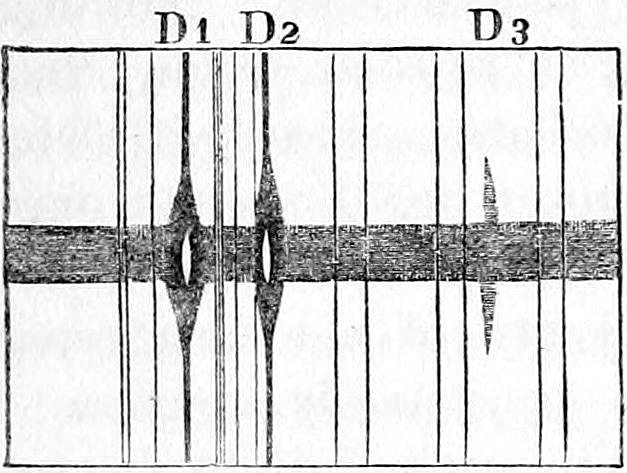
bodies. Its leading chromospheric ray, D3, had already been
noted as an emission-line in the Orion nebula by Dr. Copeland,
as an absorption-line in Rigel by Professor Keeler;
but this was only preliminary to what was to follow when
recognition-marks were multiplied by complete experimental
acquaintance with the associates of the yellow beam. One of
these, a line in the blue (λ 4472), is much more conspicuous
in stellar spectra than D3, and it was established by Vogel in
1895, with other members of the conjoined series, as distinctive
of a large class of “helium stars.”[329] Some insight
was thus gained into the extraordinary profusion with which
this strange gas, so sparingly occluded by the earth, is
dispensed to the suns in space. In order to show spectroscopically,
it must, as already stated, be voluminously
present in a glowing atmosphere. Its rays scarcely endure
competition. Our sun, for example, although surrounded by
huge volumes of helium, is not a “helium star.” Pretty sure
indications, on the other hand, can be gathered that helium
175is one of the principal components of all gaseous nebulæ; and
it blazes where stellar incandescence is strong—in “new”
stars, in bright-line stars, and in some “long-period” variables.
The disclosure of its great cosmical rôle is among the
most important consequences of the modern alliance between
astronomy and terrestrial physics.
The identification of oxygen and nitrogen as stellar constituents
by Mr. McClean and Sir William and Lady Huggins
respectively, and the detection of the “Pickering series” of
hydrogen in certain stars, are advances of scarcely less
moment. These unusual kinds of absorption emerge, as a
rule, in stars showing helium as well, and generally assumed
to be at an early stage of growth. They apparently tend to
supersede metallic action, which becomes imperceptible when
the inchoate stage is approached. Thus the nebular spectrum
includes no lines of known metals, and they are likewise
apparently missing from “Wolf-Rayet” stars. Acquaintance
with these remarkable objects has profoundly altered the
views of stellar physicists. It has introduced them to a
borderland where the prevalent conditions defy forecast.
Who, for instance, could have anticipated Campbell’s observations
of mixed bright and dark spectral series, derived from
the same element, in the same object? Nothing could well
be more perplexing; but perplexities are often the raw material
of discoveries.
The application of photography to the examination of
“blaze stars” began with the apparition of Nova Aurigæ in
1892. Opportunities for its continuance have since been
frequently afforded, which would probably have slipped by
unused but for the automatic watch kept on the changes of
the heavens at Harvard College and its southern dependency.
Two generalisations have thus been authorised. One is that
the spectra of Novæ are mainly composed of bright and dark
lines in pairs, emanating from the same substances, but pushed
asunder as if by the effect of swift opposite motions. The
second is that fading Novæ put on a nebular light-vesture.
Spectroscopically, they simulate minute “planetaries.” These
surprising facts are seeds of future knowledge; they need
time to germinate and yield fruit.
Stellar variability no longer remains outside the pale of
176successful research. The mystery surrounding it has not, to
be sure, been dissipated; but some of its attendant circumstances
have become manifest. Eclipsing stars are now fully
open to investigation; and although not physically variable,
they have indisputable connections with stars that are.
Fluctuations executed quite punctually in periods of a few
days or hours indicate a compound nature in the objects
undergoing them, even if they cannot be explained as occultation-phases.
Short-period variables, in short, are non-eclipsing
spectroscopic binaries. Yet spectroscopic binaries,
indistinguishable from them as to their orbital conditions,
shine with a perfectly steady lustre. And these are the
majority. It remains to be discovered what are the special
attributes of the differentiated classes. Nor is variability
found only in conjoined objects. Stars apparently single are
subject to extreme, although more or less irregular vicissitudes.
The only clue to the nature of these vicissitudes yet found is
the fact that increase of light is ordinarily attended by the
spectroscopic flashing out of hydrogen-rays. Moreover, the
resemblance of stellar light-curves to sun-spot tracings gives a
strong hint that the solar analogy should be made a starting-point
for inquiries into “long-period” variability.
The branch of stellar astronomy concerned with double
and multiple systems gains extension and importance year by
year. Their evolution under the influence of tidal friction
has been studied by Dr. See. Sir William Huggins’s device
of a slit with reflective jaws having facilitated spectroscopic
observations of close stars, the analysis of their light has at
last entered upon a stadium of progress; apart from which
perennial obscurity must have hung over sidereal chromatics,
and enveloped theories of sidereal growth. Spectroscopic
binaries, meanwhile, are multiplying on our hands, and their
varieties offer a brilliant field for investigation. Their
periods range from less than one day up to two years; some
revolve in subordination to larger combinations; their orbits
are variously inclined, and of various degrees of ellipticity; and
one of the circulating bodies is, more often than not, sensibly
devoid of light. The function and place in creation of “dark
stars” have thus come into the foreground of inquiry. They
occur also in telescopic systems, where their disturbing power
177produces a visible swaying in the movements of their bright
companions; but less commonly, it would seem, than as members
of spectroscopic couples. These are, so to speak, just out
of the shell; hence dark stars can hardly be effete suns,
although suns presumably lapse with age into obscurity. The
distinction is a delicate one to draw, but should not be lost
sight of.
The scope of sidereal research is limitless—limitless
because its objects are indefinitely numerous. The difficulty
is to lay hold of them. Inferences based on partial surveys
are felt to be unsatisfactory. The star-depths beyond continually
invite farther and farther advances. Astronomical
curiosity is only temporarily appeased by learning, for
instance, the radial movements of a few score of stars; they
are wanted by the hundred, and when at hand in hundreds,
they will be in demand by the thousand. Exhaustive inquiries,
while remaining unattainable, must, by the nature of
the case, be perpetually aimed at. And what is primarily needed
for them is a plentiful supply of light. Ambition in telescope-building
is then justifiably insatiate, nor has it, so far, overreached
itself. Each addition to instrumental capacity has, on
the contrary, notably widened the horizon of feasible research.
The erection of the great Lick refractor made it possible to
obtain legible spectrographs of the Wolf-Rayet stars, and set
the nebulæ in motion by enabling Professor Keeler to determine
their radial velocities. With the Crossley reflector,
mounted in the same superb situation, nebular photography
made a fresh start, and the law of spirality, as a structural
principle, was confirmed and generalised. The Yerkes telescope
has given access to several closed fields. By its means,
variable stars are followed through their semi-extinct phases.
Professor Barnard has performed the unique task of verifying
visually the rapid light-changes of the minute components of
globular clusters; and Professor Hale has examined spectrographically
a large number of “carbon” stars, too faint as well
as too red for satisfactory treatment under average circumstances
with the camera. The completion, at the same
observatory, of a five-foot reflector will shortly afford even
better opportunities for prosecuting this work. It may be
added that a special function in nebular investigations is
178reserved for instruments of abnormally short focal length,
such as the Meudon reflector, in which the rays collected by
a mirror thirty-nine inches across form an image at only thrice
that distance from it.
Centuries, however, of invention and contrivance must
elapse before the minuta plebs of the sky can be individualised
by the peculiarities of their spectra. Inducements to keep up
this strain of toil are not wanting. “A star’s a star for a’
that,” even though it lie beyond reach of human questioning.
To bring it virtually nearer, is the object of perpetual
efforts. And they cannot fail to be rewarded. Novelties in
the heavens are likely to prove endless and surprising. The
enticements they offer to progress are irresistible. No
“anchor dropt at eve or morn” can stay the ideal voyage.
“When a man hath done, then shall he begin” his scrutiny
into the works of the Most High.
179
Various methods of classification may be applied to the stars.
The most obvious and the most antique is that of relative
brightness. From of old the stars have been collected into
ranks by “magnitude.” Or the amount of their “proper
motions” may be taken as the principle of distinction. Within
certain limits this is practicable, and for certain purposes it is
useful. But apparent lustre and projected movement alike
depend in part upon distance; they include an extraneous
element; and astrophysical science considers the heavenly
bodies in themselves, without regard to their spatial relations.
Hence an absolute quality must be made the basis of their
arrangement, and it is found in the kind of light emanating
from them. This system is of far more than conventional
value. It affords the only clue within reach to the intricacies
of stellar constitution. Schemes of spectral classification may
be amended and altered; but in one form or another they are
indispensable to progress.
They naturally tend to become more complex as facts
multiply, and finer shades of difference are rendered manifest;
yet Father Secchi’s four “types” continue fundamental. It
is well, then, to keep their characteristics steadily in mind.
The first is marked by strong hydrogen absorption. It consists
of radiantly white stars. The second by innumerable
fine metallic rulings; the sun is an example. The third
type includes red stars with banded spectra like Antares, the
bands being sharply terminated towards the violet, diffuse
towards the red. The fourth is composed of deeply-tinted,
mostly faint objects, showing wide bands facing redward,
180due to carbon absorption. These four groups form irremovable
landmarks; but beside and between them many subordinate
divisions have been set up. Vogel, Huggins,
McClean have all modified, while broadly adopting Secchi’s
“law of order.” They have, moreover, regarded it, not as a
mere empirical formula, but as prescribed by the necessary
conditions of development. Modes of classifying the stars
have come to be equivalent to theories of their evolution.
With this aspect of the matter, however, we are not just now
concerned. The aim of the present chapter is to establish
convenient distinctions without regard to their essential
meanings. The unravelment of these will be attempted
later on.
Miss Maury’s arrangement of the stars[330] is designed for
a life-history as well. It is the most elaborate yet put
forward. Based on the examination of some 4800 spectrographs
taken at Harvard College, it embraces 681 objects,
disposed in a progressive series of twenty-two groups, most
of which are further comprised within three collateral divisions,
established to meet the visible necessity for a secondary
characterisation. The work is a monument of industry and
skill, and will long hold a place of standard authority; but
the fine gradations it emphasises, although worth putting on
record, are scarcely suitable for committing to memory. Our
object here is to present large outlines, leaving minute shades
of difference to be dealt with as occasion may arise. There
is danger of stellar classification degenerating into a maze of
provisional distinctions. The best remedy is to fix attention
on the summit-ranges of the landscape; when they are clearly
imprinted on the mind, mastery of detail can be safely and
readily acquired.
A framework of eight compartments accommodates practically
all the stars. The separation is easy and natural, and
the “notes” of the various classes present themselves unmistakably.
The constituents of the four first show absorption
spectra only; those of the four last are marked by emission
as well as by absorption. No hypothesis of growth or affinity
is implied by the order of succession given to the bright-line
objects; only the interests of clearness have been consulted
in its choice. We will now briefly describe these stellar
families.
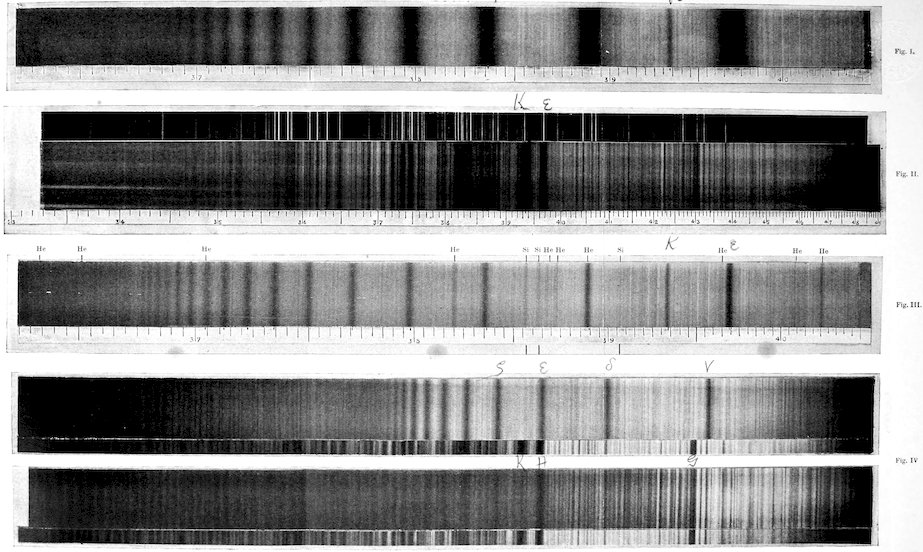
PLATE IX.
Stellar Spectra photographed by Sir William and Lady Huggins.
Fig. I. Vega (α Lyræ). Fig. II. Arcturus (Fe and Ca for comparison). Fig. III. Rigel. Fig. IV. β Cygni, Blue Star; β Cygni, Yellow Star (solar comparison-spectrum).
181Class i.—Helium Stars.—In the spectra of these brilliantly
white stars, absorption by hydrogen and helium predominates.
The complete “Huggins series” is stamped upon them, from
the fundamental C to its “head” in the ultra-violet;[331] and at
least twenty-six of the strongest helium lines, culled impartially
from all the six series, show conspicuously besides. In a few
helium stars, suspected of nebular relationships, the “Pickering
series” of hydrogen is represented, while others betray the
action of oxygen, nitrogen, and silicon. Metallic lines are
faint and scarce; those identified belong to sodium, iron,
calcium, and magnesium. Especially remarkable is the comparative
prominence of the magnesium line λ 4481, to the
exclusion of the triplet b, which takes the lead in the solar
spectrum. The substitution, according to many authorities, indicates
enormous heat. Scheiner’s criterion for high temperature
is precisely the development of λ 4481, and Professor Keeler
remarked that the effacement of b marked a stage of heat
beyond the possibility of artificial production.[332]
In these stars there is almost no general absorption; their
photospheres are unveiled. Moreover, they seemingly possess
reversing layers of very simple composition, to which circumstance
their display of helium may, with much probability, be
attributed. Originally included in Secchi’s first type, they
were separated from it by Vogel in 1895, on the identification
of their distinctive lines with those of terrestrial helium; and
their importance in the sidereal scheme was accentuated by
McClean’s spectrographic researches in the southern hemisphere.
The lucid orbs of Orion and the swarming Pleiades
are leading members of the class, which are also thickly
disseminated in the Southern Cross, the Centaur, and the
Greater Dog. Miss Maury’s first six groups are subdivisions
of helium stars, arranged in the assumed order of their
development from a nebulous condition.
We are indebted to Sir William and Lady Huggins for
permission to reproduce their admirable spectrograph of Rigel,
the premier helium star (Plate IX. Fig. III.), and to Sir
182David Gill for that of ε Canis Majoris (Plate X. Fig. 1),
taken by his assistant, Mr. Lunt, who detected many lines of
silicon and oxygen, in addition to strong helium-absorption,
in the spectrum of this star.
Class ii.—Hydrogen Stars.—These stars are distinguished
by intense hydrogen-absorption of the ordinary kind, no
Pickering lines being present. Helium-influence on their
light is null, or barely perceptible. The “H” and “K” of
calcium are thin but distinct. Feeble iron lines can be
numerously discerned. General absorption is slight; the
ultra-violet end of the spectrum lies open, imparting to
hydrogen stars a bluish-white colour. Vega is a perfect
example; its spectrum, photographed by Sir William and Lady
Huggins, is shown in Plate IX. Fig. I. The black band to
the right is the fifth line of hydrogen (Hε). It masks the
calcium “H”; but “K” appears well to the left.
Hydrogen—sometimes called “Sirian” stars—abound in
the heavens. They form the main part of Secchi’s first type,
and are distributed by Miss Maury into five groups, numbered
vii. to xi.
Class iii.—Solar Stars.—The Fraunhofer spectrum sets a
pattern copied, with slight variations, by the members of this
class. Its leading feature is the powerful development of “H”
and “K.” Other metallic lines are innumerable, but mostly
sharp and thin. Four hydrogen lines are normally present,
ultra-violet members of the series showing decisively only in
stars like Procyon and Canopus, which may be regarded as
intermediate between the Sirian and the solar classes. A
yellow tinge corresponds in the latter to a veiling of the blue
end of the spectrum, similar to that perceptible in the sun.
Solar stars, then, resemble him, not only in the composition of
their reversing layers, but in the possession of “smoky” envelopes.
A spectrograph of Arcturus by Sir William and Lady Huggins
is shown in Plate IX. Fig. II., and one by Sir David Gill of
α2 Centauri, the brighter member of the southern binary, in
Plate X. Fig. 2. The precision of its correspondence with
the solar spectrum may be seen by a glance at the comparison
strips in this latter figure. Stars of the solar class
constitute Secchi’s second type, and are included in Miss
Maury’s groups xii. to xvi.
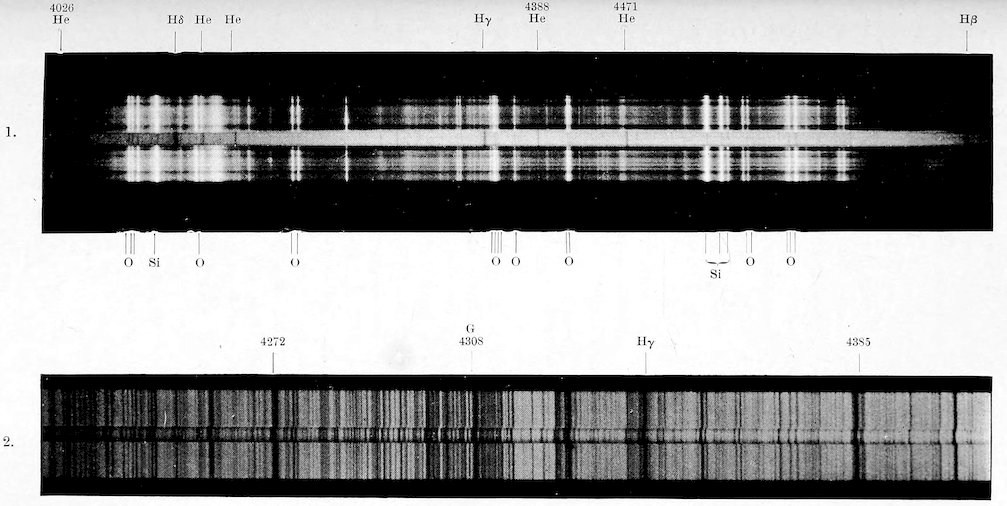
PLATE X.
1. Spectrum of ε Canis Majoris (central strip) compared with Lines of Hydrogen, Helium, Oxygen, and Silicon.
2. Spectrum of α Centauri (central strip) compared with Solar Spectrum (outer strips).
N.B.—The relative displacement is due to a difference of temperature at the exposure-times.
183Class iv.—Stars with Fluted Spectra.—Two kinds of absorption
are distinguishable in them. A linear system, somewhat
reinforced from the Fraunhofer model, has superposed upon
it a set of dusky flutings, about ten in number, of undetermined
chemical origin. They suggest action by oxides, the formation
of which in stellar atmospheres would seem to imply a
considerable reduction of temperature. None of the bands
occur in the more refrangible part of the spectrum, so that the
photographic differences between solar and “fluted” stars are
easily overlooked. Nor is there an abrupt transition from one
class to the other. From Capella the line of connection passes
unbroken through Arcturus and Aldebaran to β Andromedæ
and α Orionis (Betelgeux), absorption settling down more
heavily on the blue rays, and metallic lines gaining strength
at the expense of the truncated hydrogen series, until the
fluted type is definitively formed. It is equivalent to Secchi’s
Type iii. Within its compass a progression of objects with
deepening bands, such as Miss Maury has arranged in her
Groups xvii., xviii., and xix., can readily be followed out. It
may be said to terminate with α Herculis, a star of the third
magnitude, displaying magnificent prismatic chiaroscuro. A
drawing of its spectrum by Mr. Espin is copied in Plate XI.
Fig. 1.
Fundamentally, the same series of bands recurs in all the
individuals of this class. They vary from star to star both in
relative and in absolute intensity, but their identity remains
unmistakable. The presence of certain determinate atmospheric
ingredients fixes the type, and no others can replace
them. The stars belonging to it are in diverse degrees red
or orange, their blue emissions being largely arrested in
the precincts of their photospheres. They must hence be
intrinsically brilliant far beyond the proportion of their visual,
and, still more, of their photographic magnitudes. Their
apparent lustre, that is to say, is small compared with the
masses that may reasonably be assigned to them. Their light
is markedly unstable, and many are subject to periodical variations
of exceedingly wide range. These give bright-line
spectra of a very definite character, which it seems advisable
to set in a class apart.
Stars with fluted spectra (conveniently designated as
184“Antarian,”[333] from their exemplar, the lucida of the Scorpion),
although rare compared with Sirian and solar stars, are found
plentifully in every part of the sky. No comprehensive
catalogue of them exists; the number of those already
known might, however, be roughly estimated at a couple of
thousand. They must be vastly remote. None have sensible
parallaxes, and very few show appreciable proper motions.
Class v.—Carbon Stars.—These have also banded spectra,
but of a totally different stamp. Three shadings, particularly
conspicuous in them, testify to strong absorption by carbon
vapour. Vogel found them to reverse exactly the spectrum
of an alcohol flame.[334] Scheiner conjecturally identifies the
absorbent material with acetylene.[335] Others hold it to be pure
carbon. There is much uncertainty on the point. The
carbon-bands are of different degrees of obscurity in the
various members of the class, nor do they in all preserve the
same relative strength.[336] Subordinate bands, too, of unknown
origin diversify these spectra more or less strikingly. But
all are designed on the same pattern; it is only the mode of
printing off that varies. They include as well many dark lines,
notably Fraunhofer’s “D” and “E,” representing absorption
by sodium and iron. A characteristic dusky streak at λ 576
awaits chemical interpretation.
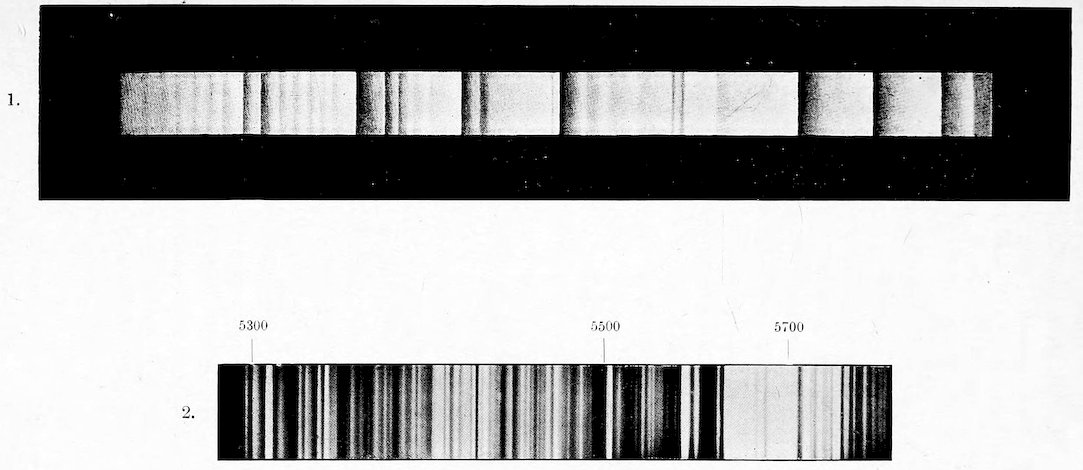
PLATE XI.
1. Spectrum of α Herculis. Drawn by Mr. Espin, 30th June 1894 (red end to the right).
2. Spectrum of 152 Schjellerup (yellow section). Photographed with the Yerkes 40-inch refractor.
Carbon stars glow like rubies in the sky; they are, for the
most part, fiery red objects. To the eye they make a poor
show. The brightest—19 Piscium—is of 5·5 magnitude; and
only three in the northern and four in the southern hemisphere,
out of about 250 recorded, exceed the sixth. This is
not surprising when we consider that but a small percentage
of their rays can escape stoppage by enfolding vapours. They
would seem, besides, to be plunged in greater depths of space
than Sirian or solar stars; so that they ought perhaps, allowance
being made for these disadvantages, to take rank as
potent light-givers. The coloured “zones,” or luminous
intervals in their spectra, are, at any rate, curiously vivid and
sparkling. Most are to some extent, some are to a large
185extent, variable. Their photographic examination—rendered
arduous by the quality of their light—afforded Professor
Hale in 1898 the interesting discovery, imperfectly anticipated
by Secchi, of several unfamiliar bright lines superposed upon
their dark shadings.[337] Hydrogen lies low in carbon stars.
It exerts no visible absorption, and displays no traceable
emission. Their relationships with other stellar families are
obscure; connecting spectral links are not altogether wanting,
but they are of secondary importance. The class formed by
them is coextensive with Secchi’s Type iv. and with Miss
Maury’s Group xxi. Four specimens are given in Plate XII.,
from spectrographs taken by Professor Hale and Mr. Ellerman
with a train of three prisms fitted to the eye-end of the
Yerkes forty-inch refractor. The wealth of detail shown is
so great as almost to obliterate the general columnar effect.
Class vi.—Stars with Fluted Spectra showing Bright
Hydrogen Lines.—Mira is the typical star of this class. All
its members (save one doubtful case) are pronounced variables.
They fluctuate in colour too, but show in general a decided
orange or ruddy hue. The flutings are very marked, and they
tend to deepen and widen as the stars lose light. Essentially
the same as in Class iv., they overlie a similar metallic line
spectrum. Vivid hydrogen rays come into view with the
approach of each maximum, and fade after it has passed.
They seem, however, to persist much longer in some stars
than in others. The series is, indeed, at all times incomplete.
Its first term—the crimson C—is often missing; the second,
F, is by no means invariably present; the stress of brilliancy
is, in certain stars, laid upon the third, in most upon the
fourth line, the fifth being always concealed by the dense,
distended H of calcium. The succession of bright lines is
resumed in the ultra-violet, and continued to the limit of
the spectrum, which is curtailed by strong general absorption.
A spectrographic impression of Mira by Father Sidgreaves is
shown in Plate XIII. (1). It extends from orange to indigo,
but stops short of H and K. There is no assured trace of
green hydrogen, while the two blue beams are lustrous. A
corresponding print of the spectrum of α Herculis appears
on the same plate below that of Mira. The yellow ray
186of helium shines in some members of Class vi., and several
dark lines in the spectrum of Mira coincide approximately
with more refrangible lines of the same substance. Through
the presence of emissive symptoms in fluted spectra, more than
a hundred new variables have been photographically discovered
by Mrs. Fleming and her staff at Harvard College. She subdivides
them into eleven families, marked by the varying
relative brightness of the hydrogen lines,[338] while Miss Maury
includes them all in her twentieth group. Secchi’s third type
likewise claimed them; its limits were indeed defined before
their singularities had been noticed.
Class vii.—Helium Stars with Bright Lines.—These objects
give the characteristic dark-line “Orion” spectrum, variously
emblazoned with rays of hydrogen, helium, and a few other
substances. In some the bright and dark lines are ranged
side by side, in others they are superposed, the system of
reversal being tripled by the addition of dark threads drawn
across the emission rays. The historical variable “P Cygni”
exemplifies the former variety, γ Cassiopeiæ the latter. The
fundamental C is perhaps always the brightest line in these
spectra, and there is a uniform decrease in the lustre of the
hydrogen-series as it progresses upward.[339] In many cases its
lower members show by emission, the rest by absorption.
The bright spectrum may indeed be reduced to a solitary
C. The same rule applies to helium. The circumstance,
however, that the lowest terms of each series are those vivified,
becomes evident only when the lines present are sorted out
in their due sequential order. It is unapparent on a collective
view of them.
About fifty bright-line helium stars are known, and fresh
specimens are yearly swept up in the course of space-sounding
operations at Harvard College. A fuller acquaintance was
gained with thirty-two among the number by Professor
Campbell’s scrutiny of their spectra with the great Lick
refractor in 1895. Much hesitation prevails as to their
proper place in systems of stellar classification. Most usually
they are treated as a subdivision of the dark-line helium class,
but Miss Maury and Miss Cannon leave them outside the
framework of their respective schemes, appending valuable
discussions of individual peculiarities.[340] There is much to
be said for this mode of procedure. We are enabled, by
the kindness of Father Sidgreaves, to reproduce in Plate
XIV. a spectrograph of γ Cassiopeiæ taken at Stonyhurst,
7th March 1898. Among the bright lines imprinted on it are
several due to magnesium,[341] namely, the b-triplet prominent
in the sun, and the blue ray at λ 4481, specialised by
Scheiner as marking a high grade of heat.
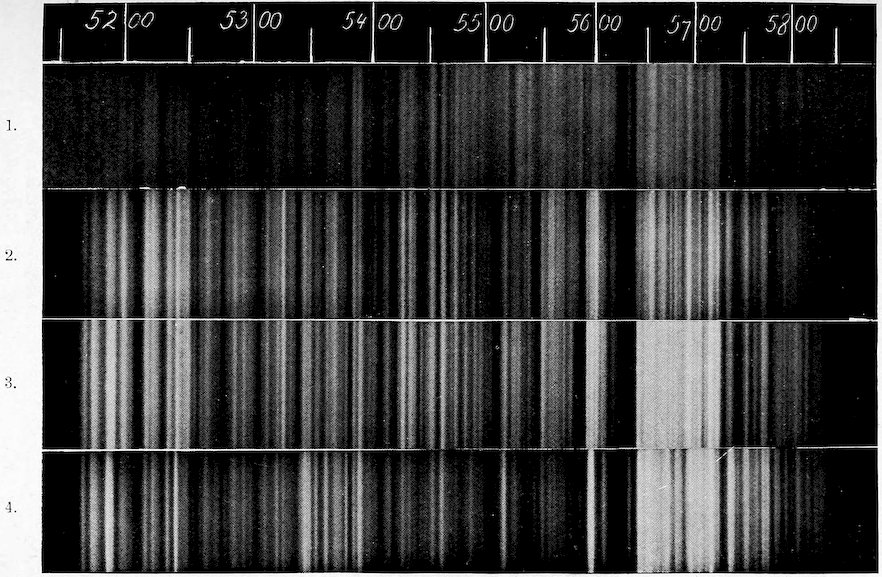
PLATE XII.
Spectra of Carbon Stars. Photographed with the 40-inch Yerkes Refractor by Professor Hale and Mr. Ellerman.
1. 280 Schjellerup (Mag. 7·8).
2. 19 Piscium (Mag. 5·5 Var.).
3. U Hydræ (Mag. 5·5 Var.).
4. 152 Schjellerup (Mag. 5·5).
187Class viii.—Wolf-Rayet Stars.—Acquaintance with these
objects began in 1867 with the discovery, by MM. Wolf and
Rayet of the Paris Observatory, of three small stars in Cygnus,
giving a spectrum composed mainly of blue and yellow effluences.
Then on 24th December 1871, Respighi[342] observed the
brilliant prismatic radiance of γ Argûs ( = γ Velorum), which
proved to be of the same quality, although vastly superior in
quantity. No other star of the kind exceeds the sixth magnitude,
and over one hundred of them have been already recognised.
Their distribution is remarkable; all are situated in or quite
close to the Milky Way, except a considerable group located
in the Magellanic Clouds;[343] and the Magellanic Clouds obviously
reproduce many of the conditions of the Milky Way.
The leading spectroscopic distinction of the Wolf-Rayet
class is the display of the Pickering series of hydrogen. Five
of its constituent lines have been recognised, but they are not
all equally bright. The upper ones may even appear dark.
Emission-bands in the blue, on the other hand, never fail to
be visible. Two at least are simultaneously or alternatively
present. The more refrangible at λ 4688 is the azure beam
identified by Rydberg with the leader-line of the otherwise
unknown principal series of hydrogen. Its associate at
λ 4652 may possibly owe its origin to nitrogen, but this
remains to be proved. Helium lines show, both bright and
dark, in these stars; in the same spectrum D3 occasionally
gleams golden beside its dusky fellow, the noted “Orion”
absorption ray at λ 4472. Similarly, in the Huggins hydrogen
188series, a vivid C may have for its companions an almost
neutral F (Hβ), and obscure Ηγ and Ηδ.
The Wolf-Rayet spectrum is then triple. A band of
continuous light, fairly strong in the ultra-violet, forms its
basis. Absorption lines and bands are superposed, a few of
them due to hydrogen and helium, but for the most part
unclaimed by any terrestrial substance. To these are added
hydrogen, helium, and anonymous bright rays in varying
degrees of profusion. No metallic lines, bright or dark, have
been recognised. Stars of this description are white or
yellowish. They are rarely or never variable. Pickering
combined them in 1891 with planetary nebulæ into a “Fifth
Type of Spectra”;[344] yet, certain nebular affinities notwithstanding,[345]
they lie well away on the stellar side of the
dividing line between the two sidereal realms.
The eight stellar divisions just enumerated comprehend as
nearly as possible all the stars spectroscopically examined up
to the present. The few left outstanding are, in general,
difficult objects, which have been casually or defectively
observed. When better known, they will probably avow
affinities not at first sight apparent. Our classification may
then fairly claim to be exhaustive; it certainly rests upon
broad and unmistakable distinctions. And it is no small
achievement to have obtained a bird’s-eye view of the celestial
“maze of error.” Order is not knowledge; vere scire est per
causas scire; but it is an indispensable preliminary to its
attainment.
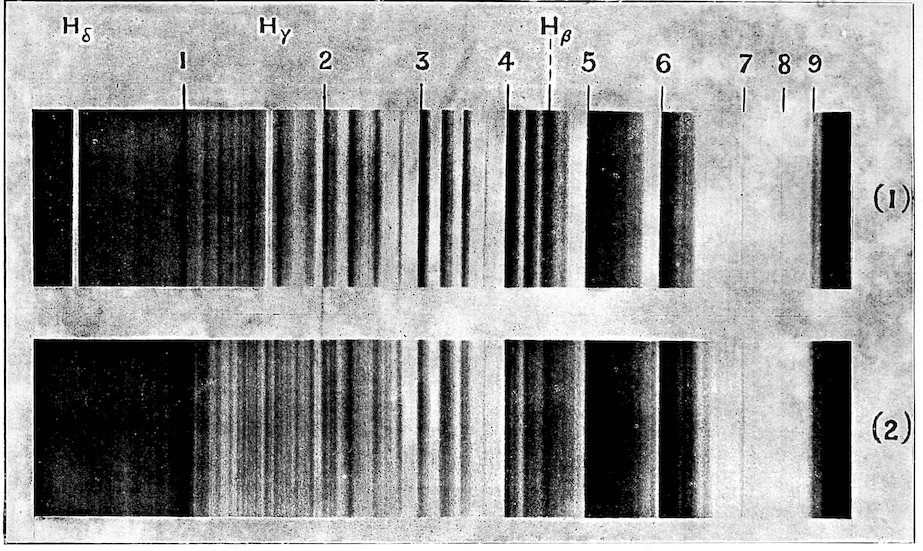
PLATE XIII.
Spectra of Mira (1), December 1897, and of α Herculis (2), February 1898. Photographed by Father Sidgreaves (Knowledge, vol. xxi. p. 113).
1 = λ 4227. 2 = λ 4420. 3 = λ 4581. 4 = λ 4757. 5 = λ 4951. 6 = λ 5162. 7 = λ 5447. 8 = λ 5597. 9 = λ 5756.
189
Helium stars are often palpably connected with nebulæ.
The entire Orion region, where they brilliantly congregate, is
pervaded with cosmic fog; cosmic fog enwraps the Pleiades;
and individual instances of the same association abound, and
are likely to multiply as exploration proceeds. It is, however,
visibly closer in some stars of the class than in others;
and these nebulous gradations appear to correspond with
spectral gradations of a very interesting kind, accurately
represented in the progressive order of Miss Maury’s groups.
The earliest are strongly impressed, not only with helium and
ordinary hydrogen lines, but with the Pickering series as well,
noted by Mr. McClean to characterise a primitive stellar
condition.[346] Satisfactory evidence of oxygen absorption in
them was adduced by him in 1897, and lines of nitrogen and
silicon are recognisable besides. Among metals only calcium
and magnesium make a feeble effect,[347] the one with a just
discernible K, the second with the “high-temperature” line in
the indigo (λ 4481). No sharp rays are found in these
spectra. Their shadings take the form of hazy streaks.
The chief of a triple group in Monoceros is a specimen
peculiarly worthy of consideration. It has the uncommon
property, for a helium star, of being variable in a short period,
whence its catalogue title of S Monocerotis; and it dominates
a small cluster (N.G.C. 2264), measured by Bruno Peter in
1880.[348] An involving nebula, evasive of telescopic vision,
190came out fully in Professor Barnard’s photographs of
1894,[349] and was described by him as “a very wonderful object,
irregular in outline but quite well defined, with numerous
black gaps running into it, and conforming in general with
the peculiarities of the Milky Way in that region.”[350] A
picture on a larger scale was taken by Dr. Roberts a year
later.[351] That S Monocerotis will prove to be a spectroscopic
binary revolving in three days and ten hours, may be judged
probable from the analogy of its fellows in variability.
One of its contemporaries is the third magnitude star,
ι Orionis (N.G.C. 1980). Sir John Herschel perceived it to
be wrapt in a large feeble nebulosity, and a divergent streak,
linking it to the great “trapezium” nebula, disclosed itself
photographically to Professor W. H. Pickering.[352] It is widely
triple, but sensibly stationary. Although its spectrum is in the
main a copy of that of S Monocerotis, important distinctions
may present themselves to scrutinising inquirers. Both the
Wolf-Rayet blue bands show by absorption in these “early
Orion” stars, the upper one being especially pronounced.
The three stars forming the Belt of the Giant are slightly
more “advanced.” Helium has gained strength in them relatively
to the Pickering series; the reversal of Rydberg’s azure band
verges towards effacement, and in the middle star, ε Orionis, the
spectral lines are fairly well defined. Oxygen, nitrogen, and
silicon contribute each its quota of absorption. A great
stream of nebulous matter sweeps through the Belt, and its
two lower gems, ζ and ε Orionis, claim besides shining appurtenances
of their own.[353] An analogous object, σ Scorpii,
came out on Professor Barnard’s photographs with a couple of
nebulous “prongs” attached to it,[354] and also as a focus of
marked condensation in the great nebulous field near Antares.
The spectrum is perfectly similar to that of ε Orionis.
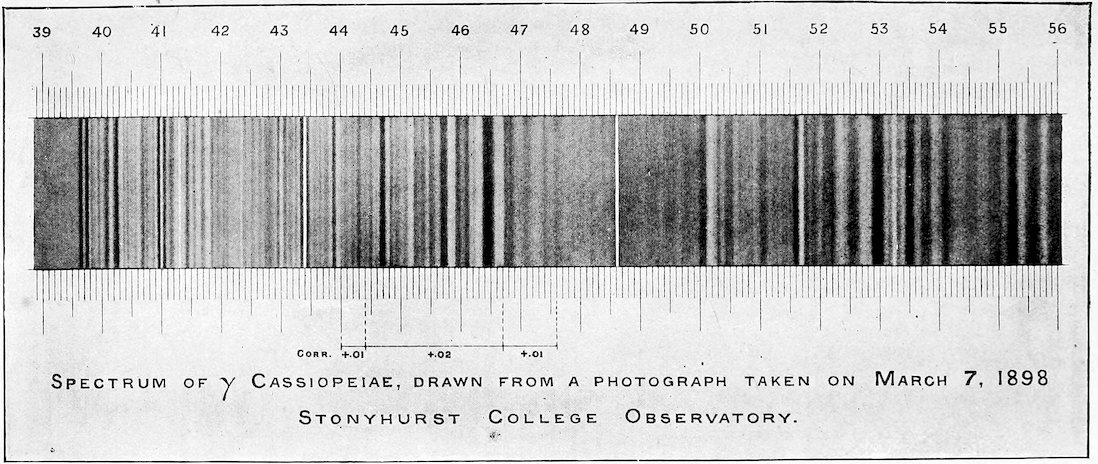
PLATE XIV.
Spectrum of γ Cassiopeiæ, drawn from a photograph taken on March 7, 1898.
Stonyhurst College Observatory.
Among southern helium stars one deserves special mention
if only for its association with a notable discovery. This is
Mr. McClean’s “oxygen star,” β Crucis. His identification
in 1897[355] of numerous lines in its spectrum as due to the
191absorptive action of our vital gas was fully confirmed two
years later by Sir David Gill,[356] who employed for the purpose
the splendid apparatus bestowed by Mr. McClean upon the
Cape observatory. Silicon is also present, and the usual
reversals of the indigo line of magnesium and of the violet
K of calcium appear distinctly. Nitrogen, however, is not
evident, nor the Pickering series of hydrogen. The spectra
of β and ε Canis Majoris, and of β Centauri are of the same
stamp. One of the brilliants of the Southern Cross, β Crucis
lies immersed in the Milky Way, at an unmeasured, perhaps
an immeasurable distance from the earth. We have thus no
means of estimating its actual radiance, which must, however,
greatly exceed that of the sun. A secular proper motion of
fourteen seconds is ascribed to it, and Sir David Gill finds it
to be receding from the sun at the rate of about eleven miles
a second.
Bellatrix, in the shoulder of Orion, is a typical helium
star, the chief representative of Miss Maury’s fourth group.
No Pickering lines have been found in its spectrum, but
Professor Keeler noticed the comparative prominence of a
subordinate nebular ray at λ 4390.[357] Nitrogen and oxygen
were identified in it by Sir William and Lady Huggins,[358]
and silicon by Sir Norman Lockyer[359] and Mr. Lunt.[360] The
effacement of iron, remarkable in nearly all helium stars,
subsists also in Bellatrix, and is explained by Sir Norman
Lockyer as an effect of transcendental temperature. It has
a spectroscopic alter ego in the lucida of the Southern Cross.
In the spectrum of Rigel some iron lines faintly emerge,
and the sodium D appeared conspicuously on Professor
Campbell’s isochromatic plates. The Huggins series of
hydrogen is magnificently displayed from its first term to the
limit[361] (see Plate IX. Fig. 3); helium lines are strong and
numerous; those of nitrogen, oxygen, and silicon come out in
photographs, and they were found by Sir William and Lady
Huggins to be associated with certain distinctive rays of
192titanium.[362] The lines in this spectrum contrast markedly by
their sharpness with those of other stars chemically similar,
such as Regulus. Rigel belongs to Miss Maury’s sixth group;
it approximates to the stage where helium sinks out of sight,
and yields the sole predominance to hydrogen.
In order to form some idea of its prodigious light-power
we must remember that it has no sensible parallax (Gill), and
is all but stationary in the heavens. This implies that it is
so far off as to make almost no perspective response to the
sun’s centennial advance through space. In other words, a
base line some thirty-three thousand millions of miles in length
(allowing for foreshortening) shrinks to little more than a
point as seen from Rigel. Assuming the reality of the
minute proper motion of 1·5″ a century deduced from its
catalogued places, and that it is a parallactic effect of our
system’s progress towards an “apex” on the borders of
Hercules and Lyra, at the rate of twelve miles a second, we
must ascribe to the star a distance of at least 367 light years,
corresponding to an annual parallax of ¹⁄₁₁₂ of a second. It
follows that Rigel gives about 8000 times more light than
the brighter component of α Centauri, an orb considered by
Sir David Gill to be the exact match in every respect of our
sun. But the sun is dimmed to about one-third of its native
lustre by effects of absorption which are virtually absent from
the star. Hence a total light emission 8000 times greater
would represent a radiating surface only 2667 times more
expansive than the solar photosphere. Rigel, moreover, is
certainly not massive in the proportion of its luminosity.
Stars of the helium variety are composed of highly rarefied
materials. This has come to be known through the study of
eclipsing stars. Taking, then, the density of Rigel to be
about that of Algol, or one-fourth that of the sun, we find it
even so to be of no less than 34,000 times the solar mass,
while gravity at its surface is of just thirteen-fold power.
Nevertheless its spectrum indicates extreme tenuity in its
gaseous surroundings. Calcium, for instance, in the reversing
layer of Rigel emits violet rays only. There is no trace of the
blue line (λ 4227). The vapour exists there in much the same
state as in the solar chromosphere and prominences—that is to
193say, in a state of the utmost attenuation, which implies the
counterbalancing of gravity by a strong antagonistic influence,
presumably of an electrical nature. This merely extends an
inference already derived from solar phenomena.
The relationships of Deneb (α Cygni) have been variously
assigned. There is, however, no longer any doubt of its
affinity to Rigel.[363] The lines in its spectrum are numerous
and clearly defined. Sir Norman Lockyer measured 307
on photographs of the section above F,[364] and there are
hundreds besides. Those of helium are of subordinate importance;
they are being replaced in the supposed evolutionary
progression by metallic lines. Magnesium absorption is
deeply graven in the ultramarine (λ 4481), and begins to
appear through the green triplet (b). Iron lines of the kind
“enhanced” in the spark are fairly abundant; gallium shows
at least one strong line,[365] and titanium lines are prominent.
Among non-metallic substances, besides helium and hydrogen,
only silicon is unquestionably present. It comes, however,
well to the front. Mr. Lunt regards α Cygni, Rigel, and
Sirius as some of “the best examples of silicon stars” yet
known.[366] Nevertheless, spectrographs of them fail to show the
three silicon lines most conspicuous in the β Crucis group,
while Lockyer’s enhanced lines imprint themselves with some
emphasis.[367] These celestial modifications of the silicon
spectrum afford “valuable data,” in Mr. Lunt’s opinion, “for
the elucidation of the problem of relative stellar temperatures.”
Their interpretation on current principles would lead to the
conclusion that α Cygni, Rigel, and Sirius are hotter than the
“earlier” suns typified by the “oxygen star” in the Cross.
But there is no real certainty as to what causes the difference
in kind between the luminosity of the spark and arc. Temperature
may not be the sole, or even the chief, agent in its
production.
The width and density of K in α Cygni are noted by Sir
William and Lady Huggins as anomalous, calcium absorption
usually remaining feeble when that of helium is visible. The
194curious thinness of the hydrogen lines may result in part from
their projection upon a photospheric background of exceptional
brilliancy.[368] The star, at any rate, is one of those which “stand
apart through a distinctive individuality,”[369] and it invites, as
such, special attention.
Regulus—an intermediate specimen—and β Centauri are
perhaps the only helium stars at determined distances from
the earth. For the latter Sir David Gill found a parallax of
0·046″, equivalent to a light-journey of seventy-one years, so that
it is by no means a near neighbour. In its place the sun would
be just perceptible to the naked eye; it would appear of sixth
magnitude, while the star is only a couple of grades below the
first rank (its photometric magnitude is 1·2). Its emissions,
in fact, surpass the solar radiance rather more than 150 times.
We may then allow that they proceed from a photospheric
expanse fifty times ampler than the sun’s, which must encompass
a globe 342 times more voluminous. Assuming further
for β Centauri (as for Rigel) a density one-fourth the solar,
we obtain the result that it is of 85 times the solar mass.
Owing, however, to the comparative remoteness of its surface from
its centre, gravity has there less than twice the power which it
exercises on the sun. Putting it otherwise, the acceleration
of a falling body on β Centauri is about 750 feet a second.
The value of this “constant” is probably of essential importance
in determining the character of stellar spectra; hence
attempts at its estimation, despite the uncertainties that
hamper them, are worth making.
The Pleiades are tolerably mature helium stars; Alcyone
was selected by Miss Maury as the type of her fifth group.
Some of its associates show hazy, others sharp lines. Algol
approaches still closer to the boundary of the Sirian class, its
“Orion lines” being quite secondary to the hydrogen set.
Regulus is of nearly the same standing, but its spectral
markings are dim and diffuse; those of inferior intensity thus
make no appreciable impression, and the star’s rays are all
but exempt from absorptive encroachments.
They indeed tell but slightly throughout the entire class of
helium stars, and this seems to indicate the absence of any
195strong contrast in temperature between their photospheres
and the encompassing incandescent vapours. That these are
exceedingly tenuous is rendered almost certain (as already
pointed out) by the non-reversal of the blue line of calcium.
As to their relative temperatures, no dogmatic assertion is
possible. The effects of transcendental heat evade inquiry.
We cannot without hesitation assume that known rules apply
under unknown conditions. The “temperature” of the
electric spark is a purely conventional expression; to what
state of matter it actually corresponds, can barely be surmised.
Yet it is important to remember that the progression of
helium stars—if the testimony of their silicon lines be
credible—is towards this state from a lower degree of molecular
excitement; while their “high-temperature” magnesium
ray, present at the start, gains prominence by accordant
gradations.
The inverse relationship between helium and metallic
absorption is extremely significant. They seem to be almost
incompatible; one tends to effacement with the incoming of
the other. Yet it must be borne in mind that both subsist
together in sun-spots, where a condition of things temporarily
arises enabling helium to exert its proper stoppage upon light.
Spot-spectra thus approximate, so far, to stellar spectra of the
“Orion” stamp. Here, no doubt, we hold the clue to some
profound physical analogy, the investigation of which may
help to dissolve part of the mystery shrouding the “process
of the suns.” Moreover, oxygen, nitrogen, and “cosmic”
hydrogen (if we may so call the modified gas giving the
Pickering lines) are even more sensitive than helium to the
adverse influence of metals. This statement is scarcely impugned
by the fact that a trace of oxygen-absorption survives
in the sun.
The closest connections of early helium stars are with
members of the Wolf-Rayet family. But for the dusky lines
of magnesium and calcium apparent in them, their spectra
might indeed be said to reverse the Wolf-Rayet radiations.
Later on, when nebular symptoms disappear, when helium
fades, and faint iron lines crowd in, they slide imperceptibly
into the Sirian stage of existence. No halt is cried. The
frontier is crossed without advertence.
196Helium stars are not equably scattered over the sphere.
Their condensation towards the plane of the Milky Way, first
noticed by Pickering,[370] was strongly emphasised by McClean’s
southern survey. “In the contiguous constellations of Musca,
Crux, Centaurus, and Scorpio,” he tells us,[371] “there are twenty-seven
helium stars out of a total of thirty-six” brighter than
3·5 magnitude, and the proportion in Perseus, Taurus, and
Orion is fifteen out of nineteen. It would be desirable to
ascertain whether objects of inferior lustre are similarly swayed
by this galactic attraction. But up to the present nothing is
certainly known as to the prevalence of the type among faint
stars. Below the sixth magnitude, its distinctive marks are
hardly recognisable. The conjecture, however, is plausible
that Milky Way aggregations are composed mainly of helium
suns, large and small. But since their great intrinsic
brilliancy renders them visible at distances completely
quenching the rays of solar stars of the same size, they
should preponderate in the Milky Way for this reason alone,
apart from any real numerical superiority. So that the
question of their distribution, like most others in stellar
physics, has complex bearings. Helium stars are plunged,
without any known exception, in abysmal depths of space.
None have been found within a radius measured by about
seventy years of light-travel. They frequent a sidereal region
different from ours, where nebulæ linger and stars with blazing
chromospheres have their habitat.
197
Helium and hydrogen stars cannot be quite definitely set
apart. The two classes commingle. A transition specimen
of uncommon interest is found in η Leonis, which combines
some of the peculiarities of α Cygni with a powerful development
of the hydrogen series.[372] Another is presented by θ
Aquilæ, placed by Mr. McClean beside such clearly characterised
helium stars as Algol and Pleione, but by Miss
Maury in the group with Sirius and Vega. Even Vega,
although a perfectly normal member of the hydrogen class,
preserves a vestige of helium absorption in the typical “Orion
line,” λ 4472; and its frequent companion, λ 4026, emerges to
view in stars like ζ Aquilæ, in which hydrogen approaches a
maximum of strength. Both these lines are in the laboratory
immediately associated with D3, as members of the first
subordinate series of the “yellow” helium set. None of the
special Wolf-Rayet lines occur in hydrogen stars; the Pickering
series is unrepresented; the “blue bands” have no dark
counterparts; oxygen and nitrogen lines seem to have died
out. Between the broad black bars of the Huggins series,
however, crowds of ghost-like metallic rays are discernible.
More than one hundred and thirty of these nascent markings
were counted by Miss Maury in the photographed spectrum
of Sirius, and her search, owing to the limited range of the
plates, could only be partial.
Sirius is perhaps a slightly “older” star than Vega.
Helium has entirely disappeared from its spectrum, and more
familiar elements take its place—sodium, iron, magnesium,
198calcium, silicon, with titanium, vanadium, barium, and perhaps
chromium and nickel.[373] A remarkable group of lines high up
in the ultra-violet is of unsurmised origin. Photographed by
Sir William and Lady Huggins 4th April 1890,[374] their
approximate wave-lengths are λλ 3338, 3311, 3278, 3254,
3226, 3199, while the head of the hydrogen series stands at
λ 3646. They are accordingly more refrangible than any
possible hydrogen line; nor could impressions of them be
obtained with apparatus including glass prisms or lenses, for
which reason they are to be found only on the Tulse Hill
spectrographs. The interpretation of these recondite characters
offers an alluring problem. Although absent from the
light of Vega, they will doubtless be recognised, when duly
sought, in other Sirian stars; but exposures of the requisite
kind are laborious, and seldom undertaken. Yet just such
special investigations are likely to be the most fruitful.
Sirius is the best-known luminary of its class. This for
two reasons. First, because of its vicinity. Light travels
from the star to the earth in rather less than nine years.
Next, because of our fairly complete acquaintance with the
nature of its binary revolutions. They have now been closely
observed during forty years, and their period is fifty-two.
Hence the mass of the system has been determined, and it
has, moreover, been apportioned with satisfactory exactness
between the members. Their disparity in gravitative power
proves to be small compared with their enormous inequality
in lustre. The companion is a mere point of light outshone
36,000 times by its radiant primary, which is, nevertheless,
more massive only in the proportion of 2·36 to 1·1. This
quasi-obscurity of the Sirian satellite is very curious; but our
present concern is with the majestic orb, in the blaze of which
it is almost lost to view. From Dr. See’s orbital elements,
combined with Sir David Gill’s parallax, a mass is deduced
for it just two and a half times that of the sun. If, then, it
were a body of the same average density and surface luminosity
it should give nearly twice (1·84 times) as much light.
In actual fact Sirius is of at least twenty-one times the solar
brilliancy. This estimate is arrived at by taking α2, the
199brighter component of α Centauri, as an intermediary. Sir
David Gill has shown that its spectrum is a replica of the
solar spectrum; its revolutions prove it to be of equal mass
with the sun, and it is hence assumed with the highest
probability to emit sensibly the same amount of light. It
may accordingly, in comparisons of stellar brightness, be
substituted for the sun, the uncertainty attending the direct
confrontation of enormously unequal light-sources being thus
avoided. Now the distances from the earth, and the photometric
magnitudes both of α2 Centauri and of Sirius, are well
known, so that it is easy to calculate how one star would
appear in the place of the other. Sirius is twice as far off as
the southern binary; transferred to that remoteness α2
Centauri would then show one-quarter its present brilliancy;
it would be of 1·9 magnitude, just matching the chief star in
the Plough. It would accordingly be 3·3 magnitudes fainter
than Sirius, which is as much as to say that it gives only ¹⁄₂₁
part of its light. And the sun, similarly located, would be of
the same faintness.
Thus Sirius, while two and a half times more massive,
is twenty-one times more luminous than the sun. Or,
putting it otherwise, the solar ratio of light to englobed
matter is exceeded more than eleven-fold. Three causes may
concur to produce this effect. One of them we know to be
present. It is quite certain that the Sirian beams are almost
undimmed by self-absorption, whereas those of the sun are
reduced probably to one-third their original intensity. A
second contributory cause to the brilliancy of this star may
be found in its great bulk. It is likely to be much less
condensed than the sun, consequently to possess a much
larger extent of photosphere relatively to mass. A luminous
area multiplied four times would explain the outstanding
disparity of brightness, but would involve a reduction of
mean density to one-eighth the solar standard, or about one-sixth
that of water. There remains the third factor of absolute
areal brilliancy; but its value presumably depends upon
temperature, and comparative stellar temperatures must for the
present be left an open question. We are only able to conclude
that if Sirius and the sun be on a par as to intrinsic shining
power, then the star is probably about eight times more tenuous.
200Vega is so much more remote than Sirius that it may
safely be stated to quadruple its emissions. Its mass, however,
remains undetermined, since it sways no detected
companion with a measurable force. That it is small compared
with its light can hardly be doubted. Indeed, throughout
the hydrogen class, this rule prevails to all appearance
universally.
The temperature of the stars, as already remarked, is one
on which dogmatic assertions are best avoided. All authorities
agree nevertheless that the conditions governing light-production
in such orbs as Sirius and Vega approximate in many
important respects to those present in a disruptive electric
discharge. One important item of evidence to this effect is
the prominence in spectra of this class of metallic lines weak
in the arc, but strong in the spark. “The general result,” Sir
Norman Lockyer says,[375] “of the investigation of the enhanced
iron lines in stellar spectra confirms the view that the absorbing
regions of the hottest stars exist at a higher temperature
than is attainable in laboratory experiments.” Concurrent
testimony was derived from variations of relative intensity
in the magnesium and calcium lines shown by particular
stars. But no allowance was made for modifications resulting
from differences of pressure, which the Tulse Hill researches
had proved to be highly influential. Hence the absence in
Sirian stars of the “blue” line of calcium (λ 4227) tells
nothing by itself as to their temperature. The special value
of Dr. Scheiner’s magnesium-test is that the opposite behaviour
of the two lines considered (λ 4481 and λ 4352) excludes the
density-factor. For increase of heat may occasion the weakening
of individual lines concurrently with the strengthening of
others; but changes of pressure must always act in the same
direction—though not necessarily to the same extent—on
every element of the spectrum affected by them.[376] Professor
Keeler[377] suggested that by means of the magnesium triplet, b,
inferences as to temperature in stars might be extended to
grades beyond the possibility of artificial production. This
group is conspicuous alike in the flame, arc, and spark; it
201cannot be experimentally abolished, yet it fails (as we have
seen) to appear in Rigel, and emerges very feebly in Sirius
and Vega. Now it belongs to a subordinate series due to a
special molecular arrangement, which could not easily persist
in an extreme stage of heat. And a break-up of the arrangement
would be marked by the effacement of the triplet in
the green. “If this reasoning is correct,” Professor Keeler
wrote, “the aspect of the b-lines in stellar spectra gives us an
extension of the method proposed by Scheiner, and it shows
that the temperature of certain stars exceeds that of the most
powerful electric spark.”
The long range of powerful hydrogen lines in Sirian
spectra, on the other hand, cannot be regarded as a sure
symptom of excessive heat. It seems rather to indicate an
approach to homogeneity in the originating stratum. The
abridgment and enfeeblement of the series, and the development
of metallic absorption, follow the same course, which is
certainly not prescribed by thermal change. This inverse
relation has not so far been satisfactorily accounted for. The
most plausible hypothesis regarding it is that of Sir William
and Lady Huggins, who connect it with the inevitable gain of
effective gravity in condensing globes.
Nor can the intensity of the higher spectral sections be
taken as an unequivocal sign that hydrogen stars are hotter
than the sun. For it may be caused not by the intrinsic
emissive superiority of their photospheres, but by their unveiled
condition. We know that the sun’s more refrangible
rays would, through the removal of his absorbing atmosphere,
acquire strength enough to turn the balance of colour from
yellowish to bluish, and it is amply possible that its spectrum,
displayed to equal advantage with that of Vega, might rival or
outdo its actinic compass.
Fomalhaut (α Piscis Austrini) is a fine example of an
advanced hydrogen star. Metallic lines are considerably
more developed in it than in Vega or Sirius; the McClean
spectrograms show a profoundly grooved K-line, and its blue
associate (λ 4227) is faintly reversed. The “spark ray” of
magnesium (λ 4481) is prominent. Miss Maury prints a
table of wave-lengths[378] measured from the Harvard spectrograms
202of this star which deserves particular attention as a record,
perhaps, of a transition epoch in stellar growth. Lines of
iron, titanium, and silicon are readily identifiable in it, but
most of the entries have no obvious meaning. Fomalhaut is
of 1·3 magnitude, and Sir David Gill has determined for it a
parallax of 0·13″ showing it to be almost six times more
remote than α Centauri. Its real brightness is hence easily
found to be fourteen and a half times that of the sun. Its
mass and density, however, remain entirely unknown.
As illustrating the physical differentiation of bodies to all
appearance chemically similar, two stars may be singled out.
These are Castor and γ Ursæ Majoris, the third of the Plough.
Both are included in Miss Maury’s Group viii., and both
show deep and broad furrows of hydrogen. The spectra, in
fact, bear the same inscription, only printed from dissimilar
types. In γ Ursæ, the spectrum of Castor is viewed, as it
were, out of focus. The lines distinct in the one are hazy
and diffuse in the other; none probably are really missing,
though a good many are effaced by expansion. This peculiarity
is met with in a considerable number of helium and
hydrogen stars forming Miss Maury’s “division b.” In
“division c,” on the contrary, of which α Cygni is the best
exemplar, the lines are notably sharp and narrow, while in
“division a” they are of normal appearance, some thin, others
fringed or winged. The cause of these variations is obscure. It
would naturally be connected with differences of pressure in the
stellar reversing layers; and this again must depend in great
measure upon the locus of absorption, which probably varies,
not only from star to star, but for each separate substance in
the same star. So that the conditions to be regarded, even
from this point of view alone, are highly complex.
203
The transition from hydrogen to solar stars is effected as
gradually as the transition from helium to hydrogen stars.
Metallic absorption comes more and more to the front in
successive objects, while the Huggins series retires into the
background. There are no definite stopping-places; the course
of change flows on continuously. At a certain stage of
progress, however, the characters distinctive respectively of
the condition that has been, and of the condition that is about
to be, appear evenly balanced. The hydrogen lines, although
reduced to about one-quarter their Sirian intensity,[379] still
muster strong even in the ultra-violet, the metallic spectrum
being at the same time pronounced and crowded. This medium
state can be studied to advantage in Procyon, the lesser Dog
star. So perfect is the blend of types shown by it, that
Professor Pickering found it difficult to decide whether the
spectrum was actually intermediate, or combined the Sirian
and the solar light of two separate, but closely conjoined
stars.[380] Either alternative is possible, but the former is the
more probable. Nevertheless, the presence of the full complement
of Huggins lines, together with a K-band of ten-fold
the intensity possessed by it in Castor, must be regarded as
somewhat anomalous.
Procyon is one of our nearer neighbours in space. Dr.
Elkin has measured for it a parallactic shift of 0·325″, corresponding
to a light-journey of ten years. And the revolutions
of a faint companion complete the data requisite for
204finding the mass of the system. It comes out 2·7 times
that of the sun, and we cannot be far wrong in assigning
to the brilliant component twice the solar quantum of matter.
It gives nearly quadruple the solar light; yet the disparity
between light and mass is notably reduced from the Sirian
standard. Absorption has increased as condensation has progressed.
The rays of Procyon are perceptibly tinted with yellow.
A similar spectrum is shown by the splendid Canopus.
The extreme remoteness of this orb, which is second only to
Sirius in apparent lustre, compels us to attribute to it a
prodigious real light-power. It has no measurable parallax,
and no sensible proper motion. Only a minimum estimate then
of its magnitude is practicable. Sir David Gill attached to
the zero representing its parallax a “probable error” of 0·011″.
Hence the measures executed do not exclude a parallax of
this amount, although they are just as consistent with an
equal negative value. Canopus then may be no further off,
but cannot be nearer than a light-journey of 296 years.
Admitting, for the sake of illustration, that it is in fact at
this distance, which is thirty times that of Procyon, we
obtain the astonishing result that it gives no less than 3600
times its radiance. And since the spectra of the two stars
agree nearly line for line, this figure must represent approximately
the ratio of their photospheric areas, that of their
cubical contents being 216,000 to one. In other words,
216,000 bodies of Procyon’s size would go to make up one
such globe as the star of prehistoric Egypt. Yet Procyon,
as we have seen, is a sun constructed on a larger scale than
our own. The existence of a luminary so vast as Canopus,
although bewildering to imagination, need not appear incredible
when we consider the immense scope of creation, and
the boundless resources variously displayed throughout the
ethereal spaces populous with stars.
Another interesting specimen of the Procyon variety is
γ Cygni. Visually of 2·3, it is only of 3·2 photographic
magnitude. This implies blue absorption to an extent unusual
in the presence of the ultra-violet hydrogen series. It is
accompanied by a disproportionately strong K, well brought
out in Mr. McClean’s spectrograms.[381] The star resembles
205α Cygni in the definite character of its lines, although their
chemical meanings are very different. They have, however, as
yet been most imperfectly deciphered.[382] The spectroscopic
relations of γ Cygni derive added importance from its apparent
connection with a far-spreading galactic nebulosity photographed
by Wolf and Barnard. But the star may be merely
seen in projection upon it. The peculiarities of its light recur
with less accentuation in that of Polaris.
A very close approach is made to the solar spectrum by
χ Orionis; virtual identity is reached by Capella, η Boötis,
and α2 Centauri. It is scarcely compromised in Arcturus, or
any of its numerous associates in Group xv.; the same lines
subsist, only drawn somewhat more heavily, and there is an
added shade of ultra-violet absorption. The steadiness with
which the solar type is maintained, all but unmodified throughout
a large collection of objects, is very remarkable. Of the
681 bright stars investigated by Miss Maury, 19 are Capellans,
111 Arcturians; the latter are barely distinguishable one
from the other, the former only by the finest grades of
difference.[383] This seems to indicate a particularly stable phase
of stellar existence. Our sun’s constitution, we can infer, is
adjusted to a high degree of permanence; he is moving along
a nearly level tract of his evolutionary journey, and will decline
with extreme slowness from his actual state.
Solar stars are to be found of all sizes, their variety in
this respect forming an instructive commentary upon their
spectral similarity. Consider Arcturus. Dr. Elkin, from a
long series of skilfully planned observations, assigned to it in
1897 a parallax so small (0·024″) that its light cannot reach
us in less than 136 years. And since at this abysmal remoteness
it outshines the sun’s twin, α2 Centauri, by one-third of
a magnitude, the actual excess of its brightness must be at
the very least thirteen hundred-fold. In view, then, of its
spectral identity, Arcturus may confidently be asserted
to possess a photosphere 1300 times more extensive
than the sun’s. The globe it encompasses is, accordingly,
about 47,500 times more voluminous, and in the same proportion
(assuming equal mean densities) more massive. It
206follows that gravity exercises over the surroundings of Arcturus
thirty-six times its solar power. Yet its spectrum bears no
trace of sensibly augmented pressure. We are confronted
everywhere in sidereal physics with this seeming inconsistency
between the nominal force of gravity and its effective
action.
Pollux (β Geminorum) conforms strictly to the spectral
pattern of Arcturus. It is, however, a full magnitude fainter
and at only half its distance; it must accordingly be a much
smaller body. Its superficial area is, in fact, one-tenth that
of Arcturus. Nevertheless it contains fifteen times more
matter than the sun, and gravity at the surface of Pollux has
more than eleven-fold its solar power. Planets revolving
round this star would have, at the same distances, periods
about one-quarter the length of those belonging to the earth
and its sister worlds, our year, for instance, being reduced to
ninety days, so that a whole summer would be consumed in a
brief holiday excursion.
But there are small as well as large solar stars. An
insignificant object in the Great Bear, catalogued as “Groombridge
1618,” and noted for its rapid proper motion, is,
according to Sir Robert Ball’s measures, comparatively near
the earth, its light reaching us in 10·2 years. The sun,
however, in that position would be four and a half magnitudes
brighter, for it radiates fifty times more powerfully. The
spectrum of 1618 Groombridge is of the Arcturian sub-class,
so that the proportion of its mass may, under reserve, be taken
to follow the proportion of its light. About 350 such stars,
then, should be put into the scale to balance one sun, and
gravity at its surface has one-seventh its value at the photospheric
level. Another minor sun is “Bradley 3077” in
Cassiopeia, although the inferiority is here slighter, since
Bradley’s star emits perhaps ten times more copiously than
Groombridge’s. Further examples of the kind will certainly
come to be known when some progress has been made with the
investigation of faint spectra. But this is most baffling work,
subject to the illusions that everywhere haunt the limits of
distinct visibility.
Enough has been said to make it clear that the Fraunhofer
spectrum is exactly copied in orbs of most various
207dimensions. This points, in Dr. Scheiner’s opinion,[384] to the
closest agreement, not only in the percentage of the chemical
elements entering into their composition, but also in conditions
of temperature and pressure. How such uniformity
can be combined with widely different gravitational constants,
is extremely hard to understand. The Tulse Hill experiments,
already referred to, showed the predominant influence
of pressure in altering spectral characters. Since, then, they
are the same in Arcturus and Groombridge 1618, there is
practical certainty that the calcium envelopes (for instance)
of both stars do not differ appreciably in tenuity. Yet the
compulsive force acting upon one is 252 times more powerful
than that exerted on the other. The persuasion
that it is somehow neutralised is irresistible. We might
even venture tentatively to define solar stars as bodies
in which the ratio is the same between gravity and electrical
repulsion. In the course of time, doubtless, it
will change; one or the other force will gain relatively
to the other, and the spectral type will vary to correspond.
Presumably the augmentation of strength will be on the
attractive side; but cosmical electricity is still an unexplored
region.
The symptoms of approach towards the fluted description
of spectrum set in gradually, and are of two kinds. General
absorption of the more refrangible rays spreads and deepens,
and specific absorption becomes intensified in certain dusky
lines. Conspicuous among these is the “blue” line of calcium
(λ 4227), the stress laid upon which unquestionably signifies
increased density in the absorbing vapour. This is just what
might be expected to accompany the progress of cooling and
contraction, through which domestic gravity gains advantage,
as acting in a steadily narrowing sphere. The symptoms
described are visible in α Hydræ and β Cancri; they are
particularly well marked in Aldebaran. The last is a glaringly
red star, its blue emissions being mostly arrested by its own
atmosphere. Incipient flutings, too, are traceable. It is the
“type star” of Miss Maury’s sixteenth group, which includes
twenty-three objects scarcely to be discriminated as regards
the quality of their light. “From the greatly-increased width
208in them,” she writes[385] of the line at λ 4227, “it would appear
to be complex, and to include lines weak or absent in the
stars of the solar type.”
Aldebaran has a parallax of one-tenth of a second, and is
of standard first magnitude. Its real brightness is then
certainly twenty-eight times greater than that of the sun;
and since it has suffered much more heavily from absorptive
encroachments, the emitting surface must proportionately
exceed the spread of the photosphere. Even apart from any
allowance for increased density, the Taurus luminary may
be considered by a quite moderate estimate to be of 200
times the solar mass. On the other hand, the primary
member of the famous pair, 61 Cygni, which as to spectrum
is a faint duplicate of Aldebaran, ranks very low in the
hierarchy of suns, emitting, in fact, only ¹⁄₃₆₄ the light of that
great red orb. Here, again, the lesson is enforced that the
widest variety of size and mass may consist with spectral
identity. Aldebaran is encompassed by gaseous strata
apparently no denser and no hotter than the absorbing layers
in 61 Cygni. This circumstance is evidently of vital moment
in stellar natural history.
209
The blue light of these stars is powerfully absorbed by an
intensification of the screening effect observed in the sun.
They are accordingly rufous, or red. Their spectra are profoundly
scored besides with metallic rays, generally agreeing
in position with, although differing in relative intensity from,
the Fraunhofer lines. Thus the calcium line in the blue
has gained still further upon the great pair in the violet than
in transition stars of the solar type. Finally, banded absorption
has come in. A complete system of ten or eleven
flutings, sharp towards the violet, graduated insensibly towards
the red, shadows nearly the entire visible spectrum. It is
printed in stereotype. The bands are variously impressed,
but similarly located, in all members of the class. This gives
strong assurance of an identical origin. We do not yet know
how they are produced, or by what substances, but there can
be no doubt that their explanation in one star will apply to all.
With high dispersion the bands can be resolved into fine
lines set very close together.[386] The fluted effect is due to the
crowding of these lines towards a limiting wave-length prescribed,
beyond question, by a rhythmical law. For that each
band represents, as it were, a condensed series there need be
no hesitation in admitting. Indeed, by mere reduction in
scale the hydrogen procession in a white star assumes the
aspect of a genuine fluting. A promising start has even been
made in the research of laws regulating the distribution of
lines in bands.[387] Each of the stellar stripes is then, so far, a
210separate entity, while all may be linked into harmony by
subordination to some higher unknown principle. Whether
they originate from one or many forms of matter has still to
be determined; nor is there any certainty as to whether
elements or compounds are concerned in their production.
Stars of Secchi’s third type, forming the class just now
under consideration, are divided by Miss Maury into three
groups. Antares and β Andromedæ belong to the first of
these (“Group xvii.”). They show all the characteristic
bands, slightly marked, and transparent enough to allow every
detail of the linear spectrum to be clearly visible. Betelgeux
(α Orionis) is the pattern of the next group. Its prismatic
light makes a beautiful and wonderful effect. The usual
multiple absorption is exerted upon it, but with a delicately
balanced power. The blue rays retain appreciable vivacity;
the flutings are not so deep as to obscure the underlying rays;
they are finely shaded, yet exquisitely distinct. Ten were
measured by Vogel and Dunér, the strongest of which are the
fifth and seventh, with their steep sides at λ 5453 and λ
5169 respectively. Battalions of dark lines show through
them. On the Harvard plates Miss Maury counted 463,
mostly composite, between the sodium D and the calcium H.
The latter and its associate, K, have shrunken somewhat from
their giant dimensions in Arcturus.[388] Iron absorption predominates.
The rays significant of it are more prominent
than in the sun, and some have unilateral shadings—a feature
also visible in the spectra of sun-spots and of metallic oxides,
and indicative probably of a decline in heat.[389] Professor
Keeler remarked that the lines in Antarian stars “are essentially
those of the solar spectrum, but the relative intensities
are not the same, and the general aspect of the spectrum is
quite different from that of the spectrum of the sun. The
strong lines are mostly those of iron—apparently the low
temperature lines. Their relatively greater strength in the
star spectrum gives to some well-known solar groups (notably
the b group) quite an unfamiliar aspect.”[390]
Hydrogen-absorption is much more effective in Betelgeux
211than in any other spectrum of the fluted kind. It is, however,
distinctly, though feebly represented in all by the four
lowest members of the Huggins series. The rest are either
absent or shrouded in overlying vapours.
In ρ Persei, a star capriciously variable between 3·4 and
4·2 magnitudes, the bands are perceptibly deeper than in α
Orionis. On the other hand, the metallic rays seem rather
less numerous and intense. But this diminution may be
more apparent than real. The comparative faintness of the
light they interrupt would partly account for it, and the
added density of the associated flutings would help towards
effacement.
Their still greater opacity in α Herculis occasions effects
of contrast with the vividly tinted bright zones, described as
“singular and magnificent” by Father Secchi, one of their
earliest observers (see Plate XI. Fig. 1). Professor Keeler,
whose study of fluted spectra was based on photographs of high
dispersion showing manifold details, found the dark groovings,
plentiful in α Orionis, to be present only as a comparatively
scanty survival in α Herculis. Miss Maury reached a similar
conclusion. Yet Dr. Vogel was struck with the richness in
absorption-lines of this spectrum and the analogous one of β
Pegasi.[391] Both these stars vary irregularly, α Herculis from
3·1 to 3·9, β Pegasi from 2·2 to 2·7 magnitude. Next to
Antares, the brightest specimens of this class in the southern
hemisphere are γ Crucis and β Gruis. Mr. McClean obtained
spectrographs of all three at the Cape in 1897.[392]
Uncertainty has often been expressed as to the true
nature of the luminosity in the open spaces of fluted spectra.
Are they simply intervals of unshaded photospheric radiance,
or is their brilliancy reinforced by the addition of bright
lines? Just where they meet the black edges of the shafts
of absorption, their splendour exceeds, in the opinion of some
observers, what could be produced by contrast alone. It
seems, nevertheless, unlikely that rays of emission should
occur in these positions and nowhere else in the same spectra.
Moreover, illusory impressions of the kind, both visual and
photographic, are common and pertinacious. Nothing, however,
212is more inimical to truth than dogmatic denial; we must
be ready to admit much that we should beforehand have
deemed impossible, even the reality of far-fetched coincidences;
for anticipation is often belied by fact. Professor Keeler,
whose mind was singularly free from prepossessions, found it
“impossible to avoid the conclusion” that in the spectrum of
α Herculis “the edges of the zones bordering on the dark
bands are bright—much brighter, that is, than the average
continuous spectrum—and that they are due to a real
predominance of emission at the regions of the spectrum
in which they occur. In the case,” he wrote further, “of stars
like α Orionis, of a less pure type, such a conclusion could not
be safely drawn; yet the superior brightness of the spectrum
at these places is obvious, and it can be traced even in second-type
stars. May there not, after all, be bright regions in
the solar spectrum, such as Draper supposed he had found
in the places of the bright oxygen lines? And what is the
relation between the dark bands in third-type stars and the
bright zones which border on them?”[393]
Questions more easily asked than answered. They
suggest doubts, not at once to be set at rest, as to the nature
of so-called “continuous” spectra. May they not in certain
cases include several maxima of radiation? The possibility
is at least not excluded of individual differences in this respect
between stellar photospheres. Yet of true gaseous emissions
there seems to be no trace in Antarian stars. The
admission of its presence could not be made for one without
being extended to all; and many spectra of the class are
clearly exempt from abrupt intensifications.
Chemical recognition has not been carried far in them. The
familiar lines of only five substances—iron, calcium, magnesium,
sodium, and hydrogen—are entirely unmistakable. The rest
await more searching scrutiny. It will be of especial interest
to determine whether titanium and its usual associate, vanadium,
retain in these objects any share of their importance in sun-spots.
Helium-absorption, too, which occasionally emerges to
view in spot-spectra, might be looked for with some prospect
of success, but is likely to be inconspicuous. The fundamental
problem, however, in this connection relates to the
213origin of the flutings. It ought to prove capable of a definite
and, so to speak, a simultaneous solution. For the members
of the system show the coherence of a structural design. They
form a marshalled array, an interdependent order. Their
occurrence piecemeal need not then be expected. They will
be recognised together or not at all.
Stars with fluted spectra have a fixity significant of immeasurable
remoteness. Yet two—Antares and Betelgeux—are
of the first order of apparent brightness. Their real
magnitude must hence be prodigious. An approximate
estimate of it can be arrived at in the case of Antares, which
has an ostensible parallax of 0·021″, corresponding to a light
journey of 155 years. This, at least, was the outcome of
Mr. Finlay’s measurements at the Cape; but it is so small as
to lie but slightly outside the margin allowed for their
probable error. Its genuineness can then only be assumed for
the purpose of fixing ideas; since the star may be indefinitely
further off, while unlikely to be appreciably nearer, than this
minute annual shift asserts it to be. Under this reserve we
may compare Antares with our standard star, α2 Centauri,
which, as we have seen, is equivalent to comparing it with the
sun. The result is to show that four hundred suns, in its
place, would barely supply the light we receive from the alter
ego of Mars.[394] And this is only what remains after a heavy
absorption-toll has been levied—a toll of probably twice the
amount paid by the sifted solar beams. The photospheric
extent of Antares may then be set down as at least eight
hundred times that of the sun, while the immense sphere it
covers may be held, on good grounds, to have a comparatively
high mean density. Even on the basis of equality in this
respect, its mass would exceed that of the sun more than
22,000 times, while gravity at the surface of this unimaginable
globe must possess at least twenty-eight times its
solar power. Similar reasonings apply to Betelgeux, only with
still further enlargement in measure of the conclusions they
lead to. For Betelgeux is a more brilliant luminary than
Antares, and its immobility in the sky is, if anything, more
nearly absolute.
214The processes of interior circulation in such bodies are
extremely difficult to realise. The intensity of radiation must
depend—other things being equal—upon the promptitude of
delivery at the photospheric level of heated stuff from within.
This must increase with the force of gravity, which is the
driving power on ascending and descending currents; but it
must, on the other hand, fall off as the sphere they traverse
grows more compact. The manner in which the balance is
struck in each individual star between these opposing influences
transcends every rational conjecture. We can only
see that it must vary widely, and that its variations necessarily
affect the photospheric composition and the radiative characteristics
of the globes in which they prevail.
Antarian stars obey no special law of distribution. They
are scattered at large over the heavens, and usually in isolated
positions. They show as a rule no tendency to gather into
groups. A collection of nine specimens, located in the intervening
space between the two grand clusters in Perseus, is
perhaps unique. Discovered by Mr. Espin in 1891,[395] this nest
of red stars appears like a garnet clasp linking together a pair
of diamond aigrettes. They are of about the eighth magnitude,
but may nevertheless, since they are assuredly vastly remote,
be most majestic orbs. Not that we should ascribe to all
stars of this spectral type the colossal dimensions of Betelgeux
and Antares. The same degree of variety may be
supposed to exist among them as among solar stars. Yet
the analogy may not hold. It is conceivable that very great
mass is a pre-requisite for the development of a fluted
spectrum.
215
Stars of Secchi’s fourth type, also known as “carbon stars,”
are the most exclusive of stellar families. They hold remarkably
aloof from every other. They have indeed traceable
relationships; but the genealogy obscurely indicated by them
needs authentication.
Mr. Espin published in 1898 a catalogue of 237 carbon
stars,[396] and about a dozen objects of the kind have since been
detected. None are as bright as the fifth, and only seven
exceed the sixth magnitude.[397] Their inconspicuousness probably
arises, not from any deficiency of intrinsic light-power, but
from the overwhelming absorptive action of their atmospheric
envelopes. Thus only a small part of their original radiations
attain to outer space; none of the shorter wave-lengths escape;
the spectra are cut off short a little below the place of the
blue calcium line. Intense visual redness is a consequence.
These stars glow sanguine in the field of the telescope; they
are variously compared to “drops of blood,” to carbuncles,
garnets, or rubies. By a rough estimate, 12 per cent are
strikingly variable, the proportion being nearly the same as
for third-type stars. Scarcely any, however, shine steadily;
if attentively watched, they can be perceived to flicker and
fluctuate more or less extensively.[398] Some of their changes are
indeed so lasting as to suggest a permanent drop or rise (as
the case may be) in the photometric scale. The circumstance
that instability of light ordinarily accompanies redness of
colour in stars is most curious and significant.
216The fundamental characteristic of fourth-type spectra is
the presence of three deep bands, degraded towards the violet,
sharp towards the red. They are a negative copy of the
emission-bands displayed by comets. Five or six additional
dusky stripes, so far unidentified, are of less distinctive construction.
The general effect of these spectra differs from that
of the fluted sort chiefly in two ways. First, the columns of
absorption are broader and more massive; they are of Doric
rather than Ionic proportions. Secondly, they are illuminated
from the opposite direction; the chiaroscuro is inverted.
Their variations of relative intensity in different objects
have been proposed as subsidiary classification-marks, but
cannot be much insisted upon. Such individualities—as
Professor Dunér pointed out—do not imply radical distinctions;
and they are so prevalent and so various that,
by closely attending to them, “one might easily get as many
subdivisions as there are stars.”[399]
The linear spectrum in carbon stars is seen with difficulty
through the cloak of the bands. It is, however, none the less
important. Sodium and iron contribute to it, but most of
its constituents still lack interpretation. Hydrogen and helium
alike fail to appear. No calcium lines are visible; indeed
those in the blue and violet, which would most naturally be
looked for, could not show through the dense veil of absorption
shrouding the upper spectral reaches; so that their
seeming absence is consistent with the presence of a calcium
ingredient in the stellar atmospheres. Their carbonaceous
strata nevertheless give them their special character. No other
sidereal objects, except an imperfectly observed variable star,
show a trace of the cometary analogy prominent in the fourth
spectral type.
The carbon bands, which constitute its leading feature,
were identified by Father Secchi in 1868, and he noticed
besides certain bright lines, the reality of which, long discredited,
has quite recently been confirmed. He noticed them,
however, somewhat confusedly, for he at times failed to keep
them apart from the illusory effect of vivid emission caused by
the prismatic gleaming of the intercolumnar zones. Professor
Hale in 1898, effectively aided by Mr. Ellerman, applied
217the photographic method with remarkable success to the
investigation of these spectra. They offer no facilities
to the camera. The use of ordinary plates is of course
precluded by their deficiency in blue rays; only those
rendered “orthochromatic” by suitable dyes avail for their
delineation; and these are found practically inconvenient
owing to irregularities in sensitiveness. A series of splendid
pictures was nevertheless obtained with the aid of the Yerkes
forty-inch refractor; but the arduousness of the undertaking
can be estimated from the fact that, with a train of three
prisms, exposures of nine hours were required to secure
impressions comparable with those given by the spectrum of
Betelgeux in twenty seconds.
The research embraced, to begin with, twenty-two stars,
ranging from 5·4 to 8·2 magnitude.[400] Most of the spectrographs
were limited to the region D to b; but a few extended
to λ 4450, where dark blue merges into indigo, and one ranged
far down in the crimson. This was derived from the brightest
specimen of the type, numbered 152 in Schjellerup’s Catalogue
of Red Stars. Situated in Canes Venatici, it shows a spectrum
of such rare beauty as to justify the title of “La Superba,”
bestowed upon it by Secchi in 1868. Its yellow section,
photographed by Hale, is shown in Plate XI. Fig. 2. A surprising
amount of detail is imprinted in it. On the original
negatives over a hundred lines were measured where no more
than three or four had been previously recorded.[401] Most of them
are dark, but some are bright, among which, apparently, may be
reckoned two yellow rays, compared by Secchi to “exquisite
threads of gold.” They are prominent in our figure at
wave-lengths λ 5593 and λ 5693, which, as Professor Hale
was careful to point out, “agree very closely with” those of
“two bright lines in the spectra of the Wolf-Rayet stars.”[402]
He adds the caution that, several other similar approximate
coincidences notwithstanding, “it is too soon to conclude that
these classes of stars are related.” A fine group of vivid
green lines was also photographed, and some blue rays were
218suspected. Although intensely red, 152 Schjellerup has not
been observed to vary from 5·5 magnitude.
The typical star of Miss Maury’s “Group xxi.” is 19 Piscium.
It shows a splendid four-zoned spectrum, vivified by the
twinkling of emission rays (see Plate XII. Fig. 2). Secchi
noted in it the shining of the same “threads of gold” previously
seen in 152 Schjellerup,[403] and they may be considered
as a feature common to all spectra of this class. The opinion
to this effect expressed by M. Dunér carries great weight. It
was in 1884 entirely adverse to the reality of the bright lines
recorded by the Roman astronomer;[404] but he changed his
view on improving his instrument. The materials for his
invaluable Memoir of 1884 were collected with the Lund ten-inch
refractor; in 1893 a Steinheil of fourteen inches aperture
became available to him at Upsala. With it he at once
undertook a revision of his former work,[405] which, although
hampered by serious interruptions, progressed steadily down
to 1898. M. Dunér was not disappointed in his hopes of
seeing more and better with the larger instrument; and he
chronicles as of primary importance “the fact that he was
able to detect without difficulty bright lines in various spectra,
which at Lund were either invisible, or at least could not be
discovered.” Professor Hale’s photographic registration of
them was thus visually authenticated by an observer of
unrivalled experience, and was further verified with the great
Lick telescope by Professors Keeler and Campbell under conditions
so admirable as to leave little or no room for surviving
doubts.[406]
It may then be regarded as an established fact that spectra
of the fourth type include elements of direct emission. They
are subsidiary, yet distinct, and seem to be unfailingly present
in all members of the class. Three characteristics may provisionally
be ascribed to these curious bright lines. In the
first place, they are of entirely unknown origin. Hydrogen
and helium are equally (so far as published measures
enable us to judge) alien to their production. Some of
them may coincide with Wolf-Rayet lines, but if so, it is with
219Wolf-Rayet lines which themselves lie outside the range of
terrestrial acquaintanceship. Not even the exotic light of
nebulium or coronium can be seen to glimmer in carbon stars.
Secondly, they are independent of luminous change. They do
not betoken variability. They occur indifferently in objects of
steady lustre and in those subject to wide vicissitudes. Nor
has the slightest sign of inconstancy been detected in the rays
themselves. They do not fade and flash capriciously or
periodically. They shine equably—to all appearance—from
year to year, and from decade to decade. Thirdly, the
locus of their development is above the region of carbon
absorption. The tinted rays evidently overlie the dark bands;
they are seen projected upon them. The substances to which
they are due must then be found at a higher level in the
stellar atmospheres than the carbon vapour. As Professor
Hale remarks,[407] the case is paralleled in the sun, where
hydrogen and calcium rise to great heights, while a shallow
layer of carbon-gas lies low at the base of the chromosphere.
This arrangement of emissive and absorptive strata does not
prevail—as we shall see later—in stars of all spectral classes.
They are, on the contrary, markedly distinguished in this
respect, and the distinction implies profound physical differences.
It was found possible at the Yerkes Observatory to form a
sequence of eleven stars,[408] in the order of growing depth of carbon
absorption (see Plate XII.). The transition from one of these
objects to the next was so gradual as to suggest that they represented
actual phases of development. This, however, is merely
a convenient hypothesis. One of the earliest of the series is
unique, according to Dunér, in the relative strength of its
spectral bands. Those due to carbon are quite feeble, while
one of untraced origin in the red is broad and black. This
star, known as 280 Schjellerup, is scarcely brighter than the
eighth magnitude, so that it can be dealt with to advantage
only by the aid of powerful instruments. Passing on to
19 Piscium, we find one of the three carbon bands dim, the
others—in the green and blue respectively—very wide and
dark. Their unequal prominence constitutes a striking
220anomaly. It recalls the variations in relative brightness
of the hydrogen lines recorded with surprise in nebulæ and
sundry species of stars.
A spectrum intermediate between those of 19 Piscium
and of 152 Schjellerup is shown by the variable star U Hydræ
(132 Schjellerup.) Dunér noticed long ago the wonderful
chromatic effect of its four brilliant zones,[409] set off by deep bays
of absorption; and Secchi perceived in it a green, as well as a
yellow pair of fine rays, the genuineness of which is more
than probable. The star fluctuates irregularly from 4·5 to
6·3 magnitude, but is very rarely seen at its maximum brightness.
Professor Hale’s spectrographs afforded evidence of a
partial but very interesting resemblance between its spectrum
and that of μ Geminorum, a fine example of the fluted description,
and the agreement—as can be seen by inspecting Plate
XV.—extends to the sun. “Further toward the red,” he tells
us,[410] speaking of the banded varieties, “the spectra become very
unlike, though even here there are certain important points
of resemblance which must be carefully investigated.” Only
their linear elements are naturally in question; the shadowing
bands are totally unlike in the two classes. The coincidences
detected, however, are of real importance as forging a link, even
if a slight one, between stellar families that stood previously
entirely apart.
The invisibility (up to the present) of hydrogen in
carbon stars is not easily accounted for. The substance
must enter into their composition; its diffusion is seemingly
universal and profuse; why, then, is its manifestation,
whether by emission or by absorption, suppressed
in this particular class of objects? The same query
may be put in regard to comets, and the same obvious,
although perhaps insufficient answer presents itself, namely,
that their stock of hydrogen has been consumed in the fabrication
of hydrocarbons. It is worth noting besides that the
only metals yet identified in these stars—sodium and iron—are
precisely those perceived to glow in one or two exceptional
comets. But this may be only a chance concurrence.
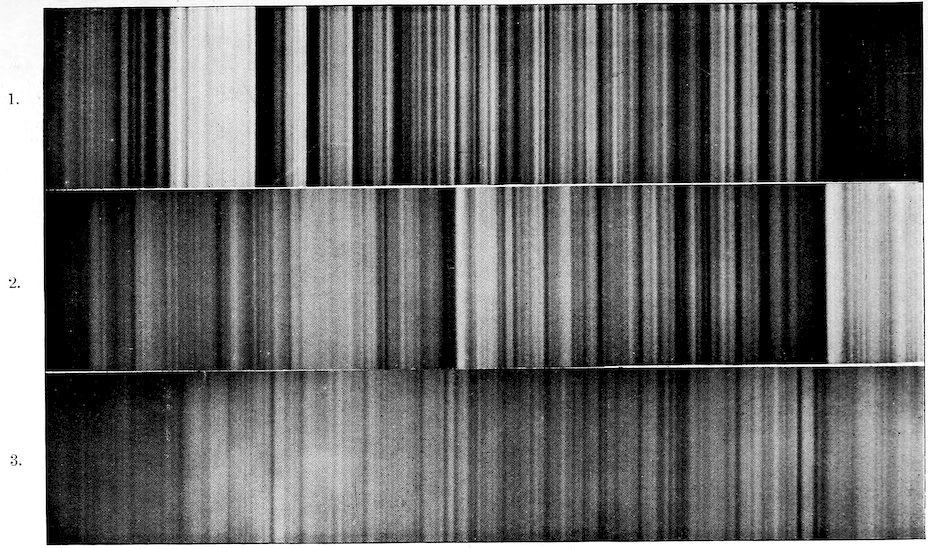
PLATE XV.
Spectra of Stars of Types II., III., and IV. (Hale and Ellerman).
1. The Sun (Type II.). 2. μ Geminorum (Type III.). 3. 132 Schjellerup (Type IV.).
The rule of colour in carbon stars long seemed inviolable;
221yet there are exceptions to it. Two spectra of the kind well
extended in the blue were photographed at Harvard College
in 1891, and they belong, in fact, to white stars.[411] They are
situated, one in Aquila, the other about three degrees north of
ε Ceti, and are of the seventh and eighth magnitudes respectively.
Their investigation ought to prove peculiarly instructive,
for in them the type has developed under most unusual conditions.
It is besides more completely exhibited. Sections
of these spectra can be registered and examined which in other
analogous objects are concealed by dense general absorption.
It should, for instance, be possible to determine whether calcium
lines are really or only apparently absent from fourth-type
spectra.
Carbon stars, there is little doubt, are inordinately distant
from the earth. None, we believe, have any measurable
proper motion, and experiments on their annual parallaxes
would certainly prove a waste of time and trouble. We have,
then, no means of estimating their real brilliancy, but it must
in some cases, and it may in all cases, be exceedingly great.
These objects show a marked preference for the Milky Way.[412]
They occur, however, in other parts of the sky as well. They
are condensed towards the galactic plane, but not limited to
it. They are unmistakably, yet far from exclusively, swayed
by its attraction.
222
Although the display of bright lines in fluted spectra is a
sure sign of extensive variability, it is not the light-changes
of the stars thus characterised that here concern us. The
two classes of phenomena are beyond question intimately
related; but as a matter of pure convenience they have to be
treated of apart.
Mira Ceti has the advantage over its fellows of rising to
more brilliant maxima, and of having received longer attention
and more careful study. Since, however, all the members of
Class vi. are not copied from one pattern, investigations
conducted too exclusively can only lead to partial knowledge;
and, indeed, the varieties distinguishing the different specimens
are precisely their most instructive feature. Thus they agree
in showing some brightened hydrogen lines, but not in the
selection of those to be brightened. Then helium rays are
vivid in certain of these stars, dark in others, and there are
further, less assured diversities. These cannot yet be explained
by any single consistent theory, but they may be definitely
ascertained and brought into some kind of orderly relationship.
The spectrum of Mira has a prescriptive right to be
considered first. It is the model, deviations from which
count as exceptional. The bands are profound, the radiations
of hydrogen intense during fully one-third of the light-period
of eleven months. Detected photographically at Harvard
College in 1886, they are now looked for, and rarely missed,
in every analogous object as it rises from quasi-extinction.
The hydrogen stratum in Mira seems to be in a peculiar
condition. It emits only the higher members of the Huggins
223series, the red and the green lines (C and F) being alike
invisible. The blue and the indigo lines, on the other hand,
shine with extraordinary brilliancy—a brilliancy “too great
to be shown on a drawing or to be safely expressed by a
number representing relative intensity”[413] (see Plate XIII.
Fig. 1). The fifth hydrogen line, by a rule without exception
in Mira variables, is hidden; but eight of its associates in the
ultra-violet have been recorded. Very singular, indeed, is the
partial presentation in this star of a closely-linked sequence of
vibrations. It can hardly result from an extraordinary elevation
of temperature; we can better conceive it as due to some
subtle form of electrical action not yet evoked in the laboratory.
The state of things as regards the hydrogen spectrum is the
opposite of that prevailing in the reversing stratum of the
sun. Here the upper radiations are suppressed; in Mira the
series starts from its third term.
The star has been spectrographically investigated by
Vogel, Sidgreaves, and Campbell. The Potsdam plates were
exposed during the low maximum of January-February
1896,[414] when the variable scarcely exceeded fourth magnitude;
and this is a circumstance to be borne in mind, since there is
reason to suspect that emission may differ, not only in degree
but in kind, at light crises of different intensities. However this
be, only the hydrogen lines were perceptibly vivified in 1896.
Of the dark lines measured by Dr. Vogel, many coincided with
Fraunhofer rulings, but a goodly proportion seemed unfamiliar.
The maximum of 1897–98 was studied by Father Sidgreaves.[415]
It was an improvement upon that observed by
Vogel. Mira attained 3·2 magnitude on 30th November.
The Stonyhurst plates were isochromatic; their range of
sensitiveness extended from high up in the violet to near D
in the yellow, and they continued to be exposed until 5th
February, when the variable had sunk to the sixth magnitude.
But the light remained essentially unchanged in quality,
although reduced to one-thirteenth its original amount. Only
the continuous spectrum in the blue had faded, relatively as well
as absolutely, showing that the star grew redder in its decline.
224Professor Campbell’s[416] observations at the maximum of
October 1898 had the twofold advantage of being made with
a magnificent apparatus and at an exceptionally bright phase.
In more ways than one they mark a beginning. They both
suggest relations and establish facts. The plates exposed
with the Mills spectrograph attached to the great Lick
refractor show only the region near the third hydrogen line
(Hγ) in the fine detail needed for measures of precision.
These were designed primarily for the determination of the
star’s radial movement, which proved to be one of recession at
a speed of 62 kilometres (38½ miles) per second. It may be
regarded as constant. No part of it seems to be due to
orbital motion round an invisible companion. It was, however,
derived exclusively from the dark lines in the spectrum.
The bright lines told a different tale. Four were compared—a
hydrogen pair and a pair ascribed to iron—and all showed
a much smaller displacement redward than the dark lines.
The amount of the discrepancy, moreover, proved subject to
fluctuations; but to fluctuations obviously depending upon
intrinsic, not upon extrinsic causes. No attempt has been made
to explain them on the hypothesis of variable motion. It may
be accepted, on the evidence of lines physically in a normal
state, that Mira—so far as appears yet—is a solitary body in
course of withdrawal from the earth at a uniform rate of 38
miles a second.
Early in October 1898 the star reached 2·6 magnitude,
and during the few weeks of its greatest brightness the blue
and indigo hydrogen bands were perceived to be broken up
each into three unequal components. This remarkable appearance
falls into line with symptoms of disturbance in
stellar spectra of other types, but had not previously been
observed in a Mira variable. It is of very curious interest.
In studying the “intensity curves” of the tripled line (see
Fig. 19) the conviction becomes almost irresistible that here
a “Zeeman effect” is in question. The polarisation test
might decide. If the lines are distended and shattered by
powerful magnetic action, then the lateral components and
the central component must be polarised in planes at right
angles to one another, and the rotating of a Nicol’s prism in
225the field should produce alternating extinction. Professor
Campbell was prepared to make the experiment at the
maximum of 1899, but the star unfortunately failed to
replenish its due measure of light, and gave an imperfectly
legible spectrum. Favourable opportunities, however, for
applying this simple criterion must frequently recur, and they
are well worth watching and waiting for. Positive results of
the kind indicated would be of revolutionary importance;
obscure phenomena would be illuminated; anomalies would
be removed; a boundless region would be thrown open to
investigation. The issue, it is scarcely too much to say, is vital
to the progress of astrophysics.
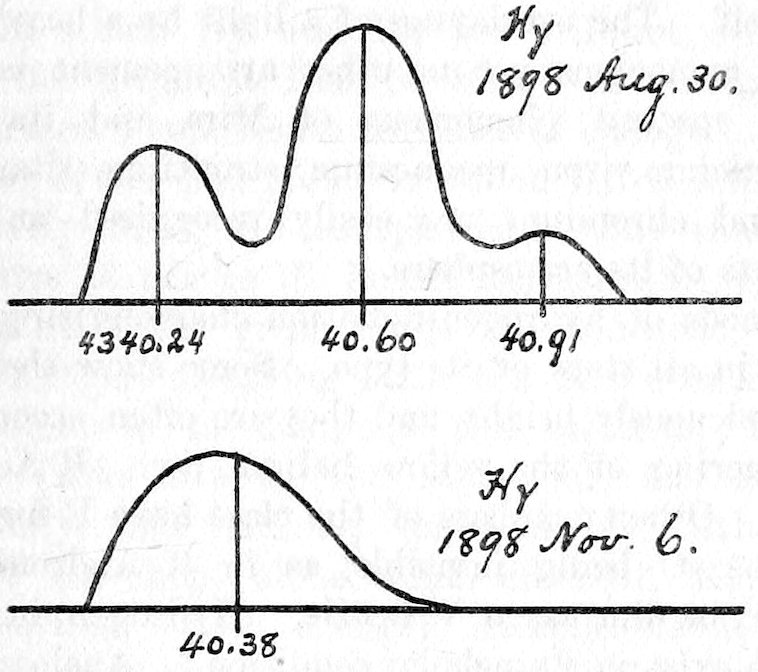
Fig. 19.—Intensity-Curves of Hγ in Spectrum of Mira (Campbell).
The production of multiple hydrogen-lines in the
spectrum of Mira may quite possibly be restricted to brilliant
phases. Metallic emission almost certainly is. Thus the
iron rays (λλ 4376, 4308) registered as bright in 1898 were,
the one strongly dark, the other either dark or invisible in
1896 and 1897. This gives a hint of the diversities to be
looked for in the future, and lends enhanced interest to
minutiæ of observation which in themselves might seem trivial.
The spectrum of Mira includes a good many dark lines
closely adjacent to, if not actually coincident with, rays of
helium. None have been seen bright. Calcium absorption is
226very prominent. The line in the blue, which develops with
increase of pressure, comes out as a black grooving; the giant
pair in the violet are of surprising intensity. The less
refrangible, as in all such stars, smothers the hydrogen
emission of nearly its own wave-length; and this circumstance
demonstrates some unexpected relations. The calcium-layer,
plainly under considerable pressure, must be located, as in the
sun, quite close to the photosphere. But the glowing
hydrogen necessarily lies lower still, stoppage of light implying
superincumbence of the arresting vapour, and there seems
no room for it except in the very interstices of the photosphere
itself. The overlaying of a light by a heavy substance
is indeed anomalous, yet no other arrangement is consistent
with the spectral phenomena of Mira and its congeners.
Besides calcium, iron, magnesium, strontium, titanium, manganese,
and chromium are easily recognised as absorptive
constituents of its atmosphere.
The mode of hydrogen-radiation characterising Mira does
not recur in all stars of its type. Some show the two lowest
lines conspicuously bright, and they are often accompanied by
the glimmering of the yellow helium ray. R Aquilæ is an
example.[417] Other members of the class have F for their chief
bright line, C being invisible, as in R Andromedæ and S
Cassiopeiæ, or dim as in V Boötis. Hydrogen in these stars
appears to exist in its nebular condition.[418] Analogous to them
in some respects, R Cygni may in others be divergent. Its
chief bright lines are F and D;[419] but the nature of the accompanying
banded absorption appears somewhat indeterminate.[420]
It might be definitely ascertained by a few well-timed observations.
An important spectrographic investigation of χ
Cygni was carried out by M. Eberhard at Potsdam in 1901.[421]
It disclosed phenomena closely analogous to those detected by
Campbell in Mira. Thus the maximum of lustre was attained,
in the hydrogen series, by its fourth member (Hδ); iron lines,
both bright and dark, were abundantly visible; above all, the
absorption and emission-spectra were relatively displaced, just
227as in Mira in 1898. The bright lines, that is to say, were
pushed towards the blue, while the dark lines deviated in an
opposite sense, though very slightly, from their normal places.
This surprising feature may then prove common to the whole
of this class of stars, and doubtless depends upon some
essential peculiarity of their constitution.
About two hundred variable stars with fluted spectra are
known to emit bright lines, and this kind of spectrum is a
distinctive badge of variability. Mrs. Fleming’s classification
of them[422] is based mainly upon differences of hydrogen-emission.
For the typical star of the first of her eleven groups she chose
R Lyncis, in which Hβ and Ηγ are brilliant, while Ηδ—sometimes
the brightest line in Mira—is scarcely visible.
She then traced a continuous sequence of change to R Leonis,
the exemplar of her last group, in which Hβ is imperceptible,
Ηγ excessively faint, Ηδ conspicuous. But this order of
relative lustre is not in R Leonis permanently maintained.
The effacement of the green ray is only transient. In April
1895 Dr. Krüger, observing with the eleven-inch Bamberg
refractor, found it to dominate the spectrum; and MM.
Gruss and Laska saw in the same star, 6th May 1894,
Hα doubtfully, Hβ and D3 unmistakably, although two
nights later Hα shone alone, while on 28th May Hβ was
similarly isolated. Such changes, inexplicable as they are,
cannot be set aside as incredible. Their further investigation
is most desirable. Meanwhile, the relative brilliancy of the
hydrogen lines in variables evidently supplies a highly insecure
basis for their arrangement.
Mira is the only member of its family which has been at
all adequately studied. A good beginning has been made with
χ Cygni; but about most of the remaining couple of hundred,
particulars are wholly lacking. The great majority, having
been registered in sweeping spectrographic surveys, were
pigeon-holed for future reference, after brief inquiry into
the history of their recorded light-changes; and in their
pigeon-holes they have been mostly allowed to rest. Enough
is known, however, to whet curiosity as to what remains
unknown. Spectral changes of a remarkable kind affect these
stars; their thorough verification and the unravelment of
228their tangled relationships are essential to progress. The
work may be difficult, but it is of profound interest. The
elucidation of the hydrogen-spectrum in one variable star
may indeed open the door to unexpected and far-reaching
discoveries.
The helium-spectrum is equally significant, but more
evasive. The emergence of the yellow ray seems to accompany
the brightening of the two lower hydrogen rays; but its
shining may be comparatively transient. The important
point, however, is that it does not seem to occur at all in
stars showing, like Mira, a mutilated hydrogen series. Then
there is the further question whether D3, when it does shine
out, shines alone. Are all its numerous associates invisible,
or are they dark, as some of them appear to be in Mira?
Finally, we know very little as yet about the lighting-up of
metallic rays in such spectra. It is nevertheless certain that
some regulating principle governs the selection of those
brightened; and only by detailed study can the nature of
that principle be ascertained. All this, and much more,
needs prolonged and extended inquiry; but in a field that
will yield ample return for the expended labour.
229
Temporary stars, and a few stars variable in short periods,
belong, properly speaking, to this class; but for the sake of
clearness and convenience, they are reserved for separate
treatment. The question of light-change will demand later
on our undivided attention; it bristles with difficulties, which
we are not at present prepared to encounter.
Alcyone, the chief Pleiad, long passed for an ordinary
Orion star. Dark lines of hydrogen and helium were prominent
in its spectrum; there seemed no reason to suspect
the slightest deviation from normality. Nevertheless, Campbell
perceived in 1893[423] the red radiance of C set off by a
narrow dark line on its more refrangible side; and this state
of incipient emission appears to be permanent.[424] Alcyone
might then be counted a linking instance between Classes i.
and vii. The discovery was startling that a single substance
could show certain of its rays bright, the remainder dark, in
one and the same star. But the fact, although highly perplexing,[425]
has become so common to experience as to have ceased to
be surprising. Examples of its occurrence have been registered
by the score as regards both hydrogen and helium. They are
all found in Classes vii. and viii. (bright-line helium and Wolf-Rayet
stars); Mira-variables seem never to have their hydrogen
spectrum thus conditioned. Professor Campbell[426] noticed it as
230an invariable rule that the bright lines in Orion stars “are those
of greater wave-length,” while “the dark lines are those of
shorter wave-length.”[427] This applies also to helium, but in a
qualified sense. If all the lines in its spectrum are taken
indiscriminately, the bright and the dark appear to succeed
each other without method; but their consideration by series
makes it at once evident that, within the limits of each set
of vibrations, the bright members are invariably fundamental.
This is important, not only for the better ordering of stellar
phenomena, but as regards the theory of spectral series in
general.
In Alcyone, then, emission is at a minimum; it could
scarcely diminish and remain existent. And it is quite
possible that it may be on the wane; after the lapse of some
hundreds, or thousands of years, the chief Atlantid will
perhaps have lost the distinctive note of its spectrum, and
will have sunk to the level of unrelieved absorption. One of
its companions at present stands out from the crowd in the
same way, but more decidedly. Pleione shows three hydrogen
lines pretty strongly bright, and they are inevitably C, F,
and Hγ. Centrally superposed upon wide dark bands,[428] they
assert by this fact alone the non-correspondence in position
of their originating stratum with the glowing hydrogen in
stars like Mira. And this teaches us the important lesson
that there is no stereotyped recipe for the production of stellar
bright lines, but that they may originate diversely in the
various spectral classes.
The Pleiades are nebulous collectively, and in many cases
individually as well; but they are less closely folded in nebular
swaddling-bands than the group of stars forming the nucleus
of the great Orion nebula. It consists of four leaders, of
about the fourth, fifth, sixth, and seventh magnitudes respectively,
two of which have faint companions; and, scattered
promiscuously, there are to be found besides four minute
stellar points, detected at Lick by Professor Barnard and Mr.
Alvan G. Clark. For spectroscopic purposes the “trapezium,”
or quartette of bright stars, may be treated as one, since they
231shine with sensibly the same quality of light, while their
scarcely visible associates give radiations negligible in amount.
Most difficult questions arise in attempting to decide upon the
true nature of the trapezium-spectrum. The prevalent view
at first was that the stars were of the ordinary dark-line
helium type, bright lines coming in here and there simply as
projections from the enormous volume of gaseous stuff interposed
between the eye and the stellar nucleus of the formation.
But the opinion was grounded on superficial evidence,
and has not held its ground. Some lines, bright in the
nebula, refuse to cross the thin strip of continuous light due
to the star; they stop short on one side of it, and reform on
the other,[429] the two sections being divided by a narrow gap
of absorption. This proves that the nebular rays do not in
all cases show bright against the background of continuous
stellar light. The very strongest may do so; but it is just
possible that in them the appearance is illusory, and due to a
kind of irradiation.
There can, on the other hand, be no reasonable doubt that
the trapezium-stars have bright lines of their own. But they
are peculiar, and peculiarly conditioned. A spectrograph
taken by Sir William and Lady Huggins, 5th February 1888,[430]
proved to be crossed in the ultra-violet by at least four
groups of fine, faint, bright lines, derived primarily from two
stars of the trapezium, but extending, through their influence,
as it were, some little way into the adjacent nebula. Their
origin is problematical; they have not been recorded elsewhere;[431]
they have been only partially verified on later Tulse
Hill plates. Yet the original negative survives, and its
examination has convinced several experts of the reality of
the curious script read from it. Conviction, however, on such a
point is apt to share the dim character of gloaming phenomena—phenomena
on the border between the seen and the not seen.
But there is more. With refined apparatus the same
observers succeeded, in 1894 and subsequently,[432] in separately
232photographing three of these remarkable spectra, and they
were now perceived to be rich throughout in bright and dark
lines, “with the special character strongly marked of bright
bands associated with corresponding dark absorption lines.”
Most singular of all, the relative positions of these bright and
dark lines were found subject to change. Hydrogen radiations,
for instance, which in 1894 lay on the blue sides of the
absorption stripes, lay in 1897 on their redward margins.
This might be explained on the hypothesis of orbital movement
by supposing each star of the trapezium composed of
a dark-line and a bright-line member, the spectra of which
are periodically shifted through the alternations of their
velocities in the line of sight. It remains to be seen, however,
whether or not the shiftings are periodical; for by this one
condition the explanation stands or falls.
So far as their absorption-elements are concerned, the
stars of the trapezium belong to the earliest variety of the
Orion type. All the lines are wide and diffuse, and the
strongest are members of the Pickering series of hydrogen.
Rydberg’s series—if we may call it so under reserve—is
represented by the prominent reversal of its solitary ray at
λ 4689. Mr. McClean recognised oxygen absorption in these
stars; Sir William and Lady Huggins identified nitrogen,
silicium, and titanium, and the calcium K shows both bright
and dark. Few sidereal objects combine so many points of
interest as the multiple star at the heart of the great nebula.
The origin and meaning of the throngs of delicate rays,
here just tantalising vision, pressingly invite research; nor
less the manner of relative displacement exhibited by the
bright and dark coupled lines. Do they betray a circulatory
period? And if so, is it the same for each member of
the group? Or do they rather form independent systems, in
subordination to a higher scheme, completing itself in the
long leisure of many millenniums? Other problems suggest
themselves in immediate connection with these stars; nor is it
impossible that they may be proposed over again, perhaps in
a modified form, by the multiple stellar nucleus of the Trifid
Nebula in Sagittarius. But instruments of no insignificant
light-power will be needed for the satisfactory examination of
its spectrum.
233In one other star besides θ Orionis, the shifting of bright
hydrogen lines occurs irrespectively, to all appearance, of
binary revolution. Spectroscopic duplicity was at first
naturally attributed to 11 Monocerotis when its peculiar
character disclosed itself on the Harvard plates. Thus in the
years 1888–90 the dark F of hydrogen had an illuminated
border lying redward; it was on the blue side in 1891–92.[433]
We are not informed whether it has since changed its position;
but any attempt to impose a period upon alterations so
spasmodical would evidently be hopeless. Like θ Orionis,
11 Monocerotis ( = Σ 919) is compound. It consists of
three stars of about fifth and sixth magnitudes, which have
maintained a strict relative immobility since Herschel divided
them in 1781. Their spectra, photographed as one by
Pickering, were separately examined by Campbell in 1894.[434]
He found two of them to include the brilliant red ray of
hydrogen, while it was absent from the third. Presumably,
then, only two of the trio are bright-line stars, and it may
be that in these two, significant differences in the mode of
emission will be brought to light by detailed and systematic
investigation.
The swing of the bright lines observed in θ Orionis
and 11 Monocerotis is extremely uncommon. In general,
a fixed arrangement prevails, and it is of two alternative
varieties. Either the bright lines centrally divide broader
dark bands, as in γ Cassiopeiæ, or the bright and dark lines
are bracketed in pairs, the bright below, the dark above, as in
P Cygni.
Father Secchi’s notice of γ Cassiopeiæ as a gaseous star
goes back to 1866. He noticed the vividness in its spectrum
of C, F, and D3, but the helium line has not since held its
own with the others. It is subject to prolonged extinctions;
nor is it certain that even the hydrogen rays always keep up
the same standard of brightness. The variability of the
spectrum will, however, be discussed later in connection with
other similar instances; here we have to do with its fundamental
characteristics. The hydrogen lines in γ Cassiopeiæ
are doubly reversed.[435] Wide absorption bands are divided by
234narrower emission bands, and these again by hair-lines of darkness.
Their structure is analogous to that of H and K in the
solar spectrum. The radiations fall off in intensity—as Campbell’s
rule prescribes—with diminishing wave-length, while the
absorptions gain in the same proportion. F is “superlatively
bright”;[436] Hε is neutral; no bright lines have been photographed
in the ultra-violet. The helium lines are dark, with occasional
exceptions; but the green and blue magnesium lines shine by
direct emission, and Father Sidgreaves recognises as a probable
vanadium line a strong dark-blue ray (λ 4586), which seems
to fluctuate in brightness. Another remarkable circumstance
relating to this star is the recent effacement from its spectrum
of the signs of sodium absorption formerly visible in it.
They have, at any rate, escaped notice since Von Konkoly’s
record of 15th September 1884.[437] But the immense vogue
and value of spectrography have tended to reduce to a
minimum the attention bestowed upon the lower spectral
sections, and thus unduly to incline the balance of observation.
The study of γ Cassiopeiæ might alone furnish a not
inadequate task for a well-equipped observer. Only individual
enthusiasm is likely to deal successfully with the baffling
problems it presents. Spectral variability is, in its case,
accentuated by perfect photometric constancy. The star is
steadily of 2·3 magnitude. It is purely white in colour, lies
immersed in the Milky Way, and has no measurable parallax.
Its real size and splendour are then inestimably great.
The spectrum of P Cygni is not known to vary, although
the star itself was reckoned a “Nova” on its discovery by
Janson in 1600, and by its capricious emergences earned
from Huygens, half a century later, the title of the “revenante
of the Swan.”[438] Finally, it settled down to fifth-magnitude
brightness, which it seems disposed indefinitely to retain.
Its spectrum shows an approximately complete set of bright
and dark hydrogen and helium rays; but in their arrangement
into couples juxtaposition replaces superposition—that
is to say, the bright lines are in their normal places,[439] while
235the corresponding dark ones are shifted upward, as if by rapid
motion, towards the eye. But there can be no real question
of motion, since the relation persists without change year after
year. Nor can it be explained on the pressure-principle of
altered refrangibility. The action, if exerted at all, would be
of the opposite kind to that observed. The displacements in
the spectrum of P Cygni are towards the blue; if due to
pressure, they should be towards the red. The phenomenon
of the relative displacement of bright and dark lines in the
same spectrum is one of the most interesting in stellar physics,
and has received, up to the present, no adequate explanation.
The absorption lines in P Cygni are much sharper and
narrower than in γ Cassiopeiæ. Those of calcium, magnesium,
and sodium are at once apparent, and Bélopolsky ascribes
many of the remainder to nitrogen.
The spectrum of the great southern variable, η Carinæ,
resembles that of P Cygni by its inclusion of many bright
lines shadowed by dark ones on their blue sides. It has
been photographically studied by Sir David Gill, Mr. McClean,
and Miss A. J. Cannon.[440]
Among stars nearly related to γ Cassiopeiæ may be
mentioned φ Persei (4·2 magnitude), υ Cygni (4·4 magnitude),
α Columbæ (2·7 magnitude), δ and μ Centauri (2·8 and
3·4 magnitude). Bright F was detected by Mr. Espin[441] in the
spectrum of the star in Perseus, and was found by Campbell[442]
to be accompanied by a much brighter C. The total absence
of K is surprising, but may not be permanent if the spectral
variability suspected at Potsdam[443] be substantiated. In υ
Cygni there appear to be double reversals of helium as well
as of hydrogen.[444] Of α Columbæ it is only known that F is
a broad dark line bisected by a narrow bright one. The
spectra of the two stars in Centaur are thought to be almost
identical.[445] Hydrogen emissions in them are strong and
numerous, but none others have been recognised. The
helium lines are all dark; metallic lines are inconspicuous.
Bright hydrogen and helium lines seem like relics of past
236conflagrations. In a few cases we know them to be such, and
it is possible that in all they have the same implications.
For any of these stars may have undergone prehistoric vicissitudes
of lustre, after which they would have settled down
into stability; although the recurrence of such incidents in
the future can alone afford secure grounds for inferring that
they diversified stellar biographies in earlier times. Bright-line
helium stars are for the most part situated in the Milky
Way. They are subject to the influences exercised by that
strange aggregation.
237
A very remarkable star was described by Professor Pickering
in 1896.[446] Through the measurement of its absorption lines
a companion hydrogen series to that already known was, for
the first time, recognised; while both the Wolf-Rayet bands
in the azure showed in it by direct emission. Only the
presence of a dark K obliges us to separate ζ Puppis from
Wolf-Rayet stars proper, and to consider it as a linking instance
between them and helium stars of the earliest variety.
Just this trace of calcium-absorption differentiates the hybrid
spectrum of the star in the Poop from spectra of Class viii.,
which include no legible metallic impressions. Their absence
is of especial importance as extending to nebulæ. Nebular
chemistry is entirely non-metallic.
The Pickering series in Wolf-Rayet stars is not infrequently
bright in its lower members, submerged by absorption
higher up. The bands in the blue, on the other hand, are
always bright. They form a multiple group, the mutual
relations of which await more complete disentanglement. The
lowest member is, or may be, the “fundamental” of Rydberg’s
hydrogen series at λ 469. Yet the circumstance that it is
not really solitary tends to discountenance this identification.[447]
The “lazulite” ray at λ 465 is never entirely effaced, and
Campbell has provided it with several associates of still shorter
wave-lengths.[448] Some of these fall suspiciously near nitrogen
lines. The possibility is not then excluded that all these
238enigmatical blue effluences may be the joint products of glowing
hydrogen and nitrogen, although this view, like every
other that can be proposed, is beset by serious difficulties.
Among the less refrangible of the Wolf-Rayet bright lines
there are two (at about λ 569 and 559) which appear to
coincide with rays photographed by Professor Hale in
carbon stars. Neither has been chemically interpreted. One
of them, the greenish or “citron” line (λ 569), seems in some
way correlated with the blue band at λ 465. A more definite
connection can be traced between the latter and the yellow
line at λ 581. They are emphasised in the same stars, while
the brilliancy of the Rydberg beam at λ 469 is accompanied
by a special vivifying of the green Pickering line at
λ 541. This rule is quasi-universal; it may stand, at least
temporarily, as a useful principle of order amid half-intelligible
phenomena.
Hydrogen is most diversely imprinted on the Wolf-Rayet
spectra. Its lines, according to Professor Campbell, “have
nearly every known character. In many of the stars they are
dark. Again, they are dark with bright borders, and suggest
strongly that they are doubly reversed. The bright hydrogen
lines vary from faint to very bright, from monochromatic lines
to very broad bands, and from those clearly single to those
apparently multiple.” This splitting-up of widened lines is
evidently analogous to the tripling of the brilliant hydrogen
rays observed in Mira, and once more recalls the possibility
that certain peculiar stellar spectra may be produced in powerful
magnetic fields. Helium is not very prominent in spectra
of this type. It frequently shows by emission in D3, and
occasionally, even in the same star, by absorption at λ 4472;
but its display is subordinate to that of other known and
unknown elements.
The grand exemplar of the Wolf-Rayet class is γ Argûs
(alias γ Velorum), a star of 2·4 magnitude, giving a resplendent
spectrum ablaze with yellow and blue lines. It was first effectively
studied by Professor Campbell in 1893–94,[449] although at
the Lick Observatory the star barely attains an altitude of six
degrees, and can be observed for only a few minutes on any
one night. The main facts that struck him were the brilliancy
239of C, the transitional character of F, and the unmitigated
darkness of all the upper hydrogen lines. Similarly, the
initial term of the Pickering series at λ 541 shows by emission,
the rest by absorption, while a bright D3 contrasts with
a number of more refrangible dark associates. As usual,
both blue bands are visible, but the weight of radiation falls
upon that of shorter wave-length, the Rydberg line being
comparatively inconspicuous. Miss Cannon found several of
the hydrogen lines in both series to be dark with illuminated
borders, an arrangement, as she remarked, the inverse of that
prevailing in γ Cassiopeiæ and its allies.[450] Mr. McClean
recognised oxygen absorption in this star,[451] and the feature is
not unlikely to prove, on fuller inquiry, common to all the
members of its class. The absence of H and K is more than
probable, and suggests comparisons and reflections.
A 7·5 magnitude star in Cygnus (D.M. + 43° 3571) shows,
like γ Argûs, a mixed succession of hydrogen lines, but
modified, perhaps, by double reversals.[452] With the Lick
thirty-six inch Professor Keeler perceived its spectrum as “an
extremely complicated range of absorption bands and faint
bright lines,”[453] the unusual width of which struck both him
and Professor Campbell. Thus the azure bands actually
overlap, forming a single indistinct glow one hundred tenth-metres
broad. A spectrograph of this object, taken by Mr.
Ellerman with the forty-inch Yerkes refractor, is described[454] as
totally unlike any spectrum of the fourth type. Whether the
dissimilarity is of a nature to be generalised so as to exclude
all idea of kinship between these stellar families is more than
we can tell at present.
A star of about the same brightness, distinguished as
“Argelander-Oeltzen, 17,681,” was swept up in Sagittarius
by Pickering in 1881. In its spectrum the golden ray at
λ 581 and the lazulite beam at λ 465 predominate almost
exclusively. Vogel could see no others with the great Vienna
refractor in 1883;[455] nevertheless, Campbell succeeded, ten
240years later, in measuring twenty bright lines in this wonderful
spectrum.[456] Only one among them, and that of secondary
importance, can be attributed to helium; but many due to
that substance may be included in the unexplored absorption
spectrum of “A.O. 17,681.”
A star of 6·4 magnitude in Canis Major, catalogued as
“Lalande 13,412,” shows, instead of the unknown blue and
yellow rays at λ 465 and λ 581, the “new” hydrogen lines
at λ 469 and λ 541.[457] The spectrum includes, besides, a
more refrangible blue band, centred about λ 461, but diffuse
and divided. These multiple azure effulgences in the Wolf-Rayet
stars offer a problem of singular interest. They possess
none of the structure of genuine flutings; they seem apt to
spread unsymmetrically. Is this an effect of pressure on the
emitting vapour? Or does it arise from some property
inherent in it, or some mode of action exerted upon it? The
answers may be long postponed, but cannot fail to prove
interesting.
A unique specimen of this class was photographically
detected in Cygnus in the course of the “Draper Memorial”
surveys.[458] It is extremely faint—below the ninth magnitude—and
was enrolled in the Bonn Durchmusterung as D.M.
+ 30° 3639. Nevertheless, its spectrum offers more than
common facilities for exact observation, owing to the sharpness
of its component rays. Thirty were measured by Campbell
in 1893,[459] and they include, with many common to the type,
several that appear to be individual to the star. The two
brightest lines, however, are F and λ 569, the “citron” line
strong in γ Argûs. The Pickering and Rydberg series are
faint, while the alternative blue band at λ 465 glows
intensely. But the distinctive feature of the star is that it
is spectroscopically nebulous. Observed on the F-line like a
solar prominence, Professor Campbell found it to present a
very appreciable disc,[460] which, on narrowing the slit, became
241reduced to a line, as shown in Figure 20. The length of this
line is about 5″ of arc, and it measures the apparent diameter
of the incandescent envelope of hydrogen which surrounds the
body of the star. Only the hydrogen lines behave thus
exceptionally; all the other
spectral rays show as mere
bright points upon the continuous
background, which
they do not transcend by
a hair’s-breadth. That is
to say, hydrogen is the
sole glowing constituent of
the enormous appendage
revealed by the powerful appliances available at the Lick
Observatory. It has been seen nowhere else, but Runge[461] and
Keeler[462] separately verified its existence.
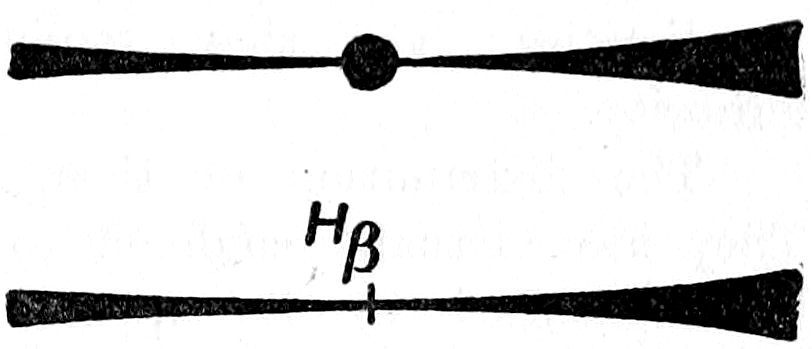
Fig. 20.—Hydrogen-Envelope of the Wolf-Rayet Star, D.M. + 30° 3639 (Campbell).
There are a few circumstances worth noting in connection
with this extraordinary appearance. First, the vast spread
of incandescent hydrogen round the star has no effect in
thickening the representative lines of that substance in the
star’s spectrum. They are, on the contrary, particularly fine
and narrow. The envelope, we can hence infer, is not an
atmosphere; there is no appreciable downward pressure of
its strata. Again, it must be—in the ordinary sense—hotter
than the photosphere it surrounds; for the bright lines
emanating from it are not reversed where they cross the
prismatic thread due to the nucleus, as they should be if
the nucleus were at a higher temperature than its envelope.
Finally, it may be possible, by researches into the parallax and
proper motion of this star, to form some estimate of its actual
distance, and consequently of the real extent of its gaseous
surroundings. Thus might be opened a novel line of inquiry
destined to lead future students of the skies far afield.
The chemistry of the Wolf-Rayet stars—judging from
partial interpretations of the disclosing script—is of the simplest.
They have as unfailing constituents hydrogen and helium;
oxygen is at least occasionally present, and the detection of nitrogen
may be expected with some confidence. Sir William and
242Lady Huggins showed in 1890[463] the inadmissibility of a carbon
origin for any of the blue bands, and defined their positions
by exact measurements. Professor Campbell’s observations,
visual and photographic, of thirty-two members of the class
contributed materially to promote acquaintance with their
peculiarities; yet they stimulated, rather than satisfied
curiosity.
The distribution of these objects is strongly selective.
They are virtually confined to the Milky Way. The rule
is emphasised by its apparent exceptions, for the single
specimen of the type deviating considerably in position from
the galactic plane has proved, on closer inquiry, to be
situated in a galactic offset; while the twenty-two grouped
in the Magellanic Clouds belong to aggregations of the
galactic order, and subject presumably to galactic conditions.
The Milky Way, then, and the Nubeculæ afford
analogous and exclusive facilities for the development of such
bodies. They seem, moreover, to be provided more freely in
some regions than in others, since the objects in question
tend to collect into knots or groups, the finding of one Wolf-Rayet
star being generally the prelude to additional detections
in the same neighbourhood. Yet they rarely or never form
binary combinations. They are loosely associated without any
suggestion of mutual circulation. Nor has any of them, so
far, given signs of spectroscopic duplicity. They are singularly
steady light-givers. No Wolf-Rayet star is under the
slightest suspicion of variability. Atmospheric incandescence
on the largest scale is compatible in them with the perfectly
uniform working of arrangements for the transference of heated
matter from the interior to the surface of the radiating bodies.
Considering the frequent and extreme instability of many
bright-line stars of other varieties, this fact can hardly be too
strenuously insisted upon.
243
The more closely we study the phenomena of bright lines in
stellar spectra, the more fully convinced we become that no
single or simple principle avails to explain them. They are
evidently produced under varied circumstances, at different
elevations above the stellar photospheres, and in manifold
forms of connection with the adjacent absorbent layers.
Reviewing rapidly the chief types of emissive spectra, we can,
to some extent, gather their implications.
The sine quâ non for the display of bright lines is the
presence of a stratum in the star’s atmosphere outshining the
photosphere. The difficulty is indeed very great of attributing
this superiority in brightness to a superiority in temperature;
but it can be evaded by the use of Wiedemann’s
convenient term “luminescence,” signifying a state of glow
unconditioned in the strict sense by heat. The rationale of
“luminescence” is still uncertain, but the introduction of the
new idea it represents marks an important departure from the
old groove of thought. Now we can trace two modes of
emission in the sun, faintly indicated, it is true, but instructive
as being within reach of comparatively immediate study. In
the first place, some of the Fraunhofer lines seem to be
relieved against vague effusions of light,[464] originating, almost
certainly, beneath the reversing layer, among the interstices of
the photospheric clouds. In the second place, the violet
calcium lines, and occasionally one or two lines of hydrogen,
are doubly reversed in the chromosphere. Both kinds of
effect are reproduced in stellar spectra.
244Carbon stars show bright lines, which may be described
as chromospheric; the gases emitting them surmount the
vapours generating the noted dark bands. Moreover, these
rays appear to be simple and uncompounded of bright and
dark elements; they are not perceptibly affected by reversals
or absorptions. The same may be said of the bright lines in
Mira-variables. Yet the locality of their origin is widely
different. They are essentially photospheric and deep-seated,
shining from beneath the dusky flutings they diversify. The
leading characteristic of bright-line helium stars is the duplication
of their spectra. The vivid rays have dark companions.
And this, not through the optical conjunction of two distinct
bodies, but as the result of physical conditions prevailing in
a single globe. In such stars, then, there are complex stratifications
of emitting and reversing vapours diversely affected,
we cannot tell how, by heat, pressure, magnetism, or
electricity. The gradual penetration into the secrets of
nature that must accompany their study offers an enticing,
and a far from hopeless prospect to the rising generation
of astrophysicists. But it will involve an indefinite expenditure
of time and labour. The conditions of bright-line
production in Wolf-Rayet stars are extremely hard to
define. They probably vary greatly in individual specimens.
The state of some probably resembles that of helium stars
showing analogous symptoms of gaseous incandescence. The
corresponding reversals, however, are less emphatic, and have
indeed been rather suspected than perceived. Other members
of the Wolf-Rayet class (for Campbell’s star presumably has
fellows) possess vast gaseous envelopes, uniformly glowing,
and scarcely arresting light.
As to the theory of bright lines in stellar spectra, it is
only certain that they testify to a real excess of incandescence in
certain layers of the stellar atmospheres. They are not optically
created by the concentration, through distance, of far-reaching,
cool, gaseous appurtenances. This is proved by the example
of the sun, by the study of Campbell’s star in Cygnus, in
which not a cool, but a strongly glowing appurtenance is
actually visible, and by the phenomena of spectral variability,
totally inexplicable on the view that mere extent of gaseous
surroundings is competent to produce bright lines. It is
245much easier, however, to deny than to affirm—to perceive
incongruities with fact than to trace the lines of a true
hypothesis. This cannot be done off-hand; much preliminary
toil must be undertaken. Of prime necessity is the
continuous study of the sun’s facular rays, of their originating
conditions, their displacements, their periodical changes.
Laboratory inquiries will proceed simultaneously—inquiries
into the nature of “luminescence,” into the temperature of
radiating gases, into the spectral effects of varied modes of
electrical illumination, all which topics may demand subterfuges
of treatment not yet easily imaginable. But need
will stimulate invention, and knowledge will advance along the
arduous ways by which alone future progress is possible.
246
A small proportion of stellar spectra show marked individualities;
they differ notably from the recognised types, and may
help, by their very diversity, to elucidate them. Some belong
to stars variable in light; most are probably inconstant in
their peculiarities; none have as yet received the persistent
attention that they deserve.
The “comet variable,” R Geminorum, was last observed by
Vogel in 1874,[465] and then not to the best advantage. A
maximum, at which the star rose somewhat above the seventh
magnitude, occurred 7th April, and during a month previously
dark and bright bands were distinguishable in its spectrum.
Repeated measurements proved the latter to coincide in position
with the dusky colonnade in fourth-type stars. They were
due, quite unmistakably, to the direct radiations of carbon.
The variable, in other words, glowed with a light fundamentally
the same in quality as that of a comet approaching
perihelion. No hydrogen or helium lines seem to have been
present; but the strong yellow ray located at λ 581 must be
identified with the Wolf-Rayet line,[466] specially associated, as
we have seen, with the lazulite band at λ 465. It will be interesting
to learn whether the same connection subsists in the
variable; but some years must elapse before any kind of new
information regarding it can be obtained. Just at present
the star, in its bright phases, is too near the sun for purposes
of useful research, and its period of 370 days differs so little
from a year that the conjunction passes off with extreme slowness.
The minima of this curious variable carry it to the very
247verge of extinction, below the range of ordinary telescopes.
The attempt has not yet been made to keep it in view with
those of large aperture.
A star capriciously variable both in the kind and in the
quantity of its light was discovered by Pigott in 1795.
Usually almost constant at the sixth magnitude, R Coronæ
is liable, at intervals counted by years, to lapses into obscurity,[467]
varied by spasmodic efforts towards recovery, each crisis of
instability lasting many months. The spectral fluctuations
of the star seem unrelated to its changes of brightness.
They were first noticed by Mr. Espin in 1890, but so
far have not been very clearly defined. Migrations from
type to type are somewhat vaguely indicated; their reality
would involve so much that is novel and surprising that it
can only be admitted on irrefragable evidence. On 14th
September 1890[468] the spectrum appeared of Type iv.; it was
interrupted by obscure bands held to be those of carbon
absorption. In April 1893[469] bright lines and nondescript
dark bands alternately stood out to view and became effaced;
and on 4th May 1899[470] a spectrum resembling that of the
sun had established itself. Mr. Espin is convinced that a
double light-source is in question, and that the observed
changes are explicable by the conjunctions and elongations
of revolving stars, giving contrasted spectra; but unless
they can be brought into conformity with some time-regimen,
such an hypothesis is evidently inapplicable.
The spectrum of a star in the Shield of Sobieski is probably
analogous to that of R Coronæ, but the suspected variation
is not from the fourth, but from the third to the second
type. In August 1890 Mr. Espin derived from R Scuti
a set of faint bands, modelled to all appearance on those of
Mira or α Herculis;[471] a glimmer of bright lines in the blue
and violet, however, betrayed unusual characteristics, completely
drowned, like the concomitant absorption, in the
flood of continuous light accompanying and occasioning the
maximum in October. Less than two years later, 25th
248June 1892, Dr. Krüger found the spectrum definitely solar,
the b-group of magnesium being particularly distinct.[472] R
Scuti never sinks below the ninth magnitude. It is then at
all times fairly accessible to exact investigations, which should
serve, without much difficulty, to fix the true nature of this
still enigmatical object. The mode of spectral variability
which it exemplifies is not generally accounted as possible by
those who undertake to discuss the intricate subject of
stellar development; this could hardly, indeed, be dealt with
on the old lines if the suspected phenomenon proved to be an
unquestionable fact.
Spectral and luminous variability are, in certain stars,
inseparably connected. With increasing light the hydrogen
lines brighten; with ebbing light they fade. A common
cause evidently governs the two kinds of change. This close
correspondence is observed only in periodical objects of the
Mira-class. Variables of a less regular type, such as R
Coronæ, fluctuate spectrally in apparent disregard of their
light-vicissitudes; while yet a third description of spectroscopic
variables are exempt from the least suspicion of instability
in brightness. A conspicuous example of the last
kind is γ Cassiopeiæ.
Normally, the red hydrogen line is the brightest in its
spectrum; yet it seemed extinct when looked for by Dr.
Vogel, 18th June 1872.[473] To the Dunecht observers, however,
it showed “superbly” bright 20th December 1879,[474]
then lapsed into invisibility, until rekindled under the eyes of
Von Gothard at Herény, 13th August 1883.[475] Since then
it has not been missed, but has rarely been sought; for it
can scarcely be called accessible to spectrographic observation,
and direct inspection of stellar spectra has unfortunately
fallen out of vogue. On 13th September 1885 Dr. Copeland
found C very bright in γ Cassiopeiæ, F just measurable;[476]
on fifty-two plates taken at Stonyhurst during the years 1891–99[477]
F was “superlatively bright,” C being of course below
their range. No evidence was elicited from them of alteration
249in the hydrogen spectrum, but they gave strong grounds for
suspicion of change in lines due to other substances, notably
in a strong ray at λ 4586, doubtfully associated with vanadium.
Suspicion might have been raised to certainty if the yellow
helium line had fallen within the scope of inquiry, for the
variability of D3 in this star may safely be taken as proved.
Although observed as bright by Secchi in 1867,[478] measured by
Von Gothard 20th August 1883,[479] and just recognised at the
O Gyalla Observatory in 1891, and at South Kensington late
in 1889 and 1894,[480] the line is commonly invisible under the
most favourable conditions. Keeler could not find it with the
great Lick refractor in the summer of 1889;[481] three spectrograms,
taken on orthochromatic plates with the Pulkowa
thirty-inch by Bélopolsky in 1892, bore no trace of it;[482]
its emergences, in brief, are so transient and uncertain as to
be altogether exceptional. They seem quite casual—that is
to say, their law of causation is to us inscrutable. The
remaining chief lines of helium in γ Cassiopeiæ are dark, with
indications of fine bright reversals at their centres.[483]
The metallic spectrum, too, is unmistakably variable. Von
Konkoly noted sodium absorption at D, 15th September
1884.[484] Yet Keeler’s examination, five years later, showed
the spectrum in that vicinity to be absolutely continuous.
No subsequent record of dark D has probably been made.
The magnesium group b, on the other hand, seen dark by
Keeler, appeared bright on the Stonyhurst photographs, and
it was accompanied by the blue emission from “high temperature”
magnesium at λ 4482. No iron lines are brightened
in this spectrum. A clue to its intricacies may be found by
the employment of combined visual and photographic methods.
Neither by itself is altogether satisfactory. Changes in one
part of the spectrum lose half their significance unless correlated
with changes in the remaining parts. The assurance of
their reality, besides, would be immensely strengthened by the
demonstration of their not being isolated. Sympathetic
250variations, independently recorded, could hardly be the creation
of instrumental or other extraneous causes.
The chromospheric instability of γ Cassiopeiæ is shared
by a good many other stars. Among them is J Velorum
(A.G.C. 14,145), spectrographically registered at various dates
in the course of the Harvard College southern surveys of
the heavens. Miss A. J. Cannon’s examination[485] showed that
on the plate taken 2nd June 1893 the green and blue
hydrogen lines (Hβ and Hγ) were bright, superposed upon
broad absorption bands. Nevertheless on 19th April 1895
and 19th March 1896 they were simply dark, with no trace
of vivid reversals. And so they remained in 1899. Whether
the red line, usually in such stars the most brilliant of the
series, responded to the chromospheric extinction attested by
its more refrangible associates, can never now be known;
but something may, in the future, be discovered about its
behaviour should the spectrum of J Velorum ever be rekindled.
The star, which is of the fifth magnitude, does not
vary appreciably in lustre.
An inverse change to that observed in J Velorum was
detected by similar means in a seventh-magnitude star in
the southern constellation Chamæleon (A.G.C. 14,686). On
20th May 1892 it appeared to be of the Sirian type;
hydrogen showed only by absorption; but on 3rd April 1895
Hβ was bright, eighteen days later Hγ had followed suit,
and fringes of light seemed attached to the lower edges of
two of the ultra-violet hydrogen lines.[486] The progressive
incandescence, betokened by the creeping upward of the
illumination, was a complete novelty; its probable initial
symptom in the blaze of C necessarily remained unnoticed.
It is earnestly to be hoped that this unique object may not
slip out of view amid so many conflicting claims for attention
advanced by the denizens of the southern heavens.
A star in Canis Major (A.G.C. 9181)[487] is distinguished by
frequent fluctuations from brilliancy to obscurity of the green
and blue hydrogen lines. Miss Cannon has traced their spectrographic
history since 1892. The more refrangible members of
251the series are present—it can be inferred—as absorption lines,
and C is explicitly stated by Campbell to have been glowing
in 1894.[488] Variations of its green companion (Hβ), analogous
to those just described, have recently been detected in the
spectra of η Centauri and κ2 Apodis.[489]
The percentage of abnormal stars found on the Draper
Memorial plates is exceedingly small; yet they sum up to a
not insignificant total. A few may be named as worthy of
sustained attention. A sixth-magnitude star in Libra
(A.G.C. 20,937) was announced in 1895[490] to show a spectrum
resembling that of the great Looped Nebula (30 Doradûs),
which differs in light-quality from other gaseous nebulæ;
and a stellar apparition in the Centaur, then visible, was
added to the spectral group. “Nova Centauri” promptly
disappeared, but the star in Libra is permanently present,
and available year by year for prismatic comparisons. The
peculiarities of the following objects have not been expressly
defined:—
1. S.B.D. −22° 1070; R.A. 5h 14·5m; Dec. −22° 19′. Mag. 8·7.
Photographed at Arequipa.[491]
2. Z.C. 17h 734; R.A. 17h 13·2m; Dec. −66° 15′. Mag. 8·5.
Photographed at Arequipa.
3. S.D.M. −8° 1467; R.A. 6h 28·1m; Dec. −8° 48′. Mag. 8·5, but
slightly variable.[492]
4. S.D.M. −11° 1941; R.A. 7h 22·4m; Dec. −11° 31′. Mag. 8·9
variable. Banded spectrum of uncertain type.
5. S.D.M. −10° 5057; R.A. 19h 7·7m; Dec. −10° 54′. Mag. 7.
Unique spectrum of bands.[493]
Possibly the original records secured of these stars may
never be duplicated, since they are not unlikely to be spectrally
variable as well as peculiar. In any case their characteristics,
which are precisely of the kind to prove specially instructive,
need to be more fully ascertained.
The spectra of φ and ψ Persei—both bright-line helium
stars—have been suspected of fluctuations; but those of the
252first may depend upon varying radial velocity,[494] while those of
the second, although slight in amount, are of a particularly
interesting description. They consist in the occasional
shifting of the brilliant narrow F of hydrogen to one or
other side of the absorption-band upon which, in general, it is
centrally placed.[495] These displacements are probably of the
same nature as the alternate marginal illuminations of Hβ
in θ Orionis and 11 Monocerotis; they are certainly unconnected
with revolving movements in a system of bodies.
Many more instances might be given of stellar spectra
apparently abnormal, and at least ostensibly variable, but the
above may suffice as specimens.
253
Colour variation in stars is a somewhat elusive phenomenon.
It cannot be measured; no “colorimeter” yet constructed
has given satisfactory results. Then it is subject to adventitious
modifications depending upon the state of the
atmosphere, the fluctuating sensitiveness of the retina, the
nature and aperture of the telescope employed. The same
observer after a prolonged vigil will often receive quite
different chromatic impressions from those derived with unfatigued
sight; nay, his right and left eyes may sometimes
pronounce incongruous judgments upon a colour-harmony or a
colour-contrast. Such counterfeit changes, however, are slight
and evanescent; with due care they can always be separated
from intrinsic variations. The endless individualities of colour-vision
have, indeed, also to be taken into account. There is no
branch in which personal equation tells so heavily, yet so intangibly.
Hence casual anomalies of description hardly raise
a presumption of actual change. Evidence that it has occurred
can only be admitted with extreme caution. The difficulty
is to disengage what really deserves consideration from the
multitude of floating statements tending only to bewilderment.
Three kinds of colour-variation may be discriminated.
They severally affect periodical stars, red stars fairly constant
in light, and tinted star couples.
(1) Stars with a light-cycle of less than a hundred days
are usually of an unchanging yellowish hue; but “long-period”
variables are characteristically red, and redness in
stars appears to be rarely a fixed or stable property. It
might be compared to an external covering capable of alteration
in opacity, or even of entire removal, and connected in
254its effective action with complex, more or less unsettled conditions.
Very commonly, the rises and descents in magnitude
of such stars are associated with fadings and flushings of
colour, a deeper tint generally accompanying a low light-phase.
For this there is a double cause, in the diminution
of brightness, and in the increase of absorption. The first
acts physiologically. A faint ray strikes the eye as redder
than one more brilliant, although both be of the same refrangibility.
The second works objectively. Absorption in
stellar atmospheres tells mainly on the blue end of the
spectrum. Hence, as darkening closes in upon the shorter
wave-lengths, the stars redden more and more. Mira, which
is not properly a colour-variable, shows this effect markedly.
Certain objects of the same class, however, change more radically,
and less consistently. Their fluctuations in hue correspond
very partially to their fluctuations in light. Colour-change
seems to progress independently, and from a superficial point
of view quite capriciously.
At Sir Cuthbert Peek’s observatory near Lyme Regis, a
score of variable stars have been kept under watch since 1887.
The data regarding them collected by Mr. Grover are remarkable
and suggestive in several particulars, especially as regards
the correlation of colour with magnitude. An important
example is afforded by S Herculis, a star varying from the
seventh to the thirteenth magnitude in about ten months.
It is strongly red with a fine fluted spectrum, yet has, at
sundry times, been seen completely blanched. We extract
from the Rousdon Observations some notes of its colour, with
the corresponding dates and magnitudes.
| S Herculis |
|---|
| Date. |
Magnitude. |
Remarks. |
| 1886, |
Nov. 12 |
9·4 |
White, sharp, and distinct. |
| „ |
Nov. 29 |
8·5 |
Decided red. |
| 1887, |
May 16 |
10·9 |
White; little, if any, colour. |
| „ |
Dec. 20 |
7·3 |
Deep ruddy. |
| 1888, |
Oct. 15 |
6·5 |
Fiery red. |
| 1889, |
June 29 |
9·0 |
Dull greyish. |
| „ |
Sept. 30 |
8·3 |
Deep coppery red. |
| „ |
Oct. 22 |
9·1 |
Blood red, well defined. |
| 1890, |
May 23 |
9·1 |
Grey or ashen colour. |
| 1891, |
May 12 |
6·8 |
Brilliant scarlet. |
| 1893, |
Aug. 17 |
9·3 |
Dull white, well defined. |
| 1894, |
Sept. 8 |
7·5 |
Nearly white, sharp. |
255No trace of regularity is perceptible in these changes.
The mean magnitude of the star when white was 9·0, when
at its reddest, 8·5. They are then obviously unrelated to its
light-phases.
An analogous object is T Ursæ Majoris, which alternates
between deep red and “creamy,” or pure white, though with a
decided tendency to assume paler tints as brightness increases.
A typical pair of observations were made on 5th and 14th
February 1893. On the first evening T Ursæ was estimated
as of 10·1 magnitude, and of a “deep, dull, ruddy hue”; on
the second, it had risen to 9·3 magnitude, and become a “dull
leaden colour,” showing “no trace of orange or red—a very
curious change,” and one altogether unaccountable. Spectroscopic
information, simultaneously procured, would have been
likely to prove instructive, but none, unfortunately, is available.
A counter-example to T Ursæ is S Cephei, which,
observed under the same conditions, and undergoing similar
variations of brightness, was nevertheless recorded as at all
times conspicuously red. On the other hand, χ Cygni, a
flagrantly red variable of the Mira type, occasionally divests
itself of colour as it brightens, although “scarlet” maxima are
more common than “white.” Espin’s observations confirm
the striking variability in hue of χ Cygni. On the whole, it
cannot be doubted that temporary whiteness is a frequent
feature of this class of ruddy stars, and the fact implies a
great deal.
(2) In the second class of colour variables, light-change
supervenes incidentally or not at all. It includes two historic
examples—Sirius and Algol, both exceedingly unlikely, yet
both attested on good authority to have been red within the
scientific memory of man. The Sirian question has been
exhaustively discussed by Dr. See[496] and by M. Schiaparelli;[497]
their arguments are of most curious interest, but we can here
only attempt to give what appears, on a fair view, to be their
upshot. Two facts are incontestable; Seneca compared the
colours of Mars and Sirius, and pronounced the star to be
more intensely red than the planet, and Ptolemy applied to
256it his current epithet for “glowing ruddy” objects (ὑπόκιρρος),
a piece of evidence vainly sought to be explained away as
a transcriber’s error. Many other ancient authors imply, or
are held to imply, what Seneca and Ptolemy definitely state;
but even apart from these confirmatory hints, the simplest
and perhaps the safest course appears to be to accept such
definite statements. Their improbability does not in itself
warrant their rejection. It has been suggested that the
rapid scintillation of the Dog-star may have lent to it a
fictitious redness, but it does not do so now. “Sirius is
glancing blue-bright like a spirit,” Carlyle wrote from Templands
in April 1842. And certainly the atmospheric disguise
of colour cannot have been less effective in Dumfriesshire than
at Rome or Alexandria. In the Iliad, a fiery nature and
aspect are ascribed to Sirius; but Homeric indications are
often loose or figurative. They, however, lend in this case
countenance to the plausible surmise that the redness of the
star was of antique standing. As to the date of its vanishing,
nothing positive can be asserted; but the negative testimony
of Al-Sûfi places it almost conclusively before the tenth
century.
The same Persian astronomer supplies the only extant
notice of Algol’s early redness. Perhaps a merely temporary
phase, it seems nevertheless to have recurred after nine
centuries. This was in 1841, when Schmidt at Athens
perceived the star as yellowish red,[498] although its subsequent
whiteness was patent to him as to all other observers. Was
Schmidt deluded? It is very difficult to determine. Only
the star itself can authenticate, by renewing, its evanescent
glows of colour.
The pronounced redness of a seventh-magnitude star, No.
8 in Schjellerup’s “Red” Catalogue,[499] was recorded by Oeltzen
during his revision of Argelander’s northern zones. Copeland,
nevertheless, found it white, 1st January 1876; Espin,
yellow, with a continuous spectrum, 14th November 1887;
while Krüger registered on 6th October 1891 well-developed
bands of the third type corresponding to an orange tint.
Again, a ninth-magnitude star in Taurus[500] appeared to Hind
257“very red,” 3rd September 1848, but “bluish” 14th November
1850. Lost sight of for a quarter of a century, it was
next observed by Copeland in January and February 1876
as pale yellow, and by Doberck, three years later, as reddish
orange. Finally, on 10th January 1888, Espin saw it white,
with a seemingly continuous spectrum; since when no
attention—that the present writer is aware of—has been
paid to it. A much brighter star in Aquila[501] (seventh magnitude)
showed red to Schjellerup in 1863, but to Birmingham
colourless in 1872 and 1874, and blue 18th May and 20th
July 1873. These changes were in a manner verified by
subsequent spectroscopic observations; for the object, which
had then recovered a ruddy tinge, was classed by Espin as
of the fluted type, 20th September 1889, but by Krüger,
25th June 1892, as a solar star with a pale yellow cast.
The colour-phases of an eighth-magnitude star, “63 Schjellerup,”[502]
are attested by the best authorities; it is impossible
to doubt their reality. Picked out for its redness at
Copenhagen in 1863, the object, after numerous alternations,
was described by Franks in 1885 as white. No later observations
appear to be extant.
The following short list of the best-authenticated colour-variables
may be useful to observers:—
| 258 |
| Designation. |
Magnitude. |
Remarks. |
| 5 Schjellerup = Krüger 75 |
7·0 variable? |
“Full garnet,” J. Herschel; red, Schjellerup, 1863; white, Dreyer, 1876. |
| 8 Schjellerup = Krüger 102 |
7·0 |
Deep red about 1850; white, 1st January 1876. |
| 63 Schjellerup = Krüger 504 |
7·8 |
Rubra, Schjellerup, 1863; blue, Birmingham frequently in 1873; decided red, Gould; colourless, Dreyer, 1880. |
| 90 Schjellerup = Krüger 687 |
7·7 |
Rubra, Struve; bluish white, Birmingham, 1874; orange, Dreyer, 1879; white, Espin, 1888. |
| 93 Schjellerup = Krüger 698 |
9·0 |
Blood red, Schjellerup, 1863; orange, Copeland, February 1876; colourless, Espin, 10th February 1888. |
| γ Circini[503] |
3·4–5·2 |
Very red, Gould, about 1875; white, Stanley Williams, 1886. |
| 64 b Schjellerup = Krüger 513 |
8·8 |
Very red, Hind, 1848; bluish white, Hind, 1850; red, Dreyer, 1879; white, Espin, 1888. |
| 148 Schjellerup = Krüger 983 |
8·5–9·5 |
Scarlet, Rosse, 1861; dark red, d’Arrest, 1866; colourless, Birmingham, 1874; red, intense bands, Dunér, 1878. |
| 214 Schjellerup = Krüger 1436 |
7·0 |
Red, Schjellerup, 1863; not red, Birmingham, 1872, 1874; blue, Birmingham, 1873; orange, fluted spectrum, Espin, 1889; yellowish, solar spectrum, Krüger, 1892. |
| r Velorum |
5·0 |
Red, Gould, 1870·73; leaden white, 1888, A. M. Clerke; slight red tinge, Tebbutt, 1891. |
| 222 b Schjellerup = Krüger 1512 |
7·8 |
Red, Lamont; yellow, Dreyer, 21st July 1875; white, Dreyer, 18th August 1875; yellow, Espin, 1889; white, Krüger, 1891. |
Two stars[504] have been mentioned in an earlier chapter as
anomalously white, considering that their spectra are of the
fourth type. The possibility should not be overlooked that
their paleness is only temporary. They are perhaps colour-variables,
and will, at some future time, show the ruddy hue
appropriate to the quality of their light.
(3) The colour changes of double stars are a peculiarly
baffling subject of inquiry. Many have been recorded that
can safely be dismissed as illusory; some that are unquestionably
real. Yet in most cases there is a large element of
doubt. Personal idiosyncrasies come strongly into play;
meteorological influences, instrumental diversities, and all the
259chances and changes of existence swell the reckoning of uncertainty.
To say nothing of the indeterminateness of language.
Star tints are often so delicate as to defy verbal definition.
Distinctions between rose-pink and amethyst, sea-green and
apple-green, ashen, lilac, and grey, have only a nominal meaning.
These tender shades, moreover, while escaping some eyes
altogether, are enhanced by others into vivid contrasts; and
hence observers, expecting to see star-couples glowing like
fruits of the Hesperides, are apt to carry away the impression
that the subtle coloration actually presented to them implies
a marked change. To separate the kernel of fact from the
husk of opinion or illusion is then no easy matter. Yet an
inadequate attempt to banish confusion is almost always
better than none, and may here be worth making.
The more closely the chromatics of double stars are studied,
the more clearly emerges an irreducible minimum of change.
A satisfactory example is afforded by one of the most carefully
watched binaries in the heavens. The primary in 70 Ophiuchi
is of 4·5, the satellite of 6·5 magnitude, and it is unquestionably
the satellite which conspicuously varies in hue. Sir
William Herschel in 1779 perceived in it a very slight
reddish suffusion, and J. Herschel and South described the
pair in 1824 as “white and livid.” Yet the elder Struve,
an incomparable authority, considered their “yellow and
purple” tints remarkable enough to warrant their inclusion
in a restricted list of objects showing colores insignes,[505] and
they were still “topaz and violet” when observed successively
by Smyth and Webb.[506] “Gold and purple” again they
appeared in July 1883 to Perrotin at Nice, although less
than a month previously he had noted them “greenish yellow
and reddish yellow,” while a year later he recorded them as
“golden and orange.”[507] This vesture they continue to wear.
They are ordinary yellowish stars with an ordinary solar
spectrum. Sooner or later, however, the companion may be
expected to put off its crocus-veil and shine Tyrian-hued.
The stars of γ Delphini are now finely contrasted in orange
and green. They appeared, nevertheless, white to the elder
260Herschel in 1779; white and yellowish to Herschel and South
in 1824; “reddish yellow and greyish lilac” to Gore in
1874;[508] pale rose and light green to Dembowski in 1876–77;
orange and green to Flammarion in 1877. Moreover, the
companion showed “light emerald” during the years 1831–39,
but “flushed grey” in 1850. Doberck found it bluish
in 1882, and the primary yellow;[509] Vogel in 1883 recorded
both stars as creamy white; while in 1895—according to Mr.
Franks—the colours were “very pronounced, the chief star
being a strong yellow and the companion greenish.”[510] They
are of fourth and fifth magnitudes respectively, and a sky-gap
of 11″ divides them. Their mutual revolutions have made
little sensible progress during a century and a quarter, but
their common drift through space certifies their systematic
connection.
The case of 95 Herculis is somewhat perplexing.[511] This
is an equal pair of fifth-magnitude stars, rigidly fixed during
the last twelve decades at an apparent distance of 6″. Their
“magnificent tints of orange and green” excited Father
Secchi’s admiration in 1855; and Piazzi Smyth was accustomed
to see them “apple green and cherry red” until 29th
July 1856, when he perceived with stupefaction, from his point
of vantage on the Peak of Teneriffe, that both were of the
undistinguished white attributed to them by Herschel in
1780. Fitful and partial displays of their original chromatic
brilliancy appear to be vouched for by Dunér’s and Flammarion’s[512]
observations of the stars as “bright green and
yellow,” and “gold and azure”; but their pale primrose is now
unrelieved by a shade of difference. There is no good reason
to doubt that, in the earlier part of the century, they were
marked by vivid complementary colours. Obvious to Webb,
they were remarked by Admiral Smyth as an unusual instance
of diversity in tint “between components so nearly equal in
brightness.”
Instances are not infrequent of the small star in pairs of
disparate brightness varying in colour; but the relation is
261never inverted; no primary is exclusively subject to change of
tint. The satellite of δ Herculis, a greenish star of the fourth
magnitude, appeared to Struve alternately grape red and
ashen white; to Dembowski, blue; to Knott, bluish green in
1850, ruddy purple in 1871; to Fletcher, in 1851, red;
to Flammarion, violet. The conjunction of these stars is
thought to be merely fortuitous. They are moving along
divergent straight lines, and hence seem destined to definitive
separation. Yet colour-changes of the kind affecting the
satellite do not occur in isolated objects, and would rather
imply a physical connection with a dominating orb. It
will then be of particular interest to determine quite certainly
whether δ Herculis is a truly gravitational, or simply an
optical couple.
The companion of δ Cygni shows analogous variations.
“Ashen grey” to Struve’s perception during the years 1826–33,
it surprised him with a strong red glow in 1836; three
years later, Dawes found it blue; Secchi, by turns red, blue,
and violet in 1856–57; Dembowski, grey in 1862–63; Engelmann,
red in 1865. Of late its blue aspect has predominated;
yet Perrotin recorded it as yellow or orange with the great
Nice refractor both in 1883 and in 1886. These stars make
a very much closer pair than δ Herculis, and are in slow
orbital movement.
Two at least of the four stars grouped in σ Orionis may
be admitted to fluctuate in hue.[513] One of 7·5 magnitude
appeared ashen grey in 1837, ruddy in 1851 and 1869,
bluish in 1883. A more distant, somewhat brighter component,
usually dust-coloured, was marked “grape red” by
Smyth in 1832. Even the chief star is not of the perennial
whiteness that should match its helium spectrum. Webb
found it yellow in 1851, and Gould entered it as “red” in
the Argentine Uranometry. It was divided by Burnham in
1888 into an excessively close pair (fourth and sixth magnitudes
at 0·26″), which, already in 1891, gave indications of
circulatory movement.[514]
The following is an enumeration of some double stars
reputed, on good grounds, to be colour-variables:—
| 262 |
| Designation. |
Magnitudes. |
Distance. |
Remarks. |
| 70 Ophiuchi = Σ 2272 |
4·5, 6·5 |
1·6″ |
Primary white or yellow, satellite alternately purple, rosy, and yellow. Spectrum, solar. |
| γ Delphini = Σ 2727 |
4, 5 |
11″ |
Primary cowslip to orange; companion emerald to blue, lilac, and topaz. Spectra, solar and Sirian. |
| 95 Herculis = Σ 2264 |
5·3, 5·3 |
6″ |
Contrasted green and red to uniform yellow. Spectra, solar and Sirian. |
| δ Herculis = Σ 3127 |
4·0, 8·5 |
26″ |
Companion by turns ashen, red, violet. Chief star gives a helium spectrum. |
| δ Cygni = Σ 2579 |
3, 8 |
1·5″ |
Satellite grey to red, blue, or green. Slow binary. Large star gives a Sirian spectrum. |
| σ Orionis = Σ 762 |
4·1, 7·5, 7·0 |
13″, 41″ |
Chief star white to reddish; helium spectrum. Companions grey to ruddy. Fixed. |
| 38 Geminorum = Σ 982 |
5·5, 8·0 |
6·8″ |
Companion varies in magnitude, 7·5 to 10; in colour, from bluish (1829) to red (1856, 1863), and azure (1872). |
| γ Leporis |
4·0, 6·5 |
93″ |
Companion pale green, 1832; garnet, 1851 and 1874 (Webb). Chief star gives a solar spectrum. |
| γ Serpentis |
4·5, 9·0 |
51″ |
Small star lilac, 1832; “native copper,” 1851 (Webb). |
Colour-variability has hitherto been only observed, as it
were, in passing. And the casual study of a subject is seldom
effectual. Here much more is required if any progress is to
be made towards discovering the laws and cause of the
phenomenon. What is essential to ascertain is the nature of
the spectroscopic response to colour-change. On this side the
problem can be attacked with some hope of getting nearer to
a solution. If visual alterations of hue can satisfactorily be
brought to the test of prismatic analysis, the way will be
thrown open for an important gain of knowledge; while it is
hard to see by what other means ignorance on the curious
topic we have been discussing can be dissipated. It is not,
indeed, always easy to combine work in different branches;
yet the correlation of results is a vital need of astronomy, and
scarcely ever fails to prove especially and widely illuminative.
263
The spectra of double stars stand in the closest relations to
their colours. This, indeed, is almost a truism, since spectra
merely show in detail what is summarised in mixed tints.
Yet the two forms of statement are not tautological. The
result of prismatic analysis cannot be wholly anticipated from
the visual impression. The eye makes no attempt to reduce
its sensations to their elements. Totally different rays may
be blended and balanced so as to produce an identical sum-total
to the perception of the optic nerve. Nor would it be
in all cases easy to pronounce upon the colour of a star from
the simple inspection of its spectrum. One cannot tell beforehand,
so to speak, how the eye will take things. Some
scarcely measurable reinforcement of selective stoppage, a few
rays of absorption added or removed, may make the difference
between rosy and golden, or purple and pink. Thus neither
direct nor prismatic observations are superfluous; but the
latter, as affording scientifically accurate and—through photographic
means—permanent records, are by far the more
important.
The spectra of double stars unlike in colour are usually of
different types; and here a remarkable rule applies. Contrasted
pairs are, with few and doubtful exceptions, notably
unequal in brightness, and the warmer tint invariably belongs
to the larger component. Blue, green, or violet stars are
always the satellites of red or yellow primaries; and, in
accordance with these indications, they give first-type spectra,
while their brighter and more ruddy neighbours show Antarian
flutings or solar lines. We are thus led to the unexpected
264conclusion that, of two globes simultaneously contracting, the
larger, which should naturally cool more gradually, and therefore
run through its evolutionary stages at a more leisurely
pace, attains solar standing while its companion still remains
a “white star.” This relation is the very crux of cosmic
growth-theories; something more will be said about it in the
next chapter.
The separate spectral examination of coupled stars is far
from easy, and has indeed rarely been attempted. Only by
Sir William and Lady Huggins has the subject been prosecuted
systematically and with success. Their application to
it of photography, rendered possible by the completion, in
1897, of an ingeniously devised reflecting slit, constituted in
itself an immense advance. Previously, only the superposed
spectra of double stars had been chemically recorded, and
these, for discriminatory purposes, were of no more than provisional
use. One coloured pair, however, presents less difficulty
in this respect than the rest. The components of β Cygni
lie far enough apart to give distinct spectrographic images,
formed by an objective prism, on the Draper Memorial plates.[515]
Specially inviting as well to direct scrutiny, they were among
the earliest objects subjected to Sir William Huggins’s light-analysis.
The pair consists of a third-magnitude “topaz” star and
a fifth-magnitude “sapphire” at 34″. The unaltered value of
this interval since Bradley’s measurement of it in 1755
almost assures us that they drift together through space
under the stress of a physical bond. For their proper motion,
though very small, would have sufficed, in the course of a
century and a half, to produce unmistakable relative displacement.
Blue stars, besides, are never solitary; and the companionship
upon which their uncommon hue depends must
evidently be real, not simply optical. Plate IX. Fig. iv. shows
the spectra of these stars as photographed by Sir William
and Lady Huggins.
Their complete diversity is apparent at a glance.[516] The
hydrogen series is writ large and strong on that of the minor
luminary; helium absorption is not apparent; the Sirian type
265is pronounced. Of solar quality, no less decidedly, is the
golden light of the primary. Yet it cannot escape notice
that the photographed spectra do not explain the vivid colouring
of β Cygni; they might have been taken (speaking broadly)
from any two stars of the types represented. This, indeed,
was just what should have been expected, since the special
absorption differentiating them from the common run of stars
was known to lie outside the range of sensitiveness of ordinary
plates. As regards the blue member of the pair, at any rate,
there could be no doubt of the fact. A set of dark bands,
cutting out a goodly proportion of its yellow and orange rays,
were observed by Sir William Huggins in 1864,[517] and again
by Dr. Vogel in 1872,[518] and they correspond with, and fully
explain, its chromatic peculiarity. The topaz hue of the
primary cannot be so directly associated with the subtraction
of particular qualities of light; it is more probably due to
an enhancement of that veiling of the higher spectral
reaches to which sunshine owes its primrose tinge. Further
investigation is, however, desirable; above all, the photographic
registration on isochromatic plates of the unfamiliar absorption-bands
from which the companion of β Cygni derives its
distinction as an azure star.
The theory of “composite stellar spectra” was proposed
by Professor Pickering in 1891.[519] Spectrographic impressions
showing a mixture of types should, he explained, result from
the superposition of dissimilar spectra derived from close or
telescopically indivisible stars. The forecast was verified by
Miss Maury’s detection of eighteen self-imprinted images of the
compound sort.[520] “In spectra of this class,” she writes, “the
K-line appears either unduly narrow or overspread with a
peculiar haziness. This appears to be due to the presence of
an additional star, having a spectrum which belongs to some
group earlier in the series. It is also significant that in such
spectra the first-type characteristics predominate in the ultra-violet,
the second or third-type features in the green and blue.”
These duplex effects demonstrably own, in certain of the
instances enumerated, a duplex cause; for they include
γ Andromedæ, ε Boötis, and α Piscium, all three remarkable
266pairs. The presumption is accordingly strong that spectra
appearing hybrid in small-scale delineations really emanate
from a double source, although visual evidence of duplicity be
wanting. Indeed, several of Miss Maury’s crypto-doubles,
ο Leonis, ο Andromedæ, and α Equulei among the number,
have been spectroscopically resolved by Professor Campbell
into unlike pairs. And even should the motion-test fail,
it need not be inferred that the star recalcitrant to it is
single; for a negative result may signify merely that the
method is inapplicable owing to the high inclination of the
plane in which coupled stars revolve.
One of the show-objects of the heavens is γ Andromedæ,
composed of a chrome-yellow star of 2·2 magnitude, and a
sea-green fifth-magnitude attendant at 11″. The attendant
itself can be divided with a good telescope into a blue and a
green star, considerably advanced along an elliptic track
since their first observation by Otto Struve in 1842; while
the wide pair, discovered by Christian Mayer in 1777, remains
relatively fixed, although their systematic union is attested by
an identical secular progress of about 7″. Their spectra, photographed
at Tulse Hill, closely resemble those of the components
of β Cygni, the different patterns of absorption stamped on
them forming almost as striking a contrast in the negatives
as the colours of the original objects do in the sky. A similar
combination is offered by ε Boötis, but on a reduced scale.
The ultramarine satellite is here poised at a distance of only 3″
from its golden primary. Their spectra have, indeed, been no
more than inferentially distinguished. Miss Maury’s scrutiny
of the joint impression left by them upon the Harvard plates
made it, however, fairly certain that, as usual, the blue star
is of Sirian, the yellow star of solar quality; so that a
relation of development is again indicated just the converse
of that held, on à priori grounds, to be probable.
The theoretical incongruity is, in some cases, heightened
by the substitution for the sun-like primary of a red star
giving a fluted spectrum. Such a pair is α Herculis. An
“emerald” star of the sixth magnitude, at a distance of 5″
from its glowing leader-orb, yielded to Sir William Huggins’s
early examination a spectrum of precisely the same character
as that of the satellite to β Cygni. Antares, too, is quite
267similarly coupled with a green star, the spectrum of which,
judging by the duplex impressions obtained at Harvard
College, resembles that of Sirius, with, it may be, some approximation
to that of Procyon.[521]
Mr. Burnham performed in 1881 the unprecedented feat
of dividing a third-type star into a very close pair. He detected
a satellite of the ninth magnitude situated within just one
second of arc of η Geminorum, a fine red star, variable in a
period of 229 days, although its maxima are unmarked by
any signs of gaseous emission, doubtless because of the comparatively
slight extent of the light-change. The spectrum
of the small star cannot, of course, be directly observed, but
its nature may be indicated by colour-observations. Should a
glint of blue or green be caught under favourable circumstances,
the inference that it proceeds from a source of the
Sirian quality can be unhesitatingly drawn. A particular
interest attaches to η Geminorum as the only Antarian star
with a companion likely to prove sensibly mobile within a
reasonable lapse of time.
The spectra of double stars that are unstable in colour
have an importance both evidential and explanatory. They
illustrate and tend to expound chromatic phenomena. The
diversity in light-quality of 95 Herculis is then of extreme
significance. These stars, as our readers will remember, are
now perfectly matched. They are of equal brightness, and of
the same yellow shade. But half a century ago they displayed
brilliant complementary radiance in red and green. And
their spectra correspond, not to their present uniformity, but
to their historic contrast. Vogel in 1899 recorded for one
component—presumably the star formerly green—a Sirian,
for its twin a solar spectrum. Additional weight is thus lent
to the old observations; and a hint, not to be neglected,
is given as to the probability of future change.
It is less surprising to meet with spectral dissimilarity in
the components of γ Delphini. For they differ in magnitude,
and very markedly in colour, notwithstanding past intervals of
agreement. And it was just during one of their periods of
agreement, in 1883, that Vogel found the larger star to be of
solar type, while its companion, now green, but then colourless,
268gave a Sirian spectrum. Here again, as in 95 Herculis,
spectral distinctions seem to persist while chromatic distinctions
are alternately effaced and restored.
A good many yellow stars have purplish attendants of
dubious spectroscopic standing. Their quality remains untried,
and is difficult to conjecture. One of the best examples
is η Cassiopeiæ, a revolving pair consisting of a 3·5 and a 7·5
star 5″ apart. The primary emits golden light marked with
the solar stamp of absorption; its satellite has been variously
described as violet, rosy, and garnet. These notes of colour,
indeed, supply no hint as to the nature of the corresponding
spectrum; but some indication that it is more “advanced”
than that of the large star may be gathered from the mass-relations
of the pair. Their gravitational disparity, as
determined by Otto Struve, is 3·7 to 1, while their light
disparity is 40 to 1. In other words, the satellite is nearly
seventeen times less luminous than it would be if of the
same mean density with its primary, and of equal areal lustre.
In reality it is probably both more compressed and less
brilliant. But these properties belong to a comparatively
late stage of growth, and should be associated with a strongly
absorptive atmosphere. The precise type of absorption
characterising dependent stars of a violet hue it would be
rash to predict, but it is very desirable to ascertain.
A pair closely resembling η Cassiopeiæ is ξ Boötis. Again
in this case a yellow primary of solar type has a rose-purple
attendant actively circulating round it. With it may
be classed a couple in Pisces (Σ 3036), coloured “very little
yellow and dusky red,”[522] and probably β Cephei, composed of
a sulphur-tinted helium star of 3·4 magnitude,[523] and an
eighth-magnitude violet attendant at 14″.
The great majority of double stars present, however, the
same or similar tints; they are white and creamy, or sulphur-coloured
and golden, and the spectra derived from them
accord entirely with these indications. They are almost
always variants of one type. But the rule observed in contrasted
pairs that the smaller is the earlier star is here inverted.
The subordinate members of systems undistinguished
269for colour often show signs of having progressed further on
the road towards extinction than the larger orbs. This
principle is finely illustrated by the grand southern binary, α
Centauri. Now these stars are almost exactly equal in mass,
yet one gives only a quarter of the other’s light. It is also
more deeply tinted with yellow; we may, indeed, safely infer
that it is dimmer mainly because of the additional absorption
to which its colour testifies. The spectra of the pair,
splendidly delineated in Sir David Gill’s photographs, are
both of the solar class, but with a difference.
That of the brilliant component is an exact copy of the
Fraunhofer spectrum (see Plate X. Fig. 2), while that of the
inferior star might be called post-Arcturian, manifesting traces
of affinity with the fluted type of Betelgeux.[524] The spectral
relations of α Centauri doubtless prevail in many other
systems, but they do not arise inevitably, even under quite
similar conditions. Thus the unequal stars of γ Leonis give
virtually identical spectra of the Arcturian or post-Arcturian
species;[525] and the equal stars of γ Virginis, though of Sirian
type, are unmarked by the smallest difference in the mode of
absorption. It would then appear that, while two globes
cast, as it were, in the same mould, like those united in α
Centauri and γ Virginis, frequently proceed pari passu along
the life-course of suns, one may outrun the other under the
influence of unknown circumstances. Couples unassorted in
size comport themselves differently; but here, too, allowance
has to be made for original diversities of constitution, or
supervening incidents of development.
To resume. The colours of double stars afford preliminary
indications as to the nature of their spectra, but cannot, in all
cases, be interpreted with much confidence. Blue and green
stars are, as a nearly invariable rule, the satellites of red or
yellow primaries. They belong to the Sirian type, modified,
probably, by special absorption serving to lend predominance
to the more refrangible rays, and so produce their unusual
tints. “Purple” attendant stars have also been observed; the
quality of light, however, corresponding to this designation
270remains unknown. It may prove to be stamped with strong
absorption, such as would be symptomatic of advanced condensation;
and if so, purplish or violet satellites are a radically
distinct class of bodies from azure stars; for they might be
inferred to be proportionately more massive and less luminous
than their primaries, while the inverse relation doubtless holds
good in gold and green as well as in topaz and turquoise
combinations. Stellar pairs of equal magnitudes are, with
the rarest exceptions, alike in colour and spectrum. They are
primrose-tinted—scarcely ever pure white—and of solar or
Sirian type.
The spectra of couples no more than two seconds apart
can be separately photographed with the Tulse Hill apparatus;
and indications of duplicity are often obtained from the
composite nature of the spectral impressions given by apparently
single stars. Only dissimilar components, however,
are capable of being thus distinguished; superposed spectra
disclose themselves as such by their differences, among which
opposite motion-displacements are occasionally met with.
The discrimination of mixed qualities of light in single
spectrographic records is a branch of research promising
further developments.
271
The suns of space are subject to the sic transit of mortality.
The time has been when they were not, and in the time to
come they will surely cease to be. The “incorruptibility of
the heavens” is no longer a postulate of science; it has been
in a measure superseded by the still more antique notion of
the “perpetual flux” of things. Creation is a process; it has
a history; and the records of its history are not wholly
illegible to science.
Those inscribed in the heavens more particularly invite
attempts at decipherment. Inquiries into the physical constitution
of the stars inevitably lead to them, nay, insensibly
merge into them. In the celestial regions, more than elsewhere,
we are impelled to read the past and future between
the lines of the present. There, by a wonderful course of
development, the designs of the Maker are being unfolded,
but with such majestic leisureliness that each step represents
the lapse of millions of years. To trace even its broad
features is, then, a task to be undertaken only with extreme
diffidence; yet some few safe principles are available, guided
by which we hope not to wander far from the truth.
Long ago it became evident to observation that nebulæ
were the matrices of stars. Stars visibly nebulous are then
in the earliest stage of growth. So much, at any rate, may
be assumed without sensible risk of error. Again, radiating
globes necessarily condense with the efflux of time. As heat,
the source of their expansive vigour, is dissipated, their
particles succumb to gravity, which suffers no waste. They
contract; the same quantity of matter occupies in them a
272continually diminishing space, and acquires a proportionately
more substantial consistence.
The application of these tests gives a concordant result.
Both point to helium stars as being at the start of the
cosmical procession. They have often nebulous appurtenances;
they congregate in nebulous regions; they show with
nebulæ spectral relationships of a subordinate, but significant
kind. Their mean density, moreover, is known to be extremely
small. The conditions of their eclipses, where they
form occulting couples, gives the means of assigning to it a
fairly definite value; and it appears to be about one-seventh
that of the sun. This result is, of course, only preliminary,
and cannot legitimately be generalised. It serves, however,
to confirm what evidence of a different kind more vaguely
indicates.
Helium stars are, then, the most primitive class of suns;
and the point of outset being once established, the advance
takes a prescribed and inevitable line. We have seen that
helium stars pass by the finest gradations into Sirian, Sirian
into solar stars, and these again into stars giving fluted
spectra. So far there is no breach of continuity. Individual
varieties must unquestionably arise, varieties due to minor
diversities of chemical constitution, to systemic conditions, to
physical influences exerted, possibly, in certain tracts of space;
but the great wave of change sweeps on independently of
these ripples on its surface.
The order of succession of the four chief stellar families
leaves, accordingly, little room for doubt. Our next inquiry
relates to the causes of their progressive transformation. We
know of two which must be operative—dissipation of heat
and augmentation of gravity. The function of a sun is to
dispense energy; its distinctive organ, the photosphere, is
precisely an apparatus for discharging this function rapidly
and effectively; every year of a star’s radiation involves, then,
a corresponding subtraction from its not unlimited thermal
store. Yet this is not necessarily accompanied by a fall in
temperature. Gaseous bodies, on the contrary, grow hotter
as they cool. This seeming paradox was enunciated by
Homer Lane of Washington in 1870. It is now a universally
admitted principle of science. What is signified by it
273is that the contraction of masses in the gaseous state more
than supplies their loss of heat by radiation. It ceases to
apply when liquefaction sets in, but we are entirely unable
to fix the stage of evolution at which this point is reached.
We are only certain that the youngest stars, being unquestionably
gaseous to the core, are rising in temperature; their
acme is still to come.
But average temperature is not the same thing as surface
temperature. The former, in two radiating globes, may be
the same, while the latter is very different. For it depends
essentially upon the rapidity with which heat can be conveyed
outward and upward, and this again is prescribed by
interior conditions varying with mass, density, and radiative
facilities. Now Lane’s law has to do only with average
temperature, while spectral indications relate to purely superficial
heat-conditions. If we can learn something definite
even as to these it will be much; but at present the utmost
uncertainty prevails as to how the recorded facts should be
interpreted. It seems indeed pretty clear, from the frequent
occurrence of “enhanced” lines in the spectra of white stars,
both of the Orion and the Sirian kinds, that the state of
things in their reversing strata approximates to that in the
electric spark, while vapours glowing in the arc represent
better the layers absorbing sunbeams and the rays of Antarian
stars. But in regard to the essential nature of the difference,
authorities are not unanimous. According to Sir Norman
Lockyer, Dr. Scheiner, and others, temperature alone is concerned;
the spark is hotter than the arc. Intense molecular
excitement, due to the disruptive discharge, gives rise to altered
modes of vibration, betrayed by substitutions of new spectral
lines for those previously visible; and these substitutions,
reiterated in the stars, tell emphatically of their enormous
temperatures. On the other hand, Sir William and Lady
Huggins relegate temperature to a position of secondary importance,
and count density the main factor in spectral
change, their contention being supported by impressive experimental
arguments. Their photographs, too, show some
unexpected signs of superior strength of ultra-violet radiation
in solar as compared with white stars; and this, if substantiated,
would assuredly imply their higher temperature.
274For the radiative centre of gravity shifts upward with increase
of heat, a relation familiarly illustrated by the whitening of
red-hot iron before the melting-point is reached.
All of which is exceedingly perplexing; and there is
more behind. Gravity is of potent influence in determining
temperature. The physical condition of bodies cannot be
compared without reference to the scale of their construction,
and their spectra vary to correspond. A score of years
ago Ritter enunciated the theorem that “the surface temperatures
of two stars of equal densities are to each other nearly
as the square roots of their masses.”[526] And Professor Perry
reached quite lately the analogous conclusion that the
temperature of a star varies as the product of its age and
mass so long as it behaves after the manner of a body gaseous
throughout.[527] Further, the superficial heat of stars obviously
depends upon the activity of convection-currents in their
interiors, and these of course slacken as viscosity increases.
This adds greatly to the complexity of the problem, since
the transcendental temperature and pressure reigning in the
depth of stellar globes must affect in unforeseen ways the
viscosity of the materials placed under circumstances outside
experience.
Clearly, then, the stars can be arranged in order of
temperature only with hesitation and tentatively. If we
might accept Ritter’s inference that the sun’s radiating layer
was never in the past, and can never be in the future, at a
much higher temperature than that now belonging to it,
some difficulties would be removed. For it involves the consequences
that the solar type of spectrum marks the culminating
point of superficial heat, and that no star can be hotter
than the sun unless it contains a larger quantity of matter;
and these, if valid, would provide solid ground for classification.
But they are highly disputable, and we can only
conclude that it is safest not to dogmatise about relative
stellar temperatures.
Sir William and Lady Huggins regard as of primary
importance in the development of stars the gain of surface-gravity
which inevitably accompanies their contraction. They
are unquestionably right. Atmospheric pressure varies with
275gravity, and the spectral characteristics of incandescent vapours
are affected to an incalculable degree by their density. Every
addition to gravitational power, moreover, serves to quicken
atmospheric circulation. The tendency to sorting out by the
formation of concentric shells of substances differing in
atomic weight, is overborne by the uprushing of convection-currents.
The strata become mixed, and the heat-gradient
becomes steep. These atmospheric modifications are reasonably
numbered among the concurrent causes of development
from the Sirian to the solar spectral type. They must,
at any rate, be concomitants of stellar condensation, unless
the path of progress is deflected by unknown agencies.
It is well to remember that electro-magnetic forces play a
part in cosmical evolution—a part deprived of none of its
importance by our inability to define its nature. We can
only see that they may not be excluded, and await patiently
the outcome of future research.
All this refers to the individual history of cooling globes.
How, we may ask, does it apply to the relative histories of
various globes differing very greatly in mass? The customary
answer is that massiveness retards development. That it
retards cooling is quite certain, since the larger of two
unequal spheres has, relatively, the smaller radiating surface.
Hence the old view that change of temperature and spectrum
proceeds evenly together had as a corollary that the quicker
pace belonged to the lesser star. Spectra of the Orion and
Sirian patterns should, accordingly, distinguish orbs on the
whole of far more imposing proportions than those giving
light of the solar and Antarian qualities. Just the reverse,
however, appears to be the case. All practicable modes of
comparison agree to indicate that the “mean” solar star sends
out a larger sum-total of light from a considerably smaller
luminous surface than the “mean” Sirian star.[528] The solar
star is, moreover, the denser body, and therefore the more
massive in a ratio very much beyond that of its superiority in
luminous power.
But the most cogent proof that giant suns develop quickly
is derived from the spectra of double stars. The members of
binary systems may fairly be regarded as contemporaneous.
276Their origin was in common; their destinies are indissoluble;
they are identically circumstanced; they must be similarly
composed. They should then be exceptionally trustworthy
guides to the unravelment of evolutionary time-relations.
Now they inform us, in distinct terms, that in contrasted
pairs the earlier type of spectrum characterises the minor body.
The primary being solar or Antarian, the satellite is of the
Sirian class. Further, the inequality of mass in such cases
is certainly greater than the inequality of light. The small
blue star is more tenuous than the reddish luminary it
attends. These phenomena enforce the conclusion—the
inverse of Ritter’s—that stars of the first type are greatly
less massive than coeval stars of the second.
Here resides the crux of the evolutionary problem. We
have no choice but to believe that the four ages of stellar life
succeed each other with relative promptitude in globes built on
a great scale. But what looks like an insurmountable difficulty
may, on closer inspection, prove a most valuable help
towards the establishment of sound doctrine. Sir William and
Lady Huggins threw out the suggestion in 1897[529] that “the
effect of great mass on surface density, together with the working
of Lane’s law, will favour the coming in of a solar type of
spectrum at a somewhat earlier relative time.” They indeed
finally rejected the idea;[530] yet it is strongly confirmatory of
their own views as to the importance of the gravitational
factor in the unfolding of stellar life-history. Rapid atmospheric
circulation, indispensable, as they hold, to the production
of a solar spectrum, would be set up earlier in heavy than in
light globes; and the requisite adjustment between temperature
and pressure should be similarly anticipated. That this is
what really happens, we are assured by the prismatic observation
of jewel-tinted star couples.
It does not, however, follow that large stars are short-lived.
The explanation of the facts just offered involves no
such paradox. For it is amply possible that the lesser order
of stars may not survive to reach the Antarian stage. They
may perish on the way. Extinction perhaps overtakes them
while still in mid-career. They may lapse into the ranks of
“dark stars” before time has been allowed them to put on
277any recognisable badge of decadence. If this be so, stars with
fluted spectra are the outcome of a kind of natural selection.
They are bodies endowed with sufficient heat to keep them
luminous to the end, while others, having squandered less
ample supplies by quicker cooling, sink prematurely into
invisibility. This is no idle speculation. The sidereal system
is known to include countless non-luminous globes, the origin
of which is largely enigmatical. Their obscurity, most likely,
dates from various epochs in stellar life. And the smallest
masses should, under similar circumstances, cease first from
sun-like existence.
So far, account has been taken of only four stellar families,
selected as the basis of the evolutionary argument because their
mutual relations seem unmistakable. Helium stars are the
direct progeny of nebulæ. The formation of a photosphere
definitely marks the transition. By the gradual effacement of
“Orion” lines they merge into hydrogen suns, these, through
the creeping into prominence of innumerable metallic absorption
rays, into solar orbs, which finally pass, by successive
minute changes, into the fluted stage. But what, we cannot
refrain from asking ourselves, lies beyond? Through what
phases of decline do great red stars of the Antarian order subside
into extinction? No confident pronouncement on the
subject is possible, but the conjecture may be hazarded that
a stadium of variability precedes the end. Periodic light-spasms
perhaps indicate failing vitality. They may eventually
die out, and be succeeded by a permanent minimum. Already
one such example seems to be afforded by T Ophiuchi, which
has for some time ceased from its annual brightenings. Recurrent
maxima may, after all, be only flickerings in the
socket. This possibility lends a particular interest to research
into the causes of these extraordinary outbursts.
Now about the same proportion of carbon stars as of
Antarians are markedly variable. Hence, if radiative instability
betoken decrepitude in one class, it must do so in the
other. It would, indeed, on many grounds, be unreasonable
to set the two families far apart in the chronology of the
heavens. Professor Vogel regards them as collaterals. They
represent, in his scheme, alternative lines of descent towards
the final quenching, there being a total absence of evidence
278that either has sprung from the other. The pedigree of carbon
stars is, in truth, highly obscure. Besides them only one
celestial body shows recognisable traces of carbon absorption,
and that body is our sun. As effete suns, accordingly, Sir
Norman Lockyer ranks these remarkable objects. But the
transitional spectra we should expect to meet with, if this
were the case, are missing. Solar stars with incipient carbon
flutings are unknown. No road runs between the designated
stations. A line of communication is wanting. Nor is the
development of Antarian into carbon stars easy to admit. A
few instances of nondescript banded spectra have, to be sure,
been recorded, and might conceivably serve to bridge the gap;
nothing, however, resembling an intermediary series can be
made out. Now stars without obvious relationships presumably
developed quickly under abnormal conditions. And carbon
stars seem to be in this case. They must indeed have had
progenitors, although none openly claim them. With three
stocks, nevertheless, they show distant affinities, and from one
or other they must have sprung. Their banded spectrum can
be traced in embryo in the sun; their dark-line spectrum is
analogous to that associated with Antarian flutings; their
bright-line spectrum partially matches Wolf-Rayet emissions.
But these are no more than hints towards a genealogy, of
which nature still keeps the secret.
There can be no hesitation in placing the Wolf-Rayet and
the bright-line helium groups at an early stage of cosmic
growth. The Pickering and Rydberg hydrogen lines, which
commonly go together, are, for some unknown reason, characteristic
of a primitive condition, and they are essential elements
of the Wolf-Rayet spectrum. The absence from it of metallic
rays is an indication of the same purport; for they are
similarly suppressed in nebulæ, while gaining strength and
depth in the successive stellar generations. Yet Wolf-Rayet
stars are not visibly nebulous. Must we then suppose that
they have sprung from stars that are? This is scarcely
possible, in view of the peculiarities just adverted to; nor is
the admission necessary. Small, compact nebulæ, without
hazy appendages, are quite likely, by their condensation, to
have given rise to this class of stars. If so, their telescopic
sharpness is a necessary consequence of their mode of origin.
279But the connecting links have still to be detected. Until
they are, the suggested parentage remains an unverified
conjecture.
Nebulous attachments, on the other hand, plainly seen or
photographed, not unfrequently declare the affinities of bright-line
helium stars. They are accordingly at the outset of
their careers as suns—that is to say, they have given since
the time when they were first formed into powerfully radiating
globes the same kind of spectrum now exhibited by them.
It will, however, eventually become modified; and the most
probable modification to which, so far as our limited view
extends, it can be subject, is by the disappearance of its
specific rays of emission. Their progressive effacement
might plausibly be represented by a series of objects, in which
linear radiation grows less and less, from γ Cassiopeiæ, with
its full complement of bright lines, down to Alcyone, showing
a solitary C. Yet this would not compel the admission
that every dark-line helium star has traversed a bright-line
phase. Such an episode, on the contrary, can be inferred from
many indications to occur by exception in stellar history as a
consequence, perhaps of peculiarities of internal constitution,
perhaps of unusual influences exerted from without, possibly
of the mutually reactive effects of both classes of cause.
We must be prepared to meet with side-tracks in evolution.
Nature does not run in a groove. Her operations are
free and various; they defy the restrictions of feasibility
which a rigid methodism of thought would seek to impose.
The order of the universe has a wider scope than is imaginable
by us. Creative Wisdom disposes of superabundant
resources, and, if we may dare say so, takes delight in bringing
them into play. Our best attitude of mind, then, in attempting
to speculate on the course of things, is that of the utmost
possible flexibility to the teaching of well-ascertained facts.
280
Sir William Abney adverted, in 1877,[531] to the theoretical
effects of rotation on stellar spectra. Quite obviously, they
must tend to make the component lines wide and diffuse.
For each line integrates the displacements and counter-displacements
occasioned by the opposite radial movements of the
limbs; while the central and polar sections of the disc,
having their velocities directed across the line of sight, send
out rays in their normal positions, fringed on either side
through the juxtaposition of the shifted rays. The amount of
broadening in each particular star depends, first, upon the
linear speed of rotation, secondly, upon the position of its
axis. If this be erect as viewed from the earth, the motion-shifts
will tell to their full extent in spreading the bright or
dark spectral lines; they will become less and less effective as
the axis is less inclined, and will disappear wholly on its
coincidence with the visual ray. Now there can be no doubt
that every star has a movement of gyration as well as a
movement of translation; and it is no less certain that stellar
spectra are modified in accordance with its rapidity and
direction. Only the question of degree has to be considered.
Are the effects produced likely to be appreciable? And if so,
have they been perceived?
The spectrum of α Aquilæ (Altair), noticed for some
time back as peculiar, has sometimes been thought to
intimate a composite origin. It is of the Sirian type, but
with a reinforced contingent of metallic lines; and these run
281together into hazy bands, the general aspect of which was
imitated at Potsdam in 1895 in spectrographs of the sun
taken out of focus.[532] The defective nature of the agreement,
however, discredited the hypothesis of a double spectrum,
marked by diffuse hydrogen absorption proceeding from one
source, and by metallic lines fused into bands, proceeding
from another. Yet M. Deslandres considered that his
measures of the star’s radial motion lent it support. They
seemed to indicate velocity variable in a period of forty-two
days, with minor fluctuations superadded.[533] But the supposed
multiple system is, according to Dr. Vogel, a mere creation of
accidental errors,[534] and α Aquilæ must for the present, at any
rate, be counted a solitary star.
Its spectrum was, in 1893, commented upon by Professor
Pickering.[535] He had recourse, for the explanation of its ill-defined
character, to the rotational principle, adding a
caveat based on the improbable greatness of the required
velocity of about 100 miles per second. Adopted, nevertheless,
five years later by Dr. Vogel, it was rendered
more plausible by his reduction to 27 kilometres (16·8
miles) of the equatorial speed needed to widen the lines
to the observed extent. This rate of movement, which is
just double that of a point on Jupiter’s equator, might reasonably
be admitted as subsisting in a star. But the view
encounters other, and more fundamental objections. If it
were true, all the lines in the affected spectrum should be
similarly diffuse. Movement acts indiscriminately. Every
ray emanating from the advancing or receding surface is,
in due measure, displaced. None can be exempt from change
of refrangibility. The occurrence, then, of a single sharp line
in a stellar spectrum suffices to show that the haziness of its
associates must be due to some other cause than rotation.
And there are many sharp lines in the spectrum of α Aquilæ.
They are faintly discernible, as Sir Norman Lockyer pointed
out in 1894,[536] on the South Kensington plates, and are
282unmistakably apparent in Sir William and Lady Huggins’s
spectrographs.[537] Those taken at Potsdam are so limited in
range of wave-length that negative conclusions cannot safely
be founded on them. The hypothesis of rotation must,
accordingly, be regarded as inapplicable to the case of
α Aquilæ.
Now α Aquilæ is not without analogues. It belongs to
a pretty numerous stellar group, differing in chemical constitution,
but agreeing in the diffuseness of the absorption
traits significant of it. They form one of Miss Maury’s
three collateral series—her “Division b.” It embraces
no “advanced” stars; only those of the helium and
hydrogen types, with a few verging towards the intermediate
stage of Procyon, are represented in it. Hazy
spectra are thus a sign of cosmic youth. They characterise,
without exception, the stars of Miss Maury’s “Group i.,”
in which the Pickering series of hydrogen is prominent;
they cease to appear, or appear by imperfect indications,
soon after the Sirian stage is passed. Their
explanation by opposite displacements through axial movement
would then involve the consequence that stars, as they
develop, lose much of their rotational speed. There is,
however, but one recognised agency by which it can be
retarded—the agency of tidal friction; and it acts sensibly
only on bodies attended by closely-revolving satellites of
considerable relative mass. Solitary suns like our own
can have spent but little of their energy of rotation. Actual
velocity in spinning becomes, in fact, accelerated as contraction
proceeds, so that ageing stars should have their spectral
lines more broadened by motion than those in a primitive
condition. And since the effect is imperceptible in the former,
we may feel assured that it has not been observed in the
latter.
Confirmatory evidence is not wanting. There is a certain
class of stars which, we have the strongest reason to believe,
rotate in very short periods, and on axes almost perpendicular
to the line of sight. They combine, accordingly, both
the conditions needed for the display of spectra rendered
diffuse by motion-shifts. These are occulting variables like
283Algol. Since they revolve in planes passing very nearly
through the earth, and their equators cannot deviate materially
from the same level, it is certain that virtually the whole
speed of their advancing and receding limbs is radially
directed; no considerable part of it is spectroscopically ineffective.
Further, although they may rotate faster, they
cannot rotate more slowly than they revolve, and their orbital
periods are extraordinarily short. The system of Algol,
which is by no means one of the quickest eclipsing pairs,
circulates in sixty-nine hours. Its equatorial rate of rotation,
by a minimum estimate, is thirteen miles a second, or just
eleven times the solar. The absorption rays in the light
from one limb are accordingly displaced towards the blue,
and those from the opposite limb towards the red, eleven
times more than the Fraunhofer lines measured by Young
and Dunér; and their compounded effect in the stellar
spectrum is to widen the lines by an amount corresponding
to a speed of twenty-six miles. In other words,
each should spread over nearly one quarter the interval
between the D-lines in the sun. The alteration is, nevertheless,
inconspicuous. The spectrum of Algol does not strike
the eye as hazy. The hydrogen series shows the distension
proper to the type, no more; the rays of helium, magnesium,
and calcium are of the average sharpness. Now some eclipsing
stars must rotate much more rapidly than Algol. U Ophiuchi,
for instance, has a period of only twenty hours. Yet in none
of them have blurred spectra been noticed. Enormous
velocities—velocities most probably non-existent—would
evidently be indispensable for their production.
Such spectra as that of α Aquilæ must then be accounted
for otherwise than by rotation. For the suggested geometrical
cause, which proves inadequate, a physical cause has to be
substituted. One may be found in excessive pressure. The
diffuse lines possibly originate at unusual depths in the stellar
atmospheres. Sir William and Lady Huggins advert[538] to the
probability of great differences in this respect between various
stellar classes. In early stars they say—and none of the
members of “Division b” are mature—“we may see deep
down into the star, and the continuous spectrum may come
284from a thick region of dense gas, throughout which little, or
possibly no condensation to the liquid or the solid state takes
place. Under these conditions, the absorbing gases in
front of it will not be, as in the sun, of very limited thickness,
but will occupy a region of vast extent.”
The solar H and K illustrate the character of lines
generated in dense vapours at a high temperature; their
“wings,” as we may remind our readers, being added in
the immediate vicinity of the photosphere to the comparatively
definite lines produced in the upper reversing strata.
Now it is a curious fact that distended lines, such as H and
K, are apt to be doubly reversed. Dr. Scheiner has noticed
symptoms of incipient illumination at the centres of the
broad hydrogen bands distinctive of first-type stars, and they
are similarly manifest in Wolf-Rayet stars showing mixed
series of emission and absorption. Hence the particular
significance of M. Deslandres’ detection in α Aquilæ of fine
“chromospheric” lines of hydrogen, and occasionally of
calcium and iron,[539] superposed upon the dim, dusky bands
indicative of the state of those substances in the reversing
layer. Diffuse spectra may thus, with some probability, be
assigned to abortive bright-line stars. Or they perhaps mark
objects just losing the faculty of specific emission. If so, the
mode of its departure is different from that exemplified by
Alcyone, in which the dark lines have their normal aspect,
while one red ray survives as the sole remnant of what was
perhaps once a blazing spectrum. The future course of stars
resembling α Aquilæ can be traced only by conjecture. But
what hints are at hand lead to the supposition that they
will proceed by insensible gradations to the solar stage, their
absorption rays becoming narrower, more numerous, and better
defined with the slow advance of condensation.
The upshot of our inquiry is to bring the conviction
that no approach has yet been made towards determining the
rotation of any star. Spectra are not rare composed mainly
of blurred lines, and so suggesting at first sight diffusion on
the principle of movement; the intermixture of sharp lines,
visible on closer scrutiny, nevertheless peremptorily negatives
the suggestion. Again, rotational velocity in the line of sight
285should be at a maximum in Algol variables; yet they do not
possess specially diffuse spectra. Theory, however, need not
be at fault because it fails to be verified by observation. The
failure merely informs us that its consequences, by their
smallness, elude our means of discovery.
286
Between the old and the new astronomy lies a region claimed
by both, yet belonging by exclusive right to neither. This
is the department of spectroscopically determined, or radial
movements. Now the distinction between radial and transversal
movement is purely artificial; it is made in the
interests of our imperfect faculties; nature ignores it.
Motion, although by a geometrical fiction resolvable ad infinitum,
is essentially simple. At any given instant it takes
place in one direction only. But if that direction be oblique
to our view, we see the line of travel foreshortened; nor can
we tell by direct vision how much foreshortened. That is
to say, the eye perceives one component of velocity—the
tangential component, the component lying square before it—while
of the other component along the visual ray it takes no
heed. Here the spectroscope comes to the rescue. Helpless
to deal with tangential speed, it can measure radial speed by
its effects upon the refrangibility of light. The first method
gives one side of the parallelogram of velocities, the second,
the other; combining their results, we get the diagonal
actually traversed by the observed luminous body. Data
obtained by visual means formed the sole materials of the
elder gravitational science; none others were indeed available
at the period of its growth and elaboration; nor, even if they
had been, would they have been of essential service in constructing
planetary theories. In sidereal astronomy they
occupy quite a different position. Without them its progress
is crippled, and the possibility of procuring them fortunately
developed just when they began to be urgently needed.
287As grist for the mathematical mill, motions determined
spectroscopically serve equally well with motions determined
telescopically. The calculus deals indifferently with either
kind. The calculus, however, is an instrument of precision,
and demands minute accuracy in the materials operated upon.
And it is just the effort to satisfy this demand which has
broken down the barrier between celestial mechanics and
celestial physics. For radial velocities cannot be unadvisedly
accepted; the line-displacements significant of them may be
otherwise occasioned. Cases have to be discriminated; conditions
scrutinised; recondite problems attacked. The information
within reach is, nevertheless, too important to be
neglected; at any cost of pains it must be extricated from
uncertainty and used for all that it is worth; and so it
has come about that traditional astronomers of the most
abstract type find themselves involved in experimental difficulties,
and confronted by questions answerable only in the
laboratory.
Astrophysicists, on their side, have no choice but to cultivate
the spectroscopic branch of dynamical astronomy. Not
merely because it springs from the stem of physical principles
and physical experience, but because the study of its subject-matter
is essential to the furtherance of knowledge respecting
stellar constitution and development. Thus sidereal physics
merges into sidereal mechanics; yet somewhere between them
a line of demarcation must, for the purposes of the present
book, be drawn. Arbitrarily drawn in many places it will
be; but there are cases in which it is better to lack logic than
limit; and this is one of them. We shall then regard
spectroscopic but not telescopic binaries as making part of our
subject, although fully aware that the two classes are fundamentally
one. Stellar and nebular proper motions, transversal
or radial, must also as such be excluded. Only when
they give evidence, by periodic variability, of the progress of
orbital revolutions, do they fall within our scope. Uniform
velocities in space, in whatever direction, or however
determined, do not concern us. Foreign to our theme as well,
is the grand topic of sidereal construction, prescribed as it is
and conditioned by the flittings of the stars. Something, however,
will be said about the physical peculiarities of the Milky
288Way, since apart from them the spectroscopic relations of the
various families of stars and nebulæ would remain imperfectly
intelligible.
Spectroscopic binaries are stars telescopically single, but
inferred to be compound from the evidence of a regular flow of
spectral change. The change is of a perfectly definite nature.
It consists in the swinging of all the bright or dark lines
to and fro in a fixed period across their average positions.
These, indeed, are not precisely their normal terrestrial places.
They are affected by the motion of the system, as a whole,
towards or from the eye. This constant element of shifting is,
however, easily eliminated, and the circulating pair can then
be studied as if their centre of gravity were at rest relatively to
the sun. Ascribing to them, to begin with, a circular orbit,
it is easy to see that, at two diametrically opposite points—the
extremities of the line of conjunction—radial motion
vanishes, the entire measurable velocity being across the
direction of view; while at the corresponding points of
greatest elongation, the radial component represents full speed.
In an elliptic orbit these four points of zero and maximum
line-of-sight movement may be slightly displaced according to
the situation of the major axis; they can, however, be located
with the help of exact observational data, and their positions
then serve as an index to the shape and orientation of the
ellipse. One of its elements, nevertheless, remains incalculable.
Unless the revolving stars eclipse one another, there is
no means of determining its plane. It cannot be perpendicular
to the line of sight, for in that case all the motion would
be tangential; no part of it could be spectroscopically apparent.
But it may be inclined at any angle short of a right angle;
and the larger the angle, the smaller the proportion of the
orbital velocity directed along the visual ray. In other
words, the measured rates are the true rates multiplied by the
cosine of an unknown angle. They are, accordingly, minimum
values; the actual speed indefinitely exceeds them. Nevertheless,
it can rarely be more than double the seeming amount, since
the chances of discovery manifestly fall off for systems with
highly inclined planes. Thus the scale of orbits computed
from spectroscopic data is indeterminate; but the uncertainty
does not extend to their form, which is as strictly derivable as
289that of the paths of visible binary stars.[540] The mass of the
revolving bodies, however, escapes us. It depends upon the
compass of their rounds; we can only assign to it a value
less than which it cannot be, although it may be considerably
greater.
Spectroscopic binaries are broadly divisible into three
classes: those that are constant in brightness, those that vary
in light through eclipses, and those that vary in light otherwise
than by eclipse. In the present chapter we shall
confine our attention to the first category. And here again
we have to distinguish between stars with bright, and stars
with dark companions. In the spectra of bright pairs the
lines split into doublets twice in the course of each revolution;
in those of bright and dark pairs they execute a complete
vibration simultaneously with the description of a circuit, but
remain always single. But these different conditions are not
sharply separated. As usual, the rule of continuity is
observed. Satellites are met with in all gradations of
luminosity. Some shine no less brilliantly than their
primaries, in which case the duplicated lines are exact pairs;
others are large but dim, and show very faint rays periodically
appended to the comparatively intense ones of the
greater orb; while the majority, remarkably enough, are quite
obscure, so far at least as spectral indications enable us to
judge.
These marvellous systems have, one and all, been discovered
by spectrographic means. The required consistency
and certainty of measurement are unattainable visually.
They have been realised only by the employment of chemical
impressions comparable night by night and year after year.
The first result of the kind was achieved at Harvard University
by the detection as a close double of ζ Ursæ Majoris,
the middle star in the Plough handle. The components are
Sirian suns of the same stamp, and of nearly equal brightness;
but they may be to some extent relatively variable.[541]
The nature of their movements was long an enigma.
The period of 104 days at first assigned to them implied
290duplication of the spectral lines once in 52 days. Yet this
consequence did not ensue in fact with the inevitableness
exacted by theory. Grave discrepancies became manifest; the
anticipated separation of the two spectra, often non-apparent,
was always curtailed in duration, and repeated attempts were
baffled to get rid of these anomalies by adding a third body
to the system, by heightening the eccentricity of the ellipse
traversed, or by shortening the period of its description.[542] At
last, in 1901,[543] by a discussion of a fresh series of Potsdam
spectrographs, Dr. Vogel reached a satisfactory conclusion.
He now assigned to the revolving couple a period of only 20
days 14 hours; the eccentricity of their orbit came out = 0·5,
so that their periastron-approach is one-half their mean
distance; while their least possible mass proved to be four
times that of the sun. Up to the present they seem inclined
to conform to these rules of the road.
The parallax of 0·045″ found by Klinkerfues for Mizar
(to give ζ Ursæ its Arabic name) is likely to be largely
erroneous, but erroneous by excess rather than by defect. If
it be correct, the star sends abroad thirty-eight times more
light than our sun. If it be too large, the star is proportionately
brighter; and, judging by Höffler’s estimate[544]—certainly
a most precarious one—it is greatly too large. Since the
components are spectroscopically unlike the sun, the ratio of
the quantity of light they emit to the quantity of matter
they contain must be widely different. Were it the same, a
38-fold brilliancy would imply their possession of about 160
times the solar mass; whereas Vogel’s data almost enforce the
belief that this value at least decuples the truth. This may
serve to exemplify the difficulty of deducing massiveness from
luminosity. Only in exceptional cases can any fixed proportionality
be safely assumed as the basis of calculation.
Mizar is attended visibly as well as invisibly. A star of
the fourth magnitude circulates round it at a distance of 14″
with an almost imperceptible progression. Unless it mends
its pace, 10,000 years will have elapsed before a revolution
291is completed. It may be worth recalling that on 18th
April 1841, Mädler was unable to find this object, ordinarily
plain to be seen; and the failure seemed so strange that he
endeavoured to account for it by supposing the star subject to
sudden obscurations like those of Algol.[545] No second disappearance
is on record; but phases of the kind are extremely
evasive when no time-bill of their recurrences is at hand.
The connection into one system of two close pairs is not in
itself improbable, although no such arrangement has yet been
anywhere verified.
The detection of a second spectroscopic binary followed
immediately upon that of the first. Miss Maury announced
late in 1889, as a result of her scrutiny of the Harvard
plates, that the absorption lines in the spectrum of β Aurigæ
appear alternately single and double once in forty-eight hours.
Hence the period of revolution is four days, while the relative
velocity of the components, given by the extent to which
their spectral rays separate, is 150 miles a second. Their
joint orbit has been computed by Rambaut,[546] Lehmann-Filhés,[547]
and Schwarzschild[548] so accordantly as to leave little room for
improvement. They find its eccentricity to be somewhat less
than that of the orbit of Mercury; the major axis makes an
angle of 32° with the line of sight, and the periastron is at
the end farthest from the earth. The plane being unknown,
its dimensions, as already explained, cannot be ascertained.
If indeed the observed velocity were the true velocity,—that is,
if it lay in a level passing through the eye—the corresponding
orbital radius would be 7,500,000 miles, and the mass of the
system would rather exceed that of 4½ suns;[549] but these are
only the least possible values; they may be greatly surpassed.
The components of β Aurigæ shine with the Sirian quality of
light; they are almost perfectly matched, reciprocal variability,
according to Miss Maury,[550] causing each in turn to
appear the brighter. A parallax of 0·062″ was photographically
determined for them by Professor Pritchard. At
the distance indicated, the sun would seem twenty-eight times
292less bright; it would sink to the paltry status of a 5·6
magnitude star. If β Aurigæ were a single globe, constituted
like the sun, and giving out a twenty-eight-fold supply of
light, it should be of 147-fold mass. Neither of these conditions
is fulfilled; and allowance for their realisation might
possibly bring into fair agreement calculations of mass from
gravitational and from photometric data. In which case the
plane of revolution would deviate but slightly from that
traversed by the line of sight.
The preceding star of two named μ Scorpii was disclosed
as compound in 1896 by Professor Bailey’s notice of the
doubling of its spectral lines on many of the Draper
Memorial negatives.[551] The period is only 34 hours 42
minutes; the velocity is correspondingly high. By their wide
separation the lines tell of relative movement at the rate of
286 miles a second, this being the sum of the opposite
velocities of the conjoined bodies. Their orbit, apart from
the foreshortening effect of its inclination, has a radius of
nearly 6,000,000 miles, and they possess at least fifteen
times the gravitating power of the sun. They show a helium
spectrum; and one member of the pair is not only fainter than
the other, but fainter, apparently, in a variable degree.
The spectrographic method employed at Harvard supplies
evidence of line-duplications, but none of the shiftings of
solitary lines. This is easily understood. The dispersing
apparatus is placed in front of the object glass; the stellar
images formed at its focus are then ready-made spectra.
Hence no slit is required, and without a slit no comparison-spectrum
can be availed of. Displacements therefore betray
themselves only when the rays furnish standards of mutual
reference by splitting into pairs. The binary nature of stars
both bright is, accordingly, discoverable in this way, but not
the association of a bright with a dark body.
The spectroscopic discovery of these remarkable combinations
was initiated at Potsdam. Dr. Vogel[552] in 1890 found
the brilliant Spica (α Virginis) to have its spectrum shifted
to and fro once in four days, the revolutions thereby intimated
proceeding at the rate—apart from perspective abridgment—of
293fifty-seven English miles a second. This implies, if the
components be of equal mass, a distance for each from their
common centre of gravity of 3,100,000 miles, and a joint
mass 2·6 times that of the sun. The spectrum is of the
helium type. Sir David Gill obtained a null result for the
parallax of the star, which must accordingly be of amazing
actual splendour. The attendant of Spica is not wholly
obscure. Traces of its spectrum can be perceived, although
too faintly for purposes of exact measurement. The couple
might then be termed a linking instance between systems
composed of twin suns, and those consisting of a luminous and
a non-luminous member. The conditions of observation are
not only more arduous in the latter case, but the data within
reach prove less adequate. They are one-sided; they relate
exclusively to the bright star. All that can be learned about
its dark companion is that it describes, in the same period,
a similar orbit. The size of the orbit is left vague. It is
large if the mass of the body traversing it is small, and
vice versâ; and the mass of the primary is involved in the
same uncertainty.
A peculiarly interesting bright and dark couple was brought
to notice in 1896 through M. Bélopolsky’s work with the
thirty-inch Pulkowa refractor.[553] Castor, the lucida of the
constellation Gemini, was the object of his researches; and it
dominates a system no less wonderful than that of ζ Ursæ
Majoris. Two lustrous Sirian stars, of second and third
magnitudes respectively, wheel slowly at an interval of 6″.
Although they have been wards of science since Bradley’s
measure of them in 1719, their orbit is not yet, in any strict
sense, calculable. It is, however, certainly very eccentric, and
takes many centuries to describe. A small, distant star shares
the proper motion of this majestic pair, and is hence known to
form with them a ternary combination, which the spectroscope
has rendered quaternary by assigning an invisible satellite to
the minor component of the original binary. Its revolutions
are rapid; they have a period of not quite three days, and
its gravitative power suffices to impart a radial velocity of
22 miles a second to the luminous orb in its vicinity. The
corresponding distance from the centre is 1,800,000 miles;
294but this, as in all such cases, is a minimum value. The
ellipse traversed is slightly more eccentric than the path of
Mercury round the sun. And here arose a curious complication.[554]
Obviously, the interval between two periastron passages
should, if the major axis remained fixed in space, be identical
with the time occupied in making the circuit from node to
node. It proved, nevertheless, to be notably longer, and the
hypothesis was, so to speak, compulsorily adopted that the
major axis shifts forward as the stars revolve. The period of
the inequality, as determined by Bélopolsky in 1899, is 2100
days. In four years and forty days the orbital axis makes a
complete gyration, and is once more directed as at first. The
cause assigned for the disturbance is the spheroidal form impressed
upon the conjoined bodies by their reciprocal tide-raising
power. A flattening of one-seventh would suffice to
produce the observed effect, admitting that the system has
the same dimensions as that of Algol. This special kind of
perturbation, long theoretically recognised, has been found
practically operative only within the narrow precincts of
close stellar systems. Its continued study in them may lead
to important developments.
The disclosure of a duplex character in Capella was
eminently unexpected. Its reputation as an exemplary solar
star, irreproachably regular in its movements, had been established
at Potsdam, where the spectrographic investigation of
radial velocities was set on foot in 1888.[555] But the instrumental
resources then at Professor Vogel’s command were
inadequate to bring out certain deviations from the Fraunhofer
pattern lately noticed. The spectrum is indeed both oscillatory
and compound; but a powerful and perfect apparatus is
required for the manifestation of these singularities. The
discovery was, nevertheless, made in duplicate by Professor
Campbell at Lick,[556] and by Mr. Newall at Cambridge.[557] It is of
unique interest.
Capella is one of the very few spectroscopic binaries at a
295determined distance from the earth. The carefully revised
parallax of 0·081″, implying a light-journey of forty years,
assigned to it by Dr. Elkin in 1897, has every mark of
authenticity. Located thus remotely, our sun would appear as
a star below the fifth magnitude; 102 orbs like it should be
combined to give the light of Capella. Hence the joint
volume of the components, assuming them to be equal globes
of solar intrinsic brilliancy, must be just 730 times that of the
sun. And their joint mass should be even proportionately
greater, unless the tremendous force of internal compression
proper to bodies so gigantic were counterbalanced by exorbitant
heat. There is strong, if not convincing evidence that
this is actually the case.
The members of the Capellan system are unequally luminous,
and differ in their absorptive qualities. One is spectroscopically
indistinguishable from the sun, the other, of about half its
brightness, is more akin to Procyon. It has, accordingly, been
found possible to measure separately the swing of each set of
lines, and they have proved to be of much the same amplitude.
This means that the two bodies are animated by equivalent
movements, and are hence nearly equal in mass. Their revolutions
proceed in a slightly eccentric orbit, the mean radius of
which, if seen edgewise, would measure 52,000,000 miles. It is
not, however, seen edgewise; very far from it. Capella possibly
makes an exception to the rule that the circulatory plane of
non-eclipsing spectroscopic pairs is unascertainable; and for this
reason, that it may be, to some extent, a visual pair as well.
Mr. Newall adverted to the probability, based upon the star’s
parallax and conditions of movement, that the distance
between its components would subtend from the earth an
angle of nearly one-tenth of a second. Telescopic observations
might then have a successful issue; and the opportunity for
testing the powers of great instruments was, at any rate, too
tempting to be neglected. Those of the Lick refractor, strange
to say, though employed with all Professor Hussey’s skill,
failed to answer the demand made upon them. The star was
seen persistently round.[558] Yet Messrs. Dyson and Lewis were
persuaded of its genuine elongation with the Greenwich
twenty-eight-inch equatorial. The components were never
296seen clearly divided; no thread of dark space was perceptible
between them; but they formed together an oval image, and
the direction of lengthening changed consistently with the
period of their mutual circulation.[559] The visual data thus
procured even served for the calculation of a provisional orbit,
and the missing element of its inclination proved to have a
value of 30°. The stars, if this be so, travel in a plane
making an angle of 60° with the line of sight, and the actual
radius of their path is double that derived from spectroscopic
velocities. It measures 104,000,000 miles; these immense
bodies are not much farther apart than the earth is from the
sun. Their mass can hence be arrived at; together they contain
somewhat more matter than seventeen suns. This result,
though in many ways plausible, is extraordinarily discrepant
from what we may call the light-value of the same element.
If they gravitated in the proportion of their luminosity, these
orbs, as we have seen, should outweigh the sun 730 times;
in point of fact, they seem to possess no more than seventeen
times the solar mass. Even apart from the Greenwich results,
we seem here to find evidence that stars differing enormously
in density may show spectra of the same stamp, and that large
bodies traverse the various stages of development more rapidly
than small. The members of the Capellan pair, admitting the
alleged facts, are some forty times more rarefied than the sun;
liquid hydrogen is a heavy substance compared with them.
They are, accordingly, at an early epoch of their career as
radiant globes, while their spectra indicate full maturity.
Confirmation is thus afforded to the inference, already drawn
from the spectral diversities of double stars, that mass accelerates
evolution.
Late in 1896 Professor Campbell undertook at the Lick
Observatory a comprehensive investigation of stellar radial
motion. The adjustment of the fine apparatus known as the
“Mills spectrograph” to the great refractor made this feasible;
and among its “bye-products,” the analysis of visually single
stars into revolving pairs is particularly important, first,
because of the individual interest of the facts collected, next,
on account of their significance in the scheme of the Cosmos.
The abundance with which such systems occur is quite
297unexpected, and very remarkable. Professor Campbell finds
that, of 285 stars observed by him, more than one in nine is
a spectroscopic binary.[560] And this excludes several objects
suspected, but not demonstrated to belong to the same class,
and makes no allowance for those cases in which the orbital
plane is so nearly vertical that movement in it makes no
appreciable spectroscopic effect. He has then good reason for
holding it probable “that at least one star in five or six will be
found to be a spectroscopic binary,” and he is quite prepared
“to see a still larger ratio established. The proven existence,”
he adds, “of so large a number of stellar systems differing
widely in structure from the solar system gives rise to a
suspicion, at least, that our system is not of the prevailing
type of stellar systems. The new field of astronomical
research thus opened up is of great richness, and may well
occupy the attention, for an indefinite period, of the large
number of observers and institutions now engaging in its
development. It is perhaps unnecessary to say that the
measure of success attainable is dependent upon the degree of
accuracy realised in the observed velocities.”
The Lick results in this branch are in several respects
noteworthy.[561] They show the wide diffusion of arrangements
strange to experience, if admissible in speculation. They serve,
by the variety of periods which they indicate, to narrow the
lacuna between stars directly seen, and stars inferred from
Doppler’s principle to be revolving. They have rendered it
obvious that no generic distinction separates the two classes.
A pair revolving in 2½ years, like η Pegasi, cannot be set
apart fundamentally from δ Equudei, with its period of 5·7
years. It is, indeed, clear that spectroscopic and telescopic
binaries differ only in the mode of their observation; not what
they are in themselves, but the aspect under which we regard
them, has caused them to be artificially disconnected.
Already, however, a tentative beginning has been made with
Capella in the telescopic observation of spectroscopic couples;
and spectroscopic determinations of orbital speed, long a desideratum
for visual pairs, have been tried with good promise
298of success. Individually, too, the detections announced from
Mount Hamilton are frequently curious and suggestive.
Thus Polaris claims the attendance of two dark companions;
while the bluer component of κ Pegasi, besides circulating
visibly in a period of 11·4 years, circulates invisibly in six
days. Again, the primary of the classic pair, ξ Ursæ
Majoris, proves to have a variable radial movement, the conditions
of which invite investigation. The duplicity of υ
Sagittarii is significant for a different reason. The spectrum
of this star includes bright hydrogen lines; it was noted by
Miss Maury[562] as compound, and perhaps mutable. Motion-displacements,
giving a velocity-range of about twenty-five miles
a second, were measured in it by Professor Campbell in 1899;
but their period remains undetermined, as well as the extent
to which they are shared by the responsive lines of the
companion-spectrum.[563] For in this case both the stars are
luminous, and both show absorption of the helium type. The
exceptional constitution of υ Sagittarii, indicated by its
emissive symptoms, accentuates the interest of its systemic
relations. It should accordingly be an object of particular and
persevering attention. Indeed, each of these wonderful pairs
may be expected to develop peculiarities of its own, demanding
study by varied, and perhaps recondite methods.
299
Stellar eclipses are necessarily included among the phenomena
of spectroscopic binaries. For the planes of a proportion
of these systems must pass through the earth, with the result
that the circulating bodies occult one another when they cross
the line of conjunction. The circumstance is particularly
valuable as supplying a datum unattainable with the spectroscope
for star couples differently conditioned. The rapid loss
and recovery of light which tell us that one body is passing
in front of the other, tell us, at the same time, that they
revolve in an orbit seen edge on—that is to say, making an
angle of 90° with the “tangent plane” of the sphere. Radial
velocities are, accordingly, measured in their true proportions,
and the masses of stars giving double spectra become strictly
determinable. The duration of eclipse, moreover, indicates
the density of the obscured and obscuring globes; and where
the dimensions of even one of their orbits is known, it
supplies a measure for their actual diameters. Thus precise
evaluations of the light-changes and radial velocities of these
singular objects go hand in hand; both kinds of research
are equally necessary to the advancement of knowledge concerning
systems which are peculiarly interesting because they
are, more than any others in the sidereal world, accessible to
investigation.
The circumstances of stellar eclipses are endlessly varied,
and their differences are full of meaning. They are central
when the orbit is directed straight towards us; they are
partial when it deviates from coincidence with the line of
vision. Then the interposing body may be dark or bright;
300it may be larger or smaller than the globe behind it.
Supposing it to be sensibly obscure and the transit central,
the eclipse will be either total or annular. The first case is
not known, although quite likely to occur; no complete
periodical disappearances have been witnessed. The second
has not been definitely attested. Its inevitable indication
would obviously be a stationary minimum. While the two
discs are superposed, the light must remain steadily at its
lowest level; and if the eclipse be annular, the discs are, ipso
facto, superposed during an appreciable interval, the length of
which bears an inverse ratio to the depth of the obscuration.
While a bright and dark pair can undergo but one eclipse
in each revolution, two are the portion of a couple radiant in
both its members. If they are alike in size and brilliancy
and pass one another centrally, the eclipses will be equal and
the loss of light one-half. And it is noteworthy that in
nature this seems to be a somewhat prevalent arrangement.
Several systems are known in which it may subsist; spectroscopic
observations can peremptorily decide whether it does,
in fact, subsist or not. The principle of their decision lies on
the surface. Eclipses necessarily take place at points of the
orbit where radial motion approximates to zero. If they are
duplicated in each period, the cessation of movement marks
at one, the transition from speed of approach to speed of
recession; at the next, the turning-point where speed of
recession changes to speed of approach. A minimum of light,
that is to say, precedes each reversal of movement. If, on the
other hand, the eclipses are single, occurring only once in a
revolution, the cycle of motion to and from the eye is completed
in the interval between them. The criterion is thus
absolute and unmistakable; only the faintness of the stars
impedes its general application. Where unequal eclipses
alternate, however, the spectroscope is not needed to inform us
that they take place two and two in each circuit. They are
then evidently due to the mutual occultations of disparate
stars; and the species of combination they indicate is frequently
met with. It is varied to the utmost, as might be
expected, by gradations of disparity, in the production of
which deficient luminosity may concur with inferiority of
size, or be partially neutralised by its superiority. Thus as
301each globe in its turn comes in front of the other, there
results a double series of eclipses, the odd ones (dating from
a fixed epoch) being perfectly similar each to each, but differing
in depth and duration from those of the even or intermediate
series.
Further diversities arise through slight tilting of the
orbits. The corresponding eclipses are partial, even to the
limit of evanescence, when the star discs just escape contact.
And it may be noted that the second eclipse in
each revolution, properly belonging to a luminous pair, may
be suppressed where the path traversed is at the same time
sensibly inclined and considerably eccentric. Partial eclipses
are doubtless the rule, central ones the exception; but their
discrimination is often a matter of some delicacy. Indeed,
the photometric study of such phases is an art in itself, the
practice of which demands skill, vigilance, and patience
beyond the common. The aid of photography, lately enlisted
for it, is likely to enhance its security and precision.
Eclipsing stars, once more, are close binaries circulating
nearly in the line of sight. Not any intrinsic peculiarity, but
our situation in space, determines their special character.
Relatively to us, they are periodically variable, as Spica or
Castor would become were our place suitably shifted. Their
changes are of a distinctive kind; they are short, sharp, and
decisive. When well developed, that is to say; for photographic
photometry may ere long afford the means of detecting
occultations barely adumbrated by a drop not perhaps
exceeding one-tenth of a magnitude. All members of the class
so far have been recognised by their variation in brightness;
their accompanying circulatory motion, inferred in all cases,
has been verified in only a few. The following list gives the
designations, periods, and phases of the eclipsing stars with
which astronomers had made acquaintance down to the end of
1902. They are enumerated in the order of their discovery.
| 302 |
| Chandler’s No. |
Name. |
Period. |
Light Range. |
Duration of Phase. |
| |
|
|
d. |
h. |
m. |
s. |
m. |
|
m. |
h. |
m. |
| 1090 |
|
Algol |
2 |
20 |
48 |
55 |
2·3 |
to |
3·4 |
9 |
20 |
| 3109 |
S |
Cancri |
9 |
11 |
37 |
45 |
8·2 |
„ |
9·8 |
21 |
30 |
| 1411 |
λ |
Tauri |
3 |
22 |
52 |
12 |
3·4 |
„ |
4·2 |
10 |
0 |
| 5374 |
δ |
Libræ |
2 |
7 |
51 |
23 |
5·0 |
„ |
6·2 |
12 |
0 |
| 5484 |
U |
Coronæ |
3 |
10 |
51 |
12 |
7·5 |
„ |
8·9 |
9 |
42 |
| 6546 |
RS |
Sagittarii |
2 |
9 |
58 |
36 |
6·4 |
„ |
7·6 |
10 |
40 |
| 320 |
U |
Cephei |
2 |
11 |
49 |
38 |
7·1 |
„ |
9·4 |
11 |
0 |
| 6189 |
U |
Ophiuchi |
0 |
20 |
7 |
43 |
6·0 |
„ |
6·7 |
5 |
20 |
| 7488 |
Y |
Cygni |
1 |
11 |
57 |
26 |
7·1 |
„ |
7·9 |
9 |
0 |
| 2610 |
R |
Canis Majoris |
1 |
3 |
15 |
46 |
5·9 |
„ |
6·7 |
5 |
0 |
| 5949 |
R |
Aræ |
4 |
10 |
12 |
42 |
6·9 |
„ |
8·0 |
9 |
30 |
| 3055 |
X |
Carinæ |
0 |
12 |
59 |
30 |
7·9 |
„ |
8·6 |
6 |
39 |
| 5144 |
Y |
Boötis |
2 |
14 |
24 |
0 |
8·0 |
„ |
8·6 |
4 |
0 |
| 3416 |
S |
Velorum |
5 |
22 |
24 |
35 |
7·8 |
„ |
9·3 |
15 |
11 |
| 6442 |
Z |
Herculis |
3 |
23 |
50 |
0 |
6·9 |
„ |
8·0 |
6 |
36 |
| 7399 |
W |
Delphini |
4 |
19 |
21 |
12 |
9·3 |
„ |
12·1 |
14 |
0 |
| 6636a |
RX |
Herculis |
0 |
21 |
20 |
33 |
7·0 |
„ |
7·8 |
4 |
8 |
| 2781 |
R2 |
Puppis |
6 |
10 |
19 |
36 |
9·1 |
„ |
10·8 |
17 |
0 |
| |
U3 |
Cygni |
4 |
13 |
45 |
2 |
8·7 |
„ |
11·4 |
13 |
0 |
| |
V2 |
Cygni |
6 |
0 |
8 |
48 |
10·8 |
„ |
12·8 |
|
|
| 3707 |
R2 |
Velorum |
1 |
20 |
30 |
2 |
10·0 |
„ |
10·9 |
3 |
20 |
| 6773 |
U |
Scuti |
0 |
22 |
54 |
0 |
9·1 |
„ |
9·6 |
5 |
0 |
| 7318 |
UW |
Cygni |
3 |
10 |
49 |
12 |
10·5 |
„ |
12·0 |
8 |
30 |
| 6927 |
U |
Sagittæ |
3 |
9 |
19 |
12 |
6·5 |
„ |
9·1 |
12 |
0 |
| 7891 |
UZ |
Cygni |
31 |
7 |
17 |
46 |
8·9 |
„ |
11·85 |
48 |
0 |
| |
RV |
Lyræ |
3 |
14 |
22 |
23 |
11·0 |
„ |
12·8 |
|
|
| |
14, |
1902 Persei |
3 |
1 |
21 |
32 |
9·4 |
„ |
12·0 |
|
|
Algol (β Persei) is the model eclipsing star. Goodricke’s
sagacious conjecture that such was its nature, adopted and
developed by Pickering, obtained experimental confirmation
after a lapse of 107 years. Vogel’s spectrographs showed in
1889 that, previously to each obscuration, the star was swiftly
receding from the earth, while recovered brightness was
attended by a somewhat greater velocity of approach. The
excess is simply due to the fact that the system is travelling
towards the sun at the leisurely pace of 2⅓ miles a second.
The true orbital speed is sensibly uniform; accelerations,
pointing to ellipticity in the track pursued, have not been
detected. One eclipse takes place in each revolution; the
eclipsing body is to all intents and purposes a gigantic planet;
it gives no perceptible light. The sun round which it
circulates is, on the contrary, peculiarly brilliant for its size,
partly because its absorption, being of the helium type, produces
little or no mellowing effect upon its keen white rays.
303Much has been learned about the system formed by these
contrasted globes. Its visible member travels at the rate of
26⅓ miles a second; and since the period of revolution comprises
247,735 seconds, the distance of its centre from the
centre of gravity slightly exceeds 1,000,000 miles. The
length of the eclipse, moreover, gives the actual size of the
star. It has a diameter of slightly more than 1,000,000
miles, or about five-fourths that of the sun. The dimensions
of the satellite, too, are approximately known. From the loss
of light through its interposition, Professor Pickering in 1880[564]
calculated the ratio of its diameter to that of its primary to
be as 764 to 1000. The ratio should be increased if the
transit were not central, which it does not appear to be. For
the eclipse is not annular, since there is no pause at minimum;
the flow of change is continuous; the turning of the luminous
tide is not appreciably delayed; decline is immediately succeeded
by restoration. The orbit is not then level with the
eye; and Mr. Yendell considers that an inclination of 7° would
agree best with the light-curve.[565] In Vogel’s opinion it is
such as to imply for the dark body a diameter of 830,000
miles, an estimate which can hardly be far from the truth.[566]
Admitting with him that the two stars are of equal density—possibly
a hazardous assumption—we can infer their masses,
knowing their respective volumes, and the circulatory speed
of one of them. They are in the proportion of two to one,
and both spheres together contain two-thirds as much matter
as our sun. They are, accordingly, at least four times more
tenuous; but the consequence cannot be said to discredit the
postulate in view of the extreme rarefaction characterising
white stars in general and helium stars in particular. The
distance of Algol from its satellite (always on Vogel’s hypothesis
of equal densities) is 3,230,000 miles, leaving an
interval between their surfaces of scarcely more than 2,250,000
miles. But we shall find that even closer degrees of contiguity
are compatible with stability in the mechanism of the stellar
heavens.
The period of Algol has long been known to vary
304minutely but continuously. But as to the nature, law, or
cause of these inequalities nothing had been ascertained,
and little had even been surmised, prior to Dr. Chandler’s
discussion of them in 1888.[567] He proved them to be slowly
compensatory, not indefinitely progressive. Consistently in
advance of their due time down to about the year 1804, the
obscurations of the star then began to fall behind it, and the
delay had in 1843 accumulated to 156 minutes. A gradual
process of restoration thereupon set in, and the normal epoch
was reached near the beginning of 1873. It was, however,
quickly transcended, for acceleration was still going forward,
and may not attain its term for some years yet to come.[568]
These irregularities are evidently comprised in a cycle of
considerably more than a century; they can scarcely, for that
very reason, be accounted for on gravitational principles; since
a third body, revolving in so long a period, would be too
distant to perturb markedly the movements of the close pair
traversing an inner circuit. Dr. Chandler hence resorted to
another mode of explanation.[569] He proposed to account for
the alternate anticipations and retardations of Algol’s eclipses
on the principle of the equation of light. They might result,
he pointed out, from the description, by the occulting pair, of
an orbit so wide that the transmission of light across it takes
close upon 300 minutes. The star’s phases would then be
observed too soon or too late according as they occurred on the
hither or the farther side of the great ellipse. They would
be shifted by turns backward and forward in time just as
are the eclipses of Jupiter’s satellites while the earth performs
its annual circuits. The system of Algol is, on this view,
triple. Two dark masses and a vividly shining one unite to
form it. The revolutions of the eclipsing pair round the
common centre of gravity, which is at a distance from it just
equal to that of Uranus from the sun, are accomplished in
about 130 years, at the rate of 2·7 miles a second. Its
members are at present nearer to us than their mean
place, and their occultations consequently forerun the mean
times; this will continue until towards the year 1934, when,
305on the passage of the ascending node, a coincidence of epochs
should be observed. Two other criteria are applicable to
Chandler’s theory. If it be true, Algol’s approaching systemic
movement of 2·3 miles a second should disappear within
the next decade, neutralised by orbital velocity at that
time directed away from the sun. Again, the wide circuits
performed in a plane supposed to make an angle of 20° with
the line of sight, might be directly traceable as undulations
impressed upon the straight track of the star’s proper motion.
Minute fluctuations of position simulating the looked-for effects
have indeed been observed; but whether they are merely casual,
or represent an actual, though almost evanescent phenomenon,
is too delicate a question to be decided off-hand.[570] Twenty
years hence the waves of disturbance may have defined themselves;[571]
scarcely sooner.
An alternative hypothesis to Chandler’s was put forward
by M. Tisserand early in 1895.[572] Rejected by the former
investigator as insufficient, it assumed in the hands of the
latter an extremely plausible form. No third body is demanded
by it; a slight flattening of the globe of Algol,
together with a moderate degree of ellipticity in the orbit of
its satellite, meet the needs of explanation. The combined
effect would be to produce a slow revolution of the orbital
major axis, occasioning just such an inequality in the times
of conjunction as that discussed by Dr. Chandler; and the
fundamental postulated cause is likely to be present. Algol
must have a rapid rotation; otherwise its system could not
long subsist. That is to say, the maximum length of its
axial period is 2d 21h, the period of its revolution. This
implies an equatorial speed of 13½ miles a second, and a
consequent equatorial bulging of very considerable amount.
One of the conditions stipulated by Tisserand may then
be granted, and the second can scarcely be absent, since the
eccentricity of stellar orbits rarely falls short of the degree
required. Verification may be procured by the spectroscopic
detection of variations of velocity in different sections of Algol’s
306path. But the crucial test of the theory is of the photometric
kind. At intervals of 120 years, if it correspond with fact, the
shortest and longest radii of the ellipse traversed would, owing
to the progression of the apsides, alternately point towards the
earth. In the first case, the eclipses would be abbreviated
by periastral acceleration; in the second, they would be long,
because the movement at apastron should be slow. Their
duration at present approaches to being the longest possible;
if they shorten notably from 1910 onward, Tisserand’s
hypothesis will be amply confirmed, while their failure to do
so will compel its final rejection. Chandler’s, on the other
hand, will remain in possession of the field should the alleged
periodical disturbance of Algol’s proper motion be definitively
established. Thus the rival theories alike wait on the future,
and invite the award of events.
As the upshot of a careful series of measurements with
the Yale heliometer, Dr. Chase[573] ascribes to Algol a parallax
of 0·035″, equivalent to a light-journey of ninety-three years.
If actually so remote, it gives just eighty times as much light
as the sun from a surface not very greatly larger, but fifty-two
times more brilliant—an inference surprising indeed, but not
incredible.
A second Algol-variable was recognised by Hind in 1848.[574]
Usually of 8·2 magnitude, S Cancri loses and regains more
than three-fourths of its light in 21½ hours, divided between
8½ of decline and thirteen of restoration. The dissymmetry
of the phases is increased by a remarkable pause in the
brightening after minimum, as if a secondary cause of obscuration
had supervened. Nor should it be forgotten that Schmidt
observed on 14th April 1882 an excessive darkening of the
star, which remained for a whole hour sunk nearly to the
twelfth magnitude. The period which, until lately, was
the longest ascertained for any member of its class, is subject
to a cyclical disturbance embracing at least 300 light-cycles.[575]
The deviations of the computed minima sometimes run up
to forty minutes. It will be of great interest to determine
whether they imply the presence of a third attractive body, or
307whether spheroidal deformation will suffice to account for them.
The dimness of S Cancri places it for the present beyond the
reach of useful spectrographic research. Its density has, however,
been calculated by Mr. H. N. Russell of Princeton
University,[576] from the ratio between its period of revolution
and the duration of the eclipses suffered by it, with the result of
showing that the star is composed of materials forty times more
attenuated than those of the sun! And this is an upper limit.
Shortly after Hind’s detection of S Cancri, Baxendell
found that its peculiarities were shared by λ Tauri, a radiantly
white star of 3·4 magnitude. Its eclipses, as in several other
cases, deepen more quickly than they lighten. They occur at
intervals of 3d 23h, and last ten hours. They do not,
indeed, come off quite punctually. An oscillatory disturbance
of unknown law affects them, which occasions “errors”
from the computed epochs, amounting at times to three
hours.[577] Plassmann regards λ Tauri as continuously variable.[578]
He noticed in 1891 a secondary dip in brightness fifty hours
after the chief minimum, besides two intermediate maxima;
and the Pulkowa photographs lent in 1897[579] some partial
countenance to his views. They showed the spectrum to be
occasionally and unequally double, the fainter rays, by their
relatively large displacements, betraying their origin from a
mass greatly inferior to that of the star characterised by the
less mobile, and more intense absorption-lines they accompany.
Thus M. Plassmann’s second eclipse[580] is real, though inconspicuous.
No orbital elements have yet been assigned to this
star. M. Bélopolsky regarded his materials as inadequate for
purposes of computation; and indeed the movements derived
from his plates were of a somewhat problematic nature. They
greatly need elucidation, which it ought not to be very difficult
to supply. The spectrum of λ Tauri is of pure helium
type. The calculated density of the pair is about one-tenth
that of the sun.
The fourth Algol variable is an all but perfect timekeeper.
The phases of δ Libræ have been watched since 1858 without
308the detection of any assured irregularity. They last twelve
hours, of which 5½ are spent in a decline from 5·0 to 6·2
magnitude, and 6½ in the reversal of the process. The
eclipsing body appears to be wholly obscure, but the spectrographic
method has not been applied to the system. The limit
of density found for it by Mr. H. N. Russell is one-twenty-fifth
that of the sun.
The phases of U Coronæ are very similar to those of
Algol, but the intervening time is longer—eighty-three in
lieu of sixty-nine hours. Each pair, too, is similarly composed
of a bright and dark member, and their mean density
comes out nearly the same. The analogy is completed by the
presence of a variation in the period, evidently akin to the
disturbances of Algol,[581] and explicable, doubtless, on an identical
principle. U Coronæ, however, is a comparatively faint
object; at high light it is of only 7·5 magnitude, and consequently
offers scant facilities for research.
The eclipsing system designated RS Sagittarii, discovered
by Gould in 1874, was subjected in 1896 to exact
inquiries by Alexander W. Roberts of Lovedale, South Africa.[582]
From them it appears that the coupled stars are alike in size,
but so unlike in lustre that one gives more than twice as
much light as the other. There result two unequal minima
in each revolution; at the first, the combined magnitude of
6·6 drops to 7·6, at the second, to 6·9. The former has,
besides, a duration of 10h 40m, the latter of only seven hours;
whence the orbit is found to have an eccentricity of 0·25, the
long, deep eclipse occurring at apastron, the slighter phase
coinciding with the rapid sweep through periastron. The
intervals of time from each to the next are of 2d 10h very
nearly; and their equality implies that the major axis of the
path pursued is directed towards the earth. The plane of
the ellipse, however, must be somewhat inclined, since the
mutual transits of the globes circulating in it are not central;
and the amount of its inclination may be determined when
the course of light-change is more accurately known. The
gravitational period (as it may be called) is, of course, double
the eclipse-period, or 4d 20h; but the mass of the system can
309be ascertained only by spectroscopic means. Its brighter
member proves to be of about one-sixth, the dim component
of one-fifth, the solar density.[583] All these particulars
have been gathered from the photometric relations of these
intimately conjoined bodies. From their dynamical relations,
truths no less remarkable will perhaps before long be elicited.
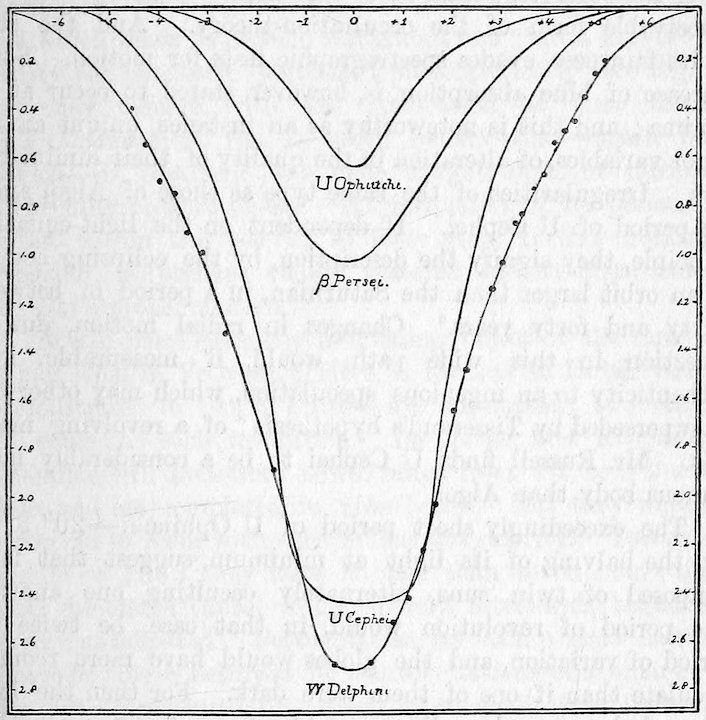
Fig. 21.—Photometric Curves of Algol Variables (Pickering).
At Moscow, in 1880, U Cephei was added by Ceraski to
the Algol family. This object is distinguished by the abruptness
and extent of its changes. In four and a half hours it
descends from 7·1 to 9·4 magnitude, this profound obscuration
lasting for about two hours, after which brightness
returns, almost, if not quite as quickly as it departed. The
light-curve, determined photometrically by Professor Pickering,
is shown in Fig. 21.
310He explains its singularities on the hypothesis of a total
eclipse by a large semi-obscure body,[584] and alleges confirmatory
evidence in a barely perceptible secondary minimum corresponding
to the transit of the brilliant over the dusky globe.
Chandler and Yendell, nevertheless, deny the reality of the
minor eclipse;[585] and Wilsing vainly endeavoured in 1890[586] to
bring the observed phases of U Cephei into harmony with any
conceivable form of the occultation-theory. And the star,
by its faintness, evades spectrographic tests for motion. Some
increase of blue absorption is, however, stated to occur at its
minima; and this is noteworthy as an instance, unique among
Algol variables, of alteration in the quality of their diminished
rays. Irregularities of the same type as those of Algol affect
the period of U Cephei. If dependent on the light-equation
principle, they signify the description, by the eclipsing couple,
of an orbit larger than the Saturnian, in a period of between
thirty and forty years.[587] Changes in radial motion, due to
deflection in this wide path, would, if measurable, lend
authenticity to an ingenious speculation, which may otherwise
be superseded by Tisserand’s hypothesis[588] of a revolving major
axis. Mr. Russell finds U Cephei to be a considerably more
tenuous body than Algol.
The exceedingly short period of U Ophiuchi—20h 8m—and
the halving of its light at minimum, suggest that it is
composed of twin suns, alternately occulting one another.
The period of revolution would, in that case, be twice the
period of variation, and the globes would have more room to
circulate than if one of them were dark. For then the brief
intervals between the eclipses would represent each a complete
round of the orbit, and the duration of the phases would imply
such close proximity of the bright and the dark stars that the
gap dividing their surfaces would scarcely exceed three-tenths
of their joint radii. Such an arrangement is possible; a single
spectrographic impression, taken five hours before or after a
minimum, would show whether it actually subsists. If it do,
311the spectral lines will be single, though shifted; if not, they
should appear incipiently double, and the movements indicated
might unhesitatingly be taken to be included in a cycle twice
the length of the eclipse-interval.
Discovered by Sawyer in 1881, U Ophiuchi showed to
Chandler’s patient scrutiny individualities that should not be
passed over.[589] Thus the return of light after minimum is
interrupted by a pause similar to that observed in S Cancri,
but which tends to become obliterated in a “mean curve.” Its
reality has not been established photometrically (see Fig. 21),
but may emerge with the application of finer methods.
The circumstance, too, is worth remark that—again like S
Cancri—U Ophiuchi was once caught sight of during an
abnormally obscure phase.[590] An inequality of its period, comprised
within thirty-seven to forty years, further noticed by
Chandler, is perhaps visibly reflected in the disturbance of
the star’s proper motion.
A still more curiously interesting object of the same class
is met with in Y Cygni. Here, at least, as M. Dunér virtually
demonstrated in 1892,[591] eclipses are duplicated; two occur in
the course of each revolution. Its phases, first recognised by
Chandler, 9th December 1886, range from 7·1 to 7·9 magnitude,
and are completed in nine hours. But they were soon
perceived to recur with conspicuous irregularity.[592] Towards the
middle of 1888 they were no less than seven hours behind
their calculated times, which shortly afterwards began to be
largely anticipated. Perturbations on such a scale had never
previously been betrayed by the occultations of a binary; and
the task of accounting for them by inequalities of light-transmission
was evidently a formidable one. The problem they
offer was, however, destined to receive a different, and, we may
add, a definitive solution.
When Dunér came to discuss the results of his own
observations at Upsala in 1891–92, and to compare them with
those made elsewhere, he was at once struck with a persistent
312discrepancy between the odd and the even sets of minima.
The first, third, fifth, and so on, from an assigned epoch,
obeyed a law of recurrence quite distinct from that conformed
to by the intervening obscurations. Thus in November
1891, the intervals from an even to an odd minimum, and
from an odd to an even minimum, differed by no less than nine
hours, forty-three minutes. Clearly, the constant sum of these
discrepant periods gives the true time-measure of systemic
circulation. Two bright bodies, then, eclipse each other, and
they seem to be matched “to a hair”; their eclipses, moreover,
must be central, since the loss of light amounts to just one-half.
The disparity of their intervals depends primarily upon
the eccentricity of the orbit; secondarily, upon the situation of
the line of apsides. It vanishes when the line in question
points directly towards the earth; it attains a maximum when
it is viewed at right angles, for then the right and left
sections of the eclipse being traversed respectively with the
least and greatest possible velocities, the succession of alternate
occultations reaches the limit of time-inequality. Dunér’s
final conclusions regarding the system were expressed as
follows:—[593]
“The variable star Y Cygni consists of two stars of equal
size and equal brightness, which move about their common
centre of gravity in an elliptical orbit whose major axis is
eight times the radius of the stars. The period of an anomalistic
revolution[594] is 2·996933 days, and the eccentricity is
0·145. A minimum occurred while the stars were at periastron,
on 8th December 1885. The line of apsides of the
orbit, which then coincided with the line of sight, completes one
revolution in the plane of the orbit in 41·1 tropical years.”
The next coincidence of the kind, if the above elements
are correct, should take place in 1906. The compelling cause
of the orbit’s gyration remains to be investigated. It may be
found in disturbance exercised by an unseen, exteriorly revolving
mass upon the conjoined suns; or their own spheroidal
shape may be solely concerned in producing it; the question
has an important bearing upon the construction of all such
systems. The linear dimensions of the orbit of Y Cygni will
313unquestionably be determined ere long with the spectroscope,
whence the mass of the bodies travelling in it will at once
follow. A mean density less than one-sixth the solar is
ascribed to them with some confidence.[595]
The variations of R Canis Majoris, detected by Sawyer in
1887, have been traced, as it were, only in outline. Their
period is 28h 16m, five hours of which are occupied by the
phases, and since the star fades to half its normal lustre, they
are likely to be conditioned much as are those of Y Cygni.
Two similar globes presumably undergo them in turn, mutually
revolving in double the period of their occultations.
The character of R Aræ was noticed by Mr. A. W. Roberts
in 1891.[596] He considers the eclipses, which recur once in
4d 10h, to be not always of the same depth; but this symptom
of intrinsic variability in one or both of the transiting stars
needs to be verified. The curve at minimum is symmetrical.
The nature of X Carinæ—another southern variable discovered
by Roberts in 1892—is still dubious. It changes from
7·9 to 8·6 magnitude in 6h 39m, and remains constant only
during 6h 20m. So that the phases extend over more than
half the period of variation, which must evidently be doubled to
give the period of revolution, since no eclipse can possibly have
a duration of more than one-half the occulted body’s orbital
circuit. The alternate minima of X Carinæ are thought by
Roberts[597] to be, to a very small extent, unequal, and to succeed
each other at slightly different intervals. If this be so, the
system is composed of two stars, one a little brighter than the
other, pursuing a nearly circular track in a period of twenty-six
hours, and in such close contiguity that the times during
which their discs overlap are longer than the intervals of their
apparent separation. The actual subsistence, however, of this,
or some analogous arrangement has yet to be proved.
The variations of Y Boötis are also more or less enigmatical.[598]
They are limited to six-tenths of a magnitude, and have
a period rather shorter than that of Algol. The eclipsing
character of this eighth-magnitude star, suggested by Parkhurst
314in 1893,[599] was confirmed, on the strength of a year’s
observations, by Yendell. Chandler, nevertheless, expresses
doubts as to its genuineness, which is compromised by extraordinary
anomalies, hardly amenable to explanatory efforts.
The predicted minima do not always occur, and their failures
seem capricious and inconsequential. But if they depended,
as Parkhurst thinks they must,[600] upon a certain critical inclination
of the orbit, causing transits to be occasionally missed, a
law of periodicity should be traceable in the lapsed phenomena.
The obscurations of S Velorum recorded themselves on the
plates of the Cape “Durchmusterung,” and the record was duly
interpreted by Mr. Ray Woods in 1894.[601] They are marked
by the same peculiarities as those of U Cephei, and probably
indicate total effacements of a radiant sun by the prolonged
transits across it of a voluminous, but dimly shining companion
sphere, the diameter of which, according to Roberts,[602]
cannot fall short of half the distance between the revolving
bodies. Their respective densities, as estimated by him, are
0·61 and 0·03 that of the sun,[603] the dusky mass proving, on
the assumed data, to be twenty times more rarefied than the
brilliant one. A disparity so extreme cannot readily be admitted
as real. If only the star could be elevated on the
photometric scale,[604] the taking of a few spectrographs would
at once acquaint us with the true plan of its system; but
its faintness—7·8 magnitude—must long continue to baffle
experiments of this kind.
A modified specimen of the Y Cygni sub-class is met with
in Z Herculis. Its eclipsing character was announced by
Chandler in 1894;[605] about a month later, Hartwig and Dunér
independently detected in it a double sequence of disparate
minima, with periods respectively of forty-seven and forty-nine
hours. Hence the revolution of a pair of unequally bright
stars in a period of just four days was inferred with virtual
certainty.[606] In M. Dunér’s words, “Z Herculis consists of
315two stars of equal size, one of which is twice as bright as the
other. These stars revolve round their common centre of
gravity in an elliptical orbit, the semi-axis major of which is
six times the diameter of the stars. The plane of the orbit
passes through the sun, the eccentricity is 0·2475, and the
line of apsides is inclined at an angle of 4° to the line of
sight.” The chief minimum lasts 6·6 hours, and occurs not
far from apastron. The secondary phase is hurried through
in four hours, when the stars are moving with nearly their
greatest speed. It is, however, unlikely that this relation will
continue unchanged;[607] since it may be taken almost as an axiom
that orbits so conditioned pivot round in space, turning their
longest axes successively in every direction.
The first Algol variable photographically discovered was
W Delphini. On 18th July 1895, Miss Louisa D. Wells missed
a 9·3 magnitude star from a Harvard plate exposed 26th September
1891,[608] while upon seventy-one earlier and subsequent ones
it was normally imprinted. The one tell-tale photograph had
been taken during eclipse, when it sinks to 12·1 magnitude—that
is to say, eleven-twelfths of its light are cut off by the
interposing body. Pickering[609] believes the latter to be
partially luminous and very large, affording prolonged totalities,
but the photometric curve (see Figure 21) hardly
warrants this assumption. It is fairly sharp at minimum, not
flat, like that of U Cephei, and corresponds better with a
partial occultation by a wholly dark satellite than with the
central transit of one dimly radiative. The period is not
constant.[610] Deviations from regularity amounting to one hour
had become manifest early in 1898.
The phases of a seventh-magnitude star (DM + 12° 3557)
named RX Herculis were discovered by Sawyer in 1898.[611]
They range over eight-tenths of a magnitude, and recur at
intervals of 21h 21m. Like those of U Ophiuchi, they
probably indicate the revolution, in double that period, of two
equal stars; and since the minimum brightness is just one-half
the maximum, their mutual occultations may be total.
316The variability of R2 Puppis (CPD − 41° 1681), noticed
by Professor Kapteyn during his inspection of the Cape
Durchmusterung negatives, was verified and defined by Mr.
Innes in 1899.[612] The period at first assigned of nearly
thirteen days was abridged to one-half that length by Mr.
Roberts’s investigations.[613] The light fades at minimum to
one-third its full amount, through the intervention of a dimly
luminous mass.
U3 Cygni and V2 Cygni were both detected by Madame
Ceraski in studying photographs of the sky taken at Moscow.[614]
They undergo analogous changes, investigated at Harvard College
in 1899–1900.[615] Those of U3 Cygni are remarkable for their
extent, the greatest known in an eclipsing star, unless (which
is doubtful) W Delphini should be bracketed with it. V2
Cygni, at full brightness, ranks little higher than the eleventh
magnitude, and descends, once in six days, nearly to the
thirteenth. It is thus an object at the limit of detailed
observation. Innumerable systems of the same kind must
lie beyond that limit. The twenty-first star on our list—R2
Velorum—suspected as an Algol variable by Innes in
1901, was verified and investigated by Roberts.[616] Of the
remaining six objects enumerated, U Sagittæ was found by
M. Schwab of Ilmenau to vary after the manner of U Cephei;[617]
and UZ Cygni, detected by Mrs. Fleming in 1902, is remarkable
for a period more than thrice as long as that of S Cancri.
UW Cygni, RV Lyræ, and the still unnamed star in Perseus
have been recently discovered by Mr. Stanley Williams.
Algol variables, without any recognised exception, show
first-type spectra. They are either helium or Sirian stars.
This specialty is unaccountable, and may perhaps vanish with
the widening of experience; for many close binaries exempt
from eclipses belong to the solar class, and no reason is
apparent why those happening to revolve in planes coincident
with the visual ray should differ in quality of light from those
revolving in orbits variously inclined to it. Nor is it yet
317quite certain that the eclipse-theory accounts for certain minor
phenomena in the stars to which it applies. Thus some of
their light-curves, as drawn visually, are marked by peculiarities
incapable of being explained as the outcome of purely
dynamical relations. They may, however, turn out to be
illusory or subjective; their reality is not incontrovertible.
Again, the exceptionally low minima recorded for S Cancri and
U Ophiuchi need confirmation. The possibility of mistake is
not excluded so long as each remains an isolated event.
Three varieties of eclipsing stars may be distinguished.
The first includes bright and dark pairs, like Algol and its
companion, revolving in slightly oblique orbits. One partial
occultation takes place in each revolution. The intimate
association which they present of bodies at opposite extremes
of luminosity is not a little remarkable. In the second
variety, exemplified by U Cephei, a brilliant star circulates
round a larger, but far less lustrous globe. One prolonged
totality marks the orbital period. The secondary minima,
theoretically inevitable in such cases, have not been certainly
observed. Vanishing stars, could they be discovered, would
appropriately illustrate this mode of construction where the
contrast in light-power had reached its limit. Finally, the
third species of occulting systems consists of stars undergoing
nearly equal double eclipses, the period of revolution comprising
two periods of variation. Y Cygni is a typical example. If
the loss of light amount to one-half, or eight-tenths of a
magnitude, and the alternate minima be of the same intensity,
the eclipses are total; for two similar stars, one is temporarily
substituted. If, owing to the inclination of their path, they
only partially conceal one another, the phases will be slighter,
yet still equal. Their disparity, in odd and even series, shows
at once that the balance of luminosity is tilted; and indications
are not wanting that its level is disturbed rather by inequalities
of intrinsic lustre than of shining area.
The time-keeping of eclipse-stars is a subject demanding
profound and persistent study. The minutest irregularities
traceable in it may be of far-reaching significance.[618] On what
principle they should be explained, is still largely an open
318question. Possibly several forms of action conspire, even in
the same system, to produce the sum-total of their deviations.
In no case has the presence of a third body been proved; in no
case have perturbations of the ordinary gravitational type been
suspected. On the other hand, the occulting and the occulted
globes must be deformed through rotation; hence one true
cause for the observed inequalities falls within our ken;
whether it is a sufficient cause alone remains doubtful.
Essentially, however, increase of knowledge regarding these
marvellous combinations depends upon the development of
spectrographic methods. Surely, although perhaps in slow
succession, they will yield the secrets of their construction to a
mode of inquiry that continually gains power and accuracy,
and is capable of dealing directly with the most recondite
springs of celestial mechanics.
319
The limit of length for “short periods” of stellar variation is
conventionally fixed at thirty days; but it is seldom reached
by objects of typical character. Rapid fluctuations are almost
always accomplished with extreme exactitude both as to time
and amount. To this rule there are very few exceptions, and
a reason for it is not difficult to find. Variability of the
kind in question is precise because it originates extrinsically.
It might be called a “forced vibration” of change. Its
course is, in some way, prescribed by the revolutions of a
satellite. No more curious spectroscopic discovery has been
made than that of the binary nature of short-period variables.
By it a breach has been made in the wall of mystery surrounding
stellar light-change. The breach has not yet been
mounted, nor is it quite practicable; but by persevering efforts
it can be gradually widened and levelled.
In dealing with variable stars we must proceed tentatively.
The subject is so complex that no intelligible view of it can
be gained all at once. A unifying principle is still lacking.
We can only take things as they present themselves, noting
differences, tracing partial analogies, and arranging into some
fashion of order a multitude of heterogeneous examples. Thus
stars fluctuating in short periods may be separated into three
families. The first has δ Cephei, the second ζ Geminorum
for its head, and their members may conveniently be designated
Cepheid and Geminid variables. The third is represented
profusely, but almost exclusively, in globular clusters. To
begin with the Cepheids.
They are numerous and well known. Their changes are
320continuous and of moderate amplitude, but proceed unsymmetrically
as regards time. The rise to maximum occupies
on an average about a third of the period, or half the time
allowed for the decline from it to minimum. This retardation
is accompanied by an inherent tendency to a second maximum,
sometimes barely indicated as a pause in descent, but in several
cases giving rise to a pronounced “hump” on the downward
slope of the light-curve. The variations of δ Cephei range
from 3·7 to 4·9 magnitude in 5d 8h 47m 39s, of which 1d 14h
36m suffice for the phases of increase. The spectrum is of
the solar type, and does not change with the brightness.
Oscillatory movements, however, of its constituent lines,
detected by Bélopolsky in 1894,[619] betray the presence of an
obscure companion revolving in the light-period. The ellipse
described is so eccentric that the companion-bodies when at
apastron are three times further apart than at their nearest
approach; and its major axis deviates only by two degrees from
a vertical plane passing through the earth. There is nothing
indeed to show that it may not be highly inclined to the
corresponding horizontal plane. The orbital level is undetermined,
being evidently such as to exclude eclipses. This was
unexpected, but it is certain. The criterion is simple. Radial
velocity should vanish at minima if a transiting globe were
concerned in their production; in point of fact, the epochs of
least brightness precede the epochs of conjunction by a full
day. The system of δ Cephei is not then an eclipsing system.
The star’s variability must be otherwise accounted for. Nor
would it be easy, without abusing the licence of hypothesis, to
expound it as the result of occultations. The inducement to
make the attempt is, at any rate, removed by the ascertainment
of their non-occurrence. Nevertheless, the coincidence
of periods assures us that orbital revolution, in one mode
or another, prescribes the flow of change. But the ideas
so far entertained on the subject scarcely bear examination.
Obviously untenable, for instance, is Mr. Roberts’s view that
the companion of δ Cephei is raised, by the heat received at
periastron, from sensible obscurity to a nearly equal grade of
lustre with its primary.[620] If this were so a double spectrum
321should be observed at quadratures. Again, the maximum
should, on the hypothesis, fall short of twice the minimum
brightness; actually, it exceeds it three times. Mr. Roberts
himself adverts to these objections, but holds them not insuperable.
Mr. Eddie’s suggestion[621] of luminous increase
through intensified tidal action at periastral approach, is more
plausible. Bodily strain due to mutual gravitation would, in
so eccentric an orbit, gain twenty-seven-fold efficacy as the
bodies moving in it come together from its farthest point; and
the processes of internal circulation might possibly be sufficiently
quickened by the disturbance to yield a largely augmented
output of light. But commotions of the requisite violence
could not subside with perfect regularity every five days, and
they should inevitably be accompanied by gaseous outbursts
spectroscopically evident. That they do not occur may be
securely inferred from the one circumstance that no trace of
emissive symptoms is met with in the light of this star. As
to the scale of its system we are, moreover, completely ignorant,
and are hence unable to estimate the absolute power over its
members of tidal influences. The line-displacements of the
bright star acquaint us merely with its rate of motion as projected
upon the visual plane; they correspond to a mean orbital
radius of 620,000 miles, the real path being perhaps six or
eight times wider than that spectroscopically indicated, while
the companion-ellipse traversed by the dark satellite may be
of any imaginable size. A sapphire-blue star of the sixth
magnitude forms with δ Cephei, which has a golden sheen, a
combination resembling that so beautifully exhibited in β
Cygni.
The variations of η Aquilæ are, in every respect, analogous
to those of δ Cephei. They have the same range of 1·2
magnitudes, and a somewhat longer period of 7d 4h 14m, which
they divide, in about the same proportions, between a rapid
increase and a leisurely decay of brightness. The abortive
secondary maximum of δ Cephei, however, develops in
η Aquilæ into a pronounced recovery of lustre. The light-curve
shown in Fig. 22, from Dr. Schur’s delineation, renders
the duplex phase conspicuous. The binary character of the
star was detected by Bélopolsky in 1895,[622] and he computed
322its orbit from improved spectrographic data in 1897.[623] It
proved to be of nearly the same apparent size as that of
δ Cephei, and the conditions of revolution were, in this case
again, manifestly inconsistent with the occurrence of eclipses.
An interval of two days was found to separate each minimum
from the ensuing conjunction of the bright and dark spheres.
Their conjunctions, accordingly, are not transits, since they are
unaccompanied by any diminution of light. “Very remarkably,”
Bélopolsky writes, “the same state of things is present
in the variable star δ Cephei. Hence some other cause must
be sought by which the variations in lustre and the spectral
displacements of these two stars may be brought into
harmony.”
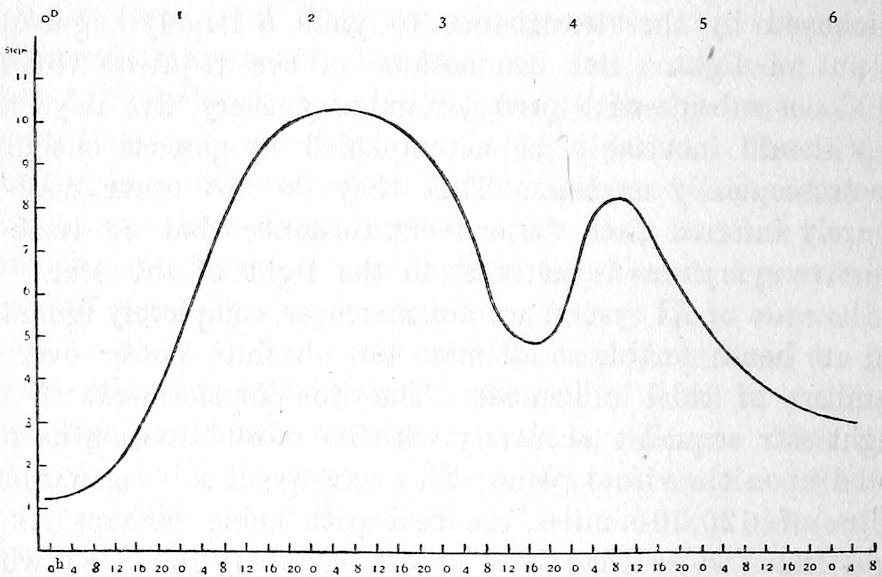
Fig. 22.—Light-Curve of η Aquilæ (Schur).
Mr. W. H. Wright of the Lick Observatory renewed in
1899,[624] and substantially confirmed the Pulkowa investigations.
His orbit, however, came out considerably more eccentric than
that computed by his predecessor, and he located its major
axis somewhat differently. But on the essential point for the
theory of the star’s variability—the impossibility of eclipses—they
agreed. Fig. 23 reproduces Mr. Wright’s drawing of
323the ellipse described by η Aquilæ round its invisible companion,
supposed immovable at the focus (O). Its situation
at minimum epochs (marked Min. in the figure) obviously
corresponds to nearly the highest rate of speed in the line of
sight, and to a comparatively wide visual separation of the
coupled bodies. The periastron is at P; the points where the
secondary phases take place are indicated respectively as
Min.2 and Max.2. They are unaccompanied by irregularities
of movement. In fact, neither in this object nor in the
analogous one decorating the crown of Cepheus is there any
traceable connection, except their significant agreement in
period, between the flow of spectroscopic velocity and the
rise and fall of brightness. The spectra of these two variables
are quite similar, only the lines of η Aquilæ are more
diffuse. Both, too, are approaching the sun at uniform rates
of about fourteen and nine miles a second respectively.
Finally, both are subject to some slight disturbances in time.[625]
Those of η Aquilæ, discussed by Dr. Lockyer,[626] have an
amplitude of five hours, and are self-compensatory in a cycle
of 400 light periods.
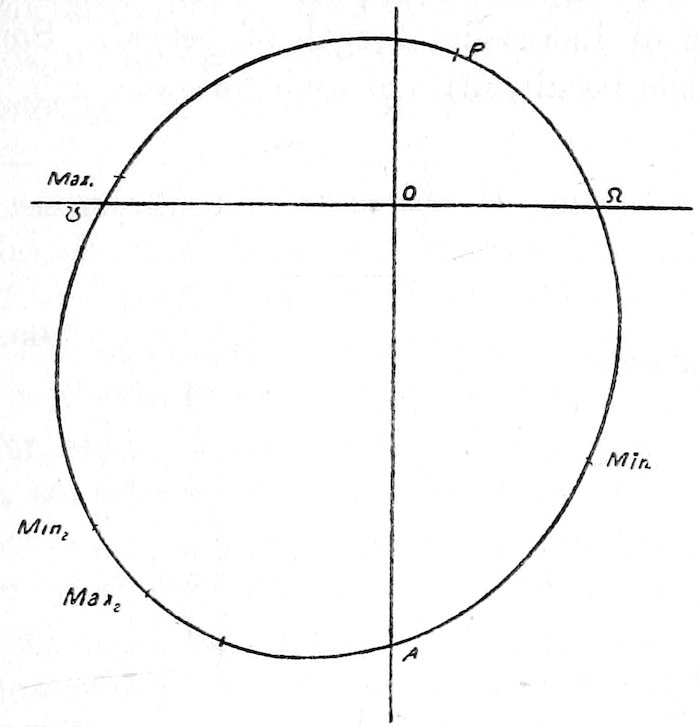
Fig. 23.—Orbit of η Aquilæ (Wright).
324The generalisation is a tolerably safe one that all Cepheid
stars are binaries; but its establishment must be a work of
time. Those of the shortest periods are the most promising
for purposes of spectrographic inquiry, since they are likely
to be in swift circulation, and hence to show conspicuous line-displacements.
Negative results, however, as already said,
may simply imply an unfavourable situation of the orbits;
they do not necessarily indicate the solitary condition of the
stars. A few examples of Cepheid variables are given below
in the order of increasing length of period. Some brief description
of the peculiarities of each follows.
| Name. |
Limits of Change. |
Period. |
| |
|
|
|
d. |
h. |
m. |
| R |
Muscæ |
6·6 to |
7·4 mag. |
0 |
21 |
10 |
| R |
Trianguli Australis |
6·6 „ |
8·0 „ |
3 |
9 |
20 |
| ST |
Cygni |
6·6 „ |
7·4 „ |
3 |
20 |
10 |
| T |
Vulpeculæ |
5·5 „ |
6·5 „ |
4 |
10 |
28 |
| Y |
Sagittarii |
5·8 „ |
6·6 „ |
5 |
18 |
33 |
| U |
Sagittarii |
7·0 „ |
8·3 „ |
6 |
17 |
46 |
| X |
Sagittarii |
4·0 „ |
6·0 „ |
7 |
2 |
50 |
| W |
Sagittarii |
4·8 „ |
5·8 „ |
7 |
14 |
16 |
| S |
Sagittæ |
5·6 „ |
6·4 „ |
8 |
9 |
7 |
| X |
Cygni |
6·4 „ |
7·7 „ |
16 |
9 |
15 |
| W |
Virginis |
8·7 „ |
10·4 „ |
17 |
6 |
30 |
| T |
Monocerotis |
5·8 „ |
8·2 „ |
27 |
0 |
18 |
R Muscæ, being circumpolar at the Cape, can be observed
to advantage only in southern latitudes. Once in twenty-one
hours it doubles its light, and so emerges into naked-eye
visibility, then sinks back again out of sight. The rise
occupies just seven hours, or one-third of the period—the
normal proportion for stars of this class. Evidence of rapid
circulatory motion is pretty sure to be elicited by spectrographic
means.
The phases of R Trianguli Australis were noticed by
Gould in 1871, and have of late engaged the attention of
Roberts. They show the peculiarity, surprising in a Cepheid
star, of being uncertain in extent. The full measure of
change is from 6·6 to 8·0 magnitude, but at certain maxima
it mounts no higher than 6·8; at certain minima it descends
no lower than 7·5 magnitude. It would be of interest to
325learn whether these oppositely incomplete phases occur together
or disconnectedly. No methodical account of them
has, we believe, been published. The increase of brightness
in R Trianguli occupies little more than one quarter of the
period.
The light-curve of ST Cygni is “humped” like that of
δ Cephei. About forty-six hours after maximum the decline
is stayed, then, a brief pause ended, resumes its course. The
interval from minimum to maximum is 21½ hours, that from
maximum to minimum seventy.[627] The variability of this
star[628] was detected at Potsdam in 1896 by G. Müller and P.
Kempf.
The spectrum of T Vulpeculæ is similar to that of δ
Cephei.[629] Its changes, discovered by Sawyer in 1885, consist
in a rise of one magnitude in 1d 7h, followed by subsidence
in 4d 3h. The comparative brightness of the star brings its
movements well within range of spectroscopic investigation.
The four stars in Sagittarius, which come next on our
list, form a singular group, discovered by Schmidt in 1866.[630]
They are included in a space of about ninety square degrees,
and all vary after the fashion of δ Cephei in periods comprised
between 5·8 and 7·6 days. Among them X Sagittarii,
which attains once a week fourth-magnitude rank, is the most
conspicuous. Its spectrum is of the solar type. One of its
associates, U Sagittarii, distinguished by a strong orange tint,
is the centre of a little cluster. Its fluctuations, upward in
2½, downward in 4¼ days, proceed with the regularity of
clockwork.
S Sagittæ shows the retarded decrease and inflected curve
distinctive of its class.[631] Yendell considered the maximum to
be double (see Fig. 24). The change at minimum is unusually
slow. In quality of light the star was found by Sir
Norman Lockyer to be an exact match for δ Cephei.
326X Cygni was discovered by Chandler in 1886. It rises
without fail in 6d 19h to 6·4 magnitude, but shows an inconstant
minimum brightness, sometimes descending to 7·7, at
others stopping short at 7·2 magnitude. The period of
16d 9¼h is not known to vary. The star is quite colourless;
information as to the character of its spectrum is not at
present forthcoming.
W Virginis is uncertain both at maximum and minimum.
Its highest rise is to 8·7, its lowest descent to 10·4 magnitude.
But these limits are far from being always reached;
phases deficient by quite half a magnitude either way are
often observed, and seem to intervene casually. The period,
on the other hand, of 17d 6½h is strictly conformed to.
The time of increase, 8d 5h, is proportionately long for a
Cepheid variable.
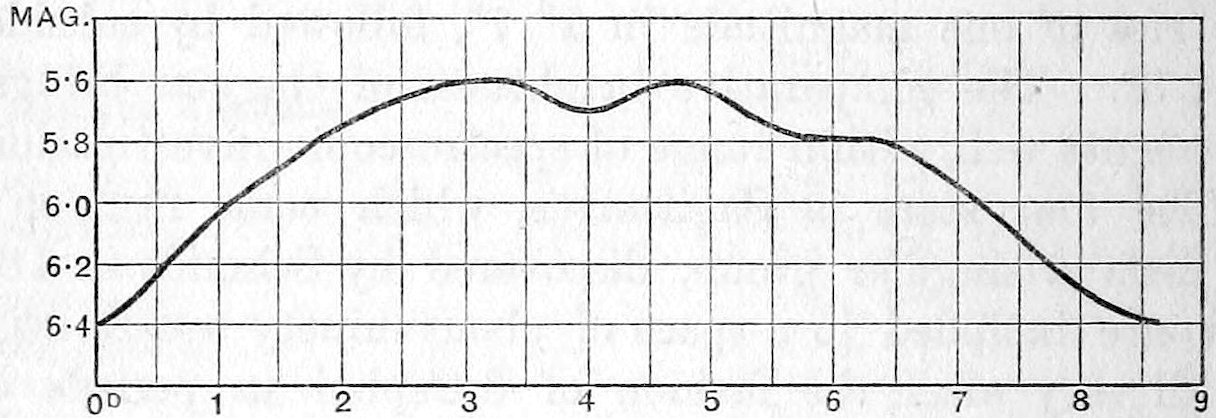
Fig. 24.—Light-Curve of S Sagittæ (Yendell).
That of T Monocerotis is, on the contrary, relatively short,
although the entire cycle of twenty-seven days is the most
protracted yet ascertained for a star of its class. And here
again the amplitude of change is inconstant. Maxima occur
as high as 5·8, as low as 6·4 magnitude, while the minimum
brightness ranges between 7·4 and 8·3 magnitude. There
are then spring and neap tides of stellar fluctuation; yet no
clue can be found to the cause of their difference. The four
Cepheid variables in which they appear—namely, R Trianguli,
X Cygni, W Virginis, and T Monocerotis—have no other
features visibly in common. Perhaps the spectroscope may
reveal unlooked-for analogies connecting their physical
qualities or their systematic relations; but its dicta have
still to be pronounced.
About three dozen stars had been registered at the close
327of last century as variable on the model of δ Cephei. Most
generalisations regarding them are liable to lose validity by
future experience; but there are two properties in the absence
of which they should be otherwise classified. In all, light-change
progresses unceasingly; in all, it advances more
rapidly in the direction of increase than of decrease. An
inclination, more or less accentuated, to pause in descent is
probably connected with this kind of dissymmetry. Among
their other distinctive qualities the following may be provisionally
enumerated:—(1) Their spectra are of the solar type.
(2) They are binaries revolving in the periods of variation.
(3) They are not eclipsing pairs; their orbits may be inclined
at any angles to the visual plane. (4) Their fluctuations in
lustre are unaccompanied by spectral change. (5) Being
nearly devoid of proper motion, they are presumably at vast
distances from the earth. They are then giant suns.
Future research will decide whether Cepheid stars are
marked off from ordinary spectroscopic binaries by any
peculiarities in their manner of circulation. Are their orbits,
for instance, in all cases highly eccentric? Is there a fixed
relation between the situation of the periastron and the point
of lowest brightness? Do the major axes revolve? Above
all, what differentiates short-period variables from revolving
pairs constant in light? Why do δ Cephei and η Aquilæ show
an incessantly changing lustre, while Polaris and Θ Ursæ
shine steadily? The four appear to be of analogous constitution,
and to suffer no diminution by eclipse. What form of
influence, then, is it which acts so strikingly upon the two
former objects, while leaving the two latter unaffected? Undoubtedly
the close attendance of a satellite is instrumental
to the production of the observed changes of luminosity; but
other conditions also come into play—conditions that are
absent in Polaris, in β Aurigæ, in α Virginis, in Θ Ursæ, in
Θ Draconis. What is their nature? Here is the main issue
as regards short-period variability.
328
The second family of short-period variables resemble the first
in the continuous nature of their fluctuations. They are
distinguished from them by the symmetrical apportionment
in time of those fluctuations. The intervals from minimum to
maximum, and from maximum to minimum, are almost
exactly equal. Not very many such stars are known. First
singled out as rarities by Dr. Chandler in 1896,[632] they have
for their exemplar ζ Geminorum.
329
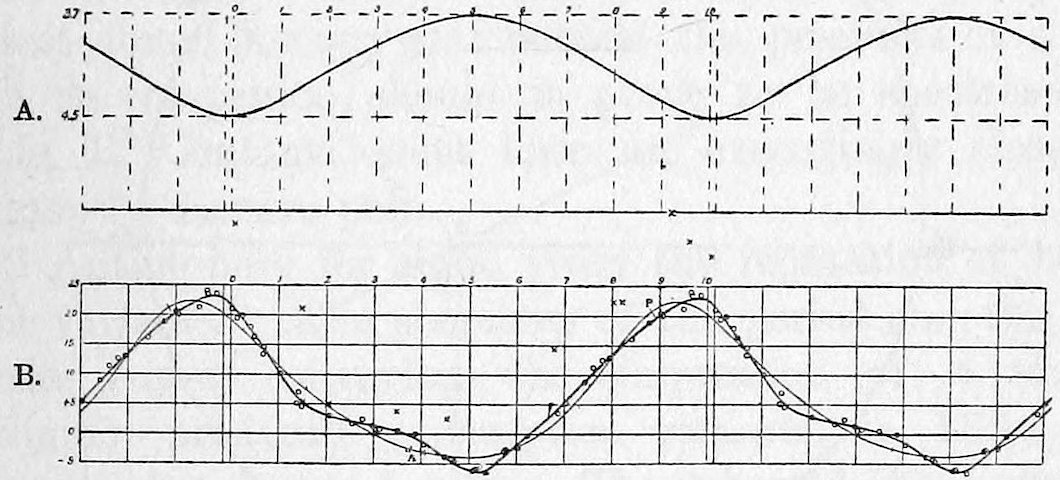
Fig. 25.—Curves representing the Variations (A) in Light, (B) in Radial Velocity of ζ Geminorum (Campbell).
The variations of this star, discovered by Schmidt in
1847, carry it from 4·5 to 3·7 magnitude in five days and
twenty-two minutes, and back again to its former level in a
space of time just three hours longer. The difference may
be called negligible. Fig. 25, A, shows the representative light-curve.
Its undulations at present succeed each other without
sensible alteration; but observers of an earlier generation regarded
them as subject to disturbance. Their period, according
to Argelander, was ten minutes longer in 1869 than it
had been in 1847;[633] and Schmidt pronounced the fluctuations
in brightness to be nearly suppressed in 1868, and irregular
in 1881.[634] Fresh interest was imparted to the history of the
star by Bélopolsky’s detection, early in 1898, of its composite
nature;[635] and the discovery, which had not been published, was
repeated a year later by Campbell at Lick. He remarked
besides unaccountable deviations from the even pace of
elliptical progression, established as genuine by critical test-observations.
Their nature will be seen at a glance by a
reference to Fig. 25; the lower curve in which (B) represents
the radial velocities of ζ Geminorum. The unit of time is
one day, the unit of speed five kilometers per second. A
comparison with the upper curve (A) shows that the period of
motion agrees with the period of light, but that its rate varies
oppositely to the brightness—that is to say, the star is moving
rapidly in the line of sight just when its minima take place.
They are, accordingly, not due to eclipses, which should coincide
absolutely, or very approximately with zero radial velocity.
The relations of the pair are made still clearer by Professor
Campbell’s drawing of the orbit deduced from the velocity-curve
(see Fig. 26). It represents that of the bright component
round the centre of gravity, while the similarly shaped
path followed by the dark star must be larger or smaller in
the inverse ratio of its mass. The ellipse depicted in Fig.
26 has an eccentricity of 0·22; PA is the line of apsides,
OE the line of sight. Minima occur 1d 7h after periastron
at the point Min.; and since the companion is then situated
somewhere in the direction Om, its interposition is evidently
out of the question. Recurring now to Fig. 25, B, we perceive
that the heavy black line connecting the points determined
by actual measurement, pursues an undulating course. In
Professor Campbell’s words, “The observed velocity-curve is
alternately above and below the elliptic curve, and the intersections
of the two occur at approximately equal intervals
of time. There are six of these intersections, corresponding
to three complete periods or cycles in one period of the light-curve.”
330The oscillations showed no signs of intermission
during fifteen months, and assuredly indicate an inherent
peculiarity of the system. They might be formally explained
by assuming it to be triple, the bright star revolving in
3d 9¼h round one invisible attractive mass, and the two
together in 10d 3½h round another more distant. But the
arrangement, as Professor Campbell points out,[636] could scarcely
be stable, owing to the commensurability of periods, and the
consequent subversive piling-up of disturbances. Nor is it
easy to accept the idea that the digressions of ζ Geminorum
from a mean rate of travel are “minor tidal effects.”
Prolonged and diversified researches are, in fact, needed before
any promising theory of them can be formed.
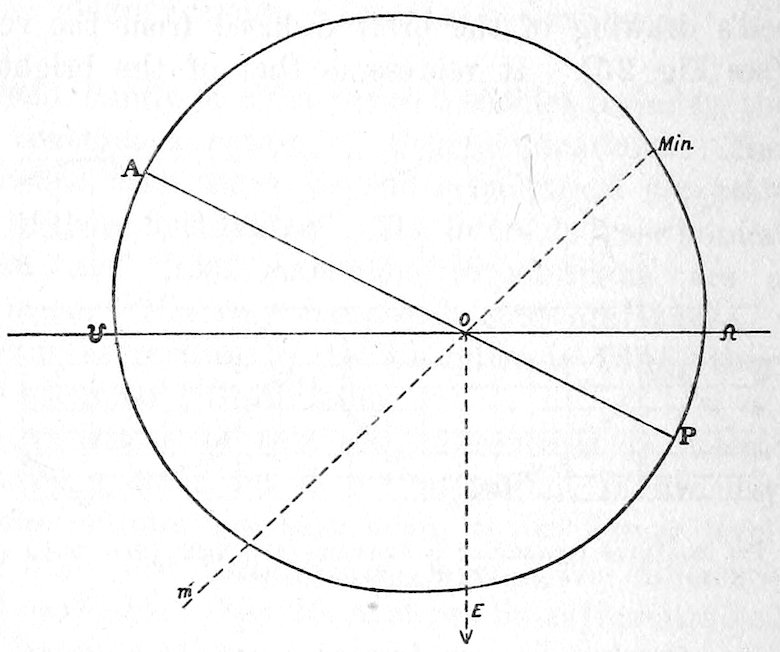
Fig. 26.—Orbit of ζ Geminorum (Campbell).
The star is of a golden yellow colour. Its spectrum is a
replica of that of δ Cephei. An annual proper motion is
attributed to it of 0·0165″, but the value is too small to be
altogether reliable. The remoteness of this problematic system
is hence unimaginably great.
The following brief list of Geminid variables, with some
ensuing comments, will serve to widen the reader’s acquaintance
with the characteristics of the species.
| 331 |
| Name. |
Limits of Change. |
Period. |
| |
|
|
|
|
|
d. |
h. |
m. |
| R2 |
Centauri |
7·4 |
to |
7·8 |
mag. |
0 |
7 |
16 |
| S |
Antliæ |
6·7 |
„ |
7·3 |
„ |
0 |
7 |
47 |
| U |
Pegasi |
9·3 |
„ |
9·9 |
„ |
0 |
9 |
0 |
| 24 ω |
Centauri |
13·4 |
„ |
14·0 |
„ |
0 |
11 |
5 |
| V |
Puppis |
4·1 |
„ |
4·9 |
„ |
0 |
17 |
27 |
| U |
Vulpeculæ |
6·9 |
„ |
7·6 |
„ |
8 |
0 |
4 |
| d |
Serpentis |
5·0 |
„ |
5·7 |
„ |
8 |
17 |
17 |
| β |
Lyræ |
3·4 |
„ |
4·5 |
„ |
12 |
21 |
47 |
The variability of R2 Centauri, discovered by Mr. A. W.
Roberts in 1896,[637] is slight but sure, and proceeds by evenly
measured steps of increase and decrease. The period is the
shortest found for any star outside the precincts of a cluster.
With its companion, should it prove to be spectroscopically
double, R2 Centauri must form an exceedingly close, or an
enormously massive pair.
S Antliæ bore for eight years the reputation of being an
Algol variable.[638] The shortness of the period and the flatness
of the curve, conveying the impression of a stationary
maximum, produced a deception removed in 1896 by the
Harvard photometric results. They showed the light-change
to advance continuously along a smooth curve, unbroken
by the sudden drop indicative of an eclipse. It is, however,
marked by the “interesting feature” (in Professor
Pickering’s words[639]) “that the time of increase occupies 0·62
of the entire time of variation.” Here then is an ostensible
case of dissymmetry opposite to the usual kind. But the
relation was stated by Mr. Sperra of Randolph, Ohio, to be
inconstant, and he deduced from his observations an average
equality of the intervals between opposite phases.[640] This is
perhaps the essential fact. S Antliæ is a white star with a
transition-spectrum[641] resembling that of Procyon. The lines
are never seen double, so that two bright components cannot
be present unless they revolve in a plane nearly at right
angles to the visual ray. But line-displacements due to
332motion round an obscure body, may possibly be detected by
the application to this curious object of a slit-spectroscope.
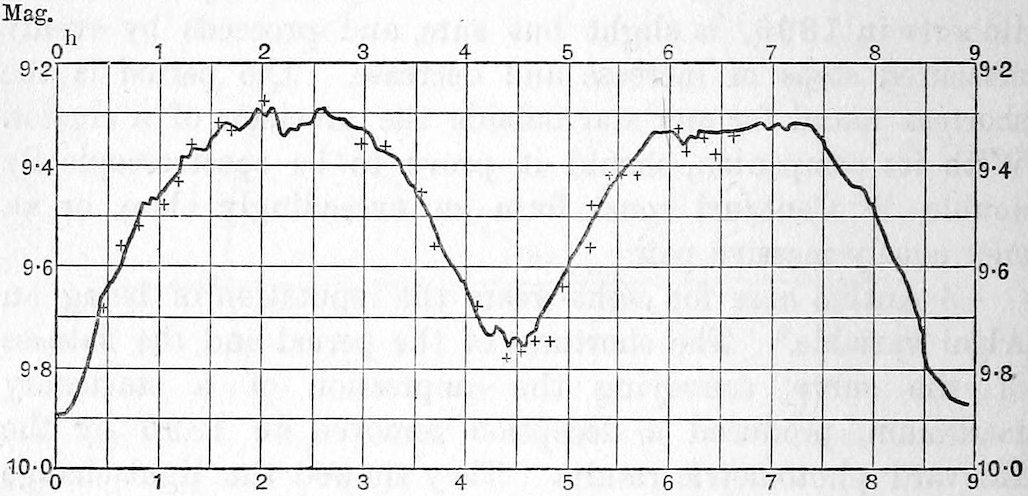
Fig. 27.—Photometric Curve of U Pegasi (Pickering).
A small star in Pegasus was noticed by Dr. Chandler in
1894 as apparently subject to eclipses; but its waxings and
wanings proved, on fuller inquiry, to be without pause. A
controversy as to their nature[642] was practically terminated by
Mr. Wendell’s measures with the polarising photometer at
Harvard College in December 1897.[643] Their upshot is
graphically exhibited in Fig. 27. Each of the closely set
dots through which the curve was drawn represented
eighty settings made on eight nights, none being rejected
for discordance. The crosses, each of which gives the average
of sixteen settings, embody single nights’ results. The
divisions in time (abscissæ) represent intervals of thirty
minutes; the divisions in brightness (ordinates), tenths of a
magnitude. The complete period of the star is nine hours
less nine seconds, but it is nearly cut in two by a secondary
decline falling short of full minimum by only 0·15 of a
magnitude. The reality of this trifling difference, contested
by Chandler, appears to be substantiated by the Harvard data,
and stamps U Pegasi as of the kindred of ß Lyræ, the premier
short-period variable. A mathematical discussion of the conditions
of U Pegasi, based upon the eclipse-theory, was published
in 1898 by Mr. G. W. Myers of the Yerkes Observatory.[644] It
is valuable as an authoritative proposal of the terms demanded
333by that theory under the given circumstances. They are not
wholly unacceptable. They involve, at least, no contradiction
of any known law of nature; yet they are difficult to imagine
realised. The system must obviously be composed, if its
luminous variations be geometrically explicable, of two bright
bodies revolving almost in contact. Indeed, they are probably
more than in contact, if the assumed data are correct; they
interpenetrate and together form an “apioid,” which, according
to Poincaré, is a figure of equilibrium for rotating masses.
One of the conjoined globes proved, moreover, to have a radius
about four-fifths that of its primary, and to be less intrinsically
brilliant in sensibly the same proportion. Their revolutions
in a period of nine hours afford eclipses, alternately total and
partial, at intervals of four and a half hours, the orbit being
viewed by us edgewise. Now such an arrangement as that
indicated for U Pegasi might conceivably prevail in an embryonic
binary system. It would, in fact, accord well with
Dr. See’s views as to the evolution of double stars; but
evidence of its actual existence is still a desideratum. Until
affirmed by the spectroscope, it must be treated as only a
speculative possibility; and the example of ζ Geminorum is
not encouraging to the occultation-rationale of continuous
variability. The time, however, is not far distant when the
decisive motion-test will be applied, if not to this faint object,
at any rate to others that are analogous and more accessible.
Some few of the variable stars in clusters belong to the
Geminid class. An example is afforded by No. 24 in the
great southern star globe ω Centauri. One of five or six
thousand silvery specks crowded together into the “span of a
man’s hand,” it yet preserves individuality. Once in 11h 5m
it gains twofold brightness, then fades even more rapidly than
it increased.[645] The changes are said to resemble those of S
Antliæ. If occasioned by the uninterrupted mutual eclipses
of equally luminous bodies, a mean density would be implied
for them of one-fifth the solar. And this irrespectively of
their mass. In a system composed of a pair of globes revolving
just in contact, density depends solely upon period.[646] The
reason is easily seen. With a constant period the mass of
334a system varies as the cube of the distance, and in the same
proportion the component spheres must, if they remain contiguous,
vary in bulk. Thus, since volume and mass preserve
under these circumstances a fixed ratio, density is the same
for any assignable value of their absolute amounts.
A variable star, more than commonly enigmatical in its
procedure, comes next on our list. Discovered by Mr. Stanley
Williams in 1886,[647] V Puppis fluctuates between 4·1 and 4·9
magnitude in a period fixed by Mr. Roberts, with vigilant
care, at 17h 27m 13s. The alternate minima are slightly unequal,
and he assumes them to correspond to a trifling disparity
in brightness between the members of a mutually occulting
“dumb-bell” combination revolving in double the light-period,
or 1d 10h 54½m.[648] But here the spectroscope intervenes.
From an examination of spectrographs taken by
Bailey at Arequipa, Professor Pickering inferred in 1896[649]
the binary character of the star. During thirty-seven
hours at a stretch it shows double absorption lines, which
then close up, and after a brief interval open out again, this
time with the fainter component in the reversed position.
These shiftings to and fro take place in a cycle of 3d 2h 46m,
and indicate a relative velocity of 385 miles a second, giving
a minimum value for the radius of the orbit of 16,500,000
miles, and a combined mass seventy-seven times that of the
sun. Have we then, in V Puppis, a genuine instance of
discrepancy between the motion and light-periods? Or is
their eventual reconcilement probable? Mr. Roberts has
spoken his last word on the subject, and the spectrographic
data seem sure. Yet if any compromise were possible, it
should be, one would suppose, by subdividing the longer period,
not by extending the shorter one. The anomaly of their
discordance is too flagrant to be admitted without cogent proof.[650]
The variations of U Vulpeculæ proceed equably, according
to their discoverers, MM. Müller and Kempf,[651] in a period of
eight days. M. Luizet of Lyons agrees, and regards them as
335strictly conformable to those of ζ Geminorum.[652] The Harvard
measures, nevertheless, indicated an accelerated increase.[653] If
it be substantiated, the star should rank as intermediate
between the Cepheid and the Geminid families.
The instability of d Serpentis, suspected at Potsdam in 1891,
was verified by Yendell in 1894.[654] Its phases, as determined
by him, resemble those of β Lyræ. They include a secondary
minimum, symmetrically placed between two equal maxima.
The spectroscopic investigation of this star, which never descends
so low as the sixth magnitude, should present few difficulties,
and will be of special interest from the side-lights it may
throw on the problem of the Lyre variable. This latter subject
is so complex as to demand treatment in a separate chapter.
Another inviting object to the possessors of spectrographic
apparatus is the southern variable κ Pavonis. It ranges from
3·8 to 5·2 magnitude in a period of nine days two hours, but
by gradations lacking distinctive character. Their correlation
with spectral line-shiftings might serve more clearly to define
their nature. Physically, the star belongs to the solar family.
One of the many singularities connected with stellar variation
is that it takes a special form in condensed clusters.[655]
Even in them this form does not prevail universally; sporadic
cases of many kinds are met with; but in general the light
change of aggregated stars has the following characteristics.
The periods are extremely short. They average half a day in
“Messier 5,” and 90 out of 132 determined for the components
of ω Centauri fall below twenty-four hours.[656] The rise to
maximum is wonderfully swift. One-tenth part of the cycle
is about the proportion claimed by it, and No. 45 ω Centauri
increases by two magnitudes in the space of one hour. The
minima are prolonged dead-level tracts. In other words, the
variation is discontinuous. It might be described as a sudden
leap upward into comparative brightness from a habitually
low state. The maxima are episodes, foreign, as it were, to the
internal economy of the stars. They recur, nevertheless, with
the utmost precision. Hundreds, nay, thousands of successive
periods have been watched without the detection of the smallest
336irregularity. The light-curves of two stars in Messier 5 are
given in Fig. 28 from Professor Bailey’s drawings. Each has
a range exceeding one magnitude, and a period of approximately
twelve hours.
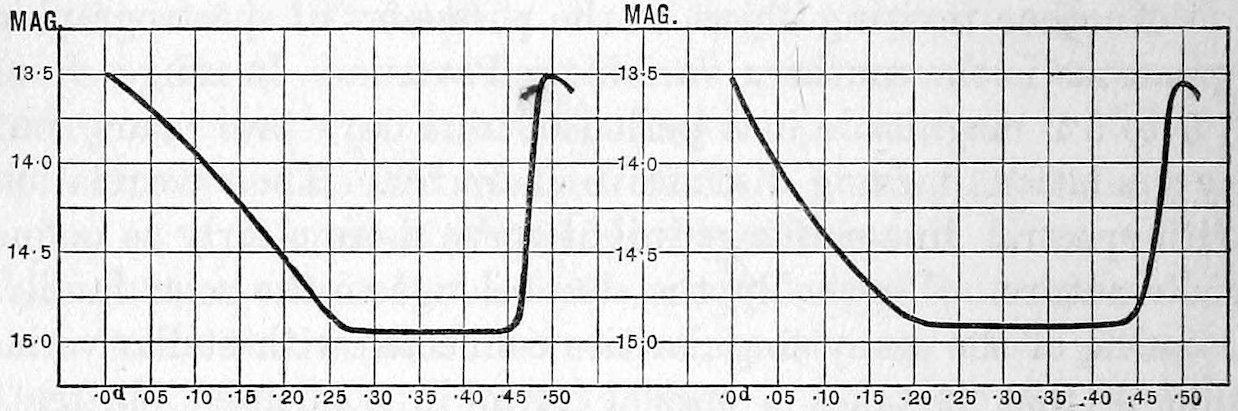
Fig. 28.—Light-Curves of Cluster-Variables (Bailey).
The discovery of “cluster variables” as a class apart was
made by Professor S. I. Bailey in the course of his photographic
work at the equatorial station of Harvard College. They
literally swarm in certain groups, while in others they occur
scantily or not at all. An isolated southern star, S Aræ, the
character of which was detected by Innes, and has been investigated
by Roberts,[657] appears to be of their type. Ordinarily
hibernating near the eleventh, it springs up to 9·5 magnitude,
at the rate of a magnitude in twenty minutes, once in eleven
hours. U Leporis, over which Mr. Innes has kept watch,
approximates to the same type. This mode of variation is
peculiarly difficult to explain. Eclipses will not here serve
our turn; however modified, they evidently fail to meet the
requirements of the situation.[658] The phenomena, indeed, to a
certain extent, invert those with which eclipses are associated.
Instead of an abrupt failure, a sudden access of light has to be
accounted for. The question whether such stars are binaries
is of great interest. Cluster-components, which are rarely
brighter than the thirteenth magnitude, can indeed scarcely
be expected to furnish a reply to it; but something definite
on the point may be learned by a spectrographic appeal to
S Aræ. The direction that should be given to further inquiries
will then become apparent.
337
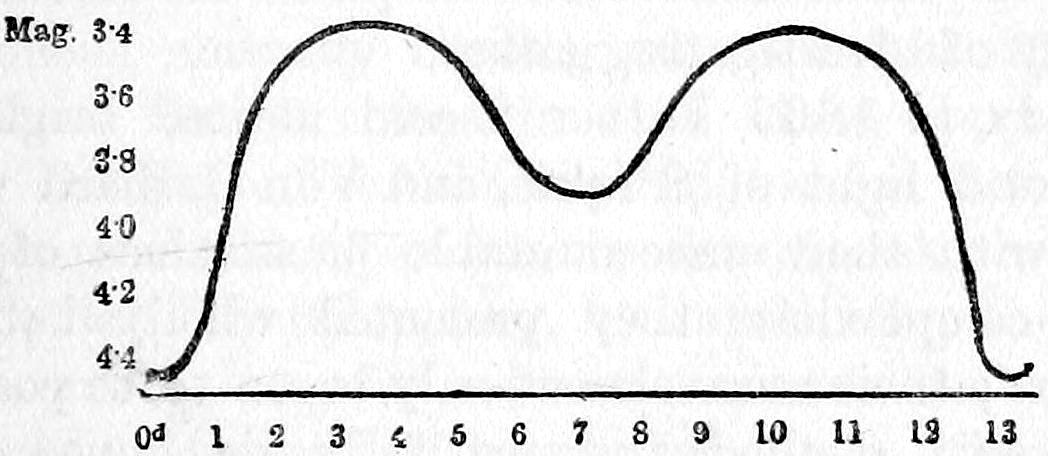
Fig. 29.—Light-Curve of β Lyræ (Argelander).
On the 10th of September 1784, John Goodricke of York, a
deaf-mute scarcely twenty years of age, perceived the second
brightest star in the Lyre to be variable. He ascertained,
further, the main features of its light-change. They are very
peculiar.[659] Four phases of approximately equal duration are
comprised in a period of twelve days and nearly twenty-two
hours. They are portrayed in the symmetrical curve drawn
from Argelander’s observations in Fig. 29. The twin maxima,
situated midway between the principal and secondary minima,
are of absolutely constant brilliancy. Constant, too, is the
chief phase of obscurity, so that the compass of variation,
from 3·4 to 4·4 magnitude, is a fixed quantity. The intermediate
minimum, however, is not so immutable. Defect and
excess are occasionally observed in it. But the flow of change
is always smooth and uninterrupted. Nor is there any pause
in a slow lengthening of the period, which has progressed,
during the last hundred years, at the average rate of about
338one-third of a second at each recurrence. That the disturbance
will prove compensatory can scarcely be doubted; but
the law of restoration is not yet apparent.
The spectrum of β Lyræ is dominated by helium. It
includes members of all the six series emanating from that
substance, and they are mostly composite aggregations of
bright and dark rays.[660] The Huggins series of hydrogen is
similarly represented; among metals, calcium and magnesium
are prominent, and ten dark oxygen lines in the ultra-violet
were photographed at Tulse Hill in 1899.[661] But the
special characteristic of this spectrum is its variability.
The coupled lines are neither fixed in position nor constant
in structure. They shift, they split, they flash and fade;
they spread into diffuse bands or contract to definite filaments;
and this in obvious, though disturbed, subordination
to the light-period of the star. The two kinds of variation
are, to some extent, mutually dependent; yet they are far
from showing a strict concurrence. The loose and indeterminate
nature of their relations places formidable obstacles
in the way of investigating either.
Already, in 1866, Father Secchi noticed bright lines in
the dispersed light of β Lyræ, and Von Gothard was struck
in 1883 with their unaccountable fluctuations of visibility.[662]
But the complexities they presented wholly baffled direct
observation; their unravelment only began to be possible when
spectrographic methods became fully developed. Through
Mrs. Fleming’s examination of the Harvard plates, it was
made evident in 1891 that the emission-rays had dark
companions, and were not stationary with regard to them;
and Professor Pickering[663] gathered from their displacements
the probability that the two sets belonged severally to the
unlike components of a close binary, revolving synchronously
with the ebb and flow of total brightness. He estimated
their relative velocity at 300 miles a second in a
circular orbit, with a radius of 50,000,000 miles. This
hypothesis is beyond question founded in fact. The star is
composite, and the emissive and absorptive elements of its
339spectrum shift, on the whole, oppositely; each battalion, as
Mr. McClean has indicated, moves as a unit, and in a
contrary sense to the other. To distinguish them ought then
to be a simple matter. The differently affected lines ought
of themselves, one might expect, to declare their separate
origin. Difficulties well-nigh insuperable, nevertheless, beset
the interpretation of this spectrum. Their main source is
this. The constituent lines do indeed oscillate through
motion, but they are subject to further influences of a more
complex kind, and of a barely conjecturable manner of working.
The various species of change are hence entangled and
disguised to a bewildering extent; and totally divergent views
have been expressed as to the proper apportionment of the
spectrum between the bodies jointly originating it. Sir
Norman Lockyer attributes the absorption lines to a pair of
“Orion” stars, unequally advanced in development,[664] with
a relative velocity of 156 miles a second; and the addition
of a bright-line companion is an implied necessity of his
scheme. Mr. McClean[665] demands a dark-line and a bright-line
component, mutually circling at a speed of 400 miles a
second. Miss Maury considers that three stars must be
engaged.[666] Dr. Vogel[667] and Father Sidgreaves,[668] although they
have investigated the spectrum in detail, make no attempts
at its analysis. M. Bélopolsky, by minimising the scope of
attack, made a substantial advance towards the solution of
the problem.[669] He dealt with only two lines—the absorption
ray of magnesium at λ 4482 and the brilliant F of hydrogen;
but succeeded in establishing, it might be said, incontrovertibly,
their separate production from conjoined bodies dissimilarly
constituted. The magnesium line is better adapted for
measurement than most of the spectral elements of β Lyræ;
it is subject to only moderate alterations in width and definition,
and determinations of its motion-shifts afford, accordingly,
consistent results. From them Bélopolsky has calculated the
orbit of the originating globe, which may be identified with
340Lockyer’s Rigel star. He found it to be but slightly eccentric
(e = 0·04); the mean radius (supposing the plane to coincide
with the line of sight) is 15,000,000 miles; the system
is advancing towards the sun at the rate of seven miles a
second, and the times of zero radial velocity agree so nearly
with the epochs of minimum as to lend countenance to the
eclipse-rationale of light-failure. A second orbit was then
computed—though far less securely—for the component
showing bright F, each being described round the common
centre of gravity. It proved to be about half the size of the
former, which implied that the body travelling in it (designated
A) was twice as massive as the companion (B). It possesses,
in fact, the gravitating power of eighteen, the latter of nine
suns. Nevertheless, the principal minimum corresponds to
the obscuration of the minor globe, while at the secondary
phase, the primary star is the one partially occulted. The
bright-line star, A, must then be much less luminous in
proportion to the quantity of matter it contains than the
dark-line star, B. This does not appear probable, but it
cannot be pronounced impossible.
On the whole, Bélopolsky’s results are plausible, and the
basis they rest upon is solid, if narrow. Yet the development
of their consequences leads to a network of perplexities.
The star A, characterised by hydrogen-emission, can be no
other than Lockyer’s second dark-line star—that resembling
Bellatrix; but if so, “the bright bands,” as Miss Maury says,
“have a residual motion of their own, which places them
sometimes towards the red, and sometimes towards the violet
end of their own system of dark lines, and at other times upon
the lines of one, or both spectra.” Yet the suggested triple
combination is inadmissible. The presence of a third body
would require the introduction of a second period, and of this
no trace is discernible. The spectral phenomena are in many
ways abnormal and unaccountable, but in the long run they
conform to the single and nearly uniform time-measure of
the system, and preserve a modified fidelity to the course of
its light-change. Gravitational disturbances, too, might be
expected to betray the influence of an extra member, and
none have been detected; for the slight retardation now
going forward is otherwise explicable. We seem prohibited
341from carrying the subdivision of β Lyræ any further than
into a pair of globes, exemplifying distinct varieties of the
Orion spectral pattern, one or both vivified by a range of
bright lines.
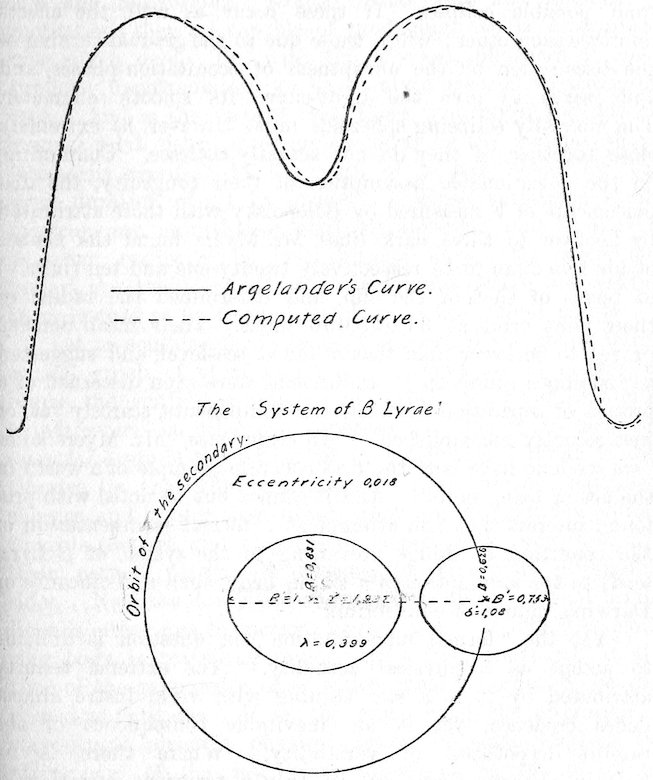
Fig. 30.—System of β Lyræ (Myers).
An effort was made by Mr. G. W. Myers in 1897[670] to
bring this star’s variations within the explanatory scope of
the “satellite-theory.” By suitably combining effects of
occultation with effects of tidal deformation, he showed that
the observed periodicity could be represented with the satisfactory
exactitude conveyed in the upper section of Fig. 30,
342the lower section of which exhibits his plan of the supposed
orbit and its egg-shaped occupants. Evidently, when they are
seen broadside on there is full light, while a minimum
attends an end-on view of them. And this altogether apart
from possible eclipses. If these occur as well, the effects
reinforce each other; while those due to the gradual turning of
the discs soften off the abruptness of occultation-phases, and
thus serve to give the light-curve its smooth character.
The mutually eclipsing spheroids must, however, be extremely
close together, if they do not actually coalesce. Combining,
on the questionable assumption of their congruity, the displacements
of F measured by Bélopolsky with those attributed
by Lockyer to three dark lines, Mr. Myers found the masses
of his two stars to be respectively twenty-one and ten (nearly)
in terms of that of the sun, and determined the radius of
their joint orbit at 31,000,000 miles. Their mean density
proved to be lower than that of air at sea-level, and suggested
a “nebulous condition.” Indications were even discerned of a
process of separation between the components, scarcely yet, or
just recently accomplished. “In either case,” Mr. Myers adds,
“we seem to have here the first concrete example of a world in
the act of being born.” And it cannot but be noted with profound
interest that “an attempt at a formal representation of
the condition of things prevailing in the system of β Lyræ
leads to the assumption of a single body, such as Poincaré’s or
Darwin’s figures of equilibrium.”
Yet the “formal representation” in question is difficult
to accept as a physical actuality. The extreme tenuity
attributed by it to a star shining with vivid lustre almost
defies credence, yet is an inevitable consequence of the
satellite-hypothesis of variability. Where there is no
halt in change, there can be only a transient cessation of
eclipse, and the revolving globes must be virtually in contact.
But under these circumstances, their density, as we have seen,
is a function of the period alone; and thirteen days is long
compared with the nine hours of U Pegasi, for which star the
upshot of a similar experimental investigation has been
recorded. This theory, moreover, takes account only of the
optical changes in β Lyræ. Occultation-effects, distortion-effects,
and motion-displacements of spectral lines are of this
343kind. They imply no intrinsic alteration. They are
compatible with an absolute constancy in the state of the
system; they depend merely upon the visual relations to ourselves
of the bodies forming it. They are accordingly calculable
and measurable. Exactly what sort and amount of
fluctuations they are capable of producing, can be ascertained
from given data. But with the physical influences of close
duplicity upon radiation we have only a speculative acquaintance.
And in the present case, those that might be due to
unequal tidal disturbances are excluded by the circular shape
necessarily ascribed to the path of a star noted for the
equal duration of all its phases. Intrinsic variations in its
spectrum are, nevertheless, glaringly apparent, and they tend
to recur cyclically in just thirteen days. We spare our
readers the bewilderment of their minute description, asking
them instead to fix their attention on a few salient points.
Let us consider, for instance, the spectral symptoms at the
critical epoch of chief minimum. Almost as a matter of
course, the continuous radiance has faded; sixty per cent of it
is intercepted or otherwise suppressed. This is, in fact, the
essential cause of the falling-off in brightness. What is distinctive
is that the emission-lines have become narrower,
sharper, and fainter than usual; they are considerably shifted
towards the red, and strongly developed dark companions, in
their normal places, are attached to their more refrangible
sides. Now the downward shove of the whole range of bright
lines is either due to motion, or it is not. If it is, the emitting
body is travelling rapidly away from the earth at the
time of the supposed eclipse, which must accordingly be dismissed
as fictitious. If, on the other hand, the alteration of
wave-length denotes physical action of some kind in the
atmosphere of the star, then inferences as to its orbital
revolution, since they have only a spectroscopic warrant, are
highly precarious. The possibility, to be sure, may be
admitted that the dark lines shift optically, the bright
lines physically and optically; but the distinction has an
air of arbitrariness which does not recommend its confident
adoption.
Another significant circumstance is that the spectral
appearances at the secondary minimum and at the ensuing
344maximum are much alike. The most characteristic among
them is the projection of a black line centrally upon a wide
bright band. Dr. Vogel’s drawings of the first ultra-violet
hydrogen line (Η ζ) at these successive phases are
reproduced in Plate XVI., Figs. 1 and 1a. Here, at
any rate, a single light-source is concerned. A moment’s
consideration suffices to show that a dark line in the
spectrum of one star cannot cut a slice out of a brilliant
band proceeding from another. Absorption implies real superposition
of the arresting and absorbing layers. The effect
observed is then one of reversal. It arises through the stoppage
by a cooler stratum of hydrogen of the emissions from a
denser and hotter underlying stratum in the same stellar
atmosphere. Fig. 2 in the same Plate represents, from a drawing
by Professor Keeler, the “D lines” in β Lyræ at principal
minimum. It was made with the great Lick refractor,
14th and 15th November 1889, and shows the sodium pair
to the right merged into a dark, hazy band, with above
it D3 brilliant and unsymmetrically reversed. Moreover,
the thin dark line constituting the reversal seemed to be
nearly, or exactly in its proper place;[671] the obvious relative
shift measured the lessened refrangibility of the emissive
beam. In the gaseous envelope, then, of one and the same
star we find a helium line originating at a low level moved
towards the red, while its repetition by absorption higher up
preserves its wave-length unchanged. The indicated difference
in conditions can here scarcely be anything else than a
decrease of pressure upward from the photospheric surface.
The significance of such an inference hardly needs to be
pointed out, and it seems impossible to avoid drawing it.
The red ray of hydrogen is particularly brilliant in β
Lyræ; but since it lies beyond the ordinary spectrographic
range it has of late received little attention. Yet the
history of the modifications which it assuredly undergoes, and
of the modes of their correlation with those of its associates in
the spectrum, must be learned, unless knowledge of this
wonderful star is to remain essentially incomplete.
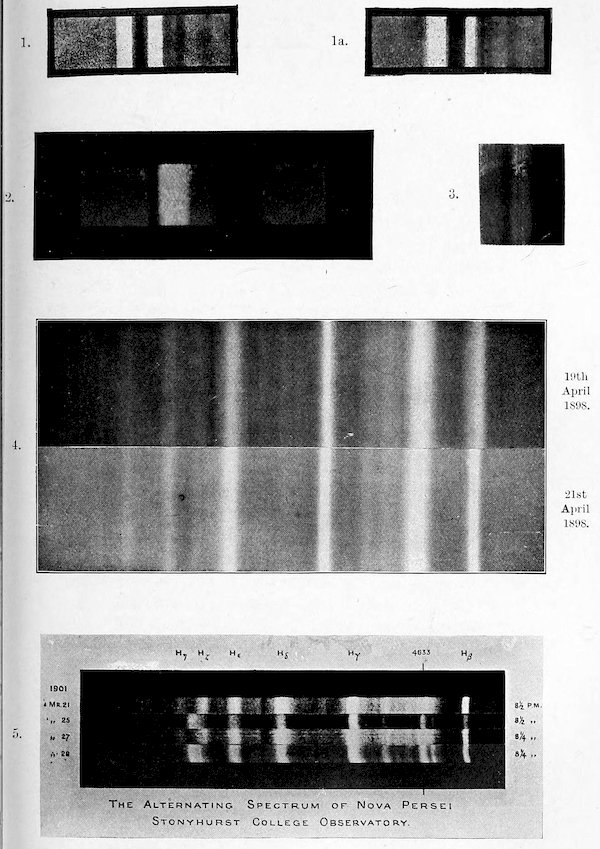
PLATE XVI.
The Alternating Spectrum of Nova Persei Stonyhurst College Observatory.
1. Hζ Line in Spectrum of β Lyræ at Secondary Minimum.
1a. Hζ Line in Spectrum of β Lyræ at Second Maximum.
2. D-Lines in β Lyræ (Keeler).
3. D-Lines in Nova Persei (Hale).
4. Spectra of Nova Sagittarii.
5. Alternating Spectrum of Nova Persei (Sidgreaves).
We may now endeavour to sum up our conclusions regarding
its nature, tentative and fragmentary though they be. A
345finished theory on the subject cannot at present be formulated;
but the ground may be prepared for it by the removal of
inadmissible hypotheses and by the clarification of thought.
(1) The system of β Lyræ is binary. Two stars, and no
more, are concerned in producing the observed changes in the
quantity and quality of its light. Both show strong hydrogen
and helium absorption; one is distinguished besides by oxygen
absorption, and it is this latter which, in all probability, emits
the more conspicuous set of bright lines. There are indications,
too, that a second set is occasionally sub-apparent, and that
the spectrum really consists of two separate ranges of dark, and
two accompanying ranges of vivid rays.
(2) The dark lines are in their normal positions at minima;
they are shifted from them at maxima, when some of their
number open out into doublets. The conjunctions at times of
least light, and elongations at intervening epochs, of two
bodies giving absorption spectra are thus presumably signified.
(3) At chief minimum, the more prominent bright lines
are shifted towards the red, so as to lie beside the corresponding
dark lines. The spectrum has then the coupled aspect
distinctive of “Novæ” and of certain other emission-stars.
The change of refrangibility during this phase cannot be due
to motion; it may be due to pressure.
(4) During the second half of the period, reversals are a
leading feature of the spectrum, which thus affords evidence,
not only of orbital revolution, but also of a course of physical
vicissitudes comprised in the same cycle.
(5) Finally, the cause of variability has to be considered.
Is it to be found in mutual occultations? The geometrical
conditions are such as to admit of an affirmative reply; the
physical conditions are adverse. They involve a rarefaction of
the circling bodies so extreme as to repel assent unless under
the stress of rigid demonstration. And that is by no means
at hand. Evidence on the subject could perhaps more easily
be collected from objects with analogous light-curves, than from
β Lyræ itself. The endless complications which embarrass
research in the “problem star” would not, for instance, be
likely to present themselves in d Serpentis. Another variable,
highly desirable to be included in such a comparative study,
is R Sagittæ. This remarkable object has a period of seventy
346days, symmetrically divided by two unequal minima, and two
slightly disparate maxima. The light-curve, however, underwent
a curious change in 1874. A reversal of the minima was perceived.[672]
Equalisation first took place. Then the secondary
minimum gradually gained emphasis at the expense of the
primary; and the exchange of relative values was not redressed
until 1883, when the pristine state was restored. An arrested
tendency towards such a transformation is sometimes shown by
β Lyræ in the fluctuating accentuation of its subordinate
phase, but it has never reached so far as a bisection of the
period. A suggestion is, nevertheless, irresistibly conveyed
that the two stars form similarly constructed systems. When
the spectra of R Sagittæ, d Serpentis, and U Pegasi have
been examined, and their changes tabulated and collated, we
shall be in a better position to interpret those manifest in the
Lyre variable.
347
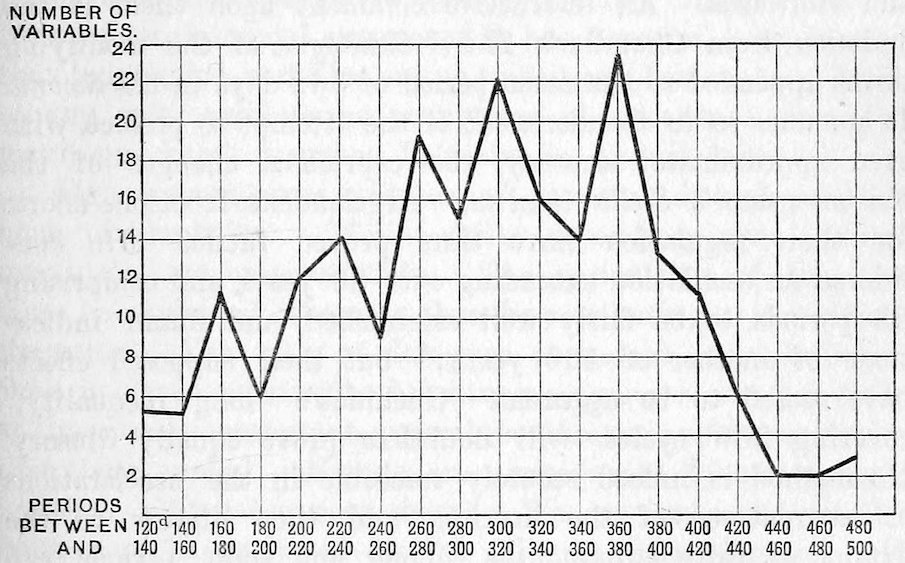
Fig. 31.—Distribution of the Periods of 208 Variable Stars.
“Long periods” of variability range from 120 to 610 days.
None more protracted have been definitely ascertained, and
those that are shorter belong, with rare exceptions, to
stars differently characterised. The distribution of the
periods we are at present concerned with is exhibited
graphically in Fig. 31. They number 208, and are
taken from Chandler’s Third Catalogue, only three, which
exceed 500 days, being for convenience omitted. Periods
of several years have besides been ascribed to a few
stars, but on insufficient grounds. No true conformity to
them is maintained. Phases that are unusually slow are also
348extremely uncertain in development. So far, the 610-day
cycle of S Cassiopeiæ is the longest that can be depended upon
to recur. A cursory reference to our diagram will show how
largely, among long periods, those between 280 and 300 days
preponderate. Accidents of discovery connected with the
length of the year cannot well have produced this preference,
which seems to be genuine, and not merely apparent. On the
other hand, the indentations of the curve are assuredly casual,
and will be smoothed down with the multiplication of objects.
The typical long-period variable is Mira Ceti. It was the
first detected; it rises to the brightest maxima; it presents
the most vivid and distinctive spectrum. More than 300 of
its cycles have been watched, more or less attentively; yet
familiarity has not diminished wonder at the “Wonderful”
star.[673] Its modes of procedure are as much an enigma to the
spectroscopists of Lick and Potsdam as they were to Fabricius
and Holwarda. An instructive comment upon them is the
omission, from Chandler’s Third Catalogue, of the modifying
terms appended to the mean period of 332 days in his Second.
It amounts to an abandonment of the attempt to predict, with
even approximate accuracy, the capricious changes of the
Frisian pastor’s Stella insolita. Argelander’s laborious efforts
for their regulation have thus proved futile. He considered
an oscillation extending over 80 years, and comprising
88 periods, to be fairly well established, and found indications
of another of 160 years;[674] but their supposed effects
have ceased to be apparent. Guthnick’s “long inequality,”
covering 200 cycles, will doubtless prove equally illusory.
No method is indeed securely traceable in the accelerations
or retardations of the maxima, and they digress to the
extent of fully two months. Long and short periods can
neither be perceived to alternate nor to occur in series; still
opposite deviations balance each other; there is no progressive
alteration in the length of the cycle.
The highest maximum and the lowest minimum recorded
for Mira were both observed by Sir William Herschel. He
found the variable nearly equal to Aldebaran on 6th November
1779,[675] while four years later it was invisible with a telescope
349showing stars of the tenth magnitude. Of late it
has not been known to descend below 9·5, and it sometimes
stops short at 8·0 magnitude. Its greatest brightness is even
more inconstant. No more than 5·6 magnitude was attained
in November 1868,[676] or one-fortieth the lustre of the phase
viewed by the Bath organist, and maxima higher than the
third magnitude are uncommon. The course of change likewise
fluctuates, but in general the rise is considerably more
rapid than the decline, and the high-level status is maintained
for about two months, the low-level for at least three, without
striking alterations. Yet change is always in progress.
The light-curve has no flat stretches.[677] No connection is
apparent between the acuteness of the light crises in this star
and the times of their occurrence.[678] They do not tend to become
abortive when hurried, nor is delay accompanied by intensification.
Argelander entirely failed to correlate irregularities of
period with discrepancies in the amplitude of change. As the
fruit of tercentennial experience it has, however, been learned
that long-period variables are no transitory phenomena. Mira,
at any rate, exhibits no symptoms of decadence since the
maximum which surprised Fabricius in August 1596.
Its spectrum gives evidence of powerful disturbance, but
none of duplicity. Motion-shifts depending upon orbital
revolution are imperceptible. The periodicity of the star
must be explained otherwise than by attributing to it a binary
character. The task of doing so is indeed most arduous.
Once in eleven months the brightness augments some hundreds
of times, and concomitant spectral modifications afford assurance
that these annual outbursts are accompanied by atmospheric
ignition. What occasions them? We are ignorant; yet the
issue may be narrowed by the following consideration. If
external action of any kind were concerned in their production
we should expect the incandescence to be coronal or
chromospheric—to affect primarily the outer layers of the
gaseous envelope. But in fact the innermost strata are those
set aglow, while the overlying vapours remain comparatively
350cool. The masking of a bright hydrogen line by calcium
absorption places the subsistence of this relation beyond
question. So far, then, the evidence favours the view that
variability of the Mira type arises spontaneously, rather than
through outside influence.
On the 13th of December 1885 Mr. J. E. Gore was
struck with an unfamiliar reddish star of the sixth magnitude
in the Club of Orion. No map included it, and until it
reappeared a year later after an interval of quasi-extinction,
there was no telling whether it should be reckoned as a Nova
or a variable. Dr. Copeland recorded for it “a very beautiful
banded spectrum of the third type, seven dark bands being
readily distinguished with the prism.” The intervening
spaces appeared “full of bright lines, especially in the green
and blue.” Two of these were certainly emitted by hydrogen,
and others probably by helium, since a vivid D3 was observed
by Von Konkoly ten days later, the adjacent sodium pair
being, as usual, dark. Fig. 32 exhibits the light-curve of
U Orionis during the maximum half of its period, as delineated
by M. Porro at Turin 1889–90. Its form is by
no means invariable. In general, the brightest phase is
reached much more abruptly than it was in 1890. The
main rise, however, is always prompt, and the decline gradual,
although the minima appear to be well defined. They have
not, indeed, owing to their faintness, been much observed.
The widest amplitude of the star’s change is from 5·3 to
about 12·5 magnitude; but these limits are seldom attained.
Nor is the assigned period of 375 days conformed to with
any exactitude. As in the case of Mira, prediction has to be
qualified with a large allowance for unexplained disturbance.
351
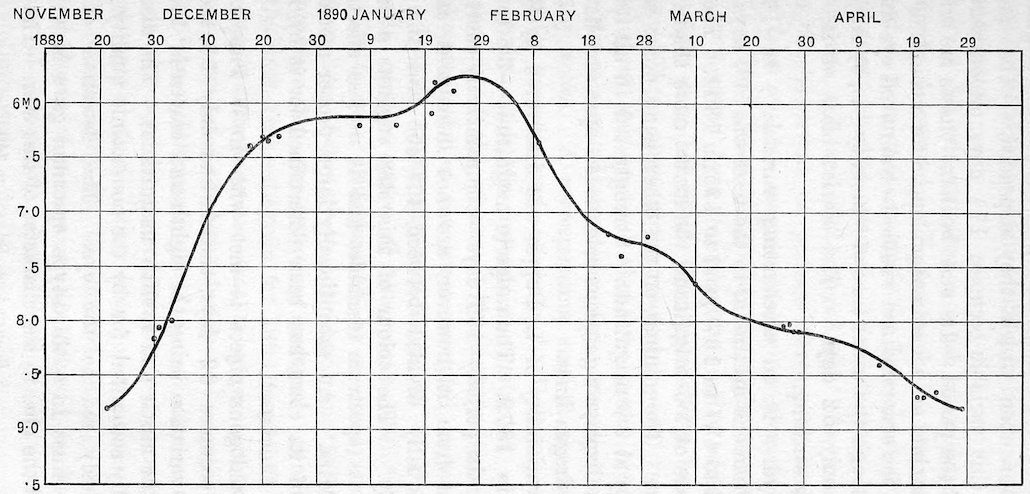
Fig. 32.—Light-Curve of U Orionis (Porro).
At high maxima χ Cygni radiates about 6500 times
more powerfully than at low minima. The star, that is to
say, has a range of fully nine and a half magnitudes, from
the fourth to near the fourteenth. But in some of its cycles
it fails to ascend beyond 6·5 magnitude; for it resembles the
other stars of this class in having no fixed measure of change.[679]
Its period is now 406 days; it has lengthened, on an average,
by a quarter of an hour at each recurrence since Kirch, in July
1686, missed from its wonted place the star located by Bayer
in collo Cygni;[680] nor is there yet any sure sign of a compensatory
reversal. The nature of the secular perturbation
thus betrayed can scarcely be imagined. Argelander noticed
352besides deviations from the mean period up to forty days, and
sought, with imperfect success, to analyse and regularise the
inequalities upon which they depended.[681] The increase of
light in this variable occupies 171 days, or considerably less
than half the period. Its most brilliant phases are brief, while
fainter maxima are sometimes prolonged for a couple of months.
In 1847 the star remained visible to the naked eye during 97
days, although the usual time of “lucidity” is, by Argelander’s
estimate, only 52 days.[682] The scarlet blaze of its light is
often very striking.
R Hydræ is an accelerating variable. In 1708 the
interval from one maximum to the next was 500 days; it had
shortened to 437 in 1870, and to 425 in 1891. The highest
maxima are of 3·5 magnitude, the lowest more than six times
less bright. The minima, on the other hand, occur with fair
uniformity at 9·7 magnitude. Strongly red in all its phases,
R Hydræ displays a gorgeous colonnaded spectrum lit up with
bright hydrogen lines.
The variability of L2 Puppis was discovered by Gould at
Cordoba in 1872. The range in magnitude—3·5 to 6·3—is
moderate, the period—137 days—comparatively short. Wide
departures from it, however, are not infrequent, and it is
almost equally divided between the ebb and the flow of
luminosity.[683] The colour of this star suggests a conflagration,
and its spectrum resembles and is no less effective than
that of Mira.[684] An exceptionally large proper motion, for a
member of its class, has been determined for it by Professor
Porter of Cincinnati.
An analogous object is met with in W Puppis. Here
the rise occupies 62 days, the decline only 58, the visual
limits of variation being the eighth and eleventh,[685] the photographic,
the ninth and twelfth magnitudes. The discrepancy
is naturally accounted for by the non-actinic quality of light
conspicuously red to the eye. The detection of bright
hydrogen lines in a third-type spectrum gave Mrs. Fleming
in 1895[686] the clue to the character of this star. The fluctuations
353inferred to take place from that unfailing symptom were
looked for and quickly found. The light-curve of W Puppis
is very regular, and takes a much sharper bend at minimum
than at maximum.
In S Ursæ Majoris we meet a much older acquaintance.
Its periodicity, discovered by Pogson in 1853, was established
by a record of its magnitude made by Lalande in 1790. It
is of a highly perturbed nature. The maximum brightness
varies between 6·7 and 8·2 magnitude; the minima are
uncertain to the extent of perhaps three magnitudes, some
unusually faint at 13·3 magnitude having been watched by
Baxendell. The actual length of the cycle is about 226
days; it is modified by a recurring inequality with a range
of nearly eight days, but much more extensively by irregular
deviations. These seem to be connected with two curious
inflections of the light-curve. About six weeks before maximum
the rise is arrested, sometimes for a few days, sometimes
for as many weeks. A corresponding stay in the decrease of
light usually precedes each minimum.[687] Upon the duration
of these halts evidently depends the retarded or hurried
accomplishment of the phases. Noteworthy besides is the
occasional equalisation of the times occupied in waxing and
waning. This is apparently a consequence of the partial
abolition in certain cycles of the pause before minimum.
That of 1875 was distinguished by a steady maximum
lasting from 23rd February to 13th April, and followed by a
decrease quicker than the preceding increase.[688] Similarly, the
late Sir Cuthbert Peek’s diagram for 1894 (copied in Fig. 33)
shows a flat maximum antecedent to a precipitate decline.
Again, four years later, the light during two months scarcely
varied from the eighth magnitude;[689] and it may be remarked
that, as in the sun, long maxima are low maxima. The
mean light-curve of S Ursæ, from observations made at
Harvard College, 1889–99, is depicted in Fig. 34. Only
the general course of change can be followed by its means;
the effects of temporary obstructions or disturbances are
necessarily eliminated.
354Deep red, and often hazy when faint, this star has been
seen nearly white at maximum—a not uncommon kind of
colour-fluctuation. It gives a poorly-developed spectrum of
the third type.
T Ursæ Majoris has a total range of nearly six magnitudes,
and a period of 302 days; but its variations make no
approach to uniformity. The maximum brightness is largely
uncertain; the minima are sometimes, though rarely, as low
as 13·5 magnitude. The luminous tide flows, at certain
epochs, with extreme rapidity. Between 5th January and
22nd February 1901, for instance, the star increased from
12·4 to 7·7 magnitude. In forty-six days it acquired a
seventy-six-fold brilliancy, and the augmentation was accompanied
by a blanching of its rays. Of their dull ruddy hue
scarcely a tinge survived at full light. Fig. 35 reproduces
the mean curve drawn at Harvard, which is, of course, much
more symmetrical than any of the individual curves serving
as its basis. The maxima and the minima appear from it
to be about equally sharp.
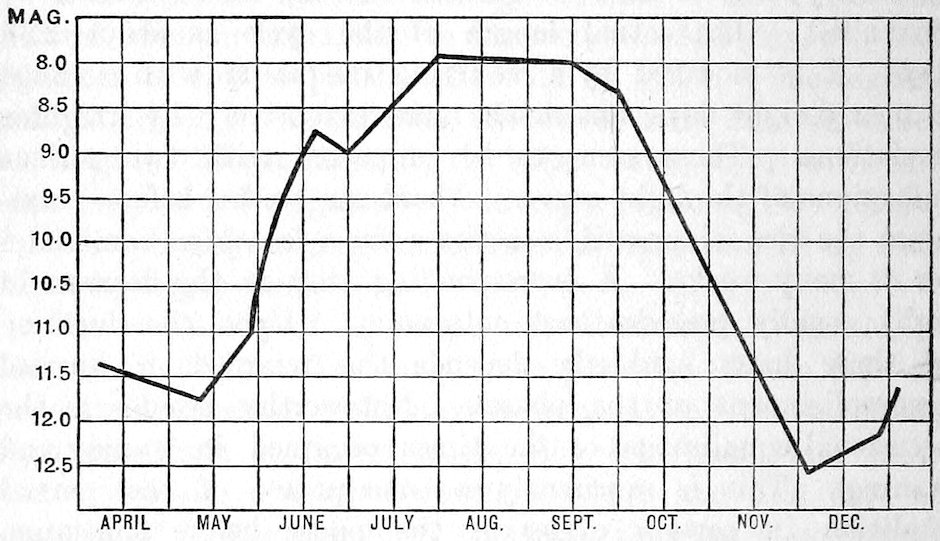
Fig. 33.—Light-Curve of S Ursæ Majoris in 1894 (Peek).
The curve of T Cassiopeiæ, on the other hand, cannot be
smoothed into shapeliness. It is represented in Fig. 36.
The secondary maximum occasioning the hump on the upward
branch is never absent, and protracts the cycle to 445 days,
considerably more than half of which (240 days) are occupied
355by the abnormally impeded phase of increase. The period is
affected by a compensatory inequality.
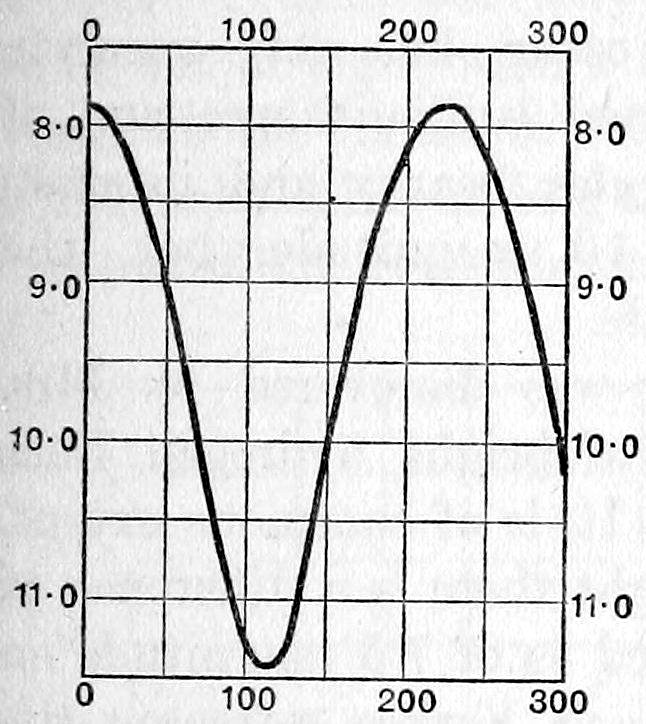
Fig. 34.—Mean Light-Curve of S Ursæ Majoris (Pickering).
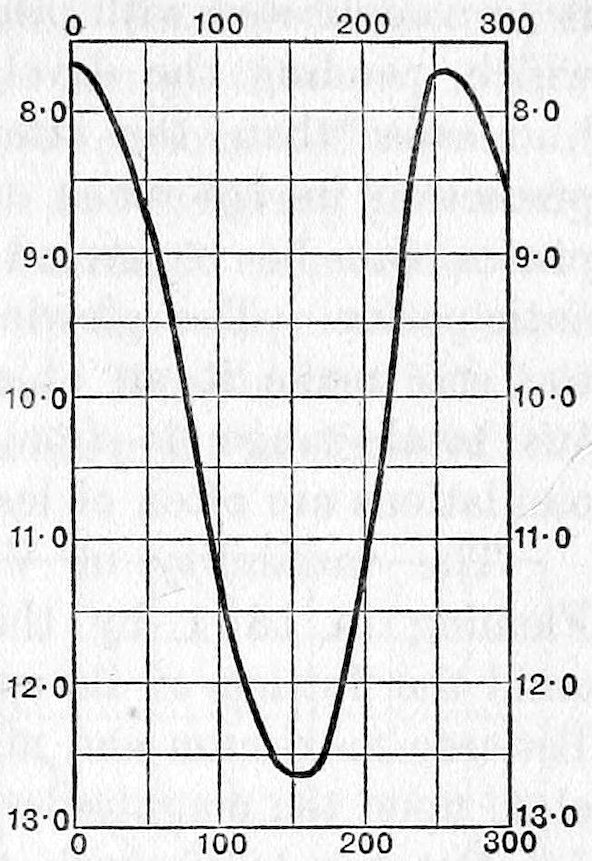
Fig. 35.—Mean Light-Curve of T Ursæ Majoris (Pickering).
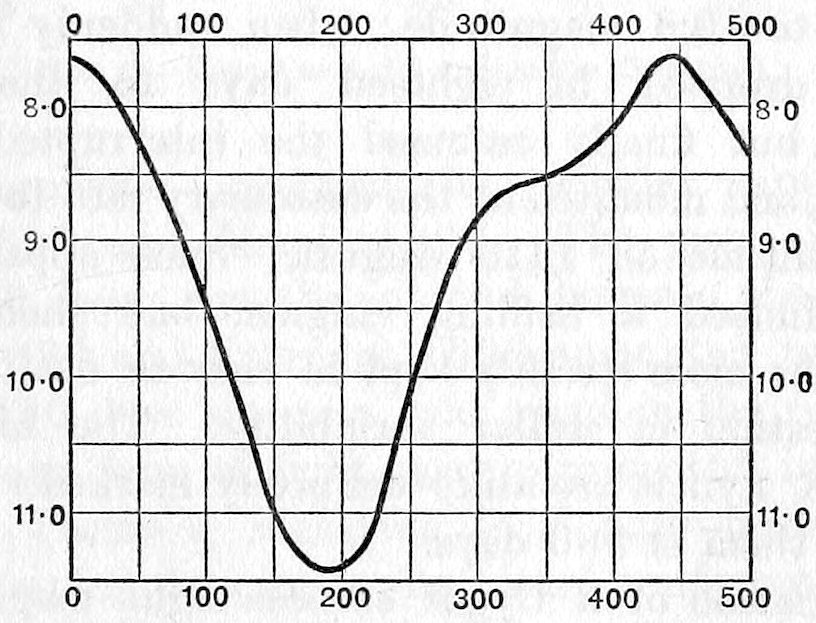
Fig. 36.—Mean Light-Curve of T Cassiopeiæ (Pickering).
The variability of R Leonis was detected by Koch in
1782; yet six score years of scrutiny have only sufficed to
render more manifest the almost hopeless intricacy of the laws
to which it is subject. Since 1890 the maxima have been
persistently accelerated, computations, founded on a nominal
period of 312 days, being left in the lurch in November
1896 by forty-three days. That there is a large periodic
356inequality admits of no doubt; “but the observations of the
last few years,” Dr. Chandler remarked in 1896, “show that
it is complicated with other unknown terms,” the neglect of
which, pending the development of their nature, seemed to
him safer than the attempt to use them for purposes of
prediction in ignorance of their value. That is to say, the
phases can be registered as they occur, but defy accurate
anticipation. The glowing colour and brilliant spectrum of
the star make it an object of singular beauty and interest.
Its total range is from 5·2 to 10 magnitude, but the
oscillations are often of less amplitude.
The variability of V Delphini was discovered by Mrs.
Fleming in 1891 by the shining of bright hydrogen lines
amid the flutings of its spectrum.[690] It is of enormous extent.
Between maximum and minimum-light there is a difference of
close upon ten magnitudes. Observed as of 7·5 magnitude on
1st October 1899 with the forty-inch Yerkes refractor, the
star had on the ensuing 20th July sunk to invisibility, and
must therefore have been below the seventeenth magnitude.[691]
The period is 540 days.
A strange anomaly in the light-change of R Lyncis was
placed on record at Sir Cuthbert Peek’s observatory in
1898.[692] From a smouldering minimum the star had risen by
2nd March to 10·6 magnitude; when, suddenly reversing its
course, it dropped in eighteen days to the thirteenth
magnitude, but finally resumed the interrupted process of
brightening, and mounted at the customary rate to a maximum
of 7·5 magnitude on 11th August. Such apparent caprices
constitute indeed a baffling enigma, but should, for that
reason, be the more steadily kept in view in dealing with the
general question of stellar variability. The high and low
phases of R Lyncis are alike definitely marked. The period
assigned to them is 380 days.
The variation of R Cygni exceeds eight magnitudes. In
rising from one extreme to the opposite it gains a 2500-fold
increase of light. The maxima, however, as usual in this
class of variables, are very unequal, some being seven times
357more brilliant than others. Mr. Espin believed in 1888
that a regular alternation of high and low phases might be
counted upon;[693] but their subsequent disordered succession
belied the inference. The star is among those in which
dimness is occasionally attended by a curious diffuseness of
aspect. Thus in February and March 1894, having previously
sunk out of sight with a 6⅓-inch refractor, it came again into
view, at the Rousdon Observatory, in the shape of a small
bluish nebula, resembling a faint comet.[694] This object, which had
contracted on 24th March into a needle-point of light of the
twelfth magnitude, resumed its nebular appearance in
February 1895 and March 1896. The mean period of R
Cygni is 426 days; but the interval between the maxima of
November 1890 and February 1892 amounted to 457.[695] No
more than 150 days are, as a rule, spent in the rise.
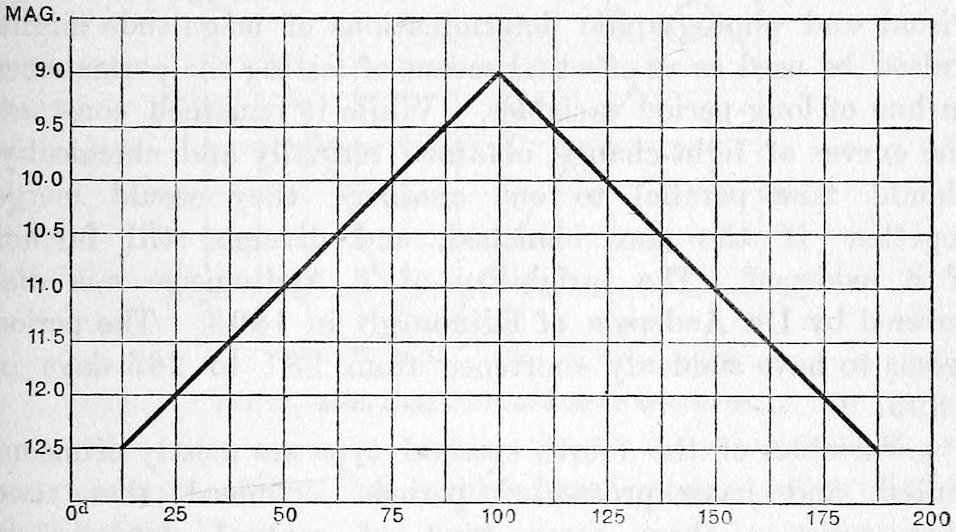
Fig. 37.—Light-Curve of T Andromedæ (Pickering).
The unique form of light-curve represented in Fig. 37 is
assigned by Professor Pickering to T Andromedæ. Derived
from photographic data, it awaits visual confirmation, yet can
scarcely be widely erroneous.[696] The uniform progression it
depicts need not, indeed, be accepted as a rigid reality; it
must be encroached upon by sundry kinds of disturbance, and
358the maxima, however brief, cannot be instantaneous; at every
full tide there is an interval of “slack water.” Nevertheless,
if even the mean curve prove to be linear, the circumstance
will be of great interest, and the star, meanwhile, merits close
attention. Owing to its redness the photographic curve is
transposed downward on the scale to the extent of one and a
half magnitudes,[697] so that the variable shows four times
brighter to the eye than to the sensitive plate. Hence changes
of colour, should they at any time supervene, would necessarily
produce large distortions in the automatically registered
course of light-fluctuation. The systematic comparison of
visual and photographic determinations of magnitude might,
indeed, be used as an effectual means of testing the permanence
in hue of long-period variables. While it remained constant,
the curves of light-change, obtained retinally and chemically,
should flow parallel to one another; they would merge
together if the star blanched, and diverge still farther
if it reddened. The variability of T Andromedæ was discovered
by Dr. Anderson of Edinburgh in 1893. The period
seems to have suddenly shortened from 281 to 265 days in
1895.
Variables of the fourth spectral type are mostly crimson-tinted,
and have protracted periods. Indeed, these two
characteristics show some kind of mutual dependence,[698]
Chandler’s rule, “the redder the star the longer the period,”
being, on the whole, conformed to. Apposite examples are
furnished by S Cephei, U and V Cygni. The period of S
Cephei averages 484 days, but is subject to an alternate
lengthening and shortening.[699] More than half of it, or about
257 days, is occupied in the ascent from minimum to maximum,
and this exceptional arrangement is consistently maintained.
The light-curve is highly irregular. Smoothed out by striking
a decennial balance, it took the form shown in Fig. 38 from
the Harvard College representation. But its dissymmetry
is greatly modified from that of the tracing given by the
observations of any single period. Usually there is a
rather swift increase and decrease, followed by intervals of
359approximate constancy, at maximum, of about a hundred, at
minimum, of fifty days.[700] Not unfrequently, however, the curve
has a sharp apex, and its downward flow is interrupted by a
secondary rise. Such “stand-stills” (as Mr. Maxwell Reed
calls them) are a familiar feature of long-period variability.
Seventh-magnitude brightness is never fully attained by
S Cephei, and it occasionally drops below the thirteenth
magnitude. Like many very red stars, it has accesses of bad
definition. They occur, very remarkably, not at low light, but
near maxima, when “a ruddy haze” seems to envelop a
definite disc.[701]
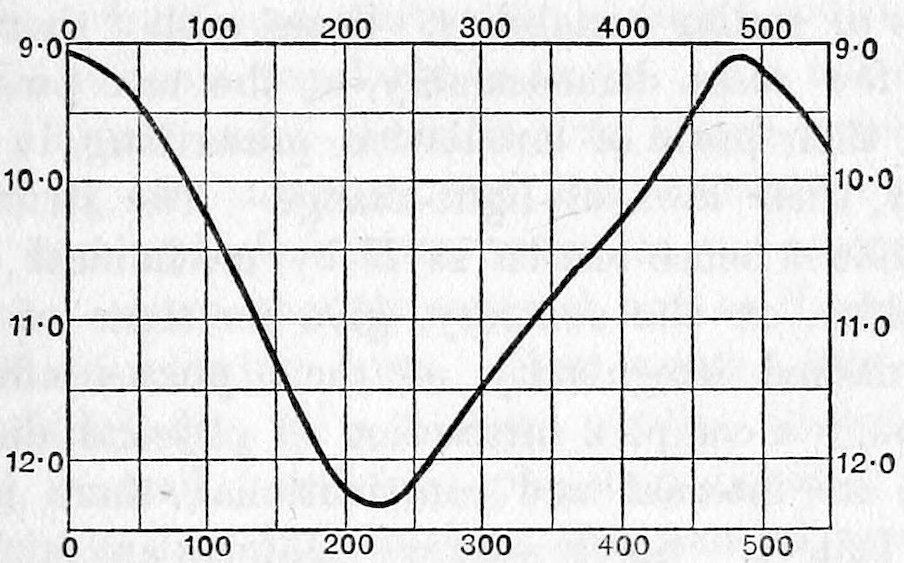
Fig. 38.—Mean Light-Curve of S Cephei (Pickering).
In 463 days, almost equally divided between the gain and
the loss of brightness, U Cygni varies from 7·0 to 11·6 magnitude;
yet with no approach to regularity. The maxima are
sometimes fainter than the eighth magnitude; the minima
fluctuate, it is thought cyclically,[702] from 9·4 to 11·6 magnitude.
The periodicity, too, is complicated by an outstanding disturbance.
The period of V Cygni is 418 days, and the rise, which
occupies 220 days, is disproportionately slow. Lindemann
registered a steady decline in the maximum-brightness of the
star, from 6·8 magnitude in 1882 to 8·4 in 1891;[703] in
some cycles it does not exceed 9·5 magnitude; while the
minima occur, with tolerable uniformity, at the low level of
36013·5 magnitude. The maxima are succeeded, at intervals of
two months, by subordinate phases of recovery. The colour
of V Cygni is especially intense. The carmine of its beams
corresponds to a powerful stoppage of the complementary blue
and violet radiations, by which a splendid preponderance is
secured to the red end of the spectrum. No bright lines have
been certainly recognised in the dispersed light of either
U or Y Cygni; they are, as we have seen, prominent in
U Hydræ, a fourth-type variable of no settled periodicity.
A fundamental distinction is apparent between the two
chief kinds of stellar variability. Stars with “short” periods
are—in a few cases demonstrably, in the rest presumably—close
pairs, their mode of circulation prescribing, in some unknown
way, their laws of light-change. The strict accuracy
of its fulfilment hence results as if by mechanical constraint.
Mira-variables, on the contrary, give no signs of duplicity;
and the marked irregularity of their phases affirms their
origin through a complex interaction of physical disturbances.
That these are internal and constitutional, there is the best
reason to believe. Spectroscopic symptoms are fairly decisive
on the point. They have as yet, however, been very partially
observed. A bare gleaning of facts has been gathered, and we
want a full harvest as a foundation for safe inferences. A
spectroscopic study throughout their cycles of variable
carbon-stars would, for instance, be most valuable. The
behaviour of the bright lines shown by them might even
prove crucial, first, as regards the position in their atmospheres
of the emitting strata, next, as to the seat of the recurring
commotions. The spectra of U and V Cygni and of R Leporis
may be cited as among those claiming systematic and prolonged
observation.
The reality of the diffuse aspect intermittently presented
by certain variables could readily be tested by examining
them at such times with a reflector. Refractors, owing to
their imperfect colour-correction, often produce abnormal
images of objects peculiarly tinted. Nevertheless, if this were
the true and only explanation of the effects in question, we
should expect to find them develop under uniform conditions,
and they appear instead incalculably, and as if by caprice.
An instructive example is furnished by V Cygni. On 19th
361July 1882, six weeks after a maximum, Lindemann[704] saw the
variable at Pulkowa as an indistinct coppery disc. But
at the same interval, before the high maximum of 31st
August 1882, it showed not a trace of nebulosity, although
intensely red. On 8th October 1883 it appeared almost blood-coloured
and very diffuse, while nine days later its image
was point-like, stellar, and precise. Analogous observations
have been made by Mr. Grover, Sir Cuthbert Peek’s assistant,
on R, S, and T Cassiopeiæ, R and S Ursæ Majoris, and several
other objects of their class; and by Mr. Knott on U
Geminorum, which, as a white star giving a continuous spectrum,
ought to come regularly to focus. For not a few stars,
such as R Coronæ and S Herculis, dim, bluish nebulosities are
substituted at low minima; and not uncommonly, even on
nights of excellent definition, variables in moderately high
phases appear sharp, though very red, and as if projected on a
background of glowing haze. Then again, they present a
clearly outlined disc, or a “large, woolly, ill-defined image
resembling a small but bright planetary nebula.”[705] Most of
these diversities defy anticipation; they can be associated with
no particular stages of variation, and some of the reddest
stars, R Leonis and R Leporis among the number, appear to
be exempt from them. Yet their literal interpretation as
indicative of physical alterations in the bodies affected by
them would lead to consequences of outrageous improbability.
Provisionally, at any rate, the wiser course is to refer them to
a combination of atmospheric and instrumental causes. With
these, no doubt, a genuine change of luminous quality concurs,
whereby semi-extinct stars, being thrown out of focus, assume a
nebular disguise. It is noteworthy that the records of a series of
observations on the minima of twenty-two long-period variables,
executed with the Yerkes forty-inch refractor in 1900,[706] include
no mention of unusual phenomena. Attention, however, seems
to have been directed entirely to the determination of magnitudes,
nor had any of the stars on the list (U Geminorum
excepted) been previously remarked for optical peculiarities.
A clue to the labyrinth of stellar variations is likely to
362be afforded by the continued investigation of solar periodicity.
Comparisons of the spot-curve with the light-curves of Mira,
χ Cygni, T Ursæ, or almost any of their congeners, bring a
conviction that the phenomena differ in degree rather than
in kind. The plottings of solar and stellar disturbances show
the same character of dissymmetry, and the same order of
irregularity. In both classes of representation, high summits
are usually sharp, low summits blunt. In both, the course of
change is now halting, now hurried. Hesitations, subordinate
ascents, and subordinate subsidences before completing the
phase, are common features. There is, indeed, no mode of
departure from uniformity traceable in the solar cycle that
cannot be strictly paralleled in the caprices of stellar emission.
The analogy has been rounded out by the discovery that the
sun, at spot-maxima, is essentially a bright-line star. Its
spectrum then shares, in a just perceptible degree, the blazing
quality that distinguishes the spectra of Mira-variables. This
is a further and an irrefragable proof of the correspondence of
the epochs. Light-maxima in the stars match spot-maxima
in the sun. In each case a development of internal energy
gives rise to enhanced incandescence, accompanied, in the single
specimen of a sub-variable star within reach of detailed observation,
by rendings of the photospheric envelope, and outbursts
of chromospheric flames. Looking a little closer, we can discern
the probability that the cyclical variations of all these
bodies depend essentially upon a rise and fall of activity in
the vertical circulation by which radiation is maintained.
The rate of conveyance of heated matter from within outward
must be a determining factor of photospheric brilliancy, transcendent
lustre implying unusual celerity of transport. This
is the vital process of suns, the checking of which must
immediately become sensible in their diminished output of
light. Here, if anywhere, will be found the secret of stellar
variability.
363
The stars varying in periods comprised between thirty and a
hundred days are not numerous, and they are often peculiar.
Among them are to be found such remarkable objects as
R Sagittæ, R Scuti, U Geminorum, and S2 Cygni. Of R
Sagittæ, with its double period and reversing minima, something
has already been said. The possibility that it is in
reality a “short-period variable” on a magnified time-scale
is suggested by its resemblance to β Lyræ, and emphasises the
question as to its spectroscopic duplicity. Its irregularities,
though considerable, do not appear to transcend the limit of
what might be explicable in a gravitational system.
364
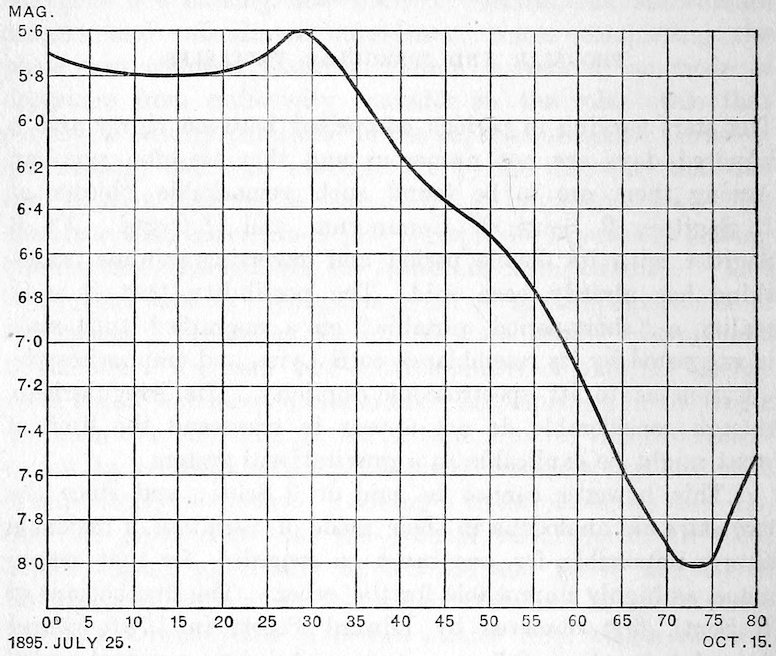
Fig. 39.—Light-Curve of R Scuti (Flanery).
This, however, cannot be said of R Scuti; and since the
two stars are analogous in their mode of variation, a rationale
clearly impossible for one must be regarded, for that reason
alone, as highly improbable for the other. The fluctuations of
R Scuti, first observed by Edward Pigott in 1795, extend
from 4·4 to about 9·7 magnitude, and have a nominal period
of seventy-one days. But they cannot be even empirically
embraced in any formula. As Mr. Flanery remarked in 1896,
“No set of elements yet devised will fit this star long.”[707] Each
in turn has to be rejected as unserviceable. Thus, on 6th
May 1897, the star showed a complete inversion of phase;[708]
it was at a low minimum instead of at the computed maximum.
It then rose to an unforeseen brightness of 5·4 on 11th June,
diminished to half-light during eighteen days, and finally,
remounting the slope it had just descended, shone duly at the
predicted maximum of 17th July. Again, it varied less than a
magnitude for two months after the maximum of 29th August
1896, but underwent a precipitate decline at the end of the
stationary spell. The light-curve, from Mr. Flanery’s observations
July to October 1895, is given in Fig. 39. It is that
of a star which refuses to be bound by the shackles of any
definite theory. Faint and brighter minima alternate, as
Argelander long ago perceived; and they perhaps, now and
again, exchange relative values, like those of R Sagittæ. If,
then, we double the period, and call it 142 instead of 71 days,
the star might rank, despite its vagaries, as an analogue of
β Lyræ and R Sagittæ. For a subordinate minimum, placed
midway between two maxima, is a feature common to all
three, though the other circumstances of variation are in each
star widely different. Such resemblances in the midst of
diversity are extremely perplexing to students of stellar light-change.
The similarity of some of the phenomena suggests a
uniform principle of explanation; but the attempt to extend its
application serves only to undermine the credit it originally
365possessed. The eclipse rationale, for example, suits β Lyræ
passably well, and might be accommodated to the less equable
phases of R Sagittæ, but is wholly incompatible with the disordered
fluctuations of R Scuti. This, however, in view of
their fundamental resemblance to those of the accurately variable
star in the Lyre, raises the question whether eclipses can
be regarded as occurring in the one case, when they assuredly
do not occur in the other. Over and over again this difficulty
presents itself. No theory seems elastic enough to bear the
strain put upon it by the variety of the facts. Each member
of a group of related stars adds its quota to the burthen of
explanation to be borne; until finally the breaking point is
reached, and a collapse ensues, leaving the ground encumbered
with the débris of the original speculation.
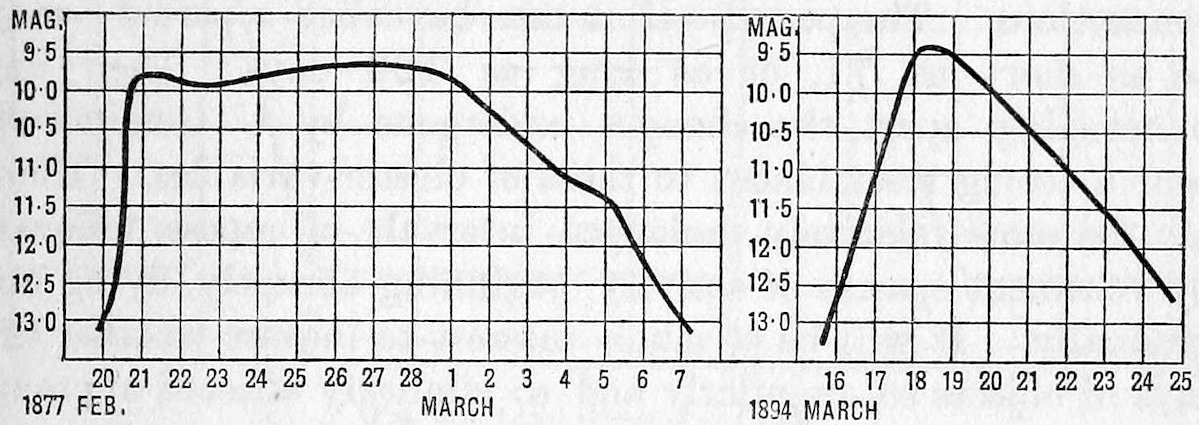
Fig. 40.—Long and Short Maxima of U Geminorum.
R Scuti might usefully be made the subject of detailed
spectrographic investigation. Bright lines shine in the blue
and violet sections of its light; but they have not been
identified, and the flutings associated with them appear ill-pronounced,
or even subject to effacement.
As a curiosity of the skies, R Scuti is much outdone by
a small star in Gemini, the abnormal behaviour of which
was noticed by Hind in 1855. Habitually tranquil at 13·1
magnitude, U Geminorum rises with amazing celerity to near
the ninth once in two, three, or four months. A leap upward of
nearly four magnitudes is often accomplished in a single day,
and that without preliminary fluctuations. The descent is
always much slower, but along a very changeable curve. Two
types of maximum are shown in Fig. 40. In one, the
366episode of brightening occupies fifteen to twenty days, in
the other it is terminated in nine or ten. And, as a rule,
they alternate one with the other. Nothing, indeed, is certain
about this star except its uncertainty. “Predictions in regard
to it,” Mr. Parkhurst concludes from his experience, “can be
better made after the fact.”[709] The greatest light varies from
8·9 to 9·7 magnitude;[710] the least to a rather larger extent.
Thus on 28th February and 26th March 1897 the star must
have been below fourteenth magnitude, since Father Hagen
lost sight of it with the twelve-inch refractor of the Georgetown
College Observatory.[711] No relation is perceptible between the
amount and the duration of change; long and short maxima are
indifferently high and low. They are fickle, too, in their time-connections.
The period—if it can be called a period—may
be as short as 71, or as long as 126 days. Their unpunctuality
apart, the changes undergone by U Geminorum
bear a strong resemblance to those of cluster-variables. There
are the same relatively prolonged intervals of repose, followed
by vehement spasms of activity, beginning abruptly, dying out
gradually. It will be of much interest to inquire whether the
rays of objects so singularly and so similarly affected approximate
to uniformity in quality. Those of U Geminorum are
in colour dull bluish white; they give, according to Pickering
and Copeland, an ordinary continuous spectrum. Still it is
possible that peculiarities might be revealed by special scrutiny
with powerful instruments.
367
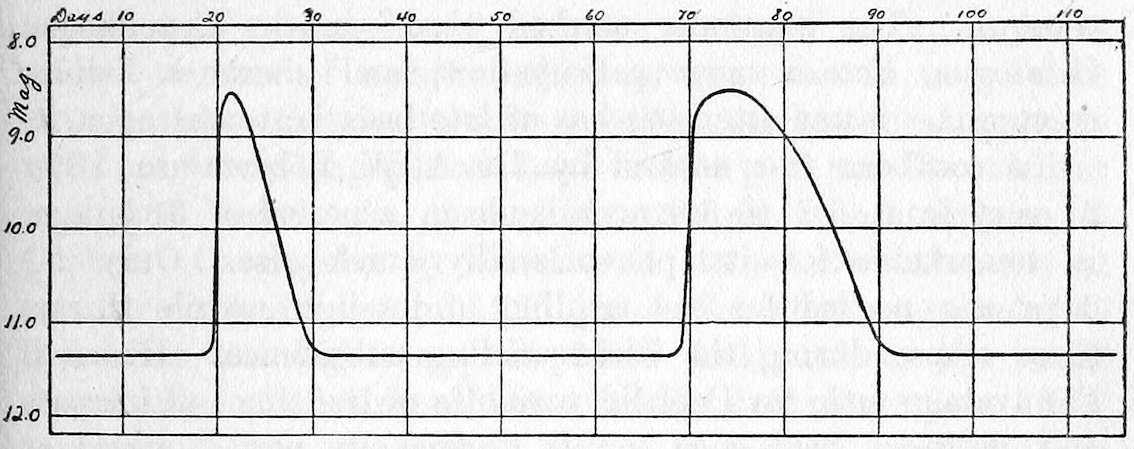
Fig. 41.—Light-Curve of S2 Cygni.
U Geminorum ranked as a unique object until S2 Cygni was
discovered. Miss Louisa D. Wells in 1896 traced the fluctuations
of the latter on the Harvard plates from 7·2 to below 11·2
magnitude; and the shortness of their apparent period of forty
days combined so unusually with their wide range,[712] that they
immediately became a cynosure for observers in that branch.
The more closely they were watched, the more nearly they were
found to conform to those of Hind’s variable. In both stars,
stationary minima are interrupted, at intervals not wholly
irregular, by sudden ascents of three or four magnitudes; and
as in U Geminorum, so in S2 Cygni, long and short maxima
are coupled together in pairs, yet by no invariable law.
Breaks in the alternate succession have been in each case
recorded. In March and April 1897, for instance, S2 Cygni
rose to consecutive short maxima,[713] and a pair of long maxima
again marred the rhythmical flow early in 1900. The curve
for a double period is reproduced, from a drawing by Messrs.
Parkhurst and Daniel, in Fig. 41. They comment on “the
sharp turns in the curve at the beginning and end of
maximum” as being “peculiar to this type of variable,”[714] which
they judiciously assimilate to that prevalent in clusters. The
mean period of about fifty-seven days attributed to S2 Cygni has
a wide margin of uncertainty. The interval from one maximum
to the next may be curtailed to thirty-six, or expanded to
sixty-three days, and that without traceable plan or method.
Revolution in an orbit is hence absolutely excluded from among
the possible causes of light-change. An hypothesis proposed by
M. Hartwig of Bamberg[715] merely illustrates the baffling nature of
the problem set by this star. He suggests that the maxima are
occasioned by the brief kindling, at periastron passage, of a
satellite pursuing a highly eccentric path. The irregularities
of the period, he thinks, may be accounted for by a rapid
gyration of the line of apsides. The blazing of “new” stars
is, in his view, an analogous phenomenon;[716] but new stars
exhaust their energy in a single display, while the variables in
Gemini and Cygnus seem to have a limitless power of recuperation.
368The light of S2 Cygni is tinged with blue; nothing has
been published regarding its spectrum.
Although narrow in range (4·6 to 5·4 magnitude), the
variations of υ Herculis are unsurpassed in singularity.
Recognised by Schmidt in 1872,[717] they have proved to be
“irregularly periodic”; their tendency to preserve definite
time-relations appears to be continually resisted and sometimes
overborne by countervailing influences. Occasionally they conform
approximately to a forty-day cycle, then break loose, and
become for a time utterly lawless. The minima are attended
by extraordinary fluctuations; the maxima are normally
tranquil. The star was marked “red” in the Copenhagen
Catalogue, but is now pale yellow, and shows a helium
spectrum. Scant attention has of late been bestowed upon it.
A southern star noticed by Dr. A. W. Roberts[718] in 1891
to vary from 6·8 to 8·0 magnitude in a period of 38½ days,
is remarkable for its phenomenally quick rise. Only 5½
days are needed for the tripling of its light, while thirty-three
elapse during the corresponding subsidence. Hence, if
the average ratio for Cepheid variables of the times of increase
and decrease held good for U Carinæ, its period would at
once be abridged to eighteen days, and there could be no
mistake about its membership of a class to which it is affiliated
by the type of its variations.
The periodicity of R Lyræ, detected by Baxendell in 1856,
often much perturbed, is never wholly effaced. Argelander
found it to be comprised within forty-eight days, which Schönfeld
reduced to forty-six; yet in 1872 Schmidt considered it uncertain
between the limits of thirty and sixty days.[719] Pannekoek’s
introduction of a periodic term for its regularisation[720]
can be reckoned only a temporary expedient. The oscillation
is of small amplitude, from 4·0 to 4·7 magnitude, but two
striking outbursts of light, witnessed by Sawyer in November
1884,[721] imply essential instability. The simultaneous development
of emission-rays might possibly have been observed
had a prismatic eye-piece been at hand; but no spectroscopic
369examination was feasible at the critical moments. Ordinarily,
the star, which is deeply tinted with orange, gives a superb
colonnaded spectrum unmarked by bright lines.
Periodic cannot be sharply distinguished from irregular
variables. Stars of an intermediate character are quite
common. Some degree of precision in change may even be
temporarily maintained by objects eventually found to be
eminently unmethodical in their modes of procedure. Such
are α Herculis, α Orionis, and β Pegasi. Each assumed on
first acquaintance a false air of submissiveness to a time-law,
which each very soon laid aside. Their fluctuations rather
exceed half a magnitude, and are included in an indeterminate
number of months; their progress can in no wise be
anticipated. Similarly, stars credited on historical grounds
with extremely long periods have of late paid not the smallest
regard to them. An instructive example is met with in R
Cephei. Catalogued by Hevelius in the seventeenth century,
and by Groombridge in 1807, as of the fifth magnitude,[722] it
thereafter lost light, and in 1840 had sunk to the tenth
magnitude. Collating all the available data, Pogson in 1856
assigned to the diminished star a period of seventy-three
years, and predicted its restoration to naked-eye visibility in
1880.[723] But the prediction remains unfulfilled; the obscurity
of R Cephei seems likely to be permanent.
At Potsdam in 1898 MM. Müller and Kempf noticed a
star in Perseus[724] as variable in an unprecedented fashion.[725]
After an indefinite term of constancy at 6·3 magnitude, it
began in 1892 to decline at the very slow rate of one-eighth of
a magnitude yearly, and continued to do so for six years.
The counter-process was comparatively rapid. In twenty
months the object had regained its former status, so that the
complete oscillation occupied 7⅔ years. This time, however,
there was no long stationary maximum. Already by the end
of 1899 fading had made some progress; but it remains to
be seen whether any true periodicity can be established.
A period of five years, ascribed by Mr. Espin to 63 Cygni,
370has been rejected on further experience of fluctuations distinctively
capricious. Many, perhaps most red stars, are unstable
to the extent of half a magnitude; and 63 Cygni is a
very red star. The fact that it is one and a half magnitudes
fainter chemically than visually, supplies a kind of measure
for the intensity of its colour.
The empirical rule that irregularity gains more and more
the upper hand with increasing length of period[726] is illustrated
by S Persei. Indeed the order of succession in the changes of
this object is by no means satisfactorily ascertained. Safarik[727]
and Hagen[728] hold them to be rudely periodical in about two
and a third years; but most other observers prefer to consider
them as entirely irregular.[729] Their range though wide, from
near the seventh to the thirteenth magnitude, is seldom completely
traversed. Experience alone can decide whether the
rudimentary method traceable in these variations during
fourteen years previous to 1894 will continue to regulate
them in the future. Phases so unpunctual are liable to
effacement. Quite possibly, the actual instability of S Persei
represents a more or less transitory state, which may be
succeeded by one of approximate constancy in shining.
The most illustrious of casually variable stars is η Carinæ,
formerly designated η Argûs. Futile attempts have been made
to accommodate it with periods. It has none. It is, in the
full sense of the term, irregular. Its changes are perhaps
modified by influences of an unimaginable nature connected
with the vast surrounding nebula. But those influences undoubtedly
act upon a body of inherently peculiar constitution.
The spectrum of η Carinæ is of a kind associated in every other
known instance with absolute whiteness. It resembles that
of P Cygni;[730] many hydrogen and helium lines are brightened
in it, yet the star shows the colour of a Mira-variable.
Whether this was always so or not, we have no means of deciding.
The first note of a distinctive hue in the southern wonder-star
371was made by Piazzi Smyth, 1st January 1845, when he
announced from the Cape a fresh increase in its light. For a
month back, he wrote, it had been brighter than Canopus, and
very red.[731] Then in 1850 Gilliss found it to outmatch Mars in
depth of tint; and Thome described it in 1887 as of a “dull
scarlet,” passing into “bright orange” during a slight temporary
rise. The history of this star is familiar to most of our readers.[732]
It need not here be repeated. One fact in addition to those
currently stated may, however, be mentioned. In his star-maps
of 1603, Bayer marked η Argûs as of the second
magnitude, probably on the authority of Petrus Theodorus of
Embden, who navigated the Indian seas 1594 to 1596. The
variable was then equally bright in the sixteenth and in the
eighteenth centuries, and its comparative insignificance when
Halley placed it in the fourth rank was due to a merely
transient decline. Whether the splendour of its beams has
ever before been so completely shorn away as it is now, might
be questioned. Excesses entail exhaustion, and the flaring
maximum which culminated in 1843 was followed by a reactive
sinking towards the ashes of extinction. Since 1886, as
the observations of Finlay, Innes, and Roberts testify, the star
has wavered between 7·0 and 7·7 magnitude, and no sign of
its speedy restitution to brilliancy is perceptible. Its future is
beyond divination. The present minimum may be indefinitely
prolonged, but further change is more likely in the case of so
ruddy an object. Another great outburst cannot indeed be
reckoned upon even for a remote age. A “temporary”
character may so far belong to η Carinæ that its biography
will include but one absolute maximum. The star is sensibly
devoid of proper motion.[733] Its distance from the earth must
accordingly be prodigious.
The capricious disappearances of R Coronæ surprised
Pigott in 1795. Usually of about the sixth magnitude, the
star is liable at any moment, without note of warning, to drop
to the thirteenth. The intervals of maximum lustre sometimes
last for years. One extended from 1817 to 1824, another from
1843 to 1845.[734] But in the last-named year, and again in
3721852, R Coronæ vanished from view with Argelander’s comet-seeker,
regaining brightness on each occasion slowly, and, as it
were, with difficulty. Of late its descents have been less
profound. Schmidt observed a minimum at twelfth magnitude
in August 1883;[735] Sawyer recorded on 13th October
1885 one arrested at 7·4 magnitude.[736] Having been visible
to the naked eye nearly throughout 1893, the star sank to
the ninth magnitude about 7th March 1894, and after an
intermediate partial recovery, to 10·25 on 1st August.[737]
By the end of the year the phase of instability seemed
to have terminated. These lawless fluctuations, taken in connection
with the extraordinary spectral changes ascribed to it,
render this object one exceptionally inviting to careful study.
An analogue to it, but with a much narrower range of
mutability, is the lucid white star ε Aurigæ. Ordinarily
of the third magnitude, it fades at long and uncertain intervals
to one-quarter of this brightness. One such diminution was
observed by Heis in 1847; another by Schmidt in 1875.[738]
There is nothing in the quality of the light to account for
them. The spectrum is modelled on that of Procyon, only
with an increase of definiteness, and marked differences of
relative intensity in the lines.[739]
The vicissitudes of T Tauri derive special interest from
their presumable connection with those of a group of nebulæ.
Discovered by Hind 11th October 1852, it dwindled during
fifteen years from tenth to twelfth magnitude pari passu
with the fading of the adjacent “temporary” nebula, but
attained in March 1868 a second and higher maximum,
coincidently with the brightening of “Struve’s nebula,” another
member of the collection. Again it declined, and was left
unnoticed from 1877 until Burnham and Barnard, directing
the Lick thirty-six inch to its place in October 1890, perceived
it as the faint nucleus of a small condensed nebula,[740]
which four and a half years later survived only as a feeble
glow round the almost extinct variable. The glow was
resolved by the Yerkes refractor into a little wisp of nebulosity,
373attached brush-wise to the star;[741] and partial impressions
of it came out on plates exposed by Professor Keeler for four
hours with the Crossley reflector, 6th and 29th December
1899.[742] “Can it be,” Professor Barnard asks in surprise,
“that the star becomes essentially a nebula as it sinks in
light?” The question goes to the root of cosmic relations,
and it is raised under more than one aspect by investigations
of stellar variability. The associations and transformations of
T Tauri are hence of profound significance, and should be
diligently supervised until they can be linked together by
some rational principle of causation.
Irregular variability has a wide and indefinite reach. It
includes changes almost instantaneous, and changes well-nigh
millennial in their development. The light of certain stars
has undergone a slow secular decline. A noteworthy instance
is that of Θ Eridani, identical, as Dr. Anderson has conclusively
shown,[743] with Ptolemy’s “Last in the River” (the
Arabic Achernar), the title and honour of which have been
usurped by the more southerly, and now far brighter α Eridani.
Al-Sûfi in the tenth century reckoned Θ among the thirteen
brightest stars visible in Irak; and it was still of the first
magnitude in 1437, the epoch of Ulugh Beigh’s Catalogue.
Yet it had sunk to the third when Halley visited St. Helena
in 1677, and of the third it still remains. Two other stars
which have undeniably faded with the lapse of centuries are
β Leonis and δ Ursæ Majoris,[744] and their fading may even
now be imperceptibly progressing. Nor is their eventual
restoration by any means assured. Accessions of lustre are
rarer, and often transitory. On 6th August 1868, 83 Ursæ
Majoris, a sixth-magnitude star near Mizar, was seen by Birmingham
to be the equal of δ Ursæ; though for that night only.
The next, it had visibly gone off, and before long the whole of
its added splendour had departed. Its amount was very considerable.
The star attained, during its unexplained rise, to
threefold its customary brilliancy. One of Burnham’s close
pairs, z Virginis, underwent in 1866 a similar phase. This
was before it was known to be double, so that our curiosity as
to whether both the nearly equal components shared in the
374brightening remains ungratified. Red stars not infrequently
drop abruptly to a lower rank. Thus the Danish astronomer
Torwald Köhl had for years observed B.D. + 20° 1083, in
the constellation Taurus, as of 7·7 magnitude, when on 22nd
January 1898 he was taken aback to find it not much above
the ninth.[745] Sixty per cent of its rays had been, as a consequence
of some inexplicable collapse of energy, subtracted or
suppressed. A step towards the bourne from which there is
no returning may be taken in such cases. Stars vanish, but
they seldom or never reappear. Yet renovation plays its part
no less than decay. Waning stars have their correlatives in
waxing stars. Alcor, the Rider, and Benetnasch, the third
Horse of the Wain, are among these. Pollux, too, seems to
have bettered its position, and Alcyone is far more predominant
than of yore in the Atlantid family. Night’s robe
will still be profusely spangled, even though a few of its
gems grow dim.
375
A temporary star is a variable that rises sheer from profound
obscurity to a single maximum. The maximum may be
prolonged or multiple, but it must be essentially one. The
occurrence of a second independent outburst would at once
relegate the object to the category of irregular variables. The
distinction is perhaps arbitrary, but we can only investigate
by dividing. It will be best to plunge at once in medias res
with some account of an apparition which attained to epochal
importance through the efficacy of photographic methods of
research.
Nova Aurigæ sprang into conspicuousness with the
stealthy speed of Jack’s Beanstalk. On 8th December 1891
Dr. Max Wolf took, at Heidelberg, a photograph of the sky
round χ Aurigæ, showing stars to the ninth magnitude. The
Nova was not among them; the spot destined for its occupation
was vacant. Forty-eight hours later, as a Harvard
negative attested, a fifth magnitude star filled the blank. By
20th January 1892, twelve records of this stranger’s presence
were included in the same series; but inadvertently, for the
documents were stored up unread, and it was only through
their subsequent examination that a maximum of 4·4 magnitude
was inferred to have taken place on 20th December.
During nearly two months, then, a new star, readily visible to
the naked eye, shone unnoticed in the heavens. It was
finally perceived by an amateur, Dr. Thomas D. Anderson of
Edinburgh, and an anonymous post-card, by which, on 1st
February 1892, he conveyed the news to Dr. Copeland,
formed the starting-point of widespread astronomical activity.
376The spectrum of the Nova was promptly photographed at
Tulse Hill, South Kensington, Stonyhurst, Potsdam, and
Mount Hamilton; eager study was devoted to its implications;
and they were of a most unexpected kind. For no
previous stellar apparition had been analytically recorded;
and the similar spectral phenomena, doubtless present in
Nova Coronæ and Nova Cygni, eluded definite determination
with the eye. But when the turn of Nova Aurigæ came, the
spectrographic method was effectively at hand, and the
peculiarities of its light could be rendered obvious, salient,
and permanent. Some of them were indeed visually manifest.
The spectrum was at once seen to blaze with bright
lines, many of them greatly widened (see Plate XVII.); and
nearly all came out photographically as attended by strong
dark companions on their more refrangible sides. The entire
hydrogen series, from crimson C to the last of its ultra-violet
associates, was thus doubled, no less than the pre-eminent
calcium pair, the sodium D, and a considerable number of
lines since identified as originating from helium. An exceptional
feature was the predominance of “green” helium;
D3 and the rest of the lines belonging to the “yellow” set
were comparatively faint; while λ 4922, λ 5016, and their
fundamental, λ 6678, shone lustrously. Their superiority,
never before observed in the spectrum of a heavenly body,
results in the laboratory from heightening the exhaustion
of the emitting gas; but this condition seemed to be excluded
in Nova Aurigæ by the distended aspect of rays unmistakably
proceeding from a more than ordinarily condensed atmospheric
stratum. Unprecedented, likewise, was the simultaneous
brightening of the three D-lines. No stellar spectrum previously
observed had shown the action of sodium otherwise
than by absorption. Both characteristics, it is true, may have
been present in earlier Novæ, but they first arrested attention
in Anderson’s star.
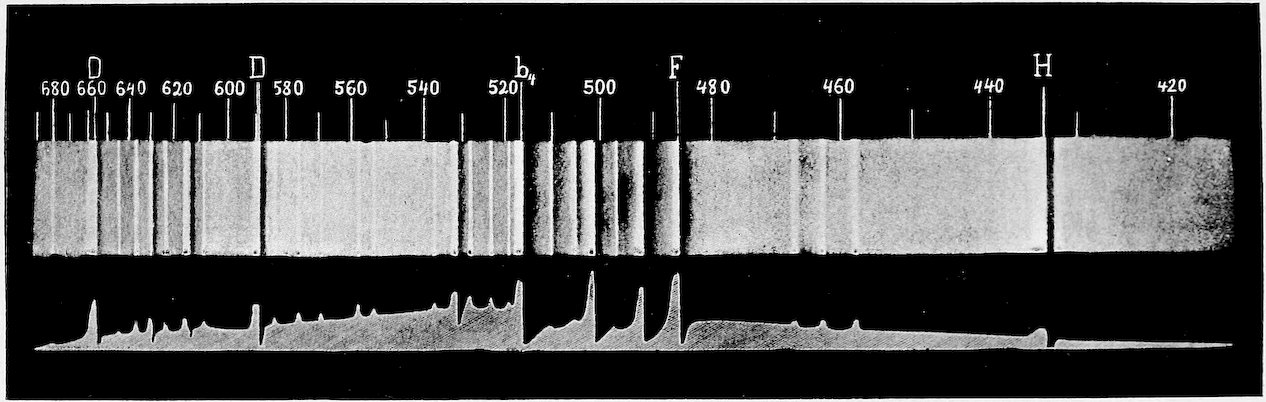
PLATE XVII.
Visible Spectrum of Nova Aurigæ, 28th February 1892. Intensity-Curve below (Campbell).
These novelties, curious though they were, sank nevertheless
into insignificance compared with one dominant trait. This
was the large opposite displacements of the bright and dark
sets of lines. Contrary motions of prodigious velocity appeared
to be indicated, and for a time their prevalence was taken to
be incontrovertibly attested. The outburst, by a consensus of
377opinion, resulted from the approach, and integrated the light of
two components, one a bright-line star receding from the earth
at the rate of about 230 miles a second, the other a dark-line
star hurrying towards it with a speed of 320 miles. Soon,
however, incongruities began to develop, and they grew
and multiplied as time went on. To begin with, the spectral
shifts underwent no alteration; the movements indicated by
them—if they did truly indicate movements—persisted without
abatement as the bodies animated by them withdrew
from each other’s vicinity to a distance greatly exceeding that
of Neptune from the sun. Now velocities, to continue
uniform, must be inherent; that is to say, they cannot represent
the merely temporary effects of gravitational pull, since orbital
acceleration is strictly balanced by retardation. Evidently,
then, the components of Nova Aurigæ did not simply fall
together; they should have been fabulously massive to have
produced, by their mutual attraction from infinity, a speed
which continued at the rate of 550 miles a second three
months after the periastral rush-past, the date of which
presumably coincided with the first rise to brilliancy on 10th
December. Professor Seeliger of Munich[746] calculated that
15,000 times the sun’s gravitative power, at the very least,
must have been at work if the orbits traversed were parabolic;
and the extravagance of the estimate sufficed, and was designed
to compel its rejection. Hyperbolic motion was
accordingly resorted to; the encountering bodies brought, it
was supposed, their own velocities with them from the farthest
bounds of space; and they were of so high an order that
the increments due to mutual gravity left them sensibly unaltered.
A pair of “runaway” stars, one moving towards, the
other from the earth, must, it seemed, have accidentally passed
each other almost within grazing distance. They were
primitively unrelated; their quasi-collision could never be
repeated; they were as unlikely as any two stars in the
heavens to be similar in constitution. Yet their spectra
affirmed their close affinity; both were of pure helium type;
one might be called the negative copy of the other. Nor
was this all. Anomalies still more glaring presently disclosed
themselves. Too obviously, on the adopted hypothesis, one
378pair of meeting stars could not suffice to explain the phenomena.
Vogel stipulated for a triple encounter;[747] Campbell
found evidence of the interaction of four luminous masses.[748]
The more attentively, in fact, the spectrum was examined,
the more complex it appeared. The bright lines were not
simple emanations, but groups of differently refrangible rays;
the dark lines were intersected by bright threads, variable in
number and position. Several distinct sets of lines, each
with its separate amount of shift, and each hence associated
with a differently moving mass, thus stood out independently.
“On the hypothesis of four bodies,” Professor Campbell wrote,
“the principal system of bright lines was not displaced appreciably,
and the star yielding it was practically at rest with
reference to the solar system. Another system was displaced
towards the red, a distance corresponding to a velocity of
recession of about 315 miles a second. The system of fine
bright lines, and likewise the system of dark lines, were displaced
towards the violet, a distance corresponding to a
velocity of approach of about 400 miles a second.” The
analysed light of the Nova, on this showing, consisted of four
superposed spectra disconnected in their origin. The case,
however, was presented with diffidence; no conclusive force
was claimed for it. The spectrum, indeed, if multiple at all,
was more than quadruplicate. Victor Schumann pointed out[749]
that not less than six, if as many as two stars were engaged
in the outburst, and planets ad libitum were thrown into the
mêlée by Vogel.[750] The collision-theory, in short, collapsed
under the weight of the facts it had to carry; speculation
was plainly off the track; a new principle of explanation
had to be sought. It was difficult to find; yet some
probable though partial truths had been laid hold of. Sir
William Huggins, for instance, pointed out that the complexities
of the spectrum might be in part due to “reversals”
in the atmosphere of a single star.[751] Such effects of the
stratification of glowing vapours are common in the sun, and
may be artificially produced in a diversity of forms. Their
379presence in Nova Aurigæ was clearly recognisable. The
opinion, too, expressed by Father Sidgreaves might safely be
adopted that the spectrum of the new star “was, on the whole,
what the solar chromospheric spectrum might be expected to
show on a grander scale of disturbance.”[752] Finally, M.
Seeliger’s general theory of stellar conflagrations,[753] as arising
from the passage of compact bodies through “cosmical clouds,”
or nebulæ, though strained to meet superfluous requirements,
had fundamentally much to recommend it. Entire originality
could not be claimed for it; Mr. Monck, and possibly others
besides, had earlier proposed a similar view; but it was by
Seeliger independently developed, and independently applied
to the circumstances of the latest event. These were indeed
particularly embarrassing to theorists. They seemed to imply
the continuous progress of opposite radial movements of
enormous velocity, and the problem of bringing them into
play, whether by the rushing of inflamed gases or by the
bodily transport of luminous globes, was, when considered in
all its complicated bearings, formidable, if not desperate.
Yet it had to be faced, for at that time spectral displacements
were explicable only as effects of motion; they should perforce
be interpreted on the radial velocity principle. This is no
longer absolutely prescribed; the same phenomena have been
found to bear other meanings—meanings not yet thoroughly
intelligible, but promising, when they become so, to provide
the keys to many enigmas.
380
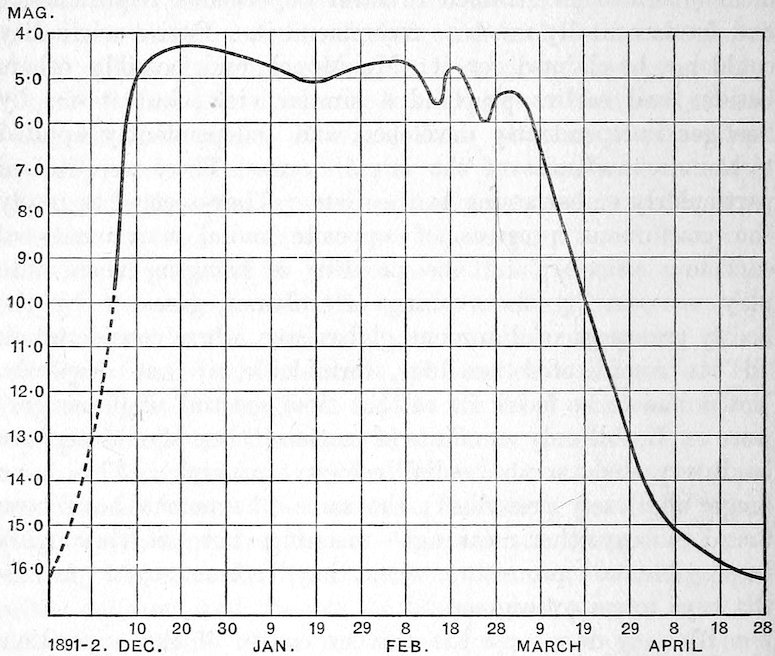
Fig. 42.—Light-Curve of Nova Aurigæ.
We may now trace the further course of the apparition.
During nearly three months it retained most of its brightness,
despite wide fluctuations; then on 6th March a precipitate
decline set in, bringing the object on 26th April to the limit
of visibility with the great Lick refractor. In Fig. 42 the
course of change so far is graphically portrayed. It was
naturally believed to have reached its term; the Nova seemed
definitively extinct; but in this, as in other respects, its behaviour
defied anticipation. Observations resumed 17th August
1892, after its conjunction with the sun, showed, in the place
of the vanished star, a stellar nebula of the tenth magnitude.[754]
The recovered light was entirely altered in quality. No
stranger disclosure has been made by the prismatic method
than that of the spectral transformation of Nova Aurigæ
between March and August. The dark lines of the former
spectrum had become effaced; the bright lines were no longer
chromospheric but nebular. Their character, moreover, denoted
disturbance of a very peculiar kind. They were wide and
hazy, and some at least could be resolved into groups projected
upon a feeble luminous background.[755] Plainly the state of
things producing the complex “reversals” noted in the spring
had become intensified in the reappearance of the autumn.
Yet the multiple bands composing the new spectrum corresponded
most faithfully, in number and mean position, with
the rays of a planetary nebula. The representation was
essentially perfect. Out of nineteen Nova-lines measured
by Professor Campbell, only one of subordinate importance
appeared foreign to nebular light.[756] Both the Wolf-Rayet blue
381bands were present, as in certain planetaries; while the distinctive,
though enigmatical, nebular line at λ 373, noticed as
absent from the Tulse Hill photographs of the original spectrum,
emerged as it altered, and was recorded by Von Gothard at
Herény in November 1892.[757] All the metallic lines, all the
helium lines (except a trace of λ 4472) had died out; only
those of hydrogen survived; and hydrogen glows universally.
The metamorphosis could hardly have been more complete.
Professor Campbell might well say that the relation of the
later to the earlier spectrum was “not apparent.”[758] It was
certainly most obscure. At least, however, the conviction was
acquired that the light “emanated from one source;” although
subsequent experience obliges us to regard as fictitious the
rapid approaching movement attributed to that source on what
then seemed incontrovertible evidence. The presumed velocity
reached a maximum of 190 miles a second in September, but
in November 1892 had decreased to about half that value.
And the slackening continued until, at the end of two years,
the shifted lines occupied almost normal positions. Subsidence
of physical agitation might safely be associated with
the change. It was attended by spectral modifications of a
different kind. In the transformed Nova bright lines at
λ 436 and λ 575 were at first prominent. They also occur
in nebulæ, but by exception and inconspicuously. Eventually
they faded out, and the spectrum remained typically nebular
save for the anomalous breadth of the lines.[759]
As a star, Nova Aurigæ had been decidedly yellow; in its
nebular stage it assumed a greenish tint. Its chromatic
peculiarities accounted for the haziness of its aspect with
many refractors. Outstanding rays, left unfocussed when the
rest were united, created a spurious disc of which no trace
could be perceived with a reflector.[760] The revived Nova
maintained tenth-magnitude lustre with trifling fluctuations
for upwards of four years; then it began once more slowly to
decline, and in the latter part of 1897 looked “more like a
most minute and faint planetary nebula than a star.”[761] In
3821897 it had sunk below the thirteenth magnitude; in 1900
it touched the fourteenth.[762] A partial revival was noted at
the Lick and Yerkes observatories in 1901, the peculiarity of
its focus continuing to indicate the nebular quality of its light.[763]
Nova Aurigæ was neither the first nor the last temporary
star to don, in fading, a garb of nebular light. Nova Cygni
passed through an identical phase, and the example has since
been frequently imitated. Chiefly, indeed, the methods of
investigation brought to bear upon it, and the novel considerations
to which, in consequence, it gave rise, rendered the
apparition of 1892 memorable. Its dominant features were
those of a model “blaze star”; but they were for the first
time decisively ascertained. An evanescent phenomenon was
rendered virtually permanent, and for dubious visual impressions,
definite transcripts of fact were substituted. They
are likely to be multiplied in the future; and it has meantime
become abundantly clear that no special theory, fitting
only the circumstances of Nova Aurigæ, can be true.[764] Whatever
rationale of them may be ultimately adopted, it must be
one capable of general application.
The photographic era of investigation began with Nova
Aurigæ, that of photographic discovery with Nova Normæ.
The former object was still visible when the latter came into
notice. Virtually a replica of the earlier spectrum imprinted
itself upon a Draper Memorial plate exposed at Arequipa by
Professor Bailey 10th July, and examined by Mrs. Fleming at
Harvard College 26th October 1893.[765] It included about a
dozen bright lines, each shadowed by a dark one on its more
refrangible side. In position, in relative shift, in character,
the system of duplicate rays matched with singular fidelity
that scrutinised and wondered at in the previous year. There
was then nothing casual about its production. The spectral
displacements and the augmented refrangibility of the dark
lines belonged to the essence of the phenomenon. Portentous
velocities, specially directed, and inherent in specially constituted
masses, could have had nothing to do with them.
383The appearance of Nova Normæ, then, disposed of what was
left of the encountering star-theory.
The conflagration was of a strictly temporary nature.
Absence from a chart-plate proved the star to have been fainter
than the fourteenth magnitude, 27th May 1893; and a spectrographic
plate, taken 21st June, added the information that it
had not at the later date reached tenth-magnitude brightness.
Its rise to the seventh, on or before 10th July, was
probably effected in a few hours; but though fortunately
registered at an early stage in its career, it was not recognised
for nearly four months, by which time it had sunk to one-sixth
of its primitive lustre. The same marvellous change
witnessed in Nova Aurigæ attended its decline. On 13th February
1894 Professor Campbell[766] succeeded in observing the
star with the Lick thirty-six inch, in spite of its low meridian
altitude of barely 2½ degrees. The spectrum was nebular.
It consisted, to the eye, of the well-known trio of green rays,
together with the golden line (λ 575), also emitted by the
transformed Nova of August 1892. Measurements of them
afforded no evidence of displacement; their wave-lengths
were as usual. Towards the middle of 1895 Nova Normæ
became telescopically invisible. It was already provided
with a successor. Just as it glimmered out, a star in the
constellation Argo lit up. Nova Carinæ was detected by
the same means as, though with somewhat more delay
than, Nova Normæ. Two impressions of its spectrum, which
chanced to be secured, on 14th April and 15th June 1895
respectively, disclosed precisely the same arrangement of
coupled lines, the dark set above the bright, so remarkable
in earlier examples.[767] During those two months this
had not appreciably varied, but a significant change of a
different kind had come about. A vivid ray at λ 4700
(approximately), scarcely visible 14th April, was as bright as
the hydrogen lines on 15th June. Its identity with the Wolf-Rayet
azure band—the leader line of the Rydberg hydrogen
series—may safely be assumed, and its kindling was most
likely the prelude to a complete nebular transformation. But
of this we have no certain knowledge, since the later history
384of Nova Carinæ remained unwritten. The conflagration was
brief; it had burnt itself out before Mrs. Fleming’s examination
of the plates transmitted from Arequipa gave the alarm
of its occurrence. Hence no express observations were feasible.
The year 1895 was prolific of temporary stars. One was
retrospectively announced to have appeared in the constellation
Perseus in 1887.[768] A bright-line spectrum, dimly self-imprinted
upon a Draper Memorial plate exposed at that period, was at
first thought to signify the rise to maximum of an ordinary
Mira-variable. But the originating object soon vanished, to
all seeming, definitively, and its brief incandescence asserted
itself, by its non-recurrence, as that of a new star. There was
a further note of distinction. The fifth line of hydrogen (Hε),
never apparent in an ordinary variable, glimmered in the
peculiar spectrum of the star of 1887, which included besides
an unknown line at λ 4060.
The last record obtained of Nova Carinæ preceded the first
of Nova Centauri by just a fortnight. They differed, however,
widely in character. The spectrum singled out by Mrs. Fleming,
12th December 1895, from a crowded spectrographic picture
taken at Arequipa 18th July in the same year, resembled
that of an exceptional nebula, 30 Doradûs. It seemed abortively
or imperfectly stellar.[769] The source, too, from which it
emanated was situated in a nebulous environment. With the
fading of its brightness—which probably never greatly exceeded
the seventh magnitude—an outlying portion of a known
nebula (N.G.C. 5253), momentarily effaced by the blaze,
as a fire is “put out” by the sun, shimmered into view,
like a halo round the dying star.[770] It still survives, while not
a trace can be seen of its quondam inmate. By the time that
Nova Centauri came to be recognised, it was unfortunately
already far advanced on its return to obscurity. It had sunk
below the eleventh magnitude on 22nd December, when
Professor Campbell secured the first of three observations
of its spectrum. He described it as continuous, though
peculiar, for the blue section was of disproportionate
strength, and the yellow showed inequalities, as if through the
385superposition of bright lines.[771] A parting glimpse of the
strange star was caught by Professor Hussey at Lick on 16th
July 1896. It was then excessively faint, and immersed in
nebulosity. The analogy between this apparition and that
which illuminated the great Andromeda nebula in 1885 was
unmistakable, and both diverged significantly from the type
of Nova Aurigæ.
It was reverted to by Nova Sagittarii. This star was
photographed at Arequipa 8th March 1898, and identified
by Mrs. Fleming as “new” a year later.[772] Yet it was
at maximum fully the equal of Nova Aurigæ, and might
have been seen at a glance by any one familiar with sky
scenery. It waned, however, very speedily. It was of only
8·2 magnitude on 19th April, when a spectrographic record
chanced to be secured, and had declined to the eleventh before
its deliberate investigation became possible. Plate XVI. Fig. 4,
reproduces two spectral photographs of Nova Sagittarii, obtained
within forty-eight hours of each other. Six or seven hydrogen
lines are shown in them, broad and bright, but without the
dark companions usually visible in such spectra. The second
band from the right is the more refrangible of the Wolf-Rayet
blue radiations (λ 4643); the K of calcium is absent, but
six sharp rays, identified with chemically unclaimed lines in
the spectrum of Nova Aurigæ, came out distinctly on the negatives.
Although taken at so brief an interval, the records
disagreed in some particulars. Thus the unknown line at λ
4060, emitted by the first Nova Persei (1887), was strongly
absorbed in Nova Sagittarii on 19th April, but had vanished
on 21st April; while the chief nebular line, invisible at the
earlier, shone at the later date. The initiated change did
not stop here. In March and April 1899 a purely nebular
spectrum was derived from the semi-extinct object by Professors
Campbell and Wright.[773] The regular cycle had been run
through; a planetary nebula replaced the faded star. In one
important respect, nevertheless, Nova Sagittarii had departed,
so far as the extant data could inform us, from the pattern set
by Nova Aurigæ. The spectrum, as already mentioned, was
386single, not duplicated by absorption. But there is good reason
to believe that this difference did not originally exist; it supervened
with the declension of light. In “temporary” spectra
the bright lines always seem to survive the dark; the chiaroscuro
effect is produced only near the period of maximum, and
this period had terminated before the star of 1898 was spectrographically
registered. Earlier impressions, we may be sure,
would have displayed the coupled lines symptomatic of the
enormous disturbances attending these extraordinary outbursts.
Their frequency, established by the camera, is a fact of
subversive import, but has already ceased to excite surprise.
The recognition of the autographs of new stars has become a
regular part of the business conducted at such a “Solomon’s
House” as the Harvard College Observatory. In the Annual
Reports thence issued the mention of new stars has grown to be
habitual and familiar. Of Nova Sagittarii the last had only just
been heard, when Nova Aquilæ was announced to have appeared.[774]
This was about fifteen months after date. The star made its début
on a Draper Memorial chart-plate 21st April 1899 as an object
of the seventh magnitude, and displayed the quality of its light
in a spectrograph taken 3rd July. It was characteristically
that of a Nova, although nebular lines had begun to come in,
and the transformation was completed in the course of
September. During a year, Nova Aquilæ wore the aspect of
a planetary nebula, sinking gradually from the tenth to the
twelfth magnitude. It was last observed by Professors
Campbell and Wright with the Lick thirty-six-inch refractor
and a 60° prism spectroscope. “The visible spectrum,” the
former wrote,[775] “consisted of extremely faint continuous light
in the green, and of three bright bands in the positions of
the three principal nebular lines. The relative intensities of
the three bands agreed approximately with the corresponding
intensities in the well-known nebular spectra. The bands
were not monochromatic, but on the contrary were very broad,
perhaps fully twice as broad as the bands in the nebular
spectrum of Nova Aurigæ in August 1892.”
It may be useful to tabulate the results, in the discovery
387of new stars, of the photographic surveys executed at Harvard
College and at Arequipa, its southern dependency.
(i.) Nova Persei. Appeared 1887; ninth magnitude;
hydrogen lines and λ 4060 bright. Temporary character
recognised 1895.
(ii.) Nova Normæ. Spectrum photographed 10th July
1893; character detected 26th October 1893. Seventh
magnitude; showed twelve bright lines coupled with more
refrangible dark ones; spectrum nebular 13th February 1894.
(iii.) Nova Carinæ. Spectrum photographed 21st April
1895; examination followed in October. Hydrogen lines
bright with more refrangible dark companions. Faded from
eighth to eleventh magnitude between April and July.
(iv.) Nova Centauri. Spectrum photographed 18th July
1895; irregularly continuous; resembled that of 30 Doradûs.
Character detected 12th December 1895. Maximum magnitude
7·2. Situated within a nebula.
(v.) Nova Sagittarii. Photographed 8th March 1898,
when of 4·7 magnitude; detected March 1899. Spectrum
photographed 19th and 21st April 1898. Hydrogen lines
bright; no dark companions; λ 4060 dark. Spectrum
nebular, 13th March 1899.
(vi.) Nova Aquilæ. Photographed 21st April 1899, when
of seventh magnitude. Bright-line spectrum photographed
3rd July 1899; recognition ensued in July 1900. Spectrum
nebular, October 1898.
In the course of seven years, then, five temporary stars
were photographically discovered, and it is safe to assert that
all would have escaped direct visual notice. Apparitions of
the kind are, we hence learn, hardly to be counted as exceptional;
their occurrence cannot depend upon rare contingencies,
but must enter, to some extent, into the regular economy
of nature. The conditions precedent are doubtless widely
prevalent, and they are the same for outbursts of all magnitudes
indifferently. The famous Novæ of history—the
stars of Hipparchus, of Tycho Brahe, of Kepler—were due to
just such prepared accidents as result, more frequently and
less obtrusively, in the appearance of an extra dark dot on a
chart-plate, or in the emergence, on a prismatic negative,
of a “peculiar” spectrum among a crowd of normal ones.
388
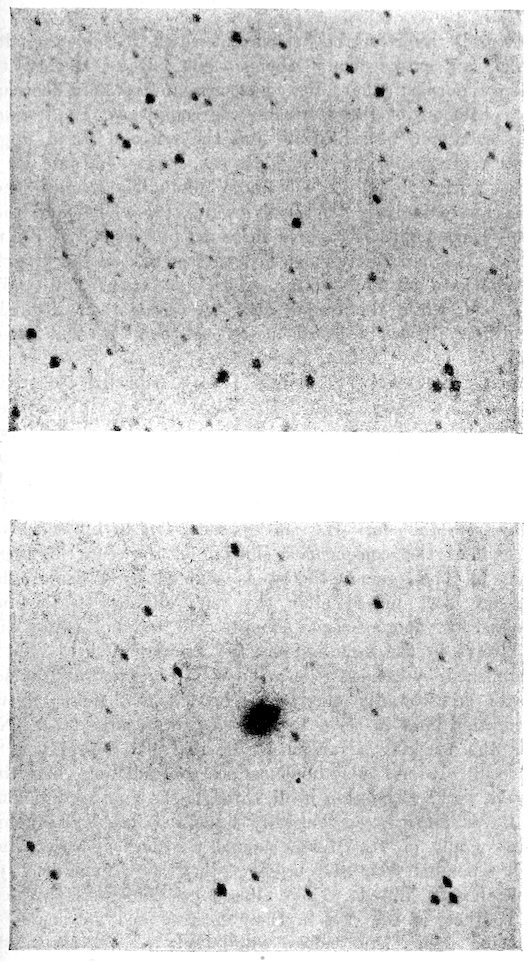
Fig. 43.—Photographs of the same field taken at Harvard College before and after the outburst of Nova Persei. No. 1, 19th February 1901. No. 2, 26th February 1901.
But this obscure kind of manifestation was far transcended
by the “New Star of the New Century” (to quote Father
Sidgreaves’s designation of Nova Persei, No. 2). This object
worthily commemorated the turning of a leaf in the book of
ages. The sidereal heavens had harboured no such brilliant
“guest” since Kepler’s star shone in Ophiuchus. Dr. Anderson,
the discoverer of Nova Aurigæ, was still more lucky with
Nova Persei, for he caught it on the rise. It was, however,
already nearly the equal of Algol when he sighted it in the
early morning of 22nd February 1901; while twenty-eight
hours previously, as a photograph taken by Mr. Stanley
Williams attested, it must have been fainter than the twelfth
magnitude. Confirmatory evidence was derived from the
Harvard College series, two specimens of which are reproduced
in Fig. 43 by the kind permission of Professor Pickering.
In the earlier photograph, taken with an exposure of sixty-six
minutes 19th February, no trace of anything unusual is perceptible;
in the second, to which, seven days later, a shorter
exposure was given, the Nova is of dominating importance.
It continued to gain light rapidly for about a day and a
half after its detection at Edinburgh. On the evening of
23rd February, it was observed through drifting clouds at
Harvard College to be brighter and bluer than Capella.[776] In
thirty hours it had increased by two and a half magnitudes;
during that one night it took rank as the premier star of the
northern hemisphere. But its supremacy was quite transient.
Increase was at once followed by decrease; there can have
been no appreciable pause at maximum. Already on 24th
February, the star had lost fully one-third of its light;
the inevitable downward course was entered upon, and
was pursued, although with singular intermittences. But
the most remarkable characteristic of Nova Persei was its
spectral variability. It showed, to begin with, a spectrum
of the ordinary Orion type—a continuous prismatic strip,
scarcely encroached upon by narrow lines of hydrogen
and helium absorption. Some of these, it is true, proved
on close examination to have their lower edges slightly
brightened, but there was no other sign of disturbance. On
the following night it was noticed that the K of calcium,
390previously imperceptible, stood out markedly obscure, after
which an extraordinary change took place. During the
twenty-four hours that followed the maximum of 23rd February,
the character of the spectrum was completely transformed.
Hydrogen now blazed in it; and the range of broad bright
lines representing its emissions was duplicated, just as in
Nova Aurigæ, by a range of more refrangible shadow-bands.
These were strongly displaced towards the violet, and their
displacement appears to have increased progressively for some
days. It finally corresponded, if interpreted on the Doppler
principle, to an approaching velocity of about 1000 miles
a second, while the bright lines, so far as their distended
condition allowed a judgment on the point to be formed,
retained pretty nearly their usual places. The Doppler
principle, however, had plainly a very restricted application
to the case of Nova Persei. Dr. Vogel[777] used it, with excellent
judgment, to determine the star’s true radial motion from
measurements of fine dark reversals of H and K, which seemed
entirely exempt from alterations of a physical kind. He
found it to be about twelve miles a second in a direction
away from the sun. He was less successful in his endeavour
to explain the conspicuous shifting of the dark hydrogen
lines on the pressure-theory as adapted by Wilsing. For
pressure does indeed alter the refrangibility of the rays
emitted by vaporous strata submitted to it, but the alteration
is always in the same sense. The refrangibility of light is
diminished by condensation; the resulting spectral displacements
are towards the red. Nevertheless, those of the
absorption lines in Nova Persei were towards the blue. Nor
was the masking arrangement devised for the purpose of
smoothing away this fundamental contradiction, one that
would work. The star itself, through the gradual unfolding
of its peculiarities, emphatically disavowed it. A Stonyhurst
spectrograph of 7th March showed the dark hydrogen lines
well separated from the bright;[778] they were unmasked, yet
none the less shifted. Their altered positions were thus seen
to be those of the rays in their entirety, and not merely of
outlying wings left visible, while their central parts were
391concealed. Subsequently to 7th March these lines thinned off,
and in about a fortnight disappeared finally. The spectrum
then remained in much the same condition as that of Nova
Sagittarii at the date of the earliest record of it; the
distinctive chiaroscuro effect was gone; the bright lines no
longer cast shadows.
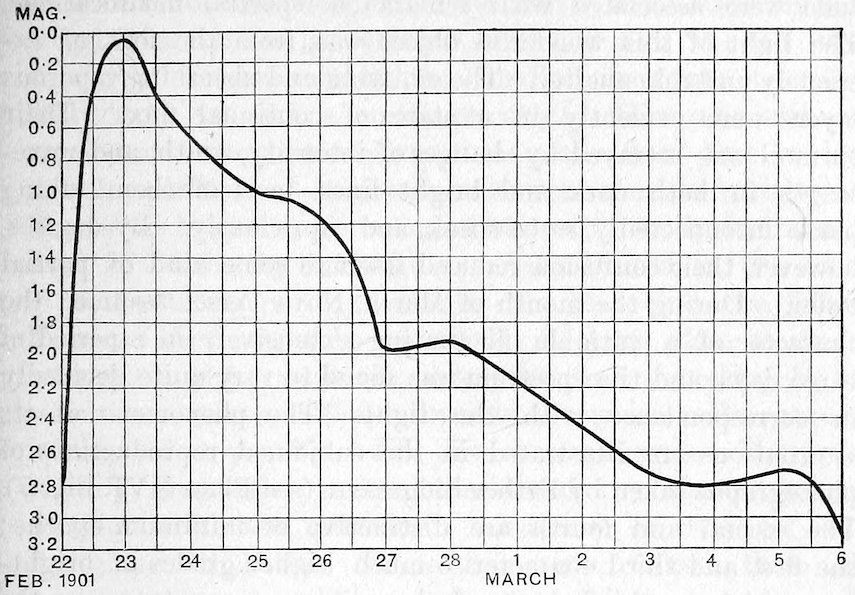
Fig. 44.—Light-Curve of Nova Persei, 22nd February to 6th March 1901.
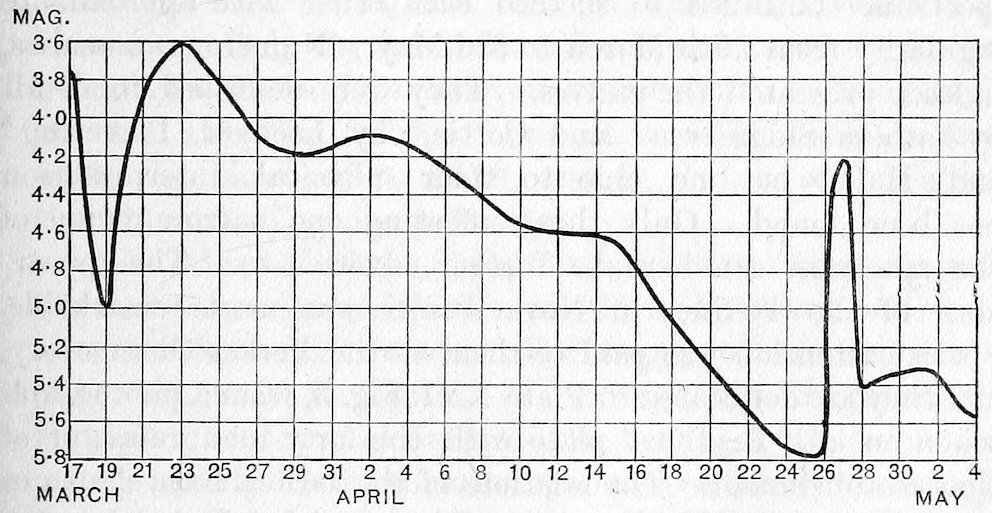
Fig. 45.—Light-Curve of Nova Persei, 17th March to 4th May 1901.
Sections of the light-curve of Nova Persei are delineated
in Figs. 44 and 45. They seem to tell of a long succession
392of efforts towards recovery, constantly defeated by the invincible
advance of exhaustion. These variations in magnitude
were associated with remarkable spectral modifications.
The light of this wonderful object was, from the first, of extremely
unstable quality. The emitting and absorbing vaporous
layers were evidently in a state of continual flux. Their
turmoil was betrayed by changes of intensity, width, and wave-length
in both dark and bright lines, most of them taking
place unconnectedly, so to speak, and capriciously. By degrees,
however, their confusion reduced itself to some kind of partial
order. During the month of March, Nova Persei assumed the
character of a variable fluctuating extensively in a period of
three days, and the spectrum was found to vary quite decidedly
in correspondence with the light. The phenomena of its
alternations are illustrated in the subjoined reproductions of
photographs taken by Father Sidgreaves (see Plate XVI. Fig. 5).
The second and fourth are distinctive of minimum epochs;
the first and third characterise much higher grades of brightness.
Among the features of the minimum spectrum are the
fading of the continuous radiance, the displacement upward of
the first ultra-violet member of the hydrogen series (Hζ), and
the development of a blue band at λ 463. The two types of
spectrum continued to succeed each other with approximate
regularity from 19th March to 3rd May. Numerous anomalies,
indeed, presented themselves. They were described in detail
by Fathers Sidgreaves[779] and Cortie,[780] by Lockyer, Pickering[781]
and Hale,[782] but no clue to their physical interpretation
has been found. Only those affecting one narrow region of
the spectrum can here be further adverted to. The appearance
of the D-lines in Nova Persei was most remarkable.
Special attention was paid to them at the Yerkes Observatory,
and they are delineated in Plate XVI. Fig. 3, from a photograph
taken on an “Erythro” plate with the forty-inch refractor of
that establishment. The relations of the various lines shown in
it need some brief explanation. The broad bright band is due
to the radiation of sodium; the fine dark lines projected upon
it are obvious reversals by a cooler and rarer overlying stratum
393of the same metallic vapour. These threads of absorption are
slightly displaced towards the red; they indicate about the
same rate of recession from the earth that was derived by
Vogel from the similar reversals of H and K. The fact, then,
admits of no doubt that the kindled mass was travelling
away from us with a small velocity.[783] This remained constant—so
far as our information goes—from first to last;
but the position of bright D underwent a marked alteration.
The broad bright band, traversed almost centrally in the early
days of March by hair-like reversals, shifted in the course
of a month so notably towards the blue that the fiducial
lines (as they might be called) lay in April close to its less
refrangible edge; while the absorption line concealing D3 had
meantime become diffused towards the violet. We have no
inkling of a possible cause for these changes. They were
steadily progressive, and so disclaimed any immediate connection
with the periodical variations of the Hζ line.
According to Father Sidgreaves’s view, indeed, these last
originated from no change of refrangibility, but from the
brightening of a cyanogen band situated just above the
hydrogen line it illusorily modified. The sodium band,
however, actually moved upward; the emitting molecules
quickened their vibrations through some unknown kind of
influence. Only the less refrangible members of the helium-series
glowed in this marvellous spectrum. None higher
up than the blue “Orion” line at λ 4472 could be seen;
while the blood-red λ 6678, and D3 (when sodium-absorption
thinned off) shone intensely.
The colour of Nova Persei changed from white to red a
few days after its maximum on 23rd February, and red it
remained for some months. The tinge, indeed, lightened to
clear orange in its spasms of recovery, but deepened to a
purplish glow at each subsequent decline. It faded completely
in July 1901, when the spectrum of the Nova resembled
that of a planetary nebula.[784] Plate XVIII. Fig. 2 illustrates,
from the Lick observations, the predominance in it, on 11th
August, of the leading nebulium-radiation. This was in
394accordance with precedent; but the wildest flights of imagination
were outrun by what ensued.
On 22nd and 23rd August 1901, Professor Max Wolf
took long-exposure photographs of the Nova with the sixteen-inch
Bruce objectives lately mounted as a twin-telescope at
Königstuhl. Both plates showed the presence of detached
nebulous masses to the south-east of the star;[785] and these
proved to be only the brightest parts of a vast spiral formation
photographed by Mr. Ritchey at the Yerkes Observatory on
20th September, under the form represented in Plate XVIII.
Fig. 1.[786] Its intimate structural relationship to the star is
patent; but there was more to come. Renewed impressions
obtained 7th and 13th November with the same instrument—a
twenty-four-inch reflector of his own construction—showed
Mr. Ritchey that the nebula was expanding with portentous
speed;[787] and an identical discovery was made by Mr. Perrine
from a comparison of the Yerkes photograph of 20th September
with a Crossley picture secured by a duplicated exposure 7th
and 8th November.[788] The movements indicated were at the
rate of about one minute of arc in five weeks; and they were
maintained until the dimly shining spires affected by them
faded into chemical invisibility. Moreover, the spinning of
the nebulous web was found to have been an initial accompaniment
of the stellar outburst. Two close coils of it were
discerned by Mr. Perrine on scrutiny of a negative exposed
for ten minutes 29th March 1901.[789] And since they were
closer in the ratio of their expansion between September and
November, it became evident that the process had gone on
unchecked during seven or eight months; while the tracing
of it backward showed it to have actually commenced almost
simultaneously with the kindling of the conflagration. That
is to say, the rate of flow of the nebulous streams indicated
their issue from the Nova about 17th February, or five days
previously to its visible manifestation.
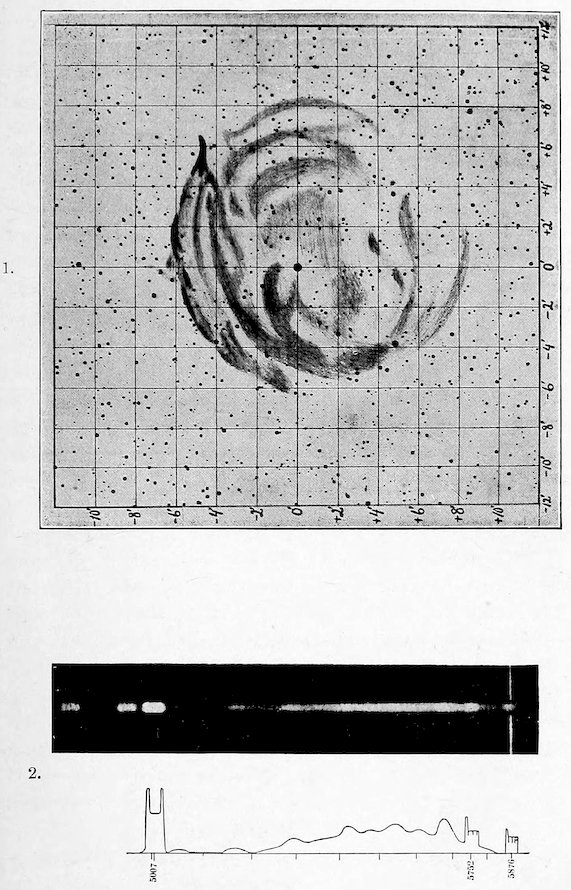
PLATE XVIII.
1. Nebulosity round Nova Persei (Ritchey).
2. Spectrum of Nova Persei, 11th August 1901, with corresponding Intensity-Curve (Campbell and Wright).
Speculation regarding this unique phenomenon has naturally
been active; and an explanatory hypothesis of considerable
395plausibility was hit off independently by Professor Kapteyn[790]
and Mr. W. E. Wilson.[791] It affirms the nebula to have been
pre-existent, and to remain unchanged. But since we see it
by the reflected light of the Nova, its various spires and
condensations have come successively into view as the flare
of the explosion travelled outward in widening circles. Hence
an illusory effect of radial expansion was produced, while, in
point of fact, the temporarily illuminated cosmic folds were
as immovable as aligned snow-peaks, in turn set aglow by
the rising sun. The parallax corresponding to this rationale
is 0″·011; it implies that the Nova actually blazed in the
third year of James I. (1605), and rose to a culminating
splendour eight thousand times that of our sun. In this, at
least, there is no improbability. The star is devoid of sensible
parallax or proper motion; and its distance from the earth
cannot, accordingly, be expressed in “numbers that have
name.”
A strictly temporary character may safely be ascribed to
its nebulous appurtenances; they were either evolved from its
mass, or rendered luminous through its influence. Professor
Max Wolf suggested the propagation of electric waves of the
Hertzian type as the cause of the far-spreading excitement
attested by the gleaming annuli. Professor Very[792] inclined
to regard them as constituted by material corpuscles, such as
give rise to cathode-rays, ejected from the star under the
stress of light-pressure or electrical repulsion. There was,
however, as Mr. Louis Bell[793] remarked, no evidence of acceleration,
consequently none of the continued action of a repulsive
force; while the supposition that the nebula round Nova
Persei had been photographed by reflected light was, in his
opinion, discredited by the absence of polarisation-effects, as
well as by the long persistence of strongly nebulous patches
close to the star, which, unless they had been self-luminous,
should have vanished with its fading. Their light, accordingly,
is surmised by Mr. Bell to have been of an auroral nature.
It developed as a secondary consequence of electro-magnetic
strains, propagated through space with the velocity of light,
from a sun-like centre of disturbance.
396What cannot be gainsaid is that the apparition, with its
strange attendant circumstances, ranks as the most interesting
on record. Even the classic Nova Aurigæ was far outdone
by the surprising diversity of the phases, both spectral and
luminous, exhibited by its brilliant successor. Their study
afforded much new knowledge, and opened wide tracts for
future experiment and research. A critical point of difference
between the observations made on the two occasions
was the timeliness of those on the latter star. They
were in full swing while it was still mounting towards the
summit of its splendour. As a consequence, the order of
its spectral phenomena was clearly ascertained and proved
wholly unexpected. At the outset, the light was of ordinary
quality; waning had already set in before the displacements
and distension of its linear ingredients announced the
prevalence of disturbance. This fact is full of meaning; let
us weigh it well. We learn from it that the sudden development
of luminous energy was essentially of photospheric origin.
Gaseous eruptions and explosions followed, and produced the
duplicated spectrum characteristic of temporary stars. But
they were merely incidental to the primary event, which
occurred independently of them. This disclosure narrows the
field of speculation as to the nature of that primary event,
and is so far enlightening. Further, we now know that the
symptoms associated with prodigious radial velocities were
not inherent, but consequential. The obscure body abruptly
kindled to vivid incandescence gave no evidence of rapid
motion; it seemed a leisurely traveller through space.
We may now attempt to arrange and generalise the items
of information lately gained about Novæ. Three have
appeared in nebulæ or clusters—Nova Scorpii in 1860, Nova
Andromedæ in 1885, and Nova Centauri in 1895. Set
apart by their nature no less than by their situation, they
were evidently transient adjuncts to the formations in which
they were immersed, and probably imitated their luminous
peculiarities. Our knowledge of them, however, is partial
and unsatisfactory. Passing on to “blaze stars” proper, we
note the following circumstances as common to the class.
1. They have their habitat in the Milky Way. Nova
Coronæ alone had any considerable galactic latitude.
3972. None have any sensible parallax or proper motion.
They must then be vastly remote.
3. They rise from and relapse into approximate obscurity.
The one known star distinguished by a temporary flare was
Nova Coronæ. Several, nevertheless, continue perceptible in
their effete state.
4. The bright lines of Novæ are coupled with dark lines
of shorter wave-lengths. This mode of juxtaposition is
invariable.
5. The spectra of Novæ resemble, in their early stages,
that of the solar chromosphere, later that of nebulæ, the
emissions of hydrogen and helium ultimately yielding their
predominance to the green rays of nebulium. The Wolf-Rayet
blue bands generally make an intermediate appearance.
Now what may we legitimately conclude from these varied
phenomena? Very little, unfortunately, of a positive nature;
we must be content, in the main, with negative inferences.
Yet it is no small advantage to clear the ways of thought by
abolishing untenable hypotheses. It may then safely be
stated that the remarkable spectral shiftings in temporary
stars are not effects of translatory motion; they supply no
argument for the duplicity of the light-source. Neither do
they originate through pressure, which tends to damp down
vibrations, not to accelerate them; and it is chiefly a shortening
of wave-lengths that has to be explained. Staggered by
this difficulty, Dr. Wilsing suggested[794] the alternative view
that Novæ are not incandescent, but “luminescent” bodies.
The distinction, first made by E. Wiedemann,[795] is valid and
valuable, although next to nothing is known about the essential
conditions upon which it rests. All that can be said is that
they involve the production of light to a great extent without
heat. But the supposition that they are found in temporary
stars is an extremely hazardous one. It is countenanced only
by the one fact that emissions due to luminescence are, or
may be, accompanied by corresponding absorptions of greater
refrangibility, and so present a colourable imitation of the perplexing
chiaroscuro spectrum displayed during stellar outbursts.
On the whole, the most promising theory of their occurrence
398is that stars in the Milky Way occasionally get entangled
in the diffused nebulosities with which that region abounds,
and blaze through the resistance offered to their motion, just
as meteors kindle to brief splendour in shooting athwart our
cloud of “circumfluous air.” We must, it is true, be content
for the present to accept it in principle; attempts to elaborate
it in detail can only, until much fresh knowledge has been
acquired, result in failure. Even M. Seeliger’s[796] ingenuity did
not avail to conduct him to a successful issue. He demanded
too much from the star-and-nebula hypothesis—demanded,
indeed, more than the conditions (as we now know) actually
required; and it hence incurred unmerited discredit. Admitted
provisionally, it will perhaps serve as a guide to ultimate
truth. An important discussion of the possibilities connected
with it, and of the manner in which they might serve the
purposes of spectroscopic interpretation, was published by
Mr. J. Halm of the Edinburgh Observatory in July 1901.[797]
Proceeding from the hypothesis that a Nova becomes visible
when “a dark body impinges upon, and penetrates into a mass
of nebular material,” he constructed a vorticose system of
radiating and absorbing gases travelling with the great
intruded globe, and skilfully adapted in all its parts to give
rise to the observed phenomena. His arguments are not,
scarcely indeed could be, in all respects convincing; yet they
form a contribution of stimulating quality to the general
doctrine of temporary stars. This has wide bearings. It
should include, not only a rationale of the actual conflagrations,
but also some definite and consistent view as to the
previous state and history of the bodies subjected to them.
They are glibly designated “dark stars,” but embarrassments
supervene when we attempt to give precision to our conceptions
of what constitutes a “dark star.” We will, nevertheless,
essay the task in the next chapter.
399
Dark stars are of sun-like dimensions, but of planetary
obscurity. They constitute a realm scarcely penetrable by
direct investigation, and therefore eminently inviting to
speculative thought. They are indefinitely numerous; they
may be, in many cases, enormously massive and bulky; they
are probably endowed, in general, with very high velocities:
some are perhaps among our nearest neighbours in space.
They exist both in a solitary and in an associated condition.
The dynamical relations of unattached dark stars, although of
the deepest interest, from their bearing upon large questions of
sidereal construction, are unknown, and seem likely long to
remain so; but in mixed systems of shining and obscure
bodies they are readily open to investigation. Such systems
occur quite freely, as we learn from observations of three
distinct kinds. Their unseen members variously betray their
presence: (i.) by perturbing the orbital movements of visually
double stars; (ii.) by occasioning periodic changes of velocity in
visually single stars; (iii.) by occulting their bright primaries,
and so causing them to be affected with a special type of
variability. In the first case, the effects can be discerned
telescopically, in the second they come out spectrographically,
in the third they are both photometric and spectrographic.
Solitary dark globes, on the other hand, are brought within
our ken in only one fashion. Given a certain combination of
circumstances of a barely conjecturable nature, they leap into
light as Novæ, and in this capacity attain various degrees of
notoriety.
The existence of an “invisible” department in astronomy
400was divined by Laplace; it was demonstrated by Bessel
through his discovery, with the mind’s eye, of the semi-obscure
satellites of Sirius and Procyon. Its importance cannot
well be exaggerated. Unseen bodies may, for aught
we can tell, predominate in mass over the sum-total of those
that shine; they supply possibly the chief part of the motive
power of the universe. They appear, at any rate, to be
profusely distributed throughout its compass. One star in
six, by a fair estimate, is a spectroscopic binary; and spectroscopic
binaries commonly disclose their nature, not by the
doubling, but by the shifting of their spectral lines. This is
as much as to say that one of the revolving masses radiates
imperfectly or not at all. Again, temporary stars presumably
rise from crowded ranks. For every one that blazes into view,
multitudes must remain undistinguished. The raw material
of such outbursts is doubtless lavishly provided, while the
accidents actually occasioning them must be few. Stellar
apparitions thus derive extraordinary importance from their
implication of an unfathomable background stored with effete
or undeveloped suns, the presence of which evades immediate
cognisance.
“Dark stars” need not be absolutely obscure. Some,
at any rate, may be feebly luminous, though powerfully
attractive, like the companions of the Dog stars. These,
if situated much nearer to their primaries, would escape
telescopic recognition, and could challenge spectrographic
notice only indirectly, through the motion-displacements due to
their influence on the brilliant spectra superposed upon, and
effacing their own. In other cases, stars are swayed from their
computed paths by the power of entirely rayless satellites. The
fourth member of the system of ζ Cancri, and the hypothetical
third component of 70 Ophiuchi appear to be dark in the
strictest sense. Most probably an indefinite number of
gradations connect the planetary and sun-like states. Thus
in some Algol pairs the occulting body is to our appreciation
obscure; in others it gives some, though very little light;
while in a third variety the companions stand on the same
level of lustre. Algol itself, U Cephei, and Y Cygni specifically
exemplify these differences. They manifest themselves
as well in non-eclipsing spectroscopic binaries. A minority,
401headed by β Aurigæ, consist of globes fully luminous; a few,
such as α Virginis and ο Leonis, show traces of a second
spectrum; but most are real crypto-doubles, only one member
of which emits any perceptible light. With these the
heavens may be said to swarm.
A number of interesting questions are suggested by the
vast numbers and singular relationships of dark stars. What
is their history? What their destiny? What their function
in the universal scheme of things? The view commonly taken
of them is that they are antiquated suns—suns in a state of
senile decay—suns that, having used up their radiative
vitality, are relegated to a lower cosmic plane. Such there
must be, unless regenerative machinery be at work to supply,
in some unimagined way, the perennial waste patent to our
senses. Suns wear out, yet do not incur annihilation. They
must survive their faculty of shining. Immense, but strictly
limited reservoirs of energy, they are constructed, not for its
economical storage, but for its rapid expenditure. Its exhaustion,
which, to our apprehension, is simply a question of
time, will leave them gigantic earths, solid, inert globes, with
only their gravitative force unimpaired. That quondam-suns
of this description pursue their unnoticed journeys through
space, cannot reasonably be denied; they undoubtedly swell
the hosts of dark stars; yet there are indications that these
are not mainly of the effete quality—that they do not merely
represent the caput mortuum resulting from one inexorable
evolutionary process.
The frequent association of obscure with brilliantly
luminous stars is very remarkable. Algol and its companion
make a typical instance. They are assuredly of contemporaneous,
and, judging by the usual criteria, of comparatively
recent origin. The closeness of the system formed by them
denotes, on the theory of tidal evolution, that it has, during
no very long time, been subject to such modifying influence;
and Algol itself bears all the marks of stellar juvenility.
Another specially instructive example among non-eclipsing
binaries is afforded by Castor. Here a great Sirian sun has
an obscure and a brilliant attendant circulating respectively in
less than three days and in several hundred years. Now the
remote component must have separated from the parent sphere
402long before the close satellite came into being; yet it is at the
acme of vitality, while that of the junior star is, so far as
radiative symptoms can tell, already spent. Nor is there any
warrant for assuming that they differ considerably in mass.
Indeed, whatever disparity there may be is just as likely as
not to be in the wrong direction. A doubt thus arises whether
the shining of suns depends solely upon temperature; for
gradations of cooling cannot possibly account for the abrupt
contrasts of luminosity met with in mutually revolving globes.
Irresistibly the hypothesis presents itself that, among the
varieties of the cosmos, there may be a multitude of bodies
conditioned in most respects like suns, but which have never
attained to the possession of a photosphere, and have
consequently remained imperfect radiators. The formation of
the dazzling cloud-shell by which suns are visibly bounded, is
a baffling enigma. It must involve an intricate combination
of circumstances, not always perhaps realised. Should any of
them fail, a “dark star” would result—a body intensely hot,
yet destitute of the apparatus requisite for the effective diffusion
of light and heat.
We can now see that the obscurity of temporary stars
previous to their sudden illumination does not necessarily
imply that they were effete. Their galactic preference also
argues the contrary. The Milky Way is apparently a region
where development has not gone far. Things are there more
nearly in their primitive state than elsewhere in the sidereal
world. Growing and flourishing suns seem to congregate in
that vast gathering-ground, rather than those that have seen
better days. Hence, if stellar apparitions signified the rekindling
of stars sunk to extinction through age, the Milky
Way is precisely the part of the heavens in which we should
least look for their occurrence. That they frequent it almost
exclusively, helps to convince us that their antecedent dimness
was not due to decrepitude. This inference is confirmed by
the character of their spectra. The light suddenly acquired
has the quality considered to mark an early stage of sidereal
development. The blaze of a helium star can with difficulty
be supposed to proceed from a highly-condensed or semi-solidified
body.
Dark stars must then, on this showing, be divided into
403two classes, the first consisting of suns on the retired list, the
second, of those incapacitated by nature for active service. Their
discrimination in practice can scarcely be effected, with our
present resources, otherwise than tentatively or by conjecture.
Still it may not be in all cases hopeless. To take one
instance. The system of 61 Cygni is held by Wilsing of
Potsdam to include one or more unseen members. If so, their
place—since the associated group bears many marks of
antiquity—should be found among lapsed suns. And this
suggests the further thought that, in a few more ages, the
entire family may have ceased from radiation, and will
continue, in the rayless void, to fulfil their mutual rounds and
pursue their way towards an unknown goal. That many such
blind systems exist, inaccessibly to observation, is a conjecture
which can neither be verified nor refuted.
404
The variability of stars is a “wood of error.” There
seems no exit from it; the tracks that invite our ideas to
enter upon them turn out circuitous and misleading. Yet its
exploration need not therefore be abandoned as hopeless; and
indeed lines of approach are converging upon it from many
directions in a manner that promises well for the future
elucidation of much that is still mysterious. In the meantime,
we can at least attempt to arrange the known facts in
some kind of definite order.
Stellar light-change is of two fundamentally separate
descriptions. The first may be termed “extrinsic,” because it
obviously depends upon circumstances not inherent in the
bodies it affects; the second, “intrinsic,” as resulting from
constitutional peculiarities. They are readily distinguishable
by the nature of their time-relations. Punctuality marks the
former kind, a large measure of irregularity the latter. The
difference becomes intelligible if we admit, as we reasonably
may, that short-period or extrinsic variability belongs exclusively
to compound objects, long-period variability to solitary
masses. In no case—except where darkening by eclipse unmistakably
occurs—can we define the kind of action to which
the observed vicissitudes are due; but the power lately acquired
of discerning between the “forced” periods prescribed by
orbital relations and the “free” periods determined by fluctuating
interior conditions, marks an important step in advance.
The circumstance, although unaccountable, should not be lost
sight of that eclipsing and non-eclipsing variables diverge
somewhat emphatically in the character of their spectra. Those
405of Algol-stars belong to the first type, often to the helium
division of it; those of Cepheid stars are mostly solar; and
although enlarged experience may tend to invalidate these
generalisations, it may, on the other hand, serve to reaffirm
them. The spectrographic study of globular clusters—a task
for the immediate future—should help greatly to widen the
bases of knowledge regarding this curious relation; and the
diligent collection of illustrative instances, by limiting the
extent of its prevalence, may throw some light upon its cause.
The secret of short-period variability offers few points open
to attack; but an attempt might be made to penetrate some
of its outworks by comparing the systemic conditions of
steadily lustrous close binaries with those of pairs fluctuating
in magnitude. Stars of the same spectral class should, for
the avoidance of complications, be chosen for confrontation.
Polaris, for instance, θ Ursæ Majoris, λ Andromedæ, are solar
orbs revolving swiftly round invisible companions. In what
respects, it will be of interest to ascertain, do their orbits differ
from those of the variables δ Cephei, η Aquilæ, and ζ Geminorum?
Are they markedly less eccentric? Can they be
inferred to be more spacious? No real discrimination may
be possible, and if so, this line of search fails, and some other
must be struck out. But it is clear that only tentative
inquiries, pursued untiringly and successively, can avail to
bring us nearer to the central truth we are in quest of.
The light-changes of stars are determinate in amount just
in proportion as they are accurate in period. Irregularities of
one kind are concomitant with irregularities of the other.
They reach, in long-period variables, the limit of total disregard
of traceable law. For one settled cause of variability
a number of consilient causes would seem, in such objects,
to be substituted. Should their co-operation break down—should
one among them become temporarily ineffective—every
vestige of cyclical recurrence may disappear. And it is
important to note that stars with disturbed periods merge, by
insensible degrees, into stars with no periods at all. Other
stars show intermittent periodicity. They start cyclical variations
only to drop them after a few recurrences, the alternations
being often repeated at indefinitely prolonged intervals. A
law of order is present; it has not been abrogated; but its
406workings are almost neutralised by adverse influences. Then
again, stars are found subject to uncertain accesses of light-change.
Fits of instability of the most marked kind may be
followed by long epochs of constancy, as in the case of P
Cygni, and, perhaps we may add, of η Carinæ; and many
objects rejected from revised catalogues of variables as having
failed to make good their title to inclusion are similarly stars
reposing after more or less protracted crises of activity. The
relations of stellar fluctuations to time are indeed unlimitedly
various. They are, however, characterised by one feature which
persists significantly, though far from immutably, notwithstanding
the disguising effects, in Mira-variables, of accelerated,
retarded, and duplicated phases. This is the more rapid
increase than decrease of light. It is strongly pronounced in
Cepheid and cluster variables; it asserts itself with modifications
in variables of long period; in the sun it is never
obliterated by the supervening irregularities of the spot-cycle.
This wide range of agreement hints at some deep-seated
principle of community, undefinable at present, and intangible
to our mental grasp, yet lying at the root of the diverse
phenomena of stellar light-change.
Their specific association with particular spectral types is
a fact replete with meaning, no less than the exemption from
variability, complete or partial, of whole classes of stars.
Taking first the negative cases, we find the Wolf-Rayet
family characterised by exceptional stability. Not one of its
five-score members, so far discovered, shows the smallest
symptom of luminous variation. Nor are their congeners,
bright-line helium stars, ordinarily affected by it. Those
that are so affected betray qualities in some way unusual.
Among them are to be reckoned nearly all temporary stars, the
singular short-period variable in Lyra, η Carinæ, and P Cygni.
Nebulous stars are not as a rule variable. The Pleiades
shine with approximate constancy; the star-groups at the
hearts of the great Orion and Trifid nebulæ give no conspicuous
sign of fluctuation;[798] and isolated stars with nebular
appurtenances are, for the most part, steady light-givers.
T Tauri, however, makes an exception; and disappearances,
407transient or lasting, of certain minute stellar denizens of
planetary nebulæ have been, from time to time, asserted or
surmised. White stars of either spectral variety are scarcely
ever intrinsically variable. As spectroscopic doubles they
are indeed subject to obscuration by eclipse; as telescopic
doubles, to slight and capricious fluctuations in the magnitudes
of one or both components, disconnected, apparently, from any
of their orbital circumstances. Only three hydrogen or helium
stars are known to be variable in any true sense; these are
u Herculis, U Geminorum, and R2 Cygni; and the rarity of
this association of qualities makes it especially desirable that
their spectral distinctions should be scrutinised with the
utmost care. Very few second-type stars vary otherwise
than extrinsically. Nor do they, that we yet know of,
undergo eclipses. Yet many are binaries of the Cepheid
kind, and thus become compulsorily variable. The solar
quality of light must be regarded as highly favourable to
steady radiation.
Just the reverse is true where banded absorption comes in.
Stars of the third and fourth spectral types are not only
pre-eminently variable, but they vary almost without exception
irregularly, or in long periods. No spectroscopic binaries,[799]
no Cepheid or Algol-stars have been found among them. In
the character of their light-change, the two classes of stars
with banded spectra are indistinguishable. But their spectroscopic
study has brought into strong relief the different conditions
of gaseous incandescence prevalent in each. In fourth-type stars
it keeps aloof from fluctuations of brightness; the same vivid
lines gleam in variables and non-variables; nor do they seem to
kindle or fade in correspondence with the general light. Those
that are visible in third-type stars, on the contrary, are an exclusive
and unfailing mark of extensive variability, and attest, by
a sympathetic course of development, their intimate connection
with its processes. All this teaches us that the processes in
question have their seat in limited regions, and are in a
measure detached from the action going forward in other parts
of the same stellar structures. Now variability of the kind
prevalent in stars with banded spectra (as we know from
408certain of their spectral traits) originates in, or immediately
above, the photosphere. Remote from the photosphere,
accordingly, must be the location of the emitting gaseous
strata in fourth-type stars, since the rays emanating from
them shine undisturbed by the progress of the most conspicuous
luminous vicissitudes. Hence the obvious deduction
that these are conditioned by internal peculiarities. The
brilliancy of stars depends, cœteris paribus, upon the rate
of transport from within outward. Variability is an index
to circulatory changes. In addition to this immediate cause,
collateral influences doubtless come into play—forces which
co-operate and combine, or mutually nullify one another,
but so obscurely to us that there can be no profit, in the
present state of knowledge, in prosecuting what could be no
more than a conjectural inquiry.
409
Stars associated together into communities are probably subject
to mutual influences of special kinds. With the relative movements
produced in them by the stress or pull of gravity we
are not here concerned; they form an extraordinarily interesting
subject for future inquiry, but as yet no hint of their method
is derivable from the scanty materials at hand. The physics
of clusters, however, falls within our scope, and is a topic more
immediately accessible. It is open to discussion chiefly in
two ways—by studying the spectral peculiarities, and the
luminous variability of the component objects.
It is not always easy to distinguish between a casual
“sprinkle” and a true cluster. The Pleiades are the only
family of stars which shows a wandering tendency; the rest
are adscripti glebæ; they have no common drift by which
they could be set apart from casual inmates of the same sky-region.
There remains the argument from probabilities of
distribution, with its indefinite variations of conclusiveness
according to the circumstances of each particular case. Yet
it usually suffices for conviction. None, at least, of the
five hundred registered clusters present any real ambiguity of
character, although many other groups doubtless subsist unrecognised
because poor in numbers and loosely scattered.
Two varieties of stellar collections can be readily discriminated.
One is characterised by a spherical form; the
constituent bright points press inward towards a centre;
they aggregate into “globular clusters.” Those termed
“irregular” appear to be constructed on a different plan.
Very slight traces of interior condensation are perceptible
410in them; they are made up of star streams, branches, and
spirals, more or less closely intertwined and commingled.
A glittering assemblage in Gemini (Messier 35) has an
obviously radiated structure. Lord Rosse was struck with
wonder at the arrangement into loops and arches of the stars
in M 37, a similar object in Auriga. Still more definite and
amazing are the “patterns, consisting of lines, wreaths, and
curves of stars,” in Dr. Roberts’s photograph of a cluster in
Cassiopeia (N.G.C. 7789), taken with an exposure of ninety
minutes, 26th November 1892. The effect of a marshalled
array is irresistible.
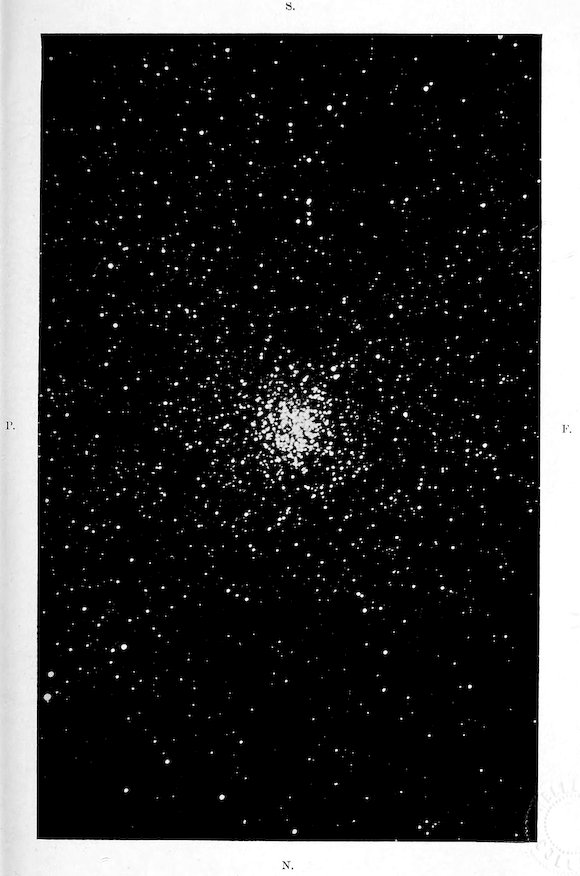
PLATE XIX
Photograph of Messier 11. Taken by Dr. Roberts with an exposure of 90m.
Interior vacancies seem correlative to a streaming conformation.
They perhaps represent spots denuded of their
bright inhabitants by the action of some unknown expulsive
force. Irregular clusters, at any rate, are often remarkably
perforated or furrowed. Some are rendered, by the development
of “dark lanes,” essentially bifid or trifid. The well-known
star-throng in Antinous (M 11) is broken up by
partial clearings in a manner suggestive of eventual disruption.
The breaches in the masonry (so to speak) are finely shown
in a photograph taken by Dr. Roberts, 10th August 1896,
reproduced, by his kind permission, in Plate XIX. M. Fenet,
from an earlier Crowborough plate, mapped 395 components
of this cluster, which includes altogether about 1200, and
remarked that most were entitled, by the close attendance
of satellite-stars, to be regarded as forming multiple systems.[800]
Their collection into seven or eight separate allotments was
evident to him, and could not, he thought, fail to become
further accentuated with time. All, nevertheless, yield apparent
allegiance to a ninth-magnitude star, which fully sextuples
the brightness of any of its followers. A spectroscopic
examination of this object would be desirable. The general
quality of its light might be readily ascertained, and the detection
of motion-displacements need not be despaired of. A
catalogue of two hundred members of this brilliant assemblage,
referred to their leader, was drawn up in 1870 by F. R.
Helmert, and compared with measures executed by Lamont in
1836–39.[801] The agreement was complete within the limits of
411probable error; no discrepancies betrayed shiftings of relative
position, although sure provision was made against their
unnoticed occurrence in the future.
Helmert considered several of the stars observed by him
to be slightly variable; but their changes made no show on
the Arequipa plates of the cluster. Since, however, they were
taken at an interval of a few days, only variables of short
periods or rapid vicissitudes could have been disclosed, and
none such, it is safe to say, are present. Yet there is some
probability that a temporary member was added to the
group upwards of sixty years ago. On the 12th of August
1839, Lamont entered No. 9 on his list as a “new star”;
he had not perceived it before, and on the ensuing 9th of
September it was gone. Helmert did not expressly look for
it, but could only have missed seeing it through its extreme
faintness.[802] Indeed, it was most likely, by that time, as hopelessly
extinct as Nova Andromedæ now is. The stars of
M 11, although devoid of nebulous attachments, are shown in
one of Professor Barnard’s small-scale photographs to form a
knot at the margin of one of the great cloudy formations in
the Milky Way, their actual nuclear relation to which he
regards as “hardly questionable.”[803] This may be; the supposition
is plausible; yet it is a long way from being demonstrable.
Meanwhile the practical inquiries to be made in
connection with the cluster are these two: What is the spectrum
of its leader star? and, Do any of its components vary in
light?
The lovely double cluster in Perseus (N.G.C. 869, 884)
resembles it in being non-nebulous, perhaps also in possessing
galactic affinities. The twin groups are known respectively
as h and χ Persei. Their connection is remote; dynamically
they can scarcely be mutually dependent, but they are of
closely analogous construction, and their components are
similarly linked into festoons and spirals.[804] None of them can
be perceived to drift, absolutely or relatively. This was put
to the test in 1884, when 172 stars in “χ Persei” were photographically
determined by O. Lohse for confrontation with
412the results of Vogel’s micrometrical measures of them fourteen
years earlier.[805] Their seeming immobility will probably be
maintained for many decades yet to come. Vogel’s special
catalogue of the thirty brightest among them (all above the
tenth magnitude) might, nevertheless, usefully be revised,
from the photometric point of view, for the purpose of detecting
possible alterations of brilliancy. The task would be the
more hopeful that some of the objects in question have a note
of colour. A “ruby” star was allotted a central position in χ
Persei by Sir John Herschel;[806] the Parsonstown reflectors displayed
rosy, yellow, and bluish tints in many of its sparkling
associates; and Mr. Espin, much more recently, located in the
outskirts of the cluster eight reddish stars with fluted spectra.[807]
These may be expected to prove more or less variable, though
not in the prompt and definite fashion prevalent in globular
assemblages.
Professor Barnard recognises two varieties of irregular
clusters—the purely stellar and the nebulously stellar.[808] They
can be distinguished with certainty only by chemical means.
Long photographic exposures are needed to test satisfactorily
the condition of grouped stars. The characteristic nebulosity
of many clusters may in fact be counted one of the most important
discoveries made with the assistance of the camera. But
at present we are dealing with the non-nebulous kind, such
as the Hyades and Præsepe in Cancer.
Aldebaran, the great red “eye of the Bull,” is in, but not
of the Hyades. The disconnection will be rendered obvious,
and the relative drift more precisely definable, when the radial
movements of the several stars can be spectroscopically fixed.
This, indeed, is already feasible, were it not that the great
telescopes of the world are otherwise occupied.
Forty-five stars in Præsepe have been located with rigid
accuracy. Winnecke’s observations of them in 1858, Asaph
Hall’s in 1870, above all, Schur’s Catalogue for 1875,[809]
413laboriously constructed from a triangulation with the Göttingen
heliometer, ensure the detection of their future movements.
They are extremely minute. In the course of thirty-two
years they produced effects so small as to be barely
determinable. The spectra of ninety members of this stellar
family were photographed in or about the year 1896 at
Harvard College.[810] Owing to their faintness—they ranged
from 6·5 to 9·5 magnitude—the details of their classification
remained uncertain; but the one main fact was brought out
that the collection is of mixed quality. It does not seem to
be expressly assorted in any way; no spectral pattern can be
called predominant. Twenty-eight of the ninety associates
were recorded as Sirian, sixty-one as solar or intermediate
stars, and the third type was represented by a solitary specimen;
that is to say, the percentage of first-type spectra in
Præsepe is thirty-one, while it rises to sixty-five in the Pleiades,
and sinks to fifteen in Coma Berenices. In this last asterism,
however, the stars, although crowded, are not clustered.[811] Yet
their crowding obtains significance through Professor Pickering’s
notice of their almost exclusively solar character.
A spectrographic survey, carried out at Harvard College,
of four southern clusters of the coarse-grained or irregular
description, has lifted another corner of the veil from this
department of astrophysics. One of these objects, still uncatalogued,
is situated in the neighbourhood of η Carinæ; a
second (N.G.C. 3523) is not far off; the third and fourth
(N.G.C. 6405 and 6475 = M 6, M 7) are found in Scorpio.
The plates exposed showed in the aggregate 705 spectra
capable of characterisation, of which 576 were unmistakably
of the first type.[812] The average proportion, then, of hydrogen
stars in these four clusters is 82 per cent. Half a dozen
helium stars were identified in the anonymous group, none in
the rest. On the whole, spectral uniformity may be considered
the ideal state towards which most clusters tend; it
would perhaps, if accidental components could be eliminated,
prove to be more nearly realised than it seems. In this connection
it is of interest to note that M 37 in Auriga consists
414wholly of yellow stars, presumably belonging to the solar
class. The sky, in Admiral Smyth’s phrase, appears in that
spot as if strewn with gold dust. The companion cluster in
Gemini is, on the other hand, resplendently white; and
Dunlop registered at Paramatta a bluish globular cluster
(N.G.C. 6723) likely to be packed with Sirian stars.
The jewel-cluster about κ Crucis is differently organised.
Harmonies of contrast rather than of consonance may here be
observed; but the collected brilliants display their various
tints effectively only in the fields of large telescopes. From
measures of 130 of them, Mr. Russell of Sydney derived in
1872 ostensible evidence of comparatively rapid interstitial
movements during the thirty-five years elapsed since the date
of Sir John Herschel’s corresponding work; but until a fresh
set of determinations gives assurance that they are pursued
systematically, little weight can be laid upon discrepancies
otherwise explicable. His suspicions of variability in twenty-five
components have not so far been verified. Several are
bright enough to show distinctive spectra, the nature of which
it would be particularly interesting to ascertain. This
beautiful object lies near the northern border of the “Coal
Sack.”
Irregular clusters obviously form systems of extreme
intricacy. They cannot be pieces of mechanism set in action
by some uniformly operating motive power. Their aspect is
in most cases irreconcilable with the hypothesis of a dynamical
equilibrium. Few, if any, betray by movement or conformation
the influence of a preponderating centre of attraction.
They rather suggest inconceivably complex aggregations of
partial systems bound together loosely nor perhaps indissolubly.
The investigation of their mutual relations will tax the
resources of the old as well as of the new astronomy. Some
of the problems to be confronted have just begun to take
shape, others loom on a remote horizon. As a prelude to
dealing with them, the separation might gradually be effected
of the really physical from the merely optical components of
clusters. The process will be greatly facilitated by the ready
help of the camera; and the slow evolution of telescopic or
tangential displacements can already in part be forestalled by
the spectroscopic disclosure of radial velocities.
415
“Tangled in a silver braid” of shining world-stuff, the
Pleiades stand out as the typical nebulous cluster. They give
signs of not being indefinitely remote. The assembled stars
have a common drift, which is most likely a perspective effect
of the sun’s advance in the opposite direction. If this be so,
their light spends just 200 years in reaching the earth,
the rate of our progress towards the constellation Lyra being
taken at twelve miles a second. Alcyone then radiates at
the very least 190 times more powerfully than our sun;
in its place, Sirius would appear fainter than the fifth
magnitude; it would be outshone, not only by the lucida of
the group, but also by five of its companions—by Atlas,
Merope, Electra, Maia, and Taygeta. Thus the glory of the
Atlantids would be but slightly enhanced by the addition of
the great Dog star to their number, and the scale of the
system must be commensurate with the magnificent luminosity
of its members.
A beginning has been made in the discrimination of the
genuine Pleiades from their optical companions. The definite
character of their proper motions has made actually feasible
what in other similar collections is only remotely possible.
The outcome of Elkin’s measures with the Yale heliometer
in 1884–85[813] was to distinguish forty-five stars, including
Alcyone, as inseparable travellers, while eight proved their
independence by dropping out of the ranks. This group of
forty-five members may be regarded as a nucleus round which
additional stars will aggregate as their movements develop.
416How far it will extend, how many of the small stars swarming
on long-exposed negatives it will eventually take in, remains
conjectural. Its delimitation, however, should be practicable
in the course of a decade or two; for the comparison of
photographs taken about 1915 with those of 1885 and 1888
may be expected to bring numerously into view relative displacements
consequent upon the abandonment, as it were in
mid-ocean, of a multitude of pseudo-Pleiades exempt from the
drift belonging to the true cluster. There is reason to think
that this process of expulsion will have to be carried far.
The self-selected assemblage will probably not be overcrowded.
Exact numerical inquiry has led to many unexpected
results, but to none more surprising than that of the
thinning-out of faint stars within the area of the Pleiades.
Professor Bailey counted nearly 4000 on a photograph including
it taken with the Bruce twenty-four-inch lens in 1897; but
their density, as a detailed examination made evident, fell off
notably and systematically inside the precincts of the system.
“It therefore appears,” Professor Pickering wrote,[814] “that the
total number of stars in the region of the Pleiades is actually
less than in adjacent portions of the sky of equal area, and it
is much less than the corresponding number in many parts of
the Milky Way.” Regarded, then, as a physical entity, the
cluster includes only the brightest of the spangled points
thrown together into the field. The spangles of the background
would indeed presumably be still more numerous but for the
absorbent effect of the nebulous masses attached to the brilliant
stars in front of them. Their paucity, at least, must be somehow
accounted for, and this explanation of it, suggested by
Professor Pickering, seems admissible. M. Stratonoff,[815] too, was
led, by a study of stellar distribution in their neighbourhood,
to the conclusion that the physical associates of Alcyone are
comparatively few; and the conclusion is the more interesting
from the sure prospect of bringing its truth to the test.
The Pleiades might be described as not merely a nebulous
cluster, but as a cluster of nebulæ, so numerous and so sharply
characterised are the cloudy forms collected within its borders.
All save one are photographic revelations. The exception is
the “Merope nebula,” discovered by Tempel 19th October
4171859. A mere “breath stain” on the sky, it is, to telescopic
vision, a highly elusive object; yet it is always there, striated
and definite, when looked for by chemical means, and the
hypothesis of its variability has long ago been abandoned.
The Maia nebula has something of the same striped aspect,
but clings in a strongly curved whorl to the star which forms
its nucleus. Mr. H. C. Wilson of the Goodsell Observatory
described as follows a photograph of this object taken by him
30th January 1894.[816] “The region about Maia is especially
interesting. A very bright horn-shaped patch of nebula runs
out from the west edge of the star-image immediately northward,
and extends to a distance of 3′ north of the star. The
nebula here is full of irregularly parallel streaks similar to
those about Merope, but making only a very small angle with
the meridian. Some of them run to and beyond the bright
stars north of Maia. A series of rather broad and diffuse
patches extend from the middle of the group on a diagonal
toward the north-west, reaching to a comparatively bright pair
of stars in that direction.”
A second Merope nebula, totally unlike the first, was discovered
by Professor Barnard with the Lick thirty-six-inch
refractor 14th November 1890.[817] It is round, clearly terminated,
and centrally condensed, 30″ in diameter, and presents
the general effect of a distant comet. With the adjacent star
it forms so close a combination as to indicate, almost of necessity,
the slow progress of mutual revolution. Mr. Burnham,
who measured the new nebula at Lick in the autumn of 1891,
regarded it as “one of the most singular objects in the
heavens,” and “unique with respect to its nearness to a bright
naked-eye star.”[818] It is the brightest nebula in the Pleiades,
and came out well on plates taken by Professor Keeler in
1898 with the Crossley reflector.[819]
Another cosmic species singularly exemplified in this
cluster might be called “ribbon nebulæ.” They run in narrow,
straight bands from star to star, in one case stringing together
six or seven, “like beads on a rosary,” and they pursue with
418fair accuracy, along parallel lines, an east and west direction.
What manner of communication they establish between the
suns they connect it is impossible to divine. They may conceivably
be mere survivals of a prior order of things, belonging
rather to the past than to the present; but no structures more
curious have been brought to our notice by the camera than
these long, luminous highways built as if for the purpose
of facilitating intercourse between the cities of space. An
unfinished road starts from Electra towards Alcyone; it has
been completed over only about one-third of the way. Or is
it the wreck of a celestial causeway which formerly reached its
destination, but has been gradually, for some ages past, falling
out of use and repair? The question is a daring one; ultimately,
however, the comparative study of analogous objects
may supply hints for answering it, at least by a plausible
surmise. The cluster is besides crowded, especially in the
neighbourhood of Alcyone, with irregular or nondescript
nebulæ, which choke the background as if with rolling fog.
But in general the tendency is unmistakable to assume
filamentous shapes, such as were shown with peculiar distinctness
in two photographs taken by M. Stratonoff at Tashkent
early in 1896 with multiple exposures of respectively ten
and seventeen and a half hours.[820]
419
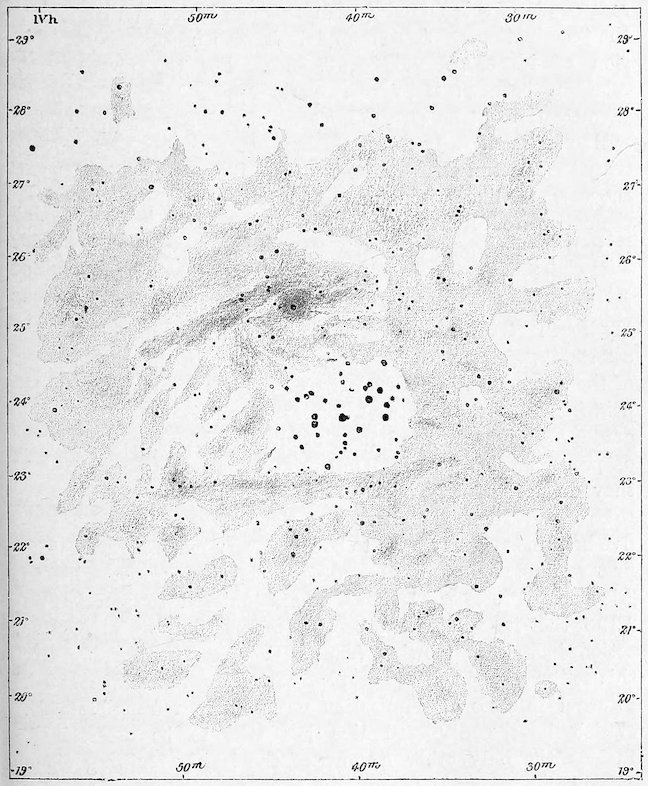
Fig. 46.—Drawn from Photographs by E. Calvert.
The history of the Pleiades nebulosities does not end here.
Professor Barnard had long been aware of a dulling of the sky-ground
over a vast adjacent area; and at last, in December
1893, he put these vague perceptions to the test by means of
a ten hours’ exposure with the Willard lens.[821] “The resulting
picture,” he wrote, “showed a number of singular curved and
streaky nebulosities, apparently connected with the Pleiades
and extending all about the group.” Some of them he was
able to trace for several degrees on either side, especially towards
the east. Yet doubts were expressed as to whether spurious
photographic effects were not in question. The phenomenon
disclosed was, indeed, so amazing that some degree of scepticism
was excusable. Its reality, nevertheless, had to be admitted.
Confirmatory photographs were produced by Dr. Max Wolf,[822] by
Mr. H. C. Wilson,[823] and by Professor Bailey. A skilful drawing
by Mr. E. Calvert, embodying the combined results, is reproduced
in Fig. 46. But its limits are too narrow to include
the whole of these far-spreading formations. There seems no
end to them. The interior nebulosities are left undepicted
for the sake of clearness. We are thus brought face to face
420with the “startling fact” (as Professor Barnard calls it) “that
the Pleiades and their involved nebulosities are but the central
condensation of an enormous nebula, intricate in details, and
covering at least a hundred square degrees of the sky.”[824] The
magnitude of this mixed system staggers belief and confounds
the imagination. We contemplate it with imperfect apprehension
of its scope and significance. For the present, the
relations between its various parts appear scarcely open to
investigation. The possibility even of speculating upon them
will offer itself only when acquaintance begins to be made
with the spectral characteristics of the Pleiades nebulæ. That
they are all alike gaseous may safely be assumed; nevertheless,
their dispersed light, when it becomes practicable to examine
it, will perhaps offer diversities full of interest.
Among the stars of the cluster a single spectral type
markedly predominates. It may be distinguished as “late Orion.”
Hydrogen absorption is prominent; helium absorption also
asserts itself, but with less emphasis than in the earlier stars
of the same class.[825] This quality of light is common to all the
principal stars; those that deviate from it are of inferior
grades of brightness, and may eventually, through the effects
of proper motion, be sifted out from an assemblage to which
they do not properly belong. Hence, when the group comes
to be organised on a definitive basis, the gross percentage of sixty-five
helium stars may have to be raised very much higher. The
first example of a mixed hydrogen series was met with in
Alcyone. Professor Campbell was astonished to perceive in
1893 that its spectrum, otherwise marked only by absorptive
action, included a glowing crimson C. Very remarkably, too,
this solitary bright ray is coupled with a dark streak, situated,
as usual in cases of duplication, on its more refrangible side.
Which is the displaced line has still to be ascertained.
Pleione, the only other member of the family showing signs
of emission, is spectroscopically akin to γ Cassiopeiæ. Its
bright rays bisect obscure bands.[826] The recession at the rate
of eight or ten miles a second of the solar from the Atlantid
system must occasion a perceptible shift towards the red of
all the spectral lines of its members, to which constant
421element are superadded the varied, and perhaps varying
effects of their individual motions. Spectrographic researches
hold out, then, the best prospect of gaining, within a reasonable
lapse of time, some insight into the working of this
amazing piece of celestial mechanics. From a triangulation,
executed with the Göttingen heliometer in 1889–91, Dr.
Ambronn derived, as he thought, indications of a division
of the cluster into several distinct parcels of mutually
dependent masses;[827] but his measures, which included only
sixteen stars, had too restricted a scope to be decisive of
much.
No stars of assured variability, whether periodical or
irregular, are found among the Pleiades. Yet light-changes,
eluding definite recognition, are suspected to progress. Maia
and Merope have both been held to fluctuate slowly; and
Atlas, divided into a pair by Struve in 1827, is now single,
with all powers, in the serenest skies. Only a twofold
occultation, noted by Hartwig in 1876, seemed to intimate
the obscure survival of the vanished companion. Possibly
it may make itself felt spectroscopically, even should it
never again be seen. The motion-displacements, accordingly,
yielded by Atlas deserve attentive scrutiny, since from them
may be obtained the key to one of the long outstanding
enigmas of double-star astronomy. Another member of the
group appears to have an authentically variable attendant.
In Wolf’s map of 1874 an anonymous 7·2 magnitude star
due south of Alcyone is marked as a wide double; it was
single in the Paris photograph of 1886, but again double in
that of 1888, when the satellite had risen to eighth-magnitude
brightness. Yet M. Chevremont, reviewing the collection with
a small refractor in November 1895, could find no trace of
it.[828] This was the most precisely defined among several cases
of presumable light-fluctuation met with in the course of his
survey. Again, M.M. Müller and Kempf constructed at
Potsdam in 1899 a photometric catalogue of ninety-six Pleiades,[829]
forty-two of which, given in the Bonn Durchmusterung as of
9·5 magnitude, seemed to have diminished so considerably in
422brightness that their mean magnitude could not be placed
higher than 10·7.[830] Very little real change, however, may
here have been concerned, since the ordering of stars in the
lower ranks of the Durchmusterung is known to have been a
highly casual process. It can scarcely be doubted, indeed,
that some components of the cluster are, in a measure,
variable, but their variability is of a kind not easily
certified; it follows no method; it obeys no time-prescription;
its effects, perceived when least looked for, cannot be counted
upon to recur. Hence the problems of light-change set by the
Pleiades are of a peculiarly baffling nature.
423
Many nebulous clusters besides the Pleiades are known, but
none in which the relations of stars and nebulæ are so highly
specialised. In general, the stellar collection seems as if
independently organised, and plunged as a whole into an ocean
of cosmic fog, without any strong tendency on the part of its
members to form individual nebulous attachments or
connections. When, however, the structural details of such
formations come more fully to our acquaintance, they may be
found to contain evidence of a closer association between
particular objects of the two species than can at present be
vouched for. Such investigations can be conducted effectively
only by photographic means and with carefully adapted
instruments. For the purpose of bringing out the full extent
of the nebulosity, small portrait-lenses have prerogatives,
illustrated practically by Professor Barnard,[831] theoretically by
Professor Wadsworth.[832] But pictures on a larger scale than
those obtained with them are needed for the disclosure of
many topographical minutiæ huddled together by the strong
concentration due to their short focal length. For securing
these, reflectors of powerful light-grasp are unsurpassable.
Thus two lines of photographic inquiry should be made to
converge upon nebulous clusters; one directed towards
determining the limits of the involving nebulosity, the other
towards ascertaining its constructive peculiarities.
To a superficial view the object we are now about to
describe seems more like a cluster and nebula than a nebulous
cluster. The nebula is “Messier 8”; it is just visible to the
424naked eye, and from the oval vacancies which interrupt its
light, it has received the descriptive designation of the “Lagoon
Nebula.”[833] The cluster—separately catalogued as N.G.C.
6530—immediately follows it on the same parallel, but not in
complete detachment. The two formations unmistakably
overlap, and, to discerning vision, inextricably intermingle.
Professor Barnard’s negatives, taken with the Willard lens
in 1892, showed the compound object to be “a singular mixture
of stars and nebulosity. East and west its diameter is
about 45′, and north and south some 42′. The southern side
is sharply defined and serrated, with three distinct pointed
projections. From its north-following corner a wisp of
nebulosity extends nearly to a group of nebulous stars, and
possibly with a longer exposure would be found to connect
with them.”[834] A picture on so small a scale could teach
little regarding internal structure; the “lagoons,” in fact,
appear in it nearly silted up with diffused nebulosity. Many
of the brighter stars are involved in the pervasive haze, and
one in particular occupies too critical a position at the edge of
“a very black hole” for the supposition of a mere chance
arrangement to be permissible. It may be doubted, however,
whether the 5·7 magnitude star, 9 Sagittarii, has more than
an optical connection with the cluster, and the multitude of
stellar points glittering in the background will almost certainly
be separated from it by the slow discrimination of drifting
movement. A preliminary step towards applying the test was
taken by M. Comas Solà in 1898.[835] His photographic
triangulation of the group fixes a starting-point for comparative
inquiries which can yield tangible results only in the distant
future. His plates showed the stars to be doubly implicated
with nebulosity. One of the seventh magnitude acts as the
focus to a cloudy mass, distinct, apparently, from a diffuse,
elongated structure projected upon the central parts of
the cluster, which it not impossibly encloses in annular folds.[836]
The Lagoon Nebula gives a spectrum of bright lines. It will
425be interesting to learn whether they are displaced by motion,
and whether, if so, corresponding spectral shifts in the
clustered stars ratify the presumption of organic relationship
between the two orders of formation.
The optical history of nebulous objects is often curious and
instructive. As an open cluster, N.G.C. 2239, in Monoceros,
was first observed by Sir John Herschel. An adjacent patch
of nebulosity, seen by Swift in 1865,[837] again attracted
Barnard’s attention in 1883. It proved to be a kind of knot
on a great nebulous ring discerned by the latter in its entirety
with the Lick twelve-inch refractor in 1889.[838] This encloses
the star group like a ring-fence, and may be said to osculate with
a second great filmy ellipse, of which only a section is perceptible.
Then came the turn of the camera. Professor Barnard
obtained a photograph of the complex arrangement 9th January
1894, which confirmed visual impressions while demonstrating
their inadequacy. They were not misleading, but extremely
partial. The photographed nebula is, in Professor Barnard’s
words, “about one degree in diameter, and very irregular in
brightness and outline.”[839] It involves the cluster with unequal
condensations, which are especially heavy north of the bright
stars. The nebulous knots, and the section of a large ellipse,
fully depicted in the sketch of 1889, reappeared in the
chemical picture. In this, the only effect of annularity
left visible is that a vacant interior space seems reserved
for the conspicuously grouped stars. Their chief being of the
eighth magnitude, the determination of its spectral character
should present no difficulty, and would be of particular value
as a test of nebulous affinity.
The number of alternative titles by which the star
catalogued by Flamsteed as “15 Monocerotis” is known
expresses the curious variety of its claims to distinction.
It is variable, multiple, and nebulous. In the first capacity
it is designated “S Monocerotis.” Its fluctuations from 4·9
to 5·4 magnitude, in a period of 3d 10h 38m, were noted by
Winnecke in 1867. These elements are indeed still somewhat
uncertain. They need verification and revision. The
426variable is, moreover, the leading member of a triple combination,
enrolled by Struve as “Σ 950.” With a green companion
at 2·8″, and a bluish one at 16·6″, it makes an exquisite
telescopic object, but gives no sign of orbital motion. It
occupies a dominating position in a collection of fifty or sixty
stars, ranging from the eighth to the thirteenth magnitude,
one of which is subject to fits and starts of extensive
variation.[840] By virtue then of its chiefship of a cluster, 15
Monocerotis is registered among nebulæ as N.G.C. 2264. Nor
solely on this account. Both Sir John Herschel and Lord Rosse
suspected it to be nebulous, and Bruno Peter, who measured
forty-five components of the group at Leipzig in 1879–82,[841]
found their leader visibly wrapt in a hazy envelope. But the
wide extent of its nebulous connections was entirely a photographic
revelation. A picture of the region about 15 Monocerotis,
taken by Professor Barnard on 1st February 1894,[842]
showed it to be involved in a great nebula some three degrees
in diameter. “It clusters densely,” he says, “about the groups
of stars, and then spreads out in a weak, diffuse light, with
rifts in it, and irregularly terminated along the edges of a vast
vacancy in the Milky Way. The condensation, which is
very strong, is not at 15 Monocerotis, but twelve minutes
south-preceding that star, where it becomes a compact mass
with numerous wisps and holes in it.” The absence of nebulous
concentration about the individual stars struck him forcibly,
especially by contrast with the different state of things in the
Pleiades.[843] The nebulosity is free and general; no single
member of the stellar assemblage appropriates a special share,
or carves from it an appendage of its own. Yet it is difficult
to doubt that the apparent association is real and physical.
The Wolf-Rayet spectrum is, broadly speaking, reversed
in that of 15 Monocerotis. It includes both the hydrogen
series and the upper “blue” band; metallic lines scarcely
appear, but those of oxygen, nitrogen, and silicon are unlikely
to be absent. About the peculiarities of the less refrangible
section nothing is yet known. Here, perhaps, symptoms of
427emission will be found; indeed, a bright C might be looked
for with success not only in 15 Monocerotis, but in some one
or two of its principal associates.
An eighth-magnitude star in Auriga was noticed by
Auwers about 1860 to be projected on a hazy disc (N.G.C.
2175). The object is placed centrally in a group of smaller
stars, enveloped in nebulosity strongly manifested in Professor
Barnard’s photographs of 1894.[844] The combination is quite
similar to that just described in Monoceros. The spectrum of
N.G.C. 2175 was examined by Professor Keeler with an
indecisive upshot.[845]
Sir John Herschel observed at the Cape “a very remarkable
object” in the Milky Way, where it crosses the tail of
Scorpio. It showed to him under the guise of “a decided,
tolerably defined, semi-nebulous mass, with abundance of very
small stars forming altogether a telescopic Magellanic cloud.
It fills about a field, and has branches and sinuses.”[846] This
miniature Nubecula (N.G.C. 6437) invites photographic
delineation. Long exposures may disclose in it constructive
particulars of extreme interest.
Nebulous clusters are connected, by insensible gradations,
with certain tracts of nebulosity in the Milky Way, which,
since they are situated in, or in the line of sight with a stellar
stratum, necessarily appear more or less densely star-strewn.
The stars strewing them do not, however, collect into groups
capable of individualisation; hence they cannot be termed
“nebulous clusters.” These suggest some kind of organisation;
they are more or less isolated and coherent entities,
and are distinguishable as such from layers and beds of stars,
however closely packed. Not that a clear line separates the
two kinds of formation; the multiplicity of the heavens is
too great for this to be possible; but it is well to maintain
differences ideally, even though they be blurred, here and there
in the concrete, beyond our perplexed powers of recognition.
Nebulous clusters, on the other hand, shade off, as their
members become fewer, into nebulous groups such as the Orion
Trapezium, and reduce, “in the limit,” to simple nebulous
stars. These will be the subject of a future chapter.
428
There is no possibility of failing to recognise in a globular
cluster a true agglomeration—a structure teres atque rotundus.
The systemic unity of such objects is as evident as that of
a “globe of dew,” though it is by no means certain that they
are not, like that “frail and fading sphere,” in course of more or
less speedy evaporation. A gradual process of ejection is at
least suggested by their streaming edges and filamentous
appendages, formed of branching rows of stars, apparently on
the move outward. One hundred and ten globular clusters
were registered by Sir John Herschel in 1864 in his “General
Catalogue” of nebulæ, and not many have since been identified.
They are astonishing constructions. Their silvery radiance is
a delight to the eye; the imagination is allured by their
visionary beauty; reason is startled by the recondite nature
of the problems they intimate. What, we cannot but ask
ourselves, is the true nature of these mysterious “balls of
stars”?[847] Are the luminous particles composing them suns
in the proper sense? What are their mutual relations?
How did they originate? In what are they to eventuate?
Can mechanical stability be claimed for them, or must they
be supposed to form temporary societies undermined by forces
tending towards dissolution? On all these points definite
information is still lacking; but there is no reason to despair
of its future provision, since the inclusion of globular clusters
within the scope of organised research is of quite recent date,
and knowledge respecting them is accordingly in a nascent
stage.
429It may, however, safely be affirmed that their components
are sun-like bodies—that they are spherical masses at an
enormously high temperature, radiating into space by means
of suitably adapted photospheric apparatus. Some are
intensely actinic. They are much brighter chemically than
visually. They hence presumably emit light mainly of the
shorter wave-lengths, and are abnormally hot bodies. But
the secret of their nature cannot be divined in our present
ignorance of their spectroscopic peculiarities, and those of the
individual star-points in clusters will long remain inaccessible.
Their combined light, nevertheless, where it is concentrated into
a “blaze” at the core, is capable of being effectually analysed
with powerful instruments, and the determination of its quality
is a sine quâ non for progress in this branch. Until this
has been effected, there is no possibility of assigning to
globular clusters their proper place in the celestial hierarchy.
The great southern agglomerations, ω Centauri and 47
Toucani, seem almost untouched by the wear and tear of
time. They show few signs of dilapidation. No dusky rifts,
no glades or clearings are perceptible in them; the subtraction
of material (if it be going on) has made little progress; they
are as yet well compacted to the centre. Nor is a flow of
stars outward hinted at unless obscurely. They are cleaner
at the edges than most objects of their class; tentacular
appendages are wanting; their components are not visibly in
marching order. This may mean that they have but newly
arrived at their present state of being, and if so, their spectra
should be of an early type. To the component stars, accordingly,
a very low mean density may probably be attributed;
their attractive power will prove small relatively to their
light; the corresponding interstitial movements must be slow,
and will be difficult of detection.
430
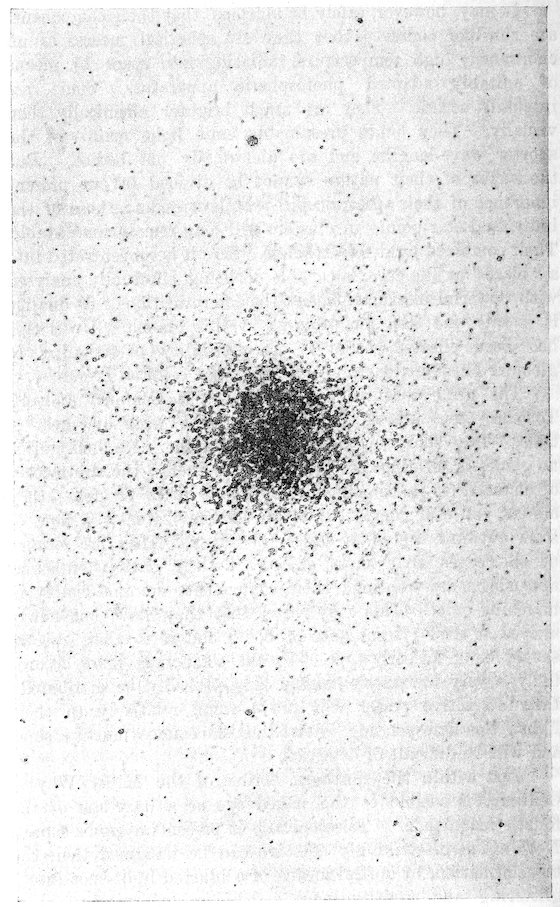
Fig. 47.—Photograph of ω Centauri (Bailey).
Just within the northern border of the Milky Way ω
Centauri is visible to the naked eye as a hazy star of the
fourth magnitude.[848] Telescopically it presents a grand aspect.
Nothing more strikingly effective can be imagined than the
transformation, by optical means, of a blurred light-spot into a
glittering and multitudinous assemblage of separate suns.
Nearly 6400 can be distinguished on sensitive plates, besides
431a crowd of others so small as to merge together into a grey
mottling. No true nebulosity seems to be present. The
photograph from which the counts were made by Professor
and Mrs. Bailey is reproduced in Fig. 47. It was taken at
Arequipa 19th May 1893 with an exposure of two hours in
the thirteen-inch Boyden refractor. The area marked out for
investigation covered 900 square minutes. It was “fairly
well filled” with stars, and their statistical study defined the
fact of their true central crowding.[849] They condense not
merely in appearance, through the augmenting depth of
spherical space in which they are distributed, but also as a
consequence of actual compression inward. The number of
stars per square minute was found, in fact, to increase in
arithmetical progression with approach to the centre. Away
from it the diminution ceased, a constant figure being
reached along a line taken to be the boundary of the cluster;
and this constant, since it must represent the areal population
of the general sky, supplied a means of correcting the
apparent results for that of the cluster. Deduction was
accordingly made of 1616 unconnected stars, mere visual
intruders from a limitless background; and there remained
5050 true components, collected within a circular space somewhat
larger than that occupied by the full moon. They average
about 12·5 magnitude.
The south polar cluster, 47 Toucani, is of equal loveliness
with ω Centauri, although on a smaller scale. Its “computed
diameter” is 22′[850]—that is to say, the extra stars which it
projects upon the sphere die out completely at a distance of
11′ from its centre. They number about 2300, and are
distributed in accordance with the same law noted as prevalent
in the companion cluster. They are, however, even
more densely aggregated; the realm is less spacious than ω
Centauri proportionately to the throng of its inhabitants.
The great cluster in Hercules (M 13) presents a less
uniform texture than its prototypes in the southern sky. Yet
its constituent orbs follow virtually the same gradient of
central compression.[851] Their distribution is affected besides
by influences of an unimaginable kind. Three “dark lanes,”
432making an equiangular junction at a point south-east of the
centre, were detected with the Rosse reflector in 1850.[852] An
identical form of marking tends to recur in other parts of the
cluster. On the Lick photographs of 1890–91, Professor
Holden was able to trace no less than thirteen repetitions of
it.[853] This insistence, he remarked in a local paper, made it
evident “that a definite law was acting to produce this form,
and that this law might be truly taken as representative for
this cluster. In some way there are dark lanes produced and
maintained among the hundreds of bright stars in this
globular mass, and there are many such channels. How can
we conceive of such a system? It is tolerably clear that
either the dark lanes are absolutely empty of matter, or at
least that they are empty of luminous matter.” Yet neither
of these alternatives seems to be in accord with fact.
A plate exposed during ten minutes with the Crossley
reflector by Professor Keeler showed all the brighter stars in
M 13.[854] Two hours were, however, needed to bring the swarms
of their faint associates into view. In all, more than 5400
stars, fairly within the precincts of the cluster, were counted
on a negative taken 13th July 1899. A study of their
distribution, made by Mr. Palmer, Professor Keeler’s assistant,
elicited some noteworthy peculiarities.[855] The components
separated, speaking broadly, into two distinct orders of brightness,
those of intermediate magnitudes being comparatively
scarce. Out of the total number of 5482 counted on the
plate, 1016 were classed as bright, 4466 as faint, or below
13·5 magnitude. Now the mode of scattering of these two
radial—they extend outward in curved rows; that of their
minute companions is more nearly globular. Moreover, the
characteristic dusky tracks are vacant only as regards the
former class of objects. They are lightly strewn with the
diffusive star powder found everywhere in the cluster. To its
presence Mr. Palmer attributes the effects of nebulosity noticed
in earlier photographs. It requires a very high resolving
power to distinguish the stellar haze created by flocks and
433throngs of sixteenth-magnitude stars from genuine “fluid
haze”; but in this case there seems little doubt that the feat
was performed. Confirmatory evidence of the best kind was
afforded by Professor Barnard’s direct observations with
the forty-inch Yerkes refractor. They convinced him that
globular clusters are non-nebulous formations.[856] Spectrographic
impressions will probably before long add their
testimony, at least in a negative sense.
With the thirteen-inch photographic refractor of the
Potsdam Observatory, Dr. Scheiner obtained, 9th September
1891, the first plate of M 13 on which the stars were
sufficiently defined for exact measurement.[857] He accordingly
prepared a catalogue by which the places of 833 were fixed
with the utmost accuracy; and these fundamental stars,
henceforward kept under watch and ward, will perhaps one
day disclose the plan of their movements, and thus enable
future astronomers to attack, with some possibility of success,
one of the most arduous problems in celestial dynamics. It
confronts them, under a still more bewildering form, in a
superb cluster in Scorpio (M 62 = N.G.C. 6266). Here a
second focus of condensation is obvious; two star-globes are
fused into one.[858] The contorted growth of a twin cherry may
help us to realise, however imperfectly, the attendant indefinite
complexity of the conflicting forces.
A compressed cluster in Serpens (M 5 = N.G.C. 5904),
discovered by Kirch in 1702, presents telescopically the
appearance of a softly radiant globe with divergent outliers.
A photograph taken by Dr. Roberts 25th April 1892, indicated
a nebulous interior; but no such effect came out on
negatives exposed with Dr. Common’s five-foot reflector, nor
was it perceptible visually to Professor Barnard. It was due,
presumably, to an amalgam of faint stars forming a kind of
matrix for those bright enough to be individualised. The
discovery of their variability was begun by Mr. Packer in
1890.[859] He remarked the fluctuations of two components,
434and Dr. Common suspected many more to share the same
character.[860] This premonition was followed up, though not
until after five years, by Professor Bailey’s announcement[861] that
many globular clusters—say one in five—are veritable nests
of variables. Their abundance is such that as many as a
hundred—in Professor Barnard’s words—“have been found in
a space in the sky that would be covered by a pin’s-head held
at the distance of distinct vision.”[862] Of 3000 components of
ω Centauri examined within a radius of 22′, 128 were found
to fluctuate to the extent of half a magnitude or more.[863] In
one case a range of five magnitudes was observed; but that
of most of the objects investigated was limited to one and a
half, or two magnitudes. Very short periods are the rule;
three are of less than seven hours; yet one is protracted
to 475 days, and there will be a special interest in determining
the nature of the light-change comprised in so long a cycle.
A true “Mira variable” would seem an anomaly in a cluster
made up of silvery white stars; since we are taught by
experience to associate periods of many months with strong
absorption and consequent redness of colour. But cluster-variables
belong, for the most part, to a type apart, the
character of which has been described in an earlier chapter.
They have long minima, and brief maxima attained with
extraordinary rapidity. The activity of their changes, when
they set in, contrasts singularly with the completeness of their
suspension during the intervals of rest. There is an entire
absence of concert among the affected stars. Each is an
independent, self-regulated phenomenon. No more curious
spectacle is afforded by the heavens than that of a throng of
seeming signal-lights waxing and waning every few hours
under the sway, obviously, of some common law, yet with no
trace of unanimity; some fading while their neighbours are
on the rise, others stationary and semi-extinct, though only
biding their time to enter upon a phase of renewed brilliancy;
and none deviating by a hair’s-breadth from the course of
change individually prescribed for it.
435Eighty-five variable stars have up to the present been
recognised in Messier 5, and they agree, for the most part,
quite closely in a mode of fluctuation elucidated by Professor
Bailey’s persevering inquiries.[864] The form of their typical
light-curve is not different from that assignable to the components
of ω Centauri; but they tend unmistakably to obey a
common period of approximately twelve hours, and the oscillations
of nearly all are between the fourteenth and the fifteenth
magnitudes.[865] Yet they are not executed simultaneously; a
congruity of epochs is not even distantly indicated. Professor
Barnard took visual charge in 1898 of some half a dozen of
these strange objects,[866] and his list included Packer’s original
variables, Nos. 42 and 84 of the Harvard enumeration, stars
exceptional in the great assemblage of which they form part,
both as to the length of their periods and the manner of their
change. This copies the pattern set by δ Cephei; it proceeds
continuously, although not symmetrically, along a curve steep
in its upward branch, sloping gradually downward, and
interrupted by a “hump,” significant of an abortive second
maximum.[867] Its time-measure is about twenty-six days.
Professor Barnard was struck with a number of ink-black holes
rending the brilliant surface of the star-globe in Serpens.
They are closely adjacent to the dense central portion, and
suggest tunnelling operations on the scale of those progressing
in the great Hercules cluster.
A cluster in Canes Venatici (M 3 = N.G.C. 5272) is
similarly perforated. Lord Rosse observed “several small dark
holes” at its core, from which “rays run out on every
side.”[868] A “bifurcated dark lane” was, moreover, perceived in
the northern segment of the nuclear “blaze.” From which
we can gather that the distribution of stars in M 3 is
controlled by forces of the same nature as those ruling in
M 13. Yet the two clusters are markedly differentiated as
regards light-stability. That in Canes is already known to
contain 132 variables; while in the Hercules group diligent
436inquiry has failed to certify the presence of more than two,
its components actually shining much more steadily than
the average of the stellar multitude outside its limits.
Eighteen hundred stars were counted by M. Orbinsky from
photographs of M 3 taken at Pulkowa in 1894,[869] and his
measurement of their places will in the future supply a test
of their relative mobility.
A starry sphere in Pegasus (M 15 = N.G.C. 7078)
seemed nebulous in Dr. Roberts’s photographs;[870] but they were
perhaps clouded by stellar dust, not by true cosmical fog.
Of 900 members of this collection examined at Harvard
College, 51 proved variable. The proportion in Ihle’s great
cluster in Sagittarius (M 22 = N.G.C. 4424) is much
smaller—16 to 1550; and only 10 among 600 stars tested
for stability in M 2 gave responsive signs of fluctuation.
This cluster, which is situated in Aquarius, might be the
twin of that in Hercules plunged in a deeper depth of space.[871]
The clusters ω Centauri and 47 Toucani, so much alike in
other respects, deviate widely in the matter of variability.
Periodical stars by the score occur, as we have seen, in the
former stately assemblage; in the latter, only six have
been registered, notwithstanding the most careful scrutiny.
Whence the diversity? Professor Pickering[872] surmises that it
depends upon the relation of a common plane of revolution to
the line of sight. Each globular cluster would be, on this
view, a system, the movements of which, whether axial or
orbital, are conducted on the same level. And should this
level happen to coincide with the visual ray, variability would
result, either through the rotation of such components as
possessed unequally luminous surfaces, or as a consequence of
the eclipses of those provided with closely revolving satellites,
Yet neither rationale of light-change can, without grave misgivings,
be admitted. Suns with dusky hemispheres, or
permanently spotted, may be treated as mathematical fictions.
Nor is any evidence as yet forthcoming that genuine eclipse-stars
ever find a habitat in clusters. Certainly none of the
437cluster-variables so far investigated can be accounted such.[873]
That they are rapid binaries may be plausibly surmised, but
they must be of the non-occulting sort. In eclipsing
stars the maximum is essentially permanent; the minimum
is accidental. In cluster-variables opposite conditions prevail.
Habitually obscure, they brighten incidentally.
Professor Bailey’s discovery throws open a spacious field
of research. Each variable cluster might well claim a sentinel
appointed for the exclusive following of the complex, elusive, and
rapid changes which ceaselessly develop within its compass. In
December 1901, 509 components of star-globes were reckoned
as periodical. Every one of these is perhaps a system apart;
every one has its peculiarities, the inner meaning of which
can only be drawn out by sustained attention. Powerful
instruments are, moreover, required. The objects in question
lie near the limit of practicable observation; work upon them
taxes modern resources to the utmost. Nor can the photographic
method alone be relied on. Long exposures are needed
to show the stars at all, and they can naturally give no more
than the “mean magnitude” during the intervals they cover.
But when these intervals bear a large proportion to the entire
period of change, such coarse-grained data cannot satisfactorily
represent the manner of its progress. The resulting light-curve,
as Professor Bailey says,[874] is always smoothed down; and
it is smoothed to the limit of a straight line, in the ultimate
case of the exposure equalling the period of a star’s variation.
Hence the absolute necessity for supplementary visual determinations
to fill out the peaks and corners rounded off by the
camera. At the critical epoch, when the flash is being turned
on, every minute counts. Estimates of brightness at the rate
of ten or twelve an hour are not too numerous for the purpose
of keeping guard over the swift alterations going forward.
The hourly or two-hourly averages given on sensitive plates
are wholly inadequate.
Two questions of fundamental interest present themselves
in connection with the variability of clusters. Why, we must
ask, are the stars in one globular assemblage luminously unstable,
while in others, its strict analogues, they shine quite
438steadily? The contrast is not explained by any visible difference
of constitution. Variability does not appear to come in
at any particular stage of growth; it is not associated with a
definite situation in the heavens; it does not characterise
pierced and outworn globes preferentially to compact ones, or
vice versâ; it can, in short, be correlated with no feature obvious
to direct notice. It remains to be seen whether any spectroscopic
peculiarity corresponds to it.
Again, the absence from, or extreme scarcity of Algol-stars
in clusters occasions perplexity. We are led to believe
that rapid variables are, in truth, binaries revolving in
the light-period. But if so, the orbital planes of a
certain proportion of them ought to pass through the earth,
with the outcome of affording us the spectacle of so many
occulting pairs. If these do not exist, we shall be forced to
conclude that cluster-variables owe their punctuality to some
other cause than the strict time-keeping of satellites.
One of the most signal services rendered by photography
to astronomy has been in the facilities supplied by it for
the measurement of star-clusters. The relative positions,
especially of the components of compressed groups, can only
with extreme difficulty be established by direct triangulations;
while every negative taken of them fixes their configuration
at a given epoch, and gives the means of determining its
changes, should they occur. Thus the places of sixty-two
stars in M 5, catalogued at Harvard College in 1897, were
estimated by Professor Pickering to be of so high a degree
of accuracy that annual displacements amounting to one-hundredth
part of a second of arc can be detected by their
comparison with results similarly obtained from plates taken
a few years hence.[875] The foundations have then been laid for
an extensive superstructure of knowledge, as regards both the
physical and the dynamical condition of globular clusters; yet
centuries may elapse before it becomes possible—in Kepler’s
phrase—to “think over again,” with apprehensive minds, those
wonderful “thoughts of God.”
439
“White nebulæ”—so called by Professor Young[876]—are those
giving continuous spectra. They are in an immense majority.
They are reckoned by thousands, or tens of thousands, gaseous
nebulæ by the score. True, very little progress has been made
with their actual spectroscopic examination, the faintness of
their rays forming, in general, an insuperable obstacle to their
analysis; but their shape and aspect supply indications, rarely
misleading, as to the quality of their light. That of elliptical
and spiral nebulæ is, to the best of our knowledge, always
continuous; and with these may be classed the round, centrally-condensed
objects which abound in every nebular region of the
sky. Several other varieties of this great sidereal family might
be indicated, but they are by comparison scantily represented,
and have been but little investigated. The paragon of white
nebulæ is the grand ellipse in Andromeda. No other is
visible to the naked eye; it should be, judging by appearances,
much the nearest to the earth of the whole tribe; its structure
is splendidly definite, and profoundly significant; its spectrum
shows peculiarities challenging inquiries which must be long-continued
and arduous, but promise results of far-reaching
importance. In January 1899 Dr. Scheiner,[877] employing a
small spectrograph in combination with a mirror of nearly
thirteen inches aperture, and only forty inches focus—an
apparatus specially adapted for dealing to advantage with
objects of extended surface—obtained in seven hours a legible
440spectrograph of the nebula. The indications gathered from it
were of a most surprising kind. Dark rays were perceived to
interrupt the continuous light, and they seemed to agree with
the Fraunhofer lines in the solar spectrum. The Andromeda
nebula was accordingly inferred to be a genuine cluster of
solar stars; but this conclusion is very far from being
securely established. No bright lines could be made out in
the Potsdam photograph, but many have been seen at Tulse
Hill.[878] On 13th November and 11th December 1897, when
they were particularly distinct, approximate wave-lengths were
assigned to six or seven, all of which fall near lines in the
Wolf-Rayet stars. The reality of the coincidences cannot
at present be pronounced upon; they are hinted at rather
than asserted; but their verification would enforce an entire
recasting of ideas as to the nature of white nebulæ.
A photograph of the Andromeda ellipse, taken by Dr.
Roberts 10th October 1887, set the example, since extensively
followed, of resolving into spirals, with the help of the camera,
all sorts and conditions of nebulæ. It was, indeed, a memorable
picture. The vast structure is shown in it and its
successors[879] to be furrowed through and through by dark
channels, or rather by a single continuous channel, winding
in symmetrical convolutions in a left-handed direction from
the compact nucleus outward to the dim, indefinite margin.
Thus the nebula is not simply a concatenation of flat rings
separated by vacant intervals; if it were, the problem of its
construction would be less difficult; since the annular gaps
might represent spaces cleared of their contents by exceptionally
acute gravitational disturbance, while the ejection of
matter along a spiral track belongs to a totally different
order of phenomena, and implies the operation of laws scarcely
yet brought within our ken.
The Andromeda nebula is presumably a round disc viewed
obliquely. If so, the angle of its inclination is about
25°.[880] Remarkably enough, the nucleus does not share the
elongation of the surrounding spires, as it should if it were no
more than a flat condensation in their plane. Its outline
441is, on the contrary, circular,[881] and its true shape must
be that of a globe. There is no probability that the
innumerable stars strewing the formation have any physical
connection with it. Two small nebulæ in its immediate
neighbourhood, on the other hand, certainly belong to its
system. The closer and brighter (M 32) was discovered
by Le Gentil in 1749; the other, which is situated in a
nearly opposite direction, by Caroline Herschel in 1783.
Both can be seen with powerful telescopes to be included
within the limits of the primary agglomeration.[882] Le Gentil’s
nebula, indeed, appeared on a Meudon negative to lie as a
condensed knot upon one of its external spires,[883] and the
companion object doubtless owns a similar origin. The latter
is an oval, apparently amorphous mass; its longer axis is
inclined 60° to that of the great nebula. The two satellites
may eventually yield signs of orbital revolution; or the whole
disc perhaps rotates as one piece, and they along with it; we
cannot attempt to decide which condition is the more likely
to prevail. Perhaps neither to the exclusion of the other.
It is conceivable that the more remote member of the system
circulates independently, while the inner companion is borne
onward with the general swirl.
Far inferior to this “Ajax” among the nebulæ, although
eminent among the “other Argives,” is a large lenticular
object in Cetus (N.G.C. 252), noticed by Caroline Herschel in
1783. Sir John Herschel[884] considered its “streaky and
knotty” texture to denote resolvability into stars; but it came
out instead as a fine spiral in a photograph taken by Dr.
Roberts 25th December 1899, a reproduction of which is
given, by his kind permission, in Plate XX. The whorls are
evidently much foreshortened. They are studded, as Dr.
Roberts remarks,[885] “with numerous condensations of a stellar
character,” while six ordinary stars are probably seen in
projection upon them. Measures of their positions relative to
each other and to exterior stars might serve, he adds, for the
442detection of any movements, rotational or translational, by
which the nebula may be affected. Its considerable south
latitude brings it within the spectrographic domain of the
Cape Observatory, and the McClean apparatus might be
competent to obtain an impression of a spectrum sure to prove
interesting, if only it can be made distinctly visible.
A nebulous “ray” in Ursa Major (M 82) was described
by Lord Rosse as “a most extraordinary object, at least ten
minutes of arc in length, and crossed by several dark bands.”[886]
These run obliquely to the axis, and give the nebula—as
Mr. Ingall said—“a twisted appearance, like a distaff of flax.[887]
It appears to possess two centres of condensation, which must
lend no slight complexity to its internal economy. Each is
perhaps the starting-point of a separate arrangement of
luminous coils, but no fair view can be got of them; they are
foreshortened into mere broken lines.” The nebula, Dr. Roberts
explains,[888] is presented to us “in section, and the upper and
lower surfaces are very rugged.” The divisions between the
rings hence took shape in a negative, to which he gave three
and a half hours’ exposure, 31st March 1889, as “rifts and
attenuated places” not obviously fitting together into a
harmonious plan. The profile of a corrugated disc is not an
easily intelligible object, and that is all that can be seen of
M 82. Perspective has done its utmost to disguise its true
aspect. Turned edgewise towards the earth, it betrays only
by its indentations and rugosities the effects of the ploughing
action to which for ages it has been subjected. Swift’s “hairline
nebulæ” belong to the same category. They show as bare
streaks of nebulosity, bulging a little where the nuclei protrude.
Presumably they are flat, circular surfaces, the planes
of which coincide with the line of sight.
The “ray” in Ursa Major is not solitary. It is placed
at a distance of only 42′ from a larger structure (M 81),
evidently of the same general character. The two were
photographed together by Dr. Roberts in 1889, and cannot
be wholly disconnected. The primary—if we may call it
so—resembles the great Andromeda nebula, and, like it, was
resolved into a fine spiral. The spectra of both objects were
found by Sir William Huggins to be continuous; but the
significant details disguised by apparent continuity have still
to be revealed.
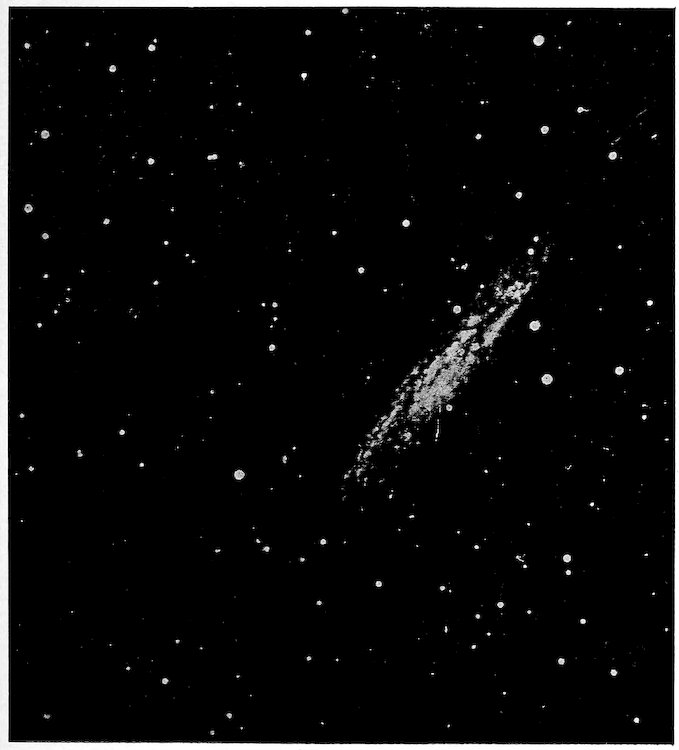
PLATE XX.
Photograph of a Spiral Nebula in Cetus. Taken by Dr. Roberts, 25th December 1899.
443The essential formative law of white nebulæ is unmistakably
that of spirality. This conviction, strongly upheld
by the long series of the Crowborough pictures, was irrefutably
established by Professor Keeler’s photographic survey with
the Crossley reflector.[889] Owing to the strong light-collecting
power of the instrument, the harvest of nebulæ garnered was
so plentiful that the number within its reach over the whole
heavens was estimated at no less than 120,000, and nearly
all of these can be inferred, from the preliminary results
obtained, to have a spiral shape. On the Lick plates, in fact,
a small compact nebula, not disposed in luminous coils, stood
out as a rarity. All spindle-nebulæ were resolved into
spirals viewed aslant, but into spirals of various degrees of
complexity. Some consist merely of two curved branches,
shaped like the letter S, and diverging oppositely from a
nuclear condensation. An object of the kind situated in
Pegasus (N.G.C. 7479) is reproduced from Professor Keeler’s
photograph in Plate XXI. Subjoined are the drawings by
J. Herschel, d’Arrest, Lord Rosse, and Tempel, with which
Keeler compared the autograph picture. They make an
instructive study. Herschel saw the object as a narrow
spindle “extended between two stars,” d’Arrest as a lozenge;
Lord Rosse perceived, in addition, a mass of spiral convolutions
surrounding a faint star, while Tempel caught the double
effect of a round attached to an elongated patch of luminosity,
but failed to discern their true connection. At last on the
Lick plates the object disclosed itself under an intelligible
aspect. “A glance at the photograph,” Professor Keeler
wrote,[890] “shows that the nebula is a two-branched, left-handed
spiral, with a nucleus or condensation near the point of
inflection. The preceding branch is strong and single, but
the following branch is split into two, which cross where their
curvature is greatest, at some distance from the centre of the
spiral, and unite again at their extremities. This appearance
in the components of the following branch, and the fact that
444the ends of both branches curve around so as to approach the
centre more closely than do the intermediate parts, are doubtless
effects of projection, the plane of the spiral lying obliquely
to the line of sight.”
Lord Rosse’s star occupies the centre of the space fenced
round by the preceding branch (that to the left). “It would
be of great interest,” the Lick astronomer continued, “to know
whether this singular position of the star is accidental, or
whether the star and the nebula are physically connected, and
if so, in what way the star was left in its present position
during the process of contraction. On the first of these
questions an investigation of the spectrum, which will be made
in due time” (the time, alas! never came), “may throw light.
Assuming for the present that the star is physically
connected with the nebula, it seems to me possible that the
proximity of this star may account for the unsymmetrical
appearance of the spiral, which may be due to an actual difference
in the dimensions of the two branches, or to their lying in
differently inclined planes.”
The first nebula in which a spiral conformation was
recognised is still unsurpassed as a specimen of its
class. We are enabled, by Mr. W. E. Wilson’s kindness, to
reproduce in Plate XXII. his fine picture of this stupendous
object. The coils are left-handed; they follow, as they issue
from the nucleus, the line of movement taken by the hands of
a watch. Our view of them is straight and square; they can
be little, if at all, foreshortened. Yet they do not wind
symmetrically round their origin. Their flow is broken and
distorted, like the current of a river by jutting rocks. The
spiral is fundamentally double. Two main streams leave the
nucleus at diametrically opposite points, and preserve their
separate individuality until they melt away into the outer
darkness. Their course seems to be prescribed essentially by
the combination of an ejective with a rotatory velocity;
disturbances, however, manifestly supervene. The branches
divide and reunite; they are cloven and bossy; they swerve
widely from the circular track. This is especially remarkable
in the case of the longest and brightest arm, which stretches
irregularly outward to join a secondary exterior nucleus. This
circumstance alone suffices to prove that the diffusion of matter
in this formation has been outward. The perturbing mass was
undeniably there before the luminous stream which it diverted
began to flow; and its flow was quite plainly towards it from
within. Other indications of centrifugal action are visible.
Mr. Wilson’s photograph shows “cometary tails curved
like a plume away from the central nucleus,” attached to
some of the denser knots on the convolutions of the spiral;[891]
and these effects of apparent repulsion are likewise clearly
legible on Lick and Crowborough plates of the same object.
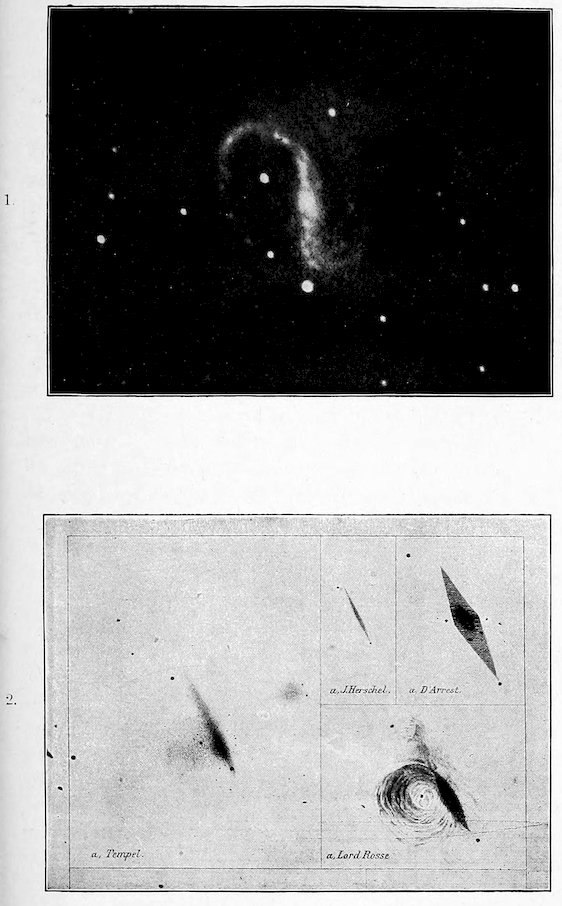
PLATE XXI.
1. Photograph of a Spiral Nebula in Pegasus. Taken by the late Professor Keeler.
2. Drawings of the same Nebula by Herschel, d’Arrest, Rosse, and Tempel.
445Indraughts or infalls from space are not here concerned,
whereas, in Mr. T. C. Chamberlin’s words,[892] “the effects of
explosive projection, combined with concurrent rotation, must
obviously give rise to a spiral form.” Each such nebula (and
there are tens of thousands of them) results, in his view, from
the “approach without collision” of a roving star to a compact
gaseous mass. Strained to the point of disruption by tidal
influences, this embryo vortex would, at a given moment, project
from both extremities of the ellipsoid into which it had
become elongated, a stream of material curved into whorls
through the continual slackening of its angular rate of
rotation; and the double catastrophic outrush served to constitute
a great system of shining spires, subsequently diversified
by the supervening phenomena of minor outbreaks. This
rationale has much to recommend it, and probably rests upon a
substratum of truth; yet the events contemplated in it are on
a small scale by comparison with the grandiose dimensions
which we must ascribe to spiral nebulæ.
Lord Rosse described a nebula situated near the
star 83 Ursæ Majoris (M 101 = N.G.C. 5457, 5458),
as a large faintish spiral, with several arms and knots, at
least 14′ across.[893] A four hours’ exposure at Lick brought
into view a surprising wealth of intricate details. The
groundwork of the structure agrees closely with that of the
great spiral in the Hunting Dogs. It is composed of two main
effusions, sweeping round from left to right. But they spread,
and split, and ramify, drawn hither and thither by multiple
attractions, while preserving in their complex interlacings,
the whirling impress of their origin.
446“Three-branched spirals” still survive here and there in
catalogues. Such were supposed to be the delicate objects,
M 99 in Virgo (N.G.C. 4254), and M 83 in the head of the
Centaur. But the triplicate form ascribed to them was most
likely of optical creation. There is no satisfactory evidence
that it exists in nature. So far as we can judge, the spiral
type originated, by fundamental necessity, through a double
outflow, in contrary directions, from the parent mass. A mode
of genesis is intimated which recalls, though distantly, the
diametrically opposed eruptions not uncommonly witnessed on
the sun. It may be added that no genuine spiral appears to
be a simple watch-spring coil. This, to be sure, is, to some
extent, a matter of definition. It depends upon what we
agree to call a spiral nebula. Yet the difference will most
likely prove to be radical between stars with curving trains,
like Maia in the Pleiades, and those cosmic “whirlpools,” every
trait of which testifies to the counterplay of multiple
activities.
“Cometary nebulæ” are not very rare, and they present
aspects of considerable variety. The nuclei are not always
stellar, nor are the appendages attached to them in all
cases inflected. A few have been photographed. Thus an
object (N.G.C. 1999) 50′ south of ι Orionis was noticed by
Lord Rosse as resembling “a comet coiled into a ring nebula,”[894]
and appeared under the same form on a plate exposed by
Dr. Common with his three-foot (now the Crossley) reflector in
February 1883.[895] Its spectrum has not, that we are aware of,
been examined. “Reaping-hook” shapes also occur. West
of the Argo nebula, a falcated and forked tail, 10′ long, was
observed by Sir John Herschel to issue from a granulated,
perhaps a double nucleus[896] (N.G.C. 3199). The inner edge is
sharp, but it fades gradually outward. Cometary, too, is
N.G.C. 520. It has an indistinct nucleus and a bifid train.[897]
A nebulous hyperbola with a star near the vertex (N.G.C.
2366) is met with in Camelopardalis;[898] and fan-shaped
appendages to stellar condensations are a recognised variety
of the species. A pair of these singular objects were photographed
by Professor Barnard, 2nd February 1894,[899] in the
immediate neighbourhood of the bright-line star γ Cassiopeiæ.
His sketch, showing their positions with regard to it, is copied
in Plate XXIII. Fig. 1. These do not seem to be casual.
The opening out of the two fans straight away from the star
suggests an express plan of orientation. Each nebula is about
15′ in diameter. They are “excessively faint and dilute,” and
almost elude visual observation. In Professor Barnard’s
opinion, they would never have been detected otherwise than
by chemical means.[900] Yet they photograph easily enough; and
if this actinic quality denotes, as seems probable, a gaseous
constitution, mention of them should, properly speaking, be
postponed to a later chapter. Their spectral classification,
however, is likely, for some time to come, to remain matter
of conjecture. Dr. Roberts obtained, with ninety minutes’
exposure on 25th October 1895, an excellent photograph of
the twin fan nebulæ, in which traces of a luminous connection
are apparent.[901]
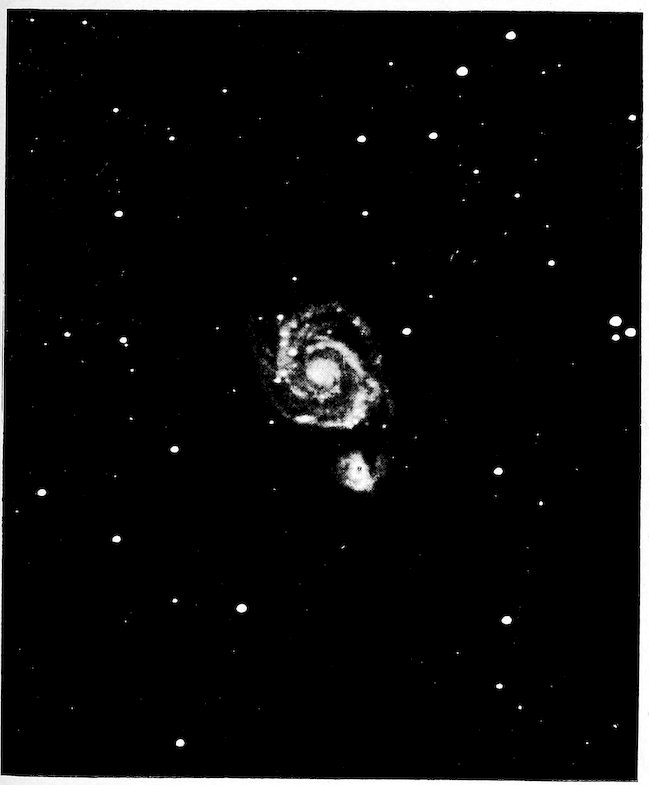
PLATE XXII.
Photograph of Whirlpool Nebula (M 51). Taken by Mr. W. E. Wilson, 6th March 1897.
447“Rifted” nebulæ must be classed as a variety of the
elliptical sort. They appear either as cloven discs—N.G.C.
5128 in Centaur is an example—or as parallel rays, such as
a bifid streak in Leo (N.G.C. 3628). A probably analogous
structure in Andromeda was photographed by Dr. Roberts in
1891.[902] It came out immensely elongated, and with just
such a “chink in the middle” as had been seen by Sir
John Herschel, whose opinion that the nebula was the foreshortened
representative of a thin, flat ring of enormous
dimensions thus received strong confirmation. Yet the
added light-power of the Parsonstown mirror had extended
Herschel’s “chink” into a channel, running from end to end
of the formation. Or rather the retinal impression afforded
by it had been misinterpreted in this sense; for that it was a
misinterpretation the camera incontrovertibly asserts. The
error may serve as an illustration of Professor Keeler’s remark
that “the most obvious tendency of the draughtsman is to
prolong a line or curve beyond the point at which it actually
448stops.”[903] A suspicion even arises that other telescopic
presentments of rays split throughout their length are
similarly misleading, and that they are, in fact, like the
glimmering oval in Andromeda, rings thrown into perspective.
Otherwise why should the dark rifts always coincide in direction
with the major axes of such formations? If these are
really circular discs, they might as well run across as along
them; but they never do. We must then choose between
two inferences. Either the nebulæ are in fact, and not
merely by optical projection, elliptical, in which case a
longitudinal line of cleavage would be intelligible, or they
are luminous rings viewed very obliquely. It must indeed be
admitted that the strong development of nuclear condensations
in some rifted nebulæ appears almost to exclude the
latter alternative. Dr. Roberts’s photographs, for instance, of
N.G.C. 4565 in Coma Berenices, and of N.G.C. 4594 in
Virgo,[904] exhibit an arrangement of parts insistently demanding
a different explanation. What seems certain is that no
single principle is valid all round. Modifications must be
introduced to meet the exigencies of nature’s endless variety.
The great majority of white nebulæ might be called
globular clusters in disguise. They present a round surface,
condensed centrally by gradations testifying to their true
spherical form. The only obvious distinction between them
and “balls of stars” is that they are irresolvable by any
telescopic powers that can be brought to bear upon them.
And the suggestion lies close at hand that this quality
depends wholly upon distance—that round nebulæ are neither
more nor less than remote globular clusters. Yet it cannot
be adopted without hesitation. The space-relations of the two
classes of object are very different. Clusters frequent the
Milky Way; white nebulæ avoid it. The discrepancy, it is
true, may be capable of reconcilement, but by a somewhat
elaborate artifice of speculation. Nor is there any immediate
prospect of solving the difficulty by the aid of the spectroscope.
We are unacquainted at present with any criterion
for distinguishing continuous nebular light from that of
compressed clusters. One may eventually be found, but
its application must always be a matter of extreme delicacy.
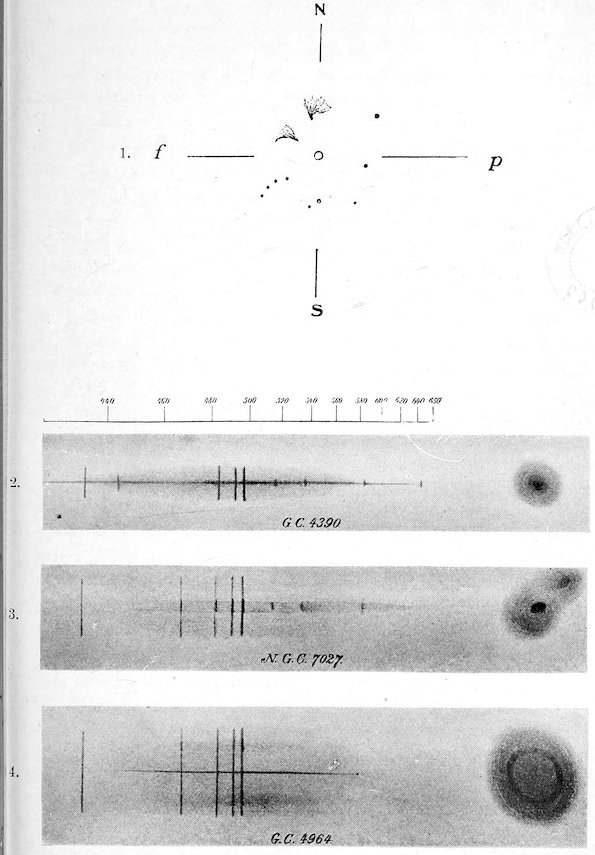
PLATE XXIII.
1. Fan Nebulæ near γ Cassiopeiæ (Barnard).
2. Drawing of Struve’s Planetary with Spectrum (Keeler).
3. Drawing of Webb’s Planetary with Spectrum (Keeler).
4. Drawing of Annulated Planetary in Andromeda with Spectrum (Keeler).
449Professor Max Wolf’s explorations of the heavens show
them to be strewn with an incredible number of small faint
nebulæ.[905] Directly visible only by elusive glimpses, they
come out individually distinct and measurable on sensitive
plates; and the Heidelberg observer has already laid his plans
for the construction of a photographic catalogue of nebulæ,
likely to be at least twenty times more voluminous than the
most exhaustive visual enumeration. In certain regions he
indeed found that only two per cent of the dim objects delineated
on his plates had been previously recorded. The newly
discovered crowd vary greatly in shape. Some are round and
compact; many more are round and diffuse; there are spirals
among them, and spindles, and draped or arched formations.
A surprising number are marked “planetary,” and are hence,
presumably, gaseous. The physical nature of the rest is
inferable only when the definiteness of their shapes prescribe
their arrangement in some established category.
Thus we are able to assert confidently that those disposed
along coiling lines or projected into rays and ellipses,
give continuous light; but if we attempt to go further, and
obtain a clear conception as to how the light originated,
embarrassments beset our path. Let us confront them fairly.
The only white nebula of which the spectrum has been
observed to any purpose is the great elliptical spiral in Andromeda.
It almost certainly includes lines or bands of absorption;
it is probably marked by traits of emission as well.
Plausibility is thus lent to the opinion that the nebula is a
genuine cluster of stars amalgamated by distance into a soft
haze. The haze, however, shines very dimly; its lustre is
almost evanescent comparatively to that of the sun. If, then,
its component particles are true suns, they must be inordinately
far apart. For the sake of giving some precision to our ideas
on the subject, we will attempt to illustrate this numerically.
If we assume the central parts of the nebula to possess ¹⁄₂₀₀th
the intrinsic lustre of the full moon, or (what comes to the
same) ¹⁄₁₂₄ millionth that of the sun, while consisting of
scattered globes of solar brilliancy, it follows that this also is
the proportion between the total bright area covered by their
450discs and the dark area of vacancy, the dimness of the nebula
measuring the spread of the interspace. Hence the component
stars, taking each to be half a million of miles in diameter,
should be separated from its next neighbour by an interval of
more than 5000 millions of miles, as seen projected upon a
plane perpendicular to our line of vision. Their real distances,
since they are presented to us slantwise, would of course be
very much greater; but with them we are not just at present
concerned. We must next try to form an estimate of how
close together these sun-like bodies should appear to be in order
to produce the observed effect of a smooth luminous surface.
If the gaps amounted to one-tenth of a second, the nebula
would certainly, with the powerful and perfect telescopes now
in use, show symptoms of resolvability. Yet none appear.
The fog does not even tend to condense into droplets, and the
temporary star of 1885 stood out, to the last hour of its visibility,
by contrasted light-quality from the soft surrounding
glow. Allowing, then, that the linear intervals of 5000 millions
of miles between the constituent bodies of the Andromeda
nebula are represented by optical intervals of ¹⁄₂₀th of a second,
we arrive at a parallax for that vast structure of less than
¹⁄₁₀₀₀″. In other words, its rays spend about 3300 years
in travelling to the earth. At this distance, the stars we have
supposed aggregated in it would appear of fifteenth magnitude.
Now they should in the fainter outlying parts of the nebula
be more sparsely distributed than near the centre, and as they
thinned off they would inevitably appear in their proper
guise as fifteenth-magnitude stars. But the texture of
the glimmering haze remains the same in every stage of
attenuation.
It may then be taken as certain that, if this object be of
stellar constitution, it is made up of stars smaller and closer
together than we have supposed; unless we are prepared to
lengthen still further, and very materially, a light-journey
already protracted to the verge of the incredible. It is not,
however, easy to conceive that bodies much less than half
a million miles in diameter can be truly sun-like. An outpouring
of light and heat in the profuse measure exemplified
by the sun, implies storage-accommodation on a colossal scale;
and the spectrum of the Andromeda nebula, so far as it
451can be deciphered, seems to correspond to a high standard of
temperature.
Undoubtedly the path “of least resistance” is to accept
the stellar origin of nebular radiance. It is not entirely
practicable, but every other is impassable. The solar corona
presents no real analogy to white nebulæ, since it is kept
incandescent by the potent agency of the sun, while their
glow is self-sustaining. This it can only be—setting aside the
vague possibility of electrical discharges—by the sacrifice of
motion in some form. According to Sir Norman Lockyer’s
well-known hypothesis, the collisions of swarming meteorites
supply the evolved energy; but there is little or no evidence
that the cause acts, or would be adequate if it did act. We,
at least, have no experience of its operation. The only
meteoric collisions we know of are with the earth, which spreads
a wide net for the capture of flying cosmic particles.
As an alternative suggestion it may be worth considering
whether the shining of nebulæ might proceed from a very
slow loss of circulatory speed through the resistance of a gaseous
medium. A pulverulent constitution, resembling that of
Saturn’s rings, should then be attributed to them; they
would consist of relatively small masses interfused with some
highly subtle aerial remnant, the distinctive bright lines of
which add complexity to the nebular spectrum. But the
velocity of circulation in such structures should increase outward.
Other things being equal, they should accordingly, if
arrested motion were the source of their luminosity, gain
brightness with increasing distance from the centre. The
reverse is very markedly the case; but the attendant conditions
are so intricate that the contradiction need not be fatal
to the speculation. It cannot, however, be usefully discussed
apart from a profound study of the dynamical condition of
such a peculiar system as that just indicated; and this we
must leave to more competent authorities.
452
“Double nebulæ,” Dr. See wrote in 1893,[906] “have been
greatly neglected since the time of Sir John Herschel, but it
is to be hoped that astronomers will again give adequate
attention to these remarkable objects, which should be at
once systematically studied and photographed. If accurate
drawings or photographs of these objects were now made, it
is not to be doubted that important changes could be observed
fifty years hence.”
His special interest in them originated from a research
into the “evolution of stellar systems.”[907] Sir John Herschel’s
drawings of coupled nebulæ illustrated most aptly his theory
of the origin by “fission” of double stars, some appearing
actually modelled upon Poincaré’s “apioid”—the figure assumed
by an ellipsoid when becoming unstable under the stress of
increased axial rotation, and about to break up into unequal
masses. Without entering into details regarding the process,
it may be explained that disparity in the products of disruption
indicates want of homogeneity in the parent body, so that the
sooner the components separate, the greater the chance of their
approximate equality. But the result of photographically
investigating the pattern-objects was completely to alter
the point of view from which they had to be regarded.
“The actual nebulæ,” Professor Keeler stated,[908] “have almost
no resemblance to the figures. They are, in fact, spirals
sometimes of very beautiful and complex structure, and in
453any one of the nebulæ the secondary nucleus of Herschel’s
figure is either a part of the spiral approaching the main
nucleus in brightness, or it cannot be identified with any
real part of the object.” There had been premonitions to
this piece of “destructive criticism.” Many spirals are readily
seen to be essentially duplex. Such is their exemplar in
Canes Venatici, the second nucleus of which, separately catalogued
by Sir John Herschel,[909] was brought into connection
with the first only when the intervening whorl of nebulous
matter disclosed itself at Parsonstown in April 1845. In
many other cases, the brighter knots which tend to form on
curving branches are seen isolated, for lack of light to bring
the linking filaments into view, with the outcome of visually
decomposing one formation into several. Thus telescopic
improvements, which avail to analyse stars, have frequently a
synthetic effect upon nebulæ. Even such adjacent objects as
are presumably in mutual systemic relation, often show signs
of being bound together by organic ties as well. Hence it is
difficult to draw a line between single and double nebulæ. A
pronounced “dumb-bell” form graduates insensibly into a pair
of clearly individualised globes, barely united by a faint
ligament. And their condition seems less alien to our ideas
when we remember that the sun is nebulously connected with
the earth by means of the zodiacal light.
Unification with increase of optical power was exemplified
by Burnham’s observation, at the Lick Observatory in 1891,[910]
of a nebula as single, though bi-nuclear, which Herschel had
registered under two distinct headings (N.G.C. 7174, 7176).
The condensations, which possibly offer to our view a double
star in the making, are just 26″ apart, and belong to a
nebular group in the Southern Fish. A more dubious object
is situated in Aquarius (N.G.C. 7287). Detected by Müller
at the M‘Cormick Observatory, it was described as an “excessively
faint, slightly nebulous double star.” Burnham
found the object to be indeed double at an interval of about
20″, yet not stellar, one component, at any rate, and perhaps
both, appearing as small dim nebulæ. An authentic example
of a double nebula was noted by Barnard in 1888, with the
454twelve-inch refractor of the Lick Observatory, in the neighbourhood
of the wide double star 23 Orionis (Σ 696). The
components are 36″ apart, faint and uncondensed. A tenth-magnitude
star forms with them an equilateral triangle. Their
measurement by Burnham in 1891[911] supplies a datum of
first-class importance for the future determination of change
in the system which they beyond question constitute.
Littrow described in 1835[912] a curious combination of three
small nebulæ marking the angles of a triangle, the sides of
which are formed by three nebulous bands, while a fine double
star occupies the middle of the enclosure. The arrangement,
met with near γ Pegasi, would make a promising subject for
a photographic experiment. Close telescopic scrutiny, on the
other hand, might advantageously be brought to bear upon a
nebulous pair in Gemini (N.G.C. 2371, 2372). The distance
from centre to centre of the components is only 32″, and they
were seen at Parsonstown to be connected by “tails and
filaments,” if not encircled by a filmy annulus.[913] An intermediate
star, noted as “bright” 19th December 1848, was
observed by Lassell in 1852,[914] and by d’Arrest in 1862, but
has of late ceased to attract attention. Can it have lost
light? D’Arrest seems to have had no difficulty in seeing
it with an eleven-inch refractor, so the question might be
readily answered. The preceding member of the pair was
remarked by Dr. Dreyer in 1887 to be brighter and more
condensed than its companion.[915] A similar nebular and stellar
group was discovered by Dr. Common in 1880[916] in the
constellation Crater. He regarded the nebulæ as planetaries;
in the absence, however, of information concerning their
spectra this cannot be held certain. The existence of the
linking star—a feature of peculiar interest—has not, we
believe, been verified, but need not be doubted.
Fine telescopic seeing avails to resolve, no less than to
unify nebulæ. Some split up, like close double stars,
under high powers. With a magnification of 250 Professor
455Swift perceived a nebula (N.G.C. 6679), earlier discovered
by himself, to be a well-separated pair, and he obtained
a similar result for one of Sir William Herschel’s. “It
would,” he adds, “be a great satisfaction to be fully assured
that they are binaries.”[917] We fear that the satisfaction is
reserved for a future generation of astronomers. The
Herschelian nebula in question was doubtless N.G.C. 3690 in
Ursa Major, which had already in 1852 been divided with
the Rosse reflector into two irregular masses at a distance of
about 60″.[918] This is a coarse object compared with two
delicate pairs discovered by Swift at Echo Mountain, California,
in 1897. Each resembles a “double nebulous Uranus,”
the conjoined discs being 5″ or 6″ apart.[919] They are numbered
6 and 27 on his eleventh catalogue; yet, although one seems
the replica of the other, they are not near neighbours in the
sky. Mixed pairs, stellar and nebulous, are less scarce than
one might expect. Swift’s southern explorations yielded
nearly a dozen specimens. Two are situated in Argo, near the
small round nebula, N.G.C. 3267. Each proved resolvable,
in the exquisite Californian air, into a star and nebula at a
distance of 4″;[920] and the veteran observer’s concluding list
of discoveries included five analogous couples, the widest
having a span of 8″. They should at once be micrometrically
measured; for until this is done they cannot be said to have
started on their career in scientific history.
Double elliptical nebulæ are picked up now and again.
They are not easily distinguishable from rifted nebulæ.
Probably the true criterion is the duplicity of the nucleus.
Rays stretched parallel to the main formation, but exhibiting
no trace of independent condensation, can only be regarded as
outlying portions of it; where there are two nuclei, there are,
in esse or in posse, two distinct bodies. As such two lens-shaped
objects in Pegasus (N.G.C. 7814), photographed by Dr.
Roberts,[921] should probably rank. The “dark lane” shown by
the Rosse reflector was perceived in the negative to bisect the
globe-like nucleus, and to widen out on either side of it; so
456that each oval is complete in itself; neither looks like a fragment
of the other. A true pair seems also to be constituted
by the lenticular nebulæ (N.G.C. 3786, 3788) delineated by
Spitaler at Vienna in 1893;[922] while the status of many more
cannot be fixed until they have been photographed with a
variety of instruments and exposures. Among those of uncertain
nature should be reckoned a cloven ray in Leo (N.G.C.
3628), 15′ in extent,[923] and probably annular;[924] a similar object
in Centaur (N.G.C. 5128), viewed with amazement by Sir
John Herschel; a fissured ellipse in Leo Minor (N.G.C. 2964),
thought to be “almost double” at Parsonstown; and a spindle
in Draco (N.G.C. 5866), described by Professor Keeler as
“divided lengthwise by a narrow, perfectly dark straight rift,
on each side of which, near the north-preceding end, and
involved in the nebulosity, is a minute star of about the
sixteenth magnitude.”[925] A bifid beam in Coma Berenices
(N.G.C. 4565), 14′ long, and with a protruding nucleus,
appears to be essentially single. Sir John Herschel noticed
that the segments of rifted nebulæ are sharp on their confronted
sides, diffuse outwardly.[926] They recall the gaping shell
of a bivalve; and this peculiarity, if photographically persistent,
might serve as a secondary mark of unity. The unity, as
already pointed out, may be that of a ring viewed edgewise;
or, in some cases, a formation primitively one may have been
sundered by disintegration, as a rock-ledge is cut by a mountain
torrent. This is, of course, said merely by way of illustration.
We are unable to conceive how disintegrating forces in a
nebula really act. Nor should the possibility be forgotten
that the occurrence of black chasms may indicate, not the
removal of matter, but an abolition of light. These apparently
breached objects perhaps subsist, after all, in substantial
entireness.
Double nebular ellipses do not invariably lie parallel to one
another. The Andromeda nebula, for instance, is, in a manner,
coupled with N.G.C. 205, the longer axis of which, as has been
457said, makes an angle of 60° with that of its primary. A pair in
Virgo (N.G.C. 4567, 4568) stand in yet more singular relations
to each other. They coalesce at their following extremities, and
diverge at an angle of about 45°.[927] They might be conceived
of—were this mechanically possible—as revolving on a pivot.
The combination is essentially reproduced by two spindle
nebulæ near the hind foot of the Great Bear (N.G.C. 3786,
3788), which meet almost rectangularly. Dr. Spitaler’s drawing
of them is copied in Fig. 48. A third pair, similarly
composed, was noted by Swift, 23rd September 1897, at
the Lowe Observatory.[928] A
bright nebula in Sculptor
(N.G.C. 55) was then
too seen to have a dim
companion. Both are
elongated; they meet obliquely
and overlap. Possibly
indeed they form
together a single curved
nebula; yet the indications
are more in favour of
a genuine coupled arrangement.
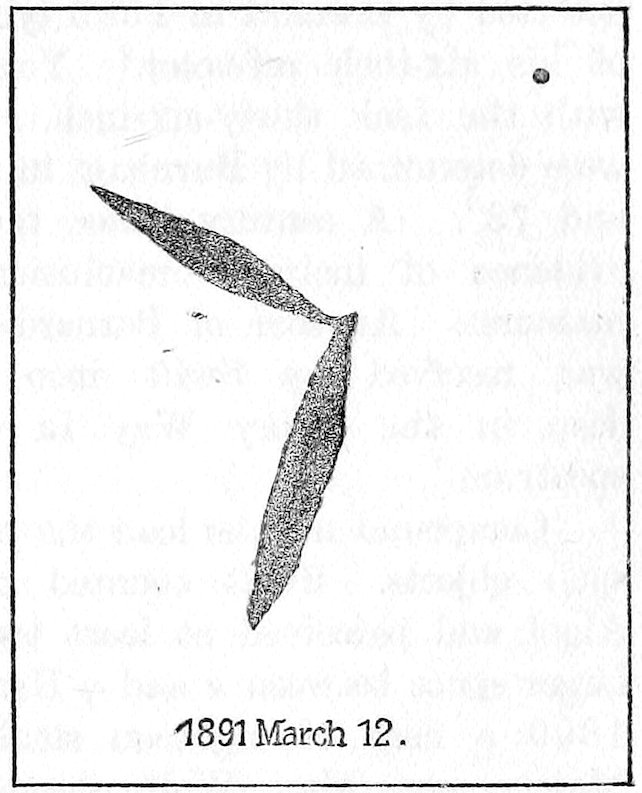
Fig. 48.—Drawing of Spindle Nebulæ (Spitaler).
Elliptical nebulæ are
sometimes found less congruously
associated with
round, perhaps globular
attendants. Thus an enormously
long ray in Canes
Venatici (N.G.C. 4631) is preceded by a tenth-magnitude
star, and that again by a nebulous orb.[929] Of the ray,
it was recorded at Parsonstown, 26th March 1848, that
“masses of light appear through it in knots”;[930] and the
drawing made there exhibits helical lines corresponding
presumably to an extensive system of foreshortened flat
spires. The star does not appear to have been seen;
458nevertheless it ought, unless greatly diminished during the
score of years elapsed since Herschel’s observation of it, to
have been conspicuous with the six-foot speculum. A
spindle-nebula in Eridanus (N.G.C. 1532) has also a round
companion;[931] and two are attached to an ellipse depicted by
Spitaler in 1893 (N.G.C. 2781, 2785). Triple combinations
of round nebulæ are fairly common. The varieties of
multiple stars are recapitulated in them. Single primaries
have closely double satellites, or single satellites wait upon
compound primaries. Three nebulæ, which, from their central
brightening, may roughly be described as spherical, were
detected by Barnard in 1886 lying close together in the field
of his six-inch refractor.[932] Yet they are faint objects even
with the Lick thirty-six-inch. The intervals between them
were determined by Burnham in 1891 to be respectively 94″
and 78″. A century hence there will be hope of eliciting
evidence of incipient revolution by the renewal of these
measures. Another of Barnard’s new nebulæ (N.G.C. 6302)
was resolved by Swift into a triplet. It is plunged
deep in the Milky Way in Scorpio, and has a gaseous
spectrum.[933]
Compound nebulæ lead the way to groups and clusters of
such objects. Swift counted twelve in a single field near
Algol, and perceived at least twenty collected into a slightly
larger space between κ and γ Herculis.[934] Barnard explored in
1890 a nest of eighteen small separate nebulæ in Ursa
Major; and Max Wolf observed in March 1901 a real
“Nebelhaufen” surrounding, though probably disconnected
from the star 31 Comæ Berenices.[935] No less than 108 components,
some elongated, some roundish and of various degrees
of faintness, were found included in a circle 30′ in diameter;
and a similar group, photographed in 96 minutes, has η
Virginis for its centre.[936] White nebulæ, in fact, tend very
markedly to gather into flocks; whether as a consequence
of their mode of origin, or through the compulsion of their
mutual attraction, remains an open question. And since the
459masses of these bodies are likely to be very small, and their
real distances very great, circulatory movements only of the
most leisurely kind can be ascribed to them. We are unable
as yet to forecast, even remotely, the establishment on a
settled footing of the dynamics of nebular systems.
460
“There is a vast difference,” Professor Swift wrote in 1897,
“between a nebulous star and a star in a nebula.”[937] Vast indeed,
since a star and nebula in reality billions of miles apart may be
thrown by perspective into the same visual line, while a true
nebulous star claims the ownership of its luminous appendage
on the evidence of obviously adapted form. The nimbus is not
more unmistakably fitted to the head of a saint in a picture
than nebulous halos are, very often, to the stars they encircle.
The relationship is patent. That the glow emanates from the
star, and is no casual adjunct to it, the instinctive logic of the
eye suffices at once to decide.
Sir William Herschel was the first to give express attention
to “stars with burrs.” They struck him as remarkable,
not only in themselves, but for what they implied. They
served as the basis of a memorable train of reasoning.[938] Their
atmospheres, he argued, being plainly “not of a starry nature,”
must be composed of a “shining fluid,” the same which is
seen to be diffused through space in milky tracts, or curdled
into fantastic shapes of chaotic irregularity. He was, in a word,
led by them to the capital discovery of nebulæ as a distinct
sidereal order. On 13th November 1790, he came across the
“singular phenomenon” which determined his abandonment of
the view that the universe is constituted exclusively of stars
variously aggregated. This was “a star of about the eighth
magnitude, with a faint luminous atmosphere of a circular
form, and of about 3′ in diameter. The star is perfectly in
the centre,” he continued, “and the atmosphere is so diluted,
461faint, and equal throughout that there can be no surmise of
its consisting of stars, nor can there be a doubt of the connection
between the atmosphere and the star.” This exemplar
object, situated in Taurus (N.G.C. 1514), he regarded as
“decisive in every particular”; yet its nature is still to some
extent dubious. It has even been classed of late as a planetary
nebula, and certainly shares not a few characteristics of
that family. The uncertainty of its status renders its study
especially instructive.
A planetary nebula is definitely terminated; a nebulous star
fades off into space. One shows a disc; the other is surrounded
by an “atmosphere.” Moreover, a star, or stellar
nucleus, is subordinate in the one formation, while it dominates
the other. These distinctions, however, cannot always
be unhesitatingly drawn, since the relative strength of the
stellar and nebular elements varies widely in different objects.
Hence the doubt as to the category in which Herschel’s
typical specimen should be ranked. For the glow round it is
uncommonly bright; d’Arrest found it to strike the eye with
a four-and-a-half-inch refractor.[939] Nor is it equably diffused.
The Parsonstown telescope showed it as spotted and patchy,
and very curiously “ragged” at the edges;[940] and its aspect
to Mr. Burnham in 1891 was essentially the same. A
“broken and mottled” surface, about 126″ across, emerged in
the field of the Lick thirty-six-inch.[941] He was inclined,
though under reserve, to agree with Barnard in considering
the object planetary. Its affinities might be settled by spectroscopic
means; the attempt to do so could, at any rate,
hardly fail to have an interesting result. So far, little has
been ascertained about the spectra of true nebulous stars.
Their halos, certainly in some cases, presumably in all, emit
bright lines, and it might be expected that the same lines
would show by absorption in the spectrum of the central
star. The presumption has not, indeed, been fully verified;
while the expectation founded on that presumption is
disallowed by the facts scantily at our disposal. Stars with
nebulous appendages are usually, if not invariably, distinguished
462by “early Orion” spectra—a combination already
noted as significant in connection with the course of sidereal
growth; but they show no special lines that could be attributed
to light-stoppage by the immense bulk of rarefied
incandescent matter interposed between our eyes and their
shining photospheres. This is one of the many perplexities
involving the luminous relations of nebular stuff, which,
setting “Kirchhoff’s law” at defiance, exercises no absorption
correlative to its emission.
One of the few nebulous stars bright enough for easy
spectroscopic investigation is situated in Scutum Sobieski. Of
5·5 magnitude, it is enrolled in the Bonn Durchmusterung
under the heading S.D. −10°4713. On a plate exposed by
Professor Barnard with the Willard lens, 29th June 1892,[942] a
large diffused nebulosity was seen to encircle it. The appendage
must be visually very faint to have escaped notice so long.
Its proper spectrum may then be nearly evanescent. The
star it belongs to is No. 8198 of the Draper Catalogue, where
it is set down, although doubtfully, as of the second type
(Spectrum E). Now this is a point of crucial importance to
theories of stellar development. The pronounced nebulous
condition of a star near the solar stage would have a bearing
on such inquiries that could not be ignored. Should it be
established, current ideas will need revision. The spectral
character of Barnard’s nebulosa in the Shield promises, indeed,
to afford a test by which to try the validity of reasonings on
sidereal evolution. The test ought, with the least possible
delay, to be applied.[943]
A seventh-magnitude star in Eridanus was perceived by
Swift in 1859 to be almost centrally placed in a shining
corona.[944] It is perhaps identical with N.G.C. 5315. Its
spectral classification should present no difficulty. A similar
object, equally adapted for spectroscopic inquiry, was detected
by the elder Herschel in Cepheus (N.G.C. 7023). The nebulosity
is particularly strong north and south of the star.
Irregularities of a more marked kind are apparent in other
463instances. A tenth-magnitude star in Monoceros was found
by Barnard visually nebulous in 1888, photographically in
1894.[945] A “small dark space,” however, interrupts the
encircling halo. A subsequent exposure with the same instrument
disclosed as “closely nebulous” the 9·5 magnitude star,
D.M. + 23° 1313.[946] And here again the illumination is unevenly
distributed, the “fuzzy” border to the star-disc being
denser south and east than elsewhere. This object lies
almost midway between η Geminorum and χ2 Orionis. One
in most respects analogous (N.G.C. 2247), detected by Swift,
24th November 1883,[947] came out noticeably “blurred” on the
same plate with Barnard’s nebulous star in Monoceros. Two
further specimens of the class were photographed by Barnard
in Sagittarius. One—D.M. −19° 4948—is fainter than the
ninth magnitude. It has a narrow fringe of light.[948] The
second—D.M. −19° 4953—is of 7·6 magnitude, and is encompassed
by a far-spreading halo, 15′ in diameter,[949] conspicuous
with the camera, although nearly invisible to the eye.
Nebulous stars are frequently compound—perhaps more
frequently than stars clear of cosmic fog. Sir John
Herschel recorded at the Cape a close pair (N.G.C. 5367) as
involved in a bright glow two minutes of arc in extent; and
a faint star with an aureola, discovered by Tempel in Cetus
(N.G.C. 707), proved, when scrutinised by Burnham in 1891,
to have a minute attendant at an interval of 10″.[950] A still
more interesting detection concerned a nebulous triplet in
Auriga (N.G.C. 1931). Discovered by Sir William, and described
by Sir John Herschel as “one of the most curious
objects in the heavens,” it consists of three stars, the brightest
of 9·5 magnitude, forming an equilateral triangle with a side
of about 8″, placed precisely at the centre of a small circular
nebula. Mr. Burnham had repeatedly inspected it with
minor instruments,[951] but it needed all the power of the Lick
refractor to bring into view a fifteenth-magnitude satellite at
a distance of little more than 2″ from one of the stars of the
triangle. As a test for “seeing” facilities, the pair is of
464unsurpassed delicacy. Again, a wide double star occupies the
middle point of a pretty large faint nebula in Monoceros
(N.G.C. 2182). The attendant may be only optically such;
the circumstances are on this point indecisive. The chief
star, however, was found by Mr. Burnham to be double in a
perfectly unequivocal sense.[952] A companion of nearly its own
magnitude (8·6) is separated from it by a spatial gap of less
than half a second, and the two must assuredly revolve round
their common centre of gravity. Here, indeed, we are confronted
by a profoundly embarrassing question. The couple
are evidently plunged in nebulous matter; their movements
must then, according to received ideas, be impeded, with the
result of an eventual collapse of the system. We can see no
escape from the dilemma except by adopting the startling
hypothesis that the nebulous fluid does not constitute a resisting
medium. The difficulty greatly enhances the interest
of spectroscopically determining the velocities of bodies nebulously
connected.
A 6·5 magnitude star in Cepheus (D.M. +57° 2309) appeared
in a photograph taken by Barnard in 1893 “surrounded
by a rather unsymmetrical dense nebulosity.”[953] A “hazy glow”
could be seen with the Lick thirty-six-inch, which, in Burnham’s
employment, had already revealed the star to be very unequally
double at 4″.[954] A first-type spectrum is dubiously ascribed to
it in the Draper Catalogue.
The nebulous triplet, ι Orionis, has been more completely
observed than perhaps any of its congeners. It consists of a
third and an eighth-magnitude star 11″ apart, with an eleventh-magnitude
satellite at 49″, described by Admiral Smyth as
“grape-red” in colour.[955] Sir John Herschel perceived the
group to be “involved in a feeble nebula 3′ in diameter,”[956]
and in the nebula (N.G.C. 1980) there was apparent with the
Rosse reflector a central cavity containing the bright star-couple.[957]
Possibly the effect was an illusion due to their
effacing radiance; but this cannot be taken for granted, since
465“holes” in nebulæ are an attested phenomenon. And the
early observations at Parsonstown approve themselves as
singularly accurate through the confirmatory evidence of the
best recent photographs. The spectrum of ι Orionis is of the
helium type, and Dr. McClean identified in it three members
of the Pickering series of hydrogen, besides many oxygen
lines.[958] The surrounding glow emits the ordinary nebular
rays, but they make no show, either directly or by reversal, in
the dispersed stellar light. Yet before reaching outer space,
that light has to traverse enormous volumes of incandescent or
luminescent nebulium. The anomaly presented by the absence
from the Fraunhofer spectrum of the solar coronal green line
is here repeated in an emphasised form. A long nebulous
streak, visible only on sensitive plates, links the hazy appendage
of ι Orionis with the great formation in the Swordhandle.[959]
Far away in the northern part of the constellation, there
is found in λ Orionis a combination very similar to that presented
by the nebulous trio just considered. A yellowish and
purple pair (Σ 738), of 3·7 and 5·6 magnitudes, at 4·2″, are
immersed, with a comparatively remote twelfth-magnitude
attendant at 29″, in a nebulous haze, photographed by Barnard
in three hours, 17th September 1893.[960] The discovery
was at once telescopically verified.
Five nebulous stars occur together in a narrow region of
Sagittarius, and three of them are double. The two apparently
single are Barnard’s stars, already mentioned. The pairs are
N.G.C. 6589 and N.G.C. 6590, both first noticed by Swift,[961]
and N.G.C. 6595, delineated seventy years ago by Sir John
Herschel. The character of an object photographed by Dr.
Roberts[962] near the spiral nebula M 81 in Ursa Major, needs
to be more satisfactorily determined. Known to Herschel and
d’Arrest as a condensed nebula (N.G.C. 3077), it appeared on
the sensitive plate with a sharp, stellar nucleus in lieu of the
woolly disc visually perceptible.[963] The spectroscope may perhaps
help towards its rightful classification. Nebulous stars
466merge insensibly into stars with nebular appendages, such as
ω Orionis and σ Scorpii. The former has a dimly luminous,
curved spur running out from it, besides a larger mass hanging
like a cloud above it to the north; the latter is winged
with nebulosity, two pointed projections issuing from it in
divergent directions.[964] The whole of these appurtenances were
detected photographically by Professor Barnard. Both stars
afford spectra marked by helium absorption. The relations of
stars and nebulæ are manifold. Misty trains and tails of all
sorts and sizes have stellar foci; they emanate from stars, or
condense into stars; but nebulous stars are, properly speaking,
what Herschel called “stars with burrs”; they give the usual
sharply defined diffraction-discs, although a dim halo spreads
more or less symmetrically round each. The nebular element
in such a combination is entirely subordinate to the stellar;
while in stars with appendages the disparity gradually becomes
reversed.
“Rejected” nebulous stars are still worth attention in
view of the possibility that they may be subject to genuine
change. The case of 55 Andromedæ is particularly instructive,
if only as illustrating the propagation of error. This is a
5·6 magnitude star, qualified as nebulosa by Flamsteed and
Piazzi, and regarded by Sir John Herschel as a typical
specimen of a hazy star. It figures as No. 428 in his General
Catalogue of Nebulæ (1863), but was omitted by Dreyer from
the revised edition of that work. Sir William Huggins,
nevertheless, observed it in 1864 to be “a fine nebulous star
with a strong atmosphere;”[965] and since he used a very perfect
refractor, his confirmation of what Herschel had seen with a
reflector had an independent value which might seem to
exclude the hypothesis of association in optical illusion. Yet
neither Lord Rosse in 1848 nor d’Arrest in 1856 had
perceived any trace of nebulosity, and Schjellerup, during
some years previous to 1866, always found the star sharp.[966]
So again it appeared to Mr. Burnham in 1879–80,[967] and so
it seems likely to remain. We can, however, scarcely persuade
ourselves that several eminent observers conspired to blunder;
467and Schjellerup’s theory that Piazzi merely repeated Flamsteed’s
note, which crept, he supposes, into the British Catalogue
by a transference from the great Andromeda nebula, is
rendered unacceptable by the circumstance that 55 Andromedæ
follows the nebulous structure held to have been confused
with it at an interval of considerably more than one hour of
right ascension. Nor even if so extraordinary a mistake had
been made, was Piazzi capable, one would think, of copying it
unawares. His high astronomical reputation suffices in itself
to clear him from the charge of such astounding carelessness.
The spectrum of the star resembles that of the sun, a type
never yet unequivocally associated with nebulous attachments.
On the other hand, the normal quality of the light renders
their optical creation more difficult of explanation. Thus the
nebulous aspect of 55 Andromedæ must stand over as one of
the unsolved problems of astronomical history.
A similar, but less convincing case is that of 8 Canum
Venaticorum. On four separate occasions Sir John Herschel
noticed this fourth-magnitude star to be surrounded by a
“considerable atmosphere.” Yet since no one before or after
him has vouched for its presence, he was presumably deceived.
The spectrum of 8 Canum is of the solar class.
Finally, a 7·5 magnitude star in Cetus, discovered as
nebulous by Stephan at Marseilles in 1880[968] (N.G.C. 988),
appeared to Burnham and Barnard in 1891 devoid of any
such peculiarity.[969] A photograph taken with suitable exposure
would serve decisively to test its present condition. The
criterion might indeed fail with stars so bright as 55
Andromedæ and 8 Canum Venaticorum; for their imprinted
discs would become, through chemical irradiation in the time
needed to bring out faint glows, sufficiently distended for
their obliteration.
In connection with nebulous stars two lines of inquiry
open out. First, the spectroscopic. The scanty evidence at
our disposal is to the effect that the stellar rays of such
objects are of the “Orion” kind; that they show the quality
believed to characterise suns in a primitive stage, while their
aureolas shine like gaseous nebulæ. But these generalisations
468rest on a very narrow basis of fact, and probably
admit of interesting and significant exceptions. Indeed,
each nebulous star should be treated as a separate spectroscopic
problem, destined to afford in the course of its solution
insight into many obscure secrets. A second branch of
research relates to the structural peculiarities of stellar halos.
Their luminosity is seldom, perhaps never, equably distributed.
Its irregularity sometimes goes so far as to produce the
effect of dark vacuities, photographically attested to be no
mere visual deceptions. What their true nature and origin
may be, is a subject for inquiries likely to be long and
arduous. It is scarcely credible that they are what they
appear to be, obscure tunnels, striking, in the direction of the
earth, right through the heart of immense spheres of shining
tenuous matter. The alternative view is preferable that the
so-called “atmospheres” of stars are really effluences—that
they consist essentially of spiral coils wound closely enough to
merge ordinarily into an approximately uniform surface,
while leaving in certain circumstances conspicuous gaps
between their luminous folds. If this be so, nebulous stars
fall into line with cometary nebulæ, the trains of which
take a more or less completely annular shape; but their
nearest allies are unquestionably to be found in the planetary
family; and this brings us to the subject of our next
chapter.
469
Planetary nebulæ seem to be intermediate between nebulous
stars and annular nebulæ. Indefinite aureolas are replaced in
them, as if through the spreading outward of nebulous matter
towards a limiting spherical surface, by compact discs, and
with the further advance of this process of exterior condensation,
the discs become rings. A stellar nucleus persists
throughout these phases. They may not be strictly phases
of development. To establish an actual sequence of growth,
facts of various orders should be considered. As a simple
matter of fact, however, objects are found which combine so
closely the visual features of planetary nebulæ and nebulous
stars on the one side, and of planetary and annular nebulæ on
the other, that their classification in the above order is
prescribed inevitably, if only for mental convenience.
As a preliminary to the physical study of these objects,
we must try to attain a clear conception of their real forms in
solid space. This is not easy when their structural complexities
are taken into account; but, setting these for the
moment aside, we can gather some indications regarding the
general plan of their fabrication. As a rule, planetary nebulæ
are markedly elliptical. They may then be concluded to be
spheroidal in shape; and even those sensibly circular are
probably spheroids viewed along their shorter axes. That
their compression is due to axial rotation is a fair inference,
verifiable, possibly, by spectroscopic measurements. These
were indeed ineffectually tried by Professor Keeler, 3rd April
1891, on a bright planetary in Hydra (N.G.C. 3242);[970] but
470he doubted whether the conditions of the experiment permitted
the detection of a difference in the velocities of the advancing
and retreating limbs of the nebula of less than seven or eight
miles a second, and the movement of such bodies is likely to be
excessively slow. Otherwise they could scarcely be supposed
capable of holding together; for they are obviously of tenuous
composition, and gravity at their equators can act very feebly
in equilibrating centrifugal impulse.[971] And here an untrodden
field opens to enterprising inquirers. A theoretical investigation
might, to begin with, be attempted of the figures which
should belong to rotating globes of the kind on certain
probable assumptions as to their nature and modes of movement;
and the results might be tested by the application to
a number of promising objects of Keeler’s spectrographic
method, in which the linear images of an equatorial slit serve,
through the tilt imparted to them by the contrary motions of
the opposite limbs, to measure, in miles per second, the speed of
gyration. Small, lucid, strongly elliptical planetaries would be
the most hopeful subjects for experiment; nor would a negative
upshot be without value. The Hydra nebula, for instance,
which is nearly as much flattened as the globe of Saturn, is
equal in light to a seventh-magnitude star; it is about 20″
across, and somewhat diffuse at the edges.[972] With it may be
compared a condensed planetary in Ophiuchus (N.G.C. 6572),
sometimes called Struve No. 6 (Σ 6). Its light, which is
comparatively intense, emanates from a small disc 8″ in
diameter (exclusive of a hazy margin), with an ellipticity of
about ¹⁄₂₀₀. Professor Keeler’s drawing of the object with the
visible part of its spectrum is copied in Plate XXIII. Fig. 2.
The nucleus is not stellar, although it gives strongly continuous
light. The lines in its spectrum were found by Keeler to be
displaced upward by an amount corresponding to a motion
towards the earth of 6·3 miles a second;[973] but this motion
should be considered to belong to the sun, not to the nebula.
Judging by its appearance, axial acceleration may have
advanced farther in it than in most members of the class,
and might record itself in an equatorial spectrograph. The
471trial, at any rate, should be made. Anticipation of failure
need not be allowed to paralyse effort. In science the rush of
a forlorn hope often carries a fortress that has obstinately
held out against a siege in regular form.
The uniformity of aspect at first supposed to characterise
planetary nebulæ disappears before the searching scrutiny of
the powerful telescopes now in use. Their surfaces prove to
be full of suggestive detail. They are broken up by irregular
condensations, or furrowed by the operation of antagonistic
forces; they betray, here possibly the action of repulsive, there
of attractive influences, and bear inscriptions of no less profound
historical import than the contortions and faultings of terrestrial
strata. They are quite commonly multiplex formations. One
glimmering disc is superposed upon another, intimating the
analogy of the successive filmy envelopes flung round the heads
of active comets. With the twenty-seven-inch Vienna refractor
Vogel succeeded, in 1883, in resolving the above-mentioned
planetary in Ophiuchus (N.G.C. 6572) into three distinct layers,[974]
doubtless representing concentric ellipsoids of unequal antiquity.
A triple outpouring of matter at age-long intervals
seems recorded. And the case is typical, although the
nebulous shells are not often so clearly defined. This, however,
is, on the one hand, a matter of telescopic seeing; on the
other, perhaps of evolutionary progress. By way of illustration,
let us take as the first term of a sequence an average
nebulous star, such as that detected by Auwers in Auriga
(N.G.C. 2175); next in order we might place an object near 16
Cygni (N.G.C. 6826), in which the “glow” has become compacted
into a large, round, seemingly uniform disc.[975] Sir
William Herschel described it as “a beautiful phenomenon,
of a middle species between the planetary nebulæ and the
nebulous stars.”[976] The following term of the series may be
found in a planetary not far from γ Eridani (N.G.C. 1535),
consisting of an eleventh-magnitude star, embossed upon two
concentric nebulous shields; or rather, presumably, enclosed
within a pair of nebulous globes. If we suppose these to have
been produced by successive outflows, checked at a limiting
472surface, we could easily see that the occurrence of a third
access of ejective energy would complete the model of the
triple specimen in Ophiuchus. It may be added that the
difficulty appears almost insuperable of explaining the growth
of multifold planetaries on the hypothesis of simple contraction.
A repulsive agency in a manner asserts its past activity.
Let us now imagine one of these spherical envelopes to be
hollow. The effect to the eye would be that of a luminous
ring. And, in fact, an appreciable proportion of planetary
nebulæ show an interior circlet of dim radiance, which can
hardly be otherwise interpreted than as the projection on
a plane of a vast nebulous bubble. This mode of construction
is fully carried out in “annular nebulæ”; it is partially
realised in not a few specimens in which a ring within a disc
is perceptible or conspicuous. All will be considered together
in the next chapter; in this we are concerned only with
examples devoid of—so to speak—symptoms of inflation.
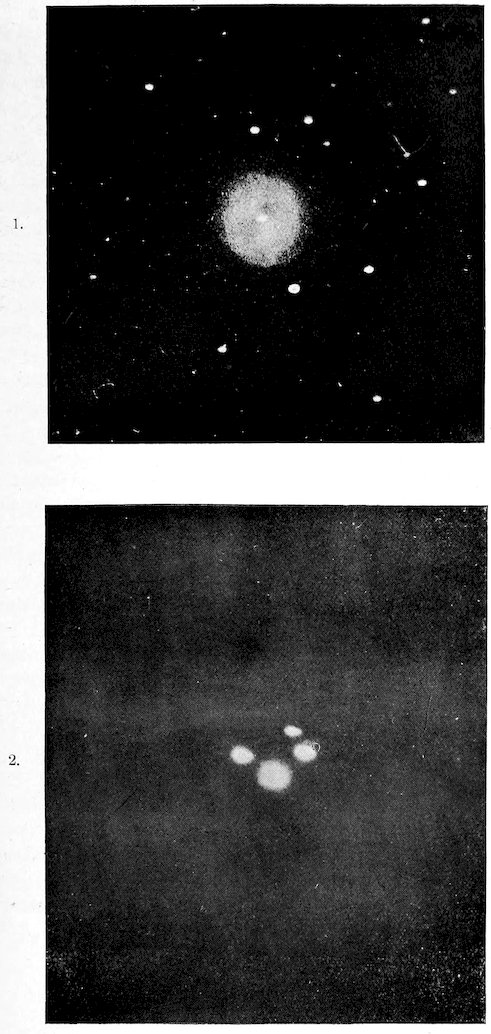
PLATE XXIV.
1. Photograph of the Owl Nebula (Roberts).
2. Photograph of the Orion Trapezium (W. H. Pickering).
The largest planetary in the heavens lies south-east of the
second Pointer, β Ursæ Majoris. Discovered by Méchain in
1781, it was numbered 97 on Messier’s list (N.G.C. 3587),
and has been extensively and carefully observed. Its dimensions
were given by Lord Rosse in 1874 as 163″ by 147″;[977]
but the major axis measures 203″ on a photograph taken by
Dr. Roberts, with an exposure of four hours, 20th April
1895,[978] and reproduced, by his kind permission, in Plate
XXIV. Fig. 1. The observational history of the object is
extremely curious. Sir John Herschel saw “a large, uniform,
nebulous disc, quite round, very bright, not sharply defined, but
yet very suddenly fading away to darkness.”[979] On 2nd March
1848, however, Lord Rosse perceived a doubly perforated surface,
with a star in each cavity,[980] and his observations were
confirmed by Dr. Robinson. The drawing representative of
them is a record of permanent interest. The resemblance
to an owl’s face, given to it by the symmetrically placed
oculi, is unmistakable; and the great planetary in Ursa
Major became known, from the middle of the last century,
473as the “Owl Nebula.” The name has survived the similarity.
On 9th March 1850 the two stars were noted at
Parsonstown shining as usual in their respective excavations;
five weeks later the fainter one had vanished;[981] nor could it
ever again be found, though looked for about forty times
during the ensuing quarter of a century. To Professor Keeler
in 1891[982] the nebula wore indeed an entirely different aspect
from that previously attributed to it. “There is but one
nucleus,” he stated, “which is by estimation almost exactly
central, at a place which in Lord Rosse’s drawing is occupied
by a bridge of light between two dark openings. There is
also but one central dark space.” Nevertheless, two appear
in the Crowborough picture, like lagoons separated by an
isthmus, and on the isthmus there is planted, as it were, a
lighthouse, diffusing a brilliant illumination. Thus the
interior vacancies remain in statu quo, while the stars that
formerly occupied them have both faded out of sight, leaving
the prodominance to a third, not identical with either. The
change, in short—admitting that there has been change—relates,
not to the structure of the nebula itself, but to the
relative brightness of three connected stars. The question
whether those at present extinct will ever become revivified,
can be answered only by prolonged experience. Dr. Roberts
thought that his photograph indicated for the nebula a combined
ring and disc formation;[983] but this is not manifest.
The picture affords no verification of the marginal inequalities
recorded at Parsonstown; yet there is reason to believe that
they were not illusory. The torn and jagged contour, which
Professor Alexander expounded as the effect of “disruption
and dispersion outward,”[984] may come into view in representations
on a larger scale, taken with special precautions for the
definition of minute details.
The suspected alteration of the Owl planetary accentuates
the need for keeping watch over nuclear stars, more especially
since they present unexplained peculiarities. Their light is of
purely stellar quality, but of remarkable actinic power. They
474are very much brighter chemically than visually. Further,
they often give nebulous images on the sensitive plate, while
appearing sharp with the telescope. In some rare cases (as
in N.G.C. 6781), they are eccentrically situated. Burnham
is probably justified in regarding the possession of a central
star as an essential feature of planetary nebulæ,[985] although it
is occasionally undiscernible with the telescope. N.G.C. 6563
in Sagittarius, and N.G.C. 7354 in Cepheus, are examples of
nebulous discs unrelieved to the eye by the sparkle of any
stellar points; and a beautiful little planetary in Perseus, discovered
by Barnard 11th December 1890,[986] is of similar aspect.
The missing nuclei, however, of all such objects would, it is tolerably
certain, become manifest in long-exposed photographs, which
should accordingly be taken for the purpose of deciding a point
of fundamental importance in the economy of planetary nebulæ.
Perhaps the most noted member of the class, from the
numerous experiments of which it has been made the subject,
is located in Draco (N.G.C. 6543), quite close to the pole of
the ecliptic. To ordinary observation it presents a greenish-blue
surface, 22″ by 18″, centred on a vividly white star of
the tenth magnitude; but Professors Holden and Schaeberle
recognised, with the Lick refractor, its “helical” conformation.[987]
Two brighter intersecting hoops, perceived at a
glance to diversify the disc, fell into position on closer scrutiny
as the thread of a screw, uniting their curves into one
continuous tri-dimensional spiral. The discernment of this
novel form—believed to be typical—was a suggestive contribution
towards what might be termed the solid geometry of
nebulæ. Speculations as to its mode of origin would, however,
be premature until, by the unerring testimony of the camera,
it has been definitively proved to subsist.
The Draco planetary was observed on the meridian by
Lalande 26th July 1790, and there are no good grounds for
holding it to have since shifted appreciably from the place
then assigned to it. Burnham, it is true, has found a progressive
diminution of the distance between the central star
of the nebula and one external to it, amounting to 0·033″
475annually;[988] but the movement, if real, may confidently be
ascribed to the disconnected star. The nebula is indeed very far
from being stationary in space. Professor Keeler determined for
it spectroscopically in 1891 a velocity of approach towards the
solar system of forty miles a second;[989] and its apparent fixity
on the sphere is doubtless only an effect of extreme remoteness.
Some attempts to determine its annual parallax[990] have
resulted only in showing it to be small “below compute.” From
the prismatic examination of this object, 1st August 1864, Sir
William Huggins learned the existence of gaseous nebulæ.
A nebula in Cygnus (N.G.C. 6826) was described by
Mr. Burnham as “almost an exact duplicate” of the planetary
in Draco. It is nearly circular, the longer diameter measuring
nearly 27″, the shorter 24″. The nucleus is very bright
(8·8 magnitude), and gives a strong continuous spectrum.
The light from the disc, too, includes an unusually large white
ingredient.[991] The radial motion of this nebula is very small;
it approaches the sun by 3·3 miles a second. But the sun is
travelling on its own account towards its place at a much
higher rate of speed, so that the apparent sluggishness of the
nebula indicates that it is really moving away from us, its
measured pace representing only the velocity with which our
system gains upon it.
The spectra of planetary nebulæ are fundamentally alike;
they differ only in details. About forty bright lines have
been determined in them, visually and photographically, and
they are invariably fine and sharp, as if emitted by
materials of great tenuity. They seem hazy only just
where they cross certain diffuse nuclei; and this feature
seems to imply a gradual condensation of the nebulous stuff
towards the central mass, which, in such cases, cannot
properly be called a star. The essential characteristic, however,
of nebular light is the presence in it of the ray, or rays, of
“nebulium.” This is the one sure criterion by which gaseous
nebulæ can be distinguished from stars.[992] The chief nebulium
476line has a wave-length of λ 5007, and is of a clear green
colour. With it is constantly associated a ray about one-third
as bright at λ 4959, and the invariability of their relation
lends strong probability to the opinion that both emanate from
the same substance.[993] A strong ultra-violet line at λ 3727,
photographed for the first time by Sir William and Lady
Huggins in 1882, perhaps claims an identical origin. This,
however, remains doubtful in the absence of decisive evidence
that it is an unfailing constituent of the nebular spectrum.
The green gas designated “nebulium” is unknown, so far,
terrestrially; nor has it been observed to shine in any
of the heavenly bodies except nebulæ. There is reason to
believe it denser, or at any rate less diffusive than hydrogen.
An object catalogued in the Southern Durchmusterung
as a ninth-magnitude star under the title S.D.M. −12°
1172, was found by Mrs. Fleming in 1891 to give the
spectrum of a planetary nebula. But hydrogen glows in
it with unusual intensity. The relative brightness of the
three green lines is estimated by Campbell[994] to be ordinarily
10 : 3 : 1, F (Ηβ) being the faintest and most refrangible.
But the proportion in the planetary near Rigel is 10 : 3 : 7.
In other words, hydrogen is of seven times its normal lustre
comparatively to nebulium. Further, the three lines, when
viewed through an open slit, form discs of severally 11″, 9″,
and 14″ diameter. Here then, apparently, a hydrogen-envelope
constitutes an outer shell to the nebulium-sphere; and a gas
that rises higher than another is presumably specifically
lighter, although, in view of the enormous altitudes attained
by calcium vapour near the sun, the inference must be
regarded as subject to qualification. Certainty on the point,
and on many others connected with the physics and chemistry
of nebulæ, may be said to be unattainable until nebulium is
captured in the laboratory. And the prospect of this achievement,
although not hopeless, is remote.
The following table gives the wave-lengths and origins,
when they are known or can be conjectured, of forty bright
lines in the spectra of planetary nebulæ. A few are common to
all, notably the trio in the green, with about half a dozen of
477the blue and ultra-blue hydrogen lines, while others are more
individual in their occurrence; but, on the whole, bodies of
this class seem to be of remarkably uniform constitution.
| Lines observed in the Spectra of Planetary Nebulæ. |
|---|
| |
|
| Wave-Length. |
Origin. |
| 6563 |
Hydrogen (Hα). |
| 5876 |
Helium (D3). |
| 5751 |
Oxygen? |
| 5680 |
Unknown. |
| 5540 |
Unknown. |
| 5412 |
Hydrogen; Pickering series? |
| 5313 |
Unknown. |
| 5183 |
Unknown. |
| 5007 |
Nebulium. |
| 4959 |
Nebulium? |
| 4861 |
Hydrogen (Hβ). |
| 4790 |
Unknown. |
| 4743 |
Unknown. |
| 4715 |
Unknown. |
| 4688 |
Hydrogen; Rydberg series? |
| 4662 |
Unknown. |
| 4643 |
Nitrogen? |
| 4610 |
Nitrogen? |
| 4597 |
Nitrogen? |
| 4574 |
Silicon? |
| 4472 |
Helium. |
| 4390 |
Helium. |
| 4363[995] |
Unknown. |
| 4341 |
Hydrogen (Hγ). |
| 4265 |
Unknown. |
| 4145 |
Unknown. |
| 4122 |
Helium? |
| 4102 |
Hydrogen (Hδ). |
| 4067 |
Unknown. |
| 4026 |
Helium. |
| 3970 |
Hydrogen (Hε). |
| 3968[995] |
Unknown. |
| 3889 |
Hydrogen (Hζ). |
| 3869[995] |
Unknown. |
| 3836 |
Hydrogen (Hη). |
| 3795 |
Hydrogen (Hθ). |
| 3768 |
Hydrogen (Hι). |
| 3727 |
Unknown. |
| 3460 |
Unknown. |
| 3390 |
Unknown. |
478Several of the Wolf-Rayet lines, it will be observed, are
comprised in this list, notably those at λ 541, λ 469, and
λ 464. And the absence of recognisable metallic rays
strengthens the analogy with stars of that peculiar description.
As a rule, the hydrogen spectrum in planetaries begins
with the green line. The red line has been distinguished
in only a few specimens, which appear more condensed
than the rest. Yet it would be rash to assume that this
is really the case.[996] The relative intensity of the hydrogen
lines in stars and nebulæ is an intricate subject, the
ramifications of which have yet to be tracked out. The coincident
appearance of D3 with C is worth notice as a hint that
the conditions favourable to the development of the slower
light-vibrations are the same for helium as for hydrogen.
They are markedly present in Struve’s planetary in Ophiuchus
(N.G.C. 6572 = G.C. 4390), which gives a complex
spectrum of at least thirty lines,[997] accompanied by faint
continuous radiance. Three classes of fact regarding it
are recorded in Professor Keeler’s sketch of the portion
of it accessible to eye-observations (see Plate XXIII. Fig. 2):
first, the positions of the component rays in the scale
of wave-lengths; next, their relative lustre; thirdly, the
extent of the nebula from which they are derived. And
it is of interest to perceive that only those associated with
nebulium, together with the green and blue lines of hydrogen
(Hβ and Ηγ), seem to reach the limits of the disc, while the
others are radiated only by its central parts. Still we have
to remember that the length of the lines must depend
to some extent upon their intensity; and that they may be
short only because the sections of them given out by dim
regions of the nebula are of evanescent faintness. Professor
Keeler suspected the presence of dark bands interrupting its
continuous light between D3 and λ 5007,[998] and they will, if
verified, supply the only extant proof of absorption in gaseous
nebulæ. The nucleus of Σ 6 apparently reinforces the
emissions from the disc; but it is plainly not a genuine star.
479Further spectrographic investigation of the object is most
desirable.
In the Draco planetary (N.G.C. 6543), on the contrary,
the stellar and nebular elements of the spectrum are perfectly
distinct. Some of the bright lines can indeed be seen only
when the central star is outside the slit, and are therefore
due, in Professor Campbell’s words, “to the nebula proper, as
indeed are all the lines observed, and there is no evidence to
show that they exist at all in the central star.”[999] A few of
those registered in Struve’s planetary are missing here, particularly
the hydrogen line (Pickering series) at λ 541; but C,
D3, and both the Wolf-Rayet blue radiations are perceptible,
while the leading ultra-violet line at λ 3727 appeared conspicuously
in Von Gothard’s photographs.[1000] The relative
strength of the green lines in this nebula, as determined by
Campbell, is 10 : 3 : 2. It is of a verd-antique hue, and,
indeed, the nearly total suppression of red rays in their light
gives to all planetaries a blue or greenish tinge.
One of the Durchmusterung stars in Cygnus (D.M. + 41°
4004) was noticed by the late Prebendary Webb, 14th
November 1879, to have a hazy disc, some 10″ in diameter.[1001]
Stephan, at Marseilles, independently detected its nebular
character, and Winnecke compared it to a small comet with a
tenth-magnitude nucleus at its preceding end. Moreover, the
nucleus is double. Professor Keeler described the object
(N.G.C. 7027) as follows:[1002]—“This is the brightest nebula
that I have examined, and its spectrum is exceedingly interesting.
The nebula is irregular in outline, and contains two
central condensations, one of which has an oval and fairly
well-defined outline. The other is much fainter and more
diffuse.” His drawing of it, made at the great telescope, is
copied in Plate XXIII. Fig. 3, together with a representation
of its spectrum. The nuclei are obviously non-stellar. The
continuous spectrum of even the more conspicuous member of
the pair is not incomparably brighter than that derived from
the disc, and it claims all the emission rays as properly,
480though not exclusively belonging to it. Professor Keeler
accordingly regarded it as “in a much less condensed state
than the nuclei of Σ 6 and many other nebulæ of its kind,”
its exceptional brilliancy notwithstanding. The spectrum of
Webb’s planetary is remarkable for the intensity of some
usually quite subordinate lines, especially of the Rydberg
hydrogen ray (λ 4688), and of the unknown lines at λ 4743
and λ 4363. Campbell could just identify the red glint
of C,[1003] which by its faintness evaded Keeler’s survey; D3
was made out by both observers, and an unidentified line at
λ 3869 was photographed by Von Gothard in 1892, although
his plates were blank at the place where the significant
λ 3727 was expected to appear.[1004]
A companion to Webb’s nebula, both in physical aspect
and by vicinity in the sky (N.G.C. 7026), was discovered
spectroscopically by Dr. Copeland in 1880.[1005] It had, however,
been observed telescopically by Mr. Burnham seven years
earlier.[1006] It is small, bright, duplex, a pair of diffuse nuclei
6″ apart sustaining a filmy structure which, viewed with the
Lick refractor, suggested a comparison to two sheaves of corn
laid side by side.[1007] Burnham refuses to admit the planetary
nature of either of the objects in Cygnus,[1008] yet their spectra
scarcely allow them to be relegated to a different class. The
“Rydberg line” is equally prominent, relatively to their
brightness, in both objects. From the cosmogonic point of
view they are of high illustrative importance. We seem to
have before our eyes double stars in slow course of formation,
and preparing to break loose by the development of systemic
revolutions from the trammels of a joint rotation.
Bi-nuclear planetaries are not uncommon. One such
(N.G.C. 3195) was observed by Sir John Herschel in the
south polar constellation of the Chameleon, and is depicted in
his volume of Cape Results. The nuclei are fairly well
matched in lustre, and will perhaps grow into a double star
like γ Virginis. Their spectrum is still unrecorded; but it
481will be of considerable interest to determine whether it
exhibits the peculiarities visible in those of the double planetaries
in Cygnus. Two bright patches near opposite margins
of the circumference give the nebula in Chameleon somewhat
the air of a reduced copy of the celebrated “Dumb-Bell” in
Vulpecula.
Of a planetary in the Poop of Argo, originally discovered
by the elder Herschel, Lassell wrote at Malta about 1851:[1009]—“No
description can do justice to this singular object,” which
is “not beautiful, for it has no symmetry, but wonderful.”
His drawing shows the disc, which had appeared to d’Arrest
perfectly round, as pear-shaped, with multiple condensations.
So that a quadruple or quintuple star in embryo may here be
offered for our contemplation.
“Stellar” nebulæ have been mostly discovered by Pickering’s
method of sweeping with a direct-vision spectroscope.
There is probably no radical difference between them
and planetaries, for their comparative minuteness may
be a simple effect of distance. Or they may be constructed
on a reduced scale. We should naturally expect
to meet in nebulæ a variety of dimensions not inferior to
that existing among stars. Moreover, they are all alike
gaseous, and give—so far as is yet known—perfectly similar
spectra. Nevertheless, Mr. Burnham writes of the stellar
kind as “very small, bright, round nebulæ, which in a small
instrument would resemble stars slightly out of focus, but do
not appear to come within the planetary class.”[1010] An admirable
specimen was detected spectroscopically by Pickering
16th July 1882. Previously registered as a 9·4 magnitude
star, it took rank, on the strength of its bright lines, as a
stellar nebula (N.G.C. 6790). The Lick thirty-six-inch showed
it to be round and lucent, with a minute nuclear point.[1011] A
miniature of Struve’s planetary in Ophiuchus seemed to float
in the field of the telescope. Without a slit, the spectrum,
examined by Keeler, resembled three tiny greenish stars,
that formed on Hβ being much the faintest. This stellar
nebula accordingly is analogous to Webb’s planetary in the feeble
482glow of its hydrogen constituent. Another pseudo-star in
Aquila (N.G.C. 6891) disclosed itself prismatically to Dr.
Copeland in 1884. It has a disc just 4″ across, and its
spectrum, photographed by Von Gothard 27th October 1892,[1012]
includes the usual range of nebular lines up to λ 3727,
besides a fair admixture of continuous light. A nebula of
the fourteenth magnitude, visually a finished star, was noticed
for the quality of its light by Pickering, 25th November 1881,
near the star b2 Cygni.[1013] More conspicuous members of the
class have been identified in considerable numbers on the
Draper Memorial plates.
The crowd of small nebulæ photographed by Dr. Max
Wolf in 1901 comprised a remarkable proportion of seeming
planetaries. They were collected on his plates into pairs
and groups in a manner recalling the distribution of Wolf-Rayet
stars, but not previously observed to characterise that of
planetary nebulæ. The question indeed arises whether they are
really such? Or do they rather belong to “that much less
interesting class of objects” designated by Mr. Burnham as
“small circular patches of nebulosity”? The spectroscope
alone can decide, and its verdict should be elicited without
delay. Upon it will largely depend the conclusions to be
drawn respecting the affinities of the planetary family, their
mutual relations, and the mode of their scattering in space.
There is reason to believe them enormously remote. Four
have been directly measured for parallax, namely, the helical
nebula in Draco, the bi-nuclear planetary in Argo (N.G.C.
2440),[1014] Webb’s in Cygnus, and a structure with a ring and
disc in Andromeda (N.G.C. 7663).[1015] None showed the least
sign of perspective shifting when viewed from opposite sides
of the earth’s orbit; and the demonstration thus afforded of
their immense distance is confirmed by the insensibility of
nebular proper motion. This, since it is continually progressive,
must eventually prove determinable, and comparisons
of its amount with the mean radial velocity of these bodies
will supply a criterion for their absolute localisation. Professor
483Keeler derived from the line-displacements in the spectra
of eleven nebulæ a value for this quantity of sixteen miles a
second; and by sixteen miles a second they should, accordingly,
on an average, progress along each of the other co-ordinates
fixing their position in space. When corresponding angular
advances have been established, their average distance can then
at once be estimated.[1016] Let us assume, for instance, that the
eleven nebulæ in question, taken one with the others, have a
secular proper motion of three seconds of arc in declination, and
as much in right ascension. This, although the outside of what
is probable, implies that their mean distance corresponds to a
light-journey of 580 years. A planetary not more than 10″ in
diameter would, if thus remote, fill a globe about 600 times
wider in girth than one circled by the orbit of Neptune, and
216 million times more capacious. The data supplied by
Professor Keeler are indeed an obviously insufficient groundwork
for extensive generalisations; but more of the same
kind, and it may be hoped of not inferior quality, cannot
fail to be forthcoming shortly; while the precise visual
measurements executed by Burnham, Spitaler, Javelle, and
others will surely serve, after some decades, for the detection
of genuine nebular journeyings across the sky. A
beginning of definite knowledge will then have been made
regarding the true magnitudes and place in the sidereal
scheme of these singular objects. It must not, however,
be forgotten that many of the faint stars taken as fiducial
points for their micrometrical determination may prove to
be satellites of the neighbouring gaseous globes drifting and
shifting in their company. This disquieting possibility,
foreseen by Sir John Herschel and d’Arrest, would, of course,
if realised, vitiate conclusions as to parallax or proper motion.
Yet the work done for these purposes need not be looked
upon as wasted. By its aid, should the slow revolutionary
movements of stars round planetary nebulæ ultimately be
brought to light, a new department of sidereal mechanics
may be founded. Exact determinations in astronomy, made
on a judicious plan, are rarely useless. If unprofitable for
their designed aim, they are pretty sure to turn to account for
some other, and perhaps a higher one.
484
The model annular nebula is the beautiful filmy ellipse
situated between ß and γ Lyræ (N.G.C. 6720). Discovered
by Darquier at Toulouse in 1779, it appeared to Sir William
Herschel a simple hoop of light, quite dark within. The
“gauze drawn over the hoop,” spoken of by Sir John Herschel,
had been perceived by Schröter in 1797, and with long
exposures the photographed ring fills up into a disc. Plate
XXV. is taken from a singularly perfect representation
obtained by Mr. W. E. Wilson in twenty minutes, while an
hour’s exposure sufficed to blur beyond recognition the
characteristic annular aspect of the structure. Yet the havoc
thus wrought, in a pictorial sense, is compensated by the experimental
significance of a result proving the interior of the ring
to be far from vacuous of luminous or luminescent material.
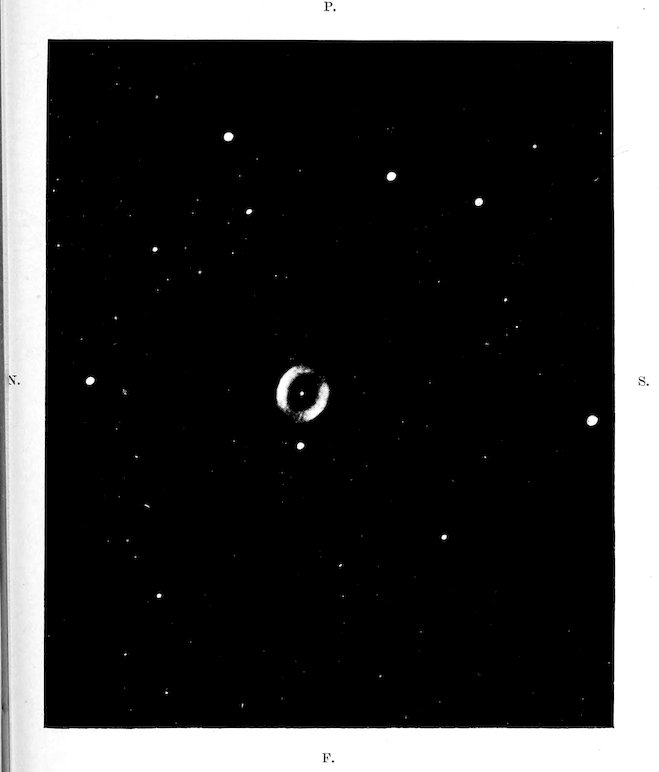
PLATE XXV.
The Ring Nebula in Lyra. Photographed by W. E. Wilson, F.R.S. Exposure, 20m.
The dimensions of the ring are about 87″ by 64″. It
was shown in the Lick negatives as an exceedingly complex
structure. “It seems,” Professor Keeler wrote,[1017] “to be made
up of several narrower bright rings, interlacing somewhat
irregularly, the spaces between them being filled with fainter
nebulosity.” Many bright patches and condensations diversify
the main annulus, which is, nevertheless, fundamentally continuous;
it does not break up into detached knots of nebulosity.
The light is strongest near the extremities of the
transverse axis, and its failure at each vertex of the ellipse,
conspicuously shown in our Plate, was, already in 1785, noticed
by the elder Herschel.[1018] It is accompanied by symptoms of
485effusion, marking possibly equatorial outflows due to rotative
acceleration. Lord Rosse in 1863, and Schultz in 1865,
were alike struck with “nebulous radiations in the direction
of the longer axis, which seemed momentarily almost to destroy
the annular form.” They issued from the north-eastern side,
while a similar appearance on the south-westerly side of the
nebula was observed by Professor Holden at Washington in
1875.[1019] He perceived, too, with surprise that the south end
of the minor axis, which Lord Rosse had represented as the
best terminated, was unmistakably, after thirteen years, less
clearly finished than the north end. Similarly, the Lick
thirty-six-inch disclosed in 1888[1020] the whole southern margin
as filamentous, by a kind of alternation with the corresponding
state of the northern edge noticed at Parsonstown. This
tufted or fringed effect was caught, for the first time photographically,
by Professor Keeler. The oval imprinted on his
plates was fringed on both sides, and his measurement of
eleven nebulous projections from it will give the means
of detecting any future variations in their luminosity or
distribution.
The gauzy stuff in the interior is not a mere formless
light-mist. A drawing published by Lord Rosse in 1844[1021]
represented it as divided into longitudinal striæ, and their
reality was confirmed by the Crossley photographs after fifty-five
years. “I have tried,” Professor Keeler wrote, “to verify
this band-structure by visual observation with the thirty-six-inch
refractor, and have fancied at times that I could catch
glimpses of it; but the observation is a most difficult one, the
contrast of the bright and dark bands, exaggerated by the
photograph, being almost too slight to affect the eye.” The
surprising accuracy of the delineations made with the Rosse
speculum, while its burnish continued unimpaired, was thus
once more exemplified. It conveys a warning against lightly
setting aside any of the earlier records concerning nebulæ
obtained at Parsonstown, even when they imply seemingly
improbable changes. It is certainly by no accident that the
striæ within this nebula coincide in direction with its major
axis; nor can the termination of the transverse axis by maxima,
486of the longitudinal axis by minima of brightness[1022] be regarded
as casual features. All the details of the edifice, in fact, are
arranged with obvious reference to its apparent shape, and
this amounts to a demonstration that the elongation is real.
The nebula, then, is not simply projected into an oval; it is
not a circular formation viewed obliquely. There seems no
escape from the conclusion that it is an ellipsoid of revolution—that
the bands follow the line of the equator, and
originate under conditions prescribed by the rotation of the
body; while the partial interruption of luminosity at the ends
of the oval mark outflows of matter where centrifugal velocity
overrides the holding power of gravity. Everything, indeed,
leads us to suppose that this nebula, like the rest of its kind,
is actually a hollow spheroid of shining fluid, the marginal
brightness resulting from the increased thickness of the
luminous shell penetrated by the visual ray. The “hoop”
and the “gauze” drawn round it are then two aspects of the
same thing. Nebulous rings, as such, probably do not exist.
They would be subject to perspective effects, no traces of
which are to be found in the heavens. Annularity in nebulæ
may accordingly be considered as a purely optical modification
of a different structural plan.
A glittering point of light occupies the centre of the
annulus in Lyra. Many anomalies are connected with its
visibility. The first heard of it is in 1800, when Von Hahn
of Remplin, in Mecklenburg, was surprised by its disappearance.[1023]
He attributed the change, not to loss of light
in the star, but to the nebulous clouding-over of the
black background upon which he was accustomed to see it
relieved. Unperceived by the Herschels, it was next seen by
Lord Rosse in 1848,[1024] and attracted Father Secchi’s attention
at Rome in 1855.[1025] A ten-inch Steinheil sufficed, in 1865
and 1867, even in unfavourable weather, to show Hahn’s star
to Hermann Schultz;[1026] yet it unaccountably evaded the deliberate
scrutiny, ten years later, of Professor Asaph Hall,[1027]
487armed though he was with the twenty-six-inch Washington
equatorial. The same instrument, however, displayed its
evasive sparkle to Mr. A. C. Ranyard, 23rd August 1878;[1028]
while to Dr. Vogel, with the Newall telescope in 1875, and
the Vienna twenty-seven-inch in 1883, it remained consistently
imperceptible.[1029] Very remarkable, too, is its non-appearance
to Dr. Spitaler at Vienna in 1885, when he carefully delineated
the nebula, as well as in 1886, during frequently
repeated verifying observations.[1030] The interior seemed then
to contain only dimly luminous floccules; nevertheless on
25th July 1887 the star caught his eye at the first glance.
It had, in the meantime, 1st September 1886, been photographed
by Von Gothard, and has since abstained from
capricious disappearances. It is indeed of such exceptional
actinic power that the camera cannot easily lose sight of it.
Fainter visually than the fifteenth magnitude, it needed
only an exposure of one minute to come out distinctly
on a Crossley negative, and it left a dim impression
in half that time.[1031] With all exposures the image
was clearly defined, although in photographs taken with
other instruments it had usually presented a hazy disc. Its
light appears to be of normal stellar quality. Its maximum
of intensity, that is to say, falls in the yellow part of
the spectrum. Both Keeler and Barnard agreed that, with
the Lick and Yerkes refractors, the focus for the star was
about one-fifth of an inch shorter than for the encircling
nebula. And a similar disparity exists between the nuclei
and discs of most planetaries. This, however, leaves their
special chemical effectiveness unexplained; for Keeler’s suggestion
of its being due to ultra-violet emissions lacks the
support of known facts.
In the field with the Lyra nebula, Barnard perceived, 2nd
October 1893, a second of about the fourteenth magnitude,
30″ in diameter, and somewhat irregular in shape.[1032] Professor
Keeler’s longest-exposed negative showed the new object to be
“a left-handed, two-branched spiral.”
In 1891 Mr. Burnham measured the nucleus of the ring
488in Lyra with reference to an external star of the twelfth
magnitude which closely follows it. Eight years later,
Professor Barnard employed the forty-inch Yerkes telescope
to repeat his determinations,[1033] and was inclined to attribute
a slight discrepancy to real motion in the nebula. But
the Potsdam plates lent no confirmation[1034] to a suspicion
which will probably remain long unverified. His experience
was entirely negative as regards light-variability in any part
of the object. Alleged changes in the stellar kernel he translated
into genuine changes in visual facilities. “The fact,”
he wrote, “that the nucleus is seen on a nebulous background
makes steadiness of the atmosphere a most important factor
in its distinctness—far more so than in the case of an
ordinary star in the open sky. When the seeing is exceptionally
good, the nucleus appears with a distinctness strikingly
in contrast with its ordinary condition, so much so that one
has to guard against deception in supposing a real change of
light.”
Nine bright lines have been seen or photographed in the
spectrum of the Lyra annulus, that of shortest wave-length
at λ 3727 being, according to Von Gothard, the most intense.[1035]
Hydrogen shines feebly; no C has been recorded, but the
Rydberg ray at λ 4688 was detected by Campbell.[1036] Helium
is unrepresented; since a violet line at λ 3869, which appears
prominently and persistently in nebular spectra, cannot be
ascribed to that substance. It chances, indeed, to coincide
approximately with one belonging to a known series, but is
itself of “rare and strange” origin.
Several analogues of the Lyra nebula have been discovered;
none so large or so bright. The best imitation is situated in
Cygnus (N.G.C. 6894). It measures 47″ by 41″, the inner
vacuity 20″, and was marked “resolvable” at Parsonstown.[1037]
Needless to say that the sparkling effect which conveyed the
impression of a stellar constitution was altogether illusory.
A fifteenth-magnitude star near the interior border of the
ring to the north-west was measured by Burnham in 1891.[1038]
489The true nucleus is considerably fainter. First brought to
view in a photograph taken by Dr. Roberts 31st August 1897,[1039]
it duly reappeared in one of the Crossley pictures of 1899,[1040]
and was visually discerned with the great Paris siderostat by
M. Antoniadi, 17th July 1900.[1041] The elongation of the
annulus from north-east to south-west was obvious to
him no less than the faint haze with which it is filled.
Nothing is known about the spectrum of the ring nebula
in Cygnus. It doubtless resembles that of its prototype in
Lyra.
Even more scanty is the information at hand regarding
“a beautiful delicate ring” in Scorpio, about 40″ in diameter
(N.G.C. 6337). It is in a field crowded with stars, two of
which are projected upon, but may not belong to it. Neither
occupies the proper position of a nucleus, and the one seen
by Lassell at Malta had to him somewhat the aspect of a
nebulous knot.[1042]
An annular nebula in Ophiuchus (N.G.C. 6369) was found
by Mr. Burnham “very like the well-known example in Lyra,
except in brightness.”[1043] A central star of 14·5 magnitude
was probably then first noticed. The longest diameter of the
ring measures 31″; the edges seemed to Sir John Herschel
“a very little cottony,”[1044] and they are doubtless fringed with
dim appendages, like those attached to its model in Lyra.
This is again copied in an object discovered by Mr. Gale of
New South Wales in 1897, or perhaps a little earlier. It
is bright enough to make its late detection somewhat surprising.[1045]
Immersed in a fine cluster in Argo (Messier 46), a nebula
of planetary aspect, about 60″ in diameter (N.G.C. 2438),
drew the attention of Sir William Herschel. The Rosse
reflector showed a central star dominating a vacuous interior,
besides two stars sparkling on the condensed border.[1046] Lassell
perceived in the object a resemblance to a large, dim, compound
planetary in Eridanus (N.G.C. 1535), but with the
490qualifying circumstance that in N.G.C. 2438 only one
“stratum of nebulosity” was discernible.[1047] This singleness of
construction appears characteristic of perfected nebular rings,
and such the inmate of the cluster in Argo has declared itself
to be. In a photograph taken by Dr. Roberts, 24th February
1894,[1048] it is definitely and unmistakably annular. Three
stars are projected upon, or contained within it, we cannot
tell which; although one by its nuclear position gives some
assurance of being there through organic relationship. Nor
can we venture to assert that the nebula is really in the
cluster. It may only be thrown accidentally into line with
it. Still the fact that Sir John Herschel recorded in two
cases similar collocations of planetary nebulæ with clustered
stars[1049] inclines the balance of probability towards the side of
genuine association. One of these groups (N.G.C. 5979) is
situated in the constellation Circinus, the other (N.G.C. 2818)
near the mast of Argo.
Certain complex formations, intermediate between planetary
and annular nebulæ, have now to be considered. A
striking specimen of the kind is met with in Andromeda
(N.G.C. 7662). The disc, which includes perhaps more than
one ring, measures 32″ by 28″. Alexander, about the middle
of last century, and Lassell subsequently, thought the structure
bi-annular. Vogel[1050] and Holden remarked its warped
and twisted appearance, denoting possibly a multiple combination
of rings thrown off in various planes as the outcome
of long-past crises in a slow process of development. A
central star surrounded by close spirals of nebulosity was
seen at Parsonstown,[1051] but evaded the scrutiny of O. Struve in
1847, of Searle in 1866, and of Vogel in 1883. Lassell perceived
it under the guise of a minute, bluish disc, Burnham as an
ordinary fifteenth-magnitude star.[1052] Fig. 4 in Plate XXIII. reproduces
Professor Keeler’s drawing of the Andromeda planetary
with its visual spectrum.[1053] “This nebula,” he wrote, “is annular,
491with a bright inner ring and a very small nucleus. It is somewhat
elongated north and south.” The fourth line in the
spectrum is the “fundamental” of Rydberg’s hydrogen series;
its unusual strength makes it the equal of the ordinary
hydrogen lines on either side of it. The spectrum of the
nucleus appears to be perfectly continuous, save for a possible
bright knot about the place of D3. Campbell, however, caught
no glimpse of this radiation, although he determined, visually
and photographically, eighteen bright lines in the spectrum
of the nebula.[1054] We subjoin his list, with notes and comments
between brackets.
| Bright Lines recorded in N.G.C. 7662. |
|---|
| Wave-length. |
Remarks. |
| 540 |
Very faint, difficult (Wolf-Rayet line; Pickering series). |
| 532 |
Very faint, difficult (possibly the chromospheric K 1474). |
| 5007 |
First nebular line, very bright. |
| 4959 |
Second nebular line, very bright. |
| 4861 |
Hβ, very bright. |
| 4744 |
Faint (origin unknown). |
| 4715 |
Faint (unknown). |
| 4688 |
Very bright (Rydberg hydrogen line). |
| 4663 |
Very faint (unknown). |
| 4643 |
Faint (nitrogen ?) |
| 4472 |
Very faint (helium; prominent in Orion stars). |
| 4364 |
Bright (unknown). |
| 4341 |
Hγ, very bright. |
| 4102 |
Ηδ, very bright. |
| 4067 |
Very faint (unknown). |
| 4026 |
Very faint (helium). |
| 3969 |
Hε, very bright. |
| 3869 |
Very bright (unknown). |
The brilliancy of the last line, in view of the faintness and
fewness of other helium emanations, confirms the inference
that its association with that substance is inadmissible. Experiments
in the laboratory would nevertheless be valuable
on the behaviour, for instance, of the adjacent violet line of
helium in a mixture of that gas with hydrogen.
Campbell perceived this nebula to consist “of two nearly
concentric rings more or less broken up, with a fourteenth-magnitude
stellar nucleus near its centre.” Ingall described
492it, 18th December 1885,[1055] as a “superb planetary,” of a bright
greenish-blue tint, the centre not quite dark, and thus fitly to
be called annular. On applying a power of 500, “an extraordinary
structure appeared to unfold itself. The bright ring
seemed very jagged and fringed at the edges, and the centre
was mottled with unequal shades, often as if of two dark
centres.” The note made on it at Harvard College was:
“Somewhat annular; edges hazy.”[1056] The blue colour of the
object faithfully corresponds to the actinic energy of
its rays. In two seconds of exposure to them the Crossley
reflector gave a weak image, including a barely visible central
star,[1057] and Professor Keeler obtained finished pictures in 20,
30, and 60 seconds. At Potsdam, in 1892–93,[1058] thirty-three
impressions were taken for the purpose of parallax-determinations,
but they yielded no positive result. They afforded
only the information that the nebula could not have an
annual parallax so large as one-fifth of a second; and, indeed,
the true value of the quantity, judging from other indications,
may very well fall short of one-tenth the assigned
maximum.
A “sky-blue likeness of Saturn” in Aquarius (N.G.C.
7009) is built very much on the lines of the Andromeda
planetary, but with the addition of “ansæ.” These, in August
1888, were resolved by Holden and Schaeberle, with the aid
of the Lick refractor, into a pair of attendant nebulosities,
situated in line with the major axis of a strongly elliptical body,
and subsensibly united to it by evasive gleams of illumination.[1059]
Yet the likelihood is small of their being really
satellite-globes revolving in the same track at an invariable
interval of two right angles. The probabilities of the case
oblige us to believe rather that the original interpretation of
them as the extremities of an annular appendage came nearer
the truth. An analogy indeed suggests itself between them
and the nebulous effusions from the vertices of the ring formation
in Lyra.[1060] And here again we are assured that they
493mark an equator—that the disc they seem attached to must
be the projection of a rotating spheroid. Intricacies of
interior arrangement are, however, visible, showing the progress
of manifold activities. Two dark cavities, extended
parallel to the major axis, and helical wisps of nebulosity,
were observed by Vogel at Vienna in 1883.[1061] Keeler saw and
photographed a somewhat distorted condensed ring measuring
26″ by 16″,[1062] and Scheiner’s plates recorded curious spoke-like
projections from an intensely actinic central star.[1063] The
spectrum differs from that of the Andromeda planetary only
by the inclusion of the enigmatic “last line” at λ 3727.
From the displacement of the green ray of nebulium Keeler
determined for the Saturn nebula a movement of approach
towards the sun at the rate of thirty-one miles a second, only
a small proportion of which can be due to our own journey
through space.
Sir William Herschel observed in the constellation Gemini
in 1787 “a star of the ninth magnitude, with a pretty bright
nebulosity equally dispersed all around” (N.G.C. 2392). Lord
Rosse found in it a dark hole close to a slightly eccentric
nucleus.[1064] D’Arrest thought the object might be called
annular;[1065] Lassell perceived a ring surrounding a bluish disc;[1066]
Secchi described it as a star with an annular aureola.[1067] H. C.
Key, using an eighteen-inch silver-on-glass reflector, noticed
about 1868[1068] a concatenation of bright and dark rings besides
the patch of interior obscurity detected at Parsonstown. To
Burnham the nebula in Gemini appeared “one of the most
beautiful objects of the kind in the heavens.”[1069] He assigned to
it a diameter of 45.″ Barnard, finally, was impressed by its
“magnificent and beautiful” effect in the Yerkes telescope.[1070]
It disclosed to him a ninth-magnitude star encircled not quite
symmetrically by a brightish oval ring, partially incomplete
towards the south. “This ring,” he continued, “which is well
defined inside and out, is surrounded by a vacuity, and this in
494turn by an almost circular broad ring of light less intense than
the inner ring, and with a distinct break in it north-preceding.
It breaks up into a clouded or unequal surface, and is very
irregular on its inner edge, but fairly uniformly circular on its
outside edge. The inner ring is filled with a nebulous light
which has a black spot in it, south-preceding the nucleus.”
That the perforated effect is no illusion may be taken as
proved. Nor is it subject to change. It has obtruded itself
now for half a century upon one observer after another, under
divers conditions, both instrumental and climatic. This nebula
then, and a few others like it, betray the action of some force
strange to our experience, by which the matter contained in an
extensive region is either expelled thence, or its light-giving
faculty suppressed.
The annular nebula in Lyra is the only member of the class
that has been satisfactorily investigated. Until spectrographic
possibilities are further developed there seems little chance of
dissipating the perplexities that still envelop its nature. That
is, by direct means; for indirectly much may be done. Comparisons,
for instance, of detailed results for sister-objects ought
to prove highly instructive as to the laws governing the construction
of all alike. Most of them have been singularly
neglected, considering the interest attaching to their peculiarities.
The hooped nebula in Cygnus, the “ghost” in Scorpio,
Gale’s annulus, the ring in Ophiuchus, should be photographed
with long exposures, on a scale sufficiently large to bring into
view specialties of texture and build. Their agreement in
certain fundamental relations would thus be tested, and its
importance as a guide to theories of their mode of origin cannot
be overrated. Their self-delineation would, however, doubtless
accentuate besides that variety in similarity which, throughout
the whole created world, illustrates the wealth of the resources
disposed of by Nature, and the inexhaustible inventiveness of
the Mind revealed in Nature.
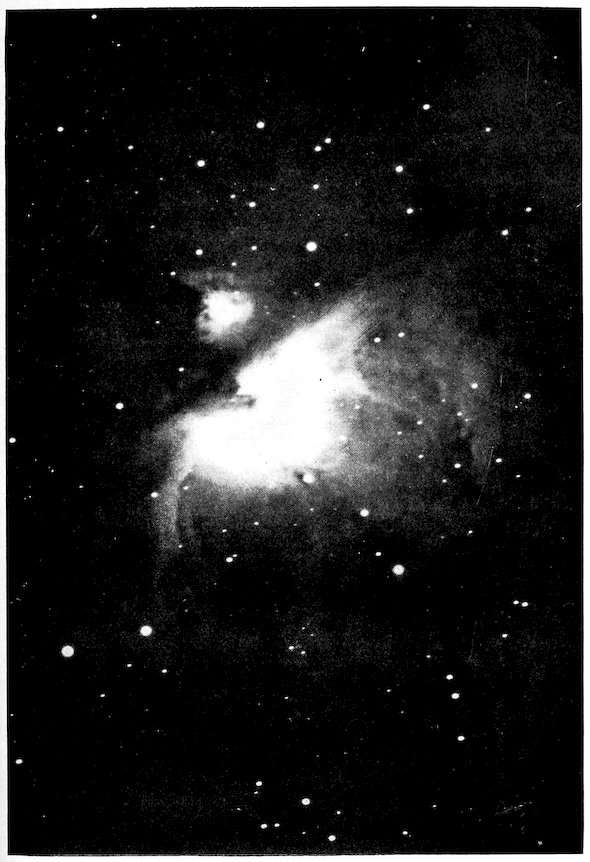
PLATE XXVI.
Photograph of the Orion Nebula (W. H. Pickering)
495
The first place among irregular nebulæ is, by universal
consent, accorded to the gleaming formation in the Sword
handle of Orion. Although incidentally referred to by
Cysatus of Lucerne in 1618, it received little attention until
Huygens, in 1656, affixed his note of admiration, and executed
a drawing of the bright central part, still known as the
“Huygenian region.” Here is situated the trapezium, the hub,
as it might be called, in which all the spokes of the great wheel
are inserted. A photograph of the group is reproduced in Plate
XXIV. Fig. 2. It was taken by Professor W. H. Pickering
from Mount Wilson, California, 29th September 1889, with
the thirteen-inch Boyden telescope. The exposure allowed
was only ten minutes, and already the enveloping haze was
beginning to cloud the images of the stellar sextett. The companions
(which seem to vary in light[1071]) of the two brighter
stars are distinct in the original negative, and can be made out
in the figure, one as a tiny blotch, the other as a mere deformation
of the lowest and largest disc. The physical association of
these six stars may be assumed without much risk of error; but
there is nothing to show that any real tie exists between them
and four adjacent star-points, at the limit of vision with the
Lick thirty-six-inch, detected by Barnard and Alvan Clark in
1889.
The nebula, as it developed on a plate exposed, under the
same circumstances, during 2h 36m, is shown in Plate XXVI.
The stars of the trapezium are here completely submerged;
only their influence can be traced, or suspected, in the
496symmetrical arrangement of the expansive wings of light
stretching away from their place. These are by no means
vague or indefinite outflows. Some of the long streamers have
sharp inner edges, peculiarly curved and notched. And the
texture is generally filamentous, like that of solar prominences,
the characteristic forms of which—as Mr. Ranyard effectively
pointed out[1072] are faithfully imitated in some of the minor
features of the nebula. An outlying mass to the north
(N.G.C. 1977) not only claims affinity by some degree of
structural resemblance, but is seen, on Professor Pickering’s
plate, to be linked on to it by a faint intermediate extension.
The gap between them is absolutely black to telescopic vision.
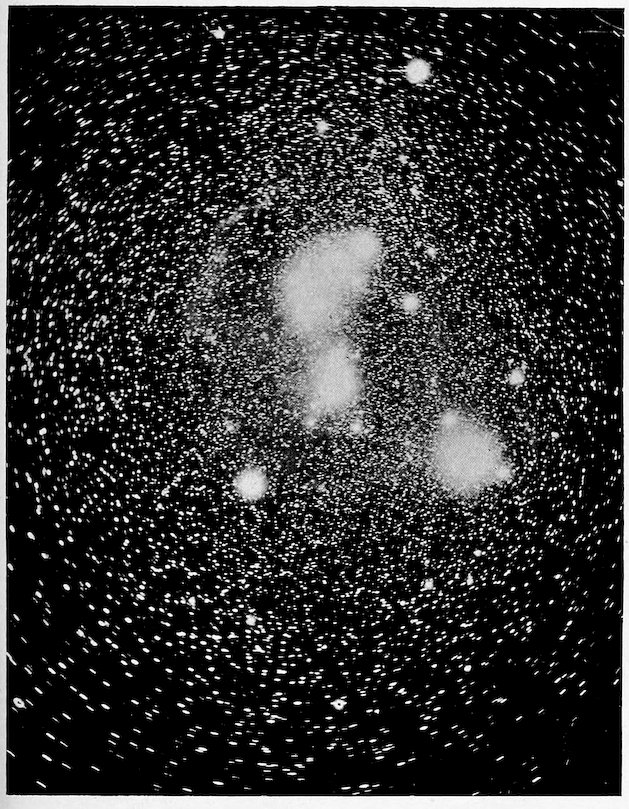
PLATE XXVII.
Nebulous Formation in Orion. Photographed, 14th January 1890, by W. H. Pickering.
Improvements and modifications in photographic methods
have led, by successive steps, to a remarkable increase in the
compass assignable to this extraordinary formation. Portrait-lenses
have played a leading part in the process. Professor
Wadsworth’s reasonings[1073] have made it clear that small apertures,
owing to the greater contrast afforded by them with the
sub-sensible illumination of the sky, are positively advantageous
for obtaining impressions of faint, extended objects. They
have the further prerogative of a wide field of view, giving
room for the grasp and delineation of large contours; so that,
in certain branches of celestial portraiture, they render indispensable
and invaluable services. By their aid the nebulous
stars ι and c Orionis were proved to be dimly connected with the
trapezium nebula; a sharply indented streamer became apparent,
issuing towards it from the belt star, ζ Orionis, long recognised
as a separate focus of nebulosity; while Max Wolf derived
evidence of a luminous union between the nebulæ surrounding
ζ and ε Orionis.[1074] Finally, the combined picture, shown in Plate
XXVII., of all the nebulous patches in the constellation was
obtained by W. H. Pickering, 14th January 1890.[1075] The
instrument employed was a Voigtländer lens, 2·6 inches in
aperture, and of 8·6 inches focal length; the time of exposure,
6h 22m. As the upshot, the fragmentary condensations previously
known became united into a vast spiral formation,
15° across. Starting from near Bellatrix (which lies outside
the field), it sweeps round by κ Orionis and Rigel to the
497south, then bends upward to η Orionis, and most probably
effects a junction with the nuclear mass in the Sword handle,
although the further course of the stream is rendered indistinct
by the fogging of the plate. After an interval of nearly five
years, Professor Barnard independently repeated and confirmed
the Mount Wilson experiment.[1076] His small “lantern lens”
showed, with exposures of 2h and 1h 15m, “an enormous
curved nebulosity encircling the belt and the great nebula, and
covering a large portion of the body of the giant.” In comparison
with it, he remarked, the old trapezium nebula “is but
a pygmy.” The astonishing extension given to the luminous
structure in Orion was, however, of less importance than the
disclosure of its architectonic plan. Nor can it be supposed
that we are, even now, fully acquainted with it. Further
developments may be looked for. The nebulous connections
of the various parts will doubtless be more clearly expounded
in future photographs. Possibly an effective delineation might
be obtained in sections with instruments, like the Crossley or
the Meudon reflector, too restricted in angular grasp to embrace
the whole at one view. The study of details would thus be
made feasible, their subordination to the general design being
at the same time kept well in sight. The relations of the
members to the main body of this nebula offer a problem of
extreme complexity. The stars of the trapezium, for instance,
have an appreciable proper motion of about 5″ a century.
The nebulous plumage attached to them must evidently partake
in their displacement; but this cannot be unhesitatingly
asserted of the appendages to the belt stars, still less of the
ocean-river of nebulosity flowing outside them. Professor
W. H. Pickering discussed the movements of nineteen stars
involved in the spiral, though not of course necessarily connected
with it.[1077] And so far as any common character could
be ascribed to them, it was that of recession from the trapezium.
It would be ridiculous to found any conclusion upon so flimsy
a basis; yet the indication harmonises with hints, or nascent
symptoms of a centrifugal tendency among clustered stars
such as the Pleiades. The determination and comparison of
their radial movements will be the best means of promoting
498knowledge on the subject; and since Pickering’s nineteen
stars are all, except one, brighter than 6·2 magnitude, their
spectroscopic measurement should present no difficulty.
Meanwhile the original “Fish-mouth” nebula raises, even
when treated apart, questions of extreme intricacy. Seventy
of the stars scattered through it were photographically determined
by Scheiner, and compared in 1898[1078] with Gould’s
similarly deduced places for them. The close agreement of
the results showed them to have remained sensibly stationary
during about a score of years, not sharing the drift of the central
group. They must accordingly become, in course of time,
detached from it, and from the encircling nebula. They constitute
then no physical part of the structure, but are scattered
casually over its surface. The trapezium-stars, on the contrary,
are really embedded in the nebula. And the grounds for this
assertion are twofold. Visual logic by itself certifies its truth.
The wings of a bird do not start more definitely from the breastbone
than the nebulous plumes from the stellar group at their
base. The relation is emphasised by the circumstance that
two of its members serve as the abutments of a luminous arch,
photographed at Potsdam,[1079] which spans the interval between
them. A similar nebulous bridge was remarked by Dr. Scheiner
to connect two other stars in the outskirts of the formation.
Then, as we have already seen, the spectrum of θ Orionis
presents peculiarities indicative of a close affinity with the
nebulous masses around, and indeed suggests, albeit doubtfully,
an actual commingling of luminous substance. It follows that
the nebula shares the proper motion of the stars, the small
secular value of which (5″), at the probably vast distance of the
involved objects, corresponds to a very considerable real velocity.
Admitting for a moment the correctness of Professor Pickering’s
estimate of one thousand years for the duration of the
light-journey from the Orion nebula hither,[1080] we should have
to ascribe to the trapezium and its belongings a lateral speed
of forty-nine miles a second, the greater part of which would
be inherent, since its direction precludes the supposition that
it is a perspective effect of the solar journey. The receding
499radial motion of eleven miles per second, determined for the
nebula by Keeler, seems, on the other hand, to belong almost
entirely to the sun. Yet the line-displacements by which it is
indicated vary, in some degree, from tract to tract of the formation.
Recent spectrographic measures executed at Potsdam[1081]
imply the progress of interstitial movements, the nature and
laws of which it will be of the highest interest to ascertain.
Thirty bright lines, from λ 5007 up to the seventeenth
member of the hydrogen series, have been photographed in
the spectrum of the Orion nebula, besides the baffling groups
faintly apparent on the Tulse Hill plate of 1888. The yellow
helium ray (D3), visually detected by Dr. Copeland in 1886,
has at least three more refrangible associates; but several lines
met with in planetary nebulæ are missing, notably those distinctive
of the Wolf-Rayet class of stars. Thus the Pickering
and the Rydberg series are alike unrepresented in this grand
object. Nor does it glow with the light of any metallic
vapour. Its hydrogen emissions are in some respects peculiarly
conditioned. The red line is invisible; the green and blue
lines are especially bright; beyond them there is a progressive
decrease of intensity, though the complete series, up to Hρ, was
photographed by Mr. S. A. Mitchell, with a concave grating of
11½ square inches, mounted on the twelve-inch refractor of the
Yerkes Observatory.[1082] Thus the state of the nebula is such as
to favour, apparently, the development of the quicker luminous
vibrations. The inference has, indeed, been controverted. Dr.
Scheiner maintained that the suppression of C in this spectrum
is “due to purely physiological causes, and warrants no conclusions
as to the physical conditions of luminosity,” in nebulæ.[1083]
He regarded it, in fact, as an illustration of the “Purkinje
effect,” by which the eye, owing to its differential colour-sensitiveness,
loses sight of a red sooner than a green ray, when
the light-source from which both proceed is gradually enfeebled.
In the laboratory, accordingly, F survives alone in the spectrum
of a hydrogen-tube at minimum illumination. The plausible
deduction that there is no objective reality in the anomalous
variations of comparative strength affecting the hydrogen lines
derived from celestial objects is, nevertheless, untenable. It
500collapsed hopelessly, on being confronted with the simple fact,
noted by Keeler,[1084] that the third hydrogen line (Hγ) always
vanishes experimentally before the first, while in nebulæ it
shines unfailingly, although F be imperceptible. The order of
brightness, then, of the members of the series is not, in nebulæ,
prescribed by physiological causes alone; the faintness of Hα is
intrinsic. This is further proved by Professor Keeler’s observation
of “Hβ, and several of the hydrogen series above it,
glowing brilliantly in the spectrum of R Andromedæ, while not
a trace of Hα could be found.” So that “in some of the
variable stars we seem to have hydrogen in the same condition
as in the nebulæ.”
Finally, Professor Campbell made the decisive experiment
of directly comparing the nebulæ with an artificial spectrum.[1085]
The two kinds of light being admitted through the upper and
lower halves respectively of the same slit, their spectra were
seen side by side in the eye-piece, and the corresponding lines
in them could be at once equalised by merely altering the
distance of the hydrogen-tube from the slit. Combined experiments
with this apparatus by Keeler, Wright, and Campbell
proved that (1) when the F lines from the nebula and tube
were matched in brightness, the blue line above it (Hγ) was
markedly stronger in the nebular than in the tube-spectrum;
(2) the equalisation of the blue lines left the green line from
the nebula conspicuously fainter than the same line from the
tube. “The relative intensities,” it was concluded, “of the
hydrogen lines from the nebula and from the tube are, therefore,
not the same; the nebular lines are relatively the stronger
toward the violet, the lines from the tube are relatively the
stronger toward the red end of the spectrum.” Absolute
measures showed the three principal lines in the spectrum of
the Orion nebula to be of very low intensity. Their faintness
completely neutralised, to Professor Campbell’s eye, their
differences of tint. Hence the “Purkinje phenomenon,” which
depends upon the perception of colour, cannot in any degree
affect their comparative visibility. There is, however, another
aspect to the question. The spectrum of the nebula varies,
not alone from the standard of comparison supplied by the
501vacuum-tube, but also locally, within the formation itself.
The relative strength of the constituent rays is different for
its different sections. Dr. Runge of Hanover,[1086] who devoted
special attention to the point during a visit to the Lick
Observatory in September 1897, satisfied himself that the
F line of hydrogen, which, near the trapezium, had only one-third
(or possibly two-fifths) the intensity of the nebulium
line, was ten times brighter in the faint outlying sections of
the nebula. The relative gain was then twenty-five to thirtyfold;
while the alleged physiological cause, admitting that it
had full scope and play, could at the utmost have produced a
gain of 1·8 times. The reality of the change was further
certified by observing the second nebular line (λ 4959), which
in the “Huygenian region” just equals F, to disappear as the
slit was moved outward, while F continued to shine with a
very sensible lustre. And since, in this case, the Purkinje
effect was null (the lines being almost indistinguishable in
colour), a demonstration was afforded of a genuine modification
in the curve of emissive energy in passing from one part of
the great nebula to another.
Professor Keeler devised a completely novel method of
demonstrating its non-homogeneous character.[1087] Pictures of
the nebula taken on orthochromatic plates protected by colour-screens
from the blue radiations, were compared with impressions
on ordinary unscreened plates, all being exposed with the
Crossley reflector, though during very unequal times. The
result was to show that, for equal intensity of the Huygenian
region, that of the remote parts and outlying streamers fell
greatly below its normal value in the screened photographs.
“Conversely,” to quote the words of the ingenious operator,[1088]
“where photographs made by the two methods, on the same
night, show an equal extent of nebulosity, the Huygenian
region is very much more intense on the orthochromatic
plate. We infer, therefore, that in the remote parts of the
nebula the two lowest nebular lines are weak, or the hydrogen
lines strong, as compared with the Huygenian region. Thus
the results of spectroscopic researches are confirmed, and are
extended to parts of the nebula too faint for visual observation.”
502That is to say, the hydrogen image of the Orion
nebula is larger than its image in nebulium. And this corresponds
precisely with Campbell’s spectroscopic discovery about
the planetary nebula S.D. −12° 1172,[1089] already adverted to.
When nebulium comes to be examined in the laboratory—if
that shadowy possibility be ever realised—the cause of the
discrepancy may be laid bare. The most obvious is a difference
of density between the two substances; yet we cannot
unreservedly assume its validity, considering the noted effects
of what we may call electrical preferences in modifying the
spectra of attenuated gaseous structures.
Two facts, then, have been definitely ascertained regarding
the hydrogen spectrum in the “Fish-mouth” nebula. The
first is that its more refrangible constituents are preferentially
developed as compared with the standard set by the vacuum-tube.
The second is that of its persistence in regions of the
nebula too dim to glow with any other species of light. Both
peculiarities urgently demand explanations, which can probably
be afforded only by arduous experimental work. Dr. Scheiner
has not neglected this side of the inquiry; and although the
outcome of his efforts is negative, it serves none the less to
answer a fundamental question. He postulates in nebulæ
extreme rarefaction and excessively low temperature; and to
test the effect of the latter condition he plunged hydrogen-tubes
into liquid air and examined the spectrum. He found
it entirely unchanged by cooling to −200° centigrade.[1090] This,
he pointed out, harmonises with the view that the luminosity of
gases originates solely through internal movements of the
individual molecules, and is hence independent of external
temperature. Moreover, one of the few means available for terrestrially
altering the relative strength of the red and green
hydrogen lines is that of electrical differentiation. Professor
J. J. Thomson’s observation[1091] of C bright, F invisible near the
positive, F bright, and C invisible near the negative electrode,
offers a clue which has not yet been followed up, for the
threading of the labyrinth.
In another of its elements besides hydrogen, the spectrum
of the Orion nebula is suspected to vary regionally. The
503ultra-violet ray at λ 3727 is second to none in importance
when photographed with suitable apparatus. Nevertheless,
it was missing from a plate exposed by Sir William and
Lady Huggins 28th February 1889,[1092] although the impressions
upon it of two much weaker lines near its place were clearly
to be seen. The anomaly of its total absence has not recurred.
Professor Keeler vainly went over the ground in 1892–93,[1093]
groping with his slit for the blank district. Professor W. H.
Pickering, it is true, derived indications of local diversities in
the intensity of the line from a photograph taken without a
slit, 10th July 1888; but they were rather suggestive than
conclusive.
Suspected light-variations in the Orion nebula have not
been confirmed by modern research. There is absolutely no
photographic evidence of change, and visual discrepancies
have not been attested with sufficient precision for the
support of any positive inferences. Professor Holden was
indeed disposed, after an exhaustive comparison of his own
with numerous recorded observations, to believe in luminous
instability of a partial kind;[1094] but the effects considered may
have been only apparent. Their production is at once rendered
intelligible by Professor Ormond Stone’s pertinent remarks:—“The
general appearance of the Huygenian region,” he wrote
in 1896,[1095] “is very much like that of a so-called ‘mackerel
sky.’ Many of the condensations have pretty well-defined
nuclei, whose light diffuses, blending with the surrounding
nebulosity when the seeing grows poor. I have frequently
been surprised to find how greatly the definition changes
the relative brightness of the different condensations. This
explains the many apparently contradictory estimates.” So
far as it is possible to judge, then, the brightness of this
nebula is not subject to change, either general or local.
Moreover, its component parts seem absolutely fixed in outline
and position. Internal movements, if in progress, will need the
lapse of ages to become sensible to the eye. No relative shiftings
of knots or nuclei have been detected; no alteration in shape
504of outgrowths and effusions. Yet they are of an eminently
unstable aspect, and might be supposed no less essentially
transitory than the appurtenances of comets. And so most
probably they are, although the unit of time by which their
duration is measured be long, and the scale of their construction
unimaginably vast.
Some of the stars, however, scattered near the trapezium
preserve anything but a constant lustre. One, catalogued as
T Orionis, fluctuates irregularly from 9·7 to 13·0 magnitude;
and others vary as unmistakably, though to a less extent.
None are periodical, so that they belong to a different category
from the flash-lights of globular clusters. An attentive
study, photometric, photographic, and spectroscopic, of
the Orion variables could not fail to be fruitful and instructive.
Their instability is the more noteworthy from the
whiteness of their light. T Orionis (also known as “Bond
822”) is perhaps a unique example of a star untinged with
red losing and regaining nineteen-twentieths of its visible
radiance. Among its obviously variable neighbours are the
objects numbered by Bond in his survey of the nebula, 641,
647, 654, and 679. Scarcely any sustained attention has
yet been paid to the group, notwithstanding the many
questions of interest connected with it. Enough only is
known to make it certain that its members exhibit no community
of character in their vicissitudes save that of
exemption from any traceable law of order. Thus Bond 654
was noticed by Holden, as it had been noticed by Otto Struve
twenty years earlier, to rise occasionally, from habitual quasi-extinction,
to brief maxima of about twelfth magnitude. But
Ormond Stone recorded none of these sudden brightenings,
although he observed the star, 30th September 1886, to rank
higher than the twelfth magnitude. Possibly the manner of
its variability is itself variable. The star Bond 647, on the
other hand, has gained largely in average lustre since 1837,
when Sir John Herschel’s measures, reduced to Struve’s scale,
made it of 13·1 magnitude. Otto Struve chronicled its
disappearance in 1863, after a prolonged maximum at 12·5
magnitude;[1096] Bond found it to be of 11·6 magnitude in 1867;
505Ormond Stone, of 10·9 magnitude, 1886 to 1894;[1097] and there
is nothing to show that this steady rise has reached its culminating
point. A compensatory decline may be anticipated,
though not with entire confidence. The situation of these
stars lends a special meaning to their variations. That they
are physically connected with the nebula they are seen projected
upon, cannot indeed be proved, but it may legitimately
be assumed. Hence every advance in knowledge of their
vicissitudes cannot but help to elucidate the still obscure
relations of nebulous environment to stellar light-change.
506
Irregular nebulæ are objects of large size, indeterminate
outlines, and capricious shapes. They become fully apparent,
as a rule, only by photographic means, their exterior sections
and subordinate parts shining too dimly for distinct visual
perception. The chemical retina, however, sees them with
comparative ease; for their light consists mainly of isolated
short-period vibrations. They are hence known to be of
gaseous composition, and all are situated in or near the Milky
Way. Many observers, especially those armed with large
reflectors, can pick them out at sight by their greenish tinge;
but they never appear blue like planetaries. There seems,
indeed, to be a definite difference of hue between the two
classes, approximate spectral identity notwithstanding. This
probably indicates superior strength of the nebulium lines
in irregular nebulæ; or the maximum of intensity in the dim
continuous spectrum may be situated lower in them than in
the planetary kind. Discrimination is not easy; for impressions
of colour are often too subtle to be analysed.
Irregular nebulæ are of surprising variety. Each specimen
has individual peculiarities, for the most part inimitable
by any other. No copy of the Orion nebula is to be found
in the heavens, and the Argo nebula, which comes next to
it in importance, is equally sui generis. This magnificent
edifice has no corner-stone corresponding to the trapezium;
instead, a black opening of a lemniscate form, and as sharp
to the eye as if cut with a punching instrument, yawns in
its brightest part. The operation by which it came to be
produced was, moreover, repeated in a fainter nebulous tract
507farther south, and was hence evidently controlled by some
definite and special combination of circumstances. With
reason, then, in view of the unique character of this feature,
the formation has been surnamed the “Key-hole Nebula.”
At the eastern edge of the northern key-hole lies the
extraordinary variable, η Carinæ, the vicissitudes of which
cannot but be related to the tumultuous processes of change
doubtless going on in the seething chaos around. The
general surface of the nebula is emblazoned besides with a
multitude of ordinary small stars, historically and telescopically
undistinguished. Their scattering, however, is not at
random; it has marks of intention. Sir John Herschel pointed
out their disposal along the margins of dark rifts in the nebula;
and many such allineations were traced by Mr. Ranyard[1098]
in Dr. Russell’s photographs, taken at Sydney in 1894. The
object as a whole seemed to him “a very fine specimen of a
nebulous cluster with a central condensation, associated with
dark structures and radiating streams of stars.” These “are
in most cases accompanied by narrow black channels in the
general nebulosity, which run parallel to, and alongside of
the star-streams.” One is reminded of the dark lanes
bordered with stars in the Hercules cluster; and the analogy,
if genuine, is of no slight significance. Setting aside for
the moment its implications of affinity between stellar globes
and nebulæ, it would afford a certainty that the stars distributed
over the surface of the Argo formation are really in
and of it; and since they are obviously galactic, this would
amount to a demonstration that the nebula too is galactic—that
it belongs to the Milky Way, not geometrically by projection,
but physically by collocation.
The first photograph of this fine object was obtained by
Dr. Russell with a six-inch portrait-lens in June 1891; but
it had an experimental rather than a delineative value. This
could not be said of one taken nine months later by Sir
David Gill. An exposure of twelve hours, spread over four
nights, with the thirteen-inch photo-refractor of the International
Survey, yielded the remarkable picture which forms our
frontispiece. The advantages of the autographic process could
not be more forcibly exemplified than by comparing it with
508Sir John Herschel’s drawing of the same object.[1099] Months
of labour at the telescope were of less avail than half a day’s
“following” with the camera. The artist fully recognised
the inability of even his skilful hand to delineate the endless
gradations of light and shade which his eye perceived. The
elaborate pains taken by him tended, indeed, as in most
similar cases, to exaggerate contrasts, and so vitiate the
general effect. In the photograph, the disclosed nebulous fields
are not only wider, but they are more harmoniously related
and more intelligibly arranged. Nor has the distinctive trait
of the nebula evaded chemical portraiture. The “key-hole”
is conspicuous on the plate, although deformed by luminous
inflows; Herschel’s “kidney-bean” opening to the south (sixth
square from the bottom, fourth from the left side of the
Plate) is scarcely encroached upon by chemical diffusion; and
a third vacuity of similar design, though less perfect execution,
occurs to the north-west of the key-hole (fourth square
from the top, seventh from the left). There is, nevertheless, one
striking discrepancy between the drawing and the photograph—a
discrepancy which, on the face of it, implies the occurrence
of genuine and extensive change. An isolated, trident-shaped
structure prominent in the former is imperceptible in
the latter, or survives, at the most, fragmentarily. Its disappearance
was due to no accidental defect in the Cape
negative; the Arequipa plates, exposed with the Bruce twenty-four-inch
lens, show a corresponding effacement. It had,
in fact, taken place even to the eye already in 1871, when Dr.
Russell failed to perceive the “swan” form (as Sir David Gill
called it) with the Sydney eleven-inch refractor. The evidence
of light-extinction is almost conclusive; yet it should not be
admitted without further question. Visual study of the
nebula would perhaps be the most promising road towards
the end in view. Such objects are now rarely looked at;
observers adapt their apparatus and devote their energies to
the exposure of plates. Yet in some cases—and this is
surely one of them—the direct and indirect methods should,
for completeness, be employed concurrently. Photographic
and photometric brightness are commonly disparate in stars;
they differ in nebulæ still more widely; it remains to be
509proved whether their differences may not be irregularly distributed
or even variable with time. The spectrum of the
Argo nebula is of the usual gaseous type. Further particulars
about it are wanting.
The Trifid nebula in Sagittarius (M 20 = N.G.C. 6514)
affords another instance of ostensible change. Discovered by
Messier in 1764, it appeared to Sir William Herschel in
1784 in the guise of “three nebulæ faintly joined into a
triangle. In the middle,” he added, “is a double star.” And
again, after two years, “About the double star is a black
opening,” the combined effect of which recalled the Orion
trapezium. He reiterated in 1811 that the position of the
star was “in the middle” of the obscure space between the
nebulæ.[1100] Sir John Herschel similarly assigned its place in
1827[1101] as “exactly in the central vacuity of a large irregular
nebula, which appears to have been broken up into three
portions by three rifts or cracks extending from its centre to
its circumference, and whose directions meet at the double
star.” Nothing could be more explicit; and his verbal
description is authenticated by a rough sketch of high
evidential value, though laying no claim to precision. Six
years later, at Slough in 1833, he observed the double (really
a sextuple) star to occupy “the centre of the trifid nebula.”
Yet at the Cape in 1835, he drew it as adhering to the
south-eastern lobe, and—stranger still—without comment on
the alteration. And virtually under the same aspect the object
was seen by the American observers, Mason and Smith, in
1839, as well as by Lassell at Malta in 1862. The complete
immersion of the star-group in nebulosity, and its eccentric
situation at the apex of a shining conical mass, are now
patent to the merest tiro in telescopic scrutiny. Autographic
impressions tell the same tale. One obtained by Dr. Roberts
in ninety minutes, 13th July 1899, is shown in Plate XXVIII.
Fig. 1. The open fan of nebulosity in the south-eastern
quadrant has the multiple star at its apex, but indistinguishably,
owing to the burnt-up condition of the plate in this
bright region. The abruptness with which the luminous
510masses abut upon the dark rifts that divide them is most
remarkable. On a Crossley plate of 6th July 1899,[1102] the small
central block of nebulosity came out semi-detached, while in
the Crowborough picture it appears as a simple prolongation
of the great northern lobe. Here, too, by a further effect
of light-concentration, the dependent nebula to the north
is completely annexed by the adjacent triple structure.
Its nuclear star would make an interesting subject for spectroscopic
study.
Now Herschel’s Cape drawing of 1835 is in substantial
agreement with the photographs of 1899. He saw about
the same extent of nebulosity disclosed in them, distributed
very much in the same way, and similarly related to the
principal stars scattered through it. During sixty-four years,
at any rate, fixity has prevailed. Mutual displacements are
not sensibly in progress. The alleged variation must, we are
driven to infer, have taken place suddenly between 1833 and
1835. This is certainly hard of credence; but it is still
more difficult to admit that both Sir William and Sir John
Herschel erred so egregiously as to locate the multiple star
in the middle of a black space, if it really sparkled, as it does
now, upon a background of lucent silver.
Professor Swift mentions having observed about 1888 “a
luminous filament of the most delicate spider-like fineness
stretched across the north-west cleft” of the Trifid nebula.[1103]
It reminded him of a cable of the New York and Brooklyn
suspension bridge, with the difference that it did not sag in
the middle, but went straight from shore to shore. The
installation of electric street lights at Rochester precluded
him from keeping watch over this delicate and perhaps novel
feature. It would be interesting to learn whether it continues
visibly to span that strange abyss.
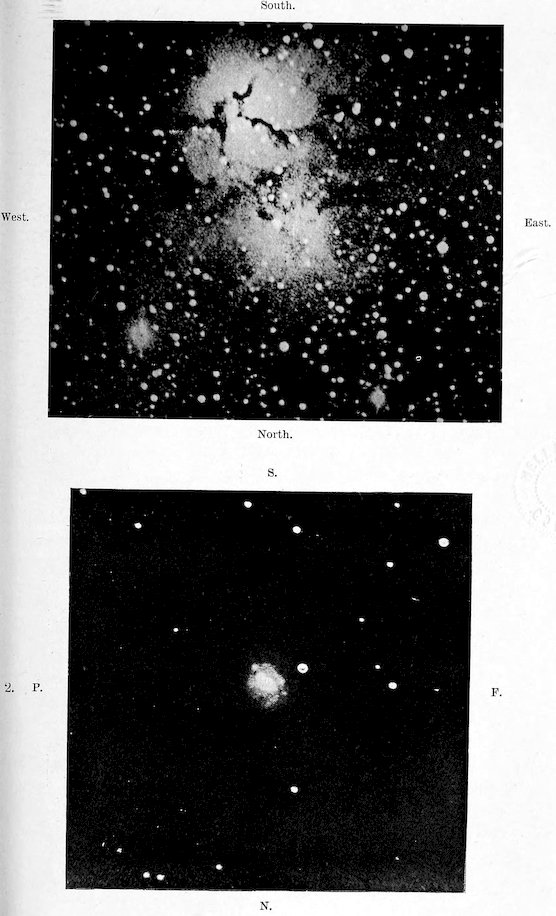
PLATE XXVIII.
1. Photograph of the Trifid Nebula. Taken by Dr. Roberts, 13th July 1899.
2. Photograph of Messier 77. Taken by Dr. Roberts, 26th November 1892.
The spectrum of this nebula was observed by Professor
Keeler in 1890 as “continuous but short, being apparently
confined to the blue and green.”[1104] Only a “brightening near
the middle” could be detected. Nevertheless, on 3rd August
1894, Professor Campbell perceived at a glance the three
511usual nebula lines, the third (F) being relatively strong.[1105]
An auroral glow almost effaced whatever continuous light
was present; and the same accident, singularly enough,
recurred at the date of a second observation 24th May 1895.
Much might be learned about the nature of the Trifid nebula
by a searching spectrographic inquiry. The condition, for
instance, of the unknown line at λ 3727 would be important
to ascertain. Its variations from one object to another, or
possibly from one region to the next of the same object, are
doubtless of a significance only to be fathomed by the patient
collection and comparison of facts. The spectrum of the
multiple star, which seems to have a nuclear relation to the
south-eastern division of the nebula, was stated by Keeler to
be devoid of marked features. Yet such may present themselves
when its thorough examination becomes practicable.
The components of the object were successively discovered in
the course of nearly a century. Sir William Herschel saw it
double in 1784; Herschel and South about 1826 found it to
be triple; and no more than three members of the group were
distinguished by Lassell with his four-foot reflector. The fourth
and fifth stars—neither much brighter than the thirteenth
magnitude—were added by Professor Langley, using the
fifteen-inch Harvard College refractor, in 1866; finally, the
Washington twenty-six-inch disclosed the sixth to Professor
Holden 5th August 1875.
A fantastic structure, known as the “Omega” or “Horse-shoe”
nebula (M 17 = N.G.C. 6618), is situated on the border
of Scutum Sobieski, and, like the Trifid, invites inspection from
southern latitudes. Sir John Herschel perceived it at Slough
in the figure of a Greek Omega (Ω), with the left-hand baseline
turned upward.[1106] He was surprised to see at the Cape a
second arch springing from the same level as the first,[1107] besides
other suspected convolutions. The subordinate appendage was
again noticed by Swift in 1883.[1108] In a photograph taken by
Dr. Roberts, 5th August 1893, the “horse-shoe” resemblance
is almost obliterated.[1109] Much greater prominence is given to
the spindle-shaped axis originally noticed by Messier in
5121764. On the plate it is found to be encompassed by a
dim envelope, uniting the various patches of nebulosity into a
large oval, 18′ by 12′, to the north-western end of which
an abortive “horse-shoe” is appended like an excrescence.
A picture obtained under more favourable circumstances
might bring these somewhat incongruous parts into an
intelligible mutual dependence. Professor Holden collected
evidence suggestive of variation in the Omega nebula,[1110] but
none that could be regarded as conclusive. “There has
certainly not been any bodily shifting,” Dr. Dreyer pronounced
in 1887.[1111] He was not, however, equally clear that
partial fluctuations in brightness might not have taken place.
The question remains an open one.
The spectrum of the Omega nebula was recorded as
gaseous by Sir William Huggins in 1864. Nothing further
is known about it.
Perhaps the most important of the nebulæ for purposes
of comparative study is “30 Doradûs.” Situated in the
Greater Magellanic Cloud, the “looped” nebula may exercise,
in Professor Pickering’s opinion, a dominating influence over
that extraordinary mixed assemblage. Yet it has the filmy
and unsubstantial appearance of silver filagree torn in
shreds and hung in the black sky. Its spectrum offers a
remarkable combination of linear elements with strongly
continuous radiance. Here, if anywhere, a frontier-instance
between “white” and “green” nebulæ is to be found. Burton
in 1874 affirmed the predominance in it of the fundamental
nebular line; but the Harvard observers are less explicit.
Professor Pickering briefly announced in 1892[1112] the spectrum
of this object to be “unlike that of other gaseous nebulæ”;
adding in 1897[1113] that its “constitution appears to be partly
stellar and partly gaseous.” Further, a sixth-magnitude star
in Libra (A.G.C. 20,937) is said to reproduce the peculiarities
of its mixed light, a discovery ranking among the most
profoundly instructive of those made by Mrs. Fleming. Its
full import may, however, develop only through prolonged
investigation.
513Near the star ξ Persei on 3rd November 1885, Barnard
discovered, at Nashville with a six-inch telescope, a “very faint,
very large, diffused” nebula (N.G.C. 1499).[1114] Six years later
it came prominently into notice through a photograph taken
at Halensee, near Berlin, by Dr. Archenhold.[1115] The Willard
lens was then repeatedly brought to bear upon it at Lick, and
one of the resulting pictures, to which Barnard gave six hours’
exposure 21st September 1895, is reproduced in Plate XXIX.
The nebulosity extends over at least two degrees, and includes
many “angular condensations.” A round dark spot near the
northern border strikes the eye at once. That it is “doubtless
a hole in the nebula,” Professor Barnard avers. But in a gaseous
mass a “hole” could neither be produced nor maintained. Light
in the perforated region must be suppressed unless it be intercepted,
and the latter alternative involves consequences that
may fairly be called inadmissible.
A drawing of the ξ Persei nebula, published by Dr.
Scheiner in 1893,[1116] embodies five photographic delineations
obtained with a Voigtländer “euryscope” of four inches
aperture, in times of exposure varying from one to six
hours. He found it to be little inferior in size to the great
Orion nebula, but totally different in plan of construction. It
has strongly luminous borders, and these are connected by
bright causeways crossing a comparatively obscure interior.
There is no sign of a nucleus, nor any tendency towards the
formation of one. Portrait-lenses, or some modification of
them, seem to be the only kind of instrument with which
impressions of this object can be secured; a plate exposed
during six hours at the focus of the Potsdam thirteen-inch astrographic
refractor showed no trace even of veiling from the
prolonged impingement of its rays. They are equally ineffective,
Dr. Archenhold states, upon orthochromatic plates—a
fact reasonably held to imply that the nebula emits chiefly
light-waves of short periods. In other words, it is a green
nebula, and all but certainly gaseous.
A “vast and magnificent nebula” near Antares, seen
imperfectly and fragmentarily, was disclosed in its entirety by
Professor Barnard’s photographic researches in 1895.[1117] Its
514primary gathering-ground is about ρ Ophiuchi, a quadruple
star of fourth magnitude giving a helium spectrum; but σ,
γ2, and 22 Scorpii, besides other smaller stars, form subordinate
foci. Antares itself is involved in the trailing skirts
of this cosmic cloud, but may in reality lie far away from
them. Furrowed by an intricate system of rifts, and pierced
by obscure cavities, the Antares nebula is evidently in an
agitated and unstable condition; and its marked tendency to
cling to individual stars suggests that its development will
take the direction of accentuating such local condensations.
The example of the Pleiades was recalled to Professor
Barnard; and it may be that the formation in Scorpio
presents us with an analogous aggregation in an earlier stage
of growth.
One in many respects similar was photographed in
Cepheus by Professor Barnard 13th October 1893. He
traced in it “numerous irregular vacancies and zigzag lanes,”
and noticed it to “mingle indefinitely with masses of small
stars and become part of them.”[1118] This nebula is two
degrees in diameter, and rudely circular in shape. Still more
far-spreading and complex is a wonderful nebulous maze,
vaguely centred at a point near ξ Cygni, but extending outward
to a distance of at least eight degrees. Dr. Max Wolf,
who virtually discovered this vast formation by his photographs
of 1891, considers it to embrace all the stars, bright
and faint, that come within its scope;[1119] and we cannot doubt
that a heterogeneous system, partly stellar, partly nebular, is
here presented to view. But the particularities of its composition
evade for the present profitable inquiry.
Barnard’s circular nebula in Monoceros (N.G.C. 2237),
which to the eye seems to draw a line of circumvallation
round the cluster within, but loses in photographs all trace
of annularity, may provisionally be classed as “irregular.”
A fine picture taken by Dr. Roberts 5th March 1899[1120] shows
the nebulosity to extend over a space about 77′ by 67′, in the
form of a cloudy aggregation “broken up into wisps, streamers,
and curdling masses, densely dotted with stars,” and including
“many dark areas with and without either stars or nebulosity.
Some remarkable black tortuous rifts meander through the
nebulosity on the north-preceding half of the nebula; their
margins are sharp and well defined in the midst of dense
nebulosity. They are as clearly cut as we see the cañons of
great rivers, but their width may in reality be millions of
miles.”
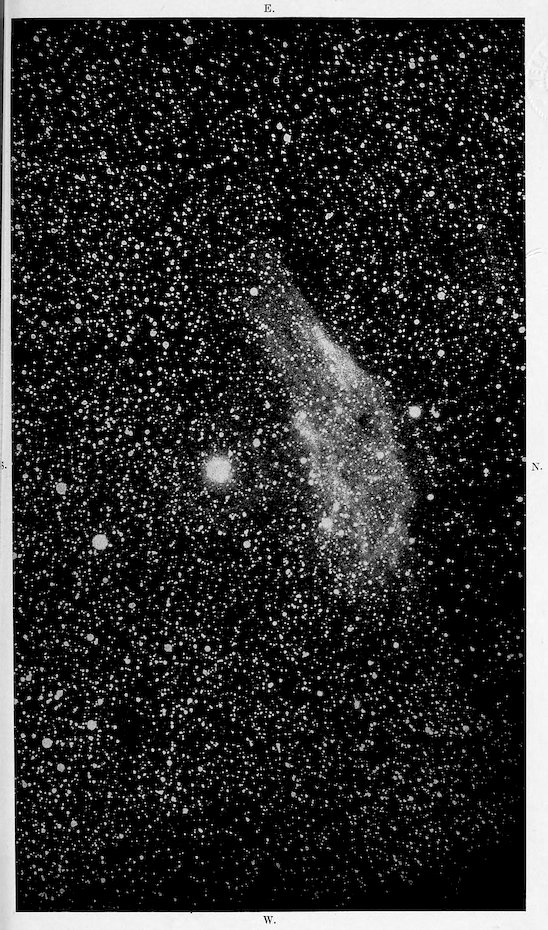
PLATE XXIX.
Photograph of a Nebula in Perseus (N.G.C. 1499). By E. E. Barnard. Exposure, 6h.
515Irregular, too, is a beautiful winged formation distantly
resembling the Orion nebula, photographed by Schaeberle in
the vicinity of Nova Aurigæ.[1121] The physical investigation
of all these objects will prove an arduous but interesting
task. The measurement of their radial movements, especially,
should help to define ideas regarding their true status in the
heavens.
516
The “dumb-bell” nebula in Vulpecula (M 27 = N.G.C. 6853)
might almost be called a hybrid between the planetary and
irregular species. Its affinities are indeed so numerous as to
embarrass its classification. Imperfectly seen, it appears double,
and such it was considered to be by the elder Herschel.
What survives of it when the fainter parts are obliterated by
dim air or bad definition, suggests the bell-shaped receptacles
detached from the neck of an hour-glass. And, in fact, the
succession of instances is unbroken, from bi-nuclear planetaries
through the “dumb-bell” stage to unmistakable pairs of nebulæ
thinly connected by hazy strips. This point has, however,
been already referred to. The dumb-bell nebula, moreover,
possesses a nuclear star, situated at the narrowest point of the
neck; and it is difficult to conceive of the neck as other than
a temporary arrangement. Many indications favour the idea
that it will, sooner or later, break up and disappear, leaving
the star regent over the masses finally disjoined. And it is
curious to remember that just such an interjacent star occurs
in several compound nebular systems.
A tendency to form a marginal ring is, on the other hand,
visible in this nebula. A photograph taken by Mr. W. E.
Wilson of Daramona, Ireland, which we are permitted by him
to reproduce in Plate XXX., shows an incomplete bright border
to be a leading feature in its construction. Whether in the
future it is destined to become predominant, we can scarcely
venture to surmise. The dumb-bell nebula is about 8′
in diameter. The bright framework can be seen in the
photograph to be filled out into an elliptical shape by faint
supplementary luminosity, which, however, is much stronger
in the original negative. Dim protrusions at the ends of the
major axis, traceable in Dr. Roberts’s picture,[1122] intimate
opposite outflows, similar in cause and character to those suspected
to proceed from the ring nebula in Lyra. The texture
of the “dumb-bell” is lumpy and irregular. Presumably it
is of an ellipsoidal form, and rotates on its transverse axis.
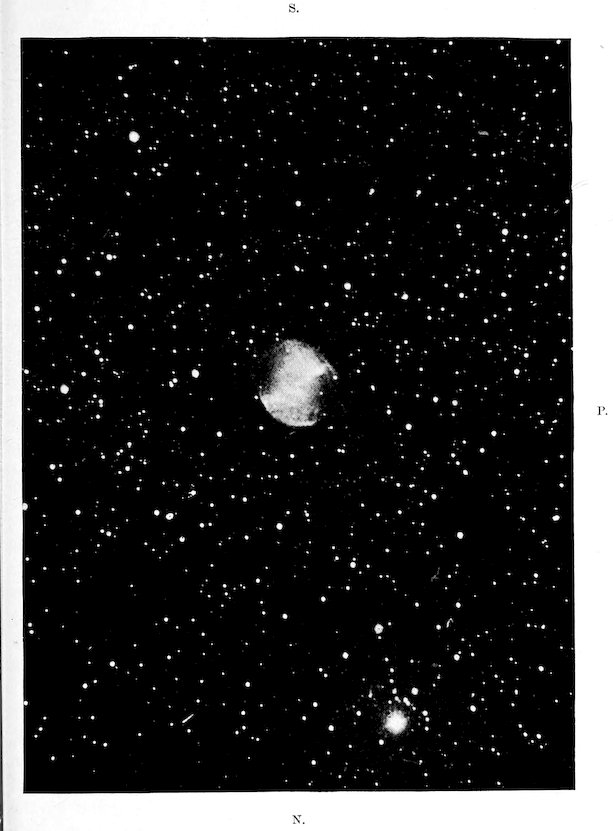
PLATE XXX.
Photograph of the Dumb-Bell Nebula. By W. E. Wilson, F.R.S.
Exposure, 60m.
517The spectrum is purely gaseous, and is dominated visually,
with more than the usual emphasis, by the green nebulium
line, while in the photographic region the ray at λ 3727 was
found by Von Gothard to be of quite peculiar strength.[1123]
Symptoms of helium-emission should be looked for.
Several objects have been described as miniatures of the
Vulpecula dumb-bell, but the likeness may prove, on a more
searching examination, to be only skin-deep. Among its supposed
analogues are: (1) N.G.C. 1365, situated in Fornax, and
described in Sir John Herschel’s Cape Results.[1124] It belongs,
he says, to the class of “annular nebulæ with centres,” but the
ring breaks off, leaving the oval incomplete at its extremities,
while the shorter axis terminates with two bright masses,
between which lies a “resolvable” nucleus. (2) N.G.C. 5189.
In Musca. A “general similitude” to the dumb-bell was noticed
by J. Herschel.[1125] (3) N.G.C. 3195. In Chameleon. A drawing
is given in the Cape Results. (4) N.G.C. 1978. One of the
nondescript inmates of the Magellanic Cloud. (5) N.G.C.
6905. A gaseous nebula in Cygnus, with a star in the centre, and
four attendant upon it, like satellites. (6) N.G.C. 3226, 3227.
A double nebula, near γ Leonis, consisting of two hazy masses
subsensibly united by a “neck,” and enclosed in a dim, elliptical
sheath. All these various structures may not, indeed, be
traversing the same line of development. In some, the
annular tendency will perhaps eventually prevail, in some the
disruptive. The balance between opposing forces is unlikely
to incline everywhere the same way, and upon its poise depends
by supreme appointment the special form to be assumed
in the course of ages by each individual system.
The “Crab” nebula in Taurus, discovered by Dr. Bevis in
5181731, was again noted by Messier, 12th September 1758,[1126] as
a “whitish light, elongated like the flame of a taper.” He
took it at first for the comet he was in search of; and, to
avert future confusion of the kind, adopted the memorable expedient
of constructing a catalogue of nebulæ.[1127] The specimen
at present in question measures 5′ along its greatest diameter,
and about 3′ across. Lord Rosse gave it its distinctive name
from the protruding filaments resembling the claws of a
crustacean, brought to view by his great reflector.[1128] These
have not yet been photographed. On a plate exposed during
three hours by Dr. Roberts, 2nd February 1892, there came
out an ovate body composed of “dense masses of clouds,
with fainter areas between them,” a deep bay on one side
being counterbalanced by a projecting limb on the other.[1129] No
tentacular appendages were disclosed.
The spectrum of the Crab nebula appears to be rather more
strongly continuous than is usual in the gaseous class, to which
it unquestionably belongs. For at Harvard College in 1868
the green nebulium ray was recorded, and was suspected to have
less refrangible companions.[1130]
Another object of dubious relationships is Messier 77
(N.G.C. 1068), Lord Rosse’s “blue spiral” in Cetus.[1131] The
description intimates an anomaly, since true spirals are “white,”
and give a continuous spectrum. Now the colour of this
object corresponds, as might have been expected, to a gaseous
constitution, whether of the normal kind or in certain ways
peculiar, remains to be proved. Its form, too, is ambiguous.
A drawing published by Lord Rosse portrays a round, faint
disc more than 2′ in diameter, upon which are relieved the
brighter coils of a definitely separated central mass. In Dr.
Roberts’s picture (see Plate XXVIII. Fig. 2), on the other
hand, there is no trace of a convoluted structure. It shows
“a stellar nucleus with projecting ansæ of dense nebulosity”
surrounded by a faint zone, and that again “by a broad
519nebulous ring studded with strong condensations” like inchoate
stars. A different aspect was, however, assumed by the object
in a photograph taken by MM. Baillaud and Bourget in
1899 with the thirty-three-inch reflector of the Toulouse
Observatory.[1132] The nucleus here again resolved itself into the
winding folds seen at Parsonstown, and a paler spiral formation
served for its background. Its character continues in many
respects enigmatical.
M 77 is copied, in Professor Holden’s opinion, quite accurately
by a nebula in the same constellation (N.G.C. 1084).
Under the gaze of the camera it may resume the spiral shape
obscurely visible to the Parsonstown observers, notwithstanding
their final description of it as “a fine oval, with ragged edge
and a mottled look,” indented by “a dark bay north of the
nucleus.”[1133] Judging by analogy, it should yield a gaseous
spectrum; though the circumstance, considering its remoteness
from the Milky Way, would be exceptional.
Messier 78 (N.G.C. 2068), in Orion, is a “singular
wispy nebula,” 6″ or 7″ across, enclosing a triple star, surmised
to vary in light.[1134] An arrangement of the more lucent
nebulous tufts along a spiral curve, affirmed visually,[1135] is denied
photographically. Dr. Roberts’s plate exhibits a central
cumulus, sharply terminated on one side, vaguely diffused on
the other, the dense nuclear part being surrounded by dim
floccules with wide dark spaces between.[1136] A smaller adjacent
nebula (N.G.C. 2071) has a stellar focus, to which appurtenances
like “mare’s tails” are attached. The distance from
centre to centre of the two nebulæ is about 15′ of arc,
and they can be made out to be in faint nebulous connection;
but neither, Dr. Roberts expressly states, gives indications
of possessing a spiral form. Their spectra, which are probably
discontinuous, have scarcely been examined.
That of “a fine, pale-white object”[1137] in Canes Venatici is
known to be continuous.[1138] Discovered by Méchain in 1781,
520M 94 (N.G.C. 4736) is large and bright;[1139] its nucleus, which
is granular in texture, and evidently globular in shape, being
surrounded by a zone of extremely dim, and that again by a
zone of relatively intense luminosity. The outer annulus
appears, in a photograph taken by Dr. Roberts,[1140] to be broken
up into nearly a dozen irregular star-like condensations. Two
abrupt opposite projections from it explain, possibly, the quasi-spiral
aspect of the nebula in the Rosse reflector.
A circular object, one minute of arc in diameter, and of a
“lucid pale-blue colour,” was met with by the elder Herschel in
the constellation Hercules, and ranged in the planetary class[1141]
(N.G.C. 6299). D’Arrest described it as a “nebulous disc,”
invested with a “nebulous sheath,” so that its passing for a
comet in 1819 is easily understood. Nevertheless, Sir William
Huggins found it to shine with perfectly continuous light,[1142]
and it was thought at Parsonstown, on 9th May 1872, to be
resolved into a globular cluster.[1143] It should be added, however,
that an undoubted planetary, N.G.C. 2022, was seen with
the same instrument under a similar illusory aspect. There
is indeed much difficulty in admitting the nebula in Hercules
to be a genuine cluster. Its cometary envelope and the azure
cast of its rays are almost contradictory of a stellar composition.
But until a photograph of its spectrum has been obtained
nothing can be definitely asserted on the subject. The quantity
of light available for analysis is about equal to that given by
a ninth-magnitude star.
A nebula in Virgo (N.G.C. 4900) looked, when ill-seen
with the Rosse reflector, something like the Owl planetary in
Ursa Major.[1144] A bright patch in the centre seemed to have
dark spots on either side, the whole being surrounded by a lucid
annulus or coil. Yet on a plate exposed at Crowborough,
during three hours, no spiral structure emerged to view, although
the nebulous condensations visible in the interior were judged to
be of the kind usually found to accompany spirality.[1145] The
521formation, indeed, looks completely amorphous. It is probably
of a non-gaseous nature.
The mutual relationships of many of the nebulæ just
described are doubtless very close. Their elucidation offers a
tempting and profitable field of research. Specimens in some
respects anomalous are often the most instructive to study.
Abortive features may be found in them, or half-developed
characteristics, isolated from their accustomed surroundings,
and thereby laid bare to scrutiny. Advantageous standpoints
for comparison and correlation would thus be gained; and
where these are effectively practicable, science cannot miss the
path of progress.
522
The occurrence of local changes of brightness is reasonably
certain, as we have seen, in some of the great irregular nebulæ,
and may be suspected in others. Variability affecting smaller
objects in their entirety must then be admitted as possible.
No doubt the phenomenon would introduce ideas difficult to
adjust and unexpected; but the heavens are full of surprises.
The immediate question to be put regarding it is, Does it really
subsist? The answer must be given with extreme circumspection.
The visibility of nebulæ depends upon contrast; the
blackness of the sky has as much to do with it as the brightness
of the filmy masses projected against it. They are besides apt
to disappear with high magnification, and that for two reasons.
First, because of the diffusion over a larger area of the same
quantity of light; secondly, because of the restriction of the
background in narrower fields of view. Hence there are
drawbacks to the employment of large telescopes in nebular
observation. The history of Tempel’s Merope nebula, marked
by vicissitudes ascribed again and again to intrinsic causes, now
fully recognised as non-existent, is a warning against hasty
conclusions on so delicate a point. The lesson has indeed been
so thoroughly learned that changes of the sort have of late been
announced only with a certain timidity, and under reserve.
Caution in the matter can, indeed, hardly be blamed for exaggeration,
in view of Swift’s remark that, after the Krakatão
eruption, many faint nebulæ absolutely disappeared.[1146] Nor
need we go beyond Chacornac’s “temporary nebula” for an
exemplification of optical caprices. On 19th October 1855
523the French observer noticed a striated haze (N.G.C. 1988)
attached to the star ζ Tauri, which seemed to have gained
brightness in the ensuing January. No one else, however, saw
it, and it had vanished by 20th November 1862. According
to Tempel it never shone in the sky, but was a telescopic
creation—a false image of an eleventh-magnitude star near
ζ Tauri;[1147] and Burnham unhesitatingly adopts this opinion.[1148]
Thirty years later its reality could have been tested by photographic
means; but astronomers in those days had to rely upon
the fallible human retina.
Chacornac’s phantom formation emerged near the site of
two genuine nebular Novæ. On 11th October 1852, Hind
detected, close to a star, then of the tenth magnitude, but since
registered as an irregular variable under the designation T Tauri,
a dim, round nebula (N.G.C. 1555) which brightened steadily
until 1856, when it was obvious to general observation. A comparatively
rapid decline ensued. Auwers[1149] could barely discern
the object with the Königsberg heliometer in January 1858; to
d’Arrest,[1150] using the eleven-inch Copenhagen refractor, it was
wholly invisible 3rd October 1861; in 1862 it was vainly sought
at Paris and at Malta with Foucault’s and Lassell’s great mirrors;
Hind himself was unable to find it; Secchi, under the pure
Roman sky, was equally unsuccessful; only at Pulkowa it continued
to glimmer just perceptibly for a few months longer.
From 1863 the sky in its place seemed a dead blank. At
last, 15th October 1890, Mr. Burnham requested his colleague,
Professor Barnard, to examine the region with the Lick thirty-six-inch,
whereupon a nebulosity about 50″ in diameter, and
so faint as to be at the limit of vision, was detected[1151] (see
Fig. 49). Burnham too saw it, but believed that he could
not have done so independently, his splendid powers of sight
being better adapted to the discernment of concentrated than
of diffused light-rays.
The nebula was again observed by Barnard—and with
somewhat increased facility—in February 1895.[1152] Seven
524months later he was amazed to find it utterly gone! His
search was repeated on three nights, under supremely good
conditions, with the same negative result. And the object, so far
from evading the grasp of large apertures, is peculiarly fitted for
observation with them, owing to its small size and compact
shape. Nevertheless, the forty-inch Yerkes refractor failed to
show it at all in 1897, and barely enabled Barnard to catch a
glimpse of it, 28th September 1898.[1153] Finally, Professor
Keeler obtained faint images of it on two Crossley plates,
exposed during four hours
each, in December 1899.[1154]
A copy of his drawing from
them is given in Fig. 50.
It exhibits the nebula as
composed of three vaguely
defined patches, united by a
dim haze, the camera having,
as usual, descried structural
complexities inappreciable
by the eye. On 20th
January 1900, the great
refractor just availed to
bring it into view, and it
has not since been heard
of. To Professor Keeler it
appeared inconceivable that
in its present obscure state
it could ever have been seen with small telescopes; and indeed
the evidence of variability is conclusive. Will it ever recover
any of its lost brightness? It may be doubted. The changes
so far undergone by it have been, though comparatively slow,
strictly analogous in character to those of “new” stars; a
presumption hence arises that it will share their fate of permanent
extinction. There is much reason to suppose that
Hind noted in 1852 an early stage of its kindling; that its
maximum in 1855–56 was solitary, its declension irretrievable.
Fig. 49.—Sketch of T Tauri and Hind’s Nebula, 15th October 1890 (Barnard).
Strange to say, the phenomenon was duplicated. While
looking fruitlessly for Hind’s nebula, Otto Struve came upon
another unfamiliar object (N.G.C. 1554) 4′ east of its predecessor’s
525empty place. This was early in 1868; and the Nova—for
d’Arrest was sure of its previous non-existence[1155]—was
kept in view until 1877, when absolute obliteration covered it.
Even Barnard’s quest for it in 1890, 1895, and 1899 was ineffectual.
Its former position is marked in Keeler’s drawing
(Fig. 50) by the thirteenth-magnitude star b, but no
nebulous impression was there made upon the plates. Dr.
Roberts had indeed already, in 1890,[1156] vouched for its
photographic disappearance. When last seen by Tempel,[1157]
8th November 1877, the nebula was 90″ across, and d’Arrest
had expressly recorded the presence in it of an eccentrically
situated, though definite nucleus.
Fig. 50.—Region of T Tauri and Hind’s Variable Nebula. Drawn from Photographs by Professor Keeler.
526Hind’s and Struve’s nebulæ were bright enough, as Professor
Barnard recalled wonderingly,[1158] to be ranked, soon after the
middle of the last century, in Herschel’s first and second classes
respectively. Both were watched “and measured by the best
observers then living,” and “were easily visible in ordinary telescopes.”
Yet one survives only as a fitful shimmer; the other is
utterly, and probably for ever, quenched. They are perhaps
obscurely connected, and the system—if such it can be termed—may
include the nebulous variable T Tauri; although nebulæ
and star alike seem to fluctuate in complete independence one
of the others.
These are the only authentic instances of temporary nebular
developments; but allegations of nebular light-change are
common. Some have proved groundless; not a few, however,
rest on a solid substratum of fact. The following may serve as
specimens.
On 17th October 1785 William Herschel discovered, not
far from Algol, “a pretty bright star with two faint branches”
(N.G.C. 1186). Sir John verified the observation, while estimating
the star at only fourteenth magnitude (about twelfth
on the modern scale). Yet neither it nor its appendages could
be seen with the Parsonstown reflector, and d’Arrest, after
diligent and repeated search, affirmed decisively, Nostra ætate
in hac regione tale quid non exstat in cœlo.[1159] The lost object,
nevertheless, came again into view in 1891. On 31st January
and 26th February of that year, Bigourdan, using the thirteen-inch
Paris equatorial, perceived it as a twelfth-magnitude star,
with an unmistakable “fan” of nebulosity spreading from it
over 1′ of arc. Only a fortnight later, Spitaler made a
drawing of the object with the Vienna twenty-seven-inch, and
described it as an elongated nebula, not regular enough to be
called elliptical, 2′ in extent, and including a focal star of the
eleventh magnitude.[1160] And Burnham, in the following August,
“readily found in the proper place a tenth-magnitude star involved
in a faint elongated nebula” measuring at least 2′ or 3′.[1161]
During the course of 1891, accordingly, the star seems to have
527been progressively gaining light and the nebula compass. But
if the star only were variable, the attached nebula would have
appeared to shrink and become effaced as the bright point
within it acquired intensity. Its simultaneous increase could
not have been counterfeited. Proof was afforded by it that the
growth, like the previous failures of luminosity, were due to
influences diffused throughout every part of the formation.
The next variable nebula was a “find” of Barnard’s. It
was conspicuous to him 30th November 1888. He judged it
equal to a ninth or tenth-magnitude star, and remained convinced
that its lucidity was of recent origin. Three years later
it had parted with quite four-fifths of its lustre, and had faded
down nearly to evanescence.[1162] It is situated in Cetus. No
information is at hand as to whether its decline has continued
since 1891. Unless arrested, it must, before the century
closed, have carried it out of sight even of the chemical retina,
and the object should then probably be relegated to the class of
“temporaries.” The question is of great interest, and might
be answered by taking one long-exposed photograph with a
portrait-lens or a large reflector.
This is not the only case in which an accession of brightness
has been thought to be demonstrated by the lateness of
discovery. A nebula was encountered by Tuttle in Draco,
1st September 1859 (N.G.C. 6643), which, in d’Arrest’s
opinion, should certainly have been caught in the meshes of
the Herschelian nets unless in their time comparative obscurity
had enveloped it. Similarly, a nebula in Camelopardalis detected
by Barnard in 1889,[1163] and again independently by Denning
in 1890,[1164] could not long, Barnard considered, have been thus
readily apparent. He recommended its being kept under
surveillance as a probable variable, but as yet it has shown
no sign of being so;[1165] unless, indeed, Swift’s earlier observation
of the same object, recorded without date by a simple
entry on a star-map,[1166] indicated a previous maximum. Another
instance of a possible rise in the scale of luminosity is afforded
by a small, fairly bright nebula in the Camelopard, first
528observed by Denning 30th September 1891, and casually
again four times in the ensuing month. Yet his many previous
reviews of the sky-contents in that neighbourhood had
failed to elicit any trace of its existence. Like Barnard’s and
Tuttle’s “new” nebulæ, however, it has apparently come to
stay; and since variability is in sidereal bodies usually an ineradicable
property, the hypothesis of an ascent from invisibility
cannot safely be accepted until a corresponding descent
has been entered upon.
The irregular variability, on the other hand, of two
nebulæ adverted to by Winnecke in 1877–78[1167] is almost incontestable.
The first (N.G.C. 3666) is in Leo. Elliptic in
shape, in size 90″ by 40″, it was marked “very bright” by
the elder Herschel 15th March 1785, but “extremely faint,”
23rd March 1830, by the younger, who added the comment,
“This nebula must have changed greatly if ever it belonged
really to the first class.” But its waning was not definitive.
Boguslawski inscribed it as a bright object in 1840 on the
Berlin Academy star-map of that region; and Winnecke found
it, 10th April 1878, of unquestionable primary rank. Yet
meantime, in 1863, d’Arrest had described it as subobscura,
and manifestly of third-class lustre; while again, on 24th May
1887, Dr. Dreyer perceived its diminished radiance only with
the utmost difficulty. Its further history remains untold.
Winnecke’s second variable (N.G.C. 955) is an inmate of
the crowded nebular district in Cetus. It consists, Burnham
says,[1168] of long, narrow “nebulous wings on either side of a
bright central condensation.” “On the whole,” he continues,
“it is rather a curious object, and should be easily found and
seen.” This was in 1891, and agrees quite well with Dreyer’s
notice of the object in November 1887 as “fully of the second
class.”[1169] The case for change rests upon its invisibility to
Schönfeld in December 1861, and to Vogel in November
1865; although in 1856, 1863, and 1868 it had been seen at
a glance by Schönfeld himself, no less than by d’Arrest and
Winnecke.
529Winnecke’s nebulæ were at first held by him to be
periodical; but this they certainly are not. No fixed relation
to time has so far been shown to govern nebular fluctuations.
They either consist—according to the best evidence at command—of
a solitary maximum, analogous to the outburst of a new
star, or of irregular accessions and losses of light. No case of
cyclical recurrence is on record. Photography is clearly
destined to play an important part in the investigation
of this difficult subject; its aid will be peculiarly welcome
where visual faculties are often baffled, embarrassed, and
deceived.
Nebular variability is indeed a phenomenon not only
evasive to the senses, but startling to thought. It cannot be
even remotely assimilated to the light-changes that progress in
certain globular clusters; it is independent of geometrical conditions,
of orbital movements, of planes and periods. Its cause
defies conjecture; we can only be sure that it acts upon a prodigious
scale. Thus Hind’s nebula in Taurus measured at
least 2′ across. Its parallax was almost certainly less than
one-tenth, and may not have exceeded one-hundredth of a
second. The larger value would give, for the smallest admissible
linear diameter of the object, 1200 astronomical
units (radii of the earth’s orbit) or 111,000 million miles.
Centred on the sun, it would extend on every side to
twenty times the distance of Neptune, the equation of light
within the vast formation being six and a half hours.
Yet it kindled as a whole, through the pervading influence
of some far-reaching event. Did another dark nebula sweep
through it? We dare not pronounce. Its mysterious
brightening, however, hints at the existence of an indefinite
multitude of similar bodies lurking in the obscurity from which,
by some rare chance, it emerged. It introduces us, in fact, to
a realm of invisible nebulæ, impenetrable by observation, and
hence pre-eminently adapted for the sports of scientific
fancy.
Hind’s and Struve’s vanished nebulæ were presumably of
gaseous composition, like the adjacent glow round T Tauri;[1170]
Winnecke’s variable pair doubtless shine with the white light
characteristic of the elliptic family to which they structurally
530belong. Their remoteness from the Milky Way points to the
same conclusion. Luminous instability does not then appear
to be associated in nebulæ with any special radiative quality.
Those giving continuous, and those giving discontinuous
spectra may equally be affected by it.
531
The relations of white to green nebulæ are obscure. Unitive
links between the two classes have yet to be established. In
most respects they stand at present widely apart. They
present a superficial likeness, but their dissimilarities seem to
be radical. They are unconnected by any marked spectral
affinities; they differ organically in structure; their distribution
on the sphere is regulated by opposite principles. Hence
their genealogical precedence remains unsettled. It would
be rash to say that either family developed from the other, or
even that they are collateral offshoots from a common stock.
That a line of continuity will, sooner or later, become traceable
is more than likely, but we must wait for the guidance
of facts with regard to it; premature divinatory efforts are
usually good for less than nothing.
As to the constitution of white nebulæ, we seem on the
verge of knowing something definite. Premonitions of their
being a species of fine-grained star-cluster have become audible.
The subject, however, is not ripe for discussion. A comparatively
advanced stage has, on the other hand, been reached by
the problems connected with gaseous nebulæ, since their
spectra let us, to a certain extent, into the secret of their
composition. This, on the whole, seems to be remarkably
uniform. Individual differences, it is true, both physical and
chemical, distinguish the various members of the class; but
they are of a subordinate kind. We may then safely attempt
to generalise as regards a few of their more obvious properties.
Three of these can be at once enumerated:—
532(1) Gaseous nebulæ are almost perfectly transparent.[1171]
(2) They shine with extreme feebleness.
(3) Their mass is vanishingly small in proportion to their
bulk.
We will take each point separately. That nebulæ offer no
appreciable obstacle to the transmission of light is attested by
the unaltered radiance of stars shining through them. No
absorption that can possibly be due to the cosmic fog in
which they are plunged to depths of many millions of miles,
is traceable in the spectra of such objects as Θ Orionis, of ρ
Ophiuchi, of Maia or Merope in the Pleiades. Similarly, the
central stars of planetary nebulæ shine through an interposed
medium, the extent of which is measured by the radius of each
gaseous globe; and this, by a rough minimum estimate, can
rarely be less, and must often be a great deal more than
50,000 to 60,000 million miles. Yet from the heart of these
extraordinary formations the light of their nuclei comes to us,
so far as it is possible to judge, absolutely intact. The impotence
of comets for light-stoppage is thus vastly enhanced
in nebulæ.
The feebleness of their luminosity is a matter of direct
observation. A shining superficies, unlike a shining point,
loses none of its lustre with increased distance. Its area of
course diminishes according to the law of inverse squares, but
every minute element of that area continues to radiate with
the same intensity as before. The sun, for instance, is no less
bright as viewed from Neptune than when it crosses the
meridian of Khartoum, but it is 900 times smaller. So with
the nebulæ. They are really as faint as they appear. Using
the best available data, Mr. Ranyard arrived at the conclusion
that a planetary of the most vivid kind emits per square
mile less than 1
22,000 millionth of the light sent abroad by
the solar photosphere. This implies—adopting the result of
Langley’s experiment at Pittsburg—that white-hot iron glows
at least 4,000,000 times more powerfully than the bluish disc
of the “Saturn” or the “Owl” nebula. Moreover, the differences
in areal lustre between one nebula and another represent
actual varieties of emissive strength. Remoteness has nothing
to do with producing them. A debilissima—a “breath-stain”
533on the sky—may be as near to us as the great hiatus in the
vault through which Huygens half-imagined the blazing of
empyrean fires.
Finally, nebulæ being prodigiously voluminous and of
apparently insignificant mass, must be of exceedingly low mean
density. This fundamental fact was realised with uncompromising
distinctness by Mr. Ranyard in 1892.[1172] Taking,
for illustrative purposes, the Orion nebula to be a sphere 20′
in diameter, composed uniformly of materials 1,000,000
times rarer than atmospheric air at sea-level, he found that its
mass would be such as to impart, to a body at a distance from
its centre equal to that of α Centauri from ourselves, a circular
velocity of 180, or a parabolic velocity of 255 miles per
second. In the neighbourhood of the nebula, accordingly,
there should be a marked prevalence of large proper motions.
A star, travelling across the line of sight under the influence
of its attraction at the rate of 100 miles a second, would, it
was shown, have an annual displacement on the sphere of no less
than 25·5″, and this independently of remoteness. For with
the same angular dimensions, the solid contents of the nebula
would increase as the cube of the distance assumed for it;
while the seeming velocities of bodies in gravitational dependence
upon it would undergo no change. This is rendered
obvious by a moment’s consideration. For take any given
star circulating round its centre of gravity at the rate, let us
suppose, of 100 miles a second. And let us further suppose,
to begin with, that the distance of the system is such that light
would spend ten years on the journey thence to our eyes. Let
us now double that distance and follow out the consequences.
First, the nebula is eight times more massive than would have
comported with the previous arrangement. Next, the revolving
star is twice as far from it as before, since the apparent interval
has not changed. Whence we easily gather, by the application
of Kepler’s third law, that it now moves with double its
previous speed. But its distance has, by hypothesis, also been
doubled; consequently, its proper, or apparent motion remains
just what it was. If, then, the stars about the Orion nebula
were really in swift circulation, they should appear to be
conspicuously progressive. This, however, is so far from being
534the case that the region is one of exceptional fixedness. The
spectroscopic information at command is to a corresponding
effect. The six brightest stars of the constellation, measured
at Potsdam in 1892, proved to be all affected, in varying
degrees, by the retreat of our system from that locality of the
heavens, but gave no signs of travelling rapidly on their own
account. The conclusion is inevitable that the Orion nebula—and
it may be accepted as typical—contains inestimably
less matter than should be comprised by it if its average
density were that of a Crookes vacuum. Mr. Ranyard, indeed,
assigned to it a consistence not exceeding 1
10,000 millionth
that of air at standard pressure, which, he continued, “would
about correspond to the mean density of the solar nebulous
mass, supposing it to have been spherical when its radius was
a little more than 107 astronomical units, or when the sun
occupied a sphere with a radius of a little more than three
and a half times the distance of Neptune.” The potential
solar system in those days lay muffled in the haze of a small
planetary nebula.
Yet it is impossible to conceive of nebulæ as formed
simply of matter in an aerial condition. They are no mere
vague effusions. They possess definite and characteristic
structure. Lord Rosse,[1173] indeed, thought sharpness of contours
distinctive of the gaseous kind. Mr. Maunder[1174] speaks of
their “strange and complicate shapes, showing here and there
strongly-marked outlines”; and he adverts to the difficulty
of explaining this peculiarity in vast, uncontrolled extensions
of rarefied gas. The abolition of this incongruity was one
of the strong points of Sir Norman Lockyer’s “meteoritic
hypothesis” of nebular constitution. The spectroscope, it is
true, pronounced against it; nebular chemistry has very little
in common with the chemistry of “uranoliths”; yet amid
much that was precarious or unsound, the valuable idea was
introduced that a proportion of solid matter must enter into
the composition of nebulæ. Its condition and distribution,
however, remain unknown. It would seem to be devoid of
light, for the faint continuous spectrum accompanying the
nebular bright lines would be displayed even by a homogeneous
gaseous mass, unless its radiations were of purely superficial
535origin.[1175] But here we meet the unresolved enigma of nebular
luminosity. How do they shine? Is it through the direct
agency of heat? Experimental evidence does not countenance
this view. In the laboratory, hydrogen and helium can be
induced to give out their characteristic rays only under
the stress of electrical excitement. The concomitant high
temperature might—as Sir William Huggins pointed out in
1891[1176]—prevail only along the path of the discharge, while
the surrounding gases remained cool, producing inequalities
in heat-distribution similar to those believed to exist in
vacuum tubes. If, on the other hand, nebular emissions were
of simply thermal production, the whole radiating mass should
be at nearly the same pitch of incandescence; for if the
temperature were lower in some than in other of its parts,
absorption lines or reversals would betray the fact, and the
nebular spectrum bears no legible marks of selective light-stoppage.
Yet it is eminently improbable that formations
so circumstanced are, in their entirety, excessively hot.
Their solid inclusions should, if they were, glow powerfully,
and strong continuous radiance would replace the dim band,
grey through faintness, actually seen. On the supposition,
however, that electrical discharges cause the glow of nebulæ,
their average temperature, judging by Dr. Scheiner’s experimental
results, might approximate to absolute zero.
The word “temperature,” indeed, when applied to matter
in the last stage of attenuation, has an extremely dubious
meaning. Taking the kinetic theory of gases to represent
the literal truth, we find the effects of heating upon them to
be twofold, namely, increase (1) of translatory, (2) of internal
energy, the latter being perhaps a consequence of the former.
Since, then, their constituent particles travel faster when heat is
applied, they come into mutual collision more frequently and
more violently. That is to say, if their number per unit volume
remains the same. Let, however, the density of the gas be
reduced, other things being unchanged, what will ensue? There
will be fewer encounters in equal times, but they will not be less
violent, since the mean rate of the molecules has undergone
no alteration. Hence, apart from one qualifying circumstance,
536the same species of vibration should be set going as when the
gas was denser and equally hot. The qualifying circumstance
is this. During the lengthened intervals between the
collisions, the molecules are radiating—that is, imparting
energy to the ether. If their free paths were sufficiently
protracted, they would—if that be possible—lose all they
possess, and need to be fully restocked at each encounter.
The comparative isolation of the molecules would accordingly
result in their being mostly dark, and what we must call cold;
so that the extreme subtlety of matter seems incompatible
with a high temperature in any intelligible sense of the term.
But there is more. Reduction of pressure would have for its
immediate result a general diminution of luminosity. In
all probability, it would also produce a selective effect, for
if, as seems likely, certain modes of molecular vibration
are more persistent than others, they would, with the progress
of cooling after each impact, tend to predominate, and
the balance of intensity among the spectral lines of a glowing
gas would thus be sensibly altered. Here, then, an explanation
might be sought of the spectral anomalies of
hydrogen in nebulæ. Nevertheless, it does not run quite
smoothly, since up to the limit of possible rarefaction in
vacuum tubes the crimson line of hydrogen gains consistently
in strength.[1177] A corresponding difficulty presents itself in
connection with the helium spectrum.[1178] “Green tubes” are
at a higher degree of exhaustion than “yellow.” Yet in
nebulæ the green ray is invisible; nebular helium radiates
only D3 with a few members of the same “set.” By means
of artificial exhaustion, accordingly, the nebular spectrum
cannot apparently be imitated. The only experimental clue
to its origin, in fact, is in Professor J. J. Thomson’s observation
(already mentioned) that F and C are of interchangeable
intensity at the negative and positive poles of a hydrogen
tube.
To recapitulate. Two fundamental problems regarding
gaseous nebulæ press for solution—one connected with their
structural forms, the other with the nature of their light.
537Do they continuously fill the spaces they appear to occupy, or
should we figure them to ourselves as collections of discrete
bodies comparatively wide apart? In the former case the dark
gaps and chasms which form one of their leading features
should be ascribed, not to the absence of matter, but to defect
of shining power, illuminative, not architectural contours
being disclosed by them. In the latter, chiaroscuro effects
would be reliable indices to the distribution of material.
Secondly, we are confronted with the mystery of their
shining. Why and how are they lucent? Are they bright as
a consequence of thermal or electrical stimulation, or is their
radiance some undefined species of luminescence or phosphorescence?
The answer must be given in view of the three
following peculiarities of their spectra: (1) The leading
hydrogen line in them is F, not C. (2) Helium shines in them
as if in a “yellow” tube. (3) Reversals are absent; lines of
absorption make no assured appearance, either as superimposed
upon, or as subjacent to lines of emission. None of these
points are easy to decide. Their consideration involves doubts
and queries of an abstruse nature; but it will not therefore be
neglected. Indeed, such a region of inquiry as is here
presented, where we feel that at every step the Unknown
may merge into the Unknowable, has a particular and an
illimitable fascination.
538
The Milky Way is an integral part of the great sidereal
system. It marks the equatorial girdle of a sphere containing
stars and nebulæ variously scattered and aggregated. The
whole material creation is, to our apprehension, enclosed within
this sphere. We know nothing of what may lie beyond.
Thought may wander into the void, but observation cannot
follow. And where its faithful escort halts, positive science
comes to a standstill. Fully recognising the illimitable possibilities
of Omnipotence, we have no choice but to confine our
researches within the bounds of the visible world. That it
has bounds is evident from the consideration that it possesses
shape and parts. Indefinitely extended, star-filled space could
have neither. Hence it offers to the human mind an intelligible
problem—a problem perhaps too intricate for definitive
solution, yet coming well within range of attack. The siege
operations may be protracted through many a campaign; but
in conducting them we shall climb from peak to peak of the
Alpine chain of truth, and gain continually wider views of the
majestic scene that encompasses and enchants us.
The structural relations of the cosmos may evidently be
looked at from many sides; our immediate concern is with
but one of its aspects. We have only to consider the nature
of the materials used for the building of the edifice and the
plan of their apportionment to its different sections. These
materials consist of gaseous and white nebulæ in all their
varieties; of star clusters, globular and irregular, and of the
sundry species of stars; and even a cursory inspection shows
that they are not piled together at random. Each class, on
539the contrary, obeys its own law of distribution; and the distribution
of sidereal, as of animal species, is the outcome of
their history, a test of their longevity, an index to their
nature. They are where they are, because they are what
they are.
There seemed, twenty years ago, very little reason to anticipate
that the photographic method could ever be used to
advantage for investigating the physics of the Milky Way;
yet it has, especially in Professor Barnard’s hands, proved
most effective in that difficult branch of inquiry. The requisites
were peculiar. The galactic drifts are made up of
very small stars—usually of fourteenth to sixteenth magnitude,
or even fainter,—and the sensitive plate perceives them, not,
as the human eye does, collectively, merged into a nebulous
surface, but one by one as light-points. Hence their rays
need to be powerfully concentrated in order to make any
chemical effect with a moderately long exposure. Moreover,
the field must be large enough to show the colossal forms
into which these stellar units are grouped. For each picture
a canvas of at least 100 square degrees must be available.
Hence telescopes of the ordinary type, however powerful, are,
for this purpose, entirely useless. An ordinary village photographer’s
apparatus would be better adapted to it. Professor
Barnard obtained his remarkable series of delineations with
the “Willard lens,” a doublet of six inches aperture and thirty-one
focal length, constructed at New York in 1859.[1179] They
extend over a large part of the Milky Way, but leave lacunæ,
the filling up of which should be the diploma-performance of
the new Bruce lens. It might indeed be supposed that a few
specimen sky-scapes in galactic regions would suffice to afford
practical acquaintance with the entire round; but this is very
far from being the case. No feature of the Milky Way is
more surprising than its inexhaustible variety. No “law of
condensation,” such as prevails in globular clusters, is there
traceable. Each section follows its own method of aggregation.
In one, cloud-forms are met with of the cirrus type;
in another, they recall breaking waves or tossing spray;[1180]
again, groups of irregular bright spots alternate with extensive
540ramifications and rifts; here the starry fabric is coarse-grained,
there of microscopic fineness; while for heterogeneous scattering
in many quarters, there is substituted in others an apparently
designed arrangement of the stars into rings, chains, and
ellipses.
Barnard’s photograph in Ophiuchus, reproduced in Plate
XXXI., has characteristics demanding earnest attention. The
bright star below the middle of the plate encircled by a
halation ring is θ Ophiuchi, an object spectrally akin to
Bellatrix, radiantly white and marked by helium absorption.
A “long, dull vacancy,” visible to the naked eye, stretching
east and west below (south of) Theta, comes out
as “an irregular rift in the sheeting of stars,” of highly
complex relations. It circuits the east as well as the north
and south sides of the bright mass in which the star is placed,
breaks up to the north into scattered dark openings, and
straggles on to the western edge of the plate, whence—as other
photographs of the series show—it communicates with some
of “the great vacant lanes” in the “wonderful nebulous region
about ρ Ophiuchi.”[1181] The most singular feature, however, of the
galactic chasms visible in our figure is the presence in them
of two gradations of obscurity. Darker details can be made
out on the dark background, recalling the analogy (which did
not escape Professor Barnard’s notice) of the “black holes” in
the umbræ of active sun-spots. The conviction was thus, he
added, almost enforced that the Milky Way rests here upon
a far-reaching stratum of nebulous, or quasi-nebulous matter.
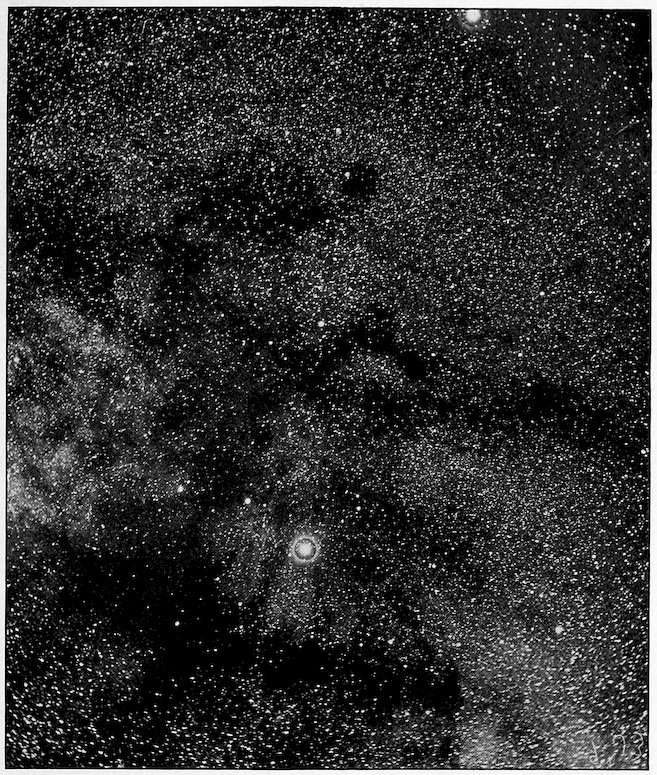
PLATE XXXI.
Photograph of the Milky Way in Ophiuchus (Barnard).
The reality, the frequency, and the determinateness of the
black openings in the Milky Way, dimly seen with the naked
eye, constitute one of the most important facts regarding the
nature of that formation attested by the camera. It is true
that their great exemplar in the southern heavens—the “Coalsack”
in Crux—seemed, in a photograph taken by Dr. Russell
of Sydney, 13th August 1890, to be embroidered with small
stars over three-fourths of its area;[1182] but this is an unessential
trait of the phenomenon. The fundamental circumstance connected
with it is the extensive and complete perforation of the
dense galactic stratum lying behind the starry network; and
541of this stratum there is no trace in the Sydney picture. Only
the foreground of the scene is delineated in it; the backward
stretching ranges remained inaccessible with the means employed.
The true Coalsack, then, has not yet been photographed,
and we are ignorant of the precise form which it will take upon
the sensitive plate. The exposures made at Lick, however,
effectively reached the piles of luminous dust which form the
ultimate reality of the Milky Way, and brought into view
with insistent clearness the pits and furrows of almost absolute
darkness by which they are frequently interrupted. One is
perpetually reminded, in looking at these autographic records,
of Herschel’s exclamation of amazement when his telescope
plunged suddenly into an unfathomable abyss in Scorpio:
Da ist wahrhaftig ein Loch im Himmel!
Now “holes” of the kind have a very wide cosmical significance.
The great rift, by which the entire galactic structure
is divided throughout one-third of its circumference, is only
a magnification of innumerable cracks and fissures yawning
amid its component star-masses. And the dark lanes in
globular clusters are plainly of kindred origin. Moreover, the
riddled aspect of the Milky Way in certain of its sections
is continually reproduced both in nebulæ and clusters—in
nebulæ, whether gaseous or stellar, as well as in diverse
species of clusters. The fact is a general one, that in all the
forests of the universe there are glades and clearings. How
they come to be thus diversified we cannot pretend to say;
but we can see that the peculiarity is structural—that it is an
outcome of the fundamental laws governing the distribution of
cosmic matter. Hence the futility of trying to explain it as of
incidental origin, as a consequence, for instance, of the stoppage
of light by the interposition of obscure bodies, or aggregations
of bodies, invisibly thronging space. That dark stars
exist, singly and in systems, and dark nebulæ no less, we
have been almost inevitably led to conclude; but the galactic
clefts cannot be reckoned among their manifestations. They
are, on the contrary, what they appear to be, intervals of starless
space between neighbouring star-clouds, and suggest
processes of disintegration[1183] advancing with inconceivable slowness
towards unimagined issues. These wonderful collections
542are then in a state of flux; they are passing from one condition
to another; Supreme Power is at work in dispersing or refashioning
them, sending abroad their aggregated suns like
flying sparks from the anvil.
But are those sparks indeed suns on the scale of our own?
The answer to be given depends upon our estimate of their
average distance. They are undoubtedly very remote. It may
be taken as certain that they lie beyond the sphere occupied
by the Durchmusterung stars—that is, by the ordinarily distributed
stars of our system down to 9·5 magnitude. How
much farther beyond, we are, however, unable to say. The
thronging orbs of the Galaxy are by no means of uniform
brightness. A recent inquirer[1184] concludes that they range
from the sixth to the sixteenth magnitude; and the statement,
which probably falls short of the truth, implies that stars
enormously disparate in apparent lustre are at sensibly the same
distance from ourselves; hence, that the crowd of small or
medium-sized bodies collected in the Milky Way are dominated
by veritable giants, more sparingly distributed. Professor
Barnard endeavours to bring this state of things into conformity
with received standards by levelling down the dimensions of
galactic constituents.[1185] To the ruck of them he assigns scarcely
more than planetary rank, so as to escape the necessity of
admitting fabulous magnitudes for their leaders. But in truth
we have no means of fixing a scale for such valuations. We
know that there are suns hundreds, even thousands, of times
larger than the sun. Why should there not be others larger
still in a similar proportion? Non est naturæ mensura hominis
electio, Kepler wrote to Herwart in 1599. Our estimates are,
in many cases, minimum values; we can place no upper limit
to the vastness of the orbs of space. It is only safe to affirm
that the greatest and the least of them are associated and
conjoined in the immense aggregations of “this gorgeous arch,
with golden worlds inlaid, built with Divine ambition.”
The sidereal tribes are very differently affected towards the
central plane of the system. Some, as it were, deliberately
withdraw from it; others are exclusive in their preference
for it; many press towards it, while maintaining a cosmopolitan
543status. That white stars largely preponderate in the
Milky Way, is a fact made evident by Kapteyn’s discussion of
the Cape Durchmusterung photographs.[1186] It might, nevertheless,
as Mr. Monck of Dublin first noted, be due to their
superior areal brilliancy, which would cause them, with increase
of distance, to come into view preferentially, and at last exclusively.
The percentage of white stars must, indeed, apart
from very unlikely specialties of distribution, augment among
the lower magnitudes, since a star emitting light of the Sirian
quality would appear equally bright when fully twice as far
off as one of the same size clothed with a solar atmosphere.
Moreover, Kapteyn’s researches did not extend below the tenth
magnitude, and the genuine galactic particles are of much lower
grades of brightness. So that the nature of their spectra
has not, up to the present, been disclosed to us. Yet a surmise
regarding it may be hazarded. Mr. McClean perceived
the bright helium stars included in his survey to be disproportionately
numerous in the Milky Way zone. This is
probably one among several symptoms of their great remoteness.
They are sufficiently removed, perhaps, from the centre
of the sidereal sphere to come within the sweep of the current
of tendency setting in towards its equatorial regions. How it
seems probable that fainter specimens of the type are similarly,
but more strongly condensed; and a further step on the
tempting road of conjecture leads us to the inference that the
dim aggregations girdling the heavens are mainly composed of
stars of the Orion family—of stars reversing the duplicate
series of hydrogen lines, besides those of oxygen, helium,
nitrogen, and silicon.
We have seen in an earlier chapter that the Milky Way
is the chosen resort of Wolf-Rayet stars. They doubtless
belong to it intimately and entirely; and the same may be said
of Novæ. This involves the strange consequence that, amid
the radiant galactic hordes, there must circulate a multitude
of large obscure bodies, fitted on occasion to blaze into sudden
conflagration, on a scale startling to intelligent beholders in
every quarter of the universe. Must we then conclude that
dark stars are relatively more plentiful in the Milky Way
than elsewhere? Not necessarily, perhaps, for its scarcely infringed
544monopoly in the production of temporary stars might
be explained equally well by the virtual limitation to it of the
conditions needed for luminous explosions, as by the abundance
in it of their appropriate fuel.
Very few gaseous nebulæ have any considerable galactic
latitude; they are characteristically Milky Way objects. There
are, indeed, exceptions. Some noted planetaries—those in
Draco and Ursa Major for example—are situated far outside
the zone of concentration, and they present the appearance
of being nearer to the earth than most members of the class.
The “stellar” variety, on the other hand, which are presumably
small through remoteness, are, to the best of our knowledge,
limited to the Milky Way; while irregular nebulæ
occur either in the main stream or in some of its affluents.
Among these the Magellanic Clouds are, in a sense, to be
counted, though they should rather be described as pools,
left behind as the waters contracted into their present bed.
They are composed, like the Milky Way, of mixed ingredients,
stellar and nebulous; they seem to reproduce its condition;
they bear the same primitive stamp. Their globular shape,
however, suggests an autonomous constitution, each being
probably a self-regulated body; while the galactic aggregations
may be supposed exempt from the efficient control of a central
authority. Dr Russell’s photographs disclosed spiral tendencies
in the Nubeculæ,[1187] destined perhaps to become more and more
pronounced with time.
Through the agency of the portrait-lens and the sensitive
plate, the nebulous affinities of the Milky Way have been
more fully recognised than was possible by visual means alone.
Several of Professor Barnard’s pictures exhibit an intermixture
of vaguely diffused lucid matter with layers of minute stars,
especially in parts of Cygnus, Cepheus, Perseus, Monoceros,
and Scorpio. We see, then, that the great cosmic zone is not
only frequented by nebulous objects, but is nebulous in itself.
Yet it seems to repel from it the multitude of white nebulæ
which tend to collect about its poles. This, at least, is the
law of their visual distribution; but the camera threatens
to abrogate it. Dr. Max Wolf holds that the results of
his preliminary photographic surveys prove nebulæ to be in
545reality scattered pretty evenly over the heavens. Only their
average brightness, he thinks, varies, the so-called “nebular
regions” in Cetus and Virgo having acquired their reputation
as such not because nebulæ are more numerous, but because
they are there more conspicuous than in the intervening
celestial tracts. The subject, in fact, of nebular distribution,
which had been supposed practically disposed of, has been, by
photographic explorations, reopened for fresh discussion.
The crowding of globular clusters upon the Milky Way
is unmistakable; and the inwardness of their relation
to its condensations is manifested by their avoidance of the
vacuous rifts, and their adherence to the stream-lines of
luminosity. Hence arises the logical necessity for their radical
separation from white nebulæ, to which they seem, in most
respects, so near akin that one might be led to believe mere
difference of distance to occasion the distinction between
resolvable and irresolvable objects. Only the opposite galactic
proclivities of the two classes decisively place them apart.
Within sight of that ultimate problem, the structure of the
sidereal universe, we pause. Our thoughts meet, but they cannot
grapple with it; nor does it come within the scope of our
present purpose to make the attempt. We must be content to
register the marks of growth and change legible in the Milky
Way; to note the evidence of its comparatively recent origin
and inchoate state; to avow our impotence to comprehend
the Supreme design which it is directed to realise; and to
bend in awe and admiration before the unfathomable depths
of difficulty and mystery towards which the study of sidereal
development, in its larger bearings, inevitably leads. Die
Schöpfung, as Kant discerned, ist niemals vollendet. Sie hat
zwar einmal angefangen, aber sie wird niemals aufhören.